Shared posts

05 Jun 18:42

Apple presents a new, more modern file system to replace HFS

by Rose Behar

As leaks leading up to the event suggested, Apple is launching a new file system called Apple File System that will replace HFS (Hierarchical File System).

The new file system features native encryption for added security, improved crash protection and instant file and directory cloning for safe saving.

It leaked previous to the developer conference as a placeholder listing for an Apple-developed app called Files.

More to come…

The post Apple presents a new, more modern file system to replace HFS appeared first on MobileSyrup.

05 Jun 17:59

Noted fascist collaborator Peter Thiel funds noted pro troll Palmer Luckey in building surveillance tools

by jwz
mkalus shared this story from jwz.

How is this the world we live in?

Mr. Thiel's investment firm, Founders Fund [...] sees Mr. Luckey's venture in the mold of Palantir Technologies, a data-mining company co-founded by Mr. Thiel, which serves a wide range of clients, including intelligence agencies. [...]

Mr. Luckey discussed the idea of using sensor technology on the Mexican border with Stephen K. Bannon, Mr. Trump's chief strategist, according to a person familiar with the meeting. [...]

A person who knows him described Mr. Luckey as a casual "prepper," someone who prepares for societal collapse, though another person said he was simply a military buff. [...] Among his assets is about 85 acres of property in upstate New York, including a luxury home built atop a decommissioned Atlas missile silo. [...] He owns a second property in Chico, Calif., with decommissioned Titan 1 missile silos, according to records.

Luckey on the hardships and deprivations of working at Facebook:

"At the moment I am an unemployed engineer, when I worked at Facebook I was just a business person," he told MoguraVR. "The Oculus offices were on the Facebook campus. It certainly was a great working environment. But I had to restrain myself working there. I could not cosplay while working at Facebook."

I'm not sure who he's cosplaying as in this photo, but I assume it's Steve Bannon.

Luckey's most notable business venture, of course, was Nimble America:

Nimble America says it's dedicated to proving that "shitposting is powerful and meme magic is real," according to the company's introductory statement. [...] "We conquered Reddit and drive narrative on social media, conquered the [mainstream media], now it's time to get our most delicious memes in front of Americans whether they like it or not," a representative for the group wrote in an introductory post on Reddit.

Previously, previously, previously, previously.

05 Jun 17:59

"The world only exists in your eyes. You can make it as big or as small as you want."

“The world only exists in your eyes. You can make it as big or as small as you want.”

- F. Scott Fitzgerald (via may-amber-2002)
05 Jun 17:59

Why Community Registration Rates Decline, Level, And Should Rise Over Time

by Richard Millington

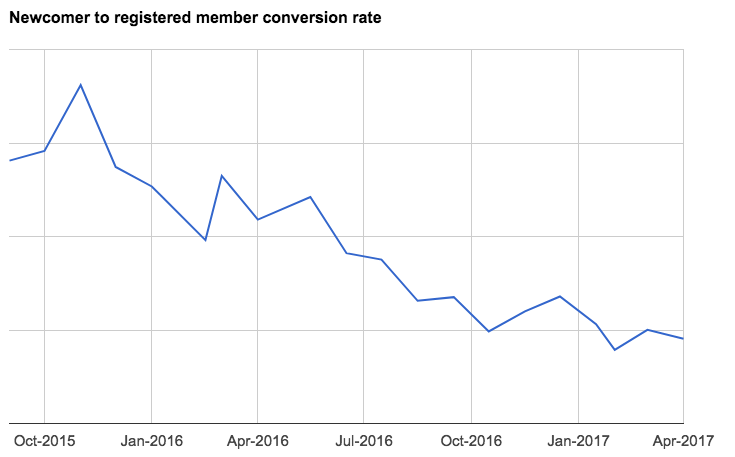
Your community’s highest registration rates (the % of newcomers who register) will usually be within the first few months of your community’s launch.

This is when the people are most likely to join a community sign up. This is when you’re reaching your biggest supporters. This is when people are hearing about the community for the first time.

(You will typically find most of these registrations come from repeat visitors)

As the months progress, this conversion rate naturally drops. Your biggest supporters are already members. Most of the repeat traffic has already decided whether or not they will join the community.

This should level out quickly. Here’s a real world example:

If the conversion rate is dropping (and you’re not changing anything), don’t freak out. This is natural.

You can have a small impact here but you can’t usually fight the broad trend. Don’t let your boss or anyone else demand you turn this around. It’s not going to happen.

At this stage check the rate of decline is slowing (i.e. the rate of decline should never be speeding up). As we see from the same community below, the rate of decline drops quickly and hovers around null with fewer deviations over time.

It’s only now the decline has leveled out that you can really begin testing changes effectively.

Remember, too, that your target audience aren’t the people that know you well. This group has already joined (or decided not to). Your target audience are people visiting your site and learning about you for the very first time. A big chunk of this audience might be entirely new to the topic.

This is really important. Initially, your messaging should target people most familiar with your brand/the topic. Once that decline levels out, you need to switch this to people new to your company or your topic.

What are their fears and concerns? How (specifically) can your community solve them?

As you begin testing different messaging, placements, and what you show newcomers you should see the conversion rate rise gradually to new plateaus.

05 Jun 17:59

Chances it’s a Friend’s Birthday Every Single Day of the Year

by Nathan Yau

If it seems like every day you log in to Facebook, it’s someone’s birthday, you're probably not that far off. Read More

05 Jun 17:50

Paperless 2.3 – An important update for syncing with Dropbox

by jim

Paperless 2.3 will be released within the next few hours, and includes an important update related to backing up and syncing lists with Dropbox.

The new version of the app uses the newer Dropbox API 2… the older Dropbox API will stop working around the end of June September, as previously announced by Dropbox. So, if you want to continue to back up and sync your lists between devices you’ll need to update to this new version of Paperless.

In order to provide better security for your information, Paperless will now only have “app” level access – meaning that it only has permission to access its own folder instead of permission to access your entire Dropbox account. (Paperless only ever accessed it’s own “Paperless” folder before this update, but this should give people better peace of mind.)

This also means that lists from Paperless are now stored on Dropbox under “Apps > Paperless”.

When you install the update, you’ll get a popup asking if you want to enable backup and syncing. You’ll need to tap “Enable Backup & Syncing” to re-link Paperless to your Dropbox account and continue backing up and syncing lists – or you can do it later on from the Settings panel within the app.

05 Jun 17:50

Android Pay support for Interac debit cards is now available in Canada

by Bradly Shankar
Android Pay

Android Pay is finally available in Canada as of May 31st, allowing Canadians to make mobile payments with their Android device at locations like Tim Hortons, McDonalds, Best Buy and more, all from their Android smartphones.

Android Pay launched with MasterCard and Visa credit card compatibility at a variety of banks, including BMO, CIBC, Scotiabank, and Desjardins. Starting now, however, Android Pay will also support Interac debit cards from BMO Financial Group, CIBC, Desjardins and Scotiabank, including cards that aren’t Interac Flash enabled.

Using Android Pay, purchases under $100 can be made with a simple tap of a phone, while purchases over this amount require additional authentication, such as a fingerprint scan.

TD and RBC haven’t gotten on board with the Android mobile payments yet, with Google stating that these institutions will likely add the feature in “the next several quarters” instead. Tangerine also doesn’t support Android Pay, although the company says the payment option is “on [its] radar.”

For more on Android Pay, check out a comprehensive guide on how to use the mobile payment feature. As well, experts in Canada recently weighed in on the impact Android Pay may have in Canada.

The post Android Pay support for Interac debit cards is now available in Canada appeared first on MobileSyrup.

05 Jun 17:50

Here’s how to watch Apple’s WWDC 2017 livestream

by Dean Daley
WWDC 2017 header

The event every Apple fan has been waiting for us finally here, the tech giant’s Worldwide Developer Conference (WWDC) in San Jose, California.

The conference starts today and kicks off with its inaugural keynote presentation. The live stream of WWDC conference is available right here at the top of this story.

WWDC’s keynote is set to start at 10am PT/1pm EST and the conference continues until Friday 9th.

Apple is expected to reveal new hardware at the conference including a new Siri speaker, various hardware upgraded MacBooks, new iPad Pros and software for its watchOS, macOS, iOS and tvOS.

Stay tuned to MobileSyrup for more information from WWDC. You can find Apple’s livestream of the developer conference right here at this link.

The post Here’s how to watch Apple’s WWDC 2017 livestream appeared first on MobileSyrup.

05 Jun 17:50

Google Store discounts Pixel XL by $100

by Igor Bonifacic
Google Pixel XL smartphone

If you’ve been waiting for the price of the Pixel XL to drop before picking one up, now is a good chance to get your hands on Google’s flagship Android smartphone.

For the next two weeks, Canadian consumers can get Pixel XL for $100 less when they buy it from the online Google Store. The 5.5-inch smartphone, which normally starts at $1049, is $949 and up.

The offer is valid until 11:59pm PT on June 18 or until supplies last, according to Google.

Despite its issues, the Pixel has been one of MobileSyrup‘s favourite phones since it came out late last year.

Source: Google

The post Google Store discounts Pixel XL by $100 appeared first on MobileSyrup.

05 Jun 17:50

The Silicon Valley method isn’t enough: A better way to build products

files/images/all-turtles.JPG

Phil Libin, LinkedIn, Jun 08, 2017


Icon

This is a launch announcement by former Evernote founder Phil Libin for All-Turtles, a company he described yesterday on TWiT as "a Netscape for artificial intelligence." He writes, "the rapid advancement of practical AI is happening right now. I wrote about it last year in  A Charge of Bots, and I believe it now more than ever." Se also: coverage in TechCrunch.

Worth noting: "Consider these six attributes: If you’re a:  (a)  white or South Asian  (b)  male,  (c)between the ages of 22 and 27,  (d)  with a computer science degree  (e)  from Stanford, and  (f)  you still live within 50 miles of Stanford, you have a pretty good shot of getting into the tech startup ecosystem. For each of those things that you aren’t, your odds decrease by a factor of two. Maybe a factor of ten!" [Link] [Comment]

05 Jun 17:47

Emoticons 1893

by Ronny
mkalus shared this story from Das Kraftfuttermischwerk.

Wurden damals „Setzerscherze“ genannt.


(via CandleToGo)

05 Jun 17:46

Public Outcry Hasn’t Actually Decreased The Price Of EpiPens

by Laura Northrup
mkalus shared this story from Consumerist.

Remember last year around back-to-school time, when the public focused its ire on drug company Mylan for charging hundreds of dollars for $1 worth of the drug epinephrine in each EpiPen brand auto-injector? While that generated plenty of bad publicity for Mylan, turns out Mylan doesn’t actually care.

How much doesn’t it care? The New York Times spoke with Mylan higher-ups who didn’t want to be identified because they signed non-disclosure agreements, and they recounted a meeting over EpiPen prices with chairman Robert Coury.

When some executives brought up their concerns about the price hikes for EpiPen in recent years, multiple sources told the Times that Coury displayed two middle fingers and told them that FDA regulators, outraged members of Congress, investors, and anyone else concerned about the pricing could “go f— themselves.”

The executives also say that the price of EpiPens was expected to go up even more before the rush of negative publicity.

Times columnist Charles Duhigg learned first-hand that Mylan hadn’t actually changed anything when he went to refill his son’s EpiPen prescription. The pharmacy told him that he was responsible for paying $609 for a two-pack of pens.

Couldn’t he just get a generic? Getting the generic version meant having the pharmacy contact the doctor’s office for authorization, then paying $370 instead.

While insurance coverage and coupons bring the cost down for most consumers, others aren’t eligible for manufacturer discount programs and haven’t yet met their deductible for the year.

Mylan paid almost $500 million last year to settle allegations that it overcharged Medicaid customers for their EpiPens.

How can you prevent this when filling your own prescriptions? Having a doctor write a prescription for an “adrenaline auto-injector” instead of using the EpiPen brand. This can get you a generic Adrenaclick pen at CVS and other pharmacies, which is a significantly cheaper alternative if your or your child’s doctor approves.


05 Jun 17:46

FlightLogger Delivers Elegantly-Designed, Real-Time Flight Tracking for Worry-Free Travels [Sponsor]

by John Voorhees

Traveling isn’t easy. FlightLogger is designed to take the pain out of air travel by making it simple to search and save your flights, get up-to-date notifications on any changes, share your travel plans with friends and family, and much more.

Too many flight tracking apps are a cluttered mess. FlightLogger takes a clean, minimalist approach that reduces the number of taps and information you have to input. Combined with a clear, easy-to-read interface, FlightLogger is the perfect companion for your next trip.

FlightLogger features:

  • Real-time, ad-free tracking of departure and arrival times, delays, cancellations, and gate and baggage claim information.
  • Flight status notifications.
  • Apple Watch syncing.
  • Data for around 37,000 airports worldwide.
  • Push notifications that can be set for 2 hours before the flight, 1 hour before, the time of departure, the time of arrival, and if there are delays.
  • Optional automatic deletion of flights an hour after you land.
  • An innovative timeline view that reduces screen clutter and provides simple glanceable information about your flights.

If that isn’t enough, you can get even more by subscribing to FlightLogger’s premium features like offline-mode for when you don’t have a data connection, enhanced alerts, unlimited flights tracked per month, sharing of location and flight status with family and friends, and syncing with your calendar. Head on over to FlightLogger’s website to learn more.

Our thanks to FlightLogger for sponsoring MacStories this week.


Support MacStories Directly

Club MacStories offers exclusive access to extra MacStories content, delivered every week; it’s also a way to support us directly.

Club MacStories will help you discover the best apps for your devices and get the most out of your iPhone, iPad, and Mac. Plus, it’s made in Italy.

Join Now
05 Jun 17:43

R⁶ — Scraping Images To PDFs

by hrbrmstr

I’ve been doing intermittent prep work for a follow-up to an earlier post on store closings and came across this CNN Money “article” on it. Said “article” is a deliberately obfuscated or lazily crafted series of GIF images that contain all the Radio Shack impending store closings. It’s the most comprehensive list I’ve found, but the format is terrible and there’s no easy, in-browser way to download them all.

CNN has ToS that prevent automated data gathering from CNN-proper. But, they used Adobe Document Cloud for these images which has no similar restrictions from a quick glance at their ToS. That means you get an R⁶ post on how to grab the individual 38 images and combine them into one PDF. I did this all with the hopes of OCRing the text, which has not panned out too well since the image quality and font was likely deliberately set to make it hard to do precisely what I’m trying to do.

If you work through the example, you’ll get a feel for:

  • using sprintf() to take a template and build a vector of URLs
  • use dplyr progress bars
  • customize httr verb options to ensure you can get to content
  • use purrr to iterate through a process of turning raw image bytes into image content (via magick) and turn a list of images into a PDF
library(httr)
library(magick)
library(tidyverse)

url_template <- "https://assets.documentcloud.org/documents/1657793/pages/radioshack-convert-p%s-large.gif"

pb <- progress_estimated(38)

sprintf(url_template, 1:38) %>% 
  map(~{
    pb$tick()$print()
    GET(url = .x, 
        add_headers(
          accept = "image/webp,image/apng,image/*,*/*;q=0.8", 
          referer = "http://money.cnn.com/interactive/technology/radio-shack-closure-list/index.html", 
          authority = "assets.documentcloud.org"))    
  }) -> store_list_pages

map(store_list_pages, content) %>% 
  map(image_read) %>% 
  reduce(image_join) %>% 
  image_write("combined_pages.pdf", format = "pdf")

I figured out the Document Cloud links and necessary httr::GET() options by using Chrome Developer Tools and my curlconverter package.

If any academic-y folks have a test subjectsummer intern with a free hour and would be willing to have them transcribe this list and stick it on GitHub, you’d have my eternal thanks.

05 Jun 17:42

Why I wish the US had a leader like UK Prime Minister Theresa May

by Josh Bernoff

The leader of the UK, Theresa May, is a fearsome figure. She has a number of hateful opinions. But she also appears to be capable of logical reasoning, which makes it possible to understand her positions and argue with her. That’s not possible with the incoherent and contradictory positions that our own leader has here … Continued

The post Why I wish the US had a leader like UK Prime Minister Theresa May appeared first on without bullshit.

05 Jun 17:42

Is There an Emerging Democratic Agenda? | Jared Bernstein

Is There an Emerging Democratic Agenda? | Jared Bernstein:

The Dems need to get their platform and political philosophy together before the ‘18 and ‘20 elections, and maybe that’s happening. Core question: what do they stand for? Jared Bernstein doesn’t ask that question head on, but I hope he will, some day. Instead, though, he offers some specific planks for the platform-in-process:

[…] a robust, highly progressive agenda has been coming together in recent months, one with the potential to unite both the Hillary and Bernie wings of the party, to go beyond both Clintonomics and Obamanomics.

These ideas come from the left wing of the party, but I’ve noticed more and more centrist Democrats, along with establishment donors, who increasingly recognize the need, in both substantive economic and electoral terms, to get outside the old boxes and go bold.

And what are these bold ideas?

  • Universal Child Allowance – ‘a monthly stipend for all families with children. International data show that child poverty in America remains at 20 percent — twice the rate in Germany and seven times the rate in Denmark.‘
  • Permanent Job Program – ‘direct job creation policies, meaning either jobs created by the government or publicly subsidized private employment’. And make jobs better.
  • Wage Subsidies – ‘a $1 trillion expansion in the wage subsidy over the next decade. A family of four making $40,000 would get a tax credit of about $6,000 instead of its current benefit of about $2,000.’
  • Higher Minimum Wage – ‘A higher minimum wage is yet another idea drawing broad liberal support’.

No single payer, though, which would be a big boon to working class Americans.

05 Jun 17:42

"To live in Vermont is to be smothered by nature’s beauty on a daily basis. Everywhere you look is..."

To live in Vermont is to be smothered by nature’s beauty on a daily basis. Everywhere you look is another peaceful pond, another shimmering lake or emerald hill or misty field graced by a family of grazing deer. It’s almost obnoxious, like that one friend you have who’s so pretty, funny, smart and talented that you want to hate her stupid gorgeous face.

Immersed as we are in these exquisite pastoral gifts, Vermonters tend to forget that Mother Nature might be lovely, but moral she is not. She doesn’t love us or want what’s best for us. With one hand she giveth, and with the other she puncheth in the gut.


- Molly Hodgdon | Mother Nature might be lovely, but moral she is not
05 Jun 17:42

Humans First and Fast-Casual vs. Fast Food

Humans First and Fast-Casual vs. Fast Food:

According to a recent Eater piece, the same research firm that supplied the WSJ lunch-slump evidence above noted that breakfast was the only meal that has seen growth. The evidence in the article, while largely anecdotal, likely resonates with city-dwellers who have seen breakfast restaurant options increase over time. (And have embraced kale salad as a breakfast food, apparently, according to the piece. Not sure about that.)

If restaurants are seeing a slump at lunch, it makes sense to go where the money is. All-day dining is a growing industry trend; it’s not so strange to consider the breakfast-dinner restaurant the new normal.

05 Jun 17:40

Jobs Jar — Langara College

by Ken Ohrn

Looking for:  one Communications Officer.

Reporting to the Manager, Communications and Marketing, this position provides integrated marketing communications strategy, planning, and execution for both College-wide and program-specific marketing efforts. Communication Officers (COs) liaise with internal clients to understand their marketing goals and collaborate with our design and digital teams to bring a diverse range of projects to life, including comprehensive advertising campaigns, publications, media relations, events, collateral, web, and other digital projects. COs work with both internal and external audiences to achieve marketing communications goals while strengthening our brand and enhancing the institution’s reputation.


05 Jun 17:40

Sony to bring Breaking Bad virtual reality experience to PlayStation VR

by Bradly Shankar
Breaking Bad Walter White

Sony has announced that a Breaking Bad virtual reality experience is coming to the PlayStation VRVariety reports that Vince Gilligan, creator of Breaking Bad, is working with Sony on a non-game VR project based on the hit series.

“We set up a day at our campus where we brought seven of the best show runners [Sony Pictures Television] work with, like David Shore of The Blacklist and Ron Moore, who did Battlestar Galactica, Vince and some other folks,” Andrew House, global chief executive of Sony Interactive Entertainment, told Variety. “And they just played around with VR. Several of them were intrigued, but Vince was the one who said, ‘I really want to do something with this. I want to experiment with this.’”

Sony will work with Gilligan and use computer graphics to realize his vision for the project. “I think [this] could be another interesting way to see how VR can drive towards the mainstream,” House told Variety. 

Not much else is known beyond this, however. As of now, it’s unclear if this VR experience will bring back talent from the original series, such as Bryan Cranston (Walter White) or Aaron Paul (Jesse Pinkman), or feature new characters altogether from the same universe. While Sony didn’t confirm a release window for “Breaking Bad VR,” the company did say that it will not debut in 2017. Sony also didn’t say whether this will be a one-off experience or an ongoing episodic series.

It’s worth noting that Breaking Bad and the PS VR are both Sony productions, so it may be unlikely to see the experience come to other VR headsets like the Oculus Rift or HTC Vive.

Breaking Bad ran for five seasons on AMC and ended in September 2013, garnering rave reviews and many awards during its time on the air.

The PS VR has also been doing well enough for Sony so far, with the headset reaching 915,000 units sold as of February, in line with company expectations. In a report detailing 2017 fiscal year plans, Sony affirmed its commitment to PS VR, citing the tech as a key focus going forward. Sony CEO Kaz Hirai has said the company aims to bring a variety of new experiences to PS VR, including those from areas outside of gaming. The Breaking Bad VR experience seems to be a part of this.

Image credit: Flickr – BagoGames

Source: Variety 

The post Sony to bring Breaking Bad virtual reality experience to PlayStation VR appeared first on MobileSyrup.

05 Jun 17:35

Clearings

by Jacqueline Feldman

On January 24, 1994, Michel Faudry, mayor of Chatain, in France’s Vienne Department, adjourned to his mother’s house and, later on, a hunting lodge. The French state had nominated the granite that underlay the Vienne as a candidate for the disposal of nuclear waste, and Faudry, endeavoring for consensus within his community, had paid himself, out of pocket, to hold a referendum. It seems the department’s prefect had told Faudry he could not fund it publicly and that Faudry had been, for his efforts, bombarded by eggs, tomatoes, and anonymous phone calls. Now, on a riverbank, he breathed. In one telling, he wrote two letters, one to his sister, one prescribing the care of his donkeys and canaries to a friend. It is said he requested that the town he loved reconcile and proposed it reunite at a party in his honor the following day. News reports about Faudry’s day that January 24 are not consistent with regard to the details. Faudry lifted a pistol and, sitting, or lying on a table, a cushion below his neck, fired one shot through his heart.


Andra, the public utility that handles France’s nuclear waste, did not build in the Vienne, but, in 1999, obtained authorization to sink a laboratory below Bure, a village of roughly 90 inhabitants in the Meuse Department, in the Lorraine, a region of fluctuating fortunes bordering Belgium, Luxembourg, and Germany.  Pending experimentation and approval, it will bury 85,000 cubic meters of waste here, 500 meters below what’s now a forest, and, in 2150, seal the repository.

Burial is a technology of forgetting. It’s a cover up

I visited Bure in January after reading news of a contest Andra held, calling on artists to design warning signage. The waste may remain dangerous for 100,000 years, according to the company’s projection. Whoever lives here, if anyone, must be discouraged from digging it up. Lower-activity waste at another dump in the Manche, in northwestern France, presents just 300 years of toxicity, but a few of the artists, in on-camera interviews for Andra, explained that the longevity of the danger to be contained at Bure had inspired them. The markers they devised did not rely on any contemporary language or culturally specific symbol.

Legally, Andra, which also maintains paper archives, must steward knowledge of the Bure site for a minimum of 500 years. While it held its contest twice, in 2015 and 2016, it did not promise to build any marker. Winners received 3,000 or 6,000 euros. Out of the 2015 contest came a plan to modify the forest’s trees so they’d grow blue. Other entries dealt with memory as a communal enterprise. In 2016, second place went to a baton made out of the site’s native clay, accompanied by a plan for its relay across generations. In 2015, third place was conferred on a nursery rhyme to be passed down by schoolchildren. The lyrics are banal — open your ears really wide / listen to my advice — but I was struck by their characterization of the waste, which ascribes a fretful sentience to it.

Shut in, worrying
A light, palpating
All the way down there, deep
That’s where it lives

I stayed for nine days in total, and, after I returned from Bure, I could describe the place where I’d been, a dwelling for waste, only by the landscape’s near-photographic contrast. Andra’s laboratory presented itself as yellow light filling a shallow valley. It was as bright as goldenrod. Around it, fields opened, stippled with a dull gray snow, and continued on to meet every horizon, broken occasionally by the pylons of long-distance power lines. Above one horizon I saw sparkling white lights, and only afterward, the white forms of wind turbines appeared against a bone-white sky.


Although France relies exceptionally heavily on nuclear energy, which accounts for 75 percent of the country’s electricity, the United States contains more plants and similarly has sought to memorialize their by-product. In 1981, consulting on a study submitted by the Bechtel Group to the Department of Energy, Thomas Sebeok, a Budapest-born semiotician known for arguing that apes would never understand language, suggested an “atomic priesthood” who would safeguard knowledge of the waste over millennia while scaring people away. Specifically, he recommended they spread a threat of “supernatural retribution.” Among the information that is searchable online, I find little to indicate the government’s reaction to this proposal. In 1994, Susan Garfield, a psychotherapist, wrote that the report “demonstrates that the very premise of ‘out of sight, out of mind’ deep geological burial of radioactive materials leads inevitably to procedures in the social, political and spiritual life of the people that are not any less destructive because they are absurd.” New Mexico’s Waste Isolation Pilot Plant (WIPP), built to last 10,000 years, began accepting the transuranic waste that weapons leave in 1999.

A team that the government convened in 1991, tapping experts in “history, future studies, economics, law, physics, sociology, geography, engineering, political science, risk analysis, agriculture, climatology, history, and demographics,” as well as the illustrator responsible for Carl Sagan’s cover art, duly condemned secrecy and fear as tactics. Still, as I read this team’s report, I noticed a glow of disingenuousness. Burial is a technology of forgetting. It’s a cover up.

These experts suggested fields of spikes or massive thorns, all askew, or else an expanse of black rock that would get hot, or a plain of rubble, or a charmless maze of cramping, too-small passageways, all made of lasting but cheap materials like granite to preclude looting. “Note our use of irregular geometries and the denial of craftsmanship,” they write. “At the same time, we make an enormous investment of labor in these rude materials. It speaks of a massive investment, but not one tinged with pride or honored with value-through-worksmanship.”

Our descendants would inherit markers that were ugly but forbiddingly expensive. While these markers would resemble ruins at the time of their building, their scale would not confer sublimity. Ruins lost their grandeur during the First World War, writes Geoff Dyer in The Missing of the Somme; once technology could produce rubble instantly, ruins lost their mystery. Time failed to dignify them.

The Meuse, where Bure is located, is little visited, even by the French, but it does draw tourists curious about the First World War. Parts of the department were furrowed with trenches. After the war, the French government isolated a “red zone” that included part of the department. Unexploded shells turned up, and still do; in 2014, according to National Geographic, some of the workers collecting them guessed they’d take 300 years to remove. Six towns near Verdun that the enemy shelled to destruction were decorated, like human veterans, with the Cross of War. Honored and quarantined, the land was treated as if it had served actively.

Wars vary, as do enemies. With apparent gusto, the American experts write, “Some of the archetypal feelings and meanings we will explore in design of the markers for the WIPP site are those of: dangers to the body; darkness; fear of the beast; pattern breaking chaos and loss-of-control; dark forces emanating from within; the void or abyss; rejection of inhabitation; parched, poisoned and plagued land … and others.”

By contrast, Andra’s awardees propose designs that are pretty: equilateral triangles of a gleaming silica; scarlet geopolymer set like jewels in metal loops; or trees growing atop rectangular columns that will sink into the ground over 300 years. What’s their function? Memorials “honor the dead,” Arthur C. Danto wrote in 1985, referring to the Vietnam Veterans Memorial in Washington. “With monuments, we honor ourselves.” If these markers are monuments, celebrating future humans as victors, the war won by humanity against nuclear waste will have been one of attrition, valuing outlasting, like a staring contest 100,000 years long.

Last month, the Global Seed Vault, a monolithic refrigerator on the Norwegian island of Spitsbergen that stockpiles seeds in case of cataclysm, sprung a leak. Temperatures had risen beyond any expectation, and snowmelt flooded the facility’s entrance. “This is supposed to last for eternity,” Åsmund Asdal at the Nordic Genetic Resource Centre, which operates the vault, told the Guardian of the building, which opened in 2008.

Rising sea levels also threaten a concrete dome on Runit Island, in the Marshalls, which, though only 18 inches thick (and thinner in spots), covers the detritus of U.S. bomb tests. Workers bagged plutonium-239, which has a half-life of 24,000 years, in plastic, and cached it there. A 2013 report for the Department of Energy found that the dome had cracked. Typhoons likely will increase its seepage.

In February 2014, a drum containing plutonium and americium exploded within the WIPP, temporarily closing the site. (It has since reopened.) The waste had been packaged in cat litter. Proponents of nuclear power stress that inorganic litter would have been perfectly appropriate, but this drum had been packaged in sWheat Scoop, a wheat-based litter.

“Every war is ironic,” Paul Fussell writes in The Great War and Modern Memory, an analysis of British literature after the First World War, “because every war is worse than expected.” One man’s death, by assassination, exacted more than 38 million. Like obsessive hand washing, disposal technologies confuse scientific means with a moral end, with purification.


In Bure, I stayed six days and, later, three more days with anti-nuclear demonstrators. Their anger was grounded in asymmetry: For 50 years’ worth of energy, they said, their country had produced 100,000 years’ worth of toxicity. They lived deliberately in a fixed-up farmhouse, the Maison de la Résistance, which anti-nuclear activists had owned for 13 years. Twice daily they ate meals that were communal, vegan, and gluten- and salt-free. In a back room were a few old computers, fitted out with Tor and passwords, and built into the rafters were a free shop and a dormitory containing a couple dozen mattresses, closely laid out, and a space heater. In a bathroom, a sign explained how to make soap without chemicals; other notices mandated withholding information that might identify demonstrators, especially a few who slept in the forest where the repository would be dug. In the kitchen, a sign had read, “Choral workshop Wednesday December 14,” but the “14” had been crossed out in another ink, replaced by “21,” which was also crossed out. The sign now read, “Choral workshop every Wednesday for the rest of your life.”

While I stayed at the Maison de la Résistance, I faced a problem of scale. I had planned to imagine the Andra contest’s markers superimposed over the land, but I could not think 100,000 years ahead. And because the demonstrators were dealing with threats that were urgent, any attempt would have been callous. Those who slept in the forest, which belonged to Andra, were anticipating a court date in a case for their eviction. A few slept in trees so that they’d oblige gendarmes to return with cherry pickers. Just before the forest gate, they’d laid slaloms of tires and wood barricades, and within, they’d built a tower of scrap wood, which they called the “South Vigil.” Tarps flapped from it, sounding like shouting. A demonstrator who’d slept there since August and wore a balaclava told me the canopy would prevent gendarmes from launching grenades. A refrigerator was used to insulate food. The olive oil the demonstrators used had frozen. After lunch one day, they called for Plato, a huskie. It was stalking a deer and had killed deer already, a demonstrator who went by Sylvestre told me.

Sylvestre also spoke to me of the protests that had impeded Andra elsewhere. “They are not studying the rock,” he said, referring to the laboratory. One night he and I pulled up before the lab and, as we sat, our engine idling, we saw another car also idling, and left. “They are studying our capacity to resist.”

On my return to Bure, cardboard boxes had been piled in a meeting room. They contained gauze and bandages. I toured the Andra laboratory, 490 meters deep, wearing a safety belt I’d been issued, and felt my back arch to accommodate the weight. A worker guiding a tunneling machine’s spiraling snout wore dog tags. At both ends of an elevator chute were figurines of Saint Barbara, the patron saint of those who work with explosives. On January 26, 2016, a tunnel wall had buckled during drilling. A worker had died. Among the demonstrators’ court dates and mobilizations, the anniversary had snuck up on them, and, at the house, they disagreed about how to act, whether any action would offend the worker’s family, whether the issue was as simple as picking the right one.


In contemporary American English, epigrams like “Never forget” and “Never again” imply that remembering enacts something automatically. There is, from Nietzsche, a competing idea that too much collective memory inhibits action, working like a neurotic’s insomnia. Forgetting makes humans happy, Nietzsche argued, so each pretends to greater forgetting than they actually enjoy, inspiring jealousy in others. This mechanism, by which forgetting escalates, reminds me of an arms race.

The villagers of Bure, who were older than the demonstrators, spoke to me of the Second World War, not the First. So I was surprised to hear from Sylvestre that the oldest ones discussed how the sky had lit up “like fireworks” over Verdun, 100 years ago. Afterward, the land, flecked with barbed wire and ordnance, resisted tilling. The war, occurring before anyone’s recollection, had taken its effect on the terrain anyway, persisting there as a kind of unremembered memory.

If these markers of radioactive materials are monuments, celebrating future humans as victors, the war won by humanity will have been one of attrition, like a staring contest 100,000 years long

Approximately 50 Meusian associations concern themselves with the First World War, and in the first round of this year’s presidential election in France, a plurality of the department voted for Marine Le Pen, who favors removing France’s colonial history, as well as the Nazi collaboration, from primary-school curricula. I assimilated these two facts about the Meuse, the proliferation of memory associations and the popularity of revisionist history.

The demonstrators explained that the fight against Andra had worn out the villagers, and I did not find it easy to ask, following up, whether any villager had declined to fight at all. Even villagers friendly with the demonstrators sustained conversations on their homes’ thresholds, however warmly, without inviting the demonstrators inside. One demonstrator told me of a certain Marcel, whose face could be seen in the earliest photographs of the resistance, and whom he did not recommend I interview, for he had an aptitude for putting shit in everything, foutre de la merde partout. To know Marcel was to open oneself to his machinations.

According to the Meusian story preferred by Sylvestre, a crisis in the price of milk had forced its farmers from cattle to grain, which led to the razing of hedges that set off field and pasture, sheltered fauna, and tempered winds. The plains’ barrenness was a sign of war and not peace, as their denizens relied on pesticides to fill quotas. “It is no longer a territory producing things,” Sylvestre said, “but a flux of energy.”

In the demonstrators’ mini-library was a copy of Pig Earth, John Berger’s 1979 novel about the French peasantry. In it, Berger argues that while peasants viewed time cyclically, governed by the rhythm of crops as they fulfilled their feudal duties, they were disappearing by the time of his writing, moving to cities or otherwise becoming consumers, beholden to a linear chronology. You cannot observe the absence of anything, but I became convinced that I observed the absence of peasantry in Bure. What I noticed was the presence of forgetting.


Mornings I walked the village, hearing bells of a small church. The masonry was patchy, but the graves, of glossy multicolored granite, were lavish. Snorts emanated from a barn hung with a sign, “Beware of Dog,” and one lot was stacked with hay. At the same time I saw that wood-shuttered houses typical of rural France had been improved according to someone’s notion of Florence, or a foggy memory of the gentry. In 2015, Andra and two other nuclear utilities contributed 30 million euros to the Meuse Department and another 30 million to the adjacent Haute-Marne, which the demonstrators likened to hush money. These numbers occurred to me as I noticed the architectural oddities. One house boasted a modern porch walled in glass, like a greenhouse, and a wrought-iron balcony. Stuck to another was a square tower like a castle’s, topped with a weathervane, and as I watched the house shouts rose within it. On the porch, two small, golden purebred dogs were waiting.

A woman in a neighboring village asked not to be named. Her husband had died, and she gave Sylvestre a cap that had been his. She heaved a log into the stove and, letting water heat in a pot, gossiped of local problems she called new: Lyme disease, drugs. She specified the time of year at which pigs were traditionally killed. From an armoire she drew a folder of clippings and, tugging out an article about the worker’s death, pointed, prompting me. “42,” I read.

“A baby!” She gathered up Nespresso packets from me, Sylvestre, and another demonstrator, and tossed them into the stove. She was born in 1941, she offered for my tape. In 1945, a bombardment killed her grandparents. I asked about the village. “Bah, it’s changed because people weren’t jealous of each other,” she said. “Like they are today.” Sylvestre ascribed this competitiveness to the shift from livestock to grain, which took up land. The other demonstrator suggested gently that after the war, the villagers experienced a special solidarity only to see it dissipate as life found its level. The woman spoke equivocally. “We don’t see all that,” she began. “Us old people, we don’t really see all that en rose, but, oh well. As for the young people I don’t too much know what they think.”

At the Maison de la Résistance, sleepy from the day’s cold, I met a woman who’d lived there in 2012 and 2013, Marie. An actor by training who’d grown up in southwestern France, she had bought a house nearby. Her intention had been to legitimate her activism. She discovered the villagers would not speak to her about Andra, but they liked her. So few Meusian young people stayed.

By way of getting by she taught theater, and she found the schoolchildren sweet, if blasé. Their curricula lacked for objectivity, she found; history classes underemphasized the collaboration with Nazi Germany, and science classes involved field trips to the Andra facility. She had thought of warning her students about nuclear technology, but finally she had not wanted to come off as propagandizing. She smiled calmly. From Bure, she mentioned, we couldn’t see the halo of the laboratory. The village sat lower in the landscape. “It’s funny,” she said. “I have trouble remembering my first years here and what shocked me.”


I rarely saw anyone else walking, but one morning I met a man in galoshes who surprised me by cheerfully agreeing to speak with me, identifying himself as Marcel. In fact, I had been hoping to meet the Marcel against whom a demonstrator had warned me. This man invited me over, spoke of Andra’s money, said he couldn’t hear me for the wind, and, opening the door, yelled, “Shut up!” A dog started barking angrily.

We sat on the glass-walled porch, which concentrated the sun’s rays. Americans like me came in 1944, Marcel said. Their convoys rolled by him. His wife came into the room. “You are telling your life so that it can be published everywhere?” she asked.

“Precisely,” Marcel said. “No.”

I explained my project, and she brightened. “It’s not a good time to go walking in the streets, now is it?”

I was startled.

“Because of the cold,” she said.

I asked Marcel whether it bothered him that outsiders had descended on the village and made its issues theirs. The dog became excitable, he said. The cat recently had clawed his wife dramatically. As for Marcel, he said, he did not do politics. He preferred the comfort of his house but had chopped the forest’s trees, participating in the affouage, a practice governed by 19th-century forestry code, when the forest was a commons. He asked me to notice how well we were and, within the glass, how warm. “To have a house one must house oneself,” he said. He told me to find wood that was dead but upright.


We have a future, or not. In 100,000 years, humankind may have been extinguished by an environmental catastrophe. Until then, we have a past.

In 1945 Charles de Gaulle laid out the French nuclear plan in terms of national glory although privately, he referred to it as “the work of the apocalypse.” In the 1940s and 1950s, American bomb tests displaced Marshall Islands residents, who, upon returning, fell sick. “Let’s face it, the people of Bikini were screwed by history, but it wasn’t deliberate,” an Energy Department official is quoted as saying in John Wargo’s Green Intelligence. The book chronicles an America menaced by fallout from covert nuclear tests; in 1953, Buffalo, New York, was called a “radioactive sewer” for the pollution of its lake-effect snow, Wargo notes.

I understood that I too participated in a collective project of forgetting, and that fear, enshrouding me, canceled out to numbness, which felt like safety

Sylvestre told me a story of a rural territory, its population poor and aging, that was zoned as a dump, which was one story of the Meuse. Here’s another: In a forest by Verdun, a bare area was known to locals who picnicked there as “the place of gas.” In 2007, the soil was revealed to contain copper, lead, zinc, and arsenic and ammonium perchlorate, which had been used to detonate shells. It was so acidic that only three plant species grew. In 2012, national authorities blocked off the clearing.

I had been reading Le Monde and clicked it shut, ashamed. I felt bloodthirsty, frankly. Seeing there was always more to read, I began to experience remembering as a war of attrition. Explicit memory, the stockpiling of facts, hardly explained what I had observed in Bure.

In their report about markers, the American experts entitle a curiously confessional section “Personal thoughts”:

Working on this panel, always fascinating and usually enlightening too, has led to the following personal thoughts: (a) We have all become very marker-prone, but shouldn’t we nevertheless admit that, in the end, despite all we try to do, the most effective “marker” for any intruders will be a relatively limited amount of sickness or death caused by the radioactive waste? …. An analysis of the likely number of deaths over 10,000 years due to inadvertent intrusion should be conducted. This cost should be weighted against that of the marker system.

What was memory after all, if not a series of personal thoughts? While there was a gruesomeness to the sacrifice of future humans, the American experts’ aside read as a relief. It struck me as refreshingly truthful about memory, which is instructive only occasionally. Rarely is it preventative. It usually isn’t a thing we outwit. As the American experts suggest, in dying we remember best. In Voices From Chernobyl, by Svetlana Alexievich, one Chernobyl local self-compares to an airplane’s black box: “We think that we’re living, talking, walking, eating. Loving one another. But we’re just recording information!”

As a foreigner, I require proxies for childhood memory, and I was relieved to find a Meusian story when I returned to Paris. In a neighborhood where I used to live, at a bookstore I frequented, I bought Brouillards Toxiques, by Alexis Zimmer, which tells of a fog that settled on a Belgian section of the Meuse valley in December 1930, occasioning 60 deaths over two days. Farmers coughed black and yellow, and what they brought up tasted sweet. Carbon particles as wide as 1.35 micrometers were discovered in victims’ alveoli, notes a 2001 Lancet article. A few died without having left their houses, indicating that the danger traversed walls. “No graphs were drawn or statistical tests done,” notes the Lancet. “The increase in morbidity and the sudden ten-fold rise in mortality made detailed statistical analysis unnecessary.”

Human bodies are indispensably informative. Who first? Nuclear waste, Timothy Morton writes in Hyperobjects, incentivizes current generations to betray future ones. As one Bure demonstrator told me, “We don’t even send it to another continent. We send it into the future.” Whenever time travel comes up, say, during slumber parties, the direction on the agenda is backward. Would you undo your mistake, stop the Holocaust, sleep with your grandfather? Comparatively, the task of future travel is undesirable, as the American experts eventually realized: “If the WIPP is ever operational, the site may pose a greater hazard than is officially acknowledged.” Therefore markers must be “truly gargantuan.” Morton, who praises a plan to encase such waste in gold and monitor it, not bury it, submits that “lameness” and “weakness” are two of only a few aesthetic attitudes available to humans in the Anthropocene, the geological age that began in 1945, many experts say, with the detonation of the first atomic bomb.


To specify the date of waste burial, the American experts recommended mapping precession, a lazy circle the Earth’s axis traces every 26,000 years. “Any culture (even low-tech) that watches the stars will know where the pole for their own epoch lies,” they write. Humans, they reason, have always loved the sky. Fussell locates a crescendo during the First World War. Trench warfare nourished a craze for sunsets. It became fashionable to comment on the sky. “As the only visible theater of variety, the sky becomes all-important.” He describes the “walls of dirt and ceiling of sky” that ran for 25,000 miles through Belgium and France. By day, soldiers glimpsed over the top by periscope. These trenches flooded, attracted rats, and smelled of corpses of humans and horses, which could not be thrown away. For soldiers in such a position, the sky became the only cipher for figuring infinity.

No other sky rivaled the views above the Meuse, a Bure demonstrator instructed me, as we observed a violet sunset. Subsequently, a Meusian fog followed me to Paris. Catastrophe came up. “We have all the time in the world for it to happen,” Sylvestre had said, “as the waste will remain dangerous for 100,000 years where it’s been stashed.” I did my research via a laptop on my thighs, occasionally nudging it away from my ovaries. I cooked dinners with a friend whose mother died after I moved away. It was funny, he said, he knew many people who’d died in their 60s. Lightly, he ascribed this to chemically processed food. He added that the Chernobyl cloud had passed over France within the year of his own birth. “So maybe I will die young, too,” he said slyly, as if daring me to laugh at him.

Another day, I visited a Ukrainian friend in the 16th Arrondissement. As she peeled potatoes and I unwrapped some cheeses I had brought, she told me of her godfather, who was a soldier and sent to Chernobyl. She mentioned that the disaster had happened two years before her birth. He died, she said, not right away but a few years afterward. He had not been sick. He was healthy, and died. He was young, she said, early 30s, not much older than she. As I learned these stories about my friends, I understood that I too participated in a collective project of forgetting, and that fear, enshrouding me, canceled out to numbness, which felt like safety.

I picked up Brouillards Toxiques. Popular hypotheses to explain the Meusian poison fog abounded: A toxin in the soil had taken wing. A volcano had erupted, somewhere. An English scientist proclaimed a new Black Death, while a French scientist developed a theory of “hydro-diffusion,” a slow asphyxiation by wet air. Perhaps there had been an explosion at some storage for leftover war gas, or the area’s factories — steelworks, zinc smelters, and manufacturers of fertilizer, explosives, and glass — had seized on the weather to emit unusually copiously and noxiously. A doctor for the Minister of the Interior’s Hygiene Service pronounced the deaths “purely and simply natural,” due to the cold, wet air. Another doctor at a local factory producing steel tubes suggested all the casualties had been asthmatics. An investigation ensued in which toxicology reports came back clean, and further experts concluded the pollution had not been, in itself, dangerous. Meteorological conditions, they said, turned it deadly.

I caught a train at a station I used to pass through regularly, noticing a familiar smell of sweat and the seats’ upholstery. In Châtenay-Malabry, at Andra’s headquarters, I interviewed Patrick Charton, an engineer by training who heads the company’s Memory Program, which is tasked with preserving knowledge about the radioactive waste. He told me of a photographer that the company brought on for a residency, who proposed the site be ornamented with nudes “because he really loved naked women.” Noticing that Charton enjoyed this subject and would go on, I scanned the office for a telling personal object, ideally one to do with art or memory, and fixated on a mini Jeff Koons balloon dog, in silver.

Charlton handed me a disc of industrially synthesized sapphire. The material lasts a million years, and discs such as this, according to an Andra press kit, can contain up to 40,000 pages’ information. I lifted the disc, which was very light, and turned it. A fluorescent glow caught in shrunken text, which I could not read.

When Charton had left off speaking of the photographer, I said, “He wanted to use nudity to convey safety, although most of the artworks in the competitions, they are there in fact to signal danger.”

“In fact, the problem of the memory of the repository resides in this dilemma you have just laid out,” he said. “Are we to speak about safety or speak about danger, knowing that the two are linked?”

05 Jun 17:35

A Price Tags Initiative: Ending the Referendum Requirement

by pricetags


ENDING THE REFERENDUM REQUIREMENT IN METRO

.

The Mayors’ Council has released a “90-Day Action Plan for Metro Vancouver Transportation.” Among its five priorities requiring government decisions by the fall is this:

  • Eliminating the referendum requirement on Metro Vancouver transportation projects.

Price Tags wants to help!  The lesson of the last election should be clear: Don’t take Metro Vancouver for granted or disregard its needs.  Get behind solutions, don’t get in the way.  And the referendum requirement gets in the way.

Every MLA in the region, regardless of party, should now get behind getting rid of it.  So we’re going to ask every MLA in the region, regardless of party, exactly that.

This letter will be sent to them all, as well as the Green Party members on the Island:

Price Tags is a blog devoted to urban issues generally and Metro Vancouver in particular.

In the lead-up to the transportation referendum in 2015, we polled every Metro MLA.  The results are here.

We are now undertaking a poll to determine the position of each Metro MLA on the referendum requirement itself.

The Mayors’ Council has released a “90-Day Action Plan for Metro Vancouver Transportation” to all parties and all newly elected MLAs in the region.  Among its five priorities requiring government decisions by the fall is this:

  • Eliminating the referendum requirement on Metro Vancouver transportation projects.

We believe the referendum requirement is wasteful and an excuse for inaction.  It could prevent moving ahead on rapid transit, funding the Pattullo Bridge, and pursuing options for mobility pricing.

What is your position on removing the referendum requirement.

  • I support removing the referendum requirement and will vote to do so.
  • I support maintaining the referendum requirement.
  • I support an alternative, which I outline below.

The results will be published as we receive them.  We will follow up to ensure we have everyone’s reply.


05 Jun 17:35

Pokémon-focused Nintendo Direct to stream June 6th

by Bradly Shankar
Pokémon GO app

A Pokémon-centric Nintendo Direct will be streaming tomorrow, June 6th, detailing what’s to come in the popular pocket monster series.

The presentation will go live at 7 a.m. PT/10 a.m. ET and last for approximately eight minutes. It will be made available through Nintendo’s website and Twitch and YouTube channels.

It’s unknown what, exactly, may be revealed during the stream, though The Pokémon Company is promising that “exciting news [is] on the way for Pokémon fans.” One possible announcement may come in the form of the long-rumoured “Pokémon Stars” game. The title is said to be a Nintendo Switch follow-up to last year’s hit Sun and Moon games on the 3DS. Over the past month, Nintendo has even been rolling out star-themed hints online.

Pokémon GO may also be featured, as the hit mobile game is nearing its one year anniversary following its debut in July 2016. “Huge” new features are expected to be added to the game later this year, including player vs. player battling and legendary Pokémon.

In other mobile game news, The Pokémon Company recently launched called Magikarp Jump for iOS and Android devices, featuring the dopey fish-type monster. Last week, another smartphone game was revealed in the form of Pokéland, a spiritual successor to Pokémon Rumble.

Next week, Nintendo will show off even more titles in a presentation at the Electronics Entertainment Expo (E3). On June 13th, the Japanese game giant will air the “Nintendo Spotlight E3 2017” at 9 a.m. PT/12 p.m. ET, showcasing upcoming titles for the Nintendo Switch. Nintendo is expected to stream this event through the aforementioned social media channels.

Source: Pokémon

The post Pokémon-focused Nintendo Direct to stream June 6th appeared first on MobileSyrup.

05 Jun 17:35

MOOCs and Open Ed book Interview in China Ed Tech and Upcoming Preconference Symposium at E-Learn in Vancouver

files/images/Leanne_Quyoung_Park_4_months_old_pic_2.JPG

Curtis J. Bonk, Travelin Ed Man, Jun 08, 2017


Icon

Curt Bonk has written two more books on MOOCs than I have, something I note with some surprise. This post catches us up with the traveling ed man as he prepares for a talk in Vancouver. He links us to a recent paper published in China, talks about his book, and discusses his preconference symposium. [Link] [Comment]

05 Jun 17:33

The Five Biggest Fears that Kept Me from Empowering Students

files/images/empowering_fears.png

John Spencer, The Synapse, Jun 08, 2017


Icon

What I like about this article isn't just that John Spencer  reviews and gives a strong voice to the objections to student empowerment, but also that he doesn't gloss over them with superficial answers. Empowering students isn't that easy, he writes, and his own experience includes numerous mistakes and false starts.And not necessarily success in the end. "I  realized," he writes, "that students sometimes struggled with so much student ownership. This is why I created a scope and sequence of how I would introduce additional ownership throughout the school year." [Link] [Comment]

05 Jun 17:33

Google prepares publishers for the release of Chrome ad-blocking

files/images/Google.Chrome-800x534.jpg

Joe Mullin, Ars Technica, Jun 08, 2017


Icon

Joe Mullin writes, "At first glance, it's surprising that  Google, the world's largest Web advertising company,  would want to promote ad-blockers.  But it can also be viewed as a  defensive move to give  the company more control over what types of ads flourish on the Web." My thinking is that Google wants  Google ads to flourish on the web. [Link] [Comment]

05 Jun 17:33

Amazon Prime Video coming to Apple TV

by Bradly Shankar
amazon prime announcement at wwdc 2017

Amazon Prime Video is coming to Apple TV. Specific release timing beyond “later this year” wasn’t confirmed.

Apple CEO Tim Cook made the announcement at today’s Worldwide Developers Conference (WWDC) keynote in San Jose, California.

Some of the shows that will soon be available to Apple TV users include Mozart in the Jungle and Man in the High Castle, among others.

The post Amazon Prime Video coming to Apple TV appeared first on MobileSyrup.

05 Jun 17:33

Apple watchOS 4 to emphasize workouts, Siri and Apple Music

by Rose Behar
apple watchOS 4

Apple announced today at WWDC watchOS 4, an update to its wearable operating system, that brings with additional watchfaces, including an AI-based ‘Siri Face.’

The tech giant is debuting a Siri watchface — or ‘Siri Face’ — that can change dynamically based on your routines and the apps that you use. In the morning you might see your first meeting, and at noon you might see a call or a pass for a flight you have that afternoon.

There’s also a kaleidoscope face, which you can rotate to create a ‘trippy’ effect and new character watchfaces with Woody, Jesse and Buzz from Toy Story.

There are also sparkle animations to congratulate users when they close an activity ring, a new design for the ‘Workout’ app and autoset workouts for pool laps. Among the other updates for workout fans, there’s now the ability to tap your NFC-enabled watch against workout equipment. Apple Watch-enabled equipment is rolling out this fall says Apple, while the company displayed brand names like LifeFitness and StairMaster.

Apple Music is also an important focus. There’s a new music app on the Apple Watch that pulls in Apple Music mixes automatically, and users can assign a playlist to a specific workout. Within the workout app to directly control your music.

The OS builds on watchOS 3, which was centered on the importance of the “Dock,” a new way to quickly access 10 Apple Watch apps you frequently use.

The developer preview of watchOS 4 is available today, with a free upgrade for all users this fall, when a new version of the Watch itself will likely debut.

More to come…

The post Apple watchOS 4 to emphasize workouts, Siri and Apple Music appeared first on MobileSyrup.

05 Jun 02:20

Apple’s glasses rumors as seen by a guy who wore Google Glass for a year (and in the shower too)

by Robert Scoble

Since October I’ve been saying that Apple is about to uncork a major new mixed reality strategy in September, and probably tomorrow at its developer conference.

Tomorrow at its developer conference, if Apple is really serious about AR, or its even better sister, mixed reality, then it will need to show developers a set of foundational technologies, including a new SLAM system (which really is a virtual copy of the real world that can be used for a wide range of things from self-driving cars, to navigating drones and robots, to mixed reality glasses).

But my faith is being tested this weekend for sure. Why? A certain Foxconn insider.

First, lets talk about my fears, then let’s dig into the detail that this insider brought to us and what I think it all means.

This insider has a TON of new info about Apple’s plans, but one thing he says is that there’s a good chance that Apple will kill its AR glasses, and that even if they ship they are fairly low in resolution. In fact, Apple’s glasses, as described by this insider, sounds very similar to Google Glass. Which I wore for a year and my experience led to studying the wearable/AR market a lot deeper. Yes, and that’s me wearing them in the shower, an image you have probably seen and made fun of. Funny on my wife for shooting that photo, which was designed to test if they could put up with a bit of water (something I should have tested a lot more thoroughly, turned out they were really bad about standing up to water).

So, what if I’m wrong? What if Apple’s AR efforts are much more constrained than I was expecting? Less Black Mirror and more Google Glass without the camera Google Glass had.

If so, then Apple is going more in the direction of just simplistic AR and less in the future of total mixed reality like Microsoft HoloLens shows us (which also has significant problems on field of view to solve, not to mention weight, expense, and usability problems) then I need to change strategy to more information displays and fewer polygons.

In other words, these glasses look much more suited to putting lines on the ground to help you navigate, and letting you see short bursts of text and other info than watching a movie or playing a new kind of video game. VR is certainly out the window with such a constrained product.

Think about a bigger Apple Watch screen out in front of you than something like Microsoft HoloLens that is trying to scan the room around you and “mixing” reality. Or, more accurately, an Apple CarPlay screen out in front of you. Interesting to be sure, but not the mixed reality dreams I was having.

It also means that these won’t bring the benefits of multiple virtualized monitors around you either. You can’t work on virtualized monitors at such a low resolution.

I love showing users the app RoboRaid on my HoloLens because it shows aliens blowing holes in your own walls and crawling through those holes into your room where you must shoot them before they shoot you. Lots of fun and demonstrates effectively that mixed reality, er, AR, or whatever this industry calls it (some call it “Immersive technology,” others call it “XR,” while yet others call it something else) is amazing and coming soon to all of us. I expect mixed reality glasses by 2020 that will be totally mind-blowing and already have seen several that will be released in 2018.

Apple’s Tim Cook has been sticking with “AR” which always bugged me because what’s coming in the next few years is much more like HoloLens and less like Layar, which did augmented reality on mobile phones years ago. If he were really aggressive he would be using the term “mixed reality” instead of “AR.” Or, he would come up with a new term and avoid the academic definitions.

But what if I’m wrong about Tim Cook? If I am, why did he spend a year telling the press about how cool AR will be? Why did he spend billions buying the best AR startups?

If I’m wrong, the mixed reality industry will develop slower than I am thinking it will (I was just at Augmented World Expo, where Microsoft had lines around its booth most of the time for people to get a look at HoloLens). The industry is clearly happening without Apple anyway (I know of 10 glasses under development around the industry and I’m sure there are a few I have no idea about) but it sure would be better with an Apple that pushes the market forward.

If either Apple stays out of mixed reality, or if Apple has a lackluster product offering, then that will help out the rest of the industry, but it will delay the day we see mainstream adoption by three to five years. Why? Only Apple really has the ability to prime the market. Only Apple has the necessary “ingredients” to get the entire market to care — everyone else, whether Samsung, Google, Huawei, has to build certain parts of its distribution channel to make mixed reality glasses a mainstream success. What are those?

1. A brand we want on our face.  Apple yes. Microsoft no.
2. Stores in best markets so people can try on glasses.
3. All the tech in place (Apple has bought many companies in AI and AR).
4. All the relationships with content folks (music, movies, games, etc).
5. The market power to push it through (Apple’s keynotes are watched by many more people than, say, Microsoft’s keynotes).

If we need Google, Amazon, Facebook, Samsung, Huawei, Snap, or, some new well-funded startup like Magic Leap, ODG, Meta, etc to bring mixed reality to market it will happen much slower. It will still happen because of other forces like all the investment into self-driving cars which uses very similar technology to what mixed reality glasses need. Eventually Moore’s Law gets us to a place where we have amazing optics and glasses that do true mixed reality.

It will be a shame because Tim Cook’s legacy won’t improve if he doesn’t have a new hit. While Tim has made a TON of profit we look to Apple to do more than just make profit. He needs to come up with something that reminds us of Apple’s story (Apple has been the one to really push the market into new user interfaces, something it has done three times before).

The market is hoping for something new that most people don’t expect. Just like most people didn’t expect Apple to do a phone back 10 years ago when it brought us the iPhone.

We expect a new OLED screen because many of our friends who have Android devices already have OLED screens (that’s coming in the next iPhone and will bring us much better color, sharpness, and way better battery life).

Anyway, by this time tomorrow we’ll know how aggressive Apple is about augmented reality and artificial intelligence.

If it shows developers nothing then I’ll be depressed for a while. I have bet hard that Tim Cook has a major new user interface under development and if he shows up tomorrow without any magic then it’ll be depressing.

If Apple is just bringing us glasses that do what Google Glass did four years ago (albeit without the camera that people wrongfully blamed Google Glass’ demise on) then I’ll also be depressed. Google Glass did have a lot of interesting ideas, particularly when navigating us around, or showing us who is calling, and all that, but it hardly was a convincing product and wasn’t one that really showed us what the future is like when the iPhone came along (or the Apple II, or the Macintosh).

Yes, I will probably buy them, but I will feel about these the way I feel about my Apple Watch. Nice to have but I’m hardly going to gush over them. That said, look at Apple’s AirPods. Selling well even though there are lots better headphones on the market. My Pioneer Rayz are WAY better. Why? They have six microphones, have noise cancelling, way better sound, and more. These will probably be the same. Popular because they are from Apple but hardly the best that pushes the market forward.

If all this is true then I’ll be forced to stay with Windows for my VR work and look for others in the industry to supply what I want in terms of new ways of working, shopping, entertaining ourselves, etc.

It will dramatically help the nascent VR market too. Why? There is no way in hell such a small resolution and field of view can provide immersion. Anyone who has been in VR knows what it feels like to be “immersed” in the media. It’s magical and I was hoping that Apple would have an answer to that. It is starting to look like Apple is far less aggressive than I was hoping for.

Also, it shows that Apple bought into the anti-camera feelings that I believe are wrong to listen to, but understandable in today’s marketplace. Apple knows the number one thing is these things have to be light and can’t damage its brand. Apple didn’t ship a camera in the first iPad and this might be smart way to get people used to wearing a pair of glasses before bringing us a full-blown mixed reality pair.

This leaves a HUGE opportunity for Microsoft to exploit and one I expect a rejuvenated Microsoft to use in a big way.

Interesting how so few people really understood Google Glass and its problems. Hint: the real problem isn’t with the camera. It’s with the screen and I felt that the only way to get over the screen issue (which introduces a new social contract problem that makes people around those wearing such a gadget feel nervous because the screen gets in the way of eye contact and it also introduces information asymmetry — if you are wearing it and I’m not you have information on me that I don’t have on you).

It’ll be interesting to see what Apple decides.

Aside: Shel Israel and I have started a consulting business, Transformation Group, that helps businesses figure out what they should do regarding mixed reality. We both are about to get on a plane to San Antonio, Texas, to speak to GEOINT, and you can bet these leaks are getting us to change our strategy too.

So, back to the details that I see from this Foxconn Insider:

Details on the glasses:
Called “Project Mirrorshades, Apple Iris.”

The glasses have a resolution of 428×240 per eye. There’s a prism used to reflect light into your eye and make a virtual screen in front of you. Has a microphone, an accelerometer, a microphone for Siri control, and a “small capacitive strip” for accepting calls and adjusting volume, etc.

No camera. That also seems to mean there’s no 3D sensor too, since those and cameras are very close to the same thing. If so, then it’ll be hard to do mixed reality because doing that requires sensing the real world.

Has both polarized and prescription lens snap ins. If ever released will be available in different sizes for men and women.

Also the field of view is about 14.5 degrees, which is even smaller than HoloLens.

This source believes it’ll cost about $600. This leaker thinks there will be a 65% chance it will be cancelled.

Here’s all the details:

Kopin NED acetate frame with polarized or prescription lens with Zeiss smart optics.
Speaker: Bone induction modules with noise cancellation.
Light sensor accelerometer for step tracking and head movement.
Magnetometer for navigation.
Capacitive Pavel Ceramic battery.
Charging circuit is a BL5 induction module.
Colors: crystal, champagne, and black.
Cellulose acetate injection mold frames into an aluminum mold. Colors are added and tumbled for finish.
It has a prism that conveys the NED (Near Eye Display) display image to lens.

05 Jun 02:18

No, Netflix Hasn’t Won The War on Piracy

by Ernesto
mkalus shared this story from TorrentFreak.

Recently a hacker group, or hacker, going by the name TheDarkOverlord (TDO) published the premiere episode of the fifth season of Netflix’s Orange is The New Black, followed by nine more episodes a few hours later.

TDO obtained the videos from Larson Studios, which didn’t pay the 50 bitcoin ransom TDO had requested. The hackers then briefly turned their attention to Netflix, before releasing the shows online.

In the aftermath, a flurry of articles claimed that Netflix’s refusal to pay means that it is winning the war on piracy. Torrents are irrelevant or no longer a real threat and piracy is pointless, they concluded.

One of the main reasons cited is a decline in torrent traffic over the years, as reported by the network equipment company Sandvine.

“Last year, BitTorrent traffic reached 1.73 percent of peak period downstream traffic in North America. That’s down from the 60 percent share peer-to-peer file sharing had in 2003. Netflix was responsible for 35.15 percent of downstream traffic,” one reporter wrote.

Piracy pointless?

Even Wired, a reputable technology news site, jumped on the bandwagon.

“It’s not that torrenting is so onerous. But compared to legitimate streaming, the process of downloading a torrenting client, finding a legit file, waiting for it to download, and watching it on a laptop (or mirroring it to a television) hardly seems worth it,” the articles states.

These and many similar articles suggest that Netflix’s ease of use is superior to piracy. Netflix is winning the war on piracy, which is pretty much reduced to a fringe activity carried out by old school data hoarders, they claimed.

But is that really the case?

I wholeheartedly agree that Netflix is a great alternative to piracy, and admit that torrents are not as dominant as they were before. But, everybody who thinks that piracy is limited to torrents, need to educate themselves properly.

Piracy has evolved quite a bit over the past several years and streaming is now the main source to satisfy people’s ‘illegal’ viewing demands.

Whether it’s through pirate streaming sites, mobile apps or dedicated media players hooked to TVs; it’s not hard to argue that piracy is easier and more convenient than it has even been in the past. And arguably, more popular too.

The statistics are dazzling. According to piracy monitoring outfit MUSO there are half a billion visits to video pirate sites every day. Roughly 60% of these are to streaming sites.

While there has been a small decline in streaming visits over the past year, MUSO’s data doesn’t cover the explosion of media player piracy, which means that there is likely a significant increase in piracy overall.

TorrentFreak contacted the aforementioned network equipment company Sandvine, which said that we’re “on to something.”

Unfortunately, they currently have no data to quantify the amount of pirate streaming activity. This is, in part, because many of these streams are hosted by legitimate companies such as Google.

Torrents may not be dominant anymore, but with hundreds of millions of visits to streaming pirate sites per day, and many more via media players and other apps, piracy is still very much alive. Just ask the Motion Picture Association.

I would even argue that piracy is more of a threat to Netflix than it has ever been before.

To illustrate, here is a screenshot from one of the most visited streaming piracy sites online. The site in question receives millions of views per day and featured two Netflix shows, “13 Reasons Why” and the leaked “Orange is The New Black,” in its daily “most viewed” section recently.

Netflix shows among the “most viewed” pirate streams

If you look at a random streaming site, you’ll see that they offer an overview of thousands of popular movies and TV-shows, far more than Netflix. Pirate streaming sites have more content than Netflix, often in high quality, and it doesn’t cost a penny.

Throw in the explosive growth of piracy-capable media players that can bring this content directly to the TV-screen, and you’ll start to realize the magnitude of this threat.

In a way, the boost in streaming piracy is a bigger threat to Netflix than the traditional Hollywood studios. Hollywood still has its exclusive release windows and a superior viewing experience at the box office. All Netflix content is instantly pirated, or already available long before they add it to their catalog.

Sure, pirate sites might not appeal to the average middle-class news columnist who’s been subscribed to Netflix for years, but for tens of millions of less fortunate people, who can do without another monthly charge on their household bill, it’s an easy choice.

Not the right choice, legally speaking, but that doesn’t seem to bother them much.

That’s illustrated by tens of thousands of people from all over the world commenting with their public Facebook accounts, on movies and TV-shows that were obviously pirated.

Pirate comments on a streaming site

Of course, if piracy disappeared overnight then only a fraction of these pirates would pay for a Netflix subscription, but saying that piracy is irrelevant for the streaming giant may be a bit much.

Netflix itself is all too aware of this it seems. The company has launched its own “Global Copyright Protection Group,” an anti-piracy division that’s on par with those of many major Hollywood studios.

Netflix isn’t winning the war on piracy; it just got started….

Source: TF, for the latest info on copyright, file-sharing, torrent sites and ANONYMOUS VPN services.