You have so many things to think about when it comes to making your next flight go well—from what rights you have to how to stay comfortable . Before you buy your ticket, you should also consider what your airport connections will be like—especially when it comes to international travel.
Shared posts
14 Feb 19:29
Avoid These Three Airports If You’re Making an International Connection
by Heather Yamada-Hosley
14 Feb 19:27
Keep Emails to Less Than 300 Words to Increase Responses
by Eric Ravenscraft
Nobody likes getting tons of long emails to parse through, but we're all too eager to send them. If you want to get others to respond, keep the body under 300 words.
14 Feb 19:25
Is Dish’s $20-a-month cord cutter-focused service Sling TV coming to Canada?
by Patrick O'Rourke
Cable TV is increasingly becoming less of a necessity when it comes to many people’s entertainment consumption habits, making Dish’s US $20-a-month Sling TV platform possibly the future of how we watch television.
The new service is an excellent test case for how willing consumers are to pay for TV channels streamed via the Internet.
At launch, Sling TV currently features ESPN, ESPN 2, WatchESPN, Travel Channel, Cartoon Network, Galavision, Disney Channel, Food Network, TBS, Adult Swim, TNT, ABC Family and HGTV. AMC, the television network behind popular The Walking Dead series, which also carries IFC, SundanceTV and WE TV, will also be added to Sling TV’s base package in the near future.
Related
An extra US $5-a-month package called “News & Info Extra,” brings HLN, Cooking Channel, DIY Network, Bloomberg and Kids Extra (which also adds Disney Junior, Disney XD, Boomerang, BabyTV, and DuckTV). The service offers an additional US $5-a-month sports plan, which adds SEC Network, ESPNEWS,ESPNU, Universal Sports, Univision Deportes, beIN sports, ESPN Buzzer Beater, EPSN Bases Loaded and ESPN goal Line.
Unfortunately Sling TV currently isn’t available in Canada, although there is industry speculation of an impending Canadian launch in the future.
One of Dish’s biggest draws is the ability to watch live sports via the platform’s various ESPN channels. Sports, as well as most live events, are often an issue for cord cutters, given how difficult it is to find reliable online streams of live events.
In a broader sense, Sling TV could also provide a new model for telecom companies when it comes to allowing subscribers to stream content online, especially given its focus on attracting “cord cutters” and “cord nevers” – a word used to describe individuals who have never subscribed to traditional cable TV.
While Canadian services like Rogers and Shaw’s shomi, as well as Bell Media’s CraveTV, are often cited as a step in the right direction for Internet-based TV, shomi requires users to have a Rogers or Shaw internet/cable connection, and CraveTV only allows subscribers with a pre-existing Bell TV subscription to use the platform (or with participating providers: Eastlink, TELUS Optik TV, Bell Fibe TV, Bell Satellite TV, and Bell Aliant FibreOP TV).
This means cord cutters and cord nevers are currently unable to subscribe to either shomi or CraveTV.
Unlike shomi and CraveTV, Sling TV is also available on a variety of platforms: Amazon Fire TV, Amazon Fire TV Stick, Google’s Nexus Player, select LG Smart TVs, Roku players, Roku TV models, select Samsung Smart TVs, Xbox One from Microsoft, iOS, Android, Mac and PC.
Sling TV launches with a seven-day trial period before a $20 a month fee begins. Several channels also have issues, with only some allowing users to pause and rewind. Each channel also has a separate interface and Sling TV’s overall user-interface is still very confusing.
Sling TV was originally announced in January at CES and soft-launched shortly after. It is now available to all users in the U.S.
Canadians can access the free trial of Sling TV through a geolocking VPN or DNS service, but it’s still unclear if the service will still be available once the trial is over.
14 Feb 19:21
Facebook bequeathes users virtual life after corporeal death
The planet’s biggest social network is making it easier to plan for your online afterlife.

14 Feb 19:12
9 Ways To Reduce Cart Abandonment
by Leah Klingbeil
Why Cart Abandonment Hurts Your Business
Picture this – your new ecommerce website is finally set up, your shopping cart is ready to go, and your customers are shopping and adding items they like to their carts. The problem – for some reason, a large number of your customers stop here. They add items to the shopping cart but fail to follow through with the transaction. This is dreadfully referred to as cart abandonment, and this is one of the biggest issues that can hurt your ecommerce business.

So, how big of a deal is cart abandonment? Is it really hurting your bottom line? Well, on average, approximately 67 percent of online shoppers don’t follow through with their purchase. That’s two out of every three people who add items to the cart on your website. We would venture to say that it’s a bit of a big deal.
Cart abandonment results in a significant amount of lost revenue. “For every 100 potential customers, 67 of them will leave without purchasing. How much would your revenues increase if you were capturing those sales instead of losing them? Let’s look at a quick example. If you’re currently making $15,000/mo in online revenue and could turn just 25 percent of those abandoned orders into sales, you’d make an extra $45,000 each year,” explains Mark Macdonald, in Why Online Retailers Are Losing 67.45 percent of Sales and What to Do About It. He outlines the math here:

It’s estimated that abandoned carts cost online retailers anywhere between $18 billion and $31 billion a year in lost sales. This is not something you can overlook if you see products and services online.
“Shopping cart abandonment is one of the most exasperating things that customers do. While some people may simply be browsing for products and checking out your website, when you detect a high rate of shopping cart abandonment, you need to take a close look at what’s happening,” says Kinjal Adeshara, in 10 Reasons People Abandon Online Shopping Carts.
An item in the shopping cart is never a guaranteed sale. There is no shortage of factors that could get in the way of your customers completing their transactions. If you have noticed that a high percentage of your customers are disengaging once adding items to your online shopping cart, it’s a sign that something is wrong, and you need to investigate your shopping cart process to identify the issues that are preventing users from completing their transaction.
Why People Abandon Their Carts
Every website is different, battling their own challenges of ecommerce, and there are countless reasons why people abandon their carts. Some you can control, and others you can’t. While you have little control over things like your customer’s Internet connection or the fact that their dog is bothering them to go for a walk, there are many onsite things that you can control.
According to Statistia there are 14 main reasons why shoppers abandon their carts. They are outlined here:

A number of themes jump out based on this data. First, many of the top reasons why people disengage with your cart page has to do with pricing issues, whether it’s the cost of the item or unexpected costs being tacked onto the final price during checkout.
A second theme is usability. It’s no secret that customers want the checkout process to be as quick and simplified as possible. This is why things like complicated website navigation, excessive payment security checks, website speed, and the process taking too long are all factors that cause people to abandon their purchases.
Other reasons why your customers could leave mid-purchase include:
- Having to sign in and create an account in order to complete a purchase.
- A complicated checkout process.
- Lack of trust.
- Shipping and delivery issues.
- Website performance.
- Being unsure about secure checkout and other security features.
- Lack of product information and images.
It’s also entirely possible that people are simply browsing and want to consider other options before making a purchase decision, meaning that even if they leave without buying something, it doesn’t mean they won’t come back later to pick up where they left off.
9 Ways To Boost Online Sales And Prevent Shopping Cart Abandonment
If you are experiencing a high level of cart abandonment (which you probably are because the internet is a place where people can be wayward or hasty, depending on their mood), you can fix the problem and improve your users’ online shopping experience using these tips:
Add Social Login

According to data from Forrester Research, 43 percent of the traffic sent to a shopping cart comes through social media. This is almost half of the people who visit your website for the purpose of making a purchase.

Rather than forcing these users to sign up and fill out a registration form, social login allows users to sign into your website using their existing social media profiles and likely the account where they came from. This helps to seamlessly transition users from being interested in one of your products they learned about on a social platform, to having the ability to make a purchase without having to go through the hassle of creating an account.
According to WebHostingBuzz’s The State of Social Sharing in 2013, 86 percent of users balked at having to create a new account for each website they visited, and 77 percent of respondents were firm believers that websites should offer social login.
Social login is the solution for many of the biggest issues that cause cart abandonment in the first place – forced registration, long checkout processes, trust, and security.
Learn more about the impact social login has on the challenges of ecommerce by checking out this article: Why Adding Social Login Reduces Cart Abandonment.
Simplify The Checkout Process
This cannot be more overstated – make the checkout process as simple and easy as possible. Allow your customers to complete a purchase in as few steps or clicks as possible. Anything that can be perceived as a barrier to completing a purchase needs to be removed.

Smashing Magazine surveyed the top 100 ecommerce sites and found that almost two-thirds of the companies had 5 steps or less in their checkout process.
Include Social Proof And Testimonials
Including testimonials helps to reassure your customers they are making the right decision when buying your products and services. Include quotes, product ratings, and testimonials from previous customers, and if possible, from authoritative figures in your industry who are recognizable to your user base. Here’s an example:

As stated on KISSmetrics, “Nothing helps instill confidence in an order more than customer reviews and ratings about a particular product. Shoppers want to know if the wires break easily, if the item is too long in the sleeves, or if it works exactly as advertised.” SPOILER ALERT: bad reviews are going to happen. Dont freak out. It’s a good idea to research how to turn a negative review into a positive opportunity. Nobody’s perfect and everyone gets “bad” feedback once in awhile. Make the comment or review work for you, respond to it, and learn from it as best as you can.
Include Images
Including multiple high quality product images will help your customers be more confident in their purchase decision. The more information and imagery you can provide, the better. Also, try to make shopping cart items visible at all times as customers browse through your online catalogue.
Shoe company Saucony provides users the option to hover, zoom, and look at the shoes from multiple angles.

Eliminate Hidden Costs
Be completely transparent about all costs associated with the purchase. Don’t wait until the very end of the transaction to add on the tax and shipping costs. According to Shopify, “Six percent of shoppers said that being presented with unexpected costs is the reason they leave without completing their purchase.”
Focus On The Customer Experience
At the end of the day, people will buy from websites that provide them with a positive shopping experience. When your website is simple to use, appears authoritative and trustworthy, and provides consumers with the support and information they need to make a purchase decision, the more likely they will be to complete their transaction. Give your customers an experience that they will want to share with others and discuss via social media.
Perfect Site Performance
People don’t want to wait for anything. They are impatient, and if you make them wait, they will leave. Spend time testing and refining your website and shopping cart performance ahead of time to ensure you have all the kinks worked out before going live. Remember, if your user’s first experience with your shopping cart is a negative one, riddled with technical glitches, you will lose their trust and their money.
Provide Multiple Payment Options
The more payment options you can provide the better. The last thing you want to happen is to have your customers get to the payment step only to see that they can’t pay with PayPal or their preferred credit card.

A recent SeeWhy study for offering multiple payment options also points out how to help increase conversion rates across multiple devices. PayPal, Google Wallet, and MasterPass are only a few of the alternatives to paying via credit card.
Include Trust Factors
Many of your users are still wary about making online purchases and have the irritating challenges of ecommerce sites lingering in the back of their minds. Don’t overlook the fact that a good portion of your customers (depending on what you are selling and what industry you are in) may not be very tech savvy, making it even more important not only to keep the checkout process simple, but you also need to reassure them that you can be trusted. Include trust marks such as security logos, industry credentials and certifications to put their mind at ease.
Conclusion
Keep it simple! Forcing your users to sign up for accounts and go through overly complicated multi-step processes to complete a transaction hurt your sales. At the end of the day (or at the end of the purchase process in this case), it’s about creating a simple and effective shopping cart experience, something that social login can help improve.
Ultimate goal: keep your shopping cart checkout process as quick and easy as possible to deter shopping cart abandonment. The challenges of ecommerce sites don’t begin and end with cart abandonment, but the fewer barriers you place in front of your customers, the more likely they are to complete a purchase and return in the future. Don’t you dare leave money on the table!

14 Feb 19:12
Beneath the 21st Century Document: The Threat of Hidden Data
by Barrie Hadfield
In a modern-day business environment, documents travel from inbox to inbox, evolving as multiple parties inside and outside of the organization offer feedback, edits and comments. Once a static entity, the 21st Century document has become an ever-developing and changing ‘living document.’
As a result, documents gather hidden information throughout their lifecycle, known as metadata, which is easily discoverable for those who chose to delve deeper. Although document metadata can be useful, the reality is that many knowledge workers are completely unaware that often a business’ most critical information exists within it – let alone the risks associated with inadvertently sharing this information externally.
As the trend towards flexible working increases and the need to collaborate on documents remotely becomes essential for the future of work, this hidden data threat begins to pose an increasing risk to business.
What is hidden data?
Metadata, also known as hidden data, exists in various forms in documents, from Track Changes in a Word document and numbers in hidden rows in Excel, to speaker notes in a PowerPoint deck and geolocation data in a digital photo. Metadata can also include document properties, such as the title, subject, editing times, or names of an author.
While invisible to the naked eye, hidden data can cause more damage if exposed than visible data, as it often contains confidential information that the sender may not want the receiver to see. For example, a financial services consultancy would not want their tracked changes discussing pricing and ideas to be visible to a competing business.
Therefore, revealing this sensitive information could compromise a business’ security, and cause irrevocable reputational damage.
Exposing business information
Our recent study of 800 knowledge workers worldwide revealed that worryingly, although 94% of respondents claimed that they were aware of the risk posed by sharing corporate content externally, 68% failed to remove hidden data from documents before sharing. These employees are risking the exposure of their business’ most critical information through hidden metadata.
Compounding this issue is the fact that workforces are increasingly becoming more mobile. Gartner predicts that 38% of organizations will have adopted Bring Your Own Device (BYOD) schemes by 2016 and that 45% will have moved to a complete BYOD program by 2020. This BYOD rise and the corresponding data boom that accompanies it are leaving businesses struggling to manage their data, never mind being able to protect and audit it.
This should ring alarm bells for businesses that deal with sensitive or confidential documents, such as company accounts, audit data, commercial proposals and contracts – which in reality is nearly every business in the world.
Regaining data control
The first step towards eliminating the threat of metadata is for businesses to ensure their workforce understands what hidden data is and the dangers it poses. They also need to have systems in place that guarantee employees only share what they intend to with partners and customers.
This will be a significant step towards creating a new generation of security-aware employees, who will actively practice risk-free sharing and collaboration. Free tools for knowledge workers enable IT groups to reveal the hidden danger that lurks within documents, by allowing users to scan documents to see what metadata they contain and the risk it poses.
Organizations must take action to regain control and stem the flow of highly confidential information leaving the enterprise. They need to protect their most valuable asset – their content – and implement solutions that enable them to keep control of their data, from how it is accessed and by whom, to which country or under which jurisdiction it resides.
Businesses that look at the bigger picture will see that the IT landscape is constantly changing. By continuously adapting to uphold privacy and trust, and providing employees with the applications they need to securely share and collaborate, these businesses will build a framework that encourages productivity and enables employees to reinvent the way they work to suit the demands of the modern workforce.
14 Feb 19:11


How to Make Better Visualizations for Your Blog
by Sujan Patel

Do you ever run out of ways to promote your blog content? If so, then visual content may be the solution.
In this post, we’re going to look at the tools, ideas, and distribution channels you can use to gain additional exposure for your content through the use of images and video.
Let’s look at the type of visual content you can create for some of the more popular blog post types.
News Posts
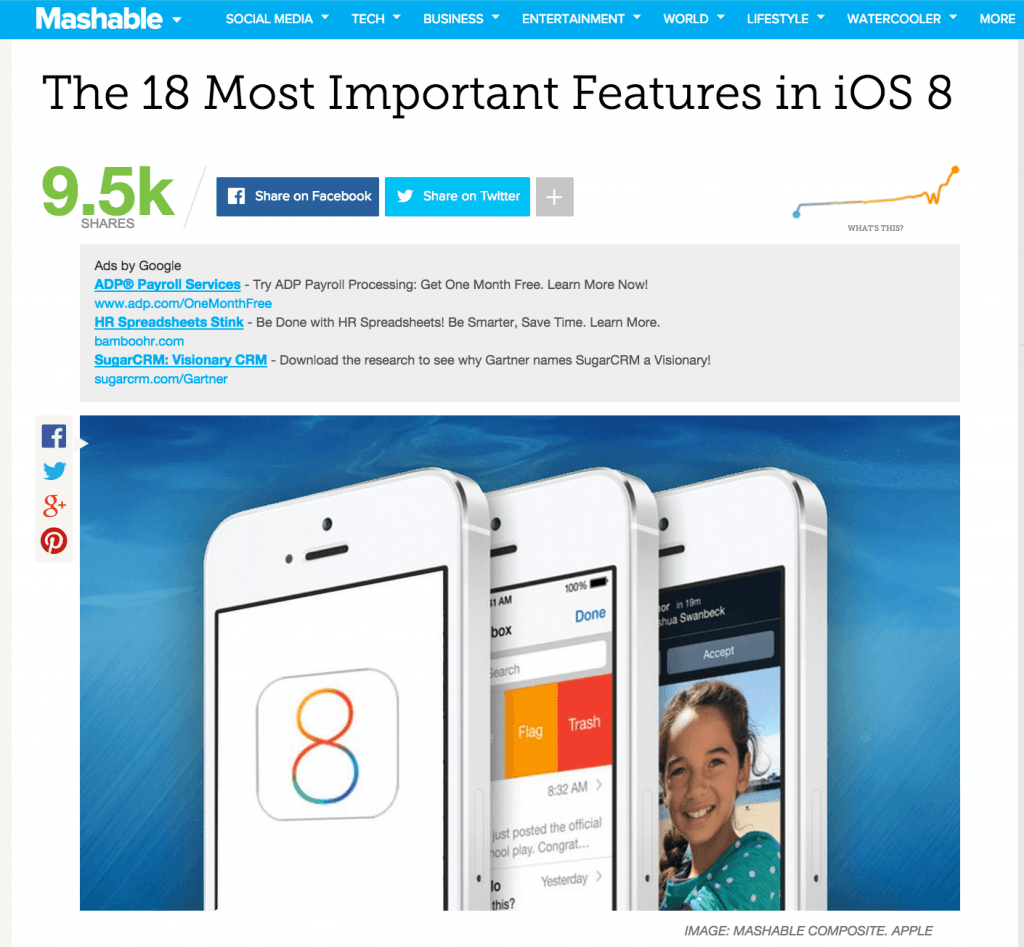
Posts that cover the latest news, trending topics, and other timely updates will need to be promoted quickly to maximize the traffic. Let’s say you sell electronics and have a blog post on the latest updates to iOS 8. Your images will likely be of an iPhone running iOS 8 and screenshots of new apps, settings, and other features.
You can enhance your screenshots by uploading them to Canva or Share as Image and overlaying one of them with your post title. You can also overlay a few of them with specific section headers.
You may consider including a video where you talk about the latest features while demonstrating them on your iPhone. You don’t even need to have a camera for this—Mac users can utilize ScreenFlow to record their iPhone activity.
For topics where you cannot create an exact image representation, you can choose to go with word images created with Canva, Share as Image, or stock photography.
An example from Mashable
How To Posts
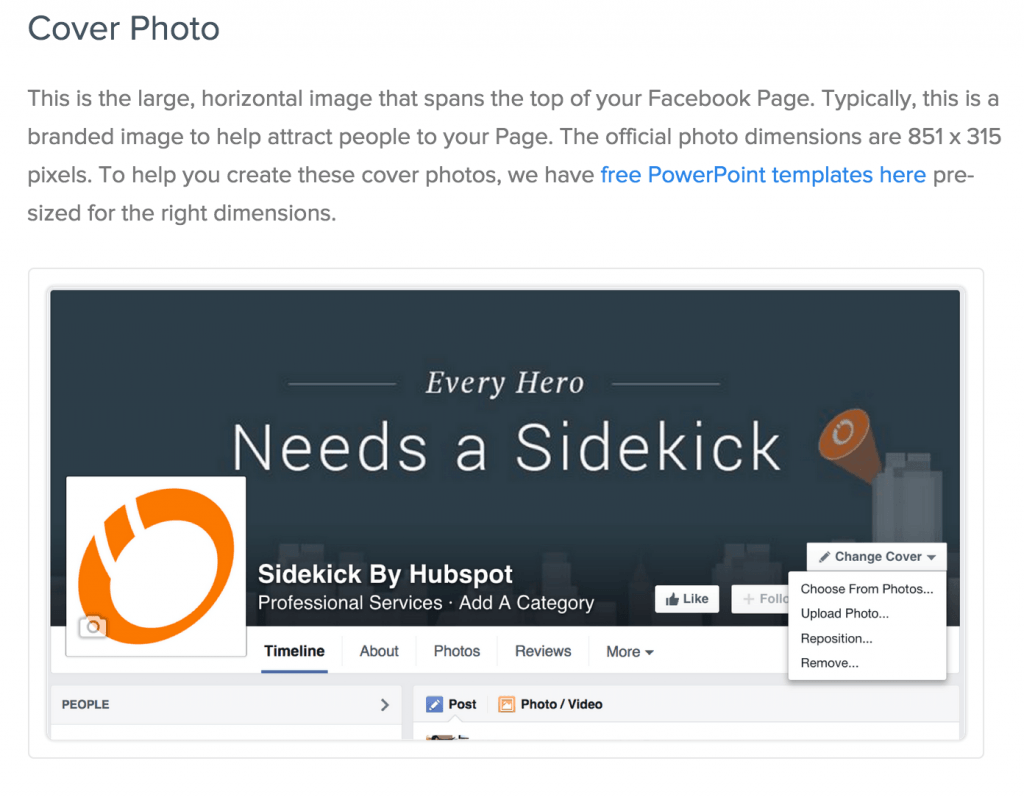
If you’re writing a how-to post about something on your computer, such as creating a Facebook page, you should try tools like Jing to screenshot the primary steps as images. You can use ScreenFlow or Camtasia to record an actual tutorial. You can then use Canva and Share as Image to overlay the images and iMovie to overlay the video.
For other how-to post types, consider including photos showing primary steps. For blog posts, your smartphone will capture good enough images. If applicable, you can use it to also capture video.
How-to posts also make great presentations, especially if you have strong images for each slide. You can even turn them into infographics using Piktochart by breaking the primary steps into easily consumable headings and bullet points.
An example from HubSpot
Study Posts
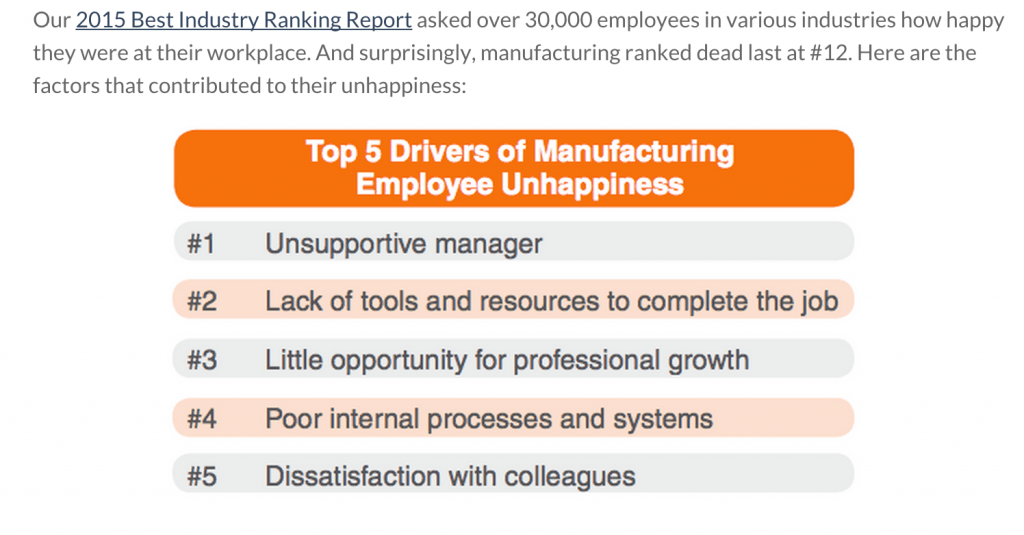
When you write case studies or research posts with lots of data and statistics, you can create word images with different pieces of data using Canva or Share As Image. These word images can also be added to presentation slides for a presentation. For the video, you can use GoAnimate to have an animated character hold up signs with the key pieces of data.
Data can also help you build great presentations and infographics. Look for templates in Piktochart that have heavy data, graphs, pie charts, etc. to help you visualize your data in an easily consumable image.
An example from TINYhr
List Posts
If you can create one image or video for each of the items in your list, it will give many promotable pieces of visual content. For example, if you have a list of 50 great business books, create 50 images using a quote from each book. You will then have 50 images that people will love to help you share across social media.
Each point in a list post can also fit well in presentation format, and likely as an infographic, too. Look for templates in Piktochart that have simple blocks for each of your list items.
An example from When I Work
Interview Posts
When you interview one or more people for your blog posts, you can create visual content in the form of word images with quotes from each person interviewed. If your interview subjects are willing, you can record their interviews via Skype for video content. You can then take the images and key quotes from your interview subjects and turn them into slides for a presentation.
An example from Linkerati
Visual Content Distribution Channels
Once you have images and videos, you will be able to promote them—and your blog posts—through the following distribution channels.
Images
- Share them on Facebook, Google+, LinkedIn, and Twitter
- Pin them on Pinterest
- Share them on Instagram
- Share them on Flickr
Videos
- Upload them to YouTube and Vimeo
- Upload them direct to Facebook
- Pin them on Pinterest
- Create 7 and 15-second teasers to share on Vine and Instagram
- Share them on Flickr
Presentations
- Upload them to SlideShare
- Convert them to video using authorStream
Infographics
- Submit to infographic blogs and directories
- Submit to related industry blogs
If you have multiple pieces of visual content for one blog posts, you can use them to spread out promotion of your blog content for as long as possible. For the list post example, if you had 50 images, you could schedule each one to publish one per week so that your post would be promoted almost all year.
You could also choose to distribute all of your visual content slowly by type. One week, you could promote the video. The next week, promote your images. Then the next, promote your infographic. And finally, the following week, promote your presentation.
Here is a great resource to learn how to promote content in less than 30 minutes.
Now that you know how to use visuals when creating content let’s take a look at some tools you need to create them.
Visual Content Tools & Resources
For non-designers need assistance with creating visual content, here are some great tools and resources to use that don’t require you to be a designer or professional video editor.
Canva
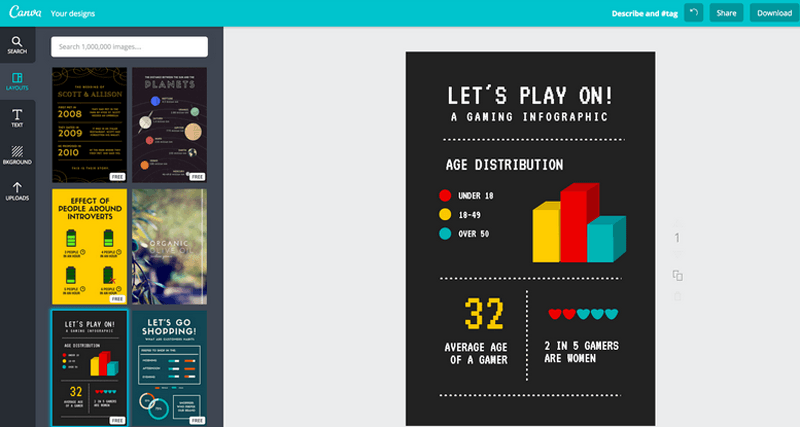
Canva is a free tool that allows non-designers to create images for a wide variety of uses, including blog content and social media. Simply find a template that fits your content and customize it to suit your needs. You will only have to pay if you choose to use template with a stock photo—many of the templates are free to use.
Share As Image
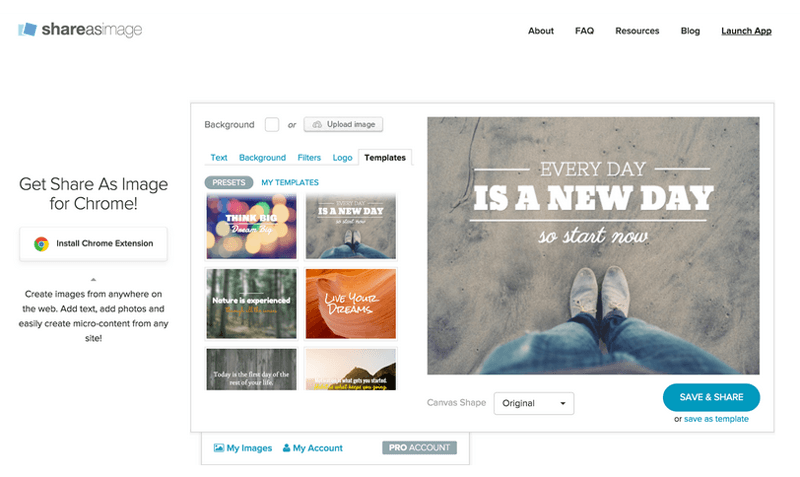
Share As Image is a freemium tool that allows non-designers to create great quote images easily from templates. There is a free plan for regular users and a plan for businesses that want additional features for $12 per month.
Piktochart
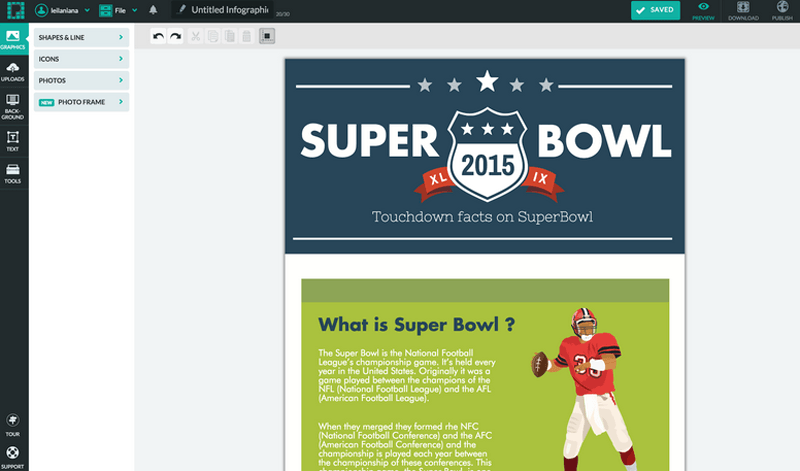
Piktochart is a tool that allows you to create infographics from predesigned templates through a drag and drop interface. Pricing for this tool is $29 per month.
Jing
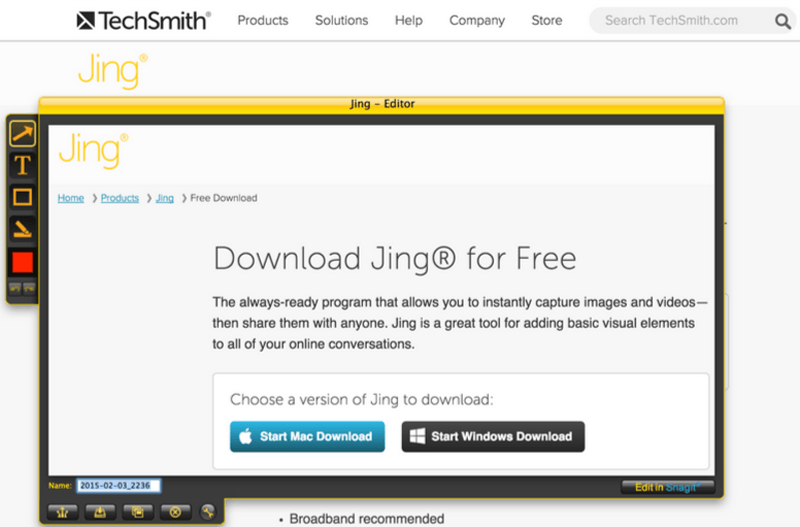
Jing is a free screen sharing tool that allows you to capture screenshots on Windows and Mac machines.
BigStockPhoto
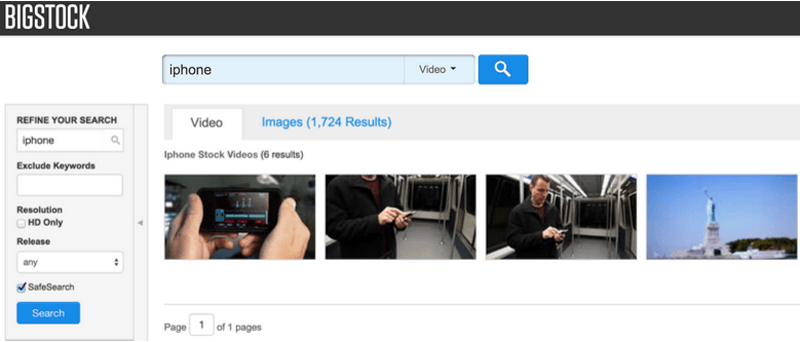
BigStockPhoto is a good source of both stock photography and stock videos, most of which can be edited to go with your blog content. All it takes is a simple overlay. You can add an overlay to stock photography with Canva and Share As Image, and stock videos can be edited using tools like iMovie.
ScreenFlow

ScreenFlow is a tool for Mac users that allows them to record their desktops. Pricing for Screenflow is $99. Windows users can try Camtasia for $299.
GoAnimate

If you don’t want to get in front of the camera, but you do want videos, then GoAnimate is a great tool to use. It will help you create animated characters that you can use with voiceovers. If you don’t want to voiceover your own video, you can use services like VoiceBunny or outsource the work on sites like Fiverr.
Finally, make sure that every place you distribute your images, videos, presentations, and infographics, you include a link back to your blog post. It will help your blog post with both search engine rankings and direct referral traffic.

14 Feb 19:10
Find Key Sales Lessons in These Presidential Quotes
by Jennifer Dignum
In honor of President’s Day, we took a quick look at presidential quotes and uncovered some key sales lessons from several of our nation’s most famous leaders. Whether you’re planning a long weekend, relaxing at home, or taking advantage of the big President’s Day sales, we hope you enjoy them!
“Give me six hours to chop down a tree and I will spend the first four sharpening the axe.”
Abraham Lincoln, the 16th President of the United States
President Lincoln understood the value of preparation – and knew he couldn’t get very far with a dull axe! With advance preparation, he knew you create a stronger foundation for success and save more time in the long run.
Sales lesson: Do your homework!
As author and sales expert Jill Konrath wrote in this eBook 10 Ways to Gain a Competitive Edge in 2015, “The more you do ahead of time, the faster your sales process goes.” Take time to make sure your messaging is personalized and en pointe for a particular company before reaching out. Learn as much as you can about prospects, and get insights into their interests. Advanced sales analytics tools can help! Your prospects are researching you – you need to research them!
“In matters of style, swim with the current; in matters of principle, stand like a rock.”
Thomas Jefferson, the 3rd President of the United States
If President Jefferson were alive today, there’s no doubt that he’d be working the social scene, cultivating relationships on LinkedIn and engaging with followers on Twitter. President Jefferson’s quote reveals someone who knows you must stay up-to-date with new processes – although never at the sacrifice of your personal or professional integrity.
Sales lesson: Be socially engaged – that’s where your buyers are – but use good manners, too!
46% of social sellers hit quota versus 38% of sales reps that don’ti. A new report shows social media is now the #1 driver of all website referral trafficii. Get social! But use your judgment and don’t forget what sales is all about – building trust and stronger customer relationships! How you reach out to prospects matters. Don’t just ‘SELL’ on social sites. Leverage intelligent engagement.
“I not only use all the brains that I have, but all that I can borrow.”
Woodrow Wilson, the 28th President of the United States
There’s a reason why President Woodrow Wilson earned a Nobel Peace Prize. He knew that you needed to use all the resources available to achieve a goal. If you don’t have all the answers yourself, it’s just smart to go out and see where you can get them. By using his own brains (and borrowing from others) he helped create the League of Nations, considered the precursor to today’s United Nations.
Sales lesson: Work smarter, not harder!
In today’s selling environment, customers are getting their information in new ways. You don’t always know what they know – and that makes your job harder. Unless you’re clairvoyant, you need to consider new methodologies. Because the way your customer buys is changing, you must consider new approaches – or risk falling behind the competition.
“When you reach the end of your rope, tie a knot in it and hang on.”
Franklin Delano Roosevelt, 32nd President of the United States
FDR understood perseverance. Struck by polio at age 39, he lost the use of his legs, forcing his political aspirations to temporarily take a back seat. An eternal optimist, FDR returned to politics, was elected to the presidency a record four times, and guided the nation through World War II.
Sales lesson: Never give up!
Perseverance is one of the most important attributes of a good salesperson. Salespeople that give up too early end up losing the deal. According to Sally Duby, GM for The Bridge Group, Inc., sales is a science and not an art. Without volume, you’ll never make your number, and getting that volume requires perseverance! Figure out the formula that works for you and execute against it. (To learn more, view Sally’s webinar Productivity Best Practices for Sales.)
“You aren’t learning anything when you’re talking.”
Lyndon B. Johnson, 36th President of the United States
Although often criticized for the escalation in Vietnam, Johnson helped pass more landmark legislation through his ‘Great Society’ than any other modern president. During his presidency, LBJ submitted and Congress enacted more than 100 major pieces of legislation. As a sales professional living in an age of political inertia, you know that it takes a greatsalesman – and a lot of listening – to achieve that type of a success rate.
Sales lesson: Listen and learn!
Sales professionals know that selling is about solving a problem that exists for a potential customer. You deliver a solution for a particular pain point. To do your job well, you need to have as much insight as possible into customer needs. Are they actively looking at solutions? Are they interested in a particular piece of a solution? Or, are they delaying a purchase indefinitely? With less face-to-face selling and the Internet, it’s difficult to get these answers!
That’s where digital listening can help. Digital listening gives salespeople the ability to see how prospects are engaging with their digital content. Are they forwarding it to other stakeholders? Are they engaging frequently? What pages of the proposal are they looking at? With this data at hand, you can deliver more value to prospective customers.
Do you have any favorite President quotes that inspire your sales approach?
This blog originally appeared here.
14 Feb 19:10
Amazon Giveaway: Unboxing Amazon’s New Service
by Giancarlo Massaro

First it was the Kindle, then it was the Fire Phone, and now it’s… Amazon Giveaway?
That’s right, Amazon has officially announced a new giveaway tool that will allow anyone to run a giveaway using products that can be purchased on Amazon. When my company first heard the news, we were a bit confused; why would Amazon release a service so far removed from their core business?
After testing the tool and digging a little deeper to get a better understanding, we’ve come to the conclusion that Amazon is most likely utilizing their own giveaway system for two main reasons.
We’ll get to those reasons, but let’s first take a look at how the Amazon Giveaway Tool works.
Amazon Giveaway For Hosts
The Amazon Giveaway Tool itself is fairly simple to set up, and it’s pretty locked down at this point so that everything runs smoothly and Amazon can easily handle the logistics when thousands of these campaigns are running.
To host a giveaway, you pick a prize from the millions of eligible, predetermined products sold on Amazon. You’ll know if a product is eligible if you scroll to the bottom of the product page under the review section and you see this:

Next, they’ll take you through a few steps to set up your giveaway by choosing the giveaway type, setting the number of winners, and purchasing the prizes.
They currently have two giveaway types:

Lucky Number
Being the “lucky number” means that if you are entrant #X, you automatically win. For example, every 50th entrant wins until all prizes are given away.
First-come, First-served
First-come, First-served means that the first person, or first few people to enter will win. For example, if you are giving away 3 prizes, then the first 3 people who enter will automatically win.
Next, they allow you to “Grow your audience” by requiring entrants to perform a task.

Currently they only have the option for people to follow you on Twitter, but it’s possible that they may add other networks or actions in the future.
To wrap up the process, you add some basic information like a title, a welcome message, and upload an image of yourself or your logo so people know who the giveaway is hosted by.
That’s it. Amazon will then prompt you to purchase the item(s) for your giveaway, and they will then email you a link you can use to share your giveaway.
Amazon automatically will take care of the rules as well as the prize fulfillment, so you don’t have to worry about anything other than purchasing the product from Amazon and sharing the link they give you.
Amazon Giveaway For Entrants
As an entrant, when you land on an Amazon Giveaway you will see something like this:

If the giveaway host has required Twitter to enter, then you must follow them. After you follow them, you will see this:

And that’s it. You’ll either win or lose:

Looking at the bottom of the form, you can see in the rules that it will tell you how winners are being drawn. So in the case of the example above, every 10th eligible entry will win, up to 50 winners.
The odd thing here is that Amazon is prompting people to share after they lose. Share with my friends so they can win the prize that I just lost? No thanks.

Is Amazon Giveaway right for hosts?
There are a few different reasons why the Amazon Giveaway tool probably is not the best thing to use for your next promotion. While I may have a strong bias being the co-founder of ViralSweep, I’ll provide the facts to help you make an informed decision.
First, you can’t give away your own products through Amazon Giveaway because they require you to choose only from the available items on Amazon.com.
In addition, there are restrictions to which items are eligible. In the Amazon Giveaway FAQ it says:
Items currently not eligible for giveaways include digital items such as songs, movies, or apps; Amazon.com Gift Cards; items sold by Marketplace Sellers; large or over-sized items that require special handling; items in the Add-on program; and Kindle and Fire devices.
Second, Amazon sets all the restrictions on the campaign. They need to do this because they are the ones handling the official rules, as well as the prize fulfillment. Here are just a few of the restrictions:
- Only open to residents of the 50 US states.
- If the prize value goes over $500, it is not open to residents of Rhode Island.
- Amazon automatically sets the expiration date of the campaign.
- Amazon does not let you edit a campaign after you set it up, so if you make a mistake, there’s no turning back.
- Only people with an Amazon.com account can enter the giveaway.
- The prize value cannot exceed $5,000.
- The giveaway cannot be embedded on your own site.
- The giveaway cannot be customized or styled.
- You must use Amazon’s designated link, which is hosted by Amazon (you can’t use your own site link).
- Host has to pay the shipping cost of the items if the prize does not qualify for free shipping (you can’t use Prime FREE Two-Day shipping).
And the worst part of all about this system:
- As a giveaway host, Amazon does not give you the entrant’s information.
That’s right, Amazon will not share the entrants email addresses with you. The only thing you can do with the tool to grow your audience is gain Twitter followers.
What are the benefits of Amazon Giveaway?
As previously mentioned, the cons of the system greatly outweigh the benefits for hosts, because Amazon has created this system to greatly benefit themselves.
Since there are tight restrictions on the products that can be given away, the prize values, and the fact that these giveaways are only open to the USA, this makes it easy for Amazon to take care of the logistics. In particular:
- Amazon handles the official rules for the giveaway.
- Amazon fulfills the giveaway prizes.
- Amazon will handle collecting tax information from winners if they win a prize from you that is over $500.
So, what’s the point of Amazon Giveaway?
We’ve been racking our brains for the answer to this question since Amazon made their announcement. For hosts, there really does not seem to be an upside since Amazon does not give you the entrant’s information. For entrants, there really is no downside, you either win or you lose and you find out immediately. For Amazon though, this will be a great tool for them to do two things:
1) Move more inventory.
Giveaways are an incredibly popular marketing tool used by countless brands to grow audiences and drive sales. Amazon’s own press release even mentions that the word “giveaway” is used more than a million times every day on social platforms. Since you can only use items sold on Amazon for your giveaway, this will help them sell more products.
2) Get more Amazon customers.
The only way for someone to enter an Amazon Giveaway is to have an Amazon.com account. This will help drive more signups for Amazon, which takes us back to point #1.
What are your thoughts on Amazon Giveaway? Will you use it for your business—why or why not?
Amazon, Amazon Giveaway, and all related logos are trademarks of Amazon.com, Inc. or its affiliates.
14 Feb 19:09


Brand Behaviors And Trust
by Mark Di Somma

Your word is your brand. Or rather, if the words aren’t right and your consumers depend on them for vital information, your brand will quickly find itself in the crosshairs of regulators, activist groups and annoyed consumers. The recent case concerning the contents of herbal supplements is more than an argument over percentages; at its core lies a simple question that underpins consumer trust.
Does it do/have what it says on the box?
You can see this as a labeling issue – particularly where food is concerned. Even that soon evolves into an argument about detail, consumer knowledge and mandatory disclosure. It doesn’t change the fact though that consumers expect to get what they pay for and there are brands that continue, wittingly or unwittingly, to short-change them. The halo effect of these actions carries through to everyone else in the sector.
As Walker Smith observed last year in this piece on Branding Strategy Insider, “Trust is a third rail for every kind of business or brand. It is an intangible requisite for staying in business of which companies dare not speak. As soon as you ask for it, you lose it. If trust cannot be taken for granted in the everyday course of business, if trust is not beyond question, then customers immediately jump to the conclusion that something is out of sorts.”
I suspect that, for some, the reason “something is out of sorts” is because two very simple words are being confused: earn; and earnings. In the bid to tell the market what they are making revenue-wise, brands sometimes overlook what they should be building reputation-wise. To earn takes time, effort, integrity and the willingness to forge. Earnings are now, today, what it says on the press release. Central to this is the ongoing tension, identified by Steve Denning in this article, between the “real market” (the world of real transactions) and the expectations market (the world in which investors form and articulate expectations of how companies should perform).
Which leads to a dilemma that to my mind remains unresolved. Whose trust should brands value most – the trust of the consumer; or the trust of the market?
That tension almost invites bad behavior. It incentivizes some to take shortcuts, overlook requirements, dilute formulations…to deliver the efficiencies required to make their numbers while calmly reassuring consumers that everything is as it should be. As Steve Denning observes, “The proponents of shareholder value maximization and stock-based executive compensation hoped that their theories would focus executives on improving the real performance of their companies and thus increasing shareholder value over time. Yet, precisely the opposite occurred. In the period of shareholder capitalism since 1976, executive compensation has exploded while corporate performance has declined.”
The irony here is that brands flourish on margin but wilt on greed. Once a brand reaches that critical point where its profitability has hit its ethical maximum (it is still behaving in ways that it can be proud of while gaining the highest level of return it can in that environment), any point beyond that is one of rising reputational risk. And as the bad behaviors mount, so does the potential fallout in terms of impacts on brand trust once those behaviors are uncovered.
I don’t know why the makers of the various supplements chose to make the decisions they did, but the companies involved are now going to have to work very hard indeed to rebuild consumer confidence. Did they think they could just get away with it? Did they squeeze their supply chains too hard? Did they really not know? Is this an isolated incident or symptomatic of something wider? Perhaps we’ll find out in the fullness of time.
There seems to be increasing awareness that the interests of investors have been allowed to overly influence the pressures on companies and senior decision makers. But if managements are going to responsibly manage their assets (including their brands), at some stage, they will need to frame what they do in terms that markets hate: limits. And by that, I mean agreed boundaries that govern what will be built and what will be earned. And – not or.
That’s not about market restrictions. It’s about overall prudence and balanced gains: brands behaving well; consumers getting what they expect; investors receiving the dividends they expected from guidance.
Sponsored By: The Brand Positioning Workshop
Join us for The Un-Conference: 360 Degrees of Brand Strategy for a Changing World. May 18th ~ 20th at the famed Versace Mansion in South Beach, Florida. A Competitive-Learning experience reserved for 40 marketing oriented leaders and professionals.
Branding Strategy Insider is a service of The Blake Project: A strategic brand consultancy specializing in Brand Research, Brand Strategy, Brand Licensing and Brand Education
14 Feb 19:09
The Power of Word of Mouth Influencers: Your Existing Customers!
by Scott Barnett
 Did you know that more than 4 out of 5 consumers value word of mouth recommendations over all other sources? Amazing isn’t it? The power of a trusted opinion!
Local influencers are people Small Businesses should target. This recent blog talks about the importance of connecting with local influencers to increase your word of mouth. There are 2 data points are worth considering:
- Consumer-to-consumer word of mouth generates more than double the sales of paid advertising (Source: McKinsey)
- 84% of consumers say they trust word of mouth recommendations from friends and family above all other sources of advertising. (Source: Nielsen)
The blog lists tips and suggestions on how to reach out to local influencers in your area so that you can generate this word of mouth. Great suggestions, but the post omits the most obvious and important influencers – your existing customers.
If you can identify prominent local influencers in your area, definitely engage. As we’ve mentioned before, local influencers and hyperlocal publishers are often the best messengers for your business – their audience is targeted to just the right people you want to reach. You should also leverage your existing customers to help spread your word of mouth online. If you don’t, you are missing out on the most effective piece of this strategy! Many local businesses will state that word of mouth marketing is by far their most effective marketing strategy; but when asked what they do to promote word of mouth online many of them shrug and don’t have a good answer. Some people will answer social media (generally Facebook) as their “online word of mouth” strategy, but many recent stories and Facebook themselves have stated that organic reach on the platform is significantly diminished and will effectively be eliminated by the end of 2015.
The key is to find the tools that allow you to expose your existing customers message to their friends and family, as well as to other consumers. They are out there (hint: Bizyhood is one of them!), and they generally cost significantly less than paid advertising. When you combine that with the first data point above, the real question is, how can you not be engaging your existing customers to help find new customers?
14 Feb 19:05
Generating Leads for B2B Firms
by Angela Hausman, PhD
As a B2B marketer, generating leads is the name of the game.
Are you generating enough high-quality leads for your business?
Are you closing those leads?
B2B leads versus prospects
A lead is more than a name of someone or some business that might buy your product. A lead, a qualified lead, is someone or some business that has these 4 characteristics:
- Need — they have a problem your product solves
- Money — they can afford your solution
- Authority — the individual has authority to make purchases or influences those who make purchases like the products you sell
- Desire — they’re motivated to solve their problem and spend the money necessary to reach a satisfactory solution
Missing any one of these factors eliminates a prospect from becoming a lead.
So, how do you go about generating leads for your B2B firm?
Here are some solutions based on a study of demand generation in B2B firms by Software Advice based on a survey of 200 B2B marketing professionals.
Generating leads for B2B firms
Generating leads for B2B firms is tricky business, especially if you use the criteria listed above for a qualified lead. And, it just doesn’t make sense to generate leads that aren’t qualified because it’s very inefficient and costly — so poor lead generation not only impacts your bottom line by decreasing profits, but by increasing expenses.
When I worked for a direct marketing agency, the sales manager, an ex IBMer, used to warn salespeople against wasting time with prospects who weren’t qualified. For instance, cold calling on lists or using SIC (now NAICS). I realize a good sales person thinks they can close everyone, but wasting time on folks who aren’t qualified leads just doesn’t pan out.
Social media marketing in generating leads
In the graphic below, you see that firms find social media marketing a cost-effective means for generating leads. That explains why a third plan to increase their spend on social media. Most of the remaining businesses plan to keep their spending on social media marketing at the same level, which for the enterprise businesses making up much of the survey, is a substantial spend.
Some B2B firms seem to think social media marketing is only valuable for B2C firms. Not so. Social media marketing can help generating leads for B2B firms in several ways:
- Build awareness of your brand. Purchasing agents and others in the buying center might not intentionally use social media to find purchase options, but they’re using social media as individuals. Sharing valuable content on social platforms creates awareness through such personal usage.
- Targeted social ads effectively reach members of the buying center, especially when you use your existing email and customer lists to create a Custom Audience or target similar Facebook users — called a LookAlike Audience.
- Social media marketing is particularly effective in reaching small businesses whose owners use social platforms both as individuals and businesses.

Generating leads with digital marketing
When you include digital marketing (ads, content marketing, SEO, SEM, and email marketing) to your social media marketing, you vastly increase the effectiveness of your lead generation campaigns. Notice on the graph below the effectiveness of digital marketing in generating leads for B2B firms. While trade shows generated more leads, the effectiveness of digital marketing tactics in generating high quality and high quantity leads was high.

Cost per lead
While social media and digital marketing, in general, didn’t win the award for generating the most quantity of leads or quality of leads (except for email marketing), social and digital are generating leads that cost less than other channels. So, while trade shows were deemed the best for generating leads for B2B firms, the cost per lead is also very high. Similarly, print and broadcast media generated high quality leads at a very high cost per lead.
Trends in generating leads
What are some trends in generating leads for B2B firms?
Michele Linn, content marketing director at CMI (content marketing institute), cites firms placing more emphasis on lead generation strategy than ever before:
People realize now that having a demand generation strategy is so critical. They need to plan content along the entire customer lifecycle. And it can be very time-intensive and resource-intensive. So, from that perspective, it’s not surprising that people are increasing spend at all. It’s an engine that constantly needs to be fed.
I really like the notion of lead generation as an animal that needs constant feeding. Too many firms fail to implement effective strategies for generating leads for B2B firms for fear of the costs. That’s because they don’t see the opportunity costs involved in fewer or lower quality leads generated through other means. The costs of digital marketing show up on the income statement and reduce the firm’s bottom line. So, firms try to keep digital marketing costs low by using ineffective strategies with a low chance of generating leads. Some examples of ineffective strategies include:

- Posting infrequently. Studies by Buffer, Hubspot (see graph on the left) and others show that firms posting between 1 and 5 times per week achieve the highest results. Sure, you save money by posting less frequently (or not having a blog), but pay for it with fewer leads generated.
- Posting infrequently to social platforms is also cheaper, but poor at generating leads for B2B firms. You should plan to share at least 5 times on Twitter, 2 on Facebook and Google+, and once on LinkedIn every work day.
- Hiring a cheap agency. Look at the results the agency gets for other clients. As a first step, look at how they do for themselves. If they have a poor Alexa rank, few connections on social platforms, and poor performance on search, RUN. You’ll pay for those cheap results with poor lead generation.
Generating leads from your website
Your website should be the best tool for generating leads for B2B firms. Take a look at the infographic below from Onmicore that shows the variety of ways to generate leads on your website. One caveat, however. Don’t use ALL these strategies as you’ll provide a poor user experience and Google will downgrade your site in the SERPs (search engine results pages).

14 Feb 19:05
Lead Generation Using Content, Surveys and Bonuses
by Susan Gilbert
Leading With Content

By now, you’ve probably seen that only quality content is king when it comes to online or offline profitability. What you might now have seen is how powerful content becomes, in terms of profit, when you give it away. Yes, you read that correctly. In today’s digitally social world, giving away quality information is the number one way to establish trust, generate leads and make sales. Let’s take a closer look at how this process works and why.
How It Works
If you decide to lead with content, your first step is to produce quality content with a high information value. (At this point, we will assume you already have a branded website for your business, as well as the other necessary pieces of software/hardware for this website, such as an auto responder account.) This content can take any form. It can be blog posts, articles or instructional videos. The main point is that the information contained in this content is a valuable as you can possibly make it.
Once you have produced the content, you need to put this content on your website. Include any other helpful information a viewer or visitor may need on this page. Most importantly, include a link on the page that a visitor can use to request more information or, alternatively, to be alerted when you post additional free content. The idea is that anyone who visits the page can access the information easily and also has the option to get more information, should they so choose, in exchange for contact information. The idea is to make the gathering of the contact information as subtle and natural as possible. Your visitors exercise the option for more info or an alert and your autoresponder’s opt-in page gathers the contact information in a low key, non-sales oriented way.
Once you have the content loaded on your site and your autoresponder set up to gather opt in information, you’re ready to direct traffic to your site. You can do this through social media marketing, for example by blogging and then posting a link to your blog post on social media sites or including a link to your free content in your social media profiles, doing SEO (search engine optimization) on your main site, including the URL of your site in your email signature and using paid ad traffic. While in-depth details of all of these topics are beyond the subject of this book, suffice it to say that the traffic driven to your page through these methods is what provides you the opt-in contact information that becomes your leads.
Why Lead Generation Using Content Works
Leading with content that your audience would like to have is a form of inbound marketing. As we discussed in my post first post in this series, inbound marketing techniques seek to establish a dialogue with potential customers prior to making a sales offer. This initial dialogue, especially when seen as valuable by a potential customer, establishes trust between them and your business. They see your business in a positive light because they have approached you for information and have found that information valuable. Therefore, when you do send them a well-timed offer based on your content, they are much more likely to become paying customers because of this pre-established trust and interest.
Takeaways for This Section
- How Leading With Content Works;
- You produce quality content for your site with an extremely high informational value;
- You post this content on your website and direct traffic to the site using various methods, including social media marketing, SEO and paid ad traffic;
- As a result of these direct traffic efforts, the number of visitors to your site increases;
- These visitors can choose to provide contact information in exchange for even more content;
- This content information becomes your leads.
- Why Leading With Content Works;
- Leading with content establishes a dialogue with potential customers prior to a sales offer being made;
- This dialogue, in turn, establishes trust between these potential customers and your business;
- This trust raises the likelihood that potential customers will respond positively once a sales offer is made.
Lead Generation Using Survey Method
The Survey Method is a potent way for collecting leads that are right on the money. It relies on a very powerful psychological tool to quickly and easily gather contact information from the survey participants. Best of all, the subject of the survey is directly relevant to the product or service your business is selling. Therefore, each contact you collect through this method is already warm and ready to become your customer. Here’s how it works.
Let’s face it; most people are interested in themselves. While they wouldn’t want to admit this fact to anyone, it’s still true. Because of this, you, as a marketer, can indirectly appeal to their vanity, and obtain their contact information, through the use of a simple survey. Let’s take a look at an example.
Let’s say you’re offering a product based around Kindle publishing. Your target audience for this product is, obviously, people who want to earn money through writing. Most writers are interested in reading and in other authors, so you fashion a simple survey designed to tell the participants of the survey which famous author they are most like. This survey appeals directly to the desire of your target audience to become an author and, as a corollary, be a famous author.
Designing the survey is easy. Simply Google “online survey software” and you’ll find dozens of results that will suit your needs. The software itself will automate both the creation of the survey and its packaging. All you have to do is come up with eight or ten clever and funny survey questions, the famous authors who’ll be the result of taking the survey and whether you’ll be asking for content information prior to taking the survey or after.
In addition, you also want to provide each participant with the option to share the results of their survey on Facebook and other social media. If they do, their list of friends on that social media outlet will get a message that says “Hey, I’m Edgar Allen Poe. Who are you?” with a link back to the survey, so that anyone who receives this message can take the survey and share the results as well.
Once the survey is complete, you post it on your business branded Facebook account (if you don’t have one, create one) and direct traffic to that post through the usual means (paid Facebook ads, social media channels, etc.). This traffic will mean that people will begin to take the survey and share the results. These shares will generate even more traffic to the survey. Every person who takes the survey will provide contact information directly to you. In addition, a high percentage of these people will be die hard readers and closet authors. Thus, when you send an offer regarding your Kindle publishing product to these leads, it will convert like crazy and your sales will go through the roof.
As long as you make the survey relevant to your product or service, you can repeat this process over and over again, with spectacular sales resulting out the leads you’ve generated.
Takeaways for Surveys
- The Survey Method is so powerful because it indirectly appeals to the participants vanity and fantasies;
- A survey is extremely easy to put together using online survey software;
- The survey you produce should be relevant to the product or service you will eventually be selling to the participants;
- Make sure that you allow the participants to “share” their results through social media outlets.
Lead Generation Using Free Bonus on Related Products
When someone buys something, they are already psychologically in a place where a) they have decided to take action on a problem, obtain help to satisfy a need; and b) they have decided to spend money to achieve this end. When you offer a free bonus on a related product that someone has already decided to buy, or has already bought, you take advantage of this mental state and are easily able to establish trust, obtain contact information and, eventually, make sales. Here’s how it works.
Your bonus can be anything, a pdf guide, a video or a report. You need to find another marketer who has a product closely related to the subject of this free bonus. This marketer will want to include your bonus in their sales funnel because it’s a bonus. They provide a benefit to their customers, as well as drive sales, at no cost or effort on their part. You bonus is then offered as an extra on the original product’s download page in exchange for the buyer’s contact information. The idea is that because they have already purchased the original product, they will absolutely want an additional product that helps them obtain better results when they use this purchase.
When you offer a free bonus on a related product, it’s a win/win for you as a marketer. Your bonus provides extra value to the original marketer’s clients. This establishes goodwill and trust between you and both parties. In addition, in order to obtain the bonus, these clients have to providing contact information. This contact information provides you with a boatload of solid leads who are already interested in what you have to sell.
Takeaways from This Section
- Using a free bonus on a related product produces excellent results precisely because the two products are related;
- People who have already purchased one product are very willing to take advantage of a free product that enhances their use of the original purchase;
- Your bonus establishes trust between you and the marketer selling the original product;
- Your bonus establishes trust between you and the clients of the marketer selling the original product;
- You grow your sales list with every client who takes advantage of the bonus and this means greater future sales for you.
Conclusion
We’ve taken a look at some extremely innovative ways to generate leads here and in my last two posts (Lead Generation Interview Method A & Lead Generation Interview Method B). These methods have been tested and are used by countless successful marketers to achieve stunning success product after product, year after year.
Why? Because these strategies work to produce high quality leads for very little upfront work. These leads, when used correctly, are money in the bank. If you’re in the business of earning income as a result of your online marketing efforts, then you owe it to yourself and your bottom line to put these methods to work for you today.
The next and final blog post in this series will be on using LinkedIn for lead generation – so stay tuned!
14 Feb 19:05
What B2B Can Learn From B2C In 2015
by Tom O'Regan
Having spent the majority of my career in the B2C space, the last couple of years have been particularly exciting for me as I watched the B2B world take more and more cues from B2C marketers. This has been especially true with regard to how B2B marketers have begun to shift their approach to data. B2B marketers are approaching prospective customers in the same ways that B2C marketers approach individual consumers – by leveraging intent data to accurately target and engage with decision-makers and their influencers.
In 2015, for B2B marketers, lead generation will no longer mean casting a broad net and hoping to snare a handful of in-market customers. It means leveraging technology to find more qualified leads and utilizing every opportunity to engage these leads throughout the funnel to increase your chances of conversion and brand affinity. Lead generation technology no longer looks like disparate data streams. It now looks like a platform that gathers, parses, analyzes, and acts upon data in real time to deliver relevant, compelling messages to highly qualified leads.
Consumers expect to be engaged in a way that speaks to their individual needs at that moment. And though we are often compelled to separate the industries, today’s B2B customers are very similar to individual consumers. No longer can we simply treat B2B prospects as leads to be gathered and then passed off; we must be with them at each step of their journey to ensure that we are learning and acting upon their needs in real time. It is this full funnel approach driven by intent data that helps B2B marketers turn leads into long term business relationships.
Intent data has already begun to establish itself as the gold standard for both B2B and B2C marketers. B2C marketers utilize intent data to accurately target large audiences to drive sales, while B2B marketers leverage intent to both acquire new customers and nurture relationships throughout the customer lifecycle. B2C marketers analyze millions of interactions to derive intent data that enables them to optimize engagement at each stage of the funnel. B2B marketers are adopting the same platforms and practices in order to engage corporate prospects on a larger scale, and to cultivate long-term loyalty as the customer lifecycle progresses.
For B2B marketers, 2015 will be all about leaving behind legacy platforms for the real-time intent data-driven platforms and full-funnel approach of modern B2C marketers. For instance, traditional lead generation methods result in a mere 20 percent of leads being actually qualified. That kind of waste simply won’t stand in the year to come.
B2B marketers must move toward solutions that identify and act upon intent throughout the customer journey. These solutions must be able to identify key decision makers, as well as their influencers, and then engage with them in real-time, at the right time, based on intent indicators like budget, authority, need, and time in-market (BANT.) They must be able to not only communicate with target prospects but also actively move them all through the sales funnel with compelling content and advertising.
Though I’m a former B2C guy, I don’t mean to imply that the B2C space has perfected the art of digital marketing. Rather, technology has, over the years, blurred the lines between our personal and professional lives, such that we now have the ability to determine intent from interactions across both of those personae and every device involved. So why do we insist upon a separation between B2B and B2C? The fact is recent years have brought about a new kind of B2B customer who expects to be engaged as a person, not as a corporate purse holder. 2015 is the year when B2B marketers are going to embrace the new B2B prospect, to acknowledge their targets as both professionals and people who need to be engaged throughout the funnel but who are more likely to repay your timely, relevant messaging with lifelong loyalty and brand ambassadorship.
14 Feb 19:05


How to Uncover Qualified Leads With Smart Social Selling
by scott.gruher@salesbenchmarkindex.com (Scott Gruher)
In short, social selling means using social media to interact with prospects. It can be a powerful prospecting methodology for sales teams. Social selling empowers sales reps to guide better-qualified opportunities directly into the funnel.
14 Feb 19:04
Best Practices For Email Marketing In 2015
by Tahir Akbar
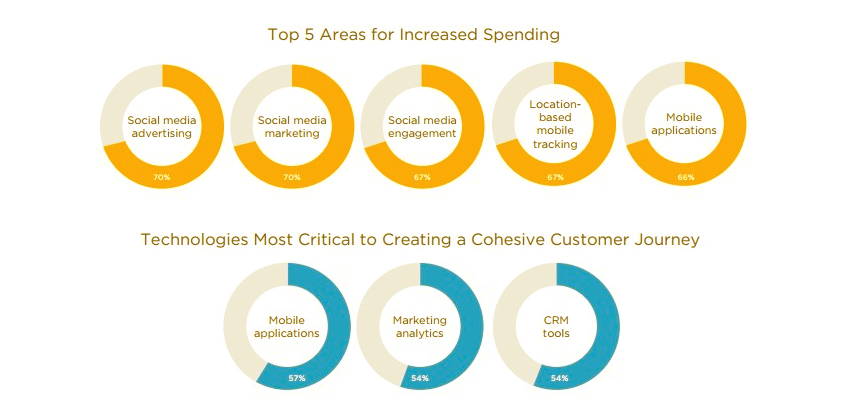
Salesforce.com’s 2015 state of marketing survey indicates numerous changes in the marketing world. Particularly when it comes to selection of channels to generate leads and drive sales; the priorities are shifting from ads and banners to social engagement, mobile, and effective usage of marketing automation. Check few stats below.
- 38% of marketers plan to shift spending from traditional advertising to ads on digital channels.
- 84% marketers will increase marketing budget for the year 2015.
- 73% marketers agree that email marketing is core to their business
- 41% marketers will increase spending on automation and mobile integration into their email operations.
Salesforce State of Marketing 2015
These findings indicate that email marketing is not dead; however, there is a big question mark on the success rate of campaigns as majority marketers are not satisfied with their drips. In the following, I’m sharing some suggestions to help you increase email marketing success and achieve your business goals.
Design A Content Plan For Your Drips:
Though 73% marketers take email marketing as a key enabler of products and services but majority is concerned about success rate. One of the prime reasons of failure is ‘ill-planned content.’ You need to design a dedicated content strategy for emails, newsletters, and other direct communications with prospects. Content strategy should address What, Why, Where, How, How much, How Often, and Whom. Decide what type of content will be used, in what quantity, and through which medium. In addition, keep “mobile factor” in mind as 68% marketers agree that a responsive design is a key factor in decisions regarding landing page or email template.
Understand The Hyper-Personalization Trend:
In 2015, the most effective marketing strategy is to create and deliver a ‘personalized experience’ to customers. Personalization goes deeper into every aspect of marketing like; your message, content, offer, templates, timings, and mode of the communication. Feed people what they are looking for and avoid spamming. Knowing about the people who took interest in your offers, who clicked on your links, who responded positively, and who bounced helps in personalization of the message and offers. Similarly, use industry-specific designs, messages, templates, and target the right audience.
Go Mobile; It’s The Future:
2015 State of Marketing survey confirmed the mobile email trend had substantial growth from the past year.

This is a clear indication that irrespective of your marketing channel, small screen’s vitality cannot be overstated. From website design to newsletters, email template, and landing pages; everything has to be responsiveness as a key feature. The landing pages and email’s templates should be mobile friendly in terms of content, design, and outlook. In addition, if you use social buttons in the email, the success rate can soar higher. Studies indicate 130% increase in clicks and shares on the templates with social sharing enabled.
Invest In Analytics:
They say, if you invest $1 in email marketing, the average return is $44. But if you spend a dollar on analytics, it can save your $1 million from going waste. Why? Because data and analytics ensure that you pick up the right approach, right channel, and receive better results. Therefore, gain maximum knowledge about what you are doing, what’s general market behavior, what’s users/visitors/prospects’ general behavior towards your brand and then do it wisely. Plan the right message and send it on the right time.
Go For Cross-Channel Integration:
Did you know that around 40% of sales manager complain this ‘inability to integrate’ as a key hindrance in the achievement of sales and revenue goals. There are platforms that offer sales and email marketing campaigns but when it comes to integration, they fail. Integration of your email marketing, marketing automation, and CRM system increases success rate and saves a lot of time.
Cross-channel integration creates efficiency in the entire marketing process and improvises content utilization. In addition, different teams’ performance goes in complete alignment.
Keep Communication Alive:
I do not encourage spamming or mass messaging; instead, I advise you to use nurture tracks feature. It allows creation of additional touch points and keeps communication alive. Understand modern-day buyers’ behavior. They are self-educationist who use blogs, social portals, and vendors’ websites to understand and compare available options. Your simple job should be to facilitate prospects in making the right decision.
14 Feb 19:04
3 Ways to Maximize the Value of Every Trade Show Lead
by Ben Camerota
Any business can attend a trade show and have some success. But the businesses that attend with a strong strategy behind everything they do, from marketing visuals to booth staffing, aren’t interested in ‘some success’ – they’re looking for results that make waves back at the office. These businesses have refined their approach so that every trade show appearance gives them the most bang for their buck.
There are many ways to measure “results” after a trade show – you can look at the total number of leads you gathered over the course of the event, or how many of those leads were really qualified and responded to follow-up calls or emails. You can even measure the sales dollars that can be traced back to your trade show attendance. And then of course there are the unquantifiable results, like raising your brand’s profile and building relationships with useful industry contacts.
- Set Goals for How Your Leads Will Perform
Of course, anyone attending a trade show wants to walk into the office on Monday morning with a bunch of new names and email addresses to show the boss. But trade shows cast a wide net, even if they’re industry specific – and leads that will never need or want your products or services are essentially useless.
So why just set a number goal for gathering new leads at your next trade show? Aim higher and set goals for the number, or percentage, of leads that will respond to follow-ups, and the number or percentage of leads that will convert to sales within the year. Plan careful steps to reach each of these goals.
- Follow Through with Freebies
You’ll need to attract the right types to your trade show booth to begin with, but that comes with good marketing visuals, smart design, and engaging staff. Then you’ll need thoughtful, clever marketing follow-through after the event to persuade these fresh-faced leads to seriously consider you after the fact.
Offering samples, prototypes, trial periods and other freebies to trade show leads is a good way to remind them why they gave you their card in the first place. An item arriving at their office, or a service they can use for a month free, is something tangible to try out and consider. And don’t forget to get in touch and see what they think after!
- Connect Socially With Your Leads
In the marketing world, it sometimes feels like social media is email marketing’s less successful cousin. But don’t disregard it when you’re meeting new leads and introducing yourself to trade show visitors for the first time. Ask visitors to Like your Facebook page, follow you on Twitter, and connect with you on LinkedIn, and offer an incentive good enough to get their phones out.
Why is this a good idea? Because you’re trying to make a first impression in person, but you can make second, third, and fourth impressions with social media. Social media may never be the best way to sell a new product, but it can be a great way to sell your brand as a whole. You can establish a tone and a feeling about your brand that fits with your mission and your marketing plans – whether that’s building a funny, friendly rapport, or creating a feeling of trust and reliability in potential customers. It’s hard to get that opportunity in the few seconds or minutes you get with a trade show visitor.
Maximizing your trade show results comes down to careful, strategic planning that goes beyond the usual gimmicks and marketing hype. If you plan how you’ll handle leads down the road and how you’ll bring them around, the names you collect at your next event will be worth much more to your bottom line.
14 Feb 19:04

No time to write copy? Consider outsourcing your content strategy
by Expert commentator
5 core elements for your content marketing strategy and best practices for content outsourcing
According to Content Marketing Institute, more than 80% of B2B marketers and more than 70% of B2C marketers used content marketing for their online businesses last year. The results of this investigation have been published in B2B Content Marketing: 2015 Benchmarks, Budgets, and Trends ? North America and proved the fact content marketing tactics become a significant part of successful marketing strategy.

More than 50% of B2B marketers plan to increase content marketing spending in 2015; they are ready to accept the challenge and start awesome content creation, distribution, optimization, analyzing and managing. It often happens that content creation and development is not a core skill for a marketer, and it can be quite difficult to cope with. The solution is obvious: outsource content writing services to fill the gap between the need to use content marketing and your ability to create and manage it.
Of course, there is a lot more to content marketing than copywriting as suggested by the Smart Insights Content Marketing Matrix. However, for many businesses, especially in B2B copywriting for blogs and whitepapers is a core part of content marketing.
Content marketing elements
Before choosing and hiring a good outsourced writer to help your online business with content, decide what content marketing elements your brand needs. As far as you understand, content marketing is not a simple text writing for your business website's blog or social media profiles: if you want to generate leads, set your brand apart, generate more traffic and boost sales, you should pay attention to all core elements of content marketing and take them all into consideration.
Depending on your content strategies and organizational goals, your online business may need:
- Content creation and curation
- Content amplification or distribution
- Content optimization
- Content analytics
- Content management
To get a clearer idea of what each above mentioned element includes, check the table from Third Door Media Content Marketing Tools 2015: A Marketer's Guide:
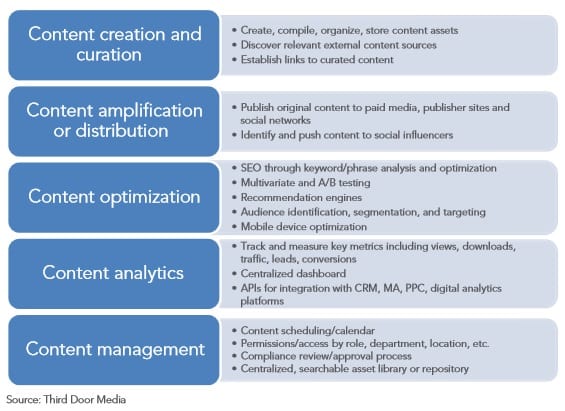
Best practices to find outsourced writers
Hiring a good outsourced writer or an outside agency to help you with content creation is not an easy task indeed. Before you choose one, several aspects should be kept in your mind. They are following:
- 1. Do not chase the cheapest deal. As a marketer, you remember about your budget of course, but it does not mean you should choose the cheapest writer at the market to create content; low prices do not equal quality. Build relationship with writers you can trust.
- 2. Make sure a writer understands what you want from him exactly: always ask if he has experience with content writing and if he understands what B2B content means.
- 3. Check writing samples of all candidates to get the idea whether their knowledge, skills and styles meet your needs.
- 4. Give your writer clear instructions, make sure he is able to do this job for you.
Where to find copywriters?
It will depend on what you need from them (check all content marketing elements again). Hundreds of great authors are waiting for you online, but it does not mean all of them will give you what you want. Freelance websites, students and academic writers, professional vendors ? they all can be good options for a marketer:
- Odesk (now part of elance) is among the largest online workplaces that helps you find and hire a team or individual writers, as well as designers, web developers and consultants.
- ProBlogger Job Board is a perfect place to find experienced authors who can write for your blog and/or handle outreach (guest bloggers).
- Copify is an online service to enable you to rapidly get a quote, source writers and manage the producing of copy
- Contently lets you find tools for publishing your brand and contact pro writers directly.
- Witmart is the largest crowdsourcing website with over 7 million registered freelancers that gives a chance to post your projects and create writing contests.
- Krop is a creative industry job board and portfolio hosting website, experienced in working with big brands.
- At Scripted you can get video scripts, Tweet or Facebook posts bundles.
- Studentgems makes it possible to hire talented students or graduates who look for a job and leave feedback about their work for others to know if they are worth hiring.
- Bid4papers helps you find academic writers, contact them directly and rate them to work with the best ones
- Newscred gives a chance to use their platform for covering all elements of content marketing and building relationships with other professionals.
- Content creation, distribution and management becomes easier with Percolate - it lets you increase productivity and generate more sales with the help of their software.
- Rallyverse - this professional vendor makes it easier to succeed in social selling, content optimization and analytics.
- Fiverr - cheap and dirty, writing services from $5 per order.
What are the benefits of outsourcing your content marketing?
Content marketing is an integral part of online business strategies today, and it becomes more and more complicated for marketers who want to succeed, stand out and beat their competitors. Outsourcing content creation for your online business can provide numerous benefits, such as:
- Decrease costs for your marketing campaign: outsourced writers cost cheaper than in-house ones as a rule.
- Increase the content effectiveness: hiring a writer who has good skills in writing texts in particular, you will get professionally written content that meets your consumers' needs.
- Grow social sharing and engagement: professionally written and relevant content has more chances to be shared across social networks and make your brand recognizable.
- Reach all marketing channels: having high-quality content from outsourced writers, you will have time to concentrate on its spreading.
Importance of content marketing
Times change, relations between brands and consumers change too. Today, marketers should pay much more attention to all aspects of content marketing and automate the processes involved in their content marketing strategies.
Your business's official website is no longer the only one resource a consumer will use to learn about your product: he will come with information gathered from different channels (social media, enewsletters, interactive infographics, videos, webinars, online presentations, research reports, case studies, etc.), and your task is to make this information eye-catching, informative and relevant to turn visitors into clients.
Content writing outsource can be a very good practice for your online business: professional writers will create relevant content, various content marketing tools will help you automate your marketing strategies and tactics, and outside platforms will let you optimize and manage your content effectiveness across different digital channels.
 Thanks to Mike Hanski for sharing his advice and opinion in this post. Mike is a content strategist and writer for Bid4papers. Circle him on G+.
14 Feb 19:04

A Sales & Marketing Love Story: From LinkedIn & HubSpot [SlideShare]
by kdarling@hubspot.com (Kimberley Darling)

This post originally appeared on the Marketing section of Inbound Hub. To read more content like this, subscribe to Marketing.
It can sometimes feel like marketers are from Venus and salespeople are from Mars. They often have a rocky relationship and argue with each other over lead quality, follow-up procedures, social media monitoring, and cost vs. revenue (among other things).
In the middle of this bickering, it's hard to know what marketers and salespeople really think of each other. Is it truly a dysfunctional relationship, or is it simply a few miscommunications that, if solved, could turn their relationship into a classic love story?
To find out what's really going on, HubSpot and LinkedIn Sales Solutions joined forces to uncover the truth. Together, we surveyed marketers and salespeople around the globe to get to the heart of the matter.
In the SlideShare below, you'll see our findings from the survey and the answer to the timeless question, "Are sales and marketing in a loveless marriage, and if so, how can it be fixed?
Want to see what some of our findings about the sales-marketing relationship? Here are eight interesting statistics that came from our survey:
1) 41% of marketers don't use buyer personas. (Tweet This Stat)
2) 95% of marketers said that lead quality is important to them. (Tweet This Stat)
3) Only 5% of marketers feel they give sales a perfect-fit lead. (Tweet This Stat)
4) 40% of marketers don't know what a marketing- or sales-qualified lead is. (Tweet This Stat)
5) 59% of marketers have no formal agreement with sales to determine both teams' responsibilities. (Tweet This Stat)
6) 87% of salespeople think they do a good job of following up with leads marketing gives them, but only 64% of marketers agree. (Tweet This Stat)
7) 88% of salespeople think that their marketing teams are a crucial source of revenue. (Tweet This Stat)
8) 72% of marketers believe their sales team is collaborative. (Tweet This Stat)
Since this topic is close to our hearts at HubSpot and LinkedIn, we want to fix this broken relationship. That's why we created the ebook, How to Create a Love Story Between Sales & Marketing. Download your copy below to learn how your sales and marketing teams can live happily ever after!

14 Feb 19:04

5 Reasons Sales Should Love Marketing Automation
by Zach Watson

Contacting a clueless prospect is now a rare occurrence. Because of the information resources at their disposal, customers in nearly every industry have developed a taste for self-directed learning. They no longer view sales representatives as their main source of information about products or the marketplace.
In response to this paradigm shift, digital marketing has become a cornerstone of many businesses and an engine for lead generation programs. But increasingly powerful marketing teams have led to inconsistent alignment with Sales -- not for lack of trying, but rather for lack of intuitive systems that connect the two departments.
Ultimately, the customer suffers from this divide, because in one way or another she interacts with both Marketing and Sales during her purchasing journey.
Intriguingly, marketing automation -- perhaps the most powerful tool marketers have at their disposal -- may be the proverbial bridge between Marketing and Sales. In truth, these systems may even benefit Sales more than their intended comrades in Marketing.
Let’s examine the details. Here are five reasons why sales teams should love marketing automation.
1) Be around at the right time.
Talking to a sales representative is rarely the top priority for a prospect doing research, so timing has to be impeccable if you want your outreach to be seen as beneficial and relevant.
Marketing automation can positively frame sales outreach, because it updates a prospect's profile based on their online activity. For example, when someone downloads a form or requests information from your website, the automation software will note that behavior. Depending on your technical set-up, it can alert sales representatives that the time to strike has arrived.
These behavioral-based alerts help decrease lead response time, or the amount of time it takes an organization to follow up with inbound leads after they convert on your website. Studies indicate lead response time is critical to successfully contacting online leads -- in some cases a quick reply can make outreach up to seven times more successful.
2) Close the loop with Marketing.
Effectively aligning Sales and Marketing is critical to creating a holistic customer experience. This keeps the level of service consistent and better fulfills the expectations of your prospects. Essentially, your whole operation becomes streamlined and more effective.
This can be difficult for both parties, because each department believes they have the supreme understanding of the customer. Often, Marketing commands quantitative data on search, web, and social behaviors, while Sales offers qualitative insights derived from longstanding relationships and one-to-one conversations.
Marketing automation creates a longitudinal view of the prospect’s activity and ships it to Sales. If your system has a multi-touch attribution model, Sales will be able to see a comprehensive record of every interaction a prospect has had with your brand and use that information as context for upcoming inbound sales calls.
This system gives sales teams insight into the buyer’s journey. It also helps Marketing trust that sales reps will have a clear understanding of which points to discuss in the conversation. After a while, Sales can give Marketing feedback on which campaigns and tactics are producing the most qualified leads, and which need work.
In the end, automation helps Marketing get more efficient and enables Sales to contribute to strategy in a significant way.
3) Cut through the noise.
Not everyone that visits a website is a ready to converse with a salesperson, and not everyone that downloads a form is a qualified lead. In fact, most leads are passed to Sales far too quickly.
Then the conversation between Sales and the prospect is all wrong, and distrust bubbles up between the departments. The salespeople don’t know how to close. Marketing isn’t doing anything related to ROI and revenue.
This goes back to alignment. Sales and Marketing shouldn’t be thought of as two distinct entities, but rather two pieces of a larger process -- the customer journey. The answer to this conundrum is better qualification, which marketing automation provides with lead scoring. A competent automation system will include this feature, which increases a prospect's score based on their behavior.
Scoring leads assigns priority to different accounts and helps segment real opportunities from the mass of other download and information requests that occur on your website. This strategy not only saves your sales team time, but also increases their chances of success by only targeting engaged prospects. Beyond scoring, segmenting leads by their latest activity can be another effective method for assigning priority to prospects.
4) Build meaningful relationships earlier.
Don’t take this new paradigm of customer self-service as an indication that buyers don’t want to feel valued. Indeed, it’s one of the paradoxes of the new customer-business model: Customers very rarely want to hear from Sales, but when they do, you had better be armed with an inexhaustible understanding of their preferences. They would also like to speak to someone with whom they’re familiar.
We already examined how marketing automation helps with the preferences problem, but it can also help sales representatives begin building relationships with prospects earlier in their journey. Through trigger-based actions, automation systems can send content and email offers based on a prospect’s actions.
Instead of immediately receiving an ill-advised phone call from a sales rep, the prospect instead receives an email with a relevant offer from the sales rep's email address, which is then followed by a nurturing campaign. Marketing is the orchestrator behind this drip campaign symphony, but that doesn’t decrease the personalization of the email communication. As long as the information is relevant and valuable, prospects will tune in.
Triggered-based emails also familiarize the prospect with receiving information from a sales rep, which positions the sales rep as an educational resource. This is an especially important strategy for capitalizing on emerging demand in B2B markets.
5) Integrate the entire customer experience.
Of course, other departments are incredibly valuable (where would any of us be without developers or IT?), but syncing up Marketing and Sales should be a mission critical priority for any business. At the heart of nearly every point discussed above lies the implication that the systems Sales and Marketing use should be linked together.
Both CRMs and marketing automation systems are beginning to resemble operating systems for each department, so having information easily flow between them helps align your two main sources for generating new customers. This type of interoperability is especially important when comparing marketing automation vendors for your business. If you need to develop custom workarounds to move data between departments, you might want to consider a different solution.
Despite its technical underpinnings and substantial content distribution power, marketing automation benefits Sales just as much as its namesake department. Maybe it should be renamed Smarketing automation.
14 Feb 19:03

A Lesson in Insight Selling From Uber & 5 Other Sales Articles You Might've Missed This Week
by esnider@hubspot.com (Emma Snider)

Uber has had its fair share of PR snafus of late. But in Linda Richardson's opinion, there's at least one thing the company is doing right: using data-based insights to shift their potential riders' status quo.
In her post "Insights Take To The Street," Richardson, author of the book Changing the Sales Conversation, reprinted an email she received from the car sharing service and analyzed it from a sales perspective. By presenting post-Superbowl rides in the light of drunk driving statistics, Uber "mastered the art of insights," in Richardson's opinion.
While not a true sales email, Uber's message still contains a valuable lesson for reps -- the importance of building your sales story around thought-provoking data.
"Insights open doors and drive sales," Richardson writes. "They educate. They evoke. They connect two points not connected before to create a deeper understanding, trigger thinking, and challenge the status quo."
After you read this uber-insightful post, check out five more of this week's top sales articles below.
1) 10 Enemies of Productivity by Anthony Iannarino
Need to get a lot done fast? Avoid these 10 time traps.
2) The Prospect Said 'Yes.' Why it Doesn't Mean S*** by Jim Keenan
You won't be succumbing to happy ears any time soon after this article.
3) Setting Objectives to Win by Jonathan Farrington
Discover why a sales team needs both hard and soft goals.
4) Best Practices for Closing Business Without BANT Leads by Craig Rosenberg
If your sales organization is moving away from the BANT-based definition of a qualified lead, you'll probably want to bookmark this one.
5) "Touching Base" Emails Suck. The Top Four Ways to Stay In Touch by James Purvis
Learn how to stay in the loop with prospects without sending the oft-deleted "just checking in" email.
What posts did you enjoy this week? Please share in the comments.
14 Feb 19:03
Content and Lead Generation: It’s True Love
by Susan Levand
With Valentine’s Day in the air, many are talking about the biggest power couple in marketing: content and lead generation.
Why are these two marketing components so deeply entwined? As just about any marketer can attest, it’s not easy to generate leads in the competitive online space. Consider the fact that fewer than 20 percent of companies are now meeting their sales lead-generation goals. If you fail to captivate a customer and convince him or her to invest in your brand, a competitor is just a Google search away from stealing your business.
Content, in the form of multimedia like blogs, videos, articles, pictures and podcasts, provides the necessary material for engaging with readers, keeping them on the website and working to drive home sales. Content is like the magnet that attracts readers and keeps them coming back for more information until they are convinced to invest in the company.
That being said, here are some tips to ensure that your content is helping to maximize your chances of capturing leads online:
Give every piece a purpose
Never publish an article for the sake of simply publishing material on your site. Remember that content is supposed to serve two purposes: educate readers, and move them along the path in the buying process. Know to whom you are marketing, and figure out what the piece should do (e.g., educate, convince or offer help).
The trick is to try and get into the mind of your potential customers by determining what they are searching for online, and then craft content designed to address those needs. This is valid in and of itself, but will also advance your brand in Google search rankings.
Know your audience
Make sure you spend time studying your demographics, so that you thoroughly understand who you are targeting with every piece of content. This will help you ensure that you connect with your potential customer in the best ways possible. The easiest way to do this is to draft buying personas for every type of customer.
Provide a mix of materials
Make sure you have plenty of different types of content in your marketing arsenal so that you can cater to multiple audiences. You should offer a mix of highly technical white papers, in-depth customer videos and case studies, thought-provoking blogs and more.
It’s critical that you make a match between your content and lead generation. When there’s true chemistry, sparks will fly.

14 Feb 19:03
6 Ways To Grow Your Sales Funnel
by Alice Heiman

Developing leads is something that needs to happen on a weekly, if not daily, basis. Instead of having a plan for ongoing lead generation, many companies go about it haphazardly at best. Too many times you are caught desperately trying to close a couple of deals that really shouldn’t close or aren’t ready to close because you have nothing else in your sales funnel to work on. If you keep your sales funnel full, this won’t be an issue. You will have plenty of leads to qualify and work through the funnel.
Here are six ways to keep your sales funnel full.
1. Networking
Networking remains one of the most cost-effective and efficient ways to generate new business. Get out to your target audience’s key events. Make an effort to meet the people you don’t know. Be a great listener and be sure to follow up.
2. Referrals
Referrals is one of the best lead generating tools any company could have. If you have satisfied customers, most of them would be happy to give you a referral. They can do this through a program where you would reward them to give a referral. Or just ask! Most people will be happy to introduce you to other people who can buy from you.
3. Direct mail
If you have targeted your audience and have a good list, you can get great results. Frequency and message are key. Direct mail should be integrated with your social media and other advertising.
4. Social Media
There are many ways to generate leads and build your list with social media, but you need a plan. Sit down with someone who knows social media and can tell you the most beneficial things to do to get the required results. Your social media should integrate with your other marketing efforts.
5. Email Marketing/eNewsletter
This is not something that can be taken lightly, or else you will end up with tons of unsubscribes. Have a plan and understand how to use email effectively. Engage your reader and make them look forward to the next email. Use proper subject lines, offer great content, and make sure there is an offer or call to action so that the person continues reading.
6. Cold calling
If you use cold calling as part of a campaign, where you’ve already perhaps sent them an email, some direct mail and have interacted with them on social media, you will have a better chance of connecting with them on the phone. But it is still a lot of work. Effective cold calling campaigns need to be planned. Just printing out a list and picking up the phone to call a hundred people you don’t know will take a lot of time and your results will be unrewarding.
Lead generation is one of the most important things to focus on in your sales process. If the funnel runs dry, it makes it tough for everyone. Lead generation should be part of your annual strategic planning, a budget needs to be applied and someone needs to manage it. If you don’t have a plan, you need to sit down with your team and go through the above ideas and see which ones you’re going to use to generate leads and maybe come up with some others. Then you need to make a plan for each one of those, as well as how they will all be interrelated with each other.
Get more networking tips with the ebook, The Guide to Networking at Conferences.
14 Feb 19:03

How to Hire The Perfect Person To Run Your Social Media
by Pam Neely
Planning to increase your social media budget in 2015? If so, you’re not alone. Salesforce’s 2015 State of Marketing report says 70% of marketers plan to increase their overall social media spend this year.
If you’re among this group, there are probably three major investments you’re considering:
- Social media advertising
- Social media marketing
- Social media engagement

To make all that happen, you’re going to need the right people. Or at least the right person. If you get the social media staffing part of this down, the rest of your social media program should fall in line.
Let’s take a look at the issues around the decision to hire someone to run your social media. Here they are, in approximately the order you’ll need to address them:
- How to tell when you really need a social media specialist
- Deciding whether you need someone full-time or part-time, as an employee or a consultant, or an agency
- Defining what kind of returns you’ll need to see to make this hire a success
- Outlining what your social media hire’s job description will be
- Assessing your budget, and what to expect to spend
- Finding sources for candidates
- What criteria to use to sort candidates’ eligibility
- How to interview and vet the most likely candidates
- How to finalize job terms and bring the new hire on board
- How to track and assess their performance
And now let’s dig in. I’m going to assume you’re up to speed on general hiring practices, so we can just focus on the issues specific to hiring a social media person .
How do you tell when you really, truly need social media help
Sisyphus would have felt at home in social media. There is an almost endless list of potential tasks for social media marketers. Even if you’re doing well on the big networks (perhaps especially if you’re doing well there), it’s always tempting to expand out into smaller social platforms.
Because of all the potential work, it’s actually not the amount of work that could be done that justifies hiring someone. Even a micro-company running out of a second bedroom could justify hiring social media help if the only criterion was “we’ve got a ton of work to do.” The time to hire for social media is when you’re missing out on potential business. Hire when you know you’re leaving money on the table.
Get clear about what you expect from social media
There’s something you have to clarify before you hire someone to do any social media work. You have to define how your business sees social media.
Are you approaching this like a direct marketer, who wants to track everything and know their ROI for each platform? Or are you approaching this more as a brand marketer, who simply wants a presence on social media?
If you are willing to take a brand marketer’s approach, can your business financially support doing social media purely as a brand-building exercise? And if you would be happy simply with a larger presence on social media, will your finance department be happy with that? If finance is not happy with that, what could the consequences be?

Two examples of when it’s time to hire for social media
Example 1: You’ve built a decent following on Twitter, Facebook, and Instagram. You are tracking results. Your social media work is generating a small but steady trickle of sales. You are certain you could increase this trickle, but either you can’t get to it personally, or your existing social media staff is already maxed out.
Example 2: You’ve already got an intern part-time and a social media person who works full time. They have built a decent presence on the big social sites, with footprints on the smaller social sites. Results are a little sketchy, but you’re approaching this more as a branding exercise, so you’re okay with the fuzzy results. Where you’re really lacking is in tracking. You also feel like the whole social media program needs a thorough audit. You have neither the skills nor the time to do such an audit. Neither does your existing staff.
Define success and set expectations
Suppose you’ve got enough success with social media to justify a new hire. The next thing is to spell out what success for this new hire would look like.
Whether you’re hiring a 10-hour a week intern, a full-time social media manager, or an ad agency, you need to define what success is going to look like. What kind of business results do you need to see to justify that 10-hour a week intern? Even if the intern is free, there’s still a cost to your company. The intern needs supervision and a computer. Those are costs.
The results required get more demanding if you want to hire a 10-hour a week consultant, for, say $50 an hour. That’s $2,000 a month, which means there’s got to be a quantifiable business return based on that kind of spend.
Even if you see social media as brand marketing and not direct marketing, there still must be some defined results. Otherwise, three months from now you could be sitting across the table from this consultant or new hire, looking at a report with some very disappointing results, and realizing you’ve spent $6,000 to $24,000 for nothing (or the wrong thing).
Setting goals for your new hire
I find it helps to have three levels of goals for marketing initiatives.
- The rock-bottom minimum results required to keep the project going (say, 1,000 new Facebook likes per month).
- Plenty good enough: Results that are good enough to at least consider expanding the program, and to keep it safely off the chopping block.
- Wild success: Very positive results that justify expanding the program by 20% or more.
Social media is an inexact science. You can start out with a focus on one thing and have that initial goal fail, only to discover that some other part of your work is actually creating great results. For example, after you finally get some tracking set up, you could learn that your Facebook work is a bust, but Tumblr is actually generating a positive ROI.
How much does a full-time social media person cost?
Social media help is expensive, and it’s not something you want to go cheap on. According to the Creative Group’s 2015 Salary Guide Moolah Palooza, these are common salaries for different social media positions in the US:


To help you get 100% clear on what a salary like that buys, here’s the job description for a Social Media Specialist. This is again from the Creative Group. You can get other social media job descriptions from the Creative Group’s Social Media Job Descriptions Guide.
Social Media Specialist
Responsible for defining and executing a specific social media strategy. Duties may include cultivating new communities and managing branded online communities on the company’s behalf using Facebook, MySpace, Twitter, YouTube and other social media.
The specialist will provide relevant content daily while tracking metrics and monitoring relevant conversations. The right candidate will have a bachelor’s degree in marketing, advertising, communications, anthropology or business administration, and 3+ years of experience in marketing, public relations, advertising or a related field. Additionally, the candidate must possess a solid understanding of the social media universe, including YouTube, Twitter, Flickr, StumbleUpon, Delicious, Digg, reddit, forums, wikis and blogs.
These are other common social media job titles:
- Social Media Product Manager
- Social Media Account Manager/Channel Manager
- Social Media Planner
- Social Media Coordinator
- Director of Social Media
- Online Community Manager
The cost for a part-time social media consultant, or an ad agency
If you decide to hire someone only part-time, how much will that cost? It varies widely, from $50 to $200 per hour. If you go the agency route, things can get even more expensive. The website ContentFac.com estimates that it’s common for agencies to charge $1,000-$2,500 per month to manage just a Twitter account. That doesn’t include setup either – that would be even more expensive. To have a PR agency manage your Facebook page, expect to spend $2,500 to $5,000 per month. Some agencies will charge as much as $9,000 per month.
If you want a comprehensive social media strategy planned out and then executed, you’ll pay anywhere from $3,000 to $20,000 per month for just two channels (like Facebook and Twitter). An average cost would be $4–7,000 per month.
With prices like that, you may be better off just hiring someone to help you full-time. If you used the mid-range of the Creative Group’s estimate of a social media manager salary ($80,000 a year) and added a conservative (15%) burden, that would work out to $7,666 per month. On the other hand, the agency should be able to provide rock-solid skills in 360 degrees, more than a single person can be expected to bring to the table. If you have a slate of highly diverse tasks each calling for a high level of competence, you might be better off with an agency, at least to set things up.
Where to Find Social Media Experts
Now that you have a job description and a salary allocated, where can you start looking for your new hire? Place a job listing on all the usual places, like craigslist, Monster.com and LinkedIn’s job boards. But also look through Hootsuite’s Certified Social Media Consultants Directory. Try putting a job listing up on MediaBistro.com, too.
How to Screen Social Media Applicants
As the responses to your job listing start trickling in, you’ll realize you need to know if these people who say they know social media … actually do know social media.
They should offer links to examples that demonstrate their social prowess. (If they don’t, toss that resume right now.) The first place to check would be on their social media profiles. Notice follower counts, plus what they’ve been sharing and liking. If people have interacted with their shares, or asked them questions, have they responded? Can you tell if they’re using any of the major social media tools, like Buffer, Hootsuite, Oktopost or SproutSocial? If they’ve included past social media clients or jobs on their application, how do those social media accounts look?
Be mindful of job discrimination as you scrutinize your hire online: There are pending laws about using social media to discriminate against job applicants. This applies to race and religion, but it applies to an applicant’s age, too. Just someone is over 50 doesn’t mean they can’t be a rock star social marketer. The most conservative action is to check only the links they provide.
How to use social scoring numbers to assess a social media hire
After you’ve checked someone’s social media accounts and gone back at least a month through their activity, it’s time to check their numbers. Do a quick sweep to make sure they haven’t bought followers or likes. Start with tools like Social Baker’s fake followers check.

For Facebook likes, there’s no one tool to use to snuff out fakers, but Social Media Examiner wrote a nice article recently about how to spot a spammy Facebook page.
If you really want a way to quantify someone’s social media skills, you’ll probably have to look to social scoring sites like Klout, Kred and PeerIndex.
As with all tools, take what they tell you with a grain of salt. There’s a very funny post titled “Two Weeks And $40 Got Me A Klout Score Of 60” that can give you some healthy skepticism.
Take everything a social scoring tool tells you with a grain of salt.
How to use Klout and Kred
Klout is probably the best-known social scoring tool. It gives a score from zero to 100. A score of 100 is nearly impossible to achieve. Even Justin Bieber only got a 92 when I checked his Klout score. Barack Obama was doing nicely with a 99.
A Klout score of 40 is about average. Anything over a 60 typically means you’re looking at a social media power user, or one of those “influencers” that drive influencer marketing. Some ad agencies require their social media people to maintain a Klout score of at least 50.
Here’s what a Klout score page looks like.

Kred is the next place to check. It’s a bit more refined than Klout because it shows a person’s level of influence in different topic areas. Once again, though, take what it tells you with a grain of salt.
Kred scores people on a scale from zero to 1,000. Here’s how those scores break out:
- Above 500 is above average
- Above 600 is in the top 21.5%
- Above 700 is in the top 5%
- Above 750 is in the top 1%
- Above 800 is in the top 0.1%
All this assessment of someone’s social media stature raises another issue: Will you expect your new hire to use his or her personal influence and personal social media accounts to promote your brand?
Now it’s your turn
That’s enough information to get you well on your way to finding the perfect social media hire. Hopefully, about a year from now, when you sit down to do their annual review, you’ll have nothing to discuss but success.
Are you planning on hiring someone to head up your social media this year? What are your criteria for the ideal social hire? Tell us about them in the comments.
 You can have a Facebook page, a Twitter account, and even a LinkedIn business profile, but there’s no point in running a social media campaign if it’s not designed to drive leads to your business and ultimately convert them into customers. Take a look at our eBook, “Likes are Great: Leads are Better,” and we’ll give you six important lessons to turn your social media followers into customers.
14 Feb 19:03


The End Of Technology
by Mitch Joel
How productive is voicemail for you?
It happens all of the time. A new technology comes out and makes something so commonplace to our daily lives so completely antiquated. Back in 2007 (yes, close to eight years ago), I came out and publicly declared voicemail bankruptcy. People thought I was crazy. It was a lifestyle choice driven by my personal attempts to be more productive, and trying to evade the situation of disappointing others or losing potential business leads because of my lack of response to these messages. I was finding myself on the road - more and more - with a non-desire to run through the gauntlet of phone choices and codes to access voicemail when out of the office (a new level of laziness, I would agree). Sending me an email, a text message... or even calling me on my mobile seemed a million times more efficient... and obvious, then hoping I remember to check a messaging system that sits tethered to a physical phone in one of the many places that I do business. On top of that, my business line had decomposed into a crypt of poorly scripted telemarketing calls, attempting to pitch me on a myriad of services that - had the sales rep spent two seconds looking on our website to understand us - were completely useless. On top of that, when these messages were not returned, the bombardment would continue with a vengeance. Even when I was in the office, I was leery to answer my business line for fear of being stuck on a twenty-minute call for some kind of enterprise solution that both wasn't needed, and one that I was not the decision maker on.
Am I alone?
When I made this decision, I re-recorded my outgoing message to let people know that this line would not be responded to in due process, and if anyone wanted to reach me that they could easily email me, or - if they knew me well enough - that they could reach me on my mobile. I think it worked. I don't know. Many people could rightfully argue that this approach might turn some of the more traditional business people off, and that it may even affect people trying to do business with Mirum, if they feel like I am not accessible. This baffled me. I was - in earnest - trying to make myself MORE accessible. MORE readily available. MORE speed in response. Business proper dogma won again. Still, I stuck to it and have not backed down. Since then, there are so many new ways to connect and find me instantly. There is messaging built into Facebook and Twitter and tons of other ways to tag me.
We live in real-time.
That's what it felt like then. It feels like that even more today. Bloomberg Business recently published an article titled, Coca-Cola Disconnects Voice Mail at Headquarters. Some thought that this was an attempt to save money. It was not. From the article: "Office voice mail at the world's largest soft-drink maker was shut down 'to simplify the way we work and increase productivity,' according to an internal memo from Chief Information Officer Ed Steinike. The change went into effect this month, and a standard outgoing message now throws up an electronic stiff arm, telling callers to try later or use 'an alternative method' to contact the person."
Moving Forward
I never liked the usability or functionality of voicemail once email, texts messaging and other social-based messaging applications entered the fold. Voicemail felt... distant. This thing that we had to reach out to, instead of it being as readily available as, say, voicemail is on your smartphone. Some might dive deeper and think that this also speaks to our current shift in how we communicate (which, by the way, is shifting us away from talking to one another, because of how popular texting has become). Regardless, it's an important moment in time for marketers to pay attention to. Voicemail going away (which I believe it is for non-mobile devices) illustrates the importance of paying attention to technological trends and what they mean. Snapchat isn't just about teens sending one another pictures that disappear. It's about our societies desire to send one another content (and communications) that don't then sit in some kind of permanent data legacy). With that, big changes continue to be afoot. I say good riddance to voicemail on office phones... and bring on more Snapchat-like functionality!
How about you?
Tags: bloomberg bloomberg business coca cola coke data legacy ed steinike email facebook lifestyle messaging technology mobile productivity real time smartphone snapchat social media technology technology trends telemarketing text message twitter voicemail voicemail bankruptcy
14 Feb 19:02
Are You Taking Advantage Of Data Driven Sales?
by Erin Palmer
Data is a sales team’s best friend. Information will show you what tactics are working, point out areas that need improvement and help identify new sales opportunities that you may not have noticed. Every decision that goes into a sales strategy should be based on data.
Why Use Data Driven Sales?
To start, data helps you create more effective sales representatives. Everything from training to tactics can be improved with data. For example, data can get as granular as the words being used to see which language is the most valuable for closing a sale.
But data can be even more important long before closing when you are trying to identify opportunities and move potential customers toward a sale. No matter how many steps are in your sales process, data can show you where you are losing people and what can be done to keep those leads moving down the funnel.
Identify Trends And Patterns
Sales trends are vital if you want to make a smart, data-driven sales strategy. So if data shows you seasonal trends, like a major sales spike each winter, you will know to staff accordingly. You will also be able to use that data to figure out what is causing the spike and to see if there are opportunities to sustain the increased sales throughout the year.
Metrics and measurement are needed to keep the sales team on point and to continue to reach and surpass your sales goals. Data will not only help with measurement, but it also helps you with sales forecasting. Managers shouldn’t make sales predictions based on feelings and whims.
Talk Amongst Yourselves
Another great part of using data is being able to improve communication at all levels of an organization. People who have never worked in sales may not understand the intricacies of what your team does. When it’s time to talk to executives or other stakeholders, they may not always understand the jargon of a sales team. But everyone understands numbers.
When you can show a sales increase and give data-driven forecasts for the future, it’s easier to communicate with the C-suite. More importantly, when you need to get buy-in for something like new technology or the ability to hire some new employees, data will help you build a case better than anything else.
Metrics Maintain Consistency
Data helps to keep everything consistent throughout the sales process. Different people have different opinions and management styles, so it can be easy for people to have varying ideas about strategy and leadership. When you use data to drive your sales team, everyone understands what the goals are and how they came about. It keeps things consistent, even when personnel changes occur.
Don’t miss out on sales opportunities because of a lack of data. Start using analytics to improve your bottom line and make your team stronger. Better data means better decisions and a much better chance for long-term success.
14 Feb 19:02
Be Mine: The Secret to Successfully Closing A Sale
by Kate Feather

“If you want to persuade, you must first connect.”
This quote from Sonia Simone‘s excellent post entitled How to Create a Deep Connection with Prospects and Customers sums up a question we’ve been grappling with here at PeopleMetrics in recent months: how to help B2B companies differentiate on the prospect experience and close more sales.
The author states that as humans, our need to be seen, heard, and recognized is directly connected to the success (or failure) in the prospect and customer experience that companies deliver.
She writes,”If you intend to sell something—to ask for someone’s hard-earned money and irreplaceable time—you must begin by seeing (and honoring) who they are.”
If your sales strategy has your reps jumping straight to “Be Mine” before building an emotional connection, the relationship will be over before it has begun.
When to Start Listening
Multitudes of companies have joined the customer experience transfomation bandwagon. They have Voice of the Customer software and solutions in place. They are measuring Net Promoter Scores (NPS scores) and Customer Satisfaction levels in real-time. They are seeing, hearing and recognizing customers every day through their feedback channels.
However, these efforts are focused exclusively on the latter half of the customer journey—after the customer has decided to buy.
Don’t Skip the Courtship
This is baffling due to a commonly held definition of customer experience: “the sum of all experiences at various touchpoints a customer has with a supplier of goods and/or services, over the duration of their relationship with that supplier. This can include awareness, discovery, attraction, interaction, purchase, use, cultivation and advocacy.”
Think about that.
Four of the eight steps listed in this definition happen before your customer commits to you. 1) Awareness, 2) Discovery, 3) Attraction, and 4) Interaction.
Then why are so few B2B providers listening to, learning from, and acting on feedback from their prospective clients? Isn’t Voice of the Prospect a no-brainer?
Survey Says ‘Yes’
Because we believe that your sales leads deserve some love too, last month we launched our first ever independent study into the B2B Prospective Client Experience.
While we are still analyzing the data we couldn’t wait to share a few early findings that indicate that listening to prospects—as you do your clients—will lead to huge competitive advantage.
Here are four reasons why:
1. Buyers are investing a ton of time in getting to know you.
By the time a business-to-business buyer decides to contract with your organization, they have spent on average 86 hours in the sales and selection process.
And, the average amount of time spent increases as the size of the investment grows. Enterprise-sized purchases (500k+) suck up more than 3 weeks of work time.
And one-third of buyers say the length of the entire sales process took 3+ months (source: PeopleMetrics 2015 Voice of the Prospect Experience Study).
That is a lot of time and effort.
2. Most companies aren’t asking for formal feedback from prospects.
7 in 10 companies never think to ask for formal feedback from their prospects during the sales cycle.
3. Prospects want to be asked.
81% of buyers in our study said they would take the time to give feedback if asked. After all, they are listening to you, your pitch, your story. They want to be heard too.
4. Asking increases the likelihood of winning.
Prospects feel more connected, more cared for, and more committed after receiving a request for feedback. As one of our survey respondents put it:
“Only one company asked for the feedback, which we were happy to provide. This is the company we ultimately chose. It seemed like no one else thought to take the time to ask for feedback; whether positive or negative.”
If you aren’t listening to prospects as part of the sales and purchasing process in order to build an emotional connection and increase your chances of closing a sale, what’s stopping you?
Email me at kate.feather@peoplemetrics.com to discuss how you can build prospective client feedback into your CX improvement efforts or download our eBook that outlines the key steps you should follow to improve your prospect experience and win more business.

Finally, you can also sign up here to be one of our first readers to receive a copy of our white paper on how to differentiate on the prospect experience coming out next month.
Image Credit: hearts by Frank Guido, CC BY 2.0
11 Feb 20:12

Beat Your Competition – Focus on the Customer
by Richard Ruff
Beat your competition
Beating your competition … today’s it’s likely that you are facing more and better competition than in times of yesteryear.
So how do you increase your win rate? First, a competitive edge is rarely achieved by knocking your competition. Knocking your competition puts the competition on center stage. You need to focus on the customer and manage the competition.
Show your customers why you’re the better choice. For example: Does your product better meet their needs? Is your company easier to do business with? Do you offer a better price? Are your terms & conditions more favorable?
To show that you’re the better choice, two steps are critical.
Sell outcomes not products. You win more often when the customer has a clear understanding that you can help them to do what they need to do better than the competition. How can you help them achieve their business goals and leverage their opportunities more effectively and more efficiently than anyone else? This is what selling value is all about and it is why great product presentations are simply an exercise in theater – not a best practice for beating your competition.
Achieve a competitive edge. To achieve a competitive edge you have to understand your competitive strengths and understand your customer’s perception of that assessment. It is particularly important to keep in mind that your assessment and customer’s perception are often not in alignment – when that is the case that needs to be addressed.
So how do you do all this?
First things first – have an informed answer to these questions:
- Who are my competitors that have a viable chance of winning the business?
- What are the decision criteria the customer will use to decide between the competition and us?
- How do we stack up on those criteria from the customer’s perspective?
- Why would the players engaged in the customer’s buying process buy from us instead of those competitors?
When answering these questions, think about your responses from two perspectives – your company and yourself. In some cases, a customer may buy from you because of the service you personally provide as their salesperson. We see this scenario often in the medical device market.
In other words, an answer to that fourth question is: the customer might buy from you instead of your competitor even if they don’t see much differentiation between products or price because you provide value by the way you sell, as well as, by what you sell. You are the competitive edge.
11 Feb 20:10
Distance Between Decision-Makers and End Users is Key
by Elizabeth Williams
One of my favourite business writers, Geoffrey James, once wrote that B2B selling is “not only different from B2C selling, it’s massively more difficult …” . Here’s the whole article.
When we look at the marketing side of B2B, I’m not sure it’s any more difficult than B2C, but I suggest it is considerably more complex.
Beyond the obvious stuff of budgets, products and scale, the mechanics of B2B marketing are not all that different from B2C, but there are a few strategic things that make it a lot more complicated, and one of those is the distance between the decision-maker and the end user.
In the consumer world, the distance is pretty short. That is, the person making the purchase decision and the person actually using the product or service are the same, with the notable exceptions of infant diapers, boarding schools, orthodontists and, possibly, tattoo removal services.
In the business buying world, the distance can be rather greater and will increase with the size of the organization. For example, the decision-maker on a new inventory management system could be the chief financial officer, while the end users will be warehouse managers and fulfillment folks. The challenge, then, is to remember that the value proposition is quite different at either end of this hierarchy and at multiple points in between.
In this scenario, the CFO, with help from the P-Cube, is looking for a system that is scalable, cost-effective, best-in-class and cranks out useful data that supports strategic decision-making. The VP of Logistics is all about pretty reports, but is also interested in real-time information, cost-to-install and efficiency gains. Her directors, card-carrying members of the F-Word contingent, are going to love the pretty reports and real-time data, but will be concerned also with the disruptions the installation will cause and the cost to train their staff to use it.
The warehouse manager will be concerned with productivity losses during the installation and managing change and training times for the staff. The order pickers could care less about the pretty reports, the cost of the thing or the scalability, but they will have a huge interest in how easy it is to use, how easy it is to learn and whether or not it constitutes any kind of negative day-to-day experience or, even their eventual replacement by sentient forklifts.
Elsewhere in the organization, the Customer Abuse department is likely dreading the breaking-in period, during which orders may or may not be going out but it won’t matter because the module that lets the customer abuse department see the order status wasn’t in scope for this phase of the build.
Then there are the bits of your customer’s organization that may not even know about the shiny new inventory system but will be more than a little startled to discover its knock-on effects.
Sales Squirrels, for example, will be unhappy to learn about poor order accuracy and promptness while the new system is brought online, and the human resources folks will have the wet clean-up that results from a less-than-perfect introduction to the end users. They may also be interested to understand what new skills or experience they will need to ask for when they are recruiting end users.
While all of this is, to be sure, your customer’s problem, I would suggest that a good marketer will consider the value proposition for these people too and help their P-Cubers communicate it before the product and brand become the internal code word for “another useless piece of sh*t from the Ivory Tower”.
In the B2C world, by contrast, the value proposition for the diaper buyer and the (forgive me) end user, is pretty tightly aligned. Babies don’t think much about price or packaging, but at the end of it all (sorry), the value proposition around dry, happy babies is shared. Where the value proposition isn’t completely shared, as in orthodontists, they are at least mutually beneficial and frankly, the end user hasn’t really got a lot of choice and can whine all they want, as long as they clean their teeth.
Whether your primary target is the poor schmuck with the thankless task of buying office chairs or the one looking for a new dental plan, it pays to map out the distance between that function and the end user, considering where each sees value (or not) in your product and remembering that sometimes, your stakeholders are actually holding pitchforks.
Here is my helpful diagram:
If you would like a .pdf or .ppt of this, shoot me an email and I’ll send it over.

11 Feb 19:57

How to build a sales team... when you can't afford it
by steli@close.io (Steli Efti)
Maybe you're a bootstrapping startup, or you're a single founder, or your just burning through your funding so fast that you urgently have to cut expenses... and hiring someone is just completely out of question.
Yet, you need paying customers - and having people actually sell your product is your best bet to get people hand you their money.
So what can you do? Do what entrepreneurs who lacked money have been doing ever since: get creative. Replace money with resourcefulness.
Don't limit yourself to thinking of a sales team as full-time employees. Everyone in your network could become part of your sales team.
Ask yourself who could become part of your extended sales team?
Got customers?
They can be a great source of new sales leads. Not only that, you can also utilize them as last-inning closers - maybe a deal in your pipeline, a prospect on the verge of buying, but not quite convinced yet. Ask a customer of yours for help to close the deal by providing a reference.
The same is true for investors and advisers: ask them for referrals, and bring them into sales conversations to lend some authority and credibility to your scrappy little startup.
When you've invested some time into making a deal happen, and the other party is negotiating down your terms, bring in one of your coworkers to look over the deal and ask some critical questions.
Every single person in your network could be part of your sales team - even if they don't know it! You don't have to make this a formal arrangement, just leverage the few resources you have to accomplish big things.
That's what startups do. They make things happen that most other people couldn't make happen given the same constraints and limitations, the lack of resources. Friends, vendors, partners, family members, colleagues and employers... there's no limit to how far you can take this.
Further reading:
The B2B referral sales system - The magical outbound growth engine most startups never use!
Want more, higher quality customers with a lot less effort than it takes to do cold outbound sales or inbound marketing? Use this simple referral sales system to grow your business starting today.
How to give references that sell
How to give customer references to prospects in your sales process in a way that closes more deals and makes your current customers happy.
The Pair Negotiation Tactic
Once you've invested some time into closing a deal, it's always a good idea to have someone else review the terms. That pair of fresh eyes will often help you to get a better result.