Shared posts

07 Dec 17:26

5 Ridiculously Useful Non-Monetary Reward Examples that Improve Employee Engagement

by Brad Smith

Money isn’t everything. No, really.

It can be tough for employers to hire and retain employees in today’s shifting marketplace, which is why many employers opt for spending top dollar to hire top talent.

But money isn’t the only thing that employees want. While financial motivation can attract certain talent to your organization, it can’t always keep it. In fact, non-monetary compensation is often a better way to attract employees and keep them satisfied in the long run.

Companies that incorporate non-monetary compensation strategies often see better revenue results, too.

Here’s what you need to know.

Does Non-Monetary Compensation Really Work?

Financial incentives have long been the accolade of choice for better employee motivation and engagement around the office.

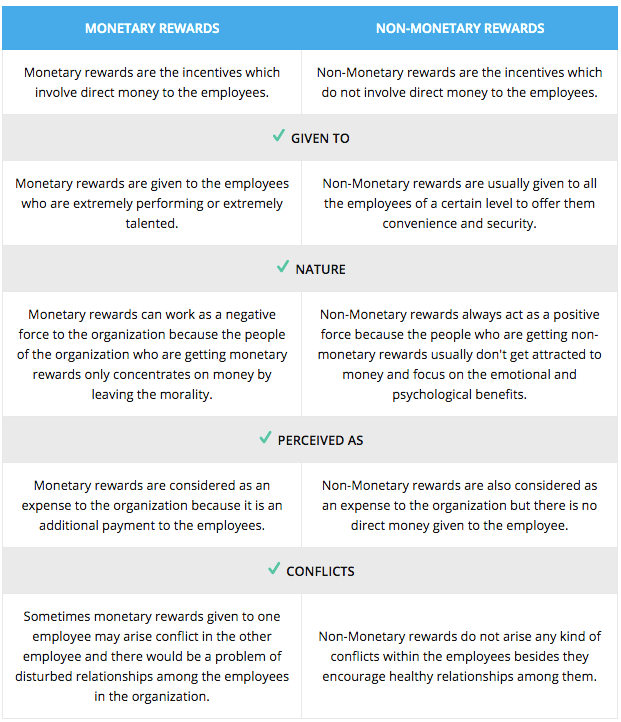
While monetary rewards such as raises, bonuses, and special commissions have a track record of successfully improving the performance of the employees who receive them, they’re not the only reward that has been proven to see results.

Non-monetary rewards like praise and recognition can also bolster engagement levels.
(image source)

In fact, one ResearchGate study found that non-monetary compensation was a better motivator for long-term engagement than monetary rewards. They showed that money, while effective, only motivated “for a short period of time.”

When it comes to value for dollar, long-term engagement can significantly impact a company’s bottom line.

Research shows that unmotivated workers can cost companies up to $300 billion or more in lost productivity each year. Add to this the hidden costs for MSPs, and you have even more of a reason to ensure that employees stay happy in the long run.

For many disengaged workers, non-monetary motivations, such as a simple “thank you” can be as important as a tiny bonus.

Many employees are also happy to return the praise for companies that treat them well.

(image source)

For employers looking to keep employees happy, it’s important to develop non-monetary motivational policies that recognize employee efforts effectively.

But which non-monetary employee incentives work the best? Here are a few of the top options.

1. Recognition and Praise

Overall, employees just want to be valued for their work, time, and effort.

In one client employee satisfaction survey, 55% percent of the respondents said that praise and attention from their supervisor would make them feel cared for and valued in the workplace.

While the survey also indicated that money, benefits, and events like company lunches ranked high for motivation, recognition from a supervisor or manager ranked the highest.

Other studies on non-monetary employee recognition have revealed similar results, showing that recognition is vital to the well-being of any work environment.

(image source)

Companies with defined recognition programs also seem to fare better than those with inconsistent recognition practices.

(Workstars infographic)

US Bank lists five steps for creating an effective employee recognition program:

  1. Establish a recognition team — Recruit employees who you have invested in and who want to promote engagement around the office.
  2. Identify positive behavior to reinforce — Recognition should come from positive behaviors that contribute to the company in some way.
  3. Set attainable goals for employees — Every employee should be able to achieve recognition and should understand the expectations of the program.
  4. Acknowledge employees often — A good recognition program will be consistent in how it rewards and praises employees. Sporadic recognition is not as effective as regular recognition.
  5. Tailor the program to your specific company — No two companies are exactly alike. Create a sustainable program that fits the personality and needs of your employees.

Having a consistent program in place enables employees to understand what’s expected of them and to respond accordingly. This, in turn, can improve employer savings.

(image source)

Some recognition efforts to consider include things like a quarterly award ceremony or a public announcement of praise when employees hit certain metrics or goals.

Written recognition, such as a personal thank-you note from management or a verbal recognition with a small gift or certificate, can reinforce positive employee behavior and help employees feel valued at their jobs.

2. Physical Rewards

Not all non-monetary rewards are free. “Non-monetary” simply means that the employee doesn’t directly receive money.

In some cases, a company can use an inexpensive physical reward like a ticket to a show, a gift card to a local restaurant, a mug, or other “swag” from the company in place of a more pricey bonus check or financial reward.

(image source)

These non-monetary rewards give the employee something tangible that they can use over a period of time.

Unlike a check, which may go into someone’s bank account without them ever truly “seeing” it, physical rewards offer a more concrete reminder that they are doing well at their job.

The key to using a non-monetary employee incentive like this, however, is that all employees must be able to earn them. If only certain employees are eligible for said rewards, the positive effect may be lost.

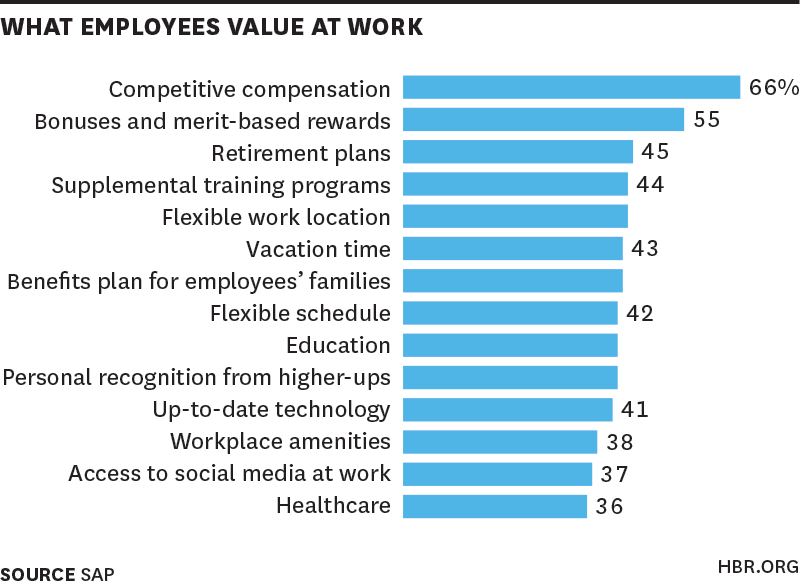
But these rewards can still be merit-based rewards, which, according to studies, still rank high on the list of compensation that employees expect.
(image source)

Employers should be specific about what behaviors or actions they reward and why they give certain physical rewards in place of others. If one employee earns a gift card for working extra hours, for instance, but another employee earns a mug, this may cause a lack of trust.

Inconsistent rewards can cause rewards to be less incentivizing over time.

It’s important to set a standard and criteria for the award and then give it to anyone who performs at that level or standard.

Alternatively, employers can use physical rewards as an occasional approach to show recognition. The caveat is that employees often require consistency to build trust.

(image source)

Companies should ideally give gifts as close to the performance of the actions or completed goal as possible. That way, the non-monetary reward reinforces the positive behavior.

While one-time gifts will still be appreciated — a surprise office pizza party, for example — it’s better for long-term engagement if there is a process in place which can regularly reward employees with physical, non-monetary items.

3. Growth or Learning Opportunities

Investing in an employee’s training and development can also improve engagement, benefit the company’s bottom line, and make the employee happy.

Even something like increased responsibility may indicate to the employee that their managers or supervisors feel that they are ready for a more significant role. The chance to lead teams or tasks, for example, can show that an employee is worth investing in.

In one employee engagement survey, 34% of those polled said that career and development opportunities would increase their loyalty.

(image source)

Learning and wanting to do better are two central tenets of Daniel Pink’s Drive. The best employees want to be better at their jobs, not cut corners or phone it in. So career development motivates them.

One of the reasons that career development works well for both the employee and the employer as a non-monetary reward is that the employee can utilize any skills learned to improve their career over the course of a lifetime.

That includes things attending conferences, improving transferable skills like writing or grammar, developing new techniques to better promote their work, or buying classes in different subjects with something like Lynda.

These might sound trite at first, but they’re not.

Consider the fact that simple grammar mistakes correlate with more promotions. Seriously. One study via ConversionXL found that people who made more grammar mistakes were less likely to get job promotions (only one to four over ten years, vs. six to nine). Good writing outperforms bad writing in more ways than one.

The best part is that these resources barely cost companies all that much in the grand scheme of things. Grammarly’s cost looks like a bargain at a few bucks each month.

In the earlier-mentioned study, ResearchGate also found that monetary rewards failed to work over the long term because financial compensation cannot improve the “job-relevant knowledge, skills and abilities (KSAs)” of employees.

While money can motivate an employee to work harder, it doesn’t necessarily improve results directly or contribute to an employee’s satisfaction the way training and development can.

One employee development survey found that 18% of employees said they would leave an organization if they were offered a better role somewhere else, and 17% said they would leave if their job had “unclear career advancement.”

(image source)

For employees with nowhere to go in the company (i.e. a lack of training and development or some form of advancement), this can mean higher rates of turnover, plus the loss of productivity and profit for the company.

Though some training and development programs can be costly in some cases, the benefits and retention (in addition to the recognition felt by employees) can provide better results overall.

According to The Balance, a training management resource site, two factors serve as the keys to the success of any employee training and development incentives:

  1. Employees should be allowed to pursue training and development in any direction they choose, not just training that is “company assigned” (though both may be needed).
  2. Company culture should support a wide range of learning incentives and not just teach knowledge relevant to a specific skill or job.

By creating a workplace that embraces learning, employees will be better engaged and feel rewarded, recognized, and high-performing all year long.

4. Flexibility and Work-Life Balance

Another motivating factor for many employees is anything that contributes to a healthier work-life balance.

This might include greater flexibility in when and where employees can work with incentives such as telecommuting options, flex vacation time, or technology that automates smaller tasks to free up an employee’s workday.

In one Mental Health America (MHA) survey, non-financial perks like flexible work arrangements or more open and relaxed office environments had a “considerable impact on employee engagement and job satisfaction” as well as stress levels.

(image source)

In that same study, 80% of respondents stated that workplace stress affected their personal relationships in some way, and 35% of employees missed work days during the month because of work-related stress.

Telecommuting opportunities, for example, can reduce some of this stress for employees. More so, it can cut costs for both employees and employers.

(image source)

While it can be tricky for some offices or staff members to take advantage of telecommuting opportunities, depending on the role or company, there has been a significant increase in telecommuting job opportunities in the last few years.

According to Global Workplace Analytics, the number of telecommuting workers has increased 115% in the last ten years, and almost 3% of the total U.S. workforce is now remote.

If companies find it hard to create remote opportunities for employees, other non-monetary perks can keep employees happy and engaged.

Rewards such as a gym membership, wellness program, or PTO can help minimize workplace stress and contribute to a better work/life balance, keeping employees working at full productivity when they’re in the workplace or working from home.

5. One-On-One Time with Management

One of the best and most effective forms of non-monetary compensation is simply more time with management.

While it might seem strange that an employee would want to spend more time with the boss, having one-on-one time with supervisors, managers, or other leaders in the company can be an enticing offer for many employees looking to get ahead in the workplace.

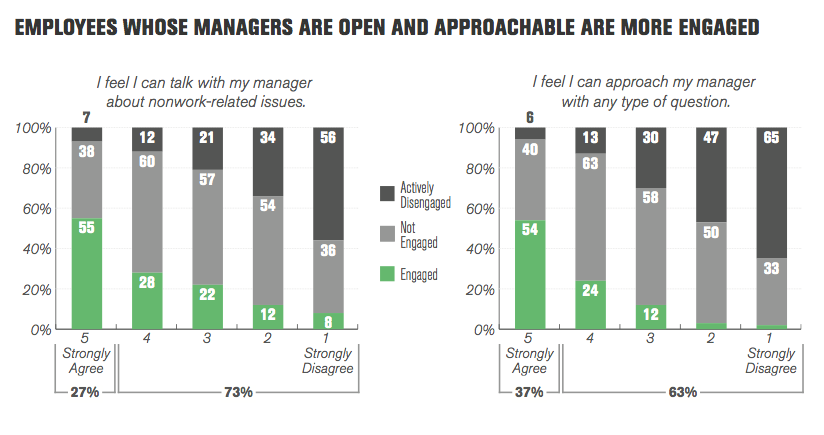
One survey found that employees who had more time with managers or felt like they could approach managers at any time were more engaged than employees who ignored (or were ignored by) their managers.
(image source)

The caveat is that time spent with managers needs to be relevant in order for it to be successful as a non-monetary incentive.

This often means discussing an employee’s short-term and long-term goals as well as how management can better help them reach their objectives.

Employees who receive individual attention like this are also shown to be more loyal to companies, especially when they feel their goals are supported. This support is something that money can’t buy.

It can also be good for managers. Many managers or team leaders may become bogged down in tasks that are unrelated to their actual jobs. If a manager is being paid to manage people, it makes sense for them to spend their time with people.

This also helps the company grow and creates a culture of trust amongst teams.

(image source)

The goal with this type of monetary incentive is to create long-term relationships with employees that make them feel truly valued — something that even occasional praise and recognition can’t always do.

But over time, developing employee loyalty and improving performance with one-on-one meetings will not only encourage happiness and growth in the employee but also throughout the entire organization.

Conclusion

Money isn’t everything.

In fact, for long-term retention and engagement, non-monetary employee incentives can often work just as well.

But in order to gain those long-term benefits, companies must make an effort to:

  • Set a clear, compelling direction for employees that create empowering opportunities.
  • Engage in open and honest communication and allow for negative feedback.
  • Maintain a focus on career growth and development and provide opportunities.
  • Recognize and reward high performance when it occurs in addition to a recognition program.
  • Provide employee benefits that demonstrate a strong commitment to employee well-being.

When all of those things are in motion, employees will be far more likely to produce, which means great things for any company.

07 Dec 17:25

Where are the Linchpin jobs?

by Seth Godin

[We’re launching a new free project today. Read on for the details…]

Industry offered a deal to the worker:

Here’s a job. We’ll pay you as little as we can get away with while still being able to fill the job. We’ll make sure it’s easy to find people for this job, because we don’t want you to have much in the way of power or influence. We’ll use software to read the resumes, and we’ll do it in huge batches.

In return, you’ll work as little as you can get away with. That’s the only sane way to respond to the role of being a cog. If the system is going to squeeze you, no need to volunteer.

It’s hard to over-estimate the impact that this deal has had. The whole idea of mass advertising for mass jobs. The compliance-based school and resume system. The apparent power of the big companies to dictate the culture of work…

But, over time, the economy has changed. Now, the most cog-like jobs are done by machines. Now, cog-like work doesn’t create nearly as much value as truly human work. Now, if the opportunity is right, the pay is fair and the cause is a good one, it’s possible to create a culture where people choose to contribute as much as they can, not as little as they can.

This requires a shift.

Two shifts, actually.

The first shift is for the employer. It means not only paying more compensation to capture the attention and focus of the people who are willing and able to do Linchpin work, it also means investing in a culture that supports that sort of work. Compliance isn’t as important as contribution. But it’s frightening, because turnover costs more when you’re dependent on people who bring special magic to work.

The second shift is on the employee. It means caring enough to walk away from a cog job. It means being brave enough to make assertions and to lead. It means telling the truth about your background and your future. And it means keeping your end of the bargain, even when the work feels scary.

Here’s our experiment:

A weekly email newsletter with one or two jobs a week in it. That’s all.

Even if you’re not looking for a Linchpin job, you probably have peers who are. After all, that’s the sort of person you are–you know how to spread good ideas. So feel free to forward the email to people when you think it might be a good fit.

When we started working on this project, we reached out to a few possible employers to get us started. We specified that it had to be a special job for a special kind of work, and we insisted that the employer make a personal video, one that described what the job entailed.

I knew we were on to something when one said, “oh, it’s not worth the effort, we just posted the job on a job board and got five people who were good enough.”

That’s precisely the jobs we don’t want to post.

If you’re interested in checking out our first job and signing up for the newsletter, here’s the link.

We’ll never sell you anything or rent or share your information. The newsletter is sponsored by the altMBA. Over time, we hope that our subscribers will also be our best source for the jobs we list.

Inspired by my book Linchpin.

       
07 Dec 17:12

Best of 2018: Winning is the Absence of Losing

by Charles Marohn

There are two notable things about this post that made me glad to feature it in our annual “best of” week. The first is that it’s a good year whenever Nassim Taleb publishes a new book. In 2018, it was Skin in the Game, a book that I’m absolutely going to include in my top five books of the year when I publish that list next week. I did an interview recently where I was asked about my influences and, intellectually, there is no bigger than Taleb. If you want to understand Strong Towns thinking, start with the Black Swan.

Here’s the second, and I just love sharing this: When I ran this piece, one of our readers recommended in the comments section a related book called Finite and Infinite Games by James P. Carse. Wow! I’ve read it twice now and feel like I could read it a third time and still absorb new things. It put into simple words a concept I’ve been clumsily gnawing on for a long time now. How liberating!

Where businesses, organizations, and even the Strong Towns movement is involved in a finite game—something that has a beginning, a middle, and an end—cities are involved in an infinite game. For most cities, the beginning is obscure to us now. There is no ultimate end point, thus there is also no middle. It’s an ongoing game where survival is the ultimate objective, or as I describe it below, “the absence of losing”. This is not how most of us think about the places we live, and it’s certainly not how city-building professionals think about it. Yet, we must.


A few years back, I wrote a draft of a book that I called Moneyhall: Building a Strong Town in an Unfair Time. It was a crash course in applying Moneyball thinking to city hall. It was poorly received by potential publishers who judged the overlap in the Venn diagram of urban planning and baseball analytics to be too small to properly market. They were right, and consequently the book will never be published. (Don’t fret—it seriously wasn’t that good.)

One aspect of the book that even my friends objected to was my definition of winning. It’s a fairly clear concept in baseball—you win games, win a division, and the team that wins the World Series is the ultimate winner—but for cities, the concept of winning is more ambiguous. Here’s how I described it:

What does it mean for a city to win? For local governments, there is no defined start and end point like there is in a baseball season. Things don’t ever reset, as they do for baseball after the playoffs. Therefore, the idea of “winning” is not quite as easy to define.

For cities operating in an unfair time, winning is the absence of losing. Winning means being around year after year as the stable, reliable platform which enables a city’s residents to be successful.

To fully understand what I’m suggesting, it is important to distinguish between the local government that manages the city and the people, businesses and institutions that dwell within its boundaries.

People win. Businesses win. Non-profits and local institutions win. Cities serve them all in that regard. The local government as an entity is a platform for communal action, not an end unto itself. What is the point of having a city government that is thriving—with high tax revenues, nice facilities and new projects—when the people it serves are struggling?

Local government can’t (or shouldn’t) progress independently of the people it serves. But if people in a community see their lives improve in ways that don’t allow the local government to take a victory lap, that's fine. It's a problem if a city government prospers while serving a community that struggles. The opposite is acceptable.

Finally, and most importantly, it's okay for private individuals to take risks in a different way than we should tolerate from our local officials. Families and businesses can lose and be okay. The risks they take sometimes don’t work out and they end up in bankruptcy. As a society, we’ve recognized that we should provide a degree of protection and assistance to people who try and fail. People can start over. They can recover and move on. In many instances, I would call such risk takers heroes. At the very least, they are courageous, and we need courageous.

For a local government, the stakes are much different. The failure of a city brings harm to more people outside of city hall than within. In many ways, those in the local government are the least harmed.

While politicians and city staff stand to benefit from actions the government takes, the entire population bears the burden if those actions fail. This is, thus, an asymmetrical risk, one where the person exposed to risk (the resident) is different from the decision-maker and primary beneficiary (public officials and professional staff).

In his most recent book, Skin in the Game: Hidden Asymmetries in Daily Life, Nassim Taleb affirms my thinking: for local governments, winning is the absence of losing. As he states in the book:

The central problem is that if there is a possibility of ruin, cost-benefit analyses are no longer possible.

Then later:

The central asymmetry of life is: In a strategy that entails ruin, benefits never offset risks of ruin. Every single risk you take adds up to reduce your life expectancy. Rationality is avoidance of systemic ruin.

This kind of prudence is not fun. For professional staff—the planner, the engineer, the city manager—it’s way more inspiring (and better for the resume) to have a grand vision, one with big budgets and bold actions. The fact that our systems of state and federal governance, not to mention corporate consolidation and centralized finance, promote such thinking merely serves to normalize it.

It’s rarely seen as enough to just be competent—to merely, for example, run the buses on time and collect the trash within budget. Yet we should value these humble achievements. There is no downside to simple competence. There is zero risk. None. And all kinds of reasons to believe that doing the little things well has a ton of upside.

For the past two weeks I’ve written about local governments that are taking large, systematic risks—Cobb County and Akron—when what is needed most desperately is a strategy that, first and foremost, avoids ruin.

And now, returning from a vacation where I was disconnected from our media stream, I’m hit with lots of feedback—from public officials and others—that not only defends these risks, but fails to grasp in even the most basic way that there is any risk at all. It’s just the way things are done. I find that so divorced from reality that I struggle to even respond to it.

I’ll close with another quote from Skin in the Game:

                One may be risk-loving yet completely averse to ruin.

Contrary to what has been suggested, I am not against local governments taking risk. Quite the opposite, in fact; I am “risk-loving.” I just want those risks to be of the type that do not include the chance of ruin. This means small bets for which the worst-case outcome is entirely tolerable.

Millions in debt for a new stadium in the hope that mixed-use development around it may prove profitable—despite no track record locally of such success—risks ruin, especially when the rest of the community’s development pattern is so financially unbalanced.

Three decades of subsidy for a new business on a remote site with a history of failure—a development which, despite the risk, has no meaningful chance to positively impact the community’s bottom line, even if successful—risks ruin, especially while the city’s productive core neighborhoods decline from lack of basic service and maintenance.

Let’s stop it already with the delusions of grandeur. Let's ditch the notion that the elusive prosperity we seek can be manufactured all at once, that our genius can not merely downplay risk but overcome it. Let's just focus for a while on basic competence. Our communities win when local governments avoid losing.

07 Dec 17:08

Unlocking Creativity and Genius - Using Art to Unlock Innovation

by Karen Chiang
Linda Naiman Main.png

Linda Naiman is the founder of Creativity at Work. Her firm helps organizations develop creativity, innovation, and leadership capabilities. Linda pioneered arts-based learning for businesses in the 1990s. In 2003, she co-authored, ‘Orchestrating Collaboration at Work: Using Music, Improv, Storytelling, and Other Arts to Improve Teamwork,’ that examined the role of arts in business.

When I interviewed Linda, I was intrigued by the types of clients that invite and engage her for her workshops. A sample of her clients include American Express, Cisco, Dell, HSBC, Intel, and Sita (a company providing IT innovations to the airline industry). IBM named Linda as a creative leader in business. Linda’s corporate workshops are designed to help organizations foster an atmosphere of trust that will enable deeper conversations to surface ideas to get to the heart of questions and how to tackle them. There are four key ingredients that lead to value creation:

  • Imagination

  • Creativity

  • Empathy

  • Innovation

Linda helps organizations tap into these ingredients.

Whole Brain Creativity

Linda shared with me one of her workshops centered around creativity, innovation and leadership. In the session, she consults, trains and coaches to get to the team to develop the right mindset, skills and tools they need to successfully innovate. The emphasis is an arts-based approach that fosters the relationship and an experimental form of thinking. A technique Linda uses is to have each of the participants create a compelling and abstract image about leadership. Participants were asked to interpret what each of the images revealed about the subject at hand.

Art-based Innovation Workshop.png

Through this exercise, Linda, introduces the concept of Whole Brain Thinking developed by Ned Herrmann while he was head of Management Development at G.E.

Whole Brain Thinking is based on research that suggested that each one of us has a preferred mode of thinking and this determines how we absorb and process information. Linda shares her adaptation of Herrmann’s work, Whole-Brain Creativity. There are four modes of thinking: analytic,experimental (artistic), relational, and operational.

Linda Naiman Whole-Brain Creativity based on Herrmann Model
  1. Analytical intelligence includes how you frame a problem. Also how you evaluate an idea, including critical thinking.

  2. Artistic intelligence includes using your imagination, visual thinking, synthesizing information and how you envision possibilities.

  3. Relational intelligence includes how your idea connects or impacts others within a system, as well as your kinesthetic and emotional intelligence, and how you collaborate and co-create with others.

  4. Operational intelligence includes planning and organizing; how you turn an idea into action.

In conversation, we noted that the need to embrace diversity as part of innovation. Organizations that draw upon different styles of thinking, approaches and processes (those that strategically leverage a fuller spectrum of perspective) can get better results. Linda guides organizations through all four quadrants in her workshops to help people analyze a problem/opportunity, generate ideas, improve on them, and develop a plan to turn ideas into action.

“For innovation to flourish, organizations must create an environment that fosters creativity; bringing together multi-talented groups of people who work in close collaboration together— exchanging knowledge, ideas and shaping the direction of the future. Organizations led by creative leaders have a higher success rate in innovation, employee engagement, change, and renewal.”

Design Thinking

We also touched on how Design Thinking adds value to innovation. Linda cites a 2014 assessment by the Design Management Institute: that design-led companies outperform the S&P by over 200%. “The focus of innovation has shifted from being engineering-driven to design-driven, from product-centric to customer-centric, and marketing-focused to user-experience-focused.”

Ideo, one of the top global design and innovation companies, popularized the term Design Thinking. They describe it as a process for creative problem-solving. Tim Brown, the company’s CEO, says, “Design thinking is a system that uses the designer's sensibility and methods to match people's needs with what is technologically feasible and what a viable business can convert into consumer value and market opportunity.” This comment links design thinking as a path to creating and capturing value.

Linda recapped for me her 10 step design thinking process for innovation which integrates classic creative problem-solving, design thinking, and arts-based learning

  1. Discovery - Choose a strategic topic to focus on and learn about. Design thinking starts with an end goal, a desired future, and approaches to how you can make it happen. Research your topic for insights. What do you need to understand? What are the opportunities embedded in problems?

  2. Observe - Observation prepares for empathy. Watch how people are interacting and behaving with your offering (product, service, process).

  3. Empathize - Know your stakeholders. Place yourself in their shoes. What are they looking to gain? What could they lose?

  4. Storytelling - Leverage stories to discover insights. What stories would your stakeholders share with others?

  5. Frame and reframe - Are you asking the right questions? Can you see patterns, themes or relationships from the information you have collected. What insights are appearing and do they help you to reframe the question you are asking?

  6. Ideate - Explore the “What if…” Brainstorm ideas that create and deliver value. Linda uses drawing, painting, storytelling and improvisation to stimulate discussion.

  7. Decide - Choose those that “wow.” Shortlist your best ideas.

  8. Prototype - Build prototypes using low-tech media ( such a drawing, or clay and found objects) to make your ideas visibible  and explore potential solutions

  9. Validate your idea - Have users test and provide feedback to your prototype. Their responses will inform whether you should movement forward or not.

  10. Iterate - Design is not linear. Keep iterating to create value.

At Ibbaka, we are writing a series of blogs on the relationship between value, innovation and pricing. If you are involved in creating value through innovation and would like to share your insight, connect with us.

Don’t forget to take our survey on pricing and innovation!


07 Dec 17:03

The Crucial Power of Visualization in CRM

by Lisa
By Nikolaus Kimla Sales and marketing professionals are so bombarded with data and information today we need technology to help us sort it all out. One powerful aid to that mission is visualization – simply because the mind processes visual … Continue reading →
07 Dec 17:03

5 Mistakes in Your Sales Process (and How to Fix Them)

by Rotem Maman

Fast growth tech companies face many challenges in scaling up. As teams grow and new hires are onboarded, it’s essential to have a solid, repeatable sales process in place.
We used our data and insights to bring to you five important things you should avoid while mastering your sales process. Eliminating these mistakes can make an enormous difference in your sales team efficiency and success.

1. Sharing irrelevant information

Bombarding your prospects with generic collateral and irrelevant content is not likely to cut through the noise and get your buyers attention. 78% of buyers prefer to do business with organizations that personalize their pitches and enhance the overall sales experience. Sales professionals must send the right content to the right person and intrigue them. It’s not about the persona you’re sending to… it’s about the person.

2. Not aligning sales & marketing teams

To provide clients with the best possible person-to-person (P2P) sales experience throughout the full sales cycle, your sales team must use all available resources to its advantage. That includes any supporting marketing materials that are relevant to your buyer’s journey. Unfortunately, 60%of marketing materials are not used because companies’ sales and marketing teams are not aligned. As such, the vast amount of marketing materials – everything from social media messages and videos to whitepapers, slideshows and case studies, becomes more of an obstacle than a helping hand. When sales and marketing teams are aligned, your company can enjoy a 27% higher win rate.

3. Not following up with prospects quickly enough

35%-50% of buyers complete sales deals with the vendors who respond to them first. When a buyer is actively showing an interest, you need to strike while the iron is hot. To elicit a positive buyer response, sales reps have to learn each client’s needs and prompt them with appropriate materials – at breakneck speed. Otherwise, your champion might lose interest and move on to other tasks. The key lies in the fast delivery of the relevant information to drive deals forward.

4. Not properly tracking engagements

Proper sales engagement requires knowledge of client intent, interaction, and insights throughout the full sales funnel. To do so, your sales team needs to know exactly how and how often buyers are engaged with their content. This includes learning what aspects of the content were important to them so that your sales team can optimize the company’s offering to suit each buyer’s needs.

5. Spending too much time on admin tasks

Salespeople tend to spend more of their day on admin tasks, instead of actually speaking to prospective buyers. Rather than devoting a meager 33% of their day to customer engagement, they busy themselves writing emails, entering data, attending internal meetings and scheduling calls. It would be much smarter and productive to spend less time on these admin tasks and more time engaging with your champions.

Conclusion

Tech is now solving most of the above-mentioned challenges, enabling sales reps to be more focused, work smarter and faster and save precious time. Sales leaders and sales operations departments must take charge and harness these innovations to build relationships, engage with buyers, maximize sales productivity and close more deals.

Contact us to get a free consultation showing how you can improve your sales process efficiency with DealHub.

07 Dec 17:00

Sales Success in the New Year

by Mark Hunter

What will it take to win starting Jan. 1 and what is the plan you need to implement?

Take the time to dig into the below 11 questions now to help you significantly increase your level of success in the new year.   You can choose to wait and see what the new year brings or you can be pro-active and be the one who makes things happen in the new year.

1. Realize sales is a mind game and it starts with your mind. Who is the voice you need to get out of your life and who do you need to let in?

2. Who is the customer you need to drop that is taking up too much of your time for little profit or no potential for profit?

3. Narrow your focus. Don’t try to prospect everyone, but rather be selective.

4. Set your prospecting time and stick to it! Prospecting will never become a priority until you make it priority in your calendar.

5. Manage your day based on your calendar. You control your time. It’s the most valuable asset you have.

6. Streamline your selling process by simplifying your forms and processes. You can’t afford to have your time consumed with activities that bring no value.

7. Create your dream team. Who can you reach out to? Sales is not a solo activity. Sales is a team sport and you need to make sure you have great teammates.

8. Focus on the big opportunities in the 1st quarter. Play big in the 1st quarter, as it may take several quarters for the opportunities to materialize into business.  Focusing on big opportunities early in the year will increase your probability of having them generate revenue this year.

9. Create multiple relationships with all of your larger customers and prospects. You can’t afford to rely on only one contact at your major customers, because that person may leave.

10. Build your quarterly plan based on a 12-week quarter and your annual plan based on 11 months. This will allow you to use the last week of every quarter and the last month of the year to begin setting up the next quarter or year, rather than stressing out trying to make the current quarter or year.

11. Make time for yourself. Take care of yourself and you can take care of your customers. Sales is not an activity. It’s a lifestyle.

And don’t forget that a coach can help you excel in your sales career! Invest in yourself by checking out my coaching program today!

Copyright 2018, Mark Hunter “The Sales Hunter.” Sales Motivation Blog. Mark Hunter is the author of High-Profit Prospecting: Powerful Strategies to Find the Best Leads and Drive Breakthrough Sales Results

07 Dec 17:00

Real Revenue Growth Impacts all Your Business’s Operations

by Gideon Thomas

Before Chief Revenue Officers (CRO) existed, it was like business teams were heading towards the same destination but without clear lines of communication on that same journey.

The bigger the company, the bigger the disconnect.

The purpose of the CRO is “to align and optimize the entire customer experience with the aim of increasing revenue,” according to VentureBeat. The CRO needs to optimize the alignment of each line-of-business and the unification of their company goals.

Within this customer experience, opportunities for maximizing revenue are found. You just need to know where to find them.

The Challenge

Each line of business team is responsible for their own KPIs and departmental bonuses, with budgets aligned with this reality. Departmental aims sometimes come before the good of the company.

An example of this is when Marketing teams talk about the number of MQL leads they created during the quarter from specific campaigns, and how many of them were Sales Qualified. But, how many of these SQLs made it into the Opportunity pipeline? What was the cost, and source, of the leads that become real opportunities?

An Effective Response

Reverse engineering the pipeline results to their attributed sources is, an excellent method of ensuring the most efficient business results are at the forefront of the funnel optimization process.

Drill-Deeper

It’s not enough to look at the high-level lead sources that led to success; you need to set up the sub-campaign themes in your lead capture workflow. This allows you to drill down to the messaging and segmentation that drives the most qualified leads to convert, resulting in a greater volume of qualified opportunities.

Carry the Unique Buyer Fingerprint Forward

Information gathered by the sales team, or collected from the buyer, must be mapped through the fields across your CRM to the very end. No detail is without value. The buyer’s time is sacred and should never be wasted with mundane questions they have already answered through their form submissions.

I recently spoke with Hubspot’s, Dan Tyre. He re-emphasized the importance of personalization throughout the buyer’s journey, saying that any digital touch-point should give the experience that it is speaking solely to the buyer. This is true throughout the buyer-journey, not just in the initial stages of attracting traffic.

Are you on Track for Real Revenue Growth?

Consider these sales process KPIs that matter to the CRO:

  • length of the sales cycle
  • percent of wins
  • dollars per win
  • net margin in each revenue dollar

Differentiate Your Company

Those KPIs are 100% valid, but to differentiate yourself as a company you need to also measure your latency time between every step in the Sales Process.

  • Increasing response rates from 27% to 92% causes a 314% lift in results; all you have to do is respond immediately and persistently to leads, according to Ken Crogue, in Business2Community.
  • Faster deal-proposal creation and sending is equally important during every stage in the Sales Funnel. At DealHub we reduce our customers’ buyer response time by up to 78%. CEO, Eyal Elbahary, says this is “largely due to the fact that all the heavy lifting for each salesperson is pre-configured.” Making it quick and convenient to respond to buyers.

Make Smarter Technology Selections

A couple of years ago, it was normal to have many different sales technologies managing various stages of the Sales Process. Now, there is a new class of ‘Sales Engagement Platform’ on the market, allowing you to unify your sales tech with a continuous and responsive platform and giving you a complete view of buyer engagement at every stage in the deal proposal process.

All for the Greater Good

A solid Chief Revenue Officer is adept at looking at the net business outcomes and all of the channels that contribute to success – New Business, Expansion, Renewals – and the respective roles of Marketing, Sales, Account Managers, and Customer Success in driving Revenue growth.

The CRO has our greater good at heart – they want us to work together and create a responsive and transparent workflow. Salesforce recently said, “hiring a great CRO is critical to maximizing revenue across all areas of your business.”

06 Dec 17:20

What Is A Customer Journey Map And Why Are They Important?

by Mike Weir
a man on his customer journey

We hear plenty of talk about breaking down organizational silos. And it’s a worthwhile goal. After all, your customers shouldn’t suffer a poor experience simply because of your organizational structure. But to understand how to more meaningfully align to their customers, companies need to first create a customer journey map.

Just as many say “content marketing” will someday evolve to simply be called “marketing,” some say “customer experience” will soon become the way of doing business. According to Ann Lewnes, EVP and CMO of Adobe:

The term ‘customer experience’ won’t exist in the organization of the future. It will be so deeply entrenched in a company’s product, process, and culture that it will be synonymous with the brand and represent the only way to do business.”

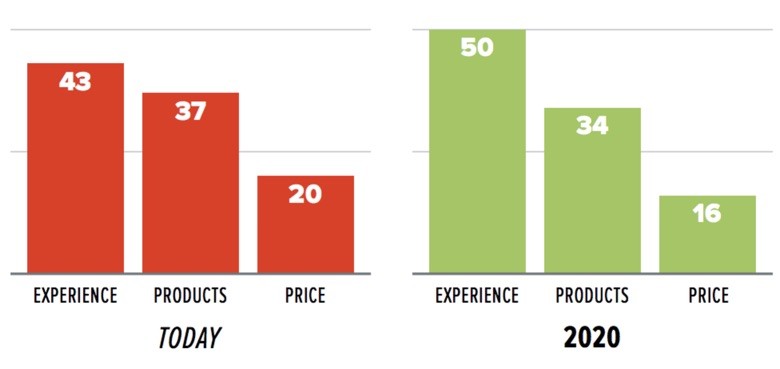
As Lewnes shared a year ago, the term customer experience (CX) will be trivial in the coming years because every smart company will begin to think customer first. In fact, CX consulting firm Walker declared that customer experience will overtake price and product quality as the key brand differentiator by 2020. The chart below shows the relative importance of three key elements to business strategy both today and in 2020 per Walker’s survey.

Source: Walker, Customers 2020

That’s why Walker says B2B companies must know their customers inside and out to effectively compete in 2020. As the firm explains, “This breadth of concrete knowledge will lead to a ‘pure, complete understanding of the customer’ “…allowing companies to “confidently develop proactive strategies to meet and surpass customer needs.”

No wonder Shiva Mirhosseini, Aetna's VP of marketing technology and digital experience, recently said that she sees her role as simplifying customer experiences and enabling the outcomes and experiences those customers want. To do that, Aetna's marketing team has evolved from being “masters of the pipeline to becoming customer evangelists.”

By viewing the customer experience as a strategic initiative, you too can position your company for future success. But, while many companies grasp the strategic importance of CX, they struggle with how to effectively deliver an indispensable one. Enter the customer journey map, a core tool in your overall CX strategy.

What is a customer journey map?

The customer journey map is a tool to visualize the experience of interacting with your brand from the customer’s point of view. This map is critical because it forces you to look at how your customers actually experience your brand versus how you think they do. By better understanding your customers, you can better deliver on their expectations.

According to Blake Morgan, a customer experience futurist, “You must invest in becoming an experience-led business, which means optimizing every customer touch point. By understanding the customer journey, B2B companies can stay a step ahead of the customer to lead them on the path for a great experience and quality product or service.”

Benefits of mapping your customer’s journey

Understanding and empathizing with customers lays the groundwork for meaningful interactions and successful business outcomes. It also provides a tangible framework for CX initiatives.

Customer journey maps enable better experiences

As you study all phases of a customer’s journey with your brand, you’ll be able to isolate where you aren’t meeting expectations or where you are outright alienating prospects and customers. CEB asked thousands of senior executives at companies around the world to describe the B2B purchase process in a single word. The responses included “hard,” “awful,” “painful,” “frustrating,” and “minefield.” In many cases, these horrible processes are the result of disjointed moments in time that lead to an inconsistent and frustrating customer experience.

By addressing these shortcomings, you can ensure better experiences that empower your prospects and customers to interact with and purchase from your company as they desire. That can translate into faster sales cycles, and more satisfied, loyal customers who make follow-on purchases.

Customer journey maps pave the way for your customers to better achieve their goals

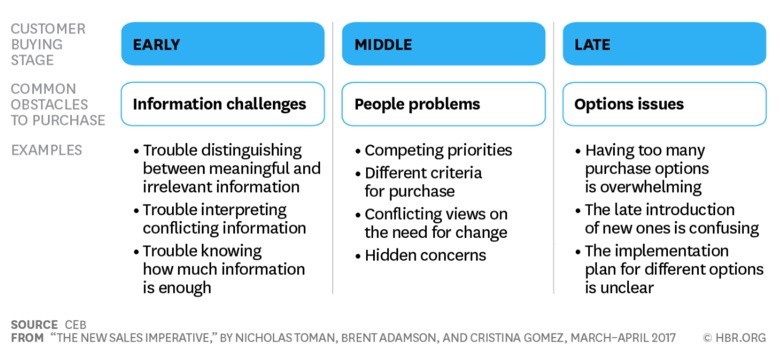
It goes without saying that you want your customers to succeed. To do that, you need to understand their experience by mapping the customer journey. This provides insight into what is – and isn’t working – well for them. According to CEB:

Customers encounter predictable impediments at each buying stage. Suppliers should anticipate and remove these…”

Though CEB is speaking specifically about the buying stages, the same philosophy holds true across the entire customer experience.

By understanding the customer experience – both as it is and the ideal state – you can create, adjust, and enhance touch points to ensure the most effective, efficient buying and service process. As a result, your customers will be better able to achieve their goals, from their pre-purchase through their post-purchase experience, with your company.

Customer journey maps give your company much-needed context

Chances are, if you don’t understand the customer journey, you don’t know your customers well enough. If that’s the case, how can you be certain you’re even engaging the right people in the right companies with the right messages and offers? In an age when hyper-personalization reigns supreme, a shallow understanding of your customers doesn’t suffice.

By creating a customer journey map, you will gain an invaluable and essential view of your potential and existing customers. This more complete picture positions you to realize a better return on your marketing investments, and equips everyone in your company to better engage with prospects and customers.

Customer journey maps position your company to drive better results

A 2018 customer journey mapping report shows that 67% of customer experience professionals surveyed across the globe are using, or have used, customer journey mapping. Moreover, almost 90% of those using customer journey mapping said their program is delivering a positive impact, the most common one being an increase in customer satisfaction. Lower churn, fewer customer complaints, and higher NPS were also among the top impacts.

Common missteps when creating a customer journey map

As your company embarks on creating a customer journey map, keep in mind these common mistakes:

Getting stuck in the inside-out perspective of the customer journey

CEB has found that conventional journey maps usually cover four main buyer steps: awareness, consideration, preference, and purchase. CEB calls this the “customer purchase-from-us journey” because it is grounded in a biased view that the buyer will purchase from the company.

Instead, CEB advises that companies think of the typical purchase journey across three phases: early, middle, and late. This approach forces you to understand the experience from the time the buyer is figuring out whether their issue needs to be solved and is then considering different ways to solve it. As CEB says, “Your goal is to uncover struggles that customers would have with any supplier,” not just your company.

Just remember: The customer journey should extend to include the experience with your company post-purchase.

Taking too narrow a view of the customer journey

Whether you are purpose-driven or profit-driven, your company has to be focused on how  prospects and customers interact with the brand across five major touch points:

  1. Your website
  2. Your outbound marketing
  3. Your sales team
  4. Your customer support team
  5. Your major brand presences on owned channels like LinkedIn

As the Boston Consulting Group says, “Companies need to understand how customers are using digital and mobile channels for research in order to effectively guide their purchase journeys...customers expect not only richer online engagement but also multimedia and interactive content...Companies need to invest in technology, data, and analytics to improve insights into customer buying behavior and help provide more relevant, personalized experiences and content to buyers.”

At the same time, don’t try to create a customer journey map with input from one or just a few customers. You need input from enough sources so you can detect patterns. These patterns will guide your understanding of where customers are enjoying the least amount of friction in the journey – and suffering through the most.

Overlooking all the participants in the customer journey

Today’s B2B buyers tend to purchase in teams averaging 6.8 participants according to CEB. But they aren’t all involved at the same time. It’s critical to account for each persona’s engagement during the journey, making sure you clearly understand who is involved and what they are doing when they are on the scene.

Whether you present it as a single customer journey featuring different players throughout, or you create unique journey maps for each stakeholder, you need to account for the various personas. If you don’t get this granular, your customer journey map will end up being a superficial tool that provides little value.

Know your customer: How to research to create a journey map

To understand the customer experience from the outside in, you need to talk to your customers. If you’ve already developed buyer personas, start with those. Done well, these should capture many of the details you want to translate into a customer journey map. However, if your personas are lightweight, you’ll need to conduct more research to fully understand the customer experience from end to end.

Remember to ask questions that help elicit responses providing a complete view of the journey, whether your company is involved or not. In other words, understand each step from the customer’s point of view, starting with the process before your company even enters their mind. While you can interview a combination of prospects and customers, be sure you are talking to people who fit your ideal customer profile so irrelevant input doesn’t warp your view.

Though it might seem counterintuitive, you also need to understand your internal process and employee perspective as they relate to the customer journey. After all, the only way to fully capture the true experience is to document it from every angle. Your internal research will play a major role as you identify opportunities to improve the customer journey experience.

Tips for creating a customer journey map

You can avoid minefields and create effective journey maps by following these tips:

Start with the end in mind: Whose journey are you mapping and why?

While you don’t want to bias your view of the customer journey, you do want to be clear about why you’re creating a customer journey map. Most organizations use them to identify gaps and friction in the experience for their buyer personas so that they can try to eliminate or reduce these. Customer journey maps can also guide departments across the organization on why and how they should break down their silos.

Capture the entire customer journey while highlighting essential moments

Capturing the experience from the customer’s perspective is incredibly important – and valuable. You want to understand the journey through their eyes, but across the touch points where they interact with your company (and your competitors and any other relevant third parties). You’ll likely uncover many insights simply through the process of documenting the journey as the customer describes it. Be sure to understand the needs and goals of every buyer stakeholder (i.e., persona) at each point, and the specific actions they take.

Just as it’s critical to understand the full journey, it’s important to pinpoint critical moments that often result in make-or-break decisions for your customers (some call these “moments of truth”). In other words, figure out the moments that lead to your customers walking away and the ones that persuade them to stay the course.

Account for logic and emotions during the customer journey

Keep in mind that people making business decisions and purchases experience emotions during the process. Who wouldn’t feel a bit of trepidation and anxiety when spending thousands – sometimes millions – of someone’s else’s dollars? No wonder CEB research shows second-guessing occurs in more than 40% of completed B2B purchases. You need to account for customers’ logic and emotions in your journey maps to develop an accurate portrayal of their experience. Including customer quotes can help bring the emotional side of the journey to life.

Make the map actionable: Empower people across the organization to influence the journey

Remember the reason you are developing a journey map. Assuming you want to make use of the insights to change processes and outcomes for the better, you need to activate the journey map. As Annette Franz, CEO of CX Journey Inc., says:

Journey mapping is a creative process that allows you to understand – and then redesign – the customer experience. The output is not just a ‘pretty picture;’ once the map is developed, it is meant to be a catalyst for change.”

Translate your findings into a visual representation while striking a careful balance. Without enough detail, a journey map is not useful. However, too much detail can overwhelm people and make it hard to understand where to focus. Consider developing a high-level version of the map that provides an overview at a glance, along with with a deeper-dive version that provides enough detail for people across the organization to take action.

Mitch Belsley, a CX consultant and Chief Experience Officer, recommends simplifying these journeys into an experience storyboard that everyone can understand. He describes it as an easy-to-read CliffsNotes version of the customer journey you want your customers to experience.

While the map is meant to express the experience from the customer’s point of view, be sure to flag areas that present an opportunity for your company to change the experience for the better. Ideally, these get converted into action items assigned to the appropriate departments and people.

Once it’s ready, socialize the journey map throughout your organization. Perhaps you present it to your executive team and a select set of customers before rolling it out to the whole company. You should meet with key stakeholders from all departments to determine how to activate the journey map findings through process changes.

Make the journey map measurable by grounding outcomes in business metrics

As part of identifying opportunities to improve the customer experience, outline the potential impact of each improvement. By associating these impacts with business KPIs and metrics, everyone can more easily determine which changes to prioritize.

Another reason to align customer journey improvements to business metrics is to help prove the value of a CX focus. If your company can, for example, increase contract renewals and customer satisfaction ratings while reducing manual steps in the contract renewal process, it’s a win-win for customers and the business.

Customer journey map examples

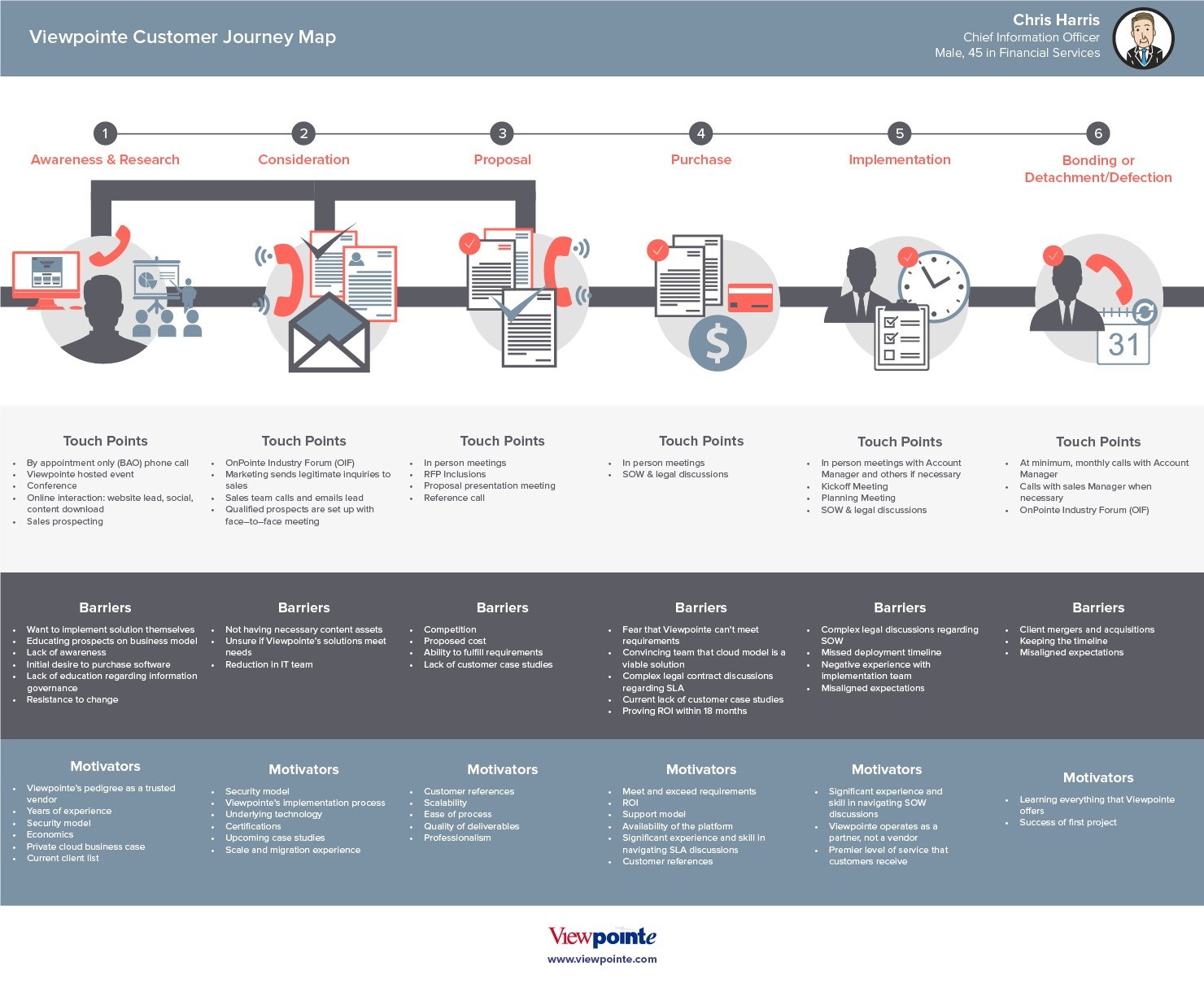
Map touchpoints, barriers, and motivators to one persona

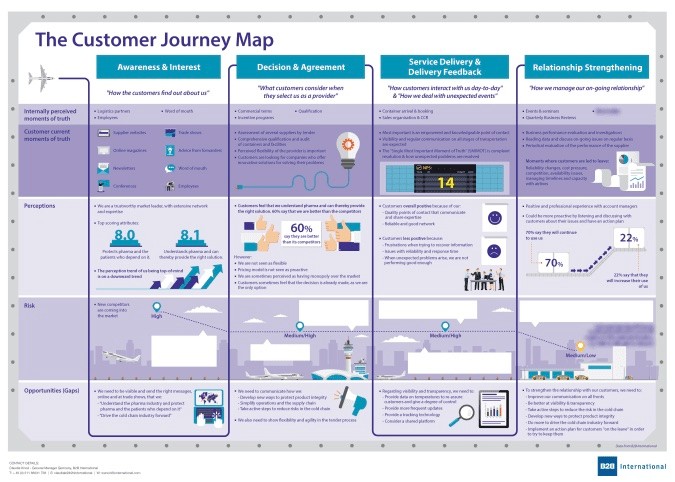
Map customer moments of truth, perceptions, risks and opportunitites 

Create your map around one crucial customer experience 

Using Linkedin to improve the customer journey

There are plenty of solutions at Linkedin -- for both sales and marketing folks -- that can help facilitate a seamless customer journey:              

Use LinkedIn Pages to effectively communicate with your target audience

You want to master the customer experience at every touch point. We make it easier with your free piece of real estate on the world's largest b2b network: your LinkedIn Page. You can share a range of content on your LinkedIn Page, making it an effective way to communicate with your target audience where they’re already engaged in a business mindset.

Use LinkedIn Website Demographics to understand your site visitors

Remember: You want to deliver an indispensable experience even before someone becomes your customer. Using the Website Demographics analytics tool, you can understand the types of companies and LinkedIn members engaging with your website. Based on this understanding, you can shape your content strategy and update your website UX to guide prospects through a personalized experience aligned with each visitor’s industry, role, or other relevant characteristics.

Use Sponsored InMail to share helpful content or suggestions with select customer segments

Similarly, you can use Sponsored InMail to send personalized messages directly to prospects and customers who are LinkedIn members. Sponsored InMail messages are only delivered when members are active on LinkedIn, and one out of every two members opens a Sponsored InMail. So you can be confident that your helpful content and suggestions will be seen by the specific segments you’re trying to reach.

Use Sales Navigator Notes & Tags to keep track of customers’ interactions with your company

Though your customer journey maps represent the overall journey, you want to deliver the best possible experience to each individual customer. One tool that can help is Sales Navigator, with its Notes & Tags feature. Using this, you can keep track of each customer’s objectives and pain points, positioning you to seamlessly facilitate their journey to purchase and renewal.

Use LinkedIn Elevate to share product-related information with customers

Once they purchase from you, the most meaningful part of the experience begins for your customers. Your focus at that point should be helping them use your product or service effectively and successfully. With LinkedIn Elevate, your employees can easily share helpful how-to and product announcement information with their social networks on LinkedIn, Twitter, Facebook, and Weibo (to name a few).

With customer experience the ultimate differentiator, it’s wise to get serious about customer journey mapping. Dedicate time and effort to creating your customer journey maps and improving the experience for your customers, and you and your customers will enjoy the payoff. While they revel in a more consistent, seamless experience with your company, you will see better business outcomes.

For more, download our eBook: The Art of Winning: Orchestrating Marketing & Sales to Deliver the Ultimate Customer Experience.

06 Dec 17:19

Making the Case for Case Studies

by Doreen Clark

janeb13 / Pixabay

Create content in a silo. Keep your wins to yourself. Promote nothing. This is marketing’s mantra, right? Not even close. Today’s marketers have a full-time job creating content, generating leads, driving traffic, collaborating across channels, and staying in the know when it comes to understanding the ins and outs of their ideal customer—and a case study can display your success.

Though the type of marketing material can vary from infographics to blogs to videos to e-books, the case study is a piece of content that should be in every organization’s front pocket. It is a valuable tool everywhere from the website to the sales floor. Here are three reasons that case studies are a must-have in your marketing arsenal:

1. Boost Your Industry Credibility

Whether you work across industries or you are specialized within a particular niche, experience must be shared. A case study is a perfect avenue to promote your industry know-how. After all, birds of a feather flock together. Showcasing your achievement through a case study within a specific industry will boost your credibility while delivering proof points that may attract similar clients.

2. Show Your Success

You have customer wins. Flaunt them. Unlike traditional marketing materials, a case study delivers validation from your customers of your good work. It takes words to a different level by showing the journey from point A to point B in a narrative format, while being authentic enough to share where you were challenged and transparent enough to share your secrets—all while delivering the data to back it.

3. Repurpose the Content

A case study gives an in-depth look at your problem-solving skills. With this content in hand, it is easy to create blogs or videos—or let your public relations team use the case study as a talking point with the media. If you repurpose the case study content across formats and channels, you will give your success wings.

The sales team is always looking for documentation to prove your worth. The case study is not only the perfect content to arm the team with data-driven points, but it is also a document that serves as a testimony from those outside of your organization. After all, you ask your family and friends to recommend their favorite businesses, you read reviews before booking your vacation hotel, and you see the movies that have won the most awards. It’s natural to want to surround yourself with products, services, and companies that have the blessing of those that have gone before you. And that, in a nutshell, is what the case study is.

The case study will give you credibility, flaunt your customer wins, and give you a narrative for additional content. You’ve taken the time to understand your customers. Your products, services, or tactics have blown through their obstacles and there is data to prove your strategies work—now it’s your turn to make a case study work for you.

06 Dec 17:19

Which Sales KPIs Should Your Team Measure?

by Gideon Thomas

Collecting and measuring team performance through KPIs is a great way to assess the effectiveness of sales processes. This is because KPIs are extremely informative when it comes to how well, or how poorly, sales teams are completing goals. It is important to select a few sales KPIs to focus on, as opposed to try to improve them all at once. Choose the ones that are more relevant to your company goals and measure them over time to get more visibility and control over your sales performance. Here is a list of 14 Sales KPIs that are commonly used by sales organizations:

  • Average win rate – What is the ratio of closed won deals with respect to the total number of won and lost deals?
  • Average sales cycle length – How long does it take, on average, to close deals? The shorter the sales cycle to a successful deal, the better.
  • Average deal size – On average, what is the worth of deals sellers are managing at any given point in the sales process.
  • Time spent selling – This KPI compares the time sales team members spend selling, as opposed to time spent engaged in other operational tasks, such as training sessions, internal meetings, and paperwork.
  • Lead response time – How long does it take for leads to positively respond to sales team members’ pitches or calls to action?
  • Forecast accuracy – This KPI tabulates the rate of error of prior forecasts in comparison to actual results or performance, enabling sales teams to better understand how and where to direct their efforts.
  • Content usage – This KPI measures how much a piece of content is accessed and used by sales team members during the sales process, furthering successful sales deal completion. This knowledge allows managers to minimize the wasting of time, money and human resources spent on developing the content – and on the sales process itself.
  • New leads – How are your sales agents contributing to the generation of new leads and the expansion of the company as a whole?
  • Client acquisition rates – How many new leads convert to paying customers? This KPI should be compared to the number of new leads generated, as well as to the number of prospective leads any given agent initially reaches out to.
  • Engagement – How many interactions do your sales agents have with customers and how can these communications be qualified? This is the main KPI that can be broken down into who opened a given file, who read it, what component was engaged with, etc., supporting your company’s sales process goals.
  • Competitor pricing – Keeping track of your competitor’s pricing rates can give you an added competitive edge, helping sales agents engage with customers and make sales.
  • Increased upsell and cross-sell rates – This sales KPI enables sales agents to identify whether certain verticals or segments might respond better to certain upsell or cross-sell pitches. Monitoring upsell numbers enables sales teams to only present certain offers to those customers likely to benefit from them and convert.
  • Understanding the voice of the customer – Is your sales team aligned with the business’s customer’s experiences with and expectations for your products or services, positioning themselves to respond to any relevant needs? For this KPI to be effective, sales teams must gather and use information from multiple touchpoints in a timely fashion.
  • Net promoter score – How likely, on a scale from 0-10, our customers to recommend your product to others? This KPI helps you assess the customer’s overall satisfaction with and loyalty to the company, enabling more effective targeting and nurturing efforts.

How to Prioritize your KPIs?

There is a natural logic to the prioritization of KPIs, the key is to understand the dependency of one to another. You should always know the end-point you have in mind, and from that, you should prioritize from beginning to end of the Sales Funnel. An example of this could be ‘New Leads’ and ‘Lead Response Time’ first, whereas ‘client acquisition rates’ is a something for later.

KPIs can always be manipulated, and the higher up you are in the Leadership hierarchy the harder it is to get to the root truths. This is why a qualitative lens for understanding, is as important as the quantitative lens.

Want to hear more how DealHub can help you accelerate your sales KPIs?
Set up a free consultation with our experts.

06 Dec 17:18

How to Fix 7 Common Flaws in Your B2B Prospect List

by Jarvis Edwards

ElasticComputeFarm / Pixabay

Prospecting for new B2B clients can be painful.

After spending months of your time reaching out to companies in your niche, it can be discouraging when you’ve made no progress converting any into clients. But what if you were doing everything right and there was only one small thing stopping you from bringing on new business regularly?

Could the only thing holding you back from meeting your income or revenue goals be as simple as your prospect list? According to the American Association of Inside Sales Professionals (AA-ISP), nearly 50% of sales reps named lead quality and quantity as their top challenge.

Their findings drive home an important fact: You can’t expect to get quality leads unless the contact information on your lists is of the highest quality.

Let’s explore 7 common flaws in most B2B prospect lists, and show you how to fix them—once and for all.

1. Your List Was Purchased from a Data Vendor

One of the biggest mistakes you can make with B2B prospecting is renting or buying a list from a vendor. Granted, there are some companies from which you can purchase reliable, accurate data; however, it’s difficult to know what you’re getting until the time has been spent working the list. Some common issues with third-party lists are:

Companies that have gone out of business—since most businesses soon fail. A large chunk of companies in a 2-year old list will be out of business when you try to reach them.

The contact information is available to anyone willing to pay for it. The people being contacted are often bombarded with solicitations and are less likely to respond. I’ll discuss this in more detail, later.

Outdated contact information is guaranteed. The question becomes: what percentage of your data is inaccurate? People soon find new jobs or change roles within the same company, making a percentage of the data you purchased, incorrect and unreliable.

Most list vendors guarantee a certain percentage of accurate contact information and some will provide refunds for any incorrect data you find. They put such policies in place because they’re fully aware that a portion of the records sold will be stale. There’s no better way to save precious time and ensure your prospect list is nearly 100% accurate—than by building your own!

2. You Haven’t Done Ample Research

Before starting a lead generation campaign, it’s important to know the “who, what and where” of your audience:

  • Who are your ideal clients?
  • What problems are they experiencing in their businesses, and what can you offer to fix them?
  • Where do they usually go to find help for their business issues? Where do they spend time outside of work?

If you haven’t clearly defined your ideal persona and made sure that persona actually wants or needs your products or services, how do you know if pursuing those individuals will be worth your time? You could be targeting companies that can’t afford what you offer, even if they’re ready and willing to move forward.

Qualify or disqualify your list of companies using crowd sourced databases such as Data.com or AtoZ Databases – the latter being absolutely free to use if you have a qualifying library card.

3. You Aren’t Reaching a Decision Maker

Another major flaw with many B2B prospect lists is including, and contacting people who can’t make buying decisions. If your database only provides general email addresses such as “info@thatcompany.com” or “inquiries@thatcompany.com,” you probably have a crummy list that’s setting you up for failure.

Furthermore, if your contacts are in departments such as accounting or human resources, you won’t get very far. It’s time to perform a manual search to connect with the right people.

LinkedIn is an excellent resource for finding decision makers in the companies you wish to target. Worse case, you can learn a person’s name in a particular role, and “guess” his or her email address, using the name you’ve found.

You can then enter what you’ve gathered into your chosen list provider’s database, and gather specific details about your prospects and their company—annual revenue, number of employees, credit rating and more.

4. Your Prospect List Details Are Readily Available

Having the best strategy in the world and the dogged implementation to match—means very little if your prospect list can be accessed by anyone online. Companies that don’t publish their contact information online are more difficult to reach and thus get fewer solicitations than companies that do. Bots and custom software can find and compile their info very quickly, using the web. This gives countless other salesmen, marketers and spammers the opportunity to contact your list, and makes it much more competitive for you.

Sometimes the contact details companies publish online are used as “spam traps” to capture email addresses of the sender (i.e. you). Sending email to a spam trap may get you labeled and reported as a spammer, making it even more difficult for you to reach your prospects by email.

That being said, you can’t change what contact details people provide online, so don’t be afraid of companies that make it difficult—if not impossible—to find the names, phone numbers and email addresses of their staff. While it does take more time and research, it definitely pays off in the long run.

To save time and trouble when searching for email addresses, just think of variations of their name and add them to a spreadsheet or memo. For example, John Doe could have email variations such as:

  • jdoe@emailaddress.com
  • doe@emailaddress.com
  • johndoe@emailaddress.com
  • johnd@emailaddress.com

Use email verification websites such as VerifyEmailAddress.io or Verify-email.org to see if any of the emails combinations you’ve guessed are valid. You’re given a certain number of searches with each website, so feel free to search for more, as there are many to choose from.

NOTE: If the email you’re searching for has a server that doesn’t communicate to the email checkers, it may show the address is invalid, when it actually isn’t. To avoid all of the manual work, you can get up to 50 email checks for free, at VoilaNorbert.com.

5. You Don’t Have Enough Businesses Listed

An absolute minimum of 100 businesses listed should be your target, and you should shoot for a list of several hundred records, if possible. Since conversion rates are essentially based on a sample size of 100, having less than that will skew your data and provide an incomplete picture of your progress.

Let’s assume you have 50 businesses on your B2B prospect list and none of those have converted into a new client. If you had 100 names on the list, you may have converted one or more into clients, by the time you contacted 90 companies. 1 of 100 is a 1% conversion ratio, which is also seen as an “average” conversion rate in many industries. To improve your conversions beyond 1%, it’s important to add as many businesses as you can to your list of prospects.

Invest the time needed to include as many businesses as you can, which can take several hours per day, if done correctly. If you target local businesses, start locally, until you find there aren’t enough local businesses remaining to add. Once you’ve added all the businesses in your county or region, expand the search to companies within your state. Only after running out of candidates in your state should you expand nationally—but make sure your company has the resources to handle fulfillment on a multi-state and national basis.

Finally, don’t dedicate too much time researching each business before adding them to the list. Skip the in depth research and look for the minimum qualifications before considering them. I often save the comprehensive research for later, when I’m ready to find the decision makers.

6. You Haven’t Picked Up the Phone to Follow Up

Everyone is quick to jump on the “cold calling is dead” bandwagon. Do you hear people preaching that content marketing, referrals and other channels are the only way to acquire new business customers? Many sales people, marketers and business owners rely on digital methods only, such as social media and email marketing.

Some will mistakenly blame the prospect list for their failures, when they didn’t succeed using only digital communications. What about the various decision makers who prefer to do business over the phone, instead of social media or email?

The “cold calling doesn’t work” myth is causing people to abandon the phone in droves, leaving more room in a decision maker’s schedule to hear you out—even if their voicemail is the closest you get to a conversation. A successful prospecting campaign makes use of various mediums to reach prospects in a way they feel most comfortable. Leaving the phone out of the equation equals less business. No pun intended!

7. Not Enough Companies in Your Realm of Expertise

Working a list of prospects without taking the time to research and qualify them is a recipe for unfavorable results. While you might have a longer list to pitch when playing the “numbers game” known as prospecting, the wasted effort spent contacting bad matches can soon lead to burnout.

You’ll soon lose the motivation to keep going, not to mention risking the lack of progress from all your hard work. It’s better to have a smaller, highly-targeted list of prospects that you know you can provide results for, than it is to have thousands of contacts that convert less than 1% of the time.

In a nutshell, narrow down your prospect list to companies similar to those you’ve helped, and/or industries in which you have considerable expertise.

Final Thoughts

A significant percentage of lasting B2B relationships began with a simple list. Sales people, entrepreneurs and marketers alike, all rely on accurate data to get the conversation started with a decision maker. With the advice given in this article, you’re better prepared to find common flaws in your own B2B prospect list; correct them, and generate more qualified leads for your business.

05 Dec 21:37

The Number One Secret Sales Leaders Overlook to Close Deals Faster

by Joan
05 Dec 21:37

7-Step Framework for Crafting a Bullet-Proof Sales Strategy in 2019

by Joan
05 Dec 21:34

4 Ways to Beat the Odds When Starting a New Business

by Andrej Kovacevic

Here in the United States, small businesses are the lifeblood of the economy. In fact, a full 99.7% of businesses here have fewer than 500 employees. With numbers like those, it would seem that almost anyone can successfully start and run their own company. In reality, however, most Americans choose the stability of a salaried position over the risk of striking out on their own.

In truth, it’s difficult to blame them. Despite the fact that the overwhelming majority of U.S. firms are small businesses, it’s also true that seven out of ten businesses will fail within ten years. That means budding entrepreneurs face a mountain of risk when leaving a steady job to start a business, and the consequences of failure can be enormous. To help, here are four things to do that will improve a new venture’s survival rate and help smooth the transition from employee to self-employed.

Examine Your Reasoning

One of the biggest reasons that new ventures fail is that they are entered into for the wrong reasons. It’s all too common for a would-be business owner to make the leap because they’re frustrated in their current position, and not because they’ve got a solid business idea. Even in situations where the core idea is sound, however, enthusiasm (and therefore effort) will soon fade if the motivation is illusory. That’s why the first step in making the decision to leave a job to start a business is to figure out why you’re doing it in the first place. If you truly believe that you’ve got an innovative idea for a new product or service, or even if you’re simply filled with a passion for a cause and you want to make a difference in the world, there’s a good chance you’ll do what’s necessary to stay the course and succeed in your new venture.

Network First, Act Later

It isn’t easy to fully appreciate what it takes to start a new business without having already done it at least once. Most new entrepreneurs make the mistake of taking a go-it-alone, effort trumps all approach that rarely works out. The reality is that even the smallest of businesses will need to rely on a network of suppliers, vendors, and contractors to operate efficiently, and it’s better to make those contacts before beginning operations. The same holds true when it comes to recruiting talented staff to round out the new business’ team. If you’ve already built a solid network of contacts in advance, you won’t need to waste valuable time and effort doing so when the new company is already burning through startup capital.

Create a Business Plan, Not a Marketing Document

When setting out to start a new business, most people place great emphasis on creating a business plan that will impress potential financial backers – with good reason. After all, businesses require funding and investors want to know they’ll stand a decent chance of seeing returns. Unfortunately, it’s all too easy for new entrepreneurs to lose sight of the fact that they’ll need to execute the items in their business plan, and that they should be focusing on what will work rather than on telling potential backers what they want to hear. To make sure that’s the case, keep every phase of the plan manageable, and make sure all financial projections are conservative so there will be some breathing room as you proceed. Remember that a business plan isn’t a static document – you’re going to end up revising it several times as you judge your actual results against your expectations, so there’s no need to go overboard in the early stages.

Prepare to Adapt

There is one thing that is certain to happen when starting a new business and it’s that almost nothing will go to plan – at first. For those leaving the security of a salaried position for the riskier path of business ownership, it can be disconcerting when you first realize that much of your time will be occupied putting out the various fires that will no doubt start as you begin your entrepreneurial journey. The natural reaction would be to panic a little and rush to make the quickest decisions you can in the face of the pressure you’ll face, but that’s not the right way to handle things. Instead, you should be prepared to take your time to think through problems when they happen so you’ll come up with the right solution, rather than the expedient one. It’s critical to recognize that a business is like a living organism – and acting in haste can lead to unfortunate outcomes.

Act Without Fear

Although starting a business (especially for the uninitiated) is a monumental challenge filled with pitfalls and difficulties, it is also one of the most rewarding experiences one can ever have. When done well, the benefits will far outweigh the risks in almost every case. If you do your due diligence in advance and understand what will be required to create a thriving business that will stand the test of time, you’ll have every chance to defy the odds and end up succeeding in your enterprise. As the Latin proverb says, fortune favors the bold – so prepare the right way and execute your vision without fear of failing, and you most assuredly won’t.

05 Dec 21:30

Canada proves land of opportunity for famous immigrant inventors

by Financial Post Staff

Ask the leader of any technology company and they’ll tell you that hiring engineers, data scientists or mathematicians is one of their biggest challenges. STEM careers are the fastest growing part of the labour market, and some estimates put the need for technology workers at 216,000 jobs by 2021. To explore the talent gap, the FP talked to innovators who have left Canada to pursue opportunities with big multinational companies, and also those who have moved here to be a part of this country’s digital transformation. You can find all of our coverage here.


Although the United States often bills itself as the land of opportunity, Canada is no slouch when it comes to immigrant inventors. The country ranked seventh in terms of the number of immigrants who held patents between 2000 and 2010, according to a 2016 National Foundation for American Policy report. Historically, Alexander Graham Bell, the inventor of the first practical telephone, might be the most famous immigrant inventor to grace these shores, but there are plenty of more recent examples and they come to Canada for many reasons.

Here are a handful of them:

Tobias Lutke, chief executive and co-founder of Shopify Inc., came to Canada when he was 22.

Tobias Lütke, chief executive and co-founder, Shopify Inc.

Lütke was a programming prodigy in his native Germany, but followed his heart and moved to Canada in 2002 at the age of 22. Initially, he wanted to build an e-commerce site to sell snowboards, but found the available tools lacking so he built his own. Those tools became the foundation of the online shopping portal Shopify, one of the most successful Canadian startups ever.

Maninder Dhaliwal, chief executive, Lions Gate International

Dhaliwal was born in India and came to Vancouver in 1999 to study engineering at the University of British Columbia. Her master’s degree helped her find work, but she eventually decided to strike out on her own in 2013, co-founding Lions Gate, which specializes in India-focused international venture projects in technology, manufacturing and infrastructure.

Robert Herjavec, chief executive, Herjavec Group

Robert Herjavec, chief executive, Herjavec Group

Best-known for his starring roles on CBC’s Dragons’ Den and ABC’s Shark Tank, Herjavec came to Canada on a boat in 1970 from communist Yugoslavia. He has built and sold several technology companies, and in 2003 founded the Herjavec Group, which has been called one of the most innovative cybersecurity companies.

Shahrzad Rafati, chief executive and founder, BroadbandTV

Rafati was born in Tehran in 1979 and grew up in a family of entrepreneurs, but moved to Vancouver in 1996 against her parents’ wishes. She enrolled in computer science at the University of British Columbia and in 2005 founded BroadbandTV, a multi-channel network for online video creators that has struck deals with the NBA, Warner Bros. and the Huffington Post, among others.

Aditya Jha, chief executive, dgMarket International Inc.

Jha was born in Nepal, grew up and started his career in India, and came to Canada in late 1994, joining Bell Canada. He then co-founded a software company called Isopia Inc. (which was later acquired by Sun Microsystems for more than $100 million) and has started or bought several more businesses, including dgMarket International Inc., a worldwide consulting tender portal. He also runs Project Beyshick, which provides seed money to budding Aboriginal entrepreneurs as well as university and college endowments.

Shahrzad Rafati, founder and CEO, BroadbandTV Corp.

05 Dec 21:30

The ones that got away: Why making it big in tech might mean leaving Canada

by Gabriel Friedman

Ask the leader of any technology company and they’ll tell you that hiring engineers, data scientists or mathematicians is one of their biggest challenges. STEM careers are the fastest growing part of the labour market, and some estimates put the need for technology workers at 216,000 jobs by 2021. To explore the talent gap, the FP talked to innovators who have left Canada to pursue opportunities with big multinational companies, and also those who have moved here to be a part of this country’s digital transformation. You can find all of our coverage here.


As a teenager in 1976 attending the elite Toronto high school, Upper Canada College, Michael Evans knew he wanted something different than his peers: he wanted to leave the country.

That itch initially led him to Princeton University in New Jersey, and later to a banking career in New York, London and Asia.

Today, as president of Alibaba Group. — China’s answer to Amazon.com Inc. — Evans spends the majority of his time in China and other developing countries, helping build out online payment methods, a smart logistics system and digital innovations that will allow their economies to, technologically speaking, leapfrog the developed world.

“This is not a job you can do by remote control,” Evans told the Financial Post in a recent interview while he was visiting extended family in Toronto. “But it is a job that requires you to be in the field.”

Canadian entrepreneurs who leave the country — of which there are many working on the bleeding edge of the innovation economy, whether in blockchain, artificial intelligence, ride-hailing or some other area — do so for different reasons. Some are enticed by the scale of countries with larger population centers, or by the advanced funding ecosystems elsewhere; others follow specific opportunities abroad; or in some cases it is simply a yen for something different.

As part of its investigation into innovation, the Financial Post spoke with some of these Canadian entrepreneurs working abroad and asked for their perspectives on what drives or impedes new technological development and how Canada is faring as digital innovations reinvent the world.

Canadians have helped build some of the most buzzed about tech companies in the world: Garret Camp is the lesser-known co-founder of the ride-hailing service Uber Technologies Inc.; Stewart Butterfield founded the photo sharing service Flickr and more recently the office chat platform Slack Technologies; Vitalik Buterin invented Etherium, a blockchain technology.

But for all the success stories, there is no Canadian equivalent of an Apple Inc., Amazon, Alphabet Inc. or Facebook Inc., and that void raises questions about whether Canada’s tech sector can compete in a world economy increasingly dominated by ideas and data.

Lance Uggla

“There’s no issue with innovating within Canada,” said Lance Uggla, a native Vancouverite, who has grown a multibillion dollar data business, IHS Markit, from London, U.K.

“But if you create a great product for global markets, the Canadian market within the global market is never going to be more than two or three per cent of your overall revenue,” he added.

And that lack of population forces many entrepreneurs to look abroad for ways to distribute their product globally.

After starting his banking career in Toronto in the 1980s, he moved to London in the 1990s as TD Bank’s head of Europe and Asia.

After the Houston-based energy trader Enron imploded in 2001, drawing new scrutiny to just how much market manipulation was occurring behind the scenes, Uggla sensed a business opportunity to bring greater transparency to various markets.

In 2003, he started Markit Ltd. in a barn north of London. By using technology to analyze large data sets, Markit was able to provide market insights that could be sold to governments, large multinational companies and other organizations.

In 2016, Markit merged with a similar company IHS Inc. in a deal valued at US$5.5 billion, where Uggla is now chief executive and chairman.

Working abroad may have provided an unintended impetus for Uggla’s entrepreneurship. Because he was working for a Canadian bank that paled in size compared to some of the global banking behemoths he was making deals with, he always believed his trading partners had more data than him.

“I think working for a Canadian bank that had a smaller footprint than the largest global banks, meant that I was dealing with a larger gap in the transparency,” he said. “It meant I had a keen interest to collect data” from them.

He says that’s how innovation occurs sometimes: An entrepreneur identifies an opportunity based on an experience.

Today, having expanded into more than 140 countries, IHS Markit is expanding and has five offices in Canada in Calgary, Mississauga, Toronto, Vancouver and Windsor.

“If I was living in Toronto and came up with this idea, I think I could have easily built this company,” said Uggla.”I don’t think there’s any issue with attracting, recruiting and retaining great talent in Canada — you’ve got great universities, and you’ve got a vibrant business community.”

Markit employees and CEO Lance Uggla (center) celebrate at the NASDAQ during the launch of the initial public offering for Markit on June 19, 2014 in New York City.

But Canada is not retaining all of its innovators.

In terms of innovation within Canada, few families share the same legacy as Michael Evans’ family.

In the 1960s, his father John, co-founded McMaster University’s Medical School in Hamilton, and transformed medical education to give students hands-on experience with patients from the very start rather than rote memorization.

In the 1990s, John co-founded MaRS, an innovation hub in downtown Toronto that connects entrepreneurs with networks and capital.

Evans said that his father once dispensed sage career advice to him: “He said, ‘You’ve got to move, if you want to grow. Embrace change and take prudent risk.’ Otherwise you get caught up in the status quo.”

That bug to “embrace change” was present in Evans even in high school, when he was one of only three boys in a class of nearly 200 at UCC who moved abroad for university, and why he accepted positions on three different continents later in his career at Goldman Sachs, he said.

Michael Evans

It’s also relevant to Alibaba’s strategy of targeting emerging economies.

In developed economies like Canada, entrepreneurs have to contend with existing services and products when they introduce any new technology. For instance, consumers have credit cards which may make them wary of using any of the various new digital payment systems.

But in places where most individuals have never had bank accounts or credit cards, people are more likely to embrace a new type of payment system.

“In developing markets, the ability to change things is welcomed by the recipients,” said Evans, and that means Alibaba has been able to rapidly grow new business services, such as Alipay, its online mobile payment system.

Other factors slow adoption in a developed country too. Banks, for example, tend to introduce new products carefully to ensure they don’t cannibalize revenue from existing products, and to ensure they don’t create any new liabilities or reputational damage. Plus, developing markets have more advanced regulatory systems.

“It’s hard to get people to change,” said Evans. “In developing countries they adapt much more quickly to technologies that can solve serious problems.”

But Evans isn’t pessimistic about Canada’s future.

“There’s a huge opportunity for Canada to embrace some of these technologies,” he said.

Other entrepreneurs working abroad profess a more complicated relationship to the country.

In 2015, having just finished law school, Andrew Arruda connected with Jimoh Ovbiagele, who was studying computer science as an undergraduate the University of Toronto where Geoffrey Hinton, sometimes called the godfather of artificial intelligence because of his work on deep learning technologies, was a professor.

They launched ROSS Intelligence, a software program that aims to streamline legal research. Using artificial intelligence and machine learning algorithms, lawyers can type in a question and ROSS looks across the vast compendium of legal case law and finds cases with relevant answers.

Almost immediately, Arruda made a decision to focus on the U.S. legal market, which has more lawyers in California alone than in all of Canada.

“You don’t have the same volume of people in Canada,” said Arruda.”Sheer volume is a big thing when you talk about entrepreneurship.”

Andrew Arruda, CEO and founder of ROSS Intelligence, poses for a portrait at his company’s offices inside a WeWork shared workspace in San Francisco.

Initially, they relied on IBM’s Watson artificial intelligence technology to build their tool and investments quickly poured in. Y Combinator, the venture fund accelerator in California that seeded Airbnb and Dropbox, was an early investor, with Comcast Corp., the Philadelphia-based global telecommunications company, and Dentons, the global law firm, also investing.

“People always ask, ‘Can Canada compete with Silicon Valley?’” said Arruda, “and I say we shouldn’t be thinking about competing with it — there’s always going to be more capital in the U.S. by virtue of the sheer volume of people.”

“But instead of trying to change that we have to look at how we stay competitive,” he added.

As Ross attracted more customers, and expanded its offerings from bankruptcy to all areas of law, Arruda said he sought ways to reinvest back in Canada.

In 2017, the company opened a Toronto office and Mayor John Tory attended the ribbon-cutting ceremony. A dozen engineers initially staffed the office, and drew on machine learning and natural language research conducted by professors at three Canadian universities — in Toronto, Edmonton, and Montreal — to build a proprietary artificial intelligence system for ROSS.

This November, ROSS hired Stergios Anastasiadis, the former head of engineering at Shopify Inc., as its head of engineering, based in Toronto, which has grown to more than two dozen engineers, according to Arruda.

ROSS also attracted Canadian investment, and today, Inovia, a Montreal-based venture capital firm, is its largest investor.

“A lot of people think let’s give more tax incentives so all our entrepreneurs stay here, and don’t leave,” he said. “But I think the best route forward is to allow those entrepreneurs to leave … and encourage them to come back.”

Arruda likens the situation to the National Hockey League, where talented Canadians often play for U.S. teams and eventually return to coach youth hockey, ensuring that Canada churns out talented hockey players.

As Canadian tech companies abroad mature, he said he believes they’ll also look for ways to return to Canada.

This July, the real estate consulting firm, CBRE Group reported that Toronto had added 28,900 tech jobs in 2017 — more than Seattle, New York, Washington, D.C. and the Bay Area combined.

“We are now starting to see those people come back,” he said.

• Email: gfriedman@nationalpost.com | Twitter: GabeFriedz

05 Dec 21:20

A twist on old school tactics

by Drew McLellan

old schoolIn this era of all things digital, I thought it would be a nice change of pace to go old school and talk about some very simple marketing tactics that are often undervalued and underutilized. Best of all, neither of these ideas will dent your marketing budget.

Thank you notes: When I was growing up, my mom was a stickler for thank notes. On December 26th there would be a stack of thank you cards and a list of recipients on the kitchen table. The importance of that act has stuck with me my entire life, and I still write a ton of thank you notes.

Most of us don’t get a lot of traditional mail anymore, and when we do, we sort it over the wastebasket because there’s not a lot of value in what we receive. So we notice personal mail, and we remember who sent it to us.

When a client places a new order or makes a referral, don’t just shoot them a quick email. When a prospect makes time to learn about your business, be memorable. Their inbox is already bloated. Take five minutes and do what most people don’t do — write a thank you note.

Tech twist: When I’m on the road I don’t want to carry a bunch of thank you notes in my suitcase, so I use an app called Bond Black. It allows me to send a handwritten thank you note with my actual signature from anywhere in the world without trying to track down stamps or cards.

Make connections: We all have people in our lives that seem to know everyone and can quickly make valuable introductions that create new partnerships, client relationships, and peer connections. You need to be one of those people.

The good news is that you don’t need to know a certain number of people or have a certain level of influence. All you have to do is be intentional. The Zig Ziglar quote, “You can have everything in life you want if you will just help other people get what they want” is spot on. What Zig didn’t say but I think is implied is that your desire to help them get what they want has to be genuine. You can’t fake it just so they’re helpful to you in return.

Here’s a great way to start. Make a list of ten people who genuinely have helped your business. Now, think of someone you know that would benefit them in some way. They might be a potential client or vendor. Or they might serve the same customer base but in a non-competitive way and there could be the possibility of them partnering together on a promotion or joint offering. Make an introduction, explaining why you think they should get to know each other. It’s that simple.

Tech twist: Use Linkedin as your connection hub. Leave recommendations for people who have been influential in helping your business. Go a step beyond that and send a message to two people you want to connect and make an introduction. They’ll be able to meet each other and make a LinkedIn connection, which opens their networks to each other.

While both of these tactics may seem rudimentary, we don’t do either often enough.

Selfishly, they pay huge dividends. But even more important than that – they remind us to be the kind of business leader we should all aspire to be. Giving, gracious and grateful. I know those are the kinds of business people who have helped me learn, grow and build my business for the past 25+ years and I want to return the favor.


The post A twist on old school tactics appeared first on McLellan Marketing Group.

05 Dec 21:19

5 Ways to Successfully Manage a Remote Team

by Susan Friesen

5 Ways to Successfully Manage a Remote Team

Leadership Skills for Small Businesses

Whether you have a few people that telecommute to the office or a huge virtual team, remote employees are now the norm.

It can be a challenge not only to find reliable remote employees, but also to effectively manage your team from afar.

Employees and leaders need to understand their roles, be motivated to work hard and communicate with other team members. It’s also essential to understand that certain industries lend themselves better to remote opportunities.

For example, an insurance company may have Customer Service Reps, Claims Specialists, Auditors, Underwriters and more working successfully from anywhere in the world while pharmaceutical sales reps may need more face-to-face interaction with clients.

Here are 5 ways to develop your remote leadership skills and make managing your team less stressful:

  1. Schedule regular meetings

    If you have contractors or employees, having meetings once a week or once every few weeks lets your remote team provide updates and ask questions.

    It’s a great way to get to know your team better and encourage an open dialogue. You’ll get a sense of how your leadership development plan is unfolding and be able to make changes that benefit your company.

    Worried about long-distance telephone charges? Use a tool like Zoom, a free video conferencing tool that makes it a breeze for everyone to connect.

    Zoom team meetings

    Here at eVision Media, we use DISCORD for team communications.

  2. Don’t forget your company culture

    Just because you don’t have an office full of employees doesn’t mean you can’t have a strong company culture.

    Share your company vision, mission statement and goals with your employees. Let them contribute as much as possible to your corporate identity and value their skills and strengths.

    You may even notice that some of your employees have leadership qualities and you can help them pursue leadership training if they’re interested.

    If your employees live close enough to connect in person, organize a company event. Whether it’s a barbecue, bowling or holiday party, you’ll get to know your people better and give everyone a sense of inclusion and company culture.

  3. Set clear expectations

    Employees in an office have a clear idea of work hours, rules and guidelines but remote employees may not. Adding to the difficulty: your remote employees may be in different time zones.

    As part of your leadership development plan, consider your business needs and think about what you can reasonably expect from employees. For example:

    • All emails must be responded to within 24 hours
    • Employees don’t need to respond to emails or work on weekends
    • Weekly hours must be submitted by Thursday evening for payroll
  4. Use a time-tracking tool

    As a small business owner you need to focus on maximizing productivity. A time-tracking tool will help employees stay accountable and let you review their performance.

    Not only that, but a time-tracking tool such as AccountSight or Hubstaff will make doing payroll much easier. You’ll have to-the-minute data of how much time each employee is spending on tasks.

    Time-tracking tools also help employees by saving them the hassle of manually tracking time and helping them focus on one task at a time rather than getting distracted.

    We use Toggl to track our time when working on client projects.

    Toggl time tracking

  5. Be organized yet flexible

    While you have certain expectations of your staff and need them to meet deadlines, respect how your employees work best.

    Some people need to ask more questions than others. Some employees like to brainstorm with other team members, while others like to work alone. Some contractors may benefit from leadership training, while others aren’t interested in expanding their role.

    In addition to weekly or bi-weekly meetings have simple ways your remote employees can reach you – whether it’s by text or online messaging. Encourage communication and make it easy for your employees to get a hold of you with questions or concerns.

This is a learning process for you too! Consider it on-the-field leadership training. Managing your remote team can be hard at first and there will always be challenges along the way.

If something isn’t working, change it. Listen to your employees’ feedback and use it to improve.

05 Dec 21:18

Social Media Graphics 101: How to Create Images That Your Fans Would Love to Share and Talk About

by Ruby Rusine

social media graphics

I’m a visual learner. I am one of the 65 percent of the population that is a visual learner.

It is no doubt that in the digital world, most people are naturally drawn to graphics.

Why are social media graphics important?

According to Psychology Today:

Based upon research outcomes, the effective use of visuals can decrease learning time, improve comprehension, enhance retrieval, and increase retention.

It follows that visual content reigns supreme in the world of social media.

Past and recent studies confirm it. Let me cite some recent data for you.

In a 2018 study by Social Media Examiner, they asked 5,700 marketers to identify the content they use in their social media marketing. A whopping 80% use visual content in marketing their business in social media.

They also asked the marketers to single out the most important form of content for their marketing from these choices: visual images, blogging, videos, live video, and podcasting. Again, they picked visual images.

2017 data stated that 93% of the senior marketers say photography is critical to their overall marketing strategies.

Yes. Photos. Visuals. Graphics. These are essential elements to your company’s social media marketing communication kit.

In fact, neuroscience says that our brain processes images 60,000 times faster than text.

Read that again–sixty thousand times faster than plain text. Also, 90% of information transmitted to our brain are visual. (Source)

Okay, let’s go to the social media platforms. See these glaring statistics?

Tweeter: Tweets with images receive 150% more retweets than tweets without images.

Facebook: Facebook posts with images see 2.3X more engagement than those without images.

Instagram: There are over 500 million Instagram users active every day

Overall: Social media images are over 40 times more likely to get shared than other types of content.

Now, the next question is: How will you get your brand to stand out from among thousands of other brands vying for a viewer’s attention? Which is, by the way, getting shorter.

Here’s a fact: You do not only have to do it right, you have to do it fast, too!

Studies have it that, “Facebook users spend an average of 1.7 seconds with any piece of mobile content on the platform, compared to 2.5 seconds on the desktop.”

So, how will your visual posts stand out, attract the immediate attention of your viewers and get them to engage? Learn, learn, learn.

Learn how to create competitive visual designs that will drive positive marketing results.

Again, there is no harm in gleaning from the best practices of social media marketers out there who knows what they are doing.

Social media graphics 101: basic visual content creation tips

Here are some of the best practices that social media graphic designers follow.

Your message should be clear and readable. In the US, the average person spends 2.5 hours a day on social media using a mobile screen. In fact, I am editing this article using a mobile device.

Make the texts in your visuals plain and large enough to read. Learn how to balance the colors that makes it easy on the eyes. Clashing colors hurt the eyes.

Choose your colors wisely. Pairing colors and hues can influence perception.

The red and yellow shades; they stimulate and energize. Green symbolizes freshness and safety while those in the blue spectrum connotes calm and trustworthiness.

Design your social media graphics according to the feelings you want to invoke from your viewers.

Learn the right color groupings that create balance and harmony.

what orange meansImage source: graf1x.com

Position the headings and sub titles accordingly. Provide an order using elements such as color, font size and positioning that will help your skimming viewers comprehend information quickly and accurately. Do keep in mind that everyone reads top to down, and most cultures read from left to right.

Don’t go too crazy with pretty fonts! Fewer text variations, the better.

Like colors, fonts convey mood and tone. Some fonts appear to be humorous, and some serious. Other fonts are neutral.

Learn how to express with your chosen typeface and which combination works best together.

Again, the simpler, the better!

Use the white space and avoid cluttering your social media graphics with texts. Also, your text should resonate with the photo you used and vice versa.

Grabbing your viewers’ attention is not the end of the process. Your message is important!

Offer value to your viewers that would motivate them to share your social media visual content. (Yes, it’s really not about you!)

According to the New York Times Customer Insight Group, these are the underlying motivations why people share:

  • To bring valuable, enlightening and entertaining content into the lives of people they care about.
  • To define themselves.
  • To grow and nourish their relationships.
  • Self-fulfillment.
  • To get the word out about causes they believe in.

So if you want others to share your content, help them by keeping the above in mind.

Alright! So these tips are the basic social media graphics tips about having a good design and adding relevance to your images–that is, if you prefer to create social media graphics from scratch yourself.

But, learning is one thing and having the gift to create eye-catching images is another. Besides that, learning takes time and for many companies time is money!

The solution? Well, some would go for hiring companies that offer done for you social media graphics but for others, there is another way.

Social Media Graphics Ready Made Templates–to the rescue!

Thankfully, there is now a plethora of ready-made social media graphic templates. These visual content tools and apps can simplify your life as a social media content marketer. Some of these are free, and some are not.

It’s a Wrap!

So now, you have the tools for your ready-made visual content templates….what’s next? There is still much to learn! Keep an eye out of our social media graphics 2.0. It is coming soon.

05 Dec 21:18

Taking A Second Look: Why Bigger is Not Always Better When it Comes to Investing

by J. Frank Sigerson

“Think big.” If you’re someone who wants to get their hands wet by dipping them into the world of investing, then chances are, you’ve already heard of that motto one too many times. In fact, it’s the motto that most successful investors live by. And, all for good reason. After all, if you’re an investor, then why not dream the biggest dream that you can?

It’s an age-old saying taught to us at a young age, but is it always the case? The short answer is, no. As a matter of fact, as far as investing goes, well, in today’s age anyway, big ideas and big investment returns come in small packages. So, how do you go about starting the process?

Big is not always better

As an investor that’s just starting out, it’s easy to get confused at first. After all, there are over 20,000 publicly traded securities just in the U.S. alone. And, when you’re raised on thinking big, you would immediately think of the largest companies traded on the most major exchanges. However, as tempting as it may seem, there are also many overlooked and often misunderstood smaller companies, which are worth taking a good look at, considering you look hard enough in the beginning.

Often referred to as microcap companies, these are companies that have market capitalizations between $50 million to $300 million and are usually less talked about in the mainstream investment media. However, it’s actually these smaller microcap companies that gave business management and development consultant, Ajene Watson, a great idea.

Currently the CEO and chairman of Digital Asset Monetary Network, Inc. (DigitalAMN), Watson thought: What if he could take this sort of investment flexibility to everyday people? What if he can take private, high value, fast-growth startups, and development-stage companies, and make them available within a space where the everyday hard working person can have the opportunity to invest in them?

And thus, DigitalAMN was born partly from this concept.

A specialized tech accelerator that utilizes the Public Accelerator-Incubator model (PAI), DigitalAMN takes, as Watson puts it in a recent interview, “a unique approach in bridging the gap between startups, everyday people, and angel investors.”

In the same The Sports Circus interview, Watson explained how one of DigitalAMN’s main goals is to provide people with financial literacy, in order to be more responsible with decisions, especially financial ones.

Watson says, “What we’re aspiring to do at DigitalAMN, is to provide folks with a bit of financial literacy from the very beginning.” He continues, “You can invest into our ecosystem and it doesn’t mean that you’ll become rich overnight, but gives you the ability to start paying attention, to start realizing that you can become a part of that bigger movement of investing. But you have to start somewhere.”

Bridging the gap

This motto could not be truer for DigitalAMN. Leveraging the PAI model in a unique way, the company manages to bring small and early-stage businesses into an ecosystem, where both accredited investors and everyday people have an equal shot at growing their money via investment into fast growth, high-valued private startups, and development-stage companies.

This way, startups can get the capital and support they need to get their ideas off of the ground, and everyday people now have the opportunity to secure investments that they can grow from the ground up, even if they don’t have the big funds that most accredited investors have.

As Watson puts it, DigitalAMN provides everyone with a “dynamic environment to seamlessly exchange value and build prosperity together,” as the company ensures that anyone from any socioeconomic standing can have a piece of the pie.

So, the next time you look for a new investment or decide to help a friend who’s just starting their own company, learn to evaluate from the bottom; look for opportunities that will get you the best bang for the buck. After all, companies like DigitalAMN are working to make sure you’re always invited to the party.

05 Dec 21:16

Start Your Marketing Strategy Revamp With These 11 Questions

by Brooke Ballard

marketing-strategy-revamp

By Brooke B. Sellas, {grow} Contributing Columnist

At least once a year, many marketers aim for a marketing strategy revamp. This is a good best practice.

It doesn’t matter how successful your year was — a little reflection and some tweaks will set you up for another showcase year.

Here are the 11 areas I like to tinker with when planning.

Traditional Marketing Strategy Revamp

Many traditional marketing revamps look at three areas

  1. Data
  2. Competitors
  3. Popular trends

Data

While data looks at your past, it can also tell you what worked and what didn’t. It’s a good idea to pull all of your data for the year and pinpoint places that need improvement.

Ideally, you can also spot campaigns or content that help you meet your business key performance indicators.

It’s also critical to understand where you should be spending your time in the upcoming year (and where to spend less time, too!).

Competitors

It’s always good to take a peek around the room and conduct a competitor audit. If you notice a competitor taking your share of voice, or spending a lot more on PPC campaigns, dig in!

We’ve found with some of our clients that when a top competitor spends less on PPC, they’re focusing on SEO or inbound content. This is a juicy tidbit. These are things you should be looking to uncover.

I really like digging into competitors for a marketing strategy revamp; more to come below!

Trends

Every business owner I know wants to futureproof. Many of them do this by staying on top of trends.

And I’m not necessarily talking AI or voice search. Marketers only need to look to Facebook and Instagram — both made major changes to their platforms in 2018 — to spot trends and areas needing some TLC.

Being adaptable and informed on major changes in the digital space will help you make necessary adjustments.

Okay, we’ve covered the basics. Now for a deeper dive.

11 Ideas For Revamping Your Marketing Strategy In 2019

I like questions that implore you to think. So, the 11 areas I like to look at for a marketing strategy revamp are listed as questions below.

See how many you can answer clearly … and how many make you take pause for next year’s planning.

  1. What market(s) are you currently pursuing? Are you leaving any out (why)?
  2. Are you immediately meeting the motivations and needs of your target customers? Why or why not?
  3. Do each of my products/services have their own unique selling proposition (USP)? Is it clearly stated somewhere? Where?
  4. Are my product/service USPs “pitched” to each of my target groups?
  5. How is your company different from others like it; what is your primary differentiation strategy?
  6. Does my primary differentiation strategy connect with the most urgent motivations and needs of my target customer?
  7. Is our pricing model creating benefits or negatives for my business?
  8. Who are my top competitors? What are they doing right/wrong that creates a threat/opportunity for my business?
  9. Where do we promote our products/services? Is this where our target customers buy?
  10. What is working the best and what is failing miserably with our current marketing strategy? (be HONEST!)
  11. Is there anything preventing us from pursuing/executing our marketing strategy or marketing strategy revamp? What? Why? Who?

Now that your head is spinning, go for a walk. I’ll be here when you get back. 🙂

Set Your Goals

Welcome back! If those questions seemed tough, I’m doing my job. These questions are tough for me to answer!

Year after year, I struggle with questions 2, 4, 7, 8, and 11. I don’t think you’ll always have the perfect answer or the perfect marketing strategy.

Therefore, that’s exactly why you need to plan a marketing strategy revamp at least once a year.

When you’re setting your goals, get specific (not lofty). Areas I like to goal encompass …

  • Increase in leads or lead consultations (percentage increase over last year)
  • Social traffic to our website should increase by X%
  • I’d like to see engagement rates on our social channels increase by X%

Remember, you need to do an early check-in to make sure the goals you set aren’t too unrealistic. If it seems like that 15% increase in consultations will be a stretch by the end of Q1, change it to a percentage more in line with how your year is shaping up.

Another area we audit is our processes or workflows. I always ask the team to come up with gaps in our processes so we can improve on efficiency.

Goals don’t always involve sales. Customer care is a HUGE place to focus on.

In any case, your goals come down to the top areas you need to improve on in 2019. Choose them wisely!

Are you planning on a marketing strategy revamp? Let me know your top tip for planning in the comments section below!

Brooke-b-Sellas-businesses-grow

Brooke B. Sellas is the CEO & Founder of B Squared Media, an award-winning done-for-you social media management, and advertising agency. In 2018, she was named a Top 25 Brand Builder & Woman Entrepreneur in New Jersey. She’s also a blossoming blogger and a purveyor of psychographics. Brooke’s marketing mantra is “Think Conversation, Not Campaign” so be sure to give her a shout on Twitter!


The post Start Your Marketing Strategy Revamp With These 11 Questions appeared first on Schaefer Marketing Solutions: We Help Businesses {grow}.

05 Dec 21:15

Short-Term Marketing Tactics Can Help You Reach Your Long-Term Goals

by kniemisto

Marketers approach long-term planning armed with data and strategic frameworks. Business school classes are filled with cases and proactive approaches for long-term decision-making. Alternatively, short-term marketing decisions must be made quickly to react to barriers, competitive threats, and opportunities. There’s little universal wisdom to provide guidance, and insights can be scarce.

As such, you could fall into the trap of relying only on long-term planning. But short-term decisions are just as vital to your company, especially when you need to course-correct to stay on track and meet your goals. Successful marketing requires strong strategies for both now and later. That’s why it’s important to look at the decision-making process to create a better approach for any timeline.

The Long and Short of It

Thinking long-term is all about defining a goal and setting strategic priorities to meet that goal. The outcome might be something like investing in brand marketing to improve awareness or developing new messaging to neutralize competitors’ strengths. Most companies use the same tools and methods for these decisions.

When planning for the future, marketers try to skate to where the puck will be with the help of trend forecasts. Consumer research and shopper insights are also vital for understanding customers’ wants and needs with this approach.

Short-term decision-making involves completely different methods. It comes into play when there is a need to close a gap, fix a problem, or respond to an unexpected change. Marketers need to evaluate which short-term methods can be executed quickly and proven to have an immediate impact.

The short-term marketing tactics that work tend to be a form of price promotion. Companies know, for example, that a sale offering 10% off will generate incremental revenue. But using price is a slippery slope. Competitors might react with lower prices in the future, and shoppers can be trained to watch for sales instead of buying at the regular prices. And, of course, discounting lowers gross margins, something marketers would rather avoid.

How to Strike a Balance

Although you might feel better prepared to make long-term decisions, you’ll miss out on a limited window of opportunity by solely focusing far down the road. By doing some work upfront, you can learn to balance short- and long-term decision-making.

Here are steps you can take to be better prepared for short-term decisions:

1. Assume the Worst

Yes, you have solid long-term plans and the right marketing strategies to support them. But you can also bet that something will go wrong at some point. Sales gaps are often created by things outside of your control, such as competitive activity, poor in-store execution, and bad weather. If you plan for the worst, you will be better prepared to address short-term revenue issues.

2. Know Your Opportunities

Identify three to five opportunities that you expect will pay back in one to two months. Include a mix of price- and non-price-related options. Try creative pricing strategies, like offering a gift card with purchase rather than lowering the shelf price. Email campaigns are also a proven method to create urgency. And don’t discount other digital marketing tactics that can drive more in-store sales.

3. Do Some Early Testing

The challenge of making short-term decisions is the lack of information to back them up. When you’re pressed to implement a tactic to close the gap, you need a high degree of confidence in the expected short-term impact across in-store and online channels. Sales lift studies are a great fit for measuring the short-term impact of marketing.

With the right insights tool in place, test marketing tactics as early as possible, so you have the knowledge in hand when you need it. For example, blast your email subscribers with a compelling message that creates urgency. Then, measure the incremental sales impact among the people who received the email. You can perform similar experiments with display ads, video, and even addressable TV. Then, test combinations at varied frequencies and again measure the impact.

4. Secure the Budget

Most marketers try to reserve at least 10% of their budget for testing and learning. Testing priorities are often biased toward long-term results. This bias isn’t a bad thing. Marketing that supports and builds the long-term health of a brand is certainly positive. But it’s still important to reserve funds for testing marketing levers to improve short-term results. As one former boss told me, you must earn the right to do something special (i.e., marketing with long-term impact) by delivering results in the short term. Fortunately, testing and research give you a good idea of your top options as long as you secure the funding and use it wisely.

Long-term decisions come with the benefit of more data and more time. Short-term decisions can feel more harried and uncertain, so it’s easy to see why they might take a back seat to strategic pursuits. But thinking ahead about inevitable short-term needs to boost sales will ensure you don’t miss your budget. Strategy is sexy, but results count. With discipline, you can deliver both.

The post Short-Term Marketing Tactics Can Help You Reach Your Long-Term Goals appeared first on Marketo Marketing Blog - Best Practices and Thought Leadership.

05 Dec 21:15

What Is the Customer Actually Buying?

by Mitch Gooze

It’s not about what you sell; it’s about what the customer is buying. If you focus only on what you sell it rapidly becomes a commodity. If you focus on what the customer is actually buying, nothing needs be a commodity.

I was reminded of this again last week when the Palessi designer shoe hoax was revealed. In case you missed it, Payless Shoe Source created a “fake” designer store for a line of shoes from a made up designer, Bruno Palessi. They stocked the store with shoes they normally sell in their Payless stores for less than $40 and sold them for up to $600. Same exact shoes. Customers went nuts for these amazing shoes from a “recognized” designer sold in a store befitting the “brand.” (It was a former Armani store used for this “stunt.”)

Same shoes almost 10x the price because the people were not just buying the shoes. Want to sell your goods and services at higher prices? Stop focusing on what you are selling and consider what the customer wants to buy from you they might not be able to buy anywhere else?

Mitch

05 Dec 21:14

5 Ideas To Attract More Prospects To Your Trade Show Exhibit

by Samuel Smith

trade show ideas to attract prospects to your exhibit

Many of our exhibiting clients tell us they crave trade show ideas on how to attract more visitors to their booth. They want an attraction that makes their booth irresistible for attendees walking down the aisle.

Do you want to drive booth traffic, too? Here are 5 proven ideas you can consider:

Idea #1 To Attract Visitors To Your Trade Show Booth: Product Demo

Rather than make all their purchases over the Internet, buyers continue to go to trade shows because it allows them to see and touch real products in person. Leverage this strong advantage by demonstrating your products in your booth. Show how your product solves real problems. Have a presenter constantly demonstrating your product, and even invite attendees to try your product themselves. Just be sure to have your booth staff trained to perform the demo smoothly, especially if it’s a new product.

Idea #2 To Attract Visitors To Your Trade Show Booth: Games & Contests

Attendees love to play trade show games. They can have fun, win prizes, compete with colleagues, and even learn something about your products during the game. Trade show games can be selected to fit your audience and booth size. They can be designed to include your company branding and logo. You can host games that are digital or old-school analog style. Games rejuvenate attendees drained from tromping down too many aisles, so they’re ready to talk shop with you again.

Idea #3 To Attract Visitors To Your Trade Show Booth: Experiences

When a simple giveaway isn’t enough, exhibitors are upping their game by hosting experiences in their booth. Experiences are best when they are immersive, personalized activities that emotionally connect buyers to your brand story. They engage the senses and are hands-on. Experiences that attract visitors to your trade show booth require space and staging, which means planning your exhibit design in conjunction with your activity.

Idea #4 To Attract Visitors To Your Trade Show Booth: Technology

Trade shows continue to remain relevant and grow in part because exhibitors have integrated technology into their exhibits. Tech-dependent attendees are never without their smart phones, tablet computers, and the Internet, so exhibitors include tech to match attendees’ higher expectations. What content works best on all that technology? Exhibitors start by showing their websites or PowerPoint presentations. Some graduate to videos or apps made just for the show. Augmented Reality and Virtual Reality are sought by exhibitors with the largest budgets and longer planning timelines.

Idea #5 To Attract Visitors To Your Trade Show Booth: Entertainers

Some exhibitors choose to put the “show” back into trade shows by hiring entertainers in their booth. They may be magicians, artists, dancers, celebrity lookalikes – any kind of performer that will attract visitors to your booth. The best entertainers will customize their performance to blend in your product messages.

With hundreds of exhibitors at the average show, you need an edge to get attendees to stop by. When you choose any of these 5 ideas to attract visitors to your booth, you’ll make your space, and thus your company, more interesting. Not only will attendees will be more engaged, but your booth staffers will also have more fun, too.

A version of this article originally appeared on the SocialPoint blog here.

05 Dec 21:14

How to Assess Customer Needs in Half the Time

by deb.calvert@peoplefirstps.com (Deb Calvert)

The discovery phase of the sales process is important but often overlooked or cut short. When asked, sellers usually say they don’t conduct thorough discovery because it takes too long. They’re concerned that their buyers won’t give them enough time and/or don’t feel they have enough time themselves.

In this post we'll cover how to assess customer needs in a way that still uses your time (and the buyer's) wisely.

05 Dec 21:12

Things you must think about when setting goals…

by Michelle Weak

It’s that time of the year when people are starting to think about next year’s goals.  Setting goals is not just an activity. Setting goals is really a mental mindset. Anyone can write goals, but only those with the right mindset will be able to set goals that they have the potential to achieve.

In addition to having the right mindset, you must have a process that will help you achieve more than just one goal but a lifetime of goals. Here are some thoughts to think about as you begin setting your goals:

*Note: this content is just a sample of what I’ll be covering in the Goal Setting Master Class on December 12. See below for more information and to register!

  • It is easy to set goals higher than what we are able to accomplish in a day, week or even a quarter. Conversely, we tend to set goals lower than what we can achieve over the course of 3 – 5 years.
  • If you fail to take control of your life, then you will go through life doing nothing more than reacting to what is thrown at you. If you take control of your life, you will be able to accomplish and become a whole lot more than you realize.
  • Everyone accomplishes goals. If you’re not accomplishing your goals, you’re accomplishing someone else’s goals.
  • You’ll never achieve anything until you take the first step. What project have you not started because it feels too big? Take that first step.
  • Remember that 20% of what you do results in 80% of your success.
  • The issue is not that you’re too busy. Are you using your time effectively by being busy doing the right things?
  • You don’t have a time management problem. You have a priority management problem.
  • The greatest success you’ll ever accomplish will not be the success itself. It will be the journey to that success.

Now, join me for the very special master class on this key issue of goal setting and and learn how to maximize your performance. You really need to join me for one reason: your future is counting on it to be successful! Here is the link!

Copyright 2018, Mark Hunter “The Sales Hunter.” Sales Motivation Blog. Mark Hunter is the author of High-Profit Prospecting: Powerful Strategies to Find the Best Leads and Drive Breakthrough Sales Results

05 Dec 21:11

How to Write Cold Emails That Get Sales

by Sujan Patel

Paid ads. Lead magnets. Social ads. Phone calls. Conferences. Giveaways. Events. Guest blogging. Organic traffic via search engine optimization. There are plenty of ways to generate leads and make sales in the modern world. Heck, even traditional promotion on radio, television, and billboards still has its place.

Each has its pros and cons depending on your goals, niche, target, and location. But if I had to choose just one at the expense of all others, it’d be cold email. It wouldn’t even be close.

The others are all good to varying degrees, but email remains for me the one channel to rule them all. Why?

Image Source

Consumers like to receive promotional emails: 86% at least monthly, 61% at least weekly, and a whopping 15% daily.

That’s why.

However, it’s equal parts art and science to write a cold email that a stranger is going to open, read, and take the requested action on. You want to convert. Close. Get the sale.

Let’s make it happen.

Subject Lines

To be blunt, if your subject line is weak, everything else doesn’t matter. Subject lines are absolutely, positively crucial to your email success.

Legendary adman David Ogilvy said that your headline (i.e. subject line) is 80 cents out of your dollar. Spend it wisely. 47% of people decide whether to open an email based on the subject line alone.

If it’s not opened, does your email even exist at all?

Nope. So get it opened.

Personalize it. Subject lines with the recipient’s name, company name, or some other personal tidbit get up to 50% higher open rates.

Keep it short. Aim for 3-8 words at the most.

Create a sense of urgency or exclusivity: flash sale, limited-time offer, X number remaining, countdowns, and so on can nudge people into taking action (like opening, clicking, and converting).

Ask a question. Offer a concrete benefit. Pique their curiosity. Be clear, not clever. Lead with a benefit, logic, or “threat.”

Generate at least 3 subject lines for every email. A/B test them (you might be surprised by what you find out). Experiment and optimize to find what works best for your audience.

Email Copy

Getting your email opened is easily half the battle, but a sky-high open rate doesn’t mean a thing if you don’t get to them to take action. That’s where your email copy takes over.

Skip the lengthy intro. Are you going to read a long email from Mr. So-and-So that rambles on and on about him and his company? No. Frankly, no one cares. You need to keep the message crazy short, to the point, and about them. The most effective emails fall between 50 and 125 words in total.

Briefly highlight your value proposition and polish the first line, as many email providers and mobile apps display it in addition to the subject line.

Get fancy with a little psychological savvy. The more you understand human behavior, the better you can craft a message that makes people take action. A good jumping-off point is Robert Cialdini’s six principles of persuasion (reciprocity, commitment, social proof, authority, liking, and scarcity).

Avoid vagueness, ambiguity, assumptions, and self-indulgence. Keep it casual and – believe it or not – at a third-grade reading level for maximum impact.

Experiment with some tried-and-true sales and marketing acronyms like the 4Ps or AIDA.

And test, test, test.

Leave the aggressive sales tactics and pitches at home. In fact, it’s worthwhile to treat your initial email as a “creating the relationship” opportunity rather than a “making a sale” attempt. You’re aiming for a response above all else.

Which leads us to …

Cold Doesn’t Mean Cold

Personalize, personalize, personalize – where appropriate, of course. And don’t be creepy. Thoughtful, relevant personalization within the email itself delivers better open and click-through rates, an increase in sales, and more, as seen below:

Image Source

We live in the Big Data era. You can find out something about everyone, so ‘cold’ email should never really be cold. The data available for the taking also means we’re living in the personalization golden age.

Head on over to the business websites, or the social media profiles (especially LinkedIn for professionals) of individuals and brands. They’re a treasure trove of information.

Use a tool like Voila Norbert to automatically collect relevant names and details for your prospecting efforts. The more you know, the better you can customize your email message for specific segments.

If you’re using a cold email solution like Mailshake, you can’t necessarily personalize at the individual level if you’re sending out dozens or hundreds of emails. But segmentation allows you to personalize at scale via powerful integrations and merge fields within your segment templates.

You can segment based on location, demographics (like gender or job title), market or industry, company size, past purchases (if any) or behavior, psychographics, and so on. You could even further segment your segments to drill down to as personal a level as possible.

Image Source

Consumers expect at least some level of personalization in modern marketing. If you can’t or don’t provide it, they’ll move on to someone who will. It’s that simple.

Segmented email campaigns deliver better results across the board:

The takeaway? Personalize and segment. They want it. You need it.

Follow up

Follow up, follow up, follow up. And then follow up again. Starting to see a pattern?

The importance of the follow-up email can not be stressed enough here.

Here’s the reality of the email game: 70% of unanswered email chains stop after the first message, while 50% of sales happen after the fifth touchpoint.

So here’s the secret to email success: follow up. Studies have shown that subsequent emails after the first one continue to generate good-to-great response rates. One showed an 18% response rate to the first message, 12% to the third, and 27% to the sixth.

Image Source

Another saw 30% to the first, 13% to the fifth, and 7% to the tenth.

But don’t just resend the same message. An effective follow-up needs to up the value, add context, and adjust the call-to-action as necessary.

The follow-up email is at least as important as the initial one. Keep. Sending.

Test, Monitor, and Tweak

If you’re not tracking important metrics and optimizing for conversions, you might as well stop altogether. Luckily, any email solution worth its salt makes this ridiculously easy to do.

You should be tracking open rates (aim for 15-30%), response rates (shoot for 10-30%), and/or click-through rates (5%+) at a minimum. Go for the high end. Never be satisfied with hitting that bottom rung.

As a quick rule of thumb, a high open but low response rate means you’ve got a strong subject line but weak copy.

High response rate but low open? Great copy, weak subject line.

The open rate for October 2018 across all industries was 15.75%, while the click-through rate was 7.63%. For marketing and advertising specifically, it was 12.50% and 8.45%, respectively. Falling short of those benchmarks? Fix it. Yesterday.

As the saying goes, that which gets measured, gets managed. So measure the metrics that matter.

A Few Tips, Tricks, and Hacks

Beyond the best practices listed above, there are a few other things you can do to increase the effectiveness of your cold email outreach:

Email is the past, present, and future of digital sales and marketing. It’s affordable, powerful, far-reaching, and enormously effective. And anyone can become a master with a little patience and practice.

Keep your cold emails casual, compact, and concise. Personalize and segment as much as your target allows. Test your subject line. Test your copy. Follow-up.

And watch your sales soar.

What’s your recipe for cold email success? We’d love to hear about it in the comments below:

05 Dec 21:11

What is the Difference Between Sales Enablement and Sales Operations?

by Matt Ellis

The world of sales and marketing encompasses a lot of different positions. To simply say you are in marketing or sales doesn’t do nearly enough to accurately convey what you actually do in your day-to-day. And to outsiders who aren’t familiar, the nuances of different positions can be lost on them. One of the biggest questions we see being asked nowadays is ‘what is the difference between sales enablement and sales operations?”

For those of you who stay well-versed in sales enablement trends and know all there is to know about the world of sales and marketing, that might seem like a simple question. However, not everyone is that up-to-date on the latest trends or the minute details of different terms. Let’s dig into the question and answer what the difference is between sales enablement and sales operations.

What is Sales Operations?

To begin to understand the answer the question we need to discuss the central tenets of the two terms at the heart of the question.

For the purposes of this question, consider sales operations as the more technical activities associated with day-to-day sales efforts. For instance, maintaining a CRM system; closely monitoring data as it relates to opportunities, leads, and won/lost deals; reporting on those numbers; managing the tech stack of the sales organization, and much more.

Sales Operations Defined

sales operations defined

Sales operations is your boots-on-the-ground team that are closely aligned with the daily activities of the sales team. They will be administering Salesforce (or your chosen CRM) and handling any issues that crop up because of that. They will help with lead routing, so sellers receive leads that fit their territory/solution.

Then when it comes time to report on a monthly/quarterly/yearly basis, this team will have all the insights that leadership will need. They can provide insight into deals from both a micro and macro level, as well any other data points relating to sales engagements.

What is Sales Enablement?

In this context think of sales enablement as the overarching strategy that will drive both Marketing and Sales in their goal to achieve closer alignment, reduce roadblocks, and ultimately close more deals.

Sales Enablement Defined

sales enablement defined

Sales enablement is about people and technology, and strategically aligning them both behind a common goal: sales successes. It helps organizations streamline sales cycles by improving buyer interactions with better, more relevant sales content and equipping sales teams with the tools they need to be more informed and productive sellers. When executed properly, sales enablement has a measured impact on time spent selling, win rates, and deal size.

The first real dividing line between sales operations and sales enablement is that sales enablement is concerned with both Marketing and Sales. Sales operations will interact with Marketing, but their primary focus is Sales. Sales enablement achieves greater end results by improving both marketing and sales activities.

Sales enablement enhances content creation, findability, analytics, sales communication, sales readiness, and reporting. For a simplified way to think about this question think of sales enablement as the holistic strategy of both a marketing and sales organization, and sales operations as an important cog within that overall strategy.

What is the Difference Between Sales Enablement and Sales Operations?

Here’s a quick rundown of what we covered and an answer to that question “what is the difference between sales enablement and sales operations?”:

  • Sales operations is a tactical position that helps the sales organization run smoothly and efficiently
  • Sales operations helps manage the sales tech stack and report on the overall efforts
  • Sales enablement is an over-arching strategy that aims to improve both Marketing and Sales
  • Sales enablement helps with content creation, discovery, analytics, sales readiness, and much more.

There you have it, the official, definitive, declarative, final answer to the question that has plagued mankind for all time: “what is the difference between sales enablement and sales operations?” Now go forth and spread your newfound knowledge!

05 Dec 21:11

2 Ways to Win at LinkedIn

by Alice Heiman

61 million LinkedIn users are senior level influencers and 40 million are in decision-making positions.

There are 87 million millennials on LinkedIn with 11 million in decision-making positions.

LinkedIn has 600,000 users (Jan. 2019) in more than 200 countries (market.us).

With those kinds of statistics, it baffles me why more company leaders don’t take it seriously. They and their team members have outdated profiles, incorrect information, old photos, no banner and worse, they are not posting interesting content or interacting with their customers and prospects. Many view it as a waste of time.

When I joined LinkedIn on February 21st, 2005, I had no idea what it was or how to use it. It took a while, but I did figure out how to use it to get connected, stay connected, share valuable content and generate leads. I’ve been using it successfully for over 10 years. My point here is LinkedIn is not new and it’s not going away, and it is a great way to build a leverageable network.

To stay current, I follow industry leaders like Mario Martinez, Viveka Von Rosen, Kurt Shaver and the team at Vengreso.

I’ve surpassed 13,000 connections, and I have closed several large deals from leads that came through LinkedIn, from people I had never met in person.

The Power is in the Network

You’d think every business leader would be learning everything they could about using LinkedIn. They’d be insisting that their entire company gets on LinkedIn and use it to share great content and interact with customers and prospects. But no, they may leave that just for the salespeople and many don’t even encourage that.


Everyone at your company needs to be on LinkedIn. Not just the salespeople, because the power is in the network.
Click To Tweet


Everyone at your company needs to be on LinkedIn. Not just the salespeople, because the power is in the network. When everyone in your company is connected to each other and connected to all the people they know, it becomes a powerful network.

LinkedIn can be used to build a network that will generate leads for sales, acquire needed resources, find new employees, get intel on companies and decision makers, build your company brand, and build your personal brand. I don’t know many tools more powerful than that, and it’s too bad that most people are under-utilizing or grossly misusing this amazing tool.

Of the people who are on LinkedIn, only about 50% have a complete profile and a very small percentage are actually interacting with others by posting, sharing and commenting in a way that is engaging. Instead, many people are auto-posting, making random connections, sending spammy sales messages or worse, DOING NOTHING. That’s why I want to share with you the top 2 ways to make sure you are winning on LinkedIn.

Win on LinkedIn

1. Build an Engaging Profile

The purpose of your profile is to engage people and help them get to know if you are someone they’d like to interact with. Share enough information about your current and previous jobs, where you went to school, professional organizations you belong to and non-profits you volunteer for, so it is easy for them to find something they have in common with you.

Your LinkedIn profile is a promotional piece for you and your company. It’s a way to build credibility and to build your brand. The object is to get people to read it and connect, or better yet, contact you to learn more.


Your LinkedIn profile is a promotional piece for you + your company. It’s a way to build credibility & build your brand. The object is to get people to read it and connect, or better yet, contact you to learn more.
Click To Tweet


Make a good first impression.

Your photo, headline, and banner are the most important items on your profile. They are what will be seen first. They should grab attention and immediately help people understand who you are and represent your brand.  Next is your contact information. Don’t make people search for it. Be sure to update it in the contact section but also put it in your summary and in your job experience section.

Did you know that when people google your name, your LinkedIn profile will show up in the top 5 listings and is usually the first? People will click it to learn about you. What will they learn? You may be missing great opportunities if your profile is not engaging. Maybe they are skipping over you and going to your competition.

Win by using your profile to attract attention and build credibility. If you want to get an “A” be sure:

  • To use a professional headshot because LinkedIn profiles with professional headshots get 14 times more profile views.
  • Your contact information is on the profile, so people can reach you. Don’t make them search because most won’t.
  • Your summary engages the reader. Use words that will resonate with the type of people you are trying to attract.
  • Your profile to shows that you have experience and are an expert in your field. Use all of the sections that apply.
  • Your activity section shows you are active. That means you interact by clicking like, commenting or sharing and that you make a post of interest at least a few times each week.

Once you’ve built an engaging profile the next step is to start interacting.

2. Interact and Start Conversations

The point of being on LinkedIn is to interact with people. It’s networking. You want to get conversations started. As a business leader and especially if you own a business, you simply must build your brand online. You are missing opportunities if you don’t.


If you have a LinkedIn profile but aren’t interacting, it’s like getting all dressed up to go to a party and then standing in the corner all night @AliceHeiman
Click To Tweet


If you have a LinkedIn profile but aren’t interacting, it’s like getting all dressed up to go to a party and then standing in the corner all night. You’re hoping people will find you and they might, but you will get limited if any results.

Sharing

Sharing content is a great way to interact. Post something of interest to your followers, use hashtags and tag a few friends asking them to comment.

Of 500 million users, just 3 million users share content weekly. Be one of the 3 million who does and stands out. The people you want to know are reading posts on LinkedIn. About 45% of LinkedIn article readers are in upper-level positions (managers, VPs, Directors, C-level).

Not sure what to post? Follow others and see what they share.

*TIP: How-to and list posts perform the best on LinkedIn.

Interacting

Interacting with others on a regular basis is what brings results. If you interact with their posts, they will interact with yours. When people comment on a post, that post gets more visibility.

Try doing the following and let me know what results you get:

  • Make a list of people you want to interact with.
  • If you know them, find them on LinkedIn and connect with a personal message.
  • If you don’t know them, follow their posts and click like, comment or share a few times before requesting to connect. Be sure to send a message that will make them want to connect with you. Mention a post they made or something you have in common.
  • Once connected continue to click like, comment or share their posts. And post interesting things that will attract them.
  • Find an article of interest and private message it to them. Strike up a conversation about things that interest them.

You’ll be surprised at the results if you incorporate this into your daily routine.

Get Results

Networking on LinkedIn is like networking in person. You say hello, introduce yourself and strike up a conversation. Conversations lead to results. The next thing you know you’ll be scheduling a meeting.

Once you start sharing be sure to check your posts to see if anyone is commenting on them. You can reply and start a conversation right from the comment area. If you interact with them, they will probably ask you to connect. If they ask you to connect, they may be a prospect, potential collaboration, referral source, or even your next employee. (Ok, sometimes they will be a spammy salesperson, but you can always disconnect!)

I get leads every week through LinkedIn. You will get the results you are looking for too. Spend some time with this powerful tool and learn to use it properly. It’s just like anything else; you have to learn it and spend time on it consistently if you want it to work. I promise it will be worth it.

In conclusion, I want you to know that using LinkedIn will build your brand and bring you more business because the people who buy from you are there. Update your profile and start interacting on LinkedIn daily.


Are you ready to incorporate LinkedIn into your routine to get the results you need? Build your brand, find great partners, find prospects, get More Sales Now? Let’s chat.

And don’t forget to download the eBook so you can update your profile!

The post 2 Ways to Win at LinkedIn appeared first on Alice Heiman, LLC.