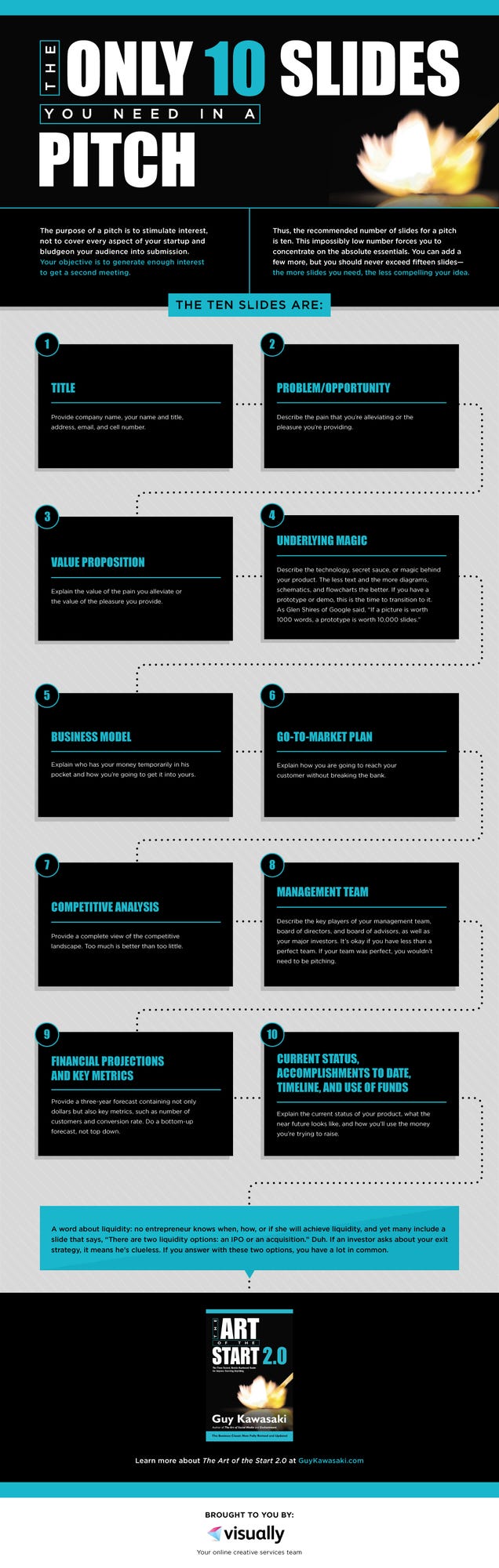
If you have a great idea for a new business and now you're looking for funding or other support, you'll probably have to break out the PowerPoint. There are only ten slides you should need for your pitch.
If you have a great idea for a new business and now you're looking for funding or other support, you'll probably have to break out the PowerPoint. There are only ten slides you should need for your pitch.

Every airline flying out of every airport is a little different, and certain routes tend to have more delays than others. Knowing about those types of delays ahead of time can help you plan a flight or avoid slow airports for connecting flights. FiveThirtyEight crunched all the numbers and came up with an interactive chart.

Maxim Zmeyev/Reuters
Ukrainians suffering as a result of Russia’s ongoing invasion of their country might want to blame Georgia. The small, former Soviet nation in the Caucasus bears no direct responsibility for Russia’s attack on Ukraine, but in many ways Georgia’s own war with Russia in 2008 helped make it possible.
In less than a week that August, Russian forces, along with their South Ossetian and Abkhaz allies, appeared to have routed the Georgian military—driving it, along with many ethnic Georgians, from the contested Georgian territory of South Ossetia and pushing deep into the rest of the country. A couple of weeks later, Russia effectively annexed both South Ossetia and Abkhazia (the territories have officially declared their independence).
For much of the outside world, the war was a shocking demonstration of Russia’s new post-Soviet aggressiveness and willingness to use military force beyond its borders. For Moscow, the war was traumatic for other reasons. Russia achieved its objectives, but at a higher cost than it had anticipated.
More than 60 Russian service personnel died in the campaign and its immediate aftermath. Moscow also lost six aircraft, according to an essay by analyst Anton Lavrov published by the Moscow-based Centre for Analysis of Strategies and Technologies. Of these, Lavrov says, at least three were shot down by “friendly fire,” starkly revealing the poor command and control logistics of Russia and its allies. Other exposed weaknesses included vulnerable armour and trucks, the slow movement of troops and poor communications. “They won that war. They didn’t like how they won it,” says Olga Oliker, director of the Center for Russia and Eurasia at the Rand Corporation.
As a result, Russia accelerated a massive process of military reform. “It is the first time in Russian military history that authorities learned lessons not from failure, but from victory,” says Alexander Golts, a Russian journalist and the author of two books on Russia’s military since the collapse of the Soviet Union. “It was a tremendous reform—a total rejection of the concept that ruled Russian forces for 100 years, and a rejection of the biggest part of Russian and Soviet military culture. Because all this culture is based on the idea that we will prevail over our adversaries with the number of troops.”
Gone was the lingering Cold War idea that Russia would break the back of NATO in massed tank warfare across Central Europe. Gone too was faith in the untold thousands of thousands of conscripts who could be called up to overwhelm opposing armies. “This is the way we won the war against Hitler,” Golts says. But Hitler had been dead for 60 years, the Berlin Wall had fallen, and no one in the Kremlin really thought NATO would send its tanks rolling through Eastern Europe anymore.
Russia’s new military doctrine called for a smaller, better-trained and nimbler force that could be deployed quickly and perform complex tasks. Achieving this was the job of then-defence minister Anatoliy Serdyukov, a former furniture salesman who, like so many current and former allies of President Vladimir Putin, once lived and worked in St. Petersburg. Aside from a brief spell in the army following university, Serdyukov was not a military man.
“He had no institutional axes to grind, precisely because he wasn’t an insider,” says Mark Galeotti, a Russian security specialist at New York University. “He could come in and do all the savage stuff that needed to be done.” Serdyukov drastically cut the army’s officer corps and reduced the overall size of the military from some 1.2 million to about 800,000.

Any opposition to Serdyukov from Russia’s military brass was at least softened by Putin’s political support, and by the hundreds of millions of dollars Putin poured into the military. There was money for equipment, flying hours, bases and salaries. According to Keir Giles, an associate fellow at the Chatham House think tank in London, living conditions, pay levels and, as a result, the basic morale of soldiers, were “absolutely transformed.”
The real test of a military, however, is war. Russia would get one six years after the Georgia conflict.
The transformation of Russia’s military was not complete by the time “little green men” without insignia on their uniforms showed up in the Ukrainian region of Crimea last year, following street demonstrations that forced out the pro-Russian president, Viktor Yanukovych. But it was well under way. Today, it is a different Russian army—even one whose presence is officially denied by Moscow—that Ukrainian troops battle in the east of their country, where a Russian-backed insurrection threatens to split Ukraine in two. “Whenever we’ve seen serious deployment of Russian forces in Ukraine against Ukrainian regulars, to be perfectly honest the Russians have just chewed through them,” says Galeotti.
Ukrainians are witnessing the ongoing repercussions of Russia’s 2008 war in Georgia. It’s a Russian army with new capabilities. It’s also one more in tune with the sorts of wars the Kremlin believes Russia will be fighting in the future.
Russia still sees NATO as a primary threat. But it is one they realize they can’t beat in symmetrical warfare because of the combined strength of the alliance’s members, led by America, says Paul Schwartz, a senior associate at the Center for Strategic and International Studies. In the unlikely case of a direct and full-scale confrontation, Russia will rely on its nuclear deterrent.
What Russia most fears from NATO is interference in countries it considers to be within its sphere of influence, and in Russia itself. “The threat that the West presents to Russia is democracy,” says Stephen Blank, a senior fellow for Russia at the American Foreign Policy Council. “To them, the biggest threat is the sponsorship of democracy promotion or ‘colour’ revolutions.”
Russia also recognizes threats posed by potential upheaval along its southern frontiers, especially in the Caucasus, where the wars in Chechnya were long and costly. There is another threat, from China, that Russia rarely acknowledges publicly, but for which it also relies on a nuclear deterrent.
But to deal with insurrections or popular protest movements in its near abroad, Russia believes it requires well-trained, fast-moving troops. This is the military that Moscow is building. According to Golts, Russia’s greatest military accomplishment in recent years wasn’t the seizure of Crimea, which involved small numbers of elite troops, but the rapid deployment of regular forces to Russia’s border with Ukraine last March.
“When you can deploy 50,000 men in two days, it’s tremendous for the Russian armed forces,” he says, comparing that deployment to Russia’s slow response to a 1999 invasion of the Russian republic of Dagestan by Chechen militants. But there is another side to Russia’s reforms, says Golts. Moscow’s new army was designed to win quickly and go home. “If you deploy them for a year, you see these forces are exhausted.” Russia’s intervention in eastern Ukraine, which shows little sign of ending, is putting strain on Russia’s military, he says.
The reforms have also been expensive. With Russia’s economy hit by a combination of Western economic sanctions and dropping oil prices, it has less money to pay for them. “Putin’s plans were very much predicated on the situation in his first two [terms], when everything was going his way,” says Galeotti, referring to the years between 2000-08. “The West was distracted post-9/11; the economy was booming because of oil and gas prices; the elites were bought off; and he still had lots of money left over to buy shiny new toys for his military. He didn’t have to make any hard decisions. Now, in his third term, when arguably he’s become much more nationalist and even xenophobic, this is when he needs to make hard choices.”
Unfortunately for Russia’s neighbours, Putin is unlikely to choose to scale back his ambitions abroad. An aggressive foreign policy has helped him politically, and it is something he personally believes in. Putin laments Russia’s lost clout and prestige and is trying to rebuild it.
Countries geographically close to Russia that are not part of NATO, such as Ukraine, Georgia and Moldova, are most at risk. Although NATO counties such as Canada are not obligated by treaty to help them, Galeotti believes it is in the interests of Western nations to do so. “Putin despises the current international order. He regards it as a Western system build to protect Western interests. Unless we’re willing to go back to a period of primal geopolitical anarchy, we need to be in a condition to provide some sort of teeth—maybe through sanctions.”
NATO member states are less likely to be the targets of overt, or thinly veiled, invasions. But they still may be vulnerable to elements of “hybrid warfare” involving economic and diplomatic pressure, disinformation and cyberattacks. NATO member states with large ethnic Russian minorities, such as Estonia and Latvia, are especially concerned.
Here, according to Galeotti, the best defence against potential Russian interference may not be military. He describes a visit to Estonia in which a defence official insisted his country needed more tanks to defend against Russia. Galeotti countered that what Estonia most needed were more intelligence officers, police and social workers to help integrate the country’s Russian minority. “We need to ensure that we have forces that meet the real threat, rather than the ones that generals enjoy countering.”
It’s an approach Oliker describes as reducing vulnerabilities. Ukraine was exposed to Russian subversion, she says, in part because it had been so badly and corruptly governed for 20 years. Helping countries of the former Soviet Union grow their economies, diversify their energy sources and integrate their Russian populations makes them harder targets.
Putin, meanwhile, will continue to dump Russia’s money into its armed forces. He missed an opportunity to invest in the country’s infrastructure and diversify its economy when high energy prices meant he could, says Galeotti. Now it may be too late. Putin has doubled down on making Russia strong militarily, which may end up corroding his own political power.
Putin is in a bind. If he reverses course, he will anger Russia’s many nationalists, whom he himself has emboldened. Continuing means draining money away from other public services, and that, too, has a political cost. “Let Putin burn through his money. There is a way that Putin is spending his way into an early political grave,” says Galeotti.
Maybe. But he’s not there yet. He’s wildly popular in Russia in no small part because of Russia’s military adventures abroad. And now he has the sort of army he needs to undertake more of them.
The post Putting Putin’s army to the test appeared first on Macleans.ca.
The jilted former partner of fledgling airline Canada Jetlines Ltd. is asking a court to foreclose on the company’s assets.
Jetlines, which plans to begin offering no-frills regional flights out of Vancouver this summer, recently walked away from a reverse takeover deal with Inovent Capital Inc., a capital pool company. That agreement included a proposed $50-million initial public offering on the TSX Venture Exchange.
Since then, Inovent has been threatening legal action against Jetlines, saying it had no right to terminate the agreement. Jetlines maintains that it did nothing wrong.
On Thursday, Inovent announced that it has filed a petition in the Supreme Court of British Columbia seeking repayment of $120,000 it says it loaned Jetlines.
“Our board is disappointed that Jetlines continues to disregard its contractual obligations to Inovent,” Inovent CEO David Brett said in a statement. “We remain committed to vigorously protecting the rights of our shareholders.”
“As a matter of interest, we did offer to settle with Inovent and made a generous offer to settle. Inovent came back with a very large demand,
which we did not accept,” Dave Solloway, president of Jetlines, said in an email.
LONDON — Oil prices might have stabilized only temporarily because the global oil glut is worsening and U.S. production shows no sign of slowing, the International Energy Agency said on Friday.
The West’s energy watchdog said the United States may soon run out of spare capacity to store crude, which would put additional downward pressure on prices.
That process would last at least until the second half of 2015, when growth in U.S. oil production is expected to start abating.

Combined with an increase in global demand, the expected U.S. production slowdown would give some support to oil prices and respite to oil producers’ group OPEC, the IEA said.
“On the face of it, the oil price appears to be stabilizing. What a precarious balance it is, however,” the Paris-based IEA said in its monthly report.
“Behind the façade of stability, the rebalancing triggered by the price collapse has yet to run its course, and it might be overly optimistic to expect it to proceed smoothly.”
The IEA said steep drops in the U.S. rig count have been a key driver of the recent price rebound, which saw Brent crude rising to US$60 per barrel after falling as low as US$46 in January from last year’s peaks of US$115.

“Yet U.S. supply so far shows precious little sign of slowing down. Quite to the contrary, it continues to defy expectations,” the IEA said.
In February, non-OPEC production is estimated to have risen by about 270,000 barrels per day (bpd) on a month-on-month basis to 57.3 million bpd, led by higher output in North America.
Global supply rose by 1.3 million bpd year-on-year to an estimated 94 million bpd in February, led by a 1.4-million-bpd gain for non-OPEC producers.
U.S. crude inventories soared due to output growth and plunging crude refinery throughput, with seasonal and unplanned refinery outages, weak margins and high gasoline stock builds.
At last count, U.S. crude stocks stood at a record 468 million barrels, the IEA said.
“U.S. stocks may soon test storage capacity limits. That would inevitably lead to renewed price weakness, which in turn could trigger the supply cuts that have so far remained elusive,” the IEA said.
“While the U.S. supply response to lower prices might take longer to kick in than expected, it might also prove more abrupt,” it said, adding that growth would abate in the second half of 2015.
The IEA’s conclusions will disappoint OPEC, which kept its output steady at the group’s last meeting in November to protect market share and stifle U.S. oil output growth.
In the second quarter of 2015, when demand is at its weakest due to global refinery maintenance, the need for OPEC crude will be 28.5 million bpd, the IEA said – compared to the group’s current output of 30.22 million bpd in February.
![FP0314_OilSupplyDemand_C_MF[1]](http://wpmedia.business.financialpost.com/2015/03/fp0314_oilsupplydemand_c_mf1.png?w=620&h=500)
TENTATIVE SIGNS OF RECOVERY
The IEA raised its demand forecast for the second half of 2015, which in turn led to a higher call on OPEC crude of 30.3 million bpd in the same period – closer to the group’s real production levels and the official target of 30 million bpd.
Having bottomed in the second quarter of 2014, global oil demand growth has since steadily risen, with year-on-year gains estimated at 1.0 million bpd for the first quarter of 2015, the IEA said.
The forecast of demand growth for 2015 as a whole has been raised by 75,000 bpd to 1.0 million bpd versus the last report and versus the 680,000 bpd growth seen in 2014, bringing global demand this year to an average of 93.5 million bpd.
“Tentative signs of a demand recovery have emerged with the turn of the year, with a heavy emphasis reserved for the word ‘tentative’,” the IEA said.
In other bullish factors — beyond political instability in certain producing countries such as Iraq and Libya — refined product markets have proved unexpectedly strong, the IEA said.
“Not only have product prices lagged those of crude during the selloff – as is common in a downturn – but they have raced ahead of them in the rebound, keeping refining margins remarkably firm, and supporting unexpectedly strong throughputs in once-depressed refining centers such as Europe and OECD Asia,” the IEA said.
“Product demand has shown signs of life, with even European demand emerging from a secular decline to show strong growth of 3.2% in December and 0.9% in January.”
© Thomson Reuters 2015

(Mladen Antonov/AFP/Getty)
Late last year, McDonald’s opened an aggressively hip café in Sydney, Australia. Called The Corner, it has a decor of white subway tile and natural wood, a menu filled with quinoa salads and balsamic-strawberry sodas, and a vague mission to serve as a “learning lab” for the company. But the presence of chipotle pulled pork betrays the café’s real purpose: McD’s aims to be more like a certain surging burrito-shilling rival.
There’s no denying McDonald’s has to do something bold. Last year its revenues fell 7% and profits dropped 21% worldwide, prompting the departure of CEO Don Thompson in January. As McDonald’s stumbles, Chipotle is hitting its stride. Last year, the Mexican chain boosted revenues by 26.7% while profits rose by 52.3%. Its promise of hormone-free meat and locally grown produce is the epitome of the “fast-casual” trend. By using higher quality ingredients, places like Panera Bread, Five Guys and Shake Shack produce food that still comes quickly but somehow feels virtuous. Total sales for fast-casual restaurants grew by 10.5% last year in the United States, compared with 6.1% for traditional fast food, according to Mintel, a market research firm.
McDonald’s now strains to join this trend. New CEO Steve Easterbrook’s first big announcement was a move to using only hormone- and antibiotic-free chicken in its U.S. restaurants. The increasingly baffling menu now boasts 32 different sandwiches. Add the opportunity for customization—last year the chain experimented with allowing diners to add 22 different toppings, including guacamole and chili-lime tortilla strips, to their burgers—and wait times have pushed past seven minutes. It looks more like a mid-life crisis than a business strategy.
The problem is, McDonald’s and Chipotle aren’t really fighting—in fact, they’re standing on different battlefields. The average fast-food meal in the United States costs $5; a fast-casual meal is at least nine. That $4 spread is big enough to make them completely different market segments. So the immediate concern for McDonald’s should be defending against fast-food rivals like Wendy’s, Burger King and Taco Bell, all of which have seen significant growth in the past few years.
While industry experts swoon over Chipotle, Taco Bell thrives by offering cheap food that’s decidedly down-market in both concept and execution. (It sells a million Doritos Locos tacos—their shells made of the popular corn chip—each day.) The chain knows what its role in the fast-food ecosystem is, and it executes relentlessly within those greasy parameters.
The solution for McDonald’s isn’t to become more like Chipotle. It needs to be more like BlackBerry. The smartphone maker nearly imploded fighting Apple for the consumer market. Only by focusing on the security and business-friendly features that built the company has CEO John Chen given it a chance at survival. Or look at Lego, which nearly went bankrupt trying to build high-tech toys; it refocused on its basic blocks and is now the world’s largest toy maker by revenue.
While McDonald’s chases fads and competitors, the core of its business remains remarkably simple. A handful of items—Big Macs, fries, soft drinks—drive the bulk of its sales. Consumers come not because they want a fancy burger, but because they want a fast one. If McDonald’s is going to recover, it needs to stop asking, “How can we woo new customers?” and instead ask, “What made people love us in the first place?” And then, it needs to stop doing everything else.
MORE ABOUT FAST FOOD:
The post What McDonald’s could learn from BlackBerry appeared first on Canadian Business.
IBM is pioneering what it calls “cognitive cooking,” in which its supercomputer Watson (of Jeopardy! fame) uses artificial intelligence to come up with new and novel recipes. Recently IBM decided to take on a classic Canadian staple: poutine. Here’s how a computer that’s never tasted anything comes up with new flavour combinations.

MORE PRODUCT BACKSTORIES IN WHITEBOARD:
The post How IBM’s Watson supercomputer invents new poutine recipes appeared first on Canadian Business.

The ka-ching of cash registers is music to retailers’ ears. In building a retail empire, however, there’s a lot more involved than simply ringing up sales – inventory management, customer relationships, the ability to accept various payment types, and a whole bevy of others.
Thanks to the cloud computing technology for retail businesses and point-of-sale (POS) software, managing a store or outlet, or even hundreds of them, online or brick-and-mortar, has become a lot easier.
Aside from tallying your sales for the day, POS software can perform a myriad of functions, not the least of which are inventory and staff management. And then, there are real-time summary and detailed reports that let you visualize the overall health of your business, allowing you to make informed decisions in the process.
In no particular order, here are 5 amazing POS software store owners in need of ecommerce solutions must check out:
1. Revel
Made specifically for the iPad, Revel Systems is a cloud-based full-featured POS software designed for a whole host of businesses including bookstores, museums, pawnshops, sporting goods stores, florists, bars, restaurants, grocery stores, food trucks, and stadiums.
Revel Systems comes with features such as:
Revel Systems has multiple software version packages to choose from depending on the number of terminals and features your business requires. Their sales department can be contacted for pricing.
2. Lightspeed Retail
A solution that’s platform-agnostic, Lightspeed is definitely not just a cash register. Among other things, it helps users manage their inventory through millions of pre-loaded items, bulk inventory management, item sort and search, tracking of serialized items, printing of labels, creation of multiple item variants, and combining items together.
Lightspeed POS also offers the following features:
Lightspeed has three pricing plans: Small at $76 per month for one user, Medium at $128 per month for two users, and Large at $222 per month for four users. Additional users can be added to Large plans at $51 per month.
3. Shopify
A complete ecommerce solution, Shopify users enjoy the following features and functionalities:
Other notable features include:
Shopify offers a risk-free 14-day free trial. Paid plans start at $9 per month for Basic, $59 per month for Professional, and a monthly $159 for Unlimited. A retail package add-on is another $40 a month, and the online store add-on is an additional $20 per month.
4. Bindo POS
An iPad POS that works with various retailers such as wine and liquor stores, pet stores, convenience stores, pharmacies and health stores, clothing stores, gift stores, sports and outdoor stores, lifestyle and furniture outlets, salons and spas, delis and candy stores, and smoke and vape stores, Bindo offers its users the following features:
Bindo offers a 14-day free trial.
5. Vend POS
Built with a modern, user-friendly, and highly customizable interface that works on Macs, PCs and iPads, Vend POS offers six ways to manage and grow your retail business:
Vend has three subscription plans. At a monthly $59 is Medium, the plan for new retailers with a small catalog of products. It supports a single outlet and 500 active products. Large is at $85 per month, if billed annually, and supports a single outlet and unlimited products. It’s best suited for growing retail businesses.
Extra Large, which is priced at $169 per month, if billed annually, supports multiple outlets and unlimited products and is ideal for retailers with multiple outlets or stores.
A retail business is built on three pillars – sales, customers, and inventory. POS software allows you to accurately keep track of each of these pillars to confidently grow your business.
I went from a non-believer to a believer.
I love Apple. There, I said it. It's not a tough thing to put out there, as the company edges closer to becoming the first ever trillion-dollar organization. The customers are there. The interest is there. You can have you own feelings and philosophies about the brand, but go into any modern shopping mall, and the two stores with the most energy, excitement and activity are - without question - the Apple and LEGO stores. With that size comes the detractors. As a personal anecdote, I've had computers in my life since the first personal computers were brought into the home. I went from Radio Shack to Atari 800 to the earliest version of IBM clones. My nerd cred in this space is documented. I still have the invoices from the first modems that were ever introduced (you would suction cup those old rotary phone handsets to the top). I only converted to the cult of Mac a few years ago. I did it, to better understand the landscape, and I also wanted to understand what it was like for a newbie to be dropped into this world. Within a couple of hours, I could not look back. The PC and the BlackBerry just felt antiquated to the way in which the MacBook and iPhone worked. To this day, I still marvel whenever I pull out my iPhone. Sure, it's easy to get frustrated over technology, but imagine the power that you have in the palms of your hand. This is Star Trek stuff, people!
Planet of the phones.
The Economist magazine's cover story is called, Planet of the phones (February 28th - March 6th). The stats presented were startling. "They have become the fastest-selling gadgets in history, outstripping the growth of the simple mobile phones that preceded them. They outsell personal computers four to one. Today about half the adult population owns a smartphone; by 2020, 80% will. Smartphones have also penetrated every aspect of daily life. The average American is buried in one for over two hours every day. Asked which media they would miss most, British teenagers pick mobile devices over TV sets, PCs and games consoles. Nearly 80% of smartphone-owners check messages, news or other services within 15 minutes of getting up. About 10% admit to having used the gadget during sex." We live in this fascinating duality where technology is a must-have part of everything that we do, and - in the same breath - it is still a luxury, that is getting more and more expensive (did you see the pricing for the new Apple Watch?). It's startling to see how quickly we have adapted to this immense amount of power. With that, all technology gets smaller. So, while the excitement over the watch can't be denied, I was very eager to better understand what this new MacBook was all about. Again, the discourse online about it is polarizing. For some, it's sleek, fast and beautiful. For others, it feels like a very expensive netbook that lacks a lot functionality and ports.
You're going to love this.
It's very rare that I share videos like this, but in reading and reviewing all of the online discourse about Apple this week - and the future of technology - this one made me laugh. Hard. With tears. Deep deep belly laughing. It's on the verge of going viral, but when I first saw it today it was only at about 30,000 views.
Apple Engineer Talks About The New 2015 Macbook...
Tags: apple apple watch atari atari 800 blackberry brand computer cult of mac gadget ibm ibm clones iphone lego luxury goods macbook macbook air magazine media mobile device mobile phone modem netbook pc personal computer planet of the phones radio shack retail shopping shopping mall smartphone star trek technology the economist tv video game

Even the most loyal Amazon shopper has moments when waiting two days for Prime delivery is just not feasible. Maybe your Wi-Fi router died and you need a replacement now, or you need a specific tool for an urgent project. Whatever the case, there are brick & mortar retailers who will happily price match Amazon, any time.
Sales leaders, future sales leaders and those that would like to become a sales leader in the future will all benefit from registering for this free event and attending on Tuesday, March 31st at 11:00 am Eastern.
By registering, you will receive the live broadcast link, the replay link for future review, plus eBooks and supporting information from each of the presenters.
Attendee feedback was extremely positive after the first event. We reviewed all the input and have added even more value going forward.
Watch the video above to it’s conclusion and you will be automatically taken to the registration page. I am looking forward to seeing your name on the registrant list for this one.
If you want to go directly to the registration page, CLICK HERE
We are able to offer this event for Free due to the generous support of our event sponsor

If you would like to watch the first broadcast in this series, click here for the YouTube version.
Original article: What Sales Leaders Should Have On Their Calendar
©2015 Fill the Funnel. All Rights Reserved.
The post What Sales Leaders Should Have On Their Calendar appeared first on Fill the Funnel.
Added value is an important tactic that can be used by small businesses to acquire and retain customers, increase brand awareness, and differentiate one’s place in the marketplace. Don’t know where to start? Here are five ways to create added value that can be easily implemented into your business plan today:
1. Always consider your customers’ perspective
The art of creating added value starts with the ability to see your business through the eyes of your customers.
Consider what’s important to your target market and how your product or service will benefit them. What problem does it solve, how will it help them overcome obstacles or do their jobs better? Many businesses miss the boat by focusing on features instead of benefits. By shifting your focus to providing content that focuses on your customers’ needs you can start helping and stop selling.
Creating customer personas is helpful to provide insights about your current and future customers, what’s meaningful to them, and gives you a roadmap of the kind of content you can create and share to provide added value.
2. Consistently work to improve customer satisfaction
Although the debate over whether the customer is always right (or not!) continues, lack of customer satisfaction is a sure-fire way to keep people from coming back.
Soliciting honest feedback through surveys on a regular basis allows you to keep your finger on the pulse of your customers’ needs in their journey with your business and is also an opportunity to monitor your brand’s identity in the marketplace.
Free survey tools like Survey Monkey, KwikSurveys and SurveyPlanet offer easy-to-use templates and unlimited responses to ensure you can collect feedback and create an action plan based on the results.
3. Implement marketing models into your strategy
As you’re searching for ways to create added value, the use of popular marketing models can help your strategy take shape.
For small and medium businesses, the Four Cs model, Brand Essence Wheel, and SWOT Analysis tool will help you develop your brand’s value statement, define your unique selling point, and even forecast customer demands based on market trends.
4. Develop a memorable customer experience
Businesses with unforgettable customer experiences are more likely to benefit from word-of-mouth referrals, positive online reviews, and higher retention rates.
When getting started, you’ll need to consider all touch points of your business, from initial lead capture to post-purchase communication and how to properly maximize the added value for the customer throughout the process.
Building a customer experience also allows you to develop relationships with your customers so you can connect on levels that go past simply getting the sale.
Most importantly, memorable customer experience models aim to deliver unexpected intangible value that cannot be packaged or sold. This includes personalized service, attention to detail, and showing a sense of urgency to address concerns as they arise.
5. Never underestimate the value of free resources
Whether it’s a free guide, a printable PDF, or a company branded calendar, free resources are a great way to create added value and showcase your brand’s ability to offer ‘a little something extra’ to customers.
Free resources can also serve as useful tools to help grow a small business’s brand awareness and expose your target market to various products and services.
For brick and mortar stores, consider promotional materials featuring your company’s logo that can be given out in-store. Businesses with an online presence can use a customized sign up form to encourage visitors to sign up to hear more about special offers and promotions.
Remember, although you may be offering something for free, it still needs to have relevance to your market and should always be consistent with your brand’s overall purpose.
These five tips will help you think about a few ways you can add value now and in the future for your prospects and customers. What other methods do you use to add value for your customers? Let us know in a comment below.

We live in the era of e-commerce, with B2C e-commerce sales on pace to reach $1.7 trillion in 2015. It’s never been easier for businesses to reach consumers and many consumers now demand an online shopping experience.
 As a result, the traditional organization of many industries is changing. Businesses that once operated purely on a B2B or catalogue basis are now trying their hand at selling directly to consumers. Many have found success with this strategy, increasing their margins and giving their brands greater visibility. But others have stumbled, unaware of the unique challenges presented by digital commerce.
Here are some of the common mistakes businesses make in transitioning from B2B to B2C:
Many businesses find that the transition to B2C requires a major website migration. Either they need to create an all-new e-commerce site or they need to consolidate many disparate sites onto one domain under a single brand umbrella. Even in situations where a migration is well advised, it’s still possible to bungle the execution – and many businesses do.
Those that fail to properly redirect all the pages on their old sites to their counterparts on the new site can suffer calamitous drops in organic traffic. That’s because all of the SEO value that those old pages accrued isn’t getting passed on to the new pages and as a result they aren’t showing up in Google as high as the old ones used to. Before embarking on any site migration, make sure your in-house team has a grip on the 301 redirects needed to pull it off, or hire an expert who can help.
Many B2B sites are unfamiliar with all the nuances of conversion optimization. They’re used to providing information for web-savvy retailers and aren’t used to designing a site that pushes visitors toward a conversion. Too many businesses launch a new e-commerce sites that don’t convert traffic because they aren’t aligned with best practices.
B2B marketing tactics can differ significantly from effective B2C tactics. Often B2C marketing involves completely different channels. These differences catch many B2B companies off guard when they try to make the change over to B2C. Companies need to take time to identify their new customers and develop a coherent customer acquisition strategy that speaks to them through the channels they already use. This strategy will have to be tested and refined once you figure out which channels work for you and which aren’t converting.
Once effective channels have been identified, they need to be monitored and optimized. Too many businesses that have no experience with online advertising simply turn on their campaigns and then forget about them. Not only does this mean that they aren’t reaching their full potential, but they are likely wasting massive amounts of money on keywords that aren’t relevant or people who aren’t interested.
The pitfalls detailed above are common mistakes companies fall into, but they aren’t inevitable. Here are some tips for making your transition from B2B to B2C a successful one.
If you don’t feel comfortable managing your transition to a B2C site by yourself, don’t hesitate to reach out to the experts. Acceleration Partners has helped dozens of businesses improve their e-commerce operations and convert from B2B or catalogue-based companies.
Learn more about our digital strategy services.
 As mobile continues to eat the world, the number of A/B tests running on mobile applications continues to grow. While A/B testing isn’t new, the vocabulary to talk about A/B testing mobile apps is new for many people. Succeeding in mobile A/B testing starts with the right vocabulary. Following in the footsteps of the 14 CRO Terms You Need to Know article, we have created one for a mobile lexicon. This alphabetized glossary of 42 terms and examples will help you communicate about mobile optimization.


Snapchat’s first-time user experience. Read more about designing a optimal first-time user experience.

Native vs Hybrid app. Source

Learn more about A/B testing in action by downloading the eBook, Create an App Users Love.
Lifetime Customer Value (LTV): LTV is a prediction of net profit attributed to the entire future relationship with a customer. (Read about why it’s important for apps.)


Visual representation of responsive design.

iOS view hierarchy
 You know what stinks? Being on the receiving end of “the thrill of the chase.” There is nothing worse than someone being interested in you until they finally catch you; then they tire of you and move on to the next shiny object. (Okay, to be fair, taxes are pretty awful, too.)
However, these feelings of “Am I not enough?” aren’t exclusively reserved for members of the Lonely Hearts Club; your clients don’t like being put on the backburner either when you’re off pursuing new opportunities.
As a business owner, you need to strike a balance between bringing in new clients while also retaining the business you already have. Because, let’s face it – a revolving door of clients is not a sound or sustainable growth plan for any organization. The key is to make client retention an equitable part of your marketing strategy and pay just as much (if not more!) attention to your exisitng clients as you do to your prospects.
Depending on your line of services or the product you are selling, the amount of interaction you have with a new customer beyond a closed deal or signed contract will vary. That said, no matter your business, delighting your clients should be a focus of your marketing.
But how do you do it?
There is no limit to the number of ways you can focus on client retention through your marketing efforts, but the most successful businesses know that sometimes the best strategy is to just ask. We live in a world of inboxes crowded with impersonal marketing emails and mailboxes bursting with bills, mailers, flyers and form letters.
Stand out from the crowd – pick up the phone or send a personal email and say, “Hey, how are things going? Is there anything we can be doing better?”


Every small business owner wants to grow sales as much as possible, as fast as possible. They work hard to try out various sales and marketing efforts. However, without immediate and measurable feedback, it is difficult to know what’s working and what’s not. Sales metrics tell you exactly how your efforts are performing, where to spend more and which areas to fix. Once you start monitoring sales metrics regularly, you can systematically improve them. Sales improve steadily and your competition gets left in the dust.
Here are the five key sales metrics you should track and improve regularly:
Sales Growth Over Time
It is important to track sales growth over time to get the overall direction in which your business is headed. You can start off by tracking weekly or monthly sales. Once you start tracking your sales numbers regularly, you can compare it with the previous period, be it previous week, month, quarter or year. It is helpful to set monthly sales targets and measure your performance against it. Monitoring sales growth over time can reveal trends such as seasonality, additional sales due to new product, impact of new pricing, etc. to your business. If your sales are growing, it is necessary to identify the cause so you can repeat it. If it doesn’t grow, you need to find the source and fix it. That brings us to the next metric.
Sales By Product Or Service
Tracking sales by product or service tells you what’s selling and what isn’t. Once identified, it is advisable to spend more time promoting what’s selling and less time on what’s not. Tracking them over time gives a good idea about product and market events, and helps you respond quickly. For example, a decline in sales of certain products might indicate the availability of an alternative. On the other hand, growth in sales may be due to exit of a competitor, and you may need to increase inventory to handle it.
Sales By Lead Source
Marketing is costly and time-consuming. So it is important to track the returns for each channel and spend more on lead generation sources that work. Tracking sales by lead source clearly tells you which lead generation sources are working. When you compare it with the associated marketing cost, you can easily identify the most effective methods for generating sales. This enables you to optimize your lead generation. Over time, as lead sources start slowing down, you can quickly identify and fix them.
Average Purchase Value
Average purchase value is the average revenue per sale. Tracking average purchase value helps you quantify the value of each lead and assign marketing efforts accordingly. It can be tracked for each lead source to help forecast sales, maintain inventory and budget marketing expenses. If you combine it with other metrics such as type of customer, type of product or service, etc. it can give you a clear idea of customer behavior.
New Vs Returning Customers
This metric tells you what percentage of your sales is coming from new customers vs returning customers? A growing business has a healthy mix of both. A steady supply of new customers indicates that your marketing efforts are showing results. It also compensates for some of the existing customers dropping off. A good number of old customers indicate that your product or service continues to remain valuable, and your new offerings are in line with what your customers want.
To begin with, you can create a simple sales dashboard to track these metrics, and share it with your team members. Viewing it daily/weekly will tell you how you are progressing towards your sales targets. You can keep adding more metrics to it as your business grows and you feel the need to track more and more information.
source:www.ubiq.co
Sales is a hustle and a large part of it is based on reaching out to prospects, trying out various marketing campaigns, etc. However, tracking these key sales metrics enables you to quickly see what’s working, so you can repeat it. It also helps you identify what’s not working, so you can fix it right away. This motivates you to grow sales faster, achieve your targets and leave the competition behind.
Image via Shutterstock
 Using Calls To Action Effectively
Have you ever wondered how I’ve built a loyal audience for myself and for my clients?
“People do not buy goods and services. They buy relations, stories and magic.” ~ Seth Godin
I think Seth Godin was the first person to coin the term Permission Marketing along with Inbound Marketing which basically is, according to Wikipedia, “Promoting a company through blogs, podcasts, video, eBooks, enewsletters, whitepapers, SEO, social media marketing, and other forms of content marketing which serve to attract customers.” Then came the term Influence Marketing with the massive growth of social media that provides an amazing networking outreach.
That’s my sweet spot – Coaching, implementing, and digging into influence and permission which is marketing as we now know it – yummy!
The story begins with understanding WHO is your target market, and WHAT keeps them awake at night? If you know those two things and can help them with a solution, then the next step is positioning yourself and your products as the solution. Getting your target market right (branding) and what you have to offer them comes before logos, web development and social media marketing. As a part of that grouping, having a Call to Action that speaks to your audience it critical.
You can have loyal fans and followers, but if there’s one thing I’ve learned that is of enormous value since working online, it’s about getting your CTA (Call to Action) right.
If you miss something, could be color, design, placement, wording, or the text/influence that surrounds this – it will be ignored. The words and design of your CTA should match your content.
It’s also about how you use influence in your marketing all day, every day and how you can start working and thinking like the experts – so using the mindset always thinking about what your audience is asking WIIFM (what’s in it for me) not as you, wanting to sell your product and services. This may seem a small point, but it is huge and often missed.
Website owners must also understand the psychology of website browsers – most of the time they are in a trance and do not ‘see’ your website the way you do. It’s your job to guide them effectively to take action.
A call to action is literally what it appears to be – an instruction calling for you to take a specific action. It’s purpose is to ensure your visitor move to a next step – preferably without ‘thinking’ too much about it.
The call to action is asking you to do something and is usually part of a ‘conversation’ you are having with your visitor. Done right:
1 – They will become engaged with your content.
2 – You will then instruct them what to do next – this will usually involve telling them what they gain after they take this step.
The goal of your Call to Action is to drive traffic to where YOU want your prospects to go. There is a pathway that leads from the ‘landing page’ where your visitors arrive to the conversion opportunities you place in their path. The more calls to action you place across your web pages, the more chances you have of conversion (meaning more leads).
So You Need To Ask Yourself…
What Is The Main Call-To-Action Of My Page Or Website?
How Can I Implement It?
Once you know what your main call to action is, then it comes down to colors, placement on your website, and how it will be implemented – by a web developer or yourself.

As your visitors take click on your CTA’s, you can begin to develop a way to optimize them to know which ones work and which ones need tweaking (or eliminating). Using Google Analytics to track the progress of your visitors as they land on your site you become a website spy and learn exactly what they did next.
The more you understand your prospects…the more you can optimize and improve.
Recently I found a tool that I had to purchase – It looked too good to be true at the price point. But it delivers ten-fold!
Leadpages, which I love and recommend, is in the hundreds of dollars range and this option is currently a fraction of that – $19 to be exact.
Click on the Banner to see all the different colors, styles, and options available:
I purchased the Developer package so if you like what you see, but want help, let me know.

Common practice for businesses that rely on lead generation calls for gating content behind forms in order to generate the leads. Its a simple exchange of quality content developed by the business in return for contact details. It is possible – though not very common – to generate leads systematically from open, unlocked content as well. Here we will describe the technique to do so.
Open Contnet Benefits
You probably came across some of those posts about this debate, such as this one from back in 2011, in which marketers describe their a/b experiments, two similar content items were presented to the same audience – one was subjected to the common practice of the fill-to-download form. The other was left open with a “voluntary” form or social sharing, filled only by those who chose to do so. Some of these experiments are more famous because the open content “won” – more people left eventually their contact information voluntarily. I personally like this thought quite a bit. But I do think that this is the exception, not the rule. There might be a third way: Dynamic Locking.
Introducing Dynamic Locking
In this method, this content is left open, without any form – neither before it nor voluntary. This means that visitors can find it easily through search engines an read it, as well as navigate to it on the site. The magic here is a dynamic form that appears only when a visitor wants to read this item from another page, through a call to action. The visitor is then redirected to said content, but just before reading it, a form pops up, requesting some information. There are different views as to what converts better – open or gated content. And adding quality of leads would probably further this debate. But key benefits of open content are not to be overlooked: SEO, shareability and getting inbound links to your site from content syndication.
Why you want to turn your prospects into leads (And Thin Slicing)
Indeed, gated content is invisible to Google and other search engines (there are, I swear :) ). So the incredible amount of effort that is being used to produce premium content serves only one cause: generating quality leads. A single serving content item usually leads to lower ROI. So in order to optimize ROI marketers take said content, slice it and dice it into blog posts, infographics and other open content items. While there are several advantages to keeping content open when practicing content marketing – there is a special value to content marketers for generating leads from content. The buyer journey is changing: prospects are better educated and connected than ever, and are delaying their decision while they perform their search anonymously. Getting to prospects early is key – because that search is much shorter than you think. A decision, in other words, is likely taken well before these prospects turn into leads and before you even know that they exist. This psychological effect is known as the “thin slicing effect”.
From Wikipedia: “Thin-slicing is a term used in psychology and philosophy to describe the ability to find patterns in events based only on “thin slices” or narrow windows, of experience.” For the very least, prospects frame their decision based on the first few vendors they can trust. A benchmark, in other words, is quickly created. Open content can help you appear at the very first stage of the search – the search bar – where gated content is unlikely to appear. However, if you don’t find the ways to know these prospects and turn them into known leads quickly, you may not be a finalist when they decide to purchase and you wouldn’t even know about it. Another key benefit of gating content is Intelligence. Its only when you know which audience downloads and engages which of your content items that you can start planning ahead.
Read more about open and gated content considerations in our white paper:

 The dollar is set for the strongest quarterly strengthening since 1992, according to Bank of America, which is a good sign that a rate hike is around the corner.
When markets expect that US interest rates will be hiked, it typically strengthens the dollar. That's because people rush to change other currencies into dollars — because they can make more money in dollar-denominated investments. The higher demand for the US currency drives its value up.
In the past, significant dollars gains have pretty much only happened during periods of pretty extreme financial or geopolitical distress.
In fact, the last four large dollar shocks in the past 45 years have been symptoms of huge financial events: the collapse of Lehman, Britain's panicky ejection from the European Exchange Rate Mechanism (ERM) in 1992, the first Gulf War, and Paul Volcker's shock rate hikes in the early 1980s.
Today's surge is already considerably larger than the one that surrounded Lehman's collapse, although the economic conditions are completely different.
Here's how it looks in historical context:

Here's a snippet from BAML's researchers:
In our view, another concern is that the move in the US dollar reflects a dislocation within the financial system. Capital flight to the US is a symptom of systemic risk in financial markets. Certainly dollar shocks in the past have been associated with major market events as shown in detail on Chart 8 (1981 Volker shock, 1992 ERM crisis, Lehman in 2008 and so on).
And yet despite the strength of the dollar move, apart from a few CDS events in EM, there is little sign from the components of our Global Financial Stress Index that systemic risks are surging. Most of the components are less stressed than normal.
Once again, the missing ingredient is a “rates shock”.
The conditions in global markets right now are a historical anomaly. Rates around the world have been cut 558 times since the collapse of Lehman, according to BAML. So, even a small, steady series of interest rate hikes by the US Federal Reserve is a colossal change in the global financial system right now — one that's sending the dollar through the roof.
Join the conversation about this story »
NOW WATCH: Research Reveals Why Men Cheat, And It's Not What You Think
As Econsultancy lists its 16 essential success factors for ecommerce checkouts, we have been revamping ours at Spreadshirt.
2014 saw an upswing people using their mobile devices not only to browse, but also to buy.
The trend extended to phones too, as consumers became increasingly confident in buying from their phones rather than waiting to make the final purchase from a desktop or laptop.

Right now, there are millions of customers looking to speak to a business before buying a product. So they pick up the phone. But how can you get to those buyers? Pay per call advertising.
Pay per call is the bridge between online and offline advertising. Some examples include:
Customers may discover an advertiser through a TV commercial or mobile PPC ad. And with the rise of mobile, pay per call advertising is more important than ever.
Mobile users aren’t interested in filling out forms. They’d rather go straight to the source using a ‘click to call’ ad extensions. This is when you’re searching for something and see a ‘call now’ button for the first result. They let users call a business with one click, straight from the search results.
Another popular method uses abandoned phone numbers. Have you ever called a business to find the number was no longer in service? Abandoned phone numbers are everywhere, and a potential opportunity for advertisers.
An advertiser can attach their phone number to that call. The caller would be transferred from any kind of abandoned call to another business. The advertiser gets a warm lead, and the caller gets to talk to an actual business.
Pay per call methods can be valuable to your company’s success. Here’s why pay per call is worth the money:
The user searches for a term – say, “Plumber” – because they have an issue they’re looking to solve. Unless they’re really proactive, they already have a need for one. These users are past the awareness and interest stage and are an active prospect. They want someone on the phone, now, to come out, quote a price, and fix the problem.
To put it shortly: calls convert.
Think about the last time you were home sick from work and watching TV. Now, do you remember any commercials for a law firm or medical provider? The commercial may have asked “if you or a family member has ever been in an automobile accident.” People calling these businesses become direct and exclusive calls for the advertisers.
With pay per call companies can use a separate phone number for each campaign. This lets the advertiser track metrics and listen to call recordings.
Sometimes, tracking and reporting is provided through the pay per call provider. Some even offer the reporting in real-time. Since all data is stored in the back end, this eliminates the need for a bunch of different phone numbers to track.
From all this data, advertisers can closely analyze all calls. Inferences made from these stats help advertisers improve the campaigns.
With pay per call, advertisers only pay when the phone rings. And, in most cases, there’s a minimum call duration. For example, only paying for calls longer than one minute. This ensures that each call is a quality call and not a mistake. Call quality is generally higher the longer the minimum duration is.
Some services even allow for a buffer to help qualify the call. For example, a company may have an Interactive Voice Response (IVR) system. These direct callers to “click 1 for sales, 2 for support,” etc. If the campaign is set up to drive sales, someone clicking ‘2’ is likely a current customer, and thus, not a qualified lead.
Listening to call recordings is a great way to learn from your ads. They’ll tell advertisers two key things:
Listening to campaign recordings will help identify why some leads convert better than others. And they’ll provide insight to close more leads in the future.
Some people think pay per call is so expensive, it’s just easier to use pay per click. Sure, pay per call campaigns can be expensive, but they’re also effective when optimized.
Pricing varies on the call duration, category, industry, and advertiser competition. One of the most active verticals is “Rehab/Rehabilitation Facilities.” A rehabilitation facility may pay $100 per call. But campaign is very targeted and the caller is already far into the funnel.
It might take 15 calls before they close one deal, resulting in $16,000 in revenue. So, their pay per call ROI may look like this:
$100 per call x 15 leads = $1,500 investment
1 new customer = $16,000
Net: $14,500
While the cost per call might be higher than pay per click advertising, it’s guaranteed. Each lead’s an active prospect, so conversion rates are higher.
The same facility may also use pay per click advertising, paying $1.70 for each click. For every 100 clicks, they might generate one call. To generate the same 15 calls enjoyed with pay per call advertising, they must generate 1,500 clicks.
$1.70 per click x 100 clicks = $170.00
1 lead= $170.00
15 leads x $170.00 = $2,550.00 investment
1 new customer = $16,000
Net: $13,450.00
See? It’s actually cheaper in the long run.
When generating leads, pay per call may not always be able to stand alone. Using it to complement something like pay per click, however, can be just what your advertising needs. But adding it into your advertising mix will bring you high quality leads that are ready to close.
We are all desensitized to unremarkable content. We see it day in and day out. Unless it’s Kristen Bell having a sloth meltdown (or something equally as novel), we tend to ignore it. Passive, vanilla content has ruled the internet for years, mostly driven by link building and bad, unfocused SEO. Unremarkable content has historically enslaved the internet.
But the times, they are a changing. Web users and buyers now demand their expectations be exceeded. One such expectation is convenient, autonomous online shopping. According to Kapost, by 2020 most consumers will be managing their own purchases without interacting with another human. They are already researching products they want and entering the sales funnel much further down than before – all without the help of advertising – so this prediction isn’t all that far-fetched.
You have likely come across stats about content marketing budgets on the rise and the number of B2B and B2C marketers adopting content marketing steadily growing. But what we need to know, then, is how to reach the best audiences with this content and how to turn new audiences into leads and leads into sales. And the answer to that question – no matter your vertical or industry – is interactive content.
Interactive content is content that you don’t passively interact with; you don’t just read or watch it. It’s content with a call to action built in: watch, play, vote, take a picture, find, click, scroll, test, challenge, upload or complete. It’s active and less transient that a blog post, a photo, a video or an infographic. It’s like a happy punch in the face that leaves you wanting to buy the assaulting boxing gloves.
Interactive content has built in ROI for the user. There is a reward for the time the participant spends interacting with it – whether that comes in the form of an experience, relevant information or a discount. In return, you get to hand hold potential customers almost all the way through the buyer journey. This is one hell of a pay off, as this can help you harness user engagement to create new leads, actionable prospects and scale up existing content processes so that your content marketing department starts paying its way.
Before I go into the types of interactives to use, we should consider what emotions drive our purchasing decisions.
Of course you can’t deliver everything (health, self-confidence, improved appearance, great sex, comfort and leisure) but you could focus on one or two of them. Develop a quiz that asks the reader which “incredibly desirable” celebrities they are most like. Or develop a ‘Plan your love life’ flowchart that asks a range of questions and leads them to discover the perfect personality match in a partner.
Being embarrassed, injured or hurt, disappointed, lost, or forced to take unnecessary risks are not desirable feelings and emotions. Positioning your content as a way to avoid these feelings is a bit of a negative approach, but it’s ultimately for the readers’ benefit and could even serve their need for self-preservation. Examples of this type of content might include an infographic about “How to survive in the Amazon with only a pen, knife and a bell” or an interactive comic that allows the reader to make decisions and take risks on behalf of the character and see the outcome without having to get hurt themselves.
Sexy, youthful, compassionate, efficient, contemporary, an early adopter, an influencer, strong, intelligent, fashionable – these are all adjectives that consumers like to envision themselves as portraying. But how does a content piece make someone feel any of these things? That’s the challenge – allowing the user to come to the conclusion that they are [insert descriptor here] with a little help and persuasion from you. Help them see how popular they are on their social accounts with a social diagnostic tool that informs them, “You’ve said the word ‘ROFL’ 97568 times since opening your account” or “The term ‘cute’ was used to describe you 100 times last month on twitter – that’s more than any of your friends!”
So what types of interactive content could we be using to aid this buyer behavior and why might they work for us?
2011’s Take This Lollipop is definitely worth a mention. The purpose of the site is to try to stop kids from posting their personal information on Facebook, so this uses both the human ego and self-preservation to get people to act on the very important message.
This is an incredible interactive content piece that was created by Jason Zada (of Elf Yourself fame) and stared actor Bill Oberst as the Facebook stalker. It had a zero marketing budget and yet gained over 7 million views in a week and was featured in almost every web publication online as well as winning a string of awards.
Emotive triggers: fear, unnecessary risks
Does it trigger an action? Yes, because apart from all its awards and views, it also got many people discussing the importance of information security online (which was the reason for its creation). It certainly made me consider my security settings online.
MyFirstTweet is a nice app that mixes new media with nostalgia. It is instantly shareable and lets you see whether your first steps into Twitter were memorable or obnoxious. Unfortunately, Twitter has put a stop to this for the time being, but it was a good idea all the same and could be built upon for other app ideas.
Emotive triggers: nostalgia, self-importance, contemporary, identity
Does it trigger an action? Yes. It triggers an almost unconscious action to discover more about ourselves. Who were we back then, what was important to us and did we say something more profound or funny than our friends or peers.
Interactive infographics cover a range of styles, from maps and timelines to basic data visuals and parallax scrolling pieces. I chose Evolution of the Game Console because it’s a simple, yet effective, content piece that works well. This type of interactive content is a bit more product-specific and walks users down the buyer funnel to a purchase. Replace the consoles with modern appliances and put a twist on it (such as ‘best features’) and you’ve got yourself a potential sales pitch that is sharable and could easily lead to sales.

Emotive triggers: betterment, sex appeal, early adopter, being an influencer
Does it trigger an action? Yes. Curiosity drives us to explore this content. It asks us to scroll, so we scroll. It asks us to click a button, so we click. It is familiar to us, as it mimics the actions we have been taking on websites for the past ten years. It promises us exploration and we seize the opportunity.
I am passionate about stories and spend a fortune on Audible and downloadable interactive graphic novels on my iPad. Graphic novels take the user to another place and really get the emotions and adrenaline going.
This Peugeot ad impressed me with its emotive design, music and its sales message. It walks you through each function of the new car using the heroine to demonstrate the car’s sport mode, 4WD and Zev “silent” mode. This type of interactive is rarely used and I would love to see more out there used as cleverly as this.

Emotive triggers: excitement, sex appeal, fun
Does it trigger an action? The piece was covered by a whole host of blogs and publications and certainly captured people’s imaginations. The graphic novel takes users to another environment where the brand has control of what they see and in which order. From here, buyer signals could be captured, product information relayed and a relationship with the user built. Give them more stories, ask them to sign up for a giveaway or to be sent the next novel by email.
Flowcharts can work as a flat graphic or as HTML5. The great thing about a flowchart is that you are allowing the user to explore the content and find their way to the conclusion. Using the same premise as a quiz, flowcharts ask you a series of questions and your answers determine where you end up.

Emotive triggers: taste, individuality, youth, identity
Does it trigger an action? I chose the beer style flowchart, as I wanted an example that could potentially lead to sales. If this flowchart’s developers had included clickable conclusions with more info about the types of beer that readers are matched to and where to get them locally, the outcome could be very different.
Even Buzzfeed has been shocked by the attention their online quizzes get, but it isn’t really that surprising considering most people suffer from an identity crisis and are looking to compare themselves to others. Hook this opportunity up to a product and you have a massive sales tool. For this example, I turn to a hero of mine who helped ignite my passion for creative content online: The Oatmeal

Emotive triggers: fun, youth, early adopter, identity
Does it trigger an action? If you make people laugh and they return to your site time and time again, chances are they will eventually purchase something from you. You even build this into a sales funnel, if people look like they will drop out. We tried something similar with a power tool interactive that continued the fun even when the users click buy. It used humor to take the seriousness out of the situation and show them that we weren’t forcing them into something.

Interactives can – and will – be used to help drive sales. They accomplish this through a variation of different techniques using a whole range of emotive triggers to achieve it. Conversion rates from interactives hover around 40 percent because you give people real value with interactive content – whether it be kudos, a prize, targeted follow-on content or simply making them feel good for a few minutes.
A commonly held view among B2B firms is that their prospects make selections and purchasing decisions based solely on logic and reason, and are not influenced by emotion the way that B2C purchases are. However, recent research proves otherwise.

The Corporate Executive Board (CEB) partnered with Google to learn what leading marketing teams are doing differently to connect with their customers emotionally and show personal value. From Promotion to Emotion: Connecting B2B Customers to Brands studies 3,000 B2B buyers, marketers, academics, thought leaders and consultants across seven B2B industries and provides thought-provoking insights as to how B2B buyers react to emotional marketing compared to a more functional approach.
The following findings can help today’s B2B companies adapt their communications and brand strategies to speak to clients on a deeper, more personal level.
The study found that when B2B brands connect with buyers through an emotional approach, they achieve two times the impact than when selling business or functional value.
Connecting emotionally requires going deeper than understanding business goals and needs. Through open-ended questioning and observation of non-verbal cues, marketers can uncover the personal needs of an individual stakeholder. This is invaluable intelligence when it comes to crafting messages that speak to a particular buyer’s needs, pain points and frustrations.
Connection to your company’s brand is key in order to close a sale with potential B2B buyers. In fact, customers with strong connections to B2B brands have higher rates of consideration (79%), purchase (64%) and willingness to pay a premium (60%) than “low brand connection” competitors.
In a marketplace that is overflowing with marketing messages, customers will be more inclined to respond to yours if there is established rapport. To get their attention, marketers must “speak their language”—meaning that businesses should use words and phrases that are familiar to customers and to which customers will react to in an emotional way.
According to the study, “the B2B Unique Selling Proposition (USP) is dead and 86% of B2B buyers see ‘no real difference between suppliers,’” there is also a lot of competition in the marketplace. “Since most suppliers have two or three major competitors, each supplier receives just 12% to 16% of total customer mindshare.”
By using emotion as a tool to connect with potential and current buyers, B2B professionals can stand out from the sea of sameness.
When businesses use “features, functions and business outcomes” as a means of marketing their brand, they see a 21% increase in perceived brand benefits. However, “professional, social and emotional benefit” marketing leads to a 42% boost. So how do firms connect with buyers on an emotional level?
Helping customers see how your firm can help alleviate their current problems, needs or frustrations is a way to convey emotional benefits. This requires marketers to understand a buyer’s challenges, and then communicate through content and messaging that empathizes with those emotions and demonstrates how the purchase will remedy their current struggles.
“The heart hooks the mind” has always been our mantra at circle S studio, and this research confirms it’s appropriate. We believe it applies just as much to B2B audiences as to consumers. It’s the hurdle all of our work must overcome before it’s considered ready for client review. Whether written or visual, digital or traditional, global or local, everything we create must stir the audience’s emotions before we can engage the rational mind.

Smartphones are the new de facto computing devicez, so enabling employees to quickly complete key transactions from their devices can transform how effectively your business runs. Mobile apps need to be simple, fast and capable of delivering the right information. Studies show that the average employee uses a smartphone dozens of time a day for about a minute at a time. To complete a workflow in 60 seconds requires a simplification of the process.
However, most enterprise software vendors try to force-fit their business applications onto mobile devices, ignoring the reality that today’s mobile-first users simply won’t use apps that can’t perform to their level of expectations. Gartner has predicted that by 2017, 50 percent of today’s deployed mobile enterprise apps will be completely rewritten or replaced.
It’s critical that enterprises look for ways to rapidly develop apps that will meet users’ expectations around usability, mobility, and simplicity. To realize value and see return on investment quickly, companies should develop a strategy that focuses on:
Based on these criteria, here are seven types of business applications that organizations would benefit from mobilizing:
With mobile, companies have the ability to transform how they win and retain customers, as well as streamline and improve internal processes. Mobilizing the business applications above help lay a good foundation for increasing customer satisfaction and driving employee adoption.
Mayank Mehta is vice president of product at mobile development platform startup Capriza.

From the iconic Fuller Brush man lugging a suitcase of merchandise in the 1940s, to a slick young corporate raider trading stocks in a modern brokerage firm, Hollywood has romanticized the art of selling since films were first invented.
There’s something inherently gripping about the psychological chess game between buyer and seller that audiences respond to. So whether you prefer comedy or drama, you’re bound to enjoy a few movies on this list … and that’s a money-back guarantee.
Kurt Russell plays a hotshot used car hustler who dreams of running for state senate in Robert Zemeckis’s outrageous sales satire. Personifying every crooked cliché of the trade, Russell’s quick-talking charm and effortless charisma gives this hilariously raunchy comedy an energy that’s as effective today as it was 35 years ago. With little more than a high-wattage smile and a bucket of auto primer, Russell turns his character’s often-repeated motto “Trust me!” into a mantra that every good salesperson would do well to perfect.
This Emmy-winning adaptation of Arthur Miller’s landmark play premiered on CBS as a made-for-television movie. Brilliantly supported by John Malkovich and Stephen Lang, Dustin Hoffman’s deeply moving portrayal of the doomed Willy Loman brings Miller’s grim parable to tragic life. Using door-to-door sales as a metaphor for the failure of the American Dream, “Death of a Salesman” is a heartbreaking portrait of a man whose inability to change proves his undoing.
Three years before he taught the phrase carpe diem to the students in “Dead Poets Society,” Robin Williams gave a powerful performance in the ironically titled “Seize the Day.” Playing a middle-aged Jewish salesman struggling with poverty and divorce in the 1950s, Williams captured every nuance of Saul Bellow’s classic novel. Heartbreaking and emotionally raw, this bleak portrait of a man whose natural sales skills fail him at the worst possible moment was originally broadcast on PBS television.
Diane Keaton stars as J.C. Wiatt, a self-proclaimed “Tiger Lady” who’s so focused on work she barely has time to breathe. When she inherits a toddler from deceased relatives, this high-powered management consultant learns that raising a child requires more tenacity than negotiating a million-dollar contract. After losing her job and buying a ramshackle farm, the overstressed Wiatt discovers her true calling when she starts selling her own brand of organic baby food. A warm-hearted tale of entrepreneurial ingenuity, “Baby Boom” demonstrates that, in business and in life, a setback can be an opportunity in disguise.
Barry Levinson’s nostalgic dramedy about two rival aluminum-siding salesmen beautifully evokes the early ‘60s with flawless art direction and rich characterizations. Depicting the moment when Baltimore’s newly formed Home Improvement Commission cracked down on corrupt sales practices, “Tin Men” captures the end of an era with honesty and humor. In the film’s witty coda, our disgraced heroes drive off into an uncertain future, while a familiar set of golden arches being erected in the distance signals an important new business venture on the rise.
With blistering intensity and savage dialogue, David Mamet’s misanthropic masterpiece about a group of desperate salesmen in a Chicago real-estate office introduced a phrase that strikes fear in the heart of anyone who ever tried to finalize a deal: “Coffee is for closers.” Playing the manager in charge of doling out prospective sales leads, Kevin Spacey’s cold-blooded smarm has rarely been more effective. But it’s Al Pacino’s Oscar nominated portrayal of smooth-talking Ricky Roma that steals the show. Watching him manipulate a naïve client into buying acres of worthless property is both horrific and exhilarating. As Mamet’s cautionary tale makes painfully clear, sometimes you’ve got to sell your soul before making a sale.
Chris Farley’s physical humor and David Spade’s scathing sarcasm helped make this raunchy comedy about a lovable moron on a quest to save his family’s factory a surprise box office hit. But beneath the fat jokes and gross-out gags, “Tommy Boy” actually depicts the birth of a successful salesman. Tasked with generating enough new business to keep his company afloat, Farley gradually learns that connecting with customers depends on more than fancy slogans and firm handshakes; it’s about listening to their needs and responding with genuine humanity. Also, it helps if you don’t accidentally set their desks on fire while screaming “Holy Schnikes!”
Three years after his Oscar nomination for “Jackie Brown,” Robert Forster delivered one of his finest performances as Eddie Miller, a veteran traveling jewelry salesman whose recent heart attack forces an early retirement. Charged by his firm with training a younger replacement, an unlikely friendship develops between the cross-generational partners, culminating in their unexpected visit to a rundown massage parlor, where a second chance at love just might await our widowed hero. Part road movie, part character study, the little-seen “Diamond Men” is a gem waiting for rediscovery.
Loosely inspired by the real-life career of a notorious weapons dealer, “Lord of War” posits that selling AK-47s to African warlords isn’t that much different than selling orthopedic shoes to senior citizens. Ultimately, it’s all a matter of treating your customer with respect. Charting the rise and fall of a small-arms dealer who moves from distributing handguns in his New York City neighborhood to delivering guided-missiles to rogue nations, this darkly comic thriller stars Nicolas Cage in one of his most fascinating roles. Clinging to the idea that he’s merely supplying a demand, Cage’s weary merchant of death eventually confesses that he’s not in it for the money; it’s simply something he’s good at.
While “Death of a Salesman” uses the sales occupation as a symbol of futility, this inspirational drama presents it as a positive, life-changing profession. Will Smith earned an Academy Award nomination for his role as Chris Gardner, a fitfully employed salesman who finds himself and his five-year-old son homeless after a series of unlucky financial breaks. Landing an unpaid internship at a brokerage firm, the film tracks Gardner’s unwavering pursuit of a better life, despite constant setbacks and difficulties.
Based on the nonfiction memoir Hard Sell: The Evolution of a Viagra Salesman, this romantic drama stars Jake Gyllenhaal as an ambitious pharmaceutical rep whose slippery ethics and refusal to take no for an answer help him become Pfizer’s #1 drug pusher. Though marketed as a love story, it’s the film’s unique look at the competitive world of medical sales that makes it worth watching. Whether flirting his way past nurses or bribing doctors, Gyllenhaal’s puppy-dog charm causes us to root for him, despite the morally dubious practices of the industry he’s working for.
Fans of the TV show “Parks and Recreation” will enjoy this low-key laugher about insurance salesmen; but anyone who’s suffered through an interminable business convention will relate to it as well. Funnyman Ed Helms plays Tim Lippe, a naïve insurance man who’s so sheltered and innocent that he’s never spent the night in a hotel before. Sent by his company to an important convention in the “major metropolis” of Cedar Rapids, Iowa, Tim’s innate positivity has a transformative effect on the cynical salespeople he spends the weekend with. A modest yet engaging comedy about workplace camaraderie, “Cedar Rapids” is well worth visiting.
This Oscar-nominated film tells the true story of Billy Beane (Brad Pitt), the general manager of the downtrodden 2002 Oakland Athletics baseball team. With a tight budget and the help of recent Yale economics graduate Peter Brand (Jonah Hill), Beane pioneers the sabermetric approach to baseball recruiting. Throughout the film, Pitt's Beane must sell his scouting staff, management team, and own players on his unorthodox approach to building the team. It's a story of big bets, questioning the status quo, and turning meagre resources into big results -- something all salespeople have encountered at one time or another.
"Joy" is a film about legendary entrepreneur Joy Mangano. The film picks up with Joy, played by Jennifer Lawrence, as a divorced mother of two working as an airline booking clerk. Mangano gets her big break when QVC offers her self-wringing mops a spot on one of their telethons. Unfortunately, the spot flops due to a salesman's poor execution. Mangano fights for the chance to star in the infomercial herself and success soon follows. "Joy" is further proof that hard work, sacrifice, and an intimate understanding of your target audience are all part of selling your way to the top.
Ray Kroc is the 52-year-old milkshake machine salesman who built a fast food empire. "The Founder" tells the story of Kroc's partnership with Dick and Mac McDonald, and his subsequent franchise and takeover of their family burger business. Michael Keaton's Oscar-nominated portrayal of Kroc isn't always likable, but it's a display of the "whatever-it-takes" mindset that has skyrocketed more than one entrepreneur to success. It's also sure to leave you craving a cheeseburger.
The "boiler room" is where aggressive brokers sell to unsuspecting buyers over the phone and are rewarded with mansions, sports cars, and other luxury goods. The story centers around Giovanni Ribisi, who plays a college dropout who gets a job as a broker at a suburban investment firm. With his new career and lucrative income, he's back in his father's good graces. But when he discovers the firm isn't exactly legitimate, he's faced with the ultimate decision.
One of Tom Cruise's most famous roles, his turn as Jerry Maguire tells the story of a sports agent who has a moral epiphany -- and loses his job for sharing it. With his former secretary and one very difficult athlete (played by Cuba Gooding Jr., who won an Academy Award for his performance), he works to create a new life and a new management firm, while facing struggles most new business owners can relate to on one level or another.
Arguably a new generation's "Wall Street," this 2013 film staring Leonardo DiCaprio as Jordan Belfort tells the true story of Belfort's meteoric rise from an entry-level Wall Street broker to the fortune-hunting owner of his own firm. Drugs and illicit financial practices eventually lead to his downfall -- and jail time -- but viewers might still walk away from the film feeling Belfort's empire of excess was only his first act. Fair warning, the clip below is NSFW.
Joey O'Brien, played by Robin Williams, is in financial trouble and has two days to sell a dozen cars in order to pay back his debts. This task might sound difficult enough to most salespeople, but things get even hairier when the husband of the dealership's secretary takes the dealership hostage in an effort to find out why O'Brien has been having an affair with his wife.
Don Ready has the goods and he knows how to use them. Jeremy Piven plays the lead role, an extraordinary salesperson called to save a car dealership from bankruptcy over Fourth of July weekend. What follows is comedy gold as very little goes right and Ready realizes he'll have to get crafty to turn the weekend into a success.


By switching from a solely outbound focus on sales to a broader one based on sharing expertise, you can educate, attract, and create a client base of loyal fans. Buyers come to you instead of you hunting them down.

Marketing is at its best when campaigns, tactics and strategies are built on research.
Of course, in our industry, the word “research” covers a lot of ground. It could mean searching for gold standard campaigns and modeling your plan on a best-in-class brand’s success story. It could mean shaping your approach based on evidence-based reports or statistics. Or, it could be informing your campaign through your own primary research, via A/B testing.
For our purposes, A/B testing compares two versions of a Web page to see which one performs better. Basically, the process allows us to figure out which version brings in the most conversions.
Small changes can make a big difference in marketing. A few minor modifications to design, messaging or timing can lead to major gains in conversions. By using a measured and strategic approach to deploying these changes (and keeping track of what works) you won’t just make an impact on your current campaign – you’ll create a roadmap for success in future projects.
To help, here are the top four pieces of website real estate primed for A/B testing:
#1. The headline
Your headline is the first thing visitors see when they land on your page. When a visitor reads your landing page headline, it’s important they know what to do next. Don’t be afraid to spell it out for your users – they’ll appreciate your clarity and will pay you back with dividends.
Let us be more specific, readers require content that is clear and helps them acquire information quickly. If the content on the page provides the reader with the information they’re seeking, the reader is likely to follow the flow of the page – which is usually to your CTA – “download the whitepaper”, “try a free trial” or “speak to customer support.”
When Mozilla Firefox changed its call to action from “Try Firefox 3” to “Download Now – Free,” it outperformed the original by 3.6%, and had a confidence level of over 99%, resulting in 500 more downloads during Mozilla’s testing period.
#2. Your lead capture/generation form
A/B testing can help improve your form’s conversion rate. And, improving your conversion rate means more submissions from your visitors, equating to more leads and more sales.
Try testing one form layout and design against another, and then measure their effectiveness in getting submissions. Or see if a form with added value (like a contest entry form or a survey submission) outperforms your tried-and-true contact form. The 2015 Form Conversion Report found that contest forms convert at a whopping 35%, so odds are good you’ll see an impact.
#3. The call to action button
For most marketers, getting a visitor to click the CTA button is the end goal. With that in mind, spend some time testing which button delivers the most conversions. Change the color to an attention-grabbing hue, or add some minor animation. Or, try variations with specific, motivating text that communicates your unique value proposition and drives people to take action.
Having a hard time deciding what words to use in your button copy? Keep it short. Formstack’s top 10 converting buttons all contained two words or less. Specific is better, too: Adding just one word after the word “submit” can boost conversion rates by as much as 320%.

#4. Photos or videos
Human beings are hard-wired to be visual: 90% of the information that comes to the brain arrives via our optic nerve, and that visual data is processed 60,000 times faster than information our brain receives in text form. That makes Web images a powerful tool for marketers, when used correctly – and a prime target for A/B testing.
Assess which image performs better or try assessing whether a page brings in more conversions when the image is omitted.
So, why even test an image-free page, if they resonate so strongly with site visitors? Because if images aren’t leveraged properly, they can actually hurt your conversion rate. For example, if an image pushes your form down the page, it can cause frustrations for mobile users and distract visitor attention away from the form.
Each of these elements delivers optimization through A/B testing , but it’s important to test only one variable at a time, or your conclusions could be skewed. Choose the most critical element to test, and then be patient!
As a final note: Don’t dread the process. Testing can be fun, and the experience will provide your marketing team with hard data to inform decisions – not hunches.

Just as important as what sales reps should do to win a sale is what they shouldn't do. According to sales expert Jill Konrath, reps themselves are the only true differentiators in B2B sales today. This means that even a small slip up could prompt a prospect to abandon the buying process with one vendor and pursue a similar offering elsewhere.
So what type of behavior could potentially send a buyer for the door? David Meerman Scott, author of The New Rules of Sales and Service, has compiled eight such bad habits in this infographic.
Refrain from these practices if you want to convert your leads and opportunities into customers. On the other hand, if you want to get rid of a prospect (or your job), go down the list, and watch how fast they head to the door. I wouldn't recommend it, but I'll leave the choice up to you.



If you’re trying to learn how to generate more leads for your company, you may have already realized that inbound marketing is a necessity. But it can be difficult to connect marketing and sales solidly. It may feel a little risky to link your marketing directly to your lead goals—gaining leads, after all, can seem more like an art than a science.
Who’s to say, after all, that X blog posts each month will lead to Y traffic and Z new leads?
Perhaps that’s why, as a results-focused inbound marketing agency, when we come to an existing inbound marketing campaign, we often see a lack of focus on gaining new leads. To us, this is odd. Why embark on an inbound marketing campaign in the first place if not to establish leads that convert into sales? Why launch a marketing venture if there’s no way of measuring your ROI?
If you break it down into actionable measures, you can see where simply understanding elements of this ‘art’ can improve your lead generation.
Any proper inbound marketing strategy campaign should begin with a roadmap, and the creation of this roadmap begins by posing questions.
There are so many more questions to ask yourself before creating your marketing roadmap. The key is never to stop asking questions!
Don’t underestimate the importance of making sure the quality your website design (in the way of functionality, strategy, and esthetic appeal) is on par with the quality of your inbound marketing plan.
Your Call-to-Action (CTA) buttons should be easily accessible for the average user, from a desktop and a mobile device. By the way, the importance of mobile design cannot be stressed enough right now! A clean, mobile site for users on the go means that guy on a boring train ride can share your article with little effort before he gets off at his stop. And you want sharing to be effortless!
If you want to have an online presence in today’s times then you need focus on mobile. – Andrew Wilkinson, PlasticHallway.net
Watching those social shares creep (or hopefully bolt) upwards may become your new obsession. And why not? Social media impacts website ranking, which impacts how visible your website is to potential consumers. Visibility, crisp navigation, and strategic CTA buttons make engaging on a social level that much more rewarding.
Users begin most of their searches by asking a question or two. How you manage to answer questions that potential consumers may ask is going to be the key to driving them to your website.
You may choose to create personal content, written in the first person, or use a narrative approach to convey your information. There isn’t necessarily a wrong answer here, so long as your voice is potent enough to be heard.
What makes a voice potent? It reviews information from a different angle and leaves nothing of note untouched. It asks how, what, and why to engage with readers across many platforms and stays ahead of the trends. It doesn’t spew regurgitated material in a pretty new package. It connects with readers hoping to find someone who just ‘gets’ them.
Just look at all of the mommy blogs out there who thrive on the mere fact that some desperate parent searched ‘How to get toothpaste off the walls… and the dog’ and connected with something the author had to say. And then shared. And then their friends shared. This is organic lead generation.
So you want to write for that top online magazine to put your company’s name in front of more readers? With social media making worldwide connection as easy as pressing a button, there’s no reason you shouldn’t reach out to people you’d like to work with in the future.
Editors—those once notoriously aloof creatures—are stepping into the light to share what’s on their minds. Listen to them. They may be sharing crucial submission guidelines. They may be sharing calls for a particular topic (the one in which you happen to be an expert).
In a fast-paced world of whirling information, most of us rely upon visual measures to rapidly ingest new material. (Ever notice how shareable infographics are? They’re like the Denny’s dinner menu of content marketing.)
Videos are another visual form of information sharing and one with definite perks. Videos give your audience a taste of your personality, which makes you more approachable as a subject matter expert.

But don’t just create videos and throw them out to wither on the vine. Create live experiences! Google Plus hangouts are an engaging way to host a ‘talk show’ interview and watch your viewers’ questions and comments pop up in real time. Sometimes, even just attending these kinds of shows helps you make organic connections with other attendees. (Just make sure you’re commenting!)
Real time evaluation of your success means real time room for adjustment throughout your process. This is where you’ll be fine-tuning your marketing art. There is no magical ‘Go Viral’ button (we’d all push it every time if there was). Sometimes the content that sparks in a field of dry grass and blooms into a fully-fledged forest fire is something you didn’t foresee. But if you’re monitoring how the masses responded to it, then you can try your best to create other popular content.
If you fail to update your strategy, you’re sinking your long-term potential. As technology grows, you must stay on top of new ways to reach your audience and strive to stay ahead. This is where your daily, weekly, and monthly tracking will help you evaluate exactly how you should tweak and hone your methods.
Remember that organic relationship building—be it with site editors or readers who will share your work—converts to link building. Link building converts to leads, which converts to gaining more consumers. And, in the end, that’s what this is all about, right?

 If you’re in sales, you should probably seek professional help…Well, maybe not “that” kind of professional help, but sales effectiveness research shows that organizations that provide real-time, deal-specific coaching to their sales teams see an average of 79 percent total quota attainment for their teams (11 percent higher than their peers), and enjoy a 6.2 percent year-over-year increase in team attainment of quota (more than 4-times the growth of their peers). Not only does sales benefit from collaborative, real-time help from internal subject matter experts (SMEs), they also gain value through external, customized coaching from third-party providers – a tactic employed by 45 percent of Best-in-Class firms. So clearly, sales does need help, but it’s equally evident that the top performers actively pursue such help, but what about marketing? For all the sales enablement work marketers do, who is helping to enable marketing? Well, here are a few ways both marketing and sales can seek help together.
According to customer experience management research, organizations that systematically listen to their customers — especially with tools like customer engagement analytics – measurably outperform those who do not in cross-sell and upsell revenue, customer retention rates, and customer lifetime value. Instead of marketers only monitoring customers, and sellers only communicating to close or reclose, both teams should also find ways to regularly ask customers how they think marketing and sales can better serve them. In some cases, customers may even want marketing to scale back their campaigns, or have sales engage only at certain times, which can translate to less work, but more relevance and higher success rates.
These don’t have to be siloed instances either. It’s a generally well-known best practice to have marketing sit in on sales calls, but when marketers are compiling customer case studies, or collecting research, there’s also an opportunity for sellers to sit in and learn what customers are saying outside of a typical sales conversation.
Buyers don’t want products or services; they want solutions to problems. Marketing and sales teams may be focused on positioning and pushing such solutions, but when new, unexpected problems arise, it’s usually an organization’s field service team doing the fixing. Perhaps that’s why field service research shows that 81 percent of Best-in-Class companies ensure that lessons learned in the field are captured to be applied to future products. Though this usually translates to product development or manufacturing action items, for marketing and sales, these insights also offer invaluable context on how buyers are using a product, what’s working, and – more prescriptively – what’s not working.
Specifically for marketing, even if your organization doesn’t have its own field service team, finding ways to connect with customers’ field service departments can actually unlock even deeper insights on common pain points and challenges as well. If there are consistent problems that field service has to fix, there may be opportunities for your organization to provide helpful solutions.
When marketing and sales are supported by data and analytics, organizations have a solid and effective foundation. Business intelligence research shows, for example, that organizations with real-time analytics generate 50% more closed business from marketing-generated leads or prospects than organizations without such analytics. Of course, data and analytics are not typically strong spots for average marketing and sales professionals, but through collaboration with business intelligence teams, internal data scientists or other experts, marketers and sellers can learn what to look for and better understand what metrics really matter. This may, in part, be why we see that Leading organizations are 70% more likely to empower their marketers to use predictive tools that don’t require them to be statistical experts when compared to more underperforming organizations.
Overall, the more collaborative and inquisitive marketing and sales professionals can be across departments, the better they preform within their organizations. In today’s modern working environment, seeking help is no longer a sign of weakness, but instead, a distinct competitive advantage. Maybe don’t tell your own marketing and sales peers that they should seek help immediately, but in the end, getting help doesn’t really hurt.
 Follow Us
 Like Us


