Shared posts

17 Mar 15:59

When Are We Being Manipulative? When Is It Just Best Practice?

by Dave Brock

Few would promote blatant manipulation of the customer to achieve our goals. We are regaled with stories of sales people shamelessly manipulating customers.

The manipulation may be outright deception about the capabilities of a product or service. It may be deceitful pricing or contracting processes. It may be taking advantage of a situation–perhaps a customer’s misfortune. It may be “bait and switch techniques.” It may be high pressure selling techniques. The methods of manipulation go back millennium’s to the very first sales transactions. There’ve been various labels applied to sales people using these techniques–hucksters, charlatans, or “snake oil” salespeople are just a few.

We’ve stereotyped some of the “approaches,” for example boiler room operations or even sullied the reputations of “used car sales people.”

Today, we are subjected to practices, most of us would find shameful—deceptive direct mail with “Tax Documents” on the outside of the envelope (we always see these during tax season), deceptive emails offering “get rich quick” schemes (we all know who gets rich on these schemes. All of us are aware and sensitive, both as consumers being subjected to these deceptions, and as sales professionals. Other than those practicing these approaches, most of us would find these appalling and shameful.

We know the manipulative practices used by these sales people have impacted the overall perception of sales people.

We know the difficulty we have reaching and engaging customers who don’t want to talk to sales people. A lot of the reluctance has been just bad selling. Wasting customer time, focusing on ourselves and our products. Not being knowledgeable about our products. Being focused on making our numbers, without concern for the customer. Having no value to create. These bad practices make customers reluctant to pick up the phone or respond to a prospecting email.

Virtually every “customer” has the examples where they feel they have been manipulated in some way at some point in their “buying careers.”

All of this creates less than positive impressions of sales people.

As sales and marketing professionals, we are always on a fine line. We focus on the positive attributes of our solutions or our companies. We know our products don’t do certain things, we try to focus customers on the things we do really well, while trying to get the customer to deprioritize things we don’t do well.

We don’t misrepresent in any way, but we do focus on the positive. We don’t volunteer the things we can’t or don’t do, but will answer truthfully, when asked by the customer–all while hoping to steer things more to our favor.

In our collateral, we always focus on the positive. We sometimes exaggerate certain issues or stories to create an impact we want. Never telling a lie, but trying to influence reactions and perceptions in a certain way.

I’d be a fool not to admit that I don’t do the same thing. All of the stories I tell in this blog are absolutely true, but often I choose to emphasize certain items, because they help me illustrate or amplify a point that I’m making.

It’s human nature, not just sales people, to exaggerate. We want to make our stories entertaining, interesting, engaging, and impactful. We sometimes exaggerate our own roles in those stories. We sometimes, both on the buying and selling side, exaggerate our own importance in a decision or in our companies.

There’s an undefined but very definite line we can cross, where we move from exaggeration, focusing on the positive, to manipulation, lying, and deceit. It’s a line we push, perhaps unwittingly, until we find ourselves at the wrong side of the line. We’ve countless examples of corporate and individual malfeasance–that probably didn’t start that way, but ended up there. The mortgage and related scandals of a few years ago, some of the health care scandals we read about daily, even respected people like Brian Williams of NBC News find themselves having gone a step too far, too often.

Technology also enables us to do other things, which can become either highly effective or hugely manipulative.

Technology enables us to dramatically increase the volume and velocity of what we do. For small businesses, like my own company, we can extend our reach far more easily that we had in the past. We can communicate with customers and prospects in new ways. There are thousands of blog posts and articles about the effective and ineffective use of email marketing, social channels, and so forth. Analytics give us new information, enabling us to engage customers differently than ever before.

Privacy is fast disappearing, we are able to connect very disparate sets of data—website visits, spending patterns, demographic, personal finance, and other sorts of data in new ways, all under the hope of maximizing our relevance to our customers, hoping we catch them at that “moment of truth” when we can influence their behaviors—whether that’s reading an email, picking up the phone, responding to an offer, making a purchase decision.

We leverage everything we can to find those who have a high propensity to buy, who are likely to respond now, who are likely to pick up the phone. We leverage these because they “produce results.” We’d be foolish not to leverage these–and well executed customers and prospects respond positively.

But then again, there’s that fine line. That line between aggressive but ethical practices and manipulation.

A simple example. The other day, I wrote, “I Signed Up For An eBook…….”

The post offered my experience with a sales person responding instantly to my downloading an eBook. While the sales person’s execution was terrible, the practice is very powerful. We know the prospect is likely to be more receptive and reachable when we respond immediately. There is ton’s of compelling data to reinforce this–showing dramatic fall off as response rates stretch from seconds to minutes to hours to days.

At the same time, the sales person leveraged another piece of technology, “Local caller ID.” Apparently, the data shows people are more likely to answer a local phone call than they are a call from a different area. So, in my case, the “Caller ID,” indicated a local caller. Clearly, the caller wanted to make me think he was just down the street and from my community because the data shows that I am more likely to answer the phone and respond.

Yet, I discovered, both from his voicemail message and his subsequent emails, he was nowhere near me. In fact, he was over 1000 miles away. He wasn’t in my local community, probably didn’t even know where my local community is. But he (and his company) wanted to make me feel they were local—just to get me to answer the phone.

In the hopes of maximizing the likelihood of my responding to the call, they purposely manipulated my behavior by creating a lie–before we had even spoken. I’m sure the company doesn’t believe it is unethical–it’s a feature they, in fact, advertise. After all, the rationalization is, “We just want you to pick up the phone.” But it is based on a manipulation or lie.

One wonders about the next, “We just want you to …….?” For example, in their emails they claimed to be able to increase my revenue by 33% in 90 days. I didn’t take that as a manipulation, even though they didn’t say, “we’ve helped others, like you, increase……” (which I believed was what was being communicated). But perhaps, someone else would take that as a “commitment.”

It’s a crazy, very difficult fine line. I didn’t feel offended by the revenue claim, even though it was not true, but I did feel manipulated by the “local phone call.” So it made me wonder about their trustworthiness. Someone else would feel completely differently and others would not be offended by either practice.

This brings a fundamental question of ethics to the forefront. Technology allows us to do things we never could have done in the past. Much of it is very positive. Much of it produces results.

But do the results produced overshadow the manipulation and deceit leveraged to create the result?

It always comes down to, “Does the end justify the means?” Should we even care?

I don’t mean to be naïve or idealistic. As others do, I am aggressive in promoting what we do well, de-emphasizing areas in which we are not as strong. I aggressively try to persuade and convince people to shift points of view or perceptions that favor us.

What do you think?

17 Mar 15:59

4 steps to getting your business model ready for emerging markets

by Jacob Hauskens, Fortumo
Bangkok, Thailand
GUEST:

While the U.S. boasts one of the highest smartphone penetration rates, China and India have overtaken it in total ownership numbers. Smartphone growth has come to a standstill in the U.S., while markets like Pakistan, Bangladesh, and Nigeria are growing at a tremendous rate.

For companies whose business is to sell virtual or digital services, these markets are where your next batch of users could well come from; but keep in mind that your existing business model most likely costs more than users from these emerging markets are able to pay. Take India for example (median income at $600 compared to $28,000  in the U.S.): Access to Netflix would cost an average person in India about $400 each month. Would you be willing to spend two thirds of your income on a video streaming service?

Rather than slapping users from emerging markets with a price tag that’s a magnitude above their spending ability, companies need to take a different, four-step approach to growing their revenue:

1. Get the pricing right: Use the Big Mac Index

The Economist publishes a great model for highlighting purchasing power across the world: the Big Mac Index. The Index can be applied to digital goods as well and works even better in this context. While a burger has fixed costs attached to its production (raw material, transportation, etc.), a piece of digital content (whether it’s a virtual credit, access to a service, or a song download) most often does not. This means digital content companies can be much more flexible in their pricing.

There are two good reasons to localize pricing — differences in income and differences in user spending behavior. For example, our carrier billing data for payments done on websites from December 2014 shows the following average transaction sizes for various emerging markets:

  • Thailand: average transaction size $3.46, monthly average revenue per paying user (ARPPU) $10.58
  • Brazil: $2.63, ARPPU $12.29
  • India: $0.82, ARPPU $1.53
  • Indonesia: $0.74, ARPPU $2.92
  • Nigeria: $0.54, ARPPU $0.93

Brazilians pay less money in each transaction yet end up paying more in total than people in Thailand. And while Indians and Indonesians spend roughly the same amount of money per transaction, Indonesians end up spending twice as much in total. Charging one price across all these markets would inevitably mean losing revenue in some of them.

The right way to go about localizing revenue in such markets is identifying where spending behavior is similar and introducing tiered pricing, i.e. one price for the U.S. and Europe, a second one for mid-income economies, and a third for the lowest spending countries.

2. Give bite-size chunks of access to content

Transaction sizes below $5 are a reality for emerging markets – users with low income are not able to pay more than a small chunk of money at once. In a country like India, people usually have $5-$10 available on their phone balance (see pre-paid packages available from Vodafone).

Our own experience shows that if merchants try to charge too much at once, a sizeable amount of revenue can be lost – for example, we see about 8 percent of payments failing in Ukraine and 11 percent in Philippines as users who attempt to purchase digital content do not have enough money on their phone account.

This means digital merchants need to scale down on the pricing logic – rather than selling a $9.99 access to a service for a month, in most emerging markets it makes sense to sell $0.99 access for a day. Such a strategy has been used by one of India’s leading streaming service providers, Ditto TV.

It’s important to note that this doesn’t mean you should block users from spending a larger amount of money to access more content for a longer duration; instead, it means giving them more choice in how much they want to spend. One streaming merchant that we are working with in Southeast Asia is getting 80 percent of its income from 30-day access passes, but the proportion of users buying access for less than a week is also over 80 percent. Not using the bite-size chunks strategy would mean a significant impact in both the number of paying users and total revenue for the company.

Selling daily passes and bite-size chunks of access to entertainment is not uncommon in Western markets either. One of the most successful fantasy league businesses, Fanduel, has used this approach very successfully.

3. Figure out the right payment channels

Besides pricing strategy, emerging markets vastly differ in the way people conduct online payments as well. While almost everyone in the U.S. has a credit card, a number of issues prevent the spread of credit cards in growing economies (identity and reputation management, debt enforcement, informal economies), and they’re not going to be solved anytime soon.

Southeast Asia, for example, (one of the fastest growing regions for mobile devices) has a 1-37 percent credit card penetration. Instead, people rely on alternative payment methods to conduct transactions online. In addition to carrier billing, other payment solutions dominate in certain areas, for example:

  • Brazil: bank transfers through Boleto Bancario
  • Russia: e-wallet Yandex Money
  • India and Africa: most local online payment solutions still rely on carrier billing, for example Airtel Money (India), Flous (Kenya) and MTN Mobile Money (10 markets in Africa)
  • China: e-wallet Alipay and scratch card provider Junwang
  • Central and Eastern Europe: pre-paid cards PaysafeCard and Skrill, e-kiosk payments with QIWI, direct debit solutions (usually focused on only one country)

4. Custom content for custom tastes

The final key aspect of getting your emerging markets strategy right is content and language. Most U.S.-based fantasy league businesses are, for example, based on American football, which very few people care about outside the U.S.

If you already have the technology in place, putting in the effort to turn your football league into a soccer league for Brazil will capture a much wider audience. Or if you’ve built a card game, figure out which games local audiences like — India’s most successful mobile gaming company, Octro, has built its success upon a local version of poker called Teen Patti. The same goes for streaming content – some of the most successful audio and video streaming services in emerging markets cater to local audiences (e.g. Yala, Gaana, and Ditto TV).

Beside catering to local tastes, Western merchants often tend to forget that not everyone in the world speaks English – in fact, English is understood by only about 15 percent of people. Building a local fantasy soccer game for Brazil will not be very successful if you don’t translate the service into Brazilian Portuguese.

Looking again at data from our own billing platform, we can see that even a culturally similar region such as the Middle-East and North Africa presents a challenge in terms of localization – for Morocco, you need to localize to French; for Iraq to Arabic; for Turkey to Turkish.

customizing global content

Above: End-user device locale of in-app payments and browser language of web payments processed by Fortumo in the MENA region during July 2014 – December 2014.

Emerging markets have become an undeniable, major force in the digital ecosystem. The bad news is that lessons learned from building a successful business in Western countries are almost impossible to apply to the new regions of digital consumption. The good news? Those who do figure out the peculiarities have billions of new customers waiting for them.

Jacob Hauskens is VP of Business Development at Fortumo, where he helps U.S.-based developers grow their businesses in emerging markets using carrier billing. Prior to joining Fortumo he worked in international business development roles at Sony and Rocket Lawyer.


VentureBeat is studying social media marketing tools. Chime in, and we’ll share the data with you.


17 Mar 15:58

Going Back To The Basics

by Mandy Edwards

It’s been 15 years since I took my very first marketing class in college.

15 years. Kids, that was before Facebook. Before Google (as we know it). Before Wikipedia. Before social media period. Hell, I had an ancient Nokia cellphone that couldn’t text!

The marketing landscape has changed drastically in the past decade and a half. Digital marketing is real, not a future prediction.

If you took any marketing 101 classes in college, you were taught the four P’s of Marketing – Product, Place, Price, and Promotion. I thought now was as good time time as ever to refresh our memories and take a look at these from the digital marketing side.

Product

Your product is what makes your business. If you had nothing to sell, you wouldn’t have a business to run. Every business should have a clear definition of what their product (or service) is. For some it’s easier than others. Retail shops knows that their clothes are their product. However, someone like myself that offers a range of services should define what their core product is.

If you look at this from the digital side, it’s not much different, except in the promotion of the product. If you are active online, you now have a worldwide audience so you need to know how your product would relate to someone on the other side of the world.

Here are some questions to ask about your product(s):

  • Is it what your customers want?
  • How are you & your products different? What’s your purple cow?
  • What are you selling?
  • Are you adding value?
  • Are you thinking outside the box?

Place

With the Internet, some companies can be global companies, which really makes defining their “place” hard. For local businesses, this is easy, but those like myself who could work with anyone around the world…well, it’s hard to figure out. If you have global potential, I suggest starting off locally and branching out from there.

If you want to have a successful business, you really have to know your trade area – who lives there? Do they stay local to shop? Is the area growing or shrinking? All of these need to be taken into consideration when you start your business.

You also need to look at your competition.

Do you have direct competition, meaning other businesses just like yours? What about your indirect competition? This is where it gets a little gray. Indirect competition includes factors that are out of your control. Examples: Job loss. Increase in expenses. Gift cards. These are factors that would make them want to spend their money somewhere else because of an outside circumstance.

It’s also wise to keep an eye on your competition’s actions and their reputation. You can use that to your advantage if needed.

Some questions to ask about your place:

  • Do you know your trade area?
  • What are your trade area’s demographics?
  • Who are your customers? Are you B2B or B2C?
  • Who is your competition and what are they doing?

Price

Pricing is important. When you set your prices, you need to take into consideration your value and your cost in the item. You want to be (and stay) consistent – don’t confuse your customer with a lot of specials and discounts. Your goal is to eventually turn them into happy-to-pay-full-price customers, not condition them to be used to waiting for an annual sale with deep discounts or waiting until your coupons come out the 5th of the month.

Knowing what kind of pricing model to use will also help you, especially if you are thinking about having a sale or bundling products. There are three different kinds of pricing models that are most commonly used –

Discriminatory Pricing. This is when you charge different prices for different groups. Examples: Military Discounts, Senior Citizen Discounts, Educator Discounts.

Promotional Pricing. This is sales pricing.

Psychological Pricing. Common examples of this are BOGO items; Buy One Get One Half Off; bundling products when there really isn’t a discount and using pricing like $4.95 instead of $5.

Some pricing questions to ask yourself:

  • What is your pricing model?
  • Do you know the difference between the various pricing models?
  • What can you do in your business that is free to your customers?

Promotion

Without promotions it would be hard to get people into your store or to buy your service(s) no matter if it’s online or in real life. With any promotion that you use for your business, three objectives need to be kept in mind –

  1. To inform/educate,
  2. To persuade (this is where relational or emotional marketing comes in),
  3. To remind.

If you are not hitting one of those objectives, you need to re-evaluate what you are doing.

At a Chamber breakfast I was at recently, our speaker told us, in reference to business campaigns, the goal of any promotion or campaign is to create AIDA.

Awareness
Interest
Desire
Action.

Of course I loved this because it’s something easy to remember. I just wish I had thought of it first – ha! Every business wants their promotion to stimulate an action. Making sure your campaign/promotion creates AIDA will help it meet that goal.

Some questions to ask:

  • What are your promotion’s objectives?
  • Is you campaign creating AIDA?
  • Are you using effective advertising?

I hope you are using these four P’s in your business and marketing plan. If not, you need to go back and fix it. Each of these relate to the other. Knowing what the four P’s are for your business is a foundation to your business’ success.

Confession time – do you know them? To be honest, I had never written mine out until I wrote this post. So to start off the sharing, I’ll share mine with yours, then below in the comments share yours with me!

ME Marketing Services’ four P’s:

Product: Social Media/Digital Marketing Consulting & Management Services.

Place: Worldwide, but more specifically the United States.

Price: Monthly packages based on the client’s need(s).

Promotion: Being active on social media, blogging and an occasional promoted post.

16 Mar 21:23

Gauging Apple Watch’s huge opportunity in the luxury-wristwatch market

by Tony Danova

WearablesMarketForecast

Apple's trusted, high-end brand will give the smartwatch category immediate clout and help drive much more interest among consumers, particularly those attracted to luxury goods. And the pricing, materials, and design on certain models will make the Apple Watch the first smartwatch to compete in the luxury-wristwatch category.

In this report on the smartwatch market and the luxury wristwatch market, BI Intelligence takes a closer look at the opportunity for Apple's wearable device, how it might impact the market for luxury watches, and forecasts shipments for both Apple Watch and the broader luxury watch market over the next five years. We also examine the pricing and design strategy behind Apple Watch, the new retail distribution opportunities with this device, and the wider opportunity among tech-savvy consumers.

Get the full report now >>

Here are some key points from the report:

In full, the report:

Get the full report now >>

Join the conversation about this story »

16 Mar 21:22

Could this be the digital ad industry’s magic bullet? Connecting online ads to offline sales

by VB Staff
Mall of America.3920214572_bc4b93444b_b
SPONSORED:

This sponsored post is produced in association with Viant.

At the heart of digital advertising is a problem that’s existed since the industry began. It’s really a simple issue — the marketing mix is missing a crucial element. But in its simplicity lies its complexity, because that crucial missing element is the consumer.

To a large extent, brands are still advertising to anonymous consumers. Search advertising paved the way for the first major shift in digital advertising: put an ad in front of consumers looking for that particular product at that very moment in time. The second transformational shift came in the guise of contextual advertising where ads matched the content on webpages, enriched by behavioral targeting that shows more relevant ads to consumers based on their interests or what they’ve done in the past.

While these tactics have propelled the industry forward, advertisers still have no idea if they have a relationship with the consumer viewing their ad, and as important,no clear-cut way to conclusively tie online marketing efforts to offline purchase decisions. And so there remains a tremendous amount of inefficiency and waste in media spend today.

This is the crux of the next big transformational shift in the industry: bridging the gap between online ad exposure and in-store sales.

The advertising landscape today

Three letters prevent advertisers from connecting the dots between concrete sales and marketing spend: ROI. At a time when marketers are held increasingly responsible for driving revenue growth, this is a kind of a big problem.

Additionally, while brands are racing to drive meaningful, relevant experiences to their customers, if those audiences are just faceless, nameless collections of demographic, keyword, and behavioral data, that becomes an impossible task.

Companies like Viant are in the process of unveiling the customer behind the data: moving away from anonymity and leveraging the actual identity of the person to drive more customized brand experiences and deliver on ROI.

It’s not just about meeting perceived intent driven by search terms or behavior dictated by browser cookies. It’s about actual identities. “The single data point that transfers between the online and offline world is who the consumer actually is; the identity,” says Viant CEO Tim Vanderhook, “because your identity is linked to your method of purchase, your loyalty card, and when you come online through unique audience-based platforms.”

It’s a simple concept with complex implications. It starts when a consumer registers online and provides their email, arguably the most important piece of data about someone because that then begins to connect everything else, on and offline. Through its ownership of MySpace, Viant has been able to gain direct relationships with what it says is a billion consumers globally. In so doing, Vanderhook says, “We cover 65% of the households in the U.S… [and] our focus has been reactivating those relationships.”

But the goal isn’t just about securing a foundation of prospective customers for ad delivery. Vanderhook is in the midst of solving the challenge of connecting users, and their online identities, to what they do offline.

The biggest challenges to concrete ROI

Several breakthroughs in digital technology have attempted to bridge the gap of online ad exposure to in-store purchases, but actually tying online lead data to offline sales remains the industry’s unicorn. For this unique challenge, Vanderhook explains how Viant’s Advertising Cloud and its Identity Management Platform can help.

Viant’s Identity Management Platform has the ability to match a consumer’s registration data to the client’s database of known customers, and to data in retail POS systems, effectively marrying the star-crossed lovers that are online advertising and offline sales.

Vanderhook illustrates the scenario this way: “Let’s say Tim Vanderhook was shown a Starbucks ad and had never been at Starbucks. When I go in and swipe my card, the name exists inside of the POS system, so you can anonymize that name, and we know Tim Vanderhook’s name because we showed him an ad five hours ago, and we anonymize the name using the same algorithm, so it produces a unique anonymized code that we can match and say, great, it worked: this person we showed an ad to went into the store and made a purchase.” This may be the missing link in how advertisers can connect transactional data to the marketing and advertising department.

The game changes when you progress from buying impressions targeted at anonymous users to reaching out to previous customers, or to leads you haven’t heard from in months or years. “All of that data’s now becoming available to act as triggers for always-on ad campaigns,” Vanderhook explains, “This really leads to the idea of trigger-based advertising; rules-based automation.”

Think of a consumer who’s just purchased a new camera or smart TV and next day is shown an ad showcasing unique ways the product can be used, or valuable accessories that can enhance the customer experience. Or a jewelry store’s customer who receives personalized ads timed for days they’ll be in a buying state of mind: Valentine’s, spouse’s birthday, anniversary. That customer’s marketing experience just got more enriched and personalized.

Vanderhook is already quite optimistic about the future of digital advertising: “Imagine walking into a store and the sales person already knows you, your past purchases, and your sizes and preferences.”

“It’s certainly going to get there,” Vanderhook guarantees, “because in the end, building a brand is about creating a great experience for customers, and a lot of these technologies are going to be continuously applied to business to drive better consumer experience which ultimately increases brand value.”

With the shift towards people-based advertising, there will no longer be a disconnect between ad spend and offline sales. According to Vanderhook, the industry is looking forward to the next biggest transformational shift in digital advertising.

Check out the video below to see Viant’s Advertising Cloud explained. 


Sponsored posts are content that has been produced by a company that is either paying for the post or has a business relationship with VentureBeat, and they’re always clearly marked. The content of news stories produced by our editorial team is never influenced by advertisers or sponsors in any way. For more information, contact sales@venturebeat.com.


16 Mar 21:21

Correcting the 5 most common SEO copywriting myths

by Expert commentator

Applying common sense when optimizing your content for SEO and readers Myths of good and bad practices in online marketing tend to be shared and reshared and can become self-perpetuating, so it can be confusing for newcomers to online marketing …..

The post Correcting the 5 most common SEO copywriting myths appeared first on Smart Insights.

16 Mar 21:21

Holcim-Lafarge merger in balance as Swiss group wants deal changed

Holcim and Lafarge announced last year they were merging to create a cement behemoth, with an eye on booming construction in emerging markets

Paris (AFP) - Cracks appeared Monday in a deal to create the world's biggest cement company, with Swiss group Holcim seeking a modification of the merger with French giant Lafarge.

The deal "can no longer be pursued in its present form", said Holcim in a statement of the merger based on the offer of one Holcim share for one Lafarge share.

The Swiss group said it wants to renegotiate the question of parity as well as governance issues.

But Lafarge in a separate statement said it was only "willing to explore the possibility of a revision of the parity... but will not accept any other modification of the terms of the existing agreements".

Holcim and Lafarge announced last year they were merging to create a cement behemoth, with an eye on booming construction in emerging markets.

The deal, a key event in the global construction industry, would have created a cement titan employing more than 130,000 people and generating annual sales of 32 billion euros and underlying profits of 6.5 billion euros.

The two groups together have a stock market value of 40 billion euros ($55 billion), Holcim chairman Rolf Soiron told a press conference at the time.

But questions have begun to emerge over the issue of parity particularly after the two groups posted divergent fourth quarter earnings -- Holcim recorded a jump of 43.5 percent in net profit to 458 million francs while Lafarge posted a loss of 145 million euros for the three months.

The sharp rise in the Swiss franc has further driven up Holcim's value.

According to Swiss media reports, Holcim wants a greater share of the merged group.


Join the conversation about this story »

16 Mar 21:20

Microsoft launches Office 2016 for Windows and Skype for Business technical previews

by Emil Protalinski
Microsoft campus sign

At its Convergence 2015 event today in Atlanta, Microsoft today launched a technical preview of Office 2016 for the Windows desktop. To download applications in the suite, you’ll need to sign up for a business profile on Microsoft Connect.

At the same time, Microsoft today also launched a technical preview of Skype for Business. You can download the preview now directly from Microsoft’s TechNet Evaluation Center.

Office 2016 for Windows

Office 2016 for Windows has been in private preview for several months, though anyone could request access if they were so inclined. Microsoft today is expanding the program to its commercial Office 365 customers, specifically targeting IT pros and developers interested in testing the upcoming release.

Microsoft didn’t detail its end-user enhancements planned for this release (that will happen “at a later date”). Since this is a business preview, the company instead offered a brief summary of the improvements meant for IT pros and developers:

  • Data Loss Protection (DLP) — In addition to Exchange, Outlook, OneDrive for Business, and SharePoint, DLP is now coming to Word, Excel, and PowerPoint. IT admins can thus centrally create, manage, and enforce polices for content authoring and document sharing. End users will see policy tips or sharing restrictions when the apps detect a potential policy violation.
  • MAPI-HTTP protocol. The RPC-based sync has been replaced with a new Internet-friendly MAPI-HTTP protocol that supports Exchange/Outlook connectivity.
  • Foreground network calls. The use of foreground network calls has been eliminated to ensure that Outlook stays responsive on unreliable networks.
  • Multi-factor authentication. Outlook now supports multi-factor authentication through integration with the Active Directory Authentication Library (ADAL).
  • Email delivery performance. The amount of time it takes to download messages, display the message list, and show new email after resuming from hibernation has been cut down.
  • Lean storage footprint. New settings allow users to better manage storage by only retaining 1, 3, 7, 14, or 30 days of mail on the device.
  • Search. The reliability, performance, and usability of Outlook search has been improved, and the FAST-based search engine has been integrated in Exchange.
  • Better network traffic management. A new Background Intelligence Transfer Service (BITS) now helps prevent congestion on the network. BITS throttles back the use of bandwidth when other critical network traffic is present.
  • Enhanced distribution management. Integration with System Center Configuration Manager (SCCM) has been improved to allow IT admins to efficiently download and distribute monthly Office updates using the native SCCM features.
  • Flexible update management. Admins can manage the pace at which they receive feature updates and bug fixes while continuing to receive regular security updates.
  • Simplified activation management. The Office 365 Admin Portal now allows admins to manage device activations across users.
  • Accessibility. Keyboard accessibility for high-value Excel features like PivotTables and Slicers have been added and a number of readability issues in Outlook have been fixed. A new dark theme for users with visual impairments has been introduced.
  • Information Rights Management (IRM) — IRM protection has been extended to Visio files, enabling both online and offline protection of Visio diagrams.

Despite all of the above, Microsoft emphasized this early build “doesn’t yet contain all the features we’re planning to ship in the final product.” The company promised to push new features via monthly updates during the preview program.

Skype for Business

The reason today’s Skype technical preview is tied to Office 2016 is simple: Skype for Business will be part of the suite. Skype for Business is built right in: Features like presence, IM, voice and video calls, and online meetings are all available directly in Office applications. A full changelog is available here.

That said, here is how Microsoft distinguishes the two previews:

The Skype for Business technical preview announced today is for the new Skype for Business client rolling out to current Lync customers starting next month. The Office 16 preview announced today, which also includes Skype for Business, currently provides an advanced look for IT pros and developers at the next version of Office for Windows desktop.

In November, Microsoft first announced plans to replace Lync with Skype for Business. The company said at the time this launch was slated for the first half of 2015.

What’s next

Office 2016 for Windows will be launching in the second half of this year. Update: Although Office 2016 for Mac is slated to arrive “this summer,” Microsoft told VentureBeat that the company doesn’t expect the Windows version to debut in the exact same timeframe. Timing simply comes down to the development cycles of each suite.

Microsoft’s hope is to give its business customers a combination of the familiar Skype consumer experience with the security, compliance, and control features required by enterprises. In April, Skype for Business will become generally available to business customers with a new client, new server, and updated service within Office 365.

Once both are generally available, Microsoft will continue with regular updates for both. Today’s previews are meant to woo business customers into trying the new versions before they are ready so they can give the company feedback.

More information:

Powered by VBProfiles


VentureBeat is studying social media marketing tools. Chime in, and we’ll share the data with you.
More information:

Powered by VBProfiles


16 Mar 21:20

China becomes world's number three arms exporter: study

J-10 fighter jets of the Bayi Aerobatic Team of Peoples Liberation Army Air Force perform at the Airshow China 2014 in Zhuhai, south China's Guangdong province on November 12, 2014

Stockholm (AFP) - China has eased ahead of Germany and France to become the world's number three arms exporter after the United States and Russia, a Stockholm-based think-tank said Monday.

The volume of the multi-billion dollar world arms trade rose 16 percent during the period 2010 to 2014 over the previous five years, the Stockholm International Peace Research Institute added in its annual report.

The figures show that "the United States has taken a firm lead" with 31 percent of global exports of conventional weapons, SIPRI said, with Russia in second place at 27 percent.

The next three arms exporters are far behind with about five percent each, and China is only slightly ahead of fourth-ranked Germany and fifth-ranked France.

Three Asian countries accounted for more than two-thirds of Chinese exports, with Pakistan buying 41 percent of the total, followed by Bangladesh and Myanmar. Beijing also had 18 client nations in Africa during the period.

Russia's top client was India -- the world's leading arms importer -- with 70 percent of its purchases coming from Russia.

The United States had the most diverse clientele. South Korea, its top client, accounted for only nine percent of total US business.

Among leading suppliers, China's sales were up 143 percent compared to the previous five-year period. Ukraine and Russia also saw surges in exports, while those of Germany and France declined.

"China is always prudent and responsible in arms exports," foreign ministry spokesman Hong Lei told reporters.

"We insist on the principles that it (arms exports) should be conducive to the legitimate self-defence capability of the recipient country, not impair international and regional peace and stability, and not interfere in the domestic affairs of other countries."

The data reflects the volume of arms deliveries, not the financial value of the deals, SIPRI notes.

Among importers, India was far ahead of second- and third-placed Saudi Arabia and China, purchasing some 15 percent of the total volume -- despite ranking 9th in terms of military budgets -- compared with five percent each for the next two.

According to the latest SIPRI figures, the US retains the world's largest military budget at $640 billion (608 billion euros), far ahead of China ($188 billion) and Russia ($87.8 billion).

African arms imports shot up 45 percent in the period, SIPRI found. "Algeria was the largest arms importer in Africa, followed by Morocco, whose arms imports increased 11-fold," it said.

"Cameroon and Nigeria received arms from several states in order to fulfil their urgent demand for weapons to fight against the militant Islamist group Boko Haram," SIPRI added. 

While the arms trade has been on the rise for the past decade, the volume remains about one-third below its post-war peak reached in the early 1980s.


Join the conversation about this story »

16 Mar 21:07

This high-school dropout built a $1 billion business selling phones nobody wanted

by Julie Bort

Ben Nash PCS Wireless

PCS Wireless is about to hit $1 billion in sales this year, it says, all because its then-teenage founder had a gift for selling cell phones. Especially the phones that nobody else wanted.

It was the year 2000 when a high school kid named Ben Nash dropped out of boarding school and got a job at a wholesale distributor in Manhattan selling cell phones to retailers.

And he discovered a love for selling that he never had for school.

"I was 17 and I was the company's top salesperson," Nash, now 32, told Business Insider.

"I was spending $100 a week living on my parents' couch" he said. "And when I turned 18, they tried to cut my pay. I was really arrogant back then," he laughs. "I was going to go into real estate and I had three job offers."

But before he accepted one of those offers, he and a couple of friends were talking about the cell phone business and how there were so many perfectly good phones nobody wanted, sitting in backrooms and warehouses.

Everyone had overstock, like new phones that didn't sell well so the carrier dropped them, practically new phones that got returned with the original stickers, or gently used phones that needed minor repairs.

So at 18, he and his buddies founded PCS Wireless to buy those phones, fix them up, and come up with creative ways to sell them. Maybe it would be companies wanting to buy cheap phones for employees, or retailers who were interested in selling them at a discount.

Nash had already earned a reputation in the "tight-knit" wireless phone business as that go-getter kid, so he talked some people in the that community into investing in his idea.

The business took off 

"We were profitable in the first month. We paid back the investment in less than a year," he remembers. Within a couple of years, he bought out one of his partners and all of his investors, he says.

Ben Nash PCS WirelessFlash forward to 2014. The company hit $740 million in sales in 2014, about double its 2013 revenue, and will cross over the $1 billion mark in 2015, Nash says.

"If we only do a billion in 2015, I"ll be really disappointed," he tells us.

He was helped along by the booming smartphone market, and by new-device lust, where people trade in phones annually.

And he was helped by a certain knack for guerilla marketing. For instance, when the second iPhone came out, he sent vans of buyers out to the lines of people waiting to buy them.

"We had guys sitting outside all the Apple stores telling people, 'We’ll give you exactly $200 cash to take your old phone,'" he says.

PCS Wireless will buy, process, and resell about 10 million new and used phones and tablets in 2015, across more than 20 countries through a network of 2,500 distributors, it says.

And Nash says he's only just begun. Instead of selling off a chunk of his company to equity investors, instead he secured a $100 million loan from White Oak Global Advisors to fund more expansion.

In addition to PCS, he and his business partner, Praveen Arora, have launched or invested in dozens of other companies in the wireless industry. All told they employ about 2,000 people globally and expect to generate $2.5 billion in revenue in 2015, he says.

Almost crashed it all

Nash doesn't like to talk about the rough parts of his career. While other people were growing up in college, he was growing up as a boss of a company. For many years growth was "inconsistent," he says, and he blames himself.

Posh wirelessPart of the problem: He never gave up the dream of being a real estate mogul. He had a real estate company and grew "distracted" by it, losing money, and, as he describes it "trusting people and getting hurt."

He says, "I was running around the business world trying to find myself. I got distracted with ego and shiny things. I lost money in real estate but losing money isn’t the problem. That's a minor issue. I’ve always personally made money. The issue was my energy and focus was going to my other businesses and not to PCS."

About two years ago, the PCS executive team sat him down and gave him the "are-we-going-to-do-this-or-not?" talk. (It's "very important to surround yourself with people who are smarter than you," is how he describes his team.)

He says he "found" himself in that moment. While he was trying to prove himself in real estate, he was already a big cheese in the wireless industry.

He doubled down his efforts and in 2014, PCS launched Posh Mobile, a line of new Android phones, phablets and tablets. In 2015, it expanded the line.

As to how Nash describes his success: "If you believe in God, it's God, and if not, it's luck, probably dressed in a little charisma."

The ultimate irony

While Nash jokingly describes himself as "arrogant," getting him to talk about himself was like pulling teeth. He came off as humble. (He wouldn't even send us a photo that didn't include another member of his team.)

PCS Wireless teamBut the ultimate irony was that while we were chatting with him, his phone kept dropping the connection.

For his birthday he had just bought a  new iPhone 6 and hated it, preferring his old beater phone.

"I just bought this iPhone. It was a terrible idea. I used to use a really old phone that was much better, more reliable. But my girlfriend likes to chat on Facetime, so I bought this. Now you have an idea how important good quality used cell phones are that are tested and reliable," he laughs.

We believe him.

SEE ALSO: These young college dropouts built a $14 million company in 13 months

Join the conversation about this story »

NOW WATCH: 6 Crazy Things Revealed In HBO's Explosive New Scientology Documentary 'Going Clear'

16 Mar 21:07

30 LinkedIn Triggers That Provide a Sales Opening

by esnider@hubspot.com (Emma Snider)

opendoor

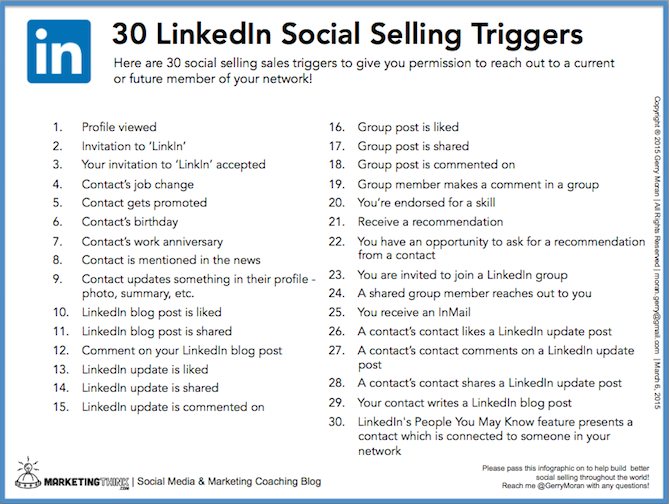
A sales call or email that comes totally out of the blue is often regarded as irrelevant or even annoying to buyers. But cold outreach can be warmed up if a salesperson just sends their email or places their call at the right time. And prospects leave openings for salespeople every day -- reps just have to know what they're looking for to catch them.

Not sure when the "right" time to reach out to a potential buyer on LinkedIn is? Ponder no more. In this infographic, Gerry Moran lists 30 LinkedIn social selling trigger events that provide salespeople with a solid reason to reach out. Big or small, each is a valuable conversation starter if a rep pounces on it. 

Consult this chart each morning when you open LinkedIn, and seize the opportunities to engage as soon as they arise. Your pipeline might be about to get a whole lot bigger.

30-LinkedIn-Social-Selling-Triggers-MarketingThink.com-GerryMoran

get the free hubspot crm


16 Mar 21:07

5 Key Elements For Creating A Compelling Call To Action To Increase Subscribers And Sales

by Julia Blake

5 Key Elements For Creating a Compelling Call To Action to Increase Subscribers and Sales

Buttons surround us everywhere. Despite modern devices are more and more focused on the touch-and-tap technique, we still use buttons to turn on the TV or the air conditioner. The main thing about such buttons is that we use them because we want to perform some action, e.g. to get to a certain floor on elevator or make the TV louder.

Call-to-action buttons on website work some other way. These buttons are made to catch users’ attention and push them to perform the action a website owner needs. CTA’s usually contain text that explains users what action they have to perform. You may spot call-to-action buttons mostly on conversion-oriented websites and pages, e.g. landing page. But in general, any button that contains an invitation to perform an action may be called a CTA button.

The most often used types of call-to-action buttons

Here are the three most used calls to action.

  • “Buy Now” buttons. It’s the most common type of a call-to-action element that is used on most eCommerce websites. You can come across such buttons on landing pages created to promote a certain product. The Buy Now button is also placed on a product page to push a visitor to purchase this product.
  • Learn More/Explore” buttons. This type of buttons encourages users to go for more info about a product, brand or other topics. It’s often used when you need to hide away large pieces of data, e.g. book description, blog post, brand’s history etc. Learn More buttons can be used for landing pages or banners to guide users to other pages where they can read full description of the product, get purchase conditions or subscription details;
  • Subscribe/Register” buttons. Specific buttons that are mostly used in combination with registration forms. They may be added to banners and popups that encourage users to register to website or subscribe to a newsletter.

All these types of buttons may be used in combination with other conversion elements. Sometimes call-to-action elements may be presented in a form of text links. Today they are rarely used due to the popularity of mobile devices. Text links are not the best CTAs for smaller screen sizes in terms of UX.

Taking user experience into account is vital if you wish to increase conversions. You should learn your audience and find ways of appealing to various types of buyers. HelpScout presented a few types of internet customers based on their consumer behavior in a cool infographic.

How to Make Your Call-to-Action Really Effective 1

Twenty-four percent of so-called “Tightwads” is one of the most difficult audiences for a marketer. These buyers are characterized by having a very low pain threshold in terms of spending money. You have to use some psychological tricks to make those users part with their money.

Here are some tips to create compelling call to action designs and copy that will work for various types of customers.

1. Where do you place that call to action?

It’s been a long time practice of placing all vital elements above the fold. Latest surveys show that this tradition isn’t necessarily true and may not lead to higher conversions. Michael Aagaard provided a test for a B2C landing page where he changed the position of a call-to-action button and placed it below the fold. The results were unexpected: conversions increased by 304 percent.

How to Make Your Call-to-Action Really Effective 2

Due to this experiment, Michael came to a conclusion: your CTA shouldn’t be necessarily placed above the fold. Instead, try to match the place of a call-to-action element with the complexity of your offer or product.

Thus, if your offer requires presenting a large batch of data, it’s better to give time to users to digest the info they got and make a decision in the end of reading. And vice versa, simple offer that doesn’t requires a lot of thinking to make a purchasing decision may use a CTA above the fold.

Another good idea is having several call-to-action buttons across a long landing page. Today many website pages make use of heavy scrolling. This trend again is connected with the use of mobile devices that make scrolling a better UX than clicking. So, using a few CTA for a landing page that relies on scrolling can be a great idea. Just one consideration: use the same text for all CTAs on one page to avoid user confusing.

2. What text should you include in the call to action?

One of the reasons why people don’t click your call-to-action button may be that it doesn’t really call to any action.

You may come across multiple examples on the Web when CTAs use such messages like “Free trial” or “Demo.” Such buttons don’t appeal to customers. They don’t push people to act.

So, one general rule here is:

“Add a verb that refers to users and really calls them to act.”

However, not any text with a call may work today. Most standard phrases like “Download,” “Add to Cart,” or “Click Here” are too trite and boring. Human mind doesn’t perceive them as urgent calls. You should think of creating a personalized custom CTA that will set you apart of your rivals, drive users attention and make them wanna click that button. Use of personal pronouns, like Me, You, Yours, Us, is very helpful to add a personal touch.

How to Make Your Call-to-Action Really Effective 3

Consider using clear message to unambiguously tell people what action they have to perform. Sometimes tried and true “Sign In,” “Register,” or “Play Now” are better than some whimsical messages.

3. What colors do the button and text need to be?

Color is one of the most powerful instruments in web design. Bad choice of color palette may ruin your design and scare people away instead of making them clicking. Good choice of color for a CTA button as well as for its text makes a button easily noticeable.

Using contrasting colors is the easiest solution. But there can be one pitfall: some designers choose too bright colors for buttons and text. Such choice may have a reversed effect and keep people from clicking. There are tons of tutorials and infographics on color theory and color psychology on the Web that you can use for choosing a perfect color combination for your call to action elements.

How to Make Your Call-to-Action Really Effective 4

In any case, darker text on a lighter background is an evergreen classics while lighter text on a darker button may evoke a strong emotional reaction.

4. What button shapes work?

Traditionally, websites feature rectangular buttons. The button shape may become a perfect design element and raise certain emotions. They can be that psychological driver that impacts user’s desire to click a button or to leave a page.

Usually, rectangular elements speak of reliability, traditionalism, and balance. Circular elements create soft, friendly, and calming atmosphere.

How to Make Your Call-to-Action Really Effective 5

More fanciful buttons’ shapes should be justified from the design aspect. And don’t forget that you should make CTA buttons look clickable. If the buttons doesn’t look like a button then no one will click it.

5. How big should your call to action button be?

When it comes to CTA buttons, many may think that “the bigger – the better” principle should work here. But oversized buttons may create a feeling of pressure and seem too “aggressive” for users. This may hurt the UX. so If you don’t wish to frustrate your visitors try to choose the button size wisely.

Responsiveness is another consideration you should never forget when choosing a size for a call-to-action button. This element should look well-balanced with your design and be comfortable to use on smaller screens.

How to Make Your Call-to-Action Really Effective 6

You can always make a smaller CTA button visible with a use of whitespace. This classic technique allows drawing attention to important element and making it noticeable. In terms of responsive design, whitespace surround a button and makes it easier to tap without touching other elements.

These are some easy tips for making your call-to-action work for you. You may want to use only a few of them or the whole batch. But don’t forget to test your choices to find the best solution that fits your webpage design, your goals, and audience.

16 Mar 21:05

Management Consulting Firms: When Does a Prospect Turn Into a Lead?

by Candis Roussel

Not everyone who connects with your firm is an actionable lead. Whether they have engaged with your firm through social media, your website, your blog, or other channels, many of these folks will live at the top of the sales funnel forever. That’s natural – these audiences will nonetheless help contribute to your reputation and visibility in the marketplace by sharing or talking about your expert content.

But for those who do make their way down the funnel, the story isn’t over. Many will be ideal clients, but the truth is that not all of those leads are worth the efforts of your sales team. And it’s important to be able to identify the real opportunities.

The clients of management consulting firms are in the market for solid, actionable advice. You wouldn’t feed them guesswork or suggest they try any and every old thing. Yet many firms take a scattershot approach to marketing. When it comes to your own marketing and lead curating efforts, take your own best advice. Do some research and qualify the best options before investing further. Only pursue the best-qualified leads.

Here’s a breakdown of how to analyze potential clients and gauge their true interest in your services:

1. The Suspect


You have some reason to suppose suspects are interested. They’ve visited your website (though possibly only once). They follow your company on LinkedIn (though maybe they’re just looking for a job). Perhaps they’ve commented on your blog (and everyone else’s).

Suspects have made some sort of connection, but it’s difficult to know their motives. Their vertical might not mesh with your services, or they might be 5,000 miles away. They may have simply stumbled across your page while researching something tangential to your industry. It’s much too soon to call them a lead.

2. The Prospect

Good thing you kept an eye on that suspect – they’ve continued to haunt your site. They’ve downloaded a guide or research report from your website. Maybe they’ve subscribed to an email newsletter. You have details about them, such as contact information, demographics, and other data gathered when they accessed gated premium content.

The prospect may not be quite ready to sign up for your services, but they do appear to be interested in information presented in your content marketing. In short, you might be able to solve their problems. It’s too soon to say for sure, but there is potential here.

3. The Lead

Now we’re talking. These are prospects that not only fit important demographic and geographic criteria, but also have the ability to buy—and they are definitely interested in you. They’ve registered for and attended one of your webinars and they’ve opened your emails. The lead seems genuinely interested in your firm and your services.

When you speak with a lead, ask thoughtful questions meant to uncover their needs, determine their decision-making process, and discover the criteria they’re looking for in service providers. A conversation can pay off in ways that a single-sided hard sales pitch can’t.

4. The Opportunity

They’re knocking. This is a warm lead with an identified need that your firm can address. They have the required budget to sign on as a client and the authority to seal the deal. What’s more, the opportunity has asked for a strategic consultation or other preliminary meeting with one of your in-house experts. Perhaps they’ve submitted a request for further contact via an online form, email, or by phone.

The opportunity has learned about your services as their needs have developed, and now they are ready to do business.

It’s likely that you see a lot more suspects than opportunities. That’s par for the course. But if you’re noticing virtually all suspects and prospects, with no leads or opportunities emerging, it might be time to reconsider your content marketing strategy. For starters, take a look at whom you’re targeting—and through what channels.

Understanding and Targeting Your Audience

Content marketing is great at filling your funnel with folks from all four categories—if your content is relevant. To make sure of this, you have to know your audience. This means doing research to uncover their needs, their challenges, and what they value most. If this sounds too tough or time-consuming, consider the payoff:

  • Firms that do occasional marketing research experience about six times the growth—and a 50% increase in profitability—compared to competitors that do no research.
  • Firms that do frequent research (at least once per quarter) experience more than ten times the growth and double the profitability of firms that don’t do market research.

The Impact of Research on Firm Growth and Profitability

Remember that there are lots of ways to educate your audience. Part of your research should include finding out how your prospects like to engage with content. You should also be willing to present similar information in multiple formats to accommodate their preferences. Take the ideas within a whitepaper and present them via a webinar or offer a series of videos that illustrate the major points of an executive guide.

Consider timing as well. Your audience might not want to read a detailed new whitepaper each week, nor could you likely produce one so frequently. But a blog post or a new video segment in a series presented weekly will keep your audiences continually engaged. Look at your calendar of upcoming projects, conferences, and other key events. Whenever applicable and possible, tailor your content to feed into initiatives that will interest your clients.

Whatever timeframe you choose, make sure you’re able to keep the pace for the foreseeable future. Marketing campaigns are most effective when sustained. Losing momentum on your end will translate to a loss of momentum in lead generation.

In the end, the goal isn’t just to generate leads – it’s to gain new clients. But this can’t be done without careful consideration of prospects’ needs, and by illustrating just how you can meet their needs with thoughtful, relevant content.

To create content that reaches prospects at each stages of the sales funnel, download a free copy of the Content Marketing Guide for Professional Services.

Free Guide: Content Marketing Guide for Professional Services

16 Mar 21:05

How to Use LinkedIn to Generate Leads

by info@meclabs.com

It’s time to rethink the way you use LinkedIn.linkedin-lead-generation

Without some of us even noticing, LinkedIn developed into a useful publishing platform and lead generation tool for marketers and salespeople.

Using LinkedIn to generate leads can be a pretty straight forward process  — if you’re willing to invest a little time sharing your expertise and thought leadership.

As referral selling expert, Joanne Black writes in a post:

The goal of social media is not to sell; it is to begin conversations and ultimately build relationships. Hopefully, many of those relationships will yield sales or referrals. But when you start making sales pitches on LinkedIn,you don’t attract clients. You just annoy people.

10 Ways to generate leads and build your influence

1. Create a polished and personally branded profile on LinkedIn.

If you haven’t already, spend some time perfecting your profile to make sure it is clear what you do and what your strengths are. Focus on your headline and summary. It should be compelling.

Your headline will automatically be displayed as the last job you’ve had unless you change it manually. Sales expert and author, Jill Konrath, put together a great video on 4 steps to writing your LinkedIn headline and summary. I’ve applied her lessons to my profile. You can access Jill’s free “how to learn”LinkedIn rapid learning mini-course here.

You can also check out how you rate on LinkedIn’s Social Selling Index. The tool can help recommend ways to get better.  For example, my results indicated that I could improve in “engaging with insights.”

Lead-Generation- brian-carroll-socselling-illustration

2. Connect, Reconnect and help — social media marketing at its best.

Help first. Start connecting with your current and past contacts, focusing on relationships where trust already exists. It’s easy to conduct a search on LinkedIn to find individuals you’ve lost touch. Then reach out to them and offer help in some way.

When you get a new business card from someone you meet, look them up via LinkedIn and invite them to connect with you. If you’re just starting out as a LinkedIn user, you can import your contacts from Outlook, Hotmail, Gmail, Yahoo!, or AOL. Be sure to include your distinct URL in your email signature, on your traditional resume, on your blog, on your website, and on your business card so that others can connect with you quickly.

3. Reach out to former clients.

You can track what your previous customers have been doing since you last saw them — with no awkwardness. When contacting a former client, instead of sending a me-first message, make a positive comment about something they’ve done. Ask questions about their new projects. And again look for ways to help.

4. Join LinkedIn Groups where your clients/customers gather.

Groups can be incredibly powerful to your personal brand. Use Advanced Search to find practitioners within your firm and in industry at-large. Through these groups, you can learn a lot about your industry by tuning into the conversations. You may discover new industry-wide pain points and learn about options to solve those pain points. Find out more about your industry by watching from afar will give you real, everyday insight into ways you can help and connect.

5. Post relevant content on groups (if that’s their approach) and answer targeted questions.

First, figure out the rules of the group. If they allow content sharing, start building your credibility in the group by sharing relevant content that fits the interests of the group. This content includes relevant blog posts, links to articles you have written, posts that quote you, and event notices for webinars. Be sure to stay sensitive to the dynamics of your group — don’t ever try to dominate the conversation. Your materials should be a helpful resource, not a sales pitch for you.

6. Answer targeted questions in areas of your expertise.

Many group members use LinkedIn as a discussion board, and you’ll find many questions posted on any given day. Take time each day to answer a few or to post a few discussion yourself. Respond to questions that are relevant to your expertise or something that’s important to you.

If you find a question, you can answer well from someone you want to do business with who’s relatively senior in a company, write a detailed, high-value response. You never know who’s reading the information. Lots of members gain a foot in the door because of the expertise they lend to a discussion.

7. Check out individual profiles

Find out if your potential customers contribute to blogs. Learn what events they are attending and even the books they are reading. This utility is the beauty of LinkedIn. How many other sources will surface prior work history? This aspect helps you be more intentional and have more clues about how you could potentially help.

8. No more cold calls. Use the information to do warm outreach.

An introduction received via LinkedIn is much warmer than a cold call because it comes with a bit of trust. You’re not the stranger trying to upsell something; you come with a recommendation from a person that the receiver has a connection to, or you share a common membership in a professional group.

Even if you can’t find a path to connect to someone, sending a direct message via LinkedIn is better than sending a cold email because LinkedIn implies a business context. So when you are checking out a potential customer, you can review their profile, discover their interest and determine if you have something in common with them to help warm up your call with them.

9. Search with Advanced Filters and use messaging aka InMail.

One of the best features of having a LinkedIn Premium or Sales Navigator account is being able to use Advanced Filters in a search. Not only can you search by company and relationship, but Premium advanced search on LinkedIn allows you to search by function, location, seniority level, and group size, as well. Pair that with Messages (aka InMail), and now you can contact prospects directly without a referral.

When I write relevant personal emails using InMail with research I get via LinkedIn; I almost always get a response.

9. Create your LinkedIn group

Starting a group gives you control over its content and reach. You can choose to open the group only to people you know, or you can open it up to a much larger audience. The goal is to engage your audience and leverage your thought leadership to make a difference with members of your group.

LinkedIn offers tips for consultants using the channel to build their business, demonstrate areas of expertise, and leverage their network.

B2B-Lead-Roundtable-marketing

Check out the B2B Lead Gen Roundtable Group on LinkedIn. I started this group, and it’s all about sharing ideas that focus on the many aspects of B2B lead generation. The group has grown to 19,100 members, but I’m even more excited about what’s not happening. I’m learning a ton from members because our rules for the group are that it’s 100% discussion only. If you are going to do this, be ready for the time commitment this will need to be a successful group.

10. Post regular updates.

Spend a minute posting an “Update” or “What’s on your mind?” to your LinkedIn network each day. You can use updates to share a link to an article, blog post, or video relevant to your potential customers and network. Or use the “Pulse” feature on your LinkedIn dashboard.

When you post an update, what you post gets displayed in the feed of all the people connected to your network. Your updates aren’t the place to sell. However, don’t be afraid to share significant announcements or news either. Add value with each update.

It’s that updating process that will spark conversations about opportunities for both you and your contacts. It’s in these conversations that ideas will arise about prospective clients, possible partnerships, and other revenue-generating projects.

Conclusion

Implementing these tips into your daily routine will require a time commitment, but it’s easy to join the conversation for a few minutes each day and check in with various groups. Also, LinkedIn is constantly evolving, so keep an eye on it. As it continues to grow, people will find new and smarter ways to utilize it. You’ll want to be there, ready to dive in and generate leads.

You might also like

MarketingSherpa Case Study: Using LinkedIn for Lead Generation: 6 Lessons

Forbes: 4 Best Practices For Generating More Leads On LinkedIn

Jill Konrath Research the #1 Facet of LinkedIn Headline and Summary

HubSpot Blog: LinkedIn 277% More Effective for Lead Generation Than Facebook & Twitter [New Data]

Small Business Trends: 13 Creative Ways to Use LinkedIn for Lead Generation

The post How to Use LinkedIn to Generate Leads appeared first on B2B Lead Blog.

16 Mar 21:05

14 Best B2B Cold Email Templates to Get Your Leads' Attention

by aaron@predictablerevenue.com (Aaron Ross and Jason Lemkin)

Crafting the perfect B2B cold sales email is both an art and a science. They must include a compelling subject line and engaging message all within a skimmable length — but writing cold emails is not always as easy as it sounds. Balancing a friendly tone with getting to the point can be tricky. Crafting a CTA that is inviting and not forceful takes skill.

Luckily, you won't have to figure it out on your own. In this piece, I’ll share expert tips on best practices, templates to use, and what not to write in your next cold email to give you the confidence to write attention-grabbing emails that prospects want to read.

Editor's note: This post contains an excerpt from the book The Predictable Revenue Guide to Tripling Your Sales, and is published here with permission.

Download Now: 25 Sales Email Templates  [Free Access]

25 sales email templates from HubSpot

{{ sgMacro.render_ftSnippet({ header: "How to Write a Cold Sales Email", content_type: "ordered_list", list: { items : [ "Research and understand recipients’ pain points.", "Craft an exciting subject line.", "Include an enticing and specific offer.", "Back up all claims with proof.", "Be clear and concise. ", "Make sure your copy feels human and natural to the reader.", "Personalize, personalize, personalize. ", "Give a clear CTA. ", "9. Include a professional email signature"Include a P.S. after your sign-off. " ] }, paragraph: { content: "" } }) }}

1. Research and understand recipients' pain points.

A pain point is something your prospect is consistently struggling with. Pain points can range from unmet needs on the individual level to major problems plaguing an entire company.

The best way to uncover these pain points is through research. I recommend doing this before anything else in your process, as it impacts every element of what you’ll include in your email, from the keywords you use in your subject line to the unique offer you present.

Bruno Gavino, Founder and CEO of CodeDesign, says he always takes the time to research before reaching out. He said, “Before writing a cold email, I conduct thorough research on the potential client's business, industry trends, and even their competitors. This allows me to understand their specific needs, challenges, and opportunities.”

Once he’s uncovered their key pain points, he tailors his emails to speak directly to the recipient's pain points, and how his offer is a direct solution. He adds, “This customization shows the recipient that I have a genuine interest in their success and am not just sending a generic sales pitch.”

And, directly tailoring email content to pain points builds trust and shows that you take recipients seriously.

{% module_block module "widget_9c411a72-294f-45fb-a510-6f72952a567c" %}{% module_attribute "child_css" is_json="true" %}{% raw %}{}{% endraw %}{% end_module_attribute %}{% module_attribute "css" is_json="true" %}{% raw %}{}{% endraw %}{% end_module_attribute %}{% module_attribute "definition_id" is_json="true" %}{% raw %}null{% endraw %}{% end_module_attribute %}{% module_attribute "embed" is_json="true" %}{% raw %}{"max_height":113,"width":200,"height":113,"max_width":200,"supported_oembed_types":["video"],"oembed_response":{"provider_url":"https://www.youtube.com/","width":"200","height":"113","html":" ","thumbnail_width":"480","version":"1.0","title":"Why These Cold Email Techniques Will Land You A Reply","provider_name":"YouTube","type":"video","thumbnail_height":"360","author_url":"https://www.youtube.com/@HubSpotMarketing","thumbnail_url":"https://i.ytimg.com/vi/q21qQ3HOBaY/hqdefault.jpg","author_name":"HubSpot Marketing "},"size_type":"auto","oembed_url":"https://youtu.be/q21qQ3HOBaY","source_type":"oembed"}{% endraw %}{% end_module_attribute %}{% module_attribute "field_types" is_json="true" %}{% raw %}{"disable_lazy_load":"boolean","embed":"embed","embed_type":"choice","video":"videoplayer"}{% endraw %}{% end_module_attribute %}{% module_attribute "label" is_json="true" %}{% raw %}null{% endraw %}{% end_module_attribute %}{% module_attribute "module_id" is_json="true" %}{% raw %}133586874127{% endraw %}{% end_module_attribute %}{% module_attribute "path" is_json="true" %}{% raw %}"/_Web Team Assets/Blog/modules/blog-video-embed"{% endraw %}{% end_module_attribute %}{% module_attribute "schema_version" is_json="true" %}{% raw %}2{% endraw %}{% end_module_attribute %}{% module_attribute "smart_objects" is_json="true" %}{% raw %}[]{% endraw %}{% end_module_attribute %}{% module_attribute "smart_type" is_json="true" %}{% raw %}"NOT_SMART"{% endraw %}{% end_module_attribute %}{% module_attribute "tag" is_json="true" %}{% raw %}"module"{% endraw %}{% end_module_attribute %}{% module_attribute "type" is_json="true" %}{% raw %}"module"{% endraw %}{% end_module_attribute %}{% module_attribute "wrap_field_tag" is_json="true" %}{% raw %}"div"{% endraw %}{% end_module_attribute %}{% end_module_block %}


2. Craft an exciting subject line.

“Having spent a decade in sales, I’ve realized the importance of unique approaches when crafting cold emails. It all begins with prioritizing subject lines that capture attention, address specific problems, and offer value to recipients,” says Virag Shah, Vice President of Sales at NamanHR.

This makes sense to me — your subject line is your gatekeeper. I’d recommend crafting and testing different subject lines to create an exciting but credible (not spammy or sales-y) subject line that intrigues recipients.

Your subject line should also be compelling and informative to pique the recipient's interest in the body of the email — and research the prospect so the subject line is personalized to them.

Pro Tip: Use HubSpot’s AI content writer to generate engaging subject lines for your cold emails.

{% module_block module "widget_900add66-8bfb-41b1-89be-144f3a3500d4" %}{% module_attribute "child_css" is_json="true" %}{% raw %}{}{% endraw %}{% end_module_attribute %}{% module_attribute "css" is_json="true" %}{% raw %}{}{% endraw %}{% end_module_attribute %}{% module_attribute "definition_id" is_json="true" %}{% raw %}null{% endraw %}{% end_module_attribute %}{% module_attribute "field_types" is_json="true" %}{% raw %}{"hubdbrow_field_pt":"hubdbrow","add_form":"boolean","hubdbrow_field":"hubdbrow","form":"group","include_image":"boolean","overrides":"group","hubdbrow_field_fr":"hubdbrow","hubdbrow_field_es":"hubdbrow","hubdbrow_field_ja":"hubdbrow","language":"choice","link_screen_reader_text":"text","hubdbrow_field_de":"hubdbrow"}{% endraw %}{% end_module_attribute %}{% module_attribute "hubdbrow_field" is_json="true" %}{% raw %}{"columns":{"learn_more_url":"https://offers.hubspot.com/25-proven-sales-email-templates","download_cta_link":"https://offers.hubspot.com/thank-you/proven-sales-email-templates?hubs_post-cta=fwcta","hs_child_table_id":0,"value_prop_1":"First-Touch Emails","value_prop_2":"Follow-Up Emails","value_prop_3":"Break-Up Emails","value_prop_4":"Full Email Sequence","hs_is_edited":false,"hs_updated_at":1693576474463,"hs_deleted_at":0,"hs_id":132890403091,"form_subtitle":"Save time, find new ways to reach out to prospects, and send emails that actually convert.","download_cta_text":"Download for free","hs_published_at":1713905354292,"image":{"altText":"","height":375,"type":"image","url":"https://www.hubspot.com/hubfs/assets/hubspot.com/web-team/WBZ/HubSpot%20Media/Blog%202021/Images/modules/full-width-cta/Image%20Hackathon%20%E2%80%93%20Square.webp","width":375},"form_title":"25 Free Sales Email Templates","hs_created_at":1693576474463,"hs_updated_by_user_id":2108278},"id":132890403091,"table_id":5886480,"table_name":"en_hubspot_blog_full_width_cta"}{% endraw %}{% end_module_attribute %}{% module_attribute "label" is_json="true" %}{% raw %}null{% endraw %}{% end_module_attribute %}{% module_attribute "module_id" is_json="true" %}{% raw %}104842557838{% endraw %}{% end_module_attribute %}{% module_attribute "path" is_json="true" %}{% raw %}"/_Web Team Assets/Blog/modules/full-width-cta"{% endraw %}{% end_module_attribute %}{% module_attribute "schema_version" is_json="true" %}{% raw %}2{% endraw %}{% end_module_attribute %}{% module_attribute "smart_objects" is_json="true" %}{% raw %}[]{% endraw %}{% end_module_attribute %}{% module_attribute "smart_type" is_json="true" %}{% raw %}"NOT_SMART"{% endraw %}{% end_module_attribute %}{% module_attribute "tag" is_json="true" %}{% raw %}"module"{% endraw %}{% end_module_attribute %}{% module_attribute "type" is_json="true" %}{% raw %}"module"{% endraw %}{% end_module_attribute %}{% module_attribute "wrap_field_tag" is_json="true" %}{% raw %}"div"{% endraw %}{% end_module_attribute %}{% end_module_block %}

3. Include an enticing and specific offer.

You want your cold email prospects to have a reason to respond, and I recommend doing this by conveying the ultimate value that comes from your offer by keeping your message focused on why you’re reaching out and what your offer is.

When you’ve researched your recipient and their specific pain points, you’ll know the key value points to call out in your email to help you stand out the most.

This is what Bhavik Sarkhedi, CMO of Write Right, does: “We succinctly articulate the unique benefits of our services. For instance, if the prospect's industry suffers from poor content engagement, we highlight how our SEO-optimized content can increase visibility and engagement rates.”

Another great way to convey value is social proof and past successes with other clients. It proves your offer is realistic and attainable, and including numbers and statistics makes it even more exciting.

4. Back up all claims with proof.

One of your biggest barriers to selling is risk. No one wants to be the first customer and work with a company without credibility or experience. Mentioning one of your customers and the results you delivered to them makes you less of a risk.

Your current clients are the best form of proof that you have. You can attach case studies to show recipients what they can expect from going with your offer. . A compelling example can leave your prospect more inclined to work with you.

Matt Little, Director and Entrepreneur at Festoon House, has a unique strategy for the social proof he uses: “The second weapon in my arsenal is social proof with a twist. Yes, testimonials are great, but everyone uses them. I go the extra mile and find a relevant industry influencer who's a happy customer.”

He uses lines like “Did you see [Influencer Name]’s recent article praising [Your Product]? They mentioned how it helped them achieve [Specific Result]” because a name drop of a trusted source builds credibility, shows results, and “Positions your product as the secret weapon of the ‘cool kids.’”

5. Be clear and concise.

A subject line can inspire me to click on an email, but my interest will fall off if the content is the length of a short blog post.

You can avoid someone clicking out of your email by keeping your initial cold outreach short and sweet. The faster a prospect understands what they’ll gain from you, the more likely you are to inspire a conversion or reply.

Focus on briefly explaining how your offer addresses their pain points and helps them succeed, and end with a CTA (more on that below) that establishes the next steps for those genuinely interested. Also, avoid jargon and any fluff that distracts from the value you want to convey.


6. Make sure your copy is human and natural.

You want to make sure your email feels human. When you're too formal, you sound stiff and like a salesperson rather than a person-person. Avoid stuffing your email with marketing cliches and buzzwords. Instead, humanize your approach and write in a way that feels like you.

Kevin D’Arcy, CEO of ThinkFuel, told me you can show personality in your cold emails with a bit of humor. He said, “Humor is a great way to open the door and pique interest. Even a sprinkle of clever sarcasm can make your email stand out — just keep it light and clear.”

Yuvraj Pratap, Founder and CEO of Supplement Launchpad, says, “In a sea of standard, formal emails, a dash of humor can be a refreshing change.”

If you use humor, Pratap says that the catch is to be subtle and appropriate. In short, you risk turning a lead away if you’re cracking jokes and being too informal. He said, “Humor should be subtle and appropriate. It's not about cracking jokes but more about lightening the tone and humanizing your approach…humor should enhance your message, not distract from it. Always ensure that the main purpose of your email remains clear and compelling.

7. Personalize, personalize, personalize.

Personalization is the name of the game. Nearly a quarter of sales professionals told us that the biggest change in the sales field is that personalization is much more important.

This makes sense to me, especially with cold emails — the more aligned and relevant your content is to recipients' interests, the more likely you are to build interest and inspire follow-up.

Personalizing your emails shouldn’t be too challenging if you've already researched your targets. You don’t need to know everything about who you’re emailing, but, at minimum, you should be able to address them by name and call out their unique pain points.

If it makes sense with the context of your email, you can include unique details that relate directly to the recipient, recent press or media coverage, or even a shared interest.

Whatever you choose to say, personalizing your outreach shows that you’re invested in their specific needs and not simply pasting their name into a canned template you’ll send to 25 other leads.

8. Give a clear CTA.

Picture this: your engaging subject line inspired a click. Your opener and value proposition inspire thoughts of “Hey, maybe this is a worthwhile offer!”

The reader reaches the end of your email and is ready to learn next steps, but you sign off and say bye. Your prospect is left confused because you piqued their interest.

That sounds like the opposite of what you want. Reduce the chances of this happening to you by including clear and actionable CTAs in your emails so recipients know the exact next step you want them to take.

For example, if you want them to book a meeting, schedule a call, or even just reply to the email — let them know that that’s what you want.

9. Include a professional email signature

Make sure to take the extra time and set up a professional email signature. This helps you stand out among dozens of other cold sales emails recipients read through every so often.

Including additional contact details here, like links to your social accounts and website, is another great idea. You give recipients the chance to learn more about you and familiarize themselves with your company’s product or service — it can make all the difference between getting a response and not.

Having your job position, company logo, and profile picture in your signature also helps you appear more trustworthy. 

10. Include a P.S. after your sign-off.

This is a unique tip, but Patrick Beltran, Marketing Director at Ardoz Digital, says that using a P.S. is one of his most effective cold email strategies.

To do it yourself, he says to include a P.S. after your email signature. In it, you can summarize the key message of your email content, point out key features, give more details about your CTA, or even inspire urgency with a limited-time promotion.

He says, “In my experience, this is a powerful way to capture the reader's attention and reinforce the main point of the email…Incorporating a P.S. in a cold email allows us to highlight the most crucial elements of our message, boosting the chances that the recipient will respond as we hope.”

If you use Beltran’s tip, he says to ensure your P.S. is concise and direct. Introducing new information at the actual bottom of your email can distract from your message.

{% module_block module "widget_6b951493-a455-45e6-9430-69a3eb6b63af" %}{% module_attribute "child_css" is_json="true" %}{% raw %}{}{% endraw %}{% end_module_attribute %}{% module_attribute "css" is_json="true" %}{% raw %}{}{% endraw %}{% end_module_attribute %}{% module_attribute "definition_id" is_json="true" %}{% raw %}null{% endraw %}{% end_module_attribute %}{% module_attribute "field_types" is_json="true" %}{% raw %}{"hubdbrow_field_pt":"hubdbrow","add_form":"boolean","hubdbrow_field":"hubdbrow","form":"group","include_image":"boolean","overrides":"group","hubdbrow_field_fr":"hubdbrow","hubdbrow_field_es":"hubdbrow","hubdbrow_field_ja":"hubdbrow","language":"choice","link_screen_reader_text":"text","hubdbrow_field_de":"hubdbrow"}{% endraw %}{% end_module_attribute %}{% module_attribute "hubdbrow_field" is_json="true" %}{% raw %}{"columns":{"learn_more_url":"https://offers.hubspot.com/25-proven-sales-email-templates","download_cta_link":"https://offers.hubspot.com/thank-you/proven-sales-email-templates?hubs_post-cta=fwcta","hs_child_table_id":0,"value_prop_1":"First-Touch Emails","value_prop_2":"Follow-Up Emails","value_prop_3":"Break-Up Emails","value_prop_4":"Full Email Sequence","hs_is_edited":false,"hs_updated_at":1693576474463,"hs_deleted_at":0,"hs_id":132890403091,"form_subtitle":"Save time, find new ways to reach out to prospects, and send emails that actually convert.","download_cta_text":"Download for free","hs_published_at":1713905354292,"image":{"altText":"","height":375,"type":"image","url":"https://www.hubspot.com/hubfs/assets/hubspot.com/web-team/WBZ/HubSpot%20Media/Blog%202021/Images/modules/full-width-cta/Image%20Hackathon%20%E2%80%93%20Square.webp","width":375},"form_title":"25 Free Sales Email Templates","hs_created_at":1693576474463,"hs_updated_by_user_id":2108278},"id":132890403091,"table_id":5886480,"table_name":"en_hubspot_blog_full_width_cta"}{% endraw %}{% end_module_attribute %}{% module_attribute "label" is_json="true" %}{% raw %}null{% endraw %}{% end_module_attribute %}{% module_attribute "module_id" is_json="true" %}{% raw %}104842557838{% endraw %}{% end_module_attribute %}{% module_attribute "path" is_json="true" %}{% raw %}"/_Web Team Assets/Blog/modules/full-width-cta"{% endraw %}{% end_module_attribute %}{% module_attribute "schema_version" is_json="true" %}{% raw %}2{% endraw %}{% end_module_attribute %}{% module_attribute "smart_objects" is_json="true" %}{% raw %}[]{% endraw %}{% end_module_attribute %}{% module_attribute "smart_type" is_json="true" %}{% raw %}"NOT_SMART"{% endraw %}{% end_module_attribute %}{% module_attribute "tag" is_json="true" %}{% raw %}"module"{% endraw %}{% end_module_attribute %}{% module_attribute "type" is_json="true" %}{% raw %}"module"{% endraw %}{% end_module_attribute %}{% module_attribute "wrap_field_tag" is_json="true" %}{% raw %}"div"{% endraw %}{% end_module_attribute %}{% end_module_block %}

Cold Sales Email Templates for B2B

Here are cold email templates that you can use to create emails your prospects will want to open.

1. Best B2B Cold Email Template


Hello [Prospect Name],

I have an idea that I can explain in 10 minutes that can get [company] its next 100 best customers.

I recently used this idea to help our client [SaaS company/competitor] almost triple their monthly run rate.

[First name], let's schedule a quick 10-minute call so I can share the idea with you. When works best for you?

- [Your Name]

send-now-hubspot-sales-bar

The results of this email template speak for themselves:

  • 57% open rate
  • 21% response rate
  • 16 new customers.

When to Use This Cold Email Template: Use this template when you want to quickly share your value proposition and let prospects know what’s in it for them.

Why This Cold Email Template Works:

Why does this sales email template work well when others don't? It feels human.

The offer is intriguing without being pushy. The copy has the basic format and tone of an email you could send to your mom or best friend. The salesperson’s "idea" makes the email less aggressive and aligns with where the recipient is at the beginning of their buyer's journey.

You’re also backing up your claims with evidence from other clients.

2. B2B Email Template for Finding the Decision-Maker in the Company


Hi [First Name],

Quick question: Who handles your team's marketing budget at [Prospect's Company]? They'll want to look into this marketing tool before the end of the quarter — it could help the team hit those lead KPIs in just a few weeks and save your business (and your customers) a lot of money doing it.

I know you're busy, so I won't get into the details of how [product]works right now. But I do want to highlight the benefits we see consistently with our clients:

  • X solution/result
  • Y solution/result
  • Z solution/result

Some of our top clients include [X client, Y client, and Z client].

I want [Prospect's Company] to join this list.

If you are the appropriate person to speak with, what does your calendar look like this week? If not, who would benefit most from this conversation?

Thanks,

[Your Name]

send-now-hubspot-sales-bar

When to Use This Cold Email Template:

Use this cold email template when you can’t find a clear point of contact for your request.

Why This Cold Email Template Works:

This email template works because it clearly states the purpose of your outreach and includes information about previous clients to demonstrate your credibility.

Most importantly, you’re requesting contact information for the person best suited to handle your request, and you’re giving just enough information for the recipient to figure out exactly who to put you in contact with, if not them.
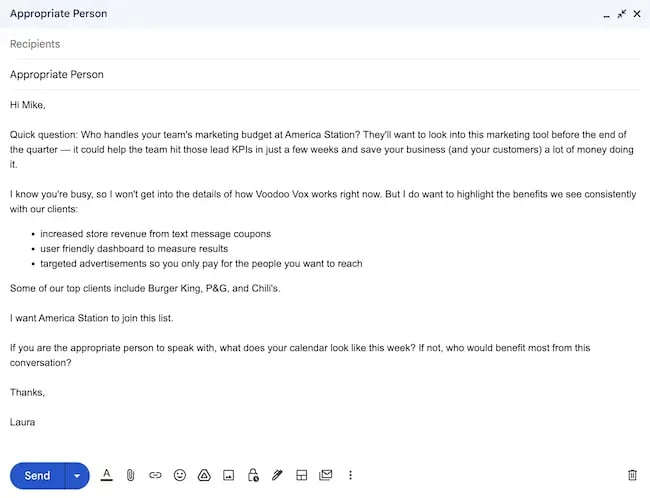
Example of B2B email for finding the right person to talk to

3. B2B Email Template to Build Rapport


Hi [First Name],

Just left a quick message at the office for you. I chuckled a little bit when I got an automated email this morning from your predecessor, [NAME OF PREDECESSOR] who we worked with briefly, and before him, [OTHER FORMER COWORKER NAME], who we worked with as well ...

First and foremost, congrats on coming into this new role! I'm sure you've got a lot going on - so this conversation might be timely or not. If you're stressed, this is my go-to.

My role here is working with businesses (in the area) on how they can effectively and efficiently drive more traffic to their website, increase conversions, and nurture leads into customers.

How has your first month kicked off so far?

- [Your Name]

send-now-hubspot-sales-bar

When to Use This Cold Email Template:

Use this template to establish rapport with a new point of contact at a company you’ve already done business with.

Why This Cold Email Template Works:

Caroline Ostrander, a HubSpot Senior Customer Onboarding Manager, used this template after researching the prospect and finding a rapport-building opportunity. Not only was she able to relate to the prospect regarding the new job, but she also mentioned their co-worker's names and referenced her other attempts to help their company.

{% module_block module "widget_a7686022-cd73-4525-be7b-24a97e603c81" %}{% module_attribute "child_css" is_json="true" %}{% raw %}{}{% endraw %}{% end_module_attribute %}{% module_attribute "css" is_json="true" %}{% raw %}{}{% endraw %}{% end_module_attribute %}{% module_attribute "definition_id" is_json="true" %}{% raw %}null{% endraw %}{% end_module_attribute %}{% module_attribute "field_types" is_json="true" %}{% raw %}{"hubdbrow_field_pt":"hubdbrow","add_form":"boolean","hubdbrow_field":"hubdbrow","form":"group","include_image":"boolean","overrides":"group","hubdbrow_field_fr":"hubdbrow","hubdbrow_field_es":"hubdbrow","hubdbrow_field_ja":"hubdbrow","language":"choice","link_screen_reader_text":"text","hubdbrow_field_de":"hubdbrow"}{% endraw %}{% end_module_attribute %}{% module_attribute "hubdbrow_field" is_json="true" %}{% raw %}{"columns":{"learn_more_url":"https://offers.hubspot.com/25-proven-sales-email-templates","download_cta_link":"https://offers.hubspot.com/thank-you/proven-sales-email-templates?hubs_post-cta=fwcta","hs_child_table_id":0,"value_prop_1":"First-Touch Emails","value_prop_2":"Follow-Up Emails","value_prop_3":"Break-Up Emails","value_prop_4":"Full Email Sequence","hs_is_edited":false,"hs_updated_at":1693576474463,"hs_deleted_at":0,"hs_id":132890403091,"form_subtitle":"Save time, find new ways to reach out to prospects, and send emails that actually convert.","download_cta_text":"Download for free","hs_published_at":1713905354292,"image":{"altText":"","height":375,"type":"image","url":"https://www.hubspot.com/hubfs/assets/hubspot.com/web-team/WBZ/HubSpot%20Media/Blog%202021/Images/modules/full-width-cta/Image%20Hackathon%20%E2%80%93%20Square.webp","width":375},"form_title":"25 Free Sales Email Templates","hs_created_at":1693576474463,"hs_updated_by_user_id":2108278},"id":132890403091,"table_id":5886480,"table_name":"en_hubspot_blog_full_width_cta"}{% endraw %}{% end_module_attribute %}{% module_attribute "label" is_json="true" %}{% raw %}null{% endraw %}{% end_module_attribute %}{% module_attribute "module_id" is_json="true" %}{% raw %}104842557838{% endraw %}{% end_module_attribute %}{% module_attribute "path" is_json="true" %}{% raw %}"/_Web Team Assets/Blog/modules/full-width-cta"{% endraw %}{% end_module_attribute %}{% module_attribute "schema_version" is_json="true" %}{% raw %}2{% endraw %}{% end_module_attribute %}{% module_attribute "smart_objects" is_json="true" %}{% raw %}[]{% endraw %}{% end_module_attribute %}{% module_attribute "smart_type" is_json="true" %}{% raw %}"NOT_SMART"{% endraw %}{% end_module_attribute %}{% module_attribute "tag" is_json="true" %}{% raw %}"module"{% endraw %}{% end_module_attribute %}{% module_attribute "type" is_json="true" %}{% raw %}"module"{% endraw %}{% end_module_attribute %}{% module_attribute "wrap_field_tag" is_json="true" %}{% raw %}"div"{% endraw %}{% end_module_attribute %}{% end_module_block %}

4. B2B Email Template to Establish Value


Hi [First Name],

I saw you recently downloaded a whitepaper about X. I've worked with similar companies in [Y field/industry] and I thought I'd reach out.

[Prospect's Company] looks like a great fit for [Your Company] and I'd love to understand what your goals are for this year.

We often help companies like yours grow with:

  • X solution/result
  • Y solution/result
  • Z solution/result

If you'd like to learn how [Your Company] can help you reach [X goals], feel free to book time on my calendar here: [Meeting Link]

Thanks,

[Your Name]

send-now-hubspot-sales-bar

When to Use This Cold Email Template:

Use this cold template to nail down the value you’ll provide the recipient.

Why This Cold Email Template Works:

What do you have to offer the prospect?

I like that this template lets you show exactly what you offer by briefly explaining benefits. This B2B email template also helps you engage and suggest a time to connect in an inviting way.

5. B2B Email Template for Free Offers


Hello Dr. [Last Name],

I'm following up on my previous email with a free tool I think you'll love.

It's a brand analysis survey I created just for you (literally, your name is on it), that will help you understand how your practice is different from other doctors in [insert city they're in].

Click here to begin the brand differentiation analysis survey. When we speak, I'll benchmark your responses against the top physician brands around the country.

I'm sharing my calendar (click here) so we can schedule a convenient time to discuss.

Enjoy your weekend,

[Your Name]

send-now-hubspot-sales-bar

When to Use This Cold Email Template:

Use this template to nurture leads with a relevant and valuable offer to pique their interest.

Why This Cold Email Template Works:

This email tests the tried and true reciprocity principle — you’re giving your prospect something helpful and useful to them with the goal of having the favor returned.

The convenient CTA at the end of the email makes it easy for the prospect to take action as soon as they can access the free tool.
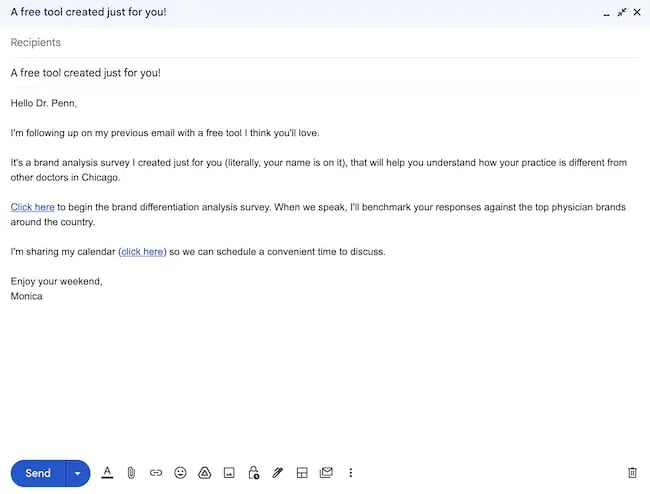
Example of b2b email for free offers

6. B2B Email Template to Introduce Yourself


Hi [First Name],

I'd like to introduce myself as your resource here at [Your Company Name]. I work with businesses in the [software, healthcare, nonprofit, education, etc.] industry, and noticed you visited our website in the past.

This inspired me to spend a few minutes on [Prospect's Company] website to learn more about how you're approaching [X strategy for customer service, sales, marketing, etc.]. I noticed some areas of opportunity and decided to reach out to you directly.

[Your Company] is working with similar companies in your industry, such as [X Company Name], to help them accomplish [Y goals], and giving them the [Z tools/solutions] to succeed.

Do you have 15 minutes to discuss [Prospect's Company] this week?

If so, you can book time directly onto my calendar here: [Meetings Link]

Looking forward to meeting,

[Your Name]

send-now-hubspot-sales-bar

When to Use This Cold Email Template:

Use this email template when you’re looking to book an initial introductory meeting with a lead.

Why This Cold Email Template Works:

This template works because it helps you stand out with the strategic yet subtle name-drop that lends social proof to you and the company you represent.

7. B2B Email Template That Gets an 80% Response Rate in 24 Hours


Hi [First Name],

Sorry I missed you on the phone today, I was calling because…. (leave a one sentence reason for your call, or the name of the referral / event that introduced you)

In my voice mail, I mentioned that I will call you back on [DATE] at [TIME] and of course you can always reach me before then at [YOUR PHONE NUMBER].

I look forward to connecting.

Cheers,

[Your Name]

send-now-hubspot-sales-bar

When to Use This Cold Email Template:

Use this cold email to supplement a voicemail you’ve already left.

Why This Cold Email Template Works:

An email and phone call combo can yield big results in moving a prospect through your pipeline.

This email template works because it’s a brief and friendly follow-up to let the prospect know you're actively attempting to get in touch with them and that your emails aren't just coming from an automated system with no consideration for the person on the receiving end.

Also, not everyone listens to their voicemails, so you’re giving non-listeners the same information over email.

8. B2B Email Template to See if the Prospect is Still Interested


[First Name],

Hope all is well. I had put a reminder in to check-in with you to see how things were going with the [NAME OF CAMPAIGN] initiatives. We had discussed a potential partnership a few months ago, but hadn't been able to formalize our recommended engagement.

We would love to catch up and see if there are any opportunities to engage with you and help with your [DEPARTMENT (eCommerce, marketing, etc.) ] strategy. Let me know if you have some time to reconnect this week and catch up business owner to business owner on where you see things and I can provide some ideas on where we can help.

Look forward to hearing from you.

[Your name]

send-now-hubspot-sales-bar

When to Use This Cold Email Template:

When you’re trying to gauge if a prospect is still interested in an offer.

Why This Cold Email Template Works:

As a salesperson, you want your clients to know that your attention is focused on them and their needs, and this template works because it lets you do that with personalization. You’re telling the recipient that you’re thinking about them, you remember their needs, and giving them a renewed opportunity to move forward.
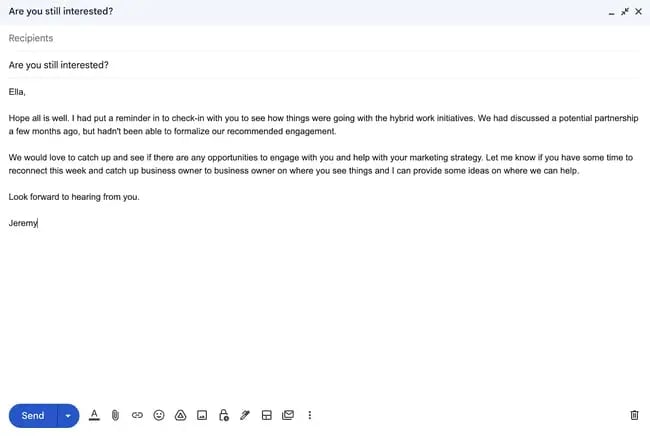
Example of B2B email to see if prospect is still interested

9. B2B Email Template That Understands the Prospect is Busy


Hi [First Name],

I'm sorry we haven't been able to connect. Again, I know how hectic things can get at work and with family.

I would be available for a call during [YOUR AVAILABILITY OPTION 1] or [YOUR AVAILABILITY OPTION 2] if that's easier for you. I don't mean to bug you, but I do want to help you manage your team so you can exceed your goals of [GOAL].

To schedule a time on my calendar, just click here: [CALENDAR LINK]

Best,

[Your Name]

send-now-hubspot-sales-bar

When to Use This Cold Email Template:

to follow up with a prospect that you know has a busy schedule.

Why This Cold Email Template Works:

This follow-up email works because it reassures the prospect that you're not trying to be pushy. Instead, it shows that you're willing to meet them where they're at, even if it means scheduling a call outside your availability.

{% module_block module "widget_6e0bb65a-14b7-494f-b8d6-c6e7684390e1" %}{% module_attribute "child_css" is_json="true" %}{% raw %}{}{% endraw %}{% end_module_attribute %}{% module_attribute "css" is_json="true" %}{% raw %}{}{% endraw %}{% end_module_attribute %}{% module_attribute "definition_id" is_json="true" %}{% raw %}null{% endraw %}{% end_module_attribute %}{% module_attribute "field_types" is_json="true" %}{% raw %}{"hubdbrow_field_pt":"hubdbrow","add_form":"boolean","hubdbrow_field":"hubdbrow","form":"group","include_image":"boolean","overrides":"group","hubdbrow_field_fr":"hubdbrow","hubdbrow_field_es":"hubdbrow","hubdbrow_field_ja":"hubdbrow","language":"choice","link_screen_reader_text":"text","hubdbrow_field_de":"hubdbrow"}{% endraw %}{% end_module_attribute %}{% module_attribute "hubdbrow_field" is_json="true" %}{% raw %}{"columns":{"learn_more_url":"https://offers.hubspot.com/25-proven-sales-email-templates","download_cta_link":"https://offers.hubspot.com/thank-you/proven-sales-email-templates?hubs_post-cta=fwcta","hs_child_table_id":0,"value_prop_1":"First-Touch Emails","value_prop_2":"Follow-Up Emails","value_prop_3":"Break-Up Emails","value_prop_4":"Full Email Sequence","hs_is_edited":false,"hs_updated_at":1693576474463,"hs_deleted_at":0,"hs_id":132890403091,"form_subtitle":"Save time, find new ways to reach out to prospects, and send emails that actually convert.","download_cta_text":"Download for free","hs_published_at":1713905354292,"image":{"altText":"","height":375,"type":"image","url":"https://www.hubspot.com/hubfs/assets/hubspot.com/web-team/WBZ/HubSpot%20Media/Blog%202021/Images/modules/full-width-cta/Image%20Hackathon%20%E2%80%93%20Square.webp","width":375},"form_title":"25 Free Sales Email Templates","hs_created_at":1693576474463,"hs_updated_by_user_id":2108278},"id":132890403091,"table_id":5886480,"table_name":"en_hubspot_blog_full_width_cta"}{% endraw %}{% end_module_attribute %}{% module_attribute "label" is_json="true" %}{% raw %}null{% endraw %}{% end_module_attribute %}{% module_attribute "module_id" is_json="true" %}{% raw %}104842557838{% endraw %}{% end_module_attribute %}{% module_attribute "path" is_json="true" %}{% raw %}"/_Web Team Assets/Blog/modules/full-width-cta"{% endraw %}{% end_module_attribute %}{% module_attribute "schema_version" is_json="true" %}{% raw %}2{% endraw %}{% end_module_attribute %}{% module_attribute "smart_objects" is_json="true" %}{% raw %}[]{% endraw %}{% end_module_attribute %}{% module_attribute "smart_type" is_json="true" %}{% raw %}"NOT_SMART"{% endraw %}{% end_module_attribute %}{% module_attribute "tag" is_json="true" %}{% raw %}"module"{% endraw %}{% end_module_attribute %}{% module_attribute "type" is_json="true" %}{% raw %}"module"{% endraw %}{% end_module_attribute %}{% module_attribute "wrap_field_tag" is_json="true" %}{% raw %}"div"{% endraw %}{% end_module_attribute %}{% end_module_block %}

10. B2B Email Template That Opens Up the Conversation


Hi [First Name],

Because I work so much within the [Industry Name] industry, I constantly follow industry news. Recently I noticed that you've [company accomplishment]. Congratulations!

Usually when that happens, [business issue] becomes a priority. That's why I thought you might be interested in finding out how we helped [well-known company or competitor] get going quickly in their new direction — without any of the typical cookie cutter approaches to marketing.

Check out our previous campaigns here — [LINK TO RELEVANT CASE STUDY].

If you'd like to learn more, let's set up a quick call. Schedule 15 minutes here on my calendar: [CALENDAR LINK].

Regards,

[Your Name]

P.S. If you're not the right person to speak with, who do you recommend I talk to?

send-now-hubspot-sales-bar

When to Use This Cold Email Template:

When you want to initiate a conversation and flex your skills.

Why This Cold Email Template Works:

What makes this email effective is that it shows that you have a pulse on what's happening in your industry and are genuinely interested in your prospect's success. You also establish credibility with your prospect by showcasing your knowledge — and how it has helped other clients with the same problem.

11. B2B Email Template to Land a Meeting with Anyone


Hi [Name],

I am writing in hopes of finding the appropriate person who handles [Department (i.e. media)]? I also wrote to [Person X, Person Y, AND Person Z] in that pursuit. If it makes sense to talk, let me know how your calendar looks.

If you are the appropriate person to speak with, what does your calendar look like? If not, who do you recommend I talk to?

Thanks,

[Your Name]

send-now-hubspot-sales-bar

When to Use This Cold Email Template:

Use this template to land a meeting with an ideal prospect.

Why This Cold Email Template Works:

Keeping it short and sweet, this email template immediately states the purpose and details what you want the prospect to do. It also allows them to pass the information along to the correct person.
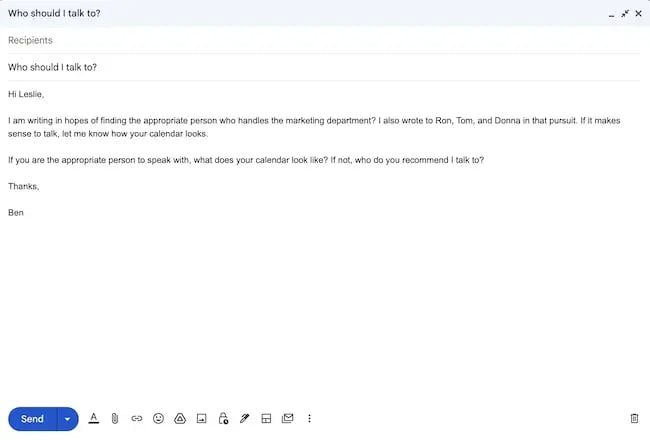
Example of B2B email to land a meeting with anyone

12. B2B Email Template for When You Keep Getting Ignored


Hi [First Name],

I've tried to reach you a few times to go over suggestions on improving [Business Needs], but haven't heard back which tells me one of three things:

  • You're all set with [Business Need] and I should stop bothering you.
  • You're still interested but haven't had the time to get back to me yet.
  • You've fallen and can't get up, and in that case, let me know and I'll call someone to help you.

Please let me know which one as I'm starting to worry!

[Your Name]

send-now-hubspot-sales-bar

When to Use This Cold Email Template:

To re-start contact with an unresponsive prospect.

Why This Cold Email Template Works:

Let’s face it: being left on read comes with the territory of sales. This email template helps you navigate being ignored by a prospect by reminding them of your intentions with a humorous, low-stakes sign-off.

13. B2B Email Template That Appeals to Pain Points


Hi [First Name],

Many of our enterprise customers like [Competitor] have huge sites and multiple domains, making it tough for them to manage their [Business Need] effectively.

After they started working with [Your Company], [Competitor] was able to use [Your Product] to improve [pain point].

The [X results] they achieved through their work with [Your Company] also drove over Y% growth in [clicks, followers, sales, etc.].

Want to dig in further to see how our [Your Product] can benefit your organization? I'd love to chat over a 15 minute call to share more.

You can simply reply to this email and I'll set up a time for us to chat!

Chat soon,

[Your Name]

send-now-hubspot-sales-bar

When to Use This Cold Email Template:

When you want to let a prospect know you understand their needs.

Why This Cold Email Template Works:

This email is appealing because it provides an example of how the product helped solve a problem for another customer, establishing credibility with the prospect. Then, it gives them the opportunity to reply and learn more about how the product could benefit them.

14. B2B Email Template for Connecting With People Who Downloaded From Your Website


Hi [First Name],

This is [Your Name] from [Company]. I noticed that you [downloaded/watched/listened to] our [piece of content], [link].

I just wanted to make sure you got the [piece of content] and to see if you had any questions. There is a lot of information in there, and I thought I might be able to help you find the answers you are looking for.

Let me know if you would like to schedule some time to chat.

Thanks,

[Your Name]

send-now-hubspot-sales-bar

When to Use This Cold Email Template:

To engage with a prospect you know is interested and engaged with your website content.

Why This Cold Email Template Works:

This template works because it builds on the interest the recipient has already expressed in their engagement with your website. It offers a segue into establishing rapport and helps you flex your expertise in offering to help them get the most out of your content.
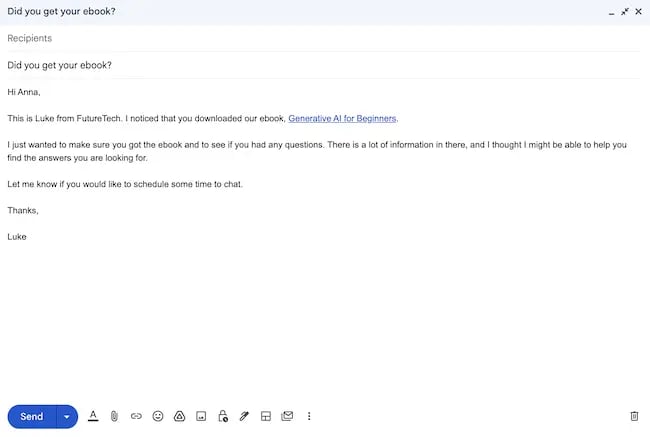
Example of B2B email to connect with someone who downloaded content from your website

{{ sgMacro.render_ftSnippet({ header: "How Not to Send a Cold Email for Sales", content_type: "ordered_list", list: { items : [ "Cram several ideas, talking points, and CTAs into the email.", "Make it lengthy.", "Talk about and celebrate yourself or the business instead of the customer.", "Make it fancy.", "Add too much fluff, jargon, and filler phrases.", "Write like a robot.", "Use too many emojis and other special characters.", "Make several spelling and grammar mistakes." ] }, paragraph: { content: "" } }) }}

If you have a targeted lead list and your response rate is less than 10% with personalized emails, your emails could use some work. Let's say a B2B company comes to you for help with their emails. They offer an incredible service for the SaaS space but aren't very successful with their sales emails. Their response rates are below 2%.

After about a month of working together, you create a single sales email template that gets them more than 16 new customers. Let's dig into what was wrong with their previous approach by touching on some of the reasons why emails fail.

{% module_block module "widget_3e8c2e81-9e5f-41a1-8643-04597ad8cac0" %}{% module_attribute "child_css" is_json="true" %}{% raw %}{}{% endraw %}{% end_module_attribute %}{% module_attribute "css" is_json="true" %}{% raw %}{}{% endraw %}{% end_module_attribute %}{% module_attribute "definition_id" is_json="true" %}{% raw %}null{% endraw %}{% end_module_attribute %}{% module_attribute "field_types" is_json="true" %}{% raw %}{"hubdbrow_field_pt":"hubdbrow","add_form":"boolean","hubdbrow_field":"hubdbrow","form":"group","include_image":"boolean","overrides":"group","hubdbrow_field_fr":"hubdbrow","hubdbrow_field_es":"hubdbrow","hubdbrow_field_ja":"hubdbrow","language":"choice","link_screen_reader_text":"text","hubdbrow_field_de":"hubdbrow"}{% endraw %}{% end_module_attribute %}{% module_attribute "hubdbrow_field" is_json="true" %}{% raw %}{"columns":{"learn_more_url":"https://offers.hubspot.com/25-proven-sales-email-templates","download_cta_link":"https://offers.hubspot.com/thank-you/proven-sales-email-templates?hubs_post-cta=fwcta","hs_child_table_id":0,"value_prop_1":"First-Touch Emails","value_prop_2":"Follow-Up Emails","value_prop_3":"Break-Up Emails","value_prop_4":"Full Email Sequence","hs_is_edited":false,"hs_updated_at":1693576474463,"hs_deleted_at":0,"hs_id":132890403091,"form_subtitle":"Save time, find new ways to reach out to prospects, and send emails that actually convert.","download_cta_text":"Download for free","hs_published_at":1713905354292,"image":{"altText":"","height":375,"type":"image","url":"https://www.hubspot.com/hubfs/assets/hubspot.com/web-team/WBZ/HubSpot%20Media/Blog%202021/Images/modules/full-width-cta/Image%20Hackathon%20%E2%80%93%20Square.webp","width":375},"form_title":"25 Free Sales Email Templates","hs_created_at":1693576474463,"hs_updated_by_user_id":2108278},"id":132890403091,"table_id":5886480,"table_name":"en_hubspot_blog_full_width_cta"}{% endraw %}{% end_module_attribute %}{% module_attribute "label" is_json="true" %}{% raw %}null{% endraw %}{% end_module_attribute %}{% module_attribute "module_id" is_json="true" %}{% raw %}104842557838{% endraw %}{% end_module_attribute %}{% module_attribute "path" is_json="true" %}{% raw %}"/_Web Team Assets/Blog/modules/full-width-cta"{% endraw %}{% end_module_attribute %}{% module_attribute "schema_version" is_json="true" %}{% raw %}2{% endraw %}{% end_module_attribute %}{% module_attribute "smart_objects" is_json="true" %}{% raw %}[]{% endraw %}{% end_module_attribute %}{% module_attribute "smart_type" is_json="true" %}{% raw %}"NOT_SMART"{% endraw %}{% end_module_attribute %}{% module_attribute "tag" is_json="true" %}{% raw %}"module"{% endraw %}{% end_module_attribute %}{% module_attribute "type" is_json="true" %}{% raw %}"module"{% endraw %}{% end_module_attribute %}{% module_attribute "wrap_field_tag" is_json="true" %}{% raw %}"div"{% endraw %}{% end_module_attribute %}{% end_module_block %}

1. Cram several ideas, talking points, and CTAs into the email.

You might have an amazing product, but if you highlight too many value props in your emails, you'll confuse readers. After all, a common sales adage goes, "A confused mind says no."

With this in mind, stick to one idea in your email. All of the copy you write should support that one idea, whether you're piquing their interest, adding value, making a persuasive claim, or providing proof to support your claims.

Avoid adding these common missteps in your sales emails:

  • Multiple themes in the email
  • Claims irrelevant to your main point
  • More than one call to action

2. Make it lengthy.

Generally speaking, your buyers don't want to read a mini-ebook in an email if they don't already know who you are. You first have to provide value and establish trust before you can earn their attention.

With that in mind, structure your cold sales email in a way that clearly and concisely communicates the following:

  • The value you add
  • The offer you're making
  • The proof that supports it
  • The action you want the prospect to take

If your emails are running too long, here's what to watch out for:

  • Muddying details and irrelevant information
  • Boasting or making claims that aren't grounded in fact
  • Asking the prospect to do too many things ("A confused mind says no.")

A caveat:

There's not a hard word or character count that makes for a successful sales email. Email copy should be as long as it needs to be to achieve your desired outcome. With this in mind, sales email length can vary according to what your buyers' preferences are, what their intent is, and how much engagement you can get out of your copy.

Long-form sales emails do have their place. For example, Close.com states that they use a long-form sales email because their subscriber engagement rate is high enough to warrant one.

However, in many "cold" emailing situations, you may not have that high level of engagement to justify it.

3. Talk about and celebrate yourself or the business instead of the customer.

Just like in real life, too much "me, me, me" can be grating. Don't let your email talk way too much about why you're awesome, especially if you're reaching out cold. Instead of talking about yourself, focus on helping the prospect overcome a problem they have.

Double-check to make sure your email doesn't:

4. Make it fancy.

Overly fancy email templates can make your emails seem impersonal and spammy — even with customization. No one thinks they're getting a personal email if it's too pretty.

Keep an eye out for:

  • More time being spent on visual collateral rather than copy
  • Generic language that reads as though it could apply to anyone
  • A lack of segmentation in the email list

5. Add too much fluff, jargon, and filler phrases.

I know that sending a sales outreach email can be nerve-wracking. It’s easy to get caught up in concern for what the person on the other end thinks of you.

If it’s any consolation, I don’t remember the name of any salesperson that has sent me a cold email or any salesperson who sent repeated emails.

If a prospect doesn't know you, then they know they're probably being sold to. Soft language just beats around the bush and undercuts your message, which defeats the purpose of a cold email.

Watch out for these email phrases to avoid:

  • "You don't know me, but..."
  • "Whenever you have a second..."
  • "I know your time is valuable, but..."
  • "Would it make sense for us to chat?"
  • "Sorry to bother you..."

Instead, use phrases that clearly convey value, get to the point, and call the prospect directly to action.

If they're not interested, they wouldn't do it anyway. Softer language won't change that fact.

6. Write like a robot.

It's a mistake not to include a human element in your emails. Cold, rigid emails that do nothing but harp on generic marketing points are a surefire way to turn prospects off.

Scan your email before you send it to catchphrases like:

  • "To whom it may concern"
  • "Thanks in advance"
  • "I guarantee that this product will..."

Instead, rely on what you know about your buyer persona and create personalized messaging that asks them questions and speaks directly to their pains.

7. Use too many emojis and other special characters.

Avoid typing like this!!! It can be seen as spammy and unprofessional!!!

A well-placed emoji or exclamation mark can add a little flavor to copy, but the caveat there is "well-placed."

Avoid too many special characters such as:

  • Exclamation points
  • Semicolons
  • Parenthesis
  • Dashes

Instead, I recommend being as straightforward as you can. Be sparse with your emojis, bolding, and italics, too.

8. Make several spelling and grammar mistakes.

Speaking of spammy, sending messages with too many grammer or spelling mistake are a good way to look sloppy (haha). At worst, it erodes trust and your authority and professionalism into question.

To maintain credibility with prospects, I recommend:

  • Reading your email aloud before sending
  • Running it through a spell checker
  • Asking a colleague to proofread

Below, you'll find a template library you can use to turn your email game around (plus a number of additional templates for inspiration).

{% module_block module "widget_7ce45b0b-063d-4054-840c-0d96296ec771" %}{% module_attribute "child_css" is_json="true" %}{% raw %}{}{% endraw %}{% end_module_attribute %}{% module_attribute "css" is_json="true" %}{% raw %}{}{% endraw %}{% end_module_attribute %}{% module_attribute "definition_id" is_json="true" %}{% raw %}null{% endraw %}{% end_module_attribute %}{% module_attribute "field_types" is_json="true" %}{% raw %}{"hubdbrow_field_pt":"hubdbrow","add_form":"boolean","hubdbrow_field":"hubdbrow","form":"group","include_image":"boolean","overrides":"group","hubdbrow_field_fr":"hubdbrow","hubdbrow_field_es":"hubdbrow","hubdbrow_field_ja":"hubdbrow","language":"choice","link_screen_reader_text":"text","hubdbrow_field_de":"hubdbrow"}{% endraw %}{% end_module_attribute %}{% module_attribute "hubdbrow_field" is_json="true" %}{% raw %}{"columns":{"learn_more_url":"https://offers.hubspot.com/25-proven-sales-email-templates","download_cta_link":"https://offers.hubspot.com/thank-you/proven-sales-email-templates?hubs_post-cta=fwcta","hs_child_table_id":0,"value_prop_1":"First-Touch Emails","value_prop_2":"Follow-Up Emails","value_prop_3":"Break-Up Emails","value_prop_4":"Full Email Sequence","hs_is_edited":false,"hs_updated_at":1693576474463,"hs_deleted_at":0,"hs_id":132890403091,"form_subtitle":"Save time, find new ways to reach out to prospects, and send emails that actually convert.","download_cta_text":"Download for free","hs_published_at":1713905354292,"image":{"altText":"","height":375,"type":"image","url":"https://www.hubspot.com/hubfs/assets/hubspot.com/web-team/WBZ/HubSpot%20Media/Blog%202021/Images/modules/full-width-cta/Image%20Hackathon%20%E2%80%93%20Square.webp","width":375},"form_title":"25 Free Sales Email Templates","hs_created_at":1693576474463,"hs_updated_by_user_id":2108278},"id":132890403091,"table_id":5886480,"table_name":"en_hubspot_blog_full_width_cta"}{% endraw %}{% end_module_attribute %}{% module_attribute "label" is_json="true" %}{% raw %}null{% endraw %}{% end_module_attribute %}{% module_attribute "module_id" is_json="true" %}{% raw %}104842557838{% endraw %}{% end_module_attribute %}{% module_attribute "path" is_json="true" %}{% raw %}"/_Web Team Assets/Blog/modules/full-width-cta"{% endraw %}{% end_module_attribute %}{% module_attribute "schema_version" is_json="true" %}{% raw %}2{% endraw %}{% end_module_attribute %}{% module_attribute "smart_objects" is_json="true" %}{% raw %}[]{% endraw %}{% end_module_attribute %}{% module_attribute "smart_type" is_json="true" %}{% raw %}"NOT_SMART"{% endraw %}{% end_module_attribute %}{% module_attribute "tag" is_json="true" %}{% raw %}"module"{% endraw %}{% end_module_attribute %}{% module_attribute "type" is_json="true" %}{% raw %}"module"{% endraw %}{% end_module_attribute %}{% module_attribute "wrap_field_tag" is_json="true" %}{% raw %}"div"{% endraw %}{% end_module_attribute %}{% end_module_block %}

More Cold Email Templates

Cold emails are common in sales, but they’re also not just for sales.

Other opportunities call for cold emails, and below, I’ll share more cold email templates for different use cases.

1. Cold Email Template for Guest Post Outreach


Hi [Recipient's Name],

I'm [Your Name], and I admire the content on [Recipient's Website]. I specialize in [Your Niche] and have successfully contributed to platforms like [Link to Previous Work 1] and [Link to Previous Work 2].

I'd love to offer a guest post on [Topic Idea 1], [Topic Idea 2], or explore topics aligned with your audience. Let me know if you're interested, and I can provide more details and samples.

Looking forward to a potential collaboration!

Best regards,

[Your Name]

[Your Contact Information]

send-now-hubspot-sales-bar

When to Use This Cold Email Template:

To land guest blogging opportunities.

Why This Cold Email Template Works:

I like this email template because it's a concise introduction to you and your skillset, and it establishes credibility and expertise by linking to previous work. You’re also offering topic ideas as a proactive CTA to drive engagement.

2. Cold Email Template to get Press Coverage


Hi [Recipient's Name],

I'm [Your Name] from [Your Company]. We’re a [product category] company that helps [customer base] with [purpose of your product].

I [read, consume, related word] your content on [outlet or publication name], and I’m reaching out to see if you’d be interested in a story about [product or offer you’re seeking press for]. I think it’s a great fit for your audience because [explain how your offer or product fits].

[We are or I am] available for interviews and to provide additional insights, and you can check out our website here [hyperlink] and watch product videos here [hyperlink].

Let me know if this is of interest to you. Thanks so much for your time and consideration!

Best regards,

[Your Name]

[Your Contact Information]

send-now-hubspot-sales-bar

When to Use This Cold Email Template:

To pitch your offers’ compelling story to media outlets, publications, or even journalists for press coverage.

Why This Cold Email Template Works:

This template works because it leaves little guesswork for the recipient about why it would make sense to give you coverage. It outlines exactly what you want covered, how it relates to the recipient and demonstrates your readiness for media interviews.

It’s also professional and formal, as a more conversational tone is not a good strategy for press requests.

3. Cold Email Template for Public Relations


Hey [Recipient's Name],

My name is [Your Name], and I work [at/for] [brand or company]. I've been following you on [channel] and really love your [type of content] about [topic].

At [brand or company], we [your offer and unique value proposition]. I'd love to send you our [relevant product or service] so you can try it and share some feedback with your audience. I think you'll appreciate how it [how your offer will meet their needs].

Let me know if you're interested. Thanks!

Best regards,

[Your Name]

[Your Position and Company]

send-now-hubspot-sales-bar

When to Use This Cold Email Template:

Use this cold email template when you want to offer your product or service in exchange for a review and brand visibility.

Why This Cold Email Template Works:

This template works because it establishes a personal connection and highlights a value proposition that could generate excitement for this exclusive opportunity.

4. Cold Email Template for Collaboration Proposal


Hi [Recipient's Name],

I’m [your name] from [company or brand], and I’ve been a fan of you for a while. I really enjoy [specifics of what you like].

I think there’s great potential for us to collaborate. Combining our [strengths you share] and expertise in [relevant topic area], we can complement each other's strengths and do something truly impactful for both our audiences. Here’s a few of my ideas:

  • [Brief Idea]
  • [Brief Idea]

I’d love to schedule a [next step] and dive deeper into how we’d work together. Let me know if you want to join forces.

Best regards,

[Your Name]

[Your Contact Information]

send-now-hubspot-sales-bar

When to Use This Cold Email Template:

Use this cold email template to reach out to collaborators for mutually beneficial opportunities.

Why This Cold Email Template Works:

This template works because it uses a friendly and approachable tone and highlights the relevance of a collaboration between you and the recipient. It also presents a clear CTA to initiate further discussion of the brief ideas you’ve shared.

5. Cold Email Template for Job Recruitment


Hi [Recipient's Name],

I hope you’re well! My name is [You’re Name] and I’m a recruiter [at/for] [company or brand name]. I’m reaching out because I’m hiring for [position], who will play a key role in [position goal].

I came across your [] on [channel], and your experience with [recipients past experience] and I wanted to see if you might be interested in learning more about the role.

If you’re interested, here’s a link to my calendar where you can schedule a [next step]. This would be a no-strings attached exploratory call to learn more about the role and your interest.

Best regards,

[Your Name]

[Company and Position]

send-now-hubspot-sales-bar

When to Use This Cold Email Template:

Use this cold email template when you’ve identified a qualified candidate for a role you’re recruiting for.

Why This Cold Email Template Works:

This email template works because it gets rid of any long-winded explanations of company details and role expectations for something more relevant: a direct explanation of how the potential candidate relates to the role.

It also offers a casual form of follow-up, letting the recipient know that they won’t be jumping into a job interview if they schedule a meeting.

Send B2B Sales Emails That Prospects Will Read

Crafting the perfect cold sales email can be tricky, but these tips and templates are a great place to start. Above all else, remember to keep it simple and helpful. By understanding exactly what not to include in your sales email, you'll be able to cut through the noise in your prospect's inbox and truly stand out as a solutions-oriented partner to their business.

Editor's note: This post was originally published on March 7, 2019 and has been updated for comprehensiveness.

{{cta('dad1fbc0-d801-4918-90c6-a163306bde24','justifycenter')}}

{{cta('ff3ef58b-b5d0-47d0-83cd-2045211e9d3a','justifycenter')}}
 
15 Mar 17:19

5 Most Common Mistakes Offline Businesses Make Online

by Dena Enos

5 Most Common Mistakes Offline Businesses Make Online

With so many aspects of our lives, from professional to social, migrating online, it’s surprising that so many business owners continue to deprioritize an online strategy as part of their growth plans. For many of us, it is challenging to balance this additional component with the daily demands of running a business. But putting this critical part of running a successful business on the back burner may significantly slow your growth prospects. Don’t get left even further behind the trends. Avoid these five all-too-common mistakes made by business owners every day, and immediately improve your business growth trajectory.

1. Not Having A Website

A professional website, whether it has three pages or 3,000, is the centerpiece of your online marketing strategy. There are a wide variety of options in terms of pricing, ease of use and content management systems to get you started on a new website including established names such as www.godaddy.com and www.1and1.com and newcomers www.wix.com and www.squarespace.com. A website is important for any offline business because potential customers are increasingly doing their research and making decisions based on information they find online. With your own website, you produce the authoritative information about your business, rather than relinquishing that to other, potentially untrustworthy sources. Put your company logo, location, and other notable details such as menus and best-selling products on the site to showcase your business to new potential customers.

2. Not Responding To Online Reviews

As a proud former employee of TripAdvisor, I understand all too well the tremendous influence that online reviews have over potential customers. The content in these reviews can boost a business overnight or push it closer to busting over time. When hotel owners would ask me what the secret to managing their TripAdvisor reviews was (often as I was checking into their hotel and they realized my affiliation with the site), I would candidly say “respond honestly.” Online reviews are an opportunity to engage with your customers and continue the conversation. If you are fortunate to receive excellent reviews, reach out and thank the customer. If you receive a negative review on a review site like Yelp or Angie’s List, respond with apologies and offer to make things right the next time the customer patrons your establishment. Be honest about what contributed to a poor experience, and reassure that it will never happen again. Potential customers will appreciate the candor and understand that even the best-run businesses experience challenges.

3. Not Managing Your Business Data In Google Local

Google Local should be viewed as an extension of your own personal website. It takes a few minutes to upload content and could have tremendous impact on how your business is listed and displayed within Google search results. The more valuable content you provide through the interface created specifically for business owners, the more professional and trustworthy your business looks to potential customers. Upload your business address, company logo design, and pictures from your business, such as your storefront, samples of your products, or a picture of your team at a job site. These professional yet personal touches will make your business memorable and more appealing to the online audience.

4. Not Leveraging Social Media

You don’t need a complex, highly-integrated social media strategy in order to engage with your customers where they are already having conversations with their friends and family. Set up a company Facebook page and encourage your customers to “like” it. Every time you post new content on your page–such as a special limited-time offer–every single person who has liked your page will see the update in their News Feed. Make your company Facebook profile look even more professional by featuring your company logo and creating professional Facebook cover images with your logo design integrated. You can also try out Twitter’s new platform specifically designed for small businesses to reach out to new customers, or follow them at @TwitterSmallBiz.

5. Not Doing Basic SEO

Search Engine Optimization, or SEO, is the practice of improving your company’s presence in the top search engines such as Google, Yahoo and Bing. SEO specifically refers to the search engine listings on the left side of a search results page–unpaid placements based on the quality of content on your website–versus the listings at the top and right of a search results page–paid placements. You don’t need an SEO expert in house or the input of a consultant to implement the basic, and often most important, principles of SEO to your website. Focus on creating unique content, updated regularly for your website, to help establish it as an authority in your industry. Furthermore, make sure the five most important pages on your site have descriptive page titles, the <title> tag, and meta descriptions, the <meta> tag, called out in the code. Your page title should be no more than 55 characters in length, and should be a descriptive overview of the content on that page. Your meta description should be no more than 150 characters long, and should be a brief sentence providing more detail about the content on the page. When read together, the <title> and <meta> tags should give the potential customer a clear picture of the information on a page before a link is clicked.

Image via Shutterstock

15 Mar 17:19

Making Linkedin Work for B2B Content Marketing

by BusinessVibes

Eight months ago we started working seriously on content marketing. Rumors said it worked; frankly, since all other go to market methods required deep pockets, it made sense. We’re in an industry – enterprise gamification – that went through a hype cycle in 2012, so you’d think content marketing would be tricky, but it works.

It is deeply rewarding for a young company to get the reward of a real, live Fortune 500 marketing qualified lead (MQL) by virtue of content marketing. Once you begin, you literally can’t stop.

We’ve written elsewhere about our 10 rules for B2B content marketing. We said there that email is king (it’s our highest converting channel). We said that Linkedin is queen (our second highest converting channel). But we never explained how we made Linkedin queen… and most posts about content marketing and Linkedin seem full of generalizations, so I thought I’d take the time to explain how we work on Linkedin.

Your number one problem

Before I do that, I want to talk about the number one problem that all B2B content marketers have. It can be summarized in one word: distribution.

It’s that simple. You’ve created great content. It is genuinely interesting, of value to your target audience and not promotional. It will create great organic traffic. But there are no flocks of people that will retweet it – or do anything social to it – and make it go viral. They won’t share your content on Facebook. Why is that? Because your target audience is in B2B – they are operational people that operate enterprise apps (or anything else) – they don’t spend their time on twitter, they don’t retweet, they don’t make content go viral. So your great content drops silently into the pond of other great content. It may not be noticed.

More ugly truths

There are additional ugly truths that make the distribution problem even nastier. A lot of the trade press that used to be around 10-15 years ago is a shadow of its former self; press releases are sometimes like speaking to trees and stones. Some B2B sectors have no trade press to speak of, no serious blogs. No one is waiting for your press release as it “hits the wire”.

Another ugly truth is that some trade press has become so overly promotional that you can’t imagine anyone reading through an entire article. That means your content won’t do well there, either.

Another ugly truth? the people that want a paid “sponsorship” for a byline. And even if we ignore the ageing trade websites or their unappetizing webinars, we can’t ignore the fact that your target audience isn’t reading this stuff. They are searching on google. And guess what? Your competitor occupies the number one spot on all good search terms. Your competitor has been doing that since before your company was formed.

One last reality check

Let’s assume you did manage to create that stellar, utterly amazing piece of viral content (OK, semi-viral, we’re in B2B). Will it bring Marketing Qualified Leads? Not necessarily. Our most viral piece of content, with 200 tweets in about an hour got us…. zero MQLs. It also drove very little referral traffic into the site. This also means that sometimes, yes, guest posts are overrated (we do them, though). The trick with guest posts, by the way, is putting them where your users are. If you do that, you can get 20% conversion rates from that referral traffic. But the amount of traffic you will get may be low.

So you can read a great many blog posts on how to go viral on Slideshare (design, post at the right time etc), but you can’t base a yearlong marketing strategy on that. We’re in a marathon, not a sprint.

So what can you do?

Avoid analysis paralysis. Just as I’ve listed all these great reasons to despair, all the nasty, all the pitfalls, let’s go back to what I said first: content marketing works. It really does. So how do you distribute? You go through all the motions: twitter, Facebook, Slideshare, email (email call to actions work wonders) – and you add Linkedin.

Linkedin is perfect.

For us, it’s the highest converting channel 6%. It is 15% of all traffic to Gameffective’s site; our social traffic is 21% of all traffic – and we are not paying for it!. I’ve looked at publicly available data about my competition. They have 2-3% social traffic.

In terms of engagement – time on site, page views – Linkedin isn’t the best social channel. The best channel is Slideshare. Traffic coming in through Slideshare (we embed links to the site and to CTAs on our presos) stays the most: five times longer than any other social network. But Slideshare distribution needs the viral effect. We don’t want to bet on that. Linkedin distribution requires content and work; not more. If you post regularly – good content that is meaningful and non-promotional – to Linkedin GROUPS – you can get some guaranteed distribution with a population that matters. Doing this is MORE effective that having those same posts promoted on Linkedin. Free in this case is better by a great degree.

What works on Linkedin?

I’ve read all kinds of recommendations. One of them was “open ended questions”. Those don’t work. Same for surveys. Post stuff you’d like to read too.

Stuff that works:

· Posting Slideshares

· Posting how to articles

· Questioning conventional industry wisdom and explaining our position

· Showing how to calculate ROI

· White papers (people love white papers and eBooks – they perform wonders)

· Piggybacking on popular Linkedin posts in the space and showing a different perspective

· Book reviews on subjects that are of interest to the industry.

One caveat: this works in our vertical – nothing guarantees it works in other B2B verticals.

Saving on the manual Linkedin groups work can be a good idea. The best way to do that? There are some social media management tools like Oktopost that do just that.

And one last tip: never put your MQL eggs in one basket. We’re working on Linkedin. It is working for us. But it doesn’t exempt us from seriously working on all other channels: media, non-linkedin social distribution, PPC, SEO and more. You, like us, will need to get all your channels humming, not bet on one. Even if it is Linkedin and it’s working real well.

15 Mar 17:19

Advice to young entrepreneurs: 5 things I wish I’d known before taking on the CEO role

by Nadav Shoval, Spot.IM
young entrepreneur
GUEST:

From Jobs and Gates to Mark Zuckerberg and Drew Houston, we’ve become enamored with the story of the young CEO rocketing to fame and success at increasingly younger ages (just think of Summly’s Nick D’Aloisio).

And this phenomenon is only likely to continue as kids become more deeply ensconced in tech from earlier stages and become more adept at identifying the gaps to be filled with new innovations. Younger founders also seem to appeal to investors who are looking for high-energy individuals prepared to take big risks for big payoffs. Investors are attracted to the visionary confidence of the young CEO who has the hubris to dream big and convince others to do the same.

But no matter how acute the ability of these young men and women to innovate, they still lack the decades of accumulated professional experience needed for a management role.

It may seem strange that I’m writing a piece on “things I wish I knew” at the age of 24, but having founded my first startup in my early teens, I have had the tremendous opportunity to accrue a great many failures. Below are five things (from many!) I wish I’d known earlier on to help avoid some critical pitfalls.

1. The difference between an entrepreneur and a CEO

The first crucial thing a young CEO needs to understand is the shift in role from being an entrepreneur to being a CEO. An entrepreneur is an engine for change; they are single-minded in breaking boundaries, bursting through doors, and disrupting industries. But a CEO is engaged in building the kind of company that will be around long enough to one day be disrupted itself. To do that, you need to be able to provide more structure and set a sustainable pace. As an entrepreneur, you have the luxury of thinking only of your own to-do list, but as a CEO you have to make sure everyone else is equipped to complete theirs, and that everything is synchronized to serve the wider needs of the company. An entrepreneur can galvanize friends and family to help in a crisis, but a CEO has to motivate and manage a team of people day in and day out. Too often today we look at young successful entrepreneurs as CEOs-in-waiting. The harsher truth is that the two do not necessarily go hand in hand and sometimes require directly contrasting skillsets. Before you even consider taking on the role of CEO, make sure you’re being honest about whether it’s the right fit.

2. You have to adjust your standards

Be prepared to be flexible with your standards if you want to succeed as the CEO of a company with different departments and teams. It’s no longer about getting things done your way, but about getting things done period. Sometimes that means you will have to compromise on perfection — or on your perceived view of perfection (see below) — in the pursuit of efficiency. Equally, you may need to give someone the time and space to achieve a higher standard than you’re used to because a particular product needs to be absolutely perfect. Either way, it’s simply no longer about you anymore, and you’ll need to be flexible in your standards to account for that.

3. People don’t see the world the way you do

This was one of the first and most crucial lessons I learned. As a young person, too often we assume that everyone thinks as we do, and this means our judgement is critically impaired. Whether you’re evaluating potential partnerships, hires, or even clients, you will run into inevitable issues if you make the mistake of thinking that people see any given situation through the same eyes that you do. Developing an ability to step out of your own viewpoint will ensure that you’re able to make more informed and objective decisions that will aid your long-term success. The logic that underlies your own thought process isn’t universal, and learning to express and adapt your vision to account for more varied perspectives is critical to driving a business forward.

4. Seeing obstacles is as important as seeing opportunities

Being solution oriented is a major boon for young entrepreneurs, but it can be dangerous when it comes without the ability to identify problems before they arise. The older you get, the harder it is to ignore all the instances where something didn’t work out: a potential client rejected your proposal, or an investor shot down your pitch. One of your biggest assets as a younger CEO is the ability to see the world in terms of its possibilities as opposed to its pitfalls, since you’re in the enviable position of being unencumbered by an awareness of all the obstacles in your way. But the fact that you “don’t know what you don’t know” is also your greatest weakness. If you want to be a successful CEO, you will need to cultivate an appreciation for where the future obstacles along your path will lie and adjust your course accordingly. This will ensure that instead of wasting time dealing with crises as they erupt, you will be able to anticipate and avoid them.

5. Don’t lose the edge in your age

As a young CEO managing a company with older colleagues or working to convince 50-, 60-, or even 80-year-old investors to trust you with their money, you will work to put on as much of an air of mature professionalism as possible. And you should. But it’s equally important not to lose the ability to act your own age, since it’s precisely your age that gives you a crucial edge as a CEO. In many cases, you are the target market for the product, vision, or service you are trying to sell, giving you a uniquely accurate and intimate understanding of the needs of your target audience. You are also more apt to take risks and bypass conventional ways of doing things to cut through to a more efficient and innovative way. That perspective is what will make you stand out from other managers with more experience than you have, and it would be counter-productive to crush that element of your unique value.

Nadav Shoval is the CEO and cofounder of Spot.IM. Nadav is a serial entrepreneur and has been working on building startups since the age of 11. Spot.IM is his fifth venture.


VentureBeat is studying social media marketing tools. Chime in, and we’ll share the data with you.


15 Mar 17:18

Defend Your Price! with Special Guest Anthony Iannarino

by Deb Calvert
Listen here: Anthony Iannarino explains what all sellers MUST do to defend their prices. Empowered buyers are demanding price discounts, deals and negotiated rates. What’s a seller to do? It’s so tempting to shave the cost and close the sale… But that short-term solution could be costing you more than you realize. So don’t do […]
15 Mar 17:18

Marketing to Millennials: How to Reach and Convert Gen Y

by Emily Everett

Full disclosure: I fall squarely into the millennial demographic, so I’m hardly an impartial judge on this subject. But I’ve also got a lot of experience with this generation, since I’ve worked hard to market to them, and also know what it’s like to be marketed to as one of them. There are a lot of brands doing it right, and a lot of brands that completely miss the mark.

First off, we don’t like to be called the “selfie generation,” and we’re not ignoring your content because we can’t stop watching Grumpy Cat videos. We are using our devices but are not glued to them, thank you very much. We are smart, careful consumers who look for deals, and we know that our friends and family give better advice than celebrity-stuffed TV ads. We’re 27% of the US population, so even if you think your market isn’t millennials, you can’t afford to ignore us (unless you’re AARP, I guess). The stats on this demographic are in, and they say a lot – not only about how we should be marketing, but also about how we should be facilitating their needs in the sales funnel and purchasing process.

Word of Mouth Matters

Hubspot recently released a great infographic about how the millennial consumer shops, lives and interacts, and it really highlights one of the central characteristics of this generation: their reliance on word of mouth when it comes to purchasing decisions.

marketing to millennials

You almost can’t overstate the importance of reviews and referrals for millennial buyers. Almost 70% couldn’t care less about celebrity endorsements, because they’d rather read reviews and talk to friends and family. 93% of millennials (including me!) read reviews before buying; for me it’s because I know I can find out more about the real quality of a product from reviews than from that dazzling, buzz-wordy product description at the top of the page.

How to Help Millennials Shop Your Stuff

So what does this emphasis on WOM mean for businesses that want to bring in millennial customers? My takeaways from this come down to three things:

1. Make reviews a big feature of your product or service pages, and encourage or even incentivize review-writing for your current customers when they buy.

2. Make sure that reviews are easily viewed on mobile devices – millennials prefer to browse that way, but they won’t stick around if they can’t access reviews on your mobile site.

3. Proactively include testimonials and reviews in your marketing content and social media activity, and make it easy for customers to share and review your products or brand on social media. Almost 60% of millennials will make product recommendations when they have a very good, or very bad, experience.

Sale-Savvy Browsing and Shopping

Millennials came of age during the Great Recession, and believe me, it hasn’t been easy for us! But it has made smart shoppers of my generation; we are technology natives who know how to find a deal online, and care more about price than brand loyalty for the most part.

According to CMSWire, 55% of millennials will switch brands for sales, and 63% will purchase brands that aren’t favorites if they’re on sale. You can include me in those numbers as well – online shopping makes it easy to compare prices across brands, and even marketplaces like Amazon, so as shoppers we have more information than ever before about value.

marketing to millennials

Millennials are also at the forefront of tech-shopping trends like showrooming to get the best prices (2 out of 3 millennials use mobile apps while shopping in-store), and reverse-showrooming to research the best options before buying in person (71% of millennials).

How to Sell to Sale-Hunters

Three steps that can help you draw in millennials looking for sales or savings:

1. Make sure you promote your sales where millennials are – on social media like Facebook (almost 90%), Twitter (nearly 60%) and even Instagram (34%). (Stats courtesy of AdWeek.)

2. Don’t just write an update about a sale on your Facebook Page – create a sharable image or video that grabs more attention in the feed, and ranks higher in Facebook’s content algorithm.

3. Know your price is better than the competitor’s? Say so. Are your products comparable to a fancy brand name but much less expensive? Market that fact.

Coupons, Vouchers & Social Shopping

After shopping online for a few years, I have pretty set habits. A crucial step before I decide to buy? Browsing around for coupons or voucher codes that will knock the price down a little. I learned this behavior because it works, and many millennials have too; in fact, 60% of millennials follow brands on social media to get deals and coupons.

marketing to millennials

I check the brand’s Facebook Page and Twitter feed to see if they’re sharing any discount codes, and failing that I sign up for the mailing list. That first welcome email usually comes with a 10% off code, or free shipping code, or something similar. Sites like RetailMeNot and Groupon offer discounts on popular brands, and millennials know where to look. In total, deals account for 31% of millennials’ shopping dollars.

How to Tempt Millennials with Vouchers

If you’re not already capitalizing on the millennial weakness for coupons, here’s how to start:

1. Give them the content they want through your social channels: coupons. It’s a great way to reward users for connecting with you socially, and they’ll take note.

2. Make it clear that there’s a discount incentive for connecting with you on social media, or signing up for the mailing list. Have a homepage header declaring 10% off when you join the mailing list, or offer voucher codes for the next 20 Twitter followers.

3. Consider offering your products or services through Groupon or similar social buying platforms, to reach new audiences and tempt deal-hunting millennials.

Millennials have high expectations for your marketing, whether it’s email, social, or more traditional means. They’ve learned to love customized, targeted marketing that meets their needs, and they want content that speaks to their concerns, like cost and personal recommendations. If you want to bring this blockbuster demographic into your customer base, you’ll have to meet them on their ground, and check all the right boxes first.

Want to learn more about targeting millennials in your marketing for maximum effect? Check out this OMI class: Targeting Millennials on Social & Mobile.

15 Mar 17:17

The Missing Link Between Business, Marketing, And Customer Strategy: Buyer Personas

by Tony Zambito

customerOne significant change in the past few years is the top of mind presence of the customer on the part of CEOs. The mandate of “getting closer to the customer” has never been stronger. Various surveys point to CEOs linking business growth to increasing customer engagement efforts, growing their customer base, and improving customer retention.

With existing customers and prospective buyers metamorphosing into more digitally inclined buyers, organizations are faced with uncertainty about who represents their buyers. Causing CEOs and the C-Suite to ponder how they should align their overall business strategies with customer strategies. Linking business growth strategies to customer strategies have CEOs looking towards more impactful leadership from CMOs in this digital climate.

The Dilemma Of Customer Focus

Over the past decade, the idea of organizations becoming more customer focused gained much momentum. The dilemma, however, is it has become a lot easier said than done. Viewing strategy through the eyes of your customers is now seen by CEOs as crucial to gaining even a slight lead in the market. Knowing full well competitors are making the same efforts. This dilemma gets even harder for large global enterprises with a long history. Their existing organizational structures cemented in functional disciplines, which are hard to break.

What CEOs and the C-Suite are realizing is it takes a deep understanding of their customers in order to make the right strategic investment choices towards becoming customer focused. The days of trumpeting new “programs” extolling the organization’s commitment to being customer focused is drawing to a close. Customers and buyers are basically saying, “sounds nice but show me.” Not hesitating to walk away if companies no longer help them accomplish their goals.

What CEOs and the C-Suite have come to understand is the evolving need for a defined customer strategy, which keeps pace with the evolving new buyers of the digital economy.

Recently, I had the privilege of interviewing a CEO from a $1.4 billion in revenues entity. In response to this type of conversation, here is what he had to say:

“For years, we have focused on operational strategies in terms of how to improve the business. These did include having customer focus programs around providing better services and better customer experiences. The thing we realized though is this approach is not a substitute for having a well thought-out plan for the customers we want to attract and grow our business through.”

The Missing Link

In what seems like eons ago, organizations were used to batting a decent percentage on anticipating what customers wanted. This predicting came from internal resources devoted to product management and sales. This is no longer the case. The digital multichannel world has reduced batting percentages reliant on just internal perspectives to abysmal levels.

Having a customer strategy, which addresses how all facets of an organization align with customers, is a mandate the C-Suite need to make clear throughout the enterprise. To do so, means solving the missing link in building an all-encompassing customer strategy.

The missing link is a deep and thorough understanding of customers and buyers.

One way CEOs and their C-Suite can address the missing link is to make use of customer and buyer insights research. Such research becomes an exercise for organizations and their leaders to become better listeners of customers in the modern digital era. While Big Data has offered one way for an organization to listen to customers, the qualitative aspects of customer and buyer insights research helps organization to uncover the humanized story of their customers. Opening up new avenues of opportunities for such understanding.

Buyer personas, as well as personas depicting insights found for users and existing customers, offer organizations the capability to put deep customer understanding at the center of their strategy. Linking business, marketing, and customer strategies with a strong bond of insights geared towards building a loyal base of customers.

Customer Strategy.001

Common Views And Understanding Of Customers

To link business, marketing, and customer strategies in a unified way, it is important for CEOs to lead the charge in making sure the right insights are sought and a common view of customers is provided. Oftentimes, an organization can put itself in peril when customer and buyer research is strictly silo focused and attempts to illustrate already known intelligence about customers. For example, many buyer persona efforts today are silo-bound in marketing and duplicate already known functional factors sales has been working with for the last couple of decades. In essence, becoming a buyer profiling exercise. Failing to provide the deep understanding the C-Suite needs to be informed on how to expand business growth strategies, as well as customer strategies. In other word, failing to provide the missing link.

(When I speak of and refer to buyer personas, I refer to the entire buyer insights research to the story building of buyer personas process. The core elements designed to acquire deep insights, understand goal-directed behaviors, reveal important contexts customers face, and mental modeling of how buyers think.)

Developing a customer-centric perspective is becoming a top investment goal for CEOs and the C-Suite. This includes investing in ways to make a common view of customers available enterprise-wise. An example is one CEO of a mid-size $500 million company I worked with a few short years ago, who held off-site meetings with his C-Suite team. One time, I was invited to participate. Strategy planning took place by each C-Suite member talking about the customer (applicable buyer persona) as if the customer was present in the room. Thus, the organization had developed a top to bottom common view, language, and applied understanding of their customers. This led to the creation of new customer support services, a newfound market opportunity, and a 22% jump in sales revenues over a three-year period.

A Commitment

Achieving customer focus beyond the “program” level is a long-term commitment. It begins with first solving the missing link between business, marketing, and customer strategies. Deep and thorough understanding of customers leads to identifying what may be causing poor customer experiences. Exposing breakdowns between various silos and departments. A common view of customers, made possible by buyer personas, leads to the collaboration among functions needed to expand business growth as well as customer loyalty.

I end with the previously made mention of CEOs seeking more impactful leadership from CMOs. While informing CEOs and the C-Suite how well a piece of content is performing is a tactical nice-to-know, they have come to expect more.

What they have grown to expect is providing the missing link – a deep and thorough understanding of customers.

What follows is a talk by Cornell University economist, Matthew LeRoux, on how it pays to think with strategy – including farm marketing. A simple but straight to the point talk:

15 Mar 17:17

5 Ways To Unite Sales And Marketing For Increased Revenues

by Douglas Burdett

Do you need to increase revenues? Companies with strong alignment between marketing and sales achieve 20% revenue growth. Here’s how to do it.

1869-Golden_Spike

On May 10, 1869, at Promontory Summit, Utah Territory, a golden spike was driven into a railroad tie to commemorate the First Transcontinental Railroad across the United States, connecting the Central Pacific and Union Pacific railroads. At the time, this was an accomplishment that many had thought impossible.

After the American continent was united by railroad, it brought forth increased trade and improved communication.

And yet, as the two railroads were racing to complete the final stretch of transcontinental rail line, they fought bitterly with one another. The two railroads would sabotage the other’s construction efforts in an effort to cover more ground than the other.

A similar, counterproductive rivalry still exists in many companies today between the sales and marketing departments. According to a Corporate Executive Board study, 87% of the terms marketing and sales people use to describe the other are negative.

It can get ugly. Sales can think of marketing as irrelevant, “arts and crafts” party planners. While marketing can view sales as simple-minded cowboys, lazy and incompetent.

Sales people will complain about lousy quality leads generated by marketing. Conversely, the marketing people will complain that sales does not follow up on the leads that marketing generates.

Either way you look at it, it hurts revenues.

In a study by the Aberdeen Group, it was found that companies with strong marketing and sales alignment achieved 20% annual revenue growth. And those without strong marketing and sales alignment saw revenues decline by -4%.

So how can you get sales and marketing on the same track? It all comes down to goals. With an agreement on goals, marketing and sales become two sides of the same revenue coin.

Measurable goals can be unfamiliar to some marketing people. There is a generation of marketers who have not been held accountable like this before. Some will adapt. Some may not.

Here are the five most important steps to achieving sales and marketing alignment to increase revenues.

1. Talk About Revenue

Sales is often more attuned to this. For marketing to do this, some math will be required, working backwards from sales:

  • What is the company or division’s revenue goal?
  • What is the average deal size (current revenue/current customers)?
  • How many customers are needed? (revenue goal/average deal size)?
  • What is the lead to conversion rate (current customers/current leads)?
  • Calculate the number of leads needed (customers needed/average lead to customer)
  • With these questions answered, marketing is already much closer to having a goal that is tied to sales.

But it’s not just about the quantity of leads. They need to be quality leads. Marketing and sales need to agree on the characteristics of a quality, sales ready lead. In essence, it will boil down to a combination of “fit” and “interest.”

Lead_Scoring-resized-600

If there is a fit and interest, sales needs to follow up quickly. If there is a fit but low interest, Marketing needs to nurture the lead – and not send it to sales just yet.

Sadly, only 45% of businesses have established a company-wide definition of a sales-ready lead, according to a study by MarketingSherpa.

A defined buyer persona, or semi-fictional representation of what an ideal customer is can be vitally helpful at this point.

Simply having sales and marketing zero in on defining a quality, sales ready lead, can dramatically improve sales and marketing alignment.

Finally – marketing and sales need to define the different stages of the sales funnel (e.g. website visit, lead, marketing qualified lead, sales qualified lead, opportunity, sale).

Then, Marketing and sales must definitively agree on who owns which part of the sales funnel. Also, make sure both sides acknowledge that the buyer’s journey is becoming increasingly erratic, not linear.

Sales_Funnel-resized-600

2. Full Disclosure

If marketing is throwing leads to sales and doesn’t find out what happens to the leads, you have a broken system and won’t have alignment. Similarly, if marketing gets more information about a sales ready lead and does not update sales about this, it is equally problematic.

To solve this you need to implement closed-loop reporting. Fortunately, tools exist to facilitate this real-time data.

Two critical tools are needed to make this happen:

  • Marketing automation software (e.g. HubSpot, Marketo, Eloqua, etc.)
  • CRM (customer relationship management) software (e.g. Salesforce, Nimble)

By reporting in a closed loop, marketing is able to send more information to sales (such as additional lead intelligence), and sales is able to provide feedback and sales activity reports to marketing.

Some of the things that marketing should be looking at via closed loop reporting include customers by marketing source and conversion assists.

3. Get A Marriage License

Well, not really a marriage license but sort of. Sales and marketing need to have a signed service level agreement (SLA). An SLA is a written definition of what marketing and sales agree to do for each other.

For instance, marketing would agree to provide a specific number of quality leads within a given time in order for sales to reach their quota. Conversely, sales will agree to a certain speed and depth of lead follow up that makes business sense. The concept may sound simple but it having an SLA can dramatically improve sales and marketing alignment.

4. Talk to Each Other

Marketing and sales need to have weekly meetings. At these meetings marketing should update sales on campaign activity and plans and product updates.

If marketing and sales sit together at work, it boosts communication dramatically. Doing so signals to both departments that the company is serious about increasing revenues by aligning marketing and sales.

5. Be Like Spock (More Data – Less Drama)

This goes back to marketing and sales bickering and finger pointing (“marketing’s leads are terrible quality” and “sales doesn’t work our leads”).

Instead, use data that is frequent, public and transparent. Marketing needs to have an always-on dashboard with website traffic and leads. It needs to be reviewed every day. Whenever a dispute starts to arise, have someone in the room say “Let’s look at the numbers.”

That statement alone can often diffuse the emotional finger pointing that is so prevalent in companies without alignment between marketing and sales.

Additionally, the leads should be tracked by source and by campaign. The number of marketing qualified leads should be tracked on the dashboard, too. Similarly, with closed loop reporting, all the sales activity should be visible and analyzed.

Conclusion

Getting sales and marketing aligned around increased revenue is not a dream. It is already happening at successful companies that understand that how people buy has changed dramatically which is in turn, changing the roles of sales and marketing and the relationship between the two. Start with these five steps and your firm can be on the way to enjoying increased revenues.

New Call-to-action

15 Mar 17:17

3 Steps to Creating a Powerful Email Marketing Campaign Through LinkedIn

by Alex Pirouz

Email marketing Ecommerce

Imagine you were at a networking event, and you spot someone you don’t know but would like to connect with. Maybe she runs a very successful business you would like to model yours after, a potential joint venture partner or perhaps a journalist who covers stories in your industry.

Would you ever walk up to this person and request them to promote your business, write an article or request for his or her time?

And if you do happen to try your luck, chances of them fulfilling your request would be little to none simply because you haven’t built a relationship with them.

Same goes for LinkedIn, I see so many people making the fatal mistake of promoting/pitching their product or service to me as soon as I connect with them. Quite frankly it’s lazy, it’s unprofessional, and it’s highly unlikely to get a response.

It might seem like common sense, but I can’t tell you how many people I see squandering this opportunity by sending brief or automated messages that don’t give people any meaningful reason to respond or engage.

This in turn can potentially burn the relationship with that person, have them report you to LinkedIn and even disconnect with you.

There are no short cuts to marketing success, before you start selling anything to anyone in today’s business world you must first build a relationship with them, showcase why you’re the expert and build the necessary trust for them to listen.

Now the amazing thing about LinkedIn is that it allows you to connect one-on-one with nearly anyone in the world, and then email market to them once there in your network.

If properly executed this can help you get your marketing message in front of 100’s if not 1000’s of key decision makers in your industry every single month.

I don’t know about you but I can’t think of any other social media platform that gives you the same capabilities!!

Below I’ve provided you a 3 step process on how to create a powerful email marketing campaign through LinkedIn, so you can start turning your connections into leads and sales for your business.

1. Segment your contacts

LinkedIn connection

In today’s marketing world, it is more important than ever to reach out effectively to your customer. To do so, the keyword to focus here is on “relevance“. For example, a person in an executive role requires a different piece of content than someone in an intern role. What resonates with one audience doesn’t necessarily resonate with another.

Many people aren’t aware that you can segment your connections into topic categories within LinkedIn. LinkedIn allows you to segment (classify) your connections by subject areas. LinkedIn refers to this progress as “tagging”.

Tagging allows you to organize your connections by industry or subject. This is quite useful as it allows you to then tailor your messages to your network so they are most relevant to your members. Before you send your next email take one step back and segment your existing contacts to ensure everything you send is as targeted and personalized as possible.

2. End in mind

Race Start Finish Line

Once you have your contacts segmented, your next step is to design your call to action. This is the process of starting with the end in mind and really thinking about what action or step you would like your contacts to take once you have built a relationship with them.

This could be downloading a whitepaper, attending one of your webinars, phone meeting or even a face-to-face meeting. It really depends on the price for your product/service, target demographic and your company sales cycle.

For example at Linkfluencer, our call to action is a free LinkedIn webinar or a download of our E-book. This works particularly well for us because it allows us to educate our audience and showcase our methodology on how they can leverage LinkedIn within their business.

What action or step would you like your contacts to take once you’ve build a relationship with them?

3. The LinkedIn email marketing campaign

Business graph

Now that you have your contacts segmented and designed your call to action, the 3rd and final step is to create an email marketing campaign where you provide targeted and very relevant content to your connections through a series of emails prior to promoting your call to action.

The purpose of the emails in the sequence is to establish you as the subject matter expert and build trust with your target market whilst remaining top of mind. These emails could include:

  • Sending a link to an article that is relevant to them and their industry
  • Sharing a business tip/strategy
  • Download to your whitepaper

It’s about adding value before pitching your products or services. I essence it’s just common sense. It’s a lot like dating!

15 Mar 17:17

In B2B Marketing, Don’t Forget The Basics

by Tom Pick

Marketing professionals, particularly those who work with technology companies, strive to stay ahead of the curve. What’s the next new tactic, channel or trend we need to have on our radar?

Social media and content marketing are now mainstream. Even mobile marketing is losing its shiny newness. Which technologies do we need to watch next, to understand their impact on marketing strategies and tactics—”big data” analytics? Wearables? The Internet of Things? Micropersonalization?

It’s not just a matter of being distracted by shiny new things. It really is important to watch trends and understand the business impact of new technologies (case in point: Blockbuster).

But lead generation remains the top priority for B2B marketers, and when it comes down to what pays the bills, it’s imperative not to lose sight of the basics, of what works. And even in a hyper-connected app-driven world, old-school techniques like live events, direct mail, and email still rule.

Consider recent research from Chief Marketer (see below). Other than social media and content marketing (no surprise), the top three sources for B2B lead generation are email (87 percent), trade shows & conferences (62 percent), and direct mail (49 percent).

Top Channels for B2B Lead Generation

The Chief Marketer report also notes that, other than referrals, the tactics that produce the largest number of qualified leads are face-to-face sales interaction (such as at trade shows and conferences), email, and direct marketing.

And among other recent research findings reported here, “Despite all the hype about online, 67 percent of B2B content marketers consider event marketing to be their most effective strategy,” and “The vast majority of buyers prefer to contact vendors through email (81 percent) or phone (58 percent). Just 17 percent want to use live chat and nine percent social media.”

Though best practices for using these channels continue to evolve, the tactics themselves are decidedly old-school. Industrial trade shows date to the late 18th century, and direct mail originated even earlier, with William Lucas’s seed catalogue in 1667.

Even email has reached middle age. As shown in the infographic below:

  • • The first electronic message was sent 44 years ago, in 1971.
  • • The term “email” was first used in 1982.
  • • The word “spam” (pertaining to email) was added to the Oxford Dictionary in 1998.
  • • And by 2012, 90 million Americans were accessing email on mobile devices—64 percent of them daily.

The challenge for B2B marketers is to continue to embrace and experiment with new technologies and tactics, while not neglecting proven techniques.

The History of Email

15 Mar 17:17

6 Welcome Email Templates That Do More Than Welcome

by Wishpond

Welcome Emails

I love first dates and, as a member of the ‘peter-pan’ generation, I go on a lot of them.

The thing is, I go on a lot of them because 99% of the time, I don’t go on a second one.

They (or I) asked the wrong questions, revealed way too much of their (not so) awesome personality, were too boring, weren’t as attractive as their picture on Tindr, etc etc.

First dates are exactly like welcome emails minus the awkward in-person meeting. They’re both the first real personal interaction you have with someone you’ve heard or read about for a while.

In this article I’m going to share with you 6 welcome email templates that you can use to make a great first impression and make sure there’s a second date (and a third, and fourth, and maybe, down the line, you can close the deal…)

Creating the “right” tone

The first thing you need to do before diving into these email templates is ask yourself what tone you’d like to set.

Your tone will change based on the type of people you’re looking to appeal to in your welcome emails. For example, are you trying to appeal to millennials (who typically like a more friendly approach), to old-dog CEOs (who like a more professional and to-the-point pitch) or something in between?

Everything between your subject line and your postscript is going to create a specific tone in your email. Making sure you choose the right tone is going to make the difference between someone opening and clicking through on your email or sending it straight to the trash bin.

For example, the way you sign off can make a huge impression on how people think of you. Here’s what I’m talking about:

  • Cheers
  • Sincerely
  • Best wishes
  • Thanks!
  • Warm regards
  • At your service
  • Speak/Talk soon
  • etc. etc. etc. (there’s an article on Forbes with 89 of these…)

In this article I’ve written 6 tone-sensitive email templates that you can use based on three actions a person has taken:

  • Subscribing to your blog
  • Signing up for a free trial
  • Purchasing your product

Action taken: They’ve subscribed to your blog

These are the people that are at the very top of your sales funnel. They’ve found your blog either by SEO, social media or maybe their friend is just a huge fan of your blog and has made sure they know about it.

Friendly Email

Subject line: You’re in!

Hey there,

First off, I’d like to extend a warm welcome and ‘thank you’ for subscribing to the [your company name] blog newsletter. I recognize that your time is valuable and I’m seriously flattered that you chose to join us.

The [your company name] blog endeavors to send you only the best content, with actionable steps you can take to grow your business online and off. If we ever stray from that, just send me an email and I’ll do my damndest to get it straightened out.

In the meantime, I’d love to hear from you about why you’ve subscribed to our list, and what you’re interested in learning about. So long as you reply to this email, I promise I will too.

If you need anything, please feel free to give me a shout at [your email].

Again, welcome!

Best,

[Your name]

What this email does :
    • Acknowledges there are other blogs they could be subscribing to but lets them know that you appreciate them subscribing to yours
    • Says exactly what you’ll be sending them: “actionable steps you can take to grow your business online and off”
    • Encourages them to reach out to you and start a personal relationship
Professional Email

Subject line: Thanks for subscribing to [name of your blog]

Hello [Name of subscriber],

Thank you for subscribing to our blog. We will be sending you content from the leading [type of business] professionals in the business.

We have a combined [number of years] experience in the industry so you will be receiving only the best content [how often you’ll be sending it].

If you have any questions or comments about the content you’re receiving please email back and we will respond to your inquiry promptly.

Sincerely,

[Your name]

What this email does:
      • Lets them know why it was good that they subscribed to your blog: “Content from the leaders in the industry.”
      • Shows you as a thought leader by saying how much combined experience your team has (increases trust and credibility).
      • Lets them know they can reach out to you.

Action Taken: They’ve signed up for a free trial

This is a person that has probably done a bit of research into whether your tools are worth using or not. They’re probably a blog subscriber or have at the very least read what you have to offer. They know about your company and know why your tools will likely be right for them.

In these emails you want to communicate exactly how they can make the most of your tools and how they can contact you if they run into any problems.

Friendly Email

Subject line: Get the most out of your free trial

Hi there,

Super excited to have you on board, we know you’ll just love us.

To get you started on the right path, included in this email is a list of helpful tutorials and articles.

These resources will teach you the basics of:

  • [First resource topic] Ex.) Creating your first campaign
  • [Second resource topic] Ex.) Collecting your leads list
  • [Third resource topic] Ex.) Setting up email automation

We’re sending you only the most important information so you can make the most of our tools.

Go to the [name of your company] portal now!

If you have any questions, concerns or just want to say ‘hi’ you can reach out to me any time.

Cheers,

[your name]

What this email does:
      • Includes references that they can use to get started if they’re not sure how.
      • Directly links to where they need to go to use the tools: “Go to the portal now!”
      • Lets them know how to contact you.
Professional Email

Subject line: Thank you for starting your free trial

Hello [name of person starting the free trial],

Thank you for your interest in [your product]. I appreciate you taking the time to test out our tools to [main benefit of your tool].

Here are some additional resources that you can use to get the most out of [your product]: [First resource topic] Ex.) Creating your first campaign [Second resource topic] Ex.) Collecting your leads list [Third resource topic] Ex.) Setting up email automation

If you have any questions our support team is available to help you [hours your support team is available].

Sincerely,

[Your name]

What this email does:
      • Reinforces why the product is great by mentioning a benefit
      • Provides resources they can use to get started
      • Tells them how to reach out

Action taken: They’ve purchased your product

Remember, just because they’re a customer doesn’t mean they can’t leave for your competitor. You want to make sure they know you’re there for them in any capacity.

Friendly Email

Ready to get started!?

Hey there,

Welcome to our world :)

I’m very excited to have you as a part of the [name of your company] community.

I’d like to reach out to you personally to let you know that [name of person/support team] is here to help you [your hours of operation]. They’re going to be one of your ‘guides’ in exploring how to make our products work best for you.

In addition we have a plethora of resources created by [type of business] experts that you have full access to!

We’re here to answer each and every question you have so free free to shoot us an email and we’ll get back to you ASAP!

We want your business to reach the highest heights it possibly can :)

Super excited to start this new journey together.

Best,

[Your name]

What this email does:
      • Makes them feel as though they’re a part of community which will make them feel guilty about leaving said community.
      • Introduces them to someone who will be able to help them personally.This lets them know that they’ll be supported no matter what.
      • Gives them even more resources that they can use and lets them know that since they’re a member they’ll have full access.
Professional Email

Subject line: Thank you for joining.

Hello,

Thank you for signing up for [type of product they bought]. You’re joining over [x number] of professionals in the [type of professional] community who use [your product].

I’d like to introduce you to [name of person] who I have CC’d in this email. [She/he] has years of experience in the field and has been working with us for years. They’ll be your main point of contact here at [name of your company].

Now that you are a member you will have 100% access to our case studies, marketing reports and ebooks. You can access those here: [link to resources].

If you have any questions or concerns you can contact our support center [hours of operation].

Regards,

[Your name]

What this email does:
      • Acknowledges that they’ve made a purchase and that they’re smart for doing so.
      • Introduces them in a professional way to a team member that will be available to help them if they need anything.
      • Links to resources that are now available to them with their membership.

Conclusion

Sending out the right ‘welcome’ email with the right tone at the right stage of their buying journey is an integral part in moving them along the funnel and keeping them as a customer.

Do you send a welcome email in all of these instances? What are some other ways that you do to make your customers or subscribers feel welcome? Comment below!

15 Mar 17:17

Think Strategy Not Tactics to Generate More Leads with LinkedIn

by Kristina Jaramillo

Strategy is the biggest difference between a B2B sales and marketing team that drives demand and enjoys consistent sales leads and revenue opportunities and one that just has a presence and lots of connections that they are not engaged with.

I’m sorry to say – but most sales and marketing leaders on LinkedIn do not have a strategy. They have a shopping list of tactics that need to be completed. But, there’s no cohesive strategy.

There’s no thought behind the connections they’re making. There’s no thought on what happens after that connection is made – how are they’re going to turn that prospect into a client? There’s no thought about the content they’re posting and how it’s going to position them (if they did, they wouldn’t be posting reminders on the LinkedIn content platform that do not differentiate them). There’s no thought about the discussions they’re creating and how they’re going to get prospects to move from the discussions to their blog to learn more. And, there’s no thought about what happens next once they get prospects to their blog. There is no strategy for integrating LinkedIn into their everyday sales and marketing activities and programs.

The Strategies Sales & Marketing Leaders Need to Think About When Engaging on LinkedIn

#1 – Your Social Media Presence Strategy

Look at your LinkedIn profile. Did you really take a strategic approach to creating your LinkedIn profile? I bet you that your profile is not case study driven marketing tool and that it’s simply a cover letter and resume that talks about your sales achievements (which only shows that you care about making the sale instead of providing value and building a real relationship). I bet you that you’re not speaking to different targeted audiences with different needs and showing your value to them. It’s because you took a tactical approach rather than a strategic approach.

If you treat your profile as a cover letter and resume, you’re missing a prime lead generation opportunity. Brynne Tillman from Social Sales Link points out that prospects don’t care about what you’ve done—they want to know how you can help them. To convey your worth, find out what kind of value your prospects are looking for and optimize your LinkedIn profile to woo them.

#2 – Your Thought Leadership Strategy

Many sales and marketing professionals are using LinkedIn groups as a newsfeed for their blog posts that are mostly reminders. They’re just using the LinkedIn publishing platform as another place to put their blog posts. So they’re just pushing out content instead of having a strategy to use content to pull prospects in. You need to plan out what type of content you can provide that will have decision makers thinking twice about the approaches they’re taking. You have to think about the discussions that you can create that makes you stand out as a thought leader. You have to think about whether the content inspires prospects to want to take further action and if the content is relevant– and who is it really relevant for.

#3 – An Intelligent Prospecting Strategy

Take a good look at your connections and see how many of them are “long shot hopefuls” that can possibly introduce you to so and so.  If you’re like many sales and marketing leaders that we have helped, then most of your connections are irrelevant to your business because you were focused on quantity instead of quality. You’re taking a scattershot approach hoping that someone can help you instead of focusing your time and energy on the key decision makers and influencers that can positively affect your bottom line. Your intelligent prospecting strategy should be defining who your main and secondary prospects and influencers are and a strategy to get them to open their closed doors – and keep them open.

#4 – Community Building and Engagement Strategy

It’s not about how many connections you make or followers you have on LinkedIn and other social media platforms. It’s about how many people you reach and engage with. The best way to engage is to create a social media community. Inside my LinkedIn group, Get Help with Linked Strategies, I’m engaging with 400+ sales and marketing leaders through regular content and discussions. One of my technology company clients has a community of more than 900+ decision makers from companies like Walgreens, Dannon, Target, Walt Disney Store, Pfizer and many others.

Remember, B2B buyers are looking for quick access to trusted experts and relevant content that helps them with their business issues.  Your custom, niche LinkedIn community is the perfect way to give your buyers what they are looking for. Because my client with the 900+ group members was giving their buyers what they want, they received more RFPs.

So you need a strategy for how you’re going to build your community and how you’re going to keep prospects active in your community so you can build a relationship with them.

#5 – Lead Generation & Lead Engagement Strategy

For most of the prospects you connect with on LinkedIn and other social media platforms, they don’t realize how and why they need you yet. You need to nurture these connections and provide them with relevant content (which gets them to raise their hand. You need a strategy for how you’re going to use case studies, white papers, 3rd party research that supports your claims. You need a strategy on how you’ll use webinars, webcasts and other thought leadership content that piques your prospects curiosity and gets them wanting to talk to you about their options.

You need a strategy for how you’re going to intrigue prospects enough that they are curious on how you achieved results. Then you need a strategy for how you’re going to move them into your pipeline and how are you going to get them to engage further with you.

Now, I just scratched the surface. Inside my LinkedIn community, I share even more information on the strategic approach you should be taking on LinkedIn – plus you’ll be able to see how 400+ sales and marketing leaders are using LinkedIn for sales and marketing success. Click the image below to join my group.

GLIH LinkedIn Group Hero Image

15 Mar 17:17

4 Lessons Learned from Managing Girl Scout Cookie Salespeople

by David Jacoby

Shutterstock_181102415Over the weekend my living room was converted into a Girl Scout Cookie warehouse and is now stacked floor to ceiling with boxes of Thin Mints, Samoas, Tagalongs and other cookie varieties. The reason for this transformation is that my wife is a Girl Scout troop leader and next week is the official kickoff of the 2015 Girl Scout cookie selling season. This is when approximately 1.5 million Girl Scouts across the country will officially start selling cookies. If all goes to plan, this army of Girl Scouts is expected to sell upwards of 200 million boxes of cookies, raising nearly $800 million.

So the primary topic of conversation at my house over the weekend was Girl Scout cookies. In fact, my wife even asked me if she could “pick my brain” and help her with sales management issues; she also wanted to see if I could help the girls in the troop develop a few basic selling skills.

After spending my Sunday afternoon discussing Girl Scout cookie sales with my wife, I wanted to share some of the insights I gained. As it turns out, you can learn a lot from a Girl Scout troop leader who has to manage 10 pre-teen cookie salespeople.

#1 Set a Clear Sales Goals

One of the hallmarks of being an effective sales leader is having clear sales goals. And one root cause of underperforming sales teams is having poorly defined sales goals. The more specific your goals, the easier it will be to communicate to your team and the easier it will be for the team to understand it, commit to it, and work toward it.

So what is my wife’s sales goal for the troop? “Sell enough cookies so that we all can go horseback riding next month.” My wife further refined this goal by calculating exactly how many boxes of cookies the troop would need to sell in order to take 10 girls horseback riding at a nearby horse farm.

Think about it, the troop’s sales goal meets the SMART criteria commonly used for setting effective goals: it is Specific, Measurable, Attainable, Relevant and Time-bound.

#2 Develop Sales Strategies that Tie to Your Sales Goals

Sales strategies describe how you will meet your sales goals. Successful sales leaders develop sales strategies that directly tie back to the sales goals.

In my wife’s case, the troop’s sales goal is to raise a modest amount of money from the cookie sale. Based on past experience, my wife calculated that the most efficient sales strategy for achieving this goal would be a combination of cookie sales to family members and friends and “site sales.” Site sales are when a Girl Scout troop gets permission from a local grocery store to sell cookies in front of the store. My wife told me that site sales are significantly more productive than old fashioned door-to-door selling since literally hundreds of qualified shoppers walk right by the Girl Scouts in a short period of time.

My wife opted for the most efficient strategies possible to meet her team’s sales goals. Think of selling to friends and family as referral based selling or selling to current customers; site selling as prospecting to highly qualified leads (i.e., people walking in and out of grocery stores); and door-to-door selling as pure cold calling to unqualified leads, something to be avoided at all costs.

#3 Put People in Roles Where They Can Execute Your Strategy

Not everyone is cut out to sell. According to data from ESR Research, approximately 1/3 of all sales people are not suited for the jobs they are in. All too often we see sales managers keep people in sales position who would be better served transitioned to other roles such as account management or customer service.

Of course a Girl Scout troop can’t fire its troop members. But my wife did make an effort to match personality and skills of each girl with the job function when it came to site sales. My wife’s troop had a relatively normal distribution of sales personality types: 2-3 kids who are extremely social (natural salespeople), 1-2 who are shy, and the remainder who are somewhere in between. My wife decided to put the shy girls in charge of making change and managing cookie inventory at site sales, while everyone else will interact with prospects. Girls will also be encouraged to rotate job functions, but no one will be forced to sell if she feels uncomfortable doing so.

#4 Train Your Team

Finally, a successful sales leader realizes that his or her team must have the requisite selling skills to successfully execute the sales strategy. My wife wanted to have a sales training program, but what does a Girl Scout Cookie sales training look like?

One of the most important factors in a sales training program’s overall success is relevancy. That means the sales training curriculum must address the specific knowledge and performance skill gaps for the training participants. It also means that the training curriculum has been customized for the specific company and industry. After discussing the Girls Scout cookie sales process with my wife, and interviewing my daughter (a troop member and a veteran cookie salesperson), we quickly determined that an effective Girl Scout Cookie sales conversation can be as straightforward as “Hi, would you like to buy Girl Scout cookies?” No need to make things complicated.

My wife advised that in order to keep the training relevant, we keep the sales training brief (just 10 minutes) and only cover three basic cookie selling skills: (1) greeting/engaging a customer, (2) discussing the product, (3) asking for the order. That’s it, nothing else. It is my job next week to lead the sales training program before the first site sale.

Over the next several weeks it is likely that you will be approached at your home, at your office, or while you’re shopping by a Girl Scout trying to sell you cookies. I encourage you to buy cookies, it supports a good cause. But also think about how you can apply some of the sales management techniques of my wife, a Girl Scout troop leader, to your sales team.

Want to make 2015 the year you close more deals than ever? Download the free e-book for 130 sales tips:

130-blog-1

15 Mar 17:16

3 Proven Steps to Increase Your Sales

by Jason Hoover

Small coffee shop owner standing in front of store.As you are aware, selling is an art that’s crafted through education and experience. It takes time and training to master the process. And though there are different styles of selling, there are some basics that seem to work well for most. These are grouped into three parts that when implemented, can produce great results!

Before we jump into these import parts of selling, it must be said that there is a difference between skillfully selling and order taking. Selling is the journey you take with a customer that produces an unforgettable and favorable experience. Order taking is simply a transaction with no adventure. The first gains loyalty.

Now let’s take a look into the three essential parts of a selling journey that potentially can lead to much greater sales. Do understand that this is not an all inclusive listing for each section, though it is a great start for most.

#1 = Approach

You’ve probably heard the saying, “You only have one chance to make a first impression. So make it count.” Though that can be applied to almost anything, it resonates greatly with your business and your customers. And selling starts with approach.

How you approach a customer will never be the same for each one. You must quickly adapt and learn to “read” swiftly as they draw near. However, you can use the following 5 steps as a starting point for a positive approach in many cases.

5 Steps To A Positive Approach

  1. Smile: Non-verbal communication makes up most of your connection. And it starts with your facial expression. Smiling sets people at ease and is a silent invite to connect.
  2. Greet: Extend a greeting of “Good morning” or “Good afternoon” to all you meet. This instantly puts a positive tone on the meet up.
  3. Welcome: During the approach, a solid and genuine welcome goes a long way. If they walk into your store, welcome them there. Say something like, “Welcome to ____.”
  4. Introduce: Never miss the opportunity to introduce yourself. This gives you the easiest way to learn their name which you will want to remember and use later in the interaction.
  5. Question: Give them a chance to state their reason of interest. Do this by a simple question.

So an example approach would be:
[with a smile] “Good morning and welcome to ABC Store! My name is Jason.”
[wait for their name] “It’s a pleasure to meet you Allison. What may I assist you with today?”

#2 = Align

Have you ever had a car that was in bad need of an alignment? Yea, it stinks to try and travel any distance when it is not aligned because there is a resistance that is constantly happening.

This is the same with selling. For an enjoyable and frictionless sales journey, you must get into alignment with your customer. Once done, you both will enjoy the ride and may even travel further into a larger purchase.

3 Ways to Align With Customers

    1. Fully Focused: During your time together, that customer is the most important thing to you. Give him or her full attention and focus on what they say both verbally and nonverbally. Look them in the eyes when talking and resist the urge to glance elsewhere.
    2. Ask Questions: Questions are the keys that unlock reasons of purchase. When you ask great questions, you gain great insight. This will also help you gain trust from the customer because you are showing them you care about their wants and needs.
    3. Bridge Building: Because we are bodies of emotion, we love to make connections. Find a way to connect with your customers each time. One easy way is to simply call them by name. When you do this, it tells them you cared enough to learn and remember their name. Another fantastic way is through laughter. With every interaction, find a way to laugh and get your customer laughing with you. Laughter is one of these most powerful emotions and once you share a laugh or two, there is a bond formed between you and them. A by product of this is trust and people buy from those they trust.

#3 = Action

Once you aligned with your customer, you then move into the third stage. This is where the sale actually happens and you move your customer into Action.

Oddly, I have witnessed many times a great Approach and Alignment but when it comes to moving the customer into Action, the sales rep shuts down.

3 Steps to Action

  1. Benefits over Features: A major part of the selling process is understanding why the customer wants to purchase. You should gain that insight through alignment questions. If you did, then you can speak to the benefits of what you are offering. You see, no one buys because of the features. They buy because of what it does for them…the benefits.
  2. Visualize the Transformation: Once they understand the benefits your product or service offers, it’s easier for them to visualize the positive transformation they will gain. Be sure to help them in this and provide examples of just how different and better their life will become from the transformation that is gain through your offer.
  3. Invite them to Purchase: The invitation to purchase should always be offered. Even if they had already mentioned a lack of interest in immediate purchase. Also, even though other customers will tell you they want your offer without the invitation, always try to offer the invite. It adds to the enjoyment of the experience. This makes it exciting and it even helps those that may have reservations make a move to purchase. And it’s not hard to do.

The Sales Challenge

Ask yourself if you or your team is executing these properly and effectively. Find the opportunities to improve and challenge each other to raise your level of excellence. Focus in on one area and see how you can tweak it for best results.

Do some A/B split testing as well. See which way works best and gets the greatest results. Record your results and share with others. Collaborate and progress as a team, fine tuning your 3 A’s and increasing your sales.

Original Post

15 Mar 17:14

Five Best Mobile Document Scanning Apps

by Alan Henry

Scanning receipts while you travel, notes on a whiteboard, or sketches on an envelope can be easy. The best apps for the job take a snapshot, can do text recognition, save your scan to the cloud for future reference on other devices, and more. This week, we're looking at five of the best smartphone apps that get the job done.

Read more...

15 Mar 17:13

Vancouver transit vote ‘case study’ in national transportation funding crisis

by CB Staff

VANCOUVER – Ballots for an unprecedented plebiscite begin arriving in mailboxes on Monday asking Vancouver-area residents whether they’re willing to foot the bill for a massive public transportation overhaul.

The vote gives citizens the option of paying a 0.5 per cent sales tax in exchange for a vastly upgraded rapid transit system, hundreds more buses, additional ferries and a new bridge — a mammoth package projected to cost $7.5 billion over a decade.

Experts say the transportation problems faced by the region’s mayors are emblematic of a dilemma for many big Canadian cities: crumbling infrastructure threatening to buckle under growing populations and no money to fix it.

“It’s a huge problem everywhere,” said Prof. Patrick Condon, chair of the urban design program at the University of British Columbia.

“At the same time, the costs of maintaining the infrastructure are increasing proportionately, the taxpayers’ ability and their willingness to pay for that increase is decreasing. The current plebiscite is very good case study of that problem.”

The Vancouver area faces the same conundrum as Toronto and Calgary, which are both plugging away at expensive transit improvements, and several U.S. cities such such as Portland, Seattle and Los Angeles.

On its face, the Vancouver plebiscite appears to be a stop-or-go decision between tax and transit.

But proponents — ranging from mayors to big business to police chiefs — argue the vote is actually a pivotal choice.

A Yes vote, they say, will allow them to transform deteriorating infrastructure into their vision for economic and environmental prosperity; a No vote would mean an unsustainable crush of cars on roads.

“This is about the future of the region — how it’s going to be shaped,” said transportation expert Gordon Price, director of the city program at Simon Fraser University.

The transit champions say upgrades are crucial for accommodating an estimated influx of one million more residents into the Vancouver region over the next 30 years.

Opponents have vilified TransLink, the agency that operates the region’s transit system, as wasteful.

Residents must mail in their vote by May 29, with the result expected in June.

Funding infrastructure projects in Canada, and elsewhere in North America, is a perennial challenge that’s been most commonly answered by taxpayers, said Fiona Crofton, a sustainability professional and former University of British Columbia professor.

“There are various ways, and people will fall in various camps about what we should do, and how we should do it,” she said. “That’s where the big crux comes of course, in terms of the diversity of perception and access and power.”

Big city mayors congregate regularly to brainstorm about tackling their funding issues, and Vancouver Mayor Gregor Robinson specifically raised the transportation concern at their meeting in Toronto last month. Mayors have also rallied to coax more funding from the provincial and federal governments, where the standard formula has traditionally divided the cost into thirds.

“Municipalities don’t have that many options for funding, unfortunately, under our system,” said Brent Toderian, a global city planning consultant and former chief planner for Vancouver.

B.C. municipalities have nonetheless offered several solutions to the transit crisis since the early 2000s, but the province repeatedly rejected proposals from vehicle levies to parking taxes, to carbon taxes.

The current plebiscite is considered a last-ditch effort. Rather than using the only formal fundraising tool at the mayors’ disposal — the politically unsavoury option of hiking property taxes — they asked the premier to green-light a new sales tax.

Legislation governing TransLink specifically allows for taxes to generate the projected $250 million funding per year the new plan would require. But in 2013, Premier Christy Clark promised a vote as the path to securing any new funding.

The mayors seized the chance to break the impasse. But several observers contend a plebiscite is no way to set policy in Canada.

“It definitely frightens me when I hear other parts of the country speak positively about the fact we’re having a referendum,” said Toderian.

“That perception doesn’t understand the politics of what’s been going on here.”

Price, the Simon Fraser University professor, said that if the plebiscite fails, it will deliver a “devastating” blow to the made-in-B.C. vision of “cities in a sea of green” that’s shaped the region for the past 40 years.

“If we’re not going to tax ourselves anymore for these collective goods that deliver services broadly across the community? That’s a different kind of Canada.”

Follow @TamsynBurgmann on Twitter

The post Vancouver transit vote ‘case study’ in national transportation funding crisis appeared first on Canadian Business.