Shared posts
Bike riders need to be aware of insurance options

Beat it New York: Vancouver the best place to live in North America according to Mercer ranking
Vancouver is the best place to live in North America and No. 5 in the world, according to Mercer’s latest Quality of Living Rankings.
The annual study placed Vancouver fifth for the second consecutive year, after Vienna, Zurich, Auckland and Munich.
Mercer’s survey, which is meant to help companies compensate employees fairly when placing them on international assignments, looks at the climate, housing conditions, and politics among other indicators. The company reports information and hardship premium recommendations for more than 440 cities, while the ranking covers 230 of these cities.
European cities dominate with seven cities in the Top 10, including Dusseldorf in sixth place, along with major cities in Australia and New Zealand. The No. 1 city is Vienna followed by Zurich in second, Munich (4), Düsseldorf (6), and Frankfurt (7). With Geneva and Copenhagen in eighth and ninth places, respectively, and Sydney, Australia rounding out the top 10.
Vancouver is the highest-ranking city in North America and the region’s only city in the Top 10.
Elsewhere, Singapore (26) is the highest-ranking Asian city, whereas Dubai (74) ranks first across the Middle East and Africa. Montevideo in Uruguay (78) takes the top spot for South America.
Baghdad finished 230th and last in the survey.
7 things one entrepreneur learned — and is still learning — from starting her own business

Hannah Bonomo started designing stationery as a hobby.
"It allowed me to combine my love for illustration with my experience in graphic design, and my obsession for all things wedding related," shares the 27-year-old, who was married to an equity research analyst in 2012.
After five years working for a digital media company in New York City, she knew it wasn't what she wanted to do long-term.
"So I figured if there's ever a time to take a risk, this is it," she explains. "I'm young and hungry for a challenge, I don't have children to support, and I'm covered by my husband's health insurance."
In 2014, with about $9,500 collected from exercising stock options at her previous employer, Bonomo established Bonomo Paper Co., the bespoke stationery studio she runs out of her Brooklyn apartment.
"Before I started my own company I felt hopelessly stuck and uninspired," she shares. "I had been at the same job for so long, I could do it with my eyes closed (and that's saying something from a graphic designer). I'm sure I'm not the only one who has felt that way – in fact, I know most of my friends have been there, or still are." Although she says she doesn't consider herself to be a natural risk-taker or entrepreneur, "the challenges have reignited my drive and I feel more motivated now knowing that it's up to me to make this work."
Bonomo has officially been in full-time business since January 2015, and in her first few months of full-time entrepreneurship, she's been learning fast. Here's what the transition from corporate life to running her own business has taught her, in her own words:
1. Don't quit your day job until you're absolutely sure.
I started designing stationery in my spare time for three years prior to making it into a business. My first project was an illustrated save the date for a former coworker. I had no idea what I was doing.
I had never designed for print before and knew nothing about paper types or how to set up a print-ready file (I was a graphic designer working in digital media).
Needless to say, I gave my first bride a pretty significant friends-and-family-discount as a 'thank you' for being my guinea pig.
I needed to build a solid portfolio and allow myself time to learn the craft before going out on my own. It would be impossible to earn a client's trust without enough experience to back it up.
Three years and a dozen printed pieces later, I finally felt I had the portfolio and skillset to launch my business.
2. Be fair to yourself and affordable for your clients.
 I haven't mastered the art of pricing yet. In theory, it's some combination of my hourly rate plus the cost of printing (I work with third-party printers in the city).
However, I'm a perfectionist: If I billed the actual number of hours I spent on a design, I'd lose every job after the initial estimate. I'm still learning to find a balance between being fair to myself and affordable for my clients.
One challenge I run into a lot is that potential clients have already done some price research with the big online vendors, when they compare their prices to my estimate, they seem shocked. I have to remind them (and myself) that though we both sell stationery, we have very different business models. Bonomo Paper Co. is a bespoke stationery studio that offers premium, custom design services and our clients appreciate the quality and dedication that goes into each unique product.
3. Find a lawyer.
Frankly, I chose to file for a Limited Liability Company because my lawyer friend told me to. She put it to me this way: People have wild imaginations, and in the very unlikely case that a bride claims my stationery ruined her wedding and seeks retributions, my personal assets are protected. So that was more or less a no-brainer.
Setting up an LLC, however, is a pretty tedious, multi-step process, about which I was completely clueless. Everyone I spoke with told me to use Legal Zoom, that they make the whole process a breeze. It was partially true — they certainly got the ball rolling. However, there are many requisite steps even after receiving the nice, neat folder in the mail.
Did you know that in the state of New York, every LLC is required to have a notice published in two periodicals announcing their formation? For six consecutive weeks? Yeah, me neither. It was a pain, it was expensive, and it required a trip to my county clerk's office.

4. It takes money to make money.
Building a business isn't cheap. In addition to the $1,000-plus of filing fees and legal expenses, I also had to purchase a new computer (which, six months later, is now outdated), a new subscription for Adobe software, and my domain name and website.
I consider myself pretty lucky though — as a stationery business, my overhead is relatively low; I work out of my home and all of my products are made to order (for now), so I'm not paying for much up front. Even still, I'm on a much stricter personal budget now that I don't get a regular paycheck. I can't even imagine having to rent a space, pay for prototypes and production, or hiring employees before having any steady revenue stream.
Before quitting your day job, be sure to take into account the expenses you may incur just to get up and running and be sure you're saving that, plus a few months of living expenses before you take the plunge.
5. Keep your accountant on speed dial.
Taxes are a foreign language to me, so it's important that I keep an open dialogue with my accountant. Keep in mind I have a Bachelor's in Fine Arts and haven't taken a math class since high school. Terms like resale certificate, or EIN were never mentioned in Figure Drawing 101 or Color Theory. I'm learning the importance of filing receipts and keeping an organized folder of invoices.

6. Just start working.
I let my desire to be perfect right off the bat keep me from taking the first vital steps. I wasted too much time in the beginning trying to create the perfect logo or the perfect website (I'm a designer, those things matter to me!). I was focusing on the branding details before I even established a brand.
The reality is, I needed to get the product out into the world so I could start bringing in business. The branding and site details will evolve over time, and I've learned to accept that.
7. People genuinely want to help you succeed.
I didn't have a single client for the first two months. I was still working on filing my LLC, photographing my work, and building my site. It wasn't until I created an Instagram account and Facebook page for Bonomo Paper Co, and invited all of my friends to "like" it, that I immediately started getting inquiries.
What surprised me most though, was the influx of messages from people I had lost touch with, who offered advice and helped to spread the word. One long-lost college friend, an employee at Facebook, offered to run a test ad for BPC; a former coworker periodically sends me details for networking events and inspiring designers, another friend-of-a-friend reached out asking if she could feature Bonomo Paper Co. in her company's weekly newsletter — with a subscriber base of 10,000.
It was a wonderful reminder that there are some truly kind and generous people out there.
SEE ALSO: 10 jobs that let you earn money from home
Join the conversation about this story »
NOW WATCH: Animated map of what Earth would look like if all the ice melted

Find Out if Your Customers Are Ready to Buy or Compare and Give Them What They Want
One of the biggest challenges of digital marketing is getting the right information to the right customer at the right time. In the simplest of terms, this can mean knowing whether or not your customer is ready to compare or to buy. This one, simple distinction is the key to understanding what type of information your customer needs and how to best deliver it.
Customers who are ready to buy are looking for a different user experience when they reach your web page than those who are still comparing cost and other benefits. The customer experience consists of how a customer finds, interacts, and either ends or continues their relationship with your company.
An easy way to identify which stage your customers are at is to understand the purchase funnel, also called the AIDA model, which illuminates a customer’s journey from general interest to making a purchase. AIDA stands for the four main phases a customer passes through on their way to swiping that credit card or handing over the cash.
Awareness – the customer is aware that a product or service exists
Interest – the customer shows an active interest in a product or service
Desire – the customer is drawn to the particular attributes of a specific brand or provider
Action – the customer is ready to purchase the product or service
Those who know what they want are looking for a quick, easy way to verify price and availability and get to checkout, putting them in the Action phase. If you put too many obstacles in a buying customer’s way, they will get frustrated and move on.
Customers who aren’t quite sure what they want to buy yet are looking for a way to compare their options and identify the product that ultimately delivers everything they need. They are in the Interest phase and it’s your job to move them on to Desire. If you add barriers to comparison shopping, like lengthy customer info questionnaires, they will likely give up and go somewhere else where they can get the answers they need without a lot of hassle.
Understanding these subtle differences gives you an edge when it comes to designing your website to appeal to each stage of the purchase funnel. Everything from the layout of a web page to calls to action and placement of crucial information like pricing and phone numbers can be targeted to meet your customers in their current state and move them through the process to the purchasing phase. To better understand how this is done, let’s take a look at some companies that know how to do this and do it well.
Internet and TV Services
When a customer is expressing general interest in purchasing Internet and TV for their home, they are likely to enter a search term like, ‘internet providers by zip.’ The results will be a page like this, which offers a comprehensive listing of the services and products available in their area.

The only thing the customer has to do to get to the info they desire is enter their zip code. That’s quick, easy, and immediately grants them access to all the information they need to compare products and services that are available in their area. There’s no pressure or pop-ups to buy now or enter more personal information. The customer is allowed to browse and take in the information they want without being pushed to buy before they are ready.
Once the customer knows what they want to buy, they will conduct a much more targeted search for the exact product they want, like “Frontier FiOS Internet and TV.” That search takes them here, where it is easy to see all the prices, including any specials that are available.

To take action and make the order, all they need to do is enter their zip code or call the number prominently displayed at the top of the page.
Included just above the number, with a notice that ‘agents are available now!’ is a countdown which creates urgency for the user, encouraging them to call now to make sure they get the best deal and can start enjoying their new services as soon as possible.
Home Security
A customer who is ready to buy a home security package and has already done all the research doesn’t want to have to wade through a bunch of red tape and extraneous information before they can take action. That’s why a page like this one, for ADT Security, cuts right to the chase with package options, features, and prices. The top of the page alerts the customer to current deals available and highlights the number to call to place your order.

By contrast, a person who is simply looking into the possibility of a home security system will likely make a general search for ‘home security,’ that will take them to a page like this. This page establishes the expertise and authority of the information being provided, easily ranks the companies, and provides a quick, but comprehensive break-down of each security company and their services.

Customer reviews are prominently displayed by stars for each company, with a link that will take the user directly to reviews to find out what others think about the product. Links to more detailed information are available, but in an unobtrusive way that ensures the information is paramount, not the sale.
Online Dating
People looking to dip their toes into the pool of online dating are often a little bit gun-shy. This is why it’s so important for a customer’s initial experience to be exactly what they need to make a decision about moving forward. A low-pressure comparison page gets it right by including easy-to-understand ratings, simple one-line descriptions, links to user reviews, and a prominent way to easily move to the different sites for a closer look.

Once the customer has picked out the site that is right for them, Match.com’s registration page makes it simple and easy to start the process. All that is needed to get started is a zip code and an identification of what kind of dating you are interested in (e.g. Woman seeking Man).
There’s not a lot of busy, distracting information – it simply takes the user right to the heart of the matter and lets them move forward with ease. The most important messages are that you can start for free and it won’t take a ton of personal details to get things going.
Household Products
Some purchases may seem less likely to be researched online, but these days with so much information available, consumers want to make the smartest decision for every purchase – from kitchen knives to a backyard grill.
General search terms like ‘compare kitchen knives” will take the customer to a detailed comparison page. The page starts by presenting a broad overview that educates the user on what makes a quality kitchen knife stand out, and then proceeds to break down the ones they’ve picked as the best. One of the smartest things this page does is limit the large block of content at the top to a few lines, with the option to click in order to “Read More.” This eliminates what could be an intimidating amount of copy at first glance.

Similarly, a general search for ‘best charcoal grills’ will lead the user to a page that simply describes and shows the top 10 grills selected by a grilling expert. The grills featured range in price and function to give the customer a broad education to the pros and cons of different barbecues. The format is narrative, which takes away all selling pressure that can turn off a customer who hasn’t made it to the Desire or Action phase yet.
However, once a customer has all the info they need to take the next step, they will search for the specific knife or grill they want to buy. The specific product pages eliminate most of the clutter and focus on the primary object of desire. The features, benefits, and price are emphasized and it’s easy for the user to add the item to an online cart or find out if the product is available in a store nearby. Everything is designed to allow the Action to take place that results in the successful purchase of the product.

Conclusion
As demonstrated in each example above, the bottom line to making sure you appeal to customers in an appropriate manner for their stage in the purchase funnel is to clearly delineate comparison, “browsing” information from focused sales information with strong calls to action. If you don’t separate information to appeal to these different phases you risk losing customers and seeing sales decline.
Take the time to do a content marketing audit of your website and different web pages. Look at how robust your blogs are – you need to provide more narrative information for those customers who are in the Interest phase. Test your calls to action – are they hard to recognize or confusing? Have you emphasized any current discounts or deals available for those who take immediate action?
Examine your home page. Customers should be able to clearly recognize why they should do business with you and what the benefits of working with you are over the competition. Make sure you have an effective headline and use effective graphics to guide the user through your website.
By recognizing that not all customers are in the same stage of buying readiness, and making a conscientious effort to address those stages you will be able to increase the conversion of visitors into paying customers. Complacency is your enemy when it comes to digital marketing. To stay at the top of your game, make sure you are always examining your online message, looking at your presence in social media, and testing user response.
5 Super Simple Ways to Optimize Your Landing Pages

Landing pages are where those ceaseless blogging efforts come to fruition. They’re where your content marketing investment realizes its return, and your engaged blog readers become grateful customers.
To help you improve the conversion rates of your landing pages, whether from blog posts or paid traffic avenues, I’ve covered five psychology-inspired landing page strategies—each designed to hook your visitor’s attention and drive them toward that all-important call to action.
1. Recognize the Information Trade-Off
Landing pages serve a sole purpose: they collect visitor information in exchange for a free resource. This value exchange is at the heart of content marketing, balancing the perceived value of the assets your business offers (in the form of blog posts, guides, eBooks, and so on) with the willingness of your visitors to give up personal information.
On your landing pages, there’s an obvious trade-off at play: the more information you demand from your visitor, the greater the value you’re required to offer in return.
Highly detailed contact forms that require addresses, phone numbers, and personal preferences information will need to be balanced by a high-value asset and a decent amount of persuasive sales copy.
If you’re just looking for a name and email, you’ll likely convert with a simple asset and a handful of bullet points.
2. Use Bullet Points
I mentioned bullet points for good reason: they convey the relevance and benefit of your landing page offer in the blink of an eye. When visitors click through to a landing page, you have a few seconds to make a great first impression, or risk your hard-earned visitor clicking the Back button.
Bullet points allow you to:
- Immediately convey the key benefits of your offer
- Draw the visitor’s eye down the page, toward the call to action (CTA)
- Encourage action using the Serial Position Effect
3. Hide Your Nav Bar on Landing Pages
Distraction is the enemy of conversion. Every page element is a potential conversion-killer, with navigation bars being particularly effective at reducing click-throughs.
Each link in your navigation bar is a potential way of exiting your landing page without clicking the CTA. While Home, Products, Blog, and Contact links are essential for site navigation, their purpose has been served by the time a visitor reaches a landing page.
With that in mind, it’s crucial to leave a single visible exit option. Channeling a visitor to a landing page without any links can make your would-be customer feel coerced and manipulated, so always leave a visible homepage button. After all, it’s better to send a visitor back to your own site than force them to close a tab or go to another site.
4. Design Continuity Instills Trust
When it comes to relinquishing personal information, people are understandably skeptical. With growing numbers of phishing websites, spam, and too-good-to-be-true offers, your visitors will be on the lookout for any signs that your landing page is in any way suspicious or misleading.
Thankfully, design continuity makes it easy to reassure your visitors. By continuing the same color schemes and page layouts, you can help visitors trust your landing page and feel comfortable enough to part with personal information.
- Always include a visible logo
- Use color continuity and aim for congruence with the rest of the site’s design (this can be a particular problem for brands that use standalone landing page providers)
- Avoid landing pages that are hosted on separate domains (if your main website is hosted at example.com, your landing page needs to be hosted there too)
5. Use a Contrasting CTA Color
There’s one crucial exception to the color continuity rule: your CTA. Your call to action needs to stand out from everything else on your page, and should be immediately visible when a visitor arrives at a your landing page.
The easiest way to do this is by using a contrasting color—something that bucks the trend of your website’s design theme. If your site uses a blue/green color scheme, try a red CTA, and so on.
You can also encourage a conditioned response by reserving a particular color (say red) exclusively for CTAs, buttons, and offers. Every instance of that color will trigger your visitor’s subconscious to pay attention, and encourage an all-important action whenever you need it.
B2B Sales: Why You Must Systematically Target These 3 Avoidable Errors
Sales people and sales leaders have been regularly urged over the years to adopt “best practices” as a way of improving sales performance. I raise my hand and acknowledge that I have been one of the many lobbyists for this approach. But lately I’ve been wondering if maybe I’ve been looking through the wrong end of the telescope.
I’ll acknowledge a debt of gratitude to the author Atul Gawande and his book “the Checklist Manifesto” for causing me to adopt a fresh perspective. Because as I look around at the patchy success of many initiatives that have sought to drive the adoption of best practices, I’ve come to believe that we would be way more effective if we started by simply eliminating the obvious avoidable errors…
 Gawande writes from the perspective of a Harvard Medical School professor. He knows all about life-or-death responsibilities. He provides compelling evidence for the power of systems as applied to medicine, but the consequences of his thinking stretch far beyond the confines of healthcare.
Systematic checklists and peer reviews are an accepted necessity in aviation and a number of related disciplines – including medicine. They might be seen to be promoting best practice, but their real value lies in helping to ensure that the predictable, avoidable errors than even the most experienced practitioners might occasionally be prone to are systematically eliminated.
In a recent article, I suggested that B2B sales processes need to support artisans rather than creating automatons. I believe that one of the key things a successful sales process needs to do is to help eliminate avoidable errors. And defined processes are not merely for inexperienced, greenhorn sales people – even your longest serving sales person can benefit.
From a sales perspective, I believe that we can identify at least three sources of avoidable errors:
1: Errors of ignorance
Errors of ignorance are the errors that cause us to make faulty choices because we were ignorant of an important fact or facts that would have caused us to act differently if we had known about them. These are often caused by failing to do our research properly, or failing to ask the right questions.
Inexperienced sales people often suffer from these types of errors, but even experienced sales people can miss asking what in retrospect appears to be an obvious question or questions. The key to eliminating them is to identify the most common types of errors of ignorance, and to embed them in simple checklists that every sales person is expected to thoughtfully review as part of the defined sales process.
2: Errors of assumption
Errors of assumption lead to faulty decisions that are based on imperfect or untested information about which we have made unjustifiable assumptions. These errors typically include assuming that people or organisations will behave in the future as they have in the past, assuming that similar people or organisations will behave in similar ways, or assuming that a previously well-understood situation hasn’t changed in the meantime.
Even highly experienced sales people can be prone to these errors of assumption. If a fact is material to your sales strategy, it’s worth validating it – and regularly re-checking it to make sure that the situation hasn’t changed in the meantime.
Simple checklists that highlight the most critical assumptions upon which a particular sales strategy is based and which force sales people to positively revalidate them at regular intervals can help to mitigate the worst of these errors.
3: Errors of ineptitude
Errors of ineptitude are amongst the most frustrating errors, but all too common and yet easily avoidable. They stem from failing to effectively apply information, knowledge or experience that is already in our possession. This can happen at an individual level, but also – and far more wastefully – at an organisational level.
Someone, somewhere, elsewhere within the organisation has the vital information, knowledge or experience that the individual sales person is missing – but the organisation has failed to establish effective mechanisms to share those insights. This is where the failure to implement an effective form of collective learning can really damage an organisation.
At the opportunity or customer level, this is a powerful argument for implementing accessible information-sharing within your CRM platform. But in terms of more generic knowledge, it is an equally powerful argument for implementing a systematic sales enablement program that includes key messages and materials, and proven responses to tough-to-answer questions.
In conclusion
It’s all too easy to suffer from errors of ignorance, assumption or ineptitude. There’s almost certainly a lot more of it going on within your organisation that might be immediately visible to you. Human nature being what it is, it’s probably impossible to completely eliminate these errors. But can be no doubt that a systematic, thoughtful approach – along the lines I have suggested – will help to radically reduce both their occurrence and their impact.
Please share your thoughts on the subject…

Why Consultative Selling Is Still Relevant
Why Consultative Selling Is Still Relevant
There will always be someone proclaiming that their New! Improved! sales model tops all others in getting through to today’s ultra-informed B2B buyer and in winning deals. Maybe it’s the pressure and stress of an increasingly competitive business environment that creates a kind of desperation around the search for new answers.
In looking for the next silver bullet for successful sales, we must be cautious not to get distracted from proven fundamentals.
Sellers do not need a radically new way of selling that contradicts or retires the principles of consultative selling. The goal of consultative selling is to focus on client needs vs. your product to ensure that your solution is relevant. If being relevant to clients still matters, then consultative selling, by definition, is still relevant.
We must remember that the philosophy, underlying psychology, and skills of consultative selling are timeless. They enable the seller to deeply understand the client’s unique situation and to tailor a solution that is in the client’s best interest by approaching the buying situation through the client’s eyes — and in doing so, the seller earns the client’s trust and business.
What is different today, in light of changes in the selling environment, is the need for sellers to have a higher-order level of skill in consultative selling to effectively leverage their knowledge, experience, and expertise to engage clients in insightful dialogue.
These higher-order skills help in the following areas:
- Building credibility and earning the right to gain the information needed to tailor their insights and ideas to ensure relevance
- Creating value in the buying experience by helping buyers to have better clarity and depth of thinking around relevant business issues and solutions so that they can achieve their business goals
- Guiding the client in making the best buying decision by understanding root causes and navigating options
- Fostering trust by focusing on the client’s needs rather than on selling a product
- Developing buyer urgency and driving opportunities to closure
With command of a higher-order level of skills, sellers can effectively differentiate themselves based on the quality of the sales dialogue itself. The moment of truth happens in the dialogue: how the client feels about the seller and the seller’s organization is the output of the dialogue. Preparation and strategy are key, but if you do not create an exceptional client experience in the dialogue, you are doomed to fail. Dialogue is the vehicle through which you create value.
The best-of-the-best sellers have always used this higher-order skill set, and in doing so have achieved trusted advisor status with their clients, in addition to exceeding their sales goals. They recognize that dialogue helps them to gain a more nuanced understanding of the challenges and opportunities facing their clients. Only then can they offer their best advice, insights, and ideas in an environment of mutual respect among business equals.
Consultative selling is the way to engage the client in a productive dialogue. And that’s something that never goes out of style.
Learn More About Richardson’s Consultative Selling Solutions
Click the image below or the following link to download a brochure on our award winning Consultative Selling sales training solutions! Or you can contact Jim Brodo, SVP of marketing directly at Jim.brodo@richardson.com

The post Why Consultative Selling Is Still Relevant appeared first on The Richardson Sales Excellence Review™.

How Investors are Sharing their Money into the Collaborative Economy
The raw data for this article is available in a publicly-shared database in this Google Sheet, which you can access to see additional details.
VCs, investors, and banks have increased their bets on the Sharing/ Collaborative Economy in greater amounts than ever before. The Collaborative Economy is an economic model that uses commonly available technologies to enable people to get what they need from each other. You’ve likely heard of the sharing economy, crowdfunding, P2P lending, the Maker Movement and cryptocurrencies. Each of these is a part of this emerging economy.
I’ve met with many investors to find out what they like about this space. They’re generally seeking fast-growing, two-sided marketplaces of buyers and sellers, riders and drivers, and hosts and guests that involve frequent revenue transactions. Just as eBay and Craigslist own none of the products offered on their sites, these new startups use technology to find idle assets and connect buyers to them, reducing costs for all parties.
While dozens of smaller startups are winning A rounds in the size of $2-10m on average, there have been two extremely large funding into startups: Uber has raised over $2.7B resulting in a market valuation of $41B (not including the recent debt financing), and a recent round funding of $530M into Lyft, bringing their valuation to over $2B. But let’s look beyond the headlines to see the broader trends of funding into this developing market and to understand how this money has been deployed:
Graphs: How Investors are Sharing their Money into the Collaborative Economy:
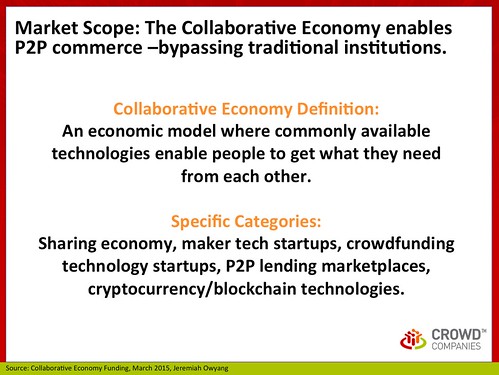
Above: Let’s first define the scope and give examples. This market enables people to get what they need from each other, often not from traditional commerce methods.
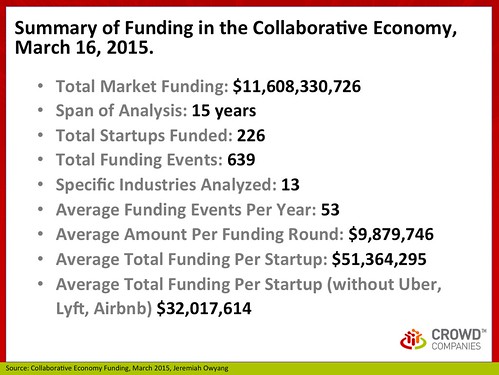
Above: A snapshot of this market shows over 200 startups funded, with $32M deployed to the average startup, not including outliers Airbnb, Uber, and Lyft
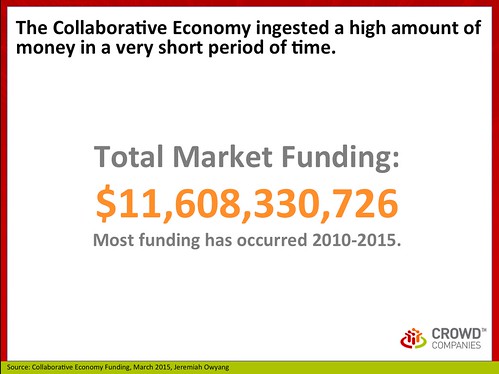
Above: Total of all funding is a whopping $11 Billion funded

Above: Funding has increased year-over-year.
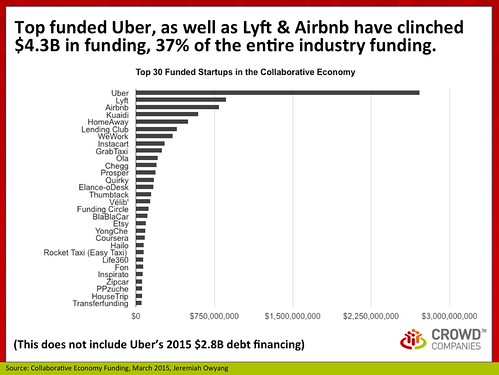
Above: Uber, Lyft, and Airbnb have clinched the most funding. This does not include Uber’s recent billions of debt financing.

Above: Transportation funded above all other industries as expensive, idle goods can be more efficiently deployed.

Above: Not all rounds are equal, most startups have received an A-round, and a few have received a large over $50m
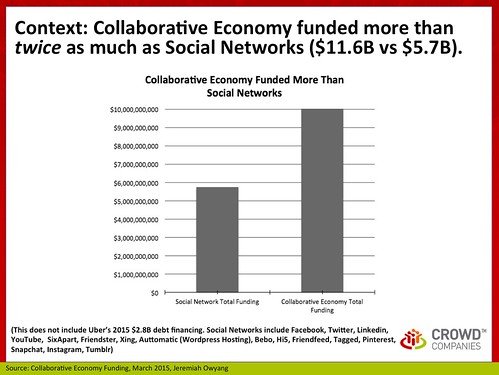
Above: Social Networks, the first market of digital sharing, raised only half the amount of the Collaborative Economy.
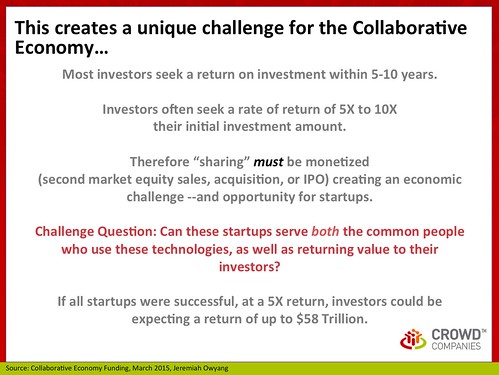
Above: This influx of funding poses risks to the ecosystem.
What it Means:
Looking beyond the raw data, what do these trends tell us about this market?
- Bigger than Social Networks. It is astounding that these startups have been funded by more than twice the amount raised by consumer social networks like Facebook, Instagram, Friendster, YouTube and Myspace. This is a very large market, and it is disrupting traditional business models.
- These startups are trying to find those niches. Take transportation, for example: BlaBlaCar is spreading across Europe and Asia, Lyft is focused on the United States (India and China have produced their own versions), Sidecar is adding package delivery and Uber is spreading globally.
- Transportation, disrupted. Transportation has received the most funding as this market is ripe for disruption: cars, boats, and planes are often expensive, cities are becoming dense, and these assets are infrequently used by their owners.
- Not all will last, but this market is not going away. While these startups won’t all last, they are trying to establish themselves in their niche markets. With all of the funding being poured into them, it means that they are not all going to go away – at least not for the next few years.
- Some of these startups are in a conundrum. For those that will stand the test the time some have taken on incredible amounts of funding, and now must balance out the needs of the community (their customers who rely on their service for their livelihood) as well as return money back to their investors within 5-10 years.
How to Become the Most Sincere (and Efficient) Prospector in the World in 5 Steps
 Since the first merchants packed products on their wagons and traveled to faraway lands in search of buyers, sellers have always worked to find a balance between personalization and the number of people they can reach.
At extremes, you can robo cold call 1,000 people today or spend your afternoon in deep conversation with three to four prospects. Or you can operate somewhere in between.
A career of prospecting has taught me there are two fundamental facts about sales development:
1. The more people you reach, the higher the likelihood of success
2. The more personal and targeted your engagement, the more successful it will be
But you absolutely need both — sincerity and scale, personalization and reach, heart and muscle.
We’ve talked to the best in the sales development industry and can shed some light on how to find this important balance between achieving numbers and personalization.
Here it is:
1. Get the right info
The right name, spelling, title, email, phone number. Use Google, LinkedIn, overseas labor, my company’s product, another company’s product…I don’t care where you get it. But the first thing you have to do is get good data.
Now this often means getting small amounts of data on an ongoing basis. If you ever find yourself acquiring a list so large that you or your team can’t reach them sincerely in the next week, then go back to the drawing board. Bonus points for viewing each prospect’s LinkedIn profile, company bio page, or Twitter account and mentioning something you learned — quickly.
2. Find a way to personalize emails while still able to send several at once
Now by several, I don’t mean 410,000 or some crazy marketing number. I’m talking about a manageable amount of prospects that you can give your personal attention — like 30 to 70. While blasting the list may be fast, it won’t be effective. Your prospects open an email looking for a reason to delete it. If they see it was sent in mass by a robot marketing tool, it’s toast. Systems that recognize your need for personalization and scale are going to be more valuable than those that don’t.
3. Integrated phone calls
Sincerity comes from first understanding your prospects and then reaching out in a way that is convenient….for them. Sometimes you’ll catch them on email and other times on the phone. Have a dialer that is integrated with your email tool so you can track where you are in your communication outreach process. Record calls for coaching, rotate area codes by where people live, and make sure you call the right times zones at the right time.
4. Social touch integration
If you sell to businesses, you’ll want to find your buyers on LinkedIn. Add a step to your prospecting cadence to send InMail or send invites to the VIP prospects. Make sure you use a system that prompts you to send them at the right times so you don’t forget. Automate the logging of these activities in CRM so you can track effectiveness.
5. Metrics and improvement
In order to be sincere and effective, you’ll want to optimize your outreach steps. You’ll want to figure out scientifically which days and times are best to make calls, how many emails to send and which ones are most effective, among other analytics. Test everything. When you do you’ll wind up finding the most sincere and effective methods for approaching your prospects.
From salesmen peddling goods on their wagons to today’s sales development reps, balancing sincerity and scope has been an ongoing challenge. The good news is that with the tools available today, the struggle is a bit easier.
You can tailor your message to each contact without sacrificing your reach using tools to gather accurate info, collect metrics, and integrate phone calls.
So there it is. Take a look at your calendar… are you scheduled to meet with a few prospects face to face? Or have you scheduled hundreds of automated emails? I challenge you to find the middle ground. Starting today, become the salesperson who is both sincere and efficient.
Want to make 2015 the year you close more deals than ever? Download our free e-book for 130 sales tips or visit salesforce.com.

Is dumb money going into smart beta? Funds run by robots now account for $400 billion
Few people have profited more from the so-called smart-beta craze than Tom Dorsey. A new exchange-traded fund that he runs using a century-old charting methods took in $1.2 billion last year. Then, in January, he sold his 22-person investment firm, Dorsey, Wright & Associates, to Nasdaq OMX Group for $225 million.
Dorsey calls himself a money manager, Bloomberg Markets will report in its April issue, but his methods are more robot designer. He says so himself, proudly. If Dorsey and his team got abducted from their Richmond, Virginia, office by aliens, their algorithms could keep picking investments for the firm’s new money magnet, the First Trust Dorsey Wright Focus 5 ETF, forever.

“Once a quarter, we press a button,’’ Dorsey says. The Focus 5 algorithm then generates a list of investments, and First Trust Portfolios, his partner company, executes them. Otherwise, they don’t meddle with the robot. “We just need someone to press the button.’’
That, for Dorsey, is the essence of smart beta, or strategic beta, or scientific beta, or factor-based investing, or fundamental indexing, depending on which Ph.D. is talking. (Many smart-beta funds are designed by finance geeks.) It’s index investing with key twists, all of them rules-based, with no active management required. Most smart-beta funds track custom indexes. Some are simple variants of the Standard & Poor’s 500 Index and do what they say on the box. Others are hand-crafted and small batch, made by people with little more than a stock-filtering system and a dream.
The idea is money—as marketing, at least. There are almost 400 smart-beta funds in the U.S. right now, and they account for $400 billion, or 20% of all assets, in domestic ETFs, according to Bloomberg Intelligence. That’s up from zero in May 2000, when the first prototypes—one iShares ETF aimed at growth and another at value—marched out of the lab and onto exchanges.

Like any Wall Street bonanza, this one has drawn imitators, innovators, and possibly a few hucksters, according to the U.S. Financial Industry Regulatory Authority, which included smart beta on a list of eight product categories that it plans to scrutinize for sales violations this year. “For individual investors, products tracking these indices may be complex or unfamiliar,’’ Finra said in a Jan. 6 letter. “It remains an open question how the indices and products tracking them will behave in different market environments.’’
No one has claimed credit for coining the now ubiquitous term smart beta, which, in just two words, makes a big, market-beating promise. Among the financerati, beta means return you get simply for taking the risk of owning stocks. The much rarer alpha is extra return from spotting something that the market missed. Despite what human managers say, alpha is rare. Smart-beta enthusiasts accept that and try to better mine the returns from beta using an eclectic range of strategies, filtered for various factors and united by their set-it-and-forget-it rule books.
What smart beta does best is sever the link between the price of a stock and its weight in an index
One can, for example, buy all the stocks in the S&P 500 in equal amounts (giant Apple down to tiny Diamond Offshore Drilling) with the Guggenheim S&P 500 Equal Weight ETF, rather than following the index’s decades-old rule of giving greater weight to bigger market capitalizations. Other funds weight the index by volatility, dividends, sales, book value, or growth in earnings.
One of the most popular smart-beta ETFs is the WisdomTree Europe Hedged Equity Fund, which investors are using to surf the wave of money the European Central Bank is releasing to combat deflation. The dollar-based fund buys eurozone exporters but hedges against swings in the euro. That saved Europe Hedged from ruin last year when the currency tumbled 12% against the dollar, a move that would have turned its gains into losses. As of Feb. 17, the fund had taken in more money in 2015 than any other ETF, smart beta or otherwise, with $4.3 billion.
Many smart-beta funds encode even-more-complex rules into their operating systems. ProShares Large Cap Core Plus, for instance, makes the WisdomTree fund look as clunky as a Commodore 64. ProShares Core Plus uses borrowed money—leverage—to buy stocks that meet 10 different targets, including value, growth, and price momentum. “It allows you to put a little more money where your mouth is on the long side,’’ says Michael Sapir, founder and CEO of ProShare Advisors.
ProShares Core Plus also sells short stocks that miss the targets, betting they’ll decline. The strategy was designed by Andrew Lo, a professor of finance at the Massachusetts Institute of Technology Sloan School of Management, and Pankaj Patel, now an analyst at Evercore Partners. Between the leverage and the short sales, Core Plus looks like an exchange-traded hedge fund. From its inception in July 2009 through last year, the fund returned 166%, compared with 156% for the S&P 500.
What smart beta does best is sever the link between the price of a stock and its weight in an index, says Rob Arnott, chairman and co-founder of Research Affiliates in Newport Beach, California. Arnott has become a demigod in the movement since co-authoring the 2005 paper “Fundamental Indexation.’’ Research Affiliates indexes are used by fund companies to manage $180 billion of assets. “By linking the weight to price, the more expensive something is, the bigger your holding,’’ says Arnott, who received a bachelor’s degree in economics, applied mathematics, and computer science from the University of California at Santa Barbara. That means you’re buying some stocks because other people like them, he says, not because they’re better companies. “Why on earth would you want to do that?’’ he asks.
Arnott and his chief robot designer, Jason Hsu, a finance Ph.D., unveiled the index that drives the $4.3 billion PowerShares FTSE RAFI US 1000 Portfolio in 2005 after testing myriad measures for company size, even the number of employees. The factors Arnott and Hsu settled on: book value, sales, dividends, and cash flow. Their algorithm requires that the fund sell stocks that are judged pricey by those measures and buy others deemed to be cheap.
So far, Arnott’s robot is working — really well. PowerShares FTSE RAFI has beaten the S&P 500 since it started on Dec. 19, 2005, with a total return of 120% versus 103%. The beauty of that fund, and smart beta in general, is that the machine will make hard trades when the human won’t, Arnott says. It won’t hesitate to pick up damaged goods at a fire sale, and it will hang on when the world looks ready to end. That, according to Warren Buffett, is when to buy, and it’s exactly when most humans freak out and sell instead.
Take 2009. Lehman Brothers had failed the year before, and the financial system veered toward collapse. Human traders dumped anything that looked like a bank or brokerage. FTSE RAFI, on autopilot, more than doubled its positions in Bank of America and Citigroup. Then, government measures to end the panic took hold, and the fund returned 42% for 2009, compared with 26% for the S&P 500. A client for whom Arnott manages money in a separate account that mirrors FTSE RAFI begged him not to rebalance into bloodied financial stocks; Arnott yielded, and the client lagged behind the fund by 7 percemntage points.

“The more uncomfortable the rebalance, the more likely it is to be profitable,’’ Arnott says. “The rebalance into financials was predestined because all we do is maintain the weights of the sectors to reflect their weight in the macro economy. The financial sector hadn’t gone away. It was just reeling.’’ And Arnott’s algorithm mandated that it buy more to rebalance, as insane as that looked at the time.
Many smart-beta believers are converts from other disciplines. Dorsey’s story, for instance, borders on the spiritual. In 1979, after leaving his job as a stockbroker at Merrill Lynch, he started the options department at Wheat First Butcher Singer and discovered the book The Three-Point Reversal Method of Point and Figure Stock Market Trading. First published in 1947, it described a simple technique for tracking stocks that the author, A.W. Cohen, said could divine price patterns. The point-and-figure method has been around since the 1800s; Charles Dow, creator of the namesake index, even used a version to pick stocks, according to Dorsey. It’s also absurdly low tech: You simply track a security’s moves with columns of X’s, for up, and O’s, for down. Get the right pattern of X’s, you buy; O’s, you sell.
The simplicity dazzled Dorsey, and in 1987, he started his own firm to teach the method to brokers. By the time the idea of smart beta came along, his firm, Dorsey, Wright & Associates, had taught thousands how to use it for their clients. “You could look at this like my ministry and the financial advisers as my ministers,’’ he says.
Since then, Dorsey Wright has developed 82 different models for investing in stocks, ETFs, and country funds. Dorsey’s computerized system holds a point-and-figure bake-off between every ETF, say, in his universe, pitting one against all, then another against all, and so on, to see which is sending the strongest buy signal. Brokers using Dorsey Wright pay for the recommendations.
More recently, fund companies, including First Trust and Invesco PowerShares, have used his models to guide purchases in 17 ETFs and mutual funds, for which they pay Dorsey Wright a fee. The Focus 5 ETF, which launched in March 2014, uses point- and-figure methods to buy just five other ETFs offered by First Trust in Wheaton, Illinois, each of them industry-specific.
Brokers already using the Dorsey Wright models flocked to it. By year’s end, Focus 5 had $1.62 billion under management, the most of 200 ETFs launched last year. And then Nasdaq came calling, looking to get a piece of the smart-beta boom and reduce its dependence on low-margin trading, Dorsey says. It bought the whole firm.
The craze is driving traditional indexers nuts. “Don’t mention smart beta in this office!’’ Jack Bogle, 85, founder of Vanguard Group and father of the index fund, tells Bloomberg Markets. “I don’t even know what it means. Baloney. Marketing!’’
Rick Ferri, founder of Portfolio Solutions in Troy, Michigan, says smart beta is a ploy for active managers to retake some of the billions lost to Bogle and his low-cost indexes. If an active manager has an investment strategy that shows positive returns over the past decade or so, and it can be encoded in an algorithm, he can call himself an indexer, charge higher fees for his secret sauce, and kick back and get rich, Ferri says. “Everything that used to be active management became fundamental indexing,’’ he says.
The Janus Velocity Tail Risk Hedged Large Cap ETF has many of the things that smart-beta critics such as Ferri love to hate. Started in June 2013, the fund returned 6.8% in 2014, compared with 13.7% for the S&P 500, even though it invests in S&P 500–tracking ETFs. It underperformed because it paid for derivatives that protected it from tail risk—the slim chance that something would go really wrong. That insurance lowered its risk, certainly, but the fund captured just 50% of the index’s return, after expenses. Those totaled 0.71%, or $71 on each $10,000, compared with 0.39%, or $39 per $10,000, for Arnott’s PowerShares FTSE RAFI. “They’re making really good juice on this,’’ Ferri says.
Velocity Tail Risk doesn’t trade much either. Some days fewer than 1,000 shares change hands, making it harder for sellers to find buyers. Last year, the average difference between an offer to buy and an offer to sell was 0.31%, or 62 times the average spread in the SPDR S&P 500 ETF Trust, which closely tracks the index. The Velocity Tail Risk fund is designed to give up some gains in exchange for peace of mind, says Nick Cherney, head of exchange-traded products at Janus Capital Group in Denver. “In major bull markets, we don’t do as well,’’ Cherney says. “Our real value comes on the worst days.’’
Newer funds have become even more esoteric. The AlphaClone Alternative Alpha ETF searches regulatory filings to find stocks owned by hedge funds and also has the option to apply a partial hedge by shorting the stock market. The ALPS US Equity High Volatility Put Write Index Fund sells options on stocks prone to big swings and distributes the proceeds to investors. The Gold Shares Covered Call ETN sells options on another ETF that holds gold.
Some money managers say smart beta has become too clever. Peter Mallouk, president of Creative Planning, a financial advisory firm in Leawood, Kansas, sees a lot of marketing B.S. “I think a lot of people are going to be negatively surprised by smart beta,’’ he says.
William Bernstein, a retired neurologist in Portland, Oregon, who’s written four books on investing, is also skeptical. “Is there a lot of dumb money going into smart beta?’’ he asks. Probably, he says, and it makes him wary. “When I own an asset class, I ask how savvy my co-owners are. Here, you’re getting an influx of undisciplined investors who think they’re getting a free lunch.’’
Dorsey plays pool in a league in Richmond. After the Nasdaq purchase of his firm, he could doubtless take more time to hone his skills. But he plans to stay on as a consultant. He has his copy of Cohen’s book on his office wall, and he still marvels at how his system just chugs along. Yet even Dorsey recognizes that robots have their limits. “The more esoteric you get with ETFs,’’ he says, “the more they don’t work.’’
Best to stick with a 100-year-old charting system, Dorsey says. Simple though it may be, the fees and expenses on Focus 5 are 0.94% a year, which is high even for a smart-beta fund. Dorsey says most of that goes to First Trust and that his firm gets about 0.2%. But the expenses could be worth it. The oldest ETF using a Dorsey Wright model, PowerShares DWA Momentum Portfolio, has returned 82% after fees since it was started in March 2007, compared with 78% for the S&P 500. That’s not exactly a Terminator triumph, but smart beta isn’t a Skynet strategy for world domination. It’s about incremental wins over time that compound their way to greater wealth.
Leave the robot alone and that’s what you get — provided you have the right robot.
Bloomberg.com
Welcome To The Workplace Economy
The Information Age is powered by talent, and the fierce competition for skills and capabilities has created a new Workplace Economy. Individuals are the ‘sellers’, firms are the ‘buyers’ and the social web is the marketplace.
You, as a company, are now selling your workplace to Millennials that prioritizes societal impact and lifestyle over a big paycheck. Increasingly, they identify, evaluate and choose their employers through the social web. Your current employees, and their social voice, will determine your success in the Workplace Economy.
From Goods To Knowledge To Skills
The Workplace Economy reflects a change in what societies value. From roughly 10,000 B.C. to the mid-18th century, agriculture goods were prized. From the Industrial Revolution to World War II, manufactured goods became more important. At end of World War II, as we entered the Post-Industrial age, knowledge trumped physical goods. And with the advent of the worldwide web, the knowledge that was once so valued became public domain, accessible to anyone with Internet access.
So today, the greatest value resides in people’s skills and capabilities. Who you are and what you can do is more treasured than what you know. To compete in the Sharing Economy, the Subscription Economy and other Information Age economies, companies need a modern workforce with skills.
It’s common knowledge that people in Science, Technology, Engineering, and Math (the STEM fields) command a high price tag in the Workplace Economy. But it’s not just the STEM workers who have power in the Workplace Economy, which is essentially an elite subset of the job market. Salespeople, marketers, designers, analysts, researchers, etc., can command just as much market value.
Information Age skills require years of training and dedication to develop, and currently, companies are struggling to find enough talent. As the ManpowerGroup’s 2014 U.S. Talent Shortage Survey reports, 40 percent of employers report difficulty filling jobs and 56 percent believe this shortage has a medium to high impact on their ability to meet client needs. The Workplace Economy is a seller’s market.
What A The Modern Workforce Wants
As Millennials become the bulk of the American workforce, they are setting new expectations for employers, the buyers in our Workplace Economy. It’s not that Millennials are different from older generations. As Dr. Steven Hunt, a recognized expert on strategic human resources, argues, “In sum, when it comes to basic career goals and interests, Millennials are pretty much just like Baby Boomers were when they were young. The big difference is that Millennials are entering a labor market where skilled employees can demand a lot more from their employers and get it.”
Millennials can afford to be picky in their career choices. And unlike in the old job marketplace, where information about a company was limited, the social web allows workers to discern what a company really offers. We can all see what employees say on Glassdoor.com, determine our market value on Salary.com, read customer reviews and essentially dissect a company using social technology.
So if you’re buyer in the Workplace Economy, what do you need to offer on the social web? What does the modern workforce currently seek? Over the past five years, surveys and studies of Millennials have produced a dizzying mix of conclusions, many of which conflict. However, two demands are consistent across multiple studies:
Values and Impact – According to Net Impact’s Talent Report: What Workers Want in 2012, 58 percent of Millennials would take a 15 percent pay cut to work for an organization that reflects their values. Another 45 percent would take the smaller salary for a job that makes a social or environmental impact. Researchers at UNC Kenan-Flagler Business School and the Brookings Institution have also discussed this preference for meaning over more money. Young people seek a deeper purpose in their work, so they’ll choose an employer with a compelling vision that mirrors their own values.
Lifestyle and Autonomy – Surveys from Net Impact, Cangrade, PwC, and others have all found that Millennials place a huge priority on work-life balance, flexibility, and autonomy. In the Information Age, flexibility makes sense because at the world’s most innovative organizations, performance is measured by the quality of results, not time and units produced. If unlimited vacation time or telecommunicating from a remote island lets an employee achieve superior results, why not permit it? If an on-site gym, social events, and volunteer days keep employees fresh and motivated, why not provide them? Millennials want greater control over their lifestyle and work days, and they admire employers who will shed traditional office conventions.
Social Media Is Your Proving Ground
In the Workplace Economy, there is a shortage of skilled and capable individuals. This shortage gives Millennials the power to choose companies that reflect their beliefs and permit their lifestyle preferences. They will discover, evaluate and connect with these companies through the social web.
All the job descriptions, stocks photos and HR copy on your website will be taken with a grain of salt. As Crowdtap and Ipsos Media CT found, Millennials spend 5.4 hours per day, or 30 percent of their total media time with social content, and they trust that content more than any other form of media. They gravitate to the unfiltered passion and experiences expressed by their peers.
Therefore, to win in the Workplace Economy, you have to mobilize your employees on the social web. They must speak to the values and lifestyle that the modern workforce seeks. Only their voice can make your brand a beacon for talent.
How to hire top tier developer and engineer ‘unicorns’

GUEST:
The competition to hire the best technical talent has never been fiercer. This is hardly surprising as great developers can make a huge difference to a company’s chances of success, but it’s still a major obstacle to growth.
Just to be clear, growth is not entirely dependent on engineers. Dual threat marketers, with both software and traditional marketing expertise, can also make a huge difference to a company’s progress. The very best are often referred to as “unicorns”, akin to the mythical rare creatures with magical powers! John Koetsier has put together some great advice for anyone looking to hire tech-savvy marketers and growth hackers.
It’s the recruitment of top-tier developers though, that this article will focus on. It’s a task that’s become so hard that Silicon Valley’s major players recently banded together to form a wage fixing cartel aimed at preventing talent poaching. The ‘Techtopus‘, as it has now become known, was a tacit agreement, between the likes of Apple and Google, not to poach top employees from each other.
We hear constantly about software eating the world, but the problem with that is that we need more and more engineers to build (and feed) it all!
Are we on top of this?
The struggle to hire top talent is reaching fever pitch. Companies are resorting to out-of-the-box, wacky recruitment campaigns, and substantial perks to differentiate themselves from competitors.
Not the sexiest problem to work on in the Valley, recruitment is now getting some long overdue attention from investors, with a number of companies springing up to try and tackle the growing company-developer asymmetry.
There have been some interesting attempts to create a framework that companies can use to entice superstar developers.
 So far, our solution to the problem has been a little one-dimensional – we’re just trying to offer better ‘stuff’.
Auctions
Engineers are such precious commodities that companies are prepared to compete for their attention in auctions.
Companies like Hired promise top developers an extra signing fee, before marketing their human wares to eager startups.
Companies are promised a fresh pool of talent every week, but is it the right talent?
Critics argue that auction systems have created a mercurial brand of developer, only interested in maxing out their paycheck, before flitting on to the next opportunity.
Exciting work
Development projects are not all created equal. Working on futuristic projects at Magic Leap is likely to be more stimulating than building email templates!
Companies like Workshape match engineers with projects that they are enthusiastic about.
On the surface this is great – companies are getting connected with developers who are genuinely excited about what they’re working on.
The problem? Companies might get motivated applicants, but the system doesn’t guarantee quality. If you’re working on something interesting, you’re still going to suffer the problem of unskilled applicants who ‘like the idea’ of working at your company – not necessarily what you need.
Pre-Assessment
Every company tends to have their own way of grading technical talent. Applicants can expect a personal interview alongside some kind of competency test.
These tests are often time-consuming, and can really stack up if a candidate is being courted by more than one company.
To counter this, companies like Trycatch are presenting an alternative. Take one (week-long) test, apply to many companies.
This simplifies the process for job-seekers, and gives companies a uniform metric to help them judge talent – in theory it’s a win-win.
Often though, companies will insist that applicants take their test too – it’s the way they judge all incoming talent, why would they change it? It can also be tricky to stamp out cheating from engineers who think a perfect test score will be their golden ticket to a great career!
We’re studying marketing automation platforms…
Add your voice and we’ll share the data with you.
”Do-it-yourself hacks”
If none of these solutions tickle your fancy there are always shortcuts to help you track down technical talent.
– Boolean search strings can help you filter LinkedIn for specific skillets
– Using web scrapers on Tech Forums or Meetups can unearth talented people that you’re unlikely to stumble across when searching for potential applicants using more traditional means.
Tricks like this can be great to help you unearth the odd employee from time to time, but they’re not particularly scalable.
That’s the key. Creating a sustainable process to attract, engage and hire the very best technical talent.
Treating candidates like customers
All of these solutions share the same flaw. The approach is always transactional – companies are competing to give candidates what they think they want, as opposed to trying to build a relationship.
We’re offering bigger wages, easier applications and ‘fun’ work, we’re not making an effort to interact. We’re competing for attention, not adding value.
In that sense there are plenty of parallels we can draw with traditional, interruptive marketing models. These are usually predicated on breaking the attention flow of would-be buyers and getting them to look at your shiny offer.
In recruitment, this translates to using perks like money to distract candidates from the things that matter:
– Why your company is so great
– Why people really want to work for you
In the marketing industry we’ve seen a transition to an ‘inbound’ model. Now companies work on earning the attention of future customers by creating interesting content, participating in online conversations and focusing (above all) on providing value.
Why should hiring be any different? There’s huge (and largely untapped) value in engaging site visitors and potential applicants in the online arenas that they frequent. Invest time speaking to people on Stack Overflow, Twitter and relevant LinkedIn groups and try to make an impression.
The most talented candidates have a lot of choice – putting in the effort to build relationships with them has enormous value and helps you find people interested in your business vision (not just the free gym membership and hefty wage). Instead of inbound marketing, think inbound recruitment.
Building the right relationships
The customer acquisition process is based around the idea of a funnel. Marketing and sales reps do their level best to convert leads to customers, while continually topping up the funnel with fresh opportunities.
There’s a lot we can learn from this process, principally not to rush things. No one enjoys cold calls from recruiters ‘just checking in’ – people like to be wined and dined a little!
Re-imagining your hiring workflow as a funnel is key to this idea. Constantly start conversations with talented people – who knows where they will end up! Not all of them will have an immediate effect, but who is to say that 6 months down the line an engineer who you made an impression on won’t apply.
If you’re desperate, and speed is of the utmost importance, there is no harm in supplementing this process with more other hiring methods like job ads, but you’ll be more effective if you focus on relationships.
What is your company really like?
Unsurprisingly, when you start speaking to great developers they’re keen to understand your company.
– What do you do?
– Why does it matter?
– Why is it exciting?
Being transparent and honest is the trick. Buffer, who pride themselves on their transparency and display everything from salaries to funding on their website, have released hiring statistics that show just how effective this tactic is. The company had 3,864 applicants (for 3 open positions) in January 2014 alone!
AngelList, which has quickly morphed into one of the premier places to find developers, provides another example of this trend. Aside from attracting investment, companies use the site to build a following amongst the developer community – generate enough ‘buzz’ and your company starts to trend.
One of the keys to trending? Be transparent and give insight into how your company is doing. Building traction and getting investment? Make sure you make that crystal clear.
Done right, this can have a dramatic effect. Dealflicks, which recently used the platform to announce funding has received 272 applicants in the last week alone!
Conclusion
The key to hiring the very best developers is engineering that moment of serendipity when someone decides to organically apply to your company. This process starts long before CVs are sent, tests are taken and ‘apply’ buttons are clicked.
Inbound recruitment is more of an indirect process. Taking someone through the various steps from interested visitor to enthusiastic applicant, while providing value every step of the way. It’s entirely scalable and can make a huge difference to hiring success.
 Ben Slater is the Head of Marketing at Seed.jobs, an inbound marketing platform for recruitment. You can quiz him on inbound recruitment @BenJHSlater
VentureBeat’s VB Insight team is studying email marketing tools. Chime in here, and we’ll share the results.

This UK train line boosted house prices by up to 82%

Living near train tracks isn't exactly the first thing that springs to mind when you think about what boosts property prices.
However, according to data from estate agents Knight Frank in its "Crossrail: Analysing Property Market Performance from Reading to Shenfield 2015" report, more and more Britons are opting for the convenience of being near public transport and are therefore pushing up the prices on properties that are within a maximum 10 minute walking distance of a certain Crossrail train line.
Crossrail, Europe’s largest infrastructure project, is set to be completed and become fully operational by the end of 2018. With three years to go, more and more people are buying properties near the Crossrail stations in anticipation of the transport connections to and from London.
Knight Frank said that the average property price increased along the Crossrail route (as pictured) compared to a 43% uplift in the wider area since the project received Royal Assent in July 2008. This is when a parliamentary bill is turned into an Act of Parliament (law) after the Queen formally agrees to it.

Knight Frank said in a report that the average property price within 10 minute walking distance to Bond Street station rose by 82%, while those near Acton rocketed 77% over the last six years. In Acton's surrounding areas, there was "only" a 33% rise over that time.
“Our research shows overall price performance continues to be stronger in the central London sections of the Crossrail route," said Gráinne Gilmore, head of Knight Frank UK Residential Research, in the report.
"However, over the last 12 months, the price ‘ripple’ effect in London has really started to take effect, with stronger price growth in areas surrounding central London. This could help feed into stronger price growth around stations towards the East and West, especially those which have underperformed to date, and where housing supply is set to be delivered in the coming years.”
“The planned levels of development along the outer sections of the route should provide scope for price uplifts as the public realm is improved, amenities receive a boost and buyers have new reasons to visit the area. The relative ‘discount’ in terms of price per square foot in these areas compared to more central locations is also likely to work in their favour. We expect that as the opening of Crossrail approaches, the increased connectivity combined with new development will result in price outperformance in these areas.”
As of 2014, London's population passed its previous record-high, seen just before the outbreak of the Second World War. Knight Frank said that forecasts show that by 2036, Britain's capital population will reach 10 million, and "demand for public transport will have risen by another 50%."
According to Transport for London, the population is estimated to grow by one full tube train every three days.
The underground carried a record 1.3 billion passengers between 2013 and 2014.
Join the conversation about this story »
NOW WATCH: Research reveals why women cheat, and it's not what you think
Learn the Secrets Behind 5 Great Content Marketing Projects

Before I turned 12 and decided to become a content marketer (I was a weird kid), I wanted to be a biologist. I loved how the field allowed you to study all the “unseen” elements of a living thing that made it work. To the untrained eye, an organism is just that – an individual thing, a single entity. But trained biologists know and value how millions and millions of tiny, underappreciated parts all fit together to make the larger whole just plain work.
To understand great content is to understand that same idea – dozens of small, unseen choices, tactics, and techniques are really what make great pieces work well. So whether we’re creating blog posts, graphics, SlideShare presentations, podcasts, videos, or other projects, the devil is in the details. It’s the way a great videographer frames a shot. It’s the way a writer weaves a story throughout a stellar blog post. It’s the way an expert podcast producer fades emotional music into the show, then out again.
This attention to detail and ability to understand small, subtle components to larger works are the true keys to mastering the craft of content creation. Yes, we can appreciate that Contently created a great big map of the content marketing landscape, for instance, but we should also appreciate the little things it did to make the piece a success.
The trick, however, is knowing where to look for these hidden elements of a great piece.
So today, I wanted to explore five examples of great content that resonates emotionally or intellectually with audiences. For each, I highlight a somewhat hidden tactic or technique that the marketers used to make each piece work well. (As a disclosure, these examples were shared in my newsletter, the Daily Content. I have no affiliation with these brands aside from that.)
Example 1: Award-winning video from Liberty Mutual
This Webby-winning video from Liberty Mutual is beautifully done. There’s a clear and emotional narrative, and it’s truly content, not a commercial. Liberty does a great job of showing restraint and taking a back seat to the core story.
To understand the key hidden element, we first need to understand something about the medium. In video, as in audio, you constantly need to think about drop-off. Both are linear experiences – it’s much harder to skim or skip around a video or a podcast as compared to a blog post or PDF. So as a content producer, you need to be paranoid about your audience leaving at any given moment for the millions of other stimuli available at the click of a mouse.
In this particular example, pay close attention to the way the video starts: As viewers, we’re dropped right into the story. It’s almost like the interviews and filming have been happening for a few minutes and, suddenly, you’re invited to watch. There’s some missing context, which becomes clearer over the course of the video, but it prompts several questions from the outset that cause us to stick around: Where is this “Murray” town being referenced? What game are they talking about early in this video? Why is that game such a big deal? Why is this story being told at all?
It’s a sort of in medias res approach to storytelling wherein the viewer starts near the middle or with some of the context left unexplained. You can use that device to reel in the audience in a distracted world. By dropping viewers into something that already feels like an unfolding story – rather than taking the standard approach of sharing the dry, basic facts up front – you’re more likely to get viewers to pay attention and remain engaged until the end. There’s more to discover, and the viewer wants to lean forward and get some answers.
Like so much of what makes great content effective, it’s easy to miss this technique. It’s not the overt “marketing” part we all readily identify such as calls to action or splashy headlines, but it’s just as instrumental to make this part of an effective content marketing strategy.
Example 2: Boss-proof interactive spreadsheet from Bonobos
Ever get caught red-handed by your boss when you should be working but are instead shopping for a bunch of totally “necessary” things that in no way serve as guilty-pleasure purchases?
Yeah. Me neither …
But for everyone else, Bonobos, an e-commerce-driven apparel company, created a clever tool to fool your boss into thinking you’re working.
(Note: To understand what I’m referencing, you’ll need to download the actual file since it was an emailed campaign not hosted online.)
 The subtle yet powerful element that makes this piece a success is the brand’s commitment to making the piece functional.
Here’s what I mean: Imagine you receive an assignment that asks you to create a spreadsheet others can put on their screen to feign work when they’re actually shopping online. A logical, quick piece to create might pop quickly to mind: Dump some placeholder charts into Excel and ship the content.
But Bonobos takes that one step further and conveys the sense that they give a damn about quality content. The project, cleverly titled =VLOOKUP(Your boss is behind you), actually allows you to shop inside the spreadsheet! If you manipulate the tables, it populates various bit.ly links for actual Bonobos product pages.
Not only does this improve the experience for users, it allows the company to measure traffic coming from an offline project. Brilliant.
(Bonobos also inserts some pretty hilarious copy, as well as hidden messages only viewable by hovering over certain spots. Clearly, it cares deeply about providing the best possible content to its audience.)
Example 3: Sensational-yet-substantive blog headline from Price Intelligently
Price Intelligently, makers of ProfitWell, an analytics tool for software-as-a-service companies, wrote this brilliant blog post detailing the missed profits of a tech start-up legend:
How Groupon Is Losing $1,117,808 Every Single Day
Some subtle and effective elements that make this headline work include:
- The incredibly specific number. It makes you wonder how the company writing the blog post knows such a specific fact. Curiosity may have killed the cat, but it definitely prompts the click.
- The size of the number. Over a million dollars?! What the heck is Groupon doing? (Note: This post is an oldie but a goodie, so things may have changed.)
- The word single. This is such a hidden thing in that headline, but oh how I love it! That one word turns a decent headline into a powerful one. Rather than simply saying “Groupon is losing X dollars every day” or “regularly,” that one small word drives home the severity of the issue, elevating the effect of the headline.
Now think back to the saying, “Those who can, do. Those who can’t, teach.” In the content marketing world, we seem to believe that those who can write, write, while those who can’t, try to use overblown headlines.
But Price Intelligently took the time to write a sensational headline that’s actually backed up with substance and quality. It starts with a company lots of people in their target market know and care about, and it uses the name to its advantage before delivering a well-researched post. Awesome!
Example 4: Original song from Airbnb
I’m no singer/songwriter, so rather than analyze the track itself, let’s zoom out a bit to learn from Airbnb’s official song. The hidden element that makes this work is that Airbnb clearly understands what it sells as a B2C company – an emotion. As it states, it offers the audience a sense of belonging even more than it offers rooms.
All the top B2C brands understand this idea of selling and marketing emotions, from top players to smaller brands just seeking an emotional niche to occupy in the minds of their buyers. For example, Coke’s emotion is happiness. On-demand car service Zipcar’s emotion is freedom. Nike, Red Bull, Pepsi, P&G, Kraft, Unilever – they all sell emotions.
Recognizing that fact and clearly articulating it, as Airbnb does when blogging about its official theme song, is the best way a B2C brand can coherently align content and product.
If you’re a B2B marketer, this is much easier. You know exactly who you’re trying to reach. Do you sell marketing software? Hmm, I wonder who you should target.
But in B2C, it’s much more nuanced. Yes, you can have personas, but generally speaking, you’re still able to fit your product into the lives of many more types of people. So the content has to match the emotional benefits and positioning of the company’s products. With that as the foundation, Airbnb’s song experiment suddenly makes much more sense as an effective content marketing piece.
Example 5: SlideShare presentation from Google’s Eric Schmidt
To help promote his book, How Google Works, the company’s former CEO and current executive chairman created this attention-grabbing SlideShare presentation. (Or, more likely, his agency created it for him.)
One of the most effective-yet-hidden elements to this piece is the relatively minimal design, particularly on the cover slide.
This normally wouldn’t be noteworthy on its own, but it’s important to recognize the “native” experience of SlideShare. The bulk of the audience for any SlideShare presentation is found on slideshare.net, given the site’s millions of hits per day. But it’s a cluttered site, with dozens of cover slides demanding your attention on every page.
Thus, the minimal design on Schmidt’s SlideShare presentation cover actually helps the project stand out. I remember seeing it for the first time when visiting SlideShare – it was so different and so much less stressful than the rest of the page, I couldn’t help but click it. It’s such a small thing to consider relative to the entire project’s copy, layout, design, and promotion, but it made all the difference in attracting me as a visitor … and now even more people know about it because I’m listing it here.
Are you a content biologist?
Too often, when we consider the creatures that are blog posts, videos, podcasts, and so on, we act like kids playing with toy animals – dumping them on the floor, randomly grabbing at each one, pounding them together as we play. They are single entities to be used and abused.
In my opinion, that’s leftover behavior from not knowing any better. Maybe that blunt, brutal approach to content worked when you were the first adopter. (“Just hit publish! Just copy the other guy! Who cares about quality?”) But the days of being first – and the days of trying to be loudest – are long gone. In 2015, we can’t just create content to reach audiences, we need to create things that will resonate with them.
In that kind of world, the true students of this field are the ones who separate. They’re the ones who are content “biologists.” They understand that all the smaller, seemingly hidden pieces that make up a great piece of content are actually what make the entire thing work in the first place.
What if we all succeeded in getting to that point? What if we all became masters of the craft of creation, along with our knowledge of distribution and measurement?
In short, everything would get better: our results, our careers, and our audiences’ lives.
That’s not my opinion. That’s science.
Want to improve your skills to become a content biologist? CMI can help. Our Online Training & Certification Program provides you with must-know strategies, tactics and best practices you can use to build a strong foundation for your projects. Learn more.
Cover image by Joseph Kalinowski/Content Marketing Institute
The post Learn the Secrets Behind 5 Great Content Marketing Projects appeared first on Content Marketing Institute.
Why You Need to Give to Get
In sales, you can't expect buyers to just plunk down their dollars and buy from you. You must give to them first. Give them educational content, demonstrate your value, trust them, be willing to take a risk on them, and be respectful. You'll have greater success if you do.

How to Supercharge Your Sales Pipeline with Predictive Intelligence
The pricing strategy for the Apple Watch is insanely smart

How do you price a new type of smart watch at $600 (£410), or more, when the market price is below $300 (£205)? That’s the problem Apple faced when the time came to devise a pricing strategy for the Apple Watch.
The following chart shows that Apple has successfully managed to maintain the average selling price (ASP) of the iPhone – the company’s most valuable product – at above the $600 (£410) level for the last six years. The reason why the average selling price (ASP) of the iPad had dropped is due to the introduction of the iPad mini, and the introduction of lower-price iPod models also explains why the ASP of the iPod has dropped over time.

Here are a couple of insights we can glean from this:
- Don’t place an upper limit on the price at the point of launch: You would not want to set up the Apple Watch product strategy in such a way that the entry price represented a price ceiling. If you did that then you’d know that you may eventually be forced to introduce lower-price models that would then result in the same downwards trend that has affected the iPad and iPod;
-
Try to prevent rivals from developing lower-priced alternatives that will cannibalise sales: The iPhone had managed to avoid the fate of the iPad and iPod because it has not been feasible for rivals to develop a clearly distinct segment within the premium smartphone market at a lower price.
The only way to reduce the ASP in the smartphone market was to either develop a physically smaller device (which would damage usability) or reduce the functionality. The market has taken the latter course which explains why we are seeing very low-price models being sold in price-sensitive markets - but these devices have not been affecting demand in the premium segment, which is where Apple and Samsung are competing.
The watch market has given Apple the perfect opportunity to execute what I think will be seen in years to come as an extremely astute pricing strategy – that will allow the company to effectively guarantee that the ASP will be well above the entry level of $349 (£239), and probably some way above $600 (£410).
It is clear to me that Apple has spent a lot of time studying the Swiss watch industry: in spite of manufacturing just 29 million finished watches in 2014, representing just 2.3% of worldwide industry production volume, Swiss watchmakers accounted for nearly 67% of retail expenditure.
This picture is even more distorted if you take a look at the top end of the Swiss watch market, which is defined as watches that retail for over $10,000 (£6,800): this rarefied segment accounted for just 0.1% of worldwide production volume in 2014 – but 48.5% of retail expenditure.
This goes some way towards explaining what Apple is trying to achieve with its seemingly bizarre pricing strategy for the Apple Watch, where prices start at a reasonable $349 (£239) but then go all the way up to $15,000 (£10,200).
To understand what is going on here, I firstly divided Apple’s watch market into three broad price segments:
- Entry: $349 to $1,000 (£239 to £680)
- Mid: $1,300 to $5,000 (£880 to £3,500)
- Luxury: $5,500 to $15,000 (£3,750 to £10,200)
I then needed to estimate the sales level for each of these segments.
The starting point for this is our projection that Apple will sell 20.5 million Apple Watch units this calendar year - if you’re interested in understanding where this figure comes from then you will find plenty of background in the 2015 edition of Generator Research's Smart Watches report.
I then prepared three different uptake scenarios which were modelled on the reality of the Swiss watch industry, where shipment volumes are heavily skewed towards the lower price bands while value is heavily skewed towards the upper price bands.
The three uptake scenarios were:
- Scenario A: Entry @ 95%; Mid @ 4%; Luxury @ 1%
- Scenario B: Entry @ 90%; Mid @ 8%; Luxury @ 2%
- Scenario C: Entry @ 85%; Mid @ 11%; Luxury @ 4%
This now gives us sales levels for each of the three price segments, for each of the three scenarios.
The next step is to estimate the revenues.
To do this I developed some plausible demand curves which were based on sub-dividing each of the three price segments into 14 sub-segments - with unit sales decreasing on a straight-line basis from the lowest price to the highest price. I adjusted the elasticity in each of the three segments to reflect the fact that people in the Luxury segment are clearly less price sensitive than those in the Entry segment.
The result was a set of demand curves that look like this:

This results in the following table:

- The base case is where the Apple Watch is just one price ($349, £239) which would mean that the revenues for 2015 would be $7.2 billion (£4.9 billion). All of Apple’s rivals are operating a price model that either involves a single price or a number of closely-related prices (compared, that is, to the massive difference between the entry level and top end prices of the Apple Watch);
- Basic economics tells us that a ‘flat rate’ pricing strategy is sub-optimal because it fails to extract the maximum revenue from every buyer. With the iPhone, Apple is stuck with a ‘flat rate’ pricing model because pricing in the premium segment of the smartphone market is quite concentrated. But that is not the case in the Swiss watch market, which provides Apple with a great opportunity to move to a revenue-maximising pricing strategy for the Apple Watch;
- If 95% of unit sales of the Apple Watch were in the $349 (£239) to $1,000 (£680) segment, with just 1% in the $5,500 to $15,000 segment (£3,750 to £10,200, Scenario A) then this would have the effect of doubling the average selling price from $349 (£239) to $748 (£478) and doubling revenues from $7.2 billion to $15.2 billion (£4.9 billion to £10 billion);
- In the most optimistic scenario (Scenario C), where 4% of unit sales of the Apple Watch are in the luxury segment, then the revenue earned by the luxury segment for calendar 2015 would be $8 billion (or 33% of total revenues, £5.45 billion) while revenues for all three segments for 2015 would be $24.1 billion (£16.40 billion) – or nearly 3x the base case.
To me the conclusion is that Apple has been very clever in how it has priced the Apple Watch – even more so when one realises that most sales in the $5,500 to $15,000 (£3,750 to £10,200) luxury segment will be incremental to sales of Swiss luxury watches: most buyers will see an Apple Watch as an additional device, not a substitutional device.
We already know that the high average selling price of the iPhone has allowed Apple to accumulate around 80% of smartphone industry device profits – and that was with an average selling price of about $600 (£410).
In the long run, when manufacturing processes are mature, then because the Apple Watch has a lower mass and contains less electronics than an iPhone, it will actually cost less to produce. When combined with the higher ASP then the Apple Watch is set to be even more profitable for Apple than the iPhone.
Andrew Sheehy is chief analyst at Generator Research.
Join the conversation about this story »
NOW WATCH: A British artist did something incredible with snow
8 Things I Hate About LinkedIn Ads
LinkedIn made a measly $153 million dollars from ads in the last quarter, with their marketing solutions making up just 20% of their 2014 revenue. That’s insanely low, considering they have over 347 million members now, 93 million of whom are active each month. By contrast, Google did around $16 billion, and Facebook did nearly $4 billion in ad sales during the same time period.
Why is LinkedIn falling down so badly in ad revenue? Simple: their ads kind of stink.
I’ve tried to make them work for dozens of clients, but finally had to give up. Here’s why:
8. There’s No Remarketing!
 This is pretty nuts. Remarketing was introduced in AdWords over five years ago, but even then, it wasn’t a brand new thing. You can buy remarketing ads on Twitter, Facebook, on the Google Display Network, at YouTube, and even for Google Search – but you can’t get it on LinkedIn.
There are a dozen different flavors of remarketing, too: dynamic remarketing, similar audiences, RLSA, etc.
Advertising on LinkedIn is like traveling back in time, to the good old days. You know, before consumer tracking and electricity.
Remarketing is pretty important; people who have already visited your site are most likely to engage with your ads. You can also tailor your ad creative to appeal to different segments, based on their interactions with your brand.
But you can’t do that on LinkedIn! They have no commercial intent whatsoever. How are you supposed to figure out what these audience segments are in market for? You’re not.
7. No Custom Lists… Seriously.
You can target specific lists of people in Facebook using Custom audiences, or on Twitter using Tailored Audiences. This allows you to take your customer emails right out of your CRM, for example, and dump it into Twitter to target people who already know your brand with specific content.

Not so in LinkedIn. This is where LinkedIn could actually be competing against itself – maybe they’re worried that this would dramatically reduce the value of their Sponsored InMail service? I’m not sure, but it makes for a pretty disappointing PPC ad experience.
6. What Lead Gen Ad Formats?
This is one area where LinkedIn is actually going backwards. They had a Lead Collection feature, but retired it in 2014. The best option, they say, is to capture leads on your own landing page.
Yet with Twitter Cards, you can capture information like email, first name, and last name with one click:

LinkedIn ads come in two flavors: vanilla and plain vanilla (also known as URL ads linking to your site and sponsored updates).

That is, unless you want to use the Premium Display Advertising managed service. But why would you risk it, when this is what the self-serve ads are like?
5. CPM Pricing vs. Goal-Based Pricing
One thing I love about Twitter Ads is the Goal-Based Pricing, which all of their self-serve ad formats have. You get charged for goal completion, depending on the type of campaign you are running.
It tells me they believe in their product and are going to try their best to deliver value, or else they don’t get paid.

If LinkedIn doesn’t believe in their ad products, why should an advertiser?
4. Quality, Schmality.
My name is Larry Kim, and I’m addicted to Quality Score.
In Twitter, Google, Google Display Ads – and even Facebook now – there’s a Quality Score concept that guides your placement, display frequency and pricing. Generally, the higher your CTRs or Engagement Rates, the higher your impression share and the lower your CPC. I love this because it gives advertisers an incentive to create great ads.

Apparently LinkedIn Ads does use a Quality Score metric, but the rewards for great ads are so small, it’s very difficult to detect. It also considers only two things: all-time CTR and your bid.
One thing this does is makes a low-CTR strategy viable on LinkedIn, where it usually isn’t on other ad platforms. Where Quality Score is a major factor (like on Google AdWords), you want to avoid a low CTR because of the negative effect it has on your ad placement and cost per click.
LinkedIn doesn’t seem to give a crap about ad quality and certainly doesn’t reward advertisers for making an effort.
3. Account Promotion Is Ancient and Sucks
LinkedIn Ads will let you promote your Company Page or even your personal account, but it doesn’t give the viewer an option to Follow! On Twitter and Facebook, you can promote your Page or Account and when people see the ad, one click makes them a fan or follower.
No so with LinkedIn.
It’s ridiculously hard to grow your follower base on LinkedIn. You can’t invite people to the Page and you can’t advertise to them in any way that makes sense, either. Company Pages are really limited, too – you can’t respond to the status updates of others, or engage unless your followers initiate the conversation. You can’t post LinkedIn Blog Posts as a company (a feature on personal profiles). You’re really limited, compared to the function of personal LinkedIn profiles.
If you use these ads to promote your Company Page, you have to just cross your fingers and hope that once they click through to your Page, they choose to follow it.
LinkedIn even recommends using the other ad format, Sponsored Updates, to “promote your company page,” but you’ll run into the same issue:

There’s no option for them to Like your Page. You’re paying to get in front of them once and then… praying? If they do what you want and click on the content, they’re gone.
Since the whole point of LinkedIn company pages was to connect companies with people, wouldn’t you think they would make this a little easier? It’s like trying to do social media with both arms tied behind your back. It shouldn’t be this hard.
2. Improvements? We’ll Get Around To It. Or Not.
It’s a full-time job keeping up with all the updates to ad targeting, ad formats, and reporting tools in Twitter, Google AdWords, and Facebook. Yet the Linkedin Ad platform hasn’t changed much since I first started using it, around three years ago.

If the ad targeting options (all still based on targeting user-entered data from personal profile pages) have evolved over the years, it’s imperceptible – and it’s nothing you can’t get on Facebook. It’s pretty crazy, actually… LinkedIn has this smaller but super professional audience, which could be very lucrative for advertisers. They should be offering even more than Facebook to win our ad spend away from them.
Which brings us to…
1. Ridiculously High CPMs
So just how much will these plain vanilla ads with no remarketing, lacking in commercial intent and offering 2005’s targeting options run you?
The minimum bid here is $2.50 a click, or $12.00 per 1000 impressions. The minimum daily budget is $10.00, which will get you exactly 4 clicks or 800 impressions – IF you totally luck out and get the minimum cost possible.
Like I said, it’s not goal-based, so it doesn’t matter to LinkedIn if it actually works for you. You don’t get a click discount for having super effective ads.
I’ve even experimented with drastically changing the targeting parameters, yet price was barely affected. On pretty much every other ad auction I’ve used, there’s this crazy little thing called “supply and demand” that helps guide the price of your ads.
0. Bonus, Most Annoying LinkedIn Missing Feature: No Conversion Tracking!
That’s right. Twitter, Facebook, Google – they all have conversion tracking and rich reporting and analytics dashboards to help you track ROI of your PPC spend. Whereas LinkedIn doesn’t have a conversion pixel.
The suggested work-around is to manually tag your destination URLs and use Google Analytics. The down-side to this approach is that your conversion data doesn’t appear alongside your campaign data.
Is There Anything Good About LinkedIn Ads?
Sure, it has some redeeming qualities. Like… you can target 6,549 people living in Antarctica!

Pretty much everything else is rather unremarkable, in the sense that you can do this elsewhere, better and cheaper.
LinkedIn even fails to make recommendations for using its ads to increase engagement. At the end of every month, I receive an email update telling me how my profile performed for the month. At the bottom of these reports, there’s a section that says “Up your numbers.” This links to a “Best Practices” page that offers tips on how to write compelling headlines and updates, and make the most of Company Page features. But there isn’t a single mention of how to leverage LinkedIn’s advertising options. You’d think that since the purpose of ads is typically to “up your numbers” that there would be a mention of how to do this with LinkedIn ads, but it seems LinkedIn isn’t even confident enough in its advertising offerings to make them a part of these recommendations.
What About LinkedIn’s New Lead Accelerator?
Last week, LinkedIn announced the launch of its “Lead Accelerator” product. Although I haven’t used the service personally yet, at first glance, it looks pretty disappointing. Yes, LinkedIn’s Lead Accelerator could help solve some of these issues, particularly remarketing and conversion tracking. However, as it stands, it appears to offer little more than a way to put LinkedIn ads on other sites, with an analytics layer thrown in.

Personally, I’d be very hesitant about spending even more money on the LinkedIn Lead Accelerator product. If they can’t (or won’t) fix the major problems with their ads on their own site, what makes the idea of placing them elsewhere appealing? Broadening your reach sounds fine in principle, but expanding the range of sites that LinkedIn ads appear on doesn’t do anything to address the serious shortcomings I listed above. If you’re not happy with LinkedIn ads, offering an opportunity to spend even more money to show them on other sites doesn’t sound like a great idea. Like I said, I haven’t tried it yet, but it doesn’t seem particularly compelling. Maybe Lead Accelerator will help LinkedIn ads get with the times, but for now, I’m not convinced.
LinkedIn Ads people, we need to talk. It’s time for you to call a friend here and get some help with the answer. Self-serve ads could be a hugely valuable part of your business – look what it’s done for your friends at Twitter, Facebook and Google. Call me or something… you’re missing out on a huge opportunity, but your users and advertisers just deserve better!

The Key Marketing Automation Players On Your Team
You’ve vetted the vendors, selected your features, sized your database and scheduled your implementation; you are now ready to deploy your marketing automation platform, right? Wrong.
 Without the correct staffing your marketing automation investment might as well be a car that sits in the garage, collecting dust.In every organization, regardless of how big or how small, there are team members that must be available and sufficiently trained to make the most of your marketing automation implementation. Without these key players, you risk being able to execute programs and campaigns that support the business and integrate the system with your CRM to effectively to maximize opportunities and track revenue.
The Power User
This user knows it all. With multiple years of experience, this user has every certification available from the marketing automation vendor. The Power User knows the ins and outs of your company’s marketing automation infrastructure, the integration with your CRM platform, third party integrations (i.e. webinar, social, event registration, etc.), and is the ultimate system administrator for your system.
The Power User assists in the on-boarding and training for new employees, creates user roles and profiles and acts as a liaison between marketing and IT. He/she should has a close relationship with the CRM user to ensure data is passing between the two systems as desired and in a timely fashion.
On a day to day basis, the Power User is responsible for creating advanced campaigns with complex logic, altering scoring models, making changes to the CRM integration and troubleshooting any issues that arise.
The Marketing User
This user makes it happen. The Marketing User is responsible for the creating, execution and deployment of marketing campaigns. He/she should have an email marketing calendar to manage what communications are going out, to what segments and when. He/she has the basic level of certification available from the marketing automation vendor.
The Marketing User works with the Power User to create advanced and complex nurture programs, integrate third party systems and incorporate marketing strategy. They work closely with the Sales User to ensure the business is benefiting from marketing automation.
A day in the life of a Marketing User might include segmenting the database, creating a landing page, testing the forms and deploying emails. He/she has access to most features within the marketing automation platform, with the exception of system administrator privileges.
The Sales User
While this user may not see the benefit of yet another technology system, it is the job of the Marketing User to show the Sales User why marketing automation is valuable.
Insight into page visits, form submissions and a clear lead equalization process are just a few of the reasons the Sales User enjoys marketing automation. Without leaving the CRM, he/she can identify recent pages a prospect has visited, which forms the prospect has submitted and see how the prospect progressed through the lead scoring model.
The Sales User leverages the marketing automation tool to review the lead qualification stage to determine if the prospect is ready for sales contact. He/she works closely with the Marketing User and Power User to build a Lead Management Framework that supports the business and sales needs.
The CRM User
The CRM User works closely with the Power User to manage the integration between the marketing automation platform and the CRM. Once integrated, the marketing automation and CRM, allow for both sales and marketing users to efficiently manage and market to leads and contacts.
The CRM User and the Power User create custom fields, triggers and workflows (in their respective platforms) to support and enable the business and sales process. Additionally, the CRM User manages and controls page layouts, installed marketing automation packages and request from marketing specific to the CRM.
Developing your team of key players is not something that is done overnight. Finding the right players can, at times, prove to be difficult. Looking for talent? Engage with the various marketing automation groups within LinkedIn, vendor customer communities and your network to source the best candidates. Once the team is assembled, you can start to utilize of power of marketing automation. It’s the technology that enables your Demand Generation Strategy, so make sure you team is in place and the strategy is solid to maximize results.
Author: Sierra Summers @SierraSummers is Vice President, Technology Practice, ANNUITAS
5 Ways to Use Emotion to Get the Click

Across email campaigns, social media ads, organic search, paid search ads and other online campaigns, we have one goal that usually overrides all others: get the click!
You want qualified audience members to click YES! on your subscribe button. You want Facebook or Twitter followers to click through on your ads. You want clicks to open your emails, and clicks on your email calls to action (CTAs). Of course, you want people to click on your pay-per-click (PPC) ads over those of your competitors.
Emotion has long been a critical facet of advertising; for decades, researchers have studied the impact of emotional connection on advertising efficacy. Online advertising is no different. In fact, the multimedia, cross-screen nature of marketing today means you have more opportunity than ever before to appeal to your audiences on an emotional level.
Check out these tried-and-true tactics to use emotion in your online campaigns to get the click.
1. Use Structured Brainstorming to Find an Emotional Hook
Most PPC ads are boring. The vast majority all look the same.
If your ads are the same as everyone else’s, you pretty much rely on upping your bids to get higher positions and more clicks. Try finding a unique emotional hook, instead.
I love Perry Marshall’s “Swiss Army Knife” structured brainstorming process for this. Think about the things your customer loves, or hates… the people they love or hate, what makes them angry or overjoyed. Understanding their emotional triggers inspires some pretty creative concepts. Instead of another boring “Call a Divorce Lawyer” ad, you get something like this, which had a click-through rate six times higher than average:

2. Entertain and Inspire Awe to Get Shares
OkDork and BuzzSumo analyzed 10,000 of the most shared articles on the web, mapping each share to an emotion. Awe, laughter and amusement were the three most popular emotions, while anger, sadness and surprise fared worst.
 Image from OkDork.com
People feel more inspired to share when they can elicit a positive emotional response in others. Think about it – you typically don’t want to make your network of contacts angry or sad, right? Think about what it is you’re asking people to share, especially in the social ads arena (on Facebook, Twitter and LinkedIn), where every share can potentially earn you more clicks through that increased exposure.
3. Know When Fear is an Appropriate Motivator
The fear of missing out (FOMO) is a huge motivator, and tapping into it can seriously boost conversion. In a recent study, consumers who experienced fear while watching a film, for example, felt a greater affiliation with a present brand than if they were exposed to films that made them happy, sad or excited.
Why? You can thank the amygdala for that. This tiny part of the brain controls our fight or flight response, but also drives a feeling that when we’re scared, we should share the experience with others, said researchers.
“People cope with fear by bonding with other people. When watching a scary movie they look at each other and say ‘Oh my god!’ and their connection is enhanced,” says study author Lea Dunn. “But, in the absence of friends, our study shows consumers will create heightened emotional attachment with a brand that happens to be on hand.”
4. Focus on Your Mental Imagery
What kind of picture is your ad or offer painting for your audience? One of these ads earned twice the clicks – do you know which one?

The ad on the left is keyword-focused, cerebral and straightforward. The ad on the right – the winner with double the CTR – immediately showcases the user benefit in the title and paints an emotionally happy, positive picture for the viewer. Which sounds more emotionally appealing: “Sharpen Memory and Attention” or have “fun” training your brain?
Always consider the emotional response you want to elicit and the mental picture you can paint to garner it.
5. Get Your Happy Juice On
The first time I heard Perry Marshall talking about “Happy Juice,” I actually laughed out loud. What in the the heck was that? As I learned, it’s an incredibly effective process for injecting emotional flavor in all of your marketing, from PPC to email marketing to social and more.
Happy Juice is the meaningful insight found at the intersection of optimization testing and persona mapping.
This goes way beyond A/B testing and seeing which keyword combinations or title variations work for you. Happy Juice is a deep and meaningful understanding of your audience’s emotional triggers. More than a tactic, it’s an ongoing strategy – one that helped my own business grow our site visitors by 116 percent YoY and generate twice as many qualified leads for the sales team. Learn all about the Happy Juice principle here.
Double Your Email Results with PPC Marketing
This week, AWeber CMO Erik Harbison and I will lead an exclusive live webinar on doubling your email list, getting more clicks and generating a ton of leads by combining the power of PPC marketing with tried and true email.
I’ll share my greatest PPC hacks for boosting email performance, alongside one never before-shared strategy that can actually double your results from email.
Join us Thursday, March 19th, at 1:00pm ET (6:00pm UTC) for How to 2x Your Email Results with Pay-Per-Click Marketing – but reserve your spot now, availability is limited!
5 Killer Reasons Why Account-Based Nurturing Is Critical to Your B2B Marketing Strategy
 Having run a few different marketing organizations over last few years, I’ve become more intimately aware of how to drive leads into a CRM and how to continually email those leads using different types of lead nurturing programs. This works really well when the single person you’re nurturing is all three of the following: the decision maker, influencer, and the person who is going to use your product. As you can probably guess, this is most likely to happen with SMBs or small marketing teams, but as you move into bigger organizations, the likelihood of getting someone via email or phone dramatically decreases.
This is why there has been so much buzz about account-based marketing (ABM), which allows you to target your marketing (typically with online advertising) on the account level rather than at the individual level. This increases your reach and gives you greater exposure to other decision makers and influencers within an account — which is especially important at larger organizations where a single business decision can involve multiple key stakeholders.
Matt Sanatore, Research Director at SiriusDecisions, recently wrote a great article called “Are You Ready for Account-based Marketing?”. It highlighted the fact that over the past twelve months, ABM generated enough global search traffic to warrant its first appearance on Google Trends. Now that’s worth noting.
If that’s not convincing enough, here are five more reasons why one-lead, one-channel email nurturing isn’t enough on its own. What you need is ABM to supplement your email efforts and really reach those hard-to-target accounts.
#1. There are more stakeholders than ever
In recent years, the number of people involved in a large technology purchase has increased from five to seven, according to IDC Survey. That’s a lot of people that need to sign off on purchasing your product.
ABM allows you to reach all of these buyers on the channels that they use regularly with IP-based targeting, meaning you don’t have to have your buyers’ telephone numbers or email addresses to expose them to your marketing message. In larger organizations where this information can be hard to come by, especially for the multiple stakeholders you’re trying to get in front of, this targeting capability is critical.
#2: It’s all about the buyer
“People like to engage on their terms, using mobile, social, display, and video, and not on your terms, like calling and emails between 9AM and 5PM.” - Eric Spett, CEO of Terminus
Today’s B2B buyers want to engage with your marketing on their own terms, and they expect your marketing to cater to those expectations. The great thing about account-based marketing is that your message will be served up whenever your buyers are already engaging online, i.e. when they’re browsing the internet, checking their social channels, or watching a video — unlike a call from a sales rep that could come at any moment, whether your buyers are ready for it or not.
#3: Ultimately, it’s the account that closes
Consider the following quote from Kyle Porter, CEO of SalesLoft: “Sales close accounts, not leads.” This is an important distinction, and one that not all marketers take into account when they’re developing their marketing campaigns. By the end of the sales process, your sales reps have likely worked with several key players within an account, and the deal that they’ll receive credit for will have that company name associated with it — not the name of a single lead. ABM ensures that all of these stakeholders within an account are receiving regular touchpoints throughout the length of the sales process.
#4: More channels, more lead generation potential
According to David Raab, Principle at Raab Associates, “Integration of advertising with marketing technology potentially gives salespeople another route for generating their own prospects.”
Your salespeople aren’t likely to complain about that now, are they? ABM provides just one more outlet to reach your buyers, increasing the chances of making contact with those key stakeholders within an account. Plus, you can get incredibly targeted with your messaging, but I’m getting ahead of myself — we’ll get to that in the next point.
#5: ABM is hyper-targeted
Mathew Sweezey, Principal Evangelist at Salesforce, touts the hyper-targeted nature of account-based marketing. “Account-based marketing is a highly targeted and real-time marketing technique unlike anything we’ve ever used before,” Sweezey wrote in a recent article on ClickZ.
What do you think about using account-based marketing as a nurturing tactic? Feel free to start the conversation in the comments.
Want the latest on the State of Marketing in 2015? Download the free report:

Sales Compensation Impacts Performance-New Research
How Compensation Impacts Sales Organization Quality and Performance
Exciting New Sales Organization Research!
Salespeople and sales leaders alike know that compensation can be a strong motivator, but it usually comes at a high budgetary cost. This leads many to ask what the real impact of compensation might be on overall sales professionals’ satisfaction and performance. This study explores the answer to that question.
Nearly 800 sales professionals participated in a sales organization performance study by completing an extensive 42-question survey. Participants were asked to share their opinions on their sales organization and personal details on their company’s compensation. In exchange for their candor, it was agreed their names and organizations would remain anonymous.
Twenty-two percent of survey participants were top-level sales leaders, such as vice president of sales; 14 percent front-line sales managers, who manage salespeople; 17 percent were hybrid sales managers, who sell directly to customers and manage other salespeople; and 47 percent were salespeople, who carry their own quota.
CLICK HERE TO DOWNLOAD THE SALES CONUNDRUM WHITE PAPER HERE
OTHER INTERESTING SALES ORGANIZATION RESEARCH:
READ THE SALES ORGANIZATION PERFORMANCE GAP RESEARCH REPORT
READ THE LANDMARK SALES ORGANIZATION STRUCTURE AND TRENDS REPORT
9 Ways Technology Can Transform Your Trade Show
82% of surveyed marketers said trade shows generate leads of “good” or “excellent” quality. Technology allows most exhibitors to benefit from better leads and tailor the experience for attendees. Trade show technology is no longer just for big budget exhibitors. Graziano Associates has identified nine ways tech improves lead generation, sales and customer experience.
Technology has elevated the capabilities and leveled the playing field for event planners, exhibitors and attendees. But it is not just about lead capturing; it is about the attendee experience—before, during and post-show. Efficient, targeted technology, that was previously limited to only large shows and big budget exhibitors, is now available for most exhibitors (via the show or on their own). Full range or a la carte software can amplify or enhance the following:
- Pre-show marketing to drive prequalified booth traffic and set appointments
- Conversations during the show at the booth and via social media
- Post-show outreach until the next steps toward sales can occur.
Technology is also elevating the impact of trade shows in the marketing mix. Since a large percentage of business is now conducted electronically, the impact of face-to-face meetings at trade shows is much higher. According to Software Advice’s annual B2B Demand Generation Benchmark Report, trade shows and events were cited as generating both the most leads as well as the best quality leads. In fact, 82% of marketers said they generated leads of “good” or “excellent” quality. While the majority agreed trade shows produce high quality leads, respondents also agreed that exhibiting at trade shows is costly. Although technology is an added cost, there are now affordable options available for most exhibitors.
Graziano Associates offers nine ways to use technology for better exhibitor outcomes. Consider these latest trends and options when evaluating which shows to exhibit at:
- Sophisticated, customizable lead tracking apps are now available which can integrate with commonly used badge or card scanning efforts. These streamline lead follow ups.
- Event planners can track attendee interests at very detailed levels and organize meetings and promotions between exhibitors and key attendees based on mutual interests. The result can be a much better experience for the attendee, meaning a show more tailored to their specific goals, which accelerates the sales process.
- Does the show offer the ability to interact with attendees on various levels from pre-show marketing to during and post-show? If not, companies like etouches provide many tools for every aspect of planning and execution, including those for registration, budgeting, email marketing, mobile (during), surveys (post), lead retrieval, event websites and more.
- Does the show offer an app for advertising your booth? Many show books are now being replaced with apps to more efficiently connect prospects with vendors.
- What technology does the show offer to support your marketing efforts? According to a survey by Skyline, 50% of exhibitors plan to use touch screen technology now or in the future. Tablets are widely used for demonstration and interactive use. Projectors are being replaced with video walls and 3D/Holography.
- What type of lead retrieval do shows offer? Many show organizers are moving away from lead retrieval devices and toward mobile apps. Another trend catching on is the ability to sync leads collected to the exhibiting company’s CRM system via the Internet.
- How do show organizers promote the show? Are they active on social media? Do they use social media to generate excitement and increase attendance? Do they send targeted messages on social media to be most effective?
- Internet access at shows was surveyed to be a big challenge. Many exhibitors are abandoning hard-wired connections in favor of wi-fi due to cost. However, wi-fi coverage can be spotty. What type of internet access does your show organizer offer?
- If options are not available from show organizers, consider using the new event app and platform Mingl to better connect and engage with prospects during and after events.
If you are not using technology now, consider the new options which can greatly improve your results. If you have used technology, look for ways to not only boost results, but also increase CX for your prospects and clients.
Photo credit: Graziano Associates. As previously published in LinkedIn.

Trade Show Image. Photo credit: Graziano Associates
How Sales Engagement Tools Lead to a Pipeline of Gold
Sometimes managing your pipeline can feel like searching for a four-leaf clover. How can you forecast the exact number of opportunities – and the value of the deal? How can you uncover the right, qualified prospects to fill your pipeline?
While marketing automation and CRM tools have done a good job delivering a lot of this data, advanced sales engagement tools have become available that fill many of the remaining holes – giving you even greater insight into the pipeline.
Leveraging deep and comprehensive analytics, sales engagement tools give you increased visibility into the buying process and customers’ interests. By seeing how and when potential buyers engage with your sales content, you can help drive opportunities faster through the pipeline and accelerate sales cycles.
With ‘digital listening’, you don’t need the luck of the Irish to:
- See exactly how sales proposals move through buyers’ organizations
- Show everyone involved in the decision-making process
- Spot customer hot buttons to keep opportunities moving forward
No blarney with powerful, real-time analytics
Today’s advanced and real-time analytics show you precisely how prospects engage with shared communications and documents – so you can see to a very granular level how your proposals move through the pipeline.
With digital listening, you don’t need to be in the same room to see how many times a prospect opens your proposal or case study; whether they’re interested in feature set “A” or feature set “B”; and with whom they have shared your proposal.
With this insight at your fingertips, you can improve timing for follow-up and tailor your message based on your buyer’s engagement and interests. Equally important, sales engagement tools also reveal the prospects not engaging. By getting to a ‘no’ faster, you can stop wasting time chasing unqualified prospects.
Identify all stakeholders in the decision-making process
Managing the pipeline for complex deals can be difficult. New decision makers who seemingly appear out of nowhere can derail or delay a deal. Sales engagement analytics make it easy to quickly identify everyone involved in the buying process. Advanced sales tools automatically alert you every time a prospect forwards a sales document or email and give complete profile data for the recipients.
With insight into how much time a prospect in the pipeline spends on a proposal, sales can better assess their interest. They can see precisely what pages are looked at and for how long. Empowered with these data, sales teams can better forecast and qualify leads.
In today’s web-based world, sales reps need as much insight into a customer’s interests as possible. Sales analytics show sales teams what content engages prospects – and provide valuable context for how and when they should engage with leads. You can instantly see what features or products are of most interest and improve timing for follow-up.
A paradigm shift has transformed sales processes – and transformed the way that organizations must manage the pipeline. By showing how prospects engage with shared communications and materials, advanced analytics help lead you to a pipeline of gold. To find out more, download this free White Paper: “Why Sales VPs are Turning to Digital Listening to Accelerate Sales.”
Sales and Marketing Come Face to Face

Sales vs Marketing: Whose got the lead?
Both Sales and Marketing are hereby put on notice. The importance of that face-to-face communication is greater than you think. Exhibitions are not just random window shopping. Trade shows give you greater influence and an access to buyers that cannot be replicated in anywhere else. According to a 2013 Center for Exhibition Industry Research (CEIR) study, The Value of Trade Shows:
• 88% of attendees have not been seen by a member of your company’s sales staff in the preceding 12 months
• Seven out of ten attendees plan to buy one or more products
• 76% asked for quotes and 26% signed purchase orders (average all shows)
• 72% of show visitors say the show influenced their buying decision
• 87% of attendees will share some of the information obtained at an exhibition
• It costs 22% less to contact a potential buyer at a show than it does through traditional field sales calls
The average trade show attendee will spend 7 to 8 hours on the floor over a period of 2 to 3 days visiting an average of 25-31 exhibits. This leaves 5 to 15 minutes per visit – just 5 to 15 minutes to make a lasting impression that will give you an edge over the competition. Create an exhibit that works as a true marketing tool. (Source: CEIR, AMA Educator Conference – Highlights of Key Value of Exhibitions to Attendee, 2014)
While Marketing drives with a roadmap labeled “strategy” and “branding”, Sales is running on relationships and referrals. I’m oversimplifying, of course, but these two dynamic forces can have powerful momentum. They are exciting to watch, they require real talent and dedication, and they both can deliver. But, delivering together in harmony is a challenge. Why?
We all know the arguments—Sales thinks Marketing is detached from the realities of the marketplace. Marketing accuses Sales of ignoring the true meaning of competitive branding.
Well, now’s time for Sales and Marketing to put down the gloves.
When marketing and sales teams are aligned to the same goals, the number of quality leads increases and ultimately revenue goes up. Sounds easy enough, but how can these two functions become a high performing, dynamic duo?
1. Stop thinking Marketing and Sales are different.
Sales and marketing are both about persuasion. Think one continuous process. Teams must agree on handoff points by identifying the stages of a lead and the point at which a lead should be passed to sales. That agreement should include the creation of a closed loop process that allows sales to push leads back to marketing for ongoing nurturing programs. (Source: Reachforce.com B2B Lead Generation, 2014).
2. Become masters at creating useful content.
Sales knows what questions prospects are asking and what their biggest challenges are. That kind of information is invaluable in creating relevant content marketing. Marketing can then generate the kind of content Sales needs to share with their networks, attract interested prospects and start new conversations. (Source: Business2community.com, Five ways to Support Sales, 2014).
3. Use the Right Tools
Your sales team should take advantage of lead-generating tools to connect with prospects before, during and after a show. Here are some examples.
• For B2B companies, LinkedIn should be an invaluable source of lead generation.
• Reachable.com instantly renders a visual map of their network and the best route to take to get introduced.
• Sales people should blog, submit articles and accept speaking engagements.
Marketing can also play its part in the new paradigm.
• Focus on delivering new content across multiple channels that links back to your key messaging.
• Experiment with interactive video experiences – from YouTube to Vine.
• Use data driven, targeted, direct mail.
• Lead generation and nurturing tools like those offered by Hubspot and CRM tools like Salesforce.com and Landslide make it easier to stay on top of opportunities and coordinate with the sales pipeline. (Source: B2BMarketingZone, Salesforce.com, 2014)
• Create new blog content, lead gen offers, and optimized landing pages.
• Follow up via email using targeted lead nurturing content.
• Cultivate and engage with quality influencers to stay abreast on their area of expertise.
The bottom line for both Sales and Marketing is improved profits, cash flow and liquidity. The engine that provides this fuel is marketing and sales delivering a robust return. By working together, Sales and Marketing can develop as the ultimate, revenue generating team.
To read more about this topic and what the two functions must learn from the other in order to succeed, download our report, Sales vs Marketing: Who’s Got the Lead?
What is Sales Analytics? Unlocking the Power of Data-Driven Insights
You might find the idea of managing sales analytics daunting. However, with proper understanding and the right tools, you’ll be able to unlock the power of sales analytics to learn from past customer interactions and bolster your future sales strategy.
In this article, you’ll learn how to harvest sales analysis and which analytics software can help you get there. Onward!
![Download Now: 2024 Sales Trends Report [New Data]](https://no-cache.hubspot.com/cta/default/53/9cdc68ed-d735-4161-8fea-0de2bab95cef.png)
Table of Contents
What is sales analytics?
Companies leverage predictive sales analytics to draw patterns from previous customers’ and leads’ behavior. This allows teams to predict future prospects’ business potential. Predictive sales analytics enable you to gauge future success and identify the most effective strategies for your sales efforts.
Automating the process draws from your historical data and the data you accrue continuously. The software gathers customers' behavioral trends. AI and machine learning to automatically translate your raw data into actionable predictions. The more you use the program, the more accurate predictions become.
Those predictions can help guide different aspects of your sales and marketing approaches. You can identify upselling opportunities, zero in on popular products, and improve your marketing messages.
Though predictive sales analytics programs are practical, they’re not necessarily the only means of running a sales data analysis. Here’s a step-by-step guide to help you through that process.
How to Run a Sales Data Analysis
1. Select who or what you want to analyze.
This one is pretty straightforward, but it’s still worth mentioning. You can’t run a sales data analysis if you don’t know what kind of sales data you’re interested in analyzing.
You’re going to want to understand your endgame from a high-level perspective. A sales data analysis can tell about product, department, team, campaign, or rep performance. Know who or what you’re trying to understand first, and go from there.
For example, if you're a sales manager in an e-commerce company, you should analyze the performance of your sales teams across different regions.
By focusing on the sales teams, you can gain insights into their effectiveness, identify strengths and weaknesses, and make data-driven decisions to enhance performance.
What we like: Understanding your endgame and determining who or what you want to analyze in your sales data is important. Clear focus can streamline your analysis efforts and uncover valuable insights specific to your objectives.
Best for: This step is ideal for businesses aiming to understand sales performance comprehensively. Targeted and meaningful insights can be achieved by defining the analysis scope, including product effectiveness, team performance, and campaign impact.
Pro tip: Choose relevant metrics like conversion rates, average deal size, or customer acquisition costs to gain deeper sales insights and measure success effectively. These key performance indicators (KPIs) drive data-driven decision-making and enhance your sales strategy.
2. Identify specific, measurable objectives.
Next, hone in on something definite and measurable. For example, let’s say you run a retail business and recently ran a month-long promotion where all your products were marked 30% off.
Now, you want to determine which of your sales products sold best relative to regular sales over a similar period. In this instance, you’d be interested in measuring product sales by unit for the campaign’s duration and another similar timeframe.
What we like: Analyzing the sales performance of specific sale products relative to regular sales allows you to identify the items that experienced the highest demand and generated the most revenue during the promotional period.
Best for: This step is particularly valuable for businesses recently conducting promotional campaigns, such as a month-long sale with discounted prices.
Pro tip: To ensure focused and aligned objectives for sales data analysis, set clear benchmarks and metrics. This enables effective tracking and evaluation of the success of your promotional campaigns, providing valuable insights to inform future strategies.
3. Determine how frequently you want to analyze your sales data.
The frequency at which you review data will vary depending on the nature of the analysis. You might want to measure data weekly, monthly, quarterly, or even daily.
Certain sales analytics reports will warrant ongoing monitoring for future reference. In our example, the report would rely on previous monthly data to provide a reference point for the siloed, month-long campaign.
For a retail business running a month-long marketing campaign, determining the frequency of sales data analysis is crucial.
By reviewing the data weekly during the campaign and comparing it to monthly data from previous periods, you can track its progress, identify trends, and make timely adjustments to maximize its effectiveness.
What we like: By establishing a consistent schedule for analyzing sales data, you can track performance over time and identify patterns or trends that may impact your sales strategy.
Best for: This step is ideal for businesses that want to establish a regular cadence for reviewing sales data. Whether you analyze data weekly, monthly, quarterly, or even daily, the frequency should align with your organization's reporting needs and goals.
Pro tip: Consider the balance between capturing meaningful insights and managing the volume of data. Choose a timeframe that aligns with your reporting needs and allows you to track performance over time effectively.
4. Compile your sales data manually or use sales analytics software on a rolling basis.
Manually compiling sales data is technically still possible. If you prefer that route, use Excel or Google Sheets spreadsheet software. However, CRMs and sales analytics software are more attractive options today.
A CRM can help expedite the process of accruing sales data. It allows you to track individual customer information quickly. Further, many offer resources for logging sales team performance.
A wide range of sales analytics software can help you get this done. We’ll review some popular options later.
What we like: Sales analytics software and CRMs offer convenient solutions for compiling sales data. They simplify the process and provide additional functionalities for analyzing and leveraging the data.
Best for: This step is highly beneficial for businesses seeking to optimize their sales data compilation process. Sales analytics software and CRMs are particularly valuable for organizations looking to automate data collection, improve accuracy, and gain deeper insights into sales performance.
Pro tip: To streamline the compilation of sales data, leverage a CRM that offers robust features for tracking customer information and sales team performance.
5. Leverage data visualization tools.
After compiling your data, create a sales analytics report. The above example shows one report that uses easy-to-understand charts and graphs.
Sales analytics software usually includes data visualization resources, allowing salespeople to make sense of sales data at any moment. Different sales reports include deal forecasting, sales activity, and deal pipeline analysis. HubSpot CRM gives you access to all these reports, custom reports, and more using the data collected in your CRM.
If you don’t have access to sales analytics reporting software or prefer to do it the old-fashioned way, you can create a sales analytics report using Excel or Google Sheets pivot tables.
Visualizing your sales data turns a complicated process into an easily digestible snapshot of the health of your sales. Incorporate visuals that allow anyone to make sense of what would otherwise be an imposing jumble of numbers.
What we like: Data visualization tools simplify sales data interpretation, enabling businesses to gain valuable insights and make informed decisions. Visual formats like charts and graphs enhance comprehension and promote effective organizational communication.
Best for: This step is ideal for businesses seeking to enhance their sales data analysis through visual representations. Data visualization tools are particularly beneficial for sales teams and individuals who prefer a visual approach to analyze deal forecasting, sales activity, and deal pipeline analysis.
Pro tip: Create visually appealing charts and graphs to communicate sales data effectively. Clear visuals help identify trends, patterns, and key insights, enhancing understanding of sales performance.
6. Analyze your data and look for trends.
Now, it’s time to analyze your findings. At this point, you will reference your measurable objectives to see how they held up against the metrics you tracked with your sales analytics software.
In our example, you would look for the specific sales by unit for each product during the campaign. Then, you would compare those figures to their counterparts in a similar, campaign-free time frame. After this comparison, you can draw conclusions about which products are most attractive to budget-conscious customers when placed on sale.
What we like: Analyzing sales data uncovers insights into customer preferences and product performance. By comparing campaign and non-campaign sales figures, businesses can identify budget-friendly products for optimized pricing and promotions, boosting sales and customer satisfaction.
Best for: This step is crucial for businesses seeking a deeper understanding of their sales performance and identifying key trends.
Pro tip: Focus on identifying trends that align with your measurable objectives. Look for patterns and insights to help you make informed decisions and optimize your sales strategies.
7. Apply your results.
Use your sales analytics data to shape your future sales efforts. Apply what you’ve learned to anticipate customer and prospect behavior better.
In our retail example, you might use the information about how your products fare with reduced pricing to selectively discount and promote the products that appeal most to deal-hungry prospects.
It might seem obvious, but it still warrants a spot on this list. Apply your analyses, and keep running them consistently to improve your sales efforts continually.
What we like: Applying the results of sales analytics enables businesses to take proactive steps to improve sales outcomes. Businesses can strategically discount and promote products by using data to inform decisions, maximizing their appeal to deal-seeking prospects.
Best for: This step is essential for businesses looking to leverage sales analytics to optimize their sales efforts. By applying the findings from data analysis, businesses can make informed decisions and tailor their approach to meet customer needs and preferences.
Pro tip: Apply your sales analytics data to drive future sales efforts. Utilize the insights gained to anticipate customer and prospect behavior more effectively, enabling targeted strategies and promotions.
8. Monitor and iterate based on your findings.
Based on your findings and analysis, make informed decisions and adjustments to your sales strategies, campaigns, pricing, product offerings, and more. Use the insights gained from your sales data analysis to optimize your sales efforts and drive better results.
Regularly revisit your objectives and metrics, and refine them if necessary. Adapt your analysis approach as your business evolves and new questions or challenges arise.
By constantly learning from your sales data and applying those learnings, you can continuously improve your sales performance and achieve your goals.
What we like: Monitoring and iterating based on your sales data analysis allows for ongoing improvement and optimization of your sales strategies. It ensures you stay aligned with your objectives and make data-driven decisions to drive better results.
Best for: This step is essential for businesses that want to improve their sales performance and stay competitive. It mainly benefits those who value data-driven decision-making and strive for continuous growth.
Pro tip: Establish a feedback loop between your sales analysis and team. Regularly communicate the insights gained from the analysis to your sales team and involve them in the process. Their frontline experience and feedback can provide valuable context and help refine your analysis approach.
Sales Analytics Software
Now that we’ve covered the steps of a sales analysis, let’s look at some of the best sales analytics software out there to help facilitate the process.
1. HubSpot Sales Hub
.webp)
Get Started with Sales Hub for Free
HubSpot Sales Hub contains a robust suite of sales analytics resources to create and maintain any kind of data report. The software has the tools to help you track deal forecasts, sales performance reports, and productivity logs — among several other key metrics.
One feature that sets HubSpot Sales Hub apart from other sales analytics platforms is its accessibility. It has a straightforward interface that reconciles powerful, practical functionality with ease of use. You can maintain multiple customizable dashboards that provide visibility into your sales analytics reports.
The platform's collaborative element makes it a solid fit for larger teams. Any dashboard you create contains customizable access privileges, so you can decide how many team members can view or rearrange your sales analytics reports.
What we love: With its tiered pricing structure and choices to suit companies of any size, HubSpot Sales Hub and its sales analytics features are worth considering — no matter the scale or nature of your business.
Pricing: HubSpot Sales Hub has a free option and paid plans starting as low as $45 per month — with higher-priced options to suit your business needs as they evolve and expand. It also features an enterprise-grade option for large businesses.
2. Power BI
Power BI is a sales analytics software and data visualization resource from Microsoft. This comprehensive analytics solution scales from individual salespeople to your company. With this scope, you can use analytics data to inform smarter, more effective sales efforts from top to bottom.
What we love: The platform contains extensive, powerful analytics resources. Power BI provides hundreds of data visualization methods, built-in AI capabilities, well-structured Excel integration, and pre-built and custom data connectors. All features are backed and protected by an industry-leading security and data loss protection framework.
Pricing: The “Power BI Pro” plan starts at $9.99 per individual user, so it can suit the needs of smaller businesses as they expand. However, that plan is explicitly tailored for self-service business intelligence. More robust features come with its “Power BI Premium” plan — an enterprise-grade solution that starts at $4,995 per month.
3. MaxG
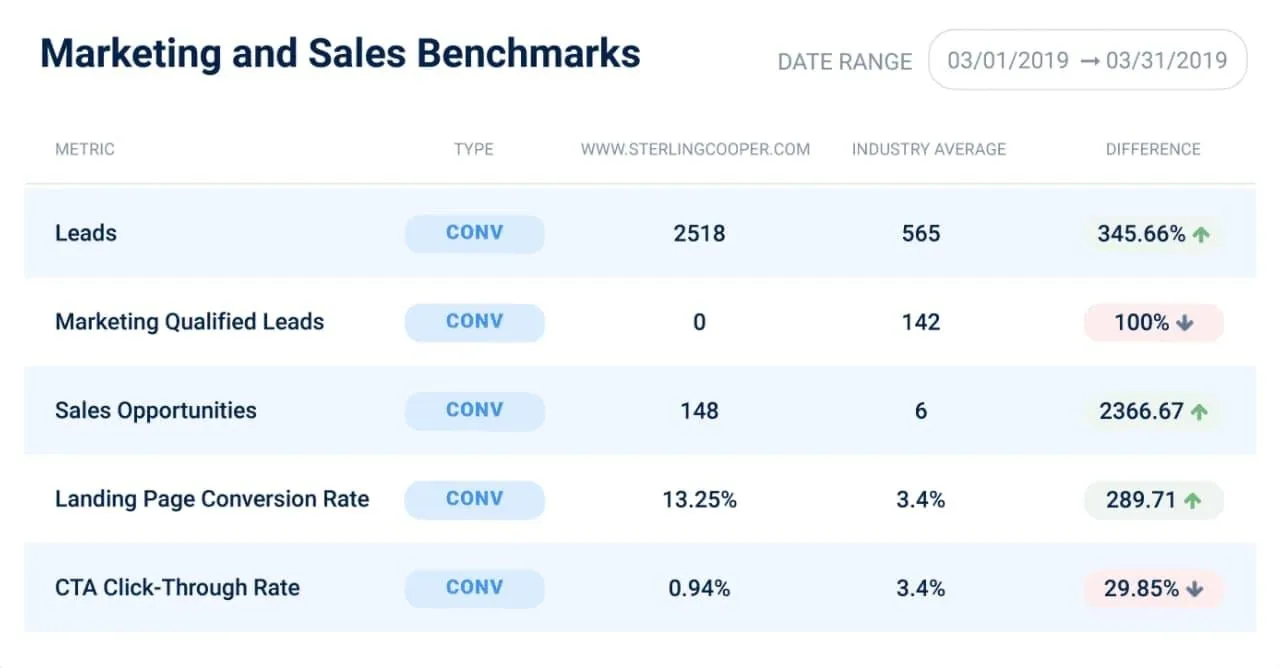
Image Source
MaxG is a product in a class of its own. This B2B sales and recommendation engine offers intelligent performance insights for your marketing efforts. With MaxG, you can see the efficacy of blogs and CTAs.
What we love: Via the power of AI, MaxG can translate general insights into actionable suggestions for improving your sales and marketing efforts. MaxG also contains an industry benchmarking feature that lets you compare your data to your competition.
Pricing: MaxG’s industry benchmarking tool is free, but access to the rest of its features starts at $49 per month. It also has an enterprise-level plan available for $499/month.
4. Zoho Analytics
.webp)
Zoho Analytics is a self-service business intelligence and data analytics software with extensive integrative capabilities. It is remarkably versatile and features attractive data visualization resources. The platform allows you to channel massive volumes of raw data into actionable, straightforward reports in an organized and sleek interface.
What we love: The platform is notable for its ability to blend vast amounts of data from various sources. If data is stored in multiple sources like HubSpot, Excel, and Google Cloud Storage, Zoho Analytics can easily combine them and translate that breadth of information into cross-functional reports.
Pricing: Zoho Analytics’ pricing structure features plans that suit businesses of any size. Its lowest-priced option costs $24 per month and comes with a comprehensive, dynamic range of features for up to two users. The remaining tiers are inexpensive and tailored to fit your business’s needs as it expands.
Several other sales analytics software are worth your consideration, including Databox, Grow.com, Plecto, Demand Sage, Domo, Dear Lucy, and Supermetrics. Finding the right tools for your business will hinge upon the resources you’re currently leveraging, the scale of your sales efforts, and which specific metrics and objectives you seek to measure.
Getting Started
Running a sales analysis can seem like an imposing, inaccessible undertaking, but it doesn’t have to be. With the right tools and a little guidance, the process can be simple, smooth, and incredibly useful when trying to improve your sales efforts.


How to Align the Sales and Marketing Funnel From the Bottom Up

When it comes to the relationship between Marketing and Sales, we're often more inclined to think of what Marketing does that contributes to the success of Sales instead of the other way around. But despite the impact that marketing efforts can have on the success of demand and revenue growth in a company, marketers don't always know exactly what kind of results their efforts should yield.
To drive results and build a fully integrated marketing and sales process, Sales needs to hold Marketing accountable for completing their half of the conversion funnel. Conversely, Marketing needs to understand the numbers Sales must hit to achieve its revenue goals.
Tracking Conversion Rates Isn't Just For Sales
Sales always seems to be the team that has a good handle on the conversion rates its efforts yield. A sales manager could probably tell you their close rate or opportunity to closed-won conversion percentage at any given time.
But how many marketers know the exact output they need to generate to ensure Sales will meet its goals and the company will make its numbers? If you're not tracking your conversion rates through the entire marketing and sales funnel, how can your business set accurate goals and manage time and resources effectively?
Sales knows their specific conversion rates, and all Marketing knows is how many website visitors they had last year. On a good day Marketing might be able to throw out a guestimate of how many total leads they generated. Unfortunately we're still missing the conversion rates for each stage of Marketing's lead management process. Given this situation, how do you suspect the marketing team would know whether or not their efforts and results are behind, on pace, or ahead of plan?
Your business' inbound marketing strategy and inbound sales process will be working independently of one another until Marketing completes the funnel through to their lead sources.
Complete Funnel, Accurate Goals
Being able to set goals based on historical data contributes to efficiency, agility, and effectiveness in any size business. It is especially critical for small and medium size businesses (SMBs) to succeed at forecasting targets correctly to ensure time and money are not being wasted foolishly.
You could try to forecast next year's sales and marketing plan without the conversion rates for Marketing's lead management process, but it won’t get you very far.
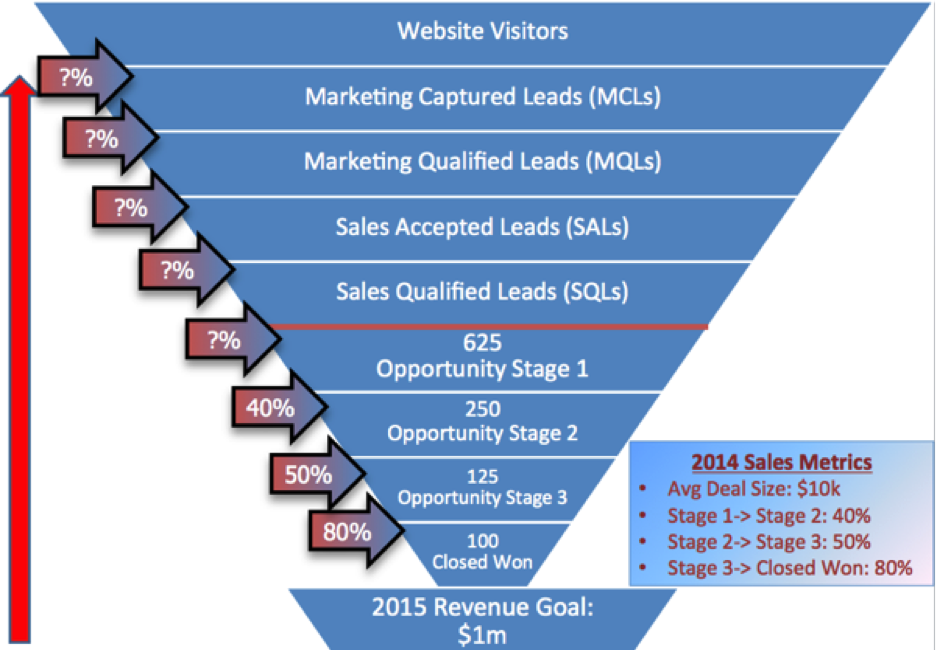
You can see that because Sales knows their 2014 conversion rates, they can calculate the number of opportunities they'll need at each stage in 2015 to achieve the $1 million revenue goal, a 25% increase from their 2014 revenue of $800,000.
But because Marketing does not know their conversion rates, two questions arise:
- How will Marketing set accurate goals for their team and initiatives this coming year?
- Will Sales feel they are in good hands and that their colleagues know exactly what it will take for the business to reach its goals?
Now let's look at what happens when Marketing completes the funnel:
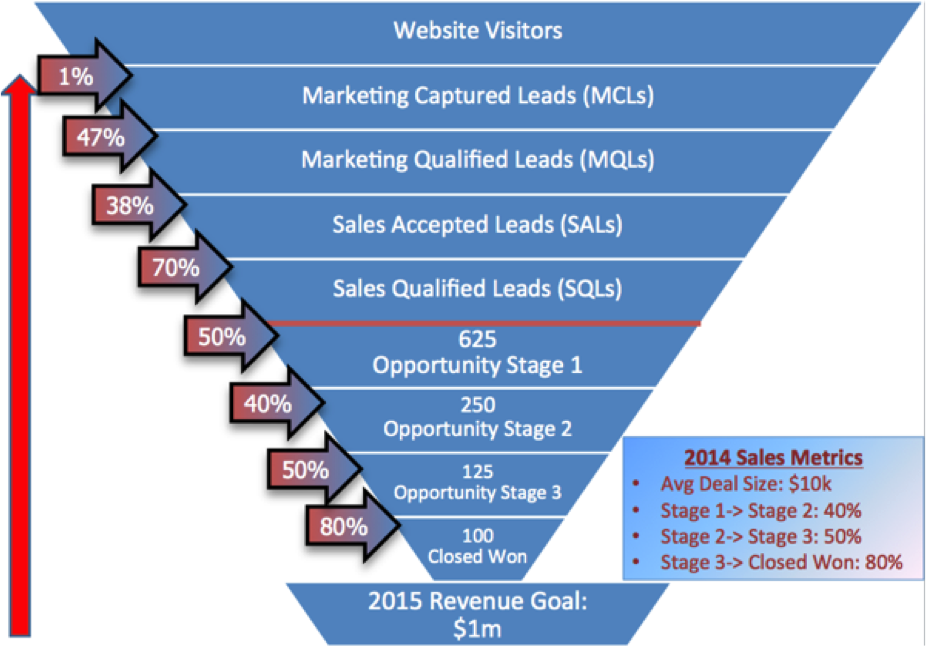
Let’s assume Marketing knows the conversion rate data from their lead management process in 2014:
- Website visitors to Marketing Captured Leads (MCLs): 1%
- MCLs to Marketing Qualified Leads (MQLs): 47%
- MQLs to Sales Accepted Leads (SALs): 38%
- SALs to Sales Qualified Leads (SQLs): 70%
- SQLs to Stage One Sales Opportunities: 50%
Now, marketing and sales integration begins to take shape as Marketing applies the historical conversion rate data to complete the funnel from the bottom up.
After doing the math, your completed sales and marketing funnel emerges:
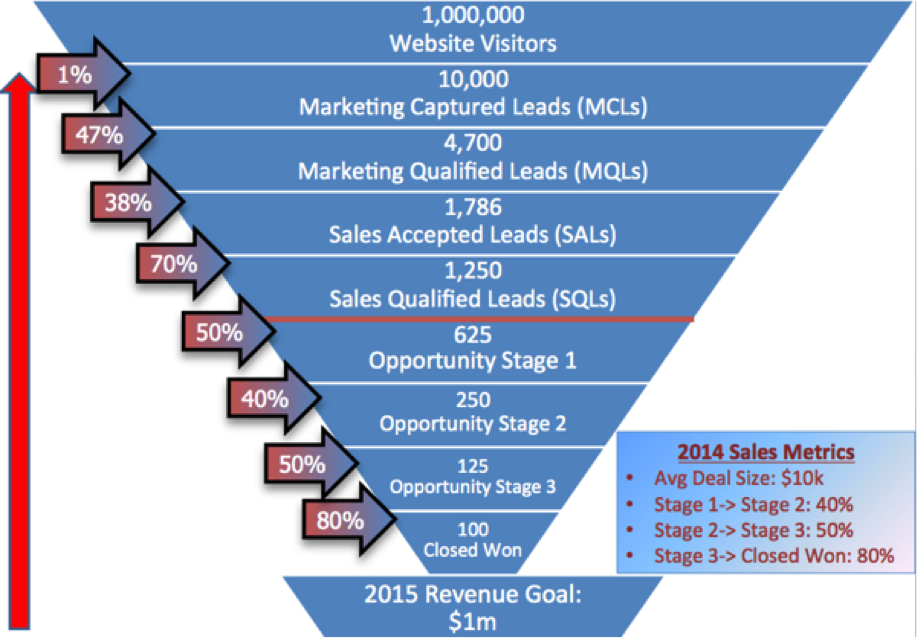
With this completed funnel, Sales will have much more confidence in Marketing, and both departments will be on track to make their goals.
Your inbound sales process and marketing strategy should be working together with this funnel in mind. Everything you do should be tied back to achieving or exceeding these numbers.
If you'd like to talk more about Sales and Marketing alignment, I'd be happy to be a resource for you.

Top 5 Keys to Customer Retention
How To Increase Your Email Signups By Over 600% Using This Cool Tactic

How many of your website visitors end up on your email list?
I’ve tried all sorts of things: popups, slide-in forms, feature boxes, hellobars, etc. But my conversion rate never went beyond 3% (actually 2.67% was my peak value).
So when I saw a blogger stating that the average conversion rate of his articles was 20-30% (with a few ones peaking as high as 62%) I had no reason to believe him.
He said he was using a brand new tactic and once I learned more about it, his insane conversion rates didn’t look so unbelievable anymore.
So what was the marketing tactic that was increasing his email from 3% to over 20%?
It’s called “content upgrades” And we will show you how to increase your email signups by using this tactic on your website and blog.
What are “content upgrades”?
What is the best way to motivate your visitors to subscribe to your email list?
Offer them an opt-in freebie! Everyone knows that!
You create some freebie that your visitors are potentially interested in and give it out in exchange for their email address. People love freebies and they just can’t resist.
All these popups, slide-in forms and feature boxes are simply different ways of putting your opt-in freebie in front of your visitors.
This is an amazing tactic and it works really well.
But it has one major flaw – a single opt-in freebie can’t be relevant to every article you have on your blog.
Let’s say someone is reading an article on copywriting and all of a sudden a popup email form appears offering him to download a free ebook with “15 Great Tools To Get The Most Of Twitter”

That opt-in bribe is not relevant to the topic of the article and that’s why this person will most likely ignore it.
Content Upgrades is a perfect solution to this problem.
Take a look at this article by Michael Hyatt, that was originally published in 2007: “Literary Agents Who Represent Christian Authors.”
For about 8 years this article featured a great list of literary agents, which was publicly available to every visitor (you can check that at archive.org).
But if you look at it today, you’ll discover that Michael has hidden that list behind an opt-in form and you can’t get access to it unless you give him your email address:

What he did with that article is a perfect example of using a content upgrade.
I don’t have the exact numbers, but I’m sure his conversion rate is very very high. Way above that 3% that I couldn’t beat with my own blog.
3 reasons why content upgrades work so well
To be honest, I was reluctant about this section of my article because the power of content upgrades seems pretty darn obvious.
But if you need a few arguments – no problem!
1. They are highly relevant
Creating a relevant opt-in bribe for each of your articles will have a much better conversion rate than a single one which is displayed site-wide.
Think Google. They offer you different ads based on the keywords that you search for.
You have to do the same with the opt-in bribes on your blog. Offer your readers different bribes based on the content of the article that they are reading.
Yes, it will take you more time to create bonuses for each of your articles, but it pays off like nothing else.
2. They are easy to “sell”
Take a look at the popup form that you have on your blog. It usually has three to five elements:
- Headline;
- Image;
- A few sentences of supporting text;
- Button with a call-to-action.
That’s all the “real estate” you have to grab the attention of your visitors and persuade them to get your opt-in bribe.
It takes just a few seconds for a person to make a snap judgement of your popup and decide if he’s interested or not.
Can you effectively sell something in a few seconds? Hardly.
But what about the content upgrade?
It’s actually a part of your article. You have the full attention of a person who is reading your article and that’s why your “sales pitch” can be as long as you need it to be.
This way it’s much easier to persuade people that you’re offering them something of an infinite value and explain why they should take it right here right now.
In fact, your whole article can serve as a sales pitch persuading your readers to get your opt-in bribe.
3. It’s not intrusive
Someone just started reading your article and BAM… you show him a popup box.
Guess his first reaction? Close it and get back to the article.
What about the email form floating in your sidebar?
Most people are “blind” to these kinds of things, because no one wants to be forced upon something he didn’t ask for.
Popups, slide-in forms and feature boxes are the perfect examples of something that Seth Godin calls “interruption marketing”. They are designed to steal the attention of your readers.
Which is silly…
You already have their attention! A person is reading your article! Why do you want to interrupt him with something else?
Content upgrades are different.
By reading your article a person is giving you his full permission to tell him anything you want. That’s why pitching him your content upgrade doesn’t look intrusive.
Not sure if Seth knows about content upgrades, but they definitely fall under his definition of “permission marketing”.
You must be wondering about the kinds of things that can serve as content upgrades for your articles.
How about these five?
4 kinds of content upgrades to supercharge your articles
Actually anything can be your content upgrade as long as you can make your readers want to get it.
Here’s a nice example.
In one of my recent articles I talked about an outreach email that I sent to Rand Fishkin. I used a funny email subject to grab his attention, but I didn’t share it in my article.
People had to give me their email address in order to learn what was the subject of my email to Rand.

Guess how many of my readers subscribed this way?
8% – not too shabby for such a simple trick.
But this was actually a somewhat creative use of content upgrades, which cannot be applied to every article you write.
So let me share with you a few types of content upgrades that you can easily replicate on your own blog:
1. A PDF version of your article
Not my personal favourite, but some folks say it works well enough to use it.
Here are a few reasons why people might want the PDF version of your article:
- To print it
- To read it later on their iPad
- To save it on their hard drive for future reference
But the best part is that creating a PDF version of your article won’t take more than 5 minutes of your time.
Just copy and paste the article into Google Doc and go to “File” > “Download as” > “PDF”.
2. A checklist version of your article
This will require a little more effort, but in my opinion a checklist with a brief recap of your article is a much more enticing content upgrade than the PDF version.
People love reading long detailed articles of 3000+ words, but once they need to recall a few important things that they’ve learned from such article it’s a pain to find them.
So if you offer a brief checklist with the most important takeaways from your long and detailed article many people will be happy to grab it.
You can use Google Docs to create a short checklist and save it as PDF. But if you want to look more professional – I’d suggest hiring a freelancer at Odesk, and have him design a checklist that will look like this:

3. Video
If you offer your readers a choice between reading an article and watching a video on the same topic I can guarantee that the vast majority of them will pick the latter.
So hit the video record button on your phone and talk for couple minutes about the same things that you share in your article. But make sure to go a little bit deeper and give a few extra examples.
Put that video into your article as a content upgrade and see how many of your readers will go for it.
Here are a few more ideas of using videos as your content upgrades:
- Screencast – many people will appreciate it if you show them how you do the things that you’re talking about in your article. You can easily record screencasts with software like Camtasia or ScreenFlow;
- Q&A – once you’ve finished writing your article I’m sure you can easily guess at least five different questions that people might ask after reading it. You can record a quick video of yourself answering all these questions and put that video as bonus content that people will have to opt for;
- Interview – instead of making your interview recording publicly available, share just a few takeaways from it. This will tease your readers and motivate them to get the actual interview.
4. Templates / Scripts / Resources
Whenever you teach people something many of them would love to go deeper with you. And you end up getting a lot of questions like these:
- “Can you show me the exact email that you sent him?”
- “Can you give me the contacts of the guy, who designed this for you?”
- “Can you share your list of social media tools?”
All these things could be perfect content upgrades.
Just go through your article and see if you can provide any additional information that can help your readers. Pack it and pitch it as a content upgrade for this article.
Ok. I’m sure you’re already excited about this new strategy and you want to try it on your blog.
Let’s talk the technical side of things.
(By the way. I could easily make this last part of the article my content upgrade and I’m sure most of you guys would immediately grab it)
How to setup content upgrades on your blog
Many pro bloggers use a premium service called LeadPages to create content upgrades within their articles.
But this thing costs $25 per month and many people just don’t have enough budget for that.
So I’m going to show you a free option, which is obviously a lot less powerful but still works like a charm.
It’s a free WordPress plugin called Content Upgrades.
After installing it on your blog you need to configure three things:
- The email list, where your new subscribers will be added;
- “Please confirm your email” page – new subscribers will be redirected to this page, as they will have to confirm their email address before they get your bonuses;
- “Thanks for subscribing” page – people will land here after confirming their email address.

Then take the shortcode that the plugin is giving you and use it within the content of your article as if it was a simple text link:

Once your visitors click on that text link, they will get a popup with an email optin form:

The text that you see on the popup can easily be customized for each of your articles:

This way you can offer your readers different bonuses based on the content of your article.
But how do you actually deliver your bonuses to the people who have subscribed to your email list?
Just list all your opt-in bonuses on the “Thanks for subscribing” page, because this is where all your new subscribers will eventually land.
Here’s a screenshot of my own “Thanks for subscribing” page:

It has quite a few opt-in bonuses, so all my new subscribers are getting even more than they have opted for.
So this was a very basic setup that should get you started with content upgrades on your own blog.
If you’re looking for a more advanced solution – feel free to try LeadPages or the PRO version of Content Upgrades plugin.
Disclosure: I am the creator of that plugin and in case you have any questions about it, feel free to reach out.
Back to you
What do you think about this awesome new strategy? Are you keen to try it in your articles?
I know it takes a lot more effort than a simple sitewide popup, but I assure you that your you won’t regret spending your time on it!
Look forward to hearing your thoughts about this strategy in the comments section below.
Skeptical, Informed Buyers Vs. Excited, Uninformed Buyers – A Tale Of Two Journeys
 Let’s play a quick, marketing-themed game of “would you rather…” Would you rather pass a skeptical but well-informed buyer along as a lead to your sales team, or an excited but uninformed buyer? You could have a buyer who is best aligned for success but who has the worst lines of questioning, or a buyer who is wise to your value proposition, but foolish in not knowing what’s necessary for success. Who would you choose?
Your choice, however, doesn’t exist in a vacuum. The potential buyers you allow into your marketing and sales funnel have to be able to make it through a series of stages in the buyer’s journey – tollgates, of sorts, according to Aberdeen’s report, Marketing & Sales Performance: The Roadmap to Revenue & Its Tollgates – and stage-by-stage, only a fraction of buyers will convert on to the next phase. As you can see in the table below, there’s a distinct difference between conversion rates for Best-in-Class organizations, and their Average and Laggard peers throughout this process.

What’s worth noting, is that up until the last conversion from a sales opportunity to a closed deal, the Best-in-Class organizations report steadily increasing conversion rates – their buyers are seemingly more ready and willing to buy, up until that final decision where the conversion rates do drop off a little. The Laggards, on the other hand, actually see an uptick in conversions going into the final closed deal stage which yields a more sporadic / haphazard pattern. Now, there’s no data to definitively say whether the Best-in-Class prefer informed yet skeptical buyers over excited yet uninformed buyers, but you may be able to infer for yourself which persona is a better fit.
Best-In-Class Marketing Programs Are Built For Informed Buyers:
To let the cat out of the bag here, there are distinct data points that do show Best-in-Class marketing organizations revolve around producing well-informed buyers – with little concern for the potential scrutiny that may come from a well-informed buyer. In fact, the more questions your buyers ask, the more opportunities you have to set that buyer up for success and build on their level of trust in your organization. Excited yet uninformed buyers, to the contrary, are more liable to lose trust in your organization as customers if their expectations don’t match reality or their ability to use your product or service is hindered by something that they didn’t know they didn’t know.
Lead Scoring Weighs Buyers On What They Know – Not What They Feel:
Lead scoring research shows that among Best-in-Class marketing automation users, 68 percent report leveraging lead scoring functionality in their marketing efforts. This research also shows that among all Best-in-Class lead scoring practitioners, 47 percent base their lead scores on a combination of contact profile data (demographics / firmographics), and behavioral data from interactions with marketing content. Another 29 percent of Best-in-Class lead scoring practitioners base their scores solely on behavioral content consumption data. The more content a buyer consumes, naturally, the more informed he or she will be which results in a higher overall lead score. Excited or unexcited buyers can make it through a lead scoring system all the same, but based on content consumption, an informed buyer is far more likely to get a sales-ready score versus an uninformed buyer.
Lead Nurturing Negates Uninformed Buyers:
Research on lead nurturing shows that lead nurturing practitioners measurably outperform non-practitioners when it comes to the percentage of sales-accepted leads converted to sales qualified leads (41 percent vs. 28 percent), conversion rates for MQLs into sales-accepted leads (40 percent vs 30 percent), and marketing’s overall contribution to sales-forecasted pipeline (30 percent vs 22 percent). Clearly, lead nurturing is a best practice readily adopted by the Best-in-Class, but it’s also your best bet in preventing uninformed buyers from making it through your funnel. For a buyer to be sales-ready out of a lead nurturing program, he or she has to have clicked, opened, downloaded, or otherwise engaged with enough interactions within the lead nurturing program to reach the routing phase of the program. Just as a record of attendance ensures that students are at least present for their lessons, the steps of your lead nurturing program should ensure that your buyers have seen enough informative content to be well-educated.
Content Marketing As A Book Bag Vs. A Swag Bag:
As reported by G. David Dodd from a study conducted by eccolo media:
Sixty-five percent (65%) of respondents said they frequently give more credence to content that includes peer reviews and user-generated feedback. Forty-three percent (43%) of respondents said they frequently trust content that is authored by a third party and sponsored by a vendor, and only 13% said they frequently give more credence to content that is created directly by a vendor.
What’s important to note is that buyers trust content from their peers and third parties far more than they trust content directly from a vendor. Where many marketers often fall down in content marketing, however, is in thinking that their content has to be cool, entertaining, and exciting primarily, and only informative in a secondary vein. This is how you’d actually see uninformed yet enthusiastic buyers in your marketing and sales funnel, even in later stages. The problem, however, is that these buyers have a nice bag of stuff from their interactions with your brand, but not a collection of useful information to enrich their buying decision. Best-in-Class marketing organizations, though, are 93 percent more likely than all others to align their content to the needs and interests of their buyers to address relevant, stage-by-stage buying questions. This gives their buyers a useful collection of information – like a book bag – that buyers can pull from to evaluate their purchase options and make a well-educated decision.
In the end, it’s a far far better thing to do to equip a buyer to be well-informed and capable of critically assessing your offerings than to close a buyer who has no idea what he or she is really getting into. An informed buyer may be better equipped to challenge a sales pitch, but an uninformed buyer may actually prove to be more costly as a customer.