Shared posts

25 Mar 16:40

4 Ways Brands Should Support Sales Teams

by Mark Di Somma

Brand And Sales Support

While there has been plenty of discussion around how marketing and sales teams should play well together, the onus on brand owners to proactively support people in the field seems to have attracted less attention. Customers, of course, make no distinctions between which parts of the organization they are dealing with at any one time. In that sense, brand is sales: a brand is only as good as its ability to attract, convert and retain fickle buyers.

So, could brand managers be doing more to help sales and frontline teams? Here are four ways that these historically distinct teams can get more done together.

1. Build a brand that people want to meet. Salespeople are going to struggle to get appointments if they represent a brand no-one wants to know. Likeability is absolutely a brand responsibility. By creating a brand that is insightful, honed, intriguing and trusted, brand teams can directly help open the door for sales. The more inclined buyers are to want to know more, the more likely they are, obviously, to take a call or a meeting, ask for a demo or search a site. The real power of perception lies in what it enables, and brand owners should be judging their effectiveness on that basis. The responsibility for brand people couldn’t be more clear-cut: build an interesting brand that is a pleasure to sell and represent.

2. Create environments where people come to you. So often, marketers expect sales teams to be the bridgers and closers. They expect them to take what has been prepared out into the world and to bring back new business. That’s a very one-sided view of marketing – because, in reality, brand owners should be intimately involved in the development of communications campaigns and branded environments, online and off-, that invite customers in and make them feel welcome. The role of sales is to drive and close decisions in favor of the brand. The role of brand is to help those decisions feel valuable.

3. Weave the brand through everything you do. The brand and what it represents should be the benchmark for all customer-facing behavior, and sales teams are no exception to this. But if the things they are rewarded for are off-skew with the brand’s values and priorities, then brand and sales will continually be at odds. For that reason, be very careful that what you encourage, recognize and incentivize in your sales team is in keeping with who you say you are and what you say you prioritize. Compassionate brands don’t reward greed. Exciting brands don’t accept complacency. Innovative brands want more on their frontline than order takers. Too many companies have sales cultures, marketing cultures and corporate cultures that are conflicted. Each carries an impression of what the brand is and what the brand encourages into their work and out into the world. As a result, brand encounters can be confusing, even contradictory, for buyers making decisions across different channels. No brand should be confusing. It dissipates meaning and energy. Getting everyone to understand the brand and to apply it specifically to what is required of them takes investment, time and clarity. Money well spent.

4. Make the whole of the frontline the heroes. The sales teams are not servants of the brand, or the marketing team for that matter. So often brands see their frontline people in functional terms, rather than empowering them to be, and positioning them as, the implementers, the solution finders, the people who actually vitalize the brand. In not positioning their frontline teams – from sales to contact centers to technical support – as brand heroes, they open gaps between what the brand promises and what it can deliver and miss significant opportunities to test the alignment and effectiveness of theory and practice.

John Levasseur talks about the need for brands to be both orchestrated and organic: organized; and flexible. Frontline teams, he says, have a critical role to play in keeping brands real and connected with the true market. “When marketers spend time listening to customers or are out on the floor with sales staff, they always walk away with “aha” moments that connect the brand research and data with their experience with customers.” These experiences, he says, help connect the orchestrated brand that marketers oversee and curate with the organic brand that front-line teams work with.

Thoughts to close:

  • Structures are less important than results – ultimately there is no frontline and back-office in a business. Brands live or die on their abilities to engage, interact and sell.
  • Your brand is only as good as what you deliver – if your frontline teams, including your sales teams, are selling without a clear understanding of why they should be proud, you have effectively reduced motivation and consistency to serendipity.
  • Insights close gaps – unless strategists and deliverers are in alignment and have feedback and insight mechanisms that enable continuous improvement, there is always the risk that the brand on paper and the brand in reality will be at odds.

Join me at The Un-Conference: 360 Degrees of Brand Strategy for a Changing World. May 18th ~ 20th at the famed Versace Mansion in South Beach, Florida. A fun, competitive-learning experience reserved for 40 marketing oriented leaders and professionals. *Special Offer Available for MENG and AMA Members*

Branding Strategy Insider is a service of The Blake Project: A strategic brand consultancy specializing in Brand Research, Brand Strategy, Brand Licensing and Brand Education

FREE Publications And Resources For Marketers

25 Mar 16:04

Optimizing The B2B Content Marketing Funnel: Turning Contacts Into Clients

by Kevin Bloom

Congratulations, you’ve taken the first step towards increasing your online presence and implemented a B2B content marketing strategy. You’re regularly publishing insightful and shareable blog posts and amplifying your content through social networks.

And you’re growing your email list by offering longer-form premium content behind a simple registration form in your blog posts and on your website. If you are doing it right, your content funnel probably looks something like this:

Then you realize you aren’t converting your new contacts into new clients.

So where’s the disconnect? Let’s explore some things you can do to improve your current situation and starting seeing real ROI from all the time and resources you’ve put into your content marketing efforts.

Be Patient

Content marketing is not meant to drive revenue overnight. It takes time to build a following and grow your reach. Often, especially in the professional services space, your base of followers or readers may not necessarily be your ideal client…

The first mistake many firms make is to conclude that their content is not directly reaching their target audience (ideal client), and give up on producing content altogether. This usually happens after just a few months of launching a B2B content marketing strategy.

What’s the point of dedicating so many resources to creating and promoting great content if it’s not generating any ROI? Sure, traffic to the website is up and your email list has grown, but where is the revenue? Time to go back to what you know works: personal relationships and client referrals, right?

Wrong. That’s not to say that personal relationships and client referrals aren’t extremely important. They absolutely are. But what most firms do not understand is that many referrals are coming from people that weren’t even previous clients. Our recent research on referrals concluded that over 80 percent of firms received referrals from someone who wasn’t a client. Instead, referrers grew to trust a firm’s expertise based on thought leadership through speaking engagements, articles, social media, and more. This is called an “expertise-based” referral.


The second mistake firms make is to dismiss those same followers that are amplifying their content solely due to the fact that they will not become paying clients. Without the amplification from others, your content will become stale and eventually die. If your target audience is not the digital-savvy type, who is going to share, link to, and grow your content?

Be patient and give your content time to grow and rank higher. Most firms will not be able to rank on the first page of search engine results right away. A brand new blog post has no authority when Google first indexes it. It takes time to build up natural links and authority.

Set Up Email Workflows

You’ve created great content, and have been successful in growing your email list with new contacts from premium content downloads. Now what?  At this stage, most new contacts aren’t quite ready to pick up the phone and have a conversation with you, let alone sign on the dotted line for your services.

This is where firms make their third mistake. This is not the time to ask for business. Now is the time to start nurturing these contacts through email marketing workflows, also know as drip or lead nurture campaigns. While some contacts are further along in the buying cycle, they are most likely still learning more about your firm.

The idea behind an email workflow is to continue to offer additional resources to your new contacts over a certain amount of time through various emails. Depending on your typical sales cycle, these workflows can span anywhere from a month to several months and include anywhere between three and ten emails. The best practice is around seven touch points.

These new contacts have already been to your website. They’ve most likely seen and/or subscribed to your blog. Email workflows are not the place to include offers like “check out our website” or “subscribe to our blog.” Instead, consider offering a related premium piece of content such as a guide with your first follow email touch. Depending on the length of your typical sales cycle, this first follow up should come between five and seven days after the initial content download.

One week later, send another email with a more substantial piece of content such as a recorded webinar with slides.

After another week, you might send a case study of a project that demonstrates how your firm solved a particular problem. Make sure it relates to something similar to the initial content download. If your contacts are still consuming your content at this point, there is a significant amount of interest being portrayed. That brings us to my next and final point.

Don’t Be Afraid Of The Hard Offer

Many firms struggle with the final step of optimizing their content marketing funnel. The good news is it’s actually easier than you think.

Many firms offer a free consultation or free assessment as part of their typical sales offering. The key is to offer these consultations or assessments in an indirect way as to not feel pushy. The best way to do this is to set up “thank you” pages that are similar to the landing pages offering an opportunity for prospects to contact your firm directly.

Depending on the software you use, you’ll most likely want to set up separate landing/thank you pages for your email workflows. Once a contact clicks on your offer to download your case study, they are directed to a landing page that includes a direct download link for said content as well as a brief description of what you offer in your free consultation or assessment.

Wording such as “Ready to talk now?” are popular for this type of page. You can then describe the value of your free offering and provide a contact form on the same page.

The goal is to get a direct contact form submitted in which you can require additional information such as a phone number, company, role, etc. At this point, it is much less likely that your prospect will feel that your request for additional information is intrusive as they are giving you consent for direct contact.

In the end, your sales and/or business development team members will be grateful for well-qualified, high-interest leads. Be patient, nurture your leads, and don’t be afraid to ask for the opportunity to have a conversation. The revenue and ROI will follow.

To create content that reaches prospects at each stages of the sales funnel, download a free copy of the Content Marketing Guide for Professional Services.

24 Mar 16:51

Who said: “Selling is THE Key Factor in the Total Marketing Process?” I Did!

by Jonathan Farrington

Eight years ago I wrote this article ….

Far too many companies have devalued selling for far too long and some business leaders have even convinced themselves that they would do better if they did not employ salespeople – after all good products sell themselves, don’t they?

As a consequence, until very recently, salespeople have done everything possible to avoid calling themselves “ Salesman or a Saleswoman” They have developed a series of euphemisms such as: “Sales Engineer” “Account Executive”Technical Sales Consultant”Business Development Associate” etc. But nowadays we accept that we all sell, everyday – doctors, lawyers, estate agents, architects and politicians.

It therefore follows that the quality and success of our salespeople will ultimately determine the success of our companies. Certainly the world has become more competitive and in order to survive and stay in business we need to continually expand and develop the skill sets of our sales team.

Sir John Harvey-Jones said in his book All Together Now, “Most companies fail not in their attempts to be innovative or creative. In this country most of them fail because they undervalue the importance of professional selling”

Our commercial functions, particularly the sales team, represent our forward line, (offense) and if they are not scoring regularly we cannot possibly achieve our overall commercial objectives – i.e. nothing happens until somebody sells something and all of that investment in costly accounting software, new office equipment, expensive IT systems, glossy magazines, high-tech office etc. will count for nothing.

We can therefore say with complete confidence, that selling really is THE key factor in the total marketing process. A company that is selling well is doing well!”

Then in an interview six years ago I was asked the question: “Will professional selling ever be the same again?”  I responded: “No, of course it won’t for all the reasons I have been highlighting for some time. It’s an old but accurate cliché – everything changes, nothing stays the same etc.

In my view, professional selling, and the key word there is professional, is about to take on a whole new image. All of the dead and inefficient wood is being removed, and what we are going to be left with will look a whole lot better.

As customers become smarter, more discerning, more knowledgeable and more self-sufficient, we will see a new breed of salesperson develop.

The order takers and glib talkers will no longer have a place in our sales world and in their stead will come intelligent strategic orchestrators and business advisors, looking to develop long term allies. They will have the “knowledge” and they will use leading edge technology. They will succeed because they expect to. There is no turning back now.”

So you can see a pattern emerging here: Eight years is not a long time in the general scheme of things is it? Where once I believed that an organization could not function without a successful “engine room” – a highly skilled sales team, performing at optimum levels – I can now see 80% of those same companies possibly performing without a sales team. I can envisage that within five years, as more and more products and solutions become “commoditized” the two most critical functions will be marketing and customer support.

The ramifications for the sales industry are going to be considerable, and the sales training industry in particular needs to prepare itself – and its customers/clients.

Where we once doubted the validity and practicality of functioning with purely inside sales teams, we must now consider the next natural successor – commoditization.

The clock is ticking …

24 Mar 16:50

These are the top industries that will benefit from 'The Internet of Things'

by John Greenough

IoT Industry Estimates

The Internet of Things (IoT) will lead to a wholesale transformation of how large globe-spanning companies do business, but adoption will start in certain industries

In an all-new report from BI Intelligence, we examine the industries currently driving growth in the enterprise Internet of Things and how various sectors of the economy will embrace IoT innovations. 

Almost every industry can benefit from investing in the IoT, which means adding data-collecting sensors to objects such as factory machinery, office buildings, and warehouse shelves. Based on trends in industry-specific capital expenditures, global size, current use of IoT devices, and through an analysis of where IoT vendors are focused on selling, we estimate enterprise IoT spending by industry.

Access The Full Report And Data By Signing Up For A Trial Membership >>

Here are a few of the key findings from the BI Intelligence report: 

  • Globally, manufacturers will invest $140 billion in IoT solutions over the next five years. Of all of the industries analyzed, manufacturers will be the earliest adopters of IoT solutions and will invest heavily in new IoT solutions for factory floors.
  • 18% of industrial machinery companies (i.e., manufacturers) are already using IoT devices, according to a SAS study.While this doesn't measure the extent that the IoT has been implemented by manufacturers, it's notable that almost one-fifth of manufacturing companies are already using the IoT to increase production and reduce costs.
  • Nearly as many automotive companies, 17%, are using IoT devices in the production of their vehicles. Volkswagen added an SAP system that keeps track of all of their parts' supply pipeline to help them track where items are located at all times. 
  • We expect the transportation and warehousing industry, that is, logistics companies, to also invest a significant amount in automating their warehouses and shipping: roughly $112 billion in 2019. 
  • The third-largest industry will be the information sector, including tech and telecommunications, which will expand investment to accommodate the increase in data and data-analysis demands generated by the IoT. 

In full, the report:

To access the full report from BI Intelligence, sign up for a 14-day trial here. Members also gain access to new in-depth reportshundreds of charts and datasets, as well as daily newsletters on the digital industry.

Join the conversation about this story »

NOW WATCH: This is what happens to your brain and body when you check your phone before bed

24 Mar 16:50

How 16 of the Most Successful Social Sellers Schedule Their Days [Infographic]

by esnider@hubspot.com (Emma Snider)

daycalendar

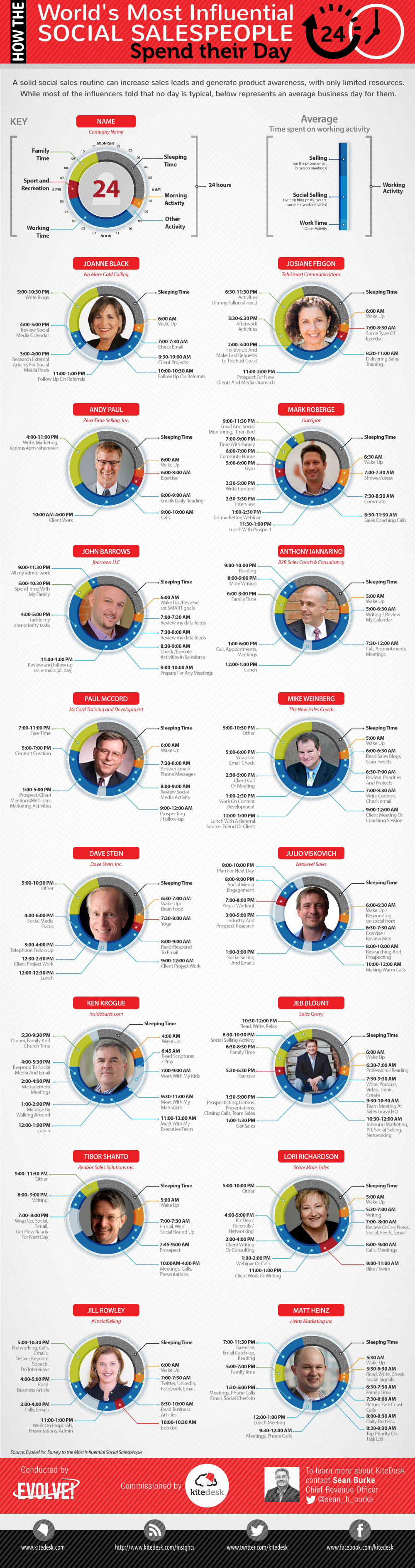
One of the most common hurdles to social selling adoption is lack of time. Salespeople's days are packed with meetings, demos, emails, and prospecting calls. Where can they find a spare 10 minutes -- much less an hour -- to monitor prospects' behavior and interact with them on social media?

According to research from Social Centered Selling and A Sales Guy, 72.6% of salespeople who incorporated social media into their sales processes outperformed their peers. This statistic underscores the fact that time spent on social selling activity is hardly wasted -- it's a worthwhile investment. Carving out time for social selling is simply a matter of making it part of your routine.

So how do social selling's most influential evangelists do it? KiteDesk rounded up the daily routines of 16 of the world's most successful social sellers and visualized them in this infographic. If they can fit in time to write a blog post or schedule a few tweets, so can you.

mostinfluentialsocialsellers

get the free hubspot crm

24 Mar 16:50

Century 21 and Hootsuite Partner to Simplify Social

by Emily Alford
Two new products from Century 21 and Hootsuite will train Century 21 brokers and agents in best practices for social selling and give individual realtors access to exclusive branded content.
24 Mar 16:49

Five Misperceptions about Consultative Selling

by Amy Smalfus

Five Misperceptions about Consultative Selling

In a world of dramatically changed B2B buying behavior, Consultative Selling remains one of the best ways — if not the best way — to focus on the client’s business issues and needs (not products for sale) to ensure that the proposed solution drives the needed business outcomes for the client to achieve his/her goals.

But, because it’s not the shiniest, newest sales approach on the market, there are some misperceptions about its relevance today. Following are five common misperceptions.

  1. Consultative Selling is not assertive enough. Consultative Selling dialogue skills are used to create an environment of openness and mutual respect — ingredients that are necessary to stimulate thinking and gain a deep understanding of the client’s unique situation, diagnose root cause, and recommend the best solution. The seller may need to challenge the client’s thinking in the dialogue but certainly must do so without challenging the person. The only way to do this is to create an environment of openness and mutual respect, which is only created through the use of Consultative Selling skills.
  2. Consultative Selling leads sellers to go native. It’s unusual, but not impossible, for sellers to focus on their clients at the expense of their own company. However, the objective with Consultative Selling is to win profitable business. If an individual is not behaving as necessary, it becomes a coaching opportunity for sales leaders.
  3. Consultative Selling makes the seller subservient to the client. Not true. The approach and skills of Consultative Selling are designed to establish an environment of mutual respect and productive dialogue that can be used to reduce stress in the moment, resolve conflict, and hold the line on price and other terms. The Six Critical Skills are at the heart of a healthy, respectful business relationship where the needs of both buyer and seller are met.
  4. Consultative Selling focuses on asking questions, but sellers need to do more teaching. Sellers help to facilitate learning with clients, but teaching doesn’t mean the seller foregoes learning in the process. The idea is to facilitate learning on both sides to understand the client’s unique situation, generate ideas, and validate possible solutions. Insightful people bring a high level of curiosity to consultative conversations with a willingness to be both learner and teacher.
  5. Consultative Selling is not relevant in light of newer selling models. Sellers do not need a radically new way of selling that contradicts the principles of Consultative Selling. The goal of Consultative Selling is to focus on client needs, rather than positioning product, to make sure the solution is relevant. Sellers do need a higher-order level of skill in Consultative Selling to engage clients in insightful dialogue that builds credibility, creates value in the buying experience, guides the client in making the best buying decision, fosters trust, and assertively identifies and drives opportunities to closure.

Click the image below or the following link to download a brochure on our award winning Consultative Selling sales training solutions! Or you can contact Jim Brodo, SVP of marketing directly at Jim.brodo@richardson.com


consultative-selling

The post Five Misperceptions about Consultative Selling appeared first on The Richardson Sales Excellence Review™.

24 Mar 16:44

As American Express faces bruising competition, some cardholders can leave home without it

by Ken Sweet, Associated Press

NEW YORK — For decades, American Express was the undisputed credit card of choice among corporate road warriors, the wealthy and the well-travelled, who lived by the company’s slogan, “Don’t leave home without it.”

But changing consumer habits, extremely aggressive competition and increased pushback from its merchants are putting heavy pressure on AmEx.

Rivals are trying to steal away business and are succeeding in some cases. Costco, for example, is ending its 15-year relationship with AmEx and defecting to Citigroup and Visa starting next March. And airlines that used to give VIP lounge access to AmEx cardholders have been switching in recent years to other credit card companies.

Compounding its troubles, AmEx recently lost a major government antitrust lawsuit, a verdict that could damage its ability to compete.

“The competitive environment for AmEx is very challenging,” said Jason Arnold, a Wall Street analyst who covers AmEx for RBS Securities. “Major competitors have all directed their efforts to take chunks away from their business. They’ve got serious problems.”

As a result, American Express stock is down 12% this year. Analysts, on average, have cut their 2015 profit forecast from US$6.2 billion to US$5.6 billion. AmEx recently announced 4,000 layoffs, or about 6% of its workforce. And CEO Kenneth Chenault will face a skeptical Wall Street audience Wednesday at the company’s annual investor day.

One of the biggest threats to AmEx is the slew of competing cards aimed at the well-to-do, sometimes with lower annual fees. Card issuers have energetically courted merchants who used to accept only American Express. Merchants who once coveted AmEx’s high-net-worth cardholders are discovering they can find the same customers elsewhere.

Costco was a real punch in the gut

Citigroup, in particular, has been going after AmEx’s core customer. Citigroup has hired executives away from AmEx over the past few years to help it overhaul its credit cards and revamp its loyalty program, known as ThankYou. Citi Cards CEO Jud Linville, for example, worked at AmEx for nearly 20 years.

The capture of Costco by Citigroup and Visa was the biggest blow to AmEx. The warehouse-club chain accounted for US$80 billion of spending on AmEx’s network last year and 10% of AmEx’s cards.

“Costco was a real punch in the gut,” said David Robertson, publisher of the Nilson Report, a major trade journal for the credit card industry.

Citi also recently created a card called Citi Prestige, a high-annual-fee card aimed at AmEx Platinum Card holders.

“Citi’s ThankYou program, a year and a half ago, was pretty much worthless,” said Brian Kelly, editor in chief of thepointsguy.com, a travel and credit card rewards tracking website. “But over the past year Citi has really started to get into the game. They are not at a Chase or AmEx level yet, but based on where they have gone in a short amount of time, they’re becoming quite formidable.”

JPMorgan Chase introduced its own reward cards in 2009 with a program similar to AmEx’s. It is called Chase Ultimate Rewards.

Airport lounge access was once a perk basically guaranteed by AmEx. But American Airlines switched allegiance last year, turning over exclusive access to lounges to Citi cardholders. AmEx cardholders lost access to United Continental’s lounges in 2011 and lost the ability to transfer their points to United in 2012.

Even Discover Financial has gotten into the game. Last month, it introduced a credit card focused on building up miles that can be redeemed for travel.

AmEx hasn’t sat idle. To generate revenue, it has raised annual fees and interest rates on some products. It has also added perks for its customers, such as waiving foreign transaction fees and giving a US$100 credit for incidental airline expenses for Gold Card members.

And when AmEx parted ways with United Continental, it went ahead and opened its own airport lounges. It has 13 worldwide so far, with plans to open more this year.

“American Express is still the gold standard when it comes to their rewards program, but lately it seems like all they’re doing is playing catch-up,” Kelly said.

While competitors have been moving upmarket, AmEx in response has been moving in the opposite direction. It now has two pre-paid debit cards, one of them with Wal-Mart. Pre-paid debit cards are typically aimed at low-income consumers who may not have checking accounts.

The company also launched a no-annual-fee credit card last year aimed at “everyday” purchases — not the travel-heavy, corporate-expense-account business AmEx is known for.

“I don’t think there’s anything structurally wrong at AmEx,” said Sanjay Sakhrani, an analyst at Keefe, Bruyette & Woods. “They’re going to get in front of the revenue they are going to lose next year when the Costco relationship ends.”

Along with increased competition, AmEx is facing heavier regulatory pressure. Last month, the Justice Department won an antitrust lawsuit against American Express over its practice of making merchants sign agreements not to express a preference for one card over another.

If AmEx loses on appeal, merchants will be free to express their preferences, and that could force the company to lower the% it charges them to process cards. That would be a drastic hit to AmEx’s bottom line, and company executives have acknowledged as much.

During the trial last summer, AmEx’s Chenault said the company would be “fighting for our survival” if it lost the case.

24 Mar 16:29

The Path to B2B Sales is No Longer Linear

by Tami Berry

The traditional sales funnel is going the way of the dinosaur. With the proliferation of online content, digital channels, mobile devices and an altered B2B customer mindset, the path from awareness to purchase is less likely to be a straight line.

The Path to B2B Sales is No Longer Linear

In order for B2B organizations to stay relevant, they need to align their sales and marketing strategies to accommodate a customer-journey based approach.

Customers have changed.

Smart phones, tablets, checking emails 100 times per day. The way individuals and customers interact with products and people has undoubtedly changed forever. Now before making a purchasing decision, prospective customers research, read reviews and share their experiences with others.

According to the McKinsey Quarterly study, Do you really understand how your business customers buy?, “research shows that, on average, a B2B customer will regularly use six different interaction channels throughout the decision journey” and “50 percent of all B2B purchases will be made on digital platforms by the end of 2015.”

This pervasive network of influencers has altered the customer mindset to require a personal, cross-channel approach that extends far beyond the cold call. Marketing departments and sales reps now demonstrate an understanding of their customers’ businesses as well as their personal motivations in order to make a sale.

In order to stay apace with changing customer expectations, B2B sales and marketing teams must refine their strategies and develop a nimble mindset. Following are three concepts that can help ensure your marketing and sales efforts are appropriately aligned:

Define your customer’s journey and decision factors

Every customer is different. If you deal with a wide array of customer segments, focus on categorizing them into different groups based on wants, needs and preferences. Some clients may be more interested in features and functionality, some may be strictly budget-motivated and others may be most concerned about ongoing support after the sale. Finding out what makes them tick ensures communications are strategically aligned with their key concerns.

Shift spending to align with customer journey

Once you determine what your customers need, you’ll uncover ways you can reallocate funds in your budget. For example, you may find that building relationships with a handful of influencers would be more effective than a broad-based advertising campaign.

Keep an open mind

Another thing to remember is that company culture is an obstacle B2B companies must overcome as well. Seasoned teams may find it hard to challenge their long-held beliefs about their customers. Successful organizations are able to derive new ideas from the customer journey work, test them in the market and adapt quickly based on their findings.

As the behavior of B2B customers evolves, it’s crucial for marketers to adapt their processes and activities to align with a non-linear customer journey. Dedicating the resources to define their journey and then allocating budgets appropriately can increase the effectiveness of your efforts. As the pace of change continually increases, an open mind and willingness to act nimbly are essential to remaining relevant for today’s buyers.

24 Mar 16:27

Report says Japan must boost productivity to stave off economic decline as population shrinks

by CB Staff

TOKYO – Japan’s future prosperity will depend on improving its lagging productivity, says a report by McKinsey Global Institute that urges companies to boost their competitiveness by better use of their workers.

Japan’s population of about 127 million began declining in 2011 and is rapidly aging, a trend seen in many industrialized countries. The country’s gains in productivity — or the value added for each hour of labour — have lagged behind other wealthy countries in almost all industries, even advanced manufacturing.

That has hurt wage growth and also keeps returns on investment comparatively low, even for the largest Japanese companies, says the report, released Tuesday.

Japan’s labour productivity lags 32 per cent behind Germany’s and 29 per cent behind that in the U.S. — a gap that will widen to 37 per cent over the next decade and ensure continued stagnation, the report said. Only in real estate did Japan show higher productivity than the U.S.

“Many of the barriers and bottlenecks that have constrained growth are not imposed by regulation; they stem from traditional ways of doing business,” the report said. “Japan can reach 50 per cent to 70 per cent of its productivity goal by adopting practices that are already in use around the world, while most of the remaining improvement can be captured by deploying new technologies.”

The report suggests better use of women and older workers; improved access to financing for entrepreneurs, and a more aggressive approach to tackling global markets by making company management more global in nature.

At stake is the country’s economic future: Without improvements, Japan’s per capita GDP will likely fall to $32,000, down from $46,736 in 2012. With major gains, it would at least hold steady, at about $48,000, the report says.

Prime Minister Shinzo Abe has made improving Japan’s competitiveness a priority of his “Abenomics” growth strategy, which has so far mainly focused on lavish monetary stimulus and public works’ spending. Abe’s government has also drawn up a sweeping set up proposed reforms meant to spur growth, the third of his three economic policy “arrows” but has made little headway in what will be a years’ long battle against vested interests in many industries.

“There is a fourth arrow, in a sense, which is what will companies actually do?” said Georges Desvaux, managing partner of McKinsey&Company’s Japan office.

Japan’s automakers, such as Toyota Motor Corp. and Nissan Motor Co., have done better than some other industries, especially consumer electronics manufacturers, in tapping into faster growing emerging markets. Japan can do a better job, Desvaux said, of capitalizing on its expertise in robotics and 3-D printing to significantly boost profitability.

In other areas, such as retailing, there is ample room for improvement, and an urgent need for quicker action given the strong growth in online commerce, the report said. In financial services, productivity has been declining at an average rate of 2 per cent a year, it said.

“What Japanese have not been able to do is actually move from components to software and services,” Desvaux said. “Japanese companies tend to be very good around manufacturing and development but not the rest,” such as sourcing, procurement, supply chain management and pricing, he said.

Squeezed by competition from China, South Korea, Germany and other major exporting nations, Japanese manufacturers have sought to squeeze labour costs, mainly by shifting factories overseas and by slashing payrolls. But relying on temporary or contract workers who lack social benefits or long-term career prospects can hurt productivity, the report notes.

“That is a real issue because it’s a lack of investment,” Desvaux said.

___

You can follow Elaine Kurtenbach: www.twitter.com/ekurtenbach

The post Report says Japan must boost productivity to stave off economic decline as population shrinks appeared first on Canadian Business.

24 Mar 16:25

How Saltworks helps resource companies purify water at massive scale

by Michael McCullough
banner for Canada’s Most Innovative Companies 2015
Saltworks SaltMaker industrial water purifier

Saltworks’ industrial water purifier removes contaminants from industrial wastewater so it’s clean enough to drink. (Kamil Bialous)

Mechanical engineer Ben Sparrow had been trying for years to generate usable energy from the interaction between fresh and salt water. Moving salts from one to the other creates a flow of electricity, and figuring out how to harness this phenomenon became a passion project for him. But he discovered something entirely different. “What fell out of his independent experimenting was a more energy-efficient way to get the salt out of the water,” says Joshua Zoshi, who co-founded Saltworks Technologies with Sparrow in 2008.

Sparrow’s discovery proved to be tremendously useful for resource companies who have a growing need to purify really challenging waste water contaminated by salts, hydrocarbons, metals and other chemicals. Resource producers face reduced access to fresh water and, in some places, rules requiring zero discharge of liquid waste, meaning they have to recycle every drop. Estimates put capital expenditures on industrial waste water treatment in the tens of billions per year over the coming decade.

Resource companies have seized on Saltworks’ technologies, partly because they can handle high-salinity water, and because they can recover marketable contaminants, such as bitumen. “It’s a technology that wouldn’t be terribly expensive for our company and other companies in our sector to be able to deploy and ultimately create some nice, clean water out of some nasty industrial water,” says Juan Benitez, a senior specialist with oilsands producer Cenovus Energy’s venture capital fund. (Along with BP, Conoco­Phillips and Teck Resources, the fund invested in Saltworks.)

Since 2014, the company has deployed two distinct technologies in pilot projects in North America and Australia. The first is ElectroChem, which Zoshi describes as a Ferrari. It’s elegant and fast, passing water over an impermeable ion exchange membrane; in the presence of an electric field, the salts exit the water through the membrane. But as with a Ferrari, you wouldn’t want to take ElectroChem over a speed bump.

“There are some very impaired waters that are simply incompatible with membranes, and that’s where the SaltMaker comes in,” says Zoshi, Saltworks’ president and chief operating officer (Sparrow serves as CEO). This beast of a machine, as big as a shipping container, uses a closed loop of evaporation and condensation to turn contaminated water into distilled-quality H2O. It can then be reused in the industrial process, or returned to the water supply.

It’s even used to supply work camps. Though regulations typically prohibit it, Zoshi adds, “[the water] could be clean enough for drinking.”

MORE ABOUT NATURAL RESOURCES & THE ENVIRONMENT:

The post How Saltworks helps resource companies purify water at massive scale appeared first on Canadian Business.

24 Mar 16:25

9 Non-Spammy In-App Messaging Campaigns Your Users Want to See

by Bryn Adler

Modern marketing has overhauled the way people interact with brands. Now, more than ever, the customer controls that relationship. This has lead to a significant evolution in terms of communication.

Unfortunately, it has also lead to spam; in email, social, pop-up ads. With each new channel there comes the opportunity for misuse and bad marketing. And apps are no different. When done wrong, app messaging has the potential to turn away users with spammy, irrelevant and overly-promotional offers.

But more importantly, tactics like in-app messaging can provide users with content, information and offers relevant to their app actions and attributes, which only serve to improve their app experience and brand relationship.

When used right, in-app messaging is the email of app marketing. And that’s not something to pass up.

Not convinced? We’ve collected nine examples of in-app messages that benefit users and showcase the value of the medium for your inspiration.

1. The Opt-In

Sometimes in-app messages can be used for something as simple as asking a user to opt-in to notifications. The standard in-app template often used in iOS apps to do this is easily overlooked and doesn’t give you the space to speak to the benefits of actually receiving notifications. In order to get more users to interact with your push notifications, you can use in-app messages to make it an appealing offer.

Snapguide, an app that provides DIY how-to guides, uses in-app messaging to highlight that the user will receive personalized notifications about guides applicable to their interests and direct communications from other users. Highlighting relevancy and the end user benefit is a best bet for improving the experience and earning trust.

2. The Personalized Recommendation

Speaking of personalization – it is the definitive way apps are going to start differentiating their marketing and encouraging loyalty. Apps as a medium are moving away from static experiences and, as users evolve, evolving alongside them by integrating personalized content, information and recommendations. By collecting data on user preferences, favorites, attributes and actions, you can put your analytics to work and create campaigns specific to their interests.

The Beats music app provides a playlist based on your listening habits via an in-app message in their “Just for You” section. Instead of spamming all users with notifications of new music, they carefully curate and target based on data.

3. The Level Up

In-app messages are an ideal platform for upgrade notifications, gaming achievements, badges, and other forms of “level up” wins. If you have a rewards program, badge system, or other achievement-based app, you can use in-app messages to keep users engaged in participating more and more.

Wisely, an exploration tool that helps you discover great places based on how people spend, uses levels to to gauge your interaction with the app, and to award users with badges based on these interactions. Not only does this make users feel valuable, it also opens doors to additional offers and potential promotions that they’re looking for.

4. The Easy Share

For many apps, getting their users to share app content across social channels or to their friends via email is an important goal. Not only does it expose your brand to more people, but it engages current users across channels, and deepens your existing relationships. Making sharing in-app easy is necessary to making this happen.

Instead of building sharing screens, you can simply create event-triggered in-app messages.

Clothing brand Uniqlo (which also has lifestyle apps such as Uniqlo Recipe, above, which features chefs and their signature recipes – while they are decked out in Uniqlo clothing) does just this. Their sharing tool is an in-app message that appears when a user simply chooses “share.” It’s an elegant and seamless way to enable sharing (and doesn’t require the user to navigate away from their current screen – a sometimes fatal UX flaw).

5. The Quick Tip

We’re big proponents of mini-orientations for new users to get to know the app – but what about users who skip through quickly, or forget the details? In-app messages are perfect for surfacing quick tips about how to better use the app and get more out of your experience, particularly because they don’t disrupt the UX by taking the user to a different screen just to give them a suggestion.

The Nike+ Running app, for example, serves users an in-app message showing how to change to a graph view by rotating their screen. Simple, visual, relevant and helps the app user gain more value.

6. The Connection Campaign

If your app relies heavily on connecting users for enabling better experiences, you can use in-app messaging to foster these connections. They’re the perfect tool for letting users know how they can interact with others easily, and how they can benefit from it. Consider Pinterest; the incredibly addictive app is successful for a number of reasons, but it relies on the user connecting with and following others to view more content. Facilitating this is pretty crucial to boosting app sessions and time in app.

StoryChimes are a diverse collection of children’s stories designed to be read aloud. Their Three Little Pigs app takes on the classic tale, and is meant to be a story in their collection for parents to read to their kids. This in-app message prompts user parents to connect with other friends and parents within the app to discover what they’re reading.

7. The Feature Update

Here’s the truth: feature updates or other version changes are easy to overlook. Many users set their apps to auto-update and miss out on important releases. This can cause in-app confusion or generally little use of new features out of the gate. Using an in-app message to highlight big changes and how to use these new features draws attention to your hard development work and gives users a better sense of how to go about enabling these new features.

When Instagram launched their location feature in 2013, they clearly outlined to users what needed to happen in order for them to start tagging. They also highlighted best practices (make sure to be careful in terms of privacy) and the all-important ability to opt-out. All of this content, plus corresponding visuals, was nicely packed into an in-app message that triggered when a new-to-the-feature user attempted to add a location.

8. The Cross-Channel Contest

Engaging your app users is also about engaging your customers across their experience on every channel. To do this, many app owners and marketers are utilizing cross-channel promotions or contests to facilitate more interactions. Plus – users love the opportunity to grab deals, win prizes or score free money.

Clothing retailer Free People enlisted Pinterest in their cross-channel contest to encourage sharing (and boost awareness) by offering a $500 wardrobe as the prize. The prompted users with an in-app campaign and a clear call-to-action to enter, plus publicized enough of the details to make it appealing.

9. The Big Reveal

Launching something spectacularly cool and want to capture user attention? Use an in-app message. For things beyond feature updates or upgrade details, in-app notifications – with their advanced design options – are the perfect tool for making a splashy announcement.

Amazon tracking in-app message.PNG

Take Amazon, for example, who announced new package tracking capabilities. For a hugely progressive mCommerce app, Amazon has been slow to introduce a basic mobile necessity – tracking your order from anywhere. So, when they did announce, they wanted a way to introduce it to all of their app users. Using an in-app message enabled them to do this and provide a link to more details.

So, are in-app messages right for your mobile strategy? The answer is yes; no matter your app goal, there are creative and useful ways to employ in-app messaging to create better connections with users and get the right content out.

Want even more examples? Check out our visual guide:

real-life-examples-app-marketing-cta

24 Mar 16:24

Marketing: The Top 10 Free Twitter Analysis Tools

by Iris Vermeren

Marketing: The Top 10 Free Twitter Analysis Tools

With so many Twitter analysis tools out there, it’s hard to know which ones to trust with your Twitter account.

Some may wish to track the Tweets about their brand or competition, some will want to engage with leads or clients, and others may wish to track the success of their campaigns, among tons of other options.

If you’re looking for a free Twitter analysis tool, this list will come in handy.

However, bear in mind that these free tools are not an alternative to enterprise tools aimed at helping advanced businesses discover, analyze and make sophisticated use of all their social data (not just Twitter).

That being said, let’s take a look at some of the best free Twitter analysis tools currently available.

1) Twitter Analytics – Boost your impact on Twitter

You don’t have to venture far to find a great analysis tool for your Twitter profile.

Recently, Twitter rolled out their analytics platform for anyone with a Twitter account, not just for business accounts. With Twitter Analytics, you can learn all about your Tweets and how they resonate with your audience.

The site is divided accordingly into 3 different categories: Tweets, followers and Twitter Cards. It allows you to take your data to a more detailed level. Click on any Tweet to get a detailed view of the number of retweets, replies, favorites, follows, impressions or clicks it receives.

With Twitter Cards, you can attach photos, videos and other media to your posts to drive more traffic to your website.

Diving into the Followers category, you can quickly see how people engage with your Tweets over time and explore the interests, locations and demographics of your followers.

Screen Shot 2015-03-17 at 9.48.42 PM

2) Hootsuite – Collaborate, schedule & report

Hootsuite is one of our personal favorites as far as Twitter management and reporting is concerned.

It’s a freemium tool, meaning that you can use the free plan if you have fewer than five social profiles to manage. It enables teams to collaboratively execute campaigns across multiple social channels from one secure, web-based dashboard.

With a Hootsuite account, you can launch marketing campaigns, schedule posts in advance, identify and grow audiences on Twitter, create custom Twitter reports, track hashtags, mentions, Twitter lists and much more.

Screen Shot 2015-03-17 at 9.52.28 PM

3) Buffer – Distribute your Tweets

For those who wish to simply schedule and spread Tweets out over the best possible times during the day, try Buffer’s free plan.

Balancing posts throughout the day tend to convert better, especially when your stakeholders are based across the world in different timezones.

Users who tend to Tweet in short bursts no longer have to miss out on valuable followers with this browser-based app. If you have found something online you would like to Tweet, press the little browser button (easy to install) and share away, without having to leave what you’re reading.

Buffer is deemed the smarter way to do your Twitter analysis, helping you determine what your audience loves out of the content you share and optimize the time of your publishing to maximize engagement.

buffer-screen

4) Topsy – Find what’s trending

Want to know what’s trending on Twitter?

Topsy is a must have for every Twitter user who believes in the value of market research. Use Topsy to track keyword or domain popularity on Twitter over time.

Topsy offers Twitter analysis for just about any term. You can also compare mentions and replies for up to 3 accounts in relation to the volume of posts sent over a specific period of time.

Screen Shot 2015-03-17 at 9.55.49 PM

5) Tweetstats – Optimize your timing

You guessed it, TweetStats provides statistics for your Twitter usage.

This tool helps you keeping track of your Tweets by the hour, day or month and tells you how far your messages travel.

If you would like to find out what time your competitors are posting, the days of the week, the average number of Tweets etc., then Tweetstats is probably your best bet.

Screen Shot 2015-03-17 at 10.00.14 PM

6) Twtrland – Identify top influencers

If numbers don’t mean much to you, Twtrland is the way to go.

Whether you want to research top influencers in your niche or your just your audience demographics, Twtrland provides you with a visual blend of information about those who are connected to your Twitter account.

It will display your best performing Tweets and the people you’ve held conversations with over Twitter with so you can revisit the types of content that resonated with your followers.

Invite your top followers and fans in a new list, identify influencers in your industry and identify top domains that are shared on your Twitter profile. You can do this for any other Twitter profile out there, including your competitors’.

screen-shot-of-twtrland

7) Twitonomy – Discover your key Twitter stats

Twitonomy is a very robust tool that offers different methods of Twitter analysis for your account and those of your competitors.

All you have to do is sign in with your Twitter account and provide your competitors’ Twitter handles.

Twitony will then show you details on Twitter lists you’re both part of, your most popular Tweets, engagement statistics and much more.

Tracking conversations on Twitter based on keywords, users, or lists is a breeze with Twitonomy. It will break down any Twitter account into graphs and digestible stats.

As a bonus, you can visualize where in the world people have mentioned your Tweets, allowing you to better understand the geographical impact of your Twitter activity.

Screen Shot 2015-03-17 at 10.03.33 PM

8) Mentionmapp – Map and grow your followers

Then there’s Mentionmapp. With this web service, you can map your network and the network of others.

Mentionmapp builds a visual map of hashtags and username mentions based on the people you’ve been engaging with in your most recent Tweets.

It will also show you with whom those people have been having conversations on Twitter, meaning you can quickly discover new relevant people in your niche.

Screen Shot 2015-03-17 at 8.28.58 PM

9) Twitter Counter – Analyze follower growth

If you’re interested in a tool that analyzes your follower growth and is easy to digest, it’s worth looking into Twitter Counter.

This tool lets you monitor your Tweet volume and follower growth against two of your key competitors on a daily basis. It will require you to tie your Twitter account to their site, but it’s safe to do so.

The data that it collects is by all means basic but the browser plugin offers a variety of features such as performance, recommendations, overviews and average interactions.

Twitter Counter’s API allows anyone to retrieve each and every piece of information it has about a certain username. It will also estimate the number of followers you’ll gain based on how this number has increased over the past week.

Screen Shot 2015-03-17 at 10.05.22 PM

10) Tweetreach – Measure the reach of your Tweets

Curious to know how far your Tweets have traveled? If so, TweetReach is the tool for you. All you have to do is insert the URL of the page or article you’d like to analyze and you’ll find a detailed breakdown of the last 50 Tweets you’ve sent.

Tweetreach will provide you with a density graph to show when your posts are hitting the largest amount of your followers.

Another great use of their free version is to run Twitter reports of how far your Twitter handle, keyword or hashtag has reached. It will show you the number of accounts reached, number of impressions, number of retweets, top contributors, most retweeted Tweets, list of contributors and a timeline of your Tweets.

Screen Shot 2015-03-17 at 10.09.42 PM

Each of the free tools above provide great functionality, all designed to deliver a simple user interface, but there are also plenty of alternatives available. The best thing to do is to demo, trial and experiment as much as you can until you find the right tool for your needs.

For brands and agencies seeking tools that allow greater flexibility and offer more sophisticated features for your Twitter analysis, there are also alternatives that ask for a subscription fee but provide far more advanced functionality.

How do you analyze your Tweets? Are there any tools we’re missing? Let us know in the comments below.

24 Mar 16:23

Legendary investor Fred Wilson: Here's how much money a startup needs to raise

by Maya Kosoff

fred wilsonUnion Square Ventures' Fred Wilson has one simple principle when it comes to how much money startups should raise: less is more.

Mark Suster, a partner at Los Angeles-based VC firm Upfront Ventures, interviewed Wilson about how much money a company needs to raise to be successful. 

"I just think if you're forced to figure out how to get from here to here on a million bucks, if you're good, you'll figure out how to do it," Wilson said.

Here's Wilson's advice to small companies that are just launching: startups should raise 12 months of capital at the seed round, 18 months' worth of capital at the Series A and B rounds, and for Series C rounds and beyond, raise 24 months of capital or more.

"I think there are some instances where you need a lot of capital to execute a business plan, but in many cases it's not true," he said.

Too much funding can have a bad effect on the decision making process, Wilson says. 

"But because lots of capital is available, the company takes on the capital and then that ends up resulting in no constraints on decision-making, and so a company decides to do five things instead of one, and they do five things poorly instead of one thing well."

In fact, Wilson says too much money can be a bad thing for a really young company. 

"A seed that gives a company four years of runway, what does that say? It means the people raising the money don't think they're going to make it in a year," he says. "It's a bad signal that an entrepreneur would be willing to take four years of dilution when what they really should do is take a year of dilution and then in a year increase their value 3x. It means they don't know what they're doing, or that they don't have confidence that what they're doing is going to work."

You can watch the full video below:

SEE ALSO: One of the smartest VCs of all time says Silicon Valley is in a risk bubble

Join the conversation about this story »

NOW WATCH: This Excel trick will make your reports so much better

24 Mar 16:23

How Content Management Speeds Buying Decisions: 6 Thought Leaders Speak Out

by fergal.glynn@docurated.com (Fergal Glynn)

filesystem

Effective content management can speed up the buying cycle by putting the right content in the hands of your sales representatives at the right time -- and for the right prospect. Too much time is wasted by salespeople searching through dozens of repositories for the right content. As we found in our State of Document Management report, reps often settle for something that merely works instead of the most effective content, simply because the perfect collateral for the selling scenario isn’t readily accessible.

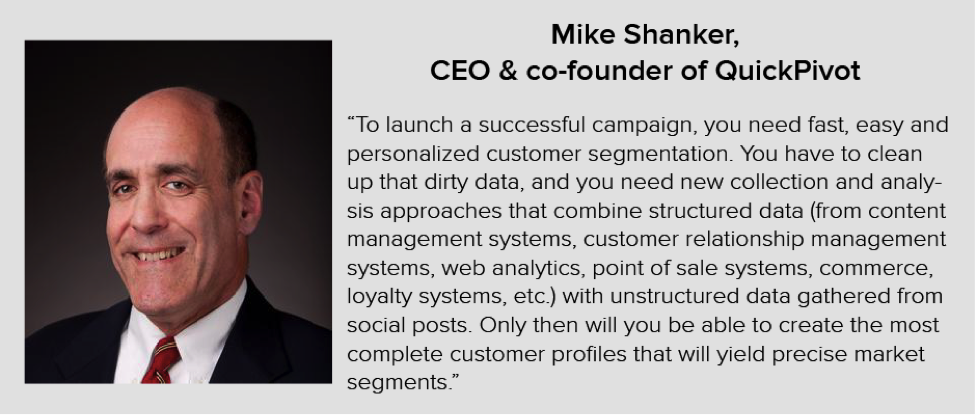
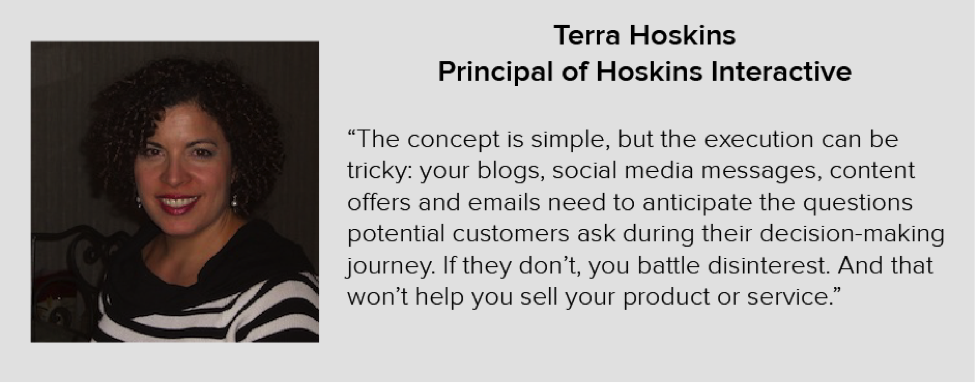
But as customers increasingly take a self-led journey through the buying process, effective content management is critical to successful lead nurturing. Here’s what six thought leaders had to say about using content management to speed buying decisions, the role of content in the buyer’s journey, and adding value at every stage of the buying process.

mikeshanker

 (via CustomerThink.com)

TerraHoskins

laurenkaye

trentd

johnhallinfluenceco

davidhubbard-1

(via Business2Community)

get the free hubspot crm

24 Mar 16:22

Retailers are launching a new generation of e-commerce membership programs modeled on 'Amazon Prime'

by Cooper Smith

bii amazon prime vs costcoAmazon Prime is the most widely known and used online membership program. And it's been so successful for the company that other online retailers are now beginning to explore their own up-front, fee-based programs.

Membership programs offer retailers a number of advantages, including getting consumers to shop habitually at the same merchant. 

But there are also major challenges to operating membership programs. The services often come with added costs for retailers, such as absorbing delivery costs, which may not be easily recouped. In addition, retailers must clear a high bar in order to convince customers that they are offering a service that's actually worth paying extra for.

In a new report from BI Intelligence, we define what an e-commerce membership program is and how retailers are taking the Costco model and updating it for the online shopping age. We also assess the advantages and disadvantages of e-commerce membership programs for the retailer, as well as what consumers might look for in these programs and what incentives are needed to get people to sign up. And we include examples of how some e-commerce companies are structuring membership programs and provide an outlook for other retailers and product categories that could benefit from employing the membership model.

Get the full report now >>

Here is a list of the e-commerce membership programs that we examine in the report: 

  • Amazon: Amazon charges Prime customers $99 annually in exchange for a bevy of benefits ranging from free two-day shipping to access to premium video and music content. We estimate that there are approximately 53 million Prime members worldwide — and 25% of those members live outside the US.
  • Jet: The soon-to-launch e-commerce startup based in New Jersey is using the membership model to create a sort of discount-buying club, akin to Costco, but updated for the internet. The company asks customers to pay $50 annually in exchange for access to products that are supposedly 10% to 15% cheaper than anywhere else. Shipping is not included in the fee but the company uses an algorithm to locate the closest and cheapest shipping option among its local retail partners.
  • Sephora: The cosmetics retailer recently launched a members-only shopping program called Flash. Members pay $10 annually and receive free two-day shipping, or overnight shipping for $5.95 on all online orders; and, there's no minimum purchase value required. Sephora can likely keep membership fees low because most products the company ships are small, so delivery fees are lower.
  • Google: The tech giant also has a membership tier to enroll in Google Express, its delivery service available in five markets. Members can pay either $10 per month on a monthly basis, or $95 for the whole year and receive free same-day delivery from local stores on all orders of more than $15. Compare that to non-members who have to pay $5 for delivery on orders over $15 and $8 for orders that are under $15.
  • Instacart: The grocery delivery service partners with Whole Foods, Costco, and Safeway, among others, and offers a membership program called Instacart Express, which costs $99 annually — in exchange, members get free two-hour delivery on all grocery orders. Customers who use Instacart but do not sign up for the membership program must pay $3.99 per delivery.
  • Thrive Market: The newly launched organic grocer and wellness retailer asks customers to pay an annual fee of $60 for access to products that are supposedly "always 25 or 50 percent" cheaper compared to competitors. Thrive Market has referred to itself as an online Costco-like retailer for health-conscious consumers. The major difference is that Thrive Market customers don't have to buy items in bulk like they would if shopping at Costco.

In full, the report:

Get the full report now >>

Join the conversation about this story »

24 Mar 16:22

Why CMOs Should Align With Their CFOs

by Carlos Hidalgo

There is an ever-increasing complexity in B2B marketing that shows no signs of slowing down. According to the IBM Global CMO Study, a full 79% of Chief Marketing Officers (CMO) expect the complexity of marketing to increase over the next five years. However, of those CMOs less than half feel prepared to handle this complexity. This is indeed a perilous position for marketing leaders and something has to give.

alignment One of the areas that marketers feel most exposed is the area of metrics and measurement. For all of the focus and discussion on Big Data over the last few years, marketers continue to struggle with making sense of the work they are doing and the value it is delivering to the business. While solving this problem will not limit or slow the impending complexity, it will enable marketers to demonstrate the impact they are making on the business and better align their priorities to that of the business.

Lack of Knowledge & Expertise

In Forrester’s Report – B2B CMOs Must Evolve or Move On, 97% of CMOs either agreed or strongly agreed that “marketing must do things it hasn’t done ever before to be successful.” One of these things is financial management. While there is plenty of articles, blogs and speeches given on the need for marketing to demonstrate ROI and drive pipeline and revenue, the reality is that most marketers have never been trained to measure the quantitative value of their marketing or demonstrating the Net Present Value (NPV) of their marketing activities.

In fact, according to the Fournaise Group “90% of marketers are not trained in marketing measurement or marketing ROI”. This is demonstrated in the fact that 67% of marketers do not believe that marketing ROI requires a financial outcome. Let’s be clear, ROI is all about financial outcomes! This lack of know-how combined with the impending rise of complexity will only led to additional pressures on the CMO, which are already intense.

Connecting With the CFO

Despite this issue that exists in marketing organizations there is a lifeline that CMOs should look to take hold of, but currently few are…the office of the Chief Financial Officer (CFO). Finance organizations are accustomed to complex financial models, have data and financial analysts on their staff and understand quantitative analysis. However, only 14% of CMOs state that their relationship with the CFO has increased over the last two years according to Forrester.

While marketers are looking to improve the relationship and alignment with their sales and IT teams, one of the areas that should receive more attention is that of the CFO. Marketing organizations that do not have open headcount for their own financial/data analyst positions can bridge the gap that exists in their reporting capabilities by forging an alliance with the CFO. In collaborating on their reporting needs by developing the financial models that the CEO and the rest of the business demands, the marketing team can learn the models and begin to close this specific skills gap.

I agree with the 79% of CMOs who expect growing complexity in the years to come. However, the need to change, adapt and further the relationship with the CFO in order to report on financial outcomes is a must as it will provide clarity and demonstrate the value in marketing investment.

*Image courtesy of Canva.com

24 Mar 16:22

Technology Marketing: Avoid a Social Media Burnout With a Winning Game Plan

by Teresa Slider

While going viral may be the Holy Grail of social media marketing, it’s also elusive and unpredictable. This is a race that’s won by more tortoises than hares—slow, steady, persistent progress.

Your technology firm needs to be in the social media race for the long run. That requires a game plan that’s achievable and, above all, avoids social media burnout.

A Race Worth Winning

Social media marketing is not just a campaign – it’s a commitment. It serves as a critical yardstick for your prospects and clients to compare you and your firm with the competition. After all, research shows 60% of buyers check out service providers on social media to get a sense of their expertise, online presence, and culture.

How Buyers

The power of social media marketing continues to rise among marketers in the technology space, and in professional services as an industry. According to Social Media Examiner’s 2014 Social Media Marketing Industry Report, 92% of marketers acknowledge its value (up from 86% in 2013). They’re also putting in the time to get the job done:

  • 64% of marketers spend 6 or more hours a week
  • 37% spend 11 or more hours
  • 19% spend 20 or more hours

To win, you need to leverage your efforts for maximum return without burning out. You need a game plan that focuses on objectives, content and management.

Set Objectives to Direct Your Planning

Professional services marketing is becoming more and more scientific as digital marketing becomes the norm. Marketers are relying on technology and data analysis – but they’re also thinking strategically. And that begins with knowing what you want to accomplish.

It helps to start by identifying your social media marketing goals. Are you aiming to increase social referral traffic by 50%? To gain 100 new LinkedIn followers? The key is to be realistic (you can always revise up) and specific. With clear objectives, you can build a plan and measure results.

Use Content as the Social Media Hook

Good content is more than a well-written article or a timely post. It speaks to your market, connects emotionally and shares the information buyers need to make a purchasing decision. Good content starts with a thorough understanding of your audience.

  • Identify Target Audiences: You can begin by analyzing your current client base and determining preferences. What do your buyers need to know to make a decision? What are their core challenges? Which social media channels do they frequent? Why are they looking to you as a resource and thought leader?
  • Test your Assumptions: To improve your results you need to select your key performance indicators (KPIs) carefully and measure your results.

Counting the number of friends and followers may indicate initial interest. But are you getting conversions? For the best results, track the correlation between your content and visits to your website, requests for more information, sharing of your posts and new business.

To understand whether you are on target with your audience, you need to know how successfully friends, followers, prospects and clients are being influenced by your marketing…and adjust accordingly.

  • Target the Right Social Media Channels: You want to build a presence where your market goes for information. For technology services firms, we recommend LinkedIn, Twitter, Google+ and even YouTube.

It helps to prioritize networks to keep the effort manageable. If you post on LinkedIn, for example, to reach the largest market audience, you can also:

  • Post a blurb on Google+ with a link to your content
  • Tweet a series of brief teasers to send readers to LinkedIn
  • Consider Your Strengths: You may not like writing but have a good interviewing style or enjoy giving webinars. Look for ways to build on your strengths. Along with webinars, YouTube videos or podcasts may be a good way to reach out. It’s easier to stay the course when you enjoy what you’re doing.

Best Practices to Managing Social Media

The best-laid plans are only as good as your ability to deliver. You need to manage your social media to build a strong relationship with your audience. As prospects check your firm out on social media, they are learning more about your firm’s expertise, credibility, and ability to solve their challenges.

Follow these steps to manage your social networks effectively:

  • Allocate Your Resources: When you consider that social media marketing can take up as much as a quarter of your workweek, you probably need to assign a dedicated person or team to the task. Social media requires a commitment of time and money—just like any other form of marketing. Budget for it.
  • Set a Realistic Schedule: Set a schedule for posting—whether it’s hourly, daily, weekly or monthly—that you and your team can achieve and commit to it. As you build a following, people start looking for you. If you’re not meeting their expectations, you’ll lose ground.While timely subjects work extremely well on social media, you can stay ahead of the last-minute rush by building a bank of reserve content—evergreen topics that you can post any time. These may help you keep on schedule.

    Most major social channels have built-in resources to help you schedule posts in advance. Or you can use third-party social media management tools, such as HootSuite, Sprout Social or Buffer. Just remember that social is about interaction. You don’t want to appear robotic. You can’t simply set it and forget it.

  • Be Responsive: Engagement is a critical element of social media marketing. As you build a following, you can expect questions and comments. Even if you post only once a week, you need to be monitoring throughout the day so you can respond quickly.Clients and prospects have their own expectations. Edison Research and The Social Habit report that 45% of consumers expect a response within 60 minutes to their questions and complaints. While this is a consumer statistic, business people are still people.

Conclusion

Social media is “earned” media for a reason. You deserve the respect and following of prospects and clients alike when you are generous with your knowledge and insight. Your ability to commit to a schedule and deliver consistently tells your audience a lot about your culture and business values. It’s essential, therefore, that you get it right.

While social media is not rocket science, the commitment can be extremely time consuming. It’s worth the effort. Engagement with prospects often times starts with a social connection. But if you cannot find the time or personnel in house, it may be time to consider outsourcing all or part of your social media marketing.

Remember that nearly 60% of professional services buyers check firms out on social media. They’re evaluating you more than your offering. Make sure you are on top of it.

For more information about social media marketing and developing a successful campaign, download our Social Media Guide.

24 Mar 16:21

RiteTag acquires ScrapeLogo to optimize beyond the hashtag

by Stewart Rogers - VB Insight
Pound sign hashtag number Mircea Maties shutterstock

Hashtags. Now ubiquitous and mainstream, they allow us to group conversations, ride on the wave of global trends, and express our lives in new (and sometimes socially awkward) ways.

But for marketers, working out how to use hashtags effectively has always been an issue.

While some organizations are big enough to be trend creators (with mixed results), most businesses and individuals have to work out which hashtag is the right one to include in a tweet, and where to include it. For that reason, the past three years has seen a number of hashtag analysis and optimization solutions, such as RiteTag, come to the aid of marketers and social savvy tweeters alike.

But hashtag optimization isn’t the only burning Twitter marketing issue.

Today, RiteTag has announced that it has acquired ScrapeLogo for an undisclosed sum. The acquisition is part of RiteTag’s roadmap to optimize every aspect of social media marketing.

RiteTag is available in your Chrome browser (via an extension) and via integration with popular social media management tools, such as Hootsuite and TweetDeck. Simply put, it analyzes the hashtags you’re about to use. It scores them and suggests alternatives and additions to help your tweet reach a wider audience.

I talked with RiteTag founder Saul Fleischman about the acquisition and the wider issues he is trying to solve.

“We’ve always wanted to go for total social media optimization,” Fleischman said. “Hashtags aren’t everything.”

He’s right. In terms of Twitter and Facebook alone, there is a lot left to optimize.

In research conducted by Buffer, tweets that include images were shown to increase retweets by 150 percent. Prior analysis from data scientists such as Douglas Mason and Dan Zarrella show similar bumps in engagement, retweets, and favorites when an image is included.

“We all know visuals are important, but do you have one handy, or the time to make one? In addition to rating hashtags and suggesting alternatives, we will now provide the ability to add an image to a tweet in an instant via RiteTag,” Fleischman said

I’ve seen RiteTag performing this new function within TweetDeck, and it couldn’t be easier. One click serves up a filmstrip of images to choose from, and the user selects the image they want to add to the tweet. The entire process takes a few seconds.

images02

So what is it that ScrapeLogo offer RiteTag? Why acquire the technology, and the team?

“ScrapeLogo has excellent fuzzy logic that allows us to grab deeply relevant images,” Fleischman said. “Right now it grabs corporate logos from domain names, with a high level of accuracy and certainty, but its matching technology is going to help us take our image selection system to the next level.”

Other than images, there is the ongoing issue of timing your tweet for best effect. Some tools provide rudimentary scheduling based on nothing but a list of times or rules. Others measure when your followers are most likely to be online and reading tweets, then optimize delivery at those times. If RiteTag’s mission is to optimize everything, how does tweet scheduling fit into its future plans?


VentureBeat is studying email marketing tools.
Chime in, and we’ll share the data with you.


“We will offer more choices for our auto-schedule settings in 2016, but for now, we suggest that people consider the actual value of tweet timing,” Fleischman said. “In this paper, Eric Enge of Stone Temple says that ‘this is one of the most popular myths about Twitter — that there is a best time of day to tweet’.”

It is a good point to make, but there are algorithmic tweet timing solutions that do an excellent job of scheduled tweets. Of course, the quest to ensure your tweet is read and acted upon doesn’t just come down to quality of content, an image, and a good time to tweet.

“What we want to do is make it easy and automatic for RiteTaggers to ride trend spikes and send tweets and Facebook updates that include hashtags, at the exact time when those hashtags are garnering the most reception,” Fleischman said.

RiteTag doesn’t just offer alternate hashtags and color-coded feedback on the effectiveness of your chosen hashtag.

“To help users quickly optimize their Facebook updates and Tweets, right where they post, the Coach feature rides in Facebook, Twitter, Tweetdeck, Hootsuite, Buffer, and SproutSocial,” Fleischman said. What it means is plain-English advice on why you are seeing a “flag” against your tweet, and what to do about it.

coach - to go with my answer to your question

Above: RiteTag Coach in action


Knowing which hashtags are “good” is great, but what is RiteTag doing to guard against brands leveraging an inappropriate hashtag?

“Our proprietary hashtag grading system includes color-coded indication of overused tags,” Fleischman said. “Use these hashtags and you’ll have little to no chance of getting found from search, those clicking hashtags, or those curating from hashtags because the competition is too great.”

That doesn’t solve the exact problem highlighted by a few recent incidents, so savvy marketers should still make judicious use of hashtag directories and definition sites to ensure they understand the story behind a tag.

In optimizing hashtags for Twitter and Facebook, and allowing the easy addition of images to social updates, RiteTag provides a simple solution to a problem many marketers struggle with. By acquiring ScrapeLogo, it hopes to vastly improve that feature and take its image matching technology to the next level, with full social media message optimization on the horizon.

The ScrapeLogo service will continue for current customers, who rely on it for displaying the logos of their users’ domains as well as brands that their users refer to. All current staff are being retained, and join the team at RiteTag.


VentureBeat’s VB Insight team is studying email marketing tools. Chime in here, and we’ll share the results.


24 Mar 16:21

What Is Predictive App Marketing?

by Bryn Adler

Five years ago, the promise of Big Data and the idea of understanding our customers and prospects on a deeper level was exciting. But the promise fell flat when it came to actually using that information to drive business decisions. Since those days, everyone has been rushing to hire data scientists or find new technologies that figure out what to do with all the data we now have at our grasp.

Predictive_App_MarketingIt is this very intersection – the point where data and action collide – where predictive app marketing lives. Predictive app marketing brings to life the ability to combine all of the rich data you have about your customers and the actions they take every time they log into your app, with your marketing channels to drive personalized engagement with your users.

The challenges marketers face with the explosion of mobile are consistent across the board:

  • Where should I spend my next dollar for user acquisition?
  • How can I draw insights from how my users are engaging with my app?
  • How do I bring all of the information I have on my customer together to get the whole picture?
  • How can I take all of that info and deliver personalized messages to the right user at the right time?
  • I need to know which customers are at risk of abandoning my app before it is too late.

Predictive app marketing is the solution to these persistent problems.

What is predictive app marketing?

Predictive app marketing is using all of the data you have about your customers, plus all of the ways they interact with your app, to predict customer behavior and proactively engage them with personalized experiences. These experiences are personalized to both the user and to the stage the user is at within the customer journey. The end game is driving higher engagement and retention, and ultimately lifetime value.

In the end, it is a customer-centric approach to app marketing. It makes your push and in-app messages welcomed and deepens the relationship with the customer. The data is there to predict what they want and what you should present to them at any given time. When you connect engagement channels like in-app, push and email marketing to that information, the probability of the outcome you want is greatly increased.

What are the key benefits?

Knowing your ideal customers and optimizing your ad spend for better long-term results

With predictive app marketing, you can stop wasting ad spend on one-time users or downloads that don’t turn into customers. What if you could increase marketing ROI by knowing the outcome of your next dollar spent on acquisition? By connecting attribution from your advertising networks to customers’  lifetime value (LTV), you can determine which ones are driving your best customers and double down on what’s working.

Anticipating when and how to build a better relationship with every customer

Personalization and predictive go hand in hand: predictive app marketing identifies and facilitates engagement opportunities. This goes beyond just what you’ve collected in-app, and includes customer information from outside the app, including email, in-store and web interactions.

How, exactly? By creating personalized experiences based on intelligent recommendations. This can include suggesting products or content (based on previous actions) that users are likely to be interested in based on their previous actions. Not only does this serve up valuable content, it also increases conversions by identifying and proactively targeting users that are likely to buy. With predictive app marketing, you can identify the user data that inspires relevant campaigns sent at the right time to the right people.

Predict and engage with at-risk customers, long before you have to win them back

Today, 20% of apps are only used once. Churn rate is incredibly high: there’s a 60% chance that users who don’t return to your app within seven days will never return. App marketers are faced with abundant competition and a shrinking attention span. Predictive app marketing helps you identify users that have strayed from the happy path and are giving you the first signals that they could become a churn risk in the future, so that you can re-engage them before you have to win them back.

Why predictive is the future

Today’s dilemma: Mobile is a highly personal medium that requires an equally personalized experience in order for your user to gain value. Consumers today demand these experiences and expect technology to be able to read their minds.

Tomorrow’s dilemma: Apps are already a part of our lives, and we’ll become increasingly dependent on them as they become the digital centerpiece connecting our devices, homes and cars. That’s a lot of data and a high bar to meet when it comes to personalization. Marketers need a solution that gives them the right data to make the right decision to be successful within this brave new world.

The solution: Predictive app marketing provides a holistic view of your customers, and uses all of your data to predict what comes next and address it with personalized marketing in real-time. It is the best way for marketers to start bridging the gap between user expectations and the reality of their brand experiences. The winners in the future of marketing are going to be those who provide that level of dedication to what their customers want.

watch-the-localytics-video

24 Mar 16:21

Five New Ways of Handling the “Just Email Me Something”

While the method of this stall has changed throughout the years: it went from, “Just put a brochure in the mail, and I’ll look at it,” to “Why don’t you fax something to me, and I’ll look it over,” to now it’s, “Just email me your information, and I’ll look it over,” unfortunately, it all still means the same thing: your prospect either doesn’t want to take the time to be pitched, or they don’t need what you’re selling. 

Either way, this stall sets up one of the most frustrating parts of sales – the chase.  Think about it: how many times have you sent off your information and, when you’ve been fortunate enough to “catch” the prospect again, you’ve heard:  “I haven’t looked at it” or “We’re not interested at this time”?  Probably a lot, right?

The way to avoid this is to earn the right to ask a few key qualifying (or disqualifying, as I like to call them) questions so you can save both of you a lot of time and effort later on (to say nothing of saving yourself a lot of disappointment as well).

The solution, as always, is to be prepared for this brush off with a good script that fits your personality and product or service.  Take the time now to adapt and customize one or more of the responses below so you are prepared the next time your prospect uses this stall.

Response One:

"I’ll be happy to do that, but once you see the material, you’ll probably have more questions than answers…so let’s do this first: I’ll ask you just a couple of quick questions to see if this is even a fit for you at this time, and then, if it is, I’ll send you some targeted information – sound fair?

[If Yes – ask any appropriate of the questions below]

“First, would you be the right contact for handling (XYZ)?”

OR

“I know I called you out of the blue, but if you found that you could (give a benefit of your product or service), what might your timeframe be for considering making a decision on it?”

OR

“How are you currently handling (XYZ), and what might motivate you to consider making a change?”

OR

“How open are you to seriously considering making a change (or making a move on) XYZ in the next one or two months?”

Now note about this rebuttal I put in the question: “sound fair?” at the beginning.  You can leave that out if your prospect is in a rush or if you can tell you’ve caught him/her at a bad time – you’ll need to decide on a case by case basis.

Response Two:

"You bet I can – what’s your email address?”

[Take it down and then email them your information!]

“O.K., I just sent it.  Now while you open that up, let me ask you a quick question: 

“How do you get involved in ordering/handling/working with the XYZ?”

OR

“From a needs standpoint, how motivated is (your company/department/are you) to change/fix/replace/buy XYZ right now?”

OR

“What would you need to see in the information I just sent you for you to become interested in learning more about what we do?”

Response Three:

“I’d be more than happy to do that – where would you like me to email that?” 

[Take it down and then email them your brochure.]

“O.K., it’s on the way to you.  What I’d like to do right now is take just two minutes to get an idea of what’s important to you, and then I can direct you to that part of the information when you get around to it.  Let me ask you:

“How do you get involved in ordering/handling/working with the XYZ?”

OR

“From a needs standpoint, how motivated is (your company/department/are you) to change/fix/replace/buy XYZ right now?”

OR

“What would you need to see in the information I just sent you for you to become seriously interested in making a change in how you’re handling XYZ now?”  

Response Four:

"I have a better idea: rather than send you something you may not be really interested in, I’ll save you the time of going through it – or deleting it! – by asking you just a couple of quick questions now to see if there’s really a need.  If there is, then I’ll have my assistant email you something:

“Are you the best person to talk to about changing/replacing/ordering the (XYZ)?”

OR

“I know I called you out of the blue, but if you found that you could (give a benefit of your product or service), what might your timeframe be for considering making a decision on it?”

OR

“How are you currently handling (XYZ), and what might motivate you to consider making a change?”

OR

“How open are you to seriously considering making a change (or making a move on) XYZ in the next one to two months?”

Response Five:

"Be happy to do that – where do you want me to email that to?”

[Then]

“And while you have me on the phone, let me briefly ask you just a couple of quick questions which will determine whether or not it makes sense for me to follow up on information I’ll send you.  For example:

“How likely are you (or your company/department) to be in the market to make a change in (the way you handle XYZ) if you found a better alternative?”

OR

“If you like what you see in the information, what would the next step for us be?”

OR

“What would realistically stand in the way of us doing business together in the next few weeks if you saw some value in the information?”

There you have it – five new ways to handle the age old brush off – “Just mail/fax/email me some information.”  As will all new scripts, take some time to adapt them to fit your product or service, and to fit your personality and style.  Once you do develop an effective way of delivering this information, then commit to practicing, drilling and rehearsing it until it becomes automatic for you.  

24 Mar 16:19

10 Essential B2B Marketing Strategies to Grow Your Professional Services Firm

by Lee Frederiksen

When some firms think of B2B marketing strategies, they think primarily of direct and outbound techniques – messages that you might send straight to clients or prospective buyers that you’ve identified. In this approach, the goal is to be compelling and persuasive enough that the audience responds and engages with your services.

These kinds of techniques certainly have a place in your marketing tool belt. But the world of B2B marketing strategies has expanded, and the behavior of professional services buyers has changed. Buyers are much more likely to do a Google search to find and evaluate a firm than to check personal references.

This has broadened the range of B2B marketing strategies at your disposal Today, staying competitive means taking full advantage of a wide spectrum of strategies.

But which ones are essential for success in today’s hyper-competitive environment? Let’s take a look at ten absolutely fundamental B2B marketing strategies that will not only help your firm keep up, but help you get ahead.

1) Research

Research is the bedrock of any modern marketing effort. From marketplace research to brand research, detailed scientific studies will help you make more informed decisions. They’ll give you an objective basis for your marketing and provide you valuable baselines for measuring your results.

By conducting research, you’ll know your clients better — which puts you in a position to serve them better. Market research also gives you insight into how your processes are performing. You’ll know which aspects of your firm are performing most successfully and develop a better understanding of which services you should offer.

The impact of research is clear. Our own studies on the impact of research have shown that firms that conduct systematic research on their prospects and clients grow three to ten times faster and are up to two times more profitable than peers that don’t pursue research.

2) Niche-driven Strategy

One of your most important business considerations – period – is specialization and niche targeting. Our research has repeatedly shown that the fastest-growing firms tend to be specialists in a carefully targeted niche. This should be an area of the industry that you understand thoroughly, a space in which you can become an undisputable expert and leader.

Specialization makes all of your marketing efforts easier, because it tends to define exactly what you do and immediately distinguish you from the competition. A specialization is a differentiator that proves itself.

3) A High Performance Website

In today’s professional services marketplace, your firm’s website is one of your most crucial assets. It is much more than a digital billboard or brochure, as some firms believed in the past. A successful website is the hub of a firm’s online presence and an information-rich projection of its expertise into the marketplace.

Your website is a critical tool for building visibility. Potential clients search online to find service providers, and they need to be able to find your firm’s website in order for you to have a chance at winning their business. Plus, your website enables you to demonstrate your firm’s expertise and become well-known throughout the marketplace.

Our research paints a clear picture of the importance of a professional services firm’s website. In fact, 80% of people look at website when checking out service providers – the most commonly used information source by far.

And as new visitors reach your site, robust educational content and carefully targeted offers can drive leads to closer and closer engagements, eventually bringing qualified leads straight to you. This process of nurturing leads through content is illustrated below:

Content Marketing Funnel

A second component of your website you need to consider is design. Web and graphic design can influence your audience’s perceptions, aid recall, and swiftly and intuitively differentiate a business.

The power of design to engage audiences is often underappreciated — which means it offers a tremendous opportunity to set firms apart and convey the credibility firms needs to thrive.

Finally, another increasingly essential consideration for your website is its usability across a wide range of devices, including mobile. Responsive design, which allows your website to adapt to suit a user’s device, has become a key feature as more people use mobile devices to do business.

In fact, Google will begin ranking websites that are responsive, or “mobile-friendly,” higher in search results soon, making responsiveness a necessity for firms.

4) Search Engine Optimization (SEO)

As we alluded to in the previous item, your target audience has to be able to find your site for it to be effective. That’s where search engine optimization comes in.

This is such a key piece of the online marketing puzzle that in our studies, high-growth firms list it as the most effective online marketing technique available to them.

Effectiveness Rating: High Growth vs. Average Firms

Though SEO is a complex and evolving discipline, it ultimately consists of two primary components.

  • On-site SEO uses targeted keyword phrases to communicate the concepts on your site that matter to your audience. These keyword phrases typically focus on your services and expertise.
    The purpose of on-site SEO is to communicate to search engines what your website is about. This allows search engines to produce more relevant results to searchers. And when audiences search for insight on your area of specialty, they’ll find you.
  • Off-site SEO takes the form of links to your website, either through outside engagement or guest articles in other publications, for example. These efforts work to increase your site’s authority as a widely recognized leader on your topic.
    As more high authority and relevant websites link to your website, search engines will begin to see your site as more credible – resulting in higher rankings.

5) Social Media

If you needed any more proof that social media is here to stay for professional services firms, we’ve got you covered. Our research has found that over 60% of buyers check out new service providers on social media, making it a more commonly used source of information than formal referrals and recommendations.

Even the nature of referrals has changed in the wake of social media. A recent study on referral marketing has found that 17% of expertise-based referrals are made on the basis of interactions on social media. Put simply, social media is an accelerator for the reach of your reputation, expertise, and content. It allows you to network and connect with valuable contacts and influencers, as well as monitor your brand by social listening.

6) Advertising

There are a number of platforms on which your firm can advertise effectively:

  • Industry publications and websites
  • Social media
  • Search Engine Marketing (SEM) – Google AdWords, as well as Bing and Yahoo
  • Retargeting – A cookie-based technology that uses a simple JavaScript code to anonymously “follow” your audience across the Web and serve relevant ads

Advertising doesn’t just promote your services – it can also play an important role in driving content downloads, increasing both your expertise and visibility.

It’s important, however, to use forms of advertising best-suited to professional services. LinkedIn, retargeting, and other industry-focused advertising tend to work best, because they allow you to most directly target appropriate industry audiences, which leads to more conversions, higher click-through rates, and lower cost per download.

Search engine marketing (SEM), on the other hand, often can be more expensive and harder to target for professional services’ purposes. Similarly, Facebook ads tend to be less effective because the platform is used at a lower rate by professional services buyers than other social media networks..

However, it’s important to remember there are many variations of each of these advertising types. Professional services firms might find them more or less successful depending on budget, ad purpose, targeting, and industry niche.

7) Referral Marketing

We mentioned that the nature of professional services referrals has changed – and this has major implications for your B2B marketing strategy. Our studies of referral marketing strategies in professional services have revealed an important new facet of the practice – over 81.5% of providers have received a referral from someone who wasn’t a client.

Where do these referrals come from? The vast majority are based on a firm’s reputation or its expertise.

Referral Marketing Report for Professional Services

By using content marketing in conjunction with the rest of the tactics in this list, you can build a brand with a widespread reputation for specialty in your area – and an understanding of your expertise even among audiences that haven’t worked with you directly. This brand recognition can lead to referrals and new business.

8) Marketing Automation, CRM, and Lead Nurturing

Marketing Automation: Marketing automation replaces high-touch, repetitive manual processes with automated ones – supported by technology solutions. It brings together all of your online marketing channels into one centralized system for creating, managing, and measuring programs and campaigns.

As with any technological tool, it’s essential to select the right marketing automation software for your firm. Make sure the size, complexity, and scalability of a prospective solution is a good match for your needs.

CRM: Another essential software is a Customer Relationship Management System (CRM). Many firms use a CRM to track and organize opportunities and client information. In short, a CRM will help you stay organized and connected, no matter how sophisticated your operations grow.

Your CRM serves as the database for all the information you collect about opportunities and clients, including specific interactions with them. The information can be entered, stored, and accessed by employees in different firm departments, synchronizing efforts across your firm.

Lead Nurturing: But CRM isn’t the end of the story. Remember the lead-nurturing content funnel? Your website is one critical piece of that puzzle – and email marketing is another. Targeted, analytics-driven email marketing campaigns allow you to deliver soft and hard offers for specific buyer roles, tailored to a buyer’s particular place in the buying process.

Similarly, drip email campaigns enable you to send more targeted offers to segments of your audience over a set period of time. This builds closer engagement (and educates further) through successive, relevant content and offers.

9) Testing and Optimization

We started with research, but we’re not finished with our scientific approach. Testing and optimization allow you to iterate your marketing efforts and make ongoing decisions based on hard data rather than intuition.

Just as research is the bedrock of your marketing, testing and optimization is your continuous guide. You should never stop testing your marketing campaigns and adjusting them accordingly. This includes:

  • A/B testing of emails, landing pages – Using A/B testing tools (like Optimizely or Unbounce), learn which of two emails or landing pages converts users more successfully based in variances of language, design, or other elements.
  • Email and landing page rendering – Use tools like Email on Acid to test how emails will render on different devices and platforms, ensuring that they look and function as they should.

10) Analytics and Reporting

Similarly, it is critical to analyze the right metrics in order to measure results effectively. You will need tools in place to collect accurate data on all your efforts, from your website to social media to SEO.

Google Analytics is an essential tool for measuring and analyzing your site traffic. MOZ can help you study and improve your SEO results, while tools like Hootsuite provide detailed social media analytics.

Analytics and testing help you truly understand what is working and what is not. Embrace them, use them. They will help you turn your marketing efforts from an art form into a science.

A Final Thought

The important thing is not to stand still or grow comfortable. In order to remain competitive, your firm must constantly assess your B2B marketing strategies and find ways to improve.

The online marketing world is evolving at a faster and faster rate, but today, the firms that successfully gather and utilize data on their performance – across a wide range of marketing efforts – are situated to win.

Ready to learn more? Download the free ebook Online Marketing for Professional Services below.

Online Marketing for Professional Services Book

24 Mar 16:19

How to Choose Bloggers as Brand Advocates

by Prasanna Bidkar

How much do bloggers influence your brand image? Can bloggers really be brand advocates? If you are on the brink of this decision, this post will set you straight.

While there are examples of influencers making or breaking brand perceptions, non-celebrity, niche bloggers have much more impact on influencing the buying decision. The latest data on bloggers and their influence on readers, according to the research conducted by Research Now shows that,

Bloggers influence purchase decision

So how do you ensure that you find and choose the right advocates to share your brand story?

Step 1: Define your Brand/Product Audience

If you have done any kind of marketing, you must already have this information. If not, then this is as good a time to do it, before you go hunting for bloggers to kick-start your blogging campaign. Defining your audience demographic will give you a clear picture of who your customer is. Are you a men’s fashion or luxury brand? Or does your business cater only to parents of a newborn?

Some of products have a very specific customer definition, while other products have a very wide customer demographic.

You can take a theoretical route to define your audience from scratch and build a couple of buyer personas. Or you can look at your competitors or similar web sites and check out their customer stats to start your audience definition.

For example, if you have a food industry related product, you can use services like Quantcast to find your typical audience profile by looking at complementary web site data.

Audience profile

You can of course look at your Google Analytics data too and any other similar tools to extract information about your website visitors to find out about their interests and profile.

Step 2: Define the Typical Influencer For Your Audience

Once you know who your audience is, it is time to find who their influencers are. You can begin by looking at the Affinity Categories in Google Analytics. The affinity category will show you what are the other areas that your web site visitors frequently follow on the Internet and their likes and dislikes.

Use Alexa.com to find the top web sites in the category your audience likes and check out the profiles of the bloggers in this category. This whole exercise will help you define the blogger persona you want to target in your blogging campaign.

Step 3: Find Bloggers In Your Niche

Depending on your product and market, you may want to target bloggers in specific geographical area. Most bloggers will have the location information in their social media networks. Use these networks to build a list of bloggers in all the markets that you wish to target.

Apart from the geographical location of the blogger, it is equally important to determine the traffic source for the blog. Many bloggers have their blogs hosted on servers located in a different country or talk about services and products across different countries. It is entirely possible that the blog you have chosen gets most of its traffic from a geographical area other than where the blogger currently resides.

The best way to get this information is to request the blogger for stats or ask for their media kit.

Step 4: Match Your Influencer Persona to the Bloggers’

I am sure all this effort sounds too much, but the most important part of a successful blogging campaign is to find the right blogger. There are a number of platforms and blog directories that can reduce the amount of effort you put in until this point.

The most tricky and important part of a successful blogging campaign for your brand is to match the bloggers to the influencer persona that you have defined for your audience. From your blogger shortlist, select the bloggers that are closest to your influencer persona.

Step 5: Know the Blog and Blogger

The one thing that puts off bloggers most is a generic email blast and meeting or talking to a PR contact who doesn’t have a clue about what the blogger does or writes about. Don’t commit this mistake!

Read a few blog posts the blogger has written. Find out if the blogger has written the type of blog posts that you want to include in your blogging campaign. If you want to host Giveaways, check if the blogger has hosted any similar Giveaways before and what was the kind of engagement they were able to generate.

Step 6: Make the Pitch

Myth: Bloggers are passionate writers who don’t want to be paid.
Yes, they are passionate about the topic they write on and have a very strong opinion on the subject. But trying to understand a product or a service and articulating the best and worst about a product or a service takes time. To write it in correct and consistent style, in a readable format without grammatical errors and mistakes, takes a lot of effort.

Let me give you an example of a restaurant menu tasting we did last year – driving to and fro took over two hours, not to mention the cost of fuel. Time spent at the venue was three hours. Ideation, writing, editing, formatting pictures etc. took over 12 hours. And distributing the post over social media is an ongoing process. That is a total of 17 hours!

As far as a serious professional blogger is concerned, these are work hours.

Some might argue that a post can be written in 2-3 hours. But can the output be the same?
The quality of the content, the amount of knowledge shared, and the actual expertise of the blogger will be evident in the blog post.

If the bloggers’ media kit doesn’t specify what they charge for a sponsored post, make a direct inquiry or specify what you are willing to offer the blogger beyond the product sample.

You also need to specify what you expect from the sponsored post and any other activities you want the blogger to engage in on social networks and other channels.

Bloggers Spread Your Brand Message

There are hardly any buyers who do not at least make a cursory search online using search engines or social media to know about your product. In all probability, the buyer who walks into a store has already made up her mind about your product and what to expect when evaluating a product.

bloggers brand advocates

So don’t lose this golden opportunity to reach out to bloggers in your niche and put the prospective buyer in a positive frame of mind when she decides to buy what you are selling.

Want to get a head start on building an online brand? Sign up to our newsletter to get a free copy of our book – 76 Ways to Build an Online Brand.

Meanwhile, we would love to hear about your experiences in blogger outreach.

24 Mar 16:18

The Good, The Bad, and the Ugly of Cost Cutting

by Ian Altman

The Good, The Bad, And The Ugly Of Cost Cutting

Those who specialize in expense reduction would accurately argue that each dollar you earn in sales contributes a small percentage to profit. But, each dollar you save goes directly to the bottom line. Your cost cutting might be driven by a desire to price your products or services more competitively, to improve financial performance, or to better serve your customer. The decision is never simple. Just be careful to not make some of the mistakes I’ve outlined as the Good, the Bad, and the Ugly of Cost Cutting.

Good Cost Cutting

If you can reduce your costs and either maintain or improve quality, that’s a no-brainer. Companies like Expense To Profit and Expense Reduction Analysts work to cut costs in areas where you have significant savings. They strive to obtain the “right” price for the products or services you are buying based upon their research. In most cases, they reduce costs while maintaining the same provider, performing the same services. When you can save money without adversely impacting the customer, you provide improved value all around.

Unfortunately, when the finance or accounting department drive savings, often times they do so without seeing the big picture of how cost cutting might impact employee and customer satisfaction as well as loyalty.

Bad Cost Cutting

Cost cutting always sends a message to customers, employees, or both. The companies with the highest customer loyalty also have the highest employee loyalty. It’s tough to know which came first… but they tend to happen together.

As someone who travels quite a bit, I noticed how two hotel chains treat their elite guests. In the concierge lounge at a Marriott, the concierge said she gets a bonus for each letter they receive from satisfied guests. She tries to persuade the chef to create exciting snacks to improve guest satisfaction. That is how she gets measured and rewarded.

At another hotel brand, guests in the concierge lounge were asking about the empty trays of what we suspected were appetizers during happy hour. The concierge said to me quietly, “I get a bonus if I can cut our costs. So, I only put out a little at a time. I earned a $200 bonus last month because I cut our costs.” Marriott on the other hand makes a decision to focus on loyalty and engagement over costs. After decades as a loyal guest in other programs, I have switched to Marriott. They take great care of me. That’s how they are measured.

Ugly Cost Cutting

Near my home, there is a group of Thai restaurants. When they first opened, they were the leading brand. The menus have not changed in years. I’ve eaten at their restaurants more times than I care to admit. Over the years, you’d see shorter waits during busy periods. The restaurant started cutting staffing, which made sense. No need to staff an empty restaurant. I just hope that the chicken was still chicken. Clearly, they concluded that they’d improve financial performance by reducing portion size and raising prices. Quality also suffered. When I raised the issue to a manager waiter, he said “I know. I keep telling them. But, they’re all about cost cutting.” After a few bad experiences, the group went from one of my favorite spots to “I’ll never dine there again.” I walked past a location that used to have a long wait in the evenings. It was a Friday night. Forget about a wait… the place was almost empty at 7:30 at night.

The tough lesson here is you cannot save your way to prosperity. (tweet) When you cut costs without considering the impact on employees, customers, and overall loyalty, you make a conscious decision to follow a short-term path with poor long-term results. When you give up on attracting customers, cutting costs seems like a good idea.

What You Should Do Instead

When revenue falls, it is natural to think about cutting costs. If you do cut costs, be careful about your message to employees and customers. Customers and employees don’t want to board a sinking ship. Focus your efforts on where you can add the greatest value for your existing and future customers.

Revenue growth can make up for many mistakes. Cost cutting when done the “Good” way can be effective. If you cut costs at the expense of employees or customers, you move down a dangerous path toward extinction. The top performing companies rarely compete on price or lowest cost. If you focus on delivering exceptional value, your employee and customer loyalty will help you reach new heights. (tweet)

It’s Your Turn

Have you ever experienced a situation when cutting costs had an impact on you? Tell us about it. Post a comment or take the conversation to Twitter, LinkedIn or your favorite social network.

24 Mar 16:18

Why “Easy” Content is More Persuasive

by David Dodd

Creating persuasive content is a perennial challenge for B2B marketers. Producing engaging content has been one of the top three challenges identified by respondents in all five of the annual B2B content marketing surveys by the Content Marketing Institute and MarketingProfs.

Marketers have traditionally viewed B2B purchasing as a rational process, and as a result, we tend to believe that the key to creating persuasive content is to use logical arguments that are supported by credible and convincing evidence. We now know, however, that B2B buying behavior is not completely rational and that business buyers, like all humans, rely on non-rational mental shortcuts when making decisions.

Because B2B buying isn’t totally rational, marketing content that relies only on logical arguments and credible evidence will not be as persuasive as content that also appeals to the intuitive aspects of human decision making.

Research from both psychology and behavioral economics has produced several insights that B2B marketers can use to improve the persuasiveness of marketing content. One of the most important concepts is cognitive fluency, which is the term scientists use to describe the ease with which our brains process information. It turns out that we humans have a strong affinity for things that are easy for us to think about. Psychologists say that cognitive fluency signals familiarity, and familiarity makes us feel comfortable.

Cognitive fluency shapes our thinking in many ways. For example, numerous experiments have shown that cognitive fluency:

  • Makes us more inclined to believe a statement is true
  • Causes us to believe that the author of a statement is more intelligent
  • Makes us more confident in our judgment about the truth of a statement
There are two variations of the cognitive fluency “formula” that are important for marketers to understand.
Easy = Familiar = True
This is the most common expression of the cognitive fluency principle, and it states that if marketers want to make content persuasive, they must make it easy to process. There are several basic tactics that marketers can use to improve cognitive fluency.
  • Use easy-to-read fonts and contrasting colors for text. (For an authoritative discussion of font “power,” read this article.)
  • Do not use complex language when simple language will suffice. We actually view the unnecessary use of pretentious language as a sign of poor intelligence and low credibility.
  • Whenever possible, use images and simple diagrams to anchor and illustrate complex concepts.
Familiar = Easy = True
The second variation of the cognitive fluency formula is more subtle, but just as important for B2B marketers. It states that if marketers want to make content persuasive, they must make it familiar.
This dimension of cognitive fluency explains why it is important to create content with a specific buyer persona in mind. When I develop content for a specific buyer persona, I use terminology and examples that will be familiar to the target persona.
So, for example, when I write a white paper or an e-book “for” CFO’s, I make liberal use of financial terms and financial concepts. Likewise, if I’m writing for a buyer in a particular industry, I’ll use terminology and examples from that industry. These tactics will make the white paper or e-book “feel” more familiar to the target reader, which will make the information easier for the reader to process, which will cause the reader to be more likely to accept and believe my information.
Cognitive fluency is a powerful tool for improving the persuasiveness of marketing content. In a future post, I’ll discuss how “framing” content can also improve persuasiveness.
24 Mar 16:18

Catching Buyers in Their Moment of Interest

by John Fakatselis

Buyer interest signalsWe’ve had many debates within our team about tracking buyer activity: when they open emails, access portals, view documents, view specific pages for X amount of time. We track all of that with our solutions, but for years now, we’ve been reluctant to expose the information—to make it part of our products—for fear that it was going too far. To many it just seemed creepy.  We hear internal comments like “Hi Bill, I noticed you were viewing the case study I shared with you—especially the outcomes page. By the way, nice shirt.”  Okay, the shirt joke is creepy, but we thought buyers might find it invasive to know sellers are tracking their activity.

We were wrong. Buyers love it. Maybe it’s that times are changing and buyers are ready, but they love it. Every test we’ve run—every single one—has been positive. It turns out that buyers are much more elated about the incredible service real time tracking and response provides more than any invasion of privacy concerns.

B2B decision makers are so incredibly busy. We know that, and it won’t get any better. First, like us, they’re inundated with information, and then with downsizing, staff cuts, profits re-reaching all-time highs—buying teams are facing more work with less people to do it.

Super-busy buyers don’t have lots of time to focus. When they do have a few minutes to review some materials about a solution project they’re pursuing, their mind is in gear, thinking about how the solution can bring improvements—and help their situation. Naturally, they’ll have questions. How great would it be if the sales rep called within minutes to discuss any questions they might have, catching them in their “moment of interest?” It’s powerful. And it works.

Buyers are not resistant. They love it. They feel incredibly happy about the attention and the discussion it provides. They need to know when they need to know. Not later, not on the sales rep’s schedule—on their schedule. It’s a great step in seller and buyer alignment.

A quick example.

Jill is sitting in an airport terminal waiting to board her flight home after a customer meeting. She receives an email on her phone letting her know Lisa, the head of marketing at a big account she’s been pursuing, was viewing a business case document she shared several days earlier. Jill calls her contact.

Her buyer contact takes the call right away—she’s impressed with the responsiveness.

Jill: “Hi Lisa, I noticed you were viewing the business case I sent. Did you think it was on target? Can I answer any questions for you?”

A great dialogue ensues, helping Jill gain insight and understanding she didn’t have before. Lisa becomes more convinced Jill and her company are the people that can make the difference. Jill’s competitors are in the dark, hoping for a call or a meeting in the coming weeks. They have no idea Jill was reviewing their stuff too.

So… this is what real time tracking and response can do. Help you focus on the most important opportunities, follow-up quickly and move the deal forward.

It’s the future. And it’s now.

24 Mar 16:10

How Canada’s competition bureau makes products more expensive

by Peter Shawn Taylor
A factory employee stacks finished mattresses.

A factory employee stacks finished mattresses. Competition Bureau policies are weirdly distorting the prices of consumer goods like these. (David Cooper/Toronto Star/Getty)

Maybe you bought a Kingsdown Romance Collection Sanctuary II Queen Euro-Top mattress from Sears recently. Maybe you think you got it on sale. Should you be losing sleep over it?

Recently Canada’s Competition Bureau initiated legal action against Sears Canada and Hudson’s Bay Co., demanding documentation on pricing, sales volumes and promotional strategies for their mattress businesses. The bureau says it has reason to believe the stores “failed to offer certain sleep sets at the regular price or higher for a substantial period of time [and]…did not sell a substantial volume of some sleep sets at the regular price or higher for a substantial period of time.” Also, it seems those clearance deals went on for a suspiciously long time. The country’s competition watchdog suspects both stores have been holding phony mattress sales.

The Competition Bureau’s investigation is just beginning, so there’s no determination yet as to whether customers were disadvantaged. Then again, a peek under the covers of similar cases suggests the best interests of consumers are wholly irrelevant to Canadian competition law. Rather than protecting shoppers, the Competition Bureau seems more interested in harassing stores that have low prices and interfering in legitimate marketing strategies.

At issue is the use of high-low pricing, also called off-price retailing. Sears, for example, keeps regular prices for mattresses high but uses frequent sales to create customer interest. As the federal court filings point out, competition law requires stores to offer their products at regular prices for a “substantial” period of time before knocking the price down. Substantial is usually interpreted as being at least 50% of the time. If sales are too frequent, it’s assumed consumers will be tricked into thinking they’re getting a bargain when they’re simply paying the de facto regular price. In other words, we’re all too dumb to shop around.

Yet the fact that something is sold at a discount for more than half the time doesn’t sound like a problem most shoppers worry about. Low prices are better than high prices. Anything that keeps them low ought to be considered a good thing, regardless of what the Competition Act says.

In 2005, under very similar circumstances, Sears Canada was found guilty of being too liberal in advertising discounts on car tires and was assessed fines and legal costs of nearly $500,000; in fact, the recent court filings about the mattress business specifically mention the old tire case. But there’s a peculiar lack of evidence that consumers were ever deceived or harmed by Sears’ tire pricing strategy, regardless of the guilty verdict.

At the time Canadian Tire, the dominant tire retailer, was selling its MotoMaster Touring LXR models at the “everyday low price” of $67.99. Sears’ identical Silverguard Ultra IV was regularly priced at $109.99, but was often on sale for $65.99 or $59.99. One of the most damning pieces of evidence against Sears was that it sold too few tires at regular prices—only 1% to 2% of total sales. Since the vast majority of sales were discounted, the judge claimed Sears’ regular prices weren’t “genuine bona fide prices.” But so what?

Rather than being proof of malfeasance by Sears or gullibility on the part of consumers, that the store sold so few tires at a high regular price suggests buyers are perfectly able to spot a good deal. And they’re prepared to shop elsewhere until the price is right. Surely that’s how a proper market ought to function—and without any need for government interference. Arguing that Sears should have sold more tires at a higher price is bizarrely anti-consumer. And it makes no practical difference if it’s called a “sale” or not: $59.99 is always a better deal than $67.99. Nonetheless, the judge declared “consumer harm is not relevant” to competition policy; Sears broke the rules by selling tires at a lower price than its competitor most of the time.

If consumers are still irrelevant to competition policy, we can presumably expect Sears and Hudson’s Bay to be punished for selling mattresses too cheaply as well. Caveat emptor.

MORE ABOUT COMPETITION & REGULATION:

The post How Canada’s competition bureau makes products more expensive appeared first on Canadian Business.

24 Mar 16:10

5 Steps to Personalize Repurposed Content for Your Target Audience

by Lee Odden
teamtoprank

Alexis, Kat, Jolina & Evan from #TeamTopRank brainstorming content.

Repurposing content is most often a function of efficiency. Marketers investing in content have always sought to extend the value of their content marketing efforts by repurposing, re-skinning or reimagining content into alternative forms.

In fact, repurposing is so popular, there are over 1 million search results in Google for “repurpose content”. And for good reason:

50% of marketers say producing content consistently is a top challenge. CMI/MarketingProfs

Exploding the eBook. Developing a substantial eBook for example, creates a rich source of information from which many derivative works can be created ranging from blog posts to infographics. The folks at Kapost have promoted the content pillar approach with some great examples of this.

Content Pillar Kapost

For efficiency, distribution across multiple channels and increased social engagement, this approach to content repurposing is something all content marketing efforts should include.

Content Marketers that make content repurposing part of the editorial plan will often become leaders in their markets over those that play catch-up, scrambling to meet content production needs simply by franken-building content to look differently.

Time to upgrade: repurposing to personalization. While creative repurposing of content gives marketers many more assets for SEO, social promotions, websites, blogs, email and advertising, it is treating repurposing as a form of personalization that can yield some of the greatest benefits.

After all, are you repurposing content for your benefit as a marketer to hit your KPIs or are you trying to provide content that’s meaningful to buyers seeking answers to help them make decisions? That simple shift in perspective can make all the difference – for your content marketing performance and for prospects.

micro to micro modular content

Let’s get modular. Achieving the benefits of extended reach and distribution while providing content that’s actually relevant to a target audience can be achieved through Modular Content.

You can get as big or small as you like about this topic, but here are 5 steps to implementing a modular approach to content marketing that achieves personalization for target audiences as well as extended reach, engagement and efficiency.

1. Collect target audience data. Get answers to as many of these questions as you can about your customers:

  • How and where do they discover content?
  • What are their content format preferences?
  • What devices do they use to consume content?
  • What information problems are they trying to solve through research and content consumption?
  • What questions are they trying to answer and what are their goals?
  • What topics, messages and offers will motivate them to take action?

Understanding content from your target audience perspective empowers you to plan primary topics, derivative topics, content formats, distribution channels, and calls to action.  Initiate an ongoing data collection effort to learn your customer preferences for content discovery and consumption as well as what will motivate them to take the next step in the buying process.

Whether you identify target audience data as a single customer view or through specific segments with personas and all, the stages of the buying experience (early, middle, late) should provide context for what constitutes “next steps” to inspire action.

2. Create a topic matrix based on target audience and buying experience. 

If you have 3 primary target audiences and each will focus on early, middle and late stage buying process (this is an oversimplification) then then you have a 3×3 matrix. Each element within that matrix would include an anchor piece with supporting promotional assets.

target audience matrix

In the example above, each target audience has a unique anchor or content hub for each stage. It would be ideal to create unique content for each cell for each industry, but that is not always practical. Rather, identify the common denominators across target audiences and repurpose those content objects while adding customization.

3. Identify your content hubs. Whether you call them “big rock” content, “content pillars” or “remarkable content objects”, modular content is based on an anchor piece of content from which personalized versions are derived.

integrated content plan

Content hubs are used to represent key areas of a business through a robust resource. When you hear me talk about “being the best answer” for customers, content hubs are an essential representation of your brand as an authority on a topic that’s important for buyers.

Each hub includes derivative topics and content formats for a each specific target audience. For example, an anchor ebook focused on a specific industry with corresponding infographic, email campaign, blog posts and social shares can be repurposed and personalized for a different target audience in a different industry.

4. Go big, get small. Modular content plans identify for each target audience, the channels of discovery, content topics/formats/devices, messages that will inspire action.

According to these plans, micro content can be created and curated and used for social sharing, as data points in newsletters, blog posts, articles and presentations. That same micro-content can be assembled from small pieces of data to larger collections or lists.

social curation to blog post

At the same time, anchor pieces of content like eBooks, reports, webinars, white papers etc can be deconstructed into smaller pieces for specific target audiences.

Repurposed personalized

5. ABO – Always be optimizing
Digital Marketing is an ongoing process of planning, implementation, measurement and performance optimization. That means a continuous effort at collecting target audience and key performance data to inform iterative improvements in your choices for content topics, formats and channels used to personalize/repurpose.

By digging in to the data about your customers and using that insight to plan modular content around customer information needs (Discover, Consume, Act), you’ll find many opportunities for personalization as a form of repurposing.

Social Media Marketing World: You may have guessed by the hash tag in the post title that this is the topic I’m presenting at Social Media Marketing World later this week, “Repurposing on Purpose” Friday, March 27 at 3:00pm in the Harbor AB room. For the presentation I’ll be giving 5 examples of how companies can repurpose and personalize content.


Email Newsletter Gain a competitive advantage by subscribing to the
TopRank® Online Marketing Newsletter.

© Online Marketing Blog - TopRank®, 2015. | 5 Steps to Personalize Repurposed Content for Your Target Audience | http://www.toprankblog.com

24 Mar 16:08

5 Very Important Questions to Ask Before Attending a Trade Show

by Ruthie Abraham

5 Questions to ask before attending a trade show

We agree that for your business, trade shows can be a phenomenal opportunity to build your brand, grow the business and generate lots of new relationships. But in order to ensure that those opportunities can happen it will take a lot more then just picking a show out of the calendar and showing up.

Every trade show, expo or conference that you go to needs to be carefully planned and prepared for. There are so many elements that go into a successful show but we wanted to highlight 5 very important questions to ask before attending a trade show or exhibiting at one below.

  1. Do you have SMART goals for the show?
  2. Do you and your team know who you are targeting?
  3. Have you created an exciting and valuable offer for your prospects & booth visitors?
  4. Do you have a system to capture your leads?
  5. Is there an agreed upon trade show follow up strategy?

1. Do you have SMART goals for the show?

If you don’t know what you are looking to accomplish at the trade show then you will walk away not knowing what results you created (and most likely without having any significant wins). Create a set of goals that are Specific, Measurable, Achievable, Realistic and Timely that relate to what you are trying to accomplish at the show. Is lead generation the main reason you are there? Or is building relationships in the industry? Maybe new business is the focus or maybe it’s brand awareness. All these objectives can be turned into a SMART goal. And when you return from the show it will be very easy to present the results to your executives and team since you will have such specific data to share.

2. Who am I targeting at the show?

It’s critical to be very clear about who you are targeting. The difference between 30 warm leads from a targeted group of prospects vs. random show goers who liked the kind of candy you had at your booth is night and day. Qualify who you are interested in meeting at the show by identifying who the ideal persona is to meet your goals. Create an example that includes all the details your team can use to seek them out and find these prospects. The more details the better so each and every contact and prospect can be pre-qualified.

3. What are you offering your prospects?

Go into the show asking “how can I help” to every person and prospect you meet. Stay focused on what their challenges, pain points and needs are (you will know this from the buyer persona you created above) and be the one to answer it, solve it or assist them with it the best. One way you can do this is by creating some valuable, helpful and informative content that you can give away (this is also a great opportunity to capture their details and convert them into a lead.) With so many companies ‘pitching’ their products at a trade show and making it all about them, there is ample room for you to stand out when you are only interested in helping and serving your prospect.

4. How will you capture and collect your trade show leads?

Setting up a system for capturing leads at your booth will save you a lot of frustration later. Having your team show up back at the office with pockets full of business cards won’t end well for anyone. Lay out exactly where each lead will go as it’s collected and what the system everyone will adhere to will be. This way it will be very easy to tally up the numbers at the end of the day and no leads will fall through the cracks. The more streamlined the process can be the better. Each of your team members at the booth can have tablets set up with a form that the lead can just input their details directly into that can go straight into the database.

5. Do I have a post-show plan?

Remember this is where the rubber meets the road. Most likely lead generation was a goal for you at the show so what happens to those leads will be vital to how much ROI can be driven from this show. Show follow up should be timely and reflect the nature of the relationship that was created (ie: this is not the time for mass follow ups – although creative marketing automation can work wonders here!) Depending on the length of your sales cycle the follow up is not to close the sale but to continue the relationship, nurture the lead and deliver value to them until the close. Track all activities that go into the post-show follow up with the learnings can be applied to the next show.


*Don’t miss out on our comprehensive list of 10 Key Questions to Ask Before Attending a Trade Show! It highlights answers to many of your top questions about trade shows.

You can see the original post here

24 Mar 16:08

Sales Appointment Tips – Distinguish Feedback from Exploitation

by Matt Ford

Most of the time, businesses are always called to serve customers. Happy customers mean more sales. It’s also important to actually improve a customer’s experience even before the buying decision, especially in B2B industries. That’s why getting feedback is important. It helps construct the experience.

On the other hand, there can be a dark side to this. Rare as this could be, there are moments when a sales appointment only occurs after your business has been nothing short of exploited.

First off, it’s important to define what counts as exploitation. In simplest terms, it’s a bad investment. Exploitation occurs when you’ve put so much effort and given away so much of your business but not realizing an appropriate return. You are losing more money than you’re capable of getting out of prospect because you haven’t even set the appointment.

Knowing that, what’s the difference between getting feedback that improves your marketing and caving in to a form of exploitation?

  • Understand the real worth of your business – Your business is valuable. It took a lot of resources and labor to put the final product together. It’s this cost that will determine how much you’re willing to get out of it by marketing it to potential customers. If your customers end up paying less than what it’s worth, you’re giving them a deal that’s far too good for your company’s own good.
  • Compared feedback with other customers – Some sources of feedback could be more legitimate than others. For example, there is now a looming threat of extortion because sites could be able to register a .sucks domain sometime soon. One way to defend your business is to diversify sources of feedback so as to compare and contrast. Is only one segment of your target market less receptive to a product or service than the rest? Why is that?
  • Check your facts internally – By default, you already have all the facts because you’ve already carefully gauged to total value of your business. If a customer complains in a way that’s just not in line with how your product or your service works, you’ve got a suspect on your hands. It’s important that, even prior to a sales appointment, you both understand what you’re getting into.

Feedback is meant to improve your business and therefore increase the value your business delivers to customers. All in all, it’s meant to produce a win-win situation and anything less runs the risk of looking like exploitation.