Shared posts

16 Jun 15:52

2 Questions to Ask When Building Thought Leadership

by Ashley H. Sherman

Most people—especially marketers—understand the importance of thought leadership, but that doesn’t mean everyone is doing it right. Simply sharing your opinion doesn’t make you a thought leader, and broadcasting isn’t the same as participating. To truly become a thought leader, your goal should be to become a part of the conversation and, ultimately, a trusted resource to your audience.

The Difference Between Thought Leadership & Sales

Consider what Michael Brenner says in his Forbes article on thought leadership: Branding is all about being associated with the questions our buyers are asking. Thoughtfully answering your buyers’ questions and not continually touting your products and services is actually one of the most effective ways to get your audience to trust your brand.

Unfortunately, there’s no short cut to becoming a thought leader. It takes a dedicated effort across many channels to really become a credible influencer. However, a key strategy is to start contributing bylined articles to relevant outlets within your industry—like this article right here on Relevance, for example.

Proceed with caution and good intentions, though. If you’re going to contribute, it needs to be in a way that truly adds value to the community. Answer your audience’s questions and address their pain points; don’t just be self-serving. Overly promoting your business is an easy trap to fall into, but it’s a waste of time for both you and your readers.

To be sure your next bylined article is on the right course, ask yourself these two questions before pitching it for publication:

1. Who Is This Written For & Why?

Who do you expect to read this article? Other people in your industry? Maybe someone with a similar role to yours? Potential clients and customers?

Hopefully you know the exact audience before you start writing the article, but thinking of them in terms of buyers and sellers helps keep your intentions in check and determine if you’re really trying to become a thought leader or just make a sale. Whatever you do, don’t try to veil your sales intentions behind thought leadership because most people see right through that.

Once you’ve defined your audience, think about why you are writing it. Are you sharing an experience, giving an opinion or providing a solution to a common problem? No matter what method you use in your piece, the goal should be to educate or inform.

For more help in making sure your articles are well-written and impactful, check out these tips from Entrepreneur (another great byline about bylines).

2. What Am I Linking To?

It’s easy to fall into the SEO guest posting habit of linking to as many product pages as possible to earn “link juice,” but there’s a good reason that’s not a white hat practice anymore.

Read back through your article and count how many times you link to something. Are those links beneficial resources that add value to the overall purpose of the piece, or are they linking to business homepages and product pages?

A link in your bio to your company’s site is fine, as is a relevant blog post or content piece on your company’s domain, but watch how many times you include those and give consideration to why you’ve included them. If something helps further explain a point you’re making or is an educational resource, go for it!

Earning opportunities to write bylined articles aren’t easy to come by. Even worse, bylined articles that drive measurable traffic, awareness and leads are even less common. That doesn’t mean it’s impossible, though.

To learn more about how to successfully write, pitch and promote your content, reserve your seat for our upcoming webinar, How to Grow Your Thought Leadership with Bylined Articles.

bylined articles thought leadership webinar cta

16 Jun 15:35

Simplify Your Analytics Strategy

by Narendra Mulani
JUN15_15_124910394

While the interests in analytics and resulting benefits are increasing by the day, some businesses are challenged by the complexity and confusion that analytics can generate. Companies can get stuck trying to analyze all that’s possible and all that they could do through analytics, when they should be taking that next step of recognizing what’s important and what they should be doing — for their customers, stakeholders, and employees. Discovering real business opportunities and achieving desired outcomes can be elusive.

To overcome this, companies should pursue a simpler path to uncovering the insight in their data and making insight-driven decisions that add value. Following are steps that we have seen work in a number of companies to simplify their analytics strategy and generate insight that leads to real outcomes:

Accelerate the data: Fast data = fast insight = fast outcomes. Liberate and accelerate data by creating a data supply chain built on a hybrid technology environment — a data service platform combined with emerging big data technologies. Such an environment enables businesses to move, manage, and mobilize the ever-increasing amount of data across the organization for consumption faster than previously possible. Real-time delivery of analytics speeds up the execution velocity and improves the service quality of an organization. For example, a U.S. bank adopted such a technology environment to more efficiently manage increasing data volumes for its customer analytics projects. As a result, the firm experienced improved processing time by several hours, generating quicker insights and a faster reaction time.

Delegate the work to your analytics technologies. Uncovering data insights doesn’t have to be difficult. Here are ways to delegate the work to your analytics technologies:

• Next-Gen Business Intelligence (BI) and data visualization. At its core, next-gen business intelligence is bringing data and analytics to life to help companies improve and optimize their decision-making and organizational performance. BI does this by turning an organization’s data into an asset by having the right data, at the right time and place (mobile, laptop, etc), and displayed in the right visual form (heat map, charts, etc) for each individual decision-maker, so they can use it to reach their desired outcome. When the data is presented to decision-makers in such a visually appealing and useful way, they are enabled to chase and explore data-driven opportunities more confidently.

For example, a financial services company applied BI and data visualization to see the different buckets of risk across its entire loan portfolio. After analyzing its key data and displaying the results via visualizations, the firm identified the areas in the U.S. where there were high delinquency rates, explored tranches based on lenders, loan purposes, and loan channels, and viewed bank loan portfolios. Users were also able to interact with the results and query the data based on their needs — select different date ranges, FICO scores, compare lenders and loan types, etc. Due to the flexibility and data exploration capabilities of the interactive BI and visualization solution, insight-driven decisions could be made and actions could be pursued that would benefit the business.

• Data discovery. Data discovery can take place alongside outcome-specific data projects. Through the use of data discovery techniques, companies can test and play with their data to uncover data patterns that aren’t clearly evident. When more insights and patterns are discovered, more opportunities to drive value for the business can be found. For instance, a resources company was able to predict which pipelines are most risky from both physical and atypical threats through data discovery techniques. Due to the insights gained, the firm was able to prioritize where they should invest funds for counter-failure measures and maintenance repairs.

• Analytics applications. Applications can simplify advanced analytics as they put the power of analytics easily and elegantly into the hands of the business user to make data-driven business decisions. They can also be industry-specific, flexible, and tailored to meet the needs of the individual users across organizations — from marketing to finance, and levels from C-suite to middle management. For example, an advanced analytics app can help a store manager optimize his inventory and a CMO could use an app to optimize the company’s global marketing spend.

• Machine learning and cognitive computing. Machine learning is an evolution of analytics that removes much of the human element from the data modeling process to produce predictions of customer behavior and enterprise performance. As described in the Intelligent Enterprise trend in the Accenture Technology Vision 2015 report: With an influx of big data, and advances in processing power, data science and cognitive technology, software intelligence is helping machines make even better-informed decisions. As an example, a retailer combined data from multiple sales channels (mobile, store, online, and more) in near real-time and used machine learning to improve its ability to make more personalized recommendations to customers. With this data-driven approach, the company was able to target customers more effectively and boost its revenues.

Recognize that each path to data insight is unique. The path to insight doesn’t come in one single form. There are many different elements in play, and they are always changing — business goals, technologies, data types, data sources, and then some are in a state of flux. Another main component of a company’s analytics journey depends on the company’s culture itself: is it more conservative or willing to take chances? Does it have a plethora of existing data and analytics technologies to work with, or is it just starting out with its first analytics project? No matter what combination of culture and technology exists for a business, each path to analytics insight should be individually paved with an outcome-driven mindset.

To do this, companies can take two approaches depending on the nature of the business problem. First, for a known problem with a known solution — such as customer segmentation and propensity modeling for targeted marketing campaigns — the company could take a hypothesis-based approach by starting with the outcome (e.g. cross-sell/up-sell to existing customers), pilot and test the solution with a control group and then scale broadly across the customer base. Second, for a known problem area, fraud for example, but with an unknown solution, the company could take a discovery-based approach to look for patterns in the data to find interesting correlations that may be predictive—for instance, a bank found that the speed at which fields were filled out on its online forms was highly correlated with fraudulent behavior. Of note, when determining which problem to address, companies should first focus on the one that can offer the highest value, then it can choose a hypothesis-based or discovery-based approach based on the degree of institutional knowledge it has to solve that kind of problem.

Once insights are uncovered, the next step is for the business, of course, to make the data-driven decisions that place action behind the data. It is possible to uncover the business opportunities in your data and increase data equity, simply.

15 Jun 15:55

Create Value for Your Client

by Guest Blog By Anthony Iannarino

This article is reprinted, with the author Anthony Iannarino's permission, from the WittyParrot "My Best Tip for Sales Success" eBook published in May 2015.

15 Jun 15:47

Why is a Richmond B.C. neighbourhood with many expensive mansions also one of the city’s ‘poorest’?

by Postmedia News

Why does a Richmond neighbourhood with many expensive mansions also appear to be one of the city’s poorest?

The upscale neighbourhood of Thompson, where properties typically sell in the $1-million to $3-million range, ranks high for poverty, according to Statistics Canada figures.

But former Richmond Mayor Greg Halsey-Brandt said the predominantly single-family Thompson neighbourhood has “the most expensive homes and the second highest level of household poverty” in Richmond because many residents under-report their global incomes to Canadian tax officials.

Vancouver Sun
Vancouver SunClick or tap to get a more in depth dive into the numbers

More than six out of 10 Richmond residents were born outside the country, the highest rate of any city in the country. If many people who live in luxury Richmond houses are reporting low incomes to Revenue Canada, Halsey-Brandt is among those worried it means many are not paying their fair share of taxes for social services.

The former mayor said it’s revealing that the roughly 16,000 residents of Thompson, most of whom live in single-family homes, are second only to those who live in the downtown core of Richmond for reporting poverty-level incomes. Richmond’s downtown consists mostly of small condos and rental units.

“Those of us who live here know that this is nonsense. Since many of the families live in over $1-million homes. It is simply under-reporting of income that causes the problem.”

Overall across Richmond, 22.4 per cent of the population is listed as low income.

But the proportion of near-poverty-level households rises to 26.2 per cent in Thompson, which is in the northwest corner of Richmond, across the Fraser River’s Middle Arm from Vancouver International Airport.

Halsey-Brandt points out households in the less-luxurious neighbourhood of Steveston, which has the fewest immigrants in Richmond, report the smallest portion of low-income households, at 11.4 per cent.

Albert Lo, head of the Canadian Race Relations Foundation, is concerned residents with expensive assets in Canada, particularly houses, are earning most of their money outside the country and not reporting it to the B.C. and Canadian governments.

The Canadian Race Relations Foundation, which operates on a $24-million endowment from the federal government and ethnic groups, is urging the Canada Revenue Agency to more closely examine the earnings of immigrants who “park large amounts of money” in Canadian real estate and then “go back to work in China” or elsewhere, said Lo, a longtime Richmond resident and Realtor.

Jiun-Hsien Henry Yao, who ran for Richmond city council in 2014, is also troubled by the income-reporting problem. Normally, he said, “you would need a family income of $150,000 to $200,000 just to feel you can afford any home in Richmond.” But in high-end Thompson, most households report income well under $100,000.

Both Halsey-Brandt and Lo said even though the problem of low reported incomes seems most exaggerated in Thompson, it is also occurring in other parts of Richmond.

“Statistics Canada continues to show (the entire city of) Richmond as one of the poorest cities in British Columbia, with a very high child poverty rate,” says Halsey-Brandt, who also represented Richmond as a B.C. Liberal cabinet minister.

This is a “serious financial issue,” Halsey-Brandt said, “because of the demands placed on our health care and education systems by newcomers.”

Although people who live in expensive houses pay property taxes, Halsey-Brandt said, many appear to not be paying an appropriate share of provincial and federal income taxes, which fund highways, transit, universities, hospitals and much more.

The Metro Vancouver Housing Data Book says Richmond, on average, has the third highest prices for single-family dwellings of any municipality, behind only Vancouver and West Vancouver.

But that appears to contradict the reported poverty levels in Richmond, particularly among immigrant households.

The Housing Data Book says that, statistically, Richmond has the highest proportion of households maintained by immigrants who are, based on their reported incomes, judged to be in “extremely dire housing” situations.

Across Metro Vancouver, the Housing Data Book reports 51 per cent of the households that report spending at least half of their incomes on shelter, which is the definition of “extremely dire,” are maintained by immigrants. In Richmond, that figure jumps to 71 per cent.

Lo said the issue of low reported incomes relates in part to Richmond’s large number of so-called astronaut parents.

“If a family moves here, but the head of the family goes back to China or East Asia to make money, that means Richmond often ends up with the spouse and children. That family is not going to declare earning much money in Canada,” said Lo.

A federal government analysis recently showed that immigrants to Canada from China, as well as Taiwan and Korea, are most likely to declare the lowest incomes in Canada.

If a family moves here, but the head of the family goes back to China or East Asia to make money, that means Richmond often ends up with the spouse and children. That family is not going to declare earning much money in Canada

The 2014 analysis found recent immigrants from these countries are also more likely to be business-class investors who own significant unreported assets and might be “strategic” in telling government about their incomes.

University of B.C. geography professor David Ley, author of Millionaire Migrants, said the problem of under-reporting of incomes is one of the key reasons the federal government drastically cut back the immigrant-investor program in 2014.

Richmond’s Thompson neighbourhood is bordered by Granville Street, No. 2 Road, the Fraser River and Georgia Strait. Significant parts were developed by Milan Ilich on the site of Terra Nova farmland, which was controversially removed from the Agricultural Land Reserve in the late 1980s. More than six out of 10 residents of Thompson have an immigrant language, most commonly Chinese, as their mother tongue, according to the 2011 Statistics Canada General Household Survey.

Based on ethnicity maps created by The Vancouver Sun’s Chad Skelton, the portion of Thompson’s population that is ethnic Chinese has roughly doubled, to 70 per cent of all residents, since 1996.

David Yau, 69, interviewed in a mini-mall in the Thompson neighbourhood, said he believes many ethnic Chinese who have addresses in the neighbourhood have “big houses in Canada, but they make their money in the U.S.A. or Asia.”

Richmond Councillor Alexa Loo, an accountant, said the phenomenon of residents reporting surprisingly low incomes to tax officials reflects the “weird economy” developing in Richmond.

Many wealthy trans-national Chinese and other migrants maintain expensive, near-empty homes in Richmond, as well as elsewhere around the world, Loo said. “There’s a lot of $2 million homes,” she said, “and it doesn’t seem the people who might own them have jobs” in Metro Vancouver.

15 Jun 15:46

How To Choose the Right Publication To Pitch (and Earn Editors’ Love)

by John Hall
You’ve got content marketing skills. Use them to deliver what your audience wants. In this case, your audience is made up of the editors at third-party outlets you want to pitch. Try these tips from entrepreneur (and longtime CMI friend) John Hall. Continue reading →
15 Jun 15:46

4 Tips for Closing a Deal That Has Hit a Wall, According to a HubSpot Sales Director

by craig.elias@shiftselling.com (Craig Elias)

Welcome to "The Pipeline" — a weekly column from HubSpot, featuring actionable insight from real sales leaders. For more "Pipeline" Content, check out our Flipboard.

Some deals hit walls — that‘s just an unfortunate fact of sales life. As wonderful as it would be to have every sales engagement run smoothly end-to-end and amount to an amicable, productive resolution, that’s just not how things work.

As a salesperson, you‘re almost guaranteed to have to handle this kind of situation at some point in your professional life. So to help you best approach this dilemma when the time comes, I’ve put together a list of four key tips I've learned over my career for closing a deal that has lost steam.

Let's take a look.

Download Now: Free Sales Closing Guide

4 Tips for Closing a Deal That's Stalling

1. Verify that you're solving the problem — not a symptom caused by the real problem.

Stalled deals are often a byproduct of a salesperson locking in on more superficial, symptomatic issues their prospects are dealing with — as opposed to the actual problem those issues stem from. It's like the difference between prescribing a cure for migraines and telling a patient to take some ibuprofen.

In sales, there's a distinction to be made between speaking to real pain points and pointing out the fact that a prospect is experiencing pain in general. Misaligned problem-solving often stalls deals — and not getting to the why behind a prospect's problems is often where misalignment starts.

If you can't convince a prospect that your solution is the one best equipped to fit their unique challenges and circumstances, you're going to have a hard time getting a deal over the finish line — so, naturally, you need to demonstrate that you have a thorough, fundamental understanding of what those challenges and circumstances actually are.

For instance, let‘s say you’re selling call-tracking software, and you‘re on your way to closing a startup that has struggled with converting cold calls. You can’t approach the deal from the perspective of, “We're going to ensure that you successfully connect with more prospects over the phone.”

Instead, you need to come from a place like, “Your current cold calling strategy is under-informed. Without transcription, automatic call logging, and contact data-backed insights like ours, your reps aren't receiving the necessary coaching and context to connect with prospects as effectively as possible.”

Again, you want to lock in on the why behind a deal — it's much more effective than focusing on the what when trying to get a stalled deal back in motion.

2. Sell based on your buyer's self-proclaimed reasons for their timeline — not your own interests.

Modern sales is as prospect-centric as the field has ever been — so shockingly, you‘re going to want to put your prospect’s needs, interests, and timeline at the center of your deal. I've seen a lot of reps be tempted to force things along in the interest of hitting quota or making commission.

Many salespeople will say things like, “Buy this month, and we'll get you a discount” — and while that might seem like a way to allay budget-related objections from a buyer, there's definitely more in that approach for the seller than the prospect.

Proper selling occurs when a deal‘s closing time comes from a true understanding of the buyer’s timeline. For instance, they might say something like, “We have a new product launch in Q2 that we need to level up our game for — we’re hiring more sales reps next month and need tools to enable them to sell better.”

If that‘s the case, you need to shape your approach around that launch — even if it’s not totally ideal for you personally. You need to listen intently and have a pulse on what they see as optimal timing. Structure your efforts around that, and you'll have a better sense of how and when to best approach pushing a stalling deal over the finish line.

3. Better understand your buyer's company's priorities.

Closing a stalling deal often rests on you having a holistic understanding of what your buyer's entire company is facing. A lot of salespeople connect with an influencer or champion and wind up selling exclusively on that contact's individual pain points.

But in many of those cases, those contacts can be selfish. They might be trying to make their own lives easier by buying your product or service — but most modern B2B purchases require input from multiple stakeholders.

You might have a champion who loves everything about you, your business, and your offering, but you won‘t get anywhere by appealing to them exclusively — you need company buy-in. You have to align yourself with their business’s broader priorities and sell on that basis. That is often the difference between a deal that hits a wall and one that breaks through it.

4. Go negative.

You should resort to this point if you ever get the sense that a prospect is ghosting you. Go negative. Call out the fact that you feel that this deal is no longer a priority. Ask for permission to leave the prospect alone and move on to a different client — respectfully, of course.

Ideally, you‘ll have developed trust with them early on in the sales process — lean on that, and let them know you’re sensing a dip in interest. A lot of the time, a sale starts at “no”, but you need to work through a “maybe” in order to get there.

Solve for the prospect to get stalled deals back in motion.

Virtually every point made in this article revolves around one key principle that guides most successful sales efforts — solving for the prospect. Each tip here involves putting their needs, interests, and priorities first.

You need to do everything you can to understand and accommodate their unique circumstances, goals, timelines, and pain points if you want to consistently see your deals through.

If you don‘t, you’re going to leave behind a long trail of “almost” deals in your wake — along with plenty that never got off the ground in the first place.

New call-to-action

15 Jun 15:46

Turning Your Website Into A Customer-Loyalty Development Channel

by BJ Kito

For many companies (large and small alike) the root philosophy behind a website has traditionally been rather unfortunate. A web presence has been viewed as nothing more than a validation tool. For “great” companies who are “doing it well,” a website is leveraged as a place for customers to engage, transact, and share (hopefully). It brings all communications through a single hub and rationally extends the company across channel.

Many companies say they view their online presence as more. But, in practice, most of the focus – and dollars – are spent on what can be defined as nothing more than a digital business card. Think about the number of websites that, in reality, convey just three things:

  • Company logo
  • Description of products/services
  • Buy now

Seem familiar?

  • Name
  • Title
  • Call me!

Sometimes you’ll see social icons thrown (and I literally mean thrown) in there. You may see additional background on the company and a “thought-leadership” or “resource” section that is an attempt to make the site engaging, but in reality there’s no unique perspective or POV is taken, and, more importantly, no engagement facilitated.

It’s time this view of what a website should be and do is retired with the likes of IE8. We now speak in terms of communities, over customers. We yearn to activate communities around brands and the only way to effectively do so is to position what was once a “website” to now be a hub that funnels content between brand and consumer; creating an ecosystem of enablement and engagement.

Stop searching for the right channel

Done effectively, the website can be a gateway for you and your community to jump in and out of multiple channels. It gives you a destination for communications and provides valuable opportunities to diversify your engagement with customers in the following ways:

  • Social: Engagement, Conversation, Customer Support
  • Search: Content, Resources, Thought Leadership
  • Word-of-Mouth: Ratings, Reviews, Testimonials
  • Media: Promotions, Incentives
  • Use/utility: Product Data, Specs, Descriptions
  • Offline: Lifestyle Elements
  • Corporate: Beliefs, Corporate Responsibility, Staff Bios
  • Analytics: Behavior, Engagement Preferences
  • Transactional: E-Commerce

A web presence established to function as air traffic control for customer interactions effectively ushers visitors through the digital hub to relevant channels. More importantly it allows you to drive the topics and purpose of conversation within the channel. This is the best way to take advantage of your company’s most public and visited asset.

Tell Multiple Stories

Channels are all opportunities for storytelling. People love stories, so engage them, and romance them, appropriately. Storytelling is all about using the right content in the right ways, true to the brand message and voice, but segmented by context and relevance. The idea of create once, publish everywhere is outdated. Communities are all about engagement and you don’t interact in the same way with your kid’s teacher as you do your buddy on the golf course or your colleague at the office. So, why did we ever think that saying the same thing across all channels was the right way to operate? Has it traditionally been the cheapest? Sure. But, it isn’t the most effective way to connect with consumers, when you think about it.

Trigger Re-Engagement

The greatness in this perspective is how scalable and extensible a website can (and should) be. Not only from the ability to create and nurture real-time conversation with target customers, but from the ability to re-engage those who have failed to participate in the conversation and solidify long-term relationships with those who have converted. With a website, it becomes easier to track, measure and re-engage the audience. Fragmented media and email campaigns can now cross-pollinate with search and social efforts. Product experiences and word of mouth provide a credible and tangible insight into the brand that should be reinforced when visitors come to the site.

This creates a much greater opportunity for organic growth of both website traffic and community size overall; a true ecosystem around your brand. And, a much more robust and qualified pool of potential customers to re-target (in both paid media and content).

Loyal, Lifetime Customers

Embracing the idea of a website serving as the hub of a brand’s ecosystem allows for companies to consciously focus on loyalty. People expect to have brands interact with them both pre and post-purchase. But, focusing on the idea of loyalty (and thinking outside of the typical aspect of reward programs) ushers in a new way of adding value to the lives of customer-influencers, who can champion the brand on your behalf.

Loyalty is achieved when the emotional connection is made. Too often brands rely solely on their messaging to convey emotion. While that can sometimes work, consumers get emotional about brands when they feel appreciated and acknowledged as unique in their own position within the community. Rewards programs recognize purchases, but do not necessarily increase loyalty. Where does the consumer go if there is no promotion running?

A brand that participates (likes, comments and shares customer content), converses (inquires about the feelings of its community), supports (educates and answers customer questions), AND rewards BOTH purchase and engagement has a much better chance at connecting emotionally and achieving customer loyalty. And, where else to better highlight and feature customer loyalty than within the ecosystem… interwoven on a brand’s most prominent storytelling channel, it’s website.

We often talk about the Lifetime Value of a Customer, but take for granted that once they are a customer, they will always be a customer. Without loyalty, this is a very dangerous and false assumption.

There is a great deal of “stuff” between transferring an individual from a disinterested community observer to a brand-loyal community member. At the center of that process is the website. Take the position of air traffic control and treat it like a bustling airport, not the business card you share with your single-serving friend.

15 Jun 15:46

Why CEOs Don’t Get Fired as Often as They Used To

by Per-Ola Karlsson
JUN15_15_107856393

The number of chief executive officers who were dismissed from their jobs at large global companies fell to a record low last year. At first glance that might suggest complacency on the part of boards of directors, but it’s actually good news about corporate governance in general and CEO succession planning in particular. It means that boards are doing a better job of choosing top leaders — far better than they were doing a decade ago. Data for the world’s largest 2,500 companies also suggests that better CEO succession practices are converging around the world, as regional differences in CEO succession rates have narrowed sharply in recent years.

The reduction in forced successions indicates that boards of directors have become significantly more practiced at selecting the right chief executives, and planning and executing smoother transitions from one to the next. From 2000 to 2008, the average number of planned successions as a percent of turnover events per year (excluding turnover events resulting from M&A) was only 63%. But from 2009 onward, the percentage of planned successions has steadily increased, to a record 86% in 2014. Forced turnovers have become much less common. In 2004, for example, 37% of departing CEOs were forced out, but in 2014, that figure had fallen to 14%.

W150608_KARLSSON_FEWERCEOS


One reason for this improvement may be the increased focus on corporate governance over the 2000-2014 period, starting with the enactment of the Sarbanes-Oxley Act in the U.S. in 2002, as well as significant corporate governance reforms in the U.K. and the European Union. Momentum for increased transparency in governance and for better-qualified and more independent directors has continued to the present, as has the convergence of governance standards. At the same time, increased regulation has also heightened compliance risks for companies and their directors, underscoring their duty to choose senior leaders carefully. The rise of “activist” investors, which challenge boards at companies where shareholder returns are lagging, may also be a factor.

But a more fundamental reason for better CEO succession practices is that directors and senior corporate leaders are learning from the mistakes of the past. It has become increasingly clear that unplanned CEO changes — which are evidence of underlying problems with CEO succession practices — are bad for corporate performance and are very costly to shareholders. We quantified these costs in Strategy&’s annual Study of CEOs, Governance, and Success, which estimated that companies that fire their CEOs forgo an average $1.8 billion in shareholder value compared with companies that have planned successions.

If a failed CEO succession is so costly, then how does it happen? We found that failed successions are typically a result of boards not paying close enough attention to the senior leadership pipeline. Instead, they’ve often delegated the job of finding a replacement to the incumbent CEO. Boards at companies that have to fire their CEOs also tend to rely overly on candidates’ track records, effectively making their choices based on what worked in the past rather than on what will work in the future.

We’ve also seen global CEO succession rates converge in recent years, as the exhibit below shows. In 2004, the global rate of successions at the world’s 2500 largest companies was 14.7%, and the spread between the lowest regional rate (North America, at 12.8%) and the highest (the BRIC countries, 23.9%) was more than 11 percentage points. In 2014, the global rate of successions was slightly lower, at 14.3%, but the spread between the highest (Other Emerging countries, 15.9%) and the lowest (North America, 13.2%) had fallen to less than three points.

W150608_KARLSSON_AROUNDTHEWORLD


It is a similar story with regional rates of planned successions. In 2004, the global rate was 7.7% for all companies, with a spread of more than 15 percentage points between the highest and lower regional rates. In 2014, the global rate had risen to 11.2%, and the spread between the highest and lowest regional rates was only 5.1 points.

The fact that succession rates are more universally aligned is a sign of continued globalization. Governance practices have been converging steadily since 2000, capital has become increasingly mobile, and senior leaders at the largest corporations find themselves, more and more, facing the same kinds of challenges and opportunities no matter where they are headquartered or where they do business. In addition, we hypothesize that the benefits of better succession planning are becomingly increasingly well understood worldwide.

The long-term improvement in CEO succession practices and the global convergence we have seen has benefited shareholders, and there is room for significant further improvement. We estimate that if the world’s 2,500 largest companies continue the trend toward more planned CEO changes — to the point that they reduce the share of forced turnovers to 10% from the average of 18% over the last three years — they could collectively generate an additional $60 billion in shareholder value.

15 Jun 15:45

5 Ways To Create Quality Content In Bulk

by Cheryl Goldberg

Depositphotos_9946138_s

When it comes to making your mark with content marketing, what’s more important—quality or quantity?

The answer is a resounding “Both.”

Today, everyone’s a content marketer. To get seen, you need to create enough content and promote it in enough locations. To get attention, the content had better be good.

What’s a marketer with a limited budget and a small staff to do?

Here are five ways marketers are creating content that’s both good and ubiquitous enough to get noticed and have an impact.

1. Produce High-Quality Capstone Pieces

Marketers are strategically investing in high-quality pieces that I call Capstone pieces. “We’d much rather do a high-quality piece we can market in several different ways than 10 different white papers,” noted Alison Munn, Senior Social Media Marketing Manager at BMC.

This capstone piece might be white paper or eBook that offers thought leadership or handy “How to” information. Some of the best pieces I’ve seen combine useful information with whimsical artwork and a sense of humor.

2. Reuse Bigger Pieces Like Crazy

Marketers then reuse the content as many ways as they can. Based on their capstone content, they might produce a series of blog posts, videos, infographics, webinars, podcasts, tweets, and the like. Explained Greg White, Director of Product Marketing at CommVault. “Overall, we’re producing more content, but it’s coming from fewer pieces. Instead of standalone pieces, there’s a lot of cross pollination.”

3. Add Visual Elements

Adding interesting visual elements can give whatever content you’re able to product much more of an impact.

Observed one marketer, “You rarely see any postings on Google+ without a photo. Twitter is getting more and more into that as well. We might embed a SlideShare or pictures into a tweet. When we want to share a link to a written case study, we share a picture to catch their eye. And our case studies with the most views are videos. We have innovation awards once a year and we did videos of all this year’s winners.”

4. Support All Phases of the Buying Process

Marketers charged with creating content are becoming much more customer-focused about what they create. Instead of putting out a steady stream of content, they’re thinking about what their customers really need to help with their buying decision.

Commvault is a case in point. Not long ago, the company created lots of white papers for large numbers of topics.

But over the past year, White and his team have been focusing in on the buyer’s progression for each of his products’ top three buyer personas and what they need at each stage of the buying cycle. Said White, “We eliminate anything that doesn’t have a place in the natural progression.”

Once they determine what types of messages are necessary, White’s team creates a content map of the types of content they need to get there. They then determine what existing content they might be able to use. Said White, “We figure out what we can leverage so we don’t need to reinvent the wheel and then determine what gaps exist.”

White pays careful attention to how content can move the buyer from one stage to the next. One tactic CommVault uses to get the right content to the right person is a quiz designed to get the prospect into the content flow. Said White, “A quiz is fun and it’s got value. Everyone wants to know what the end result is. Based on the answer to the quiz, we can then put the prospect into the appropriate lead-nurturing tracks.”

5. Think about Themes

Another way of making content more strategic is by building a series of content all around a single theme. For example, Martin Johnson, Senior Director of Marketing and Demand Generation at Elastica, defines a theme and then builds as many activities as possible around that construct. Johnson says, “In a recent campaign, we wanted to raise the visibility for one of our solutions and the application security market as a whole. So we did a white paper/eBook on the topic, did a related webcast with a contributing analyst, and promoted it over social media. Overall we do a set of proven activities that are broad enough to get exposure but not so many that we have to scramble to produce materials. Our campaign was quite successful. Our product promotion had 370 registrants for the webinar, 180 people attended. The eBook generated 500-600 leads—all of solid quality.”

Yes, you do need a lot of high quality content to make an impact on the market. And the way to do that is to create content in a strategic manner so that each piece is as effective as possible, and then repurpose your content like crazy.

15 Jun 15:45

Why You Should Share to Social Media in the Afternoon + More of the Latest Social Media Research

by Kevan Lee

I love to see new stats and research about how to best share to social media.

If it’s research-backed or numbers-driven, sign me up. These actionable tips are what drive a lot of our experiments at Buffer as we’re keen to see if the best advice from these studies meshes with our experience, too.

And there’s a lot of new info to go off of.

I’ve collected 10 of the latest surprising, revealing studies on social media here in this post, with takeaways and insight into social media timing, Instagram sharing, Facebook users, and more. If you’ve seen a recent study worth mentioning, I’d love to hear from you!

Social Media research

1. The peak performance of social sharing

Late afternoon to nighttime is the best time to reach people on social

Social traffic substantially underperforms overall traffic from about 5 a.m. to noon, and social substantially overperforms overall traffic from about 3 p.m. until 1 a.m.

Chartbeat reported on the data of the sites it tracks, looking at how social media sharing corresponds to site traffic. The general trend seemed to follow: Traffic and social sharing both increase throughout the early morning, peak midday, then lessen into the evening.

The unique finding here was in the subtle difference in exactly where each metric peaks.

Social traffic outperforms website traffic from 3:00 p.m. Eastern Time to 1:00 a.m.

Chartbeat social trfafic web traffic research

2. What the average Facebook user looks like

The very male, college-educated, heavily IT, somewhat liberal demographic

Only two publishers–BuzzFeed and Yahoo!–have more women than men in their audiences at 51% and 56% respectively.

Only two publishers–Forbes and Wired–exceed a 10% likelihood in their audiences working at management level.

Fractl and BuzzStream collaborated on a study of 20 publishers’s Facebook audiences, looking at the Audience Insights for publishers like The Guardian, Wired, BuzzFeed, Yahoo, Huffington Post, and more.

In the case of these audiences, the results skewed heavily in a few directions:

  • 18 of the 20 publishers had an audience that was more male than female.
  • The majority of active users on these pages has graduated from college.
  • All but one publisher had an audience makeup of more IT workers than the U.S. Facebook average.

Facebook Audience Insights for 20 major publishers

Comparisons might be a little tricky to draw between these pages and yours, though the research does point to the value of understanding your audience. My best guess at the demographics of some of these publishers would be that the audience was more female (I was wrong) and perhaps not as IT focused.

To check your own Audience Insights, xx.

3. Instagram vs. Facebook

Instagram a more engaged platform than Facebook, Twitter

Instagram leads social platforms for engagement with 2.81% of audiences engaging with a post.

Locowise studied 2,500 Instagram profiles from April 2015 to measure a wide assortment of different engagement metrics and content strategies. One of the big takeaways was how engagement on Instagram far outperforms Facebook and Twitter.

Instagram research - Engagement compared to Twitter Facebook

Average engagement per post on Instagram was 2.81%.

On Facebook, engagement was 0.25%.

On Twitter, engagement was 0.21%.

(For Instagram engagement—as you can see from the graph above—the best results still come from photos versus video.)

Other interesting takeaways from the Locowise study include:

  • Likes account for 96% of all engagements (comments account for the other 3%)
  • Brands post 2.3 times per day to Instagram
  • The largest profiles post 7.24 times per day, the smallest profiles post 1.68 times
  • Average follower growth month-over-month is 1.95%, meaning that if you had 1,000 followers in March, you could expect to gain 19 new followers in April.

4. Interactions and Instagram

More interactions happen on Instagram—5 likes or comments for every 100 followers

The average interaction % on Instagram is up to 10 times higher than on Facebook.

Quintly analyzed over 5,000 Instagram accounts (and broke those accounts into buckets of followers, too) to see the current trends in engagement, content type, and strategy. One of the main takeaways from the study: Interactions are amazingly high on Instagram.

Quintly measured Interaction Rate, which is interactions per post divided by number of followers. They found that Instagram’s Interaction Rate was 4.80 interactions per 100 followers. Facebook’s rate is 0.72.

Further, Quintly also shared the average interactions per post for Instagram photos or videos, along with a breakdown of what you might expect at varying follower levels.

Quintly Instagram report - Interactions

5. Where is social media marketing headed?

Survey says Twitter, YouTube, & LinkedIn

Social Media Examiner surveyed over 3,700 marketers on their social media strategies, goals, and plans, ending up with some truly fascinating results on where social media marketing may be headed.

A significant 66% of marketers plan on increasing their use of Twitter, YouTube, and LinkedIn.

Future use - social networks via Social Media Examiner

Additional cool findings from the Social Media Examiner survey include:

  • Marketers are most keen to learn about Facebook
  • Nearly 3 out of every 4 marketers plans to increase video usage
  • Facebook and LinkedIn are the two most important networks for marketers
  • Most marketers aren’t sure their Facebook marketing is effective

6. On reposting content

How to get more engagement with a second tweet

We’ve written much before about the case for reposing content, sharing an article more than once on social media. A research team from Cornell investigated this strategy, looking at the effect of wording on sending multiple messages through Twitter.

The researchers developed an algorithm that could successfully predict which variation of the same tweet would receive more retweets. (You can try out the free tool that is based on the algorithm.)

Here are the factors that researchers identified as being helpful for reposted content. (The most significant factors are highlighted in bold.)

  • Ask people to share – Use words like “RT, Retweet, spread, please”
  • Informativeness helps – Focus on length, nouns, and verbs (and not so much @-mentions or hashtags)
  • Make your language align with both community norms and with your prior messages
  • Mimic news headlines
  • Use positive and/or negative words (both seemed to work equally well)
  • Use third-person singular – He, she, it, and one
  • Generality helps – Use indefinite articles like a, an

7. Twitter images for smaller accounts

The 9x increase in retweets just by adding an image

In a huge Twitter analysis by Stone Temple Consulting—over 2 million tweets analyzed for eight different factors, including unique things like domain authority and Followerwonk social authority—the authors discovered a few insightful trends, perhaps none more actionable than the power of tweets with images.

5-images-increase-rts-favorites1

According to Stone Temple’s study, adding an image to your tweet doubles the likelihood that your tweet will receive a retweet or favorite.

And for those with low-level social authority—low follower counts, just getting started on Twitter, or otherwise—adding an image to your tweet generates 5 to 9 times as many retweets and 4 to 12 times as many favorites in total.

28-total-rts-images1

From Eric Enge of Stone Temple:

At lower authority levels including an image will get you 5 to 9 times as many Retweets and 4 to 12 times as many favorites than you will if your tweets don’t include an image. Hopefully, you were sitting down when you read that. Note that high authority levels also benefit as well, though for the 90-99 range the gain is relatively modest. For those high authority accounts, people are already hanging on their every word.

8. The top social networks

The surprising result at #1, plus the unique spot for Twitter

The Global Web Index’s most recent quarterly report (a survey of more than 40,000 Internet users) looked at social media usage and came out with a couple keen insights.

  1. More Internet users visit YouTube than Facebook.
  2. YouTube and Twitter have significantly more visitors than active users.

Social media active use and visits

So in case you had yet to consider YouTube as a possible channel to meet your audience, there seems to be solid evidence here that your audience is quite familiar and comfortable with hanging out at YouTube. (We’ve got some tips on how to make videos for your brand also, if that’d be interesting for you!)

And as for the drop in active users for YouTube and Twitter, I like to think of this in terms of consumption versus sharing. Someone may be on Twitter to hear the latest news, click some links, see what’s happening—they may still be engaged with your Twitter stream without contributing anything of their own to Twitter.

We covered a series of social media personality types awhile back, and these folks seem to fit well into the lurker category—still a valuable addition to your network, just with their own personal tastes when it comes to being involved.

9. How people spend their time on social

Twitter is for news, Facebook is for friends

Another interesting takeaway from the Global Web Index report is in the survey responses about how people spend their time on social media sites. For Twitter, Facebook, and Google+, the report found the following:

  • The most popular activity on Twitter is reading a news story
  • The most popular activity on Facebook is clicking the “Like” button

Here’s how the rest of the activity breaks down. Note how many of the top Twitter activities deal with reading the news or catching up on what’s been happening whereas many of Facebook’s top activities involve connecting with friends.

User activity on Twitter Facebook Googlt+

10. Make waves by responding quickly

5 in 6 messages that need responses are not answered by brands

Sprout Social regularly shares insights from its data, making particular note about the way that brands and businesses listen and respond on social media. Their 2013 benchmark study showed great room for brands to improve, and Sprout’s followup study in 2014 had many of the same takeaways.

There is great opportunity for you to stand out on social media by simply replying to everyone.

The data from Sprout Social showed that businesses are learning how to reply quicker to responses (we’ve mentioned before that response expectations on Twitter typically hover under 60 minutes). However, they’re replying to a smaller percentage of the volume of messages they receive.

Response study - Sprout Social

  • Response rate: 17% (was 21% one year ago)
  • Response time: 5% improvement from previous year

Over to you

Which of these stats stand out to you?

Is there anything here that seemed particularly surprising or true from your experience?

I’d love to hear your thoughts in the comments! Feel free to leave any input you might have, it’d be great to hear from you.

Image sources: Pablo, IconFinder, UnSplash

15 Jun 15:45

7 Steps for SaaS Sales Success [Infographic]

by Ben Daters

iStock_000046185058_Small

The best sales reps are the ones that clearly know the stages and complexity of their sales cycle and the dynamic elements that can be different based on the size of the opportunity. The roadmap of a successful sales cycle can be different for each sale, but a map of how your deal could come to close is extremely valuable. Once you’ve white boarded this path you can start to sense and sniff what a deal looks like in the early stages. The great reps are then able to accelerate their deals by knowing the exact path to take their prospects down, and which necessary steps will give them the highest chance to win.

I challenge each salesperson to define the stages in their sales cycle and identify their strengths and weaknesses. You should gain insight into how many days typically fall between these stages, where you can add a step (or take one away), and where you need to add value to your prospect through their buying journey. The difference between winning and losing is how well you personalize the buying experience and add value through each stage of the cycle. This value helps to create urgency, and that urgency allows you to fast track deals and get to power.

From the discovery call, to the demo, to the buying and negotiation round, I invite you to check out the infographic below to learn what I call the seven steps to SaaS sales success! I created this infographic with salespeople in mind, to gain a clear picture of their sales cycle and see an example of one they can model theirs after. Enjoy!

View the infographic in a new window here.

Please use the HTML code below to embed this graphic

7 Steps for SaaS Sales Success

15 Jun 15:44

Extend Your Online Sales Channels

by Abbe Miller

b2ap3_thumbnail_BalanceMaxxLogoMin.jpg

Most folks are more than familiar with the following idiomatic phrases: “diversification is the key to success” and “don’t put all your eggs in one basket.” And many are familiar with them in a business context. For example, when you sell products and services from your company’s website, you benefit by increasing the number of sales channels available to your customers – diversification is the key to success. Selling through your company’s website also helps you mitigate the financial risks that come from a-one-site-fits-all strategy – putting all your eggs in one basket.

To harness the truth in these idiomatic phrases for sales purposes, the key is to ask yourself these questions: Is your own website truly reaching your entire target market? How can you further broaden your reach and elevate sales? The answer to these questions is to expand your business using online third-party marketplaces. It has been a proven strategy for many small to midsize merchants. Just think of the reach that Amazon has. Multichannel marketplaces like Amazon and others, such as eBay, NewEgg, Ratkuten and Sears, act as aggregators for prospects primed to make a purchase.

By augmenting your online sales with multiple marketplace connections, you increase brand awareness by casting a wider net to a global audience, which enables you to educate, engage and nurture those new prospects into buying customers.

For those who carry the burden of managing inventory, selling on third-party marketplaces can be a godsend. It offers the opportunity to market and sell unsellable goods that are damaged, rejected or expired, slow-moving or unsold inventory and seasonal or discontinued inventory.

Selling on multiple third-party marketplaces, however, doesn’t come easy. Someone at your company must manage the process, handling tasks like manually processing orders – a time- and resource-consuming process. The same goes for synchronizing inventory levels and pricing updates. If inventory levels are not coordinated with the marketplaces you are leveraging, you will experience high levels of order cancellations for out-of-stock goods. Every marketplace will penalize a merchant for cancellations – detrimental to a business’s ranking as a marketplace merchant.

The manual option might be reasonable if you are not performing a high volume of transactions, but if you are doing more than a dozen orders daily, there are robust and affordable options available to streamline the process.

What you need is a tool to automate the entire financial transaction from a marketplace purchase to fulfillment at the system of record (SOR) level. Your solution, however, needs to be an affordable cloud-based service that can handle high-volume marketplace orders. It will also need, at a minimum, the following functionality: (i) imports orders to your SOR; (ii) performs order confirmation with tracking information; (iii) centrally manages pricing updates and synchronizes inventory across multiple marketplaces; (iv) automatically updates marketplaces to keep your inventory in-sync.

BalanceMaxx, a simple low-cost solution to automate the entire process was developed by NetSphere Strategies. It was designed to remove the administrative burden of keeping up with the velocity of sales that you hope to achieve.

Download the BalanceMaxx brochure to learn how you can capitalize on the business benefits of this marketplace solution.

15 Jun 15:44

Does LinkedIn Really Get Better When You Pay For It?

by Wayne Breitbarth

Is it worth it to start paying for a premium LinkedIn account?

I can always count on hearing this question during the Q&A portion of my LinkedIn presentations. Since the pricing and options changed in January 2015, I think it’s time to address this once again.


How many people are currently paying for LinkedIn?

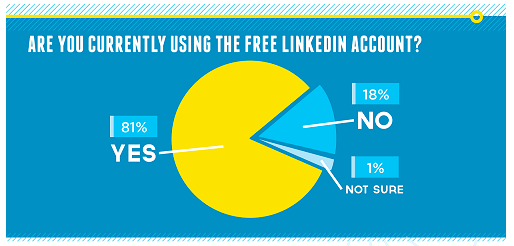
The results from my latest LinkedIn user survey show that only 18% of us are paying for our LinkedIn experience. Screen Shot 2015-06-11 at 2.12.46 PMThat number has been consistently rising since I began my survey five years ago, but the majority of users are still taking advantage of the world’s largest database of business professionals for free.


LinkedIn premium options

There are a number of options available when you decide to upgrade from a free account to a paid account.

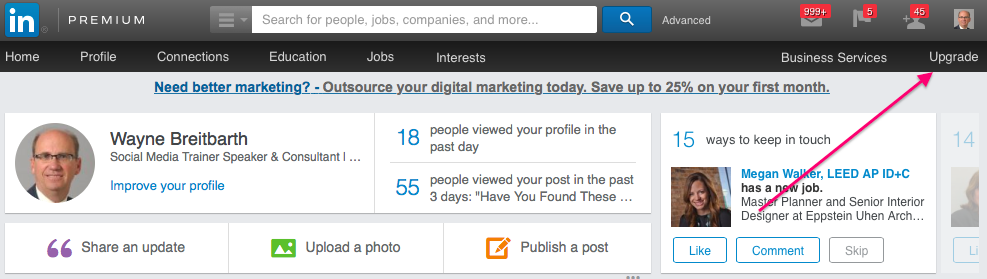
Note: If you already had a premium account when LinkedIn updated the premium options, at least for the time being you can continue with that plan even though it may not be currently offered to new subscribers.Screen Shot 2015-06-11 at 2.15.07 PM

There are three premium categories, with multiple options within each category.

General:  Job Seeker ($29.99), Business Plus ($59.99), Executive ($99.99)

Sales:  Sales Navigator ($59.99), Sales Navigator Professional ($79.99), Sales Navigator Team ($129.99)

Recruiter:  Recruiter Lite ($119.95), Recruiter Corporate ($899.99)

Each plan offers different features and additions to your free account. Check out the side-by-side comparisons of the additional features you get at https://premium.linkedin.com. If you’re interested in a free 30-day trial of a premium account, get the details here


Is it time to upgrade?

For most people, probably not. I base that opinion on what you get with a premium account and the fact that most people I encounter are barely scraping the surface of the free account’s powerful features. It’s kind of like handing your 15-year-old, who just got his driver’s permit, the keys to your new BMW when he isn’t even ready to drive the 12-year-old Honda Accord.

iStock_000042971244_SmallMy advice is to buy a copy of my book and follow my suggestions for optimizing your profile. Next, spend some time getting into a good LinkedIn routine (Chapter 17), and then maybe you’ll be ready for the BMW.

LinkedIn has a simple way to let you know when it may be advantageous to start paying. I call it running into the “free wall.” When you’re consistently using a LinkedIn feature (Advanced People Search, Saved Searches, InMails, Who’s Viewed Your Profile, etc.), a message will pop up asking you if you want to upgrade and receive greater access to that feature. LinkedIn realizes full well which features help users get the best results, and thus those tend to be the features they limit in some way. If you want more of those goodies, you’ll need to get out your credit card.


Why I upgraded to a premium account

Two years ago, after more than four years on a free account, I started paying. Currently I’m on Sales Plus for about $48/month. However, this option is not currently available for new premium users.

The main reason I upgraded is because I wanted to see all the people who looked at my profile, and with the free account you can only see the last five people who checked you out. For a full discussion, read my post “Why I’ve Finally Upgraded to a Premium LinkedIn Account.”

Whether you’re using a free or premium account, I hope you’re getting great results!

The post Does LinkedIn Really Get Better When You Pay For It? appeared first on Wayne Breitbarth.

15 Jun 15:43

Buyer Behavior Is Changing Faster Than Ever Due to Technology

by Shep Hyken

Smartphone BlindersCustomer Behavior

It wasn’t that long ago that there were just two ways someone could buy something; either in a store or through the mail – if you were willing to wait four to six weeks for delivery. Today the typical mail order purchase has been replaced with the ability to go online, either through your computer or mobile device. And instead of the merchandise arriving in four to six weeks, it takes just a day or two – and sometimes just an hour or two.

It’s not just how we buy that is changing, but also what we buy. And, in many cases, technology is the driving force behind our changing behavior. Here is an example that might put it into perspective.

At the recent IBM Amplify conference in San Diego, an executive from Facebook made a presentation and commented that chewing gum sales were down last year by 10 percent.

What might cause this? Are people shying away from sugar? No, because there are plenty of sugarless options. Is there a lack of interest in gum? Sales have been waning, but companies such as Wrigley and Kraft have developed new brands and pricing strategies to jump start their sales.

So what’s the real reason behind deflating gum sales? Mobile phones.

Think about this and it will make total sense. People typically buy chewing gum in the checkout lane at the grocery store. It’s purposefully put there to be an impulse buy, along with candy, magazines, and other items in the display.

But, no longer are you just standing in line and looking around. No, you’re standing in line looking at your mobile phone. You’re on Facebook, checking your email, texting a friend or tweeting out a message. You’re now preoccupied with an activity that has your mind so engaged you may not even notice the chewing gum display.

As a result of mobile phones, the customer’s behavior in grocery stores is changing. The part of the customer’s journey that included the wait at the checkout lane has changed, forcing companies to adjust.

Hearst Corporation, one of the largest media companies in the country, has started placing magazine displays in other areas of grocery stores to avoid competition with the “mobile blinders.” Soft drink companies have employed similar strategies when it comes to their single-serve drink coolers. Instead of going for impulse purchases as the customer is checking out, they’ve moved drink displays elsewhere in the store to try and catch the customer’s eye.

These companies haven’t completely checked out of the checkout lane (there are still magazines, candy, gum and soda available up front). But they’re cognizant of the fact that buyer behavior is changing. So they’re trying to change as well.

How else has technology impacted the behavior of customers in a grocery store? (That’s a rhetorical question.) The bigger and more personal question, however, is how is technology changing the way your customer does business with you and your company? Think about it now, before your sales are negatively affected by your business’ version of mobile blinders.

15 Jun 15:37

The Dimensions of an Awesome Product Launch

by Ritika Puri

product marketing launch content

Building a product is hard. But crafting your product’s value proposition is even harder.

In just a few short minutes (and words), you need to capture your audience’s attention and share your entire brand story. As Kapost’s Blueprint of Product Launch Marketing points out, content can help by providing the right type of information at the right stage in your customer’s buying journey.

Focus on the following content-driven steps to make your product launch awesome.

1. Capture the Buyer’s Interest

The days of hard sells are over. Today’s buyers are heavily self-directed, and they rely on research to make purchase decisions.

What complicates factors, however, is that they may not be looking for your products. Instead, they’re diagnosing tangential pain points—and searching for keywords and themes around your brand.

One way to develop a rapport with prospective customers is to be present on the channels they use to seek information. Blog posts, infographics, videos, presentations, and live events are powerful, attention-grabbing resources that can kickstart customer relationships.

Recent research from Google found that B2B buyers conduct an average of 12 searches before visiting a specific brand’s site.

2. Keep the Discussion Going

Think of step #1 as your introductory handshake with your audience. Now it’s time to keep the relationship going through materials like emails, newsletters, whitepapers, online surveys, and workbooks.

Above anything, focus on educating your buyers. By helping them learn, you’ll position your brand as a trusted, go-to resource. Rather than forcing a hard sell, you can help your prospects self-direct their pace of learning.

71% of B2B tech marketers cite lead generation as their top content marketing goal.

3. Align Your Product to the Buyer’s Needs

At this stage, a portion of your audience will want to learn about your product. Make sure there are plenty of resources available through webinars, live demos, product one-pagers, and FAQ documents to help articulate why customers should invest their time and resources with your brand.

Unlike the content created in steps #1 and #2, these pieces should be heavily product-centric by breaking down complex ideas into easy-to-digest language. Information should be short, focused, to the point, and heavily product-centric. To help guide your content development process, prioritize information around your customers’ frequently asked questions.

60% of people are inspired to seek out a product after reading content about it.

4. Secure the Buyer’s Confidence

The content that you create in step #3 will explain what your product is and how it works. In this step, you’ll focus on the ROI that your company helps your customers achieve.

Create case studies, competitor difference documents, and ROI calculators to articulate why your brand adds value. Focus every single piece of content on how you’re helping drive efficiency and incremental revenue.

77% of buyers want different content at each stage of the product research process.

Content plays a key role at every stage of the buying journey. When navigating a product launch, it’s important to keep all four of the above steps in mind. Position your brand as a guide, help your audiences learn, and empower them to succeed.

15 Jun 15:37

Stop Selling: How To Turn Your Expert Reputation Into New Relationships (And Revenue)

by Ago Cluytens

Back in 2009, I ran an experiment. For six months, I dedicated myself to making a number of cold calls – every single day. It was dreary, mind-numbing work. I hated every minute of it. But it worked. Out of every 100 calls I made, I managed to connect with a “live” voice around 20 times. And out of those “connects,” I managed to secure a meeting or follow-up call in around 20%. In short, I managed to get four meetings for every hundred calls I made.

Not too bad.

In 2011, when I started a new business venture, I decided to “go with what I know” and do the same thing again. But this time, results were very different. Out of every 100 calls I made, I managed to get exactly… zero appointments.

What had changed? I was still the same person, using the same approach. If anything, I’d become better with time, more experienced and more savvy. Yet, it wasn’t working. Why not?

Simple. The world had moved on.

Like John Jantsch in “How To Blog And Why Every Salesperson Should,” I too “believe that the art of selling has turned from outbound to inbound, just as surely as the art of marketing has.” And in spite of the entire debate about whether or not cold calling (still) works, my own experience firmly points to a clear, resounding “No.”

So if cold calling doesn’t work anymore, what other approaches should we, as sellers, use to get in front of prospective buyers? What if we started by taking a look at how buyers actually find potential suppliers?

Our own research at RAIN Group has clearly shown that the #1 reason why buyers buy from one firm versus another is “because the seller educated (me) with new ideas and perspectives.”

In other words, buyers are looking for experts who provide insightful, though-provoking ideas and new perspectives on common problems and challenges.

And according to the Hinge Research Institute’s recent research, the #1 way in which buyers find such experts is online.

Inside the Buyer's Brain Book

In other words, the rise of the Internet, social media, and blogging has conspired to produce a (literal) turnaround in the buyer-seller dynamic. Buyers don’t want to be “prospected” anymore, preferring instead to go out and find experts from whom they are likely to buy later on.

And just in case you’re still not convinced that if you’re in sales, you should be blogging, consider how buyers check out potential providers. 80.8% of buyers report they will look at a firm’s website, 63.2% will research them online (“Google them”) and another 59.9% will check out their social media presence before contacting them or agreeing to meet with them.

(Collectively, these online techniques eclipse the 62.4% who will ask a friend or colleague if they’ve heard of the firm, and the 55.5% who will talk to a reference they provided. So much for the power of referrals).

In other words, the seller-buyer dynamic has moved from push to pull. In the past, sellers would reach out to buyers to “pitch” them and try and get the meeting. But in today’s world, savvy buyers become aware of a problem or challenge they are faced with, and then go online to research and “vet” potential suppliers.

Does that mean every seller should simply become a fulltime blogger? No. But, if buyers today are buying expertise, you’d better stand out as a Visible Expert in your field. Which, at a minimum, means getting the following five things right.

1. Get your (social) house in order

According to Hinge, 70% of professional services buyers use LinkedIn as their social media platform of choice to source information about potential providers. Assuming you’re already on LinkedIn (which you are, right?), you should be making sure you have a professional profile, with an attractive bio, professional headshot and at least some thought leadership prominently profiled on each section.

And yes, I highly recommend getting a Twitter, Google+ and Facebook account in your name as well. Use Twitter if you can. The other two are not nearly as important (but just get your named accounts anyway).

2. Check out (and improve) your online reputation

I’m sure you’ve Googled yourself at some point (if not, you should). But considering the importance of your online reputation, I’d highly consider using a service like Brandyourself.com to do a comprehensive, online review of what Google has to say about you. In addition to that, you’ll get valuable tips for how to improve your ranking, track your results as they improve, and see who’s been checking you out online.

3. Get a “home on the web”

First, get your name as a domain name. Then, either (have someone) set up a simple WordPress blog, or get a profile on something like About.me. It looks great, is easy to set up and helps make sure that — unless you share your name with a global celebrity — you control at least the first result that appears in Google (which, as it happens, gets between 20-33% of all search traffic).

4. Publish something thought provoking

If you’ve chosen to set up your own blog, this one should be easy. But you don’t have to have a full-blown WordPress site to start publishing online. Guest posting is a great way to enhance your online reputation, increase your visibility in front of target audiences, and has the added advantage of (potentially) sending loads of traffic to you. LinkedIn has recently rolled out the option to have your own blog on the social network. A social-network-turned-writing-platform like Medium.com could be a great choice.

Or, if you feel so inclined, why not publish regular videos on YouTube? Just make sure they are a professional representation that helps your brand and doesn’t harm it.

5. Get some speaking gigs

Outside of writing your own book (which, if you have the time, is definitely a great option), nothing says you’re an expert quite as much as standing in front of an audience and delivering a great speech. Speaking engagements is one of the most effective offline marketing strategies. Industry associations, trade groups and business partners are always interested in having an outside expert speak. And if your territory is international, or you simply don’t feel all that comfortable speaking in front of a “live” audience, consider running a few webinars or Google Hangouts with select partners instead.

If two-thirds of all buyers will do an online search, check social channels, and review your website before speaking with you, not managing those assets proactively and professionally is – quite simply – professional negligence.

If you set aside as little as half a day this week to follow the five steps I outlined above, you’ll quickly start to see the results of your efforts. If you put in an additional 2-3 hours every week, within months, you’ll see your visibility accelerate — and you’ll be a little more in control of your sales results.Free webinar registration

15 Jun 15:37

“Leaning in” to Drive Behavioral Change in B2B Buyers

by A. Pirot

emotions motivating b2b buyers for behavioral change

Changing an ingrained behavior can be difficult—it takes time, effort, and readiness, both emotional and rational.

Individual habits generally take between 18 days and six months to solidify. Magnify that a hundredfold to impact behavioral change for small groups of people, organizations, and entire cultures.

Let’s say your business is trying to sell a product in a new product category. Usually there are four steps you need to take in order to sell a product to a prospective buyer:

  1. Make sure the buyer understands what you’re selling
  2. Show them how the product benefits them
  3. Anticipate what the buyer will have to do to reorient their thinking and priorities in order to make a purchase (especially if they weren’t already considering this product)
  4. Know if the buyer will also be the end user of the product, and adjust your sales pitch accordingly (offering employee training packages, onboarding help, etc.)

This list comprises the rational parts of behavioral change, and most businesses do a decent job of working through it. Rational thinking is only a small part of the decision-making process, however—emotion plays a bigger role in behavioral change than we may care to admit.

The Role of Emotion in Decision-Making

In my line of work as a behavioral change expert, I’ve helped hundreds of individuals (and small groups) envision and create change. Over the years, I’ve learned that highly intelligent, rational people—despite all the checklists, cost/benefit spreadsheets, and comparison costs—ultimately make decisions with the emotional brain, not the rational one.

This is because people are innately motivated by four key emotions: self-acceptance, fear, empathy, and trust. If you get them to move through these four emotional states, they will make a behavioral change.

Combine that with rational facts to validate and assure, and you will elicit the kind of behavioral change you need to sell your product. Guaranteed!

Here are four techniques I‘ve used successfully in getting individuals (and groups) to make behavioral changes:

  1. Leaning in
  2. Forcing a choice
  3. Stepping into another’s shoes
  4. Disrupting and redirecting

In this post, I’d like to talk about the first item in this list, “leaning in.” (The other three techniques will be discussed in upcoming posts, so stay tuned!)

“Leaning in” to Elicit Behavioral Change in B2B Buyers

Thanks to Sheryl Sandberg, the term “lean in” is in our vernacular. In this case, “leaning in” is about the B2B buyer moving through fear, gaining trust, and accepting that his or her choices need not be perfect.

Acknowledging Fears

First, ask the prospective customer what their worst fears or concerns are about buying and using a new product. Listen carefully. Make a detailed list of their fears.

Deepen the learning by asking: “Tell me more about that?” “What do you think will happen if…?” Then acknowledge the fears, one by one.

Your job is to completely understand all the fears of the customer. Give these fears a voice; don’t try to change them. Fears are fears. Everybody has them. In fact, the more fear, the greater opportunity your company has to innovate and lead.

“Lean in” to the buyer’s fears. Reassure them that this is an innovative product and there are always risks when trying something new. Validate their fears by saying, “Trying something new always has an element of fear.” Use examples or share case studies of businesses that took great risks with new products that no one understood the value of at first.

Building Trust

Next, get the buyer to trust his or her own decision-making (despite their team or team leader’s opinions). Ask the person, “Look at a business decision you made that involved taking great risks, but that you still trusted your judgment with.”

Remind them of the outcome of a decision that moved the organization forward in some way. Have them tell the story to build their confidence. Help them see that they can trust their judgment, and that they always explore every alternative, even when others have a different point of view.

Encouraging Self-Acceptance

Even if the buyer’s decision in the last step didn’t lead to a perfect outcome, it moved the organization to change and reevaluate. Show the buyer how they were part of an important process.

Help them with self-acceptance, and reiterate the fact that change and decision-making don’t need to be perfect in order to have value. Use examples of businesses that had some starts and stops. (Apple always comes to mind.)

Show the buyer how they were part of an important process.

This “leaning in” technique will allow the buyer to move past their fears, trust their own judgment, know that you acknowledge their concerns, and accept that the road to change isn’t 100% perfect, and they don’t have to be perfect either.

Try this technique in your next B2B sales opportunity and tell me how it goes. And be sure to stay tuned for my upcoming posts that will cover the other three techniques for eliciting B2B behavioral change.

15 Jun 15:36

Why Customer Success Content Is Critical

by David Dodd

In an earlier post, I explained why most B2B companies need to focus more attention on strengthening relationships with existing customers, and I suggested that marketing should play a leading role in these efforts.

The primary objective of marketing to existing customers is to retain and, where possible, expand the business you do with profitable customers. The most effective way to achieve this goal is to help your customers successfully implement and use your solutions. Therefore, most of your communications with customers should be focused on providing information and insights that will help them maximize the value they obtain from your solutions and from their relationship with your company.

Many marketing thought leaders are beginning to call this kind of content customer success content, and it plays a vital role in the emerging discipline of customer success management.

In a recent white paper, Forrester Research discussed the growing use of customer success management by software companies that offer their solutions on a subscription, or software-as-a-service (SaaS), basis. Forrester described customer success management in the following way:

“In the B2B SaaS industry, companies have been hiring senior level people dedicated to the active management of their customer base. . . Irrespective of the title, the goal of this function is to become the ‘trusted advisor’ to the company, to make their customers successful with the products they have purchased, and ensure that they are realizing economic value from their investments in order to preserve their revenue.”

Obviously, existing customers have different information needs than prospects, but many content marketing principles are the same for both audiences. Suppose, for example, that you sell a complex product such as an enterprise-level software application or some kinds of industrial equipment. In these circumstances, your new customers will likely face a significant learning curve to become proficient with your product. Most of your customers will move through multiple stages in the process of learning how to use your product, as illustrated by the following diagram:

We know that when we’re marketing to potential buyers, it’s critical to have content resources that are specifically designed for each stage of the buying process. That’s because the issues that are important to prospects change as they move through the process. The same principle applies when you’re developing content for existing customers. The information needs of a mature user are significantly different from those of a new user, and the same content won’t be equally effective for both.

Another similarity is the need to provide content in a variety of formats. For example, some of your users will prefer to access “how-to” content in written form (help articles, answers to FAQ’s, etc.), while others will prefer to learn via videos.

Finally, while it’s generally true that you need different content for prospects and existing customers, some content that is designed for customers can also be effective for potential buyers. For example, a case study that provides a detailed description of how one of your customers used specific features of your product to accomplish an important business objective would be valuable to other customers and to late-stage prospects.

Marketing’s responsibilities don’t end when a new customer is acquired, and content marketing should not stop when the initial sale is closed. For many companies, marketing to existing customers is just as important as marketing to potential buyers, and content is critical to your success with both audiences.

15 Jun 15:36

Two Reasons Your B2B Marketing Programs Are Failing

by Erin Kelley

Many marketing organizations have good intentions when it comes to developing their demand generation programs: they want to increase qualified leads, sales opportunities, and closed/won revenue. At the same time, they want to provide the information buyers want through a positive experience, and use technology to effectively manage and measure the buying cycle.

At ANNUITAS, we call that Demand Process: the proactive management of the demand chain from lead-to-revenue, and from pain point to solution. Demand Process considers all elements that drive and convert demand at a people, process, content and technology level, and it spans both marketing and sales interactions with the buyer.

More often than not, the challenges facing enterprise-marketing programs can be filed into two main categories: lack of Demand Process and/or lack of Change Management.

  1. Deficient Demand Process (lack of strategic oversight and too much tactical focus)

Understanding how all of your program elements fit into a comprehensive strategic plan is paramount. Designing your marketing programs against existing people, process, content, or technology without truly evaluating them against how your buyer’s purchase will end up as watered down demand generation, in other words, your programs won’t be very effective. While it may appear quick to implement (given you are working with everything you already have), it will definitely not be quick to yield results. Not to say that everything you’ve already developed or implemented won’t be a fit for your program, but you must take the time to figure out if it does. To ignore that would be a waste of time.

Content marketing, email nurturing, etc., these are all tactics – not strategies. Maybe you’ve got a great social media plan, but are your buyers even using Twitter? What is the plan for those that choose to engage with your company? Is the outcome the same for each channel? When you know your Demand Process these and other important questions get answered.

Same with marketing automation and CRM, your technology systems handle your marketing and sales data and are tools to enable your Demand Process; technology alone is not a tactic or a strategy.

How do you get started with Demand Process? First, know your buyers and how they buy and align it against your marketing and sales goals. Then audit your people, process, content and technology – ask the question, does this support the overall Demand Process, yes or no? Look for the areas of greatest disconnect, there you’ll find opportunities for change.
demand process architecture

  1. Failure to effectively manage change

Congratulations! You made it through the strategy phase and have designed a detailed, end-to-end demand generation plan that is poised to deliver. Now comes the next key area: implementation.

Make no mistake; launching successful, buyer-centric marketing programs is really an exercise in change management. Think about it – every group, department, and role that is customer facing or manages a marketing or sales function will be affected in getting to the desired state. Demand generation is no longer only about marketing and sales, but also IT, operations, and possibly HR. The areas which all these groups overlap should be expertly managed and communicated in order to prevent wasting of time and money, in addition to waning morale. Every seemingly minor change to the project has potentially far reaching implications.

Objectively assess the gap between your desired state (the to-be state of your demand generation program) and the current state. Again, you are looking at all areas of people, process, content and technology. What changes need to take place to get there? Where are the dependencies? How long will it take? Where can you implement changes immediately; where can you work in tandem? Create and communicate your plan: be transparent when setting expectations. Making big changes can be tough for some, so it helps that you have a clear vision of the desired state with sales and marketing leadership bought in to help drive alignment.

Change management doesn’t stop after you launch either. Track the progress and stay proactive through a set of key performance indicators (KPIs) that inform program decisions in addition to tracking performance.

In conclusion, most marketing program failures or derailments stem from a lack of coordinated planning and effort across an entire organization, not just in marketing. These are the most challenging parts of true demand generation, but with careful attention and communication the efforts are well worth it.

*Learn more about Change Management as it relates to Demand Generation here.

15 Jun 15:36

3 Value Equations For Startup Brands

by Mark Di Somma

Defining value for startups and emerging brands

Founders of startup companies often focus on their product/offering and their business/distribution structure. Both though are expressions of the question that every startup should really be asking itself first: “What will we be valued for?”

In a very useful article on how to develop and articulate a value proposition, Thomson Dawson makes this point, “Those entrepreneurs who eventually grow up to dominate their market represent a compelling “idea of value” in the minds of customers that is simply not available from the alternatives in the category.”

Every business makes an offer and has a structure. Value is different – it’s implicitly linked to what other businesses don’t offer. The startup businesses that will succeed are those that can deliver beyond or before their competitors; often beyond or before their prospective customers’ expectations. That’s not something you can find by just starting. And it’s not something you can create by marketing. It’s something you need to identify in order to start. For all the reasons you can give as to why your brand deserves to succeed, the cruel reality is that you only stand out when and where others think you do.

In broad terms, there are three different types of value equation for startups:

1. New value hinges on introducing a new concept. This is the gamechanger space. It either answers an old need in a completely new way or brings a new way of doing things to market that perhaps wasn’t possible previously. Its advantages may be technical, conceptual or, increasingly these days, ecological. A lot of start-ups claim to operate in this space. Very few though are this radical.

2. Improved value – or tangible value. Beyond the press release hype of new business announcements, most new businesses, and the products they offer, are grouped here. They are looking to rethink or revitalize a concept that consumers are familiar with, but perhaps frustrated by. This “second to market” strategy (not a term that should be taken literally) is about building on an established or establishing need and adding to it – either by providing something that hasn’t been available up until now that consumers really want, or by radically shifting trading parameters like pricing or availability. This is a very difficult space in which to succeed, because too many startups enter the market this way with a collection of features looking for a consumer. Companies with this value equation can quickly find that an idea is not a business. On the other hand, those that can bridge the shortfall between what consumers want next and what they’re offering can make swift progress.

3. Perceived change of value. These brands look to redefine the emotional rewards of the sector. They transform how consumers feel about what they’re getting in ways that the incumbents can’t, haven’t thought of, or won’t. While we often think of this as upscaling, particularly through design, perceived value can of course go the other way. It can “democratize” a previously exclusive or reclusive sector by making it much more accessible. Or it can introduce a much-needed attitude into a sector that acts as a breath of fresh air in the minds of buyers. It’s all about, as Dawson observes, delivering higher levels of “use value” in the minds of customers than they pay in cash value. Finding an emotional disruptive value-point stems from really understanding the psychographics of your audience. As brands continue the search to be more human, and as commercial interactions become more personalized, this is where more and more startups will need to be looking for a distinctive starting point.

It’s important to point out that these three value equation types are not mutually exclusive. The smartest startups will look to combine at least two of these areas of value generation into their approach. For example, they may introduce a shift in perceived value (emotional) and back it up with a long-tail search for improved value (improvement) that reinforces the position they have established. Or they may look to completely alter the boundaries of a sector (new value) by redefining the subjective basis for evaluating worth in that sector.

The role of strategy is to identify future value – therefore knowing the type of value you are looking to deliver, not just now, but five years from now, will fundamentally define your strategy and the positioning of your brand.

What will your company do to the dynamics of the sector?

Will you be the change driver (and if so, for how long)?

Will you be the improver, the value-adder (where, how and why)?

Or will you be the emotional re-calibrator (and how will you build on that?)

If you want to be and remain valuable as a brand, start as you mean to continue.

The Blake Project Can Help: Brand Strategy Workshop For Startups

Branding Strategy Insider is a service of The Blake Project: A strategic brand consultancy specializing in Brand Research, Brand Strategy, Brand Licensing and Brand Education

FREE Publications And Resources For Marketers

15 Jun 15:35

Proof That Women Have a Seat at the Sales Development Table

by Leah Bell

Meet The SalesLoft Staff: Lydia Henderson

Lydia’s Bio: Lydia came to Atlanta by way of Auburn, Alabama, and joined the SalesLoft family in November 2014. As one of the Sales Development Team Leads, Lydia is a constant motivator to the SDR team both professionally and personally. She crushes quota every week, pushes the team to new heights, serves as a support system to new SDRs–all with a smile on her face!

What’s your ultimate sales development productivity hack?

Organization is key for being an sales development rep–it’s important to stick to a daily process.  A-Text is a huge time saver. It allows me to respond quickly and ultimately work my emails down to a “zero inbox”. Shoutout to The Sean Kester for introducing me to this productivity tool.

Who is someone in the world of startups or sales development that you admire or find inspiring?

Trish Bertuzzi is a strong female thought leader and voice for the inside sales community. I really enjoy following her on Twitter and seeing how she’s influencing inside sales. Her presentation at Rainmaker 2015 was so thought-provoking… I hope to see her at Rainmaker 2016!

How do you use SalesLoft Prospector/Cadence on a day-to-day basis?

Prospector and Cadence are by far the fastest, simplest, and easiest way for an SDR to do their job.

With Prospector, I’m able to capture verified contact information for my targeted list of prospects, building a more efficient and accurate prospect list. And with Cadence, I’m able to add bumper guards to my daily outreach process, ensuring no one on that prospect list falls through the cracks.

How do you stay fired up to come into work every day and help motivate the team?

The culture of the sales development team keeps me fired up. Each person truly lives out our core values of Positive, Supportive, and Self-Starting. When my motivation is lacking, I can always count on my team’s energy to spark the fire and drive within me. I make a point to return the favor by encouraging my teammates that seem down by sending notes or giving them quick shoutouts–anything to help them stay excited and focused.

What quote do you live by, both personally and professionally?

The only way to do great work is to love what you do. If you haven’t found it yet, keep looking. Don’t settle. As with all matters of the heart, you’ll know when you find it.” – Steve Jobs

Everyone needs a good Sunday Funday: what’s your go-to activity when you need a break from the weekday grind?

Atlanta has so much to offer, it’s hard to pick just one! I do love the walkability that the Beltline provides to the city, along with all of the parks around town. And let’s not forget, of course, the pool!

Being a true Alabama southern belle, what’s your favorite southern comfort dish?

Growing up, my mom was such a good cook. All of her recipes compete for my favorite southern comfort dish, but if I had to pick, I’d have to go with a classic: (spicy!) shrimp & grits.

The post Proof That Women Have a Seat at the Sales Development Table appeared first on SalesLoft.

15 Jun 15:35

Recruiting Is Inside Sales: Hiring Top Inside Sales Talent

by Justin Brown

One of the biggest issues of discussion in the Inside Sales community is hiring top inside sales talent.

The reason?

Unemployment for college graduates is at 2.5% and recruiters are relying on inbound applications to find the strong sales reps. The problem here is that the strongest reps aren’t spending their time applying for jobs, they’re focused on hitting their number while leading the pack at their current company.

In a recent installment for the AA-ISP’s Training Tuesday, memoryBlue Director of Search Justin Brown in coordination with Founder of the AA-ISP Bob Perkins, explains why hiring top inside sales talent requires your recruiters to have the same skills as your best inside sales reps.

Below are 7 tweetable takeaways on the state of hiring top inside sales talent from the AA-ISP/memoryBlue presentation:

  1. “We asked leaders of inside sales what are their most pressing issues right now and recruiting and hiring made the top two.” – Bob Perkins, Founder and Chairman of the AA-ISP
  2. “In the year 2012 – 2020 we anticipate 700,000 – 800,000 net new jobs added to the inside sales profession.” – Bob Perkins, Founder and Chairman of the AA-ISP
  3. “We have huge inside sales job growth, higher demand on skills, our talent pool is just too small.” – Bob Perkins, Founder and Chairman of the AA-ISP
  4. “Work with active and passive candidates, both are critical, just like inbound sales leads.” – Justin Brown, Director of Search of memoryBlue
  5. “Passive candidates are the ones who have their heads down, buried in excellence.” – Justin Brown, Director of Search of memoryBlue
  6. “Top sales reps won’t fall into your lap, they’re employed and focused on the job at hand.” – Justin Brown, Director of Search of memoryBlue
  7. “If your talent acquisition team doesn’t have the same skills as your sales reps, you need to find a new solution.” – Justin Brown, Director of Search of memoryBlue

In 2014, 73% of memoryBlue’s hires came through outbound prospecting efforts like picking up the phone and using the instrument that passive inside sales talent is literally paid to answer.

15 Jun 15:34

7 Keys To Building Your Outbound Sales Team

by Andrew Gazdecki

blog_image_new_5

Developing the right outbound sales or SDR (Sales Development Representative) team can make or break your business. A strong outbound team will help your company grow, and a weak team will waste time, money, and other valuable resources. These sales reps will be responsible for bringing in new business to your company, thus making the creation and management of their team vital. A few weeks back I attended a webinar hosted by SalesLoft CEO Kyle Porter and Sales Hacker CEO Max Altschuler, titled “How to Triple Your Sales Qualified Meetings.” The webinar focused on seven tactics to not only hire the right outbound sales team but to foster an environment of growth and success. If put to good use these tips can add significant value to your business.

Recognize & Prioritize

SDR’s often generate your first contact between a prospective client and your business. As outbound sales reps, these employees are reaching out to leads who; do not know you, often have no understanding of your business’s product, and did not request to be contacted – meaning these reps are “cold calling” and will be receiving a lot of rejection. While the role is basic and generally entry-level, these reps are doing your dirty work and should be recognized for doing so. To create a successful team of SDR’s you must understand their effort, recognize it accordingly and make sure that they understand their importance to your company. If you can successfully do this, you will empower your SDR team and create a system of continual growth and the overall organization wins.

Project Your Visions & Values

Any company’s values begin at the top of the org chart. Values are long-term strategic goals and beliefs, and are often overlooked by employees with more day-to-day tasks (such as SDR’s). It is extremely important to make sure your business values trickle down to every single employee at your company – and especially your SDR team. This group of employees is making first contact with the general public and if they aren’t portraying the correct message you would probably be better off without them. Vision and core values start on day one. The moment your new hire walks in the door is the moment they should begin to learn and live by your company’s culture and values.

Hire These Visions & Values

The SDR position is currently one of the most available and applicable job titles in the tech industry. With little experience needed to be an SDR, the position sees a lot of employees who “jump ship” as they are overwhelmed with similar offers for similar positions at similar companies. This means it is absolutely necessary to hire the right people, who are going to stick with your company and grow with it as well. When hiring you should consider three things: Does this person already exhibit my company’s values and visions? Can I see this employee being a high level executive at my company some day? Does this employee want to learn and develop within my company? If you can answer yes to those three questions, HIRE THEM IMMEDIATELY. Gain a verbal commitment, extend your offer and make sure you don’t lose them to another company.

Be Innovative

“Sales reps do what their compensation model says, not what their boss says.”- Kyle Porter.

While it may sound a bit shallow, it is simply human nature – making your compensation structure is extremely important for hiring and keeping your SDR talent. A tiered and uncapped commission structure not only allows an SDR to make as much money as they want, but also incentivizes them to work harder. SDR’s should have a monthly quota (minimum amount of appointments set) followed by a monthly on target quota (recommended/average amount of appointments set). By uncapping your commission structure you will remove the desire for a rep to hold back or “sandbag” leads for the following month, because their commission will be maximized either way. Simple organizational structures like this will ensure your SDR’s are paid fairly and that they also work their hardest each day, week and month.

Let Them Win

Start your reps off right with an onboarding process that makes it impossible not to succeed. Instead of bringing your new rep into their role, why wouldn’t you bring them into your entire company? New hires need and want to learn about their organization and day 1 is when this must start. If you want your reps to actually live out the aforementioned company values and goals, then they must be aware of how each aspect of the company functions to fulfill those values and goals. Have your new reps move around the office, work with different teams and get to know their co-workers and their respective roles.

It is also crucial to make sure new reps are able to perform well and surpass expectations from the get go. Quotas exist for sales reps that are already performing at pace for their position – sending a new hire into an SDR role and expecting them to hit quotas immediately will have adverse effects on morale and confidence. By setting up new reps with a gradually increasing quota and easy wins to get them started, you will foster a successful, motivating, and exciting environment.

Feedback, Feedback, & More Feedback

Developing a strong and sustainable SDR team doesn’t stop after hiring the right candidates. This team will grow and change with time, and you must continually provide ways for your reps to make this happen. Some sort of continual feedback system is imperative. Whether these are 1 x 1 meetings with a sales manager, standardized team trainings, or even offsite outings with fellow team members, it is absolutely necessary to provide your SDR team with constructive outlets. Allow your reps to speak freely amongst one another at a scheduled outing or to yourself in a 1 x 1 meeting. This will create an environment of honesty, creativity, and growth- all of which will help your SDR team perform at their best.

Develop A Structure

While every employee will eventually find their own voice, style, and technique, it is still necessary to start them off with everything that they need – give them a foundation to use and build upon. Whether this is a calling script, email templates, day-to-day workflow, or any other form of success structure, it is important to make sure your new reps start off on the right foot. Once a rep has adjusted to their new role and new company, they will then begin to customize this foundation and collaborate with others to find best practices. By keeping your reps organized you will reduce confusion, making their jobs easier and eventually making success more attainable.

Although these tactics may seem basic and obvious, it is not often that all seven are utilized within an organization. By combining the above ideas and implementing them into your SDR team strategy, you will create a successful team of motivated, hard working employees. These employees will develop and grow along side your company generating a high-powered outbound sales team.

blog_cta_ken_marketing

15 Jun 15:34

The Value of Lead Nurturing: An Introduction

by Brittney Ervin

Discovering the Value of Lead Nurturing for Your Prospects

The Valueof Lead Nurturing

If you know the first thing about Inbound Marketing, you know that it’s based on the premise of bringing customers in, based on their own interests and needs, rather than interrupting their lives with impersonal ads, cold-calling and other outbound tactics. Inbound Marketing hinges on providing customers with content and information that they want, creating relationships between fans and brands, and providing customers with a more personalized experience.

Customers now have numerous avenues through which to explore products, services and brands; attracting and engaging them with content and nurturing that relationship until they are ready to buy is an important aspect of marketing for any forward-thinking company. But the process involved with nurturing a prospect until they’re ready to buy is tricky.

That’s where the science of lead nurturing becomes vital to your company’s success.

What is lead nurturing, you ask? Keep reading—we’ll explain both what it is, and how it can dramatically improve your company’s ROI.

“What is Lead Nurturing, Anyway?”

Lead nurturing, in a nutshell, is actively engaging in a relationship with potential clients, even when they haven’t purchased from you in a considerable amount of time or at all.

First, think about the fact that up to 96% of first-time visitors to your company’s website simply aren’t ready to buy yet.

However, statistics show that up to 70% of those first-time visitors may eventually become purchasing customers in the future.

  • Once you’ve captured a lead’s information, you have the power to personalize your interactions with them, building a rapport and establishing trust between the prospect and your company.
  • A mature lead nurturing process would allow a company to present a prospect with content and information that the prospect is interested in. In establishing your company as an authority and gaining esteem in a prospect’s eyes, you increase the chances that they will purchase from your company in the future.

There are, however, a few steps to take before you can determine the best lead nurturing processes for your company’s leads.

Create a Brand Story

Before you can develop a lead nurturing strategy, you have to have leads to nurture. In this day and age, you’re battling a vast sea of competitors, any of whom are accessible to your prospects at the click of a button.

This means the value of appealing to your prospects on an emotional or personal level has skyrocketed; with so many options to choose from, it’s no wonder customers gravitate towards the brands that offer a human element in their branding.

Nail down your company’s tone, presentation and aesthetic and present your target audience with content that is interesting and relevant to them.

Answer their questions, express camaraderie and identify with their struggles. Win their trust by showing them that you understand and value them as consumers.

Deliver Premium Content to Capture Info

Once you’ve established your company as an industry leader and gained some rapport with a prospect, you’ve increased the chance that they will submit their information on an offer.

  • To make the process of submitting information worth it for your potential customers, you should provide them with interesting, nuanced and useful information, like an eBook, a long blog article or attention-grabbing content on social media.
  • When you’ve done the requisite study on your customer base’s pain points, concerns, struggles, questions and desires, you should be able to produce content that they want to read and will submit their information to obtain.

Get Your Lead’s Attention

Sometimes, a lead’s interest in your brand and products fizzles before they even make a purchase. There are ways to remedy this, however, and gain back the intrigue and attention a prospect once showed your brand:

  • Send an exclusive offer. Provide your cold leads with premium, exclusive content to re-engage them. Invite them to an exclusive webinar. Give them a sneak-peak at new products yet to roll out on your website. Make them feel special and pique their interest.
  • Provide them with a first-buyer’s discount. Few things are as attractive to consumers as exclusive discounts on products they are already interested in. Nudge your cold leads towards re-engagement and possible first-time purchases with special discounts.
  • Mix up the content you send. If you generally send blog articles and eBooks to your leads, consider mixing it up with some Slideshares, exclusive infographics or videos. Adding variety to the content you send will create a ripple in a cold lead’s prior knowledge of your company’s content, helping to both attract their attention and pique their curiosity.

Align Your Sales and Marketing Teams

This concept and art of sMarketing continues to confound inbound marketers and companies everywhere. Sales and marketing teams have traditionally found it difficult to communicate, align goals and function symbiotically. These struggles can cost companies up to 10% of their annual revenue due to lost or badly-nurtured leads

However, companies that report strong marketing and sales alignment achieve a 20% annual growth rate.

Here are a few base-level ways to get on the road to better smarketing:

  • Determine a formal, cross-department definition of a qualified lead.
  • Determine departmental standards for communication, timing and cues for sales-ready leads.
  • Determine and share profiles of optimal leads that are likely to convert to customers
  • Consider intertwining marketing and sales metrics to establish common revenue goals across departments.

Wrapping It All Up

Lead nurturing can be a long and confusing process, but the benefits it offers outweigh the growing pains endured and efforts expended in getting there. Here are a few key statistics to keep in mind as you embark on the journey towards effective lead nurturing strategies:

  • Companies that have established effective lead-nurturing strategies generate 50% more sales at 33% lower cost.
  • Nurtured leads make 47% larger purchases than non-nurtured ones.
  • Companies with mature lead generation strategies enjoy a 9.3% higher sales quota achievement than companies without.

Get more information on the science of lead nurturing and implementing some effective strategies in your company with The Science of Enterprise Lead Nurturing.

FREE: B2B Marketer

15 Jun 15:34

Maintaining Accountability to Sales & Marketing KPIs

by Jeremy Boudinet

What’s the key to driving sustained sales and marketing alignment? Director of Marketing Jeremy Boudinet explains in this excerpt from his new eBook, The Sales-Marketing Alignment Playbook.

The long-term success of your sales-marketing alignment efforts will depend on the efficiency of your process and engagement of your personnel.

The teams that get an edge in sales-marketing alignment will be those who maintain commitment to overarching strategy and continuously seek ways to further improve alignment.

That being said, the challenges in reaching sustained commitment are substantial.

By adding or altering expectations around goals and behaviors, you’re creating change and thus naturally triggering anxiety. You face the difficulty of creating buy-in that your new strategy is an improvement on your prior process, which your personnel have spent years being taught and trained to follow.

Last but not least, old habits die hard. Even if you succeed in getting early adoption, there’s a real probability that adherence to the new strategy will taper off over time as people revert back to behaviors with which they feel more comfortable.

Driving Long-Term Sales and Marketing KPI Accountability

Engagement, as they say about physical fitness, is a journey rather than a destination. Sustained engagement requires personalized missions and a commitment to coaching.

Pictured: How frustrated executives feel towards their disengaged sales team.

But most of all, it requires a sales and marketing team that internalizes feelings of accountability towards their KPIs and to the overall process.

Those feelings do not come naturally. The de facto payoff for sales and marketing professionals is, respectively, closing a major new deal or inbounding a huge, highly-qualified lead.

Every sales organization worth its weight in salt is already incentivizing those behaviors. But in order to create a sustained sense of accountability to a newly-minted sales-marketing alignment initiative, you’re going to need more.

Where many organizations err is the tactical approach or approaches used to facilitate KPI accountability. A few examples of errant tactics:

  • Take the Big Brother approach to using technology.
  • Chastise poor performers and non-compliants publicly.
  • Implement workplace contests around a single KPI.
  • Offer impersonal rewards for great performance. (Ex. gift cards).

Such tactics not only fail to solve the issue of KPI accountability, they often exacerbate the very problems they’re attempting to solve.

To that point, it’s important to elucidate measures that are actually proven to accomplish the goal of sustained KPI accountability.

Problem: It’s tough to maintain long-term Sales and Marketing KPI accountability.

It’s important to understand that the natural response of your personnel to KPIs will be negative. A major cause of their antipathy invariably goes toward the data implementation required to track KPIs.

Not only is data implementation tedious and time-consuming, it’s a momentum killer that forces your employees to redirect their attention away from the revenue-generating activities they’re paid to perform.

Employee engagement

The above chart is instructive, in that it illustrates how Implementing KPI data (ex. outbound phone calls, leads generated, leads converted) into a CRM or other data source pushes 99 percent of sales and marketing professionals into the “Boredom Area.”

Even worse, when they’re finally able to return to more challenging activities, the time lapse that has taken place can elevate the perceived Challenge Level associated with their KPIs, creating a recurring state of flux between boredom and anxiety.

A seemingly insurmountable set of problems, right? Actually, quite the opposite.

Before you get discouraged and decide to ditch this entire initiative, look into adopting the five measures we’re about to share with you. They are basic, surefire solutions that allow you to proactively combat and overcome every challenge we just covered.

Solution: Adopt measures to internalize Sales and Marketing KPI accountability.

The long-term success of your sales-marketing alignment strategy is contingent upon personnel accountability to their KPIs. To achieve accountability, however, you’ll need to overcome the challenges inherent in adopting a KPI-driven process.

Here are the five best measures you can adopt to do so:

  • Automate data entry
  • Grant access to relevant KPI data
  • Incentivize team communication
  • Run holistic contests
  • Recognize strong KPI performance

While some of these measures may seem facially obvious, there’s actually a relative degree of nuance to their proper execution. To see them fleshed out, direct your attention to the table below.

Adopted independently, each measure will prove potent in combating the challenges of sustaining a KPI-driven strategy. With that said, we encourage you to adopt as many as you can, so as to compound their impact on your team’s accountability.

If it hasn’t already struck you, there’s a synergy to all five of these measures — with the exception of data entry automation, they’re all natural enhancers of organizational communication.

Over time, their value-adds will become more and more pronounced, in terms of aligning not just the actual processes in your sales and marketing efforts, but the communication amongst each team’s personnel.

For its part, the value adds of data entry automation — time saved, fluidity of workflow and removal of human error — will be invaluable to a sustainable KPI-driven set of processes. The return-on-investment, immediate and continuing into perpetuity.

When the majority of your personnel begin seeing their KPIs not as a source of tedium and anxiety, but of empowerment, the climb to the summit is almost over. Your team will have achieved sustainable sales-marketing alignment.

Maintaining Accountability to Sales and Marketing KPIs

The true potential of your business team will always be predicated upon the raw talent, artistry and perseverance of its membership.

The purpose of KPI-driven sales-marketing alignment is to enhance and refine those aspects of your personnel. To achieve sustainability, you’ll have to overcome the hurdles that inherent in any KPI-driven initiative.

If you’re going to adopt any new technology for your sales and marketing team, it should enable you to perform one or more of the following measures:

  • Automate data entry
  • Grant access to relevant KPI data
  • Incentivize team communication
  • Run holistic contests
  • Recognize strong KPI performance

The greater the number of measures you adopt, and the longer you use them within your business team, the greater your progress will be towards achieving long-term KPI accountability and sustainable sales-marketing alignment.

Thanks for reading.

Click here to download your free copy of The Sales-Marketing Playbook from the Ambition Academy. 

15 Jun 15:33

Marketing tech is moving down the funnel to sales, and that’s a big deal

by Mik Lernout, Sales Prodigy
tech funnel
[Free Event] Succeed in the fast-growing and rapidly changing mobile advertising space. Register to attend the VB Mobile Advertising Roadshow in NYC. Learn more now.

GUEST:

Over the last two to three years, the market for sales software has been heating up: Hubspot released a free CRM last year, LinkedIn has been aggressively pushing its Sales Navigator to its members, and startups like Charlie and FullContact are flying high on ProductHunt. On the funding side, Immediately just announced a $2 million seed round and ToutApp raised an impressive $15 million Series B led by Andreessen Horowitz built on top of 300 percent top line growth. The buyout rumours for Salesforce are only reinforcing that sales technology is becoming such a big deal, nobody can afford to sit on the sidelines.

Many of the latest startups in the sales tech space have something in common: They take technology that has been used in marketing for years and repackage it for a sales audience. In a way, innovations are following the sales cycle themselves: moving down the funnel from marketing to sales.

An example is the explosion in email tracking apps: YesWare, Immediately, and ToutApp all repurpose a key technique marketing uses to track email campaigns but put that power in the hands of each sales rep. The result is unprecedented insight into how and when their prospects are interacting with their content. On the marketing side, this is used to segment and rank leads, on the sales side it becomes a tactical tool that tells reps who to call, when, and with what message. Lead scoring is another great example: While it was developed as a way for marketers to communicate with their sales team, it is now being integrated into sales productivity tools: ranking emails, creating call lists, and showing up sales performance dashboards.

Because the rhythm of a sales executive’s work day is radically different, the way they interact with software needs to be different as well. Marketers hunts for impressions or leads, while sales cares about relationships and closing deals. Marketing primarily cares about quantitative metrics, and sales primarily cares about quality.  In many ways, these innovations are consumerizing marketing technology: Tools that were deployed on a large scale, mostly by specialists, are being repackaged in mobile, easy-to-use apps. These apps are then adopted and deployed by individual sales reps before they become part of the team’s toolbox.

Over the last 10 years, marketing software has seen an atmospheric rise that has flipped around the job of the CMO and has turned marketers from Mad Men into Tony Starks, leveraging technology and data in every part of their operation. Sales has largely been left on the sidelines of this revolution, but startups like ToutApp, YesWare, Hubspot, and us at Sales Prodigy are changing that rapidly. We are all betting that over the next couple of years, sales will be transformed into the same technology powerhouse marketing has already become.

Mik Lernout is the CEO of Sales Prodigy, a social selling software startup out of Vancouver, BC. You can follow him at @miklernout or contact him directly at mik@salesprodigy.com.


VB's research team is studying mobile user acquisition... Chime in here, and we’ll share the results.


15 Jun 15:33

Six Lessons Learned Managing Agile Marketing Teams

by Tim Matthews

Are you interested in adopting agile marketing, but unsure if it will fit with your organization’s culture? Or, perhaps you started and it’s not working. Having practiced agile for several years now, I can fully recommend it, but there are few gotchas to avoid.

HurdlesFor those still not familiar with the concept of agile marketing, which is borrowed from software development, the idea is to create time-bound sets of objectives, prioritize them critically, and measure achievement frequently. Here’s how Jim Ewel puts it in his Agile Marketing blog:

Agile marketers follow a process, a process designed to increase alignment with the business aims of the organization and the sales staff, to improve communication, both within and outside the marketing team, and to increase the speed and responsiveness of marketing.  The process copies that of agile development, with some differences in the details. This process is iterative, allowing for short marketing experiments, frequent feedback, and the ability to react to changing market conditions.

The biggest differences from conventional marketing operations are a) you move from yearly or quarterly planning to monthly or weekly planning, b) you are much more ruthless in your prioritization, and c) marketing meetings become much more objective. Are we done? Did it work? What’s blocking?

Aside from speed, the other great benefit of agile is that it helps with interactions between marketing and sales. Sales teams in high tech, where agile is most prominent, are used to tradeoffs with engineering: you only have so much time, money and people to build the product. Which leads to easier prioritization. Which features do you need from this sprint?

Marketing can use agile the same way: Of the ten things your team asked for, we only have resources for five – which are the most important? This gets rid of what I call the data-sheet-of-the-week syndrome, aka the if-I-only-had-[fillinassetname]-I-could-close-this-deal syndrome.

Sold? If so, here are six lessons I learned managing agile marketing teams at two companies. I hope they help you get the most out of what I think is a great concept.

  • Set the right cadence – Decide the cadence that works for your team. Just because software development teams have daily standups doesn’t mean you have to. Personally, I think daily is too frequent for marketing teams. It’s just hard to get anything meaningful done in a day, and the updates would just be repetitive. I’ve used monthly objectives and weekly updates.
  • Take a break – Agile marketing can be a bit of a grind. Even weekly updates can get a little monotonous, because some projects take several months to complete. Hearing that a new sales video is in production several weeks in a row is not that informative. So, give your team a break every once in a while. Skip the weekly update and use your weekly meeting for something else, like an overview of marketing experiments you have done or a guest speaker.
  • Insist on metrics – Each objective or activity needs to have a goal target and metric. Get the team asking “Why am I doing this activity, and how will I know it worked?” If they can’t answer the question, should it be on your list of objectives?
  • Prioritize realistically – As I’m writing this, our monthly objectives take fifty some rows in a Google Doc. That’s a lot. After about two quarters, I noticed people on my team including objectives like “Write blog posts,” and “Go to trade show.” These are not only too generic, but hard to prioritize. Per the goal setting point above, if it’s not something you can attach a goal target and metric to, ask whether it’s a high enough priority to have on the list. If you don’t nip this behavior in the bud, don’t blame me if “Show up to work” appears on your monthly list.
  • Don’t allow overly aggressive goals – Especially with newer employees, I noticed they would set very aggressive monthly objectives. Too aggressive to actually achieve. Set the balance between getting enough done and killing people (which will make you unpopular with your team and HR). Let them know that realistic objectives mean high completion, which is the goal. I’ve also had to fight staff simply moving objectives to the next month. “Oh well, didn’t get that done, I’ll just move it to next month” defeats the purpose of agile. You need to fight that as a head of marketing. Put down reasonable objectives and hold people to them.
  • Stop the work volume competition – The “I have more objectives than you” game was amusing. I noticed an unspoken competition going on, with the Type A folks throwing in more and more objectives to “win” on the spreadsheet. Sometimes, these took the form of generic objectives without goals, and were easily removed by yours truly. Other times, I would tell the employee that if I started seeing slippage then I was going to set their goals for them. Most of the time, simply having a word with the employee and stressing quality over quantity did the trick.

Keep in mind that agile marketing will be new to a lot of your staff. You should clearly explain not just the concept, but also the objectives. Explain how it will help the team better negotiate with sales, and explain to your managers the benefits of monthly tracking of their employees’ activities. You may want to set a metric for the agile program itself, such as increasing team efficiency, reducing time spent in planning meetings, or increasing sales satisfaction with timely, quality assets.

Once implemented, you should candidly asses how it is working. Is productivity up? Is the team better able to prioritize and measure results? Are your conversations with your sales VP peer easier?

Have you managed an agile team? I’d love to hear what you learned.

This post originally appeared on the Matthews on Marketing blog.

15 Jun 15:32

How Content Can Help Your Sales Team Close Deals

by NewsCred

Do you think of content exclusively as a marketing tool? If so, you’re fairly typical. After all, good content strategy forms a foundation for long-term success with your other marketing channels.

But actually, content is an extremely useful tool for every part of the funnel. Not only does content create brand awareness at the top of the funnel, it nurtures those prospects into leads in the middle of the funnel and, ultimately, turns those leads into customers at the bottom.

Today we’re going to focus on sales enablement at the bottom of the funnel and discuss how you can use content to equip your sales team with the tools they need to close more deals.

Let’s look at three key strategies that will attract more customers and increase your revenue.

3 Steps to Empower Your Sales Team with Content

1. Find out what pain points and challenges your sales reps are hearing from their prospects.

First, have a conversation with your sales reps. I’m not talking about sending them an email or IM, either. I’m talking about actually walking over to them and having a conversation face to face. Trust me, it’s absolutely worth your time.

Just be sure to prepare a list of questions and take notes as you chat. Ask them questions such as:

  • What are some of the most common objections you hear sales calls?
  • What are the top reasons why prospective customers don’t buy?
  • What are a few questions or points of confusion around our product/service that you hear repeatedly?
  • What are the most common pain points or challenges you hear from prospects?

Better yet, ask if you can sit in on one a sales call to observe. Listen for the answers to these questions and take notes.

Once you have this information, you should have good insight into what’s preventing your leads from becoming customers.

Next, brainstorm some content pieces to help solve these problems. Can you create a series of blog posts that will help prospects understand a certain business strategy? Would a video case study with one of your successful customers demonstrate the value of your product? What about compiling a list of useful statistics for your sales team to reference on calls?

There’s so much opportunity to educate your prospects through content, yet 65 percent of sales reps say they can’t find content to send to prospects, making this the most common complaint cited by sales teams.

2. Update your sales team on the content you publish.

If you’re only thinking of content as a marketing tool, you’re probably not sharing it with your sales team. How can your sales reps leverage your content if they don’t even know it exists?

Truth be told, 76 percent of marketers neglect sales enablement, leaving their sales reps in the dark about their content strategy. So, how can you make it easy for your sales reps to know both what content is available for them to leverage and how to leverage that content for their sales calls?

Start by setting up a weekly or monthly email digest for your sales team. In it, include the titles of your new blog posts, eBooks, templates and other content pieces, plus links to each item. Also – and this is very important – include a few bullet points for each content piece that offers short talking points they can use on sales calls.

For example, let’s say your sales team is selling a software product that helps people organize their personal finances. On the marketing side, you’ve just created a free template for calculating monthly expenditures across different categories. You should send that template to your sales team with the following bullet points:

  • “We’ve found that people often slip into credit card debt because they don’t keep track of how much they spend each month. Our marketing team just created a free template that makes it really easy to set a monthly budget and track expenses, so you’ll know exactly what your bill will be at the end of the month.”
  • “From what you’ve told me about your difficulties managing finances, it might be helpful to track how much you’re spending on food, clothes, groceries and so on. If you’d like, I can send you a free template to help you track each of these expenses.”

Your copy writing doesn’t have to be perfect – just emphasize to your sales reps that the blurbs are intended to offer a jumping-off point. The main idea is to give your sales reps a clear understanding of what the content piece includes, how it helps their prospects and how they can talk about it.

3. Run an analysis to see which content pieces are generating the most leads.

If you’re using content to generate leads, you need analytics that identify which content piece converted a given lead. Leverage this information not only to give you insight into what content is generating leads, but to help your sales reps begin conversations by referencing content that the lead has downloaded.

Run a report that gathers all of your leads in a given one-, three-, or six-month time frame, and then group them by the content piece that converted them. Take the top eight to 10 lead-generating pieces and write a few bullet points about each, similar to what we discussed in step two.

The idea is to help your sales reps structure their first sales call with the lead who downloaded a particular content piece. Why? Because it gives context for the conversation and allows the sales rep to address an action the person has already taken.

Let’s say a new lead has downloaded the template from the example above. You might guide your sales rep to start that first phone call with something like:

  • “Hi [name], my name is John from [company]. I’m calling because you downloaded the Personal Finance Tracking Template and I wanted to see if there are any questions I can answer to help you make the most of it. Where do you find you have the most difficulty managing your spending every month?”

Tip: Always use open-ended questions when possible. Yes/no questions don’t leave much room for conversation and don’t give the sales rep much information to work with.

And there you have it: three simple ways to make sure your sales reps have exactly what they need to educate their prospects, to have the right conversations and to close more deals.

15 Jun 15:32

The Ultimate Sales Glossary: 61 Terms Explained

by lkolowich@hubspot.com (Lindsay Kolowich)

dictionary-1.jpg

This post originally appeared on HubSpot's Marketing blog. For more content like this, subscribe to Marketing.

Sales and marketing teams are both responsible for the growth and revenue side of the business -- and yet, many of them still tend to operate like two opposing teams.

The goal of "smarketing" is to help bring sales and marketing together as one team, which involves constant, effective communication. And a key part of communication is learning to speak each other's language. 

Whether you're in Marketing, Sales, or another department entirely, we've put together a glossary of sales terms you can reference each time you encounter sales speak you're unfamiliar with. Keep on reading to brush up on your sales knowledge.

61 Definitions of Common Sales Terms

ABC

"Always Be Closing." An antiquated sales strategy that basically says everything a sales rep does throughout the sales process is in pursuit toward the singular goal of closing a deal. The implication is that, if a sales rep doesn't close the deal, then everything they did regarding that opportunity was a failure. In the inbound methodology, the preferred ABCs of selling are: Always Be Connecting.

Adoption process

Another way of saying "the buying process." The stages a potential buyer goes through, from learning about a new product or service to either becoming a loyal customer or rejecting it. The potential buyer may or may not end up purchasing/adopting that product or service.

AIDA

An acronym used in Sales that stands for Attention/Awareness, Interest, Desire, Action. They are the four steps of the now somewhat-outdated Purchase Funnel (although most agree the funnel is much more complex than what is represented in this traditional model), wherein customers travel from awareness to purchase.

aida-sales-funnel-1

Benefit

The value of a product or service that a consumer of that product or service experiences. Benefits are distinct from features, and sales reps should sell based on benefits that are supported by features.

Bad Leads

Leads that are unlikely to become paying customers -- and a sales rep's worst nightmare, because they are a waste of time. A tough challenge for most marketers is how you separate good, high-quality leads from the people who are just poking around your site. Learn more about lead scoring here.

BANT

An acronym used in sales for lead qualification that stands for Budget, Authority, Need, Timeline. It's a famous tool for sales reps and sales leaders to help them determine whether their prospects have the budget, authority, need, and right timeline to buy what they sell.

  • B = Budget: Determines whether your prospect has a budget for what you're selling.
  • A = Authority: Determines whether your prospect has the authority to make a purchasing decision.
  • N = Need: Determines whether there's a business need for what you're selling.
  • T = Timeline: Determines the time frame for implementation.

The BANT formula was originally developed by IBM several decades ago. We don't think BANT is good enough anymore, though: Learn more here about the better qualifying formula, GPCTBA/C&I.

Bottom of the Funnel (BOFU)

A stage of the buying process leads reach when they're just about to close into new customers. They've identified a problem, have shopped around for possible solutions, and are very close to buying. 

Buyer Behavior

The ways a consumer identifies, considers, and chooses products and services. Buyer behavior is often influenced by the consumer's needs, desires, aspirations, inhibitions, role, social and cultural environment.

Buyer Persona

A semi-fictional representation of your ideal customer based on market research and real data about your existing customers. While it helps inbound marketers like you define their target audience, it can also help sales reps qualify leads. Learn more about developing buyer personas here.

Buying Criteria

All the information a consumer needs to make a buying decision. It can be written or unwritten, and often answers questions like, "what is it?; "why should I buy it?"; "what is the price?"; "why do I need it?" and so on.

Buying Process/Cycle

The process potential buyers go through before deciding whether to make a purchase. Although it's been broken it down into many sub-stages to align with different business models, it can universally be boiled down to these three lifecycle stages:

  1. Awareness: Leads have either become aware of your product or service, or they have become aware that they have a need that must be fulfilled.
  2. Evaluation: Leads are aware that your product or service could fulfill their need, and they are trying to determine whether you are the best fit.
  3. Purchase: Leads are ready to make a purchase.

Buying Signal

A communication from a prospect indicating they are ready to make a purchase, either verbal or non-verbal. An example would be them asking the sales rep, "When can it be delivered?"

Churn Rate

A metric that measures how many customers you retain and at what value. To calculate churn rate, take the number of customers you lost during a certain time frame, and divide that by the total number of customers you had at the very beginning of that time frame. (Don't include any new sales from that time frame.)

For example, if a company had 500 customers at the beginning of October and only 450 customers at the end of October (discounting any customers that were closed in October), their customer churn rate would be: (500-450)/500 = 50/500 = 10%.

Churn rate is a significant metric primarily for recurring revenue companies. Regardless of your monthly revenue, if your average customer does not stick around long enough for you to at least break even on your customer acquisition costs, you’re in trouble.

Closed Opportunities

An umbrella term that includes both closed-won and closed-lost opportunities, although some people use it to mean only closed-won opportunities.

Closed-Won

When a sales rep closes a deal in which the buyer purchases the product or service.

Closed-Lost

When a sales rep closes a deal in which the buyer does not purchase the product or service.

Closing Ratio

The percentage of prospects that a sales rep successfully close-wins. This ratio is usually used to assess individual sales reps on their short-term performance, but it can also be used to evaluate profits, forecast sales, and so on. Improving a closing ratio usually requires efforts to bring better-qualified leads into the funnel.

Cold Calling

Making unsolicited calls in an attempt to sell products or services.

Commission

The payment a sales rep gets when they successfully sell something; usually a percentage of sales revenue. If you want more info on commission structures, check out this blog post.

Consumer

A person who uses a product or service. They may not be the actual buyer of that product; for example, if I buy my brother a pair of basketball shoes, then my brother is the consumer of those shoes, not me.

Conversion Path

The "events" on a company's website that help companies capture leads. In its most basic form, it'll consist of a call-to-action (typically a button that describes an offer) that leads to a landing page with a lead capture form, which redirects to a thank-you page where a content offer resides. In exchange for his or her contact information, a website visitor obtains a content offer to better help them through the buying process.

Conversion Rate

The percentage of people who completed a desired action on a single web page, such as filling out a form. Pages with high conversion rates are performing well, while pages with low conversion rates are performing poorly.

Cross-Selling

When a sales rep has more than one type of product to offer consumers that could be beneficial, and s/he successfully sells a consumer more than one item either at the time of purchase or later on. An example is when Apple sells you an iPhone and then successfully sells you an Apple iPhone case or a pair of Apple headphones. In this case, a sales rep identifies a need the customer has, and fulfills that need by recommending an additional product. (Cross-selling differs from upselling; see upselling.)

Customer Acquisition Cost (CAC)

This is your total Sales and Marketing cost. To calculate, follow these steps for a given time period (month, quarter, or year):

  1. Add up program or advertising spend + salaries + commissions + bonuses + overhead.
  2. Divide by the number of new customers in that time period.

For example, if you spend $500,000 on Sales and Marketing in a given month and added 50 customers that same month, then your CAC was $10,000 that month. (Learn more here.)

Customer Relationship Management (CRM)

Software that lets companies keep track of everything they do with their existing and potential customers. At the simplest level, CRM software lets you keep track of all the contact information for these customers. But CRM systems can do lots of other things, too, like track email, phone calls, faxes, and deals; send personalized emails; and schedule appointments. The goal is to create a system in which sales reps have a lot of information at their fingertips and can quickly pull up everything about a prospect or existing customer.

Decision-Maker

The person who, or role that, makes the final decision of a sale. They are often "guarded" by a gatekeeper.

Discovery Call

The first call a sales rep makes to a prospect, with the goal of asking them questions and qualifying them for the next step.

Feature

A function of a product that can solve for a potential buyer's need or pain point; usually a distinguishing characteristic that helps boost appeal.

Forecasting

Estimating future sales performance for a forecast period based on historical data. Forecasted performance can vary widely from actual sales results, but helps sales reps plan their upcoming days, weeks, and months, and helps high-level employees set standards for expenses, profit, and growth. Learn more about sales forecasting here.

Gatekeeper

A person who, or role that, enables or prevents information from getting to another person(s) in a company. For example, a receptionist or personal assistant.

GPCTBA/C&I

Goals, Plans, Challenges, Timeline, Budget, Authority, Negative Consequences, Positive Implications. The lead qualification criteria sales reps should use to qualify prospects -- it's a better tool than BANT to help sales reps and sales leaders to determine whether their prospects have the goals, plans, challenges, and right timeline to buy what they sell.

  • G = Goals: Determines the quantifiable goals your prospect wants or needs to hit. An opportunity for sales reps to establish themselves as an advisor by beginning to help prospects reset or quantify their goals.
  • P = Plans: Determines the prospect's current plans that they'll implement in order to achieve those goals.
  • C = Challenges: Determines whether the sales rep can help a prospect overcome their and their company's challenges; ones they're dealing with and ones they (or the sales rep) anticipate.
  • T = Timeline: Determines the time frame for implementation of their goals and plans, and when they need to eliminate their challenges.
  • B = Budget: Determines how much money a prospect has to spend.
  • A = Authority: Determines who in the organization will help champion and/or decide to make a purchase.
  • C = Negative Consequences: Discusses the negative things that'll happen if a prospect doesn't meet their goal.
  • I = Positive Implications: Discusses the positive outcomes that'll happen if a prospect meets their goal.

Read about GPCT in more detail here.

Lead

A person or company who's shown interest in a product or service in some way, shape, or form. Perhaps they filled out a form, subscribed to a blog, or shared their contact information in exchange for a coupon. 

Generating leads is a critical part of a prospect's journey to becoming a customer, and it falls in the second stage of the larger inbound marketing methodology, which you can see below.

convert-leads-methodology-1

Landing pages, forms, offers, and calls-to-action are just a few tools to help companies generate leads. Learn more about lead generation here.

Lead Qualification

The process of determining whether a potential buyer has certain characteristics that qualify him or her as a lead. These characteristics could be budget, authority, timeline, and so on. Popular lead qualification criteria acronyms are GPCTBA/C&I and BANT.

Lifetime Value (LTV)

A prediction of the net profit attributed to the entire future relationship with a customer. To calculate LTV, follow these steps for a given time period:

  1. Take the revenue the customer paid you in that time period.
  2. Subtract from that number the gross margin.
  3. Divide by the estimated churn rate (aka cancellation rate) for that customer.

For example, if a customer pays you $100,000 per year where your gross margin on the revenue is 70%, and that customer type is predicted to cancel at 16% per year, then the customer's LTV is $437,500. (Learn more here.)

Loss Leader

Used in retail to refer to a product sold at a low price (either at break-even or at a loss) for the purpose of attracting customers into the store. The goal is for customers who go into the store to buy other items that are priced to make a profit.

LTV:CAC

The ratio of lifetime value to customer acquisition cost. Once you have the LTV and the CAC, compute the ratio of the two. If it costs you $100,000 to acquire a customer with an LTV of $437,500, then your LTV:CAC is 4.4 to 1. 

Margin

The difference between a product or service's selling price and the cost of production.

Mark-Up

The amount added to the cost price of goods to cover overhead and profit.

Middle of the Funnel (MOFU)

The stage that a lead enters after identifying a problem. Now they’re looking to conduct further research to find a solution to the problem. Typical middle of the funnel offers include case studies, product brochures, or anything that brings your business into the equation as a solution to the problem the lead is looking to solve.

Monthly Recurring Revenue (MRR)

The amount of revenue a subscription-based business receives per month. Includes MRR gained by new accounts (net new), MRR gained from up-sells (net positive), MRR lost from down-sells (net negative), and MRR lost from cancellations (net loss).

Net Promoter Score (NPS)

A customer satisfaction metric that measures, on a scale of 0-10, the degree to which people would recommend your company to others. The NPS is derived from a simple survey designed to help you determine how loyal your customers are to your business. To calculate NPS, subtract the percentage of customers who would not recommend you (detractors, or 0-6) from the percent of customers who would (promoters, or 9-10).

Regularly determining your company’s NPS allows you to identify ways to improve your products and services so you can increase the loyalty of your customers. Learn more about how to use NPS surveys for marketing here.

Objection

A prospect's challenge to or rejection of a product or service's benefits, and a natural part of the sales process. Common objections often have to do with budget, authority, need, and timing (see BANT). How sales reps handle objections plays a big role in determining whether a prospect will buy. Learn how to tackle common B2B sales objections here.

Opportunity

Though every company has different processes for defining what criteria make someone an opportunity, it's basically when a qualified lead is being worked by Sales. See Qualified Lead for more information.

Pain Point

A prospect's pain point, or need, is the most important thing for a sales rep to identify in the selling process. Without knowing a prospect's pain points, they can't possibly offer benefits to help resolve those pain points.

Performance Plan

Also "Performance Improvement Plan" or "PIP." A sales rep is put on a performance plan if s/he doesn't make a certain percentage of quota over a certain period of time. Performance plans vary from company to company, but it usually starts with a written warning and further disciplinary action, including termination if necessary. The purpose of performance plans is to set clear and specific performance goals, provide a means for feedback, and develop sales skills.

Pipeline

The step-by-step process sales reps go through to convert a prospect into a customer. The sales pipeline is often divided into stages for each step in the sales process, and the sales rep is responsible for moving opportunities through the stages. It can also refer to a visual representation of the sales process, where every open opportunity is arranged based on the sales stage they're in.

Positioning Statement

Statements and questions that sales reps use when opening a sales call to engage the prospect in conversation around their pain points. Many sales reps are trained to start off every sales call with these statements. Here's an example of positioning statements on a sales call from Advanced Marketing Concepts:

  • Sales Rep: I help marketing leaders who are frustrated with the inability of the sales team to differentiate their products in a crowded market.
  • Buyer: Yes, that's always been a problem. (If you've done your job well and targeted the buyer effectively with that first positioning statement, then you'll get an engaging signal like this one.)
  • Sales Rep: I talk to a lot of marketing leaders, and lately I'm hearing the two biggest problems are weak sales pipeline and an inability to differentiate from competitors. Do these problems sound familiar?

Learn more about positioning statements here.

Profit Margin

A ratio of profitability that measures how much money a company actually keeps in earnings. It's calculated either as a) net income divided by revenues, or b) net profits divided by sales.

Prospecting

The process of searching for and finding potential buyers. Sales reps (or "prospectors") seek out qualified prospects and move them through the sales cycle.

Qualified Lead

A contact that opted in to receive communication from your company, became educated about your product or service, and is interested in learning more. Marketing and Sales often have two different versions of qualified leads (MQLs for Marketing, and SQLs for Sales), so be sure to have conversations with your sales team to set expectations for the types of leads you plan to hand over.

Quota

A sales goal; a set amount of selling a sales rep is expect to meet over a given time frame, usually a month and/or quarter. It's very, very common for sales reps to have quotas, also the form they take can vary from company to company and from role to role.

Sales Methodology

"The 'how' of selling as a skill set," according to John Kenney of Sales Benchmark Index. There are many sales methodologies out there, a few of which are particularly popular, and sales leaders often choose one and use it to teach and motivate his or her team. Popular sales methodologies include SPIN selling, Conceptual Selling, SNAP Selling, The Challenger Sale, Sandler Sales, and CustomerCentric Selling. Read more about these sales methodologies here.

Service Level Agreement (SLA)

For salespeople, an SLA is an agreement between a company's sales and marketing teams that defines the expectations Sales has for Marketing and vice versa. The Sales SLA defines the expectations Marketing has for Sales on how deeply and frequently Sales will pursue each qualified lead, while the Marketing SLA defines expectations Sales has for Marketing with regards to lead quantity and lead quality.

SLAs exist to align Sales and Marketing. For companies to achieve growth and become leaders in their industries, it is critical that these two groups be properly integrated. Learn how to create an SLA here.

Smarketing

Used to refer to the practice of aligning Sales and Marketing efforts. In a perfect world, marketing would pass off tons of fully qualified leads to the sales team, who would then subsequently work every one of those leads enough times to close them 100% of the time. But since this isn't always how the cookie crumbles, it’s important for Marketing and Sales to align efforts to impact the bottom line the best they can through coordinated communication.

Social Selling

When sales reps use social media to interact directly with their prospects. They provide value by answering prospects' questions and offering thoughtful content until the prospect is ready to buy. Learn more about social selling here.

Sound Bite

A series of words or phrases sales reps use to respond to and overcome a customer objection.

Stage

Parts of the sales pipeline representing each step in the sales process. It's the sales rep's responsibility for moving opportunities from stage to stage. Different companies define their sales stages differently, but each one has behind it a set of requirements that need to be completed in order for an opportunity to move from one stage to the next. Names for sales stages are usually things like "Prospect," "Qualified Lead," "Demo," "Proposal," "Closed."

Top of the Funnel (TOFU)

The very first stage of the buying process. Leads at this stage are identifying a problem they have and are looking for more information. At this point, marketers create helpful content that aids leads in identifying this problem and providing next steps toward a solution.

Upselling

When a sales rep sells an existing customer a higher-end version of the product that customer originally bought. For example, if you bought a cell phone plan and a sales rep successfully persuaded you to upgrade to a plan with more minutes or data, then that's an upsell.

Value Proposition

"Value prop" for short. A benefit of a product or company intended to make it more attractive to potential buyers and differentiate it from competitors.

Weighted Pipeline

A more detailed version of a sales pipeline, in which each opportunity is given a specific value based on which stage they're in in the sales process. For example, potential buyers in the prospecting stage could be assigned a 10% chance of closing the deal, demo stage buyers 60%, closed-won 100%, and so on. A sales rep could say that, instead of having 10 prospects in her pipeline, she has 10 opportunities at 50% or greater likelihood of closing with a weighted pipeline value of $50,000.
get the free hubspot crm

15 Jun 15:32

Simple Math Even Sales People Will Understand

by Adam Draper

rectangle

When I first started my career in sales it was supposed to be a stepping stone into bigger and better things. I had visions of working in advertising or being a successful CMO but once I got my wings I realized that sales was where I belonged. In retrospect it’s a no brainer. I’m a type-A personality, I’m competitive, I’m driven by money and I have a good stomach to handle the highs and lows of the “sales game”. That’s the profile of most successful sales people yet I find that many of my colleagues have become complacent and have forgotten to invest in themselves.

When I first embarked on my career I got a few of the standard pieces of advice like “be on time for work”, “don’t have too many drinks at a cocktail party” etc…but the one that really stuck out to me came from my father. A career sales leader he advised me to make one more call every day before I left the office. It sounds simple enough yet most of us don’t do it which is hard for me to understand.

The quick math says that placing one last call per day means you’d make twenty additional calls per month. Now let’s say that your conversion from calls to leads to opportunities is 10% which isn’t unreasonable. That’s two extra opportunities per month and twenty four per year. If you’re closing 10% of those opportunities then you’re closing roughly 2.5 more deals during the year. Now take your average deal size, multiply by 2.5 and then by your commission rate. That’s the magic number. That’s the number you should be putting on your white board and focusing on as it could mean the difference of going to President’s Club or staying home and writing up account plans and throwing Hail Mary’s to close an extra deal or two.

With all of that said, as wise as my father is there was one thing he was missing which has been proven to accelerate that equation I just gave you. Don’t just place a cold call to drive those extra opportunities, take the time to understand the relationships you, your colleagues, your partners, and your friends have to your prospects and leverage those instead. We know that a warm introduction typically leads to a higher average deal size and shorter cycle times while driving higher lead to opportunity conversion rates so why not take an extra 5 minutes and invest in yourself at the end of the day. I could think of worse ways to spend five minutes.