Shared posts

21 Dec 17:43

How Can Emotional Intelligence Make LinkedIn More Powerful?

by Brian Basilico


BedexpStock / Pixabay

Are you on LinkedIn? Chances are you are. Now, the second part of that is, are you using it effectively? And my guess to the answer to that question is no. Why is that? Well, most people have an account but rarely log in. Why is that? Because they don’t know what to do with it. It’s a great way to connect with people, but it’s not like Facebook. It’s not a fun social media network, although some people try to make it that way. But it’s really about business to business.

Here’s another reason why people don’t use it. They’re afraid of it. Why are they afraid of it? Because when they log in, people are stalking them. Some people are out there talking about a strategy, “To get more business on LinkedIn, close more $15,000 deals.” Do you know what that strategy is? Connect and pitch. You know how it goes, right? Somebody sent you a connection request, and you don’t know them, but they connect. You connect with them, they connect with you, and 30 seconds later you get this message in your inbox.

Connect & Pitch

Here’s an example. This is something that happened to me the other day. So I connect up with this guy, and he sends me a message immediately. It says, “I’m looking to interview qualified candidates for leadership roles within our business. Are you or somebody you may know looking and keeping their career options open for either part-time or full-time work? All the best.” So I said to myself, “Oh, dude.” So then I message him back and I say, “I teach people how to prospect correctly on LinkedIn. Are you or someone you may know keeping your prospect options open to learn the latest networking and closing techniques? Please let me know.” He sends me a message back, and he says, “Honestly, dude, I can’t tell if you’re trying to mock me or offer me something.” And I said, “It’s a little of both.”

So you’ve seen that, right? People connect up and immediately send you their pitch. Like all of sudden you’re just going to open up your wallet and hand them money or change careers and do all that because they sent you a message. No, I don’t think so. So how do you use LinkedIn effectively? Well, the simplest way to do it is understanding what your purpose is on there. Now, I look at all social media as a relationship-building tool first. So that means you gotta give it a slow roll. You wouldn’t walk into a bar and tap somebody on the shoulder and say, “Hey, you’re cute. You want to get married?” But unfortunately, that’s the way that people do it on LinkedIn because they don’t know how to do anything else. They don’t know how to start, maintain, and build a relationship.

LinkedIn Cha… Cha… Changes!

So that’s what’s you have to do. First thing you want to do is identify people that you want to connect with. So first you have to identify who they are, and then do a little research and find them. Now, one of the challenges that you have to be aware of is since maybe last week, LinkedIn has stopped the ability for people to connect up with their second and third level connections. First level: I know you. You know me. We’re connected. Second level is somebody that I don’t know. Third level is I don’t know them at all, and nobody in my network knows them. So those are your first, second, and third level connections.

In LinkedIn, you can no longer send a message to somebody you’re not connected with without paying for their premium service. Why? Because LinkedIn is owned by Microsoft, and Microsoft wants to make money. It’s kind of the same thing that Facebook did when they got everybody addicted to business page crack. Get as many fans as you possibly can. Then they turned the faucet off and said, “Hey, now if you want to talk to those people, you have to do it in the form of ads.” And that’s essentially what LinkedIn is doing is they’re monetizing it as best they possibly can.

Have a Strategy

So let’s talk about a strategy that’s going to help you better utilize your relationships. So the first one knows that niche. Who is it that you want to talk to? You also have to know their needs and wants. You have to know what are their problems, and what problem do you solve for them. Or can you be a good resource and find somebody to help them?

Next thing you have to do is connect up. So one of the best ways to do it is do a little research and maybe send them an email first. If you can find their email, just send an email, say, “Hey, I saw you on LinkedIn. I wanted to connect up. I sent you a request.” In other words, you’re connecting with them on LinkedIn, but you’re sending them an email saying, “I’m a legit person. Not going to sell you anything. Just want to make a connection.” That may be the way to do it.

Get Out Of Your Chair

Another way to do it is go out and network, get business cards, and use those business cards to send people an email. Once they get your email, they’re already warm to you. Chances are they’ll respond back. And when they see your LinkedIn request, they’ll connect because they know you’re not there just to connect and pitch.

So once you’ve had an opportunity to say, “Hey, we’re connected now,” just go in and give them a very generic message. “Thanks for the connection. Let me know if there’s anything I can ever do to help you. And if you want to know anybody in my network, let me know. I’ll be happy to do an introduction.” So again, don’t go in selling anything. Go in with a helpful attitude, and then let it sit for a while. And then maybe connect up again later on. I’ve seen people do this really, really well. But then the last thing they do is come in with that pitch.

Edutain Your Way To A Call or Email

So instead of doing that, think about this. Figure out what their need is, and then ask their permission. “Can I send you a couple of emails?” In those emails, it should have some explanation about what it is that you do or maybe a way you can solve a problem for it.

Now, I’ve got a perfect opportunity to do that because if somebody wants to learn about LinkedIn, I’ve got a bunch of podcasts on it and a bunch of blog posts. So I could say, “Hey, let me send you a couple of emails.” I’m just going to say, “Hey, here’s a quick little note about a podcast that I did on how you can use LinkedIn to network better. Take a look. Take a listen,” whatever it is. So by doing that, you start to build up the relationship over time. You’re giving them good information. You’re giving them something of value.

Then after a while, you can send them a message and say, “Hey, I don’t know if it works for you, maybe it will, but how’d you like to get on the phone for 15 minutes and just chat?” No sales pitch, no nothing. Let’s just chat. Let me find out about you, find out about me. Maybe you want to meet for coffee, whatever it is. But if you spent time building up that relationship, the chances of them saying yes is going to be a lot hotter. Spending the time to develop the relationship by giving people value is the best way for you to make those connections. So think about doing that once a day. Find one person, start the process, and continue the process down the road. Build that relationship, especially if they could be somebody who’s a good fit for you and your business or maybe somebody you could connect them to.

When you go into LinkedIn with a purpose like that, you’ll see results, and it’s going to be worth your time. You don’t have to spend a lot of it, but your time is valuable. Make the most of it on there.

Final Thoughts

Let me leave you with some final thoughts. Number one, take the time to build the relationship. Just don’t go tap them on the shoulder and say, “Marry me.” Second, create targeted content that answers their needs and their questions without a sales pitch. Just educate them or entertain them. And finally, get to the point where you can generate that sales phone call.

I would love to hear your thoughts on this. Comment below and share your thoughts, ideas or questions about showing the concepts presented. Have you had to overcome any of the presented concepts? What worked and what did not live up to expectations? Do you have any ideas or advice you could share?

To learn more about this and other topics on Internet Marketing, visit our podcast website at http://www.baconpodcast.com/podcasts/

21 Dec 17:28

40+ Word-of-Mouth Marketing Statistics That You Should Know

by Amity Kapadia

For centuries, word-of-mouth marketing (WOMM) has influenced purchasing decisions on everything from buying a new car to restaurant recommendations to software vendors. It’s no coincidence that you and your network share a few of the same favorite things. Who doesn’t love hearing about a great product or service from a trustworthy source?

As more brands work to boost their lead acquisition process using organic networks, there’s much to gain from developing a killer WOMM strategy. The idea of “going viral” is often times the first thought to enter the minds of marketers when it comes to strategizing how to harness the power of WOMM. While it would be nice for every single campaign to end up on Mashable or Buzzfeed, WOMM has invaluable impacts on your brand beyond one-time viral marketing campaigns.

By building trust with their customers, companies are simultaneously creating brand ambassadors that are willing to share products or services with their network. Jay Baer shared that 92% of consumers trust recommendations from people they know directly, and anonymous reviewers have a 70% trust rate when they post online about a brand.

Word-of-mouth interactions have been impacting businesses for as long as commerce has been around. In today’s digital world, word-of-mouth opportunities are always at our fingertips – so much so, that we pulled a comprehensive list of word-of-mouth marketing statistics to show the value of this age-old phenomenon.

The Value of Word-of-Mouth Marketing

There’s no question that WOM marketing is the best way to engage customers and drive more sales for brands across verticals. How brands engage with their customers is quickly changing in both tone and strategy. As trust in paid advertising declines, word-of-mouth marketing benefits via social networks and organic reach have become effective ways of leveraging this strategy.

  1. 83% of consumers say they either completely or somewhat trust recommendations from family, colleagues, and friends about products and services – making these recommendations the highest ranked source for trustworthiness. [Nielsen]
  2. 90% of people trust suggestions from family and friends. [HubSpot]
  3. 70% of people trust consumer reviews online. [HubSpot]
  4. 74% of consumers identify word-of-mouth as a key influencer in their purchasing decision. [Ogilvy Cannes]
  5. 72% of people get news from friends and family, making word-of-mouth the most popular channel for sharing. [Pew Research Center]
  6. 68% of people trust online opinions from other consumers, which places online opinions as the third most trusted source of product information. [Nielsen]
  7. 88% of people trust online reviews written by other consumers as much as they trust recommendations from personal contacts. [BrightLocal]
  8. 32% of consumers trust online reviews only if there are multiple customer reviews. [BrightLocal]
  9. 30% of people give online reviews equal trust when they believe them to be authentic. [BrightLocal]
  10. 26% of people trust online reviews depending on the type of business. [BrightLocal]
  11. 72% of consumers say reading a positive customer reviews increase their trust in a business; it takes, on average, 2-6 reviews to get 56% of them to this point. [BrightLocal]
  12. Consumers discuss specific brands casually 90x per week. [HubSpot]
  13. On social media, 58% of consumers share their positive experiences with a company, and ask family, colleagues, and friends for their opinions about brands. [SDL]
  14. 91% of B2B buyers are influenced by word-of-mouth when making their buying decision. [USM]
  15. 61% of IT buyers report that colleague recommendations are the most important factor when making a purchase decision. [BtoB Magazine]
  16. 56% of B2B purchasers look to offline word-of-mouth as a source of information and advice, and this number jumps to 88% when online word-of-mouth sources are included. [BaseOne]
  17. Word-of-mouth has been shown to improve marketing effectiveness by up to 54%. [MarketShare]
  18. When specific case studies were analyzed, researchers found a 10% increase in word-of-mouth (off and online) translated into a sales lifts between 0.2 – 1.5%. [MarketShare/ Keller Fay Group]
  19. 84% of consumers reported always or sometimes taking action based on personal recommendations. [Nielsen]
  20. 70% of consumers reported always or sometimes taking action based on online consumer opinions. [Nielsen]
  21. The average value of a Facebook fan in certain consumer categories is $174. [Nielsen]
  22. 43% of social media users report buying a product after sharing or favoriting it on Facebook, Twitter, or Pinterest. [VisionCritical]
  23. Over half of purchases inspired by social media sharing occur within 1 week of sharing or favoriting, and 80% of purchases resulting from social media shares occur within 3 weeks of sharing. [VisionCritical]
  24. 71% of people are more likely to purchase when referred by social media. [HubSpot]
  25. Millennials ranked word-of-mouth as the #1 influencer in their purchasing decisions about clothes, packaged goods, big-ticket items (like travel and electronics), and financial products. Baby Boomers also ranked word-of-mouth as being most influential in their purchasing decisions about big-ticket items and financial products. [Radius Global]
  26. 79% of people say their primary reason for “liking” a company’s Facebook page is to get discounts. [Market Force]
  27. 81% of people said they’re influenced by what their friends share on social media. [Market Force]
  28. 77% of brand conversations on social media are people looking for advice, information, or help. [Mention]
  29. 18% of engaged conversation on social networks were positive reviews of the brand. [Mention]
  30. 85% of website visitors find visual user-generated content more influential than brand photos or videos. [AdWeek]
  31. Brands that inspire a higher emotional intensity receive 3x as much word-of-mouth as less emotionally-connected brands. The same academic study also found that highly differentiated brands earn more positive word-of-mouth. [Journal of Marketing Research]
  32. Despite assumptions that Gen C only describes millennials, 39% of the world’s Gen C’ers are over 35 years old. 75% of Gen C’ers curate and share online content every week. [Google]
  33. 66% of respondents under the age of 34 are likely to give a referral after receiving social recognition. [Software Advice]
  34. More than 50% of respondents are likely to give a referral if offered a direct incentive, social recognition or access to an exclusive loyalty program. [Software Advice]
  35. 39% of respondents say monetary or material incentives such as discounts, free swag or gift cards greatly increase their chances of referring a brand. [Software Advice]
  36. 64% of WOMMA survey respondents mostly or completely agree that word-of-mouth marketing is more effective than traditional marketing. [WOMMA]
  37. 49% of people say they rely on recommendations from influencers when making purchase decisions. [Twitter]
  38. 50% of marketers have incorporated word-of-mouth marketing into their traditional marketing campaigns. [WOMMA]
  39. 70% of marketers are planning to increase their online WOMM spend, and 29% will increase their offline word-of-mouth marketing spend. [WOMMA]
  40. 82% use word-of-mouth marketing to increase their brand awareness, but 43% expect word-of-mouth marketing to improve their direct sales. [WOMMA]
  41. Recommendations are one of the top five influences on brand decisions before consumers go shopping. [Nielsen]

word-of-mouth marketing header image

It’s easy to understand the buzz around word-of-mouth marketing, but the most challenging aspect is creating a word-of-mouth marketing strategy that works for your business and your customers. Keep these stats handy as you identify, inspire, and incentivize key customers and influencers who can unlock new revenue through word-of-mouth.

21 Dec 17:28

A startup’s guide to CES

by John Biggs

The Consumer Electronics Show, like Burning Man, is a massive event in the middle of the desert. Also like Burning Man it is populated by some of the greatest minds in technology. But, unlike Burning Man, these people are all dressed and only a few of them are on hard psychotropic drugs. Also CES is mostly inside.

Here are some tips and tricks I’ve collected over a long career spent staying in awful hotels and wandering around massive conference halls full of things that won’t be released for another year. Hopefully they can be of some use.

Why should you go?

CES is not about innovation. It is about networking with potential buyers. The show is massive and it is popular primarily because it is in Las Vegas, a city so nice they made the movie Casino about it. But the days of you and your brother being dragged out into the corn and beaten to death are gone and what’s left is an adult playground of 24-hour craps and bad drinks.

You are not going to CES to drink and gamble, however. As a startup you are going there to find customers or get press. If you have the hustle and the will you can easily meet hundreds of potential buyers for your technology, including some big names who usually buy massive booths to show off their “innovative” systems. When you go, bypass the armed booth guards who stand at the front directing traffic and go talk to the most bored person at the booth. This is usually some middle manager who was wrangled into telling people about his company’s most boring innovation. Talk to him or her like a human being, offer to take them out for a coffee, do whatever it takes to get a warm lead inside that massive company. Repeat this hundreds of times.

CES costs $300 and the tickets to LV and the hotel will cost far more. Be sure you’re not cash-poor before you go. This isn’t a Hail Mary for your startup, it’s a step along the way.

If you don’t think you can pull off this sort of social engineering I describe, please don’t go to CES, or instead send the most personable member of the team. It’s too big and there are already enough nervous nerds walking around.

You haven’t planned yet?

So you’ve decided to go. Do you have tickets? A hotel? At least an Airbnb? It’s pretty much too late right now to get any of those things in time for January 8th, but you can try.

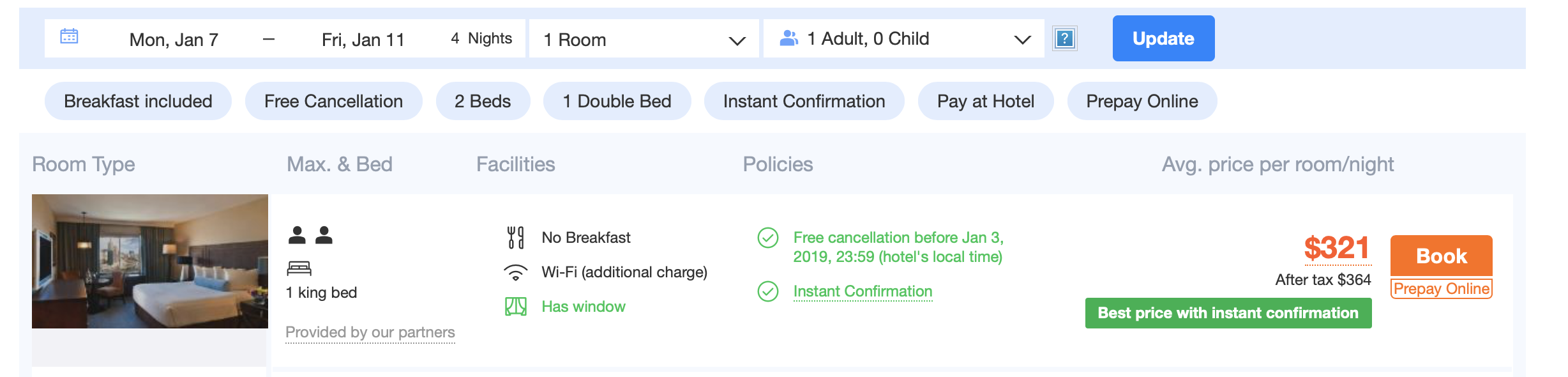
Further, if you have a friend who lives there, go stay with them. The hotels gouge you during this week. Check out the Excalibur, arguably one of the worst on the strip. Right now, you can stay at this illustrious medieval-themed hotel for $25:

Need a smoke-smelling room abutting a flying buttress topped with an animatronic Merlin around January 9? Fear not, my liege!

The best time to book for CES is a year before CES. The second best time is never.

Maybe you’re going to buy a booth. I wouldn’t, but go ahead and give it a try. I like what my friend Tommy here did. Instead of going through one of the countless staffing agencies in Las Vegas he put out a general call for help and he got plenty of responses. Lots of people would be willing to go to Las Vegas to help out for not much cash.

Do everything in your power to stay as close to the Convention Center or Sands (the hall with all the startups) as possible. It is a living hell trying to get around Las Vegas and you’ll thank me later for every hour in a cab line you save for yourself.

Go to where the action is

If you are trying to get press for your product launch then you came to the wrong place. First, if you’re going to CES to launch then you MUST LAUNCH AT CES. I’ve seen too many idiotic startups who flew in, paid for everything and then told the world they’d launch in like two months or whenever Sven back at the main office in Oslo was done putting the finishing touches on the device driver. If you’re not ready to ship don’t go.

Do not spam journos about your product unless you know them. Your emails will fall into a black hole.

Further, instead of getting a booth at the show I recommend getting a booth at Showstoppers or Digital Experience. The events cost about $8,000 for a booth and are approximately the same. They are held before the main event and they’re where all the journalists go to get free prime rib and ignore you. It’s also where all of the small market journalists and the weird freelancers who wear fishing vests and live in Scranton wander around, so be ready to do a little target acquisition.

Want my advice? Put one person at your booth who can tell your story in two minutes exactly. That person must tell that story as many times as possible and give the odd journalist who will stand there asking dumb questions for an hour the stiff arm whenever someone else comes up. Maximize your message dispersal. Also, if you have product, then have about 20 pieces there ready to give away to Engadget, Gizmodo, The New York Times, The Verge and the like. Don’t give anything to me if I see you. I don’t want that crap in my suitcase.

Now for the ingenious part. Find the most popular food item at the buffets and stand next to it. When a hungry journo comes up to grab a spaghetti taco or whatever, scope out their badge and offer to walk them over to your booth. They’ll harrumph a little but unless they are one of the countless millennial reporters who believe they have to live-blog these events they have nothing else to do that night except get drunk on gin and tonics. Drag them over to your booth and give them the two-minute pitch. They’ll be so busy eating they won’t be able to ask questions. Write down their email address — don’t ask them for a card — and give them yours. Then email the heck out of them for the next few days to remind them about your launch.

Further, never rent a suite and invite journos to come to you. They have enough trouble getting out of bed, let alone getting a cab to your dumb room. If a journo wants to meet, you MUST go to them. Don’t make them come to you.

Manage expectations

Like Burning Man, CES is the worst show on the planet held in one of the most unforgiving habitats known to man. As long as you accept these two points you will be fine. You will not “win” CES. At best, CES will give you a kick in the pants in regard to your competition and actual value to the world. Want to know if you have customer fit? Go to CES and meet your customers. Want to see if journalists care about your idea? Pitch them when they are fat and sassy at CES and feeling powerful. That experience will humble even the biggest ego.

Remember: The world is a cold, uncaring place and this is doubly true at CES.

Be careful with PR people

See that animated GIF above? That’s how I manage my CES email. I scroll through the subject lines, look for people I know, then select all unread and delete them. One of the worst things about CES is that the letters “CES” show up in multiple words and, barring writing a regular expression, it is very difficult to filter them out; 99 percent of your CES emails will go unread.

So should you hire a PR person? Yes and no. If you hire them to just send emails then you might as well burn your money. However, if that PR person can lead you around the show and introduce you to folks who can help you get your story out then it might be worth it. Sadly, there is no way to tell how incompetent a PR person is until you get on the ground with them. I know a few I can recommend. Email me. Otherwise be very careful.

Don’t go

Look, CES sucks. I’m not going to lie to you. It’s too big, everyone there is distracted by potential blackjack winnings, and trying to get noticed or launch at CES is akin to holding a poetry reading in the middle of a rock concert: nobody is paying attention and you actually may annoy more people than you reach. It’s your call whether or not you want to give it a try, but be ready to hustle. Besides, there’s always next year.

Bonus Tip: Buy a humidifier

I learned this trick from Brian Lam, formerly of Gizmodo: when you land go to Walgreens and buy a very cheap humidifier. Put it in your room and leave it on all day. Las Vegas air is very dry and you’re almost guaranteed to get chapped lips and a cough if you don’t have at least one spot where it doesn’t feel like you’re on the surface of Mars.

This was us at CES 2008 or so. We were such sweet summer children.
21 Dec 17:26

The Ultimate Guide to Sales Productivity

by Nathan Kittrell
sales productivity image

Art or Science?

Sales requires mastery of “soft skills,” so it can often seem like more art than science. Movies like Thank You for Smoking and Wolf of Wall Street portray top performers as innately talented artists, but we all know that it takes more than a great pitch to hit your number.

To consistently perform, sales leaders need to master the science of sales productivity.

What is Sales Productivity?

Sales productivity is all about maximizing time spent on the most critical sales rep activities (prospecting, client meetings, networking) and minimizing the resources needed to accomplish them (i.e. time, money, effort).

Here is a simple formula for sales productivity:

[Sales Productivity = Efficiency x Effectiveness]

Efficiency pertains to the distribution and use of resources. Time is everyone’s most valuable resource because it’s the only thing we all have equal amounts of. Highly efficient sales teams spend time on high-impact activities and minimize low-impact activities.

Effectiveness relates to how well you use your resources to accomplish goals. Suppose two competing teams are equally efficient and split up their time the same way. On each team, all sales reps spend 80% of their time selling and only 20% on administrative tasks. If one team has higher sales effectiveness, they will outperform the other.

Related: Efficiency Vs. Effectiveness

Sales Productivity Stats:

Sales Productivity Examples

  • Productive: A salesperson makes 100 calls to qualified prospects instead of filling out their expense reports. This is an example of high efficiency and high-effectiveness.
  • Unproductive: Instead of following up with prospects after a tradeshow, a salesperson comes back to the office and works on paperwork that piled up while they were out. Two weeks go by, and tradeshow prospects have still not been followed up with. This is inefficient because there’s too much time spent on non-selling activities. It’s also ineffective because the leads are now lower quality.
  • Productive: Instead of writing individual emails, a sales manager creates a series of prospecting templates so they can personalize and automate their email outreach. Sending individual emails might be more effective, but is far too inefficient.
  • Unproductive: A salesperson spends two hours every Friday afternoon updating their activity in their CRM instead of taking prospects out for happy hour. There are more efficient ways to spend this time. The salesperson could use a tool to automatically update their activities, or only update their activities when their prospects are not available to speak.

Measuring Sales Productivity: where do I begin?

It can be tempting to start adding productivity-boosting tools right away. But before you change anything, you need to understand and document your baseline sales process. If you don’t know where you’re starting from, it will be impossible to tell how you’ve improved later on.

Depending on your industry, the main steps of your sales process probably follow some version of this pattern:

  • Prospecting
  • Qualifying
  • Needs Assessment
  • Demonstration of product/service
  • Proposal
  • Negotiations
  • Closed won/lost

In each of these stages, there will be a series of smaller tasks to be completed. Make sure to map those out as well.

Once your entire process is mapped out, look for the areas that consume valuable selling time (i.e. your bottlenecks). This is where the data from your CRM will come in handy. A few areas that typically add a lot of hours of administrative work to your sales cycle are:

Manually documenting sales activities

  • Does your sales team complain about having to log activities in your CRM? Collecting sales data is extremely important, but it shouldn’t take hours to complete each week. Sync your email, calendar, phone and more to your CRM to avoid double entry.

Proposals

  • What is the length of time your sales team needs to complete a proposal, get it approved, and deliver to the prospect? How many manual steps are there?

Signing contracts and collecting payment

  • Using paper contracts requires scanning, emailing, or even worse: snail mail. If you’re not currently using one of the numerous document signing tools out there, you absolutely should be.

Handoffs between departments

  • How often does your sales team have to follow up with updates from implementation?

Get Baseline measures

After you have a good handle on your entire sales process, get a baseline read of your appropriate sales metrics and KPIs (calls made, emails sent, conversion rates, length of sales cycle, etc.). You will need a starting benchmark to make sure you achieve what you’ve set out to do: increase sales and reduce resources used.

If you have trouble prioritizing, rate each step of your process on efficiency and effectiveness. Then, plot them in a matrix like this:

sales productivity formula

After you’ve determined what exact metrics you’ll track, you’ll want to start looking into different ways to streamline your process with the appropriate technology and productivity tools.

Sales Tools to Improve Productivity

The best sales tools allow top salespeople to automate many of the activities they once did by hand. For example, instead of spending three hours customizing a proposal for a prospect, a rep could use a tool that lets them click one button to populate the entire document.

If you choose the right technologies and train reps to use them effectively, it’s as if each rep has a personal assistant. The “assistant” handles the administrative tasks and busy work, while the salesperson spends as much time with prospects as they can.

Here are the types of tools I’ve found most helpful when increasing sales productivity:

  • A well built, customized CRM platform
  • Sales Engagement Platform
  • Automated Appointment Scheduling
  • Proposal Creation & Document Signing
  • G Suite or Outlook tools
  • Artificial Intelligence (AI), Robotic Process Automation (RPA) and Business Process Automation (BPA)

When you consider adding a new tool, ask yourself how easy it will be to integrate it with your CRM. If your CRM doesn’t integrate with anything, you might want to make a change. On the other hand, if your CRM already offers a specific tool that you need, consider using it instead of another cheaper option. Each new integration could cause a lot more headache than saving a few dollars a month will make up for.

Remember that simplicity is key to productivity. Adding steps and tools will do nothing but slow you down as you learn to use new technologies. So don’t just add things. Look for steps in your sales process you can remove, too.

Putting the plan into action

So far, you have mapped out your process, chosen the areas for improvement, taken baseline measurements, and selected some tools you think will help. Now, it’s time to take some action!

If you aren’t a sales enablement or sales operations expert, I recommend finding one to help. The only thing worse than no technology at all is technology that has been implemented poorly. Some teams even employ a dedicated Productivity Manager these days.

During implementation, keep close contact with your sales managers so they can have input into how things work. After all, they’re the ones using the systems every day. You’ll also need to train reps on whatever solutions you implement so there’s no lost time between transitions.

Automate, automate, automate!

If a machine can do a task just as well as you can, you shouldn’t be doing it. Not only are machines faster, but they’re also more accurate.

Standard areas to automate include:

  • Appointment scheduling
  • Proposal creation
  • Emails
  • Activity tracking
  • Task creation
  • Alerts
  • Lead status progression (new -> attempted to contact -> connected -> converted)
  • Contact life-cycle progression (lead -> qualified lead -> opportunity -> customer)

Once you get into automation, the possibilities are endless. The main thing to remember is that simplicity wins. The more complex and confusing your processes are, the more likely it is that small errors could result in downtime and lost productivity.

Bringing it all together

I want to leave off where I started: maximize your selling time and minimize resources needed to accomplish your goals. Sales (and business in general) is all about tradeoffs. You should always be asking yourself, “is this activity contributing to me closing a deal?” If it’s not, your follow-up question should be, “what else should I be doing instead?”

The post The Ultimate Guide to Sales Productivity appeared first on Sales Hacker.

21 Dec 17:25

End the Marketing Database Horror Story: Put an Axe to Unqualified Leads (Here’s How)

by Brittany Klokkenga

markusspiske / Pixabay

B2B marketers, repeat after me: Not all leads are created equal. In fact, unqualified leads are creating a bottleneck in your overall marketing and sales efforts, and thus, killing your bottom line. You’re not alone in the woods in this hypothetical marketing horror story; it’s a nightmare that fatigues countless B2B marketing departments.

According to a recent report, a measly 6.6 percent of B2B marketers “believe their data is complete and up-to-date. Slightly more than 4 in 10 marketers aren’t confident in the quality of their MA and CRM data.”

2 Major Ramifications of Bad Lead Data

Your sales team doesn’t have the time or resources to manually scrub invalid leads. And even if they did, manual efforts can’t catch everything (e.g., duplicate data). Bad prospect data will always slip through if you rely on manual lead governance, which then results in sales’ mistrust regarding marketing’s ability to generate qualified leads.

Even scarier? Poor lead data quality can cause mistrust among your target audiences. When bad prospect data enters your database, it skews performance analytics, resulting in erroneous decisions about messaging, content distribution, target parameters, and much more. It’s imperative your marketing department invests in a solution to eliminate bad leads before they enter your marketing database and hurt your brand image.

And while the efforts behind eradicating bad leads sends shivers down your spine (it’s never a quick, easy fix), there’s is a way. Here’s how you can put the axe to poor lead data collection strategies and kill unqualified leads before they find their way into your database and begin corroding your sales funnel:

1. Solve lingering mysteries: Detect where your team’s lead-quality problems arise and implement a basic lead filtering process. When it comes to lead collection, quantity and quality aren’t interchangeable. B2B marketers face a variety of problems contingent upon their organization’s business model. Ultimately, poor leads in your database present long-term scaling inefficiencies for your entire organization. But you can clean out those skeletons in your closet:

  • Centralize all your data sources into a common repository before uploading to your database
  • Audit every lead for missing, incomplete and duplicate fields (duplicates are difficult to catch and you won’t catch them all, but it’s important to locate the ones you can)
  • Check for false information (fake names, email addresses, etc.)
  • Check for untargeted values (geographies or company sizes you don’t want, etc.)
  • When applicable, construct lead-return files for each lead provider
  • Append enhanced lead data where applicable
  • Standardize lead file formats
  • Upload lead files to relevant lead nurture track(s) in marketing automation systems (where applicable)

Keep in mind that lead quality is not objective, and your filtration strategy must be adaptable to your sales department’s in-the-field knowledge of what constitutes a promising lead.

2. Shout for help: Crowd source your lead-elimination efforts. After you’ve determined the inefficiencies in the quality of your leads (e.g., unstandardized naming conventions muddying your database), reach out to peers in your industry. It’s likely they’ve experienced similar issues in their prospective data collection efforts. Quora is a great knowledge-sharing platform where numerous marketers exchange a wealth of marketing expertise and hacks. LinkedIn is also a great resource for marketers to troubleshoot industry-specific challenges.

3. Escape the monster: Create a strategy to grow and support qualified leads. Prioritize your lead-quality challenges and lead elimination strategies to focus on quick wins and low-hanging fruit. This likely means approaching your top-of-funnel issues first – these will have a trickle-down effect and benefit sales pipeline growth.

4. Shake the cobwebs from your database: Implement lead quality checks, even if it requires a manual process. Manual efforts can be fatal to efficiency, ultimately affecting productivity, morale and revenue. Still, these costs aren’t anywhere near as scary as having no lead quality governance at all. Consider following a quick lead-data integrity checklist:

  • Filter as many bad leads as possible
  • Track the lead sources that provide the highest quality leads
  • Document the time and resources spent manually processing leads to make more informed calculations on campaign ROI

5. Shine a flashlight on marketing tech solutions that can avoid or mitigate unqualified leads. Once you fully understand the specific lead quality challenges you’re facing, it’s a great idea to research marketing tools and technology that aid the effectiveness and efficiency of a database cleanup strategy. A good MarTech solution for lead data governance will sift through every lead you receive, identifying incomplete, unstandardized, untargeted, duplicate and noncompliant data before it ever makes it inside.

Wake Up from that Nightmare

Bad lead quality, poor database integrity and manual cleanup efforts don’t have to keep you up at night. Simply improve your data collection and filtration processes to eliminate poor leads before they enter your database. Investigate various technologies that will streamline your processes, and you can close the book on it. Your sales colleagues and exec team will thank you again and again as your pipeline grows.

21 Dec 17:25

How Top Ecommerce Brands Use Instagram to Drive Sales During the Holidays

by James Scherer

How Top Ecommerce Brands Use Instagram to Drive Sales During the Holidays

You don’t need me to spout statistics at you to know that the holiday season is a big deal for online sellers.

So I won’t.

Instead, I’ll get right to the point:

Instagram can be one of the most effective platforms for you to drive sales, provided you know what you’re doing.

So let’s get into it.

Here are the top Instagram marketing best practices for the holiday season, each one with an example from a top ecommerce brand.

Use urgency

My top recommendation for holiday marketing is always to run a marketing campaign or product line exclusively for the holiday season.

There are two reasons for this:

  1. Rarity increases the subjective value of an object. The value of a car, for instance, increases massively if there were only 10 made.
  2. Limited time increases the subjective value of an object: If your prospective customers like something which is only available for a week or two, they’ll lose out if they don’t buy.

Here’s an example of a holiday Instagram post which uses urgency, from Everlane:

How Top Ecommerce Brands Use Instagram to Drive Sales During the Holidays

Top tip for holiday marketing on Instagram:

Notice that this Instagram post doesn’t really have much to do with the holidays? Everlane simply threw a “holiday” descriptor on their cashmere sweaters. It just goes to show that you don’t have to, always, be super creative. During the holiday buying season, you can get away with anything so long as you call it festive.

Use a quote from an employee or customer

Quotes have a serious effect on prospective buyers’ trust in you. They reduce the whole “faceless corporation” element – something which turns people away.

And that’s especially true on Instagram, where people want to see uniqueness. They want to see difference.

Here’s an Instagram post example from Teva, a company who shows their uniqueness, and sells sandals, through quotes from their trendy employees and customers:

How Top Ecommerce Brands Use Instagram to Drive Sales During the Holidays

Top tip for holiday marketing on Instagram:

To truly get the most out of Instagram, you need a strategy to generate and intelligently-utilize user-generated content. To get that strategy, check out our article “How to Leverage User-Generated Content: Examples & Best Practices.”

Get inclusive

The holiday season isn’t just about Thanksgiving and Christmas. It’s also a time of celebration for many other cultures.

Here’s a simple Instagram post example of Fossil watches celebrating Hanukkah on Instagram with their Jewish fans:

How Top Ecommerce Brands Use Instagram to Drive Sales During the Holidays

A few celebrations to add inclusivity to your Instagram posts:

  • Krampusnacht (The Feast of St Nicholas) – 5 December
  • Bodhi Day (the day that the historical Buddha experienced enlightenment) – 8th December
  • Solstice (longest day of the year) – On or about 21 December
  • Pancha Ganapati (A five-day Hindu festival celebrated in honor of Ganesha) – December 21 through 25
  • Hanukkah (Jewish celebration of light) – Anywhere between late November and early January
  • Kwanzaa (Pan-African festival celebrated in the US) – 26 December through 1 January
  • Lunar New Year (End of winter in the traditional Lunar calendar among Chinese/Vietnamese/Korean/Mongolian/Tibetan/Japanese cultures) – late January to mid February

Tie products into celebrations (A.K.A. Get creative!)

Do you have a product which doesn’t tie directly into the holiday season?

Perhaps you sell auto parts, or software?

Unfortunately you’re going to have to get creative.

My recommendation is to, genuinely, hold a brainstorming session with your company’s most creative people. You don’t want to miss out on the potential sales windfall the holiday season can yield, so you’ll need to figure out how to connect your business with your prospective customer’s holiday needs.

Here’s an Instagram post example from Fossil watches, showing how they’ve connected their Gen4 watch with holiday parties:

How Top Ecommerce Brands Use Instagram to Drive Sales During the Holidays

A few ideas:

  • Selling software? Focus on how your tool helps to address a specific holiday-related pain point or goal.
  • Selling auto parts? Focus on people traveling for the holiday season.
  • Selling a B2B service? Focus on making the office environment an easier, more relaxing place (enabling people to be less stressed around the holidays).

Get creative, and share your Instagram or social media ideas in the comment section so other readers can find the same success you have!

Create a gift guide

Gift guides are a fantastic value-add for your prospective customers. You’re not just selling them something, you’re helping them get through a stressful time.

Trying to figure out what you’re going to buy for your loved ones is always a challenge (especially if your loved ones are all adults…)

Creating a gift guide on your website can be the answer. Consider creating one for each segment of your target market then allow your prospective customers to choose which one they’re interested in.

If you’re effectively turning website visitors into business leads, note down which segment they engage with (by tracking which URL they visited). This enables you to target them more effectively with email down the line.

Here’s an Instagram post example from Herschel, promoting their gift guide:

How Top Ecommerce Brands Use Instagram to Drive Sales During the Holidays

Top holiday marketing tip for Instagram:

Notice how Herschel has put their products on colorful blocks? This is a great strategy for your product images, if you don’t have a model. Bright color does wonders to draw the eye of your prospective customers on Instagram. For more on this, check out our article “How to Drive More Sales with Better Images.”

Here’s another example of an Instagram post promoting a gift guide from Fjallraven:

How Top Ecommerce Brands Use Instagram to Drive Sales During the Holidays

Run a holiday Instagram contest

People are spending more money around the holidays than any other time of the year: heating bills, feeding the family horde, ski trips and all the rest.

And that’s before we talk about presents.

Gallup reports that “US adults estimate that they will spend approximately $885 on gifts this year.”

So perhaps now would be a good time to save your prospective customers some money?

Holiday instagram contests are the most effective way to target people looking to do just that.

Here’s an example of a simple Instagram contest from Eileen Fisher:

How Top Ecommerce Brands Use Instagram to Drive Sales During the Holidays

To get holiday contest ideas for every social media platform (and your website) you can check out my article “30 Christmas Contest Ideas: Everything you Need to Succeed this Holiday Season.” To get a walkthrough on how to set up a contest, check out “How to Run a Successful Instagram Competition.”

Top tip for holiday marketing on Instagram:

To get the most out of an Instagram contest, it’s better to run one off the platform and send people to it. You can incentivize sharing more effectively, and (most importantly) get the contact information from prospective customers. WIshpond can help. Our Instagram contest tool is easy to use and a campaign can be set up in just a few minutes.

Tap into Travel

People aren’t just buying presents this holiday season. They’re also traveling – escaping the cold, visiting family, soaking up the rays on a beach with a drink in hand.

Ahh…

For Instagram marketers, though, this also means you have a whole different angle from which to engage your prospective customers.

Here’s a Instagram post example from Anthropologie, showcasing their summer dresses in the heart of winter:

How Top Ecommerce Brands Use Instagram to Drive Sales During the Holidays

People are just as interested in seeing photos of the beach as they are in seeing photos of a cozy, snowy cabin. If your product lines fit more into summer than winter, focus on marketing to people who are going on vacation.

Top tip for holiday marketing on Instagram:

You can target prospective customers with an Instagram ad based on their interest in traveling during the holidays. Target by Interest + (common winter escape destination) like Florida, California, Arizona or Las Vegas. Or, go broader and target by “Frequent Traveler:”

How Top Ecommerce Brands Use Instagram to Drive Sales During the Holidays

Babies and Pets

This isn’t a best practice just for the holiday season. I honestly recommend you use babies and pets in your Instagram photos every day of the year.

Though that might be a bit weird. Alright, every other day.

I don’t care who you are or what business you’re marketing, using cute children and animals will get your business more attention than you can possibly get with a super creative promotion idea.

Here’s an example of this Instagram best practice being used by the Honest Company:

How Top Ecommerce Brands Use Instagram to Drive Sales During the Holidays

You don’t have to be a baby-oriented company, like Honest, to tap into the adorable-ness of babies or pets. Here’s an example of how stationery company Paper Source does it:

How Top Ecommerce Brands Use Instagram to Drive Sales During the Holidays

Final Thoughts

Hopefully these best practices and examples have inspired you to find success on Instagram this holiday season.

Have you tried any of these best practices before? Do you think you’ll try any of the strategies?

Don’t hesitate to reach out in the comment section to share your experience or ask questions about Instagram marketing!

20 Dec 17:23

Account Based Everything: a foundation for partnership

by bob@inflexion-point.com (Bob Apollo)

IJST Cover Dec-2018v2Account-Based Marketing (and its all-embracing cousin “Account Based Everything”) has been touted by its promoters as a miracle cure capable of halting the precipitate decline in conventional marketing effectiveness - and derided by cynical detractors as just another over-hyped trend.

As with most new(ish) trends, the reality is probably somewhere in between.

The essence of the idea - as I have come to understand it - is that rather than pursuing poorly-targeted generic campaigns, we should be progressively tailoring and targeting our marketing messages and sales conversations in a way that appeals to the real priorities of the specific organisations and stakeholders that we wish to do business with.

And in order to achieve that, we need to understand as much as we can about the specific situation, issues, challenges and opportunities of our target audiences. And that, of course, requires that marketing, sales and customer success are in lockstep about who we are seeking to do business with (and why), what really matters to them, how they make buying decisions and how we can help them accomplish their goals...

Intelligent partnerships

Account-based initiatives absolutely depend on intelligent partnerships between marketing, sales and customer success, to the extent that I believe (and have observed) that any campaign that is exclusively or largely led by marketing without the wholehearted and active involvement of both sales and customer success has no chance of reaching its full potential.

But we also need to make sure that we establish trust between all parties: sales and customer success need to trust marketing to campaign in a way that isn’t at odds with their goals for the customers, and marketing needs to trust sales and customer success to play their full part in ensuring that prospect and customer information is as complete and accurate as possible.

People, not personas

If they are to succeed, account-based initiatives depend on in-depth research into and shared intelligence about real organisations and real people, rather than generic, average-based market research or similarly generic (and often risible) buyer personas. They are most effective when based on fact rather than speculation.

But the intimate level of detail needed to conduct truly effective highly-targeted account-based initiatives usually does not exist (or is at best patchy) in most organisations. Any account-based initiative needs to recognise that the initial customer data set will probably have a great deal of room for improvement.

All in the mind?

Sales people and customer success managers have often accumulated information in their heads about prospects and customers that they haven’t recorded in CRM - because they weren’t asked, because the fields don’t exist, or because they see it as yet another unproductive administrative burden.

For as long as these mindsets exist, they will prevent account-based initiatives from ever reaching their potential. We need to make it easy for everyone to share what they have learned, to recognise what we need to know but don’t yet know, and to establish metrics and put programmes in place to fill the gaps in our customer intelligence.

Substance, not style

I’ve seen highly visible (and often highly-expensive) account-based initiatives fail because they focused too much on the glossy deliverables and not enough on the underlying intelligence needed to target them. And I’ve seen far less expensive, pragmatic campaigns that start small and learn as they go make a huge difference to revenue growth and lifetime customer value.

Investing in ABM technology can facilitate progress but is never by itself a miracle cure. Account-based initiatives succeed in the real world when everybody pulls together to capture, share and apply real customer intelligence in an effective and intelligent way.

And they succeed when marketing, sales and customer success all buy into the concept, see how it can benefit both them and their colleagues, and work together in a collaborative partnership to achieve their shared goals.

A version of this article was first published in the December 2018 edition of the International Journal of  Sales Transformation.


ABOUT THE AUTHOR

bob_apollo-online-1Bob Apollo is a Fellow of the Association of Professional Sales, an award-winning blogger, a confident and entertaining event speaker and workshop leader, a regular contributor to the International Journal of Sales Transformation and the founder of UK-based Inflexion-Point Strategy Partners, the B2B value-selling experts.

Following a varied and successful career spanning start-ups, scale-ups and corporates Bob now works as an adviser to some of today’s most ambitious B2B-focused sales organisations, equipping and enabling them to accelerate revenue growth and transform sales effectiveness by implementing the proven principles of value-based selling.

20 Dec 17:23

How to Make Marketing Indispensable

by Laura Patterson

We often talk about the value of Marketing. To play a strategic, indispensable role Marketing needs to be valuable. Does it seem like I’m splitting hairs? These two words may seem similar but the meaning is not. The dictionary tells us that “value” is the degree to which something is useful or estimable. Something that is valuable, on the other hand, is something that is precious and of great worth, and therefore important. The distinction is important because while value may be appreciated, it may not be necessary or important. Something that is valuable, however, is something that is of great importance, utility or service; it is essential to the working of the organization. Valuable is indispensable. Valuable organizations participate in the decision-making process.

While every Marketing organization wants to be useful, who also wouldn’t want to be considered indispensable? Here’s an illustration of the idea. When you collect and analyze data to understand customer purchasing patterns, create a new piece of content, or execute an email campaign, your leadership team may value the work. But that doesn’t always mean it is considered valuable. There are serious implications to being valued but not valuable. Valued organizations will be given some resources (people and cash) to continue to be productive, but additional resources are harder to come by, may require more justification, or worse, can be taken away. It probably goes without saying, if a Marketing organization isn’t even perceived to be of value, it won’t be long before that organization sees budget cuts and headcount reductions. If the organization could ultimately operate without Marketing’s work product, it may be valued, but not valuable.

While every Marketing organization wants to be useful, who also wouldn’t want to be considered indispensable?

6 Ways to Make Your Marketing Organization More Valuable

If you want to secure and keep your Marketing budget, focus on being valuable. Art Petty, an author and teacher on management and leadership, asserts that people and functions are more valuable when they are aligned to the leadership priorities, help mitigate or eliminate problems, bring recommendations to the table, and build bridges across the organization. Using these ideas, and others gleaned from CMOs in best-in-class Marketing organizations, we’ve crafted a list of 6 ways to make your Marketing organization indispensable.

  1. Alignment: Focus the work of Marketing around the priorities and the outcomes of the organization. Be clear about what constitutes success and be sure the Marketing plan, team, investments, and programs are all synced up to these outcomes. What you do needs to matter and make a difference to the business. It’s not the quantity of your to-do list or how many of the items you complete that makes you a valuable marketer or employee. Being able to make good decisions about what’s important and prioritizing work so that what you are tackling will demonstrate that you know what is valuable to the company. Look for opportunities where your work will improve customer satisfaction and experience, create money for the company such as accelerating customer acquisition or grow customer share of wallet, and save the organization money.
  2. Accountability: Be able to quantify the value of the work of Marketing to the leadership team in measures and metrics that matter to the C-Suite.
  3. Anticipate: Marketing needs to be about more than execution of demand generation and branding programs. A valuable Marketing organization has the periscope up at all times in order to help the organization anticipate competitors’ moves, customer requirements, industry trends, and market changes. Listen and learn about customers and bring insights to the table that will help the leadership team navigate the market. Valuable Marketing organizations have a cadence of collecting and sharing critical information that the leadership needs for decision-making.
  4. Forge alliances. Marketers and Marketing cannot operate as a silo or see itself as merely a service center for sales. Marketers have a tendency to be head down in tactics. According to the Corporate Executive Board (CEB) research, only 40% of employees work with more than 20 people on a given day, and more than 80% only work with 10. Your network needs to expand beyond other marketers or the Sales team. Build bridges with members of the business, operations, finance, and IT teams as well as externally. External relationships enable Marketing to bring in an outside-in view of the market, competition and industry. Find ways to develop more contacts and expand your network. Give your network reasons to want to work with you versus someone else.
  5. Serve as a trusted advisor. To be a trusted advisor, your leadership team needs to have confidence that you and your team have the experience, training, knowledge, and expertise to support the business. You know Marketing is a trusted advisor when the leadership team brings Marketing into decision-making discussions early and turns to Marketing for input on general business issues and specific customer issues.
  6. Be a change agent. Your organization must constantly adapt and adjust to the market, competitors and customers. Take the lead on embracing change and helping the organization make change a positive process.

Each of these is important to tackle – the security of your organization and its budget is riding on it. Completing your own work and solving problems within your own function provides value. If you want to be valuable it will take more than hard work and effort.

20 Dec 17:18

Evolution of Gamification in Email: A New Approach to Enhance Engagement

by Kevin George

Gamification is an interesting way to engage your subscribers. It is a relatively new approach that is not as explored as GIFs and other rich media elements. By including a game in your emails, you can inspire your subscribers to interact and win a reward in return.

Using Gamification Strategy in Holiday Emails (Halloween and Thanksgiving)

EmailMonks loves creating a memorable email experience for subscribers and so the developers put together an interactive game for the Halloween email. The subscriber was supposed to save the city from the attack of five monsters. The email used GIF animations in the backdrop and the game took the center stage.

Halloween-Gamification-in-emails-EmailMonks

Since the email couldn’t work in email client Outlook, those subscribers were provided an option to click through and play the game online. As much fun as it was to create the email, we are pretty sure it was equally delightful for the email recipients.

This email has been created using multiple interactive components in a well-arranged way to give users the gamification experience. It contains keyframe animations with five rounds of the game and each round appears at the right time by including delay in the animation.

We have added input tags (click events) to allow subscribers to interact with the game. All the inputs have their own individual actions and re-actions. Depending on the actions by the subscribers, the winning or failure message will be displayed.

Developing a gamification email is quite challenging but making it compatible across all email clients is even more challenging as not all of them support these emails. Therefore, it is imperative to display the right message with a fallback version.

As you can see with this email, the non-supportive email clients will show a custom message, depending upon the email client in which the email is opened so that the reader can experience the interactivity as desired.

E.g.: This is how the fallback version will appear if it’s been viewed in Gmail.

Halloween Gamification in emails

Thanksgiving Email – Cross the Maze

Maze is a game loved by individuals belonging to every age group.

We brought it alive in emails by creating the first email maze along with a gaming console – all in the email itself.

We principally added keyframe animation in the email. To make the game more enjoyable, we created inputs as action points. Based on the selections of various inputs, we assigned re-actions and animated background positions. Similar to what we did for the Halloween email, we created inputs for defining win and lose messages.

We created a character, Alex, and built a story around him. He was stuck in traffic and the player had to help him reach home in time.

The controller was placed at the bottom of the email. It was developed with background inputs, which relied on the actions that ultimately moved the position of Alex. Choosing an incorrect path would lead to a dead-end and showed an error (lose) message. On the other hand, choosing the right direction and helping Alex get to his home displayed a win message.

ThanksGiving EmailMonks Gamification in emails

Compatibility

These gamification emails are compatible in Apple Mail (both Mac and iPhone), Outlook 2011 and Android Native All.

Fallback

Unlike usual fallbacks, this time we created personalized fallback for respective email clients.

For all the non-supportive email clients, a customized fallback message was rendered based on which email client was used to view the email. We accomplished this by using an email client-specific conditional code.

Performance of Gamification Email Campaigns

The best way to measure the engagement in a gamification email is by the ‘time spent’ on that email rather than the click-through rate.

Normally, the email campaigns get around 55% read time.

The average read time of gamification emails is around 60%, which is around 5% more than the usual emails.

Need any other reason to execute it in your strategy?

20 Dec 16:58

Scarcity Marketing: How to Make More by Making Less

by Chris O'Keeffe

As marketers, every day we aspire to put our products and services in front of as many eyes as possible. We look for ROI on reach, engagement—any edge we can get in spreading the word.

Over the past few years, there’s been a trend of marketers trying to “eliminate friction” in an effort to attract consumers through convenience and accessibility. This has brought us new innovations like one-click checkouts, allowing consumers to bypass any sort of checkout process, making products easier to buy than ever before.

scarcity marketing ill-fated Push For Pizza

The ill-fated Push For Pizza app offered users a single-button solution for…pizza.

But if what if we go in the other direction? What if you hide your product from the world? If you make it hard to get? If you don’t make enough? What if you create friction? That’s what today’s article is about.

What is scarcity marketing?

Scarcity marketing is the idea of limiting the supply of a product, whether it be through restricting availability to a certain time-frame or decreasing production—oftentimes both.

The principle is sound—we all want what we can’t have and love to flaunt when we have something others don’t. Scarcity marketing takes advantage of this desire, creating demand through mystique and enticement. It’s an excellent way to ensure that a product is swept off the shelves with the hype that every brand wants to create.

Now that we’re clear on what scarcity marketing is, let’s dive into some examples of businesses in a few different industries using this principle successfully.

Food & Beverage

Seasonal offerings are a common example of scarcity marketing. McDonald’s Shamrock Shake and Starbucks’ hugely popular Pumpkin Spice Latte (PSL!) are some high-profile examples of seasonal products that attract even the casual customer with their limited-time offerings. Some companies take scarcity to another level, driving both demand—and consumers—up a wall. Here are three brands that have done just that.

1. Pappy Van Winkle

scarcity marketing Pappy Van Winkle

I worked at a bar once where we drank this stuff like water. We didn’t know what we had!

Pappy Van Winkle is a whiskey connoisseur’s dream. Released exclusively in limited batches, this bourbon is one of the most highly sought-after liquors in the world.

Only 7000 cases are produced each year, and whiskey enthusiasts will pay hundreds of dollars a bottle just to get a taste if they’re lucky enough to find it. Because supplies are so limited, liquor stores who are lucky enough to get a few bottles often hold auctions. Some states—looking at you, Idaho—even hold an annual lottery to make the distribution of their limited Pappy Van Winkle supply fair.

2. Goodnight Fatty and Back Alley Bacon

scarcity marketing Back Alley Bacon

You better have the password and exact change if you want this guy to feed you.

Goodnight Fatty and Back Alley Bacon of Salem, Massachusetts, utilize scarcity marketing in a way that harkens back to the days of the speakeasy. These two shops are open at very limited times, and whatever they are cooking up is what you get.

Back Alley Bacon serves their delicious, secret bites out of an unmarked shop by a man in a pig mask, known only as “Chef Jon Hamm” (of apparently no relation to the actor). Customers require a password and exact change, both of which are posted on the Back Alley Bacon Facebook page. But they aren’t told anything about the food itself, adding a layer of mystery to the experience. Don Donato, owner of North Shore food marketing agency Octocog, told us, “what really helped launch Back Alley Bacon wasn’t just scarcity of product, but scarcity of information.”

scarcity marketing Goodnight Fatty

Advertising for Goodnight Fatty is limited to a blinking sign in an obscure back alley.

Goodnight Fatty offers cookies, or, as they refer to them, fatties. The menu is “top secret,” but each week they make three different types of cookies (pro tip: pay extra for bottomless milk). Their scarcity strategy has paid off: in the last few years, Goodnight Fatty has gone from occasional pop-ups at random Salem locations to a standing weekend location and, soon, a permanent storefront opening up this spring.

3. McDonald’s Szechuan sauce

scarcity marketing McDonalds Szechuan sauce

“I want that Mulan McNugget sauce, Morty!” — Rick Sanchez

In 1998, McDonald’s released the limited-edition Szechuan sauce to coincide with the release of Disney’s Mulan. After promotion of the film concluded, the sauce was taken off the menu and faded into obscurity for many years… that is, until popular sci-fi cartoon “Rick and Morty” featured it in one of their episodes. Discussion about the sauce exploded online, and McDonald’s seized the opportunity for exposure by bringing it back for one day only, in limited quantity. Fans and foodies alike stood in hours long lines for a chance to get the sauce—some savvy customers saw the opportunity to resell it online for hundreds of dollars.

Apparel & Design

scarcity marketing Jordans

The shoes that started it all.

Clothes and apparel market themselves every time someone puts them on. There is nothing better for a clothing brand than to have their products instantly recognizable—brands like Nike and Ralph Lauren are so ubiquitous that we know what they are just by looking at the logo. Everyone sees it, and everyone knows what it is.

If you market apparel, then you know the value that consumers place on their wardrobe and use this to their advantage. The popular shoes Jordans have become famous for their “limited drops,” where shoes are created in limited supply and become highly coveted by shoe lovers the world over.

Humans are wired to collect resources; during ancient times, our survival depended on it. Whoever had the most food or the best tools would have a greater chance of survival. Today, marketers take advantage of our innate desire to collect and stockpile—Brady Sadler, author of Collaboration is King, says, “Using the word ‘collect’ is another spin on scarcity. When brands deploy this word it implies demand, value, repetition and it bakes an element of creativity into the purchase. It gives the consumer permission to covet something and attempts to shape it as a productive outlet.” Here are three brands that have made their products into collectable commodities through scarcity marketing.

1. Mondo

scarcity marketing Mondo

Collecting Mondo movie posters is a very expensive habit.

Mondo commissions artists to create alternative designs for T shirts and movie posters, largely focusing on classic or cult films like “Jaws” and “The Shining.” Their posters are so immensely popular that they are virtually impossible to buy online; the second it hits the store, it’s already sold out. As an added bonus, Mondo announces their limited edition posters on their Twitter account, which drives considerable traffic to their website.

2. Supreme

scarcity marketing Supreme

Limited availability = mass appeal.

You’ve probably seen the red and white Supreme logo on the back of a sweatshirt somewhere (or the back of JR Smith’s leg). It’s grown immensely popular in the last few years due to their fervent fans and cult-like following. Supreme has just 11 locations worldwide, releases their clothes in “limited drops,” and is popular amongst celebrities—the perfect scarcity recipe.

3. Bape

scarcity marketing Bape

It’s a resellers’ market, for sure.

Bape or A Bathing Ape is a Japanese streetwear brand that utilizes collaborations and limited drops to keep their style exclusive. Much like Supreme, fans go bananas to collect Bape apparel, and they resell it online for a pretty penny.

Entertainment & Tech

Exclusivity is just another word for scarcity. Dr. Dimitrios Tsivrikos, consumer psychologist at University College London states, “we collect articles or resources to survive, but survival doesn’t only rest upon what we need physically. We need, psychologically, to distinguish ourselves.” When a company offers something exclusive, it triggers this innate desire to stand out from others. Whether it’s a collector’s edition of a Beatles’ album or a solid gold iPhone, the entertainment and tech industries have found myriad ways to lure consumers. Here are just three examples of scarcity marketing in action.

1. Wu Tang Clan’s Once Upon a Time in Shaolin

scarcity marketing Wu Tang Clan

Remember when U2 put that album on everyone’s iPhone? This is the opposite.

Although their legendary place in the pantheon of rap is unassailable, Wu Tang Clan had fallen out of cultural relevance at the hands of younger, trendier rappers. But in one of the greatest PR stunts in rap history, Wu Tang recorded an album titled Once Upon a Time in Shaolin and released just one copy, causing an auction house bidding war. According to Brady Sadler (Collaboration is King), it was about more than just revenue. “Yes, it became the most expensive album ever sold, at a reported $2 million,” he says. “But the public relations and earned media far exceeded anything the group had done for many years.”

As an added bonus, the Wu has ensured its place in history, as the album will finally see a wider release in 2103.

2. OnePlus

scarcity marketing OnePlus

“The best smartphone you’ve never heard of.” — Business Insider

One Plus is now a popular smartphone brand, owing their rise to a clever, invite-only marketing campaign. This not only helped OnePlus manage demand in their favor, but it also added a layer of hype and mystique. Once OnePlus had established itself as a top-tier brand, they discontinued the invite only system and expanded their offerings to all.

3. Gmail

scarcity marketing Gmail

Once a techy status symbol for those in the know, an @gmail.com email address is now ubiquitous.

Finally, we have a service that many of you probably use every day. Although now omnipresent, Gmail was originally a much sought-after, invite-only program. The exclusivity of the service helped create considerable buzz, while also serving as a test run for the email platform.

Using scarcity marketing for your business

These are examples of businesses that have used scarcity marketing with overwhelming success. But scarcity marketing doesn’t have to be used on such a large scale to elicit this response. As you can see from the examples, the strategy can work for businesses in a variety of industries. Remember, we all want what we can’t have, whether that’s a mystery meal served in an alley or a bottle of whiskey, a pair of shoes or an exclusive email address. So consider leveraging this desire in your next marketing campaign—you never know what might happen.

20 Dec 16:57

Selling Change is Hard: Status Quo Bias Locks Customers in a Prison of No Decision

by Michael Harris

The value to buy your product is overwhelming and yet the customer decides not to buy. At times like these, it’s important to remember that customers are not rational decision making machines. They are human beings with built in cognitive biases that make them highly resistant to change. The status quo and optimism biases, for example, prevent customers from making the sensible decision to buy your product. To sell change, salespeople must not only climb a mountain of fear to get past the status quo bias, but they must also cross a valley of indifference to overcome the optimism bias. This is why selling change is so difficult.

Until salespeople improve at opening the gap with “WHY CHANGE,” they will struggle to close the gap with “WHY US.” Without a compelling reason to change, customers will stick with the status quo and “no decision” will continue to be your biggest competitor. To help customers buy, salespeople need Change Stories and Questions so that they can inspire customers to step into growth instead of back into safety.

STATUS QUO & OPTIMISM BIAS BLOCK CHANGE

The status quo bias is a prison that locks the customer in no decision. It’s built in the customer’s mind on a foundation of the fear of change. If customers put the status quo and new products on the evaluation shelf when they evaluate new products, then these prison walls wouldn’t exist, because the risk of status quo would counteract the risk of change. But customers are biased. They hold the status quo close to their heart, and only put new products on the shelf (see figure-1). As a result, they neglect to evaluate the risk of the status quo. This is a problem because the risks of change are real, and include such factors as: Implementation risk; ramp up time learning a new product; career risk if the product fails; financial risk if the ROI isn’t achieved; risk of being misled, and; risk of being exposed for not doing your job properly. No wonder customers build a wall around the status quo to protect them from change.

Even if the benefits of the seller’s product make it past the customer’s defensive wall, customers will discount the seller’s claims for gains. Why? The optimism bias inflates the customer’s baseline, so customers don’t believe their results can be improved (see figure-2). This is a well-documented cognitive bias where individuals overestimate their own abilities relative to others. Do you, for instance, feel you are an above average driver? I know I do, and so do 93% of surveyed US drivers. This is why telling customers your product will improve their results by 30% rarely works, because most of the time, customers just don’t feel like they have a problem. Until salespeople learn to hold up a mirror to the customer’s unexamined problems, customers will continue to have an inflated baseline. So salespeople should not be surprised when customers say their product may be great for someone else, but not for them.

KILL THE STATUS QUO & OPTIMISM BIAS WITH INSIGHT

Because of these biases, customers not only neglect to assess the risk of the status quo, but they also inflate their baseline. This creates pockets of unrecognized value for change that customers don’t see. More important, it provides the opportunity for sellers to shine the light of insight on the root causes of the customer’s negative biases so that they can expose these unrecognized pockets of value. By working backwards from their product, sellers can create these insights by showing the problems, costs, and risks to the customer’s business in the absence of having the seller’s unique capability.

KILL THE STATUS QUO BIAS: By performing a risk assessment of the status quo, customers will be motivated to change because they will realize that the risk of the status quo is now greater than the risk of change (see Figure-1).

KILL THE OPTIMISM BIAS: By performing a baseline reality check, customers will be motivated to change and ready to be rescued by the seller’s product , because customers will discover they are no longer ankle deep in problems but out in the middle of the lake drowning in problems (see Figure-2).

DELIVER INSIGHT THROUGH CHANGE STORIES & QUESTIONS

It’s difficult to deliver the message that customers are not operating optimally without getting a black eye. To protect their self-esteem and guard themselves from the risk of change, the buyer’s confirmation bias motivates them to select evidence in favor of the status quo or reject evidence supporting change.

So instead of trying to force insights through the buyer’s defensive wall, sellers should deliver their message via a story, because they’re about someone else so they are nonthreatening (see figure-3). Without feeling attacked, customers can now relax and take in the seller’s story. And if the story is insightful enough, they may start to tell themselves a new story where new choices make more sense. So put your change message inside a story and, like a Trojan horse, it will make it over the customer’s defensive wall.

RESETS THE STATUS QUO AUTOPILOT WITH CHANGE STORIES

Change messages don’t just need to make it over the customer’s defensive wall; they must also reset the customer’s automatic pilot. How many times have we read a self-help book and still not made any changes? For the most part, people don’t change unless they experience a crisis or an insight that sinks so deep it speaks to the subconscious and resets the autopilot. Change Stories can manufacture a crisis and deliver insight so that we can reset the customer’s automatic pilot. Because Change Stories don’t just speak to the conscious mind, they also speak to the gut. They are experiential. They virtually transport customers to a concrete point in time when another customer realized the status quo was broken and could no longer be duct taped together. Suddenly, your prospective customer realizes that their problem is bigger and riskier than they previously thought and they now need to change.

CHANGE STORIES MUST BE MADE BY SALES

You can’t rely on your marketing team to produce change stories, because new customers won’t engage with marketing until they achieve results. When they finally do achieve result, customers will have either forgotten why they decided to change or the competitive landscape would have changed so much that the reasons they changed are no longer relevant.

Salespeople, on the other hand, already know why customers bought, because they won their business in the first place. Customers are also more likely to share the reasons they changed privately with salespeople because they will have already established a trusting relationship.

Sales can create this content by having each salesperson record his or her key customer wins as Change Stories. This is a useful exercise because salespeople use the same skillset to uncover why a past customer bought as they do to determine why a future customer will buy. Not only will peer feedback improve each individual story, the group will also gain from their pooled knowledge when Change Stories are shared in sales meetings.

Once sales have convinced customers that they’re drowning with change stories, sales can then use success stories as proof to convince the customer that their product will rescue them.

LEARN HOW TO CREATE CHANGE STORIES & QUESTIONS

To implement this strategy, it is critical for salespeople to improve their storytelling skills. They must learn to share only the essence of why a customer changed or bought. If they include everything that happened in the deal, they’ll drown out the message. Sales will also need to know how to convert their stories into discovery questions so that salespeople can alternate between sharing stories and asking questions during a call, just like in a natural conversation.

In conclusion, we’ve shown why selling change is so difficult, because salespeople must not only climb a mountain of fear to get past the status quo bias, they must also cross a valley of indifference to overcome the optimism bias. This is why selling change is so difficult. Until salespeople improve at opening the gap with “WHY CHANGE,” they will struggle to close the gap with “WHY US.” Without a compelling reason to change, customers will stick with the status quo and “no decision” will continue to be your biggest competitor. To help customers buy, salespeople need Change Stories and Questions so that they can inspire customers to step into growth instead of back into safety.

20 Dec 16:57

Did unicorns like Lyft and Uber wait too long?

by Connie Loizos

It was several years ago, at a tech conference in Laguna Beach, Calif., that the venture capitalist Bill Gurley issued one of what would become repeated warnings that startups were staying private too long. Comparing companies that refuse to go public to undergrads whose college careers extend several years past the point that they should, Gurley suggested they should be embarrassed, not proud, for keeping their shares in private hands. “Until you get liquid, you really haven’t accomplished anything,” Gurley said.

Whether Gurley was referring to Uber at the time, only he knows. Though his firm, Benchmark, eventually forced out Travis Kalanick, the co-founder and longtime CEO of Uber, the tipping point was seemingly not Kalanick’s determination to keep Uber privately held as long as possible, but rather an investigation into sexual harassment investigations and the employee misconduct that was discovered in the process.

Either way, it’s looking increasingly like Gurley had a point. As you may have noticed if you care anything about the public markets, they took a nosedive today. In fact, they fell to a new low for the year this afternoon, a reaction in part to the Federal Reserve’s decision earlier today to raise its benchmark overnight lending rate for the fourth time in 2018.

The Fed also signaled minimal rate hikes for next year — forecasting two rate hikes instead of three — but investors were apparently hoping for even better news.

It’s hard to blame them for seeking out more of a silver lining, given everything else that’s going on. Tech stocks are getting battered, with the FANG companies (Facebook, Apple, Netflix and Google) down meaningfully from their share prices of six months ago. (Amazon has held up the best.)

The economy of China — the U.S.’s third largest export partner and its largest import partner — is slowing sharply, which is expected to have an impact on the U.S. and world economies. Add trade tensions into the mix, a sprinkling of uncertainty about regulations, a splash of a possible government shutdown and the growing prospect that Donald Trump will be impeached, and you start to appreciate why the market is finally going off the rails.

Despite so much uncertainty, Uber, Lyft, Slack and now Pinterest, among many others, are racing to become publicly traded at long last. According to Dealogic data quoted in today’s WSJ, 38 unicorn companies went public this year, and more are expected to test the market in 2019.

Their venture backers will tell you it’s because the markets recognize a strong growth company when they see it, and that each is finally positioned well to tell their story, aided by some dazzling metrics. Yet it seems just as likely that they see the window, which flew open this year, starting to swing back in the other direction. And if this month is any indicator, it could be hard to pry it open again, at least in the first quarter or two.

“The market is basically closed between now, and the start of a new year is always slow because companies don’t start roadshows [until the markets re-open],” says Kathleen Smith, a principal of Renaissance Capital and the manager of its IPO exchange-traded fund. Pre-IPO companies like Uber are also waiting on their audits to close before they put any numbers in a public document, she notes. But it could be far from smooth sailing after that, suggests Smith. “In normal times, late January and February and March become very active, but we aren’t in a typical market. I can predict from other times that we’ve seen a bear market like this that it will have an impact on IPO activity.”

It’s all part of a vicious cycle, Smith suggests. As public market shareholders begin to feel less affluent and more risk averse, they start redeeming their public market shares. That leaves fund managers who might otherwise gamble on new issuers with less capital to invest, and less flexibility. “Investors are just not going to want to take on any risk positions when market has [taken a turn for the worse],” says Smith.

Put another way, if the markets are as crummy early next year as looks to be the case, it’s too bad, too sad for unicorn companies. “They made the choice to stay private and get capital,” says Smith. “I’ve stated many times that they should be getting while the getting is good. The pain can happen if money dries up, and it will dry up when the public market dries up.” 

That doesn’t mean tech’s favorite unicorn companies are doomed, of course, especially those that can show strong fundamentals. For her part, Smith notes that what often happens in a downturn is that offerings get heavily discounted. “Valuations will be chopped if the companies want investors to participate. They’ll have to be sure to make money.”

Even if they don’t get the rich prices that ambitious bankers might pitch them (or that their VCs assigned them before that), they can always grow into the valuations their investors want to see. One need look no further than Facebook to remember why a bumpy offering doesn’t mean all that much longer term.

“Just because a stock crashes below its IPO price isn’t a sign of a bubble,” says Pivotal Research analyst Brian Wieser. “You also have to keep in mind the dynamic of companies going public,” he says. “You expect IPOs to be overvalued. Investors in these companies are necessarily selling to the greatest fool.”

Still, there may be fewer fools willing to buy what they are selling than there might have been this year or last, and if those numbers really change, today’s unicorns will look like tomorrow’s donkeys.

They’re certainly going to face more scrutiny than they might have had they moved sooner.

“Maybe we’ll roar into 2019 and all will be well,” says Lise Buyer, the founder of Class V Group, an advisory firm for IPOs. “But to the extent that investors will be more selective, they’ll look at path to profitability, and they’ll look at the valuations these companies took when they were private.” Then they’ll do their own math, suggests Buyer.

If the market is truly shifting, public market shareholders “won’t care what valuations companies achieved when they were private,” says Buyer. “They’ll only be willing to pay what they are willing to pay.”

20 Dec 16:56

The Eternal Return: Nietzsche’s Brilliant Thought Experiment Illustrating the Key to Existential Contentment

by Maria Popova

“Owning up: to recollect, to regret, to be responsible, ultimately to forgive and love.”


The Eternal Return: Nietzsche’s Brilliant Thought Experiment Illustrating the Key to Existential Contentment

Chance and choice converge to make us who we are, and although we may mistake chance for choice, our choices are the cobblestones, hard and uneven, that pave our destiny. They are ultimately all we can answer for and point to in the architecture of our character. Joan Didion captured this with searing lucidity in defining character as “the willingness to accept responsibility for one’s own life” and locating in that willingness the root of self-respect.

A century before Didion, Friedrich Nietzsche (October 15, 1844–August 25, 1900) composed the score for harmonizing our choices and our contentment with the life they garner us. Nietzsche, who greatly admired Emerson’s ethos of nonconformity and self-reliant individualism, wrote fervently, almost frenetically, about how to find yourself and what it means to be a free spirit. He saw the process of becoming oneself as governed by the willingness to own one’s choices and their consequences — a difficult willingness, yet one that promises the antidote to existential hopelessness, complacency, and anguish.

Friedrich Nietzsche

The legacy of that deceptively simple yet profound proposition is what philosopher John J. Kaag explores in Hiking with Nietzsche: On Becoming Who You Are (public library) — part masterwork of poetic scholarship, part contemplative memoir concerned with the most fundamental question of human life: What gives our existence meaning?

The answer, Kaag suggests in drawing on Nietzsche’s most timeless ideas, challenges our ordinary understanding of selfhood and its cascading implications for happiness, fulfillment, and the building blocks of existential contentment. He writes:

The self is not a hermetically sealed, unitary actor (Nietzsche knew this well), but its flourishing depends on two things: first, that it can choose its own way to the greatest extent possible, and then, when it fails, that it can embrace the fate that befalls it.

At the center of Nietzsche’s philosophy is the idea of eternal return — the ultimate embrace of responsibility that comes from accepting the consequences, good or bad, of one’s willful action. Embedded in it is an urgent exhortation to calibrate our actions in such a way as to make their consequences bearable, livable with, in a hypothetical perpetuity. Nietzsche illustrates the concept with a simple, stirring thought experiment in his final book, Ecce Homo: How One Becomes What One Is:

What if some day or night a demon were to steal into your loneliest loneliness and say to you: “This life as you now live and have lived it you will have to live once again and innumerable times again; and there will be nothing new in it, but every pain and every joy and every thought and sigh and everything unspeakably small or great in your life must return to you, all in the same succession and sequence — even this spider and this moonlight between the trees, and even this moment and I myself…”

Art from The Magic Boat — a vintage “interactive” children’s book by Freud’s eccentric niece Tom Seidmann-Freud

Like the demon in Kepler’s visionary short story The Dream — the first work of genuine science fiction, which occupies the opening chapter of Figuring and which the great astronomer used as an allegorical tool for awakening the superstition-lulled medieval mind to the then-radical reality of the Copernican model of the universe — Nietzsche’s demon is not a metaphysical extravagance but a psychological gauntlet, an alarm for awakening to the most radical existential reality. At the heart of the thought experiment is the disquieting question of whether our lives, as we are living them, are worth living. Kaag writes:

Nietzsche’s demon… is a challenge — or, better, a question — that is to be answered not in words but in the course of life: “The question in each and every thing, ‘Do you want this again and innumerable times again?’ would lie on your actions as the heaviest weight! Or how well disposed would you have to become to yourself and to life to long for nothing more fervently than for this ultimate eternal confirmation and seal?”

Are we, in the words of William Butler Yeats, “content to live it all again”? Being content in this sense is not being distracted from, or lulled to sleep by, or resigning oneself to a fate that cannot be avoided. It is to live to your heart’s content with the knowledge that you will do this, and everything, again, forever. We made our last turn into the Waldhaus driveway and came to rest beneath its canopied entryway. Nietzsche suggests that the affirmation of the eternal return is possible only if one is willing and able to become well-adjusted to life and to oneself. To be well-adjusted, for Nietzsche, is to choose, wholeheartedly, what we think and where we find and create meaning. The specter of infinite monotony was for Nietzsche the abiding impetus to assume absolute responsibility: if one’s choices are to be replayed endlessly, they’d better be the “right” ones.

There is a beautiful meta-layer to the book — Kaag is writing after returning to Piz Corvatsch, where he had first hiked as a tortured nineteen-year-old on the brink of suicide, hoping to find sanity and salvation in the footsteps of his brilliant, half-demented hero. Revisiting “Nietzsche’s mountain” as an adult cusping on middle age, with his beloved — also a philosopher, though of the warring Kantian camp — and their young daughter, Kaag is performing a real-life enactment of the eternal return. He is thrust into the deepest, most disquieting, yet ultimately buoyant evaluation of the choices he has made in the decades since and their combinatorial consequence in the life he is now living — a life, in the end, well worth living.

He considers the power of Nietzsche’s thought experiment as a tool for calibrating our lives for true contentment:

It might be tempting to think that the “rightness” of a decision could be affixed by some external moral or religious standard, but Nietzsche wants his readers to resist this temptation. Nietzsche’s demon, after all, comes to us when we are all alone, his question can be heard only in one’s “loneliest loneliness,” and therefore the answer cannot be given by consensus or on behalf of some impersonal institutions. It is, indeed, the most personal of answers — the one that always determines an individual choice. Of course you can choose anything you want, to raise children or get married, but don’t pretend to do it because these things have some sort of intrinsic value — they don’t. Do it solely because you chose them and are willing to own up to them. In the story of our lives, these choices are ours and ours alone, and this is what gives things, all things, value. Only when one realizes this is he or she prepared to face the eternal recurrence, the entire cycle, without the risk of being crushed. Only then is one able to say with Yeats, “[A]nd yet again,” and truly mean it.

Art from Creation by Bhajju Shyam — a collection of illustrated origin myths from Indian folklore

With an eye to Hermann Hesse’s wisdom on the difficult art of taking responsibility, Kaag adds:

Perhaps the hardest part of the eternal return is to own up to the tortures that we create for ourselves and those we create for others. Owning up: to recollect, to regret, to be responsible, ultimately to forgive and love.

Hiking with Nietzsche: On Becoming Who You Are is an incandescent read in its entirety. Complement it with Walt Whitman on what makes life worth living and Bertrand Russell on how to grow old with contentment, then revisit Nietzsche himself on the journey of becoming who you are, the true value of education, depression and the rehabilitation of hope, the power of music, and how we use language to both conceal and reveal reality.


donating = loving

For seventeen years, I have been spending hundreds of hours and thousands of dollars each month composing The Marginalian (which bore the outgrown name Brain Pickings for its first fifteen years). It has remained free and ad-free and alive thanks to patronage from readers. I have no staff, no interns, no assistant — a thoroughly one-woman labor of love that is also my life and my livelihood. If this labor makes your own life more livable in any way, please consider lending a helping hand with a donation. Your support makes all the difference.


newsletter

The Marginalian has a free weekly newsletter. It comes out on Sundays and offers the week’s most inspiring reading. Here’s what to expect. Like? Sign up.

20 Dec 16:55

To Build a Lasting Business, Look to Scalability [Infographic]

by Brian Wallace

Startups are some of the most powerful money-making machines on earth, globally generating $2.3 trillion in total value between 2015 and 2017. This seemingly unstoppable force of business shows the extent of the entrepreneurial spirit, but it’s keeping a business going that’s a true marker or success. There are as many different versions of scalability as there are businesses – here’s how to scale up.

No entrepreneur wants to feel like they are holding their own business back, and for business leaders who fall into a decision fatigue rut, the results can be devastating. Micromanaging decisions and a refusal to delegate even small amounts of responsibility can mean total stagnation and even failure of a business. Giving up control of daily decisions won’t make you less powerful, quite the contrary, in fact. Leaders with good delegation skills are free to focus on the bigger picture when they place trust and responsibility in competent team members. True scalability begins from within; tackle the decision fatigue first.

Once we silence the inner voice that compels us to control every department, we can finally see where else our business is lacking in scalability. Small businesses face some of the most issues when it comes to scalability, struggling to hire new team members, increase revenue without increasing operating costs, and even managing clients and consumers. Measure your business’s scalability by looking at the effects of everyday operations, customer interactions, employee performance, and financial demands. Boost your business’s ability to handle increasing market demands from more customers and more data and make room for more resources as profit margins and sales increase to better sustain the benefits of long-term growth.

For a rewarding business outlook, scalability is key – build a business with room to grow by scaling up, taking on new projects, and growing your team. Detailed in this infographic is more on scalability, sustainable delegation practices and avoiding decision fatigue, and how to create scalable systems within your own business.

Infographic Source: Brunner Consulting

20 Dec 16:55

Account Based Everything: a foundation for partnership

by bob@inflexion-point.com (Bob Apollo)

IJST Cover Dec-2018v2Account-Based Marketing (and its all-embracing cousin “Account Based Everything”) has been touted by its promoters as a miracle cure capable of halting the precipitate decline in conventional marketing effectiveness - and derided by cynical detractors as just another over-hyped trend.

As with most new(ish) trends, the reality is probably somewhere in between.

The essence of the idea - as I have come to understand it - is that rather than pursuing poorly-targeted generic campaigns, we should be progressively tailoring and targeting our marketing messages and sales conversations in a way that appeals to the real priorities of the specific organisations and stakeholders that we wish to do business with.

And in order to achieve that, we need to understand as much as we can about the specific situation, issues, challenges and opportunities of our target audiences. And that, of course, requires that marketing, sales and customer success are in lockstep about who we are seeking to do business with (and why), what really matters to them, how they make buying decisions and how we can help them accomplish their goals...

Intelligent partnerships

Account-based initiatives absolutely depend on intelligent partnerships between marketing, sales and customer success, to the extent that I believe (and have observed) that any campaign that is exclusively or largely led by marketing without the wholehearted and active involvement of both sales and customer success has no chance of reaching its full potential.

But we also need to make sure that we establish trust between all parties: sales and customer success need to trust marketing to campaign in a way that isn’t at odds with their goals for the customers, and marketing needs to trust sales and customer success to play their full part in ensuring that prospect and customer information is as complete and accurate as possible.

People, not personas

If they are to succeed, account-based initiatives depend on in-depth research into and shared intelligence about real organisations and real people, rather than generic, average-based market research or similarly generic (and often risible) buyer personas. They are most effective when based on fact rather than speculation.

But the intimate level of detail needed to conduct truly effective highly-targeted account-based initiatives usually does not exist (or is at best patchy) in most organisations. Any account-based initiative needs to recognise that the initial customer data set will probably have a great deal of room for improvement.

All in the mind?

Sales people and customer success managers have often accumulated information in their heads about prospects and customers that they haven’t recorded in CRM - because they weren’t asked, because the fields don’t exist, or because they see it as yet another unproductive administrative burden.

For as long as these mindsets exist, they will prevent account-based initiatives from ever reaching their potential. We need to make it easy for everyone to share what they have learned, to recognise what we need to know but don’t yet know, and to establish metrics and put programmes in place to fill the gaps in our customer intelligence.

Substance, not style

I’ve seen highly visible (and often highly-expensive) account-based initiatives fail because they focused too much on the glossy deliverables and not enough on the underlying intelligence needed to target them. And I’ve seen far less expensive, pragmatic campaigns that start small and learn as they go make a huge difference to revenue growth and lifetime customer value.

Investing in ABM technology can facilitate progress but is never by itself a miracle cure. Account-based initiatives succeed in the real world when everybody pulls together to capture, share and apply real customer intelligence in an effective and intelligent way.

And they succeed when marketing, sales and customer success all buy into the concept, see how it can benefit both them and their colleagues, and work together in a collaborative partnership to achieve their shared goals.

A version of this article was first published in the December 2018 edition of the International Journal of  Sales Transformation.


ABOUT THE AUTHOR

bob_apollo-online-1Bob Apollo is a Fellow of the Association of Professional Sales, an award-winning blogger, a confident and entertaining event speaker and workshop leader, a regular contributor to the International Journal of Sales Transformation and the founder of UK-based Inflexion-Point Strategy Partners, the B2B value-selling experts.

Following a varied and successful career spanning start-ups, scale-ups and corporates Bob now works as an adviser to some of today’s most ambitious B2B-focused sales organisations, equipping and enabling them to accelerate revenue growth and transform sales effectiveness by implementing the proven principles of value-based selling.

20 Dec 16:55

A stock picker in Wall Street's top 1% this year unveils the 4 investment themes he thinks will crush the market in 2019

by Joe Ciolli

kyle weaver fidelity

  • Kyle Weaver, who oversees $5 billion as lead manager of the Fidelity Advisor Growth Opportunities Fund, shares the four main themes he thinks will outperform the broader market in 2019.
  • Weaver's fund returned 20.35% for the 12 months ending in November, putting it in the 99% percentile relative to competitors.

When it comes to picking stocks to put in his portfolio, Kyle Weaver isn't particularly interested in companies that can be easily influenced by external factors like trade or oil prices.

Weaver, who oversees $5 billion as lead manager of the Fidelity Advisor Growth Opportunities Fund, instead prefers to identify and buy shares in companies that can stand on their own two feet, regardless of macro conditions.

He believes this simplifies the investment process by eliminating the types of exogenous drivers that can hurt share prices, regardless of a company's underlying quality. This helps him avoid pouring money into companies that appear strong, but are actually vulnerable to uncontrollable forces.

But that's just half the battle. Weaver is also on the hunt for high-growth stocks that the can buy at bargain prices.

He describes this as a "deep value" approach, meaning he looks for companies trading at inexpensive valuations right now — perhaps at two to three times earnings — that also possess massive upside over a 5- to 10-year period.

Read more: We interviewed Wall Street's 8 top-performing investors to get their best ideas for 2019

Ideally, the strategy results in "a portfolio that’s filled with idiosyncratic, resilient business models that have good long-term growth potential and are underappreciated by the market," Weaver told Business Insider in a recent interview.

Based on Weaver's performance over the past year, it's safe to say that this method is working. The Fidelity Advisor Growth Opportunities Fund returned 20.35% over the 12 months ending in November, according to rankings compiled by Kiplinger. That puts it in the 99th percentile for the period, Bloomberg data show.

Another facet of Weaver's methodology involves picking out broad themes, rather than loading up on specific sectors. It's an approach that helps him achieve diversification and fulfill his desire for idiosyncratic holdings.

Weaver shared with Business Insider the four main themes that are informing his stock picks for 2019. They are as follows. All quotes attributable to Weaver.

(1) Battery technology

"The cost of storing energy has been coming down for years, but it’s accelerated with all the investment that’s gone into battery technology for electric vehicles. The ramifications of that are not only in the electric car market, but also in the ability to store solar energy and improve the grid."

(2) The fall of "Big Tobacco"

"Big tobacco will be disrupted by better, cleaner, cheaper alternatives. The big tobacco stocks have been good growth stories and dividend payers for many years, but there are some new entrants now, and that genie is out of the bottle."

(3) The movement of software to the cloud

"Software as a service continues to be a very strong trend. Some of the companies that are speculative growth stories are now the clear category killers, and have become mega-cap stocks with operating leverage and real cash flow."

(4) Chinese internet giants

"Chinese internet giants, and the dynamics of that market — where arguably their bigger franchises are more dominant than Google and Facebook — makes that an interest place to look for opportunities."

Click here to read our full story, featuring exclusive interviews with Wall Street's top 8 fund managers


SEE ALSO: We just got the most alarming sign yet that investors are bracing for a stock market crash

Join the conversation about this story »

NOW WATCH: The equity chief at $6.3 trillion BlackRock weighs in on the trade war, a possible recession, and offers her best investing advice for a tricky 2019 landscape

20 Dec 16:55

Navigating Fragmentation: The Steps CMOs Are Taking to Drive Success

by Wayne St. Amand

Free-Photos / Pixabay

The landscape in which CMOs operate today differs significantly from 10 or even five years ago. Marketing leaders now face a fragmented marketplace, a growing number of channels, and empowered consumers who expect seamless, relevant experiences across every touchpoint. The digital age has ushered in a new era of accountability, forcing CMOs to prove the value of their team and their contributions to the business.

The demand for increased accountability has raised the need for effective marketing performance measurement to critical levels. Yet according to a new Nielsen report, only 25% of marketers have a high level of confidence in their ability to measure the ROI of their media or trade spend. So, what steps are marketers taking to overcome the challenges of an increasingly complex marketing and advertising environment? Let’s explore:

Marketers Are Moving Faster

Everything and everyone moves quickly today, and marketers need to keep up with that pace. The ability to respond to changing consumer behaviors and market conditions and quickly capitalize on optimization opportunities are all keys to better performance, better consumer experiences and better business results. To move faster, CMOs know they need to remove the constraints of their old processes and invest in the data, technologies, resources, and vendors that support faster, more agile measurement and optimization.

Takeaway: Marketers must identify the technology and processes that promote a well-oiled marketing workflow machine.

CMOs Are Investing in Attribution

In terms of measurement, Nielsen found 79% of marketers expect to increase their investment in marketing analytics and attribution in the next 12 months. Multi-touch attribution provides visibility into the omnichannel consumer journey and helps marketers understand and react more quickly to changes in campaign performance. By investing in attribution, CMOs can arm their team with granular insights about what’s working (and what’s not) for each audience, so they can quickly shift gears and drive continuous improvements in marketing performance.

Takeaway: Sophisticated marketers use multi-touch attribution to optimize their marketing tactics at granular levels in order to better target their audiences and drive better business results.

Marketers Are Using Search and Social Media More

The study found that 79% of marketers rank search as “very” or “extremely” important, and 73% felt the same way about social media. However, understanding the true impact of these channels and how they perform in combination with other media investments has become more difficult thanks to third-party tracking limitations and new privacy regulations that impose stricter requirements on the safe handling of data. Maximizing the effectiveness and ROI of marketing spend requires the ability to track consumer exposure to marketing and advertising and apply multi-touch attribution to the complete consumer journey.

Takeaway: Look for attribution vendors with robust data-collection processes and an extensive network of partners that can help fuel the attribution process.

Marketers Are Spending More on Digital

When forecasting the next 12 months, 82% of marketers expect to increase their digital media spend as a percentage of their total advertising budget. By comparison, only 30% plan to invest more in traditional media channels in the near term. While digitalization has created a number of opportunities for marketers, it’s also created a number of challenges. To truly understand the value of each consumer interaction, it’s not enough to count impressions, eyeballs or measure the effectiveness of digital marketing using siloed, last-touch measurement approaches. Marketers need to know the effectiveness of each marketing touchpoint in every consumer journey, regardless of where those touchpoints occur, so they can make smarter investment decisions.

Takeaway: Keeping up with the pace of change is mission critical if marketers are to realize the benefits of digital marketing.

Marketers Are Cutting Ad Waste

The most common concern shared by marketers was improving media efficiency by minimizing ad waste. Reach and frequency measurement is an important capability to make this happen. While the contextual differences across media are important levers for identifying what’s comparatively effective, understanding bottom-line costs means first looking at the number of impressions served. Since reach and frequency can only grow so far before experiencing a point of diminishing returns, it’s imperative to have firm controls and frequency caps in place to minimize the risk of waste.

Takeaway: Reach and frequency analysis can help identify sources of wasted ad spend and save valuable marketing dollars.

The impact of media fragmentation is enough to make any CMO’s head spin. While marketers are doing their best to adapt to the increasing complexity of the marketing landscape, many are not quite there yet. Embracing the practices above are just a few of the ways sophisticated marketers are responding to the new omni-channel reality. Like with Darwinian evolution, it’s a matter of adaptation. Companies and teams that focus on the right ways to evolve within their rapidly changing ecosystem will find themselves thriving.

Originally published here.

20 Dec 16:54

The Right Way to Use the Wisdom of Crowds

by Brad DeWees
Paul Taylor/Getty Images

Management teams are responsible for making sense of complex questions. Maybe it’s estimating how much a market will grow next year, or finding the best strategy to beat a competitor. One popular approach for navigating these questions is turning to the “wisdom of crowds” – asking many people for their opinions and suggestions, and then combining them to form the best overall decision. Evidence suggests that the combination of multiple, independent judgments is often more accurate than even an expert’s individual judgment.

But our research identifies a hidden cost to this approach. When someone has already formed an opinion, they’re far less likely to be receptive to the opinions of others – and this can lead to evaluating other people and their ideas more negatively. Fortunately, our work also suggests a few ways to minimize this cost.

The problem of independent judgments

The “wisdom of crowds” refers to the result of a very specific process, where independent judgments are statistically combined (i.e., using the mean or the median) to achieve a final judgment with the greatest accuracy. In practice, however, people rarely follow strict statistical guidelines when combining their own estimates with those of other people; and additional factors often lead people to assess some judgments more positively than others. For example, should the boss’s estimate count for more simply because of status? Shouldn’t an expert’s opinion count more than a novice’s?

In our research we find another factor that seems to impact how we evaluate other people’s opinions: when someone forms his or her own opinion. As team leaders, we started to notice that a common source of team friction came from members committing to their own ideas before the team as a whole agreed to a course of action. We wondered whether a simple matter of workflow ordering – forming a judgment before evaluating someone else’s judgments – was causing tension.

To test this question, we conducted an experiment where we randomly assigned the order in which individuals formed an estimate of their own versus evaluated the estimate of another. We asked 424 parents in the U.S. to estimate the total cost of raising a child from birth to age 18. They also evaluated another person’s estimate – which we framed as that of “another parent.” In fact, it was the consensus estimate created by financial experts.

Even though the estimate being evaluated was always exactly the same, we found that parents who had made their own estimates first evaluated the other person’s estimate more negatively. Parents who first made their own estimate were 22% less likely to think that the other estimate was at least “moderately likely to be correct” than were parents who evaluated the other estimate before making their own.

We wondered if this effect varied among different types of people. In this study and the others we conducted, we looked at whether men responded differently than women, whether older individuals responded differently than younger individuals, and whether experts responded differently than non-experts. None of these differences mattered. Regardless of their gender, age, or expertise, decision makers who first formed an opinion of their own were more likely to negatively evaluate another’s opinion.

In a second study, we asked 164 U.S. national security experts to assess a hostage-rescue strategy and evaluate what “another national security expert” proposed. Unlike the cost-estimation question of our first study, this question was not quantitative, nor did it have a clear right answer. Despite these differences, and despite the fact that the individuals in this case were experts, the effects of forming an opinion before evaluating someone else’s were the same. Those who first formed their own opinion offered systematically lower evaluations of a peer’s strategy, compared to those who evaluated the peer’s strategy before forming their own opinion.

We also asked participants how intelligent or ethical they perceived the other person to be, based on their recommendation. Even though the actual recommendations were exactly the same across our ordering conditions, those who first formed their own opinion made more negative inferences about the peer than those who formed their opinion later.

Why do people penalize the judgments of others after forming their own opinion? The key factor seemed to be how far someone’s estimate diverged from the other person’s. When we asked participants in these two studies to simply look at someone’s judgment and form an opinion about it, participants own estimates were pulled toward the estimate they were considering, a phenomenon often referred to as “anchoring.” By contrast, when participants made their own estimate independently, they were more likely to disagree with the estimate they had to evaluate later, viewing it as too different from their own, and thus less likely to be correct.

While disagreement is not necessarily a bad thing – combining diverse judgments and estimates underpins the wisdom of crowds –in order to be effectively leveraged it first has to be correctly interpreted. In most cases, disagreement should signal that either or both parties are likely to be wrong. Our data suggest the problem is that people interpret disagreement in a self-serving way, as signaling that their estimate is right and the other party is wrong.

We ran a final study to test this interpretation. We asked 401 U.S. adults to form a judgment before seeing the judgment of another participant selected at random from a prior study. Some participants saw peer judgments that were in close agreement with their own, and others saw estimates that differed dramatically. We then asked them to evaluate the quality of both judgments. We found that, as disagreement increased, people evaluated others’ judgments more harshly – while their evaluations of their own judgments did not budge. Our participants interpreted disagreement to mean that the other person was wrong, but not them.

Across our studies we found that forming opinions before evaluating those offered by others (compared to evaluating first and forming one’s own opinion later), carried social costs – participants thought less of the other person’s estimates and ideas, and, in some cases, thought the other person was less ethical and intelligent.

How to make better decisions

What should a manager do if she wants to get to better judgments and minimize the costs that arise from people getting enamored with their own opinions? The evidence is strong that to maximize accuracy, team members should form independent opinions before coming together to decide as a group.

But our findings suggest that groups of decision-makers should also precommit to a strategy for combining their opinions. The specific strategy will depend on the type of question a team faces. However, committing to an aggregation strategy ahead of time can protect teams from the negative social consequences of evaluating each other’s judgments in light of their own previously-formed opinions.

Teams facing quantifiable questions should aim for strategies that, as much as possible, remove human judgment from the aggregation process. A team estimating how much a market will grow faces a quantifiable question; they should pre-determine an algorithm (such as a simple average or median) for combining the opinions of different team members.

Teams facing non-quantifiable questions will have to rely on human aggregation in some form. For these questions, teams should prevent the person responsible for the final judgment from forming an opinion of her own before seeing the opinions of others. This is not always easy. By the time managers evaluate their subordinates’ ideas, they often have already formed their own opinion.

This highlights an important point: committing to an aggregation strategy is as much a structural matter as an in-the-moment decision. Unbiased aggregation requires structuring work flows so that those responsible for combining opinions do not first form their own, or at least work to not let that opinion undermine the decision-making process.

At the individual level, team members should reframe how they think about disagreement. Our studies suggest that many people interpret disagreement to mean that someone else is incorrect. With a concerted effort toward intellectual humility, however, this does not have to be the case. For teams, disagreement should be thought of as valuable information. Thinking of it as signaling value, rather than as a reason to derogate, may be the single-best way to defray the costs of turning to the crowd to answer complex questions.

20 Dec 16:54

I spent 2018 speaking with CEOs, billionaires, and a Nobel laureate, and there are 15 lessons I just can't seem to forget

by Richard Feloni

rich steve case ignition

  • I spent 2018 hosting the podcast "This Is Success" and reporting for our Better Capitalism series.
  • For both, I had key takeaways that have informed the way I approach my career and see the world.
  • From the podcast interviews, I learned that the challenges and anxieties I encounter are almost always universal and that solutions often require a simple change in approach.
  • From the reporting, I learned that in the wake of the Great Recession, many of the world's business leaders have had self-reckonings to keep their companies relevant.

I have a unique role at Business Insider, one that's essentially two jobs.

Half the time, I'm working on our podcast "This Is Success," where I interview people at the top of their field (or on their way there) and draw lessons from their greatest successes and failures.

I spend the rest of my days reporting on our Better Capitalism series, which explores why business leaders are increasingly concluding that the dogmatic approach to shareholder primacy that reigned for decades needs to be replaced.

A bonus just for you: Click here to claim 30 days of access to Business Insider PRIME

As 2018 comes to a close, I've taken time to reflect on my work this year and collected the key takeaways that have resonated the most with me.

SEE ALSO: 15 major companies that treat employees well, value customers, and invest in their communities

From "This Is Success," I learned it can be worth the risk to take a role outside your comfort zone.

Barry Diller, the chairman of IAC, has an unusual hiring philosophy: It's better to promote a young executive into a leadership position than it is to hire a veteran from the outside.

That's how Anjali Sud ended up as the CEO of IAC's video property, Vimeo. "I think that when you are pushed outside of your comfort zone, you get off that learning curve so much faster and you develop as a leader so much faster," she told me.

I heard similar stories when I interviewed the CEO of Restaurant Brands International, Daniel Schwartz — who became the CEO of Burger King at 32 with limited experience — and the former General Electric Vice Chair Beth Comstock, who took the role of chief marketing officer at GE despite never having read even a basic marketing book.

All those guests recognized that taking chances like that can end up poorly, of course, but I was encouraged to pursue more opportunities I may initially feel reluctant about.


And that at some point, you have to step away from the details.

Alli Webb turned a hairstyling side project into Drybar, a thriving salon business with more than 100 locations across North America. She did this with the help of her designer husband, Cameron Webb, and her marketer brother, Michael Landau.

Because she saw her personal project evolve into a full-fledged business, she had to deal with letting go of responsibilities and gaining new ones. She said that becoming comfortable with stepping back from details and focusing on tasks she was better suited for at that point in her career was the most important advancement she had made in business.

"If I'm being totally honest, there's times that I don't agree with all the decisions that are made, and that is a really hard pill to swallow," she told me. "But it's like, we have to keep going, and we have to learn from our mistakes, and we have to look back and say, 'You know what, we should have done this differently, but here we are.' I think that's all part of the learning and growing process."


I also learned that confidence, like anything else, is a skill.

Ryan Serhant is not only the star of the popular show "Million Dollar Listing" but one of America's most successful real-estate agents. He said his team closed more than $800 million worth of deals last year.

Serhant exudes confidence, and it's been key to closing deals and landing big-time clients. But he told me he had most of his life as awkward and shy.

When he moved to New York after college, he went from being a struggling actor to a broke real-estate agent. One day he decided he was going to do what it took to be a successful agent.

"I was forced to develop a thicker skin and to come out of my shell and really try to create a personality that was OK with talking to strangers, which totally freaked me out when I first moved to New York," he told me. "And I think that that kind of ability of mine to just go up to anybody on the street and ask them their name and how they're doing, without feeling any shame whatsoever, has really helped me in my sales business."


See the rest of the story at Business Insider
20 Dec 16:50

Lessons for Your Sales Team to Learn from Santa

by Liz Heiman

With Christmas just around the corner, images of Santa Claus are everywhere. Kids are making Christmas lists, and getting their photos taken with Santa.   

Santa is the icon of the season. Why is he so popular? Maybe because he has a reputation for doing things the right way. Below are lessons your sales team can learn from Santa.

Lessons Your Sales Team can Learn from Santa

1. Make a List

Santa doesn’t wing it. He doesn’t just bop around on Christmas day hoping he doesn’t forget anyone. He has a list (and he checks it twice), and he works his list. Your salespeople have a list too. It’s called a funnel or pipeline. By working their funnels consistently your salespeople will keep the opportunities moving forward. 

2. Discover Needs

Santa doesn’t try to convince people to accept something they don’t want. He asks what they want and then figures out how to deliver it. Salespeople often assume that they know what their customers want. Help your salespeople learn to ask questions that help them discover what their customers need, then determine if you can deliver it. 

3. Count on the Team

Santa doesn’t go it alone. He has elves, reindeer and, of course, Mrs. Claus. Help your salespeople leverage their entire team. It may include customer success, sales support, product development, sales engineers or your sales leadership. Don’t let them go it alone. Encourage your salespeople to engage the team members they need to help the buyers on their journey. 

4. People like Gifts

The reason Santa is so popular is that people like gifts, especially when it’s something they want. OK, so you can’t give your products away, but if your company and your sales team are delivering what people want, they will be excited to get it purchased and implemented. If it works, they will think of you right up there with Santa.

5. The Wrapping Matters

Santa doesn’t just plunk stuff down under the tree without so much as a ribbon. Your value proposition is a lot like the wrapping. Don’t let your sales reps’ plunk down all the features and benefits. Make sure your salespeople understand what problem your company solves for your clients, how you do it, and why that is different from anyone else. Your value proposition is your wrapping paper, and it matters. 

6. Smile

Have you ever seen a grumpy Santa? Of course not. When Santa smiles, it makes people feel good. When your team is smiling, your clients can hear it in their voices, and it makes them feel good. A simple smile makes a difference in how customers react and how they feel about your team and your company. How can you help your sales reps feel like smiling?   

7. Be Nice

Santa is always nice. No matter how the sales process is going or how upset a customer is, your sales team needs to be nice. When sales reps are patient, listen and help customers solve problems, especially ones your company created, customers end up happy.  It never hurts to be nice no matter how unpleasant the message you deliver. 

8. Be Helpful

Santa helps his team get ready for Christmas. Create a culture that supports helping each other and your customers. If your sales team focuses on helping people instead of selling products, your company will be more successful every time. 

9. Make Sure it’s a Fit

Santa wouldn’t bring you size 12 boots if you are a size 6. He delivers solutions that work. If your solution isn’t a good fit, encourage sales reps to walk away. Help them find clients with size 12 feet they can deliver those boots to. 

10. Know who is on the Naughty List

Santa doesn’t bring presents to people on the Naughty List, and neither should your sales reps. If you have clients that don’t fit your ideal customer profile and are challenging to work with, don’t keep selling to them. Find customers who will make your Nice List and focus on them instead. They will be more profitable, buy more, and they will stay with you longer. 

11. Communicate the Timeline

Santa doesn’t just show up at any old-time, he shows up on Christmas Eve. Imagine the confusion if he showed up June 1st. Your customers should know when to expect a call, a proposal, and a delivery. Limit surprises. 

12. Set Expectations

Everyone knows that Santa is going to show up in his sleigh with a bag full of presents and leave goodies under the tree. Make sure they know what to expect throughout the sales process. Provide a clear path for them to make a purchase, sell only what you can deliver, and deliver what you sold.


People don’t love Santa just because he brings presents; they love him because he is jolly, consistent, and delivers things people want. Create a sales team that sells like Santa and see how it goes. 

What did you learn from Santa that you will take to your sales team? Leave a comment below!

The post Lessons for Your Sales Team to Learn from Santa appeared first on Alice Heiman, LLC.

20 Dec 16:50

The Most Important Modern Selling Activities, According to Top Performers

by Alex Rynne
Spruce Up Your Sales with 12 Days of Content: Day 9

Here at LinkedIn, we’re celebrating the holidays by bringing you 12 days of awesome sales content. Today, we invite you to take a look at these 10 practical tips that embody a modern selling routine that will enable you to achieve lasting results.

As a concept, modern selling isn’t difficult to understand. Prospects and buyers, like basically everyone else in today’s world, are generally active on social media. It’s typically a part of their research process when considering a purchase. Why would sellers not want to try and engage them on these platforms?

But as a practice, modern selling isn’t quite so cut-and-dry. This is still relatively new ground for a lot of sales professionals.

With only so much time in a day to dedicate to the tactic, how can you be sure you’re prioritizing the most valuable activities, and not wasting your time on ineffective ones?

To help establish a baseline for modern selling best practices, we figured we would turn to the folks who do it best. So we dug up some of the most useful first-hand insights from high-performing and influential social sellers to see which activities they point to as their most vital.

Let their experience and expertise guide you as you formulate your own blueprint for modern selling mastery.

Experts Share Their Modern Selling Best Practices

Build Out Your Network

“Some people focus too heavily on the selling part of social selling, but it is important to focus on the social part as well. True results are only as strong as your network. When you prospect, and see that your connections who can make referrals are people you don’t really know it’s time to reach out and suggest a conversation to get to know each other better.” — Beth Granger (via Top Dog Social Media)

Strategic Curation

“Content curators have a powerful way of connecting people with information. Great curation sets the foundation for engagement. If you respect other people in the industry, by sharing and acknowledging their content, you demonstrate your knowledge and expertise as well as build relationships and influence.” — Hank Nothhaft, Jr. (via Sales Reboot Camp)

Be Active But Efficient

“Every morning I recognize birthdays, work anniversaries, job changes on LinkedIn with personalized messages as well as liking, commenting and sharing people’s posts on all platforms. I also post things every day that I think people will find useful and interesting. Most people think I spend much more time doing this stuff but the reality is that even with nearly 8,000 LinkedIn connections I probably spend less than an hour doing all of the aforementioned. I also typically will connect with people I find inspiring or interesting every day with a personalized message. I’ve never once sent out a generic connection request.” — Scott MacGregor (via Adaptive Business Services)

Always Be Improving

“The best way to get better at social selling is by learning from your existing efforts. Collect insights from your current efforts and see what’s effective as well as what isn’t. Based on this data, ask yourself what you should be doing differently and what you can do better.” — Shane Barker (via Sprout Social)

Absorb All Available Insights

"LinkedIn is probably where I spend at least 50% of my day; not just for hunting, but researching, listening, and scanning what is going on with buy prospects and buyers. Did they get funding? Did they buy a company? Are they promoting their annual conference? Are they not sharing anything at all? It is so telling what gets shared." — Carly Wennogle (via Sales Reboot Camp)

Ensure Your Profiles are Updated, Relevant, Useful

“We think we’re out there researching customers, listening to them, and following the things they’re interested in. But they can also look at us.” — Anthony Iannarino (via HubSpot)

Find Commonalities and Deliver Value Up-Front

“You’re looking for a common connection that will help you build an authentic connection. You don’t start with the hard sale — that turns everyone off. Instead, look for common ground such as you’re both into coaching a particular sport or are part of the same group on LinkedIn. From there, look for ways to add value first. GIVE before you ever ask for something. I know you feel the sales pressure, but that smell of desperation will repel the very people you’re trying to attract. Instead, look for authentic ways you can be helpful and just do it.” — Bill Carmody (via Huffington Post)

Don’t Rush the Process

“Make friends first, do business last. One of the biggest mistakes I see social sellers do is rush to move the sale ahead. They connect, and then they pitch their product or service. I don’t like it – and your prospects don’t like it. Instead, look for what’s in common, and have a conversation about that. Be a person and make a real connection. Then earn the right for a future conversation by adding value to them, sharing an article or two with them, asking some insightful questions about what you shared, and then, once you’ve become friendly, invite a deeper conversation.” — Phil Gerbyshak (via Top Dog Social Media)

Master the Art of Multi-Threading

“Since numerous professionals from the same business may have profiles on the same social network, you can connect with different people working for the same organization. This helps increase your influence in that company at various levels. Let’s stop for a moment here and rewind back to the era of cold calling. In that era, sales executives would have to struggle to get past the gatekeepers (speaking figuratively), to even have a chance to pitch a sale to the top fish. However, social selling enables you to connect directly with the top-level decision makers. Even a decent salesperson can use this virtual power to influence relevant decisions within an organization.” — Koka Sexton (via KokaSexton.com)

Integrate Social Selling into Your Strategy

“The end goal of investing in social selling is to move the pipeline, revenue, and customer advocacy needles by deepening relationships. The natural reaction is to buy the bright shiny object; not do the hard work of strategy, planning, goals, and tactics. It's all too easy to take a silo approach versus embedding social selling into existing processes, methodologies, systems, and metrics. Culture and executive buy-in/sponsorship are critical. Cross-functional collaboration is NOT OPTIONAL.” — Jill Rowley (via Salesforce)


20 Dec 16:48

There’s No Winning at Customer Obsession

by Ross Andrew Paquette

‘What does your company do?’ It’s a common question, one most of us can answer without even thinking: X product, Y service. But the real answer is bigger than that.

Today, what your company does is about a lot more than just what you sell. It’s about the experience you provide. Because customers don’t just buy based on who has the best product anymore—they buy based on who’s giving them the best experience. And they’re willing to pay for it, with 86% of buyers ready to spend more for a great customer experience, according to Econsultancy.

So, what’s in an experience? At its heart, customer experience is made of all the interactions customers have with your brand—but it’s more than just the sum of all those parts. Customer experience really comes down to how well those different parts come together. Which means better customer experience isn’t just about better touchpoints.

But for all these expectations, only 7% of brands can provide unified, personalized experiences across channels.

If you’re looking to beat the odds, you’ll need to be more than customer-focused. You’ll need to be customer-obsessed. Looking for every possible way to streamline and simplify those different touchpoints, so customers can get the unified, personalized experience they want.

If this sounds hard, that’s because it is.

You can spend hours obsessing over how your different applications integrate, where customer data is coming from, how customer insights could be used. You can do everything possible to create seamless CX. It doesn’t matter. Your customers are never going to be completely happy.

And there’s a simple reason why.

The better the experience, the higher the expectations. Every time you make something better, that becomes the baseline. Look at mobile carriers—after all the work to get 4G in place and the only thanks they get is their customers impatiently waiting for 5G.

So why bother? Why put the effort in if you’re never going to win?

Well, for starters, there’s some good news. You’re not alone. Your competitors are dealing with the exact same pressures from their customers—with Deloitte noting that 62% of companies see customer experience as an area they need to improve in order to stand out.

But just because you’ll never have perfect customer experiences doesn’t mean you’ll never see results. Rising customer expectations are a good sign—a sign that your customers like what you’re doing and want more of it.

With that in mind, the first step to customer-obsession driven CX is to change how you’re looking at customer experience. The most important part of this shift comes from simplifying how you see experience—not as a series of touchpoints, but as a unified whole. In other words, you need to see experience like your customers do.

When you’re taking this approach to CX, one thing is going to make or break your success—your tech stack. Bringing together all those different parts that go into a customer experience means bringing customer data together. Because if you want to improve CX on the whole, you need to see CX as a whole.

Working from one unified platform—where all those touchpoints can talk to each other—makes it easier to understand and improve customer experiences. You can see what’s working (and what isn’t) at a glance—the same way your customers do in their experiences.

Even with the right outlook, the right effort, and the right tech, you’ll never win at customer obsession, but you can give your customers a winning experience—to keep them coming back for more. There will always be another area to simplify, another touchpoint to streamline, another roadblock to remove, but the drive to keep getting better will push you to create better experiences.

20 Dec 16:48

5 Pricing Resolutions for 2019

by Steven Forth

The new year is coming, and it is time for New Year’s Resolutions. Mine are to read more slowly, to spend more time in the garden and less time staring at screens, big and small. For business though, pricing is a good place to make a few critical resolutions. Pricing is one of the most powerful ways to shape your strategy.

OpenView and its team, led by Kyle Poyar, have done an excellent job over the past few years in highlighting the importance of pricing at a strategic and tactical level. Pricing is also central to the product led growth model that OpenView is driving. You can access some of the critical resources here:

Pricing was one of the big trends in 2018, as was pointed out in “The SaaS Trends You Need to Know for 2019.

“Nearly two-in-three SaaS companies changed their pricing, according to data from over 400 companies who participated in our 2018 Expansion SaaS Benchmarks survey. For companies that did change their pricing, these changes had a substantial positive impact on revenue growth. Two-in-five reported a 25% or higher increase in ARR just as a result of the pricing change. Only 2% said the pricing change decreased their ARR.”

Another thing we have been noticing is the increasing application of service design and design thinking to pricing. This fits well with OpenView’s product led growth model, connecting pricing to the product strategy.

As you think about your pricing for 2019 here are five resolutions to consider. You don’t have to select all five, but try to implement at least three. You will find you get increased pricing power and are better able to connect value to your product architecture. The result will be improved profits and accelerated growth.

  1. Update your segmentation
  2. Compare customer lifetime value (LTV) and value to customer (V2C)
  3. Monitor your tiered architecture and see if it is doing its job
  4. Talk value before price in your sales process
  5. Make discounting strategic

Update your segmentation

Market segmentation is the foundation of all your marketing strategy, including your pricing. A list of industry verticals or geographies is not a compelling segmentation. Firmographics and demographics are important inputs to segmentation, and may help identify what segment a customer or prospect belongs in, but it is not a compelling way to segment your market. Instead, try finding the clusters that get value from your offer in the same way and that buy in the same way. To do this, you need to understand your value drivers and have a good understanding of your customers’ alternatives. You also need to know something about the decision making units (the stakeholders) and how decisions are made. All of this takes work. You need to dig deep and really understand your potential customers. But it will pay off. A good market segmentation is unique to your offer and helps bring your differentiation into focus.

Compare customer lifetime value (LTV) and value to customer (V2C)

Unit economics have become a critical way to measure and manage companies, and one of the most important of these is customer lifetime value (LTV). This is the revenue (or gross profit) that you can extract from a customer over the time they will continue to pay you. The sum of LTV is your customer equity, a metric that some investors are using to value companies. Pricing has critical and complex impacts on LTV that you need to map out. But LTV is not the whole story, or even where to begin. Just as important is the value to the customer or V2C. This is the value that you provide to a customer over the lifetime of use of your offer. Start with this. Then make sure that V2C > LTV. You have to provide more value to your customer than you extract through your price and revenue model. For a deeper dive on this see Value to Customer (V2C) is as important as Customer Lifetime Value (LTV).

Monitor your tiered architecture and see if it is doing its job

Many companies, especially those with subscription models, use tiered pricing architectures in which there are three-to-five different packages priced at increasing levels. These tiered offers can have several different motivations. In some cases, the most expensive tier is meant to have a framing effect on the other lower-priced tier. In most cases, the offer immediately below the top tier is the target tier and benefits most from the framing effect. Think about the role the most expensive bottle of wine on a wine list plays. It is there not because many people will buy it, but because it makes the next most expensive bottle look like a good buy.

Another way that tiered offers are used is as feeders where an entry-level offer is meant to lead to upsell to higher priced offers. If this is your strategy, then look at your data and make sure this is actually happening. If it is not (and in most of the companies we analyze it is not) then you need to ask what changes you can make to the pricing and packaging to make the strategy effective, or if the answer is that there are no changes that will achieve this, then abandon the strategy.

The third common reason for using a tiered pricing model is to cover more of the demand curve and to align price with value. Some prospects will only buy at a lower price but will be satisfied with less functionality or value. At the top of the market buyers may be prepared to pay a lot, but want a lot of value in return. Here you want to look at the shape of your price curve, as it encodes your assumptions about market structure.

A straight line implies that you think there is a relatively even distribution of buyers. A concave curve implies that the lower end of the market is more important to you (or that there are more potential customers on the left side of the curve). A convex curve suggests that the right side of the market, the buyers that are willing to pay more, are more important to you.

Make sure you know the goals of your tiered architecture and then test to see if it is actually meeting those goals. Adjust pricing and packaging as necessary.

Talk value before price in your sales process

Before you talk about price, make sure you have established your value. Specifically, make sure that the buyer understands your differentiation value. If you or the buyer moves quickly to price then the discussion will focus in on price and there will almost always be some level of discounting expected.

Every communication with the potential buyer should provide some value to the buyer and communicate your offers’ value. This starts with your website and social media presence, and it needs to follow through your sales process and then be followed up through delivery and use.

One way to do this is with a customer journey map. Consider adding the following lanes to your journey map:

      • Value communication. Know when and how value is communicated across the complete customer journey.
      • Value resonance. Know when the buyer not only understands your value but when they begin to care. Do not discuss price until you have value resonance.
      • Value delivery. Know when and how you are providing value.
      • Value capture. Make sure you are capturing enough of the value to have a sustainable business and see how well value delivery and value capture are aligned.

To go a bit deeper into this, read these posts on pricing and the customer journey map.

Make discounting strategic

Discounts are a fact of life for most B2B businesses. There is nothing wrong with this and there are legitimate reasons to give discounts. In some cases, a customer gets less differentiated value than was assumed when the pricing was designed. In certain cases, discounting to better align value and price is a reasonable thing to do.

One also hears discounts described as investments in a customer or a sector. This is wonderful when it is true. Of course, one makes an investment with the expectation of getting a return. So any ‘discount as investment’ should be accompanied with a plan for how it will generate a return and with a risk analysis.

Review your 2018 discounts and ask why the discount was given.

      • To align price and value? How was value determined?
      • As an investment in a customer or a sector. When will there be a return? What are the risks?
      • In response to a competitor? What is your differentiated value relative to the competitor?

You should also evaluate the impact of discounting on overall pricing, for your offers and for your industry overall. One of the most effective ways to destroy the value of an industry is through a price war, and discounting is often how price wars are carried out.

Good luck with your pricing strategy in 2019. Take some time as part of your strategic planning to consider your pricing and the impact it has on the rest of your business. Pricing is where all of the aspects of marketing come into focus to drive revenue and profit growth.

The post 5 Pricing Resolutions for 2019 appeared first on OpenView Labs.

20 Dec 16:47

Prospecting in a Post-GDPR World

by Sujan Patel
gdpr prospecting image

The past few years have been rather tumultuous in the digital realm. First came Mobilegeddon in 2015, heralding the end of (desktop) days. And now, we’re dealing with the fallout of the General Data Protection Regulation (GDPR), which officially became the law of the (European) land on May 25, 2018.

Are you familiar with it? Are you adhering to it? If the answer is ‘no,’ you’re likely not alone. As of a year ago, 57% of surveyed marketing and sales reps were not aware of GDPR or how it would impact them, and only 29% of organizations label their approach to data protection and organization as “mature.”

But if you’re in either of those groups, you need to fix it.

The GDPR is a new set of rules on how to manage and share personal data. It’s worth the effort to read the regulation in its entirety, but here are a few of the biggest changes:

  • A data breach must be reported to appropriate authorities within 72 hours of discovery
  • Upon request, you must disclose or erase all data records of an individual
  • A violation can result in fines as high as €20 million or 4% of annual turnover

The GDPR technically only applies to the European Union. If your business operates out of the EU, or your customers include EU residents, you are required to comply. But most companies are being proactive and covering all their bases by treating it as a worldwide mandate in order to maintain a single policy. Become GDPR-compliant even if you don’t have to.

The regulation impacts those dealing in massive amounts of consumer data, such as data brokers and marketers. If your workflow and business model depend on acquiring and exploiting consumer data, consent must now be explicit and informed – and renewed if that use changes.

Do you collect and use the data of individuals in order to prospect? You need their permission.

That might sound like a lot of extra work – and it can be – but marketers should see it as an opportunity to become more trustworthy and responsible. The customer experience – from prospect to lead to customer to advocate – is set to become the key differentiator in the very near future. Consumers are looking for businesses that go the extra mile for them, so earn their trust, and you’ll earn their business.

Here’s how to best prospect in a post-GDPR world.  

RELATED: GDPR Could Cut Your Sales Pipeline in Half—Here’s What You Can Do About It

Become GDPR Compliant

We’ll say it again: become GDPR-compliant even if you don’t have to. GDPR compliance means greater accountability and governance of personal data, staff training, data protection protocols, audits, increased record-keeping, and greater transparency. It is a lot of extra work, but the payoff in consumer trust and goodwill far outweighs that startup investment of time and resources.

GDPR adds complex new requirements for any company that gets user data secondhand, requiring a lot more transparency on what a company is doing with your data. As a result, all of those partners have to be brought into the open …” ~The Verge

If you’re processing (i.e. collecting and using) personal data, you must demonstrate a “legal basis as outlined in the GDPR. As it relates to prospecting, we’re mainly concerned with either 1) consent, 2) performance of a contract, or 3) Legitimate interest (your interest as the controller, so long as it doesn’t infringe on the rights of the individual).

Prospecting in a Post-GDPR World

Image Source

In order to prospect with cold email or calls, you have to be able to demonstrate at least one of these before sending that first message or making that first call.

Data Minimization

One simple way to increase compliance is to follow the rule of data minimization. Put simply, it refers to only processing the data necessary for legitimate interest purposes.

Adequate, relevant and limited to what is necessary in relation to the purposes for which they are processed.” ~GDPR, Chapter 2, Article 5

This is a smart business practice regardless of the GDPR. The less data you ask for, the more likely you’ll get an answer. And the less data you keep, the less disastrous the fallout from a data breach or hack, and the lower the risk of analysis paralysis when making decisions.

Ask yourself whether you have a legitimate interest and whether or not it infringes on individual rights and freedoms. Then, ask only for the data you actually need rather than what you might want.

In sales, that would include name, email, and maybe a phone number. Further data collection like call recording, email open tracking, and click tracking may run afoul of GDPR without explicit consent.

Data minimization is a good idea for everyone. Data minimization as it relates to the GDPR is a must.  

Vendor Compliance

An important reminder and warning: you are responsible for the compliance of all vendors you partner with, so choose only those that take privacy and security seriously.

Draft a data processing addendum, or DPA. This mandatory document specifies the relationship and responsibilities of all parties you share data with or receive data from. Get it in writing, and make it easily accessible.  

Consent, Consent, Consent

The best way to stay compliant is to have consent from the data subject, although it’s not always possible.

Individuals must be informed within 30 days if there was no consent at the time of collection. They have the right to know what you’ve collected on them, why, how you plan to use it, how long you plan to keep it, and more. Most importantly, they can request you erase it all.

Keep and maintain a record of consent.

RELATED: Why Growth Hacking Isn’t Growing Your Bottom Line

Using the Data

Gone are the days of automatically adding prospects to various lists based on their actions or behavior. People need to consent to specific lists beforehand. If they haven’t explicitly asked for or requested it, you can’t send it.

Many businesses are using subscription dashboards and tools for this to stay compliant, so users can quickly unsubscribe from one list, several, or all based on their preferences.

Email Prospecting

The safest route here is prior consent. That said, when prospecting with cold email, you don’t yet have that consent. So does that spell the end of email prospecting?

Not necessarily. You can still cold email if you follow a few guidelines:

  • Reveal your identity and contact details
  • Include an opt-out link
  • Link to your privacy policy
  • Explain what data you have on them, where it originated, and what you plan to do with it
  • Mention any attempt to contact them via other channels
  • Ensure the message is personalized and sent to an individual
  • Make sure it adheres to the “legitimate interest” clause

Be ready to explain, and be ready to handle complaints and questions.

gdpr compliance

Image Source

Social Media Prospecting

Reach out and connect on social media, as the GDPR does not extend to that channel if it’s in the course of posting content and engaging with users without collecting data.

Be aware, though, that using the Facebook Pixel, Twitter Pixel, LinkedIn Matched Audiences, and many other social media features requires explicit consent.

Most of the big platforms have guidance on using their service and staying GDPR compliant. If you use a particular platform, find it and read it to know exactly what you can and can’t do. It’s always wise to engage and ask permission to send something valuable or relevant to them, and get that consent.

Best Practices

In addition to what we’ve already discussed, here are a few other recommendations:

  • Check online for and adhere to “Do Not Call” or “Do Not Contact” lists for EU countries.
  • Include an obvious opt-out and privacy policy link in email communication.
  • Remember less is more when it comes to timing and frequency.
  • Leverage this legal workaround: first contact via info@, sales@, or marketing@, as these do not fall under GDPR if they’re not associated with an individual. After getting a response, ask them to refer (there’s your consent) you to the appropriate individual.

New Pitfalls

Of course, new rules and regulations mean new pitfalls, as what was once legal is suddenly on the wrong side of the law.

When it comes to prospecting, one of the biggest changes relates to purchased leads. Not only does the vendor need consent, but so do you before making contact unless they’ve explicitly given consent for transfer to third parties. If yes, make sure you have that consent in your files. If not, you need consent before you can use the list.

Likewise for referrals and recommendations. In the past, you could simply state that so-and-so provided you with their name and contact details. In the post-GDPR world, that’s no longer good enough.

Instead, ask for an ‘introduction email’ in which you and the individual being referred are bcc’d in a message from the referrer. They introduce you but leave it up to the referred friend whether they consent and want to be contacted by responding to the email.

Quick and Dirty Checklist

Whether it’s a phone call or an email, keep the following in mind:

  1. Employ appropriate targeting
  2. Clearly explain “legitimate interest”
  3. Provide an easy opt-out
  4. Maintain and regularly clean data records
  5. Get prepared for GDPR complaints

The GDPR affects prospecting, marketing, and sales. It’s a post-GDPR world – are you meeting it head on?

How has the GDPR impacted your prospecting? Share your thoughts in the comments below.

The post Prospecting in a Post-GDPR World appeared first on Sales Hacker.

20 Dec 16:47

The 6-Step ABM Blueprint: How to Execute an Account-Based Marketing Program

by Aaron Winston

Account-based marketing (ABM) has been around since the early 2000s—but over the past few years, it’s become an increasingly hot topic among B2B marketers. According to a recent SiriusDecisions survey, 93% of B2B marketers said they “consider ABM ‘extremely’ or ‘very’ important to their organizational success.”

The reason is simple: If successfully executed, ABM leads to more effective pipeline generation and better conversion rates. But successfully executing an ABM campaign is key. “Account-based marketing is not a tactic, it’s a not a technology, and it’s not a one-off program,” says Matt Senatore, a service director at SiriusDecisions’ account-based marketing service. “It’s a change in mindset, and it’s a strategic discipline.”

That, in part, has made it difficult for some B2B organizations to successfully implement ABM. According to a recent Forrester survey, only 30% of marketers say they have established, successful ABM practices in place.

Sound familiar? This guide will help you break down the complexity of ABM and explain how savvy marketers think through—and successfully execute—powerful ABM campaigns.

What Is Account-Based Marketing?

Originally coined by ITSMA, ABM is “a strategic approach that combines targeted, insight-led marketing with sales to increase mindshare, strengthen relationships, and drive growth in specific new and existing accounts.”

In layman’s terms, ABM campaigns focus marketing and sales resources on “high-value” target accounts and the decision-makers in those companies, leveraging highly personalized, strategic deliverables to increase relevance and engagement. In many ways, ABM is the opposite of traditional demand-generation marketing: Instead of creating large-scale campaigns to attract as many leads as possible, ABM laser-focuses resources on a select set of accounts.

Successful ABM campaigns depend on a mixture of technology to target prospects, strategic creative plays to get their attention, and an understanding of how to personalize each experience to deliver the most relevant content at every stage of the buyer’s journey.

The Benefits of Running an ABM Campaign

The biggest benefit of running a successful ABM campaign: Improved ROI. In a 2018 study conducted by ITSMA and the ABM Leadership Alliance, 45% of marketers reported achieving more than double the ROI with ABM compared with traditional marketing activities. What’s more, 77% reported achieving 10% or greater ROI from ABM.

This is due, in part, to the fact that ABM campaigns are more targeted and personalized than traditional demand-generation marketing. Tools such as IP matching technology make it easier to target specific accounts early in the buyer’s journey, and help marketers deliver more personalized content and experiences from the first touch. That personalization is critical: Marketers who personalize their messaging report a 19% lift in sales, according to the personalization provider Monetate.

And that brings us to the last benefit: ABM makes tracking and measuring campaign success clear. Instead of tracking large-scale campaigns that touch a large number of prospects, ABM requires carefully monitoring a smaller set of targeted accounts—and that brings a sense of clarity when it comes to tracking success.

How to Build a Successful ABM Campaign

Whether you’re planning your first ABM campaign or are already a seasoned pro, every ABM campaign breaks down into the following key steps.

Step 1: Identify and Prioritize Your High-Value Accounts

Using all the data at your disposal, the first step in any ABM campaign is identifying and prioritizing your high-value accounts. This can include current customers and new accounts alike—you’ll want to focus on factors such as potential deal size, the likelihood an account might become a repeat customer, and market position and influence.

There are two ways to identify target account:

  1. Work Directly with Sales to Identify Key Accounts. Your sales team has an on-the-ground understanding of what accounts would move the needle, and what opportunities would be best to pursue. Working directly with them to identify key accounts is a tried-and-true method of account selection and prioritization. Decisions are often made on the basis of industry vertical, enterprise size, geographical location, total revenue, and other identifying information.
  2. Use Intent Data to Identify Key Accounts. When selecting target ABM accounts, intent data can give you a leg up. Intent data is any data that is “collected about business web users’ observed behavior—specifically web content consumption—that provides insights into their interests,” according to Bombora. Providers such as Demandbase can help you identify which accounts are actively in market and researching solutions in your space.

Pro tip: For more advanced ABM campaigns, some marketers have taken to layering in predictive analytics on top of intent data. Though more resource-intensive, predictive analytics can help you determine who is most likely to buy your product so you can focus your efforts on the right accounts.

Step 2: Identify Key Decision-Makers & Build a Personalization Strategy

Once you’ve built your target account list, you’ll need to dig into how each account is structured and who the key decision-makers are that you’ll want to reach. There’s a chance that you’ll already have insights into how some accounts are structured; but if not, you’ll want to work with your sales team and use vendors like DiscoverOrg and ZoomInfo to get department-level organization charts, phone numbers, and email addresses.

Step 3: Develop a Content and Personalization Strategy

After making the two most critical decisions—which accounts you’re going to prioritize and who to target in each organization—you’re ready to start developing creative assets tailored to each of your target accounts.

As you develop a plan, pay attention to what the buyer’s journey will look like, tailoring your assets to speak to different needs and questions a prospect will have on the journey.

This is where in-depth research of your target accounts will come into play. You should have a good idea of what your target audience is looking for at every step of the journey, so you can deliver the information they need to take the next step.

When it comes to personalization, think about how to tailor your messaging to a prospect’s:

  • Industry
  • Buyer Stage
  • Target’s Name
  • Account Company Name
  • Location
  • Behavior

Some companies have a small enough subset of accounts that it makes sense to completely personalize every communication. But for larger ABM campaigns, you’ll want to follow the 80/20 rule: 80% of your content should remain the same across your campaign, with 20% personalized to speak directly to your individual accounts. This can include inserting the prospect’s name, adding their company name, or keying certain messages to triggers such as a repeat visitor to a webpage.

Step 4: Define Your Channels and Media Strategy

It’s a multi-channel world—we’re just living in it. And there’s a good chance your prospects are, too. That makes it critical to define your optimal channels with a media strategy focused on making sure the right content is put in front of the right accounts at the right time.

While there are multiple methods of delivering content (direct mail, email campaigns, events, etc.), media is the most effective way to get your message to your audience. This includes social media advertisements, banner ads, and other paid media outlets that allow you to put your brand in front of your target.

For most B2B marketers, the professional networking site LinkedIn is a safe place to allocate some of your media spend—but the online publications, forums, and “watering holes” your prospects visit often vary by industry, job title, and geographical location. That makes it critical to develop a well-thought-out media strategy that accounts for where your target accounts are most likely to be.

ABM campaigns are often less costly when it comes to media investments because you’re targeting a smaller number of accounts who you know are active in the market based on market research and intent data (step one). When you deliver relevant content to a well-defined audience with well-defined needs, you can expect more clicks, page views, session times, and conversions.

Step 5: Track the Right Metrics

The adjective “data-driven” has become a big buzzword in the marketing world over the past five years, and for good reason. If you can’t measure it, you can’t manage it—or improve it.

When it comes to ABM campaigns, tracking, measuring, and optimizing campaign performance is critical. And there are three types of data you should pay special attention to.

1. Take a Baseline Assessment

A great first step is to take a baseline assessment of how your other non-ABM marketing campaigns are performing. By doing this, you’ll give your team a benchmark to compare your ABM campaign to—and bolster your business case for scaling your ABM efforts in the future. You’ll want to focus on full-funnel metrics that run the gamut from the initial inquiry to closed sale.

2. Define Your Key Campaign Metrics—and Track Them

In B2B marketing, it’s critical to define success from the start, and agree on metrics to track to prove success. It’s even more critical with ABM campaigns.

Before your push your campaign into the wild, you should settle on key performance indicators to monitor success throughout your campaign’s lifecycle.

These can include engagement metrics such as clicks, page views, and session times, as well as conversion metrics such as meetings booked and deals signed.

3. Monitor Business Impact

Let’s be honest: Marketers often turn to vanity metrics—awareness, impressions, share of voice—to make their business case. But while impressions are important, pipeline and deals closed move your business forward and have concrete business impact. That makes it critical to track these metrics to prove your ABM campaign’s effect on the bottom line.

Before you push your campaign live, you should ensure you can track pipeline increases, average deal size, and funnel velocity (or, how quickly customers are moving through the buying cycle) back to your ABM campaign.

Step 6: Rinse & Repeat (Planning for Your Next ABM Campaign)

You’re fresh off your first ABM campaign—congratulations! Whether you’re looking to scale or optimize, there are a few things to look at before beginning your next ABM program.

The first step is “rinsing” out your target account list. This means defining which accounts should remain on your target list and which ones need to be removed because they’re no longer a good target, or they became customers.

Once your account list is updated, you’ll want to run a post-mortem on your content and personalization strategies. Were certain content types working better than others? What themes resonated best in market? Look at click-through rates, page views, session times, and conversion rates to find out what worked best, and how to build on that success for your next campaign.

That post-mortem should extend to analyzing your media strategy and targeting success. Were certain channels more effective than others? Did you have more success targeting higher-level employees with direct mail versus social media ads? The answers should inform how you build out your media and channel strategies for your next campaign.

Pro tip: IP matching products can make a significant difference in your ability to scale ABM campaigns and deliver better and more targeted experiences to prospects. Companies such as KickFire, Demandbase, Marketo, and Bound offer IP matching solutions that can help you quickly identify unknown website visitors and deliver relevant content.

The Bottom Line

Account-based marketing, or ABM, continues to be one of the more popular practices among B2B marketers, and for good reason: It gets results. According to SiriusDecisions, 91% of B2B organizations report that they are more likely to close a deal when they use ABM versus when they do not.

“ABM helps you take your time and resources and apply them to the accounts that matter most in a prescriptive fashion to drive more successful outcomes,” Senatore says. Part of this comes down to bringing sales and marketing into tighter alignment. “In an ABM discipline, you bring those two sides together to ensure that what marketing is doing is more tightly aligned to overall revenue goals and objectives.”

A large part of ABM’s success comes down to personalization, which is the most important factor that drives the success of any ABM program. Where content was once king, relevance has usurped the throne—and the more you can do to speak to someone’s pain point instead of an idealized persona’s pain points, the more relevant you can make the buyer’s experience.

And remember: You never get a second chance to make a first impression. So, what does your first impression look like?

19 Dec 17:55

3 Ways to Make the Most Out of Your Tradeshow Attendance

by Kristen Patel

purplegillian / Pixabay

What tradeshow will your company attend next? If you’re not sure just yet, hang tight: 30 percent of organizations plan to increase their tradeshow budgets when compared to 2017. Your time will come.

And if you know where you’re headed, you shouldn’t just wait patiently for travel plans to hit your desk. Rather, you should use your downtime to strategically ready yourself—and the team—for your next tradeshow experience.

Not sure what I mean? Well, to those of you who have been to a tradeshow before, how satisfied were you? If you’re like the majority of our readers, you probably weren’t satisfied at all. In fact, only 34 percent of attendees considered themselves to be “very satisfied” by the exhibitions that they visited. So we have a simple recommendation for you: Follow these three steps, take the value of your next tradeshow into your hands, and make sure it’s a rewarding and educational experience.

Plan and Prepare

I remember the first time I went to a tradeshow. I was young, bright-eyed, bushy-tailed, and so certain that the Boston Convention Center really wasn’t that big. But I was wrong. In case you were wondering, the Boston Convention Center is one of the largest exhibition centers in the northeastern United States. But at 516,000 square feet, this convention center is a tiny venue compared to others—especially McCormick Place in Chicago, which, at 2.6 million square feet, is the largest convention center in the world.

However, no matter the size of the convention center you’ll be visiting, it will most likely feel enormous. Speakers will be on one side of the show; the booths you’ll want to be visiting will be at the other. And if you go in with no specific agenda, the tradeshow will be over in no time, and it may feel like you have nothing to show for it. Don’t let that happen to you. Plan ahead for your time at the show.

Although there are many ways for you to prepare, we recommend:

  • Wearing comfortable shoes
  • Packing a sweater or blazer
  • Bringing snacks and a reusable water bottle
  • Planning alarms for when you need to be on the move
  • Mapping out your routes
  • Keeping notes of speakers and sessions you don’t want to miss and questions you’ll want to ask

These may seem like simple steps to take—and they are—but taking these steps can keep you at your best and allow you to make the most of your tradeshow experience.

Prioritize

This goes hand in hand with your need to plan and prepare. Because it’s possible that your organization won’t be able to send as many employees to the tradeshow as they’d like, you need to be sure that you are using your time at the show to not only achieve your own personal and professional goals, but to support your company’s needs as well.

Does your company want more employees to feel competent and educated with respect to conversion rate optimization? If so, then you’d best go to the session and take thorough notes to share with your colleagues.

Do they want you to learn more about a new marketing automation tool that recently entered the marketplace? Well, for 92 percent of tradeshow attendees, seeing new products is the primary reason for attending, so that wouldn’t necessarily be surprising.

Regardless of whether your company expects you to spend your time at the tradeshow doing research for overall corporate development or for your own development, simply making a list of all the sessions you want to see and the booths you want to visit may not be enough. Considering that the average tradeshow attendee spends only 8.3 hours at the show itself, a detailed and prioritized list—especially when paired with our previous recommendations—will help you make the most of your tradeshow experience.

Get Out There

Regardless of why you’re at the tradeshow, networking is a critical part of the experience. Despite the world of marketing becoming increasingly digital and automated, the opposite seems to be happening with respect to live events. In fact, 48 percent of event attendees say face-to-face interactions are more valuable today than two years ago.

If that continues to be the case, the message is clear: Network, network, network. Whether you’re talking to a potential prospect, a potential business connection, or even just a new friend with shared experiences, networking at these events is truly invaluable.

As conferences like INBOUND and Dreamforce continue to grow in terms of popularity and reputation, we can expect to see increasingly renowned speakers, increasingly popular, well-known, and innovative exhibitors, and increasingly populated events. Don’t let the enormity of these sessions overwhelm you: With a bit of preparation and a willingness to get out there and connect with other like-minded professionals, you’ll find your next tradeshow to be an unforgettable and invaluable experience.

19 Dec 17:53

Creating Points of Differentiation in Marketing

by Avtar Singh
points of differentiation

By Avtar Ram Singh, {grow} Contributing Columnist

Every entrepreneur is told that when they think about starting a company, they need to find a strong USP, or unique selling proposition.

Your USP is a factor that differentiates you from your competition, and gives a prospective buyer a key point of differentiation that prompts or deters them from doing business with you.

A strong, defensible USP is the key to a company doing well or going bust. Facebook’s USP is being the world’s largest social network. If another company popped up in 2020 and 3 billion people signed up for it, Facebook would be in deep trouble.

My neighbourhood grocer in my hometown knew everyone’s names that shopped with him, their personal preferences and kept track of things they said they liked and didn’t like. That was his USP. Someone more personable opening up a grocery store next to his would have spelled out trouble.

But big box stores took care of that. I digress.

If you look at advertising in most categories today, it comes across as being incredibly similar. Companies with e-commerce capabilities often fall into this trap when doing digital advertising. You can barely tell one apart from the other. So how do you truly build differentiation in your marketing?

What does the company stand for?

Differentiation in marketing is often successful when it follows the company’s product or service differentiation rules. If you’re selling holiday packages in Europe, and your USP is you have entire cottages to rent in the countryside and no other company does, then you build your marketing collateral and messaging around that. But you don’t just stop at “cottages in the European countryside”.

What are you truly selling? It’s a unique experience. One that large booking websites and portals can’t offer because they’re too busy selling people hotel rooms for $10 cheaper than their competition. You’re selling intimacy. Disconnecting from the world. A getaway. A change in scenery. A reset. Those then become the pillars of your marketing.

Find a Visual Identity

It can be very easy to be inspired by what a successful competitor is doing and try to emulate them in order to get the dreaded “quick win”. The unfortunate thing is, in most cases – trying to emulate your competition visually has two prominent effects.

  • The first, is that because your content visually looks so similar to that of your competition, at a quick glance in the social feed, consumers will think they’re seeing content from… your competition. 
  • The second, is that consumers will think you’re trying to be like the competition. No one wants to associate themselves with the pretender, they all want the original.

Find a visual style that is truly yours. In fact, go beyond the competition. Look at how most brands market themselves, what kind of shots they use, what visual elements they incorporate into their marketing collateral, and try and come up with something that is truly you.

Think of it this way, in six months time if someone glances at a visual, they must immediately recognize it as your brand’s marketing. What should that visual look like?

Zig when the competition Zags.

There’s nothing that says, “I’m part of the crowd” more than doing exactly what the entire category does during certain times of the year. When Black Friday rolled around this year, almost every single e-commerce company I’ve bought something from sent me an e-mail shouting about their Black Friday discounts.

It’s no wonder that e-commerce companies find it exceptionally hard to create brand loyalty, because the only point of differentiation they have is a lower price, and no e-commerce company out there has the lowest price on every single product across every single category. 

During Black Friday in 2013, Cards Against Humanity actually raised their prices as a stunt. It actually ended up in a sales increase, because fans loved the brand being cheeky and not taking themselves too seriously – which is exactly the kind of brand they are.

So the next time you see your entire category doing something, instead of jumping on the bandwagon, ask yourself how you you can turn this into an opportunity to further differentiate and build your brand.

Make the differentiation seep through every touchpoint.

It’s incredibly easy to make yourself distinct on social media, and on web banners. But what about your website? What about your customer service? What about your e-mail marketing? How about when peole message you on Facebook? When they pick up the phone and call? Walk into your store?

That’s when the magic truly happens.

When people see a brand differentiating itself on social media (or elsewhere), they don’t just think, “Oh, Brand X can take a joke and are light-hearted on Facebook / Twitter”, they think, “Oh, Brand X can take a joke and are light-hearted!”

So when they send you an e-mail about a poor product experience and they get an auto-response that looks like it was typed out by HAL 9000, your brand suffers. Their understanding of who you want to be and are portraying yourself to be suffers.

It’s not going to happen overnight.

Building differentiation takes time. Depending on what category you operate in, it might take six months, or it might take six years.

It might seem daunting to embark on this task, not knowing how long it will take, or when it has occurred. After all, the overpopulation of brand advertising all over the internet might make you wonder if consumers will even notice.

But they will. If you try, and you try hard enough and long enough, trust me – people will notice. In a sea of sameness, it’s easy to stand out. And in an ever-increasing sea, where most brands add more of the same stuff, it’s never been easier to stand out.


avtar-profileAvtar Ram Singh is the Head of Strategy at FALCON Agency, a performance-led, business results oriented marketing agency that operates in South East Asia. He’s built marketing strategies and performance frameworks for brands on global and regional levels, across a variety of industries. You can find him on LinkedIn, and Twitter.

The post Creating Points of Differentiation in Marketing appeared first on Schaefer Marketing Solutions: We Help Businesses {grow}.

19 Dec 17:39

New System Delivers Power Wirelessly to Multiple Devices

by Michelle Hampson
Novel repeater units and a clever layout of ferrite plates helps this new wireless-power-transfer system simultaneously deliver power to 10 devices

Many of us are ready to throw our collection of tangled charging cables in the garbage and replace it with technology that relies on wireless power transfer. So far, though, wireless power transfer (WPT) systems have mostly been limited to supplying power to a single load, such as an individual phone. The few systems that support multiple loads do not currently allow for independent control over each one, making it a challenge to simultaneously charge devices that require different amounts of power.

This may change in the near future, thanks to a new design developed by Chris Mi at San Diego State University and his colleagues that allows for independent control over 10 loads. Their work is described in a recent study in IEEE Transactions on Power Electronics.

Supplying different amounts of power to individual devices could be useful in a number of scenarios, such as for charging stations that serve various types of vehicles (including electric cars, bicycles, and scooters). But it has been hard to customize the delivery of power in this way due to a fundamental constraint of conventional circuits: If the resistance for one load changes, that changes the power passing through every other load connected to the same WPT system.

This new wireless power transfer system can support multiple loads, thanks to the unique design of its repeater units, which contain two perpendicular coils.
Photo: San Diego State University/IEEE
This new wireless-power-transfer system can support multiple loads, thanks to the unique design of its repeater units, which contain two perpendicular coils.

To address this issue, Mi and his team developed a novel WPT system. They started with a typical near-field WPT system that uses magnetic induction to transfer power between a sequence of repeater units. These units are unique, however, in the sense that they harbor two repeater coils perpendicular to one another. The first coil is responsible for receiving power from the previous unit, while the second coil supplies wireless power directly to the load, and transfers power to the next unit in line. “Thus, multiple loads can be powered at the same time with isolation between each other,” explains Mi.

Another key factor that makes this system successful is the strategic layout of ferrite plates, which are used to boost magnetic induction between units. Here, the ferrite plates are laid out in such a way that they increase the magnetic coupling between adjacent units—while sparing unwanted coupling between the perpendicular coils inside each unit. This enhances the flow of power between units and to each load.

Tests of their system reveal that, in terms of efficiency, it outperforms two other existing multiple load systems. “The maximum efficiency of the designed system can reach 83.9 percent, which is very high considering there are a total of 10 loads,” says Mi. One other system compared in this study can reach roughly 90 percent efficiency, but it only supports three loads.

In their current experimental setup, the units were spaced 6 centimeters apart, but Mi says his team is working on increasing that distance to up to 50 cm. As well, the system is intended to deliver power to receiving circuits, which have not yet been designed. In this study, resistors were used as a load.

Mi says, “In the future, we will design the receiving circuit to transform the received power to constant DC output for the driver circuit and use the proposed technology in real driver circuits, which will [bring] our research one step closer to industrial applications.”

19 Dec 17:35

Northern Exposure: Can the Northwest Passage live up to its billing as a maritime superhighway?

by Naomi Powell

Northern Exposure is a three-part series that examines how a warming Arctic opens up the Northwest Passage and economic opportunities, but also creates headaches.

Ask Tim Keane to recount his voyage through the fabled Northwest Passage and he’ll spend a good bit of time talking about the things that aren’t there.

“The scarcity of traffic, the vastness of the place, the total remoteness, that’s what I remember,” said the manager of Arctic operations for Montreal-based shipping company Fednav.

Press him a bit and he’ll tick off some things that are there: “A few whales, loads of birds, the odd seal.”

But four years after the icebreaker Nunavik hauled a belly full of nickel from Deception Bay, Que., to Bayuquan, China — becoming the first unescorted cargo ship to cross the Northwest Passage — what still grabs Keane most about Canada’s Arctic sea route is its emptiness.

“On that route we never saw another ship honestly, never crossed within hailing distance of anyone for the seven or eight days until we got to the Western Arctic,” he said. “That was something.”

Some believe that emptiness could be short-lived as global warming causes summer ice to recede and journeys such as Keane’s stoke enthusiasm about the Arctic’s potential as a new frontier for maritime trade.

The Nunavik at Deception Bay: Four years the icebreaker hauled a belly full of nickel from Deception Bay, Que., to Bayuquan, China — becoming the first unescorted cargo ship to cross the Northwest Passage.

Ships that have successfully gone “over the top” via Arctic routes such as the Northwest Passage and the Northern Sea Route along Russia’s coastline have clocked major time savings: for instance, the Nunavik took 26 days to deliver its cargo, which is 15 fewer than the traditional voyage along the east coast of the United States and then through the Panama Canal.

Yet some experts say a multitude of challenges, including poor charting, unpredictable weather and a severe lack of port infrastructure and ice-breaking capability make Canada’s Arctic more likely to become a site for tourism and smaller-scale destinational shipping than a maritime superhighway.

What’s certain is that Canada’s responsibilities in the region — amid rising pleasure traffic, environmental concerns and aggressive investment by foreign powers — are growing more significant all the time.

“Canada’s motivation to be more engaged in the Arctic won’t come from an economic incentive like in Russia, but it should come from a desire to assert its sovereignty,” said Malte Humpert, senior fellow at the Washington, D.C.-based Arctic Institute. “A country should have the capabilities to venture into its waters at any time of year, under any circumstance and right now Canada doesn’t really have that ability. That’s a big difference between Canada and Russia and it’s one that matters.”

The Nunavik wasn’t the first cargo ship to use the Northwest Passage as a shortcut between the North Atlantic and the North Pacific. The bulk carrier Nordic Orion carried a load of coal from Vancouver to the Finnish port of Pori through the network of straits in 2013, but needed a Canadian icebreaker’s help. That voyage saved four days of travel time and US$200,000, according to Nordic Bulk Carriers A/S, the Danish owner of the ship.

Similarly, Russia’s Northern Sea Route, stretching from Murmansk near the border with Norway to the Bering Strait between Siberia and Alaska, offers a quicker connection between lucrative Asian and European markets. A ship using the route to go from Yokohama, Japan, to Rotterdam in the Netherlands would cut roughly 37 per cent, or 7,635 kilometres, off its journey compared to shipping via the Suez Canal.

Emboldened by these time savings, as well as growing interest and investment from China, Russia has aggressively pursued an economic expansion strategy in the Arctic, adding to a network of military installations, railways, ports, radar infrastructure and icebreaking capabilities that are a legacy of the Cold War.

The vast majority of ships currently using the route carry oil, gas and minerals from Russia’s resource-rich Arctic coast. But this summer, A.P. Moller–Maersk Group, the world’s biggest shipper, sent through the first container ship, raising hopes the route could serve as a viable path to market for consumer goods.

“I always compare it to the gold rush in the American West,” Humpert said. “Initially, it was this very arduous trek reserved for specialized people looking for resources, then it became more mainstream.”

The opportunities created by retreating ice haven’t escaped the attention of Jim Carr, Minister of International Trade Diversification, who hails from Manitoba, home to the port of Churchill, Canada’s only deepwater Arctic port.

An aerial view of the port of Churchill, Canada’s only deepwater Arctic port.

“The season is extending,” Carr said. “The potential for Churchill to become an important part of a Canadian northern strategy that includes enhanced trade routes is real.”

Yet the Arctic’s potential as a shortcut for global shippers is often overstated, said Hugh Stephens, executive fellow at the University of Calgary School of Public Policy. This is particularly true for Canada’s route, where a range of factors, including significant natural drawbacks, make it unlikely to host the kind of traffic seen by its Russian counterpart.

“It’s wishful thinking, frankly,” Stephens said. “I won’t say there isn’t some potential. There’s obviously some as the Arctic gradually opens up. But is it going to be a game changer? Not for a long time in my view.”

For one thing, ships crossing the Northwest Passage must contend with the straits of the Canadian Arctic Archipelago, where charting is poor, waters can be shallow and, importantly, ice tends to linger.

As a result, the Northwest Passage’s shipping season is shorter, running from August to early October at best, and decidedly more unpredictable than the Northern Sea Route, which is reliably open from early July through late November with the help of Russia’s nuclear powered icebreakers.

In 2017, 33 vessels traversed the Northwest Passage, the largest number on record, but this year just three ships made the voyage due to “severe and persistent ice,” according to logs kept by the Scott Polar Research Institute. Only one of those vessels in either year was a cargo ship, with the rest classed as icebreakers, adventure yachts and cruise ships.

Meanwhile, hundreds of resource-carrying ships skipped among the 17 ports lining the Northern Sea Route — including half-a-dozen deepwater ports — with 27 ships traversing the route’s full distance, according to Sergey Balmisov, head of the Centre for High North Logistics at Nord University in Norway.

“There are also 30 to 40 loading points that are not official ports, so this Russian route is very different from Canada,” he said.

The restoration of regular freight rail service to the Port of Churchill could open up new opportunities for the shipment of grain, bulk commodities and resources, but that lonely outpost pales in comparison to Russia’s sophisticated coastal infrastructure and equipment.

In addition to its ports, Russia has 50 vessels, including four nuclear-powered ships, in its icebreaking fleet, which is more than all other countries combined, according to a global inventory managed by the United States Coast Guard. By comparison, Canada’s fleet of icebreakers, the next largest, grew to 10 ships this year following the purchase of three used icebreakers from Sweden.

Much of Russia’s focus can be traced to its deep cultural connection to the north and more importantly, economic incentives, Humpert said.

The Russian Arctic is home to two million people and generates 20 per cent of the country’s gross domestic product (GDP), making it a key contributor to national wealth. Canada’s three northern territories are populated by 122,651 people and accounted for just 0.5 per cent of GDP in 2017, according to Statistics Canada.

Furthermore, Russia controls 60 per cent of the Arctic coastline and likely the vast majority of the untapped fossil fuels in the region, which is estimated to contain 30 per cent of the world’s undiscovered natural gas and 13 per cent of its undiscovered oil, according to a 2008 U.S. Geological Survey.

Canada has a share of the hydrocarbon and mineral resources, of course, but the economics of retrieving them may not justify the cost, Stephens said.

“If the only resources we had were in the Far North, of course we’d go north to get them too, but at the moment, a lot of them are more available in more southerly areas, north of Edmonton, south of the 60th parallel,” he said. “There’s no shortage of oil at the moment and maybe in 30 or 40 years the use of fossil fuels will be reduced. So they may end up being stranded assets.”

Aside from oil, opening the Arctic could provide other moderate new shipping opportunities, particularly for exporting from existing operations and supplying small communities in the area. But other countries are also eyeing its long-term possibilities, said Jessica Shadian, president of Arctic 360, an organization studying investment in the region.

The ice fields of Ellesmere Island are retreating according to NASA. Climate change will pose a challenge to the development of the Arctic, experts warn, especially if ice roads become impassable.

For example, China, which is attempting to assert itself as an Arctic presence through investments in the Russian Arctic, sent a research icebreaker through the Northwest Passage last year, she notes.

“It may not become the Suez Canal, but just by having some port infrastructure there, you create a lot of opportunities for destinational shipping for lots of things,” Shadian said. “What we need is a long-term strategy.”

Carr too, prefers to take the long view, comparing the region’s potential to previous country-building efforts.

“If you take some stretches of the Trans-Canada Highway, you wonder how could anyone have had a vision to tie this country together, coast to coast to coast, when there were so few people there, and prospects were uncertain at best,” he said. “Yet a railway was built, a road was built, people came, economies were developed. I don’t know ultimately where this northern potential might rest, but I do know it’s underdeveloped.”

But any strategy for the north will have to address what could be the double-edged sword of climate change. Temperatures in the Arctic are warming more than twice as fast as anywhere else on earth, with the summer ice extent already nearly half what it was in 1980s.

Warmer temperatures could make the Northwest Passage 30 per cent more accessible by 2050, but could also further erode the temporary ice roads that provide crucial access to mines and other inland terrain, according to research by Laurence Smith, a geography professor at the University of California, Los Angeles.

His research suggests rising temperatures could reduce the Canadian area accessible by winter roads by 13 per cent by mid-century.

“That’s one of the often-overlooked downsides of climate change up there, the negative impact on land systems, in particular, winter roads and ice roads,” he said. “These are things that require cold in the winter to freeze solidly and safely.”

Some question whether resource extraction is even the right way to develop the Arctic, given the environmental track record of such activities elsewhere. Nordic countries such as Sweden, Finland and Norway are attempting to take advantage of the cold temperatures in northern communities by attracting data centres.

“There are a lot of development opportunities besides oil and gas. It’s just that oil and gas are what we’ve always been doing and it’s the quick money,” Smith said. “There’s a small population in the Arctic and it wouldn’t take much for Northern Canada to serve as an example to really approach the Arctic from a different perspective.”

The ideal development scenario might involve a combination of old and new, said Bob McLeod, Northwest Territories Premier. The abundance of resources in the North make them “hard to get away from,” he said, but parts of the area are ideal for testing cold weather technology, cars and planes.

“We’d like more investment in resource development, but also more in innovation so we can move off fossil fuels,” he said.

There are other problems, including political ones. For example, Canada claims sovereignty over much of the Northwest Passage, but the U.S. believes it is an international waterway. Pursuing a maritime shipping strategy akin to the Northern Sea Route could stir up that old dispute.

“It was kind of a moot issue when nobody bothered to go up there, when it was frozen all the time,” Stephens said. “But if it becomes a huge area of transshipment, that opens up a range of other issues.”

• Email: npowell@nationalpost.com | Twitter: naomi_powell

19 Dec 17:26

Stop Chasing What Is New and Start Chasing Impeccable Execution

by Anthony Iannarino

For many, the next idea is going to be better than the one that came before it. They believe the next evolution of the sales process is going to be more effective than the existing process, the next new methodology better than the last. The next digital offering is going to revolutionize sales like nothing seen before, turning the industry on its head, and changing sales forever. The next new research report is going to provide a greater depth of understanding of how you should sell and what your clients need from you.

Looking for “next” is chasing, and chasing is how one avoids doing the work necessary for producing better results. Also, there is something you can easily recognize in those who chase: they rarely ever execute the fundamentals consistently enough to produce results, being too busy looking for something better, something easier, and something new.

If you are going to chase, chase impeccable execution of the fundamentals.

You Know What You Need to Do

The execution of opportunity creation requires a few different activities. It starts with targeting your dream clients, those prospective clients who will perceive your value proposition as strategic, worth changing providers to obtain, and worth paying more for the better results you produce. Creating an opportunity means capturing mindshare by nurturing those relationships and executing a persistent, professional pursuit plan. You create opportunities by prospecting and scheduling meetings with your dream clients and prospects.

The time you spend trying to avoid, over-automate, or over-optimize these activities, the worse your execution.

In addition to executing against the activities that create opportunities, you need to execute opportunity capture, i.e., winning those opportunities. In most cases, this means face-to-face, or video face to video face, or ear-to-ear conversations with your dream clients. The execution of those meetings require you to plan your sales call, have a theory about what creates enough value for your dream client to continue to engage in the sales conversation, and gaining the commitment to take the next step. It also requires that you know how to control the process and, in complex sales, how to manage the many and varied stakeholders who are going to weigh in on any decision to change.

The execution of a sales process includes good discovery work, proper development of solutions, and excellent presentation and proposal skills. All of this work now requires you have the business acumen and the relationship to create a preference to work with you, your company, and your solution.

Everything outside of these two major outcomes, opportunity creation, and opportunity capture, is commentary, even when it is vital to good sales hygiene.

All of this is to remind you that the difference in your future result isn’t likely to found in anything “new,” unless what is new is your commitment to impeccable execution.

The post Stop Chasing What Is New and Start Chasing Impeccable Execution appeared first on The Sales Blog.