Shared posts

21 Jul 16:57

4 Ways to Keep Afloat in Summer’s Saturated Market

by Francesca Di Meglio

Summer is in full swing with sand, sun, and surf. But that’s not all the summer season is about. It’s also the time when the marketplace swells with the demand for seasonal B2C services. In other words, ’tis the season for weddings, tourism, lawn care, and air conditioning maintenance, among other seasonal services. But while relevant small businesses may find that there’s more demand than ever for their products and services, they also have to face the problem of standing out among the surge of competition. So, how do you keep afloat in summer’s saturated market? Here are four quick tips that will not only keep you swimming, but rising above the tide:

1. Find a niche.
Subgroups are often forgotten by industries. These underserved groups are looking for someone to give them what they need. Most of all, they want companies to show them that they matter to the group at large. Maybe a traditional wedding planner notices that same-sex couples don’t have access to the same resources in her neighborhood, so she starts catering to them. As more couples spread the word and she discovers groom/groom and bride/bride cake toppers, she finds her business is booming.

2. Solve a problem.
Perhaps, the market at large is facing a conundrum that no one else has figured out yet. For instance, say you own a heating and air company, and many of the neighborhoods you serve have older homes without central air. Because of the cost most don’t or can’t invest in installation, and they find the air conditioning units that fit in the window inconvenient and in some cases dangerous. You come up with a product that allows them to cool rooms in their home efficiently without having to put anything in their window or spend big bucks on central air. Your ability to confront a challenge facing the larger group will give you an edge.

3. Offer competitive pricing.
No one is saying you have to give away anything, nor should you engage in a price war with competitors. That’s usually just a big turn off and everyone usually loses. Instead, you should get creative about offers and promotions. For instance, you could provide a free trial offer to win the trust of potential clients, when your competitors are locking them into a long-term contract from the start.

4. Provide variety.
This does not have to contradict the first suggestion of reaching out to a niche group. Providing variety is another way of saying you should diversify. While you should target subgroups and solve problems, you don’t have to limit your business to just those exchanges. And you should make sure to offer clients something your competitors aren’t. For example, to stand out among the 12 ice cream shops in town, you might offer homemade gelato, including flavors, such as hazelnut, that are usually only found in Italy.

Unique is the word of the day. Ultimately, your ability to be unique, serve unique target groups, and market your business uniquely is what will help you conquer a saturated market.

What have you done to proudly surf among a sea of saturation? Let us know in the comments below.

21 Jul 16:56

How to Keep Your Team’s B2B Prospecting Productive This Summer

by Michaela Cheevers

Now that summer is in full swing, there are a host of new challenges that your sales team will face. Perfect beach weather and single-digit vacation countdowns are among some of the many distractions your team is up against. Not to mention, their target database is full of senior-level titles with 3+ weeks of paid vacation to take advantage of. Switching up the daily routine can help to overcome the myth of the “summertime slump” and remain on task. Check out these three sales hacks to manage your team and increase productivity this summer!

  1. Maintain Consistency

    We all know, summer months are typically riddled with vacations, extended weekends, half days and other activities that pull executives away from their office. It’s easy to mark a prospect as away on vacation and forget about them. Even worse, time and messaging efforts can be wasted on an empty office, overflowing inbox, and full to capacity voicemail. Make sure your team is paying attention to the out of office emails they receive. A lot of senior executives are going to be taking one or two or even three weeks off this summer. Create a plan and process to ensure that all prospecting efforts are occurring after the prospect has returned to the office and has had some time to sort through other priorities.

    Key tip: Automatic out of office emails and voicemails generally contain a lot of useful information that can be used at a later date. Teach your team to listen closely and record important information. Gain insight into the names and titles of others on your prospect’s team who are still in the office. Take note of direct lines and extensions within email signatures and set follow up tasks for the end of vacation dates.

  2. Shorten Your Call Plan

    You never know when your prospect might be out of the office next. Don’t let your team wait too long for the prospect to get back to them. If your typical call plan designates a touch once or twice a week, try upping that number to 3, 4 or even 5 times! You don’t always have to leave a message, but calling more often means you increase the likelihood of reaching your prospect in the office.

    Key tip: Pay attention to the time of day that each prospect is being called. Always call in the morning? That’s prime time for meetings – try back in the afternoon. You may also run in to a lot of administrative assistants still in the office. Assistants are your friends. Run a quick strategizing session with your team to uncover new ways to use conversations with assistants to your advantage in order to find out who IS in the office that you can talk to and lock down a time and date to call your prospect when they are back in the office.

  3. Leverage What You Know

    Remember, the “summertime slump” does not discriminate. Executives who are stuck in the office, wishing they were on vacation, may be in the same slump your team is in danger of falling into. You will find that some of your prospects are wrapping up their fiscal year end which can get very busy. However, others are preparing for large board meetings in the fall when everyone is back from vacationing all summer. These prospects are charged with bringing new ideas to management to improve processes, increase revenue, and stay ahead of the competition. If what you’re offering can help with any one of these areas (of course it can!) then this is your best chance to get in front of someone.

    Key tip: Your team has talked with enough people to know that Fall board meetings are where initiatives are put in place and focus areas are decided upon. Work this into your messaging strategy and create a focus around providing value to share at these meetings. Lock down an initial conversation before the Fall, arm your prospect with the knowledge and materials to share with their team in the fall, and get everyone on board for a demonstration to aid in the presentation to the rest of the team.

With the right adjustments, this summer doesn’t have to be slow and you can help your team ensure that they are hitting the same metrics you strive for year round. Creating fun summer competitions to stimulate numbers and get work done is a great way to make sure your team is staying on task. Even something as small as taking a few minutes to go outside and launch a minute to win it game for those with the highest numbers is enough to keep your team energized and renewed.

How will you keep your sales team’s B2B prospecting productive throughout the summer to ensure your quarterly goals are met, if not surpassed?

21 Jul 16:56

What Happens To Your Email After You Hit Send?

by Miles Austin

What happens to your email? Every sales person wonders that a few minutes after they hit send. Did it get into the email box? Has she opened it? Unless you are using one of the high priced marketing automation tools you never really know what is happening until you get a response. If you get a response.

If this sounds like you, then BananaTag.com will be of interest and value to you in gaining insight into the email messages you send.

Remember – “Email remains a significantly more effective way to acquire customers than social media – nearly 40 times that of Facebook and Twitter combined.”

Bananatag shines in several areas but it stands out from other solutions because it tracks your emails sent from most any email client you are using including extensions for Gmail, Google Apps, and Microsoft Outlook. Non-integrated email tracking works with all other clients including mobile devices. Several other tools with similar features don’t work with Outlook. This is a major problem because much of corporate email still is driven by Outlook. No longer a problem when you are using Bananatag.

What is Email Tracking?

Bananatag’s email tracking provides you with data on what happens to emails that you send. It’s similar to a “this message has been read” receipt except that it’s sent automatically, meaning that the recipient doesn’t need to manually send the notification. Email tracking can tell you if your recipient opened your message and if they clicked any links in the email body.

Why Track Your Email?

Email tracking takes the guesswork out of sending emails and gives you confidence that your message has been received and acted upon. Knowing that your recipients received your important information can make the difference between achieving a sale or losing out. By using Bananatag you will always know that they have in fact received your email and if it has been opened.

The old – “I never received your email” excuse is no longer valid. Just one more tool that you can add to your daily workflow that can help you win more business.

Pricing Options

Bananatag Pricing

There are also team options and custom solutions if you are ready to get your entire team or company the advantages from using Bananatag.

Check out Bananatag and go with the free account to learn it’s benefits. Selling with the insight you gain by using this tool might just make the difference between attending your annual awards banquet on-stage or staying home.

Quit working blind – check out Bananatag and gain an advantage.


Original article: What Happens To Your Email After You Hit Send?

©2015 Fill the Funnel. All Rights Reserved.

The post What Happens To Your Email After You Hit Send? appeared first on Fill the Funnel.

        
21 Jul 16:44

4 Secrets We Learned From Testing Email Subject Lines

by Annie Zelm

Email_Subject_Lines

Virtually every second of the day, a marketer sends an email into the great wide open. It’s a clever, compelling message that has most likely gone through several rounds of approvals, copy edits and quality checks. It has been painstakingly discussed, developed and designed, perhaps over several hours or even days.

And it’s promptly discarded by most recipients in less than a second’s time.

The single factor that determined that email’s destiny was probably the part that involved the least amount of time and effort: the subject line. 

At Kuno, we constantly challenge ourselves to write more compelling subject lines. It’s an art we’re always practicing because the best practices are constantly evolving.

That’s why testing email subject lines is so important to us.

We run email tests to determine the best time to send, the best language to use and the best appearance of the email, whether it’s polished with an attractive design or looks like a simple, two-sentence message you would send to a friend.

We recently ran a series of tests of our own marketing emails plus those of a client’s, starting with some hunches we had after pulling data on the client’s top-performing emails from the past year. The goal was to gain an objective look at what actually triggered readers to respond to these emails and whether our hunch was correct.

Although this was admittedly a small sample compared to the emails we send for clients across a variety of industries and testing is ongoing, we condensed what we’ve found so far into a few simple takeaways marketers should consider before they send their next batch of emails.

Here are four secrets to writing subject lines for emails that are more likely to get opened. 

Be Timely

Email_Subject_Lines_Timely

The emails with the highest open rates were those that mentioned a timely event, whether it was the upcoming holidays or just the time of year. Open rates for these emails were 3-4 percentage points higher than average.

Writing holiday emails might seem like a no-brainer, but look beyond the obvious, especially if you’re not in an especially seasonal industry like retail.

Think about the business cycle for your audience and when they are most likely to make decisions. November and December is typically the season of budgets and year-end reviews, while January and February are prime times for setting goals implementing changes. If you target the manufacturing industry, the summer months can be a time of transition, when plants undergo shutdowns for maintenance and hire more temporary workers to cover for those on vacation.

If you work in the healthcare industry, don’t forget to pay tribute to nurses during the second week of May. There’s a national day to celebrate something every day of the year, from donuts to doing good. Need some inspiration? Check out this National Day calendar. 

Present the Solution, Not the Problem

Email_Open_Rates_Solution

We’ve all experienced FOMO: the fear of missing out. Some data suggests using this approach in emails can be effective, creating fear by telling your audience what they’re missing.

We see it all the time, and we’re no stranger to using it ourselves. We were curious to find out if creating some element of fear by framing the subject line as a negative, such as “What’s Stopping Your Team From Achieving Its Full Potential,” would be better received than something framed in a positive light, such as “The Secret to Leading Your Team To Its Full Potential.”

Based on what we’ve learned about addressing pain points, my instinct told me the negative, problem-focused email would perform better than the one that promoted a solution. But our findings showed the opposite. The results were close, but they were surprising nonetheless.

This doesn’t necessarily mean you should scrap the FOMO approach altogether. There’s definitely a place for it. As our CEO, Chris Knipper, pointed out, at some point, you have to make it clear that something is missing or that there’s a problem in order to get the sale. 

Be Definitive

Email_Subject_Lines_Definitive

Should you start the conversation with a question? Just like the problem-oriented approach, there’s a place for it, as it can create intrigue. However, our tests found the subject lines that used statements consistently performed better than the same subject lines framed as a question.

Rather than asking your customers what’s missing in their business strategy, tell them what’s missing.

If you’re like me and your first instinct is to ask questions, start there, but then keep going. Challenge yourself to write at least 10 subject lines for your next email.

You’ll most likely find your last few are the strongest.

Be Direct

Email_Subject_Lines_Direct

We hear a lot about the need to stir your readers’ curiosity in subject lines, and that is important. But it’s also important to be clear, especially if they’re already expecting something from you. If you send out a monthly newsletter or blog digest, you can improve your open rates just by adding the word “newsletter” to the subject line.

(Of course, that’s assuming they’ve previously opened your newsletters and found something of value in them.)

As we considered Kuno’s top emails, we found subject lines that displayed the offer (whether it was a free eBook, a new chapter or a webinar) resulted in open rates that were 3-7 percent higher than average open rates for similar emails.

Click-through rates were also double that of our portal average.

The Test Is Never Finished

Writing email subject lines can feel like aiming at a moving target at times. Something that has worked well in the past can fall on deaf ears without explanation.

That’s why A/B testing should be an ongoing part of your email marketing strategy. Never assume you have all the answers; let the data be your guide.

That said, some things never change. The best subject lines will always be those most relevant to the reader and clearly explain what he or she stands to gain by opening the email. They are delivered at just the right time using strong, compelling language. A little humor can go a long way, too.

For more tips on creating irresistable emails that entice potential buyers, check out our lead nurturing guide. 

Enterprise Lead Nurturing: Delivering Sales Ready Leads

20 Jul 17:08

5 ridiculously simple steps for achieving any goal

by Adam Toren

reach goals

Highly productive entrepreneurs aren’t necessarily special, but they are usually very driven and have unlocked the secrets to achieving their goals. When you know how to attack any objective with the right approach, you too can become unstoppable.

I’ve learned over my successful entrepreneurial experiences that good goal setting is easy to hypothesize about, but challenging to execute.

As I figured out over the years how to go from making lists of goals to actually getting them accomplished, I learned a few steps that made the process of goal setting transformative.

Here are five simple steps for every entrepreneur to achieve any goal.

1. Make it smaller.

The vision of the goal has to start out big, and even a little vague, but then you have to turn that into several of what I call "something smaller" goals. This transforms a big lofty ambition into tent-pole moments along the path that you can achieve in smaller steps.

For example, wanting to improve your diet and increase physical activity are among the most common goals out there. I wouldn’t recommend suddenly going cold turkey on all your usual foods and going to the gym every day, but rather setting milestones along the road. Break the goals down into smaller lifestyle benchmarks, such as eliminating certain foods over the course of a month, then adding in more movement over the course of the following weeks.

By making small goal benchmarks to work toward, the goal becomes achievable overall because you made it actionable in smaller steps.

2. Make it reasonable.

I always say a good goal is one that stretches you to the edge of your comfort zone, but not one that crosses over into fantasy. Everyone would love to make a million dollars this year, but if that’s not a number you can truly wrap your brain around, start with a number that stretches you but is believable.

If you are making $2,500 consistently a month, then could bumping the year-end goal to $10,000 a month actually be something you could believe? It doesn’t get you to a million this year, but it bumps your goal to something that’s believable for you and thus, feels more achievable. Once you get to year’s end and $10,000 a month feels comfortable and realistic, you can bump it again.

These smaller, realistic goals feed into the first step of breaking big ideas into smaller actions, too.

3. Make it known.

A great way to achieve any goal is to get the right support for your journey. You want to tell people who will be supportive and involved in your success. That has the benefit of bolstering you during times of challenge, but also when you verbalize your goals you tend to follow through better. You hold yourself more accountable to goals you’ve shared with others and that can help you reach them.

4. Make it trackable.

Breaking goals into smaller benchmarks helps to create action plans to smaller events that will eventually have a cumulative effect toward the big picture. This is a great tactic in terms of actions, but also a good tactic to help you put some metrics and measurement into the task.

If the goal is weight loss, then how much will you lose by each benchmark goal deadline you set? If it’s increasing your earnings, how can you track what you spend, what money is coming in and how you will generate more income through reducing your customer acquisition costs? Furthermore, how can you track your progress along the way to see how your overall goal is progressing against your small milestones?

5. Make it fun.

As you meet your benchmarks, set up ways to celebrate or enjoy your victories. Make tracking the progress fun and meaningful. The more fun you can have along the way with your goals, the more successful you’ll be at achieving them.

The purpose of any goal isn’t just to achieve it, but often it’s to integrate it into your daily lifestyle, so learn to enjoy not just the destination but also the process of getting there.

SEE ALSO: This Simple Trick Will Help You Achieve Your Goals Faster

Join the conversation about this story »

NOW WATCH: 5 signs you're going to be extraordinarily successful


20 Jul 16:50

The Loneliness of Success that Nobody Talks About

by Mark Suster

Yesterday I saw two biopic films: “Amy” about the life of Jazz sensation Amy Winehouse who died of alcohol poisoning at the age of 27 and “Montage of Heck” about the life of Kurt Cobain, the grunge-rock generational voice who died of an overdose of heroin and valium at the age of … 27.

It was a heavy day, for sure. Both films were must watches for artistry. They interweave off-stage lives and conversations with amazing musical performances and they both have amazing editing and cinematography.

They are essentially the same story. Each had childhoods with some degree of parental neglect and each suffered from and was diagnosed at a young age with depression. In both cases they turned to hard-core drugs to escape reality – Cobain to heroin and Winehouse to heroin and crack cocaine. Both had serious eating issues – Winehouse had bulimia and Cobain actually suffered from severe intestinal disorders that he claims led him to heroin in the first place to deal with the pain. They were also obviously both very talented writers and musicians and were expressing their pains and existence through words and music.

In both cases the biopics portray suffering souls who find extreme and sudden success that casts them into the public eye in a way that they weren’t prepared for. They suffered in trying to live up to public perceptions and the demands to continue their successes. They both found themselves surrounded by influences who amplified their insecurities and drug addictions and also by the “system” of people around them who pushed them to succeed for their own interests.

As I was thinking about how I feel about the movie I Tweeted out that immediate success brings out a loneliness that few have empathy for.

.@jordandhudson Very heavy. But needed to be seen. Entrepreneurs could learn about loneliness of success: nobody talks about

— Mark Suster (@msuster) July 19, 2015

And the immediate reaction was obvious – that failure can be pretty lonely, too.

Screen Shot 2015-07-19 at 9.57.49 AM

Of course that’s true. I’ve tried over the years to write many times about the realism of the downsides of being an entrepreneur because there is a complete cognitive dissidence between what you read about yourself in the press and what you feel internally about where you’re at in the journey. I felt this myself as we went from a few founders huddled into a tiny room to the front page of the Financial Times, an influx of VC interest, magazine covers, invitations to high-profile events and the pressures of trying to live up to this perception and the economic opportunities everybody expected.

I was 31. I managed the pressure but it lead me to gain weight, drink too much, work all the time and internalize the pressure that if I failed it would be very public and would affect the lives of everybody who joined my startup in the belief we would do something big together. It was a lot to bear.

As an industry we need to pay attention to those who are struggling as they build their startups and make sure we pay as much attention to the mental stresses of the job as we do to the business challenges like shipping product, hiring staff and raising money. I spend a ton of time with founders discussing personal issues such founder fighting, the fear of failure, the rejection of investors as well as dealing with real failure and figuring out the aftermath.

I think we intuitively all know about these struggles even if not enough people focus on them.

But I wanted to call out specific attention to the loneliness of success because it has its own unique flavor. With success comes more pressure not to let others down. With success you often have a public perception that you’re loaded but in reality much if not all of it is on paper. Nirvana talked about this after their first album went platinum and they were still focused on what their daily per diem on the road was because none of them had wealth.

The road is littered with startups that shined bright before burning out. Every founder knows this. Every $10 million financing only puts more pressure on the founders to figure out how to hit the metrics to get to the next milestone and every company that raises $25 million puts a ton of pressure on their 10 competitors who haven’t.

Look at some of the biggest successes of our era and tell me the founders / CEOs haven’t gone through some serious stresses: Levie at Box, Houston at DropBox, Kalanick at Uber and recently Costolo at Twitter. We envy them all and want to emulate them but know that they are just people dealing with struggles of a different magnitude from the pressures of going public, the pressures of pricing competition, the pressures of over-reaching of journalists and regulators and the pressures of activist public shareholders with short-term expectations.

And not that I’m looking for VC sympathy but just know that I know well-known partners who have dealt with the financial pressures of capital calls with no carry checks to show for it, the difficulties of first-time funds, the challenges of fund-raising when one isn’t a brand-name VC and even founder fighting and departures of high-profile colleagues.

We should try to have empathy for each other. Know that “the grass is always greener” but that we’re all human and all going through the same struggles. That was the words from Kurt Cobain that permeated my consciousness the most. He kept rejecting the public narrative that he was special and he kept saying on camera that he was just a person. He suffered publicly as the press called his wife fat and begged people at concerts to be kinder to his wife.

Success can be a lonely place because the expectations don’t stop – they get higher. Success can be a lonely place because there is so much more at stake and so many more livelihoods and legacies that you are playing for. Success can be lonely because it is only a heartbeat away from failure and the press love a rise-and-fall story. Success can be lonely because as with Kurt and Amy you find yourself surrounded by a bubble and often a bubble with vested interests in your actions.

After watching the hatefulness of the Reddit troubles play out in front of us – whatever conclusions people draw about our leaders I just wish we could humanize them a bit more. If we did that we would have more empathy and less vitriol. And if you’re going through the struggles of success or failure – know that everybody else is, too. It’s a part of life.

I have written some posts in the past that may be helpful.

On what it feels like during the struggle
1. Entrepreneurshit
2. Why We Need Sympathy for Those with Depression
3. Don’t Drink Your Own Kool Aid
4. The Yo-Yo Life of a Tech Entrepreneur
5. The Perils of Founder Fighting

How to separate what you read in the press from your reality on the ground and the surrounding yourself with support systems to help
1. Startups are All Naked in the Mirror
2. Advisors / Coaches / Mentors
3. The Role of Chief Psychologist
4. How to Motivate Yourself & Stay Focused

20 Jul 16:50

Human Data: The Powerful Differentiator

by Ernan Roman

Human Data: The Powerful Differentiator

“We believed that with tighter targeting we could increase engagement. By acting on insights from Voice of Customer research, we were able to go far beyond our previous segmentation strategies and now use in-depth self-defined life stages and attitudes toward certain product categories. As a result, we are seeing significantly improved responses in a category that has low consumer engagement and inertia.” Kris Gates, VP, Consumer Experience Marketing, MassMutual Retirement Services.

True Personalization is a 2-Step Process: Listen & Respond

Findings from the latest B2B and B2C VoC research conducted by our firm, ERDM, indicate that the key drivers for achieving deep customer engagement are self-defined life stages and attitudes toward the company and the product categories. So, today more than ever;

Marketers must listen to customers, understand their individual needs and build experiences and products that are competitively differentiating.

Use customer insights to understand how your different customer segments define engagement and positive experiences. Then put those insights into action to improve the customer experience across every point of contact with your organization.

High quality experiences must be maintained and experientially adjusted throughout the relationship to remain relevant across the individual’s ever-changing life stages. This applies to B2B and B2C customer life cycles.

Here’s an important insight from Mike Rude who is responsible for innovating the freight solutions customer experience at FedEx, including FedEx Freight and FedEx Express Freight. He co-authored the original article upon which this blog is based, “Human data: The powerful differentiator for FedEx, MassMutual and Gilt.” The article appeared in the Journal of Digital & Social Media Marketing, Vol. 3 No. 1. Download the article by clicking here.

According to Mike, “We work hard to first understand the needs of the customer. This enables us to ensure that technology deployment will focus on delivering the optimal customer experience at every point of contact and every channel important to our customers. Focus on understanding what the customer wants and how to use technology to deliver on those expectations.”

Gilt, a respected online retailer, also uses customer insights to drive deep personalization across all channels and all touchpoints. Results of these efforts have netted the company increased orders, decreased unsubscribes and higher repeat-purchase rates. “Gilt’s commitment to a personalized experience [starts at] the home page of the web site or mobile app ” states Welington Fonseca, former VP of marketing and digital analytics. He continues, “All communication is personalized…Sales [are presented according to] the highest affinity to a consumer’s past behavior and preferences (browse, purchase, favorite brands, wish list) with all other sales ranked according to relevance based on previous shopping behavior and collaborative filtering.”

Elements of Human Data and 4 Levels of Trust

Factors in acquiring actionable human data include the following B2B or B2C opt-in self-profiled information regarding;

  • Key issues, needs, expectations of that individual.
  • Decision-making process, roles and titles of influencers and decision makers. This applies to B2C and B2B customers.
  • Messaging and media preferences.
  • And critically, self-described personality types, attitudes, life stages.

However, in order to acquire the precious human data necessary to achieve true personalization, your company must be seen as worthy this information. Four Levels of Trust emerged from the VoC research:

  1. Do what you promised: Deliver on your fundamental brand promise.
  2. Treat me fairly: Fair and customer focused pricing and customer service policies.
  3. Protect my information: Explain the reasons for the opt-in information requests and assure me of the privacy and safety of my data.
  4. Improve my experiences: Use my stated preferences and aversions, to dramatically improve my experiences.

In Summary

A deep understanding of how different customer segments define high-value, personal experiences with your specific company and products will enable you to learn what human data customers want you to use to significantly improve their customer experiences.

The numbers from MassMutual say it all. Following are the results from initial pilots run by Kris Gates and his team using human data versus the control groups;

  • 94 per cent higher open rates
  • 1,062 per cent higher engagement with content
  • Zero Unsubscribes
  • 100 percent deliverability
  • 400% increase in response.

Best wishes for success with your customer experience innovation. For 12 takeaways to help you implement your own human data driven customer engagement strategies, click here.

20 Jul 16:49

Greece is going to be chopped up for a fire sale

by Lianna Brinded

Greeks are already angry about their bailout referendum being effectively proven pointless after they voted against the conditions set out by creditors prior to June 30.

Just wait until they get a load of the rough deal they've got now.

Not only has the Syriza-led government agreed to a number of extremely austere measures, it's also being forced to chop up and sell parts of the country to the private sector so it can recapitalise the battered banking sector.

It's a bit like a desperate yard sale of whatever Greece can find.

It's hardly surprising that, according to Bloomberg, a couple of officials said that Prime Minister Alexis Tsipras resembled a "beaten dog" at the Brussels showdown. The deal is pretty tough.

His government has effectively wasted the time of the Greeks and put the country in a worse financial position than it was at the start of the bailout process, when it asked for €240 billion (£171 billion, $265 billion) back in 2010. This is because the referendum stalled talks, led to Greece defaulting on a €1.6 billion (£1.1 billion, $1.8 billion) payment on June 30, and ravaged its credibility and credit ratings.

Today's deal even proves that the Syriza-led government was a big, fat waste of time. Part of the agreement is to "amend or roll back some legislation that has been passed in Syriza's first six months in power, much of which ran against previous bailout deals," as reported by Business Insider's Mike Bird.

These are some highlights over what Greece's creditors are asking for:

  • "Ambitious pension reforms" and measures to make the system more affordable.
  • General deregulation and liberalisation of Greece's market economy, with areas such as pharmacies being opened up to more competition.
  • A "rigorous review" of modernising the Greek labour market.
  • Depoliticising the Greek governing establishment — it's a common criticism that Greece's government is riddled with cronies from whichever administration is in office at the time.

But perhaps one of the biggest and probably most depressing parts of the Eurogroup's requests is this (emphasis ours):

... [Greece] to develop a significantly scaled up privatisation programme with improved governance; valuable Greek assets will be transferred to an independent fund that will monetize the assets through privatisations and other means.

The monetization of the assets will be one source to make the scheduled repayment of the new loan of ESM and generate over the life of the new loan a targeted total of EUR 50bn of which EUR 25bn will be used for the repayment of recapitalization of banks and other assets and 50 % of every remaining euro (i.e. 50% of EUR25bn) will be used for decreasing the debt to GDP ratio and the remaining 50 % will be used for investments.

This fund would be established in Greece and be managed by the Greek authorities under the supervision of the relevant European Institutions. In agreement with Institutions and building on best international practices, a legislative framework should be adopted to ensure transparent procedures and adequate asset sale pricing, according to OECD principles and standards on the management of State Owned Enterprises (SOEs).

So Greece's creditors are saying that the country needs to hurry up, find €50 billion (£36 billion, $55 billion) in assets to sell-off so it can make sure its banking system continues to function, while the rest will be used to invest in making some money for the beleaguered country.

Greece is already dirt poor — just before the referendum it was reported that banks only had €500 million (£356 million, $553 million) left in their collective coffers. 

This is barely enough to keep the financial system going, let alone having enough to pay back its creditors on different payment dates, as highlighted by HSBC's chief European economist Janet Henry and economist Fabio Balboni said in a note this morning:

timeline of eventsHSBC


More importantly, HSBC keenly pointed out several times in the note that Greece has to hurry up and start corralling its assets and selling them off to the private sector — a car boot or yard sale on a national scale.

HSBC said in the note entitled "Greece Agreement" (emphasis ours): 

It must also commit to transfer EUR50bn of "valuable Greek assets" to an existing external fund, based in Greece and managed by the Greek authorities under the supervision of the relevant institutions, to be privatised over time with half of the proceeds used to lower debt.

The fund will also include the recapitalised Greek banks. The scale of the fund is substantial: to put it in context, so far the Greek privatisation programme has only raised EUR3.2bn since 2010, compared to an initial target of EUR50bn by the end-2015.

car boot saleGettyA car boot sale in the UK

What will Syriza sell-off?

This is where it gets really sticky for the Greek people and the nation will not be happy with the options Greece has left.

Greece doesn't really have much to sell. 

International Monetary Fund statistics show that Greece's central bank has around 112.5 tons of gold, worth around €3.8 billion (£2.7 billion, $4.2 billion). 

In theory it could sell this off but it's a drop in the ocean. Greece needs to raise €50 billion (£36 billion, $55 billion) just to appease creditors' conditions for this bailout.

There's also a problem with selling off all the gold. In June, just before Greece defaulted on its €1.6 billion (£1.1 billion, $1.8 billion) debt payment to the IMF, Commerzbank analysts warned in a note that:

Furthermore, selling gold would deprive the country of its only really valuable reserves, which could be put to good use at a later date, perhaps to stabilize a new currency if Greece exits the euro. We think it is very unlikely that Greece is willing to go down this path.

Another option is to sell off the some of its islands. According to estimates from different books, Greece has between 1,200 to 6,000 islands. There is no definitive answer on how many but there are touted to be thousands. Obviously not all are inhabited, only around 10% of these islands have people living on it.

Already, British property agent Knight Frank is predicting a "fire sale" of Greek islands over the next few years, but this is for privately owned islands.

The upmarket property company says in its latest Islands Report: "As the long-term ramifications of Greece’s financial bailout play out more fire-sales of Greek islands are expected."

There are already some islands up for grabs. On Private Islands Online, some islands are going for as little as €3 million (£2.1 million, $3.3 million) to €40 million (£28.3 million, $44.1 million). But, again this is a tiny amount, if €50 billion (£36 billion, $55 billion) needs to be raised quickly.

So the options that Greece have left is few and far between and Greeks will not like it at all.

Greece would have to sell off as many of their state-owned entities as possible and Business Insider's Mike Bird pointed out to me that this closely resembles what Russia did in the 1990s. The country sold off hospitals, schools, and military bases to help bolster up the nation's balance sheet.

Considering Greece has already gutted most of its state-owned enterprises after cutting tens of thousands of public sector jobs and tightening up pensions and salaries, it wouldn't be selling companies, such as its public broadcaster ERT, for very much.

So, the final option is a massive raise in tax. Nobody likes taxes – especially the Greeks that have an unemployment rate is over 25% while the average income for a family is at a 12-year low.

No one is sure where Greece is going to get the money from and the nightmare is clearly not over for the nation. But what we do know, is that whatever route Greece takes in hiving off its valuable assets and selling them off, Greeks will be absolutely furious with the outcome.


Read more: http://uk.businessinsider.com/greek-deal-update-islands-and-assets-need-to-be-sold-to-raise-50-billion-2015-7#ixzz3g9ZlWgCA

Join the conversation about this story »

NOW WATCH: Here's what you get when you order 'Omaha Steaks' in the mail

20 Jul 16:49

5 More Epic Videos To Motivate Your Salesforce

by Jeremy Boudinet

Awhile back, we profiled 10 Epic Videos to Inspire Your Salesforce. It was a huge hit. And now, here are 5 more epic videos to motivate your salesforce.

To succeed in sales takes more than just talent. More than mere skill. In sales, the intangibles matter.

Perseverance. Self-discipline. Mental toughness. Ask any decorated long-term sales professional, and you’ll hear those characteristics described as being equally as vital components to their success as their creativity or their people skills.

What make sales such is a special trade is a unique, inherent challenge that comes with the profession: Every so often, it inevitably takes the wind out of you.

Not the daily grind, per se. But a period of poor results, in a world that is comprehensively results-driven and characterized by the mindset: “What have you done for me lately?”

During those periods, internal motivation is your only lifeline. The following 5 clips are here to help.

YouTube Sales Motivation: 5 Epic Clips To Inspire Your Salesforce

For sales professionals, sources of external motivation are always in high demand. As with our original post, each of these clips was chosen to their particular resonance to sales professionals.

And like last time, we’re including a brief synopsis of each clip and explanation of its particular resonance. Here they are.

1. Motivation, Success, Greatness – Will Smith

For going on 25 years, Will Smith has been one of the most charismatic, likeable actors in the world. He’s the quintessential “leading man,” in that he seems preternaturally amiable, cool and comfortable in his own skin.

It looks effortless. But it’s actually the result of, in his words, ridiculous, sickening work ethic.

Younger sales reps may often look at veteran top performers and wonder, “how does he/she make it look so easy?”

The answer is repetition. Dedication. Years of honing one’s craft and putting in long man hours to master it.

Millennial reps, raised in an era of instant gratification, may be more prone to frustration from early setbacks than others. To them, I remind you, it takes time. And if you work hard enough, it won’t take as long as you think.

Will Smith nails it here. You start putting the hours in early and often, outwork everyone around you, and soon enough, you’ll be making success look easy. Like anyone can do what you do.

It’s true of any profession, and damn sure true in sales. Let this video act as a helpful reminder that, on a macro-level, doing the same thing over and over and expecting a different result can apply in sales.

Your 10,000th cold call is going to sound nothing like your 10th cold call. Getting to that 10,000th cold call is what gives you the opportunity to reach the level of Will Smith —  where success is strictly a matter of muscle memory.

(Half-joking word to the wise: The only thing at that point that can jeopardize your success may be becoming a Scientologist, like Mr. Smith. That’s when you start doing the sales equivalent of letting M. Night Shymalan direct your movies).

2. Don Draper “Kodak Carousel” Ad Pitch

There’s a very strong chance you’re already familiar with this video. If that’s the case, good for you. In 10 years, it’s due to surpass the Glenglarry Glen Ross speech as the Holy Grail of fictional sales monologue.

If you’re in sales or marketing, and you haven’t watched Mad Men, you’re missing out on the most thought-provoking TV series there is for you, as a professional.

There’s a tendency for those of us in these fields to always focus on the logical. To sell our products based on cold, hard data. Return-on-investment, competitive pricing, and so forth.

Many sales reps are conscious about making an emotional connection with their prospects. But the best are just as conscious about creating an emotional connection between the prospect and the product, commodity, or service they are selling.

In the case of the Kodak Carousel, here, the nerve Don touches upon is a profound one: The sense of family.  Does your product or service make someone’s life easier or simplify an arduous process? Get your prospect thinking about it in terms of luxury, or innovation, or empowerment. Whatever matters most to them, based on your conversations.

That’s the Don Draper way, and it’s one we should all live by. Never forget it.

3. Ray Lewis – Inspirational Speech For Stanford

Forget Ray Lewis’s checkered past and ask yourself one question: Are you pissed off for greatness?

If not, why aren’t you? What are you afraid of? It’s okay for some professional classes to go without being pissed off for greatness. But not for you. Every day you spend apathetic at work is literally costing you.

You’re in sales. You’re a competitor. You need to feel the words of Ray Lewis in your bones.

Another great facet of Lewis’s speech — talking about success in terms of team. Aside from the tangible, individual objectives you face, the best way for you to get ahead in your profession is to exude the intangible qualities of a team leader.

It doesn’t matter how many deals you close. You will never reach the highest levels of your profession, nor enjoy the fruits of your efforts to their maximum extent, if you aren’t also bringing intangible, team-oriented benefits to your team.

A third great facet of Lewis’s speech — the reminder that every day is a new day, and every moment is a new moment.

Professional reincarnation, as a sales industry member, is something you should strive to experience every morning after a rough day. Every moment after a crushing disappointment.

It’s not psuedo-spiritual mumbo jumbo, it’s your best defense-mechanism against disillusionment and apathy. Much of your job hinges on things beyond your control. Focus on cultivating a strong mentality — the ingredient to your success and the main thing you will always have complete control over throughout your career.

4. Denzel Washington – Commencement Speech

“If you don’t fail, you’re not even trying.”

A twisted aspect of the sales professional — t’s not uncommon  for you to experience failure before you’ve even finished your first cup of coffee. On a daily basis.

The more you embrace failure, the more rapidly you’ll experience sustained success in your profession.

This clip has it all. There’s:

  • Denzel affirming the path to ultimate fulfillment — Find your passion.  Embrace failure. Conquer fear.
  • The strains of the XX’s low-key, yet epic “Untitled” playing in the background.
  • A great moment of enlightenment.

That enlightenment? Realizing that the ultimate fear is lying on your death bed, surrounded by “the ghosts of your untapped potential.” Then using that fear to propel you past whatever less significant fear is holding you back at this very moment.

Listen to Denzel, sales professionals of the world.

5. U.S. Army Cadence – Hard Work – 6 Hours

The final video on this list isn’t an inspiring speech. There’s no moment of enlightenment. No intellectual brilliance on display. No rousing “pump up” speeches.

Because for all of their great qualities, rousing speeches end, inspiration fades, and what awaits on the other end is hours and hours of repetitive, challenging hard work.

The U.S. Army’s “Hard Work” cadence is what I listen to on occasions where I’m entering the 12th consecutive hour at the office.

The cadence is relentless in its repetition. Unwavering in its conviction. Defiant in its attitude towards the subject matter at hand. Those qualities are the reflection of the consummate sales professional.

There’s an old saying, “Consistency is the essence of greatness.” And in terms of motivational YouTube clips, they don’t come any more consistent than this video. Embrace its message and strive to be its physical embodiment.

Stay motivated, comrades.

20 Jul 16:48

Transactional Emails: Marketing Ideas That Boost Value

by Joe Rosenthal

Email marketing ideas are more often the result of evolution than revolution. Usually, the best ideas come from taking a new look at the same types of email messaging you’ve see time and time again. Today, we’re going to take a look at the typical transactional email and discuss a few campaign ideas that’ll transform these strictly utilitarian messages into able marketing tools.

What Is A Transactional Email?

A transactional email is a message triggered by conspicuous user behavior and is typically receipts or confirmations. These messages have come to be an expected piece of interacting with any online entity. When you sign up for a newsletter, you expect an introductory email. When you change your password, you expect a notification via email. When you make a purchase, you expect a confirmation. These are transactional emails.

Marketing Emails Vs. Transactional Emails

In discussions among marketers, we’ve heard far too many people opposing transactional and marketing emails. The truth is, they’re closely related and, if you’re not doing a little marketing with your transactional messaging, you’re wasting a prime opportunity.

Strengths Of The Transactional Email

The reason transactional emails are the topic of today’s discussion is simple: They perform extremely well.

  • They’re Opened.
    According to some reports, transactional emails boast gross open rates of over 100%, meaning the average reader opens these messages more than once. Why is this the case? Transactional emails are sent as a reaction to user action and, in the case of receipt emails, people like to know that their input was properly received.
  • They’re Clicked.
    People tend to interact with transactional emails moreso than the typical message. According to a study from Silverpop, the clickthrough rate of transactional emails (9.2%) is nearly 300% higher than the average email (3.2%).
  • They’re Expected.
    Transactional messages have become a standard piece of the online experience. People understand that when they go and make a purchase, sign up for a new service, or submit a query, they’re likely to get an immediate, affirmative response. These messages are expected, anticipated, and–for the most part–appreciated. As a marketer, they represent a chance for you initiate a new sales lead without coming off as pushy or invasive.

Empowering The Transactional Email

The numbers behind the messages prove that transactional emails are, per send, among the most efficient messaging strategies in the marketer’s toolbox, and yet they’re largely untapped in terms of marketing potential. Let’s discuss a few ways you can turn these expected, welcomed messages into profitable tools.

Be Promotional

groupon_cap

All too often, we see transactional emails dispatched from vendors en masse with zero promotional content. People are reading, click, and expecting messages from you; don’t pass up on a great opportunity.

Take this email from Groupon, for example. Immediately after signing up, they send out a welcoming message. Here, they thank me for providing an email address and taking the time to register. Near the bottom, however, they include a subtle nudge toward downloading the app. This is certainly not required by registration, but is a nice use of email space.

Amazon gives us a look at more direct promotion within a transactional email. After purchasing a joystick as a gift, the following spanned the bottom of my confirmation email:

amazon_receipt2_thumb

Combining Transactional And Marketing

Although the majority of the message was strictly transaction, Amazon did not pass up on the opportunity to include a few related items.

experian_crosssell

There’s a common misconception that transactional emails perform so well because they’re not promotional in nature. The data suggests otherwise. In fact, according to an Experian study, transactional emails with cross-selling sections had a higher overall interaction rate.

Don’t Stop At The Starting Line

We see far too many opportunities wasted in terms of connecting with consumers after opening the door with a transactional messages. Despite the prevailing school of thought, transactional emails are very useful (and non-intrusive) as the beginnings to a message series.

  • Action: A user signs up.
    Reaction: Dispatch a welcoming message. Wait a few days, then check in on your new member! If they’ve been inactive, give them a list of suggested first steps. If they’ve been using your product or service, ask for their opinion!
  • Action: A user makes a purchase.
    Reaction: Immediately dispatch an order confirmation. Next, when the customer’s order has been shipped, send another notification. About a week down the line, check in on your new customer and ask them to review your product.
  • Action: A user creates a wishlist.
    Reaction: As per usual, send a message to consumers when an item on their list goes on sale. Additionally, send our messages when any updates or changes happen to said item.

Far too many companies are settling for a single point of contact in response to user action. Make as many logical, useful interactions happen as possible.

Socialize, Refer

In the era of mass connectivity, there’s no reason to pass up on an opportunity to grow your presence. In each email you send, include links to all of your social channels. If the emails you’re sending out are introductory in nature, feel free to suggest getting connected as a good first step.

uber_referral

Additionally, on receipt or review emails, don’t be afraid to ask for customer referrals. Modern, on-demand transport giant, Uber is known for the effectiveness of their referral program and it’s not surprise that it makes an appearance at the footer of each transactional email.
500px-US-FederalTradeCommission-Seal.svg

Compliance

Although we’ve spent the majority of this blog discussing strategies to leverage transactional emails for marketing use, the original intended purpose of the transactional email must always be the focus of the message. Never intentionally mislead readers. This isn’t just a moral or ethical suggestion, it’s a matter of legislation. According to US CAN-SPAM regulations, emails defined ‘transactional’ must remain “primarily transactional.” Though you are allowed to include some marketing material, the message must stay true to its original intent.

Per FTC.gov guidelines,

“If a recipient reasonably interpreting the subject line would likely conclude that the message contains an advertisement or promotion for a commercial product or service or if the message’s transactional or relationship content does not appear mainly at the beginning of the message, the primary purpose of the message is commercial.”

Adding a marketing twist to your transactional emails is a great way to expand your audience and keep your brand top-of-mind. Although you need to be careful when toeing the line, these emails are woefully largely under-used.

20 Jul 16:48

Are You Making These 11 Blogging Mistakes?

by Marc Guberti

Common Blogging Mistakes To Avoid

Do you know if you are making any mistakes as a blogger? If your blog is not improving and doing better than it was last month, then you are making some mistakes. These mistakes are hurting your blog and preventing it from growing into something greater than it already is. One of the best ways to combat mistakes is by becoming aware of the mistakes you are making. These are the 11 mistakes that you may be making with your blog:

#1: Not Learning More About Blogging

No blogger knows everything there is to know about blogging. Even the most experienced bloggers are still looking for more blogging tips, tricks, and tools they can use to amplify their authority on the web. You should read at least three articles about blogging every day. You can skim through some articles and just absorb the key takeaways. Regardless of how much of the articles you actually read, you need to read more articles about blogging and absorb the key takeaways.

#2: Not Growing On Social Media

Social media growth is one of the biggest aids towards more blog traffic. Social media provides direct traffic (you tweet one of your blog posts and people click the link) and indirect traffic (social media traffic helps out with SEO traffic). If you are not growing on social media, then you are missing out on one of the biggest streams of blog traffic.

#3: Not Building Your Email List

Your email list is where the money and returning visitors are. People love to check their email, so that’s exactly where your content need to be—in the inbox. If you are not building your email list, you must stop what you are doing and optimize your blog to get more subscribers. You could get thousands of visitors every day, but if none of those visitors are subscribing, then those visitors may neither come back to your blog nor buy your products.

#4: Poorly Communicating With Your Email List

Once you have an email list, it is important to properly communicate with the people on that list. An email list, regardless of its size, means nothing if you don’t interact with that email list. When you interact with your email list, don’t simply tell people that you wrote a new blog post or launched a new product. Let your subscribers know what the product or blog post is about by providing a summary. Then provide the link so your subscribers can either read the rest of the article or see the sales page for your product.

#5: Not Building Relationships With Readers

Building relationships with your readers is the most crucial step towards getting returning visitors. Building relationships does mean interacting with them through emails (when they join your email list), but that also means responding to comments and making the readers feel welcomed on your blog. I use the WWSGD plugin on my blog to display a welcome message to all of my first-time visitors and a different message for returning visitors. Welcoming your visitors to your blog allows you to build the relationship you have with them.

Perhaps the best way to build relationships with your visitors is to respond to their comments. Some visitors will be encouraged to return to a specific blog post just to see if you responded to their comment. In order to make this work, you need a good reputation for responding to other people’s comments. In some of your blog posts, let your visitors know that you respond to other people’s comments. That way, visitors who have read enough of your blog posts will know that you respond to other people’s comments.

#6: Not Optimizing Your Blog For SEO

SEO is another major traffic outlet. Even though billions of people visit Google every month, few people are taking the time to learn SEO and optimize their blogs for the search engines. Some people get hundreds of thousands of monthly visitors from SEO alone, but even if you utilize SEO properly, it is important to not rely on SEO. If Google comes out with another big update that becomes famous minutes after it comes out, the rules of SEO could possibly be redefined. However, it is still necessary to optimize your blog for SEO in order to get more traffic which leads to social media followers and email subscribers. Here are some tips for optimizing your blog’s SEO that work.

#7: Not Putting In Enough Time Towards Writing Good Content

No matter how much traffic your blog gets, its success comes down to content. The value of your blog’s content is a critical factor that determines how long visitors stay on your blog. If people appreciate the value of your content, they will subscribe to your blog to receive more updates and become returning visitors. Some of these people may even become returning visitors.

#8: Thinking That The People Will Come

One of the biggest misconceptions in blogging, marketing, product creation, and business is that the people will come. There are dozens, hundreds, thousands, or even millions of opportunities similar to the one you provide. There are numerous books about making money and become successful. People won’t buy your book just because it is on Amazon. If that were the case, every self-published author would be making a six-figure income regardless of a book’s actual value.

You need to differentiate your blog from the crowd. A good design, valuable content, and an interactive section are three of the various ways you can differentiate your blog from the other blogs on the web that are related to yours.

#9: Settling With Where You Are

If you settle, then you cannot move forward. No matter how successful your blog is, it can always move forward. If your blog is getting 100 daily visitors, it can get 200 daily visitors. If your blog is getting 1,000 daily visitors, it can get 2,000 daily visitors. Even if your blog is getting 10,000 daily visitors, your blog could end up getting 20,000 daily visitors. If you refuse to settle with where you are, you will find a way to amplify your authority and spread your message and content farther.

#10: Not Thinking About Joint Ventures

In a joint venture, you and another blogger occasionally promote each other to the other person’s email list. You can go on joint ventures with other bloggers in your niche who would then occasionally promote your content and products. The most successful marketers are constantly promoting each other’s products and services. Ian Cleary and Kim Garst promote each other just as Brendon Burchard and Jeff Walker promote each other. The leaders promote each other and all elevate together.

#11: You Don’t Take Social Shares Seriously

Social shares are one of the most overlooked parts of blogging. The more social shares your blog posts get, the more traffic your blog posts will get from social media. In addition, getting more social shares also has a positive impact on SEO. Out of all of the social shares, +1’s for obvious reasons (+1’s are from Google+) have the greatest significance on Google. Include social sharing buttons at the bottom of your blog posts so they get shared more often

In Conclusion

If your blog’s progress has hit a ceiling, that does not mean progress has come to an end. The ceiling just means mistakes are being made. By identifying the mistakes you are making with your blog and doing something about those mistakes, you will break through the ceiling that is holding you back. These 11 common mistakes plague many bloggers. All of these mistakes can be avoided or corrected so your blog sees an increase in traffic.

20 Jul 16:48

Pinpoint Your Sweet Spot Customers

by Drew McLellan

bullseyeWe’ve talked quite a bit about the importance of understanding who you can delight when it comes to looking for new customers — finding those sweet spot customers and turn them into your best marketing tool.

Rather than trying to be something for everyone — the smartest businesses understand that they’re the perfect solution for a certain subset of potential customers — and those are the prospects they should target and pursue with a vengeance.

To help you get your arms around this idea and put together a game plan — we’ve created this list of questions. Walk your team through each one — and at the end, you’ll have a pretty good picture of who you should be targeting and how you can earn/keep their interest throughout your buying cycle,

How many new clients would it take for you to have a killer year?

Who are your favorite clients? What about them puts them on that list?

If you could replicate one client – and have a bunch of them – who would you replicate?

What traits/characteristics would all of those cloned clients have?

What kinds of information, help, tools etc. would those clones most value?

If you were on a scavenger hunt and I said you needed to find 10 people who closely resembled your sweet spot client – where would you look?

How would you get their attention? What do they need?

How would you stay under their nose/in touch in a valuable/helpful way? List 10 ways.

How could you help them today in a way other than giving them financial counsel?

If you couldn’t talk to them directly – who is your Kevin Bacon and could connect you?

And don’t forget your existing customers, who are your best source of new revenue:

What can you do to re-connect with your existing clients 2 – 4 times a year that has nothing to do with the work you do together?

20 Jul 16:46

How To Build A Sales Strategy

by Peter Helmer

Building the Right Sales Strategy Means Making More Proftis

“Our strategy is to grow our larger accounts by 8% and our smaller accounts by 15%.”

That isn’t a sales strategy. It’s a dream.

According to Selling Power, “sales strategy is defined as the customer segments that a company targets, its value propositions for each segment, its sales force structure, and its associated selling processes. “

A sales strategy is a detailed roadmap for profitable growth. It tells you where you want to go and how to get there. It is a time consuming and complex undertaking. It involves research, analysis, and input from your entire sales organization.

Without an effective sales strategy, you may miss your goals. In fact, your goals may be totally unrealistic to start with.

Without a sales strategy, your sales reps may flounder. They won’t be clear on what to sell or how to sell it.

Do you even have the right sales organization to accomplish your goals, whatever they may be?

Sales Strategy Building Blocks

A sales strategy has three elements: Who, What, and How.

  • Who is your target market?
  • What are you selling?
  • How are you selling it?

Who, What, and How are pieces of a puzzle. You need to put these together effectively for profitable growth.

Let’s say you sell primarily to Fortune 500 companies (Who). Since large companies don’t offer growth opportunities, you decide that middle market companies are worth considering.

Wait a minute! Can you offer a solution (What) that is both attractive to the middle market and profitable for you? Can your reps sell (How) to the middle market? Can you sell at a reasonable cost?

Where Is The Growth?

Step #1 is to identify growth opportunities that you can realistically and profitably exploit.

Start by creating a profile of the companies in your target market(s).

  • Firm-o-graphics—Industry, products, company size, target decision makers.
  • Psychographics—Key problems/challenges your target market faces.
  • Opportunity—Clear need and probability of buying from you.

Look at your existing customers and your prospects through this prism.

Start with your customers. What segments are they in and what are their problems? What are the up-sell, cross-sell, new solution, and renewal opportunities?

A Fortune 500 company has a set of problems that is different from the problems of a middle market company. If you sell to both the segments, you need a different offering and strategy for each.

Take a granular approach. Look at each account: What are their problems? How willing are they to buy from you? What is the revenue potential (for each account)?

As Selling Power points out “look at historical win rates, deal sizes, deal margins, and cycle times, along with win/loss reports, cost-of-sales estimates, customer satisfaction reports, and competitive analysis. “

This is a lot of work. Ideally, your CRM system can provide much of this info. The more you understand about your customers’ and prospects’ needs and how they buy, the better off you are.

Armed with that information, you can develop a realistic forecast.

Getting There

You have determined what you want to sell and to whom. Now, you’ve got to figure out how.

Here are some issues to consider:

  • Sales Organization—Do you have the right sales structure? If your sales reps sell primarily to large accounts, can they sell to smaller accounts? Do you even have enough reps to sell into new markets?
  • Sales ToolsDo your reps have the right value proposition for each market segment? Do they have the right sales materials, proposal templates, and contract forms?
  • Sales CompensationDo you have the right salary and commission mix to encourage both collaboration and enterprise?
  • Sales Skills—Do your reps need additional training to effectively attack the marketplace?

Once you’ve answered these questions, you’ve got the elements of a sales strategy.

20 Jul 16:46

How Email Fits Into Your Marketing Strategy

by Kristen Dunleavy

So you have a website, you’re on Facebook, and you’re working on content for your blog. You might be wondering, “Where the heck does email fit into this equation?” and: “How am I supposed to find time for email marketing?”

Good news: Email marketing can complement any marketing strategy. Even better news: It shouldn’t take more than about an hour of your time each week. Here’s how you can use email with each part of your marketing strategy.

Email + Social

Social media is a great way to gain followers, but it can only do so much by itself.

Let’s say you own a coffee shop and you already use Facebook to update your followers on weekly drink specials. What if some of your followers don’t check their newsfeed that day? Or it gets buried by other posts? On social media, it’s way too easy for posts to get lost amongst all the other noise. And if people miss out on your posts, you could miss out on making sales.

With email marketing, the people who opt into your list really want to hear from you, so there’s a better chance they’ll read your message and take action. The best part? Email and social work together to make your marketing game stronger.

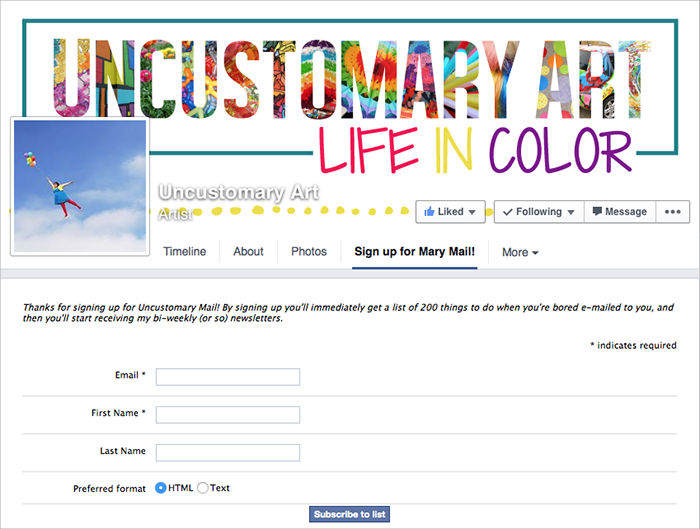
Turn your Facebook followers into email list subscribers by adding a sign up form to your Facebook page. You can also create a hosted form so you can gather email subscribers on Twitter, Facebook – anywhere!

Email + Your Blog

Email can help you get more mileage out of your content and get it in front of more people.

If you’re a realtor and you have a great blog post about budgeting tips for buyers, you could create an autoresponder follow up series based on those tips. That way, new subscribers to your list won’t miss out on your best content.

Speaking of missing out, email also ensures that your existing audience won’t miss a single post. Send your subscribers an email every time you publish a new blog post. If you post multiple times a week, you can send them a weekly blog digest so they get all of your content delivered directly to their inbox.

To promote your list on your blog, ask your readers for an email sign up at the end of your blog posts so they can get even more great content from you.

Email + Promotions

Email can boost the profitability of your existing marketing strategy. Here’s how.

Since email marketing has an awesome ROI, promoting any products or services you sell via email is a no-brainer. For example, if you’re selling an ebook, you might already be promoting it on social and teasing it on your website and blog – but people love exclusive offers. If you offer a discount to your email subscribers only, you can increase the value of the your email content and make more money using your email list.

To take it a step further, you can send targeted emails to your customers based on their behavior. If you have a segment of customers that purchased your first ebook, why not promote your second ebook to them too? You can also send targeted emails based on location, interests and more. This helps create a more personalized experience for them, and a more profitable one for you.

There’s no doubt about it; email can help take any marketing strategy to the next level. Put these tips to work to see for yourself what email marketing can do for your business.

Want to add email to your marketing strategy today? Start your free trial with AWeber today!

Don’t forget to download our free guide to learn more about growing your business with email marketing:

The post How Email Fits Into Your Marketing Strategy appeared first on Email Marketing Tips.

20 Jul 16:42

Top 4 B2B Buyer Requirements You Can’t Ignore

by Rick Reynolds

Wouldn’t it be nice if business-to-business (B2B) buyers sent out an announcement that their needs are shifting? It wouldn’t be hard to respond to buyers’ needs with this kind of notice, but that is not reality. The impetus is still on you as a sales professional to uncover your prospects’ needs. However, it can be helpful to have insight straight from mouth of B2B buyers regarding why they choose to buy from one provider and not another and compare how these needs change over time.

Give your company an edge by focusing on the top needs of buyers. Below are the top four requirements B2B buyers value, according to the 2015 AskForensics Sales Analysis, which is an evaluation of more than $2 billion worth of B2B enterprise accounts.

1) Service Quality

Service quality is listed as a top priority by 25 percent of B2B buyers in 2014 so it is a need worth attention. Service quality was also a pronounced need in 2013, cited by 18 percent of buyers. Service quality boils down to how well a provider is able to help a client improve their performance. Prospects are looking for hard evidence that your company’s level of service quality is capable of providing strong operations and results. When it comes to service quality, buyers are most concerned about a provider’s ability to deliver timely service so pay close attention to demonstrating how your company provides accountability for on-time service.

2) Program Management

Approximately 22 percent of B2B buyers cited a provider’s program management capabilities as a major contributing factor to their final purchase decision, up from 16 percent in 2013. Program management entails the overall supervision of services, most often provided by the customer-facing team. However, buyers also reveal that they also want program management to include providers proactively recommending innovative ideas. In other words, buyers want continuous innovation from you as the provider to improve their overall total performance and bottom line.

3) Financial Performance

Financial performance experienced a significant drop from 42 percent in 2013 to only 16 percent in 2014. Although not as much of a priority as it has been in the past, financial performance is still a top requirement for B2B buyers. Financial performance encompasses an overall financial model that provides competitive pricing, helps the client achieve competitive operating costs, and improves the client’s profits. Financial performance in 2013 primarily encompassed providers helping companies decrease their operating expenses, while financial performance in 2014 was needed more for scaling the scope of services to meet buyers’ specific requirements. In both instances financial performance is not about low price; it is about improving a customer’s total effectiveness and financial results.

4) Account Support

A provider’s account support capabilities are cited as an influential deciding factor for buyers. In fact, account support increased in importance from 6 percent in 2013 to 15 percent in 2014. Account support encompasses the total support from the service provider’s sales and account teams. Both teams are expected to identify and address needs the buyer is articulating, as well as hidden, subtle or emerging needs. These teams then must be able to proactively offer recommendations that address the heart of the issues the prospect is facing and offer partner-level support. In 2014 buyers most valued providers who were best able to offer account support in the form of providing best practices, proactive recommendations, and partner-level support.

And there you have it—buyer requirements straight from the mouth of B2B buyers of enterprise companies. While this list is not a replacement for uncovering the unique needs of your prospect, you can gain an edge by keeping these four buyer needs top of mind during your next sales interaction.

For 5 ways to improve your outbound sales performance, download the free Salesforce e-book.

20 Jul 16:42

5 Time-Saving Tips For Salespeople

by Emma Snider

As far as I know, time is still a limited resource. This means professionals need to optimize their workdays to achieve their goals and objectives.

Salespeople in particular should take heed of this advice. Spending an extra hour or two on a deal or slacking off for an afternoon could spell the difference between breezing past quota or missing it by a mile. For salespeople, the maxim “time is money” is especially relevant.

How can you make the most of your minutes? Work the following practices into your day-to-day to avoid wasting time and speed up your process.

1) Use customizable templates.

Note the word “customizable.” You shouldn’t send out the exact same email to every single prospect you want to engage. That’s called spamming, and it’s unacceptable in sales.

However, it’s smart to store a few templates in your email or CRM system for time’s sake. Instead of reinventing the wheel every time you want to reach out, simply grab the appropriate template when a buyer hits a certain stage and personalize it. For nine sales email templates on a variety of scenarios, check out this ebook.

2) Qualify correctly.

You know what wastes time? Selling to someone who can’t buy your product or service. And yet, salespeople do this every day.

This is a qualification problem. The best salespeople aren’t afraid to disqualify aggressively and quickly because they know the sooner they hear a “no,” they faster they can move on to a prospect who will say “yes.”

A lot of activity doesn’t automatically generate good results. In sales, it pays to be choosy. Don’t spend time on bad fit prospects — cut them loose and seek out good fit buyers instead.

3) Get LinkedIn to deliver prospects directly to your inbox.

But doesn’t it take a lot of time to find prospects perfectly suited for your product? Well, not necessarily.

With LinkedIn saved searches, you can actually set up a search in LinkedIn for the type of prospects you’re looking for, and choose how frequently you’d like results emailed to you.

Here’s how:

5 Time-Saving Tips for Salespeople

Want more hidden LinkedIn hacks? This SlideShare is chock full of them.

4) Schedule your day on your buyer’s time.

Let’s say your goal is to make 10 connect calls this week. You block out time to make calls every day from 9 a.m. – 9:30 a.m.

But…no one answers. You fail to have even one live conversation. What happened?

Well, that depends on your buyer. 9 a.m. could be a great time to call, or it could be the worst time. If you’re trying to reach a B2B businessperson, they probably haven’t even sat down at their desk yet!

HubSpot director of training and development Andrew Quinn advocates that salespeople schedule their days around their buyer. Instead of making prospecting calls when it’s most convenient for you, think about when your prospects would be most likely to answer the phone or respond to an email. Then rearrange your calendar to increase your odds of connecting.

Instead of wasting time chasing down prospects and making attempt after attempt after attempt, this simple scheduling hack will help you maximize your prospecting time and minimize the call backs and follow ups.

5) Set up Google alerts.

No one has time for a completely cold call with an irrelevant pitch or a product pushing email anymore. Sales reps must research their buyers and customize their outreach to add value from the very first touch. Otherwise, you can forget about grabbing a busy buyer’s attention.

But who has time to research when your day is already jam-packed with calls, meetings, and coaching sessions?

Enter Google alerts.

If you’re trying to break into a specific company, set up an alert for the organization’s name, industry, and appropriate keywords, and watch the news flood in. The next time you want to reach out, simply scan your alerts for relevant announcements and customize your message accordingly.

Although there’s no such thing as a 25-hour day, these tips might make your day feel an hour or two longer. And more time means more deal-closing conversations. Get out there and sell!

What other time-saving tips for salespeople would you add?

20 Jul 16:42

3 Words to Ditch To Improve Your Sales – Sales eXecution 304

by Tibor Shanto

By Tibor Shanto – tibor.shanto@sellbetter.ca 

Garbage

Words are a big part of selling, seems obvious, but you’d be surprised how little attention some in sales pay to the words they choose. Words impact not only what your prospects hear and their reactions to them, but almost as important is the effect they have on you as the seller. Words impact and reflect you view of things and situations, and while many will argue that it’s just semantics, they fail to realize or acknowledge the degree to which words you choose reflect and signal your intent; something that your buyers pick up and are influenced by as much as anything.

Now let’s be clear, most don’t set out to use words that may hinder their success, and often they use certain words or phrases because they were brought up right. Like asking “is this a good time” when they interrupt a busy person in the middle of their day. Most people do it to be polite, a good thing, but the result is counter to the objective of the call. In most instances the prospect says “not really”, the sellers asks “when is a good time?” Prospect offers up a random time, and the rest is just painful.

As with most things it needs to be brought to their attention, and then the hard part, putting it into practice instead of going back to the same old, same old.

So here we go:

Gatekeeper – Talk about starting off on the wrong foot. Right out of the gate, us vs. them. Sadly, many of the people that sellers refer to as gatekeepers, can actually be helpful in moving your agenda forward. Today’s executive assistants are part of the “inner circle” and are very aware of their boss’ and organizations’ priorities and objectives, the better you align with those the more likely that the person in question can move from being a “gatekeeper” to a “gateway” to your success. Rather than looking past them as some would suggest, work with them, engage them the way you would any decision maker, you’ll be pleasantly surprised.

Just – Nothing cuts you and or your message down a notch more than the word just. Look at the definition: only or merely – “He was just a clerk until he became ambitious.” Not a way you want you, your product or message to be framed. Most use it to minimize the intrusion or effort required, but all it does is minimize everything. If you can truly add value to their world, help them achieve objectives, then go bold, not minimize by putting a just in front of it.

Hope – Such an uplifting work that can do so much damage to your pipeline. You hear this drug sprinkled into sales conversations all over. “I was hoping to set up a time to meet”, no you wanted to meet, but had to settle for hoping because your talk track was not good. In pipeline reviews, “I am hoping to hear from them this week.” Rather than hoping, would it not have been a better idea to set the next step before one left. I can be humorous and say I was hoping reps do that, but when those words come out, all hope is dashed. Decision makers want to deal with decisive people, hoping is not an attitude that conveys that.

So there you have three words in sales that hurt, cut them out, if you replace them replace them with something strong and forward looking, but you don’t really need to replace them at all, just sell.

Tibor Shanto    LI Bottom banner

20 Jul 16:40

Anatomy Of An Interactive Infographic

by Lena Prickett

blog header image (9)_0.png

How can you get more out of the infographics you create? Educate and delight your audience by layering in interactive elements.

The time and effort you put into making an interactive infographic will pay off by marrying visual and kinetic learning in a powerful, memorable way. Our buyers love infographics because they’re hungry for information – and consuming infographics is much more efficient than gathering the raw data themselves.

You can also think of interactive infographics as an opportunity to flex your creative muscles. We flexed ours by using anatomy analogies to explain the science and elements of interactive infographics.

The Brain: Why Interactive Infographics Work

People are hardwired to be visual. It just plain works. Visualizing data and ideas makes them more accessible, memorable, and persuasive. Only 41% percent of people read the text of a page with more substantially more text than visuals, whereas 87% of people who see infographics will read the accompanying text.

1_1.png

Snap judgement: It takes us just 150 milliseconds for a symbol to be processed and 100 milliseconds to attach a meaning to it. Visuals are processed 60,000x faster in the brain than text. (Image via, facts via and via)

If you really want your audience to learn something, make your infographic interactive. People remember 80% of what they see and do, so requiring your audience to answer questions or interact with your infographic in some other way will increase their retention of your content, the value they get out of it, and the likelihood that they’ll share it with someone they know.Because infographics are so engaging, they provide a great additional stream of traffic to your website. Uploading infographics to your website increases traffic by about 12%. Interactive content increases time on site and page views by as much as 500%.

The Eyes: Design For Clarity And Branding – Interactivity Takes Visuals To The Next Level

There’s an art to data visualization — not just the difference between good and bad, but the difference between good and great.

2_1.png

Which of the two graphs below would be more appealing and accessible to your audience? (Image via)

Graph A and Graph B are both effective in communicating two sets of data: a) the top 5 active Twitter moments, and b) the number of tweets per second that correspond to each moment.

High five if you think Graph B takes it to the next level. Graph B quickly conveys the most important information (the top 5 active Twitter moments) in an eye-catching callout box, as opposed to placing this info underneath a bar chart. Your gaze can then wander over to tweets per second. The label “tps” recalls “mph” and makes us associate the graphic with speed. We can easily imagine this tweet-o-meter in motion—there’s interactive potential there.

Remember that infographics are a great way to strengthen your brand identity and add to your design assets. That shiny new icon set you made for your infographics could be used on other types of collateral. Lander’s How To Run An A/B Test On Your Landing Page’s infographic has the same look and feel as their website: same beige and blue palette, same illustration style. Over time, their audience will learn to associate this look and feel with the Lander brand. And these graphics can definitely be repurposed for future instructional materials.

The Hands: Enable Play, Discovery, And Learning

Part of our job as marketers is knowing that what delights and intrigues us will likely delight and intrigue others as well. Interactive infographics are a great exercise in doing exactly that. Here’s some ideas for incorporating interactivity into your infographic.

First, try asking questions. Alternating questions with data visualization is a great way to test users’ knowledge, determine their readiness for your product, or do a survey. FIS Global used the survey approach for their commercial banking infographic.

3_0.png

Asking questions is an easy way to engage users and can provide an additional stream of useful data. (Image via)

Second, give users one or two simple instructions for navigating your infographic. This Future of Car Sharing infographic by the Collaborative Fund uses a side-scrolling format and asks their user to “drive” the car through the infographic by hitting the right arrow on their keyboard. The infographic also instructs users (just once) to hover over national flags to reveal data. They appear throughout the infographic, and towards the end this becomes a familiar way to retrieve more info.

4_0.png

Oooh, a flag. We know what to do with that. 

Don’t be intimidated by how pretty this is — just think of the concept. Give your users easy, pleasurable things to do to trigger kinetic learning. Interactive infographics are a fun, memorable way to learn through physical activities. As they say on the Creative Bloq blog, “This combination of visual and kinetic approaches is what makes interactive infographics the data visualizations of the future.”

The Heart: Use Your Data To Tell A Story

One major function of infographics is storytelling, and there are lots of ways to do it. If you have a point to make, start with your thesis statement, use data to prove your thesis, and end with your conclusion. You can also try a more subtle approach. Charles Schwab wants you to know that you’ll be better off in life if you start saving for retirement early, and their infographic tells the story of two characters’ journeys towards retirement.

5_0.png

Props to Atlassian for their lively, playful copy. 

In their Communication Through The Ages infographic, Atlassian utilizes a timeline to visualize a brief history of human communication. To position your brand as an industry expert, you can create a “lay of the land” infographic that is a big picture, encyclopedic view of an industry or a geographical area.

Salesforce has narrated the story of what happened on the Internet during the Superbowl in their infographic. Even if you weren’t online that day, reading this makes you feel like you were actually there. You could take a page out of their playbook and present a slice of data from just one busy day.

Connective Tissues: Beauty Is In The Details

Tie it all together with some thoughts about the finer details of user experience. Here’s a brief checklist. Are you paginating your infographic, or do you want users to scroll? Is your copy the leanest it can be? What’s the smallest word count you can get away with? How does your infographic respond to user interactions? Here’s some actions that might trigger a cool response: Hover. Highlight. Reveal. Enlarge. Select. Calculate. Answer. Share.

Demand Metric’s content marketing research infographic utilizes a simple, flashcard-like flipping animation throughout the entire infographic to provide context for the presented data. They also use a cursor to subtly indicate that users need to click to interact with the infographic.

6.png

When you hover over a section of the pie chart, it detaches and displays the associated data. Pretty neat. (Image via)

Gemalto and SafeNet’s breach level index infographic seems to be a live infographic that constantly receives and updates the displayed data. This real-time experience effectively communicates that without the right data security measures, sensitive data is leaked all the time, around the world, in different industries, by different parties. If you’re curious, you can calculate results for a specific time frame.

Small details can pack a big punch, so don’t miss out on a chance to add spice to your interactive infographic and make your audience smile. It may take a little longer, but it will be worth it for the amplification you get from people sharing it with their networks.

Conclusion

There’s a lot to the science and art of interactive infographics. Just take it one step at a time: visualize your data to tell a story, give users something simple to do, make sure that they learn by doing, and add surprising or intriguing details to trigger a “wow” moment.

Anticipate the information your audience is looking for, and deliver it in an imaginative package. Don’t be surprised if your interactive infographics turn out to be the star of your marketing mix.

Learn more about how & why interactive content works in our interactive white paper!

20 Jul 16:39

B2B marketing funnel is dead isn't it? Facts vs. opinions. [video]

by Hugh Macfarlane
The B2B marketing funnel is dead. Don't you get frustrated when buyers come to you asking for something you don't sell, or with a view of what they need which is just plain wrong? In an article on the Salesforce.com, guest blogger Sangram Vajre promises that "The B2B Sales Funnel Is Dead — and Here's the Proof". His key points are that 70% of the buyer’s journey is complete before a buyer even reaches out to sales (SiriusDecisions), and that the average deal has over 8 decision makers, a 43% increase from 3 years ago. (IDC) So, apparently the B2B marketing funnel is dead. No its not, but that's such a popular headline, that we need to lay out a few facts.  Early notions of a B2B marketing funnel were based on a single attempt to sell: see an ad, ring up, engage with an inside sales person with a script, receive a compelling small step offer like a trial, respond, happy days. But many of us in B2B never had that simple world. We had many buyers, deals which were weeks months or years in the gestation. And that hasn't changed. We certainly had more names than leads, more leads than opportunities, more opportunities than firm proposals, and more proposals than sales. And that hasn't changed either. Today we're going to talk about what has changed, and what we need to do to better manage our b2b marketing funnel. I'll also share a great tip for a tool you might use to feed your B2B marketing funnel with great content.

read more

20 Jul 16:37

5 Effective Ways to Reheat Cold Leads

by Reuben Yonatan

According to InsideSales.com, you are nine times more likely to convert web leads if you do a follow up within five minutes. And did you know that the best time to email any of your prospects is between eight in the morning and three in the afternoon? As you can see, there are several guidelines you should be following to improve your leads. But even when you’re following all of them to a T, you’ll still end up with more than a few cold leads. Fortunately, though, there are several unique ways to reheat them.

1. Remind Them of Who You Are

When was the last time you came into contact with your cold leads? What do you remember about the situations? You need to be aware of the former communications you’ve had with each cold lead, and use this information to refresh their memories. By reminding them of who you are, they are more likely to experience brand recognizance, which enhances your company’s professionalism and customer trust. The best way to keep track of cold lead interactions is by integrating your sales process with your CRM, including the best time of day to contact a specific cold lead, their topics of interests, and whether or not they are progressing toward a purchasing decision.

2. Personalize the Communication

No matter the form of communication that you use to come back into contact with a cold lead, you must make it personalized. After all, studies have shown that the more personable you are with your customers, the more likely they are to make a positive purchasing decision. When the content you deliver to the cold lead is relevant and engaging, it has a much higher chance of being read/viewed and responded to. McKinsey & Company released findings of a study that stated relevant content can boost the ROI of cold lead investments to $44 for every $1 spent. The simplest ways to make your communications more personalized are by: Quit routing all of your customers to an automated phone system. Instead, let them speak to live agents Always ask a question when starting off your communications. When you engage your cold leads with a question, they are more likely to be interested in what you have to offer. Talking about the weather. Studies have shown that talking about the weather makes consumers more willing to open up and talk. Think about it. When you start talking about the weather, there are so many different directions your communications can go in. Many of which, can lead to a sale.

3. Surround Them with Communications

No one likes to be smothered, especially with spam marketing material, but to get the point across that you want to come back into contact with a cold lead, it’s suggested that you use at least three forms of communication. Ideally, you’ll want to reach out by phone, email, and social media. When making a phone call, make sure to keep the greeting short and include the cold lead’s name. Then state your purpose for calling — 10 seconds or less — and ask if the person is interested. If he says no, tell him you’ll be in touch again to see if your services are needed in the future. When reaching out by email, make sure to include the person’s first and last name in the greeting. It’s important to keep the body content no longer than a paragraph, or the recipient may avoid reading through any of the email. End the email with your name — not just the company name — and your contact information, including a mobile phone number. When reaching out through social media, keep the communication extremely short. Whether it be by private messaging or posting to a cold lead’s profile, all you need to do is state how you think your services or products could be of value.

4. Compliment Each Cold Lead

For many marketing specialists, the best way to warm up cold leads is by appealing to them on a personal basis, and the most effective way to do this is by giving them a compliment. By commenting on a discussion they’ve started or a blog posting they published, you can be well on your way to warming them up. If a cold lead has social media profiles, you should find and follow them, including their LinkedIn page.

5. It’s Very Similar to Dating

Coming back into contact with a cold lead is a whole lot like dating. You must convince the consumer why you are worth taking a second look at. Let the cold lead know that the more you know about them, the more you can be of service. One of the best ways to get them to open up is by walking them through the entire sales process, and most importantly, listen to them. They will likely have many questions about the sales process, and by addressing these pain points, you can then create solutions.

The Takeaway

Cold leads should never sit on the back burner. You need to communicate with each cold lead at least once every six months, and preferably even more often. As stated before, the best way to keep track of cold leads and their status with your company is by inputting each communication data into your CRM.

Want 5 ways to improve your outbound sales performance? Download the free Salesforce e-book.

20 Jul 16:36

What Every Managing Partner Needs To Know About Lead Generation

by Lee Frederiksen

Lead generation means different things to different firms. For some, it might simply mean getting referrals from clients who are pleased with their work. For others, it might mean attending networking events.

While seeking client referrals and networking are both legitimate approaches to lead generation, they are no longer the whole story. Not even close.

Let’s look at what lead generation has evolved into, starting with the basics.

Lead Generation Defined

For our purposes, lead generation is simply the front-end of the process of identifying potential new clients. It might include referral generation and professional networking, but your lead generation techniques should go further to encompass a full range of targeted online and offline measures. Think of it as a system that generates, qualifies, and nurtures leads until they become new business opportunities.

Why Lead Generation Matters

An effective lead generation strategy and system is essential to the health of your firm. The fact is, the market is changing. All firms must adapt to shifts in demand, delivery strategies, market dynamics, and more.

Some firms are winning, while others are falling behind. The firms with the strongest lead generation strategies are best prepared to be the ones that develop new business and thrive.

What You Need To Know Now

So how can you make sure your firm is among the winners? Here are seven things every managing partner needs to know about lead generation to succeed in today’s marketplace.

1. Leads can come from many sources, so you need a balanced strategy.

The most successful firms generate leads offline and online. The reason shouldn’t be surprising – it takes a diverse set of tactics to capture the many different types of leads that stand to be generated.

Roughly half of firms’ leads come from online sources like search, social media, email marketing, online advertising, and others. The other half come from face-to-face sources such as in-person networking, speaking engagements, and trade shows.

Our research shows that when these approaches are balanced, that’s when firms generate the most leads and are most profitable. The fastest-growing and most profitable firms balance a diverse set of lead generation techniques to leverage all available opportunities. Just take a look at this graph.

Firms that generate leads online are more successful, on average, than firms that don’t. But strikingly, the most successful firms are those that generate somewhere around 50% of their leads online. This balanced approach leads to the greatest success.

2. All leads are not equal – but that doesn’t mean they’re not all valuable.

We all know that some leads are worth more than others. The leads that are most valuable today are those that stand a reasonable chance of becoming good clients in the short term.

But because they are not ready to buy today doesn’t mean that they are not valuable in your overall strategy. In many firms, there is a tendency for those in business development roles to devalue and reject leads that are not ready to buy today.

This is a mistake for several reasons. First, some potential clients are not ready now, but will be in the future. Will they seek you out then?

Second, some leads may not be a good fit with your firm, but may refer others who are a good fit to you. Are you treating them as a valuable referral source?

Third, some firms may not realize they have an emerging need that you can help them with. Will you be able to help them identify and understand that need?

We’ll talk more below about how a system of qualifying and nurturing leads can extract more value from the leads you do generate.

3. There are multiple kinds of referrals.

Remember when we talked about referrals above? For many firms, referrals are the favored technique for lead generation. And it’s true – referrals are important. But referrals are also more complicated than most firms realize.

Traditionally, many firms have thought of referrals as coming from clients or colleagues from other professions. These are major sources of referrals, but they’re not the only ones. In fact, our research shows that 81.5% of buyers have received a referral from someone they have never worked with.

Who are these other referrers? Members of the informed marketplace. Many industry audiences may know you by reputation or through familiarity with your educational content. And these folks are valuable referral sources who you must leverage to remain competitive. Consider the sources of reputation-based referrals.

About 45% of reputation-based referrers make their referrals based on a perception of firms’ good reputation. The other 55% are happy to make a referral given that they have heard of a provider through trusted friends or colleagues. In both cases, a positive reputation is a tremendous asset.

Today, the most effective firms take a multi-channel approach, generating referrals both from clients and from their wider industry audiences. By becoming Visible Experts, your firm can utilize your knowledge and reputation in the field to generate more referrals and more leads. Importantly, high visibility expertise also makes it easier to close deals.

4. You can easily lose a good lead.

Closing a deal is the whole point, right? Unfortunately, it’s all too easy to lose a good lead. In fact, over 50% of professional services buyers have ruled out firms they were referred to before they even talked with them. Yikes!

You can take a look at the top reasons buyers rule out referrals to get a feel for all the ways leads lose interest.

In order to grow more qualified and comfortable with you, leads need to understand how you can help in the first place. Your website, your content, and your style of engagement should all be designed to give leads all the information they need on your expertise and services.

As you share this information, though, remember that education has to be your watchword. If you’re too sales-oriented – if you’re all about you – buyers will be turned off. You have to focus, therefore, on your audience’s challenges and how best to solve them.

To take just one example, your blog posts shouldn’t be about your services, at least not explicitly. They should focus on common challenges among your target audience and how to tackle those issues.

5. Qualifying leads is critical.

We talked a bit about qualifying leads in Item 2 above. Not every lead is a potential client. Some may be too small or too large. They may be in the wrong industry or they may not have a current recognized need. But that doesn’t mean they are of no value.

One way of understanding lead qualification is to start with the buying process. Of course, not every lead is at the same stage of the buying process.

Sure, some leads are ready to engage right now. These are great opportunities. But there are many, many more who might make fantastic clients – someday. They’re in your target audience, but they’re not quite ready to buy yet. Instead of simply ignoring or waiting passively for these buyers to come around, it’s important to qualify them in an active way.

Through content, you can help them understand their challenges more deeply or in a new way. You can demonstrate the different types of solutions available, and how you approach their problem. Through closer and closer engagements, these clients will become qualified.

Finally, some audiences simply aren’t a good fit and probably won’t ever be. But they may make a strong referral source. Ignore these readers at your peril. Continue to nurture them as referral sources. Use low cost online techniques to make the cost benefit work.

6. You must nurture and educate most leads before they can become an opportunity – and then a client.

The lead nurturing and education process we’ve discussed isn’t just a good idea – it’s basically a necessity. Most buyers just aren’t ready to buy at first contact. Rather than wish it were otherwise, you need to have a strong business development process in place to engage with leads and draw them through the buying process.

As we’ve discussed, a key first step is to provide content marketing to establish your expertise. Another important benefit of content is that it grows your visibility, cementing your credibility and generally making closing easier. Influencers and referral sources will need love too. So don’t make the common mistake of focusing on direct prospects to the exclusion of everyone else.

That may sound like a lot to juggle. Some folks will say, “I’m too busy.” But that’s just not a great excuse. If you’re too busy to grow and succeed, you may want to change your line of work – before the industry leaves you behind.

7. You must have a structured lead generation process.

You can’t fly by the seat of your pants when it comes to lead generation. This is a key reservoir of future business.  You need to treat it that way, building out a detailed lead generation strategy and system (or processes) to fully implement that strategy.

And as you implement your strategy, it’s critical to track your results and adjust your approach accordingly. Consider every step of the sales funnel, and identify where you may face challenges or opportunities.

Lead generation has been the topic of all too many misconceptions – and entrenched bad habits. Thankfully, it’s changing.

In this new and more competitive professional services world, firms need a new scientific approach, as well as a long-term systems-oriented view. If they’re able to achieve this perspective and carry through for the long haul, they’ll be positioned to succeed.

20 Jul 16:36

5 Characteristics Of A Foolproof Sales Pitch

by Maxim Baeten

Blog image Sales Pitch

According to a study by Greenberg & Greenberg, 20% of top sales reps close 80% of all deals . This means that 80% of a sales force fights over the remaining 20%. This discovery leads us to wonder how significant the revenue increase might be if 100% of a sales team was enabled to sell at their maximum potential. So what stands in the way of 80% of the sales force? How can they sell better and close more deals? In order to close deals and drive revenue, sales reps must ensure they bring value during a sales pitch. We have identified 5 ways to foolproof your sales pitch and snag that coveted deal.

Ditch The Pitch

Our first key step is ironically enough “ditching the pitch”. Great sales conversations lead to more sales deals. Customers want to hear stories that resonate, not listen to a sales pitch. Within the first year, sales reps often fail to make quota more than 50% of the time. This could possibly be due to a sales rep’s use of ‘traditional selling techniques’ that are now viewed as rigid and redundant. Instead of delivering a sales pitch, have a conversation. This will build a better rapport with prospects and determine exactly what they are looking for in a partnership with you.

Know Your Buyer

It is important to make every customer feel special and important. In an age where the buyer is being bombarded with immeasurable messaging, it has become imperative that the seller cuts through the clutter. Be informed. Know exactly what is happening in your customer’s industry. According to a Forrester Buyer Insight study, only 13% of executive buyers believe that a salesperson can clearly show they understand their business issues and articulate a way to solve them. Set yourself apart from your competitors by familiarizing yourself with your customers’ needs and their industry’s latest market trends. By doing so, a salesperson will demonstrate that they care enough to tailor their sales conversation to the specific buyer and have a strong understanding on the prospect’s business needs.

Map The ROI

Every customer needs to be sure that a solution they invest in will be well worth the cost. A comprehensive analysis of the effect your solution will have on the client’s business will go a long way towards establishing a deeper connection. Be it a coffee or a car, the customer always wants to be aware of the value proposition they are getting for investing in your product.

Present Solutions

Every person on this planet is on a constant journey to eradicate challenges and make their lives simpler. Customers will be greatly interested in your product if you present their challenge and then display how your product will solve it. Specific case studies that present how your product made the lives of people simpler, sleeker, and better by negating or modifying their challenges will greatly heighten the chance of winning the deal.

Create The Vision

Keep the bigger picture in mind while attempting to persuade a prospect to partner with you and your solution. Simon Sinek, the author credited with popularizing ‘the Golden Circle’, rightly said, “People don’t buy what you do; they buy why you do it and what you do simply proves what you believe.”

Customers have to connect with the brand values and vision to feel like they should associate themselves or their brand with yours. Stories are a great way to strike a connection, and if combined with facts and figures, it will become a memorable and enjoyable experience for any customer. At the end of it, the customer should be engaged and invested enough to want to stay around you and your product for longer than just a one- time purchase.

An award winning sales presentation trainer, Patricia Fripp, stated, “You don’t close a sale; you open a relationship if you want to build a long-term, successful enterprise.” To successfully build strong, sturdy relationships, follow closely to these five steps and close deals like champions!

To learn more about improving your sales effectiveness and increasing sales, check out our blog on how to make customers the center of every sales conversation.

This article originally appeared on the Showpad Blog.

20 Jul 16:36

How Business Dashboards Can Boost Your Small Business

by Sreeram Sreenivasan

How Business Dashboards Can Boost Your Small Business

As Business owners, we need to regularly keep track of how our business is doing; keep an eye on the various activities and processes of our business; find out which areas are performing well and grow them; figure out which areas are not doing well and fix them.

But, how do we constantly monitor the various aspects of our business? How do we identify new growth opportunities and respond quickly? Logging into various systems and pulling out the required information may be fine, once in a while. But doing it every day or week can be time-consuming. On the other hand, without this information, you have to simply rely on gut instincts and guesswork.

That’s where business dashboards come in.

Just as the dashboard of your automobile tells you how fast you are going or if you are running low on fuel, a business dashboard tells you how your business is performing – highlighting the goals you have achieved and any problems that might be occurring.

A small business dashboard is a set of charts & numbers that shows exactly what’s going on in your business. It provides at-a-glance status of your business so that you can spot growth opportunities and risks instantly.

Business Dashboards can boost your Small Business in 7 ways as follows:

1. Monitor status of your business from one place

Business dashboards enable to know exactly what’s going on in your business, what’s working and what’s not. Each business depends on various processes such as sales, customer support and marketing to run smoothly. Dashboards help you gather all the important metrics from various parts of your business like total sales, daily sales and number of new visitors/customers in one place and monitor the health of your business regularly.

2. Drill down into individual business processes

Dashboards can be used to not only get an overview of your business but also dig deeper into specific business areas for detailed information. For example, if you see a sudden dip in your sales, you can drill down into your sales dashboard to get more information such as sales trend for each product or region, identify the cause and take action. This allows you to quickly investigate issues and respond immediately.

3. Immediate measurable feedback

Business owners are constantly trying out new ways to grow their business faster. Dashboards make it easy to measure business performance and provide immediate feedback. For example, your dashboard can show the impact of your latest marketing campaign on your sales. You can find out which customer segments(e.g. based on age, location, etc.) bring in most sales and refine your marketing efforts to target the ones that are not responding well. Such immediate feedback enables you to find out what’s working and quickly improve performance.

4. Quickly find answers to your business questions

Everyday, business owners get so many questions which need immediate answers. How many people signed up yesterday? How many new customers have we attracted this week? What is the total sales? By how much did it grow this month? How many customer support issues are still open? Without this information, we have to rely on guesswork, to make decisions. Dashboards automate the tasks of number crunching & data processing, and directly provide you the final numbers. This allows you to spend more time running your business instead of looking for information.

5. Increase profits

Dashboards can be used to monitor revenues & costs regularly. You can break out these numbers by various sources (e.g., revenue from direct sales, content marketing, SEO, Social media, etc.) and compare them with the associated costs. This allows you to measure their ROI (Return on Investment) and try out various initiatives to increase sales or streamline costs, and increase profits.

6. Boost productivity

Business dashboards automatically pull the data together, process it and show the results in real-time. They can be set to update automatically once every few minutes or hours. This enables you to spend time understanding business issues & growth opportunities instead of creating reports manually.

7. Collaborate with your team

Dashboards make it easy for you to collaborate with your team. Dashboards can be accessed anywhere, anytime using a laptop, workstation or a mobile phone. They even allow you to share insights and questions with each other, using comments. This allows everyone in your team to easily get the latest information about your business and be on the same page. Also, it saves you the trouble of mailing reports back & forth.

Initially, you can start by creating a simple Small Business Dashboard/Startup Dashboard to regularly track the key metrics about your business and share them with your team. Reviewing it daily/weekly will enable you to see how your business is progressing with respect to business objectives, identify growth opportunities and take action. You can add more metrics to it if you need more information.

Here’s a list of business dashboards that can help you in various aspects of your business:

Marketing Dashboard

Marketing Dashboard can be used to monitor all your marketing channels like SEO, Email, Social Media and analytics from one place. It can enable to you to track the number of leads, conversion, branding and engagement. Marketing dashboards are great to identify which channels are working for your business and which ones aren’t. They can help you tie each channel’s contribution to your goals so you can stop focusing on non-responsive channels and plug the budget leaks.

You can even create channel specific dashboards to get in-depth information about a particular channel such as social media or SEO. Social Media Dashboards can be used to monitor number of mentions, twitter followers, Facebook Demographics & more. Web Analytics dashboards can help you track top referring domains, SEO keywords, location and source of traffic, and their site engagement.

Sales Dashboard

Sales dashboards are a great way to keep track of your sales pipeline. They can be used to view sales goals, top performing reps, new customers, latest opportunities, leads, wins. You can even monitor number of leads in each stage of your sales process, identify the bottlenecks and fix them. You can boost your sales pipeline velocity by monitoring key metrics such as number of qualified leads, win rate, sales cycle length, and average deal size. You can even break them out by various sources to get more details and identify areas of improvement.

Finance Dashboard

Finance dashboards can be used to view your business’ financial data in one place. You can find out how much you are spending, as compared to your business plan. You can track your costs & expenses over time and think about what adjustments can be made. This can help you keep an eye on business expense, company revenue, customer invoice and balance.

Customer Support Dashboard

Customer Satisfaction is one of the most important requirements for a growing business. For that, it’s important to always know which customers are facing issues. You can create a customer support dashboard to regularly monitor key customer support metrics such as number of reported issues, average response time, average resolution time and abandonment rates. You can even break out these metrics by type of issues to gain more granular insights. Monitoring your customer service performance will enable you to rapidly improve it. You can easily identify the key pain points of your customers, support agents that can benefit from additional training and areas which need additional resources. It will help you improve your product or service, boost customer satisfaction and grow your business faster.

Being able to monitor all the vital information about your business, on-demand, in your dashboard, gives you a huge advantage over your competition. You know precisely how your business is performing and what to fix, while they spend most of their time on the wrong tasks.

Bob Parsons, the founder of GoDaddy, once rightly said, “Measure everything of significance. Anything that is measured and watched, improves.”

Image via Shutterstock

20 Jul 16:34

Data-driven marketing strategy

by Neil Davey

Understand your marketing ROI and use the data to inform your data-driven marketing strategy

While the attraction of data-driven marketing isn’t in doubt, the challenge confronting businesses can be daunting.

According to the Q1 2014 Gleanster Research customer experience survey, about eight out of ten senior marketers believe their organisation could be doing a better job of using customer data to inform customer acquisition and retention strategies.

But with data-driven marketing involving so many working parts, the end goal can appear unobtainable. To create a data driven strategy, you first need to know how to establish an effective way to measure marketing ROI.

Data-driven measurement

The advent of data-driven marketing should ensure that organisations can not only identify the strategies and campaigns that are most likely to be successful, but also secure buy-in and investment for marketers by demonstrating the potential ROI of impending campaigns.

Put simply, if a marketing department is truly data-driven, the measurement of ROI should be at the fore.

However, a number of obstacles and errors can undermine the efforts to measure ROI of even those organisations that are data-centric. For instance:

  • Businesses may be unable to access the necessary data to accurately measure the ROI because data is held in silos.
  • Organisations may not collect all the right data from the channels (email, SMS, mobile, web, social media, print) and ensure comparability.
  • Companies may not analyse the collected data for sufficient insights.
  • Total marketing costs may not be included – i.e. the fully loaded cost.

And of course there is also the issue of data volume.

“Today’s digital marketing tracking capabilities generates a pool of data that’s readily available to companies, whereas traditional marketing mediums such as direct mail and print couldn’t be tracked so accurately simply because data wasn’t available or when it was it wasn’t entirely accurate,” explains Kate Cooper, CEO of Bloom Worldwide. “The main challenge with data driven marketing today is that there is a lot more data available – choosing the most important data to analyse and not wasting time on the unimportant metrics will bring benefits. Data overload can be very daunting.”

So what steps can marketers take to ensure that their data-driven efforts put ROI measurement at the core of their operations?

measure ROI

Set SMART (Specific, Measurable, Achievable, Realistic and Timely) objectives

Marc Michaels, director of behaviour and planning at DST, says: “Do you want the campaign to increase revenue & profitability, increase retention, or build brand awareness, brand equity and brand identity? The duration of the payback can greatly vary in each case so you need to ensure you have the right timeframe for your ROI measurement.”

Plan

Identify what will be measured and how, which involves defining experimental designs (testing) to ensure that all measures (e.g. a campaigns response rate) and dimensions (e.g. a respondent’s profile) are able to be analysed with the appropriate level of statistical confidence.

Erfan adds: “Before ROI can be measured in a multichannel integrated marketing environment, it is key to set out a full evaluation plan that will identify the relative contribution of marketing channels. It is also important to recognise this contribution both in the short-term and in the long-term – i.e. considering the life time value of a customer.

“It is important to make sure that the right data is collected on a ‘continuous, consistent, comprehensive and comparable’ (4Cs) basis (custom links, landing pages etc.) and re-attribution methodologies employed as necessary for proper comparison.”

Run a pilot/small test campaign

This will help marketing departments determine how campaign will play out before committing large investments.

Analyse and review

Michaels advises: “Fervently collect data and analyse to provide detailed insight on the campaign’s performance and the factors underlying this result, e.g. full media source analysis by response channel. Periodically collate into a holistic ‘story’, share and discuss the analysis findings with all relevant stakeholders.”

Iterate

Change channels and calls-to-action for better performance, i.e. fix what is not working. “Evaluation will fully inform the optimisation of our activity to proactively and intelligently suggest improvements/redeployment of budget in the roll out in order to increase value for money and the payback from the marketing investment,” says Michaels.

Redeploy and scale up

Once you get the formula right for your marketing mix, you can start investing more money into the campaign. Adopt a continuous improvement ‘test and learn’ strategy that will slowly raise the bar in terms of the ROI effectiveness of your campaigns over time.

Michaels notes: “Once you understand the revenue-to-cost ratio, it's easier to start ranking marketing decisions. Should I advertise in press? Should I pay to advertise on Facebook? How does direct mail sit in the mix? Should I do a daily deal? The likely impact of all of these decisions can be assessed against your ROI hurdle.”

Company-wide goals

Another consideration that may further complicate ROI measurement for marketers is that with marketing increasingly sitting at the revenue table as co-owners of revenue, they also share the same goals and objectives as the company’s sales and service teams. This has implications for the way that marketers approach ROI, according to Erfan.

“It has become harder to measure marketing ROI, because it requires alignment with what sales defines as sales ready leads or what the services team believes determines a customer’s readiness for upsell. The ROI conversation in this context requires marketers – and their business counterparts – to have a consistent, single view into what describes a customer, and in particular what defines a high value customer.”

To help address this issue, it would be helpful for organisations to break down silos between the departments, bringing data from CRM, marketing automation, service and financial systems together in a single view, as well as agreeing on shared definitions, and aligning definitions of ROI as well. A further benefit of this, of course, is that this single trusted source of data can also be used to make strategic decisions on what types of customers to go after, where to focus your energies and what type of programmes to run.

Once ROI is defined a truly data driven marketing strategy can be established.

Key steps for developing a data-driven marketing strategy for you organisation.

Implement an organisation-wide data strategy

To be truly data-driven, data must be shared between business units, and for this to be successful, data needs to be managed consistently across the entire business. For this reason, businesses need to ensure that a strategic approach to data is adopted organisation-wide.

Restructure the organisation

For data-driven marketing to become a reality, different business units and departments must be able to collaborate and share data.

In particular, silos must be broken down between IT and marketing. IT is a vital partner for the marketing department, playing a crucial role in connecting the touchpoints throughout the business, and thereby supporting data collection and integration. Survey findings indicate that over three-quarters of marketers view the development of a strategic partnership with IT as a priority.

Create a cross-functional team

To support collaboration and break down silos, organisations should also develop a cross-functional team, including marketers and IT.

Forrester Research estimates that over 45% of Big Data deployments are for marketing – but that doesn’t mean that marketing should own marketing data and technology single-handedly: they must also recognise the skills IT brings to big data technology choices and deployment. It is therefore important for the CMO and CIO to work together, leverage different areas of expertise, pool resources and ensure the robust, scalable platforms are in place to deliver long-term value.

Integrate data

Marketers need to create a single, complete, actionable and flexible view of their customers and prospects. However, over time, most enterprises have invested in numerous marketing technologies that specialises in different disciplines, leading to siloed data and a lack of visibility of prospect behaviour, and a lack of a holistic understanding of customers.

To address this, enterprises will inevitably need to integrate customer data from disparate systems. The Global Data-Driven Marketing Survey indicates that businesses are making progress with this challenge, with 43% of executives reporting they have achieved fully integrated data across teams, compared with only 18% in 2013.

Leverage analytics

With the data integrated and augmented, businesses can utilise analytics to deliver actionable insights and guide decision-makers. And it is not just marketers that can benefit from this rigorous exercise – departments ranging from sales and customer service, to finance and purchasing, can all profit from greater insight into prospects and customers.

To drive results, identify high-priority customer personas (according to profitability or other goals), and then focusing analytics on those core personas and optimising for 3-5 of them.

Creating a data-driven marketing strategy is neither quick nor easy, and involves making changes across your organisation to be truly effective. However removing silos to better integrate departments so they can utilise data will deliver a marked improvement in results, and thus more than justify the effort involved.

20 Jul 16:34

The sales rep said, “I never got a lead yet that turned into a sale.”

by jobermayer@salesleadmgmtassn.com (James Obermayer)

lies_674x290_v.1

I was the marketing manager of a medical device company and we were near the end of the day’s sales meeting. Forty salespeople were in the room; I was last on the program. Everybody wanted to get out, hit the lobby bar and trade stories about high prices, the lack of new products, how their new quotas were too high and their territories too small.

As I closed my part of the program by projecting an ROI (number of raw inquiries, qualified leads, and projected sales) from our new lead generation program, I innocently asked if there were any questions.

Why_Important_-_Sales_Skills_v3Five or six hands were raised and I pointed to someone in the back of the room, asking her (regrettably) to speak up, and she said, “I never had a lead yet that turned into a sale.” Instinctively, I knew this wasn’t true, but without the numbers at hand, refuting it was a losing battle in front of the whole group. The leads she was getting maybe weren’t turning into a sale for her, and that was a different problem. But here I was in front of forty reps, the C-level managers, and my marketing staff and I needed an answer.

The room grew quiet; the other hands dropped. I smiled, gave an exaggerated cough to give me time to think, and scanned the room looking for someone to rescue me.

And then I noticed Victor, shaking his head from side to side in apparent disagreement, so I called on him. I figured I was all in at this point and had nothing to lose. “Victor,” I asked, “do you have something to add?”

Victor wasn’t a big man, but he had a big voice. He stood up and looked around the room and with a drill sergeant’s voice said, “I got a lead a week ago and sold them already. I call ‘em as soon as I get ‘em, and I get sales all the time from their leads. How do the rest of you feel?”

He looked around the room, now clearly the leader while I was the spectator, and hands started to go up. He called on each one and the testimonials started coming in. Sure, there were comments such as:

“We’d like better qualified leads.”

“We’d like leads on XXXX product.”

“We need email addresses.”

“We need phone numbers.”

“We don’t need more leads, we need more qualified leads.”

But no one ventured to say he never got a lead that turned into a sale. I heard:

“I get leads all the time that buy.”

“My big sale a few months ago came from a show lead.”

“I’d like to know more about their needs, but I get stuff that turns into a sale all the time.”

Someone even asked the person who made the comment, “Do you follow up on your leads? You can’t expect ‘em to issue a purchase order without talking to you!”

Why_Important_-_WorthAnd so it went for a few minutes, and then we closed the meeting on a high note. I learned some important lessons:

  • When giving a speech and you get a tough question, sometimes it’s best to let someone else handle it.

  • There will always be someone in the room to take a sometimes onerous question.

  • Not everyone thinks you’re a hero.

  • The marketing department’s efforts were considered valuable. We had worth.

And by the way, the rep who started it all came up to me at the bar and we talked. Of course she didn’t totally back down. But in talking with her, I found she had legitimate issues. She needed more inquiries which would lead to more qualified leads. She had a big territory, but there were small cities, far apart and with fewer buyers. She wasn’t making quota and needed help. The next day we started working on the problems to help her out.


Jim ObermayerToday's blog was submitted by James Obermayer. James founded the Sales Lead Management Association. Membership is priceless: Join here for free!


20 Jul 16:34

The Easiest Way to Ask for Referrals

by Sara Jantsch

The Easiest Way to Ask for Referrals written by Sara Jantsch read more at Small Business Marketing Blog from Duct Tape Marketing

Closeup of a business handshake

We have a great opportunity in the small business world these days that can be simply defined by one word: collaboration.  Coming together and focusing on a common goal, contributing what resources you have, and working towards something bigger that just yourself is the idea here.  I have the opportunity to work in collaboration with some of the world’s greatest marketing consultants on a daily basis with the common goal of helping as many small businesses as possible.  So what does this have to do with asking for referrals?

The easiest way to ask for referrals is to think about your best possible strategic partnerships and create a game plan for how you can add value to their audience and in return gain exposure (Hint, hint: Coming back to the idea of collaboration here).  What types of content would their audiences be interested in reading?  What live events would their audience spare time in their busy day to attend?  Below are four easy steps to creating your strategic partner referral plan.

Create list of possible strategic partners

It is time to start brainstorming.  Sit down with your team members and create a list of potential strategic partners using the B2B or B2C checklists.  Is there a local bank with a small business audience?  What about a Real Estate agent out there networking with your potential clients on a daily basis?  Or a graphic designer working in your niche?  Simply creating this list is the first step, coming up with how to target these possible partners is next.

Co-brand educational content

Now that you have your giant list of possible partners, it is time to narrow it down a bit to your best possible opportunities.  I would recommend starting with a list of your top five partners to target and then expand from there if needed. Once you have your top 5, audit your current and future content plans with your focused list in mind.  What eBooks, workshops, videos would the other businesses want to share with their audience and therefore introduce you?  Once you have “X company” and “X content” in mind, it is time to reach out and see if the potential partner would be interested in sharing the valuable content with their audience with the idea that they could co-brand the content.  The gift to their audience is valuable education, the gift to you is exposure.

Get in front of a live audience

Speaking for leads is one of the most effective ways to get your message out there.  One example of how a Duct Tape Marketing consultant speaks for leads is holding a 7 Steps to Small Business Marketing Success Workshop for an audience of small business owners.  A great opportunity here would be partnering with a local bank, lawyer, and insurance agent and having them invite their client base to an educational workshop.  The consultant then provides value to their client’s while also establishing themselves as an expert at a live event.  Another win-win in the books.

Come up with a follow-up plan

You have created your list, produced co-branded content, and spoken in front of a strategic partner audience – your job is done right?  Nope – it’s just getting started.  The main goal here is to add value. However, the 2nd goal is to gain exposure for your business.  Before you partner with a company, make sure to have set guidelines for follow-up in place.  Will you get the names and emails of the people that downloaded your ebook to target them directly?  Will you get to add a sales pitch at the end of your presentation?  After you agree on the process, think of the follow-up as another opportunity to add value.  Don’t simply send off an email asking if they are ready to sign up for your services.  Instead, follow up with an eBook or checklist where they can learn even more about your topic and by they way introduce the ways you could help them implement.

Sara JantschSara Jantsch is the Vice President of Operations at Duct Tape Marketing.  She oversees day-to-day operations to support the growth of Duct Tape Marketing and the Duct Tape Marketing Consultant Network.  She focuses on strategic planning, goal setting and directing the operations of the company in support of its goals.  Sara is also a Duct Tape Marketing Consultant and has a very strong passion for working with small business owners that started back at the dinner table as a child. Connect with Sara on twitter.

Related posts:

  1. How to Give Stuff Away to Generate Referrals I write about the power of building a network of...
  2. How to Use Content to Generate Referrals You do good work and people want to refer you....
  3. Landing Pages for Referrals Landing pages are pretty standard fare these days – you...
20 Jul 16:33

Successful Sales and Marketing Alignment, Part 3: Designing the Lead Process

by Lisa Cannon

SalesMarketingAlignment

The customer journey is rarely a linear path, but it’s important to try to map out what the ideal scenario might be and then come up with plans for any detours your lead may take on the road to conversion. The most basic version of the lead process tracks the flow of leads from the point at which they are generated, to the point at which they are passed to sales, to the feedback loop on lead quality.

When the sales and marketing relationship breaks down, the two sides don’t provide enough (if any) visibility into each other’s processes. That means they can’t really work together to solve problems or optimize their programs. Designing a collaborative, transparent lead process is essential to solving this problem.

Define the steps

Every customer journey can be broken down into a sequence of steps that happens once a lead is created. Sales and marketing should define these steps together. Each step should have a definition, a description of the current stage, and a clear expectation of what steps must take place for a lead to advance to the next step.

Assign responsibilities

Once the steps are defined, marketing and sales need to decide who is responsible for each step. For example, marketing may be responsible for generating the qualified lead, scoring the lead’s actions and attributes, nurturing the lead, and passing the data to the CRM. Sales may be responsible for contacting the lead, providing additional or complementary nurturing as needed, and closing the deal.

Determine metrics and SLAs

Each step in the lead process must have metrics and service level agreements (SLAs) associated with it. For example, marketing should agree to deliver a number of qualified leads, and sales should agree to contact these leads in a certain time period. These numbers should be tracked and reported on, and you could consider some form of incentive the teams could have for reaching a shared metric.

Automate the process

Once the sales and marketing alignment process is determined, marketing automation can be used to put it into action. For example, if you’ve agreed with sales that certain actions (such as visiting a pricing page) are clear buying signals, then those actions should be scored. Once lead scoring has been in place long enough to deliver metrics, it can be adjusted so that when a lead passes a certain threshold, the lead automatically goes to sales or into another program. This can also be used with existing customers to reveal interest in new products.

Nurturing programs can be created to manage many of the steps in the buyer’s journey, so that much of the ongoing educational process is directed by the leads themselves as they engage with your materials. Nurturing is a particularly effective tactic, as it results in both more closed deals and higher deal sizes.

All relevant data should automatically feed into a lead’s behavioral profile. This profile gives in an-depth picture of the buyer’s converts and interests and indicates why a lead becomes qualified, which is critical information for the sales rep who can review this and then decide what to say in that first call. The marketing automation database can be used for early-stage and mid-funnel leads, delivering leads to the CRM only when they become qualified. Those leads can be delivered in a prioritized list, highest-scoring leads first, giving sales a tool for time management.

The CRM remains the database of record, but its records are of higher quality than if it had to contain all prospects as well as qualified leads. And the sales team has real-time insights into a prospect’s actions. The database can also identify leads that are missing only one bit of important data in order to become qualified. For example, if a prospect has high behavioral activity but is missing a critical (but easily found) piece of profile information, the marketer can append it and pass the lead to sales.

The Big Picture

Your lead process must be customized to suit your sales cycle and your business goals. Here’s a straightforward rendering of one common model:

lead-process

  1. The moment a prospect becomes a lead is the first step in the process. Leads advance only if they fit the qualified lead definition. A qualified lead has met the proper criteria to move to this stage in the process.
  2. When the qualified lead definition has been met, the lead handoff takes place and the process now moves to sales.
  3. If sales agrees that the qualified lead definition has been met, the lead then becomes a sales-accepted lead. If sales does not agree that the lead fits the qualified lead definition, they will recycle it back to marketing.
  4. When a lead agrees to engage in the sales process, they become a sales opportunity and will remain in this stage until they close. If a sales opportunity does not move forward in the process, then sales will recycle the lead back to marketing.
  5. The recycle process moves leads from the sales-accepted and sales opportunity stages back to the lead stage.

Now let’s take a look at the what it takes for sales and marketing teams to create a successful customer journey.

  1. Define all the steps in the process. The process doesn’t need to be complicated, but each step should be thoroughly defined and given a name. An example is the “qualified lead” step, where the lead will have to meet the qualification parameters to which both sales and marketing agreed so that it can be passed to sales.
  2. Draw a table or flow chart. You should document the lead process in a table or flow chart after you’ve agreed to the steps.
  3. Determine responsibilities. Each step in the process needs an owner. For example, the lead qualification step is most commonly owned by marketing, while sales-accepted lead follow-up is owned by the sales organization.
  4. Determine metrics and SLAs. Each step will have a metric, and in some cases an SLA (service level agreement) associated with it. Marketing will agree to deliver or over-deliver a set number of qualified leads over an agreed-upon amount of time, such as a quarter. Sales will agree to follow up on these leads in a specific amount of time and be measured on their follow-up time.
  5. Incorporate the process into your marketing automation platform. Your marketing automation system can manage the end-to-end process as a lead becomes interested, initiates discovery, engages, develops into a qualified lead, and moves to sales. Don’t neglect existing customers; use your marketing automation platform to keep them engaged and create upselling opportunities.
  6. Ensure that sales can see into the marketing automation system. The data and insights from your marketing automation platform must be available and transparent for sales reps. This allows them to remain invested in the lead process to the degree they choose. Sales reps will find the information from marketing automation database, with its individual behavioral histories, a rich source of intelligence to inform conversations. Having this at their fingertips – either in their CRM or in a sales portal – ensures that they have a clear view of the actions a prospect has taken. Also, when they find their own leads (through referral or other means), they can see whether the new prospect already has an existing history of engagement with the company or its products.

Did you miss parts 1 and 2? Catch up here:

Successful Sales and Marketing Alignment, Part 1: Get Started

Successful Sales and Marketing Alignment, Part 2: Understand the Buyer

Stay tuned for the next blog post in this series, where you’ll learn how to determine when a lead is ready to be passed from marketing to sales.

Ready to create a highly aligned sales and marketing team? This toolkit will give you a clear methodology for evaluating your current sales and marketing processes, establishing common metrics, creating buyer profiles, objectives, and more.

Sales Marketing Alignment Toolkit CTA

18 Jul 17:37

Google stock surges 16 per cent to create record $65.1 billion in shareholder wealth in 1 day

by CB Staff

SAN FRANCISCO – Google’s stock roared out of a long slumber Friday to produce the biggest shareholder windfall in U.S. history as investors rewarded the Internet company for promising to curb its spending on risky projects.

A 16 per cent surge in Google’s publicly traded stock translated into an additional $65.1 billion in shareholder wealth, on paper at least.

That barely topped the previous record one-day gain of $65 billion by Cisco Systems Inc. in April 2000 after the computer networking equipment maker had suffered a steep drop in the previous week, according to S&P Dow Jones Indices. More recently, iPhone maker Apple Inc. posted a $46.4 billion one-day gain in April 2012 after its quarterly earnings wowed Wall Street.

Google’s gigantic run-up came after the Mountain View, California, company reported quarterly earnings that topped analyst estimates for the first time since late 2013. The company’s inability to hit the targets that steer investors had raised doubts about Google that had caused its stock to lag the rest of the market since the end of 2013.

Investors were even more impressed with a message of newfound austerity delivered by Google’s new chief financial officer, Ruth Porat. In prepared remarks and in responses to analyst questions posed in a late Thursday conference call, Porat repeatedly stressed that Google intends to control its costs more diligently.

The words placated investors who had become increasingly frustrated with Google’s penchant for spending on projects that had little or nothing to do with its man business of Internet search and advertising — areas that the company has long dominated.

The expansion into more experimental areas, such as self-driving cars, Internet-beaming balloons, and Internet-connected eyewear, had been contributing to a pattern of Google’s operating expenses increasing at a faster clip than its revenue growth.

Although Google has still been making plenty of money, many investors believed the company needed to clamp down on expenses. Google CEO Larry Page and fellow co-founder Sergey Brin, who wield voting control over the company, resisted the demands until having an apparent change of heart in March when they lured Porat away as CFO at investment bank Morgan Stanley to take the same job at Google.

Porat, known for astute budget management, didn’t start working at Google until late May, but she has already quickly justified her pay package of roughly $70 million.

“People are feeling pretty good about Google now,” said S&P Capital IQ analyst Scott Kessler. “People are saying, ‘Wow, look at what we are already seeing with Ruth there. Let’s see what happens when she has time to make a really positive impact.'”

Google’s Class A shares gained $97.84 to close at $699.62 to leave the company with a market value of about $469 billion, according to S&P Dow Jones Indices. That’s still a distant second among U.S. companies to Apple, whose market value stands about $747 billion. That’s still as Google’s Class C shares rose 16.1 per cent to $672.93.

The biggest beneficiaries of Google’s rousing rally were Page and Brin, whose already vast fortunes each climbed by more than $4 billion Friday. Google’s 57,000 employees already also were feeling richer, too, because they all receive stock as part of their compensation packages.

___

Jay reported from New York.

The post Google stock surges 16 per cent to create record $65.1 billion in shareholder wealth in 1 day appeared first on Canadian Business - Your Source For Business News.

18 Jul 17:36

Here’s a look at 10 mega-mergers that flushed away billions

by Drew Hasselback

The next time you’re strolling through the mall, you might walk past a stark reminder of how tough corporate mergers can be.

Parent company Telus is shutting down Blacks, the chain of retail outlets it bought in 2009 for $28 million. Telus has explained that it hasn’t been able to find a way to make the business profitable. The digital world has knocked out the need for film developing and changed the way consumers take and share pictures.

The Blacks closure is a modest example of a merger that didn’t pan out. History is littered with examples of spectacular failures that flushed away billions.

Laurence Booth, a professor at the University of Toronto’s Rotman School of Management, says the mergers that work best are small deals that you rarely see mentioned in the paper. The mergers that end in tears, he continues, are the massive ones in which two big companies claim that adding them together will magically create something greater than the sum of the parts.

When one big company buys another, it does so on the promise the new owners will be better managers than the old ones. This is a dangerous assumption, Booth says.

“This is the AOL-Time Warner syndrome,” he says. Combining big companies results in a clash of several things, among them cultures, information technology, management ambition, and pension systems. Add to this the fact that the purchasing company has probably paid a huge premium to take the other company over.

“That’s why you tend to see the disasters. They’re no better than a toss of a coin at the start because you’re basically assuming you’re going to run their assets better than they can.”

Here’s a look at a few mergers which, in hindsight, the buyers might wish they’d never done.

AOL — Time Warner

AP Photo/Stuart Ramson, File
AP Photo/Stuart Ramson, FileIn this Jan. 10, 2000 file photo, then AOL chairman and chief executive, Steve Case, left, and Time Warner's the chairman and chief executive, Gerald Levin, shake hands before a news conference to announce the merger of the two companies.

Time Warner’s US$164-billion purchase of AOL, which closed in early 2001, was supposed to be a visionary move ahead of the coming information economy. The deal can be summed up in one phrase: “You’ve Got Fail!” AOL Time Warner announced a US$99-billion writedown in 2002.

Aftermath: The companies untied the knot when Time Warner spun off AOL in 2009.

Canwest — Southam

Canwest Communications — the TV company then run by the Asper family — bought the Southam newspaper chain from Conrad Black’s Hollinger Inc. at the top of the market in 2000 for about $3.2 billion. Canwest borrowed heavily to fund the deal, and the media empire was forced to seek court protection when it couldn’t service the debt.

Aftermath: Canwest’s TV assets are now owned by Shaw, while the newspaper assets are now the Postmedia Network chain, which includes the National Post.

Kinross — Red Back

Kinross Gold Corp. bought Red Back Mining Inc. for US$7.1 billion in 2010 so it could control of the Tasiast mine in West Africa. The company took a $3-billion writedown on the property in early 2013. Plans to expand the mine were shelved following a dip in gold prices.

Aftermath: Kinross fired Tye Burt, the chief executive who organized the deal, in 2012.

News Corp. — MySpace

Associated Press
Associated PressRemember MySpace? Rupert Murdoch probably tries not to.

Remember MySpace? Rupert Murdoch probably tries not to. Back in 2005, News Corp. bought MySpace’s owner, Intermix Media, for US$580 million. Then Facebook happened, and MySpace became an also-ran in the social media race.

Aftermath: In 2011, News Corp. sold MySpace to Specific Media for US$35 million.

Vivendi — Seagram

Vivendi, a French company, took over Canada’s Seagram Co. in 2000 for US$34 billion. Jean-Marie Messier, chief executive of Vivendi, was driven to create a huge global entertainment empire. Vivendi’s stock plummeted up to 90 per cent from its high in 2000. The company showed Messier “la porte” — though not before he collected his US$20 million severance package.

Aftermath: A member of the Bronfman family, which once owned Seagram, has described the loss of that company as a family tragedy.

Sprint — Nextel

Sprint and Nextel agreed to a US$36-billion “merger of equals” in 2005. As things turned out, Sprint’s technology never really meshed with Nextel’s. In 2008, Sprint wrote down nearly US$30 billion of its purchase price.

Aftermath: Sprint shut down Nextel in 2013.

Rio Tinto — Alcan

Postmedia News
Postmedia NewsAlcan chief executive Dick Evans, left, and Rio Tinto chief executive Tom Albanese appear at a press conference in July, 2007 after the Australian mining giant tabled an all-cash offer for Montreal-based Alcan valued at US$38.1-billion.

Rio Tinto bought Canadian mining giant Alcan in 2007 for US$38 billion. This might have been the worst mining deal ever. Rio Tinto won a bidding war for aluminum producer — just in time for China to flood the world with cheap aluminum.

Aftermath: The company later took a US$14-billion write down in 2013, with about US$10 billion of that related to the company’s aluminum assets. CEO Tom Albanese left the company in 2013.

JDS Uniphase — Various acquisitions

JDS Uniphase was a high flyer back in the big tech-boom. It bought a stack of companies at the top of the market. A Forbes article notes that JDS Uniphase paid US$61.4 billion to buy a basket of companies that had a combined annual revenue of just US$1.4 billion.

Aftermath:  In 2002, the company was forced to write down its goodwill by about US45 billion.

Daimler-Benz — Chrysler

Associated Press
Associated PressDaimler-Benz bought Chrysler for US$38 billion in 1998. In 2007, Daimler-Benz sold Chrysler to private equity fund Cerberus Capital Management for about US$7 billion in 2007.

Of course it made sense to combine the maker of the humble K-Car and the manufacturer of luxury high end Mercedes cars, right? Um, nein. Daimler-Benz bought Chrysler for US$38 billion in 1998. In 2007, Daimler-Benz sold Chrysler to private equity fund Cerberus Capital Management for about US$7 billion in 2007.

Aftermath: Chrysler (along with GM) was bailed out by taxpayers after the financial crisis.

Goldcorp — Cerro Negro

Goldcorp
GoldcorpGoldCorp's Cerro Negro mine is in the Santa Cruz province of Argentina.

Goldcorp spent $3.6 billion to buy Andean Resources Ltd., owner of the Cerro Negro project in Argentina in 2010, just as gold prices were rising. Prices have since dropped, and Goldcorp has faced challenges involving Argentine currency controls and permitting delays.

Aftermath: The miner took a US$2.3 billion “impairment charge” on Cerro Negro in the first quarter this year.


18 Jul 17:30

Firms outside US likely to move first into post-sanctions Iran, seen as ripe for investment

by CB Staff

DUBAI, United Arab Emirates – The nuclear deal is done. Now it’s time to talk business.

While it will likely be months before sanctions on Iran ease, business and political leaders are wasting no time in trying to tap into a large and what they hope will be a lucrative Iranian market.

Germany is dispatching a large trade delegation to Tehran on Sunday. Spain has a similar trip planned, and France’s top diplomat is eyeing a visit too. Ads for European cars and luxury goods are starting to reappear in Tehran. Airlines in Dubai are fast adding new Iran routes to meet growing demand.

American firms, though, have to be much more cautious. Deal or no deal, U.S. sanctions not related to the nuclear program will still be in place and bar most American companies from doing business with Iran.

That means they stand to lose out to European and Asian companies — some that still have business contacts in the country before sanctions were tightened in recent years.

“It’s easier to say who is at a disadvantage. And that will be U.S. firms,” said Torbjorn Soltvedt, principal Mideast analyst at risk advisory company Verisk Maplecroft.

On paper, Iran holds plenty of promise. Two and a half times the size of Texas, it is home to some 80 million people, sits atop the world’s fourth-largest oil reserves and the second-biggest stores of natural gas, and has well-established manufacturing and agricultural industries contributing to a $400 billion economy.

London-based Capital Economics estimates the economy could surge ahead by 6-8 per cent annually over the next several years as sanctions ease.

“Everything is in place for economic growth,” said Dominic Bokor-Ingram, portfolio adviser at British asset management firm Charlemagne Capital. His company earlier this year announced a plan to launch Iranian investment funds in partnership with an Iranian company.

“Iran has infrastructure, it has the institutions, it has the education,” he added. “It has a lot of highly educated people who will go back to Iran if sanctions are lifted.”

Tapping the market won’t be easy.

The elite Revolutionary Guard is deeply involved in the economy and corruption is such a problem that President Hassan Rouhani lamented late last year that once-secret bribes are now being handed out openly. Iran ranks only 130 out of 189 economies on the World Bank’s ease-of-doing-business list.

Assuming the deal goes ahead as planned it will still take at least several months until nuclear-related sanctions are lifted. And those sanctions can quickly be slapped back on if Iran fails to live up to its end of the bargain.

That means many multinationals are unlikely to commit to big investments in the immediate future, though the staggered sanctions relief also gives companies time to gear up their operations, analysts say.

The oil industry is one area where Iran could use outside investment. Fitch Ratings expects it will take years for Iran to get back to the roughly 2.5 million barrels a day it was exporting before 2012, because investment in the sector has been limited under sanctions.

Chevron Corp. spokesman Kurt Glaubitz said the company is reviewing the nuclear deal to understand its implications, but for now it remains “in strict compliance” with U.S. and international laws. Exxon Mobil Corp. declined to comment.

Another area ripe for deal-making is Iran’s creaking aviation industry. Sanctions have made it impossible for Iran to buy new Western-made planes and difficult to acquire spare parts for the planes it does operate.

An earlier interim nuclear agreement gave Boeing Co. and engine-maker General Electric Co. the green light to provide some spare parts for U.S.-made planes in service in Iran since the 1970s. Boeing says it has only sold one spare part along with some service bulletins and other materials since that deal came into force last year.

The latest agreement allows for licenses on the sale of commercial aircraft, and Transportation Minister Abbas Akhoundi has said his country is prepared to spend about $20 billion to purchase some 400 aircraft over the coming decade.

Boeing’s Mideast communications head, Fakher Daghestani, said the company is reviewing the deal “but until the U.S. government gives us further direction, it would be premature to comment.”

GE, which also has U.S. licenses to sell some medical equipment in Iran, said it looks forward “to reviewing the details of the agreement and will watch the regulatory landscape that may unfold.”

While the Americans voice caution, Europeans are wasting little time wooing Iran.

Although planned some time ago, Germany’s three-day trip led by Economy Minister Sigmar Gabriel comes less than a week after the nuclear accord was reached.

Spanish Industry Minister Jose Manuel Soria said he will be joined on a September trip by Spain’s foreign and development ministers, and he expects good prospects for Spanish companies in industry, energy, telecommunications, tourism and infrastructure.

French Foreign Minister Laurent Fabius said Wednesday he would be paying a visit to Iran as France looks to explore business opportunities, though he made a point of saying commercial interests were not what drove the deal. A large French business delegation, anticipating a resolution to the nuclear issue, travelled to Tehran last year, rankling U.S. officials.

Switzerland dispatched a business delegation to Iran at the end of April, soon after Iran and world powers reached a framework deal that paved the way for this week’s agreement.

“There is pent-up enthusiasm to do something” said Martin Johnston, director-general of the British Iranian Chamber of Commerce, a network of politicians and business leaders that hope to promote trade. He said he expected businesses would go to Tehran to examine the opportunities for the time being.

“They are waiting for the structures to be in place to be able to trade, not only the legal arrangements but the suitable banking arrangements,” he said.

Airlines across the Persian Gulf from Iran are ramping up operations as interest grows.

Discount carrier FlyDubai launched a major expansion to Iranian destinations from its base in the Mideast’s busiest airport of Dubai, announcing five new Iranian destinations on top of two it already serves.

Dubai’s Emirates, the region’s biggest carrier, this month announced flights to Iran’s second-largest city of Mashhad. It already flies to Tehran.

In some ways, loosening sanctions will mark a return to the way things used to be.

French automaker PSA Peugeot Citroen has an early advantage in Iran thanks to its strong market position in the country — a legacy of its former partnership with domestic automaker Iran Khodro, which assembled Peugeot-branded vehicles from kits.

Other European automakers have good brand recognition in Iran too, as many only officially cut their ties to Iran under pressure earlier this decade.

Sergio Marchionne, the chief executive of Fiat Chrysler Automobiles, said this week that the Iranian market “will be an opportunity for all of us” if it opens up. Fiat only stopped selling cars in Iran in 2012, following similar moves by Peugeot, South Korean automaker Hyundai and German sports carmaker Porsche.

Ford Motor Co. is taking a more cautious tone, saying it complies with U.S. sanctions and will monitor changes that come out of the agreement. In the meantime, its Chinese partner, Changan, has signed a partnership with Iran’s Saipa Automotive Group to jointly develop new vehicles.

Other Asian companies have been making inroads too, meaning increased competition for new and returning Western companies.

In May, Brilliance Auto Group became the latest of several Chinese automakers to begin production in Iran, opening an assembly plant west of Tehran with a local partner, Pars Khodro, to make sedans and hatchbacks.

Chinese state-owned manufacturers of subway equipment have found a way around financial sanctions, striking a deal in 2013 to trade 315 train cars in exchange for Iranian oil.

South Korean companies have been building market share in Iran, too, after the two countries agreed to let Korean businesses use South Korean currency for financial transactions with their Iranian counterparts.

South Korea’s finance ministry said this week that expanding economic co-operation with Iran would be an opportunity for the country, which is a buyer of Iranian crude oil and exported $4.2 billion worth of goods to Iran last year.

Many ordinary Iranians say they welcome the prospect of new foreign investment.

Clothing shop owner Nasser Rahmani says he struggles to convince his customers to part with their cash, and that foreign companies “will give them more options and assure them the situation is running smoothly.”

For Masoud Ismaeili, 54, who runs a glass-cutting shop, it is about finding work for his three unemployed sons.

“God willing, the presence of foreign companies will make the situation better so my sons will find good opportunities,” he said.

___

Associated Press writers Ciaran Giles in Madrid, Frank Jordans in Berlin, Nasser Karimi in Tehran, Iran, Danica Kirka and Jill Lawless in London, Bradley Klapper in Washington, David Koenig in Dallas, Tom Krisher in Detroit, Youkyung Lee in Seoul, Scott Mayerowitz in New York and Joe McDonald in Beijing contributed to this report.

___

Follow Adam Schreck on Twitter at www.twitter.com/adamschreck.

The post Firms outside US likely to move first into post-sanctions Iran, seen as ripe for investment appeared first on Canadian Business - Your Source For Business News.