Shared posts

24 Jul 15:58

Closed-Loop Marketing: Where Demand Gen Is Falling Short

by David Crane

Blog-Post-Graphic_ClosedLoopMarketers today are constantly hustling to ensure prospective and existing customers get the info they need when they need it. This is incredibly difficult if customer-facing roles (demand generation, brand management, product marketing, etc.) can’t access the performance data (often enabled by marketing ops) that highlights specific persona needs.

Herein lies the value of a closed marketing loop – it shows marketers:

  • which content is resonating with personas
  • through which channels those personas are most likely to engage
  • which media partners have audiences matching your personas
  • the combination of tactics that provides maximal ROI
  • where media and content budget should be allocated
  • which efforts are failing and which are succeeding

…the list of benefits is extensive. But most marketing organizations are falling short due to operational roadblocks that prevent data from being shared between various marketing roles and the media partners that need it.

For example, demand generation programs are typically hamstrung by fragmented data produced from multi-touch campaigns and disconnected sources. One campaign may leverage several media channels (including content syndication, email and webinar), numerous media partners and even more creative assets (various white papers, eBooks, case studies, etc.).

The demand marketer managing such a campaign is greatly empowered if she can break down volume and conversion rates by channel, media partner and asset (and even geolocation, day-parting, etc.). Unfortunately, demand marketers rarely have access to this level of performance measurement.

Instead they mostly receive delayed, high-level feedback on the campaign as a whole via spreadsheets. Think of how much more helpful it would be to have performance data via analytics charts that highlight variations between each influential factor in real time – that’s what closed-loop marketing provides.

The current state of closed-loop marketing measurement

Though the term has been around for years, its application is very much in the initial stages with regard to outbound marketing. Marketing automation systems have done a pretty good job of closing the loop for inbound marketing, but with today’s expectations for rapid pipeline scale, inbound initiatives alone usually don’t cut it. And this is why marketers are increasingly investing in outbound channels.

Unfortunately, closing the loop for outbound marketing programs is a very cumbersome ordeal due to disparate media sources, siloed teams, unstandardized data and disconnected systems. Demand marketers buy everything from contacts/leads, clicks, impressions, inbound calls and mobile-app installs from third-party media sources, each having its own systems and operational methods.

Fragmentation of all this outbound marketing data is so extensive that it greatly undermines the true value of sophisticated marketing automation systems. Marketing tech stacks simply can’t do what they’re designed to do because data arrives from numerous sources in many differing formats.

As a result, instead of leaning on tech for analytics and insights, marketers spend days manually sifting through numerous campaign reports in an effort to identify winning and losing tactics (sources, media partners, content, creative, channels, etc.). Attributing performance to individual factors is such a time- and resource-intensive processes that any insights gained can only be used to make future campaign-planning decisions, rather than current campaign adjustments.

Standardized data > connected systems > closed loop 

At the heart of the problem is unstandardized data that can’t move between systems and teams. It prevents the analysis of source, content and channel performance needed to decide which efforts are working and which need to be replaced.

Think of the difficulty involved with following a recipe that uses the metric system when you only have standard-unit measuring cups – it requires a lot of extra calculation and slows everything down. Ensuring prospect and customer data conforms to a standardized format enables systems to interoperate because the data is commonly understood.

Most marketing orgs have integrations between marketing automation and CRM systems, but these technologies are rarely integrated with third-party demand gen prospect data sources, which hinders the ability to optimize outbound initiatives.

Ensuring all outbound demand generation sources (e.g., lead-gen pubs, adtech systems, webinar platforms, events, etc.) are delivering prospect/customer data in a standard, marketing automation-accepted format is the fundamental step to closing the entire marketing loop.

How to standardize outbound demand gen data

The pivotal first step to data standardization is centralizing all outbound demand gen sources (a step best facilitated with outbound demand marketing automation tech). This first requires an understanding of where and how prospect data sources converge. Knowing this, you’ll then be able to focus on discovering, organizing and managing all the media and various data sources that you plan to work with. It also ensures each source formats and imports data into your marketing automation system the exact same way.

Allowing for a seamless flow of standardized data between each source and martech system facilitating the customer journey will enable you to see which channels, assets and sources are generating the best contacts. Without this closed loop, programs will always perform below their full potential. With it, your budget, resources and time will go much further, growing your business and pleasing customers.

intro-to-automated-demand-gen-ebook

24 Jul 15:58

16 things Europeans find strange about America

by Sophie-Claire Hoeller

Girl at beach with American flag

No matter how many times a European visits the States, there are some Americanisms that Europeans simply cannot get used to.

Here are 16 things that Europeans find strange about America.

1. How are you as a greeting, not a question

When a sales clerk in the States says "how are you" it's not a question, but a way of saying "hello." No matter how often this happens to a European, they will launch into a monologue about their health and well being and ask it right back — and expect an answer.

2. Ice Cubes

Just like Americans are flummoxed by the lukewarm water presented to them in Europe, Europeans can't wrap their heads around how drinks in the US are full of ice. Plus, the average soda-to-ice ratio is approximately 30:70, leaving any cup empty after a few sips.

3. Free refills

Is this because of all the ice? Europeans will never understand why they are presented with a second cup of soda while the first one is still half full in front of them. What's even stranger though, is the fact that one can (and does) order a large soda — despite the refills.

4. Portion sizes

heart attack grill burgerThey're huge! Doggy bags are great — who doesn't love a two-for-one meal — but the concept virtually doesn't exist outside of the US, as generally people can easily polish off their dinner.


5. Certain food combinations

Marshmallows and sweet potatoes? Ice cream and soda? Bacon and syrup? These combinations seem odd to Europeans.

6. The Question Game

Most Europeans feel accosted when bombarded with 12,857 questions when they just want to order a simple sandwich. 

7. Tipping

The fact that the onus is on the customer to pay for someone else's employees to make a fair wage is mindboggling to Europeans. The fact that they're paying extra for someone to do their job, not even for doing it well, is astounding. Europeans also find it confusing that there's no set amount or percentage one should tip, and who gets tipped seems equally ambiguous.

8. Taxes

Checkout guy CVS

Yes, annual taxes are hard for everyone, but that's different. What's just nonsense is the fact that the price you see on an item is not the same one you pay at checkout.

9. Coins

What are these strange nicknames that say nothing about the coin's  value? Why is a dime smaller than a nickel, but worth more? Euro coins, on the other hand, are actually called by their numeric denomination.

10. Air Conditioning

Why is the average shop or office set to Arctic temperatures? Indoors anywhere in America during the summer is unbearably cold, and most Europeans are just not used to this. 

11. The Measurement System

It just makes no sense. How is 7/8ths an appropriate measurement? How are feet still a thing? The rest of the world has embraced the metric system, and it's high time for the US to follow suit.

12. Being cashless

Few Europeans wander about with wallets utterly devoid of cash, but America is basically a cashless society. Being able to pay for as little as a pack of gum with a card is still amazing to most Europeans.

13. The insane range of options

Grocery store aisles aerial viewThe average European will walk out of the average American supermarket or deli utterly bewildered by the array of choices they just witnessed. There's an entire aisle for soda? A dozen brands of milk? How many flavors of chips?

14. 24-hour stores

Convenience seems to be the cornerstone of this great country. Stores are open 24 hours a day, 7 days a week. There's a drive thru everything. Most European shops, on the other hand, close at 6pm and all day on Sundays.

15. The drinking age

In most of Europe, the legal drinking age is 18 (and in many places, it's legal for teens as young as 16 to drink alcohol) — much younger than the 21-age limit it is in the US. Europe also has a much more liberal stance on public drinking, as you are allowed to bring alcohol out on the streets — something that you generally can't do in the US, except for these American bastions of civilization.

16. Not taking vacation days

Squandering 169 million vacation days like Americans did in 2013, or not taking a single day off like almost half the country last year is completely and utterly unfathomable to a European.

SEE ALSO: 12 things everyone gets wrong about Germany

FOLLOW US:  BI Travel is on Twitter!

Join the conversation about this story »

NOW WATCH: 4 major issues for any American who wants to visit Cuba

23 Jul 16:45

The Two Sides of Likable Salespeople

by Dave Kurlan

If you have watched the TV series House of Cards, and if you're at all like me, you may have found yourself rooting for the lead characters, whose lack of character and integrity could make you question why you are rooting for them in the first place.  Recently, we have been watching Homeland, which I find to be a more disturbing series than House of Cards.  The biggest difference for me is that I found the characters in House of Cards to be likable - despite their manipulation, lack of integrity and evil doing.  After just 4 episodes, I haven't seen nearly as much manipulation, evil and lack of integrity in Homeland, but I haven't yet identified a likable character either.

Is it possible that we have the same problem in sales?  Do sales leaders find certain salespeople to be more likable?  Do prospects and customers find certain salespeople to be more likable?  Are likable and integrity intertwined?  Can you have likable salespeople who lack integrity?

23 Jul 16:44

Slack gets Google Calendar integration to remind you about your next meeting

by Ken Yeung
slackbot
[Are you a growth marketer? Do you want to know what it takes to be one? Join us at GrowthBeat, on August 17-18 in San Francisco. Thought leaders from the biggest brands and most disruptive companies will share winning growth strategies on the most pressing challenges marketing leaders face today.]

Slack is rolling out a new integration today that lets users keep track of when their next meetings are. The service now supports Google Calendar which can notify teams in a Slack Channel or privately tell individuals when their next meeting will be.

It’s unknown how much time people spend within Slack, but if it’s going to be your main communication platform, it’s tough to have to switch back and forth between two apps in order to just find out what’s on the day’s agenda. We’d all like that gentle reminder to let us know that as we’re caught up in the latest work or random discussion in a channel, that there’s a notification we can receive saying “hey, time to go to this meeting”.

1 - in Slack screenshot

With the Google Calendar integration, users can allow any calendar (even on multiple Google accounts) to post a custom reminder before any events, either publicly or privately via @slackbot. There’s even a daily and weekly events digest that users can opt into.

If you’re interested, here’s how you can integrate Google Calendar into Slack:

  • On your team account, select Google Calendar within Slack’s integrations page.
  • Connect a Google account to Slack in order to choose from a list of calendars. As mentioned, multiple Google accounts are supported.
  • Choose from any calendar associated with that Google account and pick the Slack channel reminders should be posted to.
  • Customize the options for the new rule. If updates are too much, it can be reduced to daily/weekly summaries or on days that best work for everyone.
  • Save the integration.

Screenshot 2015-07-14 15.01.42

While this integration helps keep engagement within Slack, it’s not a way to replace the calendar application — it’s just another supported service. Users will still have to deal with a standalone calendar app in order to create events and schedule meetings with colleagues, but once that’s done, Slack offers itself up to act as your own personal assistant to let you know when you should go to the next event.

This is the second integration the company has made this month. Two weeks ago, Slack stepped up its emoji support to now allow users to react to other people’s messages. It’s safe to say that more integrations are expected.

Slack revealed in June that teams have set up more than 900,000 integrations now, a pretty big increase from the last revealed count in February when there was 800,000. Customers can already add services like GitHub, Google Drive, Trello, Twitter, and others to their channels.

The company counts more than 1.1 million daily active users on the site — that could be a lot of reminders.


VB’s research team is studying mobile user acquisition: Chime in here, and we’ll share the results.


23 Jul 16:44

High Turnover in the Sales Department? Here Is Why Salespeople Leave and How It Can Cost You

by Dr. Christopher Croner

Whether high turnover has resulted from failure to use a sales aptitude test to help you hire wisely, troubles with the company culture or something else, it is a problem that requires your immediate attention. high-turnover-from-salespeople-leaving-1

After all, the cost of high turnover in a sales department can be quite staggering – both for your company’s budget and the overall morale of your team.

Thankfully, many of the common causes of high turnover rates can be avoided relatively easily.

Here are the top reasons companies experience high turnover in the sales department and some steps you can take to encourage your best salespeople to stick around:


Poor Management

You have probably heard the saying, “People do not quit jobs – they quit managers.”

This is definitely true in the sales department. No salesperson wants to deal with the constant stress of working for a bad boss, especially when he or she already has to deal with the stress of meeting sales quotas.


Here are a few reasons your salespeople might quit due to poor management:

  • salesperson-facing-challenges-1

    Micromanagement Overly controlling managers constantly monitor their employees’ activities and may even schedule daily (or too frequent) meetings to check on where their salespeople are in relation to the expected quota. This creates an environment in which salespeople do not feel that their judgement is trusted.

  • Lack of mentoring – Passive sales managers do not provide helpful coaching or show that they care about their team. Salespeople who deal with this type of boss are likely to become frustrated because the lack of mentoring hinders them from improving their skill sets.
  • Focusing on the wrong metrics – If your top-performing salesperson walked in two minutes late one day, how would you react? If you would make a huge deal out of it and take serious disciplinary action against her, then you are likely focusing too much on protocol and rules and not enough on long-term goals and the contributions of your top performers.


Here is how to stop your salespeople from quitting due to poor management:

  • Stop overly controlling behavior – When you allow your salespeople to have certain freedoms and treat them like adults, you indicate that you trust them, which helps build a healthy environment at work.
  • Build relationships – Be active about getting to know your salespeople without being intrusive. Show them that you care about how their career progresses by mentoring them and motivating them as needed.
  • Recognize achievements regularly – Be sure to pay attention to the accomplishments of your employees. Recognize and reward them when you can, especially when they have made a major contribution to the success of the team.

When you are managing a sales team, they should view you as their trusted advisor. You can have a great deal of influence on them, and your actions can even be a determining factor in their success.

Make sure you are leading your team to greatness – not resentment and career stagnation.


Compensation Changes

Sales managers typically affect how much money a salesperson can make by reducing salary and raising commission, raising the quota significantly or changing the commission structure entirely in a way that severely limits earning potential.

This sends a clear signal to the sales team, making them immediately think that the value they bring by generating revenue for the company is unappreciated. You can bet that your best salespeople will quit if they feel taken for granted and are underpaid.

To avoid this issue, make sure that your salespeople are well-paid. It is highly likely that you will receive a good return on your investment in the form of more revenue for your company.


Boredom/Lack of Career Growth

Unproductive office workerGood salespeople are Driven – they always try to better themselves and will stop at nothing to reach their goals.

So, if a top-performing salesperson feels bored or begins to think that her career is stagnating, it is likely that she will search for a more fulfilling position elsewhere.

To avoid this issue, make sure that your salespeople have opportunities for career growth within your company.

If your salespeople are bored, try coming up with a challenge that pushes them to improve their skills.


Company Culture

It is no secret that day-to-day sales activities can be a bit draining. If your company culture is dull and does not have much to offer, you may find your best salespeople leaving to work somewhere more fun.

To help keep your salespeople happy and engaged in their work, promote an exciting company culture. Here are a few ideas:

  • Sales contests – By planning a strategic sales contest, you can drive results while encouraging your sales team to perform at a high level.
  • Incentives – Offering incentives doesn’t have to involve spending a lot of money. You can reward your salespeople with gift cards, office gadgets, desk toys or games to keep them motivated to sell more.
  • Company events – Plan some lunches, parties and employee celebrations (for birthdays and/or achievements) to show your appreciation and give your salespeople a chance to relax.

By allowing your salespeople to enjoy themselves at work, you will build a company culture that will allow you to keep top performers and attract solid new sales talent.


What are the costs of high turnover in the sales department?

The exact cost of turnover varies from company to company depending on several factors, but it can easily exceed 200 percent of an employee’s yearly salary.

That means that if your salesperson makes $50,000 annually, you could end up spending $200,000 replacing her. You will likely lose this money due to recruiting costs, new hire orientation costs, training costs and lost sales productivity.

Losing a sales rep can also affect the morale of the rest of the team. If they see that a top salesperson has left to find a better opportunity, they may also consider searching for a job elsewhere. Then, you may lose even more of your salespeople, which will cost you more money.


To hire a Driven team that is unlikely to quit, consider choosing a sales aptitude test, like The DriveTest™.

Repeatedly hiring salespeople who quit right away can be frustrating and a huge waste of money and resources. By screening your candidates early in the hiring process, you can quickly determine whether or not they can produce top sales results.

Remember, it is up to you to provide a fun, healthy working environment that fosters career growth.

Be the kind of manager you would like to have, and your salespeople will be much more likely to stick around for a long time and do great work.


The post High Turnover in the Sales Department? Here Is Why Salespeople Leave and How It Can Cost You appeared first on SalesDrive LLC.

23 Jul 16:43

A man who built a career getting paid to see the world left the US with $400 in his pocket

by Libby Kane

justin carmack pyramids

In early 2012, Justin Carmack was on his own in Mozambique, with only $400 in his pocket.

The now 29-year-old had come to Africa from Colorado on a winter trip with his college class, and elected to stay behind when his classmates returned to the States.

"I've never had more of a rush than that day when all my classmates left me in Mozambique alone, without enough money to even fly back," he remembers. "Hardly anyone knew English. I had $400 to my name with no return flight and no help from family or anyone back home. I was in the bottom of Africa with one small backpack that held a few shirts and some shorts. I basically had nothing."

Carmack had been working in the oil fields of Colorado, making about $60,000 a year for only 6-7 months of work. In 2009, he had an accident where his hands were severely burned, putting him in the hospital and then rehab for months. As he recuperated, he decided to get the college degree that would allow him to return to the oilfields more highly qualified for a higher-paying, safer position. 

Only four semesters in, he took that fateful trip to Africa, and he hasn't returned to Colorado since.

"Working in the oil field I had everything I wanted," he says. "Big, nice truck, huge TV, you name it. Even when I took time off to heal and go to school, I had it all covered with grants and scholarships and had no bills and could do anything. But I was never satisfied."

justin carmack blue holeAfter choosing to stay in Africa, he took a job at a hostel and dive center in Mozambique, managing its internet cafe.

"I kept reading about people who had blogs and made enough to travel forever, and that interested me more than anything in the world," he says. "So I started a free blog on Blogspot.com and started writing about my adventures through Africa. Around then is when I also got certified for SCUBA, and my second passion was discovered. Within weeks I had discovered my two true passions in life. Life was good, even without money."

With some cash in his pocket, Carmack set off through Zambia, South Africa, Malawi, and Tanzania, working on his blog and making a living working in hostels and bars. He found a cheap flight to Thailand and took it, finding work painting hotel rooms. For nearly three years, he traveled through Thailand, Cambodia, Malaysia, Indonesia, Australia, nearly all of South America, and Central America. 

"Then I landed in Europe for the first time, and decided I had finally become an authority in budget travel, and could take my blog to the next level," he says. "In Estonia I got a job at a hostel and worked nights. I bought a real domain for my new blog, and True Nomads was born. For nearly six months I sat in freezing Estonia and worked 10 hours a day building the blog, hoping it would one day sustain my travels. I was tired of hoping from odd job to odd job in each country I wanted to visit. I wanted to be able to go wherever, whenever, because even after three long and sometimes hard years on the road, the passion was still there."

Only six months into running True Nomads, Carmack got a break in the form of a Google rank update, in which his site ranked highly. "Overnight, advertisers started popping up in my emails," he remembers. "One ad would equal about two weeks work in Estonia."

As he traveled through Europe, hotel and tour companies started offering him free nights in exchange for coverage on his site, and he made enough to buy a one-way ticket to the Red Sea in Egypt. For 10 months, he dove nearly every day, and became a certified PADI divemaster.

justin carmack fishToday, his blog makes about $40,000 a year through advertising, affiliates, and social media promotion for relevant brands. He has 99,000 Twitter followers and 21,000 Facebook fans, and many of his travel costs are covered by tourism boards, hotels, and dive centers who cover his visits.

"I have now been on the road for four and a half years and have visited 71 countries. The blog continues to grow, but to me it is a way to live my dream," says Carmack. "I had to create my own career, so that I wasn't held down by a boss or salary cap or expectations by society. Yes, I would be making double in the oil field, but now I work five hours a day and literally get paid to live my dream. You can't put a price on that."

Currently, Carmack is working his way through the 100 best diving sites in the world.

"I'll not remember how cool my truck was in 2004, but I will always remember hitchhiking through Malawi, becoming a divemaster in Egypt, standing on Machu Picchu in Peru, Angkor Wat in Cambodia, protesting in Turkey and Romania, and the list goes on and on. People work their whole life so they can retire and have a few months similar to my life. That's living. I'm just lucky now that it has more than been able to sustain itself, and become an actual career."

"I don't want anyone to have any illusions about blogging," Carmack warns. "It is a really saturated market, because it's a dream job, and you will have to work hard to ever make money at it. I worked many hours a day for a year before I made any money, and this is after two years of hard travel and writing a lot of my stories and advice down. The blogs that fail are the ones that give up too soon."

Have you taken a nontraditional career path to start earning more on your own? Or have you given up a steady income to simplify your life and live on less? Reach out to yourmoney[at]businessinsider[dot]com.

SEE ALSO: A 33-year-old who runs a 7-figure business while traveling the world explains how she makes it work

Join the conversation about this story »


23 Jul 16:42

Gary Vaynerchuk Tells Ashton Kutcher Which Social Network Will Die by 2020

by With Gary Vaynerchuk
Gary Vaynerchuk, CEO of digital agency VaynerMedia, explains why awards are an unwelcome distraction, how he deals with burn-out, and answers Ashton Kutcher's question about which social networks are destined to fail.


23 Jul 16:33

This oil crash could be the worst in more than 45 years, Morgan Stanley warns

by Tom Randall, Bloomberg News

Morgan Stanley has been pretty pessimistic about oil prices in 2015, drawing comparisons to the some of the worst oil slumps of the past three decades. The current downturn could even rival the iconic price crash of 1986, analysts had warned — but definitely no worse.

This week, a revision: It could be much worse.

From Morgan Stanley:

“We have been expecting the current downturn to be as severe as the one in 1986 – the worst for at least 45 years – but not worse than that. Still, if oil prices follow the path suggested by the forward curve, our thesis may yet prove too optimistic.”

Until recently, confidence in a strong recovery for oil prices—and oil companies — had been pretty high, wrote analysts including Martijn Rats and Haythem Rashed, in a report to investors Wednesday. That confidence was based on four premises, they said, and only three have proven true.

1. Demand will rise: Check

In theory: The crash in prices that started a year ago should stimulate demand. Cheap oil means cheaper manufacturing, cheaper shipping, more summer road trips.

In practice: Despite a softening Chinese economy, global demand has indeed surged by about 1.6 million barrels a day over last year’s average, according to the report.

2. Spending on new oil will fall: Check

In theory: Lower oil prices should force energy companies to cut spending on new oil supplies, and the cost of drilling and pumping should decline.

In practice: Sure enough, since October the number of rigs actively drilling for new oil around the world has declined by about 42 per cent. More than 70,000 oil workers have lost their jobs globally, and in 2015 alone listed oil companies have cut about $129 billion in capital expenditures.

3. Stock prices remain low: Check

In theory: While oil markets rebalance themselves, stock prices of oil companies should remain cheap, setting the stage for a strong rebound.

In practice: Yep. The oil majors are trading near 35-year lows, using two different methods of valuation.

4. Oil supply will Drop: Uh-oh

In theory: With strong demand for oil and less money for drilling and exploration, the global oil glut should diminish. Let the recovery commence.

In practice: The opposite has happened. While U.S. production has leveled off since June, OPEC has taken up the role of market spoiler.

OPEC Production Surges in 2015

Bloomberg
Bloomberg


For now, Morgan Stanley is sticking with its original thesis that prices will improve, largely because OPEC doesn’t have much more spare capacity to fill and because oil stocks have already been hammered.

But another possibility is that the supply of new oil coming from outside the U.S. may continue to increase as sanctions against Iran dissolve and if the situation in Libya improves, the Morgan Stanley analysts said. U.S. production could also rise again. A recovery is less certain than it once was, and the slump could last for three years or more—”far worse than in 1986.”

“In that case,” they wrote, “there would be little in analyzable history that could be a guide” for what’s to come.

Bloomberg.com

23 Jul 16:29

4 of the Best Software Marketplaces on the Web

by Kathleen Olson

The 21st century has seen a steady rise in software usage, and there are no signs this trend will die down anytime soon.

While this is great news for individuals and businesses relying on software tools to get things done, it can also be difficult to find the best options.

The solution: services that offer advice, reviews, and comparisons of the best business tools in the market.

Let’s take a look at four of the best software marketplaces online:

1. Capterra

Capterra

Powered by a clutter-free but information-packed homepage, when you visit Capterra’s website, the first thing you’ll notice is a search bar, which is particularly useful if you know the software type you’re looking for, say, project management.

If you don’t, there’s a button you can click that says “All Software Categories.”

Capterra carries more than 300 categories that include:

  • CRM
  • HR
  • Applicant tracking
  • Help desk
  • Learning management systems
  • Retail management
  • Field service
  • Appointment scheduling

It also covers smaller niche categories such as:

  • Church management research
  • Medical malpractice
  • Nonprofit research
  • Construction
  • Apparel management
  • Auction
  • Alumni management

With such a broad collection, you shouldn’t have a problem finding what you need.

On the other hand, if you’re not sure what you’re in the market for, Capterra’s library of informative articles, infographics, guides, and research can help you get started.

Companies that use Capterra

A software marketplace that proudly offers its services for free, Capterra has been in the business of recommending software to organizations for 14 years.

The number of companies they have successfully helped run up to the thousands, and these include Stanford, H&R Block, The Home Depot, Warner Brothers, Walmart, and Coca-Cola.

The Capterra blog

The Capterra blog has 19 categories in total – which are neatly laid out as clickable images in the blog’s home page – and provides industry-specific buying advice, great for individuals and businesses still looking for more software information.

Blog categories include:

  • B2B marketing
  • Event management software
  • Logistics technology
  • School administration
  • Software buying tips

Capterra also has its doors open for guest contributors aspiring to join its team of expert bloggers.

2. Software Advice

Software advice

Acquired by technology research titan Gartner in 2014, Software Advice has already helped over 300,000 companies in their software-buying journey.

With detailed software reviews from certified, actual users, plus extensive research on over 1,500 platforms, Software Advice helps buyers eradicate weeks-long research and avoid expensive software mistakes.

The site boasts of approximately 18,200 user reviews in 258 software categories that include:

  • K-12 education
  • CMMS (computerized maintenance management systems)
  • Dental software
  • Business intelligence
  • Long-term care
  • Medical billing
  • Warehouse management

In terms of website layout, Software Advice has a look and feel similar to Capterra’s, with a search bar prominently displayed on the home page.

The Software Advice blog is likewise subdivided by market.

Research, professional software advice

One remarkable aspect of Software Advice is its huge library of research on software and technology trends, which is broken down into six buckets:

  • IndustryView analyzes how software tools affect various industries, e.g., the impact of predictive analytics on finding quality social media influencers, the benefits of web conferencing software to small businesses, and so on
  • BuyerView goes deep into the challenges faced by software buyers and the factors influencing their buying decisions
  • UserView studies how software impacts the way users perform their jobs
  • Spotlight lists down recommended applications with well-designed user interfaces from various software categories
  • Case Study relates how specific software titles are improving the way certain companies manage their day-to-day operations
  • Tools: social app map, cost of ownership calculator, and Box vs. Dropbox guide

It also has a roster of software experts providing free consultations to help you with a narrowed-down list of software titles to research more rigorously.

3. GetApp

getapp

The brainchild of Nubera eBusiness, a cloud apps management service provider launched in 2010, GetApp caters to businesses of all sizes looking to discover the perfect applications for their tasks and processes.

GetApp also functions as a marketing channel for thousands of cloud-based software providers.

Headquartered in Barcelona, Spain, Nubera has been recently acquired by Gartner.

Software categories on GetApp

GetApp has a total of 12 main categories, with subcategories under them, including:

  • Business intelligence and analytics
  • Collaboration
  • Customer management
  • Finance and accounting
  • Marketing
  • Operations

When you click on a main category, you get to a page with a list of software titles falling under that category. On the left-hand side, there are several filters you can use to narrow down the list:

  • Subcategories, which vary depending on the main category you’re looking at
  • Average user review
  • Pricing model (free trial, freemium, one-time license, open source, subscription)
  • Devices supported
  • Organization type (freelancers, large enterprises, midsized businesses, nonprofits, small businesses, public administrations)
  • Geographies served
  • Integrations
  • Reviews from specific industries or company sizes

Quick links are also available for the following:

  • Top apps for the month
  • New business apps listed on GetApp
  • Free business apps

The GetApp blog

The GetApp blog is a collection of tips, software recommendations, and alternatives to popular software – essentially everything a software buyer would like to know about business apps.

When you subscribe to the GetApp blog, you can choose the software categories to receive blog updates about. In total, there are seven categories, so you can pick the perfect combination for your specific needs.

GetApp also runs GetApp Lab, which uncovers software trends, best practices, insider tips from experts, and essential cloud security information. GetData focuses on GetApp’s independent SMB and SaaS research, while GetCast is GetApp’s podcast where industry experts, authors, and influencers are interviewed.

4. Cloudswave

Cloudswave

Essentially the new kid on the block, Cloudswave, established in 2012, started out as a site dedicated to providing users with software discounts that can go up to 80%. Eventually, it expanded to include helping out users find the right software for their unique needs.

Just like the first three marketplaces, Cloudswave supports a wide range of software categories including:

  • Market research
  • Creative tools
  • Lifestyle
  • Professional services automation
  • IT and communications

To view the latest deals, simply click on Deals on the upper portion of the Cloudswave homepage. There should be a red box next to “Deals” indicating how many deals the company currently has available.

Aside from deals, discounts, and coupons, Cloudswave also gives users the option to buy gifts that are sent to their chosen recipients through email.

Professional advice and expert reviews

For a while, Cloudswave’s biggest selling point was providing discounts to software buyers. While this is still a staple, the company has since branched out to offer expert advice.

Cloudswave is a 52-person team, including experts on their staff who can point you in the right direction if you need help deciding which software path to take for your organization.

Cloudswave also devised the Cloudswave Score, which is a ranking system that summarizes all software reviews found on the web. The color-coded Cloudswave Score gives you a quick snapshot into the favorability of the reviews garnered by each software.

The Cloudswave blog

The Cloudswave blog is updated multiple times a week.

It’s a compilation of marketing advice, software tips and tricks, startup news, information about the cloud – a smorgasbord of valuable information that’s fast catapulting it as a premier technology and business blog, as evidenced by its inclusion in FitSmallBusiness.com’s list of best small business blogs of 2015.

The Cloudswave blog also brings in impressive resource persons. Recently, their interviews included conversations with Szymon Klimczak and Sujan Patel, two of the biggest names in Internet marketing.

Final word

Having a multitude of software choices isn’t necessarily a good thing. The four software marketplaces above, regardless of which one you think can help you best, are here to steer you in the right direction.

Remember, choosing a solution that doesn’t fit your requirements is going to hurt your business. Think wasted technology dollars and unnecessary operational shutdown.

23 Jul 16:29

Email Addresses – How To Find Them When You Need Them

by Miles Austin

In any given week you will need to find professional contact information for someone or a group of people within a company. You can Google them, guess them with standard deviations of an email address IF you know the name, check LinkedIn and their website. Often you will come up with nothing useful. Sales people can save quite a bit of time with this webtool.

Email addresses Email Hunter Logo

Email Hunter can save you time and open new possibilities you were not even aware of.  With Email Hunter, you can quickly find email addresses for a company using only it’s domain name.  Every email found is shown on the screen, along with the sources indicating where and when it was found on the web.

For those situations when an email address is not found, Email Hunter allows you to guess the email pattern used in the company. You know the drill- try firstname.lastname@companyname.com or first letter first name and last name@companyname.com etc.

This tool is built for Sales people. Business development reps eat email addresses up.

What I have found very useful is the exposure to other names within the company that I had not been aware of, including the senior level executives that are normally not readily available and not on LinkedIn, etc.

Email Hunter has over 150 million emails indexed, with over 2 million searches made in a two week period.

Access to Email Hunter searches can be done from their website directly, or my favorite, a Google Chrome Extension. This makes it fast, and easily integrates into my workflow. I can use it while on the phone or web conference in two clicks.

They offer a free account to get started and try it out, limited to 200 searches/month. Here are the other pricing options:

Email Hunter Pricing 600

Two additional options that might be of interest to some of you are the ability to export your findings into a .CSV file. From there you can import them into your CRM and/or other sales tools currently in use.  Another option for those programmers amongst us, is to use their API to integrate Email Hunter results directly into your own tool or application.

I use Email Hunter from my laptop using the Chrome extension and my iPhone directly from the website. This tool should be in your sales toolbag. It will come in handy more often than you might imagine. Good hunting.


Original article: Email Addresses – How To Find Them When You Need Them

©2015 Fill the Funnel. All Rights Reserved.

The post Email Addresses – How To Find Them When You Need Them appeared first on Fill the Funnel.

        
23 Jul 16:27

How to Get Social Selling Wrong

by S. Anthony Iannarino

Selling isn’t easy. Most attempts to make selling easy—especially prospecting—only make it more difficult.

In all human relationships, fast is slow, and slow is fast. Shortcuts take more time than the more difficult path. And the more difficult path is quicker. Ineffective activity isn’t much better than no activity.

  1. Don’t target your dream clients. Believe that everyone is a prospect, and remember that you need to call on all of them. It doesn’t matter who you are pitching. Believe that targeting is a waste of time. In fact, if you are in the business of sales performance improvement, you might even pitch my friend, Jeb Blount [true story, I have the email to prove it]. I have a couple great exchanges with Mike Kunkle about how much research is necessary before you call a prospect. It’s less than you think, but it’s more than none!
  2. Send a LinkedIn invitation. Since you know that almost everyone accepts a LinkedIn connection, send one to every person possible. Don’t personalize it. Don’t suggest how you found them or why you are connecting. Just get the connection. You can count the connections you make to prove that you have good activity, even if it is ridiculously ineffective and a complete waste of time. How exactly is this different from blindly dialing through an un-targeted lead list? Sending a LinkedIn invite just to log activity isn’t social selling; it’s sloppy selling.
  3. Pounce on the connection. As soon as someone connects, pounce on them immediately with a very broad, impersonal, non-value creating pitch for a phone meeting. Make sure that it is entirely clear that you copied and pasted the text, and you get bonus points for ensuring varied font colors and sizes throughout the email. [Note: This approach is particularly useful if what you sell is appointment-setting for B2B sales organizations by making their cold calls for them. Nothing says, “we believe in the power of the phone” like avoiding the phone and using email.]

This is not better than picking up the phone and calling your dream client directly. This isn’t social.

The post How to Get Social Selling Wrong appeared first on The Sales Blog.

23 Jul 16:27

Japan trade deficit narrows 92% on jump in exports

Japan's trade deficit narrowed sharply last month as exports picked up while a sky-high energy import bill continues to fall, finance ministry data shows

Tokyo (AFP) - Japan's trade deficit narrowed sharply last month as exports picked up while a sky-high energy import bill continues to fall, finance ministry data showed Thursday. 

The country's trade deficit came in at 69.0 billion yen ($556 million), plunging 91.7 percent from a 834.0 billion yen deficit a year ago.

In June, the value of exports jumped 9.5 percent while imports fell 2.9 percent.

Over the six months through June the deficit shrank by 77.4 percent as weak commodity prices helped bring down Japan's energy bill, which soared after it had to replace nuclear power in the aftermath of the Fukushima nuclear crisis.

Oil prices fell overnight after US government data showed higher crude stockpiles, adding to concerns about a global supply -- cheaper energy is generally good news for resource-poor Japan 

The data showed Japan's exports to the key North American market were up 16.9 percent over the first half of the year, 5.1 percent to European Union countries while exports to China -- a major trading partner -- rose a less robust 2.2 percent since January, the data showed.

"Exports will gradually regain strength toward the second half of this year,” Akiyoshi Takumori, an economist at Sumitomo Mitsui Asset Management, told Bloomberg News.

"External demand will support the economy."

Despite the export pick-up, Japan's central bank this month cut its annual growth and inflation forecasts for the world's third-largest economy, with analysts warning weaknesses remained and the downgrade hinted at a disappointing second quarter.

The economy expanded 1.0 percent in January-March after limping out of recession in the last three months of 2014, and business confidence remains strong.

But consumer spending has struggled after a sales tax rise last year and economists widely expect the Bank of Japan to ramp up its monetary easing programme, likely later this year, to bring Japan closer to its inflation target.

The target is a cornerstone of Prime Minister Shinzo Abe's drive to conquer years of stagnant or falling prices and revive the economy.

Marcel Thieliant from Capital Economics warned that the beneficial impact of falling gas and oil prices on Japan's trade  balance was running out of steam as the yen continues to weaken against the dollar.

"The decline in gas prices, which follow crude oil prices with a lag of around six months, has now run its course," Thieliant said.

"We expect the yen to weaken further against the dollar in coming months... The trade deficit should creep higher in the second half of 2015."

Join the conversation about this story »

23 Jul 16:27

9 tips for how big companies can compete with startups (hint: Innovate or die)

by Ken Yeung
18008661489_773bcba805_o
[Are you a growth marketer? Do you want to know what it takes to be one? Join us at GrowthBeat, on August 17-18 in San Francisco. Thought leaders from the biggest brands and most disruptive companies will share winning growth strategies on the most pressing challenges marketing leaders face today.]

The startup landscape can be a double-edged sword in the business world: either the company is going to disrupt the entire landscape or it’s going to inspire. But what seems to have corporations terrified is how to wrap their heads around the impact startups are having on the traditional model. Is internal research and development enough? Or is outside assistance needed? And just where should these corporations start?

These questions are at the center of a new report from Capgemini and Altimeter Group entitled The Innovation Game: Why and How Businesses are Investing in Innovation Centers that’s available today. Written by Altimeter’s principal analyst Brian Solis, this 18-page report explores why it’s important for companies to innovate now and how they can do it.

“To compete for the future of business takes more than R&D,” Solis tells VentureBeat in an email. “Innovation represents an intentional act of partnering with new people and companies that offer new insights, expertise, and capabilities. … It also represents the importance of looking outside traditional business models to establish a footprint in communities where the sole purpose of being is trying and inventing new products and markets.”

Screen Shot 2015-07-22 at 3.56.44 PM

This report indicates that 90 percent of companies surveyed believe that they are too slow to market and often go over budget. It asserts that traditional approaches to innovation aren’t able to keep pace with the growing digital transformation taking place.

Solis shares that in 2014, it was estimated that companies spent around $1.6 trillion on R&D globally. However, only 5 percent of the R&D staff felt “highly motivated” to lead innovation. Companies need to look elsewhere in order to survive — since 2000, 52 percent of Fortune 500 companies have merged, been acquired, or gone bankrupt.

In Silicon Valley, corporations have established a beachhead to make their presence known, including Target, Ford, Samsung, VerizonAT&T, Orange (disclosure: I used to work there), McDonald’sWal-Mart, and General Electric. All are eager to not only tap into the area’s talent pool, but also to learn about what and where the next technological innovation will be.

Heat map identifying where the most corporations established innovation centers.

Above: Heat map identifying where the most corporations established innovation centers

Image Credit: Capgemini Consulting and Altimeter Group

And it’s not just limited to the San Francisco Bay Area — the report looks at hundreds of companies to find out where their innovation centers are. Many are indeed located in Silicon Valley (53), but the other top spots are London (10), Paris (9), and Singapore (7).

Defining innovation

Solis’s report defines an innovation center as a place where corporations can accelerate the speed of innovation, provide a fresh source of ideas, enhance risk-taking ability, attract talent, drive employee engagement, and build a culture of innovation. Think of it as a lab where companies can safely experiment and engage its people in discovering the next breakthrough product.

There are four types of centers and it depends on the level of investment and the breadth of activities a company is willing to make: in-house innovation labs (low activity and investment); university residences (medium level of activity, but fairly low investment); community anchors (fairly low level of activity, but medium level of investment); and innovation outposts (high level of activities and investment).

Innovation center penetration by sector

The high-tech manufacturing segment is making the biggest bet on innovation, according to the report. This is notable as it’s related to advancements in the Internet of Things, the Maker movement, and 3D printing.

Telecommunications has the second highest penetration rate, which shouldn’t be surprising, as companies like AT&T, Verizon, T-Mobile, Orange, Deutsche Telekom, and others are all looking to better understand the dominance of applications like Facebook (and its WhatsApp messaging app), Google’s Android operating system, everything Apple is doing, the latest in advertising, and anything else that people do with their mobile devices and Internet access.

In some cases, corporations are probably not interested in doing more than interacting with startups and fostering relationships, perhaps opening the doors to strategic investments or acquisition. Examples of this include the Walt Disney Company and Nike’s partnership with the Techstars accelerator and also Orange’s “Fab Force” program.

Easy to fail. Tough to succeed.

If you’re a corporation looking to set up your own innovation center, is there a formula you should follow? The report quotes a senior executive at a leading global bank: “About 80 to 90 percent of innovation centers fail and end up being a massive waste of resources.”

Critical success factors for innovation centers

Solis identified nine factors to improve the chances of an innovation center’s success:

  • Define the right purpose and focus: Corporations need to look beyond the now, but also to what’s potentially coming in the future. However, it mustn’t be something so disconnected from current realities. Solis also advises that companies look to adjacencies and past their current operations, lest any breakthrough innovations be impossible.
  • CEO support is a must to nurture innovation centers: Innovation is a top-down approach and it’s important for the CEO to nurture these centers while also championing its initiatives throughout the organization.
  • Set up a governance model with stakeholders from across the business: Find the stakeholders that are passionate about innovation to help the center grow and champion its cause. But find the right balance so you’re not having too many stakeholders complicating the situation.
  • Prove value and extend innovation across the enterprise: Innovation centers aren’t there for entertainment — they need to provide value to the business or else people will begin to question it. Solis says one way to do this is by routing all the learnings gleamed from the innovation center back to the business.
  • Create a cross-functional team: Have a diverse team. ‘Nuff said.
  • Business units must have skin in the game: Once the center has found a breakthrough, it needs the support of business units in order to achieve its next level or all work will have been done for nothing.
  • Engage with diverse partners: While it’s good to interact with startups, Solis cautions that corporations should be selective and not waste time.
  • Quickly sunset programs and ideas that are unfeasible … but at the right time: Like Facebook, it seems the “Fail Fast” model can work in innovation centers. It’s all about trial-and-error and if a project doesn’t work, terminate it quickly, but in a deliberate manner.
  • Hire employees that thrive in both structured and unstructured environments: Working in an innovation center isn’t the same as being in a corporate environment. Don’t pluck workers from a traditional office and automatically expect them to be comfortable in a startup-like setting. Likewise, if you have a team of people who aren’t used to structure, that may cause some conflicts within a corporation. A healthy mix of these two groups should work.

Keeping ahead of the competition and trends is important for any corporation, but it’s tough. Most industries weren’t prepared for the impact of companies like WhatsApp, Uber, Twitter, Google’s Android operating system, and many other technologies. And while some have opted to consolidate with competitors in order to remain relevant, others seek to adapt to the situation.

This “adapt or die” mentality is something Solis has been promoting for a while, both in his reports and also in the books he’s authored. He seeks to help businesses weather the digital transformation disruption taking place and warns those still living in the past that they may go the way of RadioShack, Borders, Blockbuster, Circuit City, and others.

“Reacting and adapting are not good enough anymore,” Solis says. “To stay ahead of disruption, the rallying cry is now, ‘innovate or die’.”

To download the report, click here.

More information:

Powered by VBProfiles


23 Jul 16:26

RAY DALIO: 'There are now no safe places to invest'

by Ben Moshinsky

Ray Dalio

The Chinese stock market just lost another friend.

Bridgewater, which has $169 billion (£108 billion) under management and was one of the last bulls on China, is reversing its stance, according to a report in The Wall Street Journal.

“Our views about China have changed,” Bridgewater’s founder, Ray Dalio, told clients earlier this week, according to The Journal. “There are now no safe places to invest.”

He thinks the unraveling stock market will kill China's economic growth.

“Even those who haven’t lost money in stocks will be affected psychologically by events, and those effects will have a depressive effect on economic activity,” said Dalio.

Chinese stocks have lost 22% of their value from a high in June.

Official data shows the Chinese economy growing at 7%. But not everyone believes the numbers. Citigroup said in a note this week that China is inflating its figures and "in practice, 'genuine' GDP growth probably is below 5%."

Join the conversation about this story »

NOW WATCH: 50 Cent testifies his lifestyle is an illusion

23 Jul 16:26

Marketing and sales: how will they work together in the future?

by Ashley Friedlein

More than anything ‘digital’ has blurred lines.

That might be blurring the lines of what we used to consider typical consumer behaviours or models (e.g. increased focus on behavioural segmentation and targeting rather than relying on, say, demographics), the blurring of lines across physical and digital channels, the blurring of lines across value and supply chains, the blurring of national boundaries and commerce. 

Read more...

23 Jul 16:24

4 Surprising Things Your Sales Approach Is Missing

by Jeff Charles

Why is selling so difficult for entrepreneurs? If you’re someone who’s trying to start your own business, you’ve undoubtedly experienced the challenges involved in convincing prospects to become customers.

It can be as frustrating as convincing your 5 – year old to eat ALL of their vegetables.

Not easy, right?

This is a normal challenge that entrepreneurs face and many of us dread having to do it. And yet, being able to sell is not a something that can be avoided. As an entrepreneur, you will find yourself in many situations where you have to convince someone to do something you want them to do. It happens every single day.

Here’s the problem:

You do all the “right” things. You position yourself effectively, ask the right questions, and pitch the benefits that are relevant to your potential clients. However, people just aren’t saying “yes” to you.

If you’re confident that you’re using all the right sales techniques, and you’re still not closing sales, there are probably other important often-overlooked components that are missing from your approach. These components are keeping you from differentiating yourself from your competition.

There’s no doubt about it: If you want to succeed as an entrepreneur and build a thriving business, you need to learn how to sell better than the other guy.  However, the art of persuasion is more than just a clever pitch or a great argument. After all, your competitors have clever pitches and great arguments too, right?

If you want to beat them, your sales approach needs something more.

The 4 components listed in this post will help you influence more effectively, and position your company as your prospect’s resource.

Purposeful Branding

Branding. It’s usually a word you hear in relation to marketing. However, your brand is just as important to your sales efforts as it is to your marketing efforts. They are interrelated.

A strong brand can make your company irresistible to potential clients. Especially if you communicate your brand’s values effectively.

The key to having a strong brand is embracing a strong brand purpose. Your brand must become more than just its products or services. It has to take a stand.

Your beliefs are your brand. In order to stand out, you must figure out what you stand for.

Your brand’s purpose doesn’t necessarily have to be related to the products or services you offer. It just has to be a purpose that your audience can buy into. It has to be something that provides a distinct benefit to your world.

Here are some examples:

Chipotle Mexican Grill

Chipotle Mexican Grill’s “Food With Integrity” movement is focused on obtaining its food from healthier and more humane sources. The farms that Chipotle gets its food from don’t add artificial fillers or ingredients to its food. As a result, Chipotle is doing its part to create a healthier eating experience for its customers.

Cheerios

Cheerios supports a number of initiatives aimed at encouraging reading in children. The Little Free Library is one of these initiatives. They provide free books to children who donate one of their old books.

Zappos

Zappos purpose is happiness. Plain and simple. Its policies regarding shipping and customer service are designed to provide as happy an experience to its customers as possible. As a matter of fact, CEO and Co-Founder Tony Hsieh wrote a book called “Delivering Happiness” and it has now become a movement of its own.

These are only a few examples of how businesses are moving beyond just selling products and services. Here’s some more examples if you want to learn more.

None of these brands are unique in and of themselves. Chipotle isn’t the only Mexican food chain in the country. Cheerios isn’t the only breakfast cereal. Zappos isn’t the only online retailer in existence. What makes them stand out? Their purpose.

Figure out what your brand’s purpose is, then learn how to communicate it effectively. This will help you connect with your prospects and make them more likely to buy from you.

Labeling

Labeling is a strategy that many people overlook in their sales efforts. Why? Because most of them don’t even know what it is!

Labeling is a very effective technique that can help you frame the context of the sales interaction in a way that helps you. It’s a way to get your prospect to better understand how your product or service can help them solve their problems.

Many salespeople know how to position themselves and their product; labeling is positioning the customer and their needs. You’re basically telling them who they are, and how this relates to your position.

Here’s an example:

You own a landscaping company and you are bidding on a contract with your city. When you’re speaking with the city’s representative you might want to say something like “everyone knows that ABC Town values the quality of its parks and recreational areas.”

Sounds weird, doesn’t it? Doesn’t the city already know they value the quality of its parks? Of course they do.

However, when this point is reiterated by you in the sales interaction, it does two things. It reminds them of what they consider to be important, and it makes it easier for you to show them how you can help them accomplish their ultimate objectives. It’s really that simple.

There is one caveat.

You have to mean it. Don’t make up a label about a prospect that you don’t really believe. Not only is this unethical, it’s a transparent attempt to manipulate your prospect. They will see right through you.

When labeling is done the right way, it will show your customer that you understand where they’re coming from. This is important when it comes to establishing a relationship.

Passion

A large part of getting a prospect to become a customer is showing them how passionate you are about your company. Some entrepreneurs already get this.

However, other entrepreneurs don’t. Sure, they have a burning passion for what they do, but they neglect to let this show when dealing with a prospect. That’s a mistake.

It may seem counterintuitive, but it’s not. Showing that you have a passion for what you do is a great way to stand out from your competition.

According to Dan Pink, author of “To Sell Is Human: The Surprising Truth About Moving Others,” expressing positive emotions actually makes the customer more open to hearing what you have to say.

When discussing this issue, he writes:

“The effects of positivity during a sales encounter infect the buyer, making him less adversarial, more open to possibility, and perhaps willing to reach an agreement in which both parties benefit.”

Pink also goes on to describe the importance of showing that you believe in your product or service. When you show a genuine passion for what you’re doing, your prospect will be more likely to believe what you’re saying. After all, you wouldn’t feel so strongly about something if there wasn’t something to it, right?

Remember, you started this business for a reason. You probably saw a problem that needed solving, so you decided to take the step of starting your own business to solve that problem. Stay in touch with the emotions that pushed you to this point. Let your prospect see how you feel about what you do.

Free Value

Another great way to stand out from your competition is to give them value without charging them for it. If there’s a way you can make your customer’s life easier without selling them a product, then do it.

Being good at sales means being able to establish a deeper connection to your customer. This means positioning yourself as their ultimate resource. You want to be their “go to guy.”

Chances are, you have expertise and insight into your industry that could help your customer. Use this expertise to provide guidance or advice that can help them solve annoying problems that come up.

The level of influence you have is directly tied to the amount of value you provide. In his book “Influence: Science And Practice,” Robert Cialdini discusses the principle of reciprocity. When it comes to sales, the principle of reciprocity says that if you are willing to provide value to your prospect at no cost, they will be more willing to have an open mind about your offering.

Conclusion

Entrepreneurs need to know how to sell. It’s non-negotiable. Persuading others is part of your everyday life when you’re building your business.

When it comes to transforming prospects into buying customers, it’s important to do whatever you can to stand out from the competition. It’s likely that your prospect has many other choices to choose from.

This is why you must establish your company as a problem solver that truly wants to see your customer get what they want. Effective positioning will help you convert more clients and establish better relationships with existing customers.

23 Jul 16:24

3 Sales Techniques That Separate Good Reps From Great Reps

by Hunter Madeley

sales-techniques.jpg

Sales is a unique profession in that foundational sales techniques are transferrable regardless of your specific situation. It doesn’t really matter what industry you’re in, or what product or service you’re selling -- the core elements ring true.

In my experience, there are three sales techniques that are most important, and these separate good sales reps from great sales reps. The relative ranking of these will fluctuate depending on the environment, but all three are critical.

3 Sales Techniques All Great Reps Master

1) They accumulate knowledge.

Sales is essentially a trust profession. You must build trust and you must be credible, and knowledge is critical to both of these ends. Without deep, context-heavy knowledge, you will erode your credibility with every interaction, and you simply won’t be able to build enough trust to challenge your prospect’s perspective of their issues and opportunities.

Early in most sales rep’s careers, they lean on company-specific knowledge (product or service related) while developing their sales techniques, and this is a good thing. However, you need more. Here are other key knowledge areas to master:

  • Industry knowledge. Reps need to understand the most relevant issues/trends within the industries they sell into. It’s always good to understand the history of the industry’s growth as well as the most meaningful factors impacting current state. Both history and recency matter.
  • Market/Competitive knowledge. Reps need to deeply understand the market within which they compete. Competitive positioning is key -- not feature differentiation, but value differentiation. But note that this knowledge should always be used for good and not evil. Knowing where your competitors fall short should inform your discovery process, not set you up to send a bunch of shots across the bow.
  • Product knowledge. Yes, it's important to know your stuff.

And don’t make the mistake of thinking you can build trust and credibility with statements. Odds are, if you’ve done your homework, you’ll have reams of data to share. Don’t. The only truly effective way to do build credibility is through the quality of your discovery. Statements create distance, questions build connections. Discovery is the most important element of any sales process, and your knowledge fuels the quality of your discovery.

New Call-to-action

2) They can generate demand.

The ability to generate and leverage demand efficiently also separates good reps from great. Fire-starters enjoy competitive advantage in their sales careers and most often get the best roles with the best companies, and for good reason.

Not too many years ago, demand generation was about volume of activity and persistence. But today, creating demand is about leveraging data to zero in on the very best fit prospects. Technologies and marketing best practices that help to identify a buyer's level of engagement and interest allow reps to align messaging and connect value to need. Connecting at the right time with the right content and the right context is the best way to build demand.

And this extends beyond the current month or quarter. The best fire-starters understand that the quality and consistency of today’s effort lays the foundation of future success. By managing both the near- and long-term, they keep their pipelines perpetually full.

How do you know you’re effectively generating and leveraging demand? Results, yes. But beyond results, you’ll know you’re doing a great job when the best fit companies in your territory call you directly, not your company. They want to speak specifically with you because you have shared valuable content and perspective and have already begun to build trust.

3) They can create a compelling future sale.

Buying decisions are about choosing change, and we generally do not like change unless it is positively, absolutely, unequivocally necessary.

It would be great if all sales engagements looked like this, but the vast majority do not. A sales professional must be able to paint a picture of a bright new future -- one that’s indisputably better than the prospect’s status quo and that of the alternatives.

A compelling future state covers three perspectives:

  • Personal/Emotional. How does the buyer's world change? What will it feel like when your product or service is up and running smoothly? Will she get time back? Will he look great in front of his peers or boss? Will this set her up for the next step in her career? Will he have the opportunity to be a case study? If the buyer sees more personal gain than risk, you have a good chance of working together.
  • Transformational/Operational. This is where you get to demonstrate how well you understand the buyer's current state and its limitations. Is there an issue the prospect can's solve currently, or an opportunity they can't take advantage of? Visuals are important here -- graphical representations of current and future workflows are almost always more effective than text or talk.
  • Return on Investment. Most often this is represented as financial return, but can also involve returns around culture, brand, corporate goodwill, etc. Ideally you’ve tested your assumptions along the way with a coach or supporter, but regardless, you need to have a reasonable and well-articulated position here. At the very least it provides a healthy opportunity to discuss the positive impact of the proposed change.

If you’ve covered all three elements of creating a compelling future state, you’ve now got a fighting chance at overcoming the inertia of status quo.

These are the three skills that I believe excellent reps possess in spades. Do you agree? Disagree? Share your thoughts in the comments.

Editor's note: This post was originally published in July 2015 and has been updated for accuracy and comprehensiveness.

HubSpot CRM

23 Jul 16:24

7 time management mistakes that are ruining your productivity

by Lolly Daskal

woman on cell phone distracted

For most of us, it seems there's never enough time in the day. We all have the same 24 hours, so why is it that some people achieve so much more than others?

The answer lies in good time management. High achievers know how to use their time effectively, and they avoid the common mistakes that most of us fall prey to.

Learn how to master your time by making yourself aware of these time-wasting traps:

1. A DIY fixation.

Do you insist on controlling or doing all the work yourself because you can't trust anyone else to do it correctly? Time to learn the subtle art of saying yes to the person, but no to the task. This skill helps you assert yourself as the leader and manage your time.

2. Operating without a goal.

If you don't have clear goals and well-defined objectives, odds are that your work lacks direction and purpose. When you have goals, you know how to work hard and to achieve those goals. But when you just go from day to day doing whatever comes your way, you end up with poor results (or no results at all).

3. Misplaced priorities.

One of the easiest ways to waste time is by failing to distinguish between what's important and what's urgent. When we make everything urgent, we cannot get to what is important. Start with what's important instead. Hack away at the inessential and the inflated emergencies, and make what's important a priority.

4. Distraction.

One of the most important tools for gaining control of time and doing your best work is knowing how to minimize distractions and manage interruptions. Learn to turn off your phone and stop the pings from social media and email. Practice focused work and improve your concentration so you know how to mange your distractions.

5. Busy-ness.

Some people think being busy is being productive. But if none of it is helping you to meet your deadlines or give attention where it's needed, there's not much value to it besides an adrenaline buzz. "Busy" isn't a synonym for "effective," so slow down.

6. Multitasking.

When you're doing more than one task at a time, it's a near certainty that you're not doing any of them well. A more effective approach is to take things off your to-do list one item at a time on the basis of priority and deadline. You'll be less scattered and produce better work.

7. Procrastination.

When you put off important tasks, you feel guilty and stressed, with a growing sense of dread. Eventually it catches up with you and you end up slamming something together at the last minute, which hurts the quality of your work and leaves you feeling unsatisfied with what you've done.

The way you manage time is the way you manage your leadership. Spend a little effort identifying and overcoming your most common time management challenges. The benefits will be significant, immediate, and sustainable.

SEE ALSO: 21 time-management lessons everyone should learn in their 20s

Join the conversation about this story »

NOW WATCH: The sleep habits all successful people share


23 Jul 16:24

Harnessing the power of user generated content in the hotel sector

by Expert commentator

Customer reviews and social content are powerful decision-making tools so why make consumers search for them elsewhere?

The rise in holiday and hotel research conducted online, and the popularity of social media, presents an opportunity for the hotel industry. Word-of-mouth communication has a positive influence on brand awareness, brand attitude change, purchase intentions, product evaluations and consumer expectations.

TripAdvisor’s 2015 TripBarometer report found that 90% of consumers rely on ratings of accommodation on a review site. This was the second most important factor impacting booking decisions behind price. Also 85% of consumers also rely on photos and videos online.

To take advantage of this trend, hotels should use electronic word-of-mouth and user-generated content to supplement their primary marketing communication messages. Many of the large travel and tourism brands have adopted user generated content. Taking a quick look at the big three UK online travel agents, Booking.com, Expedia and Hotel.com, all of them have adopted consumer reviews in one form or another.

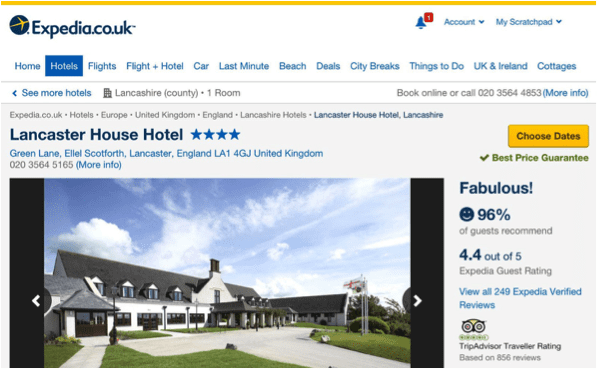
Expedia.co.uk

Expedia clearly displays consumer reviews from a range of trusted sources on each hotel page

However, many smaller brands and independent hotels are yet to incorporate user generated content such as rating, reviews and photos on their websites. Why?

The main barriers to implementation for many businesses is uncertainty, cost of implementation and ongoing management; especially when costs are on the rise in the travel sector.

Managers are sceptical of the positive and negative impact user-generated content may have on their reputation. It is often the case that hotel managers are reluctant to commit to user-generated content because it is likely that both positive and negative content could be published on their own website. After all, you want your shop window to be the best it can be! Adoption of such content is also resisted because of high-profile negative press review sites such as TripAdvisor have previously received.

Previous research indicates transparency and a good balance of both positive and negative feedback is better for business. According to Reevoo, 68% of consumers trust reviews more when they see both good and bad content. Bazzarvoice also found that 82% of customer reviews are positive.

The commercial research provides a compelling argument for the adoption of user-generated content. However, many of the studies often have a commercial bias and for a small business this commitment represents a significant investment. As such, I designed an empirical study to expand on prior research. The aim was to conduct a real, large-scale content experiment on a small UK hotel brand website to provide them with first-hand experience of managing user-generated content and to provide measurable insight into the impact it has on the business.

Conducting a real-world content experiment

The business already had an existing guest feedback program which collected both quantitative and qualitative feedback from guests once they had checked out of the hotel. With the customer’s permission, this existing data was then used to create the content for the experiment pages. Guest photography was also manually curated from photos tagged at the hotels locations on social networks.

Existing consumer behaviour research indicates that consumers use aggregate ratings to select a consideration set. Once a consideration set is formed, they then go deeper and focus on qualitative review data. This existing body of knowledge was used to inform the overall experiment objectives and design.

The experiment layout was designed to be similar to a hotel page on review sites such as TripAdvisor, and OTA pages such as Expedia, to ensure the layout design was familiar to consumers.

user generated content hotels

Example hotel customer reviews and photos collated for the experiment. Out of all the reviews collected in my research I found that 91% of hotels reviews were positive.

Google Analytics was chosen to conduct the content experiments and to collect the website analytical data. This was partly chosen due to limited company resources and because the business already had access to an established Google Analytics account to collect, store and process the data.

Specifically, the research focused on user engagement, purchase intention, average order value and consumer conversion when genuine, user-generated content was published on a UK hotel website.

User-generated content increases website conversion

The study established a link between user-generated content and website engagement. It found that user-generated content, in the form of hotel ratings, reviews and photography increased customer retention. Website user retention increased most for new website visitors, who were most likely to be in the early stages of forming a consideration set to assist their decision-making.

Most importantly, the study found that exposure to user-generated content increased conversion rate by 17.8%, thus resulting in more transactions and revenue for the business overall.

The study confirmed that overall, user-generated content can be useful on a small UK hotel brands website. Although the content experiment was simplistic in nature, the findings also back up previous commercial studies.

Embracing User-Generated Content

Due to the nature of the study it is unknown if the customers that resulted in the additional conversions would have booked the same hotel elsewhere. However, in a time when online travel agent commissions are rising, an increase in direct booking performance on a hotel's website is crucial to minimise acquisition costs.

The study was conducted using information already available to the business. If your business is not actively collecting content, the chances are your customers will be talking about your products online anyway!

The quantitative nature of research means that many questions are still to be answered as this area of interest matures and businesses look to invest to ensure they are maximising the opportunities available with user-generated content.

If you are still unsure if user-generated content right for your business, then give it a test! Whether you want to try using customer ratings, reviews or product photos, Google Analytics Content Experiments is great for quick conversion rate optimization testing on a static page, especially if you are already using Google Analytics. For more advanced content experiments there are many tools out there to get you started.

Thanks to Kris Littlewood for sharing their advice and opinions in this post. AKris is a Digital Marketing Manager for English Lakes and a recent graduate of MSc Digital Marketing Communications at Manchester Metropolitan University. You can follow him on Twitter or connect on LinkedIn.
23 Jul 16:22

Big Questions for Sales Managers

by Donal Daly

Managing a sales team is hard. The role of the front-line line sales manager is the lynch-pin of most sales organizations, but the number of tasks that sales managers have to juggle makes it really difficult to know how to answer the questions “How do I get the most from my sales team?” and “How do I remove uncertainty?”

BlogHeader

Just think about all of the tasks a sales manager has to balance … hiring, enablement, sales coaching, closing deals, running the sales forecast, managing the pipeline, supporting HQ information requests, and conducting the quarterly business reviews … and that’s when she is not traveling.

Sales managers are encouraged to invest time in coaching to improve the team, or rely on sales analytics to help determine where to focus.

Even though coaching is recognized as being a true driver of sales productivity when implemented effectively, most sales managers don’t employ a consistent coaching practice in their business. In fact 73% of sales managers spend less than 5% of their time coaching.

Some don’t know how to coach, others don’t see the value and in many cases sales managers cite ‘Not enough time’ as a key reason for not engaging in this proven best practice. We think that in fact the real reason is that sales managers do not have the requisite knowledge that equips them to coach effectively and often can’t easily assess what opportunities or sellers would benefit from a coaching intervention.

The math explains this better. Let’s assume that the sales manager has eight people on her team, each working six material opportunities, and a ninety-day sales cycle. That’s 48 opportunities in her universe at any one time. Even if she tries to coach just half of these opportunities effectively each month, spending two hours per opportunity, she runs out of time pretty quickly. How is she to know where to focus? There has to be a way to triage both the opportunities and the sellers so that her time is applied where it has most impact. What matters gets lost in the volume of data or information to assimilate.

We know from studies by IBM and MIT that sales organizations are 10X more likely to be High Performers if they use analytics well. The problem however is that 55% of all analytics projects fail. Failure usually occurs because the scope of the project is too wide, there is little or no connection to business outcomes in the design of the project, and there is a deficit of business domain expertise in interpreting the analysis, linking correlations to causation and gaining actionable prescriptive insights. What matters get lost in the metrics.

Most approaches we have seen think about data to predict sales performance in three or four buckets:

  1. Core Data – the data that exists in your CRM
  2. Situational Analytics – typically represented by reports or visualizations, this tells you what happened in the past.
  3. Predictive Analytics – based on patterns from the past, what is likely to happen in the future? (Lots of challenges here to differentiate between causation and correlation)
  4. Prescriptive Analytics – based on the predictions, what should we do about it. (Obviously is the predictions are flawed this is dangerous, and in any case unless there is considerable embedded domain expertise the value of the prescription can be questionable.)

We think there is a critical missing component, and that is Descriptive Analytics, the determination of which parts of the data actually matter. What are the big questions? What data enrichment is needed before the data can be a reliable source for prediction, and ultimately prescription.

We would suggest that a much more valuable approach would be :

  1. Core Data
  2. Situational Analytics
  3. Description Analytics (Big Questions)
  4. Predictive Analytics, and
  5. Prescriptive Analytics

We think the solution for the sales manager is in fact a combination of coaching and analytics, not in the classic sense of predictive analytics where big data can get in the way, but rather in metrics driven coaching, leading with the big questions for sales managers as opposed to the big data, establishing what you need to know to determine leading indicators of sales performance risk, at different levels of granularity for sales teams, individual sellers, accounts and individual opportunities.

  • Where are there vulnerabilities in my forecast?
  • Which deals are at risk?
  • Is my pipeline truly a reflection of future business?
  • How long does it take to win a deal of this type? How long does it take to lose? (Answer: The sales cycle for a losing deal is usually much longer for a losing deal. Wouldn’t it be good to flag that early?)

Think of it like this. Every sales interaction and every exchange between manager and seller should have a map to follow. The destination must be clear and there should be effective signposts along the way that can quickly identify if you are going off track.

Before you start on your sales management journey you need to know the big questions to ask. Sample big questions might be:

  • What are my Must Win deals?
  • Are there opportunities in my pipeline that are inactive or stalled?
  • What is my actual Win Rate? (measured by dollar value, not count of opportunities)
  • What happened to the deals John forecasted last month?
  • Are we losing deals late in the sales cycle?
  • What is the difference between our performance for qualified opportunities (deals that get to stage two or three in the funnel) and all opportunities.

Once you have figured out the big questions and the signposts that point to the answer then you can easily apply some smart automation to identify the entities on which you should focus.

23 Jul 16:18

How SaaS Affects the Marketing Mix

by Tim Matthews

Not All of Your Tactics Will Be Change, But the Emphasis Will Shift

While the SaaS business model is quite different from sales of perpetual software licenses, the marketing tactics are not entirely unique. SaaS companies still go to trade shows, have customer newsletters, and engage in direct marketing. The real difference is not in the tactics, but the emphasis on those tactics in the marketing mix. Here are a few guiding principles of how the buying cycle is different, and the resulting impact on the marketing mix.

Marketing Carries More of the Load – The new IT buyer may be 50 to 75 percent through the buying cycle before they are turned over to sales, according to Forrester and other sources. The new term for this is inbound marketing. In some cases, the marketing department will be responsible to creating the 100 percent of demand flow and the customer signup that turns into the sale itself. So, no more back seat to the sales department – marketing is in the driver’s seat.

Transactional Sales – Many SaaS products generally have a lower price point, or at least a lower-priced entry point. Vendors of this type of product need to think about large numbers of transactions, as opposed to the larger deal focus of enterprise software companies. Generally, SaaS companies are looking to sign up users for a trial or demo, and then move them toward a sale, as opposed to simply setting up a meeting for one of their sales people. There will be much more emphasis on online marketing and email nurturing, and a greater focus on optimizing the website for conversion.

Customer Self-Education – With more of the sale happening before a sales rep ever speaks to a prospect, or with no sales rep involved at all, more emphasis will be placed on materials to help the customer educate themselves during the sales process. Contrast this with the amount of time and energy spent on creating sales tools and conducting training. With the emphasis on customer self-education, more of the marketing mix will skew toward content marketing with the aim of educating the customer on a topic relevant to the product, as well as the company’s product. HubSpot, a SaaS marketing automation company, spends a lot of time and money creating educational content on marketing best practices. Blogs and online tools will increase in importance.

Customer Retention – In the conventional software model, the customer pays more up front to acquire a perpetual license, then pays a much smaller support and maintenance fee (usually 20 to 25 percent) after that. With SaaS, the customer renews at 100 percent of ACV every year, and your business model may depend on making back your CAC in years two or three. So, SaaS marketing teams are much more focused on renewals. Customer communication is that much more important a part of the marketing mix.

Online versus Channel Distribution – It used to be that software companies needed value added distributors and their resellers to scale. Now the Internet provides the scale. Partners will be sought for industry expertise or integration capabilities more so than for distribution reach.Note that as buyers of perpetually licensed, or on-premise, software are increasingly involved in the purchase of SaaS products, the emphasis seen in the SaaS marketing mix will no doubt have an influence on conventional software and hardware marketing, further blurring the lines

How about you? Experienced anything else different with SaaS marketing?

23 Jul 16:18

How to Make More Sales by Talking to Fewer People

by Elizabeth Dyrsmid

content marketing and sales conversion

Leading with value is what the concept of content marketing is built on. If you are struggling to sell, the problem might be in how you are structuring the offers you are laying in front of your prospects. In this article, we are going to discuss some simple strategies you can utilize to dramatically increase your close ratio.

Many well-meaning frustrated business people think just because they have a great product people should be standing in line outside their door shouting, “Shut up and take my money.” They forget one crucial aspect. Trust.

People don’t trust you and don’t think that you have their best interests at heart. Trust has to be won. How do you win trust?

You earn trust by crafting better offers. A better way to put it is you have to craft offers that your prospects can’t refuse.

Trent Dyrsmid, the host of the Bright Ideas Podcast, talks about trust in business using a dating analogy. You don’t ask someone you have a romantic interest in and just met to marry you immediately.

  1. You go on a coffee date first.
  2. You bring her flowers.
  3. Then you go for a movie together.

The relationship is escalated in an intelligent way. Business is the same. And now we are going to look at how to open that initial conversation channel.

In other words, how do we craft a better offer to get the client hooked and ready for bigger business. Even though you have their best interests at heart, and you will give them value for their money or ROI you have to start from this foundation. The art of crafting an offer they can’t refuse.

Offering a Valuable Gift for Free

Providing value is content marketing in its purest form. Useful information that can bear fruit for the prospect is given away for the right or privilege to have a conversation with the prospect. If you give away enough free content, they might become a customer of yours as a natural consequence.

We buy from the people that make us feel good and have established trust with us. Content is a great way to get this done.

free gifts can increase sales conversionsYou can even offer something of value that is physical. This works ridiculously well when combined with personalization. A personalized written letter or a video on a flash disk that is addressing the prospect directly can open doors for you that an out of the blue phone call or email can’t do in a thousand years. You should be doing stuff like this, especially if the items that you are offering are higher priced items.

When personalizing your physical “gift” consider using registered mail and sending the prospect something cheesy like from this site: 3dmailresults.com.

They have all kinds of cheesy products like a plastic foot that is supposed to get you a foot in the door or a bank bag full of shredded fake money that you can combine with a message like: “Stop throwing away money on my competition and start using my company for your marketing.” Astonishingly this works very, very well IF and only IF it is personalized for the prospect.

Making It Risk-Free with a Free Trial or Money Back Guarantee

increase sales conversions with a free trial or money back guaranteeWhen people don’t trust you yet, why would they give you their money? If you can remove the risk, you can eliminate some of the objections they might have. Offer them a risk-free trial. You are going to get some time wasters with this, but that’s okay if it improves your close ratio.

I see that some companies offer risk-free trials with no credit card required. That gets people to try their product and may lead to a sale, and it works very well for some of these companies.

It’s just a reality that people like free stuff. And they are likely to share with others what they’ve received for free if they like it. In the age of social media, you can gain a lot of exposure by giving away something of value to your customer base. Even for B2B companies, platforms like LinkedIn, Quora, and industry forums can be a great way to inform audiences about what you’re giving away. – Kabbage.com

For other companies, this doesn’t work that well at all because they have to spend a lot of time separating the serious buyers from the time wasters. The point is you will have to experiment with the effects a money back guarantee or a free trial has on your close ratio. You can’t be guessing about these things and pass judgment based on assumptions. Sales is a game of trial and error combined with rock hard stats.

Personalize

personalize your sales letters to increase conversionsWe have already discussed this, but I think it is so important that there are some things I would like to add. Personalization creates a feeling of connection and professionalism that seems to have taken the midnight train on all levels of business and society at the moment. Personalization is a way that you can distinguish yourself. It can be automated to a certain degree, but there is no substitute for real solid communication.

Whether you personalize a gift, an offer, an email, or another form of communication, your prospect will feel the love and will reward you by opening up to a conversation. Creating a conversation is exactly the purpose of this whole exercise. An open discussion places both of you in the position to decide whether it will be mutually beneficial to establish a business relationship with each other. Win-win.

Get Creative

When everyone else is doing something, you have to do the opposite to get noticed. There has always been the opportunity to distinguish yourself from the herd and there always will be.

Take direct mail and voicemail for example. For years, people have neglected these powerful tools. If you want to get noticed use these because no one else has been doing it for a couple of years now.

Send your number one prospect a written letter in your own handwriting. Send them an unsigned cheque for $5000 with a note saying: “I would like to make you money on a regular basis, can we have a chat over coffee?” The possibilities are endless and doing stuff like this not only gets you results, but it’s fun to do.

Conclusion

The initial communication you establish with your prospect or offer is your first impression you make on them. It is going to last. You might as well put some real effort into it.

Now you are armed to increase your close ratio because you can make your prospects an offer they can’t refuse. The better the offer, the better your close ratio is going to be. Take a moment to think about a way you can implement some of these offer crafting tactics.

Do us a favor by spreading the love with a comment and a tweet if you are feeling in a generous mood.

Hiring_an_inbound_agency

23 Jul 16:18

Moving Upmarket? 3 Lessons from Slack

by Mike Baker

In early 2013, Slack reached a critical turning point. The company had just begun rolling out its young team-collaboration product to more and more customers when it started facing some unexpected turbulence.

Initially, Slack had rolled out its product to relatively small teams, similar in size to Slack itself. But when the product started gaining traction with larger companies, such as Rdio, the results weren’t as heartening.

“Rdio, in particular, was much bigger than us,” Stewart Butterfield recently recounted to Fast Company. “They used it with a small group of front-end developers for a while but then it spread to the whole engineering group and then to all 120 people in the company.”

With this many users, Slack suddenly seemed less sleek and effective than it had when it was used by a much smaller team. Essential features no longer performed as envisioned, unforeseen problems arose, and the overall user experience seemed to take a hit.

“Suddenly we saw what the product looked like from the perspective of a much larger team, and it was pretty gnarly,” Butterfield told Fast Company.

This was no small problem. The company knew that if it was going to make it big, it was going to need to meet the needs of larger, higher-paying customers. So the company buckled down and started looking at their product from a new perspective: through the eyes of a much bigger company.

Slack quickly corrected course, went on to receive a valuation of nearly $3 billion, and the rest, as they say, is history.

Except, of course, it’s not. Hidden inside this small hurdle on the path to Slack’s success is a very important lesson: SaaS companies must evolve their product to suit the needs of larger companies if they want to do something truly unique. Staying within your wheelhouse and selling only to customers like yourself ‒ especially in the SaaS landscape ‒ is a recipe for failure.

In fact, in all the research we’ve done about the best SaaS companies, we’ve found that one of the most effective things you can do is iterate your product to gain a foothold in a new target market.

This is especially true if you’re trying to raise your average sales price (ASP) by selling to larger companies, just as Slack was.

The Benefits (and Risks) of Moving Upmarket

Like Slack, many SaaS businesses know that they eventually need to move upmarket if they want to hit their goals. You might feel like your comfort zone is SMBs, but if you want to achieve exit velocity or protect yourself against competition from above, you eventually need to start selling to bigger companies.

Although this has one huge advantage ‒ it will increase your ASP, thereby expanding your revenue stream ‒ it also has one significant drawback: you may start losing opportunities for reasons you’ve never accounted before.

As the story from Slack shows, larger companies use products differently (and put different stresses on software) than smaller companies, so it can be extremely risky to jump headfirst into selling to enterprise businesses.

If you’re undertaking an active project to increase your ASP and sell to larger companies, you should ask these 3 questions first:

1) Why Are We Losing Bigger Deals?

When Slack first started receiving feedback from larger customers, it was surprised by some of the comments it was getting. Larger companies complained that channel creation was getting out of control, and that new hires felt irretrievably lost when logging onto Slack for the first time, according to Fast Company. These were complaints that Butterfield and his team were not used to. However, in the end it was good news ‒ the product team was able to address the issues and position Slack as a team-communication platform for companies of all sizes.

When you start targeting larger buyers, you should follow suit. Carefully track all of the reasons large companies are giving you for NOT buying your product. Some of these loss reasons ‒ timing, authority, budget, etc. ‒ may not be related to company size at all, but others ‒ like security concerns, frequent crashes, or missing features ‒ are often indications of where your product is failing larger companies.

Loss-Reasons-edited

Analyze your loss reasons (and sort them by opportunity size) to identify the common complaints you’re getting from larger companies. If you’re trying to sell to larger companies, you will need to iterate your product in these areas to have the most success.

Slack used this very tactic when it decided last fall to introduce a new feature into its product. The feature provided enterprise-size companies with the ability to search employees’ private discussions. According to Business Insider, this wasn’t something Slack had originally intended to do, but the demand for this feature became so loud that, last fall, Slack recognized the urgency and quickly added the feature. Doing so made the product much more valuable to large companies, thereby providing slack with another foothold in the enterprise market.

“Sadly there are businesses today that want to use Slack but can’t,” the company wrote on its blog last fall announcing the update. “Why? Because they have very specific legal and regulatory requirements that require they have access to and store ALL employee communications.”

Slack paid attention to the feedback it was getting from larger companies ‒ who wanted to buy the product but had size-specific obstacles in the way ‒ and responded to them with integral product updates that made for a much better fit.

Once you start selling to larger customers though, you can no longer afford to ignore the feedback you’re hearing from customers.

2) What Are Our Customer Service Reps Hearing?

Once you start gaining traction when moving upmarket, you need to move beyond just listening to your sales reps and start listening to your customer service reps. Your first few large customers can serve as the perfect test cases for how your product serves (or fails to serve) their needs.

Submissions-By-Reason-edited

If your customer service reps are flooded with the same few support or feature requests, you have likely identified the right areas for your product team to prioritize.

At Slack, Butterfield and the other executives make it a priority to be “active listeners” when trying to find areas to improve their product to meet the needs of their growing ‒ and changing ‒ customer base. Even if what they hear goes against their best instincts.

“Sometimes you will get feedback that is contrary to your vision,” Butterfield told Fast Company. But that can’t stop you from constantly evolving your product. Especially if you’re going after a more powerful segment of your target market.

The move upmarket doesn’t happen overnight, and it is important to take the feedback you receive from your initial enterprise customers and use it to incrementally tailor your product to their needs. Doing so will make your product a better fit for your new target market, but it will also help you better understand how to position your product as you ramp up your sales efforts to this segment.

3) Do We Have a Value Proposition for Bigger Buyers?

Once you start iterating your product in an effort to move upmarket, it’s time to use these changes ‒ and the lessons you’ve learned in the process ‒ to influence the way your sales reps sell to bigger prospects.

Even if you’re diligent about iterating your product based on feedback, it won’t do any good if you can’t get people to actually buy ‒ or even try ‒ your product. That’s why you need to coach your sales reps to use tailored value propositions depending on who they’re talking to.

If you learn, for example, that larger customer are especially concerned with their ability to modify your product to their particular needs, you should make sure your sales reps address this concern before it’s even raised.

Larger companies are not going to buy a product that they believe is designed for the little guys, so work with your reps to make sure they’re positioning the product in the best light possible for large opportunities.

Slack always had grand ambitions, even when it was only serving a modest part of the market. To reach their goals, they knew they had to be flexible and proactive about tailoring their product to an evolving customer profile. If you want to start reaching ‒ and acquiring ‒ larger customers, you need to think the same way.

23 Jul 16:17

Predictive lead scorer Leadspace, founded on data tactics used against terrorists, captures $18M

by Barry Levine
data fingerprint
[Are you a growth marketer? Do you want to know what it takes to be one? Join us at GrowthBeat, on August 17-18 in San Francisco. Thought leaders from the biggest brands and most disruptive companies will share winning growth strategies on the most pressing challenges marketing leaders face today.]

Many predictive lead scoring companies promise to find new prospects for your company.

But not many predictive lead scoring companies were founded by a former Israeli military intelligence expert who applies anti-terrorist data mining tactics to help companies better understand their customers.

Today, that B2B company, San Francisco-based Leadspace, is announcing it has scored $18 million in new funding so it can continue to figure out signals left by individuals in big data.

The signals, CEO Doug Bewsher told me via email, are determined from behavioral, intent, and other data in the open Web and social media so that businesses can find people who make buying decisions, and then create targeted messages that help close deals.

Founder Amnon Mishor had been a member of Israel’s elite 8200 military intelligence unit, and is today the firm’s chief technical officer. Bewsher is the former chief marketing officer for both Skype and Salesforce.

The company claims more than 100 current customers, including Oracle, Autodesk, and Microsoft, and it says clients generate $100 worth of pipeline-filling deals for every dollar spent with Leadspace.

The growing predictive analytics space, especially the sector that finds and scores potential customers, includes Lattice Engines, Infer, 6sense, and Fliptop.

A screen from the Leadspace platform.

Above: A screen from the Leadspace platform.

Image Credit: Leadspace

Bewsher told me the competitors his company most often encounters are Lattice and Infer. One differentiator, he said, is that Leadspace “both enriches and scores leads.”

“Where most other providers focus only on the scoring algorithms,” he emailed, “Leadspace enriches lead data first with web and social sources to improve scoring accuracy. Beyond enrichment and scoring, Leadspace also finds net new leads (discovery), which is essential when entering new markets or looking to expand.”

His company “goes beyond company-level information to the individual level,” he said, with attention to both aspects, as well as to each separately. Leadspace also builds up company-level attributes from individual info, he said, instead of the other way around.

And Leadspace utilizes a unique “hybrid approach that takes into account both historical data and user input,” he said, meaning a customer company could build a predictive scoring model based on its own info, with little or no data, such as for new markets or for new products.

Led by Battery Ventures, this Series B round included investments from JVP and Vertex. It brings the total raised thus far to $35 million, including debt.

It will be used to increase Leadspace’s global footprint, extend its partnerships, and further develop its platform by expanding its tech development team in Israel. New integrations will be developed for marketing platforms like HubSpot and Pardot, employing the company’s recently launched API.

Bewsher said the company will also expand into new engagement opportunities, like advertising or content, so the platform’s customers can have “more options for finding and connecting with their ideal buyers.”

More information:

Powered by VBProfiles


VB's research team is studying mobile user acquisition... Chime in here, and we’ll share the results.


23 Jul 16:16

Bait Your Hook: The Best Freebies For Generating Leads

by KeriLynn Engel

Bait Your Hook: The Best Freebies for Generating Leads

Your blog post might have every ingredient needed to make it great, but what happens when your readers reach the end?

With all the content they’re consuming, it’s likely your blog post will soon be forgotten, no matter how much they like it.

If you want your casual visitors to become customers, you’ve got to use a call to action.

But just asking your readers to take action often isn’t enough. They’re being asked to give up their email addresses everywhere they go, and their mailboxes are already overflowing.

Offering a targeted freebie is a great way to make your offer truly valuable to them and worth the risk of handing out their email address to yet another list.

This tactic isn’t new — you’ve probably seen tons of free ebooks offered in exchange for email subscriptions. But if you get creative with your freebie offering, you can overcome all the content noise to truly engage with your visitors and get targeted leads to get in contact with you. Just check out the list below for ideas and inspiration.

Ebooks

Ebooks may be old news, but they’re still a popular freebie for a reason: they can provide great value to your readers, and can also be very quick and easy for you to produce.

A persuasive landing page for a free e-book from Social Triggers.

A persuasive landing page for a free ebook from Social Triggers.

One easy way to create an ebook to offer as a freebie is by compiling a collection of related blog posts from your archives. There are plenty of apps you can use to create ebooks automatically, including:

Just choose a few blog posts on the same related topic you can string together into a narrative, edit them, and add them together with an intro and conclusion to create your ebook.

Unlike traditional books, ebooks don’t have to be very long. You can quickly create an original 10 or 20 page ebook, and call it a “report” instead.

Or, to pack even more value into your ebook freebie, create some extras to go with it (such as templates, checklists, graphics, etc.) and call it a “toolkit” or “bundle.”

Examples:

  • Ramsay Taplin of Blog Tyrant offers a free 13-page report on “How to Get 120% More Email Subscribers Overnight.” In addition to offering the report in his blog sidebar, he also wrote a landing page that outlines the report’s contents and benefits.
  • Derek Halpern of Social Triggers also offers a free ebook, called “How to Get Your First 5000 Subscribers,” and he also has a short but convincing landing page outlining the book’s contents.
  • Copyblogger offers a bundle of content when you subscribe to a free membership on their website, including over a dozen ebooks on content marketing, copywriting, SEO, etc., plus a 20-part email course on online marketing (more on offering free courses below).
  • Carrie Smith of Careful Cents offers her “Tax Toolkit: A Checklist for Self-Employed Biz Owners” to all new subscribers to her email newsletter. The toolkit contains a short, practical guide on filing taxes in the US if you’re self-employed.

Videos

Backlinko prompts viewers to subscribe to view the rest of the video.

Backlinko prompts viewers to subscribe to view the rest of the video.

While the written word will never be obsolete, online video consumption has exploded in popularity for all age groups online, with shorter videos (under 20 minutes) making up the majority of viewing. The opportunities for engaging with your audience via video can’t be ignored.

Quality videos can be costly to produce, but they don’t have to be, so don’t write them off right away if you’re on a limited budget. With shorter videos becoming more popular, it’s easy to create something quick and interesting that can appeal to your audience.

For content ideas, try starting with a short expert interview via Skype or Google Hangouts, or do a Q&A where you answer questions your audience sends in. You could also just make a video version of a blog post, or record a quick tutorial screencast with Camtasia or ScreenFlow.

Examples:

  • Brian Dean of Backlinko shares the beginning half of a video on “How to Rank For Any Keyword.” At the end, an opt-in form appears, asking you to enter your email to watch the rest of the video and receive additional free content.
  • Flyplugins offers a 45-minute tutorial video on using their plugin WP Courseware to sell courses online, in exchange for your email address.

Podcasts

Visitors to Make A Living Writing are offered a free podcast for subscribing.

Visitors to Make A Living Writing are offered a free podcast for subscribing.

A podcast is another way to grab the attention of those who don’t have the time to read a whole ebook. Podcasts are also booming in popularity, with millions of subscribers across the web.

Podcasts are also quick and easy to create, with an abundance of tools available such as Audacity, Podbean, and SoundCloud for creating and sharing your podcast. Since there’s no visual component, they can be much quicker to create than videos, but still allow you to reach a whole new audience than text only will.

Podcasts make a great content upgrade for individual blog posts as well, since it’s quick and easy to record and offer an audio version of your blog post, or additional material to add to your blog post.

Examples:

  • Carol Tice of Make a Living Writing offers “The Freelance Fear Buster” to all new email subscribers, a 1-hour podcast plus transcript that includes tips from her and 16 other professional writers.
  • James Schramko of Super Fast Business offers his podcast, “The Power Of Content,” for free to all visitors, but transcripts are only available in exchange for an email subscription.

White Papers

White papers might seem obscure or old-fashioned next to ebooks, streaming video, and podcasts, but they’re still a powerful tool today.

Hubspot offers problem-solving white papers for their B2B audience.

Hubspot offers problem-solving white papers to their B2B audience.

What exactly is a white paper, and how is it different from an ebook?

Ebooks are more casual and less technical, and work great for B2C businesses. They’re often shorter and easier reads.

While ebooks can be on any topic and in any format, white papers generally are persuasive reports that present a specific problem and solution. They tend to be more serious, in depth and technical, and more common in the B2B market.

That said, the line between ebooks and white papers can be blurry, and you might even find content that uses both labels interchangeably.

Examples:

  • Hubspot, one of the masters of opt-in freebies, offers a ton of free resources including white papers on topics like “How To Avoid Marketing Technology Paralysis.”
  • The Content Marketing Institute offers a library of free white papers on topics ranging from digital asset management to planning an influencer marketing strategy.

Email Course

Thrive Themes offers a free mini-course to subscribers.

Thrive Themes offers a free mini-course to subscribers.

An email course is another way to provide huge value to your visitors and position yourself as an expert in your industry.

Email courses might seem daunting, but they can be just as quick to put together as an ebook. You can create them from your old blog posts as well, if you have a lot of how-to and tutorial-like posts. Just choose posts that are related in topic and can be strung together into a cohesive course.

Courses can be easily automated using email list tools such as MailChimp or Aweber, so you can just set it and forget it.

Examples:

  • Copyblogger, along with their bundle of free ebooks mentioned above, provides a free 20-part course when you sign up for a free membership to their website called “Internet Marketing for Smart People.”
  • Thrive Themes offers a free mini-course on building landing pages called “Guide to RAPID Landing Page Building.”

Final Tips For Your Freebie

Some final tips for getting the most out of your freebie:

  • Create your freebie to be useful specifically to your ideal customer or buyer persona. (If you’re new to personas, you can find out more info in this post on starting a blog in 2015, or this post with useful tips on getting ahead of your competition.)
  • Write a landing page and/or introductory blog post about your new freebie, outlining its main features and benefits.
  • Analyze your goals for creating a freebie, and make sure your opt-in form asks for the right information. An email address might be all you need if your goal is to get more subscribers, but if you want more targeted sales leads you’ll probably need more information.

Share Your Freebie Examples

Do you offer a freebie to get more leads on your site – or have you seen a great example in your travels on the web? Share your examples in the comments below.

23 Jul 16:15

7 Lessons To Help You Produce Content That Converts

by Nischala Murthy Kaushik

iStock_000055891716_Medium

According to Gartner, content marketing ranks among the Top 5 trends in the space of digital marketing in 2015. For brands and organizations, the ability to “build a content marketing supply chain and determine how to create, curate and cultivate content” is critical. Because of the rise of content as a critical element of marketing, “content is the most important thing that marketers do”.

It is obvious that every content marketer aspires to consistently publish “content that converts”.

But what exactly is content that converts? Simply put, content that converts uses content as the way to achieve objectives. These objectives can range from brand awareness to lead generation, to user/customer engagement, to sales, to lead nurturing, to social advocacy, and to professional networking. The thing about objectives is that they are always specific to your context—whether you are an individual or a business.

As I look back at my own journey as a content marketer, I’m happy with the impact of many of my B2B content marketing initiatives. From building global brand awareness and industry mind-share, to lead generation and social shares/engagement and advocacy, there have been some good innings.

I’ve learned that everyone wants to know the answer to this question:

What were the key factors which made a difference in the journey?”

And, from my perspective, I can distinctly see seven key points. I recognize that first-hand experience has taught me these lessons—primarily because of a willingness to learn, an eagerness to try, and an openness to fail. However, it would have been wonderful if someone had shared these insights with me at the onset.

In this blog, I’ll highlight the seven most important lessons that I wish I had known from the start, with the hope that my insight helps other content marketers create high-value content that coverts. Let’s get started…

1. Define Your Content Conversion Metrics

“What gets measured, gets managed”. –Peter Drucker

This is true for almost everything in life, including content. Hence the most important step in any content journey is defining your content conversion metrics. Content conversion metrics are unique to your industry, nature of business, customer base, organization phase of growth, and marketing budgets. Therefore the metrics defined need to be unique and relevant to your specific context. Once the conversion metrics are finalized, they should be communicated with all key stakeholders.

For example, conversion metrics could be:

  • 100 downloads for a whitepaper
  • 25 email registrations for a service
  • 1,000+ social shares
  • Five leads

The most important aspect of the metrics definition is that they should be SMART (Simple, Measurable, Attainable, Relevant and Time-Bound) and well communicated to all stakeholders.

2. Have a Realistic Content Plan in Place

“Failing to plan is planning to fail”. –Alan Lakein

A content plan which covers all aspects of the content lifecycle is the key stepping stone for a successful content plan. Content lifecycle includes all phases from content ideation, creation, publishing, promotion, discovery, engagement, management, and reporting.

The key to success in any content plan is to know:

  • Who is the reader of your content? The clearer you are in your description of the demographics of the content reader, the better. For example, potential readers of this blog post could be digital marketers, CMOs, content authors, editors, publishers, content strategists, or social media managers.
  • What kind of content formats are popular with the target reader? Do your readers typically like visual communication like infographics or photos? Or do they prefer to read text in the form of blogs, whitepapers, and research articles?
  • Which channels/devices do they typically use to read content? Do your potential readers prefer to read on smartphone, laptop, or iPad? Or do they like to read print media, like the good ole newspaper?
  • Which content topics are trending and may be of value to your readers? Are new age digital marketers keen on knowing the latest product features of a new content automation tool, or would they prefer to read about case studies on which marketing strategies worked for other competing brands in the industry ecosystem?
  • What are the key drivers to convert your readers to potential buyers of your product/service/offering/solution? Are they looking for an easy-to-use subscription-based marketing automation solution, or would they prefer a comprehensive marketing technology suite for three years?

Bottom line: Your content strategy and plan need to be aligned to your answers to these questions accordingly.

The content plan should include details on:

Content Creation

  • The date that a content piece will be published
  • The content format (blog, video, infographic, etc.)
  • The content topics/themes
  • What needs to happen before it is published (in terms of the process for editing, reviews, approvals, SEO, etc.)

Content Publishing

  • Where will the content be published (corporate/personal site or blog) or a community/partner/analyst/media publishing forum?

Content Promotion

  • Which social channels will the content be promoted on? This should be based on your reader demographics.
  • How frequently should the content be shared?
  • How to best articulate the social shares so it works for a specific social channel
  • Which tools need to be leveraged for social sharing
  • Which individuals/enterprises need to be notified of the published content

3. Execution Makes the Real Difference

According to the 2015 Benchmarks, Budgets, and Trends—North America report, one of the key differentiating characteristics of great content marketers is that they consistently follow a documented content marketing strategy. So planning and execution are the two foundational pillars of effective content marketing. At the end of the day, how effective your content marketing is completely depends on what you actually do.

In my personal experience, to make content marketing happen, and happen well, knowledge and skills are of paramount importance. Aspects of content around storytelling, creativity, design, visualization, and articulation are what truly determines the impact of content initiatives.

4. Leverage the Power of Tools and Technology

“Content and Technology are strange bed fellows. We are joined together. Sometimes we misunderstand each other. But isn’t that after all the definition of marriage?” –Howard Stringer

The number of tools and technology available to make content marketing faster, easier, and more effective is amazing. From deciding what to write about to coming up with the most effective title for a content piece to determining who are the influencers for a particular topic—tools and technology are a powerful boon. The key is to identify which technology and tools are relevant in your context…and to effectively use them.

5. Track and Report Your Conversion Metrics

Constantly monitoring, tracking and reporting conversion metrics at regular intervals with all key stakeholders is the most important checkpoint in the content journey. With an ample number of social media listening/analytics/monitoring tools, it is important to identify the right tools for your context, define a frequency for reporting, and then start. Reporting on metrics doesn’t stop there, it’s crucial to spend time analyzing the metrics to draw actionable insights.

As a case in point, your content metrics could read as follows:

nischala_chart

Based on the metrics above, you can identify that the time and effort required to create a blog is significantly less than an infographic or video. However, the infographics and videos may generate significantly more views. So as a content marketing team, you must decide on the content mix for next month. This process is continuous and is based on how your content is being received by readers and your teams capacity to develop content.

6. Review and Refine Your Content Plan Based on Metrics

Based on the insights from your metrics, it is important to refine your content plan.

Simple rule of thumb is this: Whatever’s working; do more of it. Whatever’s not working; do less of it. Be flexible enough to test new things.

7. Be Patient—Conversion Based on Content Takes Time

Conversion based on content takes time and focused efforts. Patience, persistence, and a positive outlook yield results. You may not be able to immediately see a conversion based on content, but if you are patient, you will see the impact of your content marketing.

That’s my view. What do you think is key to creating content that converts? What do you wish you had known before you got started with content marketing? Let me know by leaving a comment below.

22 Jul 23:08

You Need to Burn 7,000 Calories to Lose a Pound, Not 3,500

by Beth Skwarecki on Vitals, shared by Andy Orin to Lifehacker

If you’ve ever calculated how much weight you’ll lose by cutting out a certain number of calories a day, you know the most famous equation in dieting: 1 pound of fat = 3,500 calories. Too bad that equation is wrong.

Read more...

22 Jul 23:08

This Chart Compares Types of Emergency Foods Best for Your Survival Kit

by Melanie Pinola

Stash away some food in case of emergency and you’ll be set for the next hurricane or other disaster. Not all foods are best for emergency survival , though. This greaphic compares canned, dehydrated, and freeze dried foods.

Read more...

22 Jul 23:07

The Best Way to Introduce People Over Email

by Patrick Allan

When you’re introducing someone over email, you want to make sure all parties involved are completely comfortable with the intro. The “double opt-in” approach gives both parties a chance to decline without causing any problems.http://lifehacker.com/email-etiquett...

Read more...

22 Jul 15:50

Why Sales Mobility Isn’t Just About Going Mobile

by Donal Daly

Back in 2012, I wrote about the proliferation of mobile devices and how this would impact on the way we work and sell. I was reminded about this when I was quoted in a recent article, The Top 10 Sales Tips for Small Businesses in 2015, by Alexa Schirtzinger on the Salesforce blog.

Three years on from my original article, recent studies show that 9 out of 10 full time employees in the US now use their personal mobile devices for work. They’re using them on the road, at sales calls, on sick leave, and to outflank the rush hour traffic. In fact, in an Acxiom Digital Impact Study, 36% of respondents claimed to check their email as soon as they wake up, and another 21% checked it before breakfast.

With work habits continually evolving and the advancement in mobile, online technologies enabling more employees to escape the physical constraints of the office, the concept of enterprise mobility continues to be a hot topic. The continuing emergence of phablets (smartphones with screen sizes from 5.5 to less than 7 inches) means organizations may also have to rethink their mobilization approach in order to accommodate the devices. According to a new forecast from the International Data Corporation (IDC) Worldwide Quarterly Smart Connected Device Tracker, worldwide phablet shipments will top 318 million units in 2015, surpassing the 233 million tablets forecast to ship this year.

device-size-comparison-738x415px

As the “Smart Connected Device” market matures, with emerging markets driving new growth, the percentage of sales made up of phablets plus regular smartphones is expected to increase. The IDC forecast suggests that smartphones (encompassing phablets) currently represent about 70% of the total market. By 2018, they predict this figure will grow to 75.6%, suggesting the phablet could soon become the connected enterprise device of choice.

Although sales teams are now better technologically equipped than ever before, recent studies have highlighted a number of factors which could impact on the deployment of an effective sales mobility strategy:

  1. Solution integration: The largest gap between top performing companies and under-achievers (57% vs. 40%) lies in their ability to successfully integrate sales intelligence and the CRM platform.

This is an important consideration when evaluating sales enablement solutions. Organizations should ensure that the solutions they invest in are able to integrate seamlessly with existing software to make a transition as smooth as possible.

  1. Content accessibility: 47% of best-in-class companies report access to relevant rich media content for reps to use with prospects as being the most important capability of sales enablement solution.

This means giving reps immediate quick access to relevant and contextual content for specific sales situations. If it takes too long to find sales collateral, sales reps won’t bother using it.

  1. Sales coaching: 60% of best-in-class companies who provide real-time, deal specific sales coaching rely on a dynamic library of marketing and sales assets.

Sales coaching is an ongoing process. The ability to provide dynamic, intelligent coaching to sales reps based on knowledge, data, context and reasoning of the customer’s political and commercial landscape is integral to mobile sales success.

We know that true enterprise mobility isn’t just about equipping your sales team with the latest iPhone and letting them loose in the field; they also need the necessary tools to do their jobs effectively.

In a B2B selling scenario, a poorly implemented mobile strategy makes it difficult to engage essential sales support resources. Also, sales reps who don’t have easy access to the CRM often end up having to update opportunity data when back at their desks, thus increasing the administrative burden and reducing selling time. So if sales reps can’t access the critical data and applications needed to perform their roles, then those expensive iPhones and iPads are nothing but glorified email readers.

The emergence of technologies such as ‘Cloud’, Big Data/analytics and social business have raised the bar further by making it possible to overlay established sales processes, playbooks, and best practices within sales applications. This completely transforms the notion of sales mobility by giving reps seamless access to contextual content that will introduce predictability and increase their chances of closing a sale.

Many of you reading this will already be using contextual technologies on a daily basis without even thinking about it. If we consider the smart apps on our phone, they have four things in common. They all have a deep set of knowledge, they use some data, they bring context and then they apply smart reasoning to bring some value.

Take Google Maps as an example, which has considerable knowledge and helps you get from point A to point B, efficiently. Google has a ton of knowledge built into the system. Then you give it a bit of data by telling it where you want to go. And, because it has the context of where you are, it can figure that out for you. It uses some pretty smart reasoning and it figures out the different paths, the different routes that you can take to get from point A to point B, then calculates how long the journey’s going to take. It also figures out how fast other people who are using Google Maps are moving in their cars so it can help you with your estimated time of arrival. A lot of knowledge. A lot of context. You give it a simple bit of data, and it applies some reasoning.

So, if Google Maps can help a sales rep navigate to a sales call, wouldn’t it be great to have a smart app that helps you prepare for the meeting to ensure the best outcome? Something that helps figure out the twists and turns, the on & off ramps, the general terrain? And maybe it can help figure out where the people you’re meeting are positioned in the organization’s political landscape, who ultimately will make the final decision and what factors will have greatest bearing on that decision.

These are the challenges which drove us to develop our Dealmaker application suite. And, because we have the benefit of 25 years of methodology, we were able to embed this knowledge as a blueprint to create a really smart, mobile & easy application.

Effectively planning and executing a strategy focused on the sales representative and customer experience by aligning with existing processes, methodologies, and technology is pivotal to driving revenue growth. And, after all is said and done, isn’t this the only metric that matters?