Shared posts

29 Jul 16:36

3 important investing lessons from the best investor you’ve never heard of

by Nelson Smith, Motley Fool

In 1955 an unknown employee of Benjamin Graham named Walter Schloss quit the firm to start his own investment partnership. A year later, another relatively unknown man named Warren Buffett did the same thing.

While Buffett got most of the attention from that point forward, we can’t discount what Schloss did. From 1955 to 1995 Schloss and his son Edwin—who joined his father in 1972 — absolutely crushed the Dow Jones Industrial Average. He averaged a return of 15.7% per year, while the Dow gave investors a 10.4% annualized return. And remember, Schloss’s results were after he charged investors a 25% management fee on all profits.

Heilbrunn Center for Graham and Dodd Investing, Columbia Business School via Bloomberg
Heilbrunn Center for Graham and Dodd Investing, Columbia Business School via Bloomberg Walter Schloss, right, who died in 2012, stands for a photo with his son Edwin.

That’s one of the best 40-year investing records you’ll ever see.

The amazing part is how simple Schloss’s strategy was. He didn’t spend thousands on research or fancy quantitative models. His office was in a closet he rented from investing firm Tweedy Browne. Most of his research came from a well-worn copy of the Moody’s Manual.

We can attribute Schloss’s success to three main factors. Let’s take a closer look.

Buy cheap assets

Schloss didn’t care about growth, earnings, or the quality of management, things investors today spend countless hours stressing about.

Instead, Schloss was all about buying one thing, and that was cheap assets, preferably with very little owing against them. If the market was depressed, he would search for the proverbial cigar-butt stocks, but if not, he would be content buying companies trading at a steep discount to book value.

A Canadian stock Schloss would likely be interested in today is TransAlta Corporation (TSX:TA)(NYSE:TAC). The stock is trading at approximately 10% under its book value, but that book value is likely understated because of years of depreciating its biggest assets: the power plants themselves. I’d estimate the real replacement value of the assets is likely closer to $15 per share.

TransAlta is also taking steps to reduce its debt by selling its Australian gas assets to its subsidiary, TransAlta Renewables. That transaction, plus a few other steps, will decrease the company’s net debt by nearly 20%, all while ensuring investors still get access to the cash flow from the assets because it owns almost 80% of the subsidiary.

Diversify

Many value investors concentrate their portfolios, choosing to only invest in their 10 or 15 top ideas. Not Schloss, who often had close to 100 companies in his portfolio.

Schloss would buy more of something he thought was a good deal, but he knew that he didn’t have the same abilities as Buffett to be able to identify the few stocks that had years of outperformance ahead of them. So, he wouldn’t even try.

Instead, he had a simple strategy that can be replicated by investors today. Schloss would buy when a stock was cheap, and sell it when it approached fair value. This would sometimes take years to play out, but as any value investor knows, patience is a virtue.

Go against the grain

You’ll know you have a true Walter Schloss stock when you buy it and all your friends tell you how nuts you are.

Schloss would often talk about how successful value investors aren’t afraid to be loners. It was one of the reasons why he chose to insulate himself from the rest of Wall Street throughout his career. It’s hard to think outside the box when everyone in the box is telling you the same thing.

A Canadian stock for true outside-the-box thinkers is Canadian Oil Sands Ltd. (TSX:COS). Yes, the stock isn’t attractive if you look at it from an earnings perspective since it’s losing money because crude is hovering below $50 per barrel. And the company has wrestled with unplanned maintenance and increasing costs for years.

But looking at it from another standpoint, I can make the argument that investors are buying assets for pennies on the dollar. Including the company’s debt, someone buying shares today is paying just $3.62 per barrel of proved and probable reserves. That’s insanely cheap, especially considering that the infrastructure for taking those reserves out of the ground has already been built.

Fool contributor Nelson Smith owns shares of Canadian Oil Sands Ltd.

The original version of this article can be viewed at www.fool.ca

29 Jul 16:26

Make Your Calls Faster

by Anthony Iannarino

How long is it going to take for you to make your calls?

Slow Dialing

Some people will call a list of 500 prospective customers over the course of a year. To these folks, this seems like a reasonable plan. Subtracting out two weeks for vacation, they can call 50 prospects a week and reach their goal. That breaks down to ten calls a day, something easily accomplished by almost anyone.

Let’s pretend that the hypothetical people in the above scenario follow this plan (something I don’t believe to be true). These people make around 40 calls a month, talk to about 10 of their prospects, and maybe they book two appointments.

Fast Dialing

Another group of people would take the same 500 prospective customers and call them over the course of two weeks. They’d make 50 calls a day, starting every morning with prospecting. Let’s pretend this group is no better on the phone than our first group. They’d talk to 12 people a day, and book two or three appointments.

The first group of slow dialing salespeople would have shallow pipelines. They’d hope that marketing and inbound would develop enough opportunities for them that they could somehow make their number. Their managers would be unhappy with their performance (even though they are in large part responsible). And their CEO’s would be calling me and emailing me to help them understand why they can’t reach their goals.

The second group, the fast dialing salespeople, would be developing opportunities. They would be entirely independent of marketing and inbound when it comes to making their numbers. Their managers would be focused on improving areas other than opportunity creation. And their CEO’s would still be calling me, but it would be to help them increase their win rates or margins by creating greater value.

Make Your Calls . . . Faster

You are going to have to make your calls. You are likely going to have to make hundreds—or thousands—of calls. You can make those calls over the course of months or years or decades. Or you can make those calls over a few weeks.

You determine the actions that you take, but not the consequences of those actions. If you need new business, make your calls. And do it faster.

  • How does making your calls over a shorter time improve your results?
  • What do you tell yourself that prevents you from making your calls faster? What beliefs hold you back?
  • How important is it for you to reach your goals? What does that mean you need to do when it comes to making your calls and prospecting?

The post Make Your Calls Faster appeared first on The Sales Blog.

29 Jul 16:26

The 4 Pillars You Need To Tell Great B2B Stories

by Rachel Foster

Stories can help you connect with customers on an emotional level, show your value and stand out from the competition. Here’s how to add compelling stories to your B2B marketing mix…

cartoon typewriter that says your story and text that says 4 pillars you need to tell great stories

Discover How to Tell Great B2B Stories

Back in the days of Mad Men, marketers could tell customers how to think and what to buy.

But times have changed.

Customers no longer trust advertising and don’t want to hear companies talk about how great they are.

To stand out, B2B companies must reach customers on an emotional level. I recently spoke with Ira Haberman, Director of Storytelling at Brainrider, about how B2B marketers can use stories to create these connections.

“All B2B companies have a story to tell – whether it’s about technology or piping or financial services,” says Ira. “The best way to connect with your audience is by telling your stories.”

According to Ira, great B2B stories are based on the following four pillars:

1. Your Customers

cartoon people representing customers with their backs to the screen.

Your best stories aren’t about you. They come from your customers.

Your best stories come from your customers.

“Your best stories aren’t about you,” says Ira. “Instead of talking about yourself in a video, show how your customers are using your products and the benefits they are achieving.”

One way to get your customers’ stories is to reach out to your sales and customer service teams. They are on the front line and speak with your customers every day. For example, invite customers to share their success stories. Then you can turn these stories into case studies, testimonials, blog posts, and videos.

It’s also important to hear from customers who aren’t happy. Ask reps to send you a list of the top five things customers are complaining about. Then you can address these issues in your content.

You can also hear stories from customers who aren’t achieving success. This will help you learn what you need to do to improve.

Also be sure to speak with potential clients who said “no.” Find out why they decided to go with one of your competitors or maintain the status quo. You may find out that you’re telling the wrong stories.

2. Your Employees

a cartoon man sitting at a desk cheering

Featuring your employees’ stories can make your company more human and relatable.

Today’s customers don’t want to interact with a logo – they want to interact with people. Featuring your employees’ stories can make your company more human and relatable.

Here are five ways to tell your employees’ stories:

  • Create a video that shows employees talking about why they work for you.
  • Ask employees to write for your blog and share their subject matter expertise. If they don’t have the time to blog, you can ask a ghost writer to interview them and write stories on their behalf.
  • Have employees speak at conferences and other live events.
  • Continually ask for stories. For example, include a “call for stories” in your newsletter. You can also start threads in your internal social network that ask questions such as, “What was your biggest success this month?”
  • Start your employee meetings with a success story.

3. Your Advocates

2 cartoon people sitting a table

Your advocates are champions for your stories.

“Your advocates are champions for your stories,” says Ira. “Connect with them and find out why they love your product or service. Then, when you’re ready to tell a new story, you’ll have lots of information to draw from.”

You likely have advocates who sing your praises online. However, you probably also have power users who aren’t vocal. Reach out to these power users to learn why they use our service and what makes you better than everyone else. When you cultivate these relationships, you can build more advocates.

4. Your Brand

Cartoon hands at a computer.

Focus on how your products or services will make your customers’ lives better.

Your brand stories should be less about you and more about the value you bring customers. Even your “about us” page should focus more on your customers than your brand.

When you talk about your brand, focus on how your products or services will make your customers’ lives better. This will help you show your value and stand out from your competitors.

It’s also important to use personal pronouns in your copy.

“I can’t use personal pronouns enough,” says Ira. “They give your audience a sense of belonging and help to make your stories about your customers.”

When you build stories around these four pillars, you will build an emotional connection with more customers.

You’ll be even more successful if you measure your results on an ongoing basis. This will ensure that you’re telling the right stories. You’ll learn from your hits and misses, so you can better respond to customer needs and improve your marketing ROI.

3 Ways To Apply This Information Now

  1. Download the B2B Call to Action Cheat Sheet to discover how to get readers to take the next step after they check out your stories.
  2. Read “5 Ways to Get Your Internal Team to Write for Your B2B Blog” to learn how to get your colleagues to tell their stories.
  3. Click to share this article on LinkedIn. Sharing quality content increases your visibility and credibility with your existing contacts, creating conversations and potentially new business.
29 Jul 16:25

Want to Create a Sales Plan? Let Me Show You How [+ 10 Sales Plan Examples]

by dtyre@hubspot.com (Dan Tyre)
Sales planning is a fundamental component of sound selling. After all, you can’t structure an effective sales effort if you don’t have, well, structure .

Free Download: Sales Plan Template

In my experience, everyone — from the top to the bottom of a sales org — benefits from having solid, actionable, thoughtfully-organized sales plans.

But putting together a sales plan isn’t always straightforward. It can be kind of complicated; involves tons of steps. But there is good news: you don’t have to make a sales plan with zero help. To guide you through this partly-intense process, I’ve assembled this detailed blog post that reviews everything you should know about sales planning (and will ensure your next sales plan is practical, produces results that you want to see, and detail-oriented).

Table of Contents:

What is a sales plan?

A sales plan outlines your objectives, high-level tactics, target audience, and potential obstacles. It’s like a traditional business plan that focuses on your sales strategy. A business plan lays out your goals — a sales plan describes precisely how you’ll make those happen.

Sales plans often include information about the business’s target customers, revenue goals, team structure, and the strategies and resources necessary for achieving its targets.

What are the goals of an effective sales plan?

The purpose of your company’s sales plan is to:

  • Communicate company goals and objectives
  • Provide strategic direction
  • Outline roles and responsibilities
  • Monitor your sales team’s progress

1. Communicate your company’s goals and objectives.

Goals and objectives are the lifeblood of successful sales efforts. You can’t know what you’re working for or whether you‘ve achieved anything meaningful if you don’t have them in place.

Your sales reps need a solid sense of what’s expected of them. You can’t go to your team and just say, “Sell.” In my experience, you have to establish clear, practical, and ambitious benchmarks.

And if — or more likely when — those goals change over time, you need to regularly communicate those shifts and the strategic adjustments that come with them to your team.

2. Provide strategic direction.

Your sales strategy keeps your sales process productive. It offers actionable steps your reps can take to deliver on your vision and realize the goals you set. So naturally, you need to communicate it effectively. A sales plan offers a solid resource for that.

For instance, your sales org might notice your SDRs are posting lackluster cold call conversion rates. In turn, they should focus primarily on email outreach. Or you could experiment with new sales messaging on calls. Or you could test a multi-channel approach by incorporating social media outreach and personalized video sales letters.

There’s many approaches to take, but here’s the core of my advice: Don’t force it. Do what feels most organic for you and your sales team. Regardless of how you want to approach the situation, a thoughtfully structured sales plan gives both you and your reps a high-level perspective that would inform more cohesive, authentic team efforts.

3. Outline roles and responsibilities.

An effective sales org is a machine, where each part has a specific function that serves a specific purpose that needs to be executed in a specific fashion. Everyone who comprises that org needs to have a clear understanding of how they specifically play into the company’s broader sales strategy.

In my opinion, outlining roles and responsibilities while sales planning lends itself to more efficient task delegation, overlap reduction, and increased accountability. All of which amount to more streamlined, successful sales efforts.

4. Monitor your sales team's progress.

Sales planning sets the framework for gauging how well your team delivers on your sales strategy. It informs the benchmarks and milestones reps use to see how their performance compares to your goals and expectations.

I’ve also found it gives sales leadership a holistic view of how well a sales org is functioning, giving them the necessary perspective to understand whether they have the right people and tools to thrive.

Sales Planning Process

Sales planning isn’t (and shouldn’t) be limited to the actual sales plan document it produces. If that document has any substance or practical value, it should be the byproduct of a thorough, well-informed, high-level strategy.

In my experience, there are some key steps you need to cover when planning sales. These include:

  • Gathering sales data and searching for trends
  • Defining your objectives
  • Determining metrics for success
  • Assessing the current situation
  • Starting sales forecasting
  • Identifying gaps
  • Ideating new initiatives
  • Involving stakeholders
  • Outlining action items

When putting this list together, I tapped Zach Drollinger, Senior Director of Sales at Coursedog, to ensure the examples below were sound and accurate. (I won’t lie: The expertise Zach offered took what I already knew from well-informed to exceptionally well-rounded. He really knows his stuff.)

Take a look through the step-by-step sales planning guide I assembled below:

Step 1: Gather sales data and search for trends.

Your company needs to look to the past to plan for the present and future. Ask yourself questions like:

  • What did sales look like during the previous year? What about the last five years?
  • Which strategies and tactics drove the most revenue, and which ones fell flat?
  • How have market conditions or customer behaviors shifted over time, and what impact has that had on sales?

Using this information helps you identify trends in your industry. While it’s not entirely foolproof, it does help establish a foundation for your sales planning process; that’s the stability we need to get started.

How to Collect Sales Data

Let’s say I’m a new sales director for an edtech company that sells curriculum planning software to higher education institutions. My vertical is community colleges, and my territory is the East Coast.

Once I assume this new role, I’ll want to gather as much context as possible about my vertical and how my company has approached it historically. I’ll pull information about how we’ve sold to this vertical:

  • How many new businesses have we closed within it in the past five years?
  • How does that compare to how we perform with other kinds of institutions?
  • Are we seeing significant churn from these customers?

I'll also want context about the general needs, interests, and pain points of the institutions I’m selling to. I’ll also look for insights into degree velocity, staff retention, and enrollment.

The idea is to have a comprehensive perspective on my sales process — you should walk away from your data exploration efforts with a thorough understanding of where I stand and what my prospects deal with.

Step 2: Define your objectives.

How do you know your business is doing well if you have no goals and objectives? Once you’ve defined them, you can move forward with executing them.

How to Determine Sales Objectives

Extending the example from the previous step, I’d leverage the context I gathered through the research I conducted about my and my prospect’s circumstances. I’ll start setting both broader goals and more granular operational objectives.

For instance, I can set a goal of increasing sales revenue from my vertical. From there, I’ll start assembling the specific objectives that facilitate that process. Think: connecting with administrators from at least 30 community colleges, booking demos with at least 10 schools, and successfully closing at least five institutions.

Obviously, those steps represent a super streamlined (and unrealistically straightforward) sales process, but you get the idea.

Additionally, I’ll set a concrete goal, supplemented by SMART objectives, to serve as a solid reference point for my org’s efforts as the sales process progresses.
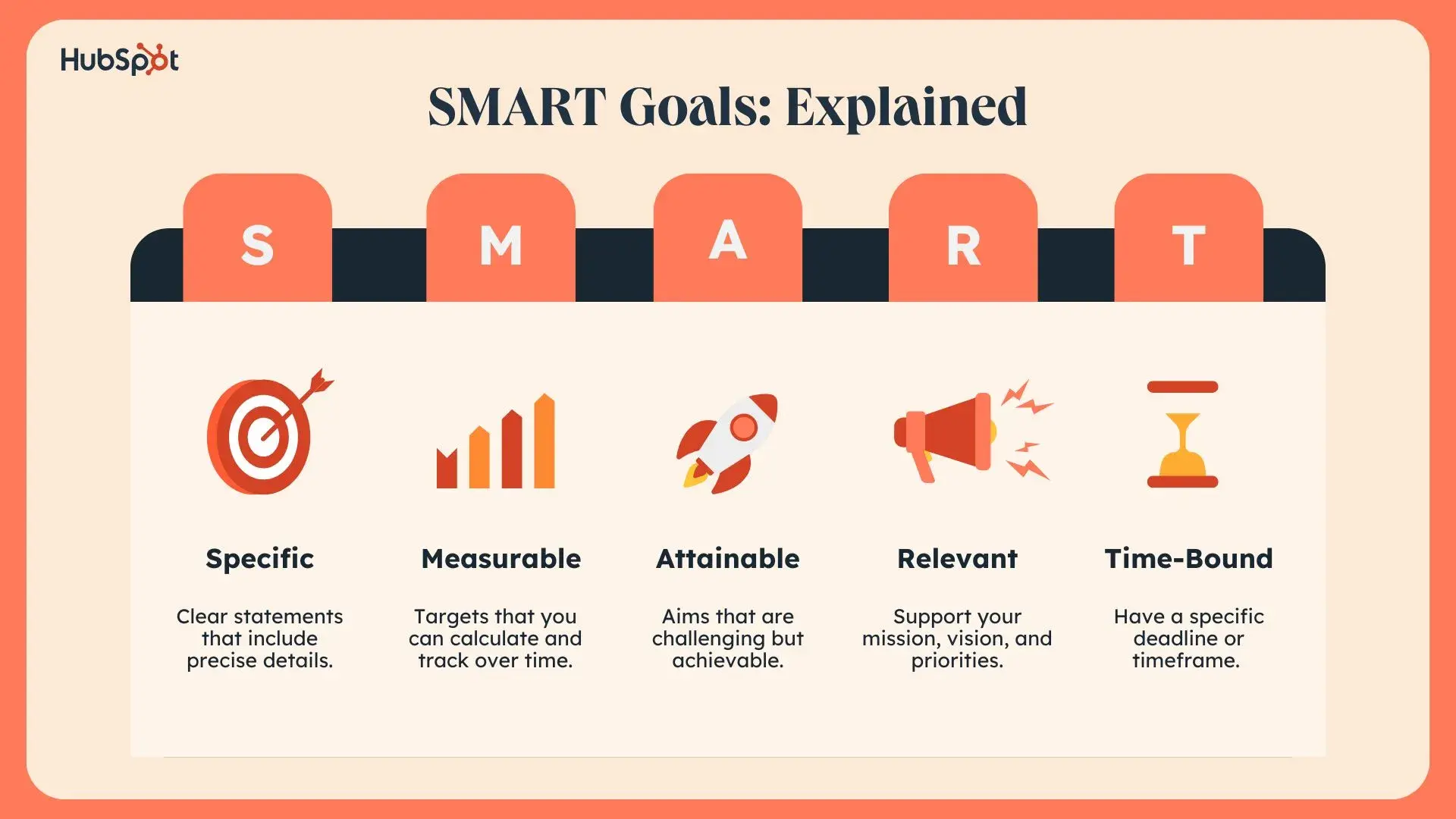
a hubspot-branded graphic showcasing what SMART goals stand for

Step 3: Determine metrics for success.

Yes, every business is different. However, we can all agree that every business needs metrics and key performance indicators (KPIs) for success.

What metrics will you use to determine whether your business is successful? KPIs differ based on your medium, but standard metrics are gross profit margins, return on investment (ROI), daily web traffic users, conversion rate, and more.

Sales Rep KPIs vs. Sales Manager KPIs

For sales reps, KPIs zero in on metrics that shape their daily grind and productivity. Like these:

  • Number of calls made: This one keeps reps on their toes, ensuring they’re hustling and maintaining a high level of outreach
  • Conversion rate: Tracks how many prospects become customers, revealing the power of their pitches
  • Average deal size: Monitors the average revenue per deal, pushing reps to close bigger, better sales
  • Sales cycle length: Helps reps streamline their processes and identify ways to speed things up

For sales managers, KPIs take a broader, more strategic view of team performance. Key metrics include:

  • Total revenue: Measures the team's overall revenue, monitoring progress towards sales targets
  • Pipeline value: Shows the total value of deals in the pipeline, giving insight into future revenue
  • Win rate: Indicates the percentage of deals closed successfully, highlighting strengths and areas for improvement in the sales process
  • Employee retention rate: Keeps track of team stability and satisfaction — crucial for long-term success
  • Training and development progress: Monitors the effectiveness of training programs, ensuring continuous skill development

How to Identify Sales Metrics

I kind of covered this step in the previous example, but it still warrants a bit more elaboration.

The “M” in SMART goals (“measurable”) is there for a reason. You can’t tell if your efforts were successful if you don’t know what “successful” actually means.

In my edtech sales example, I’m assuming ownership of an existing vertical and getting more out of it. So, it’s fair to assume that sales growth rate — the increase or decrease of sales revenue in a given period, typically expressed as a percentage — would be an effective way to gauge success.

I can also structure my goals and objectives around a sales growth rate of 20% Y/Y within my vertical. I’ll make sure my org is familiar with that figure and offer some context about what it would take to reach it — namely, how many institutions we would need to close and retain.

Step 4: Assess the current situation.

How is your business fairing right now? This information is relevant to determining how your current situation matches the goals and objectives you set during Step 2. What are your roadblocks? What are your strengths?

Create a list of the obstacles hindering your success. Identify the assets you can use as an advantage. These factors will guide you as you build your sales plan.

How to Evaluate Current Business Standing

Continuing the edtech example, I'll use the historical context I gathered and the objectives I set to frame how I look at my current circumstances.

For instance, consider my goal of increasing revenue by 20% Y/Y. In that case, I’d look at the company’s retention figures. Ideally, this would give me a sense of whether that needs to be a significant area of focus.

I‘d also try pinpointing trends in the colleges we’ve already closed. Are there any pain points we consistently sell on? I'll take a closer look at how we demo to see if we might be glossing over key elements of our value proposition. Maybe I can use conversation intelligence to get a better sense of how reps are handling their calls.

Ultimately, I would identify why we’re performing the way we are. These inefficiencies might result from our current strategy and how my team can best set ourselves up to sell as effectively as possible.

Step 5: Start sales forecasting.

Sales forecasting is an in-depth report that predicts what a salesperson, team, or company will sell weekly, monthly, quarterly, or annually. While it's finicky, it helps your company make better decisions when hiring, budgeting, prospecting, and setting goals.

After the COVID-19 pandemic, economics have become less predictable. StrActGro owner Claire Fenton states, “Many economic forecasters won't predict beyond three months at a time.” This makes sales forecasting difficult.

Luckily, there are tools at your disposal to create accurate sales forecasts.

For sales managers, I find HubSpot’s forecasting tool invaluable for tracking team progress toward goals. It forecasts revenue based on deal stages and their likelihood of closing. Plus, you can set up forecast categories to group deals and adjust them based on your team's insights.
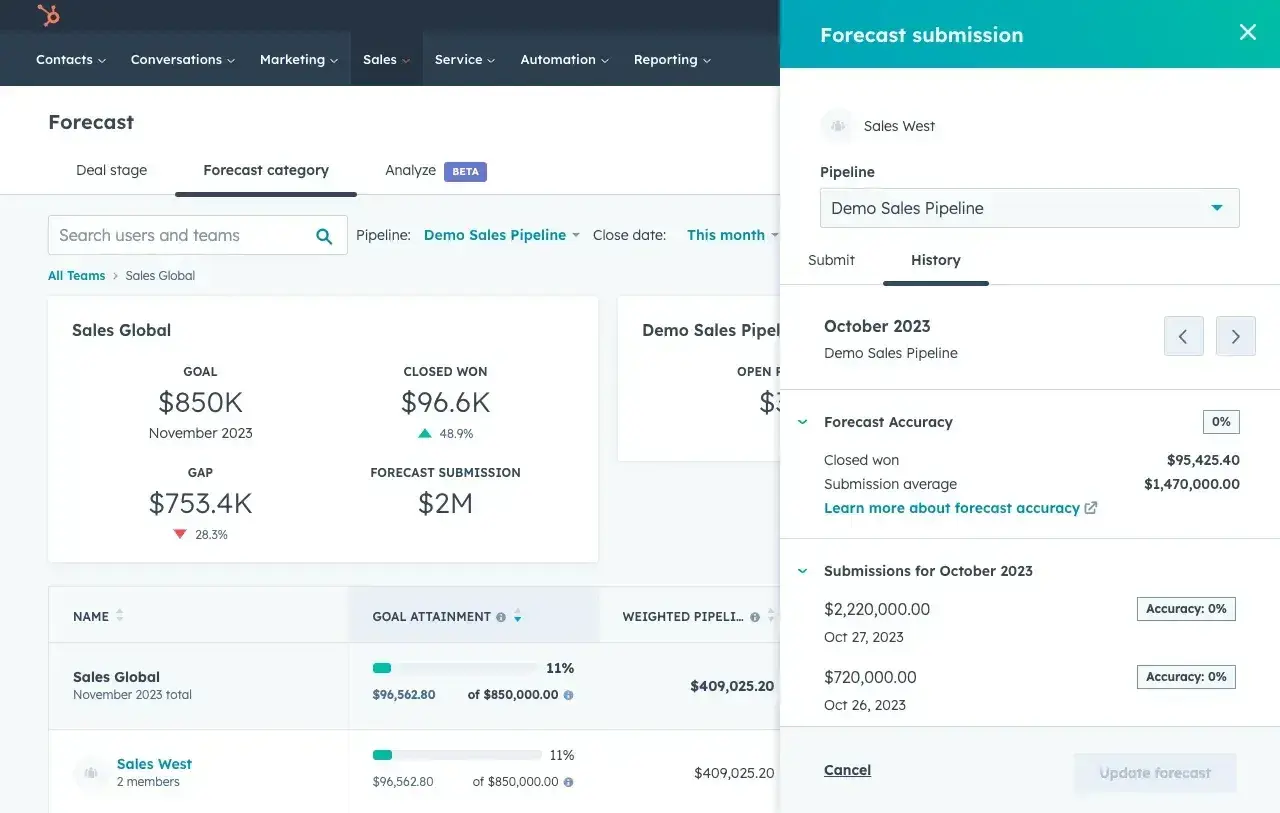
a screenshot showcasing the capabilities of hubspot’s forecasting software available through sales hub

How to Forecast Sales

Following our edtech example, I’d approach this step by estimating how my sales org might perform in the allotted time window with the specific vertical we’re pursuing.

The method I choose will depend on several factors, including the number of concrete opportunities, available historical data, reps’ performance, and our insights about potential customers.

Let’s say I consider those factors and decide to run a multivariable analysis. Here’s how I’d go about it:

First, I’d take stock of the opportunities my reps have lined up. Then, I’d examine the reps working on those deals, their typical win rates, and their time to close. For example, if a rep works with a large institution and has a 50% chance of closing within the timeframe, I’d attribute 50% of the potential deal size to our forecast.

By repeating this process for all opportunities, I'll get a solid sense of the expected revenue within the allotted window.

Step 6: Identify gaps.

When identifying gaps in your business, consider your company's current and future needs. First, identify the skills your employees need to reach your goal. Second, evaluate the skills of your current employees.

Once you have this information, train employees or hire new ones to fill the gaps.

How to Identify Selling Gaps

In our edtech example, let’s say my forecast yielded results that didn’t align with what we needed to achieve our goals. To tackle this, I’d take a holistic look at our process, operations, and resources to find inefficiencies or areas for improvement.

Say I discover that our sales content and marketing collateral are outdated, with case studies missing our product’s newest and most relevant features. Meanwhile, our reps are booking demos, but the demos aren’t converting because of a lack of training and inconsistent messaging.

Finally, I notice that misalignment with marketing leads to prospects expecting unrealistic outcomes that our sales team can‘t deliver. Once I’ve identified those gaps, I’ll focus on ways to remedy those issues and improve those elements.

Step 7: Ideate new initiatives.

Many industry trends are cyclical. They phase in and out of “style.” As you build your sales plan, consider initiatives you might have overlooked.

Has your business relied solely on word-of-mouth and social media marketing? Now might be the time to try webinars or special promotions.

How to Ideate New Sales Initiatives

In our ongoing edtech example, I would ideate initiatives based on the gaps I identified in the previous step. This might involve updating our sales content and marketing materials to make them top-notch.

Next, I’ll introduce new training programs to help our team excel at conducting effective demos. Finally, I'll start working on a plan with marketing to ensure our messaging is aligned with theirs — so our prospects have realistic and clear expectations.

The key is to turn gaps into concrete, actionable plans. Just saying, “We’re going to be better at demos,” isn’t a plan — it’s a sentiment, and sentiments don’t translate into sales.

Step 8: Involve stakeholders.

Stakeholders are individuals, groups, or organizations with a vested interest in your company. They are typically investors, employees, or customers and often have deciding power in your business.

Towards the end of your sales planning process, involve stakeholders from departments that affect your outcomes, such as marketing and product. This will result in an efficient, more holistic, more actionable sales planning process.

How to Involve Stakeholders

Once I’ve pinpointed the key issues blocking my edtech startup’s sales team, it’s time to start recruiting the right people.

First, I’ll reach out to stakeholders handling our sales content and marketing collateral. They’re the ones who can create new, relevant case studies and whitepapers for the institutions we work with.

Next, I’ll go to middle management. Depending on the situation, I might offer more direction for coaching on demos. Or bring in a third-party training service for professional insights.

Finally, I’ll contact marketing leadership to clarify our message. Aligning the benefits and outcomes we highlight during pitches ensures that the schools we target have realistic expectations of our product.

Step 9: Outline action items.

Once you’ve implemented this strategy to create your sales planning process, the final step is outlining your action items.

Using your company's capacity and quota numbers, build a list of action steps that take you through the sales process. Think: writing a sales call script, identifying industry competitors, and strategizing new incentives or perks.

How to Create a Sales Action Plan

In our edtech example, some key action items might be:

  • Revamp our prospecting strategy via more involved coaching and re-tooled sales messaging
  • Revamp administrator and college dean buyer personas
  • Conduct new training on demoing our software
  • See our new prospecting strategy from ideation to execution
  • Align with our sales enablement stakeholders for new, more relevant case studies and whitepapers

Obviously, this list isn’t exhaustive — but those are still the kinds of steps we would need to clarify and take to structure a more effective high-level strategy to produce different (ideally much better) results than we’ve been seeing.

One thing to keep in mind is that sales planning shouldn't end with creating the document.

I recommend repeating this process yearly to maintain your organization’s sales excellence. I would also advise you to set up a Standard Operating Procedure (SOP) around your entire sales planning process to spare yourself the headache of starting completely from scratch each year and ensure consistency across your organization. Check HubSpot’s free SOP template to see how you can get started.

Importance of the Sales Planning Process

Sales strategies based more on intuition than data might work sometimes, but they will always lack consistency and scalability. On the other hand, a clear sales planning process aligns the entire team toward common goals, ensuring effective and more cohesive collaboration.

I remember when my client’s sales numbers were consistently below target. Unsurprisingly, team morale was low.

After analyzing their processes, the sales manager realized the company lacked a coherent sales plan. So, they introduced a detailed sales planning process that included:

  • Setting realistic targets
  • Identifying key prospects
  • Implementing regular performance reviews

Within six months, the client saw a 27% increase in sales. Moreover, their team was more motivated and engaged than ever before.

This could happen for you (and your sales team), too. Take a moment to review the key benefits of having a sales planning process to drive growth and implement efficiency:
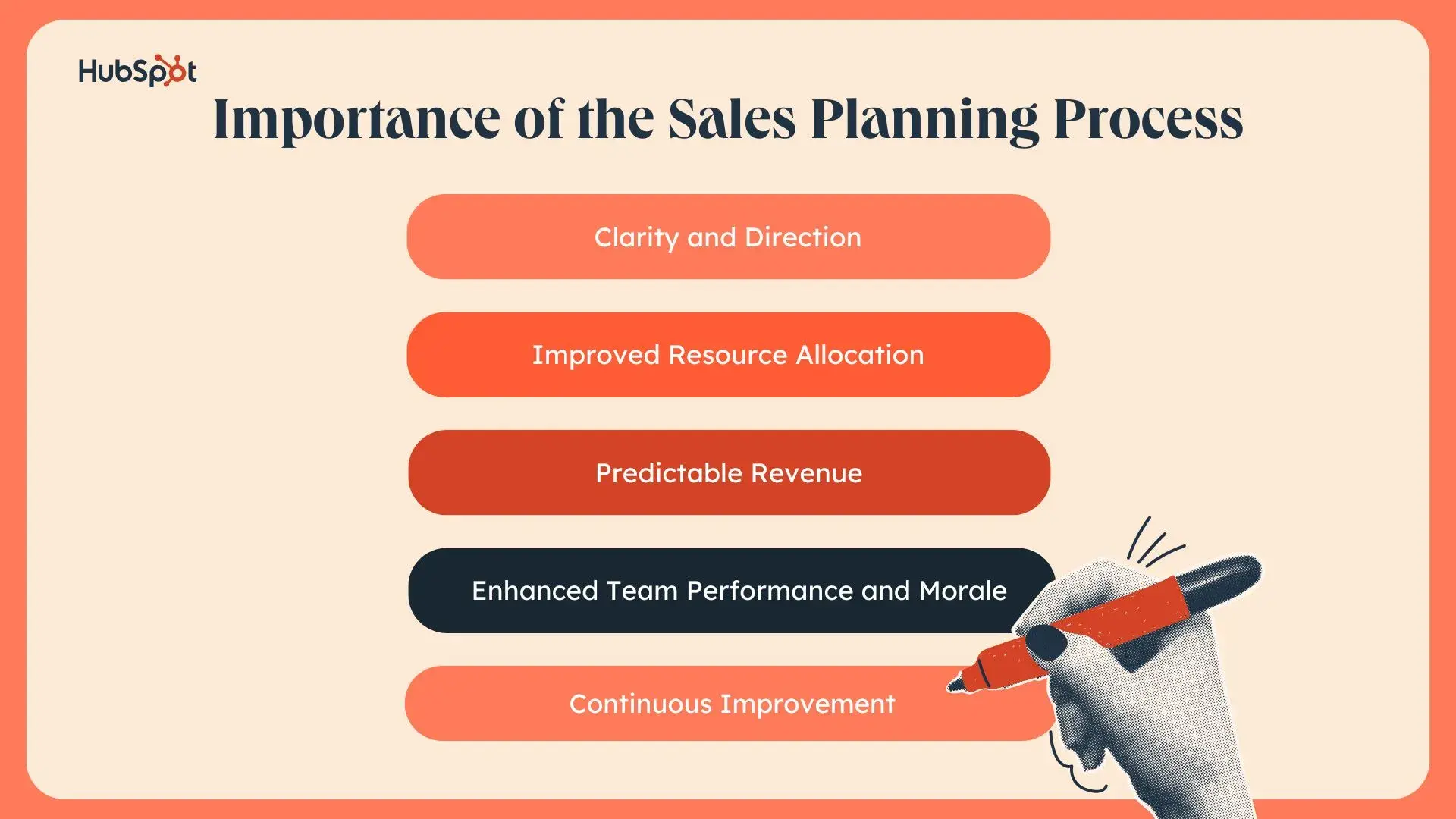
a hubspot-branded graphic showcasing the importance of the sales planning process

1. Clarity and Direction

In my experience, implementing a detailed sales plan changes everything. You‘ll have a clear path to follow, with defined goals and milestones that align everyone on your team. Without a clear plan, prioritizing leads is difficult, and you’ll often find yourself scrambling at the end of every month to meet targets.

2. Improved Resource Allocation

You can identify where to allocate your resources most effectively, whether it’s personnel, budget, or time. The same client I mentioned before used to spread their resources thinly across numerous prospects. Once they started planning, they knew better — they focused on high-potential leads, leading to better conversion rates and increased revenue.

3. Predictable Revenue

One of the most significant benefits of sales planning is predictability. With a predictable revenue stream, I can budget better and invest strategically in growth areas. In fact, according to a Logility report, companies that do effective sales planning see a 31% improvement in forecast accuracy.
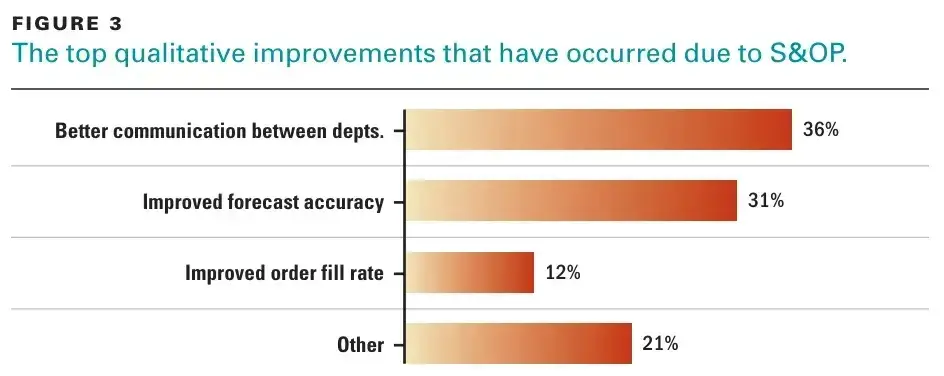
Source

[alt text] a screenshot of a survey figure from a consumer goods study on sales operations and planning

4. Enhanced Team Performance and Morale

As I mentioned, my client’s sales team also struggled with low morale due to unclear targets and objectives. When they introduced a comprehensive sales plan to the equation, they could define clear goals and milestones.

This improved team morale and nurtured a sense of purpose and motivation, which boosted performance and job satisfaction.

5. Continuous Improvement

Sales planning establishes benchmarks and performance metrics are essential for accountability and continuous improvement within the team.

I always champion monthly review meetings where teams can regularly assess progress against the established plan. You can identify areas for improvement, recognize high performers, and address issues promptly.

Now that you’re committed to the sales planning process, I’ll show you how to approach into the written component of sales planning.

a hubspot-branded image showcasing a playbook for sales planning

Ready to write your own plan? Download HubSpot’s Free Sales Plan Template.

What goes in a sales plan template?
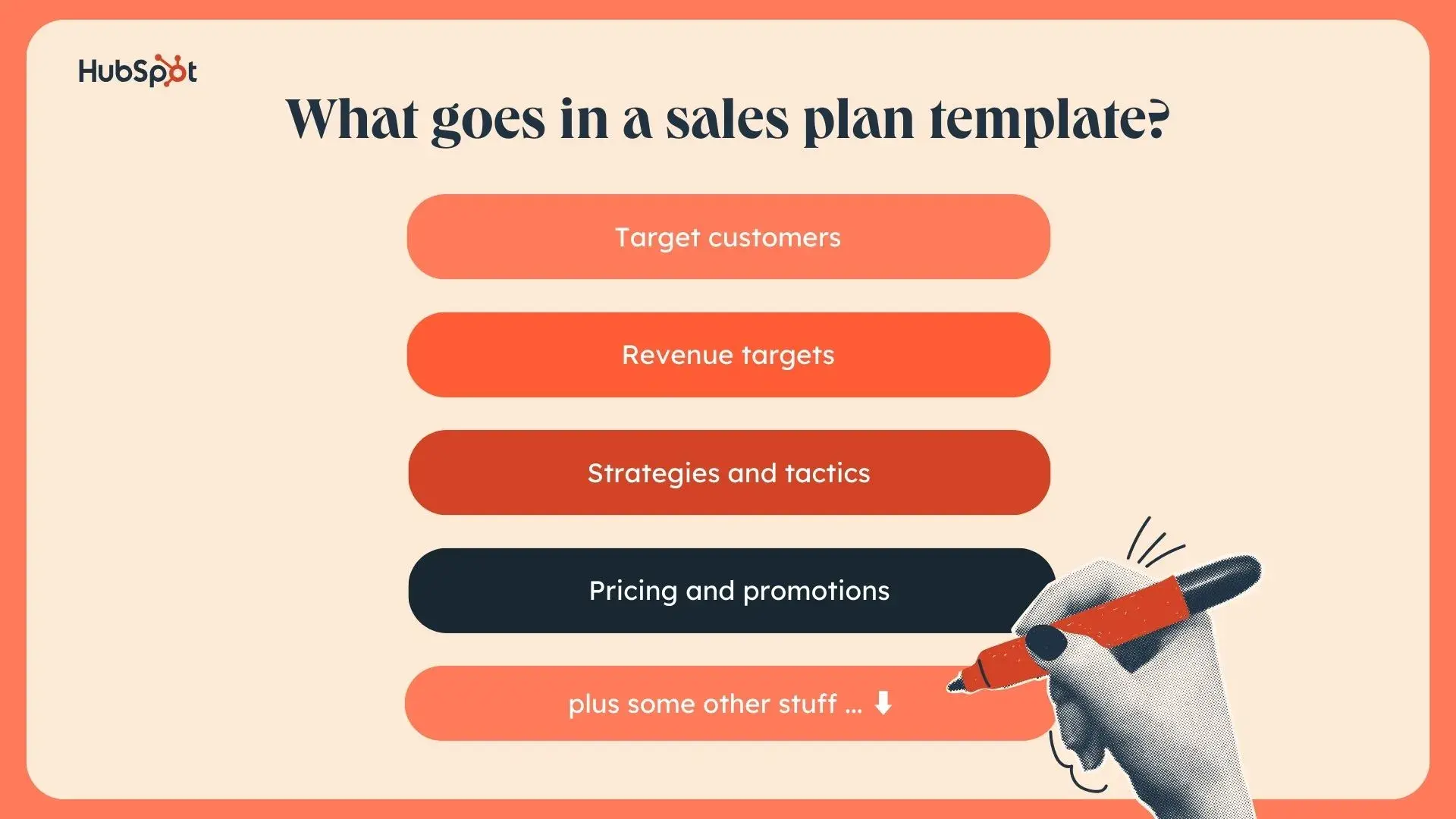
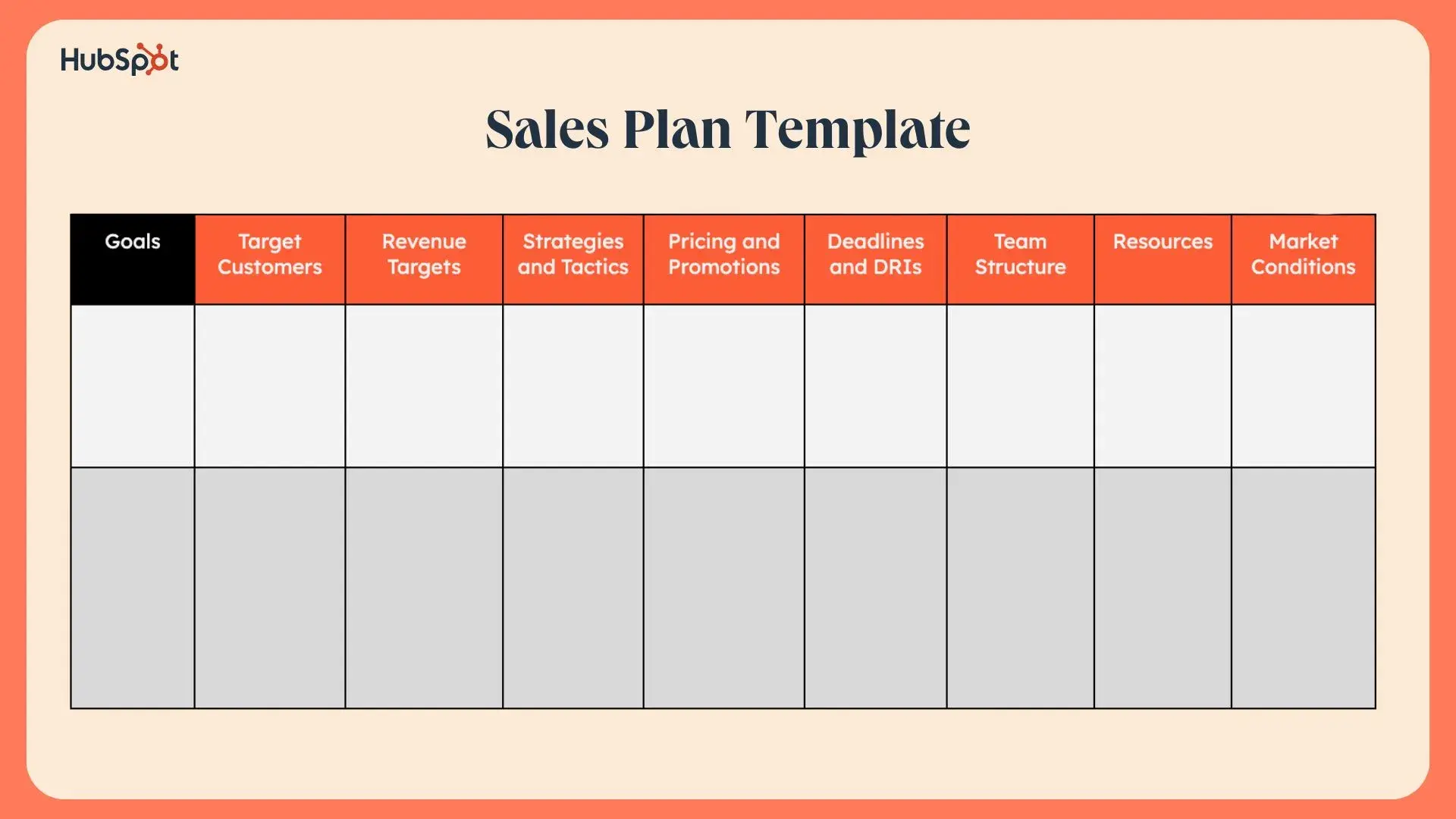
 a hubspot-branded graphic showcasing what goes into a sales planning template

A typical sales plan includes the following sections:

  • Target customers
  • Revenue targets
  • Strategies and tactics
  • Pricing and promotions
  • Deadlines and DRIs
  • Team structure
  • Resources
  • Market conditions

a hubspot-branded graphic showcasing a sales planning template

1. Target Customers

Your target customers are the people your company wants to serve with its products and services. They’re the ones most likely to buy from you. You identify them by breaking down your target market into smaller, more focused groups based on geography, behavior, demography, and more.

There are a few angles to approach this from; here’s how I recommend doing it:

  • Segmenting customers by industry and business size. Not all companies have the exact needs. Identifying your ideal customer based on industry and company size allows you to tailor messaging effectively. For example, a SaaS company might target mid-sized e-commerce businesses needing cost-effective fulfillment and shipping optimization while offering an enterprise-tier solution for large retailers with more complex operations.
  • Segmenting customers by pain points and buying motivations. Every customer has unique challenges that drive them to seek unique solutions. Understanding these pain points allows you to position your product as the best answer to their problem. For example, a logistics provider targeting e-commerce businesses should highlight solutions for reducing shipping delays and optimizing last-mile delivery, which are major pain points in the industry.
  • Segmenting customers by geographical considerations. Different regions have different consumer behaviors, regulatory requirements, and logistical constraints. Your strategy should be customized for these variations. For example, a cybersecurity firm may target U.S. financial institutions with compliance-driven security solutions while offering more cost-effective, scalable options for emerging markets in international territories.

How to Identify Your Target Audience

Let’s continue with our edtech example for this section, too.

As mentioned, my territory is the East Coast, and my vertical is community colleges — so my target market is community colleges on the East Coast.

That’s clear, but my target customers aren’t just the institutions. I need to know the specific contact points when selling to these colleges.

Modern buying decisions often involve multiple stakeholders, especially in large organizations like community colleges. So, my understanding of target customers needs to be more detailed than just “representatives from the school.”

When selling curriculum scheduling software, I’d likely deal with administrators and deans — two personas with different responsibilities. I need to understand both types of customers for effective sales planning.

I’d also consider factors like their daily tasks, the pain points from those tasks, how my software could help, and why their lives would be easier with my product.

2. Revenue Targets

Target revenue is how much money your company aims to bring in during a given time. You can set them up a few different ways. Here are a few options for setting realistic revenue targets within your sales plan:

  • Set targets based on percentage growth from the previous year. One common approach is to set a revenue target by applying a percentage increase to last year’s revenue. If a marketing agency company earned $1 million in revenue last year and aims for 20% growth, its new target revenue would be $1.2 million.
  • Set targets based on employee performance. Estimate revenue potential based on the number of employees and their output. If a business coaching business has 10 consultants, each generating $100,000 annually, the company can set a target revenue of $1 million, assuming full utilization of their capacity.
  • Set targets based on industry trends. Consider external factors such as industry growth rates, economic conditions, and competitor benchmarks to define an achievable target. For example, if B2B software sales grow at 15% annually, your company might adjust its revenue target accordingly to stay competitive.

How to Set Revenue Targets
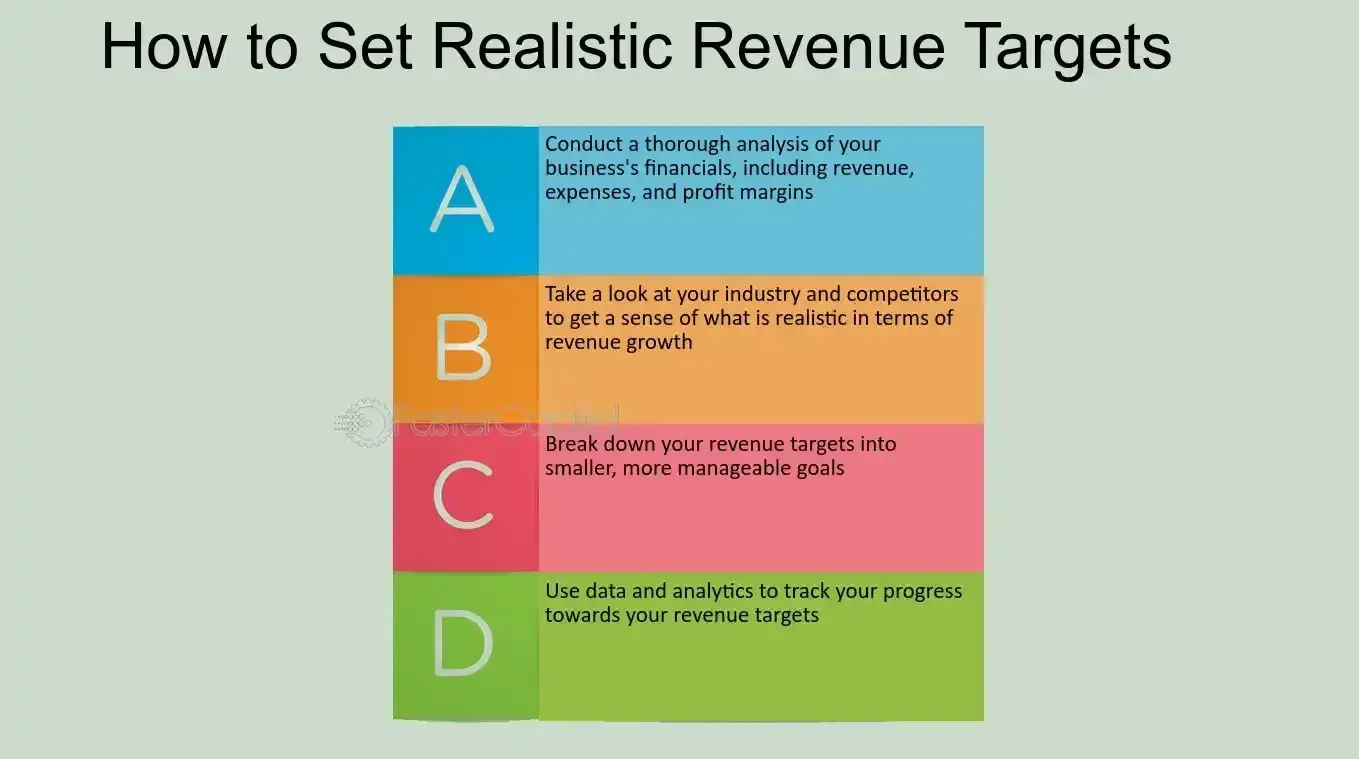
a graphic from a faster capital blog post demonstrating how to set realistic revenue targets

Source

I would pull directly from the SMART goals defined earlier to set this up. I’ll look at the revenue figure we need to hit to achieve the 20% increase we aimed for earlier.

3. Strategies and Tactics

Strategies and tactics are the specific actions your team will take to reach those revenue targets. Here are a few extra tips to help your strategies and tactics go far:

  • Leverage social media for lead generation. Social media platforms provide a powerful way to connect with potential customers, build brand awareness, and generate leads. For example, a tech startup company can use LinkedIn to share case studies and interact with prospects in industry groups to attract high-quality leads.
  • Ask for referrals from existing clients. Referrals can be one of the most cost-effective ways to acquire new customers. Happy clients are often willing to introduce you to others in their network — especially if incentivized with discounts, exclusive offers, or loyalty perks. A structured referral program can make the process seamless and scalable. For example, a financial advisory firm offering a $100 credit for every successful client referral can encourage satisfied customers to spread the word, resulting in warm, high-converting leads.
  • Maintain relationships with past clients. Just because a deal is closed doesn’t mean the relationship should end. Staying in touch with past clients can lead to repeat business, upselling opportunities, and valuable testimonials. For example, a real estate agent who follows up with past buyers annually — offering home maintenance tips or market updates — can increase repeat transactions and generate referrals.
  • Implement a multi-touch follow-up strategy. Most sales don’t happen after just one touchpoint, so persistence is key. A structured follow-up process — including email sequences, phone calls, and retargeting ads — can keep leads engaged and nudge them toward conversion. For example, a retail brand using automated abandoned cart emails and personalized SMS follow-ups can recover lost sales and increase overall conversion rates.

Pro Tip: When it comes to making strategy decisions in sales, HubSpot’s 2024 Sales Strategy Report revealed that 66% of sales pros admitted that AI has helped them understand customers better and provide them with more tailored experiences. As you think about how to optimize this part of your sales process, consider employing AI to help you simplify the time-consuming stuff (i.e., generating copy, automating post-deal outreach, etc.)

How to Create Effective Sales Strategies

To create effective sales strategies, I’ll consider our organization’s goals and how responsibilities are allocated. We might leverage conversation intelligence to coach SDRs better and improve sales messaging.

We could also focus on enabling our account management team to retain existing customers. Lastly, I’ll revamp our demo process to highlight our most popular and impressive features.

4. Pricing and Promotions

Pricing and promotions typically attract customers’ attention. This section documents your offering’s price and any upcoming promotions to convert customers.

  • Offer a free trial. A free trial allows potential customers to experience your product or service risk-free before purchasing. A great example of this is Apple TV’s 7-day free trial. Access to the streaming service is free for a week, then $10 afterward.
  • Use limited-time discounts to create urgency. Time-sensitive promotions (like flash sales or seasonal discounts) create a sense of urgency and push hesitant buyers to purchase. Limited-time offers, whether a percentage off, a buy-one-get-one (BOGO) deal, or a bundle discount, work incredibly well to drive sales. Nike is one business that does limited-time discounts impressively well. Their Nike Member Days and seasonal sales (like Black Friday and back-to-school promotions) drive massive engagement by offering steep discounts on popular products for a short window of time.
  • Leverage membership programs. Rewarding repeat customers with exclusive deals, points-based systems, or VIP pricing through a paid membership (monthly or yearly) encourages long-term engagement and brand loyalty. A great example of this is Savage X Fenty’s $60 “credits system” membership model. Instead of a traditional subscription, members are charged $60 each month, which they can then redeem as store credit toward new purchases.

A free trial is probably the most popular promotional tactic you’ll hear about. Amazon and Hulu also use it to reel customers in, hoping they’ll stick around after the trial ends.

That said, almost every company offers some kind of free trial (or creative spin on a typical discount offer) to attract new customers, so I’ll say this: Be strategic with what pricing and promotions you implement into your sales plan. Find the sweet spot between profitability and appeal to your target audience.

How to Set a Pricing Model

My sales team will thoroughly review our pricing model to ensure it aligns with our market position and revenue goals. I’d compare our prices with competitors to see if we’re too expensive or cheap.

The goal is to find a reasonable price for our target institutions without compromising our product’s perceived value. With a deep understanding of our market and a quality product, we aim to hit the right price point to meet our revenue targets.

5. Deadlines and DRIs

Deadlines and Directly Responsible Individuals (DRIs) outline any critical dates for deliverables and list who is accountable for their completion. A business has tons of moving parts. Creating a timeline and assigning responsibility to each task is necessary to keep your sales organization running successfully.

How to Establish DRIs

In our edtech example, some DRIs might include:

  • Director of Sales Development. This person will ensure that our prospecting strategy is as productive as possible
  • Account Executives. This person will demo the software and close deals with the institutions
  • Account Managers. This person will be responsible for ensuring our existing accounts stay on board

6. Team Structure

Your team structure often depends on the size of your company. Smaller businesses tend to have a small team, which can exacerbate overlapping and confusion issues.

As your company grows, you’ll need more employees. The more employees you have, the harder it can be to manage these different members. Your sales plan needs to outline the members of your team and their specific roles to provide clarity.

7. Resources

Your team members are your most powerful asset for executing your sales plan, but they need the right resources to function and meet revenue targets. Check out my best picks for resources that could work for your sales team:

  • Leverage CRM software for better customer relationships. A Customer Relationship Management (CRM) system helps sales teams track interactions, follow up on leads, and personalize outreach efforts. A real estate agency might use HubSpot’s Sales Hub to monitor client inquiries, set up automated email reminders, and analyze sales performance to improve conversion rates.
  • Implement sales enablement platforms to equip teams with knowledge. Sales enablement tools provide reps with the necessary training materials, case studies, and sales scripts to do what they do best: Close deals effectively. A software company might use a sales enablement platform to centralize resources so their salesfolks can access up-to-date information and sales strategies anytime.

You can also use project management tools like Monday or Asana to keep track of deadlines. Design programs like Adobe Photoshop and Canva make creating compelling graphics for prospects easy. There’s no shortage of tools to utilize; you have to find the right ones that align with your team’s needs and workflow.

Pro Tip: According to HubSpot’s 2024 Sales Strategy Report, 79% of B2B sales professionals who use sales enablement content say it’s important when making a sale. Want to know another eye-opening stat? 58% of salespeople who utilize sales enablement content are more likely to outperform those who don’t. That said, here’s my opinion on equipping salesfolks with sales enablement resources: Go all out; make them a priority. Equipping your sales team with the right resources will guide them closer to stronger customer relationships and, inevitably, more successful deals.

8. Market Conditions

Market conditions cover crucial info about your industry and competitive landscape. What’s trending? Where are customers losing interest? Which competitors are gaining traction and why? Understanding the market helps shape your sales plan. Here’s how you can do it (without stressing out about information overload):

  • Identify emerging trends to stay ahead. Keeping up with industry trends allows you to anticipate customer needs and adjust your offerings accordingly. Monitor shifts in consumer preferences, technological advancements, or regulatory changes that could impact your market. Using tools like Google Trends, industry reports (HubSpot’s ‘State of’ Reports are awesome), and other social media listening tools (Sprout Social is a great option) can help you stay updated.
  • Analyze where customer interest is declining. Understanding why certain products, services, or strategies are losing traction can help you pivot before sales decline. Regularly analyzing customer feedback, review platforms, and website engagement metrics can highlight areas where interest is waning.
  • Monitor competitor success and challenges. Watching which competitors are gaining traction — and why — can reveal strategic opportunities. Try using HubSpot’s Competitive Analysis Templates to assess how competitors are marketing, pricing, and engaging customers.

Next, I’ll dive into writing a sales plan. Have your pen and paper ready; follow with HubSpot’s free Sales Plan Template to make the most of this blog post.
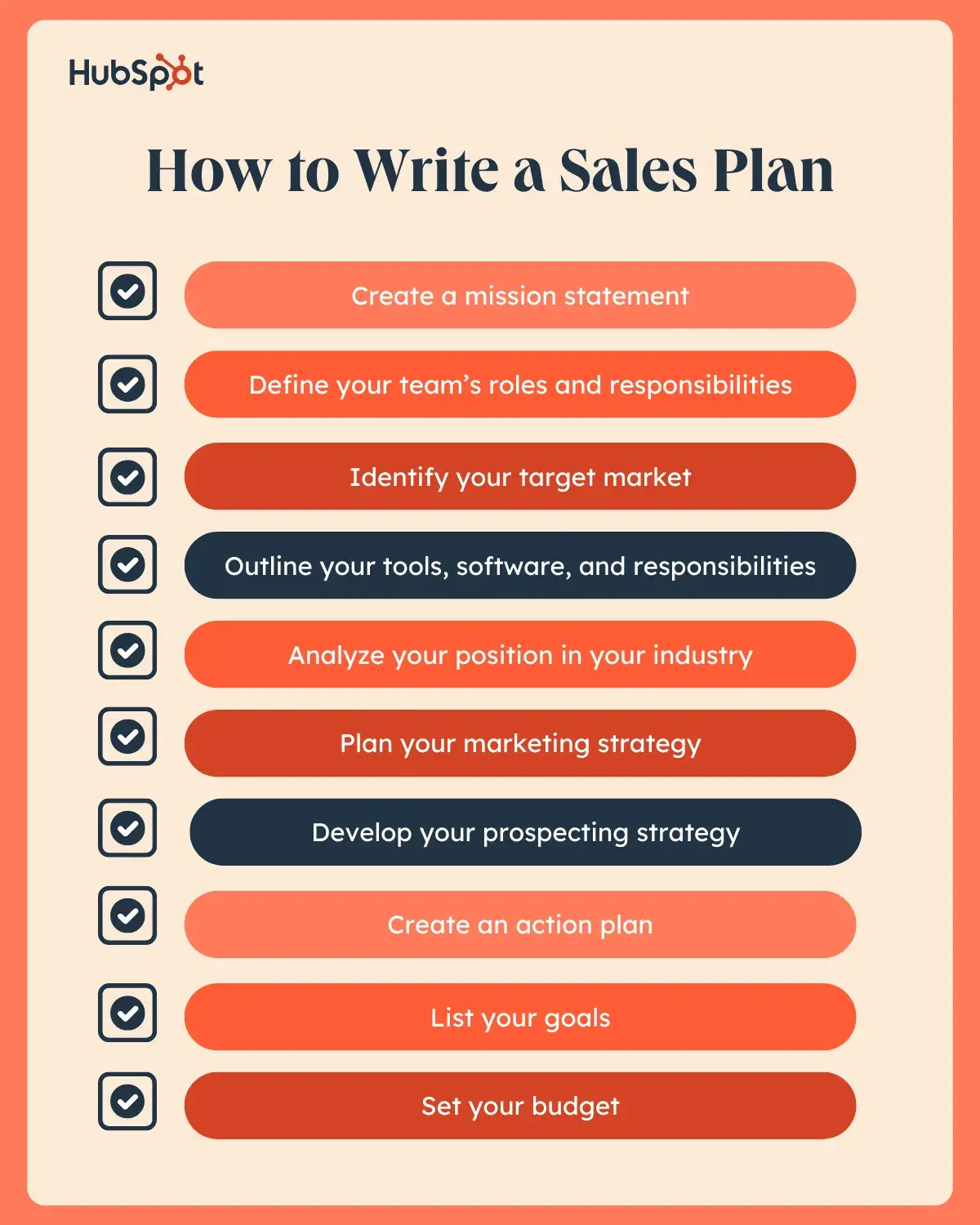
 a hubspot-branded graphic explaining how to write a sales plan

1. Create a mission statement.

Start your sales plan with a mission statement — a concise, straightforward distillation of what your business hopes to accomplish. Your mission statement sets the tone for your entire sales plan, so keep it aspirational yet realistic.

You don’t want to get too hung up on detailing the “how” behind your business here. Offer your vision — not your “About Us” page.

How to Create a Mission Statement

  • Keep it concise: Aim for 1-2 sentences that define your overarching purpose.
  • Focus on impact: Emphasize how your company benefits customers rather than just describing what you do.
  • Avoid jargon: Use straightforward language that’s easy for both your employees and customers to understand.

Referencing our former edtech example, the company’s mission statement might say something like:

“Our mission is to empower higher education institutions to empower their students — maximizing schools' abilities to help their students realize their full potential by facilitating timely graduation and seamless class scheduling.”

2. Define your team’s roles and responsibilities.

Next, describe who’s on your team and their roles. You may manage five salespeople and work closely with a sales enablement professional and a sales ops specialist. If you plan to hire more, note their roles and when you’ll bring them on board.

How to Define Team Roles and Responsibilities

  • Break down responsibilities clearly. For each role you create, specify what they do and own to avoid overlaps or gaps.
  • Align roles with your sales goals. If you’re planning to expand into new markets, ensure you’ve got a dedicated team members for prospecting and closing deals.
  • Plan for future hiring needs. If your company is anticipating scaling, indicate when and where additional hires will be needed.

Here’s a cursory overview of what a team structure might look like in the context of our edtech example:

  • Joan (Director of Sales Development) will ensure that our prospecting strategy is as productive as possible
  • Bobby and Sally (Account Executives) will be demoing the software and closing deals with the institutions
  • Roger and Peggy (Account Managers) will be responsible for ensuring our existing accounts stay on board
  • Don, Trudy, Bert, and Betty (Sales Development Representatives) will connect with institutions to book demos

3. Identify your target market.

Knowing your target demographic is non-negotiable (whether you’re writing your first-ever sales plan or your 15th). To help you get a clear picture of what this process looks like, ask yourself questions like this:

  • What do your best customers look like? Do they all belong to a specific industry?
  • What common pain points or challenges do they face that your product or service solves?
  • How do they typically make purchasing decisions? Are multiple stakeholders involved?

Different products mean different buyer personas. For example, HubSpot’s salespeople might sell marketing software to CMOs and sales software to sales directors.

Keep in mind that this section of your sales plan can change dramatically as your solution and strategy evolve and you adjust product-market fit. In the beginning, when your product was in its infancy, and your prices were low, you may have found success selling to startups.

Once the product is more robust and you’ve raised the price, mid-market companies are likely a better fit. That’s why I can’t stress this enough: It’s really essential to review and update your personas consistently.

How to Determine Your Target Market

  • Segment your audience. You can do this based on industry, company size, or specific pain points.
  • Create buyer personas. Buyer personas help you understand the types of decision-makers and customers that’ll interact with your product or service.
  • Re-evaluate regularly. Markets change, needs change … Your ideal customer today may not be the same as a year from now.

Again, I covered this one in the previous section, but for the sake of you not having to scroll back up, I’ll say it again: In our edtech example, my target market is community colleges on the East Coast. But it‘s not just about the institutions. I need to know the points of contact I’ll be dealing with at these colleges.

Modern buying decisions involve multiple stakeholders, especially in large organizations like community colleges. I’ll likely interact with administrators and deans when selling curriculum scheduling software, each with unique responsibilities. I need to understand both personas well when planning sales.

4. Outline your tools, software, and resources.

Include a description of your resources, not just software. Detail key tools like your CRM and sales tools. Additionally, don’t ignore other elements like budgets for contests, training materials, and sales collateral.

How to Outline Your Tech Stack

In our edtech example, I might find we’re using:

  • A CRM to provide a centralized repository of our prospect and customer data
  • Sales tools to streamline lead generation and prospecting through features like email automation and tracking, lead scoring, pipeline management, and more
  • Conversation intelligence software will guide better-structured, more effective coaching for our sales calls
  • Sales enablement software to centralize and manage our sales enablement resources
  • An additional budget could be allocated for a SPIFF to motivate SDRs to book more demos
  • Case studies show how other community colleges have successfully leveraged our software
  • Any other resources we might have available that can be used to educate buyers or enhance our sales professionals’ efforts

5. Analyze your position in your industry.

Now, name your competitors. Compare your products to theirs, highlighting their strengths and weaknesses. Discuss their pricing versus yours. Keep an eye on market trends, too.

If you’re working in SaaS world, note which vertical-specific software is gaining traction. If you sell ads, you should mention the rise in programmatic mobile advertising and try to predict how these changes will influence your business. It’s all about staying ahead of the curve and adapting proactively.

How to Evaluate Industry Positioning

  • Research competitors’ pricing, features, and sales strategies
  • Gather customer feedback to understand why they choose your product over others
  • Monitor industry trends to anticipate shifts in customer demand

In my edtech company, I’d look closely at the types of institutions that buy from us. What are their enrollment figures? If we had tiered pricing, which price points would they be choosing? What are their typical budgets? Most importantly, what pain points drive them to seek our solution?

Next, I’d examine our competitive landscape — ideally, gathering the same information for our competitors and their customers. By pinning down these elements, I’d know what kind of buyers gravitate to each solution in our market. This will show how prospects perceive our offering and where we stand in the competitive landscape.

This insight helps my team understand their selling position, identify which institutions will be most receptive to our efforts, and determine the best approach for each engagement.

Pro Tip: I recommend using AI tech wherever possible in this section of your sales plan. Why? Because AI is best used for research (if nothing else). I say this because, as a sales pro, you should always be focused on boosting buyer confidence and intently listening to a prospect’s needs and challenges with your product or service.

By utilizing AI technology first, you’re able to cut down the time spent doing the things I listed above and, in turn, create more time for doing meaningful work later.

6. Plan your marketing strategy.

Next, describe your pricing and any promotions you’re planning on running. What key actions will you take to increase brand awareness and generate leads? Note the impact on sales.

Here’s a mock version:

  • Product A: Free upgrade if you refer another customer from January 1-20 (20% increase in monthly sales)
  • Product B: Increasing price from $40 to $45 on February 2 (2% reduction in monthly sales)
  • Product C: Decreasing price from $430 to $400 on March 1 (15% increase in monthly sales)
  • Product D: No change

How to Approach Marketing Planning

  • Content Marketing: Blog posts, thought leadership articles, newsletters, case studies
  • Referral Programs: Encourage existing customers to refer others
  • Pricing Promotions: Temporary discounts, free trials, or bundled offers

For our edtech company, let’s say we intend to lean heavily on an inbound marketing strategy.

In that case, company leadership would want to invest in a company blog that covers trends and concepts in the education industry. Ideally, that resource will produce a steady stream of leads while simultaneously establishing our business as a trusted authority in the space.

7. Develop your prospecting strategy.

A structured prospecting strategy ensures a steady flow of high-quality leads into your sales pipeline. Ask yourself: How will my sales team receive and qualify the leads generated by your marketing strategy? Once you’ve got your answer, be sure to include the criteria prospects should meet before sales reps contact them.

How to Create an Effective Sales Prospecting Strategy

  • Define lead qualification criteria (e.g., company size, budget, need for your product)
  • Use a mix of outreach methods (email, phone calls, LinkedIn messaging)
  • Automate lead nurturing with email sequences and follow-ups

Imagine how our hypothetical edtech company’s inbound marketing infrastructure development pans out. We’re able to maintain a reputable blog about the education industry that brings in a steady stream of leads, which could provide the basis for an effective prospecting strategy.

Our content marketing department can produce and qualify warm leads to pass to our sales team. Ideally, we’ll have more effective, focused criteria for determining whether and how to contact those leads.

From there, we can focus primarily on email outreach — a plan that a more conventional cold-calling strategy could complement.

8. Create an action plan.

This section summarizes your game plan for hitting your revenue targets.

Once you’ve outlined your goals, you’ve got to figure out how you’ll achieve them. Try to be thorough but concise when detailing these steps, and support any items you detail with a clear, viable timeline.

How I Create a Sales Action Plan

  • I define clear objectives
  • I set deadlines for key initiatives
  • I assign ownership to team members for each task

Here’s what part of the action plan might look at our hypothetical edtech company:

Objective: Increase revenue in our East Coast community college vertical by 20% Y/Y.

  • Revamp our prospecting strategy via more involved coaching and re-tooled sales messaging (Timeline: Q1)
  • Leverage conversation intelligence to shadow calls — offering more perspective on practical elements of current strategies and areas for improvement
  • Revamp administrator and college dean buyer personas (Timeline: Q1)
  • Reference historical data in CRM for trends in successful and unsuccessful sales engagements with these kinds of contacts
  • Implement a new training framework for demos (Timeline: Q1)
  • Conduct email outreach to inbound leads (Timeline: Q1-Q4)

I can flesh this plan out to cover the key actions that will shape our high-level strategy and guide the more granular aspects of its implementation. Committing to writing plans is crucial in sales, including action items in your sales plan.

9. List your goals.

Most sales goals are revenue-based. For instance, you might aim for $10 million in annual recurring revenue (ARR). Alternatively, you can set a volume goal, like acquiring 100 new customers or closing 450 sales.

Regardless of your approach, make sure your objective is realistic. Otherwise, your entire sales plan won't hold much value.

Consider your product’s price, total addressable market (TAM), market penetration, and available resources (including your sales team and marketing support). Your goal should align closely with your broader business objectives.

How to Define Your Goals

  • Revenue-based goals
  • Volume-based goals
  • Customer-based goals
  • Region-specific goals

For example, if our edtech company aims to move upmarket, we might aim to “Acquire 20 Enterprise logos” rather than just “Sell X in new business.” This approach encourages targeting the right customers rather than just chasing numbers.

You’ll likely have multiple goals. Identify the most important, then rank the rest by priority. If you have territories, assign specific sub-goals to each. That will make it easier to identify over- and under-performers.

Don’t forget to lay out your timeline. Regular benchmarks indicate if you’re on track, ahead, or falling behind. Say your first-quarter sales goal is $30,000, and you know from last year’s performance that January and February are slower months. Your timeline might look like this:

  • January: $8,000
  • February: $8,000
  • March: $14,000

Include DRIs if applicable. For instance, Rep Carol might have a January quota of $5,000, while Rep Shane — who’s still ramping up — might have a $3,000 quota. This approach helps smaller teams avoid duplicating efforts and prevents blame-shifting if targets aren’t met.

10. Set your budget.

Describe the costs associated with hitting your sales goals. That usually includes:

  • Pay (salary and commission)
  • Sales training
  • Sales tools and resources
  • Contest prizes
  • Team bonding activities
  • Travel costs
  • Food

Compare the sales plan budget to your sales forecast for accurate budgeting.

If you want to improve your plan, read on for tips on creating a highly effective sales plan.

Tips for Creating an Effective Sales Plan

I’ve reviewed what you should include in a sales plan, including some examples and mockups.

Now, I’ll share some tips and tricks for creating a sales plan that helps you hit target numbers and exceed your higher-ups’ expectations.

  • Use industry trends to strengthen your plan. When presenting your sales plan to a stakeholder, use industry trends to highlight why your plan will be effective.
  • Specify the technology you’ll use to track success. You can do this for internal reference or let stakeholders know how you'll measure success. Some tools you can consider include CRM and dashboard software.
  • Support your budget proposal with hard facts and data. If you’re creating a budget as a part of your plan, support it with previous performance data and sales forecasts.
  • Create different plans for each team. If you create a sales plan for business development, inbound sales, outbound sales, field sales, and so forth, you can get even more granular and specific in your goals and KPIs.
  • Get marketing’s input. Marketing and sales alignment is critical for the success of your sales plan. The more input you have from marketing, the more you can align your lead generation, prospecting, and nurturing efforts.
  • Talk with your sales reps to understand their challenges. It might be easy to get lost in numbers and forecasts, but it’s essential to know your sales representatives’ day-to-day to understand what will and will not prove practical or feasible.
  • Complete an in-depth competitive analysis. You must know what the competition is doing well to create a plan that nudges your company in that direction.

Types of Sales Plans

You can create a few different types of sales plans for your organization. I’ve gathered some examples so you can find the right fit for your needs. Check them out below:

1. 30-60-90-Day Sales Plan

a hubspot-branded image showcasing a playbook for sales planning

Download Now: Free Sales Training Template

This general sales plan is defined not by theme but by time frame. You’ll create three goals: one for the 30-day mark, another for the 60-day mark, and the last for the 90-day mark. You can focus on quotas or reducing customer churn by a certain percentage.
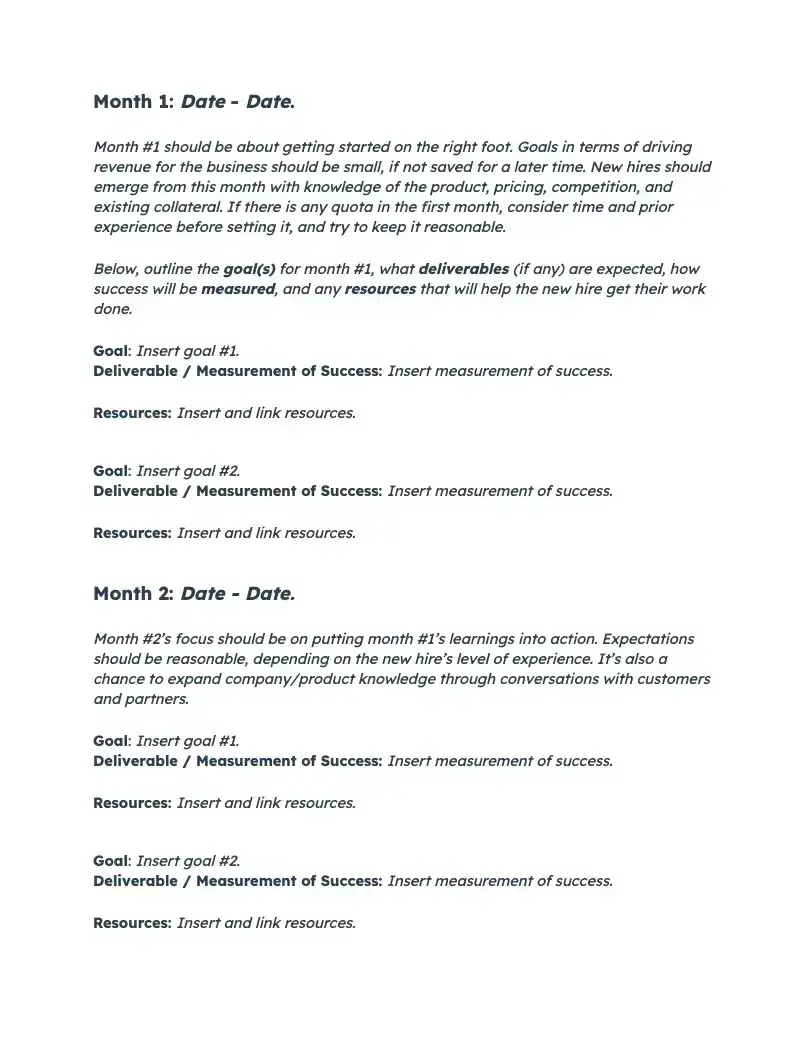
 a screenshot of a 30-60-90 template from hubspot’s sales planning template offer

Consider this plan if you're new to the role since you can use it to track your progress during your first 90 days. A 30-60-90 day plan can also be useful for a new business that's still figuring out its sales goals.

Peggy Ratcliff McKee, an executive career coach at Career Confidential, describes the 90-day plan as “a great starting point… [where] you may end up speeding up your goals or extending them depending on the specific needs of your new company.”

2. Marketing-Alignment Sales Plan
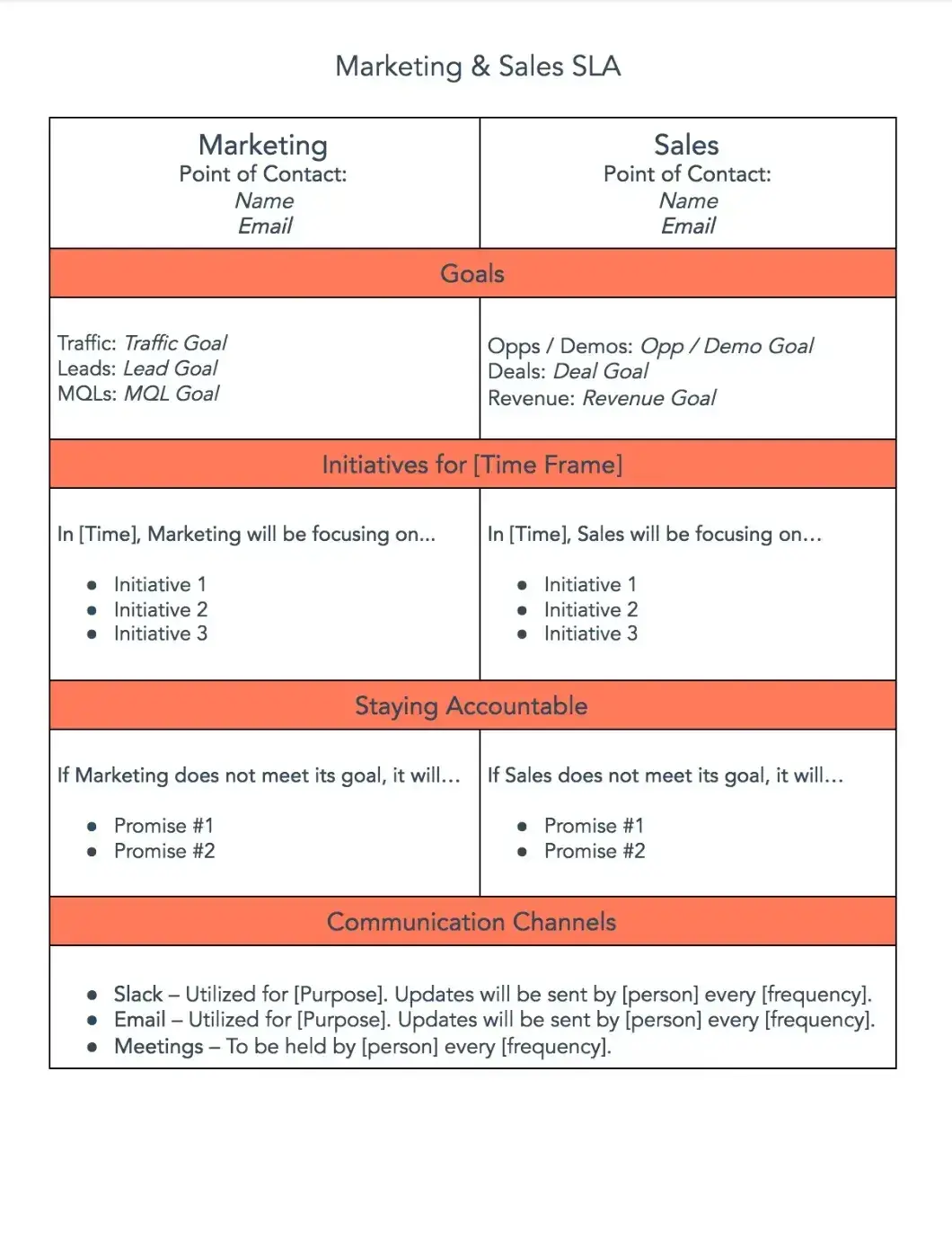
a screenshot of a template page overviewing how a salesperson could complete a marketing and sales alignment sales plan

Download Now: Free Marketing & Sales Alignment Template

In many ways, a traditional sales plan is already aligned with marketing. Still, you can create a marketing-alignment sales plan if your organization has not yet aligned both departments.

The plan will focus on establishing ideal customer profiles and buyer personas and aligning marketing’s messaging with sales’ product pitch. A strong marketing-sales alignment ensures everyone within your organization is on the same page and reduces miscommunication.

3. Business Development Strategic Sales Plan

a screenshot hubspot’s business development strategic sales planning template

Download Now: Free Strategic Business Planning Template

A strategic sales plan for business development will focus on attracting new business to your company by networking with other companies, sponsoring events, and doing outreach. In your sales plan, you'll want to choose the right KPIs that best reflect performance for these specific outreach channels.
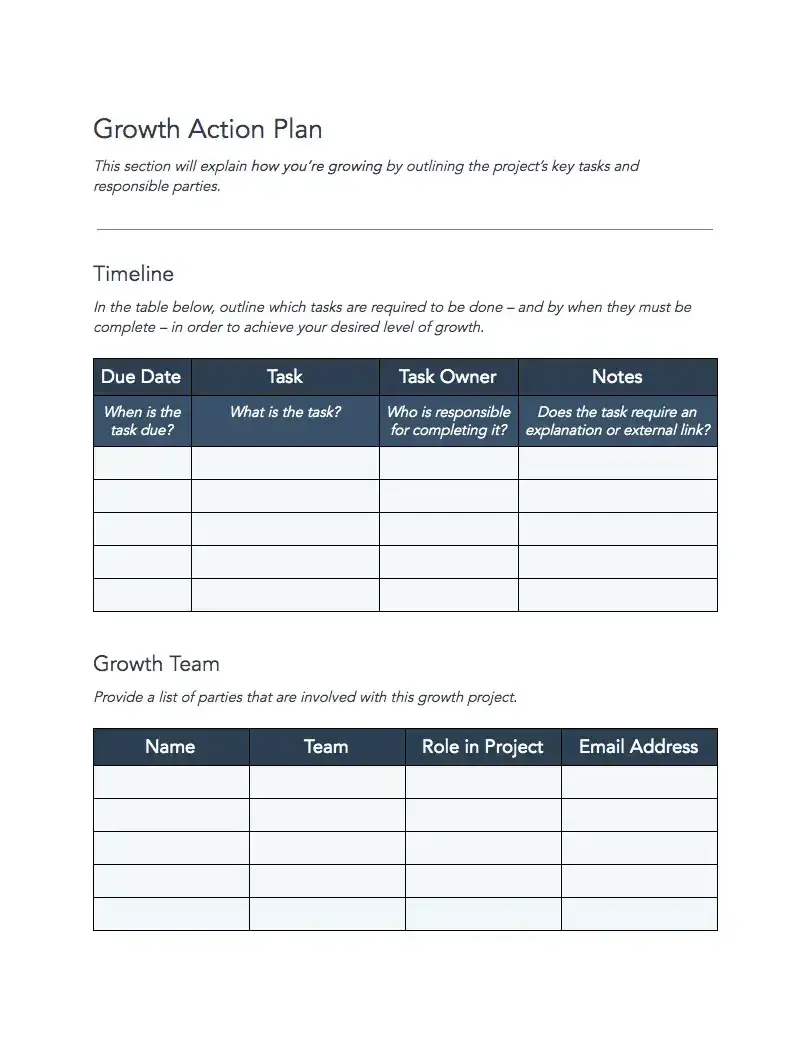
a screenshot of a page from hubspot’s business development strategic sales planning template covering how to complete a ‘growth action plan’

Business development is imperative for long-term success because it will help your organization better understand your industry's competitive landscape and strategize how to stand out. It also ensures everyone at your company works toward a common goal.

4. Market Expansion Plan

a screenshot hubspot’s marketing expansion planning template

Download Now: Free Marketing Plan Template

A market expansion plan outlines a task list and target metrics when expanding into a new market or territory. This sales plan explicitly addresses a target market in a new geographical area.
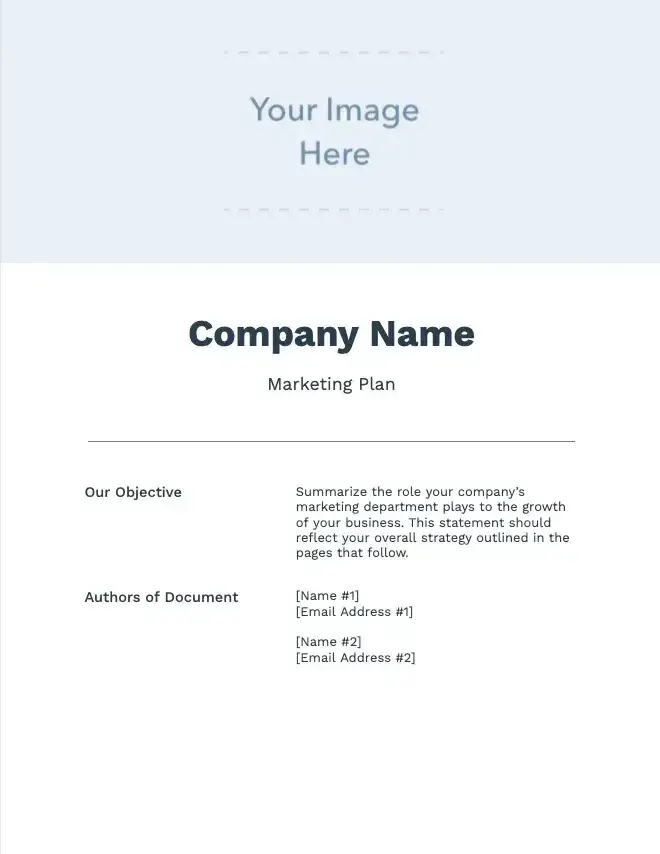
a screenshot of a page from hubspot’s marketing expansion planning template

You’ll typically consider distribution costs and, if applicable, time zone differences between your sales representatives and target buyers, as well as other logistical factors.

5. New Product Sales Plan
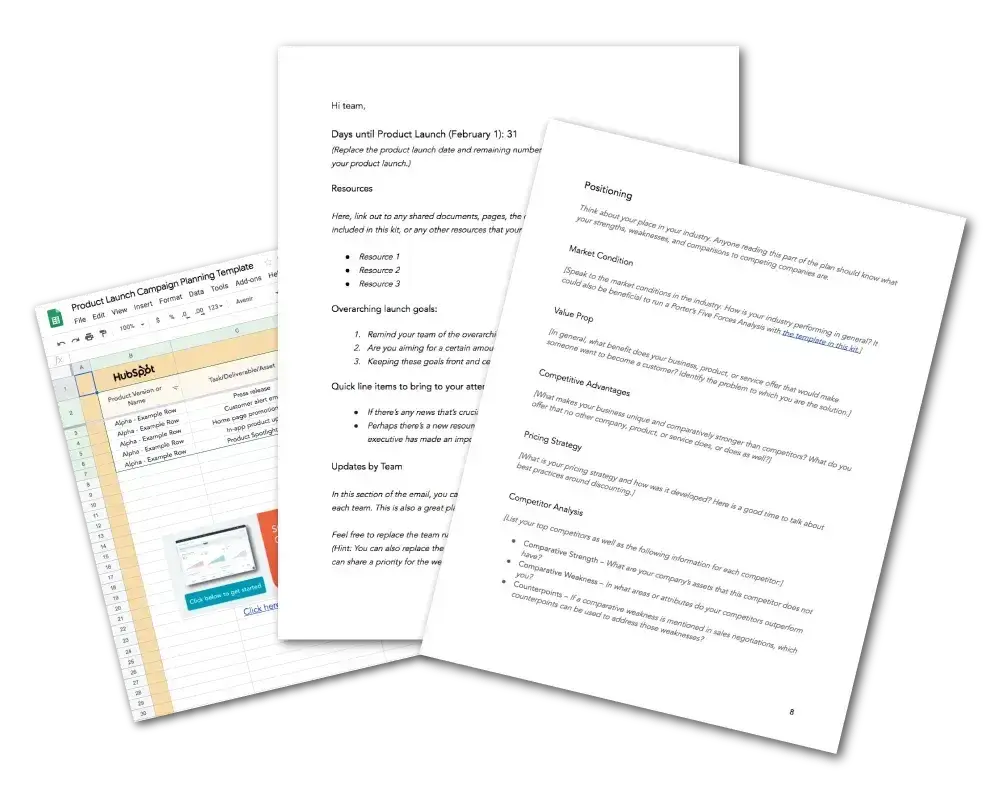
a screenshot of some pages of templates from hubspot’s product launch kit

Download Now: Free Product Launch Kit

If you’re launching a new product, create a sales plan specifically to generate revenue from the new launch.
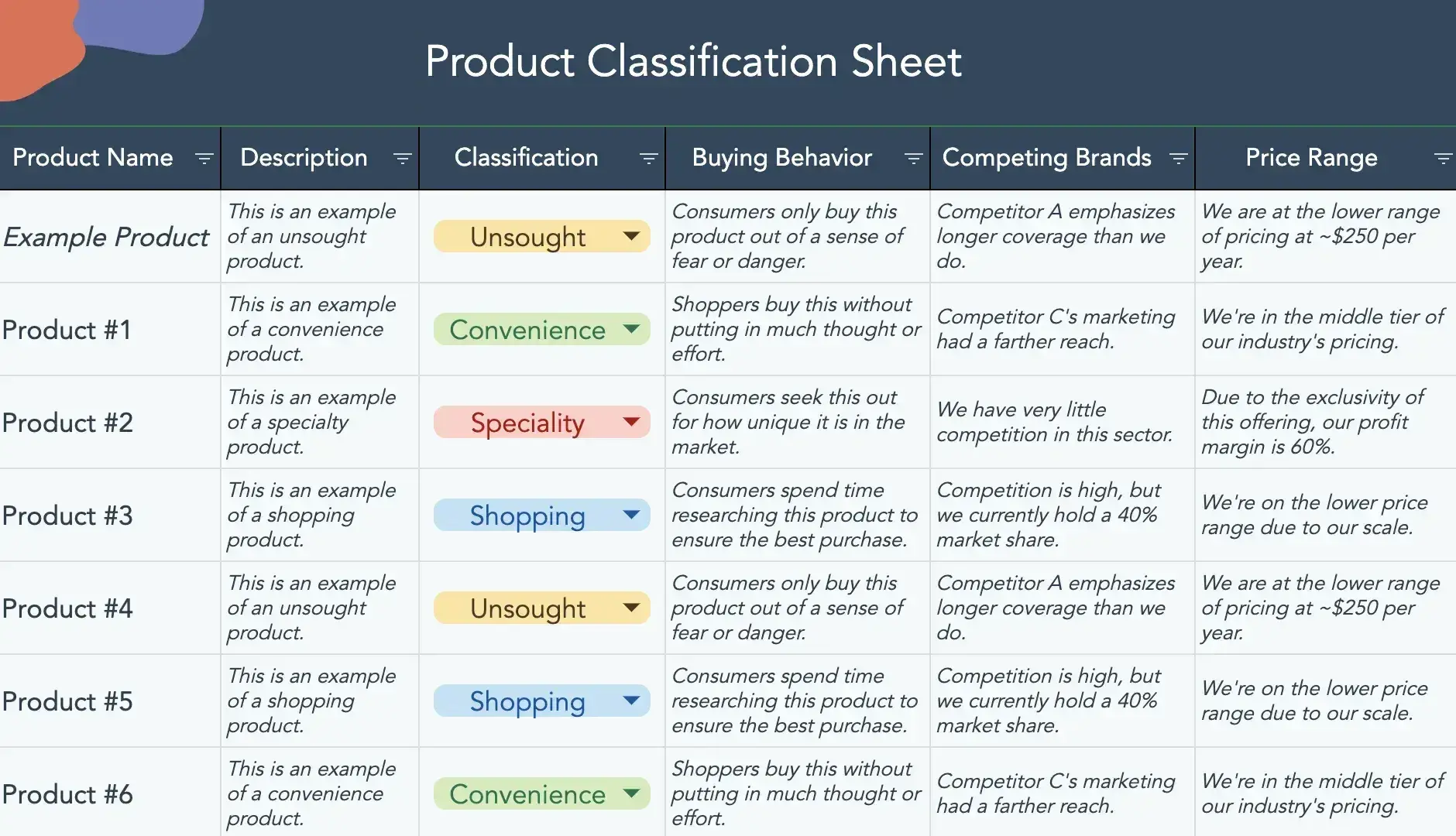
a screenshot of a product classification spreadsheet hubspot’s product launch kit

In my experience, conducting competitive analysis, determining a sales strategy, strengthening brand positioning, and securing channel partners is crucial if you're shifting to a channel sales model.

Strategic Sales Plan Examples

If you need some more inspiration, check out these examples of sales plans below:
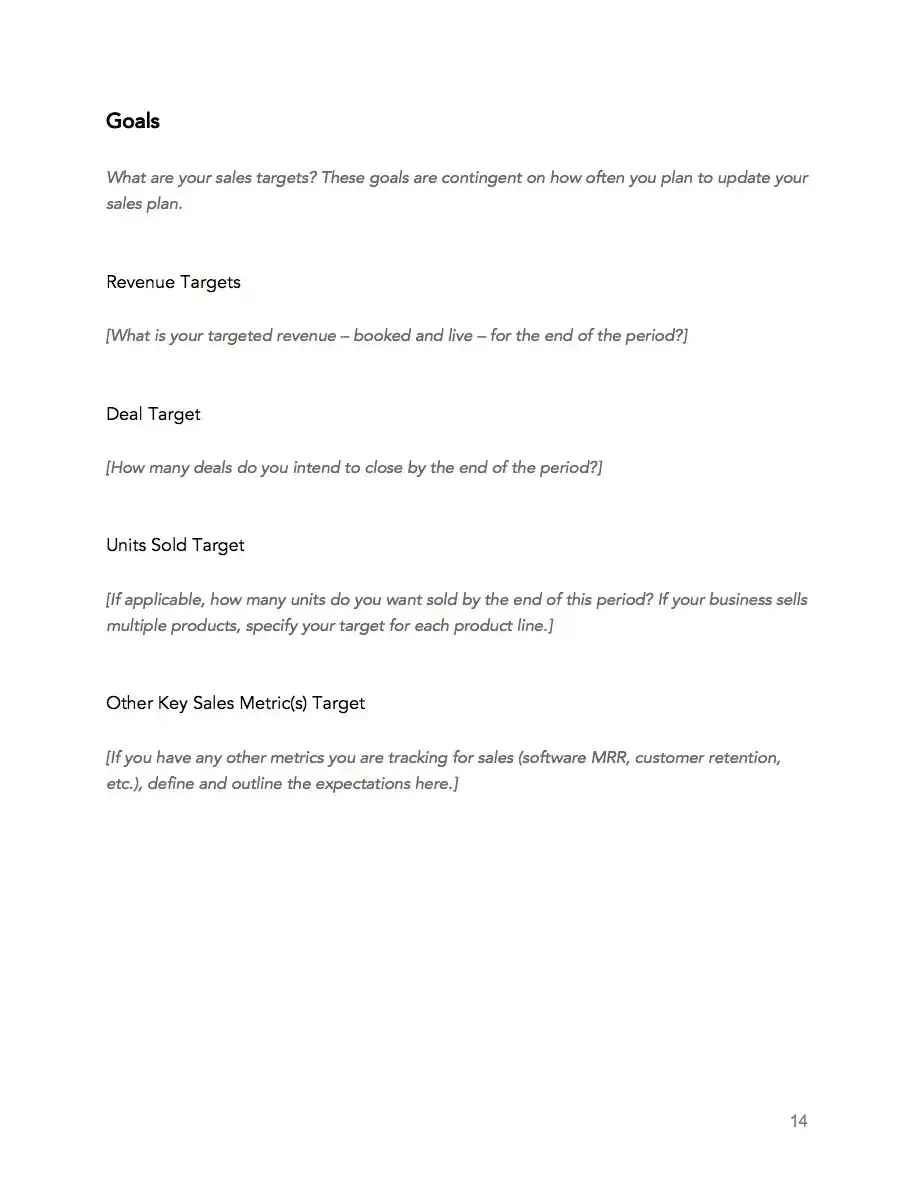
1. Sales Plan Template by HubSpot

 a screenshot of a page from hubspot’s sales plan template

We’ve created a sales plan template outlining a sales plan’s key elements. This template will walk you through each of the steps to write a sales plan of your own.

Our plan allows you to easily communicate to your organization your goals, how you'll accomplish them, and what support you need.

2. Sample Sales Plan by BestTemplates

a screenshot of hubspot’s sample sales plan template

Organizing your strategies and goals with a sales plan will help you and your sales team stick to the targets you've set. This nine-page template provides plenty of opportunities to create a concrete action plan.

I like it because it includes a goals section before breaking it down into specific areas such as demand generation, implementation, measurement, and evaluation.
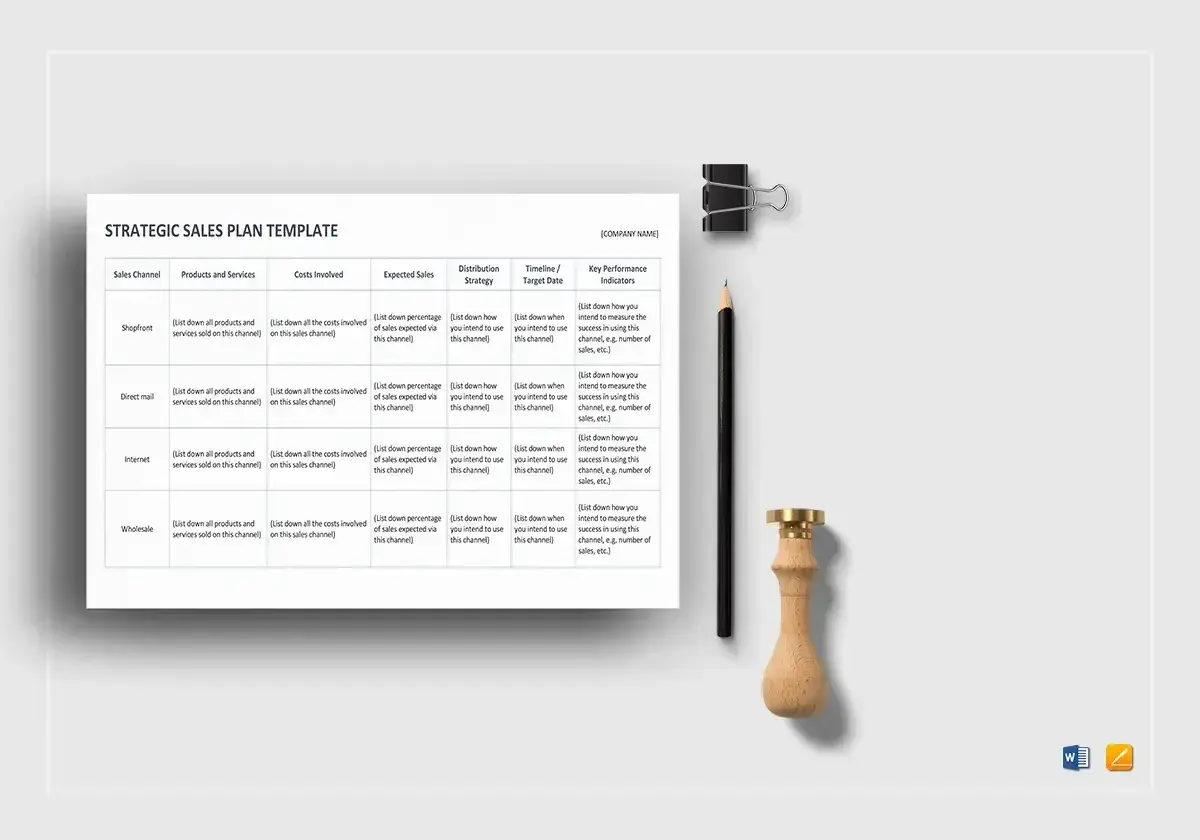
3. 1-Page Sales Plan by BestTemplates

 a screenshot of hubspot’s one-page sales plan template

A sales plan doesn’t need to be hundreds of pages long. Try consolidating your sales plan into a page or two. This template is an excellent example of keeping it short and sweet while still communicating the most important elements of the plan.

In landscape mode, this strategic sales plan includes a channel, expected costs and sales, distribution strategy, and KPIs in an easy-to-read grid layout.
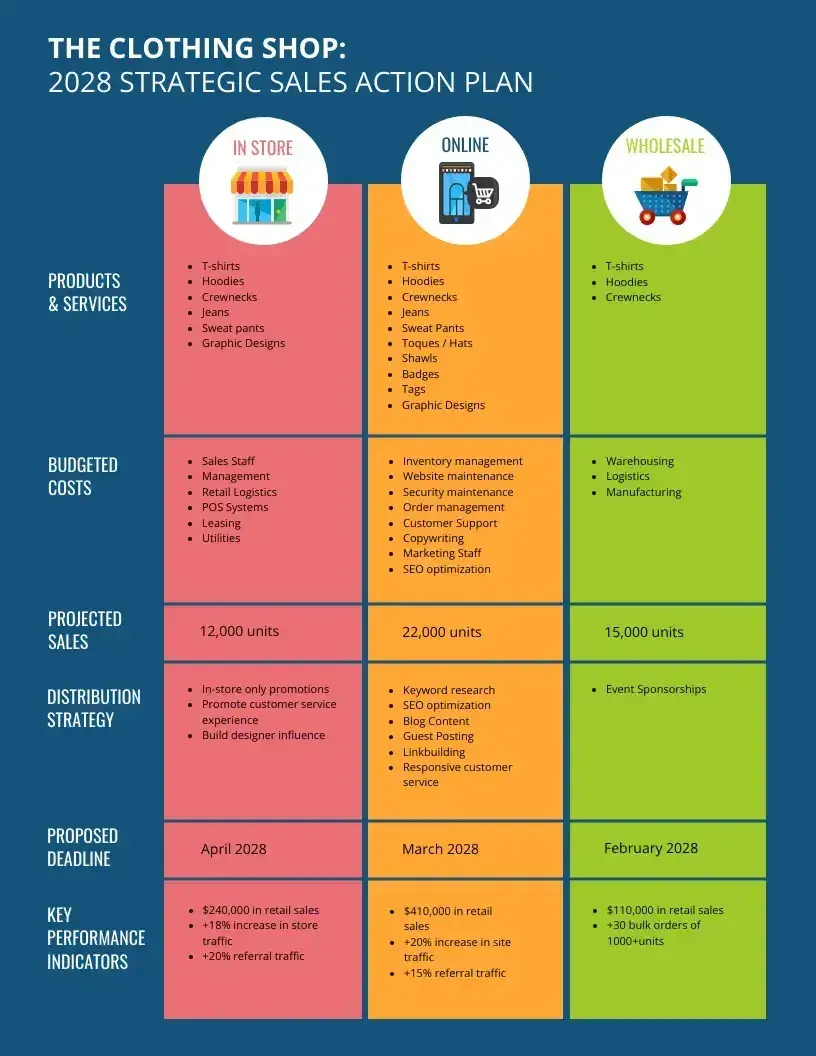
4. Strategic Distribution Sales Action Plan Template by Venngage

a screenshot of venngage’s Strategic Distribution Sales Action template

Choose a design that fits your needs and create your sales plan using Venngage’s interface, which includes custom charts, stock photos, and illustrations. You'll have several visually interesting options available in just a single tool.

I like this plan because it’s organized by type of sale: in-store, online, and wholesale. This makes it easier to identify each sales channel's needs and which departments contribute to their success.
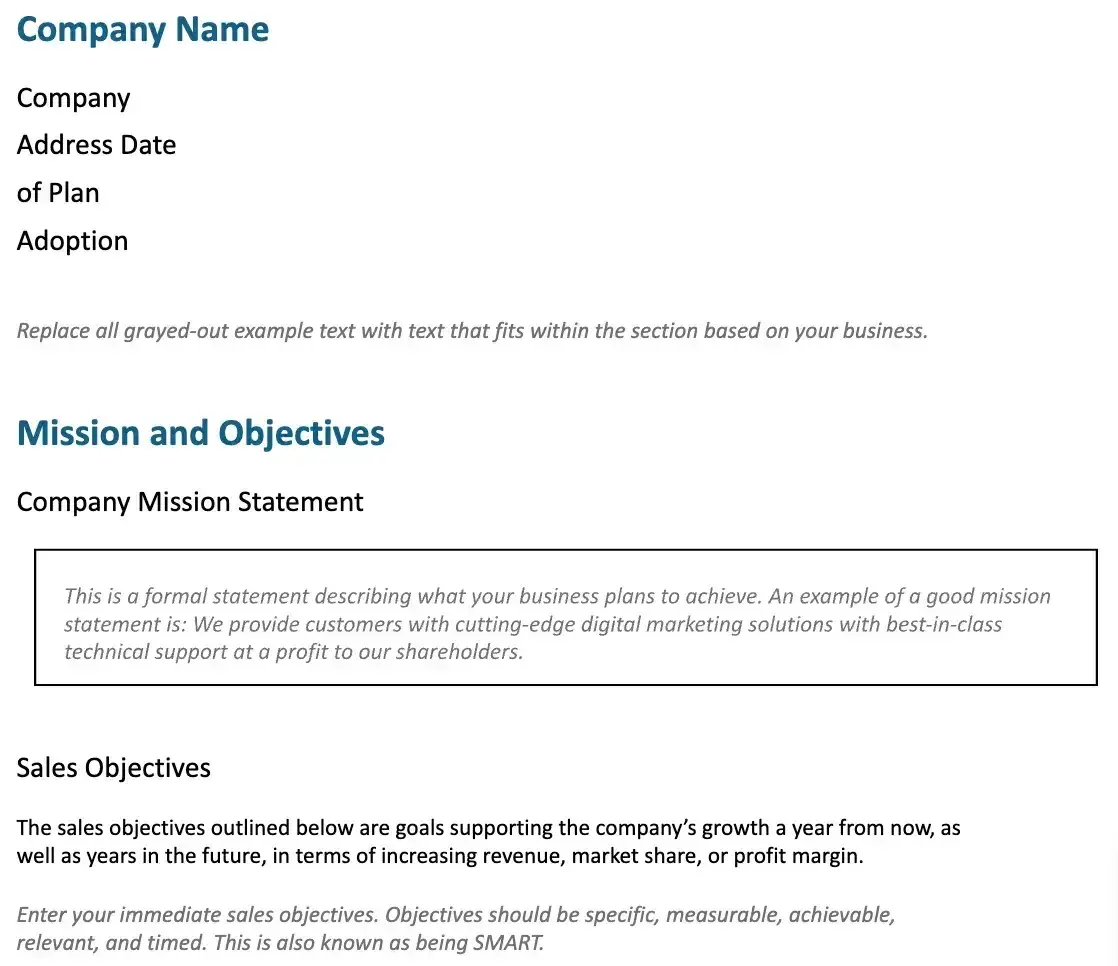
5. Small Business Sales Plan by FitSmallBusiness

a screenshot of a page from FitSmallBusiness’ Small Business Sales Plan template

You may not have a fully stacked sales team if you run a small business; that’s totally okay. You and your employees likely wear many hats, so it’s important to establish a strong sales strategy for your company that future hires can build off of.

Sometimes, simpler is better. This plan relies on several standard sections to draw up your plan, with boxes that can be quickly filled out using Microsoft Word or Google Docs.
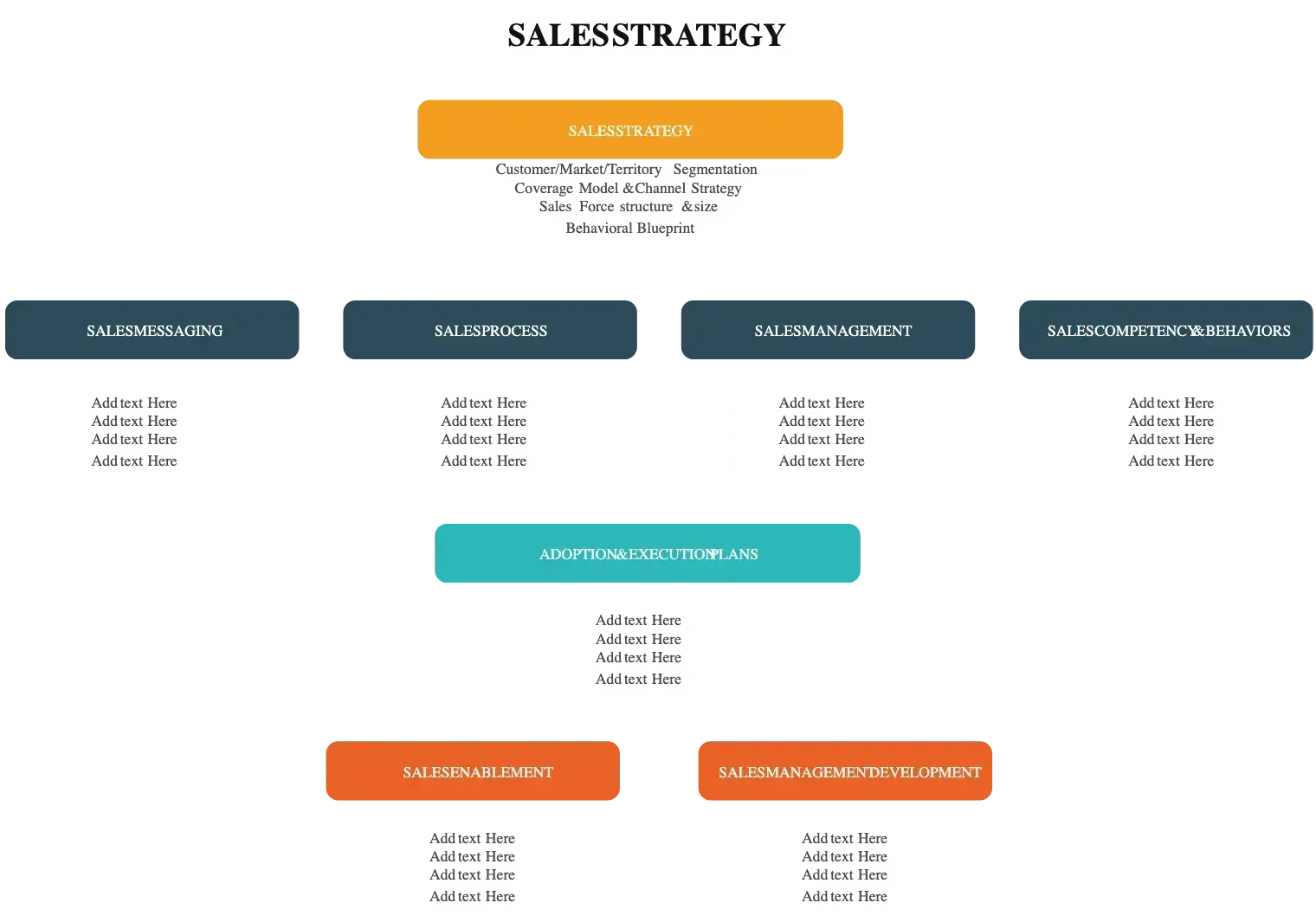
6. Sales Strategy Diagram from Creately

a screenshot of a page from Creately’s Sales Strategy Diagram template

If you’re more of a visual person, creating a diagram for your sales strategy will be immensely helpful. Use Creately to create an attractive sales strategy to share with your team.

I like this template because it allows you to map out the key elements of your strategy by categorizing action items and values.
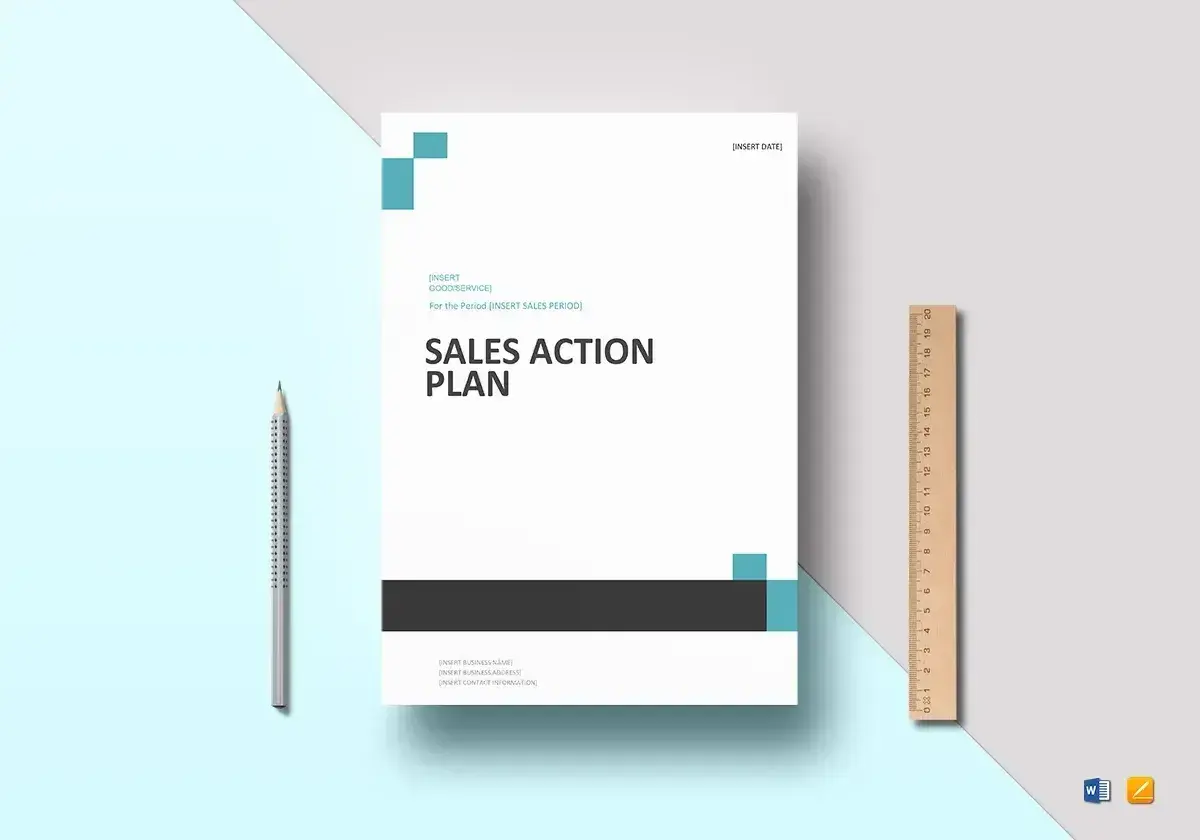
7. Sales Action Plan by BestTemplates

a screenshot of a page from BestTemplate’s Sales Action Plan template

A sales action plan lets you dive into the details of your sales strategy. This one has a minimalistic (but super easy-to-follow) layout.

This sales action plan is effective because it focuses on the more concrete elements of achieving your sales goals, such as positioning and strategic plays. It’s eight pages long and fully customizable in either Word or Pages.
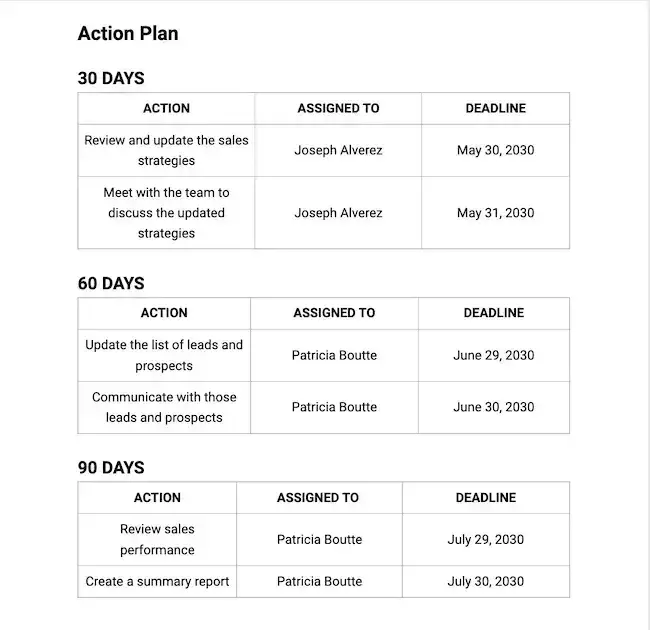
8. 30-60-90 Day Sales Plan by Template.Net

a screenshot of a page from Template.Net’s 30-60-90 Day Sales Plan template

I love 30-60-90 day plans because they allow you to set a realistic pace for accomplishing your goals, whether they are short- or long-term.

This sales plan does some of the hard work for you by outlining tasks related to your sales goals. You can check off boxes as you complete each item to ensure you're creating a sound sales strategy.
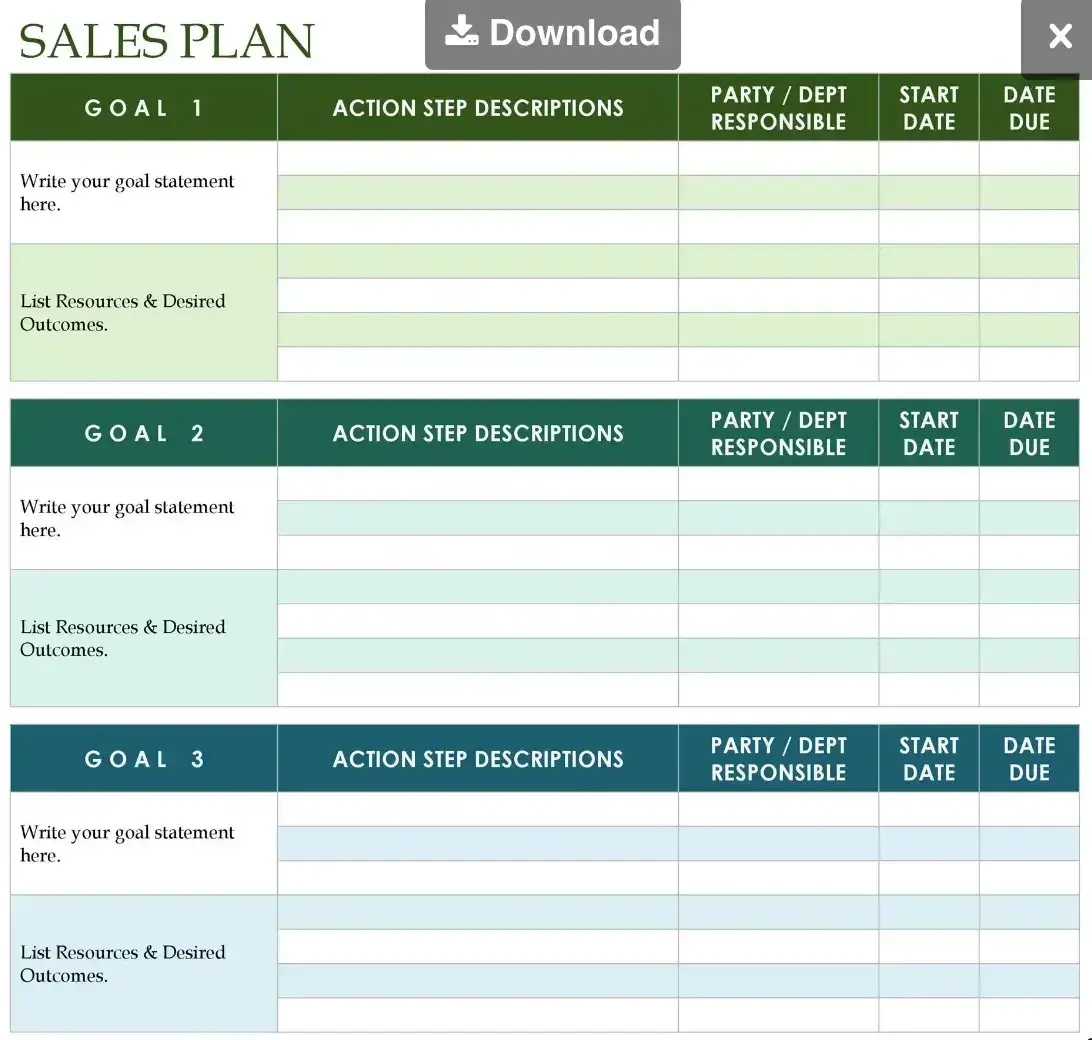
9. Microsoft Word Sales Plan Template from TemplateLab

 a screenshot of a page from TemplateLab’s Microsoft Word Sales Plan template

This template breaks down goals into action items, helps you think about how to assign responsibilities, and gets you to commit to specific dates.

I think the best part of this template is that it focuses on multiple goals, giving you a bird's eye view of several initiatives you may be putting together.
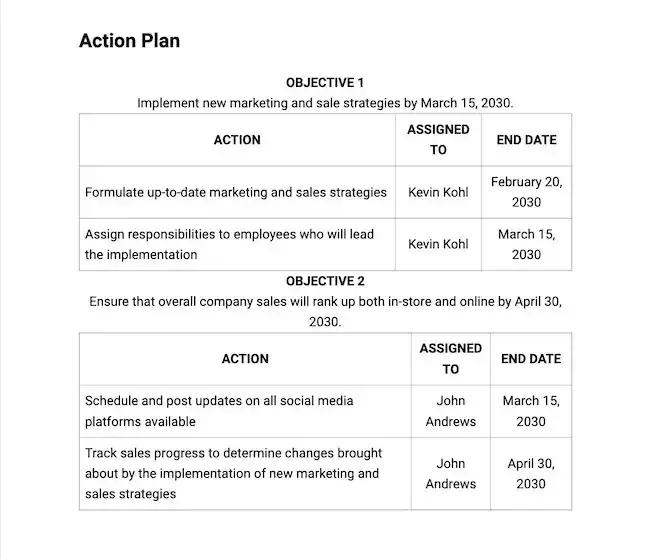
10. 90-Day Sales Plan by Template.Net

a screenshot of a page from Template.Net’s 90 Day Sales Plan template

This sample sales plan will help you plan your sales strategies for the next 90 days.

It breaks your sales plan down into phases, tasks, and key questions for your sales goals. Plus, the final section is a mind map for your sales process and pipeline strategies, which is especially great for brainstorming.

Create a Sales Plan That Grows With Your Business

Here’s a tiny bit of truth that I’ll leave you with: There’s no one-size-fits-all sales plan. However, the only wrong way to use a sales plan is to write it at the start of the year or quarter and never touch it again. A static sales plan is as good as no sales plan at all.

Your market, customers, and competitors are constantly evolving, so your sales strategy should evolve, too. You should periodically review and update any sales plan you create as time goes on to ensure you (and your sales team) are focused and on track.

Set a cadence — whether it’s monthly, quarterly, or bi-annually — to assess what’s working, refine weak spots, and adjust for shifts in the industry. By continuously improving on your plan, you can ensure your company generates revenue more effectively than it ever did in the past.

The best sales teams don’t just create a plan and “hope for the best”; they treat it as a living, breathing roadmap to success. Keep refining, keep optimizing, and keep selling.

Editor's note: This post was originally published in July 2015 and has been updated for comprehensiveness.

29 Jul 16:25

Google Phantom Updates Impact Small Business Web Content

by Rob Rohena

On its own website Google states:

There are many components to the search process and the results page, and we’re constantly updating our technologies and systems to deliver better results. Many of these changes involve exciting new innovations, such as the Knowledge Graph or Google Instant. There are other important systems that we constantly tune and refine.

Here’s a comprehensive list of everything that goes into every Google Algorithm.

An Infographic of Google Algorithm Updates

In the early 90’s when the Google search engine was in its infancy it was not quite as popular, powerful, or precise as it is today.

They have made a lot of changes, most of which you have probably never heard about. But, then, there are the big ones – Panda, Penguin, Hummingbird, and now Phathom.

Last month, Hubspot  and Moz teamed up to create an infographic that provides a snapshot of all of the major changes that Google has implemented over the years.

history of google algorithm changes

All major changes to Google Algorithm focus on content quality

Now if you notice all of the memorable changes are centered around one thing … the quality of web page content, not just a website.

In February 2011, Panda was supposed to focus on minimizing the value of link farms and websites that lack very much content. In fact, this is one of the reasons why popular SEO plugins like Yoast SEO suggest a page have a minimum of 300 words.

In April 2012, Penguin was going to make certain that a website was not simply going to repeat a keyword in every other sentence.

According to Rank Ranger, in August of 2013,  “their [Google’s] goal [with Hummingbird] is to provide more personalized results based on your online behavior, location, trends, etc.  The Rank Risk Index (RRI) captured this significant change on August 21st”.

When Google announced its Hummingbird algorithm update. Many digital marketers believed if “content is king”, then naturally “context and relevance would be queen”.

For others it was a concern…

This information made some marketers nervous, but at PubCon last week, Google’s Matt Cutts reminded the audience that the algorithm had been up and running for more than a month before it was announced, and no one even noticed.

– Jim Yu, SearchLand, Google Hummingbird & The Keyword: What to know to stay ahead

Soon after we saw the emergence of content distribution companies like Taboola and Outbrain, which had been around for at least 5 years prior.

Then, early this year Google Phantom updates began and many small businesses began to feel the pain …

According to a report by Ari Levi , Senior Tech Report at CNBC one company lost 22% of its web traffic overnight.

But, what I find even more interesting is how some sites with very little content and poor quality infrastructure are out performing sites with better designs and high quality and relevant content.

Do These Webpages Deserve To Rank High On Search Results?

Hydraulic Torque Wrench on Google

I recently asked this question on the Marketing Rule Breaker blog.

Here’s why I ask it …

Let’s look at the keyword “Hydraulic Torque Wrench“.

If you visit the first 5 sites out of about 588,000 results you’ll see well designed mobile responsive websites with good to great content.

Torcup is not mobile responsive
Then, the sixth site listed is not mobile responsive.

It sports a short news section which typically highlights an upcoming event in under 150 words, and has an outbound link to the event, or a PDF of the news at is sharing as a blog.

After seeing this the assumption has to be that the sites to follow are worst.

Page #1 lower part of Hydraulic Torque wrench site
But, as it turns out following this site are two very good sites with a ton of backlinks, content, and context.

Grainger – “for the one’s who get things done not only has content, but, is the first of all the sites to feature ecommerce.

Perhaps, since they have such a large variety of industrial tools and MRO supplies there sites is not considered as relevant as the others which in fairness are manufacturers of hydraulic torque wrenches.

Page #2 Hydraulic Torque Wrench

So, we click over to page #2 on the Google Search results for hydraulic torque wrench and find eBay and more manufacturers.

Three of them seem to have well-structured websites that are mobile-friendly.

They all have good consistent content, that is relevant. They all seem to linked to similar sites as the first page sites, so what gives?

TorsionX web design Alltite mobile responsive ITH - web design

To better understand what is happening.

We visited Ahrefs site explorer. [Check out this article on Quicksprout by Neil Patel to better understand how to use this tool.]

Our quick research shows a correlation between the number of pages crawled, shares on Google +, and quantity of backlinks — not quality seem to be the major difference makers.

hytorc 35k backlinks

TorcUp Ahrefs

TorxionX - Social media lacking

Of course, we want to make this is not a fluke. So, let us checkout page #3 on Google for the term Hydraulic Torque Wrench …

Page #3 - AMG Bolting Solutions - Hydraulic Torque Wrench

An unexpected turn of events.

Sitting on the top of page #3 is AMG Bolting Solutions.

By simply glancing at the structure of its Google search snippet we can tell some SEO work is being done on this site.

For example;

Hydraulic Torque Wrench is at the beginning of its title.

3 times in its meta description it reads hydraulic torque wrench(es).

This one is worth looking at a bit deeper, but, before looking at the site itself — let us see if our hypothesis is right.

So, we visit Ahrefs again.

Google Phantom Updates Impact Small Business Web Content

  •  1822 pages crawled?!? Only #1 Enerpac and #2 Hytorc has more.
  • Only 136 backlinks, nonetheless more than 17 of 20 sites ranking ahead of them.
  • 248 Google + shares, again within the top 5 of all the sites ranked ahead of them.

Perhaps their website is not mobile responsive and lacks good quality content.

When we take a look at their website we discover the following:

Google Phantom impact on hydraulic torque wrench

  • Evidently, we are wrong — the site is not a mess.
  • The site is mobile responsive,
  • Has a current and relevant blog,
  • Features ecommerce
  • And, seems to follow all the “SEO rules“.

Deep pockets can still buy deep link roots

Now, curiosity has gotten the best of me. I call the company and discover this site is owned and operated by a fellow Naval veteran named Alan Gross, [ follow him on Twitter ].

I told him about the article I was writing, and the results I have been finding and he responded;

Since 2012, have spent a significant amount of money on the AMG website. Mostly on SEO gone wrong. I used to be mid-page 2, then Google made a change and I was on page 8.

I have fired two companies how promised me page #1. We never sold anything.

He continues, the company I am working with now has me on the top of page 3, has help me sell a little, and has me convinced that if we continue to produce quality content things will get better… my fear is the bigger companies with deep pockets seem to be able to buy links.

Wait a minute.

Do his say “buy links”?

Is it not the purpose of the Phantom algorithm updates to rewards small business sites like AMG Bolting Solutions, and penalize companies who buy PR-links?

As I learned from Alan, here’s is a small business using Hatchbuck marketing automation, engaging in social media, listing itself on local and industry directories, making videos, and publishing unique quality content and there page fall all the way to #8.

Perhaps, as we have seen recently with the Panda 4.2 updates, these Phantom changes are simply taking their time to even the playing field.

If not, small business owners will have to turn to Google Adwords for a crack at page #1.

How ironic?

29 Jul 16:24

You Are Only As Good As the Company You Keep – Maturing Your Personas

by Jeff Julian

I love the saying, “You are only as good as the company you keep.” It says so much in many different areas of your life. Whether it is pointing to your actions when you are around your friends, the business ethics you hold at work, or the way you handle conflict online.  The people you have around you matters.

When it comes to your content, the ability to reach the targets you want will depend on those you are attracting now and the feedback you receive.

Missing the Mark

Imagine you are producing a magazine for trail runners but your initial subscribers are mainly in the gym.  You would probably have some great feedback about what drives endurance because one of the most challenging mental activities runners face is training on a machine.

Then let’s say you produces several pieces of content about breaking through the voices in your head based on some research you did with an audience survey. They gave you all sorts of useful tips such as finding a spot on the wall to focus on, listening to music, and maintaining a consistent cadence.

That content might hit the mark for the treadmill runner but if you forget the aspects of staying focused on the changes in the trail and when to slow down, you might be leading the audience member into danger. Having headphones on when trail running is one of the easiest ways to get hit by a biker or miss that bear that is running straight at you. If you plan to find a spot and focus on it to allow your mind to rest from distractions, well good luck finding that. And with the variety of quick elevation changes on most trails, keeping a cadence and not adjusting based the direction you are going or the grade of the hill will burn you out and cause you to fall.

Since most of our initial personas are usually pretty basic, as they should be, it is easy to get caught up in numbers. Having 1000 subscribers of “runners” for your magazine is far more rewarding than 46 who consider themselves “trail runners.”

Steps for Maturing Your Personas

Having an effective content marketing effort means you reach the audience you want and not just any audience. This means the Content Owner on your team should be focusing a lot of their time reviewing the market and identifying the characteristics, goals, and needs of the audience you are building.

Once you have identified the characteristics of the personas for your audience and you have written them down, you should expect things will change. Consistent review and analysis will drive better content and the trust, impact, and authority you are building.

Here is a list of areas for your personas development you should review on a regular basis:

  • Persona Goals – My goals as the CMO of AJi change quarterly. I make pivots and adjustments based on the same data you are gathering about me if I am your persona. As each of my goals change, there are new opportunities you can create content around to help me reach them.

    I recently had a sales person consistently knock on my inbox begging for a meeting. Interruptions suck for motivated people so I kindly explained to them that I know what they do and if I have a need I might call on them. I shared with them my fears about their business model. Then I said if they would find a way to get me information that will calm these fears when I do have the need, chances are higher I will call on them. This could be the exact message your audience wishes they could tell your sales team and it is our job as marketers to step up and into this role.

  • Characteristics – If you quickly built your initial personas off of familiar things about all people in your area of focus, there is a high probability you missed some particular characteristics that will best drive your content.

    For example, the title of Chief Information Officer means entirely different things when you are talking about a company of 100 versus an enterprise of 50,000. Industry segments, geographic region, or economic status might be additional characteristics you could add to your persona. If a new characteristic causes a portion of your target audience to be lost, consider splitting the persona into two or more. Just like I suggest when beginning your persona development, don’t go too crazy here but take it one step at a time.

  • Ability to drive business – If your personas are no longer in a position to make or influence a business decision, it might be time to part ways. This is an imperative decision so do not do it without careful consideration and time to check your hypothesis. If you have built an audience, then you have most likely built trust. This confidence should not be ruined because the person is no longer making the buying decision.  They may have just moved into an influence or advisory role and are valuable brand advocates.
  • Available content – My personas are mostly in B2B marketing at the medium to enterprise level. The content we create is attempting to provide value in a sea of marketers who are also trying to offer value with their own content. Just like the early adopters of technology are usually technologist themselves, those who are thought leaders in marketing are marketers. The impact this has on our Content Backlog is huge.

    If someone else has written the article I want to write, it is better for me to write something new. I might have some initial success because my audience has not seen the other content but the pointing to the other piece of content and continuing the conversation would have similar results as well as the ability to have long time impact in the search engines. Writing “How content marketing can help you reach plumbers” will probably have a better chance of success for a plumbing supply persona than “What is content marketing?”

  • Business disruptions –Almost every company I work with, as well as my own, is facing a significant disruption to some area of their business. Whether it is your own business or in your personas industry, you should always keep a close eye on this. Ultimately it will change the value you are delivering in the content you are producing and even the types of content and their associated channels.
  • Adjustments in our offering – If you are offering a new service, product, or the expansion into new regional territories, you may need to create new personas or extend the persona you already have. If you’re targeting stay-at-home parents and just launched a mobile application, it may be beneficial to create a new persona or expand the goals or characteristics you list for an existing one to drive downloads.
  • Seasonal impact – Does the change in the season affect your personas? If it does, you should list the impact it has on their business along with the seasons. Landscapers, florist, hotels, and hospitals are just a few types of companies that have personas within who could be looking to solve different problems based on seasonal impact.
  • Ways content is consumed – Is your persona more likely to watch a short video or would they rather read an article? This answer is no longer cut and dry and keeping a pulse on the way your personas consume content will open up opportunities to the way you present the content. If the answer is yes to the question above, is there a point where you should test the waters for publishing an article along with a short video explaining the subject along? If so, then this is a characteristic of your persona or a content channel you should document.
  • Where they hang out – There is so much content out there suggesting networks and communities are where folks in “B2B” or “B2C” hang out. Even worse are the infographics and articles focused on “millennials”. They all make huge assumptions based on data that could steer you down the wrong path. If an office worker is hanging on Facebook all day because they are bored and gave that information but your persona is mostly in the air traveling between clients, your social media posts are just not that consumable at 30,000 feet, yet. Putting your content in print, eBook, video, or audio format might just be the thing that opens up the desired opportunities.
  • Entourage – Take a moment and think of your key decision makers for the products and services you offer as a rock star. Rock stars have a lot of fans but they trust the possessions and ask for advice from their entourage. For your persona, who are the individuals that are around them on a regular basis and how much impact do they have on offering advice? The answer to this question might open up a door for alternative personas you can focus on and give you another way to repurpose existing content.

The Thinker - Social Size

29 Jul 16:24

Deloitte and Coupa Form Strategic Alliance to Help Drive Procurement Transformation

by Business Wire
businesswire-4
Check out our press release hub, powered by Business Wire. It's a one stop shop for industry announcements to help you stay on top of the latest technology and investment trends. Get the scoop here.

PRESS RELEASE:

New Alliance Aimed at Helping Clients Achieve Savings

SAN FRANCISCO–(BUSINESS WIRE)–July 29, 2015–

Deloitte Consulting LLP and Coupa Software, a leading cloud spend management company, today announced a new strategic alliance dedicated to helping clients transform their approach to procurement to achieve bottom-line savings.

From strategy to implementation, Deloitte provides technology solutions that help drive transformation, improve productivity, and streamline business operations. In forming an alliance with Coupa, Deloitte can help clients drive sustainable improvements to capture the value of the implementations of Coupa’s suite of cloud-based financial applications.

Coupa’s suite of cloud applications helps customers around the globe increase control and improve/increase savings. Deloitte’s Sourcing and Procurement practice uses strategies that are delivered through a combination of strong category experience, broad-based knowledge and skills, and geographical reach around the world.

“We are constantly looking for ways to enhance our delivery capabilities to better serve our global Clients. Our alliance with Coupa enables us to align with one of the leading P2P solutions in the marketplace. With our focus on driving impactful, speed-to-value for our clients, this relationship will add another meaningful capability to our practice to enable us to continue to differentiate our offering in the global market,” said Brian Umbenhauer, principal, Deloitte Consulting LLP and Deloitte’s Global Sourcing and Procurement leader.

“Deloitte and Coupa are innovative leaders that provide companies with the latest technology solutions and services needed to help build profitable, interactive businesses,” said Roger Goulart, vice president of business development and alliances at Coupa. “Together, we share a commitment to helping companies achieve success by arming them with the tools and support needed to become more competitive than ever.”

Deloitte Consulting LLP helps organizations grow their businesses and enhance value by identifying actionable insights. More than 23,000 professionals provide a broad range of capabilities across human capital, strategy and operations, innovation and technology that are aligned to the particular needs of specific sectors, businesses and organizations. Deloitte provides clients with leading business insights that can help generate a tangible and measurable impact. www.deloitte.com.

As used in this document, “Deloitte” means Deloitte Consulting LLP, a subsidiary of Deloitte LLP. Please see www.deloitte.com/us/about for a detailed description of the legal structure of Deloitte LLP and its subsidiaries. Certain services may not be available to attest clients under the rules and regulations of public accounting.

About Coupa Software

Coupa Software enables businesses everywhere to recognize bottom-line financial success via Savings-as-a-Service. More than 500 customers doing business in over 100 countries use Coupa to support business agility and reduce costs. Only Coupa provides an organic suite of true cloud applications including accounts payable, procurement, expense management, sourcing and inventory, allowing customers to realize a return on investment that starts within a few months and grows continually. Learn more at www.coupa.com. Read more at our company blog, Making Cents or follow @Coupa on Twitter

View source version on businesswire.com: http://www.businesswire.com/news/home/20150729005140/en/

Coupa Software
Orlando De Bruce, 650-485-8629
Global Public Relations
orlando.debruce@coupa.com


29 Jul 16:22

Millennials: You Are Doing Leasing Wrong

by Tom McParland on Car Buying, shared by Whitson Gordon to Lifehacker

According to a new study by Edmunds, Millennials lately are leasing cars much more than older buyers. While leasing can be great way to get a new car and keep your monthly budget manageable, some young buyers don’t seem to be approaching leases the right way.

Read more...

29 Jul 16:20

Gartner Says: Sales and Marketing Influences Just 32% of B2B Buyer’s Journey

by Adele Revella

I am fascinated by a recent Gartner study about the journey of 700 enterprise buyers across the U.S., EMEA, Brazil, India and China. According to a recent interview with Hank Barnes, Research Vice President at Gartner, the study focused on four areas:

  • During the buying process, what types of activities and information do you use, independent of the firm you are evaluating?
  • What type of content do you use from the provider itself?
  • What marketing activities get your attention?
  • What are you expecting from sales interactions?

Thebuyers journey findings? Buyers spend only 32% of their journey interacting with supplier-side content or sales people. Two thirds of the buyer’s journey is devoted to internal assessments, peer networking, and the recommendations of external experts.

According to Barnes, buyers “have access to all this stuff from vendors, but making sense of it, interpreting it, understanding that they have the right stuff is where they’re really struggling.”

This data quantifies exactly what we hear every day in our buyer persona interviews. And as a career sales and marketing professional, I am amazed that every company hasn’t realized that filling this void could be the best way to gain a competitive advantage.

In an article I wrote a few months ago, I related our experience interviewing buyers who say that marketing materials do nothing to help them make a decision, as competing solutions relate the same obvious benefits rather than useful information. The buyers’ experience with sales people is mostly a continuation of this theme, as sales arrives with the same marketing message rather than the critical details that help buyers gain confidence in their decision.

We know that many marketers are trying to explain the value of interviewing buyers to understand their needs and expectations. Maybe now that we have a report stating that vendors are privy to only 1/3 of the buyer’s journey, we can make it clear that it doesn’t work to build buyer personas by culling information from salespeople and marketing automation solutions. We’re seeing a very small part of the decision we need to influence.

29 Jul 16:20

B2B Mobile Marketing for Demand Generation? Yes! Examples and Quick Tips

by Lee Odden

B2B Mobile MarketingWhen you think of mobile marketing, visions of searches for store hours, maps and getting tips from Facebook friends about good restaurants probably come to mind – all consumer focused. But what about B2B marketing and mobile?

Why mobile marketing for B2B demand generation:
In many countries, including the U.S., more Google searches take place on mobile devices than on computers. (Google). That means B2B demand gen content must be mobile friendly.  Also, 52% of B2B customers are using smartphones to research products for their businesses. (Forrester) so the demand is certainly there.

So which B2B companies using mobile marketing can we learn from?

Here are a few examples:

Fedex Access Mobile Magazine
ACCESS is a FedEx Corp publication available for mobile consumption through iPad, Kindle Fire and Android devices. The ACCESS mobile magazine app offers interactive features designed specifically for tablets and Android smartphones, including videos and dynamic slideshows.

Power More Dell Mobile
Power More is a Dell content platform that provides customized content to technology decision-makers optimized for mobile devices.
 (Disclosure, Dell is a TopRank Marketing client)

Gateway Emerson Mobile
Gateway to Emerson is an iPad app that is among numerous mobile apps and mobile optimized experiences launched by Emerson Electric Co.for their businesses including
Emerson Climate Technologies Apps
multiple iPhone and iPad apps for Emerson Climate Technologies.

3M Post-it® Plus App
3M’s Post-it® Plus
 app for iPhone and iPad enables users to capture images of their Post-it notes, share and collaborate with other business people.

To put mobile marketing to work for your own B2B demand gen programs, here are a few “quick hit” tactics to implement:

1. Optimize for Mobile: At a minimum, marketers can ensure their websites are optimized for mobile experiences. Whether the site is simply responsive and adaptable across devices, a dedicated mobile site is created or an app – B2B marketers should learn their customer’s preferences for mobile content discovery and consumption so those content experiences can be optimized.

Not sure if your site is mobile friendly? Use Google’s tool.

2. Faster Mobile Content FTW! Also, make sure your demand gen content loads quickly in mobile devices or it can suffer in mobile search engine rankings. Check your website’s page load speed with this tool from Google.

3. Make video mobile ready. Video is a top content type consumed on mobile devices, 61% of B2B users watch mobile video relating to their work (IDG). But some video formats and hosting platforms only work on desktops. Make sure your B2B video content is mobile friendly for the best possible experience for your prospects.

By creating content that can be discovered, consumed and interacted with in ways your B2B buyers prefer, you can optimize your ability to attract, engage and convert more leads, deals and revenue. That sounds like a perfect opportunity for B2B marketers, don’t you think?

Top photo: Shutterstock


Email Newsletter Gain a competitive advantage by subscribing to the

TopRank® Online Marketing Newsletter.

© Online Marketing Blog - TopRank®, 2015. | B2B Mobile Marketing for Demand Generation? Yes! Examples and Quick Tips | http://www.toprankblog.com

The post B2B Mobile Marketing for Demand Generation? Yes! Examples and Quick Tips appeared first on Online Marketing Blog - TopRank®.

29 Jul 16:20

“Audit” Your Email Marketing Strategy to Find High-ROI Opportunity

by Daniel Faggella

When I was a kid, my parents listened to a lot of classic rock, with the Eagles being one of their favorites. When the members of the band put out solo albums in the 80s, I heard a lot of Don Henley music around the house. And one Henley song that sticks with me to this day is a tune called Drivin’ With Your Eyes Closed. While the lyrics are ambiguous references to living too fast with not taking the time to appreciate the world around us, if you’re an email marketer whose email campaign consists of Write, Send, and Repeat, then odds are, you’re drivin’ with your eyes closed too.

While it’s easy to send out an email that generates some response and call it a success, to make the most of your email campaign, or that of a client, you need to conduct an “email optimization audit.”  That’s the tool that will help you determine the highest return-on-investment (ROI) improvements that can be made to your, or your client’s, email strategy.

Though Henley’s song only had two verses, an email optimization audit looks at four specific areas: broadcast messaging, site, software, and autoresponders. As it’s the area where many email campaigns go astray, let’s start by looking at broadcast messaging.

1 – Improve Your Broadcast Messaging

Your broadcast message is simply that email sent to an existing list with calls-to-action to engage with content and/or make a step toward a sale. Too often, email marketers simply send out what many people call an “email blast,” or the same message sent to your entire list. While that’s fine if everyone on your email list is exactly the same, too often a generic email blast is too infrequent and too generic to maximize the effectiveness of an email campaign.

Instead, take the email database you’re working with and segment it. That is, separate the people on the list based on the various factors that brought them to your website in the first place. While it can be as intricate as you want, your segmentation can be as simple as buyer and prospects.

With that, find the right customer relationship management (CRM) software that can not only house both prospects and customers but can separate them as well. Then segment your email list further based on, for example, what the prospects looked at, what the buyers purchased before, what offer orinigally got a prospect to opt-in, and what complementary items can you offer previous buyers, and send a different email to each segment.  Note that, the amount of segmentation you do should be increased in concert with the price of what you offer. In other words, the higher the price point of your product or service, the more segmentation you need to do with your email campaign.

With your broadcast message properly segmented, look at your frequency. If you’re not emailing enough and the call-to-action is too weak, increase the email rate and sharpen the copy. Those simple steps are golden opportunities to create massive ROI. And don’t forget to split test. Any email campaign that’s not being split-tested with different copy, subject lines or calls-to-action always has room for improvement and optimization.

2 – Improving Your Website for Email Conversions

With your email message segmented and honed, the next most important part of an email optimization audit is your site. Specifically, what conversion levers are in use to turn website visitors into subscribers, buyers, users or appointment-makers? Conversion levers are those elements or opportunities on a website designed to help a visitor opt-in, set up an appointment or make a purchase. By ensuring that your initial email messaging is in line with the sales messaging of your lead-capture page and thank-you page, you can create congruence from site-to-inbox and help drive more early conversions in the buyer’s journey.

An opt-in is what allows a visitor to subscribe to your emails, newsletters, white papers or webinars. If it’s an e-commerce site, your conversion lever should be on a sales page, order pages or in the “store.”  If you just want appointments, your appointment form or contact page is your conversion lever.

If the website doesn’t have one or several of those conversion levers, install them based on your goals or the goals of the client, be it opt-ins, e-commerce or appointments. Then, split-test the copy used with the conversion lever to determine which approach generates the most response.

Already have a conversion lever or levers in place? Improve it. Sharpen the copy and split test the pages to see which wording or call-to-action is the most effective. Consider the position of the opt-in form or the buttons used on the appointment or e-commerce page to see if it encourages or discourages action. The goal of any website improvement is to increase visitor count, since higher web traffic will always yield a higher ROI in any email optimization.

Before you’re done looking at the website, ask these questions to determine what strategies are being used and what strategies could be used to improve traffic:

  • How much traffic hits your web properties every month?
  • How are you optimizing your website to generate more subscribers, sales or appointments?
  • What are you split-testing on your website right now?

3 – Are You Using the Right Software?

With message and site covered, think about what software might be the best fit for your particular email campaign. For most campaigns, email marketers are going to fall into one of two categories. The first is the lower price point marketer with a lower budget offering a generic product to the masses. This type of email campaign won’t need too much segmentation, so GetDrip software is a good option because of its ease-of-use, reporting simplicity and split-testing capabilities. Note that, while some people believe AWeber, MailChimp or Constant Contact are viable choices, they’re not the best option for actually making money from email marketing.

If you’re dealing with a higher price point, higher budget and have a desire to really make money from email, Infusionsoft, Ontraport or Hubspot are ideal software choices. That’s because all of those options allow you to better segment your emails for more effective targeting of the message. As with your messaging, the higher the product’s or service’s price point and/or the budget, the more you’ll want to tailor your email to your list using more complex software. Remember, more segmentation means more return.

4 – Improving Your Automated Email Campaigns

Finally, evaluate the auto-responders. For almost any business, an auto-responder is a useful email marketing tool because of its ability to make additional offers. Offering a service? An autoresponder email can help not only educate your user, but get them to the phone too. Do you have an e-commerce site? An autoresponder can help you sell add-ons to an existing customer. Selling software? Autoresponders can not only encourage users to act on a free trial, but it can help turn those trial customers into buyers and retain them as customers in the future.

If there’s not an automatic email campaign in place, set one up based on the desired action of the subscriber, whether its encouraging phone calls, appointments, opt-ins or sales. Again, split-test it to find the approach that generates the highest ROI. I’ve talked about these email campaign basics at length (including this instructive interview on the Smart Passive Income podcast), but it’s important to hammer home the idea that each email should serve only one main purpose (IE: driving subscribers to a webinar, encouraging a software free trial, getting new prospects to watch other customer testimonial videos).

If there’s already an autorepsonder at work, lengthen it, split test it, sharpen the copy and subject line and improve the call-to-action. An opportunity to refine the autoresponder is also an opportunity increase ROI.

As you assess an auto-responder, stop and ask:

  • What happens to a subscriber directly after a conversion? Insure that opt-ins are encouraged to purchase, that previous buyers are “up sold” or “down sold” and that appointment makers receive reminders. When you’ve sufficiently set up your responses, ask…
  • What would you want all new subscribers to do for you automatically? When you establish that, build an autoresponder to make it happen. And, just like in site and software, more time invested in autorepsonders will generate more traffic, more opt-ins and higher sales volume.

If you think that just looking at the bottom line is an accurate measure of the effectiveness of an email campaign then, to co-opt another Don Henley song title, let this be the end of the innocence. Instead, conduct an email optimization audit, adjust your message, your site, your software and autoresponders for maximum ROI, and turn your email marketing campaign into a money maker.

29 Jul 16:19

How Personas Keep B2B Marketers from Playing Guess Who with Content

by Ardath Albee

buyer personas for marketing

Buyer personas, built well, take a concerted effort to produce. While only 44% of B2B marketers say they have buyer personas, 83% of these marketers say they are only slightly or somewhat effective at using them.

What a colossal waste of time, effort, and investment.

The whole point of creating buyer personas is to use them, not just to check the box.

The whole point of creating buyer personas is to use them, not just to check the box. Buyer personas identify the “who” your content should be designed to engage. Tossing them in a desk drawer or server archive means that the “who” can get fuzzy. In a world where buyers are in control of the buying process, a lack of clarity and relevance can be devastating to content marketing performance.

Research conducted by ITSMA found this question that may explain why:

“We don’t know what to use them for…we spent a lot of time on them, but how do we apply the knowledge?”

I would pose the hypothesis that if personas are built well, how to use them is obvious.

The other thing to consider, if you have personas but aren’t using them, is that you will tend to slip back into inside-out marketing content because you know your products so well. To sustain relevance with buyers across the entirety of their buying decision process, you need to get to know your audience better than you know your products, including how emotion and logic jointly play into their purchase decisions. You must learn to use and rely on your personas as a standard practice.

A well-built persona should include the following:

  • A day-in-the-life scenario of the persona to help marketers understand what their environment is like and how their priorities line up, as well as how they relate to others that may be involved in the buying decision.
  • Objectives they are responsible for accomplishing. You may call these priorities or goals.
  • Orientation in their careers and about their professional demeanor.
  • Obstacles that could stall momentum at each step and stage of the process.
  • Problems are the flip-side of objectives, or why they haven’t been able to achieve them as of yet.
  • Questions that your persona will ask and need answered at each step of the buying decision process.
  • Engagement scenarios that simulate what the interactions with the persona could look like across channels and how the dots must connect to create forward momentum.
  • Keywords and phrases that they use when talking about their objectives and problems, as well as what they will use to search for relevant information. Think long- to short-tail.
  • Channels they favor and use most frequently, including social media platforms, websites, and industry, association, and analyst sites.
  • Content preferences, whether long- or short-form and visual, audio, or text-based.

Each of these components of a well-built persona can inform your content strategy and content creation.

You need to get to know your audience better than you know your products.

How to Use Personas in B2B Content Marketing

Personas include a wealth of information to help companies become more relevant to buyers.

Here are some examples:

A day-in-the-life scenario is a great refresher if you haven’t developed content for this persona in a while. It will also help to orient freelance writers quickly by helping them step into the world of the persona the content is intended to engage. In addition, when a day-in-the-life scenario includes relationships with others, this can be indicative of the potential to create content that will help the persona better communicate about the opportunity for change that will achieve an objective or solve a problem to help them gain consensus.

Orientation information such as how long the persona has been in their position or career can help you better relate to their perspective. As you discover common traits across people representative of the persona, this information will help you understand the tone and style of content that will resonate. For example, if the persona is “detail oriented,” then content designed to engage them should be thorough and deep, not high level with broad assumptions.

Questions are pivotal to content ideation. If, for example, one of the persona’s questions is, “What type of disruption to our workflows will be caused by replacing our legacy system?,” answering that question with content that speaks to the disruption your customers have planned for and dealt with in this situation can position your company as a valuable partner, not just a solutions vendor.

But, even better, questions have a way of creating a flow that works. For example, your persona will not be asking about who can help them solve their problem if they haven’t answered the questions that come before this to learn what they need to know about why it’s a good move to solve the problem in the first place. Every time a question is answered to the buyer’s satisfaction, space is opened for new questions to be asked and answered.

Channel preferences will help you design your engagement scenarios as well as in creating your distribution plans.

Content preferences will pinpoint what type of content your buyers will engage with. For example, videos may be a hot topic for content right now, but if your persona doesn’t favor them, why create them? If what they really want are research briefs, give them those instead.

Keywords and phrases that your persona uses should be incorporated into your content for discoverability, as well as relevance. Every industry and role has terms and phrases they use. Incorporating them will help to show that your company understands what your buyers care about, as well as their business.

Save Guess Who for Parlor Games

Actively using personas should keep you from playing Guess Who with your content. Personas contain the information to ensure consistency in voice, tone, style, and topic that has the best opportunity to engage your buyers and help them choose to work with your company. Without that alignment, your content marketing programs have less of a chance to achieve the high performance that marketers are being tasked to prove. It’s telling that research by Aberdeen finds that, while 50% of best-in-class companies have a process to align marketing content with buyer personas, only 35% of industry average companies do so.

The B2B buying process can take many months to several years. Maintaining consistency across the longer term requires a compass that will keep you on track. Without a compass, your content will veer one way and then another, usually based on whatever topic is trending.

That’s how Guess Who content tends to take root in your content marketing programs, making them less effective due to lack of relevance as related to what your buyers care about. However, if you make personas your compass, you’ll always know who your content is designed to engage.

29 Jul 16:17

4 Questions to Help You Generate Epic Content Ideas

by Chris Lucas

4 Questions to Help You Generate Epic Content Ideas

In today’s content-drenched digital world, marketers are more hesitant than ever to fill out a lead gen form because they know subpar content often sits on the other side.

That means creating standout content is vital to any marketing campaign. If you want to reach consumers, you have to give them content they crave. (highlight to tweet) Consumers don’t want another sales pitch. They want to be entertained. They want to learn. They want to feel supported.

Well-known marketer Ann Handley says the best content is useful, empathetic, and inspired. But how do you create content that fits this description?

Ask questions! Anyone at your company who has a pulse on customer affairs can help you get inside your visitors’ heads. Here are four questions you can ask to gather great new content ideas that will thrill your target market.

What Are Your Customers’ Ultimate Goals?

Knowing your customers’ long-term goals for the use of your product or service can help you create valuable, relevant content. If people are interested in specific features of your product or service, create content that illustrates how to use those features to their full potential.

The more your content addresses specific needs, the more engaged your visitors will be. And they will start to see you as a reliable source of useful information.

What Can You Offer Customers That No One Else Can (or Will)?

Mapping out what makes your company, product, or service unique can help you further cater your content to customer needs. If you can solve a problem that no one else has solved, use your content to showcase what sets you apart.

Consider hosting a webinar or creating a how-to guide to demonstrate your expertise. Attendees or readers will see you and your organization as thought leaders in your space, and they’ll continue following your content.

What’s Running Through Your Customers’ Minds at 2 a.m.?

Thinking about your prospects’ late-night internal struggles can help you create content that has empathy. Talk to your sales and support teams to gather insightful customer feedback. Then, show your audience you care and understand by addressing their concerns.

Start by publishing blog posts that offer thoughtful tips, or draft inspirational case studies that illustrate how others have overcome obstacles to succeed. These types of content will help you connect with potential leads in new and rewarding ways.

What Existing Content Might Your Customers Be Willing to Pay For?

Don’t be afraid to repurpose successful content. If your community devours a piece of content, chances are they would be willing to pay for content that provides similar information or evokes similar emotions.

Did your research report perform well with your audience? Consider creating a corresponding infographic that illustrates the key takeaways, or devise an engaging social media campaign that reveals some of the top data.

Compelling content will inspire your visitors to action, which is the ultimate goal. You want to build a relationship with leads so they keep coming back for more.

Create Content That’s Good Enough to Gate

Asking great questions can help you create great content. And if your content is good enough, prospects will have no problem filling out your lead gen form to gain access. That means you’ll increase your chances of capturing qualified leads.

If you want more suggestions for revealing questions to ask, check out this interactive e-book on creating a killer content marketing strategy.

Get more content like this, plus the very BEST marketing education, totally free. Get our Definitive email newsletter.

       
29 Jul 16:17

How to Use Content to Gain Credibility in Sales

by Leah Bell

This post was originally published on Entrepreneur.com.

The sales development community is growing at an exponential rate. That growth demands shareable marketing content. With an ever changing sales game, front line sales development reps are in desperate need of ammunition — credibility to back up their pitches to prospects.

Companies like Salesforce and Hubspot recognize this need for community-driven content machines (not just self-promotion generators) and they strive every day to provide sales professionals with the tips and tools to stay competitive in the industry.

But how exactly can you, the sales development rep, use all of this marketing content to increase sales? Here are a few ways you leverage content as your silver bullet in sales conversations:

Become an Expert in Your Field

How do expect someone else to buy something if you aren’t sold on the concept, yourself? Educate yourself on the best practices in your field. Learn your product inside and out. Research competitors’ content. Your prospects know how to Google just as well as you do, so you need to know what information is out there and how to confidently present your product amongst the rest. Once you learn to live and breathe what you sell, you’ll be better prepared to bring your A-game on every single call.

Be Transparent to Earn Trust

Use the content that built you into an expert and educate your prospects. Earn their trust by showing them the “why” behind your product, and get them to believe in it as much as you do. If they’re looking to buy, odds are they’ve done their research, too. Be transparent and compare your research with theirs. Work to understand their perspective and confidently share yours. Drew Hendricks of Inc.com reminds us that “having a community literally built around loving your ideas and your content leads to very easy sales; they’re barely being sold, as they already trust you.”

Provide Proof

Case studies are the content marketing equivalent to good restaurant reviews on Yelp. Have a product success story? Leverage that proof in your pitch. SalesLoft SDR Ryan Harris uses case studies on a regular basis, utilizing their “great representation of how a company in a similar industry has been successful using the product.” Show prospects specific examples of when your product helped a client, and use that content to prove why your solution will work for them, too.

Make it Easy to Find, Use, and Share

Have you ever been in a conversation and said “there’s a blog post about that,” and then you can’t find it? Don’t let that happen — have a tool that helps you find content easily. At SalesLoft we created Content Finder, a chrome extension specifically made to help reps identify and share relevant content quickly. Having an efficient method to grabbing and sharing content is crucial — what use is great content if you can’t access it in the moment?

These tips will help arm you with quality content for sales conversations. But don’t save content for just pitches. Tweet an article about your product’s newest feature. Share a best practice strategy on LinkedIn. Put it out there for prospects to see, before you even call them. Put yourself in the prospect’s shoes — who are you more likely to buy from? A rep who saves their pitch for the phone, or an SDR who lives, breathes and believes in their product, day in and day out? You need to show prospects that you care more than anyone else.

In the SaaS industry, selling your product is important. But what’s more important is making a difference in people’s everyday lives. Prospects come and go and products change, but if you want to leave a stamp on the sales timeline, you need to provide lasting value to your community.

The post How to Use Content to Gain Credibility in Sales appeared first on SalesLoft.

29 Jul 16:17

Blogging Metrics to Help You Validate and Improve Your Content Marketing

by Amanda Hicken

blog_Signs

When you’re blogging day in and day out, it’s easy to lose focus on the bigger picture of how your blog is performing.

It’s tempting to get caught up in cranking out post after post, checking items off a to-do list. However, if you don’t step back and regularly take a look at how your blog posts are doing, you may wake up one day and realize you just wasted a lot of time on content that’s failed to connect.

Keeping an eye on a range of blog metrics will help you figure out where you’re thriving and where you need to improve.

Recently, PR Newswire’s Beyond PR blog was ranked #1 on Inkybee’s list of the Top 60 PR Blogs in the World. (You should check the list out — there are a lot of blogs on it worth a read.)

Being included in such good company was not just an honor, it was also an excellent reminder of the importance of taking stock. Regardless of whether your blog is just starting out or has found its share of successes, you should always be searching out opportunities to grow.

Take a moment right now to think about your company’s blog. How can you improve in the following areas?

Visibility: On the surface, visibility is a straightforward metric. While you can start by looking at how many eyes are on your content, you need to look beyond the size of your readership. How are your subscriptions and authority metrics? How much traffic are you driving from search? Are others organically linking to and referencing your content?

Ultimately, you can gauge your visibility by looking at all of these factors and comparing them against your past progress and the visibility of other blogs within your niche.

Engagement: Getting visibility for your blog is an important step, but it’s only the first. Your content needs to connect and if the audience coming to your content isn’t engaging with it, you’re missing out.

Engagement can be gauged by the conversations you inspire. Social shares, likes, and comments are all helpful indicators for this.

Relevance: Although the number of overall engagements may be a nice number to show off, it’s the quality of them that will truly demonstrate how well your blog posts resonate with your audience.

What’s the general sentiment of the engagements? Do the tweets, comments, etc. demonstrate more than a cursory understanding of your content by your audience?

The quality of the conversation around your blog can keep you in check regarding how relevant you remain to them.

While every blog has multiple reasons for existing, serving your audience should be at the top of your blog’s list. That means focusing in on their needs and providing content which specifically addresses them.

You should be regularly auditing your content. What topics are you writing about? Are they in line with what’s going on in your industry and do they look ahead at what’s to come? Do you have enough content targeted for each of your blog’s audience personas?

If you find that you don’t have a good balance of content, start crafting blog posts that fill in the holes.

Impact on Business Goals: In the age of buyer 2.0, your content has the ability to not just connect with your current and potential customers, but also convert.

Visibility, engagement and relevance are essential metrics to track because when used together they can give you insight into your customers’ behavior, the topics that are important to them, and the ways they research and purchase products.

What content did members of your audience first touch that got them into your sales funnel? Are there specific blog posts or other pieces of content that push your prospects and leads to a successfully closed sale more quickly or frequently than other content?

Blogging can be a very impactful piece of your company’s overall marketing program, and employing a lead generation system with tracking links and thorough analytics will help you demonstrate your blog’s revenue and thought leadership contributions.

Data technology plays a huge role in validating and developing your content marketing efforts. Learn more by downloading our white paper The Modern Marketing Fulcrum: Balancing Content & Big Data to Power PR Results and view our companion infographic below:

blog_SignsInfographic

29 Jul 16:16

Why Salespeople Won’t Become Obsolete

by Sean Gordon

Contrary to Forrester’s predictions that 1 million B2B salespeople will become obsolete by 2020, I believe that B2B salespeople are going to become more important than ever.

Although it’s undeniable that digitally enabled selling models and technologies are impacting the B2B sales space, there are some aspects of selling that machines just can’t replace.

Working with – not against – technology

Automation is rapidly sneaking into salespeople’s’ everyday tasks. In turn, the role of a salesperson is without a doubt required to shift. However, this is not the first time that salespeople have had to pivot their strategies and the way they do business.

Think back to when email came into the picture after salespeople had previously relied heavily on phones and in-person meetings. Over time, email actually helped the sales process and proved to be a beneficial tool. Digitally enabled selling models will follow the same trajectory.

In that same regard, there are indispensable tools and technologies available today that sales organizations need to embrace to remain competitive and more productive. This means a smaller percentage of a sales person’s day will be spent doing administrative tasks and a larger portion will be dedicated to what they do best – selling. These tools enables salespeople to have more conversations with new leads and spend more time focusing on the needs of current prospects.

Relationships are still a human process

While digitally enabled sales technology can play a vital role in the selling process, technology is only one piece of the puzzle — and it works best when paired with the human component that is at the core of most sales interactions. Building this person-to-person relationship is especially important in B2B sales, because the industry generally requires a higher investment than consumer spending and deals with complicated software and other goods, which may be tailored to a buyer.

Business solutions aren’t one-size-fits-all, so having a conversation with a sales representative who can customize not only the solution, but also the cost, is a huge benefit to businesses. A real human connection is also beneficial when troubleshooting. Aside from answering and validating a buyer’s most pressing questions, salespeople can also go into detail about things that may not be available on a company’s website.

While the past five years have seen incredible technological advancements across a variety of industries, technology still can’t replace the essential human interaction needed to build a relationship and become a trusted advisor (but the right sales solution can help make that relationship even stronger). Buyers will always need help uncovering the best solutions and successful salespeople should focus on the value the business relationship brings and help their buyers solve their business problem and help them gain a competitive edge. That’s why I think B2B salespeople will always play a vital role and won’t become obsolete. They simply need to evolve to become more value-focused for today’s technological buyers. Let me know what you think about Forrester’s findings on Twitter @SeanGordon22.

Want more on the state of sales in 2015? Download the free Salesforce report.

29 Jul 16:16

5 Unexpected Ways to Generate Sales Leads Online

by Stuart Leung

Your business is only as good as the leads you generate, so finding high-quality leads should be your first priority. While there are many familiar and dependable ways to generate leads online, there are also many less obvious—yet equally effective—methods you might be overlooking. Here are a few effective, lesser-known lead generation techniques.

According to a B2B Technology Marketing Community LinkedIn survey, 61% of B2B marketers identified generating high-quality leads as their biggest lead generation challenge. Good marketers know high-quality leads are seeds from which valuable customers grow, and without them it can be like  trying to reap a bountiful harvest from a barren field.

The ongoing struggle many organizations face in generating profitable leads is due to the fact that—despite their widespread use—many of the lead-generating techniques that businesses currently rely on are simply not as effective as we’d like to believe. While some of these ‘tried-and-true’ methods of lead generation may come up short, there are many new techniques that you might want to consider.

New Lead-Gathering Techniques

Few inventions in human history have had as widespread an impact as the internet. And, while the fledgling internet of the early 1990s was useful for email and a little bit of research, the internet as we know it today has grown into a virtually omnipresent entity that plays a significant part in almost every aspect of our lives. It’s at the heart of our communication, entertainment,  education, relationships and, especially, our business activities. So, it’s no wonder that for most organizations, lead generation is focused primarily on capturing leads online.

However, many businesses fail to really take advantage of the current role that the internet plays in people’s lives. By thinking outside the box and connecting with potential customers in less-expected ways, you’ll be able to tap into a potentially untouched resource that your competition may not even be aware of. Here are five surprisingly effective (and often overlooked) ways to generate leads online:

1. Podcasts
The podcast is a format that has been around for over a decade, so it’s hardly ‘new’ or ‘sexy.’ However, it’s still relevant, because podcast listening accounts for approximately 2% of the total time Americans spend listening to audio sources. Even though that may not sound like a very large number, when you consider that TV, music, and video games are included in the umbrella term ‘audio sources,’ it becomes evident that even 2% amounts to a very large number. Even more compelling, podcasts account for roughly ¼ of all time spent listening to audio sources. A well-planned and executed podcast can not only help build backlinks and improve company search engine rankings, but also generate real interest. Those listeners will then become the kind of informed and excited high-quality leads that can quickly turn into high-quality customers.

2. Online Discussions/Webinars
A huge factor in generating profitable leads is the ability to connect with prospective customers. While many organizations see this necessity, and immediately run to Facebook and Twitter accounts in an effort to generate some sort of beneficial social media buzz, they often fail to really engage their target audience in the kind of back-and-forth discussion that results in total conversion.

On the other hand, Skype, Google+ Hangouts, and online business communities are perfectly formatted to allow companies and clients to have an open discussion in real time. Open webinars that allow for question-and-answer sessions are considered ‘very useful’ by 92% of webinar attendees. Build trust, share your vision of the future, and get to know the people on whom your business depends, and you’ll be doing more to generate good leads than any 140-character non-sequitur could ever accomplish.

3. Pinterest
Pinterest is a relatively simple social media platform that allows users to share images with one another. But don’t let its apparent lack of complexity fool you: Pinterest has 70 million registered users, 40 million of which are considered active (posting on a monthly basis). And of those millions of users, 70% say that they visit Pinterest in order to get inspiration about what to purchase.

By creating a presence for your brand on Pinterest, you’ll be gaining a free advertising platform with a dedicated, built-in fan base (just make sure you familiarize yourself with the Pinterest terms and conditions).

4. Content Marketing

Although content marketing may not be quite as unknown as some of the others in this list (given that 91% of B2B, and 86% of B2C marketers use content marketing), it still isn’t being fully utilized by many organizations. In fact, only 32% of marketers believe that they are effectively executing enough content.

This is because creating content is not as easy as it looks. Good content can be time-consuming to produce. There are ways around this hurdle, such as outsourcing content or investing in an automation system capable of posting relevant, pre-generated content on a regular basis, but neither of these address the real issue behind content marketing’s under-utilization. Effective content is content that solves problems for potential leads, is personalized to the needs of a specific audience and is visually appealing.

How do you accomplish this? Through in-depth analysis, and trial and error. Keep track of your key metrics, so that you can alter your content marketing campaign to embrace what is working and safely eliminate what is not.

5. Landing pages

Potential customers who take the time to visit your site have already engaged in the most difficult aspect of lead generation. By demonstrating an interest in what you have to offer, they make it possible for you to narrow your focus so the majority of your efforts are directed towards leads that are more likely to convert.

That said, across the internet approximately 60–90% of landing page visitors bounce (leave the site without visiting any other pages), and of those who leave, roughly 98% will never return. Despite this, 68% of B2B businesses use landing pages to generate new sales leads.

To ensure that these pages are treating your best potential leads correctly, make sure that the pages follow the same advice given in regard to content marketing (see above): Landing pages should be useful, specific, and aesthetically pleasing.

Above all, try to keep the pages simple. An overly complex page that takes too long to load and even longer to understand won’t even register a second glance from most visitors.

A Road Less-Traveled

Above all, make sure that your organization remains flexible. After all, not every business is perfectly suited for every form of B2C or B2B lead generation. By keeping an analytical eye on everything you do, and then comparing your methods to your results, you’ll begin to see correlations between what you’ve tried and what you’ve accomplished.

The right leads, when properly cultivated and guided along the sales process, will sprout into the kind of committed and retainable customers that help define an organization’s success. But before those leads can be harvested, they first have to be found. While many of the most effective methods are ones being used by organizations now every day, by paying attention to some of the lesser-known techniques, you may discover that when it comes to lead generation, sometimes taking the road less-traveled really does make all of the difference.

Get a closer look at these sales trends now in the 2015 State of Sales report.

29 Jul 16:16

How to Improve Sales & Learn From Rejection [Infographic]

by Rachel Martinez

If you’re looking to improve sales, start by asking why your prospects said no.

Most sales representatives are familiar with rejection. It’s in the job description, right? No matter how charming and persuasive you are on the phone, some people will still tell you they’re not interested. In fact, the average sales development representative makes 52 calls per day. To put it another way, it takes 18 dials to connect with a single buyer, and call-back rates are less than 1% (source: OpenView Labs).

When decision makers turns you down, your first instinct might be to hang up, then move on to the next call as soon as possible. Instead, stop to consider what their objections were, and whether you could have changed their minds.

Think about it this way: every prospect is an individual with different needs and interests. And yet, you can still search for patterns to improve sales.

Is your product “too expensive?” Do your prospects not see the need for it? If you haven’t identified your target market, you might be contacting the wrong people at the wrong company. And if you haven’t done research before reaching out, you might be addressing irrelevant pain points. The right strategy can help you resolve these issues.

Did you know?

  • 42% of sales reps feel they do not have the right information before making a call
  • Only 13% of customers believe a sales person can understand their needs
  • 80% of prospects who eventually buy are originally marked as bad leads

Check out the infographic below for more information on how to improve sales & learn from rejection:

5 Reasons Your B2B Leads say No

View the original infographic on the ZoomInfo blog.

Do you have any tips on how to improve sales & stop the rejection from your prospects? Let us know in the comments below.

29 Jul 16:16

3 Lead Gen Tactics You Must. Try. Now.

by Francois Mathieu

If your responsibilities include fun things like building a large list of email subscribers and generating a ton of leads for your sales team, then this blog post is for you.

By now, you’ve probably experimented with, or are in the process of testing out, the following proven lead generation tactics:

  • Pop-ups and form CTAs to collect blog subscribers
  • Gated eBooks, white papers and other forms of premium content
  • Live events such as webinars and or in-person meetups

All of this stuff actually works, and it works pretty well for most businesses. But what if you want to really expand your reach to new audiences and 10x your current subscriber list in a very short period of time?

Well, here are a few ideas that will help you generate a ton of free (and almost free) leads to grow your database.

Run a giveaway

It’s always much easier to make friends when you’re giving stuff away for free.

Some gifts are almost considered universal currencies, like Starbucks and Amazon gift cards. Most people won’t lift a finger if they each receive a $5 gift card, but when you throw a single $100 Starbucks card into the arena, it’s a whole different story. You can actually generate leads for less than a dollar!

starbucks giveaway

You can also give away branded merchandise… if it looks cool enough!

For some reason, everyone was obsessed with our Uberflip headbands, so we’ve used them as a reward for multiple lead generation campaigns, as well as for list enrichment purposes. Branded merchandise is much more expensive than a single gift card, but it’s the gift that keeps on giving. If your swag looks great, people will wear it often and expose others to your company through it.

But here’s the catch: Giveaways must be managed carefully to ensure that they will not attract freeloaders who scour the Internet all day to find bargains. You must restrict the giveaway to your target audience by adding proper disqualifiers and rules to your contest.

Launch an industry survey

Another way to collect a massive amount of email addresses is to run an industry survey.

Surveys and studies take a lot of time to prepare and analyze, but they can generate the most results. In addition to generating leads, they will add value for you and your audience by helping you better understand the space you’re in.

Industry surveys will also keep on giving in the form of inbound links, mentions and social shares once the report is out on your site. Some good examples of marketing industry surveys are the Online Marketing Industry Survey by Moz and the State of Inbound by HubSpot.

The best way to acquire emails through an online survey is to offer respondents the opportunity to receive the results before everyone else, or in a more detailed fashion. Use tools like SurveyMonkey or Google Forms to collect survey responses and emails.

Bonus: You can also increase submissions by giving something away for filling out the survey. Just make sure it will not skew the results.

Leverage partners

Things might move a bit slower when more people are involved, but the impact is always much bigger overall. If you find yourself always promoting your webinars to the same audience over and over again, maybe it’s time for you to leverage a partner to boost registrations and share the benefits.

To generate net new leads in your database, you should regularly work with new partners that can access similar but yet untapped audiences. If Twitter is a channel where you generally promote your offers, use a free tool like Followerwonk to compare your Twitter followers with a potential partner and see if they can help you cast a wider net.

When using co-marketing for an offer, it’s important to make it clear to your visitors that both parties are collecting their data when submitting a form. This will ensure that you will not lose their trust when one of your partners reaches out to them.

Track the results of each partner and measure the success of a co-marketing campaign like it was a paid campaign. If a partner can consistently deliver new leads to your doorstep, repeat the experience and grow the relationship.

Conclusion

The truth is you can get very creative with lead generation. What are some of the best campaigns you’ve ever seen? What are the most effective tactics you’ve used?

Let me know in the comments!

Originally published on Uberflip’s Hub.

28 Jul 20:56

Ferrari reveals the convertible version of its new 488 supercar

by Matthew DeBord

Ferrari 488 Spider

Ferrari is about to make a big change, retiring its 458 supercar and replacing it with a new model, the 488 GTB

The 458, like its predecessors, has a "naturally aspirated" V8 engine, situated behind the driver, a configuration known as a "mid-engine" design. The 488 keeps the mid-engine layout (of course) but adds turbocharging to the V8. For some Ferrari loyalists, this is heresy. But it's a sign of the times: the twin-turbo 488 generates more horsepower than the 458 and is less harsh on the environment.

Ferrari 488 Spider

Ferrari has begun deliveries of the 488, which the Italian carmaker says can do 0-60 mph in 3 seconds. The GT version of the 488 has now been joined by a Spider, with a convertible hardtop. Pricing wasn't announced, but the 488 GTB comes in at nearly $250,000, so the Spider should be comparable. Ferrari is showing the 488 Spider in a new color, "Blu Corsa."

Here's what Ferrari had to say about the car, in a statement:

Ferrari was the first manufacturer to introduce the RHT (Retractable Hard Top) on a car of this particular architecture. This solution ensures lower weight and better cockpit comfort compared to the classic fabric soft-top. Just like all previous spider versions of Ferrari’s models, this is a car that is aimed squarely at clients seeking open-air motoring pleasure in a high-performance sports car with an unmistakable Ferrari engine sound.

The official debut of the car will come at the Frankfurt Motor Show in September.

And for reference, here's the 488 GTB at its debut in New York earlier this year:

Ferrari 488 GTB

SEE ALSO: I'm a little disappointed with the new Ferrari — but there's nothing Ferrari can do about it

Join the conversation about this story »

NOW WATCH: 'Shark Tank' investor Robert Herjavec reveals the one trait successful entrepreneurs share

28 Jul 20:52

Customer case study: Foursquare

by ramin@close.io (Ramin Assemi)

https://foursquare.com

Who’s running Foursquare’s sales operations?

Eric Friedman, Global Senior Director, Sales and Revenue Operations. You can check out his reflections on five years of working at Foursquare, which makes for an insightful read.

David Greenberger, National Director, Sales & Merchant Partnerships at Foursquare. His sales blog is a treasure trove of lessons he learned while being at the forefront of building and scaling a sales operation.

What does Foursquare’s sales team do?

We’re selling Foursquare’s advertising products (Promoted Places, Place Based Ads & Pinpoint Audience Network). Our team is all inside sales, meaning that our reps are working from the sales office and communicating with prospects and customers via email and phone.

Who is Foursquare selling to?

Any business that could benefit from location based advertising could benefit from Foursquare’s advertising products.

Our customer base comes in all shapes and sizes:

Enterprise

Initially, we had a national sales team, and we were selling to enterprise customers exclusively.

Local SMBs

Then, we expanded by also offering advertising products to local small and medium-sized businesses (SMBs)—merchants with 1 to 50 physical locations. Typical businesses in this category were unique mom-and-pop restaurants, bars and retail stores.

Mid-market

Then, we expanded by offering advertising products to mid-market companies (merchants with 50 to 5,000 physical locations). Examples of businesses in this category are merchants such as Applebee’s, Finish Line, Louis Vuitton, etc.

International expansion

Next came international expansion by introducing advertising products to Europe and Latin America.

This surely was an interesting move—most companies start with smaller local businesses and then move upstream. The Foursquare sales team went the opposite way: from national to local to mid-market to international.

What other sales tools have you tried in the past?

We had been using Salesforce, and we meticulously evaluated pretty much every other sales CRM on the market. Salesforce worked well for our enterprise sales division but was too cumbersome out of the box once we started selling to SMBs, mid-market and international customers.

Why did you initially try out Close.io?

Like we’ve already said, when we built our sales organization at Foursquare, we initially were selling to enterprises. Very large deals. We were managing our enterprise pipeline with Salesforce.

As soon as we started selling to local SMBs, that CRM simply wasn’t an option anymore.

Selling to SMBs is a different animal

It was no longer feasible to use the same methodologies and tools we used to sell to large enterprises to sell to SMBs. There are some fundamental differences between selling to SMBs and selling to enterprises:

  • sales cycles are a lot shorter—you close or lose a deal within one phone call rather than in a complex sales cycle that takes months,
  • you are selling directly to the business owner—who is the single decision maker—rather than selling to multiple stakeholders.

We needed to find a sales tool that would allow our sales reps to spend a lot more time on the phone talking to prospects and customers.

Trying to customize the old CRM

At first, we decided to use integrations, add-ons and customizations so that we could keep using Salesforce.

We added separate third-party products for account management, power dialing, and rapid fire dialing as well as additional CRM extensions.

The complexity of maintaining this became overwhelming. It just wasn’t working. Rather than making us more productive, it slowed us down. We realized we needed to make a change if we wanted to grow faster.

Was it an easy decision to switch from your previous CRM to Close.io?

No, not at all. There are substantial costs involved when you’ve already got your operation running. What’s more, we couldn’t just switch even if we wanted to. We needed to get the approval from the management team, financial team and the Chief Revenue Officer (CRO).

We had to really sell this hard internally. The CRO now has to keep tabs on two systems and two different pipelines because we’re using Close.io.

The higher-ups didn’t see a need for this, and we had to make a really strong case to push this through. Eric Friedman meticulously evaluated pretty much every CRM system and sales software tool on the market to find the best solution for our needs.

How did you convince management that adapting Close.io was the right move?

It was just like closing a deal. We had to understand what management cared about. In our case, it was about time, quality and cost.

We made a compelling case that demonstrated how switching to Close.io would enable us to achieve objectives faster with more accurate data, better deal quality and even lower costs.

We made it easy for the management team to compare and contrast both systems against each other and see which one was better suited to help us move our Key Performance Indicators (KPIs).

Rather than discussing opinions, we just presented the facts and data. It was a lot of work to put together the data, but we would have never gotten the approval from management if we couldn’t back up our claims with hard, quantifiable facts.

Data points that made a case for Close.io

When we collected the data to support the decision, we had to be precise and to relate the data to the more strategic objectives of management.

Logging a call: 16 clicks in Salesforce, 2 clicks in Close.io

Sales reps going after local SMBs at Foursquare needed to make 100 to 150 dials a day. If you’re dealing with 20, 30 or 100 reps, and each one is making up to 150 calls per day, that’s a lot. You want to reduce busywork as much as you can.

We had Salesforce customized and ramped up. It wasn’t 100% optimized, but it was about 95% of the way there.

The most common scenario when you’re cold-calling is this:

  1. Sales rep dials a number and waits for someone to pick up.
  2. Nobody answers the phone. Sales rep hangs up.
  3. Sales rep logs into the system that nobody answered.

In Salesforce, this would take 16 clicks! So the sales rep would have to go through 16 steps to do this.

Close.io does the same thing with just two mouse clicks. That’s 14 clicks fewer than in Salesforce for this one single task that each sales rep goes through hundreds of times a day.

This is a huge timesaver per individual rep per day, and it saves a lot of money and improves sales productivity when you’re dealing with a more substantial number of reps.

Keep your sales team in peak performance mode

Reducing the number of clicks your sales reps have to do to perform their jobs isn’t just about saving time. It’s also about preserving the energy of your reps and helping them to crush it. It’s an emotional timesaver.

Cold-calling is a pretty hard job. It’s terrible. You get rejected all the time. If there is anything you can do to not feel like you’re in a cubicle doing paperwork, you’d want to implement it. Our sales people are naturally communicative—they enjoy interacting with others. They don’t like logging things in the system. We want them to focus on their core competency—communicating with people—and reduce as much friction as possible around that so that they can focus on what they’re good at.

Sales team culture

We can’t overemphasize how important it is to keep the energy in the room high. Sales reps should have fun. You can’t let them get bogged down in the day-to-day mindless stuff.

When you’re on the phone, people should feel that you enjoy what you’re doing, and then they’ll want in. If you exude happiness, they’ll want a piece of that.

Fundamentally, there are two things you can do to create and maintain a great culture:

  1. Add things that support the right culture.
  2. Detract things that undermine the right culture.

No sales person enjoys logging data into a CRM. So that’s one of these things you want to detract. It still needs to be done—you have to be organized, and manage and measure your sales pipeline meticulously. But you shouldn’t burden your sales reps with that task. That’s not their job. Their job is to build, maintain and grow relationships and make deals happen.

More accurate tracking of interactions

With Salesforce, about two-thirds of what we were trying to track didn’t get captured in the CRM. Neither inbound calls nor emails were being tracked. It would be possible to customize their system, add various integrations and install some add-ons, but the amount of time and money it would require to set all that up—and then maintain it—was just too high.

Close.io, on the other hand, tracks all of that right out of the box: outbound, inbound, emails, notes, emails, and automatic logging of all interactions.

How did your reps respond when you switched over to Close.io?

That’s a great question. Whenever you’re changing parts of the process—especially if it’s such a significant part like which sales platform you use—people have to re-learn and change the way they work, and that often creates resistance.

As the leaders of this team, we were aware of that, and we wanted to get their buy-in just as much as we got management’s buy-in. So we’ve been very transparent about the switch, from the moment we started looking into other options.

We value transparency. So it wasn’t a shock to them when we made the move. They were prepared and actually looking forward to it. They understood that this was about providing them with better tools that would allow them to get more done in less time.

Once we started using it, there was no looking back.

So, in summary, switching over to Close.io was very fast and seamless, considering that it’s such a central part of the way things work.

What was involved in switching from Salesforce to Close.io?

We were honestly a bit worried about that even though we enthusiastically looked forward to using Close.io. There’s much that can go wrong and that has to be taken into account when you move your existing pipeline into a completely new system.

Your team was really helpful. Kevin was the guy on the Close.io team who helped with the transition and made sure that everything was mapped correctly. All the notes, tasks, territories—when you’re actually faced with the task of moving it all over to a new system, you realize how much complexity is involved.

The support from your end was great. Whenever we had a question, your team was there and helped us get what we needed as well as suggest the optimal ways of doing things.

Getting the data from Salesforce into Close.io was probably the best experience I ever had when it comes to migrating data from one CRM to another.

We just put everything we wanted into Close.io; every single piece of data we had in Salesforce that we might want to access later on, we just exported it into Close.io. We had done this before with other CRMs, and it was a really bad idea because you end up with this big, chaotic mess that’s just hard to work with. With Close.io, we’ve managed to get all the data we want in there without any of it getting in our way.

Scaling the sales team

We started with a tiny sales team of three local sellers and grew very quickly. Having scaled our sales teams, first for enterprise customers with Salesforce and then for the local SMB customers with Close.io, made it very easy to decide which tool was the right solution for us long-term: it was much easier and faster to scale using Close.io. It’s kind of ironic because in conversations I’ve had with other founders, I’ve often heard: “We want to scale our sales team, so we should use Salesforce.” If they could compare scaling teams with both systems, I’m pretty sure that almost all of them would prefer Close.io for a transactional sale.

Onboarding reps in less time

As we scaled, some of the new sales reps were used to working with other sales platforms. Others worked in B2B sales positions for the first time, and they had never used a CRM before.

For both of these groups, it was very simple and intuitive to start using Close.io. There’s no elaborate training period required to get people up to speed.

They all very quickly had this “yeah, of course, this is how it should work” kind of moment when we showed them how we used Close.io in our sales process. It just makes sense. Experienced reps, who had worked with other sales CRMs before, especially appreciated and saw the value in how elegantly you can manage your pipeline with Close.io.

On average, people get up and running within a week, and they start using advanced power features within the following few weeks.

As a fast-growing sales organization, we value not to have to design and execute an elaborate training program. Many other sales organizations make every new hire go through a week-long CRM training. To us, that’s a sign that there’s something wrong. It shouldn’t be that hard and complicated to use a tool that’s supposed to help you work better.

How much time does it take to onboard an individual sales rep on Close.io?

Whenever I tell this to colleagues, they can’t believe it. We spend less than an hour training our reps how to actually use Close.io. We have some SmartViews preset for each rep to make it easy to get started.

A lot of the training is actually about familiarizing them with our products and our workflows and systems, and not so much specifically about Close.io. Usually, on day four, they’re already making calls with Close.io.

Sales process experimentation & optimization

When you’re developing your sales process, you want to experiment and iterate quickly. You want a tool that is flexible enough to accelerate your learnings.

“When I wanted to quickly grow the team, it really hurt my brain the amount of thinking that was required for every change we wanted to make and how it would affect our CRM, and we had to bring in a $200/hour consultant to come in and make those changes. I’m a move quickly guy, I’ve got a lot of ideas. I execute quickly. I have a hard time laying all of that out and seeing what’s going to happen 4 or 5 months down the line. It was really tough for us to figure out ‘here’s what things are going to be like 2 years down the road’ when we were just starting out from ground zero… it’s just not possible, there are so many learnings that are necessary to happen first.” — David Greenberger

This is an ongoing process. We’re constantly changing the way we work, iterating and optimizing. By switching gears, moving the big parts and keeping track of how this affects all the metrics, you can so much more than you could by spending all your time on endlessly refining and polishing minor details.

By the time people read this case study, we’ve probably already made changes to our sales model. No other tool we’ve worked with allows for this kind of relentless experimentation.

Tracking and testing

We’re obsessive about tracking, testing and training. We’re doing four trainings a week on average. We review calls, do coachings on live calls or look at results of email experiments.

Every single thing we do is an A/B test.

Being able to easily take all this information, track everything we do and pull out the insights we need without requiring to have a background in data analysis, is very valuable. With Close.io, we can go from a bird’s-eye view to drilling down into any particular aspect we want, or we can start with one isolated small thing we do and zoom out to see how it affects the bigger picture.

What were some of the problems you encountered with Close.io?

We started using Close.io almost two years ago, and at that time, it wasn’t the same product it is now. There were a lot of features your software just lacked at that time.

Getting to know Close.io’s API

One thing we really needed was a scoreboard that would make it easy to quantify how our sales reps were doing, both collectively and individually.

Most CRM systems already have ready-made scoreboards, so it’s very easy to get started.

Close.io didn’t, and we had to build our own custom scoreboard. This took some time because we don’t have an admin dedicated to things like these—there’s no full-time staff member for these kinds of technical implementations.

But it turned out to actually be a blessing in disguise because those ready-made scoreboards are always a one-size-fits-all design. They just can’t be a perfect match for everyone even with some level of customization. So you end up having to make your workflow fit your scoreboard to some extend instead of how it should be: the other way around.

Close.io’s API is just well-built, so you have a solid foundation to create a scoreboard on top of it. Once you get to know it, you can see that it’s a highly extensible system that can be expanded to fit your needs without being bogged down by the possibilities like other CRMs would be.

With Close.io’s API endpoints, we could literally build the perfect scoreboard for our own needs, and the support we got from your engineering team was very helpful.

Listening to feature requests

Like previously mentioned, when we first started using Close.io, it lacked a lot of features you now have. And we submitted a lot of feature requests. Your team would always respond: “It’s on the roadmap, probably x months down the line.” Or sometimes they’d say: “This isn’t on the roadmap yet. Can you tell us more about how you’d use it?”

There was one instance that was really critical to us: we needed HTML email. You didn’t support that at the time yet, and I was getting frustrated that you didn’t just implement this because it seemed like an easy thing to do.

One day, I found an email in my inbox announcing that I would now be able to send out HTML email, and I’ve been very impressed with the way it works. I can tell that you really listened to our requests and took time to understand our needs. But you didn’t just go out and blindly build what we requested; instead, you created solutions based on our requests that made the overall product more valuable to everyone and, in many cases, enabled us to do things we didn’t even think about in the first place.

Using Close.io for account management

We don’t just use your sales CRM to do outbound and inbound sales; we also use it for account management. Maintenance of our accounts is a huge part of our work, and we’re managing it all with Close.io.

Account management is at the core of our sales process. We’re not selling software subscriptions or one-time deals. We’re selling advertising. Our sales reps have to sell to our existing customers every single day. We need to keep our current clients updated, keep our relationships with them moving forward and find ways to contribute more value.

Our customers pay us for performance. That sale happens every day, every week, every month.

The extensibility of the API to connect Close.io with our other Business Intelligence (BI) tools is incredibly valuable to us. Our sales operation isn’t taking place on an island—we can’t just do our own thing. Everything we do needs to be mapped back to the revenue, the costs and the operations of the rest of our enterprise.

A lot of sales organizations aren’t good at it. In sales culture, it’s common to think: “Sell first, count the money later.”

But at some point, the counting money part becomes incredibly important, especially as you grow, and it’s crucial that you get accurate insights. The ability to do this with Close.io speaks strongly to the finance and accounting teams’ needs.

What was your experience when it came to dealing with our support?

It’s been really tremendous to experience the customer support from your side. We jump into live chat way more often than we probably should and ask a lot of questions, and you give us real answers rather than boilerplate responses. I’m not sure you’ll be able to scale this quality of support. I know you’re growing fast, but I’m sure glad to be on the receiving end of it.

Anything else you would like to share?

One thing: we’ve taken you up on your offer of a startup sales office hour and have benefited a lot from the advice you shared there as well as the sales tips you share on your blog. We regularly encounter situations when speaking with prospects and customers where a sales tactic you shared helps us move the conversation forward in the right way.

Another thing is we visited another customer of yours and saw how they were using Close.io. And it was completely different from how we use your software—a very different workflow and setup. Yet, it seemed to be ideal for the way they worked, and that was another of those moments when I realized how flexible Close.io can really be.

28 Jul 20:51

5 Essential Criteria Of A Successful Sales Strategy

by Maxim Baeten

fieldSalesTrainingImage

What is the primary goal of every sales leader? We’d argue it’s profitable revenue growth. How can a sales leader achieve profitable revenue growth? By implementing a solid sales strategy. In this blog, we will cover the 5 essential criteria of a successful sales strategy to increase sales and out-perform your competitors:

Share Best Practices

Every sales team has a preferred set of best practices they tend to use in their sales strategy. A few of these could include: contacting their prospects during specific business hours, using a professional business language and tone, targeting specific decision makers within an organization, or using a specific set of sales tips. For optimal success, an organization must define and then use a set of best practices to achieve their business objectives. According to The Center for Sales Strategy, identifying and sharing best practices based on previous experience amongst a sales team is a great way to increase productivity and improve upon an organization’s success.

Size Up The Market And The Competition

One of the most important aspects of a sales strategy is knowing the market your organization plays in as well as your competition. There are 3 main steps to take when sizing up the overall market to understand where your organization fits and how you can utilize that position to grow:

Assess The Market

Define the market size and where you want to dedicate your efforts to gain customers. Ask yourself questions like: How large is the overall market? How quickly is it growing? What customer segments are most interested?

Identify Your Target Customer

Identify customers who are going to adopt your solution to ultimately help you grow. Your goal is to target the customers who understand your value proposition and will eagerly adopt your product.

Analyze The Competition

Identify your competition and know how they will compete with you to gain customers. Knowing your competitors’ value propositions will allow you to take your next strategic steps accordingly.

Protect Existing Customers

According to the Harvard Business Review, attracting new customers will cost a company at least five times more than it costs to keep an existing customer. In fact, procuring customers is one of the more difficult aspects of running any business. A Gartner Group study states that 80% of a company’s future revenue will come from 20% of their existing customers. With the variety of options available to prospects today to address their business needs, it is incredibly important that a company keeps their customers satisfied so that they eventually become evangelists of their solution.

Enhance Sales Coaching

Harvard Business Review states that most sales and service organizations have invested more time and effort in the past 5 years to improve managers’ coaching of sales reps than they did in the previous 50 years. Coaching creates an environment where all the sales reps can have the same presentation skills, a platform for introspection and raise the overall awareness bar. It is not only important to have a good coaching program when the sales reps are hired, it is also imperative to train these reps throughout their tenure. A recent Coach4Growth, 87% of sales rep training is lost when this training isn’t followed by a manager’s consistent and ongoing coaching.

Enable Sales Teams With The Right Technology

Today there is an overwhelming variety of options in the field of cloud-based technology and an explosion of information. Sales teams need to be mobile, content up-to-date, fueled with information and available to prospects through sales enablement technologies in order to compete. According to Forbes, 1/3 of sales leaders, believe they should be spending more of their budget on technology as these applications prove to solve a majority of a sales teams’ pain points. A study conducted by MIT Sloan Management Review and Capgemini Consulting noted that achieving digital transformation within an organization is critical to their success. Despite this, 63% of the sales force admits that technological advancement and adoption in their workplace is slow primarily due to ‘lack of urgency’ and poor communication regarding the strategic benefits of new technology tools.

To meet their number one goal, sales leaders need to ensure implementation of a reliable sales strategy. Sharing best practices, keeping a close eye on the competition, protecting existing customers and continually coaching and enabling an organization’s sales team are all essential ingredients for leaders to achieve their sales goals.

If you’d like to learn more about sales enablement solutions, check out this e-book.

This article originally appeared on the Showpad Blog.

28 Jul 20:50

6 Pinterest Mistakes You Do Not Want To Make If You Want A Big Audience

by Marc Guberti

0001-27198527

Pinterest is a unique social network in its design and usability. Many brands such as Nordstrom Rack have accumulated millions of followers that, as a combined force, make pins from these brands go viral. There are marketers who are utilizing Pinterest as well, and I can testify that Pinterest is a great way to promote your content.

Although I do not use Pinterest as often as Twitter, I have been able to accumulate over 15,000 followers. Pinterest users love to share other people’s content because the social network turns sharing other people’s pins into a reward. Many Pinterest users want to have boards with numerous pins. The Pinterest board with 100 pins looks way better than the Pinterest board with only 1 pin. Having more pins on their boards allows users to create a more enticing account for potential followers.

Pinning valuable content will allow your pins to spread farther on Pinterest, but there are mistakes that may prevent you from growing the big audience needed to go viral and build an authority on Pinterest. If you want to have a big audience on Pinterest, these are the six mistakes that you must avoid.

#1: Surfing on Pinterest

The double-edged sword fact about Pinterest is that it is highly addictive. The advantage of the double-edged sword is that if you have a large audience, some of those people will scroll through your entire boards and repin everything in sight. This means more exposure for you, and in some cases, more traffic for your blog as well. The disadvantage is that Pinterest can eat away a giant chunk of your time. The Pinterest memes on the web that say things like, “I’ll be on Pinterest for a few minutes hours” are popular for a reason.

Pinterest has millions of users that could benefit from your content which means with great power comes great responsibility. If you strive to grow a big audience on Pinterest, you must spend a bulk of your time on Pinterest sending pins instead of looking through other people’s pins.

#2: Pinning numerous pins in a row

Pinning frequency is an interesting topic of discussion. When you are a newbie, it is important to fill your boards with pins. However, once you have enough boards filled with pins and an audience, you need to pin smarter. If you send out more than three pins in one minute, you are pinning too much at one time.

Pinterest users who surf see their updates on a timeline, similar to Twitter, Facebook, and most of the other social networks as well. The only difference is that Pinterest users see their timeline in the form of large pictures that take up more space on the screen than a tweet.

I recently went on Pinterest to see how pins appear on my feed. Here is what I saw

  1. Two pictures and their descriptions
  2. Half of an infographic
  3. Half of two pictures and no text

I was startled to realize that I only saw five pins on my feed, and I couldn’t even see everything that three of those five pins contained. On Twitter, I typically see five tweets from start to finish. Many Pinterest users like Pinterest because of the variety it has. If you send out 10 pins in 1 minute, there is no variety. It’s all you, and that results in some people clicking the unfollow button.

While pinning constantly in a short period of time is initially a great way to get more pins on your board, it will annoy your audience. A good fix to the problem is to create a secret board and add 100 pins or more to that board before publishing it. That way, you don’t have to annoy your followers with 100 pins in a few minutes.

#3: Not taking the time to craft an effective bio

Your bio is one of the most important components on any social network or blog. It is the make or break point of your authority. People will not know anything about you until they read your bio. Sure, having pins available related to your niche does help, but since Pinterest is all about variety, you may have some boards related to your niche and some boards that have nothing to do about your niche.

An effective bio allows people to know who you are, and this clarity makes people feel more confident when they click the follow button. In your bio, it is important for you to list your expertise, accomplishments, and hobbies. I let people know that I am a digital marketing expert, but I also let people know I am a runner.

Letting people know about my expertise, accomplishments, and hobbies allows me to be compatible with more people. The more people you are similar to, whether the similarities are small or huge, the more people are going to follow you. We like to follow and listen to people who are similar to us.

#4: Not verifying your blog on Pinterest

Including your blog’s link in your Pinterest bio and verifying it on Pinterest is one of the easiest ways to get a backlink for your blog. In addition to providing a backlink, verifying your blog also gives you the checkmark that allows you to stand out from the crowd. The checkmark combined with a large audience will let people know that you are a big deal. You are verified which means you must be important.

Just as we like to follow and listen to the people who we are similar to, we also like to follow and listen to important people. Even if you have iPhones, iPads, and Macs galore, wouldn’t it be nice to meet Bill Gates. He is important, wealthy, and smart–and those are the types of people who many people enjoy listening about.

Although the checkmark may not give you Bill Gates status, it lets people know you are important. It lets people know you are worth following. It lets people know you are a valuable person in your niche.

#5: Having too many boards with not enough pins

The value of a Pinterest board is not just in the value of the pins. It is also in the quantity. The typical Pinterest user will not browse through a Pinterest board with five valuable pins as much as a Pinterest board with 500 valuable pins.

The more pins your boards have, the more someone will scroll through your board. Some of these people will repin as many pins on one of your boards as possible. Some individuals have repinned hundreds of pins from one of my boards.

Your boards need to have more pins, but it is also important to avoid annoying your followers. That is why I mentioned that pinning numerous pins in a row is a mistake before mentioning this mistake. You don’t want to send out 500 pins in 30 minutes at the cost of losing a good chunk of your followers.

#6: Not Having A Variety Of Boards

Pinterest is all about the variety. If someone searches for food on Pinterest (by the way, food pictures on Pinterest happen to be very popular), that person will see fruits, vegetables, meat, recipes, and more. When other people search for vacation destinations, they will find pictures on the beach, mountains, cities, and other places as well.

The great thing about Pinterest is that you can still let people know your expertise while pinning content related to both food and vacation destinations. Pinning content related to these two topics will result in your pins and boards related to those two topics appearing on Pinterest’s search engine.

When you are pinning about a variety of topics, you can easily let people know your expertise by putting all of the boards related to your expertise on top of your other boards. However, pinning about all of these topics will allow you to reach out to more people and grow your audience.

Some people may be skeptical because not all of these followers are necessarily targeted followers. Someone who only followed me because of my Pinterest board with cool bookshelves may not be as interested in my digital marketing articles. Growing your audience through this method has three major benefits:

  1. You get better social proof
  2. They are real followers
  3. Most important of them all: You need a big audience to rapidly spread on Pinterest, and growing this type of audience will give you the leverage you need to reach out to more people. Some of the people you reach out to through this method may end up being targeted users.

Having a variety of boards will ensure that you get more followers, but you also need to make sure these boards are heavily populated with pins. My recommendation is to make sure that a majority of the boards on your account has under 20 pins. None should have under ten.

In Conclusion

Pinterest is a powerful social network that is highly addictive. Pinterest has the power to grab attention. As long as you are the one pinning content that grabs attention and not surfing, you will have the much needed time to implement the other methods and grow your audience.

Like any other social network or any blog on the web, it takes time to grow a Pinterest audience. It may take you a year to reach 5,000 followers, but each time you reach a certain milestone, it will be easier to achieve the same milestone quicker. If it took you 100 days to get your first 1,000 followers, it may only take you 90 days to get your next 1,000 followers. The reason it gets quicker each time is because you are learning new things about growing your audience and implementing them along the way.

Which tip was your favorite? Do you have any additional tips for the people who strive to grow a big audience on Pinterest?

28 Jul 20:50

8 Unexpected and Useful Ways to Use Twitter Group DMs

by Angela Alcorn
twitter-group-messages

Recently, Twitter’s oft-neglected Direct Message (DM) tool added a group DM function, a feature that was well-received, but then seems to have gone nowhere. This should not be the case as it’s incredibly useful. Group DMs on Twitter have the power to become real game-changers. This could fundamentally alter how you use Twitter and how much value it can bring to you and your peers. Ultimately, it comes down to both knowing how the feature works and then really thinking about some awesome use-cases for the tool. How Twitter Group DMs Work You can invite anyone who follows you to a group...

Read the full article: 8 Unexpected and Useful Ways to Use Twitter Group DMs

28 Jul 20:49

Before You’re A Somebody Too.

by Dan Waldschmidt

BEFORE Michael Dell was the billionaire founder of Dell Inc., he washed dishes at a Chinese restaurant and then bussed table at a Mexican restaurant to get some cash.

BEFORE Tim Cook was the CEO of Apple, he delivered newspapers as a young boy in his Alabama hometown. He also worked at a paper mill and an aluminum plant.

BEFORE Steve Ballmer was the CEO of Microsoft, he sold several dessert-making appliances made by Proctor & Gamble.

BEFORE Doug McMillon was the president and CEO of Walmart, he got his first job at the bottom — working at the company’s Arkansas warehouse.

BEFORE Sheryl Sandberg was the COO of Facebook, she hustled to find work in her local mall as a retail clerk in a clothing store.

BEFORE Charles Best was the founder of DonorsChoose.org, he delivered customers their food from the back kitchen in a local Tribeca restaurant.

BEFORE Marissa Mayer was the president and CEO of Yahoo, she was a 16 year old grocery store clerk at the County Market in Wausau, Wisconsin.

BEFORE Whoopi Goldberg was a TV celebrity, she was a bricklayer and a morgue beautician.

BEFORE Jeff Bezos was the billionaire founder of Amazon, he manned the grill at a local McDonalds and served as a camp counselor.

BEFORE Tony Fadell was the founder and CEO of Nest Labs, he was an 8-year-old selling eggs to local buyers in his neighborhood.

BEFORE Reed Hastings was the cofounder and CEO of Netflix, he worked as a young salesman selling vacuum cleaners door-to-door.

BEFORE Jan Koum was the cofounder of WhatsApp, he swept the floor of a local grocery store to help his mother with their expenses.

BEFORE Mark Cuban was the billionaire owner of the Dallas Mavericks, he sold garbage bags as a young boy to his neighbors.

BEFORE Susan Wojcicki was the CEO of YouTube (and rented out her garage to the founders of Google), she worked as a restaurant hostess.

BEFORE Michael Bloomberg became the billionaire CEO of Bloomberg, he paid his way through John Hopkins University by working as a parking lot assistant.

BEFORE Bill Watkins was the CEO of Seagate Technology, he worked the night shift at a mental hospital.

BEFORE Carly Fiorina was the CEO of Hewlett-Packard, she graduated from Stanford with a degree in Medieval History and worked as a secretary.

BEFORE Terry Lundgren was the CEO of Macy’s, he got a job shucking oysters for a local restaurant to pay his way through college.

BEFORE Craig Jelinek was the CEO of Costco, he worked at a local grocery store cleaning the bathrooms, sweeping the floors, and bagging groceries.

BEFORE Warren Buffet was the billionaire manager of Bershire Hathaway, he started his first business delivering newspapers on his bicycle.

BEFORE Indra Nooyi was the chairman and CEO of PepsiCo, she worked as receptionist, volunteering for the midnight to 5AM graveyard shift.

Maybe these are your before years right now.

The post Before You’re A Somebody Too. appeared first on Dan Waldschmidt: Author of EDGY Conversations.

Copyright by Waldschmidt Partners Intl... Not sure that all that legal stuff really matters. If you want to share this material, do so. Just don't charge for it and don't tell people you wrote it. Both of those are uncool.

Other than that, all rights are reserved to you to change your life. If you are ready to be amazing, now is the time to get started. Onward...

28 Jul 20:48

For Summer Marketing, There’s No Place Like Home

by Brian Lee

If spring’s the time for cleaning, summer’s the time for home improvement. Every summer, people begin to think about updating and upgrading their living situation, whether it’s through renovations, remodeling, or purchases. During these warmer and brighter months, people line up to get into open houses, sample flooring and bathroom tiles, and get in the mood for spending money to upgrade their home. This is especially true this year, with rumors of rising interest rates sending consumers rushing to get their finances in order while the rates are still favorable.

Summer Surge Versus Winter Slump

We looked at a narrow cut of real estate and home improvement advertisers to understand how summer impacts consumer behavior. There are obvious patterns of consumer interest during the summer months (June to August) that drop during the winter. Click-through rates for home improvement search ads go up almost 15% during the summer when compared to the winter months, signaling an increased interest in home improvement topics. Conversion rates also trend 37% higher during the summer. While we saw a brief spike during late December and early January, this is presumably for the holiday season, as people look for deals and make plans to change things for the New Year (and which doesn’t offset the general trend of summer home improvement).

Competition Also Heats Up in the Summer

Unsurprisingly, real estate and home improvement advertisers are aware of the summer effect. Competitiveness peaks during the summer months, with search CPCs jumping 4% before falling back again during the winter – when consumers aren’t quite as eager to paint the outside of their house or spend time remodeling.

If you’re looking to slap a fresh coat of paint on your digital marketing strategy, it’s always good to begin by understanding where your audience is and when they’re engaging. For marketers looking for potential home buyers or renovators, be sure to take advantage of the summer months, when people are splurging on new shelves or looking for a new place to call home.

28 Jul 20:47

Should You Keep Calling That Prospect? A New Study Gives the Answer

by Mike Baker

Recently, we wrote a post about an in-depth study we conducted revealing the best time for sales reps to make cold calls. (Spoiler alert: it’s between 10am and 4pm on Tuesday.) In that post we alluded to a corresponding study we conducted on the optimal number of cold call attempts sales reps should make to achieve ultimate productivity. We promised we would dig into that data soon, and it took a little longer than expected, but here it is.

Like it or not, cold calls are an important part of inside sales, and the best sales teams are always trying to find ways to get the most value from them. As we discussed in our last post, the first way to optimize outbound cold calling is to find the times of day and week when your prospects are most likely to answer their phones.

But the second method for optimizing your cold calling strategy is just as important: determining how many times your reps should call an unresponsive prospect before giving up. This forms the backbone of your sales process and call cadence, and is an integral part of ensuring that your reps are striking the right balance between using their time efficiently and not letting good leads slip through the cracks. Too many call attempts and your reps are not making the most of their time, too few and they’re giving up on potentially valuable leads.

In this post, we will use our in-house research to help you answer this question and give you the data you need to determine the right cold call cadence for your reps.

How Valuable is the First Attempt?

The first thing we learned from our in-house study was how important the first attempt is.

Number-of-Attempts-Chart

In fact, connect rates drop 33% after the first attempt. Your reps should understand that their first attempt has a much higher likelihood of resulting in a connect than any other call attempt, so they should be prepared with a well-thought-out pitch.

Pre-call research and a well prepared elevator pitch are essential if your reps want to make the most of their first calls, when they’re most likely to actually reach their prospect.

Connect Rates Never Hit Zero

The next thing our study revealed was that connect rates have a floor. Even after 10 attempts, sales reps were able to connect with their prospects almost 5% of the time. There are a lot of valuable conversations buried in seemingly unreachable prospects. Showing your reps this data will help them use every available minute of their days. Encourage them to block off a chunk of their day to dedicate to calling prospects they’ve tried, but so far failed, to reach.

Develop a Plan That Optimizes Your Reps’ Time

What do these two findings imply for how you should set up your reps’ call cadence? The short answer is that the number of times you should have your reps call each prospect depends on your lead flow. When leads are streaming in, have them make a first attempt (by far the most likely time for them to get a connect) on all of the leads in their queue.

When lead flow is less voluminous, encourage them to continue trying to connect with unresponsive prospects. Even after many call attempts, these leads can yield results.

28 Jul 20:47

How Mobile Tech is Propelling Sales into the 21st Century

by Eric Esfahanian

IDC predicts that the mobile workforce population will reach 1.3 billion this year. That’s 32 percent of the entire workforce, and the enterprise tech sector has done more than its fair share to accommodate the changing needs of today’s employees. Nowhere is it as evident as in sales, where reps can be dispersed across branches, call centers, at home or on the road.

One of the biggest challenges sales managers face from this mobile shift is knowing what reps are doing, and if their activity is actually driving sales. To tackle this, enterprises are now using technology to automatically capture and analyze sales activity data, regardless of how reps are making their calls, whether it be from the office, home, or mobile device.

Aside from the obvious boost in pipeline management and more insightful customer information, modern sales tools also provide enterprises with “below the surface” information they need to enhance their business from the inside out, from employee training to more accurate forecasting. Let’s take a closer look.

Deeper Insights into Rep Activity
In many enterprises, reps may be required to make standard number of outbound calls each day, week, and/or month. This is typically a manual process whereby reps log into CRM and update activity (aka “office time”.) Managers must rely on this information to ensure their teams are doing their jobs at a minimum. But how does this info actually reflect how well they’re doing, either against expectation or against their peers?

It’s not enough to know that sales reps are simply making the right number of calls per day. Instead of focusing on sheer numbers, managers are increasingly tracking what happens after a sales call is answered, utilizing data from any device a rep uses throughout their day. By honing in on the intelligence that lies in the full sales conversation, managers start to see trends and outcomes based on specific activity.

More Effective Training
From a training perspective, the use of analytics is invaluable. Time is money and any weak link on the team can result in lost revenue opportunities. Also consider a hard-working rep who is seemingly doing everything they need to succeed but hasn’t “broken through.” S/he may be missing just one important step that will get them to hit their stride, and their monthly quotas. By seeing direct correlations between certain activities and outcomes, it’s easier to identify what’s working for top sales reps and, conversely, what’s not.

For example, managers can identify and intervene immediately if an underperforming agent is varying too much from an approved script and can then train them by coaching which words to avoid when speaking with a prospect. In this regard, analytics have the potential to reduce training costs by as much as 30 percent.

Say Goodbye to Hunches
The bottom line is that through the advent of sales technology across mobile devices, sales managers can forget the hunches and manage based on factual data. This not only leads to better trained reps but also more accurate forecasting that will help the business top to bottom.

Human nature has typically infused bias into the sales equation for as long as I can remember. Look no further than a rep who is a little too overconfident about where a deal stands. If your rep indicates that deal X will close this quarter, but their activity shows they have only spoken to the prospect twice over the last three months—the likelihood of that deal closing this quarter seems low, doesn’t it?

Instead, with today’s mobile sales tools, what you’re left with is a more accurate representation of your sales forecast, which affects all facets of a company and its operations – revenues, resource planning and investor relations, to name a few. If the forecast is always off, and there’s no understanding of what’s truly driving ROI, C-level executives don’t know what areas of the business are working and which require attention.

We’ve only reached the tip of the iceberg when it comes to the sales “renaissance” as I liked to call it. Now that we have the ability to understand the “how” and “why” behind every closed deal or failed pitch, managers are better equipped to identify patterns of behavior, foster a measurable standard, and help their team succeed at the highest level, which is sure to drive the bottom line and win favor with the C-Suite.

28 Jul 20:47

Email marketing evolution: 3 trends

by Dennis Mitzner
evolution-email
[Are you a growth marketer? Do you want to know what it takes to be one? Join us at GrowthBeat, on August 17-18 in San Francisco. Thought leaders from the biggest brands and most disruptive companies will share winning growth strategies on the most pressing challenges marketing leaders face today.]

GUEST:

The world of email marketing is constantly changing. As a recent VentureBeat headline put it: “Email marketing providers: Evolve or die.”

The article highlighted the “growing ecosystem of marketing automation platforms” and their cloud-based threat to traditional email service providers:

According to a recent report, 77 percent of marketing automation users use it in place of an email marketing tool. Only 13 percent use marketing automation in tandem with an email marketing tool.

The reason for this evolution is clear.

According to data from Smart Insights, across all industries, the average email open rate is 22.87 percent and the average click-through rate is a mere 3.26 percent. That means roughly 97 percent of all marketing emails accomplish nothing.

Email marketing must become more adaptive and better tailored to the unique buying stage of each audience member. Not surprisingly, full-scale marketing automation produces on average an 80 percent increase in leads and a 77 percent lift in conversions.

For a brand to survive, it has to invest heavily in three email marketing trends that are proving to be effective.

1. Segmentation

Segmentation means dividing an email list into sections based on either demographic information or buying stage. At its most basic level, segmentation can be based on age, gender, or business size.

But that’s only a start. Marketing automation tools like GetResponse offer a host of advanced segmentation options, most notably characteristics like purchase history, acquisition channel, geolocation, and engagement level (i.e., open and click-through rates).

Creating separate emails for each segment can be time consuming. That’s the motivation for dynamic emails. There are two basic kinds of dynamic emails. First, variable substitution inserts dynamic fields into an email template which represent specific “recipient attributes” like the ones mentioned above. Second, content insertion “enables you to switch out [entire] sections of content — phrases, paragraphs, even images — by inserting different content in different places within the text of your message,” according to a GetResponse blog post.

Because every list contains people in different stages of the buying cycle, a one-size-fits-all approach is incredibly inefficient for both nurturing leads and generating sales. Each recipient’s stage in the buying cycle calls for different levels of interaction and especially different offers and calls-to-action.

The proof is in the numbers. For example, Totes Isotoner Corp. segmented their email marketing campaigns based on the product categories each subscriber visited. The result? A 7,000 percent lift in sales over a 14-month period.

2. Personalization

Personalization is the act of sending emails that reflect the unique traits and interests of the person receiving them.

According to a recent study, personalized emails increase transaction rates and revenue per email 6 times more than non-personalized emails.

The easiest way to start personalizing emails is by including each customer’s name.

But again, that’s just a start.


Hyper-personalization: What customers want, and what they hate
is now available on VB Insight for $499, or free with your marketing tech subscription


Developing detailed personas can also help.

Personas are archetypal models of ideal customers. One of the most effective and simplest approaches is to divide a list into two types: prospects and customers. By personalizing each email based on whether someone has actually made a purchase, you’re able to target current customers with upsells and prospects with free or entry-level offers.

Personalization also means keeping an eye on the clock — in other words, timing your emails. Your mailing list may include people in different countries and time zones. It’s important that emails are sent when they are most likely to be opened. Simply put, don’t schedule emails at 9 a.m. Eastern for everyone in a list. Schedule those emails for 9 a.m. in the recipient’s time zone. Again, this is where advanced tools are essential.

3. Customization

Customizing emails refers to adding a company logo and other design attributes that make it stand out from the crowd.

Distinct color schemes, high-quality and highly relevant images, and a unique brand voice all help to separate your emails from the competition.

For example, high-end clothing manufacturer Ralph Lauren customizes its brand by focusing on a classic style.

ralph-lauren-customized-email

Above: Image Source: Shopify

Image Credit: Shopify

Contrast that with Jack Threads, which focuses on a much younger, more price-conscious audience. The subject line of this email was “Seriously. Taxes Blow.”

jack-threads-personalized-email

Above: Image Credit: Jack Threads

Image Credit: Jack Threads

Along with design attributes, you can also customize email by sending discount coupons based on recipient buying history or automated reminders to people who have abandoned their carts prior to completing a purchase.

Evolve or die …

Today, effective email marketing means more than merely sending one mass email to your entire list. The key is to understand that real people, unique individuals, make up that list.

Segmenting, personalizing, and customizing are all proven methods that will ensure your brand evolves instead of dies.


Dennis-MitznerDennis Mitzner is a Tel Aviv based journalist covering startups and tech trends, with a focus on Israel and Scandinavia. He also works with startups to devise content and marketing strategies.


VB's research team is studying mobile user acquisition... Chime in here, and we’ll share the results.


28 Jul 20:47

Twitter’s revenue rose 60% to $502M last quarter, sending stock up 5%

by Harrison Weber
Twitter headquarters in San Francisco.
[Unlock ninja marketing project management skills with Scott Brinker. Register today for a live virtual online roundtable discussion.]

Today Twitter revealed just how well it performed last quarter: The company saw $502 million in revenue, 316 million monthly active users, and earnings of $0.07 per share. Of those millions in revenue, 88 percent came from mobile and $50 million was due to the company’s various data-licensing deals.

Separately, Twitter’s growth and product leads have just announced plans to leave the company. More on that here.

Overall, this was a strong quarter for Twitter. Analysts expected Twitter to report $481.28 million in revenue and $0.04 earnings per share, on average. Twitter itself guessed (in April) that it would report between $470 million and $485 million in revenue for Q2, and $2.17 billion to $2.27 billion for the entirety of 2015.

Let’s break these numbers down.

Here’s Twitter’s total ad revenue by quarter since Q4 2013.

The bulk of Twitter’s income originates from ad revenue — more specifically, mobile ad revenue. The company pads that figure here and there with data licensing deals and desktop ad revenue. Here’s how those numbers specifically break down.

During the first quarter this year, Twitter’s revenue sharply declined, and as a result the company’s stock spiraled downward by about 28 percent. Investors want to see Twitter reverse its revenue losses today while increasing the growth rate of its monthly active user base (plotted below).

Meanwhile, Twitter continues to hunt for its permanent CEO. The search has apparently already boiled down to two candidates: current interim chief exec Jack Dorsey and sales lead Adam Bain.


VB’s research team is studying mobile user acquisition... Chime in here, and we’ll share the results.