Shared posts

24 Aug 17:25

How to Make the Right Sales Hire [Infographic]

by Diana Martz

They say that variety is the spice of life. And that definitely applies when hiring. In fact, OpenView’s Talent Team has made a big push this year to focus on diversity in hiring. Diverse teams have been shown to out-produce their non-diverse counterparts and overall create more interesting, enjoyable workplaces.

That being said, when you’re hiring, there are certain personalities to look for and avoid. And when it comes to salespeople, we’ve found there are 4 distinct personalities: the Producer, the Professional, the Technician and the Caretaker. While all have good traits, there’s one person among the four you’d always want on your team in a closing role. Check out the infographic to find out.

How to Choose the Right Sales Hire

The post How to Make the Right Sales Hire [Infographic] appeared first on OpenView Labs.

12 Aug 21:31

3 Ways To Embrace Team-Selling

by Mike Baker

At InsightSquared, our Sales VP, Steve McKenzie, is famous for his memorable sayings. Sometimes this is because his distinctly South African expressions don’t quite translate to American English. (The end of the month is always “squeaky bum time.” [Don’t ask].)

Other times it’s because he just has a knack for picking the perfect aphorism to distill a relatively complicated idea into a pithy sentence that actually changes the behavior of our sales team.

One of my favorites in this category is Will it make the boat go faster? Steve regularly asks the reps and managers on his team this question, with the implication being that everything they do should make the company work more effectively and efficiently. He’s also reminding our salespeople that their goal is always, always, always the success of the team, not their personal achievements.

Although this philosophy may not be surprising, it has only recently truly taken root in the sales world. New tools, metrics and management philosophies have slowly but surely shifted sales from an individual sport to a team game. In this post, we’ll look at the reasons for this evolution as well as the steps you can take to transform your inside sales team into a collaborative, unified bookings machine.

Celebrate Each New Deal As A Team-Wide Accomplishment

When a sales rep closes a new deal, there’s an instinct to heap praises on that specific rep. He may be singled out in the next team meeting or applauded when the contract comes in. These plaudits are understandable ‒ every deal requires a great deal of work and execution from the closer who brought it in ‒ but focusing too much on this individual effort threatens to corrode the true team-nature of every deal.

I was recently reminded of this concept while watching the Women’s World Cup. In the semi-finals, up 1-0, U.S. reserve Kelley O’Hara put the nail in the coffin with an expert finish in front of the net.

What’s amazing about this moment, though, is not the goal itself (although it is quite impressive). No, what I remember is O’Hara’s reaction. On the grandest possible stage, at the most critical moment, O’Hara does something incredible.

First she does something totally expected ‒ she sprints toward the middle of the field, screaming and pumping her fists. She’s just scored the biggest goal of her life, and she can (understandably) hardly contain her emotions.

But then she realizes something. Her goal was not truly a piece of individual execution; it was the result of a truly team-wide effort, especially the impressive assist from midfielder Carli Lloyd that set O’Hara up so expertly.

So what does O’Hara do? She spins on her heel, finds Lloyd, points at her emphatically, and brings the rest of the team to Lloyd so they can celebrate as a group. Now that’s the way to honor a team accomplishment!

The sales parallels here are clear. In today’s business environment, no deal is the result of a single individual. Maybe the lead came from marketing or an outbound prospector. Maybe a sales manager or sales engineer hopped on a late-stage call to help out. And, of course, the product itself had a little something to do with the deal, right?

So why are we celebrating as if the closer is 100% responsible for the new deal?

Sales leaders should instill a collaborative culture in their sales team by ensuring that all deals are celebrated as a team. Congratulatory emails should include all parties involved. Public announcements should be shoutouts to a variety of contributors, not just the closing rep. These tactics may seem small, but they can have a profound effect on how your team views success.

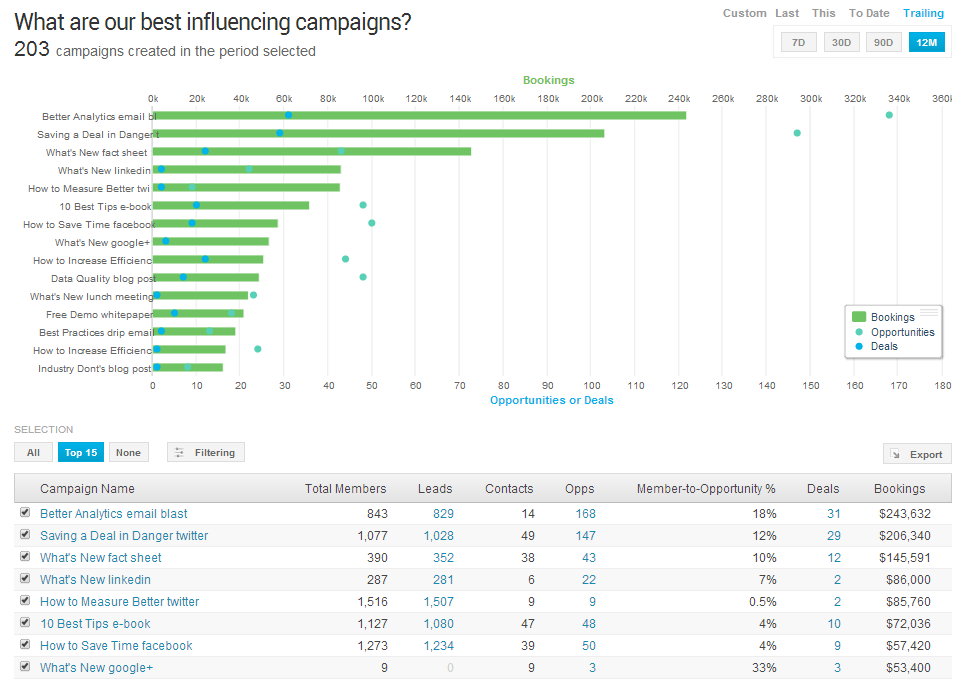
Because of this, it is important to not only track the sales activities that brought in a deal, but also the other efforts that contributed to the deal. In the report below, you can see which marketing campaigns have influenced the most deals in a given time period.

Influencing Campaigns

Rethink Your Compensation Plan

Celebrating new deals as team wins is a great place to start, but sometimes you’ve got to put your money where your mouth is. Which brings us to compensation plans.

Comp plans are probably the best evidence that sales has historically been an individual endeavor. To encourage maximum effort and healthy competition, sales teams have typically built their sales rep salaries around an escalating system that rewards closed deals. There are years’ worth of anecdotal evidence suggesting that this is the best way to hit your bookings targets, but lately, some really smart people aren’t so sure.

A recent article from the Harvard Business Review spells out the case for why individual commissions could be hurting your sales team. Specifically, the article details the compensation decisions of Microchip, a global leader in semiconductors. “[Microchip’s sales team] is taking an approach that looks strikingly similar to what you’d find elsewhere in the company: competitive base salaries coupled with a small variable component based on company and unit performance,” the article explains. “The results? Record growth and profitability, increased rep engagement, and near-zero attrition.”

Commissions are designed to incentivize sales reps to put in maximum effort. If reps are rewarded for their results, and not just showing up for work, they will go the extra mile, the thinking goes. But there’s a risk to this mentality, and many companies and researchers are starting to fear it more and more. Individual bonuses can sometimes incentivize the wrong behaviors. Instead of encouraging reps to go the extra mile to help the company reach its goals, they may instead be prodded into collaborating less, withholding rightful credit, or sandbagging. Any of these things can make the boat go slower.

Invest In Collaboration

When you start thinking of sales as a team-wide enterprise, you will naturally start to look for new ways for your employees to work together. This is true in an intra-sales team sense ‒ helping prospectors collaborate with closers, for example ‒ as well as in an inter-team sense ‒ helping sales and marketing work together. But accomplishing this isn’t as easy as wishing it so.

The most important thing to do to encourage collaboration is to align goals. Having meetings promoting group work might be great for morale, but unless there are clear, unambiguous behavioral incentives to collaborate, no one will. The companies that truly value collaboration get results by setting formal agreements between (and within) departments to ensure that everyone is pulling in the same direction.

As the leader of the HubSpot sales team, Mark Roberge learned quickly that creating an airtight service level agreement with the marketing team was the best way to get people working toward the same goals. Ultimately, this has created an environment where everyone knows the ultimate goal, and has a clearly defined path for getting there.

“We have to have great communication between sales and marketing about what is needed to reach the bookings number,” Mark said recently in an interview with InsightSquared. “Our service level agreement is essentially a contract between the two departments.”

Every company is ultimately dependent on bringing in revenue, so there’s no reason that this goal shouldn’t be reflected throughout the entire organization. And in this sense, sales isn’t a distinct, cordoned-off department, but simply the final part of a company-wide process. Treat it this way by acknowledging every contributing factor to a new deal, compensating employees to promote teamwork, and aligning goals to ensure that everyone is pulling in the same direction.

12 Aug 21:31

7 Habits Of Exceptional Presenters

by Maurice DeCastro

Sir Ken Robinson

I’ve often heard it said that ‘perception is more important than reality.’ Whether you agree with such an assertion or not I think it’s reasonable to at least accept the premise that we all see things differently. Every day at Mindful Presenter we help people from all walks of life to become more powerful and effective speakers and to achieve that we need to know what it is they believe it takes to be a great presenter.

Each time we ask our delegates that question we end up with an entire wall filled with Post-it notes each containing a single competency or characteristic which tells us that most people believe it takes a great deal to be an exceptional presenter.

This article isn’t about what all of our delegates write on those Post-its, it’s what most of them don’t write.Below are 7 behaviours that exceptional presenters rely on each time they speak and they are within the reach of all of us.

1. Courage

It’s a risky business standing in front of any audience as we can never be certain they will like us, agree with us or even believe what it is we have to say. That means we should give credit to anyone who has the courage to stand and speak.That said it’s not enough to simply stand and tell your story, it takes even greater courage to dare to be different, take people on a journey, and help them to feel something.

That courage comes from a belief that it’s simply not good enough to stand and deliver; to do what everyone else does when they speak. The courageous presenter will challenge the status quo, admonish mediocrity and do whatever it takes to engage and inspire their audience.

2. Presence

Have you ever met someone for the first time and at the end of your exchange you said to yourself or others ‘that person has real presence’? If you have then you’ll know what I mean although you’ll also know that it’s not so easy to explain. At Mindful Presenter, we believe that presence lies in the speaker being in the room with their audience and not in their heads.

That means they know how to breathe, focus, and give the whole of them to their audience.They command the space they have, they consciously use their emotions and they seek to have a conversation rather than tell people things.

Presence is about literally being in the room, in the moment, and you can’t do that if your focus is on you. Arrive at least an hour early before you speak and take a good few minutes to just be in the room. Don’t do anything but just stand there and become a part of the room before your audience arrives.

3. Humility

The exceptional presenter cares far more about their audience than they do themselves.  They don’t allow the fact that they have the platform and ears of the audience to make them feel they are better than anyone else. They take their message seriously but don’t take themselves so seriously.

The Mindful Presenter believes that it’s always an honour and privilege to have the attention of any audience and they demonstrate that with appreciation and respect. Each week we see two different extremes in presenting. Firstly, we see the nervous presenter who struggles to communicate effectively because their anxiety gets the better of them. Then we see also see the arrogant presenter where it’s all about bravado, self- promotion, how much they know, and how hard they’ve worked.

Audiences don’t want to see either of those, what they want is someone who values them, genuinely wants to make a difference to their lives and will help them to feel something.

4. Emotional Intelligence

For the presenter, emotional intelligence is simply having a high level of awareness of the impact they have on people each time they speak. The exceptional presenters know exactly where their strengths are and they play to those strengths.

At the same time, they are always trying to understand and correct their weaknesses and find other opportunities to connect with their audience whilst retaining their authenticity. For the presenter, emotional intelligence is also about having the ability and taking the time to step back to understand exactly what it is that drives both you and your audience emotionally.

It’s extremely difficult to claim to know others and put yourself in their shoes if you haven’t taken the time and effort to consciously reflect on who you are as a speaker.

5. Creativity

If you were to put aside the reality that far too many presenters read their slides and lack energy and passion. The only other problem is that most business presentations are largely the same. You can’t just present the facts, data and logic and call yourself an engaging speaker, it doesn’t work that way. You can send your audience an email if that’s all it really takes to communicate.

The fact is that the spoken word elicits a far greater effect than the written word, especially when communicated differently and the exceptional presenters know that creativity is the key.

Tell them stories, something they haven’t heard before, use props, videos or volunteers, do whatever it takes to engage their right brain as well as their left.  People like surprises, suspense, and drama. They enjoy good humor and love metaphors so take advantage of their need to connect with you and dare to be different.

6. Generosity

The exceptional presenter is generous to a fault; they give everything to their audience including themselves. I really do mean everything:

  • Passion
  • Energy
  • Enthusiasm
  • Respect
  • Love
  • Focus
  • Value

7. Value

Let’s look at value a little closer, after all that really has to be what it’s all about.Why would any presenter take 10 minutes or 2 hours of an audience’s precious time to address them unless they had something to say of significant value to them?

In our experience, one of the greatest mistakes presenters make is in believing that their job is to simply impart knowledge or information. It’s not only a big mistake it’s at the heart of the considerable problem we still see in business presenting today.

It seems acceptable to continue the trend business presenters initiated following the advent of Power Point some 30 years ago; to simply shares slides showing how much they know on a subject. You will never see such a thing on the exceptional presenter’s agenda.

For them, it’s all about value and difference.

The biggest thing they have on their agenda is how what they have to say will really help and make a tangible difference to their audience.

What value do you add each time you speak?

12 Aug 21:22

Will We Soon Have a Magic “Marketing Answer Machine”?

by David Dodd

Recently, Mark Schaefer published a blog post with the provocative title, “Why Big Data will go away soon.” In this post, Mark argued that, for the next five years or so, the ability to analyze and extract insights from big data will be a critical skill for marketers. But then, Mark says, technology will make it so easy to use data in marketing that the complex aspects of data analytics will become invisible to most of us.

Here’s now Mark described the not-too-distant future:

“In the foreseeable future, I can definitely see a time when we won’t have to worry about specifying the correct statistical test or making sure your data is ‘cleaned up.’ You’ll simply ask your device a question about your customers or competitors and it will know what data to pull, what analysis to run, and how to interpret the results.
. . .
In this new environment, we won’t think about the Big Data that is fueling those answers just like we don’t think about the sophisticated electronics at work when we are flying to a business meeting or responding to an email. It’s just there. It just works. We don’t know how, we don’t care how. We don’t give it a name. The Marketing Answer Machine will be our best friend.”

Mark’s view of the future is probably accurate in many ways. I think it’s very likely that data analytics software will become easier and easier to use and that the complex, “heavy lifting” stuff will increasingly occur in the background, most likely overseen by a small group of “data scientists.”

But, will the “Marketing Answer Machine” really provide all of the customer insights we need to optimize our marketing activities and produce successful marketing programs? I’m not so sure.

In a recent blog post for the Harvard Business Review, Charles Handy eloquently explained why we should view the “infosphere” – the combination of the Internet and computer technology – as a mixed blessing. Charles Handy is one of the most influential management thinkers of the past thirty-plus years and the author of more than a dozen books, including The Age of Unreason and The Age of Paradox.

While Mr. Handy’s post deals primarily with the potential negative impacts of data and technology on individuals, organizations, and society in general, he has a message about the limitations of data that marketers need to remember. He wrote:

“Today’s technologies would like to reclassify us bundles of data – be they words, numbers, or images – that the infosphere can process more easily. . . This kind of algorithmic society, with its programmes [sic] and routines, will take the stress out of life – but also much of its meaning if we let it.

This meaning is rooted in our consciousness, which cannot be coded or made into data. Nor can the virtues of beauty, truth, or goodness, which you recognize when you see them but cannot adequately measure or define. Love, trust, loyalty, and judgement [sic] – the essentials of our human relationships – are also immune to sensible quantification. Trying to codify them is pointless.”

It would be unreasonable to suggest that having and using relevant and accurate data about current and potential customers won’t help marketers make better decisions and create more effective marketing programs. But it’s equally unreasonable to believe that data and data analytics are all that’s necessary for successful marketing.

Virtually all of the data about customers and prospects that we track and use is behavioral data. Behavioral data can tell us what a potential buyer has done (and often when and where an action was taken), but behavioral data doesn’t reveal the psychological and/or emotional factors that motivated the behavior, and it doesn’t tell us much about the context in which a behavior occurs.

Big data is seductive because it appears to give us a highly detailed picture of our potential customers, but despite the detail, big data provides only part of the “customer intelligence” we need for effective marketing. It’s like having a high-resolution version of half of the Mona Lisa.

12 Aug 21:22

How to Create a High-Performing Sales Culture

by Shelley Cernel

Every sales leader wants a productive, efficient, and effective sales team that can hit quota. And in today’s competitive business environment, sales teams are increasingly chasing more aggressive goals with greater pressure to over-achieve. But what does a high-performing sales culture look like and why is it important?

A majority of B2B organizations struggle with sales performance:

•     2/3 of sales reps fail to hit quota (Aberdeen)

•    Sales productivity is the #1 challenge for 65 percent of B2B organizations (The Bridge Group)

•    Sales reps spend about 50 full days away from core selling activities each year (Domo)

Sales culture is important because the efficiency, effectiveness, and productivity of an organization’s sales force has a direct and significant impact on revenue. Research from Harvard Business Review (HBR) indicates “high-performing sales cultures are characterized by an ability to align (gain clarity on vision, strategy, and shared employee behaviors), execute (move in the agreed-upon direction with minimal friction), and renew (continuously improve at a pace that exceeds competitors)”. Collectively, these factors encompass ‘organizational culture’.

These 6 characteristics are key to creating a high-performing sales culture:

1) A Data-Driven Mindset

Sales leaders must track the right metrics and then be able to gain actionable insights from that information. Companies can use KPIs such as conversion rates, win rates, marketing collateral usage, average deal size, sales cycle length, and deal response time to understand what factors impact successes, how to deliver the right content at the right time, and what changes will improve performance. But before embarking on any metric mission, make sure you understand what you are measuring, why it’s important, and how it affects sales strategy and processes.

2) Dedication to Ongoing Training

Only 55% of companies have a formal sales training process. However, continuous training can yield up to 50% higher net sales per rep. Sales teams rely on training, guidance, and coaching to learn how to sell and how to do so effectively. They need to be trained on the competitive landscape, buyer personas, and the products, as well as on what to say, what content to provide, and how to steer prospects through the sales cycle. This information changes over time, so sales training must be ongoing.

3) Healthy Competition

Gamification introduces a healthy level of competition to your sales team; it takes the concepts and addicting elements of games and applies them to real-world activities. According to Salesforce, 71 percent of companies that implemented gamification saw an 11 to 50 percent increase in sales performance, and 9 out of 10 companies reported that their gamification initiatives were successful. Research from Aberdeen revealed that 31% more first-year reps achieve quota when supported with game mechanics. If implemented correctly, gamification educates, influences, and rewards the behavior of a sales organization.

4) Shared Goals

Everybody in the sales organization should share a common vision. Unfortunately, over half of B2B executives indicate their employees don’t understand their company’s strategy, according to HBR research. Sales leaders must outline a consistent sales process and then set specific objectives around those activities. Companies that follow a defined workflow are 33 percent more likely to be high performers.

5) A Collaborative Environment

According to Gallup, 70 percent of sales people feel disengaged from their work. And with more reps working remotely than ever before, your sales force may feel disconnected and be missing out on valuable feedback on performance, as well as the opportunity to learn from peers. Collaboration encourages sales teams to work with instead of against each other, leveraging best practices and increasing efficiency. The 20/60/20 rule says that 20 percent of your sales reps are top performers, leaving a majority of your team with room for improvement. Those trying to hit quota should look to top performers for guidance and work to turn best practices into habits.

6) Access to the Right Tools

Invest in the resources to make your sales reps successful and help them do their job efficiently and effectively. Optimized sales performance often comes down to streamlining workflow and eliminating superfluous tasks. These tools can have a major impact on reducing the daily ‘noise’ for sales reps and can make individual sales contributors significantly more productive.

Turn your sales managers into sales leaders with the right technology. Download the free Salesforce e-book.

12 Aug 21:22

Is Your Copywriter Killing Your B2B Business?

by Jessica Mehring

Man at computer - How to choose the right B2B copywriter for your business

Often when a business reaches out to me, they’ve already talked to one or two other copywriters.

And these businesses are very confused.

They thought all copywriters were the same.

It was a shock to find out we’re all quite different.

Choosing the wrong copywriter can be catastrophic for a business. It can cause costly miscommunications, project delays and increased workload.

BUT. Choosing the right copywriter can be a business driver. It can improve your marketing results, take work off your plate and help you produce better content, faster.

For B2B businesses, it’s even more critical to find a good copywriter. Because 52% of B2B buyers look at 2-4 pieces of content before making a purchasing decision.

Your B2B copy and content mean the difference between making the sale and losing it.

So how do you pick the right copywriter? How do you know they can do a great job for your B2B business?

Look out for these four things.

A Proven Track Record

Make sure your copywriter can do what you’re asking them to do.

If you are hiring someone to write your company’s blog, talk to them specifically about that during the initial consultation. Don’t just ask about their writing experience, ask them about their B2B blogging experience.

Every writer needs to start somewhere – but you don’t need to let them start with your project. Don’t hire a newbie (or a discount copywriter from Elance, for that matter) for something that impacts your business! Hire someone qualified for the job and you’ll see ROI quickly – whether that’s in dollars or saved time.

Many copywriters will have work samples on their website. But many won’t. I’m actually part of that latter group. Nearly all of my work is ghostwriting – in other words, I write it and the client puts their name on it – and I value my clients’ privacy. So I don’t post my work publicly on my website. I do have a testimonials page that is public, however.

No matter what, every copywriter should have work samples (a.k.a. clips) that they can send to you upon request. Some might even be willing to provide you with references.

BONUS POINTS: When the copywriter sends you work samples, it’s a good sign if some of the samples are related to your project and/or your industry. This makes it clear that they have the exact experience you’re looking for.

Industry Experience

Ideally your copywriter should have some experience with your industry. Either writing for others in your industry, or writing for businesses that sell to your industry. In either case, they’ll have a foundation for understanding your business and your clientele.

That said, a good B2B copywriter can still do a great job if they just have tangential experience. For example, if you’re a financial management firm and the copywriter has experience writing for accountants or investment management companies. That copywriter can obviously write about numbers-based topics pretty successfully. They might be a good fit for you.

A big benefit of having industry experience is that the copywriter will speak your language. Every industry has their own terminology (and jargon!). It’ll save you time and frustration if you don’t have to explain it to your writer.

Responsiveness

How quickly did the copywriter respond to you when you asked them for more information about their services, or requested a consultation?

How quickly did they send you those clips you asked for? Or the proposal they promised?

If you assigned them a paid test project, did they get it to you on or before the deadline?

Pay attention to these things when you are talking to a potential copywriting partner. If you hire an unresponsive B2B copywriter, you will not only end up extremely frustrated, but your own project timelines could be adversely affected. And time is money in business.

Sadly, responsiveness can be tricky to determine. Sometimes it’s not until you’re actually working with a copywriter that you get a sense for their reliability and communication. So set your expectations up-front.

Set your boundaries, too. If you won’t respond to emails on the weekend, don’t be afraid to say that to your writer.

Remember, though, that your responsiveness will determine much about your copywriter’s responsiveness. If you don’t send that information they requested in the timeframe they requested it, their timeline gets spoiled too. Responsiveness – and project success! – requires a two-way relationship.

Experience With Your Target Market

Experience with your target market is another “nice-to-have,” and it will be a HUGE boon to your business, but it is not required for a copywriter to do a great job for you.

A great B2B copywriter will spend the time to get to know the businesses you are selling to. If the writer happens to have worked with those types of businesses in the past, it gives them a huge leg up – and unique insight they can share with you.

Yes, in this way, sometimes your copywriter will also be your business coach. If they have experience with your target market, listen to what they have to say. You might learn something important (and game changing) about the buyers you are trying to sell to.

A copywriter with this experience will be able to more genuinely write copy and content that really speaks to and engages your buyers. This is exactly what you want! Your copy shouldn’t be about you, it should be about your buyer. The copy will ring so much truer when it comes from a place of experience, and not just research.

When you find a copywriter with this experience, hold on to them!

Every Copywriter Has A Unique Skill-Set

These are just a few ways you can identify a great B2B copywriter. I hope you’ll talk to a few of them before you decide on who you want to work with, because every writer is unique. We all have different expertise and experience.

And please, for the love of Pete, don’t just go for the cheapest option. Effective copywriting – writing that engages your audience and persuades them to buy from you – is not a commodity. You should budget for your copywriter the same way you budget for a new website. Both are your public-facing “shop windows,” and both are responsible for sharing your message with your target customers – very important jobs, and critical to your business’s success.

12 Aug 21:20

Follow the Money: The Primary Responsibility for CMOs

by jobermayer@salesleadmgmtassn.com (James Obermayer)

Tracking_674x290

The term ‘follow the money’ was made famous in the 1976 drama documentary All the Presidents Men, and has been used variously as the basis of journalistic articles ever since. Its purpose is to follow the money trail to get to the root cause of an issue.

It happens also to be one of the four primary duties for Chief Marketing Officers. However, if you have ‘Marketing’ in your title, regardless of what it’s attached to, these are your ultimate responsibilities, and ‘following the money’ is the subsequent proof of your existence. Your duties are:

  1. Establish the Brand
  2. Generate Demand
  3. Manage Demand
  4. Follow the Money

Branding has gotten a lot of attention in B2B over the last ten years or so, as traditional agencies, to generate more revenue, jumped on the band wagon of brand measurement and improvement for B2B. And yet, without ‘following the money’ and reporting on the results, what has Marketing achieved? Maybe the brand is being established, but what does it mean if you can’t point to related financial results?

Generating demand (the easiest chore) can be a money pit, if the results are not guiding the 2-15% of a company’s yearly revenue spend (on marketing).

Managing demand – lead management is getting more attention because of the explosion of vendors now saying they’re in the business of lead management. But we all know that the granddaddy of modern lead management originated with CRM and all other programs and services can be attributed to the CRM family tree.

Following the money can be the focus of both the sales and marketing departments. In this case I make an argument that without following the money, Marketing acts with good intention, but can’t prove that its actions have measureable results for every dollar spent on lead generation. 

Since the 2007 recession there have many articles, white papers, e-books, blog entries and traditional books written on Marketing ROI (see the bibliography at the end). The discussion has not been about the need to measure, but on how to go about it, and will anybody do it.

I assume that anyone who wants to measure marketing will find the tools and the wherewithal to do it. It isn’t that difficult anymore. It all comes down to the ‘wanna factor.’ Does Marketing wanna follow the money?

If Marketing wants to measure lead generation programs, it starts with:

  1. WhyItMatters-FollowTheMoney_2Isolating lead generation into campaigns.
  2. Closing the leads out with results (75-80% of leads can be followed-up and reported; at any given time 20-25% can be unresolved in the pipeline).
  3. Reporting on lead disposition and running the numbers; it’s just an exercise. James Lenskold’s book Marketing ROI will give you the simple formulas.

If you cannot rely on salespeople to close out the leads, close them out yourself. If begging and pleading doesn’t work, look at sales results to see if there is a match between the lead and a recent purchase. You can use an inside marketer (or salesperson) to call the unclosed leads. You can give the leads to an outside service. If you ‘wanna,’ you will find a way to get the campaign measured.

HughMcFarlaneQuote-FollowTheMoney_2In the final analysis, before you lose your job because you can’t measure marketing’s contributions to sales, ‘following the money’ is your only choice as a marketer going forward.


Alexis de Tocqueville said,
“If you really want to do something, you'll find a way. If you don't, you'll find an excuse.”

Excuses abound for managers who are afraid of ‘following the money.’ I find that there are two reasons why people don’t do something:

  1. They don’t know how.
  2. They don’t want to.

If we can help marketing managers learn how to ‘follow the money,’ most will do it because we normally do those things that are in our own best interest.

This ‘follow the money’ subject has been addressed in an SLMA radio program with a guest appearance by Paul Petersen, the GM/VP of Goldmine. Titled "Marketing’s Role is to 'Follow the Money,'" the program aired August 6th, 2015 as an unscripted live program. Podcasts will be available the following week.


Bibliography

12 Aug 21:20

Why You Need To Align Marketing And Sales

by Patrick Sitkins

ISS_00906_09285Lately, I’ve become more and more frustrated with local companies.

My family and I have lived in three different cities in the last three and a half years. Each time we move, we need to get to know a city and we always have basic questions.

Where do we grocery shop? 

What are good family restaurants? 

What is there to do here? 

What are the best bike and running shops?

etc. etc. etc. 

Now that we have lived in Charlottesville for awhile, we are starting to get to know the area, and we are getting to ‘know’ the local companies. There are a small handful of local companies that do a good job when it comes to brand awareness. They seem to have a great mix of SEO, television/radio ads, and other digital and traditional items as part of their overall strategy. As I search around in my day to day, I become more convinced a digital strategy is an absolute business essential for any type of company.  I used to think this was reserved for certain business sectors and markets, but I argue now it is for everyone.  It doesn’t matter if you are a professional service or a commodity, people are going to the web first.  They will find you above your competition, and are more likely to become a client based on where you show up in search results.  Additionally, they will remain a client and refer you because of the experience you provide.

Don’t get me wrong, potential clients may see your traditional advertisement and gain interest, but they won’t remember your phone number. They will search for your name or go directly to your website.

Organizations have really come around in the last few years and realized their online presence is as important, if not more important, than their offline presence.  They spend massive amounts of time, energy, employee resource and money in order to deploy the perfect digital marketing strategy.  They analyze keywords, make their site look great, focus on their brand and attempt to bring their sales process & value proposition online.  Then what?

Over the past few months, I have done a massive amount of Google searching for local companies.  I’ve searched for appliance repair, painting, general contractors, lawn services, and pest control.  Each time, I did what over 93% of internet searchers do.  I Googled my term and clicked on the first two or three results.  I never went past the first page of results.  Because all of my inquiries were fairly straight forward, I opted to fill out a simple web form instead of being stuck on the phone with a sales guy.  My inquiry was simple, I have a problem and you seem to have a solution.  Call me or write me back so you can come out and perform your service.  It couldn’t be easier for them.  I basically said, I have money and an immediate need.  Come do whatever it is that you do, and I will pay you.  The sale was done for them!  Well, in every case, my first contact never responded so I had to go back and write at least one other company in order to get a response.  It was frustrating.

This made me ask the obvious question.  Why are these companies spending all of this money on traditional advertising, web development, conversion points (even as simple as an inquiry form) and SEO?  Think of it this way – What would the owners of these businesses do if their sales people ignored leads that came right to them with wallets open?  They would fire them of course. It seems pretty intuitive, but if you have sales forms on your site, make sure you follow up on them.  Not only are you losing direct business, but your are also damaging your brand.

Hello, I would like to hire you…

As an example, there are two main pest control companies that advertise constantly. I’ve seen their ads on TV, heard their ads on the radio. They are everywhere. I had a need, and contacted both via their websites. In both instances, I got no response. To rephrase, I had a serious need, so I went back and found an email address and emailed them directly. Still no response. Next I took to twitter. My tweet was something along the lines of

“@CompanyA & @CompanyB I need your services and neither of you responded to inquiries. Do you want my business?”

Chirp. Chirp. Chirp.

Align Marketing & Sales

What are just a few missed opportunities worth to you?

Does all of this make you cringe? It should! Unless you are monitoring your assets and passing along leads to sales, all of your efforts may be wasted.

Let’s review

Are you curious where your marketing efforts stack up against your competition? Do you want to maximize your efforts in order to increase sales to grow your business?

12 Aug 21:20

When To Build an Outbound Sales Team

by Alec Morgana

Photo credit: Unsplash

Traditionally, inbound marketing is seen as the most effective and efficient way to generate sales leads. Although this may be true, many companies are outgrowing what they can achieve with inbound leads and as a result, are moving towards building outbound sales teams.

Read more on When To Build an Outbound Sales Team…

The post When To Build an Outbound Sales Team appeared first on Predictable Revenue.

12 Aug 21:20

The Core Psychological Influences on a Lead’s Decision-Making Process

by Amber Kemmis

the-core-psychological-influences-on-a-leads-decision-making-process

When you analyze website data, performance and lead conversions, how often do you take this process a step further to look at the things you can’t see in the data? For example, you can see that many of your website visitors and leads navigate to the resource center, but without thinking about the “why” behind this action or the motivator that drove them there, you can’t truly be effective at influencing the lead’s decision-making process.

As a behavioral psychologist, Ivan Pavlov, once said, “Don’t become a mere recorder of facts but try to penetrate the mystery of their origin.” It isn’t until you dig deeper into the data and the psychological influences that generate this data that you’ll be able to help a lead decide your company’s product or service is best. Here are some of the core psychological influences that influence a lead’s decision-making process.

Internal & External Influences

In making decisions, a lead is influenced by external forces, as well as internal forces. For example, if a friend shares a coupon on Facebook to a product she recommends and I claim it, this would be an external influence because I made a decision based on the influence of my friend. On the other hand, if I decide to purchase tickets to an amusement park because I remember how awesome it was as a child, this would be an internal influence.

A lead’s decision-making process is influenced by a combination of internal and external influences. At times, one of these influences may be stronger than the other, but understanding how each work to impact decision making will help you to build campaigns that ultimately help generate sales.

Internal Influences

Cognitive Bias

Despite the human’s effort to be rational beings, research has shown that we are actually more lazy than rational. In saying we are “lazy”, this doesn’t insinuate that we are couch potatoes. Our brains are “lazy” in the sense that it will take short-cuts and use minimal effort when making decisions to save brain power. In doing this, cognitive bias can occur. A cognitive bias is an error in decision making due to a combination of factors including the following:

  • Halo effect: This bias is also known as the “what is beautiful is good” principle. It is the habitual tendency to rate a person or thing positively based on one desirable characteristic. As research shows, people who are thought to be attractive will also be rated positively for other factors such as intelligence or friendliness. Although this effect has been most used by marketers who gain endorsements from likable people like celebrities, it may also be beneficial in relation to website design and the user experience. For example, if your website’s design is thought to be “beautiful”, the lead will find the overall product to be good.
  • Functional fixedness: This is a bias that causes us to see an object only for its intended use. A basic example of this is that we may only see that a pencil’s use is simply to write. However, it may also be used to throw your hair up into a messy bun if you think past its intended use. For marketers, you’ll need to keep in mind that throughout the lead’s decision-making process, you’ll likely need to educate on how to solve problems in new ways, especially if your product or service goes against what the lead has always known, to get past functional fixedness.
  • Confirmation bias: With this bias, our brains tend to seek information that confirms our beliefs. For example, if a lead favors a particular type of software, he is more likely to seek out information that supports this software. He’ll also be more likely to frame new information, although not completely supportive of the software, to conform.
  • Attentional bias: In the decision-making process, attentional bias comes into effect when the lead unconsciously attends to certain stimuli while ignoring other stimuli. We tend to focus on stimuli that are familiar, so you can use this bias to an advantage by presenting stimuli about your brand while the lead is in the decision-making process by using blog subscription emails, retargeting ads and social media.

Learning & Memory

The cognitive biases discussed above are a product of learning and memories. Rather than being a blank slate when making decisions, a lead will use what they’ve learned and stored in memory to make a decision. A bias occurs because our brain takes a short-cut through our memory without any conscious awareness.

Learning, which can be defined as the process of acquiring new information, and memory, which is where we store this information, are both key in a lead’s decision-making process. In reference to the inbound methodology, you know that a lead typically goes through stages of identifying the problem, evaluating and comparing solutions, and, finally, deciding on the most valid solution. This entire process involves learning which means that you need to facilitate this process by serving up content that aligns to each stage.

Emotion vs. Logic

As I’ve discussed in a previous post, How to Use Emotional Marketing to Build Outstanding Campaigns, humans are much more emotional in decision making than they are logical or rational. Thus, it is important to understand the emotions driving a lead through the decision-making process. By doing this, you can build content and campaigns that resonate with the lead.

External Influences

Social

Social influences can be divided into two groups: 1) reference group 2) membership group. A reference group is one a group of people that one uses to judge their own behavior and characteristics. It is a group that the persona may or may not be a part of. On the contrary, a membership group is one that describes the actual characteristics of an individual including things such as their age, religion, and the place where they live and work. When a lead is going through the decision-making process, he or she will be influenced by both groups. Often, a reference group is a significant influencer. For example, let’s say your boss wants to find a better email marketing software. Because you value her opinion, your decision to seek out a new email marketing software will be largely influenced by your boss’s decision.

Culture

The way that culture influences decision making variessignificantly from culture to culture. For example, Americans are very individualistic, so they tend to make decisions based on personal aspirations and needs. However, in a more collective culture like that of the Chinese, decisions are driven by the benefit of society as a whole.  If your company plans to expand internationally, it would be wise to create marketing campaigns that take into consideration the culture of each geographical location you target.

Environment

From budget concerns to the office at which the lead sits in while making a decision, the environment impacts the lead’s decision making process. For example, in a study conducted by Stanford graduates, it was found that voters were more likely to vote yes to increasing funding for education if they voted in a school.  For marketers in an online world, environment is still important. From the user experience that your website provides to the stage you set with content, each aspect is a cue in the lead’s environment that can either aid in helping the lead decide to go with your company or prohibit that. Knowing the lead by building buyer personas will help you to know what environmental cues you should target or avoid.

What’s Next?

As a marketer, you likely know that one of the first steps to building successful campaigns is to build buyer personas. As you think back onto the core psychological influences on a lead’s decision making process, this is even more important. You should clearly understand all of the psychological influences that your buyer experiences so that you can tailor campaigns to this. Get started in thinking about these now by sharing some of the influences you’ve seen with your company’s leads in the comments!

12 Aug 21:20

4 Ways Live Chat Reduces Your Operating Costs

by Comm100

4 Ways Live Chat Reduces Your Operating Costs

Running a successful business often requires getting back to the basics, which means earning more than you spend. Even if you have the best product or service in the world, spending too much on operating costs will always result in poor — or nonexistent — profits.

Live chat is an excellent way to reduce operating costs related to support and even marketing. In fact, a 2012 Aberdeen Group Report shows that, on average, companies that use live chat save up to 50% or more on support costs versus other methods.

In this post, I will outline a few different ways live chat reduces your operating costs while improving your bottom line.

Phone Support Is Expensive

Toll-free numbers have been around since the late 1960s as means for customers to contact companies quickly and without cost. For the company providing support, though, those toll-free calls are far from free. In fact, toll-free calling is very expensive when compared to other toll-type calls provided by most consumer long-distance companies. Simply put, toll-free rates are the bread and butter of many long distance companies.

While indeed expensive, toll-free calls remain very popular among American companies as a means of providing support. Fortunately, with the ever-increasing popularity of the Internet, more and more companies are switching to live chat.

Live chat is cheaper than traditional support for a couple of major reasons. One, rates for operating live chat are generally much cheaper than toll free numbers. Two, live chat operators can do something that is very difficult for phone agents to do: help multiple visitors or customers at the same time.

Of course, it is possible for a very good phone support rep to help a couple of people at the same time (if the clients don’t mind being put on hold multiple times.) With live chat, though, even average operators can help three, four or even more customers at the same time. After a while, concurrent or simultaneous chats can add up to huge savings in support costs.

Quicker Resolutions and Fewer Callbacks

Imagine this scenario: A user calls you for support on how to set up or use your product. With traditional phone support, the operator or support agent must walk the user through the process step by step, which can take up a lot of time and lead to high phone and man-hour costs.

Now, if you take the same scenario and solve the users dilemma using live chat, you can get through whole process much, much faster. How? That’s easy; by using live chat to push help or knowledge base articles or documents directly to the user.

Better live chat applications enable you to push canned links or document files to your visitors with a couple of mouse clicks. Assuming you have a detailed installation or setup document for your products (and you should), you can push it directly to your customer. This takes only a minute or two (from the start of the chat to the end.)

After you push the help document to the user, the support call is, for all practical purposes, finished. How’s that for timely resolution of a problem? I hope you can also see how this can save you a lot of money in support costs.

Perfect for Remote/Freelance Workers

The nature of the Internet requires businesses to be available to consumers virtually any time of the day or night, and this poses one of the biggest potential obstacles to companies that implement live chat – how to make agents or operators after office hours.

Better live chat platforms support mobile apps that let operators engage in chats after hours when they’re away from the office, and this can definitely help fill in the spaces. However, another option is to outsource your live chat operations to freelancers or remote workers.

In many cases, you can outsource your live chat support and save a bundle in the process. Part-time remote or freelancer may work for lower wages and won’t require you to pay withholding taxes, social security or other employee-related government fees or taxers.

That Chance to Upsell!

Costs don’t seem as significant when sales revenues are high. And, while that may not be true in a literal sense, selling and earning more does tend to make any costs you incur much more justifiable. To that end, you should take advantage of every opportunity to try and close more sales, and this includes encouraging your agents and operators to upsell.

Upselling has been common among phone support operators for many years now, but its success depends on many variables, including an agent’s ability to help customer visualize benefits of upgrading. In some cases, it may be difficult to explain an upgrade or more costly option to costumers in a way they can understand or grasp quickly and easily.

On the other hand, live chat allows your agents or operators many more chances to upsell because of the ease with which they can push promotional materials, fact sheets and other documentation that help explain your products or services in detail. Customers that read about your products or services are much more likely to understand benefits than with phone conversations.

If your agent or operator can upsell the customer during a support chat, that leads to not only a savings for the session but makes it profitable.

11 Aug 17:02

The Key to Effective LinkedIn Marketing

by Govind Agarwal

We offer a variety of tricks to effectively use Twitter and Facebook but less so for other networks like LinkedIn. One reason for this is that we are still evaluating ways to find the right approach to optimally utilize LinkedIn. So we thought, why not share with you all what we have decoded so far?

I am glad to be sharing some great content and blogs on the Internet and tips and tricks for using effective LinkedIn marketing strategies.

The Best Practices of LinkedIn Marketing

  • Plan 1 post on a weekly basis
  • Write posts keeping the limit of words to 25
  • Post between morning and noon throughout the week
  • Provide industry oriented updates

The kind of content that ticks on LinkedIn:
As with most social platforms, it does good to conceptualize your message based on your target audience. Here is a list of things that help create the perfect LinkedIn post.

1.Adding Industry insights does the trick
Reports suggest every 6 out of 10 LinkedIn users are interested in getting the latest dose of news from the industry. It is the most in-demand content preferred by users. Here is what makes the top three in LinkedIn content:

  • 60% members are all for industry insights
  • 53% go for company related news
  • 43% prefer latest products and services

Experiment with listicles and ‘top’ posts
One study by LinkedIn revealed that content that attracted viewers with the word “top” were far more effective, almost 40% than those that did not contain the word “top”.

More users prefer link posts
The same study that reported the above also stated that updates with links are 45% more likely to command user attention than those without.

Questions and images garner more comments
The average status update containing a question or image is 50% more likely to get comments while images lead to a staggering 98% chance of comment engagement.

Videos double the chances of engagement
Another research points out that a link to a YouTube video is an amazing attention catcher and provides fodder for twice as many actions like shares and comments. It also provides a 75% higher chance of sharing it.

2.The Most Ideal Time, Frequency, and Length to Post

Frequency: LinkedIn reports that 20 posts per month is the optimum number to reach out to 60 percent of your niche audience. For people with the time and resources to post more than 20 per month will find this interesting. LinkedIn states that posting as many updates as supported by your content is the best frequency.

Length: A unique study on the optimum length of the update states that 16 to 25 words is the ideal length for B2B on LinkedIn and 21 to 25 words for B2C. These get the most clicks according to studies.

Time: The period when majority of the people are online or logged in is the best time to post. LinkedIn reports work days and mornings to mid days are the busiest times. You could use the business hours to experiment and arrive on the ideal time that works best for you.

3.Setting up LinkedIn with Buffer
It is simple to sign up and use Buffer for your LinkedIn account and schedule the first post. The “Connect More” link on the right side of the Buffer dashboard is where all the action starts if you are already logged in. All you need to do is allow Buffer to be authenticated with your LinkedIn profile. The next is simply selecting the profiles or pages you would like to connect with.

The Buffer browser extension, iOS app or Android apps are a great way to keep your LinkedIn profile queued with your content. Once queued, the content is set to be posted at just the right time.

Once you start posting, getting analytics for the updates is a great way to stay afloat about the results. These include likes, shares, comments and simply general engagement you have received on the post.

LinkedIn Groups and LinkedIn Pulse
The Groups are apparently an amazing way to connect directly with all those following your updates. It is similar to Facebook groups or a simple newsletter. Group members receive updates through emails automatically.

LinkedIn Pulse is another interesting tool. It lets users post articles through a blog post complete with shares and commenting capabilities.

4.Is LinkedIn the Right Place for You to Be?
There is no hard and fast rule about being social network ready by signing up on every platform that exists. Pick the best one that works for you and has the maximum reach for your audience. Here is one way to decide whether to be on the network or not:

LinkedIn attracts four times more people to your homepage then Twitter and Facebook: A study found that LinkedIn sends 64 percent of social referrals to corporate homepages, 17 percent to Facebook and 14 percent to Twitter.

LinkedIn reaches out to more followers with just one post: 20 percent to be precise, while Facebook reaches 2 percent and Twitter just 4.

LinkedIn is responsible for generating the highest lead conversion rate on social media: A report that studied 5000 plus businesses reported that LinkedIn had the highest visitor to conversion rate ratio – a staggering 2.74 percent compared to Twitter’s 0.69 percent and Facebook’s 0.77 percent.

Users are hanging around longer on LinkedIn: A study relates that 17 minutes is the average time that users spend on LinkedIn. However recently it is learned that 50 percent of users are spending almost two hours a week – an increase of over 10 percent from the previous year.

There is no doubt then that LinkedIn is the network to be for you. How has your experience been with the network and what strategies have you used that resulted in great success? Share with us.

11 Aug 17:02

Upcoming sales webinars

by ramin@close.io (Ramin Assemi)

We've got three exciting webinars coming up for you in the following weeks: On sending cold emails, making cold calls and an effective framework for turning prospects into buyers.

11847575_10153062810840098_1307298694_o_1-1

Cold call like it's 2015!

Learn what has changed about B2B cold calling in 2015. Steli will share best practices, mistakes to avoid and simple hacks to elegantly overcome common objections you'll get when calling prospective customers.

https://attendee.gototraining.com/r/7433102492856166401

Wednesday, August 26, 2015
10 am PDT / 1 pm EDT

Forget the outdated sales tricks that were effective in the pre-internet era. It's a new world, buyers are informed and (fortunately) have a very low tolerance for BS. Even though many sales gurus still teach these methods, what works today is very different. 

Limited seats! Click here to save your spot now!


11865127_10153060909805098_1223598007_o_1

Cold email crash course for founders & SDRs

Want to learn how to fill your sales pipeline with qualified B2B leads, set appointments and close deals? Join our upcoming online crash course with Steli Efti on follow up strategies for sales:

https://attendee.gototraining.com/r/3881322593860640001

Wednesday, September 9, 2015
10 am PDT / 1 pm EDT

Steli will share his cold email hacks & strategies with you, and it’s your best opportunity to get any cold email-related questions answered.

In this webinar, you'll learn:

  • The best way to make sure your emails get noticed, opened and read
  • How to personalize your emails without spending a lot of time researching prospects
  • Which common mistakes to avoid when sending cold emails (and how to do it right)
Limited seats! Click here to save your spot now.
11 Aug 17:01

This is just the beginning of a very dangerous game in China

by Linette Lopez

china girl knife balance

China has devalued its currency, the yuan, by 2%.

In a statement, the People's Bank of China said that it would now allow the yuan to float closer to a market rate. It had been pegged to the dollar.

This is the beginning of a dangerous game.

The devaluation of the yuan is likely to lead to capital flight, as investors withdraw their money from the country in expectation of further falls in the currency.

And the falling yuan also adds to the debt pile of some of the most indebted companies in the country, as the devaluation makes interest payments on debt denominated in foreign currencies more expensive. 

A country only takes those kinds of risks if it knows it's in a precarious situation.

China devalued the yuan after watching its exports crater over 8.9% in July from the same time last year.

That is in part because the yuan has been tied to a strengthening US dollar, and in part because wages inside the country are increasing.

Those two factors combine to make exports more expensive, and therefore less attractive to foreign buyers.

The thing is, China wants wages to increase. For years it has been trying to move its economy from one based on exports and foreign investment, to one based on domestic consumption.

So wage growth is good, as China wants its people to have the purchasing power to keep the economy afloat on their own.

Right now that isn't the case, though. Services/consumption only account for 49.5% of GDP, compared with around 43.7% for industry, according to Bank of America Merrill Lynch.

That means China has a way to go before it gets to where it wants to be. With this devaluation, it has offset the increasing wage growth with a cheaper currency, in effect buying itself some time to get the economy from where it is today to where it needs to be. 

The devaluation comes with strings as heavy as chains however.

china amusement park boy kid gun

Let it float

The primary risk is that the devaluation leads to capital flight. 

China still has to keep its economy going, and it needs capital to do that. But with a devalued yuan, money will certainly leave the country as people fear their cash will continue to lose value.

"The risk is that depreciation triggers capital flight, dealing a blow to the stability of China’s financial system," wrote Bloomberg economist Tom Orlik in a note after the PBOC's announcement. "Our calculation is that a 1 percent yuan depreciation against the dollar triggers about $40 billion in capital flight."

So China has to do this slowly, monitoring the capital flight situation to ensure that money doesn't leave the country too quickly and suck up liquidity. Analysts have been expecting the country to cut rates this fall, but it's already done that four times since November. Clearly the PBOC didn't think that policy measure would do enough.

There are also signs that the currency is going to have fall further in value. 

Here's how the currency has worked in China. There are two values — one is the onshore value of yuan (which was just devalued by 2%) and then there is the offshore value of the yuan, which tends to float more freely according to the currency's fair market value.

Right now, the offshore value of the yuan is still lower than the value of the on shore yuan. This indicates that the currency still hasn't hit fair market value. 

china

Protect this house

There's another thing to take into consideration; the indebted state of China's corporate sector. Devaluing the yuan only makes the dollar- and euro-denominated debt these companies are holding more onerous. According to Bloomberg, it adds $10 billion to their $529 billion debt burden.

What's more, a lot of that debt is located in China's oh-so-crucial property development sector, which has already seen some defaults this year.

From Bloomberg:

“Chinese property developers have lots of offshore debt outstanding -- more than 20 percent of their total debt for some -- and the majority of them have high leverage and weak cash flow,” said Christopher Lee, managing director of corporate ratings for Greater China at Standard & Poor’s in Hong Kong. “If the yuan depreciation sustains, they will face pressure on servicing their debt.”

And that could mean more defaults. More precarious situations thanks to a government playing a precarious game.

SEE ALSO: China's sudden currency devaluation is a sign of the country's weakness

Join the conversation about this story »

NOW WATCH: People were baffled by 50 sharks circling in shallow waters off the English coast

11 Aug 16:51

How InnoCentive marshals freelancers to do cheap R&D

by CB Staff
InnoCentive “solver” Ed Melcarek

InnoCentive “solver” Ed Melcarek. (Portrait by Sandy Nicholson)

Ed Melcarek thought of himself as a company man. By the early 2000s, the design engineer had worked for the same Toronto technology firm for eight years. Then, one day, without warning, the business was sold and he was laid off. “When they gave me my walking papers,” he says, “it was quite a shock.”

Melcarek, then in his mid-50s, started looking for a new job. With a resumé that included a University of British Columbia degree in engineering, stints in manufacturing, machinery and sonar, along with headhunting experience, he thought it would be simple enough to find work. But, after every interview, recruiters routinely dismissed him as “overqualified,” or, more vague, “not a good fit.”

Melcarek wasn’t far from hitting the welfare office when, in 2003, he stumbled upon a website called InnoCentive, where companies anonymously posted problems they couldn’t crack and offered cash awards to anyone who could. One challenge in particular caught his eye: Create a process to recover the solvent used in dry cleaning. A solution quickly popped into Melcarek’s mind; he worked out the details, drafted an answer and sent it in. Not long after, InnoCentive told him his solution had been accepted and mailed him a cheque for $5,000.

Since then, Melcarek, now 67 and living in MacTier, Ont., has won 12 more prizes—the largest was $30,000—in as many years. Every few days, he checks InnoCentive for others he can add to that tally. It takes him only a few minutes to decide whether he has a shot; when he reckons he does, he uses math and modelling software to design a solution. After years of frustration with company policies and office politics, he relishes the freedom to forget about red tape and deadlines and focus on what he loves: the science.

Over the past 15 years, Massachusetts-based InnoCentive—one of a cohort of companies in the business of open innovation, as the crowdsourced problem-solving industry is called—has attracted 350,000 solvers like Melcarek from nearly every country on the planet. These bright minds have submitted roughly 40,000 answers to more than 2,000 challenges in engineering, math, chemistry, life sciences, business and beyond, and won upward of $40 million (prizes range from $5,000 to $1 million).

Seekers—the companies posting the problems—enlist platforms such as InnoCentive to tap an otherwise unreachable pool of experts and to take the financial risk out of research and development. Solvers, meanwhile, tackle these problems for the cash, the intellectual interest and the thrill of it. They’re retired academics, semi-employed hobbyists, full-time scientists and everything in between. They’re whiz kids who are too young and inexperienced for corporate culture and geniuses who are too old and unhip to feel at home at a start-up. A few even count solving as a full-time profession. They’re faces of the new “gig economy.” These are the citizens of Free Agent Nation, as author Daniel Pink called it in his influential 2001 bestseller, and they’ve never met a challenge they didn’t like.

In the late 1990s, when Alpheus Bingham, a veteran with American pharmaceutical giant Eli Lilly, came up with the idea for InnoCentive, the terms “open innovation” and “crowdsourcing” didn’t even exist. (University of California professor Henry Chesbrough coined the term “open innovation” in his 2003 book of the same name, while Wired magazine editor Jeff Howe came up with “crowdsourcing” in 2006). Understandably, Bingham says, the idea for such a website “sounded absolutely crazy to most people,” including his own bosses. He eventually persuaded them to take a chance on it—InnoCentive initially launched as a a wholly owned subsidiary of Eli Lilly—but he still had to convince the rest of the world.

“The first time we would meet with companies,” Bingham says, “we’d walk into the room and there would be three tech people and eight lawyers.” Businesses, particularly in the highly competitive science and tech sector, thought open innovation would be risky; Bingham was essentially asking them to pay a fee to tell the world what problems had stumped them—information competitors could no doubt use—and work with random people they didn’t know, let alone trust. “I don’t fault corporations for not waking up and going, ‘Crowdsourcing, we’re in!’ ” he says, pointing to the disruptive force of modern crowdsourcing services such as Uber and Airbnb. But he calmed their nerves by explaining that a seeker would only need to post a generic description of a problem; if solvers wanted to know more, they’d have to sign a non-disclosure agreement. If seekers accepted a solution, it would be their intellectual property as soon as they paid the prize fee. If, on the other hand, they didn’t like any of the solutions, they wouldn’t have to pay a penny.

As InnoCentive began growing, so did a number of similar services: NineSigma, Yet2, Quirky and even Fiverr, a website where people offer and solicit simple work for $5. Bingham doesn’t expect that growth to slow any time soon. The next generation of executives and CEOs will have grown up in a world where, “every time they have trouble changing the brakes on their car, they pull up a YouTube video,” he says. “That’s essentially crowdsourcing.”

In the YouTube example, a DIY-inclined layperson consults an expert. Open innovation is often strongest when it does the opposite. “In 90 per cent of problems, we hand the seeker the resumé of the solver and they say, ‘I would not hire that person,’ ” Bingham explains. That’s precisely the point: If a company could solve a problem with the sorts of people it typically employs, it already would have done so. Open innovation thrives when it taps knowledgeable people in fields on the fringes of the discipline at hand; they bring novel skill sets and problem-solving approaches. That sweet spot is “optimal marginality”—or, as Bingham calls it, “the secret sauce.”

If it’s a secret, it’s certainly an open one. Optimal marginality also underpins IdeaConnection, an eight-year-old, Victoria-based, open-innovation platform that assembles teams of solvers rather than relying on individuals to crack seekers’ conundrums. “The idea is to put five people together on a team that can solve a problem that a company with 10,000 scientists can’t,” says Paul Wagorn, IdeaConnection’s president. When a company presents Wagorn with a problem, his staff assembles a handful of multidisciplinary squads, assigns them each a facilitator, and lets them go head-to-head until a solution emerges. In one case, the seeker even offered full-time positions to the members of the winning IdeaConnection team.

“We naively assumed that everybody was doing this for the money,” Wagorn explains, so he originally assembled only one team per problem. “But we got so many people who wanted to work on the problems, whether they got paid or not. What we found is that money is the thing that attracts people, at least initially. What keeps them going is being able to work on a really interesting problem.”

On the occasional wintry Sunday on Prince Edward Island, Andrew Trivett would find a problem on InnoCentive, strap on a pair of cross-country skis, and spend a few hours trekking across the snow, brainstorming a solution. By the time he returned, the University of Prince Edward Island engineering professor would usually have an answer in mind. “It takes me maybe a day, from start to finish,” he says. “When I have other stuff getting me down, it’s a quick, fun break from other work.” And, in the case of two challenge-winning solutions, a well-paying day’s work.

It wasn’t long before Trivett, who now teaches mechanical and mechatronics engineering at the University of Waterloo, realized InnoCentive was the perfect teaching tool. He’d grown tired of conventional methods: “Here’s a box of toy parts. Here’s a robot task. Go to it,” as he puts it. “That’s fairly de rigueur in most engineering schools.” Students, he says, see that as articifical, not to mention wasteful. “One of the really disturbing things about those sorts of challenges is looking at the garbage bins at the end of them.”

Like faculty members at every engineering department across the country, Trivett wanted “authentic applications”—real-world problems he could give students without worrying about the possible pitfalls of placing inexperienced engineers in the field. “Giving them InnoCentive-type challenges is really harmless—and helpful.” He started using challenges as part of his courses’ curricula at UPEI, using his own non-winning solutions as examples. He doesn’t require students to submit their work to InnoCentive, but he encourages them, regardless of their level of experience, to give it a try; one team won $10,000 for its corrosion-proof boat exhaust system. “Anybody can come up with a good idea,” he says. “That’s what I hope we can instill in the younger crowd.”

One of those good ideas may soon pay off again for Melcarek, the solver in MacTier, Ont. He says, with a subtle hint of pride, that two more of his solutions are in the running to win prizes. After all those fruitless job interviews and employment woes, every win is validation. “They’re all feathers in my cap, there’s no doubt about it,” he says. “If these guys can’t come up with the right answer and I do—hey, I’ve proven something to myself. And that’s the most important thing.” That’s why he intends to keep solving. Besides, he adds, “in the wintertime up here, there’s nothing much to do but my computer and my guitar.”

This article originally appeared at Maclean’s.

MORE ABOUT INNOVATION, SCIENCE & THE FREELANCE ECONOMY:

The post How InnoCentive marshals freelancers to do cheap R&D appeared first on Canadian Business - Your Source For Business News.

11 Aug 16:51

The Psychology of Selling Books with Sean D’Souza

by Rainmaker.FM

ap-sean-dsouza

Sean D’Souza is the master “Rainmaker.” Through years of experience studying human behavior, Sean has created a powerful business that teaches business owners — and authors — how to sell their wares and provide maximum value.

The bottom line is that everyone who sells anything needs to understand how the human brain works, whether it’s a book or the Brooklyn Bridge.

In this episode of Authorpreneur, host Jim Kukral and Sean D’Souza discuss:

  • Why people make decisions on what to buy and how much to pay
  • How to structure your products, services, and books so that people will buy
  • The “yes, yes” strategy of presenting products and creating value
  • The tactics for pricing to maximize sales
  • How to get to the root of what your customers really want, and then give it to them

Click Here to Listen to
Authorpreneur on iTunes

Click Here to Listen on Rainmaker.FM
About the author

Rainmaker.FM


Rainmaker.FM is the premier digital commerce and content marketing podcast network. Get on-demand digital business and marketing advice from experts, whenever and wherever you want it.

The post The Psychology of Selling Books with Sean D’Souza appeared first on Copyblogger.

11 Aug 16:46

Channel Your Way to Social Selling Success

by Bob Woods

Social Selling strategy: Channeling

A couple of weeks back, I wrote about a new survey that, among other things, found that Twitter is slightly edging out LinkedIn as the most-favored platform in Social Selling. When it comes to using Social Selling, though, it’s really not about using Twitter or LinkedIn. It’s about effectively utilizing both platforms. The trick is to use the positive aspects of both platforms to bolster your sales.

To achieve this, let’s talk about “Channeling.”

Not Like a TV Channel

The type of channel to which I’m referring is more along the lines of a channel of water that joins two larger bodies of water, like lakes, seas and even oceans—think the English Channel. In this case, the two “oceans” are LinkedIn and Twitter, and this strategy is the channel that connects the two.

As I said in my article two weeks ago:

For all of its usefulness, Twitter does something better than LinkedIn: It broadcasts whatever message you want to put out there (as long as your Twitter feed isn’t set to “private,” of course). Twitter not only broadcasts this to your followers, but to anyone you want to see your message via keywords and especially hashtags. All they need to do is have enough curiosity or a need for the information to search for it.

But for my money, Twitter is the easiest way to both broadcast your message and to have it found by those interested in what you’re selling or offering. I call this strategy Channeling.

Make That Phone Ring (or Email Ping)

Now that you’ve got the basics of the concept, it’s time to pair it up with the strategy. To fully embrace it, though, you’ll need to both publish content on LinkedIn and have a Profile that’s optimized for Social Selling.

To get going, start publishing “tweets” on Twitter. You can link to news stories, blog postings and other forms of content that are important to your prospects (better referred to here as your “audience”).

At the same time, start publishing your own content on LinkedIn. Then you can cross-promote those stories on Twitter. LinkedIn’s integration with Twitter makes that easy, too. All you need to do is use the Twitter link that’s provided just below the headline of your article:

It’s very simple from there. Easy instructions are provided if you haven’t yet connected your LinkedIn and Twitter accounts, too.

Here’s one of the keys to Channeling: Once you’ve built up your library of self-published posts on LinkedIn, you can publish more of those to Twitter than the industry articles to which you’re linking. And don’t worry about re-tweeting older stories from your library; after all, they can still be of great benefit to your audience. I wouldn’t recommend having every tweet of yours feature your own content, though.

When Profiling is a Good Thing

The other Channeling Key comes from your Profile. Continuing the “key” analogy, your Profile unlocks both what you can provide to a prospective client, and how they can reach you.

There’s entire articles and chapters of books that detail what a proper LinkedIn Social Selling Profile should contain and look like. It’s something I teach and actually build for clients, too. For now, here’s a couple of tips for your Profile:

  1. Banner/background. Your banner (very top of your Profile) is like having free advertising space on a building somewhere. Don’t underestimate its power. Brand this “real estate” with your Website address, logo and other pertinent images. Also be sure to include your phone number and even email address. Remember the goal of Social Selling is to take your conversations offline, so make it easy for your profile viewers to contact you!
  2. Photo. Your photo must be professional. No photos of you and your spouse (or just you with your spouse cropped out, leaving only her/his hand on your shoulder), you at your kid’s baseball game, you holding that big (?) fish you caught, etc. While this item is second in this list, it’s probably the most important of the three. Your photo is the first impression many of your prospects will have of you. Do yourself a favor: Invest in a professional headshot.
  3. Headline. This one is pretty simple: Your headline should (ideally) not be your title and company. As I said in a previous post on LinkedIn Headlines, you want to “attract” people to your Profile by phrasing your Headline to provide your value proposition, or what you bring to your customers or clients when you sell your product or service to them. When you show your clients how you help them in your Headline, they’ll be that much more interested in reading the rest of your Profile.
  4. Summary. In short, don’t think of the Summary as a Summary. Instead, it’s more of a marketing piece for you; a place for you to really build your credibility and expertise. Write copy that’s WIIFM (What’s In It For Me, from a potential customer’s perspective) based and truly shows that you are “the gal” or “the guy” to go to when a prospect has a problem with which you can help. Also, be sure to put as much contact information in your Summary as you feel comfortable with listing: I suggest a main office phone number, your email and a Website where, once at that site, it’s easy for them to contact youpersonally.

Two-Way vs. One-Way

Unlike a maritime channel, where traffic is two-way, this Channeling strategy is primarily one-way: From Twitter to LinkedIn. This is mainly because you’re able to truly “sell” your expertise and thought leadership on LinkedIn, because of the tools LinkedIn provides. Twitter limits you to 140 characters, which isn’t a lot of space in which to promote yourself. And Twitter’s Profile capabilities aren’t anywhere near what LinkedIn can do for you. So Channeling your Twitter followers to your LinkedIn Profile or published content is the better way to go here.

Of course, you’ll need to build your Twitter presence. But that’s actually an easier task to accomplish on Twitter than it is on LinkedIn. I’ll have more on that in a follow-up article.

One other quick tip: In your Twitter profile, you have the opportunity to link to a Website outside of Twitter. I recommend making that link go to your LinkedIn Profile. Not only does that help goose your search-engine “findability,” it Channels the people who find your Twitter profile to a much-more robust marketing piece about you. It’s also another great reason why you need to have your LinkedIn Profile truly up to snuff, Social Selling-wise (see the numbered points above).

Isn’t it time increase your Social Selling-generated leads and business by channeling interested prospects to your LinkedIn Profile and published content?

This article was originally published on LinkedIn.

11 Aug 16:45

How to Structure Your Sales Compensation Plans

by Gretchen Gordon

It seems that compensation plan structure is a hot topic with many Braveheart clients. The following are a few things to keep in mind when structuring compensation plans for your sales team.

sales_compensation_program

1. Not all salespeople are money-motivated.
In fact, from the work that we do with clients and the thousands of assessments we see of salespeople, it appears that the majority of salespeople are NOT motivated solely by money. This means that ─ for most salespeople ─ increasing the commission opportunity will not necessarily incent them to behave dramatically differently. You could lower the base so substantially that they can’t survive unless they do more, but for many this tactic just increases turnover.

2. Remember to reward the behavior you want.
For instance, if you sell systems which have an installation component and a smaller recurring revenue component, but your company value is driven by the recurring revenue component, then the salespeople need to be rewarded for increasing company value ─ which means on the recurring revenue component, not just on the big installation sale.

3. Whether you incent on topline sales or on profit is company specific.
If your salespeople have control over the profitability of their sales, then by all means incent on profit rather than just topline sales. This will reinforce the right behavior. A plan design idea that we share freely with business owners is a concept whereby the salesperson gets to pick their compensation plan for the year.

salespeople_pick_their_own_compensation_plan

Set up three different levels of compensation as follows:

Level 1: Highest base pay and lowest upside potential (and total compensation) through the commission available

Level 2: Middle base pay and slightly higher upside potential (and total compensation) through the commission available

Level 3: No base pay and highest upside potential (and total compensation) through the commission available

Allow the individual to select which plan they want for the year.

This is how it works from there:

IF the individual selects Level 1, then they must hit a certain sales goal for every time period in the year (month or quarter, whichever is appropriate).

IF the individual does not meet the sales goal for the time period then they automatically get moved to Level 2 for the remainder of the year. No questions asked.

IF in future time periods they do not meet the sales goal for Level 2, then they are moved to Level 3, and in the event they do not meet the Level 3 sales goal they lose their job.

The beauty of the plan is that the individual can select where they are comfortable. To work most optimally, the individual should be aware that they can make the most money with Level 3. Do not allow individuals to move back to a higher base pay level during the year.

Finally, when calculating the different commissions available, think in terms of ROI.

Consider these three numbers:

1. The sales that the person must generate at each level for the company to breakeven on them (and be realistic about how long it will take a salesperson to get there).

2. The sales that a person must generate to keep their job (breaking even is rarely enough).

3. The sales that a person must generate for the company to receive a 5x ROI on that individual.

When was the last time you reviewed your sales compensation plans? If it’s been more than a year, it’s probably time to dust them off.

Recommended Sales Candidate Assessment

11 Aug 16:43

The 3 Keys to Successful Strategy Alignment

by greg.alexander@salesbenchmarkindex.com (Greg Alexander)

Aligning your revenue growth strategy is a smart move for 2016. Companies that pull together their individual plans into strategic alignment are realizing outstanding performance.

Specifically, to hit your 2016 number, corporate, product, marketing, and sales strategies must align. This starts with corporate strategy and moves across the value chain to sales strategy.

But when it comes time to create and connect strategies, where do you start?

Here are the three keys to success.

11 Aug 16:43

How to Guarantee Your Editorial Calendar Works

by Jay Baer
How to Guarantee Your Editorial Calendar Works

Image via BigStockPhoto.com

Last fall I wrote a review on InboundWriter; a web-based application (and sponsor of the Content Pros podcast) that forecasts how content will perform before it’s written.

The truth is that most blog posts – and most content of any type, really – fails. As I’ve written about in the past, the “album era” for blogs went away when competition increased and Google Reader was overtaken by Twitter as a curation mechanism. Today, it’s all about the hit singles. A large percentage of the traffic on this blog, Convince & Convert, comes from a small minority of what’s published here. The same is true for your blog, guaranteed.

This is especially true for organic search, where a few Google-loved superstar blog posts generate much of the traffic. As I wrote last year in my InboundWriter review:

“…a small minority of your content executions drive the overwhelming majority of your successes, especially with regards to website traffic coming from organic search. In reality, a lot of the content you produce (and we produce here at Convince & Convert) reaches a very small audience, while a few home runs drive most of the meaningful results.”

Making Editorial Calendar Hits is More Important Than Ever

The need to craft new hits – like a record producer that substitutes WordPress for a mixing board – is more important now than it even was last year when I talked about this, for at least three reasons:

1. Content Marketers continue to struggle with production and execution of high quality content. The number one challenge for content marketers cited in Content Marketing Institute’s 2015 B2B Content Marketing Benchmarks, Budgets and Trends is ‘creating engaging content’.

2. Most content fails, and the cost of that failure is real. I did some research and estimated that the cost to produce a blog post is approximately $900 (your costs may vary). But it’s entirely possible that you are wasting $900 each time you publish an underperforming post.

3. Quality Website content is more important than ever before for SEO. According to Marcus Tober, CTO and Founder of Searchmetrics, “Closely related to the content and user experience are user signals such as time on site and bounce rates, because they tell Google if people find your information useful and engaging,” This, in turn, ranks your website demand with Google and directly affects your website rank.”

As the importance of keywords wanes, the importance of time spent on site and other factors increase in importance. This makes it critical that you produce content that has a shot at resonating with your readership.

See Your Content Marketing Future

Given these factors, if you could know in advance how content would perform before you created it, wouldn’t you want that knowledge? I do, which is why we now use Inbound Writer for most of the content we produce here. I want to give you what you want (and what Google wants). Maybe that’s soulless and prevents me from “writing from the heart” or whatever, but this is a business, not a teen diary. If you want to feel what I’m feeling, watch my Jay Today show (or whatever comes next, as I just wrapped that production this week).

You don’t make outdoor plans without checking the weather forecast. Why plan and build content without knowing how it will perform?

Does Inbound Writer Actually Make Your Editorial Calendar Better?

why-blog-posts-fail-e1435941592518There’s no point investing in software to help you craft more blog hits, unless that software actually helps do just that.

That’s why we did a pilot study with Inbound Writer last year, and published the full results on this blog. Here’s what happened in that first test, in late 2014:

We published 18 pieces of evergreen content through InboundWriter that were forecasted to do well. Alongside this, we published 69 pieces of content (the ‘control group’) the way we had in the past, using our own editorial intuition.

The InboundWriter content drove a 4.4x increase in organic traffic and a 2.2x increase in total page view generation, versus the control.

Using InboundWriter we generated more page views with 77% less content created.

I was impressed, and, as a result, have continued to use InboundWriter. The long-term results have been stellar.

All-New Test and Results

Inbound Writer 2015 resultsTraffic to the Convince & Convert blog is up 24.83% from January 1 – August 7 of this year, compared to the same period in 2014, and I attribute a lot of that to our amazing cast of bloggers, and to Inbound Writer, since our editorial calendar and publication frequency has remained essentially static.

But to say “traffic is up by 25%. Yay, it works!” isn’t definitive enough for me, so we conducted a revised test of posts we wrote using Inbound Writer’s guidance, vs. posts where we just freestyled it.

Over nine months of usage, posts using Inbound Writer deliver 10.7x the organic search traffic.
Posts using Inbound Writer deliver 3.3x the traffic overall.

The Economic Benefits of Predictive Analytics

Using a tool like Inbound Writer and understanding what works well for your audience (and Google), and what works less well, has benefits that are not insignificant.

1. More for Same. You could publish the same amount of content and generate more traffic. This is what we are doing here.

2. More for More. Armed with insights into the ingredients of your hits, you could increase your publishing frequency while also boosting your per-post traffic.

3. Same for Less. By not publishing posts that you are fairly certain (per Inbound Writer) won’t break out, you could keep your overall traffic the same (or even higher) while publishing less often. This is a cost savings that could be significant.

Bottom Line: What’s This Worth to Me?

In B2B or other highly competitive digital marketing environments, companies will often gladly pay $1, $5, $10 or more for a click, via paid search or other mechanism.

For me, readers of this blog and listeners to our podcast network don’t convert to consulting clients at a high ratio (this is by design). Consequently, the value of a click is essentially the value of our ability to sell ads to sponsors (by the way, go click on some of them over on the left, they are all great companies). I won’t go through all the math here, but a single new visitor here is worth about 33 cents to me. (I love each of you, and your trust in me is incalculable in its value, but that’s just the math of the media business).

So if an average post here that doesn’t use Inbound Writer generates 1,000 visits, and the average Inbound Writer-fueled post creates 3,300 visits (3.3x, which is what we’ve seen), the economic impact for me over the long term on a PER POST basis is $759.

If you gladly pay for targeted clicks at $1, the same ratios would create a per post value of $2,300.

I used Inbound Writer to help position the post you are reading.

I used Inbound Writer to help position the post you are reading.

If You’re Serious About Content, This Should be Mandatory

Today’s content marketing success formula is different – a lot different – from the formula of 2013 and prior. Hitting singles and doubles on a consistent, daily basis doesn’t yield results like it once did. The competition is too intense, and the relationships with readers are too diffuse. Now, content marketing success is about home runs and strikeouts.

Times change. Technologies change. To execute content marketing at a high level you need to evolve. The ‘production’ mindset of simply building a content calendar and creating solid stuff every day will not take you where you need to go. It will increasingly yield more strikeouts than home runs.

We’re big fans of working smarter, not harder, and making intelligent use of data and insights to provide an edge. Given our results with InboundWriter on this site, predictive content analytics needs to be part of the toolbox of serious content marketers.

       
11 Aug 16:40

LinkedIn – Grow Up, Already

by Colleen McKenna

As a parent of three awesome young women, I’ve had the distinct privilege to guide them, watch them grow and wonder about them through the years. Probably the most difficult, awkward time was shepherding them through middle school. It’s just not a fun time for said middle-schooler. Or the parents. It’s the time between innocence and emerging maturity that causes most everyone I know to shake their head in either disgust or relief.

What does this possibly have to do with LinkedIn? Well, I remember fondly the days when LinkedIn was a sleepy, member-centric platform trying to find its place in the new world order of social. They walked slowly and treaded carefully. As they managed their bearings they would take a next step, pause and let its members grow comfortable first. And then take yet another step.

Not anymore. Hence, LinkedIn is like a middle-schooler. Filled with Red Bull-fueled energy, invincibility and unchanneled passion, LinkedIn’s force is unbridled, and worse, confusing to most. I’ve been on LinkedIn for a significant portion of the last ten years and I’ve come to see why people give up before they reap the tremendous benefits it offers. LinkedIn’s added new products and features, made smart acquisitions, they have a HBAG (big hairy audacious goal) for the future and have experienced growing pains that can’t be avoided. As an outsider who pays close attention and often talks with folks at LinkedIn, their continued rapid growth has inevitably created a pretty siloed structure. It’s just what happens.

Now, it’s time for LinkedIn to grow up. They haven’t yet grown into themselves. They are racing to meet Wall Street projections, board expectations, their own brain trust’s brilliance and have failed to see that most people don’t know the answers to the most basic of questions:

  • If I join Groups how do I stop all the email?
  • Is a Premium Membership necessary and which one do I buy?
  • Can I have concurrent positions on my profile?
  • How do I add a website?

Hey LinkedIn! Here are 10 tips for you that would improve your members’ experience:

  1. Release all platform updates in a systematic, planned release 2-3 times per year and provide written release updates in one document.
  2. Simplify the Home Page and let members decide what types of content they would like to see (that was a feature in the Settings area that is now gone).
  3. Explain the various Premium Membership offerings. (These should be simplified too. And stop pushing Sales Navigator as the first choice). Be transparent.
  4. Make personalizing Connection requests standard. There are so many places where you hit “Connect” and it automatically sends an unpersonalized invite.
  5. Figure out a way for organizations to better manage their Company Pages when it comes to people who have left and not updated their profiles. (And others who say they work for the company but never have).
    • Idea: How about, when someone adds a company, there is pop up that asks them to confirm this is the right company?
    • Add back in the Products and Services tab. They were more significant than Showcase Pages. Right now unless the key person who is trying to clean up the Company Page has a Premium Membership, customer service often does not respond.
    • And what about exporting Company Page followers to engage them?
  6. Add Live Chat to the Help Center. There’s Live Chat for sales, but not for customer service.
  7. Train your sales consultants to speak your customers’ language and keep it simple. Most of our clients don’t understand what LinkedIn is talking about around “bundling” solutions, and it creates a sales credibility issue.
  8. Show real case studies of companies who have little brand recognition, a small budget, and less than ten salespeople. All the new features in Marketing Solutions are all geared to large companies. If LinkedIn wants to be successful it needs to lead the way for small to mid-sized business success. Of course, Dell and Microsoft are getting great results with their marketing and recruiting. Duh! They are Dell and Microsoft. I’ve found many of LinkedIn’s recent webinars frustrating for just that reason.
  9. Mobile – Members should either be given the option to jump over to the full site when they log on via their mobile device or remind them that it’s not the same version and they won’t be able to do certain things (i.e. personalize invites). Today, more than 52% of people access LinkedIn from their mobile device. When members try to log into the full site on their mobile device, they should be able to without continually being prompted to download or use the app.
  10. Let members visually see how the people in their network are connected. Bring back InMaps or some new version to show relationships within networks visually.

Like the wild middle-schooler trying to manage all the peer pressure, new friends, competing interests, parental hovering (well-intended and totally necessary) ultimately they have to learn to make choices that will best position them for the next stage (high school, college, career) and their immediate decisions influence so much. I see the same for LinkedIn. They’ve decided to become a front to end business tool and solution for brand development, client development, online learning, publishing, lead nurturing and talent acquisition then they need to make decisions that communicate that effectively to their members and get their members excited about what LinkedIn is today and how it will continue to evolve to provide greater value for each active member.

This is a short list, no doubt, but a good start. I am a LinkedIn evangelist and LinkedIn is one of the most powerful B2B channels I’ve ever used. I would hate to see it falter, lose the loyalty of its members and be stagnant in growth. I doubt that will happen, but as the platform becomes increasingly more sophisticated it runs the risk of people losing interest because the learning curve is so steep. Hey, we’re grateful for that here at Intero. It keeps the lights on in our office. But getting people to even understand how much there is in the engine often takes months.

I’d love to hear what you would like to see added to or taken away from LinkedIn. How could it be a stronger platform for you and your business?

11 Aug 16:39

Why analysts are gaga about Google Inc’s restructuring under Alphabet Inc

by David Pett

It was another tough day for equity investors after China devalued its currency and prompted a selloff in commodities on Tuesday, but it wasn’t quite so bad for those with a stake in Google Inc. Indeed, things were pretty good.

The U.S. technology giant defied the latest rout on global markets by rising US$27.05, or 4.27 per cent, to US$660.78 on expectations that Alphabet Inc., its freshly announced new holding company, will add significant shareholder value and help solidify the company’s standing as one of the most widely held stocks.

“We are bullish on Google’s new operating structure,” said Doug Anmuth, analyst at J.P. Morgan, in a note to clients. “Overall, we view the new structure as an elegant way for Google to continue to pursue long-term, life-changing initiatives while simultaneously increasing transparency and management focus in the core business.”

The Alphabet holding company was announced on Monday after market close and immediately began paying off for investors, with Google shares trading four per cent higher in morning trading Tuesday.

Alphabet will replace Google as the publicly traded entity following its phase-in period over the coming months and will consist of the same businesses inside Google today, but segmented into two parts.

The first will be core Google, which will include search, ads, maps, apps, YouTube and related technical infrastructure, while the second part will include emerging businesses such as Nest, Fiber, Life Sciences, Calico and Google X, as well as the investing arms Google Ventures and Google Capital.

“From a financial perspective, we believe the Street will soon be better able to evaluate the true performance of core Google, and may also become more accepting of Google’s ongoing investment in emerging businesses such as Nest, Fiber, and driverless cars,” Anmuth said, maintaining his overweight recommendation and US$800 price target.

Other analysts who cover the stock are equally optimistic about the new structure.

“We believe the improved segment disclosure should be positive for shares just like the segment disclosure was a positive for Amazon, Expedia, and Netflix (at different times),” RBC Capital Markets analyst Mark Mahaney said in a note to clients, reiterating his outperform rating and US$750 price target.

“Additionally, the re-organization will likely lead to some efficiencies from a more focused management team.”

Mizuho Securities analyst Neil Doshi, meanwhile, upgraded his recommendation on Google shares to buy from neutral and left his US$715 price target unchanged.

FP0812_The_NEW_alphabet_940_AB


He said Alphabet is a “major catalyst” that will provide better insight into the growth and profitability of Google’s core ad businesses as well as give investors a better view of the company’s venture businesses.

Doshi also believes the new structure could help prevent further talent loss within Google, because it provides an opportunity for more of its senior executives to move into new roles.

At the same time, he said the new company could potentially spin out some of the entities under its wing to create future shareholder value.

“This also removes some of the management overhang around the stock, as it shows that management appears to becoming more shareholder friendly,” he said. “While there are many details to be worked out, this could lead to a much nimbler and aggressive Google that can take on additional risks to compete with upstarts and existing Internet platform companies.”

11 Aug 16:38

Canonical’s Ubuntu Phones Now On Sale Globally

by Natasha Lomas
Ubuntu phone Mobile market latecomer Canonical claims “latent demand” for its tardy but alternative smartphone OS has encouraged its OEM partner, BQ, to open up availability of its handsets to buyers anywhere in the world, not just in Europe. Read More
11 Aug 16:37

Are Buyers Always Rational?

by TheSalesHunter
  Regardless of what you sell and the process with which you sell it, there will always be buyers who will not base their buying decision on rational logic. I’ll even go as far to say there is no such thing as a 100% rational buyer. Regardless of what the sale is, there will always […]
11 Aug 16:36

Tips For Attracting Customers With Squeeze Pages On Auto Pilot

by Troy Hollenbeck

Tips for Attracting Customers with Squeeze Pages on Auto Pilot

A squeeze page is a page that tries to convince visitors to give you their name and email address in exchange for something they perceive as valuable, such as a free report, eBook, or a video. They are also sometimes called lead capture pages or a name squeeze pages.

The purpose of a squeeze page is to quickly build a list of email addresses, preferably from people who have an interest in your product niche, as well as, they are a tool to build value, build a list, build trust and gain a new customer.

Once you have captured an email address, you can use it to send out emails promoting your products and services indefinitely, or at least until the person unsubscribes or buys.

Let’s see what the big deal about squeeze pages is about…

Now, one thing I do know about the basics of marketing is, if you’re consistent with getting 30 leads a day, it’s only a matter of tweaking your sales funnel until you are hitting your sales goals, and it starts with your squeeze page, that is the starting point of your sales funnel.

My Top 3 Tips For Getting The Sale:

  1. Tweak your Squeeze page, your pre-sell page and your sales page.
  2. Tweak your follow-up email sequence
  3. Tweak your traffic source. (Solo, FB ads, PPV, PPC)

That’s it! And that’s also assuming that your email ad copy is good and your traffic source is decent in enough volume as well.

Squeeze Page Software

There are many different squeeze page software programs available, some free but mostly paid. They promise to generate effective squeeze pages for you that are “guaranteed” to capture a lot of email addresses.

The software works sort of like resume-writing software. In most cases, it will give you a boilerplate template that you can personalize to fit your own needs.

In other cases, the software will give you pre-built squeeze pages based on the most popular niches – weight loss, acne cream, dating, and so on – that you can post your links on and tie to a place where you can collect email addresses and start building a list.

Like resume-writing software, squeeze page software is most helpful if you have never written one before. But once you get used to writing squeeze pages, it’s not difficult and you don’t really need to spend money on software to do it for you.

The one I highly recommended using for webinars, landing pages, and squeeze pages is LeadPages.

Benefits And Drawbacks Of Templates

As for the pre-written templates on the biggest niches, they typically already have SEO, which can help their ranking a little on Google and elsewhere. But if the same templates are being used by lots of different people, how does that differentiate your product? In most cases, it doesn’t.

Squeeze page software is so common these days that you usually can get it for free if you look around hard enough.

Rather than using the software for your products, a better plan is to take a look at the kinds of squeeze pages they offer then steal their best ideas to create a squeeze page that is custom-fitted to your particular product and niche.

Brevity Is King

If you are creating your own squeeze page, remember that they are similar to sales letters except tjeu are much shorter, usually only one or two pages.

The structure is basically the same as the sales letter:

  • Present a problem that would be common for people visiting your page.
  • Offer your product as the solution.
  • List its benefits (how it will improve their life) not just its features (what it does or has).
  • Conclude with a Call to Action (what you want them to do, in this case give you their email address).

You need to offer something for free to incentivize people to give you their email address. This can be a free report or eBook you can either create yourself or pay somebody to write, or a how-to video.

In either case, the free giveaway should be related to your niche and should have high perceived value to the prospective customer.

Value Of Autoresponders

You may be familiar with a low-function autoresponder that probably came free with your email account. You know: The one that tells people when you are out of the office or on vacation. The autoresponders we are talking about here are much more sophisticated than those.

Unlike list building and squeeze page software, you will need to use an autoresponder to manage your email address capture and delivery system.

There are lots of different programs available, but one of the most popular and reliable comes from AWeber. It costs about $19/month. For that price, you can use it to send unlimited emails to 500 email addresses. Obviously, if you need more, you can buy a different package.

11 Aug 16:35

Are Inside Sales Folks Really the Early Adopters of Change?

by Josiane Feigon

images
The sales profession has undergone tremendous disruptive changes in the last several years and we’ve always thought that inside sales folks are the earliest adopters of these changes. But are they really?

I was intrigued by Ken Krogue’s Forbes piece citing their new research on the Top Inside Sales Challenges in 2015, both at the team and manager level. This study was first conducted in 2012. The issues are basically the same in the 2015 version, but the challenge meter has either increased or decreased in several places over the last three years.

Here are the survey results of the Top Challenges in 2015 that both Inside Sales Managers and Inside Salespeople are facing. I’ve added my comments, and links to my two sourcebooks that dive deeper into these challenges.  Here’s the ranking:

Top Sales Manager Challenges in 2015

1.Quantity of leads – There is still some finger pointing going on between sales and marketing. Sales isn’t really sure what to expect from marketing, but just wants to keep them away from their sales funnel. And marketing is being held accountable for sales results, but they have also forgotten how to be human about it. 

2. Hiring – Finding and retaining talent in this growing field continues to be a challenge, mainly because smart and motivated inside salespeople are a rarity. The traditional methods are not working. Asking interview questions that determine if you have someone who is going to stay for a while makes a difference. Download the 25 Superhero Interview Questions.

3. Motivation – Being an inside sales manager is incredibly demanding. Today’s workforce requires a lot more coaching, mentoring, acknowledgment, and reinforcement. Perfect timing for Inside Sales Managers: This Summer FUN Meisters

4. Reporting – A high percentage of inside sales organizations still do not have a defined sales process or universal language regarding sales stages and where deals stand in the pipeline. This affects forecast accuracy, and reporting gets messed up.

5. Training – Every manager thinks they can train because most of them started in sales. But they’re wrong. So much about how sales is done has changed in just a few years, and the way people learn today is completely different. When managers try to train, they end up doing a “watch me do this” type of training that is clearly demotivating. Download our Inside Sales Guide to Sales Team Training.

6. Equipment / Software – It’s tool mania out there, and these shiny objects are addictive! It’s easy for managers to get lost in the glitz, ending up with tools they don’t need. Nancy Nardin at Smart Selling Tools always does a great job of simplifying the tools search. Check out their Top Sales Tools of 2015.

7. Compensation Plans – I have never met an inside sales manager who thinks their comp plan is sound and it works — especially now that inside sales organizations are partnering through both the direct and indirect channels, and are part of an integrated sales team. Check out the Xactly team for sales commission planning guides.


Top Sales Sale Rep Challenges in 2015

1. Having enough leads – Trust me, there are PLENTY of leads out there. The problem is that almost no one gets to qualify the leads deeply enough. Why? Because many of them chase the prospect away with annoying introductions about “calling to see if you have a project” you are currently working on.

2. Accessing a decision maker – As the committee of decision-makers continues to grow, it’s getting harder and harder not only to find the power buyers but to talk with them. All too often, the wrong people slip through the cracks and mess up your sales forecast.

3. Staying motivated – How can you sell to a prospect who clearly doesn’t need you or want to have anything to do with you? When you dial 75+ outbound per day, and if you are lucky only have live conversations with under 5 of these, you are going to have a difficult time being motivated.

4. Managing calendar events – Appointments are still getting cancelled at an alarming rate: the vanishing customer is here today and gone tomorrow. Find out what you can do to prevent appointments from getting cancelled.

5. Lack of product knowledge – Salespeople always feel they are ill-equipped with product knowledge, and justifiably so: because today’s customer is much more educated. In fact, they often know much more about your product and solution than you do. Get up to speed before you make the call.


The post Are Inside Sales Folks Really the Early Adopters of Change? appeared first on TeleSmart Communications.

11 Aug 16:35

What Being Agile Means for Today’s Marketers

by Jennifer Harmel

In today’s world of marketing we have new things bombarding us on a daily basis. The newest trend, the newest buzz word, the newest technology. As I think back on my own career, it’s hard to believe that once upon a time I thought variable printing on direct mail was revolutionary. (And yes, I just aged myself.) If someone had told me back then that within the next twenty years we’d be focusing on things like how to make email communications render properly across mobile devices I would have thought they were crazy.

Agile

The reality is we must keep up with the latest trends, buzz words, technology….all of it. Otherwise we’ll be left behind. Our prospects and customers are no longer passive targets. They are armed with all the tools and means to proactively access information and conduct product research all by themselves. They aren’t sitting around waiting on us to tell them what to buy or how to buy it. They’re figuring it all out on their own.

What that means for marketers is we need to be agile. Change is inevitable, and in fact, it seems to be happening faster and faster as time goes on. We as marketers need to be able to change to meet the needs of our prospects and customers. And we must be able to do it quickly in order to stay relevant and competitive.

Ask yourself these questions:

  1. Are you testing and tracking the results of your marketing efforts to know what is working and what isn’t?

If you’re unable to track what channels, content offers and messages are generating inbound engagement and outbound response you’ll be at a loss for knowing what is resonating with your audience. In order to change, you need to first know whether you need to make a change or not. That requires benchmarking yourself both internally against past efforts and externally against industry peers. Take a look at last year’s B2B Enterprise Demand Generation Study by ANNUITAS to get a general idea about what KPIs and areas to focus on. Don’t be afraid to test new things and embrace change.

  1. Do you have a means for conducting customer discovery?

As I’ve stated, a big part of being an agile marketer is the ability to adapt to your customers’ needs. If you don’t have a means for finding out what your customers want, you’re probably already falling behind your competition.

  • Do you truly know how your target audience is or are you guessing based on internal speculation?
  • Do you know what drives your prospects to start searching for a new solution?
  • Do you know where they go to research, shop and buy?
  • Do you know what types of content they prefer?

If you can’t answer these questions, you need to figure out a way to do so. Whether it’s customer surveys, going out on the road with your sales force on a regular basis, or interviewing customers and prospects yourself…this needs to be done, and done regularly. It’s not good enough to do this once a year. As we know, change is happening all around us. We must keep ourselves on the pulse of the change so that we can adapt to our customers ever-changing needs.

  1. Does your company foster learning in new methodologies, new techniques, new technologies?

I’m proud to say that at ANNUITAS we have a culture of constant learning. The collaboration across teams to share new best practices and the constant encouragement and support for technology certifications keeps us all in a spirit of continuous improvement and adaptation. This type of culture comes from the top down. An organization’s leaders must encourage collaboration and sharing rather than silos and hierarchy by doing the following:

  • Making it easy for employees to access the latest marketing trends, statistics, etc.
  • Rewarding employees who try new things, whether they succeed or not.
  • Scheduling regular check-ins to share best practice learnings, results of testing, and findings from your customer research.

And the hardest question…

  1. Are you willing to change if necessary?

I hear it all the time from clients, albeit in various ways. It may be fear that the quantity of “leads” will decrease. It may be fear that they don’t have the right resources to conduct the change. Or it may be fear that the ROI of their efforts won’t meet expectations. In most cases, what marketing is doing today isn’t working optimally. And even if it is, there’s no guarantee that it will continue to work as customers’ needs change, new technologies are introduced, and new competitors enter the market. So in reality, what do we have to lose by trying new things as long as we track results and learn from them?

The truth is that change will always happen, and if we as marketers aren’t agile enough to adapt to that change we will fail. Focusing on building an organization that knows where it needs to change, how it needs to change, and rewards change is a step in the right direction. To learn more about what it means to use agile practices today in business read the book, Growing Up Fast by Jascha Kaykas-Wolff and Kevin Fann. It’s a great resource to help you see the value in developing an agile mindset.

*photo credit: Thinkstock

11 Aug 16:35

Maximizing Your Demand Generation Program for a Better Sales Performance

by Jayden Chu

It is an essential component in every B2B enterprise’s marketing plan. It is an important factor in developing potential relationships with industry players. And it plays an essential role in molding your company’s identity.

No doubt that most B2B businesses focus on having an effective demand generation campaign. We can all agree that it functions to stir market awareness perhaps in the same manner as B2B lead generation. By being aware about your products and services, prospects will have a better experience deciding the types of solutions they want.

It’s all the rage among B2B and also B2C executives, with content leading the charge towards market saturation. But it’s not always easy maintaining a program that sits under ever changing market moods.

In some B2B experiences, not many demand generation strategies function as expected.  This is because of the B2B market’s volatile nature. We can’t expect one decision-maker to have the same preferences as another. Hence, marketers struggle with finding the right solutions that can provide a better traffic of B2B leads and ultimately effect sales growth.

While infrastructural upgrades and investments can be considered, more practical and cost-efficient actions can also be applied. And here they are:

Know your prospects well. You would be glad to see a positive engagement from a website visitor. But in some cases, he or she does not fit your audience profile. Whether you target C-suite managers or VPs of specific industries, it is important to structure your demand generation content based on details about your target demographic.

Setup an effective lead management system. More often than not, you will find yourself in a position to setup a lead scoring database. But instead of purchasing extravagant automated software that boasts “streamlined” and “sophisticated” processes, it would be better to have a lead management system that values time with regards to qualifying B2B prospects.

Focus on nurturing your leads. In many cases, it’s about giving your prospects what they want in order to form a business decision. For this, B2B lead nurturing should be optimized. Closed deals can be attained through an effective follow up system that provides vital information. In the end, it is all about educating and lengthening your prospects’ lifetime rate.

And as an added measure, outsourcing your B2B operations to a lead generation firm can help alleviate much of the grunt work in your marketing and sales.

11 Aug 16:35

How to Generate Leads on Demand with Outbound Prospecting

by Elizabeth Dyrsmid

outbound prospecting process

Inbound marketing is the hot new kid on the marketing block. Yet sometimes, it’s just not the best strategy for the situation.

Inbound marketing works great for getting your company found by customers, delivering value that’s hard to refuse, and reaching buyers across the purchase journey. Sounds ideal, doesn’t it? Yet sometimes, this system doesn’t work as effectively to get prospects interested. In those times, outbound marketing might be a better fit.

So, Why Choose Outbound Marketing?

Outbound marketing is the process of going out and actively pursuing prospects. It’s most effective when:

  • Your marketing doesn’t produce the amount of leads you need.
  • You aren’t getting the right kind of leads from your marketing.
  • You have a core set of target customers that you need to reach.

If you are targeting larger accounts or you want to put your business in front of the people who are most likely to buy, outbound marketing might be a good idea.

Here four tactics you can include in your outbound marketing process to reach highly targeted markets.

  1. Identify Qualified Target Prospects with Outbound Prospecting

Hiring a devoted sales team to pound the pavement and drum up new leads sounds old-fashioned and expensive. For the most part, it can be, but outbound prospecting changes that a little bit.

Outbound prospecting puts a highly specialized, well-trained team to work to find new prospects. This is important. When sending these highly specialized forces out on the market to prospect, you aren’t relying on them to handle everything from start to finish – you only want them to bring in qualified prospects. Then, these prospects are sent to account executives to close the deal.

The specialization part is crucial too. Without a solid understanding of the person they’re looking for or the industry they’re targeting, your sales team will sputter and stumble, delivering poor results. However, when they have a solid understanding of their target prospects and how decisions are made, they’re able to get in front of the right people faster and easier.


This approach is used to bring unmotivated and unfocused sales teams back into the sales game. When they start succeeding and their jobs become easier, you can bet that they’ll bring in better results.

  1. PPC

Using PPC for Outbound ProspectingPay-per-click (PPC) ads remain one of the most effective ways at getting businesses in front of customers. That’s because these ads appear in front of the people who are already searching for what the business offers. There are a few benefits to taking this approach:

  • You set your budget – spend as little or as much as you’d like.
  • You level the competitive playing field, making it easier to knock out your competition.
  • You see almost instantaneous results.
  1. Paid Ads

Similar to PPC, paid ads let you put your company’s message in front of a highly targeted audience. This is usually done on social media networks, including the following:

  • Facebook: Facebook ads let you design an ad that looks similar to a regular Facebook post. Because Facebook is quickly pushing down the types of posts they show from business pages, paid ads are often the easiest and most effective way to get seen in front of the audience you’re targeting.
  • Twitter: Twitter also has a few paid ad options, including promoted tweets, promoted accounts, or promoted trends. Depending on which option you choose, your promoted content will be seen by your audience in the newsfeed or sidebar.
  • LinkedIn: Paid ads on LinkedIn are ideal for B2B companies. They work in the same way as Facebook ads but offer different targeting criteria and different expectations from the user base.
  1. Targeted Partnerships

Do you know your customer loves to go to a specific store? Why not partner with that company to tap into the audience and grow your sales?

Targeted partnerships are an easy way to get in front of an already existing customer base. You’ll instantly earn the trust of the audience because of who you aligned your business with, making it easier to turn leads into sales.

Possibly the most effective way to win new customers and retain existing customers is to form alliances and strategic partnerships. These relationships take some effort to create but the return on your investment can be tremendous. – Greg Dunne, Mansfield Sales Partners

Final Thoughts

Although inbound marketing is getting a lot of buzz, there is still a place for outbound approaches like prospecting, paid ads, and targeted partnerships. Many high growth companies implement these strategies when trying to reach highly targeted markets.

Looking for other approaches used by successful businesses? Check out our free report called, “The Ultimate Marketing Guide for High Growth Companies.”

ultimate marketing guide high growth

11 Aug 16:35

3 Ways Inbound Marketing Can Supercharge Your Outbound Sales Calls

by Hellen Oti

connecting outbound inbound strategies

Many proponents of inbound marketing see outbound marketing as an obsolete way to attract prospects. As a digital marketer myself, I believe inbound marketing has many benefits including, the ability to not only attract leads but also keep those leads much more engaged throughout the sales cycle. It also makes it easier to track and improve results. While inbound marketing comes with its benefits, for most industries and businesses, having a versatile approach to marketing goes a long way in creating a true multi-touch approach to marketing and closing sales. So instead of viewing inbound and outbound marketing as competing strategies, both inbound and outbound strategies can be used conjunctionally to create a truly effective marketing and sales strategy.

Here are 3 Ways inbound marketing can help improve your outbound sales calls:

  1. Make Outbound Calls With Inbound Call-To-Actions:

Many prospects find sales people to be “too-pushy” but that’s usually because those prospects may not be well informed about the benefits of your products or services. Using an inbound call-to-action at the end of an outbound call sometimes takes off the pressure and makes the prospect on the other side of the line, more receptive to a sales person if they are not at the decision stages of the buying cycle. Here an example of a way to close outbound sales calls with inbound call to action: “I understand that you may not be ready to take the next step now, but we have an eBook that dives into the problems that you are experiencing and provides practical solutions. I would like to send you a copy, what is the appropriate email address to reach you at?”

  1. Gather keywords used from conversations for next Followup Emails and Blogs

Effective communication is usually based on one main component – the other person that you are talking to feeling like you understand what they are saying. Sometimes the ability to effectively communicate with others is a simple as using the same vocabulary that they are using. Since certain phrases and words mean different things other people, when you are able to use similar words to describe what you took out of a conversation, it sometimes makes the other party more convinced that you understand them. The foundation of SEO is built on this concept. When you use keywords in your blogs that prospects also use to describe their pain on webpages and nurture emails, the prospect is more likely to feel understood. Sales outbound calls can help you discover more keywords that can be used not only when you are communicating with the prospect but also in your inbound campaigns to attract others who have similar issues.

  1. Continuously use Inbound email marketing to nurture leads

Using a multi-touch integrated approach to your sales calls makes it more likely for you to convert prospects who may be ready to make a sale today into a sale sometime in the future. Things to remember when adding contacts from your outbound sales calls to your inbound emails:

  1. Always send a follow-up email reminding the contact of the conversation that you had and send the information that you promised.
  2. Add contacts only to the email marketing lists that they need to be a part of; do not add the contacts to every email marketing lists that you have. Relevance is key if you want to reduce the chance of lost subscriptions.
  3. Monitor activities from your emails for your contacts, to determine when it’s right to reach out to your contact with another followup phone call. The timing with this has to be perfect. If you reach out too early without the lead wanting you to do so, you may start to become bothersome and the prospect could start avoiding your phone calls in the future. Set thresholds based on past activity with leads and continue to refine this threshold. For instance if looking in your database, you discover that most leads tend to be interested in talking to a sales person after clicking emails about 5 times then you can reach out the contact to follow up to answer any questions after the 5-email threshold.

Integrating sales and marketing strategies comes with countless benefits. The same can be said for inbound and outbound approaches. Although these two methodologies seem to be on opposite ends of the marketing and sales spectrum, they tend to compliment each other when used effectively.