Shared posts

22 Aug 15:26

Evaluating Pricing Differentiation in a Crowded Market: Asana, Basecamp & Wrike

by Steven Forth

Teams are central to how we work today, and a lot of teamwork is project based. So, it’s not surprising that there are many project management solutions available on the market. And unlike team communications, where Slack’s channel model has won the day, project management looks like an open market. It’s therefore a great space to evaluate how pricing and market strategy come together.

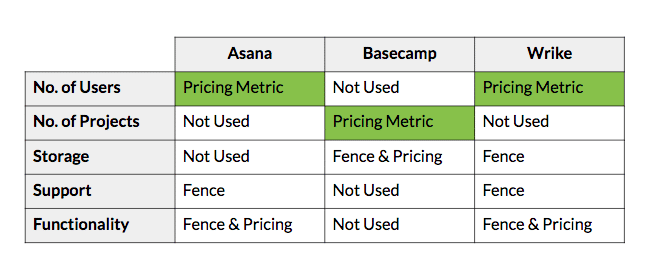
Let’s take a look at three of the leading players: Asana, Basecamp and Wrike. We’re interested in two things: 1) the pricing metric used and 2) the fences that guide users to one offer or another (all three products discussed here have free options as well as three-tiered pricing architectures).

The pricing metric is pretty obvious. Are you going to pay per user, per project, for the amount of storage used (Dropbox and Box are sometimes mentioned as part of the project management space), or even by the number of server cycles you consume?

A good pricing metric tracks the user’s (or buyer’s) perception of how they receive value. For instance, I’m willing to pay more so long as I’m getting more value. In other words, the pricing metric and value metric should be linked.

Fences are the additional restrictions on use that companies impose on their customers. A classic fence is found in airfares, where a business class ticket gets you not just a better seat and preferred boarding, but more options when you need to reschedule your flight. The assumption is that business travelers will pay for flexibility.

Now, let’s look at the pricing metrics and fences used by Asana, Basecamp and Wrike. This is not an academic exercise, but a real world example (see the below chart from G2 Crowd). Other solutions that could be added to this set include Trello, Bitrix24, Microsoft Project, Workfront and Jira.
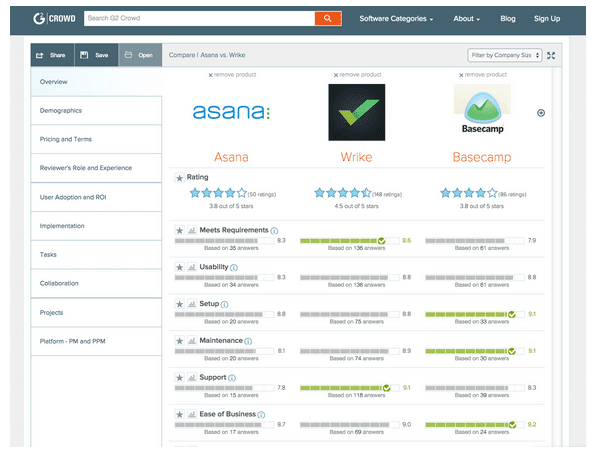
Asana vs Basecamp

First, let’s evaluate each company individually:

Asana
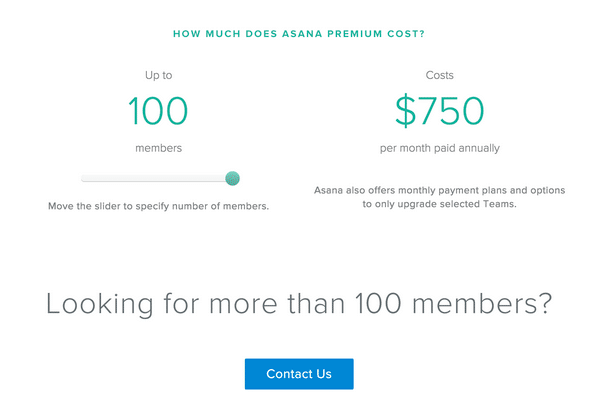
Asana Pricing

Asana prices on number of members. It provides little information on any fences that may apply, but a careful reading shows that Asana uses fences to separate its free offer from paid subscriptions. The fences are privacy (“Premium teams have the option to hide their names from the Team list”), support and the number of projects you can have on a dashboard.

Asana also has some fencing on functionality (around security and dashboards), but it’s not called out clearly on their pricing page.

Asana Pricing 2

Basecamp

Basecamp comes from the iconic company 37Signals — the very same company that gave the world Ruby on Rails (thank you). Basecamp eventually became so successful that 37Signals ditched its other business ventures and rebranded as Basecamp in February 2014.

Basecamp prices on active projects and does not impose any limits on the number of users. Storage space is used as a fence and an additional pricing vector for users with very large data need. Basecamp is also transparent about its top-end offer, the Unlimited Annual Package, which adds priority support as an additional fence. (Asana and Wrike want you to contact them for their high-end offers.)

Basecamp Pricing

Wrike

Wrike is similar to Asana in that its primary pricing metric is number of users. But, Wrike is more expensive than Asana: for 5 users Asana is $21 per month while Wrike is $49; for 15 users Asana is $63 per month versus $99 for Wrike.

Wrike fences by storage like Basecamp (how much storage is included in the Free option?), but it highlights fencing by functionality — a common practice across the B2B software landscape. In fact, it’s surprising that Asana and Basecamp don’t make more use of this practice. Wrike also fences on project hierarchy (important for large projects), customization, reporting and security.
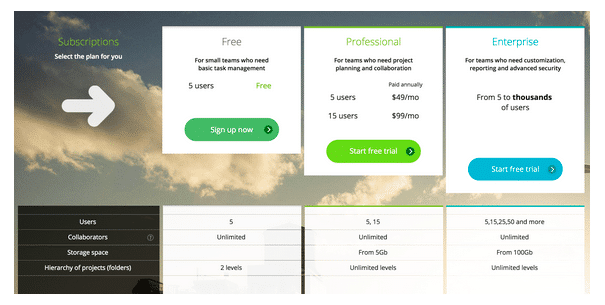
Wrike Pricing

Now, let’s pull it all together:

Pricing Table

Parsing all of this out, the pricing strategies suggest that each company is going for a different customer segment.

Basecamp wants as many companies as possible on board – it’s a momentum play.  In fact, at the time of writing (August 16, 2015) Basecamp claimed to have signed more than 5,000 new companies in the past week! Impressive. Furthermore, they put no barriers to bringing in new users and make their functionality widely available. This strategy means Basecamp needs to protect itself on storage costs, hence the fence. While the strategy seems to be working for now, I doubt it will continue to make sense given the continued collapse of storage costs and the emergence of storage-centric collaboration solutions.

In contrast, Asana and Wrike seem to be more focused on larger customers. They price based on number of users and fence on functionality — a practice that is often associated with serving larger companies, putting more demand on support.

While both companies are focused on large customers, Wrike seems to target true enterprise accounts and business units. The solution is the most expensive and fences on the functionality larger companies with larger projects typically need.

What to look for & ask when evaluating pricing:

1. How does the pricing metric track value?

Is this different for different market segments and can you use it to drive home differentiation?

2. What fences are being used?

Do the fences work to reinforce the market segmentation (good) or do they undermine it?

3. Are the fences value fences or cost fences?

Value fences relate directly to how the customer receives value. Cost fences protect the vendor from the costs of providing the service. Generally cost fences should be avoided unless there is 1) a legitimate concern about the impact on operating costs or 2) the company wants to draw a connection between the vendor’s operating costs and how it provides value.

Let us know what project management platform you’re using. And how (if) the pricing model shaped your choice.

The post Evaluating Pricing Differentiation in a Crowded Market: Asana, Basecamp & Wrike appeared first on OpenView Labs.


18 Aug 17:03

Does Your Sales Team Need More Structure?

by Dr. Christopher Croner

According to a survey conducted by the Harvard Business Review earlier this year, there are five things that set top-performing sales teams apart from average and low-performing sales teams.
Key Selling Points, Sales Process Illustration

Of those five things, the two that are most actionable are that high performing sales teams tend to “employ a more structured sales process” and “hold their team members to a higher level of accountability.”

As a manager of a sales team, a well-structured process can help you set and meet sales planning objectives more consistently, identify problems within your team, motivate your salespeople to achieve greater success and hold them accountable for their performance.


What Is a Structured Sales Process?

Most sales experts agree that there is a process that every sale goes through whether the salesperson and the client are aware of it or not. The process tends to follow the same format every time. Identifying the process and learning to understand it is valuable to anyone who wants to be good at sales or teach others to sell.

The sales process itself generally follows this cycle:

  1. Generating leads/prospecting – this encompasses everything from cold calls to web contacts — any activity that your sales team does to find potential clients.
  2. Qualifying leads – this is the process your company uses to determine whether a lead is actually a potential client, including researching the lead, running credit checks or learning their budget.
  3. Recognizing needs – the stage of the process when a salesperson asks questions and develops a relationship with the prospect, tailoring your product to fit the prospect’s needs.
  4. Providing a solution – this is the offer/pitch stage of the process, probably the one to which your company currently pays the most attention.
  5. Managing objections/negotiation – the prospective client will almost likely always have a concern or want to negotiate, so it is best to plan for it.
  6. Closing – when your salesperson has reached an agreement with a prospect, he/she has to fill out paperwork and make a record of the deal.
  7. Supporting – depending on your company’s process, this may be out of the hands of the salesperson, but tracking it is important for understanding customers’ behavior and needs post-sale.

A structured sales process will break down the steps of selling and identify best practices for each stage of the cycle.

Salespeople should be required to track their leads using whatever method works best for your company. There are many sales tracking software solutions available, but a well-organized analog method (binders, dividers, markers and files) can work for smaller sales teams if necessary.


Why Structure?

sales-charts-track-data-trends-of-sales-people

Data – The first thing most good diet plans recommend is keeping a food journal for a few weeks, because data can be very powerful and motivating.

If your sales team is not performing to your expectations, your first reaction should be to collect data.

With thorough records of leads, prospects and closed deals, it will be much easier for you to identify where your sales team’s weaknesses are and work to correct them. Data makes sales planning much more accurate and makes goal attainment more likely.

Motivation – Driven salespeople are extremely goal-oriented and competitive. A highly structured sales process makes it even more satisfying for your team to check off requirements and see leads progress through the cycle in a concrete way.

Additionally, having benchmarks for every step of the sales process gives you as a manager more opportunities to incentivize and encourage competition, most of which are just as motivating as (and not to mention cheaper than) those closing commissions.

Clear Expectations – Salespeople perform best when they are given some measure of independence and ownership over their career. As a manager, that can be a scary thought, but when you take the time to build a well-structured sales process, you will feel less of a need to micromanage your team.

With a structured process, tracking sales then becomes the only thing you need to keep your salespeople on task. It is a bit counterintuitive, but more structure means more freedom for you, and when you step back and give your team breathing room, they will feel empowered to own their success.

Easier Training – Having the sales process laid out in detailed steps makes training new hires very simple for managers and much less overwhelming for new salespeople. Even experienced salespeople can benefit from reviewing the basics that they might have forgotten.


Your Company is Unique

Understanding the sales process as it applies to sales in general is not enough to make your team excel. To make the examination of the sales process worthwhile, you need to think about the practicalities of each step of the process as it applies to your specific company, your specific location, even your specific team. There might be aspects of the process that go very quickly for your team and others that require much more effort.

As a sales manager, you should work to refine your process constantly, based on the data and feedback that your sales team collects. Developing a structured sales process means becoming an expert on your product, your client, your salespeople, and the nitty-gritty logistics of your sales. It is a big task, but laying good groundwork will make your job much easier in the long run.


Hold Salespeople Accountable

Salespeople in office at presentation

As you put the work in to create a structured sales process for your team, you should ask your team to meet you in the middle by adhering to the process, by keeping good records of their leads and owning both their successes and their failures.

With thorough records of past sales and failures it will be easy to turn disappointments into learning experiences for you and your team.

Highly-structured sales processes enable managers to step back from the day-to-day whip cracking, which will motivate salespeople to take ownership of their own performance.

Tap into the natural competitiveness of your Driven salespeople by making the proper tracking of sales into a contest with prizes or a group reward if everyone completes their tracking perfectly. Once you have accurate data from your sales team, accountability comes naturally because they can sit down with you to look at a record of their efforts.

With the right sales team, a structured sales process will work like a dream to keep your people motivated. The success of a structured process, however, is dependent on building a team that has Drive. Salespeople with Drive have the Need for Achievement, Competitiveness and Optimism required for success in sales.

Driven salespeople are motivated by structure, but if your team lacks Drive, no amount of structure will make up for it. Sales aptitude testing used at the beginning of the hiring process is the best way to build a team that has what it takes to thrive in a structured sales environment. A sales team with Drive combined with a structured sales process is a recipe for record-smashing success.


The post Does Your Sales Team Need More Structure? appeared first on SalesDrive LLC.

18 Aug 17:03

How Do You Rate—on LinkedIn?

by jillkonrath@jillkonrath.com (Jill Konrath)

A few weeks ago, LinkedIn released their Social Selling Index (SSI) to the public. When you click on it, you immediately get a quick snapshot of how you compare to your peers and your network. 

18 Aug 16:53

The gold bull of the Great White North: Why Goldcorp Inc is expanding operations as gold prices collapse

by Danielle Bochove, Bloomberg News

Ian Telfer is the proud father of a spanking new US$2-billion gold mine named Eleonore.

Perched near the rocky shore of James Bay, 800 kilometres north of Montreal, Eleonore might seem like a problem child given the collapse in world gold prices.

But in this unhappy season for gold bugs, Telfer, chairman of Goldcorp Inc., scoffs at suggestions that gold is somehow falling out of fashion. “Yeah right. Just like Tiffany’s,” he says. “For thousands of years people have wanted to own gold.”

For the moment, the market is far less enthusiastic. Since 2011, gold has generally headed in one direction: down. The price has fallen from a high of more than US$1,900 an ounce to around US$1,100 and, in the process, lost at least some of its vaunted status as the ultimate safe haven investment.

On an inaugural visit to Eleonore, Telfer is unbowed. While other miners respond to the downturn by selling assets and seeking partners to offset risk, Goldcorp is presiding over a major expansion that includes this mine north of Canada’s 52nd parallel, another in Mexico and one in Argentina — three multibillion-dollar projects in five years.

“I’ve been in the gold business for 35 years. It goes up and it goes down. But it always goes back up,” he says.

If Telfer is right, he stands to repeat the success he had 15 years ago when he doubled down while gold was languishing at US$300 an ounce. If he’s wrong, Goldcorp’s capacity to expand beyond Eleonore and its well-earned reputation for acuity will take a hit.

Eleonore, whose name derives from nearby Ell Lake and the French word for gold, already enjoys a special place in the chairman’s heart. Telfer, 69, speaks of the “absolute thrill” of opening his first mine in his home country. Its ore body is so large the company says it “hasn’t found the bottom of the deposit” yet.

Its northern location comes with intriguing challenges, such as what to do when the propane needed to warm the air underground freezes during cold snaps? (“Keep enough indoors so you can survive until it passes,” Telfer says.)

Eleonore is on target to produce 500,000 ounces of gold a year by the second half of 2018, according to chief executive Chuck Jeannes. Right now, the mine’s all-in-sustaining cost (a key industry metric) is US$1,656 an ounce. At capacity, Jeannes thinks it will drop to the “$800s or even below,” which would make it profitable even at today’s gold price and keep it on course to recoup its investment in four to five years.

I’ve been in the gold business for 35 years. It goes up and it goes down. But it always goes back up

The company has worked hard to stack the deck in its favour on the cost side by holding fast to core principles. It’s a stickler about keeping debt levels and operating costs below industry averages and leaving the high risks of gold exploration to juniors, even if it means paying top dollar down the road for proven deposits, as was the case in acquiring Eleonore. Goldcorp also avoids politically risky environments, restricting its eight operations to the Americas.

At US$846 an ounce, the all-in-sustaining cost of all its properties is significantly better than the US$978.63 average of its peer group, according to Bloomberg Intelligence. One third of the 18 gold mining companies that use the measure were selling their output in the first quarter for below the cost of mining it, BI says.

Unlike some other gold miners, busily trying to recover from their exuberance near the top of the market, Goldcorp is readying itself for any and all options. It has recently increased its credit facility by 50 per cent to US$3 billion, sold its 26 per cent stake in Tahoe Resources Inc. for more than US$800 million and slashed its dividend by 60 per cent. Bloomberg Intelligence estimates its free cash flow in 2015-16 will total more than US$900 million.

“Goldcorp is well positioned to withstand weak gold prices and take advantage of acquisition opportunities,” Stephen Walker, head of global mining research at RBC Dominion Securities, said in a research note last week. At US$1,100 gold, he expects the company to continue to trim capital spending while hunting for lower-cost, longer-life properties.

At US$1,000 gold, however, Walker said Goldcorp “would need to make asset allocation decisions, making significant cuts to capital spending.”

From Telfer’s point of view, the moves the company has made prepare it to withstand “anything going forward” while “preserving our firepower for opportunities” that he expects lower gold prices will generate.

“We don’t have to play defence like some of our competitors who are having to sell things now because their balance sheet got ahead of them. We can play offence in this kind of market.” Asked if he can buy anything he wants, Telfer grins. “We can buy a lot. We can buy a lot.”

Investors are reserving judgment. Goldcorp’s share price has performed in the middle of the pack among its peers so far this year. The stock rose 2.9 per cent at $19.23 at 10:17 a.m.

On stage at Eleonore, Telfer and Matthew Coon Come, Grand Chief of the Cree Nation and by whose grace Goldcorp is allowed to operate here, are all smiles.

We think US$1,300 gold is something that you could depend on going forward

After four years of “relationship building” (the word is uttered by every person who steps up to the microphone), Goldcorp secured agreement with the Cree Nation government to set up shop on its lands, a key achievement in these days of heightened tensions between resource developers and Canada’s First Nations. Coon Come, a former National Chief of the Assembly of First Nations, is no pushover: he came to prominence as a young man by successfully leading the fight to stop Hydro-Quebec’s Great Whale hydroelectric project in 1994.

Yet even he likes Eleonore, which will provide jobs paying his people US$70,000 ($53,470) to US$100,000 a year. “I believe that the majority of my First Nations people, they’re not anti-development, they just want to have a say on how development takes place,” Coon Come says.

Goldcorp serves up a cake with gold frosting while visitors examine a 32-kilogram gold bar worth about US$1 million. The metallic substance feels slightly warm to the touch; like copper, gold is an excellent thermal and electrical conductor — just at roughly 7,500 times the price.

The oddity of gold is the elusiveness of its real-world value, which makes reliably predicting prices as difficult as keeping propane from freezing at the 52nd parallel in the winter. Telfer and Jeannes are well versed in 1980, the year the bottom began to drop out of the market and sent gold plunging from more than US$800 to less than US$300. It took 28 years to recover to the high US$800s.

Could history repeat itself? Gold bugs point to geopolitical turmoil and a decade of massive money-printing by central banks around the world as reasons — besides Asian demand — to believe in the precious metal. And yet, despite a moderate move on China’s currency devaluation last week, the gold price is hardly surging.

Recent trends do nothing to temper their optimism. Jeannes talks about how “a cultural affinity” for gold among Chinese consumers remains intact despite slowing growth and how the recent equities rout in China could persuade investors to put their money into the precious metal instead.

“Right now,” Telfer adds, “we think US$1,300 gold is something that you could depend on going forward.”

Bloomberg News

18 Aug 16:52

Why A Personal Email Address Matters

by Personal Branding Blog

shutterstock_168279101Do you have one?

Do you have more than one?

How many personal email addresses do you have?

Personal Email Addresses Matter

In my case, I currently have three that I regularly stay connected with and respond to inbound email. How many do you have? If none, why not? Perhaps this post will help change your mind if you have none. If you have at least one I’d like to hear how you use your personal email address(es) to stay in touch, stay connected and to keep the communications channels open.

Why Do Personal Email Addresses Matter?

In this ever-changing world of job shifting it’s no longer wise to assume your company email will follow you wherever you go. It’s better to be prepared now.

Exceptions And Caveats:

  • Exception 1 – If you have your own company — It’s safe to assume this will not change quite as regularly.
  • Exception 2 – If you have your own personal domain. Which is a wise move.
  • Caveat – Things still change.

What’s The Point?

A lot of people say and think that email is dead and dying. And it might be. But, today when you want to apply for a job, subscribe to a newsletter, apply for a loan and lots of other day to day (seemingly mundane) tasks…you WILL be asked for your email. Having an email address that you know can always be accessed by you … any time, any place and on any device is a smart thing for you personally and professionally.

Let’s consider a few scenarios:

  • Coordinating A Party – Not only may this be a violation of company email policies it’s just bad form to coordinate your parties on your work email address.
  • Ordering On Amazon – In a similar vein anything you order on Amazon or other online shopping adventures don’t need to be archived forever on your work email.
  • Auto Loan – Your personal information – including credit scores, SSN and more are shared here. Again, this is not something you want to be stored as a record within the company email servers.
  • Home Loan / Rental Application – Same as above.
  • Newsletter Subscription – When you leave your current company (not if … when) you don’t want to have to remember and re-subscribe to the newsletters, websites, and other information you have grown accustomed to reading.

The point is…Respect the Value of a Personal Email Account.

Why Do This?

Staying in touch matters. Staying connected matters.

Do you want to forced to remember something like this:

Oh yeah, I subscribed to that newsletter or applied for my loan with my “old work” account. Now what do I do to regain access?

Then realize that a) you aren’t getting notified of important information or b) missing a payment because you just plain forgot and were relying upon email for your task management (yes, this does happen).

Keeping A Personal Email Is Smart

It’s also easy. It will also help you to Stand Out In Your Career! It’s never been easier to setup a personal email account. Taking 5 minutes to set one up (perhaps more than one if you have multiple interests) is a wise move and one that will pay dividends down the road. I say you’ll stand out in your career because you will not need to spend time re-creating subscriptions, loans and other important (and perhaps sensitive) documentation, etc. and you will be able to get on with your life and career.

Side Benefit Of Having A Personal Email Address:
Most corporate email servers keep EVERYTHING and file them as records. This is just one more reason to have a personal email address. Sure, these servers keep everything too, but when you aren’t working for said company anymore you’ll have a teensy little bit more privacy.

There are more than a few free email services out there. The most common are Microsoft’s Outlook.com and Google’s Gmail – which are quite robust and have a lot of additional features for calendar and task management. There are also the old stalwarts in AOL and Yahoo (a caveat with these…they may brand the user of these email domains as older. Beware of ageism).

I’m sure there are many other ways to do this. I’m pretty sure there is at least one great business idea wrapped up in a better way. Perhaps you will be the one that will solve this for all of us. If you already have created a solution … please share.

Got A Different Opinion? Please drop a comment here. I’d really like to hear how you handle your correspondence, communications and connections.

18 Aug 16:51

Why Your Competitor’s Website Outperforms Yours In Search And What You Can Do About It

by James Debono

Why Your Competitor’s Website Outperforms Yours In Search – And What You Can Do About It!

Quite often we consult with business owners who are frustrated, no, downright angry, that after investing heavily on a new website design their main competition and even businesses that they feel they are far better than, outrank them in Google and subsequently gain the majority of new business.

Let’s clear something up from the outset. In most cases, a new website means new images, new branding, more modern design. Nothing more.

And although those things might have an impact on user friendliness, which is a positive, it is not going to make your website shoot to the top of Google or other search engines for commercially viable keyword phrases that are important to your business.

“But My Competitor’s Website Looks Dreadful”

Beauty, as they say, is in the eye of the beholder. And just because on the surface it might not look great, or you personally wouldn’t choose to represent your business and brand that way, it does not mean that the website is low quality as it could be built with a sound architectural infrastructure, have a solid social media presence and a whole host of high quality back links that point back to the site, giving it authority and relevance in the eyes of the search engines.

What Do Search Engines Look For In A Good Website?

DU0O1PCIMH

When talking about search engines, specifically in the UK, I mean Google. As according to Statista, Google has an 88.58% dominance for search in the UK.

Google uses several factors to decide on how relevant a page is for any given search term. In fact it is commonly believed that there are over 200 such factors which impact how well a website ranks (no one outside of Google can truly know how many there are and comment on their Intellectual Property) These include the number of relevant inbound links, the history of the domain your website sits on and whether a sitemap has been submitted to Google or not.

However, there are other factors that can contribute to the success of your website in search such as:

How Many Pages People Visit On Your Website

If your website is good the chances are that visitors to that website will find the content good enough that they want to read or learn more on the subject matter and you.

How Often You Update Your Content

In everyday life, there are advancements in technology, business, health, welfare, popular culture as well as content on the internet. A web page that was relevant two years ago may not be relevant today. A website that has not been updated for a long time may provide less relevant results than a website or page produced yesterday.

How Long Your Content Is

Serpiq published research that showed that the average content length for a web page that ranks in the top 10 search results in Google has at least 2,000 words. And it is no surprise that the higher you go up the page, from 10 to 1, the more words they have.

Average_Content_Length_in_Words_for_Top_10_Pages_in_Google

In the graph above you can see that on average the top result in Google has over 2400 words. The research was conducted across a range of 20,000 keywords and the results suggest that Google favours long form content.

Take a look at your website, take a look at the key pages or sales pages and ask yourself does the content provide enough depth and build enough value to keep the user engaged and build trust?

How Can You Improve Your Website To Rank Higher In Search Engines?

  1. Use Keyword Phrases That Are Relevant To Your Business.

If you are an accountant. The keyword phrases “Accountant in “Your Town Name” is relevant and important for you to rank for.

However this is not the only term that potential clients will search for related to accountancy and therefore your website should contain information that anyone looking for an accountant would find helpful, such as:

  • Tax return dates
  • Budget updates
  • Information on how to perfect a financial statement
  • How to monitor depreciation of assets.

The more RELEVANT subject matter that a user can find in one site will increase the authority of your site.

Think about the terms your ideal client will enter into the search engines when they are looking for the results that your service can provide. Make a list of them and then make sure that there is content on your website that provides the answers they are looking for.

  1. Optimise That Content For Google

Optimise_your_Website_For_Google

In order for Google to fully understand what your website is about it needs to be labelled correctly.

There are specific areas on a web page that Google looks at first in order to quantify what your page is about and subsequently where it should index to best serve searchers.

These areas include:

  • Page Title
  • Heading
  • Sub headings
  • How Image are labelled – Alt tags
  • URL of the page

All of these elements of the page are considered by the search engines when indexing your content in the correct place so that your ideal visitor can find it. But remember that if your page is over optimised, in other words you are writing for the search engines and not for human consumption by using too many keywords, a term known as keyword stuffing, then you will be penalised.

  1. Internal Linking

Internal linking is about how and where you link a page or post to other content that is relevant within your website. The point being that the search engines want to provide the user with the best possible experience they can.

Continuing with the “Accountant” from earlier, it would be of benefit if you could then link to pages on your website containing information and references to business audits, financing options and tax optimisation strategies

By doing this, you are providing greater detail for the user, which will help them make a judgement on your suitability to help them. The search engines will also appreciate this. This will result on the user spending a greater time on your website by visiting more pages, which as I mentioned earlier is a factor that Google uses to rank your site.

  1. Write GREAT Content That Attracts Inbound Links.

If you want to rank higher in Google you have to Write Great Content

An inbound link is where another web site owner provides a contextual hyperlink back to your content from their site.

Google and the other search engines rely highly on other people linking to your website in order for them to establish how popular your website is. The more popular the website, the higher your return in the search results.

The goal here is to create highly valuable, unique content that people want to talk about and share.

The more people that link back to your site signifies to the search engines the popularity and value of the piece of content.

The more people with authority on that subject matter that link back and share the better.

For example an educational body that provides accountancy qualifications providing a link to a local accountant is more valuable than a backlink from Julie’s cake bake.

The quality and relevance of inbound links is often more important than quantity.

  1. Have A Social Media Plan

Social signals such as being liked tweeted or +1’d indicate to search engines that your website and content is popular.

That is why you need to have a social media plan that includes identifying which social channels your customers frequent, tracking social conversations, trending topics, managing your online reputation and developing and sharing optimised content.

By ensuring you can easily create and post relevant content to social channels on a regular basis, you will not only improve your search rankings, but reach more potential customers when your content is linked to, liked, or shared.

Search engine optimisation techniques are constantly changing. What doesn’t change, and in fact becomes more prominent, is the fact that if you invest the time creating quality content that has value with the readers on a regular basis you will be able to improve SEO and find your site and pages getting top search engine rankings, driving more clicks and ultimately converting to a higher number of sales.

  1. Cater For Mobile.37F02BDB97

For the past few years Google has made it abundantly clear that they have been working towards making their search engine more mobile friendly.

In February 2015 Google made this statement on their webmasters blog;

“When it comes to search on mobile devices, users should get the most relevant and timely results, no matter if the information lives on mobile-friendly web pages or apps. As more people use mobile devices to access the internet, our algorithms have to adapt to these usage patterns. In the past, we’ve made updates to ensure a site is configured properly and viewable on modern devices. We’ve made it easier for users to find mobile-friendly web pages and we’ve introduced App Indexing to surface useful content from apps. Today, we’re announcing two important changes to help users discover more mobile-friendly content:

1. More mobile-friendly websites in search results
Starting April 21, we will be expanding our use of mobile-friendliness as a ranking signal. This change will affect mobile searches in all languages worldwide and will have a significant impact in our search results. Consequently, users will find it easier to get relevant, high quality search results that are optimized for their devices.”

What does that mean?

Well quite simply that Google will provide mobile users with mobile responsive web pages first. And this makes complete sense.

If you are on a mobile searching Google and they provide you with a website that you cannot read or whose buttons you cannot click because they are too small, then chances are you will go to another site. Over time if you continue to get presented these sites that leave you frustrated and unable to use you may choose to move to another search engine that provides better results.

Google wants to provide the user with the best possible search results, coupled that with the fact that in the UK the Smartphone has become the most important way for people to get online. Therefore, how your site ranks will also depend on whether it caters to a mobile audience.

Search engine optimisation is a constantly evolving landscape. What works today may not necessarily have the same effect tomorrow and that it is why SEO is an important part of any online marketing plan.

To make sure that your site out performs your competitors in search and not the other way around then you need to be producing quality content on a regular basis that is relevant and builds you and your brand to be the authority in your niche.

S3JE5YAMND

A website’s performance rises or falls depending on the implementation of the factors discussed in this article, but there are also many more.

This Leaves You With Three Options To Improve The Status Quo:

  • Option1: Do It Yourself
  • Option 2: Task an employee to take charge of it.
  • Option 3: Employ a professional to do it.

Do you want to spend the time writing a two thousand word post, optimise that post for search engines, spend hours marketing that post on social media sites, emailing it to your list of subscribers or clients, looking for relevant sites that may be interested in sharing or linking to your content? Not many business owners have the time or the inclination to do that.

And that is why those select few businesses that choose to either invest the time or invest in the services of a professional search engine optimisation consultant will stand a far greater chance of gracing the top spots of the search engines for commercially viable keyword terms.

So next time you look at a competitor’s website that ranks above yours in Google and you consider it ugly, there might be a lot more time and investment gone into gaining those search engine results than meets the eye.

If you want to know more about building a website that works for you then download our FREE E-BOOK!

Power your business with a website that sells

18 Aug 16:50

The End of the Internet Dream: the speech that won Black Hat (and Defcon)

by Cory Doctorow


"The End of the Internet Dream," cyberlawyer Jennifer Granick's keynote at Black Hat, was all anyone could talk about at this year's Defcon -- Black Hat being the grown-up, buttoned-down, military-industrial cousin to Defcon's wild and exuberant anarchy.

The text of Granick's speech is now online, and I can see what they were all raving about. Granick tells the true story of "Internet Utopians" -- not people who believed the Internet would deliver a better, freer world; rather, people who believed that it could, if the rest of us fought for it.

She also tells the tale of how that dream was dashed by giving in to cybersecurity scaremongering, copyright bullying, easy answers to difficult speech, unexamined racism and sexism, and the global war on terror. How governments, companies and our complacency all but killed the dream of the Internet as a force for improving the world.

But she also provides a prescription for changing that -- hope that we can avert that future, and that therefore, we must.

If you wondered why I went back to EFF after a decade of sitting on the sidelines, this is why.

Below, some of the best moments from the speech:

The security community has historically been very good at finding, cultivating, and rewarding talent from unconventional candidates. Many of the most successful security experts never went to college, or even finished high school. A statistically disproportionate number of you are on the autism spectrum. Being gay or transgender is not a big deal and hasn’t been for years. A 15-year-old Aaron Swartz hung out with Doug Engelbart, creator of the computer mouse. Inclusion is at the very heart of the Hacker ethic.

And people of color and women are naturally inclined to be hackers. We learn early on that the given rules don’t work for us, and that we have to manipulate them to succeed, even where others might wish us to fail.


Here’s a quiz. What do emails, buddy lists, drive back ups, social networking posts, web browsing history, your medical data, your bank records, your face print, your voice print, your driving patterns and your DNA have in common?

Answer: The U.S. Department of Justice (DOJ) doesn’t think any of these things are private. Because the data is technically accessible to service providers or visible in public, it should be freely accessible to investigators and spies.


Globalization gives the U.S. a way to spy on Americans…by spying on foreigners we talk to. Our government uses the fact that the network is global against us. The NSA conducts massive spying overseas, and Americans’ data gets caught in the net. And, by insisting that foreigners have no Fourth Amendment privacy rights, it’s easy to reach the conclusion that you don’t have such rights either, as least when you’re talking to or even about foreigners.


The battleground of the future is that people in power want more security for themselves at the expense of others. The U.S. Government talks about security as “cyber”. When I hear “cyber” I hear shorthand for military domination of the Internet, as General Michael Hayden, former NSA and CIA head, has said — ensuring U.S. access and denying access to our enemies. Security for me, but not for thee. Does that sound like an open, free, robust, global Internet to you?


What that means is that governments, or corporations, or the two working together increasingly decide what we can see. It’s not true that anyone can say anything and be heard anywhere. It’s more true that your breast feeding photos aren’t welcome and, increasingly, that your unorthodox opinions about radicalism will get you placed on a list.

Make no mistake, this censorship is inherently discriminatory. Muslim “extremist” speech is cause for alarm and deletion. But no one is talking about stopping Google from returning search results for the Confederate flag.


We start to think globally. We need to deter another terrorist attack in New York, but we can’t ignore impact our decisions have on journalists and human rights workers around the world. We strongly value both.

We build in decentralization where possible: Power to the People. And strong end to end encryption can start to right the imbalance between tech, law and human rights.

The End of the Internet Dream [Jennifer Granick/Backchannel]

18 Aug 16:49

How To Succeed As The Number 2 Brand

by Mark Di Somma

How To Succeed As The Number 2 Brand

Every brand strives to win, but what happens when you compete in a market where you are, and can never be more than, number two? If you’re Pepsi, for example, or Bing, how do you find the energy to continue to build out a business that will stay where it is, behind a massive incumbent? How do you do that without becoming uninspired, distracted or stuck?

The temptation that so many succumb to is simply to pursue the brand they see as the market leader, and their greatest rival, at all costs. To go all in. The burger wars, the cola wars, the airline wars, the smartphone wars…many a campaign has been generated through the wish of one brand to dominate and overpower another. For the most part, such struggles, while all consuming for those involved, do little or nothing to sway the sentiment of consumers. And while market positions may shuffle, once the dust settles, things are usually not that different (at least as far as buyers are concerned).

So what should you do? The best strategy if you’re the number 2 brand, I believe, is a combination of inclusion and distinction. That’s because being one of the top three ranked brands in a sector places your brand among the ‘establishment’. You are one of the brands that defines the sector and therefore you need to use enough of the predominant industry structures and technologies to leverage that mass while at the same time finding ways to separate what you believe in, offer and mean from the offering and ethos of the market dominator.

This great quote from James Henderson points to the four key places to consider how you do this: “To exert influence, a brand needs to impact or change the way people shop, think, act and behave.” Number 2 brands have the power and the means to be hugely influential. Their critical decisions rest on how and where they choose to strengthen that influence.

If I was going to split Henderson’s four-pack into inclusion and distinction, I would suggest that number 2 brands need to be inclusive in how they want people to shop and act (because those are functional drivers) and to be distinctly influential in how they invite people to think and behave (because those are of course the emotive drivers).

While it is tempting to introduce stand-alone channels and ways of buying in a bid to entice consumers to decide, this is a difficult strategy to pull off when you’re a major player because it requires buyers to make choices and commitments in where and how they buy that they may not be willing to make. If they choose not to, or they fail to do so in the numbers required, the proposed operating system fails. By sticking with what people know and do, you cut the number of alternative decisions that buyers must make, and you add the vital dynamic of competition into existing channels. Pepsi may not be able to oust Coke from the dominant position in supermarkets but equally they cannot abandon the channel either. Competitors must be where consumers hope to see competition.

Where number 2 brands can stand apart is in what they are seen to stand for. This is their opportunity to articulate a credible alternative targeted specifically at those consumers who, for any number of reasons, would rather not go with number 1. Number 2 brands should build a market platform on ideas that are popular enough to attract critical mass and, at the same time, make their presence valuable and important because they are more than ‘more of the same’. That doesn’t happen enough in my view.

There’s also a significant difference in mind-set and ultimately approach between ‘being’ number 2 and ‘feeling like’ number 2. A brand that is number 2 understands the position it has and seeks to capitalize on it. A brand that feels like number 2 spends much of its existence lamenting that it is not number 1. Too many number 2’s seek to copy what their nemesis is doing in a bid to out-do them at their game, hoping somehow to take over the leading role. Except of course this is not a leadership strategy. It’s a following strategy and it’s a bad one because it means the brand is not only trying to play by someone else’s rules, it’s also reinforcing that the market leader’s philosophy and way of doing business is correct.

By espousing different thought patterns, championing different behaviors and building offers and products that enable that to happen, the number 2 brand can make its presence felt in ways that keep the market leader in check and prevent the number 3 brand (which, under rule of three dynamics, is often the most innovative) from usurping its position.

If you’re number 2, this simple reminder question will serve you well: “Why are we proud to be here, and what does being number 2 make possible for us to strive for that the market leader wouldn’t dare to pursue?” Chase that.

The Blake Project Can Help: The Brand Positioning Workshop

Branding Strategy Insider is a service of The Blake Project: A strategic brand consultancy specializing in Brand Research, Brand Strategy, Brand Licensing and Brand Education

FREE Publications And Resources For Marketers

18 Aug 16:49

Marketing Math: The Most Important Calculations to Measure the Impact of Content

by Mike Clark

marketing math

For any successful campaign, you want to have a marketing metrics dashboard in place so all of your assets are tracked from start to finish. But with so many metrics to stay on top of, you want to make sure you’re making the most important calculations first.

In The Blueprint to B2B Content Metrics, we explain the major components of what should be in your marketing metrics dashboard.

Here are some of the most important calculations to measure the impact of your content:

Average Length of Marketing Content Production

This metric falls under the three pillars of content marketing measurement and it’s a great place to start when calculating the impact of your content. Begin by determining the length of a production cycle from start to finish and, after you have a timeline, you can start calculating other metrics.

Total Reach

Measuring your content’s reach is essential but it’s easy to get myopic. By simply measuring how your clients are engaging with your content means you’re missing a whole other section of users. You’ll want to calculate both external and internal reach.

Internal: the closed feedback loop. To calculate your content’s internal reach, use these three basic questions to generate your numbers:

1. How much marketing content is being consumed and digested by internal teams?
2. Are these teams using content to facilitate and drive engagement with buyers?

3. What kind of engagement are we getting from buyers as a result of internal shares of our content?

By using these three questions, you can easily calculate crucial internal reach metrics: number of internal views and downloads, number of internal shares, and referral traffic.

External: external reach is often more difficult because you’ll be pulling metrics from multiple sources and social channels. Here are some basic calculations you want to use to measure your external reach:

  • Number of engagements per month categorized by engagement type (downloads, page-views, open rates).
  • Number of engagements by content type, persona, and by sales stage.
  • 10 most engaged assets per quarter
  • 10 most shared assets per quarter

Calculate Your Content Score

Generating your content score will help you determine how well content is converting. To find your content score, start by evaluating each buyer’s movement at a stage in the sales pipeline and the content they consume during that stage.

After you’ve determined a buyer’s movements, divide that conversion by categories, assets, or campaigns touched to determine the weight and score of the content.

One other method of content scoring is the first touch/last touch model. With this conversion model, greater weight is given to the first and last stage in the pipeline.

Take a look at this conversion model for a better idea:

Now that you’ve got the basic numbers, it’s time to build out a marketing metrics dashboard.

18 Aug 16:48

Why Data Beats Talent in Sales Development

by Phillip Keene

Editors Note: Phill Keene writes about data’s role in sales development as a prequel to our Tuesday, August 18th webinar where he’ll be discussing the topic with Liz Cain, Jaime Muirhead, and Max Altschuler.

Many seasoned sales development managers know that, given the choice between an exceptionally talented sales development rep (SDR) and a highly accurate database, data trumps talent every time.

Now, no one’s suggesting a manager shouldn’t search for top talent to add to his team. But no matter how talented an SDR is, there are advantages to providing SDRs with the most detailed and accurate information available. And when it comes to performance, an average SDR with better data will outperform a talented SDR with little or poor data every day of the week.

In sales development, everything matters: time management, information management, gatekeeper and decision-maker messaging. Each of those elements relies on accurate data.

So why is data so important?

Data Provides Focus

Accurate data saves your team both time and hassle, keeping your team from having to research contact information like email addresses and phone numbers. The market is full of tools that make it possible to start with good individual contact data. In some cases, SDRs may need to find a secondary source for more firmographic data like SIC codes, employee count, industry or annual revenue.

Since an SDR can save time on researching basic contact information, he can use that time to research the account instead. This gives SDR the opportunity to develop a more educated approach when he contacts the company. The more relevant information you can pull about things the company actually cares about, the more specific you can get with your messaging.

This initial data arms your team with the necessary ammunition to call the right person, at the right time, and to convert the lead to a meeting, demo, or an opportunity. The SDR will be able to identify the problems that the potential buyer has, and have a plan of action of how they will articulate the solution to their problem. Today’s buyers don’t buy features, they buy solutions – and they are better educated about solutions than they have ever been.

Data Provides Guidance

When you can get on the phone with a direct dial, you will more likely reach the decision-maker. According to Vorsight, you are more than 46 percent more likely to be successful when you reach a director, and a whopping 148 percent more successful when you reach a VP. If you can’t talk to a prospect on the phone to explain your solution, the prospect is likely to make a decision based solely on how they interpret what you wrote in an email or what’s available on your website. This could be fine, but often leads to lofty expectations that are hard to meet.

Too few managers are teaching their SDR team to look deeper than what they can find on LinkedIn or Twitter. It takes additional research to find decision makers in the C-Suite, because nearly 40 percent of them are not on LinkedIn today. No matter where you find them, it is crucial to find an internal champion who can influence the decision-maker. The more data you find out about the account, it allows you to have a greater understanding about the true issues your solution solves.

Data Provides Speed

Data is more than just contact information. Today, CRM gives you the ability to input more firmographic data, which helps create a more consistent and repeatable process. This also allows you to target more specific types of accounts that are more likely to buy, and buy quickly. And because those accounts should see a higher level of success for what your solution has to offer, your churn will likely go down as well. Sales development is hard enough without a leak at the other end of the funnel, so you need to target the right accounts from the top of the funnel down.

The more that you input into your CRM, the more you can fine tune your sales development efforts. This will accelerate your team’s ability to acquire new companies and to grow current clients.

In sales development, data is king. But bad data can take a serious toll on a sales organization, and it is much more cost-effective to invest in good data up-front than to clean up bad data later. No matter how hard you try to keep your records clean, however, they will always have a certain amount of inaccurate data. Create a culture around ensuring what goes into your CRM is completely accurate, and your organization will thank you for it.

The post Why Data Beats Talent in Sales Development appeared first on Sales Hacker.

18 Aug 16:48

Audience Marketing: Death to the Product "Selfie"

by Kathleen Schaub
Companies may not intend to be narcissistic. But they unintentionally produce a lot of "product selfies." Marketers start out right. They consider customer needs when answering the question, "Why buy my product?"  Then customer focus stops there. Most companies give only superficial attention to the context in which their audience will consume their message.  However, an IDC study finds that the situation is about to change as leading tech companies ramp audience marketing to a whole new level.

Customers perceive content to be self-serving when it talks only about the features and benefits of the product with insufficient effort to match these to the buyer's context. What's missing are the answers to the question, "How can we help the buyer consume this message? What does the buyer need to hear, understand, trust, and accept our value proposition?" When content is offered without a true audience filter, product messages have the same tiresome, annoying, self-centered demeanor as your teenaged niece's 15th selfie. No matter how cute she looks in her prom dress.
 

Isn't Audience Marketing Pretty Basic?

While IDC found that almost all tech companies surveyed use some degree of audience marketing (indeed, segmenting customers should be Marketing 101) only about 26% of them can be considered advanced — and even the advanced companies have significant opportunity for maturity.

What is changing in the most advanced companies is the depth, degree, and focus on the audience. Said one expert interviewed by IDC, "Buying a list of hospital CIOs and slapping a photo of a nurse on your website isn't vertical marketing."  Audience marketing requires today's marketing organization to take on a much larger and extra layer of work on behalf of the customer. Leading companies are stepping up to this task by dedicating audience-focused resources as an "ambassadors" for their customers.

Reversing the Effects of Sales Erosion

For B2B companies, it used to be salespeople who primarily filled the customer context gap. It was salespeople who were trained to listen for customer need. Salespeople translated the company offerings into something meaningful to the customer. Salespeople still have this role — but they can only perform it when they have the opportunity. And that opportunity continues to erode. IDC's annual IT Buyer Experience Study consistently reports that for the average IT purchase, buyers are nearly 50% of the way through their decision journey before talking with sales. The increased percentage of buyer engagement through digital communication channels has also eroded the critical customer context cushion.

Audience marketing is the function that replaces this cushion. By devoting staff and program dollars as audience ambassadors, marketers will identify this gap and execute appropriate programs to fill it.

What Do Audience Marketing Leaders Do Different?

The most distinguishing factors between companies advanced in audience marketing compared to average or beginner companies are the following:

Appointing an Audience Marketing Leader: Advanced companies are about twice as likely as average or beginner companies to have a named leader in charge of audience marketing. When a company puts a leader in charge of an initiative and makes a practice a corporate-wide mandate, the culture starts to change in a big way. Audience marketing gets visibility. Metrics get put in place. People begin to get recognized and awarded for skills learned and for achievements. Investments and resources are allocated.

Branching out to explore many audience marketing strategies: IDC examined the popularity of various audience marketing strategies and found that advanced companies use a broader variety than average or beginners. Overall, segmentation by Functional Role (C-level, IT, HR director, etc.) is the most popular strategy and is used moderately or extensively by 100% of advanced companies and over 80% in the other groups. Vertical Industry is a close second. Buyer behavior segmentation is the hot, up-and-coming strategy — but it is more difficult and more sophisticated than the other segmentation strategies studied and thus is used the most infrequently by companies at all levels. 

However, advanced companies are moving ahead strongly, and IDC expects to see use of behavioral segmentation increase significantly in the next few years.


This blog first appeared on LinkedIn and is a summary excerpt from the IDC research report Audience Marketing: Replenishing Customer Context authored by Kathleen Schaub #257372. Subscription required.
Copyright 2011 IDC. Complete articles may be reposted. Reproduction in part is forbidden unless specifically authorized. All rights reserved. Please contact IDC for information on republishing or web rights.
18 Aug 16:48

27 Tweetable Quotes From Sales Rockstars Going to #INBOUND15

by leslieye@hubspot.com (Leslie Ye)

There's no sugarcoating it -- sales can be a grind. So it's helpful to hear from industry leaders and influencers that know what you're going through, and can provide helpful advice and motivation.

From Jill Rowley's tips on social selling to Daniel Pink's insights on how to influence people, there's a ton of good advice to be had from the sales professionals speaking at #INBOUND15. 

Want to hear these speakers at INBOUND15? Now's your chance -- book your ticket today.

Daniel Pink (@DanielPink)

Daniel Pink is a keynote speaker at INBOUND.

1) “Anytime you’re tempted to upsell someone else, stop what you’re doing and upserve instead.” twitter-logo

2) “In the new world of sales, being able to ask the right questions is more valuable than producing the right answers.” twitter-logo

3) “Clarity on how to think without clarity on how to act can leave people unmoved.” twitter-logo

4) “If you need me to motivate you, I probably don’t want to hire you.” twitter-logo

5) “Think about the essence of what you’re exploring -- the one percent that gives life to the other 99.” twitter-logo

Jill Konrath (@jillkonrath)

Jill Konrath will be leading "Optimize Me: Insanely More Productive Sales Strategies".

6) “Think about the most important points of your story -- from your customer’s perspective, not yours.” twitter-logo

7) “When you keep it simple, you make it easier for customers to buy from you.” twitter-logo

8) “Be your buyer’s resource center.” twitter-logo

9) “As sellers, if we’re going to be successful landing the big ones, we need to expand our thinking about what’s possible.” twitter-logo

10) “Today’s prospects want to know the truth, so don’t shade it.” twitter-logo

Trish Bertuzzi (@bridgegroupinc)

Trish Bertuzzi will be leading "7 Sales Development Hacks to Jack Pipeline".

11) “You have to believe in what you sell and you have to care about your industry.” twitter-logo

12) “It is the cold that is dead -- not the calling.” twitter-logo

13) “Buyers won’t engage with sales reps who pitch product, but they will give access to trusted advisors.” twitter-logo

14) “What if you let your customers do the talking?” twitter-logo

Jill Rowley (@jill_rowley)

Jill Rowley will be leading "Social Selling: How to Connect With the Modern Buyer".

15) “Your network is your net worth.” twitter-logo

16) “LinkedIn is no longer an online resume. It’s your digital reputation.” twitter-logo

17) “No one really likes and trusts the quota crusher.” twitter-logo

18) “Common sense isn’t optional. Don’t do stupid.” twitter-logo

Tony Alessandra (@TonyAlessandra)

Tony Alessandra will be leading "How to Read a Person Like a Book".

19) “Unless you ask the right questions, you won’t uncover the right needs.” twitter-logo

20) “Your customers aren’t just part of your job. Your customers are the reason you have a job!” twitter-logo

21) “Enthusiasm, not apathy, makes the world go ’round.” twitter-logo

22) “Trust and reputation are not discretionary. They are as necessary in business as the people in whom they reside.” twitter-logo

23) “In selling as in medicine, prescription before diagnosis is malpractice.” twitter-logo

Craig Rosenberg (@funnelholic)

Craig Rosenberg will be leading "6 Sales Hacks That Actually Work".

24) “Takers are going the way of the dinosaur.” twitter-logo

25) “You can’t propose a mutually beneficial business relationship if you can’t understand their business.” twitter-logo

26) “Your job is to not only help but to strive to give more than you get back.” twitter-logo

27) “Create great content until the cows come home.” twitter-logo

learn more about INBOUND 2015  

18 Aug 16:47

5 Sales Prospecting Tips That Get Results

by Datanyze and HubSpot

Gone are the days of mindless prospecting, spray-and-pray marketing, and antiquated list buying. Buyers have evolved and so should sellers.

It’s certainly true that you need personalization and research to be successful. A quick glance around LinkedIn will show just how many different companies and opportunities people are involved with. Great research requires attention to detail, creativity, and time. 

However, salespeople also need to reach as many people as possible in the shortest amount of time. These two mentalities may seem incompatible, and in a very real sense, they are. But here’s the thing: each of these mindsets is essential to effective sales prospecting.

How do dedicated sales prospectors, sometimes called sales development representatives (SDRs), balance these two conflicting aims? Here are five tips from real SDRs on how they find quality opportunities in the minimum amount of time.

1) Define Your Ideal Buyer

There’s nothing more critical to a sales development team’s success than understanding who the ideal buyer is. Building this foundation ensures your team is as efficient as possible. It’s the difference between working hard and working smart (and hard).

When building out and learning about your buyer personas, ask ourselves the following questions:
  • What is the job title of my ideal prospect? 
  • Who do they report to?
  • Where is this person 'hanging out' online? 
  • How much experience does this person have? 
  • What current challenges does this person face? 
  • What are their larger vision goals?
  • What technologies do they use to get the job done?

- Michael Thomas, Highfive

2) Analyze LinkedIn 

Titles matter: Look on LinkedIn for prospects with titles that indicate a certain level of seniority or authorized budget, then do what you can to find their manager or anyone senior to them. This can all be done rather easily through LinkedIn people search. Try targeting as high as you can with the expectation that responses from C-level executives will be much fewer and far between, but way more valuable.

In addition, always give more weight to prospects that take care of their LinkedIn profile. Have they updated it recently? Are they in groups? Does their picture look professional? You can often identify an early adopter by how savvy they are on LinkedIn.

- Eric Gonzales, Glassdoor

3) Use Advanced Search

Use parentheses for more complex searches when you want to combine an exact phrase with a broader search term. Say you’re looking for a BDR or SDR -- enter '(business OR sales) AND “representative.”' Use AND, OR, NOT to return exactly what you want. These terms must be capitalized.

- Josh O'Brien, Datanyze

4) Don't Jump Into the Pitch

I like to treat the first phone call as a mapping call, and not jump right into the pitch. This helps eliminate calling multiple people in the organization, while giving me helpful information, referrals, and eventually the right person on the phone.
If you get a gatekeeper on the phone, simply ask for the appropriate person. When conducting a mapping call, feel free to admit that you haven’t talked to this person before and want to confirm they are the correct contact. This will usually get you the right person, who can provide insightful information into the company’s current processes. 
Mapping works even better when you get a C-level contact to refer you to the correct C-level executive. Why? Because now you know the interest is there and you have a reliable referral to work with.

- Caitlyn Richmond, TinderBox

5) Be Honest

Instead of following the traditional 'Hi this is James calling from Skytap, how are you today?' and hoping that the prospect stays on the line long enough to allow for an elevator pitch, I’ll be a bit more direct and honest with my messaging:
Hi [Prospect], you and I have not spoken before, but I was doing some research and came across a recent press release on your website stating that your team will be doubling the IT budget in 2016. I was curious as to what sort of changes you’re going to make within application development. Is right now a bad time to chat?
C-level executives hardly have enough time to answer the phone as it is, so when they do finally pick up, it’s important to be respectful of their time by being direct and less 'buddy buddy.' This strategy puts more purpose behind the call, and allows my messaging to resonate at a higher level.

- James Daltas, Skytap

 Editor's note: This post is an excerpt from the ebook The Sales Development Playbook Written by SDRs. Check out the full guide here.

download the free sales development rep playbook

18 Aug 16:47

Get to Know Your Buyers Before Your Competitors Do

by William Jones

As a B2B seller, is your favourite word ‘I’, ‘We’ or ‘You’?

I sure hope the answer is ‘You’ because executives today are frankly tired of hearing salespeople saying ‘I’ and ‘we’ and ‘our’ all day long.

Want to make a buyer’s eyes light up? Be the rare seller whose entire focus is quite clearly on understanding the realities and unique needs of the very executive they’re talking to. Be the rare seller who’s all about ‘You, You, You.’

If you’re not furiously uncovering insights into your buyer’s business, then your competitor is. And in B2B sales, today more than ever, the most curious seller wins.

AB_CMW_Post

Digging for gold – the buyer’s true problems

Just 61% of salespeople think they’re good at uncovering their customer’s business problems, a recent survey of ours uncovered. And only 54% know how to access key players to discover this critical information. Given that these skills are both crucial to winning sales, the stats paint a worrying picture.

At The TAS Group, our conversations with customers always begin with finding out what challenges and obstacles they face (call us to test it) so we can determine as quickly as possible if the value we offer matches their needs. It’s basic qualification 101, and something we cover in more detail in our new eBook, ‘The Art of Sales Qualification’, which is free to download here.

We highly recommend you follow the same procedure. Because in today’s competitive world of B2B sales, it’s really not an option. You need to have a deep understanding of your customer’s business problems, and you need to know their people. Without this info you’re simply unlikely to create value or make a sale.

How to make sure your salespeople understand the buyer

The key to outdoing your competitor is to know who you’re talking to and what you need to talk about, before presenting the right solution.

One way to do this is by using a Customer Insight Map to plot your buyer’s pressures, strategies and obstacles. With this context in mind, your rep can identify the real problems and prioritize the business areas and potential solutions where value can be added. You can connect your solution with the customer’s business problem, articulate Unique Business Value. And close more deals.

Be the seller who understands the problem. The one who brings the solution. Because if you don’t, you can be sure one of your competitors will.

Do you have any questions about getting to know your buyer better?

Ask away!

18 Aug 16:47

Let Data Guide You Through The B2B Buyer’s Journey

by Lauren Brubaker

Buyer

Your potential buyers begin their quest to find the most suitable product or service to address their business needs long before they ever make contact with your brand. As a result, each one of your prospects will be in a different stage of their journey by the time they interact with your marketing collateral—e.g. downloading your infographic, attending your webinar or opening your email.

Thus, marketers need to account for these various phases when crafting their strategies. You must have personalized content on deck that will engage everyone from a very interested buyer to a frequent website visitor that is just starting out on the buying journey. Researching and documenting your buyer persona, a detailed profile of an example buyer that represents the real audience, can help to inform—and transform—your strategy in ways you may not have thought possible.1

With that said, it’s no surprise that 87% of senior marketing executives’ top goals for the next three years is to better understand the customer buying journey. After all, understanding your potential customers’ buying journeys puts you in a better position to provide premium content that addresses their needs and concerns.

What’s more, 76% of senior marketing executives feel their second most important goal is to educate and influence purchasing decisions by mapping the right content assets and distribution channels to key stages in the customers’ buying journey.

So how does one effectively map out the buyer’s journey? It requires gaining customer insight, or focusing on buying behavior patterns, and leveraging a savvy team of marketers who can strategically match actionable messages to specific groups of buyers. Because your buyers are the source of the insights that will differentiate your content and clarify all decisions, we’ve created a Buyer Persona Guide to help you through the process (view here).

Before you can begin drawing up your map, you need to derive customer insights from your marketing database and tactfully organize these findings into groups based on demographics, firmographics and behavior.

Segmenting your data will enable you to extract more valuable information that will help you to streamline your investigation of the buyers’ journey. For instance, you can group together CMOs from businesses with 100 plus employees and a budget of $500,000. At the same time, you can group smaller businesses with smaller budgets. Doing so allows you to spot trends and patterns based on demographics.

When it comes to content engagement, you might learn that CMOs from larger companies are more responsive to sophisticated market research-based email marketing messages that inform and inspire action from the recipient. Conversely, representatives from smaller businesses may spend more time engaging with content such as thought leadership blog posts, case studies, or whitepapers.

By segmenting your data, you can pay closer attention to a specific group’s behavior and determine what makes them respond to your brand quicker. By continuing this process, marketers stand to gain acute insight as to what types of content stimulate most buyer interest and ultimately expedite the buying cycle.

To learn more about buyer-guided content marketing, download our Buyer Persona Guide filled with tips, tricks, and insight you can apply to your own strategy today. Stay tuned for future blogs on the new buyer’s journey I just rolled out at Dun & Bradstreet NetProspex.

18 Aug 16:47

5 Paid Channels to Incorporate Into Your Demand Generation Strategy

by Annie Zelm

Demand_Generation_Strategy

If you’re investing in inbound marketing, you’ve already put together a large portion of the demand generation puzzle. In this day and age, inbound activities like blogging, email and social media content drive about 70 percent of all demand, according to Sirius Decisions.

Yet without paid advertising, you’ll never realize the full potential of your inbound efforts. You’ll miss important opportunities to reach buyers.

But many marketers leave out this piece, especially in the early stages of promoting their company or starting a new campaign. Often it’s because they either underestimate the time it will take for their content to gain visibility, or they don’t know which channels they should be investing in.

Rather than asking yourself what channel is best, consider:

  • Who are your primary personas?
  • Where are they most likely to be? (For example, you might find human resources managers in your industry are more likely to use LinkedIn and Facebook, while CEOs tend to gravitate toward trade publications.)
  • What are your primary goals? (Driving a high volume of traffic to your website? Driving more qualified leads rather than higher quantities? Improving conversions?)

While there is no silver bullet approach that works for everyone, incorporating these five channels into your demand generation strategy is a great place to start.

Google AdWords

Screen_Shot_2015-08-12_at_6.59.41_AM

If you want to attract new visitors to your website with specific search terms and increase the visibility of your main webpage or service pages, Google AdWords can get things rolling.

As one of the most common forms of pay-per-click (PPC) advertising, it’s easy to use and allows you to clearly see the returns on your investment, at least in terms of clicks. For at least some of your potential customers, this could represent a first step in the buyer’s journey.

You can set a daily budget and maximum cost-per-click bid, which can be easily adjusted anytime.

Once you know what search terms perform best, you can tweak your strategy and spending. Google recently upgraded its platform by adding a Report Editor, a tool that gives users a more finely tuned way to sort, filter and visualize data from their PPC campaigns. Just be aware that like all paid channels, AdWords isn’t something you can “fix and forget.” You’ll need to check it frequently and make adjustments as you go.

One potential drawback to relying too heavily on AdWords could be results that favor quantity over quality. You may see a significant increase in traffic, but that doesn’t always translate into qualified leads.

GoChime

You’re encouraged by the fact that 15 percent of the customers in your database opened your last marketing email, but what about the 85 percent who didn’t?

With GoChime, you can re-engage those customers and attract new ones as long as they’re among the nearly 1.5 billion people who actively use Facebook.

GoChime allows you to target your customers more directly by matching their email addresses with Facebook profiles. It helps you create a unique audience you can sync with your existing marketing automation efforts in HubSpot, Constant Contact, MailChimp or other platforms. This way, the next time you want to follow up with customers who opened your last email (or find another way to reach those who didn’t), you can create ads that show up directly in their Facebook newsfeed or in the right rail.

Using GoChime with another marketing platform, such as HubSpot, allows you to keep your ad spending in check by preventing ads from showing up to your existing customers.

Taboola and Outbrain

Screen_Shot_2015-08-12_at_7.05.41_AM

Looking to build an audience for your content? Generate revenue from your website or app by sponsoring content through some of the most popular websites on the Internet, including Yahoo!, Business Insider and The Atlantic.

Taboola delivers content recommendations to more than 550 million unique visitors each month.

Outbrain reaches about the same number of visitors and essentially does the same thing on different websites, including CNN, Slate and Fox News.

By delivering insights on the number of impressions, click through rates, conversion rates and cost per click each piece yields, these platforms allow you to easily see what content is resonating with your buyers and what isn’t.

LinkedIn

Screen_Shot_2015-08-12_at_7.07.26_AM

Like other social media advertising, LinkedIn ads and sponsored content allow you to increase the visibility of your content, whether it’s a popular blog post or an eBook that drives conversions.

The ability to target by job title, industry, company size and even seniority makes LinkedIn the top channel for reaching B2B audiences. You can assign a daily budget or a total budget to a campaign and run the sponsored content for any time period, giving you a lot of flexibility.

When sponsoring content on LinkedIn, Kuno’s content director Brianne Rush recommends asking these six questions:

  • Does it present new knowledge or assist in decision-making?
  • Will it spark conversation?
  • Would sharing it benefit your audience’s professional network?
  • Would sharing it enhance their professional brand?
  • Does it feed their desire for professional accomplishment?
  • Is it formatted for mobile devices?

The amount you choose to spend on LinkedIn will vary depending on your budget and industry, but keep in mind you could easily spend $25 on a few clicks. Assuming your users check LinkedIn a few times a week and you want to make sure they see your content, you’ll want campaigns for at least a few days at a time and at multiple times during the month to get the best visibility.

That means you should plan to allot at least a few hundred dollars a month to see results.

Perfect Audience

Screen_Shot_2015-08-12_at_7.12.27_AM

The average website conversion rate across all industries is just 2 percent, according to HubSpot’s 2014 State of Inbound report.  Fortunately, Perfect Audience has a solution for capturing the attention of the other 98 percent: retargeting ads.

By providing a tracking tag for your website, Perfect Audience places an anonymous cookie into the browser of everyone who visits and serves up an ad later to remind them they were looking for your product or services.

Traditional banner ads have a conversion rate of about one in 1,000, while retargeting ads convert at rates that are 200-400 percent higher, according to Perfect Audience. That’s because they’re aimed at people who have already shown interest.

You can use these retargeting ads on Facebook, Twitter, HubSpot or even other partners in their industry so if a potential customer is looking for a product related to what you sell, you can seek them out later.

Perfect Audience even offers mobile retargeting and cross-device retargeting that allows you to re-engage with the 80 percent of users who quit using a mobile app after initially installing it.

Advertising: A Piece of the Larger Puzzle

These paid channels aren’t meant to be stand-alone solutions for bringing in customers, but complementary tools to make your overall demand generation strategy more efficient. They can work around the clock to draw visitors to your website, re-engage them and convert them long after you’ve gone home for the day.

Keep in mind that each of these channels require a willingness to experiment and a budget based on your industry, sales and growth model. If you’re in the early stages of building a brand in retail, SaaS or another fast-growing industry, you should plan to spend as much as 20 percent of sales on your marketing efforts,  according to the U.S Small Business Administration.

Smaller businesses with revenues less than $5 million should be allocating 7-8 percent of revenues to marketing, including inbound activities, outbound promotion and paid advertising.

Without a comprehensive demand generation strategy that includes content designed to speak to customers at every stage of the buyer’s journey, relying on paid advertising alone is like standing on a busy street corner with a megaphone, shouting at anyone who will listen. On the flip side, investing in inbound marketing without any paid advertising is like addressing a roomful of potentially interested customers without a microphone.

Make sure you’re speaking to the right people first. Then use advertising to amplify your voice. For more tips on how to continue building a relationship with buyers after they’ve  found you, check out our lead nurturing guide.

18 Aug 16:46

The Buyer Persona: A Necessary Element of Social Selling

by Bob Woods

top-image2

If you don’t know to whom you’re selling, then why are you selling?

You may know the overall market to which you’re targeting, but there’s an old maxim from Business Network International (BNI) that really applies in this case:

Specific is terrific!

(A bit corny? Yes. But believe me, you’ll never forget it. I’ve tried.)

Where that phrase comes into Social Selling is in the development of what’s called “buyer personas.” Hubspot defines a buyer persona as:

… a semi-fictional representation of your ideal customer based on market research and real data about your existing customers.

Hubspot (a company I really respect) also advises that when creating  your buyer persona(s), consider including customer demographics, behavior patterns, motivations, and goals. And of course, creating a specific buyer persona will bring you those terrific results.

While creating a buyer persona is not that difficult to do, you should take the process seriously, and devote some real time to develop it. Many factors go into developing a comprehensive buyer persona, and when it comes to Social Selling, they cut across multiple social platforms. For this article, though, I will cover the components that are key when you use LinkedIn to find and engage prospects.

Start by selecting three specific types of clients with which you would like to do more business, and make them the focus of the research. This could be done by industry, geographic location, and so on. Then look up a couple of LinkedIn Company Pages for those companies. Also look up individual Profiles to add more specifics to your buyer persona… for the terrific. (Okay, I’ll stop that now.)

While looking at the pages, take note of these characteristics to create your client personas:

Company Page:

  1. Industry
  2. Specialties
  3. Type (Public or Private)
  4. Headquarters location
  5. Company employee size
  6. Related and people also viewed companies on the bottom right of the company page (these will often be ideal prospects for you)

Individual Profiles:

  1. Title
  2. Location
  3. Industry (although this may be the same as the company page, often individuals will choose an industry based on their title not the company)
  4. Their previous employers
  5. Schools they attended
  6. Groups they are part of
  7. Keywords in their summary and skills sections
  8. Years of experience
  9. Shared connections (often the people that know them will know others like them, and since they are already your first degree connection, they may be a good referral source)

Don’t forget about industry verticals or geographical areas you’ve already served. You can also develop client profiles from the people with who you have worked both pre- and post-sale, and apply those to personas as well.

Is your research done? Good. You can now use these data points with LinkedIn’s Advanced Search. Based on the criteria you have uncovered, you can now very quickly identify lists of prospects you may never have discovered.*

What’s more, you can choose the 2nd degree relationship filter in Advanced Search to generate a list of prospects that someone in your network is already connected to. You can then ask your network members to provide a warm introduction—assuming you have a warm relationship with your first-degree connection, of course. Here’s how I would phrase things if I was sending such a request to one of my shared connections:

Dear [NAME],
I hope this note finds you well. As you may know, I am leveraging LinkedIn to grow my network and noticed that you are connected to [NAME] at [COMPANY]. I was wondering if you would kindly provide an introduction for me. If you could copy us both in an email or LinkedIn message I can take it from there. To make it easier for you, I have included a short paragraph below that you are welcome to copy and paste.

Also, please feel free to look through my connections, I am happy to make introductions for you as well.

Thanks so much!

—–   —–   —–
[SHARED CONNECTION’S NAME]:

I would like to introduce you to Bob Woods, co-partner of LevelUp Business Coaching & Training. I thought it might make sense for the two of you to connect and investigate how you might work together. Bob helps sales professionals build their pipeline, reduce the sales cycle and close more business through leveraging the power of LinkedIn. Bob’s LinkedIn programs have made a significant impact on the way professionals are growing their business.

Bob will be contacting you in the next couple of days, please take his call; I believe it will be well worth your time. If you would like to reach out to Bob, his contact information is: bwoods@levelupforsuccess.com, 800-342-8935, or https://www.linkedin.com/in/bobwoods .

*Some filters in Advanced Search are only available with a LinkedIn Premium account. If you have a basic account, CLICK HERE to see your upgrade options.

This article was originally published on LinkedIn.

18 Aug 16:46

3 Sales Development Tips To Generate Qualified Leads

by Greg Otmaskin

As a Sales Development Manager in the B2B technology space it’s not uncommon to see sales development reps become intimidated when being introduced to a client whose technology or industry is new to them. As they’re receiving introductory information on the new tech and industry, some SDRs seem to focus on the intricacies of the technology rather than developing the correct messaging strategy to uncover ideal opportunities. Our job is to qualify or disqualify the client’s target accounts by identifying each account’s business challenges, understanding their current processes, and determining the time frame and budget structure of their organization. We want to generate qualified leads for our sales engineers! As SDR’s, our job does not include diving into every technical aspect of the product with a prospect. At that point, the prospect is a passed lead and speaking with a product specialist to uncover further technical details.

Of course, the SDR needs to be prepared with a high-level understanding of the project on hand in order to be able to field more general questions during their initial calls. But when it comes down to it, the rep is the one who should be asking the questions. It is the Sales Development Reps job to listen, qualify, and then pass it to the sales engineer who can dive into a more comprehensive introduction to the offering and answer any technical questions.

The following tips should always be considered when prospecting for a new client or unfamiliar space:

1. Use your client’s expertise.

Your client will be able to provide an informative yet concise elevator pitch that you can use on the fly. Put this pitch into your own words, but trust their overall messaging and remember it’s better to sound like you’re reading from a script and say the right thing rather than sounding conversational and saying the wrong thing. Once you dive into making calls, the right message will come out the right way.

2. Ask open-ended questions.

Get your prospect to start thinking about their pains and needs without directly asking what they are. Be prepared and start off each dial knowing which questions need to be answered for the opportunity to be fully qualified. If you’re asking the right questions the prospect’s pains and needs will be highlighted and you can offer your product’s solution to genuinely help your prospect’s business challenge.

3. Use your beginner-level knowledge to your advantage.

Sometimes getting asked a very technical question is simply unavoidable. This should never be where the conversation dies. Instead, explain your role as an SDR looking to help people solve a business pain and connect them with a new technology or product that can do so. Transition to the fact that you would like to coordinate a meeting with one of your sales engineers who would then be able to answer technical questions and provide a more comprehensive overview of the offering. When technical questions come up, be sure to continue the dialogue by inquiring about any unqualified aspects of the conversation while highlighting that it will enable your colleague to be fully prepared to tailor future conversations to their specific environment and needs.

Whether your sales development team is prospecting for the same client for the second year in a row or it is the start of their first week on the phones, they should always remember that it is the prospect that should be talking and not themselves. A simple, structured approach that we like to adhere to is the 80/20 rule. If your SDR is driving the conversation appropriately, they should only be talking 20% of the time. How do you train your team of SDR’s to generate qualified leads?

18 Aug 16:46

5 Social Selling Best Practices that Deliver Dramatic Results

by Pam Neely

Social clusterStill trying to figure out social media? You’re not alone. Many of us furrow our brows over it several times a day. It’s a particularly thorny subject for B2B marketers and salespeople.

Most social media channels originated as a place for friends and friends of friends to connect and share information. Adding marketing and sales into that felt like a stretch for the first few years. Quite a few companies blew millions of dollars of budget trying to figure out social selling.

There were – and still are – voices that say you can’t sell via social media. That it’s a platform to attract people into your sphere, then to sell to them through different channels. They say social is a good way to stay top-of-mind by being informative and entertaining, but leave the direct sells to places like email and a company’s website.

There’s a lot of good sense in this though many companies have figured out how to sell via social. Features like Pinterest’s new buy button are pushing things further along every day.

Pinterest buy button

But what about B2B? If you’re in B2B sales and marketing, you hear about all that B2C social selling and wonder if it could work for you. And when I describe social media as being “a social platform for friends and friends of friends to connect and share information,” does that not sound like a networking event or a conference? Why can’t social selling work for B2B, if done correctly?

It’s the “if done correctly” part that trips people up. Even the best of us. To help all of us be more effective at social selling (which has been proven to work, by the way), here are five social selling best practices, along with some of the most common mistakes.

1. Don’t pitch on contact.

Is there any better way to turn a new contact off than to immediately send them an overt sales pitch? I know everybody’s got to make their quotas, but this is not the way to do that.

People hate it when they log into their LinkedIn accounts and have connection requests from sales people they’ve never heard of. They hate it even more when those same sales people, who they agreed to connect with, immediately send them a request to “show you how our service can help you.” They’ve almost got it right with the “help you” part, but this is just too much too soon.

Sending a message with a free PDF immediately upon contact also sours things. We’ve been around the block, guys. We know the free report PDF is the beginning of a sales funnel.

People do this on Twitter too. And with the imminent increase in the length of direct messages from 140 characters to 10,000 characters, I fear this may get worse, not better.

directmessage

2. Make only warm calls, please.

I have a confession to make. I have never, not once, ever given my real phone number on a B2B information request form. Not for webinars. Not for whitepapers. Not for free accounts.

I’m not apologizing for this. I just don’t want you to call me.

Pre-scheduled phone calls (“warm” calls) with people you know you want to talk to are fine. So are conference calls, video chats and remote meetings. That’s all good. But calling people out of nowhere forces the sales process. And guess what? It’s the information age, baby. We – the consumers – want to control the sales process.

We want to (and will) learn about your products and services when we want, at the speed the want. Maybe, sometimes, that will be over the phone. But most of the time, it won’t be.

3. Respond to requests within an hour.

Speed matters. That applies to websites, to social media conversations, and to lead responses. If you’ve gone through all the work of generating the lead and nurturing the lead, don’t drop the ball when they finally respond. According to David Meerman Scott’s infographic, 8 Ways to Ruin Your Chances of Making a Sale, you’ll get seven times the conversion rate from leads if you follow up with responses within an hour.

failtorespond

This is actually not too big of a surprise. If you’re from the email marketing world, you know that welcome emails and other triggered emails get dramatically higher engagement rates if they’re sent immediately, not “batched” together and sent a few hours later.

The expectation of a speedy response has shown up in a number of studies, including this one from Edison Research. It shows that 32% of consumers expect a response within 30 minutes, and42% expect it within an hour. Given how pressured B2B decision-makers are, they would probably like their answers even faster.

socialcustomerservice

4. Get really good at creating relevant content.

Want to be irresistible in B2B social media circles? Be a thought leader. Serve up interesting, useful, intelligent content every single day. Maybe even twice a day. But you can “cheat” at it, too. Curate it now and then.

Social selling has a strong streak of education to it. And while us buyers do want to control the sales process now, we love information. It’s just got to be relevant information. Send me irrelevant information, and you fall into the background noise. Send relevant information that’s just what I need to know right now and… well, I might just like you so much I’d get on the phone with you.

So how do you do this? You’ll need to segment or target your leads well enough to send relevant information to the right people. Then you’ll need to know approximately how they move through the sales cycle, and what information most successfully moves them from step to step through that cycle. And then you need to execute the whole thing, but still make it flexible enough to work in outlier situations.

One final word on this: Don’t overshare. Don’t blast your audience with updates. Be a curator – like a museum curator. Pick and choose the most interesting and valuable content you can find. Don’t just haul up an information dumpster and start tossing things out.

The recommended number of updates per day for LinkedIn is one. Not 20. For Google+, it’s okay to share three times a day. On Facebook, twice. Twitter, as you know, can handle an update an hour, but some research shows engagement falls off after the third tweet of the day.

5. Customize, customize, customize.

Customer CentricWhether it’s a cold email or a LinkedIn invite, don’t just shoot out a boilerplate message. Take the time to know the person you’re trying to contact with. This takes more time, but there’s a hidden benefit to it taking more time: You’ll be forced to focus on the prospects most likely to say Yes.
Before sending cold emails, spend at least 10 minutes looking at their company website, their Twitter feed and their LinkedIn profile. Try to include even one thing you learn in your email. This immediately sends a strong positive signal to your prospect. If you know them well enough to know what’s actually happening at their company, you might just know enough to help them.

This applies to social media communications, too. On LinkedIn, don’t just send the default invite. You’ll disappoint or annoy your prospective contact, and you’ll hurt your chances of them saying yes. Customize your invite.

Secret tip for getting more LinkedIn invites: Follow someone on Twitter first. Like and share their tweets sporadically for a few weeks. Then follow up with them on LinkedIn. When you send the LinkedIn invite, customize it (of course). Mention you’re following each other on Twitter. Not only do I get a far better connection rate with this, but for about every 40 connection requests I send, I also get a new client.

What are your social selling pet peeves?

What I’ve mentioned here is just a starter list of the most common mistakes. There are plenty smaller offenses I’ve missed. If any of your pet peeves didn’t make the list, please speak up! Tell us how sales people or marketers are pushing too far on social media, or online generally. Maybe you’ll show a few offenders the error of their ways.

260x200-social-media-resource

Ready to get social? Be sure to check out the Essential Social Media Resource Guide. It’s got everything you ever wanted to know about Pinterest, LinkedIn, Google+, Twitter, and Facebook – and a whole lot more.

18 Aug 16:46

How to Write a High-Value Lesson Plan that Makes Your Course Easy to Sell

by Henneke

a step-by-step guide to organizing and delivering your course

The demand for online education is exploding.

The global market for online courses is estimated around $107 billion. A mind-boggling figure, right?

Imagine stuffing one-dollar bills into a 53-foot truck. Depending on how crumpled your bills are, you’d need around 1,000 trucks stuffed up to the roof to transport those 107-billion dollar bills.

Would you like one of those trucks to deliver a heap of money to you?

Then you must create a lesson plan so valuable that students get excited about buying your online course.

A high-value lesson plan motivates people to both study and implement your advice. It makes students so happy about their newly acquired skills that they tell all of their friends about your course. That’s how your course starts selling like hot cakes.

Ready to get started?

Step #1: Carefully assess your students’ needs

When developing a course on your own platform, the most logical starting point often seems to be your expertise.

How can you teach your skills to others?

This common approach is asking for trouble. Big trouble.

Because it’s hard to create a valuable learning experience when you think from your own perspective rather than from the student’s perspective.

Think about your course buyers first:

  • Who will buy your course?
  • How will the course transform them?
  • Why are they interested in this transformation?

Imagine, for instance, that you’re a social media expert, and you want to create a course to share your Twitter knowledge. You could answer the three questions above in widely different ways:

  • You might want to target Twitter novices who are hoping to build a Twitter following because they want more traffic to their websites.
  • You might want to target freelance writers who want to connect with publishers and influencers because they want to write for well-known publications that pay higher fees.
  • You might want to target small business marketers who find Twitter a time suck; they want to promote their brands in less time.

Each of these audiences requires a different lesson plan because they have different learning objectives and different levels of experience.

So before you create your lesson plan, define who your audience is and how you’ll help them.

If you’re unsure, read questions in relevant forums and check out the comment sections of popular blogs. Or, even better, ask your own email subscribers what they’re struggling with and how you can help.

Once you understand your audience and the overall aim of your course, you can start creating your lesson plan — the foundation of a popular course.

Step #2: Assign learning objectives to each part of your course

Courses often fail to deliver a smooth learning experience because participants lose track of their objectives.

Students become demotivated when they don’t understand the value of each lesson. They don’t see how your information contributes to their goals. They might even forget why they’re taking your course.

To keep your participants motivated, break the overall objective of your course down into mini-targets for each lesson.

You can fill in the blanks of this magical sentence for each target:

Learn [how this works], so you can [achieve so-and-so].

Each module, each lesson, and each assignment in your course should have a purpose. When participants understand the value of the information and how they’ll benefit from it, they’re more likely to engage with your course and implement your advice.

And what’s more, your valuable lesson plan makes crafting a sales page a breeze, too.

You already know who’s going to buy your course and why (for the transformation). You’ve already listed features (what people learn) and benefits (why they care about learning the information you teach). So, your lesson plan is the ideal selling tool for your course.

But how do you define the purpose of each lesson? And how do you make sure all of the lessons help students achieve their overall goal — their transformation?

Step #3: Create simple, digestible lessons

Ever felt overwhelmed when taking a course?

Or perhaps you’ve studied a course diligently, but were left wondering: “Now, what?”

Ensuring your course meets or exceeds your buyer’s expectations is a tough job. You can’t leave any gaps, but you also can’t overwhelm students by inundating them with too much information.

To avoid any gaps in your lesson plan, start with listing the steps you take to complete a specific task.

Let’s look at an easy example first.

Imagine creating a mini-course for cycling enthusiasts about packing a bicycle for transportation on a plane. You can create this course by making notes of the steps you take when packing your bike.

In this case, it’s even easier to record a video of yourself and provide a running commentary. But when you’re teaching an abstract topic, like leadership or digital marketing skills, it’s more difficult.

For abstract topics, reverse-engineer your processes

As an expert, you often accomplish tasks effortlessly. You don’t think about how you create a presentation; you simply put the slides together. You don’t think about how to write an email or give a client a quote. You simply perform the tasks.

To break down your processes, start by asking yourself, “How did I arrive at this result?”

Imagine creating online training materials for senior managers. One skill you want to teach is conducting performance reviews that motivate staff members and make them more productive.

You can picture yourself going through the process:

  • How do you prepare?
  • How do you ask your team members to prepare?
  • How do you conduct the performance review?
  • What type of notes do you take?

You can mentally rehearse your latest performance reviews and break down the complicated parts. You can play back how you dealt with an underperforming team member. You can think about the questions you asked to help you understand what your team member was struggling with.

You’ll find that you often need to mix different types of digestible chunks, especially for complicated topics or advanced skills. For instance, in my Enchanting Business Blogging course:

  • You learn how to write headlines, subheads, opening paragraphs, the main body text, and closing paragraphs — these are all different parts of a blog post
  • You learn how to generate ideas, outline, write a first draft, and edit — these are all different stages of the blog writing process
  • You also learn how to tell a mini-story, use metaphors, and include specific examples — these are all different writing techniques

You have to dig deep to distinguish different parts, chop up a process, and pinpoint techniques. You have to understand the essence of your topic and the foundation of your skills.

In the Da Vinci course from Sean D’Souza at Psychotactics, for instance, you can learn how to draw cartoons. But first, what’s the foundation of drawing? The course begins with drawing circles.

Now you’ve reverse-engineered your process. You’ve created a lesson plan that’s logical and enticing. Each lesson has a clear learning objective, and your valuable lesson plan is nearly ready.

Step #4: Motivate students to implement your advice

Consuming information in digestible chunks is not the same as learning.

To give your students real value and create raving fans, encourage students to implement your advice. At the end of each lesson, create an assignment for them.

For example, my guide for writing About pages, co-written with Julia Rymut, is a five-day mini-course.

Each day features new information plus an assignment so you can implement what you’ve learned:

  • Learn how to order the key components of an About page to create an engaging flow. Review how your favorite websites communicate the essential components of an About page (analysis of other people’s work helps reinforce the lesson).
  • Learn how to generate ideas for your About page. Complete a 23-point questionnaire so writing about yourself becomes a breeze.
  • Learn specific editing tips for About pages. Edit your page to make your content credible, persuasive, and enjoyable.

Remember, a valuable lesson plan doesn’t simply share information. It inspires students to implement your advice by suggesting activities and assignments.

Step #5: Avoid the biggest pitfall in lesson creation

You’re an expert. You’re brimming with enthusiasm for your topic. You want to share your knowledge and teach your skills. You want to inspire people.

Your red-cheeked enthusiasm is both a huge advantage and an enormous potential pitfall.

While your teaching materials will likely reflect your enthusiasm and get students excited about your course, your enthusiasm may also make you prone to overwhelming your students.

Because you want to teach them everything. Each method. Each trick. Each example. Each exception. And you risk leaving your students gasping for air.

Sharing everything you know is not necessary. Go back to the objective of your course, and ask yourself, “What’s the minimum students need to learn to fulfill that objective?”

Then evaluate your lesson plan:

  • Can you eliminate any learning material that’s not absolutely necessary? (Instead of scrapping lessons, consider turning them into bonus material.)
  • Does each lesson have one, straightforward learning objective, or have you muddled your program by sneaking multiple objectives into one lesson? Try cutting lessons into smaller chunks.
  • For each exercise or assignment, have you covered the relevant knowledge and skills?
  • Do the learning objectives follow each other in a logical order?
  • What could prevent students from implementing your advice? And how can you help overcome those hurdles?
  • Have you warned students about common mistakes?
  • Do the learning objectives match your overall promise?

Too much information makes students feel overwhelmed and leads to inaction. Not enough information leaves students confused and defeated. Good teachers inspire their students by giving exactly the right amount of information.

When running a test drive or beta version of your course, keep a close eye on the questions people ask.

Is important information missing? Are specific assignments stumbling blocks? Do students need a pep talk halfway through your course because they’re losing confidence? Or do you need to slow down and recap the lessons so far?

As a good teacher, do more than share information. Encourage. Motivate. Inspire.

Set the foundation for a thriving online training business

Some say that online learning may be more effective than the traditional model of classroom learning.

People can study at their own pace. They don’t waste time traveling and can save energy by studying from home. They can connect with like-minded people across the world.

But online learning only works if we, as providers, deliver a valuable learning experience.

Creating a valuable lesson plan can be tricky. I’m sure you’ve taken courses that left you confused, cross-eyed, and without hair. Or perhaps you gave up long before that. Defeated, you moved on to the next shiny course. Without making progress.

Your students deserve better than that.

So don’t simply share your knowledge. Create a course that teaches a real skill. Make your course so inspirational that people are begging you to create another course next.

Your valuable lesson plan is the solid foundation of a thriving training business.

Can you hear that truck honking?

The driver leans out of the window, a smile on his face. He’s waving at you, ready to deliver a heap of dollar bills.


Free Webinar: How to Develop an Irresistible Online Course People Will Line Up to Buy (and Then Actually Use)

  • Are you currently planning or developing an online course and looking for a few key pieces of practical advice (from a proven expert) that will put you in a position to have a successful launch?
  • Do you already have an online course that you’re looking to improve before your next launch?
  • Or are you simply curious what this online course craze is all about?

If you answered “Yes” to any of the three questions above, then join Rainmaker Digital founder and CEO Brian Clark on Wednesday, December 7, 2016 at 3:00 p.m. Eastern Time for a free webinar.

By the end of the hour, you’ll have a much clearer understanding of how to develop an online course that your target audience needs … and that they will be compelled to pay for.

Learn More and Register for Free

Editor’s note: The original version of this post was published on August 18, 2015.

The post How to Write a High-Value Lesson Plan that Makes Your Course Easy to Sell appeared first on Copyblogger.

18 Aug 16:46

Uniting Your Teams for a Super B2B Product Launch Plan

by Tarah Speck

B2B product launch plan

Launching a new B2B product impacts the majority of departments within a company. The sales team is responsible for selling it to potential buyers, the customer support team helps new and current clients successfully implement it, and the marketing and public relations team promotes it in the marketplace.

In a healthy company these departments work together, which is crucial because teamwork is key to a successful product launch. But many B2B companies are working in silos, running the major risk of their launches being but a tiny whisper in the marketplace instead of the fireworks they could be.

We marketers need both our sales and support teams to engage with us to produce better content along the buyer’s journey, and they need us to build key collateral and tools to better sell and support buyers.

It’s common for these teams to struggle to understand one another, and to see the real value in how each can help the other succeed. But it requires real teamwork and a united front across departments to plan a winning B2B product launch plan.

Let’s talk about how we can all play well in the sandbox together, and start to see some game-changing success for your company as a result.

Can I get a Kumbaya, people?

Here are some key strategies that will unite your internal teams and crush your next B2B product launch plan.

1. Pool Internal Knowledge for Better Content-Buyer Alignment

It should come as no surprise that your sales and customer support teams are living, breathing content arsenals. They may not be the ones creating the content, but they are chock full of knowledge about your customers’ pain points, what content is engaging them throughout the buyer’s journey, and what keeps current customers delighted with your product. Not leveraging this internal capital does a major disservice to your marketing team and overall content success.

The fact is, nearly 70% of marketers want to be able to crowdsource ideas more easily from internal workers.

Even more telling is that 80% of C-level executives think they have enough ideas to fuel marketing efforts, but only 36% of managers report having a good process for gathering these ideas.

Only 36% of managers report having a good process for gathering marketing ideas

So how do you start mining this content gold mine and still keep the peace across departments?

Start by scheduling biweekly or monthly debriefs and planning meetings with relevant staff from sales and customer support. Ask them targeted questions to gain insight on potential and current customers. Here are some questions to get you started:

For Sales

  • What are the most commonly asked questions by your leads?
  • What are the biggest hesitations to purchase that you see among potential buyers?
  • Who are the decision makers and other purchase influencers?
  • Who are the product champions? Who is generally your first point of contact?
  • What pieces of content seem to garner the most impressed responses for buyers? Which ones aren’t effective at all?
  • What is your most commonly used content for nurture stage? What about for closing deals?

For Customer Support

  • What are some of the more common complaints about the current product?
  • What are the most common reasons for customer churn?
  • What parts of the product get your customers the most excited?
  • What are the biggest communicated value-adds of the product for your end users?
  • What pieces of content most commonly upsell current customers?

2. Build a Repository of Content for Internal Use

A solid product launch isn’t just social sharing and top-of-funnel activity. A successful launch requires your internal teams to be fully equipped with quality content for leads and customers at every buyer stage.

Gone are the days of just creating a data sheet, an FAQ, and maybe a slide deck to support a product launch.

But believe it or not, 70% of B2B marketing content isn’t used by sales teams, and only 27% of B2B marketers track content utilization metrics. The result? A lot of wasted content, which means wasted time and dollars spent.

Here are some of the assets needed by each department for product launch success.

B2B Product Launch Plan

Marketing teams must organize all of this content in a central, accessible, and intuitive repository from which various teams can access and distribute content.

There are several mechanisms available for housing assets for internal use. You can use popular cloud platforms like Google Drive or CRM software like Salesforce. These systems can be helpful for storing sales and customer support content in a central repository, but they won’t provide insights on internal use.

Marketing content platforms like Kapost will not only organize your content assets for internal access and distribution, but will also measure the rate of internal engagement to reveal what content is used, shared, and distributed by your teams. This will help your marketing team gain a razor sharp understanding of what content is most effective among sales and customer support so you can adjust your strategy accordingly.

3. Plan an Internal Communications System

If you don’t already have an internal communications system in place, a simple way to start is through traditional email.

Before the product launch, send out an internal launch email to all relevant teams highlighting every asset they’ll need prior to the launch date. Include an overview of the launch plan, and include links to the following:

  • Strategic landing pages
  • Talking points for each team
  • Voicemail script and email drafts for your sales team
  • Any other relevant collateral like whitepapers, case studies, or upcoming webinars

This communication will go a long way for rapport between marketing, sales, and customer support, and you can work on refining the communication process in your monthly or biweekly meetings to discuss what worked and what didn’t work, and discover best practices and tweaks to make for the next campaign.

18 Aug 16:46

End It on a High Note! Savvy Marketing Tips to Finish 2015 Strong

by Aseem Badshah

iStock_000010076888_Small

We’re more than halfway through 2015. (It snuck up on us, too!) Right now, many marketers (you?) may already start looking towards the future by brainstorming ideas to execute in 2016.

A word of advice: Wait! There’s still 4+ months remaining in 2015, so don’t waste it. It’s time for you to turn up the heat!

We’ve seen some big changes and trends in the marketing space since the beginning of the year: mobile took off, social media restrictions were lifted, and SEO…well SEO stayed pretty confusing (but it doesn’t have to be…check out this advice here) Most of these changes probably had you rethinking your marketing efforts. With this in mind, let’s analyze how we can leverage the first half of 2015 in order to close the year out strong.

The New and The Different

Just as every year builds on top of the last (especially in marketing), 2015 has been no exception. Back in 2014, cross-channel strategy became all the rage for marketers to reach more customers and leads in engaging and relevant ways. LinkedIn engagement funneled into email nurture campaigns, Twitter posts drove blog traffic, and the web of digital marketing grew larger than ever. Prepare for that trend to continue in the months to come. Why? Because it’s simple, it’s smart, and it works!

In addition, we’ve also seen some big changes made to the platforms most marketing teams use on a daily basis. Here’s how you can take advantage of these changes to propel your marketing strategy over the next few months:

1. Google and Mobile

Google changed its algorithm to rank results higher based on whether or not a website has a mobile-friendly format.

First of all, you should already have a mobile-friendly website. This means that the best place to start with your mobile marketing is responsive design. If you don’t, now you have no excuse! Secondly, your website should be mobile-optimized, not just mobile-friendly. Customers are constantly on the go, and their mobile devices are their lifelines. Having a seamless experience for users is a necessity to keep your customer base happy and will ultimately lead to fewer headaches in the long-run. But don’t skimp on functionality. Evaluate how your call-to-action (CTA) is affected in a mobile atmosphere. It does nothing for your business to have a mobile site or app that no one can or wants to use.

So…Get optimizing!

2. Facebook and Digital Ads

Marketers asked for it, and they got it. Facebook changed its video ad pricing after many complaints. Now, companies will only get charged if a viewer watches their ad for more than 10 seconds instead of paying for the ad as soon as it appears in front of a user.

As a marketer, this change is a great opportunity to save money and streamline the conversion process of video ads. If you can design an ad with a strong CTA right off the bat, then you won’t need those 10 seconds that Facebook now offers. Rethinking the placement and strength of your offer could now mean saving big bucks without sacrificing conversions.

This change will have big implications for CTAs in video ads. All video ads should include a CTA at some point so viewers can easily take advantage of your offer. The tricky part is placing the CTA where it will get the most attention and conversions. To ensure a higher chance of viewers converting from a video ad, make sure it has something attention-grabbing at the very beginning to draw the audience in (or make them keep thinking of you after they skip over it).

3. Twitter and Engagement

Finally! The big news out of Twitter is that it’s eliminating the character limit on Direct Messages (DM.) Your public tweets will still have to obey the law of the land with the 140-character limit, but you can let the words roll on for DMs. This could allow marketers to really focus your messaging around engaging leads.

And it’s personal. Don’t forget the importance of a human voice in a tech-driven world. We’ve all received those DMs saying “Hey [Name], thanks for following me!” And we all know that there’s nothing personal about that. Don’t go for the quick and easy “thank you”. Instead, try complimenting your new connection by praising their interesting posts or fun profile image. Taking time to show leads that you’re actually paying attention to them and that they’re not just another drop in your bucket, will go a long way for your lead generation.

But if you’re utilizing DMs to engage with leads and/or direct them to your landing page, keep in mind the power of a character limit. While you’ll have a little more freedom to spell out words instead of using acronyms or spelling “you” like “u”, what has always been powerful about Twitter is the succinct posts. They force people to get to the point and be extra creative. Your DMs need to reflect this understanding by being engaging but concise.

4. Wearables and Content

The release of the Apple Watch brought popularity to a conversation that has been brewing for a long time. Smart watches have been around for a while, but with a titan like Apple joining in, things are-a-changin’. And they’re going to change fast. If you thought the world was always-on and connected before, how about now? Wearable devices will usher in an era of more location-based targeting and marketing. Imagine a customer approaching their favorite lunchtime spot…and BAM!, a meal coupon pops up on their wrist—instant gratification in a world that demands it, and an entirely new world of marketing opportunities.

The experience must be user-focused in its design, with easy calls-to-action. Will your CTA be easily understood? Or will it get ignored because it’s not relevant? Consider these things and decide if you can be effective or if you’ll just be invasive. If it’s easy for someone to delete your email on a desktop without opening it, consumers will only become pickier with what they choose to consume on their wearables.

So what does this mean for you? With 33% of people surveyed saying they do not or hardly ever use the wearable device they purchased a year ago, it’s evident that the content going to those devices need to change. When deciding if you should take advantage of wearable technology and the “Internet of Things”, consider if your content even belongs on those devices.

2015 was and still is the year of the marketer

We’ve heard it once, we’ve heard it a million times. But it’s still true. Now, more than ever before, marketing owns more of the customer journey. Content strategies now require that marketers engage with the public about their product(s) and create relevant, original content about their field and topics, boosting awareness and offering value to their audience. In turn, it’s becoming a marketer’s responsibility to identify, nurture, and qualify these leads. As marketing has transitioned to owning more than just the top layer of the sales funnel, more is expected from them, but there are also more opportunities to engage customers.

In marketing it’s no longer enough to ask for additional money in the budget to build awareness and create catchy taglines. There’s more to it now. You need to be able to prove the value you add by evaluating your ROI for each piece of your strategy.

For the remainder of 2015, it’s important to be aware of the fact that the internet is swarming with loads of content, so you have to make sure that yours stands out. Create content relevant to your audience, and make sure it’s engaging. Even marketing campaign flops can be sources of great inspiration. Learn from the past 7+ months and create content about your successes and failures. The allure of next year may be appealing, but the best way to ensure a solid 2016 is to finish out 2015 strong. What changes have you seen in 2015 and how have you incorporated them into your marketing? Please share your story in the comments below.

Blog banner

18 Aug 16:46

The Dark Art of B2B Social Media ROI

by Kate Boyce

Social media can be a bit of a dark art when it comes to ROI.

It seems that everyone is publishing content, and just ‘being present’ across the social sphere is no longer an option. If you’re investing the time and budget but not seeing tangible results, where’s the value?

Social media doesn’t have to be cryptic in value.  It can be highly measurable AND return ROI – Here’s 3 tips on proving the value of your social media, and driving real return from those tweets and posts.

Setting Goals

What do you want to achieve from the resource, time and money you’re investing?

Goal setting is the first step in measuring the return from your social activity and knowing your end goal is essential, whether that’s increased awareness, reach or engagement.

But before you set goals based on increasing awareness or reach, you need to understand how your social media activity links to your overall business goals – are you aiming to drive more website traffic, raise brand awareness or generate more leads?

By understanding how your social media activity can affect your business goals, you’ll have a clear view of the value (and return) of the activity, you’re doing against your investment.

Set specific business goals for your social media activity that tie to your business goals of lead generation or brand awareness. Then set clear KPI’s, such as engagement levels or website traffic, that can help you prove success and therefore the value of your social activity.

Track Your Activity

You can only monitor progress if you rigorously track your activity, and this means attributing every social post to a specific piece of content or activity. Without this clear attribution, tracking improvement becomes impossible (so beware!).

All the major social media platforms have built-in analytics and each social platform can produce reams of data in the form of downloadable excel sheets. By digging deep into your activity, you’ll understand what’s working and what isn’t. That’s a great start, but it’s how you interpret these metrics (against your goals) that will make the difference when proving return.

Build an in-depth social media dashboard to capture your data, but beware of the dreaded ‘fluff’ – Read about the worst offenders in this Social Media Today article. Remove any vanity metrics from your tool kit and just measure the essential KPIs to give a clear indication of progress towards your business goals.

Report and Review Progress

Social media isn’t an activity you visit once a year with a half-hearted plan. You’ll need to continually review and hone your activity as you track performance towards your goals.

The key thing with measuring your social media ROI isn’t just to prove the value of your campaigns, but to improve and increase their worth over time.

Schedule regular reviews of performance to ensure you’re still heading towards those crucial business goals. During reviews, ask for input from key players in your sales and marketing team as a great way of building some outside opinion too – and don’t forget to share your successes with the wider business to really prove the value of your activity.

Social Media for B2B industries is becoming less about broadcasting and more about inputting to an ongoing conversation. With the current social media user count at over 1 billion, that’s a very big conversation!

With a bigger emphasis on conversing with our audiences, B2B marketers need to rethink what ROI means when it comes to social media activity. It’s no longer as simple as spending X and generating Y in return it’s all about getting to know your audience, and engaging with them in a meaningful way. Get this right, and you’ll be their go to choice for knowledge, advice and (most importantly) business.

Ready to drive real return from your social media? Download the 3 Step Guide Here.

17 Aug 16:44

What you missed in the Smart World: Cities invest in smart projects to solve problems

2402130241_0ee848e751_b_busy-cityThis week’s Smart World Series features the latest apps […]

17 Aug 16:43

Aipoly Puts Machine Vision In The Hands Of The Visually Impaired

by Natasha Lomas
Aipoly It’s 3.30am in the featureless Singularity University meeting room I’m peering into via Skype and I’ve just asked Marita Cheng to take a photo of the buttons on her co-founder, Alberto Rizzoli’s, shirt. It’s definitely one of the stranger requests I’ve made of tech founders, at any time of day, but the pair don’t bat an eyelid — and in half a… Read More
17 Aug 16:36

How you can rewire your aging brain

Tests on people in their seventies suggest that those who exercised had less brain shrinkage. A brain scan analysis has found that those who were more physically active had a higher volume of grey matter and less damage to the white matter, the connective tissues that wire the brain.
17 Aug 16:30

How to Blog for Boring Industries and See Results

by Aaron Riddle

blogging-boring-industries

We’ve all worked in certain industries where it took “months and months” of learning acronyms, processes, solutions and products to be able to speak the right language to your target audience. You begin to craft your content and over the course of a few months, you’re already getting burnt out trying to make your content interesting to your readers. How do you begin the process of engaging your readers with eye-catching content with not-so enticing industry topics?

Here are a few tips to get the most of your “boring industries” blog posts:

1. Solve a Problem or Need

Is there a constant problem or need that you’re noticing within your industry? Noticing trends from your customers? Use this opportunity to walk them through these problems and bring thought leadership to your organization.

For example, Angie’s List helps find local service providers to its users. While the core of their business is there, they are writing to their readers about specific problems or needs that one of their local service providers can help, like unclogging a drain or removing lime buildup in your dishwasher.

2. Have a Story to Tell

Spitting out facts and figures to readers isn’t going to keep engagement all that high. Have a story to tell with your content.

Take Aframes Eyewear as an example. This company produces and sells eye-glasses. While that is what they do, there’s a story behind the brand. They saw a need all across the world in Vitamin A deficiency (over 1 million children die or go blind each year from a lack of Vitamin A) and have chose to take a stand by donating proceeds of sales to Helen Keller International to help distribute Vitamin A supplements worldwide.

While this is just one way to tell a story, bring that to the forefront of your readers. Show that in your content to help convey your messaging.

3. Different Content Types

Blog posts are a great way to getting your educational value out to the world. However, there are a couple of different ways to slice and dice your content to help the reader digest what you are trying to convey:

  • Infographics: Have a lot of facts and statistics regarding an interesting or complex issue? Try utilizing an Infographic to bring all of your content together into one offer. (Example)
  • SlideShare: Sharing a presentation, idea or story? SlideShare is a great way to share your thoughts and ideas in a nice, compact and professional way.
  • Videos: Trying to create an emotional connection with your readers? Videos are a great way to visualize your content and increase brand awareness.

Visualizing your content continues to help the reader better understand the message you are trying to convey.

4. Examples, Examples, Examples

Have you, a customer or someone in the industry solved a problem that’s interesting? Write about the ways that they succeeded, some lessons learned and what has ended up resulting from their experience.

Take a post from realtor.com as an example. They polled five people who have gone through the home-buying process, took their lessons learned and turned them into actionable items for its readers.

Follow these steps to help keep your writing engaging and compelling to your readers. No matter what industry you service, you can create sensational content that’ll keep your readers coming back more and more.

What content have you created to drive great results to your blog?

17 Aug 16:30

How agile can make life easier — and more productive — for marketing and creative teams (webinar)

by VB Staff
two gear heads2

VB WEBINAR:

Join us for this live webinar on Tuesday, September 1 at 10 a.m. Pacific, 1 p.m. Eastern. Register here for free.

Agile has historically been seen as a development methodology, but more organizations are integrating aspects of agile into their marketing and creative services teams because of one huge benefit: increased productivity.

Still, Workfront creative director David Lesué is quick to point out another enormous benefit he never anticipated when his team of designers, illustrators, and video specialists adopted agile: increased morale and elimination of burn-out.

“I have no retention problem which is really rare for creative services,” saysLesué. “And it’s not like we’re not doing a lot of work, we’re doing a ton of work. But because it’s manageable, and because people know that in any given week they’re not being signed up to do more than is humanly possible to do, they’re able to go home on time which makes them less likely to burn out and quit.”

Scaling Everest

Late nights, weekend work, and things slipping through the cracks regularly were exactly what motivated Lesué to introduce Agile to his team two years ago. Unless you’ve lived the role, it’s hard to appreciate the dozens and dozens of balls — aka projects — that marketing and creative teams are working with at any one time.

“You have this never-ending sea of projects that are variable,” says Lesué. “Some of them are two days and some of them are two months – and they never really die. So there’s no cadence, and there’s just no satisfaction, because you feel like the work is never done.” He likens it to climbing Mount Everest — but every day you either start over at the bottom, or the peak keeps getting taller and further away. Is there any wonder there’s a culture of burn-out in the industry?
“A lot of times, especially with creative, people just kind of wing it, and think they’ll magically be able to get everything done. But they’re not really measuring how long things will take — to see if you really can you get something done by Friday when you commit to get it done by Friday.”

Introducing order admist chaos

By integrating agile, Lesué began to see exactly what his team was capable of producing in what kinds of time frames — and was able to chunk down the tasks into separate sprints and iterations that were manageable.

“At the beginning of each week, we review our backlog of work, we have everything in one place, everything that’s been assigned to our team,” explains Lesué. “And we prioritize it in terms of what’s critical and needs to be done first, and what can be done second and third and so on.”

If there’s anything that’s too big, Lesué and team break it down into different sub-tasks or sub-stories. They’ll then assign about 30 hours per person per week, because they know they’re going to get last-minute and drive-by requests as the week goes on.

Working with a digital dashboard, they work through the burn-down chart throughout the week, enabling Lesué to see exactly where everyone on his team is.

“On a Tuesday or a Thursday , I can just look up and can see if we’re ahead of schedule or behind schedule,” he says. “And that makes my job a lot easier because I know if something’s wrong and we’re not going to be able to hit a task — or maybe I need to add some more tasks because we’re moving ahead of schedule and I want to make sure we get as much done as we can.” And when the team burns down to zero, they can often go home early on Friday.


Don’t miss out!

Register here for free.


Adopt agile agily 

Lesué often speaks at conferences or participates in webinars (like this one) where he’s asked how to go about introducing agile. His biggest piece of advice is to break it down. “I always recommend that you adopt agile agily,” he explains. “By that I mean don’t try to bite off every single aspect of agile, thinking you’re going to magically flip a switch and completely change your team over.”

At Workfront, Lesué first introduced an automated backlog where all tasks lived, then added in sprint planning, and over time, standups and retrospectives — doing each piece separately.

He also strong advises that you look for champions. “You’re always going to have different personalities,” says Lesué . “You have people who are stuck in their ways and don’t want to change. But on any given team, you also have people who are always looking for the next newest, greatest thing. Pick those kind of people and start them off with a pilot, a proof of concept.”

From there, he’s convinced teams will begin to see the benefits quickly. Unlike that never-ending sea of projects, individual contributors will start to feel a sense of accomplishment and mastery that’s unattainable with the Everest model.

“We do a sprint, we sign up for it, we get it done, and it’s over, you go home on the weekend and you’ve won.”

Join us for this eye-opening webinar that will take you through exactly what’s needed to start winning with agile.

In this webinar, you’ll:

  • Learn how top-performing marketing teams win by planning work in sprints
  • Understand how to organize priorities strategically
  • Discover how to prove your value as a creative team with continuous improvement
  • Find out why agile methodologies are the key to driving results

Speakers:

Scott Brinker, CTO of Ion Interactive and Chiefmartec.com
Philip Sheldrake, Managing Partner, Euler Partners
Dave Lesué, Creative Director, Workfront
Stewart Rogers, Director, Marketing Technology, VentureBeat


This webinar is sponsored by Workfront.


17 Aug 16:29

Using Animated GIFs In Your Emails — Benefits & Tips

by Adam Holden-Bache

GIF animations can help marketers highlight key messages, enhance creative and entertain readers — so, why aren’t they used more frequently in email marketing messages? The image format is widely supported and easy to produce. There are no longer technology issues and bandwidth is less of a concern. Maybe some eMarketers don’t consider GIFs a viable option because the format has been around for so long? If so, they are missing out on a significant marketing opportunity.

There are no longer technology issues and bandwidth is less of a concern. I suspect that the format has been around for so long and didn’t work on many many email clients in the past that it’s still seen as an element to avoid. But things have changed and if they’re not being used, you could be missing out on a significant marketing opportunity.

Benefits of using animation in your email messages:

  • Adds appeal – Makes your messages more visually interesting and adds entertainment value
  • Delivers more content in less space – Packs a large message into a small area
  • Emphasizes – Accentuates your offer or promotion
  • Draws attention – Draws your reader’s eye to important parts of your message

Did you know that most email clients do not support Flash or video? Animated GIFs are however widely supported. Here is a list of email software that will display your enhancement properly:

Animated GIF support in email

Desktop email clients: AOL Yes Apple Mail Yes Lotus Notes Yes Outlook 2000 Yes Outlook 2003 Yes Outlook 2007 No Outlook 2010 No Outlook 2013 No Thunderbird Yes Web-based email clients: AOL Mail Yes Gmail Yes Outlook.com Yes Yahoo Mail Yes Mobile email clients: iPhone, iPad (iOS) Yes Android (Default) Yes Android (Gmail) Yes Blackberry Yes Windows Phone 7 No

Keep these tips in mind when using animated GIFs:

  1. Make sure the first frame of the GIF displays a complete message, in case the rest of the animation does not play in the recipient’s software. If a GIF does not animate, it will remain static on the first frame. So, put your call to action, offer or vital information in frame one, then animate from there.
  2. Keep file sizes small to minimize risks with spam filters and allow the animation to load quickly.
  3. Allow the animation to cycle several times so readers can see the entire animation, but have it remain static after several loops or about 30 seconds.
  4. Consider how your email will display without the animated GIF in case the recipient blocks images in emails.
  5. The most important thing to remember when considering animation is meaningful motion. Meaningful motion is animation with a purpose. It’s NOT a random flashing arrow shaped call to action button or falling autumn leaves. Meaningful motion is, for example, a subtle ticking clock on a sale day email or a cinemagraph in a beauty tutorial email.
  6. Be careful not to overdo it though. The best use of animation or meaningful motion is when the animation enhances the understanding of the concept or the message.

When used properly, animation can help your email generate additional interest which can lead to better campaign results. Try running an A/B test with and without animations to see how your recipients respond. Don’t be surprised if you see the animated message perform better.

Even though animated GIFs have been around for a while, they’re still a viable option. Consider trying them out in your next campaign.

17 Aug 16:29

How Disney Influences Small Customer Segments for Major Impact

by Ernan Roman Direct Marketing
Article by Ernan Roman
Featured on CustomerThink.com
The art and science of engaging customer segments via influencer marketing or blogger outreach has emerged as a necessity for marketers. The success of this strategy depends on focusing on specific customer segments rather than broad blasts.
In ERDM learnings from 15,000+ hours of VoC Interviews, we have reported that engagement is now the critical competitive differentiator for companies.
  • Marketers now have unpresented opportunities to connect with both existing customers and new prospects by engaging, listening to, and acting on customer feedback and insights.
  • Make customer listening a part of every functional area and deliver high quality experiences in every channel.
  • Communications should reflect the “personalities” of the individual media used by customers to engage with your brand.
  • Your customer insights must be real time to stay in sync with your customer’s ever changing life stages.
  • 59% of marketers are planning to increase their influencer marketing budgets over the next 12 months.
  • Influencer marketing was rated as the fastest-growing online customer-acquisition channel, beating organic search, paid search and email marketing.
  • Influencer marketing and email tied for first place when marketers were asked for their most cost-effective online customer-acquisition channel, narrowly beating organic search.
  • Businesses are making $6.50 for each $1 spent on influencer marketing.
Disney Connects with Social Media Moms
Disney, known for making an impact in big ways, is now going grassroots with a social media outreach they call “Social Media Moms.“ It not only is a portal for information, photo sharing, and planning but more importantly, it is a small movement with big influence. The program includes outreach to specific bloggers, events, information education and incentives.
The “Social Media Moms” network comprises approximately 1,300 carefully chosen parents that spread the enthusiasm and influential power of Disney’s marketing message for families. “For a big chunk of our guests, it’s the moms who are making [travel] decisions,” said Tom Staggs, Disney’s chief operating officer.
As a part of their outreach program, Disney runs a yearly Social Media Moms Celebration for its influencers. This year’s event in May generated 28,500 tweets.
Pescetarian Kitchen Uses Analytic Insights to Build and Grow
Pescetarian Kitchen is a Pescetarian food blog offering recipes and healthy eating lifestyle tips. There little left to chance for Matthew Barby, founder of Pescetarian Kitchen, who used research for every aspect of building and growing his blog. “The term “pescetarian” is searched more than 70K per month in Google …. this seemed like a huge opportunity to tap into a very specific niche.”
Barby explains their successful strategy:
“We [had] key online communities that we wanted to be present within, and made sure we were engaging in them and shared our content there a lot. We spent a lot of time engaging within Reddit which gave us a ton of traffic. … we [prepared] content for BuzzFeed which ended bringing through 10K+ visitors to our blog and a flurry of email subscribers … we [also used] Facebook and Twitter ads to acquire new email subscribers.”
TakeAways:
1. Think of influencer marketing as a strategy of viral marketing as opposed to mass marketing, to reach select consumer groups with targeted messages built on data, but conveyed with the kind of emotional tone that makes it “shareable.”
2. Understand that influencer marketing is a conversation. Develop methods for two-way communication that cultivate a sense of community and belonging with the brand.
3. Research where and how your niche market is spending time in order to be able to run concurrent paid marketing initiatives that build audience and generate customers.
Traditional push marketing does not deliver the type of engaging one-on-one conversations that are now essential when thinking about fully rounded 360-degree marketing. Listening and responding is now the #1 goal that every marketing plan needs to address in order to influence both brand opinion and brand value.