Shared posts

09 Sep 21:05

Capturing Leads Through Inbound Methodologies

by Andy Beohar

There’s an advantage to inbound sales that intelligent marketers capitalize on: the customer has already initiated a conversation. The business need only further direct their interest to complete the sale. But that doesn’t mean that an inbound marketing campaign is necessarily easy. There are still challenges: catering to the customer attention span, building trust and the final push to conversion. For this, marketers must utilize advanced inbound sales and operations planning.

Know Your Buyer’s Story

Selling begins with a thorough understanding of the buyer. You must know who your buyer is, where they come from and what they desire. Buyer personas are commonly used to create the archetype of the ideal buyer, which is used to drill down and target a specific demographic. This allows for highly personalized selling on a vast scope, leading to a more engaging pitch and a more meaningful customer relationship.

Properly Qualify Your Sales

There are “prospective leads,” and then there is the next level: a qualified sale. Qualifying sales — identifying the customers with the greatest potential of conversion — is absolutely necessary to streamline the sales process. As always, there is an 80/20 rule: 20% of a group always leads to 80% of the results. While isn’t meant to be taken literally, it imparts valuable information. A very small amount of your leads will result in the majority of your sales, and identifying these high ticket leads is essential.

While old sales methods may have used sales banter and a gut instinct to qualify leads, many modern marketers use advanced software solutions which mine through data and calculate the likelihood of a certain individual making a purchase, based on known metrics and past behavior.

Identify and Track Metrics for Success

Key performance indicators (KPI) are used as measurable data points to identify success. Whatever performance indicators you choose to track (customer contacts, conversions, revenue per customer), they need to remain consistent and be accurate so that you can properly judge the performance of your company. Without metrics it becomes impossible to tell whether your strategies are working.

Invest in Customer Relationship Management

Customer relationship management can be handled in a basic way — notes, spreadsheets, email — but it’s often best managed through a consolidated customer relationship management (CRM) solution. CRM programs offer a single resource for your employees, so that they are aware of the complete history of each customer and one employee can pick up where another one has left off. Comprehensive CRM solutions ensure that leads are properly nurtured and that no customer falls through the cracks.

The process of closing an inbound sale is really about facilitating the already known needs of the client. By making it easier for your potential customers to get what they desire from your business, you’ll be able to increase your conversions and reduce your acquisition costs.

09 Sep 21:05

How The B2B Marketing Funnel Works

by Andrew Nguyen

When it comes to being a marketer the most important principle I’ve learned is this: know thy funnel.

It was the first thing I learned and to this day I need consistent reminders to wrap my head around the concept.

We’ve written about the general marketing funnel before and the several ways companies visualize them. In this post we’ll focus on the B2B marketing funnel, and discuss the channel data used to expand each stage.

Let’s start with a broad view of why marketers should always be thinking about the marketing funnel.

What The Marketing Funnel Is Used For

The marketing funnel is for defining and improving your marketing strategy.

A marketing funnel is a set of stages that map the customer journey and marketers measure how effectively they are filling the funnel with new leads, and how well those leads convert through each stage.

Like a video game, progression is the objective. Each stage of the funnel can provide marketers with guidance.

For example, demand generation directors look at the funnel from a numbers perspective. They want to know what  the conversion rates are for each channel and funnel stage, and how much revenue each generates.

As a B2B content writer I use the marketing funnel to understand the purpose of each piece of content. I ask, is this content meant to drive brand awareness? Is it to convince a site visitors to submit a lead form?

Below is an illustration of a marketing funnel from a primer on the subject by Zach Bulygo for Kissmetrics.

marketing_and_sales_funnel

While this is great for visualizing the customer journey, let’s talk about each stage from the perspective of B2B marketing.

What The B2B Marketing Funnel Represents

It’s important to remember that the marketing funnel is an ideal representation of the customer journey, see below:

Stages_and_touchpoints_b2b_customer_journey_funnel

We like to think web users see a few ads (impressions), eventually visit your site (first touch), download your content (lead conversion), and are so blown away that they pick up a phone to call sales.

Unless you’re selling half-priced 30 packs of Pabst Blue Ribbon outside a frat house, your marketing funnel and the customer journey is far more complex than you think.

In reality the customer journey is nuanced. In reality it’s messy, like this:

the_real_customer_journey_through_marketing_funnel

Understanding How Prospects Really Become Customers

Marketers typically agree on funnel transition points and set up events to measure them. For example, downloading an ebook is an event that converts a web visitor to a lead, and signing up for a product trial converts them into a sales qualified opportunity.

In between the key transition points are more touchpoints (e.g. site visits, downloads and sales calls) but marketers can’t focus their efforts on all of them.

Choosing a limited number of transition points (events) to focus on is necessary because the real customer journey is elaborate, long and convoluted.

Using The Marketing Funnel To Reduce Wasted Ad Spend And Optimize Channels

Marketing reports allow companies to see how well prospects convert at each stage of the funnel.

Anonymous website visitors, marketing leads, and sales opportunities all have specific metrics associated with them. Let’s examine some of them in more detail.

For top-of-funnel channels, study engagement metrics and point of origin information. This includes websource information, impressions, and web referral data. These three pieces of information answers the question: where do anonymous visitors come from.

TIP: One of the most important elements of optimizing the top of the funnel metrics is connecting anonymous click data with lead contact information inside the CRM.

For bottom of funnel channels, look at sales opportunities and revenue by channel.

Below you’ll see some helpful metrics for measuring performance for each stages of the funnel.

key_transition_points_and_channels_b2b_marketing_funnel-1

For more discussion on metrics, see our list of demand generation metrics that demystify growth and revenue generation.

Know Thyself Thy Marketing Funnel

The B2B marketing funnel is a wild animal. It’s a way for marketers to represent the customer journey is an easy to understand manner.

The marketing funnel is an ideal representation of the customer journey. To understand how customers actually journey through it, we use pipeline marketing data,

We as marketers try to solve a variety of technical and creative problems, and the guiding principle is know thy funnel.

New Call-to-action

09 Sep 16:33

A trio of traders have been charged with making up phantom buyers and sellers to boost their revenues (NMR)

by Matt Turner

the phantom menace1final

The Securities and Exchange Commission has charged three residential-mortgage backed security traders with fraud, accusing them of repeatedly lying to customers. 

In a complaint filed in the Southern District of New York, the regulator alleged that Ross Shapiro, Michael Gramins, and Tyler Peters defrauded investors while working at Nomura Securities International. 

According to the SEC, the trio misrepresented the bids and offers provided to Nomura, the prices at which Nomura bought and sold, and the spreads they earned for brokering the trades.

The three traders went so far as inventing phantom sellers and buyers for bonds that they were supposedly trying to obtain for customers. Those bonds were actually already owned by Nomura, according to the SEC.

Mortgage backed securities are investments in groups of mortgages that are lumped together. Shapiro was the head trader on the RMBS desk, while Gramins and Peters were senior traders on the desk. They are also alleged to have trained subordinates to follow the same misconduct. 

The SEC complaint said: "Beginning in or about January 2010 through in or about November 2013, Shapiro, Gramins, and Peters repeatedly lied to, or otherwise misled, customers about, among other things, the prices at which Nomura had bought and/or sold RMBS and MHABS [manufactured house asset backed securities] and the amount of the firm’s compensation for arranging the trades.

"Shapiro, Gramins, and Peters also misled customers about whether they were getting the best price for their RMBS and MHABS trades and how much money they were paying Nomura in compensation."

Their actions led to at least $5 million in additional revenue for Nomura, while the subordinates they trained generated at least $2 million in extra revenue, according to the complaint. Shapiro was paid total compensation of $13.3 million over the period in question, while Gramins earned $5.8 million and Peters $2.9 million. 

 “Not only did these traders lie to their customers, but they created a corrupt culture on Nomura’s trading desk by coaching more junior traders to employ the same deceptive and dishonest trading practices we allege in our complaint," said Andrew Ceresney, Director of the SEC’s Enforcement Division.

The SEC said today it had entered into deferred prosecution agreements with three other individuals who had cooperated with the investigation. 

Nomura declined to comment.

Join the conversation about this story »

NOW WATCH: New aerial footage shows aftermath of explosion in China

09 Sep 16:33

Transforming Your Sales Process to Reflect Modern Buying Behaviours

by Bob Apollo

There’s no doubt that B2B buying behaviors have changed dramatically over the past few years. If you’re selling a complex, high-value solution, then you’ll almost certainly having to deal with better-educated buyers who expect more from their interactions with sales people – and are often disappointed.

TransformationAnd it’s not just the fact that you’ve got to satisfy the demanding expectations of increasingly well-informed buyers – the number of stakeholders that have a significant say in B2B buying decisions has grown steadily. According to research by the CEB, an average of 5-6 stakeholders are actively involved in every decision process – and in complex, high-value deals, the number is often significantly higher.

Unfortunately, many sales organizations have failed to re-design their traditional sales attitudes and processes to reflect the new buying reality. Their attempts to drive out-dated sales thinking even harder in the hope of turning things around are simply depressing win rates even further.

The myth of the single decision maker

It’s increasingly hard to sell to a single powerful decision-maker. Even if you can identify them and get to them they typically require that their team is fully bought-in to any decision. And in large part because of this need for consensus, decision-making has become increasingly cautious and risk-averse.

To compound the problem, if left to their own devices buyers are inclined to engage with sales people later than ever in their buying decision process – after many of the fundamental assumptions and decisions have been made. And when they do finally engage with sales people, the least they expect is a genuinely value-creating conversation and not a sales pitch.

Your strongest competitor is the status quo

So it’s perhaps no wonder that according to a number of recent studies, the most common outcome for even apparently well-qualified B2B sales cycles is now not a win or a loss, but the prospect deciding to “do nothing” – and that your most powerful competitor is not another vendor, but the status quo.

And it’s therefore no surprise that traditional sales attitudes are becoming increasingly ineffective, year after year, or that the consequences are seen in longer sales cycles, harder price negotiations, smaller deal sizes and lower win rates. Simply put, many historically successful sales approaches have had their day, and fresh thinking is urgently required.

That’s why many of today’s most effective sales forces have reacted by shifting their perspective away from driving a set of prescribed sales actions and towards finding ways of first understanding and then facilitating their prospect’s decision making process.

Sell the problem before you sell your solution

This has a number of profound implications, not least of which the recognition that you’ve got to sell the need to solve your prospect’s problem before you stand a chance of selling your solution. It requires that you lead towards your solution, rather than with it. And it requires that you first help the prospect identify the costs and consequences of inaction before you pile in with a Return on Investment projection.

Let’s face it, some historically effective sales people are inevitably going to struggle with this transformation, and many are not going to make it. You might well be employing some of these traditional sales types even today – and it’s almost certain that you will have employed them in the past. But without help, many are not going to make it in the new world of B2B buying.

A new breed of sales person

The ability to build relationships with buyers simply isn’t enough nowadays: we need our sales people to be alert, genuinely curious, and able to empathize with the customer but also – and this is an increasingly critical skill – with the ability to constructively challenge the prospect’s current thinking and open their eyes to new possibilities.

And they need to be capable of identifying the true mobilizers within the prospect organization – the people with a strong reputation for leading successful change programs – and co-opt them in the challenging task of aligning all the disparate stakeholders around the goal of selecting and supporting the vendor’s solution.

This new generation of sales people needs to work within a sales process that is closely aligned with the prospect’s buying process. Because of the need to adapt and react, these processes must be look more like skeletons that flexibly shape and support the necessary sales behaviors rather than rigid cages that constrain the sales person’s ability to innovate.

Facilitating the prospect’s buying journey

In short, vendors are having to (re)design their sales processes around their prospect’s typical buying decision journey. From a buyer-centered perspective, this journey might look something like:

  • Satisfied with the status quo
  • Curiosity aroused
  • Establishing case for change
  • Identifying potential solutions
  • Selecting best option(s)
  • Negotiating and validating
  • Approving and confirming

Whilst one enlightened individual within the prospect might initiate the exercise, as the process unfolds they will need to progressively build a “coalition of the willing” amongst their peers who both buy-in to the critical need for change and progressively align around a single preferred solution.

You don’t just need a coach – you need a mobilizer

Rather than the traditional sales approach of identifying the ultimate decision maker and trying to sell to them directly, or clinging on to a friendly coach that may have little ultimate influence, the modern B2B buying environment requires that sales people identify and engage with a powerful mobilizer within the prospect organization and work with them to progressively build a consensus for change.

It depends on sales people (and the marketing team that supports them) breaking through the prospect’s reluctance to engage early by presenting genuinely interesting and thought-provoking concepts that arouse the prospect’s curiosity and make them want to learn more. Provocative content pieces are part of the solution, but they need to lead – as early as possible in the buying journey – to a series of increasingly substantive conversations.

Influencing the prospect’s thinking early

That’s why the ability to have constructive conversations as early as possible in the prospect’s decision making journey – often before the prospect has fully recognized the problem or its impact for themselves – is such an important element of a modern B2B sales process.

It’s during these early conversations that the seeds of success are sown. And these early stage conversations should never be about the vendor or their solutions – they need to be about the prospect, and their challenges and consequences – whether the prospect has recognized them yet or not.

Is your sales team fit for the challenge of 2016?

With all of these changes underway, it’s probably worth re-assessing your current sales process – is it really as effective as it could be in facilitating the prospect’s buying decision process? And with 2016 less than 4 months away, what are you going to have to change to face the New Sales Year with confidence rather than trepidation?

10-Point Online Healthcheck

09 Sep 16:31

There’s a New Sales Tech Stack on the Block

by Leah Bell

(And These Researchers Tell All)

This post was originally published on Salesforce.com.

Back in the day, when a new sales rep hit the desk, they were assigned an office line, handed a rolodex, and told to start dialing. There was no Gmail or Outlook account setup. No LinkedIn update. No Salesforce integration. But in today’s SaaS industry, a typical first week on the job for a new sales development rep runs the gamut of onboarding sessions for half a dozen different technology platforms.

From productivity hacks to CRM tools galore, technology stacks are exploding, and companies are filling more and more SDR seats with tech savvy millennials to keep up with the tech trends. Wired for technology from day one, many millennials don’t remember a world that’s not constantly connected, and this technology-as-a-second-language upbringing makes this generation the perfect candidates for the agile sales development role.

But how do young SDRs position these new school tools to leadership? And how does leadership cut through the noise and decide what platforms will add value to their team’s workflow?

We wanted to know, too, so we went to the experts. Researchers at TOPO tackled these questions head on in their Sales Development Technology Report. The report surrounded the best practices to help sales development leaders build an efficient tech stack to drive SDR performance.

After analyzing market trends, current sales technology usage and priorities, and the sales development process, TOPO analyst Bryan Gonzalez stripped the process down to three simple rules of building the perfect tech stack for your sales development team:

1. Identify revenue critical optimizations

Look at the SDR process and identify benchmarks (i.e. prospecting, SDR outreach, and lead conversion) that you think technology would positively impact revenue.

Screen Shot 2015-07-23 at 9.33.17 AM

Understanding of the sales development technology stack begins with an understanding of the SDR process. –Bryan Gonzalez

2. Evaluate vendors with a three point system

Instead of weeding through hundreds of platform vendors (and trust me, there’s that many out there) — make a shortlist. Whether you’re an SDR presenting this list to leadership, or you’re a CEO building from the ground up, it’s crucial to narrow your sights to a few kickass vendors rather than handfuls of lukewarm options. Once you’ve created your shortlist of vendors, set up demos and evaluate vendors using this three point framework:

  • Revenue Impact. Think increased SDR daily activity and number of qualified leads.
  • Feature Requirements. Do they have defined email templates? Touch patterns? Real-time reporting?
  • Sales Rep Usability. With experience in CRM and just an hour in training, reps should have a clear understanding with how to use the platform.

3. Ensure adoption with holistic sales enablement

Imagine a new SDR trying to ramp up without proper onboarding. Do you think they’d succeed? The same goes for your tech platforms. You’ve gone through the process of selecting the right tools for your team and investing in their cost, so follow through and ensure successful adoption by hitting these four goals:

  • Achieve a clear idea of what will make this technology successful.
  • Select a small team to pilot the new technology.
  • Replicate the pilot team’s success and rollout to the entire organization.
  • Prove an increase in SDR productivity that directly correlates to the technology.

By starting with a small use case group, and then expanding to the entire SDR team, the chances of the platform succeeding increases exponentially. Cut through the noise, focus on quality over quantity, and you’ll be better able to choose the best fit for your sales development process.

No longer simply nice to have, sales development is a need to have component of your company’s growth mission. But what will make your sales development team soar is a killer sales tech stack that complements your personal SDR process. The researchers at TOPO cover everything you need to know about building your strongest sales development tech stack. And when it comes to deciding which investments will add value to your team’s workflow, why not listen to the experts?

The post There’s a New Sales Tech Stack on the Block appeared first on SalesLoft.

08 Sep 17:56

The Evolving Nature of the B2B Salesforce

by Eliot Burdett

The Evolving Nature of the B2B Salesforce

The evolution of sales is a fascinating phenomena and one of my favourite topics. Great article here by Frank Cespedes and Tiffani Bova who discuss the evolving nature of sales and the continuing importance of sales people in the context of successful B2B companies. Contrary to popular notion that sales is a dying profession. 

Some great insights, not the least of which “it should be the end of glib generalizations about sales and selling, which remain complex, changing, and people-dependent activities in most B2B markets.”

The authors also share the following insights: 

The sales force is more important than ever – data that indicates that for B2B sellers, sales people are absolutely critical, and digital marketing channels, particularly social media are currently some of there least impactful on sales success. 

Evolving Nature of B2B Sales

No Silver Bullet – there is no single perfect tactic and selling model that works today – the right selling approach is and has always been highly dependant on the specific selling environment of each seller. 

B2B Sales is no doubt evolving, and this is well captured by this article, however it is interesting to note that the DNA of sales people that excel is staying consistent during this evolution. Having spent the more than 20 years building sales teams, and the last 10 years helping B2B companies recruit top sales talent, we have observed that there are several primary traits that are common to the top performing sales people, including internal desire to be successful, self awareness, persuasiveness and competitiveness. Success in a relevant selling environment is critical and obviously the ability to adapt is also critical. 

As the author Cespedes notes in his book, “Aligning Strategy and Sales”, companies that try to recruit great sales people, cannot expect organizational success, since “stardom” is not easily portable. Instead, success comes from disciplined hiring practices and growing from within. We would add that if time does not permit the luxury of growing from within, that success can be accelerated by targeting candidates with the requisite sales DNA, or behaviours as Cespedes notes, and success selling from within a similar sales environment, which is not to be confined to selling within the same industry. 

Liked what you read? Get your secret weapon in making your sales hiring process more effective by downloading our eBook, Make the Right Sales Hire, Every Time.

The post The Evolving Nature of the B2B Salesforce appeared first on Peak Sales Recruiting.

08 Sep 17:54

Are You A Good Sales Manager?

by Dr. Christopher Croner

As a sales manager, you are the link between the decision makers at the head of your company and the salespeople doing the daily work on the ground.

weighing traits of good sales managers or bad ones

Your job is to see the big picture from the leader’s perspective, understand it and communicate it to your team.

You also have to understand the day-to-day reality that your team faces, how it relates to the big picture, what works and what does not and communicate it to the leadership.

Managing a sales team is a challenging job, and it can be easy to lose sight of your purpose in the whirlwind of daily tasks.

Use this list of ten top behaviors of good sales managers to check yourself and stay on course.


10 Essential Qualities of Good Sales Managers

  1. You Manage Expectations.

One of the primary functions of a sales manager is to facilitate communication between leadership and your sales team.

Providing thorough and accurate information to both your sales team and the company’s decision makers minimizes opportunities for misunderstanding and makes the entire company more effective.

Be honest and realistic with your bosses and your team about the goals you set and the progress you expect to see.

Thankfully, managing expectations effectively is more about having the right frame of mind than it is about doing more work. Any time you communicate decisions from leadership or information from your team think, “am I helping to set accurate expectations?” and adjust your delivery accordingly.


  1. You Observe.

Manager listening to call centre employee

Good sales managers pay careful attention to their salespeople, even beyond job performance.

When sales managers take it upon themselves to get to know their team members, the task of managing actually becomes easier.

Understanding what makes a team member tick, what frustrates him/her and even the issues he is dealing with away from work can helpfully inform the decisions you make regarding promotions, how you motivate your team and who gets assigned which tasks.


  1. You Communicate Regularly.

Salespeople thrive in environments with clear expectations and frequent feedback. This does not necessarily mean you need to hold meetings or performance reviews more often, but any time you get the opportunity to give feedback to a salesperson, especially if it is positive, you should take it.

Regular acknowledgement and feedback helps salespeople calibrate their workflow to better meet your expectations.

Communicating with decision makers above you is similarly important, because it is reassuring for them to know what is happening in their company and keeping them in the loop means you are less likely to surprise them with bad news for which they could have been prepared.


  1. You Advocate For Your Team.

If you have done a good job hiring the right talent for your team, you should be happy to defend their interests. Your team’s wellbeing in the workplace is your responsibility, so do everything in your power to ensure each person’s success and fair treatment within the company.

Stand up for your people if they are unfairly criticized and try to represent them well. Consider how big decisions will affect their work, and do not be afraid to bring up issues you see from your unique perspective that leadership may not anticipate.


  1. You Motivate Your Team.

Salespeople tend to be motivated by competition, structured goal setting and progress tracking. It is your job as a manager to use these tools to help your team members perform consistently and progress in their careers.

Positive reinforcement is always more effective than negative reinforcement, so motivate with rewards for good performance rather than censure for bad and deliver constructive criticism behind closed doors when necessary.


  1. You Act Like a Coach.

business-woman-mentoring-new-sales-repCoaches train their teams, give constant feedback, do what they can to help players make progress and then step back and provide space for the team to win or lose on their own.

Good coaches provide structure and guidance and encourage cooperation, then let the team take credit for their own successes.

A coach will maintain leadership while building relationships with their players by showing interest in their wellbeing and also maintaining a professional level of personal distance.

Think of yourself as the coach of your sales team and act accordingly.


  1. You Encourage Constant Development.

Taking an interest in the professional development of your salespeople inspires loyalty like nothing else.

Making time for skill building courses, mentorship and opportunities to try new things will help your sales team be more confident and effective while providing the added benefit of showing each salesperson that you care about him and his career, not just his job performance.


  1. You Are Consistent.

The quickest way to undermine the respect you have worked hard to develop in your professional relationships is to be inconsistent in the way you manage.

Playing favorites, doling out unfair or unpredictable consequences and going back on your word will teach your team and the people you report to that you cannot be trusted.

Consistency reflects well on your character and puts your team at ease so they can focus on doing their jobs. If you make a mistake, the only way to restore the lost respect and trust is to acknowledge it, apologize, and make an honest effort to do better in the future.


  1. You Delegate.

Good managersgood-sales-manager-delegating-work-to-employees-for-time-efficiency know their strengths.

You can maximize your efficiency and make your job more enjoyable by focusing your energy on tasks that utilize your strengths and delegating tasks that could be completed well by others.

Managing a team is a big job, so it is in your best interest to share the workload.

It can be scary to relinquish control over something you care about, but if you have a good team you should give them opportunities to step up and take on additional responsibilities.


  1. You Make the Right Hires.

A sales manager’s job is infinitely more doable when he has a good team, comprised of salespeople that possess a natural aptitude for sales. Combining a sales aptitude assessment with a thorough behavioral interview process is the best way to ensure that new hires have the Drive required to succeed in sales.

Salespeople with Drive also tend to be easier to manage because they are naturally optimistic and motivated by competition and achievement.

Finding salespeople with Drive can be tricky, but it is worth the extra effort to find talented professionals at the beginning and avoid wasting money on training and managing the wrong people for the job.


Your Turn

Which qualities do you think are necessary to be a good sales manager? What should a manager avoid doing?

The post Are You A Good Sales Manager? appeared first on SalesDrive LLC.

08 Sep 17:25

Agencies: How to Build an Email Campaign – When Your Client Has No List

by Angela Meadows

Email-Prospecting“Although I have many social media followers, if I had the choice, I would pick email all day long over a social media follower,” said Silicon Valley legend Guy Kawasaki, the keynote speaker at this year’s Email Experience Council Conference, thereby acknowledging the unbeatable power of email marketing.

Top marketing agencies understand the importance of including robust email campaigns in their clients’ marketing strategies, because sending the right email to the right person at the right time within a customer’s lifecycle is key to attracting, capturing, nurturing, converting, and expanding the relationship.

One of the biggest challenges agencies face in deploying email campaigns for clients is dealing with companies that have no contact lists. Since it’s impossible to run the campaigns without lists, having ones that are clean and accurate is essential.

There are two main ways to create contact lists – the first one, purchasing lists, is a quick solution, but it comes with some pretty critical issues and performance land mines that must be addressed before you can start using them. The preferred option, and industry best practice, involves growing lists organically through a variety of methods.

Purchasing Lists

For a quick start, you can look into buying lists. No two list providers are alike; do your homework on the vendors, and choose one you trust.

Quality vs. Quantity

Buying email lists may seem tempting because you get so many names. The problem is, how many of the names come with valid email addresses? In terms of email marketing, the old cliché holds true: “quality is better than quantity.” It’s far better to send emails to a few contacts who are actually interested in your clients’ products/services/messages than to send to big numbers of random individuals who aren’t.

Where’d They Go?

Invalid contact information is also a huge issue with purchased lists. Gone are the days when people stayed at the same job for decades. And when they move on, their old email addresses are no longer good, but may linger on. Other problems with purchased lists include name changes, new/merged/defunct Internet Service Providers (ISPs), rebranding, typos, and duplications.

Be a Ghostbuster

Good list hygiene practices improve deliverability and help to prevent your clients from getting flagged as spammers. List cleaning is actually fairly inexpensive and well worth the minimal investment.

It’s also important to remember that the pricing for the majority of mass email programs (from specialist email service providers, or marketing automation vendors such as Act-On who integrate email into complementary features) is based on the number of “active contacts” you mail to on behalf of your client – not the number of addresses on their list. Using bad email addresses means wasting money on ghosts. No matter how you look at it, the answer is the same… you’ve gotta clean ‘em up before you use ‘em.

Be a Ghostbuster, the Sequel

Once that list is clean, it’s a good idea to validate it. “Validation” is the process of ascertaining whether or not an email address is live and capable of receiving an email – at the time of validation (things change fast in this world).

Mom was Right, Hygiene is Essential

ISPs like Gmail and Yahoo, along with corporate email protection services and anti-spam groups, set limits for bounced emails, unsubscribe requests and complaints, and they calculate engagement levels to determine who’s sending spam and who isn’t. If you’re not managing bounces and unsubscribes, negative rates can soar and this can result in the suspension of your client’s account.

Email Reputation

Farm Out the Dirty Work

Most agencies simply don’t have the time or manpower to perform email address cleanups and validations, yet it’s an essential step. The good news is, other people can do it for you. If you’re using a marketing automation platform, chances are excellent that your platform’s provider also offers list-cleaning and validation services. If that’s not an option, consider using an email verification service such as Webbula or BriteVerify. Be sure to ask about their targeting options as another way to help ensure deliverability and help preserve the sender’s reputation.

Get Your Money’s Worth

Prior to sending, email data hygiene services will clean your lists to ensure you’ll be using only the most accurate data. You’ll want to make sure they’re managing your email list files to identify data that’ll have a negative effect on sending efforts, including:

  • Duplicate addresses
  • Non-deliverable domains
  • Spam traps
  • Known threats
  • Role addresses
  • Monitoring seeds
  • Invalid top level domains (TLDs)
  • Disposable accounts
  • Character field removal
  • Managed anti-spam network-protected domains

Top 3 Perks of Using Clean ’n’ Shiny Lists

  1. Enhanced online reputation
  2. Enhanced deliverability
  3. Increased ROI

Growing Lists Organically

shutterstock_120769543-[Converted]

By building lists of contacts who voluntarily subscribe, you’ll enhance the performance and success of your customers’ email marketing campaigns and increase qualified leads. Use the following tips when building organic lists for your clients.

Start with What You’ve Got

Clients who say they have no list may actually have more information than they realize – it’s just a matter of collecting and organizing it. Work with them to gather all the contact information they have – current and past customers, prospects, LinkedIn connections, investors, personal email lists – to assemble a cohesive contact list for them. Then start adding to it as you grow it through a variety of other methods.

Sprinkle Websites with Opportunities

Website visitors have different personalities and preferences, so it’s important to realize one size does not fit all. Provide them with a host of options to encourage them to opt in for further communication:

  • Content
    There are reams of articles about the power of content marketing. The gist is this: create and distribute relevant, helpful content to attract your client’s ideal target audience and drive profitable behavior. If it’s good enough, people will want more, so provide them with a link to a subscription form to make it happen.
  • Subscribe Button
    Use a button that’s provided within your marketing software and place it to the social media buttons for seamless integration with the design.
  • Subscribe Links
    While visiting websites, some people are more visually oriented and prefer buttons to click, but others are more analytical and are prone to browsing the links, both in the drop-down tabs along the top menu bar and along the bottom of the page. Always include links in both places.
  • Feature Boxes
    Unlike the more subtle approaches listed above, these boxes are large call-to-action sections integrated into the page design and are easy to find. Of course, you’ll want to include a brief list of the irresistible benefits of subscribing, and provide fields to capture names, titles and email addresses.
  • Pop-ups
    This in-your-face technique works sometimes but use it judiciously. Some people find them annoying, and others employ pop-up blockers. However, sometimes, if you time the pop-up form just right, it may be just the thing to trigger a visitor to sign up. Some sites allow a reader to browse an article, but when it’s time to hit “next page”, they consider it fair to ask for a little information in exchange for additional helpful content. Others have the form pop up after just a few seconds.

Get Formal

Ah, the beauty of forms… what did marketers ever do without them? Use them to make it super simple for invested prospects to subscribe to your list. Harness the power of forms to help you capture information about previously anonymous visitors – crucial to generating qualified leads.

  • Add a Subscribe Form to Social Media Pages
    It’s a smart move to convert social media fans into email subscribers because the latter has proven to be the most reliable way to reach customers. Use your clients’ various channels to generate contacts by adding a link to a subscription form where prospects and customers can opt-in. All visitors have to do is click on the icon (that contains an image and compelling call to action) to sign-up. Since you can’t host a landing page with a sign-up form on Google+ or Twitter, you can create a workaround by adding a shortened link in the “About” and “Bio” sections that connects to a subscription form.
  • Add Subscribe Links to Blogs ­­
    After people have read a well-written, relevant article, chances are higher they’ll want more, so it’s a no-brainer to add a link to a subscription form at the end of every blog you’re distributing to encourage them to stay tuned in.
  • Add a Subscribe Box to Comment Forms
    The advent of Enterprise 2.0 brought with it the imperative that website and social media visitors must be given a chance to weigh in. That’s why it’s common practice to provide a comment form for people who want to share their opinions, ask questions and add to the discussion. But to do so, commenters must first enter their name and email address before joining the conversation. Just add a checkbox at the bottom of that comment box to make it easy for people to receive email and new posts.

Land Ho!

Create dedicated, campaign-specific landing pages for your clients’ lists where you can direct people who want to be kept up to date with interesting content, product updates and announcements. It’s important to include several elements on the landing pages to make the prospect of signing up more inviting:

  • Benefits of Subscribing
    As always, make sure you let your future readers know what’s in it for them. (No need to expand any further on this basic marketing principle!)
  • Sample Content
    You know what content attracts the most readers – feature bits of your most popular blogs and catchy headlines on the landing pages to provide a sneak peek into content and news they can expect to receive in the future.
  • Frequency Options
    Consider giving subscribers the option of choosing how often they want to receive posts and updates. Do they want them in real-time? Daily? Weekly? People want control, so why not grant it to them? It may make the difference between someone choosing to subscribe or not.
  • Testimonials
    Sure, companies can toot their own horn about how wonderful they are, but we all know that one of the finest ways to connect with prospects is by sharing stories from satisfied buyers. Including words of praise on landing pages from happy customers can tip the scales in favor of someone signing up to receive more information.

It’s Who You Know

Encourage your clients to make a habit of collecting email addresses while they’re networking with potential customers. Trade shows, job fairs, networking events and even personal social events are all potential sources to help grow their lists.

Pay it Forward

Great marketers know that a forwarded email is a form of a testimonial and, as such, it’s golden. That’s why it’s worth taking the extra time to craft each email with interesting text and eye-catching graphics to compel the recipients to spread the news further. To remind people that forwarding the message is an option, just add a “forward” link to the email within your automated marketing platform.

Be a Social Butterfly

We’ve touched on a couple of different ways to include links and forms within social media platforms like Facebook and Twitter, but let’s talk about it here in a more general capacity. When people are part of your client’s social network, they’ve demonstrated they trust the company and are willing to receive their messages. But you can’t just “set it and forget it”… you also have to regularly reach out and invite people to share your posts and to opt in to receive emails. And, of course, you’ll continue to add social networking links to your campaigns.

Get Professional Help

Last, but certainly not least, there’s no shame in reaching out for help. Lynn F. Anderson, Agency partner manager for Act-On Software’s Professional Services Department, is a seasoned marketing strategist. She recently shared how her team of agency partners helps clients who have no lists.

“For organic list growth, we can begin by building a target account profile and buyer personas, then plan tactics built off of that information,” she said. “If they have a database, we can do a total available market analysis to identify how much of their target market is already in their database and if the right people are in that contact list.” Depending on the type of business and the target audience, she explained that adding paid tactics such as pay-per-click or social media advertising can help drive traffic to the company’s website. “Our agency partners help customers ready their websites to receive the traffic with responsive design, gating, and excellent downloadable content.”

Amazingly Effective Email GuideWhen planning email campaigns for your clients, does your agency ever have problems with email lists? What solutions have worked for you? Let us know!

Once you’ve grown your client’s list, it’s important to make sure you deliver great content to those inboxes. If you want to learn more about how to make sure that email list stays profitable, check out our eBook The Amazingly Effective Email Guide.

08 Sep 17:21

12 Ways to Achieve Emotional Marketing for Your B2B Company

by Brooke Ballard

emotonal marketing

Relationship marketing. Psychographics. Humanizing your brand.

We marketers supposedly fall all over ourselves trying to make an emotional connection with our potential consumers. Or do we?

Over the past several months, I’ve heard four issues come up in conversations centered around better marketing through an emotional connection with consumers. I’ll give an overview of each reoccurring complaint and give three possible solutions to change your frame of mind.

Issue #1: “But we’re B2B!”

Often times I hear how “different” emotional marketing is for B2B brands. Logic and function should trump emotion with B2B (or so I’m told). But a study from CEB and Google, From Promotion to Emotion: Connecting B2B Customers to Brands, found that B2B brands receive twice the impact when they connect with buyers through and emotional approach versus focusing on business value. The hiccup is that B2B brands still aren’t centralizing the emotional connection in their strategy.

Solutions:

  1. Focus on personal value instead of business value
  2. Create an environment for producing positive emotions (believe it or not, positive emotions have more influence on consumer loyalty than trust!)
  3. Use storytelling to demonstrate desire to the buyer rather than product positioning

Issue #2: “But we’re different!”

In Mark Schaefer’s book, Social Media Explained, he asks companies to ask a critical question:

What does our company do that NO ONE ELSE does?

Why is this question so important? Because every business thinks they’re better, faster, smarter, or more in tune with the consumer.

The rub here is that most consumers don’t care about your unique selling proposition (USP) — as the study mentioned above uncovers, only 14 percent of them see any sort of valuable difference between brands’ messaging. No brand is out there saying they’re not valuable, the marketplace is too competitive to solely rely on the values you’re offering. Solutions:

  1. Avoid jargon and fluff; use the language of your consumers to build an emotional connection
  2. Cut off the competition by targeting long-term relationships (not just a return); don’t show off, TEACH
  3. Ramp up your efforts for referrals and word-of-mouth or peer-to-peer recommendations

Issue #3: “We refuse to be overly emotional.”

Emotional marketing doesn’t mean every message you send out needs to be dripping with sweet nothings and chock full of hearts and smiley emoji.

Over-the-top marketing messages seem to be unloaded on us daily, and that makes more than a few marketers nervous about connecting with their audience through emotion. The easiest way to solve this problem is to take the two T’s to heart: Transparency and Trust.

Solutions:

  1. Know what builds trust? Honesty. I know, what a concept! And being transparent doesn’t even have to include the word love.
  2. Test your messaging with your alpha audience to ensure it aligns and resonates, but isn’t deemed as over-the-top or cheesy
  3. Highlight user-generated-content and testimonials to “show the love” from someone else’s perspective (and not look too narcissistic)

Issue #4: “Warm and fuzzy doesn’t put money in the bank.”

This one may be my favorite. Hardened CEOs and Sales VPs will tell you emphatically that an emotional connection won’t increase sales. The From Promotion to Emotion study found that buyers with a strong emotional tie to your brand are:

  • 5 times more likely to consider buying from you
  • 13 times more likely to purchase, and
  • 30 times more likely to pay a premium

I’d rely on those stats more than brand messaging repetition to pad my wallet, but hey, that’s just me.

Solutions:

  1. Utilize storytelling and open-ended questions to identify — and solve — pain points since it’s more cost effective to salvage a relationship than it is to acquire a new one
  2. Since emotions can’t be quantified, create key performance indicators around repeat business, peer-to-peer recommendations & testimonials, content & social media shares, your customer journey or lifecycle, and market share
  3. Work to align business goals with emotional marketing throughout your customer journey to maximize the emotional connection but still be sales minded

The Future Of Emotional Marketing

While businesses won’t change overnight to put more stock in the emotional connection, to truly stand out from their competitors they must start to understand the role feelings play in the buying decision. While there’s validity to each of the common complaints above, there are solutions to help ease companies into adding emotional marketing to the mix.

Do you think emotions have a place in marketing? Or are you sick of overly emotional messages from brands? Let me know in the comments section below!

08 Sep 17:20

Manage Stress by Knowing What You Value

by David Brendel
SEPT15_08_147362371

Much has been written about “stress management” techniques that are primarily behavioral in nature — such as getting adequate sleep, regular exercise, and mental downtime; taking vacation; doing controlled breathing; practicing yoga or mindfulness meditation; or getting acupuncture treatments. But relatively little has been written recently on the benefits of self-disciplined articulation of a philosophical worldview and core values that help us weather the storms and devastations that inevitably rock our lives and careers.

The value of self-reflection and self-awareness is well known in both Eastern and Western philosophical traditions. The exhortation from Socrates to “Know Thyself” reverberates across the history of philosophy, as a reminder to reflect on our life’s mission and the strategies we use to attain it. Confucius similarly urged the individual to engage in self-disciplined reflection upon one’s values, followed by action steps to implement those values in interpersonal settings. Management of complexity and stress in the Socratic and Confucian traditions depends heavily upon self-awareness, an ethical value system, and a capacity to act on core values (such as kindness and humility) in social relations.

While this ancient wisdom hardly requires validation from empirical science, contemporary cognitive psychology and neuroscience research interestingly reveal how self-reflection manifests itself in our brains and behaviors. Recent neuroimaging research shows that self-reflection lights up the brain’s anterior and posterior cingulate cortex (ACC), which is linked to regions that mediate emotion and decision-making. Cognitive psychology research shows that one of the most effective methods for reducing stress is to engage in self-reflection directed toward appraising it as a challenge rather than a threat.

You and Your Team

  • Stress
    Don’t let it get the better of you.

In overwhelming and frightening moments, stress can be prevented or managed by self-disciplined contemplation of core values and goals. Religious individuals consider this a turn toward God, while secular individuals may think of it as a turn toward their “highest good.” In all cases, they work diligently toward self-awareness and they maintain a steadfast focus on honorable goals and ethical principles – even as stressful uncertainties, risks, threats, and instability swirl about them. When confronted by frightening situations such as a job loss and financial setback, they carefully appraise their core strengths and resources, rather than panicking or disconnecting from reality. They humbly seek and accept help from others, maintain an open mind about next steps, and develop rational action plans to care for those who rely on them.

Many executive coaching clients use this approach successfully. In my own coaching practice, I ask clients open-ended questions about their philosophy of the “good life,” or what the ancient Greeks called eudaimonia. The conversations that ensue help clients to define the fundamental values and goals that underlie their careers and personal life decisions. These conversations can be deepened by the completion of style assessments that focus specifically on human motivators, such as the Individual Directions Inventory (IDI). The IDI is a well-validated and useful tool for assessing personal preferences and values, such as social affiliation and irreproachability.

Attaining clarity on core values and a philosophical worldview, helps individuals develop steadiness in the face of stressful events. They embody what Stoic philosophers, such as Marcus Aurelius, championed centuries ago: use of contemplative self-reflection and development of virtuous character traits to withstand stress and uncertainty. They become leaders who show others how to embrace eternal values regardless of current circumstances.

I encourage coaching clients to develop an effective and sustainable method for engaging in philosophical self-reflection, such as daily journaling or thinking regularly on these questions during an already scheduled, convenient, mundane activity (such as while brushing their teeth). Their self-reflection helps them to identify and reinforce their self-chosen core principles — such as being kind, gentle, humble, respectful, and generous. Later on, they can intentionally draw upon their self-reflective stance when striving to avert a crisis or manage a stressful life event.

My client Melanie is an example. She came to me after years of maneuvering to be promoted to a C-suite role didn’t pan out, and after having an affair with a man she met on a business trip. She felt burned out, unproductive at work, and irritable with colleagues. Our conversations led her to realize that much of her stress was related to her infidelity — both to her husband and to her current job role. Melanie came to see that she valued her current job and had taken it for granted, believing a promotion would improve her life.

After deepening her self-reflection about her fundamental values, she decided to make fidelity to her self-chosen life roles as a VP and a wife her top priority. She adopted the motto of the U.S. Marines — semper fidelis (always faithful). This steadfast decision about how to conduct her life going forward resulted directly from thoughtful self-reflection on the values and principles that were the underpinning of her entire life structure.

Everyone can benefit from this kind of disciplined and sustained self-reflection — both as a good thing in itself and as a powerful stress management tool. Nowhere is this more true than in stressful business situations, where it can be incredibly challenging to pause and reflect on essential values. So we ought to make a special effort to incorporate philosophical self-reflection as a meaningful, yet convenient, part of our ordinary routine.

08 Sep 17:20

5 SEO Tactics You Need to Forget Right Now

by Jess Hall

Don't be a victim of bad SEO. Drop these 5 outdated practices today!

As long as we’ve had search engines, we’ve had SEOs trying to game the results. For search engine optimizers who have been in the business for a long time, it can be hard to let go of the old techniques in favor of the new ones. Even marketers who know “just enough to be dangerous” are at risk of abusing tactics that Google now punishes or ignores.

We took a look at this great New SEO vs. Old SEO infographic and decided to give you our top 5 list of forgettable SEO techniques. If your site is using any of these, you need to stop (immediately!) and start cleaning up the damage you might have done.

#1. Keyword stuffing.

Remember when you would visit a website only to find a list of phrases, written in an itty-bitty font, stuffed in the header or footer of every page? I remember, because I used to be the one who chose those phrases and added them to my sites. It was ugly, but it worked. Google’s less-sophisticated algorithm would assume that my page was an important one for those search terms, and like magic, the page would start ranking.

Today, keyword stuffing isn’t just frowned upon. It’s a great way to get your site penalized. As Google’s algorithm has improved, so has its ability to detect content that actually enhances the user’s experience. A list of synonymous phrases does nothing for the user, and it’s easily recognized as an outdated attempt at fooling the system.

#2. Building backlinks – any backlinks.

Back in the old days, link building was one of the main things SEOs did to get their sites ranking. A more rudimentary search algorithm would detect backlinks and used each one as an indication of a site’s usefulness. Webmasters traded links – one for one – and then began trading in triangles. “If your site A links to my site B, I’ll link back to your site A from my site C.” It was simple – and it worked!

Despite much controversy, backlinks are still worthwhile indicators of a site’s relevance and value. However, modern SEOs have to be extremely careful when they’re building links. A good backlink comes from a reputable, related site and uses natural anchor text – like a brand or company name or URL – and it appears on a site with a small number of outbound links. Over-optimizing backlinks is a dated, and risky, practice.

#3. Writing for robots.

Content is king. That’s a long-standing SEO rule, and it’s as true now as it ever was. But back in the day, the qualities that made good, SEO-friendly content were markedly different than they are today. SEO content used to be stuffed with keywords and practically unreadable for human beings. We wrote for the robots, the search spiders who crawled our pages with no appreciation for proper grammar and spelling. Yes, we actually used to include commonly misspelled words on purpose!

Since then, Google’s robots have gotten smarter. They can separate authentic writing from keyword-packed nonsense, and they reward the good stuff with higher rankings. Remember, Google is all about making search better for humans. Your content needs to speak human, too.

#4. Directory and search engine submissions.

NetworkSolutions and Web.com love to advertise their directory and search engine submission services. Once upon a time, submitting your site to the search engines and various online directories, en masse, was a good way to get recognized and grow your traffic. Today, it’s s spammy offer meant to take advantage of business owners who don’t know any better.

Don’t be fooled. Building up an accurate list of citations on sites like Yelp, YellowPages, Manta, and others is useful, especially for getting found on a local level. But submitting your site to hundreds of irrelevant, disreputable directories is a fast way to build a lot of damaging links (links that will cost you time and money to remove or disavow when they inevitably start hurting your rankings).

#5. SEO as a stand-alone service.

In the old days, search engine optimization was something that happened independent of other things. A good SEO would use various techniques to optimize a website, making small changes to the site and going after links on other sites to get the job done.

Today, the entire landscape has changed, and search professionals have to come out of that little box in order to succeed. SEO has to be seen as part of a larger, broader domain – specifically, content marketing. Today, we write, we engage on social platforms, we build citations, and we network with influencers to reap the best rankings. Optimizing for search alone isn’t enough. Incorporating SEO into a broader content marketing strategy is the best way to succeed today.

Have you been optimizing websites since the dawn of the internet? What other dated practices have you encountered? Tell us in the comments below!

08 Sep 17:20

5 Marketing Strategies for Small, Scrappy Content Teams

by Ashley Taylor Anderson

Marketing Strategies

In my marketing career to date, I’ve unintentionally become the queen of small content teams. In fact, I’ve only had one position where I wasn’t the sole content marketer on staff.

If you’re part of a small, scrappy marketing team, there are a few things I’d like to say to you up front:

  1. I feel your pain. It is real.
  2. That feeling of furiously treading water to keep your head clear never really goes away. But the treading does get easier.
  3. You may not feel like you’re doing your best work all the time, but the work you’re doing is super important.

I’ve learned a lot about what to do (and not to do) when you have limited resources and time to create content that drives engagement from your viewers and results for your business. In this article, I’ve distilled this knowledge into 5 marketing strategies. I hope these ideas will help you approach your daily challenges with renewed excitement and optimism.

Let’s get to it, shall we?

1. Don’t Overcommit

Overcomitted

Source: BuzzFeed

When you’re staring at a content program from scratch or rebooting a floundering content program, it’s tempting to want to “boil the ocean” (one of my CEO’s fave phrases ever). You’ve probably got a list of content you need to create that’s a mile long for ten different channels.

Let me take the opportunity to drop a necessary truthbomb: If you try to get through this entire list all at once, you will fail, go crazy, or likely both.

Rather than focusing on the quantity of content you need to produce, start instead by picking one or two key channels that you think will have the biggest impact on your business. Then focus your marketing efforts on creating great content for those channels. It doesn’t have to be a lot of content—it just has to be good content.

Think of it this way. Your preliminary content pieces will lay the foundation for your overall program. If you create shaky, rushed content, your foundation is going to be shaky too.

2. Tap Your Entire Team

Teamwork

Source: Giphy

Sure, you may be the person with “content” in your job title, but that doesn’t mean you have to be the sole content producer for your program. Your executives, team members, and other colleagues may have hidden writing talents—or if not a flair for the written word, some great experience and perspective to share.

Take a poll and see who’d be willing to write articles for you, or sit down for a 20-minute interview that you can turn into an article with some quick editing. You’d be surprised how many people will want to have a byline under their name or guest star on your next webinar.

Additionally, your team may have friends, colleagues from prior jobs, or acquaintances you could tap for guest posts or podcasts to fill out your editorial calendar.

3. Promote the $%*! out of Every Content Piece

Content Distribution

Source: Giphy

When you have a small team, inefficiency is not an option. Every minute of your day has to be invested in something that will make a tangible impact on your business. When it comes to content, this means amplifying every piece you create to achieve the greatest impact.

In tandem with developing a strategy around what types of content you’re going to create and what topics you’re going to cover, you should create a complementary distribution strategy to ensure that your content reaches as many prospects and customers as you can.

Yes, publishing more content will help drive traffic—but it takes more time to produce more content that’s worth consuming. Instead of overtaxing your writing muscles, put your leftover energy into promoting the crap out of every single piece you create. This will help you build up a solid base of readers who will happily read more content later on when you have a bigger team to create it.

4. Focus on What Makes You “Shiny”

Shiny

Source: Optimal Human Modulation

It’s the 21st century. If a business has a marketing team, they’re doing content marketing. And all of that content from all of those companies is starting to overrun the interwebz.

To see any kind of ROI from your marketing content, you have to focus on what makes your company “shiny.” For those of you who haven’t seen Joss Whedon’s Firefly (you’re totally missing out, by the way), “shiny” is a term that connotes “cool” or “awesome.” It’s these defining characteristics that will make your content stand out and come across as genuine to your readers.

It’s easy to lose sight of this “shiny” factor when you’re writing content at a furious pace. It may also be hard to identify exactly what makes your company “shiny,” especially if you’re working for a very young startup that’s still trying to figure out its market position and value props. But it’s this focus that will help set your content apart from all the other content out there in the internet ‘Verse and give your brand a unique voice and perspective on topics your audience cares about.

Give some thought to what your “shiny” attributes are, and put some checks in place to ensure that your content incorporates this shiny factor when possible.

5. Refine Your Strategy as You Go

Process and Refine

Source: The Odyseey Online

I probably haven’t met you before. I don’t know anything about your company or your content program. But one thing I’m certain of: You don’t have everything figured out right now. And that’s totally okay.

As long as you track your results and analyze your content performance along the way, you can refine your approach over time. Keep in mind that your marketing strategies aren’t written in stone, nor should they be. They’re meant to be living, breathing targets that will change as your business and team evolves.

It’s easy to get tangled in the weeds when you’re doing a lot of the hands-on work, so it can be helpful to set quarterly meetings or reminders to review your program and tweak your strategies based on the data you have at your disposal. This is a good opportunity to gut check that your marketing efforts are still aligned with the business goals, which tend to change rapidly over the course of a young company’s life.

The Bottom Line

When you have a small marketing team and limited resources, there’s no time to waste on creating content that doesn’t serve your audience and your business’s end goals. These 5 strategies will help you approach content creation with the right things in mind so that your work makes the maximum impact on your organization.

eBook: Content Marketing on a Shoestring

08 Sep 17:20

Why Your Storytelling Isn’t Working

by Tara Coomans

Do you know why people respond (or don’t respond) to you brand storytelling?

The answer doesn’t lie in your typeface, your graphic design or even your social networks.
The answers lies in your strategy and customer clarity.

Let me put it another way: do you know what motivations your customers respond to most powerfully?

Several years ago, I launched a marketing incubator designed to help marketers connect the dots between personality types and motivations. What I learned when I did that was few marketers understood how to trigger basic motivations and even those who did, didn’t really understand why they worked. These were great and successful marketers who were committed to becoming even better. These weren’t lazy marketers, these were great people, good at what they do.

Before I go on, let me explain something: I did not make up these motivations. I am not even the first to write about them. They are ancient and hard-wired into the human experience, in fact, these motivations reside in the largest part of our brain, what I call “the other 90%.” Simply put, these motivations are not some flash-in-the-pan-do-whats-trendy-now strategy, these are strategies which trigger reactions from the oldest part of our brain. Over the last few years, more and more has been understood about these motivations. But one thing is clear: despite the fact that these motivations developed in the earliest days of humanity’s survival of the fittest experiences, these motivations are very much alive and well today. What triggers them in the modern world is just different than what triggered them in our earliest evolutionary days.

So over the next weeks, I’m going to write a series about the seven Captivation Motivations all marketers should know. But not just marketers, product development, developers and anyone else who’s trying to trigger an immediate and memorable reaction.

The first Captivation Motivation I’m going to cover is so over-discussed and yet misunderstood, I wanted to get it out of the way: Storytelling

It’s important to understand WHY storytelling works and as importantly, what stories trigger us to buy.

If you take nothing else away from this blog post, understand this:

People buy for two reasons: it either reinforces how they see themselves or it reinforces how they want to be seen.

In essence, every purchase we make is part of our story and we know this, deep, deep down.

What stories do we like to listen to?
Stories about us.
Stories that make us feel smarter, better, part of something.
Stories that reinforce how we see ourselves or reinforce how we want to be seen.

Why is this? It’s because the biggest part of our brain is focused on, you guessed it, us. This is why brand stories have to be very carefully crafted. As marketers, we want to tell the brand story, but the reader wants to read a story about them.

This disconnect is HUGE. And yet, we see excellent examples of great brand story telling all the time. Simplistic and elegant and purely captivating.

One of my favorite examples is Coca-Cola. They kicked off their brand story telling years ago with “I’d like to teach the world to sing…” So celebrated and so ingrained in our culture, that it was the final episode of Mad Men and suggested as the career pinnacle of outrageously creative Don Draper.

Coca-Cola continues to tell it’s story through it’s consumers. Think about the soda bottles wrapped in names and now adjectives like “VIP” “Latino” “Super Star.” Every single on of these is designed to tap into how we see ourselves or how we WANT to see ourselves. You can even buy your own personalized bottle. When this first released and still today, it created a ton of user generated content on social. People loved taking pictures of themselves with bottles that told their story. Reinforced their place in the world.

You never once see Coca-Cola telling some long drawn out boring-as-all-hell story about what goes INTO the bottle, or who works in marketing at Coca-Cola, no. The story is always about the consumer and the story or movement they want to create. There is connection, not disconnect. You are Coca-Cola and Coca-Cola is you.

The reason Coca-Cola’s brand value is somewhere in the neighborhood of 45% of the company’s value is because the brand “gets” the consumer, not the other way around. Apple is another great brand, although I personally feel they’ve lost their brand-way a bit. Still, the company is one of the most valuable brands in the world, regularly commanding a premium for technology that has been commoditized. Why? Because the brand had complete and total clarity from beginning. It didn’t make computers, it designed products to enhance our lives. They key word was design. Elegance, simplicity, easy integration into our lives. If Apple hadn’t insisted on these brand traits, it would just be another computer and laptop company. But again, these brand traits, they were customer-focused. They weren’t about Apple, they were about the user. And Apple has some crazy brand advocates who feel like owning Apple helps define who they are. Owning Apple helps them tell the world who they are. That is the pinnacle of advocacy and brand storytelling.

So when you start to integrate storytelling into your digital brand strategy, ask yourself three questions:

Who is the story REALLY about? (hint: be honest with yourself here)
How does it reinforce my customer’s image of themselves or the way they want the world to see them? What emotion will they feel after finishing the story?

08 Sep 17:19

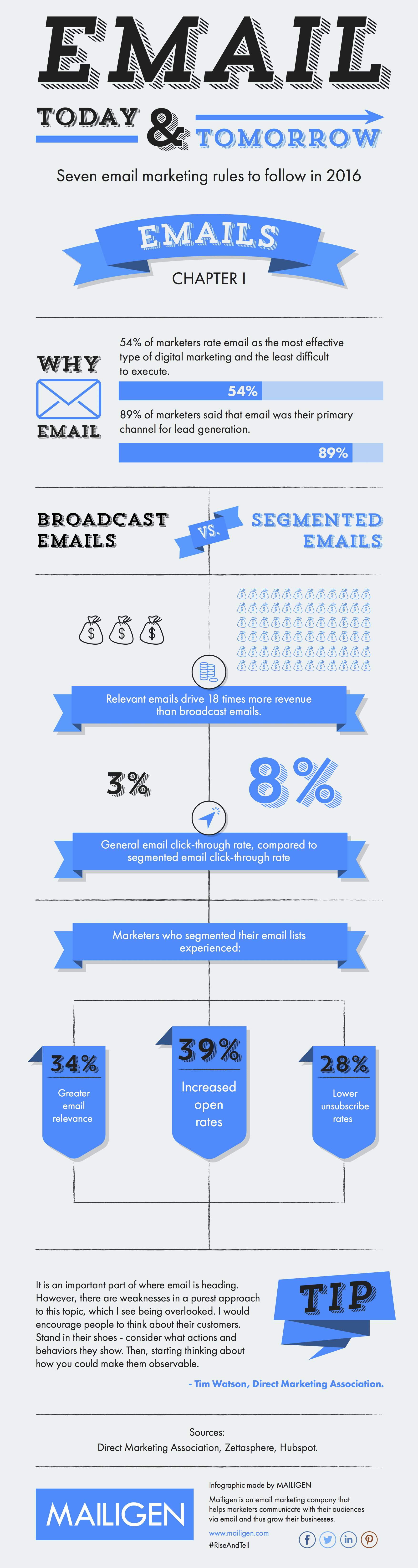
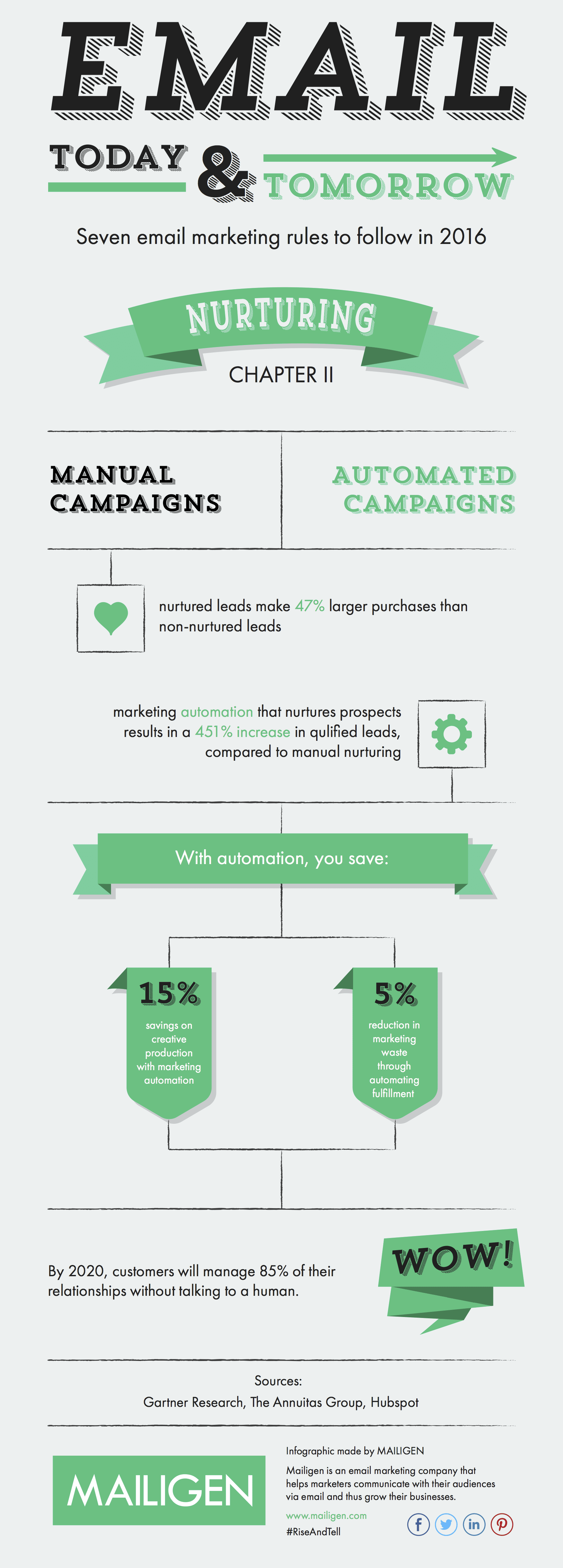
Seven Email Marketing Rules to follow in 2016 [Infographic]

by Robert Allen

Results from an assessment of personalisation show the value of segmenting emails and nurturing leads to get the best results

These two infographics summarising data from a range of sources show the continued importance of email as a marketing channel and give some useful email marketing stats, which show email marketing tactics that are most effective.

Segmenting your emails is a must if you have a large database, otherwise you will have far lower open rates and considerably higher unsubscribe rates.  Using automated email marketing to nurture leads is also highly effective, since it dramatically increases the amount the average lead spends and nurturing prospects increases the number of leads by a whopping 451%.

Email stats

email nurturing stats

Thanks to Mailigen for recommending this infographic which are part of a series you can access on their site.

For more insights on the response of email marketing see our Email marketing stats compilation post and online marketing benchmarking statatistics download for Expert members.

08 Sep 17:16

Smart tips for getting the content results you want

by VB Staff
content is king

SPONSORED:

This sponsored post is produced in association with Citrix GoToWebinar.

Here you are again. Refreshing your website for the millionth time to see if anyone shared or commented on your week-old post. No matter how much effort you put into your post, your readership refuses to grow.

Don’t blame the audience. The reason why no one is reading your content is because you’re neglecting key strategies that will help make your work go viral. And with new websites and blogs opening up everyday, you need all the help you can get.

Headlines can make or break your content

According to Copyblogger, an average of 8 out of 10 people will read the headline copy, but only 2 out of 10 will read the rest of the article. If the reader finds your headline boring, he won’t be motivated to read the rest.

Upworthy suggests in its “How To Make That One Thing Go Viral” slideshow to write out 25 headlines for an article. The exercise helps dump out the crappy and predictable headlines and churn out the clever and exciting one hiding in your head.

When writing out one of those 25 headlines — or 10 if 25 is daunting — think about making your headline emotional. CoSchedule states headlines based on emotions, such as happiness or anger, perform the best on social media.

There’s even an online tool to judge how emotionally invested your headline is called the Emotional Marketing Value Headline Analyzer. It categorizes your headlines in three categories: Intellectual, Emphatic, and Spiritual. This is useful in deciding which headline would best suit your target audience, or which type performed the best on them. If your audience prefers headlines that evoke reasoning or careful evaluation, then you need to aim for the best Intellectual score.

Certain words also contribute to viral success stories, as shown in this 2013 analysis by Iris Shoor.

Headlines with the words “no,” “without,” and “stop” generated strong shares. Continuing the thought, albeit in a darker way, “kill,’ “fear,” “dark,” “bleeding” and “war” contributed to top shares. If you don’t feel like turning your content into a horror show, other successful words used in high-sharing posts are “smart,” “surprising,” “science,” “history,” “hacks,” “huge,” “big,” and “critical.”

Producing content people want to read

A good post should be easy to read — not filled with never-ending walls of text. It’s why numbered or bulleted lists are favored by online readers: they’re easy to spot out and digest. The same is true for subheadings which make it easier for viewers to comprehend detailed posts.

Searching for what’s trending online is one way to gain attention and Quora is an ideal tool for this situation. Quora allows you to search any topic your target audience might be interested in based on popularity and quality. For example, let’s say you want to write about the travel business, but not sure how to go about it. One popular thread on Quora talks about which airline or domestic travel is best for going to India. You can use this thread to write an article about your own travels to India, or name airlines that share the positive qualities users were looking for.

BuzzSumo is another useful tool for topic scouting. It not only lets you see which topic performs best on social media, but lets you see how well your competitors did discussing the same topic as well — very helpful in deciding which topic and approach would be best for your readers.

Most importantly, seeing the common trends regarding your niche allows you to think of ways to make your approach unique from everyone else.

The simplest and often overlooked way to finding out what your audience wants is to merely ask them with a short survey, newsletter, or social media question.

Get social media to work harder

Beyond owned properties, it’s essential to distribute your content effectively, and, of course, social media is a must. But there are best practices you might be ignoring.

Plus, not only does your content get a huge boost in distribution across social media channels, but social can improve your content in search. According to Branded3, URLs receive significant lift in Google rankings when they’re shared on Twitter. URLs with over 7,500 tweets almost always rank inside the top 5 results when people are searching a topic you may have written about.

But how should you compose your social media posts?

Based on this infographic by Kevan Lee, the most popular social media posts had these ideal character counts:

  • Twitter: 71–100 characters
  • Facebook: 40 characters
  • Google+: 60 characters
  • LinkedIn: 80–120 characters

There are other factors to consider in catering to certain social media markets. Hootsuite researched the demographics associated with each social media account and her are some of the results:

  • 38 percent of internet users access social media through mobile
  • 54 percentof Millennials use LinkedIn for industry news and advice
  • 76 percent of Tumblr and 74 percent of Instagram users are teens

With this kind of intel in hand, you’re then equipped to target and segment your audience using the most appropriate platform. You might use Instagram for a promotional contest targeting teens and young adults, Twitter to drive general mobile traffic to your blog, or LinkedIn to share opportunities or guidance related to your industry. Mobile users are also more likely to browse during 8-8:30 a.m. and 12:30 p.m. And for businesses catering to families or food and beverages, Pinterest is the perfect social media platform.

Building an online presence requires you to be intriguing, consistent, relevant, and conversational. Engaging with other social media personalities gets your name out in the public and possibly a recommendation — so having an influencer strategy is important. It also lets your followers know that you’re the real deal and not a robot behind a keyboard.

User-submitted websites like Reddit, StumbleUpon, and Digg also expose your work to new people, so try to stay active on them as well.

Don’t ignore metrics

The only way to optimize and improve content over time is to measure and analyze. Tools such as Google Analytics lets you track how many visitors you received on your site and how well certain posts and keywords related to your niche performed. Furthermore, it breaks down your readership by age, gender, and region. Performances on different browsers and desktop and mobile are also monitored, helping you decide how to better optimize your site for readers.

Viral content isn’t easy to make, but it’s not impossible. Creating great headlines, posts, and online presence is fundamental to your success.


Sponsored posts are content that has been produced by a company that is either paying for the post or has a business relationship with VentureBeat, and they’re always clearly marked. The content of news stories produced by our editorial team is never influenced by advertisers or sponsors in any way. For more information, contact sales@venturebeat.com.


08 Sep 17:16

Turns Out The Future of the Office Isn’t an Office at All

by John Jantsch

Turns Out The Future of the Office Isn’t an Office at All written by John Jantsch read more at Duct Tape Marketing

think big coworking

This past week I made a business move that to me embodies a great deal of the change that’s gone on in business over the last few years.

I’ve owned my own business for twenty-years now and in some fashion have operated pretty much like most traditional small businesses. Sure I’ve been online longer than most, and I’ve never actually met my bookkeeper face to face, but I’ve also had an office with desks and chairs and printers and coffee pots and conference tables and servers and trash cans and supply closets and all the trappings of a standard office.

As my organization has grown over the years so too has my need for space and stuff to fill up space.

But a funny thing started to happen on the way to growth and change. As we moved things to the cloud we needed less physical stuff. As technology got better we needed fewer in-person meetings. As our reach expanded nationally and then globally we started to employ technology and engage talent wherever we found it.

My last office space – and by last I mean both the most recent and last I suspect I will rent – was just over 3,000 square feet and while my team is currently seven people on average the “office” was used by 1.75 of them on any given day. Between work from home staff, virtual staff and my current travel schedule, an office no longer makes sense.

I believe this is the case for most every business these days as well.

I interviewed Jason Fried, co-founder of Basecamp and author of REMOTE, for the Duct Tape Marketing Podcast recently and he shared this view as well. While Basecamp has an office in Chicago, their staff is spread around the globe.

Fried contends that their posture on remote work has allowed them to attract elite talent that would not have considered coming on board otherwise. Even Chicago-based staff members rarely come into the office unless collaboration is made easier by doing so.

One of my daughters works for Buffer, and while they maintain a small space in San Francisco, most of their staff works remotely. From what I’ve witnessed through my daughter’s experience Buffer has a stronger internal culture than any company I’ve worked with that maintains and internal staff and office.

Instead of an office they choose to invest in all hands meetings in exotic places around the globe. (I get a little jealous each time she tells me where they are going next.)

It’s funny but when I started my business almost three decades ago, “I’m going into business for myself,” kind of meant, “I can’t find a job,” and a home based business was sort of not really a business.

Today everyone wants to start a business, and the ultimate business model is an online business you can run while the kids rumble all around you throughout the day.

For now, I’ve taken what I think is the perfect hybrid step for my business.

I’ve rented 150 square feet of private space in a co-working space in Kansas City called Think Big Coworking.

The reason I call this the perfect hybrid is that it provides us with many of the benefits of a physical space on an as needed basis and also supplements many of the things we either weren’t able to offer staff or doing so would have been far too much work for a small group.

For example, we now have access to the latest video conferencing technology and small and large meeting rooms when we need them. We now have a sound proof recording booth for podcasts, interviews and webinars. We have access to over, 20,000 square feet of flexible seating, lounge seating, nook seating and yes game room seating. (Did I mention we no longer have to maintain or clean any of this!)

We have a full kitchen, coffee bar (free Red Bull anyone?) and snack shop. We have printers, a copy center and a mail center.

But perhaps equally as significant, we have a community of like-minded business owners and smart hustlers all around us. We have access to service providers who we will come to know on a personal level.

My staff members are energized by the fact that there’s a vibrant culture that exists in the space that’s greater than the work they do for us. They have built-in networking, learning and development opportunities that come to them every week.

Obviously, I’m not the first person to promote the virtues of co-working space, but they are often associated with startups only. I believe there’s now a tremendous opportunity for co-working communities to attract and serve more mature businesses that have begun to see the value of this mindset.

As business continues to evolve, I think community space is the future of work and the new office as we’ll come to know it.

08 Sep 17:15

Hiring Decision Makers: Be on the Lookout for 5 New Skills

by Ryan Mead

hiring-decisions

Peggy Olson graduated from Miss Deaver’s secretarial school with all the skills she needed. Typing, shorthand and pleasant communication readied her for her first day at Sterling Cooper for Mr. Draper. To say necessary work skills have changed since 1960 would be a glaring understatement. Fit for the office today and tomorrow demands smart and flexible skills to match the ever-changing techno landscape.

“If you don’t think about and plan for the future of work then your organization has no future.” – Jacob Morgan, author of The Future of Work

About 5 years ago, the Institute of the Future published the Future Work Skills 2020 report defining what would be necessary for careers and jobs in about a decade. With 2020 right around the corner, these adequacies are on the right track and more true than ever. Three overarching pillars of the next-gen work environment emphasize the surge of technology, attention on lifetime health and happiness, and inter-continental reach, and the timely skills needed to keep up. The makeup of select Vitru work values can reveal which employees are apt for best hiring decisions in the impending morrow.

Days of our Lives

Living longer and working longer is the narrative of the day. IFTF states Extreme Longevity, or increasing global lifespans, as a driver for changing the nature of careers and learning. As one UK study declares, the average age of the workforce will rise from 39 to nearly 43 by 2030. We will be at our desks, in front of our computers, for a surplus of years past previous generations retirement ages. Vitru’s work value of Balance and how well one partitions time for work, play and family, will be more intermixed than ever. Working from home, telecommuting from wherever you are, and flex schedules blur the line between time outside of work and time inside.

The Iron Giant

The Rise of Smart Machines and Systems where workplace robotics advance human workers beyond mundane, routine tasks will be a win for efficiency and output. China Gorman (@ChinaGorman) on The Global Workforce of 2030 writes “organizations with 20-40 people can be just as impactful as large corporations, and by leveraging technology while being ‘unhindered by legacy processes and mindsets,’ they will easily disrupt existing corporate models.” Vitru calls value Innovation to the plate to bring modernization and ingenuity to every aspect of work and hiring decision. Keeping up, working with and creating new technologies instead of dragging feet in response to something news.

Välkommen Bienvenue Welcome

Cross-cultural and multi-national networks claim diversity and adaptability at the center of companies with IFTF’s Globally-Connected World component. The rise of global economies in developing areas like Mongolia, Sierra Leon, Laos and Panama will drive corporations to adapt, share-in and cooperate with differing economies, cultures and client bases interboundarial. An employee with a high Teamwork score will be the person who withstands differences, and accepts differences as positive diversity. Accepting and collaborating with assorted viewpoints and backgrounds will be the wave of the future you want your employees to ride on.

“What was unexpected, but became clear through this research, were deep attitudinal changes occurring across geographies and generations to seek greater meaning and joy from work and the places of work. In 2030, the many places where we work and live will be diverse and entwined: humanity, creativity, culture and community will be integral.” – Genesis Research Report 2014 Fast Forward 2030.

Flying Cars

The changes that have happened and will continue to happen to the workforce are thrilling and telling of what kind of people we are. We pursue our personal happiness alongside career love and social responsibility.

“The workplace of the future is likely to play an increasingly important role in people’s lives, as people seek to define themselves more by the kind of work they do and less by the community in which they live.” – Healthy Work Challenges and Opportunities to 2030.

The skills and work values needed for today are vastly different than the days of Elvis and JFK.

08 Sep 17:15

How agile marketing can help you learn from your mistakes

by VB Staff
marketing-automation-failing

VB EVENT:

On September 24, a group of forward-thinking marketers in San Francisco will spend three hours learning more about agile at the VB Agile Marketing Roadshow. Join the conversation by registering today!

Originally formulated as a way to quickly build and iterate software, the agile method has been expanded into the marketing world. You can read the entirety of the manifesto here, but Harbinger Labs’ Travis Arnold summarizes agile marketing as being transparent, sustainable, interactive, measured, iterative, and relevant.

So why is this so relevant now? Today’s marketing landscape is rapidly changing due to fluctuating market conditions and snowballing consumer opinions. Marketers can no longer afford to gamble on the success of a few long-term campaigns. Today, successful marketers are iterating on every aspect of a campaign to stay ahead of the game, deliver more value to their customers, and create more success for their organization. And internal teams need to adapt to those demands in new ways.

Jascha Kaykas-Wolff, chief marketing officer at Mozilla, has been involved in agile marketing since its earliest stages. He has a mantra on his website that reads, “Never be afraid to fail. Just don’t fail the same way twice.” That’s not a truism — it’s an action plan. In agile marketing, after each sprint, your team should hold a sprint retrospective meeting, where each person says what went well during the sprint and what didn’t, and then take the lessons forward to future sprints.

Learning from the past so you can create a better future — that sounds like a good idea.

To hear more about how to bring your marketing team into the new era, join us at the VB Agile Marketing Roadshow in San Francisco, where Kaykas-Wolff and other proponents will discuss where agile is heading and how it’s changing how marketers work.

The roadshow takes place at The Merchants Exchange Club on Thursday, September 24, from 5 p.m. to 8 p.m. There’s plenty of time built in for networking and snacks. RSVP today!


VB's research team is studying web-personalization... Chime in here, and we’ll share the results.


08 Sep 17:14

Is Your Content Marketing Strategy Focused on the Wrong Thing?

by Amanda Hicken

blog_CreateDemand fINAL

When it comes to your content marketing strategy, what is your most important priority?

If your answer isn’t creating demand, your content is missing the mark.

Most content marketing thought leadership focuses on a brand’s output: the content that’s being produced. And that makes sense – identifying your content’s tone, who’s going to write it, what form it’s going to take, how you’re going to promote it, and other ‘content how-tos’ are all important steps.

However, to succeed you must go beyond checking items off a content creation to-do list.

The first priority of content marketing is to focus on the actions you want your content to inspire.

Today’s sophisticated content marketers know that they have to do more than create content, they need to create demand for their brand, products and services. They need to create that next step in the buyer’s journey.

The good news is that it’s easy to right the ship if your content marketing has lost sight of its guiding purpose.

Start by working backwards:

4. Ultimately, you want to cultivate advocates and evangelists for your brand — people who love you so much that they repeatedly and loyally use your products and openly share that love with their peers.

3. However, before you can inspire customers to advocate for your brand, you need to inspire them to purchase and adopt your products.

2. Before you can inspire prospective customers to purchase and adopt your products, you need to inspire them to engage in conversation with you.

1. Before you can inspire prospects to engage in conversation with you, you need to get on their radar. To do this, you’ll need to be continuously present and active in the places where they’re looking for information about their needs.

Then Produce and Promote:

Once you plot out this roadmap for creating demand, the production and promotion of the content that’ll accomplish it can follow.

Listen to your marketplace and figure out trending topics to write about that will start conversations. Create high-value and relevant multimedia content that’s easy to engage with. Share that content to help shape the conversation around your brand, products and services.

And don’t forget to analyze — continuously. Frequently take stock of which content assets delivered the best results, which delivered the worst, how your message was perceived, and how your content drove action through your customer roadmap.

By constantly listening to your audience and analyzing the results of your efforts, you can determine how to optimize your strategy and create the demand your brand deserves.

08 Sep 17:14

Samsung is fighting a massive global trend and losing badly

by Rob Price

bullfighters bull fight spain

It's no secret that Samsung's smartphone business is struggling.

Beset on all sides, the company is losing customers and facing falling profits.

On Tuesday, the news broke that Samsung is now reportedly planning to cut 10% of its staff at its South Korean headquarters. With a workforce of 98,999, that suggests in the region of 10,000 job losses.

(When reached for comment, a Samsung spokesperson told Business Insider that "We are unable to comment on market rumours or speculation.")

It's a remarkable decline for the company, which just a few years ago was the undisputed leader of the global smartphone business. And all the more unusually, it comes during a massive boom in smartphone ownership: Global sales are predicted to jump by more than 10% this year — and yet Samsung's are declining.

What happened?

Arguably, the runaway success of Apple's iPhone 6 and 6 Plus models reveals an unpleasant truth for Samsung: Many people don't actually want a Samsung device. It's just that they wanted a high-end smartphone with a large screen, and that for a long time, Samsung was one of the few brands willing to provide that.

But as large-screened devices became more popular, Apple relented. It released the 6 and the 6 Plus, finally allowing consumers to experience iOS on a bigger device — depriving Samsung of one of its unique selling points. (And netting Apple the most profitable quarter of any company ever in the process.)

This hints at an issue that isn't unique to Samsung: The problem of Android differentiation. Android devices are all, fundamentally, very similar. They might alternately be waterproof, or have a curved screen, or be scratch-resistant, but they all run the same operating system and all the same apps. It makes it difficult for manufacturers — especially at the high-end — to prove to consumers that their devices are meaningfully different enough to justify higher price tags.

It's being attacked on all sides

Xiaomi Redmi Note 2Samsung is in trouble because it isn't just being hurt at the high-end by Apple's success — it's being undercut at the low end too. Right now, the Android market is cut-throat. Profits are razor-thin — LG makes just a penny in profit per device — and established players like HTC are imploding, while cheap handset manufacturers like Huawei and Xiaomi are enjoying stratospheric rises.

For the first time, you can get the Android experience, without any meaningful compromises, on a device costing a fraction of what Samsung charges.

Samsung is losing its grip on one of the top smartphone markets in the world

These cheap upstarts are significantly eroding Samsung's dominance. Just look at China, the biggest smartphone market in the world — in the 12 months ending May 2015, Samsung's smartphone sales halved in the country. In 12 months, it dropped from the top smartphone seller in the country to the fourth. Apple was a key beneficiary of this collapse, as was Huawei and Xiaomi.

china smartphones smartphone idc q1 2014 2015

This trend is being repeated across the globe. According to Gartner data, Samsung's global smartphone sales slumped in Q2 2015 to below what they were in Q2 2014, even as the global market grew 13.5% year-on-year. Samsung is still number 1, but its share dropped by nearly five percentage points.

gartner global smartphone shipments q2 2014 2015

Even when it gets it right, it still screws up

Samsung released the Galaxy S6 and the Galaxy S6 Edge in April. They're the company's flagship devices, and have been well-reviewed. And with good reason — they're absolutely gorgeous. But even they haven't managed to turn things around.

Samsung Galaxy S6 EdgeWhen the South Korean company released its earnings report this year, it conceded that the impact of the launch of the S6 devices "was quite marginal due to low smartphone shipments and an increase in marketing expenses for new product launches."

Part of the problem is Samsung's anticipation of demand. According to a report in The Journal in July, Samsung assumed demand for the devices would be around four to one in favour of the regular S6. But the more expensive S6 Edge has turned out to be much more popular, and demand is closer to one to one. The company was left scrambling, with excess inventory of S6 units and not nearly enough of the more expensive S6 Edge units to satisfy demand.

Blogger Ben Thompson wrote in his Daily Update email in July that this was "a pretty clear screwup," with Samsung failing to recognise what its customers were actually after. He went on:

[It] suggests they don't understand just how starkly the smartphone market has bifurcated: the only people buying a high-end Android phone want the top-of-the-line, and that means the Edge. Anyone who is concerned about price isn't going to save $100 by buying a normal S6; they're going to save $500 and get a perfectly serviceable phone that runs the exact same software.

That supply outstrips demand is, on the face of it, a good thing for Samsung. It means people want the company's phones! But it's also an entirely avoidable problem. And with the launch of the iPhone 6s, it's about to get a whole lot harder for Samsung to persuade consumers that it still has the hottest new device around.

Putting things in perspective

The result of all this? Samsung's profits dropped 8% year-on-year in Q2 2015 — its fifth consecutive decline. According to Bloomberg, it has lost $44 billion in value since April.

But it is important to keep things in perspective. Samsung is still profitable. In contrast: HTC, another smartphone manufacturer facing similar problems, saw its stock drop by 66% this year, and is now cutting 15% of its global workforce.

Samsung also sells much more than just smartphones. It has hundreds of different product lines, ranging from semiconductor chips to flatscreen displays and office printers. Its smartphone business could disappear overnight, and it wouldn't spell the end of the company.

WaterfallHowever, its global shipments are dropping, even as the global market is estimated to grow 10.4% this year. Its high-end Android devices are fighting against the current — the trend toward cheap, affordable Android. According to data from ABI Research, the average price of an off-contract Android device dropped by almost $100 between February 2014 and February 2015.

Looking forward, any significant growth isn't going to come from developed markets in the West, where Samsung might — if lucky — claw back a few percentage points from Apple. It's in emerging economies that are important because hundreds of millions of people come online and buy smartphones.

But the rise of Huawei and Xiaomi show us that in such regions, price is king. The "markets with the biggest growth opportunity [in the future] are extremely price sensitive," IDC predicts.

That's good news for millions of people across the globe looking for powerful, affordable smartphones. But for Samsung? Not so much.

Join the conversation about this story »

NOW WATCH: How to saber a bottle of champagne with an iPhone

08 Sep 17:09

The Top 4 Sales Challenges in 2015 Revealed [Research]

by Michael Dalis

You are not alone. That’s what Richardson uncovered in its 2015 Selling Challenges Study, conducted at the end of 2014. Field sales reps, senior sales professionals, and senior leaders across various B2B industries are all facing troubles in the very fundamentals of successful selling: prospecting, account management, negotiating, and closing deals.

Here is the number one challenge in each area:

  • The #1 prospecting challenge: Gaining appointments
  • The #1 account management challenge: Adding relevant value for various stakeholders
  • The #1 negotiation challenge: Gaining higher prices
  • The #1 closing challenge: Competing against a low-cost provider

You can download a free copy of the full report here. This post will provide some context around these issues, sharing both insights and implications to help you fortify your focus.

Why Is Prospecting So Hard?

It’s not surprising that survey respondents chose “gaining appointments” as the greatest challenge to their prospecting efforts. Buyers are busy, and they erect numerous barriers between themselves and salespeople. And it’s not just prospects who are difficult to gain access to; existing clients can also be elusive.

Getting in the door is something that seems so basic and central to sales, yet even very skilled salespeople are having difficulty. The solution ties back to what we advocate at Richardson, both in our training and our coaching, about being able to convey value from the very first contact, whether that contact is with a gatekeeper, a voicemail, or a stakeholder in the buying decision. Proving value at an early stage of a sale takes some homework: a real strategy, preparation to initiate the proper dialogue, and a demonstration of relevance.

The Other Side of the Equation

On the other hand, the three lowest-rated prospecting challenges seem counterintuitive:

  • Qualifying prospects
  • Leveraging social media
  • Creating insights

Think about it: If done skillfully, these elements help differentiate sellers and gain appointments with buyers.

However, what we find in our workshops and coaching sessions is that salespeople are not always realistic in qualifying prospects. They can be easily bound by either their optimism or pessimism, although usually they’re overly optimistic.

Often, when I ask a salesperson why they qualified a prospect, they’ll start their response with, “I think … ” As a coach, my reply is, “So, that’s what you think. What have you seen, what have you heard, or what has the client done to make you think that way?” These are entirely different yet simple questions that help salespeople focus on key touchpoints that can truly qualify a prospect.

Leveraging social media is another important action that can often seem like a nice-to-have element. The reality is that social media has become essential, as research shows more buyers are relying on information learned online. If salespeople don’t take the time to leverage the power of social media, they’re missing a valuable opportunity to establish credibility and build connections, and they risk arriving on a prospecting call or at a first meeting with information to which a buyer had easy access.

Another element that takes time is sharing insights with buyers. Most salespeople feel short on time, given quota pressure, activity metrics, and producing results. Preparing insights requires research. Consider how much time is allocated to calls, meetings, preparation, travel, and follow-up with prospects that have not in the past and may never in the future buy from you.

Each of the issues discussed are interrelated. What allows salespeople to stand out with prospects begins with qualifying them better. Better qualification of prospects frees up time. That time can be used to leverage social media to find common connections and current areas of interest, which enables salespeople to construct insights and prepare to gain buyers’ attention. Taken together, these elements can be a game changer for salespeople, making it easier to gain and make the most of first appointments with qualified prospects.

Get HubSpot CRM today!

08 Sep 17:09

The Paradox of Personalization in B2B Marketing

by Scott Gillum

Just when we’ve convinced the organization that the key to our marketing communication success is personalized content, new research from CEB highlights that we actually may be doing more harm than good.

The years spent improving our understanding of the buyers journey, the development of more insightful personas and content, may have resulted in marketers ability to be too good at personalizing solutions to buyers. How can that be?

Screen Shot 2015-09-03 at 4.08.13 PMThe issue, according to CEB’s research underpinning their new book The Challenger Customer, is that our improved ability to increase a buyer’s awareness of those areas of a solution most relevant to them, has inadvertently increased visibility into the overall risks associated with the purchase decision and/or change. As a result, buyers begin to unbundle and simplify solutions, driving down price points. The shocker of this insight is that marketers improved ability to personalize content may be coming at a cost to sales.

According to co-author, Pat Spenner, the real challenge lies in convincing buyers to first agree on making a change. “Focus your content marketing efforts on creating a consensus case for change among the decision-making group,” which according to CEB’s research, now involves at least five people in the typical B2B purchase.

According to Spenner, “personalization can hurt the buyer’s ability to get that critical early consensus, because it can cement those individual stakeholders into their individual contexts, without doing anything to bring that more diverse group together around a common vision for change.”

So should we stop personalizing our communication? No, but it does highlight the need to also create that common rallying point, and to equip key buying group stakeholders with the tools to create consensus around it. Something the authors say helps clients elevate the conversation from “me to we,” an umbrella approach that ties your content efforts together regardless of the audience being targeted.

To motivate buyers to change you first have to disrupt their status quo by planting and nourishing seeds of doubt about “business as usual.” Show them not just the benefits of action, but the consequences of inaction. CEB recommends using fact-based content built off a Commercial Insight to break down buyers existing mental models.

Concurrent with breaking down the audience’s long held beliefs, you need to give them something to aspire to — a new future state that rallies the group to take action. This is where a compelling creative campaign does the heavy lifting. A “big play” campaign, like IBM’s “Smarter Planet” creates a compelling future vision but also provides a broad platform to disrupt IBM’s many different buyers and to cover IBM’s expansive solution/product portfolio.

Screen Shot 2015-09-02 at 10.50.32 AM

Personalization is still essential, and comes via messaging to specific audiences, but it is built on the commercial insight, and aligned to the common vision of the future state. It’s not that personalization doesn’t work, in fact, it can be very effective for breaking the status quo,” according to Spenner, “but you also need an unifying rallying point for buyers who may be too attuned to the risk associated with change.”

The key to leveraging the good work marketers have done to increase relevancy with buyers? Properly balance and/or convince the audiences that the rewards associated with making the change, both organizationally and personally, outweigh the risks you’re asking them to take on. If not, they will reduce the risk for you, and you may be hearing about it from sales.

08 Sep 17:08

[Ebook] 10 Steps for Lead-Generating Personalized Web Engagement

by Mike Telem
fish

Author: Mike Telem

Chances are you’ve already created many helpful blog posts, case studies, ebooks, and webinars in order to help educate your potential customers, so there is no need to convince you that content marketing works. But, one question remains: Are you maximizing their potential for lead generation across all of your channels?

Today’s prospects independently research products and services before making a purchase, which creates numerous interaction touch-points. Now, organizations are starting to realize the importance of personalizing those touch-points and providing an engaging, valuable experience for each visitor.

But realizing the importance is different than actually implementing a personalized experience. Let’s take a look at the 10 steps to help you build a successful personalization strategy:

Step 1: Follow the 3 Ws of Personalization

Think journalists are the only ones who live by Ws? Think again. Marketers have their own version—the 3 Ws to consider before launching a campaign:

  • Who: Who are your key audiences, and what are the defining characteristics of your target audiences? Examine attributes such as geo-location, company size or industry, title/role, and the stage in the buyer’s journey.
  • What: What are you personalizing? Determine which content assets are most valuable to your ideal persona, such as blog posts or case studies.
  • Where: On which channel are you personalizing? (website, mobile, ads, etc.)

Step 2: Choose Your Use Cases Wisely

What goal are you trying to achieve with personalization? For example, you may be looking to generate new leads or nurture existing leads and further educate them.

Start by choosing only two or three use cases that make the most sense or will have the most impact on your business. If you’re B2B, you can consider employing account-based marketing (ABM) to target specific companies, industries, or even personas that are “high-value.” However, for B2Cs, the focus can be on engaging consumers based on location, behavior, or past purchasing history or interactions with your brand.

Step 3: Take a Closer Look at Your Use Cases

After you’ve selected a few use cases to focus on, go one step further by detailing the specifics. For instance, for some companies this may entail listing account names or regions that are most valuable to your business. For others, you can zoom-in on a particular behavior or specific product interest.

Step 4: Get Your Analytics in Place

Before starting to run any campaigns, determine what you’re going to measure and how. To get started:

  1. Establish Analytics: This can help you understand how each key audience interacts with you. Set up your measurements to determine baseline metrics for the different verticals and audiences and start testing personalization campaign results to measure uplift.
  2. Create Segments: Track performance by checking how many visitors from each specific segment visit your website, how they behave on-site, and what type of content they prefer.

Step 5: Repurpose, Repurpose, Repurpose

Content marketing is the fuel that drives personalization success. Instead of creating tons of new customized content, make the most of existing assets by recreating particular sections, changing visuals, or modifying CTAs. The trick is tho repurpose what you have and tweak it to each particular segment.

Once you’re equipped with all the assets, that’s where content recommendation engines (CRE), such as Marketo’s, step in. CREs identify all of the content you have, learn what works best for specific users, and then leverage this machine learning to predict and recommend the most relevant asset to each visitor.

Step 6: Always Keep the Customer Journey in Mind

In order to push prospects down the sales funnel, you’ll need to first map out your unique buyer’s journey. Based on your visitor’s stage, you’ll want to identify content that is the most relevant and suitable for that point. For example, with early stage buyers and prospects, hold off with case studies or gated content, and start with an asset that’s easier to consume, such as an infographic or blog post.

Step 7: Use Web Nurturing to Draw Visitors Back

You’re probably familiar with email nurturing, but what about web nurturing?

Keep visitors coming back by serving personalized ads on social networks such as Facebook or LinkedIn or other websites they frequent via remarketing ads. Adding web and ad interactions to existing email nurture campaigns can increase the effectiveness of your programs, and as a result, drive up conversions and engagement.

Step 8: Super Charge Your Ad Performance with Data

It’s not just about serving ads to prospects across multiple platforms—it’s about retargeting them with the right ads.

Tools such as Marketo’s Ad Bridge make this simple; you can “reel” visitors back to your site by suggesting new and extremely relevant content to them even when they’re visiting other sites. Personalized ads are the most effective way to show prospects that you know exactly what they’re looking for—and that you want to help them find it.

Step 9: Don’t Forget to A/B Test Your Campaigns!

You know the drill; without A/B testing, you’ll never know what works (and what doesn’t) in your personalization campaigns. So, what kind of metrics should you be examining up close?

  • Ads: Check click-though and conversion rates for ad placements. Use offline event analytics.
  • Web Engagement: Did the personalized CTAs and content drive engagement, and lead to more page views? Did you convert more anonymous prospects into qualified leads?
  • Sales Feedback: Consult with sales on the quality of the leads specifically from personalization campaigns.

Once you collect the data, use it to optimize and improve future campaigns.

Step 10: Create Reports to Help Your Sales Team

Personalization is an excellent way to push prospects down the funnel, but once they turn into leads, it’s a marketer’s responsibility to turn them over to sales. Use the same segmentation capabilities to provide your sales teams with real time sales intelligence about their target customers

The best way to do this is to create reports from your campaigns, such as:

  • Key Organizations: Are certain companies showing more interest in your website?
  • Key Leads and Accounts: Have you identified specific decision makers in certain sales territories?
  • Product Interest and Behavior: What was this lead’s main interest and what drove him to your website? What was the context of his interest?

Content personalization is essential in 2015 (and beyond). In fact, DemandGen Report found that leads who are nurtured with personalized content produce a 20% increase in sales opportunities.

If you liked this post and are looking for a more in-depth tutorial on creating a winning real-time personalization strategy, download our recent ebook, 10 Steps for a Successful Personalized Web Engagement Strategy.

10 Steps for a Successful Personalized Web Engagement Strategy_snip


[Ebook] 10 Steps for Lead-Generating Personalized Web Engagement was posted at Marketo Marketing Blog - Best Practices and Thought Leadership. | http://blog.marketo.com

The post [Ebook] 10 Steps for Lead-Generating Personalized Web Engagement appeared first on Marketo Marketing Blog - Best Practices and Thought Leadership.

08 Sep 17:08

How to Get B2B Buyers to Pay Attention to Your Content

by Rachel Foster

Cartoon cinema with How to Get B2B Buyers to Pay Attention to Your Content  on the screen

You only have eight seconds to capture a customer’s attention online. Here’s how to make the most out of every second…

If I gave you eight seconds to tell me about your product or service, what would you say?

Traditional elevator pitches are an average of 56 seconds. However, the average attention span has dropped to just eight seconds.

Eight seconds isn’t long. It was just enough time for you to read the title and first line in this blog post.

Test it out yourself.

Say, “I’m with [name of your company], and we …” See if you can get your message across before the time runs out.

See if you can get your message across before the time runs out.

See if you can get your message across before the time runs out.

How did you do?

Now, what if you had to make your message even more concise? A study showed that 17% of page views last less than four seconds. Almost a fifth of your visitors aren’t even giving you the full eight seconds.

This means that your customers have shorter attention spans than your childhood goldfish. Yikes!

As attention spans get shorter, it’s no surprise that B2B marketers are struggling to make their messages stick. According to the Content Marketing Institute and MarketingProfs, only 38% of B2B marketers rate their content as “effective” or “very effective”.

Here are five ways to catch and keep your customers’ attention online:

1. Work from a content marketing strategy.

Cartoon cinema with a screen that shows Work from a content marketing strategy

A content marketing strategy helps you gain a deeper understanding of your customers, so you can create content that resonates with them.

A study by the Altimeter Group found that 70% of marketers lack a consistent or integrated content strategy.

If you don’t have a content marketing strategy, you’ll randomly throw messages into the world and hope that customers read them. Creating a content marketing strategy helps you gain a deeper understanding of your customers, so you can create content that resonates with them.

The Content Marketing Institute and MarktingProfs reported that B2B marketers who have a documented content marketing strategy “are more effective in all aspects of content marketing” than those who don’t have a documented strategy.

For tips on improving your content’s results, read “10 Steps to an Effective B2B Content Marketing Strategy”.

2. Design for conversions.

Cartoon cinema screen that says Design for conversions

Make sure that your design encourages visitors to read your content, opt in to your list and learn more about your products.

Your website’s design has a huge impact on your customers’ buying decisions. In fact, a study by Rareform New Media found that “48% of people cited a website’s design as the number one factor in deciding the credibility of a business”.

When you redesign your website, it’s easy to get pulled into the latest design trends – opting for a site that “looks cool” as opposed to increasing your conversions. However, if your site isn’t increasing your conversions, it’s not doing its job.

Make sure that your design encourages visitors to read your content, opt in to your list and learn more about your products. If you’re not sure how visitors are reacting to your site, you can use heatmap software to see where they look and what they click.

3. Get up to speed.

Cartoon cinema screen that says Get Up To Speed

40% of people abandon a website that takes more than 3 seconds to load.

If you only have four seconds to capture a customer’s attention, but your site takes five seconds to load, you’re in trouble.

According to an Akamai study, “40% of people abandon a website that takes more than 3 seconds to load.” Meanwhile, a one-second delay in page-load can cause a 7% loss in customer conversions.

Look at your bounce rates and determine if your website’s speed is impacting how long visitors stay on each page. Be sure to test your site in different browsers and on different platforms to see how long it takes your pages to load. You can also use the free GTmetrix tool to test your site’s speed.

4. Make your site mobile friendly.

Cartoon cinema screen that says Make your site mobile friendly.

A mobile-friendly site is no longer an option.

A mobile-friendly site is no longer an option.

According to a study by MarginMedia, 48% of users say that if they arrive on a business site that doesn’t work well on mobile, they take it as an indication that the business doesn’t care.

Google is also giving preference to mobile-friendly sites. If your site isn’t optimized for all devices, your rankings may suffer.

5. Improve your copy.

Cartoon cinema screen that says Improve your copy

Much B2B copy is boring and robotic. These 5 tips help you improve your copy.

Every word in your marketing has the power to engage leads and convert them into customers. However, much B2B copy is boring and robotic. Here are five ways you can improve your B2B copy:

  • Capture your audience’s attention with strong headlines and intriguing introductions.
  • Use stories to keep readers engaged.
  • Cut the corporate jargon.
  • Focus your copy on your customers – not on yourself.
  • Make sure that all of your content includes a call to action that motivates readers to take the next step.

Also remember that most people don’t read online content word by word. Their eyes dart around the page. Get your key messages across in your headers, sub-headers and introduction to ensure that more customers see them.

stop-b2b-buyersGet Instant Access to the FREE Resource
Stop B2B Buyers In Their Tracks!

A 24 Question Checklist That Will Help You Grab Customers’ Attention, Lower Your Bounce Rates and Boost Your Conversions

CLICK HERE TO GET THE FREE CHECKLIST

08 Sep 17:08

The B2B Buying Cycle Just Got Longer

by John Miller

Sometimes, the rationale for content marketing is SEO. Sometimes it’s because “everyone is talking about it and we need to do it too” (pro tip: this is a bad reason). But really it’s about delivering information to the customer across the new buyer’s journey, building trust with that prospective customer and ultimately creating preference.  It’s an acknowledgment that the buyer is now in control of the relationship.

And that Buyer’s Journey just got longer.

According to the 2015 B2B Buyers Survey Report from DemandGen Report, B2B buyers are spending more time than ever before researching solutions before they make a purchase. Almost universally, they are not spending that time in discussions with a salesperson; rather, they’re searching the web anonymously, educating themselves to understand the nature of their challenges and the possibilities available for addressing those challenges.

BuyersJourneyThe report shows that 53 percent of buyers say that their time to make a purchase has increased over the last year. Eighty percent say they are taking more time to research; 82 percent say they are viewing more sources. Specifically, 52 percent said they looked at two to four pieces of content before making a decision; 28 percent said they viewed five to seven pieces of content. They’re turning to social media for a lot of that research: 61 percent of those surveyed said that LinkedIn had “the biggest” impact among social channels in making purchase decisions. Another 58 percent said blogs had the biggest impact.

This is an opportunity. It’s a clear sign that the B2B audience is ravenous for information. Give it to them, and reap the rewards. As the authors of the report state in their conclusions:

“Content is increasingly important in forming early impressions for brands and helping to drive engagement at all stages.”

So, what is a brand to do when it has lost control of the buying process? The first thing to do is to realize that the old marketing approaches – broadcasting how awesome your products are – don’t work any longer. Many B2B firms with strong sales cultures still struggle with this. The Sales Department has been taught to be relentless in pursuit of the making its numbers. Every quarter, those goals get higher. Consequently, they want shortcuts. They want sales, and they want them right now!

Yes, that hard-driving approach can get you some short term wins. However, it typically means that your marketing efforts remain beholden to renting someone else’s audience – you’re building your future on rented land and banking on that media company is going to exist in a few years. Call me crazy, but I’m not betting on any media company’s business model.

On the other hand, if you build a content-driven presence on property you own – like your website – you can get off the media buying treadmill. You can create an audience that is far more targeted than any media company’s audience will ever be.

As the buyer’s journey grows longer and B2B buyers invest more and more time in research, B2B sellers are wise to be there to meet them with smart analysis and helpful content.

Of course, the content has to be good. It has to be different. It has to stand out. It has to give people a reason to want more.

It has to walk alongside the buyer as they travel this new journey, providing useful advice along the way and guiding them towards the right decision.

Creating the quality and quantity of content isn’t easy. It requires a long term commitment. But, every time a new report comes out it seems to verify the wisdom of taking this approach. Old school marketers may struggle to wrap their head around it, but this is how customers act now, and it’s foolish to ignore this reality.

08 Sep 17:07

eBay's revamped apps are big for sellers, not just buyers

by Jon Fingas
eBay may like the idea of serving as a storefront, but it knows that this only works if it helps you sell your wares at the same time. That's where the company's reworked, version 4.0 mobile apps come into play -- the version 4.0 update for both...
08 Sep 16:59

10 Steps for Lead-Generating Personalized Web Engagement

by Mike Telem

fish

Chances are you’ve already created many helpful blog posts, case studies, ebooks, and webinars in order to help educate your potential customers, so there is no need to convince you that content marketing works. But, one question remains: Are you maximizing their potential for lead generation across all of your channels?

Today’s prospects independently research products and services before making a purchase, which creates numerous interaction touch-points. Now, organizations are starting to realize the importance of personalizing those touch-points and providing an engaging, valuable experience for each visitor.

But realizing the importance is different than actually implementing a personalized experience. Let’s take a look at the 10 steps to help you build a successful personalization strategy:

Step 1: Follow the 3 Ws of Personalization

Think journalists are the only ones who live by Ws? Think again. Marketers have their own version—the 3 Ws to consider before launching a campaign:

  • Who: Who are your key audiences, and what are the defining characteristics of your target audiences? Examine attributes such as geo-location, company size or industry, title/role, and the stage in the buyer’s journey.
  • What: What are you personalizing? Determine which content assets are most valuable to your ideal persona, such as blog posts or case studies.
  • Where: On which channel are you personalizing? (website, mobile, ads, etc.)

Step 2: Choose Your Use Cases Wisely

What goal are you trying to achieve with personalization? For example, you may be looking to generate new leads or nurture existing leads and further educate them.

Start by choosing only two or three use cases that make the most sense or will have the most impact on your business. If you’re B2B, you can consider employing account-based marketing (ABM) to target specific companies, industries, or even personas that are “high-value.” However, for B2Cs, the focus can be on engaging consumers based on location, behavior, or past purchasing history or interactions with your brand.

Step 3: Take a Closer Look at Your Use Cases

After you’ve selected a few use cases to focus on, go one step further by detailing the specifics. For instance, for some companies this may entail listing account names or regions that are most valuable to your business. For others, you can zoom-in on a particular behavior or specific product interest.

Step 4: Get Your Analytics in Place

Before starting to run any campaigns, determine what you’re going to measure and how. To get started:

  1. Establish Analytics: This can help you understand how each key audience interacts with you. Set up your measurements to determine baseline metrics for the different verticals and audiences and start testing personalization campaign results to measure uplift.
  2. Create Segments: Track performance by checking how many visitors from each specific segment visit your website, how they behave on-site, and what type of content they prefer.

Step 5: Repurpose, Repurpose, Repurpose

Content marketing is the fuel that drives personalization success. Instead of creating tons of new customized content, make the most of existing assets by recreating particular sections, changing visuals, or modifying CTAs. The trick is to repurpose what you have and tweak it to each particular segment.

Once you’re equipped with all the assets, that’s where content recommendation engines (CRE), such as Marketo’s, step in. CREs identify all of the content you have, learn what works best for specific users, and then leverage this machine learning to predict and recommend the most relevant asset to each visitor.

Step 6: Always Keep the Customer Journey in Mind

In order to push prospects down the sales funnel, you’ll need to first map out your unique buyer’s journey. Based on your visitor’s stage, you’ll want to identify content that is the most relevant and suitable for that point. For example, with early stage buyers and prospects, hold off with case studies or gated content, and start with an asset that’s easier to consume, such as an infographic or blog post.

Step 7: Use Web Nurturing to Draw Visitors Back

You’re probably familiar with email nurturing, but what about web nurturing?

Keep visitors coming back by serving personalized ads on social networks such as Facebook or LinkedIn or other websites they frequent via remarketing ads. Adding web and ad interactions to existing email nurture campaigns can increase the effectiveness of your programs, and as a result, drive up conversions and engagement.

Step 8: Super Charge Your Ad Performance with Data

It’s not just about serving ads to prospects across multiple platforms—it’s about retargeting them with the right ads.

Tools such as Marketo’s Ad Bridge make this simple; you can “reel” visitors back to your site by suggesting new and extremely relevant content to them even when they’re visiting other sites. Personalized ads are the most effective way to show prospects that you know exactly what they’re looking for—and that you want to help them find it.

Step 9: Don’t Forget to A/B Test Your Campaigns!

You know the drill; without A/B testing, you’ll never know what works (and what doesn’t) in your personalization campaigns. So, what kind of metrics should you be examining up close?

  • Ads: Check click-through and conversion rates for ad placements. Use offline event analytics.
  • Web Engagement: Did the personalized CTAs and content drive engagement, and lead to more page views? Did you convert more anonymous prospects into qualified leads?
  • Sales Feedback: Consult with sales on the quality of the leads specifically from personalization campaigns.

Once you collect the data, use it to optimize and improve future campaigns.

Step 10: Create Reports to Help Your Sales Team

Personalization is an excellent way to push prospects down the funnel, but once they turn into leads, it’s a marketer’s responsibility to turn them over to sales. Use the same segmentation capabilities to provide your sales teams with real-time sales intelligence about their target customers

The best way to do this is to create reports from your campaigns, such as:

  • Key Organizations: Are certain companies showing more interest in your website?
  • Key Leads and Accounts: Have you identified specific decision makers in certain sales territories?
  • Product Interest and Behavior: What was this lead’s main interest and what drove him to your website? What was the context of his interest?

Content personalization is essential in 2015 (and beyond). In fact, DemandGen Report found that leads who are nurtured with personalized content produce a 20% increase in sales opportunities.

If you liked this post and are looking for a more in-depth tutorial on creating a winning real-time personalization strategy, download our recent ebook, 10 Steps for a Successful Personalized Web Engagement Strategy.

10 Steps for a Successful Personalized Web Engagement Strategy_snip

08 Sep 16:59

Lead gen tactics guaranteed to fatten your funnel — and make you a star (webinar)

by VB Staff
funnel

VB WEBINAR:

Join us for this live webinar on Thursday, September 10 at 10 a.m. Pacific, 1 p.m. Eastern. Register here for free

The biggest mistake businesses make when it comes to lead generation is continuing to invest heavily in lead gen channels that are fairly expensive, even though they’re not performing well. That’s the view of Rochelle Sanchirico, VP of Marketing for mHelpDesk.

“They either don’t have the right measurement tools in place to actually validate just how ROI-negative [their lead gen] is for the business.” she says, “Or they’re so hung up on generating a certain number of leads that they continue to pay for leads that are not beneficial to the company,”

Sanchirico is a digital marketing veteran at such previous companies as Webs, Comscore, and The Washington Post. She’s seen this many times. But it’s also enabled her to craft a finely-chiseled approach to lead generation in her current role for mHelpDesk, a SaaS company that provides comprehensive management, scheduling, and billing software for field services companies — and that’s grown from 3 people when the company started two years ago to its current size of 70.

She’s also one of the experts who will be joining us for this webinar, sharing what’s put them at the top of their game.

Concentrate on your core, but don’t stop experimenting

Sanchirico takes three main approaches to her lead gen. The first, and what she says is the cleanest, is working with led generation companies like Capterra, bidding on different verticals, and paying for the leads the platform generates.

They also do quite a bit of paid search, establishing core programs with broad-search terms, then expanding into longer-tail terms across all sorts of categories, and measuring at a deep level to continually optimize.

Organic search is the third core lead gen focus. It’s about creating high-quality content, but as Sanchirico cautions, “It’s not just about the terms that are super-specific to our business, as those are difficult to rank for and also very targeted. You want to think broader, creating content around thought leadership that will bring more people into your fold from an SEO perspective.”

These channels form the majority of volume for Sanchirico’s leads, but she believes it’s vital to test new tacts. Each month she reserves at least $2k to devote to testing different types of programs. This month, she’s working with a company who does prequalification, and if it produces good results, she’ll expand it.

Measure, measure, measure

Back to that mistake many companies make: continuing to invest past the point of diminishing returns. The only way to avoid this is by measuring the entire lead gen cycle.

“First, we have a lot of people coming in the top of the funnel that aren’t necessarily a good fit for our company — and we want to identify that as quickly as possible,” says Sanchirico. Progressing through an established sales cycle, the company carefully tracks all customers who close in order to connect the dots to their lead generation strategies.

“We measure everything about our lead gen right throught to the sale,” Sanchirico says. “Are they engaging with the product, how long are they retaining, are they having a lot of challenges as far as their account is concerned? All of that helps us determine the ROI on our lead gen efforts — because every one of those KPI’s is tied back to a lead. So we determine the ROI on that lead based on the retention and the lifetime value of that lead as they go through that entire cycle.”

Join us as we dig deeper into these and and other important components of any kick-ass lead gen program.


Don’t miss out!

Register here for free.


In this webinar, you’ll learn:

  • Under-the-radar B2B ad channels including technology reviews sites and content syndication
  • How to make the most of search, display, and paid social media campaigns for B2B audiences
  • Low-risk ways to test new lead gen tactics before scaling your spending

Speakers:

Nick Bhutani, Senior Digital & Acquisition Marketing Manager, Booker
Rochelle Sanchirico, VP of Marketing, mHelpDesk
Jamaal Saunders, Senior Marketing Analyst, Salesforce


This webinar is sponsored by Capterra.


08 Sep 16:59

How To Fast Track Your Lead Lifecycle

by Jeff Coveney

While playing Monopoly with my daughter recently, I was thinking about a way to optimize a client’s lead lifecycle funnel. Yes, I should have been concerned with her recent acquisition of Boardwalk, but a sudden trip to Reading Railroad got my creative juices flowing. Finally, I had a great example for something we marketers must do to measure conversions effectively–the Reading Railroad strategy.

Let’s take a look at how Monopoly can help your lead lifecycle.

Developing a Funnel is Hard

Developing a measurable funnel helps businesses put predictability into the lead lifecycle. Do 1,000 leads turn into 50 deals? 20 deals? Which programs and campaigns are driving the most revenue? These answers help businesses gain clarity into what’s working and what is not.

Most organizations embrace the concept, but putting that concept into practice is usually the challenge. One common question I receive is, “how do I make my pretty funnel slide a reality?” You know, the one that you put up at executive meetings–the one where obtaining those numbers is almost impossible so you take an educated guess.

On April 15th, 2015, I spoke at the Marketo Summit on how to build a measurable lead lifecycle in 30 days along with Marketo guru Josh Hill. There were six or seven strategies that I covered, but today, I will dive into one of those. I call it the Reading Railroad strategy.

Fast Track to Reading Railroad

“Fast Track – A rapid means of achieving a goal.” – Memidex.com

In 1903, the game of Monopoly was invented. Besides buying all the properties, one of the objects of the game is to pass GO and collect your $200. As you may know, Reading Railroad is one of the properties on the board. In fact, there is a Chance card that sends you directly to Reading Railroad if you get it.

Besides fast-tracking to Reading Railroad where you skip everything in between, what else happens when you select this Chance card? You pass GO and collect your $200 bucks. You receive credit for passing GO even though you went directly to the Reading Railroad property.

Measure a Fast Tracked Lead through Your Lead Lifecycle

FunnelFastrack600 lead lifecycle

What happens when a lead shows major interest and skips stages? Let’s apply the Reading Railroad example to your funnel.

John Black just filled out a demo request form and becomes a marketing qualified lead (MQL). Usually, the next stage is for your phone rep to call John Black to qualify and accept the lead (SAL). However, what if the call goes great and John is ready to skip right through to an opportunity (Opp)? Like going to the Reading Railroad in Monopoly, John fast tracks through the funnel, rapidly achieving the opportunity status. The reporting question–what happens to the skipped stages in between since John Black went straight to an opportunity?

Just like passing GO and getting $200, leveraging the Reading Railroad technique ensures that all the stages in between get credit. Even though the lead technically skips all of the stages, all of those stages still get tagged for the pass through.

The Benefits – Insight

The Reading Railroad technique allows organizations to measure all the funnel stages just like passing through a turnstile at a baseball game. Once you go through one stage, you can never go back.

The technique provides organizations with true waterfall conversion analysis, which was made popular by Sirius Decisions. For example, we know that every lead that has gone through SQL has also gone through SAL—and every SAL has gone through MQL. Without this type of waterfall effect, businesses will have a difficult time measuring true conversion.

The technique also helps marketing executives see how quickly leads go through their system. Leads that fast track have a shorter time frame than leads that don’t fast track. For example, leads generated from sales may accelerate through the system faster than marketing generated leads. By using the Reading Railroad technique, we see the fast-tracked leads pass through in an instant.

lead lifecycle

The Reading Railroad Technique in Action

Now that you have the concept down, how do you execute? The Reading Railroad technique leverages a date stamping technique to track whatever lead is touched and changes stages.

The concept: Whenever a lead changes stages, the lead gets date stamped. The campaign will look at the dates of previous stages. If a previous stage’s date is BLANK, the campaign will stamp it with today’s date. In effect, each stage is like “GO” where the lead gets credit for passing through as it skips.

For organizations that leverage Marketo, marketers can use lifecycle campaigns to perform the Reading Railroad technique. This technique is required in every lifecycle campaign. In the below example, this TAL lifecycle campaign is listening for a change to Accepted. When that happens, all of the Reading Railroad date stamping occurs.

Developing a funnel strategy and then executing on that strategy is one of the biggest challenges organizations face today. The Reading Railroad strategy is one of several techniques that can help simplify your business’s lead lifecycle management.

Get more lessons on B2B lead generation in the free ebook.

08 Sep 16:59

How I Increased My Sales with Inbound Marketing

by jillkonrath@jillkonrath.com (Jill Konrath)
Inbound marketing may be the best thing you can do to score more sales. How do I know? Because inbound marketing — the art of attracting new leads by creating compelling content — is vital to my success.