Shared posts

28 Sep 17:59

Get Smart: Pricing for Profits

by Devon Smiley

As an entrepreneur, if I asked you why you were in business, I’m willing to bet that your response will be connected to the difference you can make in the world, how passionate you are about what you do, or that you adore the lifestyle working for yourself has allowed you to create.

And the reward you get for being an entrepreneur? It’s that same sense of fulfillment, gratitude and independence. Right?

Kinda.

Those lovely, warm, very valuable rewards for the work you do will keep your heart happy – but if you want to be in business for the long haul, you need to add financial profit into the mix.

What is profit?

At its most basic, profit is the difference between the amount you earn, and what it costs you to run your business.

Revenue – Expenses = Profit.

It’s a simple formula…but can go oh so wrong. Usually because we have blindspots on what our real expenses are.

  • The salary you pay yourself? That’s an expense.
  • The amount you spend on ecourses and coaching? That’s an expense.
  • Wifi, paperclips, planners, and conference fees? Those are all expenses.

Forget those items (or others like them) in your profit calculation and you’ll see some realllllly exciting numbers…but without any corresponding uptick in your bank balance or peace of mind. It’ll be an illusion of prosperity – but a very real sense of frustration and financial panic.

Business isn’t about breaking even

Yes, scrimping and saving to keep your budget in check and your head above water in business is a reality for a lot of us in the early days, but keeping up that routine year after year is tiring. It’ll mean that instead of investing in a new computer, you lose hours tinkering with the old one (or watching that spinning rainbow wheel o’ death go round and round). It’ll mean taking appointments manually, instead of upgrading your scheduling software.  It’ll mean never taking a vacation because the thought of giving up even a day of income gives you heartburn and heartache.

That’s really not the sort of existence you were looking to create when you became an entrepreneur…is it?

Profit = Investment = Growth

Even if you’re still in that ‘start up ramen diet’ phase of your business, you can start positioning yourself for strong profits.

It may not be a whole lot at first, but making sure that your profit equation turns up a positive number (even if it’s a small one) right from the beginning means that you’ll be able to build a savings account for your business that will propel future growth.

Why have a savings account for your biz?

  • So that when you outgrow your DIY website and need to invest in a developer…you’ve got it covered.
  • So that when you’re tackling a big launch and need to cover copywriting, design and hefty deposits up front…you’re not breaking a sweat.
  • So that when your pitch to speak at a Big Name conference is accepted and you need to get your keister across the country and onto that stage…you’re not thumbing a ride.

It Starts Here

Building up your profits and your business savings account starts with knowing how much profit you’re earning right now.

Your action this week: calculate your profit margin for each service or product that you sell.

Profit Margin = (Revenue – Expenses) / Revenue

Revenue: How much do you sell each service or product for? (this is the easy part…)

Expenses: What are the costs that go into delivering that product or service?

Don’t forget to include all of the bits and pieces that go into making that product or service possible – right down to the box you send it to customers in, or the Skype credits you use to call your client.

How does that result look to you?

Healthy and positive to the tune of 15% +?

Meager and juuuuust on the right side of that 0% mark?

Languishing with a sad little ‘ – ‘ in front of it?

If you’re not happy with your profit margin, you have two options to change it:

Increase your revenue by raising your prices,

or

Lower your expenses by shaving down your budget.

start earning real money in your business

28 Sep 17:55

10 Things Your Sales Toolkit Should Include

by Collin Burke

If you work in sales, you’ve probably made a point to see The Wolf of Wall Street by now.

Remember that scene early on in the movie when Jordan Belfort starts his new job at Investor Center, the small firm that sells penny stocks? He hops right on the phone and absolutely nails his first cold call. Everybody in the office stops to listen. He closes a deal within two minutes.

If only it were that easy.

In reality, starting a new sales job is challenging, even for those with years of experience under their belt.

That’s why it’s important to create a sales toolkit for new sales reps – to help them learn the ropes as efficiently and effectively as possible.

What is a Sales Toolkit?

Later on in The Wolf of Wall Street, Jordan hands out a script to each of his employees at his new investment banking firm, Stratton Oakmont. Everyone gathers around to hear Jordan put the script into action to prove that it works. And boy, does it work. (Watch the scene here if you’d like, but beware of excessive f-bombs and crude gestures.)

At a fundamental level, this script acts as Stratton Oakmont’s sales toolkit.

A sales toolkit is designed to get new reps up to speed and make sure everyone on your sales team is on the same page.

Think of it as an NFL team’s playbook. When a player is traded to a new team, they can’t just jump right in; they need to learn the plays, positional assignments, audibles, snap counts, etc. before stepping on the field.

Your sales toolkit has a similar function. It contains everything a new sales rep needs to know about your sales process, buyer personas, sales metrics, and talk tracks before they get on the phones.

What Should Your Sales Toolkit Include?

In The Accidental Sales Manager, there’s a chapter all about Creating a Sales Toolkit. It highlights seven things each sales toolkit should contain:

  1. Introductions/voicemail scripts
  2. Templates for e-mail correspondence
  3. Qualifying questions
  4. Interview questions
  5. Common customer objections
  6. Objection responses
  7. Sample closes

This is a good starting point, but a thorough sales toolkit should include even more resources for sales reps to use.

Here are 10 additional things that savvy sales teams should include in their toolkits:

Sales Team Structure and Responsibilities

This may seem obvious, but it’s important to be transparent and explain the structure of your sales team and the responsibilities of each position. This will help new reps understand how the team functions as a whole and how they can help the boat go faster.

Buyer Personas

Not all prospects are the same, but most can be bucketed into different segments, or buyer personas. Assuming you have established buyer personas, you should familiarize new reps with each persona so they know how they differ. Once your reps have your buyer personas down pat, they are ready to learn the talk tracks for each.

Sales Process Details

There are two primary aspects of your sales process: standardized scripts and democratized sales metrics. Your reps need to know how they communicate with prospects – not to regurgitate the same exact message repeated, but to strive for consistency. And making sales data available to everyone on your team will increase transparency and reveal actionable insights that might otherwise be missed.

CRM Guidelines and Workflow

New sales reps should learn your CRM workflow inside and out sooner than later, since they will be spending much of their day navigating it. It’s essential for your reps to all use your CRM the same way and enter data consistently, otherwise your data will become muddied and you’ll make life difficult for your admins.

ROI calculator

When pitching to prospects, you need to sell them on the business value of your product or service. This is easier to do if you have an ROI calculator on your site, like Infer’s or HubSpot’s. This shows prospects exactly what type of return they can expect to see, and when they can expect to see it.

roi calculator

Pricing calculator

Once prospects have shown significant interest in your product or service and are ready to talk turkey, a pricing calculator becomes your best friend. This will help you quickly tally up how much a prospect might have to shell out to make the deal happen. Check out VMware’s pricing calculator for a little inspiration.

Marketing collateral (blog posts and eBooks)

If you’re like most companies today, your content marketing team has created countless blog posts and numerous resources for discovery and lead generation purposes. But this content can also help move prospects down the sales funnel, too. Make a Google Sheet of your very best marketing collateral so that your reps know which assets they should be sharing with prospects.

Product gifs

If you’re a sales rep at a SaaS company, it is extremely useful to have access to gifs that show off the best screens of your product. Still images will suffice, but high quality gifs are more likely to impress your prospects and make them curious to learn more. Work with your product marketing team to create a folder of gifs that your reps can send out to prospects via email.

Here’s an example of one that we have on deck for sales reps to use here at InsightSquared:

lead trajectory gif

Competitive comparison

Chances are, your competitors will come up at least once in conversations with a prospect. It’s critical to be well-equipped for these discussions by knowing exactly which advantages (and disadvantages) you have compared to each competitor. Some factors to consider are price, ease-of-use, functionality, time-to-value, and customer support. Preparing for these discussions will help your reps win customers from competitors.

Customer testimonial videos and quotes

It’s much easier to sell something if you have social proof to back it up. Your prospects want to see that other people have experienced real success from your product or service, especially if your company isn’t well-known. Featuring customer case studies and quotes on your website is a good starting point. And getting thorough, positive reviews on sites like G2 crowd is even better. But if you really want your message to resonate with customers, creating a video testimonial can be extremely effective, when done right.

Here’s a recent video testimonial we did with the CEO of BoomTrain:

Now, this may seem like a lot of stuff to compile – and you’re right – it is. But creating a sales toolkit is worth your time. That’s why forward-thinking business leaders like Actifio CMO Michael Troiano argue that you should have one.

Many small- and mid-sized businesses shrug the idea off, thinking that sales toolkits are only for large enterprise companies with big budgets and ample resources. But this is a mistake. You don’t have to be a Fortune 500 company to see the return from a sales toolkit.

Most of the information to be included in your sales toolkit is already known by your sales team, just not written down. Taking the time to document your processes and organize your resources will make life markedly easier for new reps (and even existing members of your team).

Cut down on onboarding time, learning through trial and error, and general inconsistencies by getting started on your sales toolkit today. Your sales team (and your entire company) will thank you later.

28 Sep 17:53

Why CRM Shortcomings Are Still Strangling Sales

by Kimya Coker

Why CRM shortcomings are still strangling sales

Ask any sales rep about his or her customer relationship management (CRM) platform and you’ll likely hear a lot of groaning. It’s no secret that many companies are struggling to realize their returns on investment (ROI) in any quantifiable fashion, meaning companies are spending a significant amount of money on CRM solutions that often fail to live up to expectations.
Implementing and using a CRM platform can create a prickly divide, as sales managers drive their sales teams to keep the CRM data up-to-date, taking away from valuable selling time. The million dollar question: Why are these CRM platforms falling short of customer expectations?

We’re not asserting that CRM platforms don’t have value – they do – but there is no doubt that companies are missing out on critical opportunities by adhering to a system that requires extra work for the sales team, but yields little actionable value. For salespeople, any tool or technology is only as valuable as the sales it helps them win – for the majority of the sales industry, CRM platforms have missed that mark.

Most sales teams struggle with CRM platforms in three distinct areas:

  • CRMs don’t capture the whole picture: Like just about all humans, salespeople think about things visually. They like to conduct business in face-to-face meetings, using presentations and whiteboards to help tell the story. It stands to reason that a visual, easily digestible plan will be more actionable for salesperson than a list of data, but traditional CRM platforms tend to produce spreadsheets and lists instead of visual maps. For a busy, highly motivated sales rep, time spent doing data entry into a traditional CRM platform that results in a report with the same data spewed back to him, feels like time wasted.
  • The platform doesn’t align with the sales reality: CRM platforms are designed, installed and integrated by IT professionals, and in order to work properly, sales teams need to adapt to the software. As a result, most CRM systems lack intuitive processes, which means sales teams are required to fill out unnecessary forms and enter data that doesn’t drive sales value. An effective sales enablement technology needs to have each user seeing and feeling the value of the technology on their sales growth. It’s really quite simple – salespeople want tools that help them sell.
  • CRM platforms are stuck looking back: Traditional CRM platforms provide a backward-looking view of sales and customer activity, which is effective for sales management and reporting, but ineffective for improving sales performance and predicting future sales. Salespeople need a forward-looking view into how well they’re executing their strategies and plans, both for new prospects and growing existing accounts. Looking at what happened last month or year isn’t going to bring in new sales – seeing where the opportunities lie and taking action accordingly will.

To get the most out of any sales enablement technology, a sales rep needs to clearly understand how the process of inputting data will lead to progress toward his or her sales quota.

28 Sep 17:53

4 Qualities of a Killer SaaS Company Homepage

by Tony Adragna

Qualities_of_a_killer_SaaS_company_homepage

You have a killer software-as-a-service company, but without a killer homepage, it may be tough to get your software in front of the right people. However, but following the five qualities of a great SaaS company homepage below, your SaaS company will be on the right track to digital success.

Value proposition

Your SaaS company should have your value proposition clearly stated on your homepage. For example, Mint.com has created a software that helps people manage their money easily. On their homepage, their value proposition is clearly stated as “effortlessly manage your cash flow, budgets and bills from one place.”  If you went to mint.com without knowing what they did, you would figure it out pretty quickly because they have their value proposition clearly stated, and that’s what you should do with your SaaS company’s homepage, too.

Copy for your personas

When writing the copy for your SaaS company’s homepage, you should be doing so with your personas in mind. In the development of your software, you probably defined pain points for potential customers. Use that information when writing your homepage copy and offer solutions for potential customers. It’s important to remember that your website isn’t for internal members of your team – it’s for customers, so be sure to write your copy with that in mind.

Navigation

Don’t neglect your navigation menu when you’re designing your homepage, it’s an important aspect of your website, and if it’s designed poorly, you could be missing out on potential customers.

Never have more than one level of a dropdown menu. If there is submenu after submenu, it could turn people off, and you could be missing out on customers. With that said, also keep in mind that you shouldn’t have an abundance of top-level navigation items. This can confuse your website visitors with too many options to click, and they could end up leaving your site.

While you should limit your top-level navigation items, it’s important to at least include these top-level links:

  • Homepage (could be your logo)
  • About Us
  • Contact Us
  • Blog

Choosing which other pages to include can be a difficult decision, but put yourself in your customers’ shoes and decide what they would want to see most.

Calls to action

Your Saas company’s homepage must include calls-to-action. There are different types of calls-to-action, including:

  • Awareness stage – These CTAs typically link to a piece of content that gives the website visitor more information on a certain topic relevant to your business. This is the very top of the funnel, so typically potential customers aren’t ready to buy yet.
  • Consideration stage – These CTAs link to a piece of content that enables your website visitor to solve some sort of problem that they have already defined. While the potential customers in this stage aren’t quite ready to buy, they’re closer than the awareness stage.
  • Decision stage – This type of CTA typically links to something like a demo request or a free trial of your software. Potential customers in this stage have already on a solution strategy to their problem, and now they are deciding on which company’s software they want to buy to help them.

While your homepage may have CTAs from each decision stage, it’s important to have your primary CTA “above the fold” – meaning that people can see the CTA without ever having to scroll down on your website. Using the Mint.com example from above, their primary CTA is “Sign Up Free” and is above the fold on their website, right under their value proposition.

Your homepage is typically your most-linked-to page on your website, and you want to ensure that your SaaS is highlighted correctly and you get the most value out of your homepage that you possibly can. By following these four qualities highlighted above, your SaaS company’s homepage will be on the fast track to success.

What other qualities of your homepage do you think are important?

28 Sep 17:52

What Is Sales Capacity Planning?

by Colin Fong

When you manage a sales team, there are a lot of responsibilities you expect to tackle. Forecasting, coaching reps, negotiating deals, hiring, and firing — those are all duties you know you’ll shoulder when you sign up for the job.

Capacity planning is another one of those vital duties. The only thing is most companies don’t do it, because most sales leaders don’t even know what it is. That’s unfortunate, because it’s a concept that can save sales teams a lot of time, money, and headaches.

If you manage a sales team and aren’t familiar with capacity planning, you’re missing out on a major competitive advantage.

Capacity Planning

If you Google “capacity planning,” the first thing you get is this wikipedia definition:

“Capacity planning is the process of determining the production capacity needed by an organization to meet changing demands for its products. In the context of capacity planning, design capacity is the maximum amount of work that an organization is capable of completing in a given period.”

In real-person speak, that translates roughly to matching supply with demand as closely as possible. The term is most commonly used in IT and manufacturing, but as businesses become more and more obsessed with efficiency, the concept has spread into the world of sales as well.

How Capacity Planning Applies To Sales

The crux of sales management is to hit the sweet spot between not pushing your team hard enough and committing to an overly ambitious goal. Capacity planning is the tool managers should use to break their team’s ability to generate new bookings into quantifiable components and find their production sweet spot.

Sales teams apply capacity planning by quantifying individual sales performance, developing sales goals based on the aggregate of the total “production capacity” (bookings) of their sales reps, and then finding ways to increase that capacity through sales enablement or hiring.

Sales teams run into problems when they try to grow. They either hit the gas too early and end up adding headcount and increasing goal before their market is ready, or they leave money on the table by not expanding their sales capacity to meet demand for their product.

Why It’s Worth Your Time

Too often, managers resort to increasing goals and cracking the whip to drive performance. That sometimes gets the job done, but more often the whip cracking just discourages reps and ruins the culture of the sales organization as a whole.

Capacity planning is the stepladder that gets you from the current state of the world to where you want to be. It’s the process by which you measure and quantify the current capability of your sales team, compare that capacity to the sales goals you want to hit, and make an actionable plan to bridge the two.

A Few Tips To Leverage Sales Capacity Planning

A lot goes into sales capacity planning — for a little more depth, take a look at this blog post — but here are the 3 major points to help you leverage sales capacity planning for your company:

1. Break down your goals — Before you start trying to increase your team’s sales capacity, get an idea of how much you need to increase capacity by. The best way to do that is to set the company goal with the executive team and break it down to the component level of individual contributors. This post on setting sales goals provides more details on how to do that.

2. Use sales enablement to increase capacity — Adding headcount is the brute force method of increasing sales capacity. It’s more cost-effective to enable your existing team with sales tools and marketing support than it is to hire and train new employees every time you hit your production limits.

3. Don’t be afraid to revise — Once you have a model for how much revenue you can expect sales reps to bring in, don’t panic when things go sideways. This Mike Tyson quote sums up the reality of capacity planning: “Everybody has a plan until they get punched in the face.” The beauty of capacity planning is it not only helps you stay on course for plan A, it also gives you the structure you need to develop a data-backed plan B.

When you find yourself challenged to hit higher revenue goals, remember these tips, and remember the value of capacity planning as a whole. There’s no better way to diagnose the weaknesses of your sales team and set yourself up for success.

Sales Career Path CTA Banner

28 Sep 17:52

Driving Business: When Business Development and Marketing Are in Sync

by Jenna Dougherty

Business development and marketing go hand-in-hand. And when they are in sync, your professional services firm can see increases in visibility, growth, profitability, and more.

For this to happen, each team needs to understand the other and how to best support one another. But time and time again, we’ve seen that this often isn’t the case.

There are quite a few opportunities for these two distinct groups to work together toward their common goal: growing the business. To be successful though, it’s important to understand each team’s different roles and responsibilities and then examine how the two can best collaborate to support each other’s efforts.

What’s the Difference?

While both business development and marketing are responsible for growing the firm’s client base, they each have separate roles in achieving the same goal.

Here is a brief definition of each department’s roles and responsibilities:

  • Business Development – Responsible for forming partnerships, strategic relationships, and other professional contacts in target markets in order to bring in new clients.
  • Marketing – Responsible for understanding the needs and wants of the target market and developing a strategic plan to establish the firm’s overall messaging, benefits, capabilities, and for communicating those out to the target audience.

As you can see, both departments address the same issue—how to engage prospective and current clients—but they have different reasons and means for doing so.

Why the Disconnect?

It’s common for marketing and business development departments to not work together. In fact, across professional services industries, only a slight majority (54 percent) said marketing and business development activities were strongly coordinated. However, a lack of integration between the two teams can result in wasted efforts and lost opportunities for the firm.

There are a number of reasons why this disconnect might happen. For many firms, it’s just the way they’ve been operating for years. There aren’t real processes or intentional opportunities for getting the two departments to communicate. And they might not even realize how important it is.

In other cases, business development and marketing teams might be at odds. Although both teams should be working toward that common goal, it’s not always obvious from day-to-day. Business development team might press their marketing teams for more and better qualified leads, while marketing might expect business development to improve the way they nurture and close leads.

Ideally, marketing creates messaging, content, and collateral that will resonate with clients and prospects. Yet, no one is in a better position to inform marketing on industry trends and client pain points than business development folks. Business development teams are talking to clients day in and day out, so it’s likely that they have a pulse on what’s going on with target clients.

Likewise, when marketing creates the right content that generates interest, coordination with business development ensures that these warm leads can get nurtured, not lost.

How to Get on the Same Page

With a better understanding of each team’s roles and how collaboration can be beneficial, the next question is, in what ways can they collaborate?

Fortunately, there are plenty of opportunities for joint activities that align with client-focused priorities. Here are a few:

  • Strategy development – From the onset, business development and marketing should work together to determine the best strategy for communicating the firm’s message, following up with leads, and measuring the results of both teams’ efforts.
  • Content development The marketing team should create educational content like blog posts, articles, and webinars on topics that business development believes will resonate most with the target audience.
  • Campaign development – Marketing’s role should be to create and promote campaigns, including events, while business development reaches out to the target audience for follow up.
  • Speaking engagements Marketing can work with business development to pitch to the firm’s SMEs to speak at industry events and conferences. Meanwhile, business development should attend these events to meet prospective and current clients and follow up afterward.

If you want to grow your business the right way and with a ton of momentum, then marketing and business development need to be focused on the same goal – working together to attract the right clients, clients who will truly benefit from your services.

Firms that make this commitment will stand out against the competition. And, when business development and marketing work together to attract ideal clients to the firm, less time is wasted and the team drives more revenue.

Ready to step up your firm’s approach to growing its business?

Spiralling Up: How to create a high growth, high value professional services firm

28 Sep 17:52

Objection Handling: 44 Common Sales Objections & How to Respond

by leslieye@hubspot.com (Leslie Ye)

High-performing sales professionals aren’t triggered to surrender by a sales objection. Instead, they use objections to craft personalized value propositions to differentiate their company, their offerings — and ultimately close the deal.

As a long-time sales and business development professional, I’ve always seen sales objections as guideposts along a buying process: they tell me what a prospect needs to move forward.

When overcoming objections in sales, salespeople must be curious, intuitive, and empathetic enough to ask questions that motivate prospects to disclose their objections instead of just ghosting the salesperson and leaving them wondering why.

Download Now: Free Objection Handling Guide + Templates

In this article, you’ll learn proven, practical objection-handling strategies you can use in your business development tactics.

Table of Contents

A typical sales objection arises when a prospect has a perceived or actual lack of specific resources. Prospects usually object to a sale when they feel they don’t have the money, interest, need, or autonomy to buy from your business.

My experiences taught me that prospects are reluctant to speak with a sales rep if they:

  • Don’t have a defined mandate or the authority to engage with a salesperson’s offer.
  • Don’t feel they are prepared or educated enough on a topic to have a meaningful conversation.
  • Have had negative experiences with salespeople in the past, with your company, or otherwise.
  • Feel overwhelmed if a seller’s pitch is full of technical jargon or industry-speak.
  • Are reluctant to get into a high-pressure, prolonged sales process with an unfamiliar (or even a familiar) company or representative.
  • Work in a matrixed organization with complex or rigid buying and approval processes.
  • Have real or misconceived concerns about the cost, commitment, or inflexibility of your company and its solutions.
  • Are skeptical your solution can deliver the value you describe in your pitch or promotional material.

While sales objections present some daunting obstacles to a sales process, overcoming objections in sales is possible with practice and proven strategies.

Handling Objections

Handling objections is an inevitable and often challenging task for sales pros. According to HubSpot data, sellers who successfully defend their product against buyers' objections can have a close rate as high as 64%.

Underachieving sales reps respond to prospect objections by:

  • Conceding defeat immediately and disengaging from the prospect.
  • Arguing their case defensively without probing for the source of an objection.
  • Trying to pressure the prospect into remaining engaged by sowing fear, uncertainty, and doubt (FUD).
  • Making derogatory statements about competitors the prospect has (or is considering) a relationship with.
  • Using tired transactional sales tactics like offering discounts or making false claims instead of taking a consultative sales approach.

These kinds of aggressive selling approaches aren’t effective at handling objections.

Prospects often feel these kinds of responses justify their attitude about your company, or sales people in general. Using these tactics can undermine any trust or rapport you’ve developed with a customer or prospect, and anyone they share their experiences with.

In contrast, proper handling of objections in sales demands that a salesperson:

  • Demonstrates situational awareness.
  • Gathers or accrues background information throughout the sales process.
  • Leads with empathy.
  • Asks thoughtful, open-ended questions.
  • Treads carefully when the prospect isn’t correct.

Next, I’ll break these items down a little and add some context.

Have situational awareness.

There isn’t a single cure-all objection handling formula. Instead, you need to develop instincts for where you are in your sales process, the nature of the deal you’re pursuing, and your prospect’s needs and interests.

Understanding the circumstances that are shaping a prospect’s objections is central to addressing them effectively.

In my experience: I’ve learned from making situational awareness mistakes a couple of times. Once I admitted to a customer that I had been so busy pursuing other opportunities that I hadn’t checked in with them in a while. The customer responded saying their feelings were hurt that I deprioritized them. I focused more on my account farming responsibilities after that conversation.

Gather extensive background information.

This point is a natural extension of the one above. Gathering background information informs effective, actionable situational awareness. Thoroughly research your prospect's company and, to a certain extent, the specific prospect or client.

See if you can answer the following:

  • What challenges is the customer or prospect currently facing?
  • What are the prospect’s near- and long-term goals?
  • What issues do the prospect‘s industry peers encounter?
  • What is their decision-making authority?
  • What aspects of the company's operations do they work with on a day-to-day basis?
  • What obstacles and restrictions does someone in their position typically encounter?

Uncovering these background insights can put you in a better position to handle objections tactfully.

In my experience: As I described earlier, I discovered the hard way that customers need to be consistently reminded of how much you value their business through regular follow-up. Your other business activities aren’t material to their needs.

Lead with empathy.

Empathy is central to every successful sales effort. You likely didn’t get into sales purely entirely earning commission or meeting or exceeding quota. The best salespeople I worked with loved to help businesses solve problems with the products and services they helped the customer gain access to.

Always bear a client’s needs and interests in mind, and they will often respond with trust, signed contracts — and best-case — become an advocate for your business through testimonials and success stories.

Ask thoughtful, open-ended questions.

The ability to ask thoughtful, open-ended questions can underscore every other point listed here. You need to get to the root of your prospect’s pain points if you’re going to understand and effectively handle the objections they raise.

Avoid questions that only warrant “yes or no” answers — and don't be afraid to use silence to your advantage. Also, let your buyers air their thoughts out. Feel out their concerns and put yourself in a position to overcome objections they might raise with calm confidence.

When the customer isn’t right, tread lightly.

Telling a prospect their objection isn’t justified can derail a relationship quickly. Instead, acknowledge their objection, then explain how doing business with you would actually look.

It's also important to distinguish between sales objections and brush-offs. While objections are authentic, brush-offs are excuses. Think of an objection as, “I see the value in your product, but I'm not sure about buying it for X reason,” while a brush-off translates to, “I don't want to talk to you.”

Unstated objections are far more serious than brush-offs. If you don’t know why a prospect doesn’t trust you or value what you have to offer, you are wasting your time and theirs.

In my experience: I once had the IT manager of a local government tell me they would never do business with my company (a large Canadian telco). When pressed, he said he felt my company was too big to offer his organization personalized service. Fortunately, I had testimonials from the prospect’s peers across the country who had similar reservations at first, but were pleasantly surprised at our ability to meet their needs. That reassured the prospect, and I landed his business.

Pro tip: Keep a list of customer success stories, testimonials, or third-party data that addresses common objections like cost, flexibility, or return on investment. Share authentic, quantifiable examples of the impact of your company’s products and services.

Objection Handling Framework

A proven and effective method for objection handling is Carew International’s LAER: The Bonding Process®. LAER involves four steps — Listen, Acknowledge, Explore, and Respond — and creates a positive, two-way transaction between the salesperson and the customer.

I’ll break down each step along with insights from sales leaders I talked to.

Step 1: Anticipate

Before you start with the LAER process, the first step is to anticipate objections by preparing for the conversation.

Laura Youngblom, president and chief revenue officer at Sell It, suggests “by consistently preparing for potential objections, you will learn more about your customers and what’s holding them back and eventually be able to predict what their objections will be.”

If you did your homework, you can address the objection factually, offer some context to allay their concerns, and enable you both to proceed with confidence.

Step 2: Listen

When confronted with an objection, the first requirement is to actively listen to it. Listening demonstrates to your customer that you are interested in their concern and care about what they have to say.

“The adage ‘people buy from those they know, like, and trust’ is still true. Buyers want (and expect) a personalized sales experience. How you present yourself and your product either builds that trust — or gives your competitors a foot in the door,” comments Mark Tanner, co-founder of Qwilr.

Step 3: Acknowledge

The next step is to acknowledge your customer’s concern. This is where you demonstrate you have been actively listening. Acknowledging and validating an objection can be as simple as a head nod or a restatement of the issue as you understand it. A sincere acknowledgment can build trust and have a calming effect. Sometimes, your customers just want to know that they are being heard.

“Not pretending you have all the answers and being genuine in communicating when you don't know something helps build trusting and reliable relationships,” says Sami Malik, CEO of Linear Health, a founder-led sales expert.

Youngblom adds that “when you disagree, you stop the flow of communication, but when you agree, their defenses come down.”

Step 4: Explore

The third step is to explore the concerns underlying your customer’s objection. It's imperative that you understand exactly what your customers meant by what they said.

For example, your customer may raise a price objection. Take the time to explore the customer’s objection, and you may discover they are using price as a smokescreen for fears of putting their own reputation on the line.

In my experience: I once had a customer who expressed an interest in integrating my company’s document management software (which they had deployed) and their ERP software. However, we hit a roadblock when my customer objected to our acquisition process because of RFP requirements on his end.

Fortunately, because I was able to uncover the details of the roadblock by active listening and exhibiting empathy, I was also able to come up with a solution and ultimately make the sale.

Step 5: Respond

The final step is to respond. Only once you have a complete understanding of your customer’s objection can you effectively respond with a credible:

  • Counterargument of how your company can exceed their expectations and deliver measurable value.
  • Product or service recommendation.
  • Business proposal that specifically addresses the customer’s concerns and closes the transaction.

Objection handling doesn’t have to be a painful activity for salespeople. Instead, objections should be viewed as opportunities to help your customer and grow your relationship with them.

Why is objection handling important?

Nothing is more dangerous to a deal than letting sales objections go unaddressed until the final stages. When a prospect’s objection goes unaddressed (whether warranted or not), it grows stronger and becomes deep-rooted, making it harder to overcome it.

With this in mind, don’t avoid objections — welcome them. You can proactively find them as well by periodically asking questions like:

  • “Do you have any concerns about X?”
  • “Can you see your team making X part of their daily routine?”
  • “Is X a strategic business goal for your company this year?”
  • “Are there any obstacles that would stop you from buying X?”
  • “How confident do you feel you'd see success from [product]? Why?”
  • “You seem a little worried about X. What are your thoughts?”
  • “What do you think will happen if X problem doesn’t get addressed over the next few months?”

As I touched on at the beginning of this article, most sales objections stem from some kind of “lack” — and they typically come from a reasonable place. Prospects who raise objections generally point to the fact that they simply can't buy right now.

But those “lacks” are often misplaced, and if you know what you‘re doing, you can usually find ways to work around them. Let’s take a closer look at some of the most common types of objections in sales.

1. Lack of Budget

“It's too expensive.”

Objections based on price are the ones you‘ll come across most frequently. That’s because all purchases come with some level of financial risk.

As a sales rep, you'll want to consider the positioning of your product or service and how to demonstrate that value. This turns the conversation into one about risk vs. reward.

By providing value and painting a picture of where your solution will take them, they can be convinced that the reward is enough to justify the risk.

2. Lack of Trust

“I've never heard of your company.”

People do business with people they like, know, and trust.

In an inbound sales conversation, the prospect will have likely interacted with your content or will already be familiar with your organization in some way. This objection could be overcome by jogging their memory, or you might consider your sales cycle and whether it's feasible to nurture them through it.

But not all conversations are inbound conversations, and they may have genuinely never heard of you. It's at this point that you double down on the value you provide with your elevator pitch. Be sure to emphasize the authority your organization has in the market, and share examples of the companies you’ve worked with to gain credibility.

3. Lack of Need

“I don't see how this can help me.”

This may seem like an objection on the surface, but it's actually an opportunity to give information to the prospect (and get information from them in return). Use open-ended and layered questions to qualify the prospect and evaluate their needs. If you find a fit, leverage it to demonstrate value.

4. Lack of Urgency

“[X problem] isn't important for me right now.”

The goal here is to figure out if timing actually is an issue or if the prospect is brushing you off. One way to do that is by asking them to elaborate on why it's not important or what competing priorities currently have their attention.

Listen closely to determine if their response involves concrete timing issues or vague excuses. If they're doing backflips to justify inaction on a real pain point, you may have an opening.

When all else fails, try and schedule an appointment with them at a later date to dive deeper into the issue.

When trying to overcome sales objectives, it’s imperative you respond appropriately and avoid reacting impulsively to your prospect’s objections. Here are some helpful strategies for overcoming objections.

1. Practice active listening.

First and foremost, as your prospect is sharing their concerns with you, make sure you are using active listening skills to take in what they’re saying.

While your prospect discloses their objections, listen to understand, not respond. Avoid interrupting them while they are speaking, and give them space to voice their concerns and objections freely.

2. Repeat back what you hear.

Once your prospect has stated their objections, repeat back what you heard to make sure you are understanding correctly. Not only will this help clarify their points for you, but it will also help your prospect feel heard and valued, which is important for building trust.

3. Validate your prospect’s concerns.

After you have confirmed you understand where your prospect is coming from, continue building trust by empathizing with your prospect and validating their point of view. No, that doesn’t mean you have to talk down on your product or recommend a competitor.

For example, if you are selling automation software and your prospect is worried about their ability to implement your software into their complex system, you could say, “I understand. Implementing new software can feel like a daunting task. Thankfully, we have an incredible tech team that has experience working with similar organizations and can handle a seamless transition for you.”

With this response, you acknowledge that their concern is valid and offer a solution to mitigate their fears.

4. Ask follow-up questions.

When you hear objectives, you want to do all you can to keep the conversation going in a natural way. If you hear your prospect pulling back, asking follow-up questions can be a tactful way to keep them talking.

Don’t ask questions that can be answered with a simple “yes” or “no.” Make sure you ask open-ended questions that allow your prospect to continue expressing their thoughts on your product. The more information they give, the more you have to work with.

5. Leverage social proof.

Depending on the nature of your prospect’s concern, sharing the story of another customer who had similar reservations and went on to see success with your product can be a successful approach.

If you are in B2B sales, you can also share relevant information about your prospect’s competitors and any success they’ve seen from overcoming a similar objection.

6. Set a specific date and time to follow up.

If your prospect asks for more time to think things over, give them the time and space to weigh their options. But you don’t want to leave them hanging. Set up a specific time and date to follow up in the near future so too much time doesn’t pass, and offer to answer any questions they have in the meantime as they deliberate.

7. Anticipate sales objections.

Ultimately, the most effective strategy for handling sales objections is to predict them. When you are prepared to have objections come up, you’re far less likely to be thrown off your game.

Keeping track of the objections you receive most often is also helpful. Once you know what to expect, you can devote extra time to practicing and refining your responses.

We also recommend sales reps use role-playing to boost their objection-handling abilities. Take turns with another rep on your team posing common objections (like any on the list below), answering, and then giving each other feedback.

“No” is something salespeople hear often. In fact, 60% of customers say no four times before they say yes. Objections vary by business scale, industry, and what you're selling. But, knowing and preparing for the most common objections can help you close more sales.

The answers below can help you respond to the objections you're most likely to hear on your first few calls with a prospect. But, the most effective way to handle objections is to craft your own responses.

So, if you're looking for a quick and easy way to get started, check out this sales objections and answers PDF. It has useful templates to jumpstart your personalized objection responses.

Sales Objections About Price and Budget

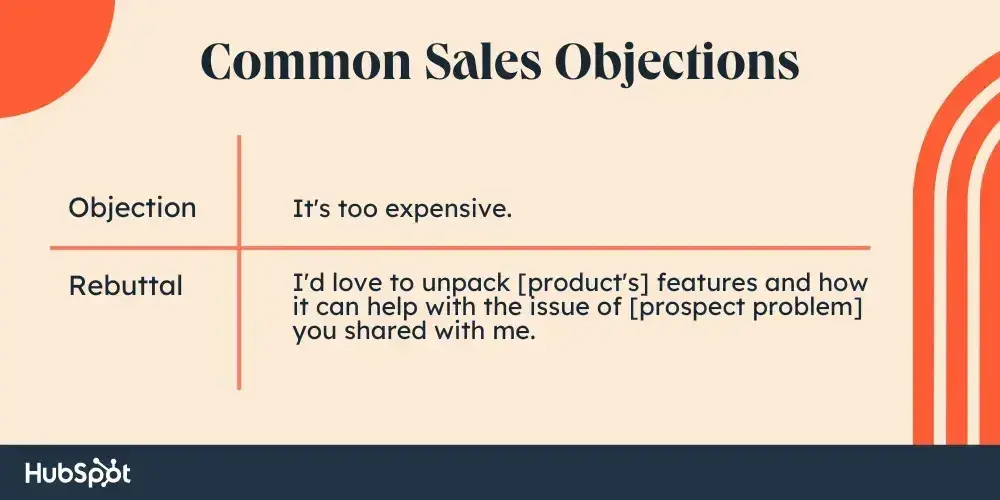
1. “It's too expensive.”
sales objections about price and budget

Price objections are the most common type of objection and are even voiced by prospects who have every intention of buying. Beware — the moment you start focusing on price as a selling point, you reduce yourself to a transactional middleman. Instead, circle back to the product's value.

Try responding this way:

“I‘d love to unpack [product’s] features and how it can help with the issue of [prospect problem] you shared with me. I can also share a case study of how another business in your industry [realized measurable ROI]”

2. “We don’t have the funds for this.”

It could be that your prospect‘s business simply isn’t big enough or generating enough cash right now to afford a product like yours. If the prospect has a strategic long-term upside offer to keep in touch. Monitor their growth and see how you can help your prospect get to a place where your offering would fit into their business.

Your company may have alternative financing, subscription tiers, or phased implementation models that may put your products or services in reach. A small-scale purchase may not be significant this quarter, but

Try responding this way:

“I understand. Allow me to explain our other offerings that may be a better fit for your current growth levels and budget.”

3. “We don't have any budget left this year.”

A variation of the “no money” objection, what your prospect’s telling you here is that they’re having cash flow issues. But if there's a pressing problem, it needs to get solved eventually. Either help your prospect secure a budget from executives to buy now or arrange a follow-up call for early in their next fiscal cycle when funds are being allocated.

Try responding this way:

“Let's schedule a follow-up call for when you expect funding to return. When do you think that may be?”

4. “We need to use that budget somewhere else.”

Prospects sometimes try to earmark resources for other uses. It's your job to make your product/service a priority that deserves budget allocation now. Share case studies of similar companies that have saved money, increased efficiency, or had a massive ROI with you.

Try responding this way:

“We had a customer with a similar issue, but by purchasing [product], they were actually able to increase their ROI and assign some of their new revenue to other parts of the budget.”

5. “I don't want to get locked into a long-term contract.”

A prospect with a genuine need and interest who balks at time-based contract terms is generally hesitant for cash flow reasons. In many cases, there are workarounds — find out if you can offer month-by-month or quarter-by-quarter payment instead of asking for a year or more commitment upfront.

Try responding this way:

“I understand. Let's talk about some different contract terms and payment schedules that I can offer you. Perhaps these would be a better fit.”

Sales Objections About the Competition

6. “We're already discussing this project with [Vendor X].”

sales objections about the competition

A prospect who’s already working with a competitor can be a gift. They’ve already recognized a need and identified a solution; much of the education you’d otherwise be responsible for has already been done. You can spend your time doing the one thing you’d have to hold off on with a prospect who hasn't recognized their pain yet — talk about your product.

Just because a prospect is working with a competitor doesn’t mean they’re happy with them. Probe into the relationship and pay special attention to complaints that could be solved with your product. Resist the urge to disparage the competitor. Instead, highlight your company’s strengths, product advantages, and service differentiators. Don’t say anything that could be damaging to your company’s reputation if it got back to the competitor. Be factual and respectful.

Try responding this way:

“Why did you choose [vendor]? What‘s working well? What’s not? Allow me to explain how [product] is different.”

7. “I'm locked into a contract with a competitor.”

This objection often seems like a deal-killer, but can be overcome if your sales leadership team is empowered to offer competitive upgrades. This objection is worded in a way that indicates your prospect's feeling of being trapped. See if you can come up with a creative discount to offset the cost of breaking a contract early, or demonstrate ROI that will make up for the sunk cost.

Of course, your prospect could have simply chosen an overly negative turn of phrase. Ask questions about their relationship with the competitor to determine whether they're actually happy or are itching for a vendor switch.

Try responding this way:

“How is your relationship with [competitor]? I can work with my manager to see if there is a way we can help ease the cost and effort involved to upgrading to our solution.”

In my experience: In software sales roles, I enjoyed positioning a migration from a competitive solution as an upgrade. Of course, it only worked if I could demonstrate how my solution was uniquely better for the prospect than their existing solution.

8. “I can get a cheaper version of your product somewhere else.”

Find out what you're dealing with here. Are you in a competitive situation, and the prospect is playing you against a competitor to drive up discounts? Or is your prospect under the impression that a similar, cheaper product can do everything they need? I often reminded the prospect of how the old adage “You get what you pay for” is usually true.

If it's the former, lay out your deepest discount and emphasize the features that make your product superior. Walk away if they ask you to go lower. In the second scenario, take advantage of the comparison. Play the differences up and emphasize overall worth, not cost.

Try responding this way:

“What are the points of differentiation between [product] and your other option? What gives you the most value and support?”

9. “I'm happy with [Competitor X].”

What if your prospect is happy? The same strategy still applies — find out why they believe their relationship with your competitor is beneficial, and identify vulnerabilities where you can build a business case for how your offerings can offer more value than their current provider.

Try responding this way:

“That‘s great. What components of the product or relationship are you most satisfied with? I’d love to learn more and see how we compare.”

10. “Competitor X says [false statement about your product].”

According to the creator of Your Sales MBA® Jeff Hoffman, when faced with a false statement from a competitor, salespeople should first respond with, "That's not true," then pause. Be prepared to explain how things really are, but don’t rush to do so. That could show weakness or uncertainty.

Hoffman says this reply will satisfy the buyer about 90% of the time, and they’ll be willing to move on. You’ll seem confident and collected, whereas your competitor will seem desperate and insecure.

If your prospect is still unsure, they'll ask another question. At that point, you can offer more background in your rebuttal.

Try responding this way:

“We manufacture our products in Canada, not Thailand. I have a map of our factories and distribution routes if you'd like to see it.”

Sales Objections About Authority or Ability to Buy

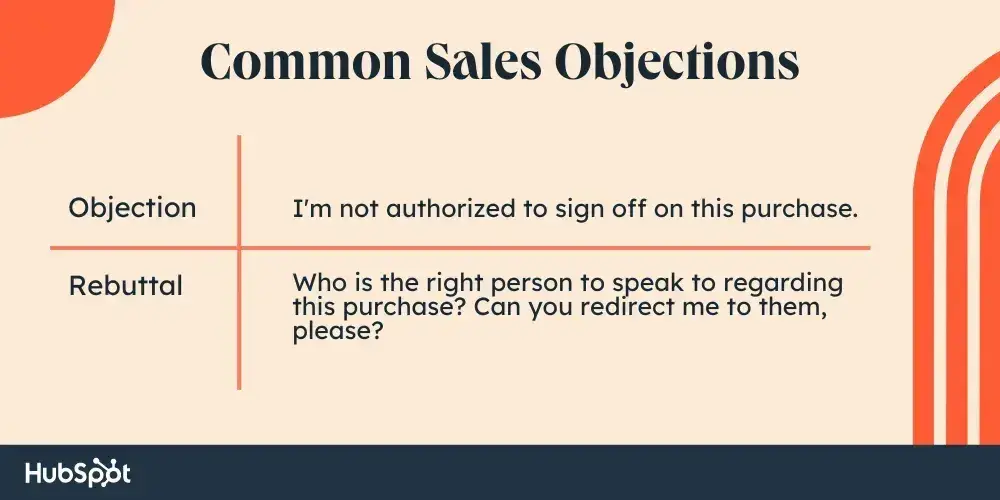
11. “I'm not authorized to sign off on this purchase.”
sales objections about authority or ability to buy

No problem. Ask your prospect the name of the right person to speak to, and then redirect your call to them.

Try responding this way:

“Who is the right person to speak to regarding this purchase? Can you redirect me to them, please?”

12. “I can't sell this internally.”

Well, your prospect might not be able to, but you can. After all, you sell your product every day. Ask your prospect what objections they anticipate, and help them prepare the business case for adopting your product.

I often wrote email and PowerPoint templates that I called “Business case in a box” that described my company’s unique sales proposition, success stories, and campaign offerings in a way that could be shared by my champion influencer. Relying on someone else to be your sales advocate in their own company is far from fool-proof, though, and I preferred to write the messaging to take the pressure off my point of contact.

Try responding this way:

“What objections do you think you'll face? Can I help you prepare the business case for when you speak with your decision-makers? I may have some enablement materials I can share to help.”

13. “[Economic buyer] isn't convinced.”

If you've already addressed objection #12 by providing internal selling advice and coaching, and your prospect can’t win over the decision maker or help you get access, it might be time to walk away. While it’s disappointing to give up on a prospect who’s on your side and just can’t convince the higher-ups, it’s also a waste of your time to keep butting heads with someone who will never see your product’s value.

Try responding this way:

“That‘s too bad. If anything changes, please don’t hesitate to contact me. I'd love to help you get your team onboard.”

14. “We're being downsized/bought out.”

This happens rarely, but there’s usually nothing you can do when a company is enduring a lot of internal turmoil, as buying processes are often postponed indefinitely. Wrap the relationship professionally so that when the dust settles (or the prospect finds a new gig) they’ll be more likely to restart the conversation. Albeit possibly from a new company, mind you.

Try responding this way:

“Thank you for your time and for speaking with me regarding this product. If you‘re ever in need of [product or service], please don’t hesitate to contact me.”

15. “There's too much going on right now.”

Ask your prospect to define their competing priorities for you. If they can’t, it’s likely a brush-off, and you should press them on precisely why they don't want to engage with you.

If they can offer concrete answers, don‘t sweat it. Set a meeting time for a follow-up and send over helpful resources in the meantime to stay on your prospect’s radar. Or, take a bolder step if you can, and be prepared to explain why waiting for next quarter, next month, or next year might cost the customer in the long run. Can they really afford to put off addressing the business need that was the catalyst for the conversation in the first place?

Try responding this way:

“I understand. What are some of your competing priorities? I'd love to schedule a follow-up call for when your calendar clears up.”

16. “I'm part of a buying group.”

Buying groups enable independent companies to team up and make joint purchases from vendors — usually getting a far better price than they'd be able to secure on their own. (I just completed a proposal to qualify for a significant North American buying group, so I know this can be a significant obstacle.)

If your company isn‘t on a prospect’s list of approved suppliers. You may be able to win them over by matching the cost and delivery terms of the buying group contract, but that may erode your profit margins, so be sure to discuss this scenario with your management team.

Respond to this objection by delving into the details of their membership. When you’ve learned more, you can decide whether it makes economic sense for this prospect to work with you — and if there’s an opportunity to become one of their buying group's vendors.

Try responding this way:

“Are there limits on whom you can buy from? What price are you currently receiving? What companies belong to your buying coalition?”

Sales Objections About Need and Fit

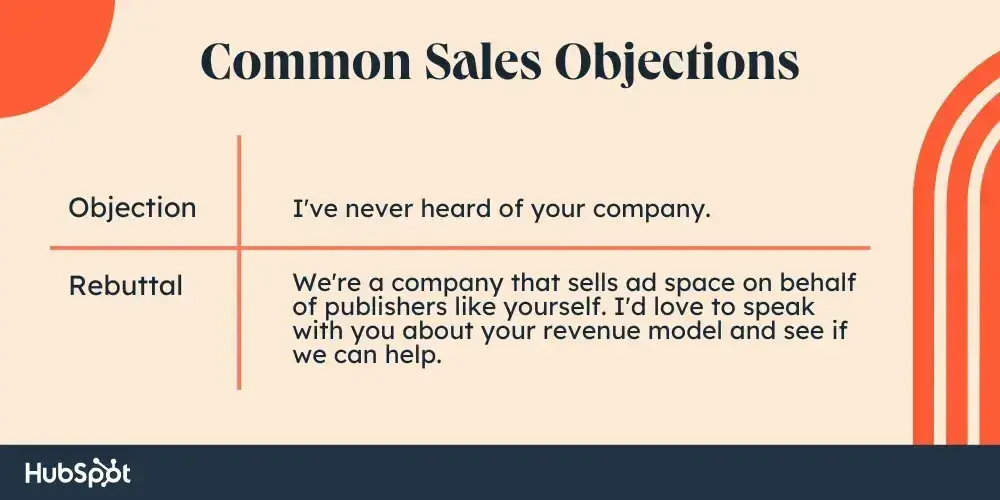
17. “I've never heard of your company.”
sales objections about need and fit

Treat this objection as a request for information. Don't give an elevator pitch, but offer a quick summary of your value proposition.

Try responding this way:

“We‘re a company that sells ad space on behalf of publishers like yourself. I’d love to speak with you about your revenue model and see if we can help.”

18. “We're doing great in X area.”

If you hear this objection, ask a few more clarifying questions and do a little more qualification.

Try responding this way:

“What are your goals? How much progress has been made?”

19. “Our business doesn’t experience the challenges you describe.”

This objection is often raised as a brush-off, or because prospects haven’t realized they’re experiencing a certain problem yet. Ultimately, you might discover they really don’t need your product or service, but don’t take this objection at face value.

Try responding this way:

“Interesting. Do you have any business goals or challenges that you are struggling to address that I might be able to help you with?”

20. “X problem isn't important right now.”

Sometimes, a simple “Oh?” will be enough for your prospect to start talking. Listen closely for real reasons the need has low priority versus platitudes. Keep in mind that excuses can be a sign that your prospect understands they have a problem and is trying to rationalize their inaction. Capitalize on this and instill a sense of urgency.

Try responding this way:

“Tell me more about that. What are your current priorities?”

21. “I don't see what your product could do for me.”

Another request for information packaged as an objection. Reconfirm the goals or challenges you've discussed and explain how your product can solve specific problems.

Try responding this way:

“Interesting. Can you share what specific challenges you're facing right now? Perhaps [product] presents a solution we have yet to discuss.”

22. “I don't understand your product.”

If your prospect literally can’t wrap their head around your product, that’s a bad sign. If your product is particularly complicated or specialized, it may be time to disqualify your prospect, lest they churn two months from now.

Don’t give up immediately, though. Ask your prospect what aspects of your product they’re unclear on, then try explaining it in a different way. Alternatively, bring in a technician or product engineer to answer questions out of your depth. Make sure you aren’t using any business jargon, acronyms, or complex wording that might make your pitch unclear to the uninitiated.

Try responding this way:

“What aspects of the product are confusing to you? I'd love to connect you to a customer success technician or product engineer to help you better understand how we can help you.”

23. “I've heard complaints about you from [company].”

Word-of-mouth reviews are powerful, which can be both a blessing and a curse. Rather than defending your solution, business, or brand — which will only validate the criticism — thank them for sharing the feedback with you. Then, follow up with an offer to add value.

This gives you an opportunity to establish credibility and trust with your prospect. Once you‘ve given them a positive experience, they’ll naturally form a high opinion of you.

Try responding this way:

“Thanks for sharing that feedback with me. I‘ll pass it along to [relevant department]. While we’re on the phone, would you be interested in hearing a few tips for improving your average invoicing turnaround time?”

24. “We don't have the capacity to implement the product.”

This objection can be a deal-killing roadblock. Depending on what product you sell, it’s possible your prospect will have to add headcount or divert resources to fully take advantage of your offering, and if they truly aren’t able to, you might have to disqualify them. Do you have any services that can help them add implementation capacity and help them realize measurable results at costs they can justify without hiring additional staff?

Try responding this way:

“I hear you, and I want [product] to add value, not become a burden. What are your current day-to-day responsibilities in your job? I'd love to explain how [the product], once onboarded, can alleviate some of those problems without requiring additional staff overhead or being a resource drain.”

25. “Your product is too complicated.”

Find out if your prospect is confused about specific features or if the product is indeed over their head. If it’s the latter, you might have to disqualify that lead. But if it’s the former, remind your prospect that they’ll have help from your customer service team should they choose to buy and that you’ll be on hand to answer any implementation questions they have.

Try responding this way:

“What features are confusing to you? Our customer success team can help you tailor the user experience to the way you do business. Our support services will be available around the clock to help with implementation and beyond.”

26. “You don't understand my challenges. I need help with Y, not X.”

It‘s crucial to make your prospect feel heard. Restate your impression of their situation, then align with your prospect’s take and move forward from there. A lot of misunderstandings and hard feelings can be resolved simply by rephrasing your prospect's words.

Try responding this way:

“Sorry I got that wrong. Would you allow me to restate my understanding of your challenges, and correct me again if I'm still missing or misstating anything that’s important to you? I assure you that I will make it worth your time.”

27. “You don't understand my business.”

If you sell to a specific industry, chances are you know a bit about the challenges and priorities your prospect's business is likely faced with. Let them know that you have experience working with similar companies and have solved similar problems in the past.

If you simply made an incorrect assumption about your prospect’s company or industry, don’t be afraid to own up to it. Your prospects will appreciate your candor.

Try responding this way:

“Sorry — I assumed X was true, but it looks like that doesn't apply to your business. Can you tell me a little more about how it works for your business?”

28. “Your product doesn't have X feature, and we need it.”

Try suggesting a supplementary product that can be used in conjunction with yours. But if that specific need is a must-have and your product can't solve it, your prospect might not be a good fit. Time to disqualify and move along to a better-fit opportunity.

Try responding this way:

“Have you checked out [partner or conjoining product]? It's a good fit with ours and can be used alongside it to solve for Y.”

29. “We're happy the way things are.”

Maybe everything really is going swimmingly. But more likely, your prospect is having some sort of challenge (after all, who isn’t?). Do some light qualification to determine if they’re facing any problems you can solve, then move forward or disqualify them based on their answers.

Try responding this way:

“That‘s great! Can you tell me how you’re currently solving for X?”

30. “I don't see the potential for ROI.”

This is a sign that you'll have to prepare a formal pitch for either your contact or their managers, either using internal numbers from your prospect or customer case studies. Nothing sells quite like hard numbers.

Try responding this way:

“I‘d love to show you. Can we schedule a time for me to explain our product’s potential to deliver a high ROI to you and your team?”

31. “X is just a fad.”

You might hear this objection if your product pioneers a concept that’s new to your prospect’s industry. For example, social media is now widely accepted as a necessary part of a sound business strategy, but seven years ago, many would have scoffed at it.

Now is the time to pull out any testimonials or customer case studies you have to prove the ROI of your product. If you’re pioneering a new concept or practice, you’ll have to show that it works.

Try responding this way:

“I understand why you may think that. Let‘s schedule a time for me to walk through how our product helped some other businesses like yours find success with X — and why it’s here to stay.”

32. “Your product doesn't work with our current [tools, set-up].”

common sales objections example

This objection can be a deal-breaker if the buyer is committed to their existing solutions. But sometimes, your product will replace these tools or make them obsolete. A workaround may be possible as well.

To find out, ask some questions.

Try responding this way:

“Which tools are you currently using? How integral are those tools to your [strategy]? What do you like and dislike about your existing platform?”

33. “Your product sounds great, but I'm too swamped right now to handle [implementation, roll-out].”

Prospects are often put off by the effort required to switch products, even if the ROI is substantial.

To empathize with them, prove that you're trustworthy, and ensure they do have the bandwidth. Next, combat their reluctance to change by digging into the costs or pains of their current situation.

Calculate what they stand to gain — in time, efficiency, money, or all of the above.

Try responding this way:

“I understand. It typically takes our customers [X days/weeks] to get fully up and running with [product]. How many minutes a day do you spend on [task]?”

Sales Objections That Are Actually Brush-Offs

34. “*Click.*”

If your prospect hangs up on you, don't sweat it — it happens to everyone eventually. Try reaching out to a different person at the company using a different approach.

Or you can go on the offensive. Wait a few seconds, then call back. Which approach you choose is purely dependent on how your conversation with your prospect went before the hang-up.

Try responding this way:

“Sorry, looks like we got disconnected! Do you have a few minutes?”

35. “I'm busy right now.”

Of course your prospect is busy — almost every professional is these days. Simply explain that you're not looking for a full-blown conversation, just a quick chat about whether or not a longer discussion about your product would be a good fit at their organization.

Try responding this way:

“I don't want to take up too much of your time. Can we have a quick chat about your challenges with X and how [product] may help?”

36. “I'm not interested.”

During a prospecting call, it’s far too early for a prospect to be able to definitively say they are or aren’t interested in your product.

Try responding this way:

I liked to respond with, “Some of our clients weren’t initially interested either, but when I showed them they could realize (X benefit), they changed their mind. Can your business afford to pass up on this opportunity without taking some time to explore the possibilities?”

37. “Just send me some information.”

common sales objection example

This is a great opportunity to segue into some qualification questions.

Try responding this way:

“I‘d be happy to send you some materials, but I want to make sure that they’re relevant to you. What are you interested in learning about?”

38. “Call me back next quarter.”

Prospects will often say this to dissuade you from pursuing a conversation. But don‘t let them off that easily — it’s a vague brush-off uttered in the hopes you'll fade away and disappear. Ask some questions to find out their motivations for brushing you off.

Try responding this way:

“I‘ll touch base next quarter. Before we hang up, I’d love to get a sense of how your next quarter will go. Do you feel you'll get the go-ahead from your superiors?”

39. “How did you get my information?”

Hopefully, you‘re not pulling numbers from lists you got off the internet — because if you are, your prospects have every reason to be annoyed.

Don’t get defensive — simply remind the prospect that they filled out a form on your site, or signed up for more information at a trade show, or that you simply came across their website and wanted to connect to see if you could help.

Try responding this way:

“I came across your website in my research and believe that [product] would be a great fit for you.”

40. “I hate you.”

Generally, prospects won‘t actually come right out and say this, but if you and your prospect really just don't get along, consider handing them off to a colleague, lest your company lose the deal for good. The upside? This objection has nothing to do with your product or its value.

Try responding this way:

“I'm sorry you feel that way. Can I introduce you to my colleague [name] to continue the conversation? She is very knowledgeable about how businesses like yours can [overcome the kinds of challenges/achieve the goals] that we discussed, and she has great relationships with executives like yourself.”

If the prospect isn’t willing to work with your colleague, their underlying objection is really not about you. Talk to your manager or colleagues about the best way forward.

41. “I'm not responsible for making these decisions.”

This common objection signals that a prospect doesn’t have (or doesn’t believe they have) the authority to discuss their company’s business challenges. Nor do they want to get involved in a sales cycle where they feel pressured to make decisions above their pay grade.

Try responding this way:

“Thanks [Name], for letting me know that you don’t have decision-making authority pertaining to purchasing decisions. Who on your team handles these types of decisions? Can you introduce me to them, or could you and I have a preliminary, no-pressure conversation? I think [solution] could help your team [achieve a defined benefit] by partnering with my company.

42. “Does your product do X, Y, and Z?”

This is one of the most common obstacles that prevent an SDR from converting the lead to an SQL. The good news is this generally means the prospect is interested. Use this opportunity to end the conversation on a good note and set up another appointment to discuss it.

Try responding this way:

“I am glad you asked that. I think it will be helpful to set up a time when we can answer this question and others with a specialist. When is a good day and time for us to talk?”

43. “Sorry, I have to cancel. I'll get back to you with a better time.”

People don't like to say “No” — and that includes your prospects. This manifests in ghosting, procrastination, and asking for more time.

Sales Pro Mike Rogewitz swears by Sandler's Negative Reverse Selling strategy to overcome tricky non-objection objections like these. “You want to call out your prospect‘s lack of interest and get them to admit the answer is ’No' without going too negative,” says Rogewitz.

Try responding this way:

“Typically, when someone cancels and says they‘ll get back to me, it means they’re just not interested in what I have to offer right now. Is it fair for me to assume that's the case?”

44. “Hello, you‘ve reached [Prospect’s Name] ... ”

Does your prospect avoid your phone calls like the plague? Do they take a while to get back to you and always need approval? Do they give vague answers when you ask about budget and priorities for the year?

If you answered “Yes” to any of these questions, you might be speaking with an individual contributor. They’re usually not as comfortable talking on the phone as managers or decision-makers, they need a lot of internal approval, and they aren’t privy to important budgetary information or company-wide priorities.

It’s important to gain the gatekeeper’s trust and learn as much as you can from them, but then you need to move on and build relationships with the people in the company who can actually choose your product or service.

Try responding this way:
  • “Have you ever purchased this type of product or service before?”
  • “Who will be in charge of this buying process?”
  • “Who else should we bring on board for this conversation?”

Objection Handling Training

If you want to improve your team’s objection-handling skills, consider sales training programs or guides. Here are a few objection-handling training programs to give your sales team a leg up.

1. HubSpot’s Objection Handling Templates

This free guide goes over the why and how behind objection handling. Not only does it explain data-backed behaviors top sellers use to push back with buyers, but it also includes scripts for how to handle the most common sales objections, and these templates offer a goldmine of sales expertise.

2. Sell It

Founded by one of the top real estate agents in the country, Ryan Serhant, Sell It is a sales training and membership platform. You don’t need to be in real estate to benefit from the sales lessons shared on the platform. The resources are geared toward all types of business owners and entrepreneurs — anyone who sells, which applies to many professionals.

3. Challenger

Research shows that 38% of B2B purchases end up in no decision. That’s where Challenger can help. Challenger is an online sales training program that offers courses and playbooks for every step of the sales process. Sales teams can tap into the platform’s B2B expertise for objection handling training and more skills that they can apply to real-life deals.

When an Objection is a Firm “No”

Some prospects won’t give you a chance to explain the value that you can provide. They are too busy and have too little faith in the hordes of SDRs and sales reps that contact them on a daily basis. This means as a salesperson, you have to be creatively persistent. Suggest ways of continuing the dialog at a time that works

That said, at a certain point, “no” means “no.” The responses to the common objections above give you a way to pierce through the reactionary objections prospects give without thinking. If you or your sales team overcome all of a prospect’s objections and they still aren’t willing to invest their time with you, it’s sign they’re a poor fit.

Rule of thumb: If the prospect says an objection twice, it's real. No means no.

Overcoming Objections Can Become Your Best Sales Skill

As a sales professional, you’ll hear “no” a lot more than you hear “yes” —but overcoming a no can be more fun than an easy yes. Every no is a step toward helping prospects realize opportunities they never knew existed, and solving problems with your products or services.

Objection handling helps you learn how to get to the root of your prospects’ issues. With a little assistance, you can lead with empathy and understand where most objections are coming from. If you read these interactions right, you’ll be in a good position to handle any objection that comes up.

Editor's note: This post was originally published in September 2015 and has been updated for comprehensiveness.

28 Sep 17:14

Are eBooks Really Dying?

by ameeditor
There’s been a lot of noise out there recently around eBook sales lagging behind print and already several news outlets are heralding the return of the print book.

Candidly I’m not sure it was ever dead.

I seem to recall a few years back we were discussing the end of print books with the same, solemn predictions: print is dead, long live digital! This of course was much to the chagrin of bookstores everywhere who were scrambling to keep up. That said, there is some merit to this news only in that eBooks buyers are super price sensitive. We talked about book pricing being crucial to your book success in a newsletter update and blog post we did a few weeks ago, you can see it here: http://www.amarketingexpert.com/are-you-pricing-your-book-too-high/.

Are eBooks Really DyingMy take, in general, is that eBooks were bound to wane. With eReaders proliferating the market it was a hot new thing but eventually, things are going to even out. However, I do think that much of this news has come from the traditional publishing side, which has always had challenges trying to figure out their eBook strategies.  The other piece of this, the authors who go direct to eBook via Amazon’s KDP program. They are given an ASIN number, not an ISBN number and are really impossible to track. So when we talk about eBook sales waning, I think we’re really a far cry from having remotely accurate data to proclaim this as fact.

Do you Know What Your Audience Wants?
I do think the news around the decline of eBooks brings with it other issues, one being that eBooks in your genre might not be doing so well. Do eBook lovers favor one genre over another? I would say that is 100% accurate. But now the bigger question is this: do you know what your buyer favors? If you don’t, or if you’re second-guessing yourself just by reading this article, it’s time to do some critical thinking.

First and foremost, unless you want to hire a big market research team to uncover your particular audiences’ preferences, you’ll have to do a bit of this sleuthing on your own and the first piece of this might be to check Amazon. What are other, similar books doing in your genre and – even more specific – how do the sales ranks differ from the print book to the eBook? Let’s start by saying that you’ll have to look at a couple dozen books to get an average and here’s why: there are a variety of mitigating factors to eBook vs. print sales. Genre being the first and, obviously your focus, second is pricing – eBook buyers are price sensitive and if your eBook is only $2 cheaper than your print, many will opt for print especially if they’re getting free shipping via Amazon Prime. So just do a comparison of some of your top competitors and see what really seems to be moving.

Second, you could always ask your market by doing a survey – this works really well if you have a mailing list that you can target. The other factor is age. So while we may think that the Young Adult audience is all about digital this is shockingly not true. Many Young Adult readers are gravitating to print over digital. I also see a lot of older readers who prefer digital because they can adjust the font size and don’t have to wait for a “large print edition” which may or may not be offered.

I find, in general that Genre Fiction does well in eBooks, better in fact than in print largely due to the fact that these readers read so much of it – it’s a better use of their money.

The other issue to consider is the keepsake factor. Is your book a keepsake? Because if it is, you’ll find that more people will prefer the print version instead of the eBook. Often Children’s books fall into this category. Contemporary Fiction, generally not so much. If you have a coffee table book or some other picture book, something you really don’t envision your buyer just handing off to a friend, you may be better off pushing your print book – and spending less time on your digital version.


Do you know what your audience wants? @Bookgal talks about it!
Click To Tweet


Give Them More of What They Want
When you finally settle on what your reader prefers it’s time to up the ante when it comes to reaching them with their desired format. To do this you’ll want to keep your eye on the book price point first and foremost. Also, consider when you do contests or anything else in conjunction with promotion that you offer the most favorable format to your readers and/or give them options (because this is also a good way to test reader format preferences).

Enhancing books – beyond enhanced eBooks
If you’ve found your reader’s sweet spot in terms of preferred format, it’s time to give them more of what they want: enhance your book! Keep in mind that any book can be enhanced. We’ve all heard of enhanced eBooks with links out to supplemental content but you can do the same with a print book and with an audio book. For example, you could add reader discussion points to the book, or supplemental content like bonus chapters, behind the scenes chapters, song lists, virtually anything. We’ll look at more of these enhancements in future pieces but for now, consider this: if you can over deliver on your book, you’ll not only make a sale to your existing reader but word of mouth could help you outsell even your greatest expectations.

At the end of the day, only we, the author, can determine what’s working for us and what isn’t. I tend to use these news items as thought points for bigger ideas. A lot of authors reading the NYT piece might panic and pull back from their digital promotions. Think before you act on any news and, in the end, follow YOUR reader – not the news. Only then will you find bigger sales.


Are eBooks Really Dying? @Bookgal shares her take!
Click To Tweet


The news piece referenced: http://mobile.nytimes.com/comments/2015/09/23/business/media/the-plot-twist-e-book-sales-slip-and-print-is-far-from-dead.html

28 Sep 17:14

3 Easy Ways To Book Phone Appointments Through Email

by Daniel Faggella

Today I’m going to show you a “funnel” that’s not really a funnel at all. By that I mean, everybody in the marketplace today is RAVING about “sales funnel” this and “sales funnel” that… when really, a sales funnel is nothing new and nothing special.

They’ve been around since the days of cavemen. When you combine intrigue, with a dash of scarcity, you have the basis of what humans have been using to trade and sell stuff for… well, forever.

A “funnel” is really just a series of events, combined to form a system that can take a person from POINT A, all the way to POINT D, E or F… and can you guess how said system does this?

By Taking Them Through Point B, C, D, E, F,
And All That Is In Between

I say this at the risk of sounding too simplistic, but it’s true. A good funnel is simply a well thought-through, finely executed process… and they are easier to construct than you might think. Here is what I’m going to cover for you in this article:

  • How to identify what your prospects need in order to buy from you
  • How to systematically deliver said need so that they trust you and buy from you
  • My secret weapon, the advantage that few (if any) in my field of expertise know how to use to attract and close sales (and why you should learn it ASAP)

Let us begin.

Identifying What Your Prospects Need In Order To Buy

I want you to picture in your mind’s eye, you are standing in front of a great, giant… white board.

Now write up on that giant white board everything about your product that is awesome. Go ahead and do it (mentally)… this is going to make sense here in a bit. Write down every advantage, benefit, feature, little secret competition crusher… all that you are proud of about what it is you sell.

Now… once you’ve done so, I want you to imagine a giant red marker. Go up to the whiteboard… draw a giant X across it, and in the bottom right hand corner of the white board, write these words:

Nobody Cares

Ahh… I love marketing.

Here is the real truth of the matter: your prospects care about themselves. And they only care about your product to the extent that it amplifies their own dreams, desires, and goals.

If you want to create marketing that can make you uninhibitedly wealthy, read that sentence over and over again until it’s imprinted into your brain. Your prospects only care about ONE THING: themselves.

Therefore, it is the sole job of your marketing to reverse engineer the things your prospect must believe in order to buy from you.

And the most important thing they must believe, in fact, above all else, is this: your prospects must believe that they can trust you.

Imagine, all of the times that your prospects have been burned, abused and lied to. They’ve bought products that were misrepresented or promised results that were not delivered. Think of all the times you’ve been lied to or “conned” into buying an inferior product or service. How did it feel?

Now, pile it up on one side of the scale… quite heavy. Here’s the point: everything you do in your marketing system must act as a counterbalance to the mistrust that is piled up on the other side of this scale.

Quite frankly, I’ve found the best way to reverse engineer these things is simply to talk to your customers. (I’ll rap about this towards the end of this article, but for now, know that trust is the name of the game… and that is what really must be delivered to win the sale)

Okay, next…

How To Systematically Deliver Trust To Your Prospects

As we’ve discussed, a good marketing funnel is nothing more than a well-executed system

Let’s think about the kinds of systems we use and work with on a consistent basis. Your vehicle is a combination of systems working in tandem to produce a desired result (movement). Your body is an incredible system.

Systems can be broken… maintained… modified & improved… optimized. So it is with your marketing. In fact, one of the things we do at CLVboost is methodically (and ruthlessly) optimize and improve the output of our clients’ marketing systems.

The goal of a good system is to increase the ratio of effort to results. More results, less effort. The transition from the horse and buggy? Was an increased ratio of effort to results. Same with a car to an airplane… less time (effort), more speed and faster destination (results). The upshifting of a car = fewer RPMs, more speed.

This is a law of the universe, and it’s found everywhere.

Your job as a marketer is to constantly be improving the results that come from your efforts. Luckily, one of the best ways to do this is through effective email marketing. Email marketing is a system.

Back in the day, you had to sell one-to-one. Going door to door, selling tupperware… then, a wise guy had the idea to send out a bunch of letters… effectively selling to the entire neighborhood at once. We’ve advanced to the point where you can push one button and talk to hundreds of thousands of people at the same time…

And if you write your emails from the viewpoint of our first lesson (trust, trust, trust), you will see noticeably better results than any of your competition – who are all just trying to sell stuff with no regard to the customer’s fears or past experiences. With that said, one of the most lucrative forms of selling is mixing mediums… and in this particular case, I’m talking about phone sales.

This implies email campaigns that are persistent in the same creative way that real sales people are persistent (see my previous tutorial video on Sales-Driving email marketing here).

You’ve heard of “offline to online,” right? It just means taking your prospects through a series of marketing messages that they receive and process in different ways… (i.e. sending them an email that books them into a phone appointment). This can be a very sustainable way to sell high price point products or services. Or just a steady way to generate rapid trust from the people you serve. People want to be talked to, personally and in a custom fashion. No better way than using a good old fashioned telephone to do so.

Three Easy Ways To Generate Appointments Through Email

1) Tell them what to do… and promise to show them how if they book an appointment.

Yes, this works even if you are selling products… it works by eliciting a buyers’ curiosity and trust… trust because you’ve just taught them something. And curiosity because you didn’t tell them everything. See how that works?

Here’s an example. Let’s pretend you sell high-end tennis rackets. Your messaging (via email) might look like this:

“You should be using your wrist – more than any other part of the body – to determine the precise type of spin necessary to just clip over the net… making it extremely difficult for a return to be made. Now, there are really just two things you’ve got to focus on specifically in the way you use your wrist to do this…

I’d be happy to walk you through both of them, but not here. For the first 10 people who go here (insert link to calendar), I’ll show you my proprietary X METHOD, that combines two common wrist approaches to give you the baddest serves in the market… “

Then, when you’re on the phone with them, one of the things you tell them they’ve got to focus on is making sure their rackets are made the right way to be able to accommodate their particular style of serving… (I’m making this up on the fly, if you can’t tell)

You “hook” it into selling your tennis rackets… but, notice, it all started with the email. Telling them what to do, but not how.

There’s been plenty of talk about why sales people should stop cold calling, and if done correctly, email can pre-frame a phone appointment to be an opportunity to add value to the prospect – as opposed to annoying them.

2) Stack a bonus

I’ll tell you this… there are only two ways to drive urgency and scarcity in your marketing. The first, is by using discounts. Something I’d recommend you only do sparingly. It drives the wrong psychology behind why people are buying your “thing.” But the second, is by using bonuses. And this, is perfectly acceptable.

What you do is this: come up with something special you don’t often do or include with purchase, and send an email saying something like this:

We’re running a special deal on X… and if you buy within the next 3 days, not only will you get X product… you will also get Y & Z products / services absolutely free included with your order. To find out more, talk with one of our service specialists by calling here.”

Now, let’s break apart this psychology a bit. Notice, you are using the phrase “special deal,” but you’re not using a discount. So your cheapies or freebie seekers aren’t going to be drawn to this. But anybody who might be “on the line” is going to jump at this. And that’s what you really want.

Finally:

3) DON’T CALL YOUR SALES PEOPLE “SALES PEOPLE”

Sheesh. Listen… people hate – no, disdain and abhor – being “sold to.” I don’t ever say, “Call here to speak with one of our sales specialists.”

Dumbest move in the book… because people are naturally untrusting of sales professionals. They want to be helped, served, and cared for. So the name you give your phone appointments is important. In the last article (link) we talked about avoiding the “Google slap,” and that’s similar to what you’re going to do here… give these appointments a NAME…

For instance, if you sell jewelry, and are sending an email during the month of Valentine’s day… you could use it like such:

“Need a special idea to woo your significant other this Valentine’s day? Speak with one of our romantic events coordinators, we’ll help you plan it and make it happen… It’s free, just call here.”

Of course, everybody wants to look good for their significant other, so why not get professional (and FREE) help, at least grab some ideas. And on the phone, you and I know, one of the best ways to woo your partner is by getting them expensive jewelry.

The point here is this: you aren’t positioning it as a sales call. You are offering value, and the sale will flow out of that. This will drive more conversations than just saying “Call me to find out how to order.”

Close

Let’s recap:

First, understanding the psychology of driving sales conversions is important.

Don’t underestimate the amount of trust you must generate (consistently) in order to create “sales on demand.” This will take time. And often you will need to do the right things before seeing the right results. Keep that in mind…

Second, it’s all about systems.

Don’t get caught thinking small here. Set aside some time (minimum of an hour a week) to focus on your systems… if there are places of leverage you are missing out on, find them and address them.

Third, three easy ways to use email to drive more phone appointments and, thus, more sales.

I use these three all the time… and it’s a wonderful and magical experience when you can send an email and book out your sales department just minutes after.

In the comments below, tell me what you think about this. And give me your plans on implementing. All the knowledge in the world does NO GOOD without a good plan for implementation. I’ll read and respond to everyone.

28 Sep 17:12

New to Selling? 10 Tactical Sales Tips to Get You Started

by jeff@kulapartners.com (Jeff White)

Editor's note: This post originally appeared on HubSpot's Insiders Blog. For more content like this, subscribe to Marketing.

If you can’t sell, you can’t survive as a business. Period.

The following blog post is a summary of my talk from Podcamp Halifax 2014. As you can see from a SlideShare we put together, I have attempted to relate these sales tips to some of TV and film’s most greasy salespeople. Most people hate these guys, and as human beings, they generally suck, but I have a theory that people who hate sales often tend to be doers and makers.

And if your only exposure to sales people are these guys, or worse yet, a bad car salesmen, you tend to think that in order to be good at sales, you have to be a greasy, conceited slimeball. But the truth is, even these slimy over-confident jerks can teach us something.

1) It’s time to get over your fear of asking for what you’re really worth. Never apologize.

One of my partner Carman’s favourite phrases is: Can’t sell to me, can’t sell for me. We frequently use it to remind ourselves of what we’re really doing when we’re heading into a closing meeting. We want the business, and we want that client to know how and when and why we’re going to deliver exactly what we say we can deliver. Convincing your prospect that you’re the right choice allows them to see how you’ll help them close more business.

If something costs more, we often value it more highly. I get that some people will always see a price as exorbitant and think things should be cheaper, but just like with wine: in your mind, a $25 bottle of wine tastes better than a $13 bottle of wine. Wouldn’t you rather work for the client who truly believes that spending $20k on a website will net a better result than a $5k website? Now, live up to what you promised and do a kick ass job worthy of what you’re being paid.

A number of the businesses I’ve mentored over the years have had a line in their business plan that goes something like: because we’ll have lower overhead, we can afford to charge less than our competitors. If your value proposition is that you can do what I do for cheaper, you’re just racing to the bottom. and the problem is, you just might win.

2) Give yourself a revenue/sales target to work toward. Then, measure it.

Your target can be based on any number of things. It could be based on your desired monthly income. It could be related to what you need to sell in order to buy a new camera, computer or other piece of equipment that will allow you to scale your business. It could be a revenue target that finally allows you to hire that second or third pair of hands.

When you hit your target, evaluate how you were able to deliver on those projects. If you miss, figure out why. Can you be more efficient? Did anything really stand out as a vertical that you excel in? Maybe there are more companies in that vertical who could use your services? Know anyone at any of these companies? Add them to your lead workflow to try to get a meeting with them.

3) Set aside time every week to follow up on sales leads.

Salespeople use a process of lead generation, nurturing and followup to attempt to close new business. At Kula, we use inbound marketing and HubSpot’s software to attract, convert, nurture and close leads and turn them into customers. A lead, in the purest sense of the word is anyone who has expressed interest in what you sell, either by raising their hand and filling out a form on your website or by contacting you through a referral or third party.

Leads are often referred to by temperature ratings. A warm lead is someone that a colleague may have introduced you to who is presently in the market to purchase your services. A hot lead is someone who has contacted you directly and expressed interest in buying. A cold lead is someone you’ve never met or someone who may not know that they need what you’re selling. Obviously, the warmer the lead, the more focus that should be applied to trying to close them.

4) Maintain a weighted sales funnel.

Selling well requires the tracking of leads and ranking the potential of a lead to close. All good sales people maintain what’s called a sales funnel, basically a list of all of the potential work that’s coming down the pipe. Some store this information in a cloud-based paid CRM (customer relationship management) like Salesforce or Highrise or free tools like HubSpot CRM. Others keep a running spreadsheet, and some just keep a record on paper.

So what’s a weighted funnel? Let’s say you have three potential projects in your funnel. One is worth $10,000, another $5,000 and the last is worth $1,000. So, you have $16,000 in potential business, right? Unfortunately, no. Chances are, you won’t win all of this business, and the next $16,000 you earn may come from a completely different set of projects. So how do you calculate the actual value?

The $10k project is with a friend of a friend. They’ve only interviewed a couple of firms and are planning to make a decision quickly. Your initial meeting went well, but you are missing one key bit of experience that they need, although you’re pretty sure you have a partner who can help fill the role. You might rate this lead a 50%, you’ve got a good warm connection, but they’re a tiny bit concerned about your ability to deliver. You’re pretty sure you can convince them otherwise. That means this job is only worth $5k in a weighted sales funnel.

The $5,000 project is with a not for profit that sent out an RFP. You’ve done some work in this space, but $5k isn’t a lot of money for what they need, so you’re not that hot on it. Plus, you’ve never heard of the organization and you don’t know anyone there, you just found the RFP on the net. You might only rate this one 10% due to your concerns and your lack of connectivity. Still, you could go after it if you don’t have many other leads to work. $500 for this one.

The $1k is a small project for a friend of your dad’s, and it’s a slam dunk. Still, nothing’s certain in this life, so rate it at 75% and close it as quickly as possible.

So despite the fact that there’s $16,000 in total dollars on the line, if you’ve been realistic in your weighting (and I encourage you to be conservative), you actually only have $6,250 in business that you can work to land in the next month. Of course, there will be new projects that come up as well, but it often works out that the business you do land will fit within this weighted funnel number.

Once you’ve been doing a certain volume of business, you’ll begin to see some patterns and get better at estimating the value. You should keep this funnel up to date and use the intelligence you gain when you lose and win work to help shape what work you go after.

5) If you’re only finding out about an RFP when it hits the street, you likely won’t win it.

RFPs are often the bane of the small business existence. The biggest problem is that while the entire purpose of an RFP is to provide a fair and equitable competitive environment, people are still very likely to do work with people they know and like. On occasion, RFPs are structured so that they may fit one particular firm’s offering better than others. It’s hard to make a living as a small business doing only work that comes out via RFP, that’s why referrals and generating inbound leads are so important.

So how do you get inside? Meet people. Get out to networking events. Follow people you admire on Twitter whether they’re a competitor, a prospect or potential mentor.

Talk to your elders. People who are successful are well-connected. Most of them are pretty cool too, and would be more than happy to introduce you to someone. You can always ask someone you know in common to introduce you to another business person. Ask for a coffee or beer meeting—keep it casual. Don’t make the whole meeting about you. Learn what made them successful, ask lots of questions. You never know what could come out of it.

One thing to remember about this approach: it’s a long play, and won’t likely garner results for quite some time. If you have more immediate leads, close those first. Having coffee with dozens of people isn’t work, so don’t get too carried away.

6) Learn how to sell more of your services to existing customers. Get a bigger share of their wallet.

When you’ve landed a client and completed a project with them, you’ve hopefully earned their trust. It’s a great deal easier to sell to someone who already knows and likes you, rather than finding a new client. If you see an opportunity to help your client with a related service that they may not know you provide, by all means, let them know how you can assist them.

For example, if you’re an SEO writer, but you also manage social media accounts, you could let your client know that you could help with that service to drive more traffic and engagement for the blog posts you’ve created. Always make it about how you can help their business, not about what it will do for your bottom line.

7) You can kill a deal if you don’t know when to accept ‘yes’. Know when to stop talking.

This one might sound a bit strange, but I’ve seen this kill more than a few deals. You’re in a boardroom, you’ve finished your presentation/pitch and after a little back and forth on pricing and timeline, your prospect gives you the good news—you’ve got the gig.

At this point, you should book the kickoff meeting, and change the subject. Do not try to bring up other services you offer, or convince your new client that they’ve made the right decision. Just shut up. Seriously. Close your mouth now. If you must say something, change the subject to something unrelated: “Going mountain biking this weekend, Bob?”

The problem here is that if you keep selling after you’ve gotten to yes, the client is wondering left wondering why you’re still trying to convince them when they’ve already agreed to hire you. They start to second guess their choice and wonder if you’re maybe not that confident in your ability to deliver. They may not say so right away, but it could easily destroy the deal you’ve worked hard to win. Own it, be quiet and be confident.

8) Prospects want to make sure you’re the right choice and will ask questions. Have an answer ready.

Objections or hard questions are all part of the sales process. As with anything, it’s best to be prepared. Of course, there may be some questions that come completely out of left field, but you should have an answer ready for when a prospect confronts you about price, timeline, process or the need for one of the tactics you’re proposing.

They might bring up something one of your competitors proposed and ask if you agree with it, or think it’s necessary. Be honest, and consider your response and how it could impact the deal. If they remove the AdWords component of the marketing strategy, you may feel that they’ll limit the traffic that you’ll be able to drive to their site and kill the results you’re banking on.

Be careful you don’t over promise as a result of the objections or questions. If they ask why you can’t do the job any faster, let them know that as a successful business, you have lots of projects on the go, and you need to ensure that the client’s project gets the attention it deserves. If they try to beat you up on price, you should already know if you can or cannot afford to cut some cost. If you’re going to cut the cost, make sure you remove some of what they’re getting as well. And don’t forget rule #1: never apologize for what you’re worth.

9) You’re using social media to research your prospects, right? The warm lead always wins.

Talking to someone that you know a little bit about is always easier than if you know nothing about them. One easy to do this is to always do your research. Know your customer and their customer.

Find out who you might know in common. A quick bit of LinkedIn or Twitter creeping will do wonders here. Find something you have in common. It could be a love of bicycles or motorcycles, it could  be animals. It could be anything, just use it as a bridge to a broader conversation.

Ask your friend who knows that executive to find out if they need what you sell. If a friend gets you a meeting with the CMO, make sure you thank your friend as well. Scotch works nicely for this.

10) Know when your prospects are thinking about you. Use tools like HubSpot’s Sidekick.

Knowledge is power. Everyone knows this, yet few exploit it to win at sales. As noted in item #9, the more you know about your prospect, the more comfortable they’ll be talking business with you. It’s a whole lot easier approaching someone when you know they’re at least a little engaged.

Have you ever sent an email to a potential client with a link to your estimate and rationale for how you’d approach a project? There are tools available now that will allow you track when marketing emails are opened, but generally, it’s not been possible to do from Gmail, Apple Mail or Outlook. With HubSpot Sidekick, you’ll know exactly when a prospect opens your email. You’ll know if they click a link and if you have HubSpot on your site, it can also tell you when they revisit after converting on a form.

Sidekick can let you know that your potential client opened your email and followed the link to your online estimate. Picking up the phone and placing a call to see if they received the email and if they want to chat about your proposal means it’s happening when you are the thing they’re thinking about. It’s potentially one of the most favorable times to call them as you won’t be interrupting.

If you made it all the way to the end, thanks for sticking with me. Please share your favourite sales tips in the comments or let me know what you think of any of these. I’d also love to hear stories of successful deals and what helped you close.

This post originally appeared on the Kula Partners Blog. Kula Partners is a HubSpot Partner located in Halifax, Nova Scotia.

get the free hubspot crm

28 Sep 17:12

Top 6 Marketing Automation Tools in 2015

by Jennifer Neeley

Things were rather simple when social media mostly meant Facebook and Twitter, and ‘digital marketing’ revolved around flashy banners, email marketing and Google Adwords.

But that was our marketing past. With ever growing digital platforms and changing consumer behavior, choosing the right marketing automation tool is a big deal for businesses today. Research shows that companies that use marketing automation to create leads have a 53% higher conversion rate on average.

Below is a breakdown of my top marketing automation tools. You can also refer to G2Crowd for further insights into more digital automation tools.

  1. Marketo

Untitled

A one-stop-shop for marketing automation, Marketo offers a plethora of services. From CRM integration to lead management and nurturing; sales cycle management to automated email marketing, Marketo takes the lead in driving revenue and improving marketing strategies. The company offers a lower-priced Spark plan and more comprehensive Standard and Select plans to meet different levels of marketing needs.

Pros: Ease of use- a clear winner when it came to usability and design.

Cons: Reports can take a while to run. Support response time for Spark users can be hours or days but is better for Select and Standard users.

  1. Oracle Eloqua

Untitled1

A leader in contact management and lead nurturing, Eloqua can rank qualified sales leads your team generates according to buying interest. It can enhance overall lead quality and improve conversion rates.

Pros: Robust email platform with simple user interface.

Eloqua University offers great resources to new learners.

Cons: Integration with CRM is tedious and reporting can be challenging for inexperienced users.

3. HubSpot

Untitled2

A leading all-rounder, HubSpot helps businesses convert their outbound lead generation into inbound lead generation further enabling them to be discovered by potential customers in the natural way they use the internet.

Its wide selection of tools supports marketing teams to take a range of performance related measures including putting up websites, managing social media, improving SEO, building CTA’s and measuring success to name a few.

Pros: Does a bit of everything. Convenient to use.

Cons: Does a bit of everything! More breadth than depth in functions.

4. InfusionSoft

Untitled3

Popular with small business owners, InfusionSoft simplifies creating and executing marketing and sales strategies. The software boosts a variety of features and can build and manage automated email campaigns.

Pros: Campaign Builder and multiple safety nets for broadcasting emails.

Cons: Inconsistencies in email reporting and web analytics are cumbersome.

5. Pardot

Untitledx

An easy to use B2B marketing automation platform, Pardot helps in generating high quality leads, creating custom targeted emails and calculating marketing ROI.

It gives marketers a clear idea of the lifecycle of leads, keeps them informed on new features and offers training on what their user case will be for these features.

Pros: Integrates well with SalesForce

Cons: Social media management tools aren’t the best

6. Sprout Social

Untitled5

One of the best social media tool for small businesses and digital marketing consultants, Sprout Social offers publishing, analytics and team collaboration tools.

Pros: Incredibly easy user interface. Well integrated with Google Analytics.

Cons: Some users may find the price steep, but you get what you pay for!

One thing is for sure, no matter which software you choose, it will cost you time, energy and money. Marketing automation tools are, well, tools at the end of the day. Their use should be carefully considered and SEO best practices should be taken into account.

So before you begin, be clear on what your expectations and priorities are. Many a time, customers are frustrated because they know they are paying for extensive features that they simply don’t have the time and resources to use.

Review your own requirements. Decide what are the must-haves. You will be surprised at how easy this simple step will make it for you to identify “the one.”

Which is your favorite marketing automation tool? Are you using something which is a complete nightmare? Jump in with your comments, feedback and reviews in the comment section below or tweet at @jennifered

28 Sep 17:11

Got an Inbound Lead? Pick Up the Phone Right Now & Ask These 15 Questions

by esnider@hubspot.com (Emma Snider)

A lead just converted on your website. Great news! This calls for a celebratory coffee run.

Ah -- not so fast there. According to the Lead Management Response Study, a salesperson's chance of connecting with a lead are 100 times greater if they reach out within five minutes. That means when an inbound lead comes in, you should act. ASAP.

Because time is of the essence, you won't even have a spare minute to jot down a quick list of questions. Fortunately, sales coach Carole Mahoney has done the work for you. 

Don't wait -- pick up the phone and ask the following questions.

If they converted on a piece of content:

  • Did it download okay?
  • How did you find it?
  • Was it your idea to download this, or did someone else ask you to?
  • Did you have any "a-ha" moments as you read this?
  • Why did you choose X on the form?

If they converted on a webinar:

  • Why did you sign up?
  • What are you hoping to learn?
  • Did you have an "a-ha" moment while listening to the speaker?
  • What was your #1 takeaway?
  • Did you receive the promised follow up?

If they registered for a conference or event:

  • Is this your first time attending?
  • What are you famous for?
  • What other similar events have you been to?
  • Why are you hoping to get out of the event?
  • Who are you looking to meet?

For more prospecting, qualifying, and closing sales questions, check out the SlideShare below. That is, unless an inbound lead just came in. Then get dialing! 

26 Sep 17:06

How Do CEOs Sell Effectively When They Lack Sales Skills?

by Frederic Lucas

how_to_ceos_succeed_at_salesWho is your company’s top seller? Is it by chance the CEO or business owner? Have you ever wondered why a CEO might sell more than a salesperson, despite having less finely-honed sales skills? (That generalization reflects the fact that salespeople are devoted full-time to sales while CEOs must wear many hats).

Who Is The Top Seller At Many Companies? The CEO Or Owner.

Business owners are often the best sellers of their company — NOT because they have developed special skills or because they have a talent that others do not. So how do CEOs sell effectively? Business owners are able to sell because they must sell! When they have good sales skills, it is easier for them, but when this is not the case, they may still succeed through so-called intangibles.

Here is a list of some intangibles that may compensate when business owners lack sales skills:

  • Motivation: Owners are motivated by success more than anyone in their business because it is THEIR business, and also because they are accountable for the results to the ultimate level. If the money stops coming in to pay suppliers, employees…then the company is doomed to death.
  • Evangelism: Owners talk incessantly about what they do and about their business. People buy the person. The head of the company is a real springboard to sell what the company has to offer. In general, business owners and CEOs really like this aspect of their role.
  • Memorable: Their passion is such that the people they encounter remember them. CEOs and business owners who succeed are effective with people and are appreciated. Their story is often inspiring for people.
  • Risk Taking: CEOs take risks to grow their business and they will find creative solutions to operate the business. You can be sure they will always find a way to deliver the goods as agreed and get paid for what they have delivered.
  • Effort: Business owners tend to think about their business 24/7. Although they may be ineffective at selling, the number of hours and the amount of effort they invest in the company overall more than compensates (but beware ─ at some point, this can become a weakness and it is not a viable long-term strategy).
  • Ego: Many CEOs see themselves as excellent sellers ─ regardless of whether it is the case or not ─ because it allows them to stand tall. You may already know that 80% of success in sales is due to mindset.
  • Impatience: Things are moving so fast in their world, they expect everything to go as fast with others. This impatience supports the ability to obtain decisions from people they deal with. When they do not get a response quickly, they move to the next potential customer.

While business owners and CEOs can sell ─ even without exceptional sales skills ─ it may also limit their growth when they reach a certain size. When it is easier for owners to sell than have others sell, they tend to go save their salespeople at every opportunity. Their sales department becomes totally dependent on them, and although it may work for a while, this is not a scalable model. This explains why many companies can not grow beyond a certain size.

Do you agree with this post? Let us know what you think in the comments or chime in on social.

26 Sep 17:05

The 6 most influential business books of 2015

by Richard Feloni

anne marie slaughter

The Financial Times and McKinsey & Co. collaborated for their eleventh annual Business Book Awards and announced the six finalists this week.

This year's top business books include a look at how robots are changing the global economy, an argument on what American corporations need to do to finally give women equal opportunities, and an exploration of how behavioral economics revolutionized the field.

The Financial Times and McKinsey will announce the business book of the year on Nov. 17. The winning author will receive £30,000 and the runners-up will each receive £10,000. The panel determining the winner includes LinkedIn chairman Reid Hoffman and economist and Barclays director Dambisa Moyo.

Scroll down to see the six most influential business books of 2015.

SEE ALSO: 30 business books every professional should read before turning 30

'Rise of the Robots' by Martin Ford

Robots are increasingly intelligent and they're coming to take your job, says Ford, a software developer and entrepreneur.

But rather than being a warning from a tech-fearing Luddite, Ford guides readers through the surprising evolution of artificial intelligence from simple task-based machines into quick-thinking programs that can replace service workers, journalists, and programmers.

Find it here >>


'Unfinished Business' by Anne-Marie Slaughter

In 2009, Slaughter became the first female director of policy planning for the State department under Secretary of State Hillary Clinton. She left her position two years later after deciding that she was unhappy with how her job prevented her from being the mother and wife she wanted to be. Slaughter explained her story in the 2012 article "Why Women Still Can't Have It All," and it became one of The Atlantic's most-read stories ever.

Slaughter is now the president and CEO of the New America think tank, and her new book is a hopeful argument on what corporations and individuals can do to truly make professional men and women equals.

Find it here >>


'Misbehaving' by Richard Thaler

Thaler is an economist at the University of Chicago Booth School of Business best known as "the father of behavioral economics."

In traditional economics, people are presumed to be purely rational actors; in reality, people's decisions are also influenced by biases and impulses that often have nothing to do with logic.

"Misbehaving" serves as an introduction into Thaler's way of understanding markets, and it's filled with his colorful wit.

Find it here >>


See the rest of the story at Business Insider

NOW WATCH: Mark Cuban: Here's when to quit your day job and go all in on your business idea


26 Sep 17:04

What My First Triathlon Taught Me About Content Marketing

by Rachel Parker

What My First Triathlon Taught Me About Content Marketing

Yep, that’s me in the photo, celebrating victory after completing the IslandGirl Triathlon — my first ever — on September 20.

This moment was the culmination of a journey that began over four years ago, when I decided to get in shape and start working with a trainer (the ever-awesome Damerone Porter). As I began to incorporate swimming and cycling into my regular cardio routine, a triathlon seemed — for this chronic overachiever, at least — the next logical step.

Was it worth it? You bet.

Of course, I’m always on the lookout for gems of wisdom that these away-from-the-keyboard experiences can contribute to our work as content marketers, and this one was no exception.

With that, allow me to offer the five biggest content marketing lessons from my first triathlon.

1. The Past Does Not Determine The Future

To say I was an un-athletic kid would be an understatement. The whole time I was growing up, I was the last one picked for every sport. Every. Single. Time. My parents comforted me with assurance that we all have our gifts, and that mine happened to reside outside the sporting world. So I never gave physical endeavors another thought.

Fast forward to 2011, when I started working with my trainer, and my inner athlete began to emerge. I learned that athleticism is only part natural-born talent, and that the rest comes from hard work if you’re willing to make the commitment. This time around, I was willing to give it a go, for no other reason than seeing what my body could do when I challenged it. And now I’m a triathlete.

Content Marketing Takeaway: If you’ve tried “doing content” in the past and the results were less than expected, or if some “expert” told you your product or service was too boring to write about, or if you’ve been told you’re “just not a writer,” forget it. That was then, this is now. Learn what you have to learn, get the coaching and support you need, and get going.

2. Get Your Kit Together

Completing a triathlon involves a lot of…well, stuff. You need your swim cap and goggles for the swim; your bike, helmet, gloves and sunglasses for the cycling; your running shoes, race belt, and hat for the run. And it all has to be where you need it, when you need it — no dashing back to the car for the one thing you forgot.

Content Marketing Takeaway: Identify the tools you need — hardware and software — to achieve your goals and make sure they’re easily accessible. Of course, it’s not necessary to grab every piece of gadgetry that comes your way. Put together your kit of the essentials, make sure everyone on your team understands how to use each tool, and keep your kit within easy reach at all times.

3. Train For Each Sport

The inclusion of three sports in one event makes triathlons challenging to train for — or at least time consuming. You have to practice swimming, cycling and, running in equal parts, which can take its toll on your schedule … but pays off in the end.

Content Marketing Takeaway: Keep your skills sharp in all areas of your content marketing program: blog writing, social media, podcasting, e-books, white papers, infographics, recorded video, streaming video, etc. Attend webinars, download resources, and sign up for online courses to stay abreast of the latest developments and learn techniques to help you get better at your job. And practice, practice, practice.

4. Master The Transition

The unspoken “fourth sport” in triathlons is the art of the transition: transforming one’s self from a swimmer to a cyclist and a cyclist to a runner in as little time as possible. The pros practice their transitions religiously, because every second they save there is a second off their final results.

Content Marketing Takeaway: Stay flexible and master the segues between all the various “events” that comprise our job: blogging, social media, video, audio, visuals, etc. The world of content moves at lightning speed, and we need to be able to respond at a moment’s notice.

5. Finish Strong

When I was training for the run — the final event in a triathlon — I developed the habit of finishing strong. On the final laps of those practice runs, as soon as my driveway was in sight, I’d turn on the afterburners and bat-outta-hell it to my front door in a full sprint, no matter how long I’d run or how tired I was. It was a habit that served me well on Sunday as I rounded the bend and rocketed to the Island Girl Tri finish line.

Content Marketing Takeaway: From in-depth blog posts to e-books to entire courses, many of our tasks involve long hours of focused effort. As your energy starts to wear thin, it’s tempting to call our content done when it’s “good enough” … but this is the time to dig deep, find whatever get-up-and-go you’ve got left, and make one final effort to make this your best work ever. Finish strong!

YOUR TURN: Is there a sport — or any other outside endeavor — that inspires your work as a content marketer? Tell us about it in the Comments. We’d love to hear from you!

TELECLASS REPLAY — BY POPULAR DEMAND!

The response to our teleclass “Help! My Website Content Sucks!” has been so overwhelming that we’re bringing it back for an encore! Join me on Wednesday, September 23 for a special replay — this one’s not to be missed.

26 Sep 17:04

How to Use Facebook to Promote Your Content

by Josh Haynam

facebook

Producing content worth sharing is a calling every marketer responds to, but sometimes promoting our content can be a grueling task on its own. What is the most effective way of distributing our content?

I’m sure the answer to this question is obvious enough; through Facebook.

With Facebook at the forefront, businesses today allocate at least 28% of their spending towards social media advertising. That kind of an investment will help boost your content through a medium with a reach so vast, you’ll be generating leads in no time.

Today we’ll be going over a step-by-step guide on how to effectively promote your content through Facebook. By the end of this article, hopefully you’ll walk away with more than just an idea of how to distribute your content, but the confidence to do so as well.

Let’s begin, shall we?

  1. Selecting Your Target Audience

Your first step to effectively promoting your content starts with your choice of audience. Your target audience will be based on your company’s marketing goals and values, so choose wisely when it comes to who you want to reach on Facebook.

Ask yourself these basic  questions:

  • What kind of audience do I want to attract?
  • What is my audience interested in?
  • Who are my Lookalike audiences?
  • What are my audience’s thoughts on similar companies?

These are the questions that you should have in the back of your mind. It’ll give you a feel for the kind of audience you want to attract. If you’re still having trouble picking out your audience, Facebook allows you to make that selection through five options.

  1. Location

location

Targeting your audience based on location gives you the convenience of choosing either country, state/province, city and zip code. This information is based on the location of an individual’s Facebook Timeline. You’re even allowed to limit your target radius (for instance, within a 200 mile radius) or exclude certain cities or zip codes you’ve already reached.

  1. Demographic

demographics

If you’re going to target an audience based on demographics, Facebook allows you to refine ads based on the content your audience has shared about themselves which includes (and is not limited to) their Facebook profile, their age, their gender, their relationship status, their level of education and their employment.

  1. Interests

interests

Facebook even allows you to target your audience based on their interests, hobbies and the pages they’ve liked. All of this information is gathered from an individual’s Timeline. It also takes into account apps, ads and similar sources that they’ve clicked on.

  1. Behaviors

behaviors

Or maybe you want to target your audience based on the activities people log on their devices through Facebook? Behavior also takes purchase histories and wishlists into consideration along with travel preferences, all taken from someone’s Facebook activity, both online and offline.

  1. Connections

You can also target your audience based on their connections. That means you’ll be attracting the people around other people, so friends and family of friends you’ve already targeted. This information is collected from mutual family and friends, as well as the similar interests and likes that they share.

Advanced Targeting

advanced targeting

Advanced targeting is in a field of its own and refers to custom audiences, lookalike audiences, and custom audiences from your website. Let’s briefly take a look at each one now:

  • Custom audiences targets existing customers based on information you already have.
  • Lookalike audiences are people that are similar to the customers you already have, so they share the same interests and ideas.
  • Custom audiences from your website are simply people on Facebook that have visited your page already.

Now let’s take a closer look at how to actually create a lookalike audience.

  1. Go to your “Audiences” tab in your Ads Manager.
  2. Select “Create Audience,” then choose “Lookalike Audience.”
  3. From there, select a Facebook page, Custom Audience or conversion pixel.
  4. Now select your audience size. You can start off by optimizing your Lookalike Audience for Similarity, which will show your ads to a smaller, more precise audience. You can then experiment with optimizing your audience size for Reach, which will show your ads to a larger audience.
  5. After selecting your audience size, your Lookalike Audience will be ready for use in ad targeting within 6-24 hours.
  6. Once it’s been processed, go back to the Ads Manager and click the Audiences tab.
  7. You’ll find your Lookalike Audience. Click “Create Ad.” Select your ad objective in the ads create tool and set up your ad. It’ll now be targeted to your Lookalike Audience.

facebook thing

Try to see what your audience “Likes” on Facebook. This will give your company a good idea of whether you’ve chosen the right audience or not. It also informs you of how flexible you can be with your customers. Also try to find out what your audience thinks of your competition so that you have that competitive edge work for you.

  1. Setting Up Your Content Ad for Facebook

Visuals

Imagery is everything, and when it comes to advertising on a social media platform, treat your posts as if the were a 5-second commercial. Facebook is all about visuals if you haven’t noticed already. How well your content performs depends on how well you promote it visually.

Always make sure your images are in the correct proportions for desktop and mobile device viewing. Incorrect image proportions may compromise the look and feel of your content. Play around with the dimensions of your images until they not only feel right, but look right as well, with both desktop and mobile device viewing in consideration.

image size thing

Make Your Ads as Effective as Possible

Here are a few helpful tips to promote your content based on how interactive they are:

  1. Be Informal: Address your audience the way you would anyone else on Facebook. Make your company’s personality stand out while being genuine and concise. Always include a call-to-action and make it clear what you want your customers to do.
  2. Imagery is Important: I can’t stress this enough. Make a visual impact to boost your visibility. Include a relevant image and don’t’ be afraid to ride the popularity of a well-talked about topic.
  3. Be Controversial: Be bold. Don’t shy away from controversy, encourage it, but be smart about it. Pick subjects everyone can relate to. This will draw people to either confirm or disapprove. The reasoning behind this is that it creates a positive commotion. This kind of buzz will attract more people to your content.
  4. Go for the Emotional Angle: Approach your audiences from different emotional angles. Playing on these emotional states will deliver a variety of results, and these results will enable us to provide for the customer based on their emotional needs. The emotional state of a customer will play a significant role on the kind of  content you’re giving them. The easier it is for your audience to relate to your content, the more engaging it will be.

emotional flower thing

Writing the Best Headline

As stated earlier, imagery is important, but it won’t be the only thing that grabs your audience’s attention. Titles are just as important, so create a headline that will encourage people to check your content out. Give your audience an idea of what they’re getting themselves into.

  1. Tracking Conversions and Tracking ROI

Make sure you add a snippet of code from your company’s website in the section that will measure your conversions. After setting up your pixel conversion, Facebook allows you to optimize it for checkouts, registrations, leads, key page views, adds to cart, and other website conversions.

Let’s Wrap Things Up

Facebook is the quintessential medium for promoting your content. As a marketer, is an essential tool for promoting your content to generate more leads. Advertising on social media lets your company touch base with an audience and the social circle they’re a part of. Not only are you engaging your customers through this platform, you’re converting them into prospective leads. It’s a win-win situation, and Facebook is there to help you do it.

Today, we’ve gone over how to choose the proper Facebook audience based on your company’s goals and intentions, how to set up your content ad for Facebook, and quickly touching base with tracking conversions and ROI.

The canvas known as social media is set before you. All you have to do now is paint your content on it with the help of your paintbrush: Facebook.

So get to it.

26 Sep 17:04

5 Must-Have Tools to Rock Content and Save Tons of Time

by Jo Lynn Deal

When people say social media is a free marketing resource, they are lying to you. Our cafe team has revamped our social media channel strategy and I’ll be the first to tell you that hours and hours of your valuable time go into curating and creating the content your audience needs, wants, and loves.

And that is not free!

But there are tools available to help manage your social media marketing, and we’re sharing the top five from our toolbox and how we use them.

1. Find relevant content and resources using Feedly.com

We use Feedly to curate content relevant for small business owners. Feedly allows you to follow blogs that serve your target industry. Our list includes blogs with website design tips, SEO, marketing, content development, networking, and sales. Every morning, we review all the goodies created by our list and then populate our social media channels with the content that supports each channel’s goals.

Best Practice Tip: Don’t share the same identical content across social media channels. Determine a goal for each channel and find content that supports that goal.

2. Use Evernote.com to build a story board for your company blog

Constructing a blog post with rich content and information takes time. It’s important to optimize the blog post for search engines while providing content that will drive our audience to action. Some of the content we find on Feedly will be used to support our upcoming blog posts. We use Evernote to store articles and information that will help us write the blog post. It keeps it everything organized and in one place, and allows us to share it with all team members.

Best Practice Tip: Blogs have many valuable uses for a business and for your audience. Write for your audience and then edit for search engines.

3. Use tools like ManageFlitter.com to strategically grow your social media following

Manage Flitter has become a very valuable tool for our office and our clients. For a nominal monthly fee, you can use the tool to target your ideal audience for Twitter and grow your channel. The tool allows for “bulk” actions, such as following a group of your target audience versus one at a time. It’s a real time saver.

Here are a few tools to help with your other social media channels:

For Facebook: Agorapulse Barometer or LikeAlyzer
For Google+: CircleCount
For Pinterest: Tailwind
For Instagram: Hashtagify.me or Ritetag.com

4. Use PicMonkey.com to create image-based content and grab your audience’s attention

The squeaky wheel gets the grease and visual content gets the clicks. Use Picmonkey to improve your social media and website content. In minutes, you can create eye-catching visual content enhanced with text overlays.

5. Use Google’s Keyword Planner to optimize content

Reach your ideal audience by tweaking your content to include the words and phrases they are searching for online.

Small Business Marketing Toolkit

26 Sep 17:01

3 Reasons B2B Digital Transformation Is Here To Stay

by Bernie Borges

The cold call is officially dead. You’ve heard it before. It’s official. Data proves it. 97% of cold calls are ineffective. The modern B2B sales professional uses social media to find and engage prospects and customers.

Our Social Business Engine channel has partnered with Dell to publish original research commissioned by Dell and conducted by Carnegie Mellon Heinz College. The research findings are available in Social Business Journal Volume 3: Digital Transformation: Social Selling Research Insights and Best Practices.

I have three reactions to this original research. They are:

Validation

During the past five years, many B2B organizations have been slow to adopt social selling practices. Although, the research input is from IT solution providers, the data in this report provides compelling insights that, quite frankly, cannot be ignored by any B2B organization in any market sector.

Those of us who have embraced content marketing strategies have practiced analysis of the B2B customer buyer’s journey with attention given to the personas involved in the evaluation and decision process, and producing content that is relevant to each persona in each stage of the buyer’s journey. This report validates that B2B buyers seek out relevant content during their journey. Fifty-seven percent of research respondents browsed discussions in social media during their decision journey. Twenty-three percent connected with thought leaders in social media to ask their opinions about products.

A thought leader ranges from a well-known author, speaker and consultant to an employee who is adept at “social helping.” Several contributors offered their insights into the research findings. Bryan Kramer suggests changing our vernacular from social selling to social helping. Kramer points out that the most successful sales professionals have always been helpful.

Mindset Shift

In my book, Marketing 2.0, published in 2009 (the stone ages of social media) I spoke of the need for businesses to undergo a mindset shift to use social media to drive business results. Six years later, we see considerable evidence that the shift is well underway. The research points out that 75 percent of the buyer’s journey is influenced by information discovered in social media, and 57 percent of the buyer’s journey is completed digitally.

It’s natural to witness the maturation of the mindset shift for two reasons. More senior managers responsible for driving business strategy have become engaged in social media and, therefore, experience first hand what it takes to engage in digital communications. Additionally, more use-cases have emerged enabling slower-to-adopt businesses to take notice and take action, especially when direct competitors have demonstrated prowess as “social sellers.”

Evolution Of Business

No one remembers the mindset shift that took place to put a telephone on every employee’s desk. Consider the mindset shift as telephone technology was in its infancy many decades ago. Just imagine the conversations in the executive suite. It probably sounded something like this: “We can’t give a telephone to each employee! We won’t be in control of their conversations with customers. Additionally, they might abuse the telephone and call friends. It’s just too risky. We’re not going to do it.” It sounds comical doesn’t it?

Some of us remember when email was introduced as a communication tool. Similar conversations took place in the executive suite. Yet, email has become the most pervasive digital communication tool in the modern era.

The new modern era – the connected era – is comprised of digital communication tools such as LinkedIn, Facebook and Twitter. And, as we see in this research, these three social channels are the three most used by B2B organizations to reach and engage prospective customers.

The modern B2B organization must embrace social selling to survive and thrive. As the report highlights, customers are engaging in these channels. The culture shift to support social selling must be supported in a cross-functional manner. Sales professionals who engage through social media channels with their colleagues across the enterprise become more knowledgeable and more useful to their prospects and customers. The “social helping” mindset is the secret sauce to this digital transformation.

Social Business Journal Volume 3: Dell

26 Sep 17:00

Did you vote? A yes or no question with surprising results

by Amanda Shendruk

Data don’t need to be complicated to be compelling. Here’s a case in point. Following each election, Elections Canada commissions a survey of electors. They phone up thousands of citizens across the country and ask questions about their voting experience. They also pose a simple query: Did you vote? And surprisingly (or perhaps not), year after year, those numbers come out significantly inflated compared to the official voter turnout. For example, 84 per cent of those surveyed following the last election said they had voted, yet counted ballots tell the truth: Only 61 per cent of Canadians turned up at the polls. And that gap becomes a chasm when it comes to those aged 18 to 24: There is a 30 percentage-point difference between the official and survey numbers. There are two factors that may explain this: Those who vote are more likely to agree to a post-election survey, and, of course, the social stigma associated with not voting encourages over-reporting.
chart_vote-stigma

bulldog ad 5

The post Did you vote? A yes or no question with surprising results appeared first on Macleans.ca.

26 Sep 16:57

TransLink scraps plans to upgrade Pattullo Bridge

TransLink will scale back a proposed $100-million rehabilitation of the aged Pattullo Bridge, saying the projected cost of bringing the crossing up to seismic standards is becoming “prohibitively expensive.”
26 Sep 16:56

Judging Harpernomics

by macleans.ca
Conservative leader Stephen Harper a rally  Monday, September 21, 2015  in Peterborough ON. Ryan Remiorz/CP

Conservative leader Stephen Harper a rally Monday, September 21, 2015 in Peterborough ON. Ryan Remiorz/CP

JIM STANFORD

Economist at Unifor

Conservatives traditionally claim they are the best economic managers, and they are playing that card again in the current federal campaign. This time, however, it is proving less effective. Opinion polls now indicate no clear difference between the Conservatives and their opponents on key questions like who is best capable of managing the economy and creating jobs. This suggests the traditional Conservative advantage on economic issues has disappeared.

There’s an obvious reason for slipping Conservative economic credibility: they’ve been in power for almost a decade, and it’s been the worst decade for Canada’s economy in postwar history. That painful statistical reality, verified by the personal hardship of millions of Canadians, constitutes an enormous hill for Conservative campaigners to climb.

With my colleague Jordan Brennan, we developed a comprehensive statistical review of Canada’s economic performance since the Second World War. We identified 16 core indicators: standard measures such as job-creation, unemployment, GDP growth, productivity, personal incomes, debt, and more. We assembled consistent historical data, in most cases stretching back to 1946, from official public sources. (Our published report reprints the entire database, for anyone who wants to double-check.) Then we ranked the postwar prime ministers (all who held office for at least one full year) according to each criterion.

For seven of the 16 indicators, the Harper Conservatives ranked or tied last among all postwar prime ministers; it ranked or tied second-last in another six cases. Across all 16 indicators, the government’s average ranking was the worst of any postwar administration—not even close to the second-worst (another Conservative, Brian Mulroney). Our analysis was based on annual data to 2014, so it doesn’t even reflect the effects of this year’s recession.

Of course, the global financial crisis of 2008-09 has been part of the Conservatives’ problems. But Canada experienced 11 official recessions since 1946 (including this year’s), and the 2008-09 downturn was neither the longest nor the deepest. Previous prime ministers also confronted daunting global problems: the Korean and Vietnam wars, oil price shocks, stagflation, 9/11, and other financial panics.

Compared to other industrial countries, too, Canada’s once-vaunted reputation has slipped. For example, measured by job creation relative to population growth in the prime working-age cohort (15-64 years), Canada ranks just 20th of 34 OECD countries under this government’s Conservative tenure. Mediocre, not exceptional, is the adjective that springs to mind.

slow-growth-chart

So the self-congratulation that typifies Conservative economic rhetoric is misplaced. In reality, Canada’s economy has endured a decade of sustained disappointment, the roots of which run far deeper than falling oil prices. Our historical analysis highlighted some key factors behind this subpar performance, reinforcing the conclusion that Conservative policies have harmed Canada more than they helped.

First-year macroeconomics students learn there are four major components of aggregate demand: four “engines,” if you like, that power growth forward. Consumer spending is the biggest (accounting for about half of GDP), but in some ways the least strategic—since it tends to follow the economy’s trajectory, rather than leading it. This is because consumers need work and income before they can sustainably spend, so consumer spending generally follows other trends.

In the private sector, the most important potential engines are business capital spending and exports. Both can provide initial bursts of demand, which then multiply through the economy via new jobs, new incomes, and even more spending. Conservatives believe the best way to nurture either is to roll out a red carpet, create as favourable a business environment as possible, and then wait for the market to take off. This is the rationale for policies like corporate tax cuts, deregulation, and free trade deals.

The only problem is that this “trickle-down” approach hasn’t worked. Despite repeated favours, business capital spending has been sluggish (under Harper, growing the second-slowest of any postwar administration). Tax cuts just reinforced corporate cash hoarding, not capital spending. Meanwhile, Canada’s exports performed abysmally: growing just 0.3 per cent per year since 2006, by far the slowest in postwar history, and the worst of any major industrial country. We need to do much more than cut taxes, sign trade deals, and slash red tape to truly nurture the industries and companies we need to invest, innovate, and sell to world markets.

The remaining potential engine of growth is government itself: through both its own investments (in infrastructure) and current programs. Here, too, the Conservative government has been part of the problem, not the solution: deeply cutting real per capita program spending since 2011, and thus helping set the stage for this year’s recession.
In light of these numbers, it is not surprising that the once-impressive Conservative economic reputation has faded, with big implications for Oct. 19. The big outstanding question for voters, is which other party offers the more convincing plan for finally getting our economic engines back in gear.

IAN LEE

Sprott School of Business, Carleton University

As someone who has taught in countries around the world for the past 25 years, it has become increasingly clear from these experiences, supported by comparative empirical research on OECD and developing countries, that Canada and Canadians have an abundance, affluence and security (of energy, food and safety) that most people in the world can only dream about. This partly explains why Canada is seen as the “promised land” for millions and millions around the world. And why so many people from around the world desperately want to emigrate to Canada.

Yet critics, like Jim Stanford and others, claim that Canada’s economy under Stephen Harper has the worst record in the past 70 years going back to William Lyon Mackenzie King in 1946 (before Jim Stanford and I were even born—and that was a very long time ago).

I must admit I used to indulge in these comparison games in my younger days. Indeed, I used to tell my father that my used 1994 Toyota Camry was vastly superior to his 1963 American Motors Rambler Classic because my car had power steering, power brakes, air conditioning, air bags, seat belts and power windows. My father used to gently remind me that in 1963 none of those inventions or safety regulations or consumer expectations existed, so it was not even possible to compare the two vehicles.

This is why the OECD, IMF and statistical agencies such as Statistics Canada do not compare a country in one era with one set of norms, values, expectations, laws, regulations, interest rates and growth rates to a country in a different era. Comparing postwar Germany in 1955 with the Deutschmark to post-modern Germany of 2015 with the euro, is, in the words of statisticians, “incommensurate” or not comparable. In plain English, we are comparing apples to computers to elephants.

But we can compare countries to similar developed countries—in the same era. We can compare Canada to the United States, Germany, France or Italy in the period from, say, 2006-14, during Harper’s time in office, as each country has dealt with similar macroeconomic, trade and technological environments.

When we examine the job creation record—in the current era—of Canada compared to its peer group, the G7, we discover that Canada has outperformed them all (on an indexed or relative scale), with 1.3 million jobs created since the Great Recession.

This is a remarkable accomplishment when we consider the G7 peer group includes the United States, Germany, Japan, U.K., France and Italy—among the largest (excepting China) and most advanced economies in the world.

We then turn to the second major issue, which concerns incomes. Some critics and opposition parties allege the Canadian middle class is stagnating or declining or disappearing (or possibly all three).

Yet in 2014, a major 35-year study by the Luxemburg Income Study group and the New York Times of the largest economies in the OECD, found that Canada’s middle class was more prosperous than any other large economy, including the United States and Germany.

job-creation-chart

Now consider wealth. The most recent analysis by Statistics Canada concerning the 10-year change in household assets found that between 1999 and 2012, the average net worth of Canadian families jumped 73 per cent (from $319,800 to $554,100) even after adjusting for inflation.

Finally, let’s turn to GDP per capita (measured in U.S. dollars). According to the OECD, Canada’s GDP per capita, at US$44,000, is significantly above the EU-28 average of US$36,237. We’re significantly above the eurozone countries (US$38,619) as well as the overall OECD average of US$38,914. It must be noted that the EU countries are classed as high-income countries by the World Bank.

Given all this, Canadians should challenge critics to explain the following:

How could Canada have created more jobs relative to the size of our economy since 2008 than any of the other G7 nation, if the employment picture is so terrible?

How can we have the wealthiest middle class of large OECD economies, if the middle class is supposedly collapsing?

How can the net worth of households have increased so much over the last 10 years, if our standard of living has declined?

How can Canada’s economic output be so much higher than the averages of the OECD, EU and the eurozone, if the economy is in such bad shape?

Finally, Canadians should challenge the critics to explain this all-important question: If Canada is doing so poorly, why do people from around the world want so desperately to move here?

I have learned in the past 25 years what many Canadians already know and what the mountain of statistics prove: Canada is recognized by ordinary people the world over as an oasis of stability, prosperity and freedom in an international ocean of uncertainty, chaos and danger. All of this has only improved over the last decade, as Canadians experienced measurable increases in our standard of living. For that, Harper deserves credit.

MIKE MOFFATT

Ivey Business School, Western University

The Harper years are best summarized by the country’s export record. Despite the government’s best intentions to support the sector, our goods exports (including both manufactured goods and raw materials) as a percentage of GDP has fallen from 31 to 26 per cent since Stephen Harper first took office in 2006. The disconnect between intentions and outcomes tells a story about our country’s failures of diplomacy and failure to capitalize on a commodity boom.

On first glance, Canada’s export decline is puzzling, since there is a great deal to like about the government’s trade policies. Canada has signed a large number of free trade deals and foreign investment treaties. Border infrastructure was upgraded during the recession and tariffs were eliminated on manufacturing inputs, an important measure that has not received nearly enough attention.

Then why have our goods exports been so lackluster? Some of it is due to factors outside of the government’s control, such as the global finance crisis and slowing growth in China. But much of it has to do with two large themes from the Harper years: a failure to deliver and a lack of diplomacy.

While Canada has signed a record number of trade deals, most of them have been marginal in nature; Jordan and Honduras will never be among our largest export markets. The two biggest trade agreements, CETA (Europe) and the Trans-Pacific Partnership remain in limbo. The next largest deal negotiated by the Harper government, the Canada-Korea Free Trade Agreement has yet to deliver meaningful results, as Canada lacks an obvious strategy to increase the footprint of Canadian business into the country and Korea promptly banned Canadian beef exports after the deal was entered into force. Exports to Korea have actually fallen since the deal was signed.

A much larger concern for Canada is our deteriorating diplomatic relationships with our largest trading partners. Due to a combination of geographic proximity and market size, Canada has five major export markets: Japan, the European Union, China, Mexico and the United States; our relationship with the latter four have been strained over the last decade, harming our exporters.

merchandise-exports-chart

European Union: While Canada has a (hopefully soon to be complete) trade deal with the EU, Canada’s brand has taken a reputational hit in the EU thanks to our inability to implement credible greenhouse gas emissions policies with respect to the oil sands.

China: David Mulroney, Stephen Harper’s former foreign policy adviser and former Canadian ambassador to China, has been highly critical of Canada’s “erratic approach” to China, where we have alternated from cool-to-warm-to-cool on the world’s largest economy, causing us, in Mulroney’s view, to no longer be taken seriously in the region.

Mexico: Canada’s ongoing visa dispute with Mexico has limited the ability of Canada to attract capital and talent from the rapidly growing country, and our approach risks shutting Canadian companies out of continent-wide supply chains.

United States: Canadian exporters to the United States still face significant border delays, “buy American” provisions, and a overpromised and underdelivered regulatory harmonization agenda. For example, our chemical exporters waited three years to have our chemical hazard communications regulations harmonized with the United States, to be given new rules that are significantly disharmonized with those of our southern neighbour (Full disclosure: I own a company that performs regulatory compliance consulting for the chemical industry). Keystone XL is looking like it will never get built.

A well-read 2014 Bank of Canada study showed that Canadian manufacturers are setting up operations south of the border to service the market, rather than exporting from Canada. It is not difficult to understand why. A company in Oshawa, Ont., that wishes to export to the United States faces a number of hurdles. First they need to get their product to the border, which traffic gridlock around the GTA makes difficult. Then they face long and variable delays at the border. It has become much cheaper and easier to simply set up shop in the United States rather than expand in Canada. Or, as one of my Canadian clients put it to me, “You can have all the tax incentives and research grants in the world; none of that matters if you can’t get product to market.”

Exports are vital to the Canadian economy, not only in that they are the price we must pay for imports. Canada is a relatively small market in the global scheme of things; the only way for our firms to build economies of scale is through exports. A closed Canadian economy is ultimately a less productive one, with a lower standing of living for all. A generation from now, I believe historians will view the Harper years as a lost opportunity, despite a number of smart, well-designed trade policies. The next government will need to work on improving our relationships with our largest trading partners if we are to see Canada re-emerge as a trading powerhouse.

Disclosure: Mike Moffatt has worked with Canadian politicians and policy-makers of all political stripes to craft more effective public policy, including his most recent role as an outside economic adviser to Liberal Leader Justin Trudeau.

The post Judging Harpernomics appeared first on Macleans.ca.

26 Sep 16:55

Book excerpt: Superforecasting: The Art and Science of Prediction

by Philip Tetlock, Special to Financial Post

With his gray beard, thinning hair, and glasses, Doug Lorch doesn’t look like a threat to anyone. He looks like a computer programmer, which he was, for IBM. He is retired now. He lives in a quiet neighborhood in Santa Barbara with his wife, an artist who paints lovely watercolors. His Facebook avatar is a duck. Doug likes to drive his little red convertible Miata around the sunny streets, enjoying the California breeze, but that can only occupy so many hours in the day. Doug has no special expertise in international affairs, but he has a healthy curiosity about what’s happening. He reads The New York Times. He can find Kazakhstan on a map. So he volunteered for the Good Judgment Project. Once a day, for an hour or so, his dining room table became his forecasting center, where he opened his laptop, read the news, and tried to anticipate the fate of the world.

In the first year, Doug answered 104 questions like “Will Serbia be officially granted European Union candidacy by 31 December 2011?” and “Will the London Gold Market Fixing price of gold (USD per ounce) exceed $1,850 on 30 September 2011?” That’s a lot of forecasting, but it understates what Doug did.

Doug’s accuracy was as impressive as his volume. At the end of the first year, Doug’s overall Brier score was 0.22, putting him in fifth spot among the 2,800 competitors in the Good Judgment Project. Remember that the Brier score measures the gap between forecasts and reality, where 2.0 is the result if your forecasts are the perfect opposite of reality, 0.5 is what you would get by random guessing, and 0 is the center of the bull’s-eye. So 0.22 is prima facie impressive, given the difficulty of the questions. Consider this one, which was first asked on January 9, 2011: “Will Italy restructure or default on its debt by 31 December 2011?” We now know the correct answer is no. To get a 0.22, Doug’s average judgment across the eleven-month duration of the question had to be no at roughly 68% confidence—not bad given the wave of financial panics rocking the eurozone during this period. And Doug had to be that accurate, on average, on all the questions.

In year twp, Doug joined a superforecaster team and did even better, with a final Brier score of 0.14, making him the best forecaster of the 2,800 Good Judgment Project volunteers. He also beat by 40 per cent a prediction market in which traders bought and sold futures contracts on the outcomes of the same questions. He was the only person to beat the extremizing algorithm. And Doug not only beat the control group’s “wisdom of the crowd,” he surpassed it by more than 60 per cent, meaning that he single-handedly exceeded the fourth-year performance target that IARPA set for multimillion-dollar research programs that were free to use every trick in the forecasting textbook for improving accuracy.

By any mortal standard, Doug Lorch did astonishingly well. The only way to make Doug look unimpressive would be to compare him to godlike omniscience — a Brier score of 0 — which would be like belittling Tiger Woods in his prime for failing to hit holes in one.

That made Doug Lorch a threat. This is a man with no applicable experience or education, and no access to classified information. The only payment he received was the $250 Amazon gift certificate that all volunteers got at the end of each season. Doug Lorch was simply a retiree who, rather than collect stamps, or play golf, or build model airplanes, made forecasts, and he was so good at it that there wasn’t a lot of room for an experienced intelligence analyst with a salary, a security clearance, and a desk in CIA headquarters to do better. Someone might ask why the United States spends billions of dollars every year on geopolitical forecasting when it could give Doug a gift certificate and let him do it.

Of course if Doug Lorch were a uniquely gifted oracle, he would pose little threat to the status quo. There is only so much forecasting one man can do. But Doug isn’t unique. We have already met Bill Flack, the retired Department of Agriculture employee from Nebraska. There were 58 others among the 2,800 volunteers who scored at the top of the charts in year 1. They were our first class of super- forecasters. At the end of year 1, their collective Brier score was 0.25, compared with 0.37 for all the other forecasters—and that gap grew in later years so that by the end of the four-year tournament, super- forecasters had outperformed regulars by over 60 per cent.


26 Sep 16:51

Invest in Information or Wing It? A Model of Dynamic Pricing with Seller Learning

by Huang Guofang, Hong Luo & Jing Xia
Hong Luo and colleagues develop a model of dynamic pricing for idiosyncratic products, such as used cars, showing that seller learning has an impact on pricing dynamics through a rich set of mechanisms.
26 Sep 16:49

Finding the Right Recipe: The Do’s and Don’ts of Email Marketing

by Jennifer Taylor

When we hear the term ‘email marketing’ many of us instantly think of spam. Just like it’s edible namesake, email spam conjures images of bland, prepackaged, low-budget junk. As new social channels like Twitter, Snapchat, and Instagram change the way brands deliver fresh content and interact with their audiences, many marketers are allocating more time to social media and neglecting the email form.

However, as Adweek recently argued, email is far from dead. In fact, email marketing is evolving to embrace many of the trends that marketers predicted would be its downfall. Instead of eliminating email from the content marketing toolkit, brands just need to dust it off and refresh their approach. If marketers stop using email campaigns to broadcast information, and start using it as a form of personalized real-time engagement, they can harness the power of this “data-driven, customer-focused” form.

How do you integrate email marketing into your content plan without becoming just another piece of SPAM in your audience’s inbox? We’ve compiled the most important ‘do’s and don’ts’ so you can create the best email marketing recipe for your content marketing strategy.

The Do’s: The Best Ingredients For Fresh Email Marketing Content

Tip #1: Get the Green Light

In both the US and Canada, legislation has been put in place to prevent businesses from spamming inboxes with marketing emails. Gaining permission to access an inbox isn’t just necessary to avoid trouble with the law, but is also essential to building positive relationships with your recipients. Kissmetrics recommends having “a clear purpose when asking for an address.” Be upfront about how often you will email, and what your user can expect from your messages (a newsletter, free giveaways, discounts, advanced access to goods/events). Your audience will appreciate transparency and are more likely to grant you access to their inbox if you are clear and straightforward with your objectives.

Tip #2: Make Subscribing Worth It

“People who subscribe to your email list are so into you that they’ve given you permission to their inboxes,” observes MailChimp. This popular email marketing service provider recommends honouring loyal viewers by letting them be the first to know about new products and sales, or by giving them access to special events and exclusive giveaways. Emails can pile up quickly, and if your content isn’t useful, it’s only a click away from the trash can. Make sure that your content is always fresh and carefully curated!

Tip #3: Personalize

“Most brand activity in social still tends to be more like broadcast ads aimed at as many fans as possible,” observes AdWeek. Email, however, is actually a great way to build customer profiles and cater personalized content to your audience. In this ‘new age’ of email, brands need to stop sending out large email blasts and start concentrating on using the form to make emails specific to each viewer’s habits and preferences. Once you start talking to the the individual instead of the crowd, you can begin crafting and nurturing relationships – an essential component in the modern sales cycle.

According to AdWeek, “email holds more keys to personalized marketing [than other social media channels], especially since an email address can be linked to a myriad of other data, like shopping preferences.” With the right tech, this medium can be an incredibly valuable tool (and time-saver) for marketers looking to customize content, develop customer profiles, and better understand their audience.

Some email platforms even allow marketers to integrate their email system with the CRM to seamlessly transfer data and build customer profiles. Keeping all this data organized will help marketing departments position future email campaigns and better understand when a viewer becomes a potential lead.

Tip #4: Experiment With Timing

Sometimes the best recipes have the fewest ingredients. When too many flavours are competing in a dish it can be overwhelming instead of delicious. The same ‘less is more’ logic applies to email marketing.

In email marketing timing is everything. If you’re ramping up for an event, well-timed emails can help boost registration and create excitement around the event. However, it’s important to stick to the expectations you set when gaining permission to email your viewers. Try not to overwhelm your audience with information, offers, or reminder emails devoid of fresh content. Instead, take a more reserved approach and experiment with the timing of each email until you strike the right balance with your audience.

Tip #5: Create A Strong Call To Action

MOZ suggests creating and integrating a clear call to action in each email. This will not only be more compelling for your audience, but will also help you avoid today’s sophisticated Spam filters.

Instead of using the phrase “Click Here” to direct readers to your landing page MOZ recommends trying a more specific phrases such as “start referring your friends” or “shop more styles.” Though you may have to test several phrases to determine what generates the most click-throughs for your content, the end result will be much more compelling and generate higher volumes of traffic to your landing pages.

You can also ensure that your emails don’t head straight to the spam box by getting whitelisted. According to MailChimp, the best way to achieve whitelist status is to include a small request to be added to a subscriber’s address book on both subscription and thank you pages. This will help prevent welcome messages from being blocked by spam filters.

The Don’ts: How To Avoid Spoiling Your Audience’s Appetite

Now that you’ve got the ingredients for a great email marketing campaign it’s time for a few reminders on what not to do when putting together an email campaign.

Tip #1: Do. Not. Spam.

This cannot be stressed enough. Timing is everything, and if you’re emails start to become too frequent or intrusive, they’re only one click away from the junk folder. Spam is such a pervasive problem that both the US and Canada have passed anti-spam legislation to keep inboxes lean and clean.

Canada’s anti-spam legislation (CASL) came into effect in 2014 to protect Canadians from unsolicited commercial electronic messages and the “unauthorized alteration of transmission data, the installation of computer programs without consent, false or misleading electronic representations (including websites), the unauthorized collection of electronic addresses and the collection of personal information.” In the US, the CAN-SPAM act sets the guidelines for commercial email and provides similar protection for American citizens. The takeaway is that spamming is serious business and can land you a hefty fine.

Fortunately many email accounts have built-in spam filters that catch emails with specific trigger words like fast cash, no cost, meet singles, click here, lose weight, congratulations, guaranteed, great offer, don’t hesitate, limited time, offer expires, or apply now. Familiarize yourself with these terms so your carefully crafted emails don’t end up in the junk folder.

Tip #2: Do Not Forget the 3 Requirements

In Canada, a commercial electronic message (CEM) must comply with 3 requirements; senders must obtain consent, provide identification information, and give recipients an unsubscribe mechanism. Make sure your emails are adhering to all 3 requirements, especially the unsubscribe button. Even if an individual decides to abstain from receiving regular emails, creating a painless unsubscribe process can help preserve a positive reputation with the consumer.

Tip #3: Do Not Create Deceptive Subject Lines

It’s important not to abuse your audience’s trust. If they’ve taken the time to open your email, your content must reflect the subject line and add real value. Content marketing depends on building strong relationships with your consumers, so don’t make false promises or exaggerate your subject lines. Instead, spend some time crafting a compelling call to action or work in some puns. Give it the same attention you would give any Tweet or blog title.

The Web Is A Marketplace and You Need Fresh Content

Now that you’re familiar with the basics of email marketing, it’s time to see who’s doing it best. We’ve gathered our favourite examples of brands that are getting creative with their email marketing. If you’re just getting started or need to revamp an old email strategy, these cutting edge brands will provide some inspiration:

Personalization: Sephora

Sephora’s email campaign targets customers by putting their recent purchases in an online ‘Beauty Bag.’ The message begins with a header displaying the total number of points accumulated, subtly reminding the reader of the value of customer loyalty. The email doesn’t pressure the customer to make purchases, but instead demonstrates how it can make life a little easier when shopping online in the future. Need a mascara refill? There’s no need to sift through pages of mascaras to find the right one because Sephora has already saved it to your Beauty Bag. The email provides personalized information, keeps things convenient, and doesn’t pressure the customer. It’s also a great way for the company to gather information on your purchasing habits, build a customer profile, and anticipate future purchases.

Functionality: Warby Parker

I first became a fan of Warby Parker when I discovered their incredible blog (it’s an excellent example of content marketing done well). So I wasn’t too surprised when I discovered that the prescription glasses retailer also had a solid email campaign. Their strategy is to simply remind previous customers when their prescription is about to expire. The email provides useful and personalized content in the form of a gentle reminder, and also includes a list of optometrists where customers can renew their prescription. Like Sephora, the email doesn’t pressure the audience to make a purchase from Warby Parker – it simply makes life easier. This type of content marketing creates a positive association with the brand and gives readers a reason to subscribe.

Form: Fjällräven

I actually look forward to my weekly email from Fjällräven. Featuring minimal text and absolutely stunning photography, Fjällräven nails it with the form. Their announcements (new products, sales, etc) don’t feel intrusive because I genuinely enjoy getting beautiful photography delivered straight to my inbox (this is another reason why I am a huge fan of their Instagram). The brand’s Labor Day Sale email doesn’t even feature an image of their products, but rather a breathtaking photo of a Nordic town at sunset. I don’t feel pressured to purchase anything, only grateful for the image. This positive user experience means I won’t be unsubscribing anytime soon.

Information: Austin Kleon

Austin Kleon is “a writer who draws” and the author of several New York Times bestselling books including Steal Like An Artist, Show Your Work, and Newspaper Blackout. Kleon keeps his readers engaged with a weekly email newsletter that is content marketing in its purest form. Each newsletter is a curated list of links from around the web, one of which is usually directly or peripherally related to his own work and publications. By placing his self-promotion in a list of expertly curated links that will appeal to his audience, Kleon’s email newsletters become a treat instead of a weekly reminder to buy his books. The newsletter strikes the perfect balance between updating fans about his upcoming publications while also providing the audience with inspiration from around the web.

Now that you’re equipped with some guidelines and a little inspiration, it’s time to start crafting your own email campaign (or take your existing one to the next level). As John Bonini of Litmus reminds us, “Email is only as dead as your strategy.”

26 Sep 16:49

7 Psychological Tips for Dealing with Difficult Prospects

by allen@fuzeinc.com (Allen Greer)

How to Deal with Difficult Customers

  1. Practice Reflective Listening
  2. Consider Their Affect Heuristic
  3. Tap Into the Beginner's Mind
  4. Let Go Of Fear
  5. "Chunk" the Problem
  6. Remember, Anger is Natural
  7. Keep Calm and Carry On

Crossed arms, heavy sighs, short replies -- you know when a prospect’s getting frustrated. Worse, these physical signs show they’re losing interest in what you’re saying, and your shot at earning their business might be fading fast.

Often, difficult or even angry prospects aren’t expressing frustration with you. These emotions are tied to external situations and psychological stimuli. So, put your great communication skills to work, draw on your sales superpower of reading the room, and use these seven psychological tips for managing difficult prospects to save your deal.

7 Psychological Tips for Dealing with Difficult Prospects

1. Practice reflective listening

When you’re upset, has someone saying, “I understand,” ever made you feel better? I didn’t think so. Plus, this kind of broad statements isn’t accomplishing anything. Take the following scenario:

Prospect:I’m frustrated because we have a limited budget and you’re unwilling to negotiate enough on price.”

Salesperson:I understand, but …

You know the conversation above isn’t going to end well.

Instead, practice reflective listening. This approach requires you understand what the other person is saying by interpreting their words and their body language. Then, respond by reflecting the thoughts and feelings you heard back to your prospect:

Prospect:I’m frustrated because we have a limited budget and you’re unwilling to negotiate enough on price.”

Salesperson:So, what I’m hearing is that our pricing is a barrier for your business. Your budget is tight, and I’m not successfully negotiating a price that meets your needs. Is that correct?

If you’ve adequately understood their sentiment, move on. If not, say, “Tell me more, so I can better understand.” Never promise you’ll fix the situation -- because you might not be able to. Your goal in this moment is to make your prospect feel heard and valued.

2. Consider their affect heuristic

The affect heuristic is a mental shortcut. It helps you make quick, efficient decisions based on how you feel toward the person, place, or situation you’re considering. Put simply, it’s the fact that we all made decisions and judgements based on our worldviews and experiences. It’s our bias.

In these situations, objective facts carry little weight for us. Instead, we run the decision or situation through our internal “software” and develop our own opinions based on what we already know.

If you prospect keeps asking, “What’s the catch?” and delaying the sales process with legal questions and endless due diligence, it might not be helpful to say, “Your lawyer has already given you the all-clear. Can we move forward?

Your prospect could have unknowingly been trapped into a year-long contract with a vendor who did not deliver on their promises. Because of that experience, your prospect is now viewing you through that lense.

Ask questions to understand the root cause of their apprehension. The questions below can help your prospect relax, and yield insights into why they’re unwilling to move forward:

  • I’d like to understand. Tell me more about why you’re skeptical.
  • What can I do to relieve your fears?
  • How can I help you feel comfortable enough to move forward?

These questions also redirect the customer mind from thinking you’re untrustworthy to proactively considering what they need in order to move forward.

3. Tap into the beginner’s mind

The beginner’s mind -- also known as the zen mind -- is the strategy of approaching every situation as if you were a beginner. When you adopt this way of thinking, you enter every conversation with the “don’t know” mind, which keeps you from prejudging a prospect or their situation.

It also encourages you to live without “shoulds.” These are nagging thoughts like:

  • The prospect should have already known they wouldn’t have budget until next quarter.
  • The prospect should have read my email about their discount expiration.
  • The prospect should not have assumed I would negotiate to meet such a low budget.

“Shoulds” put your mind on the defensive and jeopardize the productivity of the conversation before it even begins.

The zen mind also means you let go of being an expert. Sure, you’re an expert in your product/service, and you might be an expert in selling, but you’re not an expert in this prospect, their situation, or the conversation you’re currently engaging in.

So, instead of saying, “You told me you wanted to close at the end of this month,” approach each conversation with the beginner’s mind. Don’t prejudge your prospect’s frustration, forget about what they should have done, and view each conversation as a new puzzle to be solved.

4. Let go of fear

Fear of a negative outcome drives many of our reactions. Commonly, fear makes us want to control things. If a prospect is being difficult, we’re afraid to challenge them because we might lose the deal. If they express displeasure with your timeline or pricing structure, we’re afraid because we might not be able to fix the situation.

First, let go of the idea that you need to fix anything. When sitting down with a difficult prospect, your job is to listen, understand, and discern next steps -- not to immediately produce a solution.

So, instead of apologizing, slapping together a mediocre fix, or validating feelings, say, “It’s unfortunate X happened. I’m aware how this is affecting your business, and I appreciate your patience as I work to resolve this matter.”

5. “Chunk” the problem

Chunking is the process of taking one big problem and breaking it into several smaller, more manageable portions. These small portions are easier for us to tackle, and make us more willing to begin dealing with the issue at hand. Many people use chunking to organize their daily tasks. It’s equally helpful when managing challenging problems.

Does your prospect always have a reason they can’t sign the contract? At your next meeting, ask them to help you break down each of the final steps you need to take to get that contract signed. Simply seeing each task chunked can make it easier for your prospect to digest what’s left to do.

6. Remember, anger is natural

How to Deal with Angry Customers

Remain calm, actively listen to your customer, and repeat back what you hear them say. Once they’ve finished, thank them for communicating their frustration, and explain you’ll get back to them with a solution. Your customer will have time to cool off, and you can speak to your manager about next steps.

Ever throw out a price and watch your prospect become frustrated, maybe even angry, at how high it is? Or maybe you’ve been on the other side. A prospect tells you how much they want to pay for your product, and it’s so low it makes you mad.

The Recalibration Theory of Anger says this emotion is naturally wired into humans. In short, anger is our evolutionary way of bargaining. We furrow our brows, press our lips together, and flare our nostrils in to drive our “opponent” to place a higher value on what we have to offer.

When faced with an angry prospect, avoid the (natural) tendency to justify your position. Instead, understand your prospect is merely feeling undervalued and attempting to control the situation.

First, stop selling. Now’s not the time to move the deal forward. Take your prospect’s frustration seriously, but not personally. Remain calm. And actively listen to what your prospect say. When you’ve confirmed you understand their frustration, thank them for communicating it, and tell them you’ll get back to them with a solution.

When a prospect’s angry, it’s possible no solution will make them feel better. Give them time to cool off, and consult with your sales manager on the best way forward.

7. Keep calm and carry on

Conflict is part of business. How you react under fire impacts the future of your prospect and client relationships.

The adage, “the client is always right” still rings true. As a salesperson, you have far more to lose by taking the low road and stooping to a client’s level of hostility.

Treating someone with disdain or disrespect can reflect negatively on you and your company, so reputation management should always be top of mind.

Remember, people will often mirror the emotional signals you emit. If you respond with hostility and anger, don’t expect friendliness and understanding in return.

Emotional intelligence can be used to calm the storm, so use these tips for navigating your next conflict:

  • Maintain a calm and professional tone while also remaining assertive.
  • Refrain from name calling or finger pointing.
  • Never say or write anything that can be used against you.
  • Always resolve disputes in person or over the phone. Email is not an effective tool for hashing out disagreements.

HubSpot Director of Sales and 30-year sales veteran Dan Tyre says, “Dealing with difficult prospects is a fact of Sales life. If you’re average, you’ll fall prey to emotion. If you’re great, you’ll realize the opportunity and raise your game. Lean in, understand where your prospect’s coming from, listen closely, and have empathy.”

Be great today, and use these tips to communicate with difficult prospects.

HubSpot Free Sales Training

26 Sep 16:49

Half The Money You Spend On #CX Is Wasted

by Annette Gleneicki

Half the money you spend on customer experience is wasted.

Well, that’s a pretty bold statement coming from someone who advocates designing and delivering a great customer experience!

Hold tight. It’s not quite as crazy as it sounds!

I came across this quote the other day…

Half the money I spend on advertising is wasted; the trouble is I don’t know which half. – John Wanamaker

…and it got me thinking, as these things do sometimes.

What exactly does that quote mean? I’ve seen a few interpretations, but I think the most common one revolves around not being able to qualify or quantify the effects of advertising. Which ad brought customers into the store, the weekday or the weekend ad? The radio ad or the newspaper ad? Which one caused them to buy? Etc.

And that led me to think about a couple different interpretations that can be applied to customer experience.

First, it made me think about how to measure the effectiveness of your customer experience efforts or how to make sure the improvements you make are meaningful to your customers – and to the business. What are some of the metrics you can use to measure your overall efforts? Some examples are listed below, with the first four or five reflecting the voice of the customer, while the rest represent their actions.

  • Satisfaction scores
  • Effort scores
  • Ease of doing business score
  • Net promoter scores
  • Actual referrals
  • Retention rates
  • Renewal rates
  • Order/purchase size
  • Repurchase rate
  • Cross-sells
  • Upsells
  • Customer lifetime value

If your customer experience isn’t worthy, it will be reflected in these metrics. But, to the point of Wanamaker’s quote, how do you know which half of your CX dollars/efforts resulted in the uptick of these metrics? You’ve really got to make sure you track and measure your improvements at a much more micro level to capture the real effect of their impact (and then correlate them to overall outcomes). If they’re not working, figure out why not and redesign.

Another angle the quote made me think about: don’t go crazy and think you need to fix everything. Be systematic about your approach to customer experience design and improvements. Do consider the ROI, but most importantly, consider what’s most important to customers. Do those things, fix those aspects, that are most impactful to them. If you make improvements where improvements aren’t needed or to those areas that aren’t important to your customers or don’t move the needle for them, you are wasting your money. Find out what’s important to them and start there. How do you find out? Map their journeys. Listen to them. Ask them. Do some analysis (e.g., key driver), and prioritize improvement opportunities.

And, finally, an angle that is related to advertising: stop wasting money on advertising to position your brand. Remember, the experience speaks louder than words. If your advertising is not aligned with your experience, if you say you (are going to) do something and then don’t or say you are something that you’re not, then you’ve actually wasted all of your advertising dollars. Spend (or waste) advertising dollars, and customers will be fooled; (re)design the experience, and they will come.

How will you avoid wasting half (or all) of your CX budget?

Listen to customers and determine what’s important and impactful to them. Identify your key moments of truth. Improve the experience when and where it matters. Measure the specific improvements. Redesign where you’ve fallen short.

Focus on the experience, and the business will come.

Starbucks is not an advertiser; people think we are a great marketing company, but in fact we spend very little money on marketing and more money on training our people than advertising. – Howard Schultz

26 Sep 16:48

How To Make Your LinkedIn Profile POP!

by Tanya Knowles

LinkedIn Profile Writing

Your LinkedIn profile provides you with a fantastic opportunity to put your best foot forward with prospective employers and other businesses.

There are a number of tips and tricks you can utilize to make your LinkedIn profile “pop” and give you the best chance of landing your next big job or contract.

Let’s take a look at 7 Best Practices for Writing a LinkedIn Profile…

1.  Get Your Thoughts in Order

Don’t just jump off the diving board into the deep end of LinkedIn profile writing right away.

Sit down and take the time to get your thoughts in order before you begin.

What are you trying to convey about yourself to your audience?

What are your best qualities that you simply can’t leave off your profile?

Ensure you have these thoughts in mind prior to beginning, or you’ll risk leaving something off that you shouldn’t.

Write down a list of bullet points of the items you want to cover because this will help to concentrate your efforts later on.

2.  Don’t Leave the Summary Section Blank

Whaaaat? This is actually a tip?

You bet!

Some individuals choose to leave their LinkedIn summary blank and simply jump right in with listing past experience.  While this is a fairly direct method you lose valuable viewers right there because when someone lands on your profile they want to know if it’s worth their time to read on.

Your LinkedIn profile isn’t a simple résumé – it is a thorough insight into who you are and what you have done.

It helps to think of the summary section as a character description in a story.

If possible, use up every bit of the 2000 character summary limit.

Writing the summary in the 3rd person (John likes archery) instead of first person (I like archery) makes it slightly easier for the reader, and it also forces you to write a little more objectively about yourself, because let’s me honest most people aren’t so vain they love to write about themselves all the time.

3.  Specificity and Differentiation

Never speak in vague generalities on your LinkedIn profile.

Be specific.

Share your unique accomplishments, and use stats and figures whenever possible, such as, “During my tenure, company sales saw a x-percent increase.”

Be sure to demonstrate your value and explain what makes you different than other prospective employees.

What makes you special? Also, include testimonials from previous employers and colleagues.

These will serve to further differentiate your talents and skills from those of your peers.

4.  Bust Up Those Blocks of Text

It’s a bit much to expect anyone to concentrate on one big, singular blob of text that has no sections and no divisions.

Make it easier on your prospective employer by breaking up your text with headers and sub-headers that provide reading relief and serve to clearly outline what each section tackles.

This will make it far more likely that your entire LinkedIn profile gets read, as opposed to glossed over.

5.  Utilize Multimedia

Headers and sub-headers are a great start, but you can really make your LinkedIn profile visually intriguing by adding graphics, photos and even videos.

The LinkedIn feature “Professional Portfolio” provides the functionality for inserting photos, videos, PDFs and more directly into your LinkedIn profile, providing for a more visually arresting profile that serves to more greatly differentiate yourself from the competition.

Remember, it all comes back to differentiation!

You want to stand out, and you will by utilizing the Professional Portfolio multimedia options.

Just look at the difference multimedia made in this sample profile whipped up by the Huffington Post.

6.  Customize Your LinkedIn URL

Remember to utilize all the options at your disposal, and this includes URL customization.

As biginterview points out, customizing your LinkedIn URL makes it easier for people to find you when searching your name.

A custom URL allows you to rid your profile’s web address of those obnoxious, confusing, random letters and numbers, and instead streamlines it to only include your first and last name.

Aside from simple streamlining, a custom URL gives you the opportunity to match the URL with the social media handles and addresses you use on your personal Facebook and Twitter pages, et cetera.

7. Include ALL Contact Information

Don’t skimp on the contact information.

Sure, a prospective employer can easily contact you through LinkedIn, but you want to provide as many options as possible.

Ensure that you include an email address, phone number, your social media pages, and any website(s) or blog(s) you may run.

Provide all the information you can, as this will only increase the likelihood that you’ll be hearing from someone regarding your special talents soon.

Conclusion

Writing a LinkedIN profile takes a great deal of skill.

It’s just like copywriting – bad copy produces bad results. So spending a bit more time planning out the content of your profile and following the steps above will help to raise the bar and get you noticed.

26 Sep 16:47

The great unbundling of marketing is here

by Armando Biondi, AdEspresso
puzzle pieces

GUEST:

We’ll soon be saying sayonara to the CMO role we used to know.

Marketing has a problem nowadays: It’s too confusing. Too many technology solutions for too many acquisition channels generating too many data points, with every one of them changing faster than ever, and by the time you learn what’s new, the rules have changed again. It’s just too many moving parts, yet marketing is more important than it’s ever been.

In an overcrowded, hyper-saturated, and extremely noisy world, you need marketing to help you to stand out from your competitors. Or you’re dead.

The New Marketing Playground

You can’t look at marketing with the same mindset we used to look at it 10 years ago. Back then, the iPhone didn’t exist, Twitter didn’t exist, and Facebook was a tiny little 18-month-old company that had just raised a bit more than $10 million. It was a very different world.


From VentureBeat
Got translation? You got problems. We’re here to help. Localization and translation tips from the best minds in marketing.

Since then, we’ve seen colossal changes. And where we are now is drastically different not only from where we were, but also from where a lot of experts thought we would be.

Here’s some examples.

1. Thanks to the Internet,  markets are the biggest and the most accessible ever. Unless you’ve been living under a rock, by now you’ll have heard that:

a) There are 10 times more online consumers compared to 15 years ago, up to 2.9 billion from 280 million

b) Of the 5.2 billion mobile phones users worldwide today, 40 percent (2 billion) are on smartphones enabled for payments.

The Internet and smartphones are the two technologies with the fastest adoption ever in the history of humanity, and two billion more people are projected to come online in the next 10 years. So what does this mean? It means that the challenge today really isn’t about struggling to reach more customers (after all, they’re easily accessible); instead, it’s about making them care. Magic happens when you do. This is called the attention economy.

Mobile phone users 1995 --> 2014. From Mary Meeker's 2015 Internet Trends report (http://www.kpcb.com/internet-trends)

Above: Mobile phone users 1995 –> 2014. From Mary Meeker’s 2015 Internet Trends report (http://www.kpcb.com/internet-trends).

2. The rules of engagement with customers have changed radically. People want to choose when and what to buy, and now they can. As a consumer, you can’t decide on something that you’re unsure of, and you won’t decide on something you don’t care about. It’s that simple.

That’s why marketing today has the biggest leverage ever. And it wouldn’t be a stretch to say (paraphrasing Marc Andreessen) that marketing is eating sales, while sales is becoming more and more post-sales: up-selling and cross-selling. That’s the case not only because of how social media has changed the game, but also because millennials really value things differently than the previous generations (see the below image of research provided by Boston Consulting Group).

millennial sentiment

3. There are also more, not fewer, Ad/MarTech companies than ever. Lots of industry experts, looking at the  marketing technology landscape, predicted 10 years ago that the ecosystem was too fragmented and that the vast majority of companies would either die or consolidate.

Not only did the vast majority of them not die or consolidate, but the landscape as a whole practically doubled in size, going from 947 companies in January 2014 to 1,847 in January 2015. You can find the research at this link and a very busy picture below (pro tip: get a magnifying glass).

new marketing landscape

What Marketing Companies are Realizing

Since the predictions for what marketing would look like today were so wrong, the plans and organizational structures that were put in place for the future aren’t as productive of efficient as everyone had expected. So we’re now seeing marketing tech companies make a lot of changes in order to adapt to the current reality.

1. It’s nearly impossible to consolidate all the fragmentation in the market. The most sophisticated analysts expect the third wave of consolidation to happen, but that doesn’t seem to be on the way (yet?). Sure, some consolidation will happen, but there just aren’t enough buyers in the market to meaningfully consolidate such a fragmented ecosystem, so the vast majority of marketing tech companies will remain independent, and they will not die. At least, not the two or three best-in-class of each category.

This is true because the consumer markets are the biggest and most accessible ever and because we’re seeing the highest number ever of businesses online. Previously, only enterprises, corporations, and big brands had an online footprint. Now SMEs and SMBs are gaining foothold and traction, too.

2. The best marketing tech companies are verticalizing and specializing. This is counterintuitive. Ten years ago marketing technology companies grew by adding product after product to expand their reach within the whole marketing stack; today, this doesn’t seems to be the case. Businesses are questioning why the best-in-class of a category should move into another crowded category to be one of many sub-optimal solutions there.

Why dedicate time, capital, and effort to a second product that may unfocus and damage the brand?  Many of today’s best-in-class companies focus on a single-purpose approach for a very specific customer, building ancillary tools/services instead as a way to drive traffic and sales to the main product, sometimes even giving these “add-ons” away for free, strengthening their position as a result.

3.  Companies are focusing on APIs and on preserving brand identity. There are two subtle consequences to this new scenario: a) best-in-class companies staying independent and keeping the focus on a very specific customer will add further value to that customer (and to the ecosystem as a whole) by connecting with other best-in-class companies via API, allowing information to seamlessly flow across the marketing funnel, and b) even when consolidation happens and best-in-class companies are bought, it will be a consolidation more similar to what happens in the media/entertainment industry, since every best-in-class company is now (and will be more and more) a small brand.

Think Disney with Star Wars and Pixar and Marvel. Consolidation is happening, but in a way that allows companies and brands to stay unique and separate even in the midst of the consolidation. This is very different compared to what was happening a few years ago.

The Opportunity for New CMOs

When the marketing world as we know it changes and undergoes an overhaul, it only makes sense that the role of the CMO — the person in charge of all the marketing efforts — will some major changes, too.

New CMOs will have different responsibilities and priorities, to the point where they will almost be taking on a new identity. There are three big changes that are happening in the role of the CMO.

1.  Brands are changing their tactics. They don’t learn anything in depth; they optimize for speed instead. Here’s the kicker. Millennials don’t know anything anymore, except where to find what they need when they need it. Google did that to us, and it’s now happening to marketing, too. The process of learning something is too slow, and while you’ve been doing it, the rules of the game will have changed again. It’s just not worth it.

So how do you keep up? By outsourcing the cost of learning and of staying current, focusing on results instead. This means that all the technical, complex practices are often best left to the best-in-class technology solutions available today. Instead of trying to keep up with an always-changing Internet and its rules, new CMOs optimize their time directly managing how much they’re spending across different channels.

Focus on the results: cash in versus cash out, top of the funnel versus bottom of the funnel. This will allow CMOs to optimize marketing efforts instead of struggling to keep up.

2. Specialized technology solutions are increasingly becoming Brands’ new VPs. Think about it: 10 years ago you’d hire marketing specialists on Search, Email, Display, Paid. Today? At the current growth rate, my company is going to process 1 percent of the entire global Facebook Advertising Budget within the next 6–8 months, which clocks in at around $15 million per month. What VP of Social Ads manages that much budget? The same thing is true for MailChimp: They send out 600 million emails per day; what VP of Email Marketing could even imagine managing and distributing that many emails?

These kinds of third-party solutions will be your new VP of Facebook Ads and your new VP of Email  Marketing, etc. The same holds true for SEO, Video, Content, Mobile, Referral, Loyalty, etc. There are plenty of great specialized solutions out there that will take care of the technology side of things, taking responsibilities away from VPs and CMOs and fielding them to a much more effective platform. CMOs will now choose and monitor software instead of VPs.

3. Brands are building their own personal marketing technology stack. Ten years ago you’d buy your whole marketing stack from a single big company like Salesforce or Oracle. This would come with the advantage of having a variety of marketing services integrated into the solution, but with the disadvantage of locking you in for years.

Nowadays, how do you recognize great CMOs? You look at how much agility they show in composing their personal marketing stack by putting together different companies, each one hopefully being best-in-class for the category and a great fit for the company; and you look at how well they are making the stack work together. You still get integration, even if it’s between different companies, but on top of that you also get focus and flexibility.

Kyle York, one of the most forward-looking CMOs in the industry, currently at Dyn (a cloud-based Internet performance company) said: “The game has changed compared to 10 years ago; we ourselves have at least a dozen different tools in our marketing stack. It’s a big fat win if you know how to play by these new rules.”

Playing by the new rules just means adapting to the reality of marketing we live in, instead of clinging to outdated approaches designed for a completely different world. When brands say “sayonara” to the old ways and embrace the new roles and identities of their CMOs and marketing departments, they will be much better equipped to scale, grow, and progress.

Armando Biondi is cofounder and COO of AdEspresso, a Saas Solution for Facebook Ads Optimization. He previously cofounded five other tech and non-tech companies. He’s also an angel investor in Mattermark and 30 more companies and part of the 500 Startups network.


26 Sep 16:45

Influencing People with a Dominant Personality

by Dave Schoenbeck

One of the biggest head-scratching challenges in business is to try and figure out how to effectively convince a dominant “type A” personality that your idea or product is worth considering.

First, let’s work through the list of some of the classic characteristics of this dominant personality type:

  • Loves to aggressively argue and lives to win
  • The 3 D’s: Daring, decisive, and domineering
  • Processes facts quickly and is ready to make a decision faster than you expect
  • Highly confident of their own abilities, skills, and instincts
  • Demonstrates an oversized ego and is a bit clueless about how others view it
  • High RPM motor. Moves fast, talks fast, and thinks fast
  • Loves a challenge, and the bigger – the better
  • Willing to take significant risks because of a personal belief that their judgment is usually right
  • Fearlessly challenges the status quo
  • Believes that achieving the task and goal trumps how it impacts people
  • Holds high expectations and overtly criticizes when results are bad

I will bet that you have a pretty good mental picture of this person. In fact, you probably have conjured up a name and muttered a few expletives about a former client or boss. Ironically, the dominant personality frequently leads organizations and becomes a decision maker because of their historic relentless pursuit of results. The American business community appreciates the do-whatever-it-takes leader that drives profitability and gets extraordinary execution.

The big question is…..how can you be more effective in influencing people that clearly exhibit a dominant personality?

I have 6 suggestions for you:

  1. Realize that the dominant personality intends to control the situation and you. Armed with this understanding, take a deep breath, and think about clever ways to engage, and influence without escalating into a blow for blow slugfest.
  2. Dominant people love it when you mirror their aggressiveness, as long as you don’t try and beat them. They really enjoy the swordplay as long as you are the only one that bleeds.
  3. Get to the point quickly. You are on the clock to make your influential pitch. They highly value their instincts so a well focused, logical suggestion that helps them see the win works the best. Relationship building is not first nature, so avoid a long warm-up.
  4. Never tell a dominant personality what to do. Pretend you are fishing for trout. Present the dry fly cleverly and let it attractively float down the stream in front of them. Your goal is to interest them with a crafty suggestion without being directive.
  5. Downsize your pile of facts, print-outs, and sales materials. If you want to influence a dominant personality, stay with a summary that is highly focused and clear. Think executive summary that starts with how they will benefit from your suggestion or products.
  6. Convince the dominant personality that your idea will beat the competition and be the catalyst for an advantage. Engage their innate instinct to get an edge.

One of my favorite thought leaders is John Maxwell. One of John’s famous quotes is…”leadership is influence, nothing more, nothing less.” So my suggestions on how to influence a dominant personality suggests a bit of manipulation. I prefer to think that if you want to be more influential with a strategy or decision or successful selling your product, you should understand who you are selling to and how to get them to seriously value your pitch. That’s not manipulation. It’s called success.

26 Sep 16:45

What Sales Leaders Need to Know About Marketing Strategy

by aaron.bartels@salesbenchmarkindex.com (Aaron Bartels)

Out of all of the functional strategies, marketing and sales are tied most closely.

Amazingly, SBI discovered that 39% of sales leaders have no sales strategy. Without a sales strategy, aligning with the marketing strategy is impossible. But this strategic alignment is critical to hitting your number in 2016.

The sales team needs leads from marketing to be successful. And the marketing team needs feedback on those leads to improve quality going forward. The two strategies are perpetually connected.

You must have a sales strategy that is aligned with the other functional strategies in 2016. It’s the only way to systematize revenue growth. After creating your strategy, aligning with Marketing should be one of your highest priorities. Here’s why.