Shared posts

07 Oct 15:18

The 10 Most Important Questions to Ask When Interviewing Salespeople

by SalesDrive, LLC

sales-candidate-asking-interview-questions

Too many sales managers ask the wrong questions during the interview process. They tend to mistake experience for talent and assume that an outgoing personality means a candidate has Drive.

We have said it before, but the only reliable way to detect true Drive in a potential sales candidate is with aptitude testing.

Most candidates can appear confident and fake Drive in an interview.

They know that a competitive and optimistic spirit is what managers want to see; so hinging a hiring decision on a good interview alone is risky.

When you test for Drive, you can then conduct a more effective interview by asking questions that dive deeper into the candidate’s skill level, how she will fit in with your company, her work habits and the relevance of her work history.

Use these ten sales interview questions to get the most out of your face time with potential sales candidates.


Top Sales Interview Questions

  1. Tell me about yourself.

It is less of a question and more of a command, but giving a potential hire an open-ended opportunity to sell herself as an employee is a great way to gauge preparation and experience.

Any salesperson that has been in the field for more than a few months should be able to apply the basic sales principles she has picked up to a job interview, with the interviewer taking the place of the client and the salesperson taking the place of the product.

Listen for characteristics that could make her a good cultural fit for your company and job history that could bring valuable perspective to your team.


  1. What sacrifices have you made to be successful at work?

This question is really useful because it gives interviewers an idea of what a potential hire considers to be a success and what constitutes a sacrifice.

Driven candidates are naturally competitive, so making sacrifices for success should come naturally and easily.

If the candidate has not been forced to make many sacrifices to maintain a successful career in sales, that may not necessarily be a deal breaker, but it would probably be the exception to the rule.

Important Sales Interview Questions Managers Should Ask-1

Compare the potential hire’s sacrifices to those made by your current sales team and decide if the candidate’s idea of sacrifice is compatible with the work environment at your company.

If you see a discrepancy, give her an idea of what lengths your team has gone to for success. Then give the candidate an opportunity to respond to the discrepancy. If she seem enthusiastic about the challenge, that is a good sign.


  1. Where do you need to improve as a salesperson?

This is a popular question in job interviews across the career spectrum, so prospects should expect to hear it and come prepared.

Listen for candidates that exhibit appropriate humility and self-awareness, and show that they have given some thought to how they intend to become better in the future.


  1. What do you feel is the next step in developing your sales skills?

Salespeople who think of sales as a career rather than a job will always be looking for ways to improve their sales skills.

It should come as no surprise that you need salespeople that are in it for the long haul, not just to make a quick buck before moving on to their real career. If the candidate does not appear to be invested in her sales career development, move on.


  1. What are some of the challenges you have faced at your current/previous sales job?

Every job has challenges, so listen for an honest yet optimistic and professional delivery when the candidate discusses challenges she has faced in the past.

Use this question to get a feel for whether your company is likely to create similar pain points for the potential hire. If you see potential for repetitive challenges, bring them up and give the candidate a chance to respond.

sales-candidate-pushing-themselves-for-better-sales-1


  1. What are some of the traits you look for in an ideal sales manager?

This is a great sales interview question because it helps interviewers get an idea of what style of management a candidate expects and needs to be successful.

If her expectations do not match your style, make it clear where your style differs, give the candidate a chance to respond to the difference and proceed with caution.


  1. Tell me about a time you were able to sell to a difficult client, what did you do to get the sale?

This question should give you an idea of a candidate’s tenacity, optimism and creativity.

If a salesperson is determined enough to overcome a particularly difficult client’s objections and curve balls, she probably has the skills to sell to just about anyone.


  1. Tell me about a time you lost a sale; what did you learn?

Any salesperson that has been in the field longer than a few weeks will have lost a sale. The best thing a salesperson can do when she loses is to learn from the loss.

Salespeople who are invested in their own careers will care enough to try to find value in disappointments. The optimism exhibited by those who learn from failures is also a key element of Drive, which is critical for success in sales.


  1. What questions do you have for me?

Planning a few thought provoking questions to turn the tables on the interviewer shows forethought and maturity.

Interviews are about deciding if a company and a potential hire are a good fit for each other, so a salesperson with questions will have enough self awareness to know that not every job is the perfect fit and will ask questions to figure out whether your company will work for her as well as she could work for you.


  1. Sell me this pen.

The famous “sell me this pen” interview question is a great litmus test to see how well a salesperson communicates and thinks on her feet.

If she begins by asking questions to get to know the client (you) and figure out the best way to make you want the pen, you can assume she understands some sales fundamentals too.

Sales Woman Answering Sell Me This Pen Interview Question-1

It is important to remember that sometimes the best sale you ever see out of a candidate is during the interview.

The best way to determine a sales candidate’s potential is to use a sales aptitude test at the beginning of the hiring process followed by a well-planned sales interview.

Incorporating these ten interview questions into your hiring process can give you a better idea of how much polishing and training a candidate will need before your investment in her will pay off.

The post The 10 Most Important Questions to Ask When Interviewing Salespeople appeared first on SalesDrive LLC.

07 Oct 15:15

Just because emerging markets are cheap, doesn’t mean they’re a bargain

by John Shmuel

Market watchers are ramping up their warnings about emerging markets as the bear market in EM stocks enters its second month.

The MSCI Emerging Market Index has fallen by more than 24 per cent since its recent peak on April 28, putting it into a bear market — defined as a decline of 20 per cent or more.

The pullback has left emerging-market stocks cheap: the MSCI EM index trades at a price-to-earnings ratio of 11.6, compared with the S&P 500’s 17.58.

But many expect more pain ahead as investors continue to pull their money out of emerging markets, which have struggling economies and over-indebted corporations.

“There may be more position unwinding to come; emerging markets valuations may not yet sufficiently reflect some of the fundamental challenges the underlying economies face,” said Mark Schofield, head of global strategy and the macro group, in a note to clients.

Emerging markets have been one of the biggest fear factors for global investors this year.

A stock market rout in August was triggered by fears that China, whose economy has continued to cool more than expected this year, could trigger the next recession for the world’s economy. Exports in the country have continually fallen this year, and are now declining at their fastest rate since the 2009 global recession.

Economists are concerned that China’s weakness could quickly spread to other emerging-market economies, and that the contagion could then spill over into the developed world.

That fear has led to a constant flow of money out of emerging markets throughout this year. The Institute of International Finance is forecasting that emerging-market assets will record a net outflow in 2015, the first time that has happened in 27 years.

“With resident capital outflows rising, net capital flows to EMs in 2015 are forecast to be negative for the first time since 1988,” the IIF said in a report. “Unlike the 2008 crisis, the pullback from EMs has been driven primarily by internal factors, reflecting a sustained slowdown in EM growth, amplified by rising uncertainty about China’s economy and policies.”

Analysts are also paying attention to the massive debt racked up by many companies in the emerging world. The International Monetary Fund last week warned that the total corporate debt of non-financial companies in emerging markets has more than quadrupled in the past decade, reaching US$18 trillion.

The debt has been seen as manageable until recently, given that many foreign buyers were quick to scoop up EM debt with global interest rates near record lows.

But the IMF warned that investors “should prepare for an increase in corporate failures” in the emerging world given the possibility that central banks such as the U.S. Federal Reserve could raise rates soon.

Fortress Investment Group LLC told investors in a letter last week that it believes emerging markets have now entered a serious bear market, one that could rival the Asian Financial Crisis of 1997.

“We believe we are three weeks into what is likely an 18-plus month contractionary period, using past cycles as a guide,” said the letter, which was co-signed by chief investment officer David Dredge.

07 Oct 15:15

5 Sell Sheet Design Secrets

by Joseph C. Kunz, Jr.

citi-bikes-nyc-700x492Introduction
Just as you would make your product’s exterior as attractive as possible, your sell sheet must leave buyers with a favorable first impression of you and your new product. But very few buyers will do any more than skim the sell sheet to find only the information they are searching for. Therefore, you must make sure that you have created an attractive, well-designed sheet to make those first few seconds connect and hold onto the buyer. Even if you can’t afford to hire a professional designer for your marketing materials, following these key design principles will pay off with higher sales

1. Use Columns And Text Boxes
Divide your page into two or three columns because short spans of text are much easier to read and more visually appealing than long lines. Text boxes are a great way to highlight, or separate, specific information about your product.

2. Use Plenty Of White Space
Text and graphics stand out much better when they have some blank space, or breathing room, around them. As a general rule, make sure you have at least one-half inch margin on all four sides of your sheet and leave one-quarter inch space between columns and other graphics. And remember that it is better to eliminate some text than cram too much onto the page.

3. Use Color Sparingly
More color is not necessarily better. Color can be used to draw the reader’s attention, but it can easily become too chaotic and overwhelming. You must remember that using white space can be far more effective because it draws focus to what you want to highlight and gives the reader’s eye a break. As far as text is concerned, you should also keep most of your text the same color. While you may want to make a few key words or phrases jump off the page by using colors or fancy fonts, if you try to make everything pop out, nothing will.

4. Use Appropriate Fonts
Use a maximum of two typefaces. Use a serif font (such as Times New Roman) for text. Use sans serif (such as Arial) for headlines and captions. Serif fonts are easier to read, and look cleaner and more modern. Avoid using fonts that are too difficult to see. Use sans serif, for example, if you are going to be using very small text. But don’t be afraid to experiment with different fonts.

5. Use High Quality Graphics And Photographs
Invest in good photography and artwork. Even if a photo looks good online does not mean it will look good in print. Use high-resolution photography that is at least 300 dpi. Any resolution lower than this will not look good in print. If you can’t take your own photos or use professional photography, purchase stock photography online. It’s inexpensive and a much better alternative to using clip art. Clip art may be inexpensive, but they your will make your sell sheet look low-budget.

Conclusion
If you stick to these basic design principles, you will create a sophisticated, effective one-page sales sheet that you can proudly distribute to potential customers, product reviewers, and distributors, and no one will ever know that you didn’t hire a professional designer to create it.

07 Oct 15:15

7 Questions To Ask Before Writing Your Sell Sheet

by Joseph C. Kunz, Jr.

sbu-wolfstock-2009Introduction
A sell sheet is not as simplistic as it might first appear. It is much more than a short list of physical facts about your product, and a picture of you and your product. It is a sophisticated and calculated strategic marketing tool that can help you achieve several important goals at once. The following seven questions will help you develop an amazing and powerful sell sheet.

1. What Is Your Objective For This Sell Sheet?
What is your most important goal? Second most important? Third? Answering “selling more products” is too general and simple. So before you answer, you must understand that a sell sheet is simply a marketing tool. It’s ultimate goal is to help you achieve several business, personal, and financial goals, all of which will eventually lead to more sales. Think about it for a few minutes. For example, do you want it to help position yourself as an expert that is available for speaking engagements? Do you want to use it as promotional material to give out to your current and prospective clients, in the hopes that they will give you new business? Do you want to impress your colleagues with an impressive sell sheet and media kit? Do you want to use it to convince retailers to buy your product? Now make your list. And don’t hold back.

2. What Information Will Help You Achieve Your Objective?
Start by listing everything you might want to include about your product: where your product can be purchased, what is its shelving category in a retail store, your photograph, a picture of your product’s label, the size of the product, testimonials, what are your marketing plans for your product, and any other features and physical characteristics that you can think of. Now make your list. And don’t hold back.

3. Who Is Your Audience For This Sell Sheet?
The people who you developed this product for, or sell to, are not necessarily the same demographic as the retail store manager. Your product has an audience that it was developed for. Your sell sheet also has its own audience. Maybe it is the older or younger retail buyer. Maybe the university bookstore buyer, or discount retail store. Maybe the media reps and product reviewers. Maybe the buyers at the national retail stores. Maybe your own clients. Understanding who will be buying and using your sell sheet will help you when it comes time to write the sales copy. Now make your list. And don’t hold back.

4. What Can You Say To Grab The Reader’s Attention?
Use the top of the page to grab attention with a headline and a few sentences of copy cut to the heart of the matter. What can you say that will catch the attention of your reader? What is the “big problem” that your product is helping the reader fix? What is the “big question” all of your buyers need answered? How are you going to help them? Remember, unless you can get their attention, and then hold on to it, they will put your sell sheet down and move onto the next one. Now make your list. And don’t hold back.

5. What Benefit Will Your Audience Get From Buying Your Product?
This part should have already been completed when you first bought or developed this product. These benefits are probably already on the label and packaging of your product. But if you haven’t already completed this step, now is the time to do it. No one will buy your services, or your product, if they don’t understand what benefits they will get from dealing with you, or buying your product. How is your product going to help them improve their business or personal life? How will your product fix their problems? Now make your list. And don’t hold back.

6. Why Should Someone Buy Your Product Over All Of The Others That Are Available?
What is your unique selling point? Why are you the one to be selling this product? Why You? Does your product solve a specific problem? If it does, explain how it does. Remind the reader of their business and personal troubles created by the problem. Make sure that you are very clear that you are the one to help them with this. Answer the “what” and the “why” questions we all have. Now make your list. And don’t hold back.

7. What Do You Want Your Sell Sheet Reader To Do?
In marketing this part is called the “call to action”. What physical actions are you asking the reader of your sell sheet to take? Do you want them to call you and ask you to speak at their company, or speak at a conference? Do you want them to directly call your distributor and place and order? Do you want them to visit your website and download free information about your company? Do you want them to visit your Amazon Page? You need to be specific here. You must provide the appropriate telephone numbers, links, QR code, and email addresses. Now make your list. And don’t hold back.

Conclusion
Now you should have seven well-thought-out lists of all the important information that you will need to create a powerful and professional looking sell sheet. You will not be including it all, but you will need it all help you plan out what you need to say. If you must include a lot of this information, try breaking it down into chunks that are easier to find, read, and understand. In the absence of photographs, create visual interest and attractiveness with shapes and colors that complement the product.

07 Oct 15:15

The New Era of Millennial B2B Marketing: How to Get on Board

by Wendy Marx

Millennials and B2B Marketing

Does navigating the waters of the millennial generation seem overwhelming? They’re no longer the angsty teenagers who Smell Like Teen Spirit (click here if you’re too old to get that reference). Nope, they’re now the decision makers in today’s marketplace. How do Millennials impact your B2B company? And how can you reach out them during the buying process?

Who are Millennials? Do They Matter to B2B Marketing?

Millennials are those who were born between 1980 and 1996. They are the generation who came after the GenXers (those born between 1965 and 1979). To put this in perspective, by the time even the oldest Millennials entered the workforce, nearly half of all Americans were already using email regularly.

Digital natives, they’re  the first generation of tech-savvy business people.

If you’ve been around the block, you might have a hard time thinking that Millennials are making buying decisions, especially in the B2B marketing arena. However, a study by Google and Millword Brown Digital shows otherwise. In fact, in just a short period of time, the number of Millennials making purchase decisions in the B2B realm has risen dramatically:

Screen_Shot_2015-09-29_at_10.04.40_AM

And, as Millennials age, they will be the driving force behind the B2B business world, so you’ll want to know how to gain their attention and adoration now. 

How Millennials Make Buying Decisions

Millennials are researchers. They’ve grown up in a world where an unlimited amount of information is at their fingertips, and they’re eager to put it to good use.

Therefore, Millennials need content readily available. They want to research a company and product, not only to discover if the price is right (something all generations want), but to sense what doing business with a particular company would be like. Does the company provide free, educational content? Is its customer support dependable and easy to reach? Millennials have a very short attention span when it comes to being put on hold. They expect a hyper-responsive experience, preferably a digital one.

In addition, Millennials want hard-core data and analytics to back up their purchasing decisions. According to a 2014 study by IBM,

53% of Millennials believe analytics can help them make better decisions. 

Oddly enough, the same article showed that Millennials don’t place a high value on others’ opinions while they’re in the research phase of the buying process. However, they highly value the opinions of peers when it comes to making the actual purchase.

Screen_Shot_2015-09-29_at_10.21.23_AM

Millennials are also more likely to comment on a positive experience they’ve had with a company. In fact, up to 69% will post a positive comment on social media if they’ve had a good experience.

Millennials are also less likely to leave negative reviews since they are all too familiar with the sting of negative postings in social media and will avoid engaging in online character debates.

6 Ways to Use B2B Marketing for Millennials

Now that you have some insight into the buying habits of Millennials, how do you revolutionize your marketing to include this important demographic?

1. Make Content Readily Available

If your site doesn’t include owned media, such as blog posts and other educational tools, the average Millennial will assume you don’t take doing business in the digital age seriously.

If you haven’t started yet, commit to at least two blog posts a month. Ideally, you should be posting twice per week. And remember, this is valuable and educational content. It’s not direct advertisement. It’s to help prospecitve buyers to become more educated.

Don’t forget about other types of content — video, SlideShares, podcasts, Infographics, white papers, eBooks, and case studies.

2. Get Active on Social Media

You may think that your B2B is too boring for social media. However, Millennials couldn’t disagree more. You see, they want insight into the personality of your company before they commit. They want to see what you value, and how you communicate. They are also watching to see how quickly you respond to interactions on social media.

So hurry up and get your social media strategy underway. Decide which channels to highlight, commit to posting regularly, and responding to comments quickly.

3. Commit to a Responsive Customer Service Experience

Millennials do not want to wait on hold, nor do they want to have to search for ways to contact you. How can you best fulfill their customer service needs?

Here are a few dos and don’ts:

  • Offer a “we’ll call you” option on your contact page. This frees up the buyer to go about his or her business without waiting on hold.
  • Don’t simply have an email contact sheet as the only way to reach your company. There is a sense of uneasiness that you’ll never get back in touch or that your response will land in the junk folder. 
  • Provide live chat assistance. 
  • Be at the ready to answer troubleshooting questions and other inquires on social media. 
  • On your mobile website, make sure your phone number is clickable so that one touch places the call for the buyer. This avoids the frustration of copying and pasting, or worse yet, writing it down on a separate piece of paper (gasp!)
  • Don’t use long form sheets on your mobile website. When buyers want to contact you or download your eBook, they don’t want to complete a resume just to see if they qualify. Short sheets are more mobile friendly. Think name and email address only. 

4. Include Millennials in Your Company Culture

Millennials want to feel connected, as part of a culture or community. More than ever, these buyers want to know that they will have an integrated experience.

Thank posters for leaving positive feedback, and if they’ve had a stellar experience with your service or product, ask if you can highlight it in a case study.

If buyers are less than forthcoming with feedback, reach out to them and let them know that you value their thoughts and opinions. Remember, Millennials may have even less patience than most for the telemarketer experience, so make your communication casual and friendly.

5. Be Authentic

Millennials have a widely different view of Corporate America. They have grown up in a land where Steve Jobs and Google rule. Stuffy cubicles are replaced with open working spaces and rent-by-day office co-ops. Skinny jeans paired with a graphic tee are the new power suit.

This isn’t to say that Millennials are disrespectful of the workplace. Rather, they prefer to have their work life integrated into who they are, and they want that to be an enjoyable, authentic, and rewarding experience. If anything, Millennials show that they take their work life seriously by incorporating it into their very being.

Therefore, they are seeking companies who agree with this sort of authenticity. Keep a glass door policy and Millennials will be happy to get on board.

6. Get Friendly with Data

Millennials want hard-core facts and figures, not empty, emotional claims. Statistics go a long way with the average Millennial. Make sure you have your figures in order and prominently displayed in case studies, and on your website.

What to Do Next

1. Read about How to Grow Your B2B PR with Social Media to get a better understanding of how to use this marketing tool for the Millennial age.

2. Subscribe to the B2B PR Sense Blog by filling out the form below. You’ll get the latest, cutting-edge info on all things B2B PR.

3. Analyze your B2B content to see if it’s up to par.

07 Oct 15:13

Sales 3.0 – An introduction to behavorial data in sales

by ramin@close.io (Ramin Assemi)

Here's a guest post by Michael Thomas, founder of SimpleData, a lead generation service that helps sales teams outsource their prospecting.

A couple weeks ago my ex-manager and mentor wrote an article on LinkedIn that put words to something that’s been in the back of my mind for the last two years of my life. I had an “Ah-ha” moment. An epiphany. As I read the article, I realized I’ve been thinking about sales outreach all wrong.

The article introduced the concept of behavioral data. Have you heard of it? I had, but I wasn’t thinking about the power of this concept in building an ideal customer profile, prospecting, or writing email templates. In the next 1,300 words, I’ll deconstruct what behavioral data really is (with examples) and then explain how you can use it to grow your business or hit quota.

Behavioral data is a tool you can use to identify buyers at the right place, and right time. If you’ve ever done sales before, you’ll understand that it’s all about context. Have you ever sent a cold email and received a response like this?

Michael, Great timing. We’re evaluating lead generation companies right now. Are you available tomorrow at 9am?

If so, you’ve experienced the power of behavioral data — most likely by happenstance and out of sheer luck. The goal of this article is to take the uncertainty and luck out of the equation and start building predictable outreach strategies.

What is behavioral data?

There are two types of data that marketers and salespeople generally think about.

Demographic data: This is data that describes static characteristics of a business. In other words, these are data points that don’t change frequently. Examples of this include: company location, industry, number of employees, etc. Think LinkedIn advanced search.

Behavioral data: This is data that is subject to change frequently. Whereas demographic data describes what a company or prospect is, behavioral data describes what it has done. In other words, behavioral data describes events that a company or prospect has triggered.

This is all getting a little complex and MBA-y for the internet, so I want to take a step back and provide an example.

A couple weeks ago someone came to me with a problem. Let’s say his name is John and he sells a product called Circle (a competitor to Square). Well, John’s problem is that 99% of the time he emails or calls a small business they tell him they are happy with their point of sale solution.

In his pitch, John tells them, “Square is great, but if you are a chef who runs his/her own business, you need Circle. We’ve built it for a very specific use case.”

99% of the time the small business owner responds, “I’m not a chef, and I already have Square.” Even the best salesperson in the world would have a hard time convincing these prospects to switch. John lost the game before he ever stepped up to bat. He has 99 problems, and they are all data.

I spoke with John for about 30 minutes and asked him some questions about his business. We determined that his ideal prospect is not only a “chef who runs his/her own business,” but a chef who has just opened up a restaurant. These are prime prospects because they haven’t purchased a point of sales system yet.

When we determined this, he had an idea, “Everyone that opens a restaurant is listed in state business registries. What if we prospected those?”

That’ll do! Opening a restaurant is a perfect example of behavioral data (a prospect has done something that we can call an event)

“And Yelp descriptions generally say whether it’s chef-owned. We could search there.”

Perfect! Rather than just call everyone that opens a restaurant we could do some research to see if they would even benefit from Circle. Remember, he’s built his product for a very specific niche, and it’s important we try to reach that niche.

“Oh and there are chef magazines that talk about recently opened restaurants.”

Now we’re talking! Not only would this prospect be a perfect fit, we’d even have a reason to reach out.

In just 30 minutes, John and I were able to go from Spray and Pray, to targeted outreach. As an entrepreneur this makes all the difference. John doesn’t have time to call and email 99 people in order to find a single prospect. He also doesn’t want to feel like a cold calling telemarketer. Pairing behavioral data with demographic data makes him a targeted sniper rather than a heavy machine gunman.

How to apply this strategy to your business:

Redo your ideal customer profile

If you aren’t using demographic and behavioral data to define an ideal customer profile, do me a favor and print your buyer personas out. Then walk from the printer to the window. Create a paper airplane out of the paper and send it as far away from your building as possible. It’s time to rethink ideal customer profiles.

paperplanes

The world of spraying and praying, interrupting innocent family dinners with cold calls, and selling to people who don’t want your product are over. The internet has enabled a new era of sales outreach. Rather than pick up a phone book, or a list from Data.com, and start dialing, the entrepreneur or saleshacker would be wise to target his or her outreach. Remember, we want to be a sniper, not a heavy machine gunman.

Go and find out what your equivalent of John’s list of recently opened restaurants is. Maybe it’s surfing LinkedIn for VPs of Marketing who recently joined a company. Maybe it’s Crunchbase’s list of recently funded companies. But I guarantee your ideal customer is not simply mid-size businesses in California.

Build an account/prospect list

Use a combination of demographic data and behavioral data to actually find a list of your ideal customers. This may take some creativity. Ask questions like “Where are my customers hanging out online?” LinkedIn can be a great source of demographic data. But finding behavioral data usually requires going a step further.

If your ideal customer uses a certain technology, try checking out BuiltWith or Datanyze. If they publish news events or PR releases are your trigger, consider signing up for Google Alerts or Mention. Look into state business registries.

I spoke with an entrepreneur recently who wanted to target property managers with elevator maintenance contracts. Elevators have to be inspected yearly by the city which they reside. So he files an Information Act request for $15 and gets a CD of all elevators that need inspection. Every request yields him a highly targeted list with 3,000 leads for $15. Not bad, huh?

Write targeted messaging and hybrid personalize

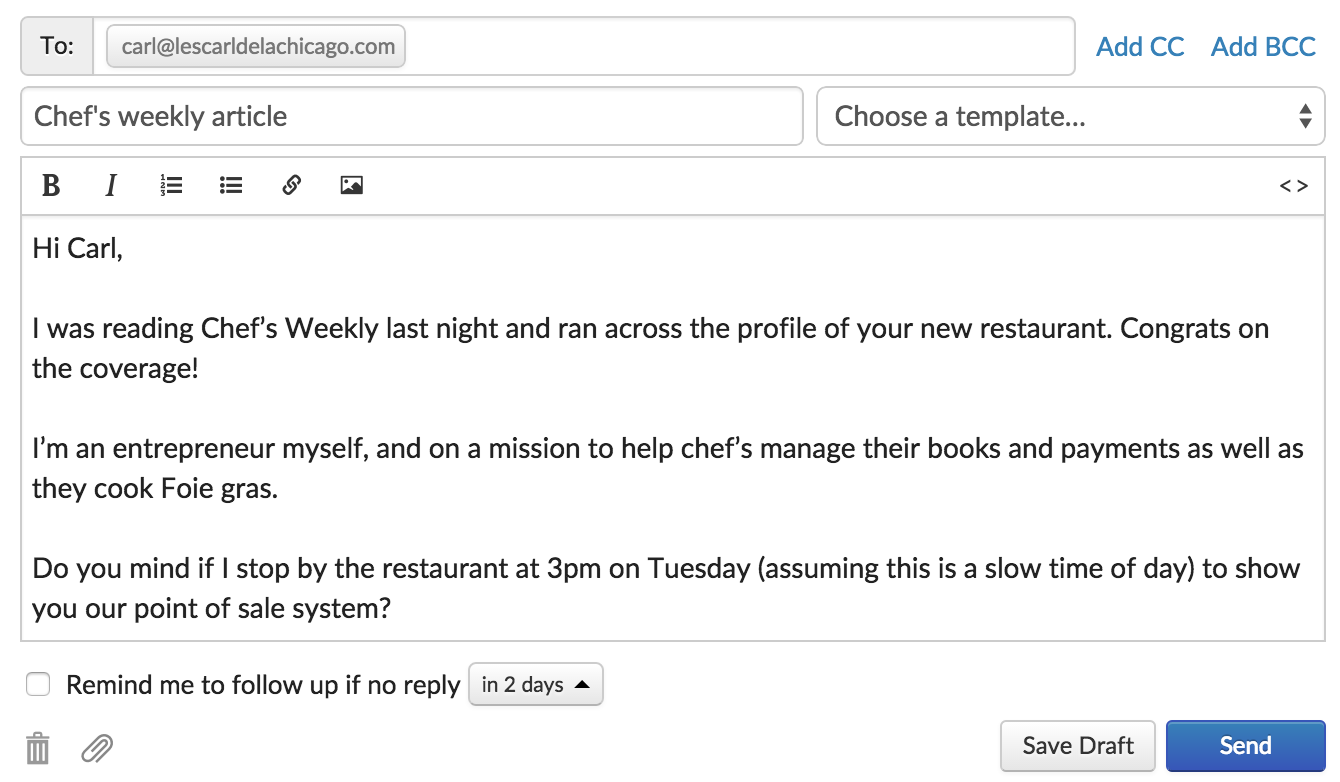
Get creative in the way you reach out to prospects. Don’t write them an essay. Keep it short, sweet, and personal. Tell them why you are reaching out to them. Then tell them what you offer (in two sentences or less). And finally, make a direct ask (e.g. “Do you have time for a phone call on Tuesday?”) But take it a step further and make use of your new ideal customer profile. Mention the behavioral event in your email. When John reaches out to chefs he writes this:

Screenshot_2015-10-06_22.14.53

If all goes according to plan, Carl will respond, “John, great timing. That time works. See you soon.”

Consider using hybrid mail merge tools like Close.io, Outreach, PersistIQ or Cadence to speed up this workflow.

Test, test, test

Email 250–500 prospects and then review the data. Use your mail merge tool to track positive response rate and optimize for that. Change your subject line if the open rate is low. Change your ask if the response rate is low. And be religious about tracking the data. If you think tracking data is too much work or too difficult, start out simple!

Set a goal of testing one new profile every month. This is enough time to run prospects through an entire outreach cadence and then review the results. Test new messages to the same profile, and then the same message to different profiles.

After you’ve used behavioral data to crush your sales goals, give me a shout! I would love to hear how it goes :) My email is michael@getsimpledata.com And if you get in trouble for throwing paper airplanes at work tell them the Close.io guys peer-pressured you, not me!

07 Oct 15:12

4 Ways Inbound Marketing Can Help You Close More Sales

by Juli Durante

4_Ways_Inbound_Marketing_Can_Help_You_Close_More_Sales.jpg

Although inbound marketers spend a lot of time focusing on attracting visitors and converting them into leads, the ultimate goal of closing more customers is always in sight.

As it turns out, you don’t have to look further than the Inbound Marketing Methodology that we all know and love to see how inbound helps you close more sales. This methodology outlines how a business can turn strangers into customers and active promoters:

methodology_-_no_header

Here’s some more detail about executing each of these steps to support your customer acquisition goals:

1. Attracting Visitors

The first step in this graphic is attracting strangers to your website so they become visitors. Do more website visitors necessarily mean you’ll see more sales? Perhaps indirectly. The really key is attracting the right visitors.

How to Execute:

How do you attract the right visitors? The inbound marketing best practices surrounding persona development, blogging, SEO, and social promotions all apply.

  • Develop Personas: If you haven’t defined your buyer personas, the individuals with the issue that your product or service solves, how can you hope to attract them to your website?
  • Optimize for Search: Because 44% of online shoppers begin by using a search engine, getting found in search results is critical for every business.
  • Get Blogging: As the backbone of Inbound Marketing, your blog helps you attract visitors searching for solutions tho the problem that your company solves.
  • Promote on Social Media: Social proof is growing more important every day. If your social posts are seen and shared by others, it helps send like-minded individuals your way.

2. Convert Leads

Of course, if you can’t gather any information about site visitors, you aren’t like to see many of them become customers. That’s why the inbound methodology’s second step is converting visitors into leads. This step uses conversion paths, made up of calls to actions, landing pages, and forms.

How to Execute:

When creating conversion paths, it’s essential to have visitor-centric offers that are well-aligned to the buyer’s pain points at different stages of their journey: Awareness, Consideration, and Decision. You’ll need well-optimized CTAs and Landing Pages to assist the conversion process and you will need to ask the right questions on forms to make sure you have qualified leads.

  • Define the Buyer’s Journey: To begin, map out the kind of content your personas need when they’re first becoming aware of a problem, when they’re considering different solutions, and when they’re deciding which one to purchase.
  • Build Conversion Paths: A conversion path starts with a Call to Action (CTA) that lives on a site page or blog post. The CTA should link to a landing page that explains to the visitor why they should download that offer or complete the form. The form itself should ask the questions that a sales or service team needs to know to adequately assist that lead.

3. Close Leads into Customers

Halfway through the list, we’ve reached it: closing customers. With inbound, closing customers involves ongoing segmentation and nurturing – and your sales team. A key to this stage is using continued communications to provide the content that leads need to make a purchasing decision. It can include buyer’s guides, case studies, testimonials, referrals, FAQs, implementation checklists, and more.

How to Execute:

  • Segment your Database: How do you know which inbound leads should be followed up with? Segmenting your database of existing leads based on their value to the sales process is critical. What information does the sales team need to adequately work leads? How can this information be translated into lead scoring and automation?
  • Start Nurturing: Lead nurturing helps leads build a relationship with your business and sales reps. As the say, “The proof is in the pudding”: according to a study from Forrester Research, lead nurturing can help companies generate 50% more sales ready leads for 33% lower cost compared to companies that don’t nurture leads.

4. Delight Your Customers

Every customer you generate has the ability to help you attract more customers – but only if you can delight them into becoming evangelical promoters of your solution. If they love you, they’ll tell friends, colleagues, and anyone they think has a need for your solution.

How to Execute:

Building promoters is tricky, but at the end of the day, it’s all about a customer’s relationship with your brand. There are a few rules for keeping your customers in a state of delight:

  • Treat customers as people because even in B2B environments, it still comes down to two people talking to each other.
  • Take a customer-first approach: While I appreciate that my cable company wants to recruit new customers so badly they will offer a 75% discount, as an existing customer, this is outrageous: I’m paying three quarters more for my loyalty. No thank you. When making decisions from pricing to promotions, always ask yourself, “What will existing customers think about this?”
  • Be human: Just as you need to recognize that customers are people, your brand also needs to act like a human. Without doing this, your chances of creating a lasting relationship are minimal.

Do you have any stories of “big wins” where inbound leads became delighted customers? Share them in the comments section below.

06 Oct 16:53

Never Use These 7 Words in Your Emails

by Sabrina Bianchi

When we look through our inboxes, we’re shocked at the poorly written emails we get. At their worst, some are riddled with spelling errors and typos and others are cut and paste cookie cutter templates at best. Whether you write for a living or are basically an email professional, being calculating with your words and phrasing is important. How often do you receive a vague email that doesn’t clearly state why it’s important? How often do you just fire off an email without a second thought about its effectiveness? Sending an email is as simple as clicking a button, so it’s easy to become lazy in your choice of words and phrasing.

Read more on Never Use These 7 Words in Your Emails…

The post Never Use These 7 Words in Your Emails appeared first on Predictable Revenue.

06 Oct 16:51

3 Simple Strategies for Scaling Your Sales Organization

by Micheline Nijmeh

As companies experience success and grow their business, sales teams must be able to scale quickly or risk losing out on new opportunities.

To scale quickly in a hyper-growth organization, sales reps have to get up to speed fast; processes must be streamlined; and sales leaders have to continuously monitor sales team performance. To scale faster, some of today’s top-performing sales organizations are adopting sales acceleration tools that include engagement analytics and automation to:

#1. Get reps up to speed fast

To onboard reps quickly, you need to implement agile sales processes. Automated capabilities, such as email templates and group email sending, let reps interact with prospects faster and more effectively. Email templates deliver consistent messaging and also save time, so reps can focus their attention on customers rather than writing different messages themselves every day.

If you’re adding new sales staff, sales training is also essential to educate them about processes and products to onboard quickly. Depending on the size of your organization, this can include formal product training, message training, and demo certification. You might also consider ‘pairing up’ new reps with a high-performing rep for a few days, so they can participate in demos and calls together.

#2. Build streamlined sales processes

Sales reps spend nearly two-thirds of their time on activities that don’t generate new deals. As sales leaders grow their team, maximizing rep productivity is a key priority to avoid lost opportunities.

To scale quickly, organizations need insight to determine the best sales activity levels, messaging, and types of interactions, so that they can repeat the same approaches across the organization. Aberdeen Group research shows that companies that use analytics and automation can strengthen sales rep productivity with the ability to build repeatable sales processes into their selling cadence.

These companies can see what processes have the most success with prospects. They can see what sequence of emails gets the highest engagement and the best response rate, and repeat the same approach across the sales organization.

No organization wants to grow their sales team at the expense of slowing down their sales cycle. By using repeatable processes, recent Aberdeen Group research findings show that best-in-class companies are shortening the sales cycle up to 18%. Taking it a step further, putting a sequence of emails scheduled on different days to nurture prospects is even more powerful. By leveraging email sequencing, organizations not only save time but also gain valuable insight for improving their sales processes.

#3. Gain real-time insights to improve rep performance

Integrating automation and analytics, sales acceleration tools give sales leaders real-time insights into how reps are interacting with prospects with their sales content and emails. Managers can see which reps are having the most success engaging with prospects, so that they can emulate their processes with other team members.

Having these insights is key, especially during rapid growth. No organization wants to lose opportunities. Even as sales organizations grow their team, they must keep a close pulse on all potential opportunities and maintain their ability to respond quickly. Aberdeen finds that with analytics and automation, companies have higher team quota achievement and lead acceptance rates compared with other companies.

With processes in place that help reps onboard quickly, leverage repeatable processes, and monitor team activities in real-time, your sales organization can keep full-speed ahead even while scaling to keep pace with business growth.

Want to learn more about how your sales team can build your small business’s brand? Download the free Salesforce e-book.

06 Oct 16:49

How Twitter’s 140-Character Limit Made Me a Better Writer

by Patrick Allan

Twitter is planning to extend its typical 140-character limit, and a lot of people are welcoming the change. But as annoying as the 140-character limit can be, I’ve found that it actually helped me practice a few principles for better writing.

Read more...

06 Oct 16:49

How Long It Takes English Speakers to Learn Nine Other Common Languages

by Kristin Wong

Learning a new language takes time, and how long it takes, exactly, will vary depending on how similar the language is to the one you speak. This infographic tells us how long it takes English speakers to learn the nine most common languages in the world.

Read more...

06 Oct 16:41

Meet the artificial intelligence tech your company can use today

by Sissi Wang
Ross Intelligence CEO Andrew Arruda, centre

Ross Intelligence CEO Andrew Arruda, centre. (Kevin Van Paassen)

As a licensed attorney, Andrew Arruda has experienced first-hand the many hours of menial research that go into preparing a case, which can drain a law firm’s resources and inflate fees for clients. But Arruda decided to do something about it. He joined a group of computer science students from the University of Toronto to create Ross, a digital legal expert that helps lawyers power through research.

Instead of wasting time sifting through mounds of documents, lawyers can ask Ross, a desktop app, questions in plain English. The program then combs through the entire body of U.S. case law (the team plans to incorporate other countries later) and returns relevant legislation, judgments and other useful information in response. Arruda, who left his job in June to serve as CEO of Ross, says the digital assistant shortens the research time for each case, allowing lawyers to take on more challenging files and preventing client fees from escalating.

Ross is part of a wave of artificial intelligence (AI) technologies handling increasingly complex tasks once performed by white-collar workers. Many of these technologies are built on top of Watson, the supercomputer designed by IBM that trounced contestants on Jeopardy a few years ago (it also loves cooking). Watson leverages deep learning, a branch of artificial intelligence that essentially trains computers to learn from raw data. A wide swath of industries is already taking advantage. Wall Street hedge funds are using a cheap supercomputer called Ufora to analyze extremely large sets of market data and working with a separate technology to write analyst reports once produced by humans. Oncologists are using AI to diagnose diseases, and even the travel industry is finding applications. Texas-based startup WayBlazer, combs through search engine queries to deliver personalized travel insights and special offers to customers. With the growth of AI’s potential, businesses need to start thinking about how to automate more tasks using these new technologies in order to stay competitive.

Ross has already generated a lot of interest from potential investors and law firms looking to implement the digital helper. “Law is a huge market,” Arruda says. Big law firms are obvious candidates for the technology, but so are in-house lawyers working for large corporations and governments. Despite the benefits services like Ross provide, some people may be worried that advancements in AI may lead to massive layoffs. But Arruda says that’s not the purpose of Ross. “It’s a tool to augment human capability,” he says. “Ross is not out to replace but to improve.”

For Deep Genomics, AI has only helped the company work more efficiently. The Canadian startup, which launched in July, employs deep learning to assist doctors in diagnosing and treating diseases faster. Brendan Frey, CEO of Deep Genomics and a biomedical engineering professor at the University of Toronto, says his research team trained its system to analyze individual cells to draw conclusions about the entire cellular system and, ultimately, make a diagnosis. “It allows the diagnostician to more quickly produce the report, and gives them a whole new level of information to figure out what the problem is,” Frey says.


While these technologies can carry out specific tasks extremely well, they’re nowhere near the level of human intelligence, says Ruslan Salakhutdinov, assistant professor of computer science and statistics at the University of Toronto. “Right now, on the deep-learning side, we’re mostly trying to improve speech recognition and object detection,” he says. Some routine tasks will be completely overtaken by machines in the future, but the process will be gradual. Near-term advancements will likely concern speech recognition and voice-to-text technology on smartphones that can better filter out background noise to understand commands. Smart home monitoring systems that can recognize visitors also represent a growing market, Salakhutdinov says. A startup called Netatmo already launched a security camera this summer that sends the names of people it recognizes to the homeowner’s smartphone, as well as notifications about unknown visitors.

Even if the technology is rudimentary, businesses should take its development seriously, says Mike Watson, a principal at Wazuku Advisory Group. Watson advises creating a team to assess how AI will affect all facets of the business and then figure out how to jump on the opportunities. “Companies that adapt will develop a deeper understanding of their clients’ needs while simultaneously operating with lower reliance on human input—and thus lower costs,” says Watson. Those that don’t risk getting left behind. AI will either become a huge aid or a headache to businesses in the future, depending on how they act.

MORE ABOUT ARTIFICIAL INTELLIGENCEDEEP LEARNING & AUTOMATION:

The post Meet the artificial intelligence tech your company can use today appeared first on Canadian Business - Your Source For Business News.

06 Oct 16:19

How Figure 1 plans to go global with its “Instagram for doctors”

by Sissi Wang
Figure 1 cofounder Gregory Levey

Figure 1 cofounder Gregory Levey. (Figure 1)

Recently, Toronto-based health care startup Figure 1 reached an important milestone: more than 500,000 medical professionals are now using its app, up from 150,000 users a year ago.

Joshua Landy, Richard Penner and Gregory Levey launched Figure 1 in May, 2013. Landy, a physician, came up with the idea while he was studying the smartphone habits of doctors at Stanford University in 2012. Shortly after, he invited Penner and Levey to join him and run the technical and business sides of the company.

The purpose of Figure 1 is to allow physicians to upload and share pictures of a brain scan or a patient case from their smartphone, so they could easily show it to their colleagues or consult with other verified medical professionals. Since the launch, it’s become a hit among medical students and physicians in North America. Four out of 10 U.S. medical students use the app, and members have now collectively viewed shared images one billion times.

Figure 1—named one of Canadian Business’s 15 most innovative companies of 2015—has raised more than $10 million from investors in North America, and currently has 26 employees. Gregory Levey, one of the founders responsible for Figure 1’s business operations, shares with us his advice on how a tech startup can grow its user base, and how Figure 1 plans to reach even more medical professionals in big cities and rural regions.


What’s your first advice for a startup trying to achieve more users?

An early lesson I learned from one of our investors is that you don’t want a leaky bucket. If you’re getting tons of new users, and they’re all leaving—use the app once and never come back—that’s useless, and not what you want. That top-line number, 500,000 users, is kind of a vanity metric in some ways. We’re proud of it, but we’re far more proud of our engagement and how many users continue to use it. So we’re at 50,000 daily, and that to me is far more important, because people actually use it.

We were pretty lucky right from the get-go. We had pretty good retention and engagement numbers compared to most apps that follow a predictable curve that diminishes down pretty quickly. We want to prevent that, because there’s no point in putting top line numbers if they’re all going to leave anyway.

Lesson two is to get out of the building. A lot of people, especially developers, are just interested in building what they believe is a great product. Maybe they’ve talked to a friend or two, or just think it’s a great product, then they go build it and wonder why no one is coming. I took a class in business school with a guy named Steve Blank, who’s like the startup guru. His mantra is to “get out of the building.” Just stop sitting there coding or whatever it is you’re doing and get out of the building and talk to users. We spent a ton of a time on that, way before we launched, beta-testing with lots of doctors. Luckily, my co-founder Joshua Landy is a physician, so he has a wide network of them. We also reached out to others who we thought were technologically savvy, so way before we launched, we were making sure they were on there, getting feedback, and making sure that they could see this is useful, and it wasn’t just a leaky bucket.

Now two years out, we continue to do that, almost daily, where we have phone calls with users. Yesterday, we had a user here doing testing, where we watched how they used the app on the phone. People say and do different things and make subconscious decisions they’re not even aware of. Let’s say your app is a bit slower than it should be, then the user might not come back because they’re annoyed by it. But they may not even realize that’s why they leave, but you can test those things using data. So really digging in and see what users want, and getting out of the building to make sure the app is what the users want and is solving a problem in their lives.

Too many apps, especially in healthcare, try to solve a problem that doctors don’t actually need. Now, we have a second full-time physician on our team, in addition to our co-founder, and a practicing nurse who splits their time at the hospital and at the company, and a nursing student doing the same thing. So we got these people embedded in the field who are giving us feedbacks, and our users.

And lesson three is to make sure the product is good enough that people tell each other about it. I hate the term “growth hacking” where you use tricks to tactically increase your numbers. The bigger way to do it is to just make sure your app is good enough that people are actually telling their friends and colleagues. Rather than these short-term superficial growth hacks, it’s much better to make the product awesome. Because we can track where a lot of our growth comes from, but there’s a ton of it where we have no idea where it comes from. But when we ask people how did they hear about Figure 1 in our user interviews, they’d say “my med school classmate showed it to me,” or doctors who hear about it from residence and med students. There’s no way for us to track these word of mouth referrals, which happened because our product fills a need and people like it, and that’s the most important thing. We learned that once the product is in a hospital or med school, it just spreads like wildfire.


You were quoted by The Globe and Mail saying Figure 1 wants to own healthcare, and get tens of millions of medical professions from around the world using the app in the future. How do you intend to do that?

We’re going to continue doing much of the stuff we have been doing and optimize it. After we raised more money, we hired a data scientist and more developers so we can follow the data and use it to guide us. Another important thing is we’re going to start localizing and get the app in various languages. We already have a ton of Brazilian users, but if it was in Portuguese, they’d probably use it more. We’re going to start localizing and prioritize Portuguese, Spanish and Mandarin, because of the large population, and also because we’ve had a great reception in Brazil, in particular, so we want to cater to that. That’s going to be our big emphasis in the coming six months. We just hired one person, whose full-time job is going to help us grow internationally, because we really see ourself as a global app.

How do you plan to deal with the privacy and legal issues that come with expanding into various countries?

It’s a big headache, but it’s also our competitive advantage because we dealt with it early on aggressively, making it harder for our competitors to catch up. Our 16th employee was a lawyer, and people raise eyebrows, but I have no doubt it was the right decision. Our lawyer has a background in international law and interacts with 30 lawyers globally, so we now have lawyers all over the world. Right now, she’s dealing with lawyers in South Korea to get ready to launch there. We have done the legal diligence in 100 countries, so while it’s a headache and it’s costly, but we know that we’re on firm footing legally all over the world. One more thing, right from the get go, we’ve structured things such that they’d be applicable globally, where we could quickly make small changes to the app in various countries to fit their own legal systems.

All the journalists have been asking you this: how do you plan to monetize Figure 1?

We have famously patient investors. Our investor Union Square Ventures has also funded Twitter and Tumblr, two very successful services that took a long time to concentrate on monetization. and we’re no different. We get requests almost daily for various monetization strategies and we started having these conversations, but we’re not pulling the trigger yet. The focus right now is to build a large, engaged network, and these are extremely valuable eyeballs and users. But we want to treat them with respect, and make the user experience the most important thing, but we know from the emails we get everyday that there’s a lot of people who have things in mind that they’d be willing to pay for. So we’ll get there, but probably not for at least a year.

You have a law degree and an MBA, and have worked as a journalist, a professor, and a speechwriter for the Israeli Delegation to the United Nations before Figure 1. Do you intend to stay in your new role at Figure 1 for a long time?

This is maybe the most exciting thing I’ve ever done, and it’s not because of economic reasons. We’re doing something really meaningful. Literally every day, we’re hearing about lives that were saved, not because of Figure 1, but helped by Figure 1. And it’s just so cool. You mentioned my background is very diverse, but this really employs a lot of stuff altogether. I use both my law degree and MBA on my job, and am probably more involved in our communication than our communications team would like. Also, the international aspect of this is very interesting to me, as my first job was with the UN in my early 20s. This year, I’ve gone to Prague, London and India for Figure 1 business, so I’m having a great time and also doing something really meaningful. I’d love to be doing this 20 years from now if we’re lucky and successful in what we do, and have Figure 1 be a noble and helpful force in healthcare.

MORE GREAT CB INTERVIEWS:

The post How Figure 1 plans to go global with its “Instagram for doctors” appeared first on Canadian Business - Your Source For Business News.

06 Oct 16:18

How DavidsTea designs its stores to get customers in a buying mood

by Alexandra Bosanac

Recently we talked with DavidsTea CEO Sylvain Toutant about the company’s IPO, its growth plans for the U.S., and how it’s adapting to the changing habits of Canadian tea drinkers. From the start, a key part of DavidsTea’s success has been its retail stores.

In the video above, Toutant gives us a tour of the DavidsTea flagship store on Toronto’s Queen Street, and highlights the design choices that the company made to try to appeal to a younger demographic and get people to engage with its products. Here’s what Toutant had to say about its design strategy in our interview:

First of all, when you look at the competition landscape, tea is an evolving category and much of the tea purchased in North America is purchased in a grocery store. We do compete now with other speciality tea retailers but I think as tea becomes more popular, it’s actually helping Davids Tea carving out our own place. We have a very different approach to tea. We want to make tea fun and accessible. And as you can see the design of the store, it’s very young, it’s very open, it’s very design-focused. We’re not traditional and we want to make sure people can have fun.

Read the full interview here »

MORE ABOUT RETAIL & DESIGN:

The post How DavidsTea designs its stores to get customers in a buying mood appeared first on Canadian Business - Your Source For Business News.

06 Oct 16:16

3 ways technology can improve your business

by Sponsor Post

Sage One 9.17.15It’s no secret that technology is completely transforming the way small and medium-sized businesses operate. Whether you’re a local coffee shop that uses a countertop point-of-sale system to process latte orders or an online boutique that gives customers the option to track their latest order, internet-enabled IT systems are making small businesses faster, smarter, and better organized.

In fact, a recent poll from Zogby Analytics shows that roughly one-third of small-business owners said new technology was their No. 1 investment priority for 2015.

If you’re considering an investment of your own, here’s how technology can make your small business better.

1. You can use a CRM to keep up with your customers.

Many small business owners use customer relationship management (CRM) systems to meticulously plan out their interactions with customers in record time. With a CRM, you can keep all of your customers’ contact information in one place, alongside detailed information on the products they have purchased, the feedback they’ve given you, and the marketing materials you’ve shown them.

Keeping track of this makes it easier to offer outstanding customer service, as well as targeted marketing materials based on your customers’ habits and preferences.

2. You can use a business intelligence platform to make smarter decisions.

Just because it’s called “big data” doesn’t mean it can’t be effective for your small business. Business intelligence software allows you to automatically organize and analyze all of the various data points that make your company what it is; including sales information, pricing data, and supplier contracts.

These platforms are programmed to identify and report important information that gives you a valuable perspective on your company’s health. Whether it’s a notification that one of your salespeople is having an excellent year or a red flag that your profits are taking a nosedive in a specific market.

In short, this type of software takes the overwhelming amount of data your company generates each day and distills it into granular insights you can actually use to determine the course of your business.

3. You can use accounting software to manage your finances.

Keeping a close eye on income and cash flow is an integral part of managing a successful small business, but this process can quickly turn into a time suck if you don’t have the right technology.

With Sage One’s accounting software, you can access up-to-the-minute reports on where your business stands at all times. Sage One’s easy-to-use user interface and simple setup make it easier than ever to invoice your customers and keep track of payments.

And unlike other products that make you jump through hoops just to figure out how your business is doing, a quick glance at the Sage One dashboard gives you all the information you need to stay on top of your finances.

Click here to see how technology can take your small business to the next level.

This post is sponsored by Sage One

Find out more about Sponsored Content.

SEE ALSO: Here are 9 steps to getting your new business off the ground

Join the conversation about this story »


06 Oct 16:16

Understanding the two-step approach to mobile user acquisition

by VB Staff
Iryna big image

SPONSORED:

Mobile Heroes logoAs marketers in the non-gaming mobile ecosystem try to quickly catch up to their gaming counterparts, “Mobile Heroes” brings you a weekly series of articles offering insights and education for marketers of non-gaming apps. Brought to you by Liftoff. Meet the heroes here.


Growing your mobile business and acquiring new users for your app does not always begin with the first advertisement and end with the point of app installation.

According to Iryna Newman of Invoice2go, the opportunity to scale user acquisition lies in understanding where users are in their purchasing readiness, and applying a two-step or even a truly multi-step approach to engage and acquire new customers.

“The problem that mobile marketers face today is that it’s very tempting to focus on acquiring the so-called ‘low hanging fruit’ — users that convert very quickly after installing your app, or first coming across your product. It seems great, but really there are many users who could be paying customers and highly valuable, who aren’t ready to convert depending on where they are in the customer lifecycle,” she said.


Learn more about Iryna at Mobile Heroes.


Mobile invoicing that’s good to go

Invoice2go, founded in Australia and headquartered in Redwood City, provides a streamlined, easy-to-use mobile invoicing solution for over 200,000 contractors, tradespeople, and other small business owners on the go. Newman, Invoice2go’s Director of User Acquisition, has found success for her organization by paying attention to where, when, and how to connect with potential and current customers in order to best engage and deliver a compelling invoicing solution.

“Scale is the biggest challenge for most user acquisition channels. Finding efficient pockets of users is straightforward, but it is much harder to find 10 to 50 times the number of subscribers at the same price,” she says. “Scale may come from the top of the funnel, but there is a great opportunity to re-engage users once they are already in the funnel. For SaaS apps, in particular, the sales cycle never ends, so you want to think about nurturing users along through that journey.”

A quality mobile user for Invoice2go is someone that has the propensity to become a paying subscriber. In order to optimize the customer growth opportunities, it’s important for Newman to identify, segment, and create compelling messaging and touch points for small business owners who meet this description. To achieve growth with scale, Newman looks past the “low-hanging fruit” approach towards the vast long tail of potential customers.

“If you take this initial approach, there’s a huge percentage of people you’ll miss who didn’t convert upon the first visit or install, but they may convert to a purchase within 20 days, for instance,” she says. “The question is how you maintain the conversation with these users, stay top-of-mind, and get in front of them so that you’re there when they’re ready to make a purchasing decision.”

The two-step approach

There is an increasing shift among mobile marketers today in user acquisition strategy towards investments happening both in marketing automation and re-targeting. As with Invoice2go, these two components are enabling marketers to execute on a more effective, two-step approach to acquiring paying customers.

Newman focuses on app install campaigns to generate the highest quality installs, then leverages mobile retargeting and automation to educate and drive usage among prospective buyers early on — in this way, leading to paying subscriber conversions and reducing the overall cost of acquisition.

Strategy 1: Automate for scale

Most marketers have a limited marketing technology budget and need to make a good argument for any spend. This can already be challenging if you’re trying to build a case for licensing a particular solution based solely on the cost of acquisition of your initial installs. It’s much tougher to build a case for spending on automation software when the user conversion doesn’t happen on the first install, and might occur on the second or third campaign. That said, the potential payoffs can be enormous.

Inbound marketing automation software leverages all the information you’ve gathered about a user to understand their needs, and then delivers the content this user needs, when they need it, in order to make a purchasing decision. True automation also takes into account the evolving needs of your prospective purchasers, and the interactions they have with you across all of your marketing channels, not just email. An automation platform will collect data from behavioral inputs across multiple channels such as social clicks, views on a pricing page or consuming a particular piece of content, and then uses these channels to send marketing messages and guide the user down the purchasing funnel.

“Most companies today market on multiple operating systems, across several interest groups, countries and probably have multiple call-to-actions and creative templates that they’re testing for effectiveness,” Newman says. “When you have that level of complexity and want to test out different content within that experience, you can’t do it manually. So, taking advantage of CPA bidding and automation platforms is critically important.”

To achieve real growth and scale, Newman believes that marketers will benefit from getting more granular in their testing and targeting. Thanks to great partners and solutions in the market, it doesn’t need to be done manually through countless spreadsheets and ad hoc campaigns. For instance, Invoice2go leverages Liftoff, a cost per action (CPA) optimized mobile acquisition platform for driving user growth. “What Liftoff provides me is a straightforward, user acquisition platform to find large segments of users on the exchanges with a high propensity to convert,” she said.

For Newman, as with many mobile app service providers, this is often just the first step in converting new installs into paying customers. Marketing automation then comes into play — and Newman can develop campaigns and rely on algorithms working in the background to then make decisions on how to best optimize her campaigns and engagement with users.

Strategy 2: Retarget to drive conversions

Retargeting after the initial install is all about closing the gap between ‘That’s kind of interesting’ and ‘I want to make a purchase.’

The composition of your content, how it’s delivered, on what screen, and in what context is important to the customer’s journey. Timing and consistency may be the most important component of all.

“The big idea is frequency,” says Newman. “If we need to touch somebody six times before that person is ready to make a purchasing decision, then we want to be able to touch that person from multiple channels to get there faster.”

For Invoice2go, Newman’s team thinks about how, when, and on what screen they can actually communicate with prospective paying customers, and what they can do to meaningfully engage when the opportunity is right.

“This forces us to think about having different types of conversations with different buckets of users based on where they are in their journey,” she says. “There’s a time when we need to be talking to customers about free trials, there’s a time when we need to be talking about limited time offers, and there’s a time when we shouldn’t be talking to them at all. And, when we do have the customer’s attention and they’re ready to be engaged with us, we focus on providing a caring experience and delivering a genuine message with a solution tailored to their needs.”

A more sophisticated approach to user acquisition

With 200,000 small business customers and growing, Invoice2go’s approach to acquisition provides a workable, cost-effective blueprint for other marketers pursuing business customers: focus on sourcing channels for high-quality users and measure well to know what’s working, automate your marketing efforts where it makes sense, and re-target strategically to increase engagement and conversion.

The magic in this approach, according to Newman, is allowing marketers to move beyond the potential traps of only focusing on the “low-hanging fruit”, and moving into a position of achieving scale effectively through a streamlined multi-prong approach.

“Mobile marketers are starting to get out of the weeds and spending an increasing amount of time on more strategic decisions,” says Newman. “As a result, I think we’re going to see a lot more sophistication coming from marketers down the road.”

Mobile Heroes, sponsored by Liftoff, shines a light on successful non-gaming app marketers. Visit the site where marketers share their experiences and knowledge.


Sponsored posts are content that has been produced by a company that is either paying for the post or has a business relationship with VentureBeat, and they’re always clearly marked. The content of news stories produced by our editorial team is never influenced by advertisers or sponsors in any way. For more information, contact sales@venturebeat.com.


06 Oct 16:16

Dice Summit to focus on the art of engaging players

by Dean Takahashi
Martin Rae of AIAS

The Academy of Interactive Arts & Sciences (AIAS) announced today that it will explore the “art of engagement” as its theme for gaming at its annual elite event for game developers. It will also hold its annual 2016 Dice Summit at a new home, the Mandalay Bay Resort and Casino, February 16 – 18, 2016.

Speakers and attendees will share insights about the varying ways to enlist and captivate an audience while building the entertainment medium of the future. And to foster the discussion, Dice 2016 is adding traditional Summit format with roundtable, break-out sessions to tackle dedicated topics and concepts. Like our own GamesBeat events, the summit draws hundreds of leaders of the industry to explore ideas for self-examination and thought leadership. It often results in a lot of news.

“A hallmark of the Dice experience is the unparalleled access with networking opportunities to really push creative thinking forward – no doubt the new venue and format will amplify this,” said Martin Rae, president, Academy of Interactive Arts & Sciences, in a statement. “As always we are excited about our speakers — a mix of industry stalwarts who have long inspired along with emerging talents speaking to our theme, The Art of Engagement.”


From VentureBeat
Gaming is in its golden age, and big and small players alike are maneuvering like kings and queens in A Game of Thrones. Register now for our GamesBeat 2015 event, Oct. 12-Oct.13, where we’ll explore strategies in the new world of gaming.

The Dice Summit is moving to its new Las Vegas home and venue, Delano Las Vegas at Mandalay Bay Resort and Casino. The conference and Awards show will be taking place at The Mandalay Bay Resort and Casino.

The first speakers include panelists such as Sid Meier talking about the 25th anniversary of Civilization, the iconic turn-based strategy game. Meier is cofounder and director of creative development at Firaxis Games. Over the last three decades he has played an influential role in establishing strategy games as a cornerstone of video gaming, and is often regarded as “The Godfather of Computer Gaming.”

Brian Reynolds, chief creative officer of Big Huge Games, will join the panel. Reynolds’ videogames have sold more than 6 million copies worldwide, and he has masterminded the design of several smash hits including Civilization II, Alpha Centauri, and Rise of Nations, as well as Settlers of Catan for Xbox360 Live Arcade.

Soren Johnson is CEO and Design Director of Mohawk Games. Johnson has 15 years of experience developing strategy games as both lead designer and gameplay programmer. While at Firaxis, Soren designed Civilization IV, one of the highest-rated strategy games of all time and was also the co-designer of Civilization III.

And Bruce Shelley, who helped develop the Age of Empires series will also speak on the panel. While working at MicroProse with Sid Meier, Bruce helped to design the original Sid Meier’s Civilization, alongside fan favorites such as Railroad Tycoon. Shelley will moderate the panel.

Other speakers include Todd Howard, game director and executive producer at Bethesda Game Studios; Niccolo de Masi, Chairman and CEO, Glu Mobile; and Mike Gallagher, CEO, Entertainment Software Association (ESA).

The 2016 D.I.C.E. Summit registration is now open! Register now for the early bird rates at www.dicesummit.org. Pricing goes up November 2, 2015.

###


06 Oct 15:45

Misguided Competitive Advantage

by valueacceleration

Much is written on competitive advantage. The amazon.com website brings up 1000s of search results in the books section alone. My second book, The Secret To Selling More, discusses it, and my third book (along with Ralph Mroz), Value Acceleration, has competitive advantage in its subtitle.

Many of the newer books on competitive advantage, and many self-proclaimed experts on the subject, write and speak extensively on the need and value of finding your competitive advantage. I agree.

What one means by the term competitive advantage is where we greatly differ. Variations on the idea of competitive advantage go back decades and include phrases like “unique selling proposition” or USP. Experts have known for a very long time that to succeed in the market, you must have a difference. I agree.

What constitutes a competitive advantage is where I part ways with many other self-proclaimed experts. Too many of them have you focus on what you do that makes you different. They push you to figure out what you do that makes you different? Who cares, with the possible exception of your mother?

It’s not about what you do, it’s about what the customer gets! Ruth’s Chris serves your steak on a 500 degree plate. So what (other than keep your hands off of it)? What you get is an experience where every bite is as delicious as the first. Meanwhile Morton’s proudly notes they have no secrets because they have all been published. Who cares about either. What am I getting is all that matters.

Most customers don’t care what you do (some aficionados might). They care about what they are getting. Once they get that some may choose to learn more about how you do it to add to the experience. But the real competitive advantage does not come from knowing what you do, it comes from knowing what the customer is buying from you they don’t feel they can get anywhere else.

Stop focusing on you and focus on your customer. What are they getting or believe they are getting from you they can’t get elsewhere.

Several years ago they asked a “loyal” Lexus owner why he was trading in his Lexus to buy a Mercedes. He noted the Lexus was the best car he had ever owned and the dealer was unsurpassed. Both of which should have created a competitive advantage according to many. His answer tells the story: “People look at you differently when you drive a Mercedes.” Maybe not what you care about, but plenty of Mercedes owners do, including the woman in my neighborhood whose personalized plate says 4 MY EGO.

Stop focusing on what you do. That’s not where competitive advantage lies. Understand what the customer is buying … and leverage the heck out of it.

Mitch


06 Oct 15:44

Primed to Perform: How to Build the Highest Performing Cultures Through the Science of Total Motivation

by Dylan
Neel Doshi and Lindsay Mcgregor are McKinsey alums that went on to found Vega Factor, "a company building technology to help organizations of all sizes and in all sectors create high performing cultures." They also have a book being released from HarperBusiness today. Entitled Primed to Perform: How to Build the Highest Performing Cultures Through the Science of Total Motivation, we have an excerpt that will explain exactly…

How Whole Foods Can Weather The Current Storm:
Don’t Change. Do More Of The Same.

Between mislabeling weights and the announcement of 1,500 layoffs, darling specialty-grocer Whole Foods has suffered consecutive blows within a few weeks. The company is at a crossroads, and the big question is whether its long-celebrated culture will weather this perfect storm of slowing growth and fiercer competition.

Most companies at this stage of increased volatility unknowingly double down on performance-destroying practices; they introduce more rigid processes, cost reduction programs and performance management systems in order to squeeze the last drops of productivity from employees and revenue from customers. But precisely as things become less predictable, people and organizations must be more adaptive to appropriately respond to problems and find opportunities where there were previously none. Our new research proves that adaptability is what separates the highest performing organizations from the rest of the pack.

Adaptive organizations are the product of adaptive people—at every level, and people are their most adaptive when they work for the right reasons. An intuitive understanding of this phenomenon we call total motivation is what has ferried Whole Foods to its storied success, as outlined in the excerpt below. If the company can resist the siren call of predictability, it will also be what gets it through this storm.

◊◊◊◊◊◊◊◊◊◊◊◊◊◊◊◊◊◊

“Most organizations—even legendary ones—have a hard time building, maintaining, and strengthening their cultures. Absent a systematic, psychologically informed understanding of culture, their leaders have relied on intuition and replication. They have tried to copy Apple, Southwest Airlines, Zappos, or the Ritz-Carlton, only to find that the cultures they built weren’t consistent and didn’t feel genuine. They didn’t motivate in the right ways, so they didn’t stick.

Total motivation is the missing link.

Many of the most admired organizations already use components of total motivation (ToMo) intuitively. They understand that the best way to motivate people is not through rewards or threats, but by inspiring people to find play, purpose, and potential in their work.

We found evidence of this one evening in Boston on the T (the local train), where two men in their twenties were discussing how to grow their business. One of them was dressed smartly in khakis and a polo shirt. The other sported a fashionably untucked button-down and a week-old beard, expertly groomed to look ungroomed. They spoke passionately about how their personalized customer service made all the difference to their bottom line. They devised plans to visit their competitors, to ferret out their tactics and weak spots. These two men weren’t tech CEOs or members of the hottest start-up incubator. They were employees at a local Whole Foods Market grocery store. They wore their Whole Foods hats with pride, and reveled in working for the only store in their neighborhood that still hand-stacked produce.

This really happened. There was no boss standing over them cracking the whip. No talk of how much money their extra work would earn them. They were brainstorming ways to help their company on their own free time, just for the fun of it. This is adaptive performance in the flesh. And it was a direct result of the ToMo culture that cofounder John Mackey baked into his business from its very inception.

Though today it has more than 400 locations in three countries, Whole Foods Market was born in 1978 as a 3,000-square-foot natural foods store. It would be an understatement to say that John Mackey was deeply committed to his vision. He earned so little in the early days that he and his cofounder lived in an office above the store. “There was no shower or bathtub there, so we took ‘showers’ in the store’s Hobart dishwasher when we needed to clean up,” Mackey related in his book Conscious Capitalism.

Most of us know that there is something special about the culture of Whole Foods. Whole Foods is Fortune magazine’s most admired company in its industry in 2015, and has been on the “100 Best Companies to Work For” list for eighteen straight years. Yet few companies have been able to create the culture they have built. Whole Foods’ culture feels like an extension of Mackey’s personal brand of magic. The fact is, Whole Foods is total motivation incarnate. The phrase “total motivation” didn’t exist yet, but John Mackey intuitively grasped its principles from the get-go. In a 2006 open letter to his employees (or “team members,” as he calls them), Mackey describes how he wanted to work “simply for the joy of the work itself and to better answer the call to service that I feel so clearly in my own heart.” He perfectly describes play and purpose, the first two of the six motives.

Using our cultural measurement tool, we tested how much employees at Whole Foods felt each of the six motives we describe in our book. Whole Foods creates far more play, purpose, and potential (the three direct motivators) and less emotional pressure, economic pressure, and inertia (the three indirect motivators) than many of its peers. As a result, it produces triple the level of total motivation versus the average of three competitors. This high level of ToMo is what drove the two Whole Foods team members to keep thinking about their business even on their commute home, and it is also what has made Whole Foods a market leader.

Customer satisfaction at sample of grocers as predicted by their Total Motivation Factor. Correlation, 0.96. Data captured outside-in

Whole Foods’ total motivation advantage isn’t an accident. It is intentional. The company purposefully builds direct motives into the workplace. It increases play through store-level, self-managed teams, whose members actually get to make decisions. Each department decides who to hire and what to stock. Individual team members have the opportunity to experiment with ways to improve their performance. The company enables this decentralized decision making with unprecedented transparency. Every team knows exactly how comparable groups in other stores are performing. They even know how much everyone in the store is paid. So complete is the information that in the mid-nineties, all 6,500 team members were deemed insiders by the Securities and Exchange Commission, suggesting they had access to privileged company information.

Whole Foods increases the purpose motive through a compelling and credible mission. As Mackey and Rajendra Sisoda wrote in Conscious Capitalism, “Business has a much broader positive impact on the world when it is based on a higher purpose that goes beyond only generating profits and creating shareholder value. Purpose is the reason a company exists. A compelling sense of higher purpose creates an extraordinary degree of engagement among all stakeholders and catalyzes creativity, innovation, and organizational commitment.”

At Whole Foods, store employees feel the difference. As one team member wrote to us, “I love the company I work for. I can get behind their mission statement, attitude, work ethic, and events. My coworkers are like family to me and the company has gone out of their way to provide for and accommodate me.”

Total motivation, however, isn’t just about how employees feel. Because total motivation fuels adaptive performance, we can see its effect on how customers feel too. Great customer experience occurs when an organization adapts its approach around each individual. When we look at Whole Foods and other grocers, we can see this connection clearly in the data.”

Excerpted from Primed to Perform by Neel Doshi and Lindsay McGregor Copyright © 2015 by Neel Doshi and Lindsay McGregor. Reprinted courtesy of HarperBusiness, an imprint of HarperCollins Publishers.


ABOUT THE AUTHORS

Lindsay McGregor and Neel Doshi are co-authors of Primed to Perform, a book about the counterintuitive science behind high performing cultures, out today via HarperBusiness. They are also co-founders of Vega Factor, a startup building technology to help companies transform their cultures. Between their 20 years of professional experience, they have worked as multi-company tech entrepreneurs, McKinsey & Company consultants, an employee of Fortune 500 companies, a substitute teacher, and a married couple. They received their MBAs from HBS and Wharton, respectively.


06 Oct 15:44

How Customer Experience & Content Marketing Can Work Together to Build Retention

by Sue Duris

Today is CXDay, a global celebration of the companies and professionals focused on creating great experiences for their customers. (To learn more, you can check out cxday.org). Did you know that, according to the Customer Experience Professionals Association, by 2020, customer experience will overtake price and product as key brand differentiators? And, Bain & Company says it’s 6 to 7 times more costly to acquire a new customer than it is to retain one?

So, if it’s really 6 to 7 times costlier to acquire a new customer than it is to retain one, why do we spend most of our time talking about customer acquisition and not much time talking about customer retention? And, better still, how can we engage our customers to become lifetime customers and brand advocates so they can help us acquire new customers?

I recently discussed these issues with Content Marketing Institute, and more specifically, how content marketing and customer experience can work together to create great experiences for our customers.

First, we need to define what customer experience really is. Because customer experience (CX) is not in the mainstream, yet, I hear many definitions. My favorite definition is from Forrester, which defines CX as “Every interaction, or touch point, your customer has with your brand. It not only includes the whats (the interactions), but also the hows (perceptions, feelings) the customer experiences.”

CX starts with brands wanting to be customer-centric. For some, that might require a business model change. Being customer-centric requires brands to focus all of their brand building activities around customers, not products.

So, how can content help create a better customer experience?

Think of CX as the track and content marketing as the train. Content marketing can move buyers and then customers along their perspective journeys. It is the glue that moves the customer from the onboarding stage, through the brand advocate stage along the lifecycle management journey.  Our goal as marketers is to convert a customer into a lifetime brand advocate, and CX and content marketing have huge roles to play in this.

But, a happy and satisfied customer is not enough. A customer who is willing to tell everyone they can how great your brand is, is a lifetime brand advocate, and the only customer you should be focusing on.

There are two keys to CX — empathy and curiosity — you have to care enough about the customer — in fact, your customers should be the single most important thing you care about — and be interested enough to understand their pains, motivators, needs and wants, to help them meet those expectations to achieve success.

How can brands use content to help provide a better experience for customers?

It all comes down to meeting the customer need.

The first steps in any interaction are to (1) listen to your customers, (2) engage them in conversation and (3) help meet their needs. Take what you learned from your customer in the listening and engagement stages and create the content they want that will help them meet their needs. That might be a thought-leadership piece, a manual or webinar on how to use your product, a case study on how other customers with similar challenges are using you to solve their problems and so forth. The key here is to always be polling your customers on the type of content they want to see.

I hear many people say “content should solve problems.” But, that is not content marketing’s role. Content marketing’s role is to know the buyer/customer well enough to understand their pains and needs, and then create content compelling and enticing enough to the reader to cause them to take action, whatever that action is.

Tell a story, but make sure that it’s the right story. Does the story address their need? Is the story on point with your messaging and what your brand stands for? Don’t compare yourself to other brands. Tell the stories your customers want, that resonate and are relevant to them.

The next step is answering this question – does the content resonate with the customer? We talk a lot about the voice of the customer in CX. It is important to always take the pulse of your customer through win-loss and onboarding programs, surveys, direct contacts and certain events where you can collect appropriate data. But, don’t just collect data. Analyze customer insights and implement insights into your processes.

So what all this means is that it is important to map customer touch points or events on their journey and connect that with content. You should always be connecting with your customer, ensuring their experience is stellar and helping them move to the next phase of their customer lifecycle management journey.

Is customer experience something that should be considered from brand awareness all the way through purchase and advocacy?

CX starts well before you interface with customers and through the customer lifecycle.

Through listening, you should be able to determine what pains and needs buyers have. Buyers, and then customers, should be top of mind. Answering “have I listened to my customer today and have I helped them?” is the most important question that your customer, not you, should be answering. It’s tough work to ensure a stellar experience and you won’t know what that is without being in constant contact with your customer.

CX also requires brands to be customer-centric. It is up to brands to not only meet customers’ needs, but to also interject them in the customer retention process. Consider implementing activities like an online community where customers can interface with your team and their peers. You might also consider creating a customer council or advisory board where customers can provide you with feedback and ideas to better meet their needs. There are tons of ways for you to interact with and learn from your customers, just be creative.

Ultimately though, brand advocacy should be your retention goal.

What are some metrics used to gauge the customer experience? How can we measure/track this?

1. Calculate your customer lifetime value for your customers – an abbreviated calculation is as follows:

Customer Retention

**Where GC equals yearly gross contribution per customer, r equals yearly retention rate and d equals yearly discount rate.

2. Implement some type of Voice of the Customer program. A feedback loop should be at every customer touch point. Remember to not just file away the customer insights. Implement them. You should always be optimizing for the customer experience.

3. Check Google Analytics for the content that is resonating most with your customers. This will help you determine the content your customers want.

4. Check your Net Promoter Score. Are you asking your customers, “how likely are you to recommend our brand to your friends, family and associates?” Keep track of what they say and adjust accordingly.

5. Check your social media shares, comments and other social metrics. Think about how you can more actively engage with customers on social.

Today, this week, and every day, enhance your customer experience, and ask your customer, what can you do for them, and continuously deliver. Happy CXDay!

The post How Customer Experience & Content Marketing Can Work Together to Build Retention appeared first on OpenView Labs.

06 Oct 15:44

What’s the Difference Between a Good Idea and a Good Business?

by Matthew MacQuarrie

good-business-idea3

There are good ideas, and then there are good businesses—and obviously a pretty wide chasm that separates the two. So what’s the difference? In my experience, the difference between a good idea and a good business is… if.

Let me explain.

The Pitch

Because I’m an entrepreneur myself, and people know it, I tend to hear a lot of impromptu business pitches. This is usually at some sort of a social function—during the cocktail hour, or at an after-dinner mixer—when someone approaches me and tells me about his or her latest idea to launch a business. Some of these ideas are, honestly, pretty good; others are frankly terrible. Regardless of the quality of the idea, however, the follow-up comment is almost always something like this: Another person in the room, engaged in the conversation, will say, “Wow! I’d totally buy that!”

Sometimes I’ll just nod and smile at this comment, but at other times I’ll say: “… if.” Here’s what I mean: The person wouldn’t buy the hypothetical product for any price, in any context, or under any circumstance. The person would “totally buy that” only if the price was fair; if the product was easy to obtain from an online or offline retailer; if the branding was consistent and appealing; and if the product was perceived to be better, faster, or cheaper than competing products.

All of that to say, a hypothetical business product may well be something people would buy, but you can’t consider it in a vacuum; you have to consider the factors of marketing, availability, and price point. That’s the if. That’s what separates a good idea from a good business—and if I had to shrink this concept down into just two words, I’d pick these: Business model.

What Makes a Business Tick

Most of us would agree, I think, that having a good business is ultimately more complex than just having a cool idea—even if that idea is for a product that may seem, on the surface, to be a sure thing. Consider this fundamental principle of business: For a business to succeed over the long term, it has to offer value to customers, and in turn deliver value to shareholders.

That value can come in many different ways, but the long and short of it is that if you’re not delivering value, you won’t have customers—at least not for very long. Likewise, if you’re offering your customers value but you’re doing so in a way that isn’t making you any money, you’re not going to be a very happy business owner.

For your business to succeed, then, you’ve got to deliver the elusive win-win scenario. This requires you to map out the intricacies of how your business will operate, with all the care of an architect designing the blueprint for a building.

What’s in a Business Model?

If your brilliant idea is the fuel for your new business, then, the actual business model is the vehicle that gets you to where you need to go; both are important, but it’s likely the business model on which you’ll need to spend most of your time, if only because it’s so all-encompassing. Your business model will include customer segment, marketing channels, sales channels, cost structures, partnerships, value propositions, and more. Each of these components could be a separate blog entry—or even an entire book—unto itself; my point here is just to show how much more complicated business ownership is than simply having an exciting idea. (By the way, those who do wish to read a full book on the topic of business model creation might check out Business Model Generation, by Alexander Osterwalder and Yves Pigneur, which I highly recommend.)

And again, I don’t mean to take the wind out of anyone’s sales when it comes to their exciting idea for a product or service. Having something that people want is important, but it’s only part of what makes a business succeed. You’ve also got to let people know that this thing exists; you’ve got to present it to them in a way that makes it attractive, and you’ve got to develop and produce it in a way that’s ultimately making you money.

There are good ideas, good businesses, and good businesses for you—and the big distinction to make, I think, is the if.

06 Oct 15:44

A New Way to Define Value in Drug Pricing

by Peter B. Bach, MD
oct15-06-107230869

Prices for specialty drugs in the United States are out of control, with spending rising much faster than in many other health care domains. Some state Medicaid programs have been driven to the brink by the cost of new drugs for diseases such as hepatitis C, for which 12 weeks of treatment with Sovaldi can cost nearly $100,000.

Many people are cheering a new potential solution: paying for drugs according to how well they actually work. This commonsense idea comes in a few flavors, which I’ll discuss later, but the underlying principles are the same. A drug that works is worth something; one that doesn’t is not. If a new drug works no better than an older one, the two have equal worth. If a drug costs a lot, that’s OK only if it makes people so healthy that it reduces their spending on other forms of health care.

This all sounds like a move toward paying smarter or, in health care lingo, “paying for value.” But one big problem plagues a lot of these (and other) ideas in health care: They just don’t scale. In a vacuum, a particular idea might work for a specific drug, but only if it focuses on isolated factors and ignores the long-term context of treatment, different types of treatment, and multiple (often subjective) aspects of value.

Before I unpack the flaws of existing drug-pricing proposals, let me share a prototype that my colleagues and I at Memorial Sloan Kettering Cancer Center developed. It’s an interactive drug-pricing tool — the DrugAbacus — that integrates objective information about cancer drugs while empowering users to define what value means to them.

Yes, everyone agrees that a drug’s value is tied to its clinical benefit for the patient. But how do you measure the impact of, say, drug side effects? If they’re bad, is the drug less valuable? What about if the drug costs a lot to develop or if its novel mechanism of action breaks new scientific ground? What if it treats a rare disease? Do those considerations add value? The DrugAbacus lets you decide how much these and other factors are related to a drug’s value. The tool’s intended users are policymakers who wish to explore the idea of finding fair prices for drugs while respecting the complexity and subjectivity of what “value” means.

Insight Center

  • Measuring Costs and Outcomes in Healthcare
    Sponsored by Medtronic
    A collaboration of the editors of Harvard Business Review and the New England Journal of Medicine, exploring cutting-edge ways to improve quality and reduce waste.

    Tell us what health-care content you’d like to see more of from HBR. Take our survey and download “How Not to Cut Health Care Costs” as a thank you.

Specifically, the DrugAbacus allows you to choose a dollar amount for each additional year of life that the drug provides (the total number of available life-years is based on scientific evidence of the drug’s efficacy). Next, you decide how much to discount the price for the drug’s side effects. You can also add premiums to the price for advantages such as treating a rare disease or having a novel mechanism of action. The tool then shows you the result — your self-valued DrugAbacus price — and compares it with the drug’s initial market price.

Right now, the DrugAbacus incorporates data on many attributes of 54 recently approved cancer drugs. It still lacks some potentially important information, such as how patients describe their experience with the treatment, and my colleagues and I will address those limitations. Nevertheless, by combining objective data about a drug with the tool user’s own assessment of value, the DrugAbacus has a distinct advantage over alternative drug-pricing proposals:

The current system. The present-day method of drug pricing has the benefit of simplicity. Manufacturers charge whatever they want. But the problem is obvious: excessively high prices that defy market forces. For example, in today’s dollars Novartis charged $4,540 for a month of the leukemia drug Gleevec as recently as 2001, but now it costs $8,500 in the United States, even though it is just $4,500 and $3,300 a month in Germany and France, respectively. I didn’t cherry-pick this example. Cancer-drug prices in the U.S. are up more than fourfold in the past two decades, after adjustment for inflation.

Paying for drugs when they “work.” One alternative to the current system proposes paying for a drug only when it benefits the patient. The concept has been tried: In an agreement with the UK’s National Health Service, the maker of the blood-cancer drug Velcade has to rebate money for the drug when it does not change a patient’s blood count as intended.

However, such an approach does not work when treatment involves multiple drugs or, more important, when the marker of benefit to the patient is more opaque. Indeed, the largest gains in cancer care come from giving chemotherapy and other drugs to patients after the cancer appears to (but actually may not) be gone. Many experts say that more than half of our progress in combating breast cancer comes from this type of treatment, called adjuvant therapy. But we can’t definitively pinpoint its success in an individual patient and then price a drug accordingly.

Paying for drugs when they yield “overall savings.” Other pricing proposals consider how much money a drug ultimately saves by improving a patient’s overall health. Consider Novartis’s plan to charge more for its heart-failure drug Entresto only if the drug succeeds in reducing often-costly hospital admissions for heart failure. And Procter & Gamble and Sanofi-Aventis have entered a program with Health Alliance whereby the drug makers pay for bone fractures that occur when a patient is on their drug Actonel, which is designed to prevent such events. This idea has four drawbacks:

  1. It can’t be applied consistently across drugs. If we link prices for some drugs to the overall savings they produce, many clearly useful drugs will appear to lack value. For instance, drugs that allow leukemia patients to get well enough to progress to a potentially curative but very costly bone-marrow transplant would have a poor price profile because, in the end, they increase total spending. Should we really consider a drug that starts a patient on a path to a possible cure to be of lower value and thus deserving of a lower price?
  2. It does not take a truly long-term view. After all, most interventions that extend life increase total spending in the end, because a patient who lives longer ends up needing more health care. Even Sovaldi, Gilead’s hepatitis C drug, comes out in every analysis as costing, not saving, the system money.
  3. It mistakenly assumes that the savings themselves are correctly priced. Remember that we pay too much for most types of care in the U.S., not just drugs. Pricing a heart-failure drug according to how well it prevents an overpriced hospitalization for heart failure just doesn’t make sense.
  4. It, like other drug-pricing proposals, is at odds with our true goal for health care spending — to innovate our way to a lower-cost system. Overall savings from a drug should be passed through to society at large, not passed back only to the drug maker.

A modest next step. Current drug-pricing proposals simply don’t take the big picture into account. If we try to build a separate pay-for-performance structure for each new drug, we will quickly discover that we can’t come up with a practical one for most drugs. The details for a viable alternative pricing system are not easy to outline, of course. But we can aim for two things:

First, start with a price for a drug given how well it works in initial clinical trials that are intended to win FDA approval. Down the road, recalibrate the price using data on how well the drug helps real patients in practice, potentially captured in medical records, patient registries, and clinical-outcomes research. The new data on the drug’s performance could then be built into a new calculation of value. That kind of approach would reward the most successful innovators. It would also strongly encourage manufacturers to work with providers and insurers to maximize the real-world efficacy of their products so that reimbursement levels are maintained. That means launching more programs to help patients adhere to their prescribed drug regimens — and curbing instances of off-label use that have no health benefit.

Second, work to develop a pricing formula that links price with the ever-elusive “value” of a drug. That’s where the DrugAbacus comes in. The tool makes explicit which features and advantages of a cancer drug get incorporated into its price — and shows how that drug compares with its peers. In short, the tool provides context for value-based decision making about drug pricing.

The DrugAbacus has limitations, as I discussed earlier. But I believe that it provides a template for how we need to start thinking about value in drug pricing — by capturing some of the inherent complexity of value-based decisions without making the fundamentally flawed assumptions that are embedded in other drug-pricing proposals.

06 Oct 15:43

With this TPP deal, chalk up a victory for Stephen Harper

by Kevin Carmichael
Conservative Leader Stephen Harper speaks during a press conference regarding the Trans-Pacific Partnership deal in Ottawa on Monday, October 5, 2015

Conservative Leader Stephen Harper speaks during a press conference regarding the Trans-Pacific Partnership deal in Ottawa on Monday, October 5, 2015. (Nathan Denette/CP)

Prime Minister Stephen Harper appears to have gotten pretty good at the art of the free-trade deal.

I say “appears” because so much of what led to the Trans-Pacific Partnership (TPP) occurred far from view. And most of what we know about the biggest tariff-cutting exercise since NAFTA comes by way of vague press releases. Nor were Harper and his trade minister, Ed Fast, great about explaining why the TPP was so important. The press only started reporting seriously about the negotiations within the past few weeks, as an agreement appeared at hand.

So we are working with imperfect information. The details will only come to light as legislatures dig into the final text. Yet based on the broad strokes of what we know, the TPP is a win for Harper. It’s more than the fact that he signed the agreement, which will keep Canadian businesses on a level playing field with rivals in places such as Australia and Peru. That, arguably, was the easy part. Harper’s masterstroke is that he also has created the political conditions for acceptance at home. The five years of negotations that led to the TPP will have been wasted if the pact ends up stalled in parliament. That seems unlikely, at least in Canada. It could have been otherwise.

An impression had been created in recent weeks that these were the end of days for supply management, Canada’s unique approach to subsidizing the production of milk, eggs, chicken and turkey. The United States, New Zealand and apparently every other country in the 12-nation TPP was insisting that Canada remove the tariff wall that allows it to control supply and prices of those commodities. That wall remains largely in place. Harper agreed to allow tariff-free imports of milk worth 3.25% of the market. That could put downward pressure on prices, which would hurt marginal producers. But the overall industry should be able to handle the competition—especially with the help a $4.3-billion adjustment fund for supply-managed industries that Harper announced Monday.

We’ll have to wait for the histories of the TPP to know if the situation ever was as dire as was suggested. Most of the countries involved in the talks had a group of farmers they were trying to protect. All appear to have agreed to move on by offering only token sacrifices. This will allow Harper to tell voters that he saved supply-managed farmers from disaster. It’s a variation of the under-promise-over-deliver strategy that Paul Martin used to pile up “surprise” budget surpluses during the late 1990s and early 2000s.

The other thing Harper did was throw the losers a life line, an underused tactic in policy. Few new policies spread the benefits equally. University of Toronto law professor Michael Trebilcock won the Donner Prize for public policy in 2014 for a book that described how the best initiatives included compensation for the segments of the population that would be hurt. Trebilcock advised joining TPP while compensating dairy, poultry and egg farmers for their losses. It worked. Canada’s dairy lobby essentially conceded Monday that the federal government had done well to keep supply-management system intact.

These are the kinds of things politicians must do to keep special interests from sabotaging policy that serves the greater public good. Canada’s business pundits like to prove their free-market credentials by saying hateful things about the dairy industry. Many will have wanted Harper to use the TPP to dismantle supply management and present himself as the champion of cheaper pizza. But such a strategy would have endangered Canada’s chances of joining the TPP. Desperate farmers would have done everything in their power to block the agreement, and in an election year, they would have found politicians eager to take up their cause. Instead, the head of the dairy lobby on Monday thanked the government for doing the best it could.

The TPP still faces a political test. Tom Mulcair, the opposition leader, said he was prepared to renege on the agreement if he becomes prime minister. That position reflects the opposition of some makers of automobiles and automotive parts and their unions. The TPP would reduce tariffs on cars and automobile parts from all TPP nations, removing an advantage North American companies had in their home countries over Asian competitors.


This defensive reaction resonates more than it should. The Detroit Three and their suppliers in Canada and Mexico have gotten plenty of help from the Federal Reserve and ultralow interest rates. (The Bank of Canada has done its part by sinking the value of the dollar, a crutch for some exports of automotive parts, although not all.) It also is a dated way of thinking about the automotive industry. Parts and pieces fly around the world before they are eventually assembled together to make an automobile. Writing at Maclean’s, Trevor Tombe, an assistant professor of economics at the University of Calgary, showed that Canada’s automotive industry should benefit from the TPP. That’s because imports will be cheaper, making Canada’s makers of higher end parts and automobiles more competitive.

Harper will need to stress these points as his opponents attack the agreement. It is a debate he should be able to win, especially as he stresses the potential benefits for other industries. Pharmaceutical companies, growers of grains and pulses, and the providers of services such as banking and insurance have emerged as sources of strength for Canada since the financial crisis. All will benefit from the TPP.

MORE ABOUT FREE TRADETPPFEDERAL ELECTION 2015:

The post With this TPP deal, chalk up a victory for Stephen Harper appeared first on Canadian Business - Your Source For Business News.

06 Oct 15:40

The Ultimate To-Do List For Your First 100 Days in a New Sales Job

by leslieye@hubspot.com (Leslie Ye)


So you’ve landed a sales job. Congratulations! Your first 100 days at any new company are jam-packed with new information and processes, but the learning curve is especially high in a sales role. Not only do you have to suss out your new company’s culture and dynamics, you also have to learn a new sales process, a new product, and potentially a new industry.

The first 100 days you spend on the phones will set the tone for the rest of your career at your company. And there’s no better time to learn than when you’re ramping up -- once you have a full quota on your head, you simply won’t have as much time.

It can feel overwhelming. But we’re here to help. Experts agree that splitting up a gargantuan task into a few (okay, a lot) of smaller steps makes it far easier to accomplish your goals.

Are you ready? Let’s do it.

Days 1-33

Read.

If this isn’t your first sales job, you already have a handle on the fundamentals of selling. But if you’ve come up through a sales development representative position or have never sold before, check out the following resources. We’ve handpicked them from the HubSpot Sales Blog to familiarize you with concepts, themes, and strategic tips to get you off to a great start in sales. (And if you want to subscribe, that wouldn’t hurt.)

Set up email tracking.

Not every prospect you reach out to will respond to every email you send, and that’s normal. But what does their silence mean? Are they not interested? Or did your email get blocked somewhere between your outbox and the buyer’s inbox?

You can take the guesswork out of the equation entirely by using email tracking tool Sidekick. The free app alerts you as soon as your buyer opens your email, or clicks a link within. A prospect who’s looked at your email seven times without responding (trust me, it happens) should receive a different follow-up than a prospect who never saw your message.

Find industry publications.

To sell effectively, you need to understand your audience. That means putting yourself in your buyer’s shoes. What’s happening in their industry? What do they care about? What are their biggest challenges?

Identify major trade publications, thought leaders, and other relevant news sources. Then, organize your sources. Feedly, a free news aggregator app, is a great way to quickly scan multiple publications. Just plug in the URLs of your chosen news sources and block off 20 minutes a day to scan headlines and choose content to share.

Optimize your LinkedIn and Twitter profiles.

Your social media profiles are your online reputation, and they will be the first things your prospects see when they Google you. Make sure you’re presenting yourself professionally and clearly conveying the value you can provide prospects by rewriting your profiles to attract buyers instead of recruiters. For detailed tips, check out these guides to perfectly optimized LinkedIn and Twitter profiles.

(Hint: If you don’t already have a LinkedIn or Twitter account, get them! They’re essential tools for social selling and connecting with prospects.)

Share five to 10 pieces of content on social media.

Especially if you’re new to the industry, it’s important to establish yourself as a subject matter expert. After you’ve selected and organized relevant industry publications (see above), get sharing!

Some guidelines for posting content:

  • Don’t just copy and paste a link and leave it at that. Provide some insight or commentary that will appeal to your ideal buyer.
  • Always keep the buyer in mind when posting content. What’s relevant to them? What trends or industry news would they be interested in hearing about? What insight can help solve a particularly difficult problem?
  • Post on both LinkedIn and Twitter (as well as any industry-specific forums) so you’re engaging the widest possible network.
  • Don’t hesitate to use mentions to notify specific prospects you think would find a link particularly helpful, especially if you haven’t previously connected via phone or email.

Set SMART goals with your manager.

As a salesperson, your most important (and easily measured) performance metric is your quota. But a quota is something you either hit or you don’t. In other words, simply referring to that metric won’t tell you much about your overall sales performance. You’ll have to dive deeper and examine each step of your sales process (more on that later) to determine where you’re excelling and where you need to improve.

Sit down with your manager and ask what they’d like to see out of you each month. Maybe they’d like you to boost your activity level, or refine your ability to disqualify. Whatever it is, ensure the goal is SMART for the best results.

SMART goals must be:

  • Specific.
  • Measurable.
  • Attainable.
  • Relevant.
  • Timely.

Pinpoint one or two areas to work on per month, then track your performance diligently.

Learn your company’s sales tools.

If you don’t understand how to log activity, convert opportunities, navigate your CRM, process a sale, or qualify prospects using your company’s sales software, you will fall behind. Spend the first few weeks of your job immersed your company’s sales tools so they become second nature. Find power users and solicit one-on-one help.

Learn your product.

Before you can tell whether a prospect is a good fit, before you can handle objections, and before you can close a deal, you have to understand what you’re selling. So learn everything there is to know about your product. What is it? What problem is it intended to solve? How is it used?

Actively use your product as much as you can if the option is available to you. Dive into common use cases. Know your positioning documents and other marketing collateral by heart. You can’t sell something you don’t understand or believe in, so live and breathe your product until you know it inside and out.

Shadow calls.

Sit in on experienced reps’ calls once or twice a week. Get briefed on the deal beforehand (or read relevant notes in the CRM) so you have context. Then, practice active listening. Write down objections, effective sound bites that resonate with the prospect, and indicators that prospects are good or bad fits. Afterwards, compare notes with the person you’re shadowing afterwards and ask them any questions you have.

Make sure to shadow a variety of calls -- connect calls, discovery calls, demos, negotiations, and closing calls. Each conversation requires a different skillset and is designed to accomplish a different goal. Furthermore, different reps will approach the same calls differently, so vary the people you shadow to expose yourself to the widest possible range of styles and strategies.

Make calls and send emails.

This one sounds obvious -- after all, isn’t this your job?

Yes, but in your first few months your approach will be and should be a bit different. As you gain experience, you’ll develop a sense of what types of prospects are worth reaching out to. But during your ramp-up period, you’ll need to reach a certain volume of calls and emails so you can start honing that sense.

With your manager, determine an appropriate activity level per day or week, and hit it. The more comfortable you are on the phones and the more prospects you speak with, the better you’ll be able to distinguish good fit opportunities from bad.

Run calls with your manager.

Once a week, sit down in a conference room with your manager and have her act as a silent partner on your calls. Ask her to provide real-time feedback as you speak with prospects -- tips for handling objections, suggestions of phrases to use, and so on. In this way, you can incorporate coaching into your calls on the spot for more successful outcomes.

Write down every objection you hear.

Whether they’re from your own calls or the ones you’re listening in on, keeping track of all the objections you hear is crucial to your professional development.

Trends will start to emerge. Maybe your product is expensive and price objections are common, so you need to get good at selling value. Maybe your product isn’t highly differentiated, so your colleagues know competing vendors’ products inside and out. Pay special attention to objections that come up again and again -- those are the ones you need to drill yourself on.

Take other reps on your team out to lunch.

There’s no better place to seek advice than from reps in the trenches. Ask your manager to identify top performers, and take them out to lunch. Find out how they set themselves up for success, and adapt the practices you think will work best for you.

Days 34-67

Record calls and review them with your manager.

During your first month, you ran calls with your manager. You should now be more comfortable doing calls by yourself, but you’ll still want to collect feedback.

Each week, pick your best and worst calls, and review them with your manager. What went well? Why did you get tripped up on your less-than-excellent calls? By diving deep into good and bad calls, you’ll come away with actionable feedback for future conversations.

Participate in a group call review.

A spin on the manager call review, sitting down with your peers to review your (or their) calls as a group will also provide you valuable insight. Your manager probably hasn’t been on the frontline of sales in a while, so getting feedback from colleagues who do the same thing you do every day can give you a fresh perspective. You never know -- maybe one of them faced the same issue you’re currently struggling with just yesterday.

Learn to handle common objections.

During your first month, you wrote down every objection you encountered. By the second month, you should be well on your way to handling them effectively. Crowdsource responses to the most frequently heard objections, and soon you’ll have an arsenal to reference during calls.

You shouldn’t expect to be able to overcome every single objection you hear by the end of the month, but you should start to familiarize yourself with the most common and understand the best way to counter them. Make sure to consistently refine your approach as you gain experience.

Learn your company’s value proposition and how to customize it.

This is something you probably covered in new hire training, but it won’t truly hit home until you start speaking with real prospects. Your company’s value proposition goes beyond what your product is and how it works. Thoroughly understanding how and why your product helps buyers is as good as gold. Stop saying, “We make/build/sell X,” and replace it with, “We help X do Y better/easier/faster.” The second statement will be more persuasive, every time.

Learn your company’s sales process.

As you make more calls and send more emails, your outreach approach will become increasingly targeted because you’ll get better at recognizing good fit prospects. And if you had a solid first month on the phones, you might have a crop of prospects you’ll need to advance in the sales process.

To focus your prospecting, learn how your company defines a qualified lead. Understand the difference between a discovery call and creating a sales plan, and learn how to implement a plan. Tune into the signs that indicate a prospect needs help selling your offering internally, is ready for a demo, or will sign today if pitched the right way.

Study up on your competitors.

Learn everything there is to know about competing products. Whether it’s how other companies price their offerings or the features that differentiate your service from theirs, you will eventually be called on to stack your product up against a competitor’s.

Eventually, you’ll find yourself in a competitive situation. By understanding your rival companies’ products inside and out, you’ll be able to position your product in a unique way from the beginning, automatically setting it apart in your prospects’ minds.

Study your ideal buyer.

You should already be familiar with your buyer’s industry, but that doesn’t mean every single prospect in the space will be a good fit opportunity. Dig into what a perfect fit customer for your company looks like. Read up on your company’s buyer personas, study your most successful customers, and learn why closed-won customers bought your product, either by asking the rep who sold them, or by reading notes in the CRM.

Review organizational sales benchmarks.

Once you’re familiar with the sales process, sit down with your manager and identify top-level metrics you can use to benchmark your own performance. What’s the typical conversion rate from opportunities created to qualified prospects? How many prospects who go through a product demo end up buying?

Here are some benchmarks to get started:

  • Daily activity level (calls made, emails sent, voicemails left)
  • Average deal velocity (how long it takes a deal to close)
  • Average deal size
  • Conversion rate from discovery calls to product demonstrations
  • Average number of touchpoints before a successful connection with a prospect
  • Lead to close ratio
  • Percentage of opportunities won by lead source
  • Percentage of opportunities lost to a competitor

Eventually, you’ll have worked enough deals that you can use your own benchmarks instead of your company’s, but until then, don’t sell in the dark.

Get comfortable disqualifying prospects.

Your most valuable asset as a salesperson is your time. As you book more meetings and connect with more prospects, you’ll have to be more discerning about who you spend your time with.

It’s difficult to get in the mindset that spending a lot of time with a small handful of prospects is better than courting two or three times as many. After all, more prospects would seem to suggest more potential sales. But some prospects will never buy from you, and it’s better to weed those out as soon as possible. This way, you can focus on the prospects likely to become your best customers.

Share 15 to 20 pieces of content on social media.

Continue posting to your social networks. Pay special attention to the types of content that have been performing well, and then double down on similar posts.

This month, aim to post more targeted content. At this stage of your development, you’ll be able to better define what type of content appeals to specific types of buyers. Post content that will resonate with the buyers you’re most interested in selling to.

Strive to achieve a higher connect rate.

In your first month, making calls and writing emails is largely intended to build up your “muscle memory;” that is, you’re repeating the process until it becomes second nature. In your second month, keep up the pace set by your manager, but start being a bit more deliberate about who you reach out to.

Check your gut instincts against results. Are the prospects you deem likely to agree to a discovery call actually agreeing? Follow them through the sales process and track how many convert at each step and eventually close.

Days 68-100

Learn to conduct a demo.

Sales demonstrations are a crucial part of the sales process. If your product is complex enough to warrant a walkthrough, demos won’t be easy to master. Start by shadowing sales engineers, technical experts, or tenured reps on their demos to see how they position the product for a prospect’s specific needs.

Then, learn how to set up a successful demo or presentation. Find out what your prospect wants to see, and practice playing up how specific features address specific needs.

Finally, present to a real prospect. Some companies employ sales engineers for extremely technical calls, but for the most part you’ll be tasked with running your own demos. Practice presentations with your manager or mentors and ask for feedback. Then do it again and again.

Develop a trusty arsenal of outreach templates.

Don’t waste time writing variations on the same email over, and over, and over again. Of course, you should be personalizing cold emails and follow-ups depending on your prospect, but there’s no need to reinvent the wheel every single time.

Take advantage of canned email templates from your colleagues, sales blogs, or in Sidekick for Business. The latter option enables you to track open and clickthrough rates for all of your templates, and easily personalize fields depending on the recipient.

Share 25 to 30 pieces of content.

If you’ve been posting consistently, you should have now developed a good sense of what kind of content drives engagement. Going forward, exclusively post this type of content.

In addition, start sharing industry news and announcements. While this type of content won’t necessarily drive discussion of the problems your product addresses, it establishes you (and your company) as having your finger on the pulse of your target buyer’s industry.

Engage with five to 10 new people on social media.

Social selling isn’t just about sharing content -- it’s also about starting conversations that establish you as a trusted advisor well before you ask for a meeting.

At this point, you should be familiar enough with your target industry that you can thoughtfully engage with others in the same space. Look for prospects on social media who have either interacted with your content or have a lot to say on relevant topics. Respond to their posts or share content specifically with them through a mention or private message.

Review your 90-day pipeline with your manager.

By your third month, you should ideally have opportunities at every stage of the sales process. Review all deals in progress with your manager to determine whether you have enough pipeline to meet your quota, and adjust your activity if necessary.

Put together a business case.

A business case won’t be necessary for every prospect or even every product, but on occasion you may be called upon to provide numbers demonstrating ROI. You can either prepare a custom business case using your prospect’s data, or put together a case based on a current customer’s results (with their permission).

Keep the cases as short as possible -- your prospect isn’t going to want to read an eight-page book report. Instead, stick to the essentials: What quantifiable improvements did your customer see? What goals did they achieve thanks to your product?

Include a few short testimonial sentences where appropriate. Statements like “Customer service rep X made setup incredibly easy,” or “We’re so happy we chose Vendor Y,” are great for boosting credibility.

For a more detailed guide to putting together a sales business case, check out this blog post and template.

Run closing calls yourself.

You’ll likely have closed a few deals by the time you hit your third month, although your manager or a peer may have been running these calls with you. This month, start closing deals yourself -- first with your manager in the room as a silent partner if you’re feeling shaky, then without any outside help at all.

Review your performance with your manager.

Now that you’ve been selling for three months, you’ll have a fairly large body of activity to reference. Look over your average deal velocity, call/email/voicemail/meeting activity, and any other relevant metrics with your manager to determine whether you’re at the place you need to be.

Dig deeper to determine your weak areas. For example, if you run a lot of discovery calls but see many of your prospects go quiet afterwards, it’s possible you’re struggling to instill a sense of urgency. Your manager will be adept at spotting qualitative areas for improvement by looking at your metrics, so go through the data together with a fine-toothed comb.

Day 101

You made it! Your first three months are officially over. Now what?

By this time, you’ll be equipped with an arsenal of sales tactics and strategies. You should have a better sense of your sales style, what techniques work best for you, and where you need to improve. Keep honing your skills and working on your weak areas, and in no time at all you’ll be crushing it on your sales team.

get the free hubspot crm

  get the free HubSpot CRM
06 Oct 15:40

17 Best Business Email Templates to Get New Clients & Boost Sales

by lee@rswus.com (Lee McKnight Jr.)

I'm always saying, “Sound, well-structured business email templates are central to effective sales communication, initiating productive sales conversations, and sustaining relationships with prospects and customers.”

Okay, maybe I'm not always saying that, but it’s still an important sentiment.

Download Now: 50 Sales Email Templates  [Free Access]

Business emails are a mission-critical component of virtually every step of the modern sales process, so it serves you to know how to send thoughtful, professional, approachable ones.

Now at this point, you may be thinking, “My gosh! I totally understand how important these emails are, but I don't know where the heck to start with them!” Well, reader who conveniently thinks of the questions I need to answer in this article, you‘re in luck! Here, we’ll cover what business emails are, the various types of business emails you should be sending, how to write business emails, and some examples and templates you can leverage as reference points.

Table of Contents:

In short, it‘s relatively self-explanatory. But, when you dig a little deeper, the concept gets significantly more nuanced. The term “business interests” covers a lot of bases, so a business email can take on a lot of forms. I’ve sent business emails for everything — from driving referrals to flexing my expertise for prospects to delivering cold pitches — along with a host of other purposes.

In the next section, I’ll share a little more perspective on the various kinds of business emails you can send.

Types of Business Emails

Believe it or not, there’s an email for every business need. When used effectively, it can achieve a wide range of goals. But it’s how you craft it that matters most, especially if your key goals include building relationships, closing deals, and getting actionable results. To help you better organize your communication strategy, here’s how I’d classify the most common types of business emails:

graphic listing the types of business emails

  • Proposal Emails
  • Prospecting Emails
  • Follow-up Emails
  • Referral Request Emails

1. Proposal Emails

A proposal email can take many forms, but generally speaking, the term refers to an email that includes pertinent information, valuable context, and a persuasive edge — typically sent during the consideration or decision stage of the buyer’s journey.

It‘s essentially a digital elevator pitch — a quick yet thoughtful rundown that sheds light on your value proposition and how your solution is specially equipped to suit your prospect’s needs and interests.

2. Prospecting Emails

Prospecting emails are business emails generally sent to warm or cold contacts to pique prospects‘ interests and get your foot in the door. They’re typically structured around some sort of value add and personal appeal.

That can be something like responding to a social post, commending a prospect on a recent achievement or career milestone, referencing a recent blog article they published, or any other avenue to frame yourself as an interested, consultative resource that they should consider doing business with.

Here’s an example of what that might look like:
screenshot of an example prospecting business email template using gmail

You might hate me for saying this ... but there are no shortcuts to writing great prospecting emails. However, fortunately, there are a ton of handy tools that’ll help you craft a pretty decent one; according to Bri Lopez, a HubSpot Business Development Representative (BDR), Scribe AI is one of them.

“I can literally copy and paste an email address from LinkedIn’s Sales Navigator, and it’ll literally pull from their LinkedIn, company news, LinkedIn posts, webinars or podcasts they’ve been mentioned in, and I’ll pull all of that for the baseline for my email,” Bri shared.

However, Bri also recommended that though Scribe AI is awesome, sales folks shouldn’t just take what it gives them and try to target a lead with that information. “I’ll always add in a personalization token,” she admitted.

Whether this means you callback to a relevant connection point (i.e., maybe you’ve used this company’s software or services yourself) or callout work they’ve done recently that resonated deeply with you, there should always be an element of authenticity in your initial outreach email.

Ultimately, a lot of your success with prospecting emails will, truth be told, come down to testing different variations and structures to see what works for your audience and objectives. If you’re struggling with getting started, I suggest checking out a few cold email templates to get some quick inspiration.

3. Follow-up Emails

Follow-up emails are central to keeping prospects engaged, ensuring deals stay in motion, and in some cases, disqualifying uninterested prospects before you sink too much time and effort into your engagements with them.

They’re typically sent following initial conversations, meetings, or proposals (shocking, I know). Generally, they require a tactful balance of assertiveness and respect — you don’t want to alienate prospects by being too aggressive, but you don’t want to let opportunities pass by being too “walking on eggshells-y” either.

When I asked Bri about how she approaches follow-up emails, she cited a time where what was mentioned above … actually happened.

“I was targeting a prospect and they had wrote back to me and said I’d been coming across too strong. I ended up acknowledging that, apologizing, stating that it wasn’t my intention, and clarified that I was just super excited to work with them,” Bri explained. “In your follow-up emails, it’s really important to acknowledge that you are human and to be transparent in your outreach.”

And I think Bri’s ladder point is a particularly critical takeaway, especially as most business email recipients are likely skimming your correspondences, not fully reading them.

That said, when you’re following up, it’s vital to ground the interaction in a specific intention; like Bri, strive to balance assertiveness with understanding. This combination of clarity, empathy, and respect can make all the difference in turning a cold prospect into a warm, engaged lead.

4. Referral Request Emails

Happy customers are some of the most lucrative resources any sales organization has at its disposal. HubSpot's 2024 State of Sales Report revealed that 33% of sales professionals say that customer referrals are the best source for high-quality leads — the highest percentage of any source.

Referral request emails provide an excellent opportunity to capitalize on the exceptional work you‘ve done to win a customer’s business and the effort your service and customer success teams put in to ensure that customers stay delighted.

Pro Tip: If you’re a stickler about being left on read (I don’t blame you), try using HubSpot’s email tracking software to track who opens your emails, ideal times to follow up, and which prospects might need reminders about your correspondence.

How to Write an Email to a Potential Customer

1. Spend some time on the subject line.

According to Finances Online, 64% of recipients decide to open or delete emails based on subject lines — so how you structure your subject line is pretty high stakes when crafting business emails.

A solid subject line grabs a prospect and compels them to click and read further.

Here's what you should be doing if you want to write good email subject lines:

  • Use personalization
  • Pose a compelling question
  • Use concise and action-oriented language
  • Leverage scarcity and exclusivity

If you want to see some of these tips in action, check out this post about the best sales email subject lines.

2. Introduce yourself.

In my experience (and likely everyone else’s), prospects are more inclined to open and engage with your email if they already know, like, and trust you. Unfortunately for us, many — if not most — prospects you send business emails to don’t know you intimately (or at all).

But hey, you have to start somewhere, right?

If a prospect has never received communication from you, give them a little context — but don‘t be too stiff and borderline robotic. People are more receptive to warm, authentic communication, so make sure you can convey your warmth and excitement (within reason).

Convey who you are and why they should listen to you, but also be sure to make it about them. For example, your email sales introduction could go something like this:

“My name is [Name], and I'm reaching out because ...”

Your next sentence could easily be a question to open a loop or a short elevator pitch to establish trust and authority.

3. Consider where they‘re at in the buyer’s journey.

I, personally, wouldn‘t want to receive an email from a rep who’s trying to close before I‘ve even researched a solution — and I think everyone who has ever been on the buyer’s side of any sales communication can agree with that.

There‘s no point in selling yourself as a provider if your prospect hasn’t decided on a type of solution yet. This is where your CRM, a sales software solution, and the behavior on your website can be valuable tools.

If they've opted into consideration or decision-stage content, you can ask them more pointed questions to drive them to a purchasing decision. However, suppose they've only opted into awareness-stage content. In that case, it might help to take a more informational and educational approach because their behavior indicates they're not ready to make a decision yet.

4. Hone in on their pains and provide value.

A productive sales engagement doesn't revolve around cookie-cutter, one-size-fits-all sales communication. Prospects are individuals — with individual needs, interests, and preferences.

That means they have specific pain points, and if you want to appeal to them as effectively as possible, you need to zero in on those issues and speak to them directly.

No one wants to read a vague, generic sales email. They want to know what you can do for their business and the outcomes they can expect to see when they leverage your solution.

When you send a business email, aim to establish empathy and rapport by touching on their problems and the unique value you can offer them. For example:

“I see you host several campus events per year. I know it can be tough to get the students attentive and interested. I work with companies like Facebook and Google to help promote their college recruitment events.”

5. Push your value proposition.

This point is an extension of the last one — your understanding of your prospect's circumstances will help you shape a thoughtfully tailored, specific, compelling value proposition for your prospect.

If no one else in your space does it like you, say so and provide social proof to back it up — this can come in the form of testimonials, case studies, or exciting statistics.

You need to pair a specific vision you have for their company with a more general context of how you‘ve helped businesses like theirs. It can be hard for a prospect to just take the salesperson on the other side of a sales email at their word — so being able to point to bonafide evidence of your solution’s effectiveness can go a long way.

This helps them see your customer's success story and think, “If they could do it for them, they can do it for me.”

6. Conclude with a strong call to action.

Lastly, it’s important to include a strong closing line that nudges prospects to proceed to the next step, be it scheduling a call or simply replying with some questions. Jumping straight to your sign-off can sometimes feel anticlimactic and potentially confuse prospects.

That said, end on an intriguing note — think of something that would spark the prospect’s interest or subtly guide the customer into responding. For example, your closing line could look something like this:

“Let me know when as soon as you’re available, and I’ll schedule a call right away. Sounds good?”

Including links to your website or social media profiles within your email signature is also recommended. As I said earlier, people are more likely to engage with your email if they trust you — letting them verify your claims by checking your website or social accounts helps with just that.

Sample Business Introduction Letter to Prospective Clients

Here are several examples that can inspire your own prospecting techniques.

A couple of caveats:

  • These are generalized to a greater degree than emails you would typically send. They apply to all types of companies and categories. (I've given you some examples of different languages you can use as a guide.)
  • You can certainly get more creative than the email examples below, but be careful. That can backfire if you get too cutesy or familiar. You can pair email design templates with content to customize and build emails that stand out, delight your clients, and get you the results you’re looking for.

1. Landing the First Meeting: Introduction Email to Potential Clients

This email will be used as an initial introduction to your company. The key is to establish your expertise immediately and ask for the meeting reasonably early.

Hi [Prospect],

[Your name] with [your company]. We're a Y company specializing in [choose either your primary vertical or a vertical you have experience in] to [insert a typical challenge you help clients face].

I'm wondering if you might be open to an initial conversation to gauge a fit.

We've worked with companies like [insert 2-3 clients here relative to the vertical] to [insert a typical client goal].

If you have a minute or two to learn more about us, you can visit us here at [site]. If I don't hear from you, I will reach out to you via phone later in the week.

Thank you,

[Your Name]

Why It Works

This email works because it’s direct and straight to the point. The second paragraph tells them why you’ll be valuable to them, which is great because most people don’t have time to go through a long essay.

2. Landing the First Meeting: Follow-Up Email

If you‘ve been referred to a prospect, use this template to make that connection. The great part is that you’ll have a warm start to building rapport.

Hi [first name],

I hope this email finds you well! [Mutual connection] suggested that I reach out to you because we both share a common [interest, industry, pain point].

I took a look at your business and noticed that [personalized comment based on research]. I think we can offer some valuable insights and solutions to help you [business outcome].

Would you be open to setting up a call to discuss this further? I'm available [suggested dates and times] and would love to hear your thoughts.

Thank you for your time, and I look forward to hearing back from you soon.

Best,

[Your name]
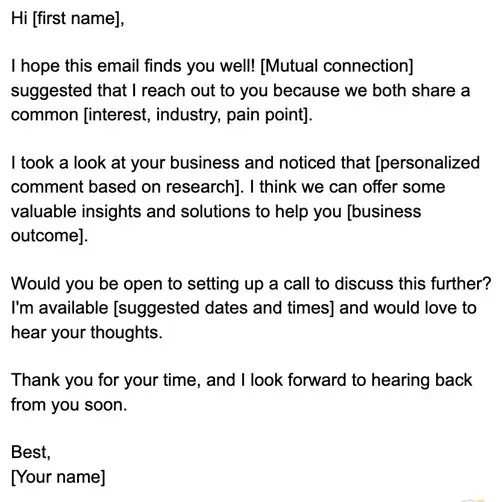
screenshot of a follow-up meeting business email template using gmail

Why It Works

This email template leverages the power of referrals. The mutual connection provides a level of familiarity and credibility that can help to build trust quickly. By personalizing the message based on research, you, the sender, can show that they are genuinely interested in helping the recipient achieve their business outcome. The recipient benefits from receiving a referral to a potential solution provider, which saves them time and effort in their search.

3. Landing the First Meeting: Follow-Up Email

This would be used as a follow-up to the above email (either the next day or the following week), and I would recommend the subject line: “Sorry I Missed You.” We often see 30% to 40% open rates with this email. You'll also want to introduce a case study at this point.

Hi [Prospect],

Quickly following up on my email from yesterday. I tried to call you but was unable to connect. I was hoping to set up a call to introduce my company, [company name]. Do you have 30 minutes anytime early next week that would work?

While I have you, I thought you might find some interest in our work with [client]. We helped them [achieve goal], resulting in [ideally, you have a % to use here, but any meaningful result will suffice]. You can read the whole story here: [Provide case study link.]

As a reminder, we‘re a Y company, experts (or specializing) in the X category. We’ve worked with [name 2-3 clients] and many others to achieve [goal].

Best,

[Your Name]
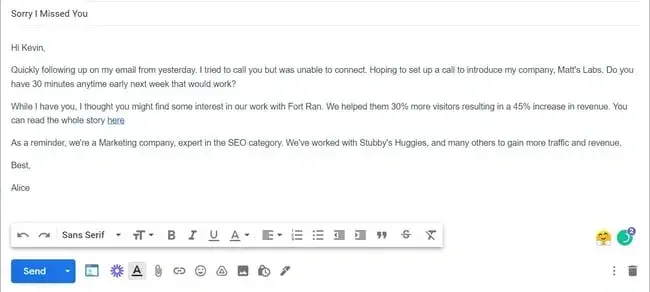
screenshot of a follow-up meeting business email template using gmail

Why It Works

The subject line is intriguing and will likely lead them to open the email. Using a case study offers social proof, which gets them thinking about how you can also help them like you helped others.

4. Landing the First Meeting: The Expert Opinion Email

Offering help is the typical route sales reps go when reaching out to prospects, but try asking for help and see how the odds work in your favor. Finding solutions experts on problems you're working on can be a great way to build your network and find some mutually beneficial opportunities to work together later on.

Hi [first name],

I came across your expertise in [specific topic] and thought you might be the right person to seek input from.

We're currently working on [project/strategy] and would love to get your perspective on [specific question or challenge]. I believe that your insights could be incredibly valuable as we continue to develop our plans.

Would you be available for a quick call or email exchange at some point this week? I'd love to hear your thoughts and discuss further how we might be able to work together in the future.

Looking forward to your response.

Best,[Your name]
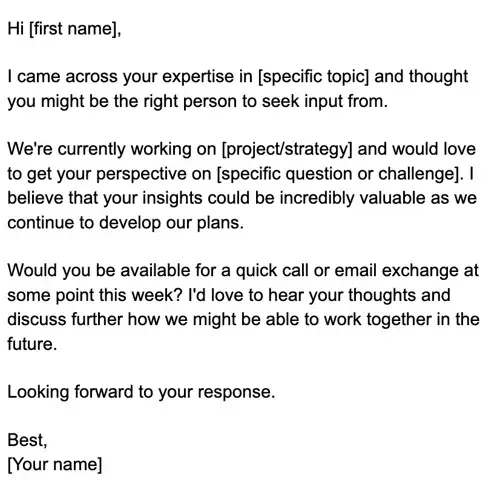
screenshot of a first meeting business email template using gmail

Why It Works

This email template works because it shows that you’ve done your research and value the recipient's expertise. By asking for their input, you’re able to build a relationship and trust with the recipient. The recipient benefits from being recognized as an expert in their field, which can lead to further opportunities for collaboration.

5. After the Meeting: Meeting Follow-Up Email

Let’s say you met with the prospective client and conducted an initial discovery call to assess their needs and goals. Of course, with longer-term sales cycles, you won’t close a deal after that initial meeting, so you should still keep them engaged by moving to the next step.

One of the best ways to get them to open your meeting follow-up email is by piquing their interest with a subject line like, “This may help with [pain point they mentioned]” or “Here's that information you requested.” Then, you can request to move the conversation forward with the template below:

Hi [Name],

Thanks for taking the time to meet with me the other day. I haven't been able to stop thinking about [personal detail from the conversation].

Anyway, based on our discussion about [pain point or business challenge], we can definitely help you [what they hope to achieve]. I spoke with the team, and they provided me with this extra info:

[Additional resources, social proof, and/or information the client requested]

Would you be able to hop on a call some time this week to discuss more?

Best,

[Your Name]
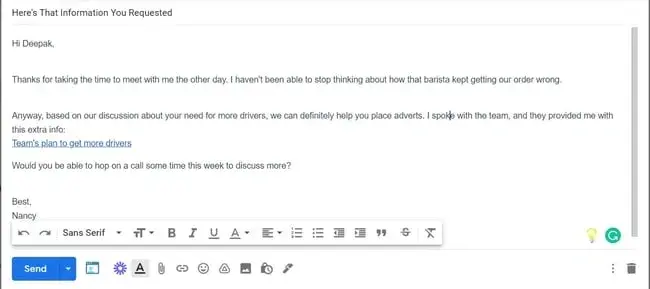
screenshot of a follow-up meeting business email template using gmail

Why It Works

It works because it conveys personal interest in them — and people love the attention. Highlighting the pain point shows you’re attentive to their needs and will likely cement your place as the go-to solution.

6. After the Meeting: Limited Time Offer Email

This template works well when time is of the essence, and you’ve dotted your i’s and crossed your t's on qualifying the prospect.

Hi [first name],

I noticed that you‘ve shown interest in [product/service] but haven’t had a chance to take advantage of our offer yet. I wanted to extend a special offer to you as a valued [company name] customer.

For a limited time, you can get [discount] off your first purchase. We believe our solutions can make a significant impact on [business outcome], and we'd love to prove it to you.

Please let me know if you‘re interested in taking advantage of this offer, and I’ll provide you with all the details you need.

Best,

[Your name]
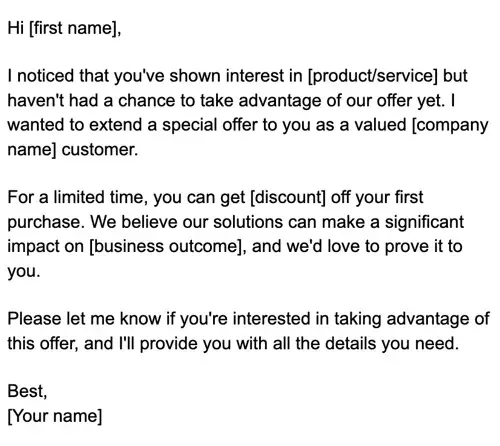
screenshot of a limited time offer meeting business email template using gmail

Why It Works

This email template works because it creates a sense of urgency and exclusivity. By offering a limited-time discount, you encourage the recipient to take action quickly. The discount also provides an added incentive to try your solution. The recipient benefits from receiving an exclusive discount, which can lead to cost savings or a trial of a new solution.

7. After the Meeting: Sales Proposal Email to the Client

Consider this email a digital elevator pitch. You want to reference the different elements central to a conventional sales pitch: problem, value statement, “how you do it,” proof points, customer stories, and an engaging question.

This is the hardest sales-oriented email you will send in this series. Make it personal but authoritative. Really show that your product or service can suit their specific needs and goals.

Hi [Prospect],

As I‘ve gotten to know [their company] better, I’ve come to believe that our services align well with your company's immediate needs and ultimate goals.

We can offer [types of solutions] to allow you to solve [specific problems they're facing]. We use different tactics than our competitors, including [differentiators from other companies in your space].

We've consistently been recognized for our exceptional outcomes and service, like [specific accomplishments you can reference]. For example, we were able to help one of our customers [reference a specific, relevant customer story].

Given how well our [product or service] suits your needs, I think we could do some great work together.

[Engaging question to wrap things up]?

Best,

[Your Name]

Why It Works

This is a hard-hitting, impactful email that provides extra information about your company and further cements your authority. You’re bringing out the big guns now. You tell them what their problem is and waste no time proffering a solution.

8. Post-Proposal Send: Follow-Up Email

This one should be used sparingly and only if your prospect has gone dark. This email typically gets a response as it gently points out to your prospect that they've gone dark, but you've stuck with them.

It's simple but effective, and it continues to provide the prospect with opportunities to learn about your company, read your thought leadership, and be reminded of your expertise.

Typically, the prospect’s response is apologetic and appreciative. And even if you don’t get the business at this point, at least you’ll know if you can move on or keep this prospect on your radar.

You’ll typically want to use the subject line, “[Company Name] — Still Interested?”

Then, you can go in with this template:

Hi [Prospect],

Hope you had a good weekend (been well, etc.*).

Not sure if you‘ve been really slammed or you’ve decided to hold off for now, but I wanted to see if you might have any feedback on our proposal?

Certainly, no rush on our end — I don‘t want to become a pest if you’d prefer I hold off on contact.

I also thought you might have some interest in a recent post on [a post specific to the prospect‘s category, or if you don’t have one, a category-specific, third-party article]. You can read it here: [link].

Look forward to hearing from you.

Thanks,

[Your Name]

*I would never lead with “Hope you‘ve been well/had a good weekend” unless you’ve actually spoken with the person.

Why It Works

The subject line “Still Interested” will likely get the attention of even the busiest of managers. While it appears that you won’t be closing the deal, dropping helpful information for free will keep you in their good books. If you don’t close a deal right now, you might be at the top of the list next time.

9. Post-Proposal Send: The Case Study Email

Providing value is the name of the sales game this year and that goes for prospecting, not just customer onboarding. Sharing relevant case studies that are well-crafted and apply precisely to your potential customer is a great way to show them that you've done your research and are here to help.

Hi [first name],

I came across your business while researching [your industry] and couldn't help but notice [pain point your solution could address].

I wanted to share a success story from one of our clients in [your industry] who was facing similar challenges. [Provide brief story and results].

It's incredible to see the impact our solutions have on businesses like yours, and I believe we can help you achieve similar results. Would you be interested in learning more about how we can help you achieve [business outcome]?

Thanks for your time, and I look forward to hearing back from you soon.

Best,

[Your name]

Why It Works

By sharing a success story from a similar business, you can show the recipient that you understand their pain points and have a track record of success. The recipient benefits from seeing tangible evidence that your solution can help them achieve their business outcome.

10. Last-Try Send: Follow-Up Email

It‘s essential to follow up with prospects more than once, but knowing when to throw in the towel is equally important. At a certain point, you’re wasting their time and detracting from your time spent on prospects who are actually ready to close.

This email should only be used when you can't spend any more time chasing a prospect and need to either push them to action or close the books on them — for now.

Hi [Prospect],

I‘ve tried to reach out a few times now without a reply. Usually, when this happens, it means my offer is not a priority right now. Is it safe for me to assume that’s the case here?

If it is, I won‘t bother you anymore. If you’d rather I follow up in a month or two when you have more bandwidth, I'm happy to do that as well.

Thanks for your time.

Regards,

[Your Name]

Why It Works

If the prospect has been vague about closing the deal, this email works because it demands a direct answer. Short, straight-to-the-point, and polite, it’ll likely get a response from the prospective client, even if it’s a no.

Sample Email to Approach New Client

Here‘s a sample email you can use to approach a new client. It’s based on the first introduction email template.
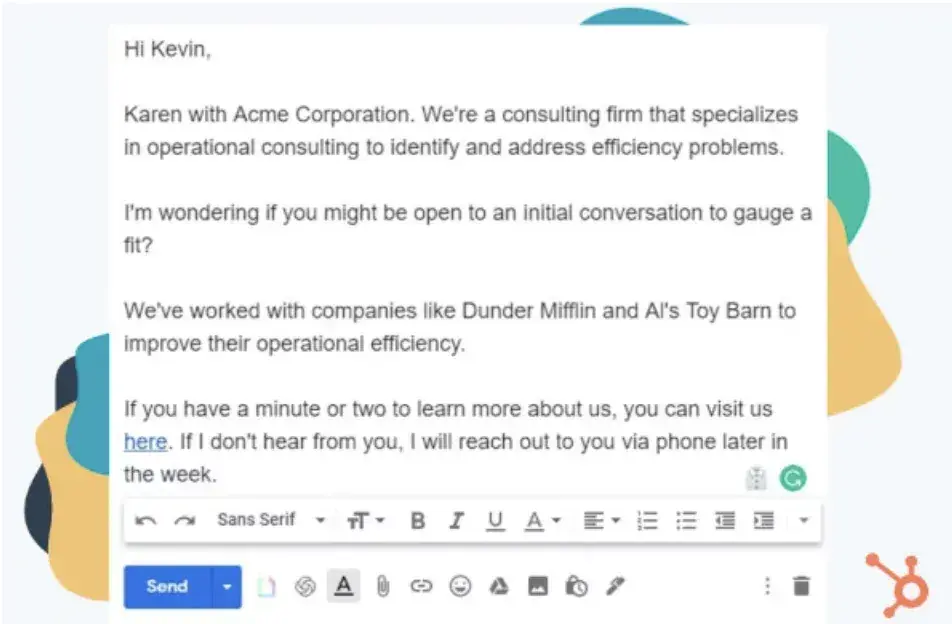
screenshot of a sample new client business email template using gmail

Email templates like the one above reduce the amount of time I spend doing admin while helping me connect with uber-busy buyers. I hope they'll do the same for you. Introduce them into your email cadence and see what kind of a difference they make.

Why It Works

It works because it directs their attention to your value proposition early on, and by the end of the email, the client would likely have decided whether they need you or not.

Business Email Templates

1. Referral Request Email: Post-Conversion

I touched on this earlier, but happy customers are some of the most valuable resources you have when it comes to generating high-quality leads. Prospects trust each other more than they trust you — especially when they're close to one another.

Use this email template to touch base after your prospect has had some time to sit with your solution and see results. Hopefully, they're better off as a result of leveraging your offering — it also helps if your customer success and support teams have done their part.

Hi [Prospect's Name],

I hope this email finds you well. It‘s been a pleasure working with you and seeing how our [product/service] has made a positive impact on [mention specific benefits or improvements they’ve experienced].

I‘m reaching out today to ask for a small favor. We’re always looking to expand our network and connect with more individuals who can benefit from our solutions. Given your experience and satisfaction with our offerings, I believe your referral could make a significant difference.

Would you be open to recommending us to any colleagues or contacts who might benefit from [briefly describe your product/service]? Your endorsement would mean a lot and help us continue to grow and improve.

Thank you in advance for considering my request. I truly appreciate your support and look forward to hearing from you.

Best regards,

[Your Name]

Why It Works

If your solution has delivered the kind of results your prospect needed to see, there‘s a good chance they’ll be inclined to sing your praises a bit — that said, they might need a little push to set things in motion. This template strikes an appropriate balance between friendly and professional. It also clearly lays out some simple, actionable steps for them to take if they're interested in giving you some names.

2. Referral Request Email: Requesting Referrals to Connections

I know I keep harping on this, but prospects will (almost) always trust a close friend or connection over some salesperson. A happy customer vouching for you to their peers is one of the most valuable assets you can ever have at your disposal. This email is one of the more streamlined ways to generate that kind of referral.

Dear [Prospect],

I hope this email finds you well. I am reaching out to you as I have been impressed by your expertise and network in [industry or field]. I am currently exploring opportunities to expand my professional connections, and I believe your insight could be immensely valuable.

Would you be willing to refer me to [specific individual or company] or anyone else in your network who might benefit from [mention your skills, services, or expertise]? I am confident that my [mention your strengths or offerings] could be of great value to them.

I understand that your time is valuable, and I appreciate any assistance or guidance you can provide. Thank you in advance for considering my request.

Best regards,

[Your Name]

Why it Works

This email can help you gain traction in a specific vertical. By asking a satisfied customer to refer you to industry peers, you can generate higher-quality, more focused referrals.

3. Marketing Email: Awareness Stage

Effective business emails aren‘t always acutely focused on the nuances of a prospect’s situation — especially when they‘re only in the “awareness” stage of the buyer’s journey. In those instances, a “putting-out-feelers-esque” email like this one is more appropriate.

Dear [Prospect]

Are you looking to [address a pain point or desire]? Discover how [Your Product/Service] can revolutionize your [specific area, e.g., workflow, productivity, etc.].

At [Your Company], we specialize in [briefly mention key features or benefits]. Our goal is to [explain how your product/service solves a problem or fulfills a need].

Why choose us?

[Benefit 1]

[Benefit 2]

[Benefit 3]

Ready to take the next step? Schedule a demo or request a free trial today!

[Call-to-action button/link]

Looking forward to hearing from you soon.

Best regards,

[Your Name]

Why It Works

As I said, this one is more about putting out feelers and drumming up interest during the awareness stage. You probably won‘t have a particularly intimate understanding of where a prospect is at when you send something like this — allowing you to send it at a broader scale and a range of potential customers’ interests.

4. Abandoned Cart Email Template

When selling online — generally D2C — you‘ll have a fair amount of prospects get distracted while shopping online. In those instances, they might place an item in their cart without buying. If that’s the case, you can use this business email format to re-pique their interest and remind them to buy.

Dear [Customer's Name],

We noticed that you left items in your cart, and we wanted to remind you that they‘re still available! Don’t miss out on these fantastic products — simply click the link below to complete your purchase and enjoy:

[Product Name] — [Price]

Why shop with us?

Fast and reliable shipping

Easy returns and exchanges

Exceptional customer support

Complete your order now and experience the convenience of shopping with us!

[Call-to-action button/link]

If you have any questions or need assistance, please don‘t hesitate to contact us. We’re here to help!

Best regards,

[Your Name]

Why It Works

This email is enough to potentially re-generate interest in your product without being too intrusive or desperate. Sometimes, people just need a little push in the right direction to complete a purchase — this email can help get them there.

5. Customer Satisfaction Email Template

Virtually every business has room for improvement, and customer feedback is the most valuable resource you can leverage to identify where you might be lacking. This email will give you a solid reference point for what you need to work on.

Dear [Customer],

At [Your Company], customer satisfaction is our top priority. We strive to provide exceptional products and services that meet your needs and exceed your expectations.

We would greatly appreciate it if you could take a few moments to share your feedback with us. Your input helps us understand what we're doing well and where we can improve to serve you better.

Please click the link below to complete our brief customer satisfaction survey:

[Survey Link]

Your feedback is invaluable to us, and we thank you for being a valued customer. If you have any additional comments or suggestions, please feel free to share them in the survey or reply to this email.

Thank you for choosing [Your Company]. We look forward to continuing to serve you.

Best regards,

[Your Name]

Why It Works

This email reconciles value for your business with accessibility for your customer. It's approachable and provides a convenient avenue for them to offer their feedback.

6. Invoice Email Template

This one is pretty straightforward. Invoices are central to several business transactions — so maintaining a well-structured, professional email template is essential when operating by this payment model.

Dear [Client],

Attached is the invoice for the [product/service] you recently purchased from [Your Company]. Thank you for choosing us as your provider.

Invoice Details:

Invoice Number: [Invoice Number]

Invoice Date: [Date]

Due Date: [Due Date]

Amount Due: [Amount]

Please find the attached invoice for your reference and review. If you have any questions or require further clarification regarding the charges, feel free to reach out to us.

Payment Options:

[Payment Options]

We appreciate your business and look forward to serving you again in the future.

Best regards,

[Your Name]

Why It Works

Again, this one is pretty straightforward — it's a clear-cut, professional template that politely but thoroughly covers all of the bases you need when sending a customer an invoice.

7. Meeting Confirmation Template

You want to confirm every meeting you schedule — providing a friendly reminder and some context around anything you're going to discuss or materials your fellow attendees need to bring is always best practice.

Dear [Recipient's Name],

I hope this email finds you well. I am writing to confirm our upcoming business meeting scheduled for [Date] at [Time]. The meeting will take place at [Location/Online Platform]. Agenda:

[Agenda Items]

If there are any specific topics or materials you would like to discuss during the meeting, please let me know in advance so that I can prepare accordingly.

Please confirm your attendance by replying to this email. If for any reason you are unable to make it to the meeting, kindly inform me as soon as possible so that we can reschedule if needed.

I look forward to our productive discussion and collaboration.

Best regards,

[Your Name]

Why It Works

This one covers all of the bases it needs to with a thoughtful, professional tone.

Sample Email to Approach New Client

Here‘s a sample email you can use to approach a new client. It’s based on the first introduction email template.

Email templates like the one above reduce the amount of time I spend doing admin while helping me connect with uber-busy buyers. I hope they'll do the same for you. Introduce them into your email cadence and see what kind of a difference they make.

Why It Works

It works because it directs their attention to your value proposition early on, and by the end of the email, the client would likely have decided whether they need you or not.

Tips for Sending Proposal Emails to Clients

1. Lead with a clear subject line.

I touched on this earlier, but I‘ll mention it again — your subject line can make or break any business email, and proposal emails are no exception. I know I’ve ignored plenty of emails with less-than-compelling headers, and I promise you, your prospects have too.

Make sure your subject line has some degree of personalization. Prospects never want to feel like another name on a list, so do what you can to make them feel a little special (in a purely professional sense) — and make sure your line is action-oriented as opposed to passive.

For instance, if you were selling a curriculum scheduling software to a community college on behalf of an edtech startup, you wouldn‘t want your proposal email’s subject line to read:

“Our Software Can Help Colleges”

That's too dry, generic, soft, and vaguely tailored. Instead, you would want to lead with something like:

“Unlock More Efficient Curriculum Scheduling at XYZ College With RedTech”

That lets them know that the content of the email is locked in on their needs. It's also engaging — with some urgency behind it.

2. Make sure your greeting is personalized and approachable.

As I said with the last point, you don‘t want your prospect to feel like another name on a list. Sales, when done correctly, is a personal, consultative process — so you don’t want to undermine those elements by addressing your proposal to “To whom it may concern.”

Address them personally to start things off, and make sure to keep things conversational and professional as you lead into the meat of your proposal. Try going with something like this:

“I hope things are going well on your end. My name is Bryan, and I represent RedTech, an innovative provider of EdTech solutions designed to streamline curriculum scheduling processes.”

3. Keep the initial context about your business concise and focused on benefits.

In my experience, prospects aren't trying to be inundated with information on the proposal email. No one wants an instruction manual in their inbox detailing each and every feature your solution has to offer.

Prospects are busy, and in most cases, they‘re less interested in all the neat bells and whistles your product or service has. As you lead into your value proposition, try to keep things focused — if you pique their interest with your proposal, they’ll likely do some research independently.

Try something like:

“After thorough research and understanding of East Valley College's needs, we have developed a tailored solution that can significantly enhance your curriculum management efficiency.”

4. Frame a specific, personalized, compelling value proposition.

This point ties in with the last one a bit — you want to continue to keep things focused on your prospects and what you can do for them specifically. Avoid offering a cookie-cutter value proposition that applies to everyone in their industry.

And if you mention features, tie them to the outcomes your prospect can expect to see — on both company-wide and personal levels. Sales software can help keep all relevant prospect details within arm’s reach. You can use these details to craft and send out emails personalized to each contact — all without having to jump between multiple platforms.

In the case of the edtech example we've been running with, you might want to go with something to the effect of:

"Our solution offers key benefits like:

  • Accelerated degree velocity — saving costs and bolstering your reputation.
  • Improved scheduling efficiency for teachers — improving retention.
  • A more accessible, effective administrative solution than your legacy system — making your life, as an administrator, significantly easier."

5. Offer a clear call to action and next steps.

Let's say your email blows your prospect away — you have them jumping for joy and thinking, “Holy cow! What an email! This company is going to do wonders for my professional life and broader business interests … but where do I go from here?”

If that's the case, you need to give them a place “to go from there.” That means giving a clear CTA with next steps. Give them the direction they need to keep the conversation going — whether that be setting a meeting, scheduling a demo, or any other avenue to advance the deal.

Use Sales Email Templates to Nurture Leads

Even though your prospects might have crowded inboxes, they still take the time out to read and respond to emails that address their pain points and needs.

The sales email templates in the post-offer you a starting point for creating these types of valuable emails.

Remember that many other people would be reading this guide, so don’t just copy and paste this template. Instead, model it after your business and prospect’s needs.

Editor's note: This post was originally published in October 2015 and has been updated for comprehensiveness.


06 Oct 15:40

Amazon commands almost half of all product searches, and marketers are ignoring omnichannel

by Stewart Rogers
A box from Amazon.com is pictured on the porch of a house in Golden

ANALYSIS:

2014 was another record year for e-retailers in the United States. It was the fifth year in a row that web sales growth has been close to or above 15 percent, with Americans spending over $300 billion online.

The big winner? A full 30% of that revenue was captured by Amazon last year.

That isn’t a big surprise, but what might surprise you is the sheer dominance of Amazon when it comes to searching for products for the first time versus search giants such as Google.


From VentureBeat
Got translation? You got problems. We’re here to help. Localization and translation tips from the best minds in marketing.

A new survey conducted by BloomReach using data provided by Survata tells an interesting story. Following on from research conducted in 2012 by Forrester Research, which found that 30 percent of buyers use Amazon as their first port of call when searching for products, BloomReach surveyed 2,000 consumers to see if that had changed.

And it has. Significantly.

44 percent of buyers now bypass the whole Web and head to Amazon as their first port of call for product searches.

I asked Joelle Kaufman, head of marketing and partnerships at BloomReach, what may have led to this growth in going straight to Amazon since Forrester’s report?

“Concurrent with this growth in commerce search starting at Amazon is the rapid adoption of smartphones and their widespread use as a shopping device — used for rapid research,” Kaufman said. “Amazon dominates mobile shopping with their app and that’s a natural place for many shoppers, on smartphones, to start.”

However, while Amazon advances the battlefield on one side, the traditional allies of retailers — search engines — have inadvertently squeezed retailers from the other. The BloomReach consumer survey found that consumers — at a 2:1 ratio — are wondering why their favorite retailers aren’t delivering the same personalized discovery experience on site or on mobile that search engines provide on the wider Web.

Those facts were echoed as major concerns for digital marketers too.

When BloomReach recently surveyed 500 digital retail marketers (a study also conducted by Survata), marketers not only identified Amazon as their biggest threat (44 percent) compared to a direct competitor (20 percent) or eBay (21 percent), but 86 percent also feared that personalization technology from top search engines like Google was very or highly influential on consumers’ expectations for their sites.

As a result of the growing technology gap from both ends, personalization ranked as the number-one priority that marketers will invest in over the next 18 months.

While both consumers and digital marketers agreed that convenience, and relevance were the top two values that personalization offers, the two groups disagreed on what website personalization feature provided the most value.

Consumers valued the onsite search box as the most-important feature, but marketers felt that navigation elements like facets and filters provided the best value. More significantly, marketers’ opinions on the best personalization value were all over the map, breaking down almost evenly across all categories — search box, navigation, suggested/related products and promoted products.

As the landscape for marketing technologies exploded to almost 2,000 participants, marketers have struggled to make sense of the noise. BloomReach’s digital retail marketer survey revealed that marketers are split on how they define personalization. 38 percent believed it applied to consumer personas, 37 percent believed it applied to individual consumers, and 24 percent still thought it applied to broad consumer segments or demographics.

One other surprise from BloomReach’s findings? Despite all the talk about convergence, omnichannel, and going “mobile first,” marketers are focusing elsewhere.

According to the study, marketers don’t recognize that connecting and personalizing the mobile experience to other channels is important, while previous research shows that the majority of consumers would prefer to be recognized across channels. The BloomReach digital retail marketer study revealed that omnichannel technology ranked last in order of importance.

“E-commerce executives cannot invest in omnichannel independent of a company-wide strategic commitment,” Kaufman said. “And that commitment requires reporting, compensation and systems changes that are significant. Even ‘pick up in store’ and ‘return to store’ can create significant attribution challenges — who gets credit for the sale? Who takes responsibility for the return? E-commerce executives may grow their careers by improving just the e-commerce business rather than the whole business. Omnichannel needs to be driven by the C-Suite.”

Kaufman warns that ignoring omnichannel is a poor strategy for retailers that want to compete with the ever-growing e-retailer industry.

“People don’t think ‘now I’m going to shop on my phone; now I’m going to shop on my laptop; now I’m back on my phone.’ They just shop,” Kaufman said. “But marketers often painfully approach omnichannel personalization in this way, siloing data and chalking every solution up to a responsive-design problem. Marketers are ignoring the 25x mobile-influence factor, inaccurately thinking that ‘omnichannel’ and ‘personalization’ are mutually exclusive.”

BloomReach-personalization-survey-infographic

More information:

Powered by VBProfiles


06 Oct 15:39

The 5th Edition of The New Rules of Marketing and PR Released!

The New Rules of Marketing & PR was originally published in the first edition way back in 2007. That’s like half a century in dog internet years.

When I first wrote the book in 2005 and 2006, Twitter didn’t exist and Facebook was only on college campuses (you needed a .edu email address to join). Now we live in a world with Periscope, Instagram, Newsjacking and all sorts of other ways to reach buyers so I’ve updated the book once again. 

06 Oct 15:38

The Secret to Exponential SaaS Growth: Slack CMO Bill Macaitis Spills

by Stephanie Kapera Hawkins

Photos__Slack_Socks

In August 2013, team communication app Slack launched in preview mode, garnering 8,000 signups within 24 hours.

Two years later, Slack has 500,000 monthly users, $12 million in monthly revenue, and a rumored valuation of $2.8 billion. In a market crowded with options, how did Slack become one of the fastest growing enterprise apps ever?

Bill Macaitis has the credentials to weigh in on that question. Formerly a marketing leader at Salesforce and Zendesk, Macaitis joined Slack in November 2014 as the company’s CMO. This month, Macaitis spoke to the crowd at INBOUND15 about Slack’s approach to marketing, answering questions from the audience about everything from company culture to content marketing to hiring quality talent.

Bill_Macaitis

For SaaS CEOs and marketers, Macaitis offers an invaluable peek into a wildly successful growth strategy.

Generating Buzz by Offering Customers a Great Experience

In its first year, Slack didn’t have a marketing team and relied solely on word of mouth to gain new users. Macaitis’ debut as CMO meant the company could adopt a more formal approach to marketing, but that hasn’t detracted from Slack’s focus on organic customer acquisition.

iPad_Landscape__Channel-1

Says Macaitis, “I definitely think word of mouth is one of those key drivers for any SaaS company. We want you to have a great experience. Every single experience you have with Slack shapes whether or not you’re going to recommend us.”

Macaitis explains that Slack is careful not to pat itself on the back too much and keeps the focus customer-centric. “Ongoing word of mouth is an intentional strategy,” he says. “It’s our primary driver.”

Planning for Growth: Simplicity is Key

There is no typical Slack client. The app serves tens of thousands of users from every market segment imaginable, from scientists at NASA to TV production crews to high school robotics teams — not to mention major brands like Stripe, Spotify, The New York Times and Box.

Screen_Shot_2015-09-29_at_11.45.55_AM

With such a varied customer base, how does Slack plan for growth? Macaitis says the answer lies in prioritizing simplicity. “Look at all your markets and find out how they’re similar, rather than different,” he says. “Make it a simple product. If you just keep adding features, you make the product more difficult.”

Does Slack prioritize any segments over others? Like most SaaS companies, Slack started with a focus on SMBs and is moving upmarket, Macaitis says. He cites LinkedIn as a source of market intelligence. “We work with LinkedIn to see which visitors come to our home page, which verticals, what function they’re in. We see every single function, across all industries. It’s pretty amazing seeing how applicable the product is to all segments now.”

Starting Off Inbound … and Staying That Way

While many companies are just beginning to implement inbound sales teams, Slack has always taken this approach. “We’re still all inbound,” Macaitis says. “We don’t have an outbound sales team.”

“We’ve all bowed down to the lead god before and I thought there was a better way to do that. I’ve really shifted to customer-centricity. I’ve never liked how, when a lead came in, it got routed and you have to talk to this person. It’s a really crappy experience.”

Instead of a traditional, commission-based sales force, Slack has a customer-centric account team that fields inquiries from inbound leads. “If you have questions, great. If you want to do self-service, great,” he says. “It’s really about putting the decision in their hands.”

How to Use Your Blog Well, and When to Try Another Channel

Most of Slack’s original content comes in two flavors: blog posts and podcasts. The Slack blog, “Several People are Typing,” educates users on product updates, highlights customer success stories, and offers readers a peek into Slack’s company culture.

Screen_Shot_2015-09-29_at_12.01.25_PM

Recent posts include titles like:

  • “Inclusion and Diversity at Slack”
  • “722 Ways to Say, ‘I Got Your Message’ ”
  • “How a High School Robotics Team Uses Slack”

As a “huge, huge fan of content marketing,” Macaitis recognizes both the opportunities and limitations of corporate blogging.

In his previous role at Zendesk, his team saw a single, top-of-funnel, awareness-level post reap major rewards. Titled, “10 interview questions for hiring great customer service reps,” the post appealed to the brand’s ideal buyer persona and offered up information on a topic that persona was clearly looking for. It remains in the top Google search results for its intended keywords.

At Slack, Macaitis has taken a slightly different approach. The blog serves as a platform for mid-funnel, consideration and decision-level content. To generate awareness and get new prospects into the funnel, Slack produces “The Slack Variety Pack,” an original podcast “on work, life and everything in between.”

Screen_Shot_2015-09-29_at_11.41.52_AM

One particular episode, “Parents Try Very Hard to Describe What Their Kids Do,” is a good example. Featuring interview clips with parents who, humorously, are struggling to describe their kids’ job responsibilities (“I know he posts stuff on Facebook … or for iPods or something”), the podcast was widely shared and did a great job getting the attention of people who hadn’t yet heard of Slack.

“We’ve always put out content that fits our brand — that’s fun, that’s human, that’s personal,” says Macaitis. “Blogs are great, but not everybody goes to them, and they can’t be the sole source of your content. We use ours for product education and letting people know when new features have launched. Our podcast doesn’t talk a lot about Slack. It has stories about work and life, stories that are inspirational and engage our customers. It’s fun, and it’s a nice first interaction.”

Hiring In-House Talent vs. Outsourcing in SaaS Marketing

As the first marketing hire at Slack, Macaitis built his team from scratch. How did he structure it, and which hires did he make first? “I always look at it as a couple of tiers,” he says. “The first teams I’d build out are analytics and ops, then content marketing, because it’s such an ongoing good source of inbound growth.”

How do you know when to outsource? “We use a lot of agencies,” he says, “but that’s really a function of your cash situation.” When asked how a SaaS company should decide what to outsource and what to build in-house, he says, “If it’s your core competency, build it. If not, outsource it.”

From One SaaS CMO to Another

When asked what advice he had for software and technology marketing leaders and aspiring CMOs, Macaitis offered the following words of wisdom for SaaS growth.

“Constantly learn — learn as much as you can. Don’t be afraid to try new things. Get mentors. Provide value. And be a good teammate.”

We’re so glad we got the opportunity to hear Macaitis speak, and look forward to following Slack as it continues to grow!

06 Oct 15:38

5 Surefire Ways an SDR Can Foul Up a Cold Call

by Chris Snell

Let’s face it: there are a lot of people out there who will tell you that cold calling is dead. It’s not folks, so can we please, for the love of the beautiful children of the world, stop telling our SDRs that? Any time you call someone that has never engaged with your company, regardless of the amount of pre-call planning you do, it’s a cold call. I don’t care how much time you spend researching them on LinkedIn, or stalking them on Twitter, or trying to figure out which Facebook page is theirs. If your prospect doesn’t know you, guess what? You’ve got yourself a cold call right there.

We good? Good.

Since cold calling is difficult to begin with, here are some things that your SDRs can make sure they don’t do in order to not shoot themselves in the proverbial feet:

1. Neglect to pre-call plan – Pre-call planning does not make a cold call a warm call, it just makes you better prepared for when your prospect picks up. That said, if you don’t do it, you’re not putting your best foot forward.

Remember my point about doing your social research and specially, researching prospects on LinkedIn? Make sure you’re doing that. You’re viewing their profile mostly to confirm that the person you’re about to call is the person that you’re really looking for in order to have a worthwhile conversation. You may also be able to find additional contacts in the event that your prospect doesn’t pick up the phone.

Also, make sure you’re taking the time to read through any notes you may have taken (or from a former colleague, if you’re inheriting leads) so that you put a good game plan together prior to making the call. You forget this step and you’re already setting yourself up for failure.

2. Read from a script – You want to toughen up and get used to hearing the other end of a phone slam down in your ear? Read from a script. Afraid of phone rejection? Read from a script, you’ll get a heaping helping of rejection.

We all need to have an outline in front of us, or some bullet points to prompt us through a conversation when we start selling, but do not script out every word you plan on saying. Not only will it sound unusual, but your prospect will be able to tell that you’re reading. To them, that says that you just don’t really care about what it is that you’re selling, because if you did, the conversation would just come about naturally. SDRs should practice and role play with their managers or their colleagues, but should not read a script verbatim.

3. Talk down to an Admin – Here’s one way to blow any chance you have with qualifying a good opportunity. Admins are a wellspring of knowledge and if you treat them any different, you can just go ahead and move on to another prospect.

Rather than getting frustrated because you keep getting admin after admin, start treating them like VIP’s, and you’ll be surprised at how helpful they can be. These are folks that you want to get on your good side, so they don’t send your call directly into voicemail hell when they see your number on Caller ID. Be honest and upfront with them from jump street. Let them know exactly why you’re calling and how you can help their boss look like a champ. Then, ask them to help you be a part of it.

4. Steamroll over the prospect – When your prospect picks up the phone, do not see this as a time to verbally puke all over them about your product or services. Remember that you have precious few seconds to build rapport with your contact before they bail from the call. Therefore, while you’re practicing your role plays, be sure not skip over this part.

In your pre-call planning, take notes on things you find interesting about the prospect or find some type of news that’s worth sharing with them about their industry. Also, take this down: s p e a k s l o w l y. Your adrenaline is going to be pumping, so you have to regulate your rate of speech. If you feel like you’re talking way too slow, chances are you’re talking at just the right pace.

5. Make up answers – Inevitably there will come a time when your prospect asks you a question, or several, that you just don’t know the answer to. If you don’t know the answer, resist the knee-jerk reaction to make something up to keep the conversation flowing. Very calmly, restate the question for the prospect so that they understand you know what they’re asking, and then say, “That’s a great question. Let me find out the answer for you and get back to you after our call.” If you make something up, you’re going to do one of two things: you’re either going to lie so transparently that it’s obvious that you don’t know what you’re talking about, or you’re going to make yourself or your AE look dumb when you get found out. Don’t be that person.

When your SDRs pick up that phone to call into a new account and hopefully blaze a trail that’s never been traveled before, I want them to be able to do so at the best of their ability. Keep yourself and your team from making the mistakes outlined above, and you’ll be better prepared to be successful.

Sales leaders and SDR veterans, what else can you do to foul up a cold call?

06 Oct 15:38

How to Build a Big Email List with Paid Facebook Advertising

by Rebekah Richards

facebook paid advertising

Would you like to learn a secret that could double or triple your blog traffic? What if I told you that setting up just one type of advertising campaign could give you those kinds of results?

Recently we interviewed Amanda Todorovich from the Cleveland Clinic. Amanda’s team used Facebook to increase their blog traffic by 800%!

The Cleveland Clinic’s marketing objectives are to be as visible and helpful as possible to their prospective patients. Because of the industry they are in, there is no way for them to create demand for their services. By being highly visible, they become the automatic choice for their prospects should a health issue arise in the future.

In this post, we’ve pulled out the golden nuggets on tackling Facebook marketing and answer some frequently asked questions:

  • Is it possible to get results without a content piece?
  • How should you approach the process if you don’t want to waste valuable marketing dollars?
  • Can it work to send your prospects to a sales page immediately?

Facebook Marketing: Free vs. Paid

14564864_sSome people look at Facebook marketing from a purely organic and free approach. There’s nothing wrong with that. It can work.

However, using paid media, specifically Facebook ads, can help you reach your goals faster. If you are like most companies, one of your primary objectives is to gain more customers at a reasonable cost to increase revenue.

If you are attempting to do this for free, then you will need to spend a lot of time becoming an authority in your niche to drive website traffic and get customers into your marketing funnel.

What Results Can You Expect From Facebook Paid Advertising?

When you start with a paid campaign, it is critical that you understand what your process is going to be and what your goals are. If you don’t, your Facebook learning experience is probably not going to be profitable.

Usually, it takes some experimentation before you get it right. With patience and experimentation paid Facebook advertising can deliver awesome ROI. In some cases, it can be a complete replacement for search engine optimization efforts. Amy Porterfield and Rick Mulready built entire businesses around Facebook ads.

I am 99.9% sure that your audience is spending time on Facebook. My challenge to you is to create smart targeting options to go find them! – Amy Porterfield

Permission vs. Interruption Based Marketing

Creating demand in any industry can be hard. The key to effortless marketing is having a helpful customer focused content strategy where you capitalize on demand that is already there. You are helping people with your content and because of that you get the opportunity to market your services.

Customer focused content is permission based, and it takes the awkwardness out of marketing. This is true whether you are selling software products, used cars or medical services.

When you are cold calling or emailing someone that is not interested in your product yet, you are interrupting them. That is why it can get awkward and even turn people off to your company completely.

When you get your clients to come to you, you are one step ahead because there is already some interest in you or what you are offering. By marketing a content piece on Facebook, you can automatically see who’s interested in your information based on whether they clicked on your ad or not. If they are interested in the information that you are offering, then the probability is pretty high that your product or service might be of interest to them too.

Direct Facebook Selling Fail

The reason most people suck at Facebook marketing is because they view it as just that, a marketing tool for their products. People don’t go to Facebook to buy anything. Facebook is about funny cats, family photos, likes, and, of course, interesting information.

If you come in with a hard sell, expect low conversions. It’s like asking someone to marry you at first sight. Utterly ridiculous.

No matter how impressive or good looking you are. People that don’t know your brand don’t trust you. Why would they give you money?

That is why you start out by being informative and helpful. You build trust. When the trust is there, it is a very healthy foundation for doing business and escalating the business relationship.

Building an Email List

Take it down a notch from the hard sell and market a content piece that you exchange for contact details. If you are new to building an email list, you can get a free trial from many email providers like GetResponse. You can host drag and drop landing pages on their servers, so you don’t even have to make any changes to your website to add a quick new offer to your campaign.

Accelerated Facebook Selling Without a Helpful Content Piece

Don’t let your Facebook ads lead to your sales page with your pricing tables. You are wasting your money.

What not to do when advertising on Facebook

You need to make an ad with an offer that is impossible to refuse, like a free trial or free consultation. Your offer needs to be a no-brainer.

Focus on the benefits of your product and not the features. Often your clients have no idea how the features of your product are going to benefit them.

If you are running a content marketing agency, for example, your ad should not be saying:

We have the most creative writers in the industry. Claim your free business article now.

That’s stupid. The people that are going to see your ad are not educated enough about your services to understand the benefits. This would be a better headline:

Double your business leads this month by trying our copywriting services for free.

All of us want more business leads. The benefits are a no-brainer. With a free trial of your services, they might be willing to give it a go.

Laser Target Your Prospects

A great thing about the Facebook advertising platform is that you can laser target the demographics of your prospects. Make your ad successful by making it as niche focused as possible. For example:

Double your real estate leads this month with a free trial of our content services.

The benefits are obvious, and the real estate agent knows that you are talking to him. Personalized and beneficial.

Facebook Paid Advertising Benefits Wrap Up

Use your paid Facebook ads (with clear benefits) to send your prospective clients to a special landing page with an irresistible offer. Let them trade their contact details to get access.

When you apply the tips we gave you in this post; you will develop a recognizable brand and a big email list!

social_prospecting_cta