Shared posts

12 Oct 22:14

Why The Trust Factor In Your Business Is Everything

by Troy Hollenbeck

Why the Trust Factor In Your Business Is EverythingWhen we go and start a business, we tend to do everything else right, like getting the funding, a partner, what to sell, office space and so on, and what we don’t take into account is the trust factor. You see trust seems to be an invisible element in business, nobody sees’s it, it’s just there, and they just know it’s there to a degree.

But what we are not realizing, is that every major business decision involving money takes a bit of a trust, even the smallest.

And trust goes even further into the minds of your customers, that’s why people trust major brands, a “brand” is like the beacon in marketing. People trust the brand, people buy from the same “trusted” brand. So how do you gain people’s trust and keep it?

So who do you trust in your business?

What decisions have made you think twice because of trust?

How strong is your brand to your customers?

These are the usual questions that CEO’s, consumers, and entrepreneur’s alike having to swirl in their heads from time to time.

Let’s take a look at how to capitalize on the trust factor and create a better foundation for your business…

Ok let’s zero in on this trust thing, and what you can do to improve it, build consumer loyalty, and create an army of raving fans that want whatever you offer them.

Why Your Reputation Is Golden

Once you have learned the value of your reputation, then you won’t do anything to damage it. One sure way to permanently damage that is scam others online and other questionable activities, and even your comments. Word of advice here is to be professional. Other people will see it, and professionalism is required as an entrepreneur. Besides, customers today now do searches on either Google, Youtube, or your own blog if they want to find out more about you, and a bad reputation never disappears off the search engines, and can take years to earn and can be lost in minutes.

Why Email Is Powerful Trust Building Tool

People used to think spamming out millions of emails with any regard was the best way to build an online business. Well turns out that no relationship and no trust was being built in the process. Or people undervalue having a copywriter write them 20 an email sequence for their funnels for 6K (about $300 each), why would anyone pay 6K for 20 emails? I would and did that’s who, why? because they are going to build trust and a relationship with my new subscribers, then if they like what I can help them with, they buy that simple.

Money Getting Insider’s TIP : Build your subscriber list and e-mail them everyday so you can build momentum, trust, and subscribers can know, like and trust you, this is how you get people to buy your products and services. Don’t lose momentum. Do this for 90 days. Start today. I know what it feels like to be overwhelmed, frustrated, and spinning your wheels over and over again with no or little results to show.

Keep The Spotlight On The Customer

Yes, people buy from people, so they do want to know who you are, but the best way to show them who you are is by being a professional. One example of professionalism is focusing the pitch around your customers and not around yourself, that’s being over self-promotional.

Focus on providing a viable solution, if you can solve that riddle, you have a million dollar business hands down!

Here is an interesting survey on decision making that requires the “Trust Factor.” Credit to Dan Stratton who wrote the quote below.

In fact, a recent eMarketer study surveying business-to-business decision-makers found that 95% of them labeled Peers and Colleagues as their most trusted source for information. Making sure that your current and past customers are happy has never been more important as they have a tremendous amount of influence over future purchasing decisions by prospects you don’t even know exist yet. This is why it is always important to not only make your customers as happy as possible, but to give them the tools they need to evangelize your brand for you. Anticipate customers sharing experience on online review sites, giving presentations about their experience with your company, or simply taking the time to hop on the phone with some of your prospects as a referral customer – and arm them accordingly.

Why Understand The Why

You see if you can answer why people want a product or a service, you got a winning sales pitch. Knowing the “WHY” also keeps the spotlight on the customer and not act like a salesperson. If you are pitching (marketing or selling) something to someone you better know “why” they’d want it. People want to get to know your intentions AND you, that’s why you have to pitch in the first place.

The Art Of Pitching To Gain Someone’s Trust

To pitch (Not talking about baseball) someone, is to listen first to their wants or needs then quickly offer a solution and how you can help. If you cannot get their attention, you won’t get your point across, and if you can’t do that, then I guess they do not “Trust” you’re making the right business decision to make money. Unfortunately, you have to get good at presenting yourself in a hurry if you’re trying to get business investment, joint venture funding or get a partner. Pretend you’re in an elevator going up, in 5 minutes do you have his or her attention or not?

Listen, pitch, and offer a solution.

Get A Conversation Going

My last tip on creating the trust factor in your business is getting a conversation going. Much of marketing is based on creating relationships with people and creating conversations. This goes into you listening to their needs, and really ties in a lot of marketing strategies posted here. I’ve seen 6 figure marketer’s who use only Facebook and Skype to get a conversation going with potential clients and developed that client into a customer for years to come.

And finally, why the “Trust Factor” never goes away…and why it’s your ally in business.

It’s the same ‘Trust’ thing when you get started online.

It’s the same ‘Trust’ thing when you want to make your first 6 figures.

It’s the same ‘Trust’ thing when you want to make your first 7 figures.

It’s the same ‘Trust’ thing when you want to make your first 8 figures. It’s all about the trust.

The final thing to think about, how can you improve the trust in your business? And how can you leverage that relationship and create an endless buying, customer? Leave a comment below and let’s get our own discussion going, thanks for reading.

12 Oct 22:13

4 Mental Shifts Salespeople Must Make to Be Successful

by logan.strain@nextgenleads.email (Logan Strain)

If two tablets with sales commandments were ever brought down from a mountain, commandment one would read, “Thou shalt stay positive.”

It’s been commanded by Zig Ziglar. It’s been commanded by Dale Carnegie. It’s been commanded by Tony Robbins. Every sales and success guru to stand on a stage at a conference has spread the gospel of an upbeat attitude.

But unless you’re a naturally cheerful person (and very few of us are born with that gift) stopping the slide into despondency after failure is easier said than done. It’s especially tempting to give into crippling sales stress after a big deal falls through, a client decides to switch to your competitor, or those long hours aren’t paying off like you hoped they would.

It’s easy, and almost feels natural, to allow stinging disappointment to fester into frustration. The biggest problem with frustration and depression, however, is that they’re mostly useless. They just make you feel terrible while sapping your will to forge ahead despite the setbacks.

So how are you supposed to be like Pollyanna when you really want to morph into Grumpy Cat?

Well, what if your biggest problem isn’t the problem itself? What if your problem is how you see the problem? And if just by tweaking how you see your problems, you would not only be undisturbed by them, you would actually be grateful for them?

Here are four ways to see your so-called “problems” in a more flattering light.

1) I’ve Learned Something

As the saying goes, “Smooth seas make for poor sailors.” Our skills are forged in the heat of challenges.

If a deal falls through, ask yourself why. Did you fail to qualify the prospect sufficiently? Was your sales presentation weak? Did you fail to account for how a competitor promotes their product?

There’s a lesson packed inside every setback. Many, unfortunately, dismiss this free, real-world education. They see it as something that’s useless and nothing can be done about it.

When you have the gift of hindsight, ask yourself: “What would I do differently if I had a do over?” Now be sure to do that next time.

2) This Is a Test of My Resolve

The Roman Emperor Marcus Aurelius said that he was grateful when he encountered problems, because he knew he had the strength to handle them. If they befell a weaker person, they might let their problems hurt them.

The weaker people he was speaking of are those who haven’t yet endured enough of life’s trials. There are some people who practically get everything handed to them. So when they encounter an obstacle, they completely fall apart. They’re soft. They’re spoiled. And since most petty problems hold them back, they rarely get what they want.

Handling troubles is like going to the gym of life. You may not get exactly what you want when your plans are thwarted. But you get to exercise your will, your patience, and the strength of your personal drive. When you build these inner muscles, you become more powerful and more prepared for the next challenges that life throws at you.

Know that whenever you go through difficulties, you’re expanding your inner power at the same exact time.

3) This Is Actually an Opportunity

Whenever a deal doesn’t go as planned, ask yourself: “Am I sure that this is bad?”

The world is littered with stories of failures that transformed into success.

In 1968 Dr. Silver Spencer tried to create a super strong glue at 3M. The glue was extremely weak, and he failed at his goal spectacularly. But when someone got the idea of sticking it to small squares of paper, the Post-it note (and one of 3M’s most successful commercial products) was born.

In the mid 2000s, a company called Android, Inc. was hard at work developing software for digital cameras. But they ran into one catastrophic problem: the digital camera software market was painfully small. It seemed their project was doomed from the start. But rather than getting frustrated, they diverted their attention to the then-growing mobile phone market instead. Shortly afterward, they were acquired by Google. And today, Android is the most popular smartphone operating system in the world.

Associate Justice of the Supreme Court Ruth Bader Ginsburg believes that she would have never earned a seat on the highest court in the land if she wasn’t passed over for an an associate job earlier in her career.

“You think about what would have happened,” she said in an interview with MAKERS. “Suppose I had gotten a job as a permanent associate. Probably I would have climbed up the ladder and today I would be a retired partner. So often in life, things that you regard as an impediment turn out to be great good fortune.”

When plans fall through, we’re often so eager to jump to the conclusion that the worst possible event happened. We think that we’re now forced to deal with second (or third) best.

But is that true, or are you being hasty in your conclusions? If you dig deeper, you might discover a hidden opportunity.

4) It’s Going to Be Awesome When I Overcome This

In Shakespeare’s The Tempest, the wizard Prospero wants a prince to marry his daughter. But rather than granting his approval, Prospero decides to be rude and threatening to the prince and deliberately keep the pair apart. He says he has to do this “lest too light winning make the prize light.”

In other words, if they got together without any problems at all, they wouldn’t value the “prize” of their relationship. The sweetness of success isn’t just about what what we get. It’s also the pride of knowing how much we had to overcome in order to get it, and understanding not everyone had the persistence and dedication necessary to make it happen.

Sometimes, on the path to our goals, we underestimate the amount of time and effort required to achieve them. We wish we could just effortlessly sail to what we want. But that’s rarely the case. It takes someone with a superior sense of mission (like you) to plow past obstacles and detours on the way to your goals. And that’s great, because once you finally get what you want, you’ll be much more appreciative of it.

Shift Your Perspective, Improve Your Attitude

As Captain Jack Sparrow once observed, “The problem is not the problem. The problem is your attitude about the problem.”

Some hard-nosed pessimists like to believe that if you look at the sunny side of things all the time, you’re just sticking your head the sand. Reality is tough, they argue, and you need to see bad events in life for what they are: painful obstructions.

But more often than not, it’s the pessimists who ignore the truth. They think that “This happened and it’s bad” is an observation about reality. But it’s not. 

"This happened” is an observation. But “it’s bad” is usually dependant on your perspective. The wonderful thing about perspective is that it can change based on what you want to look for. If you choose to look for the benefits in every struggle, you’ll get invigorated by them, rather than slowed down by them.

Get HubSpot CRM today!

12 Oct 22:11

Boldly Going in B2B Sales: Less Kirk, More Spock

by Bob Apollo

Kirk_and_SpockThe traditional profile of a successful sales person isn’t a million miles away from the personality of Captain James Tiberius Kirk – someone who has been variously described as “cunning, courageous and confident, and with a tendency to ignore regulations when he feels the end justifies the means”.

Apparently, the inspiration for Kirk’s character came from such diverse sources as Captain Horatio Hornblower, Shakespeare and Alexander the Great. So it’s no surprise that Kirk comes across as the all-action hero, capable of rescuing apparently fatal situations through exceptional acts of derring-do.

How to avoid vanishing up your own event horizon

But, of course, real life isn’t like the movies. And it’s often a great deal easier for most sales people to get themselves into some sort of avoidable scrape through a reckless or thoughtless act of bravado than it is for them to escape from the hole they have just dug for themselves.

That’s why, of course, the success of so many of the Star Trek story trajectories relied on the creative tension between Captain Kirk’s “take that hill” Ying and Commander Spock’s more cerebral, considered and thoughtful Yang.

In fact, it’s pretty clear that – no matter how inspired some of his individual actions – Kirk’s innate recklessness would have seen him removed from command before the end of his first tour of duty if it had not been for Spock’s restraining influence.

In a complex world of better-informed buyers today’s sales people cannot afford to rely solely on their creativity, affability and ability to build relationships. Those traditional virtues remain important, of course, but they need to be mindfully melded with a measure of dispassionate analysis.

Kirk and Spock: Ying and Yang

The truth of the matter is that we need our sales people to combine the virtues of both Kirk and Spock. We need them to be creative, persuasive and committed. But we also need them to be rational, analytic and considered in their actions.

How can we create an environment where both sets of value prevail? Well, we might usefully start by embracing the lessons learned by aviation and medicine, and create simple frameworks and checklists that help to ensure that – even in an emergency – we thoughtfully make the correct decisions.

We can help every sales person develop their creative side by coaching them in the art of inspirational, motivational story-telling and showing them how to share compelling, thought-provoking insights that serve to shape the prospect’s sense of priorities.

Creative Analytics

We can invest in sales analytics to help us identify patterns of performance and – just as important – enable sales people to rationally assess whether they are following what is likely to be a successful sales cycle and if not, to identify the support and resources they need to get back on track.

We can provide our sales people with qualification guidelines that help them to identify whether they are about to embark on a Quixotic and hopeless mission that no amount of bravado is going to enable them to emerge as a winner.

Artist, Scientist and Engineer…

And, of course, we can look for a blend of qualities that span art, science and engineering when it comes to recruiting new hires. But one thing should be clear: the age of the sales superhero is coming to an end. In the future, we all need to be a little less Kirk and a lot more Spock.

12 Oct 22:10

Our Favorite Part Of The Sales Conversation

by Rachel Clapp Miller

resized_icon_thumbs_upCustomer references are a critical component to your sales conversations. Your customers want to know that you can really do what you promise. Hearing third-party evidence can provide the necessary validation to turn an opportunity into a closed deal. Our own proof points have won us and our clients some significant opportunities. They’re one of our favorite parts of the sales conversation.

You can talk about how you are better than your competitors all day long, but putting evidence behind those claims helps your potential buyers see the positive business outcomes they can achieve through your solutions. Effective proof points speak to the priorities and the perspective of your customer.

If you’re going to articulate to buyers how your solution is better than your competitors, you need to make sure your proof points are solidly in place. More importantly, they need to be consumable for the entire sales team.

What Are Proof Points?

We define proof points as verifiable evidence, preferably from a third-party, that your solution can address your customers’ needs and deliver positive business outcomes you promise. They can come in several different forms including:

  • Standard Customer References and Case Studies
  • Industry Awards
  • Analyst-Sponsored Reports and Studies

Here are four ways to maximize your use of proof points:

Do A White Space Analysis

You could have great success stories from your clients, but if you aren’t making a conscious effort to turn those measurable results into hard hitting proof points – they aren’t any good to your sales conversations. Map your proof points. Determine where you have the strongest tangible evidence about the value of your solutions, and then determine the gaps. Which of your value drivers need stronger proof behind them? Work with marketing to gather results and develop additional proof points for future prospects.

Own The Proof Points

The greatest proof points come from the sales team. Best-in-class sellers know the success in their accounts. They have the client relationships and trusted advisor status to gather the measurable results. Don’t delegate your proof points to marketing. Marketing can help you package the message. Sellers can quickly enable your marketing team to demonstrate the value of your solutions by taking charge of gathering the proof as soon as possible after a successful engagement.

Focus On The Numbers

Testimonial quotes can help demonstrate the impact of your solution, but they aren’t nearly as powerful as measurable results. In a sales conversation, it’s much easier to articulate your value when you have numbers to back it up. Drill down on the positive business outcomes of your solution. Always look for specific measurable results – in dollars, numbers or percentages – when gathering evidence on the impact of your product and services.

Leverage Them At The Right Time

Proof points position value in the sales conversation. They can be leveraged at varying points in the sales process, including:

  • Getting Someone’s Attention
  • Demonstrating an understanding of a pain point or pain points
  • Showing your differentiation
  • Mitigating Risk

We go through these use-cases more in depth here.

Proof points are one of the most effective components of the sales conversation, and they make your job as a seller a lot easier. They carry a lot of weight. Create a process to consistently gather proof from your customers and use them effectively. The more you’re able to show the tangible results for another customer, the more your prospects will see the value in doing business with you.

New Call-to-action

12 Oct 22:06

7 Signs Your Lead Is a Terrible Fit

by cstec@hubspot.com (Carly Stec)

This post originally appeared on HubSpot's Marketing blog. For more content like this, subscribe to Marketing.

There's a really big difference between passing off leads to your sales team, and passing off qualified leads to your sales team. 

While a mixed bag of leads will often leave them tied up on calls that won't translate to much for the business, a list of qualified leads will set them on a path that might actually result in a sale. 

What's the best way to separate the good from the bad?

Start by defining what a quality lead means to your business. This is a definition that should be agreed upon by both marketing and sales, and it will probably require a little trial and error. 

In fact, you may want to start with what an unqualified lead looks like for your business and use that as a basis for the people you're ultimately looking to bring in. To help you get started, check out this list of red flags that signal your lead isn't a great fit.

7 Signs Your Lead Is a Terrible Fit

1) They don't have the budget.

If a lead simply doesn't have the budget for your product or service, there's really not much you can do to save the situation. Trouble is, determine a lead's financial standing before you pass them on to your sales team is sort of a double-edged sword. If you ask too soon, you run the risk of scaring them away. However, if you don't ask at all, your sales team might end up wasting time trying to pry this information from them.

What's a marketer to do?

We recommend sitting down with your sales team to discuss the importance of this qualifying criteria. Depending on your business, you may find that it's entirely okay to wait until the lead gets on the phone with a sales rep before budget becomes a factor. If not, it's important that you're extremely careful in your information collection approach. 

Rather than blatantly asking for budget insight on the first form a visitor fills out, save this question for a bottom-of-the-funnel form. This will help ensure that your lead has had a chance to engage with some of your content and is beginning to establish a sense of trust. If and when you do include this field on a form, consider using a drop-down of choices that provide a range rather than an exact amount. This positioning is less invasive and aims to avoid pigeonholing a lead based on financials when there could be an opportunity for your sales rep to negotiate.

2) They don't have the power to make decisions.

What's their job title? While a new hire at company XYZ may have been interested in that ebook your business published last month, that doesn't mean they're in a position to call up budget and actually purchase your product or service. Even their boss' boss might not have the authority to call the shots. Then what?

To help set your sales reps on the right path, you want to connect them with actual decision makers like senior executives or someone who works directly with the company's c-suite. If you find that you're having a hard time attracting these types of people, you may want to reevaluate your marketing strategy to better align with their wants and needs as content consumers. Maybe you try creating more snackable content that lends itself to their relentless schedules, or refocus your distribution efforts to focus on more professional platforms like LinkedIn.  

3) They don't have a need for your product or service.

Do you have a rough concept of what this lead is looking to accomplish? Why are they seeking your solution in the first place? 

There are a number of things that could signal that a lead doesn't have a need for your product or service. Maybe they've expressed that they aren't experiencing the challenges in which your product or service solves for. Or perhaps they've noted that they are already using a vendor that offers what you do and don't have intentions of switching. Probably not worth your time, right?

At HubSpot, we use our top-of-the-funnel landing page form as an opportunity to get to know our visitors better. This includes asking them about their biggest marketing or sales challenge. While this isn't a required form field, it does present our visitors with a chance to explain what they're currently struggling with to give us a better sense of if and how we can help.

4) Their company is too big / too small for your solution.

For many businesses, company size can make or break the quality of a lead. Maybe your solution is designed for SMBs, yet you seem to be attracting a lot of enterprise leads. While enterprise leads often have more budget to allocate, you simply can't sell what you can't support, right?

To simplify the way you size up your leads, ask how big they are upfront. This is an easy -- and often expected -- question to ask on a form. In doing so, it'll be much easier to distinguish workable leads from ones that your solution can't do much for.

Keep in mind that this doesn't mean you need to throw these leads away and never look back. If you have plans to expand your product or service to meet the needs of all different sized businesses, you can revisit this list when you're ready. 

5) They're located outside of your selling territory. 

The beautiful thing about the internet is that it makes it easy for people all over the world to come across our business' websites. It's likely that you'll have leads coming in from far and wide. While it's exciting to see your reach growing, not all locations are going to be a fit for your company. 

Depending on what you're selling, you might have some geographic restrictions that prevent you from doing business with people or businesses in certain territories. Passing those outliers off to your sales reps won't do them much good, which is why it's important to keep an eye out for where your leads are coming from. 

If your business is interested in global leads, keep in mind that you can move them closer to a sale by creating tailored experiences for different locations. If you're a HubSpot customer, Smart Content will enable you to alter the content displayed on any given page based on the person's location. The best part? They don't even have to be a lead yet for it work.

6) They're not engaging with your content. 

In a perfect world, leads would open every single lead nurturing email that came their way. They'd be flocking to our last blog articles and offers, waiting on any and every opportunity to tweet a quote. 

While it's our job as marketers to leverage content to move leads further down the funnel, some efforts are bound to be more receptive than others. Your leads' engagement -- or lack thereof -- often serves as a strong indicator of whether or not they're going to be a good fit for your product or service. 

In other words, if you find that your emails are going unopened and your links aren't getting clicked, it's likely that they aren't ready to take next steps. But if they continue to pick up what you're putting down, they'll probably be more willing to get on the phone.

Our advice? Prioritize the most engaged leads first, and save the unresponsive ones for a reengagement campaign in the future. 

7) They used fake contact information. 

Did your lead listed their number as 555-5555? Do they really expect you to believe the best email address to reach them at is 12345@aol.com? 

Let's face it ... they're just not that into you. 

When a visitor uses fake contact information to covert into a lead, it signals that they aren't really interested in connecting with a member of your team. This isn't to say they aren't ever going to be interested, but false information isn't going to get you very far in the here and now, right? 

When (and if) they are ready, they'll give up the real stuff. For now, let misinformation serve as a red flag for leads who simply aren't a good fit. 

Get HubSpot CRM today!

12 Oct 22:06

How To Track Inbound Referrals

by Jeff Coveney

So you have the whole tracking process down for analyzing Marketing Generated (Website, Advertising, etc.) and Sales Generated (Calls by Sales) leads.

And then some weird leads start popping into your reports that you are not sure how to analyze. You do a little analysis and find out these are referral leads. Where do these fit?

The Referral Lead

How to track marketing referrals

Let’s dive a little deeper into referral leads and the challenge with tracking them. For this post’s purposes, a referral lead is a lead that is referred to your Sales rep by another person.

For example, let’s say an inbound Google ad lead named Jon White requested an eval and is tagged as “Marketing Generated.” Marketing has invested in that lead and wants to track its success through the system. Now the tricky part…Sales calls the lead and is told Jane Smith is actually the best person to work with. Sales then enters Jane into the system manually which usually defaults to “Sales Generated.” Jane is then converted to an Opportunity.

In this scenario, the marketing investment tracking would be lost for future success since Jane is the person being worked. Jane is arguably miscategorized as “Sales Generated” when she is actually something else. Plus, Jon is orphaned from the success as he is tossed to the side.

The Solution – Set Process With The Sales Reps

A solution for tracking marketing referrals

Sorry, there is no great automated way to track these leads. You must establish a process and train your reps on what they need to do when a referral lead comes their way.

Here is one solution but feel free to customize for your own organization. The below is simple to implement and sounds straight forward. However, changing behavior for a Sales rep takes time.

  • For the newly created lead that comes from a referral, the rep must pick “Referral” as the Lead Source upon creation. This choice then brings up two dependent values in the CRM.
    • Generated Source: The rep makes a decision of “Marketing Generated” or “Sales Generated” based on the lead. In our example, Jane would get a value of “Marketing Generated” because the original lead came from Marketing. If the original lead came from an outbound calling campaign, the rep would enter “Sales Generated.”
    • Lead Source Details: The rep then fills in some information on how the referral came into the system. For Jane, the rep would enter something like “Referred by Jon White-Google Adv.” You could try coming up with a naming convention for reps to follow but be happy if they fill in anything.
  • If an opportunity is created, the rep should also add the original lead to the opportunity in order to capture the influence of the Advertising contribution.

Your New Referral Insights

Following the above process properly places leads into the “Marketing Generated” and “Sales Generated” buckets. Additionally, marketing gains insight into how many leads are referred in this manner while also tying in the influence of the original lead.

If you find referrals are playing more than a minor part in your Sales process, you may want to take the next step of providing additional incentives for reps to build out accounts as part of an overall account-based marketing strategy.

Example: December Referrals

  • Referral by Jane Smith-Advertising
  • Referral by Cindy Black-Webinar
  • Referral by Tom Sullivan-Website

If you are tracking referrals differently, please share some of your best practices in the comments below.

10 Oct 16:14

Women face built-in biases in tech sector

The president and CEO of Norsat, a B.C. satellite communications company, was on a buying trip to Asia recently with the company’s purchaser. Every time they got out of a car, their hosts would rush to open the door for the purchaser. When they walked into meeting rooms, the hosts would be equally eager to pull out a chair for the purchaser. They poured him tea.
10 Oct 16:10

How to Have a Massive Month When Your Prices Change

by John Sherer

It was summer 2012, the first day of the month. I was in the office early, looking at a zero, and preparing to meet with my manager to discuss this month’s forecast. Then this email from business ops comes in.

We’re raising prices, effective, end of THIS month.

I was really anxious. How am I going to tell all of the prospects I had been working with that the expectations I had previously set around cost had changed? I felt like that dreadful dishonest salesperson stereotype.

So, later that day, in the meeting with my manager, I said, “Listen Dave, I told xyz companies that they were going to have to pay a certain amount and now with the pricing increase, it’s going to be way more. Is there anything I can do to get them the old pricing?“

He said, “Yeah, there is. Ask them if they can buy before we change the prices, and we’ll grandfather them into the old plan. As long as they get started in that plan, they can keep the old pricing for as long as they’d like.”

Dave helped me format an email template informing my prospects of the change as well the opportunity they had to take advantage of the old pricing. That month, I had my biggest sales month to date. Turns out, pricing increases are UNREAL.

Price Increases Can Cause Massive Sales Months

It’s difficult to get a prospect to buy on your timeline. With a pricing increase, you can create potent leverage in your pipeline. You have to use it. Do not waste a pricing increase.

Pricing increases impact your prospects’ plans to purchase. As you communicate pricing increases, it’s important to help them understand your reasoning behind it. Clearly state how it can affect them, and what you’re doing to ‘do right’ by them.  When communicated openly with ample lead time, a pricing increase is an opportunity for a massive month.


When communicated openly with ample lead time, a pricing increase is an opportunity…
Click To Tweet


At HubSpot, I experienced two pricing increases. And in the months leading up to these changes—and the months after; we extended the window for some—I finished well above my ARR average.

  • “The first thing on any pricing change is to do right by your existing customers and prospects in the pipeline where pricing expectations have been set.  That said when done right—especially when raising prices and in tight coordination with sales—you can use that ‘do right’ approach to create a boost in ARR from customers looking to lock in existing prices.”  – Brad Coffey, VP of products at HubSpot

Using the pricing increase to accelerate deals, have a great month, and clean out the pipe is easy. Here’s the recipe.

Ingredients:

  • List of all deals in the pipeline including your main POC
  • List of all prospects you thought should have bought, but didn’t in the last 6 months
  • A marketing email that generally informs a prospect of the changes
  • The hard date you will change your pricing page
  • The last day you will allow the old pricing (this should be the end of the month)

Directions:

  1. Have marketing send out the general pricing increase awareness email one sales cycle in advance of the the last day you will allow the old pricing.

Screen Shot 2015-10-09 at 6.04.40 PM

  1. Follow-up with the prospects you thought should have bought, but didn’t in the last 6 months. Your email should be a personalized note which includes the marketing email pasted into the body. Make sure you include the marketing email, so they can easily reference all of the details important to them understanding the changes. I use one email template for most of my sends on this step and personalize it with the prospects name.

Screen Shot 2015-10-09 at 6.07.16 PM

  1. Send a personal email to people in the pipeline highlighting the cost differential for buying before or after the pricing increase. Try doing this in a reply to a previous thread to maintain the context of your conversation.

Screen Shot 2015-10-09 at 6.11.29 PM

Keep in Mind

Be friendly, not pushy. You are providing value to your prospects through this correspondence, so be confident writing your emails in that tone.

Inevitably, there will be people who ask for you to extend the old pricing for them. Handling that is a matter of personal taste. Your obvious choices are to offer an extended deadline or end the offer as planned. Just be sure to follow through with updating the new pricing on your website before your deadline ends.

Everyone takes advantage of the end of the quarter and the end of the year. But don’t forget about the opportunity that exists with pricing increases.

Our recent results

In July, at Appcues, we made our pricing increase announcement and had our biggest month by 263%. Given, we’re growing and most months are bigger than the last, but the pricing increase allowed us to create serious urgency, and it had a major impact on our July sales.

How have you handled price increases?

Please jump in the LinkedIn group and let us know your thoughts or leave a comment below!

Tell Us

The post How to Have a Massive Month When Your Prices Change appeared first on Sales Hacker.

10 Oct 16:10

Put On Your Game Face – Agile Marketing Sprint Planning, Part 1

by Jeff Julian

One of my favorite parts of teaching Agile Marketing to a team is the first Sprint Planning Session.  I love the pressure release that occurs when the team commits to producing this particular set of content at a sustainable pace and they can get to the business of Content Marketing.  I get excited when I witness the teamwork that goes into breaking Content Items down into Tasks and seeing how they work on them with more autonomous assignments.  And I’ll admit that I get a little emotional when I see the team lead or Content Owner demonstrate their trust in the process and place faith in the team to deliver.

Sprint Planning is one of the final stages in executing on a full Agile Marketing Strategy for your team.  Up to this point you should have developed Personas, a Content Mission Statement, assigned roles for your team, created a prioritized Content Backlog, and estimated your Content Items.  Each step helps build on to the next, but you can slow down and make sure you have a good grip of the process at any point along the way.  After Sprint Planning, you are now ready to create content.

In this article, I will cover the basics of Sprint Planning and what to expect when you get started.

Fundamentals of Sprint Planning

To get started with Sprint Planning, we need to determine the length of the Sprint.  Some teams decide they would like the duration to be one-week, others prefer upwards of four weeks.  I am a fan of the three-week Sprint as it gives you a week to ramp up, one for really digging in, and the last week for wrapping up.

Once we have the duration, your ScrumMaster needs to schedule a Sprint Planning Meeting with the Content Developers and the Content Owner.

Next, the ScrumMaster will determine the availability of the Content Developers over a selected duration.  Remember to account for Paid-Time-Off, holidays, and any other whole team corporate activities.

Since I estimate with Ideal Days during our Planning Poker session rather than applying the current chaos to the situation, I bring in a percentage of efficiency, starting at 70%, to apply to the actual availability.  This gives us a common reality we can expect and a more accurate estimate for available resources.

Ideal Days use the concept of estimating without usual work distractions in place and then applying the distractions back into your planning at the Sprint to better match current reality.

With the total number of resource days available, sometimes referred to as points, we can hold the Sprint Planning Meeting.

To kick off the meeting, your team will select the Content Items with the highest priority determined by the Content Owner that fit inside the points available.  Then each Content Item will be discussed to determine the quality and value delivery.  Once we understand the expectations, the team will create the Tasks associated with the Content Item and assign an estimate.

A Scrum Board will be used to place these tasks and Content Items on.  This board will be in a physical location using paper or with a digital system.  We will get into that later in this series.

Place all the Content Items and tasks in the Open Column and answer any final questions.  If you plan to start your Sprint after the meeting, hold your first Standup Meeting before you dismiss.

Calculating Meeting Length

Once you are ready, select a date, pick a room, and give yourself about one hour for every week in your Sprint and one hour for every four Content Developers.  This calculation will change once you learn more about your team’s rhythm, but it seems to work pretty well to get started.

Example (two-week Sprint, two Content Developers): 15 minutes * 2 developers * 2 weeks = one hour Sprint Planning Meeting

Get the Meetings on the Calendar Early

This meeting will become a tradition of your team and everyone involved will expect the timing.  But, we all participate in outside meetings and get pulled in several directions during the day.  The agile process will start to isolate the Content Developers from this dilemma but the more detached you are from the creation of content, the greater chance you spend a significant part of your time in meetings.

Once we have the date of the first day of the Sprint, we can quickly determine the last day and the best day for the Review, Retrospective, and Sprint Planning.  These may span a couple days depending on your team size and availability.  However, the closer they are to each other, the better chance we have to get the next Sprint kicked off promptly.

I start with what works for the Content Owner.  Their schedule tends to be the most hectic and they are not required to attend the whole meeting. If your previous Sprint is ending, get the Sprint Review and Demo scheduled first as they are the target audience for this meeting.

Next find a time that works for everyone to plan the next Sprint.  You might block out some extra time at the end if you are just getting started to allow for overflow.  But remember, just because the meeting is on the books, it does not mean we have to use all of the time allotted for the meeting.

Finally, get the Retrospective on the Content Developers calendar.  You can do this meeting outside of the office over lunch or near the end of the day when all other planning has been complete.  Having the Retrospective Meeting after the Sprint Review and the next Sprint Planning meeting can be of benefit to resolve any issues with planning, but over time you might find it works better in-between.  If estimating or performance is the problem your team needs to address, have the Retrospective before your Planning Meeting.  If your team is moving forward well and you find the meeting has minimal discussions, put it afterward and allow for more time to reflect on the whole process more than the big issues.

10 Oct 16:10

An Operationally Sound Definition of Marketing

by Peter Buscemi

An operationally sound definition of marketing must include market sizing, annual planning and a marketing assessment. By answering these three questions, B2B marketers will know the size if the market opportunity, the approach needed to penetrate the market (breadth and depth) and where to make investments in marketing.

Market Sizing

The purpose of market sizing is to clearly and quantitatively define the addressable, served and target market. In doing so, an organization aligns all sales and marketing go-to-market resources for maximum impact.

Sizing the market opportunity is a precursor to establishing a sound market penetration strategy.  In general, there are three sizings of the market that should be made:

  • Addressable Market – the addressable market or available market is a term typically used to establish the global universe available for a product, service or solution regardless of geography, distribution, quality, cost, etc.
  • Served Market – a subset of the addressable market tightly matched to their organization’s value proposition (a match between the business problem and the solution offered) in a geography that can be supported with the current organizational structure. Every targeted company will have a high propensity to purchase the solution.
  • Target Market – a slice of the served market. Organizations typically prioritize companies in the served market to develop a laser focused go-to-market strategy to first establish a beachhead and then expand that footprint to own a vertical industry. Next, the go-to-market strategy becomes twofold: expand within the current vertical industry and then establish a beachhead in a related industry.

All too often organizations are so focused on getting things done immediately that some critical decisions only receive a cursory review. Specifically, markets may be overestimated by adopting a market research report containing quantitative analysis on a market that “is close enough” to their market. The issues in this approach are that:

  1. The market estimate is an overstatement of the dollars that will be spent through purchase decisions
  2. The adoption rate is typically not factored in as organizations will capture X% or XX% of the overstated market not in a single year but over a period of a few years
  3. The market estimate includes a wide array of use cases. Unfortunately many or most of those will not align with the use case that the organization’s solution was designed to solve. This will result in long sales cycles and low close ratios.

To further refine your market sizing and revenue projections, filter the market sizing efforts through the technology adoption curve to gain a clearer understanding of the rate of growth of the market and your organization’s share of it.

Annual Planning

The majority of companies typically do not address the annual plan creation process until somewhere in the fourth quarter. In the largest companies the process may start sooner but the diagrams outlining the annual planning process are sometimes more complicated than an architect’s plan for a skyscraper. On the other end of the spectrum, smaller companies are running so fast that no one has time to stop to “plan”. And, instead of being an opportunity to think out of the box and change the game, the default is to add 10-20% to last years plan so that attention can be returned to closing Q4.

There has to be some balance between analysis / paralysis and “fire, ready, aim.”  Performing a situation analysis is essential but does not have to be a systematic collection and evaluation of past and present economical, political, social, and technological data, aimed at the identification of internal and external forces that may influence the organization’s performance and choice of strategies.  It can be a simple one page SWOT analysis.

The key is to simplify and focus on the relevant, core issues and to go deep enough to understand the impact on planning and execution. After all, the annual plan is critical as it sets the tone and direction for the new fiscal year which of course impacts the go-to-market strategy.

Keep it Simple

The annual plan should only address the top ten topics. The goal is to facilitate the annual planning process and drive the annual budget, not to stifle it. Specifically, these are some of the key areas that should be included in the Annual Plan – and they should be summarized on one page:

  • The Market
  • The Solutions Value
  • Strengths, Weaknesses, Opportunities, Threats
  • Key Assumptions
  • Systems, Process & People
  • SMART Objective.
  • Key Strategies
  • Drivers of Incremental Growth
  • Critical Success Factors
  • KPIs & Metrics

Marketing Assessment

Marketing must continually improve itself to consistently provide value to the organization, and this requires reinventing itself year after year. A best practice for reinvention is to leverage an assessment framework to quantitatively document the current state or baseline.  This will intelligently establish a process to allocate scarce go-to-market resources that will facilitate getting to the next level.

Creating a baseline is often referred to as benchmarking. Benchmarking is the process of comparing the business processes and performance metrics to the best companies in the industry. Benchmarking is used by best-in-class organizations to evaluate various aspects of their business in relation to best practices in the industry. The starting point is to document the baseline and to define the end goal. Then specific tactical marketing plans are created that include both adjustments and improvements to reach the goal. The most effective organizations do not treat this as a one-off event, but as a continuous process in which organizations continuously seek to improve their practices year after year, quarter after quarter and month after month.

A marketing assessment is an intelligent way to allocate go-to-market resources in a quantitative, objective way in order to optimize investments. Once the current state is documented and the desired state agreed upon, a detailed marketing plan can be built outlining specific marketing actions, costs, resources, timelines and priority of tasks that will expedite the path to achieving the organization’s goals.

Embrace an operationally sound definition of marketing as the three B2B market fundamentals (market sizing, annual planning and marketing assessment) outlined above are essential to any successful marketing operations plan.

Download your free copies of these templates now.

10 Oct 16:10

Should Your Business Be On Instagram?

by Michael Wight

instagram

Instagram is growing and businesses are also joining this amazing app to enjoy the benefits. If you find yourself wondering if your business should be on Instagram you are on the right track. That said, the reasons are a bit more complicated than you might think.

A business’ survival in today’s technology-driven world depends on the organization’s ability to effectively identify, engage, and retain its customer’s rapidly changing demands.

Whether you are a small business or a multi-national organization with a worldwide reach, the quickest way to reach customers is by developing an effective social media marketing strategy.

The Quirky Constantly-Connected Customer of Today
Technology has changed the way people do business. Consumers are now well-informed and have a constant connection to the online world. It is vital that you keep up with the rapidly changing world of social media marketing in order to make the most of your business.

Why Social Media Marketing?
One out of every four minutes spent on the Internet is on a social network. Think about that fact for a second, this is an enormous number of potential customers that businesses can engage with and target. There is no denying that every business needs to learn to develop short-term tactics for effective online marketing and also focus on a long-term strategy for promoting their products and services.

According to the Social Media Marketing Industry Report 2015, published by Social Examiner, which surveyed 3700 marketers across the world, almost all of the respondents (96%) said that they use social media marketing.

The importance of having a well-developed social media marketing strategy is obvious from the fact that 92% of the people in the survey indicated that they considered social media marketing as an important element for business growth. This statistic continues to grow every year.

Social Networks Growth

Social Network Growth Ratings in 2014-2015:
According to the Global Web Index, Instagram is one of the fastest growing social networks, the specific rankings are shown below in descending order:

▪ Pinterest (+97%)
▪ Tumblr (+95%)
▪ Instagram (+47%)

Instagram- A Convenient Means of Consumer Engagement
Instagram is the 5th largest social network in terms of account ownership and usage activity. As of September 2015 it had active users. It is a highly visual way of sharing and interacting, focusing on pictures and short videos.

Videos are an important marketing tool, 57% of marketers use video in their marketing and according to Social Examiner 72% of marketers plan to increase their use of video-based marketing techniques.

According to research by Forrester, Instagram has significantly higher levels (400%) of user-brand interactions than Facebook or Twitter.

Effective Online Marketing Strategy
When building your online marketing strategy, brainstorm and set specific goals for your business. Leaving things unplanned is a recipe for a lukewarm presence that will not drive up sales or encourage customer loyalty. Promote your brand values through these channels and you will end up with actively engaged followers and customers. In short, if you create inspiring content you will connect with your target audience.

An Effective Instagram Presence and the Benefits

Businesses have gained valuable returns by using this platform. When starting to develop a strategy, keep these few facts in mind:

Increase brand awareness–Give customers a glimpse into the way you do your work, this builds trust.
Do not focus on selling—Prioritize customer interaction and feedback.
Be consistent—Develop a loyal following by being active and consistent.
Mobile-focused strategy—Instagram enables you to connect with consumers via mobile.

Grant Munro, an author and CEO of FlashStock Technology says that the future of social media is visual. There is no time like the present to begin using Instagram to grow your consumer base.

Learn From Marketing Success Stories
Observe the Instagram campaigns of major brands such as Ben and Jerry’s, Starbucks, Nike, and NBA, to name a few. These brands focused on promoting brand value and used techniques such as contests, exciting photographs and behind-the-scenes looks at their creative processes. More interaction with customers meant more followers and business growth. Social media can do the same for your business if you learn how to use it effectively.

These companies have vastly different products, yet all of them realized the importance of Instagram as a social marketing tool. If you are a business who wants to reach millions of potential customers and build a loyal following, promote your brand via a creative Instagram presence.

10 Oct 16:09

The #1 Obstacle To Building A Profitable Email List

by Ahmad Munawar

Have you ever walked into a used car dealership?

It’s kind of an awkward place. There’s a parking lot filled with a bunch of random cars, none of which look all that appealing, and a small office that smells like some combination of cheap cologne and cigarettes.

But the hallmark of the used car lot experience is the salesman himself — usually a guy with a name like Chuck sporting a cheap sports jacket and a moustache (not the cool kind).

The used car salesman is notorious for using the sleaziest sales tactics to try to sell you a car on right there on the spot. There’s always a blowout sale. And every car is ‘one-of-a-kind.’

But in fairness, he doesn’t really have a choice.

Chuck gets a commission for every car he sells. He has a sales quota. He has kids to feed. It’s in his best interest to sell you a car, any car — as fast as possible.

Are you treating your email list like a used car lot?

When the used car salesman sees you walking around the lot — all he sees is a commission. If he doesn’t get you into a conversation about ‘numbers’ by the time you leave, you’re probably not coming back.

And that makes sense for a used car salesman. He has to resort to high-pressure sales tactics and gimmicky promotions because used car buyers are fickle bargain hunters with no loyalties.

He doesn’t have the luxury of taking his time to build trust.

You’re not a used car salesman.

As an email marketer, you have the opportunity to build relationships with your buyers over time and win their trust. You don’t have to force the sale by trying to convert subscribers into customers as fast as possible.

But what are you doing with that opportunity? Are you building lasting relationships with customers that only get stronger and more valuable over time? Or are you cashing in on those relationships as fast as possible — trading long term growth for a few quick bucks?

How to Build Lasting Customer Relationships — One Email at a Time

Getting someone onto your list is only the beginning. Once they’re there, it’s up to you to build the trust required to convert that subscriber into a customer for life.

Here are 3 tips to maximize the lifetime value of every subscriber:

#1 – Make a compelling promise.

First impressions count. The way you position your new relationship is a good predictor of how valuable the relationship will ultimately become.

Why are they on your list? How are you going to help them? How will their lives change for the better through this new relationship with you?

Remember, giving up an email address is no longer an insignificant gesture. It’s a transaction. And your subscribers are expecting something valuable in return.

Case Study: Boost Blog Traffic

Jon Morrow’s opt-in offer for Boost Blog Traffic is proof that your promise doesn’t have to be complicated. His popular ebook, 52 Headline Hacks, gives subscribers an overwhelming amount of value just seconds after they subscribe.

#2 – Give them a warm welcome.

When a new subscriber joins your list, you’ve earned the permission to build a relationship with them — but there’s still no relationship until you build it.

In the early days, it’s critical that you validate their decision to join your list and set expectations for what they can expect from you going forward.

Remember, subscribers can get off your list just as fast as they got on. They gave you the benefit of the doubt when they joined — but they won’t stick around unless you prove they made the right decision early on.

Case Study: Copyblogger

screenshot-docs.google.com 2015-10-07 16-53-13

Copyblogger’s flagship course, Internet Marketing for Smart People, is a 20-part welcome series that delivers a comprehensive crash course on internet marketing. Twenty value-packed emails delivered over the course of a few weeks cements Copyblogger’s authority and gives subscribers little reason to leave.

#3 – Make every communication count.

Believe it or not, not everyone reads your emails.

In most industries, open rates average between 15% and 25% — which means most of your emails are unread by most of your subscribers.

Every time a subscriber opens an email, what they find inside will either positively or negatively impact the probability that they’ll open the next one. And if they’re only reading a small percentage of them to begin with, each email becomes that much more important.

Case Study: Firepole Marketing

screenshot-docs.google.com 2015-10-07 16-55-32

Danny Iny and the folks at Firepole Marketing send a LOT of email. In fact, they send on a daily basis. Some people love it, while others just don’t have the time to read that frequently. For the busier folks, Firepole Marketing includes this simple message at the bottom of every email:

Why offer the option of a weekly summary? Because giving subscribers the option to choose when and how they’d like to engage improves the chances that they will.

Relationships build trust. Trust increases sales.

If your email list is a revolving door of prospects who join and quickly unsubscribe — it’s not much of a list.

Email marketing is ultimately a relationship medium. The more you invest in building trust with your subscribers, the more sales you’ll make.

But that’s easier said than done. Relationship building is hard work that often comes at the expense of short-term gains. Most people just don’t have the stomach for it.

That’s why it’s so valuable when you do it.

10 Oct 16:08

Don’t Call Us, We’ll Call You: Inbound Leads You Don’t Need

by Hampus Jakobsson

Marketing is the new sales, especially for SaaS companies with an average annual contract value of less than $5000. One of Brisk’s larger clients creates more than 10,000 new leads per month. How can you quickly separate the wheat from the chaff? By sorting them into buckets and processing using some simple rules. Here’s a typical breakdown of an inbound lead stream.

10% Total Trash

“Donald Duck from Disney” may be really interested in your product but his email address is suspect. Although it may be pretty obvious which leads are trash, detecting them still takes time and they may skew your lead metrics. You need to figure out a way to detect these leads, preferably automatically, and delete them immediately. Infer’s lead scoring is one of the best ways to filter out bad leads.

20% Duplicates

Several people from the same company have respectively registered for a webinar, downloaded a white paper and then started a trial but has not been identified as the same person by your system. These leads may be called by multiple sales reps and have a very bad experience.

Duplicates can often be handled by good deduplication software in your CRM but you need to clarify your process for identifying them.

  • Perfect duplicates: If the same person has registered many times using a unique identifier like an email address it’s a perfect duplicate which can be merged or deleted depending on how you treat your data. Dupecatcher is a good tool to detect perfect duplicates.
  • Company duplicates: Multiple people from the same company have registered. This is something you have to decide how to address. At Brisk, we connect these users to the existing account, inform them about the other user from their company, and ask them if they want to have a call with us or talk to their colleague first.
  • Vague duplicates: These are people who may or may not be the same since they use a similar company name or the same email domain. These duplicates are often obvious to a human but not to software so someone will have to manually assign them to the correct bucket.

30% Unqualified

These may be students, competitors or just people who shouldn’t spend their (or your) time looking at your product. These are the trickiest to handle. Sometimes unqualified leads can help you by finding bugs, seeing things you didn’t know about your own product or later end up working at a company which is an important prospect. You want to give them a good experience, but not waste time on them.

Put the unqualified into a nurture state and send them drip marketing, newsletters and other automated content to keep them informed, but avoid spending any human time on them. At Brisk, we actually tell unqualified leads that they are too small or are trying to use the product for the wrong use case. Highlight in the CRM that they are not the ideal target customer and time won’t be wasted on them.

40% Qualified

Sales should only see and spend time on these leads. Qualified leads should be identified and contacted as soon as possible. This lead response management study, for example, determined that the odds of making first contact with a web-generated lead you dial five minutes after detection are 10 times as high at when you dial the same lead an hour after detection.

Even qualified leads need to be prioritized and processed carefully. The most successful sales teams have a disciplined sales process to deal with qualified leads: when, where and how they should be contacted to maximize the chances of closing a deal. CSO Insights defines four levels of sales process: random, informal, formal and dynamic. In a random process (level 1), salespeople effectively do their own thing. In an informal process (level 2) salespeople are trained in a process, but usage is neither monitored nor measured. In a formal process (level 3) salespeople are trained in and required to use the process. Implementation of the process is tracked and assessed periodically. In a dynamic process salespeople are trained in the process, required to use it and implementation is continuously tracked and modified as needed.

CSO Insights sales performance data from 2014 showed that companies with a formal sales process were 13% more likely to attain their company sales plan than companies with a random process. So spending time on implementing a process for qualified leads is one of the best investments you can make.

CSO Insights sales performance data highlights the value of a formal sales process

CSO Insights sales performance data highlights the value of a formal sales process

Processing inbound leads is a bit like online dating. You won’t want to commit to most of the people you meet, so don’t waste your time or theirs, but it’s polite to give them a good experience. Happy hunting!

10 Oct 16:08

10 Email Subject Line Lessons (Straight From My Inbox)

by gsukhraj@impactbnd.com (Ramona Sukhraj)

This post originally appeared on HubSpot's Marketing blog. For more content like this, subscribe to Marketing.

The email inbox is a mysterious place.

It’s given a private address and gets hidden behind lock and key. Only a lucky few businesses gain access to it, but once they do -- it’s every brand for itself.

The average consumer subscribes and receives emails from approximately 9 different brands and when your message finally lands in a lead’s inbox, each and every one of them becomes competition.

In an inbox, industries, branding, and marketing budgets are set aside and the playing field for the recipient's attention is leveled. All any brand has to work with is a sender’s name and of course, the email subject line. 

Like anyone, I check my email armed and ready to swipe left on anything that doesn’t immediately grab my attention, but the 10 emails in this article made the cut for a variety of different reasons.

Check out their subject lines below and the valuable lessons they offer for your email marketing strategy and open rates.

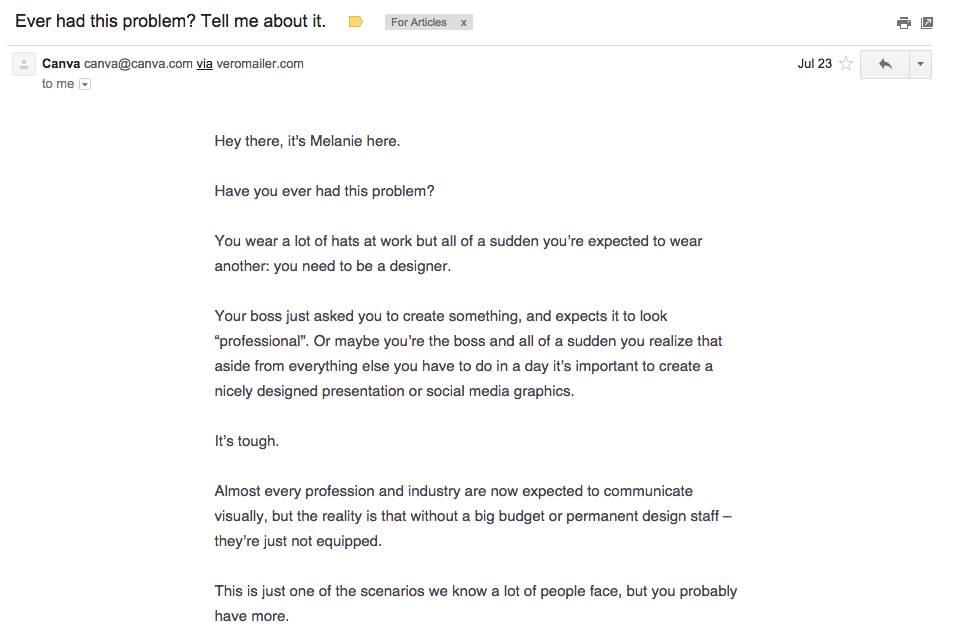
1) Canva: “Ever had this problem? Tell me about it.”

Why it Works:  Reflection & Engagement

Screen_Shot_2015-09-29_at_9.25.25_AM


Canva does a great job with this vague, yet interest piquing subject line.

Not only does it make you wonder what problem they’re talking about, it also forces you to reflect on your own life and challenges. This self-evaluation makes the subject line feel that much more personal, and in turn, makes the reader more interested in clicking open.

As an added bonus, Canva humanizes their brand by making it clear that they’re looking for responses and engagement with this email. It’s not just another sales pitch; they want to connect with you personally.

The Lesson: Ask a question. By forcing your reader to reflect on themselves, your subject line is more likely to trigger an internal thought process and elicit a response.

2) UConn Athletics: “Don’t Miss The Action This Season” 

Why it Works: Fear of Missing Out (FoMO)

Screen_Shot_2015-09-29_at_9.25.52_AM


With this email from my alma mater (#BLEEDBLUE), the UConn Athletics team capitalizes on the psychological phenomenon of “Fear of Missing Out”, or (FoMO), as it’s become known in popular culture.

Human beings are loss-adverse. Addressing what your reader is losing out on causes distress  and makes them want to do whatever they can to avoid doing so -- including clicking through. Go Huskies!

The Lesson: Create a sense of urgency with your subject line. Include a deadline or phrases like “for a limited time” or “last chance” to signal to your reader that this offer isn’t going to last forever. They need to click open and act now if they want to take advantage of it.

3) Sidekick: “find anyone’s email”

Why it Works: Concision and Differentiation

10-essential-email-subject-line-lessons-straight-from-my-inbox-sidekick


Now, this one is a bit unusual. I don’t know if Sidekick’s team did it consciously or not, but regardless, their use of curt copy and all lower-cased letters caught my eye and the eye of my teammate, Christine. (We spent a good 10 minutes talking about it. Not kidding.)

While studies show readers prefer subject lines shorter than 10 characters, most that arrive in my inbox stretch across the screen and have Every Word Capitalized Like This. Sidekick broke that mold. 

Visually, their subject line stands out, which is hard to do with just text. It’s different because of its simplistic nature and it grabbed my attention by taking a more subtle approach than most others in my inbox. 

The Lesson: Try the unexpected. Even if something is a little out of the ordinary in your industry, don’t be afraid to try it. A/B test different approaches/styles in your subject like (i.e. capitalization, caps, etc.) to see which your audience responds to best.

Also, remember to be brief. According to MailerMailer, emails with only 28-39 characters in their subject line see the highest click-through rates, so say as much as you can in as few words as possible.  

4) Uber: “Have You Heard?” 

Why it Works: Curiosity

 10-essential-email-subject-line-lessons-straight-from-my-inbox-uber

What? What haven’t I heard? TELL ME!

Ok, maybe not every reader would react as frantically as me, but I’m sure at least one of these questions would enter their minds.

This subject line leaves absolutely everything about its contents a mystery. The only way to close the curiosity gap between what you know and what you don’t is to open the email and see where Uber takes us. (Pun very much intended.)

The Lesson: Open the curiosity gap just enough that the only way to close it is by clicking into the email. Try asking a question, making a bold statement, or using words like “secret”, “confidential”, “shocking”, etc. You can learn more about these methods here.

5) Barack Obama: “Ramona, will I see you in New York?”

Why it Works: Personalization

Not to brag or anything, but President Obama wrote this email specifically for me. See, my name’s right there in the subject line. -- At least that’s what I might think if I didn’t know any better. 

Personalizing content with your reader’s name, job, home town, or any other relevant information you have about them, instantly makes it more likely to resonate with them.

Our brains are wired to react to hearing our names.  By addressing someone using their first name in your subject line, you will create the impression of a more personal, intimate experience and grab their interest right off the bat.

The Lesson: Evaluate the information you already have about your reader and explore ways to incorporate it into your subject lines. For example, you can address them by their first name like the example above, or reference their location. This will make the message appear more relevant and in turn, more appealing.

6) Panera Bread: “Ramona, come on in and get rewarded.”

Why it Works: Motivation (Adding an Incentive)

10-essential-email-subject-line-lessons-straight-from-my-inbox-panera


Like POTUS, Panera starts strong by personalizing its subject line, but this one earned my click for another reason.

The restaurant chain’s subject line works because it offers a clear and direct incentive. If I click, I’ll find out how to get rewarded. If I don’t click, I won’t get rewarded. It’s as simple as that. 

The Lesson: Big or small, offer an incentive and make it clear in your subject line. Even if they don’t end up following through, at least you motivated them enough to click through and learn more about your campaign.

7) Redbox: “A scary good movie night starts here.”

Why it Works: Direction

10-essential-email-subject-line-lessons-straight-from-my-inbox-redbox

Redbox’s subject line makes for an enticing (and clever) proposition. In many ways, it is a call-to-action, giving me direction rather than just a sales pitch.

If I click this email, a great movie night awaits me. The catch is, I need to open the email to find out how. Not a bad cliffhanger, Redbox. 

The Lesson: Give your reader a clear plan of action or path to conversion. Like CTAs on your website, when your subject line conveys value and a simple way to achieve it, people are more likely to follow through with the action.

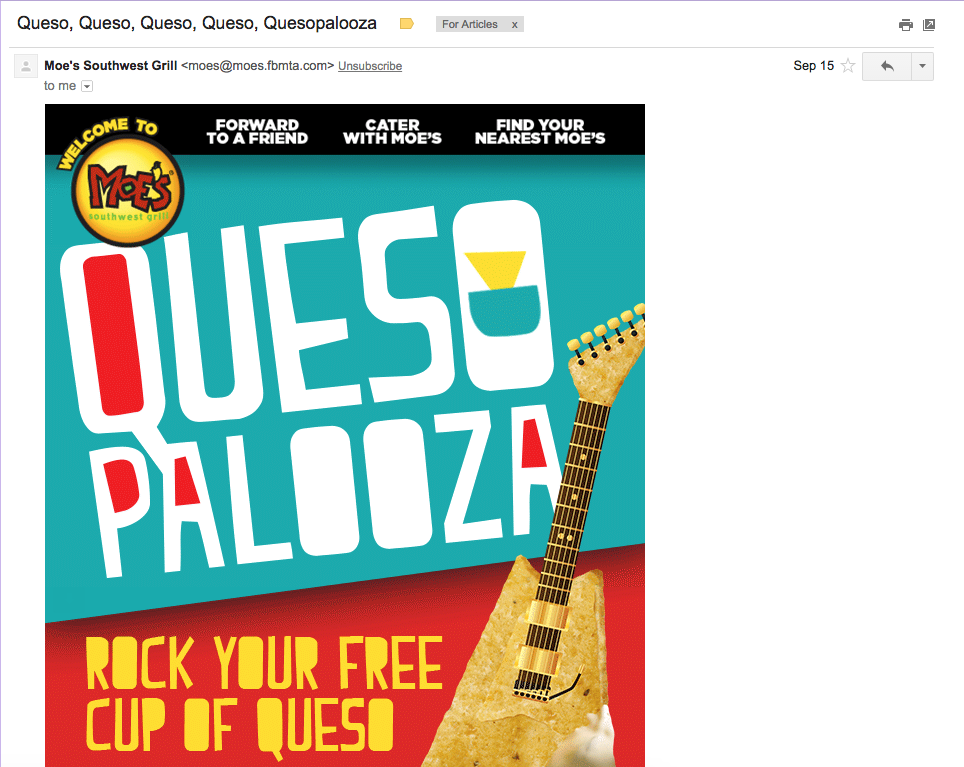
8) Moe’s Southwest Grill: “Queso, Queso, Queso, Queso, Quesopalooza” 

Why it Works: Humor

10-essential-email-subject-line-lessons-straight-from-my-inbox-moes

Welcome to Moe’s! For regular patrons of the Southwestern chain, the humor and quirk of this subject line comes as no surprise. It’s a little random and not really descriptive, but it makes you laugh and curious to see what lies inside. 

The Lesson: Make ‘em laugh! Don’t be afraid to incorporate humor into your subject line copy. Humor is humanizing and using it will help decrease any friction or reluctance your reader feels about opening your email.

9) Forever 21: “LOOKS WE ❤” 

Why it Works: Connection

Screen_Shot_2015-09-29_at_9.29.33_AM


From this subject line, it’s clear that Forever 21 knows its buyer persona.

Emojis/emoticons are basically a second language to millennials, the company’s primary audience. They associate them with fun, friends, and technology -- aka the Holy Trinity of most teenagers.

By literally incorporating a little heart into this subject line, Forever 21 appeals to these positive connotations and reinforces to their audience that they understand their lifestyle and the way they express themselves.

Unlike the word “love” they used inside the email, Forever 21’s emoji resonates with the audience on a more personal, visual level and lets them know that the contents of this email may very well be something they’ll “❤” too. 

The Lesson: Speak the same language as your audience. Use words (or even symbols) that they will connect with on a personal level. Consider trying one of these unusual methods to find the right phrasing for your copy that will resonate with your audience.

10) Godiva Rewards: “Your Sweet Afternoon Meeting”

Why it Works: Addressing Pain Points

Screen_Shot_2015-09-29_at_9.31.18_AM


Afternoon meetings are the worst, and the sophisticated team over at Godiva knows that.

Recognizing this pain point, the delectable brand uses their subject line to position its email as your ticket to an afternoon meeting you’ll actually enjoy. It’s just one click away. 

The Lesson: Turn a negative into a positive. Know your persona’s pain points and find a way to align the value in your email as a solution. If your email can help make your reader’s life or job better, there’s no reason for them not to hit open.

Key Takeaway 

Subject lines, in many ways, make or break an email. If yours doesn’t hit the right buttons for your reader, they’ll never make it to the meat of your campaign or complete the action you want them to so give your subject line the time and attention it deserves.

When it comes to your next campaign, use the lessons above to put your best foot forward and ultimately, generate the most leads possible. Come up with a bunch of ideas, then A/B test your very best ones on a small group before sending it out into the wild.

Get HubSpot CRM today!

10 Oct 16:08

Common BI Customer Challenges And Selling Strategies To Overcome Them

by Melissa Holtzer

Google “BI reseller” and you’ll see that there’s no shortage in vendors. So how can you make your program stand out? How can you truly differentiate, add value, and close your next deal? It’s all about getting into the mindset of your target audience.  trust

Any reseller knows the struggles they face when selling BI products. Potential customers are misinformed about the benefits, are unwilling to purchase a new product, or just aren’t in the position to make a purchasing decision. But, resellers who understand common customer challenges have a competitive advantage. They can anticipate questions and concerns, and deliver on ways to help top prospects overcome hurdles.

Read on for our top four BI customer challenges, and how resellers can form strategies to overcome each.

 1. Fear of systems failure, means failure to give the discovery phase a fair shot.

Nearly half of all implemented BI projects fail. Reasons for failure range from stalled projects to changing requirements. Whatever the reason, past BI project flops bring the fear of failure to new potential customers.

To combat this fear, resellers must come to the conversation equipped with real-life use cases and success stories. Sharing a success story from past customers helps build credibility and shows a potential user how they could similarly benefit from the product.

Resellers should also remember to include success stories and use cases from a variety of industries. Most products aren’t a one-size-fits-all deal, so show the potential customer how the tool can be used in both their industry and others to attract a wider audience.

2. Haunted by past applications’ lack of impact.

Many BI applications don’t deliver when it comes to impact, leaving the end users frustrated and the organization as a whole with a poor financial decision and an unhappy staff. End users need the product to deliver digestible data that’s easy to understand and it can’t be overly manual. Applications that lack impact by the end users and the organization in the past jeopardize the sale to a new, potential customer.

Resellers can quickly overcome the fear of impact by demoing their products to potential users. A demo is one of the most powerful selling strategies, since it allows the customer to see and feel how the product is used. An interactive, engaging demo naturally leads to good conversations about use cases at the prospect’s organization—and conversations that discuss just how success will be determined.

Resellers should also remember the differing criteria when it comes to users. They should include demos for both the end users and the IT department to ensure there’s no surprise later in the sales stage.

3. Lack of executive buy-in.

When it comes to selling a technology or solutions, it’s common to start efforts with the IT department. These individuals know the ins and outs of the latest tech and can more easily see potential benefits of an app that improves employee engagement with data. Yet, if your IT department champion doesn’t communicate this vision to the c-suite, it could mean lack of executive (and end user) buy-in.

Partner with IT, but also pay special attention to the end user and executive team. Articulate the vision, or the “why” behind the solution, then introduce your internal tech champions as the team that will make it happen in terms of implementation.

4. Fear of complete overhaul vs. an additional layer.  

Do your prospects already have a BI platform? They may not be ready to retrain an entire staff or be willing to make a financial commitment for a new solution.

Luckily, organizations don’t need to overhaul their program or get rid of the current solution in place when apps like Roambi layer on top. Adding Roambi to an existing solution allows organizations to extract more value with mobile access.

Roambi’s North American Partner Program is designed to overcome these and other common BI customer challenges. Register for our weekly partner webinars, and learn the benefits of our solution and how to communicate with potential BI customers.

Comments or questions? Leave us a note in the comments below.  

Photo credit: Pixabay, CC0 Public Domain 

09 Oct 20:40

An NDP platform for (almost) everyone

by Martin Patriquin
NDP leader Tom Mulcair arrives at Toronto Blue Jays game with his sons Matt and Greg prior to the start of AL baseball game against the New York Yankees in Toronto on Friday August 14, 2015. (Fred Thornhill/CP)

NDP Leader Tom Mulcair arrives at a Toronto Blue Jays game with his sons Matt and Greg prior to the start of an AL baseball game against the New York Yankees in Toronto on Aug. 14, 2015 (Fred Thornhill/CP)

Unveiled at Montreal’s Palais des congrès near the end of the electoral campaign, the NDP policy platform has a chicken-in-every-pot feel to it—complete with several requisite “first 100 days” promises. Unless you’re big business or an income-splitting family (in which case you probably aren’t voting NDP anyway), there is almost something for everyone here. In this way, it is as much a campaign tool as a platform, geared to both the diehard and would-be NDP voter. The cost of the party’s promises of new investments: $34 billion over four years, with a promise of balanced budgets.

One of the largest ticket items is the party’s National Childcare Plan, with a cost of $6.2 billion over four years. The plan, to have child care in every province for no more than $15 a day, is oddly reminiscent of former prime minister Paul Martin’s blueprint, aborted upon his defeat in 2006, and which Michael Ignatieff adopted for his attempt at the job in 2011.

On health care, the NDP pledges to develop a universal drug-coverage system across the country. Like universal subsidized daycare, the drug plan is similar to what Quebec already has. It would cost roughly $2.6 billion over four years. There are promises of 200 new medical clinics across the country and 7,000 new doctors and other health care professionals. As health care is a provincial jurisdiction, the earmarked money would be given to provinces to spend.

As pricey as it may sound, the NDP’s infrastructure plan pales in comparison to the sheer dollar figures of the deficit-inducing, 10-year, $125-billion Liberal plan. It’s part of the Mulcair-era NDP gamble: Canadians, his team has posited, don’t love improved infrastructure as much as they hate going into debt. The biggest ticket item in the NDP plan is a $3.7-billion, four-year plan to “close the municipal infrastructure gap”—the chasm between what the country’s infrastructure was built to handle, and what it actually sustains today. (A 100-m drive on Montreal’s Décarie Expressway, which officially opened to traffic in 1967, is sufficient explanation.)

An NDP government promises to restore home mail delivery, crack down on ATM fees and limit credit card interest rates. It would reduce the retirement age to 65 from 67. It would electrify the federal government’s fleet of vehicles. (There is also $12 million earmarked in 2016-17 to “roll out electric-car-charging stations.”) It would also reinstate the federal minimum wage—though this is less impressive than it sounds, given that wages are set by the provinces. Only employees of the federal government would qualify; one analysis found that 95 per cent of Canada’s minimum-wage earners wouldn’t qualify.

Muclair has spent a significant amount of campaign time on the issue of Indigenous communities. The NDP platform bears this out. A national inquiry into the 1,200 missing and murdered Indigenous women would be called within 100 days.

The party would pay for all of this through a series of savings and new revenue measures that would, according to NDP figures, generate nearly $7.2 billion in the 2016-17 fiscal year alone, and roughly $36 billion over four years.

The post An NDP platform for (almost) everyone appeared first on Macleans.ca.

09 Oct 20:00

How to Make Ads So Good People Steal Them

by Jessica Gioglio

TapInfluence

Want to generate more engagement with your company’s out-of-home ads? Make them so compelling that consumers want to steal them.

If this seems easier said that done, consider taking a page from JetBlue’s #NYCTakeoff campaign playbook. In the campaign, JetBlue hid prizes in bus shelter ads at 181 stops across New York City’s five boroughs. The ads had different images, from a cheeseburger to a NYC cityscape, an airplane, and more, all in the company’s classic JetBlue design aesthetic.

I pulled this ad off a bus stop and won 2 JETS tickets. There are 180 more around keep your eyes peeled! #nyctakeoff pic.twitter.com/cbC4joTIIb

— dj not a dj (@Steffi_NYC) October 6, 2015

What differentiates these ads from other bus shelter ads are the clever call-to-actions under each image that inspire people walking by to steal them, including, “Literally. Take This Ad. Literally,” and, “Only A Real New Yorker Can Pull This Off.”

Watch as New Yorkers discover that there’s more than meets the eye with JetBlue’s bus shelter ads.

The video and campaign showcase the power surprise and delight campaigns have to deliver memorable customer experiences. While it’s likely that some people walked by the bus shelter ads without reading them, those that did—and were brave enough to rip off the ad—were rewarded with something special and unexpected.

In a time where customer attention is the ultimate commodity, consider how you can take a cue from JetBlue’s mantra and put people above all. (highlight to tweet) Consumers are faced with more messages and ads than they can process everyday, many of which do not inspire, educate, or add value. By putting the consumer experience at the center of this campaign, JetBlue cleverly transformed everyday ads into something amazing.

And, at the end of the day, isn’t that what we are all striving for?

Get more content like this, plus the very BEST marketing education, totally free. Get our Definitive email newsletter.

09 Oct 19:59

How To Get Started With LinkedIn Pulse

by Amanda Clark

252b48b

We get contacted by a number of small business owners who are looking to leverage the power of LinkedIn Pulse—and to see their own content featured on one of the world’s foremost publishing platforms.

Often, though, these small business owners aren’t quite sure where to begin.

Not only does Grammar Chic publish on Pulse, but we assist many of our clients in getting compelling, brand-enhancing blogs onto LinkedIn. What we really recommend is that you call Grammar Chic for a full consultation—but if you’re just looking to dive straight into Pulse, we can offer you a few quick pointers!

Get Familiar With Pulse

The first thing we recommend is that you really get to know this platform and what it represents. Publishing to Pulse is not quite the same as publishing to your company blog; Pulse caters to entrepreneurs and working professionals, and seeks to deliver specific and value-adding insights in digestible and actionable packages.

Get started by going to LinkedIn, clicking Pulse on the Interests tab, and then selecting Top Posts. This will show you the foremost posts from that day, providing a good opportunity for you to dig in and get a feel for the style, tone, and audience of LinkedIn Pulse.

We also recommend checking out LinkedIn’s own list of writing tips, which are all quite handy.

Get Specific

When choosing a topic to write about on LinkedIn Pulse, specificity is the name of the game. “Thoughts About Executive Rehab” is not a great topic. “Talking to your Boss About Executive Rehab” is a little better. “Five Ways to Discreetly and Confidently Talk with Your Boss About Executive Rehab” is better still.

Remember that the people who read Pulse posts want immediate benefits—and the more specific you get with your topic, the more confident they’ll feel that you have something to offer.

This, of course, carries us into the title of your post. A good title is massively significant, as poorly titled posts just won’t get clicked on. Statistics show that How-To and list-related posts tend to do well on Pulse. Question titles (“Why Hire a Content Marketing Firm?”) tend to do poorly.

Consider Your Timing

A final thought: Keeping your audience in mind, make sure you’re publishing at a time that will get you some solid readership. Remember that the average professional is less likely to read your post on Friday afternoon, when he or she is itching to get out of the office, and also on Monday mornings when he or she is just catching up with e-mails and getting set for the week. Midweek posts are probably—generally—ideal.

09 Oct 19:59

World’s LNG projects dying off as natural gas demand promises fall short

by Christine Buurma, Stephen Stapczynski and Naureen S. Malik, Bloomberg News
Rnordman

I thought so.

Five years ago, energy companies hungry for the next big thing started planning as many as 90 terminals to send natural gas around the globe.

Now, it seems the world only needs five more.

Consulting firm IHS Inc. says only one in every 20 projects planned are actually necessary by 2025 as weakening Asia economies, cheap coal, the return of nuclear power in Japan and the ever-expanding glut of shale supply in North America temper demand for the power-plant fuel, putting tens of billions of dollars worth of export projects at risk.

Barring an unusually cold winter in Asia, global LNG supply will outstrip demand by next year, said Trevor Sikorski, an analyst at Energy Aspects Ltd. in London. Seven new plants in Australia will flood the market over the next two years. Cheniere Energy Inc. is planning the startup of its Sabine Pass terminal in Louisiana this quarter.

“The global LNG industry now resembles a game of ‘musical chairs’ with far more projects than the market can absorb,” said James Taverner, an IHS analyst in Tokyo. “There is a very narrow window of opportunity for new projects that want to take final investment decision by 2020.”

Four years ago, the International Energy Agency predicted global demand for the heating and power plant fuel would climb 16 per cent by 2016. Now, it’s projecting 11 per cent, and terminal developers are taking note. Excelerate Energy LP’s floating terminal in the Gulf of Mexico has been postponed. Inpex Corp. delayed the start of an LNG project in Australia by almost a year to the third quarter of 2017.

“It will be increasingly difficult to convince financial institutions to put major sums of money on the table to construct additional capacity,” Tim Boersma, acting director of the Energy Security and Climate Initiative at the Brookings Institution in Washington, said by phone.

North America

More than half of the 38 terminals proposed for the contiguous U.S. may never be built, according to Fitch Ratings Inc. and the Brookings Institution, a nonprofit research group. Besides Cheniere’s Sabine Pass, projects in development include Freeport LNG Development LP’s terminal in Texas, Dominion Inc.’s Cove Point in Maryland and the joint Lake Charles LNG venture in Louisiana between Energy Transfer Equity LP and BG Group Plc.

Twenty more terminals are planned for Canada, according to Energy Aspects, including the Kitimat project proposed by Chevron Corp. and Woodside Petroleum Ltd. in British Columbia. The higher costs associated with projects there, in part because of environmental opposition, makes it even less likely that they’ll be built, Jeffrey Currie, head of commodities research at Goldman Sachs & Co. in New York, said in a Sept. 24 interview.

This deluge of North American gas exports was once seen as displacing some foreign supplies linked to the price of oil. Then the oil market crashed and crude lost half its value, and now that gas from abroad is looking cheap.

The pace of project postponements will pick up as the supply glut expands, Noel Tomnay, head of global gas and LNG research at Wood Mackenzie in Edinburgh, said in a Sept. 3 report. Development of even half of the capacity may keep the Asian market oversupplied through 2025, he said.

Australia’s Gas

While the U.S. LNG projects already under construction will probably come to fruition, any supply not already contracted will be difficult to find a home for, particularly in Asia where Australian gas is easy to come by, Currie said.

Spot LNG prices for delivery to Northeast Asia have slid 56 per cent over the past year, based on data compiled by World Gas Intelligence. Shipments to Japan will average US$5.80 per million British thermal units in 2015, a 65 per cent decline from 2013, according to Energy Aspects. Natural gas for November delivery on the New York Mercantile Exchange rose 0.3 cents to US$2.501 per million Btu at 11 a.m.

The world’s demand for gas meanwhile expanded by only 0.4 per cent in 2014, the smallest gain since 2009, because of shrinking imports to Japan, South Korea, India and China, Bank of America said in an Aug. 21 note to clients.

“Given the price environment and the supply that’s going to come online in the next five years or so,” said Dino Kritikos, an analyst at Fitch in Chicago, “many of these projects are at an inherent disadvantage.”

— With assistance from Aaron Clark in Tokyo and Rebecca Penty in Calgary.

Bloomberg News

09 Oct 19:59

In business and politics, leadership doesn’t look like it used to

by James Cowan
Prime Minister Stephen Harper

Prime Minister Stephen Harper. (Sean Kilpatrick/CP)

Canadians are still weighing whether they want Stephen Harper as prime minister, but they think he’d be an outstanding CEO. A poll conducted earlier this year by Abacus Data found respondents identified the Conservative as the party leader who was best suited to running a large company. They also said he’d do a better job than Liberals’ Justin Trudeau and the NDP’s Tom Mulcair in leading a trade mission or offering the best ideas for investing. As Bruce Anderson, chairman of Abacus, wrote: “Mr. Harper is seen as a solid choice when it comes to some key attributes people look for when it comes to leadership, especially financial and management skills.”

This image has always been one of Harper’s best assets. He comes across as disciplined, dispassionate and decisive—all attributes that fulfil our idea of what a leader should look like. Read enough anecdotes about his managerial style and a sketch emerges that isn’t that different from Yahoo’s Marissa Mayer or Oracle’s Larry Ellison. All three are demanding bosses known for withering criticism and brooking no dissent. That description also fits Donald Trump, who dominates the Republican primary race with his burlesque performance of a businessman. As Bloomberg Businessweek recently noted: “his corporate leadership is a kind of teenager’s fantasy of adult power.”

But there’s an incongruity between this caricature and what good management actually looks like. Asked to identify key leadership skills, North Americans cite a global perspective, an ability to collaborate and a knack for building consensus as the most important traits, reports the World Economic Forum. Furthermore, companies that identify openness as a core value outperform their peers by 30%, according to a survey of 1,700 CEOs conducted by IBM. That same study found 75% of CEOs see collaboration as a major driver of employee success. It turns out the stereotype of a strong leader that dominates our collective imagination isn’t what individuals actually respond to when it’s time to follow.

The “command-and-control” school of leadership also has significant downsides. It exaggerates the strength of a leader when things are going well and leaves them with few allies during tough times. As Stanford management professor Robert Sutton once told Wired, being a bullheaded boss means “your enemies are lying in wait. When you have performance issues, then they come and shoot you.”

This all might read as an indictment of Stephen Harper’s leadership—it’s not. Throughout his public life, he’s demonstrated an ability to collaborate and build consensus when needed, from the creation of a unified Conservative party to the long list of trade agreements signed during his time as prime minister. But polls now suggest the public has become disenchanted with his strongman management style. Meanwhile, Mulcair and Trudeau continue to make gains in polls surrounding leadership ability, partly driven by promises of greater collaboration with the provinces and more transparent decision-making.

The stereotype underlying Harper’s reputation as a strong leader is an outdated one. For those who aspire to lead, in politics or in business, it’s time recognize that a willingness to be open and engaged is strong leadership—not a detriment to it. Those who want to be the next Donald Trump (or Larry Ellison) need to choose a different role model.

MORE ABOUT LEADERSHIP & MANAGEMENT:


The post In business and politics, leadership doesn’t look like it used to appeared first on Canadian Business - Your Source For Business News.

09 Oct 19:58

Winning Roles: Applying Moneyball Principles to Predictive Hiring & Succession Planning

by Mike Kennedy

Business can learn a lot from sports in terms of using analytics to optimize talent decisions in a predictive and strategic way. From Billy Beane of the Oakland A’s to Daryl Morey of the Houston Rockets, there’s a wave of analytics-consuming innovators across sports who appreciate the value of using data to gain and maintain a competitive advantage over their higher spending peers.

What are some applicable lessons to business?

Billy Beane Moves Scott Hatteberg to his Winning Role – First Base

There are a number of great examples in the 2011 movie Moneyball starring Brad Pitt as the innovative and analytics-using Billy Beane, General Manager of the Oakland A’s – but one specifically comes to mind. In this movie based on the2003 Michael Lewis novel of the same name that brought workforce analytics to Hollywood audiences for the first time, there’s a scene where veteran A’s catcher Scott Hatteberg is struggling due to a weak throwing arm. After considering the analytics, Beane decided to move Hatteberg to first base, where he thrives in a role that utilizes his catching ability over his throwing ability. This was Hatteberg’s “Winning Role” – where he was predicted to be most successful.

Two other more “typical” approaches would have been for Beane to 1) Release Hatteberg from the team saying he was a losing player, or 2) Spend time “training, coaching and otherwise spending extraordinary effort” to make Scott Hatteberg be a great catcher. Both are failing approaches.

Winning Roles: Predictive Succession Planning & Hiring for Business

While this decision was based on a player’s physical attributes that are valuable in a baseball context, the concept of utilizing predictive analytics to move an employee to their best position based on their predicted strength is a very applicable scenario in business. Just as Beane retained Hatteberg and found a more valuable spot to utilize him with an eye towards team performance, today’s predictive analytics technologies make it possible to re-allocate an employee that was perhaps struggling in one role to a different (Winning) role where they are predicted to be most successful.

To learn more about how to use Winning Roles to optimize your Hiring and Succession Planning processes, click here.

09 Oct 19:57

Why Experienced Salespeople Fail at Startups

by Greg Poirier

I’ve been mentoring and advising startups for several years now. I’ve also had the experience of hiring amazing sales people and hiring (then letting go) terrible sales people at startups I’ve been a part of. And I like to think that I’ve learned a few things along the way; including how important a CRM is (more on Salesforce implementations for startups here). One of the most important things I’ve learned is that experienced enterprise sales people often turn out to be an anchor on company growth.

“Greg, we just hired our first sales team member – they have a decade of experience.”

I cringe every time I hear this. Don’t get me wrong, experience is great. Unfortunately when a founder says this, they are frequently talking about enterprise experience; experience selling at a big company. These sales people often have what I refer to as the “Phone Company Problem”.

The Phone Company Sales Problem

Selling for telecoms, or other well established technology solutions providers, is actually a (comparatively) easy type of sales. Some of my more former co-workers will hate me for saying this, but its true. Here is how a sale at a telecom might go:

“Hi Business owner. I’m Bob. I’m from the phone company and I know you need a phone system. You also know you need a phone system and you know who we are, because well, we’re the phone company. We are big and we are dependable.”

In this type of scenario, it is really up to the sales person to build a deal that is more compelling and provides more value to the potential customer than the competition. That competition may be the cable company, a VOIP solution or something else, but not getting a phone system isn’t an option. Moreover, companies don’t change phone providers often because the switching costs (in terms of mental overhead and training etc.) are very high. So renewals are easy, churn is low.

How Sales at a Startup Work

“Hi Business owner. I’m Bob. I’m from a company you have never heard of before. You have no idea who I am and in all likelihood we will never meet in person. I understand enough about your company to know you may have a problem we can solve, but you aren’t aware you have that problem. You don’t know you need my product. And even if you do buy our product, statistically speaking, there is a high chance you will abandon it.”

First You Have to Sell the Problem

Many (if not most) enterprise sales people that are used to working for an established organization fail at startups, not because they lack sales expertise, but because they are selling the wrong thing. A big part of solution selling for a startup is creating the need to solve a pain the customer might not be aware they even felt.

First you have to convince the customer they have a problem and that the problem is solvable. That might take 6 months, 12 months, more – it is hard. During that time, you also have to sell them on the fact that your company is a credible organization. This may be despite the fact that you have few or no referenceable customers, very little in the way of sales enablement materials and you can’t afford to fly to meet them in person. The low subscription cost of SaaS solutions can often make travel for all but the biggest sales unprofitable. Deals have to be closed on the phone and that takes an amazing amount of talent.

After all that is done and they are convinced of their pain and your company, then and only then can you actually sell them your solution.

Why Enterprise Sales People Fail at Startups

Enterprise sales people, who aren’t used to this type of situation, tend to make the mistake of trying to sell their solution right away. They don’t understand they have to establish a problem and credibility first. Not only does this cause them to struggle, it also means that they don’t get paid the commissions that their lifestyle demands for the first twelve months of their job. Add on to that how demoralizing it feels to go from being able to close sales in a few months to wondering if you ever will close one again and you have a fairly demotivated chair warmer.

What to Ask in the Sales Interview

It isn’t all doom and gloom. Some enterprise sales people do fabulously at startups. It depends largely on their training, coaching and personality.

Having experience isn’t a bad thing. But as a founder or early stage employee hiring a sales person, you have to ask very direct and blunt questions about how they believe your sales cycle will work. Ask how they envision the sales process, how long they expect it to take to close a sale and how they have historically closed deals.

Remember that talented sales people are often great in-person interviewees. But handshakes and smiles likely won’t be a component of their job. Take the time to have them do an online demo for remotely and have them call and sell to you on the phone. Be particularly cautious about candidates that talk about meeting with the client or closing in person. Startups often can’t afford the travel costs required for that type of sales tactic. The handshake closers are great at their job, but their selling style often doesn’t work over the phone.

The Most Important Thing When Hiring a Sales Person

Ensure that they understand that sales are going to be difficult and take a long time. They need to know that they can’t count on commissions for the first 6 months, so either you need to supplement their base salary in the short term or they may need to make a major adjustment to their lifestyle. Both parties not understanding this is a recipe for employee dissatisfaction and a higher turnover rate.

09 Oct 19:49

The Telltale 8% Drop In Content Marketing Effectiveness

by Tony Zambito
by Aha-Soft

by Aha-Soft

When the Dow tumbled in 2008, the largest single-day drop in the history of the Dow occurred on September 29, 2008. The index fell by nearly 778 points or almost 7%. In October of that same year, the Dow tumbled yet another 733 points, or by 8%. It goes to show you that sometimes, numbers being relative, an 8% drop can be significant and historic.

The annual Content Marketing Institute and MarketingProfs B2B Content Marketing Benchmark Study 2016 is quite startling. Perhaps not as drastic as the Dow falling by 8%, but to see the percentage of marketers who believe their content marketing was effective drop to 30% from 38% in one year is a revelation. Especially, when it has stayed at approximately 38% for several years.

With the amount of hype, “content about” content marketing, growth of content marketing agencies/consultants, and the explosion of content marketing conferences, the instinctive thought process is this percentage should be increasing – not decreasing.

Buyers Are Saying The Same

Recent surveys, from the likes of Forrester and SiriusDecisions, indicate the sentiment is nearly 70% or more of buyers outright reject content. In the Forrester report, specific to Sales Enablement surveying over 300 business and IT decision-makers, it ironically proves to be a telltale state of the union about content marketing. These are not pretty folks:

  • Near 65-70% of the respondents indicated, “I usually scan the information and then throw it in the trash”
  • As much as 80% say, “Vendors give me too much material to sort through”
  • Close to 65-70% of the respondents indicated, “Much of the material is useless”

These mirror my own findings in conducting qualitative buyer persona research interviews directly with buyers the past two years. In one such buyer interview, an executive handed me a folder, rubberbanded. Saying: “here is all the stuff they sent me through email and regular mail. I collected it rather than throw it all out so someone could take it back and let them see what they are doing.” I did take it back and it was an eye opener indeed.

There is a strong correlation between buyers indicating content received is useless and marketers who believe their content marketing is not effective. In yet another ironic unveiling, this may be one area where marketers/sellers are in agreement with buyers. Whereby both are in agreement the majority of content marketing, as it exists today, is not working.

Documented Content Strategy Helps

What the CMI/MarketingProfs Benchmark Study did indicate is that those organizations with a documented content strategy had a better rate of effectiveness. A little more than half (53%) of the most effective content marketers had a documented strategy. While, 47% of the least effective content marketers did not. Thus, you can reach a conclusion that having a content marketing strategy that is documented and discussed is helpful.

On the same token, you can also conclude that approximately half with a documented content marketing strategy still struggle to be effective and to make an impact. What this conclusion points to is that having a documented content strategy may not be the single most determining factor of whether content marketing efforts will be effective and successful.

The Right Buyer Understanding Matters

You can surmise from the above that having a documented content strategy is not enough. As is always the case with strategy, it has to be the right strategy informed by the right information and insights. Being informed with the right information and insights about buyers is proving to be the single most determining factor leading to content marketing effectiveness.

The Forrester report, as well as others, alludes to this problem. I have seen it in my own qualitative buyer research. Which is, marketers and sellers are lacking in the right kind of buyer understanding. These reports indicate that current means of profiling and messaging to buyers are not resonating. In essence, leading to the scan once and trash results.

What is important to point out, as Forrester does, is the usual profiling of buyers involving the gathering of business and sales intelligence is simply not working nor can you build an effective messaging framework from such. Profiling the buyers’ titles, roles, initiatives, product/buying criteria, processes, and other forms of rudimentary product marketing and sales-based profiling is not resulting in effectiveness. As the consistent percentage of 70% of buyers trashing content edifies.

The 70% number appears once again in this story. Forrester and others, when benchmarking sales enablement, have found that sales teams are not using as much as 70% of the content created for sales enablement. And, here once again, we have that unique agreement between sellers and buyers about one thing – content being provided is “useless”.

Empathy: Helping Buyers To Achieve Their Goals

Missing in undocumented and documented content strategies today is the right perspective of having empathy with buyers. Empathy can be such a generalized term. As is the usual case with new emerging business terminology, the term empathy is now often overused. The logical question though is what do we need to have empathy about when it comes to buyers?

As I have written about several times of late, research in the past four decades has shown that the predominant largest factor influencing decisions on the part of buyers are their goals and their associated goal-directed behaviors. It is a simple yet profound premise of helping buyers to achieve their goals leads to effectiveness and results.

Use Buyer Personas To Understand How To Help Buyers Achieve Their Goals

Understanding the goals and goal-directed behaviors of buyers is hard work. It means the use of qualitative buyer research and getting at the deepest level of buyer insights possible. Research has also shown goals are not just sitting there on paper to glean from. They are often unarticulated and reside in the subconscious of buyers. Thus, why goals and goal-directed behaviors are the deepest forms of buyer insights you can attain.

The dividends and rewards, however, are substantial when you can inform both content interactions and sales interactions with insightful means on how these interactions can help buyers to accomplish their goals. Sales, for example, would find more ways to use content designed specifically for later in the buyer’s journey or path to a purchase if it was adept at goals. That is, adept at communicating and reinforcing how the buyer’s goals were going to be achieved. For CMOs and marketers today, adopting a goal-directed marketing framework is one path towards achieving effectiveness in content strategy.

Buyer personas can be helpful in this manner. The one important recognition that needs to take place though is knowledge of whether a buyer persona development effort was based upon goal-directed principles and methodology. At the origins of personas in general and buyer personas are the founding principles of personas are archetypes based on the goals and goal-directed behaviors of users and buyers. If not based on goals and goal-directed behaviors, then they are basically buyer profiles.

As this story has shown, profiling on the factors mentioned and not understanding the goals and motivations of buyers, can lead to a significant drop in content marketing effectiveness. When it comes to content marketing effectiveness, the right buyer understanding matters.

(What follows is a video featuring Dan Pink on motivations. What I like is he communicates the value of social scientist studying how we approach problem-solving and the role of motivation. Including how we may be too left-brain oriented with rules-based approaches. As opposed to the right-brain orientation towards conceptualizing. The profiling of buyers described above is very much a left-brain response to understanding buyers. Versus the motivational right-brain insights and understanding needed.)

09 Oct 19:48

8 Personalization Trends That Are Reinventing the Buyer’s Journey

by Dan Stasiewski

personalization-trends

If we think about offline buyer/brand relationships, customer loyalty results (in part) when a brand can form a relationship with the buyer through acts of thoughtful remembrance. For example, knowing their preferences, or making product or service recommendations according to their likes and dislikes.

One of the big challenges businesses face today is creating this same experience for buyers online. In essence, the act of doing so is what we call personalization or personalized marketing. But we’ll get to that …

Each buyer’s journey is unique because buyers are dynamic individuals with their own wants, needs and concerns; their own motivations and goals — the likes of which change constantly. This has given rise to demand generation. Unlike lead generation, which only aims to collect as many leads as possible, demand generation is concerned with creating valuable touchpoints with each buyer throughout their journey, and catering to their wants and needs over time.

Demand generation is about respecting the customer, not rushing them toward a desired action. It treats every interaction with care and consideration to bring value to the buyer’s journey and to help buyers reach their goals.

Consider this: The average consumer goes through at least five touchpoints before converting. That means the buyer’s journey is longer than ever before (especially for B2B). And buyers are entering the sales cycle at a much later stage, already armed with information about a brand and its offering.

In response, brands race to be a part of the buyer’s early education. But this has created another challenge: Consumers are so inundated with content, creating and distributing it is no longer enough to win conversions. It’s become much harder to connect with buyers.

Personalized Marketing to the Rescue

Personalized marketing is an extreme form of target marketing. It aims to reach audiences with the exact solution for which they are searching, and to speak more directly to each individual buyer, creating a one-to-one experience. To address audiences with such accuracy and detail, personalized marketing requires big data about a particular customer or group. This data must then be converted into marketing action. Because there is so much information, converting data to action is exceedingly more complex, requiring different marketing technologies.

Which brings us to the topic of the day — personalization trends that are reinventing the buyer’s journey. These trends are changing the entire experience for buyers. Coincidentally, they’re also raising a lot of questions, not only about how they impact the shopping experience, but also how they flirt with privacy and security. Let’s dig in!

1) Programmatic Marketing

Paid advertising is the most powerful way to reach customers in today’s noisy, saturated marketplace. The problem is, marketers struggle to convert all the data they’ve collected into an ad that serves the right person at the right time in the right place.

Programmatic marketing is a platform that connects marketers to the world’s media supply, and uses software and technology to automate and optimize the buying and placement of ads in real time. In other words, programmatic marketing takes all the information it can collect about a buyer and converts that information into action — the purchase and display of the right ad at the right time in the right place. Marketers can set specific parameters to guide the process, and integrate CRM data to deliver an even greater level of personalization.

Impact: Being bombarded with irrelevant ads online is extremely irritating for the busy consumer. Using programmatics, buyers are served ads based on their wants, needs, preferences and more. What does this mean for the overall buyer’s journey? It becomes more relevant and, therefore, more valuable at each touchpoint.

2) Retargeting

Retargeting is a type of programmatic marketing that uses cookie-based technology to follow buyers as they move from resource to resource. For example, when a buyer visits your website, a small cookie is placed on their browser. These cookies store data about their visit, like which pages they reviewed and how long they stayed. When they leave to visit another site, the cookie triggers programmatic software, and the consumer is retargeted with an ad relevant to the information with which they interacted on your site.

As you can imagine, this tactic can get creepy … real fast. The key to successful retargeting is to do it respectfully. The only way to achieve respectful retargeting is to know as much about your target individual as possible.

Impact: When done correctly, retargeting takes personalization a step further, serving buyers with ads that not only pertain to their wants and needs, but also their behavior and intent according to the exact stage of the buyer’s journey they’re in. It keeps potential solutions in front of the buyer, acting as helpful reminders while they investigate other options.

3) Proximity Marketing

Proximity marketing involves using smart beacon technology to serve customers on their mobile devices with ads based on where they are geographically. In other words, it’s local advertising at its finest.

Proximity marketing can be executed in several ways: an RFID chip can be placed on a product and when near-field communications (NFC) is enabled on a smartphone, the product chip will communicate directly with nearby devices. Brands can also establish geofencing, which will serve mobile devices with ads when they enter into a specific “zone.” Content also can be pushed through Bluetooth, Wi-Fi connectivity and mobile browsers.

Impact: Proximity marketing lets marketers target buyers based on where they visit offline. This allows for a deeper understanding of the buyer’s wants, needs and patterns of behavior away from the computer. This level of understanding enhances the buyer’s shopping experience by serving them with information about products or services at exactly the moment they need it, or serving them coupons for products or services in their immediate reach.

Fun fact: Fifty-three percent of buyers are willing to share their geo-information to receive relevant ads and 72 percent of buyers will answer a call-to-action if they receive it while in range of the retailer.

4) Consumer-owned Content Marketing

A relatively new approach being discussed today is using consumer-owned content for personalized marketing. In other words, serving a buyer content that includes one of their own Instagram photos, or references a Facebook or Twitter post they made. On one hand, seeing content so distinctive and in-line with the buyer’s personal brand is attention-grabbing. On the other hand, this raises the question, when is personalization too personal?

Impact: The verdict is still out on whether this is an acceptable marketing practice, but what it could mean for the buyer’s journey is an experience that feels familiar and personally branded. Content and ads could be created just for the buyer based on things they said, saw, liked and displayed on their own social channels. Another way of looking at it: The buyer helps create their own advertisements.

5) Personalized Websites

Personalized websites use content optimization systems to deliver dynamic content to visitors. Content is uniquely generated in real time based on specific information about a visitor, such as where their IP address is registered (geographically), whether they’re a first-time visitor, or what their browsing behavior reveals. Marketers build rules to determine what content is served, and when these rules are matched, the visitor receives a unique display, just for them.

Impact: Personalized websites shorten the buyer’s journey by more directly catering to where the buyer is in the sales cycle. It also creates an inimitable experience for the buyer based on specifics about their wants and needs. With tapered messaging, the buyer gains more value from the visit without wasting time.

Fun fact: Calls to action on personalized websites perform 42 percent better than on generic websites.

6) Wearable/Fitness Tracker Data

Not only do wearables tie into proximity marketing by providing location information, but the information derived through wearables helps marketers further flesh out buyer personas with incredibly intimate information, including movement, stress levels, preferred mode of activity, diet, heart rate, age, gender … the list goes on.

Impact: Who doesn’t love an instant coupon (based on proximity) for a product or service within immediate reach? How about automatic rebates, or ads that align with your unique, real-time activities?

What if you purchased a bike from Trek, and after you rode 100 miles on the bike, Trek applied a 15 percent rebate? We’re talking about a level of engagement and intimacy between buyer and brand that’s revolutionary to the marketing game. And at its most basic level, a helpful enhancement to the buyer’s experience. But again, the issue of privacy and information security is a major concern for consumers.

Fun fact: Wearable activity trackers are expected to soar to a $5.8 billion industry by 2019, which means an increasing number of buyers will be reached in this way.

7) Product Recommendation Engines

Amazon, Netflix, Facebook (and its “people you may know” feature) — they all use product recommendation engines to help recommend products (or people) they believe a specific visitor will find useful or interesting. Product recommendation engines work in several ways. Collaborative filtering methods collect and analyze wide sets of information about a prospect’s behaviors, activities or preferences to predict products or services they’ll like. Content-based filtering uses keywords about a prospect’s past purchases to recommend similar products. Hybrid filtering combines both collaborative and content-based methods and (naturally) tends to perform best.

Impact: Product recommendation engines change the buyer’s journey by helping buyers realize products or services they are likely to love, but perhaps didn’t know existed. By showing buyers products they may be interested in, or new products relevant to their preferences, the relationship between customer and brand can be extended beyond a single purchase, and brands can better serve customers as an adviser to new interests.

8) Behavioral Trigger Emails

Behavioral trigger emails involve using specialized software that allows you to build individual profiles for each subscriber. Depending on the actions an individual takes (or doesn’t take) with your business, he or she will be served with a personalized email. The information used to determine these triggers includes: age, location, site visit history, or specific interactions with a product or service.

Fun fact: On average, behavioral trigger emails get a 152 percent greater open rate than traditional emails.

Impact: Whether it’s to confirm that an action registers with a brand, educate or delight, behavioral trigger emails deliver relevant information exactly when the buyer needs it. And because behavioral trigger emails are contextual, they are more valuable to the buyer than a generic email blast.

These personalization trends are helping to shape the future of marketing, but there’s one thing marketers must remember: Nearly all consumers are concerned with how we utilize their data for personalization. What we give buyers in exchange for providing more and more information has to have a significant benefit to the individual who sees it. So rather than giving them what you want them to see, give buyers what they want to see—and you’ll be rewarded for it.

09 Oct 19:48

The 5 Point Guide to More Leads, Social Fans, and Sales With Coupon Pop

by Ty Rothstein

Success-CouponPop

Finding the most effective strategy to increase sales is difficult for every business. As you read this, there are hundreds of thousands of sales teams and entrepreneurs around the world trying to find a better way to increase sales for their business. Fortunately, site overlays, or what is more commonly referred to as a popup, have turned the tables on the difficult process of “increasing sales”.

Creating a ridiculously successful Coupon Pop is not a problem, but you’ve got to do your homework before launching the campaign. Today, I’ll be going over with you why you need a Coupon Pop, what the StoreYa Coupon Pop is, and of course how to get a successful campaign up and running, whether you are or aren’t using Coupon Pop already. Enjoy!

Over the last couple of years we’ve seen that when the Coupon Pop is properly implemented, its success is almost as sure as two other things in life: taxes and death.

Why do you need Coupon Pop?

This might be one of the easier questions to answer. Here are a couple statistics that’ll put things into perspective.

  • On average, only 2% of traffic converts on the first visit (source).
  • For every $92 spent on driving traffic, only $1 is spent on optimizing the shopping experience for conversions (source).

Too many online professionals are overspending on generating more traffic, and underspending on taking the opportunity to maximize the return on each of its current visitors. The fact that there is such a gap between the amount spent on driving traffic and the amount converting visitors makes it easy to understand why only 2% of first time visitors are converting.

The stigma that popups are bad or annoying can be more than a stigma and be the honest truth if it sends the message, “just give me your freaking email”. A Coupon Pop that adds value to visitors helps you and them – it’s a win/win. That’s what creates more leads, social fans, and sales.

What is Coupon Pop

As you probably know, the user experience is of the utmost importance. Great marketing or sales pitches won’t get the job done if the experience before, during, and after the purchase is forgettable. So naturally, we’ve been driven toward creating a positive experience with all our apps – especially with the ever popular Coupon Pop.

Don’t think we could have said it any better :).

Shopify-CouponPop-Review

Over the last couple of years, since launching the Coupon Pop in 2013, we’ve seen thousands of merchants expand their social media and email leads by an average rate of 25% per month. What’s more is that those leads have also led to an increase in sales on average of 33%! Now, it’s your turn.

The Road to a Successful Coupon

What do visitors want?

If you take a look at ecommerce brands that have had amazing results over the past couple of years, you’ll notice a few common factors. These successful brands, find a way to make the customer feel part of the brand, as opposed to “just being a customer”. How do they create that feeling? There is more than one recipe, but it always includes high-quality products, above average customer support (that creates trust), and great deals.

The Coupon Pop is one of the tools available to ecommerce merchants to create the brand connection. Not only can you offer customers and visitors a great deal (free shipping, “1+1”, discounts), but by creating an effective Coupon Pop you are creating a vibe that you care about customers. The result is more trust than ever. You are not just creating a popup to generate more leads, rather you are also giving something back.

Targeting

First of all, you can target all visitors. You’ve already put the work into creating the campaign, so why not get it front of as many people as possible? That is definitely one way to go.

However, you can also customize your targeting to reach a more specific audience. For example, if you have created a new landing page or you have a new line of products, you can set up your Coupon Pop so that it only appears on that page.

What are the different targeting options available in Coupon Pop? Aside from all visitors or just new visitors, you can choose to target (or exclude) specific pages, direct traffic, paid campaigns, search engine traffic, and visitors from social media networks.

Creating the offer

After you’ve looked at the way your visitors are acting via analytics, decided on a goal for your campaign, and chosen the target audience that’ll help you reach that goal, you can now create the right offer.

Copywrite

The Headline should have two traits: it should be short and include numbers. Time after time, the use of numbers in headlines has brought businesses above average results: the use of a number in the headline can lead to a 45% higher conversion rate.

CraftBrew-CouponPop

What else makes copy extremely successful in increasing signup rates? According to the Harvard Business Review, 60% of people do research, set requirements, benchmark pricing and rank options before they make a purchase. This means the limited text that you have should not tell people the solution you offer, rather you should be offering the benefit.

What else? The word “now” has proven to bring terrific results for ecommerce businesses. Why? The word “now”, like “today”, “only”, “hurry”, and others create a sense of urgency. Under “The Deal” you can see how “Raw Generation” used urgency in a flash sale (short lasting offers, usually up to 24 hours) to create a surge in sales.

Brayola-Successful-CouponPop

Five of the top six performing Coupon Pops over the last week all used the word “now”. In one week, together they’ve added nearly 90,000 new leads to their social media profiles and email lists.

The Deal

This is where things start to get interesting. According to survey that we conducted, we found the following results:

  • Products of up to $100: 10% is indeed the sweet spot.
  • Products between $101-$200: The sweet spot moves up a bit towards 15% – but doesn’t go up any more than that.
  • Products above $201: The sweet spot actually moves down. Merchants should settle for a 5% discount! Even 10% takes you beyond the tipping point.

Coupon-Pop-Discount-Rate-Sweet-Spot

Overall, we found that on average, the discount that created the highest increase in sales was 10% (we call it the “sweet spot”).

However, there are exceptions to every study and every rule. “Raw Generation” used a 60% off sale in order to boost sales quickly with an attractive flash sale. The results were unforgettable. Within three weeks they increased sales by over $20,000 just from the Coupon Pop. On top of the nice increase in sales (nice might be an understatement :)), they were able to also add in excess of 1,900 new email addresses.

Raw Generation

Images

The same rules that apply to social media or any other digital media apply here as well: people respond to images more than they do just to text. What types of images resonate best? It all depends on what you sell. If you sell shoes, or any type of footwear then an image of a smiling person might not be what you need.

No matter what you sell, these are the guidelines for picking an image that go with your Coupon Pop.

  • Action catches our eyes and makes us stop for a second. The rods in our eyes are more sensitive to movement. Why? Who knows, but know that you know that, see what movement or action can be added to your images to get each visitor to stop and look at your offer. Notice the background image here – it’s the right use of an “action” that fits in perfectly with the brand’s products.

xfitbox-Couponpop

  • Keeping it simple the name of the game, and it’s why visuals work. Don’t try to recreate the universe with your images. This is a situation in which “less is more”. The image to the left of the offer is pretty simple, yet extremely attractive. You don’t need to spend thousands of dollars to create an image that resonates with visitors.

keysocks-couponpop

  • Emotion is what drives sales. Emotion stands behind 99% of purchases (whether you know it or not). Every audience has a different emotion that needs to be struck. Creating happiness might be your goal or it might be pride. It depends on your audience and your product. What emotion do you want to strike? For some of us, this might not stir an emotion, but for the brand’s visitors it creates a feeling that leads to sales.

hoopnotica-great-image-CouponPop

Pro Tip

Here’s something to take note of when deciding when to have the Coupon Pop come center screen: according to a study by Chartbeat, after analyzing over 2 billion website visits over a one month period, they found that 55% of those visitors spent fewer than 15 seconds on a page. Over the years we’ve seen that Coupon Pops that “pop up” within the first seven seconds generate the best results.

Bonus

Angelus Direct: Over the course of just five months Angelus Direct gained 5,400 new Facebook fans (an increase of 70%), plus an additional 5,942 new followers on Instagram. These new fans have resulted in an increase of $40,000 in revenue.

Angelus direct facebook growth

Instacurve: Their Facebook community grew by more than 3,000, while on Instagram they added an additional 3,690 new followers. Their email list grew from 900 to 3,200. Above all, Instacurve gained more than $200,000 in sales from the Coupon Pop alone! (You can track the sales gained from your Coupon Pop in the app’s dashboard).

So you remember that 2% conversion rate I mentioned? That 2% conversion rate doesn’t have to hold true for your store. Tiger Mist used Coupon Pop to increase its email list by 40%, while Beginning Boutique used the Coupon Pop and saw an increase in sales of $40,000 in ten days. No matter if you want to increase sales, grow your leads, increase the size of your social communities, or do all of that, Coupon Pop might just be the tool for you :).

Do you have something to add? Do you have a question? Feel free to share your thoughts in the comments section below. We’d love to chat with you.

09 Oct 19:48

Debunking The Lead Generation Myths That Kill Your Sales Funnel

by Emma Vas

Learn about lead generation myths that may be negatively affecting your sales funnel.If you struggle with an unpredictable flow of qualified buyers, you may experience lulls in your business. What you need is a steady stream of prospects moving through your sales pipeline, and your lead generation strategy is the key.

Basing your sales process on inaccurate notions about lead generation negatively impacts your relationships with prospects, your ability to identify sales-ready leads and how many deals you close. Consider the following lead generation myths and whether buying into them is killing your sales funnel:

1. More Leads Is Always Better

Many salespeople argue that your company should constantly work for more leads. However, this is not always true if the leads are low quality and you don’t have enough people on your sales team to qualify them.

You need to follow up on high-quality leads at the top of your sales funnel right away, or they may move on to a competitor. So, it’s best to ensure you are reaching out to the right, qualified leads and contacting them in time.

2. Focus On One Sales Channel

Your customer base is not aligned with a single sales channel. Customers expect to interact with you in a variety of ways, so you need to have multiple sales channels covered. Don’t expect to mine every opportunity, but start focusing on a diverse approach to demand generation and sales.

Whether that means purchasing contact lists and warming them up to be potential customers or interacting with them and reaching out to them on social media, your prospects need multiple sales channel options so you have a presence in their line of view.

3. Only Face-To-Face Lead Generation Is Effective

While it is sometimes beneficial to exhibit at trade shows and meet prospects in person, it is not always necessary to have a face-to-face meeting with potential clients. Knocking on doors is now an outdated lead generation strategy.

Prospects require a genuine connection with your business. Your website may appeal to their specific pain points, or a simple phone call that creates a genuine conversation may demonstrate that your sales team understands their needs.

4. Write A Sales Script

Relying on a sales script is one way to cast a shadow over your customer relationships. Sales conversations do not always follow a strict pattern, and a rigid script is likely to sound stilted and unnatural.

To move through the sales pipeline, prospects need to be able to ask questions and find answers to their unique set of problems. When your salespeople simply read a predetermined text, their attention is not focused on listening to and addressing prospects’ concerns.

5. You Need An In-House Lead Generation Team

One of the most common myths is that businesses are only able to control their message to prospects if 100% of lead generation is managed in-house. While brand representation is an important component of an effective sales process, an outsourced team is able to act as an extension of your business.

Professional lead generation specialists are trained to represent the brand image that makes your company unique. You maintain complete control of how your company is viewed while appointment-setting experts communicate your highly targeted message.

By outsourcing lead generation, you ensure that you pursue only highly qualified opportunities. Your lead generation specialists focus on a relationship-based approach to selling that moves prospects seamlessly through your sales pipeline.

Are you interested in learning how to use your data to create the most effective sales funnel? Discover how to decode sales data by watching our free webinar.

09 Oct 19:48

5 Ways Speaking Engagements Benefit Your Management Consulting Firm’s Marketing Strategy

by Candis Roussel

Your marketing strategy has to cover a lot of territory—messaging, lead generation, content development, PR, social media, events, campaigns, and more. Have you ever wondered about the true value of speaking engagements and how they fit into the overall picture?

As a business consultant, speaking engagements are a natural and important part of your content marketing toolbox. In a survey of Visible Experts℠, speaking engagements generated almost as many leads as referrals and were rated as the second most impactful marketing tool.

Visible Experts in Management Consulting: Most Impactful Marketing Tools

Speaking not only helps to increase your firm’s visibility, but it can also increase sales. Here are 5 ways that incorporating speaking into your marketing strategy will benefit your firm:

1. Creates an Opportunity for Positive PR

Speaking engagements provide an opportunity to get in front of your target audience to build trust and rapport. Most speaking engagements offer welcome receptions and other opportunities to mingle with attendees.

Beyond the PR of being highlighted at the podium, these events offer a way to personally meet current and potential clients and further build your relationship with them.

After the speaking engagement, be sure to continue to follow up with those you met. This will allow you to continue building relationships and keep your firm top-of-mind when a need for your services arises.

2. Showcases Your Subject Matter Experts (SMEs) and Thought Leadership

The simple fact that a SME from your firm has been selected to speak at an industry conference or training helps position them (and your firm) as a thought leader or Visible Expert. Once on this pedestal, it’s easier for Visible Experts to grow their reputation, attract better business, and command higher fees.

3. Generates Content That Can Be Repurposed in Several Ways

It’s true that preparing for a speaking engagement takes a significant investment of time. But, the effort you put in to crafting your presentation can be leveraged to continue to market your firm through a variety of channels. Consider repurposing your speech and promoting it via:

  • Blog posts
  • Articles
  • Social media
  • Webinars
  • White papers

All of these outlets offer yet another opportunity to generate leads and strengthen the relationships you have with current and prospective clients.

4. Creates an Opportunity to Meet Potential Strategic Partners

In addition to meeting current and potential clients, speaking engagements provide an opportunity to meet strategic partners or to develop referral relationships.

Take the time to get to know other speakers, those that are sponsoring the conference or event, and the vendors exhibiting. Often, there will be ways to leverage your relationship with these people that’s a win-win for both parties.

5. Increases Lead Generation Efforts

As a speaker you may be able to get other perks that will enhance your firm’s lead generation efforts. Try these strategies:

  • Ask to get a list of attendees. If you can get this in advance, it will give you time to do your homework. Identify those you already know and would like to connect with, see if you can schedule a time in advance to meet during the event. Identify other prospects or strategic partners you would like to meet and be sure to make these connections while at the event.
  • Ask to advertise your firm in conference collateral. Similar to a paid sponsorship, conference organizers may be willing to let you advertise your firm in the conference collateral in return for speaking. If not, you may still want to consider paying to advertise if the attendees closely align with your target audience.
  • Participate in networking events. Being present off the stage as well as on it is a big part of getting the biggest bang for your buck when it comes to speaking engagements. Make sure to attend other networking events where you can continue to meet current clients, potential clients, and strategic partners.

Speaking engagements remain a top tactic for allowing your SMEs to demonstrate their unique knowledge and expertise, but having your management consulting firm represented at an event also provides a promotional opportunity that could translate into increased sales, potential partnerships and greater media exposure, too.

Content Marketing for Professional Services

09 Oct 19:48

Your First 10 Inbound Marketing Tactics

by Aaron Riddle

first-10-inbound-marketing-tactics

Since the inception of Inbound Marketing, more and more companies are beginning to see the benefits. Whether it’s in brand image, increasing leads and customers or increasing traffic to your website, the Inbound Methodology is an excellent way to improve your current marketing strategy.

If you’re just getting started or have recently started with your Inbound Marketing initiatives, put these 10 tactics into place first:

1. Define (or Re-Define) Your Goals

In order to begin your Inbound Marketing initiatives, you need marketing goals to reach your business objectives. These goals will help keep your team on track, identify gaps in the process and align your overall strategy to your company goals. A great place to start is by following the SMART goals format.

Whether your focus is on increased visits, leads or customers, align these efforts to your business objectives and goals for a better customer experience.

2. Identify your Target Audience

You now have your goals clearly defined, so now what? Let’s begin to identify your target audience. These are your ideal customers, fitting your business objectives and could benefit from your products or services the most.

A great way to identify this is to do an overview of your current customer base. Who are the one’s at the end of the day providing the best ROI to your organization? Start there, identify trends in your customer’s (contract length, # of products/services purchased, biggest upside potential) to give yourself a baseline.

3. Research Where Your Target Audience Resides

Once the target audience has been identified, now it’s time to research where your target audience is having conversations. Every industry absorbs information in different ways whether it’s through a specific social media channel (LinkedIn, Twitter, Facebook), industry-specific research articles . Identify those channels by asking your current customers where they get their industry information from on an everyday basis. Check on industry leaders and see who they are following or sharing articles from to give you a head start.

4. Develop Your Buyer Personas

Your target audience is identified and researched, now it’s time to take it a step further and identify buyer personas for your marketing efforts. By putting buyer personas at the forefront of your Inbound Marketing strategy, you are thinking about their pain points, questions and concerns in all of your marketing decisions, keeping your content and offers focused on the right people for your organization.

Some common persona topics considerations to get you started include:

  • Background – Role, Education, Years of Experience
  • Demographics – Age, Marital Status, Income, Children, Gender
  • Identifiers – Real Quotes, Typical Pushback, Buzzwords, Personality

With a clear and focused research of your target audience, you can ensure your personas are the right people you want your future marketing efforts.

5. Create a Content Strategy and Map It Out!

Your personas are now taking shape and now it’s time to develop a content strategy to engage and bring them down your sales funnel.

A great place to start is to do an existing inventory of your current marketing efforts. Identify what you have and locate the gaps you are missing. Maybe you have a lot of Top of Funnel (TOFU) content, but are lacking specific Bottom of Funnel (BOFU) offers to turn your visitors and contacts into customers. Find those gaps and start there with your initial content offers.

6. Evaluate (and Optimize) Your Current Marketing and Sales Strategy

Something not to overlook once you move into Inbound Marketing is your current Marketing and Sales Strategy. Inbound focuses on the process of facilitating the buying process with our audience, not pushing down their throats at our convenience. By walking through your current processes, you can identify gaps in your content strategy, solidify your follow-up to your new and existing leads and put together company-wide criteria for your Marketing Qualified (MQL) and Sales Qualified Leads (SQLs) . Keeping this in mind will keep the machine running and help to align your marketing and sales teams more effectively.

7. Review Your Current List of Contacts

Over the years, you’ve had to have accumulated a list of prospects and customers at some point (otherwise you wouldn’t be in business right?). Take a look at this list and take an overview of where these people are in your sales funnel. Find ones that fit your persona and take inventory to what they’ve done with you in the past (website visits, purchased products/services, etc…) for a great start on content ideas and future offers and promotions.

8. Perform a Website and Blog Analysis

With moving to a Inbound Marketing strategy, your website and blog need to be optimized for all these visitors!

Here are some things to consider:

  • Do you have optimized H1/H2 Tags at the top of your website?
  • Do you have room for Calls to Action (CTAs) in the appropriate locations?
  • Is your website and blog optimized with your top performing keywords?
  • Is your website and blog responsive to all different modes of web viewing (Smartphone, Tablets, Desktop)?

A responsive website and blog is a great place to begin. It has been discussed that Google takes this into account in its algorithm.

9. Identify Top Keywords For Your Business

Remember those keywords we talked about earlier? Everyone out in the web is putting these into their favorite search engine (Google, Bing, Ask, DuckDuckGo) to find out an issue to their problem or to gather more information. Do you have a list of keywords you are looking to rank for in searches?

Get a list of these keywords and check first if anyone is searching for these terms. Google Keyword Planner is a great place to analyze monthly searches and gather new ideas for new keywords. Make sure these keywords are within your pages and URLs for better relevancy and increased search volume.

10. Consider Implementing an Inbound Marketing Tool

While performing all of these tactics can be done on your own, it’s best for you (and your sanity) to have all of your processes, data and content all in one tool for ease of use and reporting. There are great tools out there to help, with many different features (Email Marketing, Landing Pages, Page Performance, CRM Integration Capabilities) to keep you moving forward with your objectives

There you have it, 10 Inbound Marketing tactics to get you started. With these, you will be on the right track with your marketing objectives. This can in turn pay great dividends to your overall business goals and objectives, setting you and your organization up for success.

What other Inbound Marketing Tactics did you see helpful in the beginning?

09 Oct 19:48

Qualify Your Personal Brand’s Leads For Increased Sales

by Personal Branding Blog

shutterstock_193635167When it comes to building a customer base many brands may miss out on more targeted opportunities. Instead of reaching out to a large group of prospects it’s important to better understand who is more willing to make a purchase.

A lead scoring method is one way to hone in on who exactly your audience is. Your products or services may have a large appeal, but only a select number of people will be interested in them. Your brand’s marketing outreach is a starting point to discover who the best contacts are for lead nurturing such as subscribers from sign up forms, contests, social media, etc.

How exactly can you discover the right prospects? Through careful data research that can be done manually or with the help of online software. Hiring a sales representative or team can also help your brand along in this endeavor.

The following are three different ways to approach lead scoring research for less waste and an increase in interested sales.

How to discover your brand’s hot prospects

Once your brand is able to narrow down interested buyers your chances of increasing your bottom line are greatly increased.

Traditional research methods – Large brands and businesses have used this type of lead scoring in the past to determine who have been the most interested customers in the past, and potential leads based on intuition. Researching this way may involve a more complex study of geographical location, the size and budget of a company, online activity and reactions, etc.

Data driven – Online software and services can automatically gather data from your leads and customers and provide statistics for you. This method of predictive lead scoring can be a much faster and simpler approach without the demands of having to hire a sales consultant to do the work for you. The automated algorithm can define the behavior of your audience, reasons for leaving or staying on a website, content marketing measurement, and more.

Create a steady flow of communication – Once your brand has qualified warm leads the next step is to set up a regular schedule of email communication and follow-ups. This is essential to keeping your prospects interested and informed about new products or services.

Taking the time to research your target market will not only create a more focused and clear perception, but also helps you reach out to the most interested leads. This can also improve your brand’s message and communication on social media and your blog.

09 Oct 19:48

Are The Wrong Lead Generation Metrics Killing Your Sales Pipeline?

by Emma Vas

If your IT sales cycle has slowed to a crawl, it’s time to take another look at your data and lead generation metrics. Too often, marketing teams use metrics and KPIs that don’t reflect an organization’s true goals and objectives, according to a benchmarking study on B2B demand generation.

Learn how to measure your lead generation efforts.

Making Sure Your Data Is Valid And Up To Date

The success of your marketing and sales efforts is directly correlated to the quality of your data. Incorrect or outdated information has a devastating impact on demand generation, creating problems that spread through every stage of your sales pipeline.

When sales reps are working with faulty data, they end up wasting time pursuing bad leads. That’s frustrating for your reps, and makes it harder for them to generate revenue for your business.

To avoid this mistake, keep your lead database updated and as accurate as possible. This accurate, trustworthy data gives you true visibility into your sales process, a foundation for making strong business decisions.

Measuring The Results Of Your Lead Generation Program
When you’re running a lead generation program for IT sales, your company’s leadership needs to understand how the metrics you’re tracking are generating revenue. For that, you need to analyze each stage in the buying cycle: Suspect » Prospect (Opportunity) » Evaluation » Proposal » Negotiation » Close (Customer)

Within each of those areas, you need metrics that will show:

● Trends over time — These might include tracking changes in the number of initial inquiries from prospects, etc.
● Performance against benchmarks — This could be where you are or where you want to be, but should be based on some data specific to your sale/industry. (E.g., Is the conversion rate from prospect to suspect accurate for your industry?)
● Data specific to individuals — Individual performance metrics are essential when it comes to your inside sales team, your outside sales team, etc. (E.g., What is the performance gap between your top and bottom sales performers? Can this gap be bridged?)

Once you’ve gathered these lead generation metrics, two scenarios are possible:

● The metrics are in line: They tell the story you want to tell and are self-explanatory.
● The metrics are out of whack: You now have to analyze your information on a more granular level to find out what issues exist and how they could be resolved.

The significance of these lead generation metrics depends on your circumstances, so it’s important to identify the hurdles your managers are trying to overcome, and then find the metrics that meet their needs. Improving your data quality and metrics should deliver noticeable gains in both demand generation and closed sales.


Free Whitepaper: The 7 Principles Of IT B2B Demand Generation