Shared posts

22 Oct 15:56

Industry Opinion: When It Comes To PR, Time Shouldn’t Equal Money

by Chris Owen

Industry Opinion: When it Comes to PR, Time Shouldn’t Equal Money

There’s been much debate recently about the expansion of PR into areas beyond its ‘traditional’ remit – namely, media and influencer relations.

It’s a positive sign that PR is getting the recognition it deserves.

As a function, it is rightly moving closer toward the core of the brand proposition and driving more of the strategic narrative creation, development and implementation that for too long sat with planners and advertising agencies.

A successful brand proposition is founded upon solid communication, storytelling and conversation, so it makes sense that PR should be taking more share of the spend.


Safe isn’t always best

However, a fundamental issue that PR had in its previous guise – and one it still suffers from today – is that it was simply never very good at proving or justifying itself and instead simply drove ‘units’ of results, backed up with hourly rates of servicing.

The industry was too poor at showcasing success and aligning a sophisticated, strategically-relevant means of measurement and cost o the outcomes it achieved, instead dwelling far too much on outputs in the time-honored fashion of safe, reliable KPIs.

“We’ll get you three briefings for this much money,” we’d promise and then – hopefully – deliver, whilst simultaneously aligning this with a time-based budget plan.

calculator-820330_1920

This approach flew in the face of sanity when considered properly – after all, if you’ve spent seven, eight, even nine years nurturing a relationship with a key journalist, how do you price the five minute phone call to them to secure a briefing and the potential resultant coverage?

Do you charge by the five-minute call, and cost it at a mere handful of dollars, or do you charge for the seven years it took to be able to make that call and have it answered and listened to, and bankrupt your client?

Of course, one measurement that somehow was never nipped in the bud at outset was the much-derided (rightly, in my opinion) AVE. Quite why PR for so long sought to measure itself via demonstrating a finger-in-the-air equivalent from another industry is beyond me.

It was a desperate approach to somehow equate monetary value to the time it took to achieve results, as the industry was either not competent enough, (or perhaps confident enough), to consider alternatives.


Redefining value and success

The opportunity for PR, especially now AVE has been all but banished to the communications badlands, lies in redefining its value to the brand and the client.

We have the chance to start again, and not simply repeat old mistakes in the new landscape in which we operate.

impossible-701686_1280

Influencer relations inherently involves those beyond the column-inch creators, as PR expands to everyone with a role to play in influencing purchase decisions.

In embracing them as part of our strategic planning, we need new means to prove success.

This needs buy-in from the client, as to truly measure success we need access to data, sales leads, traffic and insight into what goes on behind the scenes.

But it could prove the Holy Grail for PRs to finally give the industry more clout (note the ‘c’ – the ‘k’ klout is another matter entirely), and to justify our role in the communications mix.

What’s more, it should allow us to define work through tangible, data-led results, not just through media relations deliverables.

But it needs buy-in from all sides to do so, and it also needs to move away from time-based measurement and costing.

PR has never been in a stronger position than it enjoys now – we just need to ensure we maintain the boldness and don’t allow the industry to fall back into old, safe routines based on output, rather than business/client outcome.

22 Oct 15:56

Study finds the warmer it gets, the more world economy hurts

by Seth Borenstein

FILE - In this June 3, 2013 file photo, Pakistani laborers bathe at a leaked water hydrant at the end of a day on the outskirts of Islamabad. With each degree, unrestrained global warming will singe the overall economies of three quarters of the nations in the world and widen the north-south gap between rich and poor countries, a new economic and science study found. Compared to what it would be without more global warming, the average income globally will shrivel 23 percent at the end of the century if heat-trapping carbon dioxide pollution continues to grow at current trajectories, according to a study published Wednesday in the scientific journal Nature. (AP Photo/B.K. Bangash, File)

WASHINGTON (AP) — With each upward degree, global warming will singe the economies of three-quarters of the world's nations and widen the north-south gap between rich and poor countries, according to a new economic and science study.

Compared to what it would be without more global warming, the average global income will shrivel 23 percent at the end of the century if heat-trapping carbon dioxide pollution continues to grow at its current trajectory, according to a study published Wednesday in the scientific journal Nature.

Some countries, like Russia, Mongolia and Canada, would see large economic benefits from global warming, the study projects. Most of Europe would do slightly better, the United States and China slightly worse. Essentially all of Africa, Asia, South America and the Middle East would be hurt dramatically, the economists found.

"What climate change is doing is basically devaluing all the real estate south of the United States and making the whole planet less productive," said study co-author Solomon Hsiang, an economist and public policy professor at the University of California Berkeley. "Climate change is essentially a massive transfer of value from the hot parts of the world to the cooler parts of the world."

"This is like taking from the poor and giving to the rich," Hsiang said.

Lead author Marshall Burke of Stanford and Hsiang examined 50 years of economic data in 160 countries and even county-by-county data in the United States and found what Burke called "the goldilocks zone in global temperature at which humans are good at producing stuff" — an annual temperature of around 13 degrees Celsius or 55.4 degrees Fahrenheit, give or take a degree.

For countries colder than that economic sweet spot, every degree of warming heats up the economy and benefits. For the United States and other countries already at or above that temperature, every degree slows productivity, Burke and Hsiang said.

The 20th-century global average annual temperature is 57 degrees, or 13.9 degrees Celsius, according to the National Oceanic and Atmospheric Administration. Last year — the hottest on record — was 58.24 degrees and this year is almost certain to break that record, according to NOAA. Burke and Hsiang use different population-weighted temperature figures than NOAA calculates.

But the U.S. economy is humming despite the heat. When asked how that can be so, Burke said there were many factors important for growth beyond just temperature. He said one year's temperature and economic growth in one nation isn't telling. Instead, he and Hsiang looked at more than 6,000 "country-years" to get a bigger picture.

Burke compared the effect of global warming on economies to a head wind on a cross-country airplane flight. The effects at any given moment are small and seemingly unnoticeable but they add up and slow you down.

While it is fairly obvious that unusual high temperatures hurt agriculture, past studies show hot days even reduce car production at U.S. factories, Burke said.

"The U.S. is really close to the global optimum," Burke said, adding that as it warms, the U.S. will fall off that peak. The authors calculate a warmer U.S. in 2100 will have a gross domestic product per person that's 36 percent lower than it would be if warming stopped about now.

But because the U.S. is now at that ultimate peak, there's greater uncertainty in the study's calculations than in places like India, Pakistan, Vietnam, Nigeria and Venezuela where it's already hot and there's more certainty about dramatic economic harm, Hsiang said.

The authors' main figures are based on the premise that carbon dioxide emissions will continue to rise at the current trajectory. But countries across the world are pledging to control if not cut carbon pollution as international leaders prepare for a summit on climate change in Paris later this year. If the current pledges are kept, the warming cost in 2100 will drop from 23 percent to 15 percent, Burke said.

Gary Yohe, an environmental economist at Wesleyan University in Connecticut, praised the study as significant and thorough, saying Burke and Hsiang "use the most modern socio-economic scenarios." But Richard Tol, an economist at the University of Sussex in England, dismissed the study as unworthy to be published in an economics journal, saying "the hypothesized relationship is without foundation."

Other experts found good and bad points, with MIT's John Reilly saying it will spark quite a debate among economists.

___

Online:

Nature: http://www.nature.com/nature

Stanford website on the study: http://web.stanford.edu/~mburke/climate/

___

Seth Borenstein can be followed at http://twitter.com/borenbears

Join the conversation about this story »

22 Oct 15:49

5 Habits of Successful Sales Reps

by Shelley Cernel

In today’s competitive business environment, sales organizations are increasingly chasing more aggressive goals with greater pressure to overachieve. But even with such a key role in the company, only 10% of sales reps are consistently hit their goals.

So what makes those top sales reps so effective? Well, top performers have specific habits that make them consistently successful. Learn their secrets and transform yourself into an A player!

1) Be in the Know

Know Your Audience

Who are your prospects? Of course, it’s important to know their demographics, psychographics, and geographics, but it is also imperative to understand their pain points and challenges. What problem are you solving, and how do you add value? Keep in mind that the needs and expectations of your prospects and customers are always changing.

Know Your Product’s Value Inside and Out

The more you know about the product you are selling, the greater your chances of closing a deal. You should have in-depth knowledge about your product’s features, how it functions in any given situation, and future product updates. But more critically than any feature knowledge is being a valuable ‘advisor’ to your prospect. You must know the pains your prospects stress about. You can focus on building a business case to address the known, or even unknown, source of that stress.

Know Your Competition

Your product or solution is competing for the buyer’s attention. First, who are your competitors? How do you and your offerings compare? What is your unique value prop? Second, how are those other companies pitching and selling their products? Be able to clearly explain how your product differs and why yours should be a priority. And when the ‘status quo’ is your primary competitor – as it so often is today – know how to help prospects see the value of moving now.

Know Your Industry

A LinkedIn survey shows that B2B buyers are five times more likely to engage with a sales professional who can provide new insights about the business. Top sales reps make it a point to stay current on hot topics, industry trends, and forecasts. Follow industry publications, social media, and thought leaders to see what conversations are going on in your space. This level of knowledge and relevant information serves to reinforce a sales rep’s trustworthiness and credibility with the prospect.

2) Have Goals

More than half of B2B executives indicate that their employees don’t understand their company’s strategy, according to research from Harvard Business Review, but how can you execute on sales strategy without knowing what the goal is? Consider the following questions: 1) What is the organization as a whole trying to achieve? 2) How can you help the organization hit that goal?

Don’t be reactive – be proactive and make a plan. Identify what you want to achieve, and how, in the next 30 days, the next 6 months, and the next year. Then determine how you will measure success. Is it number of phone calls and emails? Social engagement? Number of meetings? Pipeline conversion rates? Revenue?

Now, make a daily plan and set objectives for each task (i.e. What are you trying to accomplish on that sales call? What is the intended outcome of that email?). This strategy helps you to stay focused and ask the right questions to progress the sale. Lastly, outline a consistent workflow with your sales objectives set around those activities.

3) Seek Out and Be Receptive to Coaching

Take ownership of your successes and downfalls and take responsibility for improving your own performance. Successful sales reps aren’t afraid of a little constructive criticism. In fact, a HubSpot survey found that coachability is the #1 predictor of sales success. Be open to ongoing coaching related to the market, buyer personas, the products, and navigating the sales cycle. These buckets of information change over time, which is why ongoing coaching and training is imperative.

4) Make Data-Driven Decisions

A data-driven sales strategy is about decreasing costs, boosting productivity, optimizing effectiveness, and driving revenue. Use this information to gain deeper insights into your sales strategy, guide your sales process, and predict where to focus.

For example, what content is most effective at progressing deals and generating the highest ROI? How many calls does it take to get a conversation? What talking points are most effective? Take into consideration other KPIs such as conversion rates, call rates, win rates, marketing collateral usage, average deal size, sales cycle length, and deal response time. Lastly, review your wins and losses – what worked and what didn’t? What can you adjust to be more successful next time?

5) Leverage Sales Tools

Technologies such as auto-dialers, sales intelligence, lead management, web conferencing / collaboration, and sales enablement will streamline your sales process, helping you to stay organized, on task, and productive. They can help to identify and eliminate unnecessary or superfluous tasks and reduce the day-to-day ‘noise’ for sales reps. A sales enablement technology, for example, arms sales teams with the tools, knowledge, and content to improve sales execution, add value to the sales process, and drive revenue.

21 Oct 17:03

Barcelona's Sagrada Familia begins work on immense towers

by Joseph Wilson

A model of the Sagrada Familia Basilica designed by architect Antoni Gaudi is displayed at the Sagrada Familia Basilica in Barcelona, Spain, Wednesday, Oct. 21, 2015.  Barcelona's breathtaking La Sagrada Familia Basilica has begun its final phase of raising six immense towers. Presenting the project Thursday, chief architect Jordi Fauli said the central

BARCELONA, Spain (AP) — Work on Barcelona's breathtaking La Sagrada Familia Basilica, designed by visionary architect Antoni Gaudi, has entered its final phase of raising six immense towers that will make it Europe's tallest religious building, surpassing Germany's Ulm Minster.

Presenting the project Thursday, chief architect Jordi Fauli said the central "Tower of Jesus Christ," the tallest of the six, will make the architectural marvel that draws millions of visitors each year one for the record books when it is finished in a little over a decade.

"The central tower of 172.5 meters (566 feet) will make it the tallest cathedral in Europe, because the tallest tower in Europe is Ulm, at 162 meters (531.5 feet)," Fauli said.

St. Peter's Basilica in Rome will still have the tallest interior.

The Sagrada Familia, an emblematic fixture of the Barcelona skyline and a major tourist site, had its first stone laid in 1882. It is 70-percent complete and currently tops out at 112 meters (367 feet).

Fauli said the plan to have the towers and most of the church's structure completed in 2026 for the 100th anniversary of Gaudi's death is still on schedule. He said there will still be some elements left to finish, such as decorations.

"It's difficult to predict but we can say that it will be completed by 2030, 2032," he said.

The "Tower of Jesus Christ" will be crowned by a cross and tightly surrounded by five other towers, one dedicated to Mary and four slightly shorter ones for the four evangelists.

Fauli unveiled the next phase of the construction in a newly finished chamber that formed a small amphitheater, perched 60 meters (196 feet) above the floor of the church from where hundreds of visitors gazed at the church's stained glass windows and arching ceilings.

The tower will rise directly above the chamber, which is designed to support the weight of the towers and channel sunlight into the building.

A mere 15 years ago, there was no roof on the inner part of the church as it stood between the two beautiful facades with eight bell towers that leave spectators overcome with awe, one side looking like a sand castle and the other a work of art inspired by cubist painting.

Gaudi won the patronage of some of Barcelona's wealthiest industrialist and upper-crust families, who commissioned him to build gorgeous homes and other daring buildings and parks that have helped make Barcelona a leading tourist destination.

A fervent Catholic, Gaudi largely dedicated his life to the project, incorporating both Christian symbolism and organic forms into a unique aesthetic.

Gaudi, who died in 1926 after being struck by a trolley, never expected the cathedral to be completed in his lifetime. Only one facade was finished when he died.

Fauli took over as the chief architect in 2012. He inherited the charge of carrying on the task of making Gaudi's drawings, some of which were only rough sketches, into the massive monument that is now reaching its conclusion.

The monument received more than 3.2 million visits in 2014, making it one of the biggest tourist sites in Spain.

The entrance fees of 15-20 euros ($17-22) finance the construction budget of 25 million euros ($28.38 million) a year.

___

This story has been corrected to say some of the towers will be dedicated to the four evangelists, not the four apostles.

Join the conversation about this story »

21 Oct 17:01

4 Email Hacks To Launch A Successful Kickstarter

by Denise Chan

$55,492 funded one man’s Potato Salad Kickstarter – 31,576% above his goal. Exploding Kittens, a card game for people who “are into kittens and explosions and laser beams…”, designed by the creators of The Oatmeal, became Kickstarter’s most backed campaign in history with 219,382 backers. We’ve all heard the success stories, but with the staggering statistic that 60% of all Kickstarter campaigns fail, what sets a good campaign from a great one that gets funded several times over?

While it’s a complicated answer that includes a mixture of timing, marketing groundwork and is highly dependent on your product and audience, we can tell you one thing – every successful Kickstarter has a solid email strategy. Follow these hacks to give your funding a boost and convert backers into long-term customers well after the campaign ends.

Rally up your troops

First off, if you’re reading this and are in the process of building a Kickstarter campaign, congrats! Building a crowdfunding campaign is hard work and it takes courage to put your idea out there.

Start by building up the anticipation weeks leading up to your launch – email your existing community, friends and family to get them excited. Give them a sneak peek of rewards or a teaser of your Kickstarter video. This will help build traction so that you’ll already have backers, comments and engagement the day you launch. Social proof can be a powerful thing – seeing that others have vouched for an idea proves the project is worth investing in.

Then, on the day of the launch, follow up with an email to share your campaign page and ways your community can support. Recently launched

A Song A Day, which sends personalized song recommendations from a community of curators, nailed it with this announcement email below. They started off the note addressing users by name, combined with a personal thank you from the Founder. This personalization complements the text-only format really well.

They also go on to bullet point ways users can help support the campaign by “backing the campaign,” “sharing a tweet,” or “emailing to music-loving friends and family.”

Screen Shot 2015-10-14 at 5.10.57 PM

Thank them for backing

Give your backers a shout out and remind them how much you appreciate their support! Snap Judgement, a weekly radio show and podcast, raised over their original funding goal and thanked their backers by sending a team selfie. In addition to that, they unlocked a few additional special rewards to treat their supporters.

Screen Shot 2015-10-14 at 4.05.12 PM

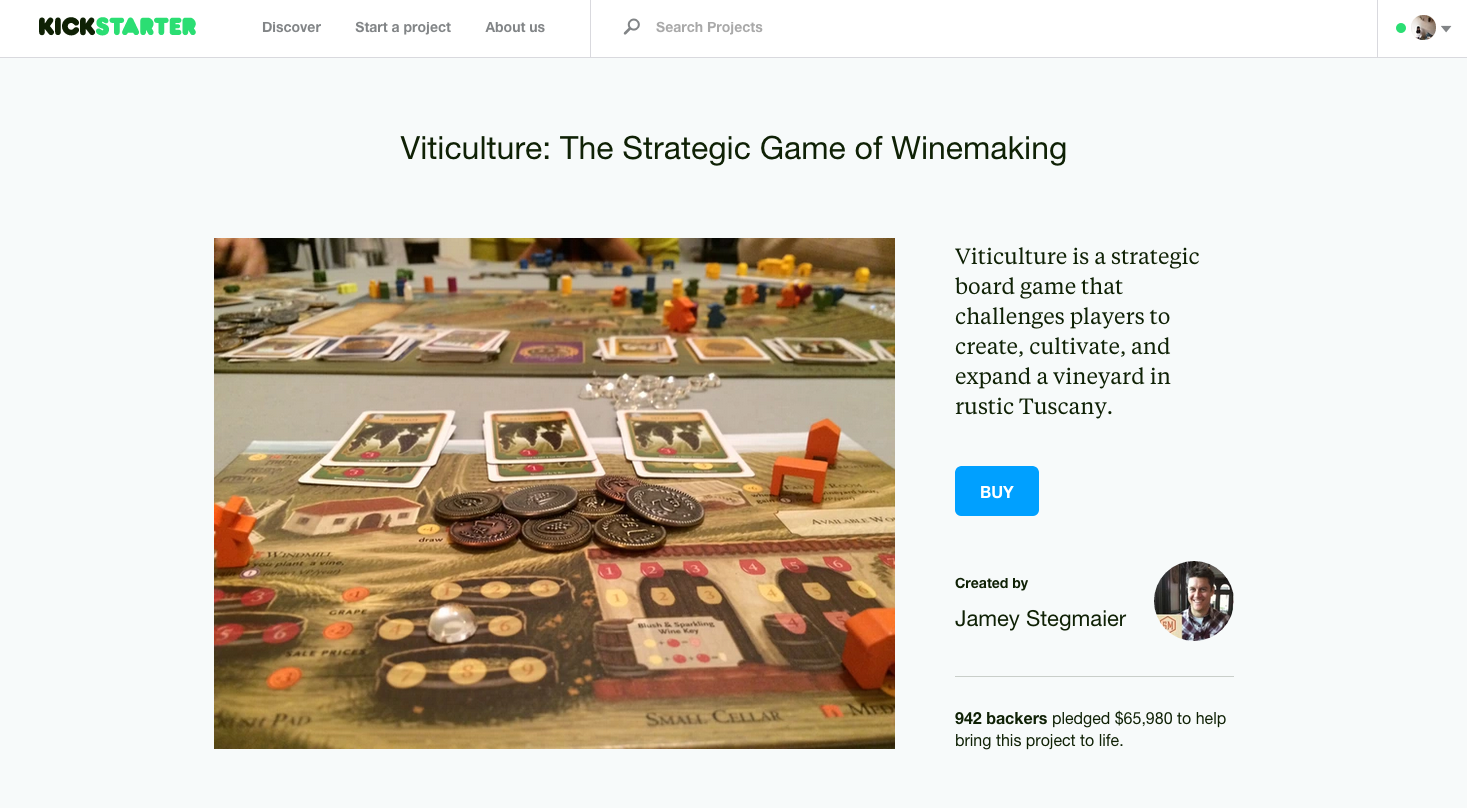
Jamey Stegmaier, the founder of Viticulture, a winemaking game, actually took time out to thank each and every one of his 942 backers within 24 hours of their pledge. Stegmaier said, “I have to say, I never regretted sending one of those messages…I got some great feedback that shaped the Viticulture campaign in a positive way, and I laid a foundation of communication that paid off down the road with many people.”

Stegmaier pre-built templates to make the initiative easier to do. He would copy in the template and then work in customized bits about the backer after scanning through their profile. His project, Viticulture was fully funded in September 2012. Stegmaier also shared that conversations with his backers gave him insights into areas of his project that could be further clarified or improved. This is a great reminder to always remember to think of backers as individuals, not in terms numbers or the greater funding goal.

Screen Shot 2015-10-15 at 4.10.15 PM

Reward your backers with special content

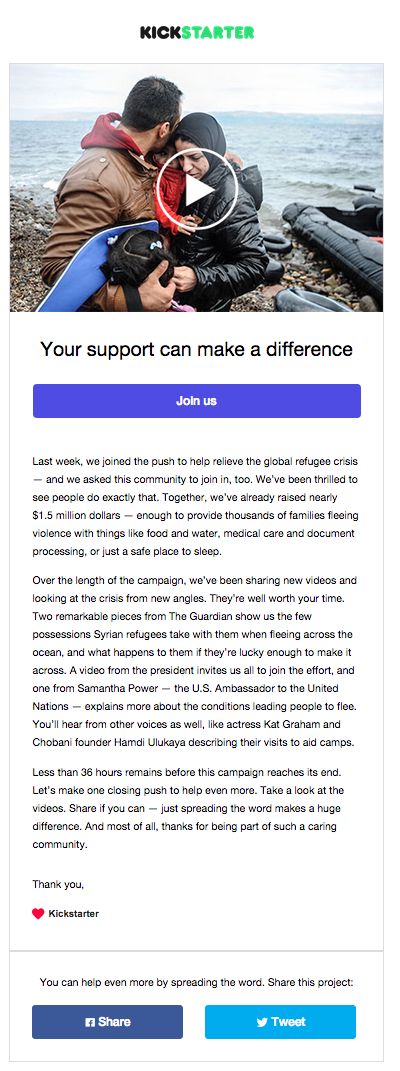
Did you know that you can embed videos and GIFs in your Kickstarter project updates? Try switching things up with your text-only emails by occasionally throwing in visual content. After all, they say a picture speaks a thousand words. As part of UNHCR and Kickstarter’s recent partnership, a funding campaign to support refugee crisis relief work, they sent out an email with a powerfully moving video as a last call for donations.

Screen Shot 2015-10-14 at 4.46.48 PM

Be mindful though, of which browsers and email clients support special media elements. For example, only Apple Mail supports video. As a workaround, we recommend including a screen grab of a scene from your video with a play button over top, then linking it to a landing page with where your video will automatically play.

Another way to treat your backers with exclusive content is by revealing part of a reward that the public won’t have access to just yet. A Song A Day gave their backers a pleasant surprise one Monday morning by releasing their full poster design (their $20 reward) and a special song.

Screen Shot 2015-10-14 at 3.14.29 PM

Become a Staff Pick

You might’ve been surprised – or annoyed – to see this on the list, after all it’s not like you can snap your fingers and become a staff pick, right? Oh, but you can. Kind of. Building a Kickstarter campaign with quality imagery and an engaging elevator pitch is half the battle. On average, a project featured by Kickstarter sees a bump of 150% of its goal the next day.

Keep your backers engaged with regular project update emails – strike a chord with your audience, remind them why they funded this project in the first place and of the goal you’re moving towards. Make them laugh, make them nostalgic, make them cry. Remember that your backers are very much your co-creators of the project – you wouldn’t have made it here without them! Nurturing that connection will motivate your backers to share your content through social, in turn making it more likely the Kickstarter team will get their eyes on your project and feature it as a Staff Pick.

Wrapping things up

And there you have it. As you’re building out your Kickstarter campaign, remember to dedicate some time to thinking about your email strategy. We’ve seen that it can drive valuable feedback that helps you adjust your copy, overall marketing strategy or even your product. We’ve seen email’s role in spreading the word on social. It’s a channel that can’t be ignored when crowdfunding. It’s the key to building community.

You’ve ran a Kickstarter campaign before? Or supported one that you think really crushed it with their marketing? Share your email hacks with us in the comments below!

21 Oct 16:58

Microsoft Surface Book Review: So Good, I Might Switch Back to Windows

by Mario Aguilar on Gizmodo, shared by Whitson Gordon to Lifehacker

Here’s a crazy one. In the progression of gadgets to crawl from the primordial pool, Microsoft’s ambitious Surface Book feels like a punctuation mark. It’s a turn from the expected, and for me at least, it’s a computer so enticing, and habit changing, that I’m thinking—Hey, what about Windows?

Read more...

21 Oct 16:57

Nearly 200 rookie MPs were elected on Monday. Here’s who to watch

by Brian Hutchinson

They are prolific, Canada’s new, untested MPs. There are almost 200 of them, or about 59 per cent of all men and women elected to the House of Commons Monday. They come from all three major parties. Most are unfamiliar to voters outside their individual ridings, while some are already well-known. Here are some rookie MPs to watch.

LIBERAL PARTY OF CANADA

Seamus O’Regan, St. John’s South-Mount Pearl

The 44-year-old already has a high public profile, thanks to his years as a CTV morning show host and news correspondent. He has also worked as an assistant to MPs in Ottawa and an adviser to then-Newfoundland premier Brian Tobin. Big question: Has he the patience to start small?

Mélanie Joly, Ahuntsic-Cartierville

An accomplished scholar, lawyer and community volunteer, the 36-year-old Joly has already made an impression on Justin Trudeau, who allegedly helped her take the party’s nomination in her Montreal riding, just before the election call. Star potential: unlimited.

Anthony Housefather, Mount Royal

The presiding mayor of Côte St-Luc, a Montreal suburb, Housefather cruised to victory in Mount Royal, which has returned Liberals in every federal election since 1940. The riding of former cabinet minister Irwin Cotler and prime minister Pierre Trudeau is a prized fortress, heavily symbolic, and its MP is often rewarded. Key strength: Housefather doesn’t lose.

Andrew Leslie, Ottawa-Orléans

A retired Canadian Forces lieutenant-general and deputy commander of NATO’s International Security Assistance Force in Afghanistan, Leslie, 57, easily won his seat and is expected to serve in the new Liberal cabinet. Caveat: Leslie has an edge to his character some find off-putting.

Gary Anandasangaree, Scarborough-Rouge Park

Anandasangaree describes himself as a community activist and human rights lawyer, but may be best known for his work with the sometimes controversial Canadian Tamil Congress. He has proved himself an effective, articulate advocate for Tamils in Canada. Charm factor: high.

Kent Hehr, Calgary Centre

Hehr edged out Tory incumbent Joan Crockatt, making him the first Liberal to sit in Calgary Centre since the riding was formed in 1968. He will be rewarded with a prominent role in Ottawa, where he should fit in well; the 45-year-old lawyer is a former Alberta Liberal MLA. Biggest asset: experience.

Jody Wilson-Raybould, Vancouver Granville

A former Crown prosecutor and prominent aboriginal leader from B.C.’s We Wai Kai Nation, Wilson-Raybould was a fierce critic of the Harper government, while representing her region at the Assembly of First Nations. Passion index: 99th percentile.

Ric Ernst/Postmedia
Ric Ernst/PostmediaNew Conservative MP Dianne Watts was once declared "the fourth-best mayor in the world."

Harjit Sajjan, Vancouver South

Another Canadian Forces veteran, Lieut.-Col. Sajjan served three tours in Afghanistan. He also spent 11 years with the Vancouver Police Department, retiring as detective-constable. Vancouver South was once held by Liberal cabinet minister Ujjal Dosanjh. Secret weapon: eloquence.

CONSERVATIVE PARTY OF CANADA

Dianne Watts, South Surrey-White Rock

Watts, 55, was a Surrey councillor for a decade before becoming the city’s mayor for another 10 years. In 2010, she was declared “the fourth-best mayor in the world,” by something called the World Mayor Prize. She projects herself as a no-nonsense, tough-on-crime politician. Potential downside: Some consider her over-rated.

NEW DEMOCRATIC PARTY OF CANADA

Daniel Blaikie, Elmwood-Transcona

An electrician by trade, Blaikie is no stranger to his ethnically diverse Winnipeg riding: It was held for two decades by his father, NDP legend Bill Blaikie, until his retirement from federal politics in 2008. Daniel Blaikie’s victory was one of the NDP’s few pleasant surprises Monday. He is one of his party’s freshest faces, with an impressive political pedigree. Chief concern: can he live up to the family name?

National Post

• Email: bhutchinson@nationalpost.com | Twitter: hutchwriter

21 Oct 16:56

Tech sector deciding how best to invest expected Liberal support

by CB Staff

TORONTO – Leaders in Canada’s burgeoning technology sector could see a wave of new federal support from the incoming Liberal government, but that doesn’t mean they all agree on how the money would be best spent.

About $900 million has been earmarked by Justin Trudeau for the country’s tech community, and over the coming weeks some of the most prominent figures in the sector will begin to make a case for where those funds should be invested.

With only so much to go around, a clash of interests could be on the horizon.

“It’s a rocking sector, and one we can lose quickly if we’re not careful,” said Bruce Lazenby, the president and chief executive of Invest Ottawa.

Lazenby heads one of many regional organizations throughout the country that function as a support system for technological growth. Like most of those organizations, Invest Ottawa could get a share of the new federal backing.

Over three years, Trudeau has committed to an investment of $200 million annually for local incubator and accelerator programs, which foster the growth of small tech startups in various regions of the country.

Another $100 million a year will go to the Industrial Research Assistance Program, which encourages innovation and small- and medium-sized businesses.

It’s a welcome wad of cash for an industry that grew from the failure of former heavyweight Nortel Networks and a severely downsized BlackBerry (TSX:BB), two companies that faltered via their own missteps. This time around, some of the country’s most prominent tech names want to ensure more than just a handful of giants rise above the rest.

Whether all of the money is going into the right places is up for debate for some.

Jim Balsillie, the former co-CEO of BlackBerry, has called for major changes in Canada’s tech industry that reconsider some of the ways the sector invests capital.

“Let’s acknowledge that what we have done over the past 30 years hasn’t worked,” he said. “We need to take a laser focus to having a complete infrastructure.”

Balsillie wants to see Ottawa create an office dedicated to turning profits on Canadian technology, a move that would mimic the commercialization project launched by U.S. President Barack Obama.

“We have nothing like that in Canada,” Balsillie said.

He also wants stricter guidelines on the incubators some have suggested are ushering in the new wave of startup success stories, only rewarding them with financial support when they’ve met clearly established performance metrics.

“If you’re going to give more to incubation, create an accountability framework that’s based on real business output,” Balsillie said.

“We’ve never had any performance metrics — there’s a lot of spin and hype. Which part of it is real outcome and which part is pixie dust?”

Balsillie is overseeing the foundation of a new lobby group for Canadian technology interests alongside John Ruffolo of OMERS Ventures, a technology investment firm.

The two men will likely meet with Trudeau over the next few weeks to discuss priorities for the industry and the foundation of their new lobbyist organization, which will represent a membership of nearly 40 domestic tech companies that meet certain revenue criteria.

Among the flurry of other priorities being championed by members of the technology industry is an extension of British Columbia’s small business tax credit to the entire country. The credit gives a 30-per cent refund to investors who put their money into a new company.

Those incentives can encourage Canadians, who are notoriously risk-averse investors, to enter the volatile world of technology.

“(It’s) a great model and one we think the feds could adopt across the country to really move the needle without costing taxpayers very much money,” Lazenby said.

Iain Klugman, head of incubator Communitech in Waterloo, Ont., said companies would benefit from an easing of barriers for immigration.

“Certainly we know that it’s often painful and difficult for (companies) to even bring people into this country,” he said.

“Talent and capital are always the two things that seem to be the biggest challenges.”

Follow @dj_friend on Twitter.

The post Tech sector deciding how best to invest expected Liberal support appeared first on Canadian Business - Your Source For Business News.

21 Oct 16:54

When it comes to workplace diversity, small details say a lot

by Murad Hemmadi
Brown hand mouse cursor

(Illustration by Peter Arkle)

In August, workplace communication app Slack launched a new feature called “Add to Slack” that allows users to pull in outside content from other applications. The company announced the news on its blog, and at the top of the page was an image: a hand holding the new Add to Slack button. A brown hand.

The shade of skin used in an icon might seem inconsequential, but Slack’s brown hand is a departure from the default whiteness of the technology industry and the corporate world at large. While outright discrimination is largely verboten today, areas like iconography still overwhelmingly exclude people of colour and women. It’s a signal that reinforces their outsider status, a reminder that the power to make decisions still rests in the hands of white men.

What many companies fail to realize is that icons, like the Add to Slack button, are a missed opportunity. What better way to tell people they’re welcome at your company or that you want their business than with a graphic that reflects their reality? But such subtle changes can only come at organizations where diverse perspectives are encouraged and actively sought out.

The brown hand shows that people of colour work at Slack, and suggests they’re influencing decisions at a time when the discussion about diversity in Silicon Valley is finally entering the mainstream conversation.

Everette Taylor, tech entrepreneur and founder of the marketing firm MilliSense, says that’s in keeping with the company’s active record on diversity. “Slack is combining a culture with naturally open-minded and diverse people with a conscious decision-making process of making sure that they are being inclusive,” Taylor wrote in an email. He highlights the company’s recent release of diversity data on its workforce, which revealed better numbers than most Silicon Valley companies and included a plan to foster inclusion. “When a company like Slack shows that it genuinely cares and [is] making an effort, it makes people of colour want to work there.” Companies should not expect employees from traditionally marginalized groups to be the only ones to spot problems; creating a culture where diversity is consciously acknowledged empowers everyone to make changes.

Consider what happened at Facebook this summer. Caitlin Winner, a recent design hire, spotted something in the Facebook graphic library that offended her: The male in the friends icon was in front of the female figure. A nearby poster in Winner’s office proclaimed “Nothing at Facebook Is Someone Else’s Problem,” which she took as license to make the change she wanted to see. Several iterations later, Facebook had a new friends icon, with the woman upfront. It’s not the first time the social network has made a small change to remove a graphical bias. Last year, two employees gave users living outside of North America a notification icon that displayed their side of the globe.

These changes might seem trivial, but to women and people of colour, they’re anything but. “Tech companies must reflect the communities they serve,” wrote Mark Luckie, a former Twitter employee, in a recent Medium post. “If not, they risk alienating the users most responsible for their success.” It’s not just a tech industry problem. Look at advertising—a 2013 University of Toronto study suggested that white faces are over-represented in Canadian television ads.

As for Slack, it’s notable the company didn’t make a big deal of its new icon. There were no self-congratulatory press releases, no open letters on the importance of diversity. Instead, Slack did something much harder. It created a culture in which someone felt confident enough to make a small but radical change, and sent out a big signal about the company in the process.

MORE ABOUT RACE, DIVERSITY & WORKPLACE CULTURE:

The post When it comes to workplace diversity, small details say a lot appeared first on Canadian Business - Your Source For Business News.

21 Oct 16:51

A doctor puts his mind to mindfulness

Experts define mindfulness as a state of moment-to-moment awareness that emphasizes attention without judgment, without thinking, for example, that the sound of the cicadas is irritating or that the lawn needs to be trimmed or "Why did I say that to so-and-so?"
21 Oct 16:50

Excuse Making

by Jim Lobaito

Problem: Bert, VP Sales for ABC Company, was explaining to the CEO why they were 50% short of goal. "Our prospects tell my salespeople our pricing is 25% higher than our closest competitor, business is terrific so why risk change, and they (the prospects) don't understand Web-based e-commerce yet." Bert continued, "I can relate. We are pretty new. Maybe our goals are too ambitious." Ms. CEO replied, "Those are all probably good reasons, but it's your job to make goal, so deal with it." (The CEO presented similar reasons to the Board of Directors for being off target.) Bert accepted that these were serious issues that had to be dealt with and worked with his people to make more effective calls. However, the environment didn't change. Customers continued to have challenges around ABC's solutions. ABC ended the year 50% off projection, Bert was gone and the new Sales VP took a new approach.

Analysis: The sales culture of this company was severely debilitated by a tendency to blame external factors for their lack of results. We call that not taking responsibility or making excuses. The problem's severity was compounded because ABC did not recognize this as a major problem. Each time the folks at ABC accepted external-factor excuses as valid reasons for lack of performance; this problem became more habitual and rooted in the sales culture. The CEO, the sales manager and the salespeople blamed the product, the pricing, the marketplace, new concept, etc. Many of the excuses were cloaked in shreds of validity and were easy to accept as factual and as real reasons for lack of success. ABC did not consider excuse making unacceptable. No one coached the salespeople on how to recognize and deal with their own excuse making.

Solution: The company must immediately make a cultural change. It must stop accepting excuses and start coaching their sales professionals to recognize when it is happening and what to do about it. Awareness must precede change. The new sales manager should search for "excuses" when debriefing sales calls. When presented with reasons a customer will not move to the next step or is stalling, she might ask the salesperson, "If there was another reason why the prospect is not going forward, what would that be?" Or, "Aside from that reason, what are some of the other reasons you think the prospect doesn't like our solutions?" Then the sales manager could follow with, "If you had surfaced that in the sales call, how would you have dealt with it?" Then, "What do you think would have happened? Would that have changed anything?" This type of coaching empowers salespeople to hang in there and work harder and smarter. If everyone recognizes when folks are blaming external factors for lack of sales success, change happens and people start taking responsibility for outcomes. From the CEO down, everyone should listen for excuses, look for excuses and point out excuses. When excuse making is not acceptable in a company, there is a positive supportive growth-oriented environment. The comment, "Are we making excuses?" is welcomed as a barometer that guides us toward increased earnings and shorter selling cycles.

Good Selling!!

21 Oct 16:49

How to Determine the Lifetime Value of Your Idea (Before You Start)

by Rainmaker.FM

he-gabriel-machuret

Today’s guest on Hack the Entrepreneur is an App Store Optimization specialist, hustler, entrepreneur, idea machine, and a very good friend of host Jon Nastor.

When Jon met today’s guest, he had a team developing more than 30 apps per month — but he will tell you that he is not an app developer; in fact, he couldn’t care less about apps.

He looks at an app and doesn’t see a coding challenge or an opportunity for creativity; he sees a revenue stream.

Today’s guest has an uncanny ability to see business ideas, unlike anyone Jon has ever known. He is a modern-day hustler who bounces from business to business and has become truly unemployable.

Now, let’s hack …

Gabriel Machuret.

In this 40-minute episode of Hack the Entrepreneur, host Jon Nastor and Gabriel Machuret discuss:

  • Becoming the person you want to have a beer with
  • Embracing your own inner stupidity
  • How to fail faster by going all-in on your ideas
  • Why the best moments are when you are driven by passion

Click Here to Listen to
Hack the Entrepreneur on iTunes

Click Here to Listen on Rainmaker.FM
About the author

Rainmaker.FM


Rainmaker.FM is the premier digital marketing and sales podcast network. Get on-demand digital business and marketing advice from experts, whenever and wherever you want it.

The post How to Determine the Lifetime Value of Your Idea (Before You Start) appeared first on Copyblogger.

21 Oct 16:48

5 Lies You’ve Been Told About B2B Marketing Attribution

by Alexis Getscher

Usually at company-wide meetings each team will discuss its accomplishments, tying them back to profit for the business. Then it’s the marketing team’s turn and uhh they had 15 “likes” on Facebook or 1000 page views for the month. But it doesn’t have to be that way. What if I told you, there’s software that can do the work for you and make you a star at company meetings? Marketers can tie their efforts back to revenue and it’s done through attribution.

Attribution

Many people hear the word “attribution” and think of complicated data and analysis. If you weren’t a math or psychology major, it can send you running the other way. However, there are many myths surrounding the concept and we’re here to tell you– you’re behind the curve if you believe them.

Attribution is something every company should implement. Here’s a list of some of the most common misconceptions.

Lie #1: It’s too Early for Attribution

A common phrase is that a company is “too new,” or “doesn’t have enough data,” to need attribution software. The more data you have, the more predictive value attribution will provide, but if you’re putting any effort into marketing then you should be tracking those channels back to revenue for the company. Attribution shows which marketing efforts provide the most ROI. It helps you track leads through the entire funnel and attributes revenue to each of the touchpoints that led to turning your prospect into a customer.

Think of attribution software like insurance. You don’t wait to get into a car accident before you insure your car and you don’t wait until a burglar robs you of your money and belongings before you get home insurance.

A lack of marketing attribution means your company is being robbed of money. It can never be implemented too early– only too late.  

A lack of marketing attribution means your company is being robbed of money.

Lie #2: Attribution is Not a “Must Have”

Many think of attribution as “good to have” and not a “must have.” From an optimization standpoint, it is the most powerful weapon in your arsenal. Attribution shows you the channels that have the biggest impact on the bottom line. When you know which channels are working and which aren’t, you know where to spend money and where to cut costs.

The longer you wait to implement attribution, the longer you delay accurate measurement and the more money you waste.

According to Bizible’s 2015 State of Pipeline Marketing report, 24 percent of marketers don’t have an attribution model in place. The flip side of that number means that almost 75 percent DO. Which means your competitors are ahead of you.

Adding to the necessity, 60 percent of marketers who don’t use attribution, a CRM and automation, do not know their marketing ROI. Why would you continue to put money toward something you don’t know is providing you any value?

Lie #3: My Marketing Automation Does the Same Thing as Attribution

The main thing automation and attribution have in common is that they both start with the letter “A.” That’s about where the similarities end.

Marketing Stack

As Lauren Frye wrote in a recent blog post regarding the two concepts, automation can tell you which marketing campaigns brought leads in, but marketers are still left asking questions like, “How many of those leads became customers? And which channels, which keywords, which content, which landing pages, which blog posts, and which display ads were instrumental in moving them through the funnel?”.

Automation streamlines marketing processes by making it easy to manage email lists, social posts and landing pages. Attribution gives revenue credit to each of those processes so you can see which are providing the most ROI.

To get the most value out of your marketing, the “A Team” should work in unison.

Lie #4: Only Digital Channels Can be Measured

Connecting online and offline channels is possible and should absolutely be done if you want a true, full-funnel view. With omni-channel marketing attribution, marketers are able to see every part of a customer’s journey from keywords to conferences.

Imagine a lead visits your booth at a conference and views a demo. Later that week, they check out the about page on your website, visit the pricing page, then give your sales team a call. Without insights into the offline interactions, it’s easy for an attribution report to turn out lopsided. It would assign too much revenue credit to the website and none to the touchpoint that made the initial impact. In reality, it was the conference that first introduced the lead to your company and product.

Not accounting for the offline touchpoints leaves a big piece of the puzzle untracked.

Lie #5: I Can Do it Myself

Sure, you can grab data from Google Analytics and Salesforce and try to manually attribute revenue to each of the customer’s touchpoints. If you’re a really small company, it might not even take you all day. But B2B sales cycles are long and a lead will probably have tons of touches before they’re ready to buy.

Couldn’t your time be better spent? And what about those days you’re tired and all the lines on the excel spreadsheet blur together and you input the wrong information? Using software for attribution provides accuracy and allows marketers to put their time toward more productive endeavors.

In today’s competitive business atmosphere, there’s nothing more valuable than understanding your customers and meeting their needs. Attribution allows marketers to see the channels that provide the most value, which in turn means those channels can be optimized to provide the best experience for your customers. And happy, converting customers are the foundation of a great company.

 2015 State of Pipeline Marketing Get the inside look on sales alignment, attribution, top channels, and more. Download Now

21 Oct 16:47

How the Liberal government will affect five key areas of the Canadian economy

by John Shmuel

Canada is set to head in a new economic direction with the election of Justin Trudeau and his Liberal party to a majority government. Trudeau will have four years to implement his electoral platform, which includes billions of dollars in new infrastructure spending and tax cuts aimed at the middle class. Here is how economists expect the new government will affect five key areas.

The loonie

Following the victory, the Canadian dollar rose 0.2 per cent after shedding 0.8 per cent Monday in the lead-up to election night.

In the coming months, however, the loonie could see some weakness as the currency is hit with an “uncertainty premium,” notes David Tulk, head of global macro strategy at TD Securities. “As observed with prior changes in government, we anticipate the outcome to be modestly USDCAD positive.”

The loonie could also see longer-term weakness, as Trudeau has pledged to run a deficit for the next three years in order to spur economic growth.

“Longer term, more government debt will drag on the Canadian dollar and will make interest payments an increasingly large portion of the government budget,” said Darren Sissons, managing director and portfolio manager at Portfolio Management Corp. “This will ultimately decrease policy flexibility in future years.”

The economy

Trudeau plans to spend an additional $5 billion annually to upgrade key infrastructure in Canada such as transportation systems. David Madani, Canada economist for Capital Economics, notes the increased spending will be worth an extra 0.2 to 0.3 percentage points a year for gross domestic product.

But Doug Porter, chief economist at BMO Capital Markets, points out that while the spending could boost the economy in the next two years, it will likely pose a drag on growth once it is withdrawn.

“At best, the stimulus would lift GDP growth by a bit more than 0.5% next year, so we would be leaning toward annual growth of closer to 2.5% in 2016 (versus our current call of just over 2%, and just 1.2% this year), assuming the proposed measures are fully implemented in the next budget,” he said in a note.

Charles St-Arnaud, an economist at Nomura Securities in London, said he wanted more information on how the Trudeau government intends to balance the budget in its fourth year.

“It is always easier to spend than to restrain spending, and it needs to be made clear how the deficits resulting from the increased spending will be reversed,” he said.

Government bonds

The spread between Canada and U.S. 10-year bonds widened Tuesday following the election. Economists say the spread could continue to widen since Trudeau will run an annual budget deficit of nearly $10 billion for the next two years.

“Our Fair Value Model suggests that the size of the budget deficit presented in the Liberal platform could result in roughly a 10 to 15 basis points increase in 10-year yields, everything else being equal,” said economists at National Bank Financial Markets in a note to clients Tuesday.

But economists do not expect any sizable moves in bond yields longer term, given that deficits will represent 0.5 per cent of GDP at most and that the proposed debt will not be enough to crowd out other borrowers from the market.

“In terms of implications, fixed income markets are likely to see more debt supply but in manageable amounts,” said Jimmy Jean, senior economist at Desjardins Securities

Credit rating

Credit-rating agencies certainly take note of growing government debt loads, but economists say Canada’s AAA credit rating is not at risk at the moment

Nothing at this time remotely suggests rating agencies will view Canada’s creditworthiness differently on this outcome,” Jean said.

Last week, Moody’s said the results of the election would unlikely have any effect on Canada’s credit rating. Others also expect more of the same.

“Canada’s sovereign credit rating, currently AAA, depends on a number of factors, including economic activity, commodity prices and fiscal discipline,” said Emanuella Enenajor, North America economist at Bank of America Merrill Lynch. “We see limited risks of a notable deterioration in fiscal health resulting from the Liberal victory.”

Renewable energy

Trudeau has a particularly ambitious plan for renewable energy projects, with a promise to commit nearly $6 billion in green spending over a four-year period and ramping that up to nearly $20 billion over 10 years. The Liberals will also incorporate climate impact analysis into federal contracting, which could get further money flowing into the green space.

All of that will be welcome news for Canada’s renewable energy companies, especially as the previous government focused investment on the oil and gas sector.

“It is fair to assume that the sector will be a big net winner under this government, as they have carved out specific spending in their infrastructure outlays for green energy,” said BMO’s Porter. “Beyond direct spending on the sector, it’s also safe to assume that the government will support the sector heavily through direct measures.”


21 Oct 16:46

Why You Can’t Ignore Link Building Anymore

by Carmelo Hannity

Links are the elements that bind the world wide web together.

That may seem like a dramatic statement, but when you consider the role that links play in websites and search algorithms, it’s pretty hard to dispute.

When you create a website, you begin with a single page. When you add a new page, you link to it from the first page in order to allow visitors to access it. Whenever you add new pages to the site, you must link to them from existing pages in order to allow the content to be found.

Without these links, the pages wouldn’t be seen and therefore, they may as well not be there at all. They make all online content navigable and discoverable. They are the medium which connects all of the information on the internet together.

This process goes for real site visitors as well as search bots that crawl and index a web pages into their directory in order to deliver them in SERPs (search engine results pages). Search bots are only able to successfully crawl and index new pages that are linked to from existing pages. If you didn’t link your content properly, the bots would never find or index any new pages.

However, links are not just important for navigation and indexing, but are imperative for ranking too, since search engines use links to assess your content’s value.

If another site with an authoritative reputation were to link to you, it’s a signal to Google that your site is also authoritative and you will subsequently rank higher as a result. And whether you like it or not, social signals can’t replace the impact that links make in the SERPs.

The Importance of Relevant Links

This is especially true when the links are on relevant sites. An effective SEO strategy needs to focus on obtaining relevant links. Relevant links drive high quality traffic – traffic that is significantly more likely to convert or become leads, rather than traffic from irrelevant links.

That is why search engines love relevant links; they improve the user experience, which is exactly what Google and other search engines are all about.

If other websites are willing to send their users to your website, then Google is as well. When looking for a link opportunity, don’t get caught up on metrics and numbers, but instead, focus on relevance.

In fact, according to Andre Weyher (an ex-member of Google’s spam team) “it’s more the relevance of the site’s theme in regards to yours, relevance is the new PR.

Relevance is paramount to anything else because these are the links that are truly in there natural habitat. They are links that were built with the pure intent of connecting and bridging pages of the internet in order to create a better user experience and make the Web easily navigable.

So, will backlinks always remain relevant? The short answer is yes, backlinks are part and parcel of the very fiber of the internet.

21 Oct 16:46

5 Ways to Feel Better About Your Cloud Bill

by Penny Collen

CloudBill

Let’s be honest, do you trust your bill for cloud services?  Do you know it is accurate?

Whether you are a Line of Business user seeing a chargeback bill from your IT operations data center or a finance manager looking at the bill from a public cloud provider, there are days you look at the amount at the bottom of the invoice and ask, “Can this be right?”

Cloud service providers, both public and private are recognizing the value added when invoices are clearly understood.  When the customer can easily see what has been consumed and who has been using it, confidence in the bill accuracy increases.   This confidence extends to the provider as well, fostering a more positive client-supplier relationship.

The best billing processes have a foundation which uses automated, consistent, and repeatable processes.  These five characteristics produce invoices which are reliable, easily understood and available to the client:

  1.  Automated Data Collection

Automated data collections are essentially “hands-free.” The processes are run from an automated job scheduler at preset times and have carefully defined exception handling processes if deviations occur.   An automated process allows for increased frequency of collection, a critical aspect of capturing cloud usage.  Self-service provisioning makes it possible for instances to be spun up and shut down in a matter of minutes. With a fully automated process, collections can be done every day, every hour, even every five minutes.  Picking up those instances which would have been overlooked when usage was captured daily means more revenues to the provider.  For the consumer, it means truly paying for only what you use, not a full day if you used less.

  1.  Consistent Methodology

Consistent processes are reliable processes.  If you are applying business rules like rates or discounts, you want to see that results are constant.  Consistency also is important during the transformation process when you tag who is using resources.  You eliminate the guesswork of compliance by using automated, consistent identification of consumption and increase reporting accuracy.

  1.  Repeatable Processes

Let’s not trivialize the concept of repeatable.  This sounds so easy.  Just do the same thing again and again.  If you are manually updating spread sheets, think of the number of opportunities you have to change your pattern. As the amount of data you handle grows, you must have repeatable processes defined and automate those processes to insure the output is reliable.  Cloud usage records number tens of thousands each month or more, even for a small account.  Scalability in your processes is critical as you attempt to handle an ever growing data file.

  1.  Historical Repositories

Holding all your data in a historical data base and using business analytics to create dashboards and reports completes the configuration of the best invoicing solutions.   As the number of cloud providers you use expands, you will benefit most from a common database which facilitates a single pane of glass view into your hybrid world.  The data you collect can support many types of resource management in addition to invoicing.   It can be used for supply and demand balancing, capacity realignment, long-range forecasting, and business value analysis.

  1.  Self-service Reporting

Self-service reports, fully secured and accessible via the web are mandatory.   We like to play with our data in our own ways.  After all, we have developed some battle-tested review processes over time and don’t want to lose that investment. Using the BI tools to digest massive amounts of data, aggregate it, and parse it out into just those records you need is a significant advantage.  Reports that let you drill down to view details and then download subsets for your own use offer the greatest functionality.  As a customer, you can validate your own bills and see immediately what changes are taking place.   As a provider, you have less disruption in your revenue stream as there are fewer inquiries, disputes, and refunds.

When you are ready to optimize your data collection and billing processes, look for a solution that is highly-scalable and supports a hybrid IT environment.  You can save money and increase revenues, delivering more profits to the bottom line.

21 Oct 16:46

Trudeau, cabinetmaker: How change will meet governance

by John Geddes
Liberal leader Justin Trudeau waves to the crowd after his speech at Liberal election headquarters in Montreal, Que. on Monday, October 20, 2015. (Sean Kilpatrick/CP)

Liberal leader Justin Trudeau waves to the crowd after his speech at Liberal election headquarters in Montreal, Que. on Monday, October 20, 2015. (Sean Kilpatrick/CP)

After the election of a remarkable 184 Liberal MPs, incoming prime minister Justin Trudeau has a lot of talent to deploy in his first cabinet. Or, to put it another way, a lot of egos to satisfy and disappoint between now and Nov. 4 as he builds that first cabinet, which he has set as his first priority during the roughly two-week transition to Liberal from Conservative rule. There are a lot of contenders, but looking at just two who get mentioned often in speculation—veteran MP John McCallum and rookie Mélanie Joly—gives a sense of the delicate task of sifting and selecting that Trudeau and his senior advisers now face.

At 65, McCallum, who was re-elected this week in his Toronto-area riding, was chief economist at Royal Bank of Canada before jumping into politics, and served as defence minister under former prime ministers Jean Chrétien and Paul Martin. At 36, Joly, who won on her first try in a Montreal riding, is a lawyer and former mayoral candidate, and headed Trudeau’s Quebec advisory committee back when he was seeking the Liberal leadership in 2013.

In interviews just after the election, they weren’t advertising their own credentials. Still, both clearly represent attributes Trudeau might well need, and their names often come up when Liberal insiders are musing about who’ll crack the cabinet. From a caucus thick with newcomers, an old hand like McCallum stands out as a symbol of stability. But after an election fought on the slogan “Real Change Now,” Joly embodies what Trudeau has just promised voters. “Now what we want,” she says, “and what we’re looking at, is innovation, and a way to change the system.”

Melanie Joly. (Annik MH de Carufel)

Melanie Joly. (Annik MH de Carufel)

That system awaits Trudeau and his new guard fully prepared to absorb their energy and convert it safely into implementable policy. David Zussman, a public sector management professor at University of Ottawa, ran Chrétien’s transition team in 1993, and later wrote a book on the subject. Zussman is superbly connected in senior Ottawa bureaucratic circles, and says he has never seen the senior public service so well organized for a new government. The fixed election date for this campaign—a new feature—allowed top mandarins to start preparing six months ago.

They strategized around no fewer than nine possible outcomes, with different parties coming out of the election in different orders, leading to various majority, minority and coalition scenarios. Zussman says clerk of the Privy Council Janice Charette, the top bureaucrat, “has really organized this town.”

That means, he explained, that deputy ministers in all the departments will have thoroughly combed through the Liberal platform and devised proposals for how to make the party’s promises happen. “That ought to be very comforting, because these platforms have goals, but they don’t tell you how to get there,” Zussman said.

Trudeau has signalled that his ministers will be more independent of the Prime Minister’s Office. He’s been critical of growing PMO power, not only under Stephen Harper, but over decades—a trend he’s said started with his father, the late prime minister Pierre Trudeau. “I think there’s certainly a clear desire by Canadians to see both a stronger and smaller cabinet than we’ve had in years past,” Trudeau said at a news conference the day after his election triumph.

Aside from cabinet-making, a calendar packed next month with meetings abroad forces him to focus on international issues. Foreign Affairs officials are prepping for, among other summits, a sensitive G20 meeting in Turkey and a major United Nations summit on climate change in Paris. At the G20, Trudeau may have to defend his campaign pledge to pull Canadian fighter jets out of U.S.-led coalition bombing of Islamic State terrorists in Iraq. Trudeau said he discussed that plan with U.S. President Barack Obama in a phone call the day after the election, and he said Obama “understands the commitments I’ve made.” On the UN summit in Paris, Trudeau said he had already spoken with some premiers to coordinate with the provinces on a Canadian stance on climate change.

Given the early prominence of those high-profile trips, and others, it’s interesting that Trudeau has named an international relations expert to head his transition team. Peter Harder is a former deputy minister of Foreign Affairs and International Trade, and is now president of the Canada-China Business Council.

Beyond the foreign files that he must quickly get a handle on, Trudeau needs to make some key timing decisions. Arguably most prominent among them is when to recall Parliament. Putting off convening the House until early 2016 would give his MPs and cabinet ministers time to hire staff and get settled. But that long a delay has the potential disadvantage of allowing some of the excitement from his election victory to dissipate, and he said his hope on the parliamentary timetable is to “bring it back as quickly as is reasonable.”

Joly said the open nomination process Trudeau encouraged at the riding level led to the Liberals electing as MPs a lot of “political neophytes who, at the same time, believe in the power of politics.” They are anxious, she said, to start showing that they can change Ottawa. But that excitement is not only palpable among Trudeau’s new recruits; McCallum, who was first elected back in 2000, was emotional on election night. Best known as an economist, he says it was really the values issues that arose in the campaign—including Trudeau’s opposition to Prime Minister Stephen Harper’s policy of banning the niqab at citizenship ceremonies—that he felt most strongly about.

“In this election, to some extent the economic policy was important, but the main question was, ‘Do you want Justin Trudeau’s Canada or Stephen Harper’s Canada?’ ” he said. “I don’t think I’ve ever felt more patriotic as a Canadian, because it’s obvious now that Canadians want Justin Trudeau’s Canada, which is also my Canada—a Canada of openness, welcoming newcomers, valuing diversity.”

The intensity of what were often bitter campaign debates, the eagerness of new MPs to start doing things—all this will soon collide with the more phlegmatic approach of the bureaucratic establishment. Trudeau’s job will be to somehow make the two cultures work together, harnessing public service expertise without disappointing his caucus—or the change-craving voters who elected them.

Then, as Zussman warns, he’ll have to draw the distinction, as all new prime ministers must, between gifted campaigners and those MPs who are also suited to legislating and governing. “This is a challenge,” he said. “My experience is that some people are never comfortable making that change. They are partisans. They love elections, and the governing part is boring.”

From the archives: Trudeau, 2014

The post Trudeau, cabinetmaker: How change will meet governance appeared first on Macleans.ca.

21 Oct 16:45

5 Signs Your Prospect Hates You (& How to Fix It)

by leslieye@hubspot.com (Leslie Ye)


Any purchasing decision is part emotion, part logic. Of course prospects are interested in ROI and price and implementation, but ultimately they want to know how your product will help them, how it will make their jobs and lives easier, and how it will earn them professional kudos.

Emotion extends beyond the professional realm, however. Your ability to build rapport with your prospects will go a long way toward getting them to trust you, listen to you, and ultimately buy from you.

This isn’t to say you have to become a relationship-builder. You don’t need your prospects to like you so much they’re inviting you to their vacation homes for the weekend. But you do need to establish a baseline level of mutual respect and trust.

Once you lose trust, you lose your ability to make the sale. Your prospects will question your motivations and everything you say, and it’s very hard to repair broken trust. Any of the five behaviors below should perk up your ears -- they just might be signs that your relationship with your prospect is going nowhere fast.

1) They cut you off.

If your prospect interrupts you over and over again, examine the context to figure out why. Are they just excited? Or are they disgruntled?

Prospects who consistently say things like, “No, that’s not right,” or “Actually, that’s not what I meant,” aren’t feeling heard. Maybe you’ve been working off an incorrect assumption, or are just misunderstanding their questions. Take a step back and ask your prospect to review what the two of you have discussed so far to make sure you’re back on the same page, then return to the conversation realigned.

2) They’re impatient with you.

Impatience can manifest itself in many different ways -- eye-rolling, sighing, and watch-checking, just to name a few. If your prospect is doing something that suggests they’d rather do anything but participate in this conversation, get their buy-in to continue -- or reschedule for a better time.

It’s also possible that you’re moving too slowly. At the beginning of each call or meeting, outline what you’d like to discuss so you can make sure your agenda is actually useful for your prospect. Then, don’t be afraid to change up your approach to keep calls productive and harmonious.

3) They’re unwilling to share information with you.

Throughout a sales process, you’ll be called upon to provide a lot of information -- what your product is, what your product does, how much it costs, how long it takes to implement, and a myriad of other factors your prospect needs to consider before saying “yes” or “no.”

But your prospects have to give a little too. You can’t suggest an optimal solution to their problem unless you fully understand it, and often that will require asking for internal numbers or progress on certain metrics that aren’t public knowledge.

It’s a huge red flag if your prospect refuses to share this information with you -- it means they don’t see you as a trusted advisor. Whether you haven’t established enough value to justify seeing internal numbers or haven’t shared enough of your own resources to make your prospect feel they’re in a reciprocal relationship, get to the bottom of why they don’t trust you. Then, fix it.

4) They skip any pleasantries and jump into the agenda.

Not everyone likes small talk -- in fact, depending on your prospect’s personality type, they might hate it.

But if your prospect doesn’t even respond to your, “Hi, how are you today?”, you’re dealing with someone who isn’t that excited to have you on the other side of the table.

On the bright side, they still want to talk to you! They probably have a need you can solve, and you’ve established enough value to keep them hooked. So don’t worry about this one too much. Unless your prospect’s behavior borders on incivility, there’s no reason they won’t buy from you if they have a real need for your product.

5) They ask to speak with someone else.

The more dramatic cousin of #4, this situation is rare but does happen from time to time. Sometimes, your prospect has a pressing need, but halfway through the sales process decides they dislike you so much that they can’t continue.

The downside is potential lost commission (investigate if your company has a commission-splitting policy for deals you’ve already spent a significant amount of time on) and the knowledge that your prospect is far from your biggest fan. But in the grand scheme of things, it could be much worse -- the deal could be dead altogether.

Find a colleague you think would gel better with your point of contact and hand the deal off. You can rest easy knowing the sale is in good hands, and refocus yourself on spending time with prospects you click with.

None of these five behaviors are guaranteed to sink your deal. In fact, some of them are early indicators of mistakes that can be easily corrected. As long as you keep a close eye out for troubling behaviors and fix your missteps, your relationships with your prospects will stay productive (and lucrative).

subscribe-to-inbound-sales-content

21 Oct 16:44

This one word is the last thing you want to hear when your company gets bought out (WDC, SNDK)

by Sam Ro

office space

On Wednesday, hard disk storage giant Western Digital announced it was buying flash drive maker SanDisk in a $19 billion deal.

This deal would solidify Western Digital claim as a global storage behemoth.

But a company never takes out another company just to increase its footprint. They do it to increase value for shareholders.

"I'm excited to welcome the SanDisk team as we look to create additional value for all of our stakeholders," CEO Steve Milligan said explicitly.

One way managers do this is by eliminating redundancies in their efforts to cut costs. They call it "synergy," which is a word that probably has every Western Digital and SanDisk employee a little nervous. The company explained in the news release:

"The company expects to achieve full annual run-rate synergies of $500 million within 18 months post-closing. The transaction is expected to be EPS accretive on a non-GAAP basis within 12 months of the transaction close."

"Synergy" usually means the closing and combining of offices and warehouses, which also often comes with job cuts.

Western Digital employs around 76,000 people worldwide. SanDisk employs about 8,700.

This is a very rough calculation, so take this with a grain of salt. But assuming half of those potential synergies ($250 million) come from reduced headcount and each worker saves $150,000, this back-of-the-envelope calculation would see more than 1,600 employees being let go.

The companies haven't actually announced or quantified any reductions in headcount just yet. But you can bet that announcement is coming.

Join the conversation about this story »

NOW WATCH: Fed's Bullard explains the problem with keeping rates at zero forever


21 Oct 16:44

Bad Selling Fundamentals = Bad Social Selling!

by Dave Brock

Social Selling is the “Easy Button” for every sales person’s dreams of making quota.

At least if you believe 75% of what’s written about Social Selling, all you have to do is leverage LinkedIn, Facebook, Twitter, Pinterest, or whatever your favorite social selling platform is–and you will be successful in sales. Make connections, have a great profile, comment on articles, build your network, reach out, and engage. Do this and opportunities will come flying on the door!

Interestingly, I’m now starting to see some articles from people who leverage social channels very effectively. They are saying this dream of effortless selling is really a lot of baloney.

It seems to be human nature to look for an Easy Button. We want all the rewards, but we don’t want to work for it. Ironically, we look at great athletes, great artists of all types, top performing musicians, great business people. We read of their stories of hard work, failure, learning, discipline, focus, relentless execution–we admire them for both what they’ve achieved, but what it’s taken them to get there.

Yet, turn the mirror on ourselves, look at the work, discipline, learning, failure, efforts–most go searching for the Easy button. They look for the short cuts, not willing to put in the work necessary for mastery.

Social selling, that is leveraging social engagement can be very powerful, but it is no easy button. Mastery of social engagement and social business requires mastery and masterful execution of selling fundamentals.

Prospecting is no different–we still have to engage the right customer in a meaningful discussion at the right time.

Insight is no different, we have to disrupt customers’ thinking, helping them understand their current operation can be improved.

Helping our customers buy is no different. We have to align various agendas, priorities, motives to drive consensus on the decision.

Value is no different, we have to create value in every interaction with the customer.

Social selling doesn’t eliminate the need for a well-executed selling process–aligned with the customers buying process. It doesn’t eliminate the need for us to have a deep understanding of our customers, their market, industries, business drivers, dreams, goals, and ambitions.

What too many miss is there is never an easy button. There are just new tools, channels methods–any of which can help improve our effectiveness, efficiency, and impact. But all require mastery of he fundamentals.

I’ve said before, social tools can enable us to do powerful things, they can also enable us to create crap at the speed of light.

21 Oct 16:43

4 Customer Retention Tips to Smash Your Profits Out of the Park

by GetApp

Numbers Don’t Lie. Research has shown time and again that the cost of retaining a current customer is less expensive than acquiring a new one. A Bain & Company report showed that increasing customer retention rates by just 5 percent could increase retail profits anywhere from 25 percent to 95 percent; hardly numbers you should ignore!

Improving customer retention is vital not just for your company’s brand and reputation, but also your bottom line. Customers no longer care about making the dividing line between online and offline commerce, the key to retaining customers both home (at your store) and abroad (online) can be found in developing stronger and more strategic customer relationship management (CRM) tools.

These steps range from the minutia of packaging to pre-purchase marketing all the way up until delivery and post-sale targeting. Customer retention has time and again proven to be an essential source of driving revenue for your business in the long run.

So what do you have to do? We’ve listed out four main components of your retail strategy that you could consider switching up to increase those customer retention numbers.

1. Make a dazzling first impression

First impressions are more important than you think. Whether online or in-store at your brick-and-mortar location, your customers should be treated as individuals and not just as sheep in a flock.

Thankfully, technology has made retailers’ lives easier with tools like in-store beacons, QR codes, and location tracking to better predict and target products that your customers would potentially buy.

On the web, proactive customer outreach includes live chat, the maintenance of a good blog as a resource, and product videos, which are all key to maintaining a potential customer’s interest and loyalty. Whether in-store or online, making a good first impression is a crucial first-step in reeling loyal and long-lasting customers into your retail ecosystem.

2. Have a super smooth purchasing process

  • Never make things seem harder than they are. These are a few things that you should keep in mind:
  • Does your checkout process align with your product and brand?
  • Is your entire checkout process seamless?
  • Can your customer depend on you to keep their personal data secure (i.e. are security breaches well safeguarded from?)
  • How long does the customer have to wait in line at checkout?

Whether online or offline, all the above factors play a critical role in the customer experience and help your company build rapport with old and new customers. If your customer is struggling to enter their credit card information and an error message keeps popping up, trust will falter. The more seamless the purchase process, the more likely the customer will leave your store feeling happy and positive, and by multiplier effect, will likely recommend your brand to their friends.

More importantly for any retailer, the point-of-sale is a crucial opportunity to implement customer loyalty and rewards programs.

3. Use delivery to make customers smile

On-demand delivery is here to stay. With companies like Instacart, Amazon and even Google, jumping to dominate the space, ensuring a seamless delivery experience for customers can go a long way.

When it comes to logistics, getting it right is no easy task. The minute you work out even the smallest kinks within your delivery process (think: door-to-door in all literal senses), you’d be surprised to see how many customers come returning for another purchase.

The ‘want it now’ mentality has hardwired all of us into thinking that deliveries can be made in an instant. Even if a customer lives 5,000 miles away, there is still an expectation that deliveries will arrive much sooner than they can. As a retail owner, if you can set and beat your customer expectations, repeat orders will surely follow. Taking a cue from Zappos’ ‘Delivering Happiness’ motto – while they promise all delivery within five days, most orders are actually shipped overnight with free returns included as part of their promise.

Zappos screenshot

Zappos writes the book on making customers smile. The company’s CEO Tony Heish’s outlines the secretes of delighting customers in his bestseller, Delivering Happiness.

One last thing: be cautious of international deliveries. For your international customers, make clear and distinct costs and expectations for international shipping. A customer will value your company only if you are upfront and honest about their expectations, especially when they are ordering time-sensitive items (e.g. birthday presents.) Ensure that your international deliveries are properly tracked during shipment and all expectations of customs, clearing charges and delays are well accounted for.

It goes without saying that customer support is a vital and necessary checkpoint in this journey. Mistakes happen and sometimes, even when it’s not your fault, remember that the customer is always right. If something goes wrong, make the necessary follow-up emails and ensure that you take all the steps to making sure that it never happens again. If resources allow, make sure that all feedback and enquiries are replied within 24 hours.

4. Make friends through post-sale marketing

Making sure that you have a robust and powerful CRM program (e.g. Insightly, Salesforce, Infusionsoft – Ed) in place is a surefire way of achieving success from post-sale marketing. With a few key details from your customer database, you can begin to develop long-lasting relationships with proactive and strategic customer retention marketing.

Here are a few tried and tested ways to increase post-purchase customer retention:

    • Post-purchase emails allow you to target customers with special offers and is an effective way to follow-up with cross-sell suggestions
    • Providing VIP access. Making your customers feel special is crucial. Giving the illusion of a fast-track delivery or even offering flash sales for certain time periods will allow you to tug at your customer’s heart strings in all the right ways.
    • Don’t forget to wish them happy birthday. Offer discounts and gift bundles for special occasions.
    • Friend referrals. Customers are not lone wolves, they have close-knit social circles just like the rest of us. Offer discount or cash-voucher incentives for friend referrals and more importantly, make it easy for them to share this with their friends. Social sharing buttons were invented for a reason, use them!

Home or abroad, customers are loyal to brands that care about them as individuals and provide them with consistent and seamless purchasing experiences. Regardless of where your customer lives, this ever-connected retail ecosystem ensures that no customer is left behind, so you shouldn’t either.

Especially when research shows that attracting a new customer can cost five times as much as keeping an existing one, your company should and needs to pay added attention to customer retention as much as you do new acquisitions.

Do you have any tips that you’ve successfully employed to increase your customer retention? Don’t be shy, we’d love to hear your tricks and techniques!

This post was written by Nicole Chan.

21 Oct 16:43

Are You Leaving the Icing off Customer Case Studies?

by Casey Hibbard

icing

By some cruel twist of fate, I have a restricted diet. No dairy for me, and right now, no wheat. So I have to find alternatives, and often those alternatives are lesser-than versions of favorite meals.

I can have a hamburger, but only without the cheese and bun. You can't really call that a hamburger, can you? I can eat cake, but it tastes odd without conventional flour – and there's no icing!

It's just not the same. I'm left feeling disappointed and unsatisfied.

That's exactly how you may be leaving your prospects when you produce customer case studies without a key ingredient - interviewing the customer.

In a customer case study, the customer interview is, in fact, the icing on the cake - it adds essential flavor, texture and the experience the customer expects.

Why Customer Interviews are a Pain

I get it, it's easier, and sometimes necessary, to create customer stories without customer interviews for a variety of reasons:

(A) The case study will be unnamed anyway, so you're not involving the customer
(B) You don't want to bother the customer with an interview so you source it from internal account reps' knowledge
(C) You're in a hurry to get it done for an event or other need, and an interview and approval will take too long
(D) The customer said no to being featured and/or interviewed
(E) All of the above

So you move forward with a customer story that fills the need, but likely doesn't maximize your message.

Why Your Case Study Needs Customer Interviews

If your prospects take the time to read or view a case study, give them their money's worth. Here's where you may be letting them down...

1.    The “before” story: It’s important to highlight the specific “before” experience a customer had, so you can contrast it with the current, better reality. This helps prospects also associate and say, yes, that’s a challenge we’re having too! While account managers may have some insight into this, the rich detail about pains and challenges, and the juicy quotes, can only really come from the customer.

2.    The “why”: Why did another customer choose to work with a certain vendor, over other options? Peel back the lid on how others have made decisions, which helps prospects make the decision as well. This has been shown to be one of the most insightful parts of a customer case study.

3.    Areas of impact: You may know some of the details about specific outcomes for the customer, but you probably can't name all of them. Countless times, I've gone into customer interviews expecting them to list certain benefits, but in fact, they stress other benefits altogether, or have a much longer list than what the account rep mentioned before the call. If we had relied on internal information only, the story would have carried a fraction of the power.

But what if your situation is A, B, C, D or E from the list up top?

You do your best, but I can tell you from experience that relationships help. During and after delivery and deployment of your products and services, maintain close ties to the customer. With your happiest and most successful customers, establish a mutually beneficial arrangement. The customer can participate in customer reference activities, such as case studies, in exchange for things they value, such as positive publicity for the company’s or individual’s efforts, networking with peers, or the chance to showcase their best practices at events.

It’s literally, a case by case basis on what will motivate a customer to participate and be interviewed for a case study. Find it and speak to that.

It also doesn’t hurt to stress that it will only take 30-60 minutes of a customer’s time – total.

Ultimately, you can't read the customer's mind. For the sake of creating the most meaningful stories for your marketing, don't try! Instead, draw out rich, first-hand information directly from customers. Your prospects will appreciate that additional icing to the story.

21 Oct 16:42

Millennials are starting to buy homes, and they're headed to the suburbs

by Libby Kane

friends women beach laughing

There's a reason we're always talking about millennials: There are a lot of them.

The millennial generation — usually defined as Americans born between 1981 and 1997 — is the largest in US history, and is estimated to make up three-quarters of the US workforce by 2025.

However, as anyone who skims the headlines knows, millennials are departing from tradition in some key ways, thanks in part to the difficulty college graduates have had entering a depressed job market after the 2008 recession. One of the choices they've been making differently than their parents and grandparents is putting off buying a home. 

As they age, however, they're beginning to take the plunge. An infographic from Real estate website UpNest points out that currently, they make up 32% of the US housing market and represent 68% of first-time buyers — and interestingly, they're choosing a traditional path. The majority want a single family home with three or more bedrooms, and they're gravitating to the suburbs as they look for safe neighborhoods with reasonable housing costs and a manageable commute.

Scroll down to see the full infographic detailing the ways in which the millennial generation will influence and impact the residential real estate market.

Millennial_Infographic_By_UpNest_FINAL

SEE ALSO: 13 things I hated about buying my house

Join the conversation about this story »

NOW WATCH: The way you pay with a credit card will start to change on October 1 — here's what you need to know

21 Oct 16:42

3 Factors that Affect Your Sales Success

Your prospecting and sales success depends on three factors: connection, collaboration, and communication. Specifically, you want to have a strong connections that lead to referrals, collaborate with buyers to determine the best solution, and communicate in your buyers’ preferred style.

21 Oct 16:41

6 Sales Tips to Kill your Next Web Demo

by Shaun Ricci

Sales, a profession once marked by door-to-door visits and taxing road trips has changed drastically in the last 20 years. Today, six-figure deals are being closed over emails and web demos. Today, you may close a deal with a customer on another continent after a 10-minute long distance call. However, today, we are also seeing some of the laziest product pitches of all time. Salespeople feel like it’s easier to “wing it” with online prospects, prepare less and not show up with a solid web demo strategy. I believe the key to successful web demos is to approach them like it’s 1995, with all the advancements of 2015. Treat the customer as if they were right in front of you and then blow them away with your technology.

Please join me in the battle against “wing it” web demos. Here are 6 tips to help you crush your next web demo and close the deal.

#1 Ask Yourself, “Do I actually need to do a demo?”

Sometimes prospects are not sure what they are actually looking for. The prospect may click the “I want a demo” button on your website but may actually benefit more from a quick call. This is especially true of “as a service” companies. Look at an example like Lead Genius, who provide a service based on their product. Do you really need to see a demo? Not likely. We often jump to a demo out of habit, but it might not even be necessary.

#2 Learn About Your Prospect Before the Demo

If you have an SDR team that produces leads for you, make sure that the SDR keeps very detailed qualification notes. It is their role to identify what problem your customer is trying to solve. Why are they taking 30 – 60 minutes out of their day to watch your demo? If you can’t answer that question, do a call ahead of time.

You need to hone in on their pains and demonstrate how your product relieves those pains.

If you don’t have an SDR team or it’s an inbound lead from your website, consider not jumping right into the demo but rather setting up an initial 15 minute kick-off call. Use this time to determine their needs and pain points. For example, you may learn that your customer uses a competing product that does not provide data analytics. With that information, you now know you don’t need to spend 15 minutes showing the prospect how to add a new user. Instead you can use that time to focus on your competitive advantage: data analytics.

#3 Set an Agenda and Let Everyone Know What it is

Two things are important here: A) You respect your customer’s time and B) You verbalize that you will respect their time by setting up an agenda and following it. Emphasis on the following it.

Setting an agenda does three things:

  1. Shows you are organized, prompt and respectful.
  2. Allows you to lead the call in the direction you need it to go. For example, “We will spend the last 5 minutes talking about next steps.”
  3. Ensures that you hit all of your important value propositions in the allotted time.

#4 If you Must use a Slide Deck, Make it Short

People who want to see a demo just want to see the demo. Don’t force them through the generic, 20-page slide deck that you give over and over. If your solution is technical in nature, it may be necessary to go through some intricate technical details, but make sure it adds value to the call.

Remember, you can always send the slide deck as an added resource after the call.

I suggest simply asking your customer at the beginning of the call, “I have a slide deck that provides some more information about our company and solution. Would you like me to go through it quickly before we start or just jump right into the demo?”

#5 Don’t Show Features, Tell Stories

Please do not spend your 30 minutes taking the prospect through every single boring feature of your product. Tell the story of your company and the value of your solution. Be sure to emphasize the points that you know edge out competitors, demonstrate value and maximize your service. Make sure to break down the demo into logical chunks (think chapters) based on your product’s workflows.

For example:

Feature-telling Storytelling
“This is the login button, first you’ll add your username and company ID, then click here. From this screen, you click the arrow in the top right which will open a new window where you can add a column…” “Today we are going to go through the typical workflow of how your sales rep would use our software (Chapter 1) and how you, the manager, can view their pipeline activities (Chapter 2).”

#6 ABC: Always Be Checking

I don’t believe in waiting until the end of the demo to answer any questions. Remember, this is not you giving a presentation, this is you having a conversation with your customer with your product as the backdrop. Always be “checking” with your audience to make sure that everything makes sense and to ask if they have any questions.

At the End of the Day…

If there is one thing to take away from this piece it is to always prepare for a web demo as if it were an in-person meeting. If you are thoughtful and approach your presentation with a solid goal, you will win more business. Tell your story. Leave your prospect thinking they would be crazy not to use your solution.

There you have it, this is how we use web demos to close deals at Ideal Candidate. What’s your company’s story? What strategies do you use to seal the deal?

Are you looking for a sales job? Sign up for Ideal Candidate and let the employers come to you. Find your match and make more money.

The post 6 Sales Tips to Kill your Next Web Demo appeared first on Sales Hacker.

21 Oct 16:41

How to Find Sales Leads on LinkedIn & Twitter: A Step-by-Step Guide

by mrenahan@hubspot.com (Mike Renahan)

Since moving to a room filled with salespeople a few weeks ago, I’m in a constant state of awe watching my colleagues work. Sales is a field that requires people to be on top of their game all day, every day, and I’m surrounded by some of the best hustlers in the field. 

What always surprises me the most, though, is watching how they go about prospecting.
They use every single resource, and strategy available. Seriously -- every single one. But they do have their favorites, most notably: LinkedIn and Twitter.

Both tools are extremely useful, and offer unique benefits. But not every salesperson understands the little hacks to get the most out of each platform.

We’ll, we’ve set out to change that. Here’s how to prospect on LinkedIn and Twitter.

How to Find Leads on LinkedIn

According to its website, LinkedIn is the world’s largest professional network with over 300 million users. It’s a place where folks can showcase where they are in their careers, and an ideal location for salespeople to identify decision makers, influencers, and prospects. 

With LinkedIn, it’s easy to develop a list of sales targets. Here’s how to do it. 

Step 1: Use the advanced search option to identify prospects

Right next to the search bar is an “Advanced” option. This is where sales reps can narrow down LinkedIn’s 300 million members to a targeted list of people.

Filtering options include:

  • Keywords
  • Job Title
  • Company size
  • Location
  • First name
  • Last name

If I’m searching for a VP of Marketing at agencies in Boston, this is the right place to start. By using unique terms and keywords, I’ll get a very specific list of prospects:

  1. In keywords, type the terms around the position, such as “marketing,” “agency,” and "Boston."
  2. In the title role enter “vice president.” At this point, I have an option to sort by “past or present,” “present,” or “past.” I’m interested only in present employees at the moment, so I’ll filter the search accordingly.
  3. Enter the zip code and the search radius. I’ll type in “02138” for Cambridge, Massachusetts. In addition, I’ll choose a 50-mile radius to keep the results close to my target area. 

Just like that, I’ll get a list of potential or current connections that are vice presidents at marketing agencies, within a 50 mile range from Cambridge.

If I upgrade to a premium LinkedIn account, I can narrow my search down to company size, interests, and years of experience.

Step 2: Start the conversation

Once I have my list of targets, I can begin my initial outreach. With a free account, I can send InMail to anyone I’m connected with. In order to reach out to people I’m not connected with, I need a premium account.

There are three key things I want to express when I first reach out:

  1. Who I am
  2. Why I’m reaching out
  3. Why it’s worth responding

Instead of trying to sell this person a product right off the bat, simply offer help. Create a connection with the prospect first, then make the sale down the road.

Bonus tip: Search for LinkedIn groups around your product’s subject, and join the discussion. Participating in these conversations is a great way to establish relationships with potential prospects.

How to Find Leads on Twitter

On the other end of the prospecting spectrum is Twitter. It’s a platform where users can engage in conversation about a topic they’re interested in with complete strangers. The social media network has emerged as an outlet for thoughts, and a place to get feedback on ideas. 

Here’s how to use this platform for sales prospecting.

Step 1: Find relevant hashtags

The first place I go is to Hashtagify.me. This service tells you how popular a hashtag is, as well as the related hashtags around it. For example, here’s what happens when I type in #marketing:

Now I know which hashtags to focus on to get in contact with my target prospects.

Step 2: Enter the hashtag into the searchbar

Here is where we’ll find the people interested in marketing. I can now engage with all of the accounts talking about marketing and ask them questions about this topic, such as:

  • What do they like about marketing?
  • What do they hate?
  • If they could change something about marketing today, what would it be?
  • What are they looking for out of their marketing?

We can source an even more specific audience by using more hashtags. For instance, if I search #marketingprobs, I’ll likely get a list of users who aren’t happy with their current marketing strategy. For a salesperson, this represents a great chance to send along content about how they and/or their product could potentially help. 


Step 3: Monitor the hashtags and users

Going forward, we can monitor these hashtags on a daily basis, and engage with the various people tweeting. Similar to LinkedIn, prospecting on Twitter requires several days of monitoring to learn how to best interact with these users.

Step 4: Start the conversation

After monitoring the hashtag and users’ tweets for a few days, I can now start a conversation.

When engaging with potential prospects on Twitter, It’s important to:

  • Be upfront about who I am and what I sell
  • Offer insight on how to solve problems
  • Ask questions with the intention of igniting a discussion

Once I start the conversation, I’ll be able to further identify the right prospects for me. From there, I can either request the person’s email address, or attempt to find and validate it myself

And there you have it -- a quick guide to prospecting on both LinkedIn and Twitter.

Which one you decide to use (if either) comes down to what works best for you and your business. If you’re unsure about which platform is best for you, I think this quote from Vanessa Di Mauro sums it up well:

“Professionals are more protective over their LinkedIn connections than their Twitter exchanges. I like to describe Twitter as the bar after work -- where you keep your tie on but loosen it a bit, and LinkedIn is the conference room in the corporate office.”

Get HubSpot CRM today!

21 Oct 16:41

The 3 Critical B2B Sales Pipeline Metrics

by bob@inflexion-point.com (Bob Apollo)

Doctor_TrimmedHow healthy is your sales pipeline right now? And what steps are you taking to progressively improve its fitness? Just as your own doctor might measure your body temperature, heart rate and blood pressure before putting you on a personal fitness regime, a pipeline doctor would want to understand your qualified pipeline value, average sales velocity and average sales win rate - and how these factors had changed over time - before coming up with their diagnosis. Here’s why these three measures are so important…

There are three fundamental things you can do to improve your sales figures: you can generate more qualified sales opportunities, you can shorten your average sales cycles, and you can increase your average sales win rates. Steadily improving all three factors will have a powerful multiplier effect on your sales - and dramatically improve your revenue predictability.

Bottlenecks and Best Practice

But if you’re not regularly measuring and reviewing all three factors at every level in your sales organisation - from each individual sales person through to the whole sales team - you’ll struggle to identify either where your most pressing performance bottlenecks lie or (and this is equally important) to identify pockets of best practice which if adopted more widely would enable you to systematically increase your overall sales performance.

Value, Velocity and Win Rate

Proactive pipeline management involves paying particularly close attention to all three factors - value, velocity and win rate. Together they represent what we have come to regard as the essential pipeline success formula.

Pipeline Success Formula 300 And just in case you wonder whether the effort is worthwhile, a series of studies have shown that organisations that take a data-driven approach to proactive pipeline management show significantly accelerated revenue growth compared to their peers.

Qualified Pipeline Value

The key word here is qualified. Measuring pipeline value without imposing a company-wide universally agreed definition of what a qualified sales opportunity ought to look like will simply generate misleading, unhelpful and ultimately useless data. And “leads” or “enquiries” don’t count. As I’ve pointed out before, tracking the number of leads generated in the absence of a consistent quality standard tells you nothing and may even lead you to do more of the wrong thing.

You’ll need to craft qualification criteria that address the specifics of your offering and your markets, but at minimum, a qualified sales opportunity must satisfy all of the following:

    • Have they identified a clear need?
    • Are they likely to buy something?
    • Do we have a reasonable chance of winning?
    • Would they make a good customer?

Sales Cycle Velocity

Most sales managers would acknowledge that the longer a deal hangs around in the pipeline, stuck at its current stage, the less likely they are to buy. Sales cycle velocity - the amount of time it takes for an opportunity to move from start to finish, and from stage to stage - is therefore an incredibly important predictor of sales success. And if you can shorten your average sales cycles, you have the capacity - without increasing your resources - to sell more.

Given all of this, it always surprises me to see CRM systems that are not set up to report on how long each deal has spent at each stage, or to throw up an exception report when opportunities have been stuck for long than the typical time taken for winning deals to progress. If you’re not measuring or reporting on this, take an initiative today to deal with it. In fact, if your current CRM system can’t provide it, I would seriously think of changing it. It’s that important.

Sales Win Rate

This is an obvious metric, but even here not all organisations track it with enough granularity to learn the significant lessons this metric can provide. You need to be tracking all possible outcomes. In most complex B2B sales environments, there are at least four:

  1. You win the deal
  2. A competitor wins the deal
  3. The prospect decides to implement an internally developed solution
  4. The prospect decides to do nothing

You’ll miss the opportunity for incredibly valuable learning if you categorise the last three outcomes simply as “lost”. If you’re not evaluating the outcome of every opportunity into at least these four categories, I strongly suggest you start doing so today - and that you retrospectively analyse recent sales outcomes.

Measure at Every Level

My final recommendation is that you measure these three metrics at every level within your organisation, as well as analysing outcomes by source of opportunity - including comparing different marketing campaigns. You’ll inevitably find outliers in both directions: poor performance that clearly needs to be corrected, and exceptional success that needs to be replicated.

In fact, the latter may provide some of the most valuable learning opportunities: where are you currently being most successful today, what can you learn from this, and how can you enable the rest of the organisation to embrace the winning habits you have identified?

The Power of Sales Analytics

Your ability to analyse patterns of performance - to identify both winning and losing habits - will be dramatically amplified if you implement one of the growing number of sales analytics packages - we've seen clients have particular success with InsightSquared. If you're serious about metrics, you've got be serious about your data, and your ability to analyse it.

10-Point Online Healthcheck

21 Oct 16:40

How to Create a Quiz for Lead Generation and Online Sales

by JP Misenas

As we saw before from the first segment of this two-part article, using a quiz for lead generation and a personalized shopping experience can help drive e-commerce sales. At least it did for the five different brands we highlighted.

However, it’s one thing to witness the success of others, but it’s another thing to actually take action and replicate that success.

Those five different examples demonstrated how quizzes were utilized along with different marketing strategies, but how does one go about making an effective quiz in the first place?

Let’s take a closer look at one of the brands highlighted in the previous article, Z Gallerie, and their quiz “What is your Z Gallerie Style Personality?

The following step by step guide will show you how to go about creating a similar quiz of your own; from the title to the questions, to the lead capture form and the results. We’ll discuss effective ways to promote your quiz through social media to increase its popularity and further drive online sales and generate leads.

Part I: Creating Your Lead Generating Quiz to Drive Sales

Z Gallerie provides and caters to an audience of professional and amateur interior designers alike. Having established a strong online presence and in brick and mortar locations across the United States, Z Gallerie executed on their quiz perfectly, asking “What is your Z Gallerie Style Personality?”

By using quizzes to deliver personalized product recommendations, Z Gallerie was able to develop a deeper connection with their customer base to generate a massive success.

Z Gallerie Style Quiz

Concept Crafting & Title Choices

Every innovative content piece starts with an idea, right? Before we jump right into the quiz creation process, you’ll need a concept to wrap your quiz around. In Z Gallerie’s case, their quiz was based on what they were good at: interior design.

They modeled their questions after some of the basic concepts interior designers look for. So when it comes to your quiz, make it about something you have considerable knowledge on. Once you’ve got that figured out, here are a couple foundations you can build your quiz upon:

  • The “Event” Based Quiz: This kind of a quiz revolves around the idea of an event or campaign. Taking this quiz is an added bonus to an on-going event that drives customer interaction. If you choose to go this route, think about tying it in with a contest or a giveaway to spur even more audience engagement. For example, if Halloween is approaching, you could have a spooky themed event that your quiz revolves around.
  • The “Your Products” Based Quiz: If you don’t have some kind of promotional campaign going on at the moment, your best bet would be to go down the simpler route of creating a quiz based on what your brand sells. This places a deeper focus on your products, especially if you make your results personalized product recommendations. Z Gallerie used this method to place customers in “personality” categories that suggests suitable interior design recommendations based on your personality.

Z Gallerie Style Quiz

Crafting the Questions to Your Quiz

Now we’re onto the body of your quiz. This is where you establish your connection with the customer.

When formulating your questions, ask yourself how likely you might be to answer them. Here are some important ideas to keep in mind when coming up with your questions:

  • Use Your Personality in the Questions – Let your personality shine in your quiz. When creating your questions, the quiz becomes a representation of your brand, so ask questions pertinent to the products you want to put an emphasis on in the results. Don’t be afraid to speak informally. You want to build trust with your quiz-takers by being you. Act as if you were speaking to someone in person.
  • Use Images to Your Advantage – You’ll notice that a lot of the quizzes you encounter have images for questions. Pictures keeps things relevant (assuming you chose relevant pictures to the quiz) and interesting at the same time. Using images also makes the quiz feel more like a game than some knowledge test on the internet. It lets people get comfortable and makes them more likely to opt-in at a later point. Because Z Gallerie has a deep focus on visual presentation, they made sure to use appropriate images that correlate to what you might find visually appealing.
  • Keep Things Short and Simple – There’s a sweet spot when it comes to the number of questions you ask your quiz-taker. That sweet spot is between six and ten questions. As short as people’s attention spans are today, you need to ask as few questions as possible. Z Gallerie kept their quiz at a minimum of six questions, so they did an excellent job in keeping things simple and sweet.

Z Gallerie Style Quiz

Creating the Lead Capture Form for Your Quiz

As an online retailer, you want to generate leads to drive revenue in the future. This is where the lead capture form comes in handy. By increasing your email subscriber list, you can group potential customers together to target every week (or however often you send marketing messages) with brand new products or deals, thus increasing your chances of making sales.

The lead capture form’s placement in a quiz is crucial. Don’t put it right at the beginning, because that can scare people away. Don’t put it right at the end either because what incentive does anyone have to fill it out after they’ve gotten what they want? Gating it right before the results of a quiz makes it so that your quiz-taker must fill it out to advance.

Here are some guidelines to follow when creating your lead capture form:

  • Give Your Customers a Valued Promise: Try to give your audience something more than just their results. Incentivize your lead capture with things like a giveaway entry to win free stuff, a free resource like an e-book or e-magazine, a weekly newsletter, coupons or discounts, or even just personalized advice. Birchbox’s incentive is their personalized message based on the quiz-taker’s sense of style.
  • Be Honest With Your Marketing Strategy: We’re not trying to pull any fast ones on our audience by having them opt-in and not letting them know what they’re getting into. Be honest with your marketing strategy. Let your quiz-taker know that you’ll be emailing them with content pertaining to the quiz they just took, be it a one-time email or a weekly follow-up. Don’t leave your audience in the dark.
  • Ask Only For What You Need: When using a lead capture form, only ask for information you’ll actually use. This could be a name and an email address at the most. Don’t ask for someone’s phone number if you aren’t going to call them. Birchbox’s lead capture only requires a first and last name along with an email address. Simple, yet effective.

Birchbox Conversion Form

Creating Results That Will Get Your Quiz Shared

The results to your quiz have as much impact as the questions. When you scroll through your social media feed, what are you more likely to come across? Someone posting about a quiz, or someone posting their results? The answer should be the latter.

Here are some key factors to creating share-worthy results:

  • Give Positive Comments Without Lying: It isn’t a bad idea to have fun with people’s egos and emotions to generate shares. Tell everyone how awesome they are. Focus on the good traits to evoke positive emotions. People are more willing to share something that says something positive about them. However, avoid telling your quiz-taker that they’re something they aren’t.
  • Use Captivating Images for Your Results: When people post their results on social media networks, what’s the first thing you see? It’s usually an image, yes? When creating your results, include relative, attractive images that will encourage people to take notice of someone’s results when posted. Z Gallerie makes sure to include an image of a fully-furnished room in correlation with the personality style a quiz-taker gets.
  • Capture Your Audience’s Interest With Something Short: The results to your quiz shouldn’t be the end of your interaction with the quiz-taker; it shouldn’t be a paragraph long either. Keep your results down to about 3-5 sentences. Make your results lead to something more, for instance, to your website, or a handful of recommended products. Z Gallerie’s results encourage you to click on a personalized link to your style with product recommendations tailored around it.

Z Gallerie Style Quiz

Part II: Distributing Your Quiz on Social Media

Now that we’ve finished the quiz creation process, let’s talk about quiz distribution. Facebook and Twitter make up a large representation of social media, so we’re going to target these two as the main sources of generating social traffic.

Sharing Results on Facebook and Twitter

  1. Use a captivating image to represent your quiz.
  1. Come up with an attention-grabbing headline.
  1. Share both the image and the caption with a shortened link to track results.

Using Paid Advertising to Promote Your Quizzes

Promoting your quiz on Facebook is an intricate process on its own, but for time’s sake, here’s the gist of the more important things to note when it comes to using paid Facebook advertising:

  • Select Your Target Audience – You can select your target audience through various categories such as location, demographics, interests, behaviors and connections. Each category can be narrowed down even further. For instance, if all of your stores are located in California, you can narrow down the Facebook ads to just that state.
  • Create a Custom AudienceCreating a custom audience lets you work with an existing list you’ve uploaded onto Facebook. This audience will be similar to the list of current customers that you already have.

Part III: Following Up to Drive Revenue

After collecting leads, your job is to convert them into paying customers. Warm them up by keeping them interested through a series of marketing automation emails.

Let’s break it down into a four-step follow-up sequence:

1. The First Follow-Up: Thank You for Taking the Quiz

It’s imperative that you thank your audience for taking your quiz. It reminds them that they opted in and it helps to assert the name of your brand. If you forget this very first step, people won’t remember who you are and they’ll quickly write your email off as spam. There goes your chance. Don’t blow it!

2. The Second Follow-Up: Increase Interest Through Curiosity

A few days later, send your audience a list of other possible results that they could have gotten through your quiz. It piques their interest and encourages them to retake the quiz to see if they can get a different result. It’s the perfect natural transition from your “thank you” email to sending out other content.

3. The Third Follow-Up: Build Trust Through Experiences

After about a week, send out another email that highlights a customer case study or testimonial. Customer stories are perfect for building up trust, especially if you target people based on the result they got. This is the last step in convincing your leads to become paying customers.

4. The Fourth Follow-Up: Closing the Sale

After two weeks or so have passed, it’s time to finally convert your leads into customers. Use incentives like coupons, discounts or a webinar signup to close the deal. Give your audience a reason to buy into your brand.

Z Gallerie Style Quiz

The last time we were together, we looked over five different companies and how they used quizzes to personalize the shopping experience. This time around, we went through the steps to create your own quiz similar to the ones we’ve examined.

We went over title choices and the kind of quiz to create, followed by several key factors in crafting quiz questions. We then touched base on the basic guidelines for creating a lead capture, and most importantly, creating share-worthy results. It’s not enough just to make a quiz, so we also introduced several methods of distributing your quiz through social media. Lastly, we went over how you can follow-up on your leads through marketing automation.

With all of the information we’ve gone over today, you should be ready to create and promote your own quiz which—with the right amount of exposure and social traffic—can generate leads and increase online sales.

revcontent-98%25-of-sites-get-denied-are-you-in-the-2%25

21 Oct 16:40

10 Tech Companies That Are Making The World A Better Place

by Barbara McKinney

Curated: 10 Tech Companies That Are Making the World a Better Place

In a 2014 report on the impact of millennials on company culture, researchers discovered that this new generation of business professionals entering the workforce has far more contemporary views and priorities when it comes to corporate social responsibility and charitable giving, in particular with the impact they can have on it.

In general, millennials, or those born from the early 1980s to the early 2000s, are looking to make an impact with more than their checkbooks. Millennials are leading the way for individual, skill-based volunteering.

This mindset is having a strong influence on the way companies, specifically tech companies who employ many millennials, give charitably. While working to make the world a better place, many top tech companies are not only giving financially, but also through providing services and other opportunities unique to their core strengths.

Here are ten companies that are leading this charge and setting a great example for others.

1. Amazon

Ecommerce giant Amazon launched a new branch of the site calledAmazonSmile. By simply shopping at the URL, smile.amazon.com, customers can support their favorite charities at no cost to themselves. AmazonSmile provides the same low prices, wide selection and convenience you would find at Amazon (in fact, there is no difference in the pages), but with every purchase through AmazonSmile, Amazon donates a portion of that purchase price to an approved charitable organization that is selected by the customer.

AmazonSmile currently offers a selection of almost 1 million different eligible 501(c)(3) public charitable organizations.

2. Microsoft

Microsoft’s charitable gift of choice seems to be product donations. In 2014, the company donated various technology equipment to more than 86,000 organizations in 125 different countries around the world. The aim of these gifts was to affordably bring nonprofits into the 21st century by supplying everything from computers to software to refurbished hardware.

Additionally, Microsoft has offered a volunteer match program since 2005. Every time a Microsoft employee volunteers at a charity for at least four hours, that nonprofit receives $25 per hour from Microsoft. Sounds like even more incentive for Microsoft employees to spend some quality time volunteering.

3. Salesforce

Since its founding in 1999, Salesforce has adopted a “1/1/1 Model” when it comes to charitable giving. The company donates 1 percent of its employee time, 1 percent of its product resources and 1 percent of its profits to charitable causes. Charitable giving has grown with the company, and in the 16 years since adopting this philosophy, Salesforce has donated $96 million in grants, provided equipment for more than 26,000 nonprofits and employees volunteered more than 1.1 million hours.

4. Zappos

The retail site Zappos has long donated a percentage of its products, which include clothes and shoes, to nonprofits. Additionally, the company allows employees to take paid time off to volunteer and has hosted numerous charitable events, such as Operation Glass Slipper, which provides prom clothes for girls who cannot afford them.

5. SurveyMonkey

SurveyMonkey Contribute rewards users for taking surveys by making a charitable donation to a participating charity of the user’s choice at no charge. So far, SurveyMonkey Contribute has raised more than $5 million in donations for a variety of charities, including Doctors Without Borders, American Red Cross, and The Humane Society of the United States.

6. Toptal

An example of a smaller company taking social giving to a new level isToptal, a global network of elite freelance-software developers, which is channeling its expertise and experience to help aspiring software engineers from underrepresented and low income backgrounds through the company’s Toptal Global Mentors Program.

In partnership with General Assembly, Toptal developers provide the equivalent of $1 million worth of tutoring and mentorship time to General Assembly students on a completely remote basis. Toptal has also donated $100,000 to establish Toptal Fellowships to the General Assembly Opportunity Fund with the same mission: to empower disadvantaged individuals with the training they need for success in the tech industry.

7. Pledgeling

Pledgeling is a new app that makes giving to charity easier than ever. The idea is that we have become so accustomed to buying things in as few “clicks” as possible — from household items to music — the same should be true about charitable donations. The company behind the app allows users to centralize all of their donations in one place, so everything is easy to find at tax time. Plus, the app has a real-time dashboard of philanthropic activity for users so they can see and monitor who they have given to, how much they have given and when they gave.

8. Khan Academy

Khan Academy is a website that offers practice exercises, instructional videos and a personalized learning dashboard that empowers students to study at their own pace. All of its resources are 100 percent free for every user, and the site has teaching materials for a wide range of subjects.

Honorable mentions: Apple and Google

We should not go without mentioning tech giants Apple and Google, which have given the equivalent of tens of millions of dollars through leveraging their employees and unique offerings.

Tim Cook, immediately after becoming Apple’s CEO in April 2011, promptly instituted a program to match employee donations, and since the start of this program, Apple has matched more than $25 million worth of employee donations. Apple matches individual employee donations for up to $10,000 per year, and most 501(c)(3) or equivalent organizations are eligible to receive matching gifts.

Google also makes a huge impact. In addition to matching $21 million in employee donations to more than 9,000 worldwide organizations, Google allows employees to donate their work time as well. In 2014 alone, more than 6,500 Google employees volunteered a total of almost 80,000 hours of service. That is a combined total of more than nine years of volunteer hours in just one year.

While the tech industry leads in innovation, tech companies are now leading in unique ways to give back and setting a shining example for other companies, big and small, that are looking for new and exciting ways to make an impact in their communities beyond financial contributions. With many young business professionals supporting this new strategy, as well as the many benefits it offers both employee and employer alike, it appears this trend could be here to stay.

Two Startup Success Stories on Survival

Featured Blog: Two Startup Success Stories on Survival

21 Oct 16:40

How to give product demos that sell

by steli@close.io (Steli Efti)

tommy-boy

We’ve already covered how to get people to attend your product demos, how to properly prepare for demos, and how to do a demo discovery session in order to gather all the insights you need to have a clear understanding of the prospect’s wants and needs.

Now it’s showtime!

Actually deliver a great demo that will turn prospects into buyers!

In this post, you’ll learn

  • how to structure and open your demo
  • the rules of effective demo engagement
  • how to deliver a compelling presentation
  • deal with the various scenarios you can encounter when demoing to a prospect
  • and finally, how to close the demo

It’s going to be a long post (so if you want it as a convenient PDF or ebook, just click here and you’ll get it delivered right to your inbox soon!)

How to structure your demos

Structuring successful demos is something you'll get better at with experience. The more often you do this, the sharper your instinct will be. But to give you a headstart, I'm going to share a general blueprint with you that you can follow.

An important thing to keep in mind: this is a general blueprint. It's solid, but as with everything, there are many possible exceptions. If you have a good reason to structure your demos differently, by all means, do so! I'd rather have you experiment with ten different ways of structuring your demo and fail nine times but learn a lot, than dogmatically stick to one sequence just because I said so.

I'm giving you a way of thinking about structuring your demos, more than an actual demo blueprint. That's a bit more work, but also much more valuable to you if you study it and apply the lessons to your own software demonstrations.

Always go from macro to micro

When you’re demoing a feature, always give your prospects the big picture first. They should never watch you demo something and not know what the purpose of it is. If a prospect wonders “Why is this guy showing me this?”, then you haven’t properly explained first what it is you’re going to demonstrate.

Here's an example of how to do this specifically:

Sales rep: “You’ve said that you need a better way of managing your sales pipeline, because right now it’s a mess by always manually scheduling these tasks. We’ve solved this problem for you—I can show you how to automate your pipeline management, so you won’t have to deal with manual task reminders anymore. Does that sound interesting to you?”

By doing this, you achieve three things:

  1. You give them context for what it is you’re about to show them, and help them to understand how they will benefit from this.
  2. You’ve engaged them by making them say something.
  3. You’ve confirmed that the feature you’ll demonstrate is actually relevant to them, ensuring you make the best use of the time you have with your prospect.

The product demo is not the time to bombard prospects with minutiae. You’re the expert on your product and if you play your cards right, your prospect-turned-customer will also become an expert. However, before you can reach that moment, remember:

“Reveal your capabilities in layers, in accord with the customer’s level of interest... First, show the route to achieve the desired result with the fewest number of mouse clicks (the “Do It” pathway). This proves your capabilities and helps build a vision in your customer’s minds: they can visualize themselves using your software.  Then, as your customer asks questions, you can drive deeper to show more relevant breadth of the Specific Capabilities desired (the “Peel Back the Layers” pathways). Note that the highest-ranking audience members may only need to see the “Do It” to be convinced.”—Peter Cohan

Sketch the big picture first, go into details later.

Which features should you feature?

When you’re demoing a product, you always want to demonstrate value, not features or functionalities. Nobody cares about the features of your software—the only thing they care about is what it’ll do for them.

“Your product is only as good as the problems it can solve for someone. What I want to hear during a demo is what problems you are solving and for who[m], not a laundry list of features in your product.”—Ryan Leask

If you’ve properly qualified them and understand their needs, you’re in a position to deliver a compelling demonstration rather than throwing darts in the dark.

Begin with a big bang

Once you've gotten the introduction and qualifying out of the way, and you start with your actual product demo, it's important to start with something sensational.

“I remember getting my first demo of a spreadsheet in 1979, from Dan Fylstra, the president of Personal Software. Dan understood some of the basics of giving a good demo. Before minute #1 was over, I had seen him enter a new number in one cell and watched the numbers ripple down and to the right. I know it was a great demo and a great product because I still get goosebumps thinking about it! Of course you can't expect to have a product as revolutionary as VisiCalc was in 1979, but there must be something that wows 'em every time. Don't save that for the end. Put it up front where it belongs.”—Dave Winer

For some reason, I see sales reps "keeping the good stuff for the end". That will backfire most of the time. Because if you keep the good stuff for the end, all that's left is the boring stuff for the beginning and the middle—and you'll likely lose your prospects' attention before you even get to the end.

Yes, you should have a great ending, but only after you had a great beginning!

Start with a killer feature of your product that serves an important need for your prospect. Based upon your qualification, you know what their pain points are, you know where they're itching. Scratch that itch. Show them how your product resolves a major frustration or helps them achieve their objectives faster, with less effort and more fun.

“[...] a demo allows the customer to see and feel how things will be better if they buy (and worse if they don't).”—Geoffrey James

Paint a vivid picture in their imagination of how your product can make their lives easier and help them do their jobs better.

Create a vision of how your product makes them a better version of themselves.

“A real demo should start with one of the specific problems or challenges the customer or prospect said they are having. They sound more like this: ‘During our previous conversation you stated your team was having a difficult time sharing documents and collaborating was difficult. In this part of the demo we want to show you how you would be able to share documents easier and increase collaboration without breaking your current file structure and maintaining federal compliance.’”— Jim Keenan

It's important that this clearly relates to one of their main priorities. It shouldn't be a minor feature or small optimization. This is even more important if you're demoing, not to an end-user, but to someone in a managerial position. They want to see how your software can affect the big picture.

Start off by talking about something in big, general terms before you drill down into specifics. Show them what your software can do to them, then ask them: “Would you like to see how this works, or do you want to move on to the next item?”

Asking them this question keeps them engaged, and you get feedback on how relevant a given feature is to them.

The worst thing you can do is just string together feature after feature, and make your prospect sit through a long parade of things he doesn't care about.

Rules of effective demo engagement

An effective demo is as much an art as a science. As such, mastering the technical qualifications is only one part; you must also convey competency and passion. As Maya Angelou eloquently stated, “People will forget what you said, people will forget what you did, but people will never forget how you made them feel.” Make your prospects feel great about you and your product.

Speak their language

If you've noticed while qualifying a prospect that they use certain words and phrases, use these same words and phrases later. Check out their website and see the wording they use in there. Look at previous email exchanges and study the terminology they use. Make an effort to speak their language.

But don't launch into jargon just to appear like you're a knowledgeable insider. If you use acronyms they don't understand, they usually won't ask you what it means. It's just like in school: nobody wants to be the person that asks the stupid questions.

Handle your mouse like a pro

Keep in mind that people are following your mouse movements. When you want people to see how you’re doing something, move your mouse cursor more deliberately than you usually would. No herky-jerky movements, please.

When should you interrupt a prospect during a demo?

A prospect is asking you a long-winded question and when he's halfway through, you already know what his question is. Eager to show him how well you understand him, you jump in and answer the question he's not yet completely formulated.

Wrong! Never interrupt a prospect who is asking a question. In the worst case, you've made a wrong assumption and answered a question he didn't ask, which will alienate him twice: once because you've cut him off, and again because you've just demonstrated that you absolutely misunderstood him.

Recovering from a blunder like this is tough, so it’s better to avoid putting yourself in a tough spot in the first place. And even if you actually answered the right question ... nobody likes a know-it-all. Let people finish their sentences.

Answering questions with questions

Sometimes the best way to answer a prospect’s question is by flipping it around on them.

Prospect: “Well, how does your software handle lead assignments?”

Sales rep (puffing his chest because he sees a chance to show off a cool feature of his product): “Oh, leads are automatically assigned to a rep based on the parameters you entered!”

Prospect: “Yeah, we’ve tried that in the past, that really destroyed our numbers.”

That didn’t go well, did it?

Now let’s look how the same dialogue could have played out if our rep had flipped the questions.

Prospect: “How does your software handle lead assignments?”

Sales rep: “I love that you ask that question, because that’s one of the things our customers really like about our software. Now tell me, how do you want your software to handle lead assignments?”

Prospect: “We’ve had this semi-automated system, and it really messed up our numbers. We found that this is one of the areas where it’s really worth manually reviewing and assigning each lead.”

Sales rep: “Absolutely, you can do that with our software.”

If your software has different options for handling a certain workflow, then it’s best to first inquire what the prospect prefers. Many times your product is flexible enough to adapt to their preferred workflow, but if you make assumptions and tout one way as superior, it’s hard to step back from that.

Flipping questions is a great way to learn more about the underlying motives and reasons for why a prospect wants things a certain way.

Questions you can't (or don't want to) answer?

Even if you've got serious product expertise, sometimes a prospect will ask you a question for which you don't have an answer. Or a question which would derail your demo if you took the time to answer it.

In these cases, just respond: "That's an interesting question. I have an idea what the answer will be, but I'm not 100% certain. Let me write this question down so I can follow up with you in a day or two about this."

Then, write down their question in a text file, in front of their eyes where they can see it. This will put their minds at ease and provide some closure.

Ask questions that dimensionalize the value you provide

Let’s say you’ve identified a problem they have, and you have the solution. What you want to do is not just show it to them, but first dimensionalize it.

Sales rep: “So, currently your company is losing out on sales opportunities because leads are falling through the cracks. You’ve got tasks and notes and reminders in your system for hundreds of leads, and it’s just a big mess right now. None of your reps are able to consistently complete all tasks on time and follow up as planned with every lead. That sounds like you’re losing out on a lot of potential deals, right?”

Prospect: “That’s right, that’s why we’re looking for a better system now.”

Sales rep: “I see. If you would just make a guess, how much revenue do you think you’re missing out on just because of ineffective lead management?”

Prospect: “Well, I haven’t really run the math yet, but I’d say roughly $2000 to $3000 in deals per rep each month.”

Sales rep: “Wow, and you’ve got 16 reps working for you currently?”

Prospect: “That’s right.”

Sales rep: “So we’re talking hundreds of thousands of dollars in lost deals every year. Well, I’m now going to show you a feature that’ll make you hundreds of thousands of dollars over the next twelve months. Do you want to see this?”

You bet he does.

Highlight the highlights

Don’t assume you’ve got your prospect's undivided attention just because they’re attending your demo. Especially if you’re giving a remote demo, it’s almost certain that prospects will multitask during your demo: checking email, Twitter, Facebook, etc.

Knowing this, you want to highlight the highlights and mark what’s memorable to ensure you have their attention when it matters the most.

When you reach that critical moment when you really want your prospect to listen, use the prospects’ name (if it’s a one-on-one demo) and pause for a second. Tell them this is the most important thing you'll tell them today, make sure they’re listening, and then make your point.

Deal with fails, bugs, and crashes

If you give demos on a regular basis, things will go wrong. It’s inevitable. Expect it and be prepared for it.

“Oh, I really don’t know why this is happening now, I’ve never seen this before” is not something that will make your demo attendees trust you and your software more.

The worst thing you can do is to allow a bug to throw you off your game. We’ve shared in a past article how to turn demo fails into sales. If you haven’t read it, do so now.

Requests that are hard to fulfill

Sometimes a request from a prospect is hard to fulfill, or you might not be sure if and how to fulfill it. Here's what you can say in such a case:

"I see this is an issue that we'll have to deal with at some point. Let me write it down so I can follow up with you after discussing this with the right person in our company."

Then, write it down in your demo notes.

Managing time

Managing time is extremely important to keep your demos effective. One of the main differences between an amateur and a professional is how they control their time.

An experienced demo pro will complete the demo within the agreed upon timeframe. An inexperienced person will apologize for going over time until the prospect cuts them off.

If you already know what you want to cover during your demo, set topic start and stop times.

Start your demos on time. If you start late because your prospect is late, confirm that they’ll still bring the full amount of time to the table they've promised you. (And if they insist on stopping at the originally scheduled end time, you're still better off knowing that so you can adjust your presentation accordingly, rather than being interrupted midway).

How long should your demos be?

15 minutes or less. Most founders think they’re software can’t be properly demonstrated in 15 minutes, but most demos are way too long.

Do you want to know why?

Because they’re confusing product demos with product training.

Product demos ≠ product training

The purpose of a demo isn’t to teach your prospects how to use your demo. It’s to show your prospects how your product can benefit them.

Waiting for a page/feature to load

Let's say there's one function of your app you'd like to show your prospect that takes a few moments to load.

If you know this in advance, the best thing is to already preload it in another tab or window.

loading

If that's not possible, then be prepared for it by having the words ready to mask the delay or ideally, a well-placed question that will prompt them to provide you with some related information. By the time they've completed their statement, the page has already loaded.

End with a close

What's your closing statement? It better be a strong, clear call to action. It's your job to get the prospect to take the next step.

I once sat in a pretty awesome demo and was ready to buy on the spot. Then, the guy finishes off like this:

"Thanks for taking the time to learn about our software, I really appreciate it. I hope this has been useful for you, and if you have any further questions at any time, just let me know. Thanks again, have a great day!"

What?

Are you kidding me?

Well, I guess it's not yet time to buy? I'll sleep over this and discuss it with some colleagues (who haven't attended the demo and don't know anything about this product).

Of course, the next day, I've got a thousand other things on my head, and the deal never happens.

Sell them when they're ready to buy.

Ask them to take out their credit card and sign up now.

Want to learn more about delivering product demos that sell? Click below!

Get early access to the Close.io Product Demo Course