Shared posts

17 Nov 17:40

9 Elements Of A Great Promotional Video

by John Waldron

In short – quality.

That’s the most important part of any promotional video, and so that’s where I want to start. Your video has to be good. If you want it to generate lots of clicks and exposure for your business, then it has to be very good. And, if you’ve got your heart and your sights set on going viral, then it has to be very, very good indeed. Damn good, in fact. And that stands to reason, of course. Your promo video will only do well if it looks good and people like it.

Quality is everything when it comes to videos.


So, what makes a good quality video?

Well, firstly, a promotional video needs to be more that just an extended sales pitch. Think about it – no one likes being pitched to. “Your life is nothing without my product!! Buy it now, it’s great!!” Nah, I’ll pass, thanks.

The reason? Well, people these days have had a lot of promotions in all shapes and forms stuffed down their throats. It happens on the TV, at the cinema, on the internet, in the newspapers, in magazines, on the streets, on the radio – even trailing behind aeroplanes in the sky. You just can’t get away from endless pitches.

Since we’re all so used to seeing these things, we have become desensitised to them. Plain pitches simply no longer work – especially in video.

We can recognize a plain pitch promo right from the very start. And it’s so frustrating that often we just stop watching.


How To Do It Right – 9 Lessons From A Master

Check out this promo from DollarShaveClub.com – and, even if you’ve seen it 10 times before, I still bet you a Gillette razor and a box of popcorn that you’ll watch it again right now until the very end.

Genius, isn’t it? At the time of writing it has had over 21 million views, and truly deserves every single one.

So, what’s so good about it? Why does it connect with so many people?

Well, firstly – and perhaps most importantly – it’s entertaining. It’s proper laugh out loud funny. And that emotion – let’s call it mirth – is engaging. We like being entertained. We like to laugh. And if someone is making us laugh, then they have us in the palm of their hand.

But, importantly, the video is in control of what we’re laughing at – it’s clever, it’s witty and it’s satirical. But, it’s actually a lot more than just that. You see, the Dollar Shave Club video actually gets things right on a lot of levels for making an engaging, attention grabbing and retaining promo that will not only hold an audience right to the very end, but will actually produce those conversions to boot.

So, let’s take a closer look at all the things it does right, and along the way we’ll consider how these can be transferred across to your promo.


1

Take a look at the opening of the video again.

“Hi, I’m Mike, founder of Dollarshaveclub.com.”

He’s talking directly to the camera, which is to say he is talking directly to you as a person. He’s introducing himself first. In other words, he’s making a personal connection with his audience – you. It almost sounds too simple to be true. But it works. He holds your attention with his eyes as he continues to talk, and we listen.

Mike’s a rather eccentric and unusual character, but we nonetheless bond and identify with him instantaneously because he somehow seems real, human. We like him – right from those opening words.

The lesson – Make a personal bond with your audience from the outset, and retain it and develop it from start to finish.

2

Mike is constantly on the move in his video. And this works wonders for holding our attention. There is real action. Think about the script – as funny and as entertaining as it is, would it work as well if Mike were just standing there in front of a blank wall? No, it wouldn’t, it’s the whole animation of the video that captures us.

The lesson – Keep things moving and keep things interesting. You can do this with different camera angles if you want, and use graphics and/or cartoons. But, don’t bore your audience with just one shot of a bloke telling us to buy your product. We won’t.

3

“So what is Dollar Shave Club?” Mike asks rhetorically. What a simple piece of scripting, but it hooks us – we don’t know, tell us more, Mike. We didn’t care what Dollar Shave Club was just a moment ago – but now that question is implanted in our minds, we have to continue watching to satisfy our curiosity. And we’re more than happy to do so because already the video is just so darn good.

The Lesson – Plant the seed. Make us care about the product. Ask a question to the audience and then proceed to answer it.

4

The beauty about the Dollar Shave Club is that it actually solves a very specific, genuine problem – buying (and remembering to buy) lots and lots of expensive razors. The solution is in the offer – “For $1 a month we send you high quality razors right to your door.”

The lesson – Work out exactly what problem your product or service is solving, explain it succinctly in your video, and then say how you’re going to solve it.

5

The art of rhetoric centres around the idea of predicting objections to a presented argument – in this case “Are our blades any good?” – and putting them to bed immediately – “No, they’re f**king great.”

Again, the Dollar Shave Club’s promo does this with humour – the incongruous and unexpected swearing makes us laugh. But, it’s also a f**king bold statement to make, and, as such, we trust it. We believe it. Give me those blades right now!

The lesson – Well, there’s two here, actually. The first is to be bold. If you’re product really is as good as you think, then say so. The second is to try and predict any objections to your argument, and dedicate a section of your script to overcoming them. This allays any fears about your product.

6

The “Us vs. Them” psychology is massively at play here. And again, Mike creates a mass enemy through the use of humour – “And do you like spending $20 a month on brand name razors? Nineteen go to Roger Federer.”

What Mike is saying is that the real reason why brand name razors are so expensive is because corporations have to hike up the prices to pay for celebrity advertising. We probably knew that anyway – but that just adds another level of personal connection with Mike and his brand.

The lesson – Try and position yourself as the knight in shining armour that will save consumers from things they naturally distrust or don’t like. Remember, you are the solution that we’ve all been waiting for.

7

Mike also wants us to know that he’s creating jobs. This might seem like it’s shaving almost too close to the bone, but it’s a fact, and that adds value to his product. He’s giving people work – and that’s priceless.

“What were you doing last month…? Not working… What are you doing this month…? Working…”

Later, Mike adds even more value, this time in hard cash in your back pocket – “Start deciding where you’re going to stack all those dollar bills I’m saving you.”

Mike is making a big push to emphasise the value added in savings – a big stack of extra dollar bills. It almost feels like he’s paying you, rather than the other way round (and this is a feat and a conceit that we forgive Mike, precisely because he’s so likeable and his video so entertaining and funny – indeed, the humour of the video is added value in itself).

The Lesson – Never overlook the obvious. No matter where it is that your product adds value – and that doesn’t necessarily have to be on the price – highlight it to the audience. Get a bit creative if you have to, and try and unearth some deeper value points that might otherwise be missed.

8

Mike’s call to action is to party. It’s fun. And there’s a dancing bear and disco lights and dollar bills being flitted around with a leaf blower. If you want to have as much fun at this party as Mike, then you better start buying his blades.

The Lesson – Again it’s about adding value. If you can use a metaphor then so much the better. But your potential customer must really feel like they’re going to have a good time by signing up with you.

9

“Shave Time. Shave Money.” You’ll remember that. It rhymes for a start. It’s neat. It’s a pun. It’s great.

The Lesson – Come up with a memorable strap line for your product or service. Something that indicates what your product will do, but also how users will benefit. It doesn’t have to rhyme or be as puntastic as Mike’s, but it has to convey the brand, the product and the added value all in one.

Want to know more about the benefits of great promos? We’ve got the perfect read for you right here – ‘Gaining Market Share With Targeted Promotional Videos.’

17 Nov 17:39

6 Strategies To Increase Sales Success

by Personal Branding Blog

shutterstock_242675170The ultimate business goal is to convert your effort into sales. How you work, communicate, and persevere will ultimately affect sales growth. Accordingly, the following strategies are provided to help you achieve your goals with greater ease.

Sometimes difficulties are encountered when it comes to communicating with others. The reason is their experiences and understanding of circumstances may be very different. The worst case is a misunderstanding publicly communicated that may cause a negative rippling effect. You then begin to question whether the effort is worth continuing.

Let’s examine the question,
How do you handle negative and rude comments on social media for all of your followers to see?”

1. Swift Response

When a less than desirable comment is directed toward you, it’s your duty to respond. Otherwise, others will see you as admitting the statement is true. You need to meet it swiftly and to the point.

2. Diplomacy

It’s only natural to get angry and respond accordingly. However, this is the worst way imaginable to address the person making the remark. With communication so public, it’s wiser to instead deliver a thoughtful response.

By taking the higher road, the other person’s once perceived strength is clearly diminished. A thoughtful response shows you are confident. Credibility soars as doe recognition of your leadership style.

3. Perspective

It’s a strong possibility that there was a lack of understanding of what you previously said. It could be a language barrier or lack of experience in your field. And if the misinterpretation were to take place on Twitter, the brevity of the system may have omitted some obvious facts unfamiliar to the other party.

The best approach is to thank the person for their inquiry and explain how you came to your position. End your statement with asking if the person has any remaining questions because you are there to help. Doing so brings your additional admirers.

4. Learning Opportunity

Even the least appreciated remarks provide lessons to be learned. Those that irritate you the most usually have an element of truth attached. Stop to consider where elements of truth reside. Consider whether they shed light on improvements to be made.

Your anger could be related to not having caught the error yourself. On occasion, the remark will provide an a-ha moment allowing you to see an improved path to take. Simply say, “Thank You.” That usually ends the unwanted conversation and will impress your followers.

5. Personal Brand

Your personal brand is at stake in all of your communication. It affects how others see you, rate your integrity, and trust in what you have to offer. By communicating effectively and with compassion, you will rate high on their meter rating scale.

6. Convert To Sales

The following sales tips apply once you are on a good footing with your prospective clientele:

* Address the other person by name and ask for correct pronunciation
* Thank people for their time and consideration each and every time
* Be certain your work will address your perspective clientele’s needs and goals
* Sell value, with integrity, and ask for the sale
* Deliver excellence in customer care

By operating professionally at all times you will develop a loyal following and enjoy the Smooth Sale!

17 Nov 17:38

How Do Millennials Make Purchase Decisions?

by Joel Goldstein

money-256314_1280With their purchase power nearing $200 billion per year, the Millennial generation can single handedly determine the success or failure of your brand. So how does this generation decide how to spend their money? Here are some of the factors that impact their purchase decisions:

What do others think?

What peers are saying about your brand carries a lot of weight for Millennials. On average, Millennials tend to be convinced by the opinions of five people, as opposed to the Baby Boomer generation who are usually convinced by three. So, how do you get people talking to impact the purchase decisions of this generation? Start a referral program to motivate customers to tell others about you. Millennials love being considered the first to find a brand or product, so rewarding them for telling their friends about your company will work well with this group. Millennials are equally, if not more, influenced by the opinions of strangers compared to friends, so seek out ways for anyone to talk about you. Encourage customers to leave online reviews so Millennials can research your company when making purchase decisions. But don’t stop there! Find other third-party sources where you can get your brand mentioned. Are you a travel related company? Seek out blogs that discuss the best places to see and ways to plan a trip. As long as people are talking, Millennials will be listening.

What do you stand for?

When Millennials make a purchase, they’re not just buying into the product, they’re buying into the brand as a whole. Because of this sense of personal investment, Millennials prefer to find companies with values that closely align with their own. This generation wants to know not just what you make, but what you stand for and how you impact the world. Look no further than the Chik-fil-A gay marriage scandal for evidence of how the Millennial generation reacts to opposing values. When the fast food chain’s founding family publicly spoke out against gay marriage, Millennials took a stance and vowed to not support Chik-fil-A restaurants because of this set of values that differed so greatly from their own. To influence Millennials, your company must align with them both in the personal and product worlds.

Make it easy.

Millennials value speed, convenience and efficiency when it comes to making purchases. If you want to attract Millennial customers, don’t make them jump through hoops when it comes to going through a transaction. E-commerce businesses should have mobile-friendly sites designed to get the customer in and out as quickly as possible, like the one-click to buy feature available on Amazon. This generation is more likely than any other to make an impulse purchase, so the ease of the transaction could very well be the factor that pushes these customers to decide one way or the other.

Views are vital.

A recent study found that over 80% of Millennials used video to help in their purchase decision-making process. Is your product difficult to assemble or use? Create a helpful video and place it online so Millennials can see your brand is utilizing this platform to reach consumers. If this doesn’t apply to your product, you’re not out of the video woods, yet! Create a video highlighting who your company is so Millennials can learn about your values when researching a possible purchase.

Can you hear me now? Good.

This outspoken generation is known for having an opinion and wanting it to be heard, and this attitude applies to the purchase decision-making process as well. Millennials are attracted to brands that openly ask for opinions and make an effort to listen to feedback. Unlike previous generations, they don’t view advertisements as marketing messages, but rather, a two-way line of communication where both sides are heard. They respond well to promotions like Lay’s Do Us a Flavor, where consumers were asked to submit their own ideas for the next flavor of potato chips. To engage this generation and increase the chance they will purchase your product, think about launching a promotional campaign that facilitates interaction between your brand and the consumer.

Now that you’re ready to impact Millennial purchase decisions, make sure your product has enough distribution for people to find you!

17 Nov 17:38

Sales Enablement Best Practices

by Robert Wahbe

This article provides pointers to white papers, blog posts, eBooks, and Webinars on sales enablement best practices. The list of topics include:

  • How to Structure Your Sales Enablement Team
  • Finding the Best Sales Enablement Vendors
  • Finding Sales Enablement Analysts
  • Evaluating Sales Enablement Tools
  • Sales Enablement Solution Design
  • Sales Enablement Deployment Design
  • Measuring Sales Content Performance
  • Measuring Seller Readiness
  • Measuring Sales Enablement Solution Health
  • Putting It All Together

How to Structure Your Sales Enablement Team

Making the decision to invest in sales enablement is a huge step towards truly accelerating your customer acquisition efforts but how do you structure this organization? What are their core objectives and responsibilities?

Sales enablement is different than sales operations. According to SiriusDecisions, the difference is as follows:

“Generally, sales enablement focuses on on-boarding and certification, sales asset management, sales communications, and coaching and training skills. Sales operations, on the other hand, handles planning, territory optimization, compensation, sales analytics and technology.”

With this in mind, learn about the three core areas of responsibility lay the foundation for how to structure and staff your sales enablement group. The roles and responsibilities will vary based on the size of company, sales and distribution model, and markets served but these three areas will remain constant.

Finding The Best Sales Enablement Vendors

The sales and marketing technology landscape is incredibly crowded. Based on chiefmartec.com’s excellent research, as of January 2015 there were 1847 vendors in this space, up from an already incredible 947 vendors in 2014.

In the sales enablement category, there are 52 (some have been acquired since the report came out) companies listed. With so many companies, just researching the top sales enablement tools and software is difficult which is why this easy to use directory with a summary of each vendor’s offering (in their own words), their contact information, and a screenshot of their current web site is incredibly useful.

Finding Sales Enablement Analysts

In a market as dynamic as sales enablement, independent research and analysis is important as companies formulate their long-term strategy. Independent firms can also be helpful when selecting and evaluating sales enablement tools. In addition to reports and consultations available exclusively to their clients, many analysts share insights publicly via LinkedIn, Twitter, and their blog.

Identifying the right analysts and finding their various online resources is not always easy. So we have compiled a list of analysts (in alphabetical order) from leading firms that have sales enablement as an important part of their practice.

Evaluating Sales Enablement Tools

In today’s marketplace there are an increasing number of vendors with similar marketing messages. In practice vendors have significantly different strengths and weaknesses. While reviewing vendor product sheets is a good way to get started, ultimately you will want to dive deeper in to the relative performance of each feature important to your team. Beyond any particular feature, ease-of-use is an important consideration as the platform will only be successful if adopted by your sales team. With a systematic approach to evaluating vendors important differences can be identified and you can determine the best fit for your organization.

Sales Enablement Solution Design

When you are developing your solution, the Design stage is particularly important—it lays the foundation for the project. We have found that these four steps reliably lead to a solid design:

Sales Enablement Solution Design Best Practices

Sales Enablement Deployment Guide

There is a tremendous amount of value that you can unlock through sales enablement. But it is important to keep in mind that you don’t have to “boil the ocean” right away. The most successful deployment projects we have seen deliver value quickly by starting with the most painful problems that hold back your sales efforts. Once the system is up and working successfully, it is much easier to extend it into new areas and to support additional roles in the company.

Sales Enablement Deployment Lifecycle

Measuring Content Performance

When it came to content, we used to rely almost entirely on anecdotes and guesswork. That is no longer good enough – content is at the heart of the sales and marketing process and we must know how it is being used and how it is performing.

Marketing Automation tools made that a reality for marketing content. They let marketers analyze and optimize content marketing efforts during the first half of the sales cycle, providing analytics to show how effectively content moves customers through the funnel. But until recently, as soon as a deal was handed off to the sales team, it entered a content black hole.

There has been no way to answer very basic questions about sales content. Do reps have what they need? Do they use it? Do customers pay any attention to it? Does any of this actually generate real revenue? Even in our increasingly data-driven world, sales content has remained back in the days of guess and hope. But an emerging set of Sales Enablement platforms has changed that. They manage sales content throughout your sales engagements and use analytics to give you full visibility into how that content performs.

This guide walks through eight reports that answer the key business questions about sales content and shows how to use them to optimize the way your company engages with customers.

You can also watch our Webinar on Advanced Content Analytics.

Measuring Seller Readiness

There are ten reports that will allow you to analyze and optimize your training investments. Each one answers an important business question. Together, they paint a complete picture of the training that you have, how it is being used, whether it is effective, and how much business value you are getting from it.

Sales Team Readiness Reports

Measuring Solution Health

The solution that you have implemented is not going to do much good for the company if it isn’t being used. We have found that it is most useful to measure that in three ways:

  • Adoption. How many people have ever used the solution. If the solution requires users to sign up for an account, the number of accounts that have been created is a simple way to measure adoption. If you are using single-sign on, where accounts are automatically created as needed, you can use the number of people who have visited the enablement platform at least once.
  • Breadth Usage. This is another fairly simple metric, showing how many people used the solution over a period of time. Our primary view is the previous 30 days, which is usually a good way to understand normal usage. Patterns of use will often vary quite a bit over a single day or week, and those numbers can be affected heavily by a short-term event like a holiday or the end of a financial quarter. But if the solution is a core part of their work, looking at a 30 day period gives a reasonable picture.
  • Depth Usage. This metric can take more thought to compute than the other two, which don’t vary too much from one company to another. The goal is to measure how many people have used the product to accomplish something of value. We use a standard set of depth metrics that work reasonably well across many different organizations, but you may find it worthwhile to develop your own custom depth metrics to measure the activity that you are most interested in encouraging on the platform.

Putting It All Together

Fixing the Sales Content Problem

Watch a Webinar with SiriusDecisions’ Jim Ninivaggi talking about how to address the sales content challenge in sales enablement.

Highspot in Action

Watch a 5 minute video on the Highspot sales enablement platform.

17 Nov 17:30

Avoid Legal Action: Take Proper Steps to Own the Content

by Ruth Carter

avoid-legal-action-cover

Do you know who the kings of content are?

They’re the copyright owners. They have the right to decide how the work will be used, copied, and distributed.

Without copyright ownership or permission (preferably in writing) for scope of use, you:

  • Can’t crop the image to fit your website header
  • Can’t repurpose a blog post for an e-newsletter or social media
  • Can’t give permission to other sites to repost your video

You are essentially handcuffed in how you use the content.

Most of us recognize that we can’t just find text and images on the web, then cut and paste them to our own website. But too many people, including so-called marketing experts, think as long as they cite the borrowed content’s source and link to the original, it’s OK to use. Or they think that if they hire a photographer, they own the images and can use them any way they want. They are wrong. The copyright owners have the exclusive right to control where their work is copied, distributed, and displayed.

It is imperative that you understand the do’s and don’ts in regards to copyright and contract law. If you use the work without proper permission, you could face a variety of legal consequences, including:

  • Cease-and-desist letter – a notice from the alleged copyright owners demanding that you remove their content
  • DMCA takedown notice – a notice citing the Digital Millennium Copyright Act from the alleged copyright owners to your web-hosting service demanding that it disable access to the page that contains their material
  • Licensing agreement with an invoice – a bill from the alleged copyright owners because using their material indicated that you agreed to the terms of their licensing agreement, which includes payment for use
  • Lawsuit for copyright infringement – a lawsuit in federal court filed by the alleged copyright owners, asking for an order to remove the allegedly infringing material and for you to pay damages and possibly attorneys’ fees for the illegal use of their content

The copyright owners decide which legal recourse they will pursue. The first notice you may receive about the alleged copyright infringement could be a lawsuit. And the fact that you didn’t understand copyright law will not protect you from the legal consequences, even if you apologize.

Know the law, document your rights

If you work with a third-party content creator (writer, photographer, videographer, etc.), take steps to secure ownership or licensing rights in your written agreement with the contracted individual or agency.

Ideally, you want a contract that gives you copyright ownership of everything created by the third party. If you do secure full rights, consider detailing in the agreement that the third party can use a copy of the creation in a portfolio.

If you are negotiating the details with the third party, consider terms that transfer copyright ownership once the creator has been paid in full.

In some cases, content creators may charge more for their creations if they give up copyright ownership or permit additional uses of the content beyond its original form. (Freelance artists have long charged a higher fee if their work was used on the cover in addition to inside-page layouts.)

When you contract with a third-party content creator, ensure your agreement answers the following questions:

  • What is the contractor creating?
  • How will changes to the project be handled?
  • What are the deadlines and deliverables?
  • How and when will the contractor be paid?
  • Who will own the copyright for what the contractor creates?
  • If the contractor creates or provides something that leads to the accusation of legal wrongdoing, will the contractor indemnify you and be responsible for your legal fees and damages?
  • Under what circumstances can either party terminate the contract?
  • If a legal dispute arises between the parties, how will it be resolved (i.e., mediation, arbitration, or litigation)? In what city or county will the dispute resolution process take place? Which state’s law will apply?

If you work with these parties on an ongoing basis, revisit your agreement annually to make sure the contract fits the scope of the relationship and current law.

Note: If you already have contracts with your outside content creators, update them to secure copyright ownership or scope-of-use permission going forward. But, also seek copyright ownership of previously created work. You likely will have to purchase those rights when you amend the original agreement.

While there are plenty of free independent-contractor and work-made-for-hire contract templates available online, this is not a time to skimp on quality. You can use these templates to get ideas for your contract provisions, but you shouldn’t use a contract to outsource your content creation unless it’s been approved by your intellectual property attorney.

In this two-minute video, Ruth talks about relationships
between businesses and the third-party content creators they hire.

Know the purchase terms

When you secure an image or content from a professionally run website, you agree to its licensing terms. Make sure you understand the rules you have to follow in using the properly acquired image – even when it’s free.

In some cases, you may be purchasing one-time rights to use the image or may be prohibited from altering the image in any way.

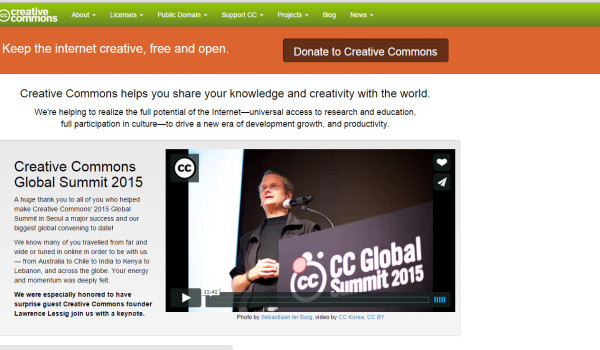
If you secure an image through a Creative Commons license, ensure the license allows you to commercialize the image – otherwise, you can’t use it for business purposes. (Creative Commons is a nonprofit organization that enables sharing and use of creativity and knowledge through free legal tools.)

creative-commons-website

TIP: Flickr, a user-generated image community, built Creative Commons licensing options into its interface. Users who share photos can do so on their terms, including giving their permission for free, legal sharing, use, and remixing. As such, it has become a leading resource for free, legally shareable images.

TIP: If you find the perfect image but it doesn’t have the proper Creative Commons license, reach out to the copyright holder and ask for permission.

Conclusion

Now that you know about the value of copyright ownership and how to secure those rights, you can take steps to prevent legal accusations in the future. Do your best to obtain full copyright ownership. If you have to compromise, know all the potential use parameters and prioritize the ones most important to your existing content marketing strategy. The end goal is to have an agreement that ensures you’re truly the king of your content.

Now that you have the proper rights to your content, learn how to get more readers for that content with the best techniques for creating captivating headlines. Read CMI’s e-book, How to Cook Up a Killer Content Marketing Headline.

Cover image by Joseph Kalinowski/Content Marketing Institute

The post Avoid Legal Action: Take Proper Steps to Own the Content appeared first on Content Marketing Institute.

17 Nov 17:22

What Sinatra Teaches Us about Consultative Selling

by Susan Levy

What Sinatra Teaches Us about Consultative Selling

It’s been 100 years since Frank Sinatra was born, on December 12, 2015. Even though he’s been gone since 1998, he remains an icon, with a growing following. His classic sound and signature style have earned such accolades as “a voice for all generations” with “unmatched showmanship and artistry.”

Why is Frank Sinatra relevant in a blog post about consultative selling? Because he stands the test of time, as does the consultative selling framework for structuring sales calls and client meetings. In today’s socially networked world, where trending topics tend to capture the most attention, Sinatra’s legacy refutes the idea that the latest, shiniest tools are always better than the tried and true.

When it comes to successful selling over the long term, we can all take a few lessons from Sinatra:

Ol’ Blue Eyes

Sinatra had a vision for what worked with an audience. He connected with people. He used all of the skills at his disposal: poise, style, phrasing, and tempo. He “killed” in concert, causing women to swoon and scream. Such engagement wasn’t by accident but, it was by drawing on his strengths and matching them to audience needs and desires.

Consultative selling also focuses on engaging the audience, in this case, prospects and clients. But, it’s more than relationship building. A true consultative approach makes the transition from product-based selling to needs-based. A consultative sales professional asks more questions, develops solutions customized to the client’s specific needs, and conducts more interactive calls. Within a consultative framework and using the Six Critical Selling Skills — presence, relating, questioning, listening, positioning, and checking — sales professionals learn to navigate conversations to better understand clients and their environment and to create and shape sales opportunities that bring mutual value.

The Voice

Sinatra’s nickname “The Voice” referred as much to his vocal abilities as his reputation as “the best American popular singer of the 20th century.” In our B2B selling environment, being “The Voice” is equivalent to becoming a trusted advisor to clients. It means that you’ve gained sufficient credibility; you have the client’s ear; they listen to you and value your input.

This is more than being a technical expert, sharing your deep knowledge of products and services with clients. Too often, technical selling can overwhelm clients, especially when sales professionals try to impress by doing a data dump, hoping something sticks. The risk is information overload for the client and a missed opportunity for the sales professional, who should have done more questioning as the basis of a needs analysis that underpins a specifically targeted solution

The Chairman of the Board

This title, bestowed on Sinatra by N.Y. radio personality William B. Williams, conveys the depth and reach of Sinatra and what we would call his brand today. More than a celebrity, Sinatra had credibility and respectability. He was a thought leader in popular culture, whose involvement in projects was highly sought.

The position of chairman is a powerful one, often attained by aggressive people who push their way to the top. For Sinatra, it was honorific. For sales professionals who adopt an aggressive approach, trying to push to a top position in a client’s buying process, there are risks. One is not recognizing client discomfort with this style. Another is relying on a persona of confidence that is not shared by the client.

Truly superb sales professionals are those with an intimate knowledge of the structure of a sales call. They are in complete control at every point in the dialogue, but not overly aggressive. They know where they’re going and what they want to accomplish, taking nothing for granted. They remain focused as they probe, learn, and gain a thorough understanding of client needs before discussing any product or service.

The successful sales professional takes a consultative approach and adds real value. They leave their clients wanting more — just as Sinatra continues to do, even to this day.

Download a Consultative Selling Brochure

Learn more about Richardson’s Consultative Selling Sales Training Solutions.

consultative-selling-sales-asking-sales-questions

The post What Sinatra Teaches Us about Consultative Selling appeared first on Richardson Sales Enablement Blog.

17 Nov 17:22

When All Else Fails, This Can Increase Your Company’s Perceived Value

by valueacceleration

David Aaker found a positive correlation between advertising and stock price over 20 years ago. In 1997 Corebrand also released a report positively correlating advertising and stock price. Increased awareness appears to increase perceived value of a company, which is then reflected in its stock price, if the company is publicly traded. Corebrand has recently released an updated report, “The Strong Link Between Advertising and Stock Value,” confirming this relationship is still true.

It does not take a rocket scientist to realize that stock price is usually a reflection of the future perceived value of a company. How else can one explain the sky-high stock prices of relatively new companies with little in the way of revenue? However, what these reports gloss over is the “drugs” involved.

The two Corebrand studies are published by the 4As, which is the American Association of Advertising Agencies. Think they might be biased? The studies are valid as far as I can see, and simply reiterate what Aaker, an academic, noted earlier. What the studies forget to note is that if you stop or cut your advertising, the inflated stock price is likely to drop unless there is real future value in the company.

Several years ago BASF ran a persistent campaign noting they did not make the products you use, they made the products you use better. Clearly a company-focused ad. Stock price increased. They stopped the ads eventually, stock price declined. They have started, albeit on a smaller scale, a new campaign, focused on BASF. Wonder why?

Intel Inside, while ostensibly an ingredient brand ad campaign, really had little effect on consumer preference when it came to actual computer purchase, but did boost their stock. Dramatically scaling back that program in recent years has correlated to a significant drop in their stock price.

Drugs you see. Once you start you can’t stop. But then maybe if a CEO can’t develop an effective strategy to grow the company, he/she can always fall back on advertising to make up for it. At least for a while. And then again, maybe it’s just a temporary campaign in advance of a sale. Situational strategy?

Mitch


17 Nov 17:22

Many companies are turning to board members to find new CFOs

by James Kosur

Workers Business

CFO Insider is a daily newsletter from Business Insider that delivers the top news and commentary for chief financial officers and other finance experts.

Board members are being tapped to take over as CFO (Wall Street Journal)

An increasing number of companies are turning to their own boards of directors to find suitable chief financial officer candidates.

Peter Crist, chairman of recruiting firm Crist|Kolder Associates, tells The Wall Street Journal that shifting a former CFO from the board to management is "an easy play."

More companies in today's market are asking retired CFOs to join their boards, just in case a replacement is needed for their current finance chief.

A Robert Half study conducted in 2014 found that more than three-fourths of CFOs did not have a successor in mind. By adding a former CFO to a company's board, a short-term replacement can be put into place should the need arise. 

An executive recruiter says these are the three skills employers want from finance execs  (Business Insider)

Financial recruiting firms are looking for CFO and finance executive candidates who have three very specific skills.

Paul McDonald, senior executive director at Robert Half, told Business Insider these executives must possess the ability to read business signals from across all departments, communicate effectively, and influence business decisions by collecting the most valuable information.

Robert Half determined the top skills required for financial executives based on the skill sets of recent job placements.

Why finance professionals want more career development feedback (CGMA Magazine)

The pressures being placed on finance executives, especially millennials, is leading to requests for more abundant feedback and career development.

CGMA spoke with several finance professionals to find out why they are requesting more feedback to further develop their careers.

Misty Geer, an accounting supervisor with Halliburton, says it boils down to "a lot of pressure on millennials to get up to speed and to do it quickly."

She argues that as baby boomers begin to retire and technology is upending processes, "without the feedback, we don’t know whether we’re on the right track. We don’t know whether we’re performing as expected and whether the work product we produce is adding value."

Five different types of mentor and coaching sessions are recommended by CGMA's experts.

SEE ALSO: Here are the skills finance execs need to earn top dollar at their jobs

Join the conversation about this story »

NOW WATCH: How to take the perfect LinkedIn profile photo

17 Nov 17:18

How To Host A Successful Small Business Twitter Chat

by Jo Lynn Deal

Wouldn’t it be nice to attend a networking event where the people attending were talking about a topic that just happened to be your specialty? What if you were able to quickly research those who were participating and learn more about them right there during the event? Even better, what if you could step out, and back in, and easily pick up right where you left off (without anyone knowing)? What if the dress attire was anything from pajamas to a tuxedo?

Sound like a dream networking event?

It is. It’s called a Twitter Chat and it’s quite possibly your small businesses most powerful networking, secret weapon.

What is a Twitter chat?

A Twitter chat is a live, online networking event scheduled for a specific time and focuses on a high priority topic for the audience. They are applicable for any industry and generally last about an hour. Twitter chats are themed and all of the conversations are centered around an event hashtag (#).

Just as with traditional networking events, there is an event host and guests. The host develops a list of questions that will be shared through out the chat. The questions are labeled as Q1) for question one, Q2) for question two, and so on. When participants want to answer a question, they label their answer, so that it corresponds with the appropriate question: A1) when answering question one, A2) when answering question two, and so on. Every question and answer includes the chat hashtag.

How to use a Twitter Chat for Small Business

  1. Professional Development – If you want to develop a skill to support your small business, such as social media marketing, networking, email marketing, or virtually any other topic, there’s a chat for it. Attend chats to meet experts in the topic you are researching. Connect with these experts on their websites, follow their blogs, and review their website resources and tools.
  2. Build An Online Network – Target Twitter chats that cater to your target audience and connect with participants. Within a few chats, you can build a strong network of your ideal audience.
  3. Create Awareness About Your Business – The Internet is massive, as is Twitter. It’s easy to get lost in the shuffle. Chats are a strategic place to create awareness about your business and reach users you otherwise may never have connected with. (Best Practice Tip: No selling. Just as with traditional networking, use the chat to meet people and begin a professional relationship.)
  4. Meet Prospective Vendors and Business Partners – Looking to expand your business? Or, do you need to hire a vendor or freelancer? A Twitter chat is the perfect platform for screening your prospects before scheduling a meeting. Get to know their personalities and test whether they truly are experts in their field.
  5. A Strategic Inbound Marketing Tool – As the host of a Twitter chat, you control the content that is discussed in the form of chat questions. A chat can be used to narrowly focus on an industry topic and users can be invited to access more valuable resources at your landing page or website.
  6. An Online Client Services Forum – Invite clients to get together online for monthly sessions. Provide added value to your clients by scheduling chats about important topics or training.
  7. Build Relationships with your Buyers – When you created your buyer persona, you uncovered their likes, dislikes and interests. You also learned where they turn to for information. Search for chats where your buyers hangout. These might have nothing to do with your specific business, but they are a great way to meet and engage with your ideal buyers.

How to find Twitter Chats

To learn more about Twitter chats and to find chats that will help meet your professional development goals, review the following directory sites. Bookmark these sites as new chats are introduced quite often.

Since chats typically last up to an hour, it’s not feasible to attend all the chats that might work for you. So, while you are on the search for your ideal chats, once you find a chat that looks like it will fit your needs, search the chat hashtag on twitter to review past chats and confirm the content will work for you.

Sources for Finding and Registering Twitter Chats:

TweetReports – Provides a listing of twitter chats and offers services for chat managers such as transcribing.
Twubs – Provides a Twitter chat schedule, search via hashtag or category. Register your own chats.
Google Spreadsheet – This spreadsheet is hosted on Google Docs. Search for chats and add your own.
Gnosisarts – The wiki of chat directories, provides a listing of chats by hashtag or industry.
TweetChats – Search for chats by hashtag or topic.

Tips for Hosting a Winning Twitter Chat

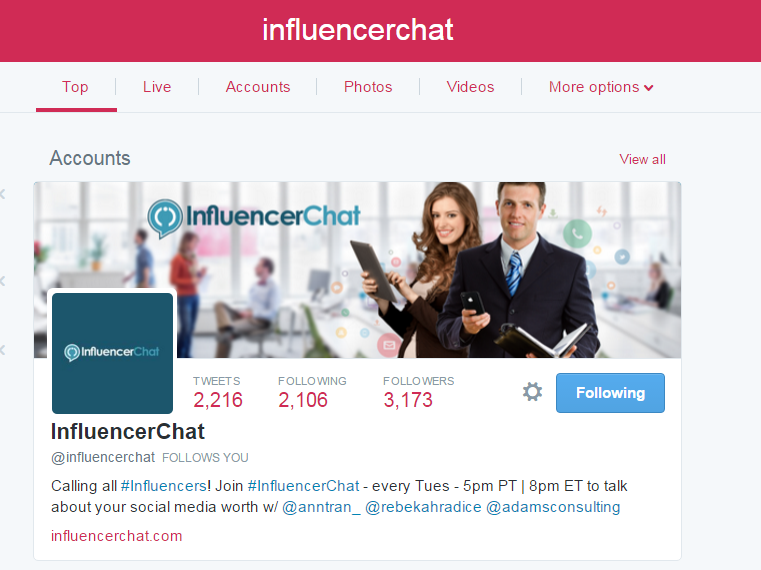
Remember, chats generally take up an hour of your audience’s time. It’s extremely important to make this hour as beneficial as possible. One of my very favorite chats is #InfluencerChat. And if you’re new to chats, this is the perfect chat to learn how to create engagement and visual content for your chat.

Influencer Chat

Best Practices:

  1. Day/Time: When scheduling your chat, and especially recurring chats, choose a day and time of the week that will work with the majority of your audience. Make sure there are no competing chats during that time.
  2. Questions: Source questions from your audience. Find out what is most important for them. Use a keyword tool to find new topics your audience will love.
  3. Expert Contributors: Because you know the questions in advance, reach out to experts and invite them to the chat. Give your audience as much high value content as possible.
  4. Promotions: Some chat hosts announce the questions in advance so that contributors can formulate well thought out answers. All chats should share the topic in advance.
  5. Arrive Early: The host should arrive early to build momentum and engage the audience pre-event.
  6. Hashtag: Always include the event hashtag in questions and answers.
  7. Respond: Respond one-on-one to participants and retweet answers.
  8. Follow Up: Follow up with participants and thank them for attending. This may take some time, but it will help ensure your participants come back.
  9. Connect: Follow and connect with any participants your business is not already connected to. Create a chat ‘list’ on Twitter to stay in touch with participants.
  10. Chat Account: Create a chat account on twitter, such as @InfluencerChat, that matches the hashtag and shares about the chat, its future schedule, and upcoming topics.
  11. Transcription or Summary: On a dedicated webpage, create a transcription or summary of the chat with links to any resources that were discussed. (Think ‘Inbound Marketing’ and driving people to your website.)

Tools for Monitoring a Chat

Participating in a chat on Twitter can be challenging. Here are a couple of sites we’ve used that help keep everything organized.

Hootsuite – Use your Hootsuite account to create a stream for your chat. Hootsuite makes following a chat easy without all the distractions.

TweetDeck – Tweet deck is the platform from the experts themselves, Twitter. Use it to monitor and manage chats, as well as your other twitter tactics.

It’s Your Turn

What ideas can you add for hosting meaningful Twitter chats? Meet me in the comments.

17 Nov 17:18

10 Persuasion Lessons Every B2B Marketer Can Learn From Infomercials

by Ronald Dorhout Mees

Put simply, infomercials present an informative broadcast introducing a product or service for sale. Product sales are usually conducted at the time of broadcast, so no part of an infomercial is left to chance – they’re carefully crafted, perfectly targeted and scripted with care. This is hard-sell advertising in a soft outer shell, often resulting in phenomenal sales.

They’re unlikely to appeal to your professional tastes. In fact, your marketing muscles may be ready to run, but infomercials are convincing and it’s good to know why.

It’s a methodology

The infomercial model originated in the US but their high-impact methods are now repeated worldwide. Addictively awful, these long-form late-night commercials engage customers’ minds and open their wallets with stunning success. The best thing about infomercials is that their proven methodology is available to all and B2B marketers have much here to learn.

Let’s take a closer look:

Lesson 1. Think in Buyer Personas

Infomercials worked with Buyer Personas long before we reinvented them for B2B. They know that speaking to statistics is not enough; watch a 28-minute infomercial and you’ll know instantly if they’re speaking to you. Almost every Infomercial presents either 3 real (buyer) personas who demonstrate the way the product is used in their life, or shows the many ways a product can be used.

Effective B2B marketing appeals directly to the customer who is likely to buy. Great buyer personas dig deep, identifying a prospect’s specific and detailed situation, tailoring your message so your buyer knows it’s for them.

Lesson 2. Tell a Story

Powerful storytelling melts prospects’ hearts. Infomercials don’t sell features, they tell a story. The viewer is led from problem to solution, stress to relief, failure to success, disappointment to hope. Stories aid recall: information is fleeting but people remember how you make them feel.

Effective B2B marketing doesn’t focus on data, or even the product. It makes a human connection through the telling of tales.

Lesson 3: Impact / Outcome                                            

Infomercials explain outcomes. Again and again, they cut to the chase: better returns, bigger biceps, faster, better, more fun. Lose X kilos in Y number of weeks… demonstrate the measure of your product’s success.

More than ever, purchase decisions are driven by financial considerations and subjected to higher levels of review. Effective B2B marketing calms these concerns. Offer measurable results, focussing on COI (Cost of Inaction) and ROI – outcomes have impact; specificity sells.

Lesson 4: Think in Scenarios

Infomercials create endless scenarios that move products mentally into customers’ lives. Every usage scenario is explained step-by-step and slots the product into stories buyers know and understand.

Effective B2B marketing provides context. (User) scenarios describe an interaction between product and prospect, explaining how your solution will make which difference when.

Lesson 5: Make solid claims

Make non-negotiable claims that are hard to refute – you need a reason why your offering is the only true solution, the one that customers want. Infomercials brazenly brandish claims to uniqueness, announce an identity that no others have. What can you offer that your competition can’t? What makes your offering so unique?

Effective B2B marketing builds winning positions to stand out from the crowd, giving a compelling answer to “Why should I buy from you?”

Lesson 6. Craft your message

Agreed, the sales message is salesy and over the top, but every word of an infomercial is chosen with care. The wording is direct and considered and the sales message straightforward and clear.

An effective B2B marketing message should be thought-through and honed. Make your value proposition clear and unique; persuade your prospects why they need to buy from you, and why to buy now. Keep it short, simple and and memorable – something your prospects will retain and repeat.

Lesson 7. Positioning

Position your product so that cheaper alternatives don’t stand a chance. Infomercials repeatedly and shamelessly highlight the weaknesses of their competition in the light of their own product’s strengths.

Effective B2B marketing places a product at the top of its class. Successful sales messages incorporate a realistic and sustainable statement that differentiates you from the rest.

Lesson 8: Get in their Heads

Infomercials get in buyers heads by presenting their problems and feeling their pain. They catch their attention by reading their minds, then feed them their message on relentless repeat.

Effective B2B marketing shows clients the conversation that’s going on in their head. Hit their hot buttons quickly before their attention moves on, then feed them solutions and ask them to act.

Recognition (they see themselves) and repetition (again and again) are the keys to success.

Lesson 9: Urgency

Infomercials move quickly and sell on the spot. If you don’t order during or just after broadcast then the moment is lost, so they increase the urgency and demand action now.

While it’s rarely so pressing in B2B marketing, a strong call to action will keep prospects on board. It’s time to move your product up their priority list. What are they losing by not buying now – customers, money, productivity, time? Be urgent, feel urgent, ask for action today.

Lesson 10. The Power of authority

“Experts” litter infomercials, placing a stamp of authority on the marketers’ words. People listen to experience, and love to believe letters placed after a name. It’s in our nature to follow, to listen and let others lead.

Effective B2B marketing calls on analysts, “thought leaders” and even customers to allay buyers’ fears. They offer their experience, their influence, their hard-won expertise. It works: there are countless examples of the power of authority to make customers buy.

Believe me, I am an expert in this field.

Don’t think this is for you? Then think again.

You may think that infomercials are pushy and salesy, or tacky and cheap. You may not believe that your product belongs in this world. But don’t let the dressing fool you; these highly successful sales funnels have important lessons to teach. Bringing infomercial insights to your B2B message will attract prospects and persuade them to buy.

17 Nov 17:15

3 Really Difficult Ways to Create Great Customer Experience

by Jay Baer
3 Really Difficult Ways to Create Great Customer Experience

Image via BigStockPhoto.com

How do you make purchase decisions today? Cost? Availability? Reputation?

Before long, it will be Customer Experience. According to Walker, by 2020 customer experience will be more important than even price for B2B buyers.

You probably believe this, as the importance of “customer experience” is in the lips of every consultant, and in the pages of every business publication. But what does it really mean? What is “great customer experience” anyway?

Maya Angelou famously said, “I’ve learned that people will forget what you said, people will forget what you did, but people will never forget how you made them feel.”

Customer experience is how your company makes its customers feel. (highlight to tweet, it’s fun!)

The delivery of great customer experience is rooted in one easy to understand (but difficult to execute) formula:

Great customer experience happens when you exceed customer expectations. (highlight to tweet, you’ll love it)

You may not be able to voice it. You may not be able to write it down. But every time you interact with a business of any type, you have an idea or an inkling of how that intersection will go. That’s the expectation. If the business exceeds that expectation in a noticeable way, you’ll think “that was a great experience.”

There may be more, but I believe there are three primary areas where you can exceed expectations, on the road to delivering great customer experiences.

Great Customer Experience = Faster Than Expected

You can be faster than your customers expect, and create a great customer experience.

Today, according to research I completed in conjunction with my new book, Hug Your Haters, among those expecting a response at all, 40% of customers who complain about businesses in social media expect to hear back within one hour. The average time it takes businesses to get back to their customers in social media (if they answer at all): five hours.

But what if you could answer your customers in five minutes? Discover Financial Services (makers of the Discover Card) routinely do this, and many other companies do the same. That kind of responsiveness exceeds expectations and creates great customer experiences.

Don’t ignore other communication channels either. It’s remarkable that the average time it takes a business to respond to a customer email is 44 hours. Nearly two days to respond to an email!

Recently, my wife needed to send her watch to Shinola for repair. She emailed them, and heard back from them in two minutes. It exceeded her expectations so much, she called me to make sure I knew about this great customer experience.

Great Customer Experience = More Authentic Than Expected

47% of Americans trust advertising, according to Nielsen. Almost every company has a trust deficit, because they are inauthentic in one (or many) ways. And trust deficits are expensive propositions.

Trust is the foundation upon which all business success must stand (highlight to tweet)

Screenshot_11_14_15,_10_45_PMIt turns out that one of the best ways to gain and keep trust is be unusually open and honest. It shocks customers into wanting to do business with your company. Why? Because you vastly exceed their expectations of how a company is supposed to communicate.

Patagonia is magnificent at this. Their Footprint Chronicles microsite details every manufacturer and vendor in their supply chain, their labor practices, and other details.

This authenticity and forthrightness creates a great customer experience, and changes the way readers of the Footprint Chronicles think about the brand.

Great Customer Experience = More Relevant Than Expected

All marketers – all businesspeople, really – tell themselves the exact same lie: “Our customers are just too busy to pay attention to us these days.”

Bullshit.

When someone says they are “too busy” that’s actually an obfuscation intended to not hurt your feelings. What they really mean is “what you are giving me is not relevant enough.” Because when you give someone content or an experience that is precisely what they need, when they need it, in the format they prefer….the time necessary to consume or engage magically emerges from thin air.

Relevancy magically creates time. (highlight to tweet)

We don’t expect companies to be massively relevant to us, because they so rarely are. But when they do deliver the relevancy goods, it smashes those expectations and creates a great customer experience.

When Spotify launched in Canada, Scott Stratten (speaker, podcaster, author) tweeted to Spotify:

With Spotify being new to Canada, I don’t really understand how to use it right, but damn, I like it.

— Scott Stratten (@unmarketing) October 10, 2014

Spotify could have ignored Scott, and that was his expectation. But they didn’t. Instead, in the middle of the night they created a custom playlist with a hidden message, and tweeted it back to him:

@unmarketing We’re here for you Scott, take a look at this: http://t.co/jmoEmx4GlG pic.twitter.com/j1RUK5hwyv — SpotifyCares (@SpotifyCares) October 10, 2014

How’s that for a great customer experience that’s incredibly relevant?

Can you be faster than your customers expect, more authentic than they expect, or more relevant than they expect? Doing so isn’t easy, because each of these require an increase in effort and an internal, cultural embrace of these methods. It is far easier to just keep delivering the same, average interactions that essentially meet customers’ anticipations of what you’ll do, when, and how.

But isn’t exceeding customer expectations worth the investment? The companies cited in this post certainly think so, because they know it’s the recipe for what will soon become the key differentiator in business – more so even than price – great customer experience.

       
17 Nov 17:15

Account-Based Sales Development Myth-Busting: Watch for These 3 Conversion Rate Killers

by Kevin OMalley

Sales development can be tricky, and metrics can be deceiving. Since well-structured sales development teams are highly metric-oriented and performance-driven, it’s no wonder that some wander astray and try to chase down goals that won’t actually produce success for the company.

Assumptions on what goals to chase down can sabotage your sales development team’s efforts. The rise of account-based sales development (ABSD) is turning these assumptions on their head. Is your team dropping the ball and chasing the wrong metrics? Find out below:

MYTH #1: More leads means more opportunities

ABSD is making waves because companies are starting to learn quality of appointments are more important than quantity. If you give marketers goals to produce leads for your sales development team, for instance, they will work to hit those numbers at all costs. This is a bad mentality for marketers, and it can seep into sales development teams. Worst of all, it catches up with you in the end when you look at the numbers and your conversion rates are terrible. This results in discouraged Account Executives who feel their time and efforts have been wasted.

Focusing on core accounts that your business wants to close (not just your sales team) will generate higher quality opportunities that will offset the lower quantity of leads.

MYTH #2: You can email blast your way to your numbers

Let’s say you’re in a “greenfield” market and you’ve been email blasting your target audiences with some success. The problem here is, as you scale, you will begin using more personalized methods of outreach. Combining mass email blasts and personalized outreach can actually have a negative effect on response. In ABSD, emails should be hyper-personalized. They should be a part of your sales development cadence, but limited to one-on-one, valuable interactions that are tailored for that specific account audience. Mass email blasts will kill your conversion rate metrics.

MYTH #3: Keep fishing for that ideal client profile

To illustrate this myth, compare targeting the VP of an outside sales company to a VP of an inside sales, SaaS-company. Two very different roles, so if you use simple criteria to target them, it’s misleading. If you’re fishing for prospects based on simple criteria such as title, industry, and size of company, it’s likely you’re going to hit unqualified prospects despite them fitting your “ideal client profile.”

A key component of a successful account-based sales development strategy is digging into the accounts that really matter, and not only understanding the ideal client profile, but the specific nuances of that account that will push the needle forward. You can also look inward for inspiration of who to reach out to, targeting companies based on your customer’s characteristics. Targeting prospects similar to your customers will help you understand the problems they face — and better yet — the context in which they experience their problems.

Chances are you’ve encountered these myths in your sales development team’s outreach efforts. All of them will equally hurt your team’s ability to convert conversations into opportunities.

What do you think? Do you see other potentially harmful myths in your team that you’ve busted? Drop us a line. In the meantime, check out our Top Secret Sales Development Playbook to learn how to build a sales development team that drives the results you need to succeed.

The post Account-Based Sales Development Myth-Busting: Watch for These 3 Conversion Rate Killers appeared first on SalesLoft.

17 Nov 17:14

Sales + Marketing = The Strategy For Business Growth

by Billy Lyle

Modern CRM systems enable the alignment of Sales and Marketing – discover how this equates to business growth.

Untitled design
Ask salespeople if they work in marketing, and their response would be a resounding no. Ask a marketer if sales is part of marketing and quite a few would agree with the notion, but in practice they’d still see the two functions as sitting apart from each other. With a modern CRM system these silos can be broken down, requiring Sales and Marketing to collaborate.

Furthermore, the two way flow of information between sales and marketing allows for the necessary level of interdepartmental integration, as organisations strive to become more consumer-centric. Marketing can also conduct research and segment customers in a way that can help salespeople to better understand and target particular types of customers.

“The key to modern business is [about] ensuring that throughout an organisation all departments are working towards a common objective, albeit through different means”, writes CRM consultant Paul McLaughlin in his Linkedin Pulse blog, ‘The benefits of sales and marketing alignment’. He adds that Sales and Marketing are the “engine driving most organisations, but other departments can also benefit from better inclusion, notably the customer support arm.”

Modern CRM Systems
The best way to achieve sales and marketing alignment in order to make Sales + Marketing = the strategy for business growth is by implementing a modern CRM system because:

  • It will enable your organisation to create a transparent pipeline by giving staff with access rights to a CRM database the ability to know what other people within their own and other departments are doing. Managers can then use this information to develop more efficient processes, and it enables them to gain insight in order to develop their strategy for business growth.
  • It will offer a single view of the customer, from a single data source: According to McLaughlin, whose Linkedin Pulse post was published in April 2015, “30 percent of marketers feel that a disparate data source is the main reason they fail to glean useful information about their target audience”.
  • Collaboration improves customer insight: When all of Sales and Marketing, for example, work together and connect to each other through a modern CRM system, they become more effective and efficient because it becomes easier to collate and share data for the development of customer insight.
  • The ability to access a complete history of existing and previous customers can enable sales and marketing to work as one as a team, allowing them to work together to increase revenue by targeting prospects, customers and markets that are likely to deliver the highest profitability.
  • Remembering to support your customers and to learn more about them can improve sales, retention and loyalty rates. With a modern CRM system you can cross-sell and up-sell to new and existing customers in order to generate new revenue streams and sales opportunities.

You can also score your sales leads, according to their Net Present Value or according to how likely they to become advocates of your brand by applying a Net Promoter Score. Marketing can also support sales by qualifying the leads and by helping sales to understand customer needs, wants and desires. This analysis can be based on transactional history, demographics and on the scores. This saves time and money, while allowing sales and marketing to define its strategy for business growth.

Discover more about how a CRM system can help your business achieve growth by reading: ‘The Ultimate Guide to: Driving business growth using CRM’ today.

This post first appeared on the Redspire blog.

17 Nov 17:06

37 Growth Hacking Tools Your Sales Team Will Love You For

by Adam Honig

As a sales professional, the rate at which you’re expected to guide prospects through the sales process and drive revenue for your company is likely increasing. Many companies create ambitious targets requiring growth, scalability, and hustle.

How do you achieve these goals? Through growth hacking.

The term growth hacking refers to strategies aimed at creating scalable growth through improved productivity and efficiency. Growth hacking is a popular term in the marketing world, however, sales teams can greatly benefit from implementing growth hacking strategies as well. In fact, doing so can help salespeople reach more prospects in less time and close more deals at a faster rate.

Get HubSpot's Free CRM Now

At its core, the act of growth hacking requires a desire for continuous improvement. With this mindset and the right tools, salespeople can become more efficient and effective with little to no additional effort. If you’re looking for growth hacking tools to help your sales team, check out these options.

1. HubSpot CRM

HubSpot is an all-in-one CRM platform that helps you organize, track, and nurture your leads and customers. The sales CRM automates tasks for your sales team in one interface, eliminating the need for messy spreadsheets and manual data entry. It’s the perfect place to have a real-time view of your entire sales funnel and manage relationships with prospects and customers.

HubSpot is an all-in-one platform because it brings powerful sales, marketing, service, and ops tools together so your entire business can reference one source of truth when it comes to everything related to your customers.

Get HubSpot's all-in-one CRM platform, with powerful sales, marketing, and service tools as well as a variety of integrations, which will scale with your business as you grow.

2. HubSpot's Free Appointment & Meeting Scheduler

  • Price: Free.
  • Best at: Scheduling meetings without the back-and-forth.

Scheduling meetings with prospects can be a frustrating task with a lot of back and forth. Cut down on emails and quickly schedule meetings using HubSpot’s free meetings tool. This free tool easily integrates with Google Calendar, Office 365 Calendar, and HubSpot CRM. Prospects can book time with you via a link to cut back on all back-and-forth

3. CircleBack

There’s nothing worse than not having the right contact information you need for a prospect or partner. CircleBack keeps all of your contacts up to date and can detect job title, email address, or phone number changes. Never waste time looking for the right contact information again.

4. LinkedIn Sales Navigator

Sales Navigator offers advanced lead and company search capability within LinkedIn’s interface. It also has a lead recommendation feature, helping you quickly find targeted LinkedIn accounts, drastically cutting down search time looking for leads among thousands of profiles.

5. Hunter

Want to get in touch with a specific contact but can’t find the right email address? Hunter has a solution for that. The Hunter email finder tool can help you find email addresses by entering the associated person's name and company domain. Hunter's free plan allows you to perform 50 searches per month, and paid plans include additional features like CSV exports and email campaigns.

6. RollWorks

RollWorks is a machine-learning-powered platform for account-based marketing. It helps you identify targets accounts and engage them via the most effective channel for them — then, the tool measures the resulting revenue impact. RollWorks offers target account discovery, target account prioritization, account-based digital ads, and sales automation.

7. Neverbounce

Your email list is only valuable if it’s accurate. Neverbounce verifies the email addresses on your email list and periodically cleans your list to get rid of invalid email addresses. This helps you reach the right people at the right time and avoid having your emails sent to the spam folder, which can jeopardize email deliverability.

8. Detective

Detective aims to save hours of call time, research, and prep for sales reps — this tool automates the research process. Detective sends your reps relevant sources of information to prepare them with buyer intel for calls and pitches without having to sift through countless pages of information online.

9. Loom

Loom is a communication tool that allows you to create instantly shareable videos at the click of a button. It’s a great tool for creating quick product demos that don’t require heavy editing or processing. You can capture your screen, record using your computer’s camera, and narrate videos at the same time using one piece of software from your web browser — no installation required.

10. Intercom

Intercom offers a suite of solutions aimed at growing sales through real-time conversions on your website. Time-saving features include automated outbound messages to targeted leads, a team inbox, and automated reporting.

11. Tray

Tray offers advanced automation capabilities allowing each person on your team to integrate their daily tools (including Slack, Dropbox, Google Suite, Asana, and more) in one place. This creates more time for innovation and growth. With Tray, your team can streamline complex workflows and sync nearly any combination of platforms.

12. Proposify

High-quality proposals are important for closing the sale but can be time-consuming to create. Proposify streamlines the document creation process and helps your team quickly create quotes, contracts, and other important documents.

13. GetAccept

GetAccept’s sales enablement tool is designed to help teams increase sales effectiveness. Key growth hacking features include document management, easy presentation building tools, and electronic signature collection.

14. Salesmsg

Cut down on the inbox clutter with texting. Salesmsg offers easy-to-use, two-way business texting so your sales team can easily send, receive, and manage SMS conversations within a single, online tool.

15. Toky

Toky can help you manage your sales team’s phone system from the cloud. This online platform allows you to integrate calling and messaging capability with your CRM. Connect with prospects from all over the world by creating virtual phone numbers in the US and internationally.

16. Slack

Slack is a channel-based messaging platform that offers an easy and secure way for organizations to communicate and collaborate. Connect any of your software and tools and work in organized conversations with team members of your choice. Use the searchable history to locate any conversations or documents previously shared in Slack. You can also place video calls from within the system to chat with team members quickly.

17. Bonjoro

Video is a powerful way to communicate with prospects. With Bonjoro, your sales team can create, send, and track videos directly from mobile devices. The app also allows custom video URLs and visual branding and can connect to your CRM and email systems for easy distribution. As a bonus, their team features help you assign tasks and track performance as a group.

18. Modus

Modus is an interactive tool that helps you create, manage, and track sales content in one platform that connects seamlessly to your CRM. Get instant notifications when a lead is engaging with your content so you can reach out to them when their interest is highest.

19. Conversica

Conversica leverages virtual AI sales assistants to engage with prospects in an authentic way. This saves your sales team time identifying new leads so they can focus on selling and closing the deal.

20. MixRank

MixRank helps sales teams find new sales opportunities through robust data sets and advanced filtering to help you connect with the right people. MixRank analyzes wide sets of data to help identify potential buyers, helping sales teams qualify and target prospects at the right time.

21. Zoom

Zoom is a helpful tool for quickly and easily scheduling virtual meetings. Whether you’re scheduling a one-on-one meeting with a prospect or hosting a 100-person presentation, this tool has you covered. Zoom also integrates seamlessly with apps like Google Calendar, allowing you to add virtual meetings to your calendar with the click of a button.

22. Outreach Plus

Manually sending cold emails can be extremely inefficient. Outreach Plus helps sales teams send personalized cold emails that are designed to get replies. This tool integrates with your current email platform to accelerate your sales pipeline by personalizing, automating, and processing responses from cold emails.

23. Amplitude

Amplitude is a robust program that helps teams better understand customer behavior. By analyzing how customers currently use a company’s product or service, Amplitude provides data-driven insights on where conversions drop off. This feedback helps sales teams reconfigure offers for better conversion results.

24. PandaDoc

PandaDoc empowers sales teams to accelerate the sales process. Using this tool, sales teams can generate, negotiate, and sign proposals and contracts in one simple interface. PandaDoc also integrates seamlessly with your CRM software, helping you pull CRM data into documents automatically.

25. HelloSign

HelloSign provides an effective e-signature platform designed for businesses. With HelloSign, you can track when a contact receives, opens, and signs your documents, eliminating the back-and-forth.

26. Jira

Price: Free with paid upgrades available.

Best at: Building synergy between sales, support, and development teams.

Jira is a collaborative cross-functional tool designed for software companies. With Jira, sales teams have visibility into the full launch process of their company’s products, giving them up-to-date information that can be used to close more deals.

For example, with Jira, sales teams have visibility into new product launches and feature rollouts making it easier to provide prospects with accurate timelines for when important features will be implemented.

27. Map My Customers

With Map My Customers, your team can visually segment their customers on interactive maps. This tool helps teams drive more sales by assigning sales territories using powerful queries.

28. Kixie

Kixie provides voice and SMS software focused on efficiency for sales teams. Kixie connects directly to your CRM for easy scheduling of follow-up activities which turns call outcomes into automated workflows.

29. HourStack

With HourStack, you can map out your individual tasks and schedule and record the amount of time spent performing tasks. This tool also integrates with project management tools, allowing the whole team to have visibility into important deliverables.

30. Expandi.io

Expandi.io is a LinkedIn automation and prospecting tool geared at safely and effectively connecting you with your leads on the platform. According to the company, Expandi.io currently helps clients schedule an average of 50 sales meetings per month — the tool uses personalization, targeted content, and automation to accomplish this.

31. Landbot.io

Landbot.io is a no-code chatbot builder. The automated conversations that result from using Landbot.io on your site allow you to convert more leads, collect target audience and customer data, and personalize the customer experience. There's a single, drag-and-drop interface where you can conduct and manage all conversations. You can also integrate Landbot.io with your other sales tools to allow for a seamless workflow when working with your customers.

32. Hotjar

Hotjar is a website heatmap and behavioral analytics software. The tool's heatmaps help you visualize user behavior on your site. Meanwhile, recordings show you what your website visitors are looking at and doing on your website, and surveys provide context around the actions of those website visitors.

33. Airtable

Airtable builds collaborative apps for your teams — it allows you to customize your business's workflows so your team has a single source of truth when it comes to your data. Your data is shared in customizable spreadsheets that serve as relational databases. You can sign up and create your own database in just minutes with the easy-to-use interface.

34. Optimizely

Optimizely is a digital experience platform that helps with experimentation and personalization. The tool provides recommendations for experiments so you can get the information you need in order to offer a responsive customer experience. Test and weigh out different options for your digital experiments so you can provide effective and unique customers experiences on a large scale.

35. Drift

  • Price: Contact Drift.
  • Best at: Revenue acceleration and conversational marketing.

Drift is a revenue acceleration and conversational marketing and sales platform. It helps you bring real-time and personalized experiences to your visitors and customers across every platform. The software has a number of integrations that allow you to engage customers based on relevant context such as where they came from or how they've interacted with your business in the past.

36. Canva

Canva is a graphic design platform that's easy-to-use and requires no design knowledge. You can create business cards, social media content, infographics, templates, invitations, lesson plans, Zoom backgrounds, and more. There are pre-built templates and a drag-and-drop builder so you can create beautiful and professional graphics in seconds.

37. Zapier

Zapier connects the web apps and tools you use every day, allowing you to create automation workflows (known as "zaps") that save you time across a number of systems — in fact, the tool connects to over 3,000 apps. This software works across various popular platforms including Gmail, Dropbox, Trello, and HubSpot CRM.

Use Growth Hacking Tools on Your Sales Team

best growth hacking tools for your sales team

There are a variety of growth hacking tools available to help your team save time, automate processes, and close more deals. Ultimately, your ability to grow and scale your sales team’s success relies on having a strong CRM as a foundation.

Editor's note: This post was originally published in September 2019 and has been updated for comprehensiveness.

New Call-to-action

17 Nov 17:06

Why Every Sales Rep Needs to Be a Master Storyteller

by mrenahan@hubspot.com (Mike Renahan)

“Stories can conquer fear, you know. They can make the heart bigger.” - Ben Okri

The enjoyment of telling and hearing stories is ingrained in all of us. It’s what we do when we get into the office first thing in the morning (“You won’t believe what happened to me on the train … ”) or when we finally get the whole family together during the holidays (“Uncle Scott has no idea how to drive. We got lost three times!”).

While it might be obvious that we love stories just from observation, science also backs up this fact. Studies have shown that when we listen to or read a story, our brains act as if we are living it, not reading it. We get caught up in the moment, and experience exactly what the characters we’re reading about are experiencing.

So if you’re in sales, how do you use this information to convert more leads into customers? The first step on the path to a closed deal is helping the prospect write their own story.

Here are the three easy steps to start using the power of stories in your sales process.

1) Create a narrative.

A study from Jeremy Hsu found that humans actually think in narrative form all day long. We make up our own stories, activating the insula in our brains, as a way to relate to what’s happening around us.

A narrative is the backbone of any story. Whether you’re spinning a yarn about product, your customer, or something else entirely, you have to have a beginning, a middle, and an end.

Two key points to focus on:

Use cause and effect.

Our brains naturally work in cause and effect moments, so shape your story accordingly. “Business X was failing. But after they introduced our product, revenue increased by over 150%.” “VP Y wanted to get a promotion to CEO. After she implemented our strategy, she got the job -- in half the time she expected it to take.”

Put the prospect into the story.

As we pointed out earlier, when we hear or read a story about someone else, we think of it as if it is happening to us. So when you’re relaying a case study, actually put the prospect in front of you into the protagonist’s shoes. When you hit the high and low points in your narrative, prompt the customer to visualize themselves experiencing these feelings. One way to achieve this is to say, “Imagine you were in this situation … ”

2) Stick to the narrative.

There’s nothing worse than leaving a movie with unanswered questions about the plot, right? Like, how did that person come back to life? Or how did they move so quickly from place to place?

Turns out, the reason plot holes bother us so much is rooted in neuroscience. Our brains like simple. We don’t want to work to try to figure something out; instead, we would rather just follow along with a clear story.

Keeping the narrative the same throughout a sales presentation is critical. This allows you to paint a clear picture, which helps the brain process the information. If a prospect has to continually ask “Wait, what?” your story will lose its effectiveness.

Remember to keep it simple by embracing the following tactics:

Write it down.

There’s nothing wrong with having a few notes by your side to keep you on track during a demonstration or presentation.

Practice.

Sales reps are great at reviewing their calls and analyzing what went wrong, and what went right. Apply the same mentality and critical eye to your presentations and stories.

Phone a friend.

Ask teammates to listen to your calls and give you feedback. Constructive criticism about where your presentation or messaging could be improved is invaluable.

3) Keep the story alive.

Obviously, prospects don’t have time to hop on the phone every single day for 30 minutes to hear each and every customer success story you’ve got. But that doesn’t mean the message has to die when the story ends.

The easiest way to keep the story going is:

Send the occasional email.

Including a piece of content you’ve created or a case study on one of your customers can go a long way. This way, your message lives on well after your call has ended.

In addition, ask a prospect about their story. How are they going to get to the top of whatever mountain they have their eye on? Just as much as people love hearing stories, they love telling them, too. Let them talk about their goals, dreams, and struggles. Listen intently, and then use that story down the road. And if you spot a place for your product in the narrative? Work with your customer to write it in.

Stories in sales are cyclical. A good story can lead to a customer, but a good customer can also lead to a good story. Approach each and every prospect with the intention of making them a hero in the narrative of their lives, and the sales will roll in.

Get HubSpot CRM today!  

16 Nov 19:19

Google’s Natural Language Search Gets Smarter

by Barry Schwartz
Google is now smarter at understanding queries that include superlatives and times, as well as more complicated questions. The post Google’s Natural Language Search Gets Smarter appeared first on Search Engine Land.

Please visit Search Engine Land for the full article.
16 Nov 19:19

How to Kick off Your Outbound Sales with Cold Emailing – Ebook by Growbots

by Greg Pietruszynski
Cold Emailing Graphic

Cold email. Love it or hate it, it’s still the most effective method of outbound sales. Unfortunately, over time it has acquired a bad name, and a lot of companies ditch this strategy without even trying. It’s a great loss, because cold emails in outbound sales can help you:

  1. Build predictable revenue
  2. Create a scalable sales process
  3. Change your SDRs into brand advocates

In outbound sales, cold emailing is essential, because it automates the entire sales process so sales reps can focus on closing more deals. 
There are five steps to kicking off your outbound sales with effective outreach:

  1. Subjects that get your emails opened every time

Yes, it’s still the most important factor directly influencing your open rates. No matter how optimized for conversion the body of your email is, it won’t bring results if the email never gets opened. A boring subject line will give you a 10% OR when you can easily have 50%. To create a subject that begs the reader to open requires a pinch of creativity and the ability to put yourself in someone else’s shoes. In our e-book below, we provide a list of smart practices such as how to use the preview for your benefit, why capital letters are cheesy and won’t help your OR, as well as how awful lying is, etc.

  1. Structure emails in the most high-converting way possible

In every vertical of your target, you will see patterns. But the primary question remains: Do we know who the decision-maker is? Knowledge about the decision-maker and the ability to create a context that draws her in is what determines whether an email is relevant. Did he raise investment for scaling his business lately? Did he join a LinkedIn Group? Is he going to be at the conference next month? Details like these give you irresistible leverage and the ability to create a relevant context. It determines whether you should choose a direct pitch, or a referral email in a long or short form. There is strong evidence backed by real data that the intro + benefit + social proof + call-to-action structure is the most effective approach.

  1. The timing will never be perfect

The truth is that there is no universal rule for the timing of your cold email campaign. But what you can do is always be testing. It sounds cliché, but it really is an essential component that will most definitely impact your OR. But your tests need a measurable goal and clear conclusions. One thing is for certain, sending your campaign at the wrong time can result in as much as 30% fewer responses.

  1. Outbound sales is a numbers game

You’re a sales guy (or gal); you know the numbers. What’s great about cold emailing campaigns is the fact that they’re 100% trackable, and analytics have become super simple with the emergence of user-friendly and highly accurate software. But we have to stop focusing on vanity metrics. Conversion from email to demo is the only metric that matters. In many situations, it might be far more efficient to send 10 well-targeted emails than to send 100 emails to randomly chosen potential decision-makers from your target.

  1. Enlist your inner creative genius

There’s any number of standard best practices to follow for cold emails, but at the end of the day, cold emails should be fun. We’ve done a great deal of testing on what works and what doesn’t. In fact, we’ve sent more than a million cold emails and yet we still love doing it. Why? Because we love getting feedback like: “Great email. Very well written. Let’s schedule a demo!”, or “I usually skip 99% of cold emails, but yours is splendid and I want a demo” from potential customers. We love helping them to scale their businesses, and it feels pretty good knowing we can help so many great businesses connect with the very people who need them most. But waiting for them to hopefully one day stumble upon our product just doesn’t seem right, and that’s why we love to reach out and engage them first.

The right strategy, every time

Cold emails might come easy to us, and hopefully reading this post has made it a little easier for you too, but there are so many more mechanisms behind every campaign that you can implement immediately and with ease. What’s described here is just a start. In Growbots’ ebook you will find different types of emails dissected from start to finish, the secrets of personalization and automation, and a whole lot more. As if that weren’t enough of a reason to take a look, all of this comes complete with plenty of real-life examples to back up our recommendations.

Download the ebook and reshape your outbound sales:

The Complete Handbook of Cold Mailing

The post How to Kick off Your Outbound Sales with Cold Emailing – Ebook by Growbots appeared first on Sales Hacker.

16 Nov 19:18

How We Improved Our Sales Workflow with Slack

by Joe Wegner

We use Slack a lot at Keen IO. We’re constantly using and building Slack integrations to improve our workflow. We’re actually kind of obsessed. We realized we needed a way to aid our sales and customer success workflows on Slack, so we built a tool that lets people type a command that looks like this: /company slack.com. And pulls up a response like this:

Slack /company

The company info is retrieved from Clearbit’s API. This has been incredibly useful for our Sales and Customer Success teams when they need to look up information about a new signup or an existing customer.

We’ve open sourced all of the code on Github. If you want to use this integration for your own company just follow these steps:

What You’ll  Need

Follow These Steps

  1. Grab your Clearbit API key
  2. Create a Slack Incoming Webhook (you can reuse an existing one)
  3. Copy the webhook URL – you’ll need that later
  4. Create a Slack slash command. Preferably /company for the command. The URL should point to your Pushpop instance, on the /slack/company path. Copy the Token – you’ll need that later
  5. Create a new job in your Pushpop instance, using the company info source.
  6. Add all of the environment variables:
    1. CLEARBIT_KEY is the Clearbit API key from Step 1
    2. SLACK_WEBHOOK_URL is the webhook URL from Step 2
    3. SLACK_TOKEN_COMPANY is the slash command token from Step 3
  7. Restart Pushpop (make sure you’re running pushpop as a webserver)
  8. Type /company keen.io into Slack!

Look Up Individual People

We can also look up information on individual people.

This creates a slash command that will retrieve info about a person (via email address) from Clearbit, and send it back in to Slack.

The person info will look like this in Slack:

Person Lookup

Setting Up the /Person Command

  1. Grab your Clearbit API key
  2. Create a Slack Incoming Webhook (you can reuse an existing one)
  3. Copy the webhook URL – you’ll need that later
  4. Create a Slack slash command Preferably /person for the command
  5. The URL should point to your Pushpop instance, on the /slack/person path. Copy the Token – you’ll need that later
  6. Create a new job in your Pushpop instance, using the person info source.
  7. Add all of the environment variables
    1. CLEARBIT_KEY is the Clearbit API key from Step 1
    2. SLACK_WEBHOOK_URL is the webhook URL from Step 2
    3. SLACK_TOKEN_COMPANY is the slash command token from Step 3
  8. Restart Pushpop (make sure you’re running pushpop as a webserver)
  9. Type /person jack@squareup.com into slack!

That’s it! Check it out on github to learn more. If you have any questions or ideas of your own drop by our community Slack channel.

The post How We Improved Our Sales Workflow with Slack appeared first on OpenView Labs.

16 Nov 19:17

4 Toxic Behaviors That Leaders Need To Be Wary Of

by Paul Keijzer

If you’ve ever mentored someone then you know how baffling some people find it when they seem to be doing everything right but simply aren’t able to find the success they’re looking for. Unfortunately for these people, they’re not able to step back and look at things from a third person’s perspective (hence why they’re working with a mentor in the first place). If they could, they’d see that one challenge they face is that they have an undercurrent of toxic behaviors that undermine their success as a leader.

By identifying these toxic behaviors and modifying them (it’s often very hard to eliminate core elements of how we lead), their chances of creating success increase exponentially. These are four of the most common toxic behaviors I have seen most often in potentially incredible leaders.

1. Being Overly Enthusiastic

Every leader must have the ability to create a vision. But what sometimes happens is these visions are so out there, so literally incomprehensible by the rest of the organization, that the rest of the team simply doesn’t believe that the end can be reached.

Use the conversation about aspirational goals to slowly take your people up to the vision that you have. You’ll not only make sure that everyone keeps up, but you’ll have their constructive input on how to get there.

2. Bullying People Into Agreement

I’ve talked about how people can manage having a bully boss but sometimes you can be a bully without intending to be mean. It especially happens when you have a vision that you strongly believe in and simply can’t get the team on the same page as you.

You could always get people to agree with you by forcing them but all you’ll really get is the “yes sir” answer which is so prevalent in frontier markets. You won’t get buy in to have the team perform the actions to get you there. And hence you will fail.

3. Being Envious Of Other People’s Success

The grass is always greener on the other side but that’s often because the story of greener pastures is highly exaggerated. Everyone has had to face past and manage current challenges to get to where they are. Nobody’s going to be inspired by a leader who wastes time and energy being envious of others.

Even if you try to hide your envy, it will inevitably show through your actions. Just don’t go there. You’ll create your own success if you put in the right energy and actions.

4. Taking Things Personally

Have you ever worked with a leader who is just too emotional? These are the people who randomly explode during meetings or discussions. Even though what they may be saying is correct, the way they present the information just undermines your desire to respect them.

Even if you say sorry after displaying an emotional explosion during a meeting, you might end up losing the respect that you need for people to really follow you through thick and thin. Drive and vision can be separated from emotions – and almost always should be.

It’s risky to be driven for success without being aware of the dangers on the path to getting there. These are just a few.

16 Nov 19:03

Brand Positioning For Recessionary Times

by Jerome Conlon

Brand Positioning Techniques For Recessions

There are whispers in the wind that the next recession is on the way. Recessions usually require brand planners to learn on the fly to keep their value proposition alive. All the assumptions of business as usual need reassessing.

Recessions create a window of opportunity for questioning what drives consumption behavior, creating new learning. This is the gift of adversity. But, markets today are so fast moving and dynamic in every way that an exhaustive evaluation of your brand positioning should be ongoing. But it rarely is. Why? Because it can seem like too much work and there are far too many other things vying for a marketers attention.

But, there is a way to quickly and intuitively assess your brand’s position. At least to the point that you can develop solid hypotheses about what should be researched if additional research is needed. It simply requires assuming an informed consumer’s point of view in assessing the subtle energy elements of your categories marketing mix, trying to honestly give credit where credit is due to any brand that is performing admirably. If you are reasonably well informed of the competitive dynamics in your category and you are intellectually honest in how you perform this exercise it can take less than an hour and provide valuable strategic brand planning insights.

What are the implications then of a recession on branding? How can we apply this knowledge to get ready for challenging times?

Leo Burnett, one of the nations leading ad agencies conducted a national survey (1,000 people) at the time of the start of the last recession to see how shopping values and behavior may have changed. In this survey it was found that 82% of the public began carefully examining whether or not the brands they buy were worth it. 33% of the public had become much less brand loyal than they used to be. The great recession caused more people to trade-off or trade-down than trade-up for a higher quality or higher priced products in most categories. 40% of the public said they were avoiding status symbols because they were deemed to be out of touch with the times. 34% saw former necessities as luxuries. 32% saw former essentials as products that they can do without. These kinds of shifts in segmentation and psychology can be taken into account in how you assemble marketing mix elements.

Brand drivers are primarily associated with feelings. Unique, strong and positive feelings generate brand affinities. These are warm feelings that predispose a person to choose one brand over another when they are in a shopping situation. If you understand how changing category dynamics affects brand perceptions then you can anticipate new paths to success. Most marketing campaigns are short-term sales campaigns they are not long-term brand image building campaigns. Off-price promotions can spike sales but cheapen the image of your brand. Leadership brands spend more on long-term demand creation initiatives than do brands that favor push marketing tactics.

Even in recessionary times brands can build equity investing in their core values. Through the up and down of business cycles Nike has continually invested in delivering on its core values of authentic athletic performance. For any high interest and high involvement category (like sports footwear) there is an evaluation exercise that can work well to develop strategic insight into using elements of the marketing mix to build brand equity. Its particularly useful for brands competing in the culture industries, including personal technology, shoes and apparel, beauty, fashion, auto and transportation, restaurants, beverage, hospitality/tourism and education.

You start by self-assessing your own response to your category for a missed positioning opportunity. WHAT EMOTIONS ARE YOU FEELING when you are shopping and when you are actually having an ideal product or service experience? For example lets look at running shoes. If you are a dedicated runner what feelings do you notice most about your shoes when you are having the best run ever?

  • Passion
  • Joy
  • Comfort
  • Heightened energy
  • Non-Intrusive sensations

When we performed this exercise for the Nike Running category we uncovered that the ideal running shoe draws no attention to itself on an ideal run. If you notice your shoes, something is wrong. There are no friction points – the fit and feel are ideal and glove like, the cushioning is ideal allowing you to stride out without pressure points. In exploring the hierarchy of benefits of the ideal shoe comfort rose to the top as the benefit sought most. From this realization the original Air Huarache was created. This was a shoe designed from the inside out. The materials and location of stitching seams were carefully chosen to reduce pressure points and friction and maximize comfort. This design innovation was then taken to other product categories.

This brings up a question surrounding how you evolve your brands value proposition. Is your brand acting as the cultural protagonist for the ideal experience in your category like Nike did here? Has any brand discovered, defined and taken the positioning high ground in your category? If not this high ground is still open to take. All you have to do is uncover it. It’s there waiting for you to uncover. This kind of evaluation into latent and tacit needs allows you to tune-up your marketing mix in changing times to keep your value proposition and demand high.

If the market is in the midst of shifting brand value propositions what do you do? If you study what’s shifting with more depth of understanding than anyone else you’ll discover new opportunity. This is possible if you re-assess the value of your offering through how marketing mix elements are changing. This kind of assessment can be facilitated with a simple exercise.

Below is a Brand Position Evaluation Grid to help you assess your brand compared to the competition. The list of brand attributes provided is a short and simple list. This list can be expanded to more precisely define any brand. The placement of the marketing mix elements on this grid is largely intuitive. If you feel you don’t have the insight needed to complete the grid then you need to do some category research to try and understand which brands and products are selling the most and which benefits consumers are seeking the most.

Brand Position Evaluation Grid

Brand Positioning Grid

Look at this chart as a grid to plot how you (think & feel) consumers are evaluating brands. Plot where you intuitively feel the marketing mix elements fit on this chart. The level of importance defines the vertical axis and where your brand stands in relation to the best brands in the category defines the horizontal axis. This is meant to be an intuitive exercise that you can perform in a few minutes. It assumes that you are aware of the product benefits sought most and the relative market share and product offerings of the major brands in the category. Give each marketing mix element a letter to make it easier to plot on the chart. Then analyze your positioning strengths and weaknesses. Create brand initiatives to build on your strengths and remedy weaknesses. In the above example you feel that customers feel your brand is behind in offering the best value for the money, the best quality and the most convenience. These are clearly weaknesses in your marketing mix that need initiatives to overcome them. The plot above also indicates that this brand has no unique strengths that it can leverage. An old truism in branding is that you first need to identify your strengths and then build upon them.

Competitive Positioning Dimensions (These five elements were plotted on the above chart)

  1. Most Value for the Money
  2. Best Quality
  3. Best Design
  4. Most Convenient
  5. Brand delivers intangible values that resonate most

Consider how you might tune the overly simplified architecture of engagement (above) to bring it more in line with your business concept and with how consumer values are driving market behaviors. Market dynamics and value perceptions are constantly in flux, not just in recessionary times. But, the perception of customer value can be reduced to a very simple formula…

Quality

———-  = VALUE

Price

Quality in this formula contains all the values & features that differentiate your brand to make it the brand of choice. In recessionary times a general truth is that many categories become far more price sensitive. They reduce costs and price and don’t invest in brand building initiatives to help generate a higher level of value…if they perceive the demand isn’t there. There are niches for many market segments however, even in recessionary times. If all the competitors in your category are going more downscale, this is an opportunity to make a brand statement at the higher end. Often a high end image can drive take down product styles and prices. Nike uses this strategy brilliantly.

At any time the appeal of your brand can be tuned up by playing with the elements in the marketing mix. But before you put a new brand strategy in place it is imperative that you have an accurate assessment of your strengths and weaknesses in the marketplace.

Stephen Spielberg once told Quincy Jones that the most critical part in the production of a film was the scoring of the soundtrack. The soundtrack sets the emotional overtones for each scene, cuing the feelings, mood & tone of the story. People primarily come to movies to have an emotional experience. The feeling tones in music add the critical dimension to the overall experience of the film. What is the quality of the feeling tones your brand is creating and broadcasting to the world? If you were the brand manager for Samsung or HTC smartphones could this be one of your weaknesses in the marketplace?

One interesting business case to study is Apple and the iPhone. According to the WSJ in July 2015, Apple has taken 92% of the smartphone industry profits and it sells fewer than 20% of all smartphones. How does it do this? You could use the Apple iPhone to practice the brand positioning grid exercise to list and plot the iPhones key elements, features and brand benefits. Under the Apple brand elements list here’s an interesting list of brand attributes (for your consideration) to be plotted on this chart. To accurately plot these on the chart requires that you are up to speed on all the campaigns in the category and that you are emotionally and intellectually sensitive and honest about campaign nuances if you work for one of the brands in the category. Periodically breaking down the power of campaigns, product features and overall perceptions of value provides the deep insight needed to develop new brand initiatives.

Brand Communications

  1. Most salient (stands out)
  2. Most relevant (talks to consumer on a personal level)
  3. Most resonant (strikes emotional chord, creates + feelings
  4. Brand that has most developed ‘Human Face’
  5. Brand Identity that generates the most goodwill

Responsiveness / Adaptability

  1. Most current innovative use of technology
  2. Innovative use of fabrics / materials
  3. Beauty of Design Details
  4. New community building features
  5. Integrated Design Values with other products

Consumer Insightfulness

  1. Clear view of target audiences & how to reach
  2. Clear view of consumer / category drivers
  3. Clear view of brand positions in category
  4. Translation of brand values into resonant stories
  5. Clear view of the Brand SWOT in category

We could have a longer list here of Apple’s brand intangibles. This exercise in the real world of planning would be more exhaustive, leaving no important stone unturned. Additional insight in Apple’s unique brand strength in the smartphone category can be gleaned by looking at the following chart:

Business and Brand Development Model

Why seek to add value at the top of the pyramid – at the Soulful Branding level? Increasing your brand’s emotional resonance to wider circles of people supports market share and sales growth, premium pricing, loyalty and brand extensions. It also makes your brand more resilient in recessionary times or times of competitive adversity. Given an option people support brands with admirable character traits. Soulful Brands find ways to appeal to feelings not just rational thoughts. They get the basics at the bottom of the pyramid down cold then add intangible layers of value to improve the quality of the brand relationships. Clearly Apple has done this with the iPhone. They have differentiated themselves in their physical features, communications style and service experiences. They are seen as sharing values with the community, periodically becoming protagonists for worthy causes. They anticipate the future and stay in tune with the times. Basic branding at the bottom of the above pyramid only employs the bottom two rungs. Basic branding provides what is expected. Basic branding focuses more on offering lower priced products and competing more on lower price. Pricing power weakness is often experienced by basic brands in recessionary times. In the smartphone category all the brands that are losing money are primarily engaged in marketing mix elements at the more basic levels.

More insight on the topic of creating intangible brand value can be found in Soulful Branding – Unlock The Hidden Energy in Your Company & Brand, Jerome Conlon, Moses Ma & Langdon Morris, FutureLab Press 2015. This book presents a paradigm shift in what the art of marketing & branding can become at the highest level.

Branding Strategy Insider is a service of The Blake Project: A strategic brand consultancy specializing in Brand Research, Brand Strategy, Brand Licensing and Brand Education

FREE Publications And Resources For Marketers

16 Nov 19:02

Creating An Authentic LinkedIn Profile

by Colleen McKenna

A quick search on Google returns more than 16 million results for “How to Write a Great LinkedIn Profile.” Over the years, we’ve written our fair share on this topic and we talk about how to write a great Profile every day.

The mechanics are actually quite simple. LinkedIn makes it rather straightforward. They serve up prompts and tips. It’s filling in specific areas chronologically. Filling out a “form” doesn’t take much thought or creativity. Therein lies the problem. The mechanics are easy. Finding the voice or words to bring YOU to life, is not. It takes a deep understanding of who you are, what you do and why you do it, every day.

We love to share the how-to (the mechanics) but we are jazzed and inspired to coach someone to find their voice, define their purpose, articulate their vision, and stand out.

Over the last four and a half years, I have had the privilege of working with and building many profiles for leaders and visionaries in a wide range of industries.

When I received a call from Bob Miller, the Founder and former CEO of Miller Heiman, Inc., the premier Sales Performance organization to many of the world’s top sales organizations, I was delighted just to talk with him.

When he started to talk about who he was, his body of work and the work he is focusing on moving forward, I could feel the energy through our mobile phone line. Bob was engaging, down-to-earth, confident, curious and open-minded. And, he understood LinkedIn’s inherent value.

When I told him that I wanted to capture not only what he had accomplished but his voice, he listened, paused and said he understood the value of approaching LinkedIn this way. We ended the conversation with his homework assignment. Think about your “why” and let’s bring you to life on LinkedIn.

Two days later I had a document that genuinely reflected the person I had talked with days earlier. He was bold yet charming, passionate and forthright, accomplished but a perpetual student of people, sales, and learning.

Our subsequent conversations focused Bob’s story and upon launching his profile a couple of days ago the response from his Connections affirmed our desired goal: “Your profile sounds just like you.”

Yes, Bob is an accomplished leader and sales coach with forty plus years of experience to share and that does make it easier. I agree. Interestingly though, I think there are some other considerations at play. These elements turn Bob’s profile (and others) into compelling, authentic dossier or living portfolio; way more interesting than a standard Profile. When you bring your voice, attitude, philosophy and actual project work to LinkedIn, something else happens.

Here are a few bonuses to a great, well-written and thoughtful LinkedIn profile:

  • After you scan, review, or read their “profile”, you feel like you know something about who they are, what makes them tick.
  • When you meet them, there are no surprises. You recognize them. They look like their picture, their tone, inflection and story resonate and are genuine.
  • Their intellect, humor, style are transparent.
  • They are likable and confident but not arrogant or boastful.
  • They don’t say “I wrote that a long time ago and don’t remember what it says.”
  • You laughed, smiled, or were inspired by their story.
  • They checked for typos, grammar, and cared enough to figure out what should be capitalized and what shouldn’t.
  • Most importantly, they owned who they are and they became someone you want to know.

Oh, and there are a couple of other elements that makes Bob Miller’s profile stand out.

Bob is 84. He is one of the most gracious leaders I have had the pleasure of talking to and working with. He is intentional, responsive, interested and kind. He knows his calling. He has and continues to inspire, coach and transform salespeople to be better, stronger and more successful.

If I was blindfolded and heard him speak, I would know who he was. If I read one of his books and then looked him up on LinkedIn, I would say the tone and the philosophy resonate. It’s not good writing, it’s writing to capture the essence and personality.

Your LinkedIn profile, in my estimation, is more important than your resume, your presentation deck, your USP (unique selling proposition). It’s your world-stage, free from geographic limitations and your current company value proposition. It’s you, out there for the world to assess, admire, reach out to, connect with, engage with or not.

16 Nov 19:01

Our Generation Ships Will Sink

by Kim Stanley Robinson

NASA-TORUS-BESCHIZZA

“The Earth is the cradle of humanity, but one cannot live in a cradle forever.”

—Konstantin Tsiolkovsky

Humanity traveling to the stars is an ancient dream, and a late nineteenth and early twentieth century project, proposed quickly after the first developments in rocketry. The idea spread through world culture, mainly by way of science fiction. Countless stories described people visiting planets orbiting other stars, and by a process of cultural diffusion, space travel became one part of a plausible and widely-held consensus future for humanity, a future we seemed to moving into with accelerating speed as the twentieth century progressed.

With the enormous successes of Star Trek and Star Wars, the idea was firmly planted in the popular imagination: if we survived as a species, we would be moving out into the galaxy. This awesome diaspora would mark our maturity or success as a species, and would enable us to outlive the Earth itself, should it suffer a natural disaster or be destroyed by some human folly. The thought of long-term galactic survival for humanity was comforting to some, and in any case it seemed inevitable, humanity’s fate or destiny. When we landed people on the moon in 1969, and robots on Mars in 1976, it seemed we were already on the way. (more…)

16 Nov 19:00

The original Coke bottle turns 100 today — here's how it got its iconic shape

by Richard Feloni

1915 coca cola bottle

Monday marks the 100th anniversary of the iconic Coca-Cola bottle, packaging that is just as recognizable as the logo or product itself.

In the book "Design to Grow," released earlier this year, Coca-Cola VP of innovation and entrepreneurship David Butler and co-author Linda Tischler designate the uniquely contoured bottle as one of seven marketing strategies that allowed The Coca-Cola Company to scale into a global behemoth.

When the Georgia businessman Asa Griggs Candler became the majority shareholder of Coca-Cola in 1888, two years after its invention, he set his sights on making Coke the nation's most popular cola through marketing and partnerships with regional bottlers.

But by 1915, Candler was losing market share to hundreds of competitors. He launched a national contest for a new bottle design that would signal to consumers that Coke was a premium product that couldn't be confused with some other brown cola in an identical glass bottle.

The new bottle had to be able to be mass produced using existing equipment yet also be distinct.

The Root Glass Company in Terre Haute, Indiana, decided to enter the contest and base its design off the product's name. Shop foreman Alexander Samuelsson sent two members of his team to the local public library for ideas.

While combing through the dictionary for the word "coca" and words like it, Butler writes, mold shop supervisor Earl R. Dean came across an illustration for the cocoa plant that caught his attention.

Coca-Cola had nothing to do with cocoa, but the cocoa pod had a strange but appealing shape. He and his team got to work crafting a design akin to the pod. Root Glass filed a patent for the design on Nov. 16, 1915, under Samuelsson's name, and Coca-Cola executives loved it. The design won the competition.

Here's the original patent:

coca cola bottle patent"By 1920, the contour bottle, as it's been called, had become the company's most celebrated artifact," Butler and Tischler write.

Over the past century, Coca-Cola has played with the shape and size of the bottle, and focused production on more easily manufactured and recycled versions.

But throughout the bottle's evolution, the company has kept its similarity to the cocoa pod intact:

coca-cola bottle cocoa plant

"That bottle has become one of the most recognized objects of the 20th century, in more than 200 countries," Butler and Tischler write.

You can see a slideshow of the various forms the bottle has taken over the past century at Coca-Cola's website.

SEE ALSO: 7 brilliant strategies Coca-Cola used to become one of the world's most recognizable brands

DON'T MISS: The 27 jobs that are most damaging to your health

Join the conversation about this story »

NOW WATCH: Fast food hacks that will change the way you order


16 Nov 19:00

The Seth Godin Guide to Building an Engaged Contact List

by Ahmad Munawar

16 years ago, Seth Godin wrote the book on email marketing.

Although the word ‘email’ can’t be found anywhere on the cover, Permission Marketing speaks to heart of what email marketing is ultimately about:

“Permission marketing is the privilege (not the right) of delivering anticipated, personal and relevant messages to people who actually want to get them.” — Seth Godin

At the time, this kind of thinking was almost heretical.

Marketers were still stuck in the era of ‘interruption marketing’, sending unanticipated and impersonal messages to people who didn’t want them.

The doctrine of permission marketing established new ground rules for how marketing was to be done in the digital era — where everyone is a direct marketer, attention is scarce, and consumers refuse to be interrupted.

screenshot-docs.google.com 2015-11-11 15-50-29

The 3 Rules of Permission for Email Marketers

Fast forward 16 years and the principles behind permission marketing are more relevant now than ever, especially for email marketers.

To build an engaged and profitable contact list, here are three rules of permission you should never forget:

Rule #1 – Permission is earned, not bought.

“In order to get permission, you make a promise. You say, ‘I will do x, y and z, I hope you will give me permission by listening.’ And then, this is the hard part, that’s all you do.” — Seth Godin

Promises are the currency of permission. You’ll only get people onto your email list by making a promise. And they’ll only stick around if you fulfill that promise.

But many novice marketers still make the mistake of buying contact lists. It’s a practice that hasn’t yet died from the era of interruption marketing.

It’s the modern equivalent the door-to-door salesman who used to make a living interrupting housewives in the middle of the day trying to sell encyclopedias. You might get lucky and make a few sales, but it’s definitely not the way to build long term value with customers.

Here’s what does work:

  • Acquire contacts organically. Commit to never buying a list or tricking people into getting on your list. When contacts engage with you on their own terms, they’re far more likely to stay engaged and become customers.
  • Make a compelling promise. A great promise is what will get people on your list and position your new relationship with them. The more relevant and personal the promise is to your prospect’s life, the stronger the relationship and the better your chances of converting them into customers.
  • Put your promise in the right place. Go where your prospects are. If you have an active blog, place opt-in offers there. If there are popular websites in your niche, guest blog on those sites and point readers back to an opt-in offer. Advertising on social media is another excellent way to get your offers in front of people.

Rule #2 – Permission is a journey, not an event.

“The goal of the Permission Marketer is to move consumers up the permission ladder, moving them from strangers to friends to customers. And from customers to loyal customers. At every step up the ladder, trust grows, responsibility grows, and profits grow.” — Seth Godin

When a contact opts in, you’ve earned the lowest level of permission.

It’s what Seth Godin calls ‘situational permission’, because you earned it by making the right offer at the right time. It’s not unconditional and it can be revoked easily.

The highest level of permission is what’s called ‘intravenous permission’, where you make buying decisions on behalf of the consumer because you’ve built up enough trust that they’ll effectively buy whatever you recommend. This is the holy grail.

Ultimately, the goal is to continue escalating the relationship to higher and higher levels of permission until, eventually, customers will buy whatever you tell them to buy.

Here’s are a few tips to help get started:

  • Build your permission ladder. What are the levels of permission on your list? How can you escalate relationships from opt-in to sale? Most email marketers haven’t clearly defined the steps they want subscribers to take between opt-in and conversion. This is an important place to start.
  • Segment your list by journey. Your subscribers are not all identical. Different customers are on different journeys and their motivations for engagement will vary. Define the different pathways to becoming a customer and segment your list accordingly to make sure your content is always anticipated, personal, and relevant.
  • Automate permission-building. The real power of email marketing lies in automation. Once you’ve built your permission ladder and segmented your list, make good use of autoresponders and other automation tools to put the process of escalating permission on auto pilot.

Rule #3 – Permission is temporary, not permanent.

“The promise is the promise until both sides agree to change it. You don’t assume that just because you’re running for President or coming to the end of the quarter or launching a new product that you have the right to break the deal. You don’t.” — Seth Godin

The idea of losing permission is a scary thought. It’s the marketing equivalent of a breakup.

But the great thing about email marketing, as opposed to relationships, is that you’re able to see the warning signs long before you lose permission for good.

Just pay attention to these three numbers:

  1. Open rates measure how much subscribers anticipate receiving your emails. If your open rates start to drop, it’s a good sign that you’re not consistently delivering on your promise or the topic itself isn’t as interesting to your subscriber as it used to be.
  2. Click rates measure how effective your content is at inspiring action. It’s nice when people read your email, but if they’re not taking the intended action, that’s a sign that you’re losing permission.
  3. Unsubscribe rates track when you’ve finally lost permission for good. When someone unsubscribes from your list, it means they’ve gotten to the point where they’d like to formally revoke permission and never hear from you again.

Marketers tend to focus on unsubscribe rates as the ultimate measure of when permission is lost. But the truth is, you probably lost permission far before your subscriber reached for that unsubscribe button.

Here are a few tips to help you hold onto permission, and get it back when it’s slipping away:

  • Decide what you will NOT do. You made a promise to get people onto your list. It’s important to understand what you need to do to fulfill that promise. But it’s just as important to know what you will NOT do to jeopardize the relationship and the trust you’ve built. For example, if you run an email newsletter that features knitting tutorials for the elderly, trying to sell them dentures might not be well received (even if they need them).
  • Build a re-engagement sequence. Just because someone is not that into you at the moment, doesn’t mean they’re gone forever. If you notice some subscribers have stopped opening your emails or taking action on them, build a follow up sequence to re-engage them. Again, automation is your friend here.

Email is the Holy Grail of Permission Marketing

“Real permission is different from presumed or legalistic permission. Just because you somehow get my email address doesn’t mean you have permission. Just because I don’t complain doesn’t mean you have permission. Just because it’s in the fine print of your privacy policy doesn’t mean it’s permission either.” — Seth Godin

The inbox is a sacred space. It’s guarded more closely than any other medium because it’s where real work gets done.

For that reason, it’s also the most cut throat. If you make your way into the inbox and blow it, you’re just one click away from getting the boot.

But if you succeed at building permission at every step of the relationship, by fulfilling promises and living up to the responsibility of being in the inbox, you’ll have the opportunity to earn loyal customers for life.

16 Nov 18:58

Chinese nationals are buying multi-million dollar US homes using the country's most popular instant messaging app

by Lucinda Shen

Cow India WeChat

Imagine selling a $14 million New York City apartment entirely through Twitter or SnapChat. 

Emma Hao, an agent for luxury-home broker Douglas Elliman has done it.

Well...that's not quite true. Hao brokered the sale through WeChat, China's most popular instant messaging app. She does this a lot, and she's not alone.

"I'll put up a floor plan and say that a new property is good on the blog and the location is great. Then people will say 'I'm interested' and buy," she said. "It's really something else."

An unexpected use

Chinese internet and gaming giant Tencent launched WeChat in 2011 as a voice messaging app with location services. But it's grown into a seamless one-stop shop for common apps: users can watch movies, call cabs, share photos, buy clothes, play games, and even offer personal loans.

Lately, it's turned into something of a real-estate sales platform – specifically connecting Chinese buyers with agents in the US.

Chinese nationals are the largest group of foreign buyers of US. real estate. Looking for a safer place to park their assets and diversify their holdings, they're also willing to pay more than all other nationalities, according to the National Realtors Association.

And there are 650 million  — largely Chinese – users on WeChat. That's more than double the US population.

"I would pay $100 a month to use WeChat," said Jing Wang, a 36-year-old real estate agent for Lin Pan Realty Group in New York. "It would be much harder to be introduced and reach Chinese clients because many of the social websites, like Facebook, are blocked in China — that's a lot of time and money."

WeChatWang, who specializes in serving Chinese buyers, only joined WeChat after becoming a real-estate agent. All of his Chinese clients communicate with him via the app. He says he's sold properties of up to $5 million in value, with the buyer staying in China through the entire process.

Tours are given via video and photos, and negotiations are completed solely through the chatting app. A legal representative cements the deal on the brokers end, and an electronic version of the contract makes its way to the new owners. Payments however, are still done by cash.

For the buyers seeking investment properties, the prospect of a 15-hour flight from the east coast of China to New York is reason enough to rely on WeChat.

"WeChat has become essential to consumers’ daily lives," Xiaofeng Wang, an analysts at Forrester Research in Beijing wrote in a July note. "Marketers the world over must take account of WeChat, which has become so ubiquitous that it has changed Chinese consumers’ mobile behaviors in profound ways."

Real estate agent Wang advertises his listings via a free blog and leaves voice recordings with clients, so negotiations can be done over days rather than late at night.

But there's also the issue of trust. Buying a multi-million dollar investment from someone you've never met before seems reckless.

But users such as Hao use their apps as a personal blog: she posts photos and writes about her food, clothes, makeup and lifestyle — and that fosters an online personality.

"I say what I want to say so they know exactly who I am, and I update my daily life — and people like it. You show you have a personality — that's what makes a sale," she said. "Maybe they never comment on anything, and suddenly they'll send you a message."

Tencent's strategy: Appeal to marketers

It's certain that the property deals are only a tiny portion of activity on WeChat, but they're an unexpected area of growth for the app that has been struggling to gain traction in the West. Owned by Chinese internet giant Tencent, WeChat earlier this year stopped advertising in the West as user growth plateaued.

Overseas user acquisition "has sort of come to an end," said Tencent President Martin Lau Chi-ping during a press conference in March.

Tencent released third quarter earnings Tuesday November 10, reporting a 32% increase in profits to $1.2 billion — beating analysts expectations. WeChat alone reported an increase to roughly 650 million active monthly users, up 39% since last year.

The agents don't pay anything right now to use WeChat, even if they're able to sell an apartment. If the real-estate firms were to seek a formal presence on the platform, like some luxury brands have, they'd have to pay for that.

Tencent didn’t respond to Business Insider’s request for comment. We’ll update this post if we hear back

Instead of trying to gain more users overseas, Tencent has turned its attention to expanding WeChat's already vast ecosystem within China and South East Asia — cementing a pool of extremely loyal users that spend on average more than half their time on mobile using WeChat, according to Forrester Research. 

wechat impact report 14 1024 Grata

"I think it's crucial to marketers," said Bryan Wang, a Singapore-based independent analyst who focuses on Chinese internet companies. "It's the number one option for all brands to get close to the customers."

The app is already proving to be a destination for companies looking to sell to wealthy Chinese. They've turned into the single largest group of luxury buyers in the world, making up 32% of global consumption, according to a recent Bain and Company study. 

Many luxury brands have also begun to tap into WeChat formally —  leading to the rise of specialized WeChat marketing agencies that boast clients such as Coach, Lancome, Piaget, Louis Vuitton and Bonpoint. 

These WeChat campaigns can range in cost from a thousand to millions of US dollars. But it's paid almost entirely to marketers — WeChat gets a fraction of the payment — about $50 a year for the official account.

Increasingly, marketing firms specializing in ad campaigns for WeChat have begun to spring up. These include SameSame in Paris, WalktheChat in Beijing, and Curiosity China with locations in Paris and China. 

They help brands develop into the online-to-offline (O2O) market that Tencent has also been pushing to expand in recent months: helping companies grow an online presence that emphasizes customer service and the attraction of offline firms.

WalktheChat co-founder Thomas Graziani, a 29-year-old Parisian working out of Beijing, started his firm last year. 

"The interactions on WeChat are much more complex," Graziani said, comparing the application to Whatsapp and Facebook messenger. "WeChat has an absolute monopoly in China, with all capabilities happening in a single window — it's holistic and connected, true automation, true tracking, with potential for very interesting viral campaigns."

LINQ hotel casino wechat

For Tencent, increased O2O activity helps boost their nascent payment service, Weixin Pay, and heightens the chances of more advertising revenue from companies — which is becoming a increasingly important portion of Tencent's business.

No broader US surge expected

Tencent shouldn't expect the unexpected usage by brokers to turn into an overall surge in the US, though, because people separate their personal and professional lives, independent analyst Bryan Wang said.

While Westerners may use the platform to reach Chinese customers, few will use it at home.

"In our opinion, WeChat is likely to focus more in establishing a strong ecosystem in China as the competitive landscape in the West seems to be much more challenging," said John Choi, executive director at Daiwa Capital Markets. "The user interface of the Asian messaging apps tend to appeal more to Asian users."

Still, the brokers aren't deterred.

Maurice Owen-Michanne, 34, is another New York City based agent who who has sold a property worth $4 million over WeChat. The client had a legal representative who viewed the property, while the buyer relied on photos, blueprints and videos. Owen-Michanne speaks almost no Chinese.

"It's helped tremendously break down the traditional barriers and strengthen my relationship with my clients," he said. 

Join the conversation about this story »

NOW WATCH: Cop pulls a clever move to save a man from suicide

16 Nov 18:58

3 Lean PR Strategies Every Business Can Practice

by Rebecca Hasulak
3 Lean PR Strategies Every Business Can Practice

Image via BigStockPhoto.com

Even if you’re well beyond the start-up phase, you’d have to have been tucked away in hibernation to have missed the lean business trends. Maybe you took note, or maybe you dismissed them as inapplicable. Either way, while these strategies might seem best suited for new or small companies, the truth is that companies of all sizes can benefit from adopting a lean mindset.

When it comes to public relations (PR) specifically, companies would be wise to reevaluate their strategies through the lens of this approach. Here are some tips to do this.

Realign Around Value

When a business reaches a level of maturity, it’s tempting to be lulled into a “more is better” belief. You have the personnel and the resources, so why not pump out as much content as you can? The problem with this is that strategy is nowhere in that line of reasoning. Without some thoughtfulness, content can fall flat or even cause damage to a brand. Instead of engaging in content initiatives for content’s sake, press pause and realign. (highlight to tweet)

Your new focal point should be on delivering value. Yes, of course you want to get something in return for your efforts. After all, content marketing results in three times as many leads as other types of marketing (but costs 62 percent less). So it’s clearly beneficial to you to get (or stay) on board the content train, but it should also be rewarding to your buyers.

Form your content topics around answering customer questions, providing resources to prospects, and delivering industry information that might be useful to your audience. If you shift your content strategy to be all about providing value, you will gain it in return.

Get More Mileage

Since start-ups are usually strapped for cash and time, they have to get scrappy with their PR initiatives and maximize everything they do to the nth degree. While you probably aren’t facing the same limitations, you can still apply this principle to attain success.

Two of the best PR tools you can leverage are customer testimonials and case studies. After all, testimonials use your customers as your mouthpiece, and case studies present your business’ value propositions—backed up by proof of historical success and data. Both are powerful.

Forrester Research recently found that buyers will independently find three pieces of content about a company for every one piece that is put out by its sales or marketing departments. This means that the more third-party, fact-based content you can initiate, the better the odds that prospects will stumble across flattering (and convincing) views of your company. If you’re lacking in testimonials and case studies, step one is to start gathering them.

Once you have as many of each as you can put together, it’s time to strategically approach how to share them. You can get a lot of runway out of case studies by posting them on your website or including them in email marketing messages, on landing pages, in social media, as part of a speaking proposal or award submission, and beyond. Real success from real customers can—and should—be used ad infinitum by companies of all sizes.

Start Being Choosy

There are two more prongs of PR that your business might want to consider tackling from a lean standpoint: speaking opportunities and awards.

If you have a large company with some notable C-level executives, you might have no problem securing speaking engagements. Your top dogs may even be offered payment in exchange for presenting at certain events. But if you’re not quite at that point, you may notice that speaking sessions are trending towards a pay-for-play model.

Before committing to exhibit at an event, simply so you can get your VP a speaking slot, do some research. Is this event really comprised of your target audience? Does it make mathematical sense to pay sponsorship fees, based on the number of qualified leads you can expect to walk away with? Just because you have the cash doesn’t mean you should spend it.

The same thought process applies to awards programs. As companies grow, it’s easy to get swept up in a “keeping-up-with-the-Joneses” (business edition) mentality. Maybe your competitor has eight awards that validate its software, but you only have three. Don’t fall prey to the comparison game! Instead, thoroughly vet each award program to determine if the end result helps accomplish your goals, so you can decide whether or not it’s worth the cost to apply. Many will not be, and you can afford to be selective about which ones get your dough (and your company’s presence).

As you move forward along the ever-evolving journey of improving your business, take a little time to look at your PR strategies and tactics in a new light. Even though circumstances may not necessitate that you “go lean,” you still could greatly benefit from embracing this approach. Every business of every size could stand to give more value, maximize customer stories and be extra discerning when it comes to speaking and awards. Who knows… Once you lose a little of the extra baggage you’ve picked up along the way, you might even notice a newfound swing in your business’ step!

Get more content like this, plus the very BEST marketing education, totally free. Get our Definitive email newsletter.

       
16 Nov 18:11

Rank Well On Search Engines To Rank Well On The Internet

by Michael Wight

ranking

Ranking well on search engines is important for many reasons. If your website or landing page appears on a search engine’s first page for a specific keyword or key phrase, it means more exposure and brand cognizance, more targeted traffic to your website, and more sales. Moreover, ranking high on search engines is a very cost-effective marketing method that enables you to pull your target market more powerfully.

There are many search engines out there with Google, Yahoo, and Bing being some of the most highly used search engines. When it comes to SEO, you cannot just rank well on one search engine, and you must concentrate on all of these. Some important factors to consider when choosing which search engine to pay most attention to include:

Your Target Audience:

This is important because research indicates that certain search engines are famous in certain regions. For example, Google and other such sites are not that highly used in countries like China and Japan. Hence, if your clients are in China, you should try to rank high on Baidu, which is more often used in China.

Nature of Product:

This is another important point because some people would search for a specific thing on a specific search engine. For example, Google is more famous for items related to the world of entertainment. On the other hand, Yahoo is used more by people looking for technological information.

Now that this is clear, let’s have a look at why it is important to rank well on search engines.

It increases your brand exposure

When your website ranks well on a search engine, it gets promotion because more people are able to find your website on the web. It can help you reap the benefits of the investment you have made into your website, and like other marketing strategies, it can increase your sales and profit. A website having a high ranking means that more customers can see the company and become aware of its products or services.

It helps you to tap into opportunities

Remember, the Internet has reached every nook and cranny of the world and now customers have become extremely tech savvy. Before buying any product or services, majority of customers perform online searches. This search influences their buying decision. If the search does not return your company website or landing page, people will not see your website, meaning that you will miss targeted website traffic. If your website is ranking well on the internet, your target audience will see you and visit your website. This could mean increase targeted traffic, lead generation, and even immediate sales.

It helps you reach out to your target market

The good thing about ranking high on a search engine is that you get targeted traffic. In other words, search engines help bring your target market to your doorstep. These people are searching for product and services you are offering because they have landed on your website by entering specific keywords/phrases on search engines. This means that they are your leads the moment they perform a search, and after they land at your website, it is up to you to convert them into customers.

Ranking in Google is effective and cost-effective marketing

Ranking well is a form of cost-effective marketing because it is highly targeted and comes with relatively little cost. You can get a greater return on your investment with search engine ranking than advertisements in the traditional media. Moreover, you can easily manage, see and track your website traffic. You can use Analytic tools and similar services to see what page of your website the traffic is going, what is your target market doing on your website, and where is your target marketing coming from.

It is evident that ranking well on search engines is the easiest way to be successful on the web, mainly because this is where a major chunk of the traffic comes from. So, if you are ready to take on the world, get in touch with us today and let us help you.

16 Nov 18:11

The Best Tips You’ll Ever Hear for Email Marketing

by Bethany Jurns

best-email-marketing-tips

Last year, the Radicati group conducted a study that found that an average business email user sends and receives over 120 emails a day, a number they predict will only grow over the next few years.

With all of those emails going back and forth, how can you make the best of your email marketing investment? These are some of the best tips we’ve learned over the years for making email marketing a success.

Use Email Automation

Are you still sending all of your emails manually? When you’re trying to reach a large database of contacts, leads, or prospects, email automation is a lifesaver, allowing you to write and schedule your emails ahead of time. With a good system of workflows and automation logic you can nurture leads automatically through almost their whole lifecycle with a single push of a button, saving you time and labor while maximizing your email marketing efforts.

Be Mobile-Friendly

Last year, Gartner reported that over 70% of users check email on their mobile devices and that number is only expected to go up. If your email is opened first on a mobile device, do you know how it will look? Make sure that your emails take advantage of mobile-optimized responsive design. Nobody wants to open an email and then have to squint, resize, and scroll horizontally just to read what you’re saying. Make sure that your hard-won email opens aren’t being sabotaged by a mobile-unfriendly design.

Measure Everything

Don’t send emails and just guess about what happens to them. Whether you’re using HubSpot or a similar platform to collect data about email opens, A/B test results, and clicks through by time of day or operating system, or if you’re just creating a few simple tracking URLs so you can see whether anyone is clicking on a link, email that isn’t gathering data is only doing half of its job. Testing and measuring the performance of email marketing is crucial to your success.

Make it Personal

Personalizing email appropriately to your contacts can be a huge boost to engagement. Using contact records to personalize emails or their subject lines with things like first names can turn a boring form email into an interesting and engaging conversation-starter. Take advantage of the information that your audience is sharing to get a little more friendly. Remember: what is friendly enough for one business may be too friendly for another. Know your audience and the voice and tone you want to maintain when deciding how personalized your emails should be.

Start Segmenting

Don’t send every email to every contact on your list. While it can be tempting to cast the widest net possible, especially if your contact database feels small, your best engagement is likely to happen when your emails are carefully targeted. Break your contacts down into lists segmented by buyer persona, product need, pain point, or any other category that makes sense for your marketing goals and start getting focused.

Don’t Forget About Text-Based Readers

Once you get the hang of creating great HTML email templates it can be easy to forget that some people still prefer text-based email. When you’re finished with your graphic email template don’t just auto-generate a text-only version. Take the time to review and make sure that what you’ve created makes sense to someone who has opted out of HTML email. Nobody likes being treated as an afterthought.

Drop the Tricks

It can be tempting to use clickbait or tricky subject lines in order to get people to open emails. If all you care about is opens (and not whether those opens lead to quality engagement or eventual sales) then go for it.  If you want quality engagement, though, remember that people don’t like to be tricked and bait-and-switch tactics leave a bad taste behind. Interesting and eye-catching subject lines are great, but make sure they also provide an honest preview of what a reader can expect to get if they click.

Always Keep Learning

Digital marketing grows and changes every day. Keep reading, researching, and learning what’s in, what’s out, and what’s new in the email marketing world and incorporating them with the tactics that are already tried and true.

What is your best email marketing tip? Share it in the comments below!

16 Nov 18:11

9 Inbound Marketing Wins We All Need to Celebrate

by Annie Zelm

Marketing_Wins-1

I don’t know about you, but sometimes I get tired of reading about marketing fails. It seems like I see daily posts about the latest social media snafu, tone-deaf remarks or campaign flops. The victories seem fewer and farther between.

I know a lot of this is just how the news business works. If I had a dollar for every time someone called the newspaper asking why we never wrote “positive” stories, I’d have a fully funded 401K. Of course, the feel-good community stories we did cover usually yielded just a fraction of the views and shares the more scandalous stuff earned.

So believe me, I get it. It’s just that, well, part of the reason I moved into marketing was to get away from some of the anxiety and discontent that came from reading one sad story after another.

In the world of B2B marketing, there are moments when we all need to be reminded of why we do what we do. It’s not glamorous, and it doesn’t usually give us warm, fuzzy feelings. It makes for strange dinner conversations sometimes. (My parents and many of my friends still don’t really know what I do at work all day, and for the most part, they’ve just stopped asking.)

And let’s face it—there are moments when it can be incredibly frustrating. Moments when you find yourself on the tenth version of copy for a website that should have been launched three months ago or wondering if anyone is reading your blog.

It’s time we started celebrating small victories. Here are nine marketing victories to remember the next time you need some encouragement.

1. When You Re-Enter Civilization After Writing An Ebook For Three Days

There’s a time to hunker down and a time to leave the bunker. Sometimes the hardest part is getting started. Don’t overthink it! If you’re stumped, revisit some of your most popular content and consider repurposing it into a larger piece. When in doubt, check out these seven tips for overcoming writer’s block.

2. When Your Content Survives the Review Process Without Getting Hacked to Pieces

When you’ve dealt with corporate approvals, legal review and groups of executives all weighing in with different ways to say the same thing, it’s rare for your copy to be returned without bleeding red marks. Sometimes managing approvals can feel like the most difficult part of the job. You can make it less painful by meeting with key stakeholders early on to get buy-in, assigning a project manager and mapping out key deadlines. For more tips, check out this post on speeding up creative content approval.

3. When You Attract a New Sales Qualified Lead

Do you feel like you constantly have to prove yourself as a marketer? You’re not alone. It’s not easy to show your boss that your marketing efforts directly contributed to new leads (or even customers), but these days, it’s essential. Fortunately it’s much easier if you use marketing automation software that allows you to keep track of the buyer’s journey. With HubSpot, you can even create attribution reports that show which content contributed to attracting, converting and closing new customers.

4. When a Skeptical Executive Has an “Aha” Moment

You’ve been trying to explain inbound marketing to your CEO for months, and he still doesn’t get it. Then one day, he points to a lead-nurturing email that brought in new business—thanks to inbound marketing, he says. Yup, that’s pretty normal. Inbound marketing can be a tough sell since it’s more of a marathon than a sprint. You have to start by building up a solid base, and it takes time to see results. Need help convincing someone? Keep in mind these six things your boss wants to know about content marketing, and make sure you’re showing him or her the most relevant inbound marketing KPIs.

5. When Your Facebook Ads are Going Gangbusters

It’s getting harder and harder to make your content visible, so Facebook advertising has become a necessary evil. However, it takes some skill and diligence to make the most of it—so pat yourself on the back, you stud!

6. When You’ve Mastered the Fine Art of Retargeting

Congratulations, you’re officially a spy! Though retargeting ads feel creepy at times, there is plenty of data that shows they work. If you want to take your spy credentials to the next level without making people feel like they’re being stalked, try implementing these five retargeting best practices. 

7. When Hundreds of People Register for Your Webinar—And Actually Attend

What a feeling! Not every webinar works out this way, so all the more reason to celebrate. Want to experience this moment more often? Check out these 18 tips to guarantee nobody misses your next webinar.

8. When Your Email Gets a 20 Percent Open Rate

This is a magic moment, especially in the B2B marketing world. First, celebrate your victory. Then, figure out what you did well so you can repeat it. Hint: It’s all about the email subject lines. Don’t make this an afterthought; take your time coming up with the perfect one. And test everything!

9. When Guerilla Marketing Works

Think inbound marketing and guerilla tactics don’t mix? Think again. You don’t have to round up elaborate costumes or stage a flash mob to do it (though if you do, please share that video!) Using guerilla marketing can be as simple as creating an engaging quiz or microsite that really takes off. Here are some tips from Kuno Content Director Brianne Rush on how to think like a guerilla marketer.

Inbound marketers may not always get the adrenaline rush of a first responder or the satisfaction a teacher feels from helping a struggling student make it to college, but there are definitely moments worth celebrating. Embrace your small victories and share them!

(Images via GIPHY)

16 Nov 18:11

An Amazing Way to Increase Engagement on LinkedIn!

by John Nemo
“A person’s name is to that person, the sweetest, most important sound in any language.” – Dale CarnegieThere is an undeniable power in using someone’s name when doing business, isn’t there?

We all want to be known, liked and appreciated. And when someone uses our name, it means something. We get hooked. We feel like that person knows us, likes us and appreciates us. If you’re tracking with me so far, then this shouldn’t come as a shock: You sell more when you can use someone’s name and a personalized, 1-on-1 approach.

Meet LinMailPro: LinkedIn Messaging on Steroids

And when it comes to LinkedIn, there’s a new tool out there that lets you send those types of personalized, 1-on-1, direct messages to hundreds of your existing connections automatically. It’s called LinMailPro, and it’s a Google Chrome browser add-on that works in concert with your efforts over on LinkedIn. LinMailPro was created by a guy named Laurie Tubb who lives in the United Kingdom.

Watch this video to see how it works:

I’ve talked before about what goes into an irresistible LinkedIn invite or message, and LinMailPro has become a very effective delivery vehicle for it.

In short, LinMailPro allows you to send a personal, 1-on-1 message to hundreds of your 1st degree LinkedIn connections on autopilot. You simply identify (from within your existing connection list) whom you want to send to send the personal message to, type in the message you want to send, and include (via some simple text commands) whether or not you want to use each person’s first or last name in your note. Then you hit “send,” and LinMailPro does the rest.

Cost vs. Benefit

With a price tag of $35.00 to $50.00 per month, it isn’t cheap, but in the time I’ve used it, LinMailPro has been very effective. For example, I wrote a blog post all about how Real Estate Agents can use LinkedIn. When I wanted to promote that post, I used LinkedIn’s “tag” feature inside my existing connections to identify and tag all the Real Estate professionals I was already connected with. I then used LinMailPro to send hundreds of real estate agents a personalized, 1-on-1 LinkedIn Message along the lines of, “Hi (Name), hope you’re doing well! Thought you’d find this new post on how real estate agents like yourself can use LinkedIn to find more clients and leads helpful. Here’s a link: (link to the blog). Excited to hear what you think! – John Nemo” That was it.

Remember: Tools Can’t Replace Strategy!

And the key here is to realize that I was not asking those people for anything. Instead, I was giving them something of value and something targeted toward their specific interests, industry and/or business goals. See how this works? If you buy LinMailPro and just use it as a mass-email tool to spam prospects with irrelevant or un-asked for sales offers, you won’t have any success. Instead, follow the specific formula I teach during my free trainings onhow to sell on LinkedIn and watch your engagement (and thereby, leads, clients and revenue) soar as a result. Give it a shot and let me know what you think!

Want More Sales Strategies Tips Like This?

Download my free eBook “8 Secrets to Selling More on LinkedIn” and register for my Free Webinar on using LinkedIn to generate more sales leads, clients and revenue: 888

☞ Click here to register and download the free eBook! ☜