
The next time you sit down for a riveting game of Guess Who with one of your younger family members, you can win 96% of the time with this mathematical approach.
The next time you sit down for a riveting game of Guess Who with one of your younger family members, you can win 96% of the time with this mathematical approach.

Jacques Boissinot/CP
On Monday, Prime Minister Justin Trudeau will convene the premiers to discuss a national plan for reducing greenhouse gas emissions. At week’s end, they will all then fly together to Paris for the United Nations climate conference. Trudeau has then given himself three months to finalize a target for GHG reductions and a deal with the provinces to achieve that target.
To discuss Trudeau’s chances, Maclean’s spoke with David McLaughlin, former president of the National Roundtable on the Environment and the Economy and a former advisor to Brian Mulroney and Jim Flaherty.
I think that’s essentially correct. It’s not going to be a substantive meeting in the sense that we will see a full-blown communique saying here’s what Canada is going to do and here is where Canada is going. It’s a step along the road. And it’s a step not just for Paris in a couple of weeks, it’s a step towards the 90-day clock that Mr. Trudeau has set for himself post-Paris to have a new Canadian plan to achieve carbon emission reductions and potentially a new set of targets for Canada. So when you look at it all together, the history of Canada has been to put targets out and not actually have co-ordinated plans with different levels of government and with various sectors to meet those targets. And the result has been that we have, frankly, just not met targets. Mr. Trudeau is, I think to his credit, trying to reverse that dynamic and saying, look, before we put a target out, let’s actually bring people together, let’s have a discussion, let’s see where there’s duplication and overlap, let’s see where we can co-ordinate and collaborate and then actually try to put a plan in place to achieve this.
This isn’t as easy as that sounds. You can have everybody agree, in theory, that this is a good thing to do and clearly the federal government has changed rhetoric on this—saying climate change is important and the time for denial is over, the time for action is upon us—and that is increasingly shared by premiers across the country, so that is now an open door through which Mr. Trudeau can be pushing. But the nature of emissions in Canada hasn’t changed. Alberta remains the biggest total emitter and the fastest growing emitter. So we don’t know yet what Alberta plans to do on this. Ontario is moving on a cap-and-trade plan, but we don’t know the details for that. Quebec and BC have plans out—Quebec with cap-and-trade, BC with a carbon tax—but they only account for a portion of emission reductions. So that old saying the devil is in the details really does matter here.
What Mr. Trudeau I think is trying to do is at least get the premiers in the same tent, try to get them on some path forward for getting emissions reductions. But it’s going to take more than one meeting. And he’s probably wise to take them to Paris and keep them close and work them on the plane to Paris and see where he can take them.
I think that the most important room in Paris for Canada isn’t going to be in the global plenary room at which Prime Minister Trudeau speaks, it’s going to be in the Canadian delegation room. It’s up to Canada to get its act together and pull the various actors together and actually come up with a plan. So I think a lot of what is going to happen, meaningfully, for Canada isn’t necessarily going to be seen or fully realized in Paris at that time. But you’re going to have premiers talking to each other, you’re going to have the prime minister talking to premiers. It’s a chance for them to work together, in a short, but fairly intense, period and see what kind of momentum they might be able to build, kind of see where this could actually go, ultimately to some kind of Canadian plan.
Well, it is really, really difficult, but I do think there is a path forward. And it requires a different change of frame from people on federal funding and transfers and also in how we frame the issue.
So let me come at it on each, starting with how we frame the issue. This is ultimately a transition issue. How do we transition our economy from an energy-intensive, carbon-intensive economy heavily reliant on fossil fuels? How do we transition this to, increasingly, a low-carbon economy? That’s the long game and it’s really a question, since this is where the world is going of how fast you want to get there. If you want to get there really fast, you’ll probably have to pay more to get there because you’re going to get yourself off coal in Alberta really fast and that costs something. But it’s a more positive framing and it brings us into an economic conversation not just an environmental conversation and we’re hearing bits and pieces of that from this new Liberal government and it’s probably something where people can actually rally around a bit more.
The second piece is perhaps a bit more counter-intuitive, but think of it as a kind of reverse-equalization. Alberta and Saskatchewan are, per capita, the top emitting provinces. This is where the source of much the problem is, in terms of Canada ever meeting any kind of targets. Well, they’re probably going to need federal monies to help mitigate that in some fashion, either through infrastructure or other measures. Well that tends to go against our traditional equalization formula of haves and have-nots. That’s a different sense of how to approach it. And that means that probably per capita funding on infrastructure might not do it because most of the problem is in those two jurisdictions. They might need more money. And then people will say, well, wait a minute, they’re relatively rich, why are have-not provinces giving more to these have provinces financially, except that if you want to meet this national goal, you have to do something different with it. And then you fit that in with other provinces saying, well, wait a second, we’ve been doing this and we should get a bit more for the effort that we made early on. Welcome to federalism. Why would you have that discussion? Because it’s 2015.
It remains a fundamental issue, a core political problem for any government trying to deal with this. It’s how much you can expect people to pay and how quickly you want them to pay it. It’s the old adage of what was said by Louis XIV’s finance minister, the art of taxation is plucking the most feathers from the goose with the least amount of hissing. There’s a reason what Premier Clark of British Columbia has capped the BC carbon tax and said it won’t rise for awhile. There’s a reason that Alberta, even with its more modest, $15 per tonne emissions intensity tax on certain sector, are treating corporations like people and saying, oh, there’s a limit to what they can do. There’s a reason Ontario is going with a cap-and-trade system, which has indirect carbon pricing and impacts on taxpayers and voters, as opposed to a carbon tax where they are labelled with that directly. And, absolutely, there’s a reason the 2008 “green shift” of Stephane Dion now looms large over this.
You put that together and that’s a recipe for, oh, well, we can’t do anything, it’s going to be really difficult. But something is happening at this time where I believe that there is a more genuine and deliberate sense that more has to happen on this file, now. It’s too soon to call it a political turning point, but it could prove to be. There is a short political window that I think has opened up for Mr. Trudeau to act on this, beginning with his massive majority and the goodwill that has been attached to that by Canadians. With provinces having done a lot of the heavily lifting—I mean, virtually three-quarter of the emission reductions projected to date are coming from provincial actions, not federal actions. And Mr. Trudeau is engaging with them. We now have an NDP premier in Alberta. If that premier doesn’t act on climate, whoever will in Alberta?
The Paris talks seem to have some momentum to act and do something sooner rather than later, with perhaps a larger global deal with China and maybe even India and the U.S. is there. And increasingly the science is saying this is a problem and we’re seeing more and more manifestations of climate change, severe weather, wild weather and really negative impacts on the environment.
So this window has opened up, which I don’t think has been there for perhaps as much as a decade. And if Mr. Trudeau is able to seize this, then I think he can get by that kind of political inertia that you talked about that is there, and convince Canadians that there’s some cost to pay, but that we have to do it. And I go back to my low-carbon economy framing, if he can tie this into that and say, this is going to be really helpful to cementing our economic prosperity going forward, this is good future thinking for us and we’re going to see some early results on it, then I think that helps too.
The post Can Trudeau make a deal with the premiers to fight climate change? appeared first on Macleans.ca.
The software-as-a-service industry is as complex as the development of the software products themselves. While this dynamic industry continues to shift and change as technology does, the one thing that will never change is the fact that a company’s success depends on the amount of sales it makes and the number of customers it acquires and retains. The burden to sell products and make customers happy may appear to fall solely on the sales team, but in reality, this responsibility rests on the shoulders of each and every employee.
Product Developers are Key to Customer Satisfaction
In today’s market, SaaS companies are controlled by the customer. There are so many choices for software available that a company not willing to satisfy the customer’s needs will not survive. Since SaaS is typically subscription-based it is increasingly easy for dissatisfied customers to switch providers with very short notice. In essence, satisfied customers are the key to success. And it starts with the product.
SaaS companies have to provide customers with a product that fulfills their needs. If they don’t, the customer will simply go elsewhere. This means that anyone who has a hand in the development of the software needs to keep the customer in mind. Software developers may not think of themselves as salespeople, but they’re satisfying a customer need by creating a salable product. The development team should always consider customer’s expectations and needs when creating and enhancing software. This isn’t a one-time thought either. As product development progresses, designers need to constantly consider their customers’ challenges to ensure that the software addresses customer needs.
Likewise, quality control engineers are a vital part of customer satisfaction – when new features or upgrades are released, QA is the magic behind the scenes that will ensure the roll out is seamless for the customer. A poorly functioning software does not make for a good sales pitch.
Marketers are your sales foot soldiers
Think about the first time you heard about your favorite product. How did the information come to you? Was it through email, advertising, a blog post, social media or something else? No matter how you first came in contact with it, the marketing team for the product likely helped in that interaction and provided the introduction to their product and their company.
While an advertisement of some sort probably won’t totally sell a customer on its own, it has the power to create a strong first impression, which can cause the consumer to seek out more information from a member of the sales team. In essence, marketers open up opportunities for dedicated salespeople to finish the job.
It comes down to communication and information. Your SaaS business needs to communicate with consumers on a consistent basis and provide them with all of the information they need to make a purchase. Focus on illustrating the value of the product to the customer and the satisfaction that comes with it. While this isn’t necessarily direct selling, your marketing team can have a substantial impact on your customer’s perception of your business, thus driving sales and increasing revenue.
Customer service reps are extremely important to customer satisfaction
In a SaaS environment there is a strong chance that your customer support team may be the first contact a prospect has with your company – for example if they sign up for a free trial on your website without speaking to a sales rep. Trial accounts are just as important to your business as full-fledged customers, because of course the goal of the trial is to convert them into long term customers. Make sure your entire staff understands this and acts accordingly – the actions taken by your employees during a trial can have a huge impact on that prospect’s decision to purchase your software or not.
Although customer service reps aren’t always the first contact a customer has with your company, they maintain a steady and strong relationship with your customers over time, and that has the ability to increase overall customer lifetime value. Especially when you consider that when a customer contacts support, it is likely due to an issue with the software or a frustration the customer is experiencing. Any time a customer reaches out to you for help, that is your time to shine.
Additionally, customer service reps are the perfect agents for upselling and cross selling. SaaS companies should empower their customer support reps to identify opportunities through the use of customer support software that tracks all customer information – including process issues and feature requests. When this information is properly tracked, reps can utilize it to provide customers with efficient answers to their problems, and some of those solutions might be to upgrade to an additional or higher-level software solution.
When customers appreciate the support they’re given, not only will they continue to use the software they will also often increase their usage. And let’s not forget the side benefit: they’ll also be happy to spread the word, resulting in new customer acquisition.
Your accounting team is also part of your sales efforts
Customers don’t enjoy dealing with errors, and they need quick, easy-to-understand answers to any billing questions they may have. First and foremost, the accounting team should work to minimize any issues with billing and ensure that anything associated with the customer’s subscription is presented in a simple and concise way. While focusing on reducing errors is smart, there is always the chance that some mistakes will slip through. This is where your accounting team takes on the role of sales and service in addition to finance. Billing concerns should be addressed with the same poise and empathy as any help desk request – working to address the customer’s issue as quickly and efficiently as possible.
Likewise the members of your sales and customer support teams should be empowered to answer billing questions so they don’t have to “pass the buck” to accounting. This means providing access to basic billing information, an integration between your customer support and accounting systems, or at the very least a collaborative system that promotes inter-departmental communication. No matter which department receives a customer inquiry, they should always work to answer the customers’ questions and keep their satisfaction levels high.
Educating employees will help them realize their role
We all know that customer satisfaction is key, but remember that it’s difficult for employees to make customers happy if they don’t fully understand their role in the company. While some personnel may turn up their noses at the idea of being labeled a salesperson, you need to educate them as to how their role supports sales goals. The sooner everyone accepts that they are a key contributor to increasing revenue, the quicker your team can get to work accomplishing these goals.
Also, it can be good to provide basic sales training to all employees. This doesn’t mean you show them how to use the CRM system, it simply means you teach them to identify and promote value in the same way a customer would see it. When all employees are able to identify sales opportunities and approach customer interactions with the customer in mind, your business is more likely to develop new streams of revenue and find ways to increase customer satisfaction (aka retention).
Every employee is an ambassador for your brand
No one would want a software developer or accountant trying to pitch a new product to a customer – that should of course be left to the sales team. However, all employees contribute in some way to sales and they should all be ambassadors for your brand.
Customers have a number of ways to find your business. They can use social media, search engines, come directly to your site, be influenced by traditional ads, online ads, or through a business connection. With so many different pathways to your business, come plenty of selling opportunities. Once all of your employees are aware of their role and how they are connected to the sales process and goals of the company, they can be your greatest sales allies. Whether it be a simple posting on social media about a positive occurrence at work or a discussion with a colleague they met at a business conference, their attitude and enthusiasm for the work they do and the company they do it for will have an undeniable impact on bottom-line revenue.
The idea that every employee is a salesperson isn’t a new one, but it is probably truer now than it has ever been. The age of the customer has spurred many companies to constantly strive to position themselves as industry leaders, and the only way they can truly do this is to utilize skills typically attributed to the sales team: namely a passion for making customers happy.

The next big fight could soon be coming to Yahoo's boardroom.
And this time it could mean the end of the line for Marissa Mayer's tenure as Yahoo's CEO.
Over the last few weeks, the news surrounding Yahoo has been bad.
On Wednesday, SunTrust analyst Bob Peck wrote about a doomsday scenario for the company's tax-free Alibaba spin-off in which Yahoo actually loses money.
On Thursday, activist hedge fund Starboard Value wrote a letter to the Yahoo's board arguing that it shouldn't pursue its planned spin-off of a 15% stake in Alibaba but should instead spin out the company's core business.
Starboard's argument, in short, is that Yahoo's planned spin-off is simply too risky and no longer has shareholder support. As a result, Starboard believes Yahoo must change its strategic direction.
In a conversation Friday morning, Peck told Business Insider that indications from Starboard's letter are pretty clear: Starboard will seek some sort of board representation, or perhaps nominate an entirely new slate of directors, if the board remains unresponsive to their suggestions.
As it currently stands, no indications from Yahoo have suggested the company is re-thinking its Alibaba spin-off plan.
One Yahoo investor told us that the board and Yahoo's management team appears not to be thinking about this as owners of the company — and therefore stewards of shareholder capital — but as a management team that simply wants to keep itself in place.
In other words, this investor sees Yahoo's board in something resembling self-preservation mode rather than acting in the best interests of the company over the long term.
This is how the company got here.
Back in 2011, hedge funder Dan Loeb began accumulating a stake in Yahoo and argued that the company's primary goal should be to unlock the value of the Alibaba stake.
And as chronicled in Nicholas Carlson's book "Marissa Mayer and the Fight to Save Yahoo," Loeb basically got the market to see things his way, installed then-Google executive Marissa Mayer in the top spot, then sold his stake in the company for a big gain.
 Since then, the bull case on Yahoo has been all about a belief that Yahoo would be able to effectively unlock the value of that Alibaba stake at a big gain to shareholders. Additionally, this sort of "free money" embedded in Yahoo stock would allow a new management team to make changes to turn the company around under the cover an stock price appreciating due to external factors.
But this now seems to be in doubt.
Bob Peck at SunTrust wrote what was effectively a letter to the board on November 13 asking if now might be the right time for major change at the company. Said another way, Peck wondered if now is the time for CEO Marissa Mayer, who has held the top spot at Yahoo since July 2012, to go.
On Thursday, Forbes' Miguel Helft published an investigation into the current state of the company which asked, among other things, if Mayer may be in her last days at the company.
"Things have become so dire that some insiders are speculating that Mayer will throw in the towel and look for a graceful exit—perhaps using the birth of her twins, expected around the New Year, as a reason to step down," Helft wrote, adding, "Others say that's nonsense and that Mayer will continue to fight, as long as the board keeps her on the job."
But aside from questions about the continued viability of Mayer's tenure, also hanging over the company is its planned tax free spin-off of a 15% stake in Alibaba, the Chinese e-commerce giant that went public in the US last year to much fanfare.
Back in May, Yahoo shares got creamed after investors got jittery following commentary from an IRS official that suggested the "tax free" part of Yahoo's plans around its Alibaba holding might be under review.
And Peck told Business Insider on Friday that Starboard's letter has now brought the risks surrounding Yahoo's plans for its Alibaba holdings into the public view and that now, at a minimum, the board will be forced to justify sticking to its plan.
Yahoo couldn't be reached for comment on this story.
At the end of its letter, Starboard makes it pretty clear that a proxy fight for board seats could be coming, writing that, "we expect the shareholders' interest to remain of paramount importance and will look to make significant changes to the Board if you continue to make decisions that destroy shareholder value."
Earlier this year, Yahoo avoided a proxy fight with Starboard, which in September 2014 argued that Yahoo and AOL should merge (AOL was later acquired by Verizon).
Eric Jackson, a prominent Yahoo shareholder, wrote for The Street in April that basically, it seemed Starboard couldn't win over shareholders who had seen the stock go from $15 to $44 under Mayer.
But with shares closing near $33 on Friday, that argument could potentially be more winnable for Starboard. And with the Alibaba stake looking more risky, this argument is potentially worth fighting harder for.

The issue surrounding the Alibaba spin-off right now is whether or not Yahoo's plan meets the IRS criteria that requires the entity being spun out — in this case, Yahoo's 15% stake in Alibaba and Yahoo's existing small business unit — will qualify as something more than just a device to transfer gains in a tax-advantaged way.
In tax speak, the spin-off needs to comply with "Section 355" of the IRS code.
No one Business Insider spoke to for this story believed that Yahoo's planned spin-off of Alibaba wouldn't be viewed favorably by the IRS, meaning the "tax-free" spin-off would be executed tax free with Yahoo shareholders effectively getting a tracking stock on a 15% stake in Alibaba.
But there are a few problems here.
For one thing, this is shaping up to be a drawn out process that leaves investors twisting in the wind.
Initially, Yahoo implied the spin would happen in the fourth quarter of 2015. Now, it looks like it's going to happen in 2016, which means it goes to the IRS in 2017 for a review, according to Peck. He says the IRS then has 3 years to decide if it's going to audit Yahoo or not.
"Procedurally, the worst-case scenario will be if the IRS picks up the case for audit in October 2020, decides to impose taxes, and the company has to go through the protracted legal process before the issue is finally decided," wrote Peck.
"In this case, it is possible that [Yahoo] shareholders may not have clarity on the tax question for the better part of the next decade."
Asking shareholders to hang in there just to see a plan that may or may not work come through is not a way to inspire confidence.
And strategically, the problem from Yahoo's perspective is that it has already committed publicly to this spin out.
And as one investor told Business Insider, boards are not loathe to change their minds about strategic decisions once they've been made.
All of this tax-spin chatter, however, is mostly financial engineering.
Mayer was hired for her software engineering prowess. She was supposed to be a "products" rockstar from Google who would breath fresh life into Yahoo's line up.
In Silicon Valley companies live and die by their "product", which is basically a way to describe what companies do. (Instagram's photostream is a "product," Facebook's newsfeed is a "product," the iPhone is a "product.")
Yahoo today is essentially in no better shape than Yahoo when Mayer showed up. Mayer hasn't produced a single break out hit product for Yahoo.
The highest ranking Yahoo app in the iPhone's App Store is Yahoo Mail. And it's ranked #75.
Facebook has 3 of the top 4 apps as of this writing. Google has two in the top ten. Even McDonald's and Walmart have apps ranked higher than Yahoo.
And as Peck noted, Yahoo's revenue is down from when Mayer started.
 Earlier this month, Re/code's Kara Swisher reported that Yahoo had hired consultancy McKinsey to help Yahoo decide which units of its company to close, which to sell, and which to invest in.
There's nothing wrong with hiring consultants for advice, but a lot of people are wondering what took Mayer so long.
Mayer could have afforded a slow turnaround of the core business if she had managed to flawlessly deliver on the Alibaba spin-off. Alternatively, Mayer could have afforded to screw up the spin-off if she had nailed the core business.
What she can't afford is to have neither thing work out. And that's what looks increasingly likely.
Compounding those errors is the fact that Mayer and her management team seem to have torched relations with investors. Starboard, in its letter, says Yahoo has been "reluctant to respond or adapt to the realities of the current environment."
If all of this wasn't bad enough, Mayer is losing executives at an accelerating rate, leaving her with a new group of people to take on her biggest challenge yet as CEO.
Yahoo for years has been a company adrift. Mayer was supposed to be a change. She was supposed to finally save Yahoo.
Instead, it looks increasingly likely that Mayer is going to end up yet another victim of Yahoo's decades long struggles.
SEE ALSO: How Yahoo losing money spinning off its Alibaba stake
Join the conversation about this story »
NOW WATCH: The 3 people Yahoo CEO Marissa Mayer leans on for advice

Editor's note: This post originally appeared on HubSpot's Marketing Blog. For more content like this, subscribe to Marketing.
Giving presentations can be slightly nerve wracking or incredibly fun, depending on who you are.
If you’re part of the group that dreads a presentation or giving a speech, you’re not alone. According to the Washington Post, America’s biggest phobia is the fear of public speaking – 25.3% of people in the US are afraid of speaking in front of large groups of people. This may not sound like too big of a group, but to put it in perspective, the fear of public speaking beat out fear of heights, bugs, snakes, drowning, and blood/needles.
Whether you jump or puke at the chance to give a 30-minute presentation in front of thousands of people, these tips for giving better presentations can serve you well.
Body language says a lot about someone – from posture and gestures to facial expressions and eye contact – it can shape the way he or she is viewed.
When we feel powerful, we “open up” by raising our arms in victory, standing tall, or sitting up straight. However, when we feel helpless, we tend to shrink down or close up.
Social psychologist Amy Cuddy says that “our bodies change our minds, our minds change our behavior and our behavior changes our outcomes.” To that end, she suggests striking a high-power pose, such as standing with your hands on your hips or leaning back in a chair with your hands clasped behind your head. Do this for two minutes the next time you’re about to enter a situation that might be uncomfortable for you.
When people pretend that they’re powerful, they are more likely to actually feel powerful. Take Amy’s advice and “fake it ‘til you become it.”
Many times, when asked to memorize something, we adopt the “drill and kill” method. We simply focus on the words in a sentence and the exact order, repeating the sequence numerous times until we can recite the exact sentence in order. Memorization sometimes hinders understanding a sentence and really understanding the message you are trying to get across.
When coupled with public speaking, memorization can contribute to anxiety and can take away from the overall effect of the presentation. Communication coach Preston Ni says not to memorize every word of a speech to avoid unnecessary stress and increase your presentation's impact.
Of course, you’ll want to be familiar with your presentation before you deliver it, but memorizing it word-for-word can add extra stress on you, potentially taking away from the value of your presentation.
Everyone loves a good story. Why not incorporate one into your next presentation? Todd Kashdan, professor of psychology at George Mason University, suggests adding a well-told story that has motive and contributes to the point you’re trying to make, as long as you avoid unnecessary details.
If the story aligns with your presentation, it provides you with the chance to connect emotionally with your audience and will also make your speech more memorable.
They say that practice makes perfect. Now, we’re not promising complete presentation perfection, but we will tell you that practicing is key.
According to Medical Daily, the Massachusetts Institute of Technology suggests practicing your material in the same room you’ll be delivering your presentation. This will allow you to get used to your surroundings.
Additionally, doing a run-through with any technology that you’ll be using the day of will help you avoid difficulties with unfamiliar software, projectors and computers.
Skip the bullet points and detailed charts – your supporting slide show should be just that. Support your presentation with easy-to-understand visuals that don’t take your audience’s attention away from what you’re saying.
Greg Stephens found that an audience that listens to a presenter speak is more strongly affected than an audience who reads a presenter’s slides. As an audience continues to listen to a presentation, their brain patterns sync with those of the presenter. The longer the sync, the more the audience comprehends. To that end, engage your audience, don’t distract them from listening to what you have to say.
So, the next time you’re tasked with presenting, take these five tips into consideration and remember to let your personality shine through. Interested in listening to one of our presentations? Check out our latest on-demand webinar. And remember, the more you present, the more comfortable you will become.



My beautiful mother, who is “technologically challenged,” told me about the Cole Haan boots she found online that followed her around the internet. “It was so weird. I saw them on Facebook three times in the last two weeks so I ordered them. I figured it must’ve been fate,” she said.
I didn’t have the heart to tell her that it was not fate, it was remarketing. We’ve all been victim to the power of remarketing. In fact, I’m often prey even though I’m fully aware what these sneaky advertisers are up to.
For those of you unfamiliar, remarketing works by following your leads around the web with related offers. When a user visits your website they are “cookied” or tagged. To remarket to these visitors, a code is placed on the page that the user visits, which then triggers your ads to follow that cookied user around the web, whether that be on a social media site or on various websites across the internet. So when you see ads on the sidebars or top banners of other sites of the new dining set you just browsed on Pottery Barn, this isn’t a coincidence or “fate,” it’s remarketing.

Remarketing comes in many shapes and sizes. For instance, Google AdWords allows advertisers to remarket through their platform by creating remarketing lists with a set of rules. You can targeted all website visitors or you can target visitors who came to a specific page on your website or completed a specific action. Then Google will trigger your ads to show to the same visitors on websites across the Google Display Network.
Facebook remarketing works similar to Google AdWords remarketing, but rather than showing your ads across websites within the Display Network, your ads are shown on Facebook. Facebook also more commonly refers to remarketing as “Custom Audiences.” The concept is the same: someone visits your site or interacts with your brand, they’re tagged with a code you implement to track them, and then while they’re scrolling through their Facebook feed your ad pops up to remind them what they’re missing.

This is the flavor of remarketing that you’re likely most familiar with, which will serve ads to people who have visited your site within a set time frame. Once you’ve placed a Facebook pixel on all pages of your site, you can set up specific audiences with filters based on pages they’ve visited. For instance, if you sell running gear, but you want your Facebook ads to target people searching for sneakers, then you can set up an audience that shows ads to just people who have visited pages with the keyword “sneakers” in the URL.
Finally, you can target based on app activity. If you have an established app this is typically a good option, and there are multiple ways to show relevant ads to the right people based on user behavior. For instance when someone abandons a shopping cart within your app you could target them with the same product and special discount code. You can reach people who have recently opened your app, recently completed a purchase (to upsell), or achieved a certain level in a game.
Why wouldn’t you?
“Remarketing is life,” said WordStream founder Larry Kim when I asked him his thoughts on it. “Your lowest hanging fruit can be converted by using Facebook’s custom audiences and site visitor remarketing tactics. It’s ridiculously awesome and you’d be stupid to ignore it.”
Still not convinced? With Facebook’s active monthly user base larger than China’s population, and 22 billion ad clicks per year, the opportunities to gain more business through Facebook ads are endless, and what better way to start than with familiar faces?
Just think about it like the dating pool. You’d be more comfortable going on a second date with someone you’ve already had a pleasant evening with, rather than a blind date which is much more intimidating and the chances of flaking are higher. The same goes for advertising. If someone has already visited your site, downloaded your e-book, or engaged with your app, the chances of them interacting with your ad and purchasing from your brand are much higher than if they saw your brand for the first time on Facebook. In fact, Facebook remarketing ads get 3X the engagement then regular Facebook ads!

Regardless, you should be advertising on Facebook, which makes remarketing on Facebook a no-brainer.
To get started with remarketing log into your Facebook Ads Manager account, select the “Tools” dropdown and select “Audiences.”

Then select “Create Audience” and “Custom Audience.”

On the next screen you can chose which type of remarketing list you want to create from the three I explained above: Customer List, Website Traffic, or App Activity.

To import a customer list you can do so by either copying and pasting your customer list or uploading a file that contains emails, phone numbers, and/or Facebook user IDs (or mobile advertiser IDs). Facebook also has an integration with MailChimp if you chose to upload your list through the email server.

Before targeting website traffic you need to create and install your Facebook pixel on all pages on your website (NOTE: if you installed a custom audience pixel in the past you can bypass this step). This is a one-time step since each ad account is only allowed (and only needs) one pixel to remarket to visitors. To do so…
If you’re not in charge of placing code on your site reach out to your webmaster or developer and have them place the pixel between the tags on every page of your website. The pixel won’t start remarketing until you’ve create an audience tied to an ad campaign.

Now return to the “Create a Custom Audience” screen and select “Website Traffic.” On this page you can decide the parameters the site visitor must meet in order to get remarketed to. For instance, anyone who visited your site or just people who visited pages that contain the word “shoes” in the URL. Name your audience (for instance: “Shoe Shoppers,” “All Visitors,” “Visited Lead Gen Pages”), and create it!
Once you have your custom audiences set up you’ll need to either apply them to ad sets you’ve already created or create new ad sets that you tie to your customer audience(s). If you’re unfamiliar with the campaign, ad set, and ad creation process, refer to this guide.

Now that you understand the value of Facebook remarketing and how to set it up, it’s important to ensure you’re doing it better than your competition. Follow these five best practices to run conversion-worthy Facebook remarketing campaigns.
Are you looking to grow your page likes? Whether it be metrics you’re trying to hit to please your boss or providing legitimacy behind your brand on social, it’s always great to have high follower numbers, but growing these organically can be challenging. Luckily, Facebook allows you to run paid campaigns with the main goal of getting page promoters (see image below).
However, Larry advises that you should never buy followers unless it’s through remarketing! Why? Because you want to reach your “super-fans” to get the highest engagement rates possible, which will lead to higher relevance scores, cheaper clicks, and more organic visibility.

If you are an AdWords advertiser then you’re likely aware of how Quality Score affects your ad rank and the price you pay per click. Facebook has a similar metric called relevance score, which dictates how much you pay and how often your ads are shown to your target audience. The main influencer of relevance score is engagement rates, which are likely to be much higher if you’re showing your ads to Facebook brand loyalists.

You wouldn’t want a bunch of grumpy people who hate turkey to attend your Thanksgiving feast, right? The same goes for Facebook page likes. You want your Facebook fans to be brand ambassadors who are likely to engage with your content so that every post has a high relevance score, leading to cheaper clicks and more visibility. The best way to do this is to promote your page to people who are already familiar with your brand via remarketing!
Then there’s the added bonus of organic visibility. If one of your Facebook fans also “likes” your page posts, then that post is likely to show up to the users Facebook network of friends, leading to the potential to gain free likes and followers from this organic visibility.
Now that you have the followers, you need to ensure they see and interact with your posts. Take tip #1 a step further by remarketing your boosted posts to your Facebook followers. This is a full-proof method because these people have not only already interacted with your brand, but they’ve interacted with your brand on the same platform you’re remarketing with, Facebook. If a user has taken the action of liking your page, then it’s clear they’ve embraced some level of brand loyalty, and the chances of them engaging with your posts are much higher. This again leads to higher relevance scores and organic reach.
The level of granularity you can achieve with Facebook targeting options is absolutely mind-blowing. From targeting different variations of mom personas to the Prime Minister of Spain, if you know your audience well, you’ll have no trouble finding them. While it’s important to not get too granular and limit your reach, it’s even more important to not stretch your budget across an oversized arena of Facebookers since this will actually limit your visibility and lead to lower relevance scores (and less profitability).

Let’s say your remarketing audience is bordering on the larger side. Perhaps you’ve uploaded a list of 1,000+ contacts, but you only have $150 to spend. Rather than sprinkling a dollar here and there, you’ll be more effective if you combine this list with demographic targeting to hone in on the most in-market, ready-to-buy audience.
It’s all about finding the right balance between budget and audience size, but experimenting with layering targeting options on top of your custom audiences will likely increase your relevancy and allocate your budget to an audience that is more likely to convert.
Advertisers need to be cautious about fatiguing their remarketing audiences, but at the same time if buying cycles are longer or special offers are limited they need to be more aggressive. The life of a Facebook ad is typically short-lived, but rather then running your ad continuously until the budget runs out think about the goal of your ad. Are you running a Black Friday, limited-time discount on dining room sets? Then run the ad aggressively for the time of the sale, without frequency caps, to a remarketing list that looked at the one of your dining set landing pages, but didn’t convert. If you’re trying to simply promote your page to site visitors, this might be an on-going ad set, where you change the copy and imagery from time to time to keep your ads fresh.

Similar to AdWords you can also set up ad schedules to run your ads on specific days of the week and hours of the day rather then 24/7 all week long. If you’re a SaaS company and notice higher traffic and conversion volume Monday through Friday from 9 to 5, then create an ad schedule accordingly.

Moral of the story, when setting up your ad sets be strategic when it comes to timing and scheduling to get the best results possible.
Lookalike audiences allow you to clone a relevant audience to expand your reach to an entirely new set of leads. This is an incredibly powerful way to expand your reach and find an untapped audience. What better way to do this then by cloning your remarketing list? These people have already converted by downloading an e-book or subscribing to your blog. You know this list is “in-market,” and perhaps you’ve already converted them and need to find new opportunities. By layering lookalike audiences on top of your custom audience Facebook will find leads that are similar in makeup and likely to be interested in your products or offerings.

For decades, the annual performance appraisal has been a staple of any human capital management or talent management approach. However, considering the accelerating pace of change in business today, some organizations are questioning whether the annual review is still the best way of evaluating staff performance. And many (Deloitte, Gap and Accenture, to name a few) have already moved in a different direction altogether.
Today, employees are looking for opportunities to provide and receive more immediate feedback, and managers are looking for fairer methods for evaluating performance, assessing training, mapping career paths, deciding on promotions, and incentivizing with increases and bonuses. But if the annual performance review is to fade away, what will take its place?
Performance measurement should never be the end goal. Instead, it should be seen as a way of understanding an individual’s aptitudes and areas of potential weakness – and then assigning them to tasks commensurate with their skills, training them in their new positions, and giving them the space to grow. Try shifting the focus away from “what has the individual delivered?” to “what is the individual capable of?”
Try developing a culture where managers weave a process of continual assessment into their ways of working. By giving staff regular, informal feedback, they are able to make the required changes in real-time. This is obviously a far cry from the annual appraisal, where staff may only learn about any failings up to 12 months later. And the approach of an ongoing dialogue goes both ways– encourage and enable employees to share feedback with management throughout the year.
By giving employees the opportunity to become more actively involved in the performance appraisal process, they will feel a greater sense of ownership and accountability. While manager assessment and peer assessment are still vital sources, companies often fail to involve the individual in defining their value and developing plans to enhance that value.
New digital tools — peer recognition software, performance management platforms, etc. — are available to organizations that are looking to re-imagine their approach to performance management. These can help to ensure individual objectives remain visible, increase transparency in the review process, enhance collaboration, and encourage participation.
By linking performance management tools with other enterprise systems – such as ERP, accounting, time management, Intranets, and other workflow systems – the performance process becomes embedded into one’s daily activities. By contrast, annual performance appraisals and 360-degree feedback tend to take place in isolation from one’s actual working environment – a layer of abstraction which can make evaluation difficult.
Evaluating the contribution of knowledge workers will always be a somewhat subjective process. But by evolving the approach, it is possible to evaluate and optimize each individual’s efforts in pursuit of the organization’s goals. As we mentioned in an earlier post, acknowledge weaknesses, but invest in strengths.

The energy sector has been getting hammered, and that has Wall Street on high alert.
The commodity slump has put a number of companies under pressure. Oil and gas companies are edging toward default, and big banks are pulling back from lending to the industry.
Restructuring lawyers, activist investors, and distressed-debt specialists are all gearing up for a flood of new business.
"We’re seeing more restructuring, already," Michael Sage, cochair of Dechert LLP’s business restructuring and reorganization practice, told Business Insider.
"If you had to pick the biggest factor, it would be the price of oil."
Providing restructuring is big business on Wall Street.
Companies often work to restructure their debts, agreeing to new terms with their creditors in the same way a consumer might if they have fallen on hard times.
Then there are debt-for-equity swaps, where creditors agree to a reduction in the money owed to them in exchange for a chunk of the company. Some companies split off divisions too, or sell assets to pay back creditors.
 Many advisory and law firms that specialize in restructuring work hired staff in expectation of a wave of activity in the aftermath of the financial crisis, but with interest rates at record lows, there has been less activity than many had expected. That looks ready to change.
"It's likely going to be a steady stream of bankruptcies" in 2016 and beyond, Kirkland & Ellis restructuring partner Joshua Sussberg told Business Insider.
It's not just because of the decline in commodity prices either. Some energy-exploration companies in the sector have been protected from the oil price decline due to hedges on the oil price, according to Sussberg. Many of those bets will expire in 2016, he said.
Then there is the prospect of the Federal Reserve raising interest rates, which could put further pressure on energy companies.
"A lot of companies in that space are already distressed," Ele Klein, partner with Schulte Roth & Zabel, told Business Insider. "There's no easy fix for that."
Investors are circling the industry, trying to figure out how they might make money.
"A lot of that capital is now on the sidelines," Sussberg told Business Insider. "It's a lot of wait-and-see."
Activist investors look ready to move in. For example, 52% of respondents to a recent activist-investor survey said the energy sector is filled with "significant" opportunities, more than any other industry.
"Energy activism was at a low in 2015 as commodity price issues negatively impacted the industry. It appears that activists are ready and waiting for signs of growth in this sector before beginning to engage," the report said.
Then there are companies that will be forced into bankruptcy.
Wherever there is distress, there are likely to be private equity buyers and distressed-debt investors.
Distressed-debt investors have struggled for returns post-financial crisis, as an extended period of low interest rates has limited the number of companies that have fallen into difficulty. With interest rates set to rise in the near future and bond markets showing signs of stress, some are betting that more companies will find themselves under pressure.
 Jay Wintrob, the chief executive of alternatives investor Oaktree Capital, said at the Bank of America 2015 Banking and Financial Services conference in New York that there had been "spectacular" growth in the amount of debt outstanding since the financial crisis.
"If and when we see a different part of the credit cycle, my guess is the amount of paper that will be trading at distressed levels will be far higher than the last time at this point in the cycle."
"It may not be the fall of 2008, the beginning of 2009, it probably won't be, but that doesn't mean that there isn't going to be a lot of really positive investment opportunities out there."
Join the conversation about this story »
NOW WATCH: Shake Shack is raising prices for the third time in 16 months — here’s why
A few weeks ago, our Director of Sales, Anthony, gave a presentation to our sales team (and anyone else who wanted the clarity) on the difference between marketing automation and SalesLoft.
A common objection we come across when selling is, “But I already have a marketing automation tool. How is SalesLoft better than the solution we already use?” Well, the answer is: there is no comparison. They are apples and oranges. Simply put, marketing automation solutions are built for marketing, and SalesLoft is built for sales development.
By definition, marketing automation refers to software platforms and technologies designed specifically for marketing departments and organizations to more effectively market on multiple online channels (email, social media, websites, etc.) and to automate repetitive tasks.
SalesLoft, on the other hand, is a sales enablement platform and technology designed for sales development departments and organizations to semi-automate communication and follow up with their prospects in a systematic manner. Through personalized email, phone, and social media touches, reps are able to create more meaningful conversations and convert more prospects into sales qualified appointments.
Now, that’s not to say that the two tools aren’t both necessary for specific roles. Depending on the need, certain roles within a company may call for the use of just one — or both — of the solutions:

To further explain the difference, Anthony broke it down for us with the features of each tool divided by role functionality:

This breakdown was helpful when determining of all of the moving parts that go into the sales process, and how each of these tools are used throughout. Over the course of an entire sales cycle, from the top of the funnel to the bottom, both marketing automation and SalesLoft have their place in the game.
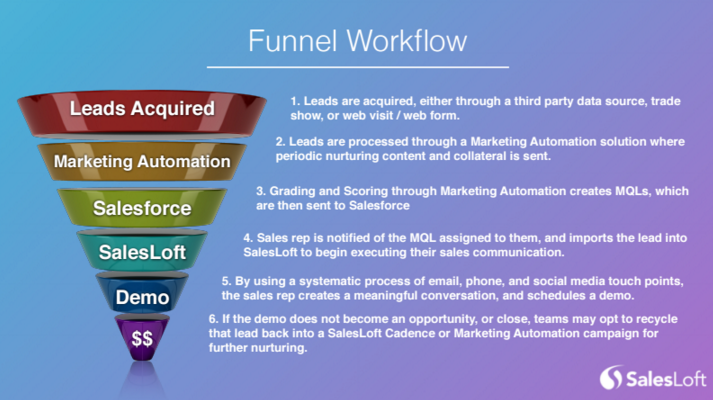
From the moment a lead is acquired, until the opportunity is closed or recycled, each step requires a specific touchpoint with the right amount of personalization. When it comes to marketing automation, Marketers are able to:
But here’s where marketing automation fails in the sales portion of the process (and SalesLoft executes):
All of this to say, there is a time and place for both marketing automation solutions and sales enablement tools. At SalesLoft, we use Pardot, a salesforce.com Marketing Automation suite, for marketing drip campaigns, sending out newsletters through segmented lists, automatically assigning inbound web-to-lead forms to our Inbound SDRs. Through Pardot, we continue to nurture prospects and leads that have not yet qualified to be within the sales cycle, or have been through the sales cycle, but have not yet become clients. When the sales cycle occurs with a Sales Development Rep or Account Executive, Pardot campaigns are suppressed to reduce the risk of conflicting messages.
But when it comes to sales development, we drink our own Kool-Aid and use the SalesLoft platform in all of the sales stages of our cycle. SalesLoft serves as the home base to SDRs — a place where these reps can live on a daily basis to stay on top of their prospect cadences. Marketing specialists have their role (in content, branding, social media, etc.) — but many of your Marketing Reps are currently doing what Sales Development Reps should be doing in the sales process.
Practice specialization on your team today, and integrate SalesLoft into your sales process to keep people from falling through the cracks.

The post The Difference Between Marketing Automation Solutions and SalesLoft appeared first on SalesLoft.
Would you let an octopus manage your sales forecasting?
…Statistically speaking, you’d be better off.
After all, celebrity cephalopod Paul the Octopus scored a prescient 85% success rate in predicting the outcome of Germany’s FIFA World Cup soccer matches in 2010. Last year,Goldman Sachs’ attempts to forecast the outcome of World Cup games weren’t even half as accurate: they only managed 37.5%.
37.5%. Even guessing randomly between two options is likely to yield a better result. Anyone looking at those numbers would conclude that Goldman Sachs’ FIFA forecasting system was worse than useless. That someone placing a bet would get better returns from painting two flags on mussel shells and asking a hungry octopus to take its pick.
But what if I told you that the average sales forecast is no more accurate?
That only four out of every 10 deals you’ve forecasted will actually close in the way you expect?
That’s right. 59% of sales forecasts are wrong. But before you replace sales managers with eight-legged sea creatures, let’s take a look at why that’s the case – and how to fix it.
1.You’re Struggling to Assess Your Current State vs. Your Targets
It’s easy to assign quotas to your team. It’s harder to make those numbers a realistic reflection of your business. It’s harder still to establish a system that’s flexible enough to respond to circumstances as you go.
The only way to tackle this is to find a top notch technological solution, that integrates with your CRM, and tracks which deals are being closed, what’s projected in the short term and what possibilities are hovering on the horizon. A system that helps you prioritize low-hanging fruit without losing sight of bigger, high-impact deals, redistributing resources and tweaking individual and team targets as required.
2. You Sink Too Much Time Into Forecasts
Sales managers spend up to 10% of their working week drawing up (inaccurate) forecasts. Why not spend that time exploring which deals are easier to win, and focus your energies on effective prioritising instead?
Focus on the key deals – the ones you’re confident you can win – rather than stuffing your forecast with over-optimistic leads to impress the C-suite. You’ll find accuracy rapidly improves.
3. You Let Changes Sneak Up On You
Is your team working dozens – even hundreds – of leads at once? There’s no way you can effectively track them all in detail, and by obsessing over the nitty-gritty, you’ll lose sight of the overall trajectory.
Instead, step back, look at how different types of deals are panning out, and strategize. With the right data, you can stop berating your team for missing their number and focus instead on coaching corrective measures that tackle problems at the root.
4. You Lack an “Early Warning System”
When a major opportunity crops up unexpectedly, what happens?
Inevitably, a glimpse of big game distracts salespeople from smaller fry. Chances are, they’ll plough their time and attention into this new direction rather than letting the opportunity pass by – even if there’s a risk the deal will drag. Meanwhile, other deals in the forecast are neglected. To avoid panic, it’s imperative that risks to your forecast flag up early, allowing you to tackle them in advance.
5. You’re Not Prioritizing Enough
Many failed deals are ones you shouldn’t have wasted time on in the first place.
If you have 12 deals in the pipeline and an average win rate of 25%, wouldn’t it better to purge the weakest ones from the pipeline and focus your energy on closing promising ones? Instead of scrambling to close three out of 12, wouldn’t it be better to spend more effort closing four out of six or seven instead?
Qualitative analysis is tricky, but if you find a solution that allows you to separate opportunities into “Must Win”, “Must Develop” and “Qualify Out” you can stop wasting time on false opportunities.
Predicting the future is hard, but trying to dictate it rather than following the clues means setting yourself up for failure.
Most sales managers make team members “commit” a deal to the forecast, essentially promising to close that deal that quarter. There’s little context or evidence to suggest that this is reasonable, but once there, the deal becomes a stick to beat the salesperson with.
Trouble is, bullying a salesperson doesn’t change the behaviour of the client. It doesn’t impact on buying cycles. It doesn’t make them more likely to bite. Arbitrarily fixating on a deal come hell or high water is counterproductive: it demotivates good employees and winds up potential customers.
Instead of swimming against the tide, start collecting and analysing data that tells you which opportunities are most likely to close, when and how. Work smarter, not harder: use this information to hone in on the best opportunities, boosting your success rate and accuracy, and proving your prowess in the process.

Your company decided to run a marketing campaign, and now that it’s coming to an end, perhaps you’re wondering what metrics you should be looking at to decide if your campaign was a success or not.
Let’s back up a bit. If your company decided to run a marketing campaign, hopefully it wasn’t something that was just thrown together without goals, because goals are an important aspect of defining campaign success or not. You should define what you want to accomplish. Do you want more sales? Do you want to build a large database of contacts? Perhaps you just want to build awareness?
For the metrics we list below, set goals for each of them before your campaign begins so that you can see if your campaign is performing how you had hoped along the way, which in turn, can help determine if your campaign was successful or not.
If your website traffic from your campaign is low, chances are your campaign probably wasn’t successful. Stating the obvious here, but people have to visit your website in order to convert, and with low website traffic, that isn’t the case. However, there’s more to website traffic. You should be measuring:
Traffic is a metric that can help prove campaign success if your campaign’s goal is to raise awareness about your brand, but typically high traffic isn’t the end goal around a campaign. Sample goals for traffic may be:
Leads are important to measure throughout your campaign, as they are somebody that willingly gave you their information. The two types of leads you should be tracking are:
If leads are the core measurement of success for your campaign, some sample goals may be:
Conversion rates are what tie our last two points together. It is the ratio of how many people converted to how many people visited throughout the course of the campaign. A couple different types of conversion rates to track are:
For many campaigns, the end goal is to generate revenue, so having a good customer conversion rate is highly valued. A sample goal may be something like: Have a lead conversion rate of 5% throughout the campaign.
Maybe the goal of your campaign is focused around social media. Some metrics to look at to determine social media success are:
If social media is the focus of your campaign, some sample goals may be:
All in all, there are several marketing metrics that your company may way to track to help render a campaign successful or not, but the metrics highlighted above are a good start. Remember, setting goals is paramount when it comes to defining a campaign as a success or not.
What other marketing metrics does your company use to help prove campaign success?

Square finished a bumpy ride to the public markets on Thursday, losing half of its value in its IPO pricing and then popping 45% on its first day of trading.
As the IPO buzz and excitement settles, questions about the digital-payments company's business prospects are taking center stage.
Square's revenue growth is slowing while losses widen, and some wonder whether its core payment-processing business is getting commoditized with shrinking margins.
But there's a tiny part of Square that may hold the key to taking the company beyond its core business: Square Capital.
Square Capital is its cash-advance unit that has processed more than $300 million since its launch in May 2014.
It's a tiny portion of Square's overall business — looped under "software and data products," which accounts for less than 4% of Square's total sales — but it is believed to be growing significantly faster, with richer-margins than the rest of Square.
And as Square moves forward as a public company, Square Capital will play a bigger role convincing investors of its future upside.
While the nifty credit-card swipers that plug into smartphones and tablets are often touted as evidence of Square's innovation, the company's future success may rely on the more old-fashioned business of making loans.
"Square can monetize [Capital] very efficiently. It allows them to build up a high-margin revenue stream to complement the traditional lines of business," Battery Ventures' general partner Roger Lee told Business Insider.
Battery Ventures is not a Square investor.
Square Capital follows a traditional merchant cash advance (MCA) model that lets pre-qualified Square merchants borrow money and pay back gradually. Borrowers return a small, fixed percentage of its daily sales, meaning that the more you sell, the more you return, and vice versa on a slow day.
Square makes money by charging a small percentage of premium, usually around 10% of the total, on top of the advances. It also charges a service fee when the advance comes through a third-party lender. In any case, it's a highly efficient, low-cost business model. "Software and data products" had an over 60% gross margin vs. 36% gross margin for its core payments business.
It's also growing fast. The broader Software and Data Products group generated $35.6 million in revenue in the first nine months of 2015, a 6X jump from the same period last year, while doling out $1 million a day to its merchants. The product is proving to be sticky, too: Nearly 90% of the merchants are choosing a repeat advance, according to Square's prospectus.

Battery Ventures' Lee said that the model could potentially evolve into something more significant that somewhat resembles Gillette's classic razor-blade model — in which the commoditized razor grabs market share, while the higher-margin razor blades rake in the real profits.
"Think of the credit-card reader as the razor, and the loan as the razor blade," Lee added. "The reader is basically an enabler of a much more interesting lending business. It'll drive their long-term profitability and equity value."
Square seems aware of this, too. Just recently, it poached top Yahoo executive Jackie Reses as the new head of Square Capital. In its IPO prospectus, Square points out the advance service as a potential future growth driver.
"Although Square Capital currently does not contribute a significant amount of revenue to our business relative to our payments and POS services, our software and data-product revenue, including revenue derived from Square Capital, has grown quickly, and we expect these products will contribute a larger portion of our total revenue over time," it writes.
Square's primary market is small-business owners, and Square Capital solves a problem every small-business owner struggles with: cash flow.
Banks have traditionally overlooked small-business loans because of their low margin and high-default risk nature.
But a number of online-lending and cash-advance services in recent years have made it cheaper to acquire and process loans/advances, while using better technology and data analysis to lower default risks.
Square Capital, for example, only extends the advances to its existing users, whose financial data is already shared with Square. That allows it to have a full understanding of the merchant's sales history and future projections, and safely determine the cash-advance terms accordingly.
This is a market that's been hit particularly hard after the recession and never fully recovered, leaving a gaping hole for services like Square Capital to come in. The value of loan originations to US small businesses has been nearly cut in half since 2007, while banks are still slow the embrace this market.
"The 2008 financial crisis left hundreds of thousands of small businesses with pent-up demand for working capital to grow their businesses. Only 2.4 million traditional loans were originated to businesses with $1 million or less in revenue in 2013, down 54% from 2007," BI Intelligence writes in a report.

As Square admits in its S-1 filing, Square Capital is still in its early stages. In some ways, it's also a limited product because it's only available to the small business owners that use Square, and you can't take out multiple advances before paying back your initial one.
"Square's merchants are smaller," IVP's general partner, Eric Liaw, said, estimating that the average Square Capital advance to be less than $30,000. Online-lending marketplaces, like OnDeck, in which Liaw's invested in, typically make six-figure loans, resulting in higher fees for the company processing it.
Square will certainly want to expand its lending to a broader swath of businesses, but that will require licenses with stricter conditions and more regulatory compliance, all of which mean increased costs.
"As our business continues to develop and expand, we may become subject to additional rules and regulations. For example, if our Square Capital program shifts from an MCA model to a loan model, state and federal rules concerning lending could become applicable," Square wrote in its S-1.
Still, Square Capital seems to be in a good place with more room to grow, especially if Square can continue to expand its merchant base.
"The product itself will have unique advantages in the market, and it's a big market," Lee said. "If they focus on it, and execute it, it can be a big success for them."
SEE ALSO: Wall Street still thinks Microsoft could buy $50 billion Salesforce
Join the conversation about this story »
NOW WATCH: Watch the mesmerizing way a company puts camouflage on helmets

It turns out that a lot of hedge funds are tracking the returns of the stock market.
But within the market, hedge funds favor some securities over others.
According to FactSet's new hedge fund ownership report, the top 50 biggest funds increased their exposure to equities by 7.6% in the third quarter led by the Health Care and Consumer Staples sectors.
"The Health Care and Consumer Staples sectors were the two most popular groups in terms of total value of purchases, with four of the top ten purchases in the quarter coming from companies in these sectors," FactSet analyst Andrew Birstingl said.
We've compiled FactSet's and have the list of the top 50 stocks that hedge funds love. We've ranked them based on the aggregate market value held by the 50 largest hedge funds. Also included is the percent weight in the top 50 funds in aggregate, the percent of all outstanding shares the hedge funds own, and a recent comment from a company executive.
Check out the list below.

Sector: Energy
Market Value Held by Funds (in Millions): $2,603
Weight of stock in Top 50's aggregated portfolio: 0.3%
% of shares outstanding: 8.6%
Executive Comment: "Activity levels and pricing took another hit across the globe, as our customers respond to the impact of reduced commodity prices, and the pressure that their own shareholders are putting on them. Considering the difficult headwinds that were working against us, I'm actually very pleased with our overall financial results for the third quarter, especially for our Eastern Hemisphere operations," said CEO Dave Lesar.
Source: FactSet

Sector: Information Technology
Market Value Held by Funds (in Millions): $2,610
Weight of stock in Top 50 's aggregated portfolio: 0.3%
% of shares outstanding: 6.4%
Executive Comment: "Industry analysts continue to recognize our solutions as market leading in their categories. Last month Gartner named Adobe as a leader in two Magic Quadrant reports. Web content management where we were ranked highest in completeness of vision and mobile application development," said CEO Shantanu Narayan.
Source: FactSet

Sector: Consumer Discretionary
Market Value Held by Funds (in Millions): $2,659
Weight of stock in Top 50 's aggregated portfolio: 0.3%
% of shares outstanding: 4.7%
Executive Comment: "This continues our track record of delivering industry-leading performance while also positioning the company for a world where viewers consume an increasing amount of content on demand and on multiple platforms and devices. And that's a world in which brands need to thrive, both inside and outside the traditional TV ecosystem. We've been doing that by leveraging our strong brands, global scale and distinctive IP to produce content that resonates deeply with consumers and will become even more valuable on this environment," said CEO Jeff Bewkes.
Source: FactSet
With the Liberals eager to put Canada’s reputation as an environmental laggard on ice, and with ‘real momentum’ among world leaders, hopes are high that the Paris climate talks may succeed where previous promises have melted away. Jason Fekete does a reality check.
It’s a critical moment for Canada on the world stage, a chance to show just how serious the country is about battling climate change. Next week, Prime Minister Justin Trudeau – accompanied by most of the premiers – travels to Paris for a major global meeting on what many consider the planet’s most pressing problem.
Trudeau has promised that Canada will take a leadership role in curbing the greenhouse gases (GHGs) that cause global warming, after a decade of what Liberals say was inaction under Stephen Harper’s Conservative government.
There’s a palpable sense of urgency among environmentalists – and many of the more than 190 governments that will be represented at the Paris negotiations – to come away with an ambitious, yet realistic, climate change treaty that is legally binding.
“As time moves on and progress isn’t achieved, it gets more and more critical to actually get action in place when these countries get together,” said David McLaughlin, former president of the National Round Table on the Environment and the Economy.
“Time is running out.”
The exact structure of the Paris agreement and which components will actually be binding is still being hammered out.
However, the overarching goal is clear: get the world moving on reducing greenhouse gases to prevent the global average temperature from increasing a potentially catastrophic two degrees Celsius above pre-industrial levels. Countries are hoping they can limit the temperature increase to around 1.5 degrees.
Developed countries are also trying to reach an agreement in Paris on how to provide $100 billion annually to developing nations to help with climate mitigation and adaptation.
“We’re dealing with a very desperate and dangerous situation in which we no longer have time for half measures, we have no time for procrastination,” said Green party Leader Elizabeth May, who also has been invited by Trudeau to attend the meeting, called COP21 (Conference of the Parties).
“It has to succeed, not because of political imperative, but because of what science tells us about how much the atmosphere is already overloaded with greenhouse gases.”

Will Paris be different?
Canadians can be forgiven if they take a bit of a skeptical view of the Paris climate-change conference, considering the limited action on the file by the Conservatives and the fact Canada came nowhere near hitting its Kyoto Accord targets under the Liberal government that preceded Stephen Harper.
But the Paris talks are different for a variety of reasons, say experts, not the least of which is that earlier this month the United Kingdom’s meteorological office reported that global temperatures are set to pass, by the end of 2015, a key milestone of one degree Celsius of warming since pre-industrial levels.
What’s more, the climate-change plans presented by more than 150 countries leading up to the Paris conference would still see the average global temperature increase too much: roughly 2.7 degrees Celsius above pre-industrial levels by 2100.
Scott Vaughan, president and CEO of the International Institute for Sustainable Development and Canada’s former federal environment commissioner, said the Paris talks are critical because climate science has become so “absolutely clear” in the last few years that it demands countries act now.

Moreover, unlike previous United Nations COP meetings, there’s “real momentum” heading into Paris to bring all countries together, he said, including a much greater level of engagement from major emitters like China and the United States and developing countries such as India and Brazil.
“This is the 21st (UN climate-change conference) and there has clearly been disappointment in the previous 20 in terms of where we are and where the progress is,” Vaughan said.
Businesses are also climbing aboard, with the White House announcing last month that 81 companies, including many multinational powerhouses, have signed a climate pledge calling for a strong outcome in Paris, as well as committing to reducing their emissions and increase low-carbon investments.
Even the Pope has been urging the world to act, pleading in a September speech at the United Nations for countries to move swiftly to address the threat of climate change.
“You’re seeing a political perspective, an economic perspective and now with increasing moral and ethical perspectives as well. This is the best convergence I’ve seen, since following these, in two decades,” Vaughan said.
The money is really, really important because the money is being seen as being tied to the level of ambition
But less than two weeks out from the start of the Paris meeting, nobody is sure what tangible outcomes will come from it.
Tension has emerged in recent days between the European Union (including host France) – which wants a legally binding treaty – and the United States, which is indicating it won’t be bound by an agreement.
U.S. Secretary of State John Kerry said earlier this month any agreement will “definitely not” be a treaty, and that there won’t be legally binding reduction targets as was the case with the Kyoto Protocol.
“What they need to resolve is exactly what this will look like,” Vaughan added. “Right now, it’s safe to say no one knows.”
May, the Green party leader who will participate in the Canadian delegation, has extensive experience at UN climate conferences.
She said signs point to the Paris deal not including legally binding country targets as part of the treaty, but that individual countries’ climate commitments would ride alongside the accord. Countries would be able to update and improve their climate targets, but that there would be “no backsliding” to weaker targets.
Countries are also looking at mechanisms to review pledges made by nations every five years based on the best science.
What’s also important to watch at the conference is how developed nations iron out their differences over funding to help poorer countries cope with climate change.
Developed countries committed in the Copenhagen accord to contribute $100 billion annually by 2020 to help developing nations deal with climate change.
The promise was tied to an acknowledgment by developed countries of their responsibility for contributing to global warming, but the dollar commitments have been slow to come so far and are nowhere near the goal.
“The money is really, really important because the money is being seen as being tied to the level of ambition,” Vaughan said.
All eyes on the Liberals
Canada’s new Liberal government will be closely watched at the Paris conference for how ambitious it is on the climate file.
Specifically, observers wonder how the country plans on shedding its label as an environmental laggard. To what extent it can get 13 provinces and territories to buy in to the national plan remains an open question too.
The federal government says it’s looking for an “ambitious agreement” out of the Paris conference, and that any treaty must be followed by firm actions to achieve real greenhouse gas reductions.

The Liberals promised in their election platform to establish national emissions-reduction targets, put a price on carbon and strengthen environmental reviews for energy projects like pipelines and oil and gas developments.
The prime minister will host a first ministers’ meeting with the premiers on Monday to discuss the country’s strategy going into the COP21 meetings in Paris.
The cabinet and premiers will receive a climate briefing by top climate scientists, which will be followed by a working dinner with the first ministers that evening.
“What happens in the big global room for Canada isn’t as important as what happens in the national delegation room for Canada,” McLaughlin said. “This is the real negotiation for Canada. This is the real room that matters for Canada in terms of taking national action.”
The Liberals’ election platform promised that Trudeau would attend the Paris conference with the premiers and within 90 days of the conference “formally meet to establish a pan-Canadian framework” for combating climate change.
Environment and Climate Change Minister Catherine McKenna has indicated Canada’s new climate-change targets, and plan for achieving them, won’t be released at the Paris summit.
Rather, they will be announced in the coming months after the federal, provincial and territorial governments “really sit down and do the hard work of figuring out what is a realistic target and how we actually are going to take actions to achieve it,” she said.
For the time being, the former Conservative government’s climate strategy, announced earlier this year – to reduce greenhouse gas emissions 30 per cent below 2005 levels by 2030 – will act as the “floor” for what Canada will propose going forward.
But federal opposition parties are demanding Canada announce new, aggressive targets in Paris, believing that doing so will convince other countries to follow suit with ambitious goals for reducing GHGs.
“We can’t go to these negotiations where the only level of commitment Canada has made are those commitments put on the record to the United Nations in May by the previous government,” May said.
“The new government has a strategically unique opportunity in the world to break some of the deadlock, some of the mushiness, some of the lack of commitment we’ve seen from the negotiations the last number of years.”
Oil, gas and emissions
The elephant in the room for Canada is what the federal and Alberta governments will do about the oil and gas sector, especially the carbon-intensive Alberta oilsands, the third-largest oil reserves on the planet – but also the fastest-growing source of emissions in the country.
The energy sector is a pillar of the Canadian economy, but the oilsands have been a favoured target for climate groups around the globe who’ve painted Canada as an environmental pariah.
Trudeau, in hopes of getting Canada’s premiers onside with the federal plan, has committed to giving the provinces and territories flexibility to meet the national targets, including being able to design their own carbon-pricing policies.
Oil and gas companies in Canada have long been preparing for a price on carbon dioxide emissions – be it through a direct carbon tax, cap-and-trade plan or regulations on the industry – and have already incorporate anticipated carbon pricing into their major business decisions.

Tim McMillan, president of the Canadian Association of Petroleum Producers, is heading to Paris for COP21 so the industry can be part of Canada’s climate strategy going forward.
The industry regularly invests in new technologies to reduce its carbon footprint, he said, noting the sector has cut its per-barrel emissions by 30 per cent in last 25 years.
“We bring forward solutions that can be helpful and we need to be part of that conversation,” McMillan said in an interview.
The oil and gas sector is encouraged by signs that the Liberal government is looking at a “balanced approach” when it comes to the environment and the economy.
There’s an “opportunity” for the industry to be more proactive and vocal on the file, with an Alberta and federal government taking a different approach on the environment, he said.
However, the energy industry has been battered by low oil prices over the past several months. Crude dipped below $40 US per barrel this week.
Capital budgets have been slashed by about 40 per cent in the oilpatch, he said, with roughly 40,000 direct layoffs in the oil and gas sector.
“This is a very challenging time,” he said. “Now we look at changes in the carbon file that could potentially add more costs. That could have increased pressure on our industry.”

It’s widely expected the Liberal government’s new climate-change plan will include greenhouse gas regulations on the oil and gas industry that were long promised, but never delivered, by the Conservative government.
Vaughan said a comprehensive emissions-reductions strategy must also strengthen regulations on coal-fired electricity plants, as well as the transportation sector (which accounts for about one-quarter of Canada’s emissions) to improve fuel efficiency and reduce tailpipe emissions, he said.
Also critical are new energy efficiency standards in commercial and residential buildings, and appliances, he said.
But experts agree that Canada can’t realistically reach its climate goals without targeting carbon emissions in the oil and gas industry, particularly the oilsands.
“If the last five years have taught us nothing, it’s that if we don’t get Alberta in the right zone on this, then it doesn’t matter in terms of Canada’s emissions,” McLaughlin said.
McKenna said this week the federal government is counting on a “credible plan” from the Alberta government to help meet the country’s national targets.
However, she also noted that all Canadians and their “consumption patterns” must be a part of Canada’s climate-change solutions if the country is to achieve its goals.
“We all need to be at the table doing our part,” McKenna told reporters this week following a meeting in Edmonton with her Alberta counterpart.
“We need to be implementing practical actions that reduce pollution. Without concrete actions across all sectors, across all of Canada, we will not be able to meet our targeted reductions in greenhouse gas emissions.”
Canadian households are making a bland contribution to an economic recovery battered by slumping crude oil prices, keeping the central bank stuck as the U.S. moves toward raising interest rates.
Consumer price inflation remained at the bottom of the Bank of Canada’s 1 per cent to 3 per cent target band for a second month in October, Statistics Canada said Friday, while September retail sales fell 0.5 per cent.
Governor Stephen Poloz has cut interest rates twice this year to boost spending as energy exports and investment plunged and gross domestic product shrank in the first half of the year. With crude oil falling to US$40 a barrel this week, signs of a less-than-enthusiastic consumer leave the world’s 11th largest economy in need of continued stimulus.
“The numbers don’t look great,” and the bank is “miles” away from a rate increase, said Benjamin Reitzes, a senior economist at BMO Capital Markets in Toronto. “Growth just isn’t picking up the way they would like it to.”
Canada’s dollar was little changed at $1.3338 per U.S. dollar at 11:29 a.m. Toronto time. Federal government bond yields fell, with securities due in five years down 2 basis points to 0.92 per cent.
Retail sales had risen four straight months to a record high before the September decline. The fall was a mix of lower gasoline prices that can leave more money for consumers to spend on other items and a broad decline in purchases on everything from new cars to clothing and sporting goods.
Besides the Poloz rate cuts to 0.5 per cent, Liberal Finance Minister Bill Morneau presented revised fiscal figures Friday to account for lower growth, setting the stage for a later budget he says will focus on stimulus to revive growth.
“There is still a need for fiscal and monetary stimulus in the Canadian economy,” said David Watt, chief economist at HSBC Holdings Plc’s Canadian unit in Toronto. “We are in a period of subdued growth, we don’t have much traction on pricing and the Canadian economy still needs support to come from somewhere.”
I still see strong arguments for the Bank of Canada to consider easing rates further
Consumer prices have lagged the Bank of Canada’s 2 per cent target all year, a reflection of slack that Poloz says will take until around mid-2017 to use up.
At the same time, core inflation has remained above 2 per cent since August 2014 as a weaker Canadian dollar makes imports more expensive. Core prices advanced 2.1 per cent in October from a year earlier.
The Bank of Canada said the underlying trend of inflation is between 1.5 per cent and 1.7 per cent, according to its October Monetary Policy Report. That forecast also showed economic growth quickening to 2 per cent in first quarter of next year as non-energy companies gain momentum.
With U.S. Federal Reserve meeting minutes this week signalling a December rate increase, further slides in Canada’s recovery leave open the chance Poloz may have to consider a rate cut before he tightens, Watt and Reitzes said.
“One of the key props driving the Canadian economy the past few years is no longer doing as much,” Watt said of consumers. “I still see strong arguments for the Bank of Canada to consider easing rates further.”
— With assistance from Erik Hertzberg.
Once upon a time, brands made products and consumers bought them. But not anymore.
Today, it’s all about what people want to buy — not what companies want to sell. Consumers have very smart and specific ideas about the products they are willing to purchase. And, it’s the brands that listen who get their business.
In a study from the Institute of Management Sciences the following findings were reported:
Additionally the study followed products developed via employee input vs. customer input:
Nestlé Gets the Message – Less is More for Consumers
Consumers are increasingly outspoken about their expectations of the quality, content and information regarding food. Per Paul Grimwood, CEO of Nestlé USA, “The clock is on every one of our businesses to make sure there is consumer demand, that it ticks off the right boxes for us as a health and wellness company.”
Consumers are telling all manufacturers that they want to recognize all of the ingredients in their food…” To meet the demand for more natural and simpler labels and ingredients, the corporation is transitioning the formulation of its most popular chocolate brands, keeping consumers apprised of the changes at every stage.
Nestlé CEO Paul Bulcke commented: “The consumer has changed what he values.” To keep up with the wishes of consumers, the company used various research reports to understand the exact changes desired. Company executives noted, “We conducted consumer testing to ensure the new recipe delivers on our high standards for taste and appearance.”
In its most recent financial call, the company noted that it is now moving on to innovate and adapt to consumer trends in regards to all of its brand products. Nestlé reported 4.5% organic growth for the first half of the year, which beat analysts’ estimates.
Target Changes Store Signage to Gender Bias
According to its website, Target recently announced, “… we know that shopping preferences and needs change …we never want guests or their families to feel frustrated or limited by the way things are presented. Over the past year, guests have raised important questions about a handful of signs in our stores…We heard you, and we agree… We thank guests all the time for challenging us to get better at what we do and take the shopping trip to new levels. We’re always listening.”
In direct response to consumer feedback over the next few months, Target will change in store signage and labels on toys and other areas after it says customers raised raising concerns about unnecessary gender-based product associations. Besides accommodating consumer requests, this move immediately sparked (predominately) good will among consumers through social and blogger posts in which consumers acknowledged that their opinions and voices were heard and acted upon.
TakeAways:
In summary, understand that there has been a fundamental shift in the product creation-consumer purchase cycle. It is no longer about how brands want to sell, but how consumers want to buy. Missing the message on this is no longer an option. Your customers are now your brand partners and listening is now one of the primary keys to business growth.

Crowdfunding has been exploding in popularity for both investors and companies in Britain over the last two years.
But we haven't had much concrete data on whether it's a good investment or not.
Until now.
Industry website AltiFi and law firm Nabarro have produced a report looking at the performance of 431 past equity crowdfunding campaigns from 367 companies on platforms Crowdcube, Seedrs, SyndicateRoom, Venture Founders, and CrowdBnk. The report covers 2011 to June of this year.
The results are, well, mixed. The report classifies the companies on a sliding scale from realisation — the company went public or was acquired at a price that gave crowdfunding investors a profit — to red — the company has shut down and investors have lost everything.
The vast majority of companies looked at — 302 — are "green," which means they're still trading but it's not clear whether the value has increased, thereby increasing the crowds' investment.
So for the vast majority of crowdfund investments, it's too early to tell. Either side of the majority there's some stand out success and some stand out failure.
There has only been one realisation – E-Car Club, which was acquired by Europcar in 2015. The report says: "Unfortunately exact numbers are impossible to acquire, but the return to the original investors was said to be “around 2.5x."
There are a further 58 companies the report classifies as "green plus" — they've gone on to raise more cash at a higher valuation. Investors obviously don't get a return from this, but it indicates things are moving in the right direction.
But 29 out of the 367 companies looked at — around 8% — have gone out of business. Forty one of the companies are classified as "amber", which means they couldn't be reached by telephone and there were other warning signs, such as late Companies House filings or an inactive website.
That means 70 of the 367 companies look likely to lose investors money — just shy of 20%.
The report's authors say this is actually a pretty low percentage, all things considered. They write:
In the UK, the RSA 2014 study... suggests that 55% of SMEs fail in their first five years of existence. Furthermore, the Nesta 2009 report suggested that 56% of angel investments failed to return capital. Relative to any of those benchmarks, crowdfunded companies seem to be outperforming significantly.
In the 2013 cohort, only 27% of companies are classified as either red or amber. One could argue that companies that have just received a large amount of equity investment should out-perform the average. Equally the sample of companies in this report is older than the RSA study given that the average age at the time of funding is already over 3 years. Notwithstanding these two caveats, we are impressed by these findings.
So when you compare it to the rate of small businesses going bust nationally, those that crowdfund actually look like they perform a bit better.
Once again, though, we'll likely need more time to see if this is actually true — the report found the average company running a crowdfunding campaign was 2.9 years old, so they may well revert to the RSA's "55% within 5 years" finding given time.
But the big question is whether investors on these platforms really understand the risk that their investment could not only be devalued, but they could be wiped out altogether. The report highlights a 2014 report from innovation charity Nesta that found 62% of crowdfunding investors “described themselves as being retail investors with no previous investment experience.”
 Angel investors and banks that loan entrepreneurs money to set up businesses are well-versed in likely loss and failure rates. But retail investors are often less os.
The risks were underlined this week when JustPark, a London startup that broke a crowdfunding record on Crowdcube earlier this year by raising £3.7 million. The company's CEO is leaving, a week after staff were laid off.
The AltiFi/Nabarro report calls for more transparency from crowdfunding platforms on the performance of past campaigns to help investors understand the risks. It also says more should be done to highlight the risk associated with individual campaigns.
The report concludes:
Accessing the retail investor for funding brings a responsibility to allow the enlightened appraisal of likely return. To achieve this, platforms need to offer maximum transparency both to allow the investor to appraise a specific campaign, but also to identify the success rate of past campaigns. By ensuring that the investors recognise that there is a risk that their principal may not be returned at all, it ensures that the investors only proceed with an investment at a valuation which offers the prospect of a return sufficient to compensate for that risk.
Join the conversation about this story »
NOW WATCH: SeaWorld is ending its killer whale show after being criticized for how it treats them

Simon Fraser Bit Coin Club. Photograph by Della Rollins
Within weeks of Nasreen Mohsin moving to Vancouver in September to start a master’s of engineering at Simon Fraser University, one of her friends back home in India had an emergency. Mohsin won’t divulge the specifics, but her friend needed 6,000 rupees, or about $120—and fast.
One option was to use a traditional money-transfer service, like Western Union, but her friend recommended they make the transfer via Bitcoin. Not only would it be fast, but the fees would be next to nothing.
Bitcoin is a global currency that only exists digitally. Who prints it? Nobody. What’s the central authority or bank that controls it? There isn’t one. For the layperson, Bitcoin is useful as a way to transfer money from point A to point B—so long as both places have access to the Internet—with no need to go through a bank and, therefore, incurring virtually no transaction fees.
Fortunately for Mohsin, getting her hands on the digital currency was extremely convenient. “The nearest [Bitcoin] ATM was at SFU,” Mohsin says.
In May, Simon Fraser became the first Canadian post-secondary institution to install automated Bitcoin vending machines (known as AVMs) at bookstores campus-wide. “A student could use a Bitcoin to buy a book,” says Mark McLaughlin, the university’s executive director of ancillary services. “The plan is to eventually roll it out to our dining hall.”
Mohsin doesn’t plan to use Bitcoin to buy books, but she’s grateful it was there to help her friend back home. Mohsin deposited $120 into the AVM machine, scanned the QR code on her cellphone and received about one-third of a Bitcoin in her virtual wallet. (The exchange rate fluctuates—one Bitcoin is now worth about $355.) She transferred the Bitcoin to her friend’s virtual wallet, a process that’s as easy as sending an email. Within about 20 seconds, the transaction was done, and her friend converted the Bitcoin to 6,000 rupees.
The university wouldn’t say how many digital transactions have come through the machines or how much Bitcoin has been bought. “It’s a small percentage of the student population [that’s using it], but at least some people are,” McLaughlin says.
For most students, using Bitcoin to buy books is a novelty. But there’s incentive for the school.
“Essentially, SFU is not paying any transaction fees when they accept Bitcoin,” says Mike Yeung, founder of the SFU Bitcoin Club. Visa and MasterCard, for example, charge retailers up to 1.5 per cent of the value of each sale. With about 30,000 students at SFU and an average semester’s worth of books and supplies for an undergraduate costing $1,020, according to university figures, “that can add up to be pretty substantial over time,” Yeung adds.
McLaughlin says the school didn’t adopt Bitcoin because of financial incentives. Rather, there were two objectives in accepting the digital currency at bookstores at each of the three campuses in Vancouver, Burnaby and Surrey. First, it started a dialogue on campus about disruptive technologies. Second, students could learn about Bitcoin (as could staff, for that matter). The project also inspired some entrepreneurial philanthropy, such as when the SFU Bitcoin Club lobbied the university to accept donations via Bitcoin in August 2014. Yeung and SFU alum Scott Nelson donated 10 Bitcoins, equivalent to nearly $6,000 at the time.
Why not donate using Canadian dollars? “Bitcoin is what I have,” says Nelson, an information technologist and a believer in cryptocurrency since he started using Bitcoin in tech startups about four years ago. “I want to promote the idea of philanthropy using Bitcoin. You want this stuff to circulate.”
The donation went toward a co-op project that sent two students to India to help women and girls victimized by human trafficking. Each student was given one Bitcoin, while the remaining eight Bitcoins were converted to Canadian dollars to help fund the trip. After all, not every restaurant, taxi and airline accepts Bitcoin—though many might soon, considering the currency is expanding to campuses across Canada.
For example, the McGill Cryptocurrency Club launched paper airplanes with QR codes that could be used to receive $5, $10 or $20 worth of Bitcoin during this year’s frosh week in Montreal. Which raises the question: where can students use Bitcoin to buy a beer?
The post Bitcoin: A new fixture at one Canadian university appeared first on Macleans.ca.
 This is really critical to the success of you and your company brand. If you want to see success, you need to be an idea generator. Great leaders have vision for their companies.
Too often, we feel that good ideas can only come from certain people. This is a load of crap. When I worked in corporations, I often saw the need for creating great ideas coming out of a political machine where people worked so hard to get their respective managers to listen to their ideas. By the time these ideas came to fruition, they were old ideas and as a consequence people who originated the idea would quickly disconnect themselves from being a part of these ideas.
Selling ideas should be a part of an executive’s makeup. If a top executive cannot get buy-in from others and is unwilling to listen to others, then they will quickly fail. To effectively sell ideas, a leader must be well connected with
his/her staff at all levels.
In order to proceed with a great idea, it is imperative that the idea add value for internal staff, current clients and new clients. If you can
create an idea that adds value to all of these parties, then you see the maximum return on your investment. Think about the ideas that have
not worked out in the past, typically one of these areas has been the weakest link
Sell your idea internally and monitor your progress by checking the following:
Simple ideas sell better and are much easier to communicate and get people interested in.
Look at your ideas list today. If you don’t have one, start listening more. If you have a list, go through it and see which idea could add the most
value.
Not all ideas work. If you go through the process and start hitting some roadblocks, determine if your idea has enough steam to persevere, otherwise
look for the next idea.
If your idea is implemented, start monitoring it right away and see if it will be an idea that sticks or that needs to be replaced. If you want an
example of a company that implements a number of new ideas all the time, study Amazon. You can learn a lot from their mistakes and their victories.
Picture Source: Pixabay
 These days it comes as no surprise that we have to work a lot harder to win deals. There are more stakeholders leading with fresh perspectives and insights focusing on value and differentiation. It’s not enough to believe that we can rest upon our company’s reputation, no matter how strong and secure we believe it is. We cannot afford to pass up an opportunity to articulate the value we offer, yet many of us do. We pass up these opportunities and they quickly add up to millions of dollars we’ve left on the table.
“We’re closing deals. Maybe not at a stellar rate, but what are you talking about – leaving $100M on the table? You’re wrong,” you say. But, are we?
Well, here’s a question: In the last 12 months, what is the $ value (win or lose) of all of the business influenced by proposals (RFP responses or sales proposals). Three things are certain:
1) You won’t know the answer to that question off the top of your head
2) When you find out, it will be a much bigger number than you thought
3) If you’re not optimizing your proposals to capture that business, you’re leaving a lot of money on the table
Sales is more than just sales reps closing deals. It often involves proposals, but there’s a big disconnect in a lot of businesses. Despite the huge amount of money at stake, in the majority (over 80%) of cases, the proposal function is not considered strategic to the sales organization. Quite often, it doesn’t even report to sales. Proposal opportunities are rarely evaluated leaving proposal managers to waste hours upon hours working on unwinnable bids, feeling overworked and under-resourced. Someone summed up a day in the life of a proposal team as doing the impossible with the unwilling for the ungrateful. It doesn’t have to be this way nor should it.
We calculated the amount of money sacrificed by inadequate proposal support at $100M based on the average business influenced by proposals from the customers attending our annual user conference. How can you address this and begin to capture the revenue you’ve been missing? View proposals for what they are: a vital and integral part of sales. A sales proposal is the perfect opportunity to demonstrate your company’s value and what separates you from the rest. But, you can only capitalize on this if you know what goes into writing a winning proposal.
When the prospect asks you for that final proposal, it’s the perfect platform to encapsulate all that good sales activity, to articulate a deep understanding of the client’s needs, share the value you deliver, and articulate why they should choose you. But in the hundreds of sales proposals and executive summaries we’re asked to critique each year, this is rarely the case. All too often, the proposals we see look like an afterthought – a check in the box, a necessary evil.
While a great sales proposal won’t win you the deal on the spot – a poor proposal will create unnecessary sales cycles, delay decisions, and no doubt put more focus on price. At worst, a poor proposal can lose you the deal. Another opportunity consigned to “close but no cigar”.

The folks over at Nielsen Norman Group researched just how much users read on the web – if you’ve been following the online marketing space for a while, you’ll know the results can be intimidating.
Users have time to read, at most, 28% of the words during an average visit.
Just in case you’re tempted to say that’s usually enough to get the gist, let’s examine that thought. For context, if you were looking at 30% of the Mona Lisa, here’s what you would see:

30% of the Mona Lisa
If users just see the hands, you won’t argue they “get the gist” of the Mona Lisa, right? 30% is very little – but it might be enough if you can optimize WHICH 30% they read through.
For your content to work despite users reading very little of it, you have to be very deliberate about how you construct your content. Let’s dive in.
Starting with the basics, you need to ensure that your content is legible and scannable.
Legibility
this is actually an area that a lot of people still get wrong, thanks to what we’ll call “the Apple problem.”
Apple did a lot to push usability forward in the past, but today, they create a lot of UX problems, and other sites copy them. Legibility is one of those glaring ones – if you use very thin, low-contrast fonts to “improve design,” you’re throwing legibility away.
Don’t do as Apple does.
Scannability
Ensure that you give text their proper “weights,” that there’s a hierarchy to the content formatting. You can go beyond headlines and subheads, you can use bullet points and imagery to adjust how much your points and sub-points “pop.”
The idea is that a user will be able to identify whether a section is relevant really quickly, jump around without thinking too much while never losing the information scent.
Once you’ve got the rules for formatting down, there’s the actual business of the content itself.
Organization
To organize your content well, you need to think about the F-pattern. That is, people read from top to bottom, from left to right – you should also prioritize your content that way.
Content related to your top task should be at the top and left, the content for the secondary tasks can be next to that, and so on.You can get the top tasks from exit surveys (ideally) or your web analytics tool. (if you don’t have surveys)
Readability and comprehension
To ensure good readability, you need to know your users.
For a general purpose, broad site, write in a way that 8th graders will understand with minimal effort. You can check your content by pasting it and checking fry graph scores.
If your content is narrow, you can use some jargon specific to the industry. Still, you need to test whether actual users can perform realistic tasks based on your language.
If you have legibility, scannability, organization, readability, and comprehension down, you’re almost home. Now, your page needs to support the content.
Remember that eyes are drawn towards …
You can use that to help your audience identify what’s most important about the page content.
Text inside a CTA can be helped by a CTA with a curved button.
And when you provide options, you can deliberately make the “best value” larger than the other elements of the page.
It also helps if your web site is not very busy from a design standpoint, and you use “negative space” to make certain things stand out – that is, provide distance between the elements that you want to call attention to, and the rest of the page.
If you manage to do all of that, users STILL won’t read everything. They’ll still JUST consume a third of your content, if that.
But you do get them a better shot at finding what they need.

What does the term cognitive fluency mean to you? If you’re in sales, it should mean a lot.
Cognitive fluency describes how simple it is to think about something. There have been several studies into the measure and they’ve all determined the same thing: People like things that are easy to think about. In other words, humans want to make an easy decision, not a hard one. If you’re in sales, this is the angle you need to work in order to be successful.
But this raises a question: How do you make a decision easy for someone?
We’ll make it easy for you. Here are six quick tips to help a prospect make the “easy” decision.
Customers don’t like to be overwhelmed with a ton of information, according to Patrick Spenner and Karen Freeman, but they do like to hear about the specifics that pertain to their situation.
This means that sales reps need to know the ins and the outs of their prospect’s business to deliver the most mentally palatable presentation. By spending a few extra minutes researching your customer, you’ll be much better informed about who they are and what they want. Check all the usual places, including LinkedIn, company blogs, and social media, as well as any industry-specific forums.
Instead of you trying to convince your prospect that they need your product, asking questions prompts them to reflect on their circumstances and come to their own purchase conclusion. And a decision a person comes to on their own always seems easier than one forced upon them by a third party.
Asking open ended, simple questions is key here. For more tips on the type of questions to ask your prospects, check out this blog post.
According to Karl Schmidt, Brent Adamson, and Anna Bird, an average of 5.4 decision makers are involved in every B2B purchase. That’s a lot of people. As a sales rep, it’s not only your job to convince the person you’re speaking with that your service offers value, but also the other people who get a say in the decision.
The easiest way to do this is to offer your assistance. Once you “sell” the first decision maker, it’s time to start a conversation with the others. That could be as easy as asking for their phone number or email and setting up individual calls, or one large presentation. Either way, helping your champion convince the rest of their team makes the decision much easier to sign off on.
Keeping it simple also means that you’re quick to respond so your prospect doesn’t have to wait around all day for answers to their questions. One study conducted by Heinz Marketing found that the average response time is 61 hours. Yep, 61 hours. If you’re able to do better than that, not only will you beat the average, but you’ll also make a tremendous impression on the prospect. Getting an answer to a pressing question from you will seem as simple as pressing an “easy” button.
The best way to improve your response time is to set up an email system. When you receive a message from a prospect, give it a quick read and decide if you need to respond at this moment or not. Remember, great sales reps go the extra mile for their customers and prospects. Commit to answering all customer emails within a certain timeframe, and stick to it.
According to CEB, most B2B prospects go through the majority of the buying process before they even talk to a sales rep. They’re conducting independent research to assess the options and seek answers to their questions.
You know what buyers are after in these early stages: Information. So instead of sitting back and waiting until they come to you, why not proactively offer your assistance?
When you do your introductory outreach, include an informative piece of content that can help the prospect better understand your product. By sending along blog posts, case studies, and testimonials, you’ll be able to answer a majority of questions before they are asked.
If a prospect is already familiar with your product or service, they equate that familiarity with fluency, according to UX Matters. In addition, Raj Raghunathan points out that being familiar with someone can actually result in liking them better.
With this in mind, familiarizing yourself and your product with prospects will make their decision much easier and more pleasant.
If you want to become more familiar with a prospect, a simple way to do it is to engage with them on social media. Tweet at your prospect or comment on a LinkedIn post to ignite a conversation. Seize the opportunity to develop a relationship well before you reach out about your product or service.
Nobody likes difficult. The next time you’re giving a product demonstration, reaching out to a prospect, or drawing up a proposal, strive to make everything seem familiar and easy using these six tips.


Before joining Kapost, I spent two years as a marketing manager at a world renowned company with over 40,000 employees worldwide—a goliath in its industry.
When my former colleagues heard that I was leaving to join a startup many said, “You have a lot of ideas that a startup can take advantage of, it’s a good fit for you.”
Wait a second.
If I have a lot of ideas to offer, why is a startup the place I should be? Why not a corporation?
In the sea of business, corporations are often looked to as the powerhouse “battleship” traveling on a well-mapped, strategically chartered course. They have the size to make waves in their marketplace and invest in new ideas, but with size comes the difficulty to react to disruptions in the market—especially when pesky speedboats like startups come zipping along.
As a marketer at a startup, no day is the same; a planned course of action can be completely scrapped in a day’s time. While startups may not have the mainstay of a corporation, they have the agility to take risks and change directions quickly.
Like all things, the key is striking a balance. Corporations become massive enterprises because they are leaders in their industry, building off of decades of experience. But often, as companies grow, they loose sight of the innovative ways of thinking that got them to the top.
In my short time at Kapost, I have experienced what makes a marketing department at a startup so different from a corporate marketing team, and what corporations can adopt from startups so that they can be just as agile, daring, and innovative.
Accelerate Ideas
Corporate marketing teams are often filled with dozens of talented marketers; that’s a lot of brain power to take advantage of.
“How do you empower creativity, collect ideas from your brilliant marketers, and act on best ones?”
However, creative ideas are quickly stifled when the process just to get an idea heard—let alone acted upon—is lengthy, outdated, and the idea itself is unlikely to gain the momentum it needs to become actionable.
The days of requiring marketers to “send the idea via email with an attached proposal, then we can talk about it” are over. If your inbox looks like most busy marketers,’ it’s full to the gills with other critical tasks and must dos.
And as a result, brilliant ideas get shuffled to the bottom of your email list or tagged and archived, doomed to becoming a never-thought.
So, how do you empower creativity, collect ideas from your brilliant marketers, and act on best ones?
Start by doing two things:
At Kapost, we have an ideas form built right into our platform. It has a completely customizable form so that we can collect the most important information we need to asses an idea. Every idea submitted can be seen by all team members so others can jump in to give support or ask questions.
Talk about collaboration!
Break Down The Silos
Corporate divisions often find themselves huddled in their own teams, seldom collaborating with others. Corporate marketing doesn’t communicate timelines and content with field or regional marketing teams, demand gen teams have data, but it doesn’t get shared. And in a worse-case scenario, no one is communicate with sales. You get the picture.
There are two easy ways you can break down silos for a quick-win: opening communication and maximizing visibility into each other’s plans.
If marketing team X has created top-of-funnel content that marketing team Y could take advantage to engage buyers at the bottom of the funnel but they don’t know it exists, the result is a lost opportunity and under-utilized (expensive) content.
So think small and share often through a hub where all employees can access all content at any time. At Kapost we have the functionality to filter our Content Gallery to see what has been created so we can repurpose great content.
And equally important is knowing what campaigns and content are currently being planned. If all marketers within a company can see which campaigns are coming down the pipeline and the associated content in development, there is a great chance for cross-team collaboration, and a stronger customer experience throughout the buyer’s journey.
Don’t Take Yourself Too Seriously
Corporations are very aware of their brand image, and rightly so.
Your customer trust your brand so much that they’ve put potentially hundreds of thousands of dollars down to use your services. But many times B2B marketing teams write as though they forget their content is being read by humans.
Remember: It’s okay to write conversationally to your customers.
Unveil to them that there are real people making real decisions that affect the next best business innovations. Treat them like the humans they are.
Be tactfully humorous, and communicate in a way that customers can enjoy and can have fun communicating with you.
What is your brand’s voice? Does your company have a personality? Corporations are never too big to be personable.
As each year passes, corporations and startups are competing in the same oceans of opportunity more and more, and there is plenty they can learn from each other.
Do you have any other advice for companies that want act more like a startup?

The Baltic Dry Index, which measures the price of shipping the world's major commodities, just touched an astonishing new low.
On Thursday, it hit 504, less than half of what it was as recently as August. On Friday, it's dropped to below 500 for the first time ever.
The index has always been used as a bellwether indicator for global trade conditions and the state of the international economy, but it became even more famous after it pointed to the coming financial crisis back in 2008.
It's been far lower than its pre-crisis peak ever since, and touched record lows earlier this year, before recovering — but it's now in the doldrums again.
Here's how it looks over the last couple of years:
 It's become a bit less popular due to its considerable pitfall — it spiked to over 10,000 before the financial crisis, and hasn't returned to even half that level in seven years.

Former BI reporter Vincent Fernando explained back in 2009 why the index is so volatile. In short, it's because small changes in supply and demand can change tip the balance of whether buyers or sellers have the upper hand:
Imagine you have 10 loads of iron ore and 9 ships, and that every load of iron ore must be sent no matter what while every ship must be filled no matter what. Imagine the bidding war between those 10 iron ore consumers fighting over just 9 ships. Shipping cost would skyrocket since they all need to ship regardless of cost. Now imagine if a week later two more ships enter the market. Now imagine the bidding process. Suddenly the tables have completely changed. You have 11 ships, that all need to be filled no matter what, and only 10 loads of ore. Shipping rates would plunge, despite a period of just a week passing by.
So though it's still watched, there's a lot of scepticism about it.
But a fascinating blogpost from Bond Vigilantes last year shone some light on how reliable it is as a proxy for world trade. There was actually a strong correlation from the beginning of 2010 to mid-2014. Here's a snippet:
We’ll keep looking at the Baltic Dry Index for the same reason that we like the Billion Prices Project for inflation. When you can find a daily priced, publically available measure or statistic that comes out a month or more ahead of official data and is a strong proxy for that data it’s very valuable.
Join the conversation about this story »
NOW WATCH: JAMES ALTUCHER: This is why owning a home is financial suicide
Playing the blame game with sales is a losing proposition for marketers. That’s according to our 2015 Survey of B2B Marketers, which shows that a full 70% of marketing teams are measured on the amount of revenue generated from marketing campaigns and lead-generation activities.
In addition, we discovered that lead-generation continues to be a particular area of contention for many teams. Based on responses from 321 US-based B2B marketing professionals:
Clearly, marketers who are not taking steps to connect marketing activities to revenue continue to put themselves at risk.
How can we solve this dilemma? For years, industry thought leaders and experts have preached the need for sales and marketing to speak the same language. Agree on quantity and the definition of a good prospect. Collaborate to define buyer personas and develop useful collateral that addresses the concerns of prospects and buyers.
While these are important steps, they’re just a start. To reliably achieve revenue growth in today’s dynamic buying environment, marketing teams need predictive intelligence.
Predictive intelligence:
The best part about using predictive intelligence tools? The more you use them, the more you get back. Predictive tools are built on model refinement, which means that machine-learning algorithms “learn” from activities generated by ongoing campaigns. The more you use predictive, the more accurately the models will perform to find your next customer.
To truly achieve ROI on lead-gen efforts, companies need a consistent stream of prospects that are backed by data and predictive modeling. These tools will fill the sales funnel and help salespeople find more buyers, earlier and faster. And marketing will get the credit.
Get more key insights from the 2015 Survey of B2B Marketers.
In order to succeed, we need to create value and grow. Sound familiar? In a fast-paced startup, the business environment is always in flux. You need to be able to course correct at a moment’s notice, and make changes to products, programs, campaigns, and internal activities based on insight from your data. But it isn’t good enough to just make data available — you need to build a culture where everyone has metrics that they track and manage and to which they are held accountable.
At Klipfolio we do this using dashboards. Everyone in every department refers to dashboards daily, hourly, and in some cases minute by minute, to keep us on target. And the most important of these dashboards are displayed on 6 LCD TVs throughout our office. This provides motivation, keeps us focused on what is most important and drives accountability. They are also not just about monitoring metrics, when a number goes from green to red – we act.
In this post I’m going to share our own dashboards. Some are very specific to a cloud based SaaS business but many apply to any business. I hope that you get inspiration from them.
My dashboard helps me track operational KPIs for every department in a single view. It gives me instant visibility into our progress towards key growth targets. As CEO of a SaaS startup, I track key business metrics such as total accounts, MRR, MRR per account, lead to win rates, and retention.
Each department contributes to these high level goals by achieving objectives such as number of visitors and leads (marketing); new wins and average MRR (sales); active users and account retention (UX); monthly burn rates (finances); product uptime (development); and new and open tickets (support).

Click here to see my dashboard and the metrics I monitor. NB. What you’ll see is an exact replica of my dashboard — but the data is not real. Ditto for all the other dashboards in this post.
Sales at Klipfolio are all inbound, low asp, mostly credit card based and occurring 24X7. Given that, our operational dashboards monitor daily targets (as well as monthly totals) and if we are off track, all hands are on deck to understand and fix any problems.

Click below to see the two sales dashboards we rotate on our wall boards:
Like many of you, our marketing is continuously evolving and we’ve adopted the latest, greatest digital marketing tools available. As a result, our metrics which change as we try new software and run new campaigns are calculated by combining data from all those services.

The team rotates three dashboards on their wall board:
My support team uses their wallboard to monitor daily support tickets and documentation trends. By paying close attention to these metrics, they can see if we’re hitting our response time targets, if we are resourced appropriately, and where our users are looking for help.

The UX team’s dashboard helps them monitor and improve our user’s experience within the product. Their goal is to provide customers and prospects with the best experience possible.

The UX team’s dashboard tracks metrics on a daily cadence against the backdrop of historic averages to account for oddities or sudden changes in the data. In terms of leading indicators, the UX team measures the number of daily active users and key user journeys. This dashboard plays a key role in aligning the UX and product teams around customer-facing initiatives. Sometimes the dashboard flags issues that are immediately actionable, while other times it’s used to provide context and real-time stats for strategic planning.
The development team uses their dashboards to monitor and take action on important resourcing and project KPIs, as well as to monitor application performance and uptime.

These dashboards/metrics have been months in the making and continue to be an iterative process. As we have shared our own experiences here, I hope it provides some insight into how we do things, and motivates you to manage your business through metrics. Do this, iterate, and stick with it, and you and your colleagues will make better decisions, more quickly.
I love hearing successes from other companies. If you monitor different metrics than we do and are willing to share, I’d love to hear from you.
The post How Metrics Dashboards Keep Klipfolio’s Team Accountable appeared first on OpenView Labs.

“Most successes aren’t the result of trying to be a huge success and settling for what you get. They are the result of focusing on exactly what you need, and getting it.” — Seth Godin
If you’re a serious sales development rep (SDR) striving to become a high-caliber salesperson, then lack of focus is unacceptable. It is one of five barriers blocking you from hitting quota, not to mention earning that promotion.
The other barriers include obscurity, inactivity, no conversation flow, and failure to keep improving. The good news is each of these barriers is self-imposed, and you can eliminate all of them.
This article will take an extensive look at focus methods used by the best SDRs, and what matters most when creating revenue pipeline at the top of the sales funnel.

SDRs don’t have time to lose focus. According to research experts TOPO and The Bridge Group, the average tenure of sales development reps is only 1-2 years.
That means your boss must ensure you’re ramped and producing pipeline in 8-12 weeks. It also means you must learn, develop, and consistently demonstrate a slew of core competencies in short order.

Source: TOPO, 2014
SDRs who major in minor things are easily distracted. “Minor things” aren’t relative to your craft and don’t pull you towards achieving quota. Studies show those who choose not to focus have an attention span of eight seconds (a goldfish’s is nine seconds).
It’s like a scene from the Disney-Pixar animated film, Up, where Dug the talking dog is distracted in mid-sentence by a “Squirrel!”
You just HAD to watch the video clip, didn’t you? See what I mean? A concentrated grasp on process and desired outcomes will separate you from the mediocre majority of SDRs.
Cultivate an awareness and a disciplined approach to the following four areas and you’ll get game tight. It is how the best SDRs operate.
“Vision without action is a daydream.
Action without vision is a nightmare.” — Japanese proverb
You DO have time to gain perspective. Dark days will arrive, and without a crystallized vision of the big picture, you’ll have trouble maneuvering through them.
Visualize your successful self a few years from now. Write down your response to these seven questions:
Clarify your purpose and goals
Someone once warned, “If you don’t know where you want to be in five years, you’re already there.” If I asked you to show me your goals, could you point to them? Do you see your goals every day?
If your purpose doesn’t haul you out of bed every morning, then tackling inbound leads and reaching out to prospects won’t ever matter.
If your purpose doesn’t haul you out of bed every morning, then tackling inbound leads and reaching…
Click To Tweet
Your written purpose must inspire you! Here are examples of people’s purpose:

Your goals represent the outcomes you’re after. What you focus on is what you feel, so focus (with passion) on your goals every single day. And write them down every single day. Here are examples of what strong SDRs might write for quarterly goals:

Understand your leader’s objectives
Most sales development leaders have a two-fold objective:
The better sales development reps are at knowing and supporting their leader’s objectives, the more valuable they are to the team. This doesn’t require you to become a bootlicker, but it does mean you must “manage up.”
A. Developing and maintaining a viable revenue pipeline. This is your job. It’s what deposits money into your bank account.
Get those awesome prospects engaged and excited to evaluate your offering. A comprehensive understanding of your ideal customer profile is imperative, but so is knowing what prospects aren’t a fit.
Start worthwhile conversations that blossom into long, prosperous relationships. SDRs sell the meeting, not the offering, and guarantee their account executives meet with the right people at the right time. That’s what creates viable revenue pipeline.

Source: Aaron Ross / Marylou Tyler, Predictable Revenue, 2012
B. Sustaining a healthy people pipeline. Studies prove, when you ask employees and employers who is responsible for designing a clear career path, each believes the other is responsible. Both are right.
Companies should have a career path for SDRs to follow
The best companies and leaders craft a well-lit career path for SDRs. According to SHRM, a survey by Deloitte reveals “lack of career progress” as the top reason people begin searching for another job. Instead of waiting for career opportunities to surface, the best SDRs create those opportunities through their attitude, work ethic, reputation, and results.
SDRs must “act as if” they’re already account executives
A top sales development rep in my organization was Jordan Sanvictores. Now a national account executive, Jordan is closing deals in his assigned territory and carrying a big boy quota.
During the denouement of his sales development days, Jordan got so inspired to do whatever it took to become an account executive, he assembled a binder titled, “Act As If.”

Source: Jordan Sanvictores
Over time, Jordan amassed enough notes and action items to have his own catalog and sales playbook. Today, the binder serves as a reminder to Jordan, of how much diligence and resolve is required to level up. Its contents are separated by tabs labelled:
What are you doing to shape your career path and influence a sustainable people pipeline? How are you taking responsibility for your future?
How are you fueling an active revenue pipeline? What are you doing every day, to ensure you’re contributing?
During those quiet weekday afternoons, or rough set of weeks, when “the vibe’s just not there” or prospects won’t correspond with you, remember to zoom out.
Perhaps, several years from now, someone will ask for your advice, or stories of “when you were in sales development.” Those stories are happening right now. Keep perspective.
“Done is better than perfect.”
Own your business within the business
It doesn’t matter if you’re an inbound-only or outbound-only rep, or a hybrid of the two. Everything that comes across your desk, your inbox, and your calendar represents your business within the business.
The best SDRs zoom-in, handling one task at a time. They own their business through attentive territory management, inbound lead response, and outbound prospecting rhythm.
All the while, the best execute as if they’re responsible for everything on their own: from qualification and discovery calls, to working deal mechanics, to closing the business. Nothing slips through the cracks.
A. Manage your territory
Business leader Anthony Iannarino advises, “If it’s your territory, work it like it is your territory. That means being organized enough to constantly and consistently pursue your dream clients. It means nurturing the relationships over time, all of the time, so that your territory is really your territory.”
Waking up to learn your biggest prospects went with a competitive offering is painful. Learning you and your company were never part of the conversation is worse.
Questions to ask yourself when managing a territory:
B. Choreograph your inbound lead follow-up
Streamline your inbound lead qualification process by first understanding your marketing colleagues’ world. Just as you do with your sales development leader, align your efforts with your marketing team’s mission.
Sales leader Bill Binch points out that “marketing and sales alignment allows a communication channel, so sales can funnel non sales-ready leads back to marketing for further nurturing. This means that every lead is accounted for, and more end up converting, instead of being lost in the cycle.”
Embrace the SLA (Service Level Agreement) between marketing and sales development, as well as between sales development and field sales. Deliver to both teams and leave no lead behind. If your organization doesn’t have an SLA in place, ask your sales development leader to contact me.
Questions to ask yourself when handling inbound leads:
C. Orchestrate your outbound prospecting
Inside sales leader Lars Nilsson believes “many forward-thinking B2B technology companies are breeding SDR’s at the same rate as their outside quota-carrying sales counterparts, making a new outbound approach possible.”
Though prospecting is one of the toughest parts of selling, applying methods like Lars’ account-based sales development, or Jon Miller’s account-based marketing, help you better navigate through it.

Source: State of Inbound 2015, Hubspot
Actions you must take for productive prospecting:
D. Own your day, so it doesn’t own you
Content marketing expert Neil Patel is excellent at execution. His secret to getting stuff done is going from point A to point B, gathering feedback, making necessary tweaks, then going from point B to point C, and so on.
Neil never tries to boil the ocean, going from A to Z at-once; and neither should you.
Applying the Pomodoro technique, tackle a single task, and only that task (like sorting your leads by title or vertical or location, or crafting an email to your top 3 prospects, or rehearsing a sales deck you’re getting certified on) for 25 minutes. Then, take a five minute break before beginning the next 25-minute session.

Source: The Motion Paradox, Poignantboy, 2012
Life coach Brendon Burchard uses a “1-Page Productivity Planner” you can download here. It steers your attention to:

Source: Brendon Burchard
If you don’t own your day, it (and everyone else) will own you. SDRs who arrive at the office with no plan or idea of how their day will unfold will fall behind those who do have a plan.
SDRs who arrive at the office with no plan or idea of how their day will unfold will fall behind…
Click To Tweet
The metaphor of “zooming out” and “zooming in” comes from Rosabeth Moss Kanter, a Harvard Business School professor. When discussing how effective leaders toggle between standing back and seeing the big picture and honing in on the details, she reminds us to “flexibly move across the spectrum.”
While you move through the day’s tasks, remain cognizant of your two paths: the one you’re on towards becoming an account executive (or the next role you desire), and the one you’re on in life. That presence will enable you to focus.
You can’t win if you don’t keep score. Leverage everything from reports and dashboards in your CRM, to a spreadsheet saved to your desktop, to the team’s real-time scoreboard displayed in the office. Always know where you are against your plan, and what steps you must take to win.
Reference the Lagging Indicators, Influence the Leading Indicators
Once you’re given a quarterly goal to reach, it’s time to work backwards. Based on lagging indicators, like historic conversion rates, you’re able to calculate what it will take to hit your number.
Manage and monitor the leading indicators, or warning signs, so you can course-correct and increase the probability of hitting the goal.
For example, some SDRs are measured and compensated on the number of meetings they schedule with prospects that actually occur, while some are measured on the number of pipeline opportunities that come from those meetings.
A. Look at where you are vs. goal every day
Let’s say you’re measured on both, and your quarterly goal is 30 meetings occurred and 15 opportunities. And let’s say lagging indicators have shown ~50% of meetings that occur convert to opportunities.
In the first week of the quarter, three of your scheduled meetings must occur, which should yield one opportunity. By the second week, you should have five meetings on the board and two opportunities, steadily increasing both as each week passes.
An ideal quarter, then, would look like this:

B. Track progress from an individual dashboard (vs. a team dashboard)
Stay in your own lane. You need to worry about YOUR progress first. Once everyone on the sales development team fires on all cylinders, the results will take care of themselves.
Your dashboard, for example, could exhibit your inbound lead flow, lead disposition, activity metrics, and opportunities produced. It might appear like this:
The best SDRs are accountable. They take ownership of their actions, their progress (or lack thereof), and their performance. Tracking your improvement each day makes your aspirations real. It also allows you to see your “proven track record” take shape.
Sales leader Steve Richard cites the book The Joshua Principle when reminding salespeople what’s required to focus: “Be fully there. Pay attention and execute with excellence.”
Whether you work “in the bullpen,” alongside fellow high-energy SDRs, or in your home office with dishes or laundry waiting to get washed, these shortcuts will eliminate distractions and get you “in zone” fast:

Source: Momentum for Chrome
That’s how the best sales development reps focus. They don’t have the time to get distracted, so they employ a serious approach to these four areas: zooming out and seeing the big picture; zooming in on the little things that make the big things matter; measuring their progress, daily; and learning to get focused fast.
SDRs that do this consistently hit their quota, driving revenue pipeline every quarter; and also march forward on their career path, so they can move upward and onward in their professional lives.
You are capable of getting focused in seconds. For instance, you probably weren’t thinking about your right ear lobe – until now. That’s how fast you can focus. Next, we’ll uncover how the best sales development reps take massive action.
The post The Best Sales Development Reps Don’t Suffer from a Lack of Focus appeared first on Sales Hacker.

If your organization includes both inside sales and field sales people, building a seamless coordination and hand-off process between the two teams is essential. With collaboration between inside sales reps and field reps, the two teams can work together more efficiently, contribute more to each other’s success, and increase overall company performance.
To succeed in sales requires a team effort. Without effectively utilizing all the available resources, sales organizations aren’t operating at full power.
Inside reps can make a vital contribution to field sales through their industry expertise, says Ledi Imeraj, a senior sales executive with years of experience at industry-leading tech companies. “Inside sales reps understand the solutions being offered and can share deep customers insights – including details about a customer’s business structure, the products being used, and opportunities for upsell and cross sell,” said Imera.
But inside sales reps are frequently underutilized. How can sales organizations bridge the gap between inside sales and the field and start gaining more value?
According to Imeraj, companies first need to understand the three key building blocks that facilitate greater collaboration between teams.
#1. Executive Level Involvement
And it starts at the top! For inside sales and field reps to work well together, leadership must be closely aligned. There has to be a strong relationship between the leadership team to promote a collaborative culture. That requires ongoing communication between the executive leadership. Leaders need to have a clear vision about what’s required by both organizations to achieve goals – and share all of their expectations with their respective teams.
#2. Transparency
As you build sales teams, be transparent as early as possible. If your sales organization is just being built, you want to plant the seed of collaboration from the very start. Organizations need to define clear metrics on how you measure contribution and collaboration on both sides. Transparency always leads to greater trust.
#3. Visibility
The entire sales organization needs visibility into the different activities teams are doing to push deals forward in the pipeline. This requires systems and tools able to track prospecting and rep activities. A field rep wants to know the level of activity being done in his or her territory. When are their prospects being contacted? What conversations are being had? On the flip side, you want to be sure that field reps are following up with the leads on time. With systems and tools, organizations can set up protocol and accountability for both sides.
As in everything, communication is key. To establish a process for collaboration, inside sales and field sales teams need to have understanding about the strategies and goals of their different teams. There should be an open line of communication between the field and inside sales reps – field reps need to make themselves accessible for any questions from inside sales reps.
Strong Relationships
Ultimately, everything in sales is about relationships. Inside sales and field sales reps need to build strong and trusting relationships with each other – just as they would with a prospect or customer. That requires that teams spend time together! Sales managers should set up team lunches and joint events for both inside sales and field sales. Create a fun culture where everyone is encouraged to work together as a team!
Joint Planning
Inside sales reps need to be included in strategy planning meetings. By being involved, the team can review the role of the inside sales rep together and ensure accuracy of messaging and set up a calling plan. In this way, inside sales people become more aligned with the goals on accounts and territories and have a roadmap for how they can best contribute. Goals should be coordinated across teams.
A Shoulder-to-Shoulder Approach
Delivering a unified front both internally and externally, a shoulder-to-shoulder approach has the best success. With a shoulder-to-shoulder approach, inside sales reps attend account review meetings and even customer briefings. With a shoulder-to-shoulder approach, customers understand what an inside sales rep does on the account – and they’ve had a proper introduction!
Traditionally, the field rep drove strategy and execution of the account, but there is so much more power when the collaboration between the field and inside reps starts from the beginning for a smooth joint execution.
“By demonstrating a shoulder-to-should approach, roles are also clearly defined for customers, and inside reps are better set up for success through increased visibility in the account,” Imeraj says. A shoulder-to-shoulder approach delivers a win/win for inside and field sales – as well as the company. With everyone marching in alignment toward the same end goal and with all of their efforts synchronized, teams will be better able to deliver better customer support for existing accounts and close new ones with a much higher success rate!
Are your salespeople targeting the right decision-maker? Learn more by downloading the free Salesforce e-book.
To stay profitable and competitive in a crowded business landscape, organizations must constantly try to maximize earnings and minimize expenses. However, accurately determining how well organizational assets are being used to generate profits can be a formidable task.
That’s where profitability ratios come in—a group of financial metrics that organizations can use to become more efficient and profitable. To that end, here’s a look at several key profitability ratios and what organizations can do to improve them.
How profitable is a company in selling its inventory or merchandise? The gross margin ratio provides an answer by comparing the gross margin of a company to net sales.
Another way to think of the gross margin ratio is the percentage markup on merchandise from its cost—calculated by dividing gross profit dollars by net sales dollars. For example, a company with net sales of $600,000 over a given period and a cost of goods sold of $400,000 would have a gross profit of $200,000 (a figure reached by subtracting the latter amount from the former). Dividing the gross profit ($200,000) by the net sales ($600,000) yields a gross margin ratio of 25%. The larger this percentage, the more profitable the company should be.
Of course, understanding the percentage of profitability in a company is only valuable if an organization can then use that data to affect positive change. Thankfully, there are a number of ways to increase the gross margin ratio. For example, building brand value through effective marketing in order to convince customers to pay more for products, even while acquisition costs stay the same, can be a very successful approach.
An added benefit of upping the perceived value of a brand is higher customer retention, which also improves the bottom line.

Most businesses rely on sales to generate revenue. Unfortunately, 67% of all sales people fall short of reaching their quotas. The development of a more-efficient sales process and a higher-quality sales force can help organizations increase overall sales effectiveness.
Better internal communications within the sales department is a good start and can be highly beneficial, as it allows for a more efficient use of time and resources. When employees and leaders across different levels and departments within the organization communicate effectively, many potential problems may be averted.
Advanced CRM tools such as the Salesforce’s Community Cloud provide a platform for members of an organization—as well as customers, partners, and others—to form online communities, and interact, troubleshoot, and gain access to data. In addition to facilitating clear communication within a company, these CRM tools also help increase customer satisfaction.
The use of analytics tools to gain a better picture of each step in the sales funnel, as well as promote B2C and B2B lead generation and qualification, is also a powerful driver of higher gross margin ratios, as companies that excel at lead nurturing generate 50% more sales ready leads at 33% lower cost.
The operating margin ratio takes gross profit margin one step further by factoring in overheads—such as selling, administrative expenses, and depreciation—along with the cost of goods sold. As a result, the operating margin directly reflects the income associated with the company’s core business and operations. Think of it as a measure of the money flowing into a company from sales, and flowing out for day-to-day expenses.
A high operating margin ratio is a strong indicator that the business is being run efficiently, which translates into higher profitability overall.

Organizations looking to increase operating margins should focus on finding ways to either spend less money by reducing operating expenses, or bring in more money by increasing sales. Owning equipment instead of leasing or renting, cutting out unnecessary expenses, and possibly downsizing are all proven ways for companies to spend less. However, in the push to increase operating margins, businesses should be wary of potential dangers of cutting costs.
Purchased equipment often requires a sizable initial expense, and may result in a company getting ‘locked’ into technology that quickly becomes obsolete. Downsizing may result in lower employee morale among those who retain their jobs. Increasing sales, however, is doubly beneficial, as more sales bring in more revenue and achieve efficiencies through economies of scale, which can translate into lower production costs and supplier discounts.
Profit margin (or net profit margin) is a ratio that takes a simple and straightforward approach to evaluating a company’s profitability. Along with incorporating all the elements used to calculate operating margin, profit margin ratio also factors in non-operating income, interest expense, and income taxes.
While the simplicity of this ratio allows organizations to evaluate how much of every dollar in sales is actually retained as earnings, the ratio includes expenses and income that aren’t directly related to the company’s core business (making profit margin more of a second-tier financial metric). Still, it’s very useful for companies looking to see how they stack up with others in their industry. A higher profit margin for a company means it’s more lucrative and has a better handle on costs than competitors.
When it comes to finding ways to improve profit margins, the commercial airline industry serves as a good case study.
Faced with shrinking revenues in a highly competitive arena, JetBlue is taking a cue from its competitors. In the past, JetBlue hasn’t charged passengers to check second bags. But now the popular carrier is seriously considering it, as other carriers that charge for the first bag have enjoyed significant increases in revenue. In addition, JetBlue plans on packing more seats on its planes to increase per-plane profit while all other factors remain the same.
A company’s annual income is derived from business assets in use throughout the year, including any assets added on during the year. Like ROI, return on assets — the ratio of net income over total assets — is a good measure of a management’s ability to use corporate assets to generate profit. The higher a company’s return on assets, the more money it can make with less equipment, inventory, etc.
To improve return on assets, companies need to either increase net income or decrease total assets. Ways to do that include raising the price of products and services without dropping demand, boosting sales volume (without increasing asset base) through effective marketing, better sales force training, a more efficient sales process, and implementing a “lean” business model—which may include outsourcing non-vital business functions to third parties.
Given today’s competitive business landscape, companies need to raise all contributors to profitability from levels of sufficiency to efficiency. By focusing on the above key financial ratios and the concrete ways to achieve greater profitability, such as pricing, reducing waste and costs, boosting sales volume, and improving customer service and customer retention, companies stand a much better chance of reaching long-term profitability and sustainability.
Want to learn about how top businesses worldwide are using analytics to power their entire company? Download the free State of Analytics report today.
Even though content marketing is touted as an über effective tactic that generates three times as many leads as traditional outbound marketing, only 6% of marketers consider their efforts “very effective.” How can we refocus our content marketing efforts to make sure they’re really impacting the bottom line? Try these tips that will help you improve your content funnel from creation to conversion.
(Skip to the bottom to check out the infographic! Big thanks to Clearvoice for the beautiful design and expertise.)
When most marketers think of great content marketing they point to companies like Hubspot that constantly attract new leads with value-packed blog posts. This causes many businesses to hyper-focus on top-of-the funnel pieces and overlook content that should support the rest of their buying cycle.
One reason for this could be that a whopping 68% of B2B organizations have not identified their funnel (MarketingSherpa). Make sure your company has clarity and define a marketing pipeline.
Once you do start generating content that’s aimed at leads in the “Consideration” phase of the funnel, don’t be afraid to use testimonials from your existing customers. In a survey by PowerReviews, two-thirds of consumers said they read between one and 10 before making a purchase.
If you’ve been creating content, you probably have some blog posts that are more popular than others. These are they type of pieces you should expand on and develop into a lead lure. Lead lures are just the informational offers that hook your website visitors and help you capture their information. Ebooks, infographics and other robust, value-packed assets are great options and will be perfect for the tactic in #7!
Most businesses focus all their advertising efforts on platforms like Google and Facebook, but selecting media buys on targeted sites can often result in better leads and a lower CPA overall. Pure Chat, a live chat software, secured an ad on a partner website and that ad is one of their top referrers because the audience is so targeted.
One of the great things about the content marketing boom is thate every company is looking for high quality content. If you know how to write thoughtful, well-researched articles, you have something to offer companies that serve your audience. Content exchanges can attract new customers for both businesses and open the door for interactive content, like apps, assessments… and quizzes, which generate conversions moderately or very well 70% of the time (Ion Interactive).
Building relationships with industry influencers can help raise brand awareness, but it’s not as easy as shooting off a tweet asking experts to promote your content. It means providing value before you go in for the ask (Jab, Jab, Right Hook anyone?).
Pure Chat, a live chat software provider, invites influencers to be featured on their small business podcast. This kind of free publicity often opens the door for further conversations and partnership opportunities!
By now we’ve all been pestered by flying website popups that invade the screen on most blogs. Although these tools can increase lead capture targeted, informational offers at the end of a blog post achieve the same result without sacrificing user experience. Just make sure you link the images – 42% of offer-related graphics on landing pages are not clickable (MarketingSherpa) and that can put a dent in conversion rates!
Don’t let valuable leads bounce off your website! Engage website visitors with live chat to answer customer questions and drive more sales by making an instant connection. Live chat tools like Pure Chat can help increase leads and conversions by as much as 200%.
Aside from the slight creepiness, website visitors who see remarketing ads are 70% more likely to convert than those who don’t. This stat isn’t surprising since leads often need five or more engagements with your brand before they’re ready to buy. With this in mind, give yourself the opportunity to recapture a website visitor’s attention and create a retargeting strategy.
Research by InsideSales.com shows that 35-50% of sales go to the vendor that responds first, but that doesn’t mean you can just shoot over a quick email and hope for the best. The sale will go to the vendor who starts a dialogue first. And that’s unlikely if your sales team reaches out with messages that essentially say, “Are you ready to buy yet?” Show up to genuinely make the customer’s life better, establish trust, then go for the sale.
Sadly, 79% of marketing leads never convert into sales and lack of lead nurturing is the common cause of this poor performance. After putting in the time and money to attract a potential buyer, don’t just let their information go to waste! Create long-term nurture campaigns that continue adding value for leads that didn’t convert the first time around.

Embed This Image On Your Site (copy code below):


