Shared posts
17 Dec 17:34
UBC technology building roads in rural India
The Canadian researchers who touted so-called “bottom-ash concrete” as the solution to Canada’s rural infrastructure needs have used the technology for the first time in rural India.

17 Dec 17:26
The Best Online Promotions of 2015
by Wishpond

As the year draws to a close, it’s time to pause and reflect on our successes, our failures, and what we want to achieve in 2016.
When it comes to successes, there were few greater than those of the brands in this article. Between them, they generated over 2 million leads in a single year from social promotions (a marketing strategy we’ve been told is dying out).
Let’s take a look at seven of the most successful contests run in 2015. We’ll break down exactly what went right for each, and how your business can follow suit in the new year.
#1. OnePlus Runs a Simple Giveaway
OnePlus is a smartphone manufacturer who launched in 2013 and recently released their second phone, OnePlus 2, to some serious acclaim.
However, when they reached a million fans on Facebook they wanted to give back, just a little.
They ran a simple giveaway with Wishpond to win a 64gb OnePlus 1:

This contest generated 102,079 email addresses for the merchant.
What I like about this contest:
- They allow their promotion (email, social media posts, website banners) to drive people to the page, and let the page do nothing more than convert them. People are already sold on winning a contest, sometimes all you have to do is avoid getting in the way.
- They’re using a sweepstakes promotion to generate email addresses from social media Fans. Social promotions are the best way to turn Fans into leads. You know they’re interested in your business, contests just push them that little bit more into becoming truly prospective customers.
- “Are you the one?” is a great contest question. It alone is an incentive. Who doesn’t want to “be the one?” These little copy details can make all the difference in a campaign like this one.
- The prize is a product of the company running the promotion. This means that every email address generated by OnePlus is a true prospective customer, genuinely interested in their product (and far more receptive to promotional emails).
#2. Gardens for Good Uses a Vote Contest for Good
Nature’s Path is an organic food company who runs a yearly philanthropic campaign (Gardens for Good) which gives to urban organic farming projects.
For their largest campaign of the year, they ran a vote contest:

This contest generated 44,250 unique email addresses for the merchant.
What I like about this contest:
- They invested time and energy on the graphics. While a good contest template can get you a ways in the online promotions game, it’s always worth going that extra mile to get images and designing graphics (even if that involves a freelancer) that look professional. They’ve done that here
- Vote contests (like Photo and Referral promotions) elicit the help of entrants themselves to spread the word. This is a huge component of getting the big numbers you see in this article.
- This vote contest limited voting to once per email address per day. This allows entrants to, essentially, run their own internal campaigns to get their employees, friends, family, members, and everybody on the street to vote. I call this “manual virality.” It’s hard work for the entrants, but 44,250 unique email addresses don’t lie.
#3. World of Warcraft Takes Selfies to Win Big
Wishpond was happy to host a few of the World of Warcraft’s campaigns this year.
My personal favorite was their “selfie” photo contest, which required Warcraft players to find the place in the game seen in the example photo and then emulate the character’s stance with their own.

This contest generated 35,372 email addresses for the merchant.
What I like about this contest:
- Requiring entrants to take a screenshot of themselves playing the merchant’s game ensured that each and every one was an existing customer. This strategy (many businesses could do it by prompting entrants to submit photos of themselves in a business or with a product) is huge for upselling down the line.
- This contest was run with different prizes, and chances to win, for several weeks in a row. The screenshot above, for instance, is from Week 5. This strategy, of giving away several prizes, greatly increases the chance of people sharing the promotion and encouraging friends to try to win as well. It also means your business has a new way to keep the contest promotion exciting with new copy and images.
#4. Taco Bell Redesigns Photo Contest Success
Taco Bell was looking for a uniform redesign and, this year, chose to make it a bit of a competition between high school students.
While this vote competition had a big prize, it was the way that prize was communicated that justifies its placement on this list.

This contest generated 61,200 email addresses for the merchant.
What I like about this contest:
- The prize of this contest is fantastic: giving high school students an opportunity to win $5,000 towards university, express themselves, and win national acclaim. Desirable and creative prizes like this one are a huge part of the recipe for online contest success.
- This contest (like Nature Path’s above) is also PR heaven. This is, essentially, a philanthropic campaign with a bit of competition thrown in. This kind of campaign is great for press releases, social media, annual board meetings and recruitment.
#5. #LiveLoveLead Instagram Hashtag Contest Gets Huge
Based in Sydney, Australia, the Hillsong Church is a religious organization “Championing the cause of the local church everywhere.”
To promote their upcoming conference as well as senior pastor Brian Houston’s book, Hillsong created an Instagram contest:

This contest generated 77,086 new Instagram Followers for the merchant.
What I like about this contest:
- I like the same thing with this Instagram hashtag contests as I do with all of them: though you’re no longer allowed to “Like-gate” a Facebook promotion, with Instagram you’re still able to require entrants to Follow your account. This means that Step 1 of this campaign is to “Follow @BrianHouston on Instagram.” Huge social media engagement right there.
- As i mentioned before with the Warcraft campaign, asking entrants to pose with your product is a great way to boost awareness and sales of that product. The book purchases alone that were generated by this campaign would have paid off the cost of a trip for two to Australia dozens of times over.
- The hashtag also promotes the book itself (and it’s catchy). This increases social media engagement across all platforms, not just Instagram.
- Brian Houston and the Hillsong church were focused on driving social media engagement, so they chose a social promotion designed to maximize that outcome. If they were interested in leads, they may have chosen a vote, photo or referral contest. Choosing the right contest type for your business is crucial to reaching your goals.
#6. Cricut Runs Themed Giveaways
DIY Crafting tool Cricut has run many promotions this year, all of them successful.
The one that took the cake though, for me, was their summer giveaway series.

This contest series generated 7,601 email addresses for the merchant.
What I like about this contest:
- Cricut actually ran six individual campaigns, each one averaging more than 1,000 email addresses each. As I mentioned before, this creates the feeling that each entrant has more of a chance to win.
- Multiple prizes means more desirability for entrants. Though one entrant may not care about the Caribbean week’s prize, they may want the Sunshine prize. Choosing a single prize means only people interested in that prize will enter your promotion.
- The contest templates mean that creating these six campaigns was a matter of a half an hour or so. True, creating the images took a designer a bit more time, but the actual putting together of them was super easy. Be sure you choose a contest platform that allows you to duplicate and save your campaigns, otherwise you’ll be wasting a lot of time creating the same thing over and over again.
All of this said, Cricut is currently running an “ugly sweater” contest which looks promising as well!
#7. MajorLeagueFishing Lures in Huge Numbers

This contest generated 2,790 email addresses for the merchant.
What I like about this contest:
- Partnering with other companies (in this case Justin Work Boots) is a great way to cross promote. In this example, it’s likely Justin Workboots who are enthusiastically powering up their marketing campaign by tapping into a larger, more well-known brand like the MLF. Either way, it works.
- Major League Fishing, like Cricut above, uses branded templates to great effect, running campaign after campaign with a simple prize but beautifully designed page easily.
- Even though MLF has offered a prize not directly related to their brand, they’re reaching the same target audience. While I’d still advise you to offer your own product as your contest prize, this is almost as good.
Major League Fishing had a great contest year in 2015, racking up 1,203,790 leads from 26 campaigns. Their promotions averaged more than 80% conversion rates and, with an average prize value of about $500, their return on investment wasn’t bad either.

Wrapping it Up
Hopefully a look at this year’s most successful social promotions has inspired you to try similar strategies for your business.
If you can’t afford a $5,000 university scholarship or trip and accommodation for two to Australia, check out Wishpond’s “101 Best Prize Ideas to Give Away in Online Contests & Competitions” for inspiration.
To download 101 contest prize ideas, just click here!

17 Dec 17:26
Knowledge Is Power: The Importance of Understanding Your Clients
by Victoria Vessella
Your clients are your biggest asset. Without a strong customer base, a business will fall apart. Although acquiring new customers is necessary for business growth, maintaining good relationships with your current customers is just as important. In fact, it costs organizations six to seven times more to attract a new client than it does to retain a current one. Understanding your clients’ needs and being able to meet their demands will give your business a competitive edge.

Produce Outcomes
Knowing how your company fits into your clients’ overall goals is necessary for its success. This is especially true in the B2B space. Many businesses assume that their clients are seeking them out to solve a problem, but in reality they are seeking out businesses to “produce an outcome” for them. If businesses don’t know their role in client relationships, they run the risk of underperforming. Moreover, businesses need to be aware of their clients’ expectations and be flexible when those expectations change. Doing so will help to establish a trusting relationship between both parties. Clients will see companies that have a firm grasp of their pain points and goals as a strategic benefit for outdoing their own competition. Businesses are likely to retain and be recommended by clients to whom they provide value.
Improve Customer Service
Another reason to figure out your clients’ needs is so that your organization can offer them the best possible customer service. With customer service channels constantly evolving, it is imperative that businesses keep up with their clients’ preferences. A study conducted by HeyWire Business found that 52% of respondents preferred text messaging to their current means of customer service communication. Additionally, 53% of respondents aged 18 to 34 preferred electronic media (email, social media, text messaging, web chat, etc.) over traditional phone calls for customer service support. The wait time between a client’s question and the correct answer to that question is a major indicator of an organization’s commitment to customer service. An email response time survey conducted in 2014 by Jeff Toister of Toister Performance Solutions, Inc. found that customers expect an email response to their question within four hours. Additionally, social media experts Jay Baer, Jason Falls, Mark Schaefer, and Tom Webster performed research which concluded that 42% of customers using social media platforms as a customer service channel expect a response to their problem within an hour. Being available to clients whenever and wherever they need you is a key differentiator between your business and your competitors, as it makes clients feel valued.
How To Learn About Your Clients
By now it should be obvious that understanding your clients is critical for the health of your business, but how can you go about gaining meaningful insights? With data of course! Businesses should be proactively gathering data about their clients whenever possible. Check up on their social media pages to see what kinds of conversations people are having. Research your clients’ websites to learn more about them. Some mobile software tools enable field representatives to create custom forms for each individual client, allowing them to digitally collect, organize, and share in real-time whatever information is relevant for a particular client. Software with geo-tagged photo sharing capabilities aid in the data collection process because images are able to convey information when text alone doesn’t suffice. Ideally, the data that representatives collect in the field would be stored in the cloud so that managers and other members of the organization can access and analyze it any time.
By dissecting your clients’ needs, your organization will be more well-equipped to deliver offerings and customer service that are aligned with those needs. What’s more, knowing your customers enables your organization to create more targeted marketing strategies, maintain strong relationships with clients, and increase the lifetime value of clients. To gain more in-depth knowledge of this topic, be sure to download Repsly’s free Best Practice Guide for Understanding Your Customers.

17 Dec 17:25
Shaw Communications Inc to acquire Wind Mobile Corp in $1.6-billion deal
by Financial Post Staff
Shaw Communications Inc. said late Wednesday that it has acquired upstart wireless carrier Wind Mobile Corp. in a transaction worth $1.6 billion, ushering in a new era of fiercer competition in Canadian telecom.
A cable company based in Calgary, Shaw now adds wireless services to a suite of offerings that includes TV, Internet and home phone, bolstering its ability to compete against regional rival Telus Corp. For Wind, this deal solidifies the new entrant’s viability – in the near term, at least – as Canada’s fourth national provider.
Shaw said it has taken out a bridge loan to fund the transaction but would provide additional details to the market as the deal is finalized. It expects this purchase, which is subject to regulatory approval, to close in the third quarter of fiscal 2016, or the middle of next year. It recorded $398 million in cash, as of Aug. 31.
“Consumers can expect Wind and Shaw to be around a long time. You can expect great value and choice,” Brad Shaw, chief executive at Shaw, said in a phone interview. “If we decided to say, okay, Quebecor, we’re going to buy your spectrum and we’re going to build out, well, that’s two or three years for us to build out. Lots can happen in the competitive world in that time. This is an incredible opportunity for us to grow.”
Related
Included in the $1.6-billion price tag is a chest of spectrum licences, cell sites, network equipment and the 940,000 subscribers Wind serves currently in Ontario, British Columbia and Alberta. But the technology Wind operates today is outdated and is known to result in dropped calls, poor service inside buildings and spotty service outside them, too. As a result, Wind charges customers less per month than the incumbents.
Still, buying Wind provides Shaw with the chance to dive into Canada’s thriving wireless business without having to start the entire process from scratch and is another product Shaw can upsell to its current users. Shaw bought spectrum in 2008, but decided to forgo a wireless strategy and sold the licences this summer.
The upstart carrier closed a round of senior secured debt financing for up to $425 million at a low cost of capital from a syndicate co-led by three of Canada’s largest banks. Wind plans to use the money to build a faster, sturdier network using equipment from Nokia Corp. It will deploy an LTE network in the areas that it operates by 2017 to entice new subscribers and keep satisfied the ones it serves. Shaw said it will revisit Wind’s pricing model to be rival what the incumbents offer after the upgrade of technology is completed.
‘Consumers can expect Wind and Shaw to be around a long time. You can expect great value and choice’
Wind, which celebrated its sixth birthday on Wednesday, said that, in 2015, it expects to generate $485 million in revenue and $65 million in earnings before interest, taxes, depreciation and amortization. Its subscriber base has increased by 47 per cent in the last two years, but still accounts for only a sliver of the country’s total market share, which is dominated by Rogers Communications Inc., BCE Inc. and Telus.
Class B shares of Shaw have fallen almost 14 per cent so far in 2015 to $26.97 in Toronto, but have gained four percent during the past three months. “This was a gap that we had from a product set,” Shaw added. “Our shareholders are going to be very pleased. I also think the market will be pleased.”
Financial Post
cpellegrini@nationalpost.com
17 Dec 17:25
How to Go Full Throttle in Business for the Holidays
by Emelina Spinelli

If you’ve been in business for any amount of time, you know that everyone says that “business slows down for the holidays.”
Since I was young, I heard that “business is a roller coaster” and “when it’s good it’s good, and when it’s not…” Well, you get the point.
I’ve heard from more entrepreneurs than I’d like to admit—say that business slows down from October through January, and many think that it’s actually “tough to make sales” and that “people aren’t spending money on their businesses.”
I’m here to tell you, that though that may be a reality for some—it’s not the case for everyone.
Many businesses make loads of cash through the holidays.
Your business can explode through December just like it does in April or June.
Really, it’s just a choice.
Yes, making your business go full throttle through the holidays may mean that you don’t get the “mental vacation” that you may have been looking forward to. But with the right effort and intention, you’ll have a whopping December!
Being in business for yourself can mean that you’re working all the time for the first few years.
The beautiful thing though about taking control of your business, life, cash flow etc. is that you don’t have to work super hard—forever. At some point your work, dedication and long hours pay off.
Just think of this next year when you’re sipping on mojitos and eating pizza on the beach in Puerto Vallarta because you rocked out your business all through 2016 
In fact, I’ll meet you there… Great! Date set for December 2016 in Mexico.
Now, on to business…
First thing is first: your mindset.
Create a Belief that December is One of Your Best Months for Income.
If you want to create an abundance of cash flow and income through the holidays — you HAVE TO BELIEVE that it can happen. You have to believe that it’s not only possible but probable.
This reality has to become an absolute MUST.
Anything less will not give you the motivation and drive. A MUST will make you stop at nothing to achieve your goal. You have to accept no other option than what you’ve set out to believe. (Otherwise, you’ll just be fooling yourself, and you will wreck your confidence).
If you’re looking to crush it through the holidays, then accept nothing less.
Not every business does well through the season, but many around the world do!
Visualize Your Success.
Set aside a few moments to think about what this looks like for you. Does this mean you have 100-course sales this month? Or maybe you’re pre-selling your coaching program for enrollment in January? Maybe it means selling 4 website packages before the end of the year or having 300 people in your new webinar program this month.
Whatever the version of success looks like to you, make sure you are super clear about it.
Know what your goals are. Understand them, visualize them, and believe them to be true! Then act “As If” you’ve already accomplished them! These are manifestation steps outlined by Napoleon Hill in Think and Grow Rich. 100 years, billions of dollars, and thousands of entrepreneurs later and the steps are still working. Can’t go wrong there!
Commit to Your Goals!
Whatever your goals may be to crush it through the holidays—commit to them!
Don’t just say “it’d be nice.” I hear this too often from entrepreneurs. COMMIT.
When I say “commit” I mean like you would with a significant other. Ask them out to dinner (or laser tag… this is a chance to express your style!) and treat them with respect.
Okay, goals may not be your next date, but they still require the same (or more) energy from you and commitment level.
Chunk down your goals into actionable steps.
Don’t just say “I’m getting 4 new clients.” Start making steps to actually acquire them. What does this usually look like for you? What sources have the majority of your clients come from?
If getting more clients for you involves going to more chamber mixers, reciting your pitch and sitting down over coffee with your prospects… then go to every mixer and event from now through the new year.
Fun fact too, the holiday mixers and events are notoriously the best attended of the year. Been looking for your perfect clients? Head to your favorite holiday mixer, or young professionals event.
If acquiring more clients looks like running more Facebook advertisements to a page to schedule a discovery call with you, then do that too!
In fact, increase your ad budget for December just to get even more opportunities in this month than you did any other time of the year.
Call Past Clients.
Business is all about relationships.
If you’re looking to make December a killer month and build up loads of momentum for January, start calling your past clients. Ask them how they are doing. Check in and see if there’s any support that they could use from you coming up in the next month or so.
You may be surprised at how much business comes about by just checking in. Being on peoples’ radar is half the battle.
Ask for Referrals
If you are in business chances are you know other business owners.
While you are chatting with past clients ask for a referral. After all 65% of all new business comes from a referral.
Not sure how to ask?
Ask them how happy they were with your performance/service etc. Then when they say they were thrilled (cause let’s be honest you’re awesome!) ask them if they know anyone in their network that could use that level of support or service?
Ask them if they would mind facilitating an introduction either through email, or if they would make a call for you, and ask their friend if they think they could benefit from your services. Encourage your past clients to talk about their own experience with you and how it was a game changer.
After you get that referral make sure you do something nice for the person who passed it. Maybe send them a bottle of wine, massage, or a bonus for booking their next session with you!
Create Exclusive Holiday Packages.
If you have complimentary offerings, consider bundling them together for an exclusive offer through the first week of January.
For example, if you offer website services…
Make a bundle that would include a 5-page website, original branded copywriting, and a $500 credit for headshot photography.
The start of the year happens to be a great time for business. People are making new years resolutions left and right. If your business can capitalize on the resolutions then you should. Keep on bundling!
Send Personal Holiday Cards
Spend some time writing personalized holiday cards (hand written). A nice holiday card will stick around much longer than a flyer.
It’s personal and shows you care about your past clients. Added bonus? It reminds your clients of you every time they look at it. Plus it’s pretty common that your clients will call you and thank you for the hand-written experience.
Just like that—you have calls coming into your office.
While you’re at it, slip in an offer to your services exclusive to your past clients
Post more Frequently on Social Medias.
While other business people are taking mental vacations leading up to holiday time, this could be a great time to post on social media.
More people are spending time on social media with their added free time. If you can cater your content around the holidays it becomes more relevant and fun.
Don’t just sell. Think about creating content that is relevant to the holidays. Don’t underesterimte the value of entertaining and delighting your audience. It sells better than you think!
Start or Continue a Webinar or Live Video Training.
This works especially well if you can cater your webinar around the holidays.
A webinar about how to lose weight during the holidays is always helpful (if you’re a health coach). Who doesn’t put on an extra 10 or so lbs just from all the delicious cooking that is happening!?
If you have a current webinar or online video training that you haven’t done in a while…spark it up!
Give extra value to your audience and your followers through the holiday time.
They’ll thank you, because let’s be honest… no one says: “I wish you gave LESS value.” And you’re bank account will be happy after you offer your new holiday package (bundled with loads of awesome-ness) at the end of the training.
Build Strategic Partnerships.
Offer a partnered package with a friend or co-worker with complimentary niche and product.
This works great in luxury niches.
For example, Massage therapist and yogi’s… I am talking to you. Remember: “tis the season of giving.” Perfect time to give your loved ones a massage and a yoga class. While we’re at it, partner with a juice shop too and add a “New-Year-Cleanse” in the mix.
Partnerships offer two people hustling to grow the businesses. Twice the effort, twice the value, twice the results.
Offer a Bonus for Booking a Session with You Before the Holidays.
People are spending money left and right for Christmas.
Add an extra incentive if they book with you before the holidays.
For example, if you’re a dentist, have them book a routine check up and get a free whitening session if they pre-book before Christmas. “Have pearly whites for your Christmas card.”
If you are doing something like coaching, or a paid webinar, offer an extra ticket to the session. If they buy a ticket or session (for a limited time only, and… psst. you never do this, so they should get on board now!) get one for free to bring a friend.
Now you’ve increased the number of people exposed to your business at no extra cost to you. AND your potential clients will have greater levels of success because they’re taking the journey with a friend (also known as an accountability partner).
Everyone loves a good deal and an extra session can double the value you offer.
Enjoy the 12 ways to crush your business sales and build up your bank account through the holiday season. Use December as an excuse to kick up your game for January!
Enjoy the holidays! And feel free to pin this image

Like this article? Have any more ideas of how to boost your business through Christmas? Let us know in the comments!
17 Dec 17:24

A Social Video Guide for Brands
by Sarah Parker
Still not recommended. Image via Alexandre van de sande on Flickr; used with Creative Commons license.
So you want to get into video content marketing.
Those who are excellent at video content marketing make it look easy, leaving the uninitiated with high hopes and a crushing sense of reality once they start researching the work that goes into a well-executed and branded piece of video content. Should you be live-streaming? On Meerkat, or on Periscope? Should you be on both? What about Google Hangouts, is anyone still doing those? All the kids are on Snapchat, right? What about the more established longer-form video platforms like YouTube and Vimeo? Or Vine? And what about the social media platforms that have a video option, like Instagram and now Facebook? It can all be a little overwhelming. Let’s break it down, so you can figure out which social video platforms are right for your brand, based on your resources and goals.
First things first: What does each platform do?
Live-streaming platforms:
- Meerkat: A live-streaming app where footage is not accessible later. Twitter pulled their official card access after launching their competing acquisition, Periscope, leaving some to speculate on Meerkat’s eventual fate. (Update: Meerkat now lets you connect with your Facebook friends on the app.)
- Periscope: Owned by Twitter, it’s a live-streaming app with videos you can replay later. There’s a private broadcast option as well. (For a more in-depth comparison of Meerkat and Periscope, read this.)
- Google Hangouts: Face-to-face video conversation where your broadcast is automatically recorded and uploaded to YouTube after you’re finished.
Prerecorded video platforms:
- Vine: 6 seconds of glory, but recent research shows you only get about 3 to catch your audience’s attention, so don’t rule it out for length.
- Instagram: Videos on Instagram are limited to 15 seconds, giving you a lot more creative room than on Vine.
- Snapchat: Send quick snaps in video or photo form, or build bigger and longer stories using both; stories expire in 24hrs whereas snaps last for the duration set by the sender (up to 10 seconds). Recipients can replay one snap a day and they can save snaps by taking a screenshot, but it tells the sender you did so.
- Facebook video: Facebook has recently launched their own native videos, which autoplay on the site (and the same 3-seconds-to-catch-your-audience’s-attention rule stands) but without volume. Another recent update has made their videos embeddable on other sites.
- YouTube: The granddaddy of video, they’ve been moving into the original content space as more and more of the younger generation move away from traditional TV (and even admire YouTube personalities over celebs). YouTube offers a lot of tools for building your audience, advertising, and being part of the Google family makes it good choice for SEO rankings.
- Vimeo: Another option for brands producing high-quality video is Vimeo, which gives you branded players and the ability to embed elsewhere as on YouTube. Here are Vimeo’s brand guidelines.
So what is each platform best for?
As more users adapt to these newer platforms and shift with changes on the established ones, they’ll come up with new and creative ways to use them. In the meantime, here are some ideas for how you can use each platform based on what we’ve seen in the wild. Choose according to your brand’s goals, the type of content you’ll be producing with the resources you have available, and first and foremost, where your audience is.
Live-streaming
- Meerkat: Livestream an event that’s part of a series to get people interested in coming next time- a conference series, or an interview with a well-known expert in your industry- but they have to buy a ticket to the next one or catch the stream in time. If an element of exclusivity works well with your brand’s audience, then this might be the best approach for you. (Update: Meerkat now lets you save video in a library, but you choose what is public, so this strategy might still work for you.)
- Periscope: Livestream a speech or presentation to increase your audience. Share the playback to your established audience that might have missed it, and be sure to watch it yourself to help you tweak your delivery for next time.
- Google Hangouts: Google Hangouts function best for meetings and the recordings are often best suited for internal use or transcribing an interview. However, long pieces can be edited down into a summary and other usable pieces. It’s not a bad idea to start with longform content and repurpose it across other platforms, given you have the time and resources to do so.
Pre-recorded video
- Vine: Got a clever way to show a how-to or answer a question? Vine’s for you. (Econsultancy does a monthly roundup with great brand examples on Vine.)
- Instagram: For creative that’s a little longer than 6 seconds that you want to fit into your overall visual brand, there’s Instagram. Post a clip from longer content, as mentioned above, share tips and tricks, or even produce a series of short videos like Gap did for their spring campaign.
- Snapchat: If your target audience is young, then sending fun behind-the-scenes Snapchat stories is a great move embraced by a lot of the brands currently on the platform. Here are some other creative ways brands are using the platform, from Convince & Convert.
- Facebook video: If your audience is dedicated to Facebook, you might want to consider making this your video content hub. If you’re already invested in YouTube, you can repurpose content from your channel for Facebook or experiment with Facebook-exclusive content. Here’s a great example of shifting strategy from PopSugar on Digiday.
- YouTube: Your video hub- create a dedicated brand channel from which you can spin off side-channels, if that makes sense for your content strategy, brand, and resources- from which you can repurpose content into smaller, shorter videos for all the above, aforementioned networks.
- Vimeo: ReelSEO has a great breakdown of the differences between YouTube and Vimeo for brands, depending on what your priorities are. If you’ve got the resources, consider optimizing videos for both.
What else should I know?
It’s probably worth mentioning the biggest con in live-streaming video: Not everyone is a natural in front of the camera and with the lack of editing available when you’re streaming live, well, unless you’re famous or dealing with extremely topical subject matter in an entertaining way it can be tough to find an audience. The golden rule of content applies here as it does everywhere else: Be sure you’re creating content that’s of value to your customers and making it available on the platforms where they prefer to spend their time. Put in the work to find out where that is, and what it is they want from you.
This post was originally published by Union Metrics.
17 Dec 17:24
A bunch of huge companies are creating a free technology to radically change how business is done
by Julie Bort

On Thursday a bunch of giant companies joined forces with the Linux Foundation and vowed to create a free and open source version of a new technology called "distributed ledgers."
The companies involved include ANZ Bank, Cisco, CLS, Credits, Digital Asset, Fujitsu, IC3, IBM, Intel, London Stock Exchange Group, Mitsubishi UFJ Financial Group (MFUG), State Street, SWIFT, VMware and Wells Fargo.
Their goal is to create a distributed ledger that can be used by anyone and is maintained by a group. They are starting with technology from Digital Asset called Hyperledger, which Digital Asset is contributing to the group. Many of the other companies are also contributing technology they've been working on separately.
Applications built on top of a distributed ledger have the power to completely change how anything of value is tracked and traded.
What are distributed ledgers?
By now, you may have heard of bitcoin, a digital form of cash. The technology used to keep track of who has the cash, and who is paying who with it, is known as "blockchain." And it turns out blockchain can be used for all sorts of other things besides tracking bitcoins.
 Blockchain is basically a way of taking a database and splitting it up among many, many computers, so that one entity doesn't control the database. Blockchain uses encryption to protect the data and keep track of who is making payments, who is getting paid, and their balances. Altogether this is known as "distributed ledgers."
It's a completely new and fast way of trading and tracking things of value that can, for instance, speed up payments processing, enable manufacturers to share production logs with their suppliers, and do all sorts of things because many parties share a database and a ledger.
One publicly traded company, Overstock, just received SEC approval to use blockchain to issue stock.
But before all these wondrous apps can be built and start changing how business is conducted, the industry has to have a blockchain and distributed ledger system that they feel is safe and secure and compliant with regulatory needs.
That's what the group hopes to build together.
SEE ALSO: The 27 best apps of 2015 for doing your job
Join the conversation about this story »
NOW WATCH: 'House of Cards' ran a realistic-looking political ad during the Republican presidential debate
17 Dec 17:24
Experts see more good than bad for Canada’s oilpatch if U.S. oil export ban ends
by CB Staff
CALGARY – Experts see more good news than bad for Canada’s energy industry if the U.S. lifts its decades-old ban on oil exports.
The ban came into force when oil shortages were commonplace 40 years ago — a stark contrast to today’s U.S. glut, thanks to fracking in shale formations in Texas and North Dakota.
Congressional leaders have reached a deal on a massive spending bill that includes allowing the sale of U.S. crude in the global market.
Skip York, a vice-president at consulting firm Wood Mackenzie, says lifting of the ban could make it easier for Canadian crude to get to lucrative Asian markets.
Right now, Canadian players need a re-export permit if they want to ship crude to the Gulf Coast and then export it to Asia via the Panama Canal.
York says a policy change would remove that obstacle, but the first choice for Canadian producers is to still to send their crude by pipeline to the West Coast.
Kinder Morgan’s Trans Mountain expansion to the Vancouver area is in the thick of the regulatory process, and has faced vocal opposition. Enbridge’s Northern Gateway pipeline to Kitimat, B.C., has regulatory approval, but the Liberal government wants to ban tankers along the northern B.C. coast in what many see as a fatal blow to the project.
Given the hurdles Canadian West Coast pipeline proposals have faced, the Plan B becomes more important.
“It eliminates some of the regulatory burden for a Canadian producer who wants to sell into Asia and can’t go through a pipeline to the West. They could still transit through the pipelines that connect Canada to the U.S. Gulf Coast and put it onto a ship,” said York.
TransCanada Corp.’s (TSX:TRP) existing Keystone system taps into the U.S. Gulf Coast. The Keystone XL leg, which President Barack Obama rejected in November, would have provided a more direct route between Alberta and Texas. Enbridge Inc.’s (TSX:ENB) network also has the ability to connect to the Gulf.
Alan Ross, a partner at law firm Borden Ladner Gervais in Calgary, said it’s important to note the differences between Canadian and U.S. crudes. In Canada, it’s mostly tough to refine heavy oil whereas the oil flowing out of U.S. shale formations is mainly higher quality light oil.
Gulf Coast refineries are set up to handle heavy crude.
If the U.S. is able to send more of its own crude overseas, “then it may well be that there’s more of a demand in those refineries for Canadian heavy to come in,” said Ross.
Ross said lifting the export ban could also narrow the price gap between the main U.S. benchmark, West Texas Intermediate, and Brent crude from the North Sea, which fetches a higher market price because it’s able to travel around the world by sea.
The higher international price has been a big driver for building pipelines to get landlocked crude to coastal waters.
While there would still be value in those proposals, “if the delta between WTI and Brent is less, then you would view that international access or off-continent access a little bit differently,” Ross said.
Follow @LaurenKrugel on Twitter.
The post Experts see more good than bad for Canada’s oilpatch if U.S. oil export ban ends appeared first on Canadian Business - Your Source For Business News.
17 Dec 17:24


5 Ways to Minimize Office Distractions
by Joseph Grenny
Bad news for the self-proclaimed multitasker: research continues to debunk the myth that you can productively do more than one task at a time. The human brain simply isn’t designed to function this way. Attempting to divide your focus increases stress and decreases performance.
Unfortunately, however, most workplaces are not conducive to focus. They are full of urgent and attractive interruptions that reduce our ability to devote attention in a way that produces both high-quality results and pleasurable engagement. Evidence of our attention’s fragility continues to mount. A ringing phone damages productivity, but even a small vibration can impose a substantial cognitive tax. And if that weren’t enough, additional studies show just the presence of a phone undermines our focus and weakens interpersonal connections.
Persistent interruptions become especially insidious when we are unaware of the powerful role our surroundings play in shaping our thoughts, moods, and choices. I call this being environmentally unconscious. Think of the last time you were reading a book on a flight. As the sun set and the cabin darkened, you began to strain in order to see the words on the page. The gradual change in your environment happened outside your awareness without triggering the obvious fix: turning on the overhead light.
You and Your Team
-
Mindfulness
How to bring calm and focus to your work routine.
Modern office interruptions seem similarly subliminal. For example, email alert chimes trigger feelings of anxiety and curiosity. In order to relieve the itch, many people disengage from a more important task to check their inbox or phone. While they may not enjoy this disruption, few people pause to consider that they can control it by silencing the phone — or better yet, silencing the phone and banishing it to a purse or drawer, out of view.
Simply gritting your teeth and attempting to ignore nagging interruptions doesn’t work. Here are five ways to take control of your environment so it stops controlling you.
Monitor emotions. Try this little experiment: The next 10 times you allow yourself to be interrupted, stop and ask, “What was I feeling immediately before I switched tasks?” Most of our interruptions are addictive responses — learned tactics for avoiding uncomfortable emotions.
In a small experiment, I asked college students to journal their interruptions, and I found that over 90% of task switches were a response to feelings of anxiety, boredom, or loneliness. Becoming more aware of the motives behind your response to seductive interruptions will help you develop healthier strategies for managing your feelings — and for resisting that email or phone alert.
Take the easy wins. Unconscious anxiety about incomplete tasks can also make you vulnerable to distraction. Rather than letting worry take control, help yourself focus by simply knocking off a few high-anxiety but low-complexity tasks from your list. Anything on your to-do list that’s unfinished draws on your attention. And the interesting thing is that, as David Allen points out in his book Getting Things Done, the low-complexity tasks draw disproportionately from that finite reserve of attention.
For example, “Finding a cure for cancer” attracts more of your attention than “Setting a lunch appointment with the boss.” However, this latter task tends to draw more than it deserves. So, free up mental energy by simply knocking off any task that takes less than two minutes to finish before focusing on the cure for cancer.
Structure solitude. Carve out time and space for focus. Learn what your most productive times of day are, then schedule blocks of time for concentrated work on complex tasks. And don’t just schedule the time: create a ritual around building a peaceful space. Turn off phones, alerts, and even internet access, if you can. Give yourself a temporal and spatial oasis and then enjoy the space. At first, you may experience withdrawal pains (see #1 above). But hang with it.
Build your attention muscle. Attention is a muscle, and the appeal of interruptions is evidence of atrophy or underdevelopment. But the stronger the muscle grows, the longer you can focus on a task. Carl Sandburg shares a relevant story in his book Abraham Lincoln. An observer saw Lincoln sitting on a log, lost in thought as he wrestled with an especially vexing issue. Hours later, the observer happened by him again, still in the same position. All at once, a light broke across his face and he returned to his office. Lincoln had the ability to sit with a problem long enough that it surrendered its secrets to him. Be patient as your muscle grows. Time how long you can focus. Allow yourself to increase your sessions of structured solitude gradually to match your ability.
You can also build the muscle by using some of your drive and commute time to simply sit still and allow your mind to sort and present ideas to you. Turn off all media and let your mind relax and follow its own agenda for a fixed period of time. Try five minutes if it’s difficult, then increase the time as you discover the creative and therapeutic value of silence.
Take a problem on a walk. If the office environment makes it difficult to exclude interruption, develop a walking plan. Take an interesting and important problem with you on the walk. Moving your body can supplement mental activity. And you’ll be less likely to encounter interruptions while in motion.
You don’t get to vote on whether our interruption-driven world is influencing you. Instead, you’ve got two choices: take control of these distractions or let them control you. If you allow the latter to happen, interruptions will undermine your performance, increase your stress, and weaken your capacity to pay attention.
But it doesn’t have to be that way. If and when you take control of the things that control you, you can reap the benefits of our always-online world without so many of the costs.
17 Dec 17:23

3 Seemingly Scary Words Reps Shouldn’t Be Afraid to Use
by mrenahan@hubspot.com (Mike Renahan)

How often have you experienced an awkward silence during a sales call because the prospect asked a question you weren’t exactly sure how to respond to? If you’ve been in this position, don’t worry -- this happens on sales calls more than you think.
The common reaction for most sales reps is to get back to the parts of the service or product they are most knowledgeable about and move the conversation forward. But what about the question the prospect asked? If you just forget about it and keep talking about the benefits of your product, they'll decide to buy eventually -- right?
Probably not.
So if ignoring the question and hoping it goes away doesn’t work, what does? What should you do when the prospect poses a question you don’t quite know how to answer?
Say three short words:
“I don’t understand.”
While some reps might be afraid to say these words and reveal a chink in their “trusted advisor” armor, let me make the case for why this is the best option when you’re truly stumped.
“I don’t understand” allows you to clarify.
Understanding exactly what your prospect is saying allows you to avoid deal-disrupting miscommunications down the road. With this opening, the prospect can explain the question further so you can gather as much information as possible before responding.
"I don't understand" provides an opportunity to follow up.
In the event you get stumped with a prospect, saying you don’t know but will pursue the information with someone who does creates a perfect opportunity to follow up after the call is over. You can add value to your follow up by providing the requested information, while impressing the prospect with your diligence and commitment.
"I don't understand" allows you to gain new knowledge.
From now on you’ll know how to properly inform prospects seeking similar information. A knowledgeable sales rep is a trustworthy sales rep, and any opportunity you have to gain information is one you want to take advantage of.
"I don't understand" helps you become more likable.
Recent studies suggest that being honest makes you more likable. Instead of feeling like you don’t know what you’re talking about, a prospect will likely be impressed with a sales rep who admits that they don’t understand something. This proves your honesty and your willingness to be up front.
"I don't understand" enables you to ask better questions.
Instead of just moving on to the next part of the call, use “I don’t understand” to gather more information about your prospect and gain insight on how to refine your questions. Asking the right questions can help prospects paint a clear picture of their business, their plan, and their pain. With additional information, you can adjust your strategy to fit exactly what the buyer is looking for.
“I don’t understand” prompts them to use their own words.
Instead of trying to rephrase the prospect’s question for them, prompting them with “I don’t understand” gives the prospect the freedom to explain their situation and pain point in their own words. The rep can now get insight into how this prospect views their pain points, which is incredibly valuable when trying to tailor a solution and sell value.
Saying “I don’t understand” on a sales call isn’t the end of the world. Sales reps can strategically use this phrase to uncover a prospect’s meaning and give a genuine response. Remember, the prospect isn’t going to have all the answers. It’s okay if you don’t either. Put the focus on the relationship and providing value, and you’ll be okay.
Understand?
17 Dec 17:23
Filed under: Corporate Innovation


How to Set Up a Corporate Innovation Outpost That Works
by steveblank
This is the fourth in a series about corporate innovation co-authored with Evangelos Simoudis. Evangelos and I are working on what we hope will become a book about the new model for corporate entrepreneurship. Read part one on the Evolution of Corporate R&D, part two on Innovation Outposts in Silicon Valley, and part three The 6 Decisions to Make Before Setting up an Innovation Outpost.
In our last post, we addressed the six key questions that senior management should address to determine if an Innovation Outpost makes sense for a company. If the answer is yes, here’s a step-by-step guide to help set one up.
——–
Now that your company had decided to set up an Innovation Outpost, how do you do it? How do you staff it? What should the team in the Outpost be doing day-to-day? In what order?
Successful Innovation Outposts typically develop over a period of time through three stages. In the first stage the Outpost focusses on networking and partnering in the Innovation Cluster in which it is based (i.e. Silicon Valley, Boston). In the second stage, it moves into Investing, Inventing, Incubating and Acquiring technologies and companies, and in the third stage building product(s). Each stage needs a clearly defined set of objectives, and the right team to match those objectives.
Stage 1: Networking and Partnering – the Technology Connectors
As the eyes and ears of the parent corporation, a new Innovation Outpost’s first priority is to “sense” innovations by actively engaging with the Innovation Cluster. The Outpost is on the lookout for innovations that:
- Could become threats that could lead to the disruption of the corporate parent.
- Could allow the corporation to be disruptive by entering adjacent markets to the ones it currently serves.
- Could create and introduce new and disruptive products and/or services for new markets.
To make this happen the Outpost’s first employees must be technology connectors – people who understand the parent corporation’s strategy and can execute it tactically.
The technology connectors need to start with a deep understanding of the:
- One or two big strategic problems the corporation wants the Outpost to solve. For example, BASF wanted to keep pace with university R&D in inorganic materials and biosciences.
- Innovation areas the corporation is interested in. For example, the Silicon Valley outposts of automakers like Mercedes and BMW and automotive parts suppliers like Delphi are focussed on keeping pace with self-driving car technology.
These priorities have been identified by earlier planning work at the senior management level. (see the previous post.)
Next, tactically the Outpost needs to engage with the Innovation Cluster to figure out how connecting the corporation to specific resources can solve the 1 or 2 problems and/or provide the data in the areas the corporation needs. This means the Outpost needs to identify and connect with:
- Investors
- Academics, consultants, incubators
- Startups, entrepreneurs, and management teams
And take what it learns and regularly update the corporate engineering, strategy, VC groups and business unit heads, on technology and market shifts.
In addition to getting plugged into the ecosystem’s network, the first role of the Outpost is to partner. These partnerships may take the form of Proof of Concept projects with startups, getting to know VC firms and their portfolios, and familiarizing themselves with university groups doing research in the established strategic problems. (It may invest in a few startups in this Stage but that’s not the goal.)
For example, one of the big strategic problems a corporation may want its Outpost to solve is to connect the company to the leading PhD and faculty in specific departments at Stanford and Berkeley. A Stage 1 Outpost could partner with universities to set up a “Post Doc” center focusing on the strategic problem.
It’s important to establish the ground rules for these partnerships, recognizing that working with startups requires two-way value exchange. Companies and their outposts must be willing to share their knowledge, data, and technology with startups and introduce them to their networks. In exchange, the startups provide companies with their disruptive ideas, technologies and business models.
(Companies unwilling to empower their Outposts with the ability to exchange data with startups have set up the outpost for failure.)
Therefore, the profile of the initial team to staff an Innovation Outpost should be a technology-savvy business development group. These Technology Connectors will have deep business development (partnering) experience so that they can network broadly within the startup ecosystem with entrepreneurs, startup management teams, venture investors and other intermediaries.
Companies often initially staff their innovation outpost with a venture investing group. This is not the the optimal way to start. Corporate VC needs to be part of an innovation investment portfolio with a mix of incubate, invest and acquire. (Time horizons for Return on Investment from a VC investment may be 7+ years, ROI from the acquisition of an earlier stage company, 4-5 years and the ROI from acquisition of a mature company, 2-3 years.) Until a company has enough data from its Stage 1 innovation outpost, starting an Innovation Outpost with corporate VC is often results in “ready, fire, aim.”
Finally, it is essential that all of the Outpost team members are well-respected and networked within the corporation so that their recommendations can be heard and adopted by the CEO, board, and business unit (BU) executives. There’s nothing more wasteful than having an Innovation Outpost reporting on disruption heading for the company’s core business (autonomous vehicles, machine learning, Virtual Reality, Cloud, Internet of Things, et al.) when no one at headquarters wants to listen. For all these reasons, the team must consist of a small group of individuals reporting to a single leader, who in turn reports to the CEO.

Figure 1: Three Stages of Corporate Innovation Outposts
After its initial success in “sensing” the Innovation Cluster and partnering, the Outpost team has to assess how to “respond” to these threats and opportunities. Should the corporation invest, invent, incubate, or acquire? The answer to this question sets up the Outpost for Stage 2 of its growth.
Stage 2: Investing/Inventing/Incubating/Acquiring – Adding VC’s and Acquirers
In stage 1 the Innovation Outpost was essentially an “early warning” and innovation identification vehicle for the company. For the majority of corporations having this stage may be sufficient to solve the 1-2 big strategic problems they’ve identified. However, the company may decide to expand the responsibilities of the Innovation Outpost to invest, invent, incubate, acquire or partner.
In Stage 2, the corporation adds venture capital and/or mergers-and-acquisition teams to provide these functions. Examples of Stage 2 Outposts include: BMW’s Silicon Valley development group, working on self-driving vehicle technologies, while their venture group has been making investments in companies like ChargePoint and Nauto. And Qualcomm which invests around robotics and incubates in collaboration with Techstars.
Before deciding to move to Stage 2, the CEO, exec staff and operating heads should revisit whether investing, inventing, incubating or acquiring startups can make an important contribution to the achievement of their corporate innovation goals. If the company needs immediate results, then identifying acquisitions, particularly of more mature companies, should be the priority. If the company has a longer term horizon, then investing or incubating should be considered. At times this means that the company must be willing to share knowledge, data, technology, and processes with these startups.
In Stage 2, the corporation is starting to invest serious time and money in the Outpost. Therefore, it’s important to have a permanent executive running the Innovation Outpost and reporting to the company CEO. Appointing Outpost leadership as a temporary assignment leads to weak relations between the innovation ecosystem and the Innovation Outpost and increases the risk of failure.
Stage 3: Productizing the Solution to Corporate Problems
In Stage 3 an Innovation Outpost creates a product development group to bring to market the solution(s) (a product or service) to the challenge(s) that led to the establishment of the Outpost in the first place.
Examples of Stage 3 Outposts include: Verizon (which has been developing their mobile video player, infrastructure, monetization/advertising and analytics product(s) in Silicon Valley; Walmart which has acquired, invested and been implementing their Commerce platform in their San Bruno center; and GE which has created a software development organization around big data, and their Predix platform, which works with GE units that focus on big data.
Before moving to Stage 3 and building products, answering these 5 questions can save a ton of resources, time and frustration:
-
Do we have corporate buy-in to build a product?
- This is where the rubber meets the road. Is corporate willing to give both the financial and organizational support for product development in the Innovation Cluster?
- Is the Outpost product officially part of a corporate Innovation Portfolio?
-
What solution are we productizing?
- Do we have an initial definition of the solution, have gotten out of the building and validated product/market fit and have a first pass of a validated business model.

-
Where in the company will this new solution fit?
- Do we have buy-in from existing business units for products that fit existing business models (Horizon 1) or extended business models (Horizon 2).
- Disruptive solutions with new business models (Horizon 3) require an a priori agreement on the criteria for creating a new business unit (revenue, profits, value-added, etc.)
-
Who will lead this new effort?
- Four excellent examples of this transition include BMW’s brand, Verizon’s online video business unit, Telefonica’s Open Future business unit, and Samsung’s Connected Home business unit. Google’s Car organization is in the process of making this transition. Google just named the organization’s leader.
-
Do we have a Lean Startup Methodology in place?
- Can we deliver Minimum Viable products?
- Do we have a go/no process – agreed with corporate – that ensure follow-on funding and deployment?
At the end of Stage 3, the Outpost is ready for new challenges and the innovation cycle repeats.
Lessons Learned
- Does your Stage 1 outpost have Technology Connectors as its key leadership/staff?
- Does your Stage 2 outpost have a permanent executive running the Innovation Outpost?
- Do they report to the company CEO?
- Does your Stage 3 outpost have corporate buy-in for productization?
Follow Blog via Email
Enter your email address to follow this blog and receive notifications of new posts by email.
Filed under: Corporate Innovation
17 Dec 17:21
 Here’s the rap on marketplaces where buyers meet sellers: Some of them leak revenue. Unicorns are looking leaky these days. Read More


The Missing Leak In Marketplaces
by Amol Sarva,Jeff Wald
Here’s the rap on marketplaces where buyers meet sellers: Some of them leak revenue. Unicorns are looking leaky these days. Read More
17 Dec 17:20

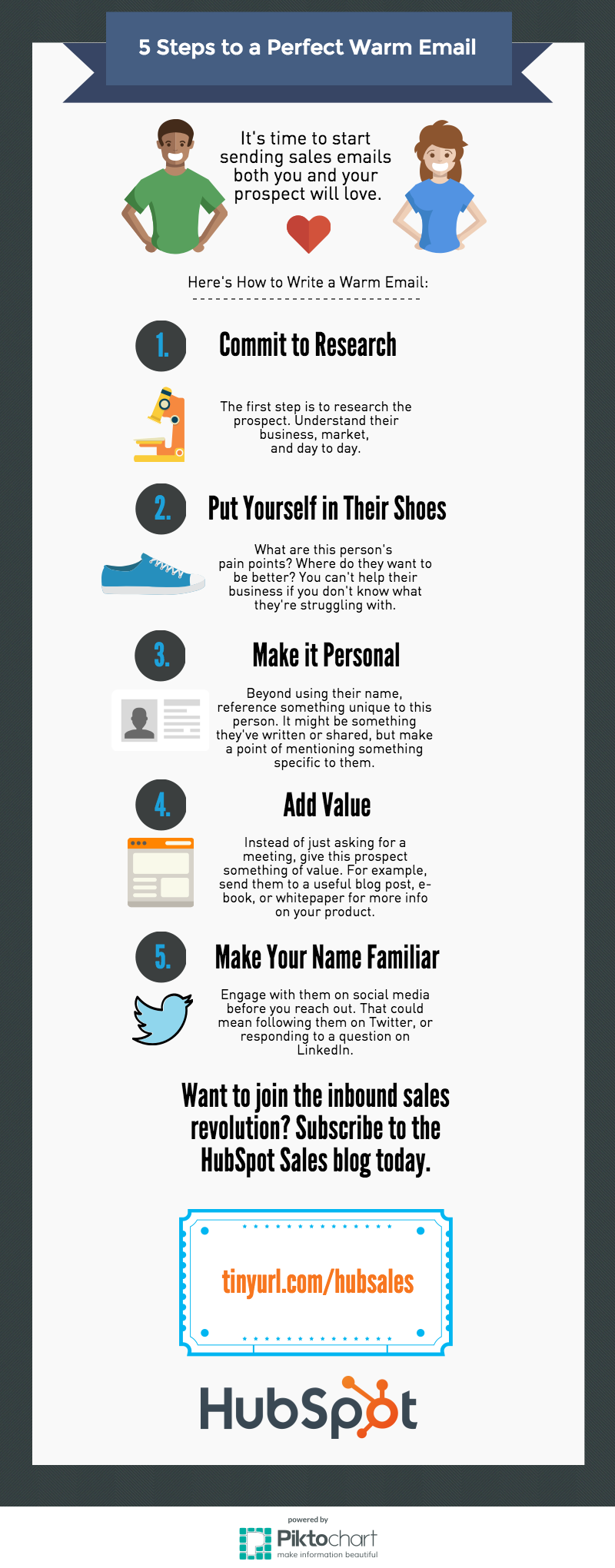
5 Steps to a Perfect Warm Sales Email
by mrenahan@hubspot.com (Mike Renahan)

In the last few weeks, how many cold sales emails have you received? Okay, now of those cold emails, how many did you respond to?
Probably none.
So why are sales reps still using this tactic when we know it’s not effective? You’ve personally ignored hundreds of these emails. Why would you expect buyers to react any differently?
Selling to someone you have a relationship with is easier and more effective than trying to build rapport out of thin air and shove your product down a buyer's throat. The cold email doesn’t fail because your product is weak; it flops because cold-sourced prospects haven’t shown any interest in what you’re selling.
So how do you get the ball rolling with prospects if cold outreach goes unanswered?
The time has come for sales reps to start sending warm emails. Here’s what to do.
17 Dec 17:19
2016 Will Be the Year of Automating Big Data for Marketers
by Andrew Sheridan
At the beginning of this year I wrote an article about how 2015 will be a crucial year for big data and we would see marketers make great strides in their ability to make sense of this data and turn it into actionable insights. It turns out 2015 was an important year for data analytics. We saw a number of new players, such as Domo, enter the space with booming success. We also saw many well-established organizations release new analytics platforms, such as Salesforce’s Analytics Cloud, making big data analytics more accessible to the masses. Marketers now have even more tools at their disposal that allow them to jump head-first into big data.
However, marketers are finding this style of analysis is too slow for such a rapidly-changing and increasingly on-demand marketplace. The need for big data automation has emerged. Tools that can constantly analyze your data while simultaneously putting the insights to work.
You’ve Spent the Time Combing Through Your Data
By now you’ve likely spent a vast amount of time and resources digging through your data and hopefully, this led to some powerful insights for your business. With revolutionary analytical tools we have been able to find the answers to many “why” questions marketers are always asking. Questions like: why are people seeing this product page? Why are certain people buying one product instead of the other? Why are people clicking this specific ad?
In 2016, instead of simply giving marketers the tools to analyze their data, there will now be access to tools that will answer the “why” questions before you can even ask them. These tools will not only be answering the questions, they will be using those answers to automatically optimize your marketing.
The Transition from Data Analytics to Data Automation
IDC forecasts that the big data technology and services market will grow at an annual rate of 26.4%. In 2015, big data made the leap from data capture to data analytics. Marketers decided it was time to make sense of the tremendous amount of data at their fingertips. In 2016, big data will make its next big leap from data analytics to data automation. Automation technology will be responsible for the analysis of big data as well as the implementation of big data insights. Here are a few trends we think will dominate big data technology in 2016.
Machine Learning: Computer sciences will continue to be the driving force in big data, and is now zeroing in on machine learning. This is the development of algorithms that are able to continuously learn from your data and make predictions based on the data.
Predictive Lead Scoring: Lead scoring allows marketers to determine which leads are the most qualified and should be the highest priority for their sales team. These scores are typically based on information captured through forms, such as email address, title, industry, etc. Predictive lead scoring takes this concept to the next level by analyzing your existing database of sales opportunities to determine which leads have the highest chances of converting to paying customers. These solutions take into account a number of indicators in order to assign a score to your existing leads. Many vendors also will sell you lead lists for the companies that scored highest against your model. Vendors such as Lattice Engines, EverString, and Mintigo have started to gain a lot of traction and we’ll likely see more solutions next year.
Programmatic Buying: The advertising industry is being turned on its head. An increasing number of advertising channels are turning to automated ad buying as opposed to traditional buying. Programmatic began with online advertising and was a way for marketers to have more effective ad campaigns without having to spend a lot of time managing them. This programmatic strategy has been so successful because decisions are made based on big data and ads are only shown to the audience with the highest chance of converting. Other advertising channels such as TV and print are starting to follow in this direction and this will accelerate rapidly in 2016.
Mobile Marketing: Mobile has become an indispensable channel for reaching consumers. People are connected to their smartphones like never before, and they are even being referred to as the “remote control for your life.” In 2016, marketers will continue to apply mobile targeting methods and find innovative ways to apply the abundance of mobile data. This past year we saw beacon technology rise to popularity which allowed marketers to get their brand in front of consumers in the right place and at the right moment. 2016 is set to be another exciting year for mobile marketing. If you’re interested in hearing what 20 marketing experts are predicting for the future of mobile, check out our DialogTech 20/20 Insights.
Big data holds exciting possibilities for marketers. With so much data being created every day, marketers have a lot of information to analyze and put to work. It is time to move past manual analysis of big data. This type of analysis is too slow for our fast-paced, digital world. 2016 will be the year when big data automation comes into the spotlight. Early adopters will gain a competitive advantage, making it a must-have for your marketing organization.
17 Dec 17:19
Inbound Marketing Solves 5 Common Problems for Media Companies
by Kelly Kranz

If you’re a media company looking for a new marketing approach, then this is the article for you. I want to address 4 common problems you may have as a media company/ publisher, and inbound marketing solutions to help.
Some Common Problems:
- Low value of ad impressions = low revenue for media companies
- Lack of advertising leads
- No differentiation from one media company to another in eyes of advertisers
- Low repeat audience engagement
Problem #1
Problem: Low value of ad impressions
Solution: Collecting online leads would encourage advertisers to buy more online ad space. This would result in more internet sales, helping you reach new ad budgets.
Problem #2
Problem: Lack of quality sales leads
Solution: Inbound marketing connects the sales team with quality leads. These leads have already expressed an interest in your media company. The sales call is no longer “cold”.
Problem #3
Problem: No differentiation from one media company to another in eyes of advertisers
Many media companies have taken their content and advertising digital. This makes it hard for readers to differentiate one media company from the next. My favorite TV channel, radio station and magazine have similar looking websites (from both a content and advertising perspective.)
Solution: Media companies need to stop selling impressions of people to advertisers. Advertiser’s can’t connect directly to an impression. bu yet, they can connect directly to a lead!
Stop telling advertisers that you captured clicks. Start telling them that you generated “X” amount of leads.
For example you can deliver segmented lists like these:
- X amount of leads from people who are starting the search for a home in the next month
- X amount of leads from people who are searching for a home in 2 months
- X amount of leads from people who are searching for a home in 6 months.
Problem #4
Problem: Low repeat audience engagement. Media companies struggle having readers return to their website.
Solution: Progressive profiling. This offers your website visitors customized offers/ads. It will motivate the audience to interact with your website more often.
How to set up simple progressive profiling:
- Step 1: Send an email containing a promotion for your audience to sign up for.
- Step 2: On the sign up form for the promotion ask questions to help you plan the best ads to place in front of them.
- Step 3: Offer them relevant ads for what they like so they feel like you know them.
This is a quick overview of how inbound marketing can help media companies.
16 Dec 21:44

10 signs you're interviewing with a company you'd never want to work for
by Jacquelyn Smith
You finally land an interview with your dream employer. You're ecstatic — you've heard this place has a fantastic culture and it's the coolest new place to work. But you really have no idea what you're getting yourself into.
Turns out you never really know it's like on the inside until you're there, which is why it's imperative that you pay very close attention to everything you see and hear when you go in for the job interview.
Approved Index has put together an infographic that highlights some of the top signs that a workplace might be toxic and that you should steer clear. These are the 10 things you should look out for:

SEE ALSO: 14 signs you're about to get a job offer
DON'T MISS: The 27 jobs that are most damaging to your health
Join the conversation about this story »
NOW WATCH: Chilling predictions for what the world will look like in a decade
16 Dec 21:38
Costs to produce crude in oilsands finally drop after 15 years of sharp inflation
by Geoffrey Morgan
CALGARY – After a 15-year period of sharp and continuous inflation, the cost to produce crude from northern Alberta’s oilsands dropped this year, according to a new report from IHS Energy.
“Costs will continue to come down, but that’s true of all sources of (oil) supply in the world and some are going to move more than others,” said Kevin Birn, director of Canadian oilsands for IHS.
Birn said the cost correction in northern Alberta doesn’t mean the oilsands are now a more competitive choice for energy companies’ investment dollars compared with shale or offshore oil formations, as costs across the global energy industry have also fallen.
Producing from the oilsands is particularly expensive and costs escalated sharply in northern Alberta between 2000 and 2014 as a result of the $200-billion worth of oilsands-related investments that were made in the region in that time period, which is five times the level of investment made in the previous 40 years.
As costs escalated, the break-even price to produce oil from a new oilsands mine rose to roughly US$100 per barrel for a mine and to an average of US$75 for a new steam-based oilsands project.
Related
In a report published Wednesday, Birn said both capital and operating costs in the oilsands have fallen over the course of 2015 in response to the collapse in global oil prices.
“Capital costs are down six per cent, operating costs are down 20 (per cent), you add them together from the end of 2014 to the end of 2015, that could be a $10 reduction to break even,” Birn said, adding that he expects costs will continue to drop over the course of 2016 as the oil price rout continues.
Even with the drop in capital and operating costs, Birn doesn’t expect companies to build new oilsands mining projects while current commodity prices persist. The West Texas Intermediate, which has slipped below US$36, fell again Wednesday.
“Without a new greenfield mine in the outlook, oilsands labour demand may never return to historical peaks,” the report noted.
The report also said that 70 per cent of oilsands production growth over the next five years will come from the expansion of existing projects and 80 per cent of that growth will be from steam-based, rather than mining, projects.
Financial Post
16 Dec 21:38
Google Revamps Cloud SQL Service with New Pricing, Higher Performance - The VAR Guy
The VAR Guy |
Google Revamps Cloud SQL Service with New Pricing, Higher Performance
The VAR Guy What really sets the next-generation Cloud SQL offering apart -- and makes it most interesting from a channel perspective -- is a flexible approach to pricing. Google says it wants to help organizations make the most of Cloud SQL without forcing them ... and more » |
16 Dec 21:37
Four top pricing hacks for online retailers
by Arie Shpanya
Pricing hacks are small tactics that can make big impacts on your ecommerce sales.
If you're a retailer, the idea of trying something new might warrant a bit of caution moving forward.
16 Dec 21:33


This is what happens when the Arctic warms twice as fast as the rest of the planet
by Darryl Fears, Washington Post
For a second straight year, the Arctic is warming faster than any other place in the world, and walrus populations in the area’s Pacific and Atlantic ocean regions are thinning along with the ice sheets that are critical for their survival, researchers reported Tuesday.
Overall, the outlook for the frozen top of the world is bleak, according to the annual Arctic Report Card: 2015 Update released by the federal National Oceanic and Atmospheric Administration. Since the turn of the last century, it said, the Arctic’s air temperature has increased by more than five degrees due to global warming.
Warmer air and sea temperatures melt ice that in turn expands oceans and causes sea-level rise, which scientists say presents a danger to cities along the entire Atlantic coast, from Miami to Washington to Boston. Walrus and other arctic mammals that give birth on ice sheets are struggling with the change, and fish such as cod and Greenland halibut are swimming north from fishermen and animals that feed on them in pursuit of colder waters.
The result will be dramatic effects on infrastructure and ecosystems
NOAA chief scientist Richard Spinrad said changes in the Arctic portend changes that are likely to spread to the wider world — higher air temperatures, longer hot seasons, anomalous weather spikes and fish fleeing north only to be replaced by new species swimming from areas south. “The conclusion that comes to my mind is these report cards are trailing indicators of what’s happening in the Arctic. They can turn out to be leading indicators for the rest of the globe,” Spinrad said.
The annual average surface-air temperature over the period of the report, between October 2014 and September 2015, was nearly 2.5 degrees higher than the time period scientists use as a baseline to compare temperatures, 1981 to 2010. As a result, Alaska was warmer in fall 2014 and winter this year, when the snow pack that usually melts to replenish rivers and moisten the earth was extremely low.
AP Photo/NASAThis undated handout photo provided by NASA shows the Thwaites Glacier in West Antarctic. Two new studies indicate that part of the huge West Antarctic ice sheet is starting a slow collapse in an unstoppable way. Alarmed scientists say that means even more sea level rise than they figured.
Lightning strikes on dry land sparked that state’s second-worst wildfire season in its history. According to the NOAA report card, “the 2015 spring melt season provided evidence of earlier snow melt across the Arctic” because of the increased warmth. As of early July, the Arctic melt included more than half of the region’s ice sheet for the first time “since the exceptional melt of 2012.” The length of the melt season was up to 4o days longer than that of the average northwestern, northeastern and western regions, the report said.
This year’s findings are largely consistent with the dire findings last year. Dozens of scientists from across the world contribute to the report card, including those from U.S. Naval Research and the Army Corps of Engineers, the Institute of Marine Research in Norway, Knipovich Polar
Research Institute of Marine Fisheries and Oceanography in Russia and University of Victoria in Canada.
The report cards’ year-to-year consistency will help scientists establish whether they are watching a weather anomaly in a key part of the world or an established trend. “What you see here is stronger confirmation,” Spinrad said.
A separate study focusing on Alaska’s North Slope, which was presented late Tuesday at the fall meeting of the American Geophysical Union, estimates that the permafrost there will decline rapidly over time because of rising temperatures. Vladimir Romanovsky, head of thePermafrost Laboratory at the University of Alaska Fairbanks, said thinning permafrost is already causing roads and houses built on it to crumble.
“Under these conditions, the permafrost will become unstable beneath any infrastructure such as roads, pipelines and buildings,” Romanovsky said. “The result will be dramatic effects on infrastructure and ecosystems.”
Another researcher at the university, Santosh Panda, said permafrost that covers virtually all of five national parks as large collectively as South Carolina could decline by 10 percent within the next 35 years. “Permafrost degradation is going to touch the whole landscape through changes in water distribution, slope failures and changes in vegetation that will affect wildlife habitat and the aesthetic value of the parks,” Panda said.
In the Arctic, the age of ice generally defines the region’s health. Older ice is thicker, more resilient and resistant to atmospheric changes, and better at supporting mammals. Younger ice is thin and vulnerable to collapse.
(Credit: Photo by Corey Accardo/NOAA/NMFS/AFSC/NMML)Part of a haul out of an estimated 35,000 walruses on a barrier island near Point Lay, Alaska, on September 27, 2014.
Yet in nearly all Arctic regions, sea ice is decreasing, the report said. In 1985, 85 percent of the region’s ice qualified as old. In March, that fell to 30 percent. “This is the first year that first-year ice dominated the ice cover,” it notes. “Sea ice cover has transformed from a strong, thick pack in the 1980s to a more fragile, thin and younger pack in recent years.”
Walruses are starting to teem on land as the ice fades, exposing their young to frequent trampling events. Walruses mate on the edges of ice, and females prefer giving birth and raising pups on old ice, which they use as a base to reach feeding grounds. Now many are on land, and the long path to the feeding areas are filled with animals that prey on them, such as sharks and orcas. That is further reducing walrus numbers, the U.S. Fish and Wildlife Service concluded in its section of the report.
Ice melt “is already a pervasive threat” to walrus, the agency’s researchers said, but how much of a threat depends on the ability of animals to adapt to change, tolerate it or flee it for more suitable habitat. Scientists estimate that Pacific walrus populations have fallen by half as a result of declining sea ice and hunting. The Atlantic stock, reduced by 80 percent through unregulated hunting between 1900 and 1960, is unknown, but estimates put the population at 25,000.
16 Dec 21:32
Consumer Behavior Secrets B2B Marketers Need to Know
by Jamie Turner
Have you ever noticed that when it comes to consumer behavior, most of the conversation revolves around B2C behaviors rather than B2B behaviors?
Why is that? After all, aren’t business people consumers, too? As Lon Safko, author of The Social Media Bible says, “The second B in B2B is actually a C.”

Lon’s comment highlights an important point – that is, just because you’re selling to a B2B audience doesn’t mean they aren’t consumers. In fact, they are consumers, and, as such, they behave in some predictable ways.
With that in mind, let’s take a look at some B2B consumer behavior secrets you can use to improve your next B2B marketing campaign.
Secret #1: B2B Consumers Buy for Emotional Reasons, Then Rationalize Their Purchase with Logic
Most of us believe that a B2B sale comes down to pure logic, but the truth is that emotion has a lot to do with the decision.
None of us want to admit this, but it’s true – when we’re buying a B2B product, some of our decisions come down to emotional things like the website design, the packaging or even how much we like the salesperson we’re working with.
Imagine you’re researching copiers from two different brands. If the brands are both very similar, much of your decision will come down to emotional things – even to the point of making your decision based on whether you find the salesperson attractive.
Of course, when our boss comes in and asks why we chose Copier Brand #1 over Copier Brand #2, we never say, “Because I liked the salesperson.” Instead, we point out all the logical reasons we picked one brand over the other.

You can use this secret to help influence your sales process. Sometimes, the emotion will revolves around the color of your logo, or the design of your website, or, as mentioned, the appeal of your sales force. In the end, it all adds up to a sale, which is why emotion is such a powerful tool for B2B as well as B2C brands.
Secret #2: There are Six Key Players in the B2B Selling Process
One advantage B2C marketers have over B2B marketers is that in the B2C sale, you’re typically only dealing with one customer. (For example, if you’re selling aspirin, you only have to sell your product to people who have headaches.) But in the B2B sale, there are six different categories of people who can influence the sale.
Who are they? Here goes:
- Initiators: These are the people who make the request for something that has to be purchased. In other words, they initiate the purchase cycle.
- Users: These are the people who will be using the product or service. Sometimes they’re the initiator, but at larger companies, the initiator and the user are usually two different people.
- Influencers: These are people who influence the buying decision. They’re often different from the Initiators and the Users.
- Deciders: The people who decide on product requirements or on the suppliers who might fulfill the order.
- Buyers: People who have the formal authority to select the supplier.
- Gatekeepers: People who have the power to prevent sellers or information from reaching members of the buying center.
Any one of these people could be a “champion” – that person who believes in your product or service and is vocal and persuasive about it.
When developing your B2B lead generation campaign, keep all of these categories in mind. You won’t see every one of them in every B2B sales process, but if you keep them on your radar screen, you’ll be prepared for them when they do come down the pike.
Secret #3: There are Four Driving Motivators for Most B2B Customers
As mentioned above, you can have up to six different categories of key influencers in the B2B sales process, but all six are driven by one of four different motivators.
What are the four motivators? Let’s take a look:
- Price: Some B2B customers are motivated purely by price. These are tough customers to deal with because no matter how much value you bring to the table, they’ll always be looking for someone who will do it cheaper. Tread carefully with price-driven customers; they can become that nightmare client who requires a lot of handholding but is never satisfied. They soak up your resources and irritate your staff.
- Solutions-Oriented: These customers are still motivated by price, but will respond to arguments about lower total cost or more dependable supply or service.
- Gold-Standard: These customers want the best performance in terms of product quality, assistance, reliable delivery, and so on. And they’re usually willing to pay for it.
- Strategic-Value: These customers want a fairly permanent solid-supplier relationship with your company. They’re even better than Gold-Standard customers because they’re incredibly loyal, which makes doing business with them a blessing. Plus they cost you less in overhead, so they’re more profitable, and they tend to become advocates, which you can leverage for your marketing efforts.
Action Steps for You.
There’s no point in studying these concepts unless you put them to use for your product or service. With that in mind, here are some action steps you can take to leverage these findings.
1. Embrace the Power of Emotion: As a B2B company, you might place less emphasis on the emotional appeal of your product or service than the typical B2C company. That’s a mistake. Instead, understand that emotion is a powerful motivator for many people making a B2B buying decision.
2. Be Aware of FUD: FUD stands for Fear, Uncertainty and Doubt, which many of your buyers may experience before purchasing your product or service. Try to get a handle on whether or not your prospect is experiencing FUD. If they are, provide plenty of ammo (and reassurance) on why they don’t need to experience FUD with your product or service.

3. Understand the 6 Key Players in the B2B Sales Process: The B2B sale is more complex than the B2C sale because there are more players in the process. You may not see all of them in every sales process, but you should be aware that they’re out there so you can adapt your selling based on who you’re talking to. Find your champion, and support that person as they work laterally to help make the sale.
4. Identify Your Prospect’s Driving Motivator: Are they motivated by price? Or by a long-term, strategic relationship? Or somewhere in between? When you identify their key motivator, you’re better able to match what your selling to what it is they’re actually buying.
We like to say “people buy from people.” It’s just as true that people sell – not to companies, but to people. That’s why you can use B2C consumer behavior secrets to improve the impact of your next lead generation campaign. Good luck. And let me know in the comments section if you have questions.

16 Dec 21:32

Sales Stack ’15 Video Recap: How Massive Enterprise Companies Buy & Sell In 2016
by Dan Jones
Editor’s Note: Panel moderator Craig Rosenberg of TOPO digs deep for insights from large enterprise insiders Valerie Williamson at The Economist, Lacey Bell at Adobe, David Priemer at Salesforce, and Becky Brown at Intel.
Video:
Audio:
If you had the opportunity to mine the brains of four industry insiders–each from different massive enterprise companies–for rare insights on how they handle their buying and selling processes, would you take it? At Sales Stack Conference 2015, we did just that. Learn what it takes to move the sales conversation forward on enterprise deals and how to avoid common pitfalls.
What are the two or three things that salespeople could do better?
Becky Brown: For salespeople, as you want to talk to talk to people like me or people in my organization, the number one thing is just value our time and add value to our business. The two areas where I see a disconnect are:
1. Massively oversell your capabilities.
2. Integration: If you can’t explain how you’re going to integrate into existing systems, then it’s impossible for us to really have a conversation.
Valerie Williamson: I think that the line between sales and marketing is sort of blurring and who’s selling to who is also blurring. Trying to understand the problem is important, but also understanding the value that you bring to that problem is a big part of the equation.
The line between sales and marketing is blurring and who’s selling to who is also blurring.
Click To Tweet
Lacey Bell: We sometimes undervalue the importance of focusing too much on the business issue at hand and not really understanding the full business challenge that’s trying to be addressed.

David Priemer: For selling to big companies, part of what you want to do is put together a toolkit with a repeatable set of steps and a repeatable set of resources that are consistent with how that company buys technology. You have to arm your sales team to be able to deliver.
For selling to big companies, you want repeatable steps consistent with how that company buys.
Click To Tweet
What’s the best way to reach you and what type of messages actually work?
Becky Brown: We have a very disciplined approach to the way we think about our marketing stack. The whole point of building a marketing stack is for the stability. And the stability gives us the agility. If you don’t have a stable platform, you can’t onboard other business and move your business forward because all you’re doing is constantly analyzing and evaluating tools.
How do you create pipeline in today’s world?
Valerie Williamson: What we try to say to our sales team every day is, “Think about what their challenge is and what the solution is that we’re going to be able to bring to them.” When you’re selling to large scale organizations, they already have in their mind what they need to do for the year. So how do you go in and add that value there? With GE, the brand got us in the door, but we were only able to stay and dance with them because we listened to them and then we came back with a solution that met their needs.
How do you train a salesperson to listen?
Lacey Bell: As a sales leader, I will join our sales calls and listen for undertones—things that are being said that maybe not everyone’s hearing.
David Priemer: I think you can test for it and should as part of the upfront hiring process. Often times you’ll be talking to a candidate and ask one question and they’ll go on and on forever. That’s a good sign that they’re not a good listener. The other thing we’ll do is a bit of a coachability exercise. One of the things we’ll do in an interview is try to teach them something.
How do you set salespeople up for success on a discovery call?
David Priemer: I find it easier to say to the rep, “By the end of this call, if you don’t come out with these pieces of information, it’s considered a failure.” From there, you can freestyle it. No one likes to be politely interrogated by a sales rep, and they can tell when you just have questions lined up. So it should be an organic conversation, but you should have the endpoints in mind.
No one likes to be politely interrogated by a sales rep. @dpriemer
Click To Tweet
Valerie Williamson: I always say to my team, “What is the goal at the end of this call? Now go backwards from there.” One of the things that we do is we hire for people with very specific traits. We call it the three Es and the C. Brand (Economist), Engaged, Enthusiastic, and Courageous.

Becky Brown: Because this area in marketing technology has gotten so big and complicated, having a deep expertise on what it is that you’re bringing to the table is really important. You can’t say, “I’ll get back to you,” you need to understand it deeply and intimately before you come in.
Tell us about the best presentations you’ve seen
Becky Brown: They’ve found a lot of the facts already.
David Priemer: Nothing’s more frustrating to a company than a vendor that comes in and doesn’t understand their business or use familiar language. So one of the things as a small business that you can do is as you’re growing, think about how you want to segment your sales team. Whether by geography, company size, etc. What that allows you to do is go out with that team and deliver something that is generic to that team but very specific to the industry you’re trying to get to.
The post Sales Stack ’15 Video Recap: How Massive Enterprise Companies Buy & Sell In 2016 appeared first on Sales Hacker.
16 Dec 21:31
Argentina announces end of foreign exchange restrictions

Buenos Aires (AFP) - Argentina said Wednesday it will eliminate the foreign exchange restrictions that have propped up the official value of the peso since 2011, setting up a potentially painful devaluation.
"The finance ministry announces that this afternoon at 6:00 pm (2100 GMT), the lifting of the currency exchange control will be announced," the ministry said in a statement, six days after new pro-business President Mauricio Macro took office promising deep reforms for Latin America's third-largest economy.
16 Dec 21:31
4 Types of Evergreen Content Your Brand Needs to Thrive
by Larry Alton
We’re currently living in a world where the Internet is over-saturated with low quality content. This content adds no value, while taking up a significant amount of space. Much of this content is comprised of blog posts thrown up on websites without any planning or editing—the click bait articles that your peers endlessly share on social media.
As a marketer or entrepreneur who makes a living by creating powerful content, how can you rise above the noise and create share worthy items that add value? The answer is evergreen content, and it comes in a variety of forms.
Consider These 4 Types of Evergreen Content
Before diving in to the common types of evergreen content, it should be noted that not every type is suitable for every brand. You may find that a certain type is much more conducive to your industry, whereas another form fails to connect with users. Keep this in mind as you browse this list, and search for the ones that fit both your brand and industry.
1. Yearly Posts
The year is coming to a close and the content marketing industry will soon be full of “end of the year” posts. The reason these articles are so popular among content marketers is that they work. People love looking back on the past year or looking forward to the next one; it’s just something we do around the holiday season.
Well, in terms of evergreen content, these yearly posts are extremely valuable. People can reference previous yearly posts to reflect on a certain year and naturally anticipate the newest installment when the time comes. These are also extremely shareable articles that do very well on social networking sites.
2. Interviews
Interviews are great because they provide credibility and value. If you’re able to establish an interview with a well-known figure in your industry, you can attract a lot of traffic and backlinks for months to come.
While you really have two options for interviews (video/audio and written form) it’s wise to combine them. Video/audio interviews are very engaging, but aren’t as conducive to back linking as written form interviews. On the other hand, a written form interview won’t attract nearly the same amount of viewers as a video. If you’re publishing an interview on your website, it’s wise to post the entire video/audio clip along with the textual transcription for other bloggers to reference.
3. Interactive Content
Perhaps the most valuable and high returning form of evergreen content is interactive content. While it comes in a variety of forms, interactive content is essentially any form of content marketing that engages the end user beyond simply reading.
Examples of interactive content include videos, polls, quizzes, surveys, reveal-based marketing, interactive infographics, games and more. For examples of well-designed interactive content, check out this article.
4. How-To Guides
How-to guides and tutorials are the definition of evergreen content. As long as you sell a product or service, you’ll continue to have customers ask questions about how something works. By providing answers to frequent issues, problems, and inquiries, you can free up your time and help customers find exactly what they’re looking for. These guides remain relevant until the next time you make significant changes to your product offerings.
Outside the Box Idea: Vehicle Wrapping
While we think about evergreen content primarily in terms of web content, it should be noted that evergreen content also exists outside of the realm of the internet. In addition to the four types of content mentioned above, why not invest in something that’s a little outside the box, such as vehicle wrapping?
“Evergreen content is a phrase you may hear in SEO or content creation articles such as this one,” writes marketer Christopher Lee. “But what you choose to do with your vehicle or fleet of vehicles is, in a way, also evergreen content.”
Lee bases this idea on the fact that people have an innate ability to recall seeing a wrapped or detailed vehicle. According to one study, 80 percent of people are able to recall a specific advertisement after seeing it on a vehicle. Vehicle wrapping can be used for a long time and has a direct influence on those who are exposed to it—just like these other four types of evergreen content.
Invest in Evergreen Content Today
You can’t put off an investment in evergreen content any longer. As time passes, it’s becoming increasingly challenging to stand out on the internet. By committing to producing high quality, evergreen content that adds value for months and years to come, you can better position your brand for long term content marketing success. Click bait content may provide an immediate return, but evergreen content produces results that last.

16 Dec 21:31
8 Ways to Improve Your Call-to-Action Copy to Get More Subscribers
by Monica Montesa
When you created your sign up form, you probably spent the majority of your time writing the copy and fine-tuning the design.
But how much time did you spend thinking about the copy on your call-to-action (CTA) button?
If you defaulted to the usual “submit” or “sign up” copy, chances are it didn’t take much time at all. But that means you might be missing out on a big opportunity to convince even more people to sign up to your email list.
To help make the most of your sign up form and increase conversions, here are eight best practices you can test:
1. Write Compelling Copy
“Submit” or “sign up” are so 2012. To really stand out and engage your site visitors, try using more compelling copy.
Over at AppSumo, they’re big fans of using pop-up sign up forms to collect new subscribers. In the example form below, notice how creative the CTA is:

The use of “gimme” instead of “sign up” is different, yet works wells with their brand’s unique voice and tone.
Here’s another example of a distinct and inviting CTA button from vocal coach, Felicia Ricci:

2. Keep it Brief
If it takes long for prospective subscribers to read the copy on your CTA, it won’t bore your readers to tears… but it might bore them to the point where they’re no longer interested in signing up to your email list. Yes, your copy should be compelling, but it shouldn’t be as descriptive as a Charles Dickens novel.
So what’s the CTA copy comfort zone? Typically it’s two to five words. If you have a creative one-word CTA, such as AppSumo’s form above, testing different lengths will be key to understanding what works best for your audience.
Here’s another example from Enchanting Marketing, which not only includes an engaging CTA, but one that’s contextual with the rest of the form:

3. Use Action-Oriented Words
Most sign up form CTAs use some sort of actionable word or phrase. Even “submit” gives readers a next step to take. But as you think of ways to get more creative with your forms, make sure it focuses on the action you want your readers to take.
Avoid phrasing your copy in a way that presents the incentive, such as “Here’s your whitepaper.” Instead, go for verbs like:
- Download
- Get
- Submit
- Send
- Start
- Try
- Reserve
- Take
4. Clearly Explain What They’ll Receive
While your sign up form copy should already explain what people will receive in exchange for their personal information, consider repeating it in your call to action. Whether new subscribers are getting a free ebook, access to an email course, or a weekly newsletter, test out highlighting the benefit in your form button.
In one of our own forms for an intro-level guide to email marketing, we made sure to communicate the value of submitting their email address:

Here are a few other CTA ideas to test out for your own form:
- Get my ebook
- Register for the course
- Save my seat
5. Try First-Person vs. Second-Person
It’s natural for marketers to write to their audience in the second person, where the reader is addressed as “your” or “your.” This point of view is often used because it speaks to the individual as opposed to a mass audience. As a result, it feels more personal to the recipient. It also forces you to present the value of the action you want readers to take.
For example, this whole blog post is written in the second person perspective in order to encourage you to test new CTA copy and increase subscriber growth. And we often write our calls to action that way too.
In the form below from Running Shoes Guru, you’ll notice CTA button is written in the second-person perspective:

Recently, some have started writing calls to action in the first-person perspective – and the results have been a little more than noteworthy. In an A/B split test done by Content Verve, they found that simply switching the point of view to the first person increased click throughs by 90 percent!
Check out how The Prairie Homestead uses the first-person point of view:

6. Create a Sense of Urgency
We often encourage our readers to create a sense of urgency in their subject lines; and the same can also be said for the copy in your call-to-action button.
Adding words like “now” or “today” at the end of your copy are used to encourage people to take action. In the Running Shoes example from earlier, you’ll notice the urgency in the CTA:

7. Reference the Value of Your Incentive
If you’re offering an incentive in your form at an exclusive value, you might want to test mentioning it in your call-to-action copy as well.
Offering a free ebook or email course is a way to encourage people to subscribe to your email list. In the example below, you’ll notice that both the value and sense of urgency are presented in the CTA:

8. Include Bonus Text
Sometimes two to five words isn’t enough to get your message across. Maybe you want to assure readers that you won’t send them any spam. Or perhaps you want to tell them that their free trial is only for a certain time period. Whatever it is, there is a place where you can add this extra piece of information: the bonus text.
In the example below from the blog, Flipped Lifestyle, you’ll find the bonus text in gray beneath the CTA button:

In the form, visitors are encouraged to subscribe to their email list and get a free email course about selling digital products online. Here, the bonus text is used to ease their subscriber’s fears about receiving spammy emails.
Which CTA Copy Change Will You Make?
With so many ideas to choose from, we encourage you to test different approaches using AWeber or a sign up form app like OptinMonster.
Inspired to start tweaking your CTA? Give it a try and tell us about the results you saw!

16 Dec 21:28
Creating a Brand Identity For Your Business
by Taylor Tomita

As a new business you have long uphill battle. You will need to carefully manage your business, attract customers, and contend with a market already saturated with wide-eyed entrepreneurs. It’s hard enough to keep afloat, never mind trying to extend your reach beyond your geographical location. You don’t have an easy task, but you already know that. One tool you can use to get your company on a similar playing field as national bigwigs is branding.
What is Branding?
Before delving into how to brand, let’s have a quick crash course on what branding is. A brand, according to the Handbook of Media Management and Economics, is a “name, term, sign…” intended to identify and distinguish a product from its competitors.” A brand can elevate your company beyond the brick and mortar. It can give your company and its products a godlike identity that calls to people. Suddenly your service is more than the sum of its parts. It’s a vital product that can enhance the meaning of your customer’s lives. And when done right, customers will consciously and unconsciously gravitate to your service without even considering your competitors.
Determining Your Brand
Before implementing local or national branding, you should iron out a few things. Determine:
-Your company’s philosophy and beliefs.
-How you want your company to be seen by buyers.
-What kind of service you want to be known for.
-The kind of employee that will appeal to your audience.
-What your customers believe in.
Establish these guidelines now. It’s vital that you control how your company is seen. If you fail to do this, your potential customers will be left to establish what your brand is for you. This can backfire. Especially on a more national or state level where you are not in the forefront creating a personal relationship with your customers.
Tactics to Brand Beyond the Local
Here are a few tactics to establish your brand on a state, national or international level.
Get out there. Travel to tradeshows, conferences and other events across the state or country. Traveling to these events will give you or your employees the ability to interact with people outside your area. You can demonstrate those values that you ironed out in your prep stage. You can also cement yourself as a possible supplier or distributor of the products that you make or sell.
Create an online name for the brand. Branding opportunities are everywhere, one of these places is social media. This study by Market Force Information has concluded that a strong social media presence plays an enormous role in the purchasing decisions of 78% of customers. Utilizing social media can be a huge brand building tactic.
Hire the right people. The employees that travel to these conferences or tradeshows should be carefully selected and trained. You might be the figurehead of your company, but at those events they have the more vital positions. They are the ambassadors that will be identified as “poster children” of the company. Any actions, speeches or apparel that doesn’t align with your brand identity can undermine your branding efforts.
Company apparel. We all see t-shirts all the time that proclaim an individual’s devotion to a certain company. Hundreds of people unconsciously choose to become walking, talking advertisements for Aeropostale, Converse, and Nike. Why not invest in t-shirts, jackets, suitcases or ties for your employees to wear while traveling? Branded apparel will expose people to your brand who might not have heard of you otherwise.
Event signs. You should carefully plan how your employees will set up their booths at tradeshows and events. Meeting and event signs are a solid way to demonstrate what your company believes in and what your company contributes to the global community. Make them useful and thought provoking. You want the people at the event to remember your signs.
Event Merchandise. Beyond the main sign, you can also invest in other branded merchandise like pens or pencils for the people attending the event. People love free items, but there are specific ways to find what merchandise your audience wants. Here are a few tips on finding the best opportunities. These items will travel with them to their homes in Florida, Colorado, or New York. Once there, other people will see them using that pen. Even if they don’t look up your company out of curiosity, they might recognize your brand at a later date.
In summary, creating a name for your company on a local, state, national, or international level can be hard. With the proper branding, you can not only establish your brand on a local level, you can give your business what it needs to expand beyond the borders of your hometown.
Your sales team can help turn your small business into a big name. Find out more by downloading the free Salesforce e-book.
16 Dec 21:28
Fed finally lifts key interest rate from near zero
by Martin Crutsinger

WASHINGTON (AP) — The Federal Reserve is raising interest rates from record lows set at the depths of the 2008 financial crisis, a shift that heralds modestly higher rates on some loans.
The Fed coupled its first rate hike in nine years with a signal that further increases will likely be made slowly as the economy strengthens further and inflation rises from undesirably low levels.
Wednesday's action signaled the central bank's belief that the economy has finally regained enough strength 6½ years after the Great Recession ended to withstand modestly higher borrowing rates.
"The Fed's decision today reflects our confidence in the U.S. economy," Chair Janet Yellen said at a news conference.
The Fed said in a statement after its latest meeting that it was lifting its key rate by a quarter-point to a range of 0.25 percent to 0.5 percent. Its move ends an extraordinary seven-year period of near-zero borrowing rates. But the Fed's statement suggested that rates would remain historically low well into the future, saying it expects "only gradual increases."
"The Fed reaffirmed that the pace of rate hikes would be slow," James Marple, senior economist at TD Economics wrote in a research note. "The Fed's expectations for rate hikes next year are set alongside a relatively cautious and entirely achievable economic outlook."
Stocks closed up sharply higher. The Dow Jones industrial average, which had been up modestly before the announcement, gained 224 points, or 1.3 percent, for the day.
The bond market didn't react much. The yield on the 10-year Treasury note rose slightly to 2.29 percent.
Rates on mortgages and car loans aren't expected to rise much soon. The Fed's benchmark rate doesn't directly affect them. Long-term mortgages, for example, tend to track 10-year U.S. Treasury yields, which will likely stay low as long as inflation does and investors keep buying Treasurys.
But rates on some other loans, like credit cards and home equity credit lines, will likely rise, though probably only slightly as long as the Fed's rate hikes remain modest.
Shortly after the Fed's announcement, major banks began announcing that they were raising their prime lending rate from 3.25 percent to 3.50 percent. The prime rate is a benchmark for some types of consumer loans such as home equity loans. Wells Fargo was the first bank to announce the rate hike.
Among other things, the Fed's low-interest rate policies have helped jump-start auto sales, which are on track to reach a record 17.5 million this year. And the Fed's first hike may not slow them.
Steven Szakaly, chief economist for the National Automobile Dealers Association, says dealers will press financing companies to keep loan rates low. And competition for buyers will spur them to take other steps to hold down rates, such as accepting lower profits.
"The rate squeeze will happen between the dealer and its finance company rather than the dealer and the consumers," Szakaly said. "Consumers won't even feel it."
For months, Yellen and other Fed officials have said they expected any rate hikes to be small and gradual. But nervous investors have been looking for further assurances.
Yellen indicated that Wednesday's rate hike was partially defensive. If rates stayed at near zero, the Fed might not have the tools to combat a recession.
"We've worried about the fact that with interest rates at zero, we have less scope to respond to negative shocks," she said at her news conference.
When growth struggles, the Fed often cuts rates to help increase the amount of cash flowing through the economy. But by staying close to zero, the Fed would be unable to cut rates or it would be forced to have negative rates for the first time in its history.
An updated economic forecast released with the policy statement showed that Fed officials predict that their target for the federal funds rate — the rate that banks charge on overnight loans — will end next year slightly above 1 percent. That is in line with the consensus view of economists.
The Fed's action was approved by a unanimous vote of 10-0, giving Yellen a victory in achieving consensus.
The statement struck a generally more upbeat tone in its assessment of the economy. It cited "considerable improvement" in the job market. And it expressed more confidence that inflation, which has been running well below the Fed's 2 percent target, would begin rising. It suggested this would happen as the effects of declines in energy and import prices fade and the job market strengthens further.
In addition to the funds rate, the Fed is raising three other rates: It lifted the interest it pays on the reserves that banks hold at the Fed to 0.5 percent from 0.25 percent. It raised the rate it pays on a type of short-term loan to 0.25 percent from 0.05 percent. The Fed plans to use those two rates to help meet its new higher target for the funds rate.
In addition, it announced a quarter-point increase in its discount borrowing rate to 1 percent from 0.75 percent. This is the rate banks pay when they borrow emergency loans from the central bank. This rate typically moves up in conjunction with the Fed's benchmark rate.
___
AP Business Writers Paul Wiseman and Josh Boak in Washington and Tom Krisher in Detroit contributed to this report.
___
Watch AP video: https://youtu.be/e8fwVFSgx9E
16 Dec 21:26
Boost Your Sales by Using This One Word
Boost Your Sales by Using This One Word
By Mike Brooks, www.MrInsideSales.com
Catchy title, huh? “Boost your sales using just this ONE word.” Wouldn’t it be nice if there was just one magic word that could really increase your sales?
There is…
Before I tell you what it is, though, let me give you a brief background on how I discovered it. Years ago as I was struggling to make sales, I found a bad pattern had developed in terms of how my sales attempts were ending up. After pitching and pitching, most of my sales were being stalled with some variation of:
“Let me think about it,”
OR
“I’ll have to discuss this with my partner…”
OR
“O.K., why don’t you get back with me in a few weeks…”
Sound familiar? It should. Most sales presentations end this way. After racking my brain for the reason, I finally began listening to how the top closers in my company were closing their sales. And how they were opening and qualifying their prospects as well.
Turns out they all were using one magic word. And the word was….
“Today.”
Or some variation of it when they were qualifying. And that’s when I started using it as well and it didn’t just boost my sales, it catapulted it! In fact, it had much more impact than that. It also greatly reduced the number of unqualified leads I sent out and spent hours of useless time with.
Here are some examples of how to use the word today in both your opening and closing statements.:
For qualifying you must qualify the prospect’s timeline and set the proper expectation for the close. At the end of your cold call and before you schedule your demo or send your information, you must ask something like this:
“So _________, I’ve got you on the calendar to do a walk-through of our solution next Wednesday, and if after we’re done you really like this, is it something that you can make a decision on at that time?”
OR
“So _________, I look forward to our demo next Wednesday, and if after we’re done you really like this, I’m going to ask you for a simple yes or no, is that fair?”
Now in some situations if you’re dealing with an influencer, your question will be about what the next steps are, what the decision maker’s time frame is like, how many other companies they’re looking at, etc..
But if you are dealing with the owner or decision maker, you must get a firm commitment as to timeframe, ideally confirming a decision right after your pitch.
For closing calls, you use the magic word:
At the beginning of your presentation, before you go into your slide show or however you do it, you requalify by asking:
“I’m excited to show you this, and at the end if you feel this is the right solution for you, this is something you can move on today, right?”
That’s it. No wishy washy way around it. You must set a clear expectation right from the beginning (and that means on the qualifying call) and then reconfirm it at the beginning of the close.
I know what you’re thinking: “What if they say no?” Then you adjust your presentation to target their buying motive and start overcoming what their objection is. I’ve written many of scripts to help you do that, so check out my blog if you need them: http://mrinsidesales.com/insidesalestrainingblog/
Bottom line: You will make more sales faster and with less struggle if you set the proper expectation on the front call and confirm it by opening your closing call using the magic word: today.
Try it today and see for yourself.
If you found this article helpful, then you'll love Mike's Completely Updated and Revised eBook, “The Complete Book of Phone Scripts.” Now over 130 pages of powerful and effective scripts to help you easily get past the gatekeeper, set appointments, overcome objections and close more money!
Visit: http://mrinsidesales.com/completescripts.htm and find out why Jeffrey Gitomer, Brian Tracy, Tom Hopkins and many others recommend Mike’s ebook of Phone Scripts!
Do you have an underperforming inside sales team? Talk to Mike to see how he can help you and your team reach your revenue goals. To learn more about Mike, visit his website: http://www.MrInsideSales.com
16 Dec 21:26
Pro Tips: How to Increase LinkedIn Connections and Engagement
by Candis Roussel
LinkedIn now has over 400 million members, so anybody who wants to build, monitor, and nurture professional connections must have a presence on this social media platform. It’s the go-to network where companies and professionals can meet, exchange ideas, and find great talent — across town, across the country, or across the world.
But to make the most of this extraordinary tool you need to build your personal network.Today, I’m going to show you how to increase LinkedIn connections and generate more leads for your firm.
Appearance Matters
Consider this: when you attend an in-person networking event, you probably do at least some preparation ahead of time. After all, you want to make a great first impression.
The same is true for your LinkedIn profile—the online version of your first impression. So how do you put your best foot forward and stand out from the crowd?
Here are a few key tips:
Use a professional photo. You wouldn’t attend a professional event wearing jeans and a t-shirt. The same goes for your LinkedIn profile picture. Wear professional attire and have a professional take your photo. This isn’t the place for snapshots of you and your dog.
Create a killer headline. LinkedIn uses your current position at your organization as the default headline for your profile. You can do better. Think of your headline as a mini (120 characters or less) elevator speech that describes what you do and how you are different.
Here’s an example of a simple but playful headline from Hinge Senior Partner, Sylvia Montgomery:
Hip & seasoned AEC marketer. At the caffeinated intersection of practical & measurable marketing. Author & speaker.
Use the Summary section wisely. Here is another chance for you to shine. Use this section to share your story and explain how you got where you are today. Write in the first person and explain how you help clients. It’s not enough to say that you are great at what you do. Consider describing how you approach problems and what you do differently to solve them. Use bullet points to list strengths or specialties.
Complete your profile. Make the effort to complete your entire profile. Fill out anything that is relevant, including links to articles you’ve written and professional organizations you belong to. If you set up your profile a few years ago, check that it’s up to date.
Making Connections
If you’ve already reached out to your friends and colleagues, it might be time to expand your online network of connections. Your network is what you make of it, whether it’s to keep in touch, generate leads, or find a new job.
The best time to connect with people is shortly after meeting them in person. You could find them on LinkedIn by searching their name and hitting “Connect.” But you’ll have better results if you send the people you want to connect with a personalized message to remind them who you are and when you met.
LinkedIn sends this default message: “I’d like to add you to my professional network on LinkedIn.”

Edit this message to explain your reason for connecting. Make sure to mention anything you may have spoken about to help jog their memory.
If there’s someone that you want to connect with but haven’t met personally, see if you have any connections in common. Then ask your connection to introduce you. If want to make it easy on them, you could even craft a message for your connection to use.
Engaging in Groups
Taking just 15 minutes out of your day to engage in relevant LinkedIn Groups can help build your network and generate leads. Use this as an opportunity to share your organization’s content and share your expertise.
Read the group rules and abide by them. Most allow for discussion but frown upon spammy discussions or sales tactics in groups. No “Check out our new great product” posts. Blasting your services is a surefire turn off and can also get you banned from the group.
Ask a question to start a discussion, and make sure it is relevant to your audience. Use an open ended question to ask how others have solved a specific problem. For example, instead of asking “Do you use social media?” try a question that’s more likely to stimulate discussion, such as, “What social media tactics have helped your firm generate leads?”
Post content that is relevant to your audience. This means sharing a healthy mix of your firm’s content as well as external content.
Engage. Don’t start a discussion and then ignore the conversation. Monitor your LinkedIn notifications for responses and continue to engage. To keep a discussion’s momentum going, end your responses with another open-ended question. Also, make an effort to comment on other conversations and offer your expert opinion or experience.
Don’t ignite a hater. Remember that LinkedIn is a professional network. If someone posts a snarky comment, most people will recognize it for what it is. Avoid the temptation to respond in kind. A simple, polite response is usually sufficient.
By now, you should have a better idea of how to increase your LinkedIn connections, engage in groups, and grow your influence online. Make LinkedIn a key part of your professional networking.

16 Dec 21:26
How to Pump Up Your B2B Communications with Killer Content
by Wendy Marx

Depending on your industry, you might think that creating original content has all the excitement of a bowl of oatmeal. However, the truth is that content boosts your B2B communications — and it doesn’t have to be boring.
B2B Communications Stats You Can’t Ignore
Just because you manufacture microchips or sell machining software doesn’t mean that you’re excused from creating content that engages prospects.
Check out these stats if you’re not convinced (or if you are, tweet them to convince others.)
- Buyers go through about 57% of the purchasing process before ever talking to sales. (source)
- B2B buyers conduct an average of 12 searches before ever jumping on a specific brand’s site. (source)
- 67% of B2B buyers rely more on content to research and make B2B purchasing decisions than they did a year ago. (source)
- Business buyers share the following content types with colleagues frequently: Blog Posts (40%); Infographics (35%); eBooks (35%); White Papers (35%); Case Studies (33%); Webinars (33%); Videos (25%). (source)
- 86% of B2B buyers “frequently” use mobile phones to access business-related content.(source)
Clearly, content creation is not optional. However, just spewing information about your company does not qualify as good content. Let’s check out how you can beef up your B2B Communications while following a few simple rules.
5 Rules for Creating Content That Boosts B2B Communications
1. Don’t Be Afraid to Go Long
Although not a hard and fast rule, B2B buyers typically prefer long-form blog posts. This is what the marketing gurus at Curata discovered.
“This year, the Curata marketing team shifted to a data-driven content marketing strategy. We uncovered many insights about the effectiveness of our content and were able to make several changes to our strategy.
One example: We used our content marketing platform to analyze data on historical content and found that long-form blog posts generate nine times more leads than short-form blog posts. We now focus almost all of our resources on creating long-form content.” — Alexandra Barca, Content Marketing Specialist at Curata
Obviously, generating more leads is the desired by-product of slaving over content that you hope will be useful and appreciated. So don’t be afraid to be over-explain. B2B buyers are typically not looking for a short-term partnership with vendors, so they are willing to put in extra homework time to find the right fit.
2. Avoid Small Print
Just because you pride yourself on perfecting the finite details of your product or service, doesn’t mean that you should seem anal to the point of being pedantic.
This type of attitude can come across when you use small lettering and large paragraphs. It says “If you’re not willing to work hard to glean the relevant points in my content, then you’re not important to me.”
That’s really the last message you want to send. And it’s one that annoys B2B buyers, as evidenced by this stat:
- 2/3rds of B2B buyers (66%) strongly agree that B2B vendors should stop overloading content with copy/small print to improve the quality of their content. (source)
Instead, make sure that you use a readable font, include bullet points, visuals, and headers that make it easy for buyers to quickly scan your content. If it’s relevant to them, they’ll make sure to read the whole thing, but don’t force their hand.
3. Skip the Sales Pitch
The content you create is primarily for your potential buyers. However, the goal should be to inform, not to confront them with a sales pitch. This isn’t to say you don’t want to take advantage of their viewership to let them know what services or products you have available.
The key is to know where the viewer is in the sales funnel. Are they reading your blog post? It may likely be the first time they’ve ever heard of your company. Don’t pester them with ads, or with a CTA that demands too much of them (for more about creating powerful calls to action, check out this post) . Instead, offer a valuable piece of content, such as an eBook, that helps them solve a problem.
Offers that cost the reader money should be reserved for later in the lead process.
4. Don’t Pigeon Hole Your Content
Blog posts are incredibly relevant to B2B buyers, and certainly necessary. However, you don’t want to get stuck creating just one type of content. Buyers are looking for firms that are innovative and not stuck in a rut.
Therefore, why not try out making a video, a webinar, or a Periscope production? The more you put into your content marketing, the more you will get out of it.
5. Measure the Effectiveness of Your Content
Finally, you’ll want to have proper analytics in place so that you can see whether or not you’re reaching your audience.
In this way, you can fine-tune your topics, your calls to action, and your email marketing campaigns in a way that will be helpful, and not annoying, to your audience.
If you’re already creating content, but sometimes feel like you’re stuck in rut, check out our latest video, 7 Ways to Rock at B2B Content Creation. You’ll get a few ideas about how to break through a creative block, and some effective ways to create the best content!
We hope you find it entertaining and informative!
