Shared posts

22 Dec 20:57

5 Steps to take when You’re Struggling for Leads

by Michaela Walsh

5-steps-to-take-when-youre-struggling-for-leads-459EE8

So, you’re getting visitors to your site? Great!

But not enough are turning into leads? Not so great..

There’s no getting away from it, lead generation is a tricky business and it takes a lot of work to perfect and get right.

The thing is, approx. 96% of visitors to your site are not ready to buy, which immediately starts you off on the back foot. Not what you want to hear when you’re already struggling for leads. What you need are some steps to take to help you turn those visitors into leads.

Below are five steps to lead generation success…

Step One: Keep things Simple

Once people are on your website you want to encourage them to do something, not just read and leave. That’s why you need well designed and positioned calls to action. Don’t confuse your visitors, make sure you keep things simple; to help you with this take a look at this blog I wrote for Publi.sh on the “4 ingredients of all great calls to action“.

Once you have a well designed CTA, make sure you position it clearly for your visitors to see. Once they click your CTA then it needs to then take them to a well designed landing page. The landing page should include a form for entering their details, in order for them to access whatever led them to this landing page.

Step Two: Make them an offer they can’t refuse

This is the bit that actually gets them clicking on that CTA because even if your CTA button is beautifully designed, they’ll be less likely to click it if you’re offering something irrelevant or of no use to them.

Also, whatever you’re offering needs to be worth them giving up their details for. It needs to be more than the content you used to get them to your site i.e. blogs, infographics, or video content. Instead it should be more valuable content like ebooks, white papers, or instructional videos.

But just creating valuable content alone isn’t always enough. As with anything in life, if there’s an option to come back to it at a later date, we will. Include some urgency and we may be encouraged to carry out the action now. The same applies with your content, offer it for a limited time or with added quantity for a limited time, and see your leads soar.

Step Three: Ensure content is relevant to your industry

The best way to ensure your content is relevant is by using SEO tactics. Look at what is topical when creating your content and carry out keyword checks.

Keyword research is one of the most important, valuable and high return activities you can carry out, as ranking for the right keywords can make it much easier for you to get the right audience to your website.

The following tools will be useful in helping you to achieve this:

Step Four: Use social

77% of B2B marketers say they have acquired a customer through Facebook, which is pretty huge. But what’s even more impressive is that Linkedin is 277% more effective at generating leads than Facebook, or Twitter put together.

This isn’t to say that you shouldn’t use Facebook or Twitter as part of your overall content marketing plan, but you should judge which social channels will be most appropriate for your choice of audience.

It could be a mix of the social media channels that works best for you, but the key is to promote your content in a way that is entertaining and best suited to each platform. The other thing is to not only share your own content, but to get the balance just right and post links to entertaining content that relates to your audiences interests.

For more information on getting the balance in social sharing check out this blog we did, “How to use the 5:3:2 Rule for Social Sharing“.

Step Five: Prepare for how you will nurture the leads you get

It’s all well and good collecting these leads, but if you don’t have a plan in place for how you intend to nurture them into customers then you’ll have wasted your time. This is all a part of the marketing methodology and one part is no good without the other.

With this in mind, here is a quick run down of what to have in place for when you need to nurture your leads as it’s not a one size fits all process.

  • Email marketing is key for lead nurturing and there are some great email marketing companies out there that help you target and personalise your emails. Check out this blog to give you the lo-down on “7 of the best email marketing apps“.
  • Blog management is something you can do with your email marketing by creating blog content that is more suited to those leads who are closer to a purchase.
  • Social Media works at every step of your marketing funnel and you can use it to share the blogs directed at converting leads into customers.

For more information on the marketing methodology check out this blog, “How to site visitors into paying customers“.

Closing Thoughts

Getting your sales funnel filled with leads is great for validating your marketing efforts, and when it’s done with the above tactics, everyone benefits.

However, as marketers we don’t feel the pressure to always deliver qualified leads – so hopefully following these steps will make it that bit easier to ensuring that we do.

If there’s anything you think we’ve missed or that we could elaborate on leave us a comment!

30-tips

22 Dec 20:56

10 Things I Hate About Your Sales Email

by Leah Bell

Anthony Zhang knows a good sales email when he sees one. But as the Director of Sales at SalesLoft, he’s seen the good, the bad, and the ugly — and he’s passionate about teaching our team the importance of a good, sincere sales email.

We’ve preached “personalization at scale” in an effort to create the perfect sales email template. But in Anthony’s recent training presentation, he took that notion a step further:

Why not sincerity at scale?

Sincerity is simply a deeper definition of the personalization every rep is looking for in a sales email. But there are a few common mistakes that can make a sales email insincere, and Anthony shared a few of his cringe-worthy pet peeves. Here are the 10 things Anthony hates about an insincere sales email:

1. It’s too wordy.

Try to land somewhere between 300-500 characters, or 2-4 sentences. This will avoid the unfortunate TL;DR responses.

2. It’s confusing.

Not everyone you’re emailing knows the products and features that you use every single day. Remove technical jargon and avoid “value overload.”

3. It’s too much effort.

Prospects see Level 3 questions in an email and go running in the other direction. Use simple, open-ended questions to break the ice and get your foot in the door.

runaway2

4. It has vague CTAs.

Your prospect should have a clear call-to-action by the end of your sales email. Be clear and direct with your intention so they know what to do next.

5. It’s forgettable.

A vague one-off sales email is forgettable. But if you’re persistent and sincere with your follow-ups, your email is more likely to be stay top of mind.

6. It’s all about you.

Don’t be Toby Keith… talk more about the prospect. Try practicing the 10/80/10 rule in your pitch-to-discovery ratio as you write.

7. It’s too fancy.

Good day, Mr. and/or Ms. Blah Blah Blah CEO… You don’t talk like that on a call, so don’t talk like that in your emails. Avoid extremely “professional” looking emails and aim for originality and sincerity.

8. It’s robotic.

We understand that automation has its place in mass marketing, but heaven help us if we receive another automated sales email. Avoid “sent via” or “Unsubscribe” digital footprints that kill credibility.

seriously

9. The subject line is boring.

Quit it with the basic sales email subject lines. Test subject lines that are exciting, credible, and intriguing — something that YOU would open, yourself.

10. There’s no social proof.

We’re all on social media. Why not add credibility and “voice of the customer” to your emails? You’ll just drive home the point that there’s a human being behind your sales email.

Remember these 10 things, and you’ll save yourself from writing a forgettable, boring sales email. And there’s no shame in needing a little help — SalesLoft Sales Email is the perfect tool for injecting sincerity at scale. Improve your process through semi-automation and customizable personalization to craft the most sincere sales email.

SalesEmailCTA

The post 10 Things I Hate About Your Sales Email appeared first on SalesLoft.

22 Dec 20:56

Wall Street thinks Yahoo’s 4 big acquisitions could be worth over $1 billion, if split up individually (YHOO)

by Eugene Kim

Marissa Mayer

Yahoo CEO Marissa Mayer is often criticized for doling out roughly $3 billion on a series of acquisitions that failed to produce any meaningful improvement to the company's business.

And according to a new analysis by FBR Capital, the value of those assets is now significantly below what Yahoo paid.

The four biggest deals done on Mayer's watch are all worth less than the acquisition price, according to FBR. 

Tumblr, which Yahoo acquired for $1.1 billion in 2013, is currently worth $770 million in a best case scenario, FBR estimates.

Brigthroll, Flurry and Polyvore are also worth less the acquisition price, the firm estimates.

And that's the good news. FBR assigns zero value to the other 40-something startups Yahoo bought in the past 3 years.

Still, FBR believes the value of the four big acquired assets could help provide a payoff to shareholders if Yahoo was broken up and its various pieces sold. 

In a note published Monday, FBR's William Bird wrote that the Yahoo Display segment, which includes Yahoo News, Finance, and Sports, as well as most of the startups it bought over the past 3 years, could derive a valuation over $3.2 billion if sold separately.

The right owner

Of that $3.2 billion, Bird pegged a base case valuation of over $1.4 billion to the four startups he included in the report.

For Tumblr, Bird pointed out its operational and financial performance might lag behind its competitors, but it's still grown its members and continues to have a loyal user base that's spending over 10 minutes per day on the site. He also noted that BrightRoll, which Yahoo bought for $640 million, generated over $100 million in revenue, while Flurry and Polyvore are in a growing field.

"We believe Tumblr could be extremely valuable in the hands of the right owner who could deliver best-in-class product innovation and audience targeting," the note said. "We do not ascribe any value to the other acquisitions YHOO has made in the Marissa Mayer era, which together add up to several hundred million dollars."

The note stressed that a break up of properties could draw a higher number of bidders because there's not many companies capable of spending billions of dollars on Yahoo as a whole. Also, it could measure the more accurate number of visitors to Yahoo's properties, because some services like comScore count a single visit to Yahoo as one visit, regardless if the user goes to other Yahoo sites.

FBR's note is certainly an interesting idea, when some shareholders have been giving almost zero value to the startups Mayer bought during her 3-year tenure. 

Eric Jackson, the fund manager who recently sent a 99-page presentation deck to Yahoo, suggested writing off the entire $3 billion M&A cost, and that it should stop splurging on acquiring startups that don't bring in any immediate value to the company.

"Big brands and flashy acquisitions won't save Yahoo," Jackson wrote. "Yahoo must save Yahoo."

SEE ALSO: Verizon CEO: Sure, we'd take a look at Yahoo 'because it's so hot'

Join the conversation about this story »

NOW WATCH: Apple wants to replace the iPhone with this advanced technology

22 Dec 20:56

It’s Not Just the ROI That Drives the Buy!

by Mladen Kresic

successful selling

You may think arming yourself with facts and data will help you convert prospects into customers, but it’s more important that prospects believe you truly understand their business, the industry, the company, the LOB’s and the Individuals within the organization. This issue comes up time and time again in our interviews with clients, they want their solution provider to understand their business.

This is hardly surprising since you can’t add value without having a clear picture of the business and the client’s position in the industry. Once you understand their business you can better understand the core business issue. The three critical components that drive the sale:

  1. Demonstrating that you truly understand what their business issue is, and how it negatively impacts the company’s performance (current state)
  2. Knowing what their desired outcome will be, and how that will improve their overall success (future state)
  3. Knowing the prospects “measurements for success” (not yours)

Understanding and clearly articulating these three key decision criteria with your prospect enables the “why buy”. The ROI is strictly “how” they will buy your solution, which is the “what” they will buy.

People buy based on emotion and justify with fact. You may resist this statement. You may want to shout – but the truth (truth that will help your business grow) is – your client rationalizes the purchase base on facts (ROI), but they make decisions based on emotion or feelings (can you eliminate my business problem and meet my measurement for success?).

The single biggest motivator in buying is not data, nor is it facts; it’s emotional response. Humans buy when they feel comfortable, when they feel they can trust you, when the process feels natural and reassuring, and when they come to believe that buying will make them feel good.

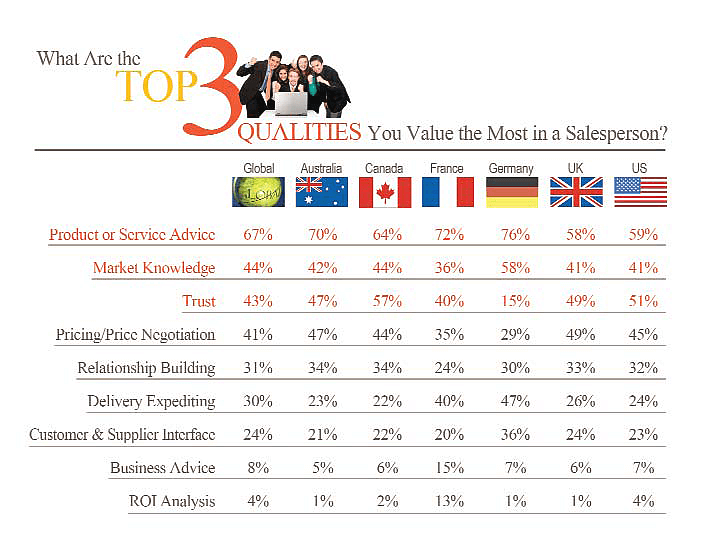
To succeed in selling, you’ve got to speak to the need your customer feels. There are a lot of good reasons, not to mention the entire history of successful selling, to back this up. As you can see from the DDI (Development Dimensions International) study below, ROI analysis is dead last in terms of what the client is looking for. In part, this is true because the ROI analysis is almost always slanted to the supplier’s point of view.

Source: DDI (Development Dimensions International)

Of course, people have both logical and emotional buying motives. Some recent consumer surveys show that 20 percent of the decision to make a purchase is logical and 80 percent is emotional. What is logic? It’s reason supported by facts. What is emotion? It is a feeling that leads us to act and react.

So, what is more important when persuading people – facts or emotion? We don’t mean to imply that customers never want cold, hard facts. Of course they do. You should always have them prepared and available, and you should present them when the time is right. But it is not facts that convince customers to go with your company. It’s emotion – do I feel you can you solve my problem?

Customers need to feel that you really understand their business issue and how it is negatively impacting their organization. They also need to feel that you will deliver their desired outcome and that you will meet their measurement for success. That measurement may not be the traditional business case ROI but rather what they have established as success. They will then use the ROI facts to “pay for” or rationalize purchasing the solution.

… But it is the ROI that Closes

While clients should be emotionally vested in you to consider the purchase decision, your client advocates still need to show that the return is worth the investment, otherwise you will not close. This is especially true if the contemplated investment of time, money and resources is significant. That is why customer knowledge is so critical – you cannot assist your client advocate in creating a compelling ROI without it!! And if you have the knowledge and can assist them in identifying their return so they can obtain the investment decision, you are a very valuable asset indeed … to them and to your own company!

22 Dec 20:55

5 Ways to Close the Strategy-to-Execution Gap

by Paul Leinwand
dec15-22-84308204

In an ongoing global survey of senior executives, more than half of the respondents said they didn’t think their company had a winning strategy, and two-thirds said they didn’t think their organization had the right capabilities to execute its strategy. Baffled by these findings, we set out to find and study examples of extraordinary companies that close the gap between strategy and execution — companies such as Amazon, Apple, CEMEX, Danaher, Frito-Lay (the snacks enterprise within PepsiCo), and Haier. What we found surprised us: Companies that are great at both strategy and execution don’t follow the prevailing practices of their industries. Instead, leaders of these companies excel at five unconventional acts — management practices that contradict conventional wisdom.

First, these companies commit to an identity. They avoid getting trapped on a growth treadmill, chasing multiple market opportunities where they have no right to win. Instead, they are clear-minded about what they do best, developing a solid value proposition and building distinctive capabilities that will last for the long term.

Take IKEA. From starting as one store in a Swedish forest to becoming the world’s leading home furnishing brand, it has always stayed true to its identity: “Creating a better everyday life for the many people.” Everything IKEA does — from its deep research into how people actually live at home to its frugal self-pick, self-carry, and self-assembly model — is designed to deliver on the promise of who the company is and what it does best.

Second, many managers assume they should adopt the best practices of their industry and treat external benchmarking as the established path to success. But the companies we studied believe otherwise. They translate the strategic into the everyday. They design and build their own bespoke capabilities that set them apart from other companies. Then they bring those capabilities to scale in their own distinctive ways.

For example, the Spanish apparel retailer Inditex, known for its clothing brand Zara, has turned the fashion industry on its head by perfecting its capabilities in fast, fashion-forward design and rapid-response manufacturing. This allows Zara to deliver an astonishing 36,000 new designs a year to more than 1,900 stores around the globe.

Another standard business practice for solving execution problems is structural change: reworking the org chart and rethinking incentives. The culture of the enterprise, if considered at all, is seen as a hindrance. But the companies we studied resist disruptive reorganizations and instead put their culture to work. They tap the power of the ingrained thinking and behavior that already exists below the surface in their company, using culture, not structure, to drive change.

The Brazilian company Natura does this beautifully. Its corporate culture celebrates relationships and nature above all else, which has helped it attract 1.5 million sales consultants. These brand zealots build relationships with seemingly every woman in South America, making Natura the region’s largest beauty and personal-care-product enterprise.

Fourth, a conventional company might try to reduce costs across the board by going lean everywhere. But the companies we studied cut costs to grow stronger. They marshal their resources strategically, doubling down on the few capabilities that matter most and pruning back everything else.

That’s how Lego went from losing a million dollars a day in 2004 to being the world’s largest toy company in 2015. The company had major expenses in areas like like clothing and theme parks, where it didn’t have the capabilities to win. Lego cut these businesses. And invested more in the things that make Lego truly special. Things like extending digital play from “bricks to clicks” and growing the global Lego community. Brick by brick this brought Lego back to profitability.

Finally, these companies are not trying to simply become agile. They don’t respond to external change as rapidly as possible. Instead, they shape their future by creating the change they want to see.

Starbucks is a classic example. Its customers thought they just wanted coffee, but CEO Howard Schultz knew they wanted “a third place,” beyond home and work, to gather. With 22,000 stores and counting, the company continues to develop its concept and to dominate the “coffee and community” space it created.

Operating as these companies do takes a lot of confidence. That’s why the quality and caliber of top leadership is so important. The companies’ executives eschew conventional wisdom, not for the sake of nonconformity in itself, but because they are focused on the fundamental questions about a company’s strategy, such as: Who do we want to be? What is our chosen value proposition? And they’re just as focused on fundamental questions of execution: What can we do amazingly well that no one else can? What other capabilities do we need to develop? How will we blueprint, build, and scale those capabilities — and put them to use?

They consider all these questions at the same time, in the same conversations with the same teams, so that strategy and execution are closely integrated in every decision. They do all this boldly, with the confidence and acumen that comes from having earned the right to win, the ability to engage in a chosen market with capabilities that consistently outmatch competitors.

We do not hold up the five acts of leadership as the only path a winning company might follow. But they are the only path we know that closes the strategy-to-execution gap. And no other path seems to provide the same kind of long-term sustainable success.

22 Dec 20:52

B2G sales: How to sell to governments

by steli@close.io (Steli Efti)

SeamlessDocs didn’t set out to revolutionize the way governments digitally process forms. The startup—whose software instantly converts PDF or Word docs into dynamic, smart, cloud-based forms—wasn't even thinking about the government.

They began like many other startups—with a vision, a couple of people, and a rough product. They had found some traction with small businesses, but not enough to achieve the kind of growth they aspired towards.

The turning point came two years ago, as Marc Ende, the company’s Director of Sales, was working late into the night. The phone started ringing: “Hey, can I get a demo? I work for the state of Tennessee. I’m in the HR Department, and was wondering if I can use your electronic signatures on my forms.”

This call changed the future of the company. (Here's Marc telling the story himself.)

Suddenly, everything clicked. Instead of selling to small businesses with a few forms each, SeamlessDocs looked at the government, and saw an industry drowning in permits, registrations, applications, contracts, and surveys. They saw a sector ripe for disruption, and the perfect market for their product.

The whole team sat down and decided to radically shift gears in their sales strategy to dominate one industry: the government.

Why the government?

To most people in the startup world, the idea of selling to governments is baffling. They don’t even know where to begin. If you work in a startup, the things you care about are probably the opposite to a life in public service: potential for growth vs. job security; freedom and autonomy vs. procedural process. The government seems impenetrable, with bureaucratic nightmares, tight budgets, and crazy contracts.

Endless questions pop up that steer most people well clear of pursuing the government. In many ways, selling to the government is uncharted territory for startups. It’s the road not taken.

But because no one really understands how to sell to the government, it’s a massive opportunity to blaze a trail, to go out there and actually do it.

The government is a huge space, ready to be disrupted. Today, 2.5% of government transactions are processed digitally. By 2020, this rate will jump to 33%. Once you get your foot in the door, it’s a market that’s waiting and ready to be cornered. Gartner analysts estimate that governments spent $424 billion dollar on govtech in 2015.

Let’s take a look at how SeamlessDocs transformed the trajectory of its business by focusing sales outreach on the government, and how you can do the same.

Four stages of closing the government

SeamlessDocs saw a huge opportunity for its business to grow and thrive by selling to governments. But one of the major obstacles getting off the ground in the B2G space was that there weren’t a whole lot of precedents for what they were doing. They had a lot of questions, but not many answers.

The company took a big risk by focusing on government sales. They set out to sell the dream, and they got there through trial and error. What they learned redefined their business, and they were able to create a scalable, repeatable process for B2G sales that continues to drive growth for the company today.

1. Get your buyer personas straight

In any area of sales, it’s important to get your buyer personas right, and know who you’re selling to, before doing anything else. This is especially true for the government, where you deal with many different buyers, all of whom affect the outcome of the sale.

When selling to the government, list-building is a lot easier than in traditional sales—all the information you need is available to the public. Unlike private companies, the government is transparent.

SeamlessDocs started simply. They went online.

They found the names, emails, and addresses they needed to start building their personas, and split them into three main categories:

  • User buyer: person who’s going to actually use and implement the product, typically in the IT department.
  • Economic buyer: the City Manager-type figure. This buyer controls the budget, and signs off on purchase orders.
  • Executive buyer: can be the same person as the economic buyer. City Manager, City Clerk, City Administrator, CIO, CTO—people who occupy managerial roles in government. This buyer looks at strategic issues and long-term effects of a product or service.

What SeamlessDocs learned about buyer personas in B2G sales is that they’re much more fixed and isolated than in other areas of sales. Government departments tend to be siloed, in contrast with startups, where members wear different hats, play many roles, and have a good sense of what’s going on between departments.

With governments, the IT department doesn’t really know what’s going on in the Mayor’s Office, and the Mayor’s Office definitely doesn’t know what’s going on in the Department of Records. You have to get a sense for how these different entities communicate with each other—and it’ll be different for each state or municipality. Understanding how these personas talk to each other allows you to delve deeper into the buying process, and develop a targeted sales strategy for each government.

2. Live on the phone (cold calls are your friend)

SeamlessDocs found cold calls to be the most reliable method of drumming up new business. Emails simply weren’t as effective—90% of the demos that SeamlessDoc sets up are via phone.

Think about your average government employee, with an inbox stuffed with emails from concerned citizens. They’re not going to give your cold email the time of day. Government employees live on the phone—live there with them. Getting someone on the phone is one of the most powerful ways to close deals, and it’s especially true when it comes to B2G sales.

You want to start by calling up the relevant IT user buyers—for SeamlessDocs, the website manager. They’re going to be the ones who understand the value of your product, and how it actually works. Get them to be your champions.

Kick the conversation off from an exploratory process. Find the specific pain points that your product or solution will resolve, and dig into the problem.

Here’s how SeamlessDocs' Marc Ende would start the conversation: “Hey, I’m on your website right now and I see 80 different PDF forms that citizens are burdened with printing, faxing, scanning, and emailing. 10 days later, once they submit that form to you, Chuck, what do you do with it?”

He knew that governments had huge amounts of paperwork to deal with, but had to find out exactly which pressure points these problems fell under.

He’d then ask more questions:

  • “So you’re using a filing cabinet to manage thousands of submissions?”
  • “Can I e-sign them?”
  • “Can I submit them online?”

Governments aren’t inundated with cold callers, and people who are trying to sell to them. They’re open to giving you information—use this to your advantage. Use your cold calls to find out as much as possible about the specific problems you’re trying to resolve and the people involved.

“You can find all [the information you need] directly on their website. If I called up and said, 'Hey, I want to know how much the IT Director salary is?', they’ll have to give it to me. They’re very open to giving information and they’re also not overwhelmed by cold callers. There aren’t many people who are trying to sell [to] them. So for the most part, they might not even know it’s a cold call. They think you’re just simply asking them a question. They have no idea. You’re a concerned citizen because that’s what they do get.”—Marc Ende

3. Demo the problem, not the product

You have to do your homework in B2G sales. But no matter how much research you do, nothing beats the power of the product demo in terms of actually getting inside the heads of your prospects, and figuring out their actual needs and concerns. In your product demo, you’re trying to get all the different buyers—user, economic, and executive—on board to help you push through the procurement process later.

Keep in mind that 70% of local government employees are over the age of 50. You can’t just dive into the technical aspect of your product, because a lot of your audience won’t know what you’re talking about. Don’t expect a City Clerk or City Manager to automatically understand what a “cloud-based form” is—or a “cloud-based” anything is.

In your demos, don’t start with your product. Start with the bigger picture.

Figure out what the current process for managing things is.

Marc Ende would kick off the demo by asking:

  • “How are you currently managing the form process?”
  • “What are some of the inefficiencies that you see?”
  • “Do you have any existing initiatives to redress this issue?”

Get everyone in the room to feel the pain behind the current process, and to see that there is a problem. Once that becomes clear, then you can flick on the product and zero in on how the problem can be solved. Frame your product as a specific solution to a specific problem, rather than just showing off your product.

Over time, SeamlessDocs learned that governments don’t tend to like new things—but they love efficiency. [Tweet this!]

Efficiency is the buzzword that lights up faces during staff meetings. When you sell to governments, sell efficiency. Figure out how you can make things run more smoothly while saving time and money, and you’ll be on the path to success.

4. Midwife the procurement process

Once you’ve aced the demo, your product still has to go through procurement before the deal is actually closed. There’s a gap between the stage of getting people excited about your product and the point when it’s actually purchased. To bridge this gap, you need to stay on top of the procurement process.

One of the most powerful lessons SeamlessDocs learned in B2G sales was to never make assumptions, particularly when it comes to the procurement. Just because Princeton is next to Jersey City, for example, doesn’t mean their procurement processes look anything alike—and if you make that assumption, you flush time and money down the drain.

Procurement is complicated

Procurement is basically the way that governments buy things. There’s two different kinds of procurement situations:

  • Single source: there’s multiple vendors supplying the product, and they each place a competitive bid on the contract.
  • Sole source: there’s essentially no direct competition—there’s only one vendor capable of supplying the product.

Because its product was unique and new, SeamlessDocs fell into the sole source category. They didn’t have to run through the bidding process with other companies, because those companies didn’t exist.

Even if you’re fortunate enough to be a sole source provider, though, you still need to do the legwork to let procurement run as smoothly as possible.

For example, if a government has a $5,000 dollar threshold for buying the kind of software your company sells, you have to know that. Then you can price strategically at $4,950 and make it easy for an economic or executive buyer to sign off on the purchase, without having to run it up the chain, or put it to a vote—dragging the process out indefinitely.

There’s all sorts of different checks and balances that regulate the procurement, and they differ from government to government. You need to find out the specific procurement process for the government or agency you’re dealing with, and follow it to the letter each time. The more you know, the more control you have over the entire sales process.

In Marc Ende’s experience, government sales cycles, from beginning to end, are an average of 90 days—regardless of deal size.

Increase internal buy-in

The best way SeamlessDocs found to work around the ambiguity of the procurement process was by increasing internal buy-in from the various decision makers and buyers involved in the deal. If you get these buyers invested in the product and vision, and willing to make the deal happen, it becomes that much easier to navigate the red tape.

Before a council meeting, for example, or a vote on adopting SeamlessDocs, the company would reach out to the various buyers involved with educational content geared towards showing them the value of their product.

They’d point buyers to other governments and cities that they had helped make successful: “Don’t listen to us. Listen to your neighbor all the way in Reno. Our product has a 99% approval rating from their constituents. They’re using it like this. This is how you could potentially use it.”

Governments are, by nature, skeptical of new solutions and entities. They hate to be first to anything. Use social proof in your sales process to help alleviate their concerns. Show them how their neighbor increased efficiency and cut spending through your solution, and how they can do the same.

Patience wins government sales

We love to criticize the government—for inefficiency, long lines, and bureaucratic despotism. But SeamlessDocs is just one of the companies actually out there on the ground, trying to help the government run more efficiently rather than just complaining.

And in doing so, they’ve increased the size of their team 8x, to 32 people—half of whom work in sales. Their list of happy customers is over 200 governments long, with hundreds more in the works.

What does it take to sell to the government? According to Marc Ende, it’s patience above anything else.

Selling to the government is about much more than just making a transactional deal. It extends beyond the handshake. It’s about pushing innovation on a truly vast scale. It takes salespeople who are committed problem-solvers, who are patient and dedicated to the task at hand.

In general, government employees move more slowly and are not incentivized so it’s vital you do not pressure them into the sale with discounts or other tactics. The pace of the sale is contingent on established norms and the employees reflect those norms. Value sells, discounts don’t.

This is a lesson that all salespeople can learn from. Look beyond just closing the deal, and the immediate parameters of the transaction, towards how you can provide real, long-lasting solutions for your customers. Ultimately it’s knowing when to push forward, and when to be patient and bide your time, that will carry you across the finish line.

Further reading:

Govtech: the $400 Billion market hiding in plain sight
An article by Ron Bouganim outlining the opportunity that's open to startups selling governments. The accompanying discussion on HackerNews is worth a read as well!

SBA Office of Government Contracting
If you want to start selling to federal agencies, the U.S. Small Business Administration offers free counseling and training services via their Procurement Technical Assistance Centers (PTCAs). They can help you determine if your business is ready for government contracting, get registered in the proper places (e.g. the Department of Defense's System for Award Management), see if you are eligible in any small business certifications and research past contract opportunities.

How to Get Government Contracts by Olessia Smotrova-Taylor
A 2012 book by Apress on how to sell goods and services to the government.

Zero to a Billion: 61 Rules Entrepreneurs Need to Know to Grow a Government Contracting Business
Written by the former COO of SRA international, this is a how-to guide for entrepreneurs wanting to build a government contracting business.

22 Dec 20:52

Amazon is going to teach its merchants how to sell more stuff (AMZN, WMT)

by Max Slater-Robins

jeff bezos

Amazon has introduced a new app that helps merchants market and sell their products in larger quantities, according to Fortune

Around 46% of all items sold on Amazon come from third-party merchants, according to the company, which is up by 5% since January 2015. 

Selling Coach is part of the Amazon Seller app which is given to merchants by the company. Amazon is also ramping up its fulfillment programme for third-parties which gives them access to the company's extension logistics network, payment processing, and item packaging (for a fee.) 

According to Mark Mitchke, the vice president of fulfillment at Amazon, the company is adding more merchant-focused features, including a control panel that displays sales data which can highlight items that aren't selling well. 

Walmart recently let third-party vendors sell through its website, creating competition for Amazon. 

Amazon's new app and other initiatives are an effort to increase the stickiness of Amazon's services for merchants who won't then sell on Walmart's website or through their own websites. 

"Amazon is really focused on what I call the fundamentals: selection, assortment, value, convenience and trust," said Scot Wingo, the executive chairman of ChannelAdvisor, to Fortune. "To provide those fundamentals to buyers, since 46% of the volume is from third-party sellers, Amazon is always improving the seller tools to encourage sellers to put up more product." 

Join the conversation about this story »

NOW WATCH: The CEO of this billion-dollar company explains why employees aren't allowed to ask for a raise

22 Dec 20:52

What If You Couldn’t Discount?

by Dave Brock

I always worry starting a post with, “When I first started selling…..” I fear that I sound like one of those grizzled veterans living in the past.

But when I first started selling, the company did something somewhat unique. The price was the price—period, exclamation point. The quantity purchased didn’t matter, the unit price was the same. It didn’t matter if you were the largest most important customer or the smallest, the price was the same.

To make things worse, our products, while very good, seldom had the latest greatest technology, we were also usually much more expensive than our competitors.

Some of you would look at those daunting circumstances and say, “How could you possibly sell?” It was challenging, but I couldn’t go to my management complaining, “We need to give them a discount,” or “We are just too expensive.” They were both unsympathetic and couldn’t do anything about it.

If I was to be successful, I had to figure it out. I had to learn how to sell without depending on pricing to win the day.

Some things I learned, pricing had little to do with the total costs our customers incurred in implementing solutions. The price was an element, but there were implementation costs, ongoing support costs, all sorts of things. I started to focus on TCO, total cost of ownership, recognizing, that even if I could do some discounting, often these had a relatively small impact on TCO.

I learned to look at risk. The company I worked for did as much as it could to minimize the risks of project success for the customers. Sometimes our competition had a far lower price, but they didn’t have the same track record of helping customers be successful, often project would fail or be delivered much later than expected. As a result, there was significant value in our solutions because there was very little risk in implementation.

Sometimes it was still tough, I had a good handle on the costs side of the challenge, but sometimes that was not enough. I started learning more about my customers’ businesses, I looked an their strategies, the performance objectives, and things critical to their growth and success. After all, my customers weren’t buying stuff just to do projects, they were buying stuff to achieve their objectives. Soon I started building business cases based on improved productivity, improved quality/customer retention, accelerating revenue growth, gaining share in their markets, improving their ability to differentiate their offerings for their customers. Soon, I started to learn that whatever I might have been able to offer in discounts (if I could have), were absolutely lost when you started looking at the business value.

Sometimes, my competitors would say, “We can do that too, but at a cheaper price.” Often, my customers would say, “But you aren’t the person helping us understand this and building the case.” But sometimes, the customer would come to me, saying, “They are cheaper….” Then I had to stretch myself and my team even further, I had to really understand the differentiation of our solutions, the difference in risks, and all sorts of things. I knew I was fixed in pricing, but I needed to narrow the gap in perception between competition and others.

Then there was a whole bunch of stuff we leveraged, sometimes a little heavy handed, to justify the difference. Things like the long relationships, the continued ideas to enhance their business, the resources to help solve their problems, the fact that we genuinely cared. But we got the customer to actually value us and our involvement in their company. They wanted us working with them. They knew that was part of the reason for our higher prices, but they found great value in our collaboration.

It was never one thing that caused us to win, it was always a combination of things. On reflecting, I don’t ever recall losing because of price. I lost because competition had a better solution, perhaps my competitors did a better job understanding the customer than I, perhaps they could offer capabilities we couldn’t offer. Sometimes, I was just outsold. But I never recall losing because of price.

Some of you might say, “Well Dave, the good old days are long gone, buyers are more demanding, things are different.”

I’m not sure that buyers are more demanding, the one’s I faced early in my career always sought the best deal possible, they wanted to maximize the return of their investments. They were sharp and savvy business people. Buyers are the same way today.

In the “old days,” buyers focused on overall business value, they do so today, as well. Though sometimes they slip and we have to teach them about total business value and not price

Back then, they wanted sales people to come to them with ideas about their businesses. Sure they were also interested in learning about products, since the internet was less mature, we still taught the about the product, but what justified my higher prices was they value my team and me helping them grow their businesses, becoming more effective and efficient. Customers value the same stuff today.

When I started selling, I had no choice. Discounting or taking pricing actions was not an alternative. I had to figure out how to win without discounting.

Today, there are many companies that actually have similar practices. Some don’t discount–at least current product. Try getting a deal for Apple products. Some discount only as a very last resort–and the discounting decision is made by very senior sales management.

But today, I see far too many sales people not leveraging everything they can to keep their normal price. Or worse, in their very first prospecting call, they say, “…..of course we can always look at discounting.”

It doesn’t take a lot of talent to win at the lowest price. You don’t have to learn the customer’s business, you don’t have to know much about the alternatives, you don’t have to create any value. All you have to do is be the lowest price.

It’s a difficult strategy for our companies to maintain—always winning on price, margins will continue to erode, ultimately many are driven out of business.

In many ways we are also cheating our customers. By competing on lower price, we can’t afford to create the value, we can’t help them understand and grow their business, we can’t help them manage the risk, we can’t help them be successful. Customers want these things! They tell us over and over by challenging us to create great value with them.

Even though you might be able to discount. Use that rarely and cautiously. Sell as if you could never discount.

You will be a far better sales person, you will win more, you will create greater value with your customer.

21 Dec 20:11

How to Read an Entire Book in a Single Day

by Patrick Allan

You’ve been putting off reading that book for weeks, and you’re supposed to have read it all by tomorrow. Whether you’re cramming for school, or trying to avoid looking like a lazy bum in your book club, don’t lose hope. You can power through that tome without forgetting everything and coming away with nothing.

Read more...

21 Dec 20:10

What changes to Air Canada’s frequent flyer rules mean for you

by National Post Staff
21 Dec 20:09

There's a new type of medicine that could save the US billions over the next decade — but not everyone wants that to happen

by Lydia Ramsey

white blood cell

At a point in American history when the public has never been so outraged by high drug prices, a new type of drug could be a major part of the solution.

They're called "biosimilars," and an easy way to describe them is that they're like a generic version of biologic medications, which are medicines produced by living cells. 

But it's a bit more complicated than that. Unlike generics for chemical-based drugs (think antibiotics or birth control pills) that can be interchangeable with branded versions, the copy-cats of biologic medications, which are produced using living cells, have a few more caveats because the drugs might have different reactions in your body.

Even so, they are the best way to drive down the cost of biologic medications that have been around for a while. Last month, the IMS Institute for Healthcare Informatics estimated biosimilars would have a $41 billion impact on the pharmaceutical industry over the next five years.

By other calculations, Dr. Steven Miller, the CMO of pharmacy benefits manager Express Scripts, told Business Insider the US could be saving $250 billion over the next 10 years. The discount of putting people on far less costly biosimilars — even just new patients who have never taken the original — will be substantial.

Whatever the financial impact, there are concerns about how and when biosimilars will get to market.

Whatever you do, don't call it a generic

No matter what part of the health care industry you're chatting with, it's clear: Biosimilars are not generics.

Here's why: When you have an ear infection and need antibiotics to clear it up, your doctor may prescribe you a branded version of the antibiotic that costs $50. But when you get to the pharmacy, the pharmacist might offer you the $5 generic version. It's likely worth the switch: The $5 version will have the same effect on your ear infection. 

Biologic drugs use cells to produce the medication. For that reason, every company owns their own cells, which come from plants, animals, yeast, etc. The companies test out these cells and use technology to make the cells produce just the right kind of biological material, like protein or sugars, that will treat a certain disease. That material is specific to the genetic makeup of the cells that produced it. 

AbbVie, a biopharmaceutical company, makes a number of biologic drugs that could one day face biosimilar competition. For that reason, they have a vested interest in making sure the drugs are prescribed to patients in the right way. 

"These aren't generics, because you can't exactly replicate the different cell lines," Jerry Clewell, AbbVie's US scientific director of biotherapeutics strategy told Business Insider. These cell lines are an important distinction between chemical and biologic-based drugs. But, companies are not interested in sharing their cell lines with competitors: Clewell said pharma companies have "Fort Knox-level security" over them.

Because companies won't share their cell lines, it means that people's immune systems (which many of these biologic drugs try to help out) might react differently to the drug. That could mean patients who respond to one drug might not respond to its biosimilar, or the drug could have much different side effects.

For that reason, the FDA has made it clear that the drugs are not interchangeable. That means only your physician can make the choice to switch you from one biologic drug to a biosimilar, or from one biosimilar version to another. So unlike being able to substitute a generic antibiotic for its far more expensive branded version at the pharmacy, biosimilars can't be so easily swapped.

The first approval

The FDA has shown that it is willing to approve these drugs so long as there are "no clinically meaningful differences in terms of safety and effectiveness from the reference product," according to their website. The FDA approved the first biosimilar drug in March 2015.

The drug, called Zarxio, helps patients in cancer treatment fight infection, and has the same active ingredient as the biologic it's similar to, called Neupogen. Neupogen is owned by Amgen, which is also developing nine biosimilars.

Zarxio was approved because it was able to show that it was just as safe and effective as Neupogen. The warnings of side effects for Zarxio are virtually identical to Neupogen. Even so, the two are not interchangeable, which mean there is a chance that if a patient were to switch between one and the other, there could be a change in the way the medicine reacts with their system. 

That includes a biosimilar version of the anti-inflammatory medicine adalimumab, which Amgen started filing with the FDA on November 25. Biopharma companies Boehringer Ingelheim, Baxalta, among others are also developing adalimumab biosimilars. 

AbbVie markets adalimumab as Humira to treat a number of autoimmune disorders including rheumatoid arthritis, Crohn's disease, and plaque psoriasis. The drug made $12.5 billion in sales in 2014.

Geoffrey Eich, a spokesman for Amgen Biosimilars, told Business Insider that the biosimilar competition Amgen would face from Zarxio inspired them to launch its own biosimilar development. Amgen had the experience of working with branded biologic drugs, so why not make biosimilars as well?

"Competition is a good thing," he said. "Biotech has to think about having an eye toward the end of a drug's life cycle to reinvest in new medicine."

Eich said the nine biosimilars Amgen has in development will challenge the $52 billion of yearly global sales that the original versions of the drugs make now.

A different kind of discount

Zarxio, which is owned by pharmaceutical company Novartis' generic drug unit Sandoz, was the first biosimilar to make it to the US market.

But, Miller said, people aren't buying it.

That's because the drug was just a 15% discount off Neupogen's list price. That wasn't enough to get pharmacy benefits mangers, which are responsible for negotiating prices of drugs between pharmaceutical companies and health insurers, to switch their plans to the new drug.

"Discounts are going to have to be greater than that," he said.

Sandoz did not respond to request for comment on this story.

On the other hand, the price cut won't be as low as it is with most generics. It doesn't take as much time, energy, and money to make a generic medicine. Eich said that to develop a biosimilar, it usually takes about eight years and costs about $250 million*. In comparison, a generic takes a quarter of that time (about two years) and costs a tenth of the price ($5 million) to produce.

Even though the Centers for Medicaid and Medicare think that might be the case to pay a lot less. At the end of October, CMS solidified rules on how to price biosimilars that make it more in line with generic pricing, becoming an outlier. 

Others, including Miller, are more realistic about the possible cost of biosimilars. 

"Do we think they're going to get to 60, 90%? The answer is absolutely not," he said. Miller estimates the sweet spot is somewhere around 30%.

*Note: An earlier version of this article misstated how much it costs to develop a biosimilar. It costs about $250 million to make a biosimilar.

RELATED: A new kind of 'generic' medication could save us billions on medicine by 2020

CHECK OUT: The FDA just approved a drug that could revolutionize the way we treat a type of blood cancer

Join the conversation about this story »

NOW WATCH: The richest billionaires under 35 and how they got their money

21 Dec 20:08

Mike Volpe on What Would Happen if You Shut Off Your Marketing

by Kyle Lacy

The problem with most marketing is that we do it just to do it. The bigger problem is that we constantly have to feed the beast. We’re always sinking money into it, and when we shut off the money faucet, the leads dry up.

I had a chance to speak with Mike Volpe, former CMO of HubSpot and current angel investor, at a panel discussion for OpenView Partner portfolio companies last month. We talked about, among other things, how to find top-notch talent and the importance of defining your own market.

I also asked him about the “best” kind of marketing, and what the new marketing landscape looked like. Mike said there’s really nothing new in marketing. Rather, we should just figure out how to use what we’ve got more effectively, and not waste money on things like advertising or “paying rent.” (More on that in a minute.)

He told us about a company he’s currently advising, and the changes they’ve made to their marketing program — like cutting marketing spend by 80%.

“They were spending a lot of money on all these advertising-related things,” said Mike. “The problem is that every single time you get traffic or a lead, you’re paying a toll for every single one of those.”

As you would expect, Mike is instead a big proponent of inbound marketing — free tools, a freemium pricing model, SEO, content marketing, and social media. “You do a bunch of work today and it pays dividends in the future,” he said. “It’s like building your own home. You don’t have to pay rent anymore, and you still have this awesome place where you can live.”

When Mike goes into any new company the first thing he asks is, “What would happen to your pipeline over the next three months if you cut your marketing spend by 100%?”

“If the answer is, ‘Holy shit, it would go into the toilet,’ then you’re not doing your marketing right.”

“All the stats that we showed at HubSpot said that if we cut all of our marketing, our new lead generation would only drop by about 30% over the next three to six months because in many cases content that was months and years old was still generating leads.”

As entrepreneurs, this is precisely what we need to figure out. How can we build something that will bring in business over the long haul, rather than a one time campaign like a billboard or TV commercial Because once the commercial stops or the billboard comes down, those leads disappear.

Instead, we must focus on building a framework that will bring in leads long after we stop. White papers, blog posts, how-to videos, and podcasts — most of your time, energy, and money should go toward building this evergreen content that lives on well after you’ve created it.

Advertising may bring in short term leads, but once you shut off the pipeline, everything will dry up immediately, which means you have to keep spending money to keep the pipeline full. Instead, put that same amount of money into content marketing and you’ll not only have a bigger pipeline after a few years, but you can scale back or try new tactics from time to time, without having a disastrous effect.

At the end of the day, good marketing is good marketing, and it’s going to be the same, regardless of the platform you choose, tactic you embrace, or buzzwords you throw around. Focus on the future, without spending a lot of money on things that won’t live on after the money stops.

The post Mike Volpe on What Would Happen if You Shut Off Your Marketing appeared first on OpenView Labs.

21 Dec 20:08

Pros & Cons of Having a Challenger Employee: How to Deal

by Ryan Mead

workplace-assessments

60% of workers are now asked to take workplace assessments in today’s modern workforce. This means more managers than ever have insight on their employees, how to work effectively within a team’s innate culture and what to expect when a new employee walks into the office on Monday. All of these are useful when we’re talking about the “fun” traits: creativity, extroversion, stability… but what about the traits that scare the heck out of the boss?

workplace-assessments

What about the challengers?

First off, remember that there are no “good” or “bad” traits. Everyone falls somewhere onto a spectrum of personality traits and work values (see the best personality assessment spectrum here). But it’s about understanding where on the spectrum someone falls. When you hear the word “challenger” there’s a good chance it has a negative connotation. But being a challenger isn’t a bad trait. Challengers can be an important part of your employee engagement team, a potential manager and an internal motivator… so long as you play your cards right. Let’s explore the pros and cons of a challenger employee and how to deal with this strong personality type.

Who they are: Challengers do exactly what it says on the tin. They challenge. Employees who score more on the Challenger side of the spectrum tend to be more opinionated, direct, skeptical and critical.

Pros

More than 75% of hiring managers say a candidate’s personality matters just as much as their technical skills. A Challenger is a personality trait that can be beneficial in the workplace. Challengers can be a bit of skeptics, meaning they are less vulnerable to groupthink and very unlikely to be managerial sycophants. These types of employees won’t fall for just anything or be pushed around but will be guarded and may need a little more convincing. While it can be frustrating to be challenged at every turn by a direct report, it can keep managers and fellow employees from falling into a creative rut or bad habits. Challengers can also help keep the moral and ethical tone of the office in tip-top shape and call management and executives out on promises unkept. Challengers are naturals in the field of law, sales negotiation, and fields where specific parameters should be adhered to. Another pro of a challenger is since they aren’t gullible they are more apt to think outside the box and not fall in line with the status quo. Ways to use your challenger:

● In proposal meetings. Challengers will often do well at negotiating a proposal and justifying specific line items or costs.

● To vet vendors: Your challenger will happily poke holes in a vendor’s pricing, pitch and proposal, saving you time and probably money.

● To research new processes: Challengers are open to changing things up, as long as there is a good reason. Let them go and find the newest and best ways to shift your work processes!

● Training new employees. To build resilience in your new employees, pair them with a challenger employee. This person will rarely accept excuses and keep them on a strict schedule but also help them to research solutions and systems on their own.

Cons

According to 2015 research by Connectria Hosting, 65 percent say they have “dreaded” going to work because of a colleague. Challengers can easily come across as contentious. Challengers can even come across as bullies from time to time, even when it isn’t intentional. This type of stronger personality can cause some tension with other strong personalities. Being an antagonist is another trait that can come through with a challenger. It could come across that they are constantly hostile or opposed to things, people or ideas. Situations to avoid with a challenger:

● Don’t put your challenger on a large, slow moving team. They may feel stifled, frustrated or need to grab control.

● Avoid making your challenger initiate sales. Challengers aren’t built for the “yes-man” nature of many sales positions.

● Don’t pair your challenger with another very strong personality. Both will wrestle for control and very little will get done.

How to deal

The reality is, you will have a challenger employee at some point. While there are serious pros to a challenger employee, it may depend on where you place them in the organization. Keep in mind, challengers are determined by the situation they are placed in. If the challenger becomes disruptive or disrespectful by all means, sit the employee down and have a conversation about how that will NOT help the problem. While skeptical and well, challenging, if you tell a challenger WHY certain behavior isn’t logical and doesn’t help, they are more than willing to rein in behavior. They rarely challenge the status quo to be difficult but more often, to improve a situation. Are they being a little too outspoken? Educate them when it is appropriate to give one’s opinion and how to let it go if they don’t get their way. It is important to enforce authority while still allowing them to have some freedom to walk with their leadership, creativity and ideas.

A quick tip,

Encourage more challenging co-workers to back off when they crowd more agreeable employees, especially if there is a power imbalance (supervisor to employee for example”

Do you have a challenger employee? What traits seem familiar about the above profile? Hit us up in the comments.

workplace-assessments

21 Dec 20:07

16 Email Subject Lines for End-of-Year Campaigns

by Andrea Wildt

It’s the final push of the year, and you need to come up with some incredible subject lines to use in your end-of-year email campaigns.

Your team is depending on you to produce some remarkable results, and you’ve been tasked with boosting open rates. While you may know the 8 formulas for getting your emails opened, and you’ve heard all about using the EMV Index, and you may even know about using power words in email subject lines, you could use a few creative suggestions to get your mental wheels turning (since holiday brain is hard to combat.)

To help set your mind in motion, we’ve assembled 16 email subject lines that can help you tap into proven, successful tactics for your year-end email campaigns.

Leverage a sense of urgency

Humans have an innate fear of missing out (FOMO) that often compels them to act. Have you ever seen an ad that says you only have a few hours left to take advantage of a crazy discount and immediately ran for your wallet? If so, you understand that urgency can be a powerful motivator when it comes to acting quickly.

Within an email context, creating a sense of urgency has been proven to work. One study tested using urgency in an email subject line by stressing the limited number of seats for an event–and saw a 15% increase in their open rate.

So how can you write email subject lines that leverage urgency for your end-of-year campaigns? Here are a few ideas:

  • Only a few hours left to get 30% off!
  • Midnight deadline for your tax-deductible donation
  • ONE MORE DAY to shop our holiday sale
  • Last chance to support (X cause) in 2015
  • Save 40% before the ball drops!

Takeaway: Give your readers a reason to act right now by creating a strong sense of urgency in your email subject line.

Bonus: You can also extend your offer to get a bit more mileage out of it and let people who didn’t open, or those that opened, but didn’t click get another shot at your offer. See how Legacy Box does it in this email example:

Legacy box New Year campaign

Create an information gap

Curiosity can also help boost your email open rate. How? Researchers found that creating an information gap was highly effective at motivating humans to act because it cognitively induces a feeling of deprivation. If you’ve ever clicked on a BuzzFeed article, it’s probably thanks in part to this same tactic. You just had to know what that unexpected person’s reaction was, right? We all do it.

You can create an information gap in your New Year email subject lines by making readers curious, like in these examples:

  • See how we (increased X) by (YY%) with this simple switch
  • Invitation for you: Join our Secret Sale
  • Wait…you missed this?

Takeaway: Curiosity created by an information gap encourages readers to open your email and find that missing piece that’s itching at their brains.

Offer an email exclusive preview

You can build excitement and anticipation with an email subject line that teases something coming to your business in the new year. Giving your email subscribers first access to new content means they’re getting access to exclusive material–and reminds them that they are part of a limited group of people who get special, members-only benefits.

Psychologists have proven that when humans recognize scarcity, they place a higher value on the limited resource. So when you write an email subject line that reminds them they’re part of a special group of people who get early access to things like new items coming in the new year, they’ll see more value in opening your email.

Some examples that tout exclusive previews for the new year:

  • Coming Soon: A Preview of Our 2016 Collection
  • Get the First Look! Subscriber-Only Sneak Peek
  • New Boots in 2016–Here’s What’s Coming in 2 Days!

Birchbox offers subscriber exclusives in this engaging campaign:

birch box email exclusive offer

Takeaway: Make your subscribers feel like VIPs by writing email subject lines that remind them why they’re on your list in the first place.

Year in review: Your best work

Subject lines that tout your best promotions, content, products, etc. from the past year inform subscribers that you’ve cherry-picked the best of the best for them. And, by removing the legwork for the reader and showcasing your best work, you tap into a very basic psychological principle: Avoid pain, seek pleasure.

Here are a few ideas for subject lines that look back on the year in review (and promote your best content):

  • Top 10 ______ of 2015
  • Thank you for an amazing year! 2015 Year in Review
  • The most popular blog post we wrote in 2015: Read now

Check out the example we sent Campaign Monitor customers with our Year in Review:

Campaign Monitor year in review email example

Takeaway: Let your year-end email subject line make life easier for readers by showing them your best material from the whole year.

Planning for the new year

The dawn of a new year is probably one of the few times when people become more open to change or to trying new things. It’s a hard stop to the previous year and a fresh slate for new beginnings. People get gym memberships. They make resolutions. They plan for a better, more successful year.

Check out this infographic-style email from Sephora that combines an email-exclusive offer with new trends to try:

Spear New Year email campaign

You can tap into that positive frame of mind by writing an email subject line that showcases your own insight for a successful new year–whether that’s through your best tips, an insightful case study, or a strategy you’ve created.

Think along the lines of:

  • 5 Tips for Growing Your eCommerce Business in 2016
  • How we (did X) in (Y days/weeks/months)…and you can too!
  • Want to (do X) in 2016? Start here…

Takeaway: Help readers plan for the year ahead by writing an email subject line that tells them exactly how they can be more impactful in 2016.

Wrap up

You have endless options when it comes to writing your subject lines for year-end campaigns, but the tips outlined here can help you before the ball drops!

21 Dec 20:07

5 Last-Minute Email Campaign Ideas for Christmas

by Jeremy Taylor

5 last-minute email campiagn ideas for Christmas

It’s coming. It’s so close you can smell the Christmas turkey. But there’s still time to squeeze a little extra from your email marketing and boost engagement with your subscribers. Here are five last-minute campaign ideas that are a doddle to compile.

Christmas postage deadlines

Got an online shop? Spare a thought for the people on your email list who aren’t superhuman. You know, the ones who didn’t have their Christmas shopping finished by 5th December. A good chunk of your customers will leave their Christmas shopping until the last minute. Do them a favour and send out an email highlighting your last order dates. It’s a simple idea that’s incredibly useful. And your readers will love you for it.

For bonus points include the name of the courier or delivery handler you use — and state whether or not your customer will need to be available to sign for their package. One simple email is all it takes. After that you should strongly consider including your final delivery dates at the bottom of every subsequent pre-Christmas email.

An irresistible offer

There’s an awful lot of money sloshing around at this time of year. But once the gifts have all been bought — many consumers tighten the purse strings. Thing is, they don’t know about the irresistible offer you’re about to dish up. That might be a one-day-only flash sale with 50% off all products, or a luxury hamper with every order over a certain value. Be creative. The aim is to make your offer so compelling that your prospects can’t resist taking action.

Quick word of caution? Don’t bombard your reader or go for the hard sell. Email marketing is an incredibly cost-effective way of reaching out. But sending too many emails – particularly at Christmas when most people are busy – can be counterproductive. Not only will your reader not act, you could turn them off your brand forever.

Extended holiday hours

If you run a high street shop and are extending your opening hours in the run up to Christmas, let’s try to get as many people through those front doors as possible. It’s easy to fire out a quick email with your Christmas opening times. Pro tip: if you have data on where your subscribers live, use segmentation to target locals rather than pestering subscribers who may live on the other side of the country.

End of year review

Marketing is about nurturing a relationship with your audience, customers and clients. An end of year review of what you have achieved, or how you have helped customers, is a nice way to build bonds. Just remember to respect your reader’s cluttered inbox. Short and sweet is the way to go. If you have lots to say, you could always write a blog post and include a link in your bite-sized email version.

Look ahead to the New Year

Alternatively you could look ahead to your next twelve months as a business. If you have something exciting planned — be it a product, service, event or new store — a teaser email is a great way to build anticipation.

Bonus tip: Create a segmented list of the people who purchase at Christmas

Everyone loves a nice surprise. Segment your subscribers based on whether or not they have purchased from you during the festive season. Now, what if you followed them up in January with a discount voucher to say thanks for shopping with you? You’ll win some serious brownie points and potentially turn a one-time purchaser into a regular customer.

Let’s wrap up…

Until the big day has passed, it’s never too late to wring the last few drops out of your Christmas marketing campaign. And with the easy-to-execute ideas above, you can stay near the front of your audience’s minds without bombarding your subscribers with the hard sell. Over to you!

21 Dec 20:05

No one Cares about YOU or Your company!

by Kira Moore

No one Cares about YOU or Your company!

 Rule number one in sales, no one cares about you or your company:

  • No one cares how long your company has been in business or who your customers are.
  • No one cares where you’re headquartered or how many offices there are.
  • No one cares how long you’ve been on the INC 500 or how much your company has grown in the past 5 years. 
  • No one gives a shit about you or your company. 

When a prospect calls you or even more importantly when you call a prospect and they agree to give you a meeting, the last thing they want to hear about is you and your company.  When they agree to meet, a contract has been created. In consideration for their time they expect to learn something that can help them solve their problem, not hear about your company. 

Your prospects are stupidly busy, they didn’t agree to meet so you could bore them with trivial, impertinent, self-absorbed information.  In exchange for their time, your customers or prospects want insight. They want to learn something.  They want to know how your product or service is going to help them grow revenue, shorten production, or improve time to delivery.  Pull out your pitch deck or presentation and take a look at the first few pages,

I got 10 bucks it’s all about you and your company.  Therefore, it’s a pitch deck — pitch it!

Your prospects or customers want value. Know what you can do to make the life of your customers better and start there. That’s why they agree to meet you!

21 Dec 20:05

Canadian dollar’s decline couldn’t have come at a worse time for Canada’s debt-laden households

by Luke Kawa, Bloomberg News

The U.S. greenback broke above $1.40 (71.42 US cents) versus the Canadian dollar late last week in the wake of a softer than expected inflation and wholesale sales prints north of the border.

And according to Scotiabank Economist Derek Holt, the timing of the loonie’s slump is abysmal as it drains debt-laden households’ purchasing power precisely when big-ticket purchases like cars and autos are running at all-time highs. And the higher they are, the farther they could potentially fall.

“The currency’s plunge couldn’t have happened at a worse time for the country’s household sector,” Holt lamented in a note published on Friday.”When a currency declines as CAD has alongside a deep negative terms of trade shock, it is among the mechanisms through which markets price a large wealth transfer out of the country to the regions of the world that are large net importers of commodities.”

Looking at oil prices (the largest source of the terms of trade shock), copper prices (a channel through which the loonie is treated as a proxy for Chinese and global economic activity), or interest rate differentials between Canada and the U.S. (which incorporates the other two factors into the forward outlook for monetary policy), it’s no surprise that the loonie’s wings have been clipped.

chartloonie

This loss of national wealth necessarily dampens the outlook for Canadian consumer spending, concluded Holt.

Real retail sales growth has slid from 3.8 per cent year-over-year at the end of 2014 to 0.9 per cent as of September. Current dollar retail sales in Newfoundland, Saskatchewan, and Alberta have declined on an annual basis. In those commodity-producing provinces, hits to employment in resource extraction have compounded the deleterious effect that a lower currency has on households’ aggregate purchasing power.

Import compression has occurred, Holt acknowledged, with real volumes shrinking in back-to-back quarters, but import substitution — making goods or services domestically that were previously produced by foreigners — might not be in the cards.

“Canada doesn’t produce at home many of the consumer goodies that are desired especially on the bigger ticket side of the equation,” he wrote. “It is also unlikely to start doing so.”

In some respects, the macroeconomic backdrop in Canada is similar to that of the mid-1990s. One major segment of the economy is overextended and in need of deleveraging. Back then it was the government, now, it’s households. The loonie had softened, and external demand from a buoyant U.S. was — and is once again — required to help smooth the transition process.  

Unfortunately for Canada, the Boy Meets World era is over.

Mexico happened to be in a particularly rough patch in the mid-90s (remember the Tequila Crisis?), which indirectly helped support the expansionary austerity that took place in the Great White North.

The depreciation dividend, in terms of cashing in on U.S. demand, isn’t expected to yield as much for Canada this cycle. That’s a function of structural shifts in U.S. non-commodity imports, with Canada’s shipments to the world’s largest economy stagnating while Mexico’s have picked up steam. Currency fluctuations have done nothing to boost Canadian competitiveness in this regard, as the loonie and peso have lost nearly exactly as much value relative to the greenback since the start of 2014.

“It adapted, restructured, and became more competitive and its currency enables it to grow import market share in the U.S.,” wrote Holt of Mexico.

Moreover, the part of the economy in need of deleveraging this time around — households — is substantially larger.

“When judging the hit to the household sector there are two things to bear in mind: the starting point on the equilibrium matters enormously and that points to record highs across everything we can track by way of consumer and housing metrics,” wrote Holt. “When your nation’s consumers have spent to the max because their purchasing power in world markets became so strong and then sharply weakened, the scope for significant downside risks cannot be ignored.”

Bloomberg.com

21 Dec 20:05

This is the new normal in venture capital

by Alan Patricof and Ian Sigalow, Contributors

tea cake pie

The old adage that “Only 10 venture investments matter each year” has officially been debunked.

A new study by Cambridge Associates, the benchmark for VC performance data, found that the distribution of venture capital returns changed dramatically after the 1999 Internet bubble.

Today the majority of venture capital returns annually come from investments that are further down the tail and outside of the top 10 industry-wide outcomes. This is in stark contrast to many pre-conceived notions in the industry.

According to Cambridge Associates, since 2000, over 60% of the industry returns on average came from investments that were outside of the 10 largest outcomes. This is a significant departure from the pre-1999 era when the top 10 investments were a much larger percentage of the total pie.

Another interesting finding from the study is the democratization of returns across fund managers since 2005. Counter to conventional wisdom, between 40% and 70% of value creation in any given year has come from new and emerging managers, with established funds generating a minority of the industry’s performance over the same period.

The data bodes well for smaller funds, too. Over the same period, managers with less than $500 million have accounted for a majority of the industry’s returns, despite investing less money on average than the larger funds.

The last insight in the Cambridge report is that non-traditional venture markets are rising in their importance. California, New York, and Massachusetts are still the largest markets for venture capital returns, but at least 20% of returns consistently come from outside these hubs.

We expect that these last fifteen years are the new normal in venture capital.

Great technology companies continue to pop up outside of traditional venture capital hubs, and we have seen that in our own business as we have traveled to Florida, Indiana, Minnesota, North Carolina, Ohio, and Utah this year, as well as international markets like Iceland, Estonia, and China.

Surprisingly, only 17% of our companies are headquartered in Silicon Valley today.

Meanwhile venture managers who have concentrated portfolios should consider a diversified approach. As the distribution of returns moves from the head to the tail, a manager needs to make more investments each calendar year to be successful.

The time when a manager could drive to all of his or her portfolio companies and routinely expect a handful to generate 100x returns has come to an end.

While Greycroft successfully raised a small fund recently, we hope the many institutions who read the Cambridge Study will follow this advice and look for other emerging managers. There are so many small funds out there struggling to attract capital, just like we did back in 2010.

If these managers have a good strategy they too can generate top returns.

Alan Patricof is cofounder and managing director of Greycroft Partners. Ian Sigalow is a partner and cofounder.

SEE ALSO: 11 apps 'The 4-Hour Workweek' author Tim Ferriss uses every day

Join the conversation about this story »

NOW WATCH: JIM CRAMER: Is college still a good investment?

21 Dec 20:04

Latest Gartner Hype Cycles for Digital Marketing: 2009-2025

by Dave Chaffey

Evaluating technology options for innovation in marketing - do you know your Hype Cycles? If you're involved in marketing strategy development, you will be constantly making judgments and reviewing with colleagues which digital technology innovations are most relevant to your …..

The post Latest Gartner Hype Cycles for Digital Marketing: 2009-2025 appeared first on Smart Insights.

21 Dec 20:03

Commit to Under-Scheduling in 2016

by Elizabeth Grace Saunders
dec15-21-88165696

“Oh, no!” I thought as soon as I spotted the email in my inbox. The message that prompted my sense of dread wasn’t a cancer diagnosis, a huge financial loss, or even a missed deadline. It was an email from a good friend, inviting me to attend an event that evening — a night I had planned for “me time,” including doing some cleaning for a party, running errands, and writing Christmas cards.

To be clear: I’m far from antisocial. I am usually out with people three or four nights a week. I really did like this friend, and the event sounded interesting. I am open to spontaneous invites, and I had accepted about three of them the week before. But on that particular day, my innate emotional response told me that I needed to keep my evening free to preserve an overall sense of peace, spaciousness, and order in my life.

But another part of me felt guilty about declining the invitation just to have time to myself. It felt like telling a guy you can’t go on a date because you need to wash your hair. So I went back and forth all day about it: Could I get my to-do list done before events later in the week? In my rank of priorities, friends are more important than my home, so was I being a bad friend?

In the end, I didn’t go to the event. I let my friend know I would be open to attending the event in the future but I already had some plans for that evening. The decision led to a peaceful evening and nice flow to the rest of the week.

This situation highlights a truth I’ve been exploring with my time-coaching clients over the last year. To feel most joyful and satisfied, you need to not only accomplish certain priority items but also prioritize certain experiences of time. In this case, I needed the experience of “breathing room.” I wanted to savor tasks like writing Christmas cards instead of feeling like I was working on an assembly line where efficiency was the only goal.

You and Your Team

  • Mindfulness
    How to bring calm and focus to your work routine.

Sometimes, very small shifts in how you use your time can make the difference between feeling focused and productive at work, with energy left over for home, and feeling like you’re pulling yourself through the day in a fog of exhaustion only to collapse on the couch at night. For example, make it a rule to have at least 15 minutes between meetings to wrap up your notes, get a drink of water, and have a moment to breathe. Even those few minutes can help you feel good about what you accomplished and leave the office satisfied — instead of feeling overwhelmed by loose ends and. Is having 15-minute gaps technically the most efficient? No. But can it be effective at helping you finish tasks and feel like you have space to think? Absolutely. The same principle holds true for blocking out a few hours of uninterrupted time each week to move ahead on a priority project or to exercise.

Unfortunately, these sorts of experiences often get pushed out or devalued in traditional productivity advice, particularly when it comes to our work. As a time investment expert, I’m interested in ways you can push back and reclaim the joy in your time. Because as Brené Brown shares in her talk on The Price of Invulnerability, “So often we’re missing what’s truly important because we’re on the quest for what is extraordinary.”

Here’s how to reclaim your desired experiences of time:

Define what success feels like for you. Get clear on your desired experience of time. For me, it’s really important to have the ability to calmly prepare for projects at work or activities at home, exercise regularly, and be completely present with people. To another person, the mountaintop may be feeling like they can pick up and leave on the weekend to go skiing or hiking. For others, the ideal could be simply having the bandwidth to stop and pay attention when someone asks him a question.

Be honest about “must do” activities. It’s amazing how often we think of something and then turn it into a burden or obligation when it was self-generated. The truth is that it’s completely up to us whether we complete the task or do the activity. If you want a different experience of time, be honest about what truly needs to happen to make life work. These “must do” activities should then find a place on your calendar to get done. The “would like to do” activities can go on a separate list that you can either move ahead on as you have time or hire someone else to do. This is especially critical for those who choose not to work full-time. Often, they think they should be able to fit everything into their schedule, which can end up making them more stressed than those who do work 40+ hours a week.

Under-schedule your calendar. The ideal amount of meeting time varies from position to position. But as a general rule, you’ll end up with your best experience of time if you have four hours or less of meetings per day, or group your meetings together on certain days so that you have one or more meeting-free days. Outside of work, your life can feel much calmer if you have at least one unscheduled weekday evening and at least half of a weekend day that’s more relaxed. During that open space, block in time to move ahead on projects and activities that are important to you. Open space doesn’t mean that you don’t intend to do anything, but it does mean that you can focus on something without feeling like you need to rush through it and quickly move on to something else in 30 minutes. To maximize the value of this time, close your e-mail tab and silence your phone (or at least the random alerts) so you can be open to the activity of the moment.

Decline activities and tasks that aren’t aligned. Once you’ve set aside this time, stick to it. Many people feel pressured to accept new tasks or projects just because they see the open space on their calendar. But remember, you’ve set aside this time for a reason: to focus on your own priorities. When someone asks you to do something that would cut into that time, you need to give yourself permission to decline if that activity isn’t aligned with your goals. You’re not lying to say you’re booked or at capacity when you have set aside the time for yourself.

Savor the beauty of the everyday. The key to happiness may have nothing to do with fitting something more in your schedule — and may have everything to do with stopping to enjoy what’s already there. I wake up two hours before I need to be at my desk so that I can savor the beauty of mornings. I make it a point to be thankful for my food or to take in the beauty of the greenery outside my window and to think, pray, and journal. Those two hours are an important source of happiness for me because I’m attuned to noticing and appreciating the good in them. Science has shown that focusing on positive cues and showing appreciation for them can lead to an increase in feelings of happiness in a matter of days. Even a few minutes of relishing something that you usually rush through can reduce depression.

In this holiday season, and especially in the new year, give yourself permission to prioritize your desired experience of your time, not just your priority items.

21 Dec 20:03

Planning Your 2016 Content Marketing Calendar

by Guest Post

Planning Your 2016 Content Marketing Calendar written by Guest Post read more at Duct Tape Marketing

2016 content calendarThere are only a few weeks left in 2015, and that means it’s time to start planning your marketing calendar for 2016.  Actually, that time was about three months ago, but we both know that you’re probably just now getting around to it.  Hey, no worries—we’re all busy small business owners here, so we’re not going to judge you if you’re running a little behind.  If fact, I’d like to give you a bit of a head start on your marketing plan for 2016 by helping you map out your content marketing plan for next year.

Below, I’ve provided twelve ideas for blog posts that can be applied to any business—that’s one blog post for each month.  After writing each blog post (or having a copywriter write it for you), read it or summarize it while standing in front of a camera—use teleprompter software from freetelepromptersoftware.com to help you.  Upload the video to YouTube and/or a video podcast on iTunes.  Then, copy and paste at least a portion of the blog post into your email newsletter template, and send that to your list once a month.  

Do that, and you’ll have 36 pieces of nice educational content about your business by the end of 2016 that will bring you traffic and leads well into the following year and beyond.  Are you ready?  Let’s get started:

January: Share your goals for 2016

Most people spend some time around the New Year at least thinking about setting some goals for things they’d like to accomplish during the year.  Some people even end up actually setting those goals.  By “setting goals” I mean putting in writing exactly what you intend to accomplish and when you intend to accomplish it by.  People who do this are far more likely to accomplish those goals.  

If you set goals for your business in 2016, why not publicly share them with your customers on your blog in January?  People respect businesses that are constantly seeking to improve and grow.  Yes, there is a danger that if you end up not accomplishing goals that you shared publicly, people might be aware of your failure.  Who cares?  People will still appreciate the fact that you’re even trying, and they’ll trust you more for being authentic.  

February: Interview an employee

Help your customers get to know your staff a little better by featuring one of your best employees on your blog.  Interview them about their job, using some or all of the following questions:

  • How long have you worked here?
  • What do you like most about your job?
  • Share a story about a time you really helped a customer solve a problem.
  • What do you like to do in your spare time?  

To make this really powerful, do the interview on video and use the transcript for the blog post.  If you don’t have any employees, interview a vendor instead.  This will help your customers become more comfortable with your team, which will make them trust you more.  You never know when that trust might come in handy.

March: Do a “top 10” or “roundup” style blog post

This is a blog post where you make a list of great resources your customers might be interested in.  For example, a CPA could post a list of the top ten personal finance blogs or top ten budget apps for smartphones.  These types of posts tend to generate lots of backlinks, especially if you contact all the sites you link to in the post and let them know they’ve been featured on your blog.  

April: Answer a “Should Ask Question”

A “should ask question” is one that your customers should ask about your products or services, but don’t know enough about what you do to even know to ask those questions.  These types of questions really position you as an expert in your niche and demonstrate how smart you are to potential customers.

May:  Answer a “Frequently Asked Question”

While “should ask questions” make great content, the problem is that not a lot of people will be searching for answers to these types of questions on Google.  That’s where frequently asked questions come in handy.  Check your “sent email” folder to see what types of questions you and your staff answer over and over again.  Pick one topic, and write an 800—1,000-word blog post about it.  These tend to show up in search results, especially if you get a few quality backlinks to the post.  

June: Do a seasonal post

June marks the beginning of summer, which in the U.S. is a time of transition for many people and businesses.  Schools close for the summer, colleges shift to different schedules, some seasonal business wind up for their busy season and others wind down for a few months (think ski resorts).  Many families get ready to take their annual vacation.  Just about any business can find a way to relate their products or services to one of these transitions.  Use this for June’s blog post.

July: Interview one of your customers or strategic partners

Everyone loves seeing their name in the paper, even if it’s just your paper (aka, blog).  Invite one of your best customers to be interviewed for a feature on your blog and in your email newsletter.  Ask them questions like:

  • How long have you been our customer?
  • What do you like best about what we do?
  • How have our products or services benefitted you?
  • What tips can you offer other customers to help them get the most from our product or service?

For some businesses (divorce attorneys, counselors, etc.) this might not be appropriate due to privacy concerns.  In that case, interview a strategic partner instead of a customer—it will work just as well.

August: Publish an infographic

Infographics are all the rage these days, and if you can create one that helps people in your industry support their position on a topic—especially if that topic is somewhat controversial—it could get a lot of shares and links.  There will be a cost of time and money involved here to develop the infographic, but if done well, it will be more than worth it.

September: Invite a strategic partner to write a guest post

After working hard on your blog for eight months, it’s time to take a month off.  Let someone else create some nice content for your website by inviting a strategic partner to write a guest post for your blog.  Make sure they know you will promote their post on social media and in your email newsletter.  Also, make sure they understand the SEO value of writing a guest post—just send them a link to an article that explains guest blogging to them.  

October: Write a case study about a successful project you’ve completed this year

Hopefully, by this point in the year, you have a least one major success story under your belt for 2016.  Write a case study about it, including what life was like for your customer before they found you, what you did to help them, and how life was better for them afterward.  Include numbers and data to support your case study if possible.  This might just be the most valuable blog post you write this year because you can use it in your lead conversion process for a long time to come.

November: Write a post about the holidays

Yeah, I know, writing a blog post that somehow relates your products and services to the end-of-year holiday season is cliché, but let’s face it—this time of year, it’s probably what you and your customers are going to be thinking about half the time anyway.  You might as well acknowledge that and use it to create some content for your blog.

December: Do a year-in-review post

Remember that blog post you wrote in January about your goals for 2016?  Do a post updating your progress regarding those goals, along with anything else your business accomplished during the year.  If it was a bad year, focus on some of the challenges you had to overcome.  If it was a good year, highlight your achievements.  

In either case, spending some time thinking about everything you managed to do during the course of an entire year is a valuable exercise.  Chances are you’ll be shocked at how much you accomplished.  If you had told me at the beginning of 2015 that by the end of the year I would become a best-selling author, be named to a list of the top 100 business bloggers of the year, and be the president of a brand new BNI chapter, I wouldn’t have believed you—but I accomplished all those things and more.  

If you stick to the content marketing plan I outlined above for an entire year, I’ll bet that by the time you write your year-in-review post for 2016, you’ll have some pretty impressive accomplishments to discuss as well.  

21 Dec 20:02

This is the smartest business move you're not making

by Sponsor Post

CBRE 3

In the world of modern business, where you are is just as important as what you do. The right location plays a big part in attracting qualified talent, allowing more collaboration, and presenting a relatable, physical association for customers and clients. Today, real estate is not necessarily seen as a source of competitive advantage – but it very much is. It's actually a tool that can drive business.

Skilled real estate management is a discipline; lack of experience can have serious consequences. Both new and established companies are susceptible to bad real estate decisions without realizing the implications they can have on the business — or the value a good real estate move can offer. Here's how one company has used real estate as a successful business strategy. 

Taking a historic company into a new era

Young & Rubicam is one of the most recognized and respected ad agencies in the world. But a few years ago Y&R was going through changes. For more than 86 years, the agency’s global headquarters were at 285 Madison Avenue in New York City, and the space was synonymous with the agency itself. However, as Y&R continued to expand, its space on Madison avenue no longer provided the amenities it needed. Finding the right space was critical for Y&R; not only did it have to meet its expanding needs, it also had to be a space where the agency's culture, ethos, and creativity could thrive.

Working with CBRE, a commercial real estate services firm, Y&R identified 3 Columbus Circle as the ideal site for its new global headquarters. CBRE helped Y&R secure a hybrid deal to acquire a condominium interest of floors three through eight, and enter into a 20-year lease for floors nine, 10, 18, and 19 at 3 Columbus Circle.

CBRE 3One of the many draws of the new building is that it provides a number of features that are appealing to both employees and clients, including a sunlit mix of public and private space. Different pieces of art on the walls match the creativity of the campaigns that come from the agency teams. Recognizing that the office is where many employees spend most of their time, Y&R created a number of break areas: a roof deck where people can enjoy stunning views of Central Park; a cafeteria that offers a number of different dining options; and areas for employees to relax and even play foosball and shuffleboard. 

And it's not just the actual building that can influence employees' happiness — the location is also a big draw. The neighborhood has easy subway access, so it's convenient for employees from across the numerous New York City boroughs. Because the office is part of a hub that houses other agencies within WPP (Y&R's holding company), it creates a great space for Y&R to collaborate with colleagues at sister firms. 

The space has proven to be a valuable asset for Y&R, helping the firm deliver on its best-in-class creative reputation and serve as a place where both employees and clients want to be. Another reminder that it’s not just about what you do, but where you do it.

Find out more about Y&R’s story and how the right real estate can help your business.

This post is sponsored by CBRE.

Find out more about Sponsored Content.

SEE ALSO: Companies are now using this strategy to win the war for talent

SEE ALSO: Here are the top US cities for tech talent

Join the conversation about this story »

21 Dec 20:02

Why Marketers Should Embrace Millennials Marketing

by Jim Fisher

The increasing significance and impact of Millennials in the marketplace can be seen as a real plus for those who have always recognized the sales generating value of “The Brand,” both short and long term, and how it connects to Millennials Marketing.

Why Millennials Matter

Most sources put Millennials into the 18 to 34-year-old category (book ended by an older Gen X at 35 to 50 and a younger Gen Z at 2 to 17), and there are now more Millennials (75.3 million) than Baby Boomers. More importantly, Millennials are outspending Baby Boomers with over $1.3 trillion in annual spending.

How Millennials Are Different—Values and Technology

General indications are that Millennials are less attached to conventional institutions because they are more likely to be politically independent (50% versus 39% of Gen Xs) and religiously unaffiliated (29% versus 21% Gen X). Not surprisingly, they tend to be distrustful with only 19% believing people can be trusted (31% for Gen Xs). Millennials are also carrying more debt for their age and are not in a hurry to get married (only 26% were married at 32 versus 36% for Gen Xs).

However, even though they are facing more economic challenges and might be expected to have less faith in the future, Millennials are optimistic. They are as optimistic as the previous generation which experienced significantly better economic conditions, and 85% have confidence in their future earnings measuring up to their expectations.

Of course, technology and social media are major factors in Millennials’ lives and, therefore, Millennials marketing. They have wider networks of friends, with the typical Millennial having 250 Facebook friends—fifty more than the Gen X counterparts. With Facebook, Instagram, and Snapchat, they are twice as likely to be taking selfies and using the visual channels of social media as Gen X.

Connecting through Millennials Marketing

With these behavioral and attitudinal differences, creating Millennials marketing programs to engage them can be another matter. Roughly two-thirds believe companies don’t know how to talk to them, and they may not trust the message when they do get it. Virtually every (85%) Millennial wants companies and their social media to be authentic (and personal, direct), and 56% are more likely to get their content and information from their social media worlds rather than emails or search and 26% go to news feed sites rather than email and search.

Making your Millennials marketing relevant and engaging can be critical because Millennials typically contact five people when pondering a purchase decision (only three for Gen X). Less than half trust (there’s that word again) “experts” and only 4% admit to actually being influenced by them.

On the other hand, 59% listen to their friends, 35% can be influenced by “strangers,” and 23% (a surprise to me) are influenced by celebrities, especially for apparel, food, luxury goods, and brands. And finally, more trust social media and digital advertising over traditional channels like broadcast and print while about half trust retail websites.

In summary, understanding Millennials and creating Millennials marketing means knowing they are:

  • Generally less trustful of others and institutions.
  • Optimistic in spite of debts and the Great Recession.
  • Relying on friends, word of mouth, social media, the Internet—even celebrities—for information on brands.
  • Visual.
  • Seeking authenticism.

What Millennials Want from Your Brand

Millennials want their relationship with your brand and company to be authentic, transparent, and trustworthy (not deceptive)—even personal. More than three of four want to identify with what your company stands for. In the best of all worlds, they want to identify with a personality while finding an emotional connection to your very tangible benefits (they also like discounts, free perks, and rewards recognizing their loyalty and relating to your brand).

The most meaningful, sales generating brands deliver an authentic personality (people buy from people) to build relationships and help customers engage with them, and this is even more important to Millennials.

Use your social media and content marketing to develop personal relationships while discovering your Millennial customers’ interests—rather than only blasting away about your products or your services (make an effort to develop the right ratio of relationship focused to direct sales building messaging). Ask them questions about how your brand fits into their lives. Show them aspects of your brand which might not be directly related to the product or service (I had one client whose biggest Facebook response was started by one of their customers commenting on a piece of art in their restaurant). Create a conversation. Coming out with a new product? Engage them in the process and you might find them doing the selling for you.

Because it is exactly what they are looking for, the best business building Millennials marketing programs leverage the chance to create relationships and engage with Millennials while delivering products and services to this financially powerful generation.

[Note: Facts and perspectives for this post have come from the Pew Research Center, MENG’s Digital Marketing Survey, a JustJump Marketing MENGinar, “15 Economic Facts about Millennials” from the Council of Economic Advisors, and the Boston Consulting Group’s Perspectives, “How Millennials are Changing the Face of Marketing Forever.”]

21 Dec 20:02

Is Your Product Really For Everyone?

by aaron.bartels@salesbenchmarkindex.com (Aaron Bartels)

Do you have a focused market for your product? A precise segment of buyers and users whose needs are best met by what you’re offering?

One product for “everyone from 9 to 90” is not a marketing reality. Pursuing markets that are too broad means you are aiming off target. Without segmenting the market, your resources are spread too thin and revenue goals are missed.

21 Dec 20:01

Active Listening Techniques To Use On Your Next Sales Call [+ Examples]

by pcaputa@hubspot.com (Pete Caputa)

The best salespeople listen way more than they talk.They understand that active listening in sales is a transformative skill. They tune into verbal cues and create meaningful connections that lead to the intended outcome.

My personal experience in sales taught me how to tap into the power of understanding to build trust. Too often, salespeople are waiting for their turn to talk or thinking about what to say next, instead of truly listening to the other side.

To eliminate this habit, I’ve taught the sales reps who have reported to me over the years a very specific skill: active listening.

Keep reading to discover how you can develop this skill, too.

Download Now: Free Sales Training Plan Template

Table of Contents

Active listening is important because it has the goal of achieving common ground between two or more parties. In sales, active listening is imperative as it’s nearly impossible to sell anything if you aren’t in agreement on the problem and solution by the end of the conversation.

But it is not as simple as turning my ears on and repeating everything I heard to the other person like a mockingbird. There’s a framework for doing active listening well, and I’ll walk you through it in the section below. First, let’s understand why active listening is essential in sales.

Why is active listening important in sales?

When I was in sales, I made it a habit to reflect on what happened whenever I had a conversation with a prospect. (A sales training plan can be a brilliant document to jot down all your reflections.)

I have personally discovered that there was a common pattern in the sales that I managed to close. It always happened when I initiated a conversation on a topic completely unrelated to what I was selling.

This gave me a chance to practice active listening to understand their perspectives, tailor my approach, and earn their trust. Here are three reasons why I feel active listening is important in sales.

1. Makes prospects feel valued and in control.

Whenever I approached a prospect, I began with an unrelated question. It could be something as simple as asking, “How’s your day going?” My intention was never just small talk — it was an intentional way to gauge their mood and set the tone for the conversation.

From my experience with face-to-face selling, I noticed early on that people are more likely to engage when they feel valued and in control.

So, for instance, if someone gave a one-word answer or seemed rushed, I’d respect their time and clearly state that I needed X minutes of their time. Surprisingly, this way 8 out of 10 prospects agreed to give me their time, likely because they felt they had the power to decide.

Naturally, this approach doesn’t apply to remote meetings where the time slot is predetermined. But, the idea remains the same. Listen to the prospect’s answer and try to make them feel valued. Making people feel in control makes it easy to persuade them.

2. Turns pitches into personalized conversations.

At one point during my sales career, I was doing fundraising (it is the most difficult thing in the world to get people to pay for something if they don’t feel they’re receiving real value or a tangible return for their money). This experience taught me how crucial it is to understand a prospect’s beliefs and emotions, especially when selling something intangible.

For example, during a campaign to raise money for orphans, I asked open-ended questions like, “How important do you think it is to help children?” Their responses not only revealed their values but also gave me opportunities to frame my next statement based on their views.

Even if their opinions differed from mine, I avoided arguments. A simple nod or acknowledgment encouraged them to elaborate, which gave me more insight to tailor my message. The more they talked, the more I learned about their past experiences, and I used those details to connect emotionally. This active listening approach often turned skepticism into genuine interest.

3. Helps build trust through affirmation.

Closing the deal, especially for recurring subscriptions, often comes down to trust. Active listening helped me build that trust effortlessly. I made a habit of remembering little details prospects shared and affirming their efforts with specific compliments, like “You’re doing a great job in [here I added a past action from the experience the prospect shared earlier].” These small acknowledgments left a lasting impression.

My experience with sales has taught me that people don’t just buy a product — they buy into the person selling it. I realized that showing empathy, respecting their opinions, and genuinely engaging with their stories made all the difference.

However, it’s not always the case that the prospect starts sharing details openly — especially if it’s a discovery call. In such instances, I maintain a joyful attitude and try to make them comfortable enough that they start sharing.

As I tried to convince marketers that they needed to adopt a new way of marketing, I found it valuable to dig deeper into a prospect’s needs with relevant follow-up questions, using this three-step framework as a guide.

1. Acknowledge the prospect’s needs.

Let’s be honest: Sometimes during a conversation, it’s common practice to listen for a specific word or topic that segues perfectly into our next thought.

While this isn’t rude, offensive, or otherwise problematic, it does limit our ability to have thought-provoking conversations.

When salespeople do this, in particular, prospects can sense it, and they come to the conclusion that the rep simply wants to sell them something regardless of whether they need it or not. It’s a downward spiral that usually leads nowhere.

active listening in sales - conversation guide

But the best salespeople listen differently. They forget about the script (and maybe even their own agenda) and really listen to the words and feelings that a prospect is conveying in their language, tone of voice, facial expressions, and body language.

By observing auditory, visual, and physical clues as well as the prospect’s words, a salesperson can truly begin to understand the plight of their prospect and put themselves in the buyer’s shoes.

And this type of listening — active listening — can make a huge difference by encouraging prospects to open up more, fostering trust and commitment.

So when you’re on the phone or in a meeting with a prospect, ignore the distractions around you, throw out the script, stop worrying about what you’re going to say next, and really pay attention.

2. Confirm your understanding of the prospect’s needs.

This critical step is often overlooked. After you’ve paraphrased what your prospect has said, simply ask, “Did I communicate that effectively?” or “Do you believe I understand what you have shared with me?” If the prospect says “no,” you now have an opportunity to clarify your understanding by asking, “Could you clarify for me what I might have missed or got wrong?”

Notice how those questions create an opening for them to give you honest feedback. In contrast, I don’t recommend saying, “Does that make sense?” or “Could you explain that better?” or any other question that puts the blame on the prospect for not communicating effectively.

Michelle Adams, vice president of Gordon Training, says, “When you nail it, you know it, and the other person tells you that you did by saying things like: ‘Yes! That's it!’ or ‘Exactly, you’ve nailed it.’ Or they will begin nodding their head emphatically. If you miss on your active listening, they will tell you that too with: ‘Well, no, it’s not that. It’s more like this … ’ or they will look at you like you’re nuts.”

Once you get good at this part of the process, you’ll be able to create a confirmation bias in your prospect’s mind. By repeating what this person has said and then confirming that you’re on the same page, the confirmation bias starts to form, and trust begins to develop.

3. Clarify your understanding of their needs.

After you confirm that you understand the prospect, your next step is to ask follow-up questions.

Resist the temptation to ask closed-ended questions that might make the prospect think that you’re only interested in making the sale. Instead, I recommend asking an open-ended question that encourages your prospect to share more about their goals, challenges, and current plans.

As Saul McLeod points out, open-ended questions allow the person to express what they think in their own words. If you ask the right question, prospects might come to the right conclusions themselves, solving their own problem, or at least starting to believe that a solution exists to help solve their problems. They might even conclude that your solution is the right one.

In addition, by getting your prospect to continue thinking critically about their situation (out loud), you stand a better chance of uncovering the compelling reasons your prospect will (or won’t) buy from you.

This active listening framework will give you the basic tools to start listening actively on your next call, but the techniques below will help you cross the finish line and close the deal.

Techniques to Improve Your Active Listening

active listening in sales - conversation guide

1. Do your homework.

In today’s world, improving your active listening starts before the conversation even begins. One effective technique is to research your prospect in advance. Explore their LinkedIn profile to see the types of posts they share or engage with, as this can provide valuable insights into their interests, values, and communication style.

Whenever I do my homework beforehand, I feel better equipped to connect with someone on a deeper level. My recommendation is to combine social listening with active listening during your calls. This makes it easy to tailor your approach to resonate with them.

2. Focus on body language.

Body language says what the voice cannot. This goes both ways — how you use body language can influence the conversation as well as clue you into how the other person is feeling. Be sure to pay attention to their eyes, facial expressions, and body movements.

In remote selling, I always recommend politely requesting prospects to turn on their cameras, as it adds a layer of human connection and allows you to better gauge their reactions. The challenge becomes more pronounced when multiple prospects are involved.

In such situations, I’ve found that framing the conversation as a collaborative discussion, rather than a one-sided pitch, makes all the difference.

3. Take note of keywords.

During calls that last more than 30 minutes, it’s natural to forget some of the points the prospect mentioned earlier in the conversation. I’ve found it incredibly helpful to jot down key phrases or words as the discussion progresses.

Simply glancing at the keywords helps me revisit important topics later. This way, I can also paraphrase the prospect’s details to confirm understanding.

Many prospects have expressed appreciation when I recall details they shared earlier in the conversation. Getting remarks on attentiveness is a side benefit of active listening.

Using this technique, I make sure that both parties stay aligned and nothing important is overlooked.

4. Give a tailored demo.

During my time at a previous company, we often encountered prospects who showed genuine interest in the software solution we offered. To make the most of these opportunities, we relied on a sales representative with exceptional product knowledge to lead our demos.

Despite his expertise, our close rate after these demos wasn’t as strong as expected. After some reflection, we realized the problem: our hour-long demos were overloaded with features, many of which were irrelevant to the specific needs of the prospect’s company. We concluded that the key to more effective demos lay in tailoring them to the prospect’s unique challenges and priorities.

By actively listening during earlier calls and meetings, I began to take detailed notes about what mattered most to each prospect. Instead of showcasing every feature, I focused on the ones that directly addressed their needs and aligned with their goals. This shift made our demos more engaging.

I feel that the best way to build strong connections with prospects is by demonstrating in a demo that their requirements are truly understood.

5. Find connections between concepts.

Rather than listening to respond, active listening focuses on identifying the needs of the other party and coming up with a path forward, together.

active listening in sales - finding connections between concepts

I try to find connections between concepts not only to show the other person that I am listening to them but also to position myself as an expert in the field.

A technique that always works is to show that you have prior experience of successfully handling problems like theirs.

6. Look for opportunities rather than discrepancies.

Passing judgment is the fastest way to a dead end in a conversation. Even when I’m sure the prospect is making a poor choice, I try to redirect the conversation in a positive way toward opportunities.

For example, I ask questions about what led them to their decisions and what resources they used to validate them. This opens up an avenue to present an opportunity for them to look at the product or service I am selling through that same lens.

7. Sharpen your memory by playing games.

I’ve noticed that intellectual and perceptive individuals often excel at active listening because they draw connections between what they hear and their existing knowledge. Their ability to remember and relate information makes conversations more meaningful and engaging.

For me, sharpening my memory has been an intentional process, and one of the methods I use to improve it is by playing games such as Sudoku and memory match. This might seem unrelated to sales or professional conversations, but they sharpen the skills that are essential for active listening — retention, focus, and adaptability.

By making memory improvement a regular habit, I’ve found it much easier to connect with people on a deeper level. Remember a prospect’s concerns from a previous meeting or reference a shared anecdote — these small details can make all the difference.

I believe that it’s not just about listening better. It’s about showing that you’re genuinely invested in the conversation. And for that, a sharp memory is your secret weapon.

8. Be empathetic.

People who are naturally empathetic tend to be better listeners because they’re genuinely curious about the other person’s thoughts and feelings. I’ve found that when I approach conversations with empathy, I’m less focused on formulating my own response and more intent on understanding the other person.

This is a brilliant mindset.

It eliminates the urge to interrupt or rush to get my point across. It allows the speaker to express themselves fully, which often leads to richer, more meaningful discussions. It also helps me pick up on nuances in tone, body language, and word choice — cues that reveal what someone may not be explicitly saying.

You don’t have to do much. Simply pause to acknowledge the other person’s emotions and validate their concerns. Make them feel heard and valued and see the trust being automatically built.

Next, I will give some examples of active listening and demonstrate the framework and techniques in action.

4 Examples of Active Listening

Here are a few scenarios in which active listening is particularly useful and how to apply it in these circumstances.

1. Addressing Resistance Early on a Sales Call

The best way to avoid an objection is to anticipate and address it proactively. Effective application of active listening can help you do just that.

Nonetheless, it’s rare that you can anticipate and address every objection before closing time. Not to worry — active listening shines here too.

I advise salespeople to use active listening early in the sales process to communicate to prospects that they’re there to really listen and help them — not just sell them something.

Here’s what a very early conversation might sound like.

Prospect: I don’t really need help with X.

Salesperson: So, you’re feeling okay with X and aren’t looking for any help with it. Can you say more about that?

Prospect: Well ... I don’t have a lot of time.

Salesperson: Seems like I caught you in the middle of something, and your time is short.

Prospect: Yeah, but I guess I have a few minutes.

Salesperson: Okay. I often hear one of a few things in situations like yours: A, B, and sometimes C. If any of those are relevant, I have some ideas I could share with you that you might find valuable. Maybe we could talk for a few minutes now and schedule another meeting when you have more time?

Too often, salespeople rush to spit out another question or pitch their value. By repeating back what a prospect expressed (both words and feelings) and asking for clarification, you show that you’re actively listening to them. This clears the way to begin asking questions or positioning value.

2. Identifying Solutions to Challenges

Perhaps the best time to use active listening is when a prospect reveals a challenge they’re having.

Here’s an example:

Prospect: I’m very frustrated that we didn’t achieve our goal of A this year. I thought about it all last month. This really set us back. Worse, I’m just stuck on what to do next year.

Salesperson: Hmmm. I see. I can see how that would be frustrating.

Prospect: Yeah.

Salesperson: So, it sounds like it’s really important to you that you achieve goal A this year. It really set you back when you didn’t achieve it this year, and you’re at a loss on what to do differently next year.

Did I get that right?

Prospect: Yes. Exactly right.

Salesperson: Well, what are you considering doing next year?

Prospect: Well, we’ve considered implementing plan B. But, I’m just not sure it’ll work, given we don’t know how to execute plan B yet. We just don’t have the right skills within our team.

Salesperson: Have you considered getting some advice from someone who has implemented plan B at other companies like yours?

Prospect: That seems like it’d be a good idea.

3. Recapping an Exploratory Call

While it’s never too early to restate the goals and challenges that a prospect has shared with you, empathize, confirm your understanding, and probe further, I find that the end of an exploratory conversation is a great time to showcase that you’ve heard them throughout the call.

Using HubSpot’s qualification framework, I often summarize what I’ve learned from the conversation like so:

Salesperson: We’re coming up on time. We can schedule more time if it makes sense. But, at this point, I suggest we review what we’ve discussed today.

Prospect: That’d be great.

Salesperson: As I understand it, your current goal is A. In order to achieve your goal, you implemented plan B — a plan that didn’t work this year despite your best efforts. You anticipate that challenge C may, once again, get in the way of implementing plan B and achieving goal A within timeline D and budget E.

Prospect: That’s exactly right. Impressive recap, actually.

Salesperson: We also discussed how plan F — a component of our solution — might be able to help you overcome challenge C.

Prospect: Well ... I’m not sure I completely understand plan F.

Salesperson: Okay. We went through some of the aspects of plan F, but I agree that we haven’t fully covered it. In our next call, would you like to go into more depth on plan F, really sketch it out, and make sure that we’re in full agreement that it’ll help you achieve goal A?

Prospect: That sounds great. Thank you for your help so far.

Salesperson: You’re welcome. When would you like to schedule our next call?

4. Closing Business

Dave Kurlan invented my favorite closing technique: “The Inoffensive Close.” If you’ve done everything correctly during your sales process, closing should be something that just happens. If you need a little nudge, the Inoffensive Close is the simplest way to ask for the business.

As Dave describes in his book Baseline Selling, there are three questions involved in the Inoffensive Close:

  • Do you believe I understand your issues, your problems, and your concerns?
  • Do you believe I/we have the expertise to solve your problem effectively?
  • Would you like my/our help?

As you can see, listening during the sales process and confirming that the rep understands are necessary steps if you want to use this closing approach.

But even when you’ve run a great sales process, prospects don’t always answer with an emphatic “yes” after each of these questions. That’s when active listening can be very handy, once again.

Prospect: I’m not quite positive that you have the right expertise. I’m concerned that you’re not the best provider for a company like ours.

Salesperson: Okay. Let me make sure I understand. You’re concerned we wouldn’t be the best provider. Is there a competitor of ours that you think might have more experience in your industry?

Prospect: Well, not so much in the industry, but they’ve had more experience with cultures like ours. At least, that’s my opinion.

Salesperson: So it’s more about the culture of your organization as opposed to your industry?

Prospect: Yes. Exactly.

Salesperson: But it sounds like the rest of the team might disagree with you a bit?

Prospect: A bit would be an understatement. Some of my colleagues speak very highly of the work you’ve already done for us.

Salesperson: I see. So, it sounds like my company has some mega fans amongst your team. And we certainly have done a lot to help them over the years. But you think that our competitor is better suited to help you, given the culture of your organization. Would it help if I could demonstrate to you what we’ve done for other companies with similar cultures to yours?

Prospect: Yes. I think that would make the decision a lot easier.

Salesperson: If I can do that effectively, would you hire us to help you instead of the other firm?

Prospect: Yes.

Improving Your Active Listening Skills

Active listening in sales isn’t just about hearing what the prospect says — it’s about making them feel heard. While it may seem like a small skill, active listening consistently transforms cold prospects into loyal customers.

When you can easily recall details, it shows you’re not just hearing them but truly valuing what they say. I’ve found this level of attentiveness naturally builds trust and strengthens relationships.

Before the conversation gets started, clearly state what you and the other person will discuss. This should level-set expectations for both of you so that neither party walks away feeling like their time was poorly spent.

When interacting with prospects, keep a pulse on the energy you’re displaying as well. My recommendation is to maintain an open, relaxed, and interested demeanor that can go a long way toward reaching common ground.

Remember, it is not about selling what you want but what the customer wants.

Editor's note: This post was originally published in April 2018 and has been updated for comprehensiveness.

21 Dec 20:00

Thought Leadership and LinkedIn: A Match Made In Inbound Heaven

by Ruthie Abraham

linnkedin-thought-leadership.jpg

There are a lot of things you can do to optimize your presence on LinkedIn, and maximize the opportunities for building a network of quality, engaged leads.

One of the main reasons that building a strong presence on LinkedIn is such an asset for business growth is because through your interactions and engagement on the site, you will be building up ‘thought leadership.’ As we’ve discussed, thought leadership is essentially demonstrating your authority in your given field, and, as such, having people actively seek out your opinion and expertise. A lot of the content creation process in inbound marketing centers on establishing business owners and CEOs as thought leaders. Once that’s achieved, people will be more inclined to visit your blog, to read guest postings you’ve put out, and to engage with you.

LinkedIn, with its millions of readers, thousands of which will inevitably fall into your industry sphere, is an ideal place to build thought leadership–and there are several ways to do so, from content choices to what groups you join. As you connect with the right audience in the space that they’re already visiting, and not only share content that resonates with them but also provide advice and ideas as a commentator, you’ll find that those connections will translate into site visitors, leads, and ultimately customers.

To that end, note that this isn’t just about publishing pieces that you yourself have authored; you can and should also share curated content in relevant LinkedIn groups–articles you’ve come across that you find noteworthy or relevant. But if you share from someone else, you should leave your stamp by commenting and sharing your thoughts. Building up thought leadership is all about showing that you are an authority in your field, so demonstrate that you have valuable ideas and opinions to share, and aren’t just copying and pasting a link whose headline looked like it might be a good fit.

To take full advantage of LinkedIn’s prime retail space for building thought leadership, you need to choose the right leader. This should be the one you want to represent your company through this web platform. This person will be the voice of your company on LinkedIn, the one who will post and publish articles, who will comment on other articles and respond to comments on your own, who will engage in groups and build connections.

Maybe it’s you, the head of the company, the president, founder, CEO, insert title here.  That’s what we usually recommend, since your status already lends a significant air of authority and expertise, and no one knows the company better than you do. Or maybe you’d prefer your top marketing or sales guy to engage, since they can better identify who they can work through the funnel. Note that you can have multiple people posting and commenting, depending on the size of your company; if that’s the case, be sure each one follows the steps for an optimized LinkedIn presence.

Once you know who your thought leader is, you’re ready to truly capitalize on what LinkedIn has to offer, and dominate the platform to help drive new leads.

How? Download our latest eBook here to find out:

Your ultimate guide to LinkedIn Domination!

21 Dec 20:00

The Death of a Salesman: Outbound vs. Inbound Sales

by Jessy Smulski

inbound-sales

Picture a salesperson. What do you imagine? Is it a smooth-talking man with a Crest-white smile selling “the most durable” tupperware on the market (which likely won’t survive the top rack of your dishwasher)? Or is it a stern-looking woman wearing a finely pressed suit, talking too fast and phrasing everything as if you’ve already made a deal?

Of course, these are stereotypes. But the fact remains—consumers don’t have a high opinion of sales professionals. Ever hear someone say, Never trust a salesman? Unfortunately, there’s a legitimate reason for the skepticism.

Sales historically has used outbound strategy to generate revenue. Sellers go out in search of leads, or cold call to create opportunities to sell. And because buyers don’t anticipate the sellers’ outreach, sellers developed some unique skills to get what they want. One might describe the traditional salesperson as foxy and well-trained in the art of persuasion; charming, but only to give the illusion of trust.

Spoiler alert: Just like the classic protagonist, Willy Loman, this breed of salesperson is long gone. In fact, the entire idea of outbound sales is dead and the murder weapon is lead intelligence. Information has given rise to a new strategy called inbound sales and it’s changing everything about the way buyers and sellers see one another.

Why the Sudden Change?

The shift from outbound to inbound sales isn’t sudden at all. It’s been slowly creeping up on us since the advent of the Internet. When the World Wide Web became accessible to buyers, and the information floodgates opened, it wasn’t long before buyers started doing their own research about products and services. After all, they didn’t trust their sales representative. Sales went from owning the vast majority of the buyer’s journey to only a tiny portion. Quite literally, consumers decided how they wanted to be sold to, and sellers had no choice but to comply. Inbound sales is the adaptation that we sellers forged to reclaim our place in the buyer’s journey.

What exactly is inbound sales? Simply put, it’s a selling style that places a majority of the focus on the buyer’s wants and needs. How do sellers know the buyer’s wants and needs? They use intelligence collected via marketing software to monitor buyer behavior, better understand the buyer’s needs, and anticipate the exact moment the buyer is ready for a sales conversation. Instead of selling, inbound sales representatives are listening. When it’s time to pitch, they aren’t convincing, they’re teaching. And instead of focusing entirely on the purchase, inbound sales professionals are guiding buyers to the best possible solution for their unique wants or needs, whether it’s their own offering or not.

Sounds much more likable, right? Here’s how the two processes contrast.

Outbound Sales Process

In outbound sales, representatives must prospect for their leads. They attend networking events, purchase lead lists, cold call and send out blanket emails. Once they detect a scent, they hunt leads for as long as it takes to close. Beyond basic demographics, the only information outbound sales representatives use to guide their strategy are details they collect after initial contact has been made. And because the focus of outbound sales is to generate commission and revenue, up-selling is always the ultimate goal.

Here’s what’s wrong with this process:

  • It takes about 18 dials to reach a single buyer, and only 1 percent of cold calls result in a call back, which means cold calling is highly ineffective.
  • Sales emails are hardly opened—only 24 percent, in fact, get opened.
  • Because buyers don’t necessarily anticipate being sold to, the B2B sales cycle can last for months or even a year.
  • There’s no concern for what the buyer already knows about a product or service.
  • The profit is being valued more than the relationship.
  • The process doesn’t address the buyer’s unique wants and needs.

Inbound Sales Process

In inbound sales, leads are delivered to the sales representative. It’s also not a solo endeavor. Marketing is an integral part of the process. Here’s the gist of how the inbound sales process works:

1.  Marketing adopts and utilizes a sophisticated marketing platform (MP) with automation, sales adopts and utilizes an advanced customer relationship management (CRM) system, and the two systems are integrated to create a closed-loop reporting system for the logging and sharing of lead intelligence.

2.  Sales educates marketing on what a quality lead looks like, sales-quality lead personas are created, and marketing launches campaigns to target these personas and inspire engagement with the brand.

3.  As leads interact with campaigns (on their own accord), marketing shares key analytics with sales, who is all the while monitoring and anticipating what the buyer needs. Analytics and real-time alerts help inbound sales representatives determine:

  • Where buyers are in their journey
  • What their wants/needs are
  • What they already know about the product or service
  • When they are ready for a sales conversation
  • Exactly what that conversation should be about

4.  When precisely ready for a connection with sales, a representative reaches out to the buyer with information specific to where they are in the buyer’s journey. At this point, the representative’s job is to further the buyer’s education and respectfully guide the buyer toward a solution.

5.  With each interaction, the sales representative logs their activity in the CRM for marketing to review. This includes indicating when a buyer closes and for how much they closed.

6.  With the information sales feeds back into the system, marketing determines which campaigns are most effective and learns more about what a high-quality lead looks like. Buyer personas are fleshed out, campaigns are retargeted and greater-quality leads are drawn into the sales cycle.

What’s the Point?

If you treat your buyers with respect and honesty, they become so much more than a single sale. The inbound sales process delivers the kind of experience buyers want and expect today. It creates a positive impression on the buyer that not only converts them into a brand advocate, but inspires them to refer others to your business. A whopping 84 percent of B2B decision makers begin their buyer’s journey with referrals. They are also five times more likely to engage with your brand if introduced by someone they know and trust. With a personal connection, you are 4.2 times more likely to get an appointment with a buyer and furthermore, referral leads close 30 percent more often and have a 16 percent higher lifetime value. In other words—referrals are your golden ticket.

Inbound sales will also decrease the length of your sales cycle, because you’re working with buyers who already know your organization has what they want. And because you are using hard data to prioritize and qualify leads, your closing rate will also increase. Ultimately, sellers can expect to generate more revenue, which subsequently means greater commission. Best of all, you can feel good about what you’re doing. Inbound sales is about turning marketing into education, and sales into service. Pride yourself on helping others, and make a better living at the same time. Everybody wins.

21 Dec 19:59

6 Reasons Fewer Website Visitors Generates More Revenue

by Will Kerschbaum

6 Reasons You Need to Attract FEWER Website Visitors

One of the critical key performance indicators that digital marketers rely on is the number of visitors to your website. The more the merrier—you’re drawing eyeballs, and the more views you get, the more leads you’ll have. Keep increasing your website visitors each month and eventually your sales team will be overwhelmed with qualified leads.

Except when they aren’t.

Visitors don’t bring revenue—customers do. Want more revenue? What you need to do is target a smaller audience, not a bigger one. Here’s why.

1. Less work for your sales team

Targeting a smaller, niche audience means your sales team doesn’t have to waste their time eliminating a mountain of unqualified leads. Because you’re honing in on a very specific crowd, you’ve automatically filtered out the red herrings and the majority of your leads will already be qualified. So your sales team can spend time selling instead of weeding out junk.

2. Greater ROI on your marketing efforts

Let’s say you’ve got 1,000 visitors per month with a conversion rate of 0.2% (most conversion rates are less than 1%). If your goal is to earn 100 leads per month, you’ll need to increase your site visits to 50,000. That’s an enormous task for any marketing team.

But, if you focus your efforts on targeting only the people who will buy from you, you could reasonably see a 2% conversion rate, which only requires 5,000 quality visitors per month to win 100 leads. That’s a lot less work for your marketing team—and it’s a lot less expensive.

3. Optimized SEO and higher Google rankings

If you’re using generic keywords for SEO, you might draw a larger audience, but you’ll also have a much harder time ranking high in search results. Instead, focus on very specific long-tail keywords that target a smaller—but highly interested—population of visitors.

Long-tail keywords have less competition and a lot more value. Imagine you’re a bakery using the keyword “pie.” You’re going to have a ton of competition and you’ll be listed among 553 million results that include pie recipes, history of pies, pizza pies, and a children’s game called Pie Face. But if you choose long-tail keywords like “authentic pecan pie bakery,” you’ll only be competing with 87,000 results and you’ll have a much easier time ranking on the first page.

4. More effective PPC

When it comes to PPC, it’s not helpful to have a lot of impressions either. Thomas Heed of EverEffect said, “It’s much better to optimize for click-through rate and conversion rate.” EverEffect helps their clients to reduce advertising spend, but to increase their revenue. In other words, their clients get fewer views and fewer clicks overall, but the clicks they get are a lot more valuable. Thomas mentioned a recent client as an example: “We reduced their advertising cost by 15% year-over-year. The year before that, we reduced it by 33%. But this year, their revenue is up 56% versus last year. We reduced their advertising costs by 15% and their revenue has gone up 56%.

“We have another client that doesn’t really have a budget sufficient to compete in their market,” Thomas said. “It’s difficult to explain that if we’re not going to increase the budget, then we need to stop aiming at too many targets. Otherwise, it downgrades everything we do for them.”

5. Greater authority within your niche

Not everyone is your ideal customer. You’re not selling to just anyone who wants a pie—you’re selling to people in your local community who appreciate artisanal quality and authentic homemade desserts. Your customers want only the best ingredients and they’re looking for the kind of unique service add-ons you provide.

That’s a small, but extremely important, audience. When you target that specific audience with a single message they resonate with, you can own that niche as the preeminent business with authority.

6. Delight your customers

Targeting a small and specific audience means you’re providing content that’s designed just for them. You understand their questions, their needs, their pains—and so your content is incredibly valuable to your customers. That creates delight, and they become more motivated to buy from you. Meanwhile, since you’re not trying to be everything to everybody, you’re disappointing fewer people who come to your site expecting to find something you don’t provide.

Visitors don’t bring revenue—customers do. And to get customers, you need to convert those visitors into leads. If you’re spending all your marketing efforts on drawing more visitors, you’ll neglect the more important metric: lead conversions.

It doesn’t matter how many visitors you have if your visitor-to-lead conversion rate stinks. But if you focus on targeting the right audience instead of attracting more visitors, you’ll see your conversion rate soar even though your number of visitors drops.

Download Your Pocket Guide to Inbound Marketing

21 Dec 19:59

How to Fix the 6 Biggest Website Blunders That Are Costing You Leads

by Alex Bashinsky
iStock_000000353168_Small

Author: Alex Bashinsky

While the saying goes that you shouldn’t judge a book by its cover, the hard reality is that most of the time people do. This is especially true when it comes to your website. While every business wants to have a well-designed website that puts them in the best light, it needs to hit on all the right marks: be responsive, look good, and accurately reflect their overall branding message. In fact, these aspects are all essential in today’s digital world.

So is your website putting your business in the best light? Does it do a good job of capturing leads and generating sales? A good website for a B2B company does this and more, it:

  • Acts as a source for new prospects and leads, and moves them through the sales funnel
  • Sets you up as the go-to resource in your industry
  • Increases your credibility with your audience

If your website fails to hit the marks the above, then you’re in trouble. Let’s look at six of the biggest website mistakes that are costing you leads and how you can fix them:

1. Your website takes too long to load

Just check out any of the stats on the subject and you’ll find out that web visitors have extremely short attention spans. Sites that take too long to load can lose up to 40% of visitors within the first 10 seconds, whether they’re moving on to another page on your site or another site altogether. The point is, the slower your site is to load, the higher your abandonment and bounce rates are going to be.

Consider the following tips for optimizing your website and keeping visitors on it for longer:

  • Reduce the size of images, eliminate unnecessary web pages, plugins, etc. that slow down your website. For instance, if you’re using WordPress on your website, check to see whether you really need all the plugins you have installed.
  • Use a content delivery network (CDN) to serve your website up faster. A CDN uses a network of servers in different data centers to host and deliver your website. Different parts of your site are housed on different servers, taking advantage of the high-availability and high-performance of each center to serve each portion of your site faster and more efficiently.

2. Your website doesn’t look trustworthy

I’m not just talking about web design here, but rather, social proof. How do you show that visitors that they can trust your business? Your website should have at least some of the the following indicators of social proof:

  • Social share counts on blog posts and landing pages
  • Registration counts for webinars
  • Anti-spam and/or privacy statement to inform visitors of how you’ll treat their information
  • Testimonials from happy clients
  • Media and/or news mentions from other publications or media outlets
  • Security badges if you’re asking for sensitive information like credit card information

Any and all of these count towards your social proof status, help validate your site as trustworthy, and should be shown at every opportunity.

3. Your lead capture process is broken or nonexistent

If your site gets a lot of traffic but is not generating many leads, your lead capture process isn’t working as it should. At the basic level, your lead capture process should include a sign-up form, compelling calls-to-action (CTAs), and a relevant reward for signing up. Plant your forms throughout your website so visitors don’t always enter on the home page.

These basics are a good way to start your lead capture process if you don’t have one, but if you do, there are always ways you can take it up a notch. Get higher-quality leads by testing your gated content and seeing how it does. This information will help you see which content works best for each type of situation so you can produce more (or less) of the right one. It’s all about give-to-get, so give them content that’s a fair trade to what you’re getting from them. Here are a few examples of the value exchange you can offer when you gate your content:

Give away a checklist in return for a name and email

Most people are willing to give their email address for something simple, like a checklist. They like the fact that it’s not a huge commitment on their part, and they’re still getting something out of it. It might not be their business email, but that’s okay. When they see how useful and valuable your content is, they’ll be more likely to give you their business email the next time you ask. Remember that at this point they’re still a prospect, ready to hear what you have to say, but not quite ready for a full-on sales pitch. Nurture your leads to build their interest up to that point.

Give away a report, whitepaper, or ebook in exchange for a name, email, and company name

A piece of content more robust like a report or ebook shows your commitment to educating your readers, and they know it costs you more in time and effort to create it. Therefore they’re more likely to give you their business email and company name for it. Sure, they know you’re probably going to email them regularly, but they’ll be okay with this if they find the information useful. Depending on your organization, and whether you use lead scoring, this can signal their transition from prospect to lead and let you know that they are interested in learning more.

Give away an on-demand webinar in return for a name, email, company name, and phone number

You’re dialing up your commitment to educating them with a webinar, but you’re also asking for more of a commitment from your readers as well. It’s a time-based exchange between the two of you, and signals a bigger commitment from both sides. At this point, they’ve rounded the corner from semi-interested lead to interested lead. They’re almost ready for a call from a sales representative now.

Give away a product demo or free trial for as much information as your sales team needs to vet them

This one works well for larger-ticket products, like enterprise-level cloud software solutions or complex logistics services. Ask for their issues or pain points when they sign up for the demo, and then address them specifically. If you’re giving away free trials, send them a quick reference card that calls out the parts of your solution that will address their identified issues.

The fact they’ve made it this far is a clear signal of their commitment to you, and how they’re ready to hear more. They’re probably ready to put your name on a short list of vendors and want to talk more about their buying situation.

4. Your website has poorly written content

Your website is how some your leads hear about you for the first time, so you need to make a good first impression with engaging content. Let’s assume that you already have a good website design. Once they dig in to your site and start reading, your content needs be up to par with the products you’re selling. That means taking care of the basics like spelling and grammar, and extends into the more subtle areas like tone, voice, and accuracy. Consider hiring a professional web writer and/or copywriter to take full advantage of these nuances. Areas to look at on your website include:

  • Product pages: Keep the descriptions as crisp and entertaining as possible, especially if your products are complex or ‘boring’. Make the content easy to digest.
  • Landing pages: Use compelling headlines, images, and actionable CTAs to draw readers in.
  • About Us/Company pages: Show off the personality and qualifications of your company’s management team, showing that they’re professional, knowledgeable, and real people.

5. Your business blog is a little ‘too’ corporate

A blog is another great way to create relationships with your visitors, giving them a behind-the-scenes look at the people that work at your company and their thoughts. But if it’s only filled with press releases and other promotional marketing, chances are that no one’s going to bother reading it.

Create an editorial calendar and start writing about topics your leads would be interested in. For ideas, look at your social media accounts and see what’s popular there. Or speak to your sales and customers service reps to see what customers and leads are asking about. Or showcase how your existing customers are using your solution. Or…well, you get the idea. Create content that catches the attention of your audience and keeps them engaged.

6. You’re not publicizing your social media presence

Today’s clients (B2C and B2B alike) are on social media. They expect you to be too, so when you’re not, or when you’re only on there sporadically, they disengage from you. Lead generation is all about creating and maintaining relationships with people, so doing social media badly or not at all is a missed relationship-building opportunity. Here are different ways you can boost your social media presence:

  • Investigate where your leads are on social media and then get on the same networks.
  • Post interesting and relevant images, articles, and other content regularly to your leads reading and hopefully talking. Share links to content they’ll find informative, even if it’s not necessarily about your product.
  • Add links to your social media networks on your website: in the footer and header of your site, and anywhere else you think is useful, like in your email signature and on your business cards.

Success in today’s digital world stems from having every part of your business firing on all cylinders. This means your business website should work just as hard as you do. Inspect your website for these six blunders. Once you address them, you’ll be well on your way to capturing more leads!

Do you have any more tips to add? Or do you experience with one of these blunders? Share your thoughts in the comments below.


How to Fix the 6 Biggest Website Blunders That Are Costing You Leads was posted at Marketo Marketing Blog - Best Practices and Thought Leadership. | http://blog.marketo.com

The post How to Fix the 6 Biggest Website Blunders That Are Costing You Leads appeared first on Marketo Marketing Blog - Best Practices and Thought Leadership.

21 Dec 19:59

What is a Lead Generation Company?

by dan.mcdade@pointclear.com (Dan McDade)

pipeline_full_of_qualified_leads

You probably receive countless calls or emails from lead generation companies promising you a full pipeline of qualified leads. Perhaps you’ve tried out one or two only to be disappointed with the results. Today’s competitive business environment demands quality B2B leads to drive sales. So, how do you effectively generate leads? Can a lead generation company actually deliver the Holy Grail that every business is seeking—the right amount of qualified leads to keep your sales pipeline moving? Yes. Let’s first examine what a lead generation company can do and then explain what a lead generation company is NOT.

What a Lead Generation Company Can Do

Get Sales and Marketing Teams to Agree

No it’s not impossible (although it often seems that way). One of the key factors that influence the outcome of a lead generation campaign is the definition of what qualifies as a lead. If Marketing thinks a qualified lead is a C­level executive, while Sales believes it to be an IT manager, disagreement and disappointment awaits.


The most successful lead generation companies work with both Sales and Marketing teams to understand and clearly define exactly what they are looking for in a qualified lead. Once a definition is agreed upon and every team member is on board, our real work of qualifying leads begins.


Leave No Stone Unturned — Expansive Market Coverage

Since qualifying leads is a process, many people take the easy route and move on to the next contact. A lead generation company, however, takes the time and effort to qualify each of your contacts, despite unavoidable numbers of missed calls, voicemails, unopened emails, or other missed communication methods. When prospects in your target market are left untouched, they will eventually go to one of your competitors. PointClear ensures that every prospect that meets your established definition of a qualified lead is sales-ready.


Real Market Intelligence from Real Conversations

We approach every prospect not to merely rattle off a few questions, but to engage them in a real conversation. High quality lead generation companies and their teams are trained to uncover market intelligence such as industry challenges, goals, priorities, industry trends, the competitive landscape, and more. Your sales team will be armed with insightful knowledge when they reach out to your qualified leads.


Lead Nurturing

In most B2B industries, people need to understand that not every contact is ready to purchase right away. This is why lead generation companies take the time to build and nurture relationships with all leads. As they display certain characteristics in the buying process, a trained Business Development Associate will be able to pinpoint where they are in the buying process. When that lead is ready to purchase, they will have your solution in mind because you helped educate them.


Lead nurturing is one of the best perks of working with a lead generation company for two sales-related reasons:

  • Sales can begin to trust the leads and their quality from marketing
  • Sales can focus on closing the deal instead of focusing on the lead quality


What a Lead Generation Company is NOT

In this article, the term “lead generation company” is used loosely, and it should be noted that there are many lesser-quality lead generation companies out there that taint the entire industry. Here are a few things a (good) lead generation company is NOT:


Quantity Over Quality

The belief that more leads equals more closed opportunities is outdated. Your sales teams need fewer leads, not more. We only hand over leads that are 100% qualified, based on the definition of a qualified lead established by working with your sales and marketing teams. This means all prospects turned over to your sales teams have gone through our processes, lead qualification and lead nurturing. Lead generation companies that do not follow this standard will not be nearly as effective as those that do.


Inexperienced Call Team

If the team charged with contacting, qualifying and nurturing leads has close to zero sales experience and has all the people­skills of a paper bag, then you can bet your lead generation campaign will be dismal. At a high quality lead generation company, all call team members have an education in sales and marketing, and have experienced various sales methodologies.


Don’t be fooled by the lead generation companies that promise results and under deliver. A lead generation company doesn’t just provide a set number of leads for their clients. Rather, they generate actual business opportunities that sales can close. Make sure you understand the difference.


To read the Case Study about how PointClear helped a software company get $2.2 million in closed deals from lead development efforts, click here.