
Android/iOS: Lonely Planet is well known for their city guides, designed to help travelers around the globe make the most of their trips, and their new mobile app, Guides, brings all of that great information to your smartphone.
Android/iOS: Lonely Planet is well known for their city guides, designed to help travelers around the globe make the most of their trips, and their new mobile app, Guides, brings all of that great information to your smartphone.
SINGAPORE – Singapore announced Monday that it has seized a large number of bank accounts in a probe into alleged misappropriations related to an indebted Malaysian state investment fund.
Investigations of “possible money laundering and other offences carried out in Singapore” in connection with the 1MDB fund have been continuing since mid-2015, said the Monetary Authority of Singapore and the Commercial Affairs Department, which polices white-collar crime.
Singapore is working closely with authorities in Malaysia, Switzerland and the United States in the investigation, the agencies said in a joint statement.
“In connection with these investigations, we have sought and are continuing to seek information from several financial institutions, are interviewing various individuals, and have seized a large number of bank accounts,” they said.
“As investigations are still ongoing, we are not able to provide more details at this stage.”
Singapore’s stable economy and openness to foreign investment have made it a prominent destination for businesses in the region and farther abroad.
External investigations into 1MDB have indicated that $4 billion, earmarked for investment in economic and social development projects in Malaysia, may have been misappropriated from state-own companies.
Switzerland’s top prosecutor has sought Malaysia’s help after an investigation confirmed that some money was transferred into accounts held in Switzerland. The accounts were held by various former Malaysian public officials and both former and current public officials from the United Arab Emirates.
The Swiss office said in a statement Friday that criminal proceedings were opened last August against two former 1MDB officials and unknown individuals on suspicion of bribery of foreign public officials, misconduct in public office, money laundering and criminal mismanagement.
Malaysian Prime Minister Najib Razak, who formed 1MDB in 2009, became embroiled in the scandal after documents were leaked last year suggesting some $700 million deposited into his accounts may have come from entities linked to 1MDB.
Malaysian Attorney General Mohamed Apandi Ali cleared Najib of any wrongdoing last Tuesday, saying it was a private donation from the Saudi royal family.
Apandi said Saturday that his office will co-operate with Swiss authorities. 1MDB is mired in 42 billion ringgit ($10.1 billion) in debt and has been selling its assets to clear it.
The post Singapore seizes bank accounts in Malaysian fund probe appeared first on Canadian Business - Your Source For Business News.

The story around China for the last year or so has been the incredibly painful shift from an economy based on infrastructure investment to consumer spending.
To put it mildly, it hasn't been pretty so far.
A centerpiece of this transition to the consumer-based "new China" has been online retail behemoth Alibaba.
The company reported earnings on Thursday and during the analyst call executives laid out their bullish argument for China and their company.
"China is still one of the fastest growing economies in the world and we have no reason to think anything different in the foreseeable future," said executive vice chairman Chung Tsai. "We are witnessing two significant trends consistent with Chinese government reforms that provide the secular drivers to Alibaba's business."
These trends, as Tsai sees them, are:
Additionally, Tsai underscored the pace at which consumer spending is picking up.
"First, consumer retail sales in China grew 10.7% in 2015; and second, and largely because of Alibaba, online penetration of retail grew from 10.6% in 2014 to 12.9% in 2015," he said. "Taken together, these two factors help drive 30% year-on-year [gross merchandise volume] growth on our China retail marketplaces in calendar 2015."
The company came in at $5.3 billion in revenue for the quarter. Additionally, the company said GMV, the total value of transactions made on the platform, grew 23% year over year to $149 billion.
While the company is certainly not without controversy, these numbers are impressive and indicate some strength from Chinese shoppers.
There potential is also in unlocking the purchasing power of even more consumers, such those living in China's rural hinterlands. Currently, most shopping is done in major cities such as Beijing and Shanghai, but Alibaba and others are trying to unlock the buying power of rural workers.
For Alibaba, this also is a unique opportunity because many rural areas do not have brick-and-mortar stores and will almost necessarily be more reliant on online orders. However, according to estimates, only around 50% of Chinese consumers have the internet.
This isn't to say that it is going to be easy. There is room for stumbles along the way and the pace of the shift to consumerism may be slower than the decline of the industrial economy.
In the end, however, there are still a lot of people (and potential shoppers) in China. So it may look dark now, but it isn't without some hope on the horizon.
SEE ALSO: Apple thinks the world economy is so bad it's "unprecedented", Facebook and Amazon disagree
AND: Alibaba just proved it's more than just some Chinese company
Join the conversation about this story »
NOW WATCH: NASA just released footage of the most mysterious pyramid in the solar system

Trending: growth over cost-cutting. According to a study published by the Harvard Business Review, in recent years, top executives have been focusing efforts on growing their companies rather than minimizing costs. This newfound aim has inevitably come with a shift in priorities. Today employee engagement ranks third in the top priorities of business leaders behind excellent customer service and efficient communications, according to the Harvard Business Review’s survey of over 550 business leaders.
While the term ‘employee engagement’ may sound mushy and irrelevant relative to more concrete metrics like sales, it is in fact crucial for growth. “It’s about giving people the tools they need to succeed in their careers, which in turn drives the outcomes that we’re seeking in the marketplace,” says VP of talent management at Newell Rubbermaid, Mike Rickheim. “When people have the tools they need to succeed, feel good about their personal growth opportunities, and receive the appropriate rewards and recognition for their contributions, it’s a win-win proposition,” he continues.
Like all good things, high employee engagement does not come easy, and companies have a long way to go as only 24% of surveyed leaders felt that their employees were engaged with the company. Nonetheless, those who invest a great amount of time and energy into it will see the desired results. So now the question is, how?
Employee engagement cannot be completely quantified, but we can come close enough using anonymous surveys. These surveys should be specific, and go beyond whether an employee is satisfied or not. For example, think about factors that affect employee engagement and ask questions like ‘how many times this week have you received recognition for your work?’ or ‘which of our company goals do you feel you have contributed to through this project?’ Make sure you give your employees ample time to complete the survey and remind them to take it seriously.
Once you are able to gauge employee engagement rates, you can measure them against business performance metrics. In the early stages of analyzing employee engagement, most business leaders are comparing the rate of engagement against employee and customer satisfaction. Other standards that are less common include revenue growth, churn, and percentage of new businesses from existing customer referrals. Many companies are attaching specific KPIs to their employees in different fields. Director of human resources at LG Electronics USA, Bernard McGovern says that at LG, “Those in revenue-generating or influencing positions have revenue or profitability KPIs, while everyone else has service KPIs, measured quantitatively by sending out goals and targets.”
Seeing the current low percentage of employee engagement and employee engagement’s high level of importance, we need to find a way to increase the engagement. Survey respondents say the following are some of the most important drivers of employee engagement: recognition or reward for high performers, a clear understanding of how an individual’s work contributes to the company’s strategy, senior leadership updates, well communicated company-wide business goals, and individual staff goals aligning with corporate goals. Forbes contributor, Christine Comaford, says trust is the key to increasing employee engagement. This trust comes from leadership following through and acting on leadership feedback, employee incentives being aligned with the company’s mission, and proper task delegation.
While improving employee engagement is still in its beginning stages, it is a trending concept that many major executives are catching on to. These leaders highly value their talented employees, and as such, work hard to assist them so that they can do their job to the best of their abilities and produce great results for the company.


Everything I read these days indicates that companies are increasing their social media budgets. However, if you read closely, these people are not the people in the trenches. Most of them are consultants who are trying to show people the overwhelming value of social media. Some people even go so far to say that most people don’t have a clue when it comes to social media. These types of stories are the only stories you will consistently read about regarding social media. My point is…don’t waste your time.
Today, I spend my time on Twitter, mostly reading the news and posting some updates or fresh content. In addition, I really like Linkedin. It is here that I see the most value because I stay connected with what is happening with fellow marketers and executives. I used to spend a lot of time on these sites. Today, maybe one hour max. 5-10 minutes here and there throughout the day.
Today, it all about the following:
All of these statements can be summed up in the following statement:
“Start with the Right Message”
and
“Focus on Where You Want to Go”
and
“Listen”
and
“Learn Quickly”
and
“Look for Ways to Always Add Value”
Where Am I going With This?
Put “social media” in this equation above. Do you really want to use social media to deliver the right message and communicate where you want people to go? Do you want to use social media as a means to listen to people? Do you want to use social media as your one place to learn more? When I look at the numbers, social media is a small part of the equation above.
Some Areas to Consider
Connect with the right people. Do some research and check out people’s backgrounds. You will quickly eliminate a number of people on social media sites like Twitter and Facebook who more or less post everyone else’s information.
Look closer at content written by specific people. Consider signing up to receive emails from these resources that actually speak from experience and help you think deeper. Look at the people who post many updates on Twitter and Linkedin. Are they sharing their own original content or are they constantly sharing other people’s thoughts. Consider talking directly to people and learning more about the information they provide online and with their own companies. People like to be noticed and not bombarded with information blasts.
People are looking for alternatives to social media. In the first few weeks of 2016, I have received an increase number of sales calls and emails. People are not getting through on social media. Listen to people’s sales messages and read some of the email messages you are getting. People are desperate to get attention.
Where I Spend My Time
Podcasts – Read the summary first. If the summary doesn’t catch my attention, I don’t go any farther. I constantly evaluate different podcasts and try to find sites that fit more with topics I am interested in.
Talking with Other Executives Face to Face – In 2016, I have found great value in setting up meeting times over coffee to talk about business issues and get input from other people outside of my organization.
Write some thoughts, discuss those thoughts with someone for another perspective and begin to turn those thoughts and discussions into ideas and plans. For me, my best blog posts typically go through this process and it also helps me keep a focus.
Go to a bookstore and look at all the different management books. Read the summaries, note some of the books and review them more online. Keep looking to gather more information about a specific topic.
Take every opportunity to talk to customers and get their perspective. Always work at adding value to their process. Look for ways to make processes simpler for customers. The only way to do this effectively is to talk directly to customers. Try to do this effectively using social media platforms. It can be done, but it can be a lot of work.
Social Media is nice, but it is not a place to build on for the long haul. In fact, it could be sucking your time and energy without a lot of return. Even the best planning can’t guarantee results. There are many other ways to invest time and money in the hope of gaining big returns. In 2015, I learned how this process could come too much more fruition with the right focus and approach. In 2016, I hope to tell this story more and more.
There is an alternative to social media and the best thing you can do for now is start cutting back and looking at things differently. Start with some people you can trust and start the conversation of developing a new message. This really is a huge step. The other steps are much easier once you define your message. Today, decide what your message will be. (More to come on the other steps in future articles)
Picture Source: GraphicStock.com
 One aphoristic definition of madness is repeating a behavior that has previously led to disappointing results over and over again, expecting a different outcome each time. Freud coined the concept of “repetition compulsion” around this notion. But I’m a post-Freudian optimist — I believe that we repeat our perilous patterns not out of blind compulsion but because this is how we evolve. This, after all, is how evolution works in a scientific sense — repetition is its primary driving force. Organisms only ever change by countless iterations, making subtle and imperceptible self-transformations with each turn of the reproductive cycle — adaptive changes in the service of their optimal survival, iterative intimations of continual betterment whispered into the ear of time until the organism emerges as an entirely new creature.
Since our biology and our psychology are so symbiotically entwined, this too must be how our consciousness evolves and how any meaningful change comes about. The history of innovation offers plenty of testaments — most of the people we celebrate as geniuses, whose breakthroughs forever changed our understanding of the world and our experience of life, labored under David Foster Wallace’s definition of true heroism — “minutes, hours, weeks, year upon year of the quiet, precise, judicious exercise of probity and care — with no one there to see or cheer.” Marie Curie toiled in her lab until excessive exposure to radiation begot the finitude of her flesh, wholly unprotected by her two Nobel Prizes. Trailblazing astronomer Maria Mitchell made herself “ill with fatigue” as she peered into the cosmos with her two-inch telescope well into the night, night after night. Thomas Edison tried material after material while looking for a stable filament for the first incandescent bulb, proclaiming: “I have not failed. I’ve just found ten thousand ways that won’t work.” And then there was light.

“An artist needs a certain amount of turmoil and confusion,” Joni Mitchell observed in contemplating madness and the creative mind. But perhaps the singular turmoil of creative geniuses is precisely this compulsion for iterative betterment, which may give the illusion of madness to the outside world but which remains a central vitalizing force in the interior life of genius.
This relationship between genius and madness is what theoretical cosmologist and astrophysicist Janna Levin examines in a portion of How the Universe Got Its Spots: Diary of a Finite Time in a Finite Space (public library) — an infinitely rewarding and unusual book, both rigorous and lyrical, aglow with the trifecta of what makes great science writing.
Levin, who characterizes her fascination with the madness of mathematicians as “morbid but harmless” and wonders whether “brushes with insanity are occupational hazards,” writes:
Insanity, madness, obsession, math, objectivity, truth, science and art. These friends always impress me. They’re sculptors and tailors, not scientists or spies. I’ve chosen them with the peculiar attentiveness of a shell collector stupidly combining the overwhelming multitude of broken detritus to hold up one shell so beautiful that it finds its way into my pocket, lining my clothes with sand. And then another. Not too many, so that the sheer number could never diminish the value of one.
With an eye to her historical compatriots in this kingdom of scientific obsession, she reflects:
Some very clever people were obsessive-compulsive. I don’t believe insanity is either a requirement or a guarantee for brilliance. But I find the anecdotes so interesting, so much more interesting than the usual hero worship. I’m subjected to my brothers in science… I find their weaknesses so much more touching.
Newton wasn’t obsessive-compulsive to my knowledge, but the tenacity of his mental health has certainly been called into question, particularly in his later years. Newton was a secret alchemist, conducting covert experiments in his college rooms in Cambridge, including very peculiar ones that involved staring at the sun and stabbing himself in the eye with a small dagger. His mental ailments are usually described as paranoia and depression. Some have even suggested that he was as mad as a hatter, meaning his insanity was induced by mercury and other chemicals he ingested in the course of his alchemy — chemicals that led to the mental disintegration of traditional hatmakers. Others suggest his emotional breakdowns were incited by the trials of his covert homosexuality. A broken heart, that sounds more likely.
Any mental lapses seem to have had little impact on his intense scientific clarity, art least for most of his production. Newton was so right about so many things that it seems ungenerous to dwell on where he was wrong.
Among the things about which Newton was trailblazingly right was the intuition that the laws of physics should hold equally true for all observers moving uniformly without any forces acting upon them. This, of course, was the seed of relativity theory, which Einstein developed into his landmark contribution.

It is Levin’s account of Einstein, in fact, that best captures this wonderfully optimistic view of the relationship between maddening compulsiveness and genius. She writes of his struggle to find an equation for general relativity, one that would describe his pioneering model of curved space:
Armed with the crudest mathematical instruments, he pierced the surface and saw through to the core. First he identified the object of pursuit, geometry. Then he realized he was completely unequipped to handle a battle with such complex geometry.
[…]
Einstein had created an unwieldy monster that in a way he couldn’t tame. He conjured up a theory reliant on mathematics in a curved space-time that still demands years of its students’ attention. Though he managed to use those tools, compared to his mathematician friends he used them clumsily. Isn’t that great? I love that. His fragility, his defiant brilliance in the face of his own limitations… He ploughed right past his inadequacy. Maybe this is what he meant when he said “Imagination is more important than knowledge.” Like a bad plumber he hacked and hammered and slapped together a mathematical model of curved space, correcting error after error in his own formulation. Sloshing between despair, doubt and conviction. When he finally pulled something together, something that worked, he was overcome with elation for days. He had trudged through the darkness of his own confusion and found what he set out to discover; a theory of gravity based on curved spacetime and faithful to his principle of relativity. It’s like Michelangelo revealing the sculpture he believed hidden within each stone.
Out of this iterative obsessiveness verging on insanity spring the advancements we experience as groundbreaking — repetition becomes the wellspring of revelation. Somehow, though they may appear blinded by their compulsions, minds of genius see more clearly into the nature of things, into some microscopic or monumental aspect of the world that evades the rest of us.
Levin considers the root of Einstein’s visionary powers of perception:
The rest of us live in this fog that he could just see through. He followed his intuition like a beacon, distrusting his calculations but not faltering his faith. Where does this kind of knowledge come from? Is it there in his mind? In my mind? Yours? Waiting to be mined? Are all of nature’s greatest secrets encrypted in our own selves? I hope so. I think so.
How the Universe Got Its Spots is a thoroughly wonderful read in its totality, using the perennial puzzlement of whether the universe is infinite or finite to tell the larger story of how we came to know what we know about space, time, and what we call reality. Complement this particular portion with a look at the relationship between creativity and mental illness, then revisit Einstein on the nature of the human mind and the true rewards of work.
Bringing you (ad-free) Brain Pickings takes me hundreds of hours each month. If you find any joy and stimulation here, please consider becoming a Supporting Member with a recurring monthly donation of your choosing, between a cup of tea and a good dinner.
Brain Pickings has a free weekly newsletter. It comes out on Sundays and offers the week’s most unmissable reads. Here’s what to expect. Like? Sign up.
By Tibor Shanto – tibor.shanto@sellbetter.ca
I recently sat through a demo for a product that potentially could have been of interest. The rep had just the right amount of enthusiasm, mix of personality based small talk, right down to the obligatory question asked by Americans of Canadians in January “How cold is it up there?”. The igloo is holding up I said.
He also had a great deal of knowledge about the product, its value to me, all based on their assumptions and perspective, and how I would be able to benefit from it. This was right after he asked me what I and my company do. He demonstrated his abilities to deliver his company’s talking points, demonstrate their product. And despite all he had going for him, he very much demonstrated that he could not think.
Like many sellers he did not go off script. He could talk about specific features, but could not connect them, especially in a way that would align with my view, not that of his marketing department.
First thing he did was assume that I was in pain, he did not ask what I had in place now that may deliver what his product did, he just assumed that I had the same pain the product was created for, and some their current customers had. Without having an understanding as to what I use or don’t use, and why; or where I was going and or why. He did the now famous “the world has changed” plot line, and highlighted that he was a social seller because he connected with me on LinkedIn before cold calling me.
What he lacked was contextual or situational thinking. As with any solid thinking, it starts with curiosity, he was not in the least curious about the company or what we are trying to do. He drudged out some “scary stats”, and then the requisite story about someone who fought those stats using his product, and landed a $750,000 deal, “wouldn’t that be great if you could do that?” I think he was a bit taken back when I said no, he almost went off script, but he recovered and continued his pitch.
He ignored some clear inputs that would have allowed him to alter his direction and actually get me involved. I had used a product like his in the past and had some specific questions about how they deal with very specific scenarios. The scenarios I described and questions I asked should have prompted him to abandon the high level “why this” talking points, and go for the more fertile “how for you” conversation. His idea of expertise was to talk to me as though I just landed on the planet.
It would be easy to blame the rep, but someone put him up to it. They built “pain seeking” robots, “anyone not in pain is a waste of time.” Which is sad, because their product is actually suited to companies looking to accelerate their success, but that takes positioning, aligning to business goals and objectives, and situational thinking. Too much effort there, let’s probe for pain. The most painful moment, and one where there was a complete void of thinking, it was the silence when I asked for an example of how they use the service.
Your prospect has completely lost it. He's shouting at you over the phone, making ridiculous demands—you can hear the sound of shattering glass as he throws stuff at the walls. Your ears are ringing and you have a massive headache.
Maybe he’s just having a bad day. Maybe he thinks he has you in a corner, and can get whatever he wants. Maybe he’s just like this all the time. After a while, you can’t take it any more, and just hang up the phone. He was completely out of control—a saint would've done the same.
Except that's exactly the wrong approach:
Your approach to bullies is crippling your sales game. You can’t control why the bully is the way he is, but you can control how you handle it. By giving up and making excuses, you don’t only miss out on revenue—you miss out on an opportunity to separate yourself from the salespeople who give up at the first sign of trouble.Now, you may think it's OK to lose one client who's unhappy—but it's not. You see, when we have a good experience with a company, we tend to tell three other people about it. Positive word-of-mouth is great for business. However, someone who's displeased with a situation tells, on average, 11 people about it.—Tom Hopkins, author and sales speaker, "How to Handle an Angry Client"
The reason so many prospects resort to bullying in sales is because a lot of the time, it works. Most people have no idea how to deal with bullies, and so do one of two things:
Some people just can't handle aggression. It comes out of the blue, and catches them completely off guard—they just want the yelling to end. The can't endure it any longer so they wave a white flag and give in.
Eventually, they hear themselves discounting their product into nothing, with no idea how it happened: “Yeah, you’re right … I mean … I really want to give you what you’re asking for. Please don’t tell my boss. Please don’t give us a bad review. We’ll find a way to do what you want.” They end up with a deal that actually costs their company money.
As Mark Hunter, founder of the blog The Sales Hunter, puts it, "Discounting your price should not be part of your vocabulary or thought process. If it is you will use it, and as soon as you use it once, you’ll use it again and again."
A bully isn’t going to magically back off and leave you alone just because you give in. You're basically telling them, “What you’re doing with me is working. Keep doing it.” You're giving the bully positive reinforcement for his behavior—encouraging him to keep making more and more outrageous demands.
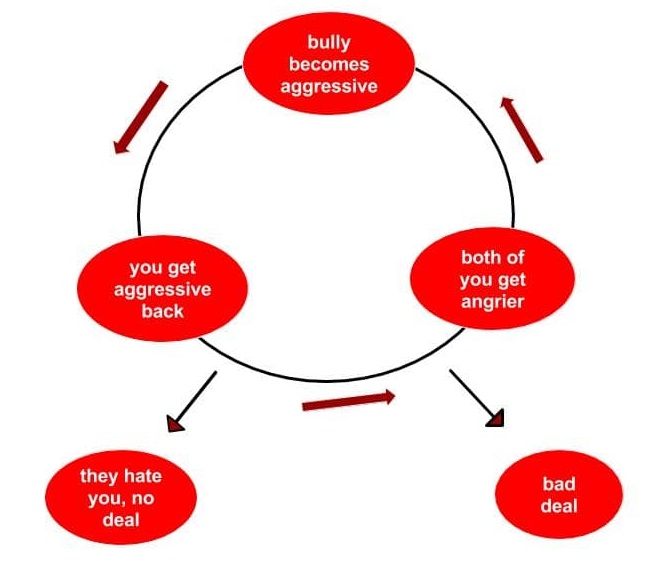
Others fight fire with fire, which just makes for a bigger mess: they're so convinced that they're right and the bully is wrong that they completely forget they're supposed to be making a sale.
A lot of good salespeople feel the temptation to act this way. They have Type A personalities, they’re aggressive problem-solvers who don’t like backing down. They naturally want to respond to aggression with aggression. But by yelling back at the bully, they sink to the level of the bully, sparking off a screaming match that goes nowhere and wastes everyone's time.
Don’t play the bully’s game—you’ll lose control of the situation. Even if you “win” the argument, you're losing the larger battle: getting them to buy your product. And pissed off prospects can ruin your business' reputation. They'll hang up the phone and run around bad-mouthing your company, they'll spend the next day throwing a temper tantrum and going on a Twitter rampage. They’ll find another outlet for their anger, which can do serious damage.
The most powerful way to overcome bullies in sales is with friendliness, while also standing your ground. This position is called friendly strength— it channels both your confidence in your product and your deep domain expertise in the field.
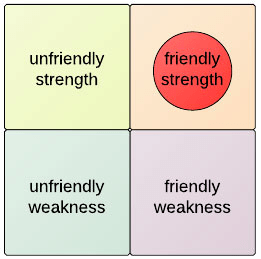
Think of how doctors deal with scared or angry patients: “I know your arm is still stiff after the surgery, and that it's painful. But if you don't do physical therapy, you might never be able to use your arm again.”
A good doctor diagnoses her patient’s illness, and prescribes a solution with both empathy and a clear set of directions for getting better. She has nothing to prove—she’s spent years studying, and even more helping real people. She knows what her patients have to do, and everything in the way she communicates is geared toward setting her patients on the road to recovery.
Like a doctor, you also have deep domain expertise. As a salesperson, you’re the world expert in your product, and you’ve helped hundreds of customers become more successful with it. Unlike a bully, who operates from a position of unfriendly strength, you ultimately come from a place of wanting to help your prospects—and you achieve that by exercising your authority and telling them what you can realistically do for them.
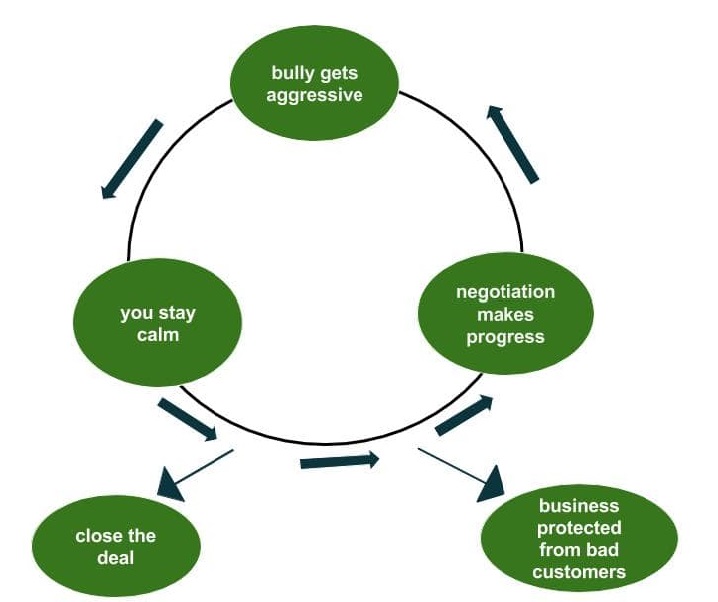
Use friendly strength to get the conversation back on track.
Bully: “You’re a scam artist, and these prices are outrageous. Do you think I’m stupid? I’ve seen greedy salespeople like you before …”
You: [silence]
Bully: “Your product is a piece of shit, it looks like it was designed for Windows 95 …”
You: [silence]
Don’t engage with the bully—let him rant and rage. If you have a hard time not responding to his ridiculous accusations, try muting yourself on the phone. Bullies live to get a reaction from people—they want to see you squirm, or hear you yell back. Don’t give them the satisfaction.
Silence can be just as intimidating as aggression—it makes people think they've made a mistake. Let the bully run himself out a little. The bully will take a step back and think, “Here I am screaming, and they don’t even seem to care. What do they know that I don’t?”
Here's how Robert Terson, founder of the blog Selling Fearlessly, uses silence to alter the dynamics with rude prospects:
I’d shut up and give him a cold stare. The burden to explain his rudeness was his to struggle with. Nine out of ten times (remember, you can’t win them all) he was embarrassed, apologized, and conjured up the best excuse he could think of. “Please continue,” he’d say politely, his attentiveness and body language 180º opposite of what it had been prior to the confrontation.—"Dealing With a Hostile Prospect"
By using friendly strength, and keeping calm, you turn the tables. You don’t try to shout them into submission, because you don’t need to shout to command respect.
Bully: “If you don’t lower your price by x, I’ll head to a competitor. I’ll tell everyone I know about this awful experience, and how your business is a scam. You’ll never see a new customer again.”
You: “I appreciate that that’s the way you feel. Let me clarify a few things. We’re a legitimate business with thousands of customers. I don’t know what went wrong in our communication—let’s figure it out. More importantly, let’s focus all our energy on the future. The best price I can give you is already on the table—if you’d like to be a customer, we’d love to have you. If you don’t, I can recommend you to other companies that might be able to help you. What’s it going to be? It’s up to you.”
It seems counterintuitive, but by throwing the ball into the bully’s court, you actually take control of the situation. You draw a line in the sand that shows him you aren't willing to back down—but you also provide a clear plan of action for moving forward. By exercising friendly strength, you cut to the chase.
The bully is already invested in the deal—otherwise he wouldn’t be screaming about price. You are too, and you’d love to make the sale. You both want to make it happen—but as a salesperson, it’s your job to make that happen as quickly and efficiently as possible.
Know ahead of time what you’re willing to negotiate on and what you aren’t. That way, if the negotiation's going badly, you won’t cave in to the temptation to give in to the bully. Instead, you're already equipped with a list of actually viable options.
You leave the choices up to him, but really you’re the one in control, because you've cut to the point: “Stop wasting my time and tell me what you want to do.”
Bully: “I'll pay this price or it's no deal.”
You: “I think a different company may be a better fit for you. Thank you for your time.”
Sometimes, no matter how good of a salesperson you are, you just won’t be able to get through to a bully—sometimes, it’s just not worth it. You have to know when to walk away.
Prospects who obsess over price, for example, often make the worst customers, and you might be better off without them. They’ll make constant demands on your time and energy, and jump ship the moment a low-cost competitor comes to market—after all, they never realized the full value of your product in the first place.
By walking away, you communicate your absolute confidence in the value of your product, and get the bully scratching his head: “Wait—they don’t need me? Sounds like they've got their shit together. Maybe I want in on this.”
When handling a bully, it helps to understand what's underneath the aggression. The bully flew off the rails because he's trying to avoid what he doesn't want.
He doesn't want to be taken advantage of. He doesn't want to be manipulated into overpaying, just so you can inflate your wallet. Basically, he doesn't want to be lied to.
Exercise friendly strength to show the bully that while you won’t give in to outrageous demands, you’re not trying to game them either. It’s not just some tactic that helps you close more deals—it's ultimately a frame of mind that comes from a place of genuinely wanting to help your prospects.
You're not just grabbing the check and taking off—you're building trust, support, a relationship. If you can show the bully you're in for the long haul, then you've won the battle and turned that bully into an ally.
Wolf or lamb in SaaS sales?
A lot of people who are just getting started in sales mistakenly do sales wrong: either selling "Wolf of Wallstreet"-style, or weak as a sheep. However, neither one of these approaches will lead to sustainable success. Here's why.
Sales mindset: How to recover from a bad sales call?
How should you deal with sales calls gone bad? Just ignore them and keep dialing? Or vent your frustration? Here's how highly effective salespeople rebound from bad sales calls.
The 1 thing you need to win every negotiation
Here's one of the simplest things you can do to become a better negotiator and walk into every negotiation with an upper hand.

Everyone is in the lean and mean mode these days which means selling can be a real chore. Offering better prices can’t be the only solution to increase sales, because it might increase sales but it will eat into your profit margin. So what is a poor sales manager to do? Adding value to your sales process will increase your profit margin.
Avoid False Hope
Don’t turn to a value added offer that is actually a load of hooey. You have to provide true value to your customer, not a token LED light to see their way to the car that’s going to burn a whole in their coat pocket. Offer VALUE. It is the main point of what you are doing.
Think Cheap, But Not Worthless
Okay we’ve mentioned being lean so when you think of ways to add value to the customer you can’t come up with ideas that will cost you more money. Think of what you have to offer at a reasonable price. Consult, provide a lunch and learn, enhance your tech support time line, improve your guarantee or even offer free delivery. Look for things that customers will appreciate but that won’t eat into profit margins.
Stay Within Your Own Biz
Don’t make the mistake of confusing the customer with a free movie pass when you sell fertilizer. Look for ideas that will enhance your current service or product. Do not blur the lines and mess with your brand’s integrity.
Help your Customer: Solve a Problem
In the most effective fashion of good salesmanship see if there is a way you can solve a problem for customers without costing you too much money. Look for pain points that might be shared by all of your customers or get real detailed and solve a problem specific to each customer. Don’t be afraid to ask, “What do I have to do to put you in this car today?” It sounds like an annoying cliché, but what if the answer is simpler than you thought? If they ask for the world you can always say no, but if they shock you by asking for something manageable like you taking them for a drive when they pick up the car to show them how everything works, well that is surely doable.

A neurosurgery simulation device from Synaptive Medical. (Synaptive Medical)
Research into life sciences is not an instant-return kind of investment. A decade and a half after the MaRS Discovery District opened its doors in Toronto, the city’s promised health-care ecosystem is at last starting to emerge. As technologies years in the making finally weave their way to market, Toronto could be set to rival Boston as a life sciences research and innovation centre.
As in so many other areas of the economy, technological innovation promises to disrupt and improve the way health care is provided. But modifying the procedures and best practices of doctors and hospitals is not as simple as, say, building an app to hail a taxi. Public health-care models such as Canada’s are particularly difficult to crack. Widespread adoption “requires a very rigorous economic and clinical analysis,” says Armen Bakirtzian, CEO and co-founder of Intellijoint Surgical, which makes a miniature surgical-grade tracking system that allows surgeons to select and align implants more accurately.
New life sciences technologies must be approved by Health Canada, but that doesn’t automatically translate into broad acceptance. Zayna Khayat, senior adviser for Health System Innovation at MaRS, uses the analogy of pharmaceutical companies’ armies of salespeople. “If they didn’t have [them], no pills would ever be used,” she says. “Every pill gets approved based on very rigorous outcomes and clinical analysis, but it doesn’t mean it gets bought—doctors make the decision, and they have to be convinced.” Products like Intellijoint’s total hip replacement surgery solution or Synaptive Medical’s suite of surgical technologies face similar hurdles. So three years ago, MaRS tapped Khayat to lead a newly created market-opener program called Excite to help health-care startups get their technology through the approval and adoption process.
Excite works with the Ontario health care system, the country’s largest. (The GTA also hosts more than half of the country’s life sciences firms, according to economic development agency Invest Toronto.) The program helps companies with promising early data—often obtained overseas, because of the high cost of medical testing in Canada—design and execute the key study provincial authorities need to see to sign off. “We’re helping [companies] use Ontario’s academic and clinical infrastructure to build an incredible dossier or package of evidence that they can now use to walk into any other major player,” says Khayat. Successful companies will also have a hefty reference from a very influential customer—the $50-billion Ontario health system, which buys the technology at a system level if regulators deem it to be sufficiently effective and economical. Excite has no success stories to tell just yet—Khayat says it takes at least a year to design the study and two or more years to evaluate it in the field. But BresoDX, a self-administered home test for sleep apnea, developed by Toronto-based company Bresotec, is likely to complete the study portion of the process in early 2016.
The meticulous process of medical market entry in Canada can be a leg up for companies that survive it, says Cameron Piron, CEO and co-founder of Synaptive Medical. “If you have a product that can show value, it certainly has great opportunity to scale outward very rapidly,” he says. But too-high barriers could stifle truly innovative technologies, or drive their inventors away. That remains a lofty hurdle in a field where it can take decades of research and development before a team can enrol its first study participant. “If that home market is also very difficult to enter commercially, that’s an additional challenge for startups in Canada,” warns Piron.
Khayat agrees: “If they can’t get a beachhead in their local market, it’s very hard for them to justify keeping their local operations here.”
MORE ABOUT HEALTH, SCIENCE & INNOVATION:
The post Medical tech firms have a huge opportunity—if they get to market appeared first on Canadian Business - Your Source For Business News.

You can talk about the amazing benefits of your own products until the cows come home, but what you say will be taken with a grain of salt by your potential customers. If, on the other hand, someone else honestly shows and talks about the amazing benefits of your products, they’re more quickly to be believed. In fact, studies have shown that 92% of consumers trust recommendations from people they don’t know over branded content. As a merchant, this is where user generated content (UGC) comes into your arsenal.
Quite simply, UGC is content, like a review or image, that is created by your customers (your users). Frequently distributed on social media, it can be anything from a Tweet to an Instagram post, or something meatier like a review.
One of the strongest benefits of user generated content is social proof. Social proof is when people seek guidance from those around them to determine how to act. It’s the same effect of seeing people waiting in line for the newest cronut or pastry sensation and you assume it must be delicious because people are willing to wait in line. For your online business, there are a variety of ways you can provide this social proof and build the confidence of prospective buyers in your brand.
Tied to social proof, UGC builds trust in your brand. Customers don’t have the same financial incentives as employees, so their content is perceived as more trustworthy. The best copy in the world won’t change those perceptions, so it’s important for you to give your customers the opportunity to share their opinions.
And who better to create content to appeal to prospective customers than your current customers? They used to be prospective customers until they purchased! Let them discuss features, benefits, and frustrations. Once you understand the customer perspective, you can respond appropriately and ensure your prospective customers know the answers, too.
In fact, this is one of the Amazon marketplace’s key benefits. With such a higher user base, Amazon automates a review process on everything you buy. You’ve likely seen the emails in your inbox. Not everyone will click through, but a few will, and a few more will even leave a review. This increases your SEO on those product pages and drives social proof. Just be careful not to delete anything negative. Customers will notice.
Finally, your repeat and high value customers have brand loyalty and a preference for your company. User generated content is an opportunity to leverage this relationship with these loyal and passionate customers to influence sales.
This may sound basic, but ask your customers for their opinion! Send a follow up email soliciting a review for a recent purchase to your customers. While the review request should be front and center, this is another opportunity for customer engagement. Add social sharing links, helpful blog articles or product suggestions for cross-sell.
Sephora, in particular, does this well. Their follow up email encourages the customer to leave a review, while also providing ample opportunities for engagement outside of the review itself, from answering beauty questions to staying up to date on the latest beauty news.

Similarly, you should encourage your customers to post about their experiences with your products on social media. Start a campaign with a hashtag on your chosen social platforms to encourage customers to post images of your products in real life. User generated images can give life to your products, more so than your own images can.
Madewell’s #everydaymadewell is a great example of this. It encourages Madewell customers to share their images with the #everydaymadewell hashtag, and they include “their favorites” in a gallery on the website. This enables some brand control over the featured items, but also encourages all of their users to share with their networks.

The internet has given a megaphone to both your happiest and your unhappiest customers. You need to go out and be proactive about managing your online reputation, even off your own website. Are there third party review sites that are particularly relevant to your business? Make sure to keep an eye on your reputation. Do you have an extremely unhappy customer who has taken to every third party review site to vent about their experience? See what you can do to publicly address their concerns and then move the issue to a private forum (more on that later).
Negative reviews are a fact of life. What makes great businesses stand out is what they do with negative feedback. Yes, some people cannot be placated, but for everyone else, you can demonstrate your customer service skills and hopefully turn them into brand advocates through your actions. Even if you don’t win their business back, you can win the trust of prospective buyers that are considering your brand against others.
In this example from Club W, they address head on the power of negative reviews and feedback. They got negative feedback from a packaging design change, and instead of changing it back without notice, they let everyone know that their feedback mattered.

Whether you like it or not, in the internet age, your business needs to have a strategy around UGC. Even if you haven’t taken any proactive steps to harness its power, user generated content related to your brand is out there on social media and third party review sites. Leverage the power of your customers to turn them into brand advocates and influence sales.

There’s a quote I like that applies to a lot of different aspects of life in general. It also applies very well to sales in particular:
When the only tool you have is a hammer, you tend to see every problem as a nail.
— Abraham Maslow (1908-1970), psychologist & philosopher
To me, this speaks to the need of having access to many tools for a successful project.
Ever since I’ve started teaching Social Selling in general and LinkedIn for sales in particular, I’ve run across a lot of people who delight in trashing both. They see no need for them and are very dismissive of both as bonafide tools in sales.
When I see these types of articles and comments, I just think of the quote above and chuckle.
With that in mind, let me be absolutely clear about Social Selling’s place in sales: Social Selling is just a part of an overall sales strategy.
There, I said it.
Before we go forward, though, let’s look at probably the best concise definition I’ve ever seen of Social Selling. It comes to us via (of all places) Wikipedia:
Social selling is the process of developing relationships as part of the sales process. Today this often takes place via social networks such as LinkedIn, Twitter, Facebook, and Pinterest, but can take place either online or offline. …
(S)ocial selling is focused on sales professionals, rather than marketing professionals. … (S)ocial selling aims to cultivate one-on-one relationships, rather than broadcast one-to-many messages.
As you can see, this core characterization of the philosophy already takes into account that it is part of an overall sales strategy. Many people miss this big point, which is why I’m hitting it so hard in this article.
If you ask a tradesperson what one or two tools she or he uses in their job on a daily basis, they’ll be able to come up with it in a snap. Maybe it’s a drill, a Phillips screwdriver, a hex wrench, some kind of electrical test meter or any one of hundreds of tools out there. And, yes, it can be a hammer.
For salespeople, especially those who sell to B2B or large-ticket B2C, I like to think that Social Selling is like one of those one or two main tools they can use to prospect effectively, take those prospects through the sales process, close them and gain referrals after the sale. But it’s certainly not the only tool out available to them.
Let me be clear: If the only tool a salesperson uses is Social Selling, they’re selling themselves short (pardon the pun).
When they’re bashing Social Selling out of hand, naysayers usually bring up one of three arguments against this strategy. When I read the interviews and posts from these people, I usually find myself agreeing with their points, but just up to a certain point. Just like those people who think Social Selling is the only way to go in sales, these complainers are missing the whole idea behind it: Social Selling is one piece of a well-rounded sales strategy and process. (I’ve purposely bolded this kind of statement twice for a reason: It’s true.)
Here are the three areas anti-Social Sellers cite, and my responses to each:
Cold calling. I’ve seen many trainers espouse that Social Selling can eliminate these calls. Sorry, but it ain’t gonna happen. In fact, I still cold call, and I train in Social Selling!
There are times when you just need to pick up the phone and do the things that a decent number of salespeople and business owners don’t like to do: cold call. While Social Selling techniques exist to help you prepare for the call, you’ll still need to put on that headset or pick up the receiver and dial.
Penetrating a vertical that’s not online. Some industry verticals do not have a significant online presence; in other words, their members just do not use Twitter, LinkedIn or the other channels we Social Selling trainers teach. You may find a few people from those sectors on LinkedIn, but they’ll be more of the exception.
In those cases, you’ll likely need to revert to the tried-and-true ways of… well… whatever it is you’ve done in the past to reach your current and potential customer base. It still behooves you, though, to at least have a Social Selling-oriented LinkedIn Profile, so you can “catch” those more tech-savvy prospects who may be searching LinkedIn for someone with your expertise.
Closing deals. By now, you’ve hopefully determined that Social Selling is a huge help throughout the sales process. But Social Selling in and of itself won’t close a deal all by itself. Everything you’ve learned about Social Selling will help you make that path much easier, but it won’t do the crucial work for you. You still need to understand that you need to ask for the sale yourself.
In that vein, you’ll still need to follow some kind of sales philosophy. If you’re hard-core No-Spin Selling, a Sandler-ite or any other type of seller, or if you use some combination of two or several different techniques or philosophies (like I do), you’ll still need an overall sales process.
Other areas exist where Social Selling falls short, too. What I like about Social Selling, though, is that it can easily plug into almost any kind of sales process, which is one of the reasons why I like to work with other sales training professionals. I love to “splice” Social Selling into a sales process to both strengthen it and make it more successful. I’ve seen it done in many different circumstances.
The bottom line is this. Social Selling can be used in many cases and many different kinds of businesses. Social Selling can be a huge factor in your sales process. It can help shorten your sales cycle. It can even attract buyers to you before you even know they exist. Just like cold calling alone isn’t the only way to fill the pipeline, though, Social Selling is not the be-all, end-all in sales. What’s more, it doesn’t work in all cases.
But make no mistake: Those people who brush it off without a second thought are selling themselves short. Especially in today’s heavily tech-connected world.
This article was originally published on LinkedIn and was featured in LinkedIn Pulse’s Sales Strategies and Social Media channels.
(NOTE: The top display photo for this article is from Blue Diamond Photography, and was sourced from Flickr. No changes were made to the photo, except for re-sizing.)

There’s no shortage of how-to articles and blog posts on leveraging the power of social media. And with this endless sea of social media-touting commentary, it’s natural to think you’ve got to jump headfirst into the social sphere to keep your brand from getting left in the dust.
Although the need to engage with social media in business is undeniable, it’s easy to miss the bigger picture in all this: your business goals. Your business strategy should come first; your social media strategy should follow. (highlight to tweet) Here’s why.
You might argue that social platforms are where your buyers are, so it makes sense to dedicate time and resources there to figure out how to reach and interact with them.
The problem with this approach is that it means viewing social media as both the beginning and end. In this scenario, social strategy is where things start and social goals are where they end. This is incredibly limiting and fails to recognize all the other, highly important parts of your business.
First, consider your business objectives. What are your biggest goals? It could be awareness, lead generation, faster customer service, or engagement with industry partners. What actions do you need your prospects and customers to take to achieve those goals? Once these things are clearly defined, you can bring social media into the conversation.
The business strategy and its goals should drive of all social efforts. For example, improved customer service might require one set of tools and resources, while changing brand perceptions and building brand awareness may require a completely different set of tools, tactics, and resources. If improving customer service is a goal, you may want to invest in a tool like Talkwalker, Mention, or Hootsuite to better monitor conversations involving your brand or industry.
Make sure you match your tool to your goal rather than the other way around. Twitter points to brands like KPMG to show how hashtags, events, and promoted Tweets can drive traffic and awareness. A recent Twitter campaign drove 90,000 website visits and over 45 million impressions from organic and promoted Tweets.
Social media is not a means to an end, but rather an arrow in your quiver. It is just one tool in the marketing mix that can be used to help you support business priorities. Jay Baer succinctly summarized it when he said, “The goal is not to be good at social media. The goal is to be good at business because of social media.”
It’s important to remember that while many marketers view social as “free,” it is not. When you invest all of your time, energy, and resources into it, something else inevitably gets dropped; it comes with opportunity costs.
Don’t neglect your other marketing in favor of social, and keep in mind that, when done in haste or outside of business goals, it can become a very public, memorable way to fail. Just recall @DiGiorno’s accidental, and taboo, “#WhyIStayed You had pizza” tweet. That one unfortunate tweet became the hallmark of the brand that year.
That said, there are several brands who’ve successfully started with the business top of mind, and used social as one approach to reach their goals. One example is Namecheap, a domain service that competes against some major players in a crowded and highly commoditized market. They’ve used social tactics to reinforce one of their top business priorities: putting the customer first.
With the “customer is king” priority, they strategically chose social as a main channel for engagement. It’s been integrated into their DNA and has become one way they communicate and show customers and prospects how they are unique. According to the company, their effective use of Twitter has helped increase domain registrants, supporting one major business goal: sales!
Another shining example is GitHub, the social network for programmers. One of the company’s goals was “GitHub everywhere.” They have a robust social strategy that includes all major social networks and a crowd-sourcing initiative to empower others to create and share their content. Another major goal of the company is storytelling. They support this with their infamous Octocat character and various video mini-series, including “Passion Projects,” which highlights women in tech.
Let me be clear: social is valuable, and businesses should participate, but when, where, why, and how to do so should be firmly anchored in the businesses’ priorities. Make sure your social activity maps to your buyer personas. If you’re a B2B brand, you’re likely going to be spending a lot of time on LinkedIn. If you’re a lifestyle brand, it’s probably going to be more Pinterest, Facebook, or Instagram. There’s a reason no one posts about holiday crafts on LinkedIn, and why there aren’t many whitepapers showing up on Pinterest.
As you consider changing up your approach to social media, remember to start at the highest level:
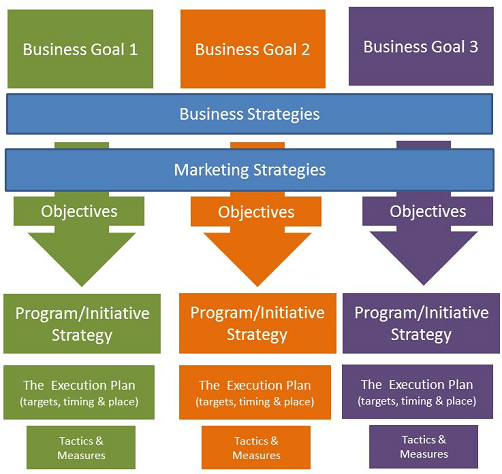
Take time to understand the high-level strategy and mission, then align your marketing strategies. Don’t let tools, tactics, and other lower-level items limit your options.
Get more content like this, plus the very BEST marketing education, totally free. Get our Definitive email newsletter.



Move over, Millennials—Generation Z is the freshest wave of movers and shakers to grace the online marketplace. Just out of high school, these incoming trendsetters don’t know a world without smartphones, they have no clue what a two-hour wait time feel like, and Miley Cyrus probably makes more sense to them than she ever will to the rest of us.
However, the standout feature of Gen Z is that they get the majority of their content online. From textbooks to news stories to medical information, Digital Natives rely on the web for everything they do. So what does this mean for the marketing world?
Gen Z is familiar with every marketing and advertising tactic there is. Banner ads, SEO, sponsored ads, influencer marketing, and content marketing—they’ve seen it. However, this isn’t a bad thing for your brand. The fact that the Digital Natives know your angle actually makes it easier for you to be direct and tactical, allowing your marketers to shift their attentions toward creating the kind of content that can catch the attention spans of these voracious young men and women. (highlight to tweet)
Here are four tried-and-true ways your brand can organically use content to reach the expanding cohort of post-millennials.
2015 was the year of tracking and analyzing the buyer experience and mapping the customer journey. While bounce rates and sales are crucial for understanding your business, looking at the funnel as a whole is a way of organically gathering data on your clientele. From the moment of initial contact, engagement, and into long-term retention, brands are using journey mapping to analyze and fine-tune their entire tunnel through the content they put out.
Journey mapping has the power to revamp a brand’s key touchpoints through anecdotal storytelling and visualization. Mapping is a useful tool for focusing on a particular part of the customer story while also giving a broader look at the entire experience. The importance of honing the Gen Z journey is that it allows businesses to adapt to the complexities of this specific group, and to do so before they officially replace millennials in the marketplace. It also forces customer service representatives and business leaders to think of their young and malleable users as more than just case studies, and instead as constantly evolving human beings that want to connect and engage.
Much like the the Gen Z customer, journey mapping is introspective. Heavily rooted in understanding the mentality and emotions of a user, mapping is an organic method for consolidating information about each touchpoint. Digitally inspired companies such as Tahzoo specialize in creating roadmaps for companies who are looking to understand their customer’s entire journey in order to drive targeted content. Tazoo offers data-driven perspectives which not only allow businesses to understand the likes and dislikes of their young customers, but help them to become organizationally prepared for Gen Z’s many intricacies.
76% of teens use social platforms. While the debate wages on as to whether or not they’re heavily addicted, you can safely bet money that the content you are sharing across your social media channels will be seen by Gen Z.
The holistic approach to social media content curation is perhaps the only strategy that involves a give-and-take between brand and buyer. The logic behind approaching social media holistically centers around the fact that Gen Z loves to share publicly, which means brands can accumulate brand ambassadors without dropping a penny.
To do this successfully, brands must learn to market themselves wisely across the Big 5 social networking platforms, which can be mastered using these organic growth-hacking tips:
Great social media marketing begins with a change in mindset toward the holistic, and it ends with major shifts in fully personalized customer engagements and gathering an organic community on your channels. This approach calls for companies to view their content as an ongoing journey, something that changes and grows with your company and clientele. This is why brands are focusing their social media efforts toward storytelling, rather than marketing, to increase traffic and build an authentic community. While your message should stay consistent, what you share should run the gamut of your company’s features, standout qualities, and culture.
Data is power, but Big Data is the massive collection of predictive analytics and industry information, a thing much greater than power. One of Big Data’s uses is accruing information about users from within and outside of your website, and to craft content to fit their lifestyles and online personalities. Using predictive analysis, big data offers the numbers to back up the personas and audiences for the content you’re publishing.
Big Data companies such as RoundForest allow companies to collect information from their funnel and turn it into actionable data which can lead to implementing brilliant UX and an even better content journey.
Big Data has the power to refocus the scope of the entire customer experience. To get the full story about your specific Gen Z audience, speak to them in a voice that resonates. This is why thousands of brands are collecting information using Big Data techniques and turning their findings into brand stories.
Mastering big data to better understand your customer’s journey opens a world of strategically curated content. Having stories from every touchpoint within your funnel allows for your marketing and copywriting teams to create actionable information based not just on feedback, but on statistical answers to the “what ifs” that arise when interacting with customers.
The current population of post-millennials is at 23 million and rapidly growing. This poses the obvious challenge of figuring out what this massive and diverse cohort of tech savvy humans want from their content, and how you can be the one to give it to them.
Persona mapping, or empathy mapping, is a strategic way for brands to gather intel on their customers, so that they can better communicate with each persona specifically. Creating anecdotes for accurate and actionable customer analysis is becoming an increasingly useful process for answering these questions, and its success can impact the customer journey.
Persona analysis optimizes your content, as it takes an in-depth look at the likes, dislikes, worries, feelings, thoughts, emotions, and wants of each of your identified clients. This is especially critical for understanding Gen Z, as they spend much more time sharing about themselves online than their predecessors. If you can identify their problems, even before they arise, your EQ will speak leagues to the Digital Natives.
Hubspot has an incredibly useful tool, aptly named Make My Persona, for naming and presenting data on potential buyers. The tool asks questions such as, “Does Jack search for vendors online?” and, “What associations and social networks does Victoria belong to?” Having solid archetypes for potential customers is a way of tracking changes, not just in your own marketing, but in your audience’s mentality as well.
As Gen Z become the entrepreneurs and buyers of the next decade (and they will), brands’ customer data must reflect these changes if they aim to keep up. The time is fast approaching when Gen Z will take over the B2C and B2B marketplaces. They are the incoming CEOs, CMOs, marketing execs, and industry gurus of the next two decades.
Now is the time to begin shifting your business model and company mission to accommodate this tech-centric and information-hungry cohort of digital natives. Having a strong organic content plan and understanding how to use journey mapping, persona identifying, social media, and big data to grow a Gen Z community is your brand’s best ticket to the hearts and minds of the newest generation.
Get more content like this, plus the very BEST marketing education, totally free. Get our Definitive email newsletter.


The findings of a couple recent reports suggest that many B2B companies are ignoring a highly effective marketing tool – programmatic ads display. The first is a study commissioned by AdRoll and conducted by Forrester Consulting on B2B prospecting via digital marketing. The second is Hanapin Marketing’s State of PPC (2015/2016).
The Forrester research confirmed that changes in the buying cycle due to the explosion of digital and content marketing have made it increasingly difficult for B2B companies to identify and connect with prospects during the discovery phase.

It’s increasingly difficult for B2B companies to identify and connect with prospects during the discovery phase.
There’s been much discussion on how deep into the buying process prospects go before wanting to speak to sales. Here we see highlighted the critical first subset of these self-directed prospects – those who aren’t yet downloading content or otherwise making themselves known to B2B companies. So B2B companies need cost-effective tools to make themselves known to these most elusive prospects.
While the Forrester study points to the potential of programmatic ads for B2B, it and the Hanapin report indicate that it’s an underutilized, low priority digital channel. (Check this out if you want an intro to programmatic buying.)
Here’s a deeper look at the reports with a few take-aways.
Forrester’s analysis identified programmatic ad as one of only three digital channels whose effectiveness outstripped its popularity. B2B marketers using programmatic advertising found it to be a more effective lead generation tactic than email or organic social media, and equally as effective as in-person events and search. Furthermore, Forrester reports that nearly half of the companies already using programmatic advertising attributed at least one major benefit to it, including gaining intelligence on a prospect’s place in the customer journey and providing customized content to prospects and customers. Furthermore, In contrast, those who hadn’t yet started using programmatic ads were significantly less likely to think any of these major benefits could be realized.
According to Hanapin’s report, programmatic ranked last on the list of most important aspects of digital marketing in 2016, with only 34 percent identifying it as such. Accordingly, only 30 percent of respondents said they were planning to increase their programmatic ad budgets in 2016.
Take away: The opportunity here is that old adage of just showing up. You may find advantage simply by using an effective marketing approach your competitors aren’t using. In its report, Forrester recommends creating a pilot campaign to compare against a standard campaign.
Using programmatic buying effectively means having in-depth knowledge about your prospect base, their interests and behaviors. Over a third of the B2B respondents in the Forrester study do only basic market segmentation (industry or company size) or no segmentation at all. Nearly twice that many (60%) of the Hanapin report respondents say specialized targeting will be the most important aspect of digital marketing in 2016.
Take away: Since the Forrester and Hanapin respondent communities don’t overlap, I can’t say that the nearly two-thirds of Hanapin respondents who say specialized targeting is critically important are the two-thirds of Forrester respondents who are doing something more than just basic segmentation. However, if you’re in the third of B2B companies not engaging in more sophisticated targeting than company revenue or employee count, and you’re not prioritizing improving your segmentation capabilities for 2016 – you’re getting left behind.
It’s unsurprising that marketers classified by Forrester as “mature marketing technologists” were 39 percent more likely to have programmatic ad buying in their marketing toolbox. These mature marketers are also 37 percent more likely to agree that programmatic ad buying provides major benefits. Those reporting the greatest benefits were using programmatic ad buying within a broader marketing automation strategy that ensured delivery of the right ad to the right prospect at the right time.

Mature marketers are 37 percent more likely to agree that programmatic ad buying provides major benefits.
Half of the brands and agencies surveyed by Hanapin consider automation software the most important aspect of digital marketing over the past twelve months, and 61 percent of them believe it will be the most important aspect for the next twelve.
Take away: Finding success with programmatic buying isn’t just a matter of having technology to handle programmatic ad buying. It needs to be part of a larger automation strategy that takes advantage of their combined intelligence and capabilities. As the pool of brands and agencies using marketing automation grows (as the Hanapin’s report showing a 20 percent increase in those who consider it important to digital marketing indicates), the window to be in a space unoccupied by competitors may be shortening. Although layering in programmatic ad buying is likely a later phase for those just starting to implement a marketing automation plan, after they’ve gotten experience with more sophisticated segmentation and mapping content to stages in the buyer’s journey first.
As always, technology giveth and technology taketh away. As easily available digital content has increased the cost of finding and identifying B2B prospects, digital tools also provide opportunities to engage with these unknown prospects on a much more granular.
Instead of all your unknown prospects seeing the same PPC ads and getting shoveled to the same landing page, you can still devise separate, relevant messaging for each persona that can reach them through behavioral targeting and programmatic ads.
If you’re not quite in Forrester’s “mature marketing technology” category, now may be the time to start ramping up your marketing technology sophistication so all marketing opportunities become available to you.
How Sales Can Use Marketing to Help Sell More

I often find myself writing about the much-needed synergy between sales and marketing. In fact, most of my posts at some point or another mention the need for the two to work together. Why? After being on both sides of the coin, I understand the need for both and the success that comes when the two work side-by-side.
So, when I was speaking with a friend the other day and he said that the marketing team at his company drove him crazy and didn’t really do much, I had to protest.
I asked him why. He said that it was his job to find his customers and that marketing played no part. I then asked him how he was able to get such big customers like Amazon and Zulily. He responded, “Because we are a nationally recognized packaging company.” Aha. Well, therein lies the rub. So, how does a company become a nationally recognized brand without marketing? Yea, that’s what I thought.
Sales all the sudden become just a little bit easier when backed by a well-recognized brand standing in the background.
Here are 3 ways that sales can use marketing to help sell more:
Show off your success, without ‘showing off’
Does your company have tons of happy customers? Share what people are saying about you. Case studies and testimonials are great tools to help show your leads you are a trusted brand with many loyal fans. Nothing screams authenticity like a real customer success story. Marketing takes the time to get those testimonials and write up those case studies, so use them to your advantage.
Nurture leads without being an aggressive sales person
Instead of calling your lead every other day, why not drop them into a drip campaign sending them periodic marketing messages to help drive them down your sales funnel. Emails are a less aggressive way to show your lead how your company can help them achieve their goals. Each of your emails should contain a call-to-action so that it is easy to signup or find out more about your product/service.
Spy on your leads without being creepy
No, you do not have to stalk your leads to find out what they like. Let your sales and marketing platform do it for you! Marketing software will tell you what emails your leads are opening, what blogs they are reading, which website pages they are visiting, and more. If your lead has been actively searching your website and opening your emails, chances are they are hot and someone who should be pursued by sales. Whereas a lead that rarely opens your emails or reads them and never responds, is probably not the most qualified and may need some more nurturing before you try and sell them again.
Marketing is a valuable resource for sales, not just for bringing in leads, but for helping supply quality content AND data. With so much competition and with leads having so many choices, having a full toolbox equipped with everything you need to effectively sell will set you apart and significantly increase your chances of success.
Want to learn more about marketing and sales working together? Signup for a free GreenRope Demo.

In 1974, I started my sales career selling books door to door. (I sound like your grandfather, don’t I? Does that job even still exist?)
I got my first professional sales job in 1982 selling computers in Boston. Over the next 25 years, I started and led field and inside sales teams, marketing organizations, and account management and services divisions in virtually every market in the US and Canada.
From the 1980s to the early 2000s, the best reps sold in the field. They were usually hard-charging, gritty, loud, and directive salespeople whose best traits were that they worked hard and didn’t take “no” for an answer. In the late 1990s, inside sales organizations comprised of junior reps or new college graduates emerged to take on a supporting roles, but it was the people in the field who closed deals, made money, and rose quickly through the ranks.
Fast forward to 2007, when I met HubSpot Vice President of Sales Mark Roberge (now HubSpot CRO) while interviewing. Roberge was an anomaly and unlike any sales VP I ever met. He was super smart, soft-spoken, and extremely nice. He was all about process and outthinking the competition. He wanted to apply his formal engineering training to sales. And he had a skill I craved: He could sell a deal over the phone.
This was a revelation. I saw it with my own eyes -- Mark could add value in the first five minutes of a call, uncover need, diagnose pain, dig into prospect goals, plans, challenges, and timelines, ask pointed follow-up questions, explain the high-level solution he could provide, and then ask for the sale.
It was awe-inspiring.
I wanted that skill. So I joined HubSpot. Over the last eight years, I’ve transformed from an outside, outbound salesperson to an inside, inbound specialist.
Inbound selling is flat-out better for everyone involved. The difference in effectiveness, cost, velocity and customer perspective is so striking that you have to question whether an outside sales organization is even useful for the vast majority of companies in 2016.
The transition from outbound to inbound selling didn’t happen overnight, but in my eight years at HubSpot I’ve learned 7 valuable lessons that have improved my sales performance, my quality of life, and made sales way more fun.

This is the most crucial thing modern salespeople need to learn. In an age where buyers are more informed than ever before and can find a new vendor with one click, trying to force customers into doing things your way simply isn’t an option.
HubSpot is so successful because we built our sales process around the buyer. We understand the buyer’s situation, we evaluate whether our software is a good fit for the buyer’s company, and we make a recommendation (yes, sometimes this means we tell them to go with another provider!) based on what’s best for the buyer.
Modern selling has to be about the buyer. If you ignore prospect needs, you will lose more deals than you win.
A natural result of #1, there’s never one solution that works for every prospect. I went from thinking the closing call was the most important part of the sales process to realizing that the discovery call is actually the key.
A discovery call is where you learn what your prospect cares about, what they’re good at, where they struggle, and how you can help them. It shapes the entire rest of the sales process, and it’s what made me so successful. Because I thoroughly qualify prospects on discovery calls, I’m able to provide specific, customized advice to my prospects -- and they’re able to see that I truly care about what’s best for them.
Never be assumptive. The same sentence spoken by two prospects can mean two different things. They can have the same problems on paper, but for one prospect it might be an annoyance, while another is suffering major business pain.
The modern salesperson’s best tools are asking good questions and listening. If you don’t understand something, dig deeper. If you think you understand something, dig deeper to make sure you got it right.
In 1990, sales meetings went something like this: I introduced myself and my colleagues, explained what my company did, introduced my product, then talked about why the prospect should buy it. Salespeople assumed that because the prospect accepted an in-person meeting (see #5), they had a problem we could solve.
It doesn’t work like that anymore. It wasn’t until the concept of inbound marketing emerged that we spent time digging into the customer’s world. We run inbound marketing assessments and connect calls to understand prospect pain, and are constantly checking to make sure we’re aligned with our prospect’s buying stage.
You can’t tell unless you ask first, but that concept is fairly new in sales. If you want to make sure your message is conveyed, first find out what information your prospect needs to hear.
I used to rely on relationship selling.
“Hey, let’s go to lunch at your favorite restaurant!”
“Oh, you went to X college? Do you know Bob?”
“I have Giants tickets for next weekend -- want to come with me?”
None of that works anymore. I was forcing myself on a prospect and trying to prove I had a unique value proposition worthy of follow-up.
Through the lens of inbound marketing, this is incredibly dopey. Now, I wait for prospects to come to me with a problem, and demonstrate how I can help. In 2016, value wins sales -- not Giants tickets.
A few decades ago, I used to have to get on a plane to start a relationship. It was an arduous process, consumed a huge amount of time and money, and quite frankly was annoying. But I had to do it, because there was no other way.
Today, I can sell to the CEO of a Fortune 500 company at home in my pajamas.
Inside sales is better for the buyer and the salesperson. It’s quicker and easier for buyers, requires less schmoozing, and is less intimidating. With the rise of inside sales, buyers no longer have to deal with a squadron of suited-up salespeople storming their office like it’s Normandy Beach on D-Day.
On the salesperson’s side, it’s simply better for business. Who do you think is more productive -- a salesperson who can speak with eight prospects a day, or a salesperson who has to fly all over the country just to meet three new leads?
(Hint: it’s the inside salesperson.)
Didn’t I just say relationship-based selling is done? Yes, but this is a different kind of relationship.
At HubSpot, I’ve had two-day sales cycles and 365-day sales cycles. I’m always selling the same product, but the amount of time it takes me to close varies wildly -- because of points #1 and #2. If I had tried to force my one-year deals to buy in two days, I would have lost the sale altogether.
Inbound selling requires patience and the ability to handle prospects at every stage of the buyer’s journey. If they’re raring to go today, that’s great. But if it’s too early in the buying process, don’t throw out the lead -- just periodically keep in touch until your prospect is ready to buy.
What’s happened to my sales career since I became an inbound salesperson? It’s simple:
And finally, I can work smarter, not harder, and still see great results. I travel 200 days a year for speaking engagements on HubSpot’s behalf, and I still hit or exceed my quota every month.
Inbound selling isn’t a trend. It’s the future of sales, and the time to get started is now. After all, you don’t want to wake up one day and find yourself in the Irrelevant Sales Rep Hall of Fame, do you?



You see Pareto’s Principle applied to sales all the time — the top 20% of a sales force produces 80% of a company’s revenues and margins — and it’s applicable in a variety of sectors. In B2B contexts, for example, rep performance in similar territories often varies by 300% between top and bottom quintiles, and in retail stores selling productivity typically varies by a factor of three to four. So it’s no surprise that a company’s usual response to stalled growth is to hire more stars.
There are a few problems with the hire-stars approach, however. First, there are only so many stars to go around since everyone is fighting over the same candidates. Second, even if you do manage to hire stars, their unique skill sets may not be easily portable. Research indicates that there’s good chance that a star at Company A won’t be a star — or even productively relevant — at Company B. The third reason is simple math. Even though 80% of sales may currently come from 20% of reps, incremental improvements in the majority’s performance will have, in the aggregate, a much bigger impact on growth than stars do.
We’re not arguing that stars don’t matter, because they definitely do. But, at the same time companies must do more than rely on stars if they want to improve their overall sales performance.
Companies that have adopted a subscription-as-service model (SaaS) are a great example. In the early years of a SaaS venture, stars typically generate the bulk of revenues, and they are often revered and feared internally for the relationships and power they wield. But, as the venture matures, and they continue to close a few big annual deals, they can limit growth since the SaaS model requires higher volumes.
Although it’s easier than ever to create a SaaS business, it’s also harder to scale one. There’s a lot of competition, which keeps a lid on prices and increases customer acquisition costs. A recent survey of 159 SaaS firms with at least $2.5 million in revenues found that almost 55% were spending more than a dollar to get a dollar in annual contract value. It’s also a tough talent market, especially in sales.
If companies want to scale, they need to improve their sales processes, and this is especially true of SaaS businesses. It is as important as the products and services they sell and the customers they sell them to, and it’s a key to competitive advantage.
Here are three core elements for putting in place a scalable sales process:
Understand the sales tasks. When it comes to sales effectiveness, managers need to consider the tasks that reps must perform, not just their personalities and generic selling skills. These tasks will depend on your company’s strategy, the customers targeted by that strategy, and the business model you’ve put in place to acquire and retain those customers.
Consider a SaaS service such as file sharing or various communications tools such as collaboration or meeting software. These applications aren’t typically mission-critical for customers, and are sold at relatively low monthly subscription prices. Buyers can gather a lot of pre-sale information via an online search, which allows them to act more quickly and decisively. On the seller’s end, “dialing for dollars” is paramount. They conduct online demos and provide prospects with a semi-customized proposal with a few clicks on the website to make the initial sale. But scaling this type of business typically requires “land and expand” sales tasks such as up-sells (getting the customer to purchase a premium version of the product) and cross-sells (getting the initial customer(s) to provide positive referrals to others in that organization). For example, ScriptLogic, which sold simple IT diagnostic tools to system administrators in the IT departments of small and mid-sized companies, built a good business with this sales approach and a “Point, Click, Done” value proposition.
A SaaS platform service such as CRM or MAS (Marketing Automation Service), on the other hand, requires sophisticated integration to install annual or multi-year contracts. This is a complex initial sale with a longer selling cycle that is harder to do online or by phone. To add to that, reps often have to involve the vendor’s engineers in the selling process.
Reps selling CRM services have vastly different tasks than reps selling communication tools. They must focus on landing renewals, increasing price through new functionalities and premium packages sold to different decision makers, and minimizing customer churn. They must also deal with a different decision-making process and budgeting procedures at accounts. The same approach which served ScriptLogic so well in SMB was not effective in selling its products to enterprise accounts, and ScriptLogic was eventually acquired by Quest Software, which employed a very different sales approach in the enterprise segment.
It’s also important to keep in mind that sales tasks typically change over the course of a product-market life cycle. Generally, customer education and applications development are often key tasks in early stages. But as the market develops and standards emerge, sales people spend more time selling against functionally-equivalent brands or developing third-party relationships. If your sales process doesn’t keep pace with these changes, strategy execution and growth will falter.
Match your sales process and resources to the buying process. Most sales organizations spend a lot of time and money tracking progress (or not) through their sales “funnels.” But selling is always more about the buyer than the seller, and most customer buying journeys resemble a meandering path rather than a progressively tapering funnel. B2B buyers, for example, tend to work through four parallel streams to make a purchase decision. So it’s important to understand where customers are in their journeys and how to interact with them appropriately at a given stage.
With SaaS, the initial stage usually starts when the potential customer recognizes a fixable problem or opportunity. The seller can help to trigger that recognition in any of a number of ways, including starting a content marketing or SEO campaign to generate inbound leads, cultivating referrals from existing customers, making sales calls, planning conferences, sending emails to build awareness, and using social media to generate word of mouth.
Subsequent stages again depend on buyer behavior and strategy. Most SaaS businesses have three tiers: a self-serve tier that allows for trial evaluation, a second tier that allows a single or departmental decision maker to engage and experience, and a third tier that requires selling to multiple stakeholders at the customer.
Although some stars can navigate across all tiers, most reps can’t. So, in order to optimize the productivity of your sales force, you must determine where in the process different reps should get involved. Often, high-velocity inside sales reps are productive at the lower tier but counter-productive at higher tiers, which involve a more complex, cross-functional decision-making unit.
Use tools to turn data into information. Considering the average U.S. company already has more data in its CRM system than in the entire Library of Congress, you probably feel overwhelmed by Big Data. That’s why it’s important to keep in mind that the role of data is to help you make better decisions, and in order to separate signal from noise, you need to know what you are measuring and use the right tools to measure it.
Think about forecasting. Most firms put their pipeline information into a CRM either weekly or monthly and then review the volume and value of leads in that pipeline. In order to forecast for the following month or quarter, they typically extrapolate future performance from that snapshot: “Bob did $200,000 in sales last quarter, so let’s budget him for $250,000 next quarter,” and so on.
But buying streams, especially for SaaS, are more like a motion picture than a snapshot, which means you should be measuring flows such as “what is Bob’s ratio of Monthly Recurring Revenue to Sales Qualified Leads (SQL)?” or “what is Sally’s ratio of Commits vs. SQLs?” These questions will inform a big decision: hire more people like Bob or find out what Sally is doing right.
The minimum data streams include the categories outlined below:
These categories will help you separate signal from noise.
| Lead Type | Description | Price |
| Contacts | People with job titles that are potentially relevant to your service. | < $0.01 |
| Prospects | People who are likely to have a problem you can solve with your service. | $0.01 – $0.10 |
| Suspects | People who have taken action (e.g., searched, attended a webinar, downloaded a paper) about the problem they are experiencing. | $0.10 – $1.00 |
| Marketing Qualified Leads [MQL] |
People for whom you’ve verified contact information. They include inbound leads, which you’ve scored and ranked. | $1.00 – $10.00 |
| Sales Qualified Leads [SQL] | People you’ve contacted and who have a problem that you have a relevant solution for. They can be either converted MQL leads or targeted outbound leads. | $10.00 – $100.00+ |
|
Source: Frank Cespedes and Jacco van der Kooij
|
© HBR.ORG
|
|
With this data and the relevant analytic tools, you can make distinctions that will help you build a scalable sales process. For instance, depending upon your business model, you can look at any or all of the following and make better use of your Marketing and Sales budget:
Volume Data: metrics that track volume by tracking Wins from number of Marketing Qualified Leads (MQLs) and SQLs.
Conversion Data: ratios that track, for instance, how many MQLs result in SQLs.
Opportunity Costs: extrapolations across multiple metrics. For example, you may compare the cost and Monthly Recurring Revenue generated by a marketing campaign in 30 days versus alternative uses of that money, the customer acquisition costs of your online versus field-sales team, up-sell and churn percentages, and so on.
Many sales efforts need this process because business now changes often and fast. It’s true that any process is only as good as the people managing that process. But hiring Sales Operations or other “data analysts” without an iterative process in place is a recipe for frustration and expensive failure. And failure doesn’t scale.
Conversely, make sure not to follow your process myopically or in a rote manner. Remember to look up: there are stars. But also remember that you don’t need to move everyone to the 90th percentile. Moving up a quartile would be a big deal, and that’s the role of a relevant sales process.
For the last 10 years, we’ve all been — in one way or another — asking ourselves the same question: How do we makes our sales organizations more productive?
It’s a fair question, after all. We have (and always will have) a considerable need to help our reps up their games and to have the agility to create measurable growth that accommodates our company’s larger objectives. But with answers ranging from “we scientize it” to “we depend on the tech of the moment” to “eh, sales is a game of chance, right?” it’s difficult to confidently commit to a process.
I hold, however, that there is a constant that’s almost always overlooked in the search for sales productivity. It’s that, at the end of the day, any given sale is ultimately dependent on one person persuading another to do something.
And that’s no easy task. But armed with the right business tools — who our ideal customers are, how they prefer to be interacted with, and how we can most efficiently contact them — it’s a totally approachable missing piece. All other things equal, the quality of sales relationships will determine sales productivity.
Here’s how to do it.
While a no-brainer on the surface, instituting an org-wide process for relationship building (toward ideal sales targets, of course) can be pretty opaque if you don’t know how to start. And though I can describe how the finished product should work, I think an image is better. Remember how, during at least half of Glengarry Glen Ross, Al Pacino sits at the bar discussing life with someone he then sells to? That’s is what you’re after.
Any true relationship-based sales process is going to look a lot like a combination of influencer marketing and outside sales, both of which require quite a bit of time and effort to connect and maintain relationships with your ideal targets. Now, while this legwork may not be suited for your executive team (depending on the size of your org), it’s a perfect exercise for a business development team to practice and ensures the leads have multiple personal touches with your brand and product prior to delivering them (along with all pertinent relationship-based intel) to sales execs.
A true master of sales productivity and Head of Social Selling Disruption at Creation Agency, Jack Kosakowski summed it up best when he said, “If your sales team doesn’t have a well-thought-out strategy around a buyer focused process, it’s time to wake up! The sales process needs to incorporate all buyer channels and offer value as the number one area of focus. Anyone can fix business problems, but very few add enough value to inspire change.”
To build out a buyer-focused sales process, it may be helpful to work with the Director of Lead Gen to ensure that your funnels are aligned and overlapping, and that the story you’re telling is larger than “what my product can do for you!” This ultimately involves an assessment of who your customers are, what they value, and what their industry’s problems are. With this, you’ll understand whether it’s better to sell on the basis of productivity, lack of clarity, problem of communication or whatever the issue you may be. And by doing so, you focus more closely on your buyer’s experiences and concerns, rather than just offering another tool to add to the stack.
The biggest mistake you can make is believing that marketing has nothing to offer you. In addition to the leads they generate or accounts they prime through account-based marketing (depending on which marketing model your business uses), marketing knows A LOT about building and maintaining relationships online, which words and phrases are impactful, which topics pique interests, and how to tell a story. And they know it all about the exact people you’re selling to.
Work to create an internal infrastructure where marketing delivers intel along with the leads, either through monthly / quarterly “town halls” or through some sort of internal, dynamic document (a Google Doc works great).
Ultimately, these processes won’t fix everything if there are bigger problems at work — terrible contact data, inexperienced lead gen, or a lack of cohesion across your team — but if you’re firing on all cylinders and looking to take your org to the next level of productivity, a focus on relationships is where you need to look. By working with marketing to create a buyer-focused, relationship-based sales process, it’s much easier to show prospects the true value of what you’re offering.
The post 3 Simple Processes to Boost Sales Org Productivity appeared first on OpenView Labs.
2.jpg)
If you've ever bought or sold a used car, then you understand the unique anguish of the process.
Ale Resnik, CEO and cofounder of online car dealer Beepi knows that anguish very well, too. Arriving in Massachusetts from Buenos Aires, Argentina, to study at MIT, the engineer and his wife set out to buy a used car. They brought home a 2010 Jeep Liberty.
"The engine ended up catching fire while my wife was driving it 48 hours later," Resnik told Business Insider.
He says that ordeal, plus the time he spent fighting the dealer in court to get his money back, showed him that used car sales "is a market that's really broken."
So he created Beepi — his third startup — an app that lets people buy and sell cars entirely on their smartphones.
A variation of this concept started back in 2000, when eBay Motors introduced people to a world of buying and selling cars online, but you couldn't complete the process from start to finish on the internet. It was also impossible to know the true condition of the car you were buying, or whether it was sufficiently inspected.
Beepi's mission is "to remove the friction from the process of buying and selling a car," Resnik explained.
The used-car industry has grown into a multibillion-dollar monster in the years since the recession ended, and demand for pristine pre-owned vehicles is stronger than ever. In 2015, people in the US bought more than 2.5 million certified pre-owned vehicles — up 9 percent over the previous year, according to a report from Autodata.
Beepi is among several online car dealer startups that are raking in millions in venture capital, proving that this segment of the market is ripe for innovation.

Buyers can choose their car on the app, get a full report on the car's condition from Beepi's licensed inspectors, and then complete the purchase via mobile. Customers can read all about the inspectors' backgrounds because their LinkedIn profiles are linked from Beepi's website.
After the purchase, the car shows up at the buyer's doorstep with a big bow on it. The difference here is that there's no test drive involved. Instead, buyers are given 10 days to return the car for a refund if they change their minds.
"You have those 10 days to fall in love with the vehicle," Resnik says, "and since we started the company, our returns have never made up more than three percent of cars we deliver."

Beepi sends an inspector (all of whom are share-owning employees at the company) to evaluate the seller's vehicle. If the nearly 2-hour check-up is successful, Beepi makes an offer to the seller, who is paid when the car finds a new owner.
"The average Beepi car sells within 10 to 12 days," Resnik told BI, noting that traditional dealers like CarMax can take up to two months to move some cars off the lot. When the car sells, Beepi writes a check to the seller, while keeping a roughly 10% cut of the proceeds.
The Los Altos, California-based company has already established itself in a space where consumers are buying and selling more than ever on mobile. Fresh off its most recent fundraising round that brought in about $70 million late last year, Beepi now operates in 15 US markets across 9 states, including California, New York, the Washington D.C. Metro area, Texas, and Florida.
China's largest domestic automaker, SAIC Motor Corporation, is also backing the company.

Despite a whirlwind 2015, Resnik's 20-month-old company is keeping its foot on the gas. "From December 2014 to December 2015, our revenue grew more than 1000% across the board," he revealed.
In addition to marketing and selling used vehicles, Beepi's streams of revenue include loan partnerships with Ally Financial and Chase Bank, among others. Additional products are in the pipeline.
The company, which now employs 170 people, just added an advisory board featuring heavyweights in finance, politics and law.
Among them, economist and former US Treasury Secretary Larry Summers.
"There's hardly a more important market in our country than the market for automobiles," Summers said in a conversation with Business Insider. "I think that Beepi has a chance to disrupt it and be transformative in consumers' interest."
Also on Beepi's advisory board: former Obama Administration deputy chief-of-staff Jim Messina, who has also consulted with Uber and Airbnb.
While talking about Beepi, Messina said "it’s exciting to think about the positive impact this can have on the next generation of drivers ... it’s already impacting how people of all ages approach the idea of buying or selling a car."
As with any major disruption of an established industry, there will be opposition. In Beepi's case, the startup has encountered some blowback from independent car dealer groups, who very likely stand to lose the most if the online car dealer model becomes the new standard
And if the venture capital frenzy for these companies is any indication, things appear to be moving in that direction.
Competitors in the space include Shift, which has a similar model to Beepi, except that it promises to deliver cars to you if you want to test drive them before you buy. Shift raised $50 million in a funding round led by Goldman Sachs last fall. Vroom, a New York-based online car dealer, raised $54 million in July, bringing its total to $108 million.
For now, Beepi stands at the top of the heap. And for his part, CEO Resnik doesn't appear to be worried about his challengers: "We’re leading in this space among the startups ... we’re confident in what we’re doing."
Uprank is a free intelligent marketing tool that provides marketers with website and marketing data on over 65 metrics. Based on the data, Uprank provides marketers with actionable insights that will help them fine-tune their marketing strategy.
 I had an opportunity to speak with Uprank’s co-founder, Tanuj Moorjani, about tools like these. Moorjani was the co-founder of StatMyWeb, a third-party web statistics tool that allows marketers to analyze their own website and their competition.
Q: Who should use intelligent marketing tools?
Intelligent marketing tools helps entrepreneurs create a digital marketing strategy from scratch. Entrepreneurs are able to keep track of their search engine optimization efforts very easily. They are also to quickly and easily check their website’s architecture. Since it’s important that the user’s experience be enjoyable, these type of tools allow entrepreneurs a way to monitor that on a regular basis.
Small and medium sized-businesses can get great benefits, too. These businesses can use the data provided to improve their search engine optimization, create social buzz, and tune up their digital marketing efforts.
Intelligent marketing tools are also useful for digital marketing agencies. Agencies can use the tools for project management. They can also use the tool to generate reports that provide best-in-class data and actionable insights for their clients.
Q: What are the biggest problems intelligent marketing tools can help marketers solve?
These tools can solve many problems marketers have, but I think three of the biggest problems are (1) the time it takes for marketers to get their job done, (2) the amount of money it takes for marketers to get their job done, and (3) sometimes the process it takes for marketers to get their job done is very inefficient.
Marketers get help with the writing and tracking of digital marketing campaigns that are normally very time-consuming. The built-in project management tool makes it very easy to track even the smallest details.
Overall, these tools help make a marketer’s job less cumbersome and more efficient without being cost prohibitive.
Q: Why is competitor analysis so important for marketers?
It’s important for marketers to have a good understanding of their competition in search results. One of the many things marketers can learn is whether their competitor is targeting very useful keywords that they are not yet targeting. Competitor analysis can also help marketers notice problems on their own website that can be easily corrected.
Q: Intelligent marketing tools often include content discovery. How useful is this feature?
Content discovery can help marketers increase engagement, boost citations, generate more leads and increase revenue. This helps marketers use their website visitors‘ online behavior to predict what type of content they’ll want to look at next so they can serve them the content they’re looking for.
In the last six months, has everything in your life remained unchanged? Unless you’re Bill Murray in Groundhog Day, odds your needs, habits and lifestyle have all shifted in some way. You may have just started shopping on your mobile device, or a recent family situation has impacted your ideas on healthcare, or you finally cut your cable cord and now have completely different viewing habits.
We as consumers evolve every day. However, it’s commonplace for companies to conduct a one-time research project and use the findings six months or even a year later. Chances are what that research told them about the way their consumers act, think and behave six months ago is no longer valid. They’ve doing things differently and now you no longer know the reasons why.
Companies that fail to talk to their consumers more frequently can put themselves at a disadvantage. They miss a growing trend – Greek yogurt anyone? They fail to see non-traditional competitors in their rear-view mirror – hello Airbnb. Or they misread the market – who wants my 3D TV?
Although often approached as such, monitoring tweets is not the same as talking to consumers. Neither is watching behavioral and transactional data roll in. To really hear from consumers requires asking them directly, whether that’s undertaking an ongoing qualitative research initiative or participating in consumer communities. The important thing is that you’re actively learning and asking questions on a consistent basis. Not only will you stay a step ahead, but your consumers will appreciate your effort to figure out how you can best fit into their hectic lives and support them. And you will reap the rewards when you do just that.
Take the tweaking of Febreze as a poignant example. It was once positioned to consumers as a way to eradicate smells, but talking to and observing consumers over time proved the product actually fit in better as part of their cleaning routine. A cherry on top is that they can celebrate when they are done. It made for a perfect enhancement to what they already were doing. As a result of that pivot, sales of the formerly fledgling product skyrocketed.
More recently, there was Origins, the skincare company that spent two years engaging hundreds of millennials to better see things from their point of view. This exploratory endeavor unearthed a problem – that millennials feel their skin is losing its radiance – and led the brand to innovate and achieve success in the form of a new serum called Original Skin.
Before the half-year mark hits, every company should be assessing how up to date they are on their audience’s habits? Do you know their latest needs or what currently makes their day-to-day a bit harder than it should be? Have you given them a chance to lead the conversation, rather than simply react to what you’re putting in front of them? Talking to consumers consistently is not just about just having the freshest persona for marketing purposes. It’s about having your finger on the pulse in order to stay relevant and take advantage of opportunities as they present themselves, when they present themselves.

GUEST:
When we launched SparkLabs Global Ventures two years ago, we faced a lot of uncertainty and risk as a new seed-stage fund. How would the chemistry work out between the six partners? How would entrepreneurs respond to our vision and team? How would investors respond to our thesis as a global seed-stage fund?
After two years, we’ve invested in 54 companies across five continents and backed many inspiring and awesome entrepreneurs. We’ve also learned a lot from those entrepreneurs, industry veterans, and each other. We had a recent discussion as a team (HanJoo Lee, Frank Meehan, Net Jacobsson, Jimmy Kim, Jay McCarthy, and myself), wrote down a laundry list of all the things we’ve learned along the way so far, and whittled it down to the top 12 lessons we want to keep top of mind:
1. Team decisions work. While it’s difficult to track the success rate of our decision process (all six partners have to say yes to an investment) versus an individual partners’ success rate, we’re confident that our process has led us to the best decisions. Over the years, I’ve conducted dozens of survival simulation training sessions, which examine decision-making by groups versus individuals in harsh, life-threatening environments (i.e. Death Valley or Antarctica). I have never experienced a session in which an individual scored higher than the group. Regardless of free riders or having a few weak links on a team, the team decision prevailed and scored higher in the probability of the group’s survival over any single person. I believe this has held true for our approach to startup investing, and I can state confidently that my five partners made me smarter.
2. Exceptional entrepreneurs can be found anywhere. We started with the thesis that awesome innovations and innovators can be found anywhere, not just in Silicon Valley. Our experience over the last two years has proven this to be the case. We are seeing great companies rising from all corners of the globe.
3. True grit matters. Call it grit or hustle, but I can’t overstate the importance it has to a startup’s success. And successful entrepreneurs know how to leverage that hustling attitude without crossing the line into stubbornness. They also know when to pivot and when to fold.
4. Speed matters. Speed can be a good indicator of whether a startup in the seed stage will be able to survive. How quickly can the founders close their funding round? Find and hire the right talent? Quickly hustle their way to the right VP to pitch their product?
5. Integrity matters. This is not good for goodness sake. Integrity is an absolute starting point. Don’t lie to your investors, don’t lie to your company’s partners, don’t lie to your employees, and don’t lie to yourself.
6. Money and time, baby. Money and time. The givens for a startup’s life are the amount of money you have and need, the time it gives you, and time you need to raise your next round. Every other factor is fungible. A common mistake that we saw over the last two years by otherwise great founders is that they get stuck on a certain valuation level, delay, or don’t close their round, and decrease their runway and lifeline as a result. In other cases, we’ve seen founding CEOs who don’t closely track their burn rate and cash, which leads the company to operate under circumstances that should have been more in their control. Situations like these put companies in unnecessary trouble.
7. Do not optimize your valuation. Optimizing your fundraising valuation will come back and bite you. Our team has seen this play out several times within our portfolio and among other startups, where companies underestimate their cash needs, run out of money, and can’t raise a bridge round from their existing investors. Why? Because the first set of investors don’t want to put in at the higher valuation, such as $12 million, and the second set of investors realize that they won’t get as good a deal as the first set of investors but will have the same outcome. Or a startup seeks out a bridge, but with a bump in valuation without much justification. Of course the founders believe it’s justified, but investors don’t, and no one invests. Then it’s too late to go back to investors with a lowered valuation. If you are in need of a bridge round, keep it at the same valuation or a very small bump because speed is essential, not your ownership percentage.
8. Low versus high burn rate? We have seen both approaches work, but each requires associated tactics that make sense in its context. If you are working on a mobile app or game, you absolutely need a low burn rate. This is because you never know what idea will stick. So you need to ensure your survival until you figure out the puzzle. However, if you are in hardware, you need a good amount of capital up front so that you are not scrambling all the time. Also, with ecommerce and certain fintech plays, you absolutely need a lot of capital and need it fast if you’re going to matter in the market. So know the characteristics of the sector you are playing in, and cater your strategy and tactics accordingly. Of course, regardless of industry sector, spending on private jet rides and vacation trips is a quick path to failure.
9. Always fundraise. Whether we are raising for our own startups or a new fund, it seems like we spend half our time on fundraising. If you are an entrepreneur or newbie VC, it’s something you can’t avoid so you have to embrace it. Since my late twenties, fundraising has always been my second job.
10. Ecommerce outside of China and the U.S. has awesome potential. We believe this for several reasons: a proven business model, easily tracked KPIs, immediate revenue growth, and still so much opportunity to disrupt traditional retail.
11. Fintech, cybersecurity, deep tech, and enterprise are focus areas for 2016. While our team jokes around that “we look at anything online but not illegal,” we will continue to look strongly into fintech and cybersecurity while looking more actively into enterprise and deep tech plays.
We believe there will be much more disruption in the commercial banking sector and across more markets, such as in Asia and Western Europe. Cybersecurity across industry verticals and platforms will continue to increase.
Our team has seen more academic researchers seeking to commercialize their deep tech discoveries. While most are difficult to productize or build a company around, we believe there will be some diamonds in the rough that can be developed into world-changing companies.
12. Hardware is really hard. We have invested in six hardware companies so far and also seven from our affiliated startup accelerator in Seoul. We love IoT and hardware and will continue investing in this space, but we have learned along the way that making a physical product is much harder than it seems. One minor design or manufacturing error can double your costs, set you back three months, or kill your company altogether.
If it’s a consumer product, we look for what my partner Net Jacobsson calls the “holy trinity of IoT” (product, subscription, data). If it’s an industrial IoT play, the revenue or revenue potential has to be crystal clear. Saying that you are collecting a billion data points that someone will eventually buy isn’t moving the needle on our team.
We know there will be dozens more insights that we will gain over the next two years from our portfolio companies and each other, so we look forward to it!
Thanks to HanJoo Lee, Frank Meehan, and Net Jacobsson for writing most of these points. I wholly admit that I plagiarized their work.
Bernard Moon is cofounder and General Partner at SparkLabs Global Ventures, a global seed-stage fund, and cofounder of SparkLabs, a startup accelerator in Seoul, Korea. Follow him on Twitter.

 Calls to action (CTAs) are a small marketing tactic with a huge payoff. They don’t require tons of time or lots of money to perfect, but they’ll go a long way in attracting leads and converting customers. In fact, after HubSpot made small tweaks to their own CTAs, they saw a 30% increase in conversions.
Follow this checklist to make sure that your CTAs are effective.
Of course you want to gain traffic for your site and visitors to land on your pages, but what do you want them to do when they get there? If you’re not sure, your visitors won’t know either.
Make it clear with your CTA. Get your visitors to take action, whether it’s to Download Your eBook! Check Out This Video! or Request Your Free Trial!
Using clear, direct action verbs will show them what to do next. You also want to make sure to keep your message brief. Your visitors need to be told quickly what to do before they lose interest and move on to another page.
While you want your CTA to appear as though it belongs on the page, it absolutely has to capture the visitor’s attention. Plus it has to look like it’s clickable. Make sure that there’s a portion of the CTA looks like a button to prompt the user to click on it.
The CTA should look like it belongs on the page, not forced onto it. With this in mind, determine the website page where it would fit best. For example, if you have a website about a medical practice and you write an eBook about preparing for surgery, put this eBook CTA on a page that discusses surgical procedures. This way, visitors coming to the site looking for information about surgery will notice the eBook and be more likely to download it.
You also need to determine where on the page you want to place the CTA: above the fold at the top of the page, below the fold after the content, or somewhere on the sidebar.
Also make sure that the CTA includes keywords that are consistent with the offer and page it’s on.
One way to determine what types of CTAs most appeal to your target audience is by testing them. Make one small change then check the results and see how it performed. A few small tweaks could be font, language, placement, color, and image.
Taking the time to hit all of the points on this checklist will ensure that your CTAs are clear, relevant, and effective. And remember that if you don’t see the results you hoped for, changing the CTA slightly can take moments and lead to positive results.
To learn more about other inbound marketing tactics and how they can generate traffic and convert leads for your business, download our eBook Inbound Marketing 101. This free eBook is a beginner’s guide to inbound marketing that will help you understand what it is, if it’s right for your business, and how it can help you meet your business goals.

(Photograph by Daniel Ehrenworth)
Stephen Le was finishing his Ph.D. at the University of California in Los Angeles when he got devastating news from home in Canada. His mother’s breast cancer, diagnosed years earlier—she had had mastectomies and chemotherapy—had metastasized to her lungs. Le rushed through his dissertation and returned to Ottawa, the city where his parents settled in the 1960s (originally from Vietnam, they met in school, in Montreal) and where they raised three boys. Le’s mother died three months later, at age 66—just two years after her own mother died, at the ripe old age of 92.
That fact—a catastrophic drop in lifespan of nearly three decades, from one generation in his family to the next—made a deep impression on Le, a biological anthropologist. His way of coping, he says, was to start researching ancestral diets and food-related illness. “Some of my preliminary readings,” he recalls, “showed that Asians who migrate to North America and Europe see elevated rates of breast cancer as well as prostate cancer.” He wanted to understand the risk factors for such diseases, which are prevalent in the West: Do we consume too many calories? Are diets to blame, or inactivity, or both?
The surprising answers he uncovered in his research and his travels around the world, from rural China to Australia, southern India to remote Papua New Guinea, form the basis of his provocative new book: 100 Million Years of Food: What Our Ancestors Ate and Why It Matters Today. What Le found, looking back at evolution through the prism of what and how we eat, is that humans, on average, don’t consume more calories than we used to millions of years ago. Despite our sedentary lifestyles we also—stand back!—expend about as much energy as our ancestors did, thanks to our faster metabolism rates. So fewer calories aren’t the answer, he argues, nor is mere exercise.
Le’s deceptively simple prescription (one of several in the book): Eat according to your ancestral diet. He argues that the adaptations humans have made to their environments in the 12,000 years since human settlement began means that the food that is healthiest for you may be tied to your particular cultural and genetic history. He also argues that some of the more serious health issues of our times, from cardiac disease and obesity to cancer, may be tied to an approach to eating that goes against human evolutionary history. His book is a rallying cry for traditional diets—whether meat and potatoes or noodle soups or lentils and vegetables with rice—and for common sense over newfangled “nutrition” and faddish eating. In other words, put away that kale salad and pineapple-banana soy chia smoothie. The path to longevity and good health may lie in eating like your grandparents—or better yet, your great-great-great-great grandparents.
It’s a startlingly intuitive approach in an era of admonishments: Eat vegetables of different colours! Cut back on salt, and sugar! It’s also a radical directive for our times. We are a society of culinary cherry pickers, unfettered by cultural boundaries. We still love fusion, 25 years later. Our food trick du jour: the lunch bowl, in which Japanese miso, Indian curry, avocados, South American quinoa and Greek yogourt all cohabit, constrained only by a cook’s imagination. Some of us eat little but meat, eschewing wheat and dairy. Others elevate vegetables, Le suggests, to religion. (What is a cold-press juice if not ritual cleansing?) But is this in fact the way we were meant to eat?
Le’s advice to reclaim ancestral diets subverts an old tradition of thought. Early thinking about ancestral diets came from patronizing and often racist views of how “simpler” pre-contact cultures were closer to nature and must return to that state, notes Adrienne Rose Johnson, a doctoral candidate at Stanford University, who analyzed literary and mythical themes in diet books for her thesis, “Diet and the disease of civilization, 1975-2008.” A more modern view has gained momentum since the 1990s, applied by anthropologists to communities such as the Pima Indians in the American Southwest, and Pacific Islanders, whose diets changed dramatically with exposure to American culture. “The researchers often provided the same recommendations, that the best answer is to return to some fabled, mythical past,” says Johnson. More recently there’s the discredited Paleo movement and the raw-food diet, whose advocates believe they are returning to an idealized, and more natural, way of eating.
As a bioanthropologist, Le isn’t trying to hit on a dieting formula or tap the nostalgia vein (at one point he tells us that, in a pinch, hominids ate their own children). Rather, he traces the history of eating from our predecessors’ insect-chowing days of 100 million years ago—we once had abundant enzymes to digest the hard exoskeletons of insects—to a primate fruit diet of 30 to 60 million years ago, through the emergence of dairy and alcohol and on, to see how we got to the present day. “Trying to understand human nutrition and health without understanding evolution,” he argues, “is like trying to eavesdrop on a snippet of conversation without knowing the context. It … can be very misleading.”

Staff at Greenhouse Juice Co. in Toronto help a customer purchase raw organic cold-pressed juice.
Consider the evolutionary case against juicing: Le explains that in our fruit-eating days (we were still swinging from trees at this point) we had a profusion of vitamin C in our diets. We lost the ability to synthesize vitamin C (we had it once, as lemurs still do). A subsequent change brought higher levels of uric acid—which happily provided an antioxidant effect similar to vitamin C’s. But when higher uric acid levels meet high levels of fructose (found in pop, juices, domesticated fruits like apples and pears) or purines (a chemical found in meat, seafood, lentils), the result can be insulin resistance, hypertension, gout and obesity-related disorders. In our fruit-eating days, we actually didn’t consume all that much of either chemical. Now we’re exposed to higher levels of both. Our bodies can no longer handle the “daily jug-loads of fructose” many of us now consume, Le writes.
It’s not just juicing; Le thinks our culture’s veneration of vegetables, too, is misplaced. “People do it out of ideology, almost,” he says. His most shocking argument: eating plant matter, in and of itself, has not been shown to improve health prospects compared with, say, consuming alcohol in moderation, and even being overweight. We remain fixated on thinness, Le says, but moderately overweight people live longer and recover better from chronic diseases. Similarly, research consistently shows that moderate drinking reduces the risk of heart disease and ischemic stroke. But “we went through a period in American history when alcohol was prohibited,” says Le, “so there’s a cultural stigma that surrounded alcohol that extends to this day.”
Related: Is juice really the antidote to our stressed-out lives?
Le notes that humans resisted vegetables for a long time—they were late arrivals to our diets, long after meat, and even dairy—because they were full of toxins. Lima beans contain cyanide; the phytates in peas, beans, apples and tomatoes can deplete our bodies of essential minerals including magnesium, zinc and iron, Le writes. Our ancestors developed means of neutralizing such problems: boiling, roasting, sautéing and steaming. Cooking, in other words. Tell that to the salad brigade. “For people in Western societies, the salad bar is the epitome of health,” says Le. “If you took people from most parts of the world to a salad bar, they would gasp in horror. They’d say, ‘You can’t digest these things!’ ” In fact, Le says many symptoms associated with gluten sensitivity may also be brought on by exposure to sugars found in everything from apples and peaches to artichokes, sugar snap peas and cauliflower.

(Stephen Le)
It’s not that fruits and vegetables are bad for us. Le, who is not a nutritionist, just quibbles with the impulse to overstate their importance. “We tend to look at vegetables as medicine,” he says. “There’s a veneer of science. But as long as we’re eating an adequately balanced diet, there’s no fear of non-nutrition.” He believes there was wisdom in how our ancestors combined vegetables with meat, lentils, starches—“part of a complete dinner,” to paraphrase the breakfast-cereal marketers.
Taken out of the context of cuisine, a nourishing food may have quite another effect. Take the coconut-oil boom: The benevolent saturated fat in coconut oil, touted by Dr. Oz and embraced by health fanatics, now imbues cookies and brownies with a healthful glow. It’s true that coconut and coconut oil were staples in the otherwise lean traditional diet of Kerala, in south India. But they were almost certainly never combined with a cup of sugar, and refined flour, and chocolate chips.
There’s another pitfall in assuming what works for someone else is good for you, an idea explored by Gary Paul Nabhan, an ethnobotanist and conservation scientist at the University of Arizona. In his 2013 book Food, Genes and Culture: Eating Right For Your Origins, Nabhan argued there are interactions between our genes and the food we eat. Crete’s version of the Mediterranean diet, for instance—local vegetables, whole grains, little meat, and lots of olive oil (more than 25 litres per person a year)—conferred longevity and famously low rates of heart disease on its population. Northern Europeans placed on the Cretan diet for a study couldn’t seem to metabolize that much olive oil in the same way. “After centuries of consuming the largest quantities of olive oil of any peoples in the world, Cretans have evidently developed a genetic adaptation to the oil,” Nabhan writes. Growing research shows that responses to high-fat diets depend on the form of the lipoprotein gene carried by people, Nabhan points out—and “the kind of oil produces different responses among different ethnic populations.” Le notes that higher calcium can be a risk factor for prostate cancer among people whose forebears didn’t eat a diet that included dairy.
Here’s the thing: eating ancestral, if you will, isn’t exciting. It’s much less satisfying than alternating between Mexican, Thai, gourmet burger and Italian takeout. In fact, the people who ate these ancestral diets often didn’t care for them. Cretans, for one, “wanted more meat,” Le says. “So as soon as they got a chance, they changed that.” By 2010, Crete’s traditional diet was on the wane, and the average middle-aged man weighed 20 kg more.
Or consider Okinawa—a winner in the ancestral diet sweepstakes. A decade or so, when the Blue Zones project began highlighting the world’s longest-living and healthiest communities, the Okinawans emerged as superstars: the Japanese island boasted an absurd number of centenarians, thanks in part to its diet of vegetables, tofu and miso soup.
When Le travelled to Okinawa, what he found was shocking. In place of the plain fare written about in magazines, there are restaurants and food stalls serving deep-fried fish and onigiri (rice balls) with Spam, introduced by U.S. troops stationed there after the Second World War. According to the Asahi Shimbun newspaper, Okinawa dropped from near the top of Japan’s health rankings in 1995 to 26th place a few years ago. Rates of type 2 diabetes have spiked, and life expectancy has dropped.

Nor do you have to go that far afield. The Toronto Diabetes Atlas, published by the Institute for Clinical Evaluative Sciences and Centre for Research on Inner City Health, shows that the neighbourhoods in the Greater Toronto Area with the highest diabetes rates are ones ringing the downtown core: suburbs populated with visible minorities and recent immigrants. In part this reflects a genetic susceptibility to diabetes among non-European ethnoracial groups. But also, according to the 2013 Diabetes Atlas for Peel Region, which has some of the highest diabetes rates (and immigrant populations) in Ontario, “Migration may influence the risk of diabetes through nutrition transition (i.e., a move from a diet rich in fruits and vegetables to a Western diet rich in fats, meat, processed foods and salt), changes in physical activity levels and stress.”
In other words, if taste is the imperative, following the ways of our ancestors could be difficult. In fact, some argue taste may be a bit of a liability in a modern context. An article by Rutgers University professor Paul Breslin in Current Biology considered taste’s evolutionary role, and noted that at one time, when our hominid ancestors left the forests for the savannah and broadened their diets, taste was a crucial force in helping to choose nutritious foods, and avoid foods with toxins. “The evolved taste abilities of humans are still useful for the one billion humans living with very low food security by helping them identify nutrients,” writes Breslin. “But for those who have easy access to tasty, energy-dense foods, our sensitivities for sugary, salty and fatty foods have also helped cause over-nutrition-related diseases.”
Le doesn’t think an attraction to sweet or salt works against us—if we don’t take it too far. “There are always better-tasting options just around the corner,” he says. “That’s what capitalism is good at providing.” But if health and longevity is what you’re after, you could do worse than to follow your ancestor—or someone’s. In a globalizing world, it’s hard to say what one’s ancestry is, and Le is no fundamentalist. He didn’t skimp on local foods when he travelled—he ate weevil larvae in Thailand, boiled fruit bat in Papua New Guinea, curries off a banana leaf in Kerala. But, for a daily diet, he suggests choosing a traditional cuisine—if not your own, because the idea of returning to boiled meat or copious amounts of cabbage is too awful, then one the family can get behind. And he argues for food systems—sustainable farming, for one—that make it possible to eat in this way.
At their essence, Le’s arguments are rather reasonable: eat meals, not nutrients; avoid foods invented in the last 100 years, particularly processed oil; walk as much as possible. But with all food books, Johnson says, “the stories are sometimes the most persuasive part.” Her extensive study taught her one thing: “The greatest indicator of a diet’s success is the dieter’s adherence to it,” she laughs.
Our ancestors had one invaluable aid in their diets: the absence of choice. Le recalls what he observed in his own life, visiting his grandmother’s apartment. Where his parents, trained in science and fluent in English and French, obeyed every new health directive—cut butter, eat margarine, and the like—his grandmother, unable to read English, stuck with what she knew. Le recalls her apartment, with “just a rocking chair, a few shelves of incomprehensible books, a bottle of fish sauce, a rice cooker, some crumpled old linen towels, and the soft light of day streaming through the window.” It’s a lovely image, just not the kind we see in food magazines.
The post Eat like your grandma: Why you should skip the kale salad appeared first on Macleans.ca.

GUEST:
I’ve spent many years studying, writing about, building, and funding companies (such as Bottlenose, Klout, and The Daily Dot) in Twitter’s ecosystem.
Despite the media chatter, I am still bullish on Twitter – as should be any investor who understands the social network’s fundamentals and true potential. Twitter has the highest revenue growth rate of any tech firm with over $2 billion in sales over the last year. And at today’s market cap, Twitter is an incredible bargain.
The company has enormous untapped potential to impact the world and create value for investors and partners — far more than short-term investors probably realize. But to unlock that hidden potential, some significant product and business model evolution may also be necessary.
I truly want the Twitter ecosystem to succeed. And it is in that spirit of support and optimism that I’m offering a number of ideas below that could help Twitter not only regain its former growth curve but surpass it. I’m breaking down my detailed playbook for the company into three sections:
1: Improving the signal-to-noise ratio on tweets
2: Enabling better search and collection of tweets
3: Focusing on being a network not a destination
Let’s jump straight to part 1.
One of the primary challenges to using Twitter today is finding content you want and getting attention for your own content amid all the noise. I believe the changing ratio of reward to effort in Twitter is one of the underlying reasons engagement rates are not what they once were. Another way of thinking about this is that the signal-to-noise ratio in Twitter needs to be improved. There are several ways to fix this:
The first thing Twitter needs to do is give users better ways to filter their timelines so they can improve the relevancy of what they see.
To do this, add machine-learning based personalization to the Twitter user-experience so that users can teach Twitter what they want to see (and what they don’t want to see).
How to do it:

By personalizing the user experience, Twitter can vastly improve the signal-to-noise ratio for each user. This will help to restore the reward of participation by giving users more relevant and timely content when they use the app. This in turn will yield greater response rates to tweets, which not only rewards other users for tweeting but ultimately also rewards advertisers for their tweets as well.
Another way to filter and improve Twitter’s signal-to-noise ratio is to provide a better way to measure the value of a user.
Follower counts made sense as a filter in the early days of Twitter, but with the rise of fake Twitter accounts, Twitter followers for sale, and Twitter bots that generate followers, nobody trusts follower counts anymore.
Verified users and featured users is another approach, but that tends only to apply to celebrities or major brands. What about the 99% of the rest of the users?
Twitter needs to add its own influence score, like what Klout (a company I helped start) pioneered, to provide a better way to filter users and their tweets by influence.

A Twitter influence score would add another level of social reward to participating in Twitter, especially if this score doesn’t simply favor massive celebrities with enormous followings but rather is a true measure of a user’s expertise and potential to drive downstream engagement on topics.
How to do it:
The signal-to-noise problem in Twitter has a negative impact on engagement and reward to consumers, publishers, and advertisers. What this comes down to is the fact that there is no cost to Tweet. A spammer can send thousands of useless messages at no cost drown out legitimate tweeters who don’t spam.
When you have a limited supply of something (in this case, user attention) and a potentially unlimited demand for it (in this case, content providers who want their attention), the solution is congestion pricing.
Uber, for example, has shown us all how congestion pricing works. We can also see congestion pricing in the rise of pay lanes on busy highways and in auctions for limited ad slots on search engines and TV networks. It’s time for Twitter to do this with tweets.
How to do it:
 There are several ways users can engage in Twitter. In the early days of Twitter, as I’ve mentioned above, the potential reward per amount of effort in engaging was higher, and this served to spur a lot of engagement. But today the potential reward for engaging has decreased – it’s simply harder to get attention than it was before. Twitter can solve this by further gamifying engagement to provide more potential reward.
How to do it:
A simple points economy would help to increase the potential reward of engaging in Twitter and could be very profitable to Twitter as well. Every user would become a potential paying advertiser. Tens of millions of users, each spending a few dollars a month, translates into meaningful revenue.
Improving the noise-to-signal is just one area where Twitter could greatly improve. The other two areas the company should focus on are:
Continue Reading ...
Several of the startups I work with are either bootstrapped or just recently secured funding, requiring careful consideration of their public relations budgets.
In the past, companies typically only had a few options for PR tools, which were not very affordable for the average startup. With the rise of cloud computing and the SaaS (Software-as-a-Service) market, it’s now easy to find public relations tools that only cost a few lattes’ worth each month.
Below are five online tools that can help your startup develop better relationships with journalists, as well as track and analyze media coverage, in the order that you should use them:

Feedly is a free RSS feed reader (a spiritual successor to the now-defunct Google Reader) that lets you track your favorite blogs and websites for story ideas. To narrow down results, you can sort and filter stories by popularity, date and even language.
With Feedly Pro ($5/month), you can search for authors, topics and keywords outside of the RSS feeds in your collection, and gain additional social media/third-party integrations.

After coming up with a convincing story and finding a relevant journalist with a tool like Feedly, it’s time to find their contact information. This part’s easy, right?
Not exactly – many websites don’t include a masthead with contact information, leaving you to scour the web for a single email address. And guessing the email pattern (i.e. FirstnameLastname@Domain.com) doesn’t always work. Email Hunter does this for you – simply type in the website domain belonging to the journalist, and the tool will show all of the email address associated with the website, along with a recommend email pattern and export option.

Rapportive is a plugin that lives in the sidebar of your Gmail conversations, providing valuable information about the contact you’re currently talking to.
The tool shows information like job description, location (this is important – you don’t want to be pitching someone in Europe at 10am stateside!), links to social networking profiles and mutual LinkedIn connections. Best of all, it’s completely free.

Mention is a tool for tracking PR coverage on websites, social networks, blogs, and other online sources. With Mention, you can choose to receive email coverage alerts in real time (like Google Alerts) or even on a weekly basis.
The tool also features reports, including valuable information such as reach, location demographics and sentiment, and can be exported intro PDFs or raw data (Excel). Another feature lets you easily share (or assign) coverage to social networks right from within Mention.

Need a fancy PR coverage report with a breakdown of each hit and clippings for your next team or board meeting? In the past, you had to painstakingly take screenshots of each hit, look up the publication’s reach and calculate its AVE (Advertising Value Equivalency).
A fairly new tool called CoverageBook does all of this for you – from automatically generating fancy cover pages, to taking screenshots, to figuring out exactly how many people viewed each hit and how many social media shares it got. This tool alone has saved my team many works of manual labor each week.
Do you know the most crucial element of making sales? It’s being found. If you aren’t being discovered, especially on the web, you’re shooting yourself in the foot and losing a major competitive advantage. We know that sometimes SEO takes a backseat in marketing strategies, but one thing often overlooked even more is Local SEO, that is targeting your campaign so that you rank highly in SERPs for companies or services in specific geographic locations.
The sad truth is that many small businesses, particularly if they’re independent, don’t see the benefit of using the internet and SEO to increase revenue. For small-to-medium sized businesses with a physical presence and who cater to a local audience, optimising your website for SEO is key. But that doesn’t mean that larger companies that cater to a national – or even international – audience can’t benefit from Local SEO.
Local SEO for multiple locations
We briefly touched on the fact that Local SEO can be hugely beneficial even for large companies with a presence in multiple locations. By creating a separate page for each location, optimised with relevant and targeted title tags, you’ll rank for more search terms and increase the credibility of your root URL. Adding new listings often means getting a host of backlinks to your website which can give you an organic boost. It’s important when doing this to monitor what content you’re placing across your different URL’s. Customising your copy will prevent Google from penalising you for duplicate content.
Use citations
Citations are key to ranking high in local search results. These are mentions of your company’s information, including the name, address and phone number on the internet. Commonly referred to as NAP citations, the more you obtain, the better results you will see from your Local SEO efforts. However, consistency is key, as any slight variation will have an impact on your ranking. If consumers see your information is cited in various databases on the web, you will appear more credible and engender trust, which we know is key to obtaining conversions. If you list your phone number with a +44 extension, ensure that you maintain it (rather than replace it with a zero half way through your SEO campaign).
Gain customer reviews
Reviews are one of the easiest ways to grow your business, as users are much more likely to buy from a company with a solid reputation. When it comes to investing our money into a product or a service, we want to feel confident in our purchase. Consider the last time you were torn between two competitors and were swayed by the company with the better reviews. In fact, 88% of consumers trust online reviews as much as personal recommendations. The benefit of targeting local customers is that you can utilise word of mouth to gain recommendations in tandem with online reviews to maximise your outreach.

Get in touch with your existing customer base and utilise all your channels – from physical promotion to your social media networks. If you run an email marketing campaign, ask for a review in exchange for a discount code. If you don’t have an email marketing strategy, why not?
Use Schema markup
Schema markup is an easy way to ensure search engines can display your company information correctly. While it’s important to optimise your landing page for consumers, using the Schema markup will display opening hours and contact information in search results, making it easy for users to find you when they’re in the area. This can be achieved by following this guide on Search Engine Journal, or including the following code on your website:
<div itemscope itemtype="http://schema.org/LocalBusiness">
<p itemprop="name">COMPANY NAME</p>
<p itemprop="address" itemscope itemtype="http://schema.org/PostalAddress">
<p itemprop="streetAddress">ADDRESS LINE 1</p>
<p itemprop="addressLocality">CITY</p>,
<p itemprop="addressRegion">REGION</p>
<p itemprop="postalCode">POSTCODE/ZIP</p.
<p itemprop="telephone">PHONE NUMBER</p>
<meta itemprop="latitude" content="LATITUDE" />
<meta itemprop="longitude" content="LONGITUDE" />
</div>
This is just one way of using Schema to display information, though it’s capable of much more, including showing reviews and upcoming local events.

Don’t abandon Local SEO
SEO is an ever-changing game – and it’s one you need to keep on top of. Even if you find yourself ranking at the top of local search results, don’t assume your work’s done. This is especially important given that Google have suggested that they may begin to unverify listings who neglect their My Business account. Continue petitioning your customers for reviews as this will make you appear more credible, both to search engines and users. The key to consumer loyalty is proving you can consistently deliver to your customers, and reviews will help demonstrate this so you can get that all important first conversion.
Earn powerful links
Just because you want to rank high for local searches doesn’t mean you should neglect traditional SEO tactics. Gaining natural backlinks is still the best technique to improve your rank. While not all citations allow links back to your website, simply having the correct information listed will increase your web presence. However, you should still target the opportunity to gain powerful link juice. The internet is rife with blogs and forums where people are discussing solutions that could involve your services. If you sell cars, for example, there could be a discussion taking place right now about the best car dealerships in your region. If you find yourself mentioned, you’ll gain more exposure. While gaining high authority links obviously won’t hurt your Local SEO campaign, you should also focus on earning links from local websites relevant to you. When it comes to gaining conversions – the ultimate goal – a link from a local website could go a long way, as they’re more likely to be a reliable authority on services in your locale and whose audience will be people living in the area.
Optimise your landing page
Nifty Marketing did some interesting research on what makes an optimal local landing page. They found that 67% of the 100+ listings they investigated had a relevant keyword in the title tag. The same was found for listings with the location in the title tag. By providing a map and relevant information about your location and the services you provide, as well as making it easy for users to view your testimonials (consider linking to review sites), you’ll have a successful landing page that will help you gain conversions.

The future of Local SEO
Just as the landscape of SEO is constantly evolving, so too will Local SEO. The upcoming Google Panda algorithm update could mean that machine learning will play a greater role in SEO strategy. This might mean that Google will use semantics to provide even more relevant results to its users using variables such as location and search history. The benefit of Local SEO is that it is already quite specific, but if SEO evolves in this direction, it may become less necessary to optimise for specific locations as Google will be able to adapt and learn to provide the best results based on what it already knows.
The benefits of Local SEO can’t be ignored. With 50% of consumers who performed a local search on their smartphone visiting a store within a day, even if your focus is on generating more on-foot traffic, you shouldn’t neglect the power of the internet. The great thing about Local SEO is that your potential customers are more than likely searching for a local solution because they’re ready to buy. This takes out some of the work of having to convert leads with fancy CTA’s. Instead, just focus on becoming visible and let your reviews do the talking. With so much competition for your services, Local SEO plays a more crucial role than ever, and utilising it could see not only an increase in traffic to your website, but also conversions.


