We already knew BMI isn’t a great measure of whether a person is fat or not , but now a study confirms that it’s not a good measure of health either.
We already knew BMI isn’t a great measure of whether a person is fat or not , but now a study confirms that it’s not a good measure of health either.

(Adrian Wyld/CP)
This post, by Kevin Carmichael, first appeared at Canadian Business.
Joe Oliver, the former finance minister who oversaw Canada’s plunge into recession last year, is a mere citizen of Ontario now. The debt bogeyman who haunted him in Ottawa appears to have followed him home. “Ontario is the largest subnational debtor in the world,” Oliver proclaimed from the comment pages of theFinancial Post at the end of December, as if that (unsupported) fact carried profound meaning.
Canada’s provinces are now the focus of the fiscal prudes. Stephen Gordon, the widely read Laval University economist, highlights the fact that provincial debt surpassed federal debt for the first time in 2015. The Fraser Institute, the Vancouver-based think tank that favours low taxes and small government, tallied the combined debt of Ottawa and the provinces and came up with a total of $1.3 trillion, compared with $834 billion eight years ago. Governments will spend more on interest this year ($26 billion) than former prime minister Stephen Harper spent on defence in 2015 ($24 billion), the Fraser report said by way of showing the “displacement effect” of fiscal indiscipline.
But austerity in a time of economic stagnation has displacement effects too. One of the reasons the provinces are facing such difficulty is that Oliver based his response to the downturn on the economic equivalent of old wives’ tales. He refused to acknowledge that thinking about debt and deficits had changed. What Oliver should have done was backtrack on Harper’s pledge to balance the budget, recognizing that the collapse of oil prices would cause private investment to disintegrate. He and his former boss were punished for their stubbornness.
And yet, Oliver is back, trying to scare people into thinking it’s 1993 again, when a debt-rating agency temporarily snatched away the federal government’s AAA credit score. He warns us that history is about to repeat itself in Alberta, Ontario, Quebec, and most of the rest of the provinces unless they rediscover the religion of balanced budgets.
Rubbish.
Alberta and Ontario have suffered downgrades, but other rating agencies left the two provinces’ scores unchanged. Firms such as Standard & Poor’s and Moody’s lack the influence they once had: The U.S. dollar and stocks rallied after S&P downgraded the United States in 2011. Alberta’s borrowing costs barely changed after the same company dropped its rating of the province’s debt to AA+ from AAA.
The authors of the Fraser Institute report sought to introduce tension by citing the work of economists Carmen Reinhart and Kenneth Rogoff, whose historical analysis of sovereign defaults suggests a debt-to-GDP ratio of 90 per cent or greater heralds trouble. This conclusion is controversial. James Dean, an economist at Simon Fraser University who has studied sovereign-debt crises in Latin America, Asia and Europe over four decades, says one of the great paradoxes of sovereign debt is that countries can manage heavy burdens for a long time. Japan’s debt-to-GDP ratio has been in excess of 100 per cent since 1996, and in excess of 200 per cent since 2009. The country’s economy is stagnant, but there are too many variables at work to blame only public debt. Japan sells most of its debt at home, allowing it to finance impressive infrastructure that improves the productivity and quality of life of its citizens. Japan has high debt; it also has bullet trains.
Canada’s provinces shouldn’t try to emulate Japan. The federal government’s debt-to-GDP ratio brushed 100 per cent in the early 1990s, and soon after the wall caved in. Ontario’s debt is 40 per cent of the economy—reason to be alert, but hardly reason to panic. Ontario has set out a target to balance the budget within a few years, as has Quebec, whose debt burden is slightly heavier. The trick is ensuring the money the provinces borrow is put to productive use. Another of Dean’s debt paradoxes is that sometimes the best way to shed the burden is to borrow more. As long as the provinces’ spending is generating economic growth at a faster rate than their cost of borrowing, they are doing the right thing.
The post Ignore the government debt bogeymen, we have bigger problems appeared first on Macleans.ca.
Small business owners may find it challenging navigating through the fast-paced world of social media. Their resources are valuable and they don’t want to waste any of it.
Here’s a list of free social media tools that will save them both time and money.
Headline Analyzers
#1. Headline Analyzer: This free tools allows you to analyze how effective your ad will be at reaching customers in an emotional way. The analyzer will determine which of the following emotions will be impacted the most: intellectual, empathetic or spiritual.
 #2. Optimizely: This company provides A/B testing for headlines across the web on any device. Users can even test whether different variations of images and headlines generate the best results. There’s a free and pro plan available.
#3. Coschedule: This tool analyzes blog post headlines and gives a quality score than determines the headlines ability to result in social shares. The tool will also provide a quality score that ranks your headline’s ability to increase traffic and add value to your SEO.
Content Tools
#4. Portent: Enter a subject and Portent will generate ideas for social content. Use the idea generator to write blog posts, create memes or develop videos.
#5. Hubspot Blog Topic Generator: Fill in three fields with topics you’d like to write about and this blog topic generator will provide a week’s worth of blog titles within seconds.
#6. National Day Calendar: Never miss another National Day celebration. Visit the website to check the calendar for upcoming National Day celebrations or sign up for newsletter to receive National Day notices via email.
#7. PostCreator: Upload an image, insert a message, then add your logo. PostCreator will generate a branded image you can use on your social networks. There’s a free basic plan available.
Editorial Calendars
#8. Optimize Book: This editorial calendar includes day to post, topic, targeted audience, keywords and tags, social topics and which social networks to use.
#9. Brett Snyder: This simple editorial calendar includes subject, working title, focus keywords, key elements, sources, complementary assets, and promotional strategy.
#10. EditFlow WordPress plugin: This tool makes it easy for teams to collaborate within WordPress. Edit Flow gives you custom statuses, a calendar, editorial comments in addition to several other useful features.
Image Editors
#11. Canva: Use pre-sized templates to create professional looking social media images. This tool has simple drag and drop features. Choose from hundreds of free stock images and cool fonts.
#12. PicMonkey: Edit pictures and designs. Add text to images. Resize an image that’s too large. This tool is fairly easy to use. PicMonkey offers enough free features to make it worth checking out.
#13. Recite: A very simple tool used to create quote images in a matter of minutes. Type a quote then choose from the various quote images that are generated.
#14. imgflip Meme Generator: Choose from thousands of prepopulated images. Type your caption. Resize the text if you need to and click generate. It’s that simple.
Video Editors
#15. Avidemux: This free video editor is designed for simple tasks like cutting, filtering and encoding. Avidemux offers an automation feature.
#16. Windows Movie Maker: A free video editor included as part of the Windows Essential package. This software is included with every version of Windows. It’s very easy to learn to use and it has many great features that get the job done.
#17. Lightworks: This video editing tool has so many editing features that it’s been used to help produce Hollywood movies. Lightworks Free offers full editing power and export to their preferred upload partner Vimeo at 1080p resolution. The free version has a seven-day renewable license that all users can activate immediately after installation
#18. WeVideo: This video editor provides 5G of cloud storage. Users can publish their video directly to YouTube. WeVideo connects to different social networks so the user can grab video clips. Mobile video editing is also available.
Ad Generators
#19. Ad Parlor: Generate ad mockups so you can see what your ads will look like before you create your campaigns on Facebook or Twitter. Users don’t have to login to use the tool and Ad Parlor allows users to verify specs for all of the ad spaces available on Facebook and Twitter.
#20. Banner Ads Creator: This simple tool makes creating ads for YouTube, Facebook and Twitter fast and easy. Users click through each step, choosing the options they want to include. Ads can be created in a matter of minutes.
Tracking and Analyzing
#21. Hubspot Marketing Grader: Receive a full report on how your marketing efforts are going. Just add your website address to the form and a report is generated in seconds. This tools gives you a score for social media blogging, SEO, lead generation, mobile.
#22. Quick Sprout: This social media tool analyzes your Google Analytics data. The tool analyzes your data and provides a report that will help you improve your content.
#23. AdEspresso’s Campaign Rater: This tool helps optimize your Facebook ads. Get a better understanding of your key metrics. Compare your ad’s performance with your industry.
#24. Uprank: This advanced research tool analyzes your social media, in addition to your website’s architecture, SEO, user experience, and mobile responsiveness. Uprank generates a digital marketing strategy that includes a list of comprehensive tasks.
Social Media Management
#25. Latergram: Use this tool to manage your Instagram marketing. Schedule and manage your Instagram posts. Upload posts from your desktop, tablet, iPad or Android.
#26. SocialRank: This handy tools lets users identify, organize, and manage your followers on Twitter and Instagram by sorting and filtering. Find out which of your followers are the most engaged.
#27. Spruce: Make Twitter ready images in seconds. Type your message. Find the perfect photo. Get a beautiful custom image, perfectly sized for Twitter. Choose from millions of free images.
#28. Riffle: This tool help you find and connect with Twitter social influencers quickly and easily. Use the tool to get Twitter engagement, interest and activity analytics in real time. This type of data allows you to engage with influencers while they’re active on Twitter.
#29. Hootsuite: This is one of the top social media management tools available. Hootsuite lets you manage all of your social networks from one platform. Use Hootsuite to schedule updates, engage your audience, and grow your brand. There’s also an analytics feature available.
Stock Images and Videos
#30. Mazwai: This website has free creative commons high definition video clips and footages. Choose the video you want. Click the download button and save the video. The only requirement is that you must credit the video producer.
#31.Unsplash: Choose from thousands of free high-resolution photos. There’s no restriction on how you can use the photos. There are 10 new photos added every day.
#32. Picography: The selection of free hi-resolution photos isn’t very large, but the images are great and the quality is amazing. There’s no restriction on how you can use the photos.
#33. New Old Stock: This is a great collection of vintage photos from various public archives. The photos are free of any known copyright restrictions.
Did I miss any free social media tools you think small business owners might find useful? Please add them to the comments.
This article first appeared on Social Media Today.
 What’s the difference between selling a product and selling a service?
I get this question a lot.
Here’s the answer and I’ll make it as simple and as clear as possible. I think it’s important, very important, people understand the difference between selling a product and selling a service. Knowing the difference can affect how you sell AND how one hires, evaluates and assess salespeople.
The difference between how you sell a product verse how you sell a product is . . .
There is no difference! Period.
Let me be perfectly frinkin’ clear here.
There is no difference between selling a product and selling a service — absolutely NONE!
Those of you who think there is a difference, need to evaluate how you sell because you’re selling wrong. The sales people who focus on their service or product as their selling approach are missing the point. Good selling doesn’t sell a product or a service. Good selling focuses on identifying problems, then offers a solution to solve the problem and if it’s a kickass solution, no one cares if it’s a product or a service.
When we start with the customer and their problems, there is no difference whether the solution is a product or service. It’s what the product or service delivers that matters. The impact of a solution, product or service, is still a vision, an intangible. It’s not something you can touch or feel and it’s custom to EVERY customer.
The argument I hear most often is, you can see and feel a product, where a service is harder to sell because it’s an intangible. Are fucking kidding me? When someone tells me this, I just want to jump out of my skin. When someone argues a tangible product is easier to sell than an intangible service, it tells me they are a horrible sales person or worse yet, a terrible sales manager. It tells me their sales approach is to lead with their offer (the product or the service) and that they don’t look to understand their customers issues and problems. It tells me they sell feature/function. This is terrible selling.
If we’re selling correctly, we’re ultimately anchored in the customers “gap.” The gap between where they are today and where they want to be tomorrow. We’re selling based on solving, measurable, tangible, urgent, business problems. We’re not selling our service or our product, but what our product or service can deliver for our customers in terms of their business value. When we’re selling like this, it’s all intangible. It’s always different for each client, customer. When we’re selling like this, there is no cookie-cutter approach. It doesn’t matter if you have a tangible, tactile, visual product or an intangible, nontactile service. It’s all intangible if you’re selling incorrectly.
There is no difference between selling a product or a service.
If you believe, there is a difference between selling a tangible product or an intangible service you have a bigger problem than you realize. You need to re-evaluate your sales skills. Start here with these books.
If you’re selling correctly, there is no difference between selling a product and selling a service. In the case that there is, it means your not selling, you’re pitching a product and it’s time to start over, read this.
Anyone disagree?
If so, how do you sell a product differently than a service?
I’m all ears.

In Canada, it’s easy to feel complacent about the ongoing Zika pandemic. As of Feb. 8, seven Canadians have been diagnosed with the virus, all of them travellers who visited regions where it was spreading (Zika is transmitting locally in 26 countries and regions in the Americas, including Brazil, Puerto Rico and Mexico). There’s no vaccine, no treatment or cure; emerging evidence suggests that Zika could be linked to birth defects in the babies of pregnant women who become infected. Public health officials have repeatedly said there’s little to no chance the virus will spread locally in Canada. The type of mosquito that transmits it, called Aedes aegypti, doesn’t live here: it’s too cold. Even the World Health Organization—which recently declared a global public health emergency over Zika’s rapid spread in the Americas—predicts that Canada will be spared. According to Fiona Hunter, a medical entomologist at Brock University in St. Catharines, Ont., that could be premature. The common wisdom is that our mosquitoes can’t transmit Zika. In reality, she says, “We have no idea.”
Hunter, who was instrumental in identifying which types of mosquito transmit the West Nile virus when it first hit Ontario, some 15 years ago, studies local bugs to see if they’re capable of spreading emerging diseases. Ontario alone has 67 mosquito species. “Some of them don’t blood feed, so they’re not on the radar,” she explains. “But about a dozen, we know, can vector other diseases.” She recently received approval to study Zika in her containment lab at Brock, the only one in Canada certified to hold infected insects, other than the Public Health Agency’s National Microbiology Lab in Winnipeg. In rare cases, Zika can be sexually transmitted (one Texas patient recently became ill with a sexually acquired infection). The Aedes aegypti mosquito, which also spreads dengue and yellow fever, has been largely blamed for the current pandemic; but in other parts of the world, many kinds of mosquitoes are known to spread Zika, Hunter says. Nobody has yet looked at Canadian bugs. “We have to see what our homegrown mosquitoes might be able to do.”

Studying mosquitoes in the Insectary at Brock University. (Photograph by Kayla Chobotiuk)
Until very recently, researchers weren’t overly interested in Zika. First discovered in Uganda in 1947, it generally causes only mild, flu-like symptoms (four in five people experience no symptoms at all). In 2015, after causing small outbreaks in islands along the South Pacific, the Zika virus began transmitting locally in Brazil, its jumping-off point in the Americas. There, health authorities noticed a troubling rise in diagnoses of microcephaly, in which babies are born with abnormally small heads and underdeveloped brains. Other emerging evidence suggests that Zika infection could lead to Guillain-Barré syndrome, a rare disorder that can cause paralysis and, in some cases, death. Scientists are working to determine whether Zika is indeed to blame for these, or other, conditions. Some say that the virus, which was long thought to be harmless, might have mutated into a more dangerous form.
A Maclean’s longread: How Zika went from ‘weenie’ virus to global health threat
Hunter will be studying Zika inside her containment lab at Brock, which has several security features to prevent contaminated insects from escaping—including negative air pressure, which sucks air from the hallway and sends it out through a sophisticated air filtration system. Before entering, researchers have to take off their street clothes and don scrubs. They shower before leaving. Nothing can exit the space without being decontaminated. “There’s no risk [infected insects] will ever get out,” Hunter says. “They’d have to fly upwind, through five doors.” In a separate lab space, one floor down, her team hatches “clean” mosquitoes, which can later be infected for study. They’ll also catch mosquitoes in the wild and bring them into the containment lab, to see whether they’re carrying pathogens. “My crew identifies about half a million mosquitoes every year,” Hunter says.
In 2002, Hunter and her team found a few Aedes albopictus mosquitoes in a trap in Niagara—another type of bug that’s been implicated in the spread of Zika. Aedes albopictus ranges as far north as New York and Chicago, but public health officials say it doesn’t live in Canada. “I never in a million years dreamed we’d see it up here,” Hunter says. Since that initial discovery, she’s been looking for more of them every year, but hasn’t seen any since. “It must have been a rare incursion,” she says. With climate change, though, mosquito species are moving farther north all the time. Invasive species frequently end up crowding out local ones, she says. In 2004, Hunter identified another mosquito called Aedes japonicus. “Within a decade, it had become the fifth-most common mosquito in Ontario,” she says. “Then we lost track of it, because it’s everywhere.” When it comes to bugs that might be able to spread Zika, she says that Aedes japonicus is “high on the list” of those she wants to study. A relative of Aedes aegypti, it’s a blood-biter that feeds on humans and mammals, and can transmit the West Nile virus, Hunter says. Spring will soon be here, and with it, mosquito season. “We’ve got a lot of species in the genus Aedes that are [active in] early spring, and are quite voracious biters,” Hunter says. “We want to get started on our research immediately.”
The post Could Canadian mosquitoes transmit the Zika virus? appeared first on Macleans.ca.
Lightning struck last week when Salesforce announced its new Sales Cloud and Service Cloud Lightning Editions. The new editions come with a whopping 20 percent across-the-board price hike.
In its announcement, Salesforce said, “Over the past 17 years, we’ve delivered thousands of features across our products, increased our data center capacity, and we continue to make our systems more trusted, bringing additional value to our customers.”
While this sounds laudable, it doesn’t pass our bullshit test. For all its talk of adding value to customers, Salesforce spent a paltry 15 percent of revenue on Research & Development in 2015.…

GUEST:
By now, anyone in product or marketing knows what A/B testing is. What we don’t know, or at least won’t admit, is that too many A/B tests yield nothing.
Too often they measure meaningless variants, produce inconclusive results, and nothing comes from them. Of course, some A/B tests yield real, meaningful, actionable results. Those are the ones you hear about. We’ve all seen the articles. Company X increases conversions 38% with this simple trick. Hell, I’ve written some of them.
But those success stories have hidden the grey underbelly of testing and experimentation.
AppSumo revealed that only 1 out of 8 tests produce results. Kaiser Fung estimates that 80 to 90 percent of the A/B tests he’s run yield statistically insignificant results.
Yet many new testers walk into A/B testing thinking it’ll be quick and easy to get results. After running a handful of simple tests, they think they’ll find the right color for this button or the right tweak to that subject line, and conversions will, poof, increase by 38% like magic.
Then they start running tests on their apps or sites, and reality suddenly sets in. Tests are inconclusive. They yield “statistically insignificant” results and no valuable insights about the product or users. What’s happening? Where’s that 38% bump and subsequent pat on the back?
Don’t get frustrated. If you’re going to be running A/B tests, you’re going to have some tests that fail to produce meaningful results you can learn from. But if you run good tests, you’ll have fewer failures and more successes. By running thoughtful A/B tests, you’ll get more statistically significant results and real learnings to improve your product.
Seven out of 8 A/B tests are inconclusive, and we don’t talk about them enough.
Imagine you’re tossing two coins, 20 times each. Coin A lands on heads 12 times. And Coin B lands on heads nine times. You wouldn’t rush out proclaiming you’ve found a coin that is 33% more successful at landing on heads, right? From your understanding of coins, you know the difference is simply by chance. It’s not statistically significant.
Now if you tossed each coin another 180 times, and Coin A landed on heads 120 times and Coin B landed on heads 90 times, clearly something significant is happening. But, again, we know that isn’t what would happen. After 200 tosses, there might still be a small difference in how many times each landed on heads, but it would be chance. Any difference is just noise.
That might seem like a silly experiment. Of course, two coins aren’t going to perform noticeably different. But, honestly, this is precisely why so many A/B tests yield inconclusive results. We waste our time testing variants without any real meaningful differences and, unsurprisingly, we end up with a bunch of tests with statistically insignificant results.
The button color experiment is the “Hello, World!” of A/B testing. It’s a simple example that does an excellent job of explaining the concept. And so, without fail, any time A/B testing is being explained for the first time, someone is using the button color example, where one variant of a page has a green purchase button and one has a red button. You run the test and see which color button has a higher conversion rate.
The truth is, some companies have conducted the button experiment and actually received meaningful results to improve their product. If you want your user to interact with something, there is certainly value to making it stand out. That said, as most who have run the experiment have discovered, while button color is an excellent way to describe A/B testing, it’s rarely a meaningful way to improve your product.
Mixpanel rarely sends out emails to our master list. We usually only email out our new articles to users who have subscribed to our blog. But it had been some time since a large send, so we got the okay to email the latest in our Grow & Tell series to a large chunk of our users. It seemed like the perfect opportunity to run a really quick A/B test.
The email had a subject line of “Why 15 million users weren’t good enough for this mobile trivia app.” But I’d heard that starting out an email with your company name can improve the open rate, so I made a variant with the subject line, “Mixpanel — Why 15 million users weren’t good enough for this mobile trivia app.” Easy, right? And if it performed better, we could put what we learned to use, starting every subject with our name, increasing open rates on all of our emails, and hopefully increasing results.
The email went out to hundreds of thousands of users, split between the two versions. And then I waited impatiently for my success to come rolling in.
When the results did come in, they could not have been less statistically significant. The subject line without “Mixpanel” had a 22.75% open rate. The subject with “Mixpanel” had a 22.73% open rate. A difference of .02%.
Hundreds of thousands of emails sends later, the difference in my test was 20 opens. For all intents and purposes, I was flipping coins.
Even with such a large sample size, there just wasn’t enough contrast in my test to yield significant results. I learned nothing, except to take my tests more seriously.
Well, first, I could have tested a completely different subject line altogether — like the less scintillating but more semantic article title of “Why QuizUp turned the fastest-growing game in history into a social platform.” That contrast would have had a much greater chance of producing statistically significant results.
But even then, what would I have learned besides the fact that one did better than the other? What actions would I have taken from it? Perhaps if I tested it a few more times I could reach the large conclusion of whether our readers prefer scintillating subject lines or semantic ones.
My test was meaningless because it wasn’t constructed well and it wasn’t part of a larger strategy asking meaty questions about what matters to our readers. It was quick and simple, but it didn’t go anywhere. A/B testing is never as easy as it seems. If you want results, it takes work. Either put in the time to thoughtfully and strategically test many little things hoping to find an array of small improvements, like different pictures, slightly different designs, and changes in the text of your calls to action. This is one camp of A/B testers, the “optimize your way to success” testers. The other camp includes those who develop out features of the product and test drastically different experiences, like reworking the process of user onboarding.
I’m not the only one mulling on this. Recently, I spoke with Hari Ananth, cofounder of Jobr, about some not-so-meaningless A/B tests the company conducted to improve user acquisition.
“We wanted to improve our onboarding flow to get more users in the app and swiping,” Hari, told me.
Jobr is an app that allows job seekers to swipe, Tinder-style, through curated job opportunities.
“We identified two crucial steps in our funnel and built a sufficiently wide list of variants for each experiment to ensure proper coverage. After sending enough traffic through each variant, we were able to incorporate the optimized flow and boost conversions by 225%.”
Jobr essentially rebuilt its onboarding process, informed by data on where users dropped out of the previous process.
Cozi’s A/B tests were more in the “optimize your way to success” camp. In an Office Hours talk last summer, Cozi product owner Tara Pugh recalled the company’s own process of removing friction from its user onboarding.
After testing hypothesis after hypothesis, Tara and the team at Cozi were able to incorporate bits of learning into the flow. Some were small aesthetics tweaks, like switching to a lighter background. Others where larger changes that asked the user to do fewer steps and removed friction from the process — like prepopulating forms and eliminating check boxes.
No single change resulted in a major increase in conversions. But combined, the improvements raised the signup completion rate from 55% to 76%.
It wasn’t random that these experiments were able to escape the common failure of A/B testing to deliver meaningful results. The experiments were constructed to test meaningful aspects of the product, aspects that had a strong impact on how the user would behave. And, of course, the experiments were run enough times to produce statistically significant results.
So if you’re sick of bullshit results and you want to produce that 38% lift in conversions to get that pat on the back, then put in the work. Take the time to construct meaningful A/B tests and you’ll get meaningful results.
Justin Megahan is Content Marketing Manager at Mixpanel.


Look, we all know how it feels to wake up to an inbox brimming with promotional emails that we just don’t have time for — or frankly — any interest in opening.
We’re quick to archive or delete them, without a second thought.
But when you’re the one designing and sending those emails, you dream of a different situation. When it’s your business, your product, your message, you think, “This is important! This is good stuff! My open rates shouldn’t be this dismal.” And yet, we email marketers are also guilty of rapid-fire archiving.
Still, we ask ourselves (or our marketing consultant) how we can make our marketing emails stand out from the rest. How do we get our audience actually interested in reading and engaging with our emails?
And with these questions almost always comes the inevitable inquiry: How frequently should I be sending my emails?
Let’s take a look at five critical ideas you need to take into consideration when determining how frequently to send your marketing emails.
5 Ways to Determine How Often to Email Your List
 It’s not about frequency; it’s about value.
First of all, let’s get one thing straight. If you’re asking how frequently you should be emailing your list, you’re asking the wrong question.
You should not be sending emails just to send emails. You should be sending emails to provide value.
The question you should be asking is: How frequently can I provide value to my audience?
If your email is not providing value to your subscribers in some way, just don’t send it. Seriously. Don’t.
So, many marketers get caught up in “needing” to send an email twice a week. They scrounge for something to send, and end up either trying to fluff up some bottom-of-the-barrel content that isn’t actually useful to their audience, or bashing their readers on the head with the same message over and over again, slightly rehashed each time.
Not only does this not have a positive effect, it actually has a very negative impact on you and your marketing. Every email you send that is not valuable to its recipient is an unfair ask of that person. It’s as if you’re saying “please take the time to read my email, even though it is not useful to you.”
Would you bother with an email like that if it showed up in your inbox? Of course not. Treat your readers with the same respect.
If it’s not valuable, don’t send it.
Once you get in the habit of only sending emails that are valuable, you’ll build a far more trusting relationship with your readers, instead of instilling in them a trained response to ignore your emails.
 Stop sending the same message over and over.
This one follows nicely from point No. 1. Let’s say you build a beautiful email with a strong call-to-action — something that does in fact provide much value to your audience. (Good start!)
But, judging from your low click-through rates, no one’s interested.
So you decide to send that same message again, in case they missed it the first time. And then again, but with a new subject line, of course. Sigh, no takers. Let’s send it one more time?
Unfortunately, this is an all-too-common response from frustrated and lazy email marketers. But again, by sending the same thing repeatedly, you’re only alienating your readers even further.
Instead, you should:
 If this is your first interaction, move quickly.
According to InsideSales.com, 35-50 percent of sales go to the vendor that responds first.
Stop and think about that for a moment. That is alarming.
And, it means that if you’re not following up almost immediately with a new lead who has expressed interest in your business, you’re missing out on some major opportunity to close customers and increase your bottom line. Of course, your sales team should be using lead scoring to prioritize their calls, but the responsibility to follow up quickly doesn’t just fall on them.
As a marketer, it’s your responsibility to have automated lead-nurturing emails in place for this very purpose. When someone downloads one of your content offers, do they receive a follow-up email giving them access to that content and a call-to-action to sign up for a demo or a free trial? If someone signs up for a demo, do they get an email immediately to confirm the scheduled time and direct them to learn more about your service on your website in the meantime?
After your initial interaction, you can space out your communications with these folks a bit more. But when it comes to that first inquiry — when you’re still top-of-mind and they’re still excited about your business — don’t wait. For all you know, they might be ready to hop on a call, sign up for another offer, or heck, whip out their credit card, and… uh… oh, you didn’t have those emails set up? Oops.
 Identify your higher-intent audiences.
Just as we talk about your audience members being at different stages of your marketing funnel, we can also talk about people as showing different levels of purchase intent.
For example, someone who visits your pricing page shows more intent to purchase than someone who visits your home page or reads a blog post. Someone who requests a demo shows more intent than someone who downloads a free e-book. A shopper who puts an item in his cart but doesn’t purchase is also high-intent.
Start out by making a list of high-intent actions that your audience members might display. Then (you guessed it!) actually create those lists in your email tool.
When you’re designing your email strategy and determining how frequently to send your emails, you can give yourself the approval to send more frequent emails to your higher-intent groups.
Why? Because the closer someone is to purchase, the more you stand a chance of that person opening and reading your product-focused emails, and finding them valuable.
Someone who visited your demo page but didn’t request a demo is a lot more likely to find value in an email that says:
What questions can I answer about our product? Feel free to schedule a time to chat with a member of our team, and we’d be happy to show you around!
…than is someone who just subscribed to your blog but receives that same email.
 Don’t rely solely on email marketing; try other channels too.
If you’re still seeing low response rates to your emails, despite making them extremely relevant and valuable, and sending them at a reasonable frequency based on their intent levels, it may be wise to shift gears a bit.
Don’t limit yourself to email marketing — there are plenty of other ways to target your audience with those same calls-to-action, and you may find that they’re more responsive on other channels.
One great option to try is running re-targeting campaigns through social media or display ads. These allow you to target specific audiences based on website visits or your own customized lists, so you can still segment appropriately and map the right content to the right audiences.
Find ways to diversify your efforts so you’re not putting all your eggs in the email marketing basket.
When it comes to figuring out your email marketing, there is no single right answer. Use the data you’ve collected to this point, and combine it with some perspective-taking (“what would I appreciate/not appreciate if I were one of my email subscribers?”) and the five tips we discussed here to figure out what the best approach will be for your email marketing.
While content marketing may be the trend du jour, content isn’t just for marketing. Content is everywhere: It’s the article that helps sales secure a coveted meeting, the memo from HR that announces a new acquisition, the personalized deck from account managers that keeps clients up to speed.
But while content for other departments besides marketing can often be just as important, it almost never receives the same amount of attention. That deck from the account managers may be riddled with errors or stray from the company’s signature voice. These mistakes happen all the time, and they wind up wasting a lot of time and money.
Despite usually being associated with the marketing department, high-quality content is vital for every department across the enterprise. In fact, we would argue that in 2016, great content is not only a marketing strategy, but also a tool to enable the entire organization.
Here’s how.
No one wants a hard sell straight out the gate. Content is an effective way to give authority to the sales team without overwhelming prospects. Let’s consider two scenarios.
Scenario A: Salesperson A cold-calls you after stalking your LinkedIn profile and determined you are a qualified lead. He talks to you about the weather for two minutes, references your alma mater, then tells you about his product or service that—he assures you—will enhance your business.
Scenario B: Salesperson B emails you after she saw you recently downloaded an e-book produced by her company. In the email, she sends you a link to an article that might be relevant to your needs, as well as a compelling case study about a company similar to yours. You haven’t had time to read the e-book, but the article seems informative and the case study piques your interest, so you agree to talk. You begin your conversation by discussing issues you read about in the content.
Which salesperson is more likely to seal your business? Probably the one who puts your needs first and establishes industry knowledge through content.
If we continue this content-first hypothetical strategy, we see that content can be valuable in all stages of the sales cycle—awareness (the original e-book), evaluation (the article and case study), and acquisition.
A recent article by Docurated, a marketing and sales enablement platform, confirms the effectiveness of using content to close deals. After surveying 27 CEOs and sales executives, 74 percent (20 respondents) concluded that original content is essential to win over prospects. Of those 20 respondents who believed in the sales value of content, nine specified case studies as their specific weapon of choice.
According to Graham Onik, owner of digital marketing consulting firm GainTap, “A well-written case study is a window into how the company operates, how they prioritize their clients, and the value the company can deliver.”
Don MacLennan, co-founder and CEO of Bluenose Analytics, echoed that thought when speaking about the importance of content throughout the sales journey. “The modern enterprise buyer isn’t going to read one thing and sign. It’s going to be a continual journey,” he said. “Your thought leadership blogs or your LinkedIn posts may start the conversation, while case studies and white papers may soften the beach for your in-person demos.”
In 2015, General Mills decided to make a change. Instead of waiting for media outlets to pick up its product announcements, the food company created a blog, Taste, to tell its own stories and flip the PR process on its head.
“Our team looked at [the blog] as a way to keep customers and journalists up to speed on what’s going on across General Mills,” said Kevin Hunt, GM’s corporate social media manager.
The strategy was fruitful. One day after GM posted an article about the release of its new beer, HefeWheaties, the story was picked up by NPR, Fortune, and NBC News. As Hunt noted,“In many instances, Taste gives journalists a reason to pick up the phone and call us.”
At Contently, we’ve seen a similar impact from original content, which drives earned media through company research and thought leadership. This past summer, Contently released a study on how the public perceives native advertising. In addition to receiving high engagement rates among our readers, the piece was picked up by the likes of Digiday and Marketing Land—outlets regularly visited by our target audience.
In the digital age, PR has moved from a newswire megaphone to a direct way to for brands to communicate with their audience. As a result, companies across verticals are beginning to think of some audience-first content marketing as PR collateral. According to a recent MarketWired survey, 64 percent of PR and marketing professionals will increase their content marketing efforts in 2016. That figure makes sense, considering 91 percent of journalists use search engines to find and research stories.
When done right, content does more than just an alert for press to pick up a story—it creates a positive relationship between the brand, press, and public. As Ann Fabens-Lassen, Contently’s communications manager, wrote in an article on the topic: “Your content provides value to reporters, reporters provide value to readers, and readers provide value to your publication. It’s a virtuous cycle.”
Great content has the ability to impact both internal morale and external recruitment. As Gianni Giacomelli, CMO of Genpact, reminded us at our most recent Contently Summit: “Content has an incredibly strong grip on culture formation.”
Online shoe and apparel powerhouse Zappos has taken this ethos to heart with its #ZapposCulture videos on YouTube. For example, in “#WhoForgotThePizza,” Zappos CEOs surprise night-shift call center employees with a pizza party—only to reveal that no one ordered pizza. The video shows Zappos’ executives announcing the (faux) oversight and alerting the employees that they could go to an open bar across the street and still get paid through the end of their shift.
The uplifting and playful videos serve an important purpose for Zappos, acting as a PR and recruitment tool that demonstrates how the company respects the people who work there.
Other well-known brands are boosting HR with content as well. In 2014, Wells Fargo acquired almost 20 percent of its 12,000 new hires from content posted on LinkedIn. Using 150 recruiters to post stories about culture, job openings, and opportunities for employees, the company reported saving up to 50 percent on recruitment costs compared to 2013.
Suffice it to say, content can function as a cost-efficient recruitment tool—one that’s way more creative than your typical job posting.
Last year, Lenovo, a computer technology company, created an internal social network, Social Champions, to give employees an outlet to share material with each other. In addition to uniting formerly fragmented departments, the network also served as a way to feed content to employees, who could then share exciting stories and corporate developments on their own social profiles. Lenovo’s experiment unified the company—and turned over 60,000 employees into social advocates.
“Content is absolutely at the heart of Social Champions,” said Roderick Strother, director of Lenovo’s Digital and Social Centre of Excellence. “It’s what fuels the engine we work to build, central to the whole initiative.”
Today, corporate comms teams are even better equipped to use content to manage the needs of their stakeholders while stewarding their organization, with technology that enables this facilitation. For example, companies like Dropbox and Slack have popped up to better service internal content sharing and collaboration.
This shift marks a transition aptly summarized by the content folks at Kapost: “Corporate communications could become the overseers of a content factory within their organization.” Rather than policing content distributed to the public, it’s time for corporate comms to use content to empower entire organizations.
Product marketing is, of course, a routine thing—many marketers already use content to help announce and sell their company’s products. But product teams can (and should) use content too.
Esty’s blog, Code as Craft, positions the company as home to a strong engineering culture, which is something engineers look for when deciding where to work. Similarly, Basecamp’s Signal v. Noise—hosted on Medium—establishes the company as a home to leaders in design, business, and tech.
Thoughtbot, a designer and developer consultancy, takes content production one step further. It runs a blog, Giant Robots Smashing into Other Giant Robots, and publishes e-books about designing for the web, testing rails, and maintaining open source projects.
These publications work as strong recruitment tools for the product and engineering departments, yet the impact extends across the organization. When I asked Jason Fried, CEO of Basecamp, why it benefits product teams to publish, he focused on educational and monetary benefits for the organization at large.
“We’ve never hired a sales or marketing person,” he said. “Publishing helps us teach our target audience what we’re learning as we’re learning it, and that’s what accounts for all of our word-of-mouth business acquisition.”
Prior to the introduction of content as a customer service tool, Sony spent €7 per customer service phone call to help users troubleshoot problems with a specific TV set model. After an article on how to address this issue was posted to a public Sony forum, it was visited by over 42,000 visitors in the first two weeks of publication.
While it costs nothing for Sony to produce the post (it was written by a “super-user” volunteer), it presumably saved the organization a massive amount in customer service fees. Though we can not assume all 42,000 visitors would have called Sony for help, if even half of these users phoned the service, Sony saved what would have been up to €147,000 in call center costs.
In addition to providing a resource for troubleshooting, content can be a powerful resource related to company knowledge. Many account managers use high-quality research and engagement materials to enhance client relationships, inspire up-sells, and close renewals.
At Danish social media automation platform Falcon Social, account managers send monthly touchpoint emails with original content—think case studies and handbooks—as well as industry and product news. The emails also offer an educational element, with links to Falcon-run webinars and classes.
“We add value to the platform by acting as educational resources and industry experts,” said Jesse Paloger, Falcon Social’s U.S. account manager. “Creative touch points keep the client relationship warm and open the lines of communication. The end result is renewed business and major up-selling opportunities.”
Whether nurturing an existing relationship or pitching a VC for the first time, great content has the ability to help you raise (or offer) capital.
A pitch deck, executive summary, or any other piece of investor content should be both concise and engaging in order to hold attention long enough to tell a story. Angel investor Martin Zwilling recommends that the content “focus on the value of your business, rather than selling your product.”
Interestingly, that perspective now works both ways in the VC world. Why would VCs need to publish? As Jay Acunzo, VP of platform at NextView Ventures, previously explained on The Content Strategist, like marketers, investors feel pressure to demonstrate expertise to appeal to potential clients.
Content was never really just for marketing. These departments have all used content in one way or another for years, but for whatever reason, we’ve assumed that content technology and high-quality original material could only be useful for marketing.
In 2016, we think it’s about time you free yourself and enable your entire organization.
If you are going to win large clients, you have to start by targeting large clients. Without targeting large accounts you are leaving their acquisition to chance. It’s nice to get lucky, but that isn’t a long-term strategy. Luck loves a hustler.
You are also going to have to spend more time pursuing your dream clients with the potential to spend more with you. If you are going to spend more time with prospective large accounts, you are going to have to spend less time with smaller prospective clients. Your results will follow your effort and energy.
Using only the phone as you pursuit plan isn’t likely to work as quickly or as effectively as you need it to. You are going to have to nurture the prospective large accounts over time, especially since they are likely to have deep relationships with your competitors, the kind that come with a high switching cost. You’re going to need to drip value, and become known as a value creator.
By and large, bigger accounts spending bigger money have a bigger decision to make. Their risks are greater. So it’s less likely you can win a large client by meeting with only one “decision-maker.” You are going to have to identify multiple stakeholders as entry points. Creating and winning an opportunity within these prospective clients will require that you first build consensus around change and then consensus around your solution.
Winning bigger deals requires a more systematic process. A larger, high visibility, high-value, must win deal requires a sales process that serves that outcome. It doesn’t mean that the process needs to be complex for complexity sake. But it does mean that you have to create value for your prospective client at every stage, and that you obtain the outcomes that increase the likelihood of your winning a deal.
The solution you create for large accounts is likely to require customization. You may have to bend your solution to fit your prospective clients exact needs. The sale that you make to the larger prospect may require an equally large sale to the stakeholders inside your own company. The internal sale may be the more difficult one.
Serving large clients means taking a greater level of accountability. You are no longer “dropping your solution off at the door.” Instead, you have to be responsible for ensuring the execution of your solution and that your prospective client achieves the strategic outcomes they were promised when they bought from you.
This is what it takes to win large accounts. Not only are these things different from a smaller sale, but who you are may also have to be different. You have to be someone the stakeholders in a large account believes to be a worthwhile partner.
The post Winning Large Clients appeared first on The Sales Blog.
Two bits of received wisdom echo around the world of marketing:
But how true are they?

Among a vast swathe of the world’s population, a single glance at this logo will trigger a raft of emotions and perceptions. Indeed, so distinctive is Apple, it’s very easy to forget that it operates in the highly commoditised markets of PCs and smartphones, which are increasingly difficult to differentiate in terms of function.

OK, you may not like this fellow. You may even hate him. But almost anyone in the UK will know who he is and the company he represents, even though Compare the Market operates in a sector that is both very tightly regulated and highly commoditised.
But let’s return to Apple for a moment…
As iPhone or Macbook owners would doubtless attest, Apple can still differentiate (to some extent) through its products. But in the face of relentless, cut-throat competition, sustaining the market share it has requires something else. That something else, the thing that really sets Apple apart, is its values.
Most of us would have some innate sense of the values Apple espouses: innovation, for instance, or obsession with design. But equally important is that even now, with the company worth in excess of $500bn, Apple still manages to convey an image of being an outsider, even counter-cultural.
The point here is not to suggest that everyone should slavishly copy Apple. The point is that in highly commoditised markets, companies can set themselves apart through values.
But in finance, it’s extremely tough to come up with unique values – after all, certain ideals would be embraced by practically all investment companies. Faced with this challenge, investment houses can instead set themselves apart in the way they convey their values.
This is why content marketing can be such a crucial tool for differentiating finance brands. Instead of telling your customers – through ads, marketing campaigns or product pushes – how trustworthy and insightful your company is, you can show them, through content that is incisive, targeted, even indispensable.
The bottom line is this: with content marketing, you don’t need to tell the world your values. You can show them.
(Full disclosure: Woodford, BNY Mellon Investment Management and Columbia Threadneedle are Copylab [my company] clients.)

For obvious reasons, every finance company wants to place this value at the centre of its identity. In terms of content marketing, a highly effective way to achieve this is with consistent use of that trusted staple, tone of voice.
When considering what might convey trustworthiness, traits such as openness, transparency and candour would come near the top of the list. And sure enough, many tone-of-voice documents at finance companies will profess precisely these values. The problem is, once these laboriously prepared tomes have been completed, they are often relegated to a dusty shelf in the marketing department, never to be seen again.
For tone-of-voice to work, it has to be authentic, the kind of tone people believe you’d use, to paraphrase Jeff Bezos, even when your customers aren’t in the room. Fortunately, content marketing provides an ideal way to achieve this, as these examples show:

You don’t need to be privy to official information on Woodford’s tone of voice to know what it is; a look at the company’s content marketing and social media makes it very clear.
OUTSPOKEN: Through its blog and insights section, Woodford provides a series of timely and candid takes on current economic developments. While this is certainly not unique, Woodford’s writers frequently come from the most senior levels of the company, write in an accessible manner, and encourage and respond to questions. This allows each fund manager (frequently Neil Woodford himself) to become a real, fully rounded character with a distinct voice, lending credence to the idea that these are people you can trust.
ENGAGING: To see how engaging Woodford aims to be, look at its Christmas quiz. Of course, having a quiz at Christmas is no huge innovation, but Woodford’s team clearly goes to great lengths with theirs. It is fiendishly difficult, with pictorial questions that are both clever and practically Google-proof. It encourages (indeed, requires!) group effort, and Woodford releases teasers before and during the event, engaging with people that take part via Twitter. Woodford’s Twitter account is unusually (for a finance company) open, with prompt responses that are by turns insightful and witty. It’s no coincidence that the account has 25,000 followers.
PERSONABLE: Woodford’s profile is based on the fact that Neil Woodford is well known for his success as a fund manager. But rather than rest on this reputation, airily dispensing wisdom via viewpoints every quarter, Neil Woodford makes himself a visible and accessible presence, even appearing as a guest on Jazz.fm. Not only does this demonstrate Woodford’s adherence to openness, it also – crucially – sends a clear message to the entire company to embody these values, not just profess them.

Now, you might think, this is all very well for a company like Woodford, which has a relatively small number of staff and such a recognisable figure at its helm. But how does a big corporation implement a strong and authentic tone of voice?
Consider M&G. In its tone-of-voice document, the investment giant adopted the idea of being an “Independent Spirit”. To wit:
Our independent spirit is what sets us apart from other ‘heavyweight’ investors. We are not bound by a single ‘house’ fund management style which means we can afford to be bold in our statements.
Easily said, but not so easily done. However, with its Bond Vigilantes blog, M&G embodies its aim.

Yes, the posts are timely and expertly written by top managers on M&G’s fixed income team, and beautifully edited. Even more importantly, however, each writer has a distinct, outspoken voice, which can sometimes lead to differences of opinion. It is the “independent spirit” writ large.
VALUE 2:

As buzzwords in the world of finance marketing go, this is near the top of the list. Especially since the financial crisis, investment companies have been hugely keen to portray themselves as operating solely and effectively in the interests of their clients.
Their marketing content, however, can tell a different story.
Heavy on corporate-speak, product push and self-promotional commentaries, it’s little wonder that much material fails to engage customers. Content marketing, however, represents the ideal tool to create content that is focused and extremely valuable.

Directly addressing one of the single biggest issues families will ever have to face, Wells Fargo’s Student LoanDown offers reams of practical advice for students – and their parents – on the pitfalls and choices around going to university. The advice ranges from study tips to “8 tips for starting the college search” to, of course, all-important pointers on dealing with loans and finance. Combining such useful information with a very human face, Student LoanDown shows that Wells Fargo is a customer-centric company more effectively than any slogan could.

Like Bond Vigilantes, OPEN Forum began almost 10 years ago, showing that however modish the term “content marketing” may be, the principles underlying it have been around – and powerful – for a long time.
OPEN Forum offers a huge range of useful, often indispensable, advice for small-business owners. With much of its content written not by American Express staffers, but by independent experts, OPEN Forum has genuine credibility and a distinctive voice.
This is not an altruistic exercise. American Express clearly wants to bring these small businesses on-board as customers, and figures that a good way to do that would be to help them make money. And what could be more customer-centric than that?

Whether it’s called expertise, judgement or thought leadership, insight is a value that all financial companies want to convey. As well they should: the sector sits on mountains of data, and employs some of the smartest people you could hope to meet.
For all that, frequently, these immensely clever people will produce content that is too dense, or insufficiently distinctive to cause much of a ripple beyond their immediate circle of investors. To show insight, rather than “tell” it, can require a punchier tone or some innovative presentation.
Over the last two years, BNY Mellon Investment Management has transformed its attitude to marketing. (See here for our interview with Anne-Marie McConnon, the company’s head of marketing EMEA.)

Recognising the need to create highly insightful content, BNY changed its writing team into a “newsroom”, employing experienced financial journalists to ensure output is timely, newsworthy, and keenly focused on what will interest readers. In close collaboration with fund managers, BNY has also created a blog based entirely on infographics, providing an accessible and shareable platform to disseminate its managers’ rich expertise.

In a clear example of the great insight that investment companies can generate, Toby Nangle, a multi-asset fund manager at Columbia Threadneedle Investments, discovered something during the course of his work that was of interest not just to his clients, but to an array of top media outlets, too.
In a nutshell, Toby had built a position in a “War Loan” dating from World War I that, because the government retained an option to recall it at any time, offered a higher yield than comparable long-dated bonds. Through his own research, Toby figured out that by calling and refinancing the bond, the government could save the taxpayer £300m.
Toby then wrote a blog on the issue, encouraging the government to take action, which was subsequently picked up by the FT, and then The Guardian and Citywire, among others. By working closely with the corporate communications and content marketing teams, the original research undertaken by Toby, along with his personal investment in the issue, did much to distinguish both him and Columbia Threadneedle Investments as genuine thought leaders in their field.
Forward-thinking PR agencies are quickly learning that by adding comprehensive search engine optimisation (SEO) to their range of services they can differentiate themselves from their competition and deliver significant additional value to their clients.

VC-hosted hackathons are a way for investors to spot developer talent and new ideas. (Luke MacGregor/Bloomberg/Getty)
A recent joint report from professional services firm KPMG International and U.S.-based CB Insights that analyzes global trends in venture capital in 2015 also gives a glimpse into the investment activity of Canadian venture capital firms.
For starters, the report shows that, in 2015, domestic companies were the biggest beneficiaries of Canadian venture capital investing. The top three homegrown companies that attracted the most venture capital investing were Aeryon Labs (the Waterloo-based drone-maker raised $45.9-million in growth equity), Coveo (the web-search company hailing from Quebec City raised $35-million in Series D funding), and Cymax (an online furniture retailer based in Vancouver raised $25-million in Series A funding).
Domestically, venture capitalists from Toronto did the most deals—13 rounds, worth $60.41 million total. Ontario’s capital was followed by Vancouver, which clinched eight deals, but at higher valuations: the total value of those deal was $60 million. Halifax came third, doing five deals worth a total of $13.1 million.
Canadian VCs were also one of the leading investors in companies developing digital health products, investing in 4 deals worth a total of $3.4-million, placing third below India, which invested $52.9-million and the U.S., which brokered 74 deals worth $918.5-million.

In the backdrop of all this, the report notes, the volume of venture capital investment in North America dropped off sharply in the final quarter of 2015, after enjoying three consecutive quarters of growth.
Investments peaked at $20.8 billion in Q3 and fell to $14.1 billion in Q4. In terms of actual deals finalized, it amounts to a decline from 1220 in Q3 to 1026 in Q4. While early-stage companies also struggled to get funding in last quarter of the year, the pulldown is more or less being blamed on by “a significant decrease” in the number and value of mega-rounds in the region, meaning companies that secure $100-million or more in a single round of financing.
According to the report, investors were spooked by a string of IPOs that fell short of expectations, concerns over whether valuations have reached bubble territory and uncertainty about whether the crop of new companies can actually generate revenues in the long term.
Driving the rise in VC investment was investors’ fear of missing out on “great growth companies,” with the highly competitive market forcing them to “[jump] into bigger and bigger deals earlier in 2015.” In light of last year’s data, the researchers predict that VCs will become more discriminating heading into 2016:
“Looking ahead, we expect to see more divergence and investors focused on investing in companies that have key fundamentals in place—positive cash flows, realistic burn rates and efficient operations. At the same time, with the anticipated slowdown and rising interest rates in the US, there will likely be an increase in M&A activity, even though VC activity may decline.”
But increased interest in mergers and acquisitions coupled with a lower loonie could fuel more interest in Canadian tech startups:
“Investors will likely be drawn to Canadian companies with proven track records and products, according to [Steve McCartney, of Waterloo-based incubator Communitech]. Those firms could include Plasticity, which makes a tool to monitor workplace happiness; drone maker Aeryon Labs; and Clark Robotic Systems. (McCartney has no position in any of these companies.) Fluctuations in currency can happen in a matter of moments, but going through rounds of venture capital investment can take months. The low dollar might simply prove an added incentive to close a deal that’s already underway, says McCartney.”
MORE ABOUT STARTUPS, VENTURE CAPITAL & TECHNOLOGY:
The post After a strong 2015, VCs are getting more selective about startups appeared first on Canadian Business - Your Source For Business News.

What terms are synonymous with "salesperson"?
Teacher. Guide. Soundboard. Problem solver.
A sales rep’s job is to determine whether a buyer could benefit from their offering, and if so, present their product as the best solution. In order to do that successfully, though, the rep has to successfully connect with the prospect, and nail their outreach and presentation.
But in the middle of a presentation, all it takes is one ill-advised remark to turn the buyer off. Which begs the question: What phrases reps should avoid during their demos?
Below are 19 phrases reps use during sales presentations that can turn a prospect off.
This phrase can come off as condescending to the buyer because no two businesses are exactly alike. While there might be similarities between companies, each organization’s pain points are unique and require a tailored solution.
Reps should talk about the specifics of their product and how it can benefit the prospect’s business. After all, prospects want to know how the product can help them and their company, not how it can help businesses sort of like theirs.
Let’s be real: No product can solve every problem facing a prospect. Not to mention that problems change over time, and new issues emerge. This phrase comes off as unrealistic and can also shoot a sales rep in the foot when upsell opportunities present themselves down the line.
Using a phrase like this can be both misleading and inaccurate. All products require some work to fuse into a prospect’s business. Making this promise during a demonstration can result in a frustrated customer.
Salespeople should be upfront about the realities of their product. If it’s going to take some work on the buyer’s behalf to integrate the offering into their business, the prospect should know that.
Sales reps who use generic business jargon can leave the prospect confused about the value of the product. Instead, reps should use the prospect’s lingo to demonstrate their offering’s value in terms the buyer understands. This improves communication and rapport, and allows the prospect to more easily seek clarifying information.
When used in response to a question, this phrase can portray the rep as uninformed and therefore damage their credibility. In the event the salesperson is truly stumped by a question, being honest and saying "I don’t know" is often the rep’s best bet.
What strikes you as the most interesting feature of your service might not translate into the buyer’s world. Maybe the prospect doesn't view this particular benefit as the “best,” and this dissonance can turn them off from the product altogether.
Reps should highlight specific benefits of the product that will play a role in the prospect’s success without labeling one as the absolute “best.” Let the prospect tell you what they consider to be the best part.
If the prospect isn’t understanding the functionality of the product, this phrase can make them feel stupid. And prospects who feel stupid often start searching for a more suitable product.
Remember that what might seem simple to you (a person who possesses ample product knowledge) could be completely foreign to a buyer. If the product is truly challenging to learn, empathize with the prospect by saying something like, “It’s tricky to get the hang of it at first, but once you learn the basics, it’s simple to use on a day-to-day basis.”
Using this phrase can lead the prospect to believe that the sales rep is desperate for a deal. And no one likes to buy from someone who’s desperate.
The goal should be to make the prospect want the product, not beg them to take it. To do this, provide value for the prospect and show why your product is the perfect fit so they crave it.
A salesperson dropping this line indicates that they haven’t been fully transparent already. A prospect who suddenly becomes aware that they may have been mislead is likely to cool off and explore other options.
Be fully transparent from the beginning of the sales process to the end, so you never have to use this phrase. Instead of persuading, educate your prospects of the benefits and pitfalls of your product as best you can, so they can make an informed choice.
Sales reps should avoid guarantees because it’s likely the product is only as strong as the person using it. In the event a customer doesn’t fully adopt the product or integrate it properly, the product can fall short of expectations, resulting in an unhappy customer and lost rep credibility. Avoid making guarantees, and embrace potential.
Bringing up your competitors can prompt the prospect to more seriously consider other products. Sales reps should be wary of mentioning a competitor’s product in their presentation because it’s their presentation, not the competitor’s.
While throwing a jab at another company can be tempting, reps should highlight the benefits of their product, not the downfalls of their opponent’s.
While cost might ultimately play a role in the decision, salespeople presenting their products should hone in on the benefits and the value the prospect is going to see, instead of how much it’s going to cost. Showcasing the value of a product can keep a buyer interested -- regardless of price.
Everyone wants results -- fast. But this phrase can get the rep in trouble when used during a presentation because it might not be true.
Don’t set expectations that are too high to meet. Instead, talk about short-term wins as well as long-term benefits of the product.
This phrase indicates there’s a catch. And a catch can scare a buyer away because it means the product isn’t everything the sales rep said it was.
Reps should be upfront with prospects about potential downfalls and difficulties of their product because honesty allows the prospect to make the best decision for their business. If you get to the point when you’re using this phrase in a presentation, you haven’t been honest from the jump.
This phrase can lead the prospect to believe they are hearing orders instead of options. Reps who give orders can turn the prospect away because they make it clear they are working on their own timeline instead of the buyer’s.
To avoid this phrase, salespeople should present the prospect with options that they can choose from. This allows the prospect to make a choice on their own instead of being forced into a decision.
This phrase sounds like a last-second hail mary to try to win the prospect over after a bad presentation. If the prospect doesn’t fully grasp the benefits of the product, they are going to go in a different direction -- and you can’t stop them.
Sales reps should do as much as they can to showcase the value of their product to a prospect. While you might feel that the prospect is making a mistake if they opt for a competitor's offering, all a sales rep can do is their best.
Have you been fabricating features and benefits? “To be honest” can lead the prospect to think the sales rep has not been honest during this entire process. And dishonesty can drive a prospect away quickly.
Avoid using this phrase altogether and commit to honesty (if you haven’t already).
While sales reps should be honest about limitations, placing too much emphasis on the pitfalls of a product can be detrimental.
If a prospect has a question about functionality that you can't answer, use the opportunity to ask a product expert and follow up after the presentation. Perhaps the product team is working on an upgrade and a missing feature is closer than the sales rep expects.
When the presentation finally comes to an end, this phrase can leave the prospect in limbo because they aren’t sure of next steps. Reps should list what options the prospect has next, secure buy-in, and move forward based on what the prospect has chosen.
Presenting a product in the best possible light is no easy feat for sales reps, and it only gets harder when a rep uses a phrase that is likely to turn a buyer away. Avoid these 19 phrases to make your sales presentations that much stronger.


LinkedIn’s share price hit an air pocket last week. On Friday February 5 the price slumped more than 40% wiping out about US$11 billion in shareholder value. Many analysts, such as Starmine, believe it could fall further.
The immediate cause of the correction was the collision of poorer than expected US job data and slower projected growth at the company. Analysts had been expecting the economy to add 190,000 new jobs and got only 151,000 (unemployment dipped under 5% and wages were up, so the news was not all bad). LinkedIn grew only 20% in the last quarter of 2015 compared to 56% a year earlier. The company’s guidance for 2016 revenues was US$3.0-3.65 billion, significantly lower than the average analyst estimate of US$3.91 billion. It was a bad day for a company closely linked to the job market to issue disappointing guidance. Investors lashed out.
Even with this ‘correction’ many people think the stock is still overvalued. LinkedIn had been trading at 50X twelve-month forward earnings. Twitter Inc (TWTR.N) trades at 29.5 times forward earnings, Facebook Inc (FB.O) at 33.8 times and Alphabet Inc (GOOGL.O) at 20.9 times.
A collapse of this magnitude (Tableau also had a bad day dropping 50%) should cause all of us to pause and look for deeper causes. Is this more than bad luck? What can we learn that we should apply to our own companies?
LinkedIn runs three businesses. Recruiting, Sales Enablement and Professional Subscriptions. Recruiting is by far the most important of these, accounting for 63% of revenues. Professional Subscriptions (the so called Freemium model) is steadily declining as a percentage of revenue dropping to 18% last quarter. Marketing solutions, the new kid on the block, has already grown to 19%. LinkedIn also gets $107 million From its 2014 acquisition of the eLearning company Lynda. (See LinkedIn’s results).
Earlier this year LinkedIn did some serious work on its pricing and offers. Most importantly it raised prices for its flagship Recruiter offer. Pricing of this service is opaque, it ranges from about $1,000 to $9,000 per year, and average prices seem to be going up about 8% (based on my own informal survey). The company did a good job telegraphing this price increase and tying it to value on its own site and in the media. Industry reaction was muted and the value proposition is well accepted.
Pricing of other offers was simplified and generally increased.
Pricing per se does not seem to be part of LinkedIn’s problem, although it would be nice to get more transparency for LinkedIn Recruiter (pricing transparency will be the theme of a future post).
So are there deeper problems? LinkedIn’s major asset is its 414 million users and the economic graph it draws from the data it collects. Its major challenge is how to monetize that asset. One thing to remember is that the number for Monthly Active Users (MAUs) is much lower, about 25% of the total or about 100 million. Comparatively, Facebook has close to 1.6 billion.
LinkedIn’s major challenge lies with its business model. It has lost, at least for now, the competition for advertising dollars, where Google and Facebook capture almost all of the dollars. It has grown recruiting, a niche market, about as far as it can. Pricing tweaks and product innovation will bring only incremental growth, the kind of growth the company is predicting over the next couple of years.
Premium subscriptions (the Freemium model) are of declining importance and it is hard to see how to turn this around. People are now using LinkedIn for its groups and as a publishing platform as much as for job search and most people find that the free offer provides almost the value they need. Capturing edge cases will be expensive is likely to bring only incremental growth (although 10% of $3.5 billion is $350 million, which is hardly chump change).
The real question for LinkedIn, and its investors, is how to get value from the economic graph and the user base. Several possibilities come to mind.
LinkedIn is well positioned to do any of these things. It has already started down the path on helping people to enhance their careers with its US$1.5 billion acquisition of Lynda last April. At the time there was talk that it would also buy Cornerstone on Demand (current market cap US$1.5 billion) or one of the MOOC (Massive Open Online Courses) companies such as Coursera. Any of these moves makes sense at a macro level but they all suffer from the same set of problems.
What are the lessons for the rest of us?
I am optimistic about LinkedIn’s future. The economic graph is a real thing and there is a lot of value locked up in it. LinkedIn may stumble on the formula to do this. It may change strategies and open up its APIs so that other companies can help them on the way. (This would require it opening some doors into its closed garden) And even if it does not, the path to building the dominant HR and talent management company is clear (maybe they should buy Zenefits instead of Cornerstone).
Innovations on pricing and revenue models will be our focus on February 25 in Toronto when we will meet at the MaRS Discovery District for Future-Proof Your Business Model: Pricing Innovation and Monetization Summit. If you are in town I hope to see you there.
The post Did Pricing Strategy Contribute to LinkedIn’s Market Meltdown? appeared first on OpenView Labs.

The picture on the right shows 1,500 people packed into London's Old Billingsgate, all there to talk about one thing — fintech, or financial technology.
It's the Finovate Europe conference this week, the debutante ball for innovative financial technology startups doing everything from online investment to backend optimisation for banks.
Across the two days, over 60 startups will each get 7 minutes to pitch their ideas to banks, investors, and potential customers — it's fintech's X Factor.
Financial technology, known by the buzzword fintech, is one of the hottest areas for investment at the moment, with billions flowing into the sector around the world.
As a result, it seems like everyone who's anyone wants to be seen at Finovate. Pretty much every imaginable bank is here to scope out the competition and keep their finger on the pulse — Dutch bank ABN Amro alone has sent 11 people — and I've spotted attendees as esoteric as representatives from both the Government of Ontario and Kenya.
The conference has been running around the world since 2007 and this week's event in London is the second biggest, just pipped by last September's conference in New York. Everyone I've spoken to is surprised at just how busy it is.
Clearly, fintech is not just hot — it's steaming. But is the market overheating?
A venture capitalist bumped into shortly after arriving mentioned without prompting that they were keen to see how "frothy" the market is right now. Less than half an hour later I overheard an employee of a European banking software company saying: "Anyone with a bright idea is starting a company and it's just exploding."
It seems like there's a creeping feeling that every man and his dog is piling into the fintech market right now, chasing the bountiful cash flooding into the sector. But just how viable or sustainable many of the businesses popping up remains to be seen.
Georg Ludviksson, CEO of Iceland's Meniga, which makes personal finance apps, told me: "Wherever there's a lot of VC investment there'll be froth."
Meniga was founded back in 2008 and so has seen the hype around fintech build. Ludviksson is bullish on fintech, believing there are plenty of startups out there that will change the market. But even he admits: "There's a lot of investment but I don't know how much of it will come to something."
A senior banker at a US investment bank who has worked on several private fintech investment deals over the last year told me at the conference that there's a growing skepticism among investors.
He's seeing increasing value adjustment in the market as investors do stricter due diligence and reassess how much fintech companies are really worth. Revenues and market share are becoming a lot more important than just smart ideas and potential.
But Alex McCracken, managing director of venture services at Silicon Valley Bank, says that there's actually less froth in fintech that there have been in many other tech markets in the past, such as e-commerce for example.
"The hurdles of getting into growth stage in fintech are higher because there are regulatory and compliance hurdles," says McCracken. "It's pretty obvious to spot the people who do know them, from those that don't. It is easier to screen a team compared to any other digital area."
Still, the funding tap that many aspiring fintech entrepreneurs are looking to drink from could be about to dry up.
McCracken says 2016 is a year of "sorting the wheat from the chaff" for tech investors, saying: "We just drew up some thoughts about what 2016 looks like for the tech market. There's been a lot of early stage investing. But what saw in Q4 in California was seed and early stage investing halved in number compared to 12 months previous. But the dollar amount invested increased. What that means is earlier stage VCs are doing relatively fewer deals but supporting the ones they want to do quite well.
"This is doubly so in fintech because, although there was a lot of froth in terms of funding in lots of particular subsets, what's become clear now is who are the one or two leaders in a particular subsector. It's easy for the VCs to keep supporting those companies rather than finding 'new new'."
That means we're likely to see a lot more follow-on rounds for more established companies such as TransferWise, Funding Circle, and Crowdcube.
Join the conversation about this story »
NOW WATCH: Watch Hillary Clinton threaten to 'go after' one of the most controversial drug companies in America

Big Data has quickly become an established fact for Fortune 1000 firms — such is the conclusion of a Big Data executive survey that my firm has conducted for the past four years.
The survey gathers perspectives from a small but influential group of executives — chief information officers, chief data officers, and senior business and technology leaders of Fortune 1000 firms. Key industry segments are heavily represented — financial services, where data is plentiful and data investments are substantial, and life sciences, where data usage is rapidly emerging. Among the findings:
Four years ago, organizations and executives were struggling to understand the opportunity and business impact of Big Data. While many executives loathed the term, others were apostles of the belief that data-driven analysis could transform business decision-making. Now, we have arrived at a new juncture: Big Data is emerging as a corporate standard, and the focus is rapidly shifting to the results it produces and the business capabilities it enables. When the internet was a new phenomenon, we’d say “I am going to surf the World Wide Web” – now, we just do it. We are entering that same phase of maturity with Big Data.
So, how can executives prepare to realize value from their Big Data investments?
Develop the right metrics. While a majority of Fortune 1000 firms report implementing Big Data capabilities, few firms have shown how they will derive business value over time from these often substantial investments. When I discuss this with executives, they often point out that the lack of highly developed metrics is both a function of the relative immaturity of Big Data implementations, as well as a function of where in the organization sponsorship for Big Data originated and where it currently reports. Organizations that have the executive responsible for data report to the Chief Financial Officer are more likely to have developed precise financial measurements early on.
Another issue with measuring the effectiveness of Big Data initiatives has been the difficulty of defining and isolating their costs. Big Data has been praised for the agility it brings to organizations, because of the iterative process by which they can load data, identify correlations and patterns, and then load more data that appears to be highly indicative. By following this approach, organizations can learn through trial and error. This poses a challenge to early measurement because most organizations have engaged in at least a few false starts while honing Big Data environments to suit their needs. Due to immature processes and inefficiencies, initial investments of time and effort have sometimes been larger than anticipated. These costs can be expected to level off as experience and efficiencies are brought to bear.
Identify opportunities for innovation. Innovation continues to be a source of promise for Big Data. The speed and agility it permits lend themselves to discovery environments such as life sciences R&D and target marketing activities within financial services. Success stories of Big-Data-enabled innovation remain relatively few at this stage. To date, most Big Data accomplishments have involved operational cost savings or allowing the analysis of larger and more diverse sets of data.
For example, financial firms have been able to enhance credit risk capabilities through the ability to process seven years of customer credit transactions in the same amount of time that it previously took to process a single year, resulting in much greater credit precision and lower risk of credit fraud. Yet, these remain largely back-office operations; they don’t change the customer experience or disrupt traditional ways of doing business. A few forward-thinking financial services firms have made a commitment to funding Big Data Labs and Centers of Excellence. Companies across industry segments would benefit from making similar investments. But funding won’t be enough; innovating with Big Data will require boldness and imagination as well.
Prepare for cultural and business change. Though some large firms have invested in optimizing existing infrastructure to match the speed and cost benefits offered by Big Data, new tools and approaches are displacing whole data ecosystems. A new generation of data professionals is now emerging. They have grown up using statistical techniques and languages like Hadoop and R, and as they enter the workplace in greater numbers, traditional approaches to data management and analytics will give way to these new techniques.
When I began advising Fortune 1000 firms on data and analytics strategies nearly two decades ago, I assumed that 95% of what was needed would be technical advice. The reality has been the opposite. The vast majority of the challenges companies struggle as they operationalize Big Data are related to people, not technology: issues like organizational alignment, business process and adoption, and change management. Companies must take the long view and recognize that businesses cannot successfully adopt Big Data without cultural change.
Few might argue that B2B companies are getting better at utilizing social media. Some are actually experiencing decent results in terms of new leads and business opportunities.
However, a recent article on TheDrum.com citing a somewhat older report from InsideView about the use of social media by B2B companies might make you think that B2B social media is a slam dunk.
While these reports, articles, and statistics can be helpful and are interesting to read, they can also cause heartburn for smaller B2B organizations that are struggling with social media to begin with.
For instance, the report stated that 90% of B2B companies use Facebook for lead generation. Really?
Obviously, the companies surveyed for the report only represent a sample of the total universe and times have changed. But, I think a majority of B2B marketers will probably tell you that Facebook does not provide the right context for their messages. Moreover, retargeting on the platform is an issue because B2B companies generally possess business email addresses for their prospects and people don’t often use their business emails for their Facebook accounts.
Of course, there are still opportunities for B2B brands on Facebook, but smaller organizations might have a tougher time finding a fit. In any event, if you are given to believe that you are among the minority of B2B brands not using Facebook, you could end up making some terrible and rash choices about how and where to spend your time on social media.
Further down in the same article, the author quotes concepts from a Business.com report and a Sirius Decisions study that support the need for social selling.
They go something like this:
“Your customers are already on social media”
“Your competition is already there, and if not, will be soon”
“Your employees and new hires expect it”
“70% of the buyers journey is complete before it gets to Sales”
While these statements are not necessarily untrue, you do have to use your own judgment and experience when deciding how and when to employ social media in your business.
It’s easy for us as marketers to assume that everyone is on social media. Many of us are active social media users. If not for any other reason than social media is part of our marketing toolkit and we have to be knowledgeable.
However, this is not the case for everyone. I work with customers, vendors, and colleagues on a daily basis who don’t have accounts on some of the most popular platforms for B2B like LinkedIn and Twitter. For those that do, many are not active enough for social media marketing to have any tangible impact when it comes to building a social relationship or driving revenue opportunities. And sorry, this group includes millennials too.
As for keeping parity with competition, be careful not to get caught up in what others are doing. They may not be doing it all that well.
Which platforms are your competitors participating in? Are your customers and prospects there too? Don’t assume you should start an account on a platform just because a competitor has one. And don’t jump on a platform because a few people in your company thought it might be a good idea.
Evaluate each platform on its own merits, fit for your brand, and your ability to deliver captivating and regular content to your target audience before spending your valuable time trying to establish a presence.
No one can deny that the buyers journey is changing. Buyers are increasingly relying on websites, social proof, and other content as ways of ascertaining information about solutions. But no matter how well we try to personalize an online experience or create virtual relationships, there is nothing that can replace the value of direct human interaction. And, there are just some questions and concerns that can’t be addressed in a non-personal or virtual format, particularly as they relate to a complex sale.
Don’t get me wrong, I’m not inferring that B2B marketers should avoid or ignore social media as part of their strategy. The key is to keep from getting sidetracked by studies, quotes, statistics and trends that may or may not apply to your unique business situation.
To make the most of social media, you must:
• Carefully evaluate potential platforms for their relevance to your business
• Ensure you can fuel them properly via content marketing efforts
• Train and activate your wider team, especially Sales, so they can leverage social media to establish and nurture relationships
Without proper planning, social media can devour large chunks of your time while delivering few, if any, results. Don’t stop everything you’re doing to hop on the latest social media trend because you think a statistic someone quoted says you should. Make careful, informed decisions as you would before engaging in any other marketing tactic.
 The huge anti-corruption and anti-extravagance campaign led by president Xi Jinping, has transformed China's burgeoning luxury goods sector forever.
Luxury goods have become less accessible to the growing Chinese middle class, and less acceptable for members of China's elite.
Now, according to research group Aranca in its new report 'China's Luxury Market - Losing Sheen?,' which was sent to Business Insider, there are four keys changes in the way the Chinese buy their high end goods:
 Since Xi Jinping came to power two years ago, the country has cracked down on “gifting”, the practice of offering very expensive gifts to company executives or people in power. This includes entertainment.
While it is a long-standing tradition in Asia, the practice has fallen under great scrutiny due to the range of corruption cases that have dogged government officials and company executives.
Bain & Company’s 2014 China Luxury Market Study, which was released at the beginning of last year, warned that "the region’s luxury market is undergoing a fundamental shift, brought on by evolving customer dynamics, an influx of new, emerging luxury labels, and an economic slow-down."
While, China's luxury goods industry now accounts for 29% of the global market, Bain highlighted how growth is cooling down.
Meanwhile, luxury goods companies are suffering
So maybe its time for these companies to change strategy and look at how radically different the sector was before the crackdown.
Join the conversation about this story »
NOW WATCH: Disgraced pharma CEO Martin Shkreli dissed a Wu-Tang Clan member in a hostile video
Vancouver’s eye-popping housing market is seemingly defying gravity, with sales in January rising nearly 32 per cent — the second busiest January on record.
With prices in Metro Vancouver slowly creeping up to the $2 million mark, the searing pace of housing in the city has many worried.
But the state of the market makes sense if you look at the market as a U.S. dollar play, say economists Derek Holt and Dov Zigler of Scotiabank. Because so much of the market is being fuelled by foreign buyers, many of whom purchase in U.S. currency, the Canadian dollar price surge makes a lot of sense.
The Canada Mortgage and Housing Corp. estimates that foreign buyers own 3.5 per cent of the condos in Metro Vancouver, up from 2.3 per cent in 2014.
But Holt and Zigler called those estimates “ridiculously low ball.”
A much higher foreign investment rate would explain the surging prices and sales in the market even as wages remain stagnant in Canada and the economy slows.


The pair point out that in U.S. dollar terms, Vancouver still remains affordable to foreign buyers and in fact is a bargain compared to some other cities in the Pacific Rim such as Sydney, Hong Kong and San Francisco.
The buyers who are out of luck are Canadian buyers purchasing homes with domestic currency. The gap between home prices in U.S. dollar terms and Canadian dollar terms is at its widest in more than a decade.
“A strong USD has kept Vancouver’s house prices relatively affordable if one is entering the market as a buyer with funds in U.S. dollars,” the economists write. “That has pushed Canadian dollar house prices through the roof over the past couple of years. This can be taken as one piece of evidence that it is U.S. dollar flows that are driving Vancouver real estate regardless of what are likely ridiculously low balled estimates for foreign buying.”
The story has it that when he started his business, Kinko’s founder Paul Orfalea chose the store’s paint color by what was on sale. As the company (which later sold and is now FedEx Office) grew, it necessarily began to pay more attention to its branding. And if you’re big enough, the saying goes, the paint is always on sale.

That’s a great story. And it speaks to one of the realities that every company faces: when you’re a scrappy startup, your logo and other branding are likely whatever you created using free online tools (or that came as clip art with your computer) or something your wife/husband/nephew/buddy helped create.
That works to a point. Where that point is on the timeline depends on your business, your results, and your revenue (or on winning a Powerball ticket).
At some point on your timeline, your company begins to grow up and your brand matters enough for you to polish it (if necessary) and then make sure it’s being used consistently across your entire organization.
You can guess all the reasons why brand consistency matters for a B2C company, right? With whole grocery aisles dedicated to laundry soap, soda pop, and cereal, it’s critical to separate yourself from the noise. Tide’s orange cleanly catches our eye, Coke’s familiar red label pops, and Cheerios’ yellow box stands tall before leaping into our shopping cart.
What I want to talk with you about is why brand consistency matters to B2B companies, whether you’re a Do-It-Yourself marketer at a small manufacturing company, the creative director of an agency, or the CMO at any size company.
Branding is more than just a logo, preferred type font, or catchy tagline. Those are very important, as they’re expressions of the brand. But there’s much more to building a brand personality. This term is a catch-all for the culture, messaging and other advertising, positioning, processes, and (even more squishy) the relationship with the customer that gets developed over the years, and that is passed on to future generations (and customers). If a brand is the promise made to a customer, brand personality is how that promise is made, delivered on, kept, and talked about, and how people feel about it.

And did you note the customer up there? You can decide your logo will be some iteration of a compass, that your font is Gotham and your tagline a hipper version of “Don’t go down with the ship.” It is all for naught if you don’t even understand your customer (hint: personas). Your brand personality needs to resonate with how they identify with your product.
Many of the people hanging out at Crema (a hipster’s promised land for Portlandia fans and just another Portland coffee shop for the rest of us) weren’t even born when Apple’s 1984 commercial was broadcast at Super Bowl XVIII. While you can catch it now on YouTube, the ad was only broadcast twice – once in 10 smaller local markets (think Twin Falls) on the last day of 1983 (to qualify for awards), and then in the Super Bowl.Yet its anti-conformity message is still a beacon for many. And there they sit with their Spanish lattes, cuff-rolled-up skinny jeans, and knit watch caps before their open MacBooks, the glowing Apple icon reflecting the life force of their own chosen creative identities.
That’s the dramatic example. Here are some other brand personalities: Tide = tough. Cheerios = healthy. Coke = friendly. Volvo = safety.
What’s your brand’s personality equation?
Before you try and answer that, let’s take a moment to explore why branding and brand consistency matters to B2B companies.
CEB, in a report published last spring in the Harvard Business Review, surveyed more than 4,000 stakeholders involved in B2B purchase decisions.
In the past, your sales team reached out, in person, by phone, or email with a prospect with the aim to discuss their business problem and steer them toward the pertinent features/benefits of your product or service. But today buyers are spending nearly two-thirds of their buying journey without contacting a sales rep. During this time, they research online, read third-party reviews, and reach out to their peers and social connections.
What CEB also found is that it’s not one person making a buying decision within a company. Rather, five or six people are typically involved in making a buying decision (IT, CXO, finance, ops, etc.), and the folks on the floor who will actually use the product play influencer roles.
If you’re (for example) a demand gen manager considering new technology, you want to make sure that the new tool you’re considering works with your tech stack, that it’s something your sales team can rally behind, that you can easily integrate it with other tools you’re using, that finance can see the upside, that your team can get up to speed on it quickly, and the list goes on.
CEB also found what aided sales reps most was having an internal advocate inside the company. And it turned out that the #1 way to recruit that advocate was to have them see some part of themselves in your brand (the example CEB gave was a video campaign from Grainger, Downtime is a Real Downer. The spokesman is a perfect persona for an actual buyer).
Whether you’re a DIY marketer or the CMO, it can be difficult to set aside budget for branding. So, when you do invest (finally) in one or more campaigns, you don’t want to lose any earned traction because of inconsistency with the brand.
“Of course, Nathan, we’ve got a central repository for all our branding assets and guidelines for who and when to use them. And our social media presence is consistent from Facebook to YouTube.”
Yes, good to hear. I wouldn’t expect anything less from a top-notch marketer like yourself. What I want to encourage with brand consistency is making sure your employees fundamentally understand the brand and the brand’s personality.
Let’s rewind to our first story. Chapters and chapters of business books have hailed FedEx as a model for us all. Over the years, it’s been a great example of a brand resonating with consumers.
But – do you remember that YouTube video from the 2011 holiday season? I won’t link to it, but it showed a FedEx driver throwing a delivery package (which was a computer monitor) over a fence. The company, in a video response, quickly apologized, stated what it would do to address the specific issue and what it would do to prevent this from happening again. But the original video still racked up close to 10 million views and was featured on countless websites, TV news shows, and became a late-night TV punchline.
FedEx bounced back from that event eventually and currently has a place on 100 Most Valuable Global Brands.
Today, there are even more cameras around us, and social media pipelines to the rest of the world stand at the ready to broadcast one corporate misstep. You’re at risk, from within and without your organization. The list is long and growing longer where an ill-advised action by an employee has left a brand reeling.
In the past, we would talk about “customer facing” staff, meaning sales, marketing and service. But today your front-desk receptionist can have as many (or more) LinkedIn connections, Twitter followers, and Facebook friends than the CEO. Everyone is customer facing. The engineers … well, I don’t know what social platforms the engineers use, but I’m sure their reach is far and wide, too, and affects recruitment, which affects the brand.

Think about all the touches your company has with a customer. Marketing is reaching them via emails, newsletters, the blog, eBooks, white papers, and so forth. You’ve got sales team members reaching out. There are customer support folks checking in with them. And then there are the folks in accounting sending them bills and renewal notices.
If you asked the front desk office administrator or the backroom software engineer to write down your company’s brand personality, would it match up with what you or the executive team would write down? When someone touches a client or prospect with an email or phone call, is the messaging consistent?
I’m not talking about memorization and all messaging being word-for-word with the brand guidelines. Really, it shouldn’t be. Too strict adherence to the brand isn’t consistency, it’s tyranny, and can lead to disengagement or worse. No customer believes your value proposition when an employee merely parrots the company schtick.
But when one of your employees is chatting on the ol’ Facebook or LinkedIn about their new job or a new product, does what they say align with what you want the brand to convey? (There is a strong case to be made that your employees should understand that in today’s Internet-of-things world, they are in some ways always representing you and, as a result, should try to curb their road rage, etc., … or least not do it while wearing a company shirt.)
Here are some options for getting everyone on the same page.
Start your own “Everybody Reads” book club and buy everyone a copy of Made to Stick. Sure, you read it back in grad school. It’s a good time to read it again and discuss it with the entire team. No budget for buying a bunch of copies? Have folks check them out at the library, or see who has a copy in the organization to loan to someone else.
These are a great way to get the message out to everyone, wherever they may be located and whatever shift they work. Offer a contest for departments to develop their own video on how they see your brand personality. You’ll be surprised what you learn. You can host the videos on YouTube, but set them so that they are viewed internally. You can be more daring and make them public if you really like what gets created.
“Fireside Chats” references the weekly radio broadcasts that President Franklin D. Roosevelt gave as he guided the country out of the Great Depression (not suggesting your company is in similar disrepair). A weekly or quarterly email or video from the CEO about what’s going on in the company is a great way to get everyone walking in step.
Are you actively ensuring your brand’s consistency? What’s working?
Oh yeah, I promised a SEO hack. And this does relate to your brand (specifically, your company name).
The hack comes from a mashup of something SEO guru Rand Fiskin discussed at his company’s annual MozCon a couple years back, and something local SEO mastermind David Mihm proposed at a monthly SEMpdx event discussing local search.
The background (watch Rand’s Whiteboard Friday on it) is that Google and the other search engines are placing more emphasis on people’s search queries when those queries include both brand plus a specific keyword(s). (ABC + snowboots). The theory is that if people are searching for a product coupled with a brand name, Googles notices that, so more clicks for a brand + keyword will very likely improve the brand’s page ranking.
Separately, David had reviewed some ideas about getting online reviews for your company. One of those was to have a URL link of a search engine query (your brand name + keyword; see the green circle below). Click the search icon and you should see the URL (circled in red). You can now copy this URL and use your favorite link shortener (e.g., bitly) to make that URL bite-size. You can now add that shortened URL to various marketing collateral assets and, voila! whenever someone clicks on it, they are actually performing a search for your brand and your keyword (and telling the search engines to associated the two together).

This isn’t a silver bullet, but it may create some lift, especially if you can be creative in how you are applying it.
Got SEO questions? Check out our free eBook – SEO 101: The Basics and Beyond to learn more about SEO strategies companies of all sizes can use to increase site visibility, increase the number of visitors coming to your site and improve conversion rates.

Let’s talk one-on-one for a few minutes. I don’t often write first person and I rarely share the inside secrets of the billion dollar companies that we support. After a conversation with a senior executive a few days ago I thought I would make an exception.
Here is the big news — my team and I have managed to do more business in 3 weeks than we did all last year. Seriously.
It took us 3 months of hard conversations and tough work to get to the “start line” and begin executing our process — but it was worth it. I’ll tell my exact numbers at the end of this article.
I know you might be struggling to increase your (or your team’s) performance. So I wanted to share a few secrets I’ve learned about a cool process I found called “Predictable Revenue” (which may or may not be so predictable, but, I didn’t name it…)
Here is how you can do the same:
Finding new customers is hard.
Really hard.
Which is why you need a system. A process. And it’s hard to sell to people you don’t know exist.
That’s where smart tools come in.
Frankly, you can’t increase your sales unless you increase the number of high quality outbound emails sent, phone calls logged, in-person visits made, smoke signals sent — you get the picture.
It can be a numbers game. Start acting like it.
By the way, our process is 14 conversations in 30 business days. It works because it’s “human” and accounts for the fact that most of our ideal targets are super busy and won’t take action right away.
Keep, It, Short, Sweet, and Simple.
No more than 5 sentences.
A full paragraph between each sentence.
Don’t teach them industry jargon or buzzwords or what you do — talk about what the prospect will receive.
Marc Andreessen is famous for saying, “software is eating the world.”
Especially sales.
It doesn’t matter what part of your sales process you’re on — there’s an app for that. Lead gen. Email automation. Contract management.
Want new super powers? There’s an app for that.
Like all of the goodies here. Yeah. I like those guys. You should too.
We both know it’s far easier to ask your existing customers to upgrade than to try to find new customers.
So do that. Develop a specific plan that includes an outreach cadence that makes it easy for them to want to upgrade.
Figure out:
Frankly, we found Predictable Revenue to be extremely helpful (some smart people have even called it the Silicon Valley sales bible).
We took what we learned and added our special sauce to it. The more we saw it working, the more creative we became.
We are still learning what works. We’re only a few weeks into the New Year and already we have more business booked than all the weeks of last year combined.
And we’re not going to stop learning. It’s making us millions of dollars.
Develop a “sales dashboard” that you can look at and check your progress.
It doesn’t have to be fancy. It doesn’t even matter what program you use. Just make sure to include these things:
If we break down the process, you’ve probably got 3 specific sales tasks (like we do):
If you have the benefit of multiple sales team members, specialize their roles.
If you’re a one man band, specialize your time.
For example:
Make what you do repeatable, repeatable, repeatable. As awesomely as repeatably possible.
But your templates had better not look like templates.
They’ve got to be emotional. Personal. Write like you’re only talking to one person. After all, you are.
Turn your whole sales process into a series of “templates”. And keep making them better (that’s right, by learning).
It works. But you have to stop and dig into the ugly details of what you have been doing — and why.
A “No response” is unacceptable.
You (or your sales rep) was just too lazy to follow-up. Don’t hate. But that is truth.
It might take something like this to get a reply:
No more guesswork. Now you know when to reach out, how to reach out, and what specifically to say.
Everything you do affects your sales process. Technology. Marketing. Psychology. Finance. All play a part in the sales hustle.
Study the new sales apps. Take a writing class (or imitate great authors). Read a good book. Practice your spreadsheet wizardry.
Whatever you do, keep fighting.
We started off the year with a target list of 400 potential customers. I wanted to do business with 10 of them. That would yield epic results for us. We ran into a problem (a good one…) after 17 selling days.
We had reached out to 81 of those potential customers, talked with 53 of them, and signed a deal of 27 of them. More deals are following.
We achieved 1300% better results than expected.
I think you can do the same. It’s not easy. And certainly this article won’t change everything all at one time.
But it might be the best start you’ve had in a long, long time.
The post How We Did 52 Weeks of Business in 3. appeared first on Dan Waldschmidt: Author of EDGY Conversations.
Copyright by Waldschmidt Partners Intl... Not sure that all that legal stuff really matters. If you want to share this material, do so. Just don't charge for it and don't tell people you wrote it. Both of those are uncool.
Other than that, all rights are reserved to you to change your life. If you are ready to be amazing, now is the time to get started. Onward...
You’re reading this because the content is designed around making you a better marketer and giving you the tools to succeed. And you stopped reading for a second to take a second bite of your Pop Tart…
Okay, while buyer personas aren’t meant to get that specific or try to make delicious predictions, they’re certainly important for dialing into your audience and knowing what motivates them, so let’s look into what a buyer persona is exactly and how you can utilize it to relate to your customer base. After all, among the many beneficial and profitable contributions inbound marketing has made to the business world, buyer personas are arguably the most influential to your campaign’s success.
Buyer personas are a fictionalized, yet realistic and practical representation of a business’s most important – and typically its most profitable – customer types. Each buyer persona illuminates who customers are, where they are, what problems they face, and how they want (and don’t want) them to be solved.
At first thought, the concept of buyer personas may seem a bit on ordinary and underwhelming. That is to say, haven’t businesses been using them since forever?
Actually, no, they haven’t. Traditionally – until just a few years ago – businesses segmented their customers into categories, not into personas. They had individual customers, business customers, government customers, and that was about it.
While recognizing the subsets of customers they cater to, there was little (if any) attempt to get into the hearts and heads of these customers and dig into what they want, how they’re feeling, what they’re thinking and where their anxieties come in.
Here’s where the traditional system of throwing customers into buckets can go wrong: There was little (again, if any) appreciation of the fact that two customers who fall into the same segment may have fundamentally different perspectives and paradigms. Customer A may be highly cost sensitive, whereas Customer B may be extremely risk adverse. And Customer C may not actually be a customer at all, but an influencer who helps convince other customers to make a purchase.
Buyer personas bring all of these differences to light, and allow marketing and sales teams to target their messages for maximum acceptance and impact, which ultimately generates as many qualified leads as possible. As you might expect, this targeting takes place at the delivery level (such as website copy, eBooks, email workflows, phone conversations, etc.), but also at the strategic level (campaign development, product development, brand development, etc).
So based on the above, how do you go about creating robust, realistic and ultimately profitable buyer personas?
Well, sometimes it means reworking a buyer persona that you got wrong. As that blog post explains, recognizing that you need to head back to the drawing board can be half the battle. The next step is to identify the gaps and start asking the right questions. To help, the above blog highlights 20 questions that will help you develop a succinct buyer persona for your clients. Each question adds to the picture and profile so you can build out relevant content that will engage your prospects.
Before wrapping up, I’ll leave you with a word of warning: The most important criteria for buyer personas is that they are functional. If they’re too high level, then they’ll be superficial. But if they drill too deep, then they’ll be impenetrable. In both cases, the buyer personas are inapplicable – and therefore useless. Remember, the goal is to qualify your leads by using your buyer personas to create quality content that prospects will happily stroll down your marketing funnel to access.
As such, it’s in your best interest to work with inbound marketing experts who will ensure that you achieve the optimal balance between big picture and granular detail. If you have this expertise in-house or are working with a credible and proven agency partner, then you’re on the right track.

I talk with a lot of people who are frustrated with the fact that their content marketing strategy doesn’t seem to be working.
In fact, in some cases, their entire content strategy seems to be an abject failure.
Why is this the case? If content marketing is such an important marketing method, has proven success, and is used by nearly 90% of businesses, then why do so many businesses feel like their strategy is useless and ineffective?
There are some common trends that characterize many of these “failed” content marketing strategies. In most cases, the strategies haven’t “failed” at all. The “strategy,” whatever that is, wasn’t clear enough to guide the business to achieve its goals.
Instead, what the strategy needs is a hard reset and some new programming. That new programming comes in the form of SMART goals.
Content marketing is something that everyone is doing, but not many people are very confident about it. You may have read CMI’s industry survey, which explained that only 9% of B2B marketers think their organization’s use of content marketing is “very effective.” That leaves the vast majority of the industry in a situation where they are not totally confident about their efforts.
This is a problem. If content marketing is the wonder technique that we think it is, shouldn’t we have a bit more confidence in it?
The core of the problem seems to be with strategy. The proof is in the data.
What we’re facing is an industry in which “strategy” – whatever that is – is either not working or nonexistent. Why? Because there isn’t a strategy at all.
This is an issue that I covered in depth in my Kissmetrics article, 10 Common Reasons Why Content Marketing Isn’t Working for You. The issue to notice here is that there’s actually no strategy. None.
If this is the case, then it’s no wonder your content marketing strategy is failing. You don’t have one. The problem is more common than you might think.
Here is the critical data from CMI’s survey:
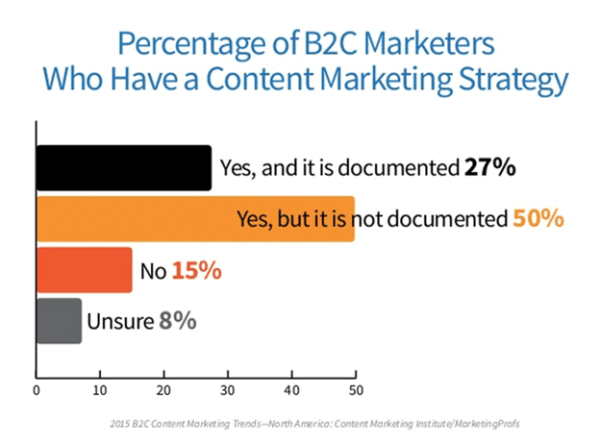
The percentage of B2C marketers who have a documented content marketing strategy is 27%. You might get hopeful, because 50% of marketers have a strategy. (It’s not written down, that’s all.)
That’s a huge problem. If it’s not written down, then it probably doesn’t really exist. Sure, it exists in people’s minds, but how clear is that? How can a strategy that exists in people’s minds guide an organization’s cohesive efforts?
Content marketing is a method that takes a team to carry forward. If the organization’s individuals are holding some nebulous strategy in their minds, that’s not really a strategy at all. That’s just some thoughts on content marketing.
I’m also concerned about this statistic: Only one-third follow their documented strategy “very” closely, with 57% following it “somewhat” closely. Why document your content marketing strategy if it’s not valuable enough to follow closely?
The problem seems to lie with the word “strategy.”
“Strategy” is a fuzzy word. Frank Cespedes wrote in the Harvard Business Review:
Ironically, after years of books, articles, and MBA programs dedicated to strategic thinking, that’s the danger with how strategy is used in business meetings. It’s too often a way of sounding smart or leader-like and used to avoid necessary choices.
People conflate business strategy with the aggregation of tactical plans … Studies show that a big problem with strategic planning processes is that the resulting ‘strategy’ is a bland compilation of capital budgets that, in turn, are a compilation (not integration) of separate functional initiatives.
OK, so most businesses don’t have a strategy – let alone a good one. Now, we need to talk about what “strategy” is. The HBR article explains it this way:
So, what is strategy? It’s fundamentally the movement of an organization from its present position to a desirable but inherently uncertain future position. The path from here to there is both analytical (a series of linked hypotheses about objectives in a market, where we do and don’t play among our opportunity spaces, and what this means for the customer value proposition, sales tasks, and other activities) and behavioral (the ongoing coordinated efforts of people who work in different functions but must align for effective strategy execution). And the trail always begins with customers.
That’s basically a complicated way of saying that we need to have goals.
Goals.
I would argue that “strategy” should really mean “goals.”
“Strategy” sounds smart and sexy, but how different is it from goals? Goals are a much clearer way to look at the issue of strategy. I suggest that we stop trying to come up with an innovative “strategy,” and instead focus on goals.
The kind of goal-setting that I suggest is a simple tried-and-true technique called SMART goals. Here’s the basic overview:
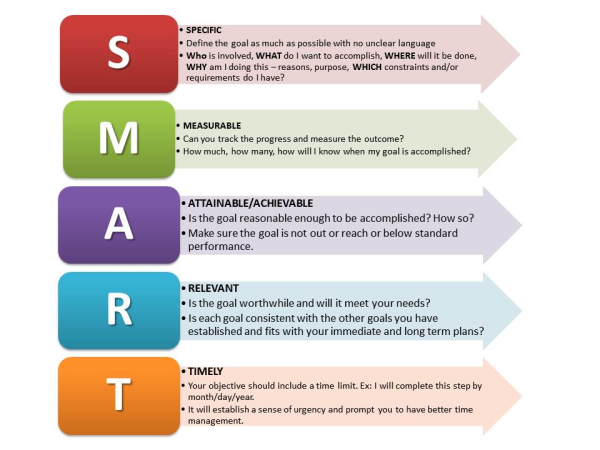
SMART goals are a way to help businesses and individuals develop their goals. Many goals are fuzzy desires. SMART goals have a clear method of progress, and real numbers that demonstrate whether that progress is happening.
If businesses would forget about “strategy,” and instead pick real goals, I think that content marketing would explode in effectiveness. It’s easy to toss out recommendations like “make SMART goals!” What I want to do is explain exactly what SMART goal-setting looks like in the field of content marketing.
The ways that I see companies lose their strategy can be tied back to shortcomings in the SMART goal-setting process.
This article’s outline follows the SMART goal framework, applying each one to a goal-setting problem that focuses on content marketing:
Reorienting your content marketing strategy around these five guidelines will revolutionize the way you approach marketing. Let’s discuss each one.
Content marketing alone is not a tactic. It includes all kinds of tactics. There are a ton. Here’s a sample:
Different types of content will have differing results. Some types of content will cost more than others.
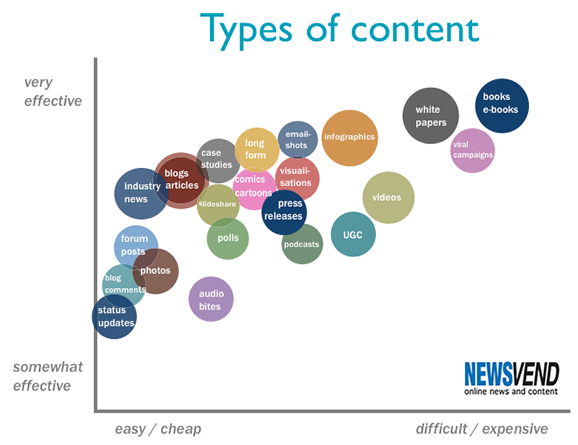
You have to choose which types of content you will produce and promote. Most organizations choose multiple types of content marketing tactics. That’s entirely appropriate.
Companies do so because different types of content affect the customer in different ways. Depending on where the customer is in the purchase cycle, certain forms of content can help nudge them further down the funnel.
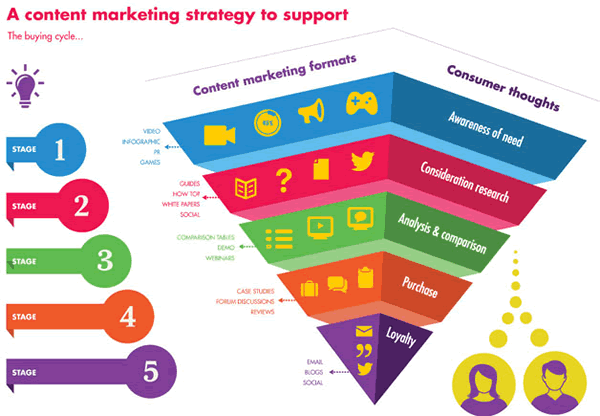
TIP: Don’t assume that blogging is the right tactic. Not every business needs a blog. There are dozens of content varieties and for your specific business some of these may be more effective than a blog.
You should, as the image below points out, “diversify content types.”

Be careful, though. You don’t want to diversify to the point of dilution. Often, a single and focused tactic works better than a dozen tactics that are poorly executed.
At the very least, pick one or two content tactics to dominate, and then go and do it.
Measuring the ROI of content marketing is one of the most common frustrations among marketers. It is sometimes hard to do, especially if you don’t have a clear strategy. I’ve found that companies that have a strategy are very effective at tracking their ROI. The two go hand-in-hand. If you have measurable goals (a strategy), then you are usually measuring the return on investment.
Measuring the ROI of #contentmarketing is hard to do if you don’t have a clear strategy says @neilpatel
Click To Tweet
The question is how do you measure the return on investment?
The frustrating answer is, there’s no one way. But there are definitely ways to do it. You have to choose the method that works best for your organization.
If your business uses AdWords, then you might want to try the technique used by David Meerman Scott, which includes measuring your ROI based on AdWords equivalency. (You can read the great explanation in this CMI article.) Scott Severson implemented this ROI measurement, and it helped his clients not just gain traction, but prove it. He tracked specific keyword data.

And measured those improvements in dollar amounts based on SEO-click value.

There are alternative methods of measuring ROI. You simply need to choose a method that works, and stick with it.
What’s the goal of content marketing? This is an easy question with an easy answer – to gain more customers.
But there are several nuances to the issue that make it slightly more complicated. For one, many marketers get so caught up in the daily tasks of producing content that they lose sight of this outcome. Instead, they simply are producing more content, more content, more content, and don’t stop to realize that more content isn’t going to get them anywhere unless that content is directly tied to an attainable goal.
The attainable goal isn’t just more clients. A true attainable goal should be more specific. Joe Pulizzi recommends these possibilities:
Keep in mind that a real strategy – one that is built on SMART goals – has an attainable outcome. To make that outcome as attainable as possible, you need to focus it as best as possible on metrics that matter.
Content marketing is such a widespread marketing method that many organizations simply do it without taking the time to integrate it with company-wide goals. Often, a business’ marketing department has a different mindset than the remainder of the company.
If content marketing is to be effective, it must be tied to overall business goals. On occasion, I’ve seen businesses that were, for example, in the business of selling SaaS. Their marketing department, however, was in the business of promoting webinars.
If #contentmarketing is to be effective, it must be tied to overall business goals says @neilpatel
Click To Tweet
Is that a good approach? Sure it is. Webinars are a powerful way to drive traffic, build thought leadership, expand influence, and produce all kinds of wonderful results. I’ve been using webinars a lot recently, and providing value to many people.
What’s the problem? The problem arises when the webinar goal and the business goal are separated at the core. If those webinars aren’t designed to improve the sale of SaaS, then they are a waste of time and money.
For those webinars to possess explosive power, they should contain calls to action that drive attendees to sign up for the SaaS.
Content marketing is a funnel. The skinny end of the funnel should be the company’s business goal.
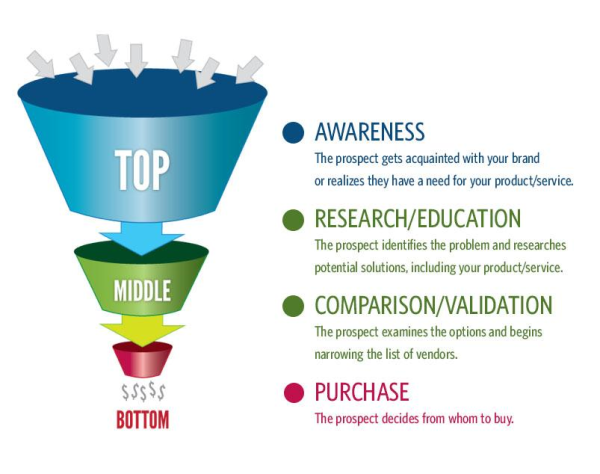
There could be content marketing tied to marketing activities after the sale, too.

Every content marketing funnel is going to be different, depending on the business. Once you create your marketing funnel, make sure that your content marketing strategy aligns perfectly.
Does content marketing ever end? Unless we do away with contemporary marketing channels, I doubt it. Content is a way of serving customers, and customer service is a never-ending process.
Some argue that content marketing isn’t a sustainable strategy. Their argument stems, in part, from the fact that there is simply so much content being produced and proportionately less content being consumed by the target audiences.

If content marketing is going to continue into the foreseeable future, we need to know when we’ve reached our goals. A goal isn’t a real goal unless it has a logical endpoint. Goals are allowed to evolve, but they aren’t allowed to continue indefinitely. As content marketers, we can continually set the bar higher, but we ought not to allow the endless pursuit of a somewhere, somehow, someday endpoint.
As you crystallize your content marketing goals, make sure that each goal has a point at which you know for sure if you’ve finished or not.
If your goals are too vague, you’ll keep spinning your strategic wheels, hoping for a conclusion, but never seeing one.
The explosive growth of content marketing is one of the best things to happen to the marketing world. At the same time, we’re still in the early stages of defining, understanding, and making sense of its digital application.
If you feel like your strategy is messed up, you’re probably not alone. A lot of other businesses are enduring the same challenge.
If you replace the vague idea of “strategy” with some crystal-clear goals, you’ll see your content marketing advance. SMART goals are powerful, unstoppable, and ready to push your marketing efforts to new heights of success.
What challenges have you faced with your content marketing strategy?
Want some help in creating a solid content marketing strategy? Download the 16-page CMI guide with 36 questions to answer.
Cover image by Joseph Kalinowski/Content Marketing Institute
The post Here’s Why Your Content Marketing Strategy is Totally Failing appeared first on Content Marketing Institute.
The oil industry has taken it on the chin over the last few months.
Prices have fallen along with revenues, and the renaissance in US oil production has turned into a nightmare.
According to Diamond Offshore Drilling CEO Marc Edwards, the bad dream for the oil industry isn't going to end anytime soon.
SEE ALSO: Just a fraction of the world's oil supply isn't profitable at $35 a barrel
Join the conversation about this story »
NOW WATCH: We did a blind taste test of Pizza Hut, Domino's, and Papa John's pizza — here's the verdict
A student-developed 3D hand scanner called the Curatio just may herald the beginning of a truly customized arm brace, and with a little bit of luck and a lot of hard work, we may just be able to create things that, you know, fit.
The post This revolutionary 3D scanner digitizes your limbs to make custom braces and casts appeared first on Digital Trends.

Luxury retailers face both a challenge and opportunity in personalization. Shoppers are beginning to expect personalized communications from brands in the same way they would not expect a friend to send a mass email. But this puts marketers on the hook for figuring out how to deliver personalized messaging that doesn’t break the bank. As of today, we are still in the experimentation stage between balancing of mass and targeted communication.
These are some takeways on how retailers can approach personalization (and drive ROI)
1) Each customer has a different value
Technology has made it clear that not all customers are equal. And we’re not just talking about wallet size. Some of a retailer’s most valuable customers are those who are willing to create content for the brand. The woman who shares a handbag on her Instagram account after she buys it can influence many more transactions than her receipt suggests. When calculating total customer value (and what incentives to give to different customers), retailers can use technology to bring in data on social behavior and influence.
2) Technology uncovers full journeys
Retailers are no longer limited to segmenting customers by purchase history. Technology gives them a way to identify and reach multiple personas by looking at customer’s behavior throughout the day. Foursquare VP of Business Development Mike Harkey pointed out that that Foursquare is connecting data such as geographic history, event checkins, and favorite pages to give brands a full picture of a customer journey – and serve ads accordingly. Retailers can use that information to create content that comes up where and when it is most valuable to a shopper.
3) Learn as you go
Retailers are asking for actionable insights – how does my data translate into the type of communication we should put out today? What we learned is that getting it right doesn’t necessarily mean getting it perfect right now. Instead, understand how your data can drive personalization as you go. Most luxury retailers are still pushing out content based on the creative director’s vision of current trends. This is fine – it’s part of the nature of the business. But the reactions to content should be tracked and optimized in real time. This means tracking what types of content each person responds to, and serving them content that fits their interests the next time. Engagement will increase over time, and you won’t waste your time (or your customers’) by creating content that shoppers aren’t interested in.
For more from our event, visit the SecretsOfRetail.com
 Giulia Callegari is Vice President eCommerce & Luxury Asia Pacific at OgilvyOne Worldwide in Hong Kong
Much has changed in the past four months of the technology startup world and how outsiders value the business. Of course it’s too early to predict whether this is a trend or an aberration but the smartest people I know in the industry are predicting the former.
The startup industry may be “resetting,” which doesn’t mean a “crash” but rather just a resetting of valuations, timescales, winners/losers, capital sources and the relative emphasis of growth rates vs. burn rates.
As we noted in our survey of more than 150 VCs we know in the industry, many saw drops in Q4 valuations last year with nearly all of them projecting decreases in 2016.

And when prices are dropping on a VCs existing companies in market, there is a substantial reduction in FOMO (fear of missing out) for new deals, which means that investors take their time in making investment decisions. Deflationary economics are well understood – in a market when prices are dropping one prefers to wait a few months to see if prices stabilizes before committing. We do this in our consumer lives with everything ranging from housing purchases to public stocks.
 Why does this matter?
The single best (and most important) article I’ve read on the topic was published today by Joseph Floyd asking whether Black Friday was a DiSaaSter or a Reversion to the Mean. That’s economics (or statistics) for asking whether price ratios of how investors value companies was simply coming back to historical norms. You should read the article but I’ll provide the money shot

So here’s my take away
In my mind this simply means
The days of easy money may be slowing down. And please consider reading Joseph’s article on TechCrunch. It applies to all startups – not just SaaS.
Great companies will continue to be built and many will tell you that building a great company in capital constrained markets in some senses builds a more sustainable company. The best deals will continue to get financed. This isn’t a fire alarm. Just a message to less experienced entrepreneurs that the capital markets may have begun to change and if you’re not aware of how this could affect you then you could be a casualty. The last few funding corrections saw many great companies disappear due to bad capital planning / high burn rates.
If nothing else, opinion on extending the concept of flow-through shares to the technology/bio-technology sector — a theme that was the subject of a recent column — is mixed.
Here are the comments from one reader who likes the idea that, if implemented would provide capital to companies and tax breaks to investors – with the hope being that the idea being developed would provide large capital gains at some future date. That idea has been promoted as a way of diversifying the economy, a process that probably needs some form of government assistance.
READER A. “As investment propositions, information technology startups have similar characteristics to junior mines. They are capital-hungry lotteries with virtual certainty of loss balanced by a remote hope for dramatic riches.
“There’s clearly a local community with an appetite for that sort of risk, possibly justified by a faith in subject expertise. It’s long seemed regrettable that there hasn’t been a mechanism for tapping into the community, and extending its skills to provide venture capital for something other than rock-bashing.
“To the extent that it makes sense to encourage what could be considered wild gambles, (because the collateral benefits outweigh individual losses), extending flow-through shares to startups would be a good development,” he said.
JAY KELLERMAN. The managing partner at the law firm, Stikeman Elliott, recently wrote an opinion piece for MicroCap Review Magazine.
In that piece, Kellerman, whose practice over the years has focused on mining companies, writes of the similarities between the junior resource sector and the start-up technology sector. Those similarities include: both are based on the ability to own and exploit property; both have an insatiable appetite for capital; both are run by entrepreneurs, both are risky ventures and if successful, a number of the founders see their companies sold to larger concerns, often before the commercialization of their assets.
Kellerman noted one possible difference: in the mining sector “title is generally very secure,” whereas with the technology sector property rights “are contained in the brains of those who leave the workplace every day.”
As part of his work, Kellerman has noticed a different feel about the technology sector, be it in and around Kitchener/Waterloo; the Ottawa area or in Vancouver.
And given the new government’s priorities on innovation/science/technology – Kellerman had a few ideas for the tech sector, some of which will take time to germinate.
Kellerman made those suggestions on the expectation that “there would be some appetite with other market participants, such as Canadian investment banks and perhaps the Toronto Stock Exchange to participate in the growth and development of this important Canadian industry.”
INVESTOR B. This B.C.- based investor had a bad experience with investing in a labor-sponsored venture capital fund. “All they do with these things is find an excuse to pay the executives that are set up to run these things outrageous annual salaries.” This investor said that he spent over $50,000 “supporting this type of thing and now the shares are at a value of $3,000.” That’s not a good outcome, for a product that is being phased out in parts of the country.
In this investor’s view, “you don’t make things work unless there is at least a chance of some reward. People are better off dealing in a straight market exchange with companies that are proven. So if Ottawa is thinking about extending the flow-through concept to the technology sector, it now has the benefit of the opinions of three Canadians.