Shared posts

15 Mar 17:04

Amazon today is like Walmart in the 1980s, and that should scare anyone in its way (AMZN, UPS, FDX)

by Myles Udland

duck and cover fear safety disaster drill

Amazon looks to be planning world domination.

Or, to put a more concrete analogy on it, analysts at RBC Capital Markets think Amazon today looks a lot like Walmart did in the 1980s.

And that, of course, should terrify all of its competitors (and perhaps especially those companies that don't even know they're competing with Amazon yet).

"At the core, we think the decisions Amazon is making today parallel those made by Walmart during the 1980s, as the company began to integrate itself more fully with its suppliers to aggressively reduce costs across all aspects of its business, especially the supply chain," RBC's John Barnes and team wrote in a note to clients on Tuesday.

"This can accomplish two things: reduce costs in any way possible and ensure that customers receive goods in a timely manner year round."

And while Amazon isn't built around physical stores like Walmart was, here's a quick graphic that shows how Walmart took over the US in just a few decades. Were Amazon to match this sort of market-share-type growth, well, the world would look a lot different.

Screen Shot 2016 03 15 at 9.50.29 AM

Barnes and his team cover the airfreight and surface transportation sector — think FedEx and UPS — and so have taken close order of Amazon's forays into leasing trucks, planes, and trailers to expand its distribution network.

As we've written before, Amazon continues to make moves that make it look less like a company working inside the "internet economy" (or whatever) and more like a company operating in the "real one."

That is: Amazon increasingly looks less focused on selling the next incremental piece of tech hardware — think Fire Phone — and more interested in delivering groceries and books to your door, together, in less than an hour.

Now, Amazon has always funneled most of its money back into the business, but with investments in things like planes, the company is beginning to make a more focused effort to control every leg of its distribution operation.

RBC writes that these moves from Amazon have, "led to a great deal of concern among investors that Amazon is in the process of actively developing its own internally controlled supply chain capable of moving product across the globe all the way to a customer’s doorstep." To RBC, this is "partially true."

They write:

Amazon is trying to build a global supply chain to reduce costs and create deeper customer relationships. Similarly, we believe Amazon is working to create a limited pickup and delivery operation to meet niche customer requirements and to keep the traditional parcel carriers “honest” with regards to pricing and service commitments. However, we do not think the company can yet build a full-scale pickup and delivery business capable of supplanting the likes of UPS, FDX and the USPS.

And this may be the case.

Media companies like Disney and Viacom, however, have discovered in recent months that it isn't the actual execution of a business-model-shattering package from a competitor that gets investors bailing but merely the threat of as much.

Amazon TruckAnd RBC acknowledges that shipping stalwarts like UPS and FedEx face the same potential issues, writing that the threat of a full-scale Amazon logistics operations would "likely lead to much weaker investor sentiment" in their coverage area until the market fully figures out what Amazon is and isn't up to.

We'd also note that logistics is not the only area where Amazon is making huge investments and creating a major headache for incumbents.

Over the weekend Business Insider UK's Rob Price published an interview with Amazon's Werner Vogels, who is in charge of Amazon's Web Services unit which offers back-end data services to companies via the cloud rather than in-house hardware solutions traditionally offered by IBM, HP, Dell, and others.

And Vogels' message was clear: Amazon will be dumping money into this business to offer a better services for its customers.

The losers? Amazon's competitors.

Speaking about Amazon Web Services, Vogels told Price, "Remember, this whole business is about shifting capex to opex, but Amazon still as to put up the capex, and this is a capex-intensive business for us. So anything we can do to increase the cost efficiency of our operations immediately benefits our customers."

Which could be something you say about cloud-based data center support.

But would also be what you'd say when trying to ship books or groceries faster, too.

SEE ALSO: Amazon's cloud boss told us something that should terrify a $140 billion industry

Join the conversation about this story »

NOW WATCH: A sex expert reveals something surprising about casual sex

15 Mar 17:01

A Statistical Look at Toronto’s Sales Hiring Landscape

by Peak Sales Recruiting

Consistently ranked among the best places to live in the world, not to mention the largest city in Canada and commercial heartland of the country, Toronto also offers a strong business environment for employers to build their sales teams and for sales talent to advance their careers. This has created an evolving sales hiring landscape

Read More

The post A Statistical Look at Toronto’s Sales Hiring Landscape appeared first on Peak Sales Recruiting.

15 Mar 17:00

Google just turbo-charged one of its most important products (GOOG, GOOGL)

by Lara O'Reilly

speed

Google announced on Tuesday it is launching a new paid-for measurement platform called the Google Analytics 360 Suite that it will offer to its biggest advertising clients

Google Analytics is a hugely important tool, which has a 82.8% share of the website traffic analysis market, according to W3 Techs. While most users take the free option, the service helps website owners and marketers large (who pay for premium access) and small measure the success of their online ads, encouraging them to use more of Google's advertising products.

Now Google Analytics is getting turbo-charged. The Google Analytics 360 Suite comprises six products, four of which are new. Those products are:

Google Audience Center 360 (new) — A data management platform (DMP,) where marketers can plug in their Google AdWords and Google DoubleClick advertising accounts, as well as third-party data providers, and demand-side advertising platforms (DSPs.) This has been in testing for several months with a select group of clients and was at one point named the DoubleClick Audience Center.

Google Optimize 360 (new) — A product that lets marketers personalize different variations of ads and web pages to a number of users to figure out which works best for particular audiences.

Google Data Studio 360 (new) — A collaboration tool that allows organizations to share data visualizations and reports across the business.

Google Tag Manager 360 (new) — A tag management product that gathers site code and APIs.

Google Analytics 360 — This was formerly the Google Analytics Premium product for large organizations.

Google Attribution 360 — This was formerly known as Adometry. It is a cross-channel attribution product that lets marketers enter all of their marketing spend data — including offline media such as TV and billboards — to assess marketing performance.

Google Analytics 360

A measurement platform built for mobile

Speaking to Business Insider, Paul Muret, Google's VP of analytics, display, and video products — the Googler who founded Google Analytics — explained the company's thinking behind the the new suite.

Most marketers learned their craft in the desktop era, using basic session tracking and looking at simple customer paths to conversion (the route consumers take between seeing an ad and actually buying a product.)

Mobile changed all that. Online session times are now much shorter, but the number of visits is actually increasing. The problem is that measuring mobile visits and linking those to sales or other metrics like brand uplift is hard — not least because most users don't actually make the final purchase on their mobile phones and there are so many different touchpoints that it's difficult to get a complete view of that journey.

Muret said: "The era of fractional attribution in programmatic marketing is here and requires a measurement platform really built for this multi-screen world."

paul muret

What's key is the way all the products link together to Google advertising products, but also other third-party platforms. On the Audience Center product in particular, Muret said the large customers testing the DMP were most impressed by the way they were about to understand the composition of their audiences across all different dimensions of data.

That's important: Google is often accused by rivals of building up a "walled garden," restricting access to third-party platforms — earlier this month ad tech company TubeMogul even launched an ad campaign that attacks Google over "conflicts of interest" and "walled gardens." But Muret was keen to emphasize the open nature of the Analytics 360 platform, allowing marketers to plug in all sorts of third-party data sources — from ad tech companies that rival DoubleClick and AdWords, through to TV modelling data.

The beta launch means Google is nearing the full ad tech stack, as one source explained to Adweek last year, when it first emerged Google was testing a DMP: "A demand-side platform to buy ads; an exchange for publishers to sell ads; an attribution product to measure performance; and a dominant position in search and mobile."

Earlier this month, Facebook announced it was pulling back on a big ad tech project because there were too many bots and bad-quality inventory on the open web. Facebook had begun testing the build of a DSP within its ad tech platform last year, but the company said it didn't deliver enough value for advertisers, so the plan is on hold.

Muret declined to comment directly on the Facebook announcement, but when asked about Atlas' pullback, he said:

At Google we are very focused on our users, so we are very focused on our advertising and marketing partners in making sure we are building healthy, sustainable, open ecosystems here that really benefit all parties involved. I'm not going to comment on Facebook but we’re really excited about the approach we are taking because it resonates with our largest advertisers and most sophisticated marketers. We are very excited about bringing the suite together and how it plugs into the advertising systems they use day in and day out as well as their larger marketing initiatives. Having a strong position on measurement we think is a really critical foundation for all these marketing organizations.

SEE ALSO: Facebook has pulled a big ad-tech project because there were too many bots and bad-quality ads

Join the conversation about this story »

NOW WATCH: Adam Savage reveals why he and 'MythBusters' cohost Jamie Hyneman won't be working together anymore

15 Mar 17:00

6 Ways to Help Your Event Grow Legs

by Leah Yanez

Here in Austin, the sun is shining brighter, the birds are tweeting louder and the traffic is a whole lot traffic-ier than usual. That’s right, folks—SXSW is upon us! We have several Bulldogs scheduled to attend and can’t wait to see what the festival has in store. But all the excitement got us thinking—how can companies make the most out of their events?

We often have the pleasure of helping our clients plan and market industry events throughout the year. Whether your event is as big as SXSW or as small as a local happy hour, conferences, road shows and even webinars are your chance to meet with clients and provide information about the latest technologies or services, educational resources and opportunities to network.

If you play your cards right, the ROI of an event can far exceed expectations. By using a few key tools and tactics, you can help your event sprout legs and extend its reach beyond just one day.

1. Social Media

This does not mean create a hashtag and call it a day. Don’t get me wrong—a hashtag is an important piece of the puzzle, but simply plastering it on a bunch of signs and slide decks is not enough. To increase engagement, round up tweets and display them throughout the event. At TD Ameritrade’s National LINC conference, select tweets with the conference’s hashtag were displayed on “Social Walls” throughout the event space.

TD Ameritrade even took it a step further by including a mobile version of the Social Wall in the National LINC app. This app was specially created for the conference and included a variety of other interesting features, such as maps, exhibitor information, speaker bios and much more. By crowdsourcing tweets, you’re not just giving attendees the thrill of seeing their content featured—you’re also encouraging others to get in on the fun and share their thoughts.

2. Downloadable Resources

Another great use of TD Ameritrade’s National LINC app was the ability to download slide decks and other resources mentioned during sessions. But you don’t need an app to do something similar. Try creating a landing page or content portal that your event attendees can visit to download key resources that were discussed during the event. (Content2Conversion did a great job of this!) You may even consider making the resources shareable on social media and via email. If the resource is high-value, try gating the content to gather more qualitative data about your customers. Another great result of sharing slide decks and other resources after an event is that attendees will be less focused on taking notes and more focused on the information you’re telling them.

3. Blogging

Even if your organization’s website doesn’t contain a blog, writing summaries of the information discussed at your event is a great way to refresh attendees’ memories, give them something to bring back to their colleagues and to inform those who weren’t able to attend. If you don’t have a blog, try guest blogging! Find an industry blog or online magazine that serves your target audience and negotiate some space for native content. It’s also a good idea to invite writers and representatives from these press organizations to your event. Doing so will likely prompt them to write a few blog posts or articles of their own, at little to no charge to you.

4. Video Highlights

If your event is highly informative, consider recording it and letting it live on a gated landing page. This is another effective way to collect qualitative data and generate leads, as well as expand on your investment in the event. Not only does video let attendees revisit content, but it also gives anyone who didn’t attend the chance to view the content.

5. Infographics

Did your event uncover a few quick bites of information that could make a mighty impact on your industry? Create an infographic! These highly-visible pieces of content are great for catching people’s attention and are easy to share across social media.

6. Email Nurtures

Once you have your resources in place, be loud and proud about promoting them. Create a post-event email nurture that alerts your clients (and potential clients) that there are fresh resources to be downloaded. Encourage them to pass these resources on to others where applicable, then watch as your audience starts to grow.

Photo credit: Sebastiaan ter Burg via Visual hunt / CC BY-SA

15 Mar 16:59

10 reasons why Canada should eliminate most import tariffs

by Mike Moffatt
Canada Border Services Agency truck

(Ben Nelms/Bloomberg/Getty)

In a paper released today at the Mowat Centre, I advocate for the selective elimination of tariffs—taxes—on imported goods as a way to boost Canadian productivity.

Making it Simple highlights the absurd, occasionally Kafkaesque, world of Canadian import tariffs and finds that while most tariffs raise next to no revenue for the government, they impose significant costs on Canadian businesses and consumers. While the tariff system is an incredibly complicated beast, the case for selective elimination of low-revenue tariffs can be summarized in ten simple points:

1. Only a few tariffs truly matter.

The Canadian government collects roughly $4 billion a year in tariff revenue, but only a handful of products such as cars, clothing and shoes generate a significant amount of money for the federal government. Combined half of all active tariffs (that is, tariffs with rates above 0%) generate just $100 million a year in revenue. This is due to a combination of low tariff rates and the imported products coming in tariff-free under free trade deals like NAFTA.

2. Compliance is expensive…

The term “free trade deal” can be misleading, as free trade is anything but free for businesses. The best estimates we have are that the compliance costs to importers and exporters of trading tariff-free under NAFTA are around (or above) 1% of the value of the goods sold. That is, a shipment of $100 million worth of goods costs the trading partners $1 million in regulatory compliance costs. Given that two-way trade between Canada and the United States was over $750 billion in 2015, even the most conservative estimates of compliance costs are in the billions.

3. …and so is giving up.

Due to these compliance costs, companies occasionally find it cheaper and easier to simply pay tariffs rather than attempt to import tariff-free under NAFTA or one of Canada’s other trade deals. This particularly affects small and medium-sized businesses, as they often lack the resources to navigate an incredibly complicated tariff system.

4. The paperwork is a nightmare…

Why are these compliance costs so high? One problem is that to import tariff-free under a trade deal, companies must be able to prove that the product meets the country-of-origin requirements of the trade deal. If a Canadian company is importing a good under our trade deal with Israel, they must be able to prove that the good underwent “sufficient production” in Israel to qualify for tariff-free status. These rules are incredibly complex, run hundreds of pages per trade deal, require the importer obtain and retain paperwork for a five-year period and expose the company to retroactive audits.

5. … so it’s filled with mistakes…

As well, companies must correctly classify their product using “Canada’s Customs Tariff, a 1569 page tome containing over 15,000 eight-digit tariff items”. As the paper indicates, companies often struggle with proper tariff classification as “the 2001 Report of the Auditor General of Canada revealed that 29 percent of tariff classifications provided by importers were incorrect, with 48 of the 53 companies examined making at least one error in classification”. The report gives the example of an electric toothbrush, which does not fall under the tariff item “toothbrush” but rather falls under the tariff item “electro-mechanical domestic appliance”.  These mistakes can be quite costly for businesses, as differences in tariff rates mean that a company making a classification error will either pay too much in tariffs or face a retroactive tax bill if they accidentally classified a product at too low a rate.

6. …and complicated exceptions.

If this were not complicated enough, there are also complicated override provisions on tariffs which create even more headaches. These override provisions were at the heart of the iPod tax dispute, where the Canadian government paid out $27 million to electronics importers for improperly collected tariffs.

7. Even with all the rules, there’s no clarity…

Companies and the Canadian Border Services Agency (CBSA) often cannot agree on what the correct tariff item should be, with disputes making their way to the Canadian International Trade Tribunal (CITT). Some of these cases are quite absurd, such as Philips Electronics and the CBSA arguing over whether coffee and espresso are the same thing. In my favourite case, Mattel Canada and the CBSA debated the nature of the Rainforest Jumperoo, the Rainforest Bouncer and the Newborn to Toddler Rocker. In the case, “[t]he CBSA argued that these items are seats and fall under tariff classifications 9401.71.10 and 9401.80.10 which have associated tariff rates of 8 per cent and 9.5 per cent, respectively. Mattel argued that these items are toys, and should enter the country tariff-free under tariff item 9503.00.90… To help answer the question, the CBSA brought in Dr. Christopher Fennell, Associate Professor at the University of Ottawa, for his expert opinion on infant cognitive development. In order to be considered a toy, the Tribunal was required to determine if the goods could “be said to amuse infants or children”. Dr. Fennell testified that “…past the age of six months, I would be comfortable saying that these objects could provoke amusement at that higher level of smiling and laughing.” Ultimately the CITT sided with Mattel.” Given the tax consequences, companies spend millions on some of the best legal and scientific minds in the country to determine how much fun a child could have using a chair.

8. …And clarity is costly.

The taxpayer also pays for these cases, as the CITT’s budget is roughly $10 million a year, almost all of which comes from the federal government.

9. Eliminating Tariffs is a good deal.

Most of these costs are eliminated if tariff rates are simply set to zero. The country-of-origin problem goes away entirely, as companies would no longer need the protection of free-trade deals to import tariff free. While companies would still have to make good faith efforts to classify their products correctly, mistakes or disagreements in classification would no longer have tax consequences, removing the fears of audits and eliminating the need for CITT cases on the proper way to classify a trampoline enclosure. The productivity savings are in the billions, at a cost to the treasury of $100 million a year if 50% of tariff rates are set to zero and $600 million if 90 percent of tariff rates are eliminated.

10. We know it can be done.

There is a template for setting tariff rates to zero, as Budget 2009 and Budget 2010 eliminated tariffs on some manufacturing inputs as a way to boost productivity in the manufacturing sector. In the paper I recommend a similar process be followed, with the government also examining manufacturing inputs that were missed, including tariffs on metal tools and inputs used by the clothing and agrifood manufacturing sectors.

Given the low relatively small financial costs to the federal government, I hope they will consider selective tariff elimination. The first step would be to select possible tariff items for elimination (my paper suggests a number of candidates), announce their potential abolition in the Canada Gazette and receive feedback from stakeholder groups. Based on that feedback, the government could then eliminate some of those tariffs in Budget 2017. Given the need to boost Canadian productivity, I can see no reason why they would not consider doing so.


MORE ABOUT TAXES AND THE ECONOMY:

The post 10 reasons why Canada should eliminate most import tariffs appeared first on Canadian Business - Your Source For Business News.

15 Mar 16:58

Sales Development Representative: A Day In The Life

by Dan Smith

The sales development representative role has drastically changed as buyers are driving a different journey. They move at a different speed and don’t respond to slimy, pushy or aggressive tactics.

The most effective salespeople use their skills, tools and insights to help their customers evaluate options, present trade offs and identify the right solution in ways far too complex for Google.

Day in the Life of a Sales Development Rep

We recently met up with Nicole and Ned – they are two top sales development reps at Guidespark. Lucky for us, they were willing to share exactly how they do it.

What are Sales Development Reps (SDRs)?

Sales development reps are responsible for outbound prospecting. The world of an SDR revolves around lead gen, rather than closing new deals. SDRs are typically measured by how effectively they move leads through the sales pipeline.

Sales development representatives help with the lead qualification process, which allows account executives to focus on closing deals instead of wasting time with prospecting.

Ultimately, sales development reps are educators that leverage insights to assist solving a real problem customers are having.


Successful SDRs are educators who leverage insights to solve a problem customers are having.
Click To Tweet


generate sales opportunities SHU course

SDR Problems: Nobody Wants To Talk To You

Sales development representatives are tasked to meet the demand of a new kind of buyer that primarily lives online, buys faster, and spends more on cloud services than ever before.

Day in the Life of a Sales Development Rep

But for good reasons, customers won’t share their real challenges – until you have demonstrated you understand their business. And you don’t understand their business unless you talk to them.

Chicken or Egg.

Finding out the real problem requires knowledge with insights shared in the right way. However, in most organizations salespeople are trained to pitch – the worst ones share how amazing their solution is, and how much better the customer would be with their product…. pitch, pitch, blah blah blah.

Solution: Provide Insights That Are Undeniable

SDRs are arguably the most important part of the sales team because they “bring customers out of thin air.” Without them, the other members of their team wouldn’t have contracts to send, or customers to make successful.

Sales development representatives have to be quick on their feet, excel in having online conversations, master tools, be great content finders, and have a positive outlook not brought down by a bad interaction.

Check out a video recap of a typical day for Ned and Nicole:

A Day in the Life of a Sales Development Representative

Here’s a description of a typical day for Ned and Nicole.

5:30am – Wake Up O’clock

Whether you snooze nine times, or set four different alarms, days start earlier for sales professionals with customers across time zones. Some get inspired by 8 things to do before 8am. Did you know that many SDRs start their day as early as 6am?

7:00am – Commute to Work

Taking the bus provides a few hours a week to read, listen to podcasts or scan social media for the latest news that could be interesting to your team or customers.

8:00am – Arrive at the Office

Day in the Life of an SDRWhen Ned from GuideSpark arrives at the office he starts off first by checking email, scanning for priority messages, then grabbing a coffee and granola bar from the kitchen.

Over coffee he checks social outlets and uses Buffer to share great articles and insight throughout the day on Twitter and LinkedIn.

If it will take him less than two mins to respond to an email, he gets it done right away. Then he prioritizes questions that need a researched answer to handle later.

Pitfall to avoid: Don’t spend too much time on email or social media. Some things can wait.

8:15am – Standup Meeting with the Team

Ned is partnered with an Account Executive in New York. They collaborate as a team and establish 1-3 key priorities. After agreeing what can wait, they share what worked or what didn’t yesterday, and focus on something they’re going to improve today.

8:30am – Research and Respond

Ned is a professional who cares about helping customers, so he’s not “spraying and praying” semi-personalized template emails with automation tools. Through research, he finds the most relevant insights based on personas, and based on what he has found resonated with similar people in the past.

He checks his LinkedIn profile views for any customers that may have visited his profile. He does some quick research to find uncommon commonalities or interesting aspects of their profile, responds to comments on his posts, and sends thank you’s or personalized LinkedIn requests.

Pitfall to avoid: Don’t send the default LinkedIn “Add you to my network” – show the customer you care with a quick note on why you’re connecting.

9:00am – Prioritize Your Top Customers

The coffee Ned had earlier has now kicked in, it’s time to get on the phone. He uses this time block to call based on tasks scheduled in Salesforce.

Pro Tip: Avoid getting distracted by constantly checking your email during this time slot – that can be a big time sink. 

Day in the Life of an SDR

Pro-tip: Organize your calendar with color blocks for emails, calls and breaks. Here’s an example of how Chad from Infer schedules his week to maximize productivity.

9:45am – Take 15

To maximize sales productivity, Ned divides up his day with scheduled breaks. Get to know your coworkers if they are also taking a break, take a walk, or perfect your coffee making skills.

10:00am – Hit it HARD.

Next 75 mins, Ned gets after it. He remembers he is NOT selling. He is helping educate customers to solve their problems. He’s their “doctor” that did the research for them.

Pro Tip: Do not prescribe your solution before a diagnosis.

  • Phone calls: Personable and to the point, provoke thought.

11:15am – Follow-up Calls with Emails  

Ned won’t let it linger. He shares insights, includes a valuable article in all of his emails to truly be helpful to customers. Then schedules follow up emails using tools that delay send to next day in your defined sequence.

11:45am – Break for Lunch

Nicole and Ned grab lunch. Now it’s time to do something fun with the team or get a quick workout or run 3.5 miles. On the way back, wolf down the post workout burrito you earned.

Pitfall to avoid: Do not eat at your desk.

12:45pm – Stop by Your Manager’s Desk to Check-in

Day in the Life of an SDRNicole doesn’t do this every day, but doing this every now and then makes a huge difference. She sees if there are any pressing issues that need to be dealt with and if so, she asks how she can help.

She then does more research about her customers to be strategic with her time to focus on the right people.

1:30pm – Check On Your Social Channels and Emails

Nicole scans her LinkedIn and email. Same as Ned, she deals with urgent issues right away, deletes spam and marks what needs to be done later based on research. She then pops a Diet Coke (or Diet Dr. Pepper…. or Red Bull) in preparation of the 2pm AWESOMENESS she is about to deliver. Practices her pitch, objection management and it’s game time.

2:00pm – AWESOME Hours

Next batch of qualification calls is happening, she is fueled, ready, and excited. Each call is based on research. She has the customer’s LinkedIn profile up, knows which value props will potentially resonate based on their persona, and she is handling common objections like a boss in a customer centric way.

Pro Tip: Have real conversations. Keep going, don’t look back… you are in the zone.  

3:45pm – Take a Break

The weather is gorgeous. Celebrate a win with your coworkers.

Sales Office Celebration

4:00pm – Wrap Up, Research, Prepare for Tomorrow

Nicole recognizes knowledge is power – and research is the name of the game. Nicole schedules targeted emails in small batches, targeting similar customers using tools as a force multiplier to scale her thoughtful outreach.

Nicole only focuses on prospects she identified that could benefit from her solution. They are “delay sent” to go out tomorrow morning about 30 minutes before she arrives at work so she can prioritized her outreach based on who opened/clicked to prioritize her time based on who is most interested.

Pitfall to Avoid: Do not write emails to “check-in” if they got your last email – or worse a “mass personalized check-in” email.

5:00pm – Another Day, Another Happy Customer

Exercise, have a social life. Read books and become an expert in your industry and in sales. Attend events to share best practices and make connections.

Wait … the day is NOT done yet… as an SDR there is another important window…

8:30pm – Executive Communication Window

While on the couch binging through your favorite Netflix series, keep that phone handy. If you have earned it, several of the executives you are working with, are getting into their email window. They now are responding to your emails!  You don’t want to let it wait until next morning as you’d enter into one of their potentially 700 daily.

10:00pm – Bedtime O’clock

Make sure to get enough sleep. You have a big day tomorrow.

Special considerations

Friday afternoon

No follow-up, any action can be “delay-sent” over the weekend. Unless it is urgent, you’re better off waiting until the Sunday night window.

Monday

Skip all social activities on Monday afternoon, check-in calls etc. Just don’t bother. Monday is 100% business day, to GSD.

Sunday evening

Great email productivity window on Sunday eve to get through to executives. You may want to do some prep work for the week. One hour should do it.


Sunday eve is a great email productivity window to get through to executives. @justdansmith
Click To Tweet


Note: There is an incredible amount of nuance depending who at what you sell, who your customers are – so take it with a grain of sales.

The post Sales Development Representative: A Day In The Life appeared first on Sales Hacker.

15 Mar 16:58

7 Strategies to Make Referral Selling Incredibly Effective

by billcates@referralcoach.com (Bill Cates)

referral-selling-strategies.jpg

Not every prospect is ready to jump in and do business with us right away. That’s why it’s so important for salespeople to remain professionally persistent with new prospects. Sales deals require multiple touches to close, so reps who give up after just one or two communications won’t see success.

But salespeople must be careful to balance their perseverance with good judgment, especially when referrals are involved. Here are seven critical things to remember when selling to referrals.

7 Strategies to Make Referral Prospecting Incredibly Effective

1) Always be respectful.

Remember – These prospects have been referred or, better yet, introduced to you, so you must treat them like royalty. It’s not just your reputation on the line. Your referral source’s relationship with this prospect might also suffer if you act unprofessionally, and that’s a poor way to repay somebody who’s helped you out.

2) Leverage your relationship.

Use the information you learned about this prospect from your referral source to present and maintain a more compelling reason for them to move forward with you. When you tie your prospecting efforts to what’s most important to them at the time, you’re more likely to spark and maintain their interest.

3) Present yourself as an extra set of hands.

When approaching new prospects, present yourself as an “additional resource.” Avoid the appearance that you’re trying to replace any current relationships and your prospects will be more receptive to you. Even if they’re not happy with their current vendor, they may be stuck in inertia and not receptive to change. Coming in as an additional resource will be easier for them to consider.

4) Keep your referral source in the loop.

Your referral source can assist you in determining how persistent you should be with their friend or colleague. If you have trouble reaching your prospect or they seem unresponsive, let your referral source know. They will advise you how to proceed without hurting any relationships and will appreciate you considering their perspective.

5) Formulate an outreach plan.

Have at least five to seven touchpoints pre-planned for your prospecting efforts. You need to be flexible to be successful in sales, but it’s better to start with a plan than to make it up as you go.

Most salespeople give up after two or three attempts, even though study after study demonstrates that it usually takes five to seven contacts to bring your prospect to a decision. The best way to ensure your outreach sequence follows a logical progression is to plan it first.

6) Provide value in every touch.

In each touchpoint, provide some additional value. Compile a series of articles, videos, or links to other related resources that build on each other in a logical progression. You can include one of these resources each time you reach out to your prospect. By including information from sources other than yourself, you demonstrate that the value of knowing you goes beyond just your own expertise.

7) Go for the “no.”

If your prospect keeps putting you off after repeated (appropriately-timed, so you don't appear aggressive or needy) attempts to connect, it could be time to go for the no. Here’s an example of how I might approach a referral who wasn’t responsive:

Bob – I appreciate your willingness to continue to explore how I might become an additional resource for you. I get the feeling that perhaps you don’t see the fit and you’re too nice a guy to just say ‘no’ to me. Would you prefer that I stop contacting you at this time?

You’ll should adjust this wording to fit your style, but you get the idea.

When you go for the no, one of two things usually happens.

  1. You learn more information that allows you to adjust your approach and keep the courtship alive.
  2. You are able to release this prospect and spend your time and energy with other clients and prospects.

Don’t wing it when it comes to being appropriately persistent with qualified prospects. And don’t give up too early. Have a plan, work the plan, and be flexible as you learn more information about the prospect along the way.

HubSpot CRM

15 Mar 16:57

Don’t Use Round Numbers in a Negotiation

by Matti Keloharju
mar16-15-000008242274

What is the best way to start a negotiation about money: by offering a round sum, like $10, or a more precise one, like $10.20?

Many people gravitate toward the former. But is this actually the most effective way to get what you want? Petri Hukkanen of the Boston Consulting Group and I tested this question in an environment with a lot of money at stake: initial offers to acquire the majority of the shares of publicly traded U.S. companies. Analyzing a sample of nearly 2,000 cash offers by U.S. acquirers over three decades, we found that bidders tend to make round offers — much rounder than the prices at which stocks trade on the market. About half of all initial bids were made in increments of one dollar, such as $13 or $28 per share, and 14% in increments of $5, such as $10 or $25 per share. Only one-sixth of the bids were not made in increments of a quarter.

Further Reading

Our results show that this rounding matters for outcomes. Round initial offers were less likely to secure a deal than precise offers. When they did, they ended up costing the bidder more. All other things being equal, an acquisition launched with a bid rounded to the $5 level had, on average, an $18 million larger price tag than an acquisition launched with a more precise bid. (The deals were on average worth $986 million, so the difference would be something like $1 billion vs. $982 million.) The stock market reaction was also 2% less (i.e., the bidder’s stock price jumped on average 2% less) for bidders making round offers than for those making precise offers. So the market consensus appears to be that round bids aren’t as effective for the bidder as precise bids.

Since all bidders are advised by a team of investment bankers, we also interviewed 10 seasoned bankers and ex-bankers on how they set the initial offer price. Then we gave them a hypothetical bidding scenario involving the choice between a round price ($15 per share) and a precise price (either $14.80 or $15.20 per share). Most bankers recommended a round-priced offer – the market practice. They were not aware of the drawbacks of this strategy, and few had thought how it might influence the outcome of the negotiation.

Why are round offers penalized? After all, we round up or down constantly (“I’m running 10 minutes late,” “You owe me $20”). In this case, the precision of the initial offer seems to suggest how confident the bidder is of the value of the target company’s shares — but the company can interpret a round offer as an indication that the bidder has estimated the value of the shares imprecisely.

It’s important to understand this, because as research has previously shown, the opportunity to speak first in a negotiation is valuable — it anchors the conversation. Beginning a negotiation with a round offer may squander this opening advantage, because it can indicate you lack confidence in your case. This gives the target and rival bidders valuable information, leading to poorer negotiation outcomes. It may be much harder to secure the deal you want.

Yet negotiation experiments with MBA students and even with experienced executives suggest that negotiators often follow their gut instinct and post round initial offers. And we’ve seen that bidders and their advisers also make the same mistake.

The same idea likely applies on the seller’s side too. If you place a round listing price for your house, buyers may think that you do not know what your house is worth, which could lead to smaller counteroffers and ultimately a lower selling price. Similarly, if you ask for a round-figured budget for a project, don’t be surprised if your boss thinks it has plenty of slack. The same goes for negotiating a salary.

The main takeaway is: do not launch a negotiation with a round offer. If you do not have any more precise information on the value of a company, a house, or your labor than your negotiating partner, there is little point in advertising your lack of information by posting a round offer. And even if you think the right value indeed is a round number (say, $10), you may benefit more by making the price seem slightly more precise. This may make your initial offer a bit more expensive, but chances are that you will get your investment back with interest in the final negotiation outcome.

However, it’s important to remember to not go overboard. If you place an offer that is too precise (say, $100.03), your negotiation partner may suspect that you’re trying to bluff him into thinking you have information that you really don’t have. He may conclude your offer is uninformed, and initiate more intensive bargaining. Even worse, he may interpret the over specificity as a sign of a lack of flexibility, and he may walk away from the bargaining table.

15 Mar 16:50

The Overwhelmed Customer

by Ryan Estis

The Overwhelmed Customer

Busy is the new fine” and it’s having an impact on the way customers decide. Sure, customers have more information available to them than ever before. They are certainly empowered.

However, they also have more options and increasingly a lot less time and attention to absorb all that information. Customers are overwhelmed and anxious about making the wrong decision. That leads to a much longer buying cycle.

I relate. I am that overwhelmed customer. I’ve been driving the same car for more than 10 years. I keep thinking about buying something new and I’ve rolled through plenty of dealerships, but I can’t pull the trigger. Why? Because nobody has “sold” me a new car. I haven’t been convinced that driving a new car is greater than the pain of change. What if I made a mistake?

I can keep going. It isn’t just the car. It’s our CRM software, e-Learning platform and artwork for my loft. These are all sales opportunities that are stalled or stuck in the “I’m thinking about it” zone.

Your customers aren’t that different.

The biggest reason deals don’t get done today? Customers default to no decision. They’re interested in something new, they research and ask for more information, they evaluate and consider all their options … and then all those carefully-composed proposals end up in no-man’s land.

Are you making phone calls to follow up on the proposal?

The lesson: Sellers today need to show up prepared to elevate sense of urgency. You need to be the catalyst for the compelling event! IDC research shows B2B buyers complain that only 29% of sales reps are well prepared to engage with them. How do you prepare for impact? That is where the deals are won or lost.

In the enclosed video, I reveal how the best salespeople respond and win.

15 Mar 16:49

10 Steps to Cleaning Up and Reigniting Your Sales Funnel in 2016

by Megan Totka

If you’ve noticed a sales slump, it may be time to clean up your funnel. With the New Year, it’s the perfect time to make adjustments to your processes to foster growth and customer loyalty.

10 Steps to Cleaning Up and Reigniting Your Sales Funnel in 2016

Step One: Clean Out Old Leads

Go through your current system to clean out any old leads. Find the leads you believe are still worth contacting, and keep those separate from the leads you are purging.

Step Two: Reestablish Follow Up Timeframes

Chances are, you’re going to find some leads that are overdue for follow-up. Here’s your chance to establish the right timeframe to reach out to those leads while they are still warm. Prioritize your timeframe to act quickly, as 50% of customers will choose the vendor that responds first. Your odds of reaching a lead increase 100 times if you call them within five minutes rather than waiting 30 minutes. The odds of qualifying and converting a lead increase by 21 times if called within 5 minutes, compared to 30 minutes.

Step Three: Enter New Leads

Go through your contacts and enter any new leads you have that haven’t been entered into your system. Categorize them based on whether or not they’ve been contacted, and whether or not they’re interested, so you know how to move along the rest of the funnel to help them convert. Remove any leads that are not qualified, or not interested.

Step Four: Establish Better Pipeline Processes

Now that you’re basically at a clean slate, consider how leads are moving through your pipeline. Customer relationship management (CRM) software is an excellent tool to help you maintain your pipeline and improve customer service.

When leads come in from various sources, where do they go? How much time do you have to enter them? Who or what qualifies them? Who or what moves them along in the funnel? How much time do sales agents have to follow up with the leads? Determine what makes the lead an opportunity, and move forward accordingly.

Step Five: Evaluate Your Current Funnel

Every business wants to move a lead to a converted customer and a converted customer into a repeat buyer. Every business has a different approach for getting customers from one stage of the funnel to the other.

Does your current funnel work as well as you’d like? What could you do to improve it? Are leads coming in and getting stuck in the process? Or, are you having trouble with lead generation? Find out where your problem spots are.

Step Six: Make Adjustments to Your Marketing Strategy

Based on what you determine about your current funnel, you’ll need to make adjustments to your marketing strategy.

If you’re having trouble with lead generation, it’s time to amp up email, social media and content marketing efforts to help build brand awareness and bring in new leads.

If on the other the hand, the number of leads isn’t the problem, and you’re instead finding the leads in your system aren’t as qualified as you’d like, you’ll need to adjust marketing efforts to better target your ideal buyer.

And, if you have plenty of qualified leads, but they’re not converting – you’ll need to take a look at where they’re dropping off. What is your competition doing? Is your pricing too high? Your process too complex? Consider asking for feedback to help you find and solve the problem.

Step Seven: Start Funneling New Leads

Once you’ve worked out all the kinks and have your new funnel and marketing strategy in place, test your adjustments. When new leads come in, follow the established follow up timeline and pipeline guidelines to see if the funnel starts moving again.

Step Eight: Nurture the Leads Through the Funnel

Use lead nurturing techniques such as follow-up phone calls and emails to move leads through the funnel. Take note of where leads fall off in the funnel to identify weak areas. When the data points to a pattern, you know it’s time to adjust yet again.

Step Nine: Rinse and Repeat

When you’ve found what works—keep it going. Keep marketing efforts bringing in the new leads, follow your established pipeline practices to qualify your leads, move them through the funnel, and convert them into customers.

Step 10: Regularly Purge Old Leads

Even when your funnel is overflowing with prospects and the marketing machine is working to bring in profit, take time to purge old leads as you go, so you don’t end up with a buildup of clutter.

Getting your sales funnel right won’t happen overnight, but by keeping yourself organized and paying attention to the data and analytics from your CRM and website, you can focus your efforts on the key areas that will promote change.

15 Mar 16:49

53 Awful Sales Words That Need to Be Banished Forever

by Jill Konrath

awful-sales-words.jpg

Quick -- describe the product or service you sell in one word. Got it?

Now, let me amaze you with my powers of mind reading. Was the adjective that just popped into your head one of the following?

  • Cost-effective
  • Value-add
  • State-of-the-art

If so, I hate to break it to you, but … you sound like every other salesperson in the world. And because your pitch is essentially white noise to buyers, they tune you out instantly.

Don’t you just love it when a salesperson opens their mouth and unleashes a barrage of jargon? Yeah, me neither. Whether you’re trying to capture your prospect’s attention or differentiate from your competitors, make sure you cut this crap out of your vocabulary.

Promotional Puffery

  • One-stop shopping
  • Industry leader
  • Breakthrough
  • Leading/leader
  • Partnership/partner
  • Groundbreaking
  • Impressive
  • Unique
  • Innovative
  • State-of-the-art
  • Powerful
  • Best
  • Key
  • Tops
  • Great
  • Outstanding
  • Cost-effective
  • Experienced
  • Number one
  • Premier
  • Ultimate

Technical Tripe

  • Next-generation
  • Disruptive
  • Flexible
  • Robust
  • Solution
  • Cloud-based
  • World-class
  • Easy-to-use
  • Cutting-edge
  • Value-added
  • Mission-critical
  • Leading-edge
  • Turnkey
  • Best-of-breed
  • Enterprise-class
  • User-friendly
  • Scalable

Creative Crap

  • Outside the box
  • Innovator
  • The big idea
  • Synergy
  • Dramatic
  • Strategic
  • Game changer
  • Customer-centric
  • Voice of the customer
  • Critical mass
  • Buzz
  • Make it pop
  • Break through the clutter
  • Next level
  • Impactful

The Important Reason These Phrases Are So Awful

Why are these phrases so awful? They’re clearly overused, which is one reason. But there’s a far more important issue that could be devastating to your sales process:

All of these words and phrases are about the salesperson and their product or service -- not the buyer!

You might think that flashy adjectives attached to your product or service will snag buyers’ attention. But you know what technique is a whole lot more effective to achieving this end? Demonstrating genuine curiosity about your prospect’s situation, and asking thoughtful questions that get to the heart of their challenges. The more you can make your sales process about your buyer, the better -- for both your prospect and your quota attainment.

Today, it’s not salesperson vs. buyer; both sides need to join forces in order to solve challenging problems. The best salespeople have their prospects’ best interest at heart and truly want to see them succeed -- whether it’s with their product or service, or with another solution entirely.

Are you a salesperson who wants to commit to a more modern way of selling -- a way that helps prospects through their buyers’ journey instead of shoves cold leads through a funnel? Are you sick and tired of the bad reputation salespeople get thanks to the few using underhanded and outdated practices? If so, click below to sign the PASST [People Against Slimy Sales Tactics] petition. If the petition gets more than 10,000 signatures, HubSpot will unveil something you’ll definitely want to see.

Let’s put bad sales in the PASST once and for all.

sign the petition to stop slimy sales tactics  

14 Mar 17:57

How to Use Pinterest Analytics (the Right Way)

by Kara Burney

Picture Pinterest. Do you envision healthy recipes, dream vacations, and DIY crafts? Think again. When you think of Pinterest, two things should be top of mind: engagement and ecommerce.

According to TrackMaven’s comprehensive analysis of the state of content marketing, the average brand sees twice as much engagement per post on Pinterest as it does on Twitter. And at $50, the average order value of sales coming from Pinterest is higher than any other major social platform.

But no matter your business rationale for pinning, Pinterest analytics are essential to get more from your marketing efforts. Here I’ll examine the benefits (and limitations) of the Pinterest analytics platform, and identify the key metrics you should monitor for more efficient and effective Pinterest marketing.

How to get Pinterest analytics

You need a Pinterest for Business account to access Pinterest analytics. Setting one up is a simple three-step process:

  1. Create an account.
  2. Confirm your website.
  3. Add the “pin it” button to your website.

Step two is essential for tracking Pinterest ads. Confirming your website allows you to see how much traffic Pinterest ads drive to your domain so you can optimize your ads around key performance indicators (KPIs) like click-through rates.

Step three (adding the “pin it” button to your website) is essential for providing rich Pinterest analytics. Incorporating the “pin it” button code on your website allows you to see what people are sharing on Pinterest from your website. To view your analytics page, visit analytics.pinterest.com.

What you’ll learn from the Pinterest analytics dashboard

At TrackMaven, we believe that data-backed improvement is a core tenet of marketing. And the Pinterest analytics dashboard offers some important leading metrics to improve your Pinterest marketing, including:

  1. Top pin impressions, clicks, repins, and likes form the last 30 days.
  2. Boards with top pin impressions, clicks, repins, and likes form the last 30 days.
  3. Average daily impressions from the last 30 days.
  4. Average daily viewers from the last 30 days.

How to identify the right Pinterest content for your brand

First, look at your top-engaging content. The easiest, and most intuitive, way to boost engagement through Pinterest marketing is to learn from what’s working. Analyze the pins with the most likes and repins. Are there common themes among them? Common topics? Are certain post types or formats performing better than others? Use more of what’s working, and keep testing to find out which new formats and topics engage your audience.

Second, evaluate “eyes” versus “action.” Compare “most repinned” versus “most clicked.” If you have pins with a lot of engagement but few clicks, consider adding a clearer call to action. That said, not every piece of content needs a hard sell at the end; it’s perfectly healthy to post purely fun content every once in a while to keep your audience interested. But if you’re, for example, a fashion brand pinning a fall look-book, it’s probably worth your while to include a link to the collection on your website!

One helpful tip: You can export data from Pinterest Analytics as a CSV file. I prefer manipulating and visualizing data via excel myself. If you feel the same, this option is especially useful.

pinterest analytics

The limitations of Pinterest analytics

The chief limitation is obvious: In the Pinterest analytics dashboard, you can only see “top pin” data from the last 30 days. “All time” data is available within Pinterest Analytics, but it’s buried deep within the platform. Follow the steps below to see more comprehensive data:

Select the “more” button on “your Pinterest profile.”

pinterest analytics

Here you can still only alter the analytics date range within a 30 day period. To see beyond that time frame, click the “All-time” option.

pinterest analytics

Now you can see your most shared pins, highest pins in search rankings, and “power pins” — pins with high repins, clicks, and more.

pinterest analytics

This information is helpful, for sure. But it’s not quantitative. You can see the best performing pins, but you can’t see the metrics behind them. How much better is the top pin versus the third pin? Was that top pin just a viral outlier? What’s your overall average engagement per pin? Without qualitative historical information you can’t set realistic goals for your Pinterest marketing performance.

A cautionary tale: More content isn’t always better

Striking the right cadence for content output on a social channel is essential. Post too little and your content will drown in the feed. Post too much and you waste resources on diminishing returns in engagement. To find your sweetspot, simply measure your output versus engagement. Take a look at this example from Shoebuy below.
pinterest analytics shoebuy

At first glance, Shoebuy’s Pinterest profile is nicely structured. The various boards feature clearly defined content categories with cohesive brand styling. But you can’t judge a Pinterest board by its cover; you’ve got to look at the metrics.

The graph below displays the output — measured as the number of pins per month — and engagement — measured as the number of likes, repins, and comments per pin per 1,000 followers — for Shoebuy’s Pinterest account across 2015.

pinterest analytics

This is an example of what I call the content marketing paradox: generating more content with less return. On average, brands generate between 72-92 pins and repins per month. That’s two to three a day! But in early 2015, Shoebuy doubled down on Pinterest. Their output of pins doubled from 100 per month in February 2015 to over 200 per month by May 2015. The results? Just look at that orange engagement line plummet. Shoebuy produced so much content that their engagement ratio (interactions per post per 1,000 followers) dropped to nearly zero!

This graph might look alarming, but it’s actually a content marketing opportunity.

It’s clear Shoebuy is pumping time and resources into Pinterest. But by scaling back output and focusing only on the content topics that are most successful, Shoebuy could significantly improve their content marketing efficiency on Pinterest. By using Pinterest metrics to inform content creation, Shoebuy (and many brands in the same position) could buck the content marketing paradox and generate fewer pins that generate higher return.

Get your copy of The Content Marketing Paradox Revisited to learn more!

Why the Content Marketing Paradox is Crushing Your Brand (And How to Avoid It)

14 Mar 17:57

Rising Sea Levels May Disrupt Lives of Millions, Study Says

by TATIANA SCHLOSSBERG
Researchers say the change could affect three times as many people as is often estimated because of population growth.


14 Mar 17:55

Establishing a Measurement Strategy for Sales Training

by Eileen Krantz

In my previous posts — How Effective are Your Sales Training Programs? and Order Matters: The Sequence of Sales Training Measurement — I made a business case for measuring the impact of sales training and explained the proper sequence to do so.

At this point, you should be ready to establish your own measurement strategy for sales training . But first, I’ll share five guiding principles to help you through the process.

  • Principle One: Start Where You Want to End
    When you start with the end in mind, your measurement plan will be more likely to address those things that matter most to your business. You will be aligned with the outcome that you are trying to achieve. If you identify best practices and then establish current performance as a baseline, you can see where opportunities for improvement exist and track changes along the way.
  • Principle Two: Feedback Is a Gift
    Giving feedback to the individual going through training should be part of the learning journey. For everything that is measured, make sure the individual has the opportunity to see his/her results and be a part of an ongoing developmental dialogue. Put the individual in charge of his/her learning, and help him/her understand how to use that information to guide his/her continuous learning. When he/she expects and get feedback, there is more engagement and compliance.
  • Principle Three: Methodology Matters
    It is best to measure performance in a way that aligns with direct experience. In sales training, it’s about client situations and how people behave with clients. And, when you anchor measurement to the best practices that people should be exhibiting, it reinforces the behavior that you’re trying to achieve. At Richardson, best practices tend to focus on strategy rather than tactics; they’re focused on the customer rather than the sales professional; and, they advocate question-led dialogue over just telling someone the solution.
  • Principle 4: Use the Right Tools at the Right Time
    For people in the field, tools need to be mobile, and the time that it takes to complete the measurement task needs to be minimal. At Richardson, mobile-based skills testing takes less than a half-hour. We also have a mobile knowledge-retention tool that takes only five minutes every other day, presenting a question, multiple-choice answer, response, and explanation. When we conduct impact surveys, there are a maximum of 12 questions. We also make sure to incorporate these measurement and feedback mechanisms into their everyday lives.
  • Principle 5: Blend Data with Stories
    Use both quantitative and qualitative measures to see the big picture on measurement. Statistics will not be enough. Make sure to also capture stories and observations, and then blend these with the numbers. Consider how much more effective the following two scenarios are when context is added and told as feedback from training participants:
      • “I improved my listening skills and let the client talk more. As a result, I won a more than $700,000 sale with a major utility. I have been working on negating a bad habit of interrupting the client during his/her “This is what I want” speech.”
      • “There was an existing business situation (approximately $10 million annual revenues). I recently took over as the new account manager. I’ve been using the questioning, positioning, and checking skills learned in class, and this has been successful for me. The latest NPS score is a 9 “Promoter,” with “Good Support” as the reason for recommending us.”

With these principles and the sequence of measurement, you should be well on your way to implementing a measurement strategy for sales training before the process even starts. And, Richardson is always here to help you get started.

measurement strategy for sales training

The post Establishing a Measurement Strategy for Sales Training appeared first on Richardson Sales Enablement Blog.

14 Mar 17:53

2 Simple Ways to Generate More B2B Leads with Your Press Release

by Wendy Marx

2_Simple_Ways_to_Generate_More_B2B_Leads_with_Your_Press_Release.jpg

If you’re still using press releases as part of your B2B PR strategy, I applaud you! Some will have you think that releases are outdated and that social media and owned content should be the driving force behind your PR.

The truth is that the best PR combines the effective elements of traditional PR methods with today’s digital PR. However, as with any PR outlet, you must ensure that what you’re doing actually drives measurable results in the form of viable leads.

So let’s take a look at:

  • What warrants a press release
  • Two ways to generate more leads with a press release strategy

How to Decide if Your Topic is Worthy of a Press Release

Unfortunately, some companies decide that nearly every new event in the company is news-worthy. And while it’s true that you may be excited to receive a certification or award in your industry, for example, your audience may not share your excitement unless you clearly explain in your release how this news benefits them.

Before you launch your release, ask yourself:

  • Is this actually news-worthy or am I just trying to claim more digital space?
  • Would I want to read this if I knew little about the company?
  • How does my release bring value or benefit to others?
  • Is this topic something others will want to share with their peers?
  • Does this topic lend itself to using visual aids, such as images, videos, and infographics?
  • Am I prepared to promote my release before and after its launch?

Let’s say you can provide a positive answer to these questions. Now you can move forward on preparing your release. For a more in-depth explanation of what a release should contain, check out this post.

For now, though, let’s learn more about how to generate more B2B leads with your release.

2 Easy Ways to Generate More B2B Leads with Your Press Release Strategy

Alright, you’ve crafted your release. It’s a work of art, if you do say so. It includes keywords that drive traffic to the page.

You’ll be releasing it to the proper news distribution channels, promoting it on social media, and posting it in your digital newsroom. However, there are two crucial steps that must not be overlooked if your release is to drive leads.

1. Design a Call to Action

Let’s say your release is about a new product that you’re offering. Sure, you can link to another page where the reader can learn more, or even purchase your offering. However, unless you tell your readers to do that, it’s unlikely that they’ll follow your vague path to the product.

“Stick to one single call to action per release, otherwise you confuse readers and convolute your measurements.” ~ Susan Payton

Instead, make it very clear what you want the reader to do. Remember that your release is part of your content marketing strategy. It’s unlikely that you’d write a blog post that doesn’t contain a call to action. It’s equally imperative that your release contain the same bread crumb trail leading readers to the page you want them to view.

It should be quite obvious what you want readers to do. Avoid passive language, such as “If you think you’d like to learn more about XYZ product, click here.” Instead, command attention (nicely, of course) with direct language, such as “Click here to get your free trial of XYZ product.”

It may not be necessary to include the same type of call to action button in your press release as you would in a blog post. A slider, pop-up, or large image button may not work with your release on a news distribution site, like PR Web. In this case, linked text may be your best bet. However, you can feel free to use the a more obvious CTA in your newsroom.

If you decide to use an image CTA button, make sure your keyword is included in the alt description of the image.

This brings us to our next step in driving B2B leads….

2. Include a Landing Page

Every time you create a release, you should pair it with an effective landing page.

“Anything referred to as a landing page is intended to maximize conversion of visitors to a page or series of pages towards lead or sale.” ~ Dave Chaffey

After readers click on the CTA included in your release, they should reach a landing page that completes the offer. Let’s see how this could work.

Imagine that you’re releasing a new version of your cloud-based software. You’ve highlighted the benefits of your software and provided detailed information to the reader about how it has improved. Next, you’ve included a CTA that encourages the reader to sign up for a free 14-day trial.

The reader clicks on the CTA and is taken to a landing page and form to complete the sign up process for the 14-day trial.

Your landing must be properly designed if it is to drive leads.

It should:

  • Be keyword optimized, so that it can be found by performing a Google search
  • Include the keyword once in the title and around 3-4 times in the body of the copy
  • Clearly state the offer in the heading
  • Reiterate the benefits of the offer within the copy
  • Include a brief form, preferably only asking for the reader’s name and email

Optimizing your entire press release, from the copy to the CTA to the landing page, will increase visibility and ultimately drive leads.

Want to learn more about how to create a release the right way? Check out my eBook, How to Create Press Releases That Don’t Suck. I’ll show you how to create a release that actually drives traffic.

Grab your free copy and enjoy it with my best wishes!

I Want Press Releases That Don

14 Mar 17:52

Here's exactly how to tell if you work at a toxic company that doesn't care about you

by Jacquelyn Smith

toxic work environment office workplace meeting boss angry unhappy

  • Employees may quit their job if they feel underappreciated at work. 
  • Lynn Taylor, a national workplace expert and author of "Tame Your Terrible Office Tyrant," told Business Insider that having an employer who cares about you can lead to a greater sense of purpose at work. 
  • Business Insider identified 14 warning signs that may indicate your company doesn't care about you and that you're in a toxic workplace. 
  • Business Insider is launching a newsletter on gender identity and career success. Sign up here to receive Gender at Work in your inbox.
  • Visit Business Insider's homepage for more stories.

Feeling underappreciated can lead employees to quit their jobs.

A good company culture is one of the most important aspects of any job. Working for a company that cares about you not only boosts job satisfaction, but it also makes for a more productive workplace.

"People come to work for more than a paycheck," said Lynn Taylor, a national workplace expert and author of "Tame Your Terrible Office Tyrant." "They want to feel that their contributions are making a difference. If an employer cares about your long-term growth and happiness, you'll feel a much greater sense of purpose, and reward."

It's normal to feel unmotivated if your company isn't appreciating you. 

"Without that genuine support, it's hard to stay motivated, feel that you are part of a larger team, and produce your best work," Taylor said. "It's a downward spiral. You could stagnate in your career — unless you notice the signs and take decisive action."

Here are 14 signs that your company isn't supporting you as much as they should.

SEE ALSO: How to recognize the subtle biases that women face at work that stop them from advancing their careers

They never ask you for input or ideas

If your boss or employer doesn't care about your ideas or opinions, they probably don't care much about you, said Michael Kerr, a business speaker on workplace trends and author of "The Humor Advantage."

Whether you're always the last person to be considered for projects or you're being talked over in meetings, being left out in these scenarios means your boss doesn't respect your ideas.


Your boss doesn't offer any support, guidance, or feedback

If your boss doesn't take the time to offer any feedback, guidance, or support as you work toward achieving your goals, it can be seriously detrimental to your career, Kerr added.

Taylor said that if your boss seems primarily concerned with the tactical aspects of your job and project completion — and less so with whether you're advancing your skills or being challenged by your work — they probably don't care about your success.

Another red flag is not getting feedback on a project that you contributed to, she added. "You may be fortunate enough to hear it through the grapevine, but you feel as if you are not part of a larger picture."


You're not compensated fairly

You've asked for a raise, and you know your salary is below what's normal for your role and location. Still, your company refuses to budge and meet industry standards.

"An employer that's not concerned about what you can offer won't compensate you properly or fairly," Taylor told Business Insider. "Even if you request a performance evaluation, you may be told it's not necessary, or just ask any questions you may have."

Monetary signs like this can be blatant red flags that you should start job searching, she added. Hence, it's important to advocate for yourself and negotiate for higher pay. 


You're passed over for a promotion you deserve

Almost two-thirds of workers say they've gotten passed over for a promotion.

Let's say you're doing excellent work that's superior to your colleagues, but someone less deserving gets a promotion you were in line for — that's a clear sign your company doesn't value your work.


They’re not concerned with your wellbeing and ignore your calls for help

A company that doesn't care about your well-being will largely ignore your requests for assistance or tools you need to deliver the best results, Taylor said. 

Disregarding personal obligations, family emergencies, and medical illness are some signs that your boss doesn't care about you. Your boss and work peers might not be your friends, but they should still care about your wellbeing.


It's hard to know where you stand

Are you a superstar or a super-dud? Taylor said companies that step around politics or are concerned with business will likely never tell you.

"At companies that are political or more concerned with the bottom line, you will languish in a state of the unknown," she said. "You can't get prompt answers."

Most employees would rather know that they're under-performing rather than not hear any feedback at all. 


There's a lack of inherent trust

There are certain tactics to build trust amongst your colleagues, but it only works when it goes both ways. 

"For example, if your boss is more concerned about getting a doctor's note to justify your absence from work rather than asking about your health and what they can do for you, this obviously reveals concern for you only as a commodity," Kerr said.


Your boss turns down your requests for better work-life balance

When you took the job, you didn't know you were also signing up for 60 hours a week.

A company that doesn't care about you would refuse to engage in any conversation about flexibility or a working-from-home arrangement, Kerr added. 


Your boss bullies you

"When they use bullying tactics or give you ultimatums, you may have a problem on your hands," Kerr told Business Insider. "Any threatening or intimidation style of behavior that is dismissive of your emotions and reactions means they really don't care about you as a human being."

Any evidence of workplace discrimination or subtle biases may also stop you from advancing in your career.


You get important company news after everyone else

If you feel that you're the last person to hear about major company developments, you can easily feel that you don't count.

"You may hear things secondhand or by happenstance," Taylor said. "It can kill your morale when the event directly applies to your projects."


Your boss isn't interested in your personal life — at all

Some managers try to keep work relationships professional and avoid talking or asking about your personal life.

But if you notice your boss asks your colleagues about their weekends, kids, or new pets, but not yours, then that's a bad sign, Kerr said.


You hear only from your boss when you screw up

You never hear praise from your boss when you do things well — which is 99% of the time. But in cases when you make the smallest error, you get an email or an invitation to the office. That's a big sign that your boss is nitpicking your mistakes. 

"This is a key sign that they may be taking you for granted and only concerned about your work production," Kerr said.


Nobody accepts your help

Taylor said:

When you first sense these signs, your immediate reaction may be to contribute more and perform better — but even that may be met with resistance. Your boss seems to be circumventing you with no apparent cause. Unfortunately, when there is no explanation, the cause can be due to posturing or a land grab by managers who are rising stars, who want to see their own team members advance. Without the support of your manager, it's hard to swim upstream.

It's best to take action through direct communication, while you seek greener pastures, she added. 


They tell you they don't care about you

Some managers might tell you outright that you're replaceable. 

"And don't take 'some people would kill for your job!' as a compliment," Kerr said. "Any comments such as these that treat you only as a commodity reflect a lack of genuine interest in your personal well-being." 

Jacquelyn Smith contributed to a previous version of this article. 


14 Mar 17:40

The Challenges of Operating a Subscription Box

by Jesse Richardson

Challenges of Running A Subscription Business

The merits of subscription commerce, naturally, are dead center at the heart of Subscription School. It’s our goal here to explore the strategies, case studies, and realities that surround the industry, specifically with an eye on monthly recurring product offerings, like a subscription box.

But while we pay homage to the perks and pros of this model, we must also take a moment to sit back and observe the challenges of operating a subscription business. Like any business, subscription businesses do have their drawbacks and pain points.

From tasks around early planning to challenges that come with scaling, here are some of the biggest things you need to watch out for when launching a subscription box:

Challenge #1: Pricing Your Subscription Box

Pricing is in may ways the Achilles heel of subscription boxes. In the pursuit to get everything as low priced and affordable as possible, many business owners don’t take the necessary time to accurately price their product. This can occur for many reasons:

  • Not considering all the costs
  • Comparing one’s idea to a close competitor, and adopting their pricing structure
  • Underestimating specific costs, like product sourcing or shipping
  • Not providing enough ‘wiggle room’ in your budget if you need to spend more occasionally

How to Overcome the Challenge:

First, I suggest you take a look at Cratejoy’s subscription box calculator. This calculator simplifies a lot of calculations, but should only be used as a rough tool – you will need to do additional investigation around your costs to get an accurate sense of pricing.

Next, let’s drill down on these missteps:

  • Not Considering All the Costs: There are a handful of costs that go into a subscription product, and they can be boiled down to a short equation:

COGS (Costs of Goods Sold) = Product Cost + Fulfillment Cost

Product costs includes 1) the cost of products, 2) the cost of your box and 3) the cost of tissue paper, packing material, and any other inserts you include in the box. Simple enough.

Fulfillment cost includes 1) the cost of packing the box and 2) the cost to ship the box.

But what this leaves you with is gross profit. If you have a box priced at $24.99, and your COGS = $18.99, you may feel comfortable with a $6 margin. But calculations don’t end there: you need to 1) factor in CoCA (Cost of Customer Acquisition) and 2) Operational costs, including hosting, apps, stock photos, customer service platform costs, and any other business related expenses, such as accounting or employees.

These costs add up, and when you don’t consider them, you can find your margin squeezed to nothing, or even requiring you to invest cash.

  • Pricing with a Competitor in Mind

This is one of the easiest missteps to avoid in pricing. The fact of the matter is this: you should focus on building your own products before ever worrying about a competitor. A competitor’s pricing can be poorly built, or factor in some competitive advantage you’re not aware of, leaving you with a competitively priced product that’s potentially unsustainable or even inferior in some way.

The bottom line: forget your competitors.

  • Underestimating Costs

Using the calculator above, you may feel confident in your assumptions. But when you don’t take the time to proactively confirm your assumptions – by actually investing product costs or shipping costs – you leave yourself exposed to surprise.

For product sourcing, make a point to reach out to several companies you’re considering for your box. Ask them what kind of pricing they can offer for [X] number of the item you’re interested in. See how easy it is to negotiate with them on price. Even if you don’t have a subscription yet built, you can get an accurate quote from a potential supplier.

For shipping, make sure you’ve chosen your box size and know your potential average weight (or cubic tier if using cubic shipping for subscription boxes). Shipping is based on zones, or shipping areas based on distances from the origin address. Cratejoy’s shipping calculator is a good tool to understand these concepts, plug in your data, and provide yourself with a validated assumption.

  • Not Providing Enough Wiggle Room

Similar to the last point is providing yourself room for margin of error. Simply put, it’s wise to build in a buffer zone for costs. If you want to achieve an $8 margin on all your boxes, consider pricing it to allow yourself a $10 margin. By doing so, you open up the possibility to have higher margin months, but also provide yourself with security, in case one month purchasing, shipping or other expenses arise.

Challenge #2: Scaling an In-House Fulfillment Operation

In-house fulfillment is challenge. Scaling it is harder.

To get a sense of the growth of this operation, check out these two pictures. The first photo shows myself and the other founders of Conscious Box working the packing line for a few hundred boxes.

Conscious Box In House Fulfillment

The next photo is 10,000s of subscribers later.

Conscious Box In House Fulfillment

To say getting from A to B was a ‘small feat’ would be a huge understatement. It took thousands of hours, lots of effort, and there were many mistakes along the way. But keeping fulfillment running smoothly is possible, and from some points of view, a potentially profit saving and quality-control-improving idea.

How to Overcome the Challenge:

First, consider outsourcing. Yes, while you can save money and potentially have better control over the quality of packing, I personally encourage outsourcing fulfillment. The main reason is that it lets you stay focused on growing your business vs. on the pains of running it.

If outsourcing isn’t in your outlook, there are a few things you can do to help keep this operation running smoothly:

  1. Find the right people. You need a Warehouse Manager, responsible for keeping track of products, their quantity, expiration dates, and any other critical information. You’ll also need Packing Managers, who serve as the heads of the teams of packers. Because most subscription boxes have 5-10 items inside, you’re limited to the number of people who can pack at once, which means you need to create separate ‘lines’ of teams packing boxes. Packing managers help keep them running efficiently.
  2. Dedicate time to preparation. By pre-folding boxes, stocking bins with packing material, and keeping the area clean and free from obstacles, you greatly reduce the chances of hold ups on the line and delays with packing.
  3. Create a monthly calendar. Monthly calendars do a few things for you: 1) they outline ‘drop dead dates’ for when product must arrive, be counted, and be stored, 2) they detail packing days and schedules, and the # of staff persons needed, and 3) they hold you accountable to these dates and requirements, improving your chances of a successful execution.
  4. Keep hands on deck. Having a team of floating packers, who can clean a space, re-stock products or jump into the line themselves, helps keep lines moving efficiently.
  5. Create dedicated work stations. Having specific pre and post-line stations, either for folding boxes or slapping labels on, helps remove some steps from the actual ‘packing’ part of the job. Ideally, your packing line itself will never stop moving, with boxes piling up at the beginning (stock) and end (finished product) of the line.

Remember: the scale at which a warehouse team is needed usually exists in the 1000s of subscribers, no 100s. However, as you begin to scale and keep fulfillment in-house, make a point to prepare some of the resources you’ll need to keep your team on task and on schedule.

Challenge #3: Rhythm of a Monthly Schedule of Operations

One of the biggest challenges I see among new subscription business owners is simply getting in the rhythm of a monthly schedule of operations.

What exactly is the challenge here?

  • Every month, you need to find and order products.
  • Every month, you need create a packing list, have it printed, and have it delivered.
  • Every month, you need to manage shipping and fulfillment logistics, including ordering materials and organizing labor.
  • Every month, you need to manage re-billing, including determining exact cut off dates/times and segmenting customers into specific, accurate windows.
  • Every month, you need to attend to customer service needs, including replacements, refund, etc.
  • Every month, you need manage marketing your box and service, including social media promotion, email marketing, and any other efforts.

When you sit back and look at it, it can feel daunting, and that’s the source of the challenge: there’s a ton to do!

How to Overcome the Challenge:

  1. Create a calendar. Most of these operations don’t need to happen at the same time. Week 1 can be dedicated to finding products. Week 2 can be dedicated to creating a packing list and placing an order. Week 3 can be dedicated to getting operations and materials ready for packing (your packing list should arrive this week!). Week 4 is dedicated to packing/shipping and getting prepared for a peak in customer service attributed to shipping and rebilling. Marketing and customer service needs to happen throughout the month.
  2. Delegate. If you’ve got a business partner, split responsibilities based on your skill set. If you’ve got employees, make expectations, deliverables, and time requirements clear.
  3. Set daily reminders. Make a point to keep yourself on task through the day. Set day specific goals, and create alarms throughout your day for when they should be completed. Adjust go-foward deadlines based on early/late completions.
  4. Execute one task at a time. Trying to create an email campaign, take customer service calls, and browsing products all at the same time is never going to work. Multi-tasking key operations simply is usually wise for a deadline driven business. Try to focus on one task at a time.

Challenge #4: Maintaining Superb Customer Service

Subscription businesses live and die on their ability to service subscribers excellently. Unlike the product they’re willing to wait 3-4 weeks for each month, getting helpful and accurate customer support will be something subscribers expect immediately.

And it’s for good reason: subscribers are committing to an on-going service that rebills on a set interval. In the same way they commit to you, they’ll expect a strong commitment for you.

What this means is holding yourself to strong customer service standards:

  • Email received notifications: You should alert customers that their email has been received
  • Same day replies: Keep response times under 24 hours during business days
  • Exceptional Self Help: You should have both a comprehensive FAQ page as well as self-service options (for changing address, etc)
  • Social Media Support: Customer service doesn’t stop at your email inbox. You need to have your team members focused on all your social media channels.

In order to accomplish these things, you should consider using a third-party customer service solution, which will provide extra tools and services to keep response times down. For example, the use of Macros automatically fill in responses emails, while using Filters and Lists sort emails based on topics and keywords.

Overcoming the Challenges of Operating a Subscription Box

While some of the planning and logistics around subscription boxes can be provide unique challenges to scaling and operating your business, solutions aren’t far away. If you’re considering operating subscription business, let us know which challenges (those listed here, or your own challenges) you think are most difficult in the comment section. If you currently operate a subscription business, tell us how you’ve managed these challenges, or which ones proved most difficult for you!

14 Mar 17:28

14 mistakes to avoid when planning your digital marketing campaigns

by Expert commentator

Don't let your digital marketing campaigns fall foul of these mistakes

The great thing about making a mess of a digital marketing campaign is that, with the benefit of hindsight, it becomes clear which actions were a mistake and which contributed to a winning campaign.

In this article we share some examples of 'epic fails' that we have seen, and yes, if truth were told, we might have just had an up close and personal experience of some of them.

1. Leaving it to the boss to decide your Digital Marketing Strategy, i.e. – Ego Marketing

The boss is not always right! Come on, repeat after me “the boss is not always right!

Their input is necessary and important, however, they aren’t the ones who are being held responsible for your Digital Marketing Strategies. You are the one that is supposed to know better in this regard, but sometimes the Boss just can’t help it … they insist you do something because they want it, or think it is important. Over-spending on PPC campaigns for keywords that they insist you be found for even though they yield ZERO return is a prime example. Be guided by them, but set your strategy and tactics to acheive it based on your knowledge and experience.

2. Negative PR hacks; buying fake Yelp reviews, fake social media followers, Facebook likes, or 5,000 Twitter followers for €25.

Fake social media validation is really easy to spot. If the numbers of followers for a product / brand or person look too good to be true, then they probably are! Time and time again marketing companies have sought to artificially inflate the perceived social media impact of a particular Twitter / Facebook / Instagram account.

buy followers

It is really easy to use tools to assess the validity of someone’s social media accounts. NB this is not something we have ever done, but we have analysed other people’s social media followings and realised they are too good to be true.

3. Not using Google Translate very carefully

Google Translate is an evolving algorithm. It is getting better and better, but more so in the most heavily used languages. For less used languages the results are still variable, and potentially somewhere from hilarious to seriously damaging to your business. Better to work with a native speaker of the language you are looking to translate your content into, rather than leave it up to the lottery of Google Translate.

4. Not using 301 redirects when you have changed web address or navigation links

It’s inevitable that at some point you will want to redesign your website, and possibly even change your hosting company, and even your domain name. What you don’t want to do is to destroy all the good work you have done previously in building up your online reputation. Despite this you will probably be unsurprised to know that some companies forgot to develop a site migration plan specfying 301 permanent redirects to map the old site pages onto the new addresses. They then had to spend serious amounts of money on advertising to redress the self-inflicted destruction of their online website rankings.

ryanair SEO blunder

Ryanair is one of the many high-profile organisations who forget this basic rule of SEO. When they launched their new website in 2014 they didn’t redirect their URLs correctly. This resulted in a drop in keyword rankings for many of their prized keywords.

Use robots.txt or robot meta tags to keep your landing pages out of the Search Engine indices. Getting your site into Google’s index is always important, but if you have landing pages designed specifically around marketing campaigns like PPC, Display or Remarketing, the last thing you want is for an Organic visitor to come in because Google indexed the page. Advertising landing pages often have more aggressive sales tactics applied to their layout and messaging and it could be off-putting for an organic visit to have a pushy salesman greet them at the door. Using your robots.txt file or meta robots tag to instruct search engines not to index those landing pages means that even if they are already in the search engine index, they will be removed eventually and if not in the indices then they never will be.

5. Ignoring your data

Google Analytics, as well as Twitter, Facebook, Instagram, WordPress and every good social media platform, generate data on what happens when people engage with your social media accounts. This data can do a whole lot more than create pretty reports and boring stats. You need to get data on EVERYTHING. It is better to have the data and not use it than to need the data and not have it. We have seen companies whose data, if they looked at it, showed that their campaigns were massive with female teenagers in Spain despite the fact they were trying to sell software to Irish school principals.

GA data

What's most important is to use aActionable analytics, i.e. to define set targets and KPIs based on this data. Moving goalposts is only fun for the sadistic!

6. Leaving your social media to the interns

It happens all the time. The thing is, what are you paying your interns? Nothing? Coffee? Bus tickets? Interns have as much invested in your company as you are paying them. Think about that very carefully. Social media is often seen as an afterthought, ‘oh and we better do some Social too’.  intern

If that’s the attitude then you will suffer at the hands of professionals who are using the data effectively (see 5.)

7. Doing Social just because someone said you need to do Social

Is this a campaign that really needs a digital marketing aspect? Naturally we are big advocates of the value and impact that a well-crafted social media campaign can have. However in some markets it just might not be right to reach your target audience. You must always be where your customers, potential and actual, are. If you are trying to reach a Chinese audience then it’s important to remember which social media platforms are currently blocked in China (Facebook ads might not be the best use of your budget in this case).

8. Launching campaigns without understanding who your customer is

The best, funniest, most entertaining campaign in the world will be an expensive waste of your marketing budget if you have not spent the time to really understand your market and who your potential customers are. Getting out of the building and talking to people can give you really good, meaningful insights. This is worth more to you than just hunches and feelings about what might work. The data is good enough now to really hone in on who is buying your products, their gender, age, education, geolocation, and device used … it’s all accessible to you, so use it. Using digital marketing planning frameworks can help to garner this data and use it as a basis for your digital marketing strategy.

9. Don’t annoy vegans, PETA or any other interest group unnecessarily. Use humour very carefully

There are many great examples of this, but we love this story from the White Moose Café in Ireland. They stated in jest, on their Facebook page, that they were going to shoot vegans on-site at their Café.

vegans

Unsurprisingly, they ended getting lots (550+) of 1 star negative reviews because of it.

angry vegans reviews

It can be cool to be humorous in the right way, but just think it through, who you might be offending, and what that might it do to your business. 

10. Leaving a campaign running for long periods of time without checking the data

Data can be checked on a daily, hourly and even quarter hourly basis. If you don’t look at this you can run through an advertising budget very quickly with no useful results.

11. Writing content the search engine you want to rank in, rather than the audience you want to attract.

Search Engine Optimisation usually revolves around one core concept … Content is King. That is absolutely correct, but make sure the content you are creating has value and a purpose for your HUMAN visitors.

robo visitor


Too often we see websites that might be a tad bit repetitious of certain words and phrases thinking that this is the way to get indexed for a certain word or phrase. It is annoying to read and easy for search engines to spot. It is NOT a good practice and can not only get your content not indexed, but could get your site penalised and either not ranked well or removed altogether.

12. Following the latest social media trends that are not right for your business

Just because something works well for your rivals it might not be the best one for your company. You should have a clear sense of where your customers are, and where you get the most engagement, and be targeting these platforms for your content and advertising campaigns.

 13. Remember your goals when writing your content … just don’t make your content ALL about your goals

We have seen some companies writing really interesting articles online, however they have no call to action that relates to the services or products that the company is trying to sell. This can be good for brand awareness but of little value to actually converting this interest into sales. It’s important to remember why you are trying to achieve good social media interaction. Likes, retweets and sharing should all be the means to an end rather than something to be pursued for their own sake. We’re not suggesting that you use aggressive sales tactics here, but there is nothing wrong with tying in your service/product offering in with the article, especially if it directly relates you’re your service/product

14. Giving too much away for free by putting all your eggs in one basket or all your content in downloads

Many sites have a wealth of information available in downloadable files, whether they be PDFs, documents, spreadsheets, slides, videos, podcasts, images, infographics … well you get the idea. The downloads are attractive resources to visitors and have a real purpose and value to them, however the last thing you want is to have them indexed in the Search Engines. The reason for this is that you will have missed your opportunity to engage with a visitor and potential buyer/subscriber/client if they find your content inventory available for download directly within the search engine results page. Keep that content available, but have specific landing pages that describe the download textually, have that page indexed, and make sure you exclude the actual resource using your robots.txt file. Not only will this enable you to engage with anyone wanting your content, you can also now track the visits to your site and the downloads of your resource within analytics, which you couldn’t before.


Randall Glick is a digital marketing lecturer at Digital Skills Academy. He has been working in online and digital since 1999 and has worked with start-ups, SMEs, international and multinational organisations on their digital Strategies.
14 Mar 17:28

You’ve Got (Less) Mail: 3 Sales Productivity Solutions to Reduce Email Overload

by Andrew Woodberry

I hate email. It’s invasive, asynchronous and inefficient. Yet I find myself using it every day, connected to it at all hours, patiently waiting for that reassuring ding when I get a new message. Is this some weird form of Stockholm syndrome? Not exactly.

Email is the ultimate example of the network effect. If someone emails me, I often have to respond. If I want someone’s response, I have to email them. This pattern repeats itself. And through this interconnected web of communication comes a huge problem: email overload.

Email overload isn’t necessarily about spam, though that’s part of it. Email overload is more about the inefficiencies of using a solution that inherently sucks up time. Is this email important? How do I find the email I’m looking for? How do I convey my ideas succinctly?

The founders of Life Is Good have solved the email overload problem: they have an employee read through their emails and summarize only the important ones. Not all of us have the ability (or money) to do that. But we do have access to collaboration solutions.

Here are the three most important productivity solutions I use to reduce my time spent on email:

ENTERPRISE CHAT SOLUTIONS – When Yammer first came into existence, it pitched itself as “Twitter for the enterprise.” A+ to their marketing team. Chat solutions – Yammer, Slack, HipChat among them – overcome the asynchronous limitations of email. Wait times for responses are lessened.

Plus, you can opt-in to specific groups at your company. Ever been on an email string you had no interest in? With enterprise chat solutions, you can opt-out of groups where you’re not deriving or adding value.

One benefit of text communication is the permanence of the exchange. You can refer back to emails at a later date. With many enterprise chat solutions, you can archive and search chats just as you would with email. No worries there.

CLOUD-BASED COLLABORATION SOLUTIONS – Ever find yourself emailing documents back and forth with a colleague, draft after draft after draft? Then you go back to search for a specific draft and wind up spending hours downloading and searching for that particular file?

WorkSmart has helped to alleviate that challenge through an online productivity suite which is part document management solution, part collaboration solution. You can upload files to the cloud and revise them simultaneously with colleagues, partners and clients. You can assign tasks, track changes and utilize robust searching capabilities to find exactly what you’re looking for. Trello, an online organization board is a visual way to organize anything with anyone and especially helps me to visualize projects. I also use Evernote to jot notes down instead of emailing ideas to myself.

SOCIAL SELLING SOLUTIONS – A lot of my day is spent reaching out to prospective clients. Email is still the #1 way to do this. But it isn’t necessarily the most effective way.

Social selling is pretty hot right now. LinkedIn has even created a Social Selling Index to help you rank how well you’re utilizing their solution. But the truth is, social selling not only helps you, but it helps the recipient of your communication as well.

The top social selling solution is still LinkedIn’s InMail. Nobody likes being spammed via InMail. But if you reach out to appropriate partners with it, you’re better able to quickly explain who you are and how you are connected to them. You also save them a bit of time that would have been spent Googling your name.

I also utilize HootSuite to send short updates to LinkedIn/Twitter/Facebook, rather than sending out email newsletters. There’s an elegance to social media sites that email simply can’t replicate. Plus, your social media audience can opt-out of your messaging much easier than if you emailed them.

The standard communication channels, phone and email, are here to stay for the foreseeable future. But don’t get sucked into email overload when it comes to internal communication. Look into the multitude of online productivity solutions that will make you a better employee, partner, and salesperson.

14 Mar 17:27

The Types of Employee Training Vital to Your Referral Program

by Natalie Maisano

Training, referral program, employees, customer success, marketing

Fishing can be a simple process, and almost everyone knows the concept behind it. But while you may know the basics of fishing, unless you’re an avid fisher you won’t understand the details that will take you from a beginner to an experienced pro (like a referral program). For instance, what tackle or leer will attract the fish you’re trying to catch? What time of day and at what location are certain types of fish more likely to bite? Should you introduce any special bait into the mix? To determine these sort of things you will need someone’s help. You need training.

Similar to fishing, a referral program can be easy to use when you’re given the proper guidance on how to bait your own hook. But unless the referral program you’re considering offers professional training on the finer details of the program that will engage different internal roles to promote, manage, and use the program, you won’t find it easy to reel in referrals.

What referral program training should include

When businesses research different referral programs, they often over-look the in-depth training that the referral host provides. But training is an essential tool to ensure your team members value the entirety of the program and its mechanics. After all, these are the team members promoting and facilitating the success of the referral program on a daily basis. Comprehensive training ensures that each person that interacts with the program understands their role and feels comfortable working within the referral program to capture any new referrals and manage pre-existing ones.

As one of the many specialists at Amplifinity who provides advanced training to clients, I’ve seen how training assists and supports the following roles generally assigned to a referral program.

There are three consistent roles that a referral program host should train client’s employees on.

1. Brand Admin: This is usually someone either in a marketing or executive management role who takes ownership of the referral program and has full access to monitor its success. This individual is provided with advanced training that includes, but not limited to the following tasks:

  • Creating and managing the dashboard and widgets
  • Editing or publishing creative content
  • Adding new users to the referral program
  • Adding new advocates or searching for pre-existing accounts
  • Building and exporting reports
  • And much more

2. Content Admin: This individual usually is in command of the digital or content marketing or creative spotlight. As a week prior to the referral program launch, they are the ones who need to integrate your CSS and Html into a testing environment. They also receive extensive training to ensure the content they are incorporating is not only successfully implemented into the system but are also appropriately aligned within the requirements of the referral program.

3, Sales Associate: This employee is usually the one who will assimilate themselves into the referral process as they provide daily support to maintain customer satisfaction. For that reason alone, training is essential for these individuals to feel comfortable with the completing following tasks within the referral program and their CRM:

  • Reviewing pertinent data within dashboards/widget shortcuts
  • Qualifying a referral lead,
  • Inviting clients and partners to participate in the program,
  • Reviewing advocate profiles and corresponding referral data
  • To alleviate the pressure of learning a new referral program, make sure to get basic training to these team members to ensure they feel equipped when assisting their customers.

Recently, I was asked to provide training for a new employee who was promoted to a management position and required Brand Admin access. Even though I had previously provided training for this client, the new manager requested a one-on-one training from me.

At the beginning of the training, the manager had some uncertainties about using a few of the program’s features (as most of us do when learning something new). But, once I began demonstrating the various facets of how to optimize the platform’s user-friendly features by navigating through the main toolbar menu’s options to its vast reporting abilities; it quickly became clear to me that the manager’s feelings were no longer unsure; but in fact excited to begin using the program’s tools on a more frequent basis. By the end of the training, the manager sincerely expressed how grateful she was to receive one-on-one training.

If a referral program host doesn’t offer training for each designated role, then you might have trouble fully promoting the functionality of your referral program, not only to your team members but to your customers. Even if training is offered upon receiving your referral program, but not supported down the road, it will leave your future employees left to struggle instead of embracing the technology, while in turn, making your referral program inefficient.

14 Mar 17:27

What People Get Wrong in Employee Engagement

by Paul Keijzer

Imran the CEO of a large software company was wondering why employee engagement wasn’t sky rocketing at his company. His people were leaving the organisation no matter what he did. According to him he’s read loads of stuff on retaining and engaging talent. He’s tried to create a ‘Silicon Valley’ type of ambiance in his company. Employees are given free lunches, people have the best perks, there’s pool and table tennis at the office, there are inter-company sports leagues and most employees experience significant career growth. And yet, engagement survey numbers didn’t go up and the company was used as a stepping stone for employees to find better jobs at other companies.

According to the majority of ‘engagement experts’ Imran is doing all the right things including

  • Creating an atmosphere where people can interact with other colleagues and build friendships
  • Offering top-of-the-line’ benefits,
  • Organizing ‘fun activities’ and provides people with growth opportunities

Imran says it’s not the work pressure or the way that line managers ‘interact’ with employees. Their values are very strong and widely accepted he claims and last but not least he’s convinced that an ‘engaged’ employees performs better than their not engaged counterparts. He’s willing to put his money where his mouth is and invest in it. So why does Imran still have engagement and retention issues?

Imran’s company is not alone. Despite investing around USD 720 million per year in engagement activities the engagement levels of US employees according to Gallup have remained practically the same over the last few years.

So if this isn’t working, what is? I don’t claim to have the million dollar answer to that question (if I did, I’d be very rich by now) but here are some thoughts that might help you move your organisation forward in engaging your staff.

Employee Engagement Isn’t a One-Way Street

The central theme of my eBook, Tricks to Achieve Employee Engagement was that employee engagement isn’t something that the company does. For an employee to be engaged the company can do a number of things, but first and foremost the employees needs to be ‘engage-able’. If an employee isn’t interested you can throw whatever solutions at them, but nothing will stick. Thus it’s important to ensure you hire people who are excited about what your company does, are driven by the same values and who want to make a different. And if your current employees don’t fit any of the above, then of course you have your work cut out for you.

Employee Engagement Surveys Alone Aren’t the Answer

Ann Latham in Forbes believes that employee engagement surveys should be totally scrapped and although I sympathize with many of the arguments she puts forward I still think there’s some value in them as long as you don’t do them mechanically. Surveys are never the one and only answer. They can only point you in a certain direction and they should be the beginning of the “talking to people” part and not the result of it.

Survey should also fit in what you as a company want to measure and not a ‘one fit for all’. Of course some standard questions help you compare how you’re doing compared to other companies. But the real power is to assess how you’re doing against the elements that are most important for you or the factors you are working on.

Employees Have to Be Aligned to Company Goals

A survey done by The Corporate Leadership Board, unearthed that the single most important lever for driving engagement is a strong connection between work and organizational strategy. The second most important lever is the importance of the job to the company’s success. This means that employees are engaged when they have a clear understanding of why their role is important and how it contributes to the organization’s success. That sounds simple enough, right?

However research published in an Harvard Business Review article shared that:

“On average, 95% of a company’s employees are unaware of, or do not understand, its strategy.”

You can see where the problem lies. If someone doesn’t know where the company is going how can they emotionally associate themselves with the organisation? And as always, it isn’t about whether you think people know the strategy or whether you’ve told them. It’s about whether you’ve told them enough times in different ways for them to really understand and be able to reproduce it.

Finding Meaning

As Simon Sinek famously says:

“People don’t buy what you make they buy why you make it.”

The same applies for employees. People will not be motivated or engaged by what you make (it could be white cement for all that matters) but why you make it (cause you want to beautify buildings). Having fulfilled the bottom of Maslow’s pyramid people are more and more looking for ways in which they can contribute to a higher purpose – something that fulfills and gives a longer lasting motivation. As Alain de Vulpine so beautifully captured:

“The primary motive of the best talent is not to make money but to procure a life that they enjoy and which gives them a sense of meaning. And if there’s money in it as well, so much the better”

Autonomy and Mastery

Dan Pink in his by now classic book “Drive” argued that besides purpose it’s the ability to make your own choices, find your own way (Autonomy) and the possibility and ability to get better in a chosen field (Mastery) that motivates people. Unfortunately not a lot of companies have fully grasped the consequences of these statements and still treat employees as children, where as to truly engage them, you have to build an “adult-2-adult” relationship. Each side has to have responsibilities and opportunities – and trust must be placed on both sides to make the right choices for the collective purpose they share.

Employee engagement isn’t an easy game to be involved in at all. At this point, after all the excitement of whether it’s important has been dealt with (and we all agree that it is extremely important), we have to see whether the hype dies down, plateaus or it all goes down hill. There are major shifts in thought process that need to occur if we’re going to see employee engagement continue to rise.

14 Mar 17:26

SaaS metrics: The no-BS guide to understanding churn

by steli@close.io (Steli Efti)

Churn measures the ultimate failure in SaaS—all of the customers who tried out your product and decided it isn’t worth paying for.

Nobody’s dumb enough to ignore churn point-blank, but a lot of founders have a tendency to calculate churn in a way that makes their company look best. That way, when they get together in a room, they each can brag about how great their churn looks.

More often than not, these comparisons don’t actually mean anything—they confuse apples with oranges. They’re basically bullshit. Are we talking about net churn? Gross? Month-to-month subscription? There’s a lot of different ways to calculate churn, and they each tell a different story about your business.

Don’t approach churn by trying to put lipstick on a pig. Churn is one of the most serious, persistent problems that startups face, and the only way to deal with it is through brutal honesty. You need to narrow in on an understanding of churn that accurately portrays your company, ruthlessly sniff out your retention issues, and fix them before they become full-blown disasters.

ClickToTweet_Dont-approach-churn-by-trying-min

Here are the three key questions every SaaS founder needs to answer about how they calculate churn.

1. What are you measuring?

Most people think churn only measures one thing: customers who cancel your service. But that’s a gross oversimplification.

Think about it this way: if you sold SaaS to restaurants, would you consider a little cafe down the street cancelling to be as bad as a giant chain with 5,000 locations cancelling? Of course not. They’re not equally important customers.

Customers leaving is the direct cause of churn. But churn actually affects two different bottom-line numbers that you can track. You need to figure out which one most aligns with your goals and best reflects your retention issues.

Customer churn

Despite its shortcomings, customer churn is the simplest and most well-known way to measure churn. It’s the percentage of customers who leave your company in a given time frame—in this case, one month.

Formula: churned customers/total customers.

Here’s a hypothetical situation:

  • Let’s say you have 100 customers at the start of the month.
  • Five of them cancel by the end.
  • Your churn rate is 5/100=0.05, or 5% customer churn.

5% monthly churn isn’t sustainable in the long run, but it’s fixable for an early stage company.

Just because customer churn is simple doesn’t mean it’s not useful. It’s probably the only measurement a startup needs to address retention in its infancy.

As growth expert Andrew Chen points out, young startups need to be data-informed and not data-driven. Recognize that in your early days, you don’t have enough customer data to learn anything important from a super complex churn calculation.

Grasping customer churn allows you to get at other critical metrics for your business. For example, you can use customer churn rate to calculate average customer lifetime if you divide 1 by your churn rate.

By dividing 1/0.05, we see that a 5% churn rate equates to a customer lifetime of 20 months. You can use that to calculate your average customer lifetime value (LTV)—another number you need to get a grip on.

As your company matures, however, you’ll find that customer churn simply isn’t enough.

Revenue churn

Enter revenue churn—the percentage of monthly recurring revenue you lose from cancellations.

Formula: churned MRR/total MRR

If you charge per user or have different pricing tiers, revenue churn lets you put a dollar amount on what churn is actually costing you, and at what velocity. Revenue churn can be drastically different than customer churn, and will often tell a completely different story.

Imagine the same scenario as before:

  • You have 5% customer churn.
  • But all five customers were big enterprise companies who bought your most expensive plan. Out of a total MRR of $50,000, they accounted for $10,000.
  • That gives you a whopping 20% revenue churn rate.

Your business is failing its biggest customers and hemorrhaging money as a result.

If you only tracked customer churn, it would be easy to convince yourself that your retention issues weren’t a big deal. You’d also be dead wrong.

Look at the graph below to see what would happen to your otherwise growing business if these conditions held over the course of a year. We’ll assume you acquire 10 new customers and $5,000 in new MRR per month.

customer-churn-vs-revenue-churn

Your revenue churn makes it impossible to grow. You’re bringing in new customers, but the money they pay is being swallowed up by your off-the-charts revenue churn. Your growth is just an illusion. In reality, the company is shrinking.

Customer churn isn’t a remotely accurate metric for your company in this case. By using the calculation that looks better, instead of the more realistic one, you’d be sheltering yourself from the gravity of your churn issue—and it could kill your company.

2. Are you accounting for contract length?

SaaS subscriptions typically run month-to-month, but you should try and get as many customers as possible to sign up for an annual contract. Consider the benefits:

  • It’s much safer to get the money up front and know that the customer can’t churn within the first year.
  • You’re getting extra money for work you haven’t done yet. It’s like a no-interest loan—something no early stage company should turn down.
  • You get better customers. As Patrick Campbell of Profitwell and Price Intelligently points out in his GrowthHackers AMA, “annual plans have better active usage and retention than monthly plans because those individuals are more invested in the product.”

That’s why so many SaaS companies, Close.io included, offer a discount to customers who pay for a year up front. But for those same reasons, you can’t include annual contracts in your monthly churn formula.

Monthly subscription churn

It’s the regular churn calculation, but only for customers on month-to-month plans. Just leave annual contracts out of it.

Formula: churned month-to-month customers/total month-to-month customers.

Another hypothetical situation:

  • Imagine your company starts the month with 100 customers. 50 signed an annual contract, 50 pay month-to-month.
  • This month, you lost 7 customers. If you calculate total customer churn, you get a rate of 7%. You figure that’s not great, but decent for a young, growing company.
  • But that would be the wrong conclusion. Your monthly subscription churn rate is actually 14 %. That’s much worse. It means your monthly customers have an average lifespan of just over seven months.

Plus, if you’re leaving so many monthly customers dissatisfied, the same could probably be said for your annual customers. When their contracts run out and many of them inevitably don’t renew, your churn will suddenly compound and pile up—then you’ll really be in trouble. Using the less accurate formula makes it easy to ignore the signals of how bad your retention really is, until it’s too late to fix.

You can see that on the graph below. Let’s assume that your 14% monthly subscription churn holds true for your annual contracts as well, but that otherwise you’re growing at a healthy rate of ten new customers per month.

monthly-churn-vs-total-customer-churn

That year of growth was just an illusion. You were actually shrinking the whole time, but it wasn’t clear until your annual contracts started jumping ship in January ’17. By then, it was too late to do anything about it.

Segmenting churn by contract length would have shown you that churn was much higher than it appeared. You could have diagnosed and solved the retention problem before it ballooned out of control.

3. Are you factoring in expansion?

Being honest with yourself about churn doesn’t always have to be brutal.

So far, we’ve only looked at gross revenue churn—the overall percentage of existing MRR you lose in a month. But your SaaS company needs to do more than just retain customers. The goal is to add enough value that you generate expansion revenue, either from customers upgrading to a higher-tier plan or buying more seats.

Expansion revenue counteracts the effects of churn. Instead of losing money from customers getting disappointed and cancelling, customers love your product so much that they pay you more. Factoring them into your churn calculation is crucial for putting a finger on your trajectory of growth.

Net churn

Net churn calculates churned revenue minus revenue you get by upselling and expanding current accounts. Note that you can only calculate this by revenue since it’s all about existing customers paying you more—it has nothing to do with adding new customers.

Formula: (churned MRR-expansion MRR gained)/total MRR

It doesn’t take a quant to look at that equation and see that if expansion outweighs churn, you get a negative number. That’s known as negative churn, and it's the holy grail of SaaS.

Imagine this:

  • Let’s say your company starts the month with $100,000 in MRR.
  • By the end of the month, you lose $5,000 from cancellations but gain $10,000 in new revenue by upselling clients.
  • So, while your gross revenue churn is 5%, your net churn is actually -5%.

It might not seem like that big a difference, but as Tom Tunguz shows in this blog post, the effects are huge: a healthy, growing SaaS company with -5% churn has 73% higher revenue than one with 5% churn.

positive-churn-vs-negative-churn

(image source: Tom Tunguz’s blog)

Not only does net churn more accurately portray your revenue churn, but it’s important to your company’s overall strategy.

As you grow, the only way to tap into negative churn is to build out more powerful, higher-priced versions of your product. Why deny yourself the chance to better serve your bigger clients and get paid more?

Take Slack, for instance. They’ve blown up the last two years and hit the viral growth most startups only dream of. But even so, they’ve built out higher pricing tiers and are set to release an enterprise plan with new features for bigger customers.

Scaling upmarket is the logical way for your startup to keep growing after its initial traction. Plus, as Lincoln Murphy writes here, getting an already-happy customer to pay a bit more for a superior version of your service is much easier than selling to someone brand new.

Net churn paints you the full picture of retention—not just where you fail, but where you succeed as well.

Deal with unavoidable churn

Even founders who have a grip on churn and how it happens often fail to take the final and most important step as to why churn happens. If the numbers look good, they don’t bother to dig deeper. Some churn, or so the thinking goes, is always unavoidable.

Let’s say you lose a customer because they go out of business. Your instinct might be to throw your hands in the air and say it couldn’t be helped. After all, you’re only selling them a product—you can’t stop them from failing.

Some churn is unavoidable. But leaning on that as an excuse to do nothing is dangerous. As Gainsight CEO Nick Mehta points out, it's unproductive because you start writing off more and more of your churn as “unavoidable” instead of looking for solutions.

You need to ask yourself:

  • How many customers churn for reasons that could have been headed off with stronger customer success?
  • How many customers churn for reasons that are completely out of our control?

Measure the impact of so-called unavoidable churn on your business. If it happens all the time and destroys your retention, then guess what? You can call it unavoidable all you want, but in order to survive you have to adapt your business strategy accordingly.

Let’s look at how you can address instances of unavoidable churn:

  • A customer goes out of business. Businesses fail. It happens. But if you keep attracting failing customers, then you need to make targeting healthy businesses a priority in lead qualification. Consider moving upmarket—big enterprises are much less likely to go out of business than SMBs.
  • A customer wants something you’re not prepared to give. You can’t give everyone what they want, right? If a customer insist on something untenable, like a crazy new feature or a 24-hour on-call customer service, you can’t appease them. But if this is happening over and over, you need to evaluate your customer success team and see if they’re helping clients unlock more value from your product.
  • A customer never even gives the product a chance. Here’s a frustrating scenario: Someone buys your product, doesn’t use it for three months, then cancels. Sure, you can’t make them use it. But if this is a trend, it’s probably because of a breakdown in the onboarding process. You need to hammer our a better education strategy for new customers.

Is every single instance of churn really avoidable? No. Sometimes there are circumstances beyond your control.

But there’s a difference between acknowledging that reality and leaning on it as an excuse. Whenever you’re tempted to say a cancellation was unavoidable, prove it by challenging yourself to look for a solution anyway.

Be honest with yourself

For entrepreneurs, taking a step back and examining what you’ve built with a critical lens can be difficult. When you toil away and pour your blood, swear, and tears into an idea, you’re determined to see it succeed. Just as no one wants to hear their baby’s ugly, no founder enjoys poking at the exposed underbelly of their company.

In order to succeed as a startup, however, you have to do what hurts. And in SaaS, churn is the most crucial problem you need to solve—not only to stay afloat, but to actually grow.

It’s not just about how you measure churn. After all, finding the right formula won’t convince more of your customers to stay. But what it does do is give you a deeper, fuller understanding of your business. It shows you the patterns and behaviors behind why different customer cohorts churn—which is the first step towards actually fixing it.

Recommended reading:

Why you need to call your churning customers (and how to do it right)
Your churning customers can your greatest teachers. Here's how you can learn from them how to build a bigger, better SaaS business.

Selling to the wrong customers will kill your startup
Advice for startup salespeople on why selling to the wrong people can be disastrous and how to find the perfect audience.

5 myths about SaaS sales you probably believe
Here's a much-needed SaaS sales myth buster for everyone building a startup. Have you fallen for any of these myths?

14 Mar 17:26

Smarter Marketing: 4 Components to Productive Partnerships for eCommerce Brands

by Danny Wong

Last year, eCommerce strategist Web Smith published a compelling case for why companies should partner with other businesses. For Entrepreneur, he wrote, “Over the course of my seven years as an entrepreneur, I’ve learned that it’s tough to be the kid on the playground without any friends. The same is true in business. You can survive alone, but you’ll only really thrive when you plug into the community around you. External partnerships can serve as a startup’s connection to an established community by making their product or offering seem more familiar and less risky. For small businesses and startups, building this brand recognition and affinity is critical.” Essentially, what he means to say is: To gain a competitive edge, companies should ally together and pool their resources to drive mutually beneficial results.

Of course, partnerships can happen in the most unlikely of ways.

Amazon Pantry UK

In February, for instance, Amazon sealed a deal with U.K. supermarket Morrisons to not only expand its inventory of fresh and frozen products but to bolster both brands. Two years earlier, Etsy and West Elm brokered a similar deal. Though, instead of bringing West Elm’s products online and into the Etsy marketplace, select Etsy sellers began distributing their handmade goods through West Elm’s catalogs and retail locations.

Etsy x West Elm

For my eCommerce business, Blank Label, marketing partnerships were critical in fueling our growth from a startup that sold five shirts a month to one that now generates seven-figures in annual revenues.

When I first launched our online store, I was determined to build big, bold and beautiful ad campaigns that would instantly attract customers. My ideal scenario was we would eventually advertise on national television and even secure ourselves a coveted 30-second spot during an upcoming Super Bowl. But that dream quickly vanished when I realized I couldn’t even spend $100 in Google AdWords credit profitably. So, I tried my hand at public relations (PR). Early on, I learned how to earn enough media coverage to cover our operating costs. Yet, I knew that as a bootstrapped startup it would be hard to scale our PR efforts.

As the company’s only marketer, I was already stretched thin as I worked with our team to regularly redesign our website and refresh our value proposition while consistently pitching dozens of bloggers and journalists every day hoping we would receive a handful of new press mentions each week. When I spoke with other eCommerce startups though, it was obvious we simply did not have enough resources to produce meaningful marketing campaigns. Despite my best efforts, I alone couldn’t achieve as much as my peers could. The other marketers I knew had five-figure monthly advertising budgets and were also spending anywhere between $3,000 and $15,000 a month to retain a PR firm. I was an amateur at PR and, up until that point, our fledgling startup hadn’t even sold $3,000 worth of product.

The imbalance of resources felt unfair and it was obvious there was a bit of a catch-22. Without money, you can’t do marketing well; without good marketing, you can’t make any money. Of course, I quickly realized that while capital and human resources were critical to our marketing success, our organization didn’t have to be the one footing the bill. Friends of our company regularly lent us their marketing assets, knowledge and PR contacts to help us grow our business, and we reciprocated in kind. Suddenly, we had developed a tight-knit cohort of like-minded brands that shared marketing resources. Between us, we had nearly a dozen marketers and unlimited creative potential. Over time, these partnerships led to joint efforts that allowed us to secure media coverage in publications such as The New York Times, Inc. Magazine and Forbes. Through our co-branded campaigns, we acquired thousands of new customers for our respective brands. As the result of other cross-promotional initiatives, we referred each other tens of thousands of dollars worth of business.

Indeed, external partnerships help businesses thrive. To form productive partnerships that allow you expand your capabilities and leverage another organization’s resources, here are four steps:

1. Research: Find the right partners

ReadWrite Co-Creation

With the launch of Blank Label came a wave of eCommerce startups focused on empowering customers to design their own products, including some tackling menswear like us. However, we did not want to associate with our direct competitors. Instead, we developed relationships with other custom products businesses such as Chocri (custom-made chocolate bars), MixMyGranola (custom granola blends) and Rickshaw Bagworks (custom backpacks). Generally, partnerships work best when partnering companies operate in the same niche, target the same consumer but are not in direct competition with each other.

To identify the right marketing partner, ask yourself the following questions:

  • What products or services complement the things I currently sell? And who are some companies that provide those products or services?
  • Which brands, in my industry, do my customers admire?
  • Is there an opportunity to offer mutual exchange? Do I have capabilities they do not yet have? Alternatively, do I have resources they need more of (and vice versa)?
  • Will the partnership improve the perception consumers have of both of our brands? Or could this hurt our reputations?
  • Has this company collaborated with other brands before? Was the partnership successful?

2. Contact: Initiate conversation

Partnerships are risky, and many brands will be skeptical about working with you at first. Before you can even address their concerns though, you need to initiate conversation.

Reach out to potential marketing partners on Facebook, Twitter, LinkedIn, email, or their store’s customer service portal with a quick introduction to you and your business along with an invitation to exchange ideas and experiences.

Over email or during a call, gather an understanding of their current marketing strongpoint, what their marketing needs are and how they plan to invest their marketing resources. Then, explain your marketing capabilities and needs to see if there is alignment between both brands’ marketing goals. Next, be clear about the value you two can offer each other to generate buy-in on the idea of partnering together.

3. Exploration: Propose campaign ideas

Mouth giveaway

After you have found a willing brand partner, you both must decide on the specifics of your co-branded campaigns. A few types of co-marketing opportunities include:

  • Co-sponsorships: Split the cost of airing a new ad, purchasing advertising inventory across the web or sponsoring a live event.
  • Email cross-promotions: Plug brand partners in upcoming email newsletters. Feature some of their products too.
  • Joint PR initiatives: Exchange blogger and journalist contact information or share introductions to warm media connections. Proactively pitch each other’s story and weave both brands into interviews with the media.
  • Partnered contests and giveaways: Pool money for a cash award or products for a bundled giveaway and collect email addresses for remarketing campaigns later.
  • Product collaborations: Develop co-branded products together and split the research and development costs along with the net proceeds from sales.
  • Packaging inserts: Include a postcard with a special discount or offer from brand partners in each shipment to customers. Alternatively, you may include samples from partners your customers can try for free.
  • Social media shout outs: Share each other’s content on social media and promote each other’s brands to help your partner boost their fan counts and drive traffic to their web store.

4. Optimization: Use best practices

For your first campaign with a new marketing partner, start small. Establish who the primary points of contact will be for both organizations. Then, set a due date for each party to provide deliverables and see whether or not everyone follows through with their commitments. When the deliverables are approved by both businesses, launch the campaign and promote it to a limited audience to gauge their reaction.

If customers have a lukewarm response, go back to the drawing board. Successful brand partnerships seek to mitigate risks for all the businesses involved. Small-scale marketing experiments allow brand partners to quickly conceptualize and execute new campaigns without spending a ton of time or money. So, if the campaign flops, it is a minor cost to write-off. When you do find a campaign customers respond well to, increase your promotional efforts to reach a bigger audience.

Later, take lessons learned from your first brand partnership and apply them to future collaborations with other marketing teams. Throughout each partnership, gather intel on your partner’s marketing strategies. Freely share your approach to marketing with your brand partners too. That way, you each develop a better understanding of ways you can weave your marketing message into your partner’s existing campaigns. Or you may identify new opportunities to fill in gaps within their current marketing strategy.

14 Mar 17:22

'Crowdfunding is growing up': SyndicateRoom just partnered with the London Stock Exchange

by Oscar Williams-Grut

SyndicateRoom co-founders Gonçalo de Vasconcelos and Tom Britton

Crowdfunding investment platform SyndicateRoom has gained intermediary status with the London Stock Exchange (LSE), meaning it can offer investors access to initial public offerings (IPOs) of companies listing shares on the London stock market through its online platform.

Co-founder and CEO Goncalo de Vasconcelos told Business Insider: "What we are doing now is crowdfunding growing up.

"We are authorised by the FCA [Financial Conduct Authority], we have been accepted as a member of the LSE — bare in mind these bodies go through a huge amount of due diligence — and that means from now on we are the only platform that allows the crowd to invest in IPOs. That is incredibly exciting."

IPOs are when private companies go public, listing their shares on the stock market. The mechanism lets companies raise money and means investors can easily invest in and trade company stock.

While IPOs are technically already open to retail investors — ordinary savers, who make up the bulk of crowdfunding — de Vasconcelos says that in practice it is very hard for small time investors to get access to these investments, which are typically offered at a better price than publicly traded shares.

He told Business Insider: "It's possible for you and I to buy and sell public shares. It is much harder to get access to IPOs and private placings when there is a discount on the share price and typically only institutional investors — asset managers, wealth managers — have access to them.

"Yes you can call a broker, but you really will struggle to find a broker that will take a £1,000 order because it's just not cost efficient. We're breaking a barrier by doing what we do best — do it all on a platform, very efficient."

This all ties in neatly with Cambridge-based SyndicateRoom's mission statement — to let ordinary investors gain access to the kind of deals that professional investors normally only get involved in.

de Vasconcelos says: "We are the only investor-led crowdfunding platform. What this means is we allow the crowd to invest together with professional investors — angels, VCs, family offices. Our key vision is it shouldn't matter if you're a small-time investor with £1,000 to an investor or a professional with millions, on pound for pound invested you should all have the same opportunity.

"We tend to fund businesses that you'd never think of crowdfunding — healthcare, engineering, manufacturing. A lot of IP-based companies. That's what the professionals like to invest in. My key question in my mind is always, why should you invest in the deals that the professionals don't want to invest in?"

Nearly £50 million has been invested over the platform and, while de Vasconcelos won't disclose the number of investors on SyndicateRoom's platform, he says it's "thousands and thousands and thousands."

For IPOs, SyndicateRoom will aggregate all the orders from its membership into one bulk order for shares, making it more cost efficient. The company is partnering with stock brokers who "run the book" on IPOs — make sure there are buyers for all the shares that a company wants to sell.

de Vasconcelos says: "Brokers are welcoming this because we are an incremental distribution channel. It's completely uneconomical from them to take a call from someone who wants to place a £1,000 order."

de Vasconcelos says the Financial Conduct Authority (FCA) and the LSE have also both been very receptive to the partnership: "They want to see innovation. They want to see retail investors given fair and transparent access to the same opportunities as the professionals. That's exactly what we give them."

While SyndicateRoom is the first crowdfunding platform to get intermediary status, several others are trying to extend the crowdfunding model to public markets. Seedrs ran what it claimed was "the first-ever crowdfunding campaign for a company’s IPO" last year, which blended a crowdfunding with a public listing, and Crowdcube, the UK's biggest crowdfunding platform, last year partnered with stockbroker Numis Securities to develop a crowdfunding IPO platform.

SyndicateRoom already has its first IPO lined up for members to invest in — HealthCare Royalty Trust, a healthcare investment vehicle that is looking to raise £200 million.

Join the conversation about this story »

NOW WATCH: The days of restaurant tipping are dying

14 Mar 17:19

The Sales KPIs Every Rep Needs to Monitor

by Peter Gracey

sales-kpis-monitor.jpg

If part of the day-to-day of your job includes being involved or directly working with salespeople, then you know how hectic things can get for them at the end of each quarter and year -- lots of stress and anxiety around closing business and hitting quota. However, it can be an exciting time, especially if the dominoes are falling in your company’s favor and your sales team is crushing it.

Regardless of the outcome, we can all agree that the pressure to hit quota is real, and the toll it can take on a salesperson can be substantial.  

A small dose of healthy stress can work in your favor, but too much can derail even the toughest salesperson. It’s important that salespeople figure out ways to better understand their own performance to make changes that will reduce quota stress moving forward.

A good self-assessment, some senior-level feedback, and coaching are always great, but the best salespeople aren’t afraid to put some pressure back on their organizations regarding the types and amount of support they are getting. I’m all for introspection, but every company needs to be open to evaluating how well they support salespeople.

Work With Marketing to Better Drive Results

It’s an unfortunate reality that a polarity often exists between sales and marketing. In many companies, this polarity restricts the ability to have a healthy dialogue around metrics from taking place -- specifically, conversations around how well Marketing executed campaigns to support the sales team. For instance, it hinders sales from asking questions like: In situations in which a sales development team is involved, how effective were its efforts?

Today, it's not uncommon for companies to have a large inbound marketing presence and a sales development team that follows up on the inbound leads received. In a perfect world, inbound marketing leads, alongside lead qualification, such as sales development, would create a strong sales prospecting system for outside sales teams -- now if we could only get both sales and marketing on the same page.

Salespeople can drive this discussion politely and effectively by requesting some very basic outbound metrics from their sales development team. These metrics will give you a feel for how Marketing is performing at each stage of the funnel and how frequently Marketing is pushing fully qualified leads into Sales' pipeline. It’s a great jumping off point for engaging Marketing in healthy discussion around their support of Sales.

6 Sales KPIs SDRs Should Monitor

1) Reach Rate: Are you having enough meaningful conversations?

Reach rate can be defined as the percentage of total outbound activities that result in a meaningful conversation with a decision-maker, meaning one in which at least one critical piece of qualification information is gathered.   

Reach Rate Goal: 40%

A best-in-class sales development rep is benchmarked to have a minimum of 35 and an average of 40 meaningful conversations for every 100 outbound activities they engage in. What you should look at first in order to help improve this number is the sample lead list from your territory.  

Are the leads being targeted in your sweet spot and at the right level? Nobody has a better grasp on the ideal customer profile than the people selling for a company. Salespeople owe it to Marketing to share their ideas on this topic. Many times, the right tweaks to a list profile make all the difference.

2) Pass Rate: Are you able to qualify and close on all meaningful conversations?

Pass rate is the percentage of meaningful conversations that become fully qualified and passed to a salesperson. A fully-qualified lead should contain mutually agreed-upon lead information and contain all of the information a salesperson would need to conduct an effective discovery call.  

Pass Rate Goal: 11%

An experienced, savvy sales development rep will qualify and pass 11 out of every 100 meaningful conversations that they engage in. This rep should initially look at a detailed summary of quality conversation notes above all else to improve the rate.

Salespeople invariably see things in the notes that a manager may not. We’ve found that one of the greatest sources of training and improvement for our teams is to share our conversation notes with salespeople directly. It’s an excellent way to get real-time training and a huge source for clues as to what may or may not be pushing pass rate below standards.

3) Pipe Rate: Do your leads convert to sales forecast?

Pipe rate is the percentage of fully-qualified leads that end up on the sales forecast. In order for a lead to end up as pipe, the call must occur, the information must be validated (by sales), and the salesperson must have a logical next step in the sales process.  

Pipe Rate Goal: 73%

The best of the best sales development teams will see 73% of their leads show up on the sales forecast. To better this figure, they'll want to check out the no-show rates before anything else.

The single greatest cause of a low pipe rate is no-shows. Not only do no-shows themselves kill the number, but the fact that they rarely get rescheduled also compounds this issue.

Salespeople should proactively work with Marketing to establish a formal hand-off process that involves the sales development rep booking the meeting for both the salesperson and prospect and handle any and all reschedules. Sales must commit to an updated calendar and never miss a lead appointment. Four in five rescheduled leads that are caused by a salesperson needing to change the time are never heard from again, so don’t do it.

Salespeople Need to Take a Proactive Approach

Salespeople shouldn’t wait to see what marketing is going to do next for them. They should instead engage in a healthy dialogue with marketing to understand how they are performing in these three KPIs and offer some time and intelligence to help improve the process and numbers.

Ultimately, getting to quota is a team effort. It’s in sales' best interest to take a positive, value-added approach as opposed to the classic “wait-to-blame” tact that many of us have seen all too often. To set your team up for success, read our benchmarking report, The Outbound Index and find what KPIs you and your team need to hone in on to maximize your output.

How does your company track KPIs? Is the process efficient and understood by all employees, including both marketing and sales? Tell us in the comments below!

get the free hubspot crm

  get the free HubSpot CRM
14 Mar 17:18

4 Trends Shaping B2B Marketing in 2016

by Brandon Gains

B2B marketing teams will continue to gain authority across departments in 2016. With bigger budgets, more responsibility and advanced reporting all at our fingertips.

Teams are going through the standard questions like –

What technology do we need? What internal process do we need to build? How do we improve existing campaigns? What trends do we need to stay on top of?

This article focuses on the last question focusing on four trends shaping B2B marketing in 2016. Our goal is to stoke the creative fire of your marketing team and help you deliver more revenue opportunities this year.

Account Based Marketing

account based marketing trends in 2016

How to tackle ABM in 2016 is a key concern for B2B marketers with SiriusDecisions’ State of Account-Based Marketing survey, showing that over 90 percent of marketers recognize the value of an ABM strategy.

In B2B, marketers have always used advertising platforms primarily built for B2C marketing, but there hasn’t been a solution built to directly influence our many lead and opportunity stages. Typically marketers have only had phone, email and print when looking to directly influence targeted accounts.

We can serve impressions to our web visitors but it’s difficult to see who’s getting what and what campaign influenced a won opportunity. Essentially serving the same ads to all of our different -Subscribers -Leads -Marketing Qualified Leads -Sales Qualified Leads -Sales Accepted Leads -Opportunities at the same time

Optimizing our media spends on click-through-rates and form submissions only really works if the purchase happens right then and there. Otherwise, you’re working off an incomplete data-set and sending impressions to unqualified leads. As B2B marketers we have a long and multi-touch buying cycle and need to target different lead stages with different campaigns. IE promoting E-book downloads to create MQLs and promoting Case Study downloads to SQL/Opportunities.

With Account-Based Marketing companies are combining the efficiency of targeted email outreach with display advertising. Technology vendors are working with premium publisher inventory to match your CRM data with targeted impressions. Look for this category to continue its rise and enable B2B marketers to show how their advertising campaigns directly influence sales opportunities.

Tech Vendors

Terminus

Demandbase

Bizible

Customer Experience Technology

personalized customer experience technology examples

As technology continues to integrate itself into our daily life, B2B buyers are expecting to receive a similar consumer experience from their software vendors. B2B marketers can use technology to take advantage of customer data and deliver personalized experiences throughout their marketing channels like email, web, in-app, text and print.

A recent Forrester report predicts that “In 2016, the level and quality of personalized experiences will be a key determinant in who wins mindshare and share of wallet.”

Also look to service design and product design as areas of focus for marketers to deliver a better experience. CMOs will continue to own the entire customer journey and gain authority to plug in technology/process across their organizations making sure each customer touch-point is optimized.

As Eduardo Conrado, senior VP-marketing and IT at Motorola Solutions told AdAge “Marketing will focus on the user experience. It will be a mission between marketing, the CIO and the CTO of the company, looking holistically at the user experience…”

B2B consumers will also look to be rewarded for their referrals and brand advocacy. With a Software Advice survey showing that more than 50% of consumers are more likely to give a referral if offered a direct incentive, social recognition or access to an exclusive loyalty program.

Marketers will continue promoting various referral/loyalty programs that can automatically reward customers when they engage in marketing activities like making a referral, leaving a product review or filling out a survey.

Tech Vendors

Marketing Automation & Personalization – Autopilot, HubSpot, Marketo

Customer Referral Marketing – Extole, Referral SaaSquatch, Ambassador

Transactional Email Marketing – Salesforce Marketing Cloud, Sendwithus

Customer Advocacy – Influitive, SocialAnnex, Forewards

Internationalization – Smartling, Transifex

Sales Enablement Technology

sales enablement technology examples

CRM software has been the lifeblood of sales organizations since Salesforce pioneered the category in 1999. In 2016 we’re continuing to see the evolution of sales software that goes past lead scoring, lead stages and task automation.

Sales Enablement software is giving sales teams intelligence on their customer communication and automating key areas of the sales process. Look for continued adoption of tools to built to tackle the highly repetitive areas of prospecting, emailing, scheduling and logging lead information.

B2B marketers can help their sales development reps by working to implement tools for advanced prospecting, sending drip email campaigns and appointment scheduling. Giving account executives insight and alerts when opportunities interact with their email, sales decks and product webpages.

Sales enablement technology can also fall under the realm of marketing automation which has been growing in prominence every year. Helping marketing teams provide sales content support (e-books, case studies, sales decks) at the right time in the buyer’s journey with personalized lead nurturing tracks.

Tech Vendors

Outreach

Cirrus Insight

Datanyze

Sidekick

Yesware

Autopilot, Marketo, HubSpot

Native Social Advertising

native social advertising b2b marketing trends 2016

Organic social reach will continue its free-fall. “44% average decline in Brand Facebook Reach” Ignite Media

For B2B marketers looking to expand their social reach it will continue to be a pay-to-play game with Facebook, Twitter and LinkedIn pushing the benefits of sponsored content advertising. Look for marketers to continue moving advertising budget into sponsored content campaigns in the form of e-book/case study downloads and webinar registrations in 2016.

Developing a strong B2B content strategy to promote through your social channels will be continue to be a key to success in 2016 as the rise of ad blocking is reducing the effectiveness of our display advertisement campaigns with a recent report from Pagefair and Adobe showing that ad blocking in the U.S. grew by 48% in the past year.

Tech Vendors

Facebook, Twitter and LinkedIn Platforms

MediaVoice

Nativo

14 Mar 17:18

The Sales Prospecting Email Templates Your Team Needs to Start Conversations and Fill Your Pipeline

by pcaputa@hubspot.com (Pete Caputa)

Sales prospecting is more than sending emails — it’s about building relationships that turn cold leads into warm opportunities. But breaking through the noise is hard. Most cold emails get ignored, and follow-ups often fall flat.

That’s why we’ve created these 30 battle-tested sales prospecting email templates designed specifically for SDRs, BDRs, and AEs. These templates help you:

  • Break the ice with cold prospects.
  • Re-engage unresponsive leads.
  • Ask for referrals and introductions.
  • Use LinkedIn and social selling to connect.

These templates are about more than open rates. They’re about starting real conversations and filling your pipeline with sales-qualified leads. Each one comes from real-world sales scenarios, with proven techniques to get replies and spark meaningful conversations.

Whether you’re sending your first cold outreach or re-engaging a lost opportunity, I guarantee these templates will help you prospect smarter and win more deals.

Download Now: 50 Sales Email Templates  [Free Access]

Table of Contents

Sales Prospecting Tips for Modern Selling

1. Start social, stay natural.

LinkedIn is where business conversations belong. You’re meeting people in their natural habitat where they expect professional connections, not cold pitches.

I like to think of it like striking up a conversation at a networking event, not cornering someone in an elevator.

Plus, let’s be real: Email screams “sales pitch” before they even open it. Instead, I recommend thoughtful comments to keep you visible to your target audience.

2. Master meaningful engagement.

Stop the “Great post!” comments — they’re just noise. If you’re going to show up, add something that makes them think. Build on their point, push the conversation forward, and make them the star.

Here’s how I find it best to do: Agree briefly → Add insight → Ask a question.

For example:

Instead of “Great post!” try: “I loved your point about buyer hesitation. Have you found that early-stage case studies help address that?”

It’s about showing you care enough to engage, not just spray and pray.

3. Respect the relationship timeline.

There’s an order to this: Comments → DMs → Email. Jumping straight from “nice post” to “Can I have a call?” is creepy. Build the relationship before you switch lanes.

Here’s how I make the jump:

When I DM, I reference our public conversation:

“Hey [Name], I enjoyed our chat on your post about outbound tactics. Thought I’d connect here!”

Why take your time? Because people warm up to contributors, not pitchers. Commenting is low-pressure, with no commitment, so they get to know you without their guard up.

Let them recognize your name before you ever hit “send” on that DM.

4. Focus on quality over scale.

Forget about chasing numbers. You can’t automate authenticity — and that’s your edge. Focus on real conversations, even if it’s just a few. The right connection beats 100 cold contacts every time.

I ask myself: What do they care about? Then, I reference it directly:

“I saw your post on outbound tactics — your point on timing was spot-on. Curious how you handle follow-ups with no response?”

No templates. No fluff. Just real conversations. And here’s why it works: Genuine conversations build rapport faster — and warm leads convert more often than cold contacts.

5. Warm up cold outreach.

Here’s the play: Use social to get familiar, then carry that warmth into email. The email shouldn’t feel like an intro — it should feel like a continuation.

Here’s how I structure my outreach:

  1. Reference their content.
  2. Relate it to my experience.
  3. Invite conversation without pitching.

Like this:

“Hey [Name], I really enjoyed your post on follow-up timing. It made me rethink my approach. Thought I’d reach out and connect directly.”

See what happened there? Just picking up the conversation where you left off.

Sales Prospecting Email Templates

Whether you’re an SDR making first contact or an AE nurturing key accounts, you’ll find battle-tested prospecting emails for every scenario, from cold outreach to re-engagement.

Cold Outreach Templates

Cold outreach isn’t about selling on the first touch. It’s about starting a conversation that earns you the right to sell later.

You’re reaching out to people who don’t know you and don’t trust you. Honestly? They probably don’t care much about you.

That’s why the best cold outreach emails don’t pitch. They spark curiosity, offer value, or find common ground. Your goal isn’t to close a deal. It’s to get a reply.

Below are cold outreach templates that help you do just that. Use them when reaching out to prospects who are cold but qualified. The people who fit your ICP but have no idea who you are (yet).

1. Congratulate them.

There’s more information available about prospects today than at any other time in the history of selling. That means there are plenty of prospect success stories out there for you to find.

Visit your prospect’s website for funding updates, search Google for company news, and view LinkedIn to learn about the prospect’s professional dossier. Then, append all this information to your contact records.

Once you’ve found the perfect opportunity to congratulate the prospect, don’t try to pitch them. Simply share a genuine compliment.
prospecting email example: cold email congratulating prospect

prospecting email example: cold email congratulating prospect

Why this email works: This approach is creative and personal. Flattery is always welcome, and it’s possible you’ll get a “Thank you, but who are you?” in response.

2. Boost their mission.

Try this approach with executive leaders. Executives and business owners are usually the creators of their vision and are most involved with communicating it. Publicity is the name of the game, especially in startups and small businesses.

Hey [Prospect],

Congratulations on your new role as VP of Marketing. Based on your LinkedIn profile, you’ve done an amazing job developing your career at [company].

If there are ways I can help you get your message out to my network of [title of people they’re trying to reach], please let me know. I’m a fan, and I want to help.

Do you have a PR or content person on your team?

Regards,

[Your name]

Why this email works: This email is genuine and applicable to just about any company.

It’s hard for the recipient of this email to turn down an opportunity for free publicity, so you’ll likely be able to get your foot in the door by offering your platform to promote their mission.

3. Provide immediate value.

Find a way to provide some value upfront, even if it’s your own expertise. Just be careful not to be critical in your first email. Starting with a compliment can soften the critique.

Hey [Prospect],

Your website’s design is absolutely brilliant. The visuals really enhance your message, and the content compels action. I’ve forwarded it to a few of my contacts who could benefit from your services.

When I looked at your site, though, I noticed a mistake in search engine optimization. It’s a relatively simple fix. Would you like me to write up the fix and share it with your web team? If this is a priority, I can also schedule a call.

Regards,

[Your name]

Why this email works: Software companies have mastered providing immediate value for free through freemium business models, creating some of the fastest-growing businesses ever.

Free feature-limited or usage-limited software offers value before any money changes hands.

If you’re a service provider, partner with a software company that has a freemium model. For example, if you’re an accountant, partner with Expensify to introduce free expense report tools.

If you sell sales training services, recommend a product like HubSpot’s free email tracking tool. As long as you are the person introducing free value, prospects will appreciate it.

4. Offer help.

Remember, your goal in the initial email is to simply get a response. With this in mind, an immediate fix the prospect needs might not be related to the products or services your business offers.

That doesn’t mean you can’t still offer help. Here’s how to do it:

Hey [Prospect],

Welcome to town. My family and I enjoyed a nice dinner at your new Sudbury location last month. I really enjoyed the scallops and risotto. I’ll be back.

I drove by your restaurant last night fairly late and thought you were closed at first glance. I saw a few people sitting at the bar, but the light in front of the restaurant was really dim.

This isn’t my area of expertise, but I know a good sign guy. Would you like an intro?

Regards,

[Your name]

Why this email works: It’s similar to the example above, but it comes across as even more genuine.

Offering an intro does not benefit you, but the prospect benefits from a new lead that could bring them more business.

5. Compliment them.

You could give cash away to your prospects, which might get their attention. Alternatively, you can offer a free compliment.

Hey [Prospect],

Thank you for sharing your wisdom with the world.

I love your wit and humor. As I laugh out loud, I find myself nodding in agreement with your advice.

Your article the other day with the three email templates really inspired me. I forwarded it to a few of my clients. One of them has really been struggling to connect with key prospects, and we’ve implemented your advice. A prospect they’ve been trying to reach for a year now responded within an hour.

Would you like to see how my client applied your advice?

Best,

[Your name]
sales prospecting email examples: compliment your prospect

Why this email works: These templates offer kind words and helpful tips. People like to hear nice things about themselves, and receiving a specific solution to a problem along with flattering statements is a recipe for a response.

6. Build rapport using common interests.

Warning: Don’t be creepy. Salespeople of yesteryear could get away with walking into a buyer’s office, noticing the photo of the prospect’s grandchildren, and remarking, “You have a beautiful family.” Today, framed pictures of decades past have become digital photos on Facebook.

Salespeople should certainly incorporate Facebook into their research. But that doesn’t mean you should open with, “How was your grandkids’ soccer practice on Sunday?”

That’ll compel a prospect to issue a restraining order, not email you back. Instead, start with safe topics like common personal interests.

Hey [Prospect],

I was browsing through LinkedIn. Looks like you and I are both in [industry], and we’re both snowboarding fans. Have you ever dreamed of having an industry conference at a ski resort? I have.

Have you gotten out this year? I got out to Loon last month. The powder was amazing.

Regards,

[Your name]

Why this email works: You’re making a sincere connection with the prospect using information that’s typically fair game to mention — LinkedIn posts. The prospect will respect your research skills and appreciate that you were tactful in your approach.

Opening with a mutual non-work-related interest is smart for another reason: You’re giving them a break from the day-to-day and reminding them of something they love to do outside of work.

7. Congratulate the new hire.

New hires are on top of their emails more than senior employees, so you’ll have a chance at getting your email opened and read with this group. Congratulate them on joining the company, and let them know they made a great decision.

[Prospect],

Congrats on your new role with XYC Recruiting. I’ve heard amazing things about the company and trust you’ll enjoy working there.

I work with [Your company name], helping teams like yours increase employee retention by up to 35%. I’d love to talk with you about how your company could achieve the same results — and help you make a splash in your first few months.

Here’s a link to my calendar if you’d like to book some time: [Calendar link]

Regards,

[Your name]

Why this email works: It’s natural to respond to well wishes with a simple “thank you,” but by adding more information to your email about what you do and why you’re sending them a message, they may be inclined to take you up on your offer to meet.

8. Offer motivation.

No matter what industry your prospect works in, they’re probably going through their own trials and tribulations.

A word of encouragement might be just what they need to make it through the day. Send a thoughtful message like this one to perk them up.

[Prospect],

Today might be a day when you’re wondering how you’re going to get through it all. I’m here to tell you that you’re more than capable of doing anything you put your mind to.

The rest of the day is in your control. Make the most of it.

When you need a word of encouragement, you’ve got my email.

You’ve got this,

[Your name]

Why this email works: They’ll remember how you made them feel and appreciate the sincerity you displayed. Instead of taking the opportunity to ask for a connection, a call, or a few minutes of their time, you offered them a moment to reflect on their day and make the most of it.

9. Send them a gift.

When was the last time you received a gift card to your favorite coffee shop or had lunch covered by a friend? It’s not a common occurrence, and that makes it all the more meaningful when it does happen.

Do some research to see if you can find the prospect’s favorite restaurant and purchase an e-gift card.

Depending on your sales team’s budget, this might be out of reach for every prospect, but for the ones you feel are a great fit for your product or service or someone you’ve received an introduction to, try this email template.

Remember to use an eye-catching subject line so they don’t miss the free gift inside.

Subject: Lunch is on [company name]. Here’s a $10 gift card.

Hey [Prospect],

Remember to break for lunch today. [link team and company name here] is providing you with today’s meal.

[insert e-gift card link]

Enjoy!

[Your name]

Why this email works: The tried and true reciprocity principle never steers us wrong. A good deed begets a good deed. Your prospect will want to thank you for the gift and probably commend you on the unique approach.

Referral and Networking Templates

Referral and networking templates are for reaching out through mutual connections, whether it’s a shared colleague, vendor, or fellow industry professional. Use these when you want to open a conversation with social proof and built-in trust.

The goal is to leverage existing relationships to start a conversation. This isn’t about pitching.

It’s about asking for an introduction, offering value, or exploring mutual opportunities.

Warm intros convert better than cold outreach because trust is already established. I’ve found people are more likely to reply when you come recommended by someone they know.

10. Seek referrals.

Everyone with a quota should be part of a networking group. If you sell to bigger companies, join a group (or start one) of professionals who sell to your target market. Try reaching out to other sales professionals like this.

[Referral partner],

It looks like we both sell to CIOs in the Boston area. I meet with a handful of successful salespeople every week to talk about accounts, and we help each other with introductions to prospects. During some months, my networking group books me more meetings than my SDR.

Would you be interested in meeting for coffee to talk about how we might be able to help each other?

[Your name]

Why this email works: You’ll want to diversify your sales prospecting approach. Cold calling, emailing, social media, and talking to strangers will get you far, but adding other salespeople to your network is a way to work smarter.

I think this email template is the perfect example of the benefits of expanding your sales network.

11. Talk to your prospect’s vendors.

Vendors are another resource for learning about a company. Trusted service providers are in a great position to refer you. Not only do they know how your prospect makes purchasing decisions — they can make introductions.

Hey [Prospect],

Your commercial real estate broker, [name], suggested I reach out to you. Someone in your organization told them that booking conference rooms is a real challenge. Everything is always booked — even when people aren’t in the room.

This is an easy fix if you’re interested in solving this problem once and for all. Interested?

Best,

[Your name]

Make sure you get permission to use names when referencing vendors. The last thing you want to do is get your referral partner fired.

Ask, “Would you mind if I email [Prospect] and say that you suggested we talked?” Then, you’re free to write, “[Vendor] asked me to email you to see if I could help.” Or just call and start off with “I was talking to [Vendor], and… “

Why this email works: Not only do you have a direct way to reach a prospect, you have the seal of approval from the vendor.

The prospect probably gets several sales emails per day, but you’ll stand out because of the connection you made with the vendor prior to emailing the prospect.

12. Talk to lower-level employees.

While there is a lot of information online about prospects, nothing beats intel from a trusted source. This is especially critical if you sell to finance, IT, or other back-office professionals since it’s difficult to inspect or observe how they do their jobs from an external perspective.

I find the trick to this is starting conversations with the intention of gathering intelligence.

Every company has customer-facing employees. Start with the sales team and ask them what they’re exceeding at in their roles and what they could be improving. They will probably respond in solidarity.

Then, reach out again with the results and see how your product or service can help. If there are goals the company could reach more effectively after implementing the solution you sell, the sales team might be willing to pass along your information to the right contacts.

Hey [Prospect],

Your salespeople seem to be struggling with acquiring new clients, according to an informal survey I did. Specifically, they are struggling to initiate a dialogue with prospects like they used to.

Is it a priority for you to improve their ability to put new opportunities in the funnel?

Regards,

[Your name]

Why this email works: You’ve already received valuable survey data that you can use for your own content and sales pitches, but you can also use that data to uncover needs within the companies you’re prospecting.

13. Reference a common connection.

Once you’ve developed trusting relationships with other professionals, ask them if it’s okay to drop their names when connecting with their contacts. You might even ask them for a list of people that they recommend you reach out to.

Hey [Prospect],

I was chatting with [connection’s name] the other day, and he mentioned that your team is preparing to launch a new product. Congratulations! I know how exciting that is.

When [connection’s company] launched [their new product/service] last year, we helped create blog posts, landing pages, and a white paper to promote it and saw a great ROI.

[Connection name] thought you might be interested in our services, too. Would you like to talk?

Best,

[Your name]

Why this email works: Name-dropping can be distasteful, but not when it’s done like this. A subtle nod to your mutual connection can make a prospecting email come across as more personable.

14. Talk to friends (and strangers).

While this is not always good advice (especially for children), talking to strangers at the right place and time can be a smart idea. Whether they’re friends or acquaintances, talking to people outside of your typical peer group can lead to great connections.

Hey [Prospect],

My friend, [name], told me that you’d be willing to meet up with me to discuss my business and see if we might work together.

I reviewed your website and am particularly interested in learning more about your [service].

Do you have time in the near future? Here’s a link to my calendar to make scheduling easier.

Regards,

[Your name]
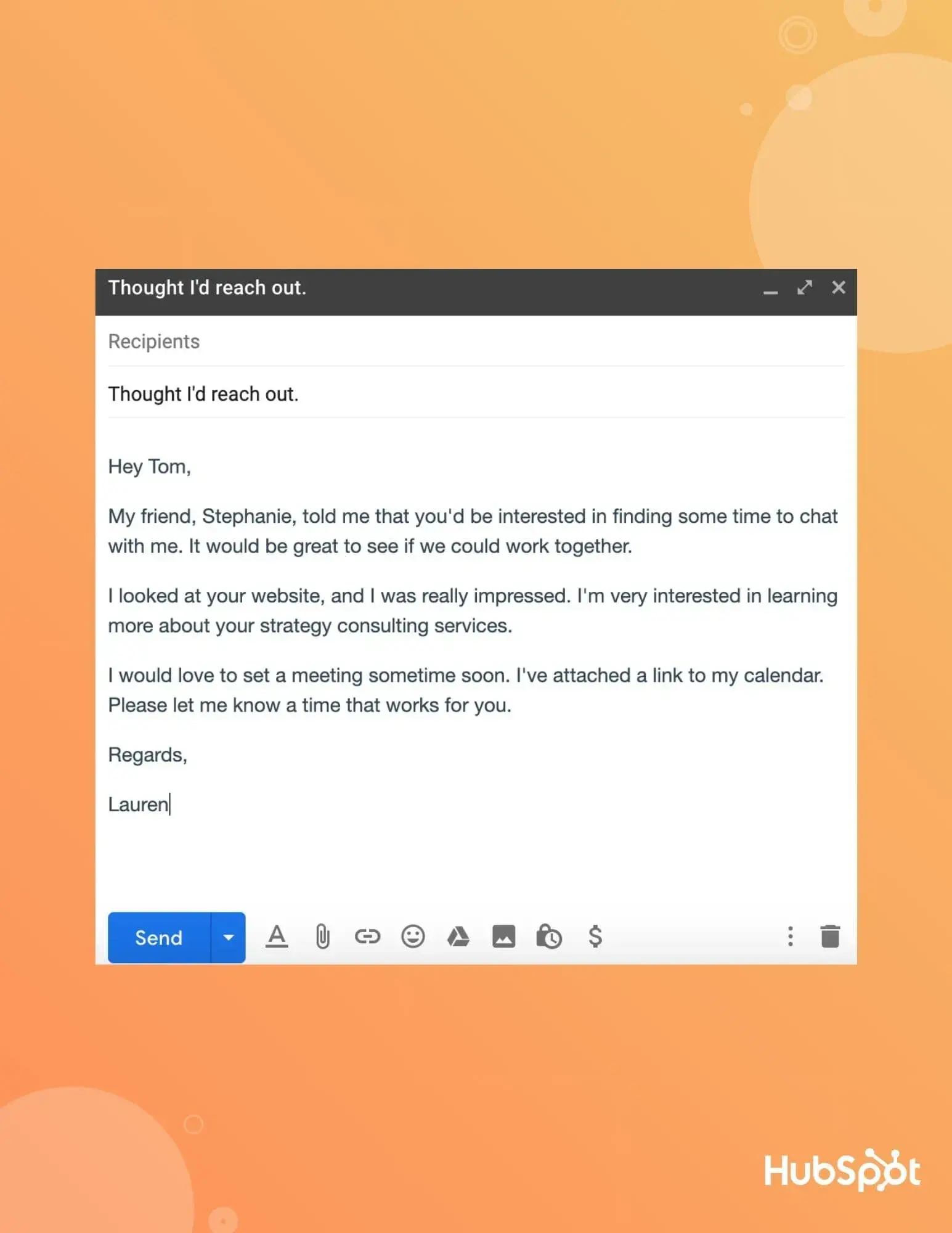
sales prospecting email examples: talking to a friend to make a connection

Why this email works: Similar to vendor emails, talking to strangers through a mutual friend can be more effective.

The relationship is built on a causal connection rather than a business one, so there’s no pressure to pitch right away.

Follow-up and Re-Engagement Templates

I like to use follow-up templates when a prospect has shown interest but gone quiet, whether they opened my email, clicked a link, or even replied once but then disappeared. Re-engagement templates are for reviving cold leads.

The goal is simple: Restart the conversation. You’re not pushing for a sale — you’re checking in, offering value, or giving them a reason to reply.

The fortune is in the follow-up. Most deals don’t happen on the first touch; they happen because you stay on their radar. A well-timed, value-driven follow-up can reignite interest without feeling pushy.

15. Respond to social media posts.

Social media is where your next prospect might already be raising their hand. Every time a prospect engages with a post — whether it’s yours or someone else’s — it’s an opportunity to start a conversation without the awkward cold pitch.

Think about it. They’re active, they’re engaged, and they’re showing you what they care about. So why let that moment slip away?

But here’s where most sellers blow it: They either spam the DMs with a pitch or stay invisible by lurking without engaging. The sweet spot? Join the conversation first, add value, and let the conversation naturally continue off-platform.

Here’s how to do it right:

  1. Comment before you DM. Show up in their comments first — acknowledge their insights, share your perspective, or drop a helpful resource. You’re building familiarity without pressure.
  2. Transition smoothly. If the conversation clicks, make the ask:
    “Would love to keep this conversation going — mind if I shoot you a quick DM?”
  3. DM with context. When you do reach out, reference the post:
    “Loved your take on [topic] — I had a similar experience with [insight]. Curious, how do you approach [related challenge]?”

[Prospect],

I’ve really enjoyed our exchange on [topic]. I learned a lot from your insights.

The other day, I came across this study that confirms your intuitions, so I just wanted to pass it along: [link to study]. I’d love to hear any other thoughts you have.

Warmly,

[Your name]

sales prospecting email examples: follow-up email after social exchange

Why this email works: You’re continuing the conversation from an interesting post.

This could lead to new ideas, solutions, and even a discovery call about a need the prospect has that your products and services could solve.

16. Respond to content your prospects publish.

Pay attention to what your prospects are publishing online. They are sharing massive clues about their current initiatives that provide great openings for dialogue.

Here’s an email I wrote up for an SDR from RingCentral who asked for some advice:

Hey Jeetandra,

Your CEO posted an article about expanding globally, which speaks highly of the work you’re doing. Judging from a quick LinkedIn search, I can see you’re the guy who is probably making that happen. Congrats on the success. I know it’s hard to duplicate the success of the home office.

Usually, managing directors are involved with setting budgets and are under pressure from CFOs to minimize startup cost. I’m an expert at helping companies minimize these types of expenses.

I talk to people like you all day. Would you be interested in a checklist of ways to reduce expenses?

Regards,

[Your name]

www.ringcentral.com

Global Office Consultant

Why this email works: Reading an unsolicited sales email or a piece of unsolicited advice isn’t at the top of anyone’s priority list. This approach keeps your email relevant and useful to the prospect.

17. Send your company’s content.

For every title or persona that can influence your sale, have content on hand that addresses their specific challenges.

Hey [Prospect],

Your blog article about [topic] was excellent. Your ebook on the topic was even better. The part about [section] was amazing because [reason].

But, I had to click around your website quite a bit to find the ebook. Have you ever thought about putting a call-to-action on the blog post that encourages visitors to download your whitepaper on the same subject?

Here’s an article on how and why to do this: [link]

Let me know what you think,

[Your name]

Why this email works: You’re working smart, not hard. Rather than creating an entirely new piece of sales material to send to this prospect, you can pass along marketing material that has already been made and is relevant to the needs of the prospect.

Take this tactic a step further and add a tracking parameter on the blog link. Even if they don’t respond to your email, you can follow up on the backend to see if they’ve clicked the link to read the article.

I think this type of email works great as an end-of-the-month sales email, which can be sent to prospects and current customers as a way to engage, re-engage, and upsell.

18. Send other people’s content.

Don’t only send your content. Prospects will be less suspicious of your intentions if you send other people’s or other companies’ content that could be helpful for their situation.

Hey [Prospect],

Congrats on closing your seed funding. That means you’re probably starting to think about how you’ll raise your A round.

Other founders report that it’s 100x easier to raise money if they’ve already figured out how to profitably acquire customers.

I’ve found that David Skok’s articles on unit economics are an amazing resource to help with that.

Here’s one: http://www.forentrepreneurs.com/saas-metrics-2/

Have you read them?

Regards,

[Your name]

Why this email works: The point is to show them that you care about their success and you want to help them reach it no matter what. And yes, that includes sharing other people’s content if you have to.

19. Publish original content.

For the last few years, I’ve regularly asked my young son, “How do you get better at things?” Without hesitation, he now says, “Practice.” Not every salesperson is a natural writer, but I’d highly recommend they all start practicing.

Why should salespeople write? Prospects willingly talk to critical-thinking, problem-solving, and effective salespeople if they have experience relevant to the prospect’s world.

So, write about your daily experiences helping prospects. Share your wisdom.

While publishing content to your company website is the best way to go, it’s only good for you if you’re able to track which of your prospects reads your posts.

If you don’t have marketing automation software in place that tells you when your prospects are visiting your website, publish to LinkedIn instead. As long as your 1st- and 2nd-degree network consists of prospects, there is a chance they’ll read what you post.

When they like, comment on, or share something you wrote, start a dialogue by using a variation on the template below:

[Prospect],

Yesterday, you liked my article on LinkedIn. What did you like about it?

[Your name]

Why this email works: The really great thing about content is that it keeps on talking with prospects even when you’re sleeping, exercising, or eating.

It works around the clock for you. Every other prospecting method is ephemeral (especially email). Imagine what salespeople could do if we combined the staying power of relationships with the lasting power of content.

20. Monitor who views your LinkedIn profile.

LinkedIn is an invaluable networking site. It’s where you share about who you are and what you do, so you want to keep an eye on who’s viewing your profile. If they’re looking at your profile, chances are they’re interested in what you have to offer. It’s a sort of soft inbound strategy.

Don’t miss the opportunity to connect with them and start a conversation.

Hey [Prospect],

I saw your recent LinkedIn post expressing your [pain point]. I just wrote a short piece on [topic of expertise] and thought you might enjoy reading it. It offers insights on [pain point] and a few strategies I’ve found helpful in addressing it.

[link to article]

I regularly post on [topic] and related topics, so feel free to give me a follow on LinkedIn if you’d like to discover more insights.

Best,

[Your name]

Why this email works: It’s short and to the point, giving the prospect a reason why they might want to accept your connection and visit your profile again in the future.

21. Put their name in lights.

If you are publishing content, ask for feedback on your drafts. You can also ask prospects for quotes to add to your article.

[Prospect],

Thanks for connecting with me on LinkedIn. From looking at your impressive career advancement from salesperson to sales director in just five years, I’m guessing you have some really valuable advice.

I read a few of your testimonials and I noticed that many of them said you put people first. Many of them said that you always drop what you’re doing to listen to the concerns and ideas of your front line salespeople.

Would you be willing to contribute to an article I’m writing on that subject?

Regards,

[Your name]

Why this email works: People like being asked for help or being asked for their opinion on a topic. This might not seem like the perfect introduction to your next big sale, but it’s a smart way to get a response.

22. Ask for advice.

Most people like to give advice. Asking for advice appeals to their ego. (See the “esteem stage” of Maslow’s hierarchy of needs. In the age of social media, many of us get stuck at the esteem stage on our path toward “self-actualization.”)

Psychology 101 aside, asking for advice is a hard request for most of us to resist.

[Prospect],

From your LinkedIn profile, it looks like you’ve been working in aerospace for 20 years. I’m guessing you’ve been involved in many engineering advancements in that timeframe.

I’m only two years into the aerospace industry, so I lack some of the historical context I imagine you have.

I’m working on a new product right now. If I shared some of my findings, would you be willing to give me feedback?

Regards,

[Your name]

Why this email works: It shows humility and respect for the prospect and their contributions to the industry in which you work.

23. Ask for a recommendation.

Similar to the above, asking for a recommendation shows humility and deference to someone with more expertise than you. It’s also a great way to start a conversation with a simple request that won’t take too much time for your prospect to respond to.

[Prospect],

A colleague of mine is investigating solutions for predictive lead scoring. I’ve been following you online for a bit.

As an expert at sales, I’m wondering if you have any experience with these platforms or know anyone who does.

[Your name]
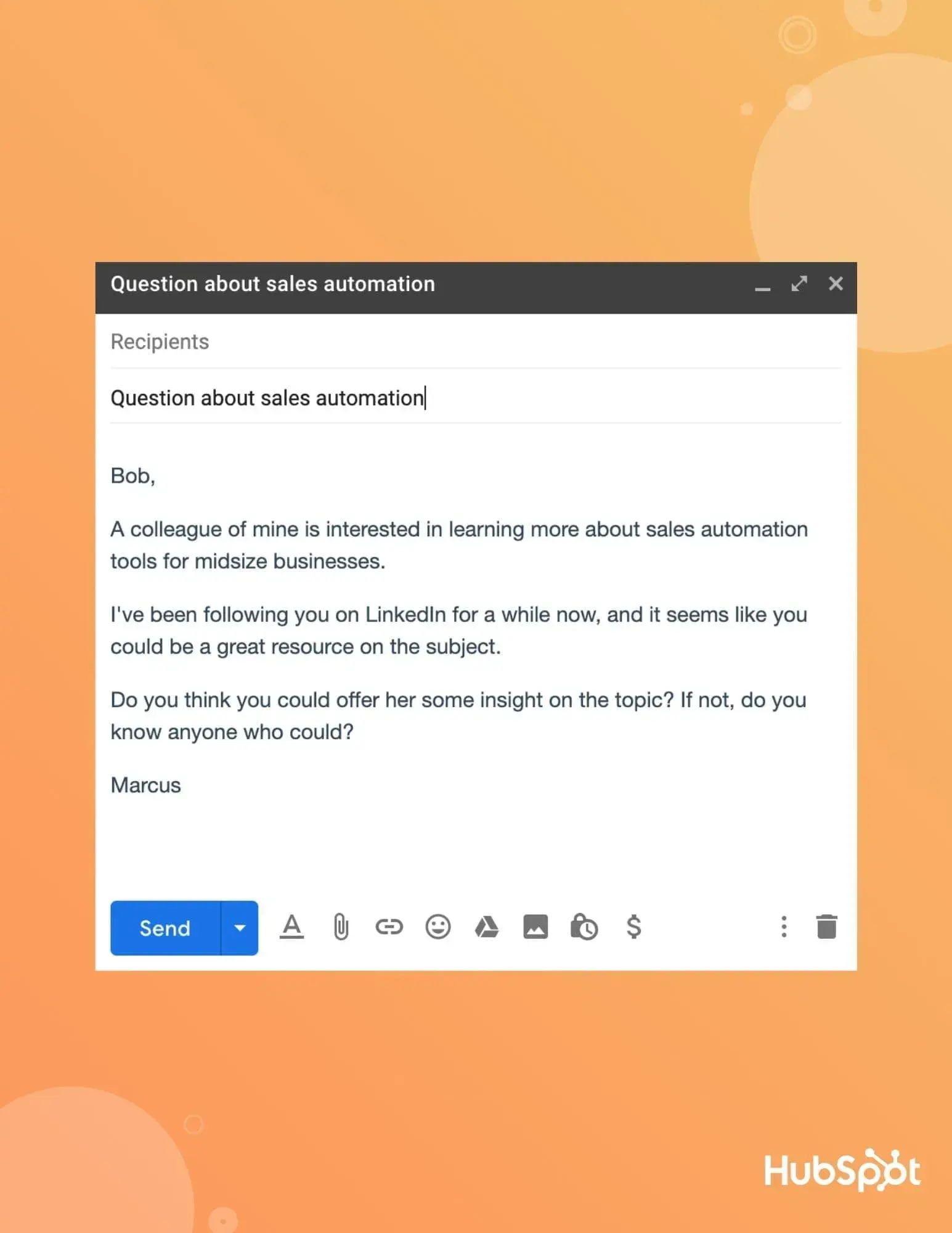
sales prospecting email examples: asking for a recommendation

Why this email works: The requests in these examples are sincere and easy to oblige. You’ll find that people are more than happy to help.

Market Research and Opinion-Seeking Templates

Use these templates when you want to engage prospects by seeking their expertise or insights. These are perfect for:

  • Gathering opinions for a survey, blog post, or industry report.
  • Validating market trends.
  • Asking for advice or recommendations.

The goal is to start a relationship by making the prospect feel valued as an expert. Instead of pitching, you’re collaborating — which often leads to future conversations.

People love sharing their opinions — especially when they feel their expertise is recognized. Plus, asking for insights opens the door to follow-up with results or opportunities based on their feedback.

24. Talk to your prospect’s customers.

Your prospect’s customers and partners are also great sources of insights. If your prospect has a case study page, look at it, or check out reviews about it online.

Hi [Customer of prospect],

My name is [name] and I work with [company] to help clients [achieve goal].

I saw that you are working with [prospect’s company] to achieve [goal]. I’m doing some industry research on companies like [prospect’s company]. Would you be willing to contribute?

If so, I’d love to hear about your experience with [prospect’s company]. You can respond via email, or we can set up a quick phone call: [link to your calendar].

I look forward to hearing back from you!

Regards,

[Your name]

Why this email works: More often than not, you’ll find positive information that will get the prospect talking.

But, if you hear from a disgruntled or unsuccessful customer, use that information too. You could motivate the prospect to turn those negative reviews into positive ones — hopefully using your company’s products to do it.

25. Offer an introduction.

Offering your network as a resource to others is a great way to help them out and build rapport. By serving as an introduction, you make yourself an invaluable connection.

[Prospect],

On LinkedIn, you posted a request for introductions to salespeople who successfully practice social selling.

I have a few that I could recommend. Would you like an introduction over email?

[Your name]

Why this email works: You’ll have more opportunities to get in front of the prospect with each introduction you make. And when those sales reps have calls with the prospect, they’ll mention that they both know you and sing your praises.

The prospect will become fond of you, and when you reach out again, you’ll be met with excitement rather than skepticism.

26. Run a custom analysis.

Depending on what you sell, it might be difficult for you to evaluate your prospect’s situation. But, if you can evaluate it, do so. Then, send them the results.

[Prospect],

I used some software to evaluate the search rankings of the top 50 B2B accounting firms in the Boston area. Although your firm ranks in the top 25 according to the Business Journal, your search rankings are worse than the top 40.

Would you like to view the report?

[Your name]

Why this email works: Chances are you don’t sell marketing services, but if you do, use this approach. If you don’t, try to find something you can analyze that your ideal buyer will care about.

27. Provide insights.

According to Mike Schultz, author of Insight Selling, “Educating buyers not only shares the seller’s expertise, but it also demonstrates the seller’s willingness to collaborate with the buyer.” I’ve found this is another invaluable source of rapport-building.

[Prospect],

Looks like you started a blog, but have stopped publishing. Oftentimes, companies stop prioritizing blogging when results don’t come immediately.

But did you know that companies that blog regularly generate 67% more leads than those that don’t?

[Your name]

Why this email works: It provides useful information that is highly relevant to the prospect. Tailor this approach to any new venture or project your prospect has taken on. This could be the data they need to validate the effort they’re putting into it.

28. Ask them what they want to learn from peers.

Marketers use surveys to gather proprietary data. Salespeople should borrow this playbook.

Engaging prospects in the design of the survey will ensure the results are interesting for the ideal buyer profile. This is also a suitable reason to reach out, which can initiate a dialogue.

[Prospect],

You look like you have an impressive amount of experience doing [X]. I’m designing a survey and will be asking 100 people with similar experiences in [role] and [industry] about their thoughts on [topic].

If you had the opportunity to ask any question of 100 peers, what would you ask?

[Your name]

Why this email works: You’re building a relationship with the prospect while generating interest in the results of the survey.

When you release it, you’ve already established a reason to reach out to them again with a stronger pitch based on the data in your report.

29. Invite them to participate in market research.

Taking the email template above a step further, you can reach out to the prospect again once you and your team create the survey. Now, you can ask the prospect and their team to take the survey.

[Prospect],

Thank you for your assistance in designing this survey. Will you take the survey now that it’s ready? It’s five questions long and should take you five minutes.

As soon as we have 100 respondents, I’ll send you the preliminary results.

[Your name]

Why this email works: The great part about surveys is that you can ask tough questions about challenges and goals. It’s hard to do that on a phone call right away.

Don’t forget to sync your survey software with your CRM and marketing automation software so you can see the responses and use them to customize your future sales and marketing touches to each contact’s context.

30. Get their opinion.

Ask your prospects about what they think about something. Just be sure you actually plan to use their opinion in some way — don’t ask an empty question.

You can let them know their response might be featured in some content that your company will publish in the future. Or you may be using their qualitative data to validate some quantitative data from a survey you did.

[Prospect],

Looks like your marketing efforts support a pretty big sales team.

At HubSpot, we recently completed a survey of B2B buyers. We asked them to give one word that best describes salespeople. The most popular answer by far was “pushy.”

Do you agree or disagree with this? Do you think your buyers think your salespeople are too pushy? Do you think this reduces the effectiveness of your marketing?

Regards,

[Your name]

Why this email works: You’re actually challenging the salesperson stereotype by acknowledging that people often find sales reps pushy.

As a salesperson, you’re actively negating that characteristic by taking a collaborative and curious approach to the prospect.

31. Ask them if they want access to market research.

Offering access to market research is giving your prospect value without asking for anything in return. It’s a great soft opener to a conversation about how their business is performing and any pain points your product or service may be able to address.

[Prospect],

Your quarterly report shows an impressive growth rate, especially at your scale.

Fast growth companies like yours usually dedicate significant resources towards recruiting. We have some market research that shows how companies allocate resources to different parts of the recruiting process.

Would you be interested in seeing the report so you can benchmark yourself?

Regards,

[Your name]

Why this email works: If you used this company in your market research, you’re showing them the final project where their responses were featured. Moreover, you’re sharing some valuable industry insights that the prospect will likely find useful.

32. Ask if you’ve got the right person.

People have a natural tendency to want to help others. Make the most of that and send an outreach email that asks, “Could you help me get in touch with the right person?”

[Prospect],

I’m trying to reach the person who’s in charge of implementing marketing software at your company.

I’ve helped businesses like yours increase marketing-qualified leads by as much as 25%.

Could you help me get in touch with the right person?

Thanks for your time,

[Your name]
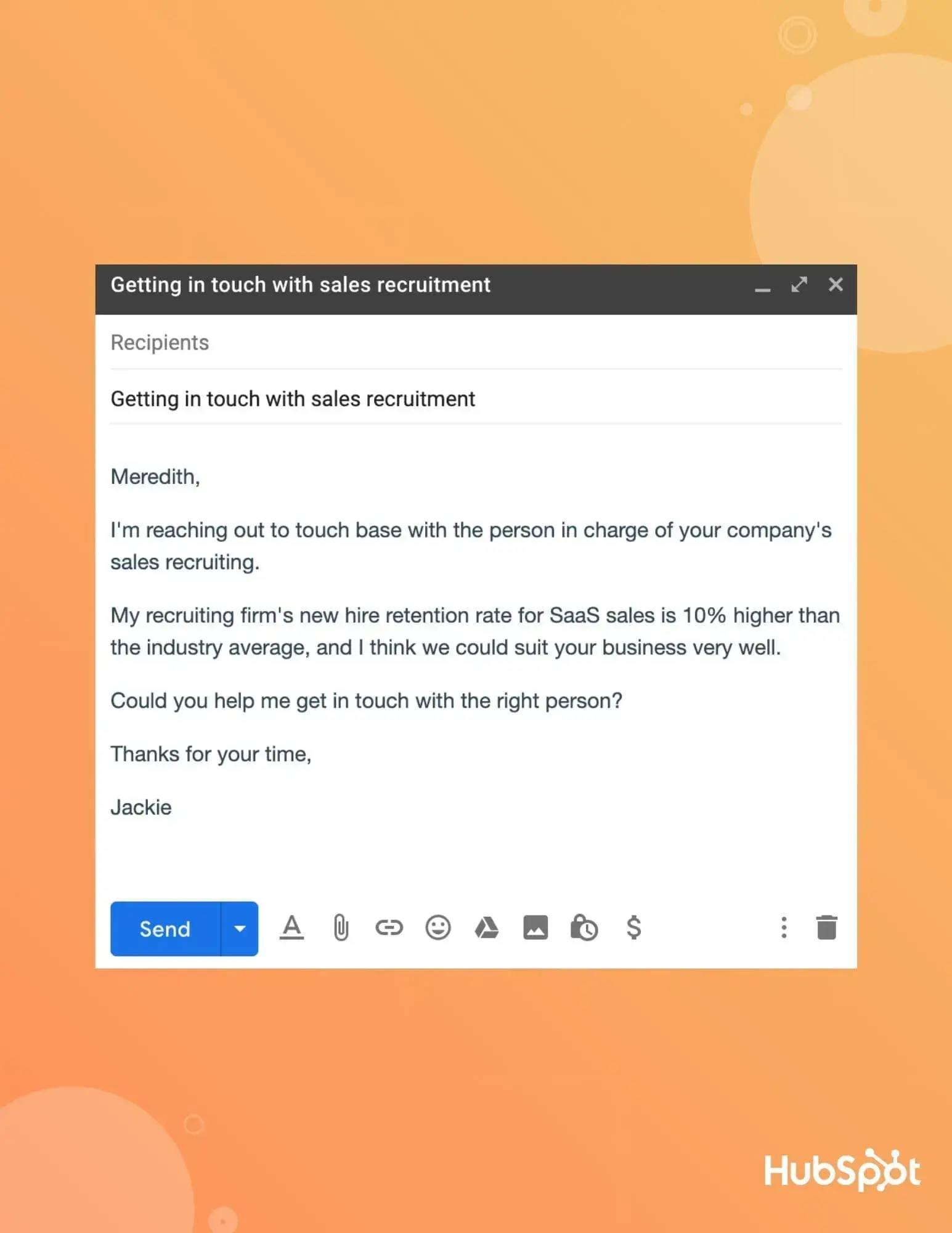
sales prospecting email examples: asking if you have the right person

Why this email works: You’re letting the person you emailed off the hook. Because they know you’re looking to talk to someone else and just need their help to do it, they’ll be happy to send you to the right person.

How to Write a Sales Prospecting Email That Gets a Response

These templates use a relatively simple set of guidelines. As you implement the approaches shared above, I recommend using these guidelines to customize your templates. I break down my writing process into phases: pre-writing, writing, and reviewing. Each consists of multiple steps, which I have laid out below.

Pre-Writing Phase

The pre-writing phase consists of researching your prospect thoroughly. You need to know who you’re writing to before you can craft an email that will land.

In my research, I always:

  • Study my prospect’s business, industry, and potential pain points.
  • Identify specific ways my solution can help them.
  • Find points of connection or relevant recent company news.

Writing Phase

A strong prospecting email needs to include the following components. When writing, I follow these steps.

  • Craft an attention-grabbing subject line.
  • Make it relevant to their business interests.
  • Keep it concise and compelling.
  • Avoid spam triggers and excessive punctuation.
  • Write a personalized opening.
  • Begin with something specific about the prospect or their company.
  • Show you’ve done your homework.
  • Make it clear this isn’t a mass email.
  • Compose the body (3-7 sentences total).
  • Focus on “you” language instead of “I” or “we.”
  • Only introduce your value proposition when it naturally aligns with their needs.
  • Keep the message focused and concise.
  • Use an open-ended approach that invites dialogue.
  • Create a simple call-to-action.
  • Avoid pushing for a phone call in the initial email.
  • Make the request easy to fulfill.
  • Ensure it appeals to the prospect’s self-interest.
  • Consider ending with a relevant question that encourages a response.

Review Phase

Finally, it’s time to polish and refine your email. First impressions count, and the prospect will judge you and decide whether to respond based on how your email reads.

I always:

  • Review for grammar and spelling errors.
  • Ensure the total length stays within 3-7 sentences.
  • Check that the focus remains on the prospect throughout.
  • Verify all personalization elements are accurate.

Remember: The goal of your first email is to start a conversation, not close a deal. Focus on making a genuine connection and showing you understand their business.

Make Your Outreach More Effective

Breaking through inbox noise isn’t just challenging — it’s getting harder every day. Most cold emails get ignored, and generic follow-ups fall flat. But there's good news: While others spam inboxes with copy-paste pitches, you can stand out by building genuine connections.

The templates in this article are designed to help you start conversations that prospects actually want to continue, position yourself as a trusted advisor, not just another seller, fill your pipeline with qualified leads who see your value, and build a foundation for long-term business relationships.

Remember: These aren’t just templates — they’re conversation starters. Your goal isn’t just to get replies; it’s to begin meaningful dialogues that lead to lasting partnerships.

Editor's note: This post was originally published in July 2020 and has been updated for comprehensiveness.

14 Mar 17:17

7 Questions to Ask Before Launching a B2B Referral Program

by Jignesh Shah

7 Questions to Ask Before Launching a B2B Referral Program

Word-of-mouth marketing is one of the most powerful channels for bringing new customers to your business. In fact, according to Edelman Trust Barometer, 84% of B2B businesses initiate the buying process with a referral. And data from Marketo Institute shows that the referral is the best acquisition channel for conversion rates at almost 4x the average.

So, it should come as no surprise that many B2B marketers are following in the footsteps of companies like Uber who have successfully grown their businesses using referral programs. While companies from any industry can harness the power of word-of-mouth marketing, these types of programs pose unique challenges for B2B businesses. Due to the complex sales processes and expensive nature of some B2B products, you need to put time and careful consideration into developing your referral program’s strategy, structure and internal processes.

Below are seven questions that you should ask yourself, your marketing team, and key players on your sales team as you develop a B2B referral program in order to anticipate issues and avoid pitfalls:

1. Is your product referral worthy?

Customers will only refer your product if they have had an extremely positive experience with both your product and your company. Referral marketing is best suited for products with strong customer benefits and successful support.

Before you consider developing a formal referral program, you need to assess the customer satisfaction levels for your product. Are your customers enthusiastic about your product enough to recommend it to others? To determine this, you may want to conduct a Net Promoter Score (NPS) study. NPS measures your customers’ willingness to recommend your product to other buyers. If a NPS study is not feasible, assess your customer retention and subscription renewal rates.

2. Which customers should you target?

The most effective way to get your referral program off the ground is by targeting your best customers. Here are there things to look for when identifying these key participants:

  • Payment: Start with targeting customers who are willing to pay for the product typically believe in its value. Avoid targeting customers that have just started on free or trial plans as they may not have experienced the full product benefits. For these customers, you need to first focus on making them successful before asking for referrals from them.
  • Activity: Target customers who actively use your product as they can best communicate its value to others.
  • Achieved ROI: Customers who have used your product to achieve measurable results can illustrate the product’s value better than those who have just started using it.

3. How will you promote the program?

Now that you have defined your referral program’s target audience, you need to decide how you will ask them to join. For the most part, it’s better to start with a small, targeted push by sending invitations to those who are most likely to become referrers. You can do this through a targeted email campaign or by asking sales to send personal invitations.

Once your program starts to take off, you can then begin to promote referrals more extensively through your website, blogs, newsletters, social media, and direct mail. You can also extend the referral program to your partners if you have an active channel program.

4. How will you qualify referred leads?

Qualifying referred leads is a more complicated process for B2B companies. You need to confirm that your sales team hasn’t already identified the referral as a prospect. Depending on your sales process, this can be automated partially or completely using a marketing automation system and CRM.

You also need to verify that the referred business has the budget, authority, and timeline to make a purchase. You can ask for this information upfront as part of lead capture process or your sales team may prefer to ascertain this information by speaking directly to the referred lead. This is where sales and marketing alignment is vital to define and agree upon how you will qualify and accept referred leads.

5. How will you hand-off referred leads to sales?

One of the biggest pitfalls businesses encounter with B2B referral programs is that qualified, purchase-ready referred leads may get lost in the process. Not only is this a lost sales opportunity, but it may discourage customers from making referrals in the future. If you want your program to be successful, it’s essential that you work with sales to establish a system for tagging referred leads and directing their information to the right person who will follow up promptly.

You may want to create separate CRM views or marketing alerts to make sure that the sales team follows up on referred leads quickly. Consider creating a written service-level agreement (SLA) with sales to establish how and when sales representatives will follow up with leads.

6. How will you motivate customers to make referrals?

Even if customers love your product, they’ll still need a little motivation to introduce your brand to others. This is especially true given the cost of most B2B products and services. As a result, many B2B referral programs use rewards to motivate and thank the referrers.

Here are some factors to consider when choosing an incentive structure:

  • Reward Type: What type of reward will resonate best with your customers? Product discounts, free training, conference passes, and gift cards with tangible value are a few options. Choose the appropriate reward type (or types, if you are going to let customers choose) based on your customer demographics.
  • Reward Size: How big does the reward have to be to matter to your customers? In general, senior-level buyers require larger reward sizes. What will your budget permit?
  • Mile-Post: Will you provide rewards only when the lead makes a purchase? Given a typical B2B sales cycle, this can sometimes take weeks or months, so consider whether it make sense to provide a smaller reward as soon as the lead is qualified.
  • Single or Double-Sided: Will you reward only the referrer? Or is there something you offer the lead as well so that they too benefit from coming in as a referral?

7. How will you automate your referral program?

With all of the moving parts involved in a B2B referral program, it will save you time, money, and resources if you find ways to automate some of the tracking and administrating aspects of your program.

Consider the following questions in order to help define how your marketing automation platform and CRM can support your referral program:

  • How will you capture referred leads and referrers?
  • Can you automatically qualify leads before handing them off to sales?
  • How will you know when a purchase has been completed so that you can thank the referrer?
  • Can you automate reward delivery?

Make Your Referral Program a Pillar of Business Growth

Word-of-mouth marketing is a worthy investment for any company with useful products and a significant customer base. Even though B2B referral programs can pose unique challenges, your business can build a successful program by identifying and anticipating these challenges from the start.

Work with your sales team to identify your best customers and develop a referral lead-to-revenue process. Then, map out the incentive structure, the promotion strategy, and any automation needs. Now that you know what questions to ask yourself when developing the program, you can be on your way to making your referral program a marketing pillar of growth.

If you have run a referral program before, do you have any considerations or tips to add? Please share them in the comments section below.

This blog was co-authored by Rachit Puri at Grazitti.

mar-30

14 Mar 17:17

The Ten Percent Rule – Building Momentum and Sales Through Your Blog in 2016

by Don Purdum

It’s been said that “good” is the enemy of “GREAT”. There are so many good business blogs to choose from but there are very rarely blogs that I HAVE to read that are great.

Do you want to be good or do you want to be great?

The-Ten-Percent-Rule--Building-Momentum-and-Sales-Through-Your-Blog-in-2016Recently, I had the opportunity to meet Jenny and in our conversation she said she wanted to see a ten percent growth in her business in 2016 through her blog.

I asked her how she planned to do that and her answer was; write more content.

Jenny has owned a successful business consulting practice for nearly eight years. She has nearly seen it all. One of her stories that really stuck with me is how many business owners she meets who think they have it all together and know it all; and yet their business is struggling just to make ends meet.

In a recent blog article, Jenny shared how one business owner was adamant that they were going to double their business in the new year but for three years had been shrinking.

Her article was really good.

She diagnosed the problems well.

But her article was just good, it wasn’t great!

Why?

I’ll get into that shortly.

For the moment, do you remember what Jenny’s goal is for 2016? It’s to increase her business by ten percent through her blog.

If you share the same goal with Jenny, which is a good one, there is going to be more required of you to do that than just creating more content.

It has to be GREAT content!

What separates good content from great content?

What separates a good business blog from a great business blog?

Let’s find out…

Good is the Enemy of Great

As I said in the introduction, good is the enemy of great. Why would I say that?

For one, good means we’ve settled. It means we aren’t taking the time to grow in our knowledge or through our experiences and learn what that means applicably to our audience.

If you’re good it means you’re content and contentment is always a killer of anything. Complacency is not your friend.

As a norm, a blog is a reflection of a company. It’s the public persona of what’s important to it and it is the standard message bearer of one’s brand.

I have learned over the years that “your message is your brand and your brand is your message.”

If your business has a blog then it’s a REALLY BIG deal!

A blog allows for expression of thought and at the same time it ought to demonstrate one’s competency.

So let’s think about it for a moment.

If your blog is “okay” or if it’s “good enough” what does that say about your company?

It probably says a lot of things that aren’t accurate.

But the one thing is does say indirectly is that you are not taking the time to learn about your business, audience and their problems/needs/wants from their point of view. It’s can directly or indirectly show you’re are not competent.

And therein is the difference between a good blog and a great blog.

It’s about how you learn to message what’s important to your visitors, prospects and customers while meeting their needs; over talking about your own. This can be subtle but it is profound.

cart-before-the-horseI read dozens and dozens of blogs every week. Few of them are worth mentioning or even going back to again.

The work of blogging is not found in the writing, posting or even in the networking or driving traffic. The work happens way before that point. Unfortunately, many get the cart before the horse and focus on the wrong things.

Where Did Jenny Go Wrong?

First, while Jenny’s article was good about talking about problems; that was the problem. She spoke about too many problems for too many different people all in one article. It was broad and lacking of any substantive details.

It didn’t zone in on one person and what that one person was going through, thinking, feeling or really wanting help with.

Her article dealt with three problems and she was really broad about the three problems.

Second, because she was broad she didn’t offer any real solutions… other than “hire” me.

In the end, readers felt it was a crescendo that was all about her.

How Could She Turn Her Blog Article from Good to Great?

I have a simple formula that I work from:

Clarity + Focus = Execution

Again, making a blog article great is more about what happens BEFORE you write than when your write, post and promote.

Too many of us see blogging as a strategy that exists with an end in mind; and that end is always a new prospect and customer.

That’s not clarity and let’s be honest; does that really require any depth of thought?

The number one thing you need for your business is CLARITY.

What do I mean by you need “clarity”?

You may believe you’re crystal clear about your business. In fact, I’m willing to wager that nearly 90% of you believe you are clear. You know what you sell and you know who you sell it for.

That’s clarity.

Or is it?

You probably are clear from your point of view. But is your audience? Is your prospect? Is your customer?

Clarity is simply this:

The absence of self, vagueness or complexity

Talking about yourself and how great you are and “I’, “I”, “I”… “me”, “me”, “me”… and “we”, “we”, “we” comes across as narcissistic and not relevant in any capacity to the blog reader who is hopefully your prospect.

me

Then there is vagueness that is created by being broad. Your content seems simple to you but the truth be told, vagueness leads to complexity and complexity leads to confusion; and doubt leads to lack of competency.

By writing about more than one problem Jenny inadvertently created complexity and by not having a clear path to a solution she was too vague.

The question is what is she really saying and who is she saying it for?

What does her blog reader do with that?

I’ll tell you; NOTHING!

They leave without doing a thing.

In a world where it takes on average 10.4 pieces of content before someone makes an engagement (not buying) decision this is a serious issue (according to Google’s landmark Zero Moment of Truth research).

Why?

Because there is no specificity and being specific is the answer to Jenny’s problem. Her article was good but it wasn’t great!

And, no one is coming back to her content again which means fewer people, if any, are entering her sales funnel.

That begs the question; how will she grow her business in 2016 by just creating more the same type of content?

Clarity happens in your business when you know and understand your prospects and customers and can communicate to them on their level, based on their needs, wants or desires.

It has nothing to do with you!

And that’s the hard part. Because Jenny, and perhaps you, has not really gained that kind of clarity your business is stuck at being good; and good equal’s mediocrity.

When we are mediocre, we set ourselves up to earn all the wrong things:

  • Few prospects
  • Few in our sales funnel
  • Slow sales processes
  • Low price points
  • Low close rates

The other day I was talking with a dear friend about the principle of clarity and specificity. He thought he was getting it but I knew he wasn’t.

Some of you are loyal readers of my blog and you’ve been reading my content for a year and you think you’re getting it as well; and like my good friend I know you don’t.

Here is why; clarity is about learning how to write one article that solves one problem/meets one need/ fulfills one desire and it does it for one person. It’s a lot easier said than done without a foundation and framework.

When I was in graduate school I had a speaking coach and I learned a really valuable lesson about speaking.

The lesson was: if you speak broadly they will all leave telling you how great of a job you did. But if you’re specific 80% will leave saying that and 20% will be at the front of the room asking “how did you know?”

That’s the difference between good and great!

When I hear some form of “how did you know” in a blog comment, email or phone call I know the message was conveyed, heard and acted upon and get this with virtually every single blog article.

When you stay broad and introduce too much in an article the end result is a business blog that is okay. Maybe you’re converting a few here and there and maybe you’re making a little profit or maybe you’re taking a loss.

The world is changing and it’s changing rapidly. The consumer is more educated than ever and they can sense the difference between manipulation and sincerity. By-the-way thanks to artificial intelligence being employed by search engines and social media sites so can they. They know when there is an absence of a message and why should they give you access to their audience when you don’t have a real message for them other than “buy me”?

As businesses and marketers we have set ourselves up over decades (or maybe centuries) to allow the consumer to be skeptical of us because our message is completely out of alignment with their needs, wants and desires. In some cases, the message we are actually conveying is out of line with the actual experiences of the consumer.

We sometimes consciously, but more times subconsciously, communicate that our need to have their money is more important than their need to have our product or service.

The end result is we may have a great message that is buried deep but the consumer cannot feel it or understand it from their point of view.

How do we pivot from good to great and change this reality?

How Can You Gain Clarity?

Going from good to great is a function of clarity.

How do you gain clarity?

It’s a process and if you’re going to grow your business by 5%, 10% or more in 2016 and gaining clarity is the difference maker by:

  1. Discover the problems you’re passionate about solving
  2. Discover the tangible values your customers experience and how they feel about that experience AFTER they have done business with you.
  3. Discover the “specific” problems you solve for each tangible value.
  4. Discover who you “specifically” solve each problem for
  5. Message how your product or service is a “specific” solution

Jenny doesn’t need to write or create more content. What she really needs before she does that is to get really clear about “what business she is ‘really’ in”.

Growing your business by any percentage can be done by two ways:

  1. Work harder by creating more and more content (both on your site or others) to gain a larger and broader audience and playing the numbers game (which as we know from cold calling and emailing is a low percentage, high production, expense wasting proposition).
  2. Work smarter by taking the time to gain clarity so that we know who our audience is and how to write for them based on “clarity” and then create the proper strategies to reach them where they are at with more efficiency and higher profits.

What clarity will do for Jenny’s business is open doors of amazing opportunity.

Jenny was already a great writer but her focus was in the wrong place.

I’ve seen clients like Adrienne Smith (who is a well known and respected blogger across the web) see her business grow and expand at rates she had not experienced before; all because she is clear.

Adrienne Smith“Don’s coaching has literally exploded my business and I’m honored to have worked with him and I owe a great deal of my success moving forward to him.” ~ Adrienne Smith

In fact, Adrienne recently wrote an article for my blog where she shared her experience working with me. Click here to check it out.

Clarity is the momentum game changer. When done well, clarity will be the foundation of your business that drives your marketing strategies, sales, processes and systems business wide.

It will inspire and instill competency and trust.

Do You Want to Grow Your Business by 10% in 2016?

What would a ten percent growth look like for you in 2016? It could be that it’s tens of thousands of dollars, hundreds of thousands of dollars or even millions of dollars more for you and your business.

In a recent article my friend and blogger extraordinaire Kevin Duncan at Be a Better Blogger he shared that he was removing guest posts already published because he was letting them down by letting guest contributors post average content.

He challenged them to be better at blogging by just 5%. I really applaud him for taking this stand even though some don’t agree with him.

In my opinion, you can improve what you’re doing today by 1% or 2% on your own by cleaning up grammar, spelling and formatting issues.

But the core of the problem is a messaging problem.

The real issue is this; is your content so relevant, interesting and compelling that someone has to take action?

Will someone read your article and say; “OMG, that’s me! How did he/she know?”

… and then take action to contact you?

Like so many of you, Jenny was writing good content but it wasn’t great.

If you are going to grow your business by 10% in 2016 then you must learn how to create a relevant, dynamic, compelling and consistent message.

Jenny wasn’t creating content that was relevant to one person who was experiencing one real problem and in need of serious help.

Her message was causing confusion and complexity when what they needed was simplicity and clarity.

She wasn’t really clear on how her audience was feeling or what they were experiencing and as a result all of her efforts were falling on blind eyes.

Are your blog articles falling on blind eyes?

Do you expect to grow your business in 2016 by just doing more of what you’ve been doing and getting the same old mediocre results?

Are you ready to get really clear and learn how to work smarter with increased results instead of just harder with the fewer results?

If so, I have two options for you that are FREE and will start you down the path of clarity:

#1 Click here and learn more about my upcoming webinars that will show you how to earn real clarity and join me on the live webinar. I hope to see you there!

#2 – Click here or on the image below on the book cover to get a free copy of my eBook titled “The Shift – Making the Fast Paced Transition from Mass Marketing to Context Marketing”. It’s been downloaded by thousands of people just like you. Get it now because I’m not going to offer it forever.

The-Shift-Bookcover-small

Do you have thoughts, ideas or questions? If so, please leave share with me below in the comments and let’s chat. I would love to engage with you!

14 Mar 17:17

4 Detrimental Actions to Avoid During a Sales Slump

by mrenahan@hubspot.com (Mike Renahan)

mistakes_sales_slump.jpg

Slumps are a part of sales. And when reps find themselves in a rut, it’s easy to take the wrong steps while attempting to get out of it. 

So when dry spells hit, how can you flip the script? What behaviors should you avoid to limit the damage?

Below are four mistakes reps make during slumps and how you should act instead.

1) Panicking about poor results.

Panicking is simply unproductive. It’s easy for reps to feel that if they fumble a call or a demo, the next one has to be great. The prospect feels this pressure too. Remember that panicking won’t win you deals. Focus on the bigger picture and recognize you can take action to reverse a slump. 

“Keep everything in perspective,” Elijah Condellone, Solutions Director at SIG University, writes on LinkedIn. “Sales giant Jeffrey Gitomer puts it something like this: ‘You're in a slump, your life isn't ending.’ In other words, don't panic. It's not the end of the world. Recognize the reality of your situation, but determine for yourself that you can and will overcome.”

If you feel yourself succumbing to anxiety, lean on your sales manager to mitigate panic. Whether it’s having a manager study your activity metrics for deficiencies, or listen in on a call to determine weak statements, their expertise can help end droughts and prevent future ones. To rebuild your confidence, set small, achievable goals to log some quick wins.

2) Blaming everything and everyone but yourself. 

Attributing slumps to external factors such as the time of year or the economy is normal, according to Jim Domanski, President of Teleconcepts Consulting Inc. While these factors can impact performance, slumps are often due to a rep’s own behavior. Whether it’s neglecting to prospect or asking the wrong qualifying questions, weak points in a rep’s process result in a rut. Faulting external factors only hides the deficiencies. 

According to Success.com, the first step towards breaking out of a slump is to take responsibility. Believing someone or something else is responsible for the rut is a mistake that can result in more damage.

Instead of blaming external factors, study your pipeline metrics to determine where you’re struggling most. The data will reveal low conversion rates and help you pinpoint what’s causing the slump. When you have the data, dig into why conversions are low. Is it something you’re doing or something you’re saying? Once the causes are clear, create a “to-don’t list” to remind yourself of what to avoid.

3) Sticking to the same routine.

Despite lackluster results, some reps adhere to the routines they’ve been using because that’s all they know. Unfortunately, these routines are often what created the tough positions reps are in. 

“When things aren’t going your way, the worst thing you can do is just sit back and wait for the winds to change,” Ryan McDonald, an Inbound Marketing Specialist at HubSpot, said. “Sometimes, when it feels like everything is going against you, the best medicine is to just put your head down and work your way through it.”

Reps would be wise to examine their sales strategy to find weaknesses and mistakes. For example, try changing the subject line in your prospecting emails, or arriving at work an hour earlier so you can prospect without compromising time spent with leads further down the funnel. Other options include leaning on current customers for referrals or revisiting old deals to spark conversations again.

4) Neglecting to think long-term.

Some reps can develop a short-term mindset during a slump. After all, they need to get out of the rut now. However, when salespeople only focus on closing, they often neglect laying groundwork for the future. This neglect can result in future droughts. 

“The secret to beating quota month after month is to maintain a consistently full pipeline,” Emma Brudner, HubSpot Sales Blog section editor, writes. “This way, even if you miss your number once, you're laying the groundwork to crush quota in the future -- and possibly make up for your slow period.”

To set yourself up for future success, schedule time for prospecting. By doing so, you’re reminded to plan ahead and maintain a healthy pipeline, while also improving your mindset. According to author Laura Vanderkam, people who express their goals in tangible terms are 50% more likely to feel as if they can reach their objectives.

Unfortunately, sales slumps happen. But by avoiding certain behaviors, salespeople can use droughts as learning opportunities.

Get The Free Guide