
If your Wi-Fi signal isn’t quite strong enough in certain corners of your home, this discounted wireless Powerline kit can fill in the gaps.
If your Wi-Fi signal isn’t quite strong enough in certain corners of your home, this discounted wireless Powerline kit can fill in the gaps.

Republican U.S. presidential candidate Donald Trump delivers a foreign policy speech at the Mayflower Hotel in Washington, United States, April 27, 2016. (Jim Bourg/Reuters)
Closer to the Oval Office than ever before—about three and a half blocks—Donald J. Trump laid out his philosophical framework Wednesday at a Washington hotel for “the most peaceful and prosperous century the world has ever known,” a halcyon era that will be based on his own unique understanding of a fractious, bleeding globe.
Speaking to a cordial, but far from hysterical, think-tank audience of inside-the-Beltway deep-thinkers convened by the Center for the National Interest, the billionaire who presumes himself to be the presumptive nominee of the Republican Party predicted that, under a Trump Administration, Islamic State “will be gone very, very quickly” and that “we’re getting out of the nation-building business.”
“The legacy of the Obama-Clinton interventions will be confusion, disarray, a mess,” Trump said. “This will all change when I become president.”
The New York mogul pledged, that “the world must know that we do not go abroad in search of enemies,” but that, should he ever need to project American military power beyond the nation’s borders, he will seek “victory with a capital V,”
“We will replace randomness with purpose, ideology with strategy, and chaos with peace.” Trump avowed in one uncharacteristically lyrical passage of his 40-minute tone poem. “I’m the only one, believe me. I know how to do it.”
The Donald’s oration, billed as “a major foreign-policy address,” was a measured, punctilious, dys-Trumpian recitation of what sounded like a speechwriter’s words. (He even read from a TelePrompTer, negating his own declaration that “if you’re running for president, you shouldn’t be allowed to use” one.) It came the day after he swept like a faux-blond tornado across five Northeastern states, winning not only at least 100 or more convention delegates out of the 110 in play, but prevailing in the popular vote in every single county of Rhode Island, Connecticut, Pennsylvania, Delaware and Maryland.
Trump declared—not for the first time—that the North American Free Trade Agreement* has been “a total disaster for the United States” and pledged that “we will no longer surrender this country nor its people to the false song of globalism.” But the “beautiful wall” on the Mexican border; the very, very bad national media; “Lyin, Ted” Cruz, and “1-for-38” (now 1-for-43) John Kasich—none of these was mentioned.
(As Trump spoke in Washington, Senator Ted Cruz was campaigning in Indiana, clumping The Donald with Democratic front-runner Hillary Clinton as “wealthy liberals,” and naming failed candidate and former high-tech CEO Carly Fiorina to be his running mate for the duration of his race to second place. Meanwhile, the White House itself was locked down for the second day in a row when, according to the Secret Service, “a male individual threw personal belongings” over the fence.)
The setting for Trump’s valediction was the Presidential Ballroom of the capital’s gilt-edged Mayflower Hotel, adding another layer of history to the 91-year-old hostelry where Monica Lewinsky laid up during the Bill Clinton sex scandal, Hillary Clinton conceded the Democratic Party nomination to Barack Obama in 2008, and J. Edgar Hoover ordered chicken soup, butter toast, grapefruit and iceberg lettuce for lunch every workday for 20 years, and brought his own diet salad dressing.
Read Donald Trump’s foreign policy speech.
The Christian Science Monitor reported that Trump would mark the occasion by being “Dressed with the trappings of gravitas,” but he wore his customary dark suit, white shirt and red tie instead.
Trump devoted much of his address to a spirited bashing of Barack Obama and what he called the president’s “reckless, rudderless, and aimless” foreign misadventures. His words elicited scattered applause from the audience, which included several newly-named members of his foreign-policy and national-security team.
“Mr. Trump is taking about a sea-change in foreign policy, which we have to do, because the sea has changed,” Curtin Winsor, Jr., U.S. Ambassador to Costa Rica during the Ronald Reagan administration, told Maclean’s.
“Would you have dreamed a year ago that you would ever be attending a ‘major foreign-policy speech’ by Donald J. Trump?” a correspondent asked Winsor, who said that he had been part of the Trump brain trust “for about 12 hours.”
“I think he emerged for me at the same time he emerged for everybody else,” the ex-diplomat replied. “We saw him on TV articulating things that no one else was articulating.”
Only one piece of foreign news tarnished The Donald’s excellent day. This was a report from Brazil that a Trump-branded hotel in Rio de Janeiro may not be finished in time for the Games of the XXXI Olympiad. Honchos of seven international sports federations already have made alternate bookings, lest they be left out in the cold of a sub-equatorial winter.
“That is the one we fear,” one Olympic official told Bloomberg News, referring—unlike tens of millions of Americans —to the hotel, not the man.
CORRECTION, 27 April 2016: This story originally stated that Donald Trump referred to a North Atlantic Free Trade Agreement in his foreign-policy address. He actually referred to the North American Free Trade Agreement. Maclean’s regrets the error.
The post How will Donald Trump rule the world? appeared first on Macleans.ca.
SharePoint can seem like a very tempting choice for a collaboration and content management platform. Not only is the product well known, but it’s got a large user base, and is backed by the might of Microsoft. But the complexity of the system, added to the lengthy and costly process of installing it on premise, puts it out of reach for most small businesses.
With the introduction of a cloud version of SharePoint, small businesses are more easily able to adopt the solution, but the enormity of the system still tends to overwhelm. The good news is that there are many SharePoint alternatives that are better suited for small businesses.
Here we run down our top 10 alternatives to SharePoint to help you choose the right software for your business.

Working out how much deploying SharePoint on premise will cost is confusing, which is why many companies hire consultants to help simplify the process. You have to work out how many SharePoint Servers you will need (which are estimated to cost around $7,000 each), as well as the number of user licenses (internal and external users) you want to buy. There are also two options for deploying SharePoint Server – Standard and Enterprise – but for the exact costs of these, you’ll need to contact Microsoft. SharePoint Online pricing is much easier to understand, with two price plans at $5 and $10 dollars per month, but even then you can still find more competitive options with SharePoint competitors.

Alternative: Bitrix24
Bitrix24 has done its own research into why it’s a great alternative to SharePoint and one point which stands out is price. Free for up-to 12 users with a whole host of features that compete with SharePoint makes it hard to beat. As your business grows, there are three more price plans that will give you access to more features, and more gigabytes of storage.
Executive assistant at New York Life Paul Anthony Santos says about Bitrix24’s pricing model: “The free version offers a fantastic feature set for up-to 12 users. Better yet, when you finally outgrow the 12 seats, the pricing model is the cheapest I’ve seen with this level of all around features. How can you beat an unlimited employees option with 100GB of storage for only $99 per month? It blows away the competition when it comes to the pricing model.”
As SharePoint started life as on-premise software, it was more traditionally marketed as a solution for enterprises due to the prohibitive costs and complications of installation. Since the introduction of SharePoint Online, the entry barriers have lowered considerably, making it a more attractive alternative to smaller businesses. However, you may still need to hire a consultant to help you get the most out of your solution, meaning that there are SharePoint alternatives that are better suited for a small business.
Alternative: Samepage
Social collaboration solution Samepage is a great freemium option for small businesses, as the price starts at free for as many users as you like. While you will only get a limited number of features and only be create and store a certain amount of content, it’s useful to get any startup or small business off the ground with minimal investment.
Samson Loo, CEO /Founder at AisleIO, says: “As a smaller company we needed a cost effective platform to centralize our internal dealings. After scouting others we found SamePage.io delivers exactly what we wanted. An ease of use UX and mobile app that keeps us in the loop and on top of action items.”

Given Microsoft’s large app ecosystem with products for ERP, CRM, marketing, business intelligence, customer service, etc, and the fact that SharePoint Online is integrated in Office 365, SharePoint does pretty well on the integration front. The product integrates with 41 of the cloud apps we have listed on GetApp, which is impressive for its category, but there are alternatives to SharePoint that have even more integrations.
Alternative: Google Apps for Work
Google Apps for Work boasts an impressive 131 total integrations with apps listed on GetApp. These include heavyweights such as Wrike, Insightly, TribeHR, Zoho CRM and the other Zoho offerings. Lots of our reviewers extol the virtues of Google Apps for Work’s integration capabilities and how well it works with other apps.
Chisom Ekweani, student health worker at University of Texas at Dallas, says that it has: “Easy integration and sharing capabilities.”
Alex Chapin, Principal at 3R Building Sustainability, lists one of its pros as: “integration with third party software.”
Business owner Jeff Ryan says that it offers: “integration with many other programs.”

SharePoint doesn’t have mobile apps and while Microsoft is adding HTML5 support for SharePoint sites in its 2016 release, native mobile apps aren’t on the cards. As a result, there are only third-party mobile apps you can use to access the app and its sites. If you’re using SharePoint Online, it’s less of an issue, but if you’re using on-premise SharePoint then it becomes more complicated.
Alternative: Alfresco
SharePoint alternative Alfresco offers a well-rated mobile app on both the Google Play Store and App Store. Whether you’ve deployed Alfresco on the cloud or on-premise, you can still access your sites and content from the app. Some of its useful features include the ability to send documents for review and approval to multiple colleagues at once, create or delegate tasks, view activity feeds, email documents from the app, and track document versions.
One reviewer of the Android app said: “I love this app! Perfect place for me to store content for my business. No more emailing documents back and forth.”

SharePoint performs averagely in user reviews, scoring an average of 3.75 out of 5 from GetApp reviewers, and an average of 3.5 out of 5 on other review sites. Its ease of use and outdated user interface are areas that consistently let the product down. While cloud software is often thought to be more user friendly than traditional, on-premise solutions, SharePoint Online still fails to impress on this front.
One reviewer remarked: “The layout and technology of Sharepoint is out of date and there are better options out there that provide an updated look and feel and are also easy to update and manage.”
Alternative: eXo Platform
Open source enterprise social collaboration offering eXo Platform scores well in all areas of GetApp’s user reviews, with top marks for ease of use, value for money, and customer support. It averages 4.65 out of 5 overall on our site, with its ease of use being applauded by many reviewers.
Mitja Žižek, software and web developer at software company ABAK.NET, says: “It is user friendly but has a lot of features and it is quite easy to do some modifications to fit your needs. We were looking at some other products such, but in the end, eXo Platform already comes out of the box with most of the features our client demands.”

The problem with SharePoint and its scalability is that because – as we’ve already mentioned – it’s been traditionally targeted at the enterprise market, there are factors that make it less suitable for growing a small business. It takes a while before the on-premise version of SharePoint becauses a viable option in terms of cost, meaning you could be forking out a lot of money that your business can’t handle. There are alternatives to SharePoint that are better suited for all size of business.
Alternative: Bitrix24
Out of all the viable SharePoint competitors, Bitrix24 offers the most comprehensive pricing options, meaning you can stay with the solution as your business grows. You can choose from the free version, the Plus ($39 a month), the Standard (99$ month), or the Professional ($199 per month).
Dejan Lugonja, independent senior consultant, says: “It is one of rare applications on the market that offers 90% of features for free for a small team of up to 12. For a decent price you can upgrade your plan and get some additional features and add more users.”

If you’re going to deploy SharePoint – whether online or on premise, you’re going to need training for your users, as it isn’t a simple solution that you can get up and running on in a few minutes. Microsoft provides a wealth of resources for user training, from videos and tutorials to certified courses, while you can get help from Microsoft’s SharePoint partner community.

Alternative: Huddle
Huddle provides a dedicated customer support team to help you get off the ground with this enterprise content collaboration platform. This team includes trainers, industry specialists, trainers, collaboration experts, and technical consultants.
Rishi Chowdhury, CEO at media company YHP, says: “The support team are fantastic, they took the time to train my team on the product, which wasn’t hard to be honest as it’s very simple, but it did help as sometimes when you first get started on a product you don’t know where to look, it was also good as they gave lots of ideas on how to use it that I never thought of!”
If you’re happy to hire a consultant to get your SharePoint up and running then you should have few problems, but this isn’t an option for many small businesses. If you want to easily implement SharePoint, you’ll need a proper strategy in place, with a team behind the move. But, with the advent of cloud solutions, there are SharePoint alternatives that can make this much easier.
Alternative: Glasscubes
Whether you’re making your first foray into the collaboration space, or you want to move away from SharePoint, you don’t want the hassle of a complicated app that takes ages to set up or one where you can’t transfer over the data, meaning that you never get the most out of your system. With Glasscubes, you don’t need IT administrators, as non-technical staff can set the platform up quickly, especially as it doesn’t require any end-user training and is intuitive to use. The company doesn’t charge for telephone support and it also offers online chat help if you get stuck during implementation.
Tony Taylor, manager at disabled care equipment company Astor Bannerman, describes it as: “Simple, intuitive, and requires very little user training.”

Microsoft SharePoint is a commonly-used product so there are many forums and support sites, as well as verified partner companies out there that can help you answer any questions. But what of Microsoft’s own support service? While this was the most poorly ranked factors from our GetApp user reviews, the company does provide a variety of support options through its website, with email seeming to be the best contact option, as opposed to calling. It’s also worth remembering that Microsoft phases out support for older versions of products as newer ones come on the market, such as with Windows XP.
Alternative: eXo Platform
eXo Platform is our pick of the SharePoint alternatives for ongoing support not just because of the support the company itself provides, but also because of the community that it has fostered where users can quickly find answers to their problems. This factor was cited again and again by our reviewers as a reason to use eXo Platform.
Yash Pathak, Jr. software engineer at Datamatics Global Services, says that eXo Platform is: “Supported by a large, very active community.”
Another reviewer says: “Community support on eXo is outstanding. Responses are coming fast and guidance is always provided.”

Microsoft delivers regular updates to SharePoint Server via automatic Windows Updates – something that can be a headache for IT administrators trying to manage the solution. With SharePoint Online, Microsoft rolls out regular updates and allows companies to decide when they want these updates. This could be as an early adopter (for select people or your entire company), or at a standard time. While Microsoft’s cloud option does work pretty well for updates, there are alternatives to SharePoint that focus on providing regular updates and feature requests.
Alternative: Igloo
Intranet software vendor Igloo delivers free updates and new features every 90 days. This means you are always on the latest version and don’t have to worry about the vendor not updating the app. The company also provides all the software, hosting, and maintenance, meaning if you have any trouble with the updates, it will help to get you back on track.
Jacquie Benjamin, program director, operations and innovation at Edu-Vision 2020, says: “Igloo is “up and open” always, no matter the time or the time zone.”

The Microsoft name and the familiarity of the product will still inevitably lead many businesses, from enterprises to startups to think it’s the best option. However, there are many alternatives that can deliver just the same, if not better features, while still competing on prices, and being much easier to implement and get up and running on.
If you’re still using SharePoint, let us know why you like it or not by writing a review. If you are using one of the above apps – or have another SharePoint alternative you’d like to mention – let us know in the comments below.
There has been a lot of public debate over the past several weeks about whether it’s a good thing to be “gross margin positive” or not and commentary always reminds me that some people at startups don’t quite understand financial metrics or even how to think about which ones are healthy.

When I publicly Tweeted that all companies should be gross margin positive many people pointed out that Amazon wasn’t profitable for many years. Gross margin positive != profitable and companies like Amazon who chose to focus on growth > profitability were not losing money on each book sale (ie they were gross margin positive).
The key to being able to run a business that isn’t yet profitable (on operating margin) is availability of capital to finance losses and preferably at a cost that isn’t too punitive to the founders and employees. The reason one would accept losses is when they are investments in fueling faster growth.
There are good reasons why one would raise capital and make investments that lead you to be unprofitable (hiring more sales people in an organization that has found product/market fit or hiring engineering to expand product lines to have more products to sell to existing customers) and bad reasons (having bad unit economics but raising money to “figure it out”).
In general I find that raising large amounts of money when you haven’t figured it out ends up papering over problems more then helping solve fundamental issues in the business. It’s funny how scarcity of capital can focus one’s mind.
I’ve written about the trade-offs between growth and profitability before and if you don’t fully grok the topic I suggest you click through to that post.
Perhaps the most misused terms I see these days from entrepreneurs involve CAC (customer acquisition costs) and LTV (life time value) and a lack of understanding these critical components is driving many companies to premature failure.
The tl;dr version is this: Many have been taught to focus on LTV/CAC ratio and if that number is substantively > 1 said entrepreneur feels great. That can be a trap for three primary reasons:
So here are some more details ….
Let me start with the easy stuff and graduate to the punch line in the final section.
The first input is CAC. Customer acquisition cost. This is how much you spend to get a new customer. That bit is easy. In an eCommerce or Internet Services business it is often the marketing costs (if purchased online) and in an enterprise software company it is often marketing plus enterprise sales reps.
The first mistake that mostly only rookies make is to measure the CAC by looking at the attributable marketing costs of acquiring a user. So if you paid $100 for a customer who converted via a Facebook ad or Google search ad (SEM) that is not your CAC.
Let’s say you had a budget of $1,000 to spend on Facebook Ads and they cost you $100 each and you got 5 customers. If you had no other spend in your company to acquire the customers then your CAC is $200 / customer, not $100. That’s because CAC needs to take into account all of your marketing spend to truly understand how much each customer costs you.
If you’re spending $200 to acquire a customer and you want to spend less you can either test out other channels to see whether you can acquire customers more cheaply or you can try to optimize your funnel through your Facebook Ads to convert better. This is often called “funnel optimization.”
If you converted one more customer (6 in stead of 5) your CAC just went down to $167.67 ($1,000 / 6). So it might actually be more productive for you to improve your conversion than to improve your ad buying, for example.
But often this doesn’t tell the whole story because often companies are also spending money on PR and other marketing activities in order to support the sales process. Generally you should take your full marketing spend including PR divided by your customers acquired to get your “fully loaded CAC.”
Of course this is an imprecise science which is why you measure both methods. PR and non programmatic marketing often have a lagging effect so if you ran a big out-of-home marketing campaign that created brand awareness you may find that conversion actually takes place 60–90 days later.
In many senses the KPIs of a business should be driven by the finance / ops team more than the sales & marketing teams because the latter is wont to use the most liberal definitions of CAC to justify spend where the former has to make sure you don’t run out of cash. Of course it’s a collaborative effort — I’m just saying to involve bean counters in the discussion!
Enterprise software companies also should measure CAC even though it, too, is an imprecise science. SaaS companies need to estimate the amount of sales resources spent on clients (can be measured by activities like visits, sales calls, etc) / the clients who convert to look at sales productivity.
Equally you’ll want to measure the total sales costs / clients converted to get a fully loaded sales rep cost / acquisition. And then of course you need to layer in marketing to understand the true SaaS customer acquisition costs.
I’m sure there are way more detailed blogs than this one that can help you with a deep dive on CAC methodologies — my point is the bring the issue to the attention of more early-stage founders who probably aren’t developing enough cycles to thinking about metrics.
The second TLA (three letter acronym) all entrepreneurs are now taught to measure is LTV or “life time value.”
In eCommerce it’s easy to measure the first time purchase value (AOV, average order value) but that doesn’t tell you the “life time” value. To understand that you need to understand repeat purchase rates and of course that is harder to know in a startup company. Estimating your assumptions and testing how cohorts perform over time is critical to perfecting your LTV calculations over time.
In SaaS (or any recurring revenue business) this is also a very difficult task. What you need to figure out is “churn” or the number of customers (and dollar of customers) that leave your business every month. So measuring LTV requires that you look at cohorts of data over time to see how they perform and then make assumptions for the rest of the data set.
The problem with LTV is that many SaaS companies assume customer lifetimes of 5+ years and of course you can’t reasonably predict that because it doesn’t take into effect technology or competitor disruptions that may have profound impacts on churn or pricing.
One big, beginner’s mistake people make in LTV is to measure revenue. The correct way to think about LTV is to measure the profits gained by the customer. The reason is that you’re trying to understand whether you’re cost effectively acquiring customers.
So in the case above if you are spending $200 to acquire a customer who buys 3 times from you at $100 each time ($300) this may seem like a great idea. But if your profit margin is 50% then you’re only making $150 in profits. So you actually lost $50 acquiring that customer. This is a simple example but I promise you as businesses layer on complexity they often make simple accounting mistakes that can lead to disastrous results.
Now. The thing about LTV is that you may rationally make assumptions that would persuade you it’s a good idea to lose money on acquiring customers. An example is that you may assume you’re going to launch a second product line that you can market to existing customers and if you had strong penetration rates that might layer on profitability.
If your economic case is built on increasing LTV over time or on retaining recurring revenue streams please remember to layer on “re-marketing or retention” costs into your equation. In this case, CAC isn’t sufficient to look at long-term profitability.
I’m guessing much of this was 101 to many readers. You were taught diligently to look at LTV / CAC ratios and somebody told you a magic number (maybe 2 or 3, preferably 4 or 5) that they asserted was the magic number to know whether you had a healthy business. Some even suggestion and LTV/CAC ratio of 1 while you’re growing to capture market share.
But LTV / CAC is just one measure. There is another that is critical and that surprisingly few have paid attention to in the past few years. I have been shouting it from mountaintops to companies I’ve invested in for years.
“Payback Period!!!”
In eCommerce it may be a perfectly reasonable assumption to wait for the second or third purchase to make a profit. In enterprise software it likely makes a ton of sense to sell to customers who don’t churn and who yield recurring revenues for 5 years and hugely positive LTV/CAC ratios.
But none of this matters if you run out of money. Sustaining short-term losses is all predicated on ability to finance the losses through venture capital or other means. The dreaded trade-off between profitability and growth!
What I talk with entrepreneurs I like to focus on:
The payback period is when you have paid off your CAC. I am on the board of some companies with multi-million dollar LTVs calculated over a 7-year period (with proof over time that they do retain these customer) but where the payback is longer than 18 months. This can be a spectacular situation IF there is freely available capital to fund the company at good valuations. That is what finances rapid growth.
But when the venture markets slow down, when capital is less freely available, when prices start to decline — the balance shifts from growth-at-all-costs to profitability. And this isn’t theoretical and it isn’t just about your company. It’s also about how much you pay to acquire customers and how long it takes you to recoup this investment.
I would say that the obsession with LTV/CAC and the laissez-faire attitude to Payback Period is amongst the chief reasons you have a lot of companies that have raised a lot of capital and are now struggling.
In a market less focused on hard metrics, sales growth feels amazing and validating. In a market that discovers sobriety, investors start asking the tougher questions about acquisition costs. In a market where capital is no longer freely available and always increasing prices, people start to focus on payback on spend. And of course ultimately on profitability.
It’s probably worth boning up on these metrics in your business.
Why Misunderstanding Startup Metrics Can Cost You Your Business was originally published in Both Sides of the Table on Medium, where people are continuing the conversation by highlighting and responding to this story.

I hate unnecessary meetings.
When you're in sales, time is money. That's why I spend my days helping my team sell better. As the manager of a fast-growing sales team, my time is split between reviewing my team's pipelines, sitting in on their calls, and coaching them on areas where they need to show improvement.
My team sells HubSpot Sales, and we have a fairly short sales cycle, but we're held to a monthly quota. We've brought on customers from over 60,000 companies and have grown our team from two reps to 13 in just two years, but that only means our goals are growing faster than ever.
Basically, we need all the time we can get to help salespeople around the world improve their sales process and practice inbound sales. But even with our limited time, there's still a recurring meeting we all attend twice a week, rain or shine: Call reviews.
Professional athletes use film reviews to review specific games or plays, and we do the same thing with our recorded calls. There's no better way to learn than to critique and improve on past mistakes. Twice a week, every week, we sit down as a team and review one rep's call. We listen to a call focused on on a different part of the sales process in each meeting, then provide roundtable-style feedback.
Call reviews are insanely valuable for the rep who's getting feedback, but they're useful for everyone else, too. Call reviews also provide a space for an exchange of sales strategies, give reps insight into each others' successes, and train reps to think like managers and coaches. Basically, they're the gift that keeps on giving. If you're not running or attending call reviews, you're missing a huge opportunity to improve you or your team's sales performance.
That's why ExecVision founder Steve Richard and I will be running a live call camp on Tuesday, May 3rd, 2016 at 1 p.m. EST. We'll be critiquing one of HubSpot Inbound Sales Specialist Rob Malta's calls with a real prospect. You'll learn how to:
You'll also see how a real call review is run and take those lessons back to your team.
Click below to register for our Sales Call Camp and learn tactical sales strategies you can start using today.


The concept of creating value is often one of the most misunderstood ideals in business. But it also one of the most essential.
Why? Because of all the ways that “value” can affect your company. After all, it is due to a brand’s perceived value that makes individuals want to do business with you. It’s what separates your brand from the countless others out there.

When most people think of a company’s value, they are actually referencing economic value. This means a measure of a company’s financial performance that is calculated by deducting cost of capital from its operating profit.
However, a business can also have what is known as intangible value. This are the assets that are not physical in nature. So things such as intellectual property, goodwill and brand recognition all play a factor.
And while these intangibles may be hard to measure in terms of actual dollars, we can calculate their value best on consumer feedback and how the company’s bottom line compare to others within the industry.
One of the best examples that I’ve heard of this was a speech made several years ago by Aswath Damodaran, who is a professor of Finance at NYU’s Stern School of Business. He was speaking at the L2 Innovation Forum and gave a great example of a how soda’s brand name can be considered a key intangible value.
In terms of soft drinks, there are thousands of different types of colas. And yet in terms of market share, there is a huge different between Coca Cola and RC cola. The basic formula for both sodas are virtually the same. And yet, Coke was recently estimated to have assets totaling $90.9 billion compared to Cott Beverages (who is the parent company of RC) having assets worth at $1.6 billion.
You may be able to contribute the differences to both higher marketing budgets and smart overall business practices. But Damodaran discussed how people perceive the two brands – with Coke consistently ranking higher in term of customer-added value. So, given the choice of drinking both a RC and a Coke, more consumers reach for the recognized brand name because of the personal association.
Although there are many ways that intangible values can be created, there are four main ideals that every good brand manager must consider:
One prominent example of a company creating extraordinary intangible value is Starbucks. Since being founded in 1971, Starbucks has grown to one of the world’s largest chain of coffeehouses. Currently in 67 countries, their revenues topped $16.45 billion in 2014.
Initially, Starbucks managed to differentiate from their competitors by creating a unique atmosphere that they call “third place” for customers, after home and the workplace. This meant that customers could indulge in both a cup of coffee while relaxing in an upscale environment.
However, as some other chains have sought to copy Starbucks business model, the company made several changes designed to strength the brand and deepen customer loyalty under the guidance of their CEO Howard Schultz. These moves included the creation of a robust rewards program, developing an innovative mobile app that allowed customers to place orders as well as pay for them and a new benefit for employees that funded their education through a partnership with Arizona State University.
As a result of their changes, Starbucks has maintained their place as a category leader in their industry. Even during the last economic downturn where trips to such places could be viewed as an affordable luxury. And for his efforts, Schultz has been lauded as one of the most groundbreaking CEOs in business.
 Millions of native orchids are flourishing on the site of a former iron mine in New York's Adirondacks, suggesting that former industrial sites - typically regarded as blighted landscapes -- have untapped value in ecological restoration efforts.
“But how much does it cost?”
The cost question sends shivers down the spines of even the most seasoned sales professional. It’s a quick indicator that your prospect is looking for a solution via a checkbox approach.
These aren’t bad questions for potential clients to consider, but there is a much greater question we need to help them pencil into the list.

Though some customers snap their fingers with: “What is the cost?! Function?”, their subconscious is screaming for value.
The difference? Cost is a price tag. A marker of how much you spend. It doesn’t tell you how much you’ll receive.
Value is an amalgam of variables that weighs your immediate problems, latent problems and related costs against the solutions presented.
Here are 3 values you can bring to the table to help tip the scale in your product’s favor:
Time is money. It’s not just a clever colloquialism. That phrase is a fundamental part of value. A solution that works but works slowly may cost more than the price tag suggests. Likewise, a solution that shaves time off other areas of your customer’s business may be more valuable than they originally considered. “Good enough” solutions might fit their budget, but if they lose in the cost/value equation, is the spend really justified?
A good salesperson knows how to bring time savers to surface during the dreaded “what’s it cost” conversation. If they can break down exact numbers of where their solution can help and convert hours into dollars, no-deals can quickly turn into deals.
All businesses have places where they’re losing. When a company looks at your price tag they may have tunnel vision on one problem. Make sure they are aware of all possible areas your solution can play.
When you map out all the holes your product can patch, you can paint the picture of dollars back in the customer’s pocket. When you save them money they didn’t know they were losing, your product will become more compelling and therefore justifiable with a greater return.
Simplicity of use can play in the time saver category above, but it also doubles down on things like operational costs. Multi function solutions may do more than save time, they may eliminate tasks, freeing up manpower to focus elsewhere. More free hands mean you have a more productive team. Productivity turns to profit. And again that profit weighed against your product’s cost may make the solution that much more appealing.
By reframing the cost question with these three value elements, you can steer your prospect away from the painful part of your solution (the paying part) and back toward a discussion of how your product will make their life easier.
The post Reframing the Cost Question as a Sales Advantage appeared first on Sales Hacker.
 I’ve often said that mis-hiring salespeople and their managers is an epidemic. What good is putting 10 or 100 or 1,000 salespeople through training and investing in technology for them when as many as one-third of them will never get the selling job done? Even with all the money being spend on sales effectiveness, sales performance across industries is stagnant, and attrition is high.
Interviewing, reference and background checking, assessments, and profile building are all critical hiring process components. But one that is often skipped is the simulation.
In at least a dozen situations over the years, clients of mine, along with my help, have taken candidates through the hiring process only to have them fall apart during the simulation phase. It’s really damaging to hire a salesperson who seems to be nearly perfect for the job only to find them completely incompetent during a ride-along or a customer presentation. Sure, most of what is required here are skills, and skills can be learned and improved, but sales managers under constant pressure don’t need that kind of distraction and disappointment.
There are two modes of sales simulations that I recommend to my clients:
We have a series of pre-determined questions that the buying team asks the candidate during this simulation.
One is: “We are concerned about the risk of going forward with your product. What do you consider the risks are and how will you assure us that those risks are mitigated?” (We are looking for direct honest answers, quickness of thought.)
Here are another few: “What is your experience with other companies like ours? What were their challenges and how did you help them overcome those challenges? Can we talk to executives in those companies?” (They should be able to recite names of companies and general value derived. But, early in the sales cycle, they might hold references out to negotiate with later.)
Individual members of the hiring team (acting as the customer) score the candidate in a number of key areas. We provide a total of 25, although not every one of them is employed for every candidate.

During this 20-minute simulated Powerpoint presentation the candidate has an opportunity to demonstrate, among other things, their style, ability to lead a discussion, clarity of thought, communication skills, situational awareness, and planning/preparation capabilities.

My clients, always pressed for time, often ask if we can skip this simulation phase of the process. My answer: “Would you rather find out before or after you hire someone that they will embarrass themselves, their company, and you when they get in front of a customer?”
* Gates, in order: (1) Screening interview or process, (2) first structured interview, (3) early reference checks/income verification, (4) second structured interview, (5) third structured interview, (6) assessments and background checks.
As many future-loving designers know, "food forests" are an old (old old) idea that may be valuable today. Before the development of single crop agriculture and our subsequent rise to become Internet-dwelling earth-destroyers, hungry humans understood that some beneficial plants grow especially well together without much tending.
Urban food forests are an intriguing way to bring ancient permaculture to the table of modern eaters, and Swale NY is floating an idea to make good produce more financially and physically accessible.
The Swale NY project wants to put a food forest on a barge, and barge that barge all around the public waterways of NYC. It would be built from reused shipping containers, planted by seasoned habitat designers and farmers, and used as a mobile park to showcase what public spaces could potentially provide to the public.

Why? In addition to increasing interest in the efficiency of urban food production, food deserts and community disconnection from healthy options is a persistent problem in many urban areas. Poor nutrition can have multi-generational effects, as it increases negative health outcomes and decreases chances of strong academic or economic performance.
Swale is the most recent iteration of a series of water-dwelling environmental design projects built to demonstrate permaculture techniques and educate about (urban) ecosystems. Prior projects housed self-sufficient occupants who survived using solar power and food raised entirely within the habitat.

In the current version, Swale will be made from an existing 80-foot by 30-foot barge platform, installed with a series of decommissioned shipping containers. It will feature ~20 fruit trees partner planted densely with smaller produce-producers from starts and seed. Once established, the barge would dock at different public points around New York, as a floating self-sufficient vegetable garden open to the public.
The project has already acquired its barge, met with Forestry Service members, designed systems for solar energy and water reclamation, begun work with digital installation artists, and teamed up with local schools to engage students in planning and implementing designs for the Swale.
 A gray water swale system designed and built in Julie Welch's Parsons School of Design class
If that sounds like a lot, it's because it is. A ton of artists, community groups, and experienced hands are involved, including Karla Stinger-Stein who is handling the project's partnership planting, Casey Tang who is designing the entire surface of Swale to be planted with edibles, Biomarts, and Marisa Prefer, who is spearheading educational programming.

Whether or not you've personally dreamed of building a food-barge, projects like Swale NY can make an impact on us simply as members of a better-informed community. The project's key value is clearly in its educational and creative use, rather than as a tool for feeding the wild masses of NYC, but that is a crucial place to occupy on the path to more environmentally diverse cities.

Hopefully designing the future of urban areas will never be left solely to the Trumps and trade groups of the world, because scientists and artists ask good questions and pose unusual (and sometimes buoyant) answers.
You can check out Swale NY's funding campaign here, and if you're in New York City, keep your hungry eyes on the Hudson this summer.

The latest research from the Sales Management Association shows that nearly half of firms are spending more on sales tools than they did two years ago, and 60% say they expect to spend even more over the next two years.
Sales organizations have recognized that the status quo isn’t going to work, and they need to change, and technology is part of the solution. At the same time, the sheer number of sales enablement tools can confuse even the most tech-savvy sales leader.
To chart a course of action, sales organizations must first look at the basics. In any technology purchase, there are fundamental criteria to look at in making your choice, including use case, scalability, implementation, ROI, and reporting.
First, you need to know the business problem you are experiencing, and how technology can help you solve it. Make sure that you fully understand your use case. Identify all of the capabilities you’d like to get from the technology and be sure it answers all the questions you have for your business.
It’s easy to purchase a tool that solves the problem that you have today. But does the solution’s functionality meet your current and future needs? You need to consider your requirements today and tomorrow when looking at a solution. If you plan to grow your sales team in the future, how easily does the technology allow you to scale quickly and onboard new team members fast.
When considering a new tool, keep in mind implementation and ongoing adoption of the tool. Organizations must think about their entire ecosystem of products, and how they work with each other. First, understand what integration is needed with existing solutions and how it fits into your sales process. Is it a solution that your team can easily adopt and use consistently? No sales leader wants a solution that creates more work to use than its value to the team.
When sales organizations think of ROI, it’s either to save money or save their reps time to make more money. Research has shown that the average sales person makes 8 dials per hour and has to prospect for over 6 hours to set up one appointment. Sales leaders must assess technology in terms of how much time it can save for reps and in what way. How does it optimize your processes, and can you measure the amount of time you will save?
Furthermore, you should always add in hidden costs such as tool management and maintenance when looking at ROI.
According to the Sales Management Association research, 84% of firms say they don’t have seamless and integrated reporting across their sales tools. As you look at technology, consider the reporting it offers you. Is it providing you a seamless view into your entire process?
When investing in a tool, it’s one thing to help your team get the right insights to sell, but, as a sales leader, it’s even more important to understand if your investment is measuring steps in the sales process. Getting a complete view into your sales processes and activity levels is essential to understand what you need to move opportunities further along in the funnel. You can’t manage what you can’t measure.
Today’s sales leaders are depending on sales technologies to help them address many challenges across their sales cycle. So before you go out and acquire a new tool to help solve these challenges, take the time to look at the above criteria in making your decision.
Get 5 Secrets of the Most Productive Salespeople now to learn how sales reps can work smarter than their competition and become more effective.


WASHINGTON (AP) — Lawmakers accused Valeant Pharmaceuticals of gouging patients to reward Wall Street investors during a hearing Wednesday scrutinizing the embattled drugmaker's pricing tactics.
The blistering criticisms from Senate Republicans and Democrats came as Valeant's outgoing CEO expressed regrets for the most egregious price increases and a billionaire hedge fund investor defended the company's business model.
Valeant's stock price surged for years, fueled by a strategy of gobbling up smaller companies and raising prices on niche drugs — bypassing the huge research and development investments typical of the drug industry. The company seemed to offer a cheaper, more reliable business model that made it a favorite with investors.
But the company's approach has drawn scrutiny from federal prosecutors, Congress and its own investors.
Throughout the hearing, members of the Senate Committee on Aging laid into the Canadian drugmaker's strategy of acquiring companies, slashing spending and jacking up prices.
"Valeant's monopoly model operates at the expense of real people," said Sen. Susan Collins, R-Maine, in her opening statement.
Berna Heyman, a patient with a rare genetic disorder called Wilson's Disease, testified that the co-pay on her medication increased from $700 per year to more than $10,000. The 30-year-old drug, Syprine, was acquired by Valeant in 2010 and has seen its price increase more than 3,000 percent. After her story appeared in the press Valeant offered free medication and tried to deliver flowers.
"I refused the flowers," Heyman said.
Ranking Democrat Claire McCaskill, D-Missouri, said executives with ties to Wall Street have driven the adoption of Valeant's price-hiking tactics, including former hedge fund manager Martin Shkreli who became the poster-child for the issue last year.
"It's using patients as hostages, it's immoral," McCaskill said. "It hurts real people and it makes Americans very, very angry."
The committee issued subpoenas to compel the appearance of Valeant's outgoing CEO, J. Michael Pearson and its former chief financial officer, Howard Schiller.
Lawmakers saved some of their harshest words for hedge fund manager William Ackman, who attempted to explain why Valeant's "low-cost and disciplined" business model made it a smart investment.
Ackman, whose fund Pershing Square Capital controls $12 billion, said Valeant can do "more for innovation in pharma by acquiring other drug companies" than by developing its own drugs.
But McCaskill charged that Valeant's business model relies on large price increases.
"Can you find me one drug that Valeant didn't raise the price on after you acquired it?" she asked.
Ackman said he could not.
"Not in the United States," Pearson replied.
With only days remaining in his tenure as CEO, Pearson expressed regrets for the company's largest price hikes, specifically increases of 300 percent and over 700 percent on two life-saving heart drugs.
Collins laid bare the eye-popping profits Valeant collected on one of those drugs, Isoprell. According to documents distributed at the hearing, Valeant spent just $40,000 on manufacturing the medicine in one recent month, while reaping $17 million in profit from it in the last quarter.
"Valeant was too aggressive and I, as its leader, was too aggressive," Pearson told lawmakers. "I regret pursuing transactions where a central premise was a planned increase in the prices of the medicines."
Ackman agreed that mistakes had been made. He said he would immediately use his position on Valeant's board to recommend a 30 percent price cut for Isoprell and the second heart drug, Nitropress.
"A lot is going to change," he told lawmakers. Lawmakers pointed out that those cuts would still dwarf the price increases on the drugs since their acquisition by Valeant.
Ackman took credit for the recent decision to replace Pearson with Joseph Papa, CEO of generic drugmaker Perrigo Co. Ackman said Papa could formally take charge at Valeant as soon as Monday.
In recent months, Valeant has been swamped by a host of problems including three ongoing federal probes of its accounting and pricing practices, massive debt and the threat of default on agreements with creditors and bondholders.
The intense scrutiny of the Laval, Quebec-based company has triggered repeated sell-offs of Valeant shares, which have lost nearly 90 percent of their value since peaking last August.

You might think your email list is clean if your last email campaign didn’t generate any hard bounces.. Well, that’s a start. But a “clean” email list is more than one that has correctly formatted addresses, and “cleaning a list” involves much more than just removing undeliverable addresses.
You might think, for example, that your email service provider or IT staff cleans your list every time you send because they remove hard-bouncing addresses. But that’s like vacuuming a rug and calling it clean. You’ve removed obvious problems but haven’t tackled underlying problems that reduce your email database’s effectiveness.
A good rug shampoo attacks allergens and stains hidden deep in the fibers. In the same way, true email list hygiene goes deep into your database to make sure it continues to deliver maximum value for your email-marketing program.
Yes, your ESP should be removing hard-bouncing (permanently undeliverable) addresses every time it sends messages using your email address list, but, as you’ll see later, they don’t tackle the bigger problem of junk addresses (deliverable but problematic).
Also, ESPs sometimes remove too many addresses because they lack sophisticated tools that can distinguish between different types of problems. If, say, you run into a blocking problem with Gmail, it doesn’t necessarily mean that every Gmail address on your list is bad. Even so, your ESP might remove all of them anyway.
Seems so simple but worth repeating: An email address has four necessary working parts:
Put all four those together to get a structurally valid email address: johnsmith@gmail.com. An email address missing any of those parts, even the period between the email server name and the TLD, is structurally invalid and undeliverable. Each part also must be spelled correctly.
TIP: Setting up email validation on your web forms catches and corrects incorrectly formatted email addresses before they hit your database.
Now, here’s where email list hygiene gets more complicated: Even if the address is structurally valid and therefore deliverable, that doesn’t guarantee your email will reach the inbox of a person who really wants to receive your messages. True email list hygiene also looks at the quality of your email addresses.
Later this week, we’ll take a look at the 3 levels of email list hygiene and 3 tips for preventing bad email addresses from entering your database. In the meantime, check out our whitepaper on growing your email list while keeping it clean.

Remember the days when online reputation management involved pacifying angry customers with a few phone calls, apologies and handing out new products in exchange?
As a business owner, while merely exchanging products no longer satisfies customers, there are other challenges to face, especially when your customers are watching your actions online whole time!
There’s a solution – ORM (Online Reputation Management). We’ll tell you why it is necessary and also share a few Online Reputation Management tips as well.

[Source: Pixabay]
ORM is no longer restricted to only removing negative comments. Rather, it now focuses on developing an online strategy that influences the way customers perceive your brand which creates positive impact.
While some business owners might not invest in ORM, here’s why it’s critical for your business:
8 reasons why you can’t ignore online reputation management
HelpScout states that about 24% of American adults have posted comments online about the product or service bought.
While positive reviews are always welcome and help gain maximum brand exposure, negative publicity is likely to result in five times more bad word of mouth publicity among friends and peers.
Like traditional marketing, word of mouth marketing is a growing phenomenon online, where experiences either about a product of service receive overwhelming support especially when there are unflattering reviews. 92% of customers say they believe in Word of mouth marketing if they come from family and friends.
Companies like Yelp and Angie’s List have grown in popularity purely on the basis of WOMM online.
Negative reputation not only impacts customer perception towards your business, it can also erode your wealth, leading to overnight loss. Dave Carroll is one such example.
As part of a touring band, Dave Carroll’s $2500 guitar was broken by United Airlines baggage handlers which led to Dave releasing a song titled “United Breaks Guitars.” Its 2.5 million YouTube views in a week and $180 million erosion in United Airlines shareholder wealth indicate the power of the online media.
Any effort to manage your online reputation should focus not only on its local but also global impact. Even if you have a small business that is yet to scale up, there are some key takeaways that large organizations demonstrate, especially on their social platforms.
One such case is of JetBlue Airways.
JetBlue Airways takes customer convenience and comfort to the forefront by providing the same service as other airways, but with the right environment and attitude to go along with it. It also does not shy away from feeling proud of the level of customer service provided.
Best part?
You can also replicate this if your business has created a unique customer delivery system or high customer value that can be showcased on your respective social network by engaging in high customer interactivity.
Building a brand can take years, while, on the other hand, a negative review can shake the core existence of your brand.
To add to it, negative comments that go beyond constructive criticism and border on accusations can create a negative perception, especially among prospective customers who would be colored with that opinion. Here are a few other ways to get more reviews online.
If your business has already borne the brunt of negative reviews, you would know that the only ones to benefit from it are your competitors. In such cases, customers are more likely to search for a substitute product of high quality and value for money.
The best way out of such situations is to acknowledge the blunder and be respectful under whatever circumstances. Bouncing back with a better product or service will project your brand well and will help gain back customers. This will also prevent hurting your business in the future.
When multiple people in your company have access to corporate social accounts, there’s bound to be an occasional occurrence of interchanging and using personal and professional usernames and passwords.
Once such incidence was of @ChryslerAutos where the employee was supposed to address Detroit Drivers through the corporate account and instead, mistakenly logged in assuming his private account. This led to him expressing his own opinion in an unacceptable language.
Article 19 of The Universal Declaration of Human Rights states that:
“Everyone has the right to freedom of opinion and expression; this right includes freedom to hold opinions without interference and to seek, receive and impart information and ideas through any media and regardless of frontiers.”
This clearly restricts your ability to control what can be said about your brand. However, as per Kissmetrics, if the following occurs, there are ways to take action.
These are some of the reasons why you need to invest in online reputation management for your business.
Have you taken charge of your online reputation? If so, how are you doing it? Let us know in the comments!

Even with the rise of social media and the ubiquity of business email, a phone conversation is usually still the best method of communication, especially for selling and buying. But that doesn't mean salespeople should ignore the preferences of their prospects by insisting on a phone call right away.
I think the phone is a superior way to communicate with prospects when I'm selling. But when I'm researching solutions, my personal preference is email. I've been on the receiving end of too many bad sales calls, and between scheduling the call and having to have introductory chit-chat, it takes way too long to get to the point where we're talking about what I want to talk about.
Even when I try to help salespeople on an introductory phone call, they still often stink. Often, they're unable to deviate from their scripted questions and stories. Worse, their agendas are usually painfully obvious and in opposition to mine.
So when I'm investigating a solution and know roughly what I want, it's more efficient for me to ask for what I think I need in an email. Since I readily admit what I don’t know, I'm also more than willing to answer questions over email. You'd think this would make salespeople's lives easier, since I'm literally spelling out my goals. But many reps are so blindly focused on "booking that call" that they miss opportunities to engage and help over email.
When I started a free trial of a service the other day, I experienced the perfect example of a salesperson completely missing and/or ignoring my preference for email. After browsing the site to try and figure out if the service could help me, I saw a free trial button and completed the form. I was expecting to get instant access to the free trial. No dice. I left the site disappointed and ended up using a competitive offering instead because it offered a full-featured 30-day trial.
An hour later, I received this note from an SDR at the first company after his call rolled to voicemail. (I don't answer my phone any more.)
Peter,
I was unable to reach you on the phone, but wanted to discuss your eligibility for free trial access to <software> – I have some time this afternoon, give me a call directly at my number below.
Regards,
Joe

While this isn't Joe's fault, this company clearly uses a bait-and-switch approach to free trials. Not a good start. I wrote back: "If I'm not eligible, that's okay. I'll find another source. Going with <competitor> now."
Joe responded:
Hey Peter,
We do have a few different trials so I was just hoping to learn a bit more about your specific needs to set you up in the best direction for your evaluation. Is there a good time this week for a brief discovery call?
Regards,
Joe
I didn't believe there was actually more than one trial, so I got straight to the point and sent Joe a five-sentence description of what I was trying to accomplish. I asked him point-blank whether I'd be able to complete that project within his product.
The use case for the product is quite simple, and a short video or article could have showed me how to complete my project. Instead of trying to help me, Joe completely ignored my question and passed me off to an enterprise sales rep with the following email:
Peter,
Based on your needs I think <company> will be a great fit. I am not on the sales team, but I am connecting you with my colleague, Bob, who can field any questions you have and facilitate your <product> evaluation from here. I have CC’ed Bob on this email.
Regards,
Joe
Joe copied and pasted our previous correspondence, so Bob should have known that I didn't want to get on a phone call. You can probably guess what happened. Instead of asking how I'd like to proceed, Bob called me, left a voicemail, and then followed up with an email asking, "What time works best to hop on a call?" What really annoyed me is the level of presumption that exists in that question.
I finally responded to Joe and Bob with the following, “Was hoping to just get access to a free trial. The link I clicked wasn't 'free trial after we qualify you.'”
But Bob was relentless. He wrote back:
Peter,
We always like to better understand our prospects' needs before getting them access. I have absolutely no problem getting you set up with access. I’ll have you up and rolling with access, and you should receive an email tomorrow with login credentials.
I’ll be your point of contact at <company>, please feel free to reach out to me if you have any questions. I would still like to schedule a call to better understand the business need – what time works best for you?
Regards,
Bob
Three emails later, I finally got access to the trial -- 30 hours after I'd originally signed up for one. In that time, I was asked to get on a phone call five times.
When I finally logged into this company’s trial, the interface was easy enough to understand. I figured out that it could ultimately do what I wanted to do, but when I tried to test the functionality for the first time, I was shown a CTA to call a phone number because I "exceeded my limit." I realized the only thing this company lets you trial is their interface.
I reached back out to Joe with the following email:
Joe,
I have a very simple project I'm trying to do. It has nothing to do with the core selling team at HubSpot, so this is not an enterprise sales opportunity for you.
If you're interested in helping me, here's what I'm trying to do: <explanation>
I figured out how to do Y. But, when I tried to do X, I was told to call for pricing.
I have little interest in a phone call. But if you want to help me, here's a few questions:
Feel free to tell me to go away if this isn't a fit. You guys are clearly trying to sell an ongoing use case for a bigger team. But this is just me and I only have a short-term need for your product.
Pete
Bob responded:
Peter,
We do support organizations from a larger enterprise level – this project does not sound like a fit.
Best of luck in your search,
Bob
So, where did this go wrong?
As an aside, this company's trial process is way behind their competitors'. The only thing I'll say is this: if this company is going to continue offering a trial, they need to teach their reps how to sell with it, not against it. Waiting 30 hours to get access while the reps try to book a qualification call is a ridiculously dated bait-and-switch approach.
With regards to Bob's sales strategy, it seems he was only interested in immediate enterprise sales opportunities. I have the title of someone who can decide to purchase his product -- or at least influence it. While I wasn't interested in a larger relationship at the present time, there's no telling how HubSpot's needs could change down the line, and Bob seemingly had no interest in developing a relationship that could lead to a bigger deal in the long run.
Bob also failed to adapt his strategy to the situation. Don't get me wrong -- I've been known to say, "Get them on a phone call" to my sales reps many a time. Like I said above, a live call is a superior communication tool for a salesperson trying to differentiate their product or service, so I understand why Bob wanted to run discovery over the phone. But I clearly didn't want to take a phone call, just like many prospects.
Asking me five times to have a call didn't work. Bob should have taken a different tack much sooner. What could he have done differently? He could have asked me a few questions about my need, told me how I could have accomplished it (or that I couldn’t), or offered to walk me through how to accomplish it in the trial. Here’s what an effective note from Bob might have looked like:
Hey Pete,
Received your trial request. So that I can help you get the most out of the trial, would you like to:
I am available for a call if that is easier for you. Here’s a link to my calendar if you’d like to schedule time. <link>
Regards,
Bob
Ironically, any of the questions above might have gotten me on a call. The email I drafted would have demonstrated Bob's willingness to help, which would have gotten me to drop my guard. I had already started explaining what I was trying to do over email and would have elaborated if I'd been asked, which would have given Bob the option of giving me a product walkthrough or disqualifying me. Instead, their process is way too focused on getting me on a call to qualify whether there is an enterprise opportunity or not.
The big takeaway from this experience is that salespeople need to be a lot less rigid about their own communication preferences and adapt to the buyer.
Here are are a few tips for determining and adapting to your buyer’s communication preference.
Today, many sales conversations start over email. Most prospects don't answer the phone or return voicemails. Nevertheless, since phone is better and there’s no way of knowing a prospect’s preference, the best salespeople still just pick up the phone and try to catch prospects. They also leave voicemails. But if a prospect responds by email, that it is a good indication that email is their preference. If they call you back, the phone is probably their preference. If they respond via InMail on Linkedin or direct messages on Twitter, go with that approach for awhile.
This gives prospects an easier way to respond if email is their preference. Even though their notes were ineffective, Bob and Joe did send follow up emails. Despite the outcome of the process, this still kept me engaged.
When I’m selling, I tend to write, “I’m available by phone if that’s easier for you.” It’s not exactly a question, but if they write me back over email instead of scheduling a call, I now have a clue of what their preference is. I never write, “When can you get on a 15-minute call?”
Write, “Here is a link to my calendar where you can schedule time directly if you’d like.” Also include that link in your email signature. That way, prospects can schedule time easily if that’s their preference. You’re making it easier for them to choose phone without even asking them. The Meetings app in HubSpot Sales can streamline this process for you. Here's what it looks like:
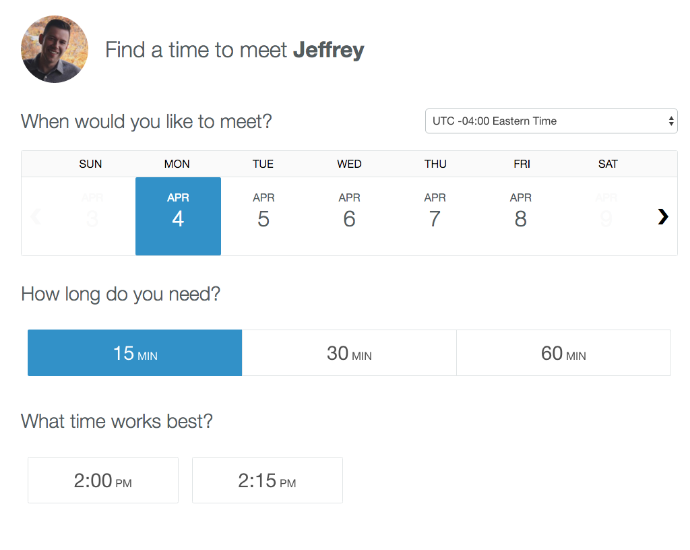
One caveat: If a prospect writes you back, it’s okay to just call them. Once a prospect responds by email, there is nothing wrong with dialing and starting the conversation with, "Figured it'd be easier to talk over the phone. Do you have five minutes?"
If they don't give you permission to proceed, ask, “How can I best help you evaluate our ability to meet your needs?” If they don't pick up the phone, don't make "Can we schedule 15 minutes?" your next ask over email. If you make that your call to action, you’ll miss an opportunity to engage them in a dialog over email. Instead, consider asking an open-ended question about their interest and just offering to get on a call if that’s more convenient for them.
One word of caution: Be especially careful not to assume your preference is theirs. Be careful not to swing too far in the other direction and assume that email is your prospects' preference just because it's your preference. This post isn't supposed to be proof that email is a better communication method. The crucial thing to remember is to pay attention to your buyer's preferences and adapt accordingly. Use their preferred method of communication effectively and you'll have the opportunity to gain credibility and increase the chances of them realizing it's worth it to get on a call with you.
My wife says “Everybody is different, and that's okay,” to my son Peter when he expresses a preference for something different.
In all aspects of life, it's important to be tolerant of other people’s differences. It’s a sign of respect and appreciation for a fellow human being. This type of appreciation is key to initiating a relationship with someone new -- say, like a buyer. So why don’t salespeople respect the communication preferences of their prospects?
Maybe salespeople think that their preference is more important. Maybe they’ve been instructed to ignore their prospect’s preferences. Maybe they've had just enough luck with prospects saying "sure, let's get on a call."
Whatever the reason, the status quo is clear. Bob (and many other salespeople) don’t seem to understand that in sales, their own communication preferences don’t matter.
In an email exchange with Trish Bertuzzi the other day, she wrote to me, "Email is not my communication vehicle of choice. I am a phone girl. Are you shocked?" I was not shocked since she is the founder of inside sales consulting group, The Bridge Group and the author of the Sales Development Playbook, and she understands the power of the phone. So now I (and you) know Trish's preference. But most buyers won’t be as upfront as Trish is. It’s your job to read your prospects' behavior to maximize your chances of connecting. You can’t make sales if you can’t get past this part of the process.
Use the tips above to uncover your prospect's communication preferences and adapt your approach based on what you uncover.
P.S. I always respond to blog comments. Feel free to disagree.



As an inside sales rep, you have several sales conversations a day. Many of those conversations end after the first or second call because your prospect is not qualified.
That's not a bad thing. You only have so many hours you can spend selling in a given year. The less time you spend with unqualified prospects, the better.
You have to spend your time on really qualified prospects -- the ones who absolutely need your product and face all the challenges your product solves. Because even when a prospect, there's no guarantee the sales process will be fast, and you'll have to invest time in the relationship to get the deal over the finish line.
That's why it's so frustrating when you invest your time working with a prospect only to have them go dark. Here are three common reasons why a prospect goes radio silent, and what to do to engage them again.
Have you ever received an email like this from a prospect?
John,
Thanks for your note. I'm sorry for the delay, but I have too much on my plate right now to focus on this. Can you follow up in a month?
Lisa
How do you respond? Your quarter is going to end in two weeks, and your prospect just gave you the Heisman. If you were banking on this deal coming in, this means you won’t hit your number.
In order to solve this issue, you need to understand the root cause.
When your prospect says they are too busy to deal with your product right now, what they mean is they have several other projects ranked ahead of yours on their priority list that demand their attention.
In order to rectify this situation, you have to figure out how to have your issue rise to the top.
You can do this by helping the prospect quantify how much the issue you solve is costing their business. That usually does wonders to raise the profile of your project in the prospect’s organization.
However, many times there is no way to prevent this situation from occurring. Things happen. Maybe they just had a senior member of their team resign unexpectedly. Maybe they just lost their biggest client. Maybe they have family issues that they are dealing with. These are things that you can’t prevent.
So now what do you?
Give them exactly what they asked for. Give them space. Respect their request. But don’t go silent.
Over the next month, you have the ability to demonstrate that you are not a pushy salesperson who needs them to close, all while providing value.
Dig into your marketing team’s content library to find the best guides, infographics, or thought leadership articles that your marketing team has created, and share those with your prospect. Send an email like the following:
hi Lisa, I saw this article on best practices for using buyer personas in sales enablement and thought you would enjoy it. talk with you in a month.
John
Sharing content like this is an opportunity to stay top of mind, and remind the prospect why they want to re-engage with you when they're ready to restart the process.
In the era of traditional sales, we were taught to sell with passion. We were told that if we spoke persuasively enough to our prospects, they’d sense our passion and realize they had to buy.
So we rehearsed our pitches, fine-tuned our demos, and strengthened our objection handling.
However, in the era of inbound sales, where the buyer has alternative options to learn about your product, such as researching it on your website or reading reviews in customer forums, they 're apt to hit the mute button as soon as you start your pushy sales pitch.
A sign that you’re relying on your sales pitch to get you in the door is if the first five to 10 minutes of all of your sales interactions are about your features and benefits rather than the customer’s problems.
Record yourself. Who does the majority of the talking in that time frame? If it is you, then you are probably giving answers when you should be asking questions.
With the widespread information on the web about any topic, what your customers need most are consultants. They need someone who can ask them the right questions and have the right conversations to help them understand if they have a problem that they need to solve right now.
If you don’t want customers to be turned off by your sales pitch, then don’t give a sales pitch. However, if it’s too late for that, here’s how to recover.
Get back on the relationship-building track. Find a helpful industry- or job-related article, and send it to your buyer. Start the dialogue in the email, where the prospect has control. This will help them feel more comfortable with engaging with you again.
Hi Lisa,
I saw this recent study on cold calling and thought of you.
I remember you mentioning that you guys do a lot of cold calling, but with limited success. I've been doing a lot of cold calling too, with varying degrees of success.
Do you agree that the buyer in today's day and age is actually turned off by a cold phone call? Or do you think the extra touchpoint helps us stay top-of-mind?
John
Mistakes get made. Get back on the education and relationship-building track.
Sometimes, you’ll talk with prospects that don’t completely believe that they're facing the problem your product solves. Those conversations are frustrating and not fruitful, because it seems as though the prospect isn’t receptive to your questions or what you have to say. So instead of feeling natural momentum in your sales conversation, you’re feeling unnecessary friction.
The reason why you are experiencing this issue is because your prospect is dealing with normalized pain.
Here's an example: I grew up with allergies. I never really knew what it felt like to breathe fresh air, and not feel stuffy. I was eventually diagnosed and started getting allergy shots. That made a huge difference. But it wasn’t until after I got allergy shots that I realized I even had a problem.
What does normalized pain look like in sales? It’s when a prospect is so used to their business pain they don’t even realize they're suffering from it. Any type of discussion around that problem seems fruitless.
Encountering prospects who don't recognize their normalized pain can seem like an inevitable part of day-to-day sales, but it doesn’t have to be.
One tactic that I’ve found success with is to share a thought leadership or best practice article before I talk with a prospect. Once they agree to the meeting, I share more content to educate them. Then, my conversations with prospects flow much more naturally because they're already bought into the premise of the problem that we solve.
However, sometimes you don’t find out that the prospect doesn’t get it until you jump on a call with them. What do you do then?
If you just got off of a phone call with a prospect that felt forced, send them an email with the following components:
Here is an example of what this email looks like:
Lisa,
I really appreciate you taking the time to chat today and for your proactiveness in wanting to increase sales usage of your content.
We recently wrote this blog article titled "5 Signs of a Useless Sales Enablement Content Portal."
It talks about a few issues that prevent sales from leveraging your content with prospects. It doesn't sound like it makes sense to talk right now, but could I follow up in two months to see if you're experiencing some of the issues that we discuss in that article?
John
In this scenario, I shared a blog article. However, if you have either visual content or a thought leadership piece from a third party, share that instead. Visual content does a better job of helping the prospect grasp a concept, and an objective source does a better job of helping the prospect overcome their skepticism of your claims.
Prospect engagement is a really important skillset for inside sales teams. Today’s sales reps have less personal control to influence their prospects, yet quotas continue to climb by 10% each year.
As a result, it’s important to adapt. Sales reps are figuring out how to build relationships and become trusted advisors to their prospects, regardless of emerging constraints. They are strategically sharing content to add value and close their prospects.
In today’s shifting sales environment, how do you keep your prospects engaged?

Deciding to purchase B2B data can significantly benefit your organization, helping you to score more leads and win more business. It’s likely that having made this decision, you are undertaking research to find the most suitable partner for your needs.
However, did you know that you can go one step further? Rather than simply selecting a data list provider, you can work with a data consultancy, which will go the extra mile to ensure that your data works as hard as it possibly can for your company.
The latter will offer value-added services that will help you to make the very most of your data. It’s the difference between going to the supermarket and buying food for the week, and having a chef teach you some delicious recipes that you can cook up using the food that you have purchased.
Let’s take a look at both options in turn.
B2B data list provider
A data list provider is just that: an organisation that can supply you with data that will allow you to target your ideal customers. This data is likely to have been compiled from various sources, including:
Whether you require direct mail data, email data, telephone data, or a combination of the three, a good list provider will be able to get you what you need. In fact, it is possible to acquire data almost instantly – many providers offer an online service, whereby you can use a tool to generate the ideal list or lists for your organisation.
Of course, this data should be of high quality, legally compliant and useful to your business. So it is important to take steps to ensure that your list provider is a suitable partner.
A data consultancy will do all of the above – and more. In addition to providing data, a consultancy will provide additional services such as database cleansing, profiling, and analysis, all of which will help you to improve your targeting and ROI.
Each of these services focuses on improving the database that you already have – and then expanding it further. Therefore, they go hand-in-hand with purchasing new data.
1. Database cleansing
This process simply involves reviewing your current database and removing any “dirty” records – that is, data that is outdated, inaccurate or incomplete. As a result, your data can work harder for your company, generating more leads and leading to more sales.
2. Profiling and analysis
According to Data Matters UK, profiling is: “A simple analysis that provides basic information, often demographic, about customers or a group of customers, in order to describe the characteristics of the group.”
In doing this, you can work out who your best customers are, where they’re coming from and what they have in common. Armed with this insight, you can acquire similar prospects to help boost sales.
3. TPS/CTPS compliance
If you have a database, of any size, you need to make sure your prospects are happy to be on it. The Telephone Preference Service (TPS) and the Corporate Telephone Preference Service (CTPS) registers give people a chance to “opt out” of receiving unsolicited sales calls. Every business is required to check the data they hold against these registers every 28 days – breaching this rule could land you with a hefty fine of up to £500,000 from the Information Commissioner’s Office (ICO). A data consultancy can help you to keep on top of these requirements.
Both list providers and consultancies can provide you with the B2B data that will help your business to reach more of the right people. While the former can provide you with high-quality, useful data, the latter can also offer you additional, value-added services that will help you to utilise your data to achieve the optimum results. So it’s well worth taking these differences into account when carrying out your research.
You may not need as thorough a service as can be proved by a consultancy. However, for many businesses, there is a host of benefits to be accrued from partnering with an organisation that can help you to cover all the bases when it comes to data.
This is a guest post from Nick Persico. He was one of the first people to use Close.io, and has been helping teams get the most out of it ever since. He’s now running sales at Smart Host. This post is intended for sales managers that are using Close.io. If you are an SDR or AE at a company that uses Close.io, here’s an earlier post with some tips for you.
As a sales manager, your success is most often measured in revenue or customer growth. It’s on you to put together a team, get them to perform consistently, and generate predictable results. Generating predictable results is difficult in sales because the entire process relies on various human beings doing their jobs.
The sellers need to sell and the buyers need to buy.
For someone that’s supposed to be in charge of these transactions, there’s an awful lot that you don’t really control. The members of your sales team have to show up each day and hustle, and it’s on you to create an environment where it’s easy for them to do that.
You’ve created a sales process, and the team needs to follow it. But to a salesperson, “process” often means friction. Luckily, Close.io is there to reduce the amount of friction. This post will help you unlock a new level of sales productivity your team hasn’t experienced before by showing you how to manage your sales team with Close.io.
After using their inside sales CRM everyday for almost four years and managing dozens of sales reps, here are five of my pro tips on how to get organized, save time, and dramatically increase your outreach.
In longer sales cycles, the feeling of accomplishment a salesperson gets when they close a deal is too infrequent. They need to feel that sense of accomplishment every day if possible.
A way to do that is create and assign them Smart Views that can be called or contacted in a single sitting. Close.io has recently released new search functionality that allows you to create “buckets” of leads. By using the new search keywords like slice: 1/3 and limit: 100, you can assign parts of a lead list to different members of your team.
By utilizing these search keywords, you’ve now made it really easy to:
Let’s say you want to create a Smart View that contains leads you got from Yelp and you want two separate salespeople to use two different call scripts. Here’s a search query to save as a Smart View:
custom.Lead Source:"Yelp" slice: 1/2 and not called:today
custom.Lead Source:"Yelp" slice: 1/2 and not called:today
By adding “not called:today” to the query, the salesperson knows you expect them to just keep calling until the number of leads in the Smart View is zero! Mission accomplished for the day.
Instead of having hundreds of leads from Yelp, you now have random buckets of 50 or 100 Yelp leads that you can conduct trackable tests with. Also, you avoid the mess of having multiple salespeople calling out of the same endless set of leads. To limit the number of leads in a Smart View, add the search keyword `limit: 100`.
For example, just imagine the performance tracking reports you can create with this method:
| Source |
Slice |
Cold Call Script |
Leads Called |
Sales Rep |
Contacts Reached |
Reach Rate |
Demos Scheduled |
Success Rate |
| Yelp |
1 of 2 |
Demo Script #1 |
100 |
Sally |
15 |
15% |
5 |
33% |
| Yelp |
2 of 2 |
Demo Script #2 |
100 |
Erica |
15 |
15% |
2 |
13% |
In this example, it’s easy to see that Sally had a better success rate than Erica. But was it because Sally’s script was better? The next test would be to swap the scripts between Sally and Erica and see what the outcome is.
The effectiveness of your sales process can only be determined by tracking the results of each step. As you improve and evolve your sales process, the complexity of what’s being tracked in your CRM will grow and create confusion.
It’s important to maintain a live document or spreadsheet that reminds your team what each status or custom field means. For example, you should document the definitions of:
In addition to the definitions, indicate if they are currently active or depreciated and if the fields are updated by the team or happen automatically. You should also include how to query them in Close.io.
Here’s an example portion of the document that defines lead statuses at Smart Host:
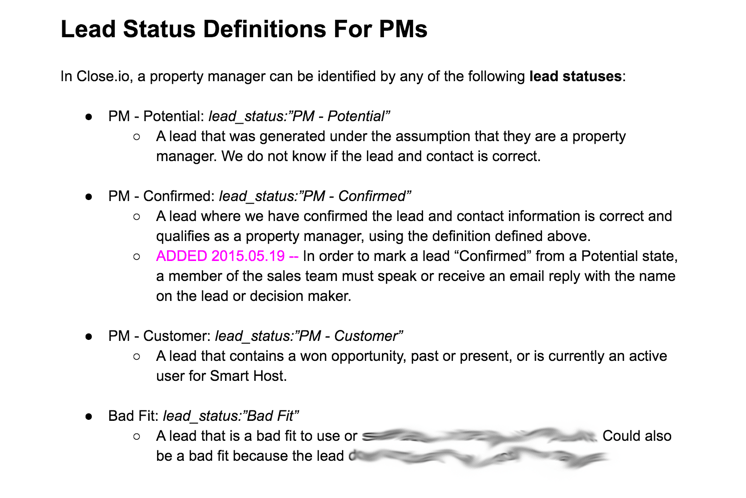
It doesn't need to be fancy but you'll get the most value out of it by updating it regularly.
Tasks in Close.io are most often used by your team to remind themselves to do something with a specific lead, contact, or opportunity. You should be training your team to use tasks to communicate or ask for help within the team.
If your salespeople assign you tasks like “Review this demo call and provide feedback”, or “Send the opportunity contact a email”, it will be much easier to keep all the context within your CRM.
You, the sales manager, should also do the same. When I am reviewing performance in Close.io, I’ll often assign tasks to salespeople working on those deals to answer questions I have or provide them feedback: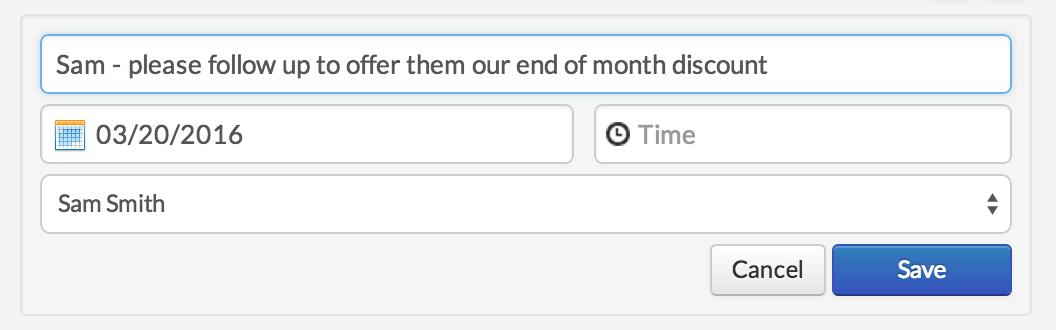
This type of behavior can also be a huge timesaver for existing customers. If there is something the support or account management team needs to handle, your sales team can just assign a task to them in Close.io. Once the task is complete, they can assign it back to the salesperson to let them know.
Your team needs to be aware that you are always there to back them up when things fall through the cracks. It happens. By creating a Smart View that looks for the leads that have fallen through the cracks, you can help your reps to become more successful—which is what managing a sales team is all about.
For example, here’s a Smart Views that looks for any leads where there is an active opportunity and we haven’t communicated with them in 14 days:
opportunity_status_type:active last_communication_date > "14 days ago"
By checking this Smart View every day, you can assign your sales team tasks to make sure leads are being followed up with.
By using Zapier to send newly created opportunities and won deals to Slack, you can communicate and celebrate someone’s success automatically.
For example, here’s what it looks in our sales Slack channel when we close a deal at Smart Host:

Here’s what the formatting syntax in Zapier looks like:
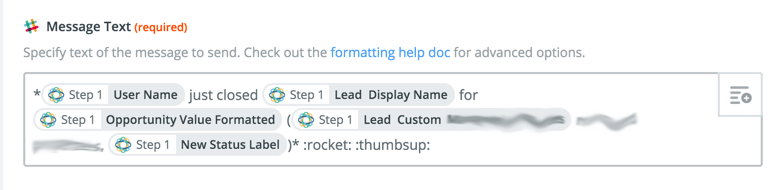
By using Zapier and Slack, you can easily and automatically praise a team member for their hard work when it pays off. It’ll create some friendly competition around the office and the other departments can congratulate their colleagues on a job well done.
Your sales team’s discipline in achieving a high level of productivity depends on your leadership. Your team is going to emulate how you conduct yourself within Close.io.
Be disciplined by making sure all of your leads are marked with the correct lead and opportunity statuses. Have your Close.io Inbox be as close to zero as possible. Make a point to check your Smart Views at least once a week.
If you do these things, it will rub off on them. Always keep in mind that you are the standard bearer.
Log in now and start managing your sales team more effectively.
Not a Close.io customer? Sign up today for a 14-day free trial. No credit card required.
Bonus tip: Send daily email activity reports to your team
By using this free open source Python script, you can send daily activity email reports to remind your team what was accomplished today. This type of report makes it easy for you to see who was on or off their game, and helps your salespeople keep up the hustle.
Training a new sales team? 5 ways to set them up for success
Your new sales hires will set the tone for the next stage of your company's growth. Here are 5 tips on training and managing a new sales team to be their best.
8 CRM-ready sales email templates for every step in the sales process
8 sales email templates, easy to copy and paste into your sales CRM. There are templates for every stage of the sales cycle, from intro to close.
Sales pipeline management tips for SDRs & AEs using Close.io
If you haven't already done so, share these Close.io productivity tips with the SDRs & AEs on your team.


You’d be hard pressed to find a country in which there isn’t some level of government corruption. Everyone is susceptible to greed and the thirst for power, and those in the upper echelons of governance tend to be surrounded by more temptation than most.
But there are some places in which people feel that their government has their best interest in mind — where citizens can speak up and feel heard. Where are these exceptions to the rule? FindTheData used the most recent 2015 data from Transparency International to find out. The FindTheData team identified the countries with the lowest perceived levels of public sector corruption.
The global coalition uses expert opinion and surveys to assign each country a score called the Corruption Perceptions Index (CPI). The score is out of 100, where a higher score indicates a lower level of perceived corruption. The score takes into account whether the country has a free press, public access to the government’s budget, integrity among those in power and a fair judiciary system (officials don’t have a bias towards the rich) that is independent from the other parts of government.
FindTheData ranked 168 countries by their CPIs. Transparency International didn’t include data for Greenland or Western Sahara, so they are excluded from the list. Several of the countries had tied scores, making a true ranking less definitive.
Transparency International found that many Northern European countries scored well and therefore have “clean” public sectors. But the organization makes sure to note that even though a country may be virtually corruption-free within its borders, this doesn’t mean it isn’t linked to corruption elsewhere. According to its research, “half of all countries [in the 1997 OECD Anti-Bribery Convention] are violating their international obligations to crack down on bribery by their companies abroad,” including Sweden, which is ranked third in the world for the least amount of perceived corruption.
Corruption Perception Score: 65
Overall rank: 27
GDP per capita: $2,560.50
(tie)
Corruption Perception Score: 70
Overall rank: 23
GDP per capita: $43,962.70
(tie)
Corruption Perception Score: 70
Overall rank: 23
GDP per capita: $42,732.60
(tie)
Corruption Perception Score: 70
Overall rank: 23
GDP per capita: $20,161.60
(tie)
Corruption Perception Score: 70
Overall rank: 23
GDP per capita: $14,528.30
Corruption Perception Score: 71
Overall rank: 22
GDP per capita: $96,732.40
Corruption Perception Score: 74
Overall rank: 21
GDP per capita: $16,806.80
(tie)
Corruption Perception Score: 75
Overall rank: 18
GDP per capita: $36,194.40
(tie)
Corruption Perception Score: 75
Overall rank: 18
GDP per capita: $54,374.40
(tie)
Corruption Perception Score: 75
Overall rank: 18
GDP per capita: $40,169.50
(tie)
Corruption Perception Score: 76
Overall rank: 16
GDP per capita: $54,629.50
(tie)
Corruption Perception Score: 76
Overall rank: 16
GDP per capita: $51,190.80
Corruption Perception Score: 77
Overall rank: 15
GDP per capita: $47,352.90
(tie)
Corruption Perception Score: 79
Overall rank: 13
GDP per capita: $52,004.50
(tie)
Corruption Perception Score: 79
Overall rank: 13
GDP per capita: $61,925.50
(tie)
Corruption Perception Score: 81
Overall rank: 10
GDP per capita: $46,332.0
(tie)
Corruption Perception Score: 81
Overall rank: 10
GDP per capita: $116,664.0
(tie)
Corruption Perception Score: 81
Overall rank: 10
GDP per capita: $47,821.90
Corruption Perception Score: 83
Overall rank: 9
GDP per capita: $50,235.40
Corruption Perception Score: 85
Overall rank: 8
GDP per capita: $56,284.60
Corruption Perception Score: 86
Overall rank: 7
GDP per capita: $85,594.30
(tie)
Corruption Perception Score: 87
Overall rank: 5
GDP per capita: $97,307.40
(tie)
Corruption Perception Score: 87
Overall rank: 5
GDP per capita: $52,172.20
Corruption Perception Score: 88
Overall rank: 4
GDP per capita: $42,409.0
Corruption Perception Score: 89
Overall rank: 3
GDP per capita: $58,938.80
Corruption Perception Score: 90
Overall rank: 2
GDP per capita: $49,823.70
Corruption Perception Score: 91
Overall rank: 1
GDP per capita: $60,707.20
Sure, US libertarians like Ayn Rand, but we wanted to know what the rest of the world thinks, so we checked Google Trends.
It turns out that Scandinavia, despite its deeply entrenched socialism, takes a lot of interest in Rand. So does Russia, where the novelist and philosopher was born.
Global interest may be growing, too, with The Economist reporting strong books sales around the world.

Join the conversation about this story »
NOW WATCH: EX-UNDERCOVER DEA AGENT: What I did when drug dealers asked me to try the product
Carry-on spaces are ideal for when you are traveling light or avoiding baggage fees. Here are five products that help you expand the constricting space.
The post Dodge baggage fees and still pack plenty with these travel bags and tips appeared first on Digital Trends.

With the onslaught of emails we receive every day, it's hard to imagine how anyone could keep up professional email habits at all times.
To make this task a little less daunting, we asked experts to highlight some of the least professional behaviors you could demonstrate when sending an email.
While mastering the art of good email etiquette doesn't mean sending out beautifully crafted prose each time — that would take forever — if you can avoid these bad habits, you'll be off to a great start.
SEE ALSO: Here is the perfect way to end an email — and 27 sign-offs you should usually avoid
DON'T MISS: 18 unprofessional habits that could cost you your job

"Like the boy who cried wolf, if you abuse the urgent marker, it won't be long until no one will pay any attention to it," Rosemary Haefner, chief human-resources officer for CareerBuilder, tells Business Insider.
And when you finally do send a truly urgent email, no one will pay attention, she says.
While the tone of your message should reflect your relationship with the recipient, Haefner says, too much informality will make you come across as unprofessional.
She advises being judicious in your use of exclamation points, emoticons, colored text, fancy fonts, and SMS shorthand.
What's more, not everyone can quickly decode acronyms, Rosalinda Oropeza Randall, an etiquette and civility expert and the author of "Don't Burp in the Boardroom," tells Business Insider.
"Be especially mindful if you work with people from different generations, have language barriers, or prefer a more traditional tone," she says.
At the same time, you don't want to come off as a robot.
"It's OK to add a bit of enthusiasm or personality to your emails," Vicky Oliver, author of "301 Smart Answers to Tough Business Etiquette Questions" and "301 Smart Answers to Tough Interview Questions," tells Business Insider.
She laments that sometimes she receives "one-line emails that are so transactional they sound like an automaton is responding."

Photographed at Dundas Square, Toronto, Uber taxi service is a new way to travel around the city. Request and payment are all made using an app. (Bernard Weil/Toronto Star/Getty)
Once upon a time, Naheed Nenshi would have been told he was on Candid Camera; now it’s Periscope. To his chagrin, the Calgary mayor was caught last week on a hidden live-stream camera letting fly his private thoughts on Uber, the ride-sharing app that’s shaking up the taxi business.
“Uber . . . has a brilliant business model, and are dicks,” Nenshi declared as he was being ferried around Boston by a driver for Lyft, a service similar to Uber. He also claimed Uber let registered sex offenders and violent criminals slip through its driver-background checks. Nenshi later offered up an earnest-sounding apology, and recanted his unfounded allegations about Uber’s background checks. For someone who’s used social media to great advantage and now finds himself hoisted upon his own digital petard, it’s a moment of considerable irony. More significant, Nenshi’s comments provide valuable insight into the positions and prejudices that define the heated battle over municipal regulation, consumer rights and the future of taxis in Canada.
The traditional taxi business is a creature of municipal command and control. City regulators set the number of taxis allowed to roam their streets, determine the vehicles drivers may use, the prices they charge and how they interact with customers. Taxes, fees and other requirements abound; competition is a foreign concept. By strictly limiting the availability of taxi licences, this system has also made some taxi licence owners (although not necessarily drivers themselves) very rich.
Uber upends this cozy relationship by flooding streets with eager drivers who connect to passengers through smartphones in a way that largely eliminates municipal oversight. This has caused taxi licence prices to plummet, and taxi drivers everywhere to protest. Despite all the sound and fury however, ride-sharing apps offer tremendous advantages for consumers. According to the federal Competition Bureau, Uber fares are generally lower than taxis. (Although rates can rise during peak demand.) Wait times are shorter. Convenience and quality of service are also notably better. The Competition Bureau recommends cities adopt a “light” regulatory approach with Uber to allow “market forces and competition to determine outcomes and drive innovation.”
Unfortunately not all cities respect the bureau’s advice to favour consumers over the taxi industry. Vancouver has banned Uber. Montreal is engaged in a fierce battle of car seizures and fines with Uber drivers. Nenshi chose a passive-aggressive approach, creating a set of regulations he knew would conflict with Uber’s “brilliant business model” in order to keep the service out of Calgary.
Civic hostility toward Uber is often justified in the name of passenger safety. Nenshi’s falsehood about sex offenders is a fine example of fact-free fear-mongering over background checks. In truth, the wealth of data exchanged when arranging an Uber ride, including a mutual rating system, as well as the absence of cash changing hands, offers ample protection for passengers and drivers alike. Another refuge for taxi patriots is the claim Uber threatens the livelihood of hard-working immigrants. Again, Nenshi’s own live-streamed experience puts paid to this allegation. His Boston driver told him he makes a satisfying US$40 an hour driving full time for Uber and Lyft. Presumably such returns are possible for any taxi driver with similar dedication. (It seems reasonable to ask why Nenshi, who deliberately engineered Uber’s departure from his own city, patronizes similar services when travelling abroad. Perhaps he finds them safe, convenient and well-priced?)
The arguments arrayed against Uber are grounded not in consumer protection, but turf protection. Regulators instinctively resist any erosion of their powers, even in cities that pride themselves on their progressive or high-tech bona fides. This likely explains why Uber has been such a “prickly” negotiator, to paraphrase Nenshi’s colourful descriptor. Given the deeply entrenched positions of its opponents in the taxi industry and municipal offices, Uber is pushy out of necessity. The obstacles are too great to be polite.
Thankfully, not every city has set out to stifle Uber. After initially cracking down on Uber, Ottawa recently unveiled a new set of policies entirely compatible with ride-sharing. Significantly, these rules also untangle the web of red tape choking taxi drivers, giving them a real chance to compete. Licence fees will be cut dramatically and regulations on such things as trunk size, window tinting and credit card fees will be dropped. That’s right: until Uber arrived, Ottawa imposed a $1.50 fee on every taxi passenger paying by credit card. Why? Because it could. Surely this is proof enough of the necessity for Uber’s disruptive presence.
In his unguarded, live-streamed moments, even Nenshi seems to acknowledge the inevitability of an Uber-led shakeup of the Canadian taxi business. “We’ll get there eventually,” he told his Boston driver. “It’s all going to sort itself out.” And so we wait for Nenshi and the rest of Canada’s regulation-obsessed civic leaders to decide when they’ll finally be ready to put the interests of consumers first.
The post Enough with the Uber bashing already appeared first on Macleans.ca.
In my previous blog post, Do you Intend to Provide Developmental Sales Coaching, but Tend not to, I explored the environment today’s sales leaders encounter when attempting to deliver developmental sales coaching. Despite their best intentions, time pressed sales leaders are pulled in so many directions that talent development gets put on the back burner. Bringing structure to dedicated coaching interactions is a proven way to build positive outcomes in people and results. Without structure and planning, sales leaders often mail it in, missing real opportunities to move their people to the next level of success. Avoid this common pitfall by structuring sales coaching calls and each interaction around a guiding plan to bring consistency to the conversation, and ultimately results.
My approach is to organize coaching content into “buckets” that are consistent for everyone. When thinking through what I want to accomplish with a salesperson I am coaching, I typically build my planned dialogues in 3 buckets:
The above are the consistent givens in my approach. I like to use the phrase “vary the treatment” when thinking about my people. In other words, I have common goals for everyone but the path for how I get them there has its own DNA and blueprint. The above buckets remain the same but the dialogues are different and special to each person. That takes planning and structure but the time invested yields dividends that build over time.
When thinking about the long development journey with sales people, I have come to one exciting realization: It’s a great time to be a sales coach. Technology today has enabled us to move the needle even further. Here at Richardson we are utilizing exciting mobile technologies that provide an ability to capture real sales behaviors with our people over the long haul. Using tablets with a user friendly platform, I am able to capture my observations of client interactions that lead me to richer coaching dialogues with my people. The result is a salesperson reaching for new levels of success with my encouragement and long term support, and their buy in and commitment to change.
Cadence and consistency are essential. One rich coaching dialogue will not get the job done. Make real commitments to coach over the long haul, setting up a cadence of coaching dialogues that set expectations, establish trust and build mutual goals. The complexities of the organization will constantly test the best sales leaders when it comes to delivering coaching. Don’t let your people down. Often I have met salespeople who haven’t had a conversation with their direct leader for the better part of a month. Setting and honoring a protected time for quality dialogues must be the hallmark of the coaching relationship. Don’t discount the time together. Salespeople walk away stronger when working with a caring and dedicated coach.
It’s all about them. The best sales leaders are in it for the pure joy of seeing others achieve success. Honor their time, and yours, by structuring the dialogue and setting the right expectations. Your people and organization will thank you for it.

The post Bring structure to your sales coaching calls appeared first on Richardson Sales Enablement Blog.


You’ve just wrapped up the initial connect call with a prospect. Since you know first-hand that following up can mean the difference between a lost deal and a new customer, you immediately open your email, copy and paste a follow-up template, insert the prospect’s name and company, and send it off. Mission accomplished.
Whoa -- not so fast. While email templates are awesome, they can also be dangerous -- because if you don’t customize them, your prospects will undoubtedly notice. According to a new study from HubSpot Research, almost 40% of consumers say they had a negative sales experience because their rep failed to personalize his or her messaging. 
To make sure that your follow-up emails don’t sound canned, personalize your template based on how the conversation went. Here’s how.
Hi [Prospect],
I really enjoyed our phone conversation earlier today and especially liked learning about your unique role at [company]. I understand the challenges you are facing with [challenges discussed] and the impact they are having on [insert personal impact].
As promised, I have attached [or linked to] the resources and materials that can help you better understand how we can help you solve [challenge(s)].
Please let me know if you have any questions. Otherwise, I look forward to [talking with, meeting] you again on [date and time].
[Signature line]
[Salesperson]
It’s the type of meeting salespeople dream about: Not only was the buyer completely focused on you, she was enthusiastic about the product and readily agreed to a second conversation within a couple days. Reflect her excitement in your email and build on the rapport you created by referencing a specific detail of your conversation, giving her a genuine compliment, showing you were paying attention to her pain points by paraphrasing them in your own words, or all of the above.
Hi Eliza,
It was great to talk to you today. It definitely seems like Sweet Tooth Bakery’s customers would appreciate a loyalty system. After all, I’m pretty sure I heard at least three people say they come in for your banana bread alone on a weekly basis. :) If you used a loyalty platform to collect these customers’ emails, you could reward their banana bread obsession and even text them when you’ve whipped up a fresh batch.
You seemed interested in pricing, so I’m attaching a price comparison PDF. I’ve also included my mom’s cinnamon roll recipe -- it’s been passed down for generations and may be one of the best things I’ve ever eaten.
Let me know if you have any questions! If not, I’m looking forward to chatting again on Tuesday at noon.
Cheers,
Tim
You’re probably more familiar with this scenario, in which the prospect listened to your pitch and asked a couple questions, but didn’t seem overly enthusiastic. Your goal in this email is to reiterate the value of the product for his specific needs, so that he’ll want to invest more time with you and potentially advance in the buying process.
A great way to do this is through sharing a customer story, suggesting a reference call with a current client, or even linking to a third-party review site, where he can get an unbiased look at your product and how you compare to the competition. Offering a demo or free trial can also show prospects how the product would improve their lives.
Dear Jeremy,
I really enjoyed our phone conversation this morning. Seems like you’ve got a ton going on between hiring for your new office and setting up new recruiting campaigns.
Organization Inc. -- a customer of ours also in the manufacturing industry -- recently published a blog post about how they streamlined their hiring process with our help; here’s the link in case you’re interested: [link].
I appreciate you setting aside the time to talk again next Monday at 3 p.m. I’ll give you a call then. Please let me know if you have any questions in the meantime (and good luck with the rest of those interviews!).
Best,
Claire
Despite your best efforts to ask thoughtful questions and engage the prospect in a needs conversation, she was clearly going through the motions to be polite. When you asked if she’d like to speak again in a couple of days to review an ROI projection for her company, she said, “Maybe next quarter.” And that essentially means “never.” (Sound familiar? Learn how to overcome the five most common sales objections.)
In this scenario, since the prospect didn’t give you much insight into her needs or situation, use your existing data or what you can find online to inform your message. Has she or someone from her company written about a related topic on social media? What problems do people in her company and role usually face? Pick a challenge, and explain how your product could help, like so …
Hi Chelsea,
After our call, I read your LinkedIn post about Interweb’s aggressive growth plans. It seems like a low-maintenance analytics tool would help you keep up with the rise in customer data, while letting your engineering team focus on building your core features.
Our product could help you with this goal, but you’ve got lots of alternatives. I’m attaching an overview of all the various options to solve this problem sorted by price and feature.
Would you be open to talking again on Thursday at 10 a.m. to discuss these options? I’m more than happy to go with a different time if that doesn’t work -- just let me know.
Best,
Carly
During your short conversation, the prospect brought up several reasons why he wasn’t interested. And that’s not a bad thing keeping in mind that objections are often signs that a buyer is seriously considering your product.
In this email, focus on the prospect’s biggest reasons not to buy, and try to neutralize their concerns with customer case studies or anecdotes.
Dear Zane,
During our call today, I could hear how invested you are in giving your users a great first time with Silverstream’s app -- and I heard you when you said you’re happy with Firstly’s onboarding software.
But as I mentioned on the phone, many of our customers have switched over from Firstly, and their user retention rates are on average around 30% higher. I’ve attached a couple case studies so you can see specific examples.
I’m particularly interested in your reaction to Company X’s story. Give it a read, and let me know what you think.
Thanks,
Daniel
It can be a little demoralizing when a prospect is clearly trying to get off the phone as quickly as possible. However, that doesn’t mean you should give up -- it means you should provide a solid example of why your solution will give her company a competitive edge. (And if you hear the dreaded “I’m not interested,” check out how to salvage the conversation.)
Hi Anja,
Judging from our conversation this morning it sounds like your customer service is in great shape right now.
However, as you continue to acquire users, your support reps might find it hard to deliver the same helpful, human support without leaving others waiting. That’s actually what happened to Ergo, one of the companies using our platform. They’ve got roughly 1,000 more users than you and an average wait time of 23 seconds.
I’m curious to learn more about your company’s growth and how you plan to scale. Are you available on Thursday at 2 p.m.? If not, we can find another time that works better.
Let me know,
Sarah
By personalizing a follow-up email template to reflect the prospect’s response, unique situation, and personality, you keep the conversation alive. And conversation is always the first step in any sales process.


On October 23, 1996, the day AT&T announced that John Walter, an industry outsider, would be named CEO, the company’s market valuation dropped by $4 billion. In his book Searching for a Corporate Savior, Rakesh Khurana at Harvard Business School noted that this negative market reaction became a self-fulfilling prophecy, causing the board of directors and other top executives to lose confidence in Walter, and leading to his dismissal only nine months after assuming office.
Stock market reactions are often used to judge whether a firm’s actions are successful. How shareholders react to a big organizational announcement, such as the appointment of a new CEO or a large acquisition, can have a lingering impact on that event. As a result, firms try to anticipate and manage market reactions to major company news by releasing other important information, or “strategic noise,” around the same time.
In a study of 601 firms that we and our coauthor Mason Carpenter conducted in 2011, we found that before announcing the appointment of a new CEO, organizational leaders try to avoid the kind of clear negative reaction that so disadvantaged Walter. Companies were much more likely to make important announcements (both positive and negative) in the days surrounding a CEO succession than in the previous few months.
Our findings suggest that by announcing a new CEO appointment alongside other important news, such as the firm’s annual earnings announcement or a change in its dividend policy, it becomes harder to point to the immediate stock market reaction as being diagnostic of how shareholders felt about the new CEO. In other words, if the reaction is good, then the firm can use that as an example of the market embracing the new CEO. But if the reaction is bad, the firm can spin it as being related to the other news announced simultaneously. The strategic noise gives the firm and the new CEO plausible deniability. Interviews with board members confirmed this idea.
Since then, one of us (Scott Graffin) and coauthors have performed a second study to examine whether a firm’s strategic noise is powerful enough to actually change the market’s reaction to big announcements such as acquisitions. A great deal of research suggests that, on average and over time, shareholders generally react negatively when a firm announces it has acquired another firm. For instance, the market reacted quickly and negatively when Google announced its purchase of Android in 2005, even though the deal eventually turned into a great success.
In light of this, we hypothesized that leaders would anticipate this negative reaction and actively work to reduce it or make it positive. So we expected firm leaders would simultaneously announce unrelated positive news in an effort to positively influence the market reaction to its acquisition announcement. We tested our ideas using a sample of roughly 800 acquisitions in the U.S., and the results were recently published in the Academy of Management Journal.
Consistent with prior research, we found that there was a -1.4% drop in stock value for firms immediately following an acquisition announcement. We also saw that firms were 482% more likely to announce a significant positive event (e.g., beating an earnings forecast or increasing dividends) at the same time they released the acquisition news than in the months leading up to the announcement. But firms were also 40% less likely to announce a significant negative event (e.g., missing earnings or a product recall) than they were in the days leading up to the announcement. These results confirmed and extended the first study, in that firms tried to prop up the stock market reaction to acquisition announcements.
We also found that these positive announcements influenced the market reaction around the time of the acquisition announcement. In fact, if a firm released two positive announcements, the negative market reaction to the average acquisition was reduced from -1.4% to -0.8%, which in the sample we studied is worth about $246 million in market value. So a firm could temper the negative reaction by almost a quarter of a billion dollars if it released two other pieces of positive news around the same time.
What we have learned from these two studies is that firms are not sitting around passively waiting for the market to react to their actions. Rather, they are highly conscious of how the market might react to what they do and proactively try to take steps to influence and manage those reactions.
Firms may also attempt this sort of approach when it comes to earnings releases, new product announcements, the announcement of pending lawsuits, or any instance where the firm knows about an important event in advance. Sometimes their goal may simply be to muddy the waters so corporate leaders can interpret the market’s reaction in a way that is more beneficial to the firm. Or they may actively try to change the market reaction, even if the best they can do is to reduce the size of a negative reaction. Either way, since customers and investors use stock market reactions to interpret organizational outcomes, it’s important to realize that firms may have had some influence over them.

How many times has that 10-minute brainstorm turned into a 2-hour discussion with little to show for it? Although meetings are often put in place to encourage productivity and increase efficiencies, they seem to have the opposite effect. After all, time spent in a meeting, is time spent not working. They may serve some purpose, but fewer meetings could make far better use of time and resources. Here’s 5 reasons why you should limit or even ban some of those upcoming meetings.
Wasted resources
As mentioned above, any time spent sat in a meeting is taking time away from work. A 30-minute pow-wow may seem innocent but this could be having major implications. As an example, if that meeting were to include 15 members of staff, you would lose a total of 7.5 hours in wages. In other words, that brief meeting would have cost the business almost a full day’s salary. Always ask yourself whether the meeting outcome is worth that lost productivity.
Reduced productivity
Studies suggest that office workers spend an average of four hours per week in meetings. What’s more, a recent survey shows that almost 50% of staff feel that meetings are the biggest time-waster in the workplace. All this ‘lost’ time could be spent doing something beneficial, such as capitalising on new opportunities for business growth. As they say, actions speak louder than words.
Lack of value
In order for a meeting to be worthwhile, information must be shared that is both valuable and relevant. Decisions and strategies through this sharing of knowledge can then positively impact the company’s growth. Unfortunately, poorly planned meetings often share information which employees are already familiar with. This no longer adds any value and the practice becomes worthless. Be sure to plan meetings beforehand, ensuring that all attendees will benefit from the new information.
Not always necessary
It’s important to ask yourself whether there is more efficient ways of sharing information than face-to-face. Could you relay the information to 5 colleagues via email and include a quota for them to spread the word? Email is a great way to delegate responsibilities, share insights and provide updates to a large group of individuals. The recipient can then use this knowledge and share it with other staff. It provides the same results, without the hassle of meeting in person.
Impacts staff motivation
Overly ambitious meetings can be mentally draining, leaving staff feeling tired and uninspired. For many, stifling yawns in one meeting to the next, can be the hardest part of their daily duties. It’s essential to consider your staff satisfaction before holding a meeting. Spending two hours in a stuffy conference room can take its toll. Employees can be left deflated which could impact productivity for the rest of the day.
Clearly there are some benefits to a brief meeting and brainstorming session. They will always be commonplace for best practices, but avoid the unnecessary ones and always plan for the best outcome.

Justin Trudeau and Bill Morneau walk to the to deliver the budget, March 22, 2016. (Patrick Doyle, Reuters)
Prime Minister Justin Trudeau in March became the first leader in a generation to plunge the federal government into deficit without remorse. He would still like you to consider him a fiscal conservative. “One of the things that is important to me is fiscal responsibility,” Trudeau told Bloomberg a week before Finance Minister Bill Morneau tabled his first budget.
The Prime Minister will struggle to convince people of his concern for the sanctity of the public purse. His decision to drop the eligibility for collecting old age security benefits from 67 to 65 was foolish, not fiscally responsible. Almost every neutral expert who has considered how to save the public retirement system concludes that future generations should wait longer for their benefits. Few governments have managed to make such a change; Trudeau had it handed to him but opted to backtrack. It undermines his claim to being an “evidence-based” policy-maker.
Also working against Trudeau’s claims of fiscal prudence is the $29-billion deficit forecast for this year. That’s a big number for a country that has been conditioned to think that even the smallest budget deficit is automatically bad. It is entirely possible that there will still be a budget shortfall when Trudeau seeks re-election in five years.
Most of the people who voted for the Liberals last autumn probably don’t care about Trudeau’s credentials as a fiscal steward. That doesn’t mean Trudeau can do what he wants with his mandate to spend. The Conservatives will continue to criticize deficit spending, if only because they will be unable to admit they lost the debate over economic policy. Trudeau and Morneau also must keep in mind the buyers of Canada’s bonds. Bay Street is broadly supportive of the theory behind borrowing to spark economic growth. But there are limits. “An implicit, if not explicit, target of zero [deficit] would be welcome news,” Royal Bank of Canada economists said before the budget. They didn’t get that. The projected shortfall in 2021 is $14.3 billion.
Trudeau knows he will be watched closely. “Someone who actually believes that government has an important role to play, not in everything but in certain areas and conditions for growth, has a strong vested interest in being responsible, and demonstrating that governments can spend and invest and be responsible stewards of taxpayer monies,” Trudeau said during his Bloomberg interview.
The Prime Minister and the finance minister have done a good job of focusing the public’s attention on the debt-to-GDP ratio, a better gauge of a country’s ability to pay its bills than the annual budget balance. Canada’s debt is currently about 31 per cent of GDP. That is comfortably low, and it is why Trudeau is in a position to borrow to spend on infrastructure. Morneau aims to return the debt-to-GDP ratio to that level within five years, after a small increase. Those looking for an anchor on spending will have to live with that for now.
Does that make Trudeau a fiscal conservative? In a way, yes. Warren Lovely, head of public sector research at National Bank, wanted the government to chuck both balanced budgets and its campaign promise to reduce debt as a percentage of the economy. Trudeau and Morneau opted to keep a target—albeit a less restrictive one than Stephen Harper’s arbitrary goal of banishing deficits. The whole point of legislating budget surpluses was to reduce debt to manageable levels that would allow the government to borrow at lower interest rates, and that’s what happened. Balanced budgets became a political trope that falsely equated a clean balance sheet with economic success. A focus on the debt-to-GDP ratio puts attention on what matters (debt) while allowing politicians to adapt to changing economic conditions.
That won’t free Trudeau from accusations that he is a spendthrift. He plans to scrap the balanced-budget law, when he could have replaced it with a legislation enshrining a debt-to-GDP target. That would be the easiest way to change the definition of a fiscal conservative. The other way will be more difficult: He will have to win a second term.
The post Justin Trudeau claims to be a fiscal conservative. He’s not. appeared first on Macleans.ca.

Landing pages support content marketing.
The tricky thing is … landing pages are not home pages. They’re not blog posts, cornerstone content, white papers, case studies, product description pages, or even sales pages.
And you can’t treat them like they are.
High-converting landing pages consist of three action-driving stages: before, during, and after.
Tragically, when many content marketers build landing pages, they focus on just one stage: during.
But if you don’t invest effort into what happens before and after you present your landing page, it doesn’t stand a chance of achieving the results you want.
While landing pages are not about you — your company, your product, or your service — the “before” stage is because you first have to establish your goal.
As Demian Farnworth said:
“[Landing pages] force readers to focus on one thing — and one thing only.”
Determining that one thing is the only time you get to be self-centered in this process. The best way to set your goal is to complete this sentence:
I want my visitor to …
Naturally, there are plenty of other actions that might be the goal of your landing page. Whatever you select, your goal should be singular: the one desired action will guide everything else.
For example, let’s look at InvestorCarrot’s landing page for their SEO Keyword Bible.
The crucial thing to notice isn’t what’s on the page, but what’s left off the page.
There’s no header navigation, no footer, no social media icons, and even their logo in the top left corner isn’t clickable.
Essentially, there are two roads out from this landing page: “Get My Free Report Now” or “No thanks, I’ll pass on this opportunity.”

InvestorCarrot knows exactly what they want their visitor to do and they eliminate every other navigation option.
The result of this singularity — along with other factors I’ll address in the next two stages — is a whopping 45.89 percent conversion rate.
Take heed: when it comes to planning your landing page — the before stage — select one goal. Remove anything that doesn’t support that goal.
The “during” stage of your landing page consists of five on-page elements.
The headline of your landing page is arguably the most crucial on-page element. Why?
Because while 8 out of 10 people read the headline, only 2 out of 10 will read the content that follows.
So, how do you create a headline that grabs, compels, and drives action?
Easy. You don’t.
Instead of trying to create the perfect headline, steal it.
First, steal the heart of your headline by building it around your audience’s own keywords.
Whether you drive visitors to your landing page with paid advertising (PPC) or organic search, your headline must include the words your audience uses.
This is precisely what makes our previous example so compelling. Instead of including vague keywords about SEO, the headline targets a specific audience: Simple SEO ‘Hacks’ To Help Real Estate Investors Get More Traffic & Leads.
Next, steal successful headline templates.
Copyblogger’s How to Write Magnetic Headlines ebook is a great place to start.
You can also steal from my own 25 heaven-and-hell-themed headline formulas or go even more in depth by diagnosing your audience’s “state of awareness” and then systematically crafting breakthrough headlines from inside your market’s mind.
For instance, Yoobly’s webinar landing page — “The $100K Case Study: How to Generate New Rockstar Prospects & Explode Your Downline Without Selling Friends & Family” — leverages a host of proven headline ingredients:

The landing page:
With all the information that bombards us on a daily basis, most of us scan content.
Enter the subhead.
The subheads on your landing page should not only structurally guide your reader through your major points, they should stand alone and relentlessly focus on the benefits of your call to action.
Remember that what the headline does for the page itself, subheads do for each section.
This means making your subheads enticing, bite-sized nuggets of “I just gotta keep reading” copy.
A fantastic strategy for building compelling subheads is to make a list of all your product or service’s features … and then transform those features into audience-centered benefits.
Henneke’s A Simple Trick to Turn Features Into Benefits (and Seduce Readers to Buy!) makes this transformation process easy by asking one question, “So what?”
“The oven preheats quickly.
So what?
It’s quickly ready to start cooking your lasagna.
So what?
Your food is on the table sooner.
So what?
Life is less stressful. There’s less hanging around the kitchen waiting for the oven to get ready. And you don’t have to worry you might forget to preheat your oven.”
Just like every other on-page element of your landing page, effective body copy does not come from you … it comes from your visitor.
Your aim should be to unearth the very words your audience already uses when they talk about your product or service.
How? By digging into user-generated content from:
I’m sure you’ve heard the old saying “People buy with their hearts, then justify it with their heads.”
So while you must speak to the heart of your visitor, you also need to provide proof for their heads.
Testimonials are the primary way you provide that proof. Unfortunately, testimonials are often too general and fail at providing proof in one of two ways:
A shining example of the problem-then-solution format is Chris Brogan’s testimonial for the Rainmaker Platform:

Brogan’s testimonial nails exactly what’s wrong with most content management systems — the problem — and then explains exactly how the Rainmaker Platform addresses those deficiencies for him — the solution.
How do you generate your own proof-producing testimonials?
Ask for details.
Instead of just soliciting bland reviews (or waiting for them to roll in), reach out to your customers and clients and ask them to tell you about:
The call to action (CTA) is copy that asks your visitor to take your desired action. CTAs will commonly appear throughout your landing pages and at the very end.
To write your CTA buttons, you can follow Joanna Wiebe’s masterful advice.
Put yourself in your visitor’s shoes, and your call to action button should state how they’d finish the following sentence:
I want to _____.
That little trick is how we design buttons that say unique phrases like “Find Out How to Ride a Bike” and “Make Sense of My Finances Fast.”
So far, we’ve covered quite a bit of ground. However, we’re not done yet.
Why?
Because even if you create a high-converting landing page with all the right on-page elements relentlessly driven by your own all-consuming and singular goal … and even if people are actually taking the action you want them to take, the job of your landing page isn’t finished.
In fact, if you stop there, all your work could be for nothing.
The most neglected element of every landing page ironically isn’t even on your landing page itself.
It’s what comes next — the “after.”
When standard “Thanks for signing up” pages and “Click here to confirm” emails are off-putting, they squander the momentum you’ve worked so hard to create.
What should your follow-up look like? Here are two examples.
Let’s look at InvestorCarrot’s landing page again. After signing up for the SEO Keyword Bible, the new lead is redirected to the page featured below, which offers immediate access to the report itself.

Immediate access is vital to keep the landing page’s momentum rolling.
In addition to offering immediate access, the page also presents the user with two videos about the report as well as the opportunity to deepen her relationship with InvestorCarrot by signing up for a live webinar.
Your own follow-up doesn’t need to have as many options.
Whenever someone signs up for my Content Creation Checklist, I send him this conversational follow-up that includes tons of white space, one link to click, and ends with a question.

Whichever method you adopt for your own follow-up:
When you build landing pages with these three stages, they are hinges that transform visitors into actual leads: real people with real problems in search of real solutions.
Don’t make the mistake of just focusing on what’s on the page: the during.
Start by selecting one goal and one goal alone: the before.
Then, don’t drop the ball after all your hard work. Customize your follow-up and keep it rolling: the after.
Oh, and be sure to share in the comments if you’ve got a tip or landing page of your own you’d love for me to check out. However, be careful … I just might actually take a look.
The post 3 Surprising Stages of Successful Landing Pages appeared first on Copyblogger.

Have you been approached by your sales team within recent months asking for more leads or, in many cases, higher quality leads?
(Where are my Star Trek fans?)
As marketers, it’s no longer enough to be building the best communication with sales; it’s vital that we deliver the highest quality prospects to the sales team and reduce the amount of time spent on unqualified inquiries. And this can only be accomplished with the right insights.
In this blog, I’ll cover two trends that are driving the demand from the sales team for higher quality leads, and how a strong marketing automation platform can help you provide your sales channel with greater insight into audience behavior:
The first trend is a tech-savvy sales team. Greater access to information and exposure to technology are developing a new breed of salespeople. Marketing automation platforms and CRMs are no longer a novelty; they are the standard. And with this standard, the sales team is asking for tools that don’t just collect information. They want visibility into their return on investment, and as a result, sales looks to marketing to connect the dots surrounding the buyer journey and provide insights that will help them prioritize and act on the hottest targets for business. The demand for marketing services is no longer focused solely on the outside alone; there is a new consumer of strategic marketing services–the sales team.
The second trend is the convergence of technology. Companies like Google, Amazon, Apple, and other industry leaders have laid the foundation for ubiquitous networks that condition buyers to expect universal access to information. This conditioning starts at young ages, with platforms such as Xbox and PlayStation setting an intrinsic expectation of connected experiences. Add to that the widespread usage of mobile apps, reminding buyers that they can quickly and easily access all kinds of information at the touch of a screen. As a result, marketing has inherited the expectation that insights into buyer behavior should be universally accessible by sales. Similarly, insights should be categorized and prioritized in a way that makes selling to the right audience at the right time as simple as possible.
For many marketers, connecting the dots and prioritizing targets can be a daunting task. To start, connecting databases can be an immense challenge if the logic to consolidate and centralize insights around the lead, contact, account, and/or opportunity is missing. Take the standard request to pull together a report around tradeshow results. Many marketing teams can measure aspects of the event, but connecting these results together is oftentimes challenging because legacy marketing systems don’t “talk” to the CRM. The impact is a lot of marketing activity that cannot clearly be linked to revenue. Taking this thought a little further, the marketing systems that manage web activity, campaigns, and content may be disconnected from centralized tracking of customer interactions as well. Pulling together the full history of how a target moved from unknown, to known, to engaged, and then to closed is challenging at best.
The good news is that growth in ubiquitous platforms has reached the marketing world. Rather than struggling to connect the dots through SQL queries, congested lead routing, and manual scoring, marketing automation platforms are helping marketers define and share insights with sales. Here are three examples of how a solid marketing automation platform can help you answer the call for strategic prioritization of leads:
The modern salesperson is used to having any and all types of information at their disposal. As a marketer, your ability to supply these insights with marketing automation can quickly demonstrate the value of your team, campaigns, and investments.
Do you see any other trends driving a shift in marketing? Share your insights in the comments below.


