Shared posts

08 Jun 16:16

See How Easily You Can Get Customers/Clients to Pay More for What You Offer

by Brad Swezey

Brad Swezey: Hi there. Today’s topic is going to be how you can easily get more customers and clients to pay more for what you offer.

The problem with many small businesses is they think that they have to compete on price. That the lowest price is going to get people to choose them.

The problem with that is you’re trying to get more and more customers because you have to make up in volume what you’ve given up in price. What happens with that is you’ll lose one of your key competitive advantages, which is very often customer service.

Today, we’re going to talk to you about some tips to help you charge more for what you offer and do it in a way that your customers are actually happy about it.

The first thing that you need to realize is you have to understand what do you do better than anyone. By that I mean better than any of your competitors or even their own solution. What do you really do better? Because if you think about that, you’ve now defined yourself as the leader in a particular niche and said, “Listen, this is what I do better than anyone.”

By doing that, you, then, start making yourself a little bit more valuable. For example, what I think we do better than anyone is we really understand a client’s market and a client’s needs, and we take a look at everything that that client can use to grow their business.

We don’t care if it’s somebody waving a flag. If that’s the best way to get customers, we suggest that. We’ll take that holistic approach. We do that for small businesses only.

The second thing is don’t compete on price. Don’t, because then you’re just a commodity. Commodities, nobody really cares about. They’re just, “Let me find the cheapest option.” For example, this is not the greatest example because some people actually pay for nitrogen in their tires. But for the most part, most people put air in their tires.

You put air in. You don’t care if it’s air from Place A or Place B. You buy the air.

Probably even a better example is gas. Do many of you really shop around for gas stations that offer better quality of gas? Probably not. If you do, more power to the gas station that has you as a customer.

The third is thing you’ve got to target the profitable customers. Not every customer/client is right for your business. It’s tough. I know it’s tough when you’re starting out or even if you’ve been there for a while. You don’t want to turn away business. We, as small business owners, typically like business. We don’t want to turn away business.

But what you have to do is you have to learn to turn away people that aren’t going to be profitable for you and not invite that. You’re not going to be profitable to them. You’re not going to be able to offer them the level of service that they need because their price structure is different than yours. I’ll give you an example again in my own business.

I can’t do a thorough job for a client with our full service for less than a certain amount of money. I can’t do it. To put a marketing plan together, it takes between 10 and 15 hours of research and work to get that done right. I can’t do it for any less.

If I did decide to price it lower, then I’m going to do a worse job. That’s not going to help anybody.

What you do is you learn to say no to certain businesses, or as the case of what we’re doing now, for example, is offer a guided self‑help option. Offer a lower value of products to help them. But for the most part, define who your customers are. Focus on your profitable customers. Get rid of the customers that aren’t profitable.

We’re small business owners. We all could go and work for corporations or big institutions, etc., and have to deal with the hassle of the bureaucracy that goes along with them. I know, I did it. We’re our own business owners, so you don’t have to deal with people that you’re not comfortable with, so find those profitable customers.

The final thing is you really just find a way to make them feel special. They’re coming to you to feel special. If people feel special, they don’t mind paying more for it. The big problem comes when they do pay extra money for something, and they don’t get treated with care, and they don’t get treated like they feel special. Then, they feel like they got ripped off.

People don’t like to feel like they got ripped off. Make them feel special. If you’re going to charge them for it, make them feel special. Don’t say someone’s a VIP, and then don’t treat them like a VIP because that’s just going backfire on you.

In conclusion, if you really understand what you do better than anyone else, you don’t compete on price, you target profitable customers, and you make those profitable customers feel special, you’re going to have a much better chance at succeeding where many other businesses fail.

08 Jun 16:15

How Sales Leaders Can Tip Their Culture From Loner to Team

by Tim Sanders

Nothing changes your ability to close complex deals or solve big sales challenges like collaboration. Diverse insights usually lead to a breakthrough in the account. In my experience, cross departmental collaboration can triple your chances or getting a deal unstuck or saving an account in crisis.

But in many cases, you’ve built your sales team by recruiting quota-crushers who have a go-getter/self-sufficient style. In The Challenger Sale, Corporate Executive Board (CEB) refers to them as Lone Wolves, and have recently documented their fall from dominance in B2B sales. They limit collaboration to their inner circle and when they interact with others outside of the silo, it’s usually to solve a tactical issue like getting an approval or question answered. Building a wide deal team would be their last resort.

When the Lone Wolves are your top producers, you’ll develop a Tight Sales Culture where your account executives develop the habit of either winning or losing on their own. They likely don’t trust the World of Slow (Marketing, Operations, Delivery) or expose themselves willingly to the Land of No (Legal, Finance, Engineering). While it appears they are playing as a team, in reality, they are working as a line and not truly collaborating across the lines.

Here’s the reality: According to MHI Global’s 2015 Best Practices Study, world class sales organizations create a different culture: Together We Win. They have the habit of reaching out when qualified opportunities present themselves and bringing in experts and stakeholders early. They win by double digits in most key metrics due to their ability to quickly solve the myriad problems between prospecting and closing. Researchers refer to this as the organizational habit of “conscious collaboration.”

For the last decade, I’ve been working with sales leaders that want to harness my Dealstorming collaboration process to land bigger deals and create barriers to entry for competitors. Their first question is usually: How can I get my top producers to buy in to this new culture?

The key to success is to flip the conversation by creating new war stories that call the Lone Wolf approach into question. Culture is a conversation about ‘how we do things successfully here.’ The conversation is heavily influenced by the measurable outcomes of processes and approaches. To tip the conversation to team selling, you need to find a test case for building a deal team that includes multiple departments.

Here’s the criteria for your first dealstorm:

  • The sales opportunity is high value and complex.
  • There is a strong product-prospect fit.
  • The account executive is good at leading meetings and working with non-sales people.
  • Winning or losing this deal has deeper implications than the revenue.

Serve as the sponsor of this dealstorming project, coaching your account executive on team building, meeting management and execution. Empower your account executive to invite everyone with a stake in the outcome or expertise about the deal’s sticking points. If necessary, run interference to get key players on board.

It’s likely that the magic of collaboration will reveal a winning play that moves the sale closer to the finish line. You’ll need to keep the account executive focused on keeping the team together, as any complex deal requires multiple solutions to lead to a signature. In a majority of situations, if you follow the process, you’ll close the deal or save the account.

This unlikely win will have an immediate impact on your sales culture, but it will only be the start. You’ll need to find multiple wins with a variety of account executives to convince the hardcore Lone Wolves to open their minds to the power of collaboration. With each team based sale, you’ll prove that other departments do not slow the process down or inhibit your ability to satisfy prospect requirements. You’ll drive a new conversation: “When you get stuck, don’t go down alone. When we go wide, we can win the hardest deals.”

And as the conversation moves forward, so will your culture.

08 Jun 16:15

5 Signs Your Brand is Dropping the Ball on Mobile

by Brionna Lewis

All trends are leaning towards mobile first. Americans are spending 51% of their time consuming online media through a mobile device. In the years to come, everything will have to be mobile first, including your marketing strategy.

Chances are you’ve at least started thinking about how your brand is going to leverage the mobile space, if you’re not already doing so. But are you doing it right? Here are 5 telltale signs you’re not and, in fact, dropping the ball completely.

1. You think all impressions are created equal.

This is the key to mobile advertising placements. Too many brands are striving for mass brand awareness instead of focusing on strategic ways to reach their target audience. It’ll always be quality over quantity in mobile. One thousand impressions from your target demographic are better than one million from an audience that isn’t interested in your brand at all.

A 2013 study showed that only 2.8% of mobile users thought the ads in apps and mobile websites ads were relevant to them. So, if you’re still investing in mass display advertising, stop. Contextual advertising, based on relevance to the content of the app or web page, location, or time of day and are much more effective.

The Brand Aid survey found that when people view brand ads alongside relevant content, they’re 10% more likely to pick up new information, nearly 20% more likely to feel more positive about the advertiser and, crucially, 23% more likely to think that the ad is relevant to them.

An excellent example is a mobile campaign ran by Samsung on the mobile site for TV.com. TV.com is a website people visit to see what’s on TV, read up on television industry news, and catch up on what’s happening on their favorite shows. An oh-so-fitting place for a Samsung TV ad.

admob_example-1

2. You’re marketing to “millennials”.

If you’re claiming “millennials” as your target audience, you’re effectively saying “everyone.” Using stereotypes to target 80 million Americans is not an effective marketing strategy. It’s like saying everything living in the ocean is a fish—it’s entirely false.

Millennials are a large group of people within a 20-year age range of varying genders, ethnicities, nationalities, interests, and lifestyles. Instead of looking for easy ways to clump people together, focus on the ways that separate them. The more specific you can be about who your target audience is, the more tailored and effective your brand strategy can be.

3. You’re not reaching email inboxes.

Even in 2016, email is still king when it comes to effective marketing. A study found that 91% of consumers check their email every day, and 48% say it’s their preferred channel of communication with brands.

So, if you don’t have a means of collecting email addresses from your potential customers and a strategy for maintaining contact through email, you’re missing out on a lot of potential business.

The trouble with collecting emails is that most consumers try to avoid giving their email out, so that they don’t have an inbox full of spam. The only way to combat this is to offer your customers something in return for access to their inbox. Many companies offer discounts and other member perks to customers who provide their email address.

An example of this is The Barista Bar’s Coffee Club, which they promoted through a Twitter ad placement.

Twitter_Lead_Generation_Card

4. You’re not offering value to your customer.

No one loves banner ads and intrusive pop-up videos, but you know what people do love? Free stuff—discounts, trials, and useful content. If you’re going to ask for someone’s time, attention and ultimately, money, be prepared to offer them something of value in return. The key to both customer acquisition and retention is to offer something that people actually want when advertising.

Through Kiip, Smartwater was able to give Runkeeper, a fitness app, users a coupon for a free bottle of Smartwater for after they complete their workout. This is an excellent way for brands to surprise and delight their potential customers by letting them try their product for free.

smartwater

5. You’re not establishing loyalty.

Loyalty is more than complicated point systems and exclusive sales. Loyalty is building a relationship with your customers. The best ways to establish that relationship is to hear them out and respond. Social media is a great opportunity to do that. If you’re not responding to comments and tweets, you’re missing out on the opportunity to build a relationship.

rs-jetblue-tweet

Another way to establish loyalty is to offer customers something for their mobile wallets. Apple Pay and Google Wallets are a place where consumers store virtual coupons that they can redeem IRL (in real life). A coupon from your brand in their mobile wallet keeps you front of mind and with them as often as their phone is (all the time).

You can also build loyalty with mobile customers by creating an app where users can get more perks, find out about sales, and interact with your brand seamlessly. One company that executes this amazingly is Target, through their app Cartwheel. Customers can check for sales, clip virtual coupons, scan items to see if they are on sale and simply can their barcode at check-out to get all the saving. Target killed it.

target

So, if you’re currently dropping the ball on mobile, it’s not too late to turn it around. With this new insight, you can develop a winning mobile marketing strategy in no time.

08 Jun 16:13

The Power of Case Studies in Your Sales Development Strategy

by Andrew Woodberry

In Geoffrey Moore’s seminal book Crossing the Chasm, there’s a smaller, lesser talked about chasm between Innovators and Early Adopters. For many startups, crossing this chasm in the technology adoption spectrum is actually the most crucial. Without any Early Adopter traction, a company has no shot at success.

The Power of Case Studies in Your Sales Development Strategy

Theoretically, if you’ve built a unique and interesting technology solution, Innovators should be open to trying your product. We saw that with Yammer, where IT professionals embraced their new take on enterprise social media. We saw that with Zendesk, where simple and scalable customer support gained traction rather quickly. And we saw that with HubSpot, where inbound marketing automation enchanted forward-thinking CMOs.

Once you’ve got Innovators’ interest though, how do you widen your addressable audience to Early Adopters? One of the most important things you can do to leapfrog the chasm is through creating a series of thorough, engaging, relevant case studies.

Why Case Studies?

We’ve all seen startups with impressive customer logo graphics. But how accurate is that customer list? Is it just a small division within that customer using the solution? And what do they use the solution for? In my opinion, customer logo pages are necessary, but don’t hold a lot of value. Case studies are the real source of value.

1. Case Studies Allow You to Tell a Narrative – As my former professor Peter Guber will tell you, humans are hardwired for narratives. Nowhere else can a content marketer craft as grand a narrative as within a case study. It’s the easiest place to explain the value proposition of a solution.

2. Case Studies Empower Your Champion – When your internal advocate at your target account goes to pitch others, it helps if they can say Oracle is already using the solution. It really helps if they can spend five minutes explaining how Oracle uses the solution. You can tell them the story on the phone, but it’s so much easier if they can print it out and distribute it to others.

3. Case Studies Help Make the Solution Vertical-Specific, Adding Value – Storage is cheap. SaaS value comes from unique value brought to customers that isn’t replicable by another firm. The best way to prove value and specificity is by showing what you’ve done for competitors or companies in adjacent verticals. Companies with vertical-specific domain expertise can often charge more for their solution than more generic offerings.

4. Case Studies Give You a Talking Point – Drip marketing campaigns are tough. You need a reason to reach out to a prospect. What better new touch point than a highly relevant case study? I recently wrote two case studies for WorkSmart clients Sygnature Discovery (Life Sciences) and Sumicsid (Multi-National Consulting). I then went back into our CRM system and contacted every pharma/life sciences company, every multi-national company, and every consulting firm. The touch point had value.

How Do I Start Thinking About Case Studies When I Don’t Have Any Customers?

Yes, you need to start thinking about case studies before you’ve even sold your first deal. Why? Each new case study opens a whole new group of people to pitch. People inherently don’t trust startups – who knows if they’ll still be in business in a year? One good case study gives you momentum, validates your business model and garners trust points with your prospect.

So how do you go about approaching case studies when you barely have any customers?

1. Don’t Be Afraid to Give Your Solution Away or Significantly Discount It – Ever notice on Amazon or GoodReads how people that receive a book for free are more apt to give it a good review? There’s a psychological reason why. If you’re given something, you’re more likely to think good feelings about it. (A different psychological effect also makes it so you overestimate how much you liked something really expensive). Money is great, but case studies are better. Give your software away to every friend or friend of a friend who will take it. Worry about the money a bit later.

2. Your Partners Can Also Be Your Customers – Partners are invested in your success. Don’t be afraid to ask them to utilize your solution and do a case study with you. Partners often want their name out there, so a case study is win-win.

3. Treat Every New Customer Like They Are the Most Important Customer in the World – This probably goes without saying. You must treat your first customers like royalty. Doesn’t matter how much they’re spending with you. Go way above and beyond with them (send them a t-shirt with your company logo, send them a Starbucks gift card, tell them how much you appreciate them, etc).

4. Ask a Favor – Psychology tells us that you feel bonded to someone if they ask you for a favor. Start with a small ask like, “Hey, can I mention your company as a customer in our newsletter?” If they say no, they’re not likely to be a case study anyway. If they say yes, you’re one step closer to asking for a case study down the road. Then always ask your customer if there’s anything you can do for them. Another win-win.

Conclusion

As a salesperson, there’s nothing I find more valuable than a case study. I can hop on top of a mountain – or Twitter – and tell the world that my company is valuable and loved and needed. Case studies give you momentum, valuable content, and a reason to reach out to your existing prospects. Don’t underestimate the value of case studies.

08 Jun 16:13

The Elements of a Strong Sales Process

by Rachel Clapp Miller

Gears.jpgEfficiency and alignment are critical elements of sales productivity. An effective sales process provides a vehicle to enforce discipline, repeatability, predictability and validation of progress throughout a sale. Most importantly, it allows for inspection and planning – in advance.

Best-in-class sales organizations have a defined sales process that’s aligned with how their customers buy. As a result, their salespeople are able to judge where they are within the sales cycle by what the customer is saying or doing, not by “gut feel” or anecdotal evidence.

Consider the sales process in your own sales organization. Does it contain these key elements? If not, it’s likely your sales process is causing deals to fall through each quarter.

Clear Roles and Responsibilities

Multiple departments are engaging with your buyers throughout the sales process (e.g., marketing, product, services, etc…). Define the roles and responsibilities of each department and team member. Everyone needs to understand what they’re accountable for at each stage of the process. When is sales ops involved? When does sales leverage marketing? At what point should procurement be looped in? Delineating roles and responsibilities provides accountability and much-needed checkpoints for you as a sales leader to intervene if problems arise.

Alignment with the Buying Process

One factor that separates a great sales process from an average one is customer alignment. How does your buyer buy? How do your customers leverage digital content? What decision makers are most often part of the process? Your chief buyer may be the CIO, but are you also talking to the CFO?

Strong Understanding of Customer Verifiable Outcomes

Customer Verifiable Outcomes are the buying indicators that help a salesperson qualify to the next stage of the buying process. The organization may be launching a new product or may be in the middle of a recent acquisition. These are factors that may impact movement towards a buying decision. Identifying what these CVOs may be for your buyer will help your reps better validate deals, where they otherwise would be guessing.

Supported with Resources and Tools

Demanding certain behaviors and results from team members without giving them the necessary resources and tools is not only a bad way to run a sales organization, it’s a sure fire way to miss your revenue goals. Ensure your reps have the resources and tools to execute efficiently.

Consistent and Ongoing Qualification is Performed

Elite selling processes include consistent qualification throughout the sales cycle. Early qualification is important to target the right types of buyers. However, you also need an exit strategy, in case a salesperson realizes the time investment won’t generate a strong return.

Throughout the process, you should have built-in check points that have the reps identifying:

  • Well-defined buyer problems and pain points
  • Risk or cost to customer of non-action
  • The compelling event
  • Opportunity costs of non-decision

Developing tools like Opportunity Qualifiers and Pre-Call Planners will help your sales team consistently manage opportunities. Inspecting and reinforcing with these tools will hold sellers accountable to their use. Great tools will also help your managers determine when and where to apply additional selling resources.

Sales Leader Action Guide: Improving your sales process

08 Jun 16:13

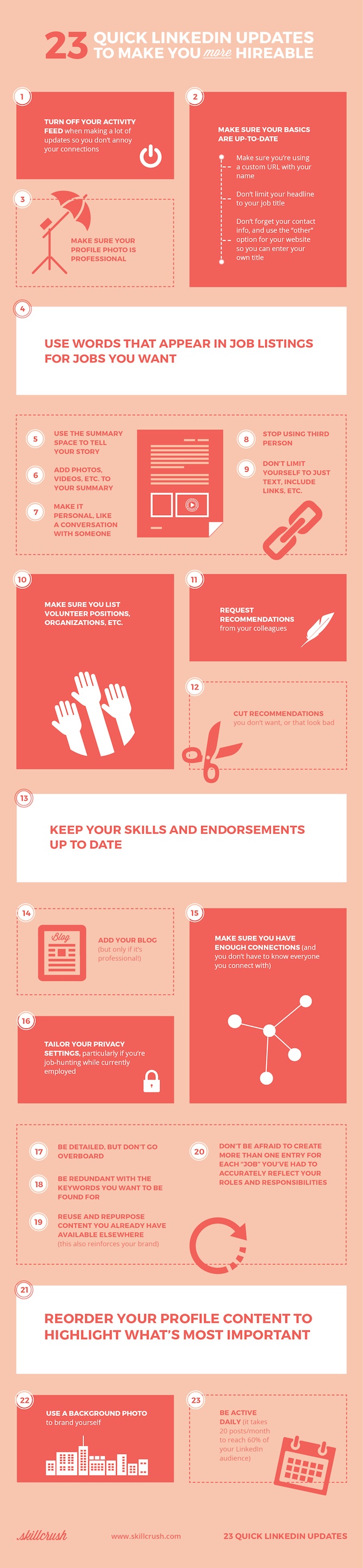
23 Quick LinkedIn Tweaks to Make Your Profile Shine [Infographic]

by ebrudner@hubspot.com (Emma Brudner)

glasses-mac.jpeg

When's the last time your updated your LinkedIn profile? If you're not actively looking for a new job, it's probably been a while. 

But LinkedIn isn't just for recruiters searching for qualified candidates to fill open positions. If you're in sales, your buyers are stopping by your page before calls. And if your profile is in shambles? It doesn't necessarily break their trust in you, but it certainly doesn't help your case.

The infographic from Skillcrush below lists 23 quick LinkedIn tweaks to ensure your profile is in peak condition at all times. Use the checklist to polish up your outdated page, and make the best possible first impression you can to buyers and recruiters alike.

linkedin-profile-updates.jpg

HubSpot CRM templates

08 Jun 16:12

How to Write Sales Emails the Right Way: Invaluable Advice From 3 Experts

by pcaputa@hubspot.com (Pete Caputa)

write-sales-emails-the-right-way.jpg

Connecting with prospects is harder now than ever before. In today's technology-driven world, fewer and fewer prospects answer their phone and even less respond to voicemails. Not even 1% of phone calls are returned!

Although I’ve resisted telling my salespeople for years that the phone is less important than email when it comes to prospecting, it’s hard to ignore the stats anymore. Today, effective email writing skills are more essential than mastering the unscheduled call. (There, I said it.)

Unfortunately, most sales emails don’t get a response either. In fact, less than 24% of prospecting emails are even opened.

Surprised? I’m not. A quick glance at my own inbox confirms that the majority of salespeople have no clue how to write an effective prospecting email. Like most executives, I receive hundreds of poorly written emails requesting 15 minutes of my time on a call (like this really bad one) each and every week.

Simply stated, salespeople need to get better at using email to initiate a dialogue with busy and overwhelmed prospects. If you’ve been following the HubSpot Sales Blog, you know we’ve spent a lot of calories writing and sharing sales prospecting best practices and providing template after template to make your initial outreach easier and more effective. But, if my inbox is any indication, it seems that salespeople need all of the advice they can get.

Lucky for you, it’s not just us advocating for better emails. Here are some videos on prospecting emails from a few world-renowned sales experts. I highly recommend watching each if you have time, but if you’re in a rush, I’ve extracted a few of my favorite quotes for skimming.

Email Is Sales Email, if You Do it Write

Jeffrey Gitomer, the author of nine best-selling sales books and popular corporate trainer and speaker, is a font of sales wisdom. His direct and down-to-earth style helps make his message clear as day.

Gitomer discusses why emails are great for prospecting in the following sales training video:

His advice for getting your emails opened is spot on:

  1. “Every email is an impression of you.” If you send out poor quality with grammatical errors, you can ruin your reputation. If you need help, take the extra time and have someone proofread your message.
  2. “The best way to get an unsolicited email opened is to ask a question in the subject line that’s specific to the recipient.” These types of subject lines show that you have done your homework and thought about your recipient's needs. When you target the specific pain points of your reader, they are going to want to open your email and engage with you. Without this level personalization, your message goes in the trash.

Email Still Rules, Are You the Connector or Deleted?

In this video, Gitomer tells you how to keep your sales emails from being deleted:

  1. “If you are getting a 9% response, it means that 91% of the people you sent an email to are somewhere between annoyed and pissed off.” Gitomer points out that deleted emails don't just disappear into cyberspace, although it might feel that way to the sender. They create an emotional response in the person who deleted it. And when too many negative emotional responses are connected to your emails, the next time you send a message, the sour knee-jerk reaction is automatic. Your actions in the past affect your results in the present, so make sure you are always at the top of your game when communicating with prospects.
  2. “Here’s why most emails fail: You know little or nothing about the recipient.” Personalize your email. Before you even sit down to write an email, research your buyer using Google and social media. Then it won’t be nearly so hard to make your message relevant and get your prospect’s attention.

How to Use Email to Get into Big Companies

Armed with an abundance of practical sales strategies, Jill Konrath is an in-demand speaker and best-selling author who knows her stuff. Konrath authors a popular blog and her sales newsletter has over 130,000 readers (Not one of them? You should sign up here.)

In “How to Use Email for Prospecting,” Jill talks about getting a foot in the door at big companies using email.

Here are two of my favorite pieces of email advice from her video that apply no matter what size company you’re contacting:

  1. “If you want to use email effectively, you are crafting personalized messages that the person you are trying to reach knows they are written explicitly for him or her.” Jill points out that you only have a moment to get your recipient's attention. Their first impression will be based on your subject line and first few sentences -- make sure that these words are enticing.
  2. “You’re not closing on the appointment right away necessarily.” Since email prospecting is about building relationships, Jill advises against asking for an appointment right away. Your first goal is to get your prospect to respond and start a conversation -- that’s it. This may result in an appointment eventually, but don't start with that ask.

Here are 45 more prospecting tips from Jill Konrath, Trish Bertuzzi, and Lori Richardson if you really want to master your messaging.  

Five Must-Know Email Sales Tips

Marc Wayshak, author of Game Plan Selling and Breaking All Barriers offers some of his wisdom in the following video on email prospecting tips:

Here are my two favorite takeaways:

  1. “There is nothing more frustrating than receiving an email from someone who made me feel like I was just one of many people receiving that email.” Amen. According to Marc, email needs to forge a personal connection.
  2. “Engage the prospect with a simple question." Marc suggests that too many sales emails end with a statement. Instead, he recommends ending with a simple question that can be easily answered, such as “What’s the best address to send the book to?” and “Is this an idea that would be at all relevant in your world?”

Email Prospecting Isn’t Going Away, So Learn How to Do it Right

Konrath, Wayshak, and Gitomer’s specific messages might be different, but they all stem from the same piece of fundamental advice: If you’re going to do email prospecting, you must do it right. That means:

  1. Recognize that sending a bad, wrong, or uncustomized message, does more harm than good.
  2. Do your research about the individual in order to personalize your email.
  3. Hone your writing skills, starting with the basics like good grammar and correct spelling.
  4. Keep your message short and focused on the recipient.
  5. Make getting a response your goal, not booking an appointment, and certainly not closing the sale.
  6. Use thoughtful, simple and pertinent questions to start a conversation.

These six points seem self-evident. So, why do so many salespeople do the opposite?

Based on what I’ve heard from reps, they don’t do email the right way because it takes too much time -- time they could use to find and spam another lead. Too bad that according to our experts, salespeople who continue to prospect this way piss off prospects and get terrible, single-digit response rates.

Maybe you’d like a different result? Maybe you’d like to piss off fewer prospects and get much higher response rates by following these simple guidelines from accomplished sales experts? Go ahead. I dare you to do the right thing -- for both your prospects and yourself. Let us know how it works out for you.

HubSpot CRM templates

08 Jun 16:12

Why More Sellers Are Not Creating Value

by PFPS

You’re not creating value. That’s a problem.

In our past four posts here in the CONNECT2Sell Blog, we’ve covered what it means to create value and why it matters. We’ve explained how easy it is to do…

So why don’t more sellers create value in these simple ways that mean so much to buyers? 

Reasons Why You Are Not Creating Value

For sellers who carry heavy account loads, there is the multiplier effect to consider. Doing one of the things that would create value for one buyer is easy. Doing several of these for every buyer is abundantly more daunting.

Sellers can have the best of intentions but then get caught up in the endless cycle of must-do work. Packing too many appointments and reports and tasks into every day just naturally results in trimming out the niceties. Unfortunately, this also means giving up the creation of value. You are not creating value if  you’re swamped by a to-do list of concrete actions or reactions.cover for site 2015

For sellers who focus on new business development, lead generation, prospecting and cold calling, there is often a mindset that more calls will lead to more sales. The “numbers game” may even be reinforced by call quotas or performance standards. Quantity over quality naturally results in trimming out time that could be spent on value creation. You are not creating value if you prioritize quantity over quality.

For sellers who have been trained extensively on product features but never trained in fundamental selling skills (including the basic business acumen to understand the buyer’s perspective), there is often no understanding of how or why to create value. Without even knowing it, these sellers may be leaving out the creation of value. You are not creating value if you focus on products.

The Impact of Not Creating Value

Whatever the reason, the result of not creating value is the same. The buyer/seller relationship is compromised. Buyers feel a vague sense of something missing. They feel marginalized instead of feeling special. Some even describe feeling “used” by sellers who rush impersonally through sales calls.

These feelings leave an opening for another seller, your competitor. When buyers are dissatisfied, even vaguely, they are more likely to take calls from other vendors. Their interest and desire for something more can be piqued, and buyers may take action if the new seller creates the value that has been lacking in their interactions with you.

The easiest way to prevent needless customer churn is for sellers to create value in every sales encounter by asking quality questions that engage buyers and make them think. Doing this displays a seller’s genuine interest. Value is created, connections are made and sales advance.

Next Steps:

  • To learn more about DISCOVER Questions® and how to get connected in meaningful ways with your buyers, order your copy of this bestseller from Amazon.com
  • When you need sales or management coaching, customized sales training, or a dynamic speaker call us at 408-779-PFPS or book an appointment with Deb.
  • Check out these resources for sales managers and front line sellers. New webinars, infographics, research, podcasts and more added every month!

BlogAward

The award-winning CONNECT2Sell Blog is for professional sellers who believe, as we do, that Every Sale Starts with a Connection.

Deb Calvert, “DISCOVER Questions® Get You Connected” author and Top 50 Sales Influencer, is President of People First Productivity Solutions, a UC Berkeley instructor, and a former Sales/Training Director of a Fortune 500 media company. She speaks and writes about the Stop Selling & Start Leading movement and offers sales training, coaching and consulting as well as leadership development programs. She is certified as an executive and sales coach by the ICF and is a Certified Master of The Leadership Challenge®. Deb has worked in every sector and in 14 countries to build leadership capacity, team effectiveness and sales productivity with a “people first” approach.

The post Why More Sellers Are Not Creating Value appeared first on People First.

08 Jun 16:11

Does Your Sales Team Know How to Follow-Up on a Lead?

by dan.mcdade@pointclear.com (Dan McDade)

7 Truths on Sales & Marketing

Develop a guide for sales on "What is a Lead and How to Follow-up on One" is the last of 7 Truths about Sales and Marketing that CEOs need to know. This post is part of a series about the CEO's role in eliminating wasted marketing spend and increasing sales results.

In the last blog in this series we discussed lead nurturing, and how an advanced lead generation program that includes nurturing can triple your sales. Today we will discuss why it’s vital for marketing to develop a training guide for sales so all are on the same page as far as understanding what constitutes a lead in your organization, and what’s the best way to follow up on one.

Set sales straight—it’s a win win

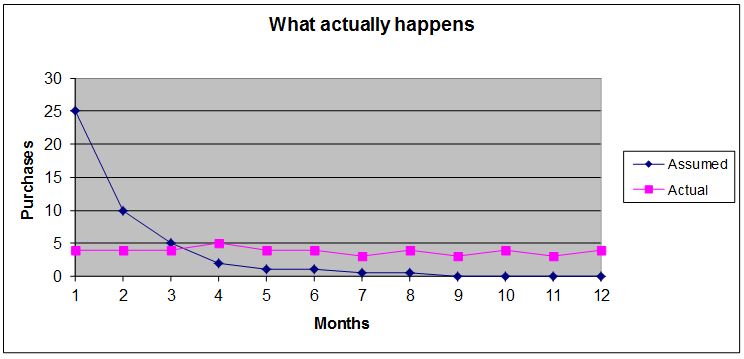
Many sales reps lack insights on the best way to follow up on a lead. The following data is from an insightful post on the Marketo blog by Michael Boyette of the Rapid Learning Institute: Why Sales Reps Don’t Follow-up on Good Leads. Michael maintains that sales reps often underestimate the time it takes to close a lead, and give up too soon. These statistics tell the story:

What_actually_happens_graph.jpgThe chart shows that sales reps act on a premise that the buying process is front-end loaded while in fact a relatively consistent percent of leads buy month after month after month. The problem is that sales reps give up early and win only a small percentage of possible deals—wasting a significant portion of marketing’s investment. Helping them understand actual vs. assumed buyer behavior in B2B sales environments helps alter their behavior—and helps them be more successful.

In another blog post, SiriusDecisions’ Jay Gaines (vice president and group director, demand) writes that getting sales to accept a lead (thereby terming the lead a sales-accepted lead, or SAL) is the most important (and most overlooked) step in the demand creation process. Note that at this step sales is not saying the lead is qualified (that would be terming the lead sales qualified lead or SQL). At this step marketing is asking sales to say at the SAL stage is that based on an agreed-upon lead definition the lead appears to meet SAL specifications. For various reasons, sales often won’t accept the lead. Maybe the rep simply has a hunch the lead’s not good, or has another subjective reason not to follow up.

Jay writes:

“A formal lead acceptance process (see Truth 6 in this blog series outlining the importance of having a judicial branch in place) is important in b-to-b demand creation for four reasons:

  1. Avoiding lead oblivion. First and foremost, the acceptance process allows marketing to confirm that sales or partners are acting on all delivered leads.
  2. Rapid identification of problems. The rates of lead acceptance and rejection reveal lead management and quality problems that can be quickly addressed. Organizations should strive for lead acceptance rates that are 90 percent or better. Lower rates typically indicate a breakdown between marketing and sales.
  3. Starts the clock on follow-up. With acceptance, sales is obligated to follow up with the lead in a specific timeframe (no more than 72 business hours is advisable; 24 hours is a best practice).
  4. Reduction of lead waste. Rejected leads should be automatically rerouted back to marketing or teleprospecting for further attention and resubmission if necessary.

The SAL stage is typically overlooked because it is viewed as unnecessary and cumbersome. However, it should take no more than a few minutes of sales time, and it’s the best thing an organization can do to ensure that the budget, effort and resources devoted to lead generation are not wasted.”

In support of the discussion around why a formal acceptance process is vital to a successful sales organization, I refer to this Target Marketing article I wrote some years ago and quoted SiriusDecisions as follows:

“According to SiriusDecisions, the two areas of ‘purgatory’ where lead leakage occurs can be defined as:

  • Marketing lead purgatory occurs between MQL and SAL, with marketing throwing leads over the fence and sales never accepting them. Approximately 70% of all leads are rejected by sales—either actively or by inaction.
  • Sales lead purgatory occurs between SAL and SQL, with sales accepting leads but subsequently losing contact or interest. Another 20% of leads are ineffectively worked for mostly subjective reasons (i.e., a sales rep reports, ‘I called the prospect three times. He didn't get back to me, so he must not have been interested’).

With a lack of accountability in both marketing and sales lead purgatory, leads are lost and ultimately reappear as wins for the competition.”

So, we know how things break down—what do we do to fix the problem?

Develop a lead hand-off process and follow-up best practices

At PointClear, we recommend developing a guide for sales on how lead hand-off is managed and how follow-up should be handled. We also strongly advocate for ongoing training to continuously remind the sales team what the organization’s expectations are. Following is, at a high level, what should be included in the guide:

SAL lead generated via marketing, i.e. teleprospecting

  • Set dates and times for sales rep to call (or visit) based on what works best for prospect (we get some push back on this from sales, but in most cases sales reps have more flexibility in their schedule than does a busy prospect)
  • Send lead details and audio to sales management and the sales executive
  • Gain sales acceptance

SAL lead distributed

  • Sales management and/or executive review lead (PDF and/or CRM and audio file) prior to reaching out to the prospect
  • Sales executive sends prospect email confirming the upcoming call and reviewing their understanding of expressed pain points, specific interest areas, or case studies from the lead documentation and refers to prior conversation with their colleague (the business development or inside sales rep)

The day of the call

  • Sales executive re-reviews PDF and/or CRM and audio file (where/when available)
  • At scheduled time, if prospect is not available:
    • Sales executive leaves a voicemail stating that he/she will try again in approximately five minutes
    • Call back as indicated, if still no connection:
      • Sales rep sends email to schedule a new time, follow-up with a telephone call and leave a voicemail message, then the next day send one more email. Make sure all correspondence is relevant to the prospect—not just “I am looking forward to speaking with you”
      • If no response, the lead goes back to PointClear or the internal business development team for rescheduling. Virtually 100% of these “reheats” result in a rescheduled call

My friend Matt Heinz authored an excellent blog entitled Six Rules for More Effective Sales Lead Follow-up that can be found here. He notes that the keys to success in lead follow up are:

Process: Define a series of touches (telephone, voicemail, email) and design call/content templates that reps can customize

Persistence: In an earlier blog in this series I quoted Mike Weinberg as follows: “The harsh reality is that almost no one returns a first message or email from a salesperson. Truly, almost no one. Even ‘warm’ leads typically require multiple attempts to earn a reply or call back. So it’s foolish to pretend people aren’t interested or that you’re doing something wrong when your first, or even second, contact attempt doesn’t produce a response. And it’s also a waste of energy to whine and complain about repeatedly getting someone’s voicemail. Instead of whining, try preparing. Instead of dreading your repeated follow-up attempts, look forward to them. Be ready with a series of touches, each one a bit unique. The keys to earning the call back or reply are creativity and perseverance. Drip little value nuggets with pieces of your ‘sales story’ as you go. Be creative; be interesting.”

I would characterize the key takeaway from this post: Don’t assume that your sales team members know lead follow-up best practices; don’t assume the agreed upon definition of a lead is top-of-mind; and don’t assume that the way lead deployment is handled is efficient and effective. Document the processes, and make them part of your ongoing training and communications.

How much priority does your organization place on lead follow-up? What kind of accountability measures are in place?

The next blog will summarize and wrap-up this series—The 7 Truths about sales and marketing (that CEOs need to know) that help you eliminate wasted marketing spend and increase revenue.

   how much are you paying for leads?

08 Jun 16:10

How to Use Interactive Quizzes to Make Your Sales Team Smarter

by Britt Skrabanek

How to Use Interactive Quizzes to Make Your Sales Team Smarter

We like our pretty interactive content, don’t we? The way it distracts us from the workday with its punchy visuals and compelling words. The way it teaches us a little something about ourselves – like how hipster our bookshelves are and which 90s accessories we are.

But that’s all fun and games stuff. We know why we truly, madly, deeply love our interactive content (and it’s got nothing to do with ourselves – and everything to do with our customers).

Due to the addictive nature of BuzzFeed quizzes, interactive content (with quizzes as the star performers) has been dazzling marketers since it burst onto the scene a couple of years ago. Naturally, we started integrating them into our strategic repertoire to drive awareness and leads.

Interactive Quizzes Deliver the Goods

When done well, interactive content can be a big hit with prospects and give companies a lot of bang for their buck.

It educates buyers…

Interactive quizzes, like these screenshots from ION Interactive, are a great tool for learning more about your prospect’s engagement with your marketing. This post offers tips for creating better interactive quizzes and other content.

It increases conversions…

70%25 of Interactive content generates conversions moderately or very well 70%25 of the time, compared to just 36%25 for passive content

It increases brand awareness…

88%25 said interactive content is somewhat or very effective at differentiating from competitors, versus just 55%25 for static content

…and all of those are very, very good things, indeed.

One of the other big benefits of an interactive quiz? Unbeatable intelligence. But to turn interactive content into a powerful weapon for your sales team, you need to get sales more involved.

Static Content Provides Less Intelligence

Besides the likelihood of lower engagement, one of the blaring problems with static content is that you can’t see how leads are interacting with your content when they are interested, making the intelligence extremely limited across the board.

On the marketing front, you know how many downloaded that eBook – but you don’t know if they read all of it, part of it, or none of it. You have no clue whether they thought the content was valuable or if they chucked it.

On the sales front, you know some of the basic information about the prospect, including a few demographics, from the form they submitted. And you know they care enough about the topic to download the eBook, so that’s behavioral data. But you don’t know specifics, like their role in a purchase decision or specific pain points.

Both marketing and sales, two classically different characters in the business world, are blind about the results of the same eBook – because static content can only go so far.

Unknowns Make Proving Content ROI Impossible

Content marketing is already expensive, because it takes time and resources to pull it off. Marketers of today are up against proving the ROI of content, demonstrating the worthiness of the expense to generate revenue.

In a land of tight marketing budgets, the unknowns really don’t help our case. In fact, they make proving content ROI pretty impossible. And in these days, when CMOs are tasked with proving marketing to be not a cost center but a revenue-generator, that’s just not good enough.

Interactive content certainly isn’t cheap, but it offers revenue-driving benefits that support the cost. While engagement and brand awareness are fine and dandy, where an interactive quiz really shines for sales teams is in the information that’s captured.

A well-executed quiz gets away with probing questions, because the user is engaged with the content. They’re having a good time and learning something about themselves in the process.

If a salesperson picked up the phone and started asking a random lead the same questions, they chance an awkward conversation, or also very likely … getting hung up on.

Which is why, more than ever before, it’s smart to focus on team collaboration. Instead of marketing and sales running off to their different corners, they need to sit at the same table and work it out.

The No-Nonsense Approach for Content Collaboration

Sales is probably going to say they don’t have time to help, so explain to them that you want to work smarter by collaborating on a primary asset that will be the focus of your lead generation efforts. You’re not going to work side by side on every little blog post.

When it comes time to invest in interactive content, the brainpower should come from both sides of the spectrum. Having both perspectives engaged in the conversation helps keep everybody in line – the overarching goal should be nailing the puzzle you are trying to solve together.

An SLA (Service Level Agreement) is still a good idea as you’re using interactive content to create sales and marketing alignment. Once you’ve agreed upon a definition of an MQL (Marketing Qualified Lead), ensure that a follow-up strategy is set in place early on, with clear definitions about roles and responsibilities that will serve as the backbone of the process as you strive to turn your lead into a potential buyer.(Download your free SLA template here.)

If you think interactive content is going to be a tough sell with your sales team, go with a quiz. Let them know the answers from this quiz will provide the most glorious intelligence they’ve ever seen. Ask them to think about the follow-up possibilities, and…

You had them at follow-up possibilities.

Sales Has Great Content Ideas Too

Once you have sales excited about the stellar intelligence benefit of interactive quizzes, don’t go running off with creative abandon to start building the content in your marketing cubicle. Invite sales to be a part of the content ideation. Because guess what? Salespeople have great content ideas too.

First, make sure both teams agree upon who you are trying to reach. Remember, you’re investing good money for a sterling piece of interactive content. Don’t throw it all away by building an asset that doesn’t make sense.

So first, come to an agreement on the persona and/or vertical you’re going to reach. The content should also align with the stage of the buying cycle the prospect is in.

  • If you’re trying to reach a buyer in the top “Awareness” stage, focus on getting attention for an issue and showing your expertise.
  • If you’re trying to reach a buyer in the middle “Consideration” stage, you should ask more in-depth questions that will help them solve a problem, and eventually move them forward to making a purchase decision.
  • At the bottom of the sales funnel, you could try something like an interactive cost analysis or ROI calculator.

When you’re creating content for a quiz, sales will be able to provide ideas for stage-appropriate questions that will support the intelligence they crave. And the resulting more-robust profile will help sales understand the potential readiness and fit of a lead.

Marketing isn’t as well equipped here, because they aren’t in the field. So this is the perfect opportunity to listen to sales’ needs and incorporate them right into an engaging piece of content that will directly support their efforts.

Enabling Your Sales Team with Interactive Content

Sales doesn’t have time to mess around. Nobody does – but they definitely can’t afford to waste time when it can be better spent on pursuing ideal prospects. Sales enablement has become a popular topic for a reason. To keep your sales teams happy and proactive, they need the content to be a driver in the sales cycle too.

By being involved with the interactive quiz from its inception, sales helped steer the strategic direction already. And if the content performs well, the intelligence will be unbeatable.

From follow-up emails to phone calls, sales will be able to select informational nuggets to fuel the conversation. This gives them more confidence to bring to the table, as they can customize the features or services talking points based on the buyer’s pain points and aspirations the quiz helped them identify beforehand. At the end of the day, sales is happy because they have a much higher potential for closing.

“Market like the year you are in.” Gary Vaynerchuk of Vayner Media gave us marketers some words to live by when he said this.

Marketing is always evolving and we have to evolve with it. When the next big thing comes along, it’s an opportunity to do what works to reach our objectives. The sales and marketing alignment movement is getting lost out there. We keep talking about it, but we’re not doing it.

If marketing and sales work together instead of separately from the get-go with the creation of a focal lead generation asset, think about the difference that would make. What would that look like? Probably a whole lot different than the way you’ve been working.

If we take an innovative tactic like interactive content and combine it with a necessary practice like sales and marketing alignment, we’ll be taking purposeful strides to achieve content marketing greatness.

Ready to see some interactive content in action? Take a look at Act-On’s interactive infographic, Account-Based Marketing by the Numbers, and learn some quick and powerful facts about this much buzzed-about topic and how, for B2B marketers, it might be worth a deeper dive.

Account based marketing by the numbers interactive infographic

08 Jun 16:10

The Dirty Truth About Call Tracking and What Every Marketer Wants You to Know

by Michelle Brammer

The Dirty Truth About Call Tracking and What Every Marketer Wants You to Know

To get aggressive with their advertising efforts, marketers are turning to pay per call advertising to push their agendas. A phone call has always been coveted, but honing in on the types of phone calls needed takes a bit of practice and tracking.

Call tracking in a pay per call campaign allows you to generate a read on the performance of a call campaign. By setting up call tracking, you can properly measure the results. See, while calls do matter, generating the right calls during the right time and for the right price matters, too.

What Is Call Tracking?

It’s quite simple really: call tracking allows you to track a phone call.

When you perform call tracking, you allow a technology to track the phone calls associated with a performance-based campaign. Call tracking is done by providing analytical information about each phone call received. For instance, you can:

  • Track the number of phone calls by source.
  • See the total number of unique callers.
  • Track the number of calls received, and missed, by employee.
  • Identify employees and call sources with the highest converting calls.
  • Listen to the calls so you can coach employees.
  • Review call disposition reports to see the outcome of each call.

Knowing details about how customers found your ad, coupled with what resulted in the phone call, can help you fill gaps in your lead generation efforts.

Attributes of a Generated Call

With every pay per call campaign, it’s important to understand how a call was received, what it did when you received it, and what the outcome was. To isolate the campaigns that work well, and eliminate those that don’t, review campaign attributes for each campaign. These attributes can all be measured with call tracking so that you can refine call campaigns faster.

Caller ID and Location

The caller identification number can tell you a wealth of information about how well your campaign is optimized. With the caller identification information, the name of the caller or business is often available, along with the phone number and location the caller called from.

Wilmington area map with radius
Source: All Area Codes

Say you have a very specific call campaign set up to target those in Wilmington, Delaware. Parties located within the 302 area code would be expected to be targeted (fun fact: Delaware is so small that 302 is the only area code in the entire state).

Now, it’s not inconceivable that calls are also received from the 410 (Maryland), 267/610/215/484 (greater Southwest Pennsylvania), and 856 (southern New Jersey) area codes. As people move, and their cell phone numbers become their primary phone line, they are more likely to hold onto their original phone numbers.

Those are all normal circumstances. However, if your Wilmington, Delaware targeted call campaign is generating a ton of calls from the area code 910, you need to review the setup of your campaign. 910 is the area code in Wilmington, North Carolina — not Wilmington, Delaware.

Time Stamps

It helps to understand what time of day calls are coming into your business. It can help you:

  • Identify Increased Staffing Hours. Nothing is quite as bad as missing a lead because you’re understaffed and unable to handle all the calls. Increase staffing onsite or at your call center during the ‘rush’ hours and cut back during the ‘off’ times.
  • Stave off Wasted Spend. If you find you’re receiving a ton of phone calls when your business or call center isn’t open, you have one of two options: change your business hours or change when your campaign is active. Don’t waste your budget when you’re not around to take the call.
  • Isolate Peak Performance Hours. Over time, you might see trends in which hours people call to convert, versus which hours they call for more information. You can optimize your call campaign based on these hours.

Look at a local pizza shop. They may be open at 10 a.m. for the lunch crowd, but see the majority of their sales between 4:30 and 7:30 p.m. – dinner time. Instead of having their call ad run during all open business hours, they can isolate their budget to reduce spend between the lunch and dinner rush, but ramp up during peak times.

Call Duration

Generally speaking, the longer the call, the more likely it is to convert… sometimes. Exceeding your expectations on the number of phone calls is good, but only if they are strong calls.

For instance, say you want to achieve 50 calls each hour. If each of those calls are only a few seconds long, you’ll never get the chance to convert those callers. This could indicate a problem with the number (wrong phone number), an issue with the source (they’re sending you poor quality leads), or possibly the source is incentivizing phone calls that will never convert.

Conversely, say you plan for 50 calls each hour and you have three representatives to answer the calls. That’s great — until you see your calls are averaging 10 minutes each, and your three representatives can only field 18 of those 50 calls.

Knowing your call duration helps you identify your break even point, aids in staffing needs, and can help you determine if you’ve allocated enough budget to a campaign to see success.

How to Determine the Number and Cost of Calls

Device Targeting

Sometimes you need to get people on their mobile device, and other times it makes sense to get their attention on a desktop computer. Pay per call will allow you to target whichever device makes sense for the type of caller you’re looking to receive.

For instance, products and services targeted to busy professionals will benefit far greater from desktop calls generated Monday through Friday during business hours, rather than early afternoon on a Saturday or Sunday.

Freshdesk Advertising with Phone Number

Freshdesk, an automated ticketing tool, targets me with an ad but also encourages me to call them. On average, ads with phone numbers have an 8% higher click-through rate than ads with no number. Why? Sometimes people just want to talk to a live person, not fill out a form and wait to be contacted.

Now, Freshdesk’s call-to-close ratio may be much higher than their click-to-call ratio, so having their desktop ad include a phone number is very helpful. And with call tracking in place, Freshdesk can review this particular phone number and know which specific campaign resulted in my call.

Call Outcome

In a performance-based campaign, calls matter. But so does the outcome of those calls. Are the calls you’ve received converting or hitting your key performance indicators? If you’re getting calls, but they’re not doing what you want them to, are you really benefiting your campaign at all?

There is a cost associated with each conversion, and your calls should be segmented to leverage the best converting calls. If your organic search engine traffic is converting best on only a handful of landing pages, can improvements be made to other landing pages to aid in stronger conversions? Perhaps focusing your budget around the keywords that work best in your campaigns will help.

Likewise, separate phone numbers placed on different digital advertising campaigns help indicate which campaigns perform and are the most profitable for your business.

How Is This Useful?

Pay per call campaigns are often met with resistance due to their higher cost of entry over a typical pay per click campaign. But, while the cost per call is usually higher, so is the conversion rate, meaning the cost per conversion is generally lower, too.

Cost of Calls versus Clicks

With your pay per click advertising, you would never fail to produce an A/B test of a campaign or use generic keywords, would you? Running a pay per call campaign with no call tracking in place is just like setting up a pay per click campaign and doing nothing to it. It won’t perform, and you won’t succeed.

With call tracking in place on a pay per call campaign, it can help you:

Refine Your Territories. Tracking all details of a call campaign helps identify exactly where to dedicate your budgets. Just like optimizing a pay per click campaign, you can optimize a pay per call campaign.

As calls start to roll in, start to identify states, cities, and even zip codes that perform above your metrics and knock out the areas that don’t. By reallocating budgets to areas where calls are performing, and reducing them where they’re not, your budget goes further and your campaign becomes successful.

Bid Adjustment by Location

Isolate Your Performance. With any type of performance-based campaign, there will be good days and bad days, on times and off times. Getting a good grasp on what is working and what isn’t can help you isolate days and times where you might reallocate budget to drive the best results.

Integrate Call Disposition Results. Call disposition reports simply tell you the outcome of each call. It can tell you things like:

  • Which calls converted best.
  • Who they connected with or left a voicemail to, if you’re using a call center.
  • Which numbers are disconnected or busy.

Not only can call disposition reports aid you in campaign optimization, but they can be a valuable mechanism for employee training and performance evaluations.

Conclusion

Pay per call advertising continues to increase in popularity, but to do it right, you’ll need to have some form of call tracking on your campaign.

The easiest way to track is to use a call intelligence platform that monitors campaigns to help you make better decisions about your performance marketing campaign. For more tech savvy users, try a JavaScript tag via the web to recall caller information via a webhook. This would pass real-time information to deliver data and other applications immediately.

There’s no right or wrong answer on what you use – whether it’s third-party or JavaScript – so long as you are using something to monitor your call campaign performance.

08 Jun 16:10

How Inbound Marketing Solves Your Biggest B2B Sales Roadblocks

by Ben Jessup

How Inbound Marketing Solves Your Biggest B2B Sales Roadblocks

B2B companies—especially professional services—face unique marketing roadblocks that B2C companies don’t have to deal with. But if you’re using inbound marketing the right way, it’s one of the best ways for B2B companies to generate more leads, nurture prospects, and close more deals.

Here’s how to use inbound marketing to take away the sales roadblocks that B2B companies face every day.

A Long Purchasing Cycle That Requires Lots of Research

Your customers are probably taking anywhere from 3-18 months before they finally buy. That means you’ve got to get noticed, and stay noticed throughout that buying cycle. Google Search is the number one way to get found, but it’s not the only way. Trade associations, trade publications, and other trusted sources are all hot spots for decision makers to visit. Don’t just look for the media kits, look for ways to be a contributor or guest blogger.

You also need ways to collect contact information to keep engagement going. Content offers such as infographics, checklists, how-to guides, and whitepapers are just a few types of content that you can put behind a form, which will captures a lead’s contact information.

Once you have this information, you can set up consistent touches through engagement activities such as newsletters, blog RSS, or even one-off email campaigns. Don’t forget to promote other content offers to your contacts. Those case studies, whitepapers, and webinars you’ve created are great pieces of content to share with these prospects. If you’re targeting your persona right, they’ll appreciate the helpful information.

With Inbound, you’ll generate relevant content that can be found online and gets shared where your buyers go for answers to their pain points. Building the right system with an automation tool like HubSpot will allow you to integrate the channels of your blog, email marketing, content, and lead capture with comprehensive user-based analytics. This can help build the foundation for a marketing program that keeps your brand top-of-mind, builds thought leadership, and helps position you as the best solution to the buyer’s problem when the time comes to buy.

Lots of Interaction from Sales and Business Development Team Members

Sales and business development professionals have an incredibly tough job keeping in touch with prospects during the 3-18 months that your prospect is considering a purchase. With an inbound system, base engagement is already occurring and less work is pushed onto the Sales or BD person’s plate. Using some advanced features and custom templates, even automated emails sent by the marketing team can be customized to feel like a personal email from the sales rep or BD person.

Reconnecting with a prospect the day after they made a purchase from your competitor is one of the worst nightmares of any salesperson. But with advanced user analytics, once you have some data on a lead, you can be notified whenever your prospect comes back to your site, opens the email you sent last week, or even looks at that whitepaper you shared. So you can connect at just the right moment.

Lots of Decision Makers Joining at the End of the Sales Process

In B2B and professional service companies, almost all final decisions end up going to a group—whether it’s a leadership team, a specific selection committee, or a couple of people in a department. Having automation in place is a huge asset to educate your key persona and turn them into your advocate.

Use drip email campaigns with personalized content to keep them engaged and educated—and to pass on shareable content that’s tailored to the other decision makers on their team. Give them content that addresses the questions, objections, pain points, and goals of the other decision makers to help speed up the buy-in process from the people you haven’t had the opportunity to nurture over the past few months.

B2B and professional service buyers have a lot on their plate and need lots of information to make the right selection on a product or service. Creating an automated and personalized experience that carries them from initial engagement through the decision making process will help your marketing and sales teams develop and strengthen the relationship between your prospects and your brand.

Take Off With Inbound Marketing

08 Jun 16:10

How to Overcome the “We are Handling That In House”

If you are trying to set appointments for an outside sales team, or even if you’re trying to generate leads so you can do an over the phone demo later, then you know all about put offs and stalls.  While I’ve previously discussed the common ones like, “I’m not interested,” and “Just email me something,” there others that are somewhat harder to overcome…
One of the more frequently encountered objections is “We handle that in house so we don’t need you.”  
Many sales reps are taught the normal, “old school” approaches of things like:
“That’s fine, but when was the last time you did an apples to apples comparison to what it might run you if you outsourced that?”
OR
“But if I could show you a way to save money, then surely you’d want to know more about it, wouldn’t you?”
While either of these responses can be used effectively in the right situation, there is a better way to handle this objection.  What you want to do is offer value in your visit or demo, and then leave it up to your prospect to decide if it’s worth taking your call or visit any further after you have.  
Try the following rebuttal (obviously, customize this to your particular service or product):
Objection: “We handle that in house.”
“That’s fine – glad you have a way that’s working for you now.  Here’s what I’d recommend you do though: I’d be happy to drop by and show you how we’d go about taking care of that for you, and what our processes would look like.  
At the end you may still choose to keep doing it the way you are, but at least you’d have a different perspective on it and you may even find some ways to save money or time.  The visit wouldn’t take long and everyone we visit with finds a benefit.  
What’s a good time for you next week…”
As you can see here, you’re not pitching necessarily, instead you’re offering to enlighten them as to a better way.  What they do after that is up to them.
Try using this for the next couple of weeks and see if you can get past prospect’s natural resistance to setting up a meeting.  If you use it consistently, you’re going to set more appointments, open more doors and close more sales.
If you found this article helpful, then you'll love Mike's Completely Updated and Revised eBook, “The Complete Book of Phone Scripts.” Now over 130 pages of powerful and effective scripts to help you easily get past the gatekeeper, set appointments, overcome objections and close more money!
Visit: http://mrinsidesales.com/completescripts.htm and find out why Jeffrey Gitomer, Brian Tracy, Tom Hopkins and many others recommend Mike’s ebook of Phone Scripts! 

If you are trying to set appointments for an outside sales team, or even if you’re trying to generate leads so you can do an over the phone demo later, then you know all about put offs and stalls.  While I’ve previously discussed the common ones like, “I’m not interested,” and “Just email me something,” there others that are somewhat harder to overcome…

One of the more frequently encountered objections is “We handle that in house so we don’t need you.”  

Many sales reps are taught the normal, “old school” approaches of things like:

“That’s fine, but when was the last time you did an apples to apples comparison to what it might run you if you outsourced that?”

OR

“But if I could show you a way to save money, then surely you’d want to know more about it, wouldn’t you?”

While either of these responses can be used effectively in the right situation, there is a better way to handle this objection.  What you want to do is offer value in your visit or demo, and then leave it up to your prospect to decide if it’s worth taking your call or visit any further after you have.  

Try the following rebuttal (obviously, customize this to your particular service or product):

Objection: “We handle that in house.”

“That’s fine – glad you have a way that’s working for you now.  Here’s what I’d recommend you do though: I’d be happy to drop by and show you how we’d go about taking care of that for you, and what our processes would look like.  

At the end you may still choose to keep doing it the way you are, but at least you’d have a different perspective on it and you may even find some ways to save money or time.  The visit wouldn’t take long and everyone we visit with finds a benefit.  

What’s a good time for you next week…”

As you can see here, you’re not pitching necessarily, instead you’re offering to enlighten them as to a better way.  What they do after that is up to them.

Try using this for the next couple of weeks and see if you can get past prospect’s natural resistance to setting up a meeting.  If you use it consistently, you’re going to set more appointments, open more doors and close more sales.

If you found this article helpful, then you'll love Mike's Completely Updated and Revised eBook, “The Complete Book of Phone Scripts.” Now over 130 pages of powerful and effective scripts to help you easily get past the gatekeeper, set appointments, overcome objections and close more money!

Visit: http://mrinsidesales.com/completescripts.htm and find out why Jeffrey Gitomer, Brian Tracy, Tom Hopkins and many others recommend Mike’s ebook of Phone Scripts! 

07 Jun 16:17

How Canada’s immigration policy is failing high-tech startups

by Murad Hemmadi
Passport with spinning loading indicator for a visa stamp

(Illustration by Yarek Waszul)

While working a summer research job in nanotechnology at the University of New Brunswick, Kumaran Thillainadarajah created a pressure-sensing material. Originally envisioned as a “skin” for prosthetics, the technology would eventually prove suitable for other uses as varied as golf training and beer bottling. The discovery formed the basis of Smart Skin Technologies, a Fredericton-based firm Thillainadarajah started in 2009.

Like many startup founders, Thillainadarajah spent those early days pursuing clients, pitching investors and refining his technology. But the entrepreneur faced an additional, less common challenge. “By day I was starting a company, and by night I was figuring out how to stay in the country legally,” he recalls. Born in Sri Lanka, Thillainadarajah attended UNB on a study permit and then got a three-year Post-Graduate Work Permit. Once that expired, he needed a temporary work permit to remain in the country, which required him to obtain a Labour Market Opinion.

In a Kafka-esque turn of events, Thillainadarajah found himself filling out paperwork to assess the possibility of finding a Canadian qualified to be CEO of the company he’d founded. “I had to submit a letter, written by me and signed by me, saying that in my opinion I was the best person to do my job,” he recalls. “So it was all a bit ridiculous.”

While the specifics of Thillainadarajah’s story might be unique, his experience of trying to work here as an immigrant tech entrepreneur is all too common. Instead of welcoming foreign talent with open arms, Canada makes it exceedingly difficult for them to come to or stay in this country, even at a time when the thriving technology sector is in dire need of skilled knowledge workers. Hiring from abroad often means navigating Byzantine processes, paying costs fledgling companies can ill afford and enduring long delays—during which foreign competitors could easily snap up a promising candidate. Canada’s immigration system presents significant challenges to both aspiring entrepreneurs looking to build startups and early-stage companies seeking the best and brightest to fill their many job openings.

It’s a problem that belies the message spread by Canadian elected officials when they travel abroad. Touting this country’s high-tech sector and the job opportunities it’s creating has become a standard part of any speech during trade missions. Last month, the Ontario mayors of Toronto, Waterloo, Kitchener and Cambridge made a pilgrimage to Silicon Valley. “Come to help us build and scale our companies, and build your career in a truly great place to live,” suggested Hogtown’s John Tory in a keynote address to the CityAge conference. On the west coast, British Columbia Premier Christy Clark and Vancouver Mayor Gregor Robertson both emphasized tech in separate Asian trade missions in 2013. “So many political people have gone on trade missions to say, ‘Come do business here,’” says Stephen Green, a partner at Toronto immigration law firm Green and Spiegel. “And then people can’t get here.”

The Information and Communications Technology (ICT) Council estimates that by 2019, Canada will need an additional 182,000 skilled ICT workers. Various groups are labouring hard to fill those jobs domestically. The universities of Waterloo and Toronto have some of the world’s highest-rated engineering and computer science schools, but their success has made them fertile recruiting grounds for Silicon Valley giants. Advocacy groups such as Code NL are pushing for coding to be added to the high school curriculum, while organizations like Ladies Learning Code and Lighthouse Labs are building an alternate tech talent pipeline. But it won’t be enough. “Ginormous gaps are going to occur in this space over the next decade,” predicts Mike Galbraith, chief financial officer at Kitchener-based Thalmic Labs. “It’s going to be impossible for Canada to actually supply enough workers.” To ensure we’re not left behind, Canada will have to reform the immigration system with the needs of the tech sector in mind.

“H-1B Problems? Pivot to Canada” read the billboard on U.S. Highway 101. Located on the corridor connecting San Francisco and Silicon Valley, the ad taken out in 2013 by the Canadian government aimed to entice immigrants aggrieved by the United States’ cumbersome high-skilled worker visa to shift their attention north. On a trip to California that year, then Minister of Citizenship and Immigration Jason Kenney posed in front of the hoarding, flashing a thumbs-up. The billboard advertised the Start-up Visa Program, a five-year pilot to make the immigration process easier for foreign entrepreneurs.

That was the idea, anyway. In practice, the program is “a total failure,” according to Green. The government set aside 2,750 visas a year for the program. But as of May, only 51 entrepreneurs had become permanent residents and 26 startups have launched or will launch soon, according to Citizenship and Immigration Canada.

The Start-up Visa came two years after the federal government shuttered the Immigrant Investor and Entrepreneur programs over concerns that rich foreigners were simply buying their way into the country. Searching for another way to bring savvy young founders to Canada, the government saw an opportunity in Silicon Valley. “All those companies were lobbying the U.S. government for more visas, and [the Canadian government] said, ‘If they can’t get them, we’ll try to tap them,’” explains Betsy Kane, a certified specialist in citizenship and immigration law at Ottawa firm Capelle Kane. “I think it was just a reactionary program.”

As such, there were design flaws. To qualify for the Start-up Visa, entrepreneurs must be accepted into one of 14 incubators, or secure a minimum investment of $200,000 from one of 26 VC funds or $75,000 from one of six angel investor groups. But relatively few startups ever receive investor capital, regardless of where they’re located or who the founder is, notes Kane. Plus, it means a lot of extra paperwork for investors. “The VCs are not here to vet immigration applications for the Government of Canada free of charge,” says Kane.

A better model, Green suggests, is a Province of Ontario program that ended in June 2015. “If one of [the government’s] commercial officers abroad thought you had a great startup idea, they would issue you a letter, and you could get a work permit for two years,” he explains. The idea of a bureaucrat ruling on a startup’s potential would no doubt cause many entrepreneurs and VCs to bristle. But embassy and provincial officials specializing in economic development are better placed to meet with entrepreneurs and understand their local context than investors half a world away.

It’s unclear whether major reforms are coming, but the immigration minister’s office told CBC in January that the Start-up Visa program will be reviewed this year. That’s welcome news. “These are great young, entrepreneurially spirited people, and we can’t offer anything to them,” says Green.


In 2014, Vancouver’s Mobify wanted to hire an intermediate engineer. The company, which provides mobile commerce and engagement tools and services, was able to identify a promising candidate in the fierce war for talent. The problem? The prospective hire wasn’t Canadian.

To bring in a foreign national on a work permit, an employer must typically obtain a Labour Market Impact Assessment (LMIA), which was introduced in 2014. (Tech startups often bring in workers on temporary three-year work permits with the intention of sponsoring them for permanent residence; each application usually requires an LMIA.) The government’s review is supposed to take about two weeks, but experts and applicants say the process is significantly more painstaking and time-consuming than advertised. The need to apply for an LMIA can sometimes mean the difference between making a hire and leaving a position empty.

To prove they can’t find a qualified Canadian candidate for the job, companies must typically advertise the position for four weeks with the Government of Canada or provincial job bank, and in two additional spaces, such as recruitment sites. The Job Bank doesn’t provide the flexibility of a Monster.com, however, and bases position titles on National Occupation Classification (NOC) codes, a system used by the federal government to categorize jobs. That’s where Mobify ran into trouble: The authorities decided the company had used the wrong NOC code. The “correct” occupation classification required much the same skill set but a significantly higher wage. “We had to withdraw the application, and we lost that employee,” explains Candace Bajgoric, the company’s manager of people operations. Mobify might have been willing to compromise on the salary question, but it couldn’t modify the application. It would have had to start over again. “To ask that employee to wait an additional three to four months after they’ve already waited four months—they’re not going to do that,” says Bajgoric.

Navigating this complex system often requires companies to hire immigration lawyers and deputize staff members to fill out forms and keep track of paperwork for extended periods. And in a competitive market for tech talent, time matters. If your candidate is from a country whose citizens require visas to enter Canada, you’re looking at waiting six months or more. Inga Wehrmann, human resources manager at Kitchener-based Clearpath Robotics, endured the LMIA process when hiring a robotics specialist from abroad. The instructions on the immigration department’s website are vague, she says. “We discovered that if you just complete the form based on the questions that are on it, there’s absolutely no way you’re going to be approved,” she says. “They’re looking for a lot of extra information, but that isn’t clearly explained anywhere.” The LMIA form gives companies a maximum of one paragraph to summarize their recruitment needs and efforts, says Wehrmann; Clearpath had to attach at least 10 pages of documentation to its recent application to make sure its bases were covered.

Compensation is also a point of contention. To hire a temporary foreign worker, employers must pay the “prevailing wage” for the position, an amount determined by postings on the Job Bank. That median wage is based in part on the salaries paid by established tech giants, such as Google Canada. Startups with no revenue typically can’t afford to pay those wages, which means they’re forced to shell out big dollars to hire foreign talent or to not bother at all. With domestic workers, startups provide stock options to compensate for lacklustre salaries; the LMIA, however, doesn’t allow for that option when tabulating wages.

These issues show the system simply isn’t suitable for tech startups. That’s why Waterloo-based startup support and advocacy organization Communitech has been calling for a “scale-up visa” specifically for tech companies. The proposed program would deliver a verdict within three weeks, accept applications online and allow them to be tracked. It would also eliminate the LMIA or replace it with a document that recognizes the particular skill requirements, compensation practices and job titles within the industry. Creating a dedicated program for a specific industry isn’t unprecedented—film and TV crews have recently been exempted from the LMIA requirement. Kane points out that a shortage of ski instructors and service workers prompted the federal government to ease restrictions for Banff, Alta., and Whistler, B.C., earlier this year. The idea is gaining traction. In a January report (PDF download), the Canadian Chamber of Commerce proposed a similar program, and also suggested the creation of a quasi-judicial body to oversee compliance and an appeal process for employers.

Fail to fix the system, and Canadian startups will be at a significant disadvantage to their competition abroad—particularly those in Silicon Valley, which have a nasty habit of poaching top Canadian talent. Galbraith at Thalmic Labs says if the process is too onerous, some companies may opt to hire a foreign worker but keep that person overseas and establish an office abroad. “It’s not about losing one job,” Galbraith says. “It’s about losing 15, 20 or 50 jobs you’d eventually create.” The concern is not unfounded. Figure 1, a Toronto company that provides a photo-sharing app for health-care professionals, did just that. After an immigration application was rejected, Figure 1 hired a business development lead in New York and staffed up around that employee, wrote CEO Gregory Levey in an opinion piece last year.

Canada’s immigration regime is among the most progressive in the world, and even those inconvenienced by it have positive things to say. But current policies are impeding growth for startups that have few financial and human resources. And while plenty of old-economy industries might object to any special treatment for the tech sector, it may be unavoidable if politicians actually want highly skilled workers and entrepreneurs to come to Canada. Immigration is a “raw requirement” for the tech industry, says Galbraith. “[High-tech] is where most or many of the high-paying jobs are going to be—it’s where business is going—and if we want to be part of the knowledge economy, it’s just an absolute imperative,” he says. “I don’t know if other industries could honestly say those same things.”


MORE ABOUT IMMIGRATION, STARTUPS & INNOVATION:

The post How Canada’s immigration policy is failing high-tech startups appeared first on Canadian Business - Your Source For Business News.

07 Jun 16:13

Why are Canadian companies so afraid to go global?

by Sarah Niedoba
A container ship at sea

(Lakruwan Wanniarachchi/AFP/Getty)

According to a recent study by Aimia Inc., 80% of mid-sized Canadian companies feel their businesses are “not well-suited” to international expansion. Yet it might be time for those businesses to take a note from their peers who decided to go global—90% of companies who made the move have said that it was a success.

The study surveyed 348 Canadian business owners, C-suite executives and senior managers, at companies headquartered in Canada with 50 or more employees. Participants were sorted into three categories: not considering global expansion, considering, and already global.

The study found that, when it came to businesses thinking about taking the plunge internationally, 46% felt they didn’t have the insights needed to identify markets for expansion, 63% said they didn’t know the steps required, and 24% didn’t even know where to start.  

Rupert Duchesne, Aimia’s Group Chief Executive, came to Canada 20 years ago from the U.K., and says that the thirst for international trade just isn’t the same here. “You see a [Canadian] product and you think to yourself, if you put it in a certain country it’d be a winner,” he explains. “But we have a national view that international trade should be south of the border.”

When it came to companies that reported they weren’t considering international expansion, 60% said they didn’t see the advantage, while 74% reported no long-term desire to expand beyond North America.

Duchesne pushes off the idea that the 80% of businesses that reported they are not “well-suited” to expansion couldn’t thrive in a global market. “I would say that it’s extremely unlikely that the rest of the domestic economy does not have products or services that could be global,” he says. “It’s a combination in some cases of a lack of ambition, and in others of a massive amount of friction.”

“What we’d like to see come out of this study is some really practical ‘here’s what you can do’ steps to realize this ambition if you have it,” he adds.

Duchesne explains that for companies looking to expand outside of North America, there are numerous places they can go for advice and data within the Canadian government. The problem is, most mid-sized businesses don’t have the time and resources to go through the various channels. Duchesne wants to see a single point of contact established on the federal level. “It’s a practical possibility that we could have it for companies that are looking to do this kind of expansion,” he says.

The study identified four major perceived barriers to global expansion: knowledge, talent, resources, risk exposure. Companies considering expansion reported not having the right local insights and partners as a barrier to global success.

Duchesne says bringing a consumer product onto the international market can seem daunting, but that it’s easier than many might think. “Very often it’s all about something that’s not necessarily in the North American mindset—partnering,” he says. He gives an example: “Let’s say you have a new board game you want to sell on an international market—find out where the annual trade show for boardgames is, find out who the main players in the market are, find out which countries are crazy about boardgames, and find someone somewhere who wants to partner with you. That’s you access point: that’s your way in.”

Duchesne says that while it might seem easier to try and sell a product in the U.S., there are plenty of countries overseas with markets more favourable to mid-sized entrepreneurship. “If you want to sell your product in the States, you’re going to need to have a deal with Walmart and Target and what have you,” he explains. “For a lot of other places around the world, you’re not going to need that kind of mammoth access.”

Duchesne acknowledges that a fear of the unknown might be a reason why more Canadian businesses aren’t looking to expand overseas, but he hopes that the results of the study will spark a national conversation about the country’s potential for international trade. “The rest of the world is not that different guys,” he laughs. “I would say from my own experience in business, that people would be surprised that, when it comes to doing business globally, it is the U.S. that is the outlier in how they operate.”

“It’s a fundamental issue for Canada—not to move beyond our resource economy, but to support it internationally,” says Duchesne “At the core of this is ambition and leadership, getting into that global mindset and thinking forward. If we keeping selling our early stage businesses to American investors, Canada’s not going to have the economy it wants in 20 years.”


MORE ABOUT ECONOMY, ENTREPRENEURSHIP AND INTERNATIONAL TRADE

The post Why are Canadian companies so afraid to go global? appeared first on Canadian Business - Your Source For Business News.

07 Jun 16:09

Manufacturers: Stop Making These 10 Marketing Mistakes

by Jackie Van Meter

marketing-mistakes

There is a huge opportunity for manufacturers to connect with their target customers online. The problem? Many manufacturing companies are completely missing this chance.

This poses a major threat, as digital marketing continues to grow and evolve. Its importance should not be shrugged off.

Here are 10 marketing mistakes manufacturers are making and how to overcome them.

1. Not Having an Inbound Marketing Strategy

How can a manufacturer stay relevant and top of mind in today’s marketplace?

The simple answer is: It can be really tough without a proper inbound marketing strategy.

We all have to start somewhere, and whether it’s trying a pilot program to gauge effectiveness, or acquiring a publication that already talks to your audience, fostering trust and engagement online must become a priority.

Take a look at Coca-Cola’s Content 2020 strategy. The company has committed to creating a connection with its audience, making the world a better place and creating value for its audience.

Coca-cola's content initiative Coca-Cola’s content initiative to stregthen its brand image and serve customers.

2. Not Having an Effective Inbound Marketing Strategy

Not having an effective inbound marketing strategy can be just as problematic as not having one at all.

Is your content all about you? Are you only talking about your products and services? Are you treating your content like news releases?

Manufacturers must focus on creating content that’s relevant for their target audience and addressing their pain points. This might mean creating a separate publication customers would find valuable.

John Deere, for example, has been publishing The Furrow magazine since 1895. It is the largest circulated magazine to farmers in the world, and focuses on providing farmers with information to become more successful, as opposed to selling John Deere products.

John Deere farmer informationJohn Deere’s long-running magazine is a valuable source of information for farmers.

3. Your Competition is Already Doing What You Aren’t

It would be naive to assume that your competition isn’t aware of the latest trends in marketing, right?

Sure, some might be falling behind, but leaving it to chance is risky. Your competitors are growing wise to strategies like inbound marketing and social media, which means you could easily lose market share to them if you hold onto the status quo.

You have a tremendous opportunity to connect with the consumer online, and the time to get started is now.

Just look at Gibson’s News-Lifestyle (accessible from its home page). Gibson is doing an excellent job of regular publishing, sharing the latest news as well as covering a variety of artists and their use of Gibson guitars. You can also see how they engage fans with contests and events.

Gibson's News LifestyleThe latest headlines from Gibson’s News-Lifestyle.

4. Your Marketing Still Consists of Pushing Your Products and Services

The days of the “push” are fast coming to an end, and savvy marketers know this. At best, you’ll convert fewer sales and lose market share if you continue to push. At worst, you’ll lose your customers’ trust and become irrelevant to them.

A key marketing question used to be: How do we build awareness for our products and services? Better questions today would be: How do we engage with and create a connection with our customers? How do we build trust?

This means that even with an inbound strategy, you might not be getting the most out of your work if you’re only creating content around your product.

5. Not Making Content Creation a Priority

It may be that you’re having a hard time getting buy-in from the right people. It may be that no one in your company sees the value of content.

But more often than not, what we’ve found is:

  • Product managers care only about products.
  • Manufacturers have too much product-related content.
  • Marketing initiatives often begin and end with a product launch.
  • Buyer personas haven’t been adequately fleshed out.
  • Regular publishing is difficult, as content could be tied up with the legal or regulatory department.

6. You’re Not Aware of What’s Being Said About You Online

If you don’t have an inbound and online reputation management strategy, you have no control over the conversation.

Customers can leave online reviews about your products with or without your permission. If you aren’t responding to negative feedback, your presence will be notably absent, furthering the idea that you’re a company that “just doesn’t care.”

This is a good recipe for losing trust, credibility and even sales over the long term.

7. Not Humanizing Your Marketing

It’s hard to find examples of manufacturers that are humanizing their marketing. Many are focused on themselves and on their own products. That makes it hard to build a connection with your target audience.

And though data, studies and charts are helpful, this type of information does not help humanize your company.

Incorporating elements of storytelling and emotion are key to staying relevant in today’s market. People want more than just content—they want an experience.

8. Not Personalizing Your Marketing

Consumers aren’t just looking for personalized experiences—they are coming to expect them.

Let’s say, for example, a visitor comes to your website. They’re interested in working with you, but they don’t have enough information to make a decision. If they return to your website again only to find that nothing has changed, they will either go to a competitor, or be drawn in by a competitor’s marketing.

Manufacturers have the opportunity to inform their prospects with a variety of top-funnel content: eBooks, infographics, how-to posts or industry news updates. This content must solve your buyers’ pain points without pushing your products.

Take things to the next level with case studies, buying guides, product overview videos or webinars. At the decision stage, testimonials, advanced reports, whitepapers or free consultation offers can be set into motion.

You must know who you’re talking to, how they’re interacting with your content (for example, desktop, laptop, tablet, smartphone), and know what content to send them at what stage to move them through your sales funnel.

9. Not Having a Framework In Place for Tracking and Measuring Digital Marketing

It can be hard to build a financial case for content, social, email and everything digital, especially in a slow-moving industry like manufacturing. This is why tracking and measuring your results is absolutely essential. You must find out what the management’s expectations are, know how to track leads and sales and learn how long it takes for the average customer to go through your sales funnel.

All forms of marketing must be measured, but digital marketing has its own challenges, and these must be addressed for your online strategy to have any kind of longevity.

10. Not Giving Your Marketing a Chance to Work

We’ve seen it before: Many companies try their hand at inbound marketing for shorter periods of time and give up. Defeated, they declare it must not work without even giving it a fair chance.

As with any other type of marketing, some experimentation and iteration are par for the course. If you are in touch with your buyer persona and you know what kind of information they’re looking for, you’ll greatly increase your chances of succeeding.

Beware of throwing in the towel too early. If you want to stand out in today’s crowded online space, you must execute against a well-crafted strategy.

It has never been more critical for manufacturers to embrace the new methods of marketing and not cling to the status quo. If you don’t do anything, rest assured your competition will, and they might even claim a larger piece of the market share as a result. How will your organization cope with the threats presented here?

07 Jun 16:09

How to Write a Blog Introduction That Hooks Your Reader

by Sarah Greesonbach

How to Write a Blog Introduction That Hooks Your Reader

When it comes to writing blog posts for your company blog, nothing is more important than the headline. After all, the headline is what convinces curious readers to click through and invest time in learning about the topic you’re writing about.

But once your clients click through to learn more about your blog post, more than half of readers will make a decision to keep reading or click away within 15 seconds, and as few as 20 percent of readers will stick around for the full article. That means if you don’t know how to write a blog introduction that grabs their attention right away, even the most perfect headline will fail to deliver the engagement you’re looking for.

Want to write a blog introduction that will inspire your clients to spend time on your website? Here are three things you need to do:

1. Understand Your Data

First, make it a priority to understand your website’s unique analytics. Look into your website visitors average time on page to get a sense of how much time your readers spend on your blog before navigating off page.

Google Analytics Time On Page/Engagement Example

Google Analytics Time On Page/Engagement Example

Then consider your website’s users flow, which will show you where most visitors drop off of your website. Use this information and make decisions about which blog posts to edit, delete, or rewrite, or to reevaluate how you guide website visitors to different pages on your site.

Google Analytics Users Flow Example

Google Analytics Users Flow Example

2. Use the Introduction to Solve a Problem

You didn’t click through to read this post because you read everything we write. You clicked through because you are writing blog posts for your company and you want to learn how to write a blog introduction that your clients will read. If the introduction of this article didn’t clearly identify this need, it’s very likely you would have closed the browser or clicked over to another website.

When you’re writing for your clients, everything you write should begin and end with your customer personas. Refer to customer data when you brainstorm your keywords and blog topics. Write your headlines with your customer’s goals in mind. And make sure every blog introduction clearly identifies the problem they have and how the blog post will address it.

3. Use the Introduction to Explain the Consequences

In addition to identifying a very clear problem, the best introductions also explain the consequences of not addressing that problem. In the case of how to write a blog introduction, this means pointing out the fact that readers drop off when they’re not engaged and if you don’t write a good introduction you’re wasting your time on the rest of the article.

As you pull together your blog post introduction, gently outline the risks associated with not reading the article or following your instructions. Be clear about the value that reading the post will bring your customer and they’ll be more likely to follow through.

Download our free Excel blog planner template

07 Jun 16:08

4 Reasons to Use Emoji in Your Next Presentation

by Gabrielle Reed

Since the first humble batch of less than 200 emojis came out in the 1990s to the more than 1,200 emojis at our disposal now, the pictorial illustrations have demonstrated their value as a communication tool. Some teachers employ the power of the emoji in activities ranging from back-to-school icebreakers and interactive polls to writing prompts and poetry production. To fully understand the power of emoji, an analysis into the overall effect of visuals, in general, on the human race is in order.

As humans, we are predisposed to prefer consuming information visually. Susan Weinschenk, author of 100 Things Every Presenter Needs to Know About People, claims that everyone has three brains – think of it more as three layers, or three modes of thinking and processing information. According to Weinschenk, the new brain is synonymous with our conscious. It is driven by reason and logic. The mid-brain controls our emotion-processing, while the old brain is focused only on survival. On a daily basis, the old brain is the layer behind our constant scanning of the environment around us. We look for danger. We look for pleasure. We look for those things that at our very core, we need.

Looking, or viewing, is arguably our primary function as human beings. And much of the scientific literature supports this theory. Not only do we exist in a society where 65% of the population are visual learners, but everyone – regardless of learning style – processes visuals 60,000X faster than text. Here are 4 reasons to consider incorporating emoji in your next presentation:

1. It enables effective communication

Researchers recently discovered brain cells with the ability to assist humans in deciphering facial expressions. It seems that mirror neurons function as a component of the mid-brain – the layer responsible for handling emotions and feelings. When your friend frowns, your mirror neurons associated with frowning are triggered, allowing you to comprehend the meaning behind your friend’s frown instantaneously. An emoji works much in the same way as a human face – conveying emotion and meaning to others. Human psychology also supports the visual reign of the communication kingdom, according to the picture superiority effect.

Presentation Tip:

Some might perceive the use of emoji in a presentation an unprofessional strategy. But, if you accept the fact that images trump text and audio in information dissemination and audience retention, then incorporating an emoji on a slide or two is not such a far leap. Consider using an emoji within a chart establishing a range from good to bad or low cost to expensive. By no means should you sprinkle emojis all over every single slide of your presentation, but experiment with employing it as a visual cue for your audience – especially if you believe they will catch on to a concept more quickly. A couple of years ago, a group of scientists took to Twitter to explain their research in emoji.

2. It transcends barriers

For the most part, emojis are easily interpreted by people all around the world. The emoji breaks down language barriers. According to Psychology Today, smartphone users around the globe send out approximately 41.5 billion text messages and use about 6 billion emojis every day. In addition, English native speakers only account for 16.75% of the 2 billion emoji communicators on earth. Emoji also spans gender differences with 60% of women and 41% of men claiming that they frequently include emojis in communicative activities. And the emoji arena isn’t just for teens and young adults anymore. Recent college graduates and budding workplace professionals find utility in emojis. Research shows that 75.9% of individuals between 25 and 29 years old report frequently using emojis compared to 72.2% of their younger counterparts.

Presentation Tip:

A presenter preparing a talk or sales pitch for a diverse audience could incorporate an emoji on a specific slide that contains information meant to evoke an emotion. Since many people react similarly to the characters, every member of the audience will likely receive and resonate with the message in a seamless and efficient manner. For this reason, Facebook integrated the Reactions feature into the social media platform – with the goal of providing a way for users of all backgrounds and identities to display empathy and feelings.

3. It can incite positivity

With the top 2 most-used emojis of 2015 being the heart and joy emojis, it is clear that people have a preference for positivity – even in the visual content they choose to distribute. A recent study conducted by SwiftKey, an Britain-based app developer, found that 45% of the analyzed messages included emojis portraying happy feelings – followed by sad emojis, hearts, and hand gestures. After delving into more than a billion pieces of data containing emojis from Androids and iOS models, the company discovered that the messages from all 16 languages and regions differed in their most-used emojis, but converged in their desired connotation… happiness.

Presentation Tip:

Sometimes you have to present on a topic that isn’t necessarily fun, exciting, or positive. Use an emoji to lessen the blow of a negative-leaning statement. But before you execute this strategy, consider the needs of your audience, as well as the possible reactions you assume they might have to the message – communicated with or without the emoji.

4. It saves time

When it comes down to it, emojis are really a low-cost, low-maintenance presentation design element for those individuals, companies, and agencies that aren’t well-versed in illustrative appeal and strategy. Oftentimes, budgets and timelines just simply don’t allow for the creation of a compelling narrative on top of an aesthetically pleasing and intuitively-designed presentation. This is where emojis can step in and truly save the day.

Presentation Tip:

If you are designing a presentation on an iPad or some other non-traditional device, emoji provides a quick and simple way to insert an effective graphic that will resonate with your audience.

It is evident that we live in a visual world. And we will only keep relying more on visual input. Instagram emoji usage has increased to comprising nearly 40% of text in 2015 – up from less than 3% in 2010. The three graphically-based social media platforms – Tumblr, Pinterest, and Instagram – are also the fast-growing among all other social sites, with recent research indicating that Tumblr has increased its active user base by 120%, Pinterest by 111%, and Instagram by 64%. In less than two years, 84% of communication is set to be solely visual, while 79% of internet traffic is projected to be driven by visual content.

07 Jun 16:08

You Have a Sales Process. Now Use it.

by Stephan Hagelauer

If your organization has an established sales process, congratulations. According to “Companies with a Formal Sales Process Generate More Revenue,” published in the January 2015 issue of Harvard Business Review, such B2B companies generally saw an 18% boost in revenues by using their planned processes.

The two keys here are 1) to have a credible process and 2) to use it. The best way to make sure sales reps are using the process – and using it effectively – is through coaching conversations between sales managers and their teams.

As the HBR article also reported, companies that spent at least three hours per month managing each sales rep’s pipeline performance saw 11% greater revenue than those spending less time.

Further, how those three hours were spent was equally important. “The primary focus of a pipeline meeting should be to help reps develop a game plan to move deals forward, not just scrubbing CRM data and forecasting revenue,” say authors Jason Jordan and Robert Kelly.

At Richardson, we call this “pipeline coaching.” This term is part of the common language we advocate for sales teams in order to keep everyone on the same page. Simply put, pipeline coaching involves a conversation between sales manager and rep that focuses on deals in the works.

High-impact coaching questions help managers confirm that their reps have the level of skills and knowledge needed to achieve verifiable outcomes at every stage in the sales process. In the qualification stage, for example, verifiable outcomes might include confirmation from the prospect that an issue or problem exists and needs to be addressed. The sales manager’s high-impact coaching questions might be along these lines:

  • What are the business issues and compelling needs or pain points the prospect is trying to address?
  • Who cares about these business issues, and why?
  • What do they expect to achieve by addressing these issues?
  • Why can’t they achieve this today?
  • Who confirmed that this need exists, and where does it fall in terms of priority?

If the verifiable outcomes involve feedback from the prospect about possible solutions, then the sales manager’s questions might be as follows:

  • Which solution is the best fit for this prospect? What did the decision maker say?
  • How will the recommended solution meet this prospect’s business needs now and in the future, according to the decision maker?
  • What is our unique value proposition? Does the prospect agree with it? What benefit do they see in the unique value proposition?
  • Why did the prospect say a competitor might be a better fit? More than just price; what about capabilities, responsiveness, level of trust?
  • Who else will be involved in evaluating the solution? Have you met each of them? Describe their perception of us, in their words.

Such high-impact coaching questions also help the manager identify behaviors that the sales rep either needs to change or has being changing, along with the rate of adoption of desired behaviors.

Another way for sales managers to verify skills and knowledge levels is through direct observation of their reps. This can be through a ride along or participation in a sales call. The caution here is that most sales managers used to be super sellers, and they find it difficult to step back and let their reps do their jobs. One statistic says sales managers step in to run the call 95% of the time.

Sales managers need to develop their skills in observing their reps while curbing their tendencies to step in. They need to pay close attention to what is being said and the behaviors displayed, and then coach accordingly. If, instead, they interrupt their rep and take over, they do themselves and their reps a disservice. Instead of helping their people improve their skills and move deals forward, they teach reliance on the sales manager.

To get the most out of the sales process, sales managers need to commit at least three hours per month per rep to ask high-impact questions, review the details of deals, and verify outcomes at each stage. These coaching sessions need to be documented and tracked in order for the sales manager to know which sale rep is at what stage in the pipeline and the commitments they make to adopting new behaviors. This is how sales managers use a formal sales process to lead change and achieve their revenue goals.

sales-process-high-impact-coaching

The post You Have a Sales Process. Now Use it. appeared first on Richardson Sales Training and Enablement Blog.

07 Jun 16:07

Even Tiny Rewards Can Motivate People to Go the Extra Mile

by Gerhard Furtmüller
jun16-07-590770843

Business school faculty often bemoan how their students place too much importance on economics and finance courses and not enough on more humanistic ones, such as human-resource management. Condescension toward such courses is as misguided as it is common, the complaint goes. As Rosabeth Moss Kanter once commented about her experience with Harvard MBA graduates, “Five years out, they often say they wish they had taken fewer finance courses and more people-oriented courses.”

Such was the challenge facing one of us (Furtmüller), who was given the task of reshaping a required introductory course in human-resource management at Europe’s largest business school, WU (Vienna University of Economics and Business). Typically, most students choose to take the course online, and there is almost no face-to-face interaction with instructors. Needless to say, getting them to truly engage with the learning material is onerous. Only a small minority develop a genuine interest in the subject, while most see it as simply a hurdle on their route to a degree. The goal was to flip this.

Online learning has grown tremendously in recent years, and in many cases, learners are expected to engage with course content by themselves. Such self-determined learning is most effective when it autonomous – that is, driven by interest in the subject itself and not just by the prospect of an external reward. But autonomous learning is most likely to occur, research has shown, when it is induced by establishing a supportive learning climate in the classroom, through, for example, encouraging students to ask questions during class, being open, and establishing a sense of trust. These traditional ways of establishing such a learning climate are largely absent online.

How, then, do you generate engagement in online settings? An obvious idea is simply to reward it. But the effect of rewards on autonomous learning has been controversial to say the least. Indeed, research suggests that expected, tangible rewards undermine autonomous motivation, as individuals attribute their behavior to the external rewards rather than the inherent value of the material itself.

We conducted research that found a way out of this dilemma: small, even piddling, rewards could promote, rather than undermine, autonomous motivation in online classrooms. Our results were published in the March issue of Academy of Management Learning and Education.

The use of small rewards has intrigued investigators for more than a half-century, as a means of stirring motivation without compromising the rich learning experience that comes from pursuing knowledge out of inherent interest. Yet, for all the theoretical and experimental research into this phenomenon, it was never employed in a real-world setting. We believe ours is the largest real-world test of its effectiveness.

The basic idea of small rewards is fairly simple. When rewards are large enough to trigger behavior but too small to fully justify the behavior, individuals will seek another justification for their efforts. It has been theorized that receiving piddling rewards creates a sense of dissonance (why am I doing this?) which can be relieved by either ceasing the activity completely or by developing an interest and finding enjoyment in it. In sum, small rewards increase autonomous motivation to learn rather than crowding it out, as larger rewards are more likely to do.

The introductory course on human-resource management was the ideal quasi-experimental setting to test the efficacy of small rewards. The course was offered twice a term, with each section identical in structure and content. The only difference was that students in the later section received a very small increment of extra credit for completing eight optional 30-minute homework assignments, while those in the earlier one did not. There were about 650 students in each section.

To assure ourselves that the rewards were, indeed, perceived as trivial, we did a separate study with a different group of several hundred students, asking them what was the lowest amount of bonus points they would require to do one of these optional assignments. The lowest figure offered (aside from those who answered zero) was .75 points, so we set the extra credit slightly below that, at .70.

Despite this miniscule amount of extra credit, the average number of submitted homework assignments from the group who received it almost quadrupled that of the other group. Even more to the point, students in the small-rewards section showed evidence of autonomously motivated behavior: They answered an average of 923 exercise questions in the core portion of the course—this was completely voluntarily, as those exercise questions were not required and not rewarded for either of the groups. This is about one-third more than the 698 questions answered by the students in the no-rewards section. The small-rewards cohort also furnished correct answers 46.6% of the time, compared to 40.5% for the other group.

What accounts for these results? We know that rewards can crowd out autonomous motivation when the reason for engaging in the task is attributed to the extrinsic reward rather than to some intrinsic interest. In the case of small rewards the effect is reversed, as they are too low to fully justify the behavior, which forces people to assume the reason is based on something else. In other words, students do not believe that a negligible amount of extra credit led them to do extra work; instead they believe that they did it out of more internal reasons (e.g., personal importance, enjoyment, or interest). In addition, the rewards also serve as means of providing feedback. As the rewards are contingent on performance, they inform students about their current level of mastery further stimulating autonomous learning.

These findings have pertinent educational implications for contexts where personal interaction is lacking, as in online learning. One is that small rewards encourage students to work on tasks they would not have worked on otherwise—and to do so without feeling pressure to perform, since performance only minimally influences a student’s final grade. A second is that small rewards can serve as a feedback mechanism, giving further impetus to autonomous learning. These incentives can fulfill a function similar to that of an instructor providing developmental feedback in a traditional classroom—something that is difficult to achieve in online learning settings when the instructor has a massive group of students and is usually separated in time and space. With the rise of MOOCs, such ways of motivating students without personal interaction will become increasingly important.

The use of small rewards could spur behavioral change even outside of online education. Online educators have several things in common with business leaders of large organizations: for example, leaders often have to encourage change without the benefit of personal interaction.

A good case can be made for using small rewards to encourage cultural adaptations in previously successful businesses facing disruptive change. The behavioral patterns of employees in such organizations tend to be deeply inscribed, reflecting what made them successful in the past. Appreciation for change, which is necessary when things are no longer going well, tends to be lacking. In such circumstances, small rewards may provide a way to nudge employees into embracing change, just as small rewards in our course nudged students into engaging with a subject that most had no initial interest in. When employees start to alter their behavior without attributing the reason for these changes to external rewards, those mark the first steps toward sustainable behavioral change.

In sum, small rewards can help foster autonomous motivation and serve as tool for behavioral change in settings when personal interactions are limited.

07 Jun 16:06

5 Benefits of Helping Your Buyer in the RFP Process

by Lee Salz

As Sam walks out of the third meeting with Sharon Wilson, he is feeling great about the potential to win the account. Sharon loves what Sam’s company offers and how it delivers its solutions. She sees it as superior to what she presently has and is excited about working with his company.

The next day, Sam receives the call every salesperson dreads as Sharon shares the infamous three letters…RFP. “I’ve done some internal checking and found out that we have to go through an RFP (Request for Proposal) to make a supplier change.”

Upon hearing the RFP news, Sam is about to make the mistake that 99.9999% of salespeople make. He responds, “Okay, I will wait for it to arrive.”

Sam missed out on an opportunity to differentiate himself with this buyer. In most cases, buyers do not have the expertise to select the right supplier for their needs. They often think they do, but that is not always the case. Suppliers, however, do possess that expertise and fail to help their buyer in the process.

By not offering their expertise and guidance, suppliers miss out on an opportunity to differentiate themselves in a process intended to commoditize them. The way that suppliers can share that expertise is through the development of an RFP template.

As a sales differentiation strategy, create an RFP template that can be used by buyers to solicit responses from potential suppliers. Give it a professional look and feel so all the supplier needs to do is put their contact information on it. Be sure to include questions in the RFP template that highlight your differentiators.

Coming back to the call Sam received from Sharon. What if, rather than agreeing to wait for the document to arrive, Sam said, “Thank you for sharing that with me. We recognize how difficult and time consuming it can be to develop an RFP so we put together a template you can use. Would you like me to email it to you?”

By offering the Request for Proposal template, there are five wonderful sales benefits:

1.    The RFP process will be shorter as the buyer doesn’t have to develop the RFP from scratch.

2.    The likelihood that the issued RFP scope and the needs the salesperson identified during the meetings with the buyer significantly increase.

3.    Your buyer sees the salesperson as helpful, a key differentiator, which reinforces the impression made earlier to intrigue him.

4.    The salesperson (and the supplier) demonstrated expertise in this arena, another important differentiator, which is heavily influential in buyer decision-making.

5.    The company’s differentiators are positioned in the questions which a procurement-written RFP may omit.

Some buyers will use the template exactly as provided to them. Over the years, I’ve had some buyers send out the template without even updating the footer where it says, “Insert your company name here.”

Other buyers may still develop their own RFP, but pull questions from your template. Whether they use your tool or not, strategic steps have been taken to differentiate in a process designed to commoditize you.

Download my free sales differentiation strategy poster “Making Differentiators Matter” to learn how to effectively position differentiators with buyers.

The post 5 Benefits of Helping Your Buyer in the RFP Process appeared first on Sales Hacker.

07 Jun 16:06

How Account-Based Marketing is Changing the Role of B2B Marketers, and Why It Should

by Tony Coray

How Account-Based Marketing is Changing the Role of B2B Marketers, and Why It Should

Not long ago there was a media drumbeat of “B2C and B2B marketing techniques are merging.” Or you might have read that “B2B and B2C are passé, marketing today has to be P2P” (person to person). This all made a certain kind of sense, as marketers of every stripe were heavily focused on lead generation. And lead generation is very dependent on brand awareness, so the strategies and tactics did look very similar for B2B and B2C. In fact, many were exactly the same.

That’s changing. You might even say we’re putting the “B” back in B2B. Here’s why:

Today’s B2B marketers have to move beyond the lead generation role of simply filling the sales funnel with individual, named leads. That’s a reasonable priority for consumer marketing; you just need one decision-maker to sell a hat, or shampoo, or organic beer. But once you get past attracting curious or motivated individuals to your brand, this buying road forks, with a deep divide between B2C and B2B.

B2B sales reps don’t close deals with people; they close accounts. B2B companies don’t bank cash from private citizens, but from companies. B2B churn refers not to lost individuals, but to lost customer accounts.

Research by CEB indicates that the average B2B decision-making group now includes 5.4 buyers, often from different departments and with unique concerns. That means that B2B marketers have to nurture their individual leads within a broad matrix of contacts inside a target account. When marketers understand how their product helps each of these stakeholders, they can build a strategic and integrated program that engages each one, on their own terms, through a lifetime of value.

This holistic perspective has fueled the resurgence of account-based marketing (ABM), an approach in which marketing works closely with sales to manage the complex process of targeting and nurturing companies, rather than lone prospects. It’s not a forsaking of traditional lead generation, but rather an expansion of it.

“B2B marketers have realized the limitations of traditional demand generation programs and measurements and instead are rapidly embracing the power of ABM,” said Peter Isaacson, chief marketing officer at Demandbase.

account-based marketing

This effort is delivering results. According to ITSMA, 84 percent of B2B marketers say that ABM delivers a higher ROI than any other approach. And in a SiriusDecisions poll, 92% of B2B marketers worldwide said ABM was “extremely” or “very” important to their overall marketing efforts.

Smart companies are recognizing the power of ABM. They’re combining a traditionally B2C-style of building brand and cultivating awareness with an integrated approach to nurturing leads that reflects this new B2B environment. And they’re shifting their marketing philosophy – and the technology they implement it with – to leverage it.

Take for example SheerID, who helps clients such as Spotify and Expedia instantly verify consumers’ eligibility for special offers. Instead of focusing exclusively on driving leads with acquisition marketing programs, they began targeting prospects they knew would both benefit from their product and provide them with long-term revenue. And they identified and built individual relationships with everyone involved in the buying process, while simultaneously tracking and responding to accounts as a whole.

They also started using Act-On marketing automation software to drive this approach. Act-On serves as their command center, allowing them to precisely target all the decision-makers with relevant content, record individual responses as part of the big picture, and provide both marketing and sales with the account-wide insight they need to effectively lead a company to purchase. This allows SheerID to deliver a strategic and unified nurturing experience – and to enhance the overall value they provide customers after the sale.

The shift to ABM is accelerating, and SheerID is just one of the many forward-thinking companies embracing it. According to a 2016 State of Account-Based Marketing (ABM) study recently released by SiriusDecisions, more than 70 percent of B2B companies have staff that are fully or partially dedicated to driving ABM-specific programs. And in his blog post ABM’s Explosive Growth – What’s Next?, Isaacson notes a tremendous rise in both the amount of Google searches for “Account-Based Marketing” and the number of marketing professionals adding ABM to their skill sets on LinkedIn. ABM seems to be putting down roots – and bearing fruit.

But while ABM may be taking marketing’s center stage, it’s worth noting that effectively implementing it requires the same things as any approach: the full support of the company, a distinct value proposition, and the ability to clearly communicate it. “No matter how good your ABM or digital machine is, if you don’t have something differentiated to say and a culture that supports it, you will not break through the clutter,” said Rishi Dave, CMO of Dun and Bradstreet, in an interview with Engagio CEO Jon Miller.

SheerID is a shining example of how to do this right, and their success will be on full display at Flip My Funnel, a B2B Marketing and Sales Festival devoted to helping marketers understand how ABM can enhance the customer experience.

Simon Spencer, SheerID’s director of marketing operations, and Kevin Bobowski, Act-On’s chief marketing officer, will co-present a session titled Putting the “B” Back in B2B Marketing. Kevin will discuss how to successfully orchestrate a multi-channel ABM program, and Simon will share his ABM journey and the wins his company has seen since making the transition.


Marketers who can’t make it to the festival can still learn a great deal about ABM through Act-On’s eHandbook How to Profit from Account-Based Marketing, and by reviewing Account-Based Marketing Insights, the results of Act-On’s survey of 100 B2B marketers about ABM.

07 Jun 16:05

Loving Local Directories Again

by Randy Milanovic

Given the SEO fallout around web directories of the past, there is a lot of confusion (and perhaps fear) around the use and effectiveness of local business directories, and rightfully so. They were known – once upon a time – as “link directories,” and auto-submitting your URL to hundreds of them for about the price of a bowl of poutine was pretty common.

best-poutine-search.jpg

The majority of SEOs who pushed these practices weren’t interested so much in reaching customers through the business directories themselves, but in the back-links they created. It was no surprise, then, that Google and the other search engines stopped paying attention to them or algorithmically penalized their use all together.

As an SEO tactic, local citations have little or no value. But, does that mean you should ignore them altogether?

Absolutely not! In fact, I think there’s a little bit of gold to be found in what used to be considered snake oil. I want to show you where, along with a couple of other details you need to know…

1. Some Local Directories Still Have Serious Value

While it’s true that Google and the other search engines generally ignore links from local directories to your website, that doesn’t tell the whole story.

For one thing, there are still a handful of directories – like the BBB, Yellow Pages, Angie’s List, HotFrog, Yelp, Google My Business, and others – that customers like and use all the time. That would make them worthwhile on their own, but it’s also true that Google does pay some attention to these listings. They aren’t going to make or break your link optimization campaigns, but they can help you improve your local pack positioning. And, as we’ve recently pointed out, that’s a growing factor in your local search marketing strategy.

So, while there isn’t any gain in spamming dozens or hundreds of directory sites at the same time, there are reasons to make sure your company is well-represented on the biggest platforms. By simply having your business name, address, and phone number (NAP) displayed correctly and consistently, you can do a lot to improve your public profile with buyers who are close to home. Services like WhiteSpark and BrightLocal lead the way for citation creation at a very reasonable fee. It doesn’t take much, and can help you ensure you show up in all the right places.

2. Local Directories Provide Corroborating Information

Although business owners and marketers aren’t aware of this, there are more than 100 quality online directories across North America. The way to get maximum value from your local citations is making sure that your listings are consistent across all of them.

This comes back to the issue of corroborating information. Having inconsistent profiles is counter-productive. However, errors can easily creep in – unintentionally – simply due to factors like:

  1. You have changed your business name
  2. You have change your physical location
  3. You have changed your local phone number
  4. You have used a tracking phone number for listings
  5. You have used a toll-free number instead of a local phone number
  6. Your business name and trade name were different at some point
  7. Data aggregators have collected incorrect or outdated information about your business
  8. Someone managing them on your behalf didn’t set up your profiles correctly

In each case, incorrect or incomplete information sends mixed signals to Google (not to mention real-life customers). In order for search engines to be able to verify you, and your location, the corroborating data they have needs to be 100% accurate and consistent. Make sure your Name, Address, Phone (NAP) are accurate. Tip: match the post office address for your location.

local-shops.jpg

3. Local Really Does Mean Local

Of course, where there is any shred of value, there is also going to be someone trying to game the system. So, before we go any further I want to point out that local citations only help you in areas where your business has a physical presence. Trying to set up citations for places where you don’t actually have an office or facility is unethical, and isn’t likely to do you any good. And, the good people at WhiteSpark and BrightLocal won’t take your business unless it’s legit.

If anything, setting up false profiles is likely to throw off your real results rather than give you more exposure in different geographical areas. And of course, Google and the other search engines are apt to penalize your website if it looks like you are trying to fool them into thinking your business is somewhere other than its actual location.

4. Remember That Citation Building is Not Link-Building

Even if you get inbound links from the directory sites, they aren’t likely going to help you improve your visibility in search results. Instead, they give you another way to reach customers and make it easy to ensure your local contact information shows up correctly in all the right places. It’s not an SEO shortcut, but just one more small – and important – piece of your inbound lead generation strategy.

07 Jun 16:05

This Is How Marketing Is Using Your Sales Data

by Will Humphries

Customer relationship management systems often set up an unfortunate rift between marketing and sales departments. Marketers rely on sales teams to input accurate sales data for use in analysing and developing promotional strategies.

However, salespeople aren’t always excited about taking the time and effort to do so.

It may help your salespeople to know how marketers use CRM data to develop B2B lead generation strategies and other marketing programs.

The following are some common marketing uses of your sales data.

Identify and Leverage Trends

Analytics is the use of reporting systems to identify patterns or trends in behaviour, and when you enter enough data on the traits and activities of your customers, it is possible for marketers to identify predictable patterns as shown here from this infographic from Salesforce.

Data-Sales-Rep-Infographic-Salesforce

Infographic owned by Salesforce

When marketing understands the connection between messages, products and customer types, it is possible to create and deliver optimum message strategies.

For instance, the marketing team may uncover that particular content messages or lead generation tactics are highly efficient in attracting ideal customers for a particular solution.

Sales teams benefit when they have the opportunity to call on interested buyers.

Gain Enhanced Customer Insights

The more sales reps understand the problems, pain points and circumstances experienced by buyers, the more likely they are to deliver effective sales presentations.

With high-quality CRM data, marketing can build insight profiles on customer types, that outline the various factors that impact the buying process for prominent personas.

There can also be times when salespeople trip themselves up by making assumptions.

Data analysis allows marketers to give sellers a more accurate depiction of what customers want, what presentation strategies carry the most weight and how customers expect to be supported following a purchase.

B2B lead generation

Ideally, marketers and salespeople collaborate to figure out what data to collect based on analysis and development objectives.

Prepare High-Impact Collateral Materials

One of the most direct ways marketers use sales data for enablement is by developing quality materials for reps. Marketing departments create brochures, graphics, charts, spreadsheets and digital content that salespeople use during initial contact and on sales calls.

The more insights marketing gleans from your CRM, the greater the team’s ability to develop collateral that supports the value proposition.

In addition to trend awareness and customer insights, data analysis is helpful in pinpointing which types of promotional materials generate the most influence for B2B lead generation.

Buyers in one industry may prefer a path that takes them from a direct mail piece to a dedicated landing page, for instance. In other cases, blog posts and SEO strategies attract the right people to your corporate website.

Conclusion

Sales people are equivalent to the football striker on the pitch – they are selfish – and there is nothing wrong with that as far as I am concerned. There may be a few missed shots, but more often than not, they are the ones who score the goals.

To get salespeople to realise the value of inputting sales data they need to understand what’s in it for them.

Primary benefits include trend identification, enhanced customer insights and high-impact materials development.

The evidence is clear that there is plenty of benefit to the sales team when marketing has usable data.

Do you want to provide additional support to your marketing and sales teams? We can help.

Contact us to find out how Internal Results can work with your team to optimise your B2B lead generation.

07 Jun 16:03

12 Examples of Using Email for Lifecycle Marketing

by Heike Young

Email is a powerful medium for marketers because it’s personalized, high-ROI, and preferred by customers.

In fact, 60% of US consumers prefer email for receiving updates and promotions from brands, according to Marketing Sherpa. And 79% of marketers say email directly generates ROI.

So what does stellar email look like in practice — and how can it be used for every stage of the customer lifecycle, beyond the basics of newsletters and transaction confirmations?

At Connections 2016 in Atlanta, Joel Book of Salesforce and Chad White of Litmus delivered a session on lifecycle marketing powered by email. Check out their full deck for the complete insights.

Here, I’ve included 12 examples of email for lifecycle marketing from their presentation.

1. Awareness: Scotts Lawns

Scotts Lawns Products uses email to provide “turf tips” to lawn-abiding customers. Scotts creates 355 unique versions of that email across the US, delivering it to more than two million subscribers.

Scotts links subscribers to lawn care and product information specific to their zip code, so the information is personalized and localized — a great way to move customers from awareness into product consideration.

2. Awareness: Volvo Construction Equipment

Volvo Construction Equipment has a smart B2B email strategy. It uses a remarketing email to generate leads among dealers who may be looking to sell pre-owned equipment. Volvo sends an email containing product info to dealers, and in turn, tracks all leads in its CRM.

3. Evaluation: Blue Nile

Jewelry purveyor Blue Nile sends a shopping cart abandonment series of three emails over one week. The first email is a traditional “you left this in your cart” message. The second suggests additional products, informed by what was abandoned. The third is a combination of both, thus completing what Chad calls a “cart abandonment sandwich.”

4. Purchase: Pei Wei

Asian diner Pei Wei, whose parent company is P.F. Chang’s, offers a buy-one-get-one entree deal if a keyword and email address are texted to the company. In two weeks, Pei Wei generated 18,000 new email subscribers and coupon redemption rates of 20% with this promotion.

These subscribers are now opted into Pei Wei’s emails for future offers — so it was worthwhile for Pei Wei to give a little to get a lot.

5. Purchase: Zulily

Clothing, toys, and home products merchant Zulily runs a successful progressive profiling campaign on its website to send customers targeted emails. “Click the hearts to be notified when these brands are on Zulily,” says the message — and customers can “heart” what they’re most interested in.

Zulily then uses that data to send alerts about limited-quantity deals for that brand, so customers always receive email alerts for what they care about most.

6. Onboard: Playstation 4

This month-long welcome series from Playstation 4 meets the goal of getting customers engaged and playing. With links to supporting gear like headsets and extra controls, content suggestions of must-have titles, and introductions to the Sony Rewards program, it’s a clear win for onboarding new customers via perfectly timed emails.

7. Onboard: Barcelona Football (I.E., Soccer)

Sports fans are a loyal bunch. Subscribers of the Barcelona soccer team receive plenty of digital reasons to stay loyal to the team’s email list. After they subscribe, they receive a “Welcome Pack” that includes a free download of digital wallpaper and an online store discount.

Fans are global and definitely not solely based in Spain, so the team goes one step further by using the subscriber’s geolocation to segment that region’s favorite player and content.

8. Repurchase: eBags

Luggage company eBags sends a highly successful win-back campaign to lapsed customers. It offers $10 off a future purchase with a personalized subject line and preheader text. The discount code is unique to each subscriber.

For eBags, the email is not just about driving another purchase; it stresses creating a favorites list (fodder for future content) so eBags can find the perfect bag for that subscriber.

9. Repurchase: Mini Cooper

Mini Cooper sends a reengagement campaign to its inactive subscribers to get them back on the road to engagement and possibly repurchase. The goals: Get subscribers to click, demonstrating that the email address is still active, and reconfirm opt-in permission.

Mini Cooper uses unique messaging to make the click opportunity more fun: “Are you out there? … Click here to show a sign of life (and visit miniusa.com)”.

10. Advocacy: Dreamfields Pasta

Dreamfields uses email to stay connected to consumers and healthcare professionals. With a consumer email base of 650K+ and a healthcare base of 50K+, both of these audiences are worth inspiring with the advocacy message.

Dreamfields ran a “Pastapalooza” campaign, asking food bloggers to submit recipes for pasta challenges. This drove over 34,000 pageviews of the program’s webpage and more than 20,000 votes cast by customers. This content was perfect for advocacy emails because it showed existing subscribers new recipes made with Dreamfields products and encouraged them to take action and vote.

11. Advocacy: Litmus

Email testing and analytics platform Litmus used email to promote its Email Design Conference and drive ticket sales, as well as awareness of the new #LitmusLive hashtag.

Its audience consists of email marketing geeks, so Litmus hid five “Golden Tickets” in its promotional email. How did it hide the tickets? An external CSS stylesheet, which subscribers needed to screenshot and tweet with #LitmusLive. The end result: impressing hardcore email marketing fans and inspiring greater advocacy (and many more ticket sales).

See more insights about email in Chad and Joel’s complete SlideShare. And be sure to check out the third annual State of Marketing research report for current data about the state of email.

07 Jun 16:03

Use Buyer Persona Research To Improve B2B Customer Experience

by Tony Zambito

by Creative Stall

Customer experience has been and will continue to be one of the major influences on how buyers make choices. Recent research by SiriusDecisions found that for 80% of B2B buyers surveyed, customer experience counted as the top significant reason why they chose to work with a specific provider over another. These findings are consistent with others over the years. Whereas in an age of hard to come by differentiation the actual product or service offering plus price combination accounts for only 20% of buying decisions.

This 80/20 correlation is not a surprising revelation. However, what should be noted by B2B CMO’s and leaders today is this interesting notion: much of today’s planning, strategizing, activity, and etc. goes towards the 20% of decisions based on offerings and price. In other words, approximately 80% of marketing and sales investments are going towards 20% of the buying decision.

Something is definitely out of alignment. Would you agree?

Is The MBA Approach The Right Approach?

The idea that customer experience is of significant importance has been around for a couple of decades. Most notably in B2C. This type of recent B2B research, accompanied by others in the past few years, points to the major influence customer experience now has in B2B. The rise of the digital economy has amplified the need for businesses to address the way in which their potential buyers and customers view both their actual and perceived experiences.

An inclination, in my opinion, more pronounced in B2B than B2C is for businesses to gravitate towards addressing such an issue in an MBA like manner. Applying models, diagrams, processes, mapping, journeys, and the like to, as one Vice President of Marketing put it to me, “make customer experience happen” in their organization.

B2B executives should be on guard for this inclination. We have been down such a road many times before. Large cross-functional teams, intricate process maps, grand strategy proclamations, and foot-stomping declarations of the organization now being customer-focused.

If we stay consistent with the 80/20 correlation noted above, it is a good bet that 80% of such efforts are focused on internal processes rather than what is actually happening in the minds of customers.

Understanding How Customers Desire and Perceive Experience Through Buyer Persona Research

Experience, by nature, is highly personal and subjective. Understanding experience is also reliant on the descriptive abilities of people to articulate their observations, emotions, feelings, and more. Thus, no two people may describe their experiences in exactly the same way. This creates a dilemma for B2B for experiences, in general, are not as easy to get descriptive about in B2B as in B2C.

Buyer persona research can play a role. That is if organizations truly adopt the original intent and methods of buyer persona research. Which is, to understand the goal-directed behaviors and thinking of buyers and customers. As noted previously on several occasions, the pursuit of choices and decisions are largely goal-directed. Thus, to truly understand how customers view their experiences, it must be understood within the context of how it impacts their pursuit of choices and decisions in a goal-directed manner.

This is an important point to raise for there are some approaches labeled “buyer persona” that have nothing to do with goal-directed behaviors and everything to do with the 20% mentioned above. Resorting to a focus on buying criteria, risk factors, success factors, and etc. that relate to the rational 20% of the buying decisions. A resorting to the MBA-wonkish inclination once again. The same can be said for buyer persona approaches I have seen addressing content marketing. For example, an overt focus on the rational preferences of people on the content they prefer – while in the 20% mode of their buying decisions.

The qualitative research approach embedded within buyer persona development is helpful in gaining a deeper understanding of the underlying goals that are driving people’s behaviors. How organizations either support or make it difficult for people in their pursuit of choices, decisions, and goals can largely shape how they come to view their customer experiences.

State Of B2B Customer Experience Is Unhealthy

The latest SiriusDecisions research points to B2B customers indicating they are unhappy with their experiences. With as much as 61% of those surveyed indicating they would not recommend their providers. And, a large percentage indicating a hesitancy to renew based on dissatisfactory post-sale experiences. These findings coincide with others (Forrester, IBM, Regalix, and others) that all point to challenges in providing stellar B2B customer experiences.

What can B2B executives do to achieve customer experience excellence?

The first place to start is for B2B executives to invest in understanding their customers on a deeper level. Specifically, invest in understanding the often hard to ascertain underlying goals and goal-directed behaviors of their customers and potential buyers. This type of endeavor leads to the much-needed insights on how customers view their experiences and how their experiences are being shaped. A place where true goal-directed buyer persona research can be of immense help.

Without this deeper customer understanding, all the process and journey mapping in the world will lead to perhaps an incremental improvement in customer experiences. As many B2B executives are discovering in today’s fast-changing digital economy, a transformation is what is needed. Incrementalism may simply not cut it.

(What follows is a short video featuring Sandra Fornasier, Global Director of Customer Experience for Ciena. In this video, she briefly describes Ciena’s approach to B2B customer experience.)

07 Jun 16:03

The Discovery Call Checklist That'll Generate Opportunities and Increase Sales [Free Checklist]

by dkhim@hubspot.com (David Ly Khim)

discovery_call_checklist_feature.jpg

As a sales manager focused on helping your team hit their numbers, you have to keep track of what your reps are doing to understand how to improve their performance.

Salespeople often drop the ball on discovery calls. Due to a lack of structure, reps struggle to set effective agendas and are often unable to book meetings from their initial contact with leads.

That means calling leads is often a large time investment with little return. Top Echelon, a B2B SaaS company, found their reps were spending 70% of their day leaving voicemails that were never returned.

Imagine if each of your reps got 70% of their day back and instead of making pointless calls, they talked to people who actually wanted to buy. What would that mean for your team's productivity? What about your revenue?

To help make your first connect calls count, HubSpot and Datanyze created a discovery call checklist which will help reps ask the right questions to build rapport, quickly qualify leads, and book meetings on the spot if they're a good fit.

This easy-to-follow checklist will help sales reps:

  • Build rapport and develop trust
  • Understand the prospect’s pain points
  • Identify key decision makers
  • Secure a follow up meeting

Start having more effective discovery calls that generate more opportunities and close more deals with this checklist.

New Call-to-action

07 Jun 16:03

6 Tips for Effective Long Form Blogging on LinkedIn

by Stacey Roberts

This is a guest contribution from writer Sarah Blanchard.


LinkedIn is a social media network that, like Facebook, gives users a personal and business profile to highlight their accomplishments, and connect professionals across various industries.

Unlike Facebook, however, LinkedIn also has additional features which allow for long form content which provides a unique opportunity to attract additional attention to individuals, businesses and bloggers who use this feature effectively.

Once published, long form content on LinkedIn is initially shared with the publisher’s network, but the content has the ability to spread much further with likes, comments, and sharing. Posts which are shared by high profile personalities or famous business leaders, such as Bill Gates, Richard Branson, can reach millions of people and provide invaluable exposure to the business that created the content – which might just happen to be your blog.

When used effectively, LinkedIn can be harnessed to not only display your expertise and specializations in your niche, but dramatically expand brand and product awareness.

This expanded awareness helps you create connections to other blogs, influencers, brands or businesses, potentially creating new opportunities for readership, collaboration, sales, products, and much more.

In fact, a study by Curate indicates that long-form content can be the most effective form of publishing to drive business leads.

6 tips for long-form blogging on linkedin
Source.

But if your content never gets extensively shared, you’re not accomplishing much. So before you press submit on your first LinkedIn article, it’s important to understand how to succeed when blogging with LinkedIn’s unique platform and audience.

So without further ado, below are six pieces of advice for making the most of your LinkedIn content.

1. Select a Topic With the Potential To Succeed

Before sitting down to write a LinkedIn article, read a few popular ones written by others first.

It is important to spend a bit of time examining your target community to see what engages them, and then create content around their interests, as opposed to trying to generate interest where it doesn’t exist.

Generally speaking, the professional focus of LinkedIn means that content should concentrate on your target audience’s professional areas of interest as opposed to general pop culture topics which are more successful on platforms like Facebook. For example, popular LinkedIn articles include:

Note in each of these examples, the content has at least a tangential connection to professional improvement and success, as opposed to purely personal success.

The topics listed above are broadly applicable for most industry types (and thus are useful as examples) but when implementing this advice for your blog, consider as an alternative tailoring your idea to your specific niche in order to have a more targeted (albeit more limited) effect, at least early on when your follower count is low.

2. Stick with Catchy Titles

Long form content on LinkedIn carries with it an expectation of professionalism and depth that is absent from most other social media platforms, and that is reflected in what is popular on those platforms, (e.g. 11 Simple Concepts to Become a Better Leader, a top LinkedIn post v. “Why We Need Best Friends“, one of the most Facebook posts of 2014).

Screen Shot 2016-06-07 at 2.50.17 pm
Source.

That difference in depth and professionalism might give the impression that one should forego catchy titles for something with a bit more weight, or with an academic sounding title.

Remember, however, that LinkedIn is still a social media platform, and enticing a reader to click on your article is the first step to increasing your LinkedIn following and having the article shared.

To do this successfully, pleasing or catchy article titles help greatly. Boring, generic titles fail to gain clicks compared to titles that pique interest. Use words like “how to” and “tips for” to gain clicks, but hyperbole is a more successful strategy. Including “most”, “the best”, or “amazing” grabs attention and gets people reading your articles. Make sure you back it up in your content, however.

3. Focus on Creating Long Form Content

All too often people make the assumption that web content should be short. Typical blog posts are usually somewhere between 350 and 800 words, and the most successful Facebook posts are a mere 40 characters.

However, some of the most popular posts on LinkedIn can exceed more than 2000 words and often include graphics or other visual information. This type of article is called long form content.

Most Popular Facebook Post Lengths

Screen Shot 2016-06-07 at 2.51.30 pm
Source.

The key to effective long-form content is a fastidious focus on quality.

Merely stretching your words to reach a certain target length will water down the effectiveness of the content, which frankly defeats the purpose altogether and will drive readers away.

To prevent this requires a shift in mentality. Unlike a blog post or Facebook post in which one concise argument is made and advanced, LinkedIn long form content should include at least 3 or 4 sub-points or arguments, which are each individually discussed and supported.

4. Support Your Arguments By Citing Your Sources

Effective long form content advances an argument, and the author’s points should be supported by third party references.

To be effective, you should reference empirical research throughout the article to bolster your arguments and add value and information to your LinkedIn posts. Consider using as a rough rule of thumb, one reference to empirical data per 500 words.

Depending on the specific nature of your content, citations will be required to provide evidence for controversial statements or positions. Research and citations also have the added benefit demonstrating the professional competency of the writer. Calling upon well known and regarded works show familiarity with industry standards and thinking.

5. Use Visuals and Graphics Liberally

Long form content is long. And people are used to reading short content on the web. So make sure that you’re using visuals, graphics and sub-headings to break up your content visually to help make the long form content more digestible.

There are lots of creative techniques for using sub-headings or graphics in your long-form article design, but an example that I personally enjoy is that taken by the New Yorker, which uses a combination of internally generated cartoons and massive drop caps to clearly signal a new sub-heading to the reader.

As a general rule, your long form article should include a graphic or sub-heading at least every three paragraphs, otherwise you’re likely to overwhelm and turn off your reader.

Screen Shot 2016-06-07 at 2.53.16 pm

Source.

6. Post Consistently

A single article on LinkedIn will only reach approximately 20% of your followers, whereas LinkedIn has found that you will typically reach 60% of your total followers by publishing 20 times per month.

Obviously, quality long form content cannot be “churned” on a near daily basis, but the point still stands: to have maximum impact, consistency in publishing is required.

Multiple articles over a long period of time will be necessary to cultivate a robust LinkedIn following. Users are interested in multiple articles from writers they know and appreciate. Consequently, try to target a post or two a week to create a sizeable following that can lead to increased leads, added revenue, and more networking opportunities.

Conclusion

Regularly publishing visually appealing, substantial, and well supported long form content is a lot of work. It is also, however, the most effective way to create a robust LinkedIn following for your company. And given that LinkedIn sends visitors to your homepage at roughly 4x the rate of other social media platforms, it very well may be the highest and best use of your marketing resources.

Screen Shot 2016-06-07 at 2.55.01 pm
Source:

Sarah Blanchard is a Houston-based writer and speaker with Soar Payments, a high risk merchant account provider which offers comprehensive credit card processing and payment gateway solutions to businesses in high risk industries.

The post 6 Tips for Effective Long Form Blogging on LinkedIn appeared first on ProBlogger.

07 Jun 16:02

Why the Economy is Totally Screwed. And How You Can Make Money Off of it Today

by James Altucher

I’m scared.

Imagine you’re the passenger and a coke-addict speed addict drunk is driving the car and it’s on one of those James Bond cliffs where one wrong move and everybody dies in a firebomb.

That’s where the economy is. I’m not a doom and gloom guy. I’m an optimist. And the firebomb is my optimistic view of where the economy is going.

If you’re lucky they can take a skin graft from your leg and turn it into a nose. They can fix up your eyes. But nothing can replace a smile except skin from another face.

But don’t worry. I think there’s a way to avoid it. I’m an optimist because although the “economy” is screwed up, innovation is here to stay.

I put economy in quotes because there’s no such thing. The word itself is in doubt. “Economy” means a way of being prudent, of having less leg room, of being forced to check your bags all the way through. We’re an economy class world being ruled by first class plutocrats.

Again, I don’t mean to be paranoid so I won’t be. Let’s focus on the optimism.

But first, let’s not forget whose fault this is:

Women.

I don’t mean this in a bad way. The real fault is that all the 18 year old little boys in the US were sent off to shoot people in WW II.

Note this is not an anti-war post. History is written by the winners. You and I are winners.

So women took their jobs. And when the men came back the women, quite correctly, didn’t want to give those jobs back. Why should they?

Double income homes. Double income garages and white picket fences and grass and schools and big roads and mass transit into the city they left behind.

But then they needed more. Dopamine is triggered when you get your new rewards. Dopamine makes you happy. But “new” is the key word here and not “reward.” So we needed more “new” to trigger more “dopamine.”

Johnson had his Great Society, which put money into the economy. Then we had to pay for another war, another group of 18 year old coming back depressed and dead. And we needed more.

So Nixon took us off the gold standard. Suddenly we were shooting inflation into our veins. The great thing about inflation is that first you feel flush and it’s only later you feel down.

Which led us to the 1980 stock market boom, then junk market boom, until people went to jail and got cancer.

When we needed a fix again we had the peace dividend, then the need for speed got us the Internet boom (and thank God Clinton said “no sales tax” on Internet sales) and then finally a man who understood the dark side of history used Y2K as an excuse to flood the economy with money (more and more leg room in our economy class).

This created a housing boom and credit cards that were like instant mortgages on our houses. And then banks that collateralized all the loans and hedge funds that collateralized the collateral and sold them in pawn shops.

And….it was over. That was it.

The only thing left. The Federal Reserve for the first time ever actually gives interest payments (0.25%) to banks that don’t lend out money while the Fed still buys stocks.

Which leads me to….the average person is screwed. I’m on the board of a billion revenues temp agency. I can tell you, it’s not pleasant what is happening. Don’t believe the employment numbers. Look at the part-time numbers. Look at underemployment. Look at people leaving the “numbers” behind.

Which is the good news.

Because there is a separate economy. A real economy. An economy where people are driving cars with no drivers. Where robots perform surgery. Where drones kill people from thousands of miles away. Where fracking goes horizontaly into your rivers to turn the US into a new Saudi Arabia.

In other words, the innovation economy.

So if you want to avoid riding over the cliff in economy #1, you must go into economy #2. Be the lady and the tiger.

Here are the trends coming in the next ten years and the stocks to keep an eye on. Some old, some new.

(Note: To stay ahead of market trends, check out my checklist for finding profitable innovative technologies – Learn more here.)

A) Lithium shortage

Every car needs batteries. A car is just a computer with a car app on it now. And computers need better batteries. All the lithium is in…guess where…China and a tiny unheard-of country called Afghanistan.

ENS, Enersys, is a Lithium play. ENS makes the batteries and trades for 12X forward earnings although my guess is they will continue to surprise. More on this stock and all stocks I mention here in a future article.

B) Old people

Every ten years the average age of death is rising by 2.2 years. You know what happens to old people? The three top causes of death: cancer, heart disease, and Alzheimer’s.

I am a big fan of diagnostics.

I own TROV (Trovagene). Here’s the key, what if Steve Jobs peed in a cup every week to keep updates on his pancreatic cancer instead of get invasive biopsies. That’s the difference between TROV and what hospitals do now. The market for this is basically every person above the age of 40. Meanwhile TROV is doing deals with every medical facility out there to test the test. I own it and I’m not selling until $70.

C) The offense industry

Too many people mistakenly call this the defense industry. What exactly is America defending against. We have military in 74 countries. ANd the government doesn’t hire tiny companies to offend for us. They hire big companies that then hire the tiny companies.

Lockheed Martin (LMT) is my choice. When we need more drones some general calls LMT who then makes the call. They trade for 15x forward earnings, 3% dividend yield and they’ve raised their dividend for 10 years in a row. BAM!

If you really like drones (and I do. I’m still waiting for Amazon to start delivering me pizzas with drones) then keep an eye on AMBA (Ambarella). They make the camera chips inside the drones. In the land of the blind, drones are king.

D) Clean energy

And by clean energy I mean coal. You ever see those vast tracts of land with those ugly wind farms that don’t work? Land that could’ve been used for food?

Coal goes straight down, and still fuels half the country with electricity.

E) The leaders.

We can argue all day long about what companies will be here in 20 years. But there are three clear leaders that are not going anywhere and keep out-innovating each other: AAPL (the iphone6 is baked into the price but not the ipad mini air), AMZN (all bookstores are dead), and GOOG (the above-mentioned driverless cars are only the starting engine).

I will follow up more on each category in future articles. This is my starting point. (Update: The Next Trillion Dollar Tech Business)

I’m very scared. If we trust that the world will fix itself, we are putting our trust in the wrong place. It never has and never will. The world will be fixed by the next generation of the economy.

And nobody can predict the future.

But I look for what demographic trends are starting to ripple with excitement today. What trends seem unstoppable by the direction the car is going.

(Related: How I make money off of trends)

In 2005 I wrote a book, “Trade Like Warren Buffett.” In the book I show how Buffett’s first criteria is not value but demographics and trends. This is the way to build for the future.

I’m scared but I have hope for the future because of the innovation that I am seeing every day. Don’t believe anyone who focuses on doom and gloom or timing shorts or hate for the news or hate for the people who think they control the economy. These people will lose money.

Focus on what works today. Because the best indicator of a successful tomorrow is a successful today.

The post Why the Economy is Totally Screwed. And How You Can Make Money Off of it Today appeared first on Altucher Confidential.

07 Jun 16:02

28 Bad Marketing Automation Habits

by Caitlin Culbert

Bad habits are like a comfortable bed: they are easy to fall into, but hard to get out of.

I continuously work with clients who have bad marketing automation habits, and as their consultant, it is my responsibility to tell them to STOP doing them. I hate to say ‘no,’ or ‘don’t,’ or ‘stop’ to a client, but I also need to help them get the most from their invested platform.

I polled our entire group of Revenue Engineers at The Pedowitz Group and asked, “What do your clients need to STOP doing?” I was going to compile “Top 10” of the most cringe-worthy items, but after receiving more than 25 responses, it became clear that every item needed to stay. Although long, this is a vitally important list.

Bad marketing automation habits you have to STOP:

  1. Using impersonal communication. Marketing automation platforms are designed to use personalization to increase response rates.
  2. Failing to analyze your metrics. If you don’t review, you can never improve.
  3. Failing to clean your data. MAPs won’t work well if your data is dirty.
  4. Using No-Reply as your email return address. If you want your message delivered to an inbox you need to optimize, first up is removing those no-reply addresses.
  5. Asking for more than 4 fields on a form. Remember, conversion is the goal. Less is more.
  6. Doing A/B tests and NOT learning from the results.
  7. Forgetting to clean up the text version of your email. Someone sees it, shouldn’t it look good?
  8. Using ‘cutesy’ language for your unsubscribe button at the bottom of the page. Be honest and straight-forward; if they want out let them go.
  9. Sending emails to everyone in your database because a new asset has been created. Opt for relevant and segmented messages to get better return.
  10. Putting too many CTAs in an email or landing page. Drive to conversion, again, less is more.
  11. Having too many images in your emails. You want balance, both from a design and deliverability perspective.
  12. Trying to put proprietary fonts into emails/landing pages. Use web-safe fonts so that everyone sees them and doesn’t receive funky results you didn’t test for.
  13. Blindly uploading and sending to list purchases. Seriously, do we have to explain this one?
  14. Sending daily emails to leads. Set a communications limit, people don’t want to be spammed.
  15. Putting full site navigation into your emails or landing pages. Again this is about conversion. Drive to a simple, clear goal.
  16. Batch and blasting. Start with relevant, segmented, well-reasoned communications and you’ll see strong results.
  17. Writing novels in your emails. Who wants to read war and peace on their iPhone? Keep it short, sweet and to the point.
  18. Leaving important links and CTA at the bottom of the email. Three words: Above. The. Fold. You want the important stuff where people look first.
  19. Unorganized folder structures in your tool. Tidy MAPs lead to better reporting.
  20. Using non-responsive emails and landing pages. Who isn’t reading on a mobile device these days?
  21. Having Marketing and Sales silos. One team, one goal. Marketing and Sales UNITE!
  22. Ignoring the stack. Your existing technologies may work better together (i.e. Google Analytics, Omniture and your MAP). The modern marketer embraces the technology and its integrations, instead of pretending it works best in silos.
  23. Ignoring mobile rendering and responsive design. It’s necessary for your audience whether B2B or B2C. Again, who doesn’t read on a mobile device? Your messages should reflect that.
  24. Losing leads through nurturing by not developing a seamless end-to-end strategy. Have a plan for lead management and nurturing, don’t hope for the best.
  25. Treating lead management like a one-way street. Let the conversation flow between sales and marketing. “One team, one goal,” say it with me.
  26. Automating inefficient processes or no process. This only magnifies the inefficiency and doesn’t magically make marketing better. Eliminate the things that bring no return and focus on what will.
  27. Failing to configure SPF/DKIM. These are critical setup steps for seamless deliverability.
  28. Going wider than 650px wide in your email. Emails should be optimized for delivery. This is the beginning, not the end of that quest.

STOP these marketing automation bad habits and start following best practices. You invested in a technology that is capable of great things, but you have to configure it, organize it and use it properly to get the most out of it.

Are there any bad habits we’re missing? Tell us in the comments below!