Shared posts

13 Jun 17:46

We just got another example of the frenzy that's sweeping the tech industry

by Portia Crowe

star supermassive merger

The computer-security company Symantec is buying Blue Coat Systems for about $4.65 billion in cash.

Blue Coat CEO Greg Clark will become chief executive of Symantec and join the Symantec Board once the deal has closed.

Business Insider previously reported that Blue Coat was close to filing for an IPO. The company had been running a so-called dual track process, running a sales process while preparing for an IPO.

“If you look at what we’ve paid, it’s well within the range of what an IPO valuation would have been,” Symantec CFO Thomas Seifert told The Wall Street Journal. “With this IPO path in mind, we think we paid fair value for what we’re receiving.”

Blue Coat's current owner, Bain Capital, will re-invest $750 million into the newly merged company. The private equity firm Silver Lake, which had already agreed to invest $500 million in Symantec this year, will double its investment to $1 billion.

JPMorgan is the lead advisor to Symantec, while Barclays, Bank of America Merrill Lynch, Citi, and Wells Fargo are also advising and providing debt financing to the company.

Goldman Sachs is Blue Coat's lead adviser, while Morgan Stanley and Credit Suisse are also acting as advisers.

The deal follows a recent frenzy of acquisitions in the software industry. Large tech companies like IBM, Oracle, Ingram Micro, and Salesforce have purchased cloud computing startups this year. 

Salesforce CEO Marc Benioff said that this year has been the "most intense M&A season" he's ever seen in an interview with CNBC's Jim Cramer on Wednesday.

Here's the press release from Symantec:

MOUNTAIN VIEW, Calif. and SUNNYVALE, Calif. – June 12, 2016 – Symantec (NASDAQ: SYMC) and Blue Coat, Inc. today announced that they have entered into a definitive agreement under which Symantec will acquire Blue Coat for approximately $4.651 billion in cash. The transaction has been approved by the Boards of Directors of both companies and is expected to close in the third calendar quarter of 2016. Greg Clark, Chief Executive Officer of Blue Coat, will be appointed Chief Executive Officer of Symantec and join the Symantec Board upon closing of the transaction.

Blue Coat is the #1 market share leader and share gainer in Web Security with a widely recognized portfolio of integrated technologies serving as a trusted platform to deliver Cloud Generation Security to more than 15,000 customers worldwide. For Blue Coat’s fiscal year ending April 30, 2016, GAAP revenue was $598 million and non-GAAP revenue was $755 million, with 17% year-over-year growth, supported by new products and new customers. For the same time period, the company had non-GAAP operating margins of 22% and cash flow from operations of $135 million. Also for this time period, GAAP operating margins were -42%.

Defining the Future of Cybersecurity

With the acquisition of Blue Coat, Symantec will enhance its leadership position to define the future of cybersecurity and set the pace for innovation industrywide. The combined company will:
 

  • Protect customers against more cyber threats, with best-in-breed protection, detection and remediation across endpoint, email, web, network and servers. This transaction will combine Symantec’s leading threat telemetry with Blue Coat’s networks and cloud security offerings to provide differentiated security solutions across hundreds of millions of endpoints and servers, and billions of email and web transactions.
  • Help enterprises securely embrace the cloud. Symantec will be able to deliver security for the cloud generation of users, data and apps, for the cloud, from the cloud and to the cloud. The company’s leading data loss prevention capabilities will be applied at the web proxy and to over 12,000 cloud applications.
  • Bring together a formidable scale of investment in cyber R&D and threat research. These investments span over 3,000 engineers and researchers, as well as nine Threat Response Centers.

“With this transaction, we will have the scale, portfolio and resources necessary to usher in a new era of innovation designed to help protect large customers and individual consumers against insider threats and sophisticated cybercriminals. Together, we will be best positioned to address the ever-evolving threat landscape, the massive changes introduced by the shift to mobile and cloud, and the challenges created by regulatory and privacy concerns,” said Dan Schulman, Chairman of Symantec. “Greg and the entire Blue Coat leadership team have done an exceptional job of strengthening, growing and scaling their business. In addition to a proven track record of delivering scale and profitable growth, Greg brings significant leadership experience, deep security expertise and a history of successfully integrating companies into a single portfolio; he is the right person to lead Symantec as we advance our position as the leader in cybersecurity.

“On behalf of the Board, I want to thank Ajei Gopal for his decisive and insightful leadership as our Interim President and COO; he has been central to creating and driving our business momentum during a time of transition and has been an integral part of the team engineering the Blue Coat acquisition. I also want to thank Thomas Seifert and Scott Taylor, and the rest of the Symantec management team, for their fortitude and hard work, which has helped enable us to announce this transformational acquisition,” Mr. Schulman added.

Greg Clark, Chief Executive Officer of Blue Coat, said, “Today, Symantec keeps global enterprises, governments and individual consumers protected with solutions across threat protection, information protection and managed services. Likewise, Blue Coat is the trusted source for protecting billions of web transactions daily and is the clear leader in the growing cloud security market. Once combined, we will offer customers around the world – from large enterprises and governments to individual consumers – unrivaled threat protection and unmatched cloud security. With employees of Blue Coat and Symantec coming together, we will be well positioned to drive meaningful growth and push the boundaries of innovation. I am very excited about the opportunity to join Symantec as CEO and look forward to working with the strongest, deepest team in security to realize the many strategic and financial benefits this transaction will create.”

Thomas Seifert, Chief Financial Officer of Symantec, said, “With the $150 million in expected annual net cost synergies, in addition to our previously announced $400 million in planned net cost savings, this transaction will allow Symantec to improve our profitability while continuing to invest in innovation and drive growth. The acquisition is expected to be significantly accretive to our non-GAAP earnings creating meaningful value for our shareholders. We are reiterating our first quarter guidance and maintaining our commitment to our previously announced $5.5 billion capital return program, of which the remaining $1.3 billion will be returned by the end of the current fiscal year. We will also continue our practice of paying a quarterly dividend to our shareholders.”

Delivers Attractive Financial Benefits to Symantec Shareholders

On a pro-forma, non-GAAP basis, the combined company would have had $4.4 billion in revenues in fiscal year 2016, of which 62% would come from enterprise security. By the end of fiscal 2018, Symantec expects to realize $550 million in run-rate cost savings, of which $400 million will come from Symantec’s previously announced cost efficiency program.

Creating a Strong Organization and Leadership Team, Focused on Integration Planning

The Board of Directors will continue to be led by Symantec’s current Chairman, Mr. Schulman. Mr. Clark will serve as CEO and Mr. Seifert will continue as Chief Financial Officer.

Members of Blue Coat’s management team have not only agreed to join Symantec but also made the decision to rollover a substantial portion of their cash and options into the combined entity.

Mr. Schulman added, “The Board would like to thank Symantec’s management team for their continued dedication and commitment to our company and welcome Blue Coat’s executive team to Symantec.”

The integration of the two companies will be led by executives from both Symantec and Blue Coat, with integration planning to begin immediately. The companies expect an efficient and successful integration given their complementary product offerings and distinct customer footprints, as well as Blue Coat’s management team’s track record of integration. The combined company will be headquartered in Mountain View, California.

Investing in the Future of Symantec

In connection with the transaction, Silver Lake has agreed to make an additional investment of $500 million in 2.0% convertible notes due 2021 of Symantec, doubling its investment in Symantec to $1 billion. In addition, Bain Capital has agreed to make an investment of $750 million in the convertible notes. The convertible notes are noncallable and unsecured, and have an initial conversion price of approximately $20.41 per share.

In connection with this investment, David Humphrey, a Managing Director of Bain Capital Private Equity, will be appointed to Symantec’s Board of Directors, effective at the close of the transaction.

Financing and Path to Completion

Symantec intends to finance the transaction with cash on the balance sheet and $2.8 billion of new debt. The company is focused on paying down a significant portion of this debt within the next several years with cash on the balance sheet and through cash generation.  

The transaction, which is expected to be completed in the third calendar quarter of 2016, is subject to the satisfaction of customary closing conditions, including applicable regulatory approvals.

Join the conversation about this story »

NOW WATCH: Don't walk into an interview at Goldman Sachs without doing this first
13 Jun 17:45

Sal Khan: Educating the world — for free

by Alana Kakoyiannis

Sal Khan stumbled into the role of educator. A graduate of MIT and Harvard Business School, he thought his future was set when he became a hedge fund analyst.

Instead, he's known globally for helping students everywhere learn, for free. And for this breakthrough, he ranks as No. 8 on the BI 100: The Creators for 2016.

Here, entrepreneur and educator Khan talks with Business Insider about his aha moments and his plans to disrupt education around the world.

Produced by Alana Kakoyiannis and  Sam Rega.  Additional camera by Andrew Stern.
 
Executive produced by Diane Galligan.
Follow BI Video: On Twitter

Join the conversation about this story »

13 Jun 17:44

Microsoft and LinkedIn: Together Changing the Way the World Works

by Jeff Weiner

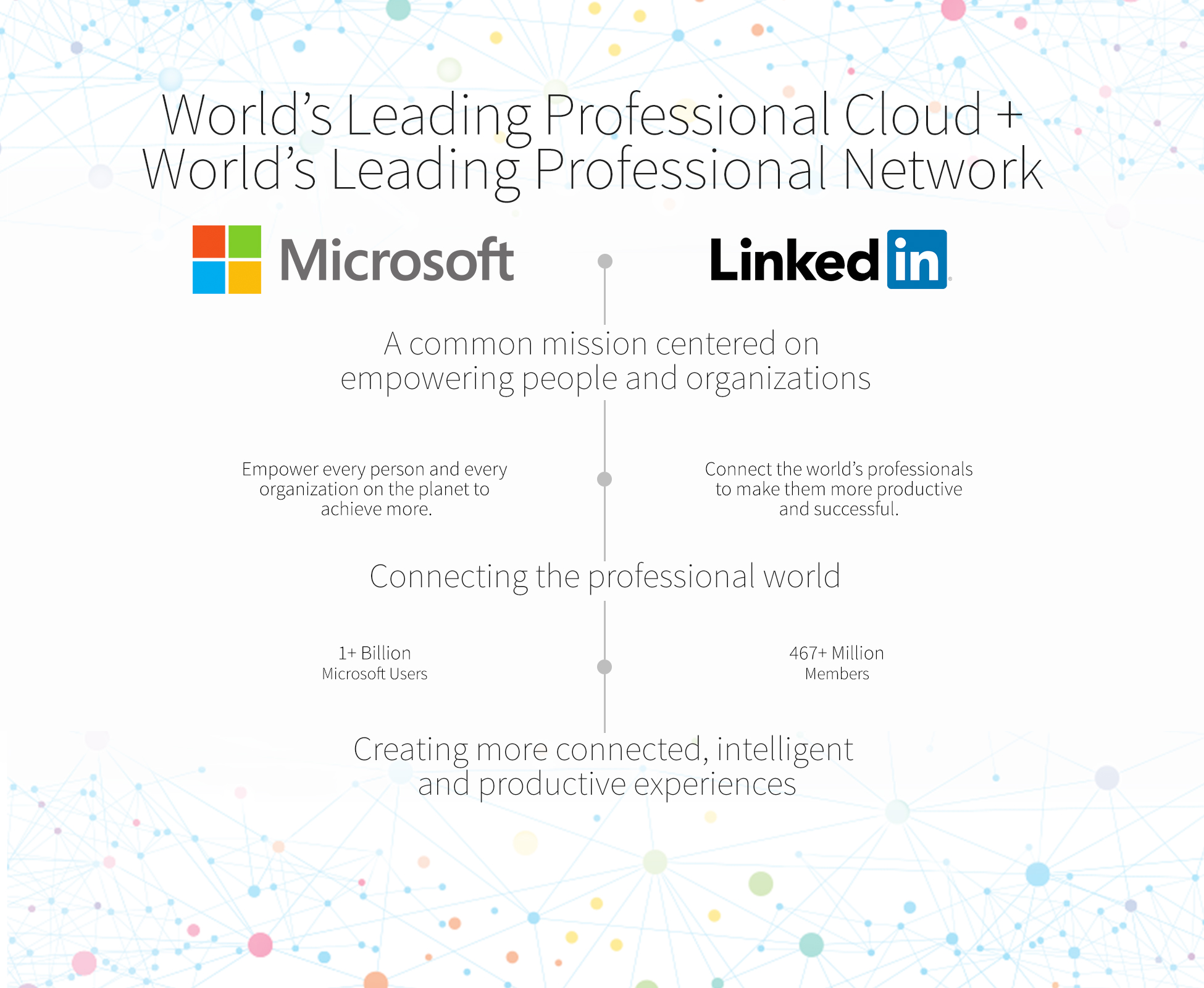
Today we are excited to share that LinkedIn has entered into an agreement to be acquired by Microsoft. We are joining forces with Microsoft to realize a common mission to empower people and organizations. LinkedIn’s vision – to create economic opportunity for every member of the global workforce – is not changing and our members still come first.

Our companies are the world’s leading professional cloud and network. This deal will allow us to keep growing, investing in and innovating on LinkedIn to drive value for our members and our customers. Our members will continue to develop their skills, find a job and be great at that job, using our platform. We will continue to help our customers hire top talent, market their brand, and sell to their customers.

The LinkedIn you know and value is only getting better. LinkedIn will retain its distinct brand, culture and independence. We’ve been changing the way the world’s professionals have connected to opportunity for 13 years, and this is an opportunity for us to truly change the way the world works on a massive scale.

I’m incredibly energized by what this means for our members and employees, and for my personal perspective on this news, I encourage you to read my Influencer post. You can find more details on the agreement on the Microsoft News Center and the LinkedIn Newsroom.

Additional Information and Where to Find It

In connection with the transaction described above, LinkedIn Corporation (the “Company”) will file relevant materials with the Securities and Exchange Commission (the “SEC”), including a proxy statement on Schedule 14A. Promptly after filing its definitive proxy statement with the SEC, the Company will mail the definitive proxy statement and a proxy card to each stockholder entitled to vote at the special meeting relating to the transaction. INVESTORS AND SECURITY HOLDERS OF THE COMPANY ARE URGED TO READ THESE MATERIALS (INCLUDING ANY AMENDMENTS OR SUPPLEMENTS THERETO) AND ANY OTHER RELEVANT DOCUMENTS IN CONNECTION WITH THE TRANSACTION THAT THE COMPANY WILL FILE WITH THE SEC WHEN THEY BECOME AVAILABLE BECAUSE THEY WILL CONTAIN IMPORTANT INFORMATION ABOUT THE COMPANY AND THE TRANSACTION. The definitive proxy statement, the preliminary proxy statement and other relevant materials in connection with the transaction (when they become available), and any other documents filed by the Company with the SEC, may be obtained free of charge at the SEC’s website (http://www.sec.gov) or at LinkedIn’s website (http://investors.linkedin.com) or by writing to LinkedIn Corporation, Investor Relations, 2029 Stierlin Court, Mountain View, California 94043.

The Company and its directors and executive officers are participants in the solicitation of proxies from the Company’s stockholders with respect to the transaction. Information about the Company’s directors and executive officers and their ownership of the Company’s common stock is set forth in the Company’s proxy statement on Schedule 14A filed with the SEC on April 22, 2016. To the extent that holdings of the Company’s securities have changed since the amounts printed in the Company’s proxy statement, such changes have been or will be reflected on Statements of Change in Ownership on Form 4 filed with the SEC. Information regarding the identity of the participants, and their direct or indirect interests in the transaction, by security holdings or otherwise, will be set forth in the proxy statement and other materials to be filed with SEC in connection with the transaction.

13 Jun 17:39

13 Habits Every Effective Sales Closer Needs to Adopt

by lye@hubspot.com (Leslie Ye)

If you asked most people what activity they associated most with sales, I’d guess that many — if not almost all — of them would say, "Closing." It's the endgame for virtually every workable sales process, but despite closing's prominence, being an effective sales closer isn't particularly intuitive.

Closing requires a lot of thinking on your feet, patience, preparation, good sense, and experience — if you want to do it right. Here, we'll take a look at some habits you can embrace, strategies you can leverage, and mindsets you can adopt to consistently close and see the results you're after.

Download Now: Free Sales Closing Guide

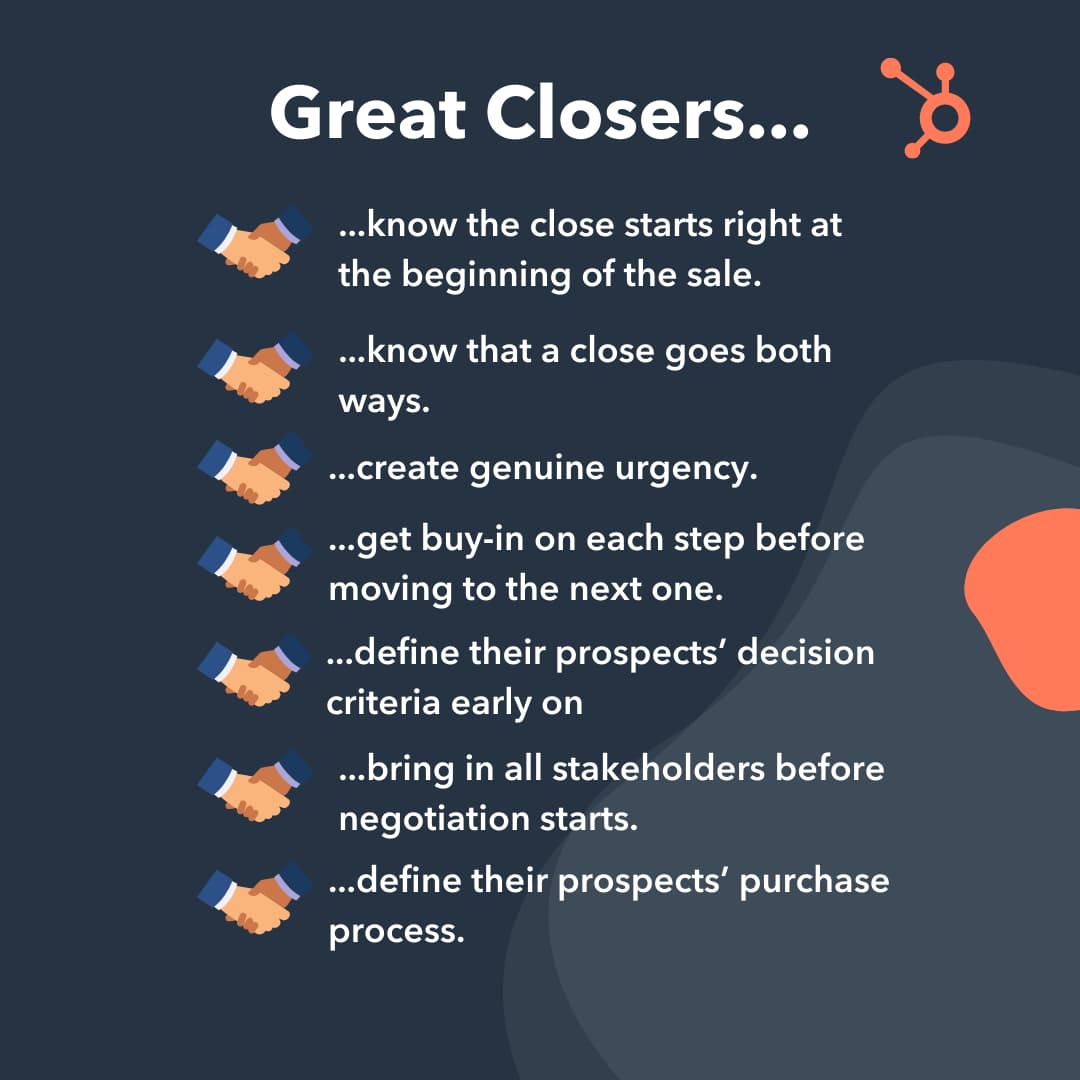
1. They know the close starts right at the beginning of the sale.

Good closers understand that the sales process doesn’t just involve one close. It's an ongoing process that underscores the sale as a whole — you're closing a prospect from the first conversation you have with them.

Exceptional closers understand their buyers' goals, plans, and challenges — and they leverage that knowledge to position their solutions as the most compelling options their prospects have from day one.

2. They know that a close goes both ways.

The best closers don’t get lost throwing information, technical jargon, and figures at their prospects — hoping most of it sticks enough to land a deal. That approach is far too one-sided. Instead, great closers work with prospects to ensure that a sale is mutually beneficial.

For instance, when the time comes to talk about pricing and implementation, exceptional closers tend to already have the context they need to make a compelling recommendation.

That comes from working closely with their prospects and maintaining an active back-and-forth as a deal progresses — giving them a leg up when it comes to understanding and conveying what will work best for their buyers.

3. They create genuine urgency.

Salespeople who reliably close never rely on the promise of a discount to get the deal over the finish line. Pricing should never be the main reason to buy right now — as opposed to next week, month, or year. Great closers find a legitimate, pressing issue or opportunity related to their offerings.

They start by helping a prospect understand that it's in their best interest to purchase as soon as possible. They know they can work with that buyer to figure out the exact terms after — and if they do it right, those terms won't include a discount.

4. They get buy-in on each step before moving to the next one.

Great closers never risk their time by making assumptions. They check to make sure they’re aligned with their prospect before moving on to another discussion at every step in their sales process. That way, their ultimate close — asking for the business — is much more likely to have a positive outcome, as it becomes a natural next step in the process.

5. They define their prospects’ decision criteria early on

Surprises and sales tend not to mix well — in that context, they’re often a result of insufficient due diligence. The best closers make it a priority to understand everything a prospect is evaluating as early on as possible, so they can provide value in these areas throughout the sales process.

They never reach what they believe to be the end of a sales process — only to suddenly learn that the buyer has three major concerns they never considered or addressed earlier on.

6. They define their prospects’ purchase process.

Is there a legal review process that will add one to two weeks to the sales process? Is your prospect required to evaluate a certain number of vendors (as government agencies often are)? Are there other procurement process requirements that will require input from you?

Great closers plan around these steps as soon as that planning becomes appropriate. That lets them prepare for a seamless purchase process and keep a deal moving along efficiently.

7. They bring in all stakeholders before negotiation starts.

There’s nothing worse than thinking you have the deal in the bag and sitting down to negotiate — only to meet a previously-unknown stakeholder who has major objections you need to address. To prevent this from happening, ask, "Who else is involved in this decision that should be on our next call?" at the end of every sales conversation.

While it doesn’t make sense for your point of contact to bring in the entire executive team on a first meeting, they certainly need to be looped in as the deal progresses — so you aren’t suddenly dealing with five different perspectives you didn’t realize needed to be accommodated at the eleventh hour.

sales closer habits

8. They know how and when to stay patient.

You're not going to close a deal on your first call with a prospect — and you'll likely hit more than a few hard "no's" before you land one "yes." You need to know how to remain composed and in high spirits through that process if you're going to be a great sales closer.

You need to be strategically patient — on both a personal level and when interacting with prospects. Hang in there through rejection, and try to avoid pressure selling when engaging with buyers. That being said, you can't be too hands-off when you try to close either.

9. They know when to ask for the business.

Closing isn’t a siloed part of the sales process, but you still have to be proactive about it. When all your prospects’ requests have been met, it’s time to lay it all out on the table and ask your prospect if they’re ready to buy.

The key here is determining exactly when those requirements have been met. It's easier said than done, but if you can identify and act on that key point in your engagements with prospects, you'll set yourself up to close consistently and efficiently.

10. They know their bottom line.

Every prospect wants to get a product for as little money as possible, and every sales rep wants to sell a product with as little a discount applied as possible — but both parties are happy with a figure somewhere in the middle.

At the end of the month or quarter, however, reps under stress to meet or exceed quota can fall into the trap of thinking they need to bring in as many deals as possible.

It’s important to remember that, at a certain point, the pain of accommodating the deal will exceed the benefit of bringing it in. You need to know when to walk away — whether that be when a prospect is asking for an unreasonably deep discount, unrealistic implementation terms, or something else that would be a net negative for your company.

11. They close multiple times during the sales process.

Closers know you don't just close once. Every conversation you have with a prospect should include you asking for some small close. Whether it's asking for a second phone call, a meeting, or a pitch — you should have a close in mind at every touchpoint throughout your sales process.

12. They communicate clearly and concisely.

Exceptional closers understand that confusing or boring a prospect can make an otherwise promising engagement dead on arrival. You need to keep buyers informed and interested — that starts with clear, concise communication.

Don't throw too much technical jargon around. Pare down what you want to say to the absolute essentials, and relay that insight in a calm, authoritative tone. Keep a pulse on the conversations you've already had to understand what the prospect already knows — and structure future conversations around that.

Practice by pretending you're explaining the value and utility of your offering to someone without an extensive background on it. That skill — paired with extensive product knowledge — will translate well when you speak with prospects who have some degree of familiarity with your product or service.

13. They stay positive and professional.

As I mentioned in the eighth point on this list, the best closers know how to take rejection in stride — they understand it's built into the job. You're going to hit your share of "no's" before you land a single "yes."One key factor that separates great closers from their peers is positivity — they remain focused and in high spirits through adversity.

They also know not to get emotional or overzealous with difficult prospects. A sales process is a professional engagement, and you need to treat it as such throughout its course. No matter what a prospect does to irritate you, don't lose control of yourself.

Worst comes to worst you pull out from the deal without burning a bridge. It's not the end of the world, and if you can do it with grace and composure, you'll avoid some potential negative word of mouth.

sales closer 2

How to Be a Closer in Sales

Closing shouldn’t be thought of as a one-off, dramatic affair. It’s a set of repeatable processes and strategies that permeate every sales conversation you have with a prospect. By applying these strategies to your own selling, you’ll find that closing comes more smoothly and naturally than ever before.

New call-to-action

13 Jun 17:38

11 Loyalty-Driving Tactics for Better B2B Customer Retention

by Dan Sincavage

Customer loyalty in B2B is a tricky beast.

What comes to mind when customer loyalty is mentioned? Points, stamp cards, promos, exclusives, tiers.

Rings like a B2C bell, right?

Well, it pays to know that retaining customers costs businesses up to five times less than getting new ones. In the B2B space where the cost of contracts are significantly bigger than B2C, the impact of retaining customers is even more pronounced.

Not to say that customer acquisition should be in the shadows–although, it has to be noted that retaining loyal customers also leads to referrals. The New York Times reported that companies say 65 percent of new business come from referrals.

Despite this, a lot of B2B companies still allot the bulk of their marketing resources to lead generation and customer acquisition. So much so that a lot of companies don’t have a defined customer loyalty program in place.

It’s an uphill climb but I think that with a bit of clarity about the different approaches to B2B customer loyalty, it shouldn’t be hard to get started. It is work–but it’s not difficult.

I’d like to share 10 tactics to jumpstart and kick your customer retention efforts to high gear.

Superb account management as a springboard

At its heart, customer loyalty is rooted in extraordinary, over-the-top account management. Especially when you’re competing in a saturated market, being the best in ensuring customer happiness will set you apart from the rest. In many cases, the best performing product in a niche isn’t the best product on all fronts. Often, though, they are the most customer-centric. They are the ones who look to solve their customers’ problems first before working on “innovative” bells and whistles in their offerings.

From onboarding until customers get the full hang of your product, you should deliver the best customer service you can. Constantly review and assess your customer success program–including your product.

Are you failing to deliver as promised? Did you overpromise? Is there a way to meet the gap between the promise and the delivery? Constant dissatisfaction with a product–even when it’s a very low-grade boil of disappointment or frustration–could push customers to make the switch and associate negative thoughts to your product.

Example:

IBM is one of the largest American multinational companies, and it can’t be such if not for their capacity to retain customers. IBM launched the hybrid design-engineering approach called IBM Design Thinking that helps their users carry out their business objectives better and faster. Over 100 product teams are using it to grow revenue by double digits.

Events for advocacy, training, and education

In-person events are a great way to promote and celebrate customer loyalty, introduce new product updates, showcase use cases and success stories, and invite feedback. It’s also a great way to gauge the loyalty of your customers. In-person events are recommended for B2B companies whose products are embedded into the customers’ daily processes. This is an opportunity for companies to engage with clients and gather data for more personalized service in the future.

Example:

Salesforce’s Dreamforce is one of the biggest conferences in business and is the superstar SaaS conference. It revolves around the Salesforce brand and it fosters loyalty among its users. The event is a big brand itself. Users look forward to it as it is a great venue to close deals as testified by a lot of past attendees. Most Salesforce users are sales and marketing professionals from businesses of varying size.

Dedicated account managers for hyper-personalized service

While this may sound inefficient and hard to scale, this approach should be reserved for your best customers: those that add the most to your bottom line and has the most propensity to refer leads. Personalized service to the kernel level should be provided to these customers.

The best way to approach this is through account-based marketing that extends after the closed deal. What is account-based marketing?

According to technologyadvice.com,

Account-based marketing (ABM) is about focusing your campaigns on specific prospects that you single out ahead of time. It’s becoming a more prevalent tactic as marketers align their efforts with revenue, and especially recurring revenue (i.e., contracts). Since ABM requires narrow focus and a unique approach for each account, it’s a great example of personalized B2B marketing.

Imagine this type of bespoke service offered to your best clients. Not only do you delight them on a constant basis, they also let you in on the more intimate details of their business processes. And we all know that the closer you are to their day-to-day ops, the better the situation is for breeding loyalty.

Customer tiers

A low-cost way to provide delight to your customers, this tactic focuses on recognition that, depending on your customer, could be something they really value. Business is business and not all customers are created equal. Segment your customers post-sale according to contract size and value to the company. Designing the qualifying criteria is important–what kinds of spending qualify for which benefits. This will also help your company roll out rewards without having to give to all clients. Rewards and benefits could be “unlockable” on every tier depending on spending.

Feature their business successes

Following the recognition path, hitting two birds through case studies is an effective way to showcase your customer successes and engaging with them. Case studies are proven to be an effective way to market your business as well. Praise is still a great way to get on the better side of your customers–just make sure the compliments are thoroughly justified. Besides, commending them is commending yourself too. Some companies include customer success stories in their content plan, scheduled alongside the content they constantly put out. Some companies showcase the case studies right on a dedicated portion of their site.

Example:

HubSpot has a full design on how they showcase their customers throughout their web presences. Their website features a section dedicated to customer success stories segmented by size, industry, challenges, and other factors. It also acts as a marketing device for them. Showing use cases for a varied sample of businesses helps them by providing social proof.

Exclusive access

B2B companies could also leverage giving customers exclusive access to new products, special services, promos and benefits. This particular tactic is effective for enterprise B2B for customers who value exclusivity.

Example: Medicision, a provider of population health management solutions, uses exclusive client-only webinars to drive customer loyalty and retention. They are a big player in the healthcare field and have According to Content Marketing Institute, webinars are second only to in-person events in B2B marketing tactics, according to their 2015 B2B Content Marketing Benchmarks and Trends.

Continuous education of customers through content

The more educated your customers are about your product, the quicker and better they can advocate for your company. This one’s part of superb account management as well–but it has to be said. There is a wealth of content produced for lead generation that content for retention is often overlooked.

Example:

Antavo. Of course, a customer loyalty tech provider gets it. Antavo has a client-only section in the academy section of their site. This section features advanced and tailored programs that are meant to share use cases and best practices, alongside a thorough guide for customers on how to maximize Antavo and its rewards programs.

Discounts

Borrowing from B2C, discounts are a straightforward way to entice customers to continue purchasing. This approach works best for companies whose customers act closer to consumers. These companies are those who provide services and products that are bought per transaction instead of signing longer contracts. Providing discounts to higher-ticket customers are also a way to entice them to sign onto a loyalty program which pulls them closer to the company, making them a captive audience for retention and advocacy campaigns.

A word of warning: Don’t put your pricing strategy at risk. Definitely go to discounts after thorough evaluation of the circumstances. It sets a tricky precedent and can come off as a devaluation of your product rather than valuing of the customer.

Points & rewards (gamification)

Like discounts, rewards are straightforward. This works for companies which have a high level of stickiness to their customers–meaning they have a considerable control of their niche and their current retention emphasis is turning customers into evangelists. Rewards are usually company-branded merchandise, flight to company conferences, free services or add-ons, and so on.

Random surprises

Distinct moments where you delight, surprise, and wow your customers are what drive customer loyalty. Surprising them with pleasant benefits and rewards that are not advertised and are completely unexpected drive positive customer behavior.

In B2B, emotions play a huge role. Even during the sales process, buyers who feel they’re putting forward great risk from their part are less likely to buy. When they’re already customers, the same applies. You need to be stellar in delivering as promise–and be over-the-top with your service!

Exit interviews

The exit interview is a standard procedure by sales and marketing organizations. It’s meant to find out what went wrong–and try to salvage the contract. This dual function serves businesses well in terms of helping them reduce churn and do a better job retaining customers. These two should always be in the head of the person calling for the interview.

Why? They’re still there as double agents so to speak. They should prepare for the call as they would for a sales call. Know the history of the company and the person on the other line. Know their account inside out. They once made the decision to purchase, they just need reassurance. Detect moments where you can still flip the situation. However, there are situations where your company isn’t a good fit–or, maybe you messed up. What you can do now is gather all the data possible so you can bring it back to the team to process. This way, you’ll have information to do a better job than you did with this particular customer.

13 Jun 17:38

How to Build a Killer Call Campaign in 3 Easy Steps

by Alexa Matia

How to Build a Killer Call Campaign in 3 Easy Steps

With the rise of mobile, pay per call advertising is more important than ever. When a customer calls your business, they’re generally further down the sales funnel. Nobody would waste their time calling unless there was a legitimate chance of a conversion (unless they’re a fraudster, at least).

For this very reason, calls are becoming more important than clicks, so businesses from small to large need to make sure they’re optimizing at every stage of a call campaign.

Step 1: Set up Your Campaign

Calls are more expensive up front than PPC advertising, but an optimized campaign is extremely cost effective and almost always has higher conversion rates.

Calls Generate More Revenue Than Lead Forms

Statistic Source: Marketing Land

That being said, you need to make sure that when you’re setting up your campaign, you’re optimizing from the beginning. This means you need to determine:

  • What metrics you want to optimize.
  • Which method of advertising will best help you reach those goals.
  • Who to target with your ads.
  • When exactly you’ll be able to reach the most people.

Determine Your Metrics

It’s essential that you determine at the beginning of your campaign what metrics you want to measure. This will ensure you’ve collected the right data to analyze after the call. Time of day and location of the caller, call duration, landing page performance, and conversion rate are all key pay per call metrics you should consider.

You need to establish a call duration time for what qualifies as a lead. It could be 30 seconds, or it could be three minutes. It all depends on your business and what sort of services or products you offer. But, you’ll want to make sure that your sales team can highlight your core services in the allotted time.

Once you decide what you want to measure, you need to figure out which method of pay per call advertising is best suited for your company.

Decide on Your Method

After you develop your campaign strategy, you need to decide on your pay per call method and ad creative. These could range anywhere from TV commercials, warm transfers, abandoned phone calls, mobile click to call ads, or call extensions in your search ads.

Which type of method you choose for pay per call is dependant on your goals and the resources available to you. TV commercials might be too expensive. Abandoned phone calls might not work if there aren’t any businesses similar to you that have closed recently.

However, you should always be sure to add a call extension in your ads if you’re doing SEM. The easier it is for a potential lead to call you, the more likely they are to call.

Google Click to Call Ad Extension

Mobile click to call ads are great if your customers are mobile users (which most people are), and warm transfers work best for companies who want to sort through leads to make sure qualified leads are being sent to the most relevant sales team.

But, not every type of pay per call is going to work for every business. In fact, if you can’t convert a caller to a lead or close a sale over the phone, pay per call might not be for you at all. Instead, you might benefit more from pay per click or display advertising.

Yahoo Home Page Display Banner Advertisement

No matter what type of pay per call method you chose, you want to make sure your site is optimized for mobile. If potential customers are calling you, chances are they’re looking you up on their phones first. In fact, more than half of all calls start with a mobile search. Make your website navigable and your phone number easy to find.

Establish Target Audience

Once you have your campaign mapped out, you’ll want to make sure that your ad is being shown to the right people. You don’t want your ad for auto repair to show up for home repair services. Make sure you’re selecting the right keywords to categorize your ad.

It’s also important to make sure your ad is playing in the right location. If you’re a small, local business, you don’t want your ad playing halfway across the country. Or, say you’re a pool service company. You probably don’t want to heavily target a city where most people don’t have pools.

You also want to make sure you’re targeting the right area if your business is based somewhere with a fairly common name. For example, this ad for LaRosa’s, a pizza shop in Middletown, Ohio, showed up in a search for pizza shops in Middletown, Delaware.

Pizza Shop Poor Geotargeting Example

Making sure the right people see your ad isn’t the only important targeting aspect of your campaign. You also want to make sure that your ads are being played at the right time.

Schedule Your Ads

Scheduling ad play is essential to pay per call. If no one’s there to answer the phone, you’re wasting money and missing out on leads.

Schedule your ad based on your business hours, and shift your ad budget to show your ads when they’re most likely to be seen. You can also look at your customers’ past purchase habits to schedule ads when they’re most likely to make a high-value purchase.

So, now you have the campaign set up. But what do you do when the phone inevitably rings?

Step 2: Answer the Phone

This may seems obvious, but the most important thing you can do for the success of your campaign is actually answer the phone.

Phone Calls Mean a Fast Response

Statistic Source: Invoca

You need to make sure that you’re prepared to serve your callers, whether you’re a single-person business or have a larger staff. Make sure everyone is trained to be helpful and available in order to make a good first impression on your callers.

Answering the calls is just the start. There are a few things you want to make sure you do during the call.

Pre-Qualify the Calls

In order to further make sure you’re getting the most qualified calls, you can also put an Interactive Voice Response (IVR) in place.

IVRs filter and pre-qualify your calls by asking the caller a series of questions in order to send them to the most qualified and relevant sales person. It can also help you sort out the current customers calling from the potential leads.

Plus, implementing an IVR can help you combat pay per call fraud. Qualifying them early can help prevent the fraudulent calls from reaching you.

Record the Calls

After answering the call, the second most important thing you should do is record your calls. That way, you can look back on your calls and listen to them to gain insights you might not have initially picked up on.

You can listen to your customer’s tone to see what made them happy, or maybe what frustrated them. All of these details can be used to improve your conversation strategy and improve your callers’ experiences and your sales team’s success.

Ask for What You Want

When talking to prospective customers on the phone, don’t be afraid to ask for a desired outcome. If you’re a local and appointment-based business, ask callers to schedule an appointment. Too many businesses forget to ask their callers to actually take action. The worst the caller can do is say no, but if you don’t ask, you’re risking a wasted call.

Step 3: Analyze the Calls

It’s all about the data after the call. Calls are becoming more common, not less. You need to make sure you’re optimizing your campaigns around your call data, and to do that, you need to focus on the metrics you decided to target in the beginning.

Evaluate the Call Metrics

Focus on your determined metrics, and evaluate your calls to see which campaigns they’re coming from. Call duration can tell you whether or not a call was a quality lead. After all, callers who are genuinely interested generally spend more time on the phone with you.

The time of day and location are also important, because you’ll be able to see when your customers are most active and most likely to call. You’ll also be able to use where they’re coming from to improve the geotargeting of your ads.

While landing page performance may not seem relevant to the actual call, it’s still important to the campaign. If customers are clicking on your ad and calling you from a CTA on a landing page, you need to know which ones are performing the best so that you can continue to use those and alter the others accordingly.

Review Conversion Rates

Lastly, you’ll want to be sure you look at the conversion rate.

If you choose only one metric to focus on, make sure it’s conversion rate. Review your campaigns and see where customers entered your sales funnel, how long it took them to become a lead, and then the process they went through to go from a lead to a customer.

The more you know about your call campaign, the better you’ll be able to improve it. Take advantage of the data you collect and analyze it.

But also, listen to the customers who called you to see what questions they’re asking and what they’re most interested in. By listening, you can learn from callers and generate new ideas on how to improve existing campaigns.

13 Jun 17:37

Should your content generate leads or relationships?

by Mark Schaefer

Screenshot 2016-06-12 15.32.34

A few years ago I had an interesting conversation with a Hubspot executive (now a former executive … but that’s another story). His business goal was to generate an ever-increasing number of leads from his company’s blog content and he wanted my ideas on what they might try to kick the number up.

“Are you sure that’s the right goal?” I asked. “Should your content be aimed at building short-term leads for cold calls, or for building real business relationships?”

Clearly the Hubspot model is built on leads. If you opt-in to something on their site, you’ll probably get a sales call within 24 hours. But is that the most effective way for everyone to build a business?

For a long time I’ve observed that there are two camps in the content marketing world — I’m in one and Hubspot is in the other — but I’ve never written about it before. I think this is an interesting topic, so let’s dive in.

Should content generate leads or relationships?

The Hubspot model is very clear: Produce content that generates more leads every month. But what does a relationship model look like?

Let’s start with a result. Last year, I received an exciting email. It went something like this:

Mark, I’ve been reading your blog for three years now. I love the podcast. I’ve also bought your books and they’ve been read by our entire management team. We’re convinced that you’re the right person to help us with our social media and content strategy. Can you work with us?

The email was from an executive with Adidas and it resulted in one of the biggest consulting contracts of my career. I didn’t have to fill out any paperwork to provide a quote. I didn’t have to compete with other agencies. They just wanted me, because through my content they felt they knew me and already had a relationship with me.

This is a perfect example of how the “relationship” content model works. The folks from Adidas didn’t opt in to anything (except the blog subscription I suppose). I didn’t make a cold call based on a phone number they provided. After a period of time, they wanted to hire me because I had built a voice of authority through my content.

This relationship approach has generated 100 percent of my business revenue for eight years.

The implications for your content strategy

Hubspot recently published an exhaustive analysis of how content quality and publishing rate affects their page views, leads and subscribers. It’s a complex article with more than a few statistical problems but it’s an interesting look into their process.

One of the take-aways was that their “top-of-funnel” content generated the most web traffic. This is typically light-weight, entertaining content and Hubspot noted that a post about funny out of office replies was their top performer. Likewise, my all-time high-traffic blog post has nothing to do with what I do for a living. It’s 20 of the World’s Most Clever Twitter Bios.

So the lesson here is that to attract more traffic, we should be producing dozens of funny Buzzfeed-type posts, right?

The problem is, this content may generate huge traffic, and may even result in some subscribers and leads, but it’s not consistently attracting the audience that is going to hire me or buy something from me.

That’s why my content focuses on more advanced ideas about marketing, social media, and content strategy even though pumping out funny or provocative posts might make my blog traffic numbers soar!

Which works for you?

The elephant in the content marketing room is that Hubspot has been around for nearly a decade and has never made a profit. Like many start-ups the company has been focused on growth and dominating a crowded space — a smart strategy. But a primary reason for their lack of profitability is not necessarily the focus on growth, it’s that their sales and marketing costs have been too high. Wait a minute. Isn’t inbound marketing supposed to lower our marketing costs?

The role of content in the Hubspot environment is to generate short-term sales calls, not long-term relationships. So their cost of sales is very high and the cost of generating 35 respectable blog posts a day is high, too.

With the relationship strategy I employ, my sales costs are nearly zero because people have decided to purchase from me by the time they contact me. The downside is that it has taken a long time to build the authority through my content that earns that business … but it works (and I have been profitable every year).

By producing thought-provoking content, I also will create online discussions and links back to my business. Fluffy stuff like the Twitter bios, or even the “how-to” content, will never work that hard for my business.

The changing nature of the inbound model

There is an emerging factor in our industry that could jeopardize the Hubspot “leads” model.

Social media is Hubspot’s third-most important source of inbound traffic, after email and search. But social media platforms like Facebook and LinkedIn are turning into content dead ends and will become a less reliable source of traffic.

I explained this concept in an article called Facebook content strategy is a time bomb for inbound marketing. The main idea is this: If we posts links to our content on social platforms, it re-directs reader attention away from Facebook to our own sites. Facebook hates that. So through Notes and Instant Articles, Facebook is encouraging (demanding?) content creators to publish their entire articles on their social platform.

The good news is, if we submit to Facebook and publish there, we get wider awareness for our content. The bad news is, if the reader is consuming the content on Facebook, they are not moving to our website to generate traffic and leads.

What do we do about that? I think the strategy is still evolving. I don’t have all the answers but my sense is that focusing on relationships instead of leads will work better in that environment. We build relationships and authority through our content, no matter where it appears.

How about you?

Does your content generate leads or relationships? What is your priority?

This decision may depend on your business type. If you are selling a personal service (like I am) the relationship model may work best. Likewise, if you are selling something distinctive, like a restaurant, or a clothing line, I think people will want to build an emotional connection to your brand rather than receive 35 posts in their inbox every day.

Hubspot is offering marketing automation, a business that has become far less differentiated over the years (and there needs to be some consolidation in this field). Trying to “out-lead” the other guy and out-last competitors may be the thing to do.

I know there are thousands of passionate advocates of the Hubspot version of inbound marketing and they may take exception with my ideas here. I’m sure there is a hybrid approach. I’d love to hear your views one way or another in the comment section. But either way, I hope by presenting an alternate view to the strategy behind inbound marketing it might provide clarity to your own business tactics.

Illustration courtesy Flickr CC and Steve Johnson.

The post Should your content generate leads or relationships? appeared first on Schaefer Marketing Solutions: We Help Businesses {grow}.

13 Jun 17:37

7 Essential B2B marketing trends for 2017

by Robert Allen

The key trends that business-to-business marketers need to act on in 2017

Since we're now well into 2017, it's a natural time for all marketers to review the marketing tactics they've used this year and assess their approaches against other businesses in the sector. For marketers involved in the B2B sector, there are some particularly pressing issues which, if they can be addressed will help 'feed the funnel' and develop more quality leads.

A good starting point for reviewing the trends that will make an impact next year is to think through innovation across all the main digital marketing channels. In our article on marketing trends for 2017, we asked marketers to assess the techniques which would give them the biggest uplift on business in 2017. The results show that the top rated techniques which should get focus next year are closely aligned with B2B sector, which has for the past couple of years been realising the importance of new technologies such as real-time personalisation, marketing automation and mobile.

1. Marketing Automation

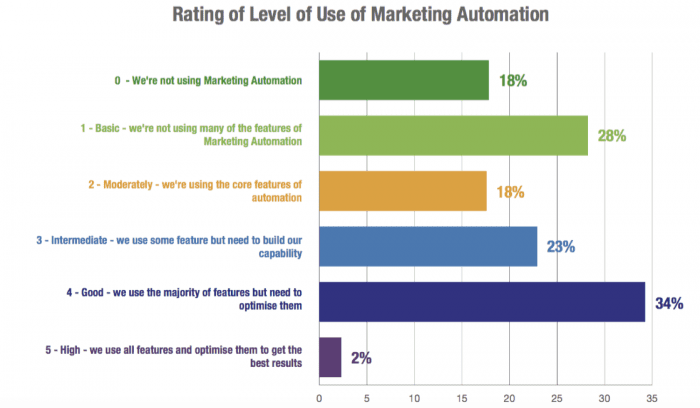
Marketing automation is the perfect technology for B2B marketing. It provides an automated way of scoring and nurturing leads with relevant content along the journey to purchase. Yet our research on Marketing Automation (free download) shows that many businesses aren't fully exploiting marketing automation since they are at an early level of maturity.

Level of marketing automationDave Chaffey of Smart Insights will be speaking at B2B Marketing Automation Expo 2017 where he will cover some of the best ways to get started with Automation. Speaking at last year's show - he covered key techniques to consider to get started or go to the next level :

  • A multi-step welcome sequence which can be made more relevant with dynamic content - a more advanced technique
  • Lead scoring and lead grading so that rules can be put in place to send more relevant emails or outbound calls when prospects are qualified
  • Use of re-marketing on third-party sites to nurture prospects who have shown interest in a product or service

2. Content marketing

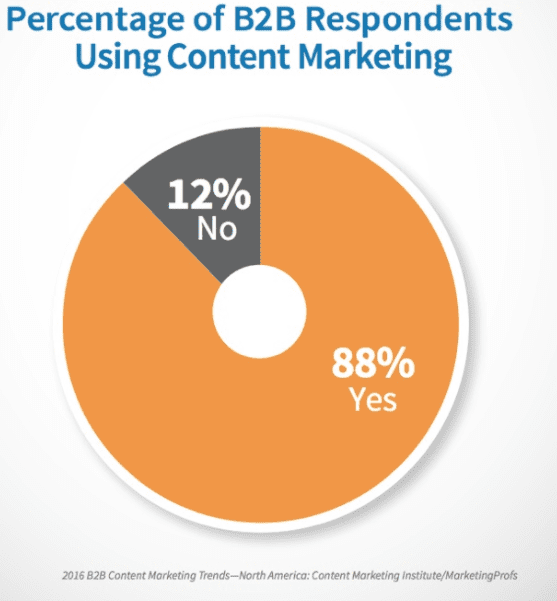
Content marketing is a technique that has been used in B2B marketing for many years, but in recent years, the popularity of inbound marketing has given more attention to share blogs and social media. Over the past three or four years, readers have voted for the importance of Content Marketing amongst the marketing activities available. Within content and inbound marketing, I think the ongoing discussions will be around getting the right balance of content quantity, frequency and quality and of course, measuring the ROI of Content Marketing. This article around research from Buzzsumo gives an interesting summary explaining that Content Marketing's Future Depends on Shorter Content and Less Content. I agree with the less content part, although not necessarily the shorter content part as research shows that longer content can be more effective in business-to-business blog posts.

Content marketing is a great tactic for B2B marketers because the long customer journey means customers will want to do plenty of research before purchasing and compare several different providers.

3. Web personalisation

Website personalisation is a well-established technique for Ecommerce sites but traditionally has been less widely used within business-to-business. It's surprising since personalisation of emails using techniques such as dynamic content insertion as described above is popular.

There are now SaaS products such as BrightInfo and Evergage which make web personalisation services more affordable for smaller companies. These may also include automation features to recommend the most relevant piece of content within the nurture path.

4. Channel integration

With so many separate digital marketing channels there is a tendency to focus on individual channels, but an integrated nurturing process can reap dividends. One key trend here is the integration of different channels.

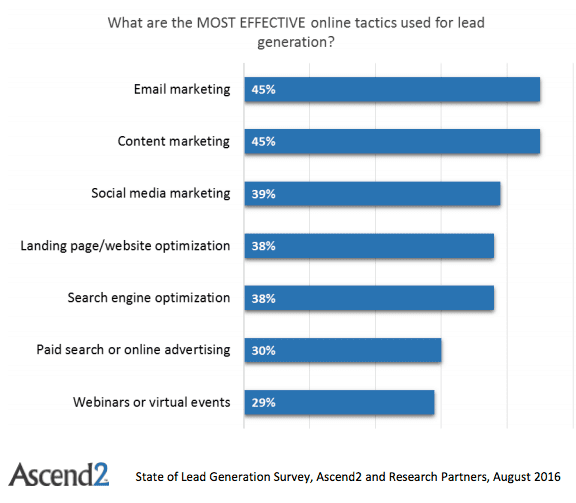
Another data point on this trend is this research on the top channels for generating B2B leads by Ascend which is a sense check that B2B marketers aren't chasing the latest fads whilst not spending the lion's share of their time on the channels delivering the vast majority of their leads or sales.

Most importance B2B channels for lead generation

Another benefit of marketing automation is that it enables businesses to join up the customer journey between the website and emails, not only with email sequences when someone registers, but also through closing the loop and identifying when a prospect downloads content in future, so showing their interest or 'digital body language' and further follow-up.

Another form of integration in nurturing is through re-targeting or re-marketing in Google AdWords where ads can be served to previous site visitors on Google's display network. This option has been available for many years, but the trend is that new options are available with social media. Within B2B, LinkedIn is important and there are now new options to target within the LinkedIn programmatic service. Facebook and Twitter have also extended their retargeting options this year as part of this trend.

5. Account-Based Marketing

Account-Based Marketing or ABM is an established approach in B2B marketing, particularly within larger organisations who have structures and processes to target key accounts.

ITSMA which first pioneered ABM more than 10 years ago, defines it as “more than a sales or marketing approach; it is a collaborative strategy that engages sales, marketing, subject matter experts and delivery professionals, as well as key executives
in the chosen client account to determine where and how to best meet the client’s unique business challenges. With deep insight into the client’s business and key goals, this collaborative team creates a well-orchestrated marketing and sales campaign for a single account
.”

Previously, ABM was a tactic or mindset which was poorly supported by most Marketing Automation services which focus on individual customer records. The trend is for automation services to include ABM features which make it easier to nurture groups of people automatically through email and re-targeting.

6. Mobile marketing

It goes without saying that the shift to mobile is a key trend for B2B marketers, as it has been for several years now. We've included this for completeness since Google tells us that most businesses have a responsive site, so you could say it's no longer a trend. However, changes that will affect B2B marketers in 2017 (particularly those who don't know about them) including Google's new mobile-first index and potential penalties for pop-ups.

Mobile now accounts for over half of web traffic, and where previously B2B companies could assume that their customers would be researching them on desktop devices, now a new breed of business owner using mobile devices to research solutions on the go means B2B marketers need to be sure that their content is mobile optimised to ensure a smooth processes for users on all devices.

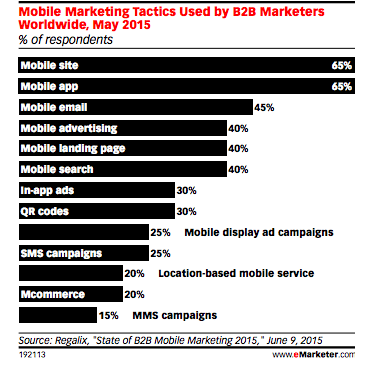
mobile marketing tactics 2016

Over half of B2B businesses have mobile sites and mobile apps, which shows the industry is finally starting to get is act together on mobile. For some industries, having a mobile app won't be necessary, but really all should have mobile responsive sites. Even if none of your customers are arriving on mobile devices (which some certainly will), you still need a responsive site because of Google's 'mobilegeddon' update, as otherwise you'll be getting penalised. B2B buyers are increasingly using mobile devices, as you can see from the charts below, so a mobile optimised site is an absolute necessity.

7. Social media

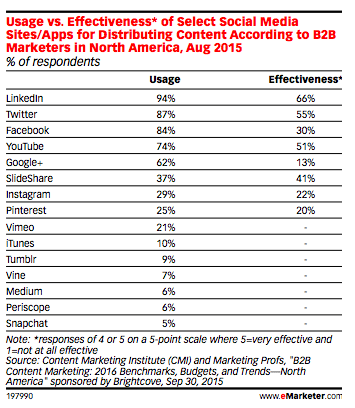
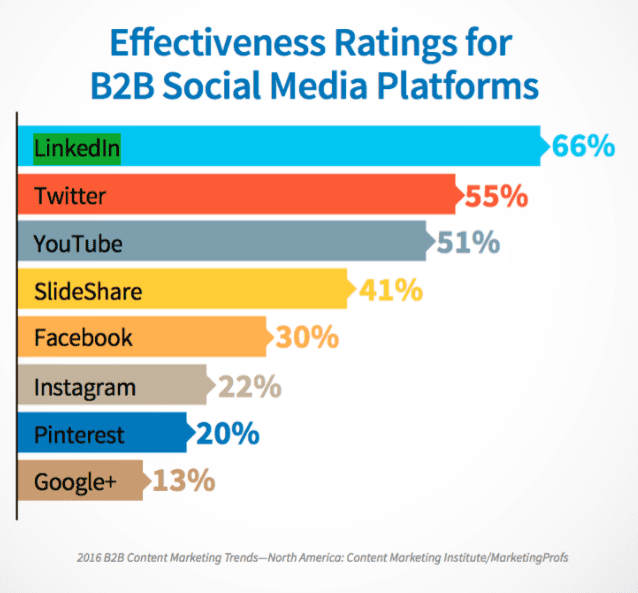
This research shows that B2B businesses tend to get the best results from LinkedIn and Twitter, but are present across a wide range of social networks. Youtube and Slideshare also stand out as particularly effective, whilst Google+ is very ineffective considering the majority of B2B businesses are using it. The eMarketer chart shows 2015 data, whilst the chart underneath it shows data for 2016.

social media b2b

With B2B social media, it's often important to prioritise, as whilst it is easy to set up an account on a new social network, it requires plenty of effort to run it effectively. Focusing only on the most effective networks is usually the best tactic.

So, these are our seven trends and some practical ideas of techniques within them. Do let us know of other digital marketing tactics that you think will be effective in the year ahead.

Of course, all of these tactics will need prioritising as part of a strategy - see our B2B Marketing Strategy planning infographic for the 7 Steps we recommend.

13 Jun 17:35

Gamification Isn’t A Fad, Get On Board Before It’s Too Late

by Matt Goldman

There are countless businesses trying to accomplish a myriad of unique goals. But they all have one thing in common; the desire to increase productivity. That could mean attracting more people to a website, making more outbound calls, or reaching new sales heights. But regardless of the exact goal, companies are always trying to make improvements. To execute their respective objectives, businesses have started to turn to something called gamification.

The term itself is relatively new, but the idea driving it is nearly as old as mankind. “Weight watchers, boy scouts and girl scouts, and military organizations have been using this approach to motivate people for a half century, a century, and millennia (respectively). Of course in those days, engagement was limited to the physical world. What’s new about gamification is that by means of a digital engagement model, motivation can be packaged into an app or device and scaled to engage an audience of any size at a very low incremental cost.”

But yet, not everyone has been receptive to this idea. “As is often the case, some old guard companies will be blindsided by the transition to digitally delivered motivation.” Change can be hard, and while it might create some awkward moments early on, companies that fail to adapt become cautionary tales and examples of what not to do. In simpler terms, don’t be a Blockbuster.

1. Don’t be turned off by the term gamification

When people hear business and games in the same sentence, apprehension can naturally follow. After-all, business operations are supposed to be professional, not something like chutes and ladders. If this tactic makes you uncomfortable, think of it as “behavior management” instead.

“‘Everybody wants to feel like they’re progressing…The goal is to make people do the behaviors you want them to because it’s what they want to do…’ Akeroyd stresses. The things that make games so compelling ‘can equally make employees, partners [and] customers addicted to your B2B or B2C offering.’”

Gamification is just digital employee motivation. While it’s presented in a game format, that doesn’t mean the principles behind it don’t work. If your goal is to make your employees more productive, then why not make it fun?

2. Why digital engagement is better than physical engagement

While both have their merits, digital engagement is undoubtedly the present and the future of employee motivation. That doesn’t mean it’s necessary to completely do away with physical engagement, but rather that it needs to be supplemented. A celebration after landing a new customer, or a huge sale is a great way to reinforce employee habits, but it’s hard, if not impossible to reach every employee with that type of engagement.

Sure, if everyone works in a 400 sq. foot office, it’s easy to walk over and give your top salesman a high five, or a pat on the back, but that’s not a realistic scenario for most companies.

This is one of the “many advantages of using digital over physical engagement – most notably scale and cost. Digital engagement models scale to virtually any number of participants at very low incremental cost, while physical engagement models have much higher incremental costs for each new participant. The result is that gamification provides the opportunity to package motivation into a digital engagement model and scale it at a much lower cost than a similar physical engagement model.”

Also, while a crisp high five is great in the moment, that feeling is fleeting. With digital engagement, badges and achievements can be displayed for as long as the employee wants, or until the next competition period begins.

Gamification doesn’t work via magic. It “uses the same motivational techniques that have been around for centuries. Building self-esteem and [reinforcing] it with peer recognition is a powerful means of unlocking motivation.”

3. Make sure the achievements earned are based on skill

A perfect example is video games. When Halo began taking over the online world, Bungie had ranking systems figured out perfectly. They didn’t give out achievements based on an accumulation of time played or points acquired. To earn the highest ranking under the old system, you could only be regarded as a 50 (on a scale of 1-50) if you were one of the most skilled players in the world.

However the new system, which other platforms like Battlefront and Destiny use, is an accruement of points. This means that the best player in the world might have the same rank as someone who’s awful, but just happens to spend eight hours a day online and gathering up minimal points in each game.

The same should be true of using gamification in a business setting. Rewarding employees only works if it’s done the right way.

For example, if an employee spends 2,100 minutes on the phone, but doesn’t actually sell anything, then that time was wasted. It’s vitally important to define what’s actually important before implementing a gamification system.

4. Make it social

Bragging rights can also be a motivator, especially when social media or a group environment is involved. ‘The more social an experience becomes, the more valuable [things like] lead access and reputation are,’ Says Scott Schnaars, director of sales for Badgeville.”

Creating achievements are fantastic ways to boost productivity, but only if other people can see them. If someone wins employee of the month, or a “Sales Guru” award, but nobody else knows about it, then there isn’t much of an incentive for anyone to work hard to get that distinction.

5. Gamification products that can help boost productivity

Hoopla:

Bunchball: “To gamify a business process, organizations must define goals for users, tracker their behaviors, and reward them when goals are met. Bunchball, a gamification software developer, can do these things and enable users to compete for position on league tables, create virtual identifies for self-expression, collaborate as part of a team, and post comments or video on facebook and Twitter for rewards.

Badgeville: “A competitor to Bunchball, Badgeville can track user’s performance data to motivate behavior, reward top performers, and create real-time notifications to engage inactive users.”

Tenfold Next: Tenfold already tracks every call to your CRM, helps you rapidly respond to incoming leads, and ultimately make more money. Tenfold Next expands the entire sales process and makes prioritizing opportunities much easier.

Not only will it make tracking emails incredibly seamless, but it also includes built in leaderboards to track various teams, and allow you to see who’s reaching their goals, and who needs to ramp up their efforts. It’s currently in beta testing, but you can check out the future of the product now.

gamification

6. The results are real, and proven to work

This is the most important aspect of gamification; does it work? The answer is an unequivocal yes. There are countless studies showing the benefits of incorporating digital engagement into the workplace.

In the case of Samsung, they used gamification to drive interest with their customers.

“Samsung, for instance, mixed frivolity with serious business initiatives when it created the social loyalty program Samsung Nation through behavior platform Badgeville. The purpose? To grow its user-generated content and traffic on its global Web site. Fueling competition, the game lets users level up, unlock badges, and gain subsequent rewards and recognition.”

“Samsung, in return, saw 66 percent more users submitting 447 percent more product answers on its global Web site. Even more impressive, the user-generated content prompted 34 percent of users to put 224 percent more items in shopping carts.”

While the results are easy to see, the argument could be made that the only reason productivity increases is because everyone’s track record is now incredibly transparent. But that doesn’t seem to be the case, as Omnicare found out.

“‘I was struck by [a comment] made by one of my overnight technicians,’ remarks Tim Deniston, help desk manager at Omnicare. ‘He said, “Bossman, I’m so excited. Every night I come in, I can’t wait to see what my badges are.” Competition is another thing that can come of this. You hear chatter like, “I just leveled up for this particular badge.” It’s very valuable.”

This is the point of gamification; “It gets people excited.” If people care about the badges and achievements they’re unlocking, then they’ll look forward to their work, and be more motivated to come in and do their job well. While no two companies are exactly the same, gamification can be applied to every business with a product; and if you don’t adopt the practices now, your company could be playing catchup in a few months.

12 Jun 17:13

It’s Time to Kill the App

by Patrick Antinozzi

When Apple launched the App Store in July 2008, the mobile app rush came along with it. Everyone and their mum rushed to build an app for the shiny new iOS platform.

People were building apps for products, services, games, or just plain gimmicks. (remember the lightsaber app that made “BWOM, PSSH, CHUE” sounds as you waved your phone around?)

time to kill the app

The iPhone Wars had begun.

This was understandable, and even necessary. As with any new platform or medium, it takes time for developers and creators to figure out its purpose, to decide what works and what doesn’t.

After 9 years(!) of a world filled with smartphones, tablets, and an endless supply of novelty mobile devices, where does the app as we know it stand? Is it just as relevant and important as it was back then?

Nobody wants to download your app

With the mobile app market being completely saturated, app retention rates are at an all time low.

average app retention android

Source: Quettra

See that graph? Those numbers are abysmal.

The average app loses:

  • 77% of its users in the first three days
  • 90% within 30 days
  • 95% within 90 days.
  • 1 in 4 people open an app only once

People download and try out new apps regularly, and nobody wants to have 100’s of apps on their phone, so only the ones that leave an incredible first impression stand any chance at staying on those devices.

And if you’re thinking that these are just the millions of below-average apps flooding the market these days, take a look at how the top apps in the world are performing.

android app retention

The most popular apps in the world, such as Facebook, Whatsapp, and Instagram, only have a retention rate of about 55% after 90 days.

Again, these are the biggest apps in the world.

Why do so many mobile apps fail miserably?

Likely, because of one of these reasons:

  • The app doesn’t excel at one task
  • Too many features leads to confusion
  • Poor onboarding processes
  • The content is weak
  • Annoying push notifications
  • Frequent bugs and crashes
  • Slow loading speeds
  • Too many requests to rate the app
  • Gated logins
  • Intrusive advertisements
  • Requires too many permissions and sacrifices privacy
  • Poor user interface
  • Infrequent updates and ignoring user issues

If your app has just one of these issues, it can die fast.

Everything is becoming contextual

facebook uber integration

You’ve probably heard a lot about chat bots and artificial intelligence lately.

While the reports of these technologies replacing humans have been greatly exaggerated, it does mean the continual use of traditional apps will be drastically reduced.

Apps are now being integrated into other apps.

For example, Facebook Messenger is one of the largest messaging platforms in the world with over 800 million active users. Up until now it has been used for just that, messaging.

But now, Facebook is focused on building Messenger into a full fledged e-commerce platform. They plan on integrating other apps into Messenger to make your buying experience seamless and based on the context of your conversation.

Picture this: You’re chatting with your friend about meeting up for a drink. You pick a spot and a time, and now have to figure out the best way to get there.

Messenger, with the help of the new Uber integration, instantly recognizes your need for transportation, and helpfully suggests you order an Uber.

facebook messenger uber integration

You click the link, review the directions and simply click “Request”.

Done.

Never once did you need to leave Messenger, open the Uber app, enter the address, order the Uber, then return to Messenger.

You were able to do it in just two clicks, all within Messenger itself.

This is contextual at its finest. And with the rise of new tech, it will only become more prominent.

New technologies are driving the death of apps

death of apps

Voice-based personal assistants like Amazon’s Alexa, Google’s Home, and Apple’s Siri are poised to transform our homes and drive the advancement of smart home tech.

With these devices, we wouldn’t even need to physically handle any devices to order many of our favorite products and services. We just need our voice.

“Alexa, order me an Uber to St. Lawrence farmers market.”

“Ok Google, get me my usual from Dominos.”

“Hey Siri, what is the weather for today?”

Sure, this sounds a bit clunky today, but once these assistants become better at learning about us and our speech patterns, the experience will be seamless.

The apps are there, you just can’t see them

All of these new technologies and mediums still have apps working hard to give you what you want, they just do it in the background.

There’s no reason for every single business and brand to have their own interface-based app. Users simply don’t want it.

If you have a product or service you’re selling, focus your attention on integrating it into relevant platforms. Give your audience as many opportunities to purchase it as possible, but it in a way that makes sense for them.

Simplifying the buying experience means killing the app as we know it.

And with all of the “look we have an app too!” apps flooding the market, nobody is going to miss them.

12 Jun 17:11

8 Incredible Online Resources for Creative Design Inspiration

by Brittney Ervin

Design, whether it’s for print, digital marketing, editorials or websites, requires constant creative juice. But even the most prolific and passionate designers can hit inspiration road blocks. When you’re on a deadline, and you’re committed to doing good work, a little outside motivation can get the wheels turning again.

If you’ve found yourself stumbling over the same design rut again and again, consider these online resources for a fresh perspective.

1. Designspiration

designspiration.png

This safe-for-work design portal is filled with architecture, typography, illustrations, and prints. The search mechanism is easy—scan through tags or websites or type in up to 5 colors to sort your results by color scheme. It’s similar to Pinterest in that you can collect your favorite designs and share your own with the world.

You won’t be limited to a few designers from a handful of places, either. Designspiration features the work of artists and innovators from all over the globe, giving you a full range of perspectives and styles.

2. Dribbble

dribbble.png

Working under the tagline “Show and Tell for Designers,” Dribbble is a hub for creatives to connect, share and inspire one another.

The homepage is a smorgasbord of typography, website design, logos, illustrations, and graphics. Not only can you peruse the work of other designers, you can also find and hire a great designer through Dribbble’s “For Hire” section.

Find a design you particularly love? Contact the designer and see if they’re willing to work with you!

3. Awwwards
awwwards.png

Awwwards was started as a way to recognize and exalt some of the best-designed websites in the world. The official Awwwards are given out each year, and the deciding jury is composed of some of the most prestigious designers, bloggers and agencies from around the world.

Take a look around the site, and you’ll see some of the most innovative and creative design being done in the world today.

You can also get insight into how Awwwards rates the websites; each website featured is given a score comprised of different elements, including creativity, design, content and usability.

4. siteInspire

site_Inspire_2.png

siteInspire has some of the best filtering options of any design portal you’ll find. Choose from multiple categories like type, style, subject or highest-rated. You can follow the designs of notable or favorited designers and submit your own work for feature on the site.

5. Smashing Magazine

smashing_mag.png

One of the original purveyors of web design and developer inspiration, Smashing Magazine has been doling out editorial and professional resources for over 10 years.

The website is a treasure trove for designers and developers, with sections on CSS, Javascript, WordPress, Responsiveness, Inspiration, Design Patterns and more.

You can peruse website design, read informative blogs submitted by professional designers, and even learn about innovative ways to re-situate your office or workspace.

6. The Best Designs

best_designs.png

The name says it all…The Best Designs is your destination for the best website designs and the designers who made them.

Not only can you peruse thousands of designs chosen for their excellence, you can find, connect with and share work with designers whose work you love.

They also have a vault of beautiful WordPress themes for purchase, all designed by the best creatives in the network.

7. Behance

behance.png

Behance is another great reserve of outstanding designs and creative work. They have archives of graphic design, photography, interactive design, art direction, illustration and more.

Filter your results by project, dozens of creative fields and industries or by most viewed. You can also filter your results by country, allowing you to get as many perspectives and ideas as you want.

8. Adobe Kuler

adobe_kuler.png

Color is one of the most important aspects of design inspiration. With Adobe Kuler, you can share, create and browse color schemes from designers and users around the world.

Choose any color your heart desires, and let Kuler present you with a scheme that will get your creative juices flowing.

There’s a whole community of artists and designers who are sharing, critiquing and appreciating one another’s work in the online space.

Whether you’re looking for inspiration, networking or to find and hire a great designer, it always helps to know where to go.

What are some of your favorite online resources for design inspiration?

12 Jun 17:11

4 things every business traveler should do to avoid a stressful trip

by Talia Avakian

room service

Traveling can be stressful, especially when you've got work to consider throughout your trip. 

Thankfully, there are some tricks and tips that you can use to make your business trip as seamless as possible. 

We spoke to Elaine Swann, an etiquette expert and former flight attendant who specializes in practical tips for business travelers, to get her advice on eliminating unwanted stress. 

Whether you're looking to save time at the airport, have a more comfortable flight, or save time once you arrive to your destination, here are four of Swann's tips to consider for your next trip. 

SEE ALSO: This app wants to be the ultimate social network for golfers

DON'T FORGET: Follow Business Insider's lifestyle page on Facebook!

When you're at the airport, look for lines to your left.

If you want to save as much time as possible at the airport, snagging a spot in a shorter line can help.

Swann recommends looking for lines on your left side as opposed to your right. Studies have shown that Americans are more likely to turn right than left when they enter a building, which can sometimes means that lines on the left will be shorter. 


Don't be afraid to ask for certain items or requests on your flight.

According to Swann, flight attendants will often have no problem assisting with requests like moving you to a different seat, as long as the plane has open rows. 

She added that people often feel like they aren't allowed to ask about this, but the request can sometimes prove successful when the space is available. 

Similarly, airlines offer a variety of free items that can range from amenity kits to games. Swann says that customers often don't know to ask for them, since they aren't necessarily advertised. 


Read up on hand gestures.

When it comes to conducting business meetings in other countries, Swann urges travelers to research what various hand gestures mean in the places they are traveling to.

While a gesture might convey a certain message in one country, it might mean the exact opposite in another.

For example, in Ireland and Australia, making a peace sign with your palm facing inward (or a V sign), is equivalent to using the middle finger in the US. Be careful not to send the wrong message. 


See the rest of the story at Business Insider
12 Jun 17:09

The secret Canadian life of Jack Kerouac

by macleans.ca
American Beat writer Jack Kerouac (1922 - 1969) leans closer to a radio to hear himself on a broadcast, 1959. (John Cohen/Getty Images)

American Beat writer Jack Kerouac (1922 – 1969) leans closer to a radio to hear himself on a broadcast, 1959. (John Cohen/Getty Images)

“The only people for me are the mad ones, the ones who are mad to live, mad to talk, mad to be saved, desirous of everything at the same time, the ones who never yawn or say a commonplace thing, but burn, burn, burn like fabulous yellow roman candles exploding like spiders across the stars . . . ”

On The Road

In 1957, the publication of On The Road created a sensation. It was hailed as a great prose poem of the United States; it was also reviled as an undisciplined mess. It immediately became an enormous bestseller. Since its release, it has been treated as one of the foundational texts of American letters. It has never been out of print.

Its author, Jean-Louis Lebris de Kerouac—Jack Kerouac—became an overnight celebrity. The handsome, shy, charming devout Catholic was lionized as the voice of a new generation, the Beats. For his part, he thought of the Beats as “a generation of beatitude and tenderness.” But much to his distress, he and the Beats became symbols of reckless freedom, sexual licence and self-indulgence.

In 2006, the Kerouac archive was opened at the New York Public Library. Its contents were a revelation. Diaries, letters, essays and whole novels were found written in French. Kerouac, the avatar of the new America, was, in fact, Canadian. He was born in 1922 to parents who had fled Quebec in the great exode, seeking work in the U.S. Kerouac spoke only French until he was six and did not lose his accent fully until he was 20.

Related: Reading Jack Kerouac’s lost novel

The most important find in the archives was Sur Le Chemin, a complete novel in French that is a precursor to On The Road. Set 15 years earlier, it features similar characters, but younger, teenage versions. Kerouac told Neal Cassady, a Beat icon and the inspiration for one of the two central characters in On The Road, that it explained all the mysteries of his most famous book.

This spring, Les Éditions du Boréal in Montreal published La Vie est d’Hommage, the first collection of Jack Kerouac’s writings in French. The book contains Sur Le Chemin, as well as a shorter work, La Nuit est Ma Femme, along with letters and comments on other French writers (Albert Camus, Louis-Ferdinand Céline, Jean Genet and Honoré de Balzac).

Kerouac’s writings reveal that, although celebrated as an iconic American, he thought of himself as first and foremost Canadian. In La Vie est d’Hommage, he writes, “I am French Canadian. When I am angry, I often swear in French; when I dream, I often dream in French.”* He went on to say that “all my knowledge comes from my being French Canadian.” But as a Canuck in the United States, he felt patronized. He needed to hide his true self. Even with his friends in New York, with Allen Ginsberg and William Burroughs, he was “a completely different man. We have to live in English, it’s impossible to live in French. This is the secret thought of the Canuck in America.” Kerouac submerged his identity, despite the fact that he thought the French Canadian language was “the most powerful in the world.” He felt obliged to pass as American.

When he wrote secretly in French, he created a phoneticized version of the language that sought to capture the sounds and rhythms of Quebec’s working-class people. In other words, he tried to do in French what he’d tried to do in English when he produced prose that mimicked the sounds of jazz and the patter of bebop. This led to remarkable experiments with language: “We jam an frere gyre are.” (“Oui, j’aime mon frère Gerard”—“Yes, I love my brother Gerard.”) The prose is similar to the sonorities and wordplay of James Joyce. Kerouac, like Joyce, attempted to invent an altogether new literary style.

Kerouac led two contradictory lives. He wanted to be the “Canuck Proust”; he was hailed as a flawed American novelist. Kerouac could never be who he wanted to be: a Canadian. His Canadian side said, “Find your soul, smell the wind…close the book and find God” because “la vie est d’hommage.” La Vie est d’Hommage is the perfect title for Kerouac’s writings in French, since it captures his life through a French pun. It means both “life is a tribute,” and “life is a pity.”

*Quotes translated by Richard Stursberg.

The post The secret Canadian life of Jack Kerouac appeared first on Macleans.ca.

12 Jun 17:08

5 e-commerce companies that opened shops in the real world

by CB Staff

TORONTO – Companies that launch online first can benefit from eventually opening up physical stores to help promote their brand and better serve their customers. Here are five companies that have become, or are planning to become, so-called omni-channel retailers:

Frank + Oak

Ethan Song and Hicham Ratnani started selling men’s clothing designed by their brand Frank and Oak online in February 2012.

The company opened its first store in Montreal in November 2013. It’s since grown to 13 locations in Canada and the U.S. — with plans to open two more Canadian shops this summer. The newest locations will be at Toronto’s Sherway Gardens mall and Ottawa’s Rideau Centre.

Indochino

Another men’s clothing retailer, Indochino got its start selling made-to-measure shirts and suits online. Customers measured themselves, ideally with the help of a friend, before completing the virtual checkout.

Heikal Gani and Kyle Vucko founded the brand in March 2007 and chose to open up its first bricks-and-mortar location, dubbed a showroom, in Toronto in August 2014 after hosting a series of pop-ups in North America.

The company now boasts eight locations on the continent where men can book appointments for an employee to take their measurements and can peruse the fabric selection. It plans to expand to 150 locations by 2020.

Warby Parker

It’s not just clothing companies that feel the need for physical shopping spaces in addition to their e-commerce ventures.

American eyeglasses company Warby Parker plans to open its first Canadian outlet this summer. The Toronto shop will sell the company’s eyewear, which is designed in house.

The company formed in 2010 to offer a way for consumers to buy cheaper, quality eyewear.

It now has 31 retail locations, including one on a parked school bus in Austin, Texas, and several new ones planned.

Apple

Apple started out selling its computers online and in the stores of its partners. Legend has it co-founder Steve Jobs grew frustrated with shoddy customer service at retail outlets selling Apple products.

This growing discontent led to the advent of the Apple Store in 2001. That year, the company opened 25 outlet across America with the first opening May 15, 2001, in McLean, Va., and Glendale, Calif. In a statement at the time, Jobs called it “an amazing new way to buy a computer.”

The company now boasts 463 retail stores, according to its most recent annual report.

Canada Goose

Luxury winter jacket retailer Canada Goose recently announced it will open its first two retail stores this fall in Toronto and New York City.

Founded in 1957, the company gained a following for its down-filled, fur-lined parkas that have been worn by celebrities, featured in Hollywood movies and appeared on the cover of Sport’s Illustrated swimsuit edition.

It sells the parkas and other winterwear on its website and through authorized retailers in Canada and abroad.

———

Follow @AleksSagan on Twitter

The post 5 e-commerce companies that opened shops in the real world appeared first on Canadian Business - Your Source For Business News.

12 Jun 17:07

9 daily questions that could improve your life forever

by Rachel Gillett

thinking

Benjamin Franklin began and ended each day with a question: "What good shall I do this day?" in the morning, and "What good have I done this day?" in the evening.

In fact, many great thinkers embraced the idea of constantly questioning things.

As Albert Einstein reportedly said, "Learn from yesterday, live for today, hope for tomorrow. The important thing is not to stop questioning."

Of course, getting into the habit of self-reflection is easier said than done, as we often prefer to avoid asking ourselves the tough questions. As philosopher and psychologist John Dewey explained in his 1910 book, "How We Think," reflective thinking involves overcoming our predisposition to accept things at face value and the willingness to endure mental unrest.

But enduring this discomfort is well worth the effort, as it can result in the confidence boost necessary to perform better in our work and daily lives.

To help kickstart your habit of self-reflection, here are nine daily questions you can start asking today:

SEE ALSO: Doing these 14 uncomfortable things could change your life forever

DON'T MISS: 15 daily habits that are easy to practice and can significantly improve your life

'If today were the last day of my life, would I want to do what I am about to do today?'

In 2005, about a year after he received his pancreatic cancer diagnosis, Apple's then-CEO Steve Jobs told Stanford's graduating class that, for 33 years, he would look in the mirror every morning and ask himself, "If today were the last day of my life, would I want to do what I am about to do today?"

If the answer was "No" for too many days in a row, he says he know he needed to change something.

"Remembering that I'll be dead soon is the most important tool I've ever encountered to help me make the big choices in life. Because almost everything — all external expectations, all pride, all fear of embarrassment or failure — these things just fall away in the face of death, leaving only what is truly important," Jobs explained. "Remembering that you are going to die is the best way I know to avoid the trap of thinking you have something to lose. You are already naked. There is no reason not to follow your heart."


'How do I see myself?

"This questions gets at your likely unspoken beliefs about who you are," writes Wanleo.com founder and CEO Deena Varshavskaya on Quora.

She says that changing how you see yourself in various situations can also change your actions and, ultimately, who you are.

"An example: if you see yourself as an unproven entrepreneur, the focus of your actions will be to prepare for later when you are more proven. By changing this to start looking at yourself simply as a hard working and capable entrepreneur, you can change what actions you take, who you chose to speak to, and so on," she writes 


'What is my biggest strength?'

VaynerMedia CEO and cofounder Gary Vaynerchuk writes on Quora that asking this question is the key to loving your job.

As he explains, so many people have jobs they hate because they haven't found their true passion yet. "They are good at a few things, so that's what they do here and there, but they aren't sure what that one big thing they want to do forever could be," he says.

"Stop doing stuff you hate. Nail down your strengths so you can discover your passion," he advises.


See the rest of the story at Business Insider
12 Jun 17:07

Salesforce was one of the most active VCs last year — but it suddenly stopped making big bets on startups (CRM)

by Eugene Kim

Salesforce CEO Marc Benioff

Salesforce Ventures, the VC arm of the $50 billion cloud software maker, has suddenly cut back its spending, after establishing itself as one of the most aggressive corporate VC firms in the past couple years.

According to Salesforce's latest quarterly filing, the company only spent $22 million in "strategic investments," which is mostly tied to Salesforce Ventures, marking the lowest spend since the October 2014 quarter.

It's a big step down from the same quarter of last year, when Salesforce spent $144.4 million in strategic investments, and a total of $366.5 million in all of 2015.

The slow down in Salesforce Ventures' spending is yet another sign of a cooling VC environment that's been developing since late last year. Investors have become much more conservative with their money and startups are finding it harder to raise funding at their intended valuations. Instead, big companies like Salesforce have shifted their focus to the M&A market, accelerating their pace of acquisition in both the private and public markets.

"I think it’s safe to say that the pause in valuations at the end of last year, and the pullback in valuations at the beginning of this year have simply left fewer investment opportunities for VCs, crossover funds and investment arms of public companies like Salesforce," market research firm Stifel's analyst Tom Roderick told Business Insider. "The appetite just isn’t really there right now."

Growth hits the wall

Salesforce's strategic spending started to taper off in the third quarter of 2015. After spending $144.4 million and $150.4 million in the first two quarters of 2015, it dipped to $30.3 million and $41 million in each of the two subsequent quarters.

In the first quarter of this year, Salesforce not only reduced its strategic investments to the lowest level in nearly 2 years ($22 million), it also saw the fair market value of its portfolio companies drop for the first time sequentially. The growth of its fair market value hit the wall this quarter at $706.9 million, after going from $215 million in the July 2014 quarter to $714.1 million in the January 2016 quarter.

Some of the change has to do with the liquidation of YOUR SL and Steelbrick, two companies Salesforce had invested in and bought recently. Since they've been acquired, they're no longer included in the fair value of Salesforce's strategic investments.

But a big part of it likely has to do with the broader market downturn. Some of Salesforce's largest portfolio companies, including Dropbox, DocuSign, and Evernote, saw some form of mark downs by hedge fund investors in recent months, a sign that they may not be growing as fast as they used to. Salesforce works with internal and third party accounting firms to assess the fair value of its private investments, but also takes into account the market valuations by other investors.

In fact, Salesforce CEO Marc Benioff hinted at a loss of appetite for large size funding, when he said in an interview late last year that "unicorn" startups, valued at over $1 billion, "manipulated the private markets" and that he's no longer investing in them because he thinks "it's a bad thing."

Salesforce JMP Securities

That doesn't mean Salesforce Ventures is getting out of the game any time soon. It has made a similar number of investments this year as in prior years, while recently launching two separate funds — one for Europe and one for startups building on Salesforce's own Lightning platform. The reduced investment dollar amount may simply have to do with a lack of opportunities in the mid to late stage startups, which typically draw larger funding, and slow returns, as the tech IPO market has been nearly nonexistent this year.

Salesforce told Business Insider that it's more focused on smaller deals these days. "We focus our investments on the companies that we believe are most strategic and will extend Salesforce—and recently, that has been in early stage investments where companies raise smaller investment rounds," the company said. 

Temporary change

On the flip side, as Salesforce slowed its VC spending, the company's become much more aggressive on the M&A front.

Right as the company reduced its VC investments in the third quarter of last year, Salesforce started scooping up companies, including two mega deals for Steelbrick and Demandware, for $360 million and $2.8 billion, respectively. Salesforce has bought 7 companies since the third quarter of last year, after only buying 6 in 2014 and 2015 combined.

Salesforce seems to find the large M&A deals more attractive now, but Menlo Ventures partner Matt Murphy believes it's a temporary change, as a lot of cloud software company valuations have been compressed lately. He sees Salesforce's VC activities eventually picking up again.

"While the data suggests they may have tapered off some of their investing in the last year, I believe its temporary," Murphy told us. "Salesforce recognizes to keep up the growth rate and maximize opportunity, it can’t be all organic. Lately they’ve shown that with big M&A deals, but I expect them to follow with more strategic investments in the future."

SEE ALSO: Salesforce — not a VC firm — is now the top investor in one of the hottest tech industries

Join the conversation about this story »

NOW WATCH: The Big Bang is not the beginning of our universe — it’s actually the end of something else entirely

12 Jun 17:07

11 False Assumptions About Content Marketing That Will Negatively Impact Your Success (and What You Can Do About It)

by Julie Gauthier

According to CMI’s 2016 benchmark report, only 30% of B2B marketers say their organizations are effective at content marketing.

It’s no secret that content marketing has become standard practice for businesses today. Yet many marketers still struggle with how to do it effectively. With content marketing’s rise in popularity has come a slew of false assumptions that are detrimental to success. It’s time to put these to rest once and for all. Here are 11 of the biggest content marketing misconceptions you need to avoid:

1. Content marketing delivers immediate results

Reality: creating exceptional, winning content takes time, and seeing results from it takes even longer.

In an ideal world, we’d all see immediate results from our efforts. Thus, it’s understandable that when we invest time and effort into something, we’d like to see results as soon as possible. Unfortunately, most things in life don’t work that way. Content marketing is no different, and as with any skill or school subject, requires patience and practice to learn and master. Being successful with content marketing requires patience- it’s about building relationships and credibility with your online community, which can take time.

You need to establish trust with your audience before they take further action.

Myth-busting tip: make it a priority to set tangible benchmarks and realistic deadlines for when you expect an ROI from your content efforts.

2. Content marketing is hidden advertising

Reality: effective content marketing is about your audience, not your brand.

content marketing is not hidden advertisingA surefire way to fail quickly with content marketing is by being overtly promotional. Your audience isn’t stupid, and if your content is impersonal, irrelevant and self-promoting, they’ll be turned off fast. One of the core tenets of content marketing is that your audience comes first. A successful content marketing strategy is built on a solid foundation that aligns the needs of your audience with those of your overall business goals. Rather than promote your product, your content should be directly relevant to the needs of your audience and informative.

Myth-busting tip: Observe the 80/20 rule, which suggests that 80% of the content you create should be audience-centric and focused on the needs and biggest challenges of your customers. The other 20% should be about your product or brand. However literally you choose to interpret this, a good rule of thumb is to create value-driven content.

3. It’s not possible to measure content marketing ROI

Reality: au contraire. Content marketing ROI can be measured, the problem is just that most marketers don’t know how to go about measuring it.

Most marketers today struggle with how to prove concrete ROI from their content marketing, and over 56% admit either failing or lacking clarity entirely on whether they are successful or not. This is because most marketers don’t have a system in place that allows them to effectively measure, track and analyze their content performance. Content marketing ROI is very much measurable with the right metrics in place around which to measure success:

Content Marketing Analytics Framework for ROI

Myth-busting tip: using a simple analytics framework like the one above, you can easily measure the impact of your content marketing on ROI and see how much revenue is being generated from your content marketing efforts. You can use tools to help you monitor your content marketing analytics on a post-by-post basis to ensure you are on track to generating positive ROI.

4. The more content you publish, the more successful you will be (quantity > quality)

Reality: more does not equal better. Nor does it ensure content marketing success. Just as you can’t rely on creating a few epic, high-quality pieces of content and expect to succeed, you can’t veer off to the other end of the spectrum and assume that content marketing success is about quantity.

According to content marketing expert Kristina Halvorson, “More content is perceived as more selling opportunities, more user engagement, more help, more everything. But that’s rarely the case. Content is more or less worthless unless it […] supports a key business objective [or] fulfills your user’s needs.”

Creating a lot of content and publishing it as frequently as possible is not the key to success. Content marketing is about helping your audience, not drowning them in a sea of digital noise. Even if your content is of high-quality, publishing constantly on your blog or social channels runs the risk of annoying your audience and a rapid decline in engagement.

Myth-busting tip: you need to find a middle ground between content quantity and quality. Every company is different depending on your budget and business goals, but you need to find a balance.

5. It’s about being on every social media platform at the same time

Reality: it’s about knowing your audience, listening to them and communicating with them where they are.

The fomo effect is diluting your power! Effective content marketing is about more than being omnipresent across as many social channels as possible. It’s about understanding the behaviors of your audience and how they prefer to engage using those specific channels to communicate them. You need to focus on where your audience is looking for answers to their questions and are most susceptible to listen to what you have to say.

Myth-busting tip: leverage automation to maintain a presence.

6. Content marketing is too expensive

Reality: content marketing is much less expensive if you apply lean content marketing techniques and use the right tools to maximize efficiency.

too expensive

While there tends to be a high cost associated with the effort required to create great content, there are plenty of lean content marketing strategies you can use to maximize your efficiency while minimizing costs. One highly effective lean method is re-purposing your content.

Myth-busting tip: Use lean content marketing techniques to scale your content marketing efforts without using more resources.

7. Good content marketing is about creating a few epic pieces of content

Reality: while creating quality content is good, you can’t bet all you have on a few big pieces.

Success with content marketing doesn’t come from taking days or weeks to create a few strong long-form pieces of content (whitepapers, eBooks, etc.) and relying on them to generate massive amount of leads every month or quarter. You need to regularly produce blog posts, curated content, and other short-form pieces of content for a dynamic blog that can effectively generate a few leads every day.

long form short form

Myth-busting tip: repurpose short-form content into long-form content or vice versa. For example, transform a few blog posts into an eBook, or split a massive piece of content into smaller pieces. Reformatting your content is a powerful lean content marketing technique that lowers overall costs and allows you to just about have the best of both worlds.

8. Lots of traffic and shares = content marketing success

Reality: engagement metrics aren’t always an accurate barometer for success, and they don’t necessarily prove a business outcome.

According to The Fournaise Marketing Group, 76% of marketers use the wrong KPIs and metrics to assess the effectiveness of their strategies. Don’t be deceived by vanity metrics. Metrics such as shares, retweets and views are often the easiest and most obvious to collect, yet they can be misleading and unreliable when evaluating the impact of your content on ROI.

Scoopit-VSTL-model-for-content-marketing-analytics

Myth-busting tip: make sure you know exactly what you are measuring when evaluating the performance of your content. Identify which specific KPIs to measure and use a content marketing analytics framework like this to help you monitor your results and stay on track.

9. It’s about sharing good content on social media

Reality: this is partially true, but you won’t achieve success with content marketing if your content home is built on rented land.

cant build your content home on rented land

While it may be tempting to ditch your blog entirely to publish on alternative platforms like Medium or LinkedIn and promote on social media channels, you’ll miss out on the compounding SEO traffic and fail to convert potential customers. While leveraging other publishing platforms is a good strategy for boosting visibility, chances are you can’t live off of brand awareness alone. Especially in a time where organic reach is declining steadily.

Myth-busting tip: produce content for your own site and create social posts promoting it with links back to your blog/website to drive traffic and generate leads through gated content.

10. Content marketing is just about creating great content

Reality: good content isn’t enough to succeed on its own. While producing great content is an essential phase of the content marketing lifecycle, you need to optimize all the phases in order to succeed. You can’t simply hit publish and pray your content will perform. While creating good, high-quality content is important, it’s not sufficient without proper promotion to ensure it gets in front of the audience you intended it for. You have to create some mediocre content to learn how to produce great content. Even if you create a digital Shakespearean masterpiece, you can’t expect your content to magically reach your audience all on its own without a little help.

According to Marcus Sheridan, “Some ‘just ok’ content that is published will crush ‘awesome content’ that never gets published.”

Myth-busting tip: use tools that help you to automate distribution and allow you to easily re-share your content multiple times across your social channels to ensure maximum impact for each piece of content you create.

11. Once you write it, you’re done

Reality: content marketing is a lifecycle that requires optimization at every phase in order to succeed.

One of the biggest misconceptions with content marketing today is that it has a finish line. While it’s tempting to hit publish and move on, successful content marketing is an ongoing process that never ends.

Creating great content is challenging, yet it’s only the tip of the iceberg. Effective content marketing is about strategizing, planning, producing, promoting, analyzing, amplifying, and repeating the phases in an ongoing, continually evolving process. In order to succeed, you need to optimize every phase of the content marketing lifecycle:

content marketing lifecycle

Myth-busting tip: think of content marketing as a full lifecycle and make sure to optimize every phase.

Over to you

Now it’s your turn. Have any content marketing misconceptions you’d like to share? Feel free to let us know in the comments below. We’d love to hear from you.

For more lean content marketing tips from Mark Schaefer, Rebecca Lieb, Lee Odden, Jason Miller, Erika Heald on many other inspiring content marketing influencers, download our free eBook.

ROI or RIP - The Lean Content Marketing Guide for SMBs - Download the free eBook

Image by Linkbeef

12 Jun 17:07

Selling Value (Not Price!) Gets Sales Closed

by PFPS

Selling Value (Not Price!) Gets Sales Closed is a classic from our archives, an interview with famed author and speaker Don Huston.

Here on CONNECT!, it’s something we can’t emphasize enough — in an intensely competitive industry, value, not price, is what cuts out continuances, puts an end to pending, and stops you from stalling out in sales. If you’re not selling value, you’re not selling. You’re merely transacting.

This is the interview that can change everything for you. Deb Calvert, your show host and on-air coach, talked with Don Hutson, author of The One-Minute Entrepreneur and a founding board member of the National Speakers Association. Don shared stories and tips offered in his latest book, an instant classic, Selling Value. Don will teach you how to differentiate your offering so that you are less vulnerable to price discussions and how to use the principles of differentiation to show buyers that your price is worth it.

Deb Calvert on Connect Radio

Excerpts from Deb’s talk with Don Hutson about Selling Value (Not Price!) to Close More Sales

Deb: “Tell us a little bit on more of  your background and how you got interested on selling at an early age. What’s that back story?”

Don: “Thanks for asking, Deb. My dad was a sales professional  in real estate and taught me early on that you have an unlimited opportunity to earn a lot of money and help a lot of people if you want to get involved in commissions selling.”

Deb: “I’d like to ask you to talk about the difference between price and value.”

Don: “Price tends to be a number that’s put on the table. Value, however, is very flexible, is very subjective, and is very much dependent upon the spirit of the individual considering it. So many people have many different value points. Some are deal-killers and some of which are deal-makers, and it’s incumbent upon us sales professionals to find out what those things really are. So, again, we’ve got to build that trust to be able to get authentic communication flow going so we can gain and gather that information and to be hopeful when we do get around to asking for the business and presenting a proposal that we want to be right, dead solid, on-target for them.”

There’s more to learn! Tune in to discover more on Selling Value (Not Price!)

Don Hutson doesn’t hold back. He lays it all out for listeners who want to shift to selling value instead of price to close more sales. There’s no better way to maximize your windshield time than by listening to CONNECT! Online Radio for Sales Professionals.

Check Out Business Podcasts at Blog Talk Radio with CONNECT1 on BlogTalkRadio

The post Selling Value (Not Price!) Gets Sales Closed appeared first on People First.

12 Jun 17:06

4 Sales Automation Rules Every Sales Rep Should Live By

by Andrew Gothelf

For many years, sales was thought of as an art, not a science. And while some sales reps have that unteachable, instinctual ability that turns people into sales legends, it’s hardly scalable. But with the growth of automation across sales organizations, and the amount of data available to managers and executives, the best sales organizations are rapidly adapting and thriving, and depending less on instinctual ability.

In a recent Series Pass webcast in partnership with Conga, our own growth and innovation evangelist, Tiffani Bova, interviewed Thomas Baumgartner and Maria Valdivieso de Uster from McKinsey and Company’s marketing and sales practice. In this incredibly informative webcast, Thomas and Maria shared the latest sales growth research from McKinsey and Company featured in their new book, Sales Growth: Five Proven Strategies from the World’s Sales Leaders (2nd Edition), and discussed why, despite an increase in automation, they don’t think the death of the salesman is approaching. In fact, salespeople have a huge opportunity to excel with automation. Here’s a look at four best practices from McKinsey and Company’s research.

1. Automate and motivate more

In the report, Maria and Thomas found that 40% of sales activities could be automated with today’s technology, which could increase to 50% as technology continues to advance. “There are certain roles…where 85% of that can be automated, which is quite high,” Maria said. “But it’s quite challenging to automate the sales process when the sale is complex and solution-like.”

No matter the level of automation for your sales team, motivation tools are a powerful way to increase performance. Hoopla is a sales motivation platform with friendly competition and gamification which uses leaderboards and recognition to drive better performance. Track metrics right from Salesforce on TVs, the web, and mobile apps.

2. Don’t get bogged down in reports and processes

“According to our research, salespeople are not able to spend enough time in front of customers,” Maria said, “They’re bogged down with enough reports and internal process and traveling and everything else.” She added that that are a lot of low value-add activities taking place in the early stages of opportunities or customer journey that can be automated, but often aren’t.

Apps help you save time completing manual processes, such as updating opportunities, assigning leads, creating quotes, uploading data, and more. Apttus X-Author for Excel is a tool that combines the productivity and functionality of Microsoft Excel with the security and power of Salesforce so that you can work efficiently and effectively in your preferred user interface, Microsoft Excel.

3. Focus on the right sales activities

Maria emphasized that sales reps need to focus on adding value. Automating the low-value tasks through technology means that reps can focus on the right opportunity, the right product, at the right price, and know exactly where and when to go to close deals. “This change in technology is having a huge impact on how sales organizations are going to be enabled in the future,” Maria said.

One task that frees up your sales reps is the automation of signature gathering. DocuSign is a secure tool that transforms decision, approval, and agreement processes into a simple and easy electronic signature action on any device, anywhere. With DocuSign, over 80% of documents are completed in a day, which equals a 95% faster turnaround time for signatures.

4. Remember that people still want to talk to people

With the movement toward automation, it’s natural to wonder how sales reps fit into the big picture. Ultimately, adaptation is important, and sales teams must focus on providing value. At the end of the day, humans still want to be sold to by humans, according to Maria. “We truly believe this is going to help enable [reps] to be in front of customers, building the right relationships with the right senior person who’s the right decision maker,” she said. “And then actually building, understanding the needs, building the right value proposition, and executing against that.”

To register for upcoming Series Pass webcasts, or to watch previous episodes, visit the Series Pass homepage.

12 Jun 17:06

How LinkedIn Content Can Build Trust and Drive Your Business

by JoAnne Funch
LinkedIn-Content-Can-Build-Trust-and-Drive-Your-Business

Image from graphic leftovers

If you are like the average user, you use LinkedIn to make new connections for a purpose and usually that is to either drive leads or find a new job. It is critical to understand that you need to build trust and this article will show you how your LinkedIn content can build trust and drive your business.

Trust is why people buy

Think about the last time you made a significant purchase, let’s say a marketing coaching program. You did the research before making a decision which included the results you wanted to gain from the investment in the program, but most importantly who you wanted to buy the program from.

Most of us make the decision to buy when we have enough information about the product or service. That information could be from a blog post, article in an industry publication, or a recommendation on a LinkedIn profile. YES, recommendations and product reviews are a big part of the buying decision. But before we go there, let’s talk about why people have bought from you in the past.

Content marketing is the strategic marketing approach of creating and distributing valuable, relevant and consistent content to attract and acquire a clearly defined audience – with the objective of driving profitable customer action. – Joe Pulizzi, Content Marketing Institute

Do you know why your customers buy from you?

Rather than having a “Pitch and Pray” strategy which is making your generalized content fit everyone who might see it versus creating content that is more strategic and drives value to your ideal audience. If you are not sure what or why your customers do business with you I suggest you survey your clients and ask them specifically by writing down the exact words they use to answer your question. This will be helpful in future marketing and communication. For example if you write a blog and your customer told you they buy from you because you deliver solutions in easy to understand steps, you might write the headline to your net blog post that says “6 easy to understand step to XYZ”

Here are some questions you might want to ask your customers:

– Ask how did you solve their problem?
– What specific results have they gotten working or buying from you?
– What do you do better than the competition?
– Would they buy from you again?
– Would they refer you, if so ask how they would make the referral?

Develop your ideal customer persona

The questions you ask will help you create the ideal customer persona. It is a description of what your ideal client looks like.

Think of your ideal customer as someone with informational needs and your content should answer all their questions in all phases of the buying cycle. In other words, you want to be the ‘go to’ person they come to rely on for information.

By understanding exactly who your most ideal customer is you will now be able to perform searches on LinkedIn that are more targeted, no more connecting with everyone hoping someone will be a good fit for you. The sooner we understand that ‘everyone is not our customer’ the more focused on the ones who are ideal become.

Search LinkedIn for Your Ideal Connections

Once you have identified the ideal customer persona, you want to use the LinkedIn advanced search feature. You want to utilize as many of the search criteria as possible to locate possible connections. This includes: keywords, title, company name, industry, and location.

Develop Your content strategy

Step 1 is to decide what business goals your content is supporting.
– Increase sales
– Increase brand awareness
– Customer loyalty
– Build authority in your niche

A well-developed content strategy can drive sales, increase your brand awareness, build trust with customers and prospects alike and show you as a thought leader in your niche.

So now that you are clear on the persona of your ideal customer and you know what problems you solve and why people do business with you the next step is to stay top of mind by sharing great content that delivers on-going value to your audience.

What is your brand story?

How will you deliver content that differentiates you and lets the audience know your value proposition? This is defining what you are known for. Share your content in the tone of your brand. If your brand is humorous and you use lots of analogies and funny jargon than that’s how you want to continue to deliver your content. Do you have a tagline or slogan you are known for? Then you want to incorporate that theme into your content.

Why is it important?

Why is your content important to your ideal audience? Remember it is about them, not about you. If you target audience the President of a small business of under 5 million dollars and under 25 employees, what is important to them? Be specific with your answer and you will know what content they will want more of.

What types of content can you share on LinkedIn?

– Blog posts from your website
– Long form content you can share on LinkedIn’s Pulse platform
– Video
– Images with text
– Curated articles from other sources

How to use LinkedIn to drive traffic to your blog

Sharing your blog posts in a status update and to your LinkedIn company page if you have one is an ideal place to start. In addition, if you have produced video content you can share that along with your personal reason for sharing it. In other words, let people know what they can expect by taking a moment to read or watch your content.

When posting a blog post from your website, by adding the URL from the website, it pulls a thumbnail image from the article and places it in the left corner with a sentence or two from the beginning of the article.

LinkedIn Status Updates Stand Out With Images

If you want your article to stand out, I recommend you create a custom image to go with the blog post. It does require an extra step by creating an image that is 550 x 375 which will now make your post stand out in the news feed. You will need to remove the thumbnail image by clicking the ‘x’ in the right corner once you have added the URL removing it, then use the ‘upload a photo image’ in the right corner of the status update box to upload your new image. Do you want to rise above the competition? You will incorporate this step into your strategy.

LinkedIn-post-images-stand-out

Writing Content on the LinkedIn Pulse Platform

Utilizing your own profile to publish content can be a great addition to your company strategy. Depending on the size of your company I encourage leadership to take an active role in publishing content.

Take into consideration your overall brand strategy and write content for your appropriate audiences.

I recommend article length around 500-600 words. Choose a great image and headline that will attract readers. Write short paragraphs and end with a specific all to action along with an author’s bio.

Curate Content

If your content strategy contains a mix of original content and content from other sources, you might make a list of resources that support your brand’s identity and brings credibility when you share it. You might also want to set-up a “Google alert” for your topic, this way Google will email you any new articles that are posted on the internet that you might consider sharing.

Don’t post random thoughts or images, rather stay focused on what you are known for. There are all sorts of places to find content worth sharing – it could be industry publications, national publications that add credibility to you such as Forbes.

When you read good content I recommend if it is considered evergreen content versus something where timing is relevant, keep a spreadsheet with these articles. Posting consistently on LinkedIn keeps you top of mind as a trusted resource.

Share content in a message to connections

Providing your connections with content of value via the messaging portion of LinkedIn is part of a content strategy and social selling strategy. This is a great touch point for staying top of mind. You could send a simple message such as;

Hi John

I found some great insights in this article about XYZ and wanted to share it with you.

Sincerely,

Recommendations

Be sure your recommendations on your LinkedIn profile are up to date. When you start to stand out with your new content you will draw attention and people will want to know more about you. Having a great profile should go without saying. Updating your recommendations will bring an added trust factor to you. With so much importance put on the opinions of others these days, don’t neglect to ask for recommendations.

Create a content calendar

To stay on track with your content strategy I recommend you create a calendar or spreadsheet. You can use something as simple as a Google document, Excel spreadsheet or a calendar program.

LinkedIn content can build trust and drive your business when you have a well- defined strategy and are consistent with publishing and posting content.

Please share your strategy, as I would love to learn more from you.

12 Jun 17:06

The Impact Of B2B Data On Your Sales Revenue Chain

by Suzanne Stock

Your sales revenue chain is essentially the series of events that leads to sales of your product or service, thereby generating income for your business.

In order to remain strong and healthy, this chain needs to be unbroken and free from kinks and rust. And your B2B data has a huge influence on whether this is successfully achieved or not.

B2B data that is dirty, inaccurate, out-of-date, irrelevant, or unethically sourced will have a detrimental effect on your sales revenue chain. In this blog post, we will explore how data has the ability to break the valuable links in your chain; and, conversely, how it also has the potential to strengthen these links.

Starting with clean data

Data feeds your sales revenue chain. Therefore, just as it’s better to eat healthy and nutritious meals rather than junk food, it’s far better to use clean data instead of dirty data.

Writing for Sales Inside, Arvind Sehtia says: “When you start with good information, you’ll get good results out of your sales efforts. On the other hand, sales lead lists that are filled with duplicate entries and out-of-date contact information will leave your team wasting their time and energy chasing after the wrong prospects.”

If your sales team is starting off with low-quality leads, they are already on the back foot. For example, if you purchase a data list from an unreputable source, it may contain the phone numbers, postal addresses and email addresses of people who are the wrong audience for your business. Consequently, your sales team will waste valuable time and resources pursuing inappropriate leads – and this will clearly have a direct impact on your sales revenue chain.

Additionally, you run the risk of reaching out to people who do not wish to be contacted. This behaviour is, at best, an annoyance; and, at worst, could result in scenarios such as your ISP address being blacklisted, or the Information Commissioner’s Office (ICO) fining you for using illegal data.

It is far better to acquire less leads that are likely to result in sales, than to gather many that will ultimately prove useless or damaging to your business. So if the prospect of purchasing a data list containing 10,000 records at a bargain price over the Internet sounds too good to be true, that’s probably because it is!

However, even “good” data can still be dirty. Whether because you acquired it a long time ago, or because the prospect made an error when filling out a form online, there are a variety of reasons why your records may not be clean. And these all contribute to a weak sales revenue chain.

Using your data to expand your reach

Your current (clean) database is the key to unlocking more prospects and customers; to strengthening your sales revenue chain. In fact, it holds a wealth of information: it can show you who your best customers are, where they’re coming from, and what they have in common.

In order to leverage these insights, you need to carry out data profiling and analysis. This process will enable you to:

  • Identify customer trends and attributes – for instance, location, industry size and other characteristics.
  • Generate customer profiles for the groups of customers that are most important to your business.
  • Target new prospects that “match” your customer profiles.

With this knowledge, you will be able to make better use of your data and your sales team will have a much better idea about who to contact and when, in order to maximise the chance of winning more customers.

The soft benefits

Let’s face it: no one wants to be part of a sales team where many leads are of a poor quality and the sales revenue chain is breaking down as a result. This situation is bad for employee morale and creates a stressful workplace environment, as people are put under pressure to plug the gaps and ensure that targets are still met.

By contrast, high quality leads and a strong sales revenue chain contribute to making the people at the heart of your business feel motivated and inspired to keep working hard. That is not to say that there is such a thing as a perfect organisation and that operations will always run smoothly – but B2B data can play a vital role in swaying the balance in favour of the positive.

B2B data has a direct impact on your sales revenue chain. The wrong data can break links in the chain, meaning that you have to expend more time and resources to repair the damage and generate income. However, the right data can help your chain go from strength to strength, enabling you to hit both your short-term targets and long-term business goals.

12 Jun 17:06

CRM for Financial Services

by Alessandra Ceresa

Financial Advisors using CRM
Don’t they look happy they are using a CRM?

CRM for financial services has significantly evolved. It is no longer just about client management, but it is about relationship management and developing deeper relationships between firms and their clients. Here are a couple of reasons why CRM is an important part of any financial services client experience and marketing strategy.

1. Understanding your Client

CRM is designed to collect and store important data about your customer. As a financial advisor, it is your job to understand who your client is, what they do, and important demographic information. It is also critical you know other more in-depth data including financial data, such as assets, liabilities, and more.

The more you know your customer, the more likely you are to avoid any underlying compliance issues. Not to mention, you are able to build deeper and more stable relationships with them. A CRM houses all of this essential information and is accessible to those who need it to get the job done right.

2. Onboarding

No matter what financial services you offer, there is always a process to get the clients onboarded properly. From paperwork to workflow tasks, a CRM with email marketing and document management capabilities will make the process simple, trackable, and transparent.

For example, you can create workflows to automate your key processes across the entire firm. These can be multi-stage/multi-activity procedures involving a number of staff from start to finish.

4. Opportunity tracking

It is not enough for your CRM to simply track clients and onboarding. Your CRM should have the ability to track every stage of the sales funnel, from awareness to a closed deal. Having a CRM with opportunity tracking enables you to identify hot prospects and see how they move through the funnel. What engagements did they have that drove them to conversion? This information is critical to every salesperson wanting to track and maximize their efforts.

5. Relationship Management

It is important to understand the relationship between the firm and the client across all departments. Who has the client spoken with, what have they spoken about, and have all tasks been completed? With CRM, you get have access to a holistic view of the relationship that the firm has with the client, resulting in increased transparency and efficiency. You are able to provide a better an improved experience for both the client and the advisor, because they have access to all conversations, paperwork, and any other materials associated with the relationship.

6. Track marketing campaigns

Today, consumers are more educated and do more research before they even pick up the phone or start a real conversation with a financial services firm. Digital marketing campaigns are helpful in driving clients to your website, but just because they are on your website does not mean they are going to automatically sign with your firm (however this does not guarantee a closed opportunity with your firm). This is where email marketing and lead nurturing comes into play. Provide your leads with valuable and educational information that showcases your services and the benefits of working with your firm. The more you show your expertise and understanding of the clients needs, the more likely they are to choose to partner with your company.

Of course, it is important to track you your campaigns. This gives you insight into which of your leads are opening up your emails and engaging with your firm. This information is not only important to marketing, but to sales professionals as well.

As a financial services firm, CRM is becoming an asset helping advisors, marketers, and administrators alike better understand and service their clientele.

11 Jun 16:56

The 'Never Trump' movement has emerged from the ashes

by Oliver Darcy

Donald Trump Holds Town Hall In New Hampshire

It was a terrible, horrible, no good, very bad week for Donald Trump — one that allowed the "Never Trump" movement to emerge from the ashes with some much-needed newfound energy.

The presumptive Republican nominee prompted sharp criticism from members within his own party when he publicly argued that a US federal judge’s Mexican heritage made him unfit to oversee fraud cases involving Trump University.

The comments were strongly rebuked by House Speaker Paul Ryan and condemned from all sides of the party. Senate Majority Leader Mitch McConnell went as far as to recommend the New York businessman “use a script more often” and pleaded with him to “change direction.”

And as the week went on, the Never Trump movement — the segment within the party that coalesced midway through the primary to prevent his nomination to no avail — grew louder and louder.

On Tuesday, Steve Lonegan, former New Jersey chairman for Ted Cruz's 2016 White House bid, said delegates attending the Republican National Convention in Cleveland have a "moral obligation" to "break the rules" and stop Donald Trump from securing the nomination.

One day later, conservative talk show Hugh Hewitt echoed Lonegan, imploring the GOP to examine what it would take to change the rules so that it could dump Trump at the convention. He likened the billionaire to “stage-four cancer” destroying the health of the Republican Party.

Tim Miller, the communications director of an anti-Trump PAC and former adviser to Jeb Bush's presidential campaign, wrote on Twitter that the GOP should “amend the rules to allow each delegate to make an objection of conscience to Trump on the 1st ballot.”

And in Politico's Playbook newsletter, Mike Allen said the scenario was “highly unlikely to happen,” but said it was “no longer unthinkable that establishment Republicans” may “seriously ponder a movement to deny him the nomination.”

Donald Trump Holds Campaign Rally In Warren, MichiganIn conversations with Business Insider, some of the movement’s top leaders said Trump’s comments had ignited new behind-the-scenes efforts to stop the real-estate mogul from becoming the party’s standard bearer.

“I have had a number of donors and elected officials call me in the past 48 hours who were very adamant just two weeks ago that I should get on board with Trump. Now they are all looking for options realizing they really can’t control Trump,” said Erick Erickson, the former editor in chief of RedState and founder of the conservative website The Resurgent.

“There are three different groups all exploring options on delegates,” he added. “They are in separate orbits and have not combined, but are now starting to talk to each other and make connections. One of those groups consists of Rules Committee members.”

Republican strategist Rick Wilson, another "Never Trumper," told Business Insider it was hard for him to imagine a scenario in which the billionaire isn’t challenged.

“Barring some miraculous change in Trump's character and discipline, it's practically inevitable,” he said. “The party is terrified, from dogcatchers to US senators, and the sense it needs to happen grows by the day.”

“I know a few folks who were trying to set up the floor fight before he got to 1,237 and they've gotten very active again,” Wilson added, referring to the number of delegates needed to clinch the nomination on the first ballot.

Wilson noted that 2012 nominee Mitt Romney, Texas Sen. Ted Cruz and Wisconsin Gov. Scott Walker had all been floated as possible candidates the party could nominate.

Donald Trump Holds Campaign Rally In NC One Day Ahead Of PrimaryTrump's supporters, however, laughed off the talk.

Asked for comment on the movement’s latest efforts, conservative provocateur Ann Coulter joked that the Never Trump crowd “will figure out what’s happening about 10 minutes into President Trump’s inaugural address.”

“That would be hilarious!” she wrote in a follow-up email when asked if she thought GOP insiders might actually try to strip the nomination from Trump.

Even some prominent conservative figures averse to Trump's nomination cast doubt on the new plans.

"I haven't heard anything more concrete than idle and wishful musings!" Rich Lowry, the editor of National Review, told Business Insider.

2012 Republican nominee Mitt Romney said in a Friday CNN appearance a rules change was "not realistic."

"I think changing the rules and denying [Trump] the nomination is not likely to happen," the former Massachusetts governor said.

Virginia Republican National Committeeman Morton Blackwell, a former Cruz supporter who sits on the RNC Standing Committee on Rules and now supports the presumptive nominee, also dismissed the idea of stopping Trump through a rules switch as a “non-starter” proposition.

“This stuff, obviously is titillating … but it’s not a serious thing,” he told Business Insider in a phone interview. “If the rules were changed in order to facilitate the nomination of somebody other than Trump, it would be only after a ferocious battle at the Rules Committee in Cleveland, followed by a ferocious battle on the floor of the convention.”

He continued, explaining:

That has to be debated on the floor of the convention. It would be a terribly ugly fight. I don’t think that those who want to change the rules will change the rules, but if they did manage to change the rules, it would badly split the party.

Blackwell said that he had faith “there are enough people of good sense within the Republican apparatus” to ensure “it will not happen.”

“It’s a fantasy,” he insisted.

The veteran RNC committeeman, however, left the tiniest sliver of possibility open that the unexpected could happen.

“Well, it’s hard to say never,” he said.

“I’ll put it this way," he added. "Rounded off to the nearest whole digit, it’s a zero chance. Maybe 0.00001%. It’s not going to happen.”

SEE ALSO: Donald Trump just took a big dip in a major poll

Join the conversation about this story »

NOW WATCH: 'It’s not cool to not know what you’re talking about': Obama slams Trump during Rutgers speech

11 Jun 16:56

Here's why employees at some of the biggest tech firms love their CEOs

by Avery Hartmans

SundarPichai2016

The tech industry is home to some of the best bosses.

That's according to Glassdoor's 2016 Highest-Rated CEOs report, which ranks CEOs based on anonymous employee feedback. While the list ranked CEOs from companies in numerous industries, including biotech and pharmaceuticals, consumer goods and consulting, tech CEOs stood out: 10 out of the top 50 CEOs work in the tech industry. 

Glassdoor's company review asks whether employees approve or disapprove of their CEO and asks for insight into their job and work environment. Those CEOs who made the list were evaluated on their overall approval rating over the course of the last year.

The ranking recognized CEOs at companies with 1,000 employees or more with at least 100 company reviews, at least 100 CEO approval ratings and at least 100 senior management ratings. 

Below are the top CEOs from tech firms. Click here to see the top 20 overall winners.

SEE ALSO: Meet 12 of Uber's first employees — 3 are now billionaires

10. Spencer Rascoff, Zillow

CEO approval rating: 94%

"I couldn't ask for better work/life balance, culture, benefits, location, leadership and opportunities. This company is hands-down, the best company I've ever worked for." — Zillow employee


9. Dara Khosrowshahi, Expedia

CEO approval rating: 95%

"They listen to their employees receive the feedback very well and execute as many of the employees needs or wants as they possibly can." — Expedia former employee


8. Shantanu Narayen, Adobe

CEO approval rating: 95%

"What I appreciate most about Adobe is that in a time when fresh new young talent is being sought after, longevity and loyalty is highly prized as well. I am on year 15 at Adobe and proud of it!" — Adobe current employee


See the rest of the story at Business Insider
11 Jun 16:55

MARK CUBAN: Donald Trump is proving he'd be a 'puppet president'

by Allan Smith

Mark Cuban

Mark Cuban explained Monday how he thought Donald Trump would be a "puppet president."

During an interview with CNN's Chris Cuomo, the brash billionaire and business mogul said Trump had proved over his run that he had no grasp of policy. And without that understanding, he will have to rely on those around him to get anything done.

"If you look back over the past 10 months, you don't say, 'Look, he's really started to show an in-depth grasp of all the issues that he's talking about,'" Cuban said. "It's the exact opposite."

"He speaks in headlines," he continued. "He tries to make headlines without doing any type of deep policy dives. If you don't understand the issues, if you don't have in-depth knowledge of your policies and the reasons why they may or may not work, then you're going to have to listen to other people."

The owner of the NBA's Dallas Mavericks and star of ABC's "Shark Tank" also said Trump, the presumptive Republican presidential nominee, would "have to be guided by others in everything" should he be elected in the fall.

"And so because of that, he's going to be a puppet president," Cuban said. "And whoever is closest to him is going to have a lot more impact on this country than probably Donald will."

Cuomo asked Cuban whether he was trying to make a sneaky play to be that person close to Trump as the Manhattan businessman's running mate.

Cuban has previously expressed interest in serving as Trump's vice president, even as he has appeared to have soured on Trump's candidacy in recent weeks. Cuban also expressed interest in serving as Democratic frontrunner Hillary Clinton's running mate, which Clinton expressed an openness to during a recent "Meet the Press" interview.

"No it's not a sneaky play on my part," Cuban said. "I mean if it were a sneaky play, I'm not being very sneaky, am I?"

He said his best partnerships had come with people who don't think exactly like him. He then drew contrasts with Trump — Cuban said, for instance, that he knew the tech world, while the real-estate magnate "doesn't even send emails."

"Donald doesn't have a clue about tech," he added. "I'm an independent. I can discuss things with both sides of the aisle. There's no sneakiness about it. I think I complement his skill set very well."

Cuban also made a point of chastising Trump's rationale for not releasing his tax returns. Trump has said he won't release his taxes while under an IRS audit, a reasoning that has been questioned by both sides of the political aisle. Leaders in both parties have demanded that Trump release his taxes before the November election.

"There's nothing to preclude you from showing your taxes," Cuban said. "That's your property. And the fact that you're being audited, if he's like me, he gets audited every year. The process is the same, and, you know, it's really not going to change anything."

He continued to say that whether Trump pays a low tax rate, which the returns would show, isn't as important as Trump's perspective on taxes.

"At some point, you have to recognize that you get a lot of advantages in this country," Cuban said. "He and I have been incredibly blessed to have our opportunities in this country. And if you ask me, the most patriotic thing you can do in this country after military service is pay your taxes."

Cuban recently said "it's not even close" between him and Trump as to who has more in liquid assets. He also cast doubt on whether Trump is a billionaire.

"I've gotten a lot from ... this country and I feel like I owe them back something," he later said. "He doesn't feel that way, and that's his choice."

Watch clips from Cuban's CNN interview below:

.@mcuban: Donald Trump would be a "puppet president" because he doesn't grasp all the issues https://t.co/aMwPPbWbZb https://t.co/Im1v8Zqqyy

— CNN Politics (@CNNPolitics) June 6, 2016

Mark Cuban laughs at Trump's claim that he's being audited because he's a "strong Christian" https://t.co/IWKD89PInv https://t.co/gQfVycXLQj

— CNN Politics (@CNNPolitics) June 6, 2016

SEE ALSO: 'It's not even close': Mark Cuban brags that he has much more in liquid assets than Donald Trump

Join the conversation about this story »

NOW WATCH: 'You’re a sleaze!': Here are all the insults Trump hurled at the press during a bizarre press conference

11 Jun 16:45

Something puzzling has been going on in the economy, and we now have an explanation for why

by Business Insider

Buried cashWe all know the theory: If you drop interest rates, then, all things being equal, companies and households will invest in the future. 

Businesses will invest in things like machinery because the cost of doing so — the interest on the debt to finance the acquisition — is reduced.

Except that hasn't been happening. Corporate investment has been weak, despite record low interest rates.

And Jason Thomas, managing director and director of research at private equity giant Carlyle Group, has an interesting theory for why. 

In short, lower interest rates fail to boost business investment because companies are incentivized to pay dividends or buy back stocks instead, according to a research report published Monday.

Here is Thomas on the issue: 

It may be that low rates do not spur business investment because of their impact on investor preferences. Capital markets are two-sided. If accommodative monetary policy causes portfolio income from “safe” government bonds to fall below certain thresholds, investors are likely to respond by diversifying into “yield products,” or securities that pay out a large share of returns through cash distributions.

And by increasing the market value of distributions relative to long-lived capital, these types of portfolio shifts may create financial incentives for businesses to distribute incremental cash flow rather than reinvest it in their business.

Investors often search for dividend-paying stocks as interest rates drop. Companies can choose to either pump money into new projects or distribute cash flow to shareholders. As real interest rates decline, investors bid up the prices of dividend-paying stocks, with the stock market effectively rewarding those companies that give out the most in distributions. 

d1
This is not something new. In fact, Thomas found that higher-yielding stocks tend to outperform the overall market. 

Over the past forty years, a 1% decline in real interest rates has been associated with a 0.76% increase in the monthly returns of the highest-yielding 10% of stocks, after accounting for company-specific factors like size, valuation, and systematic volatility.

The effect is more pronounced as rates drop and stay low for a longer period of time. When five-year rates dropped by 0.5% between February and May this year, high-yielding stocks benefited, as seen in the 5.8% jump in the S&P Dividend Aristocrats Index versus the S&P 500, according to Thomas.
d2

Demographics play a part in this, too. Certain types of investors have a preference for current income (rent, dividends, yields) over capital gains (an appreciation in price). This group includes retirees, family offices, and pension funds.  

"In economies where societal aging has increased the share of investors dependent upon current income to fund consumption in retirement, investment demand could be expected to fall in response to cuts to real interest rates," Thomas said. "Below certain thresholds, an increase in the relative value of distributions would likely offset any decline in business’ cost of capital."

In other words, at a certain point the value of distributions (think rising share price) is greater than the benefit accrued by a decline in the cost of debt. This has broad implications, according to Thomas. 

"Monetary policy may be unable to deliver incremental accommodation in such economies without more explicit coordination with fiscal authorities," he said. "Money-financed stimulus, once unthinkable, may become a potential policy option in these situations."

SEE ALSO: The biggest force powering the stock market is starting to disappear, and it could be a huge problem

Join the conversation about this story »

NOW WATCH: Don't walk into an interview at Goldman Sachs without doing this first

11 Jun 16:45

The best VoIP services for 2021

by Michael Crider
Businesses need the best VoIP services they can get for conferencing, call recording, faxing, and much more.
11 Jun 16:43

Social Media Through the Eyes of Channel Partners

by Olivier Choron

Social media through the eyes of channel partners. 500x300

There is no denying that your channel partners see social media as extremely valuable for increasing their overall online presence. The questions we need to ask ourselves are multiple; Are your channel partners really equipped to manage it effectively? And are you, the vendor, providing enough social media support?

We interviewed a number of channel partners, namely Benjamin de Vries and Terry Knight from Professional Document Solutions, Toni Gibiino, Marketing Director at Office Solutions Ltd and Graham Compton, Director of Business Edge Technologies, to hear their views. Like to listen to their live discussion? Click here.

Social media – how critical is it?
Social media has become a fundamental activity for driving increased brand engagement, and unsurprisingly channel partners share the same view too, seeing it as a way to be easily found digitally.

Toni states: ‘It’s like having a shop front; you don’t necessarily need to have an attractive shopfront. As long as it looks attractive online they tend to validate your business based on this.’

Research by Sirius decisions backs this up perfectly, showing 67% of the buyers’ journey is spent online and on social media. So without an active social media account or online presence, buyers could look elsewhere, even to your dreaded competitors!

Benjamin and Terry have seen the benefit in using social media as a way to drive traffic to their own website, generating interest this way, and being seen as industry thought leaders. They also have another very interesting tactic, as Terry explains: ‘Anyone that lands on our website we can re-market to. Our goal is to try and get them back to our website.’

This is a fantastic method for keeping potential buyers aware of your brand offerings, hoping to sway their purchasing behaviour.

What social network(s) to focus on?
Obviously this is highly dependent on the industry you are in, and whether you are in the B2B or B2C space. But for these channel partners, who are all in the B2B space, the social network they favour is LinkedIn, although Twitter generates a lot of clicks!

LinkedIn is our biggest means of generating opportunity, and we focus on training our staff to interact socially with people on LinkedIn’, says Toni.

When determining the type of content to focus on, video creation is recognised to be the best method for receiving high engagement, with Terry reporting ‘Videos have been the best, with over 100,000 views.’ Toni further goes on to say ‘People do not want to read huge great articles, when they can watch a 30 second video, and get the crux of it very quickly.’ For this reason, Toni will be focussing a lot of his marketing budget on this.

Our challenges?
As you can imagine, time, content and resources are all limited, with many channel partners not having a dedicated team or even person to manage their social media accounts. Graham can relate to this, ‘Trying to find the right person to post the right piece of media is really time consuming and difficult to achieve, that’s why we love socialondemand because it does a lot of the work for us.

Having a platform to support your channel partners’ limitations, such as their online exposure, is a great way to not only become their preferred supplier of choice, but also to increase your own reach and revenue potential.

Ben further goes on to say, ‘Xerox produce some really great content and it’s really easy to share.’ For Ben, it minimises the challenge they face of finding and creating great content to share on social media, enabling them to maintain and build their online presence.

For me, this webinar was extremely insightful and I would highly recommend tuning in to discover just how you can better support your channel partners, to achieve the exposure you and your channel partners’ desire, via social media.

11 Jun 16:42

How to Beat Dunbar’s Number with MarTech

by Krysia Hepatica

Vector business conceptual background in flat style.  The hand of businessman holding magnet and attracts happy customers or clients of different age and race to the business.

You might be familiar with Dunbar’s Number, but I bet you never realized how it affects your B2B marketing strategy. Robin Dunbar, a British anthropologist, found that there was a correlation between a primate’s brain size and the average social group size they were able to maintain. He discovered by accident that for humans, the magic number is 150 people. This means that, according to Dunbar’s Number, the number of stable relationships you can maintain is 150.

Think about all of the people in your life: family, friends, teachers, doctors, dentists, coworkers, etc. That’s probably getting close to 150, which doesn’t leave much space to stay meaningfully connected with your prospects. Luckily, Dunbar’s Number can be beaten both personally and professionally with help from the right marketing technology (MarTech for short) like marketing automation, CRMs, and referral automation software, which work together to manage and nurture prospect and customer relationships to build a trusted and significant connection with them.

MarTech tools can save the day (or quarter) for you, so you don’t need to worry about overlooking valuable relationships. Here are three key MarTech tools that can help you beat Dunbar’s Number and stay meaningfully connected with all of your prospects and customers:

1. Marketing Automation

A marketing automation platform is critical for building and maintaining relationships with your prospects and customers, and it’s one of the key tools that you need to expand your number of relationships with them beyond Dunbar’s Number. Whether a lead is at the top of the funnel and just engaged with your company, an MQL who’s interested but not ready to purchase yet, or a new customer that just signed, your marketing automation system lets you track and analyze their behavior throughout each stage of their journey. By tracking their behavior across all of your channels—be it on mobile, social media, or your website—you can segment them into the proper campaigns to send them targeted content (that’s valuable to them) and nurture them over time.

Marketing automation helps you keep your brand top-of-mind for your buyers. You certainly don’t want them to forget how important your product is to their business growth, especially when they’re getting close to making a purchasing decision. Simultaneously, it helps you keep track of the right buyers and automates your processes so that you can nurture them until they’re ready to purchase without having to actively keep tabs on them every day.

2. Customer Relationship Management (CRM)

A CRM works in conjunction with your marketing automation platform to manage your leads. It integrates with your marketing automation system to keep track of your leads as they flow through your marketing funnel. Then, when a prospect or customer performs an action that indicates that he is finally ready to buy or upgrade, your sales team will know right away when to reach out. Furthermore, your customer success team will have access to information that’s critical for ensuring your customers’ long-term success, such as how long they have been a customer, products and services they have purchased, and conversations that have taken place. When a customer upgrades or purchases an additional product, your customer success team will have the information they need to make the onboarding process smoother.

This type of information empowers your customer-facing teams to prioritize and maintain relationships with your prospects and leads. This way, you don’t miss out on developing and nurturing valuable relationships, defeating Dunbar’s Number and increasing the number of stable relationships you can maintain.

3. Referral Automation

Referral automation incentivizes customers, partners, and employees to facilitate a warm introduction between your business and their network, while tracking their referrals on the back-end to attribute them back to the advocates. While most people think of referrals as a consumer marketing tactic (e.g. DIRECTV or Uber), forward-thinking B2B marketers are also leveraging customer, partner, and employee referrals, and it’s not hard to see why. Studies have shown that leads generated from referrals convert 4X better than marketing leads, according to eMarketer.

Many SMB and enterprise companies use a referral platform in addition to their marketing automation and CRM platforms to automate the process of capturing and closing referral leads. Referral automation software gives you the ability mine your customer, partner, and employees’ 150 meaningful relationships and extend the trust they have created to your business.

So how exactly does this work? Once a referral is accepted by the invitee, it gets routed into your lead flow, where your sales team can follow up and close the business and the “inviter” gets rewarded. From there, you can continue to prioritize them and nurture them by integrating your marketing automation, CRM, and referral platforms together to create a seamless lead management experience from first touch to final signature.

Dunbar may have been onto something, but with so many valuable tools at your disposal, it’s easy to beat the odds. People have a lot of choices, and sometimes, a decision to go with one vendor over another comes down to a rapport they have or don’t have with them. Fill up your 150 limit with personal relationships and leave your professional connections to MarTech that does the heavy lifting for you.

What other technologies have helped you beat Dunbar’s Number? Share them in the comments below!

11 Jun 16:42

The Who, What and Why of Sales Acceleration and Enablement

by Callie Hinman

Sales acceleration and sales enablement are like peanut butter and jelly. A sandwich with only peanut butter is acceptable, but a peanut butter and jelly sandwich is so much better. Businesses that use a sales acceleration strategy without sales enablement will likely find the results satisfactory, but they’re missing out on a level of success only the addition of sales enablement can provide.

But what are sales acceleration and sales enablement? Who is responsible for them? And why should you use either? Read on to learn the answers to each of these questions.

Sales Acceleration

What

Sales acceleration is speeding up the sales cycle by shortening it.

Sales acceleration tools bridge the gap between marketing automation and customer relationship management (CRM). Marketing automation and CRM can make the sales process more organized, but they don’t necessarily make it any faster.

The process of sales acceleration uses data management, predictive analytics and sales automation to empower those in your organization who interact with prospects and customers the most. Using existing data and predictive analytics, reps can more easily identify lead quality, anticipate lead behavior and determine the best ways to nurture the lead. Nurtured leads produce a 20% increase in qualified sales opportunities compared to non-nurtured leads. The sales automation component allows reps to focus on their main priority—closing sales—by handling the more tedious tasks in the sales process.

Here’s an example:

Your business provides call routing software for call centers. Walter has been tasked with finding a way to improve the efficiency of his company’s contact center, and Eva, who works for Walter’s competitor, is looking for methods to decrease turnover at her call center.

During his research, Walter views four of your blog posts and downloads two of your eBooks entitled, “The Best Practices for Call Centers” and “How to Improve Customer Satisfaction in Call Centers”. Eva views one of your blog posts and also downloads “The Best Practices for Call Centers” but stops there—this is her only interaction with your brand.

Walter and Eva are now both leads, but while Walter is in the early stages of the buyer’s journey, Eva has gone a completely different route. Your sales rep, Moe, is assigned both Walter and Eva.

Using the data management and predictive analytics aspects of the sales acceleration process, Moe determines that Walter’s own engagement with your brand—as well as the behavior of past prospects—indicate he is a good candidate for your solution, so he filters him out as a high quality lead. Working with those same tools, Moe identifies Eva as a low quality lead with a small probability of purchase and therefore prioritizes his time to nurture Walter.

Two weeks later, Walter downloads another eBook called, “How Call Routing Software Increases Efficiency in Call Centers” (which he’d received via a drip email marketing campaign) and then requests a demo of your solution.

Since Moe’s evaluation of Eva was correct and he didn’t sacrifice his time trying to convert her to a sale when she wasn’t going to buy, he’s able to promptly reach out to Walter. He uses the sales automation element of sales acceleration (in this case, templated emails) to start his conversation with Walter. Moe schedules a call with him and, taking advantage of the data he has acquired, addresses his individual concerns, discusses how your company’s solution can solve his particular pain points and closes the sale.

What some companies don’t realize is sales acceleration starts with the interview process. Hiring managers need to take personality and communication style into account when speaking with candidates. Having all of the information a rep could ever need right at his fingertips doesn’t do a whole lot of good if he doesn’t take the approach that best suits the personality of your target buyers. Consider conducting a mock sales call during the interview to see how the candidate will interact with prospects. If their style doesn’t work with selling your solution, they may not be a good fit for the company. Not every rep is a great fit for selling your solution.

Who

The sales team.

Most sales teams are familiar with the oft-cited statistic, “70 percent of a buyer’s journey is completed before they speak with a sales rep,” but what does that mean? It means B2B buyers don’t need reps to educate them; they’ll take care of that themselves.

What buyers do need is for a rep to demonstrate his value by acting as a helpful adviser, not a pushy salesman. Reps must be informed about the industry as a whole and the overall environment in which their company’s solution lives, rather than only being knowledgeable about the solution they sell. They also must understand their customers’ challenges so they can offer the most relevant content and guidance. Successful reps have acknowledged how the internet and social media have altered the buying process and adjusted their strategy accordingly.

Why

A sales team’s ability to connect with prospects will play out when it’s time to choose between your company and a competitor. The buyer is more likely to sign with a rep if he has established trust with them and proved he truly understands their unique situation and wants to fulfill their specific needs. Timing is also important. Research shows that 35-50% of sales goes to the vendor that responds first. When reps use the tools of sales acceleration, they can more easily respond at just the right time with the right message to convert leads into customers. This “zero moment of truth” is the point at which sales reps become outstanding sales reps.

Sales Enablement

What

Sales enablement is about empowering your sales team with the knowledge they need to turn prospects into customers. The employees in charge of sales enablement (knowledge creators) need to communicate with the sales team (knowledge consumers) and be confident the data they’re providing is 100 percent accurate and easily accessible.

“Accurate” and “accessible” are two important words. If a prospect asks a rep a question and then is forced to wait while the rep digs through email threads or Dropbox folders or chat logs to find the answer, the prospect will likely become irritated and question the aptitude of the company. Similarly, if the rep can quickly locate the answer, but the data on which they base their response is outdated, it can hurt the company just as much.

There are a lot of elements of a sales call your reps can’t control, so it’s crucial to help with the factors they can control. Your reps are the face of your company; make them look good.

Here’s an example:

Celia is the Director of Operations at an online retailer and is looking for a project management solution. She’s done weeks of research, is ready to buy and has narrowed her list of providers down to two: your company and your main competitor.

Celia schedules a call with your competitor and is connected with James, with whom she has had no prior correspondence. James struggles to answer Celia’s questions about project management strategies in the retail sphere and gives her product specs that contradict what she read on the company’s site. He’s unable to demonstrate how his company’s solution helps resolve Celia’s particular issues and merely lists general product features. Celia is less than impressed and ends the conversation.

Mike, your company’s sales rep, has exchanged emails with Celia before their phone conversation and provided helpful advice as she moved through the buyer’s journey. During the call, Mike references topics he and Celia had discussed via email and gives her additional tips regarding the issues she had mentioned previously. With your company’s latest spec sheet and relevant industry resources in front of him (which the sales enablement team had updated that week), Mike confidently explains how project management software is perfect for online retailers. He then goes on to list the specific capabilities of your company’s software that can resolve Celia’s unique pain points. Celia, this time very impressed, tells Mike her company would love to buy your project management solution.

Who

The marketing and product management teams.

You can think of the sales enablement team as the foreman to the construction site that is a sales call. Your rep is working to build relationships, but they need the right tools. The sales enablement team/foreman provides the equipment (the information), and the sales rep/builder can effectively engage prospects and close the sale.

And even before a rep contacts a lead, it’s important your marketing efforts are attracting the kind of prospects with whom reps should be speaking. All marketing content should target the appropriate buyer personas so the leads coming to the reps are high-quality. A lead pipeline full of buyers who aren’t experiencing the issue your solution solves wastes everyone’s time and effort.

Smart marketers and product managers recognize the importance of collaborating with the sales department. They understand they play an integral part in the sales process because they guarantee reps have what they need to close deals.

Why

Undoubtedly each rep will be taught the ins and outs of the company and its solution when they start, but in the dynamic B2B sphere with new competitors entering and leaving the marketplace every day, your reps must be aware of any new developments (both internal and external) that will impact their conversations with prospects.

In other words, sales enablement is an ongoing operation. The goal of sales enablement is to create fluid, adaptable processes for organizing and distributing information that can scale with the business.

Sales acceleration and sales enablement can have a profound impact on your company’s revenue growth, efficiency and profitability. They encourage your sales and marketing departments to work together and help your sales and management teams become more accountable by directly measuring activities and results. When sales acceleration and sales enablement are implemented correctly, the resulting snowball effect will deliver not only improved sales but also increased customer lifetime value.