Shared posts

15 Jun 17:12

3 Ways To Boost Sales With A Back-End Offer

by Susan Friesen

boost-sales-with-back-end-offer

Looking to grow your sales online? Provide an inviting back-end offer!

Webinars and freebies are an excellent way to invite new prospects into your sales funnel, but where most people leave money on the table is forgetting to provide back-end offers.

Once people say “yes” to your back-end offer, they are much more likely to say “yes” to you.

Here are some techniques for creating back-end offers that drive sales:

Create a Back-End Offer That Converts

Perhaps you have seen top experts offering a copy of their book for $1 plus shipping and handling, or maybe you have signed up for a free on-demand webinar.

When you get a chance to learn something valuable for free, it’s exciting. But smart marketers know that getting you to sign up for that initial free offer is just the tip of the iceberg in the marketing funnel process.

After you sign up for that initial offering, it’s what comes next that’s the game changer.

Here are 3 ways you can make sure your back-end offer will convert:

  1. On the “Thank You” page that appears after they sign up for the initial free offer, provide an additional video explaining your up-sell offer.It can be a link to a mastermind program, an online event, a group coaching program, or a more in-depth product to help them reach their goal.
  2. Add an exit pop-up if they close out the site, which offers them a special discount if they buy the product right now.
  3. Follow up with an autoresponder that explains further about the upsell.It could read something like this:

    “I hope you enjoyed the training videos I sent you on High Engagement Facebook Tactics, which I sent as thanks for checking out my new book, ‘High Power Lead Generation with Facebook.’I also wanted you to invite you to register for my new advanced course.

    It’s all about how to hit higher levels of followers, engagement, and lead generation with little-known Facebook hacks for your business page.

    It’s what Facebook marketing can truly do for your business and it’s what the world’s most successful online brands are doing now.

    You’ll be blown away by what I reveal.

    Please view this video today, as registration will close soon on this special invitation only training.”

Back-End Offers Unleash the Profit Potential in Your Business

The bottom line is that you want to get a large volume of people on your email marketing list by making it inviting with an attractive free offering.

Then, once they trust you, have many items, products, and programs to offer them on the back end, and you will make a fortune online!

Contact the marketing team at eVision Media to learn more about how you can improve the profitability of your website today!

15 Jun 17:12

How Marketers Can Gain the Trust of Tech-Savvy Consumers

by Drew Himel

How Marketers Can Gain the Trust of Tech-Savvy Consumers

As technology advances, consumers are becoming experts at blocking out content that appears fake or gimmicky. Tech-savvy consumers want a relationship with a company that is built on trust, not sales tactics, and consumers don’t want to wait for that trust. (highlight to tweet)

These are big changes, to be sure, but today’s technological progression is also an incredible opportunity for marketers to give their consumers cutting-edge content and strategies tailored to fit their new behavior. Businesses that focus on an incredible customer experience will be able to maintain their competitive advantage.

As a content marketer, you need to simplify your approach to consumers in order to stay ahead of these technological advancements. And no matter what data or tactics you use with your consumers, the founding principles of reaching your consumer base must stay consistent. Here are four strategies to remember as you try to reach consumers in a tech-savvy world.

1. Tell Your Whole Story

Consumers increasingly distrust corporations. The more openly and transparently your brand can approach consumers, the more trust you’ll be able to build. Build your company’s blog around your company’s best practices — especially concerning how you’ll be using the metrics and information you collect from landing pages and other data-capturing means.

The clothing company Everlane has differentiated its brand from other e-commerce sites by providing transparent, open communication about its pricing and production process. Its website tells consumers exactly how much it costs to make each shirt. The factories page profiles each workshop or why it selected certain fabrics. It’s compelling storytelling, and it’s contributing to the brand’s growth.

2. Cultivate a Relationship With Your Consumers

You need to offer high-quality content that makes an impact with your customers during each interaction. Use content tailored to your audience, and remember that your conversation is more than just a sales pitch; it’s the start of a relationship between brand and consumer.

Who is your consumer, and how can your brand solve her challenges? Inquire about your consumers’ personal stories, and see how your brand fits into them. Look at every single interaction with your leads and consumers, and use the information gleaned from those interactions to determine what value you can bring to them in different forms of content.

3. Provide Context Around Each Communication

Consumers aren’t just tech-savvy; they’re also information-savvy. To navigate online distractions, they have built a protective wall around their internet attention. If consumers are going to engage with a brand, they want an experience personalized to them.

Amazon does this better than anyone. Technology gives Amazon a treasure trove of data about its consumers—including me. I might get 20 emails a month from Amazon, recommending new books to read or items related to my wish list. I read all these emails because they contain so much rich contextual information. Shopping is no longer a standalone experience; it can be a quick and easy interaction that results from ongoing, personalized engagement.

One way to create that context is by using the data you receive from your website visitors. Centralize those data, so you can build a more contextual digital experience throughout the whole communication process. Then, you can tailor your emails and blog posts to the types of visitors you want.

4. Reduce Friction With Visits to Your Site

The most successful brands actively work to build fewer friction points into their associated technology. The tech-savvy consumer wants a seamless experience, so opening multiple apps and requiring off-site searches and downloads is a sure way to build brand frustration. For example, your leads shouldn’t have to click offsite to find your company’s blog or open too many tabs to find the whitepaper that will work best for them.

That’s why apps like WeChat are so attractive. Along with its basic communication features, WeChat lets users order food, pay bills, or find coupons in one integrated app—presenting a huge opportunity for brands to break through the clutter. Instead of just posting a discount code on its Facebook page, Starbucks could use WeChat to direct customers to the nearest coffee shop, provide gift card balances, or send customized promotions based on each customer’s past orders, all without ever leaving this one seamless app.

WeChat is extremely popular in China because of this reduced friction. While the app is less widely embraced in the U.S., Facebook is starting to fill the void by integrating more features into Messenger. For example, after chatting with a friend about meeting up for lunch, the app will let you order your ride.

Put These Principles to Work

My company’s work with Baptist Health used these four principles to build its Good for You wellness community. We used data from Baptist’s website and consumer research to create high-quality blogs and engage users on the site. There, healthcare practitioners can review their patients’ ages, locations, and goals, and match them up with physicians or offer advice tailored to individual needs. It’s a streamlined, contextual experience that solves a complex problem: reaching Baptist’s consumers to build trust, engagement, and value in a technology-driven world.

Technology is an influential tool making its mark on new consumer behavior. It may seem daunting to plan a content marketing campaign for your brand around new consumer preferences, but it’s actually a great opportunity to have an impact on each individual lead.

Get more content like this, plus the very BEST marketing education, totally free. Get our Definitive email newsletter.

15 Jun 17:11

Why barriers to trade between the provinces leave us all poorer

by Trevor Tombe

interprovincial trade_postThe Senate has a message: Mr. Trudeau, tear down these walls.

In a report released Tuesday morning, Canada’s Senate makes a strong case that artificial economic walls between provinces have no place in our confederation. These walls are not tariffs or quotas, of course, but countless thousands of sometimes minor differences in rules and regulations. Such differences make it hard to operate across borders and equally hard for goods and services to move freely.

To make this concrete, the Senate Tweeted ten noteworthy examples. It’s worth a read, so here it is.

fig1

It’s an interesting list. No legitimate public policy objective is served by legislating different creamer containers, beer bottle sizes, organic kale standards, or maple syrup grades. But item #7 on carbon pricing policy differences isn’t so silly, and doesn’t really belong. More on this later. The list is also silent on the countless differences in professional certifications, apprenticeship rules, or other such barriers to labour mobility and trade in services. It also doesn’t tackle biased government procurement policies, such as governments in one province giving contracts for supplies, say, to potentially more expensive local firms when better suppliers in another province are ready, willing, and able.

In any case, it serves an important illustrative purpose. Though all individually may seem trivial, and perhaps some of them are, slight difference in rules and regulations can inhibit trade and impose costs upon households and businesses. These costs add up and our economy is smaller for it.

Some Context

Before turning to the specifics of the Senate recommendations, let me set the stage in an overly simple, but hopefully helpful, way.

We live on islands. Or, more accurately, most of us live within relatively isolated pockets of economic activity. To illustrate, roughly 80 per cent of Canada’s economic activity is generated within the regions shaded below. (A loose approximation based on the Census Tracts that account for roughly 80 per cent of income.)

fig2

Trade is critical to connect these pockets of activity and ensure high standards of living in each. Without trade, each island would have only itself and its residents would be far (far) worse off.

Imagine life on the Island of Edmonton without trade. Gone are the days of enjoying Pacific Salmon, or of driving cars assembled in Ontario. And gone are the days of exporting your beef and oil in exchange for those goods. You might eventually figure out how to make your own car, or fish farm your own Salmon. But it just wouldn’t be as good. In autarky, you’re alone—and you’re poor. Trade is critical.

Another way to see the importance of trade between Canada’s provinces is to look at the data. The value of goods and services shipped between provinces is equivalent to 20 per cent of Canada’s GDP. That’s approaching $400 billion dollars—and more than half of that is trade in services, rather than physical goods. These are big numbers. Compare them with international exports, which gets most of our attention, at roughly 30 per cent of GDP. For some provinces, the two types of trade are very similar in size, and for others, internal trade even exceeds international.

fig3

Though 20 per cent might seem large, it’s been larger. In 1981, internal trade was just over 25 per cent of Canada’s economy and equal in value to international trade. Since then, internal trade has declined and stagnated while international trade has increased. In only three provinces has internal trade increased.

fig4

This suggests a problem. Canada’s trade policy is focused on other countries, with internal trade left to the provinces (who haven’t done very much). In fact, the Senate report notes that with the approaching Canada-EU agreement, we will be in a situation where European companies have easier access to some Canadian markets than Canadian companies from another province.

So internal trade is declining relative to international, and there are numerous regulatory barriers that might be at fault. But why does this matter? For one, lowering internal trade costs would mean an improved Canadian economy. By how much is a trickier question, as estimates vary. The Senate heard testimony from a variety of sources, and the range of estimates span two orders of magnitude. From a low of less than $30 per person per year, to a high of nearly $4,000. Despite the range of estimates, I strongly suspect the true cost is in the tens of billions of dollars nationally, and potentially over $100 billion. (Quick aside: I’m one of the researchers, along with Lukas Albrecht, behind the high estimate cited by the Senate report. Our estimates suggest internal trade barriers may shrink Canada’s economy by between 3 to 7 per cent. That’s a range $60-130 billion per year.)

Regardless of how costly internal trade is for our economy, no credible research suggests it is zero. So if there are simple and sensible proposals to unify our markets, why not pursue them?

What the Senate Recommends

The Senate has several recommendations, the big ones can be summarized as:

1. Reach a deal that harmonizes or mutually recognizes regulations, standards, or certifications throughout Canada. Make it broad, and make it enforceable.

2. Establish a corridor within which pipelines, railways, fibre optic lines, power transmission lines, and so on, could be built and operate more easily than under the existing ad-hoc, project-by-project approach.

The second item recognizes that some trade is blocked because of a lack of proper infrastructure (such as pipelines, to name an obvious example). I’ll have little to say about this, but interested readers should see this recent report from the University of Calgary’s School of Public Policy by Kent Fellows and Andrei Sulzenko. It’s a very compelling idea.

For most other trade, the first item gets to the heart of the matter. As barriers are due to differences in rules and regulations, we need some way to either harmonize them or for provinces to mutually recognize each other’s.

Mutual recognition is an attractive way forward. Any certification valid for an occupation in one province would be valid in all, or any product standard valid in one province would be valid in all. Simply put: if it’s good enough in B.C., it’s good enough in Ontario. Period. All regulatory barriers to trade in goods and in services swept away.

Actual policy though can’t be this simple; compromises are inevitable and there would (and should) be exceptions. The carbon taxes in B.C. and Alberta are in many ways superior to Ontario and Quebec’s cap-and-trade schemes. But both aim at clear and defensible public policy objectives, and potentially respond to unique their economic circumstances or policy preferences of their electorates.

So what’s a good (and realistic) deal between the provinces look like? It would be broad, cover issues of labour mobility, trade in services, and government procurement, but it would also include two critical features. First, it would use a “negative list” approach. Instead of provinces saying where they would harmonize or mutually recognize, they’d say where they wouldn’t. Make free and unencumbered trade the default, not the other way around.

A good deal would also include formal and binding ways to settle differences. This is critical. For a deal to matter, it must be enforceable. That means having a dispute resolution mechanism with teeth. It means large penalties for non-compliance or, better yet, the authority to impose changes on a province’s regulations. Think of it like binding arbitration. An enforceable deal also means giving businesses that might run into artificial and unnecessary barriers the ability to challenge governments before any such tribunals.

If such a sweeping and binding deal cannot be reached, or begins to take too long (read: July 1, 2017), the Senate recommends an interesting “contingency plan” for the Federal government: get the Supreme Court involved.

The legal issues are interesting. Section 121 of our constitution states, “All Articles of Growth, Produce, or Manufacture of any one Province shall, from and after the Union, be admitted free into each of the other Provinces.” But, does this mean provinces can’t regulate freely within their own areas of jurisdiction? Section 92, after all, outlines a number of such areas, such as property rights, the incorporation of companies, or (critically) the regulation of trade and industry within a province. And Section 121 says articles of “manufacture”, so where does that leave services? Depending on how the Supreme Court rules on such questions, the Federal government might find itself with the power to enforce harmonization or mutual recognition on recalcitrant provinces. That would be a very interesting—though messy and politically acrimonious—route. Let’s hope it doesn’t come to that.

All of this will pose a challenge to provincial governments and those that claim sovereignty is being undermined. But everyone will be in the same boat, and the costs of compromising on some policies are outweighed by the benefits from a larger and more unified market.

Overall, the Senate report is strong. It recognizes the importance of trade between provinces, and the economic consequences of inhibiting it. It sketches out the characteristics of what a good deal would look like, and what the Federal government should do to get there. It will prove a useful yardstick by which we can measure any future deal the Provinces come up with. We should all be watching closely.

The post Why barriers to trade between the provinces leave us all poorer appeared first on Macleans.ca.

15 Jun 17:10

Canadian junior miner caught up in corruption, murder scandal in Kenya

by Peter Koven

U.S. President Barack Obama made a frank declaration when he travelled to Kenya last summer that corruption in his ancestral homeland was rampant and needed to stop.

“It’s important that not only low-level corruption is punished, but folks at the top, if they are taking from the people, that has to be addressed as well,” he said in a rousing speech in Nairobi.

But the recent crisis at Pacific Wildcat Resources Corp., a small Canadian company, suggests conditions haven’t changed enough.

Jacob had told us on a number of occasions how he was under threat of being murdered

In 2013, the company’s licence for its Mrima Hill niobium project was cancelled by the government under suspicious circumstances, prompting cries of corruption and an international arbitration case being launched against Kenya. But all that turned out to be a precursor to something much worse.

On May 5, Pacific Wildcat filed all its evidence in Washington for the US$2.1-billion arbitration case. Later that day, a director from its Kenyan unit was shot dead in Nairobi.

Handout
HandoutJacob Juma

The murder of Jacob Juma, a high-profile Kenyan businessmen with interests in many industries, shocked the nation. The 45-year-old was an outspoken critic of President Uhuru Kenyatta’s government, frequently accusing it of corruption. No charges have been laid yet, and as details have trickled out, there have been more questions than answers.

The Pacific Wildcat case highlights the serious risk that resource companies take on in volatile emerging markets, particularly countries such as Kenya that have a limited history of large-scale mining. While this is an extreme example of what can go wrong, Canadian miners have fought arbitration battles in many other countries in recent years, including Venezuela, Mongolia and Ecuador.

We abandoned everything. We abandoned vehicles, all our records, workshops and tools. Everything

The Kenyan government has taken control of the Mrima Hill asset with stated plans to develop the mine through a state-controlled mining company. For their own safety, Pacific Wildcat insiders have no intention of returning to Kenya. Their main hope to recover value is through arbitration.

“The licence has lost all value to us,” said David Anderson, a Pacific Wildcat director and head of its Kenyan unit. “It might have value to the Chinese or Russians.”

Like other miners in this situation, Pacific Wildcat flew under the radar until it discovered something big. Then it started running into opposition.

Pacific Wildcat Resources
Pacific Wildcat ResourcesPacific Wildcat Resources' Cortec Mining in Kenya. The Mrima Hill Project is a world class Niobium and Rare Earth Resource located in Kenya.

The company, which is based in Vancouver but has executives across the globe, started work in Kenya in 2007 and quickly identified Mrima Hill as a prime exploration target.

Pacific Wildcat began an aggressive drilling campaign and eventually proved up a resource of 1.5 billion pounds of niobium, one of the largest of its kind in the world. The deposit also holds significant quantities of rare earth metals.

The company applied for a mining licence, which was awarded in March 2013. A few weeks later, Pacific Wildcat representatives met with Kenyatta, the newly elected president. Kenyatta had his picture taken with his guests and posted it on Facebook, accompanied by a note saying he would “encourage growth” of Kenya’s mining sector.

The licence has lost all value to us. It might have value to the Chinese or Russians

The trouble started in May, when a man named Najib Balala was appointed cabinet secretary of mining. He quickly started making noises about nationalization, suggesting Kenya was not getting enough from its mineral resources.

Juma stepped in to try to address the situation. The businessman had only just teamed up with Pacific Wildcat, having convinced the board that he could help the company get through some of the inevitable bureaucratic delays in Kenya. This was going to be his first big challenge.

Juma was summoned to a meeting at Balala’s house in July, and what happened next is heavily disputed. By Juma’s account, the politician demanded a bribe of 80 million Kenyan shillings (about $1.04 million) or else the Mrima Hill licence would be cancelled. Pacific Wildcat executives were stunned, according to Anderson.

Later that month, the company hosted a press conference after it received a key environmental approval for Mrima Hill. Balala no-showed the event, but Anderson said that Masibo pulled him aside to say the minister wanted to renegotiate the licence.

Pacific Wildcat’s board flat out refused to renegotiate. A few weeks later, its licence was indeed cancelled, along with dozens of others.

The cancellation was officially announced on Twitter, according to the company. The resulting international arbitration case is believed to be the first to revolve around a Tweet.

Balala said he cancelled the licences because they were awarded during a transitional period in government, and he wanted to crack down on “briefcase” companies that did not invest in Kenya.

Juma was livid by what happened. Never one to shy away from scandal, he decided to call a press conference and publicly accused Balala of demanding the bribe. Moses Masibo, Kenya’s commissioner of mines at that time, appeared at the meeting and supported the allegation. Juma also testified about it in Kenyan court. Predictably, it triggered an uproar in parliament, though Balala denied any wrongdoing.

Shortly after the cancellation, Pacific Wildcat let go its entire Kenyan staff apart from the general manager and a few employees. Anderson said the general manager, a South African named Deon Alberts, started to experience intimidation from local police and immigration officials and later left the country for his own safety.

“We abandoned everything. We abandoned vehicles, all our records, workshops and tools. Everything,” Anderson said.

He noted that even the logged drill samples were left behind, meaning Pacific Wildcat has essentially “drawn the treasure map” for Mrima Hill.

Associated Press
Associated PressKenyan deputy president William Ruto.

About a year after the cancellation, Anderson met with Balala and deputy president Ruto to try to resolve the crisis. To his shock, he said they demanded that the Mrima Hill licence be transferred to a new company, and that the government wanted to get up to half the project for free.

The company ultimately decided there was no way to get its licence back on reasonable terms, and launched the arbitration case last year. The company is seeking at least US$2.1 billion in compensation.

Juma continued to accuse the government of corruption right up to his death. He was particularly critical of deputy president William Ruto, who was facing murder and persecution allegations from the International Criminal Court until multiple witnesses recanted their statements.

He also indicated that he knew who (would kill him). Little did we know how true these threats would become

Anderson said the businessman became increasingly concerned about his personal security in the weeks before he died. Indeed, Juma often said he expected attempts would be taken on his life, which unfortunately came true.

“Jacob had told us on a number of occasions how he was under threat of being murdered,” Kenyan Senator Boy Juma Boy said in a eulogy at his funeral, which was attended by thousands of people. “He also indicated that he knew who (would kill him). Little did we know how true these threats would become.”

Juma was found dead in his car. But an autopsy suggested that his bullet wounds were not consistent with being shot in the driver’s seat, according to reports, and guards at a construction site near the crime scene claim they never heard gunshots. Opposition politicians have alleged a coverup by police.

Pacific Wildcat is not the only Canadian company in Kenya to lose its assets under mysterious circumstances. The same thing happened to Vanoil Energy Ltd. in 2013, and that case is also in arbitration.

International arbitration is a long and costly process, but it is enforceable and can lead to big payouts for companies whose assets have been expropriated in foreign countries.

Canadian mining companies are in the midst of a big winning streak in arbitration: Gold Reserve Inc., Crystallex International Corp. and Copper Mesa Mining Corp. have all won awards in recent months. Khan Resources Inc. received a US$70-million payment from Mongolia last month after winning an arbitration decision in 2015.

In the meantime, however, the Pacific Wildcat situation is not helping Kenya attract more mining investment. In the Fraser Institute’s latest rankings of mining jurisdictions by investment attractiveness, Kenya ranked second worst in Africa (after Guinea) and eighth worst overall.

Clare Allenson, an analyst at the Eurasia Group, said that since mining is a nascent sector in Kenya without a lot of well-defined laws, it has been impacted by corruption far more than the broader economy.

“Because of that uncertain regulatory and legal environment, it’s seen as more of an opportunity by those who are interested in making extra money,” she said.

It could take years to resolve Pacific Wildcat’s arbitration hearing. But in Kenya, the Juma assassination and subsequent controversy has left much broader and more serious concerns for its citizens and foreign companies alike to contemplate.

pkoven@nationalpost.com

Twitter.com/peterkoven


15 Jun 17:07

What is the Buyer’s Journey? [+ My Tips for Applying it to Your Sales Cycle]

by lhintz@hubspot.com (Lauren Hintz)

Today’s buyer is more informed than ever, thanks to the vast amount of information at their fingertips. Because of this, the balance of power has shifted from the sales rep to the buyer in most sales conversations. This is why pushy sales tactics aren’t as effective as they used to be.

Download Now: Free Customer Journey Map Templates

Instead, to be successful in sales today, sales reps must adapt their mindset from selling to helping. The best way to start this process is to become intimately familiar with the buyer and the journey they take on their path to purchase: the buyer’s journey.

In this post, I’ll cover everything you need to know about the buyer’s journey, what it looks like in B2B versus B2C spaces, and how to apply it to your sales cycle. 

Let's get into it.

Table of Contents:

By understanding the buyer’s journey, the pains and problems they experience as they navigate a potential purchase, along with the influencing factors that shape their thinking, salesfolks can better empathize with the buyer and position their product or service along that path.

However, not all buyer’s journeys look the same. Each process varies significantly depending on whether the buyer is an individual consumer or a business decision-maker. B2B and B2C buyers have different motivations, timelines, and decision-making processes, which impact how sales teams should approach them.

In the next section, I’ll break down the key differences between the two journeys so you can modify your sales strategy accordingly.

Difference Between the B2B Buyer’s Journey and the B2C Buyer’s Journey

The B2B buyer’s journey and the B2C buyer’s journey may sound the same, but, in practice, they’re entirely different. Like I previously shared, the decision-making process, sales cycle, and customer motivations vary, ultimately shaping how businesses approach their sales and marketing strategies. If you want to understand the ins and outs of either, it starts with distinguishing the two.

Check out the list I put together of how each process compares (with examples of what their respective buyer’s journey might look like) below:

a hubspot branded graphic showcasing the differences between the B2B buyer’s journey and B2C buyer’s journey

1. Length of the Decision-Making Process.

Typically, the B2B buyer’s journey is longer and more complex than the B2C buyer’s journey. The B2B buyer’s journey involves multiple stakeholders, from C-suite executives to finance departments, so getting folks fully aligned on decisions takes some time.

Oppositely, the B2C buyer’s journey is quicker, primarily because it’s a process sustained on emotion. Customers make purchase decisions based on personal needs, desires, or impulses. While some B2C products (i.e., cars or real estate) require research and additional time, most B2C decisions involve fewer people and less deliberation.

2. The Sales Cycle Length.

As I previously mentioned, the B2B buyer’s journey involves multiple people from start to finish. Thus, it takes longer; sometimes, the B2B buyer’s journey can take weeks, months, or even years. It involves multiple touchpoints, such as:

  • Lead nurturing
  • Consultations
  • Product demonstrations
  • Proposals
  • Contract negotiations

Because the B2C buyer’s journey operates more quickly, its sales cycle is shorter. It ranges from instant (i.e., e-commerce purchases) to a few days or weeks (i.e., renting an apartment). The journey moves quickly from awareness to purchase, often influenced by mass marketing, accessible customer reviews, or word-of-mouth (WOM) recommendations.

3. The Marketing and Sales Approach.

If you’re ever struggling to fully remember how the B2B buyer’s journey and B2C buyer’s journey compare, take a moment to reflect on the differences between the two through their designated approaches to marketing and sales efforts.

In the B2B buyer’s journey, marketing and sales efforts often hyperfixate on relationship-building, education, and value-driven content (i.e., case studies, webinars, email nurturing, etc.). However, in the B2C buyer’s journey, there’s a reliance on brand awareness through ads, social media, influencer marketing, and promotional strategy.

For example, a B2B tech company might generate leads through LinkedIn outreach; a B2C fashion brand may focus on Instagram influencers and flash sales to drive conversions.

4. Pricing and Negotiation.

In the B2B buyer’s journey, prices are usually customized and involve lots of negotiation, not just over price but over contracts and other long-term agreements (i.e., volume discounts, service-level agreement, recurring subscriptions, etc.).

Conversely, the B2C buyer’s journey takes a more rigid, non-negotiable approach to pricing and negotiation. Usually, prices are fixed (with the exception of discounts, sales, or loyalty programs) and clearly communicated upfront to consumers.

For example, a B2B SaaS provider may offer custom pricing based on a company’s size and needs, while a B2C subscription service (i.e., Hulu or Netflix) has set monthly pricing.

Buyer’s Journey vs. Customer’s Journey

Now that I’ve covered the key comparisons between the B2B buyer’s journey and the B2C buyer’s journey, I think it’s only fitting that I transition to talking through some of the distinctions between the buyer’s journey and the customer’s journey.

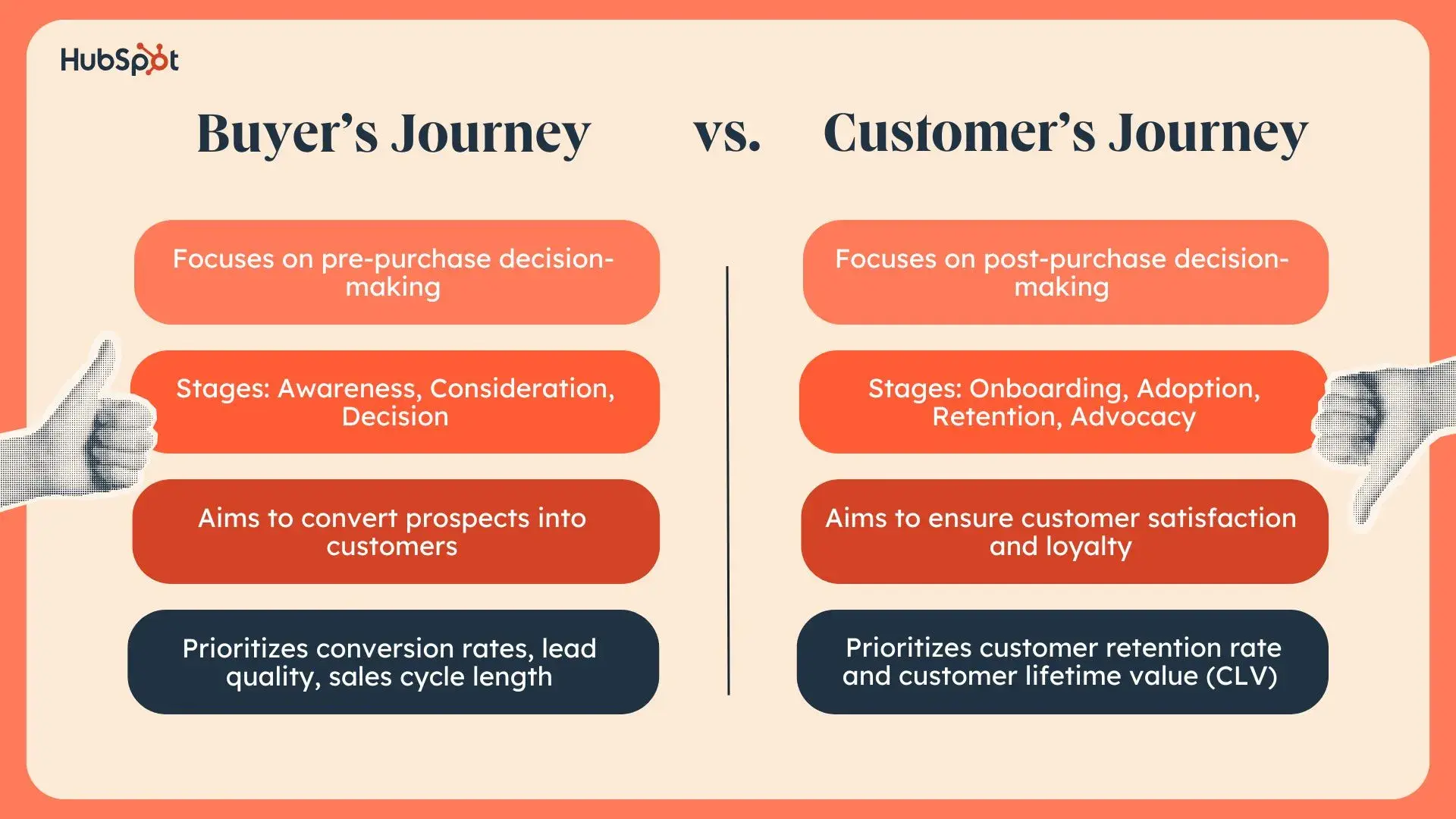
Take a glance at the list I assembled below for some further clarity on both journeys, their unique stages, and how each individual journey impacts the overall customer experience:

a hubspot-branded graphic detailing the difference between the buyer’s journey and the customer’s journey

1. Definition and Focus.

Let’s start with the basics, shall we? If you want to know why the buyer’s journey and the customer’s journey are disparate, this understanding begins with having clarity on how each journey is actually defined.

The buyer’s journey is the process in which a potential customer goes through before making a purchase decision. It focuses on awareness, consideration, and decision-making prior to becoming a paying customer.

The customer’s journey, however, represents the entire experience a customer has with a brand after making a purchase, including onboarding, support, retention, and advocacy. The customer’s journey focuses on building loyalty, satisfaction, and long-term relationships; it’s about turning buyers into repeat customers and, hopefully, brand evangelists.

2. Different Stages.

I briefly mentioned the stages of the buyer’s journey and the customer’s journey above. Here’s what each stage really means in a bit more detail:

The Buyer’s Journey Stages (Pre-Purchase)

  • Awareness: The buyer realizes they have a problem or need
  • Consideration: The buyer researches possible solutions
  • Decision: The buyer evaluates options and makes a purchase

The Customer’s Journey Stages (Post-Purchase)

  • Onboarding: The customer gets started with a product or service
  • Adoption: The customer actively uses the product or service
  • Retention: The company engages with the customer to prevent churn (i.e., sending post-purchase emails and details, etc.)
  • Advocacy: The customer is satisfied and refers others

3. Different Primary Goals.

As the buyer’s journey and the customer’s journey are separate processes, they have different goals.

The buyer’s journey prioritizes converting potential customers into paying ones. At this stage, businesses focus on educating prospects, addressing pain points, and positioning their product or service as the best solution. Strategies like content marketing, personalized outreach, and product demonstrations play a huge role in moving buyers toward a purchase.

The customer’s journey, on the other hand, is all about maintaining and strengthening the relationship after the purchase. It aims to always keep customers happy, engaged, and loyal to a brand. This phase often includes customer service interactions, loyalty programs, upsell opportunities, and encouraging brand advocacy through referrals and reviews.

When in doubt about specifying how these two journeys apart from one another, just remember: While the buyer’s journey ends at conversion, the customer’s journey is an ongoing process.

4. Different Metrics of Success.

The buyer’s journey centers the following metrics:

These metrics help businesses evaluate how effectively they attract, nurture, and convert potential customers into paying ones.

The customer’s journey relies these metrics:

These indicators help businesses assess the efficiency of their sales funnel and identify areas for improvement in the acquisition process.

What are the three stages of the buyer’s journey?

If you want to understand the buyer’s journey in its simplest form, I suggest thinking about the three stages that make the buyer’s journey flow seamlessly.

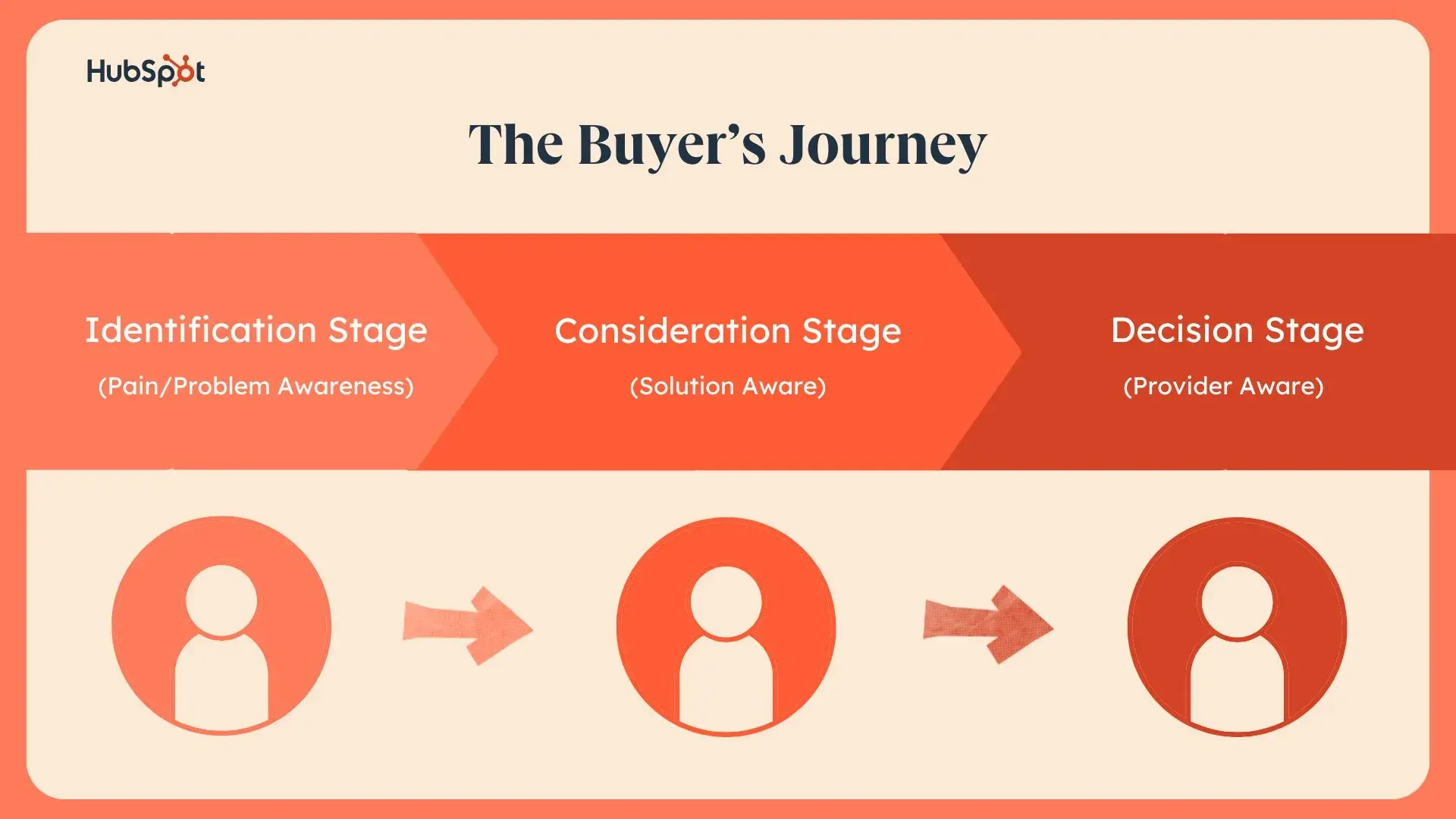
To help you grasp them more clearly, review my step-by-step breakdown of the buyer’s journey below:

 a hubspot branded graphic showcasing the buyer’s journey and each of its stages

1. Awareness Stage: The buyer becomes aware that they have a problem.

During this stage, the buyer is experiencing a problem or symptoms of pain, and their goal is to alleviate it. They may be looking for informational resources to more clearly understand, frame, and give a name to their problem.

2. Consideration Stage: The buyer defines their problem and considers options to solve it.

Next, the buyer will have clearly defined and given a name to their problem, and they are committed to researching and understanding all available approaches and/or methods to solving the defined problem or opportunity.

3. Decision Stage: The buyer evaluates and decides on the right provider to administer the solution.

Finally, the buyer has decided on their solution strategy, method, or approach. Their goal now is to compile a list of available vendors, make a short list, and ultimately make a final purchase decision.

If you don’t have an intimate understanding of your buyers, it may be difficult to map out the buyer’s journey in a way that will be helpful from a sales perspective. In this case, be sure to conduct a few interviews with customers, prospects, and other salespeople at your company to get a sense of the buying journey.

Tips for Applying the Buyer’s Journey to the Sales Cycle

Simply put, buyers don’t want to be prospected, demoed, or closed when they’re not ready. When offered at the wrong time, these steps add zero value from their perspective. However, a sales rep can shine when buyers seek additional information about your product that can't be found online.

When it comes to mastering the buyer’s journey, timing is truly everything, so here are my suggestions for how to engage buyers at the right moment:

1. Awareness Stage

When buyers are in the awareness stage, they recognize a challenge or opportunity that needs attention. They also decide whether the challenge or opportunity should be a priority.

Because of this, sales folks must approach potential buyers with sensitivity, not sales pitches. As I mentioned above, instead of pushing a product or service, the goal should be to help buyers articulate their problem, explore potential impacts, and guide them toward the next steps in their journey.

In short, at this stage of the buyer’s journey, don’t expect customers to choose your brand because its the first option they come across. Buyers will take their time to think on what to do next; all you can do is provide resources that give them more insight about your offering.

Take a look at this chart I assembled to help you think through how you want to go about capturing buyers’ attention effectively during this stage:

What You Should Be Asking

Actions You Should Be Taking

How do buyers describe their goals or challenges in the context of our business?

How are our buyers educating themselves on these goals or challenges?

What are the consequences of buyer inaction?

Are there common misconceptions buyers have about addressing the goal or challenge?

How do buyers decide whether the goal or challenge should be prioritized?

Creating informational, not sales, sales collateral that educates them along their path to purchase.

Providing them with resources to help them define the problem.

Helping, helping, helping.

Here are a few other tips to consider:

  • Offer different types of engagement to customers based on readiness. Think low-commitment webinars for early-stage buyers, free product trials for those closer to a decision, and personalized consultations for customers who need some extra reassurance before making a purchase.
  • Use lead storing whenever you can. Lead scoring will help you identify when a customer is actively researching vs. just starting their buyer’s journey.

2. Consideration Stage

By this point, buyers have clearly defined the goal or challenge and have committed to addressing it. They are now evaluating different approaches or methods to pursue the goal or solve their challenge.

This is a high-stakes, particularly fragile part of the buyer’s journey. Why? Because buyers are actively comparing solutions, possibly making a pros/cons list to help them choose what’s the best fit for them, and, all-in-all, seeking any final signs of validation for the decision they’ll make. Most likely, buyers are using these moments to:

  • Scour social media for demos
  • Look for testimonials/reviews from real customers
  • Analyze case studies to see how others have successfully used the product or service

At this stage, salesfolks must position themselves as trusted advisors, not just sellers. Instead of pushing a one-size-fits-all solution, sales teams should provide as many value-driven resources as possible that help buyers confidently choose an approach — whether that includes their product or not.

Here’s another chart I organized to guide you through how to navigate this stage:

What You Should Be Asking

Actions You Should Be Taking

What categories of solutions do buyers investigate?

How do buyers educate themselves on the various categories?

How do buyers perceive the pros and cons of each category?

How do buyers decide which category is right for them?

Understanding exactly how our product or service solves their problem compared to our direct and indirect competitors.

Considering how our direct and indirect competitors show up in the marketplace and how they influence perception.

Providing the buyer with resources to help them determine the right solution for them.

3. Decision Stage

Finally, when buyers make it to this part of their journey, they’ve decided on a solution category and are now evaluating providers.

This is a crucial part of the buyer’s journey because they’re on the verge of making a final commitment. Buyers are comparing features, pricing, implementation processes, and overall satisfaction with the product or service they’re considering. Trust and credibility play a huge role here; buyers want reassurance that they’re making the right choice.

So, what should salesfolks do when they’ve arrived to this stage of the buyer’s journey? Well, in my opinion, it’s all about eliminating friction and reinforcing confidence by addressing lingering doubts and offering tailored recommendations.

To figure out what to ask and what to do as a salesperson seeking alignment with this stage, review my list of recommendations below:

What You Should Be Asking

Actions You Should Be Taking

What criteria do buyers use to evaluate the available offerings?

When buyers investigate our company's offering, what do they like about it compared to alternatives? What concerns do they have with it?

Who needs to be involved in the decision? How does each person involved's perspective on the decision differ?

Do buyers have expectations around trying the offering before they purchase it?

Do buyers need to make additional preparations outside of purchasing, such as implementation plans or training strategies?

Understanding what objections they might have before the sales process so that you can adequately handle them.

Ensuring you have a unique selling proposition that provides value to the buyer and sets you apart from competitors.

Some of these considerations may fall more under the marketing umbrella than the sales umbrella. Still, ultimately, the answers to these questions will provide a robust foundation for your buyer’s journey.

Final Thoughts: Making the Buyer’s Journey Work for You

Knowing how your buyers buy is invaluable as you create or refine your sales process. Once you’ve unlocked the hows and the whys behind their decision-making processes, you’ll better empathize with them, handle their objections, and provide them with correct information at the right time, helping you close more deals and win more business.

If you walk away from this post having learned anything, I hope it’s these three things:

  • Take the time to understand your buyers
  • Refine your strategy
  • Meet buyers where they are (with the right information, at the right time)

Once you put these things into practice, watch your sales process become smoother, smarter, and more successful. Because when you sell the way buyers want to buy, everybody wins.

15 Jun 17:05

When One to Many Is One Too Many

by Don Power

The other night, as I was flipping through the channels on TV, I stumbled upon an old, familiar episode of Star Trek. In this story, a planet of humanoids was worried that centuries of civil war would eventually wipe out the entire species. To address this, they automated warfare to the point that now only the machines fought with each other.

When One To Many Is One Too Many

The people of the planet were no longer directly involved in the conflict. Instead of going to war themselves, one side’s machines simply fought the other side’s machines until a winner was calculated by an “infallible” supercomputer.

While comparisons could be made to modern-day drone warfare, as a marketer I pictured an analogy much closer to home. In a drive to become more and more efficient, and to increase the almighty ROI, modern day marketers are engaged in a seemingly insatiable quest for marketing automation. Where salespeople once picked up the phone, networked, or met in person with prospects, now it seems that more and more of these sales-related functions have been outsourced to apps, and informed by algorithms. Schedule your tweets, load up your curation tool with content, hit send on your latest drip marketing email campaign – and then you can just sit back and watch all the marketing magic happen, right? Not exactly.

As someone who’s been on both sides of those communications, sometimes it feels like marketing has become just a bunch of machines talking to another bunch of machines – with no humans in between who care very much about what’s actually being said.  Economies and efficiencies of scale have allowed us to wash our hands of guerrilla marketing in favor of the push-button solutions analogous to the warring factions on that old episode of Star Trek.

OK Computer

As economical and practical as these methods of metaphorical “marketing warfare” may seem, don’t you get the feeling that the more time you spend on Facebook, Twitter, or reading your email these days the less you feel like you’re actually conversing with live human beings? As practitioners of marketing, surely this is not the pinnacle of our collective creativity.

Don’t get me wrong – I’m no Luddite. I don’t wish, nor do I implore you as a modern marketer or business person to completely unplug from the marketing machine. It has its place. In fact, marketing at scale can yield great insights about your audience and provide valuable feedback that can be used to refine your messaging.

For example, testing a series of ads with large audiences on Facebook can provide bell curve statistics that show you clearly (and relatively cheaply) which messages resonated – and which messages died on the vine (or the Vine!).

Similarly, if a social media scheduling app consistently identifies a large portion of your audience to be engaging at a certain time of day – or a certain day of the week , then that’s you’re cue to spend more time, live and in-person on those platforms, during those peak times.

If you use marketing automation tools and techniques to reach the masses, continue to do so. But consider spending at least some of your valuable personal time making connections with just a few members of your target audience. Pick up the phone and ask a few former clients (or new prospects) out to lunch.

In between your slate of scheduled tweets, why not spend an hour or two a week participating in some relevant Twitter chats and engage in some real-time communication with other real human beings? Give Facebook Live a try and revel in the fact that others – whether it’s one or one thousand people – have chosen to share their precious time and attention with you at that moment.

Look, if your top salesperson came to you tomorrow – excitedly clutching a thousand leads, you’d know that he or she could still only meaningfully contact a handful of those leads per day. Heck, you’d no doubt be delighted if a relatively laid back sales campaign of contacting a few leads every day resulted in a few conversions a week. What’s the alternative – sending your salespeople out among the dozens or hundreds of automated messages your marketing team currently sends out per week – hoping that some of that spray and pray messaging nets a few conversions somewhere down the line?

Do yourself and your organization a favor. Instead of chasing the next shiny automated social media object, do something your competition doesn’t expect – take a short hiatus from all the noise and head in the opposite direction. Try slowing down and see how it can actually speed up your marketing success.

The post When One to Many Is One Too Many appeared first on Social Media Explorer.

15 Jun 17:05

Close Deals Faster by Telling Your Prospects How to Buy

by Waylon McGill

We’ve all heard that time kills all deals, so today I’d like to talk about a technique I’ve used to tighten up my sales cycles.

Let me set the context for you. You had a great discovery call with a prospect and uncovered some really great pain points. Then you ran a great demo showing the prospect how your solution addresses their key pain points. Even better, you gained agreement from the prospect that your solution addresses those challenges.

So at the end of the demo, being the good salesperson that you are, you ask for the business and you stop talking:

You: Karen it sounds like there’s a really strong fit here. Do you want to roll this out to your team?

Karen: Yeah, this looks great. Why don’t you leave this with me and I’ll get back to you.

The first time this happened to you, you were probably dumbfounded, but any sales veteran has seen this so many times that it doesn’t even register as abnormal buyer behavior at this point.

The common wisdom is that a buyer will say this because there’s an unresolved objection or issue that needs to be addressed before they will feel comfortable moving forward. Often that is true. But sometimes there is no objection. Sometimes the buyer just wasn’t expecting to make a purchasing decision on the call and now making one seems rash. They don’t have any specific doubts, they’re just not ready.

At this point, you’ve got a bit of a predicament. Do you remind the prospect of the value that your solution is going to deliver and suggest that every day they delay is a day they aren’t taking advantage of that value? It’s a fairly standard play, and it often works when executed well. You should probably do it.

It does carry some risk with it though. Your prospect may perceive your prodding as self-interested, and you could lose some of the credibility that you worked so hard for throughout the sales process.

Wouldn’t it be better if you could avoid having to make that decision? Of course it would! That would mean that your buyer didn’t defer making a decision; they decided to buy, or at least they decided not to buy so you can move on.

So how can you make that a more common reality? You do it by setting expectations with your buyer up front about how other buyers like them have evaluated your solution in the past. Use social proof.

Social proof is incredibly powerful. It’s what gives case studies their power, it’s why referral leads close faster and at higher rates than other leads, and it’s the reason why anyone reading this has even heard of the term “advocate marketing.” People look to the beliefs and behaviors of others to inform their own beliefs and behaviors. It’s one of the most well established principles in all of social psychology.

Salespeople love using social proof when talking to prospects about why they should buy, but they rarely use social proof when talking to prospects about how they should buy.

On the discovery call that might sound something like this:

“It sounds like there are some things that we can help you with. I think the best next step would be to go through a product demo together. It will take about an hour, and by the end of that demo most people will know whether or not (your solution) is the right fit, which is nice because it gets it off your plate.”

The way that a prospect would respond to that statement would tell me a great deal. Sometimes they would say “I won’t be able to make a decision on Tuesday because…” and then they give me some really critical information that helps me better understand the deal and when it’s likely to close (or not).

Other times, they would say something like “Oh, that’s wonderful.” As in, “it’s wonderful that I will be able to make a decision and stop thinking about whether or not I’m going to do anything.” People don’t like making decisions. This isn’t a new idea. Existential philosophers like Sartre and Kierkegaard referred to it as existential dread, that peculiar negative affect that we feel when having to make choices, even inconsequential decisions like which movie to watch on Netflix. Buyers hate making decisions as much as Sartre would hate Netflix. So make it easy for your prospects and tell them how to buy.

This technique made my life so much easier. Not only did I close more deals, but I did so much more efficiently. I spent less time following up on deals because so many of my deals started to close right on the demo.

If a deal didn’t close on the demo because someone needed a few more days, I didn’t worry because I would just use another expectation setting technique that looked something like this.

Me: OK. Why don’t we do this, let’s schedule a follow up call for Thursday and at that point you can address any remaining questions or concerns that you have. If we’re able to successfully address those concerns then we’ll move forward, and if we discover that there’s a deal breaker then at least you’ll know you gave (my product) a thorough evaluation.

How could anyone say “no,” to that? It’s the most reasonable suggestion ever. If the client has no remaining questions or concerns about moving forward then by definition there is no reason for them not to move forward. You’ve also given them an easy out, if there’s a deal breaker you can easily walk away.

I rarely had to go beyond that single follow-up meeting to close a sale aside from deals where it was established early that the sale would be more complex. I was able to avoid sending those terrible “checking in,” and “just following up,” emails and I was able to forecast with incredible accuracy which of my deals would close and when.

If you want to make your prospects feel more comfortable buying from you set clear expectations with them early on, leverage social proof regarding how others buy, and then follow through on the expectations you set. They should never be surprised when you ask for the business. Asking for the business should feel like the natural next step to both of you, and if you’ve done a good job, buying will feel natural too.

Disclaimer:

These techniques are obviously geared towards more transactional sales, but you can still use these techniques to help accelerate longer deals. The difference is that instead of using social proof and expectation setting to close the sale you might use it to advance to the next stage in the buyer’s buying process. That could mean bringing in an executive sponsor for the demo if the discovery call goes well, or starting a pilot program if a demo goes well.

The post Close Deals Faster by Telling Your Prospects How to Buy appeared first on Sales Hacker.

15 Jun 17:05

Avoid Failure with This Formula for Setting Successful Sales Goals

by Colleen Francis

Everybody has sales goals. . .

Some are set by our companies and some we set ourselves. For many sales reps, it wouldn’t be January without either a new sales quota or a new personal objective for the year ahead. If I had to guess, I’d be willing to bet that we all want to achieve more this year, right? But how many of us have actually created a detailed plan that will help us realize our goals?

Despite the importance both we and the companies we work for place on achieving objectives, it never ceases to amaze me how many salespeople fall short each year. It doesn’t have to be that way! Let’s discuss how to develop the essential behaviors needed to achieve your goals not only this month or year, but consistently and for the rest of your career.

The secret’s in the planning

Our research of sales teams has found that 100 percent of salespeople understand why setting goals is important (focus, commitment, dedication, etc.), and know what types of goals they should set (business, family, social, personal.) We’ve also discovered that 80 percent of salespeople understand the proper way to structure a goal, such as by using the acronym SMART. But last year, approximately 60 percent of field sales people still failed to achieve their objectives.

Why?

In the overwhelming majority of cases, salespeople fail to achieve their goals because they lack a detailed plan. In fact, very few of us understand what we need to do on a daily and weekly basis to achieve our goals.

So where do you begin? Below is a simple, four-step planning tool you can use to build your career, by designing a clearer path towards achieving your goals every month, quarter or year:

1. Identify your outcome in a way you can measure

What, specifically, are your sales and production goals for this year? For example: “I want to close $500,000 in new business and $500,000 in repeat business from existing clients this year.”

2. Carve your pathway to success

How do your goals break down into quarterly, monthly, weekly and daily goals?

Here’s an example of a sales quota — and how an average salesperson can expect to perform:

  • New business goal: $500,000
  • Average sales size: $20,000
  • Total sales needed to achieve goal: 25

Based on our sales metrics, to accomplish your goals for the year you can assume the following:

  • The average salesperson closes 1:3 qualified leads. Therefore to make 25 sales, our sample sales person needs 75 qualified buyers.
  • The average salesperson needs to meet three prospects in order to qualify one. So in the above example, our sales person needs to meet 225 prospects.
  • The average salesperson needs to make 15 attempts (phone calls, voicemail, email, etc.) to get one meeting. So, our sales person needs to make 3,375 attempts this year.

If this sounds like a frightening number, remember that 3,375 attempts over the course of a year really translates into:

  • 282 attempts per month
  • 71 attempts per week
  • Just 14 attempts per day

Now that’s what I call an easy plan to follow!

3. Launch your strategy

To give you a baseline on the amount of time it takes to make these daily calls, I make 25 attempts per day, which takes me two to three hours to complete. Here are some tips to help you complete your daily sales goals:

  • Start today. Half the battle is just showing up!
  • Keep records and make lists. Successful salespeople record their progress toward each goal every day, and then list the five most important things they need to do the next day to move that goal even further ahead. This short “To Do” list is 100 percent focused on achieving their goals because the most successful salespeople understand that daily discipline is the key to reaching your goals.
  • Track your attempts, meetings, and close ratios consistently, and measure your results. Then adjust your plan based on your real metrics. You may find that you’re above or below the averages I’ve used in this example, but if you don’t measure to find out, you won’t know where to improve.
  • Prospect consistently. Whether you chose to make all your weekly calls in one day or to do a small amount each day doesn’t matter. What matters is that you are consistent. Think of yourself as a professional. Misty Copeland would tell you it’s the consistency of her practice time in the dance studio — the hours upon hours of fine-tuning her body’s movements — that leads to her ultimate success.

4. Use radical accountability to drive success

  • The top 10 percent of sales performers have one thing in common: they’re committed to radical accountability. Mark the time you’re going to spend attempting to reach customers in your calendar each day or week, and close your office door until you’ve completed it. While you’re at it, turn off your email and don’t take inbound calls. If you work in a cubical, find a closed office in which to do your prospecting. In other words, force yourself to stay focused and avoid distractions. The fewer distractions you have, the faster the work will get done.
  • Tasks that are rewarded are tasks that get done. Find a way to reward yourself after your calls are made each day. My personal reward for completing all daily prospecting calls is a trip to the local Starbucks for my favorite “Venti triple shot non-fat mocha!” No calls, no coffee — it’s that simple. Guess what gets done first thing each morning?
  • Write your goals down, update them constantly based on your real results, and then make them public and display them close by. Studies show that people who share their goals with others are 70 percent more likely to achieve them. Discuss your goals with those people you respect the most, and you’ll work harder to ensure that you don’t disappoint them.

What’s the takeaway message?

The difference between top sales performers and the rest of the field is clear. Top performers have a plan to achieve their goals, and they act on that plan every day. This year, commit yourself to being a top performer. Design a daily and/or weekly plan, act on it consistently, and monitor your results.

It’s been said that most people aim at nothing and hit it with surprising accuracy. We all have a goal in mind. Whether you hit it or not will depend on your ability to define and consistently focus on the tasks that lead to your goal. If done right, you’ll be sure to hit your mark.

15 Jun 17:05

4 Reasons to Implement Sales Enablement

by Taylor Davis

Sales enablement is a term that may seem foreign but is quickly becoming an indispensable aspect of forward-thinking businesses. Imagine sales and marketing came together to make the sales funnel more relevant, interesting, and effective to both you and your customers.

Here are four reasons why adding sales enablement to your sales process will take you further with leads and prepare you to close more customers.

1. Make Your Sales Content Relevant to the Opportunity

As a marketer, you wouldn’t write a tweet that had nothing to do with your target audience and expect it to bring in new customers. The same goes for the sales process.

Every piece of content, documentation, and even the technology you use has to speak to your prospects’ specific needs and stories. With so many companies competing for your business, if you’re not relevant to your customers, you’re not selling.
It’s like dropping your kids off at school without their homework or a packed lunch.

That’s why implementing a sales enablement process is crucial. Sales enablement includes the technology involved in the sales process and the content included in your case studies, proposals, quotes and contracts that are sent to clients once they’re on the hook (hint: PandaDoc makes this easy).

Don’t have a case study or white paper that’s relevant to that type of lead? Make one as soon as you see a demand for it. It scales better than you may think.

Whatever you do, don’t assume that one contract or case study will work for each opportunity you have. It’s all about curating a personalized (read: relevant to their field) set of sales content to fit specific problems, markets and client types, and having it at-the-ready when the opportunity moves forward.

2. Non-converting Customers Become a Thing of the Past

Creating and finding leads gets your foot in the door, but does that mean they’ve really entered the sales cycle?

As Jared Fuller, Head of Partnerships at PandaDoc, said, “What’s the use of someone becoming a lead and then an opportunity, if you can’t then actually have a closing conversation with them, and deliver something to them, where they sign on the dotted line, or pay for the product or service?”

Think of it this way: marketing generates dozens of leads and then says “Have fun!”, leaving your sales team to figure out exactly how they’re going to turn them into paying customers. While it’s not marketing’s job to sell the product and convert customers outright, leaving leads on the table and merely hoping that they’ll turn into customers is the same as leaving those leads to die.

With sales enablement, you increase the conversion rates of those leads, allowing the sales team to do a better job at hooking those companies and bringing them through the finish line.

Sales enablement tools are more than just the butter to your bread – they’re the plate that your waiter keeps filling up when you’ve finished off your baguette.

3. Turn Your Lead Gen Engine into a Rev Gen Engine

There’s a distinction between being great at bringing in a large number of leads and being great at making them customers.

The difference? Revenue.

When you set a sales team up for a smoother ride to revenue, you’re creating more value than a hundred non-converting leads could.

Not to mention, customer referrals and testimonials are the #1 way to bring in more clients. By creating a more relevant experience for your customers and tying yourself to the revenue numbers , you’re ensuring not only an awesome, continuing relationship with each customer, but the chance that their success story can lead to more opportunities for you.

4. Set Yourself Apart

Your time and deliverables become more valuable to your customers when you make the sales process easier. It’s that simple.

Think of it this way. A lead comes to you in the healthcare field. You’ve had a few healthcare customers before, but it’s not a large portion of your lead pool. You send out your standard contract, white paper and blog post that you use for your technology customers. This automatically makes your healthcare lead feel that you don’t understand their market, so they look elsewhere for services.

By adding relevant sales enablement to your services or your sales process, you’re setting yourself apart from the general sales flow (and your competition) showing your customers (and the rest of your organization) that you can be more successful, relevant, and convincing by coming prepared with content, documentation, case studies, and technology that resonate with potential customers and their relevant markets.

This not only makes the buyers’ experience easier and more enjoyable, it helps your sales process run as smoothly and efficiently as possible.

The Bottom Line

When you look at sales enablement as a whole, there’s really nothing that can go wrong with making your sales process more relevant to your leads and more effective in converting leads to customers. By arming your sales team with the right sales enablement tools, you’re setting yourself up for success.

15 Jun 17:05

5 Ways to Expand Lead Nurturing Beyond the Inbox

by Howard J. Sewell

Email may still be the workhorse in how B2B companies build relationships, maintain awareness, qualify leads and nudge prospects along the sales cycle, but these days, it pays to think about “lead nurturing” as more just an email campaign.

beyond the inboxThat’s not because email is going away any time soon. However, a more balanced, integrated nurture program – one that incorporates other communication channels – can help accelerate the lead lifecycle and improve demand generation ROI by maximizing the chances that your nurture message reaches its intended recipient. If nothing else, integrating other channels into your lead nurturing mix reduces a 100% reliance on email and improves your chances for lead nurturing success.

Here are 5 ways to expand your lead nurturing program beyond the inbox:

Telesales – often, inside sales plays only a reactive role in the lead nurturing process, responding when prospects engage with the nurture program or show other signs of interest. But you can integrate your BDR team more seamlessly into the nurture campaign by scheduling calls (via assigned tasks in your CRM system) in sync with other “touches”.

Direct Mail – the rise of Account-Based Marketing (ABM) has renewed interest in direct mail as a high-impact vehicle for delivering your message to targeted accounts or senior executives. But direct mail doesn’t have to be a “batch” process. It’s now possible to schedule personalized direct mail drops – through technologies like PrintingForLess – directly into your nurture stream.

Paid Social Media – all three leading B2B social media channels (LinkedIn, Twitter, Facebook) offer variations on “custom audience” programs that enable you to upload lists of customers, prospects, or target accounts and deliver ads exclusively to that audience, or so-called “lookalike” prospects that meet the same criteria. By leveraging the same offers, message, and creative assets (ex: landing pages) that you already have in place, paid social media (Social PPC) can be a natural and cost-effective complement to your lead nurturing campaign.

Google AdWords Customer Match – similar to the custom audience programs offered by the big social networks, Google also allows advertisers to upload a list of email addresses and then reach those precise contacts via ads on Search, Gmail or YouTube. You can also serve different ads (or adjust bids) based on whether an individual is an early, mid or late stage prospect, or even an existing customer.

Programmatic Ad Networks – programmatic networks like Choozle are yet another way to add “air cover” to your nurture campaign by reinforcing the same (or complementary) message, offer, etc. through ads on display, video, mobile and social networks.

Tip: since many of these complementary channels are real-time and “always on”, they offer a powerful opportunity for testing message, offer, segmentation and other campaign variables in ways that might be more difficult if left exclusively to email. Cross-pollination is the key – a simple word change in a LinkedIn ad, if successful, could drive increased click-through rates from your email campaign, and vice-versa.

For a more detailed look at a related topic, download our free white paper on “Social PPC: Tips for Successful Ads on Twitter, LinkedIn & Facebook.”

15 Jun 17:05

Toyota gets bullish on plug-in hybrids with new Prius Prime

Toyota Motor Corp.'s Prius PHV is displayed at the Smart Community Japan exhibition in Tokyo Wednesday, June 15, 2016. Toyota Motor Corp Chief Engineer Kouji Toyoshima said the Japanese automaker plans to get as bullish as its rivals in pushing plug-in hybrids with the introduction of its new Prius Prime. Toyota Motor Corp. leads the industry in hybrids, which switch between a gas engine and an electric motor. It has sold 9 million hybrid vehicles around the world since the first Prius went on sale in 1997 but only about 75,000 plug-in hybrids, which charge from a regular household plug and switch to operating as hybrids only when their batteries run low. (AP Photo/Shuji Kajiyama)

TOKYO (AP) — A top engineer at Toyota says the Japanese automaker plans to get as bullish as its rivals in pushing plug-in hybrids with the introduction of its new Prius Prime.

Toyota Motor Corp. leads the industry in hybrids, which switch between a gas engine and an electric motor. It has sold 9 million hybrid vehicles around the world since the first Prius went on sale in 1997 but only about 75,000 plug-in hybrids, which charge from a regular household plug and switch to operating as hybrids only when their batteries run low.

The first Toyota plug-in was launched in 2012, after limited leasing from 2009. It will start selling its remodeled plug-in, called the Prius Prime in the U.S. and Prius PHV in Japan, later this year.

The company is promising a whopping mileage equivalent to 120 miles per gallon, calculated including how far the vehicle goes as an electric car, without a drop of gas.

"We were just studying it thoroughly," Chief Engineer Kouji Toyoshima told The Associated Press, when asked whether Toyota had fallen behind on plug-ins. "But what we have developed is at the top level among plug-in hybrids."

The Prius Prime looks similar to a regular Prius. Toyota is aiming for a model it can sell at high volumes, with friendly styling and affordable prices, so as to have the most impact in reducing fossil fuel consumption, Toyoshima said. He said battery costs are the main obstacle for reducing prices.

Toyota has not yet announced pricing for the Prius Prime.

The vehicle's solar panel provides about 10 percent of the average driving range of a Tokyo resident, partly addressing the criticism that while electricity is emissions-free at the car level, power generation relies mostly on fossil fuels. When the Prius Prime is operating as an electric car, the generator for its hybrid feature also works with the motor to increase efficiency, Toyoshima said.

The EV's cruise range is 22 miles (35 kilometers), or long enough for about half of American commuters. That rises to about 80 percent for people who can plug in during work, according to Toyota.

Toyota was the first with the Prius, but today the market for plug-ins is crowded with offerings from General Motors Co., Volvo and Mitsubishi Motors Corp., and electric cars from Tesla and Nissan Motor Co.

"The new Toyota Prius Prime is facing a much tougher competitive environment," said Christian Stadler, professor of strategic management at the University of Warwick's business school. He said it makes sense for Toyota to move up-market and cater to customers who are less price-sensitive and more concerned with the environment.

Oil prices have fallen in recent months, dampening hybrid sales. But automakers are pushing ahead with ecological technologies to comply with stricter regulations on emissions and address global warming, Stadler and other analysts say.

"The Prime is in line with Toyota's image as a green automaker, and will further that image —even though it is not the first company to offer such an option," said Stephanie Brinley, senior analyst with IHS Automotive. She said the car will likely appeal to mainstream buyers, while Tesla remains the big green status symbol.

___

Follow Yuri Kageyama on Twitter at https://twitter.com/yurikageyama

Her work can be found at http://bigstory.ap.org/content/yuri-kageyama

Join the conversation about this story »

15 Jun 17:04

Top Salespeople Are More Likely to Use These Tools Than the Rest of You [Data]

by pcaputa@hubspot.com (Pete Caputa)

linkedin-state-of-sales-technology-2016.jpg

The sales software space is booming.

On Monday, LinkedIn announced its acquisition by Microsoft for $26.2 billion in order to, among other things, “redefine social selling through the combination of Sales Navigator and [Microsoft] Dynamics [CRM].” Research from InsideSales.com shows companies in North America are already spending more than $15 billion on sales acceleration tools and Gartner predicts that enterprise CRM alone will be a $36 billion market by 2017.

It's no surprise. These days, it doesn't matter what your profession is -- having and using the right software is essential to achieving success. This is especially true in sales because of the amount and variety of communication salespeople must initiate, track, and organize -- not to mention the pressure to exceed quota in a world where our buyer’s default reaction is to dismiss us or tune us out.

In fact, according to LinkedIn's State of Sales 2016 report, the tools that a salesperson uses is highly correlated to their sales performance. The report finds that "top salespeople are 24% more likely to attribute their success to sales technology: 82% percent of top salespeople cite sales tools as ‘critical’ to their ability to close deals, compared with 66% overall.” The report also shows that top salespeople are more likely to use a customer relationship management (CRM) system, productivity apps, social selling tools, sales intelligence tools and by the widest margin: Email tracking tools.

Which software tools are you using and how much time should you be spending with each? Read on to learn what the top (and the majority of) salespeople are doing.

Salespeople Use Many Different Types of Sales Technology

LinkedIn’s survey analyzed the use of the following five different types or categories of sales technology.

1) Customer Relationship Management (CRM)

In its simplest form, CRM helps salespeople (and their companies) record, reference and report interactions with past and current prospects and customers. (Read: What is CRM?)

2) Email Tracking

Probably the narrowest and most easily defined category of the five, email tracking software integrates with your email client (such as Gmail or Outlook) and tracks when a recipient opens an email or clicks on a link in an email you sent them.

3) Social Selling

Social selling software is any software that helps salespeople initiate and build relationships with buyers on social media sites like Twitter, Facebook, LinkedIn, or even Snapchat and Instagram.

Many salespeople use social media sites directly. Others use social listening and publishing software like HubSpot’s social monitoring and publishing, Hootsuite, Sprout Social or Buffer, as they can help salespeople sort relevant messages from noise, tune into only what their leads are sharing, monitor social activity, and publish messages to multiple networks.

But based on my vantage point, the most popular social selling software is LinkedIn’s Sales Navigator because it allows salespeople to create lists of prospects based on LinkedIn’s vast member-managed repository of contact and company data, as well as contact more of those members directly.

4) Sales Intelligence

Sales intelligence software provides contact and company data so salespeople can build lists and prospect into new accounts. G2Crowd, a peer review site for software, has a full comparison of available sales intelligence tools which includes rankings.

LinkedIn, once again, rules this category with Sales Navigator. Other tools in the space include Salesforce’s data.com, one of the orginal, modern data providers and InsideSales.com, which has solid traction among large sales teams because of the attractiveness of its broader suite. 

In addition, salespeople can tap specialty providers like DiscoverOrg, which provide IT, finance and marketing organizational charts to companies who sell to those departments, and Datanyze, which provides information on the software your prospects are using on their website. Our own CRM includes a database of 18 million companies that instantly provides salespeople information about the companies they are pursuing -- no data entry required.

5) Productivity Apps

While I predict these tools will eventually be integrated into most CRMs, sales productivity apps are tools that help salespeople improve efficiency and productivity. According to the report, this includes document storage and sharing tools like Dropbox and Box. Many salespeople use other types of sales productivity apps like tools that automate CRM data entry, proposal-building tools and task management software, to name a few.

If you think some of these software categories sound similar to each other, you’re not alone. The sales technology space is not only new and growing fast, there are many software companies offering more than one of these capabilities. Many companies -- like HubSpot, Salesforce, LinkedIn and InsideSales.com -- even offer products across the majority of these categories. These five categories are just one way of organizing a rapidly expanding ecosystem of sales software providers, available to help salespeople be more efficient and more effective.

What’s really crazy is that many of these categories -- and the companies that provide them -- didn’t even exist a few years ago. Nicolas de Kouchkovsky, in partnership with VentureBeat tracks the current sales technology landscape. The graphic below is the latest visual they’ve produced and includes 340 companies. (Warning: Staring for too long at this sales technology landscape chart below will make your head hurt.)

1455583474-1859794-960x540-Inside-Sales-Technol.png

And more choices are emerging every day -- de Kouchkovsky added 40 new software companies to his list at the end of 2015, and he told me recently he needs to add another 70 companies to the graphic that have popped up since the beginning of 2016 -- and those are just the ones worth tracking. Clearly, the landscape is getting more crowded -- and many of these companies are expanding their capabilities to compete with each other, making it even more confusing to pick the right tools for your needs.

Where should you start?

CRM Is Still Critical, But Majority of Reps Don’t Use One

Despite all of the hubbub around new sales technology, CRM software (pioneered in the mid-1980s) is still the most-used tool, both in terms of time spent and number of salespeople using the tool. Forty-four percent of midsize companies, 23% of small businesses, and 27% of large businesses use CRM. One-third of those users spend three to five hours a week in the software, and almost 25% spend more than 10 hours a week using CRM. In contrast, fewer than 15% of salespeople use sales intelligence tools more than 10 hours per week.

If the idea of spending more time in your CRM sounds silly to you … hold your horses. More than 80% of top salespeople report that CRM is “critical” or “extremely critical” to their ability to close deals.

While salespeople spend more time using CRM than any other tool in the survey, it’s not just because they’re entering data so their boss can run reports. Top salespeople run reports themselves, take notes during calls directly in the CRM, and even store email templates in the software. These tasks help the salesperson stay organized in their pursuits, so it’s time well spent.

Many modern CRMs integrate with a salesperson’s inbox and calendar to sync data to the system automatically, so salespeople don’t have to do any manual entry. 

Regardless of what CRM you use, there are many time-tested benefits of CRM software. It can help:

  1. Store all prospect and customer information and historical communication with them in one place, accessible to your whole company.
  2. Set and remind salespeople to complete follow up actions.
  3. Provide a central place where multiple team members can coordinate actions with prospects or customers.
  4. Enable sales managers to inspect deals and their sales team’s full pipeline.
  5. Make it easier to teach and enforce a sales process.
  6. Allow reporting of conversion rates from sales process step to sales process step, enabling managers and salespeople to spot and remedy the inefficiencies or ineffectiveness of individual salespeople.
  7. Capture sales data that marketing can use to determine which marketing efforts are driving revenue.
  8. Enable instant forecasting for company leadership.

Personally, I can’t imagine running a sales team without one, even if the sales team was just one person. But despite all of these instant and impactful benefits, LinkedIn found that most companies aren’t even using a CRM. While more and more companies adopt CRM, less than “one-third of companies anticipate spending more money on sales technology this year,” according to the report. I’m biased of course, but if this describes your budget situation and you want to join the ranks of top salespeople, I’d encourage you to start with HubSpot’s free sales tools -- no additional budget required.

Email Tracking May Be Key to Improving Underperformance

Since email has become the de facto communication channel for buyers and sellers, email tracking software is fast becoming a de facto standard too.

According to LinkedIn’s research, just shy of 80% of top performers report that email tracking is either “critical” or “extremely critical”’ to their ability to close deals. Only slightly more than half of all salespeople responded the same way.

Why the disparity? Why do far more top salespeople think email tracking is critical than the rest of the sales population? The report doesn’t share a reason for this almost 30-point difference, but if I had to guess, it’s because top performers are better at paying attention to their prospects’ behavioral clues and using them for effective follow up. Whether it’s a website visited, an email opened, a link clicked, a contract forwarded, or a social media mention, top salespeople make relevant and timely follow-ups by monitoring what their prospects are doing and when they’re doing it.

Another theory: Whenever I teach salespeople with obvious sales weaknessses to use email tracking to time phone calls and prioritize follow-up communication based on which prospects are showing the most interest, I get funny faces and pushback from them. I find that these lower-performing or newer reps often think email tracking is creepy, while top-performing reps recognize how to use email tracking in a non-creepy way. If you think it’s creepy, it might be time to rethink your stance. According to LinkedIn’s data, if you’re not using email tracking to help you close deals, it may be a reason you’re not performing as well as your peers.

Another possibility the overall sales population cited email tracking as critical less frequently than top performers? Maybe they’re just behind the curve. Most email tracking tools are inexpensive and don’t require IT help to get started, leaving the decision to use one to each individual rep. 

Inside Sales People Are More Likely to Use Sales Technology

LinkedIn analyzed data by age, putting respondents into three buckets: Millennials, respondents aged 35 to 54 (commonly referred to as Generation X) and baby boomers (age 55+). As a group, millennials are “33% percent more likely to use sales intelligence tools than industry peers aged 35-54." In fact, millennials are more likely to use all five categories of sales tools more than the other two groups, especially baby boomers.

The report also found that “business development professionals used sales intelligence tools at about a 17% higher rate than any other job function surveyed." and that “inside sales professionals (62%) were most likely to rate email tracking tools as either ‘critical’ or ‘extremely critical’ to close deals."

Could it just be that inside salespeople and business development reps (usually entry-level positions) are better users of technology since it’s their job to initiate and connect with prospects from behind their computer and phone, instead of managing active opportunities face-to-face or via the phone like most account executives must do?

If you can’t tell, as a Gen Xer (it’s okay if you call me that, LinkedIn), I’m somewhat perturbed that the study didn’t dig past age as a reason for varying technology usage. Since most sales technology is most useful for prospecting, it is therefore most useful to business development reps and inside sales professionals, who just so happen to usually be younger than account executives.

So while LinkedIn’s report states, “Millennials Encourage Teams to Adopt Sales Technology Early and Often,” I bet technology is becoming more critical because more and more companies have moved outside sales resources inside and more and more buyers educate themselves via the web. But hey -- as inevitably as we all succumb to taxes and eventually death, many salespeople will retire and be replaced by younger people. So it’s a sure thing that sales technology adoption will rise over time, regardless of whether it’s just a generational change or if other business trends are driving it.

Social Selling Tools Are Here to Stay, Even if Many Reps Are Abusing Them

One thing that LinkedIn knows for sure: Social selling is booming. They know because their social software sales are booming. And it’s not just sales consultants who sell social selling tools who use it anymore. LinkedIn’s Sales Navigator software is flying off their “social” shelf according to their 2015 earnings report: “Premium Subscriptions revenue increased 22% year-over-year to $532 million in 2015. Sales Navigator remained the faster growing component of Premium Subscriptions with continued improvement in customer satisfaction and product usage.”

The survey reports that “more than 70% of sales professionals use social selling tools including LinkedIn, Twitter and Facebook” and that top salespeople believe these tools have a great impact on revenue growth.

The modern salesperson’s love affair with Sales Navigator is something I’ve witnessed over and over again. In my experience, once a sales team has access to Sales Navigator, cancelling that subscription often requires prying it from their dead, cold-calling hands. As Ambition writes in their 2016 Inbound Sales Software Guide, LinkedIn has this one figured out: “They’ve cornered the market on the largest prospect database in the world and their targeting, list building and integration features are nothing short of spectacular.”

I worry, though, that too many salespeople are abusing this newfound technology and access to up-to-date contact information. Too many salespeople simply use social selling tools just to find contacts and send self-promotional messages to them. Spam complaints are a huge challenge for email prospecting. Unfortunately, many salespeople just seem to be moving their spammy ways onto LinkedIn.

Why is this a concern? Whenever new technology is created, aggressive salespeople tend to use it to deploy their pushy sales tactics. It tends to sour buyers on the new technology and all of the salespeople who use it. (Anyone remember fax marketing? What about those automated, pre-recorded cold calls you get at night?) The problem with social selling is that salespeople can apply their unwelcome tactics more quickly and to more prospects than ever before at virtually no cost. So, I worry that the abuse of social selling software will make public social media sites less relevant over time. We’re already seeing trends that point to this -- the social networks that are growing most rapidly today are not the ones like Twitter, LinkedIn, and Facebook where much of the activity is public by default, but the more private ones like Kik, WeChat, Facebook Messenger, Slack and WhatsApp (also owned by Facebook). 

Regardless, buyers are choosing more and more non-phone and non-email ways of communicating with each other and salespeople are following along, even if they are a bit too aggressive and not using the newest network. While the tools, sites, and services are bound to change, leveraging social to sell is a trend that’s not going away.

Is Your Company Behind the Sales Technology Curve?

Based on this survey data alone, it’s clear that sales technology provides an advantage to salespeople. Top salespeople not only use technology more frequently, they also believe it helps them achieve better results. Eighty-two percent of top sales professionals specifically attribute their success to sales technology -- with CRM, productivity tools, email tracking, and social selling leading the way. Top salespeople cite all five categories of tools as critical or extremely critical in helping them close deals, including sales intelligence. But it’s not just the top salespeople who think these tools are critical; the majority of the overall survey pool agreed they’re important for the same reasons.

Therefore, it’s probably safe to say that more than ever, an organization’s success hinges on how quickly and effectively they adopt CRM and these other sales tools. As the top salespeople in Linkedin’s survey report, this technology is fast becoming a powerful competitive advantage for them and their companies. These tools for the companies that use them are as critical as word processing, email or accounting software is for all companies.

The sales technology boom is just getting started too. We are most likely just at the beginning of how software will transform sales. These five categories are just the start of an expanding sales technology stack. The VentureBeat sales technology landscape shows that not only are there more companies, but more categories too. In the future, sales software will pull in more data sources, integrate more fully with marketing software, enable salespeople to leverage new communication channels, and use artificial intelligence to prioritize (and sometimes even automate) a salesperson’s activities. If I were you, I wouldn’t want to get left behind or let my competition master these tools before me.

P.S. If you’re not yet a top performer, you now know what to do: Get better at using email tracking to improve efficiency, use your CRM to stay organized and use social selling and sales intelligence tools to initiate and build relationships.

P.P.S. For further review and analysis of LinkedIn’s survey data, download the full LinkedIn State of Sales Technology 2016 report here.

HubSpot CRM

15 Jun 17:00

The 25 Sales Books Every New Sales VP Needs to Read

by Peak Sales Recruiting

Top Sales Books of All Time

The new VP Sales has the opportunity and responsibility to achieve aggressive growth targets, and make a deep impact on company-wide culture. That’s why we’ve hand-picked these 25 sales books (in no particular order) from the best in the field and organized them into the 5 key responsibilities of the new sales executive:

  • Lead a team of top performers
  • Craft a sales strategy that scales company revenue
  • Hone team sales tactics
  • Collaborate with cross-functional executives
  • Land bigger sales at bigger companies (and sell to the C-suite)

Lead a team of top performers

VP Sales become VPs because of their successful track record – ususally as a rep and manager. But as an executive, their role is to scale their talents with a team that will achieve their sales targets year-over-year. These books teach basic and advanced management strategies to lead top-performing sales teams.

1. Sales Management. Simplified.Sales Management Simplified

The Straight Truth About Getting Exceptional Results from Your Sales Team

by Mike Weinberg (2015)

This book tops our list for the new VP Sales because it encourages leaders to take full responsibility for the performance of their sales teams, gives no-nonsense tips for world-class sales management, and roots it all in real-life stories.  

As a consultant, Mike Weinberg has seen many sales organizations that struggle under executives and sales managers that unknowingly undermine performance. “I was tired of being called into companies by senior executives to fix their ‘sales problems,’ only to discover that it was a leadership problem,” Weinberg explains in an interview with the CEO of Peak Sales Recruiting, Eliot Burdett. “If it’s broken at the top then it’s broken and the team will never do better than the leader.”

Readers will learn the 16 basic sales management flaws and how to create a healthy culture in their sales organization, match high performers with the right roles and coach underperformers, run meetings their teams actually look forward to, and structure the best compensation plan. “Long on solutions and short on platitudes,” Weinberg’s guide for sales executives is a must-read.

2. The Sales Development PlaybookThe Sales Development Playbook

Build Repeatable Pipeline and Accelerate Growth with Inside Sales

by Trish Bertuzzi (2016)

Jill Konrath calls Bertuzzi’s book “the Sales Development Bible.” This book’s focus on teambuilding and recruiting makes it particularly useful for sales executives who need to scale their sales teams, recruit with urgency, and get deep and practical advice on retention through engaging, motivating, and developing their best talent. Also helpful is its strategic guidance on building new pipeline for your specific market. This is a highly actionable, step-by-step guide divided into 6 sections.

3. 52 Sales Management TipsThe Sales Managers Success Guide

The Sales Managers’ Success Guide

by Steven Rosen (2012)

52 Sales Management Tips presents 52 concise and clear-cut tips for the sales executive who’s strapped for time yet knows they need to develop their team. It’s an easy read at a short 60 pages, and the tips are bite-sized and standalone, so readers can pick it up and read in small pieces here and there, rather than all in one go (one tip a week for a 52-year week).

“Wow, Steven has got it right…Focus on sales management to increase sales performance.  No complicated strategy, just actionable coaching tidbits that guide you to the right tool for the right situation at the right time.” — William “Skip” Miller, author, ProActive Sales Management

4. Your Sales Management Guru’s Guide to Leading High-Performance Sales TeamsYour Sales Managers Guide to Leading High Performance Sales Teams

by Ken Thoreson (2011)

Ken Thoreson of Acumen Management provides a practical guide to managing sales teams, with hundreds of specific tactics and techniques a new VP Sales can experiment with immediately.

This book is easy to digest because it is broken into 39 chapters. Readers will learn:

      • How to Build a High-performance Sales Culture
      • How to Make Monday Morning Sales Meetings Count
      • Why Leadership Matters
      • How to Create Your Own Sales Certification Plans
      • How to Develop Sales Compensation Plans that Work
      • How to Lead Sales Contests that Increase   Sales and Build Teamwork
      • How to Measure and Manage Sales Activity
      • How to Uncover Leading Indicators that Predict Revenue
      • How to Build a Self-managed Sales Team
      • Time Management Techniques for Sales Managers

5. Coaching Salespeople Into Sales ChampionsCoaching Salespeople into Sales Champions

A Tactical Playbook for Managers and Executives

by Keith Rosen (2008)

Keith Rosen argues that sales executives need to focus on coaching, not sales training, in order to develop a team of high performers in the cutthroat sales environment. This sales coaching handbook teaches how to create a thriving internal coaching program, and broader culture where coaching is woven into everyday activity. It teaches how to recognize the different management styles you’ve encountered in your sales career and how to steer your own style away from a tyrannical one to a coaching-oriented one.

This book is a winner of five International Best Book awards. It provides immediately actionable tips on how to coach anyone in any situation, This book fights general advice and platitudes by providing proven coaching scripts, questions, and templates, as well as real-life stories and deep dives into mistakes coaches make. It even offers a 30-day intervention strategy to turn around poor performers.

6. Agile SellingAgile Selling

by Jill Konrath (2014)

The only constant in the sales world is change, and this book helps the new Sales VP assimilate into their management role quickly. It’s also widely applicable framework for their own reps to get up to speed in new situations, like pivots, promotions, and industry changes. The no-nonsense book presents “meta-skills” to quickly absorb tons of information, ramp up on new skills nearly overnight, manage a busy calendar, keep motivation high, and gamify sales work. Readers will carry these habits throughout their careers and benefit long after they finish the last chapter.

Craft a sales strategy that scales company revenue

A new VP Sales’ role in a start-up is to bring a company from initial traction to initial scale. Strategy is a core responsibility, and once a company reaches ~$20m ARR, the VP Sales should shift focus away from tactics even more to go deeper into strategy – Jason Lemkin.

7. The Sales Acceleration FormulaThe Sales Accelleration Formula 

Using Data, Technology, and Inbound Selling to Go from $0 to $100 Million

by Mark Roberge (2015)

An engineer from MIT, Mark Roberge took HubSpot’s sales through the company’s first 10,000 customers. He pioneered a new method of scaling sales through metrics, process, and inbound selling. Roberge argues that sales can be taught; that there is a science and process behind it that one can distill into a replicable formula. This book is that formula, teaching readers a practical approach to bringing prospects from lead gen to sales in a combined sales and inbound marketing collaboration. “Readers will learn how to apply data, technology, and inbound selling to every aspect of accelerating sales, including hiring, training, managing, and generating demand.”

Inbound content and lead generation has changed the sales landscape, and it’s here to stay, so it’s an especially important read for the contemporary VP Sales. Roberge covers five key areas — four formulas and a way to think about technology in the sales context.

      • Hire the same successful salesperson every time — The Sales Hiring Formula
      • Train every salesperson in the same manner — The Sales Training Formula
      • Hold salespeople accountable to the same sales process — The Sales Management Formula
      • Provide salespeople with the same quality and quantity of leads every month — The Demand Generation Formula
      • Leverage technology to enable better buying for customers and faster selling for salespeople

8. Beyond the Sales ProcessBeyond The Sales Process

12 Proven Strategies for a Customer-Driven World

by Steve Andersen and Dave Stein (2016)

Steve Andersen and Dave Stein argue that sales professionals who focus on just getting the sale are making a fatal mistake: what one does before and after the sale is just as important. The average executive spends less than 5 percent of their time engaged in the buying of products and services, so sales teams need to make sure they’re engaging these executives the rest of the time as well. This book divides 12 strategies into three sections: how to drive success before the sale, during the sale, and after the sale. It teaches how to create value for customers at all times and not just being reactive to requirements in an RFP. The book is backed by research and illustrated with case studies from companies like Hilton and Siemens, making it one of the most captivating sales books of 2016 and one we recommend all emerging sales leaders read. 

“Most sales books assume that only the sale matters. Not true. This book considers the whole picture—what’s happening when your customers aren’t buying from you influences them when they are.” — Yvonne Genovese, GVP, Gartner, Inc.

9. The Business Battlecard The Business Battlecard

Winning Moves for Growing Companies

by Paul O’Dea (2009)

This book is a field guide to sales strategy for senior executives of growing companies. The Business Battlecard helps the reader “craft a winning strategy that will win you the war on several fronts: the battle against competitors, the battle for customers’ minds, the battle for investors’ wallets, and the battle for employees’ hearts.” It covers how to devise a clear strategy, align the team, align other executives, and execute. The book includes a one-page visual summary (a “battlecard”) for what you need to focus on and guides the reader through five key questions.

10. The New Strategic Selling The New Strategic Selling

The Unique Sales System Proven Successful by the World’s Best Companies

by Robert Miller and Stephen Heiman (2008)

The Miller Heiman sales strategy and the classic book Strategic Selling became a cornerstone for salespeople and non-sales businesspeople alike with the introduction of the “Win-Win” concept in 1985. The authors revised the book in 2008 for modern complex sales, covering strategic topics like creating steady revenue (avoiding boom and bust), understanding competitive offerings and substitutes, identifying the four real decision makers in even the most vexing corporations, and closing the right business, not business you’ll regret later.

11. Nonstop Sales BoomNon Stop Sales Boom

Powerful Strategies to Drive Consistent Growth Year After Year

by Colleen Francis (2014)

This book teaches sales executives how to avoid boom-bust cycles and create a sales system to smooth out erratic highs and lows each quarter. Francis introduces the Sales Radar concept, which is a holistic way to characterize prospects alongside the sales funnel. This is divided into four sections which she argues each deserve attention and work in harmony to create a steady supply of wins throughout the year: Attraction (filling the pipeline), Participation (turning leads into customers), Growth (picking the best clients and investing in them), and Leverage (generating referrals). Peak Sales Recruiting reviewed this book in depth because of its standout concepts for long-term business growth.

“Packed with enlightening examples of sales disasters and standouts…brings balance to the selling process, reliability to revenues and booming sales all year long.” Top Sales World

Hone team sales tactics

A new Sales VP needs to scale their work with a high-performing team, implementing advanced sales tactics. And from time to time, their responsibility is to close sales themselves — something taking a deal from end to end. These hand-picked books will expand the reader’s tactical skill to deal with any situation.

12. Insight Selling Insight Selling

Surprising Research on What Sales Winners Do Differently

by Mike Schultz & John Doerr (2014)

This book helps B2B sales teams adapt to the new paradigm, in which, the authors argue, buyers see products and services as replaceable. Schultz and Doerr interviewed over 700 B2B purchases and found that the #1 winners sold radically differently than the #2 finishers. They share their new data, as well as a three-level Insight Selling model that helps sales executives parse out which advice to follow, which to discard, and what parts of their existing processes aren’t working anymore. This is an important read for the new VP Sales and for members of their team.

“Schultz and Doerr are truly among the elite sales thought leaders. Insight Selling outlines exactly what you need to do to set yourself apart and find yourself in the winner’s circle. It’s a must read for even the most experienced sellers.” — Jill Konrath, bestselling author of Agile Selling & SNAP Selling

13. Bottom-Line Selling Bottom Line Selling

The Sales Professional’s Guide to Improving Customer Profits

by Jack Malcolm (2011)

Jack Malcolm’s philosophy to selling focuses on the bottom line — of your customer. This book helps the new VP Sales and their team navigate their prospects’ business goals and problems to cultivate a deep understanding that leads to value creation. “The only way to add measurable value to your customers—the kind that gets the attention of high-level decision makers—is to understand how their business generates cash, bring solid ideas for improving their cash flow engine, and speak the language that resonates with them,” says Malcolm.

“I read a lot of business books, more than 100 a year, and I can say without question that Bottom-Line Selling is absolutely one of my all time favorites. If you want to clearly understand how to use business acumen, competitive intelligence and your customer’s financials to position yourself as a trusted advisor and close major deals, this is a MUST read book.”— John Spence

14. Fanatical Prospecting Fanatical Prospecting

The Ultimate Guide to Opening Sales Conversations and Filling the Pipeline by Leveraging Social Selling, Telephone, Email, Text, and Cold Calling

by Jeb Blount (2015)

A key responsibility of the VP Sales is to inspect pipeline and make sure it’s being filled in a healthy, sustainable way. This book is a well-loved, must-read basic guide to prospecting that’s well worth a revisit for leadership hoping to train their team to improve lead generation.

“Jeb Blount turns the most despised activity in sales – PROSPECTING – upside down. He nails it with his insights, humor, and expertise, making this a book every salesperson, entrepreneur, and executive must read. Get ready to come away with more strategies and ideas and you’ve ever found in one place.”  Mark Hunter “The Sales Hunter” author of High-Profit Selling: Win the Sale Without Compromising on Price

15. Metaphorically Selling Mettaphorically Selling

How to use the magic of metaphors to sell, persuade & explain anything to anyone

by Anne Miller (2009)

Some of the best sales executives infuse their sales tactics with metaphors (and teach their teams how to call on metaphors for better selling). This is particularly important for companies selling visionary solutions or complex technologies that are difficult to articulate, as well as to cut through the noise of content overload online. In four steps, this book teaches readers how to “weave the magic of metaphor into your business arguments to sell an idea, clear up confusion, shake up indifference, close a sale, vaporize objections, wow an audience, inspire action and make your point.” This is an entertaining read, with over 250 real-world examples, opening with the “Sorry Seven” — the seven types of speakers who put even the most willing listeners to sleep.

“Metaphors are communication home runs. This book shows you how to hit them.” CHICAGO TRIBUNE

16. RFPs Suck! RFPs Suck

How to Master the RFP System Once and for All to Win Big Business

by Tom Searcy  (2009)

In industries where RFPs are a required component of dealflow, new sales executives should read this book for ideal strategies and tactics to contend with the RFP world. It teaches how to navigate the time-consuming, expensive, and often unfairly balanced RFP process — as well as advice on when to quit or to double down and win the deal.

“This is the first book I’ve seen on this grossly overlooked topic and it’s definitely a winner. Smaller firms hoping to land large corporate customers will find the most value, but even sellers from big companies will learn new tricks. In short, you’ll discover how to qualify, divide and conquer RFPs that make the most sense for your company.”— Jill Konrath, Author, Selling to Big Companies

17. Strategic Sales PresentationsStrategic Sales Presentations

by Jack Malcolm (2012)

Presentations to senior decision makers are high stakes: sales teams have a clear shot to win, but if they fail, they’ll be sent home quickly. Malcolm presents an end-to-end guide for creating and delivering world-class pitch presentations to high-level prospects. It covers with planning and positioning, presentation crafting, and delivery for 30- to 60-minute pitches.

“This book will transform any salesperson into a strategic salesperson and the more strategic you are, the higher value you sell.” — Nancy Duarte, CEO, Duarte, Inc. award winning author of slide:ology and Resonate

18. The Truth About LeadsThe Truth About Leads

by Dan McDade (2011)

A successful VP Sales knows how to work closely with the heads of marketing and demand generation in their company to create a full pipeline of highly qualified leads. Dan McDade, CEO of PointClear, provides a guide to excellent B2B lead generation. The Truth About Leads a must-read for sales executives who are new to the lead generation world or want to solidify their foundation to prospect development as they scale their business.

19. Aligning Strategy & Sales 

The Choices, Systems, and Behaviors that Drive Effective Selling

by Frank Cespedes (2014)Aligning Strategy and Sales
Harvard Business School professor Frank Cespedes helps executives close the gap between its strategy and sales efforts. The book provides new research, examples, and an actionable framework to show how sales fits in the broader context of the rest of the business and how it affects value creation for the customer.

“Frank Cespedes has brilliantly captured why aligning strategy and sales is so darn difficult. He walks you through the alignment process in a methodical yet witty manner, reminding you of the nitty-gritty intricacies that will provide the wind in the sails of your strategy. This book should be required reading for all senior executives and sales managers.” — Jeanne O’Kelley, cofounder and CEO, Blueprint Technologies

20. Dealstorming

The Secret Weapon That Can Solve Your Toughest Sales ChallengesDealstorming
by Tim Sanders (2016)

Tim Sanders argues that “sales genius is a team sport,” and puts forth a structured, scalable, and repeatable brainstorming-type process called “Dealstorming” to problem-solve complex sales deadlocks. It involves everyone who touches a sale (especially those outside of sales teams) and taps into the team’s wisdom and creativity to generate truly innovative ideas, with success at companies like Yahoo! and Condé Nast. This recent release is a good read for a VP Sales who needs to get a lucrative and complex deal unstuck by collaborating with cross-functional teammates.

21. How to Win Friends and Influence People

by Dale Carnegie (1937 original, 2016 new edition)How to Win Friends and Influence People
We all saw this one coming. How to Win Friends and Influence People is a 1937 classic that remains one of the most widely-read self-help books in the world. It takes on new meaning for a VP Sales, who now has to collaborate with a new set of executive counterparts in marketing, product, and engineering (and has to manage people — who might have once been their peers, in the case of an internal promotion). The publishers recently released a new edition with some updates; the core of the book remains applicable to this day.
“It changed my life.” — Warren Buffet

22. Selling to Big Companies 

by Jill Konrath (2012)

Jill Konrath focuses on how to get your foot in the door with larger enterprises in “Selling to Big Companies.” It covers how to target the prospects where sales teams have the highest chances of success, find the right names, get a meeting with a corporate decision maker, create value propositions that catch their eye, and more. This book is one of Fortune Magazine’s 8 must-read sales books and a Gold Selling to Big CompaniesMedal Winner of the Sales Book Awards.
“This book takes the mystery out of selling to these corporate behemoths. Read it to shorten your sales cycle and avoid the many traps that can derail your sales efforts.”—Gerhard Gschwandtner, Founder and Publisher, Selling Power


23. Whale Hunting

How to Land Big Sales and Transform Your Company

by Tom Searcy & Barbara Smith (2008)Whale Hunting

This book is for the VP Sales who plans to grow their business by going after larger enterprises and contracts. As the authors put it, “Stop wasting time with little accounts and start landing monster accounts.” While many books focus on the individual salesperson, this one focuses on collaboration and teamwork. It provides a nine-step method to find and land big deals, and is particularly useful for answering higher-tier RFPs. (No whales were harmed in the writing of this book.)

24. The Key to the C-Suite 

What You Need to Know to Sell Successfully to Top Executives

by Michael Nick (2011)The Key to the C-Suite
Author Michael Nick argues that as budgets tighten, purchasing decisions land in the hands of the C-suite — and that sales teams need speak their language. This requires gathering a specific type of advance intel and crystallizing the value proposition in a way that high-level decision makers can understand. It is more practical and tactical than most, teaching how to:

      • Find key financial information on a prospect
      • Determine a corporation’s financial stability
      • Clearly define the value of the product or service they are selling
      • Calculate the value impact of their offerings in financial metrics
      • Clarifying how sales packages fit into metrics such as return on asset, return on equity, operating costs, net profit, and earnings

25. Selling to the C-Suite Selling to the C-Suite

What Every Executive Wants You to Know About Successfully Selling to the Top

by Dr. Stephen J. Bistritz and Nicholas A.C. Read (2009)

With 60 years of combined experience selling to corporations around the world, the authors conducted in-depth interviews with executive-level decision makers of more than 500 companies and government organizations to provide concepts and strategies that have been proven through repeated application. They demystify the executive’s role in the buying process — when they step in, and how they affect the deal. They cover how to gain access to executives, establish trust, and create value that resonates at the C-suite.

“If you’ve been in the sales business for a while, you’ll remember Steve’s fine work at Target Marketing Systems. This book really gets to the heart of the matter.  With no quick fixes or silver bullets, this book is serious about getting you into the C-Suite and keeping you there.” — Dave Stein, Sales Hiring Expert and author of “Beyond the Sales Process”

We hope you enjoy this reading list. Please leave a comment below with a book that has changed the way you think about your approach to sales, management, and helping your customers.

The post The 25 Sales Books Every New Sales VP Needs to Read appeared first on Peak Sales Recruiting.

15 Jun 16:59

[Ebook] 5 Reasons Why Best of Breed Technology Fuels High-Growth

by Hally Pinaud
[Ebook] 5 Reasons Why Best of Breed Technology Fuels High-Growth

Author: Hally Pinaud

If you work for a high tech company, you might be a fan of the HBO show Silicon Valley. The jokes are spot-on in this moment when it seems like everyone’s trying to live up to the old Facebook motto: “Move fast and break things.” I’ve done my time at a start-up. They do move fast, and you have to be ready to persevere, push boundaries, and yes, pivot. Things move fast here at Marketo, too. Marketo has grown at a pace only matched by some of the best in the industry, and change is still a constant. We move fast; we learn and adjust even faster.

Let me dig into that last statement a little bit. Over the past 10 years, we’ve seen competitors come and go, but we’ve learned that hitting aggressive goals isn’t about what everyone else is doing. It’s about moving forward with your own customer knowledge and refining your strategy as you discover what actually works along the way. And while each high-growth company’s secret sauce varies, one big factor is learning from those successes. Companies that succeed can measure what causes the growth, forecast accurately, and project forward to make decisions accordingly.

I know, I know. Easier said than done, right?

It turns out that the right solutions–and not the Conjoined Triangles of Success–are really the foundation for growth because they allow you to succeed, measure, and repeat success most efficiently. So what are those solutions? Isaac Wyatt’s well-known Best of Breed: The DNA of Unicorns study looks at high-growth companies to understand if there’s a core set of best of breed vendors that are vital to the success of these companies. Marketo is the top marketing automation platform, along with other core marketing technologies like New Relic and Optimizely. It shows the value of starting with core best of breed capabilities and focusing on the critical components of profitability and growth.

So why is best of breed marketing automation core to growth? Because marketing automation enables the following five things for a high-growth company, which helps fuel their success:

1. Engage Potential Buyers Until They Are Purchase-Ready

If your goal is growth, it’s not enough to get attention. Success is measured in revenue, revenue means conversion, and conversion typically takes time. You need to form a relationship with potential customers, which means that you have to do a lot more than sending batch-and-blast emails. Rather, you need to nurture individuals based on their behavior to hit your big growth goals. This nurturing process will help you triage and nurture the right buyers to the point when they’re ready to talk to sales.

2. Hand High Quality Leads to Your Sales or Acquisition Team

How do you determine at what point buyers are ready to make a purchase, though? Lead or customer scoring. Eventually, you may need multiple scores to scale with your growth (this realization, by the way, is where I personally decided to replace a “good enough” solution at my start-up. A post for another day…).

Crucially, for B2B organizations, the buck doesn’t stop at the sales hand-off either. If you’re trying to make the sales process more efficient, you need behavior tracking and deep CRM integration. Sales needs to know what your high-quality leads have done to warrant a high score, and they need this in real-time in the system where sales business takes place. And not all behaviors are equally valuable for sales to see: if you’re trying to assess whether someone is ready to purchase, an info dump that includes every time a lead has visited your blog may mean far less than, say, a single visit to your pricing page.

3. Don’t Neglect Your Customers

While we’re on the topic of purchase, here’s something they do teach in business schools these days (unlike the previously mentioned triangles): it costs a lot more money to land new customers, as opposed to keeping and building your business with existing customers. Happy customers are also the most effective kind of marketing. So, don’t let your nurture efforts end when a customer converts–measure and maximize retention. Listening to customer behavior and responding can also help you cross-sell and upsell. For instance, if a current customer watches a video about your latest product upgrade, it might be a great time for an account manager to make a call. If there’s an upsell opportunity in that upgrade, the account manager has even more to talk about.

4. Know Marketing’s Impact on the Bottom Line

One’s an incident, two’s a coincidence, and three’s a pattern. At least that’s what observation tells us. But if you want to grow, you can’t leave your measurement up to observation alone. Repeating success requires you to rightly identify successes and where they occur in your customer lifecycle. For example, what channels are working for you as a first touchpoint? What works best to move leads along in the funnel? And, here’s the million dollar growth question: how much revenue is marketing contributing to the bottom line? At the end of the day, answering that question means you can ask for the resources to double-down on wins.

5. All This Has to Work at Scale

“But wait!” you say, “this all sounds like a lot of effort for my growth team!” This is where best of breed automation is really set apart. High-growth companies make their marketing automation solution decisions based on what will help them most efficiently achieve all the above now, but they also weigh what will scale as they add successful programs and initiatives to their workload along the way. Put simply, best of breed solutions make daily tasks much easier and have the product breadth to allow you to grow into additional capabilities. After all, you’re growing fast. You need to think big today and lay groundwork to scale well into the future.

Want to learn more and see how other high growth companies have kicked it up a notch? Check out our ebook, How Successful Companies Fuel Growth with Marketo.

How Successful Companies Fuel Growth with Marketo


[Ebook] 5 Reasons Why Best of Breed Technology Fuels High-Growth was posted at Marketo Marketing Blog - Best Practices and Thought Leadership. | http://blog.marketo.com

The post [Ebook] 5 Reasons Why Best of Breed Technology Fuels High-Growth appeared first on Marketo Marketing Blog - Best Practices and Thought Leadership.

14 Jun 17:04

B2B Content Marketing Case Studies for 2016

by Angie Geffen

B2B Content Marketing Case Studies for 2016

Reading about marketing tactics is one thing, but seeing them in action is quite another.

Marketing education is theoretical, but the real-world examples help you to see how those principles can be applied.

It is especially important for businesses that market to other businesses to have a firm grasp on how these principles work in action. Take a look at some of these B2B content marketing case studies for 2016 to see how other businesses are being successful:

Magnetic

Magnetic created an ebook titled “Closing the Gap between People’s Expectations and Retail Realities” that it put together using the data of a survey of 100 retailers and 200 consumers. The book specifically looked at how retailers engage consumers and the response they received.

Thanks to the real-world examples and the quality of the presentation, the book was very successful. Magnetic got 67 percent of the downloads from its own site, and the book received coverage in five major industry publications, getting Magnetic a lot of exposure.

Event Farm

Event Farm is a platform for event marketing. The platform was created to give marketers answers directly from leading industry influencers in a series of video interviews.

The project netted 1,084 total registrations, which resulted in 9,143 contacts being added to the company’s marketing database. The company also got 626 leads, of which it counted 257 as marketing-qualified leads.

Snack Nation

Snack Nation created a podcast for CEOs and HR professionals called “The Awesome Office Show.” The podcast included top industry influencers talking about topics such as how to build a successful business with a remote workforce or how to become a great conversationalist.

More than 40 podcasts have been produced so far, and the show has been named a “Top 50 Business Podcast” on iTunes and has been featured in the iTunes New & Noteworthy section. The podcast has been downloaded more than 20,000 times.

LinkedIn

The business social network has proven that it has the chops to succeed with its marketing efforts. It showed why it’s one of the best again to create an ebook called “Why We’re Hungry for Remarkable Content.”

The book was created in conjunction with industry leader Brian Solis and cartoonist Hugh MacLeod, and it was presented along with a SlideShare presentation, an infographic, and several blog posts.

The results were 9,200 ebook downloads, 2,000 SlideShare views, and 1,000 blog post shares.

American Express Global Corporate Payments

Here’s another great partnership that proved to be highly successful.

American Express joined with Global Business Travel Association to create information about the satisfaction of business travelers. The partnership resulted in a research report, numerous blog posts, infographics, event presentations and more.

The research was published 100 million times, and it resulted in 100 percent higher engagement on LinkedIn.

Cox Media

Cox Media created a holiday countdown calendar to help businesses plan their marketing for the season. The goal was to increase engagement among prospective customers, and the project included videos, infographics, ebooks, workbooks and more.

Cox Media also promoted the project with its own blog posts and with social ads. The multi-faceted approach resulted in increased traffic to all its web properties and a 60 percent increase in inquiries from prospective clients. The company also got 10 percent more shares and interactions than it did over the previous month.

The Mosaic Company

The company wanted to promote a new product, so it created a fictionalized serial drama for a podcast to explore the issues that the new product would solve for customers. The company also gave away prizes during the 10-episode run.

The campaign led to 1,586 downloads of the podcast and an average of 2.13 pages per day on its new site. The campaign reached a total of 197,377 people.

Bottomline Technologies

Ebooks and guides are popular tools for B2B brands. Bottomline Technologies created a guide for best solutions called “Cyber Fraud & Risk Management: 3 Way for Banks to Win.” It promoted the guide with an email campaign and maintained a customer lead database.

The company had 1,476 emails opened, for a click-to-open rate of 48 percent.

iLEVEL Solutions

You don’t always have to publish a complete guide to get results. iLEVEL Solutions had published a research brief but then turned it into an interactive infographic for those who needed to scan the information on a tighter schedule. The infographic made the complex topic easier to understand, and it made it easier for customers to access the information across multiple devices.

The infographic got 1,000 views, and the company saw a 33 percent increase in web traffic after its publication. Customers spent 60 percent more time on the site per visit, and they increased their page views per visit by 70 percent.

The company got five new business opportunities from the venture that were worth $800,000.

Study any of these examples a little more closely and you’ll find plenty of opportunities to improve your own B2B marketing.

14 Jun 17:04

What the LinkedIn Acquistion by Microsoft Means to Social Selling

by Kurt Shaver

Wow. Microsoft’s acquisition of LinkedIn for $26.2 billion is one of the largest tech acquisitions since the original dot-com era, when AOL spent $162 billion to buy Time Warner.

As someone with 20+ years in the software industry before spending the last five training companies how to use LinkedIn to increase sales , I have a few thoughts on this historical acquisition.

The Commonality of Consumer + Business Products Should Help

MSFT Buying LinkedinMicrosoft has been successful at blending consumer and business software. It started in 1975 as the operating system (OS) for the nascent PC (personal computer). It grew to become the No. 1 OS and office productivity software for individuals and businesses. LinkedIn started in 2003 as a freemium SaaS app for consumers. Yes, it was designed for members’ careers, but it was individuals, not companies that fueled LinkedIn origins. After amassing a large number of members, LinkedIn began to monetize the member-supplied data via enterprise applications for businesses. Now LinkedIn has three divisions selling to companies – Recruiting, Marketing, and Sales Solutions.

The Open vs. Closed Mindset Could Clash

Microsoft built its dominance because it’s OS worked on a large number of computing hardware platforms. That required an open mindset to work with hardware partners like IBM Compaq, Osborne, Gateway, and others. It’s consumer software (Word, PowerPoint, Excel, Outlook) flourished in the 80s and 90s due, in part, to Microsoft’s ability to work with large computer retailers like CompUSA and Computer City. (Yes, kids, you used to drive the car to a store to buy software in a box!).

Microsoft built its business software division by partnering with a network of more than 640,000 VARs (Value Added Resellers). LinkedIn has taken the opposite approach. Ironically, the social network is not very social when it comes to working with partners. LinkedIn’s “walled garden” actions include cutting off APIs to LinkedIn data and building out it’s own professional services department for enterprise customers rather than follow a partner ecosystem like Microsoft and Salesforce.com.

It’s Mostly About Beating Salesforce.com

SFDC vs DynamicsAt its core, this deal is about competing with Salesforce.com in the CRM space. Most CRM market share studies put Salesforce.com at No.1 with around 18% of the market followed by SAP, Oracle, and MSFT at around 6%. In a Business Insider interview with CEOs Satya Nadella and Jeff Weiner, Nadella says “”this is really all about expanding the opportunity we have, going beyond productivity and collaboration tools to having a professional network,” Nadella said. “It helps us differentiate our CRM product with social selling. It helps us take Dynamics [Microsoft’s suite of business management software] into new spaces like human capital management with recruiting, and learning, and talent management.”

dreamstime_xs_42357995Last year, the Salesforce.com and LinkedIn relationship grew cold as LinkedIn started to add some CRM-like features. Expect some exciting LinkedIn integrations between both Dynamics as well as with good old Outlook.

Of course, it will take a while for most of these changes to occur. In the meantime, I wouldn’t count on getting any LinkedIn swag at a Dreamforce booth this year.

How well is your sales team using LinkedIn?

14 Jun 17:02

How wireless electricity is starting to break into the mainstream

by Michael McCullough
A Tesla Model 3 with an Elix Wireless E8K charger

A Tesla Model 3 with an Elix Wireless E8K charger. (Elix Wireless)

When Tesla Motors announced it would begin shipping its mass-market-priced Model 3 toward the end of 2017, the clock started ticking at Elix Wireless. The Vancouver company aims to have a 7.7-kilowatt wireless electric-vehicle (EV) charging system on the market by then, at a price of US$3,880 per unit.

Elix already has a product undergoing field testing with an RCMP detachment in North Battleford, Sask. It’s a smaller one-kilowatt system for use with gas- and diesel-powered fleet vehicles. North Battleford’s finest spend hours a day parked outside the station with their motors running just to stay warm and charge their gadgets. Having chargers in their parking spot gives the officers comfort and a power supply with the ignition off. “That’s going to lead to a lot of savings in vehicle maintenance and fuel,” says Brice Jamieson, Elix’s director of technology. And it’s just one of the innumerable applications coming to light for battery chargers that don’t have plugs or wires.

Since the days of Nikola Tesla, scientists have experimented with transmitting electricity through the air. It’s taken more than a century to refine the technology, and indeed, wireless power still faces obstacles related to safety, interference, efficiency and range. But those issues are, bit by bit, being overcome. Around 2009, such U.S. startups as Fulton Innovation and WiTricity began licensing technologies with futuristic-sounding names like “inductive coupling” and “magnetic resonance.” All involve an electric current running through a coiled wire transmitter, which produces a localized magnetic field. The field induces a current in a receiver coil placed nearby.

Wireless receivers can be found today in devices such as Samsung Galaxy phones and Apple Watches. In fact, the number of such receivers shipped increased 160% in 2015 to 144 million, according to market research company IHS Inc. “We saw 2015 as the first year wireless charging really broke through to widespread adoption,” says David Green, a research manager for wireless power at IHS. Indeed, companies are starting to see the potential. McDonald’s and Starbucks now offer wireless charging at select outlets; Ikea has begun to sell wireless lamps. Bombardier has a division, Primove, making high-voltage systems for buses and streetcars in Europe.

Consumer demand has been tepid to date, for two reasons. First, there is limited interoperability among the different technologies on the market. If your phone uses the Qi standard, and the café’s charging pad uses the rival PMA, you’re out of luck. Second, wireless chargers compete with a vast infrastructure of electrical wiring. Why pay more for wireless charging when you can just plug things in?

Because plugging things in, just like stopping at a gas station to refuel your car, is an example of humans serving technology’s needs instead of the other way around—and that’s tough to justify in 2016. Furthermore, wireless charging technically requires no jacks, and many devices benefit from being sealed from contamination by water or dust—a fitness tracker you can wear swimming, for instance, or a surgically implanted medical device.

Then there’s the incongruity of tethering hyper-intelligent Internet-of-things-compatible gear to a physical wire in proximity to an outlet. Consider that driverless cars can now take you to your destination, let you out and find a parking spot for themselves. But, Jamieson notes, “the one thing a car can’t do is plug itself in.”

Elix’s edge in this burgeoning market is that while other systems use an electromagnet, its transmitters and receivers use permanent magnets that rotate in tandem to create a uniquely low-frequency magnetic field that doesn’t generate incidental heat and can be scaled. (These characteristics allowed Elix to design a system for buses and trucks that stacks several 10-kilowatt chargers to produce a combined 50 kilowatts or more.)

As electric vehicles gain popularity, such technology could become as ubiquitous as stoplights, with chargers embedded at bus stops and in stop signs or even in roads themselves (the U.K. government is testing charging lanes on highways that would offer electric cars virtually unlimited driving range). Explains Jamieson: “We’re going to get to a point where charging is just something that kind of happens.”


MORE ABOUT WIRELESS POWER, CARS & THE INTERNET OF THINGS:

The post How wireless electricity is starting to break into the mainstream appeared first on Canadian Business - Your Source For Business News.

14 Jun 17:01

A bowl of oatmeal a day could be the secret to a longer and healthier life, say scientists

by Sarah Knapton, The Telegraph

A large bowl of oatmeal each day could protect against death from cancer, the biggest ever analysis of the benefits of whole grains has shown.

Oats have long been considered a superfood, staving off illnesses such as diabetes and heart disease.

But now a review by Harvard University has found that whole grains also appear to prevent early death and lower the chance of dying from cancer.

A meta-analysis of 12 studies involving nearly 800,000 people found that eating 70 grams of whole grains a day – the equivalent of a large bowl of oatmeal – lowers the risk of all-cause death by 22 per cent and death from cancer by 20 per cent. It also reduces the risk of dying from cardiovascular disease by 20 per cent.

Scientists believe that whole grains help lower cholesterol and help regulate blood sugar, as well as making people feel full for longer, meaning they do no snack on unhealthy foods. The same affect could be gained from eating bran, quinoa or a mix of grains.

“Based on the solid evidence from this meta-analysis and numerous previous studies that collectively document beneficial effects of whole grains, I think health care providers should unanimously recommend whole grain consumption to the general population as well as to patients with certain diseases to help achieve better health and perhaps reduce death,” said Dr Qi Sun, assistant professor at the Harvard T.H. Chan School of Public Health in Boston, Massachusetts.

Whole grains, where the bran and germ remain, contain 25 per cent more protein than refined grains, such as those used to make white flour, pasta and white rice.

Previous studies have shown that whole grains can boost bone mineral density, lower blood pressure, promote healthy gut bacteria and reduce the risk of diabetes.

AP
APWhole grains contain 25 per cent more protein than refined grains and are believed to boost levels of antioxidants

One particular fibre found only in oats – called beta-glucan – has been found to lower cholesterol which can help to protect against heart disease.

A bioactive compound called avenanthramide is also thought to stop fat forming in the arteries, preventing heart attacks and strokes.

Whole grains are recommended in many dietary guidelines because they contain high levels of nutrients such as zinc, copper, manganese, iron and thiamine. They are also believed to boost levels of antioxidants, which combat free-radicals linked to cancer.

The new research suggests that if more people switched to whole grains, thousands of lives could be saved each year. Cumulatively, cancer kills around 160,000 people a year while coronary heart disease is responsible for around 73,000 deaths in the UK each year.

If more people switched to whole grains, thousands of lives could be saved each year

Health experts said the study proved that whole grains were essential for good health.

Victoria Taylor, senior dietitian at the British Heart Foundation, said: “Eating more whole grains is a simple change we can make to improve our diet and help lower our risk of heart and circulatory disease. Choosing brown rice, wholewheat pasta, wholemeal or granary bread instead of white and swapping to whole grain breakfast cereals such as porridge are all simple ways to help us up our fibre and wholegrain intake.”

The researchers said a 16-gram serving of whole grain lowered the risk of total death by seven per cent, and cancer by 5 per cent.

14 Jun 16:58

Court upholds net neutrality rules on equal internet access

by CB Staff

WASHINGTON – In a big win for the Obama administration, a federal appeals court on Tuesday upheld the government’s “net neutrality” rules that require internet providers to treat all web traffic equally.

The 2-1 ruling from the U.S. Court of Appeals for the District of Columbia Circuit is a victory for consumer groups and content companies such as Netflix that want to prevent online content from being blocked or channeled into fast and slow lanes.

The rules treat broadband service like a public utility and prevent internet service providers from offering preferential treatment to sites that pay for faster service.

Consumers are not likely to see an immediate impact, since the ruled have been in effect since last June. But it could make some services more expensive or limit some content, such as T-Mobile’s Binge On service that allows customers to watch unlimited video for free

The Federal Communications Commission argued that the rules are crucial for allowing customers to go anywhere on the internet without a provider favouring its own service over that of other competitors. The FCC’s move to reclassify broadband came after President Barack Obama publicly urged the commission to protect consumers by regulating internet service as it does other public utilities.

The agency has tried for years to enforce net neutrality, but the same appeals court had twice previously struck down similar rules.

Cable and telecom opponents claim the rules prevent them from recovering costs for connecting to broadband hogs like Netflix that generate a huge amount of internet traffic. Providers like Comcast, Verizon and AT&T say the rules threaten innovation and undermine investment in broadband infrastructure.

But Judges David Tatel and Sri Srinivasan denied all challenges to the new rules, including claims that the FCC could not reclassify mobile broadband as a common carrier. That extends the reach of the new rules as more people view content on mobile devices.

The telecom industry had argued that broadband was an information service, and the FCC didn’t have the authority to change in which camp it fell. But the court ruled that the FCC was justified in reclassifying broadband as a telecom utility because consumers see broadband as a pipe for internet service and a way to get online to use websites and apps.

“Given the tremendous impact third-party internet content has had on our society, it would be hard to deny its dominance in the broadband experience,” the judges said.

“Over the past two decades, this content has transformed nearly every aspect of our lives, from profound actions like choosing a leader, building a career, and falling in love to more quotidian ones like hailing a cab and watching a movie,” the judges said. “The same assuredly cannot be said for broadband providers’ own add-on applications.”

Judge Stephen Williams dissented in part and said he would have struck down the rules.

FCC Chairman Tom Wheeler praised the ruling as an affirmation of the government’s power to keep the internet open for all consumers.

“After a decade of debate and legal battles, today’s ruling affirms the commission’s ability to enforce the strongest possible internet protections —both on fixed and mobile networks — that will ensure the internet remains open, now and in the future,” Wheeler said.

Christopher Yoo, a professor of law, engineering and communications at the University of Pennsylvania, said some services could become more expensive for consumers or too difficult for providers to offer.

“It may lead to the withdrawal of some tailored plans that provide enhanced access to certain types of content,” Yoo said. Over the long run, he said the biggest impact will be limits on new services “that deliver video or other particular types of content in an innovative way.”

Opponents of the ruling vowed to appeal.

“We have always expected this issue to be decided by the Supreme Court, and we look forward to participating in that appeal,” said David McAtee, AT&T senior executive vice-president and general counsel, in a statement posted on the company’s website.

Berin Szoka, President of TechFreedom, a think-tank opposed to net neutrality, said the court’s decision gives the FCC “a blank check to regulate the Internet however it sees fit.”

“The only way to end this madness is a legislative solution that gives the FCC clear but narrow authority over the core of its rules — but stops the FCC’s other power grabs,” Szoka said.

The Wireless Association, an industry trade group also known at CTIA, also said it would pursue legislation to restrict the reach of the rules. Meredith Attwell Baker, the head of CTIA, said mobile carriers want to promote consumer access “without subjecting the wireless industry to investment-chilling public utility regulation.”

“In the interim, we urge the FCC to support innovative new services, like free data, that benefit consumers and reflect the highly competitive mobile market,” she said.

___

Associated Press writer Tali Arbel reported from New York.

The post Court upholds net neutrality rules on equal internet access appeared first on Canadian Business - Your Source For Business News.

14 Jun 16:58

10 Killer Social Media Advertising Hacks For Content Marketers

by Larry Kim

Let’s start with the bad news first. It’s tougher than ever to get content noticed.

Changes to Google search results pages have further obscured content organically, especially on competitive commercial searches. Meanwhile, paid search costs per click (CPCs) are at all-time highs in established markets.

Organic reach in social media? It’s pretty much dead. Half of all content gets zero shares, and less than 0.1 percent is shared more than 1,000 times.

Additionally, the typical internet marketing conversion rate is less than one percent.

Oh Hamburgers

How Content Marketing Doesn’t (Usually) Work

How does content marketing actually work? Many people’s content marketing strategy basically consists of a three-step process:

  1. Create new content.
  2. Share your content on social networks (Facebook, Twitter, LinkedIn, etc.).
  3. People buy your stuff.

Nope. This almost never happens.

Most content goes nowhere. The consumer purchase journey isn’t a straight line—and it takes time.

So is there a more reliable way to increase leads and sales with content?

Social Media Advertising To The Rescue!

Pay for social ads

Now it’s time for the good news! Social media advertising provides the most scalable content promotion and is proven to turn visitors into leads and customers.

And the best part? You don’t need a huge ad budget.

A better, more realistic process for content marketing with promotion looks like this:

  1. Create: Produce content and share it on social media.
  2. Amplify: Selectively promote your top content on social media.
  3. Tag: Build your remarketing audience by tagging site visitors with a cookie.
  4. Filter: Apply behavioral and demographic filters on your audience.
  5. Remarketing: Remarket to your audience with display ads, social ads, and Remarketing Lists for Search Ads (RLSA) to promote offers.
  6. Convert: Capture qualified leads or sale.
  7. Repeat.

Promotion is sorely overlooked from many content marketers’ priority list—it’s actually the lowest priority according to a recent study of 1000+ marketers. For marketers who take promotion more seriously, The Ultimate List of Content Promotion Tools is a godsend.

You can use the following ten Twitter and Facebook advertising hacks as a catalyst to get more eyeballs on your content, or as an accelerant to create an even larger traffic explosion.

1. Improve Your Quality Score

Quality Score is the metric Google uses to rate the quality and relevance of your keywords and PPC ads, and influences your cost-per-click. Facebook calls their version a “Relevancy Score”:

Facebook relevancy score

While Twitter’s is called a “Quality Adjusted Bid”:

Twitter quality adjusted bid

Whatever it’s called, Quality Score is a crucial metric. The way to increase Twitter and Facebook Quality Scores is to increase post engagement rates.

A high Quality Score is great: you get a higher ad impression share for the same budget at a lower cost per engagement. On the flip side, a low Quality Score sucks: you get a low ad impression share and a high cost per engagement.

How do you increase engagement rates? Promote your best content—your unicorns (the top 1-3 percent of content that performs better than everything else) rather than your donkeys (the bottom 97 percent of your content).

To figure out if your content is a unicorn or donkey, test it out.

Test your content

  • Post lots of stuff (organically) to Twitter and use Twitter Analytics to see which content gets the most engagement.
  • Post your top stuff from Twitter organically to LinkedIn and Facebook. Again, track which posts get the most traction.
  • Pay to promote the unicorns on Facebook and Twitter.

The key to paid social media advertising is to be picky. Cast a narrow net and maximize those engagement rates.

2. Increase Engagement With Audience Targeting

Audience targeting

Targeting all your fans isn’t precise; it’s lazy and wastes a lot of money.

Your fans aren’t a homogenous blob. They all have different incomes, interests, values, and preferences.

For example, by targeting fans of Donald Trump, people with social media marketing job titles, NRA members, and the hashtag #NeverHillary (and excluding Democrats, fans of Hillary Clinton, and the hashtag #neverTrump), this tweet for an Inc. article I wrote got ten times higher engagement:

Trump fans targeting

Keyword targeting and other audience targeting methods helps turn average ads into unicorns.

3. Generate Free Clicks From Paid Social Media Advertising

On Twitter, tweet engagements are the most popular type of ad campaign. Why? I have no idea. You have to pay for every user engagement (whether someone views your profile, expands your image, expands your tweet from the tweet stream, or clicks on a hashtag).

If you’re doing this, you need to stop—now. It’s a giant waste of money and offers the worst ROI.

Instead, pay only for the thing that matters most to your business, whether it’s clicks to your website, app installs, followers, leads, or actual video views.

For example, when you run a Twitter followers campaign, you pay only when someone follows you. But your tweet promoting one of your unicorn pieces of content will also get a ton of impressions, retweets, replies, mentions, likes, and visits to your website. All for the low, low cost of $0.

4. Promote Unicorn Video Ads!

Would you believe you can get thousands of video views at a cost of just $0.02 per view?

Video views

Shoppers who view videos are more likely to remember you, and buy from you. Quick tips for success:

  • Promote videos that have performed the best (i.e., driven the most engagement) on your website, YouTube, or elsewhere.
  • Make sure people can understand your video without hearing it— an amazing 85 percent of Facebook videos are watched without sound, according to Digiday.
  • Make it memorable, try to keep it short, and target the right audience.

Bonus: video ad campaigns increase relevancy score by two points!

5. Score Huge Wins With Custom Audiences

True story: a while back I wrote an article asking: Do Twitter Ads Work? To promote the article on Twitter, I used their tailored audiences feature to target key influencers.

The very same day, Business Insider asked for permission to publish the story. So I promoted that version of the article to influencers using tailored audiences.

An hour later, a Fox News producer emailed me. Look where I found myself:

Larry Kim on Fox News

The awesome power of custom audiences resulted in additional live interviews with major news outlets including the BBC; 250 high-value press pickups and links, massive brand exposure, 100,000 visits to the WordStream site, and a new business relationship with Facebook.

This is just one example of identity-based marketing using social media advertising. Whether it’s Twitter’s tailored audiences or Facebook’s custom audiences, this opens a ton of new and exciting advertising use cases!

6. Promote Your Content On More Social Platforms

Medium, Hacker News, Reddit, Digg, and LinkedIn Pulse all send you massive amounts of traffic. It’s important to post content to each that’s appropriate to the audience.

Post content on Medium or LinkedIn. New content is fine, but repurposing existing content is a better strategy because it gives a whole new audience the chance to discover and consume your existing content.

Again, use social media advertising as either a catalyst or an accelerant to get hundreds, thousands, or even millions of views you otherwise wouldn’t have. It might even open you up to syndication opportunities—I’ve had posts syndicated to New York Observer and Time Magazine.

You can also promote existing content on sites like Hacker News, Reddit, or Digg. Getting upvotes can create valuable exposure that sends tons of traffic to your existing content.

For a minimal investment, you can get serious exposure and traffic!

7. Hacking RankBrain for Insanely Awesome SEO

Google is using an AI machine learning system called RankBrain to understand and interpret long-tail queries, especially on queries Google has never seen before—an estimated 15 percent of all queries.

I believe Google is examining user engagement metrics (such as click-through rates, bounce rates, dwell time, and conversion rates) as a way—in part, to rank pages that have earned very few or no links.

Bounce rate vs organic position

Even if user engagement metrics aren’t part of the core ranking algorithm, getting really high organic CTRs and conversion rates has its own great rewards:

  • More clicks and conversions.
  • Better organic search rankings.
  • Even more clicks and conversions.

Social media advertising: Experian Facebook case study

For example, research found a 19 percent lift in paid search conversion volume and a 10 percent improvement in cost per action (CPA) with exposure to Facebook ads for the financial services company Experian.

Use social media advertising to build brand recognition and double your organic search clickthrough and conversion rates!

8. Social Media Remarketing

Social media remarketing, on average, boosts engagement by three times and doubles conversion rates, while cutting your costs by a third. Make the most of it!

Use social media remarketing to push your hard offers, such as sign-ups, consultations, and downloads.

9. Combine Everything With Super Remarketing

Super cereal

Super remarketing is the awesome combination of remarketing, demographics, behaviors, and high engagement content. Here’s how and why it works.

  • Behavior and interest targeting: These are the people interested in your stuff.
  • Remarketing: These are the people who have recently checked out your stuff.
  • Demographic targeting: These are the people who can afford to buy your stuff.

If you target paid social media advertising to a narrow audience that meets all three criteria using your high engagement unicorns—the result?

Social media advertising=lots of money

10. Combine Paid Search & Social Media Advertising

For our final, and most advanced hack of them all, we combine social media advertising with PPC search ads on Google using Remarketing Lists for Search Ads (RLSA).

RLSA is incredibly powerful. You can target customized search ads specifically to people who have recently visited your site when they search on Google. It increases click-through and conversion rates by three times and reduces cost-per-click by a third.

There’s one problem. By definition, RLSA doesn’t target people who are unfamiliar with your brand. This is where social media advertising comes in: it helps more people become familiar with your brand.

Social media advertising is a cheap way to start the process of biasing people towards you. While they may not need what you’re selling now, later, when the need arises, people are much more likely to do a branded search for your stuff, or click on you during an unbranded search because they remember your compelling content.

Unicorn rainbows

If your content marketing efforts are struggling, these ridiculously powerful Twitter and Facebook advertising hacks will turn your content donkeys into unicorns! Looking for another awesome hack to supercharge your content ROI? Social curation enables more consistent content publication, supports your created content strategy, and helps you keep track of your favorite information. Download The Ultimate Guide to Content Curation eBook below.

UltimateGuidetoContentCurationBanner

14 Jun 16:55

21 Juicy Prompts that Inspire Fascinating Content

by Sally Hogshead

fresh-squeezed content ideas

Creativity is a fickle mistress. Especially when creating content.

Sometimes, the words flow as fast as the coffee. Other times, well, not so much.

It’s easy to create boring content. (Many people do it quite effortlessly.) But if you don’t have a distinctive point of view, you’re just reporting.

Feel stuck when it’s time to crank out captivating content? Need a boost of inspiration for a post, podcast, or speech? I’ve got you covered.

Below, you’ll find 21 juicy prompts for creating fascinating content. Keep this handy list in your content creation arsenal for when you need to whip out material that fascinates your audience — and keeps them captivated.

1. Start with information, then add insight

Information is good, but it’s not enough to establish your thought leadership.

If you and I can both search for the same information, that “content” isn’t content — it’s a commodity. Step it up a notch by adding insight to your message.

Insight requires more effort and sophistication, and it increases the relevance and value of your material.

If you’re not a thought leader, you’re a thought follower.

2. Show us the implications of a trend

Enlighten us. Connect the dots.

For example, “Here’s something on the horizon: ___, and here’s what it means for you and your business: ___.”

Give us your interpretation. Point us toward what we need to pay attention to.

3. Go on a rant

Show us a point of view that you feel strongly about. Make a fuss about a problem.

A passionate voice vividly communicates what you believe and why we should care.

4. Build the message first, and the media second

With so many different ways to publish content, it can be easy to focus on the way you deliver content rather than the message itself. However, before you think about which form of media to use, you must first decide what to say.

Your message is not an afterthought. Message is king. Emperor.

Don’t “do” content unless you actually have something to say. Get your message right first, and the rest gets a whole lot easier.

5. Ask a provocative question

I once posted on Facebook: “Would you rather work for a talented jerk or a sweetheart hack?”

The resulting commentary became a two-part article in Advertising Age.

If you ask a provocative question on your blog, you should be prepared to be present in the comments section and on your social media channels so you can interact with people who share their views.

6. Give first dibs

Let people know if it’s the first time you’re writing about a certain topic or giving away a juicy gift.

When your community knows they’re getting an exclusive goodie, they’re more likely to value the special content.

7. Share a piece of your history

Pull back the curtain on your business and invite us inside.

Here’s an example from my own business:

When I first created the Fascination Advantage personality assessment, each report was created manually and had a 72-hour turnaround time. Today, every report is delivered instantly, but I’m not so sure that’s a good thing because it doesn’t give people the chance to build curiosity about their report results.

Editor’s note: Sally has invited Copyblogger readers to take the Fascination Advantage personality assessment for free.

Most personality assessments tell you how you see the world. Only one measures how the world sees you.

Here is your private code to find out how the world sees you:

  1. Go to HowToFascinate.com/YOU
  2. For the access code, enter COPYBLOGGER

8. Curse a shared enemy

What do you and your reader both dread?

If you’re reading this (and I happen to know for a fact that you are), we probably share enemies of creativity, such as feeling stuck or the pressure of looming deadlines.

Define a mutual misery, and you’ll bond with your audience by proving you understand their pain.

9. Give an unexpected gift

When Beyoncé released her fifth album without any pre-launch preparation, fans cheered for the unexpected delight.

U2 pulled off a memorable surprise, releasing Songs of Innocence for free, without warning, announced by Apple’s CEO literally minutes before it became available on iTunes.

What if you unexpectedly release a new course, product, or freebie?

Sometimes, the most effective hype is none at all.

10. Critique your own brand (or yourself)

Ever heard the term schadenfreude? It describes the pleasure derived from the misfortune of others.

It’s human nature to be fascinated with what went wrong — and to wonder if you were able to learn from your mistakes. That’s why interviewers frequently ask, “What was your biggest mistake?”

11. Educate people about a potential problem

“Education” seems a little matronly when standing next to its sexier cousins: entertainment and engagement. But don’t forget this reliable standby.

Teaching is useful, and sometimes, even sexy.

12. Ask for opinions

You might not be opinionated, but your audience is. Present your community with a specific point of view and ask them to weigh in.

Add your own follow-up thoughts in your comments section.

13. Give a behind-the-scenes glimpse

Every once in a while, invite us into your home, creative process, or personal life.

Show us a new side of yourself, so we get a three-dimensional understanding of who you are as a person.

14. Find the good

Praise a company that’s doing things differently — and getting it right. Spotlight customers, employees, or even other competitive products in your category.

There’s room for all of us to succeed.

Lead us to a bigger world without the fear of making yourself smaller.

15. Hit a nerve

Find an intensely charged issue that taps directly into your audience members’ brains. Link this hot button to your desired action, then build your messages around that.

What does your reader fear could go wrong, and how can you prevent or solve this? FedEx uses a hot button and charges a premium for “fear relief.”

16. Identify our secret hopes

Deep down, we all hold certain aspirations (even if we don’t admit them).

We want to become smarter and more relaxed; we want to be recognized and admired. While it’s easy to identify rational needs, it takes some savvy to demonstrate that you understand what we aspire to become.

17. Start a contest

I used to be surprised by the lengths people go to for even the smallest reward. Now I know that it gives people permission to step in and participate.

Fire up a little competition by inviting readers to enter a contest and interact with one another.

18. Explore an unfulfilled need

Identify something that’s missing or unsolved in our lives — ideally, something that people don’t realize is missing until you point it out.

Do they have a rational need (such as the need to spend less)? Or, an emotional need (such as feeling validated by a well-known brand name)?

Find ways in which your business fulfills what’s missing.

19. Describe anything that fascinates you

Any topic can be fascinating, as long as the author openly illuminates a weird or wonderful passion.

Do you have a mania for macramé or a devotion to Dachshunds? Tell us why. Show us the world through your eyes.

20. Predict what will happen next

Or what you think should happen next. Or what you believe should be true, even if it’s not (yet).

21. Dare us

Challenge us to take one step outside our little bubbles. Make us a little uncomfortable.

Incite people to commit to one small act of defiance or bravery.

Be courageous enough to provoke and occasionally turn people off. Your job is to change the way we think. Go ahead. I dare you.

22. Overdeliver

I promised you 21 ways to create fascinating content. This is #22. Sometimes a little extra bonus wins your readers’ hearts and minds.

When you fascinate your audience, they’ll remember, share, and take action on what you say. Show us why we should care, and we’ll care about your content, and you.

The goal of creating content isn’t just to create more content. The world doesn’t need another post, tweet, or article. The world needs you.

The post 21 Juicy Prompts that Inspire Fascinating Content appeared first on Copyblogger.

14 Jun 16:54

Optimising Subject Lines to Increase Open Rates

by Nicola Faulkner

Optimising Email Subject Lines to Increase Open Rates

Every now and again it’s worth having a look at your subject line strategies to see if you can breathe any new life into your email marketing programme. Here are the various elements of your subject line you should be thinking about.

How long should a subject line be?

A big debate has always existed around the character length of a subject line. There isn’t really a perfect answer for this, but we do suggest keeping it between 40 and 50 characters as various devices and email clients will display it differently. A subject line should only be as long as it needs to be and you need to think more about the words used rather than the amount.

Where you have a multi-topic email, like Money Saving Expert, then it becomes more acceptable to have a longer subject line to list all of the relevant topics of the message. However, this also depends on your offering as it’s very easy to engage with customers over money savings and freebies.

How should you structure your subject line?

Simply, the subject line is there to tell your customers what the email is about and to give them a reason to open it. Tricking people into opening your email on false premises or trying to be too quirky could result in a low click-through rate, as well as a decline in future email open rates.

Your goal with the subject line is to get people to open your email and engage with its content. Get straight to the point with your subject lines with things like “Get 10% off of your next holiday – 48 hours only” or “Sale ends tonight – Up to 50% off your favourite brands”.

Should subject lines include personalisation?

You have probably already tried personalising the subject line with their first name, but there’s other data that you can use. Think about what’s important to your customer – Can you use a location relevant to your email offering or is the last product they purchased something you can use? Try something like “Save 15% on HP Officejet Pro 8610 printer ink- today only” or “Events in Northampton for this Bank Holiday Weekend”.

Personalisation within your subject lines will make your email stand out within a crowded inbox and help to increase email open rates, but make sure you change it up and don’t use the same tactic every single time. Using the same subject line and data for personalisation can become tiring, and your emails will start to get overlooked.

Should subject lines include symbols and emojis?

A few years ago using symbols and emojis within subject lines was the in thing, and wild claims about open rate uplift were thrown around. However, these can now be looked at with a more measured approach.

Sometimes subject lines featuring symbols do work better, but there’s a golden rule – do these symbols add any value to your email or leave it looking spammy? Having a random symbol or emoji bolted on makes little impact, but a subject line where the symbol is fundamental to the message you are trying to get across does create impact. For example, an aeroplane for ‘fly away’ or a timer for ‘time is running out’.

Support your subject line with preview text

Preview text is a snippet of copy that features underneath your subject line. By optimising this you can provide further information to the content of your email and this will also help to increase open rates. If the preview text isn’t set then the email client will automatically pull in the first bit of text found, such as the menu and other text that isn’t important to your customer.

Keep testing and optimising your subject lines

We’ve recently posted our top tips on split A/B testing, which is a great way to test two different variants of your email subject line. Running with the same or similar subject lines over a long period of time can become tiring, so work at keeping your customers engaged.

14 Jun 16:54

Taking Your Sales Process to the Next Level | HINT: Think CRM Integration

by Stephan Hagelauer

How CRM Integration Can Be Used for Training and Improving Your Organization’s Sales Process

Sales managers are the front line in promoting adoption of the sales process with their reps. They achieve this through consistent and ongoing coaching sessions that focus on moving deals through the pipeline. When utilized correctly the sales process can be a powerful tool to facilitate rapid behavior change within your organization. Taking your sales process to the next level can open a new world of opportunities, just like Super Mario getting the power-up mushroom in the popular platform video game series. The secret is sales CRM integration in the sales process.

Integrating Your Sales CRM in the Sales Process

Sales CRM Integration into your company’s sales process sounds simple enough, but the reality is that most companies treat their CRM as a data repository.

Sales reps are required to input and update information about their calls, and sales managers access the data to make forecasts – and to adjust those forecasts, when necessary.

In reality, the level of adoption of the CRM is limited because the tool itself offers limited value to sales reps. Typically, they use it to discuss their activities with their sales manager, schedule appointments, and set reminders. Some companies try to do more with their CRM, adding marketing content at different stages of the sales process to align with the progression of the deal. There might be a benefit analysis to share with the prospect, a white paper on an industry issue, or a blank contract to provide initial terms.

Your Sales CRM is a Training Tool That Can Help You Improve Your Team’s Sales Process

What we recommend at Richardson is to fully integrate the sales process with your organization’s CRM platform in order to raise adoption levels and usage of both the CRM and the sales process itself. When joined together, the CRM becomes the platform for coaching conversations because the activities for each stage of the sales process are defined and sequenced. You can also use the CRM to measure the success of training sessions, outcomes can be verified and discussed. There can be links to conversation models for particular activities. The sales manager can have access to high-impact coaching questions, and the CRM can capture the results of coaching sessions, noting commitments made.

With the sales process integrated into the CRM platform, sales reps gain greater value from the tool. They can see where they are in the process and what they have to do next. They can access training and marketing materials within one platform, so they don’t have to search for resources. Everything is available within the CRM. Conversations between sales manager and rep can focus on moving deals forward instead of adjusting forecasts to reflect current circumstances.

The organizations making the most progress in this area are those where the responsibility for CRM strategy resides with sales support functions, like Sales Operations. When the IT department is the product owner, the CRM is less likely to reflect a customer-centric vision that best supports and enables sales reps to be more efficient and effective in their work. The IT department is better at security and policy and technology, while Sales Operations has a more comprehensive understanding of collaboration among the salesforce, Marketing, and Learning & Development.

When closely aligned with the sales process, the CRM becomes a valuable and valued tool for taking results to the next level. In Super Mario terms, it’s like getting extra lives to go further in the game.

sales-forecasting-accuracy

The post Taking Your Sales Process to the Next Level | HINT: Think CRM Integration appeared first on Richardson Sales Training and Enablement Blog.

14 Jun 16:54

How to Get Business Development Reps to Listen Better and Sell More

by Shannon Cadden

How to Get Business Development Reps to Listen Better and Sell More

“Become genuinely interested in other people.”— Dale Carnegie

Are your salespeople extroverts, introverts or ambiverts?

We tend to think of salespeople as extroverts with the gift of gab. A study, however, published in Psychological Science dug into the personality traits of those who are most successful in sales. It turns out that those who fall in the middle of the scale of introversion to extroversion, the ambiverts, are most effective.

Based on the sales of 300 salespeople over a three-month period, the ambiverts brought in an impressive 32% more revenue than the extroverts and 24% more than the introverts. That means even the introverts outperformed the extroverts. These stats raise an interesting question. Why are the ambiverts and introverts out-performing the archetypal salespeople —those who are outgoing, talkative and love the spotlight?

The theory is that the gregarious types tend to talk more than they listen. Because they keep the focus on themselves and their company, they may not learn enough about their prospects to guide them through a successful purchase. It’s also possible that customers may not like and trust someone who dominates the conversation. They prefer a representative who puts them first. As Dale Carnegie said, “You can make more friends in two months by becoming genuinely interested in other people than you can in two years by trying to get other people interested in you.” And as you know, the key to sales is getting people to like and trust you.

Moving Up the Listening Learning Curve

It’s highly likely that you have some extroverts on your staff who could benefit from listening more. How can you help them?

Start by teaching them the types of questions they should be asking. That’s essential because questions get prospects talking, which they need to do if the business development representative is going to listen. Reps need to understand the value of open-ended questions— the ones that prospects cannot answer with a simple “yes” or “no.” The kind of questions you want to ask are:

  • What are your biggest problems with (fill in the blank)?
  • What are the ramifications of not solving those issues?
  • What have you tried so far?

These questions help your business development representatives to open up the conversation. To reap the full benefits of getting the prospect talking, however, reps need to learn some listening skills. Just like many other skills, there are tactics for beginners, intermediate listeners and gurus of listening. Here are the listening skills your reps should learn, from beginner to advanced:

1. Parroting

Clearly, those green birds with the curved bills listen well. We know that because they repeat what we say. Becoming more parrot-like is the first step to becoming a better listener.

It may seem a little odd, but it works. Why? Because conversation doesn’t usually flow the way you might expect it to. Sentences tend not to be fully formed and logical. Conversations often jump from one subject to the next and then back again. When you parrot words in their glorious disarray back to the prospect, they instinctively want to sort them out for you. That aids in your understanding. Also, parroting forces the salesperson to listen, and because they repeat it, they are more likely to remember it.

2. Paraphrasing

When you paraphrase, you take responsibility for recapping what the other person has said. It forces you to listen actively, interpret what your prospect is saying and reiterate it in your own words to show your understanding. This recap gives prospects the opportunity to tell you whether you are correct. Also, they may end up expanding on something that adds clarity to their point, which they realize they failed to mention initially.

The added benefit of paraphrasing is it shows prospects that you are listening carefully and understand what they’re saying. It indicates that you’re “genuinely interested,” raising the probability that the prospect will like you.

3. Add Empathy

A salesman simply cannot sell well without the invaluable and irreplaceable ability to get a powerful feedback from the client through empathy,” wrote David Mayer and Herbert Greenberg, who conducted field research on the characteristics that are essential to be a successful salesperson.

When you add empathy to paraphrasing, you reach the pinnacle of listening skills. Perhaps a prospect tells your business development representative that they were unable to achieve a positive return on investment from their marketing automation platform. He might respond, “So you made a large investment in marketing automation and which did not yield a positive return. That must be incredibly frustrating.”

Being empathetic not only shows you understand, but it also moves the prospect to an emotional level. And business decisions are not made on dry facts alone. Emotions are a central motivator.

Moving up the scale of listening skills is not easy, so when possible, help your business development reps by recording their conversations. They can listen to the recordings to hear what they missed in real time and determine what they need to improve in the future.

14 Jun 16:53

It’s Time for Companies to Be Strategic About Energy

by Andrew Winston
jun16-14-87454931

Last year, networking giant Cisco Systems worked with one of its contract manufacturers in Malaysia to deploy 1,500 energy and temperature sensors on its manufacturing equipment. These more “intelligent assets” read performance data, giving Cisco a detailed view of energy consumption — one that had not been available before.

Last week, at an internal Cisco meeting, the company’s VP of Supply Chain, John Kern, proudly reported that the project had identified ways to cut energy use by approximately 30%, which will likely save $1 million per year. (Disclosure: I was at the meeting as a paid speaker on sustainability strategy.)

When Cisco rolls out the sensors globally, these savings will add up. But to me, the most fascinating thing about the whole initiative is the organizational mindset shift it’s creating: a realization about the value of getting smarter about how — and where — operations use energy. As Kern put it, “We always manage costs so closely, but we weren’t really measuring energy — we didn’t know how much we spent! Through digitization initiatives such as this, we now have a way to measure, monitor, and manage energy…this is huge since energy is typically a factory’s largest variable cost.”

In many of the most sophisticated companies with top tier operational practices, energy has mostly been treated as a cost line item, watched only by mid-level managers or execs, if at all. This black box approach can’t last. It’s time to move energy into the C-suite so executives can manage this critical component of operational performance in a more strategic way.

In addition, with the global climate accords signed now by 175 countries, the world is clearly turning attention to carbon emissions. How a company manages its carbon footprint and approach to energy in general is becoming a top-tier operational issue — and a big deal to regulators, customers, employees, and investors.

Insight Center

Some sectors have woken up already. In the tech world, for example, energy is now the largest component of variable costs for running a datacenter. Logically then, many of the companies investing most heavily in renewables are tech giants like Google, Apple, and Facebook. Heavy industry is also diving in, and companies like 3M and Dow have bought many megawatts of renewable energy and found billions of dollars in energy savings. In agriculture, carbon emissions and energy use throughout the value chain are increasingly a core operational issue as well.

Every sector should be taking energy this seriously. Even if it’s not a large cost or risk issue in direct operations, it certainly is somewhere else in the value chain. The importance of energy to the global economy, to geopolitics, and to corporate bottom lines — plus the pressing need to tackle carbon emissions to ensure a stable planet and global wellbeing — all combine to make a powerful case for managing energy much more strategically at all levels, from facilities to total operations to strategy.

This basic argument, and its repercussions, are laid out in a new strategy guide that I co-authored with PwC’s George Favaloro and Tim Healy, the CEO of EnerNOC, a leader in energy intelligence software. For our paper, Energy Strategy for the C-Suite, we analyzed research and data on energy use at hundreds of companies, and included perspectives from an advisory council that included corporate energy executives and government and academic thought leaders (I also sit on that advisory group).

Aside from describing the mega-trends coming to bear on companies — such as climate change; new expectations of increased transparency about business operations; tech breakthroughs like big data and the internet of things; and dramatic shifts in how energy markets work and how to source energy — we identified 15 emerging best practices that can help companies create more value.

Here are a few examples of what we recommend in this new framework:

  • Develop a global energy strategy with C-suite and cross-functional accountability. We believe energy could be viewed in many organizations as a “keystone metric” — i.e., a primary indicator that aligns the whole organization around the pursuit of operational excellence. Optimizing energy and slashing carbon can drive overall operational improvements.
  • Set ambitious, science-based goals for energy and carbon. Dozens of leaders, from many sectors have set goals to cut carbon 40 to 100% in line with climate science (Cisco, Disney, Alcoa, Sony, J&J, EMC, and many more).
  • Track energy data at all levels, from the enterprise down to the product, using new tools to understand better how energy connects to overall business performance and metrics (like cost of goods sold). For example, Saint Gobain’s Ohio factory produces 30,000 different products, each with its own energy demands. Much finer energy intelligence data has helped the company understand its true cost per product line. It has adjusted its product prices accordingly, improving margins or just finding a more competitive price point in the marketplace
  • Use advanced financing mechanisms to expand energy project options. In addition to power purchasing agreements (PPAs) for corporate renewables, companies are increasingly able to buy energy as a service, not a product. Consider McCormick & Co, a Fortune 1000 spice manufacturer. When the company needed to replace old air conditioning units, it contracted with Constellation Energy Group to build a brand new chiller plant. Constellation owns the chiller and charges McCormick for cold air, freeing up McCormick’s capital to invest in other operational improvements and the business itself, not in energy infrastructure.

In total, energy is one of the largest components of company cost structure, and it’s a complicated operational issue. But it’s rarely seen as something that can provide deeper strategic insight. With new tools in a much more connected world, executive can better manage this most basic of inputs into the economy. Energy is just too important to be managed as a line item.

14 Jun 16:53

4 LinkedIn Marketing Tactics That You’re Missing Out On

by Tejas Veeramani

LinkedIn calls itself the “World’s Largest Professional Network” for very good reason. The service has a user base of more than 400 million people, and it is steadily growing with each new academic year as more graduates use it for professional networking. Most users join LinkedIn with the intention of posting their resumes and developing contacts within the industry of their choice. However, LinkedIn also provides you with plenty of marketing opportunities through its unique set of elements that sets it apart from other social media platforms.

One of the biggest advantages that LinkedIn has over other social media networks is that it is a business based platform. This means that the users read through the content with the intention of increasing their knowledge, instead of simply trying to entertain themselves. The seriousness of the site makes it perfect for your business to build and develop a thriving professional network. Given below are 4 hacks that can help you maximize the online presence of your brand using LinkedIn, and help it grow organically in the long term.

Ask your employees to post content relevant to your business

employee advocacy

Nearly every social media manager is now talking about employee advocacy and how powerful it is in building the reputation and presence of a brand.

Employee advocacy involves tapping into the connections that your employees have on social to increase your brand’s reach and visibility while also engaging them in a fun and value-adding activity. While your brand gains the human element through humanized shares by your employees, they gain the expertise and professional outlook of your brand communication, and an opportunity to be build a professional standing on social media.

Employee advocacy is even more effective because people are more likely to believe and connect with people like them rather than your brand. You might have to provide support to your employees in terms of social media and relationship building skills, but the results of employee advocacy outweigh your investments.

Optimize your LinkedIn profile with SEO strategies

seo

Most companies know that having a search engine optimized website is a great way to get noticed by the target audience online, and they take the effort to hire SEO experts. But they fail to realize that even LinkedIn profiles and company pages can be discovered using search engines like Google and Bing, which means that you can use SEO strategies on them! The strategies you use to optimize your LinkedIn page is similar to those that you would use on your brand’s official website. First, make a list of important target keywords that are relevant to your company, and try to include them within the content on your company page.

Your most important target keywords need to be featured at the top of your company page description. Write an engaging sentence about what your brand stands for and what your company does and make sure that you include some variations of your target keywords. LinkedIn provides a “Specialties” section on company pages where you can use 256 characters to tell the audience more about your company. The specialties section can include all your important target keywords, including your location and other details that help make your page more visible to the right demographic.

Become an authority on LinkedIn

Authority

Long form content is a great way to increase your brand’s online presence. Many companies now have official blogs where they publish content relevant to their field. The interesting thing about groups on LinkeIn is that are highly focused gatherings of professionals seeking information that they are likely to take very seriously, and there’s no better platform to position your company, and your expert employees as thought leaders. You may encourage senior employees with expertise to join groups relevant to your industry to brainstorm ideas with other professionals outside your organization.

People who provide unique perspectives in their industry and back it up with raw data are able to position themselves as an industry expert. Such individuals are able to generate much more online traffic with subsequent posts, and generate new leads within the LinkedIn community.

Remember that people use LinkedIn for advancing their careers, which means that posts with themes such as business trends and career insights are much more meaningful. People who post frequently and consistently provide useful content to their audience are able to generate more visibility in the platform. As you earn more and more followers on LinkedIn, your posts get indexed by search engines and become visible even beyond the LinkedIn platform. This strategy can be combined with employee advocacy, as having multiple thought leaders within your organization is a great way to make your company page visible online.

Track the performance of your strategies

performance tracking

Measuring the success of your marketing strategy gives you the opportunity to check the areas of improvement and find better ways to market your brand. Luckily, LinkedIn provides a number of tools that you can use to track the overall performance of your company page. The LinkedIn Publisher stats, for instance, can be used to check the performance of each post in detail. All you need to do is go to the “Who’s Viewed Your Posts” tab, under the Profile menu and select any post of your choice. You get to know how many views the post has generated in the past week, fortnight, month, or even a year, and how many people engaged with them, to see the shelf life of each post. It even allows you to check the locations, job titles and industries in which your post has been most popular, so that you can check if it is reaching the target audience.

Another tool that will help you keep track of your performance is using the Company Page Notification Center provided by LinkedIn. The tool helps you save time on LinkedIn by providing all the most important updates about your page on a single dashboard. You get to know how many shares, comments and likes have been generated because of updates on your company page, and you can also find out how many times your brand name has been mentioned by other LinkedIn users. As you can track each publicly shared mention of your brand, you can engage with your fans and followers and interact with them as a company representative.

As it is the largest professional networking site in the world, a successful marketing campaign on LinkedIn can potentially revolutionize the growth rate of your brand. Despite the immense advantages that this platform provides, it remains free to join and use, which helps boost the ROI of a good marketing campaign. You may use number of other social media analytics tools that helps you curate content and organize your social media efforts so that your posting process on LinkedIn is efficient.

Remember to integrate other social networking sites within your marketing strategy apart from LinkedIn, such as Facebook and Twitter, so that your brand has a well rounded presence on the internet. You may even promote your LinkedIn posts on other social media platforms and encourage your employees to do the same in order to generate the initial flow of web traffic. With some time and effort, you will be able to find out which tools and strategies work best for your LinkedIn page, and how you can integrate it with the rest of your marketing efforts.

Image Credits:

Featured Image: geralt at Pixabay

Image 1: geralt at Pixabay

Image 2: pixelcreatures at Pixabay

Image 3: geralt at Pixabay

Image 4: Lalmch at Pixabay

14 Jun 16:52

8 Sales Objections That'll Stop a Deal in its Tracks

by lye@hubspot.com (Leslie Ye)

sales-objections-cant-be-overcome.jpg

As a salesperson, your natural instinct is to treat objections as requests for information. This is for good reason -- many objections are raised because your prospect hasn’t fully bought into your product’s value, and a little education can bridge that gap.

But not all objections are created equal. Just as you shouldn’t let an objection like “I’m not the decision maker” stop your sales process, it’s important to recognize when an objection needs to be taken seriously. There’s no quicker way to ruin your own credibility and tank a relationship than refusing to take “No” for an answer when it’s a legitimate blocker. It’s just not worth it -- especially when a prospect who’s not ready today might be ready in six months to a year if you’re just patient enough to wait.

It’s also important to be able to tell the difference between true objections and requests for information when it comes to forecasting purposes, too. If you can’t, your pipeline will be filled with junk deals that will never close, and you’ll always be taken by surprise when you don’t hit quota.

So which objections are real and which aren’t? The eight objections below are ones that you should take at face value.

8 Sales Objections That Can't Be Overcome

1) “There’s no money.”

Many, many, many prospects will tell you they can’t afford a product as a negotiation strategy or in an attempt to get you to go away. (Here’s how to respond when this happens.)

But sometimes, your prospects simply won’t be able to afford your product unless you gave a discount that is too steep to bear. Even if you’ve used indicators like company size to help you guess a prospect’s financial situation (which you should be), sometimes these things will just take you by surprise.

To find out whether there really isn’t any money, ask whether liquidity is a cashflow or budget issue (which can be resolved through payment plans or helping your prospect sell the project internally to secure budget, internally). If not, there’s really nothing you can do -- even if the prospect has your business pain, they won’t become a good fit until they can afford to buy.

2) “I don’t understand how this works.”

Tread with caution when disqualifying based on this objection. If it’s the first time your prospect is confused, it’s not time to move the deal out of your pipeline. And if your point of contact isn’t the end user, that’s okay too -- figure out who that end user is and speak with them to gauge their aptitude with your product.

But if you find yourself explaining the basic principles behind your product or its simpler features over and over and over again, your product is more complicated than the end user can bear and you should walk away. Selling a product to a customer who has no idea how to use it isn’t just morally questionable, it’s setting up your business for churn -- and you’ll get dinged hard by clawback rules.

3) “We don’t have the capacity to implement this.”

This objection is a subsidiary of #1, and mostly applies to companies who sell products that require hard work or a change in behavior to implement successfully.

If you fall into this category, you need to make sure your buyers have the capacity to implement your product. Whether they’re going to hire a new staff member (or one on hold) dedicated to projects related to your product or there’s an end user in place with time set aside for it doesn’t matter -- without these resources, implementation will fail and your buyer will churn.

4) “We need [X feature your product doesn’t have].”

If you run into this objection, first find out why your prospect needs the feature. If your product can do something similar through a different path or can work with a separate point solution that achieves what they’re trying to accomplish, all isn’t lost. But if they need exactly one feature your product doesn’t have for a purpose you can’t solve, there’s not much you can do here.

Note: If you hear this objection again and again and again, it’s time to alert the people who design and build your product. It’s important that frontline reps keep the rest of the company informed about significant market demands.

5) “I’m convinced, but [economic buyer] isn’t.”

This is one of the most frustrating objections you can get. If, after internally selling to the economic buyer and bringing them into calls, they’re just not budging, you don’t have many options.

If you get this objection in the early stages of a sales process, though, there’s hope. Ask to be introduced to the economic buyer and have a group or individual call to address their specific concerns.

6) “Wait, who are you again?”

This isn’t exactly an objection, but is sometimes an indicator you should walk away. If you’ve spoken with your prospect multiple times and they aren’t making you a priority, completing the tasks you set them (if any), and don’t even know who you are, you clearly aren’t a priority. Maybe the business pain isn’t there. Maybe they’re dealing with a million other things. Whatever it is, a prospect who is actively disinterested in participating in a sales process won’t make a good customer.

7) “I can’t disclose [piece of information crucial to making the sale].”

You shouldn’t expect a customer to show your their P&L statement on the first call, but if they refuse to tell you things like their business goals for the next quarter or challenges (as relate to your product), they don’t trust you. And you can’t help a prospect who refuses to be helped. If you explain why you need the information (so you can make a tailored recommendation and explore whether there's a product-prospect fit) and the buyer still isn't moved? Walk away.

8) “Our company is being downsized / bought out / going bankrupt.”

Most of the objections listed here are ambivalent, and can only be really accepted as objections once you do some more digging. But this one? This is the Big Kahuna of sales objections -- without a business to sell to, there is actually no more deal. Pack it up and go home.

What sales objections have you encountered that were truly deal-enders? Let us know in the comments below.

HubSpot CRM

14 Jun 16:52

Improving Your Marketing & Sales Relationship

by Matt Farber

Sales-and-Marketing-Team-Collaboration.jpg

“Typical sales rep!” is something we marketers either have said ourselves or overheard from another co-worker. A rant may ensue on how the sales team, or perhaps a specific sales rep either broke the rules, doesn’t understanding marketing, or some comment about how sales is too old school and they need to adapt to the new times. I mean, how many times is a sales rep going to ask for you to do something that fundamentally doesn’t align with your marketing strategy or even worse is a rushed request that lengthens your workload and your day.

So the question must be asked… If marketing and sales are in theory supposed to support and help each other why is there so much friction and anger from one party to another and vice versa? If you asked me this same question two years ago I would have given you an answer that sales people don’t understand the value of technology and that marketers are trying to leverage technology to help support sales. Fundamentally speaking that would probably cause a lot of friction, but I don’t think this is 100% the case anymore. I think sales teams have evolved, that they understand the value of content marketing, that they think about buyer personas and how to create content that eases the pains of their job. Even if they don’t understand some of this stuff, here are some different ways you can work to strengthen the relationship between marketing and sales.

Conduct a buyer’s persona & journey call with the team

I’ve conducted more of these calls than I could even think of. All of them have come with clients of mine at SmartBug Media and this process more than anything seems to unite the two parties. When you’re able to get marketing and sales to sit down in a room to simply discuss who your ideal buyers are it’s a huge win for any company. Believe it or not, most companies don’t go through this process. It’s probably ideal to have marketing run the meeting while leaning on sales to provide their expert advice. There are so many questions you can ask sales about their leads, prospects, etc… but here’s a solid list to get you started:

Background Information

  • Basic details about the persona’s role
  • Key information about their company (life)
  • Relevant information like hobbies or education

Demographic Infomation

  • Gender
  • Age range
  • Urbanicity — rural, suburban
  • Ethnicity or cultural issues

Goals & Challenges

  • What are their goals in work or life — what is the primary aspiration?
  • What is the secondary and tertiary goals and aspirations?
  • What are the primary and secondary challenges to this individual meeting these goals?
  • What’s stopping them, and why?
  • Have they tried to address it already? What happened?

If you start with these questions I can guarantee you’ll be setting up another meeting to finish the conversation because you will likely run out of it.

Customer Interviews

Generally speaking, the concept of collaborating and working together with sales will likely help solidify that relationship so here’s another way you could work hand-in-hand with a sales rep: interview a customer. The basis for this call can piggyback off the answers to the questions above. Why not hear from the horse’s mouth what their challenges are, what goals they have in their professional life, how they are working to overcome those challenges, etc. The concepts from the buyer persona research are fresh so take advantage of it. Just make sure it’s a customer that has a great relationship with your sales rep. This is key to success.

Pro Tip: Try to get the customer to sign up for a case study

Tie it back to goals, specifically revenue

At the end of the day, sales cares about one thing and one thing only: hitting their number. So tie all of the stuff you are doing to that number. It’s not about driving an infinite number of leads, it’s about driving qualified leads that convert to customers at a high rate so that’s where you and sales should be focusing your energy.

How have you been able to successfully align sales and marketing teams?

evolution of sales and marketing eBook

14 Jun 16:51

How Marketers Can Gain the Trust of Tech-Savvy Consumers

by Drew Himel

How Marketers Can Gain the Trust of Tech-Savvy Consumers

As technology advances, consumers are becoming experts at blocking out content that appears fake or gimmicky. Tech-savvy consumers want a relationship with a company that is built on trust, not sales tactics, and consumers don’t want to wait for that trust. (highlight to tweet)

These are big changes, to be sure, but today’s technological progression is also an incredible opportunity for marketers to give their consumers cutting-edge content and strategies tailored to fit their new behavior. Businesses that focus on an incredible customer experience will be able to maintain their competitive advantage.

As a content marketer, you need to simplify your approach to consumers in order to stay ahead of these technological advancements. And no matter what data or tactics you use with your consumers, the founding principles of reaching your consumer base must stay consistent. Here are four strategies to remember as you try to reach consumers in a tech-savvy world.

1. Tell Your Whole Story

Consumers increasingly distrust corporations. The more openly and transparently your brand can approach consumers, the more trust you’ll be able to build. Build your company’s blog around your company’s best practices — especially concerning how you’ll be using the metrics and information you collect from landing pages and other data-capturing means.

The clothing company Everlane has differentiated its brand from other e-commerce sites by providing transparent, open communication about its pricing and production process. Its website tells consumers exactly how much it costs to make each shirt. The factories page profiles each workshop or why it selected certain fabrics. It’s compelling storytelling, and it’s contributing to the brand’s growth.

2. Cultivate a Relationship With Your Consumers

You need to offer high-quality content that makes an impact with your customers during each interaction. Use content tailored to your audience, and remember that your conversation is more than just a sales pitch; it’s the start of a relationship between brand and consumer.

Who is your consumer, and how can your brand solve her challenges? Inquire about your consumers’ personal stories, and see how your brand fits into them. Look at every single interaction with your leads and consumers, and use the information gleaned from those interactions to determine what value you can bring to them in different forms of content.

3. Provide Context Around Each Communication

Consumers aren’t just tech-savvy; they’re also information-savvy. To navigate online distractions, they have built a protective wall around their internet attention. If consumers are going to engage with a brand, they want an experience personalized to them.

Amazon does this better than anyone. Technology gives Amazon a treasure trove of data about its consumers—including me. I might get 20 emails a month from Amazon, recommending new books to read or items related to my wish list. I read all these emails because they contain so much rich contextual information. Shopping is no longer a standalone experience; it can be a quick and easy interaction that results from ongoing, personalized engagement.

One way to create that context is by using the data you receive from your website visitors. Centralize those data, so you can build a more contextual digital experience throughout the whole communication process. Then, you can tailor your emails and blog posts to the types of visitors you want.

4. Reduce Friction With Visits to Your Site

The most successful brands actively work to build fewer friction points into their associated technology. The tech-savvy consumer wants a seamless experience, so opening multiple apps and requiring off-site searches and downloads is a sure way to build brand frustration. For example, your leads shouldn’t have to click offsite to find your company’s blog or open too many tabs to find the whitepaper that will work best for them.

That’s why apps like WeChat are so attractive. Along with its basic communication features, WeChat lets users order food, pay bills, or find coupons in one integrated app—presenting a huge opportunity for brands to break through the clutter. Instead of just posting a discount code on its Facebook page, Starbucks could use WeChat to direct customers to the nearest coffee shop, provide gift card balances, or send customized promotions based on each customer’s past orders, all without ever leaving this one seamless app.

WeChat is extremely popular in China because of this reduced friction. While the app is less widely embraced in the U.S., Facebook is starting to fill the void by integrating more features into Messenger. For example, after chatting with a friend about meeting up for lunch, the app will let you order your ride.

Put These Principles to Work

My company’s work with Baptist Health used these four principles to build its Good for You wellness community. We used data from Baptist’s website and consumer research to create high-quality blogs and engage users on the site. There, healthcare practitioners can review their patients’ ages, locations, and goals, and match them up with physicians or offer advice tailored to individual needs. It’s a streamlined, contextual experience that solves a complex problem: reaching Baptist’s consumers to build trust, engagement, and value in a technology-driven world.

Technology is an influential tool making its mark on new consumer behavior. It may seem daunting to plan a content marketing campaign for your brand around new consumer preferences, but it’s actually a great opportunity to have an impact on each individual lead.

Get more content like this, plus the very BEST marketing education, totally free. Get our Definitive email newsletter.

       
14 Jun 16:51

5 Proven Ways to Disarm the Gatekeeper

by Melissa Duko

5 Proven Ways to Disarm the Gatekeeper

In the Lord of Rings, the Fellowship of the Ring faces many obstacles. One roadblock in particular — unlocking The Doors of Durin — presents a unique challenge. There’s no key to unlock the door, rather The Fellowship must answer a riddle.

In sales, gatekeepers are like riddles. Whether they’re an agent or broker, it’s their job to prevent you from getting to the decision-maker. They’ll make it hard, but once you crack their code, the doors will open.

Shall Not Pass
Source: Memegenerator.net

Gatekeepers naturally react to sales calls with a “fight or flight” response. The key to getting past gatekeepers: prevent them from identifying you as a sales call.

Here are five ways that’ll help you fly under the gatekeeper’s radar.

1. Do Your Homework

You wouldn’t take on an opponent without doing a little research beforehand, would you? Come armed and ready for battle by doing your homework.

Have Names in Hand

Here, it’s okay to name-drop. Having names in your backpocket alludes to the gatekeeper you have an pre-existing relationship with the company, even if you really don’t.

Try to find out who the CEO or decision-maker is beforehand. When the gatekeeper answers the phone, you’ll be prepared to ask for “Greg,” instead of saying “May I speak to the owner of the company?”

And while digging for info, you might even stumble across contact information (phone number, email address) for the decision-maker, helping you bypass the gatekeeper altogether.

Script Your Message

Never wing a sales call. Prior to any call, prepare what you’re going say, and keep it brief — 30 seconds at the most. Knowing what you’re going to say will save you from stumbling over your words.

You want to be in control of the conversation. Remember the person asking the questions controls the call. By redirecting the conversation with your own questions, you’ll throw the gatekeeper off guard.

Prepare Open-Ended Questions

The gatekeeper will be ready to shut you down, typically by saying “No thank you, we don’t need that service.” But don’t take no for answer.

Take a cue from singer Meghan Trainor, and don’t ask questions that can be answered with a ‘no.’ Instead stick to open-ended questions like “Our company provides warm transfers, live customers looking for insurance. How is your company currently acquiring customers?”

Gatekeeper Tip: Before you pick up the phone, do your homework.

2. Avoid Sales Buzzwords/Phrases

Think of the gatekeeper as a sleeping dragon. Sales-related buzzwords will wake the dragon. To avoid getting “burned,” be sure to avoid using these common sales phrases.

Hello Leads Meme
Source: Memegenerator.net

“This is John from Company X.” The first part of this phrase is fine, it’s the company name that triggers the gatekeeper’s “sales antenna.” To remedy, simply say “This is John.” Refrain from giving out your company’s name until asked.

“How are you doing today?” Unless you have a pre-existing relationship with the gatekeeper don’t use this phrase. Save it for when you’re further into the process (e.g. follow-up calls).

“Let me be honest with you.” Trying to sell someone on honesty tends to have the opposite effect. It’ll make them question whether you’re actually sincere, plus it’s indicative a hard sell is coming. Scrap this phrase.

“Checking in/Touching Base.” Again, refrain from using this until you’re further into the process, and when you do use it, always elaborate as to why you’re calling. For example, let’s say you call a client who you spoke to last week. You could potentially say, “I’m following up after last week’s campaign set up call. Just checking in to see if you have any performance or optimization questions?”

Gatekeeper Tip: Avoid sales buzzwords.

3. Sound Authoritative, Not Desperate

Desperation is a red flag. To avoid giving off desperate vibes, here’s what not to do:

  • Don’t Beg. Begging will get you nowhere.
  • Don’t Threaten. Not only is it a turn-off, you could land yourself in legal hot water.
  • Don’t Refuse to Take a Hint. Perhaps the gatekeeper explains why your product isn’t a good fit for them. And they’re legitimate reasons why they aren’t a good fit for you, too. Why waste your time and theirs? Move on.
  • Don’t Let Your Voice Give You Away. Should nerves or desperation creep into your voice, you’ll immediately turn the gatekeeper off. Instead you want to sound authoritative.

The Office Meme
Source: Pinterest

To sound authoritative, avoid conversational faux paus like vocal fry (e.g. Kardashians) or uptones (e.g. cheery secretary voice), instead stick to using downtones (e.g. newscaster).

A humble tonality will put the gatekeeper at ease, but that doesn’t mean you’re handing over the reigns to the gatekeeper. Give the impression of confidence, that you have something important to deliver.

For example, don’t do this:

“Hi, I’m a representative with ABC Company. I’m calling to see if Emily has a few minutes to talk about how our product might help her company grow. Is she available?”

Instead do this:

“This is Jennifer, can you put me through to Emily, please.”

The latter example is still polite, but commanding. You have no time for idle chit chat, you have something important to discuss with Jennifer.

Gatekeeper Tip: Use a downtone to sound more authoritative.

4. Call Outside of Normal Office Hours

Gatekeepers typically work when the office is open to the public. Try calling outside of normal business hours (e.g. before 9 a.m. and after 5 p.m.).

Odds are, another person will answer the phone, or you’ll automatically get dumped into an employee directory where you can search for and choose the decision-maker’s extension directly. Most executives also arrive early or stay late, so you could potentially catch them answering their own phones, too.

Try Another Department. If the call directory requires the employee’s last name, and you don’t have the decision-maker’s last name, considering pressing the extension for sales, customer service, or accounts receivable. These customer-service oriented departments theoretically should help you get to where you need to go.

Take Advantage of Lunch. Try calling between noon and 2 p.m. There’s a good chance someone needs to relieve the gatekeeper. That person may be more open to patching you through to your golden ticket.

Lord Rings Meme
Source: Nextgenleads

Call Off Digits. With the gatekeeper out of the office, take advantage of calling one or two digits off from the phone number you’ve been calling. You might just get someone willing to transfer you directly to the decision-maker.

Gatekeeper Tip: Call outside of normal office hours.

5. Make the Gatekeeper Your Ally

EksAyn “Eks” Anderson, author of “The Key to the Gate,” has one key to getting past gatekeepers: treat them like gold.

Anderson once had a high-level director tell him, “I have people call me all day, and you are the first one I’ve allowed to come in to show me your product because you were so nice to my secretary.”

Gatekeepers hold the keys to the castle, so treat them with respect. Call them by their first name to make the conversation more personal. And enlist their help, giving them a sense of importance, albeit within reason. Remember the gatekeeper may have the power to say no, but they don’t have the power to say yes.

It’s important to understand where the gatekeeper is coming from. They’re just doing their job, so don’t take their cold as ice demeanor to heart. By employing these tactics to disarm them, you’ll be one step closer to the decision-maker, and one step closer to closing the sale.

Gatekeeper Tip: Make the gatekeeper your ally.