Shared posts

21 Jun 17:14

These gorgeous wedding dresses are made from toilet paper

by Anjelica Oswald

toilet paper dress

You don't have to shell out thousands of dollars to find the perfect wedding dress.

Ten designers showed off their intricate, cheap, and gorgeous gowns for the 12th annual Toilet Paper Wedding Dress Contest presented by Cheap Chic Weddings, a site dedicated to cheap wedding hacks, and Charmin.

All of the dresses were made strictly from Charmin toilet paper, and the results were absolutely breathtaking. The designers could use needle, thread, tape, and glue to hold the gowns together. 

The 10 finalists were chosen from more than 1,500 entries. Van Tran, a designer from Brooklyn, won the contest and took home the $10,000 grand prize.

Check out more of the dresses below:

Some of the finalists.


This dress by Roy Cruz was voted the fan favorite from online votes.


Donna Vincler's dress placed third and won $2,500.


See the rest of the story at Business Insider
21 Jun 17:12

How San Francisco plans to win the DOT Smart Cities Challenge

by Lauren Marinaro
cityscape of San Francisco and skyline

The Smart Cities thing is getting big. How big? Big enough for the Federal government to take notice and even set aside $40 million in grant dollars to support one city to fully integrate innovative technologies – self-driving cars, connected vehicles, and smart sensors – into their transportation network.

It’s the Department of Transportation’s Smart Cities Challenge and the seven finalist cities competing for the chance to be the first U.S. Smart City in mobility and transportation.

In this competition, to incentivize the private sector, an additional $10 million from Paul G. Allen’s Vulcan Inc. has been pledged to support electric vehicle deployment and other carbon emission reduction strategies.

We spoke with Jay Nath, Chief Innovation Officer for the City of San Francisco, about San Francisco’s bid for the DOT Smart City Challenge and what it means to be a Smart City at the epicenter of innovation, Silicon Valley.

ReadWrite: What differentiates San Francisco from the six other finalist cities competing in the DOT Smart Cities Challenge?

Jay Nath: What differentiates us is that we’ve taken an approach to listening to our community – the bottom-up approach.  We’re issuing a community challenge where we ask our citizens about their needs and challenges as it relates to transportation.  Once we identify their needs, we then work with the community, industry and academic partners to really think about solutions, pilot these solutions to maximize learning, and understand how it integrates into different neighborhoods and regions.  We know tech is advancing, but how it plays into society is the real question.


RW: How does your pilot process work?

JN: Normally when cities do pilots, there is a lot of risk involved, with companies investing a lot of energy and time up front.  We’re doing the competitive process up front and choose the best company to work with.  If everything works out the in the experimental period, we can move into contract and skip the additional procurement processes creating a pathway from learning and experimentation to commercialization and scalability.

We know government doesn’t move at the quickest speed.  We have to rethink how we streamline our approach.  With this challenge, we only have three years and need to get as much testing and learning done as possible to be successful.

RW: How do you work with startups to support innovation in government?

JN: We realize government procurement is a big barrier to why startups don’t consider the public sector.  They just don’t have the runway to wait for government processes to pull through.  That is why we created the Startup In Residence, or STIR, program as a way to create new products and services by imbedding startups in government for 16 weeks, with a competitive solicitation up front.  It only takes 30-60 minutes for a startup to apply, and if accepted, it essentially acts as a request for proposal.  If everything works out, we can go into contract with them.

RW: If accepted into the program, are they guaranteed a contract with San Francisco?

JN: It has to be a good fit on both sides.  This is a big shift in direction from the norm for government.  In any other environment, you try before you buy, but in government, we don’t do that.  We go through an RFP process first before getting the chance to learn and understand if the program or product is a good fit.  We are changing that and want to create a space to learn and understand; to respect business models, lower barriers and expand the pool of people we’re working with.

RW: If San Francisco doesn’t with the DOT Challenge, what will you do to continue the momentum?

JN: We are confident, as San Francisco, that we are well positioned.  We are at the center of all this innovation, new products and services all happening here in the Bay Area.  We’ve done large grants before with the DOT – SF Park, a smart parking program with demand-based pricing, that is now a global practice, so we know how to do large scale programs.  If we don’t win this challenge, we are moving forward either way.  We need to be at the table, society needs to be at the table with these tech companies and industry.  They are inventing the future, and we need to be sure it’s equitable, positive for everybody, and safe.  We don’t want products just for the 1%.

We will move forward regardless, and part of that is in creating a smart cities platform called Superpublic with our partners, UC Berkeley, City Innovate Foundation, and a number of private partners (i.e. Deloitte and Microsoft).  We realize it’s not going to be government, academia, or industry, rather we all need to work together to solve the problems of today.  We can support this by removing the layers of bureaucracy, providing a dedicated space where federal, state, and local government to be vertically integrated, bring in industry and academia, and innovate how to collaborate better.

RW: How do you move from ideation to implementation working with all these different sectors?

JN: The key part is to understand what the need is.  Set the problem statement, have a methodology, and time-bound the work.  If we continue to think abstractly, we’re not moving forward.  Silicon Valley has an agile approach to innovation – run small experiments and build upon those learnings.  If we win this grant, we have three years, and need to move quickly and effectively.

RW: Do you consider your fellow cities competitors or partners in this challenge?

JN: The challenge is moving government from reactive to proactive and taking a leadership role.  We know that mobility is changing – instead of waiting for change to happen and reacting to it, we need to work together to anticipate what those changes are and change the regulatory environment to meet those challenges and benefits.  That is a Huge mind-shift and I applaud DOT for doing that.  In doing this, the whole nation’s going to benefit, not just SF, if we win, but every city.  There are no losers here because we will all be able to learn from each other.

That is the great thing about cities – we can collaborate – we can ask what’s working, learn from each other, and work together.  And if we do work together, that creates a greater market opportunity for our partners.  We often have the same needs, so leveraging our relationships as cities is a powerful way to help catalyze private industries to work with us.

RW: How are you working with public and private partners in this challenge?

JN: We have so much talent and innovation happening here in the Bay Area.  When we reached out for support, we had an amazing response. Over 200 people came to our partner event, we received over 100 proposals on ways to contribute and work with us, and had 70 companies submit commitments and support letters totaling over $150 million worth of contribution.

As a region, we put a really strong proposal together, it’s hard to walk away from $150 million ready to deploy.

RW: As the Chief Innovation Officer of San Francisco, what to you, makes a smart city, smart?

JN: It is really about our people – that is why San Francisco is a leader.  Great cities are created by great people.  We have the courage to dream big and not question that dream, and what happens in San Francisco follows in California and the rest of the country.  We have natural leadership and want to continue that tradition by being good partners and find ways to streamline the approach to working with us.  We’re not experts in tech, but we need to understand the benefits so when we make capital investments in our roads, sewer systems, and waterways, we are making sure we’re hearing from all the right people first.  We want to change the interaction from a sales conversation to one where we discuss how to work together to achieve these outcomes.  This is a big shift in how were thinking – much more collaborative.

RW: What are your goals and dreams for the City of San Francisco?

JN:  I want a city that’s safer, one that’s reducing climate impact, more affordable, and more equitable.  Technology plays a role in that – it’s not going to solve all those issues, but to see change some of those areas, we need to work together.  It’s something we’re good at – it’s in our DNA in San Francisco to work across different communities particularly in technology.

RW: What is your advice to startups trying to get involved in government?

JN: There is a huge opportunity to make an impact.  It’s a big market – $150 billion, annually, and government is changing, we’re learning how to work with early stage startups.  People realize, if there is a way to work together, understand the risks but be smart about it, we can make progress.  San Francisco adopted smart policies around startups and how you work with them with the STIR program.  A number of other cities are becoming part of this movement to discover how we make governments and society more effective through innovation and collaboration.  It’s a global movement that’s already happening.

The post How San Francisco plans to win the DOT Smart Cities Challenge appeared first on ReadWrite.

21 Jun 17:11

Private equity is hoarding $971 billion — here's where they're going to spend it

by Rachel Butt

The oil market is wobbling, and that spells good news for private equity firms.

That's according to Ernest & Young's latest report led by Jeremy Barnes and Charles Berkeley, which surveyed 100 private equity firms around the world. Altogether, private equity firms are sitting on a $971 billion cash pile, citing data from research firm Preqin, and they're ready to plow money into the oil and gas sector.

“Access to financing is arguably the biggest challenge facing oil and gas companies. While many expected PE funds to swoop in with capital during the oil price downturn over the last 18 months, investment has fallen short. But the tide may be turning," said Andy Brogan, EY global oil & gas transactions leader.  "Greater consensus over the oil price future and more favorable asset valuations are improving the conditions for PE, and we expect to see an uptick in deals before the end of the year."

EY1
Indeed, private equity giants such as Carlyle Group and Blackstone Group are eager to jump into the distressed energy credit area. And in the larger scheme of things, these alternative asset managers are beefing up their lending arms as large banks retreat amid intensifying regulatory pressure. 

The over-supply may be setting up oil prices for another fall, according to David Bianco and the strategy team at Deutsche Bank. Limited access to financing, coupled with reduced cash flow, has triggered a wave of energy bankruptcies in the US. In fact, that number is nearing the size of the telecom bust of 2002 and 2003, and more is likely to come, Reuters reported

That means an increasing debt burden and more creative deal structures for private equity-backed oil and gas companies.

"PE-backed companies are looking to joint ventures to help them cut costs, while others hope contingent pricing will offer much-needed price stability," said Michael Rogers, EY global deputy private equity leader.

EY4
One in four surveyees are planning for acquisitions by this year and 43% of them plan to do so by the first half of 2017, according to the report. Among emerging markets, all surveyees said they expect to see more private equity activity in Asia's growing energy market, thanks to its low cost and ease of doing business and production potential. 

 EY3

That is not to say private equity firms are going all in, as most respondents see a persisting valuation gap.

"The valuation from the sell side is higher, which is not acceptable to the buyer as they are linking the valuations to the low price of oil,” a managing partner at a Canadian PE firm told EY. 

They are also hesitant to invest because of the current market volatility and waiting to see if oil has hit the bottom. We've seen crazy swings in oil prices this year,  and even the smartest minds on Wall Street have a hard time making sense of it. Steve Schwarzman, co-founder of private-equity giant Blackstone, had said the oil market is making everyone a bozo

Bottom line: private equity firms are going to make a lot of noise in the fortunes of oil and gas early next year.

SEE ALSO: Byron Wien shares the most important investing advice he learned from his late mentor

Join the conversation about this story »

NOW WATCH: The most important question you should ask before hiring a financial adviser

21 Jun 17:11

Build Sales Skills: Avoid Relying on Technical Expertise

by Kevin Smith

Improve Your Sales Skills by Avoiding Over Reliance on Technical Expertise

The ability to demonstrate technical proficiency is a desired objective for anyone who wants to improve their sales skills. It denotes competence, expertise, know-how, and mastery. Yet, certain proficiencies can lead sales professionals into traps that sabotage relationships with clients. In this series of posts, I will share four sales proficiency traps and how to employ alternative sales skills to avoid them. The first trap involves an over reliance on technical expertise. To learn about other traps to avoid, check out this article about the dangers of always saying yes.

Your Sales Skills Should Be Built on more than Technical Expertise

Sales professionals who possess superior technical expertise can easily fall into the trap of making this the focal point of relationships with clients. In doing so, they tend to overlook the strategic, organizational, and personal value they could be providing.

As soon as a client need is identified, these technically savvy sellers jump straight to solutions. They talk about themselves, their company, and their expertise to solve the problem. The dialogue becomes focused on the seller, not the buyer, so the client is less engaged. The scope of the solution discussed is limited to the initial need uncovered.

Improve Your Sales Skills by Employing Strategic Dialogue

To avoid this trap, a more strategic dialogue approach can be implemented — one that frames client needs in a bigger picture of the organization’s current situation and desired outcomes. Having this kind of conversation positions the seller as a prospective partner, demonstrating how he/she can help the client address issues that have an impact on his/her success. Clients begin to see the seller as someone who can both help them solve their immediate problem and look at their larger needs.

A strategic dialogue approach goes beyond the immediate need identified and probes areas such as the following:

  • Client Objectives — Where are you going?
  • Client Challenges — What may get in your way?
  • Client Strategies — How do you plan to deal with the challenges?
  • Opportunities — How can I help you succeed?
  • Implementation Issues — What constraints exist for a potential solution?

Benefits of Avoiding the Technical Trap

Integrating the sales skill of employing a strategic dialogue approach to client conversation takes the seller beyond the transaction to establishing an ongoing relationship. The benefit is the potential for uncovering a more complex opportunity — one where the seller can position a broader range of products and services. Instead of a one-off, this could become a more valuable and lucrative opportunity over time. Developing proficiency in this sales skill also allows the seller to differentiate himself/herself in important ways, versus solving a smaller need that could easily be commoditized.

The best way to avoid the Technical Trap is for the seller to engage in a more strategic dialogue with the client before leveraging his/her technical expertise and discussing solutions. By exploring the strategic, organizational, and personal value that can be delivered, sales professionals can build their sales skills and learn how to understand the full extent of the opportunities that exist today, tomorrow, and into the future.
——-

Click on the following link to learn more about how Richardson’s Consultative Selling Program can help improve your team’s sales skills.

Richardson consultative selling training solutions

The post Build Sales Skills: Avoid Relying on Technical Expertise appeared first on Richardson Sales Training and Enablement Blog.

21 Jun 17:11

How to Create a Company Culture Where Employees Want to Stay

by Daniel Stewart

Within our complex economy, there is a movement afoot. The movement’s mantra is called Develop, Develop, Develop. Leaders need to pay attention to this movement because their employees certainly are.

As our economy is increasingly more service oriented, a company’s competitive advantage is now determined by their social capital—their people. It is the people’s capacity to build relationships and lead others that will determine a company’s success.

Thus, the mantra for a high performing organization is: Develop, Develop, Develop! At the foundation, it is a movement seeking to improve the quality of others’ emotional competence and ability to learn.

Daniel Goleman, author of Working with Emotional Intelligence, states that in general:

“Two out of three competencies listed for the average job are emotional competencies. Compared with IQ and expertise, emotional competence matters twice as much. This is true across all categories of jobs, and in all kinds of organizations. Emotional competencies are found to be twice as important in contributing to excellence as pure intellect and expertise.”

Relationship skills, especially when they are combined with technical competence and talent, are the greatest predictor of future success. The ability to influence and work with others becomes the most important attribute of an effective manager or executive.

So, how is a culture created that focuses on developing and fostering these kinds of skills? How can we help others build strong relationships?

The following four steps offer a beginning.

These steps can be applied at any level of an organization or in any industry. These steps will not only improve your emotional competency, but they will positively influence others in your team and your organization.

1. Reveal Your Goals:

We all know that example is the greatest teacher, so show others how much you are interested in developing your own communication and relationship skills. The greatest thing you can do is share your developmental goals with your team. Others will see that you value personal improvement. It will influence them to seek their own personal development, and they can act as a coach to help you achieve your own goals.

2. Listen Like Nothing Else Matters:

The critical ingredient in helping oneself and others improve is listening. We aren’t talking about the kind of listening you show when a telemarketer calls. We want intense listening that involves asking clarifying questions and not jumping to conclusions. Listen to others when they provide feedback concerning your own behavior. Listen to your people when they express dislike about something.

3. Give Stretching Assignments:

After you’ve listened and gotten to know your people, give each person a specific stretching assignment. Tailor each assignment according to a person’s individual strengths and weaknesses. For example, if a sales associate needs practice closing a sale, have him shadow a seasoned sales person for a couple of days.

4. Reflect and Follow-Up:

Periodically stop and reflect on your progress, make changes, and continue developing. Follow up with your people on their developmental goals. And follow-up with your clients to see if your relationship with them is improving.

Relationships are the name of the game, and we need to strengthen them. We need to start by focusing on one of the greatest needs we have: the need to develop.

Employees often tell us they want their managers to get to know them better, challenge them more often, and help them develop their potential. Consequently, managers who help develop their employees have significantly less turnover than others who are too focused on only making the numbers.

It is time to develop, develop, develop! Your employees will love you for it and your organization will achieve a key competitive advantage.

FREE RESOURCE

Bonus: We created a companion guide to this article, that will support you in your development goals. Click here to download this FREE guide.

21 Jun 17:10

Bonjour! GE opens new digital IoT foundry in Paris

by Amanda Razani
paris-moyan-brenn.jpg

A new digital foundry based in Paris will introduce 250 new jobs as part of its plan to expand GE industrial tools and partners in Europe.

GE is making its presence in Europe better known with an investment designed to bolster innovation and collaboration between developers and European customers in regards to its industrial IoT business.

See also: How IoT can cool down a hot problem

GE Chairman and CEO Jeff Immelt said “Europe has the talent and infrastructure to lead a productivity revolution and the digitization of industry must be at the core of this mission. GE is committed to helping Europe develop the building blocks for their Industrial Internet that will help the continent’s companies turn information into insights and insights into outcomes.”

In an age where industrial control systems run society, security from hackers becomes a major focus.  This Paris location is the first location of four digital factories planned in the coming year.  The purpose of all of these will be to aid local startups by offering a secure environment that allows GE customers to collaborate with them, in order to create new applications for the industrial internet, employing the company’s Predix operating system.

Paris’ bigger future digital plans

GE is hoping that by increasing its international presence, more developers will be encouraged to build applications for the software.

“Since the creation of our GE Digital business and the launch of the Predix operating system, we have nearly 11,000 developers signed up, more than 100 apps and are seeing strong customer adoption,” said Immelt. “For GE internally, we know we will drive $500m in productivity. Now is the time for industrials to make the switch and to drive long-term value for their business.”

Along with opening this foundry in Paris, GE has also partnered with French government agencies and NUMA, the first startup accelerator in France, in an effort to identify and create ideas that have great potential.

“We are confident that we can build a strong community of startups, data scientists, developers, and software experts to find solutions to complex industrial challenges,” said NUMA CEO Marie-Vorgan Le Barzic.

The post Bonjour! GE opens new digital IoT foundry in Paris appeared first on ReadWrite.

21 Jun 17:10

Top 10 SEO Mistakes You Should Avoid

by Navneet Kaushal

Over the years, SEO has evolved and become much more sophisticated, but you cannot deny that there are still some common mistakes most newcomers and even some veterans continue to commit. It’s better to return to the start and have a look at the tactics you have been employing so far to avoid being the bungling amateur.

In a nutshell, these are the top ten SEO mistakes that businesses frequently commit. These are also some of the most common SEO mistakes my company regularly find while doing SEO work for our clients at PageTraffic. If you are an SEO, spot these mistakes, blow the whistle and fix them immediately for better results.

Top 10 SEO Mistakes You Should Better Avoid!

1. Low Quality and Copied Content

It’s annoying to find a website which has exactly copied your content from top to bottom and still ranks higher than you in Google search results. The same applies to others. Stop being a mimeograph and create your own original content which is authentic and genuine. Create content that is compelling and of some value to users, and Google will definitely reward you with higher rankings in the search results, or lift it from other websites for penalization by Google. The choice is yours.

2. Internal Duplicate Content

As condemning as copying content from other websites is duplication within your own website. In-site duplicity occurs when you replicate the same content in more than one location within your website or use the same title tags and Meta descriptions on multiple pages. While the former is typically seen on e-commerce sites with several pages listing the same set of products, the latter occurs when content management systems auto generate page titles. Apart from being unique, title tags of each page should represent the content on that page. Don’t slip up on Meta descriptions. Make these as effective and powerful as possible within the 160 character limit.

3. Using the Right Keywords

Keywords can be the heart of your SEO campaign if optimized properly. It is not only critical to use keywords that best reflect the products sold by you but also coordinates with what the searcher types in the search box. Be specific while using keywords. You might think that this particular keyword is fit for your industry but searchers might not necessarily think the same. Before incessantly inserting keyword phrases in your content, get yourself educated on keyword research and analysis first. Another unscrupulous tactic used by SEOs is unnecessarily inserting keywords in the web pages just to improve a site’s ranking unnaturally. The recurring words and phrases create a bad impression and can even earn you a Google penalty.

4. Broken Links

Think of it this way. You see a link, which claims to show you how you will look after 20 years. But clicking on it no longer directs you to the page it is intended to, because it is broken. Now, isn’t that annoying? Don’t earn yourself bad repute by accumulating many such broken links.

5. Getting Links from Incredible Sources

Yes it is difficult to get links from quality sources and equally easier to get them from article directories. But don’t go for quantity at the cost of quality. A single link from a reliable and authentic source is better than dozens from poor quality sources.

6. Not Using Webmaster Resources

Matt Cutts, Google’s Ex head of Search Spam, said that not using webmaster resources and learning about how Google works, is another common SEO mistake. Configure your Google Analytics and Search Console to be updated about your website’s data. Set up conversion goals, reports, and track which keywords and phrases convert the most.

7. Not Using the Alt Tag

Use the Alt tag to name your images. Images cannot be deciphered by the search engines. So you have to fill in the Alt tag to tell the search engine what the image is about. The Alt tag can be a brief descriptive phrase of your image and can include your keyword phrase. Don’t use the same descriptive phrase on more than one image, unless the images are same.

8. URL Structure

Just as it is important to target keyword phrases in your content, it is necessary to name your URL structure after your prime keyword phrase. The URL structure should also be relevant to your website content. This URL structure can help search engines and searchers to relate to your content.

9. Not writing for human beings

Have you heard about the adage, “Jack of all trades master of none?” Well, avoid being that. Instead of writing about anything and everything, choose an area of authority. Google will definitely not want to show you to the searchers when you don’t have expertise on any particular subject. Obviously, it would like the searchers to get their queries solved from masters on that particular topic. If you still want to write on multifarious topics, then don’t anticipate much traffic from search engines, because as such you are categorized only as a personal blog or website.

10. Non crawlable site

Lastly, everything is in vain if your website is not crawlable. According to Google, not enabling your website to be crawled by Googlebot is the biggest mistake made by webmasters. No crawling means no indexing and hence no ranking.

11. Now, it’s your turn

Tell me what other SEO mistakes you come across regularly? What is the most frustrating out of the ones above?

Share your experience with us in the comment section below.

21 Jun 17:09

The Content Marketing Book of Answers: Strategy & Planning

by Jodi Harris

book-answers-strategy-planning

No matter how familiar you may be with the principles and potential benefits of content marketing, it’s natural for questions to arise when it’s time to get hands-on and apply the techniques in a real-world setting. The CMI team thought it would be helpful to build a road map of sorts to help you track down answers you’ll likely need along the way.

Let’s start with some considerations we hear marketers asking about all the time: How to manage the strategic planning process.

Content marketing strategy

Q: How do we get started?

The first step in getting started with content marketing is so simple that it often gets overlooked: You need to make sure you have a clear definition of what content marketing is, as well as what it isn’t (for example, it’s definitely not native advertising). Otherwise, you will always struggle to understand what goals to pursue, determine how well your efforts are performing, and get the necessary buy-in from your company’s stakeholders.

Another element that is essential if you want your content efforts to contribute to the business’ goals is a content marketing strategy. In fact, in our 2016 Benchmarks, Budgets, and Trends research, we found that 53% of the most effective marketers are those who have planned their strategy and documented it so their team can reference it on an ongoing basis.


53% of the most effective marketers have planned their strategy & documented it via @cmicontent #research
Click To Tweet


Find more answers: If you want additional clarity on the content marketing process, as well as step-by-step guidance for managing its most essential components — CMI’s Back-to-Basics series is a great place to start.

Q: Is a content marketing strategy the same thing as a content strategy?

While people often use these terms interchangeably (which is understandable, as the lines are somewhat blurry), content marketing and content strategy are two different practices.

CMI typically defines content marketing as creating and distributing relevant and valuable content to attract, acquire, and engage a clearly defined and understood target audience — with the objective of driving profitable customer action. A content marketing strategy is a plan specifically focused on what content to build — and how to apply it — to achieve that objective.


A #contentmarketing strategy focuses on what content to build & how to apply it via @joderama
Click To Tweet


Content strategy, on the other hand, delves deeper into the creation, publication, and governance of that usable content, seeking to manage it as a strategic asset across the entirety of the organization.

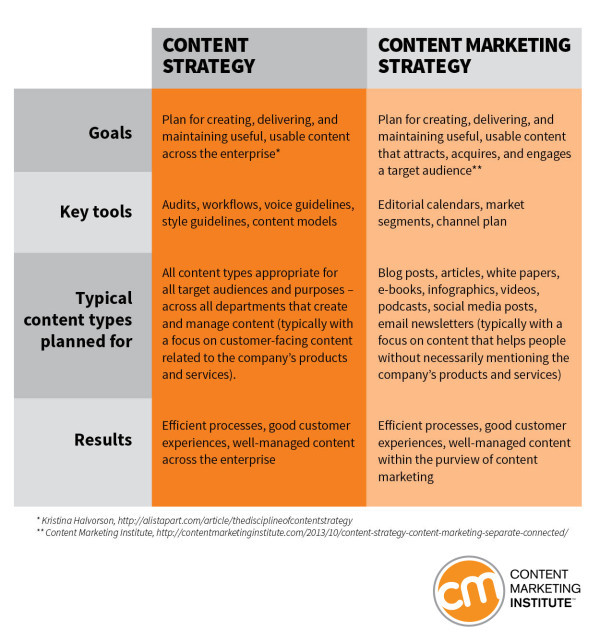
Find more answers: Razorfish strategist Melanie Seibert breaks down the similarities and differences between the two, and discusses where content marketing fits in with other related business roles. You can also use this chart she created as a cheat sheet.

Content_Marketing_Strategy_2

Q: What information should our content marketing strategy include?

While there are no definitive templates for building a content marketing strategy (each one will be unique to the business), some key components typically include:

  1. Your business case: Outline what you expect content marketing to help your business achieve, explain why you believe it is a technique worth exploring, and offer evidence to support your claims. The business case is critical for gaining executive buy-in to build and run your content marketing program the right way.
  1. A business plan: Detail how you will use content to achieve the goals you’ve outlined. Include a summary of the specific goals, the value you expect your content to provide for your audience, and how your efforts will align with your company’s overarching marketing plan.
  1. Your personas: These composite sketches identify and characterize the audience segments to target with your content. They actively inform your strategy and drive buyer engagement.
  1. Your brand’s editorial mission: Outline who you are as a company, the ideas and messages you want to communicate through your content, and the impact you expect them to have on your audience. This is your guiding light whenever you create a piece of content and should be the measuring stick by which you evaluate its potential worth.
  1. A channel plan: Govern where, why, and how you will distribute your content, and include the platforms you will use to tell your story, as well as the criteria, processes, tone, and objectives for each one.
HANDPICKED RELATED CONTENT:
Content Marketing: Forget About the 5%

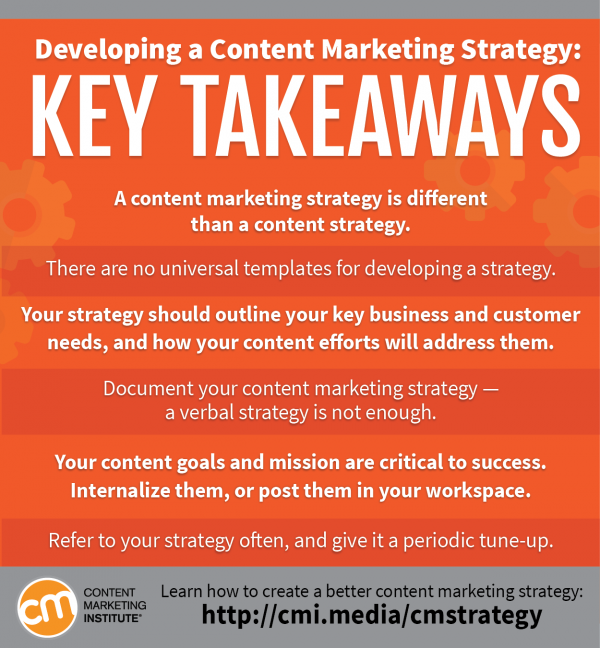
Find more answers: Our guide to developing a content marketing strategy offers more detail on each of these key components, along with a clip-and-save list of key strategy takeaways (shared below).

DevContentStrategy_Takeaways

Need help developing your strategy? Our e-book, The Essentials of a Documented Content Marketing Strategy, can walk you through the process.

Q: How do we get the necessary executive support for our program?

Many companies begin content marketing with a pilot program, testing the waters and gathering evidence to convince stakeholders of its potential for success. But if you want to get the approval, budget, and participation, you need to run a successful program over the long-term. It’s helpful to set expectations right from the beginning by presenting executives with a clear and compelling business case.

While the points will vary based on your company’s priorities and marketing goals, in general these buy-in conversations should cover issues such as:

  • Why your company needs content marketing – for example, you can point out how integral it has become to remaining competitive in any industry and the important role it can play in consumers’ purchasing process
  • How it can help your organizations meet its marketing goals – for example, you can discuss the role content plays in building positive brand perception or how it can be used to drive increased engagement — particularly when marketing to younger demographics
  • The budget and resources you will need to execute on your strategy effectively — including staff, materials, and media
  • Your expectations for success – what results you see your efforts achieving and how long you expect it to take for those results to be realized

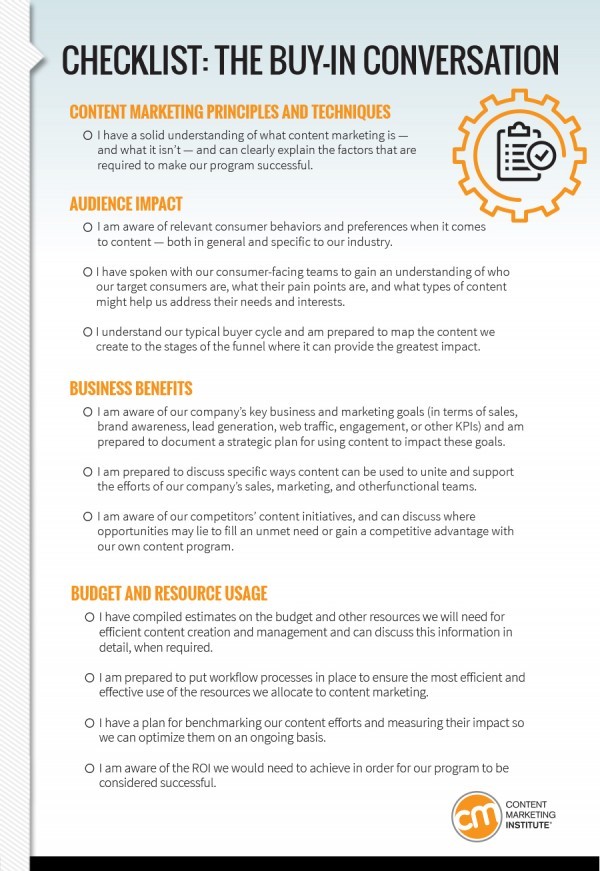
The following checklist can help you assure stakeholders that you have positioned your content marketing strategy for optimal success. You may not be able to get every element in place before you ask executives for their support, but the more boxes you can check, the more effective your content marketing program buy-in pitch is likely to be.

Buy-In-Conversation

Find more answers: Check out our essential starter kit for stats, talking points, and helpful tips to build your business case for content marketing.  

Q: How can our content help us stand out from our competition?

As part of your strategy development process, it can be useful to identify your content tilt — the unique perspective you have on your business niche and unique value your content will provide for your target audience. This distinguishes your content from that of your competitors as well as from other distractions that compete for consumer attention.

As Joe Pulizzi often mentions, all content marketers should ask themselves, “Can we be the leading informational provider in our subject area?” If you don’t believe your content marketing plan will enable you to “own” the relevant conversations in your chosen niche, you may want to drill down and find a more narrow focus where your content will have a bigger impact on the audience.

Here are some things to consider when searching for your ideal content tilt:

  • Your audience: Identify a segment of your customer base for which your perspective will be uniquely relevant and useful.
  • Your story angle: Is there a different spin your company can put on the topics commonly discussed and/or debated in your industry?
  • Your content platforms: Is there an opportunity to explore a new channel or content format that your competitors aren’t using?
  • Your subject matter: Are there areas of your industry that other companies are overlooking in the content they publish?

Once you’ve discovered your content tilt, it will be easier to identify opportunities to delight readers with content they need – and can’t get anywhere else.

Find more answers: Joe’s Content Inc. blog offers more epic insights, examples, and inspiration to help you discover your content tilt and apply it to create a more successful content marketing strategy.

Q: How can we ensure that our content will stay on-strategy?

Once you’ve defined your strategy, target audience, and content tilt, you can start to plan topics, ideas, and approaches on which your content marketing efforts will focus.

At the same time, you probably recognize that not all content ideas will be equally worth pursuing. For example, some content pieces (like videos or podcasts) may require more production resources than you have available; others may be well within your team’s capabilities but might not be the best fit for your target audience; and some ideas might be brilliantly creative but just aren’t likely to have the bottom-line impact you are looking to achieve.

It may be helpful to put a system in place for gauging the relative value of all your content ideas and keeping them on track with the marketing outcomes you want to achieve.

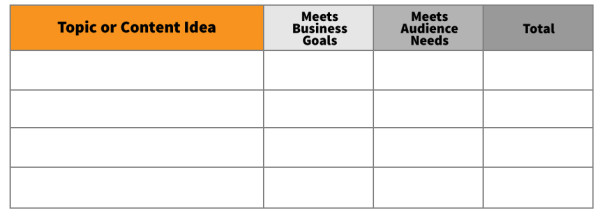
For example, Brain Traffic’s lead content strategist Meghan Casey has crafted a content decision-making matrix, which her team uses to evaluate and prioritize their story ideas. Each idea is given a numerical score based on its capacity to serve the needs of the target audience while also contributing to your own business goals.

decision-matrix-template-blank

To use the matrix, display it on a screen or whiteboard, and talk through each topic or content idea as a group. Through discussion, have stakeholders agree to a score for each idea on a scale of 1-5. Meghan recommends discarding ideas with a total score of 3 or less, as they are unlikely to perform well against your strategic goals. She also suggests using the total score as a means of prioritizing the ideas you should move forward with.

Find more answers: Once you have selected your ideal topics and ideas, you still need to determine the formats you will use to craft your stories. Our 2016 Content Marketing Playbook serves as an excellent guide to choosing the best formats for achieving various audience goals.

Audience questions

A basic tenet of content marketing is that you need to understand — and create content specifically for — the consumers you want to reach. Seems easy; but gathering, prioritizing, and applying the necessary insights to build a solid content plan can take some significant legwork.

Q: How do we determine our best target audience?

As mentioned, your strategy needs to include how your content will help you achieve your business goals. The next step is to identify your core customer base — i.e., the target audience you think you can help the most.

To zero in on your target audience, consider these issues:

  • Are there relevant yet underserved audiences who aren’t getting the information they need from other sources?
  • What customer group is your business struggling the most to gain traction with? Can content help you bridge this gap?
  • If you didn’t provide content for this audience, would they care or notice? Can you become the leading information resource for this customer base?

Find more answers: It’s possible that you will find more than one audience that fits these criteria. While you may be tempted to target multiple personas, you could risk watering down the impact of the content you create. Follow the advice Joe shares as part of his Content Inc. model: First, focus on building a strong, loyal relationship with your core audience, and then expand your content initiatives to target additional customer groups.

Q: How do we create a buyer persona?

Persona development is often thought of as a customized process that “thins the herd,” as it’s meant to provide your team with a clear picture of one type of person your content can help the most.

As Marketing Interaction’s CEO Ardath Albee explains, to get value from your personas, you need to create them with enough depth and insight to enable your team to generate content ideas and topics that resonate. You also should be able to use them to help visualize the specific situations your target audience may be experiencing in their current user state. To create richer, more actionable personas, Ardath recommends using the following nine-part approach:

  1. State the persona’s specific objectives. Give content creators something insightful and targeted that they can use when crafting content ideas.
  1. State the persona’s main problems. If you were asked to write something helpful for readers you’ve never met, which problem description would you rather be handed?
  1. State the persona’s orientation toward their job. The more details about the persona’s professional demeanor, the more that persona can help your team decide what content to create and how to communicate in a way that engages the people your company wants to connect with.
  1. State the persona’s relevant obstacles. Instead of broad concerns like price, focus on things that get in the way at each funnel stage and prevent your persona from moving forward with their decision-making process.
  1. State the persona’s burning questions. Not only will this help you create content that informs your prospective customers, it also informs you about where those prospects are in the buying cycle.
  1. State the persona’s content preferences. Include details like their favorite content channels, the social networks they are most likely to use, the tone and style that resonate most strongly with them, the content formats they prefer to engage with, etc.
  1. State keywords and phrases the persona would use. Ask yourself, “What are they most inclined to type into that search box?” and capture the most telling phrases.
  1. Sketch engagement scenarios for the persona. Visualizing ways in which your persona might want to interact with your content over time helps you imagine useful ways to link that content into a cohesive plan.
  1. Create a day-in-the-life scenario. By crafting a real-life situation your persona may be experiencing, you enable your content creators to truly understand how the content might impact the persona’s everyday goals and challenges.

Find more answers: For additional information to include in your personas, as well as a rundown of how to gather the audience insights, check out the second part of Ardath’s discussion on persona development: How to Build Buyer Personas That Build Sales.

What questions are you looking to answer?

While the previous questions tackle some of the biggest strategy and planning issues in content marketing, they are just the tip of the iceberg when it comes to everything content marketers need to know to be successful at their craft. If there are other questions you would like to ask, feel free to add them in the comments. And keep an eye out for upcoming Book of Answers posts where we’ll tackle questions about teams and processes, content creation, content distribution, and content measurement.

Want to get more examples, tips, and insight to continually support your content marketing program? Subscribe to the free daily or weekly newsletter.

Cover image by Joseph Kalinowski/Content Marketing Institute

The post The Content Marketing Book of Answers: Strategy & Planning appeared first on Content Marketing Institute.

21 Jun 17:09

Selling Value – Everything You Always Wanted to Know – by Dave Kurlan

by Robert Terson
Some news stories just don’t go away.  Today those stories include Ferguson, Bill Cosby, ISIS and The NFL’s Domestic Abuse Problem.  There is also Obamacare, Immigration and Ebola.  They remain in the news more because the media continues to milk these stories then readers demand to know more. When we look at the sales stories of the recent past, the topics that sales experts continue writing […]
21 Jun 17:09

Trump's campaign cycles $6 million into Trump companies

by Julie Bykowicz And Chad Day

Protesters clash with Donald Trump supporters shortly after the a Donald Trump rally ended in Phoenix, Ariz., on Saturday, June 18, 2016. Several arguments sparked as the two groups crossed paths throughout the day, but city officials stepped in to disperse crowds if they became too heated. Trump railed Saturday against efforts by some frustrated Republicans planning a last-ditch effort to try to thwart him from becoming the party's nominee, threatening at one point to stop fundraising if Republicans don't rally around him. (AP Photo/Beatriz Costa-Lima)

NEW ORLEANS (AP) — Donald Trump's campaign likes to keep it in the family.

When Trump flies, he uses his airplane. When he campaigns, he often chooses his properties or his own Trump Tower in New York City, which serves as headquarters. His campaign even buys Trump bottled water and Trump wine.

The presumptive Republican presidential nominee has been on the campaign trail for a year now, and federal finance reports detail a campaign unafraid to co-mingle political and business endeavors in an unprecedented way — even as he is making appeals for donations.

Through the end of May, Trump's campaign had plunged at least $6.2 million back into Trump corporate products and services, a review of Federal Election Commission filings shows. That's about 10 percent of his total campaign expenditures.

Unlike in the primary when Trump touted his ability to pay his own way, he has been on an urgent fundraising quest for more than a month. His campaign began June with $1.3 million in the bank, compared with the $42 million presumptive Democratic nominee Hillary Clinton had amassed.

Wealthy political candidates in the past have walled off their business from their campaigns, but Trump embraces his companies. Public documents indicate his revenue has risen along with his presidential aspirations.

While Trump's controversial comments have cost his businesses money — for example, the PGA Tour recently announced it would move its World Golf Championship from a Trump course to one in Mexico City — Trump reported in documents filed in May with federal regulators that his revenue had increased by roughly $190 million over the previous 17 months.

Trump's campaign didn't respond to detailed questions about the intermingling of his businesses and campaign.

Trump isn't the first high-profile politician to run a campaign while managing large corporate assets. Former New York Mayor Michael Bloomberg and presidential contender Steve Forbes both ran companies bearing their name.

Both took great care to carefully separate their businesses and their campaigns, their former aides said, citing the complex maze of campaign finance regulations about using corporate resources. For instance, federal rules require a company to charge their campaigns fair-market value.

The Trump campaign— funded during the primary contest mostly by loans Trump made— appears to be properly documenting its use of the businessman's assets in federal reports, leaving a record of his campaign's finances and their impact on his self-reported financial largesse.

Some of Trump's revenue bump appears to be directly traced to his campaign. TAG Air Inc., the holding company for his airplane, had $3.7 million in revenue in the most recent reporting period — an amount that came largely from the campaign.

Trump's relentless product branding while on the campaign trail might be helping, too. Trump Ice LLC, the bottled water company, brought in income of more than $413,000 in the most recent reporting period, up from $280,000.

In the beginning months of his presidential bid, Trump paid about $350,000 out of pocket to rent campaign space in his own building and to cover the salaries of some of the Trump Organization employees he'd moved onto his campaign staff. FEC reports show the campaign reimbursed him for those costs. In May, the campaign paid Trump an additional $45,000 for more rent and payroll.

Trump also lent his campaign more than $46 million over the past year — money he has largely not recouped, according to FEC reports.

The campaign has paid about $520,000 to Trump Tower Commercial LLC and the Trump Corporation for rent and utilities. The campaign also paid $423,000 to Trump's private Mar-a-Lago Club in south Florida for rent and catering and an additional $135,000 in rent and utilities to Trump Restaurants LLC.

The campaign paid out $26,000 in January to rent out a facility at Trump National Doral, his golf course in Miami. He'd held an event in the gold-accented ballroom there in late October. The campaign paid almost $11,000 to Trump's hotel in Chicago.

Even $4.7 million the campaign has spent on hats and T-shirts has a tie to Trump. The provider, Ace Specialties, is owned by a board member of son Eric Trump's charitable foundation.

___

Follow Julie Bykowicz and Chad Day on Twitter: https://twitter.com/bykowicz and https://twitter.com/ChadSDay

Join the conversation about this story »

21 Jun 17:07

Simple Design Guide: How to Create a Superior Logo

by Julie Chomiak

As you well know, your business logo is much more than an image or a colorful compilation of words. It communicates the value, purpose, and integrity of your brand and plays a significant part in how people perceive your business. Whether you have an established logo or are at the beginning phases of creating your first one, there are a few design considerations you should make in order to craft a compelling and memorable logo.

First things first, do your research and know your audience.

Knowing who you are trying to engage and what kinds of images, colors, and language they respond to is critical for crafting a logo that is recognizable and distinct from your competition. Your competitors and other industry leaders are a great resource for determining what you want your brand to look and feel like. Take note of what stands out to you. Which symbols and color combinations evoke the feelings you want your logo to generate?

Once you have a clear idea about whom you are trying to reach through your brand and logo, use this Logo 101 checklist to guarantee you are on track to developing a logo that aligns with your brand.

Simple

This is a loaded and subjective topic since style is based on personal preference. However, there are a few stylistic guidelines you should adhere to if you want to establish a long-standing logo.

Limit your logo to two colors. Consider black and white as your two freebie colors, so only have at most two additional colors in your logo. When you start including all the colors of the rainbow, your logo can look crowded and frenetic. From a cost-side, multiple colors mean additional fees when using outside vendors for business cards, t-shirts, travel mugs, etc. as they usually charge by the color. For a small business, additional color fees can add up and quickly eat up your budget.

Apple logoProportion is everything. Well-balanced and symmetrical designs tend to be the most popular because they create a sense of quality and are aesthetically pleasing. This does not mean your logo must include only perfect circles or squares. It does suggest you should think about how the logo appears and if it seems balanced to the viewer. The Apple logo is a great example of a logo that is proportionate and balanced without being completely symmetrical.


image courtesy of Apple

Memorable

Highlighting key differentiators between your brand and your competition is a strong way to build a memorable logo. Since you’ve researched your competition and understand your value proposition, include these elements in your logo. You want to avoid being easily confused with a competitor or existing brand in another industry. Separate yourself from the rest and be unique.

This is an opportunity to incorporate a piece of your personality as the business owner. It’s your business and you are an integral part of the business experience. If you have flair, your logo should be punchy. Are you highly organized? A clean, modern design with cool tones may reflect your personality the best. Don’t omit yourself from your business – this is another point of distinction.

Think of your favorite brand logos and figure out why you prefer them and can remember them so easily. These are the things you want to incorporate into your logo.

Timeless

You’re creating a logo so your business is recognizable and automatically triggers your business’s name when seen by anyone. This type of recognition means it must have staying power and has to toe the line between traditional and modern. Of-the-moment trends are great for advertisements, but your logo is intended to appeal to customers for years to come. Creating a logo that features the Pantone color of the year or a specific typography that is popular today is bound to fail you in the long-run because they are passing trends. Stay true to your brand standards and guidelines and you can’t go wrong with your design.

When working on your logo, think of the commonalities between companies with timeless logos: UPS, Burger King, Ford, Target, etc. They’ve stood the test of time because they are iconic, but have been able to iterate based on the changing times without losing sight of their brand identity.

If you have an existing logo, you are well aware of how it impacts your potential and current customers. As a continually evolving business, logos are revised and revamped every so often in order to remain relevant and modern. However, your new logo should have the same feel as your previous logo. Subtlety is the key when it comes to successful logo adaptations. Starbucks is a prime example of an ever-changing logo that maintained its brand essence throughout its numerous iterations over its existence.

Starbucks evolving logos

image courtesy of Foundry Digital

Keep this in mind as you embark on your logo adaptation.

Versatile

A logo that is versatile is often overlooked. You create this awesome graphic that portrays your business with the necessary panache, but then you try to apply it to different media (digital and print products) and it doesn’t translate. Make a logo that is adaptable and maintains its integrity across various platforms and materials. Check the pixelation when you reduce and enlarge the logo. The clarity should remain the same; if it is at all skewed, revise it until its quality is consistent across all media platforms. Also review how your logo looks in black and white. You’ll be surprised how frequently you’ll need to reduce the colors in your logo for external use. All of these tests verify that your logo can be used to its fullest extent without jeopardizing its quality.

Appropriate

An appropriate logo reflects the culture and values of the company. It engenders confidence about the brand and its authority within its industry. Keeping your industry and your target audience top of mind during your logo design process assists you in developing an appropriate logo. Consider common colors, symbols, and conjured emotions from your competitors’ logos to design a logo that is in line with industry preferences and suitability. For example, a compelling logo for an accounting firm would not include neon green lettering and cartoon-like images. People look for reassurance, financial responsibility, and professionalism when selecting an accountant, and those colors and images do not reflect those values; they’re not a fit for the audience. Again, this is a subjective term, so use your best judgment, and if necessary, solicit unbiased opinions from people outside of your organization to gather their feelings about your design. If strangers feel good about the logo and its relevant industry, you’re on the right track.

BONUS TIP:

DesignMantic published a fantastic SlideShare about traits of memorable logos and honed in on the most common associations related to specific design elements.

We hope these tips are useful to you no matter where you are in your logo design process. We love to see real customer examples, so share your logo in the comments below!

21 Jun 17:06

What’s The Most Important Customer Question Sales People Probably Can’t Answer?

by Dave Brock

We equip our sales teams with the ability to answer any question customers might have about our products and services. Salespeople can go on forever about features, functions, feeds, and speeds for each of the products they sell. They sometimes can present feature – benefits, for example, “improved productivity, reduced cost,” and so forth.

But the capabilities of our products and how wonderful they are, are probably not the most important things in our customers’ minds.

We know this qualitatively and quantitatively by the disinterest customers have in our marketing and prospecting programs touting our products. Open rates, click-throughs are plummeting. Customers are rapidly finding other sources of this information, presented in their terms on their schedules. Product management and marketing continue to provide endless content proclaiming the wonders of each feature in every product (“The implementation of our name and address fields is far more innovative and intuitive…”)

The most important question on the minds of customers is, “How can you help me solve my problems and achieve my goals?”

Yet they seldom pose this question in as straightforward a manner. Instead, they may present it in a number of ways:

  1. The customer might not recognize they have a problem or there may be a better way of doing things, sales people engaging customers with specific insights on their business can sharpen awareness and urgency around the issue. Rather than the customer posing the issue, the salesperson might say, “We’ve looked at what you are doing and believe there is an opportunity to reduce manufacturing cycle times by 12%, driving X reductions in inventory, Y reductions in manufacturing costs….”
  2. The customer might pose it as an opportunity, “We want to grow our customer retention and lifetime value by z%…. How can you help me achieve this?”
  3. The customer might pose it as sets of frustrations, “We’re just too busy to talk to you, we’re behind on our projects, we have more work than we can handle…”
  4. The customer might be oblivious, “We’re doing just fine, we don’t need to change anything…” (Yet their performance is trailing that of their competitors, they are losing customers, they aren’t growing.)
  5. …you get the point.

It may not be the fault of the salespeople that they can’t address this question. After all, we focus our training on our products and what we think is important, seldom what the customer thinks is important.

To help salespeople answer this question from their customers, we have to be very clear about the following:

  1. What problems are we the best in the world at solving? This can’t be generic–improve productivity, reduce costs, grow revenue. They have to be very specific issues in the terminology of the customer.
  2. Who has these problems? If everyone in the world has these problems, then we’ve defined the issues incorrectly. No company can address the productivity problems, or cost problems, or quality problems, or growth problems of every organization in the world. There is a set of customers—markets/industries, enterprises, individuals; for which our products and solutions are optimized. These represent our “sweet spot.” We want salespeople to focus their time within that sweet spot. It’s where they will have the biggest impact and greatest success.
  3. How does the salesperson find out if a customer within that sweet spot is experiencing that issue now? Whether they recognize it or not, what is it the salesperson should look for, how do they understand the magnitude of this issue for the customer?
  4. How does the salesperson engage the customer in talking about this issue? What do the conversations look like, how does the salesperson drill down, understanding the impact, urgency, and specific issues the customer is experiencing? In most cases in complex B2B sales, we have to be engaging multiple customers in differing roles who care about this issue and want to do something about it. We need to equip our sales people with the abilities to engage these people as individuals and as a group–helping guide them through their problem-solving process.
  5. What do we do in helping the customer solve this problem or address this issue? Not generically, but very specifically. “We can help improve productivity by X%, we can reduce DSO by Y%, we can improve customer retention by Z%…and here is the data and analysis upon which we base these claims…”
  6. Why us? Usually, the approach is our long laundry lists of features and functions, or our long lists of irrelevant references. The “why us” is seldom about our products, but about the way we engage the customer in thinking about and addressing these problems. While others are still pitching their products, the “why us” becomes, “we are the people that are helping you actually solve this problem!” But we have to equip our salespeople to demonstrate this in each customer interaction, from prospecting, through close. Then we have to make sure our customers are realizing the value we have claimed in the process.

Our success and that of our customers’ skyrockets when we equip our salespeople with the ability to engage the customer in exploring and answering the question most important to them. Are you helping your sales teams do this?

21 Jun 17:06

Business Failures? How To Win Customers Back

by Luana Spinetti

failure

Jeff Djevdet (cc)

Errors in business happen, but when you take the wrong direction — even in good faith — that makes customers feel deceived, you risk to never see them again.

Hurting customers may risk you business and reputation, but every error can be amended if you work hard on earning your customers’ trust back.

How? Here is the guide.

What To Do To Win Your Customers Back

Get in touch with your customers and announce a change in business ethics

When it’s your business ethics to bring trouble — for example, you shipped your products for a fee when you stated it would be free shipping, or you use a cheaper shipping method when customer paid for a more expensive one — your whole customer base is affected, even though only a few of your customers were hurt by your practices.

What you can do in this case is to change your business ethics, announce it publicly on your website and get in touch with all customers via newsletter, offer an apology for your past bad practices and explain how exactly you are going to implement the new practices.

Offer your hurt customers ways you can fix the issue you created

If the problem involved individual customers, contact them to apologize and offer them to fix the issues you created, either intentionally or not.

You may add an apology bonus, like a discount, a gift or a custom order.

Apologize personally if you can

Email customers individually to offer personal apologies. Even better if you can do it via phone or in person.

Don’t underestimate the power of the human touch — customers who feel they are cared for are more likely to stick to a brand than customers who feel like they’re just a number in your database.

In addition to personal apology, make it public if the issue affected a big slice of your customer base.

Discontinue the hurting practices

Whether you get in touch with your customers or not, by all means stop doing anything that hurts them.

Not doing so may create a negative image around your brand and risk you business in the long run.

Work on practices that will meet the favor of your customers (new and old)

What do your customers want? When are they happiest? What past initiatives, practices or messages did create the most content in your client base?

Ask yourself questions. Analyze your data. Do more of what your current customers love and create more products or services on the same line to attract new buyers or users.

Whenever a controversy is raised, work to fix it immediately and always leave an open channel with your client base.

Ultimately, when you do wrong, all you can do is take responsibility and fix all the fixable.

If the customer is still unhappy for personal reasons, that’s something that doesn’t involve you — it’s a simple matter of likes and dislikes and you can do nothing about it.

Have you ever seen controversy raise in your relationship with your customers? How did you fix it?

Share your wisdom and experience in the comments below.

21 Jun 17:05

#EmailChat: Social Media Lead Generation

by Olivia Dello Buono

You’re already using social media to generate some buzz for your business, but did you know it’s also a great tool for getting new email subscribers?

In this week’s #EmailChat, we talked about the ways you can optimize your social media platforms to generate leads.

Missed it or need a refresher? Here are the top seven takeaways that you can implement now:

Social media + email = digital marketing #PowerCouple

Social media is essential for building brand awareness. Email is essential for generating revenue, sales and creating a deeper connection with your audience. And when you use them together, they can become powerful elements of your digital marketing strategy.

It’s a great place to capture email leads.

By nature, social media tends to be fast-paced and crowded. As a result, your social content should be brief and give your audience a taste of what to expect from you. If they want more, direct them to your email list.

One thing we love about Facebook is the option to have your email sign up form right at the top of the feed. And with other platforms, such as LinkedIn and Twitter, you can pin a post to the top of your page – a great opportunity to link to your signup form.

The most effective platform is the one your audience is already on.

A common mistake that many digital marketers make is trying to be everywhere all of the time. Unfortunately, that’s one of the easiest ways to burn out. Plus, you might even get frustrated if you don’t reap any awesome rewards as a result of all your hard work, too.

The trick to getting new subscribers is to go where they are. If your tribe is big on Facebook, go there! There’s no point in spending time and money on Twitter if all you hear are crickets.

Need help getting started? Try putting out a survey to your current subscriber base to get a feel for their social media usage. You might be surprised at what you learn.

But be sure to integrate some tools into the mix.

When growing your email list on social, you don’t have to go at it alone. Social media integrations can help maximize your social engagement big time. Try a tool like Interact, WooBox or Heyo for your next social campaign. They’re great tools for generating new leads. Plus, they’re fun and shareable. A win-win.

A few tips before launching your social campaign.

Hold up: You can’t just put up a contest and expect the leads to pour in. It’s not that simple.

If you’re hosting a contest, quiz or other promotion, you need to give away something of value. (Especially if you’re asking for their email address.) You’re likely to see more engagement with your campaign if there’s a nice incentive attached.

Incentives, ftw (for the win).

Speaking of incentives, we have a few examples.

High-value prizes (think tablets and vacation getaways) can certainly help with your campaign’s reach, but it might not attract the most relevant audience.

Instead, consider other freebies that would interest your target customer. Exclusive content, for example, is a great incentive to offer – especially when everyone who enters gets to reap the rewards. Try a simple PDF checklist, guide or other freebie. Promo codes and discounts can work wonders, too.

Bookmark these best practices.

There are a few do’s and don’ts when it comes to using social media to generate email leads.

For starters, the experience people have with your brand should be consistent. Your social presence should reflect your email tone, and vice versa. Your subscribers should be able to recognize that a piece of content comes from you, and not a competitor or unrelated brand. Not only does this help establish brand recognition, but trust as well.

And let’s not forget transparency. If you’re using a social giveaway or contest and collecting email addresses, be sure to disclose that by signing up, people are agreeing to receive your emails. Nobody wants to feel like they’re being spammed.

#ComingUp

Join us on Thursday, 6/30 as we chat with Nick Westergaard, Chief Brand Strategist at Brand Driven Digital, about getting “scrappy” with your emails. (Not sure what that means? Tune in to find out.) 👋🏼

Follow us on Twitter to stay up-to-date on all the latest news, updates and events.

The post #EmailChat: Social Media Lead Generation appeared first on Email Marketing Tips.

21 Jun 17:05

Why sales leaders need to focus on outcomes, not activities

by bob@inflexion-point.com (Bob Apollo)

Pile_of_Paperwork_Square.pngI’ve been seeing a lot of attention paid recently to activity-based sales management. Put simply, it’s the principle that sales managers need to give their sales people targets for measurable activity levels such as the number of calls made, meetings arranged or demos given.

The theory is that the more activity sales people undertake, the more likely they are to be successful, and there may be indeed be some correlation between activity and results in high volume transactional sales environments. But the relationship is nowhere near as clear in complex B2B sales environments, and an obsessive focus on activity levels can end up driving entirely the wrong behaviour…

By the way, sales is not the only discipline that can suffer from an obsession about raw activity levels. When marketing organisations are primarily measured on metrics like number of “leads” generated, or on the number of website visits achieved, it inevitably drives dysfunctional behaviour and stimulates a growing rift between marketing and sales.

Why? Because focusing on raw numbers makes no judgement about the quality or value of that activity. It takes no account of whether or not the activity resulted in any progress being made towards the organisation’s revenue goals. And it completely fails to take into account whether the activity added any value to the prospect’s buying decision process.

I’m not suggesting that sales metrics aren’t important. Monitoring the right metrics is critical to managing any successful sales organisation. It’s why I’m such a fan of sales analytics. And it’s why so much investment is going into the technologies that enable organisations to analyse and act upon what’s really going on in their pipelines.

Good metrics focus sales people’s attention on doing the things that add genuine value to their pipeline and increase their chances of achieving and exceeding their revenue targets. Bad metrics are at best a distraction but more often than not actually make it harder for good sales people to achieve their revenue goals. Let’s run through some examples.

PROSPECTING BASED METRICS

I’ve seen many organisations that target their sales people on making a stretchingly-hard-to-achieve number of calls every day. But a rigid and thoughtless application of this thinking can actually discourage sales people from investing in the research and preparation that would allow them to make better calls to better qualified prospects.

The same holds true for targets that focus on the number of conversations without regard for the quality of those conversations, whether anything valuable was learned from them, or whether the prospect agreed to advance to the next stage of our defined sales process. And it also holds true for targets based around the number of demonstrations that are performed without regard for the outcome.

One of my more enlightened clients described these raw volume-based approaches as being akin to “vigorously flicking a s**tty stick against the wall and hoping some of it might stick”.

It’s not just ineffective: it can also serve to make it far harder for us to identify and focus on the truly promising opportunities. There’s a real and present danger that they will get lost in the crowd and will have moved on under their own steam towards another solution before we manage to recognise their potential.

There’s a simple way of addressing this problem: instead of primarily measuring these raw “top of funnel” metrics, we need to measure the outcomes that we are trying to achieve - which in most rational sales organisations is the number and realistic potential value of qualified sales opportunities that are accepted by the sales people and added to the actively managed opportunity pipeline. And we should measure them on qualified pipeline value and ultimate revenue generated.

My strong recommendation is that you focus primarily on these outcome-based metrics and allow a certain amount of flexibility in how your demand generation and pipeline building resources go about achieving the goal. If we have well-organised people who are capable of achieving these targets by doing fewer, more intelligent activities, we should applaud them, rather than divert them from their task - and we should look to see what their colleagues might learn from them.

PIPELINE RELATED METRICS

I’ve also come across many sales organisations where there is an unhealthy focus on pipeline coverage: the ratio by which the total pipeline value exceeds the revenue target. This is another metric that often leads to utterly dysfunctional behaviour.

There’s been some interesting recent research that confirms that in complex sales environments, having too high a pipeline coverage ratio actually makes it harder to achieve revenue targets.

It’s not hard to work out why: in my experience, top performing sales people have too much respect for their own time to waste it chasing poorly qualified opportunities that are unlikely to result in revenue. Their close rates for the remaining well-qualified opportunities are typically well above the average for the sales organisation as a whole.

By contrast, many average sales people behave as if having an apparently large number of opportunities serves as some form of comfort blanket. They hold on to poorly qualified opportunities like a drowning sailor desperately grasping hold of a soggy piece of flotsam. And they aren’t averse to valuing those opportunities with what might be characterised as unjustified optimism.

Can you guess what happens when sales leaders and sales people are evaluated on the value of their pipeline? You end up unwittingly creating a situation where they are disinclined to quality bad opportunities out, with the result that pipeline values are disastrously over-inflated.

In fact, whenever I conduct a robust, evidence-based pipeline review in behalf of a client, their pipeline value inevitably declines at first (because many of the so-called “qualified opportunities” turn out to be nothing of the sort) before - with better focus and stronger qualifying discipline - the value starts to build again, as does the rate at which opportunities are converted to revenue.

BE CAREFUL WHAT YOU MEASURE

These are just a few examples. My overriding recommendation is to choose what you measure carefully, and to ensure that your people apply the metrics thoughtfully. As sales leaders, our goal is to consistently exceed our revenue targets. If the metrics we choose to adopt fail to direct our sales people’s actions towards that goal, we only have ourselves to blame.

Activities by themselves are irrelevant. It’s only the contribution to outcomes that really matter. And that’s what we ought to be measuring.

Bob Apollo is the Managing Director of UK-Based Inflexion-Point Strategy Partners. He writes and speaks regularly on the critical importance of establishing scalable sales processes in driving B2B sales success.

Other related articles include:

This article was first published on LinkedIn.

A Simple Guide to Compelling Messaging for the Complex Sale

21 Jun 17:04

The Beginner’s Guide to Designing Marketing Experiments

by Katherine Boyarsky

06.13.16LeadInExperimentsUpdated-Feature.png

Testing and optimizing content is extremely important to your marketing strategy. No matter how small or large your team is, optimizing content can generate the same or even more leads than brand new content.

In a study from HubSpot, one marketer managed to double the amount of monthly leads from the blog by optimizing old posts. Double. That’s a lot of new leads. They also increased organic search volume by 106%. Conversion Rate Optimization or CRO is the future of marketing and can be implemented across all channels.

We are going to walk through the steps required to run experiments, get results, then implement them to improve CRO for landing pages, email, social, or any medium that allows for experimentation.

Step 1: Identify Your Objective

What are you hoping to learn from this experiment? Take a moment to thoughtfully come up with the objective for your experiment. This will guide what your variations will look like and how you will determine if the experiment was successful.

Not all experiments need to be quantitative (numbers-based.) You can use experiments to map your buyer personas or find your brand’s voice. Not sure where to start? Try one of these landing page experiments as a first pass.

Examples:

  • Identify the effect that a new onboarding process has on your product
  • Test out a new channel for user acquisition
  • Determine your audience for a new paid campaign

Step 2: Propose a Hypothesis

What do you think will happen during this experiment? Here, you can put together an idea of what you think will happen, much like in the scientific method. Maybe you have a hunch that updating the copy or form placement on a landing page will yield a much higher conversion rate. The only way to find out is to test this theory. Trying and failing is much more productive than never trying at all.

Examples:

  • Changing the button on our form to a more actionable phrase will increase conversion rates
  • Using social media as an acquisition channel will bring in new users
  • Sending our emails at 10 a.m. will have higher open rates than sending at 2 p.m.

Step 3: Determine and Create the Experiment Design & Variations

This is the part where you come up with the experiment’s design and test variations. Typically, you will keep one control, meaning the element that remains the same throughout the experiment. This is how you will prove the test’s effectiveness. Then, you can create a variation (or multiple variations) to test against the control. Don’t forget to track everything.

Examples:

  • Create 4 different versions of a landing page, then show site visitors the 5 versions (including the control) for 3 weeks to see which results in the highest conversion rate
  • A/B test sending the same email at different times of day with a group large enough to yield significant results
  • Interview 50 current users and gather demographic and qualitative data about them, then analyze the data in your contacts database to find the most prevalent persona

Step 4: Let it Go (Run Until it’s Statistically Significant)

Run your experiment for as long as you need to determine statistical significance.

Sometimes it can be hard to get enough data to review, and in those cases, you can extend the timeframe of the test until you have enough.

Step 5: Analyze
Gather your data and find out the results. Standard results include; fail, inconclusive, or success.

Fail means that your hypothesis was incorrect, inconclusive means that you didn’t have enough data to draw a conclusion, and success means that your hypothesis was correct. In this section, you can include learnings and takeaways to share with your team after the experiment is complete. These can also be easily turned into a blog post, offer, or podcast!

Experiments are a really important way to ensure that your content is performing at its maximum effectiveness, get new leads from old content, and improve the experience for your user.

You can use experiments as a marketer, product manager, sales rep, or anyone within your organization who wants to hit their goals. This is step one to starting a CRO strategy within your organization and it will be paying itself off in no time.

Final pro tip: Maintain a master experiment spreadsheet – this data is too good to lose!

Assets-MKT-766-v2-3.png

21 Jun 17:04

Why You Should Never Start a Follow-Up Email With "I Haven't Heard From You"

by pcaputa@hubspot.com (Pete Caputa)

If you're like me, you probably receive countless unsolicited sales emails and voicemails every month -- and most of them are really bad.

To give you a taste, here are the opening lines of follow-up emails I received in the past few weeks. Notice anything?

  • "I just left you a voicemail as a follow up to my message yesterday."
  • "I have been trying to reach you."
  • "I just wanted to make sure you got this email (copied below) from earlier and didn't miss out."
  • "Hope you got my second voicemail."
  • "It’s been challenging to reach you."
  • "I'm sure you have lots going on. I have not heard back from you ... "

Each of these salespeople attempted to guilt me into responding.

I followed up with some of these reps to determine if this approach gets responses. A few said it works fairly well -- they get single digit response rates when opening follow-up emails with this line.

One salesperson -- the top-performing rep on his team -- even sent me his five-email sequence where four out of five messages start with laying down a thick coat of guilt.

Jeff Swank, a high-performing salesperson at HubSpot, brings an old email to the top of a buyer’s inbox by using the subject line "email buried?" and writing one short sentence in the body -- "Just want to follow up in case this email got buried."

He's not the only one on the HubSpot sales team who sends these kinds of emails. For several years, we actively taught our salespeople to reference previous connection attempts when reaching out to inbound leads that one final time before taking them out of the pipeline. And it worked … for a while.

But now I’m wondering -- has it gone too far? Has guilt become the prospector’s go-to emotion? Are salespeople using it too soon and too often in their emails and voicemails? And are there some subjects you just shouldn't discuss over email?

I think the answer is yes -- using guilt in prospecting emails is a huge mistake.

Does Guilt Work in Sales?

Less than 1% of sales phone calls are returned and less than 24% of sales prospecting emails are opened. This to me shows that buyers do not feel guilty about ignoring prospecting attempts from salespeople. 

Mark Suster, successful entrepreneur and busy guy, sums up why decision makers ignore emails like so: "I’ve learned that some people just can’t process 100% of email. The more senior people are, the more demands they have on their time. The older they are, the more out-of-work responsibilities they have."

Does provoking feelings of guilt make some buyers feel bad? Probably -- but bad feelings don’t move the needle for salespeople. What does is responses.

And do guilty feelings make buyers more likely to get back to you? Not usually. Instead of rushing to answer your email, what’s more likely is their guilt will snowball into sadness, frustration, or annoyance -- not exactly the feelings salespeople hope to provoke.

"Guilt is not a very good motivator,” Susan Krauss Whitbourne, Ph.D., a professor of psychological and brain sciences at the University of Massachusetts Amherst, notes. “In the overall scheme of emotions, guilt is … one of the 'sad' emotions, which also include agony, grief, and loneliness."

Yikes.

Personally, I'd love to get back to everyone if I had time, but I don’t. And I certainly don't have time to oblige every "15 minute request” for a call that usually comes right after the guilt trip, like in the example email below. (Names are changed to protect the guilty, or in this case, the guilt-inducing.)


Hi Peter,

Hope you got my second voicemail. Between you and me, never been an answering machine person.

Would you have 15 minutes to connect? Apologies for the bombardment. I just see HubSpot as a great potential fit to partner with X company.

What is a good time for you for a 15-minute call either today or tomorrow?

Looking forward to speaking with you!

Thank you,

Mary

send-now-hubspot-sales-bar

Do I feel bad for not getting back to “Mary”? Somewhat. But realizing that my time is best spent doing the things I decide to do (and based on the sheer volume of email I receive), I have no choice but to stop worrying about getting back to everyone who messages me -- even the people I know and especially the people who I don't know and who don't know me.

Which brings me to my next point …

You Can't Guilt Someone That Has No Obligation to You

Now, I'm not going to say that you should try to avoid making someone feel guilty at all costs. But you should recognize and internalize this critical point: Guilt won’t sway people who feel no obligation to you. And with that in mind, I think the only appropriate time to provoke guilt is when someone already committed to doing something and didn't follow through.

Janine Popick, founder of email marketing firm VerticalResponse, recently shared a story where guilt provoked her to respond. Here's the note she received from a potential partner she had agreed to work with in a previous communication.


Just wanting to be practical here. Since I haven't seen or heard back from my many messages to you, I have to assume it will be impossible to bring your offerings to our audience.

I hope I may be mistaken, but the long silence prompts me to think I should just take you off this list. While I would love to see the great solutions you create as part of our world, I have to accept that silence likely means no.

If I'm mistaken, do feel free to let me know, but if I don't hear from you, I'll be clear with our team that working with [Company] isn't of interest to VerticalResponse here.

Wishing you all the best (and hoping to be very wrong).

send-now-hubspot-sales-bar

"Whoa! I felt like crap!” Janine wrote of her reaction to the note. “I instantly emailed her back, apologized, and told her why we've been a bit quiet."

While this guilt-tripping email elicited a response from Janine, the approach should be used sparingly and caringly, like in this example.

In addition to being sent only after Janine failed to follow through with a commitment she expressly made, the sender unleashed the guilt only after several previous follow-up attempts, and gave Janine a clear and easy out.

Another way to soften the blow of an email like this is to excuse the lack of response, by writing something along the lines of, "I understand you are busy. Please don't feel guilty for not responding," and then providing the prospect an out.

According to Mark Suster, an apology works too: “I know how busy you are. I hope you don’t mind I'm putting this at the top of your inbox.”

When to Use 'Haven't Heard from You' 

As we've outlined above, using "Haven't heard from you" in email or voicemail communications is usually rude, attempts to guilt your recipient, and just plain doesn't work. 

When you'd like to provide a polite and gentle nudge to your prospect, first consider waiting five to ten business days before contacting them again.

This acknowledges they're busy and gives them time to respond to you on their own (which is always preferable to a nudge email). It also prevents you from looking desperate -- which is never a good way to begin a business relationship.

But, when you've waiting the appropriate length of time and you're ready to reach out again, test these alternatives, instead of "I haven't heard from you":

'Haven't Heard from You' Alternatives

  1. "Wanted to resurface this email ..."
  2. "Following up to make sure this email didn't get buried."
  3. "I know your inbox is a busy place. I wanted to reach out in case my original message got lost."
  4. "Bumping this up in your inbox ..."
  5. "I know how busy you are, I hope it's alright I'm moving this conversation to the top of your inbox."
  6. "Please don't feel guilty for not responding, I know how busy you are!"
  7. "Usually when I don't hear back from someone, it means you're just not interested in what I'm offering right now -- and that's O.K. ..."
  8. "I know your busy, I'll follow up in a few months to see if this is more of a priority for you."
  9. "I'm sure your inbox is crazy. Would it be better if I gave you a call?"
  10. "Since this is time-sensitive, I thought I'd reach out again."

Lay the Groundwork for Relationships, Not Guilt Trips

If the guilt angle isn't the right way to improve response rates, what is? In my opinion, salespeople should try initiating a relationship first. And in order to do this, reps need to slow their roll.

Instead of trying to get responses along the lines of “You might be able to help me -- let’s talk,” salespeople should aim for something closer to “I can relate -- I’d like to get to know you.” Build a relationship first, and then your buyers might actually feel guilty when they miss one of your emails.

Here's how to prioritize relationship-building in your prospecting:

  1. Do research. Just like buyers research vendors, salespeople can and should research their prospects. Most companies and many individuals publish information about themselves online, and review sites exist for almost every product or service these days. Internet resources aside, it's not too hard to talk to your prospect's employees, partners, customers, or vendors to learn more about them.
  2. Change your goal. Salespeople should send prospecting emails with the goal of initiating a relationship, not pitching their offering. Here are 28 email templates that will help you do just that. These templates don’t stir up negative emotions like guilt; they inspire positive emotions like pride and appreciation -- especially when you position your pre-outreach research front and center.
  3. Offer value before you ask for anything. Your buyers are overwhelmed and drowning in email. Want to build a relationship? Find a way to make their lives easier. Then they’ll be a lot more receptive to doing something for you down the line.
  4. Be timely and relevant. The beauty of attracting prospects to you instead of pushing your message onto them is that they're making the first move. It becomes your opportunity to respond -- not their obligation.

In that crucial first email, most salespeople try to snag their buyers’ interest by explaining the value of their product. If that doesn't elicit a response, many resort to guilt laden follow-on attempts.

But this strategy works only a small fraction of the time, and does nothing to forge a relationship between buyer and seller. After all, prospects don't look kindly on people who try to give them guilt complexes.

The key to effective prospecting is building relationships first. Initiate a relationship by being interested in the other person. Do your research and then write customized messages based on what you find.

Better yet, attract buyers to you through social prospecting, blogging, and website optimization, and then use that engagement to increase your timeliness and relevance, and ultimately your connect and close rates.

This quote from Suster sums it up well:

"My goal is not to make [people] feel guilty. That’s silly. If they’re important that’s the last thing I’d want to do."

If you’re overloaded and struggling to keep up with email, so are your buyers. Have some empathy, and put away the guilt. Oh, and stop using these other bad sales phrases, too.

HubSpot CRM templates

21 Jun 17:03

The Intricacies of Marketing Qualified Leads

by Peter Buscemi

It’s important for B2B marketers to understand the intricacies of marketing qualified leads (MQLs) as it is an expensive and time consuming endeavor for B2B companies.

Marketing Qualified Lead Challenges

The first hurdle of creating a valid marketing qualified lead requires documenting the served market. The served market, a subset of the overall market, are those companies expected to be most receptive to the unique value proposition offered. Once the served market is defined, the specific companies with a high propensity to purchase need to be identified. Often times it is beneficial to identify specific industries, annual revenue thresholds, the number of employees, assets, profitability or other financial metrics.

Successful penetration of the served market requires having a database of companies that comprise the market (including full contact information), a compelling value proposition, a first meeting sales deck, demo, case study, references and other sales tools. Once the served market is saturated, the market definition can be extended, assuming the supporting presales infrastructure is developed to support the desired expansion.

Marketing Qualified Lead Definition

Organizations will obviously differ on the MQL definition, but below is an example of the typical attributes of a marketing qualified lead:

Target Account – the sales team has identified, by name, the companies it wants to penetrate.

Industry – the sales team has identified an industry or industries it believes will be receptive to an ideal use case for one’s value proposition.

Revenue – organizations of a certain size are more receptive to one’s solution than others; the sales team has pinpointed the ideal company revenue range.

Title – agreement on the typical titles of individuals in the company that will be involved in the purchase of the solution. Titles typically include individual contributor, manager, director, vice-president, department head and on up to a c-level executive.

Function – the area of the company the desired employees work in. In addition, employees in the sales, marketing, finance, IT, development and HR departments are important too.

Keywords – most companies, even companies in the same industry, often do not use a similar naming nomenclature when developing individual job titles. Therefore, it’s important to research a representative number of companies at the individual through c-level to see what terms each company uses for the e industry, titles and functions one is targeting.

Collecting the above information can present a challenge – it’s sometimes tricky to know how much information to collect on a web form before providing a digital asset to a user. Obviously, in order to follow-up, the demand management team will need a valid email and phone number. However, the more information requested on a form has an inverse relationship to the number of people that will actually complete the form. Also, there are numerous services that can append a lead to provide the information required on a form in real-time, batch or through a manual process.

MQLs May Not All Be Created Equal

The definition of an MQL will vary greatly by organization.

Some organizations believe that if they have a list of targeted or named accounts — and one of those companies appears as a lead — then once the lead record is appended with all relevant information it is an MQL, regardless of individual or account behavior.

Several tiers of marketing qualified lead can also exist. If a target or named account is considered a tier 1 MQL, a tier 2 MQL may be one that is not a named account but does meet all of the MQL criteria. And, tier 3 MQLs meet the MQL criteria if the range for the quantitative metrics are expanded by 10 or 20% – i.e. if revenue is supposed to be $2B but $1.6B would be acceptable.

All other remaining leads will not be considered a marketing qualified lead (tier 1, tier 2 or tier 3), but many may have value to a company’ partners, so these leads should be used with partners in exchange for some value–space in a booth at a conference for example. Also, lead generation programs should be tightened up so that marketing program dollars are not spent on suspects that are outside of the organization’s defined MQL filter.

Once an MQL is created, the hand-off between marketing (the demand creation or field marketing team) and the demand management team (sales development or business development reps) is most effective when clear terminology, roles, responsibilities, processes and automated systems exist and are followed in daily routine. If there is a breakdown passing the MQL and MQL follow-up is not structured and exhaustive, it will completely nullify the marketing qualified lead. In short, thinking about MQLs as leads and focusing on cost per lead is the wrong mindset. B2B marketers must think about creating qualified opportunities (MQLs) that have a high propensity for purchase, in the context of an integrated demand generation plan.

DOWNLOAD a Demand Generation Planning Model >>

21 Jun 17:03

Reporting Up: How to Prove Your Marketing Success to Stakeholders

by Kara Burney

With so much data around buyer touch points, your “Marketer’s Intuition” isn’t as persuasive as it once was. To build consensus and executive buy-in, you need the right data on your side.

Across the board, however, many marketers lapse into two common reporting pitfalls: activity-based reporting, and “data-in-a-vacuum” reporting. Here are the warning signs to look for in your reporting cadence, and recommendations to course-correct your marketing reporting and prove your impact.

Activity-based marketing reporting

Activity-based reporting is probably the easiest trap marketers can fall into. Program ADD is a necessary evil in our profession: you might launch registration for four webinars and two hosted events, push budget behind a new round of CPC ads, and announce a new product line, all in the same week. But rattling off this list to your CEO or CMO is the quickest way to deflate executive confidence.

Why? Because more isn’t always better. If left unchecked, excessive activity can be a recipe for inefficiency.

Common activity metrics include:

  • Number of blog posts, webinars, or social media posts.
  • Usage numbers for hashtags and promo codes.
  • Downloads of gated resources, such as ebooks, on-demand webinars, or reports.

With activity metrics, you’re saying, “Here is how I’m spending my time and budget.” But you’re missing two critical elements:

  1. The “why” behind your actions: What is the data-backed rationale for your activities?
  2. Next steps: What were the results? How did this result compare to your plan? What are the follow-up steps?

An activity marketer might say, “Good news! Our new Snapchat ebook has been downloaded 100 times!” One hundred is certainly an impressive figure if you’re talking about push-ups or test scores. But when it comes to marketing results, context is necessary to bolster such numbers with meaning.

Remedies for activity-based marketing reporting

Try making your marketing plan public. Your editorial calendar, email cadence, and campaign planning all exist as your system of record for your team. Make those systems transparent and accessible throughout your organization, so that others are informed of your team’s plan. This will reduce the impulse to report on activity, and hold your team accountable for execution.

Secondly, tie activities to impact and budgetary spend. What were the KPIs for each activity, and what was the overall impact? Did increasing your team’s output drive more inbound leads?

Finally, explain next steps. If your result was better than expected, explain why and lay out steps to replicate this above-average result. If your result was lower than expected, absolutely explain why. Document the activity, impact, and next steps so that your team can learn from these results going forward.

A “stoplight grid” is a simple reporting framework you can use to track progress toward your goals. Use metrics to grade your progress as red, yellow, or green. Make time to address underlying factors leading to performance. Document the steps to be taken to improve upon that performance.

marketing reporting

“Data-in-a-vacuum” marketing reporting

As a marketer at a marketing analytics company, I love to see that more marketers are getting data-hungry. However, some marketers take it a step too far. The most pernicious repercussion of data-in-a-vacuum reporting? The wrong data — or the the right data across the wrong timeframe — can obfuscate big picture trends.

Let’s say, for example, that you had a piece of content “go viral” last week. That’s exciting to report — congratulations! But unless you know how to replicate that success, reporting on a few week-over-week spikes could distract from distressing overall trends.

Take the share of interaction graph from the aerospace and defense industry below:

marekting reporting

Northrop Grumman has had a few very strong weeks of social engagement, namely near the end of the month in January, February, and April of 2016. But despite these surges, Northrop Grumman’s share of social interaction across the industry has fallen dramatically across the year. In fact, where Northrop Grumman once dominated a majority of social engagement in the aerospace and defense industry, the brand’s slice of engagement now hovers just below 10 percent. When taken in both historical and competitive context, those few spikes in engagement are far less impressive.

Remedies for “data-in-a-vacuum” marketing reporting

Benchmarking is the easiest way to avoid data delusion. Identify your baseline KPIs, like marketing-sourced leads and other bottom-of-the funnel conversions. Put those results in historical context. Notice any trends?

Then identify the top-of-funnel metrics that contribute to your baseline KPIs. Where can you optimize? Which pieces of content improve campaign performance and have an impact on conversions?

From a content marketing perspective, defining “engaging content” varies by network. The easiest way to identify your most engaging content is to benchmark your overall engagement rate, or average interactions per post.

To compare content performance across networks or versus competitors, measure the average interactions per post per 1,000 followers. This engagement rate normalizes for differences in posting frequency and audience size.
marketing reporting

And if you’re going to identify your most engaging content, make sure you learn something from it. Tagging your most engaging content by topics is a great way to help top-of-funnel engagement metrics inform your editorial calendar.

Conclusion

We know that content has a measurable impact on leads throughout the sales funnel. To prove it, marketers have to stop reporting on activities and start reporting on business outcomes. When in doubt, use the checklist below to spot the difference between “data-aware” marketing and “data-driven” marketing:

marketing reporting

For more best practices on marketing leadership, pair this piece with How to Lead a Data-Driven Marketing Team. Or download this free Competitive Analysis Powerpoint Template to showcase your performance versus key competitors.

engaging

20 Jun 18:16

Why India and China are so important for Apple (AAPL)

by Matt Rosoff

Apple spends a lot of time talking and thinking about China, and the company is also pushing hard to make inroads into India.

There's a very simple reason why: Apple's main business is selling iPhones, and the vast majority of smartphone growth over the next few years will come from the Asia-Pacific region. This Statista chart, using data from an Ericsson Mobility study, shows that 1.7 billion new smartphone users will be added in Asia-Pacific over the next five years. That's more than the rest of the world combined. 

As far as North America and Europe goes, the revolution is mostly done — nearly everybody who wants a smartphone already has one. So most sales there will simply be replacements.

20160620_Smartphone

SEE ALSO: Amazon's growing air network

Join the conversation about this story »

NOW WATCH: Bumble founder: Here's what's seriously wrong with the growing trend in Silicon Valley called 'brogramming'

20 Jun 18:15

What you need to know on Wall Street right now

by Business Insider

brexit britain england flagFinance Insider is Business Insider's summary of the top stories of the past 24 hours.

To sign up, scroll to the bottom of this page and click "Get updates in your inbox," or click here.

Visium Asset Management, the hedge fund at the center of an insider-trading investigation, is shutting down.

The fund told investors of its plan to close in a letter Friday. It's the most high-profile hedge fund shutdown since authorities forced Steve Cohen's controversial SAC Capital to close in 2013.

The closure of the firm represents a remarkable turnaround: It managed about $7.8 billion firmwide at the start of the year, according to Hedge Fund Intelligence.

In other news, IEX, the company founded by "Flash Boys" hero Brad Katsuyama, has won approval to run a US stock exchange. Here's what's going to happen next

JPMorgan has appointed Lori Beer to the role of chief information officer for the corporate and investment bank, handing her control over more than 10,000 technology staff.

A pair of 20-somethings set out to answer a fundamental question about investing — the team they helped create now manages $200 billion.

Here's the simplest way to understand how a Brexit would affect the US. There's a storm brewing in the real-estate market, according to PIMCO. And there's a booming multibillion-dollar industry that the biggest players on Wall Street won't touch.

Inside the 'constant quibbling' and drama that led to India's central bank chief's departure. Oh, and the Indian rupee is now tumbling.

And lastly, 50 years ago, a radical idea changed cars forever — here's how it started

Here's the best of the rest in Wall Street headlines:

Dell is selling its software business for more than $2 billion — Buyout firm Francisco Partners and the private equity arm of activist hedge fund Elliott Management are buying Dell's software division for more than $2 billion.

One of the world’s most prominent economics commentators revealed the fundamental truth about human communication Twitter ignored for a decade — Mohamed El-Erian is one of, if not the most, prominent economic commentators in the world.

The world's largest investor is trying to break down the wall between you and your money — Impact investing - that is, investing with a cause in mind — is becoming increasingly popular.

How Under Armour lost the NBA Finals but got upgraded to a buy — Sunday's Game 7 of the NBA Finals was as much a battle between Under Armour and Nike as it was between the Warriors and the Cavaliers.

2 'unconventional' measures will make you skeptical the housing market is about to take off — There's a strong case that the housing market is set up for another boom. 

Byron Wien shares the most important investing advice he learned from his late mentor —  Blackstone's vice chairman and investing guru, Byron Wien, believes in concentrated bets.

'This is a bubble. A very big bubble. And it is going to end in tears' — The Canadian housing market just keeps getting hotter.

Join the conversation about this story »

20 Jun 18:14

What Percentage of New Salespeople Reach Decision Makers?

by Dave Kurlan

It isn't as good as the Father's Day gifts I received from my wife and son, but I love it just the same.  My team at Objective Management Group (OMG) built a great new tool and this one does not help us to more effectively evaluate sales forces and assess sales candidates.  We're already pretty darn good at that.  The new tool allows me to quickly grab and analyze data faster and more effectively than I ever could before.  For example, I used it last week for the first time and within a few minutes I was able to write this article that showed 2 of our 21 sales competencies in a completely surprising way.  While this is very cool for me, I think this could be even more awesome for you!

20 Jun 18:13

Mad Marketing 98: Why Truly Knowing Your Customer is Everything

by Marcus Sheridan
Mad Marketing Podcast

Hey folks, it’s podcast time again! And in this episode of Mad Marketing, we’ll be discussing the following: Thoughts on my new documentary ...

The post Mad Marketing 98: Why Truly Knowing Your Customer is Everything appeared first on The Sales Lion by Marcus Sheridan.

20 Jun 18:11

Thanks Again Rewards You for Spending Money at Airports

by Kristin Wong on Two Cents, shared by Andy Orin to Lifehacker

We all complain about airport prices, but when you’re two hours into a layover with nothing to eat, that $10 sandwich starts to look pretty appetizing. If you’re going to cave, you might as well earn rewards for it, and that’s where Thanks Again comes in.

Read more...

20 Jun 18:08

Spotify Inc confirms it now has more than 100 million monthly active users

by Josh McConnell

The music streaming service Spotify Inc says it now has more than 100 million active users each month, confirming the new figure to The Telegraph today.

The report also says the company has been adding 1.8 million users each month and about 30 per cent of all Spotify users, or more than 30 million, are paid subscribers.

These new numbers follow Apple Inc.’s announcement last week that its music subscription service Apple Music has passed 15 million paid subscribers after just one year. Apple is banking on more human curation and original content, such as its Beats 1 radio station, in its upcoming revamp of the service to create a competitive advantage.

But Spotify has been around the music-streaming block longer, officially launching back in 2008. While the company does have some human curated playlists, it has been acquiring companies that can better its algorithm-based music discovery offerings instead. Spotify also has a free tier model, where revenue is generated by advertisements instead of a paid subscription, and recently announced it will be getting into video content to help grow its base.

Investment bank GP Bullhound recently said Spotify has passed Skype as the most valued European startup, now sitting at around US$8.5 billion.

Financial Post

jomcconnell@postmedia.com
Twitter.com/JoshMcConnell

20 Jun 18:05

Choices Are Based on Feelings Not Value

by Art Markman Ph.D.
New research explores the relationship between people's feelings and the choices they make.
20 Jun 18:05

Death of the Sales Funnel

by Daniel Barber

Linda: “Willy, dear. Talk to them again. There’s no reason why you can’t work in New York.”

Willy: “They don’t need me in New York. I’m the New England man. I’m vital in New England.”

It was late February 1949, Death of a Salesman had just hit theatres. This classic story is underpinned by the American Dream, describing the life of a struggling salesman striving to provide for his family. The opening scene illustrates the tiring challenges of a travelling salesman, who losses his job after requesting to work in his hometown.   

Fast forward to 2016. Here we are, companies continue to arbitrarily assign geographical territories — with complete disregard for optimizing for degrees of separation or even revenue conversion. During the period between 1949 and 2016, we landed on the moon, developed technology to harness power from the sun, and now have the ability to mass produce electric cars.

Why are we not able to partner the right salesperson with the optimal future customer, or more more broadly, surface our next customer?

Enterprise’s little brother: Mid-Market

Book of business (or BOB for short) has been widely adopted by enterprise sales, however originated from the legal profession. Lawyers (like sales reps) value their BOB, and develop it throughout their career. Partners in a firm develop relationships to demonstrate their value to the firm.

With the advent of CRM, sales organizations have translated BOBs to assign sales reps accounts at scale. Teams focussed on selling to the enterprise apply significant care to ensure reps are satisfied with their accounts, and the number of accounts is generally within a finite universe of the Fortune 500 or 1000. Due to the low quantity, sales and marketing organizations are able to deploy significant resources to aid conversion, and the buyer lifecycle is often well-documented.

Unfortunately, not every organization has the luxury of selling to the Enterprise. Along the technology adoption lifecycle, the majority of companies begin their selling endeavor at SMB and Mid-Market. Salesforce, Zendesk, Marketo, et. al are all good examples of this trend.

What does this mean for those selling to Mid-Market or even SMB? The ocean of accounts is wide — really wide. How does one generate relationships with the Top-100,000?

This is where things get messy. Workflow automation supports wider reach, more conversations, more replies, more everything. To support these increases, sales and marketing organizations apply funnel metrics to track every step in the process, from click to close. This is not sales strategy, it’s sales process.

What’s the result? Enormous waste. In recent times, sales and marketing organizations have come to accept a 20% close rate as success and model their progress through a set of activity metrics within a funnel. When is a two out of ten across sports, engineering, or even academia a success?

More importantly, how has this happened and where do we go from here?

The Relationship Era

Since the advent of email, marketers have been searching for methods and technology to fuel the holy grail: 1:1 marketing. In the world of consumer marketing, marketers are now equipped with enormous relational databases that serve rich segmentation data at a scale that was a dream only a few years ago.

The advancements in consumer relationship marketing arrived a little later for B2B marketers, however B2B marketing technology vendors quickly attempted to hobble together two foreign concepts, accounts-based and relationship marketing, to form Accounts Based Marketing or ABM. The distinguishing difference between business to consumer and business to business is that business to business requires a sales organization to communicate value.

Creating an ABM model in a silo is just that, an accounts-based silo.

On the other side of the organization, sales doesn’t want to get left behind. In the next wave of sales development, we see sales organizations adopting account-based sales development. Once again, another silo. With the two functions working independently with technology that serves only one side of the coin, we continue to struggle to solve the underlying problem: who is the next customer?

Beyond the search box

Google search revolutionized the discovery process for nearly all of us. This simple (actually very complicated) website has served us for over a decade, and shows no sign of resolve. Entire businesses have been built on the back of Google search, and consumer marketers continue to find new ways to get ahead of the search.

Think for a moment. You’ve just sent out a proposal to a client using a combination of MS Word and MS Excel. This moment is very gratifying, yet also painful. You decide you’ll never create another proposal manually again. You open up your browser to Google, and begin the discovery process to find a solution to the problem. While you’re now in discovery-mode, it’s already too late for all the technology providers out there serving this market. Their success is almost entirely dependent on how well they perform in Google search.

It’s time to think beyond the search box. 

The limitation with search is that it requires the user to navigate through all the pages to surface all the information to provide complete context. Almost all businesses have an online presence in some shape or form. This data could include a formal website, SEC filing, BBB review, or even a Yelp listing. This trail of digital breadcrumbs provides clues into a business’ potential buying patterns. For example, purchasing a payroll solution indicates more than one employee and a web analytics provider suggests investment in understanding website behavior and even online monetization. Depending on the investment size with either solution, one can discern organization maturity. For example, using Gusto! (formally ZenPayroll) would suggest the company is within the SMB segment, conversely purchasing Workday would indicate a larger more mature organization.

Armed with this information, sales and marketing organizations have the potential to assign a set of accounts for Enterprise down to SMB based on likelihood to buy. Alignment to the optimal sales rep requires the next leap in B2B relationship data. The missing gap for turning this into reality: account based intelligence. Underpinning the future of account-driven businesses is contextual data that powers marketing and sales to drive conversations with the right companies, people, time, and message.
Let’s leave the funnel at the door, and let Willy capture his hometown advantage.

The post Death of the Sales Funnel appeared first on Sales Hacker.

20 Jun 18:00

40 quotes from business visionaries who are changing the world

by Alexa Pipia, Tanza Loudenback and Emmie Martin

melinda gates

The Business Insider 100: The Creators is a testament to businesses and leaders who have pushed the envelope and made customers, employees, and society a priority in addition to shareholders. 

Though success is often defined by wealth, the leaders on our Creators list have achieved great heights through innovative products, care for their customers and employees, and respect for the rest of the world. 

Read on to see how 40 of these visionaries approach success, business, and making an impact on society — in their own words.


SEE ALSO: BI 100: The Creators

DON'T MISS: 105 inspirational quotes from the most successful people in the world

"The antidote to inequality is equality. The question is how do you achieve equality? I believe that for business, which is where I can speak, we have to shift from shareholder maximization to stakeholder maximization. And when we only focus on our shareholders, that's when it becomes very limiting and that's when we can draw fire from other stakeholders." — Marc Benioff, Salesforce

Source.


"We can all be as groovy as we want to be, but the ultimate form of sustainability is being able to keep the doors open. ... Having that vision that has a deeply embedded purpose to it helps to ground you, and having that commitment to making sure that the literal sustainability of the company goes forward — you need that combination." — Kim Jordan, New Belgium Brewing Company

Source.


"Obviously everyone wants to be successful, but I want to be looked back on as being very innovative, very trusted and ethical and ultimately making a big difference in the world." — Sergey Brin, Google

Source.


See the rest of the story at Business Insider
20 Jun 17:54

Sales Leadership Dysfunctions–Sales Need Clarity And Direction

by Dave Brock

Not long ago, Mike Weinberg wrote a brilliant article about this, identifying 8 Sins that destroy sales cultures and results. Be sure to read his article.

The issues Mike has identified are critical, not only for sales success, but also for the success of their companies. I wanted to continue to weigh in on my views of these issues. Last week, I talked about Anti-Sales Attitudes within companies. In this article, I want to talk about the Sales Need For Clarity and Direction. It’s actually closely linked to Anti-Sales attitudes, usually I find those organizations that have these bad attitudes about sales also fail to give sales the clarity and direction needed to execute the company strategies with customers.

Let’s not gloss over this issue lightly. Sales is responsible for executing the company strategies with it’s customers and prospects. More than any statements from execs, PR, websites or other communications programs, customers learn and understand the company priorities, values, strategies, and points of view through their interactions with sales people.

Unfortunately, too many top leaders fail to recognize this. Their feelings are “sales just needs to produce revenue.”

Sales people, properly trained, coached, and supported will do just that—that’s the good news and bad news. They may not be producing the “right revenue,” they may not be doing it as effectively or as efficiently as they should. They may not be doing it with the “right customers.”

However, as a result, sales starts setting the company strategy. The product lines they focus on, the customers and markets they pursue, how they position and present the company to prospects and customers, the structure of the deals they close (e.g. pricing) end up becoming what the customers and market perceive as the company strategy.

It’s not sales people’s fault. Without direction, they will do what they think they should do to achieve their goals. It may be focusing on the product line or customers they are most comfortable with. Rather than growing strategic new product lines, pursuing new customers in new markets, sales people will always opt to do what has enabled them to be successful in the past. It’s common sense and human nature.

Recently, I’ve been involved working with a company that’s facing tremendous transformation in it’s markets. Their traditional markets are in decline. Sales people are struggling to hit their goals with the product lines they have traditionally sold to these customers. At the same time, this organization has invested tremendously in new products—some to go after its traditional markets and some to expand into new, higher growth markets.

The sales people aren’t selling those products to the new markets. They aren’t selling, not because they don’t want to, but because no one has taken the time to describe the strategic repositioning the company is going through. Executive management and sales management hasn’t provided the direction, training, tools, or metrics needed to drive the shift in sales focus to the newer markets. As a consequence, the new product lines are struggling, they aren’t achieving their goals. Success in the new markets is far too slow. As a result, the company performance is abysmal.

Sales people are doing the best they can with what they know. The problem is, no one has told them what they should be doing, with what customers, and why. No one has described the importance of this to the sales people. No one has backed this up with support and programs to help them be successful. Finally, they have no clear direction in their metrics and performance expectations.

Sales does not and should not have the responsibility for setting the company strategy and priorities. They are responsible for executing these.

But they need direction. We have to be very clear about:

  1. What are the problems we are the best in the world at solving? (Note, I didn’t say what are the products/services we develop and hope to sell).
  2. Who are the customers that have these problems? This defines the sweet spot in which sales people should focus prospecting and sales efforts. (Markets, enterprises, personas within those enterprises)
  3. Why are these important to these customers? (What are the consequences of doing nothing? What are the impacts of these issues to the customer?)
  4. How do we help them solve these problems ? (This is our value proposition and positioning. This is how our products and services help customers achieve their goals in these areas).
  5. Why us, what are our differentiators?

Beyond this, we must provide training, coaching, programs, tools, and support to help sales people be effective and efficient in executing these strategies with these customers.

Finally, we have to set goals for performance in executing these strategies. These drive the day to day priorities for the sales team.

Point a sales team in the right direction, equip them to sell, and they will always do the best they can to produce results. But you have to make sure you are pointing them in the direction your company wants to go.

Postscript: For a much deeper discussion, make sure you read his book, Sales Management Simplified. (It’s a perfect complement to Sales Manager Survival Guide.)

20 Jun 17:45

The Presenter’s Paradox: When More Is Actually Less Valuable

by Alex Birkett

If I gave you a 750 page book and a 150 page book, which one would you guess to be the better (more valuable) book?

There’s not really a correct answer here.

You might think that because there is more quantity – it is more voluminous – that it is worth more because of the effort involved in creating it.

Or you may be time strapped and therefore believe brevity is a virtue.

Either way, you’re looking at the wrong inputs in the equation. The better book is simply the one that provides you with more value. It is the better written book, regardless of length.

We tend to think that by adding more, we’re adding value. Adding a product to a bundle, adding words to a book, adding 3 bullet points to your argument – they all seem like logical value-adds. But that’s not necessarily true.

When More Is More

This discussion came up in our office when we noticed content marketing seemed to be taking a trend towards long form fluff. Instead of writing a good article, you’re rewarded for writing a long article.

If you’ve spent more than a minute on a marketing blog, you’ve probably seen this strategy. And for good reason – it works. At least for SEO, social shares, and authority building.

If It Works For SEO…

It’s not a secret that long form content tends to rank well. Apparently Google views longer content, generally, as providing more value to the reader.

A much cited 2012 study by serpIQ showed the average content length of the top 10 results:

Image Source

Image Source

As you can see, the average content length for all of the top ten results was above 2000 words, and the top place got an average of 2416 words. Statements from Google themselves complement this correlative research to suggest that long content is valued by search engines.

Though, since the average post on WordPress is just 280 words long (according to WP CEO, Matt Mullenweg), most articles don’t follow these ‘best practices.’ Those who put in the effort for longer content tend to reap the rewards.

…and Social Shares

It seems that social media users value long content as well. At least that’s what BuzzSumo tells us about our own content:

buzzsumo-1

Of course, 1000-2000 does better than 2000-3000, so it’s not purely linear. But anything over 1000 words is actually considered pretty long form in the wider world of inbound marketing. The data BuzzSumo provided on OkDork suggests similar trends:

Image Source

Image Source

Here they analyzed the top 10% of shared content, and it was clear enough that long form content was shared the most.

I could make up a narrative as to why that’s the case, but I won’t. Who knows? There’s a strong correlation here, but of course, there are examples of short form content doing surprisingly well. Again, it’s contextual and there isn’t a silver bullet answer.

My best guess would be that 1) long content gives more opportunities to place contextual keywords 2) long content delivers more linkable assets and 3) Google could perhaps view quantity of words as a proxy for search quality.

Long Form Fundraising Letters Convert Better

It works for fundraising letters, too, it seems. Jeff Brooks, Creative Director at TrueSense Marketing, wrote about his experience testing long vs short letters:

jeffJeff Brooks:

“I hate long letters. I wish they’d just get to the point. I bet you don’t care for long letters either. Nevertheless, long messages work.

I’ve tested long against short many times. In direct mail, the shorter message only does better about 10 percent of the time (a short message does tend to work better for emergency fundraising).

But most often, if you’re looking for a way to improve an appeal, add another page. Most likely it’ll boost response. Often it can generate a higher average gift too.

It’s true in e-mail too, though not as decisively so. In my experience, a longer e-mail outperforms a shorter one about two out of three times. Brevity may be a virtue in the e-mails you write to coworkers, but longer e-mails still get through to a lot of donors.

In surveys and focus groups, donors often complain about long fundraising messages. They say exactly what you or I would say: “I don’t have time to read something that long. Why don’t they get to the point?”

That’s what they say. But in real life, donors respond more often to long messages.”

David Ogilvy, advertising legend, supported this idea, saying, “all my experience says that for a great many products, long copy sells more than short… [A]dvertisements with long copy convey the impression that you have something important to say, whether people read the copy or not.”

In essence, he’s saying that because the copy is long, people assume it’s important. Long sales copy isn’t always the answer, though – you know things are contextual. But below I’ll show you why, when you’re writing long copy for the sake of length, it can actually weaken your overall argument.

Quantity as a Proxy for Quality

It’s generally assumed that more is better. We think that more options make us happier (they don’t), longer books contain more information (not always), and longer lists are more persuasive (not true – more on that in a bit).

In essence, we use length or amount as a proxy for the quality.

It’s similar to how we use price as a proxy for quality in certain product categories. It’s usually when quality is ambiguous and highly variable – the classic example is wine.

Researchers found that if a person is told they are tasting two different wines — one costs $5 and the other $45 (but they’re actually the same wine) — the part of the brain that experiences pleasure will become more active when the drinker thinks they are having the expensive wine.

Image Source

Image Source

A higher price actually equates to a more enjoyable experience – even though the wines are the exact same quality! We clearly do not always judge based solely on merit.

Is More Always Better? Enter: The Presenter’s Paradox

Now let me ask you a different question.

Imagine a scenario where I give one group of people a very expensive bottle of wine, and I give another group that same bottle of very expensive wine, but also give them a set of cheap plastic cups.

Which group will rate their gift as the more valuable one?

According to psychological research, it appears that the wine bottle alone elicits more value than the wine + the cups. Even though I’m technically and objectively adding value with the cups (small value though that may be), people will rate the combined package as less valuable.

Strange, right?

Image Source

Image Source

Bloomberg.com opened up a 2012 article by saying, “We are atavistic creatures, and even after we do all the arithmetic and reasoned thinking possible, our lizard brains are sometimes still making the judgment calls.”

Sound familiar? Other than the word ‘atavistic’ (which I love), the writer is saying the same thing marketers are constantly proclaiming: consumers aren’t always rational.

The wine scenario I presented above is an example of The Presenter’s Paradox, which means that when we, as consumers, evaluate value, we take the average of the components instead of the sum.

In the specific case of gift giving, researchers found that recipients appreciated an expensive gift more when it was given alone, as opposed to the same expensive gift coupled with a less expensive one.

Influence At Work explained the effect really well:

“Much like adding warm water to hot leads to a more moderate temperature, attempts to clinch a deal by adding extra features to an already strong proposal, could mean a reduction in the overall attractiveness of that proposal. In effect each additional feature or piece of information provided serves to cheapen the overall package.”

Clearly this phenomenon has wider implications than simply improving your dating life. It also has strong implications on sales, product, marketing, and optimization.

First, let’s think in terms of sales.

And similarly, at a job interview (selling yourself, essentially), it’s better to “list your MBA and your fluent French and then drop the mic,” as Bloomberg put it. “When you put absolutely everything that might catch a recruiter’s eye on your post-college résumé (glee club! bartending license!) you were making yourself look weaker, not stronger.”

That means you can probably take Microsoft Office off your LinkedIn profile.

Screen Shot 2016-06-10 at 11.04.45 AM

A few other direct applications include:

  • Copywriting
  • Product bundling
  • Content production

Landing Page Copywriting

Copywriting is basically sales on paper, so the same principles apply. It’s simple, really: more arguments, if they’re subpar, weigh down the few good arguments. It’s much better to find your strongest arguments and focus on those.

Here’s an example. Which of the two arguments do you think is most persuasive?

333

Well, the researchers found that the shorter argument was more persuasive. Four public service announcements were studied, actually, and researchers found that the arguments were most persuasive when containing a few highly strong reasons and no mild ones – in all cases.

When you’re writing a long form sales page, though, you don’t want to leave out too much information. You want to include anything relevant to your target audience, or you might miss out on prospects.

At the same time, you can’t overcrowd your presentation and hope everything’s considered a positive – that’s known as “feature bloat” to software writers. You need to have some sort of prioritization so your presentation isn’t a jumbled mess of junk.

Bloomberg offers four great tips to toe the line:

  • Keep the standard up: adopt an attitude that emphasizes quality. Sweat the details. E.g. “If you run, say, a publishing enterprise such as a blog, the captions have to be as sharply written as the stories.”
  • Edit ruthlessly: when writing, speaking, selling, or presenting, be terse. “Brevity, always a virtue, is doubly so when you’re trying to avoid watering down your impact.”
  • Have a sense of proportion: if you can’t avoid the weak stuff, make the good stuff heavily outweigh it.
  • The Ginsu approach: sequential-selling. Basically, “But wait! There’s more!”

The last one in particular is interesting, because it’s sort of a sales trope (think of any infomercial you’ve seen). Influence at Work clarifies this, explaining that The Presenter’s Paradox can be saved by using the Ginsu approach. In addition, they recommend trying to add lots of extra value to a few selected customers, instead of a small extra for every customer:

“Doing so affords you two potential benefits:

First you could avoid losing money providing extra benefits to customers that, like the case of adding warm water to hot, will actually reduce the temperature of your overall offer.

Second you bring to bear the powerful force of reciprocity, by providing customised and significant additional benefits targeted to your most cherished customers.”

Image Source

Image Source

I’d like to add one more item to that list (at the risk of lowering its overall value): truly understand your target audience and your strongest arguments.

How do you do this?

Many ways, of course. You can find out what resonates with your audience via User Testing, customer surveys, on-site surveys, 5 Second Tests – essentially, qualitative research.

Voice of Customer research, in particular, is an incredibly effective method of finding the arguments that resonate with your audience – because the copy comes directly from your customers. Use a tool like Usabilla, Kampyle or iPerceptions for this.

Know also that there are different types of people, and they prefer different types of copy. A study at Brown categorized readers in two ways:

  • Explanation fiends (want more information)
  • Explanation foes (less willing to buy after learning)

And it depends on the product, too. A good rule of thumb is that the more expensive/complex the offer, the more copy/arguments are needed.

Barry Densa gave a really good example with soup:

barryBarry Densa:

“Most people shopping for soup are only interested in the price of their favorite brand, be it Campbell’s or another, and whether or not there’s a coupon attached—neither of which requires a lot of supportive copy.

But, if Campbell’s brings to market an all natural, gluten and fat-free tomato soup that helps you lose weight, sleep better and score a raise from your boss on Monday morning… they’ve got a lot of persuading to do.

As does an investment newsletter selling 12-month subscriptions at $2,000-a-pop.

A 2-inch-by-2-inch print ad, a one-paragraph email, or a tear-off coupon will not have enough selling power, information, and enticements, to lift $2,000 out of anyone’s wallet.”

Even with long copy, though, you still need to feature only your most persuasive arguments. The best way to find these is through a combination of qualitative research/voice of customer research and A/B testing to find empirical insights.

Product, Pricing, and Packaging

Product bundling is such an established marketing technique, that it seems strange to advise against it. But if you paid attention to the above research, you know that this is a blatant example of The Presenter’s Paradox.

When you try to bundle an expensive product with an inexpensive one, it can actually lower the perceived value.

According to a study cited by HBR, people were more likely to purchase a $2,299 home gym when it was offered alone than when it was combined with a fitness DVD.

Most surprisingly, they found that, while people were willing to pay $225 on one piece of luggage and $54 for another when purchased separately, they’d only pay $165 for the items as a bundle ($60 less than the expensive one alone).

Image Source

Image Source

Product bundling, then, is not a silver bullet. There are ways to do it right, though. Roger Dooley has spot-on advice on doing bundling correctly:

dooleyRoger Dooley:

“If you are thinking about bundling multiple products, do it right:

  • Avoid mixing a cheap item and an expensive item and simply promoting the package.
  • If you are mixing products with different values, establish the value of the individual items first, particularly the most expensive one.
  • Take a lesson from infomercial producers and emphasize the additive nature of bonus items.
  • Focus on non-price attributes of the product (e.g., durability or comfort) – the researchers say this will reduce the devaluation effect from mixed-value items.”

Content Marketing: Quality Vs Quantity

When it comes to content marketing, or any type of campaign, quality trumps quantity.

We’ve noticed this on the ConversionXL blog: your reputation is only as good as your last blog post. Putting aside any arguments for SEO or other factors, consistent quality is the most important variable in establishing a good brand reputation. As Pamela Vaughan from HubSpot put it:

pamelaPamela Vaughan:

“Presenter’s Paradox, make for a compelling case for quality over quantity in content creation, doesn’t it? The lesson is simple: Don’t dilute your high-quality content with mediocre or low-quality content. The consequence for doing so is the cheapening of your audience’s overall perception of your content and thus, your brand. And who wants that?”

Though, I believe that with a good process and talented people you don’t have to sacrifice quantity because of quality (good journalists learn to work both fast and well).

Conclusion

More is not always better.

In fact, if you couple highly valuable things with less valuable things, your customer tends to average them – not add them together like you wish they would.

So when you’re writing a sales letter, only pick the best arguments. Don’t package pricey/valuable products with lower value products. Don’t put worthless items on your resume (or mention them at a job interview) just to fill up space or time. Don’t give your girlfriend two t-shirts and a box of chocolates with her engagement ring.

Essentially, think about your offers in terms of averaging, not addition. Three amazing bullet points on a landing page will almost definitely be more persuasive than a longer list that includes suboptimal arguments.

Feature image source