
Shared posts
27 Jun 19:56
A string of recent SMS hacks means security-conscious users should switch to a more secure login system. The post So Hey You Should Stop Using Texts for Two-Factor Authentication appeared first on WIRED.
So Hey You Should Stop Using Texts for Two-Factor Authentication
by Andy Greenberg
27 Jun 19:54

Uber’s hundreds of freewheeling outposts fueled its crazy growth ... and caused some headaches
by Biz Carson

In 2014, Uber's office in Lyon, France, unveiled what's now the ride-hailing company's most infamous ad campaign: pairing "hot chick" women drivers with passengers for a 20 minute trip.
The promo video, with close-ups of women's breasts strapped under seat belts, was taken down as soon as Uber's headquarters caught wind of it.
"It was a clear misjudgment by the local team and we apologize to the Uber community," an Uber spokesperson told Business Insider at the time.
Two years later, the danger of a local city team making a misjudgment is amplified. Instead of being in 50 cities around the world, the company is now in more than 450. Employee headcount has ballooned from 500 to 10,000, spread across all corners of the globe. And as Uber plans an aggressive expansion in China, the growth will continue.
Uber's sprawling network of autonomous city outposts has helped the ride-sharing company expand at a record pace, upending the entire taxi industry and bolstering a $60 billion valuation. But the free rein that Uber gave its regional branches can be a double-edged sword.
Now Uber is taking steps to impose more adult supervision while trying not to kill the magic formula behind its success. Uber says it is putting up more “guardrails,” including exerting more centralized control on its messaging, bolstering communications between local offices and adding more oversight where necessary.
"I think the vision, the strategy, the culture, the things that we stand for are so clear now that if something like [Lyon] were to happen today, immediately there would be people on the teams today to say ‘Hey is this really what we stand for’ and 'What does the communications team think about it?'" Uber's general manager of France, Thibaud Simphal, told Business Insider.
How Uber builds its network of cities
Because of the way Uber seeds cities, its field offices have a lot of power.
Uber usually sends a city "launcher" to find the first three employees: a general manager t0 run the city, a marketing manager, and an operations and logistics manager to handle a lot of the interactions with drivers.
Those teams hire and build out a city's operations, including finding more people to seed the smaller cities in the surrounding area. Uber employees fly to headquarters for "Uberversity" to get indoctrinated in the Uber way, but otherwise, they're largely left on their own, essentially operating as little fiefdoms.

"City teams have a ton of flexibility," said Nick Anderson, a former general manager based out of Chicago who left to start his own company, Take5. "HQ sets the goals, and it’s the city teams jobs to beat them and really grow the market as quickly as possible."
And while Uber's SF headquarters gets most of the attention, some of its biggest developments have come from its city offices — like the Uber kitten marketing stunt that came out of Seattle and went viral from there.
Surge pricing, for example, originated in the early days of Uber's Boston office. The team on the ground realized there was nothing to incentivize drivers to be on the road at 2 a.m. when the bars closed. Adding surge pricing, which increases the cost for riders and subsequently the payouts for drivers, righted the supply and demand imbalance.
Now, it's a core part of the company's business.
"The culture is very much one around experimenting and trying new things. Cities did not have to go very high up," said one former operations manager, who spoke on the condition of anonymity. "It was a really interesting mix of plugging in and staying connected to the main team, but also staying independent enough to try some of your own experiments."
Auto-body shop office hours
Uber has delegated so much responsibility to cities that in at least one instance, important relations with key organizations and business interests in a city were entrusted to a local contractor who started out as a driver.
The former Uber driver, who who asked for anonymity because of a non-disclosure agreement, described overseeing a wide range of duties in his local region.
Uber didn’t have a physical presence in the driver’s city — its closest office in the area was three hours away in a bigger city. After the driver emailed Uber’s local office with suggestions, Uber deputized him, empowering him to build the business.

He started going to bars and hotels, handing out free Uber codes to give to guests. He established office hours in a café and later in an auto-body shop that soon doubled as a vehicle inspection lot. And when it came to relations with the city's Chamber of Commerce, it was the contractor for Uber — and not a full-time employee — that spoke on behalf of the company.
Despite representing the company, the contractor was never flown to Uber headquarters for training or to go through the "Uberversity" like other employees.
But, perhaps recognizing the importance of such a role, Uber eventually imposed more control in the region. After one year, the company terminated the former driver’s contract and installed its own full-time employee.
The freewheeling approach is "good for expanding, but not good for maintaining," the former driver says.
"Having workers in that capacity where you can easily change them around, end contracts, cut hours, it gives [Uber] a lot of advantage in expanding, but I think that it’s hard to maintain," he told Business Insider. "If they don’t hire these people on, I don’t know how well that works in long term without having the kind of support," he said.
Freedom, but with guard rails
While Uber has reached its size and scale through experimentation, Justin Kintz, Uber's head of U.S. public affairs, says the company worked to put up "guard rails" over the years to make sure actions are in the best interest of Uber's drivers, riders, and cities.
"We go back to our company's principles: When in doubt, celebrate the city. Do what’s best for riders. Have we been perfect at it? No. We’ve made mistakes," he said.
Have we been perfect at it? No. We’ve made mistakes.
Uber is taking steps to hone its marketing messages, while keeping the employees between offices better connected so they can share what they learn. Headquarters not only manages aspects like pricing and the products it develops, but it's also taken a greater role in centralizing the message about what Uber stands for.
In the last two years, Uber has undertaken a big brand revamp about "celebrating cities". Its motto changed from "Everyone's personal driver" to "Making transportation as reliable as running water."
Now, Simphal looks at headquarters as a network of experts he can tap into when he needs the help instead of being entirely free-wheeling and on his own in France.
The shift in tone — and greater control over it — has coincided with the hiring of David Plouffe, a former Obama campaign manager, and former Google PR maven Rachel Whetstone, who joined Uber in summer 2015.
"Uber’s grown to become a pretty massive company so there’s a need to have a healthy balance there with the trade-off between headquarters and city teams," the former manager, Anderson, said of the oversight. "I think they’ve done a really good job of empowering city teams to make their own decisions and to stay in control of their own destiny."

The empowerment comes with responsibility, and in June, two French Uber executives, including Simphal, were convicted and fined by a judge for illegal business activity after defying an order to shut down its low cost UberPop service. Uber argued in the case that the decision was made by headquarters, not by France's managers, even though the judge held them responsible anyway. Simphal declined to say who will be paying the fine, whether it will be his own money or an Uber-funded payment, but Simphal is willing to take responsibility for the company's actions in his market.
Now that the stakes are so much higher, everyone is conscious of the repercussions of a wrong move.
Uber is still very city driven, but anything a team does must fit within certain boundaries of the company's vision and principles, Simphal says. Experimentation outside of those limits is possible, but it requires an extra bit of explanation and gut-check to make sure it's the right move.
"You need to have this unity of the vision," says Simphal. "Then a lot of these things come naturally. "
SEE ALSO: Uber has a secret weapon in its quest for world domination
Join the conversation about this story »
NOW WATCH: Uber drivers reveal 5 ways to get a better passenger rating
27 Jun 19:53
Don’t Underestimate the Little Guy – Hiring a Smaller Social Media Firm is Your Best Bet
by Laura Donovan

We were recently contacted by a small business in our area requesting Social Media Marketing and Advertising Services. We were 1 of 3 companies vying for their business and my firm was the smallest.
One of the three companies had just done a website for this business. This company is an old, well-known group that used to specialize in print phone books. Having lost the bulk of that business to online marketing they have established website services, printing services and Social Media services all while still promoting their original services.
The other competing company, at first glance, did not look like much more than a local, less experienced Social Media firm. Their graphics, website and packages were not very impressive and they have no Social Media accounts of their own, nor do they have any examples of Social Media work they have done for anyone else.
However, upon digging a bit further we found that they were a very large conglomerate. A publishing company that was over 100 years old with several print publications in the northern part of our state.
It is apparent that having lost a lot of business, due to print no longer being a viable medium, they have branched out into other services. Like most traditional marketing companies they started a Social Media services division.
While they have the glitz, glam and credibility of a centuries old publishing house they have branched out into several areas of marketing to stay relevant.
Unfortunately, their packages, pricing and services reflect this. The pricing is quite high for the services received, but they do have to pay quite a bit in overhead to stay functional. Though they have the credibility and name, they do not have the dedication and devotion that a smaller firm can offer.
Why Hiring a Smaller Firm is Better for Your Company
A smaller, boutique Social Media marketing firm that solely specializes in online media is a smart move. For any company that cannot afford an in-house Social Marketing Department, a boutique firm provides this at a fraction of the cost.
A boutique firm spends all of its time managing Social Media, learning about new features in Social Media and keeping current with the industry trends. While some may still branch out and do print materials or run press releases, the majority of their time and efforts are spent focusing on what they do best – Social Media Marketing and Advertising.
“Big agencies have a breadth of experience and are a great place to resource a brand’s strategic or creative needs — it’s an efficient one-stop shop,” said Lynne Bartron, VP of advertising and strategy at LifeLock. “But those same agencies often can’t go deep into a category or vertical.” (Source)
Small firms often don’t have as many roadblocks as larger agencies do, bigger firms tend to have more processes, more approvals, more levels of authority, etc.
Additionally, a small boutique firm typically does not have much overhead. Your package pricing with a smaller firm does not include the electric bill, the salary of the accounting department or unemployment insurance for their staff.
This means you will likely get a much better deal than you would with the larger firm.
Bigger is Not Always Better
Some may think that having that well-known name or the credibility of being a well-known, established print conglomerate will benefit their Social Media efforts, in reality this makes no difference. They were probably very good at what they once did, but breaking off into several directions to keep relevant places too many irons in the fire.
A firm that focuses specifically on Social Media and Online Marketing and Advertising will provide the experience and dedication needed and be open to new options in order for your business to achieve success.
“We have worked with agencies of all sizes and what we have found is that smaller agencies tend to become part of your marketing team — they get ingrained in your company’s DNA,” said Abby Lee, VP of marketing at RE/MAX. “They are more interested in your business and helping it evolve and gro… they are the ones that have created the most compelling and effective creative we have seen.” (Source)
Don’t underestimate the little guys!
27 Jun 19:53
How to Make the Transition From Full-time Employee to Freelancer
by Laura Cole
While it may be convenient to see the spectre of Brexit as a purely British dilemma, it is one that will have a huge impact on labour and financial markets around the globe. On a deeper level, it also appears as the rejection of globalisation, which began when the Berlin Wall was torn down in 1989 and drove the free movement of people and capital across unified markets.
This freedom of movement was one of the key reasons behind the rise of the freelancer, which has changed the face of Western job markets across the globe. An estimated 40% of U.S workers are expected to be freelancers by 2020, for example, with companies increasingly keen on creating flexible workforces that draw from a global talent pool.
Making the Transition from Full-time employee to Freelancer: How to succeed in the current market
So while the vote for Brexit may represent one nation’s growing distrust of globalisation (and restrict the freedom of movement between the UK and the EU), we can expect to see the number of freelancers across the rest of the Western world increase consistently over the course of the next decade.
For these individuals, the main challenge remains making a successful transition between full-time work and operating as a freelancer. This is a process that must be managed carefully, while it also demands insight, determination and a tremendous work-ethic as an individual.
Aside from this, how else can you make a successful transition between full-time work and freelancing in the current market? Here are some ideas: –
Making Planning your Watchword
Unless you are legally bound by a full-time contract that prohibits you from undertaking any type of freelance work, it is wise to adopt a proactive approach and begin your journey whilst employed in a 9-5 job. This can alleviate much of the financial pressure associated with starting out as a freelancer, particularly in an increasingly strained global economy.
This also affords you time to plan your freelance career in careful detail, as you determine the viability of your goals and consider the most effective executions. In terms of the former, you should establish the ideal annual income that you hope to earn through freelancing, taking into account the loss of full-time job security and other benefits such as employer pension contributions.
By then projecting earnings growth over time, you can assess whether freelancing is a worthwhile pursuit and establish a time-frame for leaving your full-time job.
When it comes to executing your plans, you will need to embrace the mind-set of an entrepreneur. More specifically, it is crucial that you clearly define the service that you will offer to clients, while also establishing a target market and the rates that you will charge. Pricing is particularly important when you are first looking to carve a niche in your chosen market, so it may be better to create a simple model that is driven by a single, hourly rate.
So long as you consider these elements carefully and plan in intricate detail, you can move forward confidently and work within realistic timeframes.
Organize a workspace and Working Schedule
Initially, you may only be able to commit a few hours each day and over the weekend to establishing your freelance venture. Despite this, it is crucial that you operate in a professional and organised manner from the outset, as this will help you to scale your efforts when you eventually begin to freelance full-time.
The first step that is central to this is the creation of a viable workspace. There are numerous options available, whether you set-up an office at home or work in communal space such as coffee shops and libraries (or even combine the two). Ultimately, you will need to select an option that suits you, although being able to create an organised and secluded office within the home negates travel costs.
For those with a busy home life where distractions are plentiful, however, you may be better served targeting more studious, communal workspaces such public libraries (which are free to access and ideal for those looking to concentrate).
The cultivation of a working schedule is also important, as this dictates your work-life balance and creates fixed time-frames in which to complete specific tasks. Your working hours should also be included as part of an overall, daily schedule, including regular breaks from the screen and physical exercise. The Pomodoro Technique is a particularly popular method of breaking work down into intervals, encouraging you to work in intense chunks of 25 minutes before enjoying five minutes of down time.
This can help you to optimise your time from the outset, while similar techniques can also be used as your scale your efforts.
Use your Existing Industry Contracts and Build an Initial Client Base
In most cases, freelancers will market a viable skill that they have developed over time. In these instances, it is fair to surmise that they also also built a solid foundation of industry contacts during this period, offering them access to potential clients and engaged business-owners.
If you have a more introverted outlook and have not developed strong industry contacts, this should be a key aspect of the transitional process. This enables you to build relationships and directly market your freelance services to interested parties, as you gauge market demand and hopefully earn your first contracts. Such a process also allows you to adapt to market trends and amend the details of your pricing or service as required.
Regardless of how many contacts you have when transitioning between full-time work and freelancing, however, it is crucial that you leave nothing to chance and continue to build your network progressively.
In terms of best practice, LinkedIn remains your most potent networking tool as a professional. The key to optimising this platform is to understand its core nature, as LinkedIn requires you to draw contacts in with your credentials and profile rather than actively pursuing targets and aggressively marketing yourself. So long as you use this platform to clearly define your proposition as a freelancer and write in an active tense, you should be able to access opportunities as they arise.
27 Jun 19:51
The Anatomy of a Successful Refer-a-Friend Campaign
by Imani Mixon
Let’s set the scene. Your company caters to an audience of digital natives ranging from knowledgeable customers to intrigued fans. One group is extremely familiar with your brand and fluent in your products and services. They are the ones who leave comments, give feedback, know your Twitter handle, and begin using your hashtags as soon as they go live. The other group has heard good things about your business and is interested to see how your brand can meet their needs. They are a little more hands-off and hesitant to interact with your brand online. The only thing that separates these two groups is the stream of information between them. What’s the quickest (and most time-tested) way to bridge this gap? Word-of-mouth.
Given the modern marketing landscape, your brand has to think innovatively and be able to quantify the value of every solution that you include in your marketing stack. Sure, you could bank on the strength of your brand and the enthusiasm of your existing customers. Or your company could seek the type of insightful and powerful interactions that occur between social channels and personal networks. That’s where automated refer-a-friend programs come in.
At the core, each refer-a-friend marketing program is composed of the same elements: a business interested in driving new revenue, eager incoming leads, and an engaged existing audience. Automation and strategy is what sets every program apart. If each step of your company’s refer-a-friend campaign isn’t followed by an equally easy-to-understand function and housed within a seamless experience, then your company could be missing the mark. A completely seamless refer-a-friend campaign is greater than the sum of its parts. In fact, it could be the heartbeat that keeps the body of your business up and running.
Let’s dissect the anatomy of a successful refer-a-friend campaign:
The Backbone

The Leopard & Lavender blog recommends Litter-Robot’s automatic, self-cleaning litter box to readers.
A recent survey conducted online by Harris Poll on behalf of Ambassador revealed that 82% of Americans say they seek recommendations from friends and family when considering a purchase. The traditional network of influential recommendations is reinforced by digital interactions via social media. For example, the above Facebook post from the Leopard & Lavender blog links to an article that offers readers a unique code for their next Litter-Robot purchase. Partnerships like this incorporate the company’s customer base and the blogger’s audience.
Through shareable, unique links that serve as recommendations for your brand, your company can track and monitor these relationships. Instead of allowing discussions within your audience to go unacknowledged, automated refer-a-friend campaigns bring customer conversations to the center of your attention and the core of your marketing strategy.
A Firsthand Account

Bench customers are prompted to enter a dual incentive, refer-a-friend program.
Each member of your audience will be an integral part of your refer-a-friend campaign, but the most successful campaigns ensure that customers can monitor their personal progress. With an automated refer-a-friend program, your company can provide a highly interactive portal and support individual customer accounts, similar to the Bench example above. This portal should not only track the sharing activity within your refer-a-friend program, but also display the respective followings that individual customers have across social media platforms. The information gathered from these accounts empowers your customers to be proactive, while giving your company a strategic advantage. Your customers’ referral behavior can lend insight on how to segment customers and decide which ones to assign to specific campaigns or social media outreach in the future.
A Leg Up

Ria rewards referrers with cash.
One of the most satisfying experiences of any refer-a-friend campaign is the reward process. The most successful refer-a-friend programs incentivize rewards that match the level of engagement or amount of new revenue that your referrals have provided. Ria, a financial services company, has adopted a cash payout system that aligns with their industry and customer preferences. Although rewards may vary from company to company or campaign to campaign, the payout should be as seamless as every other aspect of your referral process. According to a recent survey conducted online by Harris Poll on behalf of Ambassador, 88% of Americans say they would like some sort of incentive (money, product or service, loyalty points, early access, swag) for sharing a product via social media or email.
Putting Your Best Foot Forward
The best way to protect your refer-a-friend marketing ROI is to mimic an actual friendship. Companies should strive to create a reciprocal exchange punctuated by helpful information and valuable experiences. Although word-of-mouth can bring your customers and leads together, a refer-a-friend campaign empowers your business to monitor, track, and reward these interactions. Now that you understand the working parts of developing a successful refer-a-friend campaign, it’s time to put your best foot forward.

27 Jun 19:50
Why You Must Define Your Target Audience and How to Do It
by Raubi Perilli
As you embark on any marketing effort, there is one step you cannot skip. It’s the core of a marketing plan that can be the key to success or the reason for failure.
Yet, many brands fail to focus on this vital element. It’s often overlooked or rushed through.
Defining a target audience is an extremely important piece of the marketing puzzle, but brands sometimes skip it. They think they know their audience, so they don’t put in the extra effort needed to clearly define this audience.
We need to talk about why that’s a problem and what you can do to succeed when you hit this point in your own marketing efforts.
First — Why Does Target Audience Matter?
When you know why defining your target audience is so valuable, it makes it easier to put the right amount of time and resources into this stage of your marketing. You see that you shouldn’t rush through this vital stage because it positively benefits both your marketing and overall business model.
- If you are talking to everybody, you aren’t talking to anybody. When you clearly identify your target audience, you focus on connecting with them and only them. As a brand, you don’t want to weakly appeal to the masses; you want to strongly appeal to a specific group of people who are likely to do business with you. People overlook brands that don’t directly connect with them. But, they form deep bonds with brands that give them exactly what they want and need.
- When you know your audience, you know their problems. When you are clear about your target audience, you can put yourself in their shoes and see the world from their perspective. You can identify the problems they have and the specific obstacles they need to overcome to solve those problems. With this knowledge, you can pinpoint places of opportunity for your brand to provide solutions.
- When you know your audience’s problems, you know how to market your solutions. By seeing hurdles that lay in front of your target audience, you are in a better position to customers how you can help them over the obstacles. You can turn customer problems into opportunities by highlighting the unique value propositions, features, and benefits of your products and services and showing your audience how it will help them.
- When you know your audience, you know what language to use. To resonate with an audience, you need to speak directly to them. You must use their language and describe their lives and problems with the terms and phrases they use to describe them. This is how you form relationships with customers and create loyal fans that feel your like your brand “gets them.”
- When you know your audience, you can create better products and services. With a deep understanding of your audience, you can improve your marketing and your products and services. When you know what problems your audience faces, you can identify ways to improve your offerings to provide better solutions. You can also identify opportunities to create new offerings that serve their needs and wants.
As you can see, when you define your target audience, you create brand recognition and loyalty, deeply resonate with prospects, and improve your offerings all while creating better marketing campaigns.
So don’t overlook this crucial step. Use these tips to learn how to define your target audience.
Know What You Are Looking For
When you define your target audience, list both demographic and psychographic details such as:
- Age
- Location
- Gender
- Income level
- Education level
- Marital or family status
- Occupation
- Ethnic background
- Personality
- Attitudes
- Values
- Interests/hobbies
- Lifestyles
- Behavior
- World View
Be specific and look at all aspects of the person who would be your ideal customer or client.
Consider Your Core Products and Services
Look at your core products and services and identify who would be most likely to use them. Look at your unique selling propositions and consider the demographic of people that will benefit from them the most. This will help you drill down your audience and start imagining the actual people who are using your products and services and for what reasons.
Look at Your Current Customers and Clients
In the last step, you created an imaginary idea of your target audience. Now, look at your customers in real life. Identify the traits and patterns that exist in your current customer base. You may find that who you think uses your products and services does not match the demographics of the people who actually use your products and services. Use these comparisons to create a more accurate depiction of your target audience.
Interview Your Current Customers and Clients
If you don’t have information about your current customers and clients, ask them. Survey and interview both your ideal and current customers. Ask them questions to help you identify both who they are and what they need. This will help you create a realistic characterization of who your audience really is.
Look at Your Competitor’s Audience
Looking at your competitor’s audience will help you identify shared qualities of your audiences and help you see how you differentiate from your competitors. Look for characteristics in your competitor’s audience that differ from yours. Consider how you can use those differences as a unique selling point to connect with and form a deeper connection with your target audience.
Create a Customer Avatar
Once you have information about what type of customers benefit from your products and services, what customers you currently have, and what customers your competitors have, use that information to create one customer avatar. Create an ideal customer and list all of their demographics and psychographics. Then, as you create any of your marketing materials, create it with this customer avatar in mind. It will help you create content that consistently sounds the same and always speaks to your target demographic.
Now, do you see why target audiences are such a vital part of marketing?
When you know how to define your target audience, you create lasting brand recognition and loyalty, you identify opportunities to expand your offerings, and you simplify and improve your marketing efforts.
It’s work to clearly define your target audience, but it’s work that is certainly worth it.
27 Jun 19:49
5 Steps to Get Internal Buy-In for Your Marketing Project
by Jonathan Branney

Irrespective of size or shape, marketing projects that demand financial, personnel or time investment are going to need approval from your management board.
Multiple people are responsible for business purchasing decisions nowadays, so you need a presentation that gets multiple decision-makers invested in your project and vision before you can action it.
This can seem a tall order with your stakeholders having different priorities and interests. But here are some key steps you can take to strengthen your proposition and present it in terms that highlight its value to the business’s bottom line.
Clearly Communicate Intent
Ensuring your stakeholders are on the right page at the very outset of the discussion is crucial to the success of your proposal. Get everyone in the room early on and dedicate time to explaining why you’re there and what you’re going to talk about.
This simple step enables you to circumvent surprises and confusion and guarantees that your audience are in the most appropriate frame of mind to absorb your message and make an informed decision.
Boil Down Essential Content
When presenting your project, you don’t need to comb exhaustively through every detail – and you shouldn’t try to. Limit yourself to one point per PowerPoint slide so that you can guide attention and move through your message with good momentum; tell a story with your proposal and get your audience excited about the future.
Remember not to get bogged down in supplementary detail. Present the headlines you want stakeholders to focus on and remember that you can always talk around information in greater detail if required.
Speak to Your Stakeholders’ Interests
Think about your stakeholders’ personas: are they involved in the marketing process? How receptive are they likely to be to your project? What information do they need to know? Take this qualitative information into account and only deliver messaging that is relevant to your audience’s priorities.
They likely won’t care about the nitty-gritty operations of your project, but what they will capture their attention is the key strategy and bottom line results it will produce for the business. Sell the benefits and present your project in terms that matter to who you’re talking to.
Involve and Listen to Your Audience
Nothing makes eyes glaze over faster than a one-way conversation. Stakeholders are more likely to entertain and ultimately buy into your project if they’re playing an active part in the dialogue.
Increase engagement by involving your decision-makers: hook them in with snippets of information, ask questions, listen to their concerns and encourage debate. If your idea is solid, some spirited discussion will often go in your favor: it can bring to light the need for your project and allow you to build multiple layers of messaging.
Use Data to Bolster Messaging
Data is one of the most powerful tools in your persuasion arsenal – used properly, it can add weight and credibility to what you’re saying. It takes conjecture out of the equation, meaning that you can bypass objections based in subjectivity and opinion.
As with your core messaging, you don’t need to be exhaustive here. Pick out the quantitative information that is most important and which supports your assertions, then present it in a way that’s visually interesting (no Excel sheets!). You can always create hidden slides with full breakdowns of the numbers, then bring them up if necessary.
27 Jun 19:49
Millennials in the Workplace: Managing a New Generation of Knowledge Worker
by Caitlin Zucal
Millennials grew up in a digital era with countless resources at their fingertips. This access to infinite amounts of information has created a new breed of employee – one possessing a strong entrepreneurial mindset, a thirst for knowledge, and a desire for personal growth.
However, Millennials also bring with them new perceptions of work life structure – and plans for how long they will stick around at your company. According to PWC, Millennials have seen that corporate loyalty does not necessarily bring reward or even long term security in today’s economic environment. It’s clear that they want to experience more – this includes new places of employment, roles, and opportunities to climb the ladder. Due to this drive to learn and grow, the average tenure of Millennial employees is two years. This is quite a difference compared to their predecessors. The average tenure for Gen X employees is five years and seven years for Baby Boomers.
In the span of a professional career, two years isn’t long, but it’s enough time to gather high value knowledge, relationships and work experience. It is predicted that the Millennial generation will represent nearly 75% of the workforce by 2030. As more Millennials enter the workforce, organizations must work harder to understand this generation and appeal to their needs and interests. Further, they must prepare for the rate of millennial churn and reevaluate the way knowledge is managed in the organization.
The world of a Millennial is digital, from the way they communicate, to the way they ask and answer questions. For this reason, it isn’t surprising that Millennials have high expectations for enterprise technology at the office. Millennials embrace the power of open and will not thrive in siloed organizations where knowledge is trapped on people’s desktops and in their inboxes. According to Wired Magazine’s Enterprise Information Landscape study, 38% of 18-24 years olds are frustrated by wasting time searching for documents at work, and 33% named figuring out who has specific information about a project or task as a top complaint.
These issues can easily be solved with effective technology and a strong knowledge management program. Millennials proactively seek out answers and a knowledge base or online community will allow them to quickly and easily access information at the moment of need. Millennials also live and breath technology, so unlike their predecessors, they are often more willing to share their knowledge with others – use this to your advantage. Position the knowledge base or online community as a safe place for workers to document their knowledge and show off expertise. That way, valuable knowledge is captured and easily transferrable should a Millennial worker leave the company. This allows others to benefit from their experience and know-how and prevents the costly consequences of knowledge loss.
Also, clearly communicate how knowledge sharing in the workplace aligns with the goals of Millennial employees. Learning from one another opens new opportunities for personal growth, success and innovative fresh perspectives. Communities are the perfect place for employees to communicate with others, share ideas, collaborate, and offer feedback. They are given a voice and the reassurance that the work they do matters.
27 Jun 19:43

Sales Alert: Millennials Are Here
by Richard Ruff
Millennials and Sales
Millennials, born between 1982 and 1993, are 80 million strong. In 2015, Millennials passed Generation X to make up the largest share of the workforce. In 2020 they will be nearly half of the workforce.
Some important facts about Millennials as reported by the Council of Economic Advisors are:
- Millennials are now the largest most diverse generation in the U.S. population.
- Millennials have been shaped by technology.
- Millennials value community, family, and creativity in their work.
- Investments in human capital are likely to have a substantial payoff for Millennials.
What does this mean for Sales?
- Take a second look. Whether you are talking about recruiting, selection, onboarding, training or compensation, it is will worth the time to consider whether your processes are in tune with the experiences and expectations of a cohort that will comprise an increasing percentage of your sales force. The danger is doing too little, too late to optimize the potential of an entire generation of salespeople.
- Leverage the spirit of collaboration. The day of the lone wolf salesperson is coming to a close. Today, selling is becoming a team sport. The good news is competitive Millennials like working in teams, so leverage that mindset. Millennials will embrace team selling – leveraging institutional resources and helping one another out. Additionally, when working as individuals, it’s important for sales managers to show Millennials how their work ties back to the sales team’s overall performance and the company as a whole.
- Optimize the power of technology. Although it is a myth that every Millennial was given a smartphone at birth, there is some truth in the fiction – back in 2000, I recall a colleague’s 6-year old grandchild had one at the top of Santa’s list for that past Christmas.
Increasingly, Sales is being impacted by the digital revolution. Customers have more information about the products, predictive analytics have taken the guesswork out of determining who is a potential buyer, and automated sales management tools are cheaper, better and more pervasive than ever.
Millennials want to be judged on the quality of their work product. They believe they can work from any place by leveraging technology. So leverage their knowledge and interest in the power of technology.
- Invest in training. Education and training have been part of their experience since day one. Continuous learning is important to Millennials. They want to enhance their skills – technical, interpersonal, and professional. If you don’t provide it, they will find someone that will. The investment is easy to justify since in market after market, buyers are experiencing disruptive changes that impact how they buy. This means your sales team needs to change how they sell and sales training needs to move to the center stage.
A spotlight has been placed on Millennials in the workforce because of their sheer numbers. While many of their expectations may be similar to others, there are special considerations to keep front-of-mind. The good news is they care about purpose, are high energy, and view feedback as a developmental opportunity.
Every year Beloit College distributes a report to its faculty sharing the cultural touchstones that shape the lives of students entering the college. Looking at the reports, it’s easy to see why the Millennial mindset differs from others in the workplace. For them, the Soviet Union never existed and “google” has always been a verb.
27 Jun 19:42
Improve Your Sales Strategy by Working Smarter
by Rachel Clapp Miller

The old business adage, “Work smarter, not harder,” applies in few arenas better than in selling. Time is the most valuable resource a salesperson has, so any sales strategy your team can implement to maximize its time investment is of benefit. The following are some helpful tips that enable your salespeople to work smarter and optimize productivity.
Simplify Qualification
A cumbersome qualification process or one that doesn’t provide ample information on an opportunity is one of the biggest time-wasters for salespeople. Using customer verifiable outcomes in qualification enables your reps to make accurate decisions on whether to move forward with an opportunity.
Two of the most critical things a rep should look for while qualifying are deep and critical pain points a buyer wants resolved, and awareness that the firm is prepared to invest in a resolution. When you can confidently move forward with opportunities, you improve conversion efficiency and average deal size. MEDDIC is a helpful process we teach to help qualify.
Make Your Sales Process Repeatable
Making best practices more repeatable is also beneficial to working smarter. One of your goals should be to optimize your sales process so it is repeatable by your reps. Repeating best methods across the selling cycle helps your team members stay focused on outcomes, allowing them to maximize their time spent selling.
As a sales leader, your job is also easier with a repeatable sales process because you can evaluate consistently and with objective criteria, ensuring there is less likelihood of reps skipping steps and faster decisions can be made on moving opportunities forward.
Stay or Walk Away
By applying effective qualification throughout a repeatable selling process, your salespeople can make high-quality decisions on when to stay and when to walk away. One of the smartest moves a seller can make is to get out of a bad, potentially time-consuming sales process with a buyer who will never commit
Eliminating activities that waste time or lead to wasted time is a big part of working smarter in sales. Your reps need to consistently apply qualification criteria and execute sales with best practices. Doing so improves success with high-potential buyers, and helps reps walk away when the writing is on the wall.

27 Jun 19:40
I Analyzed the Copy on 87 SaaS Startup Landing Pages — Here’s What I Found
by Benjamin Brandall

The copy on your SaaS startup’s landing page is one of the major factors that determines whether your product lives, or dies a horrible death.
Unbounce cites headlines as the single most important element of a landing page, and that’s for good reason.
Several decades back, advertising legend David Ogilvy said:
“When you have written your headline, you have already spent 80 cents of your dollar”
That means that for every 1,000 people who land on your page, 800 leave after reading only the headline. But that’s just an average. It’s possible to boost those numbers with great copy, and a small tweak at the top of the funnel, as we know, can really move the needle at the bottom of the funnel.
For this article, I analyzed 87 SaaS startup landing pages. This was taken from the top 100 in AngelList’s Trending section at the time, disregarding companies that had shut down.
I found hidden trends and best practices in two supposedly simple elements of the pages: the headline and the subheadline.
Before we get into the key findings, I want to offer you a free SaaS landing page headline generator. All you do is put in your software’s purpose, audience, and customer goal, and you get a list of 30 titles. These titles follow the formulas every SaaS headline I analyzed use. When you get the sheet, click ‘File’ and then ‘Make a copy’ to start editing in your own data.
And now, onto the key findings of the study.
The Key Findings
I know how little people actually read on the internet, so here’s quick summary first of all:
- 14% of SaaS landing pages have no subheadline.
- The average word count of a headline is 6.
- The average word count of a subheadline is 12.
- The average CoSchedule headline analyzer score of the sample set was 59
- 39% of headlines sell a benefit of the software
- 20% of headlines use social proof
- Around 50% of headlines and subheadlines had a positive sentiment
- Around 13% of headlines and subheadlines had a negative sentiment
- You and Your are 10 times more likely to appear than We and Our
- 42% of headlines contain jargon terms
- Speed, simplicity, humanity, growth, money and improvement are the 6 main themes expressed in landing page copy
- Every single headline can be boiled down to 9 formulas
Keep reading to learn why these techniques were used, whether they’re considered best practice and to for never-seen-before insight into how you can use this data to improve your own SaaS startup’s landing page.
14% of SaaS landing pages have no subheadline
No subheadline? These companies must be super confident in their headline’s ability to convince the 80% of readers who bounce instantly.
According to Wordstream:
“Most effective landing pages confirm the offer with the headline and use the sub-heading for further explanation of the offer or to share the value proposition.”
Here’s my favorite example of a subheadline working together with a headline to convey crystal clear value.
ExpenseBot

Expense reporting app ExpenseBot addresses the pain and purpose in its headline then quickly gets into the exact features in its subheading. No word trickery, ‘cleverness’ or messing about — just exactly what the reader needs to know.
TapInfluence, on the other hand, could benefit from a subheading that clarifies the value of what their platform actually does. Like every other reader that will land there, I’m lazy and hell and can’t be bothered to take the time to find out for myself.
TapInfluence

The average word count for a landing page headline is 6
We’re often told that 6-7 words is the sweet spot for any kind of headline, but Copyhackers’ Joanne Wiebe set out to prove us wrong with an insightful split test back in 2014.

What I extract from this is that a 6-word headline sometimes doesn’t have enough room to quickly convey value to the visitor. Take, for example, this short headline from Simply Measured.
Simply Measured

Considering that these are, hands down, the 4 most read words on SimplyMeasured’s entire site, they don’t communicate much. This is the sort of site that could benefit from what Oli Gardner calls the Headline Flip Phenomenon — a technique where you test your subheading as the headline and vice versa.
Here’s an example of a longer headline from Unbounce that conveys the exact right amount of value without getting long-winded.
Unbounce

And, as the current control on their page, it’s safe to say Unbounce has tested the shit into it.
61% of headlines don’t sell the software’s benefits
This is one that really surprised me. We all know the ancient axiom:
“Sell with benefits, support with features” — Every copywriter ever
After a bit of thought, it all comes down to intent:
If a visitor knows your product, and they’re searching directly for it, they are wanting confirmation they’re in the right place and more information on the features. They will already know the problem they’re trying to solve.
If a visitor doesn’t know your product or why they should choose it over your competitor, it’s likely they’re going to need telling which tangible problem you’re going to solve for them, e.g sell the benefits.
A way many SaaS companies separate these two groups is by creating landing pages optimized for features as well as their main page. For example, look at Salesforce’s sub-landing page for its support features.
Anyway, here’s my favorite landing page headline that smacks you in the face with the benefits.
Close.io

And here’s one that doesn’t. Sorry, SensorTower. I might have to give you a ‘so what?’ here.
SensorTower

I know what their features are (a bit) and that it’s simple and popular, but not why I’d need it in the first place. They have 3 chances to convey a benefit — the headline, subheadline and the text inside the box, but never do.
This is a landing page that could, excuse me, benefit, from some upgraded copy.

20% of headlines and subheadlines use social proof
Social proof — a copywriting device that basically shows off how many cool people use your product — is commonly deployed with customer testimonials and brand logos, but also seems to crop up a fair bit in headlines.
Here’s an example of social proof in the prominent copy of Producteev‘s landing page.
Producteev

(Social proof awkwardly underlined)
And, aside from the whole host of things up with their landing page, FastCall also uses its claim to fame in the headline.
FastCall

The average CoSchedule headline analyzer score of the sample set was 59
I love the CoSchedule headline analyzer. I think it’s the best tool of its kind. If you’re not familiar with it, go try it out now with the headline of your latest blog post, and see what score you get.
The headline analyzer takes a few key elements under consideration:
- Length: people’s brains get sick of reading words after mere seconds
- Word balance: headlines should have a good mix of common, uncommon, emotional and power words
- Headline type: this is mostly for blog posts. ‘How to’, list posts and questions get better scores.
- Sentiment: are you being a Negative Nelson, like… putting people down all the time, man?
Let’s take a look at some high-scoring headlines.
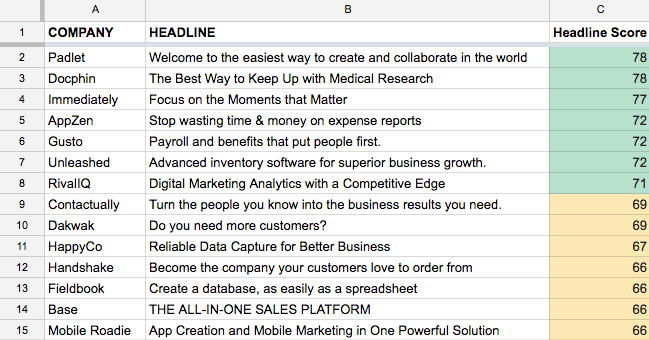
Incidentally, the high scoring headlines came from some of the best all round landing pages I reviewed.
AppZen, for example, which even though it has a split purpose has extremely strong copy.
AppZen

Of course, for a great headline to be great, there needs to be something to compare it to. Let’s take a look at a few which scored poorly.

The problem with looking at headlines in a vacuum is that you ignore the subheaders. For all of these cases where the headline scored low, the subheader did the heavy lifting for it.
The sentiment of the headlines and subheadings is overall positive
Sentiment analysis is an interesting one. It looks at the negative or positive connotations of the words used, and extrapolates a score based on the ratio of positive:neutral:negative words. Why should you care about that?
According to CoSchedule:
“Headlines that convey strong positive or negative emotions tend to perform better.”
That’s a good enough reason to me. Let’s look at the stats:
- 44% of headlines have a positive sentiment
- 37% of headlines have a neutral sentiment
- 13% of headlines have a negative sentiment
- 59% of subheadings have a positive sentiment
- 22% of subheadings have a neutral sentiment
- 13% of subheadings have a negative sentiment
I analyzed all headings and subheadings with Aylien, an awesome text analysis API. Here are some positive headlines for reference:

And negative:

As far as I can see, words like ‘delightful’, ‘great’ and ‘superior’ convey good feelings while ‘tackle’, ‘cold’ and ‘work’ convey bad feelings.
Headlines & subheadings: popular words & phrases
We know about the importance of using emotional words and power words in our copy. There are a few words and phrases proven to convert better — it’s as simple as that.
Here are some interesting data points:
Your/you is 10x more common than we/our

The product is all about the customer, not all about you. You sell what a product can do for someone, not what you’re doing, so speak directly to the customer.
Here’s the exact data:
- your/you: 65
- we/our: 6
The top 10 phrases

As we’ll see later, headlines often emphasize simplicity, speed and superiority. Here’s the data to back that up.
- better way to
- turn your
- easy to use
- faster with
- by google
- by thousands of
- without writing code
- the world’s best
- trusted by thousands
In this day of SaaS being an easy alternative to getting your IT team tangled up installing a hefty on-premises solution, no one wants to write code to get their SaaS up and running. It’s easy to see why this and the others are the most popular phrases.
42% of headlines contain jargon
The OED defines jargon as:
“Special words or expressions used by a profession or group that are difficult for others to understand.”
Although jargon in copywriting is usually forbidden, Belinda Weaver argues there are situations where it’s ok. The most relevant part of her article on the topic says it’s okay to use jargon when you’re talking about a technical topic. Since SaaS is software by definition, that’s gonna be the case!
“The more specialised the topic, the more specialised the language. If your copywriting is selling a technical product to a technical audience, you must speak the same language.
This is when jargon gets some credibility and becomes terminology. Terminology helps you describe something precisely and, more often than not, simpler substitutes just don’t exist.”
While jargon isn’t always bad, for SaaS that isn’t aimed at developers, it isn’t necessary and often weakens the copy. Here’s an example of jargon used well.
Neptune.io

This works because the target audience is certain to know what it means. If they don’t know what it means, it’s not for them.
Datadog

Here we have Datadog. A fantastic product, for sure, but the prominent copy here is pure jargon. Not in the same way as Neptune, though, because Neptune also conveys tangible benefits.
Here’s another comparison:
A) Get stuff done with Nitro. vs. B) Project tracking for distributed companies.
Both headlines imply the same benefit, but A explicitly says it before talking about features (similar to the features laid out in B later on in the page).
The most common themes in these headlines were…
Speed, simplicity, intelligence, superiority, humanity, money, growth and improvement. These are all things customers desire from a product. Some smart headlines even fit into more than one category. Here’s the full list:
Speed
- Bar Inventory in 15 min.
- AUTOMATE INSIDE SALES
- The Fastest Way to Tackle Twitter as a Team
- Quickly Turn Your Leads Into Revenue
- Super Fast Regression Testing
- Sell more and faster with ProsperWorks
- Stop wasting time & money on expense reports
Simplicity
- The simplest way to communicate with customers and employees
- The lightest possible way to do spend controls
- Create a database, as easily as a spreadsheet
- App Marketing Intelligence made simple
- Finally, Back Office Simplified
- Fundraising made simple.
- Welcome to the easiest way to create and collaborate in the world
- CREATE AND PUBLISH POWERFUL MOBILE APPS NO CODING REQUIRED
- Easy, Powerful Web Security.
- The Bitium Difference: Security. Flexibility. Ease of Use.
Intelligence
- Work smarter.
- Smart shipping with built-in inventory management.
Superiority
- The Best Way to Keep Up with Medical Research
- The Most Efficient Way To Target And Connect With Your Ideal Customers
- #1 rated Salesforce-native dialer in the AppExchange
- The #1 Recruiting Software for Growing Companies
- The #1 online and mobile fundraising platform.
- Advanced inventory software for superior business growth.
- SOFTWARE FOR LEADERS
Humanity
- Become the company your customers love to order from
- The simplest way to communicate with customers and employees
- Expense Reporting Optimized for Real People
- Content. Created by Consumers for Consumers.
- Payroll and benefits that put people first.
- Make your front desk delightful.
Money
- PLAN YOUR PATH TO GROWTH OR EXIT
- Turn your cold leads into sales opportunities
- Quickly Turn Your Leads Into Revenue
- Stop wasting time & money on expense reports
- Close More Deals. Make More Sales.
- Fundraising made simple.
- Sell more and faster with ProsperWorks
Growth
- PLAN YOUR PATH TO GROWTH OR EXIT
- BUILD SCALABLE NEWSFEEDS & ACTIVITY STREAMS IN A FEW HOURS INSTEAD OF WEEKS
- Grow Your Local Business
- Sales CRM for small teams with big ambitions
- Grow your business
- Grow and keep your users
- The #1 Recruiting Software for Growing Companies
- Advanced inventory software for superior business growth.
Improvement
- Better Messages for Web and Mobile Apps
- Turn your errors into action
- Better Social Starts HereBetter user onboarding
- Reliable Data Capture for Better Business
- Turn the people you know into the business results you need.
- Improve User Onboarding
- INNOVATION DEMANDS SECURITY
It’s possible to categorize every headline in 1 of 9 formulas
Headline formulas have been used by copywriters ever since they were popularized by John Caples in 1932. When it comes to SaaS landing pages, the techniques are no different. Every headline falls into 1 of 9 categories.
If you’re writing your own headline for a landing page, check out these formulas and examples for inspiration.
Alternatively, use our SaaS landing page headline generator. All you do is put in your software’s purpose, audience, and customer goal, and you get a list of 30 titles. These titles follow the formulas every SaaS headline I analyzed use. When you get the sheet, click ‘File’ and then ‘Make a copy’ to start editing in your own data.
[software] for [target]
- Task Management Software for Teams
- Transaction Management for the modern real estate professional.
- Expense Reporting Optimized for Real People
- Sales CRM for small teams with big ambitions
- Reliable Data Capture for Better Business
- Content. Created by Consumers for Consumers.
- Incident Response Automation for DevOps
- AD SERVING INFRASTRUCTURE FOR AWESOME COMPANIES
- The #1 Recruiting Software for Growing Companies
- Project tracking for distributed companies.
- Chat & inbox for teams. One place to talk and stay up-to-date.
- Advanced inventory software for superior business growth.
- SOFTWARE FOR LEADERS
The [superlative] way to [goal]
- The lightest possible way to do spend controls
- The simplest way to communicate with customers and employees
- The Fastest Way to Tackle Twitter as a Team
- Welcome to the easiest way to create and collaborate in the world
- The Best Way to Keep Up with Medical Research
[imperative][benefit]
- Turn your cold leads into sales opportunities
- Work smarter.
- Build your digital business faster with mobile Backend as a Service.
- Turn your errors into action
- Quickly Turn Your Leads Into Revenue
- Focus on the Moments that Matter
- Grow Your Local Business
- Create a database, as easily as a spreadsheet
- Create expert budgets, forecasts, projections, & sales plans without the spreadsheets
- Grow your business
- MAKE REMOTE DESIGN WORK
- Turn the people you know into the business results you need.
- Put Your Drone To Work
- Send Email That Converts
- Grow and keep your users
- Improve User Onboarding
- Close More Deals. Make More Sales.
- Run productive meetings.
- Get More Leads. Drive Better Engagement.
- Build, Publish & A/B Test Landing Pages Without I.T.
- CREATE AND PUBLISH POWERFUL MOBILE APPS NO CODING REQUIRED
- Get stuff done with Nitro.
- Make your front desk delightful.
- Know what your whole team is doing
- Never create a part again.
- Sell more and faster with ProsperWorks
Better [purpose]
- Better user onboarding
- Better Messages for Web and Mobile Apps
[software] that [benefit]
- Payroll and benefits that put people first.
- Send Email That Converts
[benefit]. [benefit]
- Get More Leads. Drive Better Engagement.
- Close more deals. Make more sales.
- Great meetings. Great results.
[benefit] without [drawback]
- CREATE AND PUBLISH POWERFUL MOBILE APPS NO CODING REQUIRED
- Create expert budgets, forecasts, projections, & sales plans without the spreadsheets
- BUILD SCALABLE NEWSFEEDS & ACTIVITY STREAMS IN A FEW HOURS INSTEAD OF WEEKS
- Expense reports done for you, not by you.
- Build, Publish & A/B Test Landing Pages Without I.T.
[question]
- Do you need more customers?
- Have an app idea? Make this real, with POP.
[purpose]
- ECOMMERCE MARKETING PLATFORM
- Bar Inventory in 15 min.
My final words on SaaS landing page headlines
At Process Street, we’re currently drafting new copy for our landing page, so I wrote this study because the research would have to be done anyway!
Here’s what it looks like right now:

If you’re currently rewriting or testing copy on your landing page and have some split test results to share, let me know in the comments and I might feature the testing in my next piece on landing page copy.
Phew, this was a long’n. If you made it this far, thanks for reading!
27 Jun 19:39
Obstacles Salespeople Face When Trying to be Customer-Centric
by Emilie Totten

When developed and used properly, buyer personas can help marketers and salespeople win more business. By talking to clients, leads, and prospects, your team can implement highly effective communications that drive new and retained assets. When a company develops effective communications, it leaves buyers thinking, “This firm really gets me.” In order to stay relevant with our audience, I routinely talk to sales managers and salespeople at investment management companies to understand:
- What challenges are salespeople facing today?
- What current marketing and sales processes are in place (status quo)?
- Is the status quo working?
- What stands in the way of salespeople achieving their goals?
Through my research, I’ve found that the sales organization often feels under-supported by the marketing and compliance processes currently in place.
The bad news is that ineffective processes cause asset management firms to lose sales, meaning assets are being allocated to their competitors. In one of my recent buyer persona interviews, a Product Manager reported his firm lost billions in sales opportunities last year due to ineffective marketing execution. That’s a big problem.
The good news is that when the sales organization has a need, it is usually addressed right away. Sales is the lifeblood of the organization, so it’s in everyone’s best interest to give them the resources they need to be successful. One department head said to me, “We’re giving them monstrous quotas, so we’d better give them the tools needed to meet their goals.”
From my perspective, the following are the three biggest obstacles facing sales teams at investment management companies today. Investment companies that commit to addressing them will lose less and win more business.
Obstacle 1: They don’t have the right content available when they need it
This one has been discussed in the marketing community ad nauseam, but the problem persists at many firms. Here are some comments from salespeople during our interviews:
- “It took way too long to get a sales idea approved, like over a week. I thought, ‘What are you doing?’ Can’t you just read this and tell if it’s compliant or not and let me know if I can use it?”
- “We didn’t get the materials to give to advisors until a week into the product launch. It’s hard to put a number on the impact that that caused in our sales, but we definitely feel like it hindered our ability to go out there and sell it or have those advisors discuss with their clients because they didn’t have any material to really talk to them about. Then you have communication problems.”
- “I’ll ask, ‘Can we get this approved?’ Then go to the marketing department who says, ’No, that’s not compliant.’ They won’t let us. I don’t delve into why it’s not working because I just don’t have the time to figure out why. It just doesn’t seem to be an issue that we can get through.”
Salespeople struggle to get the right communications to the right person at the right time, due to ineffective marketing and compliance processes. In a world where investors and their advisors expect information at their fingertips, firms lose to competitors who are faster. Asset managers are learning that they can’t compete solely on performance; they must provide added value to differentiate themselves. One way is to provide value through timely communications.
I recently conducted an interview with Andrew Corn, CEO of E5A Integrating Marketing. In our interview, he talks about professionalism as a strategic asset. “The more professional you run your business, the more it is a strategic advantage. If all things are equal on performance, I’m going to allocate to the firm that communicates the best and handles me in the most professional manner. Believe me, getting marketing materials out quickly — three days versus 10 business days — that’s a no-brainer advantage. The firm that is seven days faster is far more professional than the other. We’re at the point where you can tap on your smartphone and summon a car, get a price, and track your trip every step of the way. That kind of ‘Uberization’ is showing up in every facet of our life, including investing. Getting information in real time is the expectation.”
Getting communications updated and distributed quickly remains a challenge for many asset managers.
How successful firms overcome it:
Successful investment companies are tackling the speed-to-market issue at its root cause: data processes. We’ve blogged extensively about how a firm’s data process dictate the timeliness of their communications. In fact, one of our most successful investment management clients tackled their data problem in tandem with a factsheet automation solution. By doing so, they were able to save their analyst 2,000 hours a year, scale their marketing output, and minimize risk. Firms who market a variety of products on different publishing schedules find that an integrated data and marketing automation solution provides them with a key strategic advantage. The faster the data is ready in a quality format, the faster it can be put to use to produce marketing materials for any channel (factsheets, presentations, emails, websites, etc.) for the sales team’s immediate use.
The takeaway here is that a firm’s data process lies at the heart of its communication strategy. Good processes are the foundation. Good processes combined with the right technology solution yields timely communications and professionalism, and that is a key strategic advantage.
Obstacle 2: They don’t have the ability to quickly customize marketing materials
This is an extension of obstacle #1: Salespeople report they don’t have the right content available when they need it, in the right format.
In other words: Sales materials lack relevancy.
While this obstacle is tightly associated with the first, it deserves its own attention. In the intro to this post, I touched on relevancy. In addition to timeliness, relevancy is key to delivering value that can differentiate your firm. Relevancy is achieved when the investor or advisor says, “This firm really gets me.”
Salespeople at investment management firms are actually very good at delivering highly relevant communications, tailored to each individual sales opportunity. That’s not the problem. The problem is they don’t have the means to do so. The marketing and/or compliance process in place doesn’t enable the salesperson to tailor the “generic”, already-approved materials for their client or prospect.
For example, instead of sending individual factsheets, the salesperson knows it’s a much better client experience to send a one-sheeter summary on the five products he’s presenting and follow-up with the fact sheets later if the client is interested. Or, instead of using the company’s generic presentation template, the salesperson wants to add a compelling video or some sector rotation models to convey a memorable and compelling story. If the marketing or compliance process doesn’t allow salespeople to tailor their materials for each sales opportunity, the customer experience suffers and sales don’t close.
Additionally, there’s always the issue of compliance. If salespeople are “going rogue” and presenting materials that haven’t been approved, there is an increased risk to the firm.
How successful firms overcome it:
One of the first things that really smart asset managers are doing is addressing each of their audiences individually. Effective asset management firms are enabling their sales teams by providing platforms with pre-approved marketing materials broken up into components that can be used by a salesperson to create their own customer-centric materials.
Imagine a salesperson having the ability to run data points from an approved data source and display data however they want – as of end of the quarter, end of the month, or close of market yesterday – and use it in a sales presentation along with pieces of approved copy and associated disclosure. In this scenario, the firm has provided its clean, approved data and content in a central location that can be accessed in a user-friendly manner. This data is used to render a variety of marketing assets that can be accessed and used by a salesperson to create highly targeted communications. By tying in additional data sources like CRM, the customer experience becomes highly relevant to the buyer’s needs and goals. This type of customer-centric selling is what differentiates the great firms from the mediocre.
Obstacle 3: They aren’t given the insight (data) to drive sales productivity
In my interview with Andrew Corn, he made another very important point: “The marketing team needs to be able to deliver high-quality leads with the associated behavior. For a salesperson, it’s the difference between shooting fish in a barrel versus having the prospect. This is something that’s highly used when selling things like software, but very underutilized in financial services.”
Effective marketers are collaborating with sales teams to improve sales effectiveness. Marketing should be delivering the highest-value leads and providing data that allows the salespeople to optimize their productivity. Does this web visitor match our ideal lead profile? What is their lead score? How does their behavior dictate our next move? What types of financial advisors or investors are the highest value prospect for us? Marketers often fail to use data to inform sales decisions.
How successful firms overcome it:
The most effective investment marketers are doing two things to improve sales productivity. First, marketers are getting analytics around the use of marketing materials to identify the highest value content and tie it back to sales.
- What is being utilized most often?
- What content is being customized?
- What content is getting the most engagement?
- What content is driving leads? Sales?
These insights help marketers identify where to spend their time, which drives both marketing and sales productivity.
Second, marketers are using web analytics to evaluate web visitor behavior. The insights from marketing automation systems, Google analytics, and other data analysis tools can help marketers deliver high quality leads to the sales team along with their associated behavior. This insight allows sales managers to prioritize where they spend their time and maximize sales opportunities. It also provides insight into investor and advisor needs. Many times, what a prospect says and what they do don’t align, so the addition of quantitative data helps sales teams decide what information to present and how to present it. The result: Customer-centric sales presentations and shorter sales cycles.
Conclusion: Get out of your own way
Successful investment managers give their sales teams the tools they need to be successful. Yes, this requires a solid marketing plan with a sales enablement component, but don’t underestimate IT and compliance as key players in your overall business strategy. Key decision makers from marketing, sales, IT, and compliance must come together to create a unified plan that achieves timeliness, relevancy, and productivity. There are industry experts in financial services marketing automation that can help your firm get on the right track with good processes, best practices, and proven technology solutions. Fact sheet, pitchbook, and investment data automation are becoming commonplace at investment companies today, but the key to implementing an effective solution is having the right strategy. Carefully consider your options to ensure you’re accomplishing your goals and maximizing ROI. With the right approach, your firm can gain true competitive advantage and deliver value that truly benefits your customers and drives AUM.
27 Jun 19:39
How to Work a Lead: Tips and Tricks to Close That Sale
by Melissa Duko

Advertisers know pay per call advertising delivers a higher success rate for closing and converting leads than other methods (e.g. pay per click). An integral part of pay per call’s success is its ability to deliver a quick response. Consumers — to the tune of 75% — appreciate they can pick up the phone and get a live person to complete an order or provide a solution. And a popular option for connecting those consumers to the right person is warm transfers.
Warm transfers separate the wheat from the chaff by pre-qualifying leads. Lead information is gathered typically via a form containing advertisers’ selected criteria (e.g. demographic, economic status, etc.) before transferring it to your call center or sales team. By all accounts, the leads your team receives should be interested consumers ready to buy. Sounds like a slam dunk, right?
Wrong.
Just because a warm transfer looks like a sale on paper doesn’t mean that it is one. You’ve still got to work that lead. In fact, you always have to work a lead no matter what type you get.
Here are four simple tips for getting your lead all the way through the sales funnel.
1. Know Your Buyer Personas
Depending on your product, you may be working with several buyer personas. Buyer personas are fictional generalizations of your target customers. These personas help you relate and anticipate your customers’ potential needs.
Study your buyer personas so you can recognize your buyer quickly. As soon as you answer that warm transfer call, you should be able to discern who your buyer is so you can effectively address their pain points.
Let’s say you’re a buyer who’s looking for classic car auto insurance. You go to Hagerty’s website and begin filling out their lead form, which asks you for your location, vehicle type, and personal info.

Source: Hagerty
Classic car auto insurance is quite different from regular auto insurance. Hagerty needs to first find out if you even qualify for their insurance. A 1991 Corvette isn’t the same as a restored 1969 Dodge Dart.
Once Hagerty determines you meet their basic pre-qualifications, they still have to qualify you once they get you on the phone. Using buyer personas, Hagerty will be able to streamline the process by being able to identify the caller as an auto, motorcycle, scooter, tractor, military, fire truck, truck/jeeps/SUV, then address their individual needs.
And the best way to address their needs is to ask questions.
2. Ask Questions
If we’ve learned anything from the Wolf of Wall Street (besides Leonardo DiCaprio has amazing dance moves), it’s that you never sell the virtues of a pen. Instead, you ask questions to identify whether the consumer even needs a pen. It’s all about identifying the consumer’s needs.

“The real answer is, before I’m even going to sell a pen to anybody, I need to know about the person, I want to know what their needs are, what kind of pens do they use… And if you do that, people don’t know what to do. Next thing, he is answering, and now I’m controlling the conversation, finding out exactly what he needs.” – Jordan Belfort, Wolf of Wall Street
Asking questions will help you to determine whether or not your product is even a fit for the potential client.
Perhaps you’re a commercial HVAC company who only services large office complexes. When a Mom & Pop shop contacts you to inquire about your services, you can simply ask them who they currently use for HVAC. If Mom & Pop answers Joe the Plumber, you’ll know to take the call no further. This saves both you and Mom & Pop from wasting time and money.
3. Know Your Product
On the flipside, the consumer is going to be asking you questions, too. While you should never be too aggressive in selling your product, you should be knowledgeable enough to answer any questions. Not knowing the answer will make the consumer doubt not only your credibility, but also the product.
If I’m looking to invest in a new air conditioning unit for my home, I’m going to have questions that weren’t on the lead form. Naturally, a consumer shouldn’t expect a salesperson to be able to answer technical questions — that’s the HVAC technician’s job. But they should be able to answer frequently asked or basic questions such as how long installation takes, whether new units come with a warranty, what the average cost is, and so on.
If your consumer hears, “I don’t know,” you’ve just placed a seed of doubt. That seed of doubt will continue to grow, and ultimately, kill any chances of making a sale.
4. Provide Relevant, Valuable Material
Once you’ve determined your lead is a qualified fit, it’s time to close that gap between getting the lead and closing the sale. To do this, send them relevant, valuable info. Have your marketing department produce collateral that will answer any questions the lead might have.

Collateral can include pertinent:
- Blog posts
- Articles
- Case studies
- Testimonials
- Sales decks
Remember 80% of calls require on average five follow-up calls to close a deal. And once that deal is closed, don’t get complacent. Always follow-up. Check in to make sure the consumer is happy with the product and to answer any lingering questions they might have.
Continue to provide relevant materials to keep them informed of industry changes, new programs, evolving products, etc. By giving the consumer the materials they need, you’ll be earning their trust in return and hopefully a lifelong customer.
27 Jun 19:39
Sell Me This Pen. Some Advice for Technology Marketers
by Chris Herbert
Technology Marketers Need to Know How To Sell

Today, more than ever, technology marketers need to know how to sell. In fact, if a marketer doesn’t have experience selling it’s a key weakness…well, actually an opportunity! The disconnect between sales and marketing is one of the reasons why tech marketers need to develop their sales skills. Every year we hear about how content being produced by marketers is fluff, that leads aren’t “qualified” and that IT buyers (especially developers) cringe at the sound of “marketing”. While this is harsh and there are some stellar marketers out there, it’s a reality we must face.
Sell Me This Pen
So here’s an exercise to try whether you’re a marketing or sales professional. It’s a very easy role playing exercise. There are three critical things to think about: 1) Ask questions, 2) What’s the sales situation (who are you selling the pen to and in what context/use case) and 3) You’re going to have to explain the value proposition and benefit.
The “Sell Me This Pen” Job Interview Scenario
I came across this update on LinkedIn, which inspired this post.  The “sell me this pen” question is asked during an interview, which sets the sales situation. The line of questions to ask could be the problem/pain the interviewer would experience if s/he didn’t have the pen and how it would be better if s/he had one. Perhaps something like this:
This pen will help you record our conversation and any insights you gather during our interview. You can use the pen to highlight key sections in my resume that stand out, concern you and that you want to seek further clarification on.
Your notes can then be shared with your colleagues prior to them interviewing me in the next round. They are free to use the pen (I have more if you need some) also so they can share their notes with you so you can make an informed decision about my joining your team.
By using this pen, you’ll better remember the important things about me and whether I’m a good fit for your organization. It’s a tool for you, and your team, to gather the right information and make the right decision. Once you’ve decided to hire me we can use it to sign the offer letter.
Check out how the real “Wolf of Wallstreet”, Jordan Belfort, sells a pen to Piers Morgan.
27 Jun 19:39
3 Outside Sales Best Practices
by Alden Morse
Over the last several years, the line between “inside” and “outside” sales has become somewhat blurred. Where the fostering of long-term business relationships often involved face-to-face meetings, the presence of new technology––particularly B2B eCommerce––alongside evolving B2B client demands, has changed the nature of outside sales and the responsibilities that reps are expected to undertake.
Nonetheless, outside sales reps are still important to the health and success of manufacturing and distribution companies. The acquisition and maintenance of high-value accounts, alongside the kind of direct point-of-contact that most enterprise-level companies desire, can only be achieved by reps with a certain skill-set.
Whether you’re looking to hire an outside sales rep, or you’re already working as one, the tips in this article will help you maximize results by establishing effective processes and ironing out inefficiencies.
What do outside sales reps do?
Outside sales usually involves meeting face-to-face with potential and current customers. They are usually responsible for generating and closing high-value leads and maintaining a customer base of long-term clients.
Because of their importance to a company, especially in the case of B2B sales where single contracts can be valued in the millions, outside sales reps tend to be amongst the highest-paid employees. Let’s take a look at some of the things outside sales reps can do to up their game.
Outside Sales Best Practices
1. Embrace new technology
Only a decade or so ago, meeting prospective clients tended to involve long plane journeys, expensive stays in unknown cities, and a relatively high client-acquisition cost. The prevalence of new communication technologies – web-conferencing and smartphones – mean that it’s now possible to eschew many in-person meetings without any significant loss.
The ability to achieve a higher ROI, a figure that outside sales reps should always be keeping a close eye on, is directly linked to the replacement of some costly travel activities with new technology. The point isn’t that in-person meetings are redundant – it’s crucial for outside sales reps to gauge when a prospective client would prefer to meet in person – but rather to limit needless expenses in the context of more efficient communication channels.
2. Coordinate with your whole department
Though a significant portion of an outside sales rep’s time will be spent outside company walls, it’s important to understand how their role fits into the bigger picture. Outside sales is a very broad term than can extend across the whole gamut of sales and marketing activities. Both pitching to warm leads in the form of a presentation and attracting entirely new clients at trade shows or networking events are examples of activities that a rep will likely have to undertake.
Because it’s probable that a sizeable portion of outside leads will be fostered by other departments or individuals within the company, it’s important that all aspects of the sales process – lead generation and face-to-face “conversion” – are coordinated. If a potential client has been led to expect a certain promotional offer or tailored information, it’s vital that outside sales reps understand what’s required.
In a similar vein, it’s also important to be aware of support networks within a company. Data analysis and tight demographic profiling, for instance, can be important during the research phase, whilst an understanding of the nature of marketing campaigns responsible for generating particular groups of leads can be important for crafting effective pitches.
3. Capitalize on “inside” digital sales channels
Whilst the overlap of “inside” and “outside” sales channels has already been touched on, it’s worth reiterating again. The increasing adoption of B2B eCommerce has meant that more suppliers are exploring digital marketing and sales channels. Whilst on the surface it might seem that these new forms of promotion are the domain of the inside sales team, outside sales reps have an equally important role to play.
An increasing number of high-ticket B2B buyers, for example, use social media to foster relationships with prospective suppliers, as well as to find information about them. Social media gives outside sales reps the opportunity to begin fostering relationships remotely on a far wider scale than has previously been possible. In a similar vein, the sheer range of targeting options that online advertisers now offer also allow outside sales reps to target potential high-value clients in new ways.
27 Jun 19:39
Proven Tactics to Create Sales and Marketing Alignment
by Dai Carillo
In a perfect world, sales and marketing teams are composed of the same people who share the exact same goals and targets. They’d be working harmoniously with one another, and every achievement would be the result of a seamless process that perfectly complements each department’s strengths and weaknesses.
But, in the real world, that ideal scenario seldom holds true. Each team often has different goals and varying expectations that are not always well aligned.
For example, marketing departments aim to set a solid foundation for strong brand recognition, so they’re in it for the long haul. They also usually view lead generation as a numbers game, with goals to reach out to as many prospects as possible in order to increase the chances of some being converted into leads.
The sales team, on the other hand, moves at a faster pace. They have sales quotas to reach and demanding prospects to talk to, so the resulting timeframe for interacting with prospects is shorter. Lead generation for them is not a numbers game. Rather, it’s an opportunity to uncover client needs that must be met to close a sale.
With such different approaches, can these two teams ever see eye-to-eye?
One way to resolve this is through operational alignment. This is one of the best ways for the two teams to meet halfway, enabling both departments to enhance each other’s effectiveness through better collaboration.
Below, are six proven tactics to help create sales and marketing alignment.

1. Create a Unified Customer View
Begin with a clear picture of your company’s ideal customer and buyer personas. When both the marketing and sales teams have a well-defined view of who that customer is, it acts as a solid foundation, enabling both departments to create strategies and campaigns around common goals.
Both teams should be privy to every customer touchpoint, whether it’s through face-to-face interactions, customer service feedback, email, page views, or data stored in your Customer Relationship Management system. Adopting the same unified customer view is the first step toward successfully aligning both departments. It’s important to take care at this stage because any misalignment here can create confusion down the road.
2. Adopt a Revenue Cycle Approach
The sales funnel is a widely used model followed by most sales and marketing departments. It involves casting a wide net over a large audience and pushing the highest quality prospects further along the funnel, with the intention of transforming them into leads, and eventually customers.
While this strategy has been successfully implemented in the traditional sales setting, today’s tech-savvy consumer has evolved to the point where a revenue cycle approach has become more appropriate.
Why? Because customers these days have the ability to do their research online. Unlike during the pre-internet age, they can instantly access a wealth of content to educate themselves about a product or service. As a result, consumers have become more demanding and expect both personalized attention, and faster turnaround times.
A revenue cycle strategy recognizes this new breed of customer and adjusts accordingly. Clients’ needs are heeded so that each stage in the sales funnel moves fluidly, as opposed to a rigid step-by-step approach. Both marketing and sales must understand that they need to work with each other to successfully provide the kind of personalization that today’s customers demand.
3. Implement Closed-Loop Reporting
While the marketing team is busy coming up with strategies and creating campaigns, sales reps are occupied with talking directly to potential clients and convincing them that your product or service is superior to all others.
However, sales reps typically don’t have the means or the time to record what they learn from these interactions with clients. It is a shame because the feedback they gather from prospects could be a huge help to shaping new strategies and adding value to future interactions.
To fill this gap, synchronize your sales and marketing data by integrating an appropriate CRM tool that is accessible to all. The intelligence that marketers gather from closed-loop reporting can help sales teams by exposing conversion assists and touchpoints that prospects interacted with before becoming leads or customers. Meanwhile, the intelligence that sales reps gather from directly interacting with customers can help marketing teams identify common needs, behaviors, and motivations that can be used to target prospects.
4. Meet Regularly
For each department to support each other successfully, it is important to share processes, best practices, and resources. This can be implemented with a weekly or monthly sales and marketing team meeting. Apart from setting expectations and addressing potential questions, these meetings allow marketers to learn how sales teams are doing with their quotas and objectives (and vice-versa).
Properly define service level agreements during these meetings so that it is clear how each team will act to support each other. Hold brainstorming sessions and ask teams what tactics they think could enhance operations. Use shared databases to make this information available to all and use shared calendars to keep both teams up to date on the other’s progress.
5. Align Your Content Strategy
Make sure that both marketing and sales are onboard with regards to your overall content marketing strategy. Both sides should be present during the creation process. Ideally, each team should agree on an overall content strategy, when and how the content will be used, where it should be published, and what KPIs to use to gauge effectiveness.
When both sides agree on these areas, empower the sales team by letting them decide how they can best use the content to qualify leads effectively, making it easier for them to close sales.
Wrapping Things Up
Successful alignment within your sales and marketing teams is a powerful force to be reckoned with. Data supports this claim; MarketingProfs stated that sales and marketing alignment leads to 36% higher customer retention rates and 38% higher sales win rates. Salesforce indicated that aligned organizations averaged a 32% average revenue growth rate compare to a 7% decline for less aligned companies. Lastly, Sirius Decisions declared that tightly aligned sales and marketing operations achieved 24% faster growth and 27% faster profit growth over a three-year period.
Together, these two departments can bring in a consistent revenue stream that promises to contribute to a robust bottom line and improved lead generation strategies. When each department can harness each other’s strengths, it’s bound to increase your chances of long-term business success. With numbers like that on your side, why not give sales and marketing alignment a try?

27 Jun 19:38
Executing Account-Based Selling Like an Expert
by Bruce Boyers
What Exactly is Selling, Anyway?
That question will certainly provoke an endless stream of responses. But rather than invent an entirely new, different, slick and perhaps emptily engaging definition, let’s turn back to a very reliable expert on the subject.
It was legendary author, salesman and motivational speaker Zig Ziglar who said, “You will get all you want in life, if you help enough other people get what they want.”
If you ask any long-term champion salesperson, you’ll get the same answer: the more emphasis you place on helping your prospect, the higher the likelihood of a successful sale. At the very least it means providing, through your product or service, a real, tangible benefit to prospects and customers.
But today, we’re in a world of social selling—and this maxim goes much further.
The Expert Salesperson
A salesperson was not always an expert on what they were selling. In fact, they usually had just enough knowledge, and just enough information about a prospect’s needs or desires, to rattle off a great pitch. It was rather hit-or-miss, and the good ones obviously had more hits than misses.
Such a pitch today, though, won’t get you very far at all. By the time a prospect contacts you, they’ve already researched your product—and your competitor’s product—online. 60 to 80 percent of their buying decision has already been made. No “pitch” will do very well in such circumstances.
What does this mean for you, the salesperson? You must become an expert in your marketplace, and of course your product or service. But well beyond that—and far more importantly—you need to learn every detail about your prospect company, their issues, and how your product or service might address those issue. You need to know your ideal buyer and their qualities.
Outward from there you should be keeping constant tabs on your industry, current events within that industry and what they mean, government regulations, and any other pertinent facts. Last but certainly not least, you should have a deep understanding of your competition—their strengths, weaknesses, where your product surpasses them and—equally as important—where it doesn’t.
Getting Social
The first place you’re going to apply such knowledge is through interaction in social media. Get on Twitter, LinkedIn, Facebook, Quora and others, and become involved in any groups where your prospects might be found. Offer sound advice, and set yourself up as a trusted expert in your field.
For example, if your product was call accounting software, you’d investigate social media platforms to find groups discussing call accounting issues. You’d enter into conversations, answer questions and interact with group members. At least at first, it is best if you do so with without ever mentioning the fact that your product is call accounting software—in fact most online groups won’t allow you to promote your product anyway. So in that respect you’re selling yourself, not your product.
But even if you don’t mention your product, if you make yourself a trusted expert and genuinely provide help, who do you think these people will turn to when they’re shopping for call accounting software? You guessed it: someone they trust. You must make yourself that person.
Shut Up and Listen
In the past, a salesperson has been all too willing to jump right in with a pitch—which, as we’ve already mentioned, isn’t the way it works today. The most important aspect of the new sales landscape is listening. You’ll discover that in situations where prospects were upset by salespeople, failure to listen was often the reason: the salesperson didn’t make the effort to find out about that prospect, and how—or even if—the product would help them. The same goes for a prospect company.
Returning to the call accounting example, let’s say you’ve made a first contact with a potential buyer. You should start right off by asking questions—about the company, its operations, why call accounting is something they need, which application they currently use and why they’re on the hunt for a new one.
Armed with the answers to these questions, you can confidently slant your pitch to help them and solve their particular needs. You’ll know which of your product features to highlight, and what advantages you can offer to them over their current application and your competition.
And now, you’ll find, you’re selling! Of course, you must actually have an intention and willingness to help. It’s not the kind of thing that can be easily faked—most of the time in doing so you won’t get to first base.
But thoroughly understand your product, do your homework, have a comprehensive understanding of the industry and, most importantly, listen. You will then be helping.
And if you’re helping, you’ve just answered the question at the top of this article.

25 Jun 16:31
Here's how an absurdly simple app hacked my brain and made me a runner
by Rafi Letzter

For about a month now, something magical has happened in my life: I've started running.
Lots of people pick up new healthy habits all the time, so it's not altogether shocking.
But, even as I've drifted in and out of other exercise regimes — and told myself over and over that this is the run that will start a repeating pattern — I've never managed to run consistently for even a couple of weeks.
So, what changed? I don't have more time these days. (If anything I have less.) All I've done differently is played with my phone.
Specifically, I download a fairly popular app, Runkeeper.
I'd been wondering what exactly it is about Runkeeper that helps me overcome my overwhelming running inertia when I began reading up on the science of forming habits.
Here's the thing about habits: They're very simple in structure. You have a craving. You get a cue. Your brain kicks into a programmed routine. You get a reward. (Charles Duhigg lays this process out in detail in his 2012 book "The Power of Habit.")
Some habits are small, like spotting a candy jar cuing you to reach in and eat a candy. Some are big and important, like the daily tasks of caring for a child.
But what strings the successful ones together is that cue-routine-reward series; you stick with them because when you don't your cravings intensify.
In the past when I've tried to start running, I've only worked on developing a routine. Run x miles a day. Run y miles a week. There was neither a consistent cue, nor a consistent reward.
I've used Runkeeper to solve that problem for me.
When I signed up, I selected a particular training regime, designed to get you from beginner level to running a sub-65 minute 10k in about 4 months. There's a set schedule, and the night before a run day, my phone pings me with a gentle notification: Remember your run tomorrow! That's a cue, making me aware of a small unfilled slot on my Runkeeper schedule.
I'm the kind of person who will read a book because my e-reader tells me I've read fewer this month than last, so that unfilled slot forms a kind of craving. So I run, and keep running day after day, following this little habit routine even when I run into obstacles. (My first day out, I tried to run 2 miles and collapsed in a heap after 1.66 miles.)

After a successful run, Runkeeper gives you a little reward — notifications like "Congrats" and letting you know any new personal records you set. If you do particularly, they send you a little email as well.
It's all meaningless to you, but for me it created the cue-routine-reward cycle I needed to get over the initial challenges of starting running. And now the new, realer rewards accrue: the way my body feels after running, the extra weight I've put on since college dropping off, and those little run slots filling up.
And when I miss runs, the app creates a craving. This weekend, for example, I was too busy to get a run in. And while my knees don't mind the break, my mind can't wait to file this article so I can head back and fill that little slot.
Habits are crazy.
SEE ALSO: The 7 best science-backed fitness apps
25 Jun 16:28


See the rest of the story at Business Insider
The 20 best countries to live in, according to millennials
by Tanza Loudenback

Millennials are constantly on the move. According to a TransferWise survey conducted in 2015, more than half (55%) of adults aged 18-34 say they’d consider moving out of the US.
In partnership with brand strategy firm BAV and the University of Pennsylvania's Wharton School, U.S. News & World Report compiled a list of the best countries to live in, according to millennials — which they defined as adults less than 35 years old. The ranking was determined by how nearly 6,000 millennials in four regions — the Americas, Asia, Europe and the Middle East, and Africa — responded to the survey prompt of whether a particular country “is a place I would live.”
Australia, the adventurer's paradise, came in at No. 1, followed by Canada in second and Italy in third. Read on for the full list of the best countries to live in according to millennials.
SEE ALSO: The 15 best countries to launch your career
AND: The 27 cities with the best quality of life in the world
20. Japan
Capital: Tokyo
GDP: $4.9 trillion
Population: 127 million
Quality of life: 6.2
19. Argentina
Capital: Buenos Aires
GDP: $610 billion
Population: 43 million
Quality of life: 1.2
18. Greece
Capital: Athens
GDP: $242 billion
Population: 11 million
Quality of life: 1.4
See the rest of the story at Business Insider
25 Jun 16:18
Grey Brexit vote angers younger Britons
by Marie Giffard and Dario Thuburn

London (AFP) - Young people vented their anger on Saturday against more eurosceptic older voters as they came to terms with a momentous referendum to pull Britain out of the EU, with the hashtag #NotInMyName trending on Twitter.
"I feel angry. Those who voted leave, they're not going to fight the future," said Mary Treinen, 23, a technological consultant who lives in London's trendy Shoreditch district.
A 12,000-strong survey of referendum voters published by pollster Michael Ashcroft found that 73 percent of 18-24-year-olds and 62 percent of 25-34-year-olds had voted "Remain", while 60 percent of people aged over 65 had voted "Leave".
Within hours of the results, there was a small demonstration outside Downing Street.
Richie Xavier, a 21-year-old barman, said: "I don't feel it is right for the old people to speak for us. Not to be insensitive, but we have a lot longer to go than they do. So I do feel a little bit robbed of my future."
Paddy Baker, 21, agreed saying: "Older people voted for this -- but we are the ones who are going to feel the ramifications."
At a meeting of the opposition Labour Party in central London on Saturday, many also voiced concern about the generational fault-line exposed by the vote, between those who cannot remember a Britain without the European Union and those who can.
"The young people that voted overwhelmingly to remain must not be short-changed," Labour leader Jeremy Corbyn told the audience.
Terence Smith, at 19 Britain's youngest mayor, said he had voted "Remain".
"I'm still coming to terms with what we are facing," said Smith, mayor of Goole in Yorkshire, northern England.
He said there was "a terrible generational divide that we must seek to overcome".
- 'I'm out of this country' -
Many young people took to social media to vent their frustration after the shock result from Thursday's vote, in which "Leave" won by 52 percent to 48 percent.
"This vote doesn't represent the younger generation who will have to live with the consequences," Luke Tansley wrote on Twitter under the handle @rams_luke.
Eleanor on @PrettiestStar_ wrote: "I refuse to hide my anger, fear and sadness at a decision that will change my future to one I never wanted".
Rebecca, tweeting at @ReallyRew said: "Our country's fate has been decided by people longing for a past that never existed and they've created a future that's bleak".
Matthew van der Merwe wrote to the Financial Times newspaper describing how his great-grandparents fled violent nationalism in Europe in the 1930s for South Africa and how his parents fled apartheid.
"My brothers and I were the first in four generations to be born into an open, liberal democracy, and in a world that had moved towards co-operation," the Cambridge University student said.
"On Thursday we moved backwards, and it's not clear quite how far. A great deal of the optimism I shared with most of my generation in this country, is gone," he said.
A anonymous young letter writer in the FT also complained about the vote, raising the burden of paying to bail out banks and fund pensions for older people.
"What do we get in return? We lose the right of freedom to move, study, work, live and be treated as equals in any European country."
The letter concluded: "As soon as I've finished my studies I'm out of this country".
25 Jun 16:17
There's a secret Google feature that makes it incredibly easy to set reminders (GOOG)
by Antonio Villas-Boas

There are countless apps for organization and productivity that let you set reminders for things you need to do, but it's actually super easy to simply set yourself a reminder using Google.
What makes Google so good at reminders? You can set a reminder simply by typing in the Google search box, just like you would if you were actually searching something.
It's insanely easy because there's nothing easier than performing a Google search.
It's especially useful if you need to set a reminder while you're in the middle of something and you want minimum interruption of your workflow.
The only app you need is Google Now. It comes standard with all Android phones, but if you haven't activated it already, it's time to do so.
Just type "remind me to X at Y time/place" in the Google search box, and a box will appear with your reminder and the options to choose when or where you want to be reminded.

After setting that up, click "Remind me on Google Now," and you'll get a notification on your mobile device with your reminder at the time or place you set the reminder for.

Unfortunately, despite the fact that iPhone users can use Google Now, I haven't managed to get a reminder alert notification on my iPhone. The reminder did show up in my notifications shade, but I didn't get an audible or visible alert.
Also, you can't set a reminder within half an hour of setting it, and it won't work if you type in the web address bar. You have to type "remind me ..." in the Google search box.
Otherwise, this is the best and easiest way to set up a reminder, and it might actually help me get more organized.
SEE ALSO: Why Google's smart assistant doesn't have a name like Siri, Alexa, or Cortana
Join the conversation about this story »
NOW WATCH: You can modify your iPhone's logo so it glows like the one on your MacBook
25 Jun 16:14


11 things to do in your 20s to become a millionaire by 30
by Kathleen Elkins

- If you want to make seven figures by age 30, what you do in your 20s matters.
- Business Insider compiled 11 pieces of advice, from researchers and self-made millionaires, on how to earn seven figures by the age of 30.
- From having multiple streams of income to investing your savings, there are many ways you can increase your wealth in a free-market economy.
- Visit Business Insider's homepage for more stories.
"In a free-market economy, anyone can make as much money as they want," emphasizes self-made millionaire Steve Siebold, who has also studied over 1,200 of the world's wealthiest people. That applies to 20-somethings.
To help you reach the seven-figure mark by 30, we rounded up 11 pieces of advice from people who became millionaires at a young age and people who have studied hundreds of self-made millionaires.
We can't guarantee millionaire status, but following this advice won't hurt your odds.
DON'T MISS: 20 rags to riches stories that will blow your mind
1. Focus on earning
"You cannot save your way to millionaire status," writes Grant Cardone, who went from broke and in debt at 21 to self-made millionaire by 30. "The first step is to focus on increasing your income in increments and repeating that."
"My income was $3,000 a month and nine years later it was $20,000 a month. Start following the money, and it will force you to control revenue and see opportunities."
Earning more money is often easier said than done, but most people have options. Read about how to bring in additional income, some high-paying jobs you can do on the side, how you can earn passive income, and the first step to take before starting any business, from an entrepreneur who earns up to $170,000 a month.
2. Develop multiple streams of income
One way to earn more is to increase your streams of income.
In author Thomas C. Corley's five-year study of self-made millionaires, he found that many of them develop multiple streams of income: 65% had three streams, 45% had four streams, and 29% had five or more streams.
These additional streams include real-estate rentals, stock market investments, and part-ownership in a side business.
"Three streams of income seems to be the magic number for the self-made millionaires in my Rich Habits study, but the more income streams you can create in life, the more secure will your financial house be," he writes.
3. Save to invest, don't save to save
"The only reason to save money is to invest it. Put your saved money into secured, sacred (untouchable) accounts. Never use these accounts for anything, not even an emergency. This will force you to continue to follow step one (increase income). To this day, at least twice a year, I am broke because I always invest my surpluses into ventures I cannot access."
Investing is not as complicated or daunting as we make it out to be. The simplest starting point is to contribute to your 401(k) if your employer offers one, and take full advantage of your company's 401(k) match program — which is essentially free money — if it has one.
Next, consider contributing money toward a Roth IRA or traditional IRA, individual retirement accounts with different contribution limits and tax structures — which one you can use depends on your income. If you still have money left over, you can research low-cost index funds, which Warren Buffett recommends, and look into the online-investment platforms known as "robo-advisers."
The key to consistently setting aside money is to make it automatic. That way, you'll never even see the money you're contributing and you'll learn to live without it.
4. Be disciplined and decisive
Rafael Badziag, an expert in the psychology of entrepreneurship, discusses the long-term habits of billionaires his book "The Billion Dollar Secret: 20 Principles of Billionaire Wealth and Success."
He spent five years interviewing 21 self-made billionaires and found that along with other things, they are all disciplined, Business Insider previously reported.
"The billionaires I interviewed are the most disciplined people I have ever met," Badziag wrote. "They put a high standard on themselves and on the people around them."
After studying over 500 millionaires, journalist and author Napoleon Hill found that they all shared one quality: decisiveness.
"Analysis of several hundred people who had accumulated fortunes well beyond the million dollar mark disclosed the fact that every one of them had the habit of reaching decisions promptly," Hill wrote in his 1937 personal-finance classic "Think and Grow Rich."
5. Don't show off — show up
"I didn't buy my first luxury watch or car until my businesses and investments were producing multiple secure flows of income," writes Cardone. "I was still driving a Toyota Camry when I had become a millionaire. Be known for your work ethic, not the trinkets that you buy."
Need inspiration to save more and spend less? Read up on tips and strategies from people who saved enough of their incomes to retire before 45.
6. Change your mindset about money
"Getting rich begins with the way you think and what you believe about making money," self-made millionaire Steve Siebold explains.
At the end of the day, "The secret has always been the same: thinking," he emphasizes. While the masses believe becoming wealthy is out of their control, rich people know that making money is really an inside job."
7. Invest in yourself
Many modern-day successful and wealthy people are voracious readers. Take Warren Buffett, for example, who estimates that 80% of his working day is dedicated to reading.
They also focus on healthy. Every billionaire Badziag interviewed had a strict exercise routine.
8. Ditch the steady paycheck
Rich people are typically self-employed and determine the size of their own paycheck, Siebold writes: "It's not that there aren't world-class performers who punch a time clock for a paycheck, but for most this is the slowest path to prosperity, promoted as the safest. The great ones know self-employment is the fastest road to wealth."
While the world-class continue starting businesses and building fortunes, average people settle for steady paychecks and miss out on the opportunity to accumulate great wealth.
"The masses almost guarantee themselves a life of financial mediocrity by staying in a job with a modest salary and yearly pay raises," Siebold says.
9. Set goals and visualize achieving them
If you want to make more money, you have to have a clear goal and then a specific plan for how to achieve that goal. Money won't just appear — you have to work at it.
Rich people choose to commit to attaining wealth. It takes focus, courage, knowledge, and a lot of effort, self-made millionaire T. Harv Eker emphasizes, and it's possible if you have precise goals and a clear vision: "The number one reason most people don't get what they want is that they don't know what they want. Rich people are totally clear that they want wealth."
10. Start hanging out with people you admire
Andrew Carnegie, who started with nothing before becoming the richest man in the US, credits all of his riches to one principle: the Master Mind.
The idea is to surround yourself with talented people who share your vision, because the alignment of several smart and creative minds is exponentially more powerful than just one.
Plus, we become like the people we associate with, which is why the rich tend to associate with others who are rich.
"In most cases, your net worth mirrors the level of your closest friends," explains Siebold. "Exposure to people who are more successful than you are has the potential to expand your thinking and catapult your income. The reality is, millionaires think differently from the middle class about money, and there's much to be gained by being in their presence."
11. Shoot for $10 million, not $1 million
"The single biggest financial mistake I've made was not thinking big enough," writes Cardone. "I encourage you to go for more than a million. There is no shortage of money on this planet, only a shortage of people thinking big enough."
25 Jun 16:13
3 Reasons You Need Salespeople to Scale
by Aaron Ross
what works at the bottom may not work as you tilt upmarket
A lot of people have a desire to avoid hiring salespeople. For some, it’s a question of:
“Do I even need salespeople at all? Slack and Atlassian don’t have any (yet). Can’t I just do a Basecamp model? Can’t I just have Customer Happiness Officers who make customers so happy that they keep referring new customers? And people just buy my stuff without me doing anything or having to sell it?”
Read more on 3 Reasons You Need Salespeople to Scale…
The post 3 Reasons You Need Salespeople to Scale appeared first on Predictable Revenue.
25 Jun 16:06

What do the 27 remaining EU countries want for the future?
by The Associated Press
A Brexit supporter holds a Union Flag at a Vote Leave rally in London, Britain June 4, 2016. (Neil Hall/Reuters)
BERLIN — The European Union must heed “the expectations of the people” on issues such as migration and unemployment as it responds to Britain’s vote to leave the bloc, Germany’s foreign minister said Saturday.
Frank-Walter Steinmeier was meeting with top diplomats from the EU’s five other founding nations in Berlin for hastily arranged talks following Britain’s stunning vote Thursday to leave the union.
The German foreign minister invited his counterparts from France, Netherlands, Italy, Belgium and Luxembourg to the government’s Villa Borsig mansion on the outskirts of Berlin.
As he was heading into the meeting, Steinmeier implied it is important for leaders to better connect with the EU’s more than 500 million citizens and react to their worries.
He said now is the time to find out what the 27 remaining EU countries want for the future of the union. He said they also needed to listen to the EU’s citizens and hear “the expectations of the people.”
Steinmeier mentioned the refugee crisis, high unemployment among young people in southern Europe and security concerns following the terror attacks in France and Belgium as important issues where people had the right to expect better answers from EU policy makers.
However, he cautioned against making rash decisions.
“It’s totally clear that in times like these, one should neither be hysterical nor fall into paralysis,” Steinmeier said.
Almost defiantly, he said that “I’m certain that countries that have something to say will not allow that their Europe will be taken away.”
The EU was built in the grim aftermath of World War II with the hope of leading the destroyed continent to a more peaceful and prosperous future. First launched as European Coal and Steel Community in 1951, it was turned into the European Economic Community in 1957 by the six founding members present in Berlin this weekend.
Gradually, more and more western European states joined. With the fall of communism in 1989, the economic and political union also opened its doors to eastern and central European countries like Hungary and Poland.
Despite the union’s current crisis, Belgian Foreign Minister Didier Reynders said they would “try to go further now with the European integration.”
“We need to discuss with the U.K. the way out, but we need also to discuss how it is possible to do more with some partners or with 27 member states in different concrete fields,” Reynders told reporters.
Dutch Foreign Minister Bert Koenders said it was very important for the foreign ministers to look for “constructive, innovative European co-operation.”
Steinmeier’s office had said earlier that the meeting is one of many conversations now taking place, and shouldn’t be seen as “an exclusive format.”
Besides the German, Dutch and Belgian foreign ministers, France’s Foreign Minister Jean-Marc Ayrault, Italy’s Paolo Gentiloni and Jean Asselborn from Luxembourg were also taking part in the talks.
Despite the foreign ministers’ determination to look for solutions to the current crisis, the head of the EU’s executive Commission, Jean-Claude Juncker, warned in German daily Bild on Saturday that other countries may also call for referendums to leave the EU.
He told Bild that the exit of Britain did not mean the beginning of the end for the EU, but warned that “the populists will not leave out this opportunity to promote their anti-Europe politics with much noise.”
At the same time, he said the consequences the British people may now face by their country’s exit, could quickly bring such “crude incitement” to an end.
“It should show quickly that Great Britain did better in the EU — economically, socially and when it comes to foreign politics,” Juncker said.
The post What do the 27 remaining EU countries want for the future? appeared first on Macleans.ca.
25 Jun 16:02
The Seven Wonders of the Business Tech World
by Byron Reese
Just over 2000 years ago, Philo of Byzantium sat down and made a list of the seven wonders of the world at that time. Like any such subjective list, it was met with criticism in its own time. The historian Herodotus couldn’t believe the Egyptian Labyrinth was left off and Callimachus argued forcefully for the Ishtar Gate to be included.
At Gigaom Change in September (early adopter pricing still available), we will explore the seven technologies that I think will most affect business in the near future. I would like to list the seven technologies I chose and why I chose them. Would you have picked something different?
Here is my list:
Robots – This one is pretty easy. Even if you make your trade in 1’s and 0’s and never touch an atom, robots will still impact some aspect of your business, even if it is upstream. Additionally, the issue of robots has launched a societal debate about unemployment, minimum wage, basic income, and the role of “working for a living” in the modern world. We have dreamed of robots for eons, feared them for decades, and now we finally get to see what their real effect on humanity will be.
AI – This is also, forgive the pun, a no-brainer. AI is a tricky one though. Some of the smartest people on the planet (Hawking, Gates, Musk) say we should fear it while others, such as the Chief Scientist of Baidu say worrying about AI is like worrying about overpopulation on Mars. Further, the estimates to when we might see an AGI (artificial general intelligence, an AI that can do a wide range of tasks like a human) varies from 5 years to 500 years. Our brains are, arguably, what make us human, and the idea that an artificial brain might be made gets our attention. What effect will this have on the workplace? We will find out.
AR/VR – Although we think of AR/VR as (at first) a consumer technology, the work applications are equally significant. You only have to put on a VR headset for about three minutes to see that some people, maybe a good number, will put this device on and never take it off. But on the work front, it is still an incredibly powerful tool, able to overlay information from the digital world onto the world of atoms. Our brains aren’t quite wired up to imagine this in its full flowering, but we will watch it unfold in the next decade.
Human/Machine Interface – Also bridging the gap between the real world and the virtual one is the whole HMI front. As machines become ever more ubiquitous, our need to seamlessly interface with them grows. HMI is a wide spectrum of technologies: From good UIs to eye-tracking hardware to biological implants, HMI will grow to the point where the place where the human ends and the machine begins will get really blurry.
3D Printing – We call this part of Gigaom Change “3D Printing” but we mean it to include all the new ways we make stuff today. But there isn’t a single term that encapsulates that, so 3D Printing will have to suffice. While most of our first-hand experience with 3D printing is single-color plastic demo pieces, there is an entire industry working on 3D printing new hearts and livers, as well as more mundane items like clothing and food (“Earl Grey, hot”). From a business standpoint, the idea that quantity one has the same unit price as quantity one-thousand is powerful and is something we will see play out sooner than later.
Nanotechnology – I get the most pushback from nano because it seems so far out there. But it really isn’t. By one estimate, there are two thousand nanotech products on the market today. Nano, building things with dimensions of between 1 and 100 nanometers, is already a multi-billion dollar industry. On the consumer side, we will see nano robots that swim around in your blood cleaning up what ails you. But on the business side, we will see a re-thinking of all of the material sciences. The very substances we deal with will change, and we may even be said to be not in the iron nor stone age, but the nano age, where we make materials that were literally impossible to create just a few years ago.
Cybersecurity – This may seem to be the one item that is least like all of the others, for it isn’t a specific technology per se. I included it though because as more of our businesses depend on the technologies that we use, the more our businesses are susceptible to attacks by technology. How do we build in safeguards in a world where most of us don’t really even understand the technologies themselves, let alone, subtle ways that they can be exploited?
Those are my seven technologies that will most effect business. I hope you can come to Austin Sept 21-23 to explore them all with us at the Gigaom Change Leader’s Summit.
Byron Reese
Publisher
Gigaom
25 Jun 15:59
Scientists: ‘Not ready to write the obituary for coral reefs’
by The Associated Press
HONOLULU — As the largest international gathering of coral reef experts comes to a close, scientists and policy makers are moving ahead with plans for action to save the world’s reefs, which are being rapidly damaged.
“We are not ready to write the obituary for coral reefs,” James Cook University professor Terry Hughes, who is also the president of the ARC Centre of Excellence for Coral Reef Studies in Australia, said about the “unprecedented” move by the scientific community. Scientists are not known for their political activism, he said, but they felt this crisis warranted such action.
A call to action from three Pacific island nations whose reefs are in the crosshairs of the largest and longest-lasting coral bleaching event in recorded history was presented Friday at the conclusion of the International Coral Reef Symposium in Honolulu. The Associated Press was given advance access to the call for action and the scientific community’s response.
The heads of state from Palau, Micronesia and the Marshall Islands attended the conference and will provide a plan to help save their ailing coral reefs, which are major contributors to their local economies and the daily sustenance of their people. The call to action, signed by the three presidents, asked for better collaboration between the scientific community and local governments, saying there needs to be more funding and a strengthened commitment to protecting the reefs.
“If our coral reefs are further degraded, then our reef-dependent communities will suffer and be displaced,” the letter said. They also called for more integration of “traditional knowledge, customary practices and scientific research” in building a comprehensive coral reef policy.
In response to the letter, the scientific community at the conference said: “We pledge to take up the 13th ICRS Leaders’ Call to Action, and will work together with national leaders of the Federated States of Micronesia, the Republic of Palau, the Republic of the Marshall Islands, and the world to curb the continued loss of coral reefs.”
Bleaching is a process where corals, stressed by hot ocean waters and other environmental changes, lose their colour as the symbiotic algae that lives within them is released. Severe or concurrent years of bleaching can kill coral reefs, as has been documented over the past two years in oceans around the world. Scientists expect a third year of bleaching to last through the end of 2016.
In the northern third of the Great Barrier Reef, close to half of the corals have died in the past three months, said Hughes, who focuses his research there. The area of the reef that suffered most is extremely remote, he said, with no pollution, very little fishing pressure and no coastal development.
“That’s an absolute catastrophe,” Hughes said. “There’s nowhere to hide from climate change.”
But the panel of scientists emphasized the progress they have made over the past 30 years and stressed that good research and management programs for coral reefs are available. The scientists said they just need the proper funding and political will to enact them.
The researchers focused on the economic and social benefits coral reefs contribute to communities across the globe, saying the critical habitats generate trillions of dollars annually but conservation efforts are not proportionately or adequately funded.
In the United States, the budget for the federal coral reef conservation program is set at about $27 million a year, said Bob Richmond, director of the University of Hawaii’s Kewalo Marine Laboratory and convener of this year’s International Coral Reef Symposium.
In Hawaii, he said, the reefs are valued at $34 billion, and the return to the state’s economy is about $360 million annually _ meaning the entire nation’s budget for coral reef conservation is less than 10 per cent of the annual return in that one state alone.
Florida, Texas, Puerto Rico, the Virgin Islands, Guam, American Samoa and the Northern Mariana Islands also have ailing reefs under the budget.
The Coral Reef Conservation Act of 2000, which aimed to protect coral reefs and create programs to manage their conservation, has been plagued by political resistance and a severe lack of funding, Richmond said.
The post Scientists: ‘Not ready to write the obituary for coral reefs’ appeared first on Macleans.ca.
25 Jun 15:58
How Retail Giants Have Changed the World of Loyalty Programs So Far in 2016
by Timi Garai
Why is it worth connecting your loyalty program with a mobile app? How should brands focus more on what their customers really want from their loyalty programs?
I’m sure that you heard (or maybe even felt) the anxiety of customers who were angry about how Starbucks and American Airlines changed their reward mechanisms. Or maybe you were surprised about the sudden announcement that McDonald’s also wants to have their own slice of the loyalty program pie.
What’s happening out there?
At first, it may seem like these brands are just messing around with their programs, which causes more uproar than positive customer feedback. But you shouldn’t neglect one important thing: all of these brands’ efforts aim to satisfy their customers because this is how they will drive more sales in the long run.
And how exactly are they doing it? Before you judge them based on some negative social media noise, I would like to highlight why their decisions in the last few months were actually right. And what’s more, you can also learn about how to fine-tune your own loyalty program from their examples.
1. Lessons from Starbucks: A great mobile app leads the way to habitual loyalty program usage
Big retailers are aware of the fact that many customers spend most of their time in mobile apps – 85% of their time, according to TechCrunch. (I just started counting the minutes…even hours that I spend on my favorite apps – from Instagram to Evernote – and yes, this definitely is not just marketing mumbo-jumbo.)
So how have the giants reacted to this trend so far?
Business Insider said that Starbucks generates 20% of its total US sales through mobile orders. How did they reach these numbers? Well, Starbucks always centered its Rewards Program around its own mobile app by offering these three amazing features:
- Mobile loyalty card: Besides using the traditional plastic card, loyalty members can collect stars by making purchases through the Starbucks mobile app, too. This allows the brand to track member habits and order history much better.
- Digital wallet: Customers can load money onto their Starbucks loyalty app for future purchases. According to Business Insider, because of this Starbucks holds more money than some banks! Since January 1st, customers have loaded $1.2 billion to their Starbucks cards (the plastic cards and the app) so far… and we’re only halfway through the year!
- Order & pay ahead service: The complete customer utopia! You just order your food and drink through the Starbucks mobile app whenever you want, pay for it, and then pick it up at the closest franchise! No need to wait in line, no more wasting time. No wonder this function is a core contributor to the success of Starbucks, who reported pay-ahead transactions already represent 10% of total transactions.
Okay, now what have we learned so far? That Starbucks has seamlessly connected its loyalty program with its brilliant mobile app. This is one great way to get customers addicted to your loyalty program and make them stay connected with you all the time!

Starbucks allows loyalty members to add money to their loyalty card and pay with the app, like a digital wallet. This chart shows you just how much money members hold on their Starbucks cards, compared to major financial institutions. Source: Market Watch
2. McDonald’s the copycat: Increase frequency of purchases with “mass personalization”
Starbucks has 12 million members in their loyalty program and Dunkin Donuts has 4 million members. And along comes McDonald’s, who eagerly wants to follow in the footsteps of its biggest competitors. No wonder they decided to launch a loyalty program centered around their mobile app, which was originally released last year and now has 10 million downloads. (Hmmm… I smell Starbucks’ influence in the air.)
What are their plans with their newborn loyalty program?
First of all, they want to reach three main goals with it:
- Build a deeper bond with their customers using tracked preferences and purchase history.
- Re-activate customers who are slipping away with personalized offers sent directly through the mobile app.
- Encourage frequent visits and thereby increase sales.
How will it actually work?
Well, we need to wait to see it, as the program’s launch is planned for later this year or the beginning of 2017. But one thing is for sure. This concept will allow McDonald’s to ping customers with personalized offers based on their favorite burgers or drinks if they haven’t visited for a certain amount of time. Now that’s a great way to tempt customers to come back!
And it seems that McDonald’s is considering rewarding the number of purchases made in its loyalty program – just the same way as Starbucks had done it before… but if they’re smart, then they’ll reconsider according to Starbucks recent changes… which leads to my next point.

McDonald’s has recently made some very successful promotions, like the All Day Breakfast campaign, in which their changed their breakfast menu based on what was popular among customers in certain locations. Source: mcdonalds.com
3. American Airlines & Starbucks: Not all purchases are equal
In a loyalty program after a customer makes a purchase, you reward them with points or stars or diamonds or whatever you name it. That’s the typical procedure.
But here comes the big “BUT”! It’s crucial to determine your program’s reward mechanism, which means how customers get rewarded. They can be rewarded based on two standard criteria:
- The number of purchases they make, or
- The amount of money they spend.
Actually, there are two major brands that recently changed their reward mechanism from “A” to “B”. Let’s find out why!
First came American Airlines. Their rewards program worked quite simply: you received reward points (miles) based on how many miles you actually flew with them. This is category “A”.
But they missed a very important factor from this concept: two customers could collect the same amount of miles, regardless of how much they each spent on their plane tickets. That’s why, at the beginning of the year, they changed their concept, and now customers can earn 5 miles after every dollar spent. This, my friend, is category “B”.
This is how Wochit News reported that American Airlines changed its reward mechanism.
Next stop, Starbucks Rewards. Before their recent changes, customers collected stars after every purchase they made. Besides choosing the “A” mechanism, there were three other problems with their program:
- Huge loopholes: Remember, after every 12th purchase, you used to get a free drink. But there was a nice little way around this. Instead of ordering 4 coffees and paying once, you could pay for each separately, which gave you 4 stars instantly! But what about all of the other customers who just wanted to pay once, even if they ordered more than one drink?
- Bad customer experience: Because of this sneaky trick, customers ended up spending even more time in line while more and more customers finalized their multiple purchases in order to get the maximum amount of stars. That wasn’t exactly fair for everyone else.
- A quick way to redeem: All of the above components resulted in the fact that, after collecting 12 stars, Starbucks gave away even the most expensive of products to customers who may have been purchasing the cheapest coffee from them all along!
From the point of view of business, it’s quite clear why Starbucks revamped their loyalty program this year. Now customers collect 2 stars per dollar spent. It’s easier now to earn stars, but many more stars have to be collected in order to get your reward. But, at the same time, it helps the company reward their most high-value customers and eliminate all of the problems their last loyalty program brought along with it.
(Fun fact: McDonald’s may be secretly hoping for disappointed Starbucks customers to turn to them to get their regular coffee fix…)
Starbucks made a video explaining how customers can earn points and why they made these controversial changes to their rewards program.
4. Amazon Prime: The next level of customer delighting strategy
Critics say today’s loyalty programs are lacking in one area: they actually don’t provide REAL VALUE to their customers. Well, now I would like to show these critical voices how Amazon Prime has managed to truly keep pleasing their loyalty members!
Besides the exclusive opportunities they’ve continued to offer, like thousands of free movies and music and free 2-day shipping, now they’re launching an online supermarket for their loyalty members in the UK! (In the US it has been available since 2007.)
What’s so good about this change?
For an extra £6.99 monthly fee, Prime members have access to AmazonFresh, which allows them to:
- Conveniently order fresh fruit, vegetables and other grocery products online
- Get fast delivery of 130,000 products at a reasonable price
- Buy specialty foods from local suppliers
See? Amazon innovation lies in the fact that they can perfectly adapt to their customers’ needs, and provide them the most convenient, fastest and most delightful experience. In this case, they reduced the hassle of weekly shopping to just a few clicks!

AmazonFresh is already available for Prime members in the UK. To deliver customers the freshest and best grocery products, they made contracts with big supermarket chains like Morrisons. Source: fresh.amazon.com
5. Uber: Promoting a high-end service with a loyalty program
Uber’s case is a little bit odd. Customer retention is naturally high and they never really intended to run a rewards program.
But have you heard that actually they had a secret VIP program for many years?
The VIP membership is unlocked after taking 100 rides, but instead of traditional loyalty incentives, like discounts, the VIP program promises better cars and special events for riders. But honestly, not all of the frequent Uber riders were satisfied with it – in short: they could be rewarded with better cars, but that also meant increased costs and waiting time.

Uber’s VIP Program offers tangible rewards, like invitations to special events and higher-ranked drivers. Usually, these kinds of rewards are what keeps customers coming back, but in Uber’s case, they were probably just looking for the upsell.
The problem at Uber is not the number of returning customers, but the use of certain services. More specifically, the use of their exclusive (and pricier) service, UberBlack.
This somehow-luxury service has to cope with cheaper UberX rides – which, for example, resulted in demonstrations against UberX in Philadelphia at the beginning of this year. That’s why they suddenly announced that they will start a traditional loyalty program in July for their Los Angeles riders, which will allow them to get a free ride with UberBlack! The conditions: one UberBlack ride gives you 200 points, and once you reach 3,000 points, you get a $25 ride in return. According to Fitz Tepper from TechCrunch, it’s not a bad offer. If one ride costs you $40 on average, then after 15 rides and $600 in spend, you’ll get 4% money back.
So yeah. Once again, they’re rewarding the frequency that customers use UberBlack, just like Starbucks was rewarding the frequency of purchases before the revamp.
Let’s see the differences this program will make for Uber.

After many years of not having a traditional earn-X-points and get-X-discounts type of loyalty program, now Uber is launching one for its UberBlack service in LA. (Image source)

Conclusion
As you’ve seen, Starbucks, American Airlines, McDonald’s, Amazon Prime and even Uber want to satisfy their customers’ needs in different ways, like:
- Offering them really exclusive services
- Connecting with them on mobile
- Valuing each customer based on spend and therefore being able to offer high-value customers better reward opportunities.
What’s your favorite example from this list? Which tactics do you like the most? And which programs do you think won’t work for these brands in the long run?
Let me know in the comments section below. I would love to hear your opinion.
25 Jun 15:48
Why Sales Leaders Need to Focus on Outcomes, Not Activities
by Bob Apollo
 I’ve been seeing a lot of attention paid recently to activity-based sales management. Put simply, it’s the principle that sales managers need to give their sales people targets for measurable activity levels such as the number of calls made, meetings arranged or demos given.
The theory is that the more activity salespeople undertake, the more likely they are to be successful, and there may be indeed some correlation between activity and results in high volume transactional sales environments. But the relationship is nowhere near as clear in complex B2B sales environments, and an obsessive focus on activity levels can end up driving entirely the wrong behaviour…
By the way, sales is not the only discipline that can suffer from an obsession about raw activity levels. When marketing organisations are primarily measured on metrics like number of “leads” generated or on the number of website visits achieved, it inevitably drives dysfunctional behaviour and stimulates a growing rift between marketing and sales.
Why? Because focusing on raw numbers makes no judgement about the quality or value of that activity. It takes no account of whether or not the activity resulted in any progress being made towards the organisation’s revenue goals. And it completely fails to take into account whether the activity added any value to the prospect’s buying decision process.
I’m not suggesting that sales metrics aren’t important. Monitoring the right metrics is critical to managing any successful sales organisation. It’s why I’m such a fan of sales analytics. And it’s why so much investment is going into the technologies that enable organisations to analyse and act upon what’s really going on in their pipelines.
Good metrics focus salespeople’s attention on doing the things that add genuine value to their pipeline and increase their chances of achieving and exceeding their revenue targets. Bad metrics are at best a distraction but more often than not actually make it harder for good sales people to achieve their revenue goals. Let’s run through some examples.
PROSPECTING BASED METRICS
I’ve seen many organisations that target their salespeople on making a stretchingly-hard-to-achieve number of calls every day. But a rigid and thoughtless application of this thinking can actually discourage salespeople from investing in the research and preparation that would allow them to make better calls to better-qualified prospects.
The same holds true for targets that focus on the number of conversations without regard for the quality of those conversations, whether anything valuable was learned from them, or whether the prospect agreed to advance to the next stage of our defined sales process. And it also holds true for targets based around the number of demonstrations that are performed without regard for the outcome.
One of my more enlightened clients described these raw volume-based approaches as being akin to “vigorously flicking a s**tty stick against the wall and hoping some of it might stick”.
It’s not just ineffective: it can also serve to make it far harder for us to identify and focus on the truly promising opportunities. There’s a real and present danger that they will get lost in the crowd and will have moved on under their own steam towards another solution before we manage to recognise their potential.
There’s a simple way of addressing this problem: instead of primarily measuring these raw “top of funnel” metrics, we need to measure the outcomes that we are trying to achieve – which in most rational sales organisations is the number and realistic potential value of qualified sales opportunities that are accepted by the salespeople and added to the actively managed opportunity pipeline. And we should measure them on qualified pipeline value and ultimate revenue generated.
My strong recommendation is that you focus primarily on these outcome-based metrics and allow a certain amount of flexibility in how your demand generation and pipeline building resources go about achieving the goal. If we have well-organised people who are capable of achieving these targets by doing fewer, more intelligent activities, we should applaud them, rather than divert them from their task – and we should look to see what their colleagues might learn from them.
PIPELINE RELATED METRICS
I’ve also come across many sales organisations where there is an unhealthy focus on pipeline coverage: the ratio by which the total pipeline value exceeds the revenue target. This is another metric that often leads to utterly dysfunctional behaviour.
There’s been some interesting recent research that confirms that in complex sales environments, having too high a pipeline coverage ratio actually makes it harder to achieve revenue targets.
It’s not hard to work out why: in my experience, top performing salespeople have too much respect for their own time to waste it chasing poorly qualified opportunities that are unlikely to result in revenue. Their close rates for the remaining well-qualified opportunities are typically well above the average for the sales organisation as a whole.
By contrast, many average salespeople behave as if having an apparently large number of opportunities serves as some form of comfort blanket. They hold on to poorly qualified opportunities like a drowning sailor desperately grasping hold of a soggy piece of flotsam. And they aren’t averse to valuing those opportunities with what might be characterised as unjustified optimism.
Can you guess what happens when sales leaders and salespeople are evaluated on the value of their pipeline? You end up unwittingly creating a situation where they are disinclined to quality bad opportunities out, with the result that pipeline values are disastrously over-inflated.
In fact, whenever I conduct a robust, evidence-based pipeline review on behalf of a client, their pipeline value inevitably declines at first (because many of the so-called “qualified opportunities” turn out to be nothing of the sort) before – with better focus and stronger qualifying discipline – the value starts to build again, as does the rate at which opportunities are converted to revenue.
BE CAREFUL WHAT YOU MEASURE
These are just a few examples. My overriding recommendation is to choose what you measure carefully and to ensure that your people apply the metrics thoughtfully. As sales leaders, our goal is to consistently exceed our revenue targets. If the metrics we choose to adopt fail to direct our salespeople’s actions towards that goal, we only have ourselves to blame.
Activities by themselves are irrelevant. It’s only the contribution to outcomes that really matter. And that’s what we ought to be measuring.

25 Jun 15:48
Marketing ROI: 9 Steps to a Better Measure
by Angela Hausman, PhD

Image courtesy of DAZE Info
ROI has been the bugaboo of marketing for almost as long as marketing existed. But, marketing ROI isn’t all it’s cracked up to be!
What is ROI?
ROI – return on investment – comes from financial management. It is used to assess whether a particular investment generates enough revenue to be worth the investment.
Commonly, ROI is used to evaluate decisions where the investment returns a discrete amount of revenue. Examples are:
- Make vs buy – where a firm evaluates whether it makes more sense (financially) to make their own components or products versus buying them ready made from a company. Dell owes its initial success to a decision to buy computer components as surplus from manufacturers then install custom selections into a case and ship it to customers who ordered online.
- Buy a new machine – if a machine makes costs Y and costs Z to operate/ hour, you’d use an equation that looks like this to give you the number of parts you need to sell to cover your desired ROI:
Y + R (desired ROI)
SP (selling price) – Z
- Hire new production employees — the assumption is that each employee can make X products in Y hours, so hiring more employees results in a finite number of new products.
- And, many more.
You’d then compare the number of parts needed with the number of parts the machine can make before it breaks down. You might increase precision by adding any salvage value of the machine and using NPV (net present value) to change your ROI calculation based on inflation.
The calculations are pretty complicated, but the results are easy for managers to digest. They’re clear-cut and don’t require any imagination or true decision-making — they’re either positive or negative. End of discussion.
Of course, there are a number of assumptions buried in this equation:
- The selling price will hold indefinitely
- Demand for the product will continue at levels equal to or better than the number of units required by the equation
- The cost of maintaining/ operating the machine doesn’t vary — inputs don’t increase in costs
But, here’s the rub — finance people pretty much ignore the first 2 and evaluating the last one is a crap shoot. That said, making decisions based on ROI for these types of business options are fairly straightforward.
If this, then that.
Problems with marketing ROI
The biggest problem with marketing ROI is people don’t respond immediately or reliably.
Despite this, a Google search on marketing ROI generated over 45 million results.
Yet, more folks are beginning to question the validity of ROI for making marketing decisions, like Digital Doughnut.
When I used to work for a direct marketing consulting firm, we’d estimate ROI assuming a 1%, 2%, and 5% response rate. But, it’s a total crap shoot as to whether we’d reach those rates or even exceed them. Even if we had experience working projects for the client, there’d be wide swings in response rates between campaigns — some performing spectacularly, some not so hot.
Marketing doesn’t follow the — if this then that — philosophy
So, why should you base marketing decisions on marketing ROI?
Don’t believe me.

Marketing has multiple priorities that don’t involve sales
Take a look at this infographic (see the entire infographic below) based on Social Media Examiner and Forrester data (from 2014, but the data is still pretty on point).
Notice, the top business priority for CMOs is building brand awareness (nearly 40%) — the starting point in generating sales. In fact, only about 15% of marketers craft marketing campaigns with the goal of generating leads or sales.
This points the challenge of effectively measuring marketing ROI.
Also, how can you evaluate the value of a marketing campaign to a firm or brand when you have multiple priorities that don’t involve making sales?
Putting $1 into building brand awareness doesn’t result in a finite return and it doesn’t result in an immediate return.
Customers use brand awareness to determine if a product is “right for them”, but they might not actually buy the product until they have a need.
For instance, doing new car advertising (regardless of online or offline) may show results in months or years when a prospect reached needs to buy a new car.
Marketing ROI is a function of effective transition from one stage to another

Customers don’t just drop like manna from heaven — or result from performing a series of actions with materials on a machine.
Instead, they must move through a conversion funnel such as the one on the left.
Some prospects might move through the funnel quickly, others might take some time. At each stage in the funnel, consumers might drop out — failing to move on toward conversion. Some lost consumers might jump back into the funnel at some point. Hence, the funnel is really much more complicated than it appears in this image.
Only once consumers move successfully through the conversion funnel do they show up in the company’s coffers as a sale.
Does that mean all the marketing activities it took to move the consumer from awareness through conversion were wasted?
I think not!
Marketing ROI results from a score of interrelated actions

Click to enlarge
I’ve listed just some of the many marketing activities necessary to generate revenue. Take any one, like market research, and drop it from your marketing plan and you’ll likely see a decline in revenue. Yet, by itself, the ROI of market research is 0.
The same is true of customer service. Reduce expenses on customer service and you’ll likely see a decline in revenue.
I remember a certain big box electronics firm that thought they might increase ROI by making returns more difficult. On paper, that makes excellent sense — less returns = more sales.
Wrong.
The firm quickly discovered that customers preferred to shop competitors with more liberal return policies. Thus, this seemingly brilliant decision caused the decline of revenue to the point where this major retailer in now defunct.
Some marketers now consider firms using theories from evolutionary biology and chaos theory — marketing actions might result in unintended consequences.
An alternative to marketing ROI
I’m not advocating that we go back to the dark ages when we spent money on marketing without any inclination as to what worked and what didn’t work. In words attributed to Wanamaker:
Half the money I spend on advertising is wasted; the trouble is I don’t know which half
What I advocate is creating custom algorithms (predictive analytics) based on your own marketing activities and the results achieved from these activities. There’s also a bit of multi-attribution modeling inherent in this method.
Here’s what I propose:
- Set marketing goals in terms of both revenue and factors contributing to revenue, such as clicks, shares, likes, reach, awareness, brand image, etc.
- Calculate the costs of marketing activities associated with achieving these goals.
- Assign a value to activities that don’t directly contribute to achieving a goal, such as market research.
- Use Google Analytics with goal setting to understand what activities contribute to achieving goals
- Evaluate content and channels to determine which help you achieve your goals
- Calculate change in performance based on marketing activities
- Create a custom algorithm where change in revenue is a function of inputs (marketing activities) and outputs (expenses associated with activities)
- Increase your budget for those activities with the highest Beta and decrease budget for those with low Betas or which didn’t figure in the model
- Repeat on a routine basis

Image courtesy of DAZE Info
25 Jun 15:48
Making the Switch to Account-Based Sales
by Andrew Tate
If you’ve been paying attention, you’ve probably heard a little (or a lot) about Account-based sales lately. Paired with Account-based marketing, this tactic is poised to take over the world of B2B sales, and is rapidly gaining steam.
Rather than having sales reps chase individual leads as they come in, an Account-based sales (ABS) strategy allows reps to focus on the entire company as a whole. Reps are incentivized to add individual contacts to an account over time, and gain an understanding of the organizational structure and business needs.
Because of this, ABS helps reps sell more effectively to multiple personas across the organization. On average, 5.4 people are involved in today’s B2B purchase decisions, according to CEB. Using an Account-based strategy can help drive up win rates by personally engaging all of the key decision-makers at a company.
Rather than taking our word for it, we interviewed a number of sales and marketing leaders who recently opted for an account-based sales strategy. Learn why you should consider making the switch to ABS, and how it will help drive results for your business.
The Lead-Based Status Quo
There’s a valid reason many sales teams start off with a traditional, Lead-driven sales strategy — it is an easy and effective way to get sales off the ground at a small startup.
A Lead-based organization is driven by marketing engagement, and incentivizes salespeople to quickly identify the indicators of top prospects and close those deals. Because there are always net new Leads to chase, reps learn to exclusively focus on the best names, while ignoring others.
However, your sales team will eventually hit a plateau, according to Evan Robinson, Director of Sales Operations at InsightSquared.
There’s not an infinite number of companies out there that are a good fit to buy your product.
-Evan Robinson, InsightSquared
“Once you reach a certain scale, you eventually fatigue your database,” Robinson explained. “This is especially true for companies with a finite addressable market. Once you’ve called everyone in your database, you have to start over again. There’s not an infinite number of companies out there that are a good fit to buy your product.”
If your company reaches that breaking point and isn’t able to drive net-new Leads consistently, Account-based sales is a more scalable and sustainable way of doing business. It doesn’t require an endless stream of Leads, but rather a smaller number of the right accounts assigned to each rep.
This focus allows sales and marketing to more effectively and personally engage with prospects. Sound familiar? William Wickey of LeadGenius, pointed out that in fact, Account-based sales isn’t a new concept.
“An account based strategy is similar to what is traditionally called ‘enterprise sales,’” he said. “However, enterprise sales has not always been particularly scalable. More companies are switching recently because marketing, sales, and customer success teams are more unified as a single revenue team. There is also more cost-effective technology on the market that makes Account based processes manageable and scalable in a way that they were not in years past.”
Scaling Sales Growth
The problem of a finite addressable market is something that many startups run up against when trying to grow sales past initial scale. James Crane of LeanData explained that this was the exact problem facing their sales team.
“It was a decision pretty much born out of necessity,” he explained. “We have a small sales team with a niche market. We had to figure out who were our best-fit potential customers, who we wanted to talk to inside those companies, and then how to approach them in a coordinated effort as a team with our limited resources.”
However, ABS isn’t just for scaling sales teams. With new technology that enables more personalized and effective sales engagements, even small sales teams can use this strategy. Kevin Conseil of SalesTools.io explained that his small startup’s sales and marketing teams decided to create a process from scratch using an Account-based model.
“We decided to start using Account-based sales model as it offers us a great opportunity to engage prospects in a very personalized way,” he noted. “We believe that every prospects should be treated in a very customized way to truly understand their pain points and adapt the sales rep – prospect discussion.”
Conseil said that the choice to build their sales team on an ABS model was a deliberate choice to improve engagement with prospects from the start, and drive better win rates.
Using the Account-based sales model is a win – win for both salespeople and prospects.
-Kevin Conseli, Salestools.io
“Sales reps prefer to fully understand who they are trying to convince instead of shooting in the dark,” he noted. “Customers prefer to talk about their needs to someone who already understands their profile. So using the Account-based sales model is a win – win for both salespeople and prospects.”
The Challenge of Change
While Account-based sales may be effective, it’s also clearly a more complex sales strategy. Changing to ABS requires a massive overhaul in terms of sales operations effort and sales team training, as well as a new alignment with marketing.
Wickey explained that changing to ABS was not as easy as flipping a switch. LeadGenius had to reevaluate their technology stack, shift their team-wide goals, as well as change their workflow.
“Technically-speaking, transitioning legacy tracking into an Account-based model is a challenge,” he said. “Strategically, getting stakeholders from each department to finalize and agree upon a 1000-company target account list can be a challenge. Marketing and Sales ops must work together to maintain the integrity of reporting and projections. Once everyone is on the same page with goals and benchmarks, this problem dissolves.”
This was true for Crane’s team as well. He explained that when they switched to ABS, it wasn’t an easy process.
“It took us some time to decide how best to structure the sales team,” Crane noted. “The reality is we had to let go of some great people. It was painful, but the result was a truly focused team that had complete buy-in on an Account-based strategy. We took that core team, put our heads down and completely rebuilt our entire sales process.”
We took that core team, put our heads down and completely rebuilt our entire sales process.
-James Crane, LeanData
In fact, LeanData opted to Close-Lost almost their entire pipeline, in order to move to an activated account model, Crane explained.
“That means we only engage with accounts that are actively participating with our marketing efforts,” he said. “I know everyone talks about aligning their sales and marketing teams, but we really live it at LeanData. We’re fully aligned.”
A New Sales Strategy
With a new sales process in place, you now have to educate your salesforce and reward new behaviors. The new sales process will now drive the way that sales reps work, and has to reward new behaviors, Robinson explained.
“Reps have to think differently,” he said. “They can no longer rely on a marketing-provided trigger for a phone call. They instead have to use their sales skills. When an Account enters their name, they engage in a sales playbook across that whole account — find the right contacts within an account, find relevant interesting moments about that company, then have a rigidly defined cadence that you use to communicate with them.”
I just have more trust in the process. We’re all on the same page and we’re all working together.
-James Crane, LeanData
As an AE, Crane said switching to Account-based sales hasn’t changed his day-to-day work a large amount. However, he has shifted strategies. He’s learned to focus more intensely on finding the right person at the right company, which isn’t appreciably different from a Lead-based model.
“Now I’m more understanding about losing deals quickly,” he noted. “That’s because I know they’re not really lost. I’ve seen that those deals will come back because I trust our marketing team and our Account Development Reps to lure them back if there really is a legitimate opportunity. I just have more trust in the process. We’re all on the same page and we’re all working together.
The Account-Based Payoff
While all of this may sound great in theory, does it really work? In fact, every team interviewed for this post said the same thing: yes.
“We have been using this model for about nine months and the results have been phenomenal,” Crane noted.
In fact, LeanData has seen a 200% quarter over quarter-over-quarter growth with half the number of sales reps on the team. The company’s ASP is up, and time to close is down, and Crane attributed this change directly to the Account-based strategy.
Wickey agreed. He said that LeadGenius has seen remarkable results since adopting an ABS playbook.
“MQL to Opportunity conversion rate has steadily increased month over month,” Wickey said. “Our ad spend has been more effective on all platforms since we are targeting a discrete list of accounts instead of leaving the mouth of the funnel wide open. B2B purchases always close faster with organizational buy-in. It’s more effective to concentrate your promotional efforts and align department goals.”