Shared posts

28 Jul 16:28

Tips for Choosing the Right Email Marketing Service for Your Business

by Marina Hoffmeier

Give yourself a pat on the back. You’re here because you know email marketing is essential and you want to learn how to incorporate it in your marketing strategy. You’re one smart cookie.

There are a lot of things to consider when deciding which email service provider (ESP) is going to help you launch or grow your business. So don’t feel rushed.

To help you reach your final decision, here are some things you should consider:

Establish goals for your email marketing strategy

What are you looking to accomplish with email marketing? The answer to this question is usually the same: Connect with more customers and earn more income, of course!

When you have the right ESP to support you, it becomes even easier to turn that dream into a reality. Growing your business through email is possible because it gives you a constant two-way stream of communication with your customers. It’s also a great way to keep them in the loop with promotions and updates.

As you set expectations in the beginning, it’ll guide you towards an ESP with the features to help you meet your goals.

Identify your budget

The same way that every business is different, so is every budget.

Email marketing is often inexpensive, but it’s important to plan your budget accordingly. Some ESPs offer basic freemium models for startups and smaller lists but then require you to upgrade once you go beyond a certain number of features. There are some that offer unlimited emails, but will charge you based on the number of subscribers you have. And there are some ESPs that calculate the cost based on the number of emails you send instead of the size of your email list.

Be sure to keep this in mind as you do your research and look for an ESP that gives you the most bang for your buck.

As you do your research, you might also find different payment plans, such as monthly, quarterly and annual pricing.

If the price overwhelms you, remember that for every dollar spent on email marketing, the average ROI is $38. That’s a 3,800 percent increase in your pocket!

Consider educational resources and training

There’s no shame in getting help with a new product, especially when it comes to your business. You’ll find that some ESPs offer a variety of educational resources, including how-to articles, blog posts, webinars, videos, podcasts and other training tools to help their customers learn more about the product and email marketing.

Here at AWeber, for example, we even offer email courses designed to teach our customers about a specific email-related skill, like what to write in your emails, or how to create an email list.

What to Write - Free Templates

Evaluate their deliverability rate

Resources and training are great to have, but sadly they don’t matter if your emails never make it to the inbox.

Email deliverability rate is a way of measuring how successful emails are at making it to subscribers’ inboxes. Choose a provider with a high deliverability rate to give your emails the best chance of making it into the inbox.

You’ll know you’re in the right hands if you see teams or individuals who are dedicated to fighting spam. (AWeber has a team of deliverability experts that work closely with email clients like Google, Yahoo and more to ensure the best possible chance your emails get delivered.)

Look for advanced email automation

With email automation, you can schedule emails at a specific cadence ahead of time – this way, your emails can work for you as you take care of other areas of your business. You can do things like create a friendly welcome email series to showcase more about your business, or start an educational course to help subscribers learn a new task – the sky’s the limit! You can use automation for more than just scheduling broadcasts. Most email marketers use it for numerous lists, annual emails, follow ups and recent activity. Your ESP should give you access to all of this.

Take it from AWeber’s CEO and founder, Tom Kulzer, who created the original autoresponder back in 1998. He wanted a way to easily follow up with business prospects, and he ended up automating a process that became the foundation of AWeber.

Get email analytics to measure effectiveness

Imagine you sent your first email yesterday and have no idea how your audience reacted to it. This is tragic in the email world, but it happens.

Being able to track individual email stats is a must-have when choosing an ESP. Access to click-throughs and open rates, new daily subscribers and bounce rates are all factors you’ll want to know, since they’ll help improve your campaign.

Keep in mind that not all email marketing providers track analytics the same way. To make sure you understand what you’re getting, learn how the ESP you’re considering gets its numbers.

Create beautiful, simple sign up forms

It’s important to dress the part for a new client meeting, right? The same rule applies to your sign up form. Except you’re not just promoting your business; you’re promoting your email list.

That’s why it’s important to look for an ESP that makes it easy for you to start collecting subscribers right off the bat. A couple of notable features to keep an eye out for include pre-designed sign up form templates and a sign up form generator.

This way, you can choose from existing templates to save time, or you can build your own customized form.

Some ESPs will even offer A/B split testing for sign up forms. Let’s say you’re stuck between two designs and you’re not sure which one will resonate most with your visitors. When you run an A/B split test, you can experiment with different elements in your sign up form to see which one performs better.

Also consider what level of personalization you can add to your sign up forms, such as custom fields. These allow you to request more specific information in your form like geographical location and other areas of interest your company may offer.

Choose a provider with customizable HTML and pre-designed templates

When it comes to designing your emails, you should have the ability to do so with ease – regardless of your level of expertise.

Most ESPs, like AWeber, offer both customizable and pre-designed templates. You should also look for a platform that allows you to build emails in an editor you’re most comfortable with; drag and drop, HTML and plain text editors are some of the most common.

Consider segmentation capabilities

The secret to a successful campaign is sending relevant information to the right audience. To do so, you need smart segmenting capabilities to narrow in on targeted groups of subscribers.

Segmenting allows you to send targeted emails to subscribers based on their demographics, email domain, click-throughs and more.

Segmenting ensures that your subscribers only receive information that they signed up for at the right frequency.

Pick an ESP that integrates with other apps

If you use other tools to power your marketing and business (like WordPress, Facebook or PayPal), you’ll want to look for an ESP that syncs with it. This way, you can ensure people signing up to your webinar landing page, for example, moves directly into your designated email list – saving you time and effort in having to do so manually.

Merging your marketing strategies into one area helps you make the most of your experience. Not to mention, it makes it easier to automate your marketing efforts.

Get award-winning customer service when you need it

You’re a business owner with limited time to wait on the phone for tech help. That’s why you need to choose an ESP with a reputable customer support team. You need a team of trusted, knowledgeable individuals who are available every day to answer your questions.

They should be accessible through phone, email and/or live chat to answer questions about billing, importing lists, scheduling emails and more.

Test it before you buy it

If you’re still unsure which ESP is right for you, we have some good news! Most ESPs offer a hassle-free trial of some sort so that you can test the water and explore. Don’t get stuck with an ESP that just doesn’t measure up to your vision.

Fortunately, each asset mentioned above is something that AWeber prides itself in. Want to see if AWeber is the right ESP for you? Sign up for a free 30-day trial today!

28 Jul 16:27

How Your Sales Team Can Make The Most Of Marketing Events

by Pia Heilmann

The discussion around events usually revolves around the marketing team. That makes sense because events typically get planned by marketing and come out of marketing’s budget. But when the ultimate goal of a marketing event is to create and accelerate sales pipeline, it’s important to look at events from a sales perspective as well. As a Director of Sales, I’ve found that the more involved the sales team is in events, the greater the ROI. So what’s the issue? The problem is that many sales teams don’t have a good process for handling events.

Before the event:

Sales and Marketing Alignment

How-Your-Sales-Team-Can-Make-the-Most-of-Marketing-Events.png

The first step in improving your event strategy for sales is to align with your marketing team. Most sales and marketing teams understand that this alignment is important, but it’s often easier said than done.

It helps to go to marketing with ideas for events that will help the sales team move the needle. To start, identify the accounts and contacts (both prospects and customers!) that would benefit from event engagement. Use the data in your CRM to identify where they are located to help determine good cities for events. Also consider the various stages of pipeline in those areas–is this a location that would benefit more from thought leadership? Or are the opportunities in this location nearing close and would benefit more from an intimate dinner or roundtable with both prospective and existing customers?

Events are extremely effective for pipeline acceleration. Consider which contacts or accounts would benefit most from face time. We’ve actually found that events, at times, lengthen the sales cycle but also increase the deal size. Try to think about deals that are stuck or who may benefit from a different touch point to progress the deal forward.

Another thing not to overlook is looping in customer success. Events aren’t just about new business; they can help with renewals and upsells for existing customers. Having your happy customers at an event is also a great way to advocate for your product in a non-threatening way.

Communicate expectations for reps

Reps often get sent to events without clear goals and expectations. It’s important to clearly define the purpose of the event and the desired outcome. Outline exactly what reps are expected to do before, during, and after the event well-before the event is taking place.

Similar to the approach taken in setting quotas, set goals for reps around registration numbers, attendance numbers, and engagement at the event itself. Beyond their day-to-day activity, it helps to incentivize reps with contests and compensation for hitting these goals. Some examples include getting the most registrations, logging the most notes on on-site conversations, creating the most opportunities sourced from an event, or setting the most follow-up meetings.

Invitations

While it often falls on marketing to drive attendance, we find far more success when sales and customer success are also responsible for filling the room. Sales and customer success generally own the relationships with accounts, and leveraging those existing relationships with personalized invitations will help you get more of the right people in the room. People also (generally!) feel more inclined to attend if they’ve personally responded as opposed to just filling out a form.

We’ve seen success with sending only the reps that have driven the most registration to the event. There’s a greater sense of ownership which also drives their excitement and accountability on-site. Using technology to track individual contributions makes this kind of thing easier for both teams, too. For example, InsightSquared’s sales teams uses unique URLs to track which reps are driving registrations. Internally here, we use the Attend app to track which rep has engaged with the most attendees on-site.

Engagement mapping

One of the most important things to do before an event is to identify who needs to connect with who, which we call engagement mapping. On the most basic level, this means assigning every prospect and customer who is registered for your event to a rep who will be on-site.

To get even more out of engagement mapping, it helps to think about which attendees would benefit from connecting with each other. For example, a prospect may be interested in chatting with customer to hear about their experience working with your company. Or perhaps there are attendees you want to introduce to your marketing team to talk about writing a guest blog post or being interviewed.

During the event:

Execute on engagement mapping

If you’ve done a good job planning and set clear expectations for your team, this should be easy. The key is for your reps to prioritize their most important attendees and make sure they spend the most time on the accounts with the greatest potential impact.

Make sure your reps don’t get stuck talking to a chatty customer they closed last month when they have people from accounts they are trying to close this month. Have a “bump and exit” strategy for getting your team members out of conversations that are going on too long. This could be someone from the marketing team or a sales–anyone who doesn’t own contacts that are at the event.

The biggest (and likely also most common) mistake amongst sales reps is that they tend to cluster together at events. When you work for a start-up and are wearing your company’s T-shirt, this becomes even more egregious of a mistake! With clearly communicated expectations and engagement mapping, this should be less common, but it can still happen. If you see reps chatting with each other without attendees, break them up and send them to find one of their prospects.

Keep track of event interactions

Another key aspect of the on-site experience is keeping track of the conversations that your team has. Scribbling notes on the back of a business card to enter into your CRM later isn’t an effective and scalable strategy.

Research on the forgetting curve shows that within one hour, people will have forgotten an average of 50 percent of the information you presented. Within 24 hours, they have forgotten an average of 70 percent of new information, and within a week, forgetting claims an average of 90 percent of it. 90%! Would you want your reps to hold off on writing notes into the CRM on a good conversation/demo? No! So why would you allow this with an event?!

After the event:

Quick, personalized follow-up

For sales, the most important thing that needs to happen after an event is personalized follow-up from reps. The timing of the follow-up will depend on the type of event, but in many cases within one business day is ideal.

Marketing should send a general follow-up email with info like a slide deck, recap, photos, etc. Make sure your reps see this email so they don’t send the same info in their personal follow-up.

It’s important to have a specific process outlining exactly who will be following up with which attendees and what they should include in that follow-up.

If any event follow-up will be coming from reps who weren’t at the event, make sure that the handoff process between different levels of reps is seamless.

Tracking event success

Have a post-event meeting with your reps to go over what went well and what didn’t. Make sure this feedback gets recorded and reported to marketing to use to improve future events.

When your event goals are focused on pipeline, sales needs to be involved in tracking the success. You need a way to track how each event impacts pipeline with new opportunities, length of sales cycle, and close-rate. If you want marketing to host more events to help you close business, you need to help them prove the value to increase the size and scale of your event strategy.

Following this plan will ensure that your sales team is ready to take full advantage of your next event. Optimizing your event strategy for sales will ultimately help both sales and marketing by driving more opportunities and revenue. For more on aligning sales and marketing around events, watch this free webinar: Supercharge Sales & Marketing Alignment.

28 Jul 16:27

Seriously, It’s Not About The Price

by Alice Heiman

It’s Not the Price

Prospects might tell you it’s the price and you might think that’s the reason someone isn’t buying  but it is rarely the reason.  When people have a price objection there is something else behind it.  It has more to do with perceived value than price and perceived value changes based on the situation.


People pay for perceived value, prestige, unusual circumstance & exceptional quality or service.
Click To Tweet


Sales Objection - Rolex or TimexConsider This

When prospects tell you the price is too high or you believe the sale has stalled because of price, consider these things.

1.

Does the customer have the cash flow to pay for your product or service?  In other words, the price is not too high, the customer just can’t afford it.  Maybe they will be able to afford it in the future or you can show them how the purchase will impact their bottom line and increase cash flow. Then they might consider financing it or reorganizing their budget, if possible.  If they can’t afford it, they can’t afford it.  Move on to the next prospect. You can always come back in a few months and see if their situation has changed.

2.

Is there someone else making the decision, that you haven’t met, who doesn’t understand the value and told your contact to go back and negotiate the price? Don’t rely on your prospect to sell your solution to the decision maker.  You are the best person to do that. If you suspect that there is someone else involved in the decision making process, ask.  Good questions help uncover the reasons for objections. On average 5.4 people now have to formally sign off on each B2B purchase.  You can ask, “Who else besides yourself will be making the decision for this purchase?” or “Can you walk me through your decision making process?” Once you find out you can take appropriate actions to move the sale forward. Read more on selling to multiple decision makers. 

3.

Does the prospect understand the value they are receiving for the price? Maybe they need more education on how your solution is a fit for their need. You can ask, “What other solutions are you considering and how are they priced comparatively?”

4.

Is your prospect differentiating you from your competition? Maybe they are comparing you to a competitor who has a lower price and you haven’t differentiated yourself from that competitor in their mind. You can ask, “What other solutions are you considering and how are they priced comparatively?” Then be sure you have matched your solution to their needs to show how your solution is the best fit.

Before you start negotiating your price, be sure you really have to.  If you have a fair price for what you offer, why would you lower it? If the customer isn’t happy with the price you offer, they probably won’t be happy at the discounted price either and you won’t be happy when you have to provide the same product and service for that lowered price to an unhappy customer.

Learn how to conquer sales objections by reading the blog post below:

Conquer Common Sales Objections in 6 Easy Steps or call me at 775-852-5020 so I can help you put a plan in place to handle objections and stop lowering your price.


The post Seriously, It’s Not About The Price appeared first on Alice Heiman, LLC.

28 Jul 16:26

How to Add LinkedIn Cover Photos

by JoAnne Funch

How Do You Add Your own Custom Cover Photo to LinkedIn?

How-to-Change-LinkedIn-Background-Images

It’s easy!

Images play a huge role in both attracting visitors and visually telling a story. When you perform a search on LinkedIn and click on a profile you are immediately drawn to the large LinkedIn cover photo at the top of the page.

I am surprised to see profiles absent of this, so this article will show you how to add LinkedIn cover photos. I will also share how to change LinkedIn background images and where to place them within your profile.

You will boost your professional reputation when you add a cover photo that communicates your personal brand and/or your company brand. Don’t you perceive people who have a great image as being more professional? You are perceiving something about them or their brand so you want to make that top image memorable or at least eye catching enough that you want to learn more.

How to Add LinkedIn Cover Photos

To add a photo if you have a Free or basic account:

1. Move your cursor over Profile at the top of your homepage, and select Edit Profile.

2. Click the Camera icon above the top section of your profile.

3. Select an image file from your computer to upload.

4. Click Save.

To Add a Linkedin Cover Photo if you have a Premium Account:

1. Make sure you have the Premium Profile feature turned on.

2. Click Profile at the top of your homepage.

3. Click Edit Background, which appears above the top section of your profile.

4. Select a preloaded image from the gallery or click Upload to use a photo of your own.

5. Click Save.

Requirements for a LinkedIn Background Images

• File type JPG, GIF or PNG

• No larger than 4MB.

• Pixel dimensions between 1000 X 425 and 4000 X 4000

How to Change LinkedIn Background Images

As you browse all social platforms you notice the presence of large images. What catches your eye? What can you learn from those brands who consistently use images?
Adding your own custom cover photo to LinkedIn , hover over the center of the background area until you see the shaded area, ‘Add Image’ or ‘Edit Background’

How-to-Add-LinkedIn-Cover-Photos-

Premium accounts will have access to a variety of templates they can upload. I recommend a custom image that is representative of your personal or company brand.

How to Create a Custom Header Image on Your LinkedIn Profile

To create a custom branded image for your LinkedIn profile there are a couple of options;

1. Hire a graphic artist

2. Outsource to services such as Upwork

3. Do it yourself using a free tool such as Canva
Whether you are hiring a professional or doing it yourself you will need to know the LinkedIn cover photo dimensions need to be 1400w X 425h pixels and no more than 4 MB in weight. Now if that’s over your head, when you hire someone and provide these measurements they will know how to handle it. If you are hiring the workout, be sure to let them know the image is for your LinkedIn profile and if you want text added to the image be sure the text is above your profile’s header which you can see in the example above.

LinkedIn Cover Photo Ideas

There are many ways to use your LinkedIn cover photo for branding. Perhaps you want to promote an event, simply create a cover photo specifically for the event. You can take it down after your event and put your original photo back up. A strong brand image can help boost your LinkedIn lead generation efforts.

Perhaps you are speaking or presenting at a noteworthy event, again let people know just prior. Another idea – say you published a book – again let people know with a image of your book cover and release date.

Shown below are a couple of creative LinkedIn cover photos:

How-to-Add-LinkedIn-Cover-Photos-example1

Check out Neal at http://maximizesocialbusiness.com/about/

How-to-Add-LinkedIn-Cover-Photos-example2-

Check out Lisa at http://thebuyergroup.com/lisa-buyer/

How to Add Photos to Your Profile

You can add photos, video and pdf’s to the body of your LinkedIn profile under the ‘Summary’ and ‘Experience’ sections. I recommend you add images that further tell your brand story, add Pdf’s of reports or marketing documents that would add value to someone visiting your profile and lastly you can add a link to a video. I recommend adding your company’s promotional video’s and consider adding video if applicable showing what you do.

In 2016 video is a leading in content production. With live streaming video available on Facebook, I think there is a good chance you will see it become available on LinkedIn. Currently, you have the ability to post a video clip as a status update. Video web content has the ability to tell a story much better than one picture does. Keep your video clips short, under 1 minute is ideal. You simply want to give your audience a way to experience you.

Another idea for utilizing video is to record video testimonials and add them under the experience section of your profile. Indicate in the description something like – ‘Click for testimonial’. I use this strategy when I teach in-person workshops. At the end of the workshop, I will ask if anyone is willing to provide me a video testimonial and usually I get one or two willing participants. If I am teaching a free workshop and wanting to get the attendees into a paid service, I offer a discount for their testimonial. Testimonials or reviews are powerful ways to build trust and your credibility. If you view my LinkedIn profile you will see that I do both a video testimonial and I ask for written recommendations that will post on my profile.

Getting your Status Update Noticed on LinkedIn with Images

How-to-Add-LinkedIn-Cover-Photos-Joanne-Funch

People are more likely to engage with you and your post if you have a great image along with the status update.

In my blog post Make Your LinkedIn Status Updates Stand Out With Images, I recommend an ideal size image for a status update is 550w X 375h pixels which is the same size you would use for a sponsored update (ad) that appears in the newsfeed. I also recommend creating a new graphic image to accompany your own blog post, otherwise when you put a link to your blog post in the status update it automatically pulls any image you have in embedded in the article, however the size of the image that is pulled is a thumbnail size and will not have the same impact in the newsfeed. Just scroll down your news feed from the Home page tab and you will see what I mean. The more I am drawing your attention to this now you will want to make the effort to create the perfect image.

If you are utilizing 3rd party social management tools such as Hootsuite or Buffer to save time and post on multiple platforms at one time just know that using one sized image will not work the same on all platforms. I know it is much more time intensive however if you don’t have someone creating your graphics, start with the platform that is where your most ideal audience spends their time and create your image sizes for that platform.

You will stand out and get noticed and why else would you be doing this anyway?

*article originally posted on the LinkedIn For Business Blog

28 Jul 16:22

5 Ways to Protect Your Personal Information While Using Cloud Software

by Cosette Jarrett

Cloud technology has significantly changed the way we transfer information at work, at home, and on the go. By allowing us to store our files in a space with no physical boundaries, cloud technology keeps us connected to every file we need/want, no matter where life takes us. The one drawback is the additional privacy risks involved with using a cloud system for back up storage.

We’ve all heard of the crazy cloud hacks that leaked celebrities’ personal photos and allowed ransomware attacks on certain devices. Although these might lead one to think that cloud storage should be avoided altogether, it wouldn’t be wise to exclude yourself from the benefits of backing up your device using the cloud when you could simply take a few steps to secure your cloud activity.

For those of you who’d like to learn more about how you can use the cloud while securing your files and information, here are 5 effective ways you can make your cloud computing more secure.

1. Opt out of automatic backups

Automatic data back-ups may be handy, but they could also be risky in terms of privacy. If your device is set to automatically backup each time you plug in your phone and connect to WiFi, it is uploading all of your images, videos, and other files that could contain content you would rather not put out there.

To avoid uploading sensitive content to the cloud, use your device’s cloud settings to turn off automatic backups. Gizmodo has an excellent guide to help you do this for both iOS and Android devices.

2. Be smart about your password

This one should be a given, but it’s actually surprising how many of us are still using weak or duplicate passwords. Start by picking a unique password for your cloud account that is comprised of lower and upper case letters, at least one number, and at least one symbol. Once you’ve got a good one, make sure you don’t use it for another account! Using the same password for multiple accounts can be extremely risky. This is because if one account gets hacked, the hackers could potentially hack all of your other accounts using the same login credentials.

3. Apply two-factor authentication

Applying two-factor authentication to an account is one of the best steps you can take to secure the content within it. By applying this setting to your cloud account, you protect your information from others by requiring both your password and a unique password sent to your phone or email address to login from a new device. The security precaution combines something only you should know (your password) with something only you should have (your phone) to significantly decrease the possibility of a hacker reaching your personal information.

You can set up two-factor authentication for iOS and Android cloud systems.

4. Remove credentials from old devices

One critically important step to cloud security that many individuals neglect is to ensure that your cloud account is fully disabled from your device before your give it away or sell it. If you do not remove your account from your device, the new owner will be able to access your sensitive information as well as any images you’ve stored. Unlocking your device is a pretty simple process for both Android and iOS devices. Clearing your device prior to selling will also make it a lot easier for honest buyers to input their own settings after purchase.

5. Avoid sketchy WiFi networks

Connecting to public WiFi accounts can significantly increase the likelihood of your accounts getting hacked. This holds especially true for open networks.

If possible, try to avoid open WiFi networks and stick to those that are encrypted (password protected). These accounts are less likely to be linked to malicious users. When you’re using an open network, be sure to use a VPN (virtual private network) to protect your browsing activity. It will also be in your best interest to visit only secure sites (marked with https) to avoid malicious sites while using public WiFi. There are definitely more precautions you should take while connected to public WiFi. You can find a pretty solid guide here.

So there you have it, five ways you should be protecting yourself if you’re using a cloud storage space to store your files. If you have any additional tips or questions, I’d love to hear them! Let me know in the comments below.

28 Jul 16:21

Driving Powerful Startup Sales with Mark Birch [Podcast]

by Molly MacDonald

Too many new startups have a great product, but a terrible sales team.

Mark Birch has seen it many times before. He is the founder and organizer for the Enterprise Sales Meetup, a community for B2B sales professional and leaders for events to share ideas, network with peers, and learn of innovations in the field of sales. He is also an investor in seed-stage startups, as well as an advisor, and has worked with many startups that are struggling to get sales right.

“You have a lot of younger folks coming to startups who don’t have a lot of sales experience,” he explained. “A lot of people are taking on tactics and sales hacks and trying to cobble together information from blog posts and other resources, but ultimately they’re missing the fundamentals about how to succeed in sales.”

In the latest episode of Ramp, Birch explains why so many startups get sales wrong, and how to get it right at your company.

Listen now:

Birch said that far too many startup sales leaders fall into the same traps over and over again. For example, they think that just because they have a huge pipeline of leads, they’re going to hit a massive sales goal.

“You look at all of the deals you have in your pipeline, and you say, ‘We’re going to crush it this quarter,’” Birch explained. “The reality is, you’re probably not. When you’re involved in a complex sale, having a huge pipeline ends up being a huge time suck. Only a small percentage of deals will ever truly convert to revenue. The bigger more complex the sale, the more time the more resources you need to dedicate to each one of these deals.”

In this exclusive 24 minute episode, Birch discusses:

  • Why small data is more important than big data
  • The sales advice he gives to every company he invests in
  • What heavy metal has to do with sales
  • …and much more.
28 Jul 16:21

Why a B2B Marketing Budget should be “Prove It to Use It” not “Use It or Lose It”

by Lauren Frye

It’s easy for marketers to look at their budget as an end in itself. “We have [this] much money to market with, so let’s use it.” But just because the money has Marketing’s name on it doesn’t mean that B2B marketers should allow themselves unfettered access to that cash.

At the end of the quarter, marketing teams often scramble to spend the remainder of their budgets. While this is understandable given usual budget allocation paradigms (use it or lose it), this type of spending may be a little suspect.

b2b-marketing-budget-1.jpg

Test first, spend second

When allocating budget to channels and campaigns, B2B marketers should use martech and analytics tools to report on the ROI of that spend. Then, rather than shelling out cash for a campaign and hoping it works, they can start small and test their assumptions. Once they’ve proven their campaign model — marketers can increase their spend, knowing it’ll produce the desired result. They “prove it to use it.”

3 tools B2B marketers need to test their budget spends

Tracking budget spend to its down-funnel results involves three capabilities — Channel analytics, an attribution solution, and a CRM integration.

[1] Channel Analytics

These are your basic platform analytics (e.g. display ads, paid search, or blog). When calculating ROI metrics, marketers grab data from several sources, and channel analytics are generally the first stop on the route. Use these reporting tools to collect top-of-the-funnel metrics like impressions and CTR, as well as preliminary lead conversion data.

But don’t stop there. Eyes, clicks, and downloads are only half of the journey.

[2] Attribution Solution

Take channel analytics a step further by consulting your attribution solution. Attribution allows marketers to do two things.

First, attribution data tracking pulls together a comprehensive data set on an individual touchpoint level. Every ad click, every download, every email, and every phone call is recorded, associated the correct contact or account, and presented inside the CRM.

Second, an advanced attribution solution has multiple integrations with other martech platforms, so the data flows seamlessly from one to the other, while preserving data hygiene.

But what does this have to do with budget?

In order to gauge your ROI from a marketing channel, you have to be able to calculate down-funnel conversions. Did our target market engage with this campaign? Did the leads generated by this campaign eventually convert to opportunities? Did the leads created by this channel continue to engage with the company? In order to “prove” the budget for a given channel, these are questions you need to be able to answer.

To evaluate whether the cost-per-lead for any channel is worthy of its down-funnel results (opportunities, customers), a paid media manager needs an attribution solution to track the full-funnel journey.

Hoping the cost-per-lead is worth it, or betting the quality is good, isn’t the best way to spend a budget. By tying top-of-funnel activities to bottom-of-funnel results, B2B marketers and paid media managers can prove the ROI of a limited ad spend before they spend big money to scale their success.

[3] CRM integration

Briefly touched on the in the previous section, a CRM integration is one of the most important characteristics of an attribution solution. To connect marketing touchpoints to revenue, the data needs to be associated with lower-funnel activities — which are conducted by the sales team, who uses a CRM.

To track marketing budget directly to revenue results for any online channel, martech programs and the CRM need to play nice and share their data — rather than operating in silos.

How “Prove it to use it” impacts the annual budget

Rather than rushing to spend money for fear of losing out during the next budget allocation, marketers should be free to intelligently define their spend, based ROI and performance. Budgets should be free to ebb and flow with Marketing’s needs, and no one should be afraid of losing their budget during a low-spend season of testing.

Questions like, “Have we proven our stewardship of the budget we’ve spent?” or, “Can we scale with more?” should be used to evaluate the past and determine Marketing’s upcoming budget needs.

Marketing budget isn’t an isolated discussion. It’s connected to the entire marketing strategy, and it’s interminably tied to Marketing’s impact on revenue. If a B2B marketing team has built a scalable marketing strategy for its channels — one that that is proven to yield good returns — then any canny controller would heap more wood on that fire. That decision is based on merit, rather than last year’s spending habits.

This perception takes the budget question from being a random benchmark to a needs-based decision, determined by past ROI results. This is the same concept that applies to channel budget allocations, such as paid media spend, content marketing, martech, events, etc. — just applied on a larger scale. Prove it to use it, don’t use it or lose it.

Definitive Guide To Pipeline Marketing Everything you need to know to be a revenue-focused B2B marketer. Download Now

27 Jul 16:15

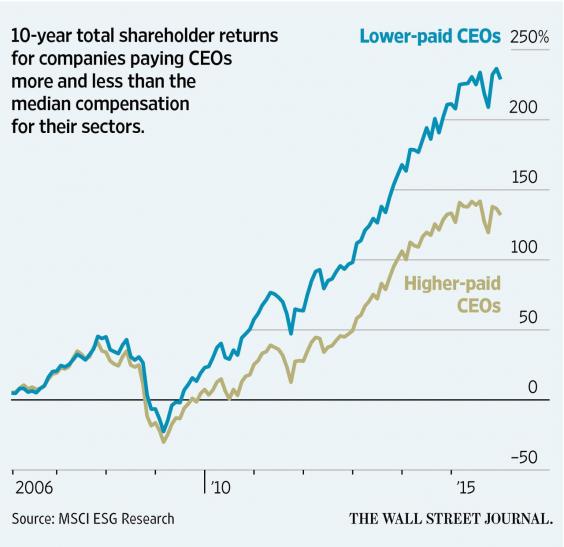
Highest-paid CEOs generate lowest shareholder returns

by Cory Doctorow

p1-by114-payper-16u-20160724183306

In Are CEOs paid for performance? Evaluating the Effectiveness of Equity Incentives, a new study from MSCI, researchers compared the salaries of 800 US CEOs of large and medium-sized companies to the returns to their shareholders during their tenure. (more…)

27 Jul 16:10

Sales Funnel – You like me; you really like me!

by Drew McLellan

sales funnellOver the past couple weeks, we’ve explored how your website should be thought of as a selling tool and with some planning and vision – you can use it to move a prospect through the know • like • trust = sales funnel and earn their business.

Last week we dug into the top of the sales funnel and identified some ways you can capture the attention of your drive by web visitors with the hope that they get to know you a little and find you helpful.

This week, I thought we’d talk about that middle section of the funnel that corresponds with the like element of our equation. To move someone from the start of the process into this section requires a mix of bravery and generosity on your part.

Keep in mind that most prospects are pretty skittish. Whether it’s in a retail store or online, they’re used to being chased around by over-eager salespeople that pester the poor potential buyer until they flee. That’s one of the reasons many people do a significant amount of their shopping online. The anonymity allows them to browse without pressure.

That’s why you want to load up your website with lots of content that has no barrier to consumption like blog posts, testimonials, and FAQs. Those elements will generate traffic to your site. The strategies we talked about last week – where there is an exchange of information (their email address for some downloadable tool or content) begins to thin the herd. The tire kickers will avoid the opt-in level, preferring to stick with your free content. And that’s fine. Until they move to the next level, they’re not ready to buy. Once they trade you their email address for some content, they’ve indicated that they are open to hearing from you.

I find it hard to believe I have to actually say this but I’ve seen time and time again that I do. There is absolutely no reason to collect email addresses if you aren’t going to actually send them something.

And that something cannot be a sales pitch. I’ve seen so many businesses stumble here. They didn’t give you their email address so you could hard sell them or immediately try to get an appointment or schedule a sales call. They gave it to you so you would keep sending them information that’s valuable to them.

That is your litmus test. Each and every time, before you hit send, ask yourself “is this going to be valuable to my audience?” Time for a re-write if your honest answer is no.

Assuming you keep producing helpful content and you actually send it out consistently – the prospects will let you stay in their in box. Week (or month or quarter) after week, you’re there. You’re teaching, helping and they are getting a little smarter and a little more comfortable with you each time they hear from you.

You should also use those regular emails (or however you decide to connect with them) to drive them back to new content/offerings on the website. Maybe you produced a demo video series or you’re hosting an educational event that you’d like them to register for.

While we are focusing on your website, it certainly shouldn’t be the only tool in your toolbox. Your sales funnel should be armed with both digital and traditional tactics. They work together hand in glove, each strengthening the other.

The days of your website just being an online brochure are long gone. Be sure your web presence is the sales workhorse it should be by building a sales funnel around the know • like • trust = sales equation.

The post Sales Funnel – You like me; you really like me! appeared first on Drew's Marketing Minute.

27 Jul 16:08

First-ever Michelin star for street food awarded to Singaporean hawker stalls

by Cory Doctorow

BugisStreet2

Hong Kong Soya Sauce Chicken Rice and Noodle and Hill Street Tai Hwa Pork Noodle sell lunch dishes for less than USD2.00, but that's not a predictor of the food's quality, as both restaurants have been awarded Michelin stars for their cuisine. (more…)

27 Jul 16:07

4 Ways to Hack Your Brain Chemicals to Become More Productive

by Thai Nguyen
Laughter and chocolate are solutions to much more than you might realize.
27 Jul 16:05

It's clear that one city is becoming a booming innovation hub, and it could change the world

by Tina Wadhwa

baidu

China has long been known for its exports, for manufacturing items quickly and cheaply for sale abroad.

But the culture of mass production and copycatting technology has changed as the world's most populous nation has grown.

China is now turning into a force for innovation in its own right.

Citi's latest Disruptive Innovations report includes a bunch of charts and tables on the world's most innovative cities.

It's striking that China is rising up the rankings, and Shenzhen is becoming a patent-filing powerhouse. The emergence of Shenzhen — along with China more broadly — as an innovation hub has broad implications.

China is trying to transition its economy from one based on investment to one based on consumption. Chinese companies having been buying up tech companies around the world. A rising urban middle class that is tech savvy and mobile friendly is gaining more prosperity and demanding more convenience. The population is aging, making healthcare and robotic technology more important.

In short, the Chinese market is huge, and it is giving the West a run for its funding.

Let's look at the charts:

Silicon Valley leads the way in VC investment, but Beijing is closing in.

Silicon Valley, of course, comes out on top as the best-known innovation cluster with the most venture capital investment through the years. It is home to computer software, social-media giants, and a hit TV show poking fun at the tech-savvy nature of this city. 

But Beijing increased its VC investment from just $0.9 billion in 2007 to a whopping $7.7 billion in 2014, catapulting it into second place.


China ranks second in fintech investment too.

When it comes to financial technology, China comes second, behind only California, in fintech investment by region. Hong Kong actually beats California in the number of fintech hubs it harbors.


China has also vaulted up the rankings for patents filed, with Shenzhen-Guangdong ranking second, behind Tokyo and directly ahead of San Jose-San Francisco-Oakland.

China's sudden rise as an innovation hub is thanks in part to support from the government's plans and policies and increases in the number of internet and mobile users.

China's government has given significant support to innovation through favorable land and tax policies, improvements in local infrastructure, and the establishment of important research centers and industrial parks.

In the Hangzhou Yuhang Economic and Technological Development area, for example, 100% of taxes can be refunded to eligible companies in the first two years after starting a business.  


See the rest of the story at Business Insider
27 Jul 16:04

Was it Price, Product or Something Else That Lost You the Sale?

by Frank Visgatis
The real reason for lost sales is usually the competitor did a better job selling their product but few buyers will tell you so..
27 Jul 16:04

ALS ice bucket challenge leads to real-life genetics discovery

by Miriam Kramer
Https%3a%2f%2fblueprint-api-production.s3.amazonaws.com%2fuploads%2fcard%2fimage%2f158387%2fap_16209424343509
Feed-twFeed-fb

You couldn't go on social media in 2014 without seeing a new video of a friend, celebrity or tech star dumping a bucket of ice water over his or her head to raise money for research into the degenerative neurological disorder ALS, short for amyotrophic lateral sclerosis.

Now, it looks like that "ice bucket challenge" produced some very real scientific results, according to the ALS Association.

A new Nature Genetics study — funded by money raised through the ice bucket challenge — details the discovery of a new gene associated with ALS.

More about Genetics, Health, Science, Ice Bucket Challenge, and Als
27 Jul 15:58

6 Ways to Get the Most Out of Your Entry-Level Sales Job

by aencarnacion@hubspot.com (Alex Encarnacion)

entry-level-sales-job-strategies.jpg

Congratulations -- you finally did it. You’ve graduated college and received a formal job offer. You’re moving to San Francisco, New York, Chicago, or Boston to work in sales for a leading technology company as a sales development rep. Or an inbound call specialist. An associate inside sales rep, an emerging technology specialist, or an associate account manager.

Whatever your company calls its sales roles, get ready for the ride. You’ll tell your friends you’re in sales, but when you first hit the floor you’ll feel a little like a lab rat. You’ll be tested and put through the fire time and time again.

But entry level sales roles are incredibly valuable if you approach the job correctly, and if you make the most of them they can be a springboard for bigger and better roles in the future. Here are six ways to build a strong foundation for long-term success.

1) Your ego has no place in sales.

Accept this early on. The sooner you lose the ego, the sooner you’ll be able to start learning. This is the greatest opportunity you’ll ever have to fully understand the process of a sales role. The “lights-on” moment when you realize that sales is actually hard and the satisfaction of success won’t happen if you don’t understand that you’ll need to be humble to do well.

You may be charming, personable, and relatable but it takes hard work (and a little bit of luck) to do well.

2) Take training seriously.

As a sales rep, there are plenty of times each week where you’ll think to yourself, “I wish I wouldn’t have thrown away those notes from training!” or “Damn, that executive that came into our class actually gave tips that I know I could benefit from right now. Where are those notes?"

Stay organized. Whatever company you work for has developed a program designed by successful sales reps to help make you successful. They wouldn’t have created the program if it didn’t have value.

Quick tip: Do not accept an offer at a company that doesn’t have a training program, or at least some type of program that promotes your professional development. These are signs that the company isn’t equipped to provide training or doesn’t care about it, and you’ll never learn as much here as you will at a business that will invest in you.

3) Be a sponge.

Your two-week, three-week, or even seven-week training program is finally complete. You’ve passed with flying colors, and now you’re on the floor.

You’ll think to yourself, “I'm four days in. This isn’t anything like training -- it’s all moving so fast. What the heck am I supposed to do now?"

Take a deep breath. It’s time to put your training to use. Leverage as much of the material as is applicable. There was a method to the madness, and taking a step back to put the pieces together will help you.

Then, meet with your peers who have been doing the job a little bit longer than you. Ask them what they wish they had known in their first week. Introduce yourself to the seasoned rockstars and let them know you want to learn.

Make sure you’re prepared -- why would you want to waste the time of someone you respect and want to have as a mentor? Have an agenda, and organize how you want to spend your time. Be honest and tell them what’s on your mind. You'll soon realize that you can relax and be yourself. Everyone you interact with has the same goal of wanting to help the company, in turn progressing their own careers.

Quick tip: Truly successful people will always be willing to help. What you learn from your colleagues will stick with you forever. They have mentors and will enjoy the opportunity to pay it forward, and one day you will too.

4) Listen and take action on feedback you receive.

If your manager tells you to stop taking call notes by hand, stop. Put them in your CRM where they need to be.

If your manager gives you advice on the soundbites you’re messing up on the phones, work on them. Practice or role play until you’ve got your message down cold.

If your manager suggests improvements to your prospecting process, make them.

Don’t be the one who rebels against some new policy because you don’t see the point. You simply don’t have the context to rewrite the playbook, and the value of your sales process will become more apparent as you gain more experience. Buy into the program and commit to hitting your goals.

5) Manage your time well.

Organizing your time well is the single best thing you can do in an entry-level sales role. During your one-on-one sessions with your manager and mentors, figure out how to best manage your time. Ask them their best strategies, then test out which ones work for you. This will be fun -- take one approach for a few weeks, then move to another and keep testing until you figure out the routine that works best for you.

It’s hard to suggest the best way to manage time as everyone works just a little bit differently than the next girl or guy, but here are some resources for inspiration:

6) Know that this isn’t forever.

Entry-level sales roles may not seem sexy, but they’re important. You’ll build friendships and professional relationships you’ll maintain for your entire career. It’s the only opportunity you’ll have to focus on developing your activity, attitude, skill, and networking abilities without being directly responsible for carrying a quota.

In these roles, most managers look for high activity and the ability to be coachable (capable of taking feedback and applying it on the spot). Know this and focus on doing well in both areas to help you move through the ranks.

Have fun, and good luck.

Email tool in HubSpot CRM

27 Jul 15:55

4 Signs That You Are Perceived as a Commodity

by Anthony Iannarino

There are signs that warn you that your prospective client believes you are really a commodity.

When this is true, you have to work very hard to change this perception, make yourself stand out from the pack, and prove that you have a compelling, differentiated, unmatched offering.

Your first call comes from purchasing.

If your first call comes from your prospective client’s purchasing department, you have all the evidence necessary to know that they perceive you as a commodity. If the first call you make is to purchasing, then you believe you are a commodity.

In larger companies, purchasing plays an outsized role in the buying process. In some cases, the purchasing folks are strategic, choosing partners instead of vendors. That being said, they also believe that price is often the dominant factor to be evaluated, and most of what they buy they perceive as commodities.

You receive unsolicited RFPs.

An unsolicited RFP isn’t a real opportunity. It’s almost invariably a waste of your time. Why? Because the lack of discernment on who receives the request for proposal is an indication that the prospective client believes that one name on a list of a sales organization is as good as the next.

If you reply to unsolicited requests for proposal without pushing back and disrupting the process, you are behaving like a commodity. That will only result in your being treated like one.

Your prospective clients tell you they perceive no difference.

When someone tells you that they can’t see the difference between you and your competitors, you have a differentiation problem. You might have a “value creation” problem, too. You undoubtedly have a commoditization problem.

If there is no difference that makes a difference for your dream clients, then they cannot help but believe that you are a commodity. You have to draw bold lines of differentiation, making clear why and how you are different and better, lest you become a commodity.

You are asked to match or beat your competitor’s prices.

Being asked to match your competitor’s price is something people do when they perceive no differences, and when they believe the result they get from you will be the exact same result they will get from your competitors.

Being asked to beat your competitor’s price is the ultimate insult when it comes to the perception of value. Not only does your prospective client perceive no difference, they don’t believe that you can create any value outside of lowering their prices.

How you are perceived is within your control. How you sell can differentiate you. Your commitment to delivering greater results than anyone else can differentiate. Your firm, unshakeable belief in your product and your company and its superiority over all comers.

The post 4 Signs That You Are Perceived as a Commodity appeared first on The Sales Blog.

27 Jul 15:53

Canada’s economy is hostage to the housing bubble

by Jason Kirby
A sold home is pictured in Vancouver, B.C., Thursday, Feb. 11, 2016. Canada Mortgage and Housing Corporation says there is mounting evidence that house prices in a number of Canadian cities are out of whack with incomes and other economic fundamentals.The latest report from CMHC says there is evidence of overvaluation in nine of the 15 real estate markets included in the research. THE CANADIAN PRESS/Jonathan Hayward

A sold home is pictured in Vancouver, B.C., Thursday, Feb. 11, 2016. Canada Mortgage and Housing Corporation says there is mounting evidence that house prices in a number of Canadian cities are out of whack with incomes and other economic fundamentals.The latest report from CMHC says there is evidence of overvaluation in nine of the 15 real estate markets included in the research. THE CANADIAN PRESS/Jonathan Hayward

When one of the real estate industry’s largest lobby groups, Mortgage Professionals Canada, released a report last month analyzing the state of the country’s housing market, it found, to absolutely no one’s surprise, zero evidence of a bubble that would warrant political intervention. “Now that the energy sector is no longer a major economic driver, a healthy housing sector is even more essential,” the organization’s chief economist, Will Dunning, warned in a statement. “It would be tragic to unnecessarily impair this key economic force.”

If that sounds like a ransom note, it more or less was: do anything to jeopardize the housing boom, bub, and the economy gets it. Obvious self-interest aside, Dunning and others who have issued similar warnings are right, to a point. Canada’s economy is hostage to the housing market. Rising house prices and the accompanying wealth effect, courtesy of ballooning equity lines of credit, have kept the economy from faltering as business spending retrenches and exports disappoint—last year real estate was by far the largest contributor to GDP in seven of 10 provinces, including B.C. and Ontario.

Meanwhile the chart below shows Canada’s economy has never been more reliant on residential real estate and household spending. (It’s actually an update of a chart former Bank of Canada Governor Mark Carney used in 2012 to highlight the extent to which the economy had come to depend on households. As the forecast at the time showed, the Bank firmly believed this would slowly improve over the ensuing years. Instead, it exploded higher.)

Deep down every homeowner, speculator, realtor, Bay Street financier, mortgage broker, bricklayer, central banker, car dealer, politician, regulator and kitchen countertop installer in the country is worried by the prospect this game might end. As B.C. Finance Minister Mike de Jong said earlier this year, “You’ve got to be careful about having the state intervene to try and regulate pricing, or depress pricing. That will have consequences for a lot of families.”

Yet the din of calls for politicians and policy-makers to tackle affordability problems in red-hot markets like Vancouver and Toronto has grown deafening. Which brings us to the flurry of announcements coming out of B.C. First the province moved to end the self-regulation of the real estate industry after multiple reports of shenanigans. It then started tracking and releasing data about the scale of foreign buying in Metro Vancouver (about 10 per cent of the value of all deals, equal to $885 million over a five-week period). Now the provincial Liberals have introduced a 15 per cent tax on foreigners who buy property in Metro Vancouver. That’s a $300,000 tax bill on a $2 million home. It takes effect Aug. 2, and already Ontario is considering a similar tax, saying it’s concerned foreigners rebuffed by B.C. will shift their focus to Toronto.

Even though the real estate industry in B.C. has long argued foreign buyers are a small part of the market, it has come out strongly against the tax, arguing it “needlessly injects uncertainty into the market.” But will these new measures really bring affordability back to the Vancouver market? And by that we mean bring an end to double-digit price gains, bring about a steep correction in house prices to levels the city’s lowly middle-class incomes can afford, bring about an end to staggering household debt levels and ultimately, bring about the end of housing as the economy’s engine of growth?

I’m not convinced. The new tax is, relatively speaking, a politically safe and mild measure. It lets the government be seen to be doing something about high real estate prices at a time when polls overwhelmingly show voters want action on the issue. Conveniently, it also lets the province fill its coffers without the customary backlash that usually accompanies a tax grab. After all, if there’s one tax people can get behind, it’s a tax that targets filthy rich foreigners (the Liberals said the funds will go to new spending on “housing and rental programs”).

But the tax itself may also prove ineffective. Will a 15 per cent tax matter to an offshore speculator who is convinced the value of the house he or she buys will grow by double that rate in one year? If $2 million for a rundown bungalow seems reasonable, might not $2.3 million? Also, if indeed foreign buyers (read: mainland Chinese) are shunting their money out of China and away from the reach of an increasingly authoritarian government, might the tax simply be seen as an unfortunate but necessary fee given the alternative?

This all assumes that the tax works as planned. B.C. has commenced a cat-and-mouse game with people with extremely deep pockets and access to very smart accountants and lawyers, a valid point the provincial NDP raised. Nor will the tax apply to buyers who come to B.C. by way of Quebec, which maintains an investor immigrant program that sees wealthy newcomers “invest” $800,000 in exchange for visas. De Jong, who earlier dismissed the suggestion that foreign buyers were driving house prices, has also dismissed this line of thinking as “conspiratorial,” though the numbers suggest it’s worth consideration: last year just under 5,000 foreigners and their family members entered Quebec through the program, and historically close to 90 per cent have made their way to B.C.

Ultimately B.C.’s new tax will likely fail to cool the overheated market for the same reason every other effort to date—tighter mortgage lending standards, larger down-payment requirements, jawboning bordering on pleading from the Bank of Canada—has failed. The world is awash in cheap debt, and whether we’re talking about wealthy foreigners or local residents desperate not to be shut out of the market, the siren call of fast-rising house prices is too powerful to ignore. Until that changes, Canada’s economy will continue to be captive to the bubble.

The post Canada’s economy is hostage to the housing bubble appeared first on Macleans.ca.

27 Jul 15:52

How to Get Subscribers for Your B2B Email Newsletter [And How Not To]

by Pam Neely

How to Get Subscribers for Your B2B Email Newsletter [And How Not To]_FI

If you want a successful B2B email newsletter, it goes without saying that you’ll need subscribers. Plenty of subscribers. So in addition to our articles on B2B newsletter strategy and B2B newsletter content ideas, we wanted to give you a toolkit of tactics for how to get more subscribers.

However… before I dive too deeply into how to get subscribers, I’d like to talk a little bit about how not to get subscribers. There are three common traps people get tangled up in:

  • They attempt to buy subscribers – by buying an email list
  • They don’t tag new subscribers so they can evaluate their list-building tactics later
  • They send their email newsletter to people who didn’t expressly sign up for it

Three list-building mistakes to avoid

Each one of these mistakes can do serious damage to your list-building plans. Here’s how (and why) to avoid them:

1. Don’t buy subscribers

This may be hard to say no to. Building a list takes time – it’s so incredibly tempting to just go buy a list of 10,000 or even 100,000 subscribers. Especially because they’re so cheap – you can easily scoop up these sorts of lists for pennies per subscriber.

Trouble is, you’d be wasting every penny. Here’s why:

  • Most reputable email service providers will not allow you to mail to a purchased list.
    This is because of the extremely high rate of spam complaints from purchased lists. And as you probably, know, high spam complaints hurt deliverability. A company that enjoys high deliverability rates and strong trust with the major service providers will not risk its reputation by allowing its clients to mail to purchased lists. So even if you could get subscribers for pennies each, you wouldn’t be able to mail to them.
  • Purchased lists tend to perform poorly.
    That’s a nice way of saying it. Actually, purchased lists tend to perform so badly that if you calculated how much it cost you to get one action from a purchased list, then compared how much it cost to get that action from an in-house built list, you might discover the action from the purchased list costs five times more, or worse.I have seen purchased lists catastrophically tank twice in my career. It wasn’t pretty. One was a $20,000 travel catalog mailing to a purchased list (we got not one booked trip, and not even an inquiry from that investment) of 30,000 names.

The other was out of my own pocket, when I rented a list to sell a gift box to a list of 50,000 people who supposedly had bought similar gift-type products in the last six months. I got not one order … from all 50,000 email addresses.

So please, don’t blow your budget (and your precious time) on purchasing a list.

2. Don’t lump subscribers from your different list building tactics all together

This is about tracking where your subscribers come from, so you can assess the value of those subscribers from each different list source later.

For example – that Facebook contest you ran to build your email list? When you add those people to your database, include a tag that identifies the source (if your email service provider has this functionality) or treat them as a separate list. That way you can measure how engaged they are and how much business you’ve gotten from that list source.

This can be extremely valuable information later on. It’s particularly valuable when you’re just starting out. You’ll probably want to try at least 3-5 different list-building techniques all at once, and being able to track how these different subscriber sources perform over time can reveal valuable insights.

Often, getting a subscriber via one channel – say AdWords advertising – costs more than getting a subscriber through, say, Twitter advertising. But if those AdWords subscribers end up converting into dramatically better leads, then maybe they’re worth paying for.

This graphic lists the important goals in building an email newsletter list. The blog post identifies 10 tips for building lists, and 3 tips to avoid creating bad email newsletter lists.

Marketers are increasingly focused on getting quality subscribers – not just more subscribers. Tracking where your subscribers come from and how each subscriber acquisition channel performs can help you hone in on where the most valuable subscribers are coming from.

Want another reason to keep your subscriber sources separate? It gives you the option of sending them a customized Welcome email. It also gives you the option of customizing what content you send them.

3. Be careful about sending your email newsletter to people who haven’t specifically signed up for it.

This one’s a wee bit controversial … “controversial” for email marketing, at least. But there are people who don’t think it’s okay to add someone to an email newsletter list just because they downloaded a content asset, or signed up for something unrelated to the newsletter.

The proponents of this view say “Hey – I didn’t sign up for your newsletter. I gave you my information because I had to in order to get that whitepaper.” They certainly have a point, but it does throw a wrench in many B2B lead nurturing programs. Take note, too, that B2Cers have almost the exact same problem, when people who have placed an order are automatically put on a newsletter list.

Fortunately, the solution to this is simple. Add a checkbox near the end of the form, with some copy that says something like, “Please send me your newsletters, too.” Leave the box unchecked, and send the newsletters only to people who actively opt in (i.e., they check the box). (That opt-in process – as opposed to opt-out – is a legal requirement in Canada and Europe, by the way.)

This image depicts a standard webinar sign up form

This is a standard webinar sign up form. If you completed it, you’d almost certainly be added to the company’s email list. Most people expect that, but it’s nice to add a checkbox that specifically asks people if they want to sign up for your newsletter, too.

As I’m sure you’ve guessed, adding that checkbox will significantly reduce how many subscribers you’ll get. But you will end up with a higher-quality list, as the recipients will expect your newsletter, And you’ll have done your part to further distance email marketing from spamming.

Here’s an alternative to that check box: When people give you their email address for webinar signups or anything else, send them an email message pitching your newsletter. Or include a pitch to sign up for your newsletter in the confirmation email for the initial action.

Now that we’ve got all the “don’ts” out of the way, here are some of the most effective ways to get subscribers for your email newsletter.

Ten proven ways to get subscribers for your B2B email newsletter

1. Have a description of your newsletter that makes it sound like it’s worth reading.

A great description will improve all your other list-building tactics. Get it right, and your opt-in rates could double.

Here’s the bottom line on why this is so important: It’s not 1999 anymore. We’re all drowning in email. We don’t want more of it. If you’re going to get people to sign up for your newsletter, you’ve got to make it worth their attention. Saying something like “Stay up to date with company news” is probably not enough.

Image used with permission from Victor Hung, of poofytoo.com

Image used with permission from Victor Hung, of poofytoo.com

2. Make your newsletter worth reading.

I mean no offense. But all content still needs to pass the “if you didn’t work in your company, would you read this?” test. Even if you happen to be in a “boring industry” do your best to expand your content’s scope enough for it to be interesting – at least to people in your niche. You don’t have to bring Cirque du Soleil magnetism to your content, but do the best you can.

Remember: You’re going to spend a lot of time creating and promoting your newsletter. You’ll spend even more time getting subscribers. Wouldn’t you feel better about all that time invested if the product you were creating and promoting was actually good?

Want to know a secret trick to make your newsletter worth reading? Include some content in it that’s not available anywhere else. The Content Marketing Institute does a good job of this in their newsletters. They include a short essay once a week – only about 500-600 words long. It’s usually just a restatement of what they’ve talked about in their podcast (way to re-use content!) but sometimes it’s a stand-alone piece. Either way, every single time, it’s worth reading.

3. Use landing pages.

According to the marketers who contributed to Ascend2’s latest Email List Strategy Survey, landing pages are the most effective list-building tactic. They’re also one of the easiest to execute.

This graph depicts Ascend2’s latest Email List Strategy Survey where landing pages are shown as the most effective list-building tactic

Why do landing pages work so well? They focus attention. If you send someone to your site’s homepage, they’ll have over a dozen options for what to do. Not so if you send them to a landing page. There, they’ve got only one thing to do: Sign up.

It’s a good idea to create a separate landing page for every distinct traffic source you’ve got. So, for instance:

  • A landing page for people coming from your Facebook page
  • A landing page for people coming from a specific ad you’re running on a third party site
  • A landing page for anyone who gets a forwarded email and decides to sign up
  • A landing page for a guest blog post

You get the idea. While all those landing pages can be a challenge to manage, they will result in more email subscribers. A tailored page reminds the visitor why they came there, and it’s more personal.

4. Add an opt-in form to the footer of every page on your website.

Don’t make people hunt for where to sign up for your newsletter. Add a sign-up form to every page on your site. This is especially easy if you add the form to the footer area. Space in the header area is highly competitive real estate. Footers are usually much easier to add another element to, and they’ll still get decent visibility. In my own tests, I found that adding a footer increased email opt-ins by about 20%.

This image shows how the footer of Orbit Media’s website has plenty of room to ask visitors to sign up for their email newsletter. Note how they mention how many subscribers they have, and how they’ve kept the opt-in form super-simple.

The footer of Orbit Media’s website has plenty of room to ask visitors to sign up for their email newsletter. Note how they mention how many subscribers they have, and how they’ve kept the opt-in form super-simple.

5. Add an opt-in form to the navigation column on your blog.

Just like we’ve done on this page (a little up and on the left). This isn’t a complicated tactic. It’s based on the idea that there should always be an opt-in form somewhere nearby, wherever your site visitor is.

6. Add opt-in forms to the close of every blog post – unless you’ve got a lead gen offer there that’s better.

The area right below the close of a blog post is valuable real estate. The people who see it have usually just finished reading – they’ve proved they care about what you’re saying. They’re probably hungry for more, open to a suggestion for something else to do.

Don’t let them down. Either offer a related lead generation offer to “gated content” or ask them to sign up for your email list.

7. Pre-announce your newsletters on social media – with a link to sign up.

Having a large social media following is great. Converting those followers into email subscribers is even better.

You can do this by promoting gated content, of course, but one of the simplest ways is to just announce your newsletter a day or so before you publish it. This works especially well when there’s content in your newsletter that’s not available anywhere else.

This image shows how you can use social media as a tactic for gaining new subscribers

Sure, you can advertise to get subscribers on Twitter. Or you can just ask for them. Notice how this tweet is specifically for someone who just followed them. I wonder what the conversion rate on a subscriber invite like this is…

8. Ask for sign ups at conferences and other events.

Fishbowls can still work for this, but they look a little dodgy (and a lot old-school). Handwritten signup sheets can work, too – though you’ll lose some subscribers due to bad handwriting. One of the slickest options is to use a tablet with an app designed to capture email addresses and other information. They work well, but don’t let your tablets wander off.

9. Consider a pop-up.

I know, I know: You hate pop-ups. They’re annoying and you’re worried you’ll alienate your visitors with them. I hear you. But pop-ups work … oh my goodness, they work. A successful pop-up can double your opt-ins. Seriously.

And they don’t have to be so annoying. Here are a few ways to practice proper pop-up etiquette:

  • Delay the pop-up so it shows after someone has been on your site for at least 60 seconds.
  • Don’t show the pop-up on every page the visitor sees – set it to show no more than once a week.
  • Make sure the pop-up is mobile-friendly.
  • Consider having multiple pop-ups, each based on what kind of content the visitor is viewing. Relevant offers always come off as less annoying.

This image shows an example of using pop-ups for new subscribers

10. Have everybody in your company include a call to action to sign up for the newsletter in their email signature file.

Email signature files can be powerful little marketing devices. And while this tactic won’t get you thousands of subscribers, the people who sign up through this channel are often more engaged. (No surprise; they know you).

One tip: Send people to a landing page specifically designed for email signature opt-ins.

Bonus list-building tip.

Add a sign up link to your email newsletters, too. That way if they get forwarded, the recipient can sign up easily. Like this:

SocialMediaToday

Conclusion

More and more marketers are getting savvy about building their email newsletter lists – they don’t just want as many subscribers as possible, they want quality subscribers. This is a good thing for several reasons, but it does mean you’ll want to be more careful about how you build your list. And that, in turn, may mean your list grows more slowly.

Just keep testing and tracking where your quality subscribers come from, and you’ll do fine. Better to have a list of 1,000 super-responsive subscribers than a list of 5,000 people who seldom ever open your newsletter.

Back to you

Are you using any of these list building tactics? Are there any others I haven’t mentioned here? If you’ve got a tip, it’d be great to hear from you in the comments.

Ready to move past increasing email subscriptions and learn new techniques to optimize your email results? Check out Act-On’s eBook, The Amazingly Effective Email Guide, and we will give you five tips for more successful – and more profitable – email campaigns, including how to increase engagement with responsive and mobile-friendly design, ideas for effective trigger email messages, and more!

27 Jul 15:50

How to Build Lifetime Relationships With SaaS Customers

by Devin Behenna

TS16031_ThreatStack_CustomersSAAS_BlogImg.jpg

On-demand, subscription-based services have taken over the technology world; a “one-and-done” contract is almost unheard of in today’s software industry, and this has changed the dynamic between you and your customers.

We all know it costs a lot to replace customers. But beyond that, there is a massive upside to customer relationships that surpasses preventing churn. These days, if you’re not proactively building a relationship with each customer, you’re missing a great opportunity to boost customer satisfaction and monetary value — and if you’re not building lifetime relationships, you’re missing out on a host of additional benefits that customers can deliver to your organization.

In my last blog post, I talked about some of the ways you can ensure customer success in this new environment. In this post, I’m going to look at ways to develop lifelong relationships with SaaS customers, at how you can evolve and shape these relationships, and finally, at how you can add value to — and harvest value from — each customer.

So let’s have a look at what you can achieve in each of the four stages in the Customer Lifecycle.

New Customers: Establishing Trust and Confidence

Obviously, the onboarding process is the first and most important step in getting started with a new customer. If you don’t succeed here, you can forget about success in the rest of the Customer Lifecycle.

I’ve found that establishing trust and confidence can be fairly easy as long as you take care of a few basics. Specifically, you need to establish strong two-way communications. You need to ask questions and LISTEN very carefully. If you do, I can guarantee that you’ll hear about, and be able to take care of, things that weren’t covered by your “onboarding checklist.” (Remember the story of the princess and the pea? Even little things can be very irritating if they’re not dealt with right away.)

Intermediate Users: Keep Them Engaged and Learning

Some users like to “set it and forget it.” But don’t let your customers plateau after they’ve mastered the basics. The intermediate user knows a lot more than beginners, but they still don’t know all the nuance and power of your product.

Being proactive by checking in with your customers is important. In a world of continuous development, product releases come so quickly that we have to keep the customer learning. But go beyond notifying them about the new features and fixes by — again — asking and listening. Many times, I have spoken with a customer who did not realize they had a need for a specific feature until we showed them its capability. Continuous coaching and training helps to ensure an engaged customer who is committed to the product and grows with it.

Advanced Users: Let Them Teach You

An advanced user is a customer who uses the product so frequently that they almost know the product as well as our own support team! In fact, because they use the product every day in their own real-world environment, they often do have a better, or more nuanced, understanding of the product than we do, and can make valuable recommendations about things such as feature requests and improvements to usability. Addition, they’re often interested in taking part in betas, and can help us figure out what solutions work and how to implement them. We depend on these users to help us build a better product and stronger support processes.

Here’s an example of the type of feedback that advanced, expert users can provide:

“I’d like an easy way of seeing all EC2 tags associated with the host. At present, when I mouse over the host, I can see to add to the search and copy to the clipboard, but it would be great if I got more context just by mousing over. For example, I’d like to see number of events, number of users, EC2 tags, availability zone, instance type, security groups, etc.”

As a result of feedback like this, we came to understand the value that would come from adding tag information, and quickly added the capability to our product.

Advocates: Let Them Speak for You

What do advocates do? They champion your product and sometimes they rave (that’s RAVE, not rage) about it.

Recently, for example, I was thrilled to discover that one of our customers, NextGxDx (a Nashville-based provider of a SaaS platform that helps physicians select genetic testing for their patients), had recommended us to Stratasan (another Nashville-based healthcare data and analytics company), who then purchased Threat Stack. While Stratasan vetted our product on its own merits through a rigorous evaluation of features and performance, NextGxDx’s recommendation certainly added persuasive power and credibility that put the deal over the top!

So What Can We Learn?

I’ve just skimmed the surface of the value that lifelong relationships can create for your customer and your organization. But as long as you understand the basics, you’ll be able to help them grow into knowledgeable and committed users. In turn, they’ll typically be enthusiastic about supplying you with positive feedback and valuable insights, and on a good day, their endorsement may be exactly what it takes to turn a prospect into a customer.

27 Jul 15:50

Redefining the Line Between Sales and Spam with John Bonini [Podcast]

by Tom Tate

Are you sending spam without even realizing it?

In this episode of the Ask Me About Email Marketing podcast, we talk with John Bonini, Growth Director at Litmus.

In a blog post written earlier this year, John explored the nuances of selling and spamming. Email marketing is evolving, and it’s crucial for marketers to reinforce the value they’re providing, while redefining traditional views on spam. John shares his take on how to be relevant, be human, and tactfully write to convert.

Check out the episode above, and you’ll hear about:

  • How email marketers define spam vs. how consumers are defining spam
  • Different ways to consider personalization
  • Why NOT selling your solution is selfish
  • How to source great marketing copy
  • The importance of manual outreach
  • And much more…

Here are a few links that were mentioned on the show:

We didn’t get to cover it, but here is a fantastic series of articles Litmus put out regarding Single v. Double Opt-in:

Have a question about email marketing? Leave us a message at aweber.com/podcast.

27 Jul 15:49

Matt Heinz on How to Increase Marketing’s Influence on Pipeline Growth and Closed Deals

by Alexis Getscher

Full Funnel Marketing Heinz

In May, Matt Heinz, of Heinz Marketing, debuted his book Full Funnel Marketing during the Marketo Marketing Nation Summit, and now the book is available to marketers everywhere as a free download. The book covers best practices, advice, strategies and tactics for B2B marketers to increase the impact and profitability of their efforts.

It has been a long-held belief in the Bizible office that marketers should align themselves with Sales and be responsible for a revenue goal, and Full Funnel Marketing supports these ideals.

Full funnel marketing, often called pipeline marketing on the Bizible blog, is the process of Marketing having a role at every stage of the funnel, not just lead generation. The strategy requires strong sales and marketing alignment and defined funnel stages so the teams can work together to deliver the best content to prospects, no matter where they are in the buying journey.

According to Heinz, “This requires aligning not behind just lead generation or even mere sales pipeline contribution, but measured marketing impact on closed business and customer lifetime value.” He continues, “It requires a much higher degree of coordination between Sales and Marketing, with Marketing taking a leadership position in the areas of sales enablement, productivity and technology in particular.”

Below, read our interview with Matt Heinz.

What knowledge can one expect to gain by reading the book?

This book is perfect for marketers who want to increase their prominence, importance and impact within the organization, in the market and with their customers.

The book covers a wide range of topics critical to B2B marketing success today, going well beyond traditional “top of funnel” activities and even beyond MQLs. You’ll learn how to think about marketing technology, how to support and enable your sales organization more strategically, and how to effectively operate your marketing team as a profit center for the business.

What I love about the book’s format as well is that you can read it front to back, or simply cut to specifically the topic you’re tackling in the business right now. Practical, pragmatic, real-time advice.

What does full-funnel marketing mean to you?

It’s marketing through to the close. Look at your marketing scorecard today. Can you buy a beer with web traffic? With MQLs? No. You can’t buy a beer until you’ve closed a deal (well, until you’ve collected the cash, but that’s another book).

Full funnel marketing means engaging at every stage of the buying process, far deeper than marketers traditionally focus. This includes (and requires) tight integration and coordination with your sales counterparts to help them increase their effectiveness, efficiency and conversion rates. The book coverage numerous ways to more successfully address the full funnel and sales enablement opportunity in front of you.

What benefits have you seen from using full funnel marketing tactics?

Higher sales, greater conversion of leads and opportunities, happier marketers and happier executives. Is that enough?

In all seriousness, though, the more marketers can put focus on impacting the bottom of the funnel, the higher the ROI of the efforts they put into the top. You get higher conversion yield of your leads, greater engagement by your sales team on the opportunities you give them, higher yield of long-term opportunities deep in your pipeline… the benefits go on and on.

What is the most important thing marketers should know about the buyer journey?

That it begins with a commitment to change by the buyer, NOT with an understanding of the product or service you’re offering. Buyers must understand the value of change, and commit to making that change happen. They must commit to the “pain” or work required to make that change (even if that “pain” is simply giving up some of their cash) in order to achieve the outcome or success they believe is at the end of that process and therefore worth the journey.

We as marketers need to do a better job of establishing that need and urgency at the front of the buying journey. It serves as a foundation for the entire sales process.

If you could change one thing in Marketing departments today, what would it be?

Focus on opportunities created, not leads created. Focus on sales pipeline outcomes, not marketing activities and milestones. Manage your resources and budget like it’s a P&L within the organization.

Anything additional you want to share?

Download the book, it’s free!

2015 State of Pipeline Marketing  Get the inside look on sales alignment, attribution, top channels, and more.  Download Now

27 Jul 15:47

7 Soft Skills Every Salesperson Needs to Get Ahead

by aja.t.frost@gmail.com (Aja Frost)

What separates good salespeople from great ones?Let’s be real, it’s probably not their mastery of the CRM nor the number of prospecting emails they send each day. Those skills and tasks are important, but they don’t close deals.

Sales reps who hit their team’s sales goals quarter after quarter have a few things in common — soft skills. These are the abilities a salesperson has to build relationships, encourage productive conversation, and provide an exceptional customer experience.

The great thing is, there are no hard-and-fast rules for how soft skills should be developed, and many times, they aren’t taught in a formal training session. So, how do you learn soft skills? Through exposure and practice.

In this article, you’ll develop an understanding of the seven soft skills successful salespeople use and how to acquire them to boost your sales performance.

Download Now: Sales Training & Onboarding Template [Free Tool]

Let’s look at the seven soft skills every rep needs to get ahead — and more importantly, how to develop them.

1. Growth Mindset

Let’s say that you’re fantastic at building rapport. Do you believe rapport-building is one of your innate skills — or do you believe you developed it through hard work, practice, and external feedback?

If you choose the second answer, you possess a growth mindset. People with growth mindsets believe they can strengthen their natural talents and develop new abilities over time. People with fixed mindsets, on the other hand, view their skills as fixed. They have the hand that they’ve been dealt, and that’s that.

How to Develop a Growth Mindset

To turn a fixed mindset into a growth mindset, change the way you perceive failure. Don’t think of failing as embarrassing or shameful — view it as a learning experience. When you’re not afraid to screw up, you’ll have the bandwidth to bounce back and try again. Even better, you’ll gain something new from every challenge you tackle. (Of course, that doesn’t mean you should be complacent about failure. If you’re making the same mistake three-plus times, take a cold, hard look at why you’re not improving.)

Consider using “yet” to describe skills you haven’t mastered. Psychologist Carol Dweck — who invented the growth-minded concept — says this word has the power to dramatically boost confidence.

For instance, rather than thinking, “I haven’t been able to meet 120% of my quota in a month,” you’d think, “I haven’t met 120% of my quota in a month… yet.”

(Watch Dweck’s entire talk for more confidence-boosting tips.)

2. Adaptability

When a salesperson is good at listening to and implementing feedback, their name typically skyrockets to the top of the leaderboard and stays there. After all, they’re combining the strengths of a great rep with the insights, wisdom, and experience of their manager. That’s a winning combo.

Plus, the expectations of sales reps are constantly evolving. Buyers are much more sophisticated than they used to be — and what worked in 2001 definitely won’t fly in 2021. To keep processes and strategies up-to-date, great salespeople need to be able to adapt and be coachable.

How to Develop Adaptability

Step one is simple: Take five minutes every day to reflect on what went well and where you could improve.

According to Mark Roberge, senior lecturer at Harvard Business School, highly coachable reps are always analyzing their performance and looking for weak areas.

Of course, the most important factor of adaptability is how you respond to feedback from your manager, trainer, or mentor. Remember to stay open-minded and follow through on their comments and suggestions even if you don’t like them. If their advice works, you’re in better shape than before. If it doesn’t, you can stop using it. It’s a good outcome either way.

Finally, communicate with your manager. It’ll be much easier for them to gauge your progress and give you valuable information if they’re always in the loop.

3. Empathy

The ability to imagine themselves in their prospect’s situation can turn an average sales rep into a star performer. When you’ve got a good idea of what your prospect is thinking and feeling, you can target your messaging to their specific pain points and motivations. You’ll also know exactly when to push and when to hold back.

Plus, showing the buyer you’re on their side helps you overcome the stereotype of the aggressive rep who’s only interested in their quota.

How to Develop Empathy

Bizarrely, just imagining yourself in someone’s shoes can make you more empathetic. So next time you start working with a prospect, take two seconds to mentally put on their footwear.

Other scientifically-backed ways to boost your empathy include talking to new people, meditating, and active listening.

And to make it clear to prospects you’ve got their back, use phrases like: “I hear you” and “That sounds really challenging.”

4. Communication

Between talking on the phone, sending emails, giving demos, and speaking in meetings, most sales reps spend at least 90% of their day communicating. Having solid communication skills is essential. You must be able to clearly and persuasively get your ideas across — without going off on tangents or using buzzwords and meaningless phrases.

You should also keep your audience in mind at all times. If you speak the same way to your sales manager as to your prospects, something’s wrong: After all, they have vastly different goals, desires, and background information.

How to Develop Communication Skills

Watch or listen to recordings of yourself. You’ll inevitably notice verbal tics or confusing statements that you completely missed during the actual interaction. Every time you do, make a quick note of the issue so you can avoid it in the future.

Reviewing your conversations also gives you the chance to analyze your prospects’ reactions. For example, maybe your method of handling objections seems to work at the moment, but you realize those same objections came up again during the next call. Unfortunately, what you thought was a clever counterpoint didn’t translate. Once you’ve found the weak spots in your communication methods, you can adjust accordingly.

5. Humility

Finish this sentence: “Bread” is to “butter” as “humility” is to ____.

Okay, “sales” probably wasn’t your first answer. But reps who can identify the right time and place for humility consistently knock their deals out of the park.

When you’re humble enough to reveal a vulnerability or admit you don’t know something, your prospects will immediately trust and respect you more. As a result, they’ll view you as a trusted advisor, or even a partner in their success (this is ideal).

How to Develop Humility

When most people realize they don’t know something, their gut instinct is to hide their ignorance or change the subject. Instead of doing either, simply say, “I don’t know.”

Worried the prospect will lose faith in you? Add: “But I’ll find out,” or “I’ll look into that right away.” (And then make sure to follow up.)

Humility also hinges on owning your mistakes. When something goes wrong, don’t use language that shifts the blame to other people or external factors. For instance, rather than saying, “We must’ve gotten our wires crossed,” you’d say, “I forgot to clarify when we’d meet — that’s on me.”

6. Emotional Intelligence

Having high Emotional Intelligence (EQ) makes you a master relationship builder. EQ has five components:

  • Emotional awareness: You're well-attuned to your moods and feelings.
  • Self-confidence: You're self-assured and assertive but not arrogant.
  • Self-regulation: You can control your reactions to external events.
  • Adaptability: You're flexible and can quickly respond to change.
  • Influence: You can help others see your point of view and do what you recommend.
  • Leadership: You can effectively unify a group of people and set a course.

With high EQ, accomplishing your objectives is far easier — because people naturally want to follow you.

How to Develop Emotional Intelligence

Building EQ requires you to pay careful attention to your emotions at all times. Ask yourself, "What am I feeling right now? Why do I feel this way? Have I felt this same emotion recently, and was there a similar cause?"

Once you've achieved self-awareness, self-regulation will come organically. You'll be able to modulate your state of mind and responses.

You should also monitor the emotions of those around you. This can be challenging, as most people don't reveal all — or even most — of what they're truly thinking and feeling.

These questions will help:

  • "How would I describe this person's mood?"
  • "Does their mood match the situation?" (For example, if you just resolved their objection, do they seem relaxed, or are they still tense?)
  • "Do their words contradict their apparent mood?" (Maybe they say they're not worried, but they're talking more quickly than usual and tapping their foot.)

This exercise will reveal how you should respond. Does your prospect seem on edge? Ask, "Is something on your mind?" The customer is in a great mood? Request an introduction you need, or if you're in the final stages of the selling process, for their business.

7. Resilience

The real test of resilience isn’t how you handle a bad situation, it’s how you move on afterward. Salespeople face the most rejection on a daily basis than most other professionals do. Resilience and tenacity are the soft skills they use to stay the course and achieve their goals in the face of adversity.

Resilience doesn’t mean ignoring negative feelings or pretending a difficult sales call never happened. Instead, it’s important to process those feelings in a healthy way that prevents burnout. Afterward, resilient sales reps can move onto the next call and give the prospect 100%.

How to Develop Resilience

This one comes with time. The more comfortable you become with rejection, the more opportunities you’ll have to process the feeling and start anew with the next potential customer. Successful salespeople know that their next call could be their next closed-won deal, so give those prospects the opportunity to see you, the company you represent, and the product you sell in the best light possible.

Pairing Soft Skills With Hard Work

Work ethic and soft skills go hand-in-hand. Understanding your product, industry, and sales tools will help you meet your sales expectations. Soft skills like communication, empathy, and resilience help you consistently exceed them.

The soft skills in this article are specific to sales roles, but they’re transferable to most other disciplines. That means if you decide to move into management or even a new department, these sales soft skills will follow you on your journey to career success.

Editor's note: This post was originally published in December 2017 and has been updated for comprehensiveness.

sales training

27 Jul 15:42

5 Critical Questions to Ask About Your Marketing Strategy

by Brian Morris

Answering questions is a large part of successful marketing. Asking the right questions and finding accurate answers not only helps you make intelligent marketing decisions, it drives your entire marketing strategy. Unfortunately, too many small businesses – especially startups – rely on assumptions instead of working to answer tough questions, resulting in business failures and failed businesses. Become more efficient, maximize your returns, and achieve business success by answering the following five critical questions to ask about your marketing strategy.

1. Is your audience narrow enough?

It’s easy to think everyone should want your products and services, but narrow audience targeting yields greater ROI and wastes less marketing investment. Carefully consider demographic traits shared by people who will identify with your brand and be most likely to need what you sell, and limit your marketing to that audience. You’ll spend less to generate more qualified leads, and your marketing efforts won’t be wasted.

2. Are you addressing customer pain points?

Why should customers buy from you? It’s not because you have a great product; it’s because you have a product that’s great at solving their problems. Speak directly with your customers, conduct polls and surveys, and work to understand exactly what pain points your audience shares. Then, position your marketing to alleviate customer pain, solve problems, and make life better for buyers.

3. How do you measure response?

Do you track the results of your marketing efforts? If not, you should; and if you are, you need to ask whether your measurables are true indicators of marketing performance. A direct-mail postcard marketing campaign that generates 10,000 website visits but no sales isn’t nearly as effective as one that generates 1,000 website visits and 100 sales. The better you track real results, the more you’ll learn and the better you can position future marketing campaigns for success.

4. What are your competitors doing?

You should always know what the competition is up to. How are they marketing? Who are they marketing to? What offers are they promoting? What marketing channels do they employ – and which do they ignore? What is their messaging and branding? Studying your competitors can help you gain insight into what your customer base responds to. It can also help you identify competitor shortcomings, new marketing opportunities, and take advantage of a competitive marketplace.

5. What marketing channels haven’t you tried?

Do you always stick with the same marketing channels? There’s nothing wrong with relying on proven marketing methods, but failing to branch out can mean you’re leaving profitable opportunities on the table. Studying your competition can reveal marketing channels that work for them as well as untapped opportunities you can take advantage of to reach your audience without competitor interference. So, if you always market via social media, consider a direct-mailer. Or, if you only market in print, consider digital marketing. Make your campaigns work together for a more comprehensive and highly-branded approach.

Take the time now to consider each of the five questions listed here. Chances are, you’ll identify new opportunities to make your marketing strategy more efficient and more profitable!

27 Jul 15:41

Pokémon Go and the Virtual Future of Storytelling

by Diane Thieke

pokemon-1521104_1280

Not playing Pokémon Go yet? Think it’s just for kids? If your specialty is digital marketing, and you haven’t tested it yet, it’s time.

The game is wildly popular. Combining augmented reality, GPS, and mobile devices, it creates a social experience enabling players to explore the real world. And engagement is incredibly high: Users spend 43 minutes a day on average playing the game.

Why Gaming is Good for Business

Savvy local businesses, public libraries, and art museums are quickly catching on to the game’s marketing potential. The app attracts players to public places, so your local public library may be a Poké Gym, while your town’s coffee shop could be a Poké Stop.

Pokemon

As a result, businesses can use the game as an opportunity to promote their services and sell more. For example, they can offer special discounts to gamers, as one pizzeria in Queens, NY, did. By investing $10 in “Lures,” a module of the game that attracts Pokémon creatures – and by extension, players – to the location for 30 minutes, L’Inizio’s Pizza Bar increased its sales by 30%.

At the moment, the game’s developer, Niantic, isn’t offering businesses sponsorships for the game in the U.S. But in Japan, McDonald’s will become the first partner, and 3,000 of its restaurants will become Poké Gyms.

For brands and small businesses looking to cash in now, a little bit of ingenuity combined with standard digital and social marketing tactics can increase foot traffic.

Virtual Reality and the Future of Marketing

The impact of the game on brick-and-mortar businesses is exciting, but I find the implications for marketing — and especially storytelling — even more fascinating. The way I see it, Pokémon Go is the first real viral success of augmented and virtual reality. But it’s certainly not the first effort.

The New York Times has been experimenting with virtual reality for about a year, and it views the technology as the future of journalism. Their VR films have taken viewers on a walk of New York City, for a swim under the sea with dolphins, and on a tour of Pluto. The Times also has used VR to tell the story of children displaced by war.

Microsoft has taken this idea even further and developed virtual 3D teleportation — or “holoportation.” This technology “allows high quality 3D models of people to be reconstructed, compressed, and transmitted anywhere in the world in real-time.” With it, a virtual you is transported to a distant location and is able to interact with people and objects in that space.

Both technologies offer incredible marketing possibilities. For example, automakers could use virtual reality to take potential car buyers on test drives of the latest models. And workers crunched for time could use holoportation to shop the grocery store aisles from the office and pick up their purchases on the way home.

What Pokémon Go says about the Future of Storytelling

These are all ways to interact with distant objects in the world. But what about distant subjects? AR and VR have the potential to re-shape storytelling. These technologies may become an essential communications tool for marketing and public relations professionals as they seek to influence stakeholders and shape public opinion and their brand reputations.

Rather than put data into charts and graphs, for instance, a political pollster could bring their research to life in a virtual reality film. Viewers could meet and talk to people who represent different voting blocks, lifestyles, and regional viewpoints. Though not “real,” these interactions may be enough to help viewers consider and understand opposing perspectives.

Perhaps it’s a tall order to think it could bring us together and find common ground. But if emotion is the driving factor in influencing behavior, this approach could be quite effective.

All of this may seem speculative and far into the future. But, after the instant success of Pokémon Go, I’m not so sure. Virtual reality may be closer to happening in real life than we think.

Pikachu dog selfie photo by DigiPD via Pixabay. Pokémon Go photo by Diane Thieke.

27 Jul 15:41

How to Find a Marketing Automation Platform That Grows With You

by Patrick Groover
Deep Roots, Strong Branches- How to Find a Marketing Automation Platform That Grows With You

Author: Patrick Groover

Let’s face it, resources are limited and money doesn’t grow on trees. Some of the biggest challenges that marketers face are the cost of programs and the infrastructure needed to support multi-channel communication in this digital age.

Throughout my career, including my current role as a Solutions Consultant, I’ve seen how many business decisions sacrifice long-term functionality for a short-term gain in cost savings. Many marketers out there are making similar decisions, in which features and functionality are ultimately weighed against platform cost.

As part of a ‘wait and see’ or ‘grow into it’ mentality, the total cost of ownership for a less sophisticated marketing automation platform can hide below the surface. In this blog, I’ll walk you through nine short-term and long-term considerations that you should incorporate into your marketing automation evaluation to find a solution that grows with you:

Short-Term Considerations

1. How quickly can your team get up and running on this solution?

While any new solution has a learning curve, the marketing automation platform that you choose can greatly impact the time it takes for you and your team to get up to speed. As you’re evaluating a marketing automation platform, it’s worth asking about the platform’s track record for bringing users up to speed quickly and the average time for getting campaigns launched. All new tools take time to learn, but leading solutions take onboarding seriously and invest in local resources with expert marketing backgrounds to help your team with the implementation.

2. Can this system clone entire programs, campaigns, and forms?

Sometimes, the presence or absence of the most obvious features of a platform is a telling sign of how successful and efficient your team will be when using it. The ability to clone previously developed programs, campaigns, and forms is a huge timesaver and also helps cushion for human error. These are important features for accelerating your time-to-market, so it’s important that your platform can support them.

3. Can you easily build audiences and workflows side-by-side?

Many marketing automation platforms require users to build audiences (segments) and responses (workflows) within different screens. Having to switch between multiple pages to configure audiences and workflows is not only time-consuming, but it indicates a potential breakdown in the logical architecture for consistently matching target audiences with relevant communications.

Instead, look for platforms that place audience definition side-by-side with campaign and content execution–ultimately allowing you to adjust the qualifying criteria and flow within the same stream-of-thought. Additionally, complete marketing automation platforms leverage a consistent pattern for building audiences across the entire system, which reduces the amount of time needed to execute campaigns, expands the effectiveness of centralized data, and improves the consistency of your program results.

4. How easily can you incorporate other best-of-breed solutions?

For most marketers, it’s likely that marketing automation platforms are only one part of your marketing tech stack. Its acts as the foundation and connective tissue for interactions between your content and assets, driving opportunities and conversions forward within the customer lifecycle. Whether the length of your purchase cycle is in minutes, hours, weeks, months, or years, the ability to integrate best-of-breed tools for web design, e-commerce, social engagement, retargeting, data-cleansing, and more is a sure way of making sure that your marketing techniques are making the most impact, without having to completely redo your marketing strategy–both now and in the future.

Long-Term Considerations

1. Will this platform centralize all of your core marketing needs over the next three to five years?

In my customer-facing role, I’ve encountered many marketers who spent the first year implementing a basic platform, then find that in two or three years’ time, they wish they had chosen a different vendor to begin with. Many of our customers express that they quickly reached the maximum value of their previous platform and had to spend the next few years working with serious limitations. Taking the time to evaluate the best short-term and long-term solution can prevent this situation.

2. Will you be incorporating multi-channel marketing?

All stages of the customer lifecycle–from brand awareness to advocacy–are becoming more closely intertwined with personalized content through multiple communication channels. Your ability to build out multi-channel marketing side-by-side with other campaign elements is an important factor in maintaining program consistency, while reducing the strain of executing campaigns. By thinking ahead to your future channels of communication, you can save both time and money trying to incorporate these objectives later on.

3. Does this platform have a history of marketing innovation and being forward-thinking?

Innovative marketing automation providers are continually adding new features and staying up to date on the latest capabilities in digital marketing. Many platforms attempt to be everything to everyone, yet the core purpose of a marketing automation platform should be to connect and deliver high value marketing interactions. Innovation impacts the modern marketer in a number of ways: it keeps your team on the front line of communications, it lowers the cost of marketing over time, and it enables powerful programs through highly organized and accessible information.

Moving into the start of the next decade, marketers who can truly leverage the knowledge supplied by buyers actions and interactions will be able to own the customer experience and distinguish their brand as industry leaders. Similarly, marketing automation providers that stay innovative, helping to connect and deliver the most relevant communications, will be the best partners for producing results.

4. What kind of ongoing support can you expect?

Long-term platform experience is heavily tied a marketing automation company’s commitment to answering questions and providing support on an ongoing basis. Ask about external customer support evaluations, accessibility to specific account managers assigned to your account, and company investments in industry knowledge experts. Regional support that is internally sourced shows a company’s commitment to speaking your language and helping to solve real world business problems.

5. Is this platform capable of growing with your data management strategy?

In your initial evaluations of marketing automation platforms, you’re often looking for features, functions, and triggers that support your short-term needs. But it’s important to consider today’s needs and tomorrow’s needs when making a final decision. Going back to the point about being able to incorporate multiple channels, “good-enough” solutions are very email-centric and may not be able to consume interactions with mobile devices, personalized banners, e-commerce activities, or custom records.

A great way to look at the long-term depth and breadth of different marketing automation platforms is to define a multi-channel marketing strategy and ask your potential vendors to build out a sample campaign that acts on a wide variety of interactions and delivers a wide variety of responses. Sophisticated solutions will allow both interactions and responses to be built with continuity and simplicity.

All of the questions above ultimately help you understand whether a marketing automation platform is scalable and reliable, two things that are critical to business growth. They ensure that your investment in marketing automation today will sustain and support your marketing initiatives of tomorrow. Carefully review the short-term and long-term functions and requirements of your implementation to ensure that your platform has strong roots that will continue to support results and happy employees now and into the future.

What other questions do you ask when you’re making marketing investment decisions? Share them in the comments below!


How to Find a Marketing Automation Platform That Grows With You was posted at Marketo Marketing Blog - Best Practices and Thought Leadership. | http://blog.marketo.com

The post How to Find a Marketing Automation Platform That Grows With You appeared first on Marketo Marketing Blog - Best Practices and Thought Leadership.

27 Jul 15:38

Want to Game LinkedIn? Here’s the Cheat Code!

by John Nemo

The Surprising Turth About What To Post on LinkedIn

LinkedIn’s co-founder is a huge fan of playing games – and therein lies the key to unlocking the world’s largest social network for professionals.

With a net worth of close to $5 billion, LinkedIn co-founder Reid Hoffman credits much of his entrepreneurial success to playing strategy games.

“Business is the systematic playing of games,” he’s fond of saying.

Hoffman even went so far as to name several conference rooms inside his building at LinkedIn after famous video games – Pac-Man, Tetris and Space Invaders.

Although LinkedIn was recently purchased by Microsoft for a cool $26.2 billion, Hoffman’s passion for strategy-oriented games continues to play a prominent role on the world’s largest social network for professionals.

The Biggest Game LinkedIn Is Playing

When it comes to selling your products and services on LinkedIn, one of the more important “games” you can play on the network involves your Social Selling Index, or SSI.

According to LinkedIn, “Your Social Selling Index (SSI) measures how effective you are at establishing your professional brand, finding the right people, engaging with insights, and building relationships.”

LinkedIn assigns each user an SSI score, and you can see how your profile ranks here.

The idea behind the SSI “game” is simple – the better you perform in four key strategy zones, the higher your score climbs. (And, the more likely you are to have success selling your products and services on LinkedIn.)

With that in mind, I want to spend the rest of this post sharing my best advice on how to dominate each of the four categories of SSI – and get you more sales on LinkedIn as a result!

Establish Your Professional Brand

This one is perhaps the most important of all. It all starts with, in my opinion, creating what I call a “client-facing” LinkedIn profile.

That means throwing away the traditional, third-person “résumé” approach and instead crafting a LinkedIn profile that’s all about how the products or services you provide help your ideal customers achieve their biggest business or professional goals.

(WATCH: How to Create a Killer LinkedIn Profile!)

In addition, I’ve talked in other places about the surprising truth of what to post on LinkedIn, and seen enormous success as a result of taking that unconventional approach.

Long story short, it involves blending the personal and professional elements of who you are, what you do and how it helps others achieve their goals.

People won’t do business with you until they feel like they know you, and that goes beyond just knowing what products or services you provide. They also want to like you and feel like they can trust you – and that’s where mixing in some of your personal life and passions with your professional offerings helps close that gap.

Find The Right People

This is where LinkedIn truly shines. Because it has detailed (and I mean detailed!) information on nearly 450 million professionals in more than 200 countries, LinkedIn’s internal search engine is the key that unlocks the kingdom of sales prospects and potential customers awaiting you.

When you understand how to tap into LinkedIn’s powerful search features, you can instantly create targeted lists of the exact audiences you want to appeal to.

(Note: Watch this video tutorial to see a real-time example of how it works.)

Engage with Insights

One of my favorite features about LinkedIn is the ability to instantly engage with “warm” sales leads.

Whenever someone views your profile, engages with a piece of content you share or sends you an invite or message, you have the ability to instantly begin a conversation with someone who is already “warmed up” to who you are and what you do.

Simply put, the more you pay attention and quickly respond to people who are already expressing interest in your profile and content, the easier it is to generate warm, qualified sales leads as a result.

Build Relationships

Above all else, you must understand there is a specific psychology to selling on LinkedIn.

The biggest mistake I see people make is trying to marry everyone on the first date – putting a sales offer or a request for a “free consultation” in their LinkedIn invite or a first message, for example.

Slow down, Tiger!

Instead, practice a little professional courtship first. Get to know your prospects at a personal level. LinkedIn makes that easy, by the way – you can see from someone’s profile page where he or she lives, where he or she went to school, personal interests, volunteering activities and more.

More important, as you engage with your LinkedIn connections, asking them questions about their professional needs and mixing in some personal touches (a comment about the weather where they live, for example), you sow the seeds of a friendly, back-and-forth banter that opens the door to talk business in short order.

On LinkedIn, Gamers Rule

You may or may not have grown up as a fan of the role-playing strategy games and board games that eventually birthed LinkedIn, but you’d be wise to spend some time re-framing your view of the network in that context moving forward.

If you do, it’s going to become far easier to generate more business for yourself as a result!

27 Jul 15:38

3 Ways to Optimize Your Email Subject Lines

by Patrick Cappy

blog-feature-email-inbox

Your customers (and your potential customers) are consistently bombarded by email. The key to getting those customers to open, click and engage with your emails is to make it worth their while, beginning with optimizing your email subject lines.

According to a Radicati study:

  • In 2015, the number of emails sent and received per day was more than 205 billion.
  • The amount of consumer email continues to grow mainly due to its use for notifications (e.g. for online sales) rather than simply as an interpersonal communication tool.
  • In 2015, the number of business emails sent and received per user per day totals 122 emails. That is split between 34 sent and 88 received. Of those 88, 12 (almost 14%) are usually spam.

That’s a lot of noise and clutter in your customer’s inbox. That’s why it’s critically important your message sticks out from the rest – and doesn’t look like spam.

Examples of boring email subject lines

These email subject lines are selling much the same thing, in much the same way. Boring.

Why are email subject lines so important?

Because a high open rate usually leads to more engagement, which, in turn, can lead to new business or customer retention.

However, recipients need to willingly open your emails before then can take action – this is where the importance of subject lines comes in. You want to be able to convey your message without giving everything away, but you also want to be able to convince your recipients to spend time on your email and connect with your product / service offerings.

Three tips for success:

1. Keep your subject lines short – unless longer ones test better.

In 2015, Return Path analyzed 9,313,885 emails to discover which subject line length is most effective.

2015 Return Path study on email subject line length

In MarketingSherpa’s blog post about this, they quote Tom Sather, Senior Director of Research, Return Path: “… ‘average read rate’ is defined as ‘the percentage of email recipients who have marked your email as ‘Read’ in their email client [i.e. email reader] — typically thought of as more accurate than open rate, since read rate is not dependent on image downloads.’” The data says:

  • The most frequent length of characters is 41 to 50 characters. One reason this is considered a best practice is that many email readers and browsers cut off subject lines longer than this, and mobile devices are even more limiting.
  • But note that subject lines of 61 to 70 characters had a 17% average read rate, the highest of any length.

Do you know your email recipients well enough to know how they read your emails? If you do, and if they’re reading email mostly on mobile devices, then double down on shorter subject lines. For further reading, here are 10 best practices for mobile-friendly emails.

So, the takeaway is: Shorter is usually better, but if you’ve got a longer subject line that you like, test it. Front-load the key words so you’re sure they get seen.

Every email send is unique, and your mileage may well vary.

One additional way to learn how to write compelling subject lines is to take a look at what NOT to do. Sounds like an Act-On blog post, right? It was. Read 8 terrible email subject lines.

2. Keep your subject lines on topic, and not misleading.

Remember that your subject line is setting expectations for the content of your email. Nobody likes bait-and-switch. You want to ensure that your subject lines get your message across succinctly, without misleading the recipient. If a recipient thinks a subject line is misleading, they could feel that they’ve been duped. This could get your email marked as spam by an angry reader (they could be a former customer, or could have just had a bad day). People sometimes make this mistake when they’re riffing on a current news topic or trying to be funny. Don’t sacrifice clarity for cleverness.

And don’t use RE: or FW: to make it look like the email is part of a string the recipient has been previously involved with.

3. Personalization can be key.

In Q1 2015, Experian performed a custom analysis for MarketingSherpa based on Experian Marketing Services’ quarterly email benchmark analysis from client brands within the United States and Canada (which relies on clients that opt in to participate in this study). The results:

Q1 2015 Experian email personalization study

  • Across all industries, including a name in the subject line bumped open rates by almost 30%
  • Consumer products and services realized the greatest bump (almost 42%)
  • Business products and services realized a 13.3% gain, which is much less than consumer products, but is still a highly desirable outcome for B2B companies

The study points to even greater gains in transaction rates and revenue per email.

Geography: If it makes sense, localization is an aspect of personalization that works really well.

localization in the email subject line

In the email above, the recipient will realize instantly that the event is being held in her city, making it potentially more interesting … and making the email more worth opening.

Testing email subject lines

Using these tips can help get your emails opened, increase engagement, and get your message across to your target audience. But your business is unique, and so are your buyers. Your gut instincts may have been right on all last year, but things change, and you want to stay in front of changes. Learn about A/B testing.

Your checklist for email subject lines:

  1. Know your audience, and optimize your subject line for the mobile inbox first if that’s what they use
  2. Clear subject lines are the name of the game
  3. Be relevant
  4. Personalize if you can
  5. Localize if you can
  6. Consider using a number, such as “55 ways to get your emails opened.” Lists still work
  7. Test, test again, and optimize. Always be testing, and trust your results
  8. Check out what your competitors do. Don’t copy, but be aware, and test your own versions
  9. Make it actionable if possible. People typically delete more emails than they open, so the more reason you give them to open yours, the better your rates should be

Set yourself up for success by crafting, testing, and adjusting subject line content based on audience reactions and calls to action that really drive your point home.

Want to be really, especially, wondrously, amazingly adept at subject lines? Download our 12 Tips for Amazingly Effective Email Subject Lines.

27 Jul 15:38

16 Impossibly Awesome WordPress Plugins That Will Supercharge Your Website

by Jordan Lore

16 Impossibly Awesome WordPress Plugins That Will Supercharge Your Website

I’ll start this article off by admitting that I’m a fanatic… fanatic about WordPress websites. I literally recommend WordPress to anyone who asks me about creating a website for their brand or business.

The fact that 26.4% of the ENTIRE internet hosts their websites on WordPress leads me to believe that you’ve come across a wordpress website at one point or another.

Mega brands like CNN, TED, Time Magazine, and TechCrunch all use WordPress to power their websites and have made WordPress the most popular content management system (CMS) in the world.

We’re big fans of WordPress here at Wishpond and love it for its power and flexibility.

One of the things that makes WordPress so awesome is its selection of plugins.

WordPress is an open-source platform that allows developers around the world to make plugins that extend the functionality of a standard WordPress website.

In other words, using the right plugins can take your website from Charmander to Charizard.

Maybe you’d like your website to be faster?

Maybe you’d like to collect more leads? Or how about more sales?

Maybe you’d like to have more of your content read?

Whatever your goal is, there’s a plugin out there that can help you reach it.

But not all plugins are created equal.

Some of the nastier, poorly-developed plugins can harm or even crash your website if not properly vetted. They can steal your info or charge you without your knowledge. It’s strongly advised you do your research before implementing any new plugins on your website.

Set your reservations aside while I share with you my list of 16 impossibly awesome WordPress plugins that will supercharge your website.

Let’s get into it!

1. WP Super Cache

16 Impossibly Awesome WordPress Plugins That Will Supercharge Your Website

Every time I open my mouth to talk about WordPress one issue comes up right away: the speed.

Webmasters will often complain that WordPress has some issues when it comes to its page load speeds, which negatively affects user-experience.

Good thing there’s the WP Super Cache plugin.

WP Super Cache is the number two most-downloaded plugin on WordPress for a reason: it makes your WordPress site WAY faster.

I won’t bog you down with the technical details but put simply, WP Super Cache works by creating HTML files from all the pages of your WordPress site and serving those up instead of resource-heavy PHP scripts. These HTML files load quickly and make the experience for your visitors much faster.

What’s the bottom line?

Use WP Super Cache if you want to increase your website’s page load times. It will decrease your bounce rate and improve the user experience of your entire website.

2. Beacon

16 Impossibly Awesome WordPress Plugins That Will Supercharge Your Website

Here’s a plugin aimed at improving your lead generation tactics.

After you’ve created a healthy stable of blog posts under one subject you’ll be able to use the Beacon plugin to easily turn those posts into a full ebook. Pretty cool right?!

If you’re a small team or a team of one you probably don’t have the time to create comprehensive ebooks to incentivize lead generation. What the Beacon plugin does is take the blog posts of your choice and compiles them into a full ebook that you design yourself.

16 Impossibly Awesome WordPress Plugins That Will Supercharge Your Website

Have a collection of workouts and nutrition tips on your personal training blog? Turn them into a Summer fit guide ebook and offer it to your website visitors to get more leads for your personal training business.

What’s the bottom line?

The Beacon plugin makes it impossibly easy to create high value ebooks from your blog posts to use as leads magnets for your website. Pick the posts you want to include, the theme, give it your personal touches and boom, a full-on ebook.

3. Wishpond Popups

16 Impossibly Awesome WordPress Plugins That Will Supercharge Your Website

How are your lead generation initiatives going? Are your visitors signing up in droves or leaving without doing anything?

Would a plugin that increases leads and blog subscribers help you?

The Wishpond Popup plugin allows you to easily add action oriented popups to any page on your WordPress website:

  • Is a significant amount of traffic coming to your website and leaving without converting? An exit-intent popup can help capture a portion of that traffic.
  • Are you running a promotion on your website that everyone needs to know about? An entry popup will let all your visitors know right when they arrive.

Don’t let your website visitors come and leave without trying to convert them into a lead or customer. Popups take care of the hard stuff by prompting action from your visitors.

What’s the bottom line?

The Wishpond Popups WordPress plugin comes with 50 beautiful templates to start with and makes it easy to get a popup up and running on your WordPress site in minutes.

4. Instagram Feed

16 Impossibly Awesome WordPress Plugins That Will Supercharge Your Website

Bring a little colour and excitement to your WordPress website with the Instagram Feed plugin.

The Instagram Feed makes it easy to display a customized version of your Instagram gallery.

Add in a tiny shortcode to import your Instagram feed to a page or the sidebar of your website.

Customize your gallery’s width, number of photos displayed, border, background colour, and more, to suite your website’s look and feel.

What’s the bottom line?

If you’re actively marketing on Instagram this plugin will not only make your website more exciting but will increase your follower count by having your feed shown to desktop users.

5. Page Builder

16 Impossibly Awesome WordPress Plugins That Will Supercharge Your Website

The Page Builder plugin is a godsend for users who want a little more customization for their WordPress page layouts.

Page Builder features a simple drag and drop editor that works with every type of theme.

You’ll be able to quickly and easily build responsive, column-based pages on your WordPress website with Page Builder. It supports live-editing and support for the widgets you love to incorporate.

What’s the bottom line?

If you have a specific image in your head about how you want your pages to look Page Builder will get you there — no coding required.

6. Google XML Sitemaps

16 Impossibly Awesome WordPress Plugins That Will Supercharge Your Website

The Google XML Sitemaps plugin does exactly what you think it does: it creates XML sitemaps in an instant for your WordPress website.

A XML sitemap is a map of the entire link structure of your website. Having one in your website’s directory is an instant SEO-booster that makes it easier for search engines like Google to index your website.

What’s the bottom line?

There isn’t that much more to it honestly. Simply install the Google XML Sitemap plugin and give your WordPress website a quick little SEO boost.

7. BackUpWordPress

16 Impossibly Awesome WordPress Plugins That Will Supercharge Your Website

The BackUpWordPress plugin is one of those plugins that fits into the “I should have installed it” category.

BackUpWordPress will backup your entire WordPress website and files according to an automatic schedule that you set. This means that if your website crashes or you mess up on a piece of code you’ll be able to go back and restore your website to all its glory.

What’s the bottom line?

It’s really a no-brainer, every website owner should backup their data periodically to avoid any sort of epic disaster in the future. Come back and thank me when everything hits the fan…

8. Rename wp-login.php

This is a plugin for you security-fiends out there. Rename wp-login.php is a tiny plugin that allows you to easily and safely change the login address of your WordPress website.

Typically all WordPress users login to their websites at [domainname].com/wp-login.php. The Rename plugin redirects that address to one of your choosing so that no one else can find it — unless you want them to.

What’s the bottom line?

The Rename plugin is an interesting little plugin for those looking to add a bit more security and customization to their WordPress website… just make sure you don’t forget what you changed the address to.

9. P3 Plugin Performance Profiler

16 Impossibly Awesome WordPress Plugins That Will Supercharge Your Website

Since we’re talking about the best plugins, how about a plugin that helps you manage all your plugins (so meta!).

The P3 Plugin Performance Profiler monitors the performance of your plugins by measuring the effect they have on your website’s load times.

If you have any plugins, new or old, that may be affecting your page’s load times you’ll be able to see which one is the culprit.

What’s the bottom line?

Want to try a new plugin but not sure how it will affect your website?

Use the P3 plugin to test new plugins on your website and see if it slows down the experience for your visitors.

10. Wishpond Landing Pages Builder

16 Impossibly Awesome WordPress Plugins That Will Supercharge Your Website

The Wishpond landing pages builder plugin transfers all the great stuff about the Wishpond landing page builder to WordPress. It allows users to easily build, publish, and A/B test beautiful landing pages for their WordPress website.

At Wishpond we talk a lot about the importance of using dedicated landing pages for all your marketing and promotion for a good reason: they get results.

Landing pages have become a basic necessity for marketers looking to get the maximum return on investment for their marketing and advertising efforts. Landing pages are proven to increase conversion rates because they’re built with only one conversion goal in mind.

What’s the bottom line?

The Wishpond Landing Pages Builder plugin will have you building awesome pages in minutes AND allow you to A/B test multiple versions to see which ones perform best. It is the complete landing page building tool for WordPress users, give it a try today.

11. Google Analytics

16 Impossibly Awesome WordPress Plugins That Will Supercharge Your Website

This is another “must-have” tool for all WordPress users in my opinion.

Instead of heading to the Google Analytics website and logging in to see all of your data you can use the Google Analytics WordPress plugin to import all that important stuff right to your WordPress dashboard.

It gets better, the Google Analytics plugin makes it easy to set up and place all of your javascript tracking codes on all of your pages. No more manually placing your tracking code on all of your webpages.

What’s the bottom line?

Simplify your tracking and spend your time making sense of all your data with the Google Analytics plugin.

12. Relevanssi

16 Impossibly Awesome WordPress Plugins That Will Supercharge Your Website

One part of the standard WordPress platform that desperately needs some supercharging is its search function. That’s where the Relevanssi plugin comes in.

The Relevanssi plugin replaces the standard WordPress search with a powerful search engine that has plenty of features and configurations. It provides search results that are organized in a format and style similar to the Google search results page but for the content on your own website.

What’s the bottom line?

Your users will thank you for the advanced search results Relevanssi provides and you may even find that more of your content is being discovered and read. Head to the Relevanssi plugin page here for a full list of its many features.

13. Click To Tweet

16 Impossibly Awesome WordPress Plugins That Will Supercharge Your Website

Forget the days of manually creating specific click to tweets and embedding them throughout your content. Easily highlight the shareable content you create with the Click To Tweet WordPress plugin.

What’s the bottom line?

The Click To Tweet plugin skips all the grunt work and creates beautiful Click To Tweet boxes right in your blog posts. Create, highlight, and post in an instant and have more of your content shared on Twitter — it’s really that easy with the Click To Tweet plugin.

14. Disqus

16 Impossibly Awesome WordPress Plugins That Will Supercharge Your Website

The Disqus comment system is one of the most widely used comment systems on the internet and the Disqus plugin makes it available to all WordPress users.

The Disqus plugin works by adding the powerful Disqus comment system to all of the blog posts you create. While the standard WordPress comment system does its job fine, Disqus takes it to the next level by having features like user profiles and a more advanced comment-spam blocker (death to comment spam!).

One indicator of shareable and engaging blog content is the number of comments a blog post has. The more discussion, the better the chance for virality. Where Disqus truly shines is its ability to make the experience of leaving comments quick and easy for your visitors.

What’s the bottom line?

Use the Disqus plugin to build your community and start engaging in meaningful conversations with your audience.

15. Yoast SEO

16 Impossibly Awesome WordPress Plugins That Will Supercharge Your Website

How well are you monitoring your website’s search engine optimization (SEO)?

If your answer was “not very well” or “what is SEO?” then this plugin is for you.

Search engine optimization is a requirement for any website on the internet no if, ands, or buts.

If you’d like your website to be in the good graces of the internet’s all-knowing overlord, Google, then you need to make sure your website is as SEO friendly as possible.

The Yoast SEO plugin will make your life easier by showing you whether or not each piece of content you create on your website is SEO friendly.

It will comb over each blog post and page and give you a checklist of what you can improve so that Google can discover it.

Some of the killer features Yoast SEO has are:

  • Content analysis
  • Page analysis
  • Meta and link elements
  • RSS optimization

What’s the bottom line?

The Yoast SEO plugin takes all the guesswork out of SEO and lays everything out in an easy to understand format thus helping you improve your website’s visibility.

16. Yet Another Related Post Plugin (YARPP)

16 Impossibly Awesome WordPress Plugins That Will Supercharge Your Website

One way to decrease your bounce rate — the amount of people who visit your website and leave after viewing only one page — is to persuade your visitors to continue reading more of your content.

A low bounce rate tells Google that people are finding what they’re looking for on your website and sticking around for more.

So how can you lower your bounce rate you ask?

The answer is as simple as suggesting related content. Sure you could manually plug in related content at the bottom every time you write a new post but you’re a busy person. Who has time for that??

The YARPP algorithm suggests content to your readers based on whatever you choose — post titles, tags, categories, or custom taxonomies. Once a reader is finished they can move on to another post suggested by YARPP based on what they’ve just read.

What’s the bottom line?

The Yet Another Related Post Plugin or YARPP was created to make the life of content writers easier by automatically suggesting related content to readers.

Bonus: The pro version of YARPP allows users to make money by allowing native ads from third-party publishers to be placed in the recommended suggestions. This could be an additional source of income for owners of high-traffic websites. Every click a sponsored ad receives on your page is money in the bank.

Plugging In The Pieces

If you’re just starting your online journey with a WordPress website definitely consider playing around with a few plugins to see what they’re capable of.

These plugins are meant to improve the performance of your website and create a better experience for your visitors. The better their experience is, the better off you are.

The WordPress plugins that I recommended were:

  1. WP Super Cache
  2. Beacon
  3. Wishpond Popups
  4. Instagram Feed
  5. Page Builder
  6. Google XML
  7. BackUpWordPress
  8. Rename wp-login.php
  9. P3 Plugin Performance Profiler
  10. Wishpond Landing Pages Builder
  11. Google Analytics
  12. Relevanssi
  13. Click To Tweet
  14. Disqus
  15. Yoast SEO
  16. Yet Another Related Post Plugin

WordPress is the undisputed champion of content management systems and the right plugins only make WordPress better. Try a few of these 16 impossibly awesome WordPress plugins and supercharge your website today.

Do you have a WordPress website?

What are the plugins you can’t live without?

Leave a comment below and let me know your favourites!

27 Jul 15:37

Swipe right: How the image generation is impacting marketing

by Dave Burnett

Is it possible to take salient marketing lessons from a hook-up app? The answer to that is a resounding yes.

The success of the Tinder mobile dating app — where members post their photos and short bios for others to peruse and “swipe right” if they want to meet that person — has underscored the fact we are living in the image generation. I’m not only referring to the personal image a person conveys, but photos and images that largely determine a website or app’s long-term success.

Mobile web interaction is now the go-to means of connecting with clients for most progressive organizations. You’ve probably noticed that most of your website traffic (assuming you’re tracking it) now comes from mobile devices. In-depth research on viewing habits has demonstrated time and again that when people navigate a website or app on their phones or tablets, they scan and scroll until something catches their eye. That something is typically a pithy headline or an intriguing image.

What I’m learning, however, is that many companies simply aren’t grasping the impulsive nature of the buying public. The simple rule is if a user of your mobile app or website isn’t visually stimulated and nudged into taking some type of action within a few seconds, they will navigate elsewhere, likely to the platform of one of your competitors.

What bothers me most about this lack of mobile design awareness is that it’s costing companies a great deal of time and money. Many are pouring thousands of dollars in to bolstering their online experience, but are putting too little emphasis on visual design.

So, what’s an image-conscious marketer to do?

First, remember that any image or interactive visual element such as a button or call to action on your app or website must relate to your brand and drive some sort of desired result. In Tinder’s case, for example, it’s all about helping people connect — the more attractive the pictures of individual members, the greater the number of connections. Unless you, too, run a dating company, you’ll need to use images that resonate with your target market and convey a clear message about what it is that you sell, pictures that would make customers want to “swipe right” and connect with your brand.

Contrary to popular belief (and Tinder’s recipe for success) images of people may not be as effective as those featuring products.

Images that stand out in a newsfeed tend to work best. That means interesting product shots that might drive instant purchase decisions, or photos that convey your company’s value proposition and competitive advantage, particularly if yours is a service business with a more abstract offering to illustrate. And of course, any content, such as blogs, should include an image to illustrate the subject matter.

Fintech firm Wealth Simple, for example, uses sepia-tinged lifestyle shots that reinforce the  benefit of their online investing services. Their images are not of portfolio managers, but instead highlight what life could look like for anyone who entrusts the management of their investment portfolio to Wealth Simple’s algorithm.

There’s nothing worse in the swipe-and-touch-reliant mobile world than seeing a picture or button that can’t be clicked to produce another action, to take the user on a specific information-gathering or commercial journey

There are many examples of companies that get it right, and countless others who fall flat with an over-reliance on overused stock imagery, or graphic elements that don’t enhance user experience. And really, there’s nothing worse in the swipe-andtouch-reliant mobile world than seeing a picture or button that can’t be clicked to produce another action, to take the user on a specific information-gathering or commercial journey, or to create a larger or more interactive version of that visual element.

In an era that’s all about appealing to millennials online, it’s important to make sure they swipe right when engaging with your brand.

Dave Burnett is CEO of AOK Marketing, a Toronto-based firm that helps traditional offline businesses get discovered online.

Twitter.com/aokmarketing

27 Jul 15:37

Top 27 Actionable Content Marketing Tips for Every Modern Day Marketer [Infographic]

by Cent Muruganandam

What is Content Marketing?

Content Marketing is the process of creating great content, promoting that content with a clearly defined objective. The objective could be raising brand awareness, getting more leads or making more sales.

As more and more people turn to Google (and other search engines online) for their day-to-day questions it is imperative that all businesses take advantage of content that answer’s these questions.

Benefits of Content Marketing

  • Imagine the prospect of getting daily customers to your store regardless of where it is located
  • Imagine getting customers from across the globe (Sorry location-based businesses are exempted!)
  • Imagine getting leads without any advertising costs

Don’t imagine any more, with content marketing – all this is possible.

Here is an infographic with some of the best content marketing tips from the pros that will drive more traffic and engagement.

Top-27-Actionable-Content-Marketing-Tips-for-Every-Modern-Day-Marketer-Infographic-image

Infographic brought to you by: DigitalVidya

What is Challenging with Content Marketing

  • There is too much content
  • Content is too promotional
  • All hype and no substance
  • Content is just parked; there is no promotion – no shares, no reads, no eyeballs

Interesting Content Marketing Statistics

  • 62% less expensive compared to traditional marketing
  • Produces 3 x many leads compared to its traditional counterpart
  • 90% of Organizations Use Content Marketing
  • Marketers spend 25% of their budget on average on content marketing

A Simple Content Marketing Strategy

Adopt a four-step strategy when it comes to content marketing:

  1. Define your content marketing objective
  2. Create awesome content
  3. Promote content using a checklist
  4. Measure your content’s effectiveness or ROI

In Conclusion

Content marketing as the name suggests has two components; content creation and promotion.

The components that are often misunderstood or neglected are:

  • the objectives
  • target audience and
  • tracking how well the content is meeting its goals.

Once you have a handle of the above you can go forth and produce good quality content on a regular basis to get more leads or sales; whatever your objective may be.