Shared posts

13 Sep 16:30

What are the benefits of working with mid-level influencers?

by Ben Davis

The recent furore over the Kardashians' lack of transparency on Instagram has provided food for thought.

Influencer marketing with celebrities seems like a bit of a minefield; PewdyPie and Warner Bros being other high profile transgressors.

So, do mid-level influencers offer greater value through their passion and trustworthiness? Is transparency and engagement achievable? 

Read more...

13 Sep 16:28

Do People Really Read White Papers?

by Suzanne Hoenig

A couple months ago I was working with a client on my very first freelance “white paper.”

Two things: On one hand, I feel like this is such a major milestone that I should get a Christmas tree ornament.

On the other hand, my degree is in English. I started writing novel academic research (it was novel to me, okay?) when Madonna was still, like, a virgin.

To say I finally got to write a “white paper” feels a little sheisty, you know?

That’s why I keep air-quoting “white paper,” even with the client.

If I could have been a professional academic in an ivory tower, friends, I would have.

In that world, White Papers represent years of exhaustive research and collaboration within or across laboratories. La-BOR-a-tories.

She blinded me with science! SCIENCE!

White Papers are of academic extraction. They come with abstracts, pages of citations, gnarly statistics, and their very own poster presentations. Or, at least, in the late 90s, white papers were often accompanied by posters in the halls of the professors’ offices and outside labs.

Stay with me, kids!

In this instance, when I say “posters” I mean hard-copy analog slideshares printed on firm paperboard. I don’t mean users who share to an online forum. Yup, it was that long ago.

Not that kinda white paper.

The white paper I wrote this summer does not come with an abstract or a poster or pages of citations. It has a link, downloadable pdf, much higher production quality, much lower reading level, and integrated calls-to-action, landing pages, and email / confirmation page copy that says, in essence, “Thanks for playing our game. Here’s your copy of the white paper.”

It’s a glossy B2C brochure / article / investment in long-form content marketing that can now be piece-parted out and repurposed into multiple formats and soundbites. Plus, it’s a coffee table item, a waiting room read.

Because of the nature of this business, it’s also a small port in the storm for its readers. It was written with the intent to extend a lifeline and offer hope and renewed energy to a reader, storm-tossed and bewildered by hard times.

I’m pretty darn chuffed with it.

Then the client asked me if people actually read white papers…

Well. Derp.

The older I get, the better I get at saying, “Aw hell, man, I don’t know. I’ll find out an get back to you.”

He caught me on an off day. So instead of leaving it at that, I did some hand-waving.

Anecdotally, I expect the answer to be that yes, white papers DO move the needle. If they didn’t, so many big enterprises wouldn’t keep doing it. I have no stats or analytics to put behind that, though. I believe I babbled something about how I read shampoo bottles in the shower, so yeah…

I Read Shampoo Bottles

Enter the Experts: Does Anybody Read White Papers?

I reached out to our panel of experts who have previously contributed to our roundtables: “Dearest experts, here’s a softball slow pitch. Take it how you like it.”

Notably, in compiling the responses, I still have no stats or analytics.

One respondent, who shall remain anonymous, replied that they wouldn’t mind supplying me with stats to share with my client. However, their hands were tied by strict non-disclosure agreements and couldn’t share stats for public consumption.

[You guys, there’s just no way to respond to that message without sounding all “grabby hands,” although I tried. Still haven’t heard back. Alas.]

Another note, more than one of our top-level Content Marketing Experts used the word “still” in their responses, even though I didn’t suggest it in my request for comment. I find that telling — that we’re considering “white papers” an older form. Not cave-painting-old, but printing-press-old perhaps?

Lastly, I fielded a few replies that confirmed by bias — folks read them, but the folks who write them don’t know how often, how far, or how well they impact the sales cycle. Basically, I heard, “Geez, we don’t know either.”

Wrote Jenny Magic, Austin-based communications strategist with Raise Your Hand Texas:

Sadly, everyone I thought to ask about white papers didn’t feel qualified to answer your specific question — it seems many white papers are created by freelance/contractor types who don’t have access to analytics and reporting to verify the actual success of the content.

Rhianna Richards, Founder of contentwize in Hong Kong:

Happy you’re asking this question about the use of long-form pieces. We spend so much time cobbling them together – and questioning their impact over more short-form, scannable briefs.

Another of our respondents, an academic after my own heart:

I don’t have any stats either. But … most white papers make me want to gouge my eyes out.

“You rarely see the death of a content type.”

Joe Pulizzi, Founder of Content Marketing Institute:

Absolutely. In manufacturing and technology specifically, white papers are still a staple on the business side. For complex concepts that need an in-depth take, white papers still serve an important purpose…and many buyers still like to read information in white paper format. Even with all the new technologies/forms of content, you rarely see the death of a content type.

“Yes! … The results will be ten-fold.”

Shama Hyder, Founder of Marketing Zen:

White papers are still a great way to distribute content!

Take for example a company that’s selling a product or software solution, what’s a great way to display all the info about said product? You’ll more than likely include information about the product on its own webpage, but a white paper couples as a great source to provide more in-depth information on the product as well as troubleshooting issues, FAQs, data, comparisons and any success stories with the product.

As an educational source, white papers help people make decisions: Should they purchase the product? Should they look into another route? Will the issue at hand be resolved by investing in the product?

Another great bonus with white papers? People can print them out and keep them on hand. By providing a white paper in PDF format, you’re allowing prospects to print out the white paper, giving them a tangible item to hang on to.

Temple University completed a study on the effectiveness of digital vs. print and they found that a printed source activated the ventral striatum – the part of the brain that relates to desire and valuation. That’s a big factor to take into consideration if you’re trying to decide whether to have a white paper or not.

So do people still read white papers? Yes! While white papers take a longer time to create, the results you see will be ten-fold.

High-fives to Shama for citing an actual academic white paper from an actual refereed journal. That’s baller, right there.

“People have no patience for boring content.”

Christine Cavalier, Behavioral Expert and Writer:

I feel like Christine completely gets me and my little rant about academic “White Papers” versus glossy marketing pieces.

White papers are meant to be comprehensive studies of one particular issue in the business. Unfortunately they tend to be marketing pieces themselves, usually for that business’ products and services.

People read the first page or two of a white paper but if the work reeks of “marketing!” they stop reading. The purpose of an academic-like paper is to position the authors as experts in a field. Sharing knowledge is an efficient way to support that claim (blogs, webinars and podcasts are other ways to showcase expertise).

Be warned, though: people have no patience for boring content. Your white paper may be a genuine work of interest, but if it reads like a user’s manual to 18th century Russian tort law, no one will get past page 1.

Worse, a reader may build a corresponding (i.e. negative) view of the authors. A studious work like a white paper can be engaging. Let your passion for the subject come through. Do a ton of research. Write it all down. Then hire a professional writer to polish it up. An interesting, helpful white paper is a great addition to a brand’s online presence.

Christine is anticipating our follow-up post — how to craft an engaging, compelling, worthwhile piece of long-form marketing content. Myself, I’m particularly pleased with her admonition to hire a professional writer.

In next week’s post, friend of the blog, Tim Walker, is going to flesh out that how-to. Here’s a preview:

If by “white paper” you mean “dry research report,” then no, don’t do that, because people seldom read them. But if you mean “engaging document that actually helps people solve their problems,” then yes, do that, because people always want help solving their problems.

13 Sep 16:28

The 5 Characteristics of Sales Reps Who Get Prospects to Open Their Wallets [New Data]

by jlantz@rjmetrics.com (Janessa Lantz)

characteristics-prospects-open-wallets.jpg

We always knew meetings were important to the sales process. But now, there’s quantifiable evidence of just how important.

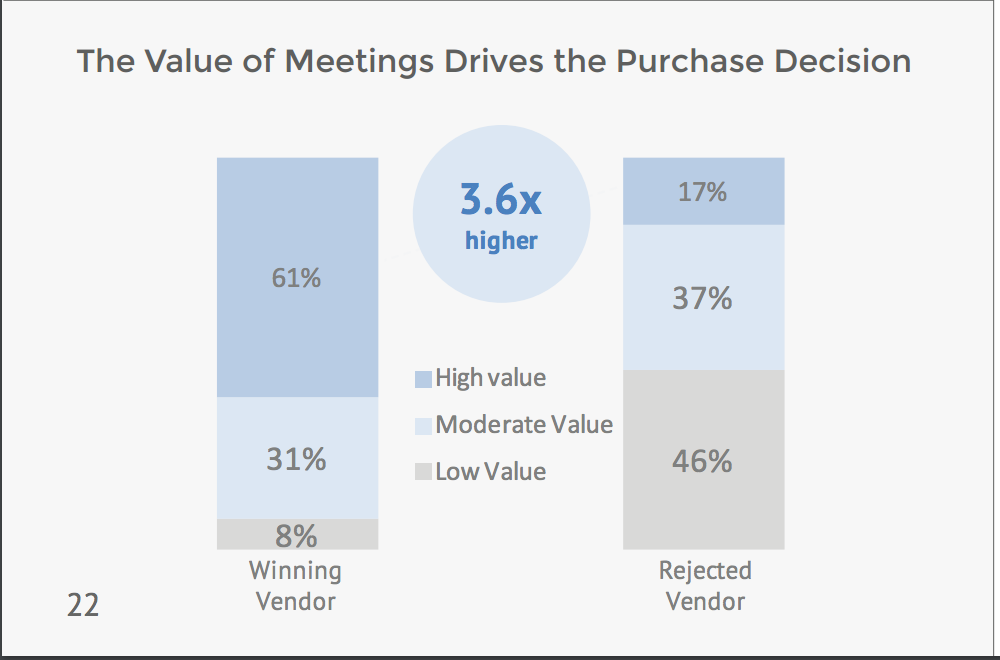
PeopleMetrics recently conducted a study on this topic which found that prospects were 3.6 times more likely to rate meetings with the winning vendor as being high-value. Losing vendors, by comparison, were 5.6 times more likely to receive low-value ratings.

Screen_Shot_2016-08-24_at_9.07.28_AM.png

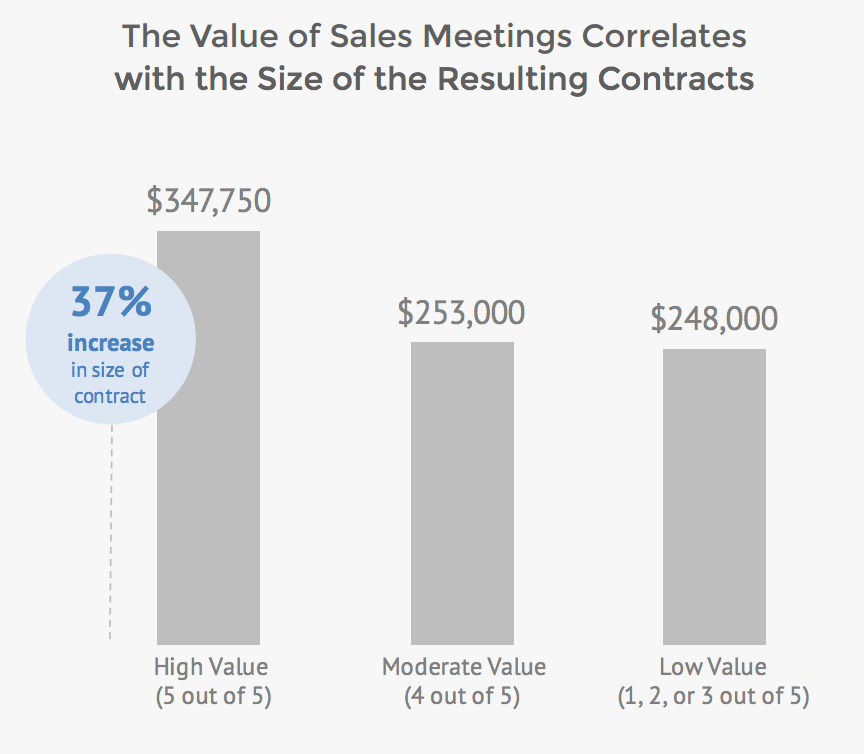
Not only do high value meetings lead to closed deals, they also lead to higher contract values. As prospects’ ratings of meeting value move from good to excellent, the average size of won contracts increases by close to $100,000.

Screen_Shot_2016-09-01_at_3.19.57_PM.png

Bottom line: Meetings matter! So what creates a “high-value” meeting in the eyes of your prospects? We dug into the data to find out and identified five characteristics common to sales reps who create valuable meetings for buyers.

The 5 Characteristics of Salespeople Who Run High-Value Meetings

1) Responsiveness

Responsiveness in sales is all about follow-up. Prospects want reps to follow up in a thorough, accurate, and timely manner both before and after meetings. And the expectation for high levels of responsiveness starts with the first inquiry. Research shows that “50% of buyers choose the vendor that responds first.”

Here are some questions to ask yourself when you’re evaluating your responsiveness:

  • Do you know your median response time after an inbound lead comes through your door?
  • Do you know how quickly reps follow up after meetings?
  • Is 24 hours the expected follow-up norm for your team? Can you do better?

2) Preparation

Preparation is the difference between showing up for a call with valuable insights and showing up and asking beginner questions like, “So, tell me a little about your business.” Prospects see preparation when reps show up having done the work to get to their company, and when they’re ready to deliver on any promises from prior meetings.

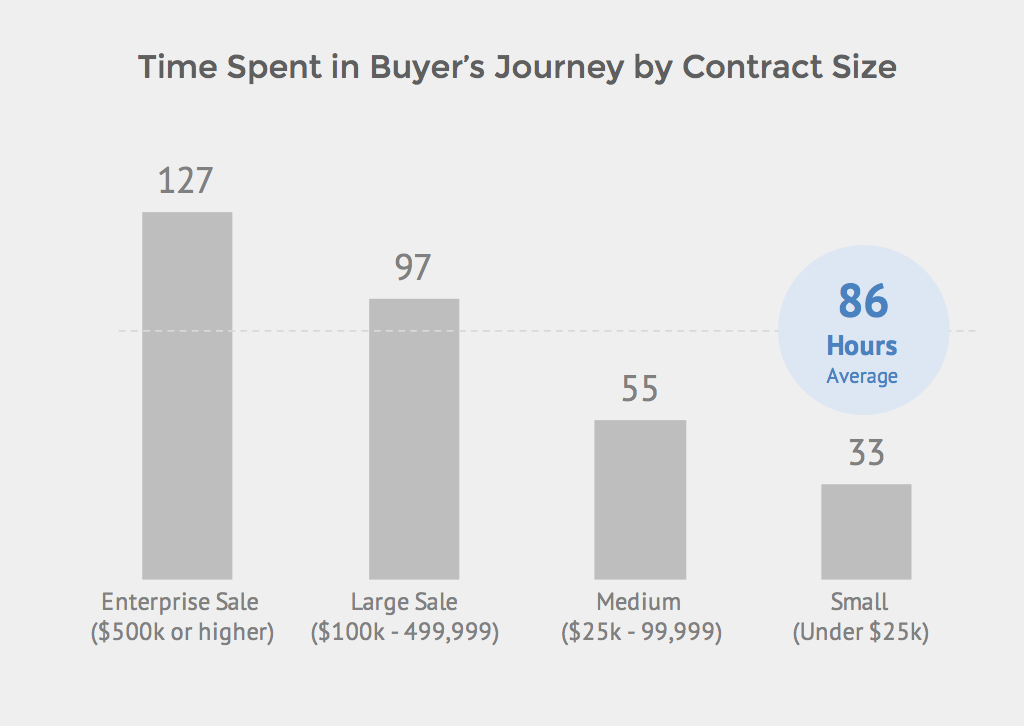
Prospects expect preparation because it reflects the energy they’ve put into the buying process. We found that on average, prospects invest 86 hours in choosing a B2B partner. They expect sales reps to put in a similar amount of effort.

Screen_Shot_2016-09-01_at_11.07.09_AM.png

3) Listening Skills

No, sitting quietly until it’s time to give your product pitch doesn’t count. Pete Caputa wrote a great post about the importance of active listening. He describes active listening as:

  • Truly listening to the prospect
  • Feeding back the content and feeling of the prospect’s words
  • Confirming you heard the prospect correctly
  • Asking a relevant follow-up question to further clarify your understanding of their situation

Again, prospects invest hours into choosing the right vendor. Active listening is a simple show of respect that demonstrates you care and are engaged in helping them build a better business.

4) Consultative Knowledge

Knowledge is demonstrated in a deep understanding of the company’s solutions and services and the ability to relate them to the buyer’s current needs. This is harder than it sounds. Add a few new product lines, questions about competitor’s services and pricing, layer in a highly technical solution, and it’s no surprise that onboarding salespeople can take months. Salespeople have incredible amount of knowledge to keep tabs on.

The last few years have seen a rise in software aimed at helping sales reps manage rising volumes of information. Google Trends provides a quick snapshot of just how important of an issue sales enablement has become over the past five years.

Screen_Shot_2016-09-01_at_2.17.16_PM.png

What tools could you provide your team to help them better manage the volumes of information they need to deliver high value meetings?

5) Unexpected Insights

And at the very top of the pinnacle we have unexpected insights. This is value-add advice and guidance that reflects a unique understanding of the buyer’s situation. There are no quick tips here. Delivering unexpected insights comes from deep sales experience and also genuine caring on the part of the rep. This is the magic sauce that comes out of years of experience and/or careful preparation for each call, and it pays off.

The Champion Cycle

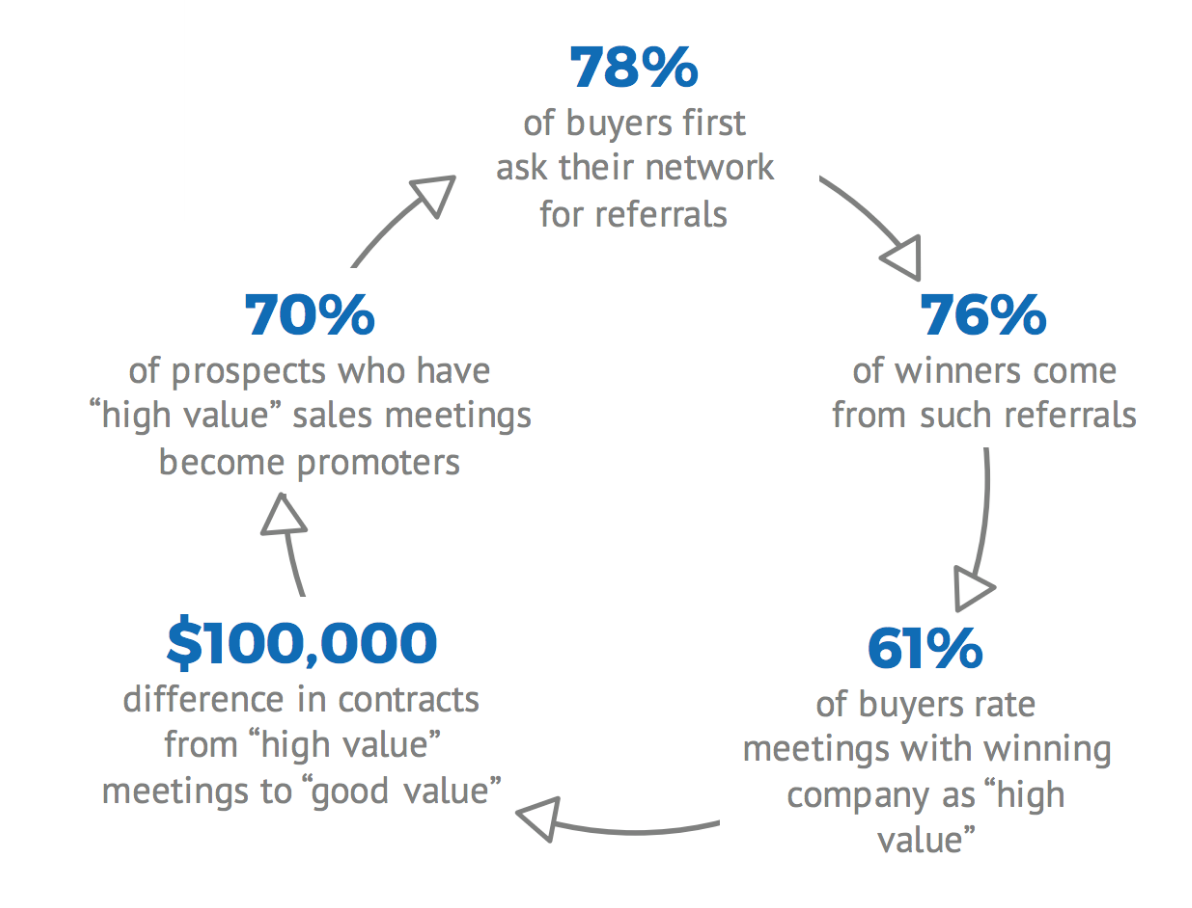
High-value meetings lead to more closed deals, higher contracts, and guess what else? Referrals. 70% of prospects that report having high value meetings become promoters. 78% of buyers start their search process by asking their network for references. 76% of winning deals are sourced from referrals. See what’s happening here? We call this The Champion Cycle.

Screen_Shot_2016-09-01_at_2.25.45_PM.png

Delivering a great customer experience starts with the sales process. The perceptions formed at this stage of the relationship will forever shape how someone thinks about your brand and the value you deliver to your clients.

HubSpot CRM

  HubSpot CRM
13 Sep 16:28

Why B2B Marketers Should Care About “Casual Learning”

by David Dodd

Illustration for 070616 Post

Much of the conversation in the B2B marketing world over the past several years has revolved around the emergence of empowered and independent buyers. A wealth of easily-accessible information now enables buyers to perform research about business issues and possible solutions on their own. The most widely-discussed result of this development is that many – though by no means all – buyers are postponing direct interactions with potential vendors until later in the buying process.

Information abundance has also led to a dramatic increase in what I call casual learning. As I’m using the term, casual learning refers to learning and information gathering activities that occur before an intentional buying process has begun.

Most traditional models of the B2B buying process assume that the process begins when a company’s leaders or managers recognize a need or problem, and decide to address the issue in some way. These “buyers” then gather information about the need or problem and possible solutions, they evaluate the available options, and they may or may not decide to purchase a product or service to address the problem or need.

So our traditional view of buyer behavior is that most information gathering occurs after an intentional buying process has started. Today, however, information is so abundant and easily accessible that many business people routinely consume information about business issues long before they have formed anything close to a “buying intent.”

In their book, Absolute Value, Itamar Simonson and Emanuel Rosen call this type of information gathering “couch tracking,” and they argue that couch tracking is one of the major emerging trends in consumer decision-making. The same abundance of information that drives couch tracking by consumers also fuels casual learning by business decision makers.

The growth of casual learning has important implications for B2B marketing, but the significance of casual learning isn’t fully appreciated by many marketers. Most B2B marketing tactics and programs are designed to identify business people who are ready to begin a buying process, or to encourage those already involved in a buying process to move toward a buying decision. At any given time, however, most of your potential customers aren’t likely to be “in-market” for the products or services you offer, and most of your potential buyers are more likely to be “casual learners” than “active buyers.”

Creating relationships with casual learners is important because the impressions they form during casual learning remain influential when they become involved in a buying process. Therefore, if a company can build and nurture relationships with casual learners, it will have a competitive advantage when those casual learners turn into active buyers.

The bottom line is, B2B marketers can’t afford to ignore this important group of “embryonic buyers.”

Illustration courtesy of Craige Moore via Flickr CC.

13 Sep 16:26

A Cheat Sheet to Creating Your First Lead Magnet Autoresponder Sequence

by Brad Smith

Average website conversions hover dismally around 2%.

A lead magnet is supposed to help, providing something of value to people in exchange for their email and a chance to follow up in the future.

But… then what?

It’s a start. A good one. However, emails don’t = buyers.

You need a systematic approach that automatically follows up once someone becomes a lead.

Trouble is, setting up ‘marketing automation’ techniques like drip email campaigns can be daunting at first.

But it won’t be after you read this step-by-step process that shows you exactly how to do it.

A Brief Introduction to ‘Marketing Automation’

‘Marketing automation’ is the fancy term used to describe how marketing activities (like email autoresponders) are ‘triggered’ when different events take place (like form opt-ins).

It outperforms Facebook and Twitter 40x in acquiring new customers. It can deliver a 451% increase in qualified leads, while also increasing sales by 34%.

Not bad.

Problem is, most still aren’t using it. While more than 60% of marketers (including yourself) commonly use broadcast-based emails, only a tiny fraction – 13% – use marketing automation.

Chances are, you just need a roadmap. So here’s how it commonly works.

A single sequence (or ‘workflow’) of emails is created to follow up after a particular goal or objective is accomplished. For example, a product purchase or lead magnet download.

Once that action happens, the person receives your pre-crafted emails on a regular basis (say every 3-4 days) to nurture them, build trust, and eventually bring up your next offer or product to purchase.

You’ve no doubt seen these emails in your own inbox, like every time you add a product to your cart on Amazon and they send you a reminder email to purchase the next day.

And there’s more good news. Setting these sequences up, allowing you to set-and-forget a critical piece of your lead conversion funnel, is insanely easy with the right tools and systems in place.

Infusionsoft, Ontraport, Convertkit and HubSpot are all amazing choices. But even inexpensive options like MailChimp can do this too.

mailchimpautomation

The important part is that you know what to do before even logging into the tool. Here’s how. Breaking Down the 5 Steps of a Successful Autoresponder Series

The key to having a loyal and highly engaged email list is sending the right message, to the right person, at the right time.

Don’t you hate trite marketing quibs like that?!

However in this case, if you follow the next five steps, you can make that lofty goal a reality.

Step #1. Create Triggers

Autoresponder campaigns work best because they’re specifically designed for a very small subset of people.

So how, exactly, are you going to identify them?

Typically you need to create ‘triggers’ that automatically enroll people when successfully completed. The easiest method is to use a new form submission or when someone joins a new specific list to enroll them to your new autoresponder sequence.

Here’s a quick view of what that looks like in MailChimp.

Step #2. Establish Your Goal

Lead magnet autoresponders shouldn’t go on-and-on-and-on forever. There should be an endpoint; a goal or objective you’re trying to hit.

Think about it for a second.

A lead magnet exists to attract a quality lead. The goal obviously is to get them to purchase something. Anything!

Even if it’s a tiny fraction of the much larger info-product you have in mind. The goal is to get them to hand you a single dollar, so that you can now separate the buyers from the tryers (ok, that was corny).

Again, you can use a similar ‘trigger’ as the last step when someone makes a purchase or joins a new list (so that they’ll automatically be removed from this one and not receive any further messages).

marketing-goal

Why is this important so early on? Once someone purchase the initial product, you’ll want to remove them from this automation sequence and add them to another.

Receiving redundant or irrelevant emails is one of the quickest ways to lose credibility, and is a huge risk when you’re automating so many functions of your business.

Step #3. Create (or Repurpose) Content

Most people begin building an autoresponder series and make it this far.

Then, they hit a wall.

They don’t realize exactly how much content they’ll need (trust us, it’s a LOT).

The best news though, is that you don’t have to worry about duplicate content or any issues like that with emails. You can simply repurpose your best stuff from blog posts, interviews, offline presentations, or eBooks that you’ve already created to put together a few bite-sized emails.

For example, one long blog post can quickly be broken down into a few emails by taking each section one piece at a time. So the first one might introduce, while the next few provide follow up bits of information.

dailytrafficreport

The hard part is sitting down at once and creating all the emails. But this step will save you tons of time when it comes to actually building each sequence because you’ll be able to quickly pull together all of the new emails.

analytics

Step #4. Set-Up Your Frequency

Once you’ve got a library of content to pull new emails from, all that’s left is to set-up how often you’d like these to go out.

This is entirely up to your own business. Some send daily emails. While others back it off to every 3-4 days.

Whatever you pick, the goal is to keep them coming frequently for at least a period of 30 days so that people won’t forget about who you are, and why you’re sending them stuff.

In almost every single email marketing product, you simply set a delay for the time you’d like between actions or emails sent.

sequence

It really is that easy.

Step #5. Get Advanced with If/Then Scenarios

You’ve got a solid autoresponder foundation in place if you’ve made it this far. Building out a sequence of emails to nurture new leads over the next few weeks will give your product sales a tremendous lift.

However you can take this even further based on what people do, or don’t do.

For example, let’s say your lead magnet is a webinar. Here’s how that might look:

  1. First, they register.
  2. Then you need to actually get them to attend.
  3. Then of the ones who do attend, you want to get them to sign up or purchase something.

You can create tailored email sequences (or ‘branches’) for each of these three segments in order to increase results across the board, getting the most people to attend and purchase as possible.

ifthenwebinar

Conclusion

Getting people to download or opt-in for your new lead magnet is only the first step.

Next, you’ll need to carefully nurture those leads over time, increasing trust, engagement and loyalty until they’re ready to purchase.

Fortunately, a few well-crafted email autoresponder sequences can do the heavy lifting for you. They’ll trigger, go out, and adjust based on people’s action to give them exactly what they’re looking for at the right time.

Best of all, these autoresponders sequences, once up-and-running, allow you to remove yourself from the business and focus on tweaking or managing the systems instead.

12 Sep 18:05

5 things sales managers can learn from public speakers

by steli@close.io (Steli Efti)

5-things-sales-managers-can-learn-from-public-speakers.jpg

“We need to increase our calling volume by 20% to reach our goals for this quarter.”

Think your sales reps are feeling pumped? Probably not.

If you’re managing a sales team, you’re not just there to make sure your reps are crushing their quotas. You’re more than a manager—you’re a coach and a mentor. You’re there to inspire and motivate.

And who does that better than anyone else? Public speakers. Think Simon Sinek. Think Tony Robbins.

So let’s talk about how you can rally the troops and build a more motivated and productive sales team. Here are 5 things sales managers can learn from public speakers.

1. Harness your strengths

What are your interpersonal skills like? Becoming great at motivating your sales team starts with understanding how you best connect with other people. Ask yourself this:

  • What are your strengths?
  • What do you need to work on?

Make a list of your best traits and tap into those to become more engaging. If you can figure out what’s the best way for you to communicate, your message will be delivered more effectively to your team.

But good communication isn’t necessarily about talking. Say you’re a good listener. There’s more to being a good listener than just hearing the words come out of a person’s mouth. A good listener asks questions and encourages you to provide clarification. Most importantly, a good listener isn’t judgmental.

Compare these two conversations:

Sales rep: I’m down 22% in my personal sales this week.

You: Better step up your game if you want to hit your targets.

Sales rep: I’m down 22% in my personal sales this week.

You: Why do you think that is?

See the difference? Which one of the above approaches do you think will generate a better outcome and motivate the rep to analyze the situation and take action?

On the other hand, let’s say you’re not a great listener. In fact—you suck at it. What can you do to get better? Start with these core principles:

  • Don’t start talking immediately; take a minute to reflect on what the speaker just said
  • Paraphrase what the speaker said to make sure you understood them correctly
  • Ask clarifying questions to dig deeper into an issue

All right, let’s do a little exercise. If you’re reading this, open this doc right now and share at least one strength and one weakness. I’ve shared some of mine to get the ball rolling. (Feel free to be anonymous.)

2. It’s not about you

Yes, you’re the sales manager. That doesn’t mean you’re the “boss.” In fact, you work for your team as much as they work for you.

Public speaking works in a similar way. It’s not about the speakers themselves. It’s all about the audience.

Start by asking your sales reps this: Why are you here and what do you want to accomplish?

Once you know what drives them, you’ll be able to motivate them more effectively. But don’t do this just once. Ask that same question every now and then to keep your finger on the pulse and see if something has changed.

3. Share your experiences

Everyone loves a good story.

A good story and a narrative can be key to delivering valuable information. Whether that story contains struggle or triumph doesn’t matter—as long as the lesson is there.

Illustrate a point with examples. Don’t be afraid to step away from being informational. Your team knows everything there is to know about this month’s targets. Instead, think about an example that would inspire action.

Share a story they can relate to that had an outcome they desire. Something that would make your sales reps ask themselves, “How can I get there?”

Let’s talk about Flavio Rump. Flavio ran the marketing department at a successful company in Europe which eventually sold for millions. One day he came to me and said he really wanted to learn sales. So I offered him a 30 day internship.

I thought I had just hired the most overqualified sales rep in the universe. Turned out he sucked. It was painful to hear him on the phone. But he was committed to making things work, so he hustled. (This included concierge onboarding at 9 p.m.) Soon, he actually started closing deals even though he was only supposed to qualify trial signups.

Want the full story? Head this way and let this story inspire you.

4. Exercise confidence (but be vulnerable)

When it comes to great speakers, confidence is key. But confidence isn’t something that comes naturally to most people.

Here are a few things you can do to build your confidence:

  • Think positively: “Today we’re going to crush our targets.”
  • Take risks: Start small by doing an A/B test or changing up your email templates.
  • Be honest with yourself: Everyone has flaws and everyone’s learning. That’s okay.
  • Ask for external validation: Everyone needs a pat on the back every now and then.
  • Get out of your comfort zone: Practice doing the things you feel insecure about.

Confidence comes in many different forms. It’s about being comfortable in yourself and your expertise. That confidence expresses itself differently depending on your personality. Find your style and what works for you.

Being confident also means having the ability to be vulnerable. Admit your flaws and failures and don’t be afraid to say, “Guys—I fucked up.”

It builds trust and credibility when a person is willing to admit they were wrong, so embrace your wrongdoings.

5. Keep giving

Just like the relationship between the speaker and their audience, the more you give to your team, the more you’ll get back from them.

Give them the freedom to take action, challenge themselves, and experiment. Because experimentation and trying new things are just as important in sales as any other profession.

  • Ask your reps what they can do to have a bigger impact
  • Ask them what’s holding them back, if anything
  • Ask them what they would do if there were no obstacles or repercussions for their actions

You might be surprised about the ideas people will generate. Let them decide how to make a sale without following a script or a process. In the end, their freedom to create impact will benefit the entire team.

Make motivation a part of your sales culture

There is no “ON” button for motivation. You have to do the work. Every team is different and motivation isn’t something that happens overnight. You’re still the coach working with your team. The sooner you figure out what they care about, the sooner you can develop new ways to motivate them.

Try the above principles to infuse energy into your team before they start lagging along with the numbers.

Is your team pumped to close more deals? Try Close.io for free for 14 days and see your numbers soar.

Recommended reading:

Sales team management: How to inspire change from within
Your latest sales strategy isn't working. How do you, as a sales manager, convince your sales rep to accept your new strategy? It begins with you.

10 most common mistakes new sales managers make
Being a new sales managers is filled with triumphs and pitfalls. These are the top 10 mistakes new sales managers make, mistakes I've made so you don't have to.

The #1 avoidable mistake 99% of sales managers make
It's a small mistake but too many sales managers are making this mistake—and it's HURTING their sales reps' performances. Fortunately, it's easy to fix.

12 Sep 18:05

Establishing a Framework to Build an Inside Sales Team

by Blake Harber

Early in 1927, it began to rain in the Midwest. It kept raining all spring, and the Mississippi River became the collection point for this rainfall and the previous winter’s snowpack. As early as February, levees strained and started to give way. Over the course of the next three months, 145 levees would fail and 27,000 square miles across ten states were put underwater.

The following year, Congress took the first important step in regulating the Mississippi River and its tributaries by passing the Flood Control Act of 1928. This empowered the Army Corps of Engineers to study and alter the nation’s river systems—the Mississippi especially. The Army Corps would build infrastructure to corral and maneuver the river in order to control it.

This was a task of enormous scale —much bigger than anything the Corps had undertaken before— so they wanted a way to test out their building projects to make sure that they would work. The Army Corps began constructing crude models, mere ditches cut in the dirt with water flowing through them. These showed promise in their ability to predict flooding, and they showed the effects of proposed dams.

In 1943, the Corps began construction on a model that could test all 1.25 million square miles of the Mississippi River. It would be a three-dimensional map of nearly half of the continental United States rendered to a 1/2000 horizontal scale spanning more than 200 acres. It was so big that the only way to see all of it at once was from a four-story observation tower.

image00

You should approach building your inside sales team in a similar fashion when beginning to scale your organization. You should map out your grand vision and build it on a smaller scale in order to provide the framework to achieve the grand vision of the sales organization.

The specialized sales model has become ever more popular amongst sales organizations in the past five years. Many organizations have moved away from generalist models and are moving towards specializing or some sort of hybrid. And rightfully so. Ken Krouge & Trish Bertuzzi did an ebook together and found in their studies that “the average generalist is getting a twelve percent close ratio, a specialist model in the same space is getting a nineteen percent close ratio.” That’s a massive difference! These are decisions that you need to make early on while establishing the framework of your sales organization, or your levees will begin to fail quickly.

Here are a few tips to building the framework early on in your sales organization.

1. Hire Management Early

Direct managers will have the greatest impact on a team. The mistake that organizations often make is hiring a great sales rep & promoting them into a management role. There are a million articles out there about hiring a manager and losing your greatest sales rep in the same promotion. Don’t do it. I’ll save that rant for another day. You need a hacker… someone who knows how to build a process. You need someone who understands Salesforce and the capabilities of it… someone who understands the full sales cycle & has been on both sides of the specialized model.

2. Build a Scalable Recruitment Process

If you haven’t read Mark Roberges’ book, The Sales Acceleration Formula, then go buy a copy and read it before you do anything else. He lays out the framework of a recruitment process that is second to none. Approach your recruitment process similar to your sales process. You want it to be data-driven. Build it in a way that will let you determine the quality of your hiring and how successful those reps turn out to be. Then you can adjust your recruitment strategy based on the success of the hires you are making. This will give you framework to determine where you need to focus your efforts.

At Lucid Software we have built a strict recruitment strategy and interviewing process that every candidate goes through. It encompasses interviews with role plays and an individual scoring that is given from each interviewer. We then compile all this data to look through the quality of candidates that we are putting through the process and hiring. After we make hires, we can build a repeatable process to continue to hire tops reps or adjust our screening process based on the pre-hire assessments.

Lastly, find local schools and establish relationships with the sales departments to recruit from. You will spend more time training these recruits, but if the right hires are made and they are put through the correct training, they can be molded into the your ideal sales reps.

3. Establish a Sales Process

Establishing a sales process is crucial in rolling out a sales organization. A good sales process will give you the ability to track data and have insight into any point in the sales cycle from marketing to SDRs to AEs and so on. Determine what metrics are important in your sales cycle and build steps in your sales cycle to give you visibility into these stages. This emphasizes the importance of having direct managers that understand Salesforce and the process well enough to determine these.

A good sales process is will make life easy for reps to stay organized. A weak process will leave reps confused, frustrated, and apathetic. This will often lead to reps documenting important information in other locations other than your CRM.

Remember how the Army corps approached the enormous feat of building an infrastructure to maneuver and corral the Mississippi river in order to control it. They built a giant model, studied it, tested it, changed it and continuously repeated this process. The most difficult part in a sales organization is building this same framework. Map it out, visualize it, test it and perfect it as you scale. This will give you complete control over the direction of the sales organization.

The post Establishing a Framework to Build an Inside Sales Team appeared first on Sales Hacker.

12 Sep 17:57

1 Simple Tip to Get More Business From LinkedIn

by John Nemo

This “new-and-improved” LinkedIn feature makes it even easier to land more business from the site.

LinkedIn has seen some seismic shifts in recent months, from opening up its own freelance marketplace to revamping its paid advertising tools.

Long story short, the world’s largest social media network for professionals wants more of us doing business with one another directly on the platform.

Introducing the New LinkedIn Blogging Platform

To that degree, LinkedIn recently unveiled an all new blogging experience for its 450 million users.

The new-and-improved blogging tools make it “even easier for you to reach and engage with your audience on LinkedIn,” the company announced. “LinkedIn is the only platform where the audience you want to reach is waiting for you, and hungry for professional content. Writing your insights or posting interesting reads can have a direct impact on how you advance your profession or career.”

It can also land you lots of new business.

Here’s why – because LinkedIn has built in such incredible analytics, you’re able to instantly see who is engaging with your content, and then message each of those readers directly on the platform.

(WATCH: How to see who is engaging with your LinkedIn blog posts.)

The Secret to Success – View Stats

With each you post you publish on LinkedIn, there is a “View Stats” option that allows you to see the individual names, faces and profiles of the professionals who are enjoying your content:

View Stats

This is where the concept of content marketing shines its brightest.

When someone reads your LinkedIn blog post and then likes it, shares it or comments on it, he or she is already “warmed up” to you as a prospect.

Even better, you now have context to create a conversation with that person on LinkedIn. And it’s super easy to do, because the “View Stats” option puts all your prospects in one place for you to talk to!

(WATCH: How to see who is engaging with your LinkedIn blog posts.)

Here’s a simple script you can use for each person that engages with your LinkedIn posts. You can send it as an invite if you’re not already connected to the person, or use it as a 1-on-1 message if you’re already 1st degree connections:

“Hi [FIRST NAME] – so glad you enjoyed my post “[INSERT POST HEADLINE].” What was your favorite part? Excited to get connected more deeply here on LinkedIn and learn more about what you’re up to professionally as well! – [YOUR NAME]”

By asking a question (“What was your favorite part?”) in your message or invitation, you’re prompting that person to reply and sparking a back-and-forth exchange based around how your content helped him or her.

It also opens the door to move that person more deeply into your sales funnel.

How It Works

For example, say you wrote a blog about how Authors and Speakers can use LinkedIn to get more readers or land more speaking gigs. You could then follow up with each Author or Speaker who engaged with your content by inviting him or her to a more detailed webinar you have that delves more deeply into the strategies you outlined in your blog post.

In addition, LinkedIn has made it far easier for your blog posts to get indexed and “discovered” by anyone on the network:

“We’ve also updated our tagging and distribution system to help surface your articles on LinkedIn,” the company says. “You can now add hashtags to an article before you publish, making it easier for professionals to easily discover and search for your content in the Feed (hashtags are now searchable on mobile and coming to desktop very soon).”

All the more reason to blog as often as you can over on LinkedIn!

12 Sep 17:46

Barrick turns to Cisco to drag gold mining into digital era

by Danielle Bochove and Dina Bass, Bloomberg News

The biggest gold producer is joining forces with an even larger tech giant to drag the traditional world of mining into the new millennium.

Barrick Gold Corp. signed a deal with Cisco Systems Inc. for a “digital reinvention” of its global mining operations, the Toronto-based miner said in a statement Monday. The partnership — struck between Barrick Executive Chairman John Thornton and Cisco Chairman John Chambers — will start with the Cortez mine in Nevada.

The goal is to cut costs and wring additional value out of existing mines. For example, Barrick expects a flow of real-time data will allow it to predict when equipment is likely to need maintenance and to adjust mine plans quickly as conditions such as prices, weather or ore grades change. The partnership will increase cash flow over the long term while reducing environmental impact and increasing transparency with governments and communities, Thornton said.

“We mean to create value and push the boundaries of our industry in entirely new ways,” he said in the statement. 

It marks the latest step in Barrick’s journey under Thornton. The banker-turned-miner has overseen one of the industry’s biggest cost-cutting and debt-fighting efforts after a slump in prices eroded earnings and sent leverage metrics soaring. His stated goal is to make Barrick one of the best companies in the world this century, in any industry.

Barrick’s debt is down 43 per cent to US$9 billion from a 2013 peak, with most of the heavy lifting done under Thornton’s tenure. Over the same three-year period, the miner’s all-in sustaining costs fell to US$782 from more than US$900, while its workforce was cut in half to about 14,000 through a combination of job reductions and US$4.2 billion in asset sales.

In an interview in July, Barrick President Kelvin Dushnisky said the miner could be debt free within a decade on the back of higher gold prices, lower costs and additional asset sales.

After five straight annual declines, Barrick shares have rallied 123 per cent this year, beating the average gain among major bullion producers. Gold is up 25 per cent this year. The company’s New York shares were down 1.1 per cent before the start of regular trading Monday as bullion prices retreated.

Cisco, too, is looking to redefine its business as its flagship networking hardware products are challenged by software and cheaper alternatives.

“Any company that fails to reinvent itself by harnessing digital technology will soon be left behind,” Chambers said in the statement, adding that Cisco’s technologies and network of partners will allow it to “extend the frontiers of the natural resources industry.”

Chief Executive Officer Chuck Robbins, who took the San Jose, California-based company’s helm in July 2015, has been working to rekindle growth by shifting toward software-based networking, security and management products, which customers increasingly prefer because they’re less expensive and more versatile.

Bloomberg News

12 Sep 17:44

Study details sugar industry attempt to shape science

by CB Staff

NEW YORK, N.Y. – The sugar industry began funding research that cast doubt on sugar’s role in heart disease — in part by pointing the finger at fat — as early as the 1960s, according to an analysis of newly uncovered documents.

The analysis published Monday is based on correspondence between a sugar trade group and researchers at Harvard University, and is the latest example showing how food and beverage makers attempt to shape public understanding of nutrition.

In 1964, the group now known as the Sugar Association internally discussed a campaign to address “negative attitudes toward sugar” after studies began emerging linking sugar with heart disease, according to documents dug up from public archives. The following year the group approved “Project 226,” which entailed paying Harvard researchers today’s equivalent of $48,900 for an article reviewing the scientific literature, supplying materials they wanted reviewed, and receiving drafts of the article.

The resulting article published in 1967 concluded there was “no doubt” that reducing cholesterol and saturated fat was the only dietary intervention needed to prevent heart disease. The researchers overstated the consistency of the literature on fat and cholesterol, while downplaying studies on sugar, according to the analysis.

“Let me assure you this is quite what we had in mind and we look forward to its appearance in print,” wrote an employee of the sugar industry group to one of the authors.

The sugar industry’s funding and role were not disclosed when the article was published by the New England Journal of Medicine. The journal did not begin requesting author disclosures until 1984.

In an editorial published Monday that accompanied the sugar industry analysis, New York University professor of nutrition Marion Nestle noted that for decades following the study, scientists and health officials focused on reducing saturated fat, not sugar, to prevent heart disease.

While scientists are still working to understand links between diet and heart disease, concern has shifted in recent years to sugars, and away from fat, Nestle said.

A committee that advised the federal government on dietary guidelines said the available evidence shows “no appreciable relationship” between the dietary cholesterol and heart disease, although it still recommended limiting saturated fats.

The American Heart Association cites a study published in 2014 in saying that too much added sugar can increase risk of heart disease, though the authors of that study say the biological reasons for the link are not completely understood.

The findings published Monday are part of an ongoing project by a former dentist, Cristin Kearns, to reveal the sugar industry’s decades-long efforts to counter science linking sugar with negative health effects, including diabetes. The latest work, published in the journal JAMA Internal Medicine, is based primarily on 31 pages of correspondence between the sugar group and one of the Harvard researchers who authored the review.

In a statement, the Sugar Association said it “should have exercised greater transparency in all of its research activities,” but that funding disclosures were not the norm when the review was published. The group also questioned Kearns’ “continued attempts to reframe historical occurrences” to play into the current public sentiment against sugar.

The Sugar Association said it was a “disservice” that industry-funded research in general is considered “tainted.”

Companies including Coca-Cola Co. and Kellogg Co. as well as groups for agricultural products like beef and blueberries regularly fund studies that become a part of scientific literature, are cited by other researchers, and are touted in press releases.

Companies say they adhere to scientific standards, and many researchers feel that industry funding is critical to advancing science given the growing competition for government funds. But critics say such studies are often thinly veiled marketing that undermine efforts to improve public health.

“Food company sponsorship, whether or not intentionally manipulative, undermines public trust in nutrition science,” wrote Nestle, a longtime critic of industry funding of science.

The authors of the analysis note they were unable to interview key actors quoted in the documents because they are no longer alive. They also note there is no direct evidence the sugar industry changed the manuscript, that the documents provide a limited window into the sugar industry group’s activities and that the roles of other industries and nutrition leaders in shaping the discussion about heart disease were not studied.

Nevertheless, they say the documents underscore why policy makers should consider giving less weight to industry-funded studies. Although funding disclosures are now common practice in the scientific community, the role sponsors play behind the scenes is still not always clear.

In June, the Associated Press reported on a study funded by the candy industry’s trade group that found children who eat candy tend to weigh less than those who don’t. The National Confectioners Association, which touted the findings in a press release, provided feedback to the authors on a draft even though a disclosure said it had no role in the paper. The association said its suggestions didn’t alter the findings.

In November, the AP also reported on emails showing Coca-Cola was instrumental in creating a non-profit that said its mission was to fight obesity, even though the group publicly said the soda maker had “no input” into its activities. A document circulated at Coke said the group would counter the “shrill rhetoric” of “public health extremists.”

Coca-Cola subsequently conceded that it had not been transparent, and the group later disbanded.

____

Follow Candice Choi at http://twitter.com/candicechoi .

The post Study details sugar industry attempt to shape science appeared first on Canadian Business - Your Source For Business News.

12 Sep 17:38

Our Team’s 10 Tips to Make You a More Effective Content Marketer

by Katy French

Content marketing is part art, part science. Combine analytics with human creativity and the ideal result is your next viral video or successful e-book. But down here on Earth, it’s rarely that easy. There are budgets, higher-ups, and editorial processes to keep an eye on, so occasionally something slips through the cracks. Many of these content marketing problems come down to the same issues: lack of oversight or critical thinking, fear of failure, etc.

But the more you’re aware of these problems, the better you can navigate around them. In that spirit, here are 10 content marketing lessons we’ve learned the hard way.

1) Question Absolutely Everything

In our eight years as a content marketing agency, we’ve seen everything from headline typos to weak content strategy wreak havoc, all because something went unanalyzed. You don’t have to turn into a full-on conspiracy theorist, but keep a sharp critical eye at all times.

We once had a beautifully designed infographic that was ready to be sent to the client. On a hunch, I did one more edit pass to confirm there were no stray typos. After catching a missing data point (mistake one), I went to the listed source to find it. The source was an article from a major publication, quoting a study (mistake two: always use the primary source!).

After poking through the study, I found that the data and associated insights quoted in the major publication’s article were not only incorrect but stated the exact opposite conclusion than the actual data presented (mistake three). Naturally, we had to adjust and redesign the infographic, costing more time and money.

10 CONTENT MARKETING LESSONS WE LEARNED THE HARD WAY

Whether it’s a discussion about project objectives, how you will measure a project’s success, or the format chosen, thinking outside yourself can save you tons of heartache down the line. stefan-malmsten

Remember, too, that while data is incredibly important, one of the most important content marketing lessons is learning to listen to your gut if something feels a little out of sorts, no matter what stage it’s at.

2) Put Your Audience First

Far too often we’ve made the mistake of getting so excited about an awesome idea that we become more focused on bringing our idea to fruition than bringing the right idea to fruition. All content marketers are guilty of this. We think about what we like or what we want instead of what our audience needs and wants. Or we get sidetracked by industry trends or enamored of new mediums.

The best, most effective content speaks directly to your audience. It solves their problems, aligns with their values, and engages them on a practical and personal level.

10 Content Marketing Lessons We Learned the Hard Way

Before you even start to brainstorm your next project, make sure you have a solid understanding of who your audience is and what they want—whether or not that includes your product. One helpful way to do this is to create marketing personas, which help you identify who you’re speaking to—down to the books they read and the problems they face at work. (Here’s how to create them in under 60 minutes.)

jeremy-fettersross-crooks

3) Think About Distribution Before Your Idea

Your content needs an audience. Even if it’s a niche audience, finding the right platform that can deliver that content is crucial. Publishers, bloggers, and other influencers can be your secret weapon. But too often we get caught up in our own content goals and big ideas that we forget to consider what publishers might want.

Brands often think they’re creating content when what they’re really creating is thinly veiled sales material (read: lots of logos and product/service mentions). It’s not surprising that these types of projects are mostly met with a big, fat rejection from publishers.

10 CONTENT MARKETING LESSONS WE LEARNED THE HARD WAY 1

If you want your content to have big reach, think about your target publication. Consider the content subject, tone, voice, and style. Do they publish similar things? Is this relevant? Is there a newsy hook? The more you build relationships with these publishers and influencers, the more you learn what it is they’re really looking for and deliver great ideas they’ll love.

(For tips on building relationships, find out how to promote your content like a content marketing agency.)

10 CONTENT MARKETING LESSONS WE LEARNED THE HARD WAY

4) Fight For Your Ideas

Our extremely successful Child of the ‘90s video for Microsoft/Internet Explorer started out as an infographic project. We had every intention of moving forward with it, but after some deep thinking, we came up with an alternate proposal that we felt better served the brand’s ask. Had we kept quiet and “fulfilled the order,” the company would have lost out on its 48-million-view viral hit.

On the flipside, we once pitched a video concept to a major brand. Although it aligned with their audience, had a fantastic product tie-in, and had a surprise hook that would make it attractive to publishers, the client passed after we argued its case many times. We went forward with their desired concept instead.

Months later a different brand used the same video concept to magnificent results. While it was frustrating (and tempting to pull an “I told you so!”), we took it as validation that, yes, it was a fantastic concept and we were right to have gone to bat for it.

While you should always pick and choose your battles, it is important to fight for what you believe in. It’s not about ego or being right (we strongly believe in being humble); it’s about fighting for and finding the best solution for your problem.

10 CONTENT MARKETING LESSONS WE LEARNED THE HARD WAY

Even if you lose (and sometimes you will), showing that passion and commitment to your work will earn you respect and show clients that you’re passionate about working in their best interests.

5) Select the Right Format

Message is important, but medium is just as important. You may have a great story, but if you don’t choose the right vehicle, it won’t make the impact you want. We’ve seen this a lot. A rich data set is condensed into an e-book when an interactive infographic would have served it better. A client wants an infographic, although a motion graphic could tell a stronger story.

This is especially true considering distribution platforms. Make sure your format works for the content, story, and appropriate channels.

We once created an amazing GIF series that a publisher wanted, but their platform didn’t support the format. All sides were disappointed.

10 CONTENT MARKETING LESSONS WE LEARNED THE HARD WAY

6) Practice Mise En Place

If you’re not familiar, mise en place is a practice employed by chefs. The French phrase translates to “everything in its place,” and for practical application it means preparing as much as you can ahead of time so that everything goes smoothly.

When it comes to content marketing, this applies to absolutely every stage, from ideation, to production, to publishing. In our own experience, we’ve faced various speedbumps that could have been avoided by using this tactic:

  • An uncharged camera battery that delayed production while we ran to buy a new one.
  • A voiceover re-recorded because a client looped in stakeholders after the script was supposedly finalized.
  • An infographic concept changed mid-production after better research surfaced.

This level of preparation is important for everybody. It prevents internal miscommunications. It ensures production goes smoothly. It helps you create better, more effective content. And it helps you distribute that content. (If you need help with strategy, our guides to building a solid content strategy and distribution strategy can save you headaches.)

stephanie-minasian-koncewicz

7) Experiment at Every Stage

One of our five values is Experiment Often. We believe in applying this mentality to everything we do creatively, whether it’s exploring a new format or taking a chance on a different design style. With more and more brands competing in the content space, this is more important than ever.

carolina-kina

Content marketing is a crowded space. Innovation and originality play a huge part in successful content. But like lemmings, it seems many brands are in a game of follow the leader. One video goes viral, they want a copycat. One infographic does well, they want five more on the same theme. It feels more comfortable to play it safe, but that also keeps you stagnated.

john-kim asher-rumack

If you never try something new, you’ll never do anything great. Even if you fail, there’s always a lesson somewhere (see: this post).

10 CONTENT MARKETING LESSONS WE LEARNED THE HARD WAY

8) Move Quickly

It’s one thing to have your great idea shot down, it’s another thing to not follow through—or, worse—do so a smidge too late. You know you’re late to the game when you pitch content the day a publisher puts out a similar piece or your competitor puts out something game-changing while you’re still trying to get idea approval from your CMO.

content marketing lessons

The news cycle moves at lightning speed. It’s up to you to keep up. Stay educated so that you can be at the forefront of trends and plan ahead so that you can align content with upcoming events.
travis-keith
Our Team

9) Find Joy in Your Project—No Matter What It Is

Not every project is going to be your favorite. You might be uninterested or frustrated that someone vetoed your idea, but that doesn’t mean you can’t find value in it. Maybe the subject is boring, but it allows you to experiment with a new format. Maybe the data is dreary, but you can bring it to life through beautiful data visualization.

Take pride in doing good work. Use every opportunity to stretch your skills and learn something new. The content you create will be better, and your working relationships will benefit, too.

10 CONTENT MARKETING LESSONS WE LEARNED THE HARD WAY

10) Be Critical of Your Process

This is one of the easiest blind spots for everyone. Just because you’ve always done something one way doesn’t mean it’s the best. There are a lot of moving parts to any content marketing machine. Actively improving your processes helps save time, energy, and frustration. It also creates a better working environment for everyone.

For us, that means trying new technologies (we actually have an internal multi-department team that experiments with new apps and things to see if they’re beneficial for the larger team), sharing tools and resources, and having regular conversations about how we might improve, both with clients and our own team. It may be annoying sometimes, but it benefits you in the long run.

andrea-bravo-campbell

Ultimately, building an effective content marketing machine is about testing, tinkering, and moving on.

For more content marketing hacks, check out our best fixes for your content marketing problems.

12 Sep 17:36

How to Write a Proposal and Get What You Want

by Benjamin Brandall

how to write a proposal

A proposal has a lot of different purposes, but there’s only one good way to write one: the way that pulls together all of the information in a concise and persuasive way and helps you get what you want … whether that’s a whole new software system, or just a tweak to your marketing strategy.

This article isn’t about a business proposal — also known as a quote — but instead about the document required when formally pitching an idea for action and execution by managers or department heads.

When are proposals necessary?

Any project you don’t have the clearance or authority to start without a higher-up’s approval, you need to submit a proposal for.

According to SSWM, a proposal is “a detailed description of a series of activities aimed at solving a certain problem”.

That problem could be anything, from:

  • Process improvement
  • Cost reduction
  • A new marketing strategy

If it’s an idea you need to ask permission to execute, or to get action on, it needs a proposal.

Why are proposals important?

A proposal is a way to pitch an idea and state your requirements, so it’s important for supervisors because they can get information in writing (not casually in the elevator), and be able to act knowing the full implications of their decision. They’re also a chance for you to make a structured, logical argument and lay down everything in favor of your idea. A well-written proposal shows your manager you care about the cause, and it’s not just a mid-meeting whim you blurted out.

Examples of proposals

It’s a broad topic, but it’s best explained with examples before getting right into a step-by-step guide.

Below is a simple proposal example with some basic sections.

Now let’s take a look at how to write a proposal — whether it’s as simple as the one above, or more complex.

How to write a proposal: step-by-step

Here’s the general structure of a proposal:

As you can see, a proposal generally consists of:

  • Introduction: A brief overview of the problem, solution, costs, and benefits.
  • Issue: The main definition of the issue, including subject, purpose, main argument, background information and importance.
  • Solution: The main definition of the solution, including your step-by-step plan, the benefits, and how potential obstacles will be overcame.
  • Qualifications: Overview of the personnel required, experience.
  • Conclusion of the costs and benefits, and wrap-up: Balance the cost against the benefit, reinforce your point one last time.

1. Identify and define your reader

Just like with any kind of persuasion, it helps if you understand how to appeal to your audience. Who will be reading your proposal and deciding if it’s accepted or rejected? What do they care about? What kind of language and benefits would resonate with them? This is the first step because it’s an important thing to keep in mind as you go along and as information that informs the way you write from here on.

2. Define the problem your proposal will solve

Who: Who will the proposal affect?

What: What’s the reason for you to write the proposal in the first place? Explain the current situation and the problems that come with it.

3. Define the solution

How: How are you going to solve the problem? Explain step-by-step in detail.

Who: Identify the personnel you need, along with their prior experience to add persuasion to the proposal

4. Conclusion: costs, benefits and wrap-up

Reiterate: The purpose and main argument

Costs: Break down the projected costs involved for different elements of the project

Benefits: Break down the benefits to the organization, monetary and non-monetary, to persuade the reader there’ll be a return on investment

Thanks: Thank the reader for their time.

Contact information: Where can the reader get in touch with you? Make sure to be crystal clear to make the details easily discoverable.

BONUS: Get this process as an interactive checklist

Last steps before submitting the proposal

Clear writing is your best friend when you’re trying to write persuasively. For that reason, there are a few checks to run before you submit your proposal.

Remember, what’s clear to you might not always be clear to other people.

1 .Check for jargon (then destroy it)

Although jargon is popular in the business world, not everyone shares the equal love for it. It’s terms like right-size, blue sky (verb), turn-key, and synergize. They might mean something to you, or make you feel intelligent, but there are simpler alternatives that will help people understand what you mean!

2. Change the passive voice to the active voice

The passive voice is defined as:

“The noun or noun phrase that would be the object of an active sentence (such as Our troops defeated the enemy) appears as the subject of a sentence with passive voice (e.g. The enemy was defeated by our troops).”.

It’s a long-winded way of expressing something that could be expressed in simple terms:

passivevoice

The passive voice sounds distant and even deceptive, and, since the reader might even just be skimming your proposal, you don’t want to add extra words to cloud your point.

3. Proofread the proposal

Install a tool like Grammarly and check the proposal in an online text editor. Grammarly will manage to pick up on anything that is grammatically incorrect and sometimes even flags up stylistically poor phrases. Poor spelling and grammar will only discredit the value of what you’re saying and could be a problem that leads to your proposal being rejected.

Has this guide helped you out? I’d love to hear about it in the comments.

12 Sep 17:35

Surefire Ways to Kill Your Company’s Culture

by Mark Harrington

Today, one of most common buzzwords among companies is “culture.” And while most companies say they are dedicated to developing an attractive culture for their employees, many tend to focus on elements that are largely superficial and often irrelevant to the actual core culture of the organization.

Study.com defines organizational culture as “a system of shared assumptions, values, and beliefs, which governs how people behave in organizations. These shared values have a strong influence on the people in the organization and dictate how they dress, act, and perform their jobs.” Developing a strong culture for your company fundamentally relies on developing trust through integrity and consistency.

However, many companies miss the mark when it comes to understanding the foundation of a strong culture, focusing on superficial elements. From ping pong tables and pet-friendly offices to unlimited snacks and unrestricted vacations, many of the employee benefits businesses provide in an effort to boost the brand’s culture may end up contributing to an attractive working environment, but do little to enhance the actual, genuine culture of an organization.

Unfortunately, there are many simple habits and trends that can quickly derail a company’s culture. Here’s a look at some major ‘culture killers’:

Superfluous Spending: Failing to manage a responsible ‘burn rate,’ or pace of the organization’s spending, not only places tremendous unnecessary pressure on the company, but also can create disruption and distrust among employees. Superfluous expenditures and “investments” that misalign with or distract from the goals of the company can create concern and foster frustration across the organization, resulting in an invasion of bitterness, stress and doubt within the culture. Worst of all, it can place the company in a position of weakness, forcing it to raise subsequent funding prematurely, which can result in project cuts, employee terminations or the end of the business.

Cultural Kicker: As straight-forward as it sounds, leaders that spend the organization’s money as if it’s their own, with discipline and responsibility, illustrate to their employees and investors that the value of a dollar is fundamental to the company’s culture. That’s not to say that organization’s should be cheap and fail to invest in their employees or initiatives, but it’s pretty clear when the spending gets to unnecessarily superfluous levels and creates unnecessary pressure on the business.

EmptyPocketsPixabay

Double Standards: As elementary as it sounds, few things kill a culture more rapidly than differing sets of expectations, rules or standards for employees. There are many dimensions of double standards that can arise from favoritism to nepotism and are easily identified across an organization. The problem with all of these situations is the resulting lack of accountability that typically comes with the situation and the fact that it breeds resentment and frustration among employees. This sends a message to teams that the organization is comfortable with an unfair set of standards. Leaders are human, but can, and in many cases certainly do, have ‘blind spots’ that are rooted in favoritism that can ultimately damage the culture and organization. The problem is these ‘blind spot’ typically live their namesake and are unseen by the individual, which ends up damaging both their organization’s culture and their personal reputation.

Cultural Kicker: True leaders tend to be on the lookout to recognize their biases and keep them in check. Focusing on establishing the organization’s balanced standards, documenting them and adhering to them on a consistent basis is a major step towards building a strong culture. Hiring for skills, promoting on merit and making decisions on fact not only fosters integrity in the organization but also eliminates the cancerous trait of favoritism.

CorruptDominoPixabay

Weak Strategy: While nearly every company says it has a ‘vision,’ this often ends up often being little more than a sentence or two on what the business wants to accomplish…someday. Despite this, too many companies lack a genuine, executable strategy that is communicated to the organization resulting in incongruent initiatives that distract and deplete precious resources. Aside from creating confusion and conflict, this often results in a massive cultural deficiency due to the frustration of employees pulling their oars in conflicting directions. Where some companies fall short is the belief that strategy comes from a single point in the organization; nothing can be further from the truth. Genuine strategy is generated across the entire organization. Many of a company’s greatest innovations come from the break room rather than the boardroom. It’s leadership’s responsibility to cultivate strategy as an initiative that spans the organization.

Cultural Kicker: Devising a strategy should be rooted in logic and clarity and focused on the ability to execute against it for the team. Communicating this on a consistent basis to the entire organization not only fosters trust and inclusion, but also cultivates a culture of honesty and openness to generate ideas and innovation.

ConfusedBoyPixabay

Inability to Adapt: An inability to adapt to change or simply listen to those on the frontlines of business cannot only result in frustration and apathy from those employees, but also loss of confidence in the leadership. Worse yet, it can push the business into a tailspin that can be incredibly challenging to pull out of. Ego is often a catalyst of this, with management that thinks they are all-seeing while ignoring the perspective of those employees who are experiencing the realities of the business in the market.

Cultural Kicker: While having the ability to be versatile and adaptive is important to a business, listening to the team is fundamental to developing a strong culture. Keeping things on autopilot with an inflexible approach often ends up steering the business onto a collision course.

CarcassPixabay

Deficient Discipline: While a company’s failure to adapt can curse a culture, so can pouncing on initiatives that distract from the fundamental focus of a business. Brands that regularly chase the latest trend base on isolated or no data in the hope of a revenue grab end up frustrating all sides of the company with massive development shifts and business revisions. The major problem is that these initiatives are often so rushed to “hit a closing window” that they aren’t given the time or resources to develop properly and the core solution of the business ends up suffering due to a lack of attention. Worst of all these ‘patchwork’ solutions often lack congruency and end up confusing clients and prospects as to how they exactly fit together.

Culture Kicker: Focus is as much what you don’t do as what you do. The ability to maintain discipline and actually say “no” to concepts and ideas, no matter how appealing they are, can give a major boost to a company’s culture by allowing employees to focus by doing something great in lieu of providing several incomplete solutions.

FrustratedGuyPixabay

There’s no big secret to building a culture that creates passionate, loyal employees. Rooting it in integrity and consistency in lieu of beanbags and bar-b-ques is critical in fostering n environment that individuals embrace and gravitate towards. While this sounds easy, the fact remains that humans make it abundantly difficult. It’s those genuine leaders that focus on the fundamentals in lieu of just “fun” that are able to construct cultures that drive the success of organizations.

12 Sep 17:35

6 Tips for Successful Sales & Marketing Alignment

by Danny Wong

It is not uncommon to find a company, no matter how large or small they are, that’s dominated by either the sales or marketing team. However, it is rare to find a business that’s dedicated to both and think of the two functions as an equal, integrated team. Although evidence suggests that organizations with strong marketing and sales alignment generate nearly 40% more revenue than companies lacking it, most marketing and sales teams remain in constant conflict.

Here are six simple ways to start building unity between your marketing and sales teams:

1. Align your goals

In the end, both marketing and sales have the same end goal — earning clients and contracts for the company. However, the metrics that they’re evaluated on can be quite different. For example, marketing might be evaluated on pure lead generation numbers, leading them to implement strategies and tactics that inbound a large number of prospects who are low value. If salespeople have goals on converting a certain percentage of these leads, it’s clear that there’s a misalignment.

Instead, it’s important to ensure that the two teams have goals that are in sync. For example, marketing success should be measured against the value of the leads marketers provide in addition to the volume of leads. This leads marketing to have more skin in the game and a good reason to support their sales team in closing high-value contacts more frequently.

2. Exchange information & meet regularly

A recent poll taken showed that 7 out of 10 marketing professionals believed that they needed to meet with their company’s sales teams to make sure their goals were aligned. Having sales meetings for the sake of having meetings isn’t effective, but it’s clear that the meetings you do have need to include both teams. This encourages them to keep in touch with each other and discuss whether or not the leads being generated by marketing are valuable, and what the most valuable customers care about.

3. Invest in the right technology

An aligned marketing and sales team has the same goals and metrics, which means they need a way to view progress together. A strong marketing automation software or customer relationship management system will be able to handle this. A shared dashboard allows both teams to understand pipelines and real-time metrics, allowing them to shape their strategies together. They can instantly share information, send notes back and forth, and pull reports from the same database. In fact, studies reveal that a vast majority of the highest performing companies provide marketers with access to the sales team’s CRM system.

4. Get management support

Results in an organization trickle down from the top, so if you want marketing and sales to align it needs to be important to the highest ranking executives in the company. Beyond that, the sales and marketing managers need to be onboard with the alignment, too. Ideally, both of these managers will report to the same director. By having so much support from senior executives, tension between the two teams should diffuse and they can focus on working towards accomplishing shared goals together instead of operating separately.

5. Create content together

One of the most important tasks sales and marketing can work together on is the creation of branded content and sales collateral. Sales needs great content to generate organic leads and push their current leads further down the funnel. Whitepapers and case studies can be the final piece of information an interested customer needs to pull the trigger. Marketing, on the other hand, usually creates content that is aimed at improving search rankings, website engagement and traffic.

Instead of creating this content separately, marketing and sales must work together. Keeping the message and tone consistent on all content is the key to keeping leads engaged throughout the entire process. Instead of spraying and praying, they can make targeted, useful content together, generating better results for everybody involved.

6. Invest personal time together

Sometimes the only thing you need to foster alignment between marketing and sales is allowing them to get to know each other. Instead of just attending joint sales and marketing meetings together, set time aside for the two teams to mingle outside of the office. Organize a group lunch for both teams or a post-work happy hour. The more comfortable and friendly everybody is with each other, the more likely they are to work together effectively and lean on each other when necessary.

Aligning your marketing and sales teams can be an enormous task, especially if they’ve operated independently for a long period of time. The only way for each team to reach its potential and provide maximum value to the organization, however, is to integrate with the other by following the tips listed above.

12 Sep 17:34

What Aristotle Can Teach Firms About CSR

by Rosa Chun
sept16-12-26266281-2

Recently, I spoke with senior leaders at a Fortune 500 firm. It’s a leader in philanthropy, but the executives feel all their corporate giving goes unappreciated. “We do all the right things, but the public always criticizes us,” they told me. “What’s wrong?”

That’s something I hear more and more. The public has grown increasingly skeptical about the motivations behind corporate social responsibility (CSR) efforts. I don’t blame them. I believe that this is due to the discrepancy in the two dominant approaches in rationalizing why corporations should be ethical. To understand this, it’s helpful to examine some important philosophical history. Basically, corporations are acting the way the philosophical teachings of Jeremy Bentham or those of Immanuel Kant would tell them. I believe – and my research shows – they would be wise to learn some Aristotelian lessons and better incorporate the role of emotion in their CSR efforts.

A Philosophical Tour of CSR

So how is it that companies approach CSR from the duty-based philosophy of Immanuel Kant? The German philosopher argued people should act out of moral obligations. Say you see someone begging for money on the street and you don’t feel compassion for that person. You will help anyway, because you feel you have a duty to, or that it is the right thing to do. That’s coming from public pressure, but not from your true respect or empathy for that person. Corporate social responsibility efforts have this disconnect, too.

Another corporate approach which is more dominant is Jeremy Bentham’s utilitarian way. The English philosopher argued a unit-based approach; as long as the outcome is bigger than the input, the action is justified. Profit-driven organizations see CSR from the utilitarian perspective as a way of gaining a business advantage or to recover from a reputation loss.

The problem with most corporate social responsibility efforts is that these duty-based and utilitarian approaches are essentially based on rationality, albeit with contrasting motivations. The company is there to make money, but it also tries to appear to meet the public expectation of acting ethically. To customers and employees, that can simply come across as calculating and superficial. That’s why the CSR activities often don’t ring true.

There is a significant gap here. And the missing link is emotion. Companies forget emotion in CSR, and that’s why they fail.

The Aristotelian Alternative

This is where the teachings of Aristotle come in. He advocated for developing a character of virtuousness that leads to happiness for one’s self and others. He said these traits of the ideal character derive from natural internal tendencies. If they’re nurtured over time, eventually they become established.

Aristotle was writing about people. While individual philosophy has been studied and applied to corporate organizations, I wanted to explore the newer concept of organizational virtue and how to adapt it to corporate strategy.

To help understand its potential, I conducted a survey of 2,500 employees and customers of seven British services firms. It shows that organizational virtue, represented by integrity, empathy, zeal, conscientiousness, warmth, and courage, is linked to employee and customer satisfaction via identification. Think of identification as a perceived oneness or emotional attachment to the company. My findings suggest two organizational virtues are key for this. For employees, identification with a firm is driven most significantly by integrity (such as being honest, trustworthy). For customers, identification with the company is driven chiefly by empathy (such as being concerned, reassuring).

In other words, when employees perceive an organization to hold high integrity, this leads to employee identification. This emotional attachment then leads to satisfaction, and eventually differentiation (unique attributes that employees perceive as better than competing employers). Similarly, when customers perceive an organization to show strong empathy, it enhances their emotional attachment to the company. This leads to satisfaction and eventually differentiation. The emotional attachment is the important mediator of CSR success.

A key strategic implication of the research findings is that companies would be better off changing their CSR strategy from differentiation to identification. This consideration of stakeholder emotion is what makes virtue ethics distinctive from the other CSR approaches. Developing strategic virtues in the minds of stakeholders has the potential to turn positive emotion into a real competitive advantage.

When CSR Is Only Skin Deep

Let’s look at what happened in the past to a pioneering company that successfully differentiated its brand as being socially responsible. It turns out, differentiation is hard to sustain. Mergers and acquisitions are often the time when differentiation by CSR falls short. Mergers might succeed for financial reasons, but they can just as easily fail for emotional ones.

The cosmetics and skin care company, The Body Shop, long promoted its business through social and environmental campaigns. It counted opposition to animal testing on cosmetics as a core value. Then it agreed to be acquired by L’Oréal, mainly to gain financial synergies.

At the time of the acquisition, many consumers and observers questioned whether the company could maintain its ethical stance. The Body Shop received criticism for L’Oréal’s poor reputation associated with animal-tested cosmetic products. It seemed to be in polar opposite position to the brand identity of The Body Shop. The company’s reputation with customers suffered, as we’ll explore below.

This merger is a good example of how companies often try to differentiate their brand based on corporate social responsibility, believing the differentiated image will lead to a competitive advantage. However, my research applying Aristotle’s teaching on “virtue ethics” shows that the CSR-based differentiation strategy will not last if stakeholder identification with the brand is weak.

Three Steps to Change CSR Philosophy

The Fortune 500 company that doesn’t get enough return on CSR will need to change its approach. So how might companies leverage virtues to build stakeholder identification? How can they build emotional attachment with their customers and employees by being more responsible and ethical? The following steps may be useful in translating organizational integrity and empathy into consumer and employee identification.

  • Renew the CSR function. Many global firms put this function under the responsibility of departments of corporate affairs or corporate social contribution. This departmentalization sends the wrong signal. Analogous to Maslow’s hierarchy of needs, ethical responsibility needs to reside at the lower level of the CSR pyramid. This needs to be fulfilled before philanthropic activities can be appreciated. When the CEO is being investigated for corruption, donations and CSR projects will not be effective. CSR strategies must be integrated into the overall corporate strategy.
  • Redefine the CSR vision, but don’t oversell it. A founder’s vision is often crucial in defining a CSR-led brand but it needs to reflect reality over time. The founder of The Body Shop, Anita Roddick claimed that common values have “given it a campaigning and commercial strength and continues to set it apart from mainstream business.” This stated formula linking shared ethical value with differentiation and commercial success lost its validity and appeal with the takeover by L’Oréal. Loyal customers accused The Body Shop of not standing by its own principles.
  • Promote empathy during a crisis. When Steve Jobs announced his plan to step down as CEO and appoint Tim Cook as his successor, he sent a personal letter to the Apple community through the company website. In the acquisition of The Body Shop, loyal consumers should have been reassured that the company’s core values would be left unchanged after the takeover. In contrast, bad press and falling ratings show that longtime customers were left feeling betrayed, their loyalty penalized rather than rewarded. The two situations were similar: in each, consumers and employees felt insecure about what the future would bring. Apple tried to engage the loyal customer about the bad news, and the crisis was a bonding moment for the company. During a crisis, the empathy virtue can turn a negative emotion to a positive one, altering betrayal to sympathy, anger to forgiveness, and dis-identification to identification.

The Alarm Bell for CSR Campaigns

Companies are increasingly turning to innovative CSR campaigns, community projects, and hefty charitable donations. However, my research sounds an alarm bell for those efforts to create a differentiated image that is unfortunately based on weak customer and employee identification. A global firm that won multiple CSR industry awards but has poorly perceived integrity and empathy by stakeholders should not be surprised when consumers decide to dis-identify themselves by buying less, or worse, boycotting the brand altogether.

In Aristotelian thought, virtue ethics are supposed to lead to a good outcome: happiness. A good CSR strategy should aim for happiness too. I believe corporate virtues, once nurtured and established, can lead to happy stakeholders and, ultimately, better performance. But it will take a rethinking by companies around the globe.

12 Sep 17:33

Paying With Cash Really Does Make You Spend Less

by Kristin Wong on Two Cents, shared by Alan Henry to Lifehacker

We tend to value items more when we pay with cash because we feel more connected to the purchase. A recent study financed by the Consumer Financial Protection Bureau found that consumers also spend less when they pay with cash, especially when they’re exposed to frequent reminders.

Read more...

12 Sep 17:32

How Experts Can Help a General Audience Understand Their Ideas

by Nancy Duarte
sept16-12-486352116

When you’re presenting to people in your field, it’s OK to use specialized terms and acronyms, because they’ll be comprehended quickly. But for everyone else, you need to take a different approach. Communication methods that would impress your peers may ostracize a broader audience — and reduce the chances your ideas will be adopted.

By following these three rules, you can translate what you know into words and concepts that will feel meaningful — and applicable — to a lay audience.

1. Use metaphors to make jargon accessible. Remember what it was like before you became an expert — before all those buzzwords and acronyms crept into your discourse? Metaphorical language, a simple poetic device, can help you match that level of understanding.

You and Your Team Series

Presentations

  • Good Presentations Need to Make People Uncomfortable
    • Josh Bersin
    6 Ways to Reduce the Stress of Presenting
    • Joseph Grenny
    How to Give a Killer Presentation
    • Chris Anderson

    Consider how Jeff Hudson, the CEO of Venafi, described internet security when addressing executives in Global 5000 businesses: He likened cryptographic keys and digital certificates — which identify webservers, software, devices, apps, and critical infrastructure — to the tags attached to every cell in the human body. “Keys and certificates are blindly trusted,” he pointed out. “Cybercriminals use them to hide in encrypted traffic.” Hudson said that Venafi solved that problem by functioning like our immune system, which relies on our cells’ tags “to identify what is self and what isn’t — what to trust and what to destroy.”

    2. Minimize the content on your slides. Each field has a unique way of communicating visually. You may be able to flash a dense data slide in a meeting with company or industry insiders without confusing anyone. But a broader audience will want to see the high-level findings — not the data itself.

    A skin care company my firm has worked with created the charts below to show how one of its products changes the appearance of skin over time. That worked fine for internal audiences. When reaching out to young Instagrammers and bloggers, however, a marketing manager simplified the data into memorable results. That made the message more easily understood at a glance.

    BEFORE:

    sept16-06-duarte-1
    Source:SK-II

    AFTER:

    setp16-06-duarte-2
    Source:SK-II

    3. Communicate less material. Eliminate all but the most essential pieces of your talk, and then unpack concepts that are foreign to your audience. Allow yourself to take a bit more time per point than you would with your peers. Yes, cutting material and giving your points more breathing room may make you feel uncomfortable, because you’re losing nuance. But if you just do the same old talk you always do, it won’t benefit your audience or your message. The value of an idea is judged not just by its content but also by how well it’s understood. So it’s critical to remove barriers to understanding — even if those barriers are details your peers would appreciate.

    Once you dive in, you may find that making your talk simpler is actually pretty difficult. Matching your communication to your audience takes time and requires an imaginative leap. You have to try to forget what you know — but not to the point of talking down to your audience. You’re addressing nonexperts, but always assume that they’re intelligent.

    One way to shift your mindset is to change your environment. Instead of writing your talk from your lab or office, try moving to a new location, like a café, a park, or the public library. That removes the temptation to approach your presentation the way you approach other things at work. Sometimes changing just one small habit in your creative process can yield something fresh for an entirely new crowd.

12 Sep 17:32

How to Complete the Picture of Your Buyers Across Devices

by Bhumika Dadbhawala
Family using wireless devices at home

Author: Bhumika Dadbhawala

Omni-channel. Most of us are familiar with the word by now–it’s the new standard for marketing and it allows you to gain a holistic view of your buyers.

A properly implemented omni-channel marketing strategy leads to better targeting, stronger results throughout the customer lifecycle, more value for your buyers, and higher ROI for your business. But this requires taking into account knowledge about a buyer’s entire footprint across channels, which can often exist on different devices.

It all comes down to syncing the valuable data that lives in difference siloes, thus enabling a more personalized, seamless, and comprehensive view of the buyer’s journey. For example, marketers can leverage a buyer’s desktop website behavior for stronger, more personalized mobile targeting, as well use mobile location data to attribute store visits and measure digital reach.

So, how do you integrate different touchpoints to carry out your omni-channel marketing strategy? Here are three steps to complete the picture of your buyers across devices:

1. Understand What Your Challenges Are

Marketers are not short on challenges in today’s multi-channel world. Namely, they may not know who, specifically, their audience is or where they are, and how to carry forward their behavior and actions from one channel to another. Many brands use cookies or login systems to learn about their buyers, but even in those cases, they know very little about their interests and preferences, and it’s difficult to reach them outside of a single platform, not to mention across devices. Understanding these nuances is essential for marketers to establish stronger, more personal relationships with their buyers.

However, with buyers interacting with your products or services across several devices–desktops, laptops, smartphones, and tablets–it can be difficult to tie those buyers to a unified identity. A desktop visitor might be stored as a separate record from the same person visiting your site on mobile due to distinct identifiers that may not translate well across devices, such as cookies and mobile device IDs. This is the fundamental problem of device proliferation: digital identity fragmentation.

To fuse this information together, start by understanding what your challenges are. Think about what you’re trying to solve and where your gaps exist, then ask yourself questions like these to try to narrow down the root cause:

  • Do you have a large desktop user base, but need associated mobile devices?
  • Do you have a list of app users, but need a way to tie that to desktop or mobile web users?
  • Is your goal to take learnings from one platform to another to provide a specific service or recommendation, drive personalized content, or something else?
  • Are you able to understand a buyer’s journey across devices to solve for attribution, measurement, and insights?

2. Learn How to Solve Those Challenges

By selecting the right solutions, marketers can easily make their data work for them. Many brands already use data management platforms (DMPs), which help profile users across different platforms, such as desktop or mobile, and even email databases or loyalty programs. While these data warehouses maintain and hold data, by nature, many DMPs can’t necessarily match users across screens because this data may not be connected to a marketing automation platform or CRM system that holds valuable buyer data to conduct more seamless experiences.

Even when there is a strong connection between DMPs and marketing automation, you may find value in an independent identity solution. There are solutions out there with cross-device pairing technology utilizing either deterministic or probabilistic device-matching, the two most common ways to solve for cross-device identity.

The deterministic approach is essentially person-based identification that involves collecting personal data and using that data to connect users across devices, typically through a login system. Whereas, the probabilistic device-pairing method uses accessible data–from ad requests, for example–to make predictions about users. There’s a tradeoff between scale and accuracy with these two solutions. As the accuracy of the solution increases, the pool of correctly matched buyers dwindles, and vice versa. One isn’t necessarily better than the other, and it’s likely that a mix of both will work for your brand.

So find where the perfect mix of known and predicted information is for your campaigns. For some instances, you may want only 100% accurate information, such as pairing a physical address to a buyer’s name. But perhaps for an online ad campaign, you can afford to be less precise in order to reach a wider audience. Or maybe it’s a combination, such as when you’re looking to connect purchase history of a customer, so you can attribute appropriate value and further improve site personalization efforts or email marketing initiatives.

3. Leverage Cross-Device Data to Add Value

The most important value-add for cross-device data is that it enables marketers to extend and enhance their own first-party audience data. Whether you’re using your own audience, a partner’s list, or third-party DMP segments, the ability to leverage audience data to understand a complete picture of buyers is critical for digital marketers. This opens up a slew of applications from targeted advertising and dynamic content, to web personalization and account-based marketing.

The opportunities around automated campaigns and lead nurturing are particularly interesting. Many brands understand who a buyer is on one device due to a login or registration that they have tied cookie or device ID. But with the omni-channel prevalence of today’s buyers, it’s important to bring that extra data into a customer record to send out relevant, personalized campaigns triggered by activity or inactivity.

Airlines and retailers are great examples of where adding an identity layer can be a boon to a brand’s automated marketing efforts. Many consumers will log into to their account on desktops, allowing the brand to associate that buyer to a handle, but those same consumers may rarely log in on mobile devices. But we all know that consumers are on mobile, so if an airline knew that someone was looking at flights to Alaska or a retailer knew they were checking out a particular sofa on mobile, those brands could append the customer record and automatically send an email when that product category went on sale.

Ultimately, the sophisticated use of omni-channel, cross-device audience data leads to more value for everyone involved. Marketers can improve their targeting abilities across campaigns to drive higher value and ROI, and buyers are provided with more relevant messaging across channels and devices.

Marketo Virtual Event


How to Complete the Picture of Your Buyers Across Devices was posted at Marketo Marketing Blog - Best Practices and Thought Leadership. | http://blog.marketo.com

The post How to Complete the Picture of Your Buyers Across Devices appeared first on Marketo Marketing Blog - Best Practices and Thought Leadership.

12 Sep 17:29

How to Complete the Picture of Your Buyers Across Devices

by Bhumika Dadbhawala

Family using wireless devices at home

Omni-channel. Most of us are familiar with the word by now–it’s the new standard for marketing and it allows you to gain a holistic view of your buyers.

A properly implemented omni-channel marketing strategy leads to better targeting, stronger results throughout the customer lifecycle, more value for your buyers, and higher ROI for your business. But this requires taking into account knowledge about a buyer’s entire footprint across channels, which can often exist on different devices.

It all comes down to syncing the valuable data that lives in difference siloes, thus enabling a more personalized, seamless, and comprehensive view of the buyer’s journey. For example, marketers can leverage a buyer’s desktop website behavior for stronger, more personalized mobile targeting, as well use mobile location data to attribute store visits and measure digital reach.

So, how do you integrate different touchpoints to carry out your omni-channel marketing strategy? Here are three steps to complete the picture of your buyers across devices:

1. Understand What Your Challenges Are

Marketers are not short on challenges in today’s multi-channel world. Namely, they may not know who, specifically, their audience is or where they are, and how to carry forward their behavior and actions from one channel to another. Many brands use cookies or login systems to learn about their buyers, but even in those cases, they know very little about their interests and preferences, and it’s difficult to reach them outside of a single platform, not to mention across devices. Understanding these nuances is essential for marketers to establish stronger, more personal relationships with their buyers.

However, with buyers interacting with your products or services across several devices–desktops, laptops, smartphones, and tablets–it can be difficult to tie those buyers to a unified identity. A desktop visitor might be stored as a separate record from the same person visiting your site on mobile due to distinct identifiers that may not translate well across devices, such as cookies and mobile device IDs. This is the fundamental problem of device proliferation: digital identity fragmentation.

To fuse this information together, start by understanding what your challenges are. Think about what you’re trying to solve and where your gaps exist, then ask yourself questions like these to try to narrow down the root cause:

  • Do you have a large desktop user base, but need associated mobile devices?
  • Do you have a list of app users, but need a way to tie that to desktop or mobile web users?
  • Is your goal to take learnings from one platform to another to provide a specific service or recommendation, drive personalized content, or something else?
  • Are you able to understand a buyer’s journey across devices to solve for attribution, measurement, and insights?

2. Learn How to Solve Those Challenges

By selecting the right solutions, marketers can easily make their data work for them. Many brands already use data management platforms (DMPs), which help profile users across different platforms, such as desktop or mobile, and even email databases or loyalty programs. While these data warehouses maintain and hold data, by nature, many DMPs can’t necessarily match users across screens because this data may not be connected to a marketing automation platform or CRM system that holds valuable buyer data to conduct more seamless experiences.

Even when there is a strong connection between DMPs and marketing automation, you may find value in an independent identity solution. There are solutions out there with cross-device pairing technology utilizing either deterministic or probabilistic device-matching, the two most common ways to solve for cross-device identity.

The deterministic approach is essentially person-based identification that involves collecting personal data and using that data to connect users across devices, typically through a login system. Whereas, the probabilistic device-pairing method uses accessible data–from ad requests, for example–to make predictions about users. There’s a tradeoff between scale and accuracy with these two solutions. As the accuracy of the solution increases, the pool of correctly matched buyers dwindles, and vice versa. One isn’t necessarily better than the other, and it’s likely that a mix of both will work for your brand.

So find where the perfect mix of known and predicted information is for your campaigns. For some instances, you may want only 100% accurate information, such as pairing a physical address to a buyer’s name. But perhaps for an online ad campaign, you can afford to be less precise in order to reach a wider audience. Or maybe it’s a combination, such as when you’re looking to connect purchase history of a customer, so you can attribute appropriate value and further improve site personalization efforts or email marketing initiatives.

3. Leverage Cross-Device Data to Add Value

The most important value-add for cross-device data is that it enables marketers to extend and enhance their own first-party audience data. Whether you’re using your own audience, a partner’s list, or third-party DMP segments, the ability to leverage audience data to understand a complete picture of buyers is critical for digital marketers. This opens up a slew of applications from targeted advertising and dynamic content, to web personalization and account-based marketing.

The opportunities around automated campaigns and lead nurturing are particularly interesting. Many brands understand who a buyer is on one device due to a login or registration that they have tied cookie or device ID. But with the omni-channel prevalence of today’s buyers, it’s important to bring that extra data into a customer record to send out relevant, personalized campaigns triggered by activity or inactivity.

Airlines and retailers are great examples of where adding an identity layer can be a boon to a brand’s automated marketing efforts. Many consumers will log into to their account on desktops, allowing the brand to associate that buyer to a handle, but those same consumers may rarely log in on mobile devices. But we all know that consumers are on mobile, so if an airline knew that someone was looking at flights to Alaska or a retailer knew they were checking out a particular sofa on mobile, those brands could append the customer record and automatically send an email when that product category went on sale.

Ultimately, the sophisticated use of omni-channel, cross-device audience data leads to more value for everyone involved. Marketers can improve their targeting abilities across campaigns to drive higher value and ROI, and buyers are provided with more relevant messaging across channels and devices.

Marketo Virtual Event

12 Sep 17:26

How Sales Engagement Platform Are Changing The Way People Use To Sell

by William Sarto

sales engagement

The sales landscape is fast changing. We are witnessing the explosion of new sales-tools, vendors and solutions. We are constantly sold various sales tools by different-different vendors that promise to amplify our productivity. Now, sorting through this vendor-chaos is daunting. The last thing you want is investing in a sales tool that will serve to complicate your sales process rather than simplifying it.

Another challenge is this: Sales reps always run short of time!

Even though the use of CRM (Customer Relationship Management) systems has immensely helped the sales reps in saving a lot of time, and also improved how businesses manage their customers, these systems do have their own shortcomings.

That’s why Sales Engagement Platforms are becoming more and more popular with sales reps. A Sales Engagement Platform or SEP lumps together all the tools which you need into a solid sales engagement software and thereby helps the sales reps to engage faster and increase their productivity. But exactly what benefits do sales engagement platforms offer to your business organization? Read on to find out…

1. Easy Sales Content Management:

Sales engagement platforms provide the sales reps with engagement analytics. The analytics helps them to determine which content is popular with the readers. This will be a significant competitive advantage for your business.

Advanced analytics enables the reps to learn the needs of the prospects and the customers in real time. Now, furnished with this information, your sales rep can act quickly to pursue a lead or re-adjust their sales strategy.

The information provided includes:

  • Which content is leading to more sales and which is not: Sales reps can use this information to tweak content to clinch more sales. This leads to more guided selling with the application of sales energy concentrated on deserving leads.

  • Proliferation of Smartphones has brought a new angle to web browsing and other online interactions. Mobile tech gadgets are no longer a luxury. They are becoming invaluable online business tools. Theses gadgets provide a new way for the reps to engage with the prospects while on the go. Mobile devices provide more customer engagement which may lead to more sales. Mobile responsive sales engagement platforms enables sales agents to do some mundane tasks such as updating their records on CRM system of record. This saves them time and allows you to focus on winning new customers.

2. Constant And Multi-Medium Communication:

In the business world, communication is the key. You need to keep constant communication with your prospects. There are various communication tools you can use to communicate with your prospects. But, there is nothing more important than your sales messages.

That means, you need to get your sales message across in the most reliable way. And also in a way that makes follow-up less straining and time saving.

Now, sales engagement platforms enable you to communicate with potential customers via the many mediums of communication such as email or SMS. Besides, they make it easier for you to conduct sales presentations and live pitches. The sales engagement platform eliminates the need for other communication tools such as web conferencing tools. Live pitches promises quicker results and also fast tracks the sales process.

3. Improved Pipeline Forecasting:

For an organization to successfully manage their pipeline, they must know the number of opportunities in the pipeline. The organization also needs to know the value of every single deal in the pipeline, how long each of the prospect spends in the pipeline, and most importantly, the win rate. Although Customer Relation Management software have been providing most of this data, but there is a need for advanced sales engagement tool. Now, these new-age ‘digital listening’ tools are giving sales reps more capabilities they never had before. They help them improve their timing for follow-up activities. Also, they help them engage more with the prospects through insightful selling approach.

4. Customer Lifecycle Support:

The customer lifecycle can be long and frustrating to the sales rep. Right from pitching to the prospect, to follow up, to close, to support and expansion, it is never easy.

This is where a SEP steps in. A Sales Engagement Platform becomes the ideal platform to support guided selling and predictive analytics. It centralizes the customer engagement data required to inform the sales cycle. All this is based on the customer’s unique needs and engagement. Ultimately, it helps shorten the sales cycles.

Some advanced and popular Sales Engagement Platforms (SEP) that can make your sales sky-rocket include:

  • SalesHandy – A powerful sales engagement platform that provides advanced engagement analytics, and advanced content tracking abilities.

  • LiveHive – A sales platform that automatically shows you how your sales content is being shared across the organization.

  • ClearSlide – This platform helps the sales reps to connect and engage with complicated prospects. However, the platform is a bit beyond the reach of most businesses.

The time when Office applications used to be the in-thing for business are over. Now, businesses are keen on improving their productivity. One way of doing that is by reducing the amount of time they spend working on different sales tools. Also, they need to be in constant communication with the prospects. Although CRMs have tried to solve this problem, a better sales software that combines all these sales tools into one single powerful sales software is needed. This is where a Sales Engagement Platform comes in. And that is why businesses are adopting such platforms in droves!

12 Sep 17:26

High Technology Product Pricing

by Phil Morettini

Pricing is always an interesting topic, but even more so in the Hardware and Software worlds. In the consumer products business, if there is a package of frozen peas from Green Giant that’s priced at $3.99, you’re not likely to see someone else offering the same-size package of peas priced at $14.99. But in High Tech, things are different.

Things move fast in tech markets

The pace of innovation in the High Tech world leads to pricing that’s all over the map. It’s not unusual for a brand new competitor to come out at a higher price than the current established market leader—especially if their product is based on market-changing advances in product functionality due to a new technology. This is unheard of in most other markets. Then there is the PC business, where rapid technological advancement over a long period of time has led to continuously lower prices—with great benefit to consumers but squeezing margin (and indeed many competitors) out of the market.

Pricing High Tech Products is a Dynamic Activity Which Should be Given Close Consideration
Pricing High Tech Products is a Dynamic Activity

Again, things move fast in Tech. Sometimes it’s a high initial price to harvest profits while you have a feature advantage, other times it is aggressive discounting to gain market share, based upon your lower cost structure due to less expensive technology. Whatever the case, you can often count on pricing moves to be dramatic and to have a profound effect on most technology market segments in the long-term.

Value-based pricing

So what’s the best way to price software and hardware-based products? Is it best to add up your fixed costs and, allocate them to a forecasted number of units to ensure you are recovering your investment? Or is it better to take your variable product costs and use a standard multiplier derived from history? Maybe you just set your pricing based on the prices of your competitors. Or let your customers tell you what they’re willing to pay. While all of these approaches have merit and a place in pricing policy, none of them should be the over-riding factor in your pricing strategy.

And the most important factor to consider in Pricing? The most important thing to focus on in setting prices is VALUE. What is the value of your product to your customer as an economic, functional or emotional return? And how does the customer value the benefits of your product relative to your competitors?

Market segmentation

Let’s talk about the nature of Value. Value is a measure of the underlying need or want that drives a customer to purchase a High Tech product. If the benefit that the product provides closely fulfills that want or need at an attractive or at least acceptable price (high value), you usually have a sale!

Maybe the most important consideration in value-based pricing is to SEGMENT your market properly prior to the pricing decision. Segmentation, by definition, is the process of separating the total addressable market into “buckets” or segments of potential customers who have similar values and therefore will react similarly to a specific offer. What this means is that once you have divided your marketplace into appropriate market segments, you may be able to charge individual segments different prices that are based upon the perceived value the product provides them.

Let’s look at an example of this segmentation approach, marketing a security software product to Corporate IT departments. Through your market research you have concluded that the potential customer set with the highest pain threshold for the particular security problem you are solving are banks. By adding only a few important banking-specific features to build a “fence” around this market segment, you may be able to charge a price for a banking-specific version of your product that exceeds what other segments might pay. If you extend this model to multiple segments and do it properly, this approach will lead to far higher total revenue than if you set just one price for the entire market.

The process of establishing value for each market segment, pricing to that full value and communicating this value to the marketplace is the essence of Value-based pricing. However, I don’t want to understate the difficulty of doing this precisely. This if because the concept of value to a specific customer set may be hard to quantify and therefore there is a subjective component to this exercise, which leaves it open to error.

Don’t price in a vacuum

Finally it’s important also to remember that pricing actions should not be done in a vacuum. Pricing is one of the 4Ps of marketing and all four of the Ps are inter-related. You cannot properly price a product without at the same time considering the features and benefits of the product, how it will be promoted and distributed–and most importantly what the competition looks like. The price for an Internet-distributed software product will almost certainly be in a lower range than one distributed via a sophisticated direct sales force or VAR channel. If you aren’t going to have much of a promotional budget, you most likely will need to be a price leader to have any chance of being successful. If your product is at a perceived value deficit, your price relative to the market leader will probably need to be very aggressive. I’m sure you get the picture.

Pricing is a complex topic that many books have been written about. This post is meant to be an introduction to pricing in the software and hardware world and to get you thinking a bit more creatively about pricing tactics. So when your next new product comes out, you’ll look a little harder before just pulling a price out of the air. Leave a comment with your own pricing observations and experiences…

The post High Technology Product Pricing appeared first on the Morettini on Management Blog.

If you liked this post please share it with you colleagues using the “share” buttons below.

12 Sep 17:26

7 Ways to Win More Sales By Working Smarter, Not Harder

by marc@MarcWayshak.com (Marc Wayshak)

increase-sales-work-smarter-not-harder.jpg

Would you like to increase your sales without increasing your effort? Of course you would. But most salespeople think that more sales necessarily means more work. Not so. 

There are two well-known ways of increasing sales. First, you can increase your closing ratio, which is the number of sales you actually close given the number of opportunities you have to sell. And second, you can increase the average size of each sale you close.

By strategically combining these two methods, you can dramatically increase your sales without exerting much more effort than you do right now. Follow these seven steps and you’ll crush your sales goals -- without breaking a sweat. Stop wasting time copying and pasting emails. Get HubSpot's free CRM and start  saving templates today.

1) Only focus on selling. 

As a salesperson, you should focus 100% of your time on selling. Delegate any tasks that don’t directly increase your sales to someone else.

If you devote all of your focus to actually selling your product or service, you’ll find you have way more time than you even need to sell. When you use that extra time as free time to enjoy life outside of work, you’ll find you can actually be lazy while increasing sales at the same time.

For more tips on how to be lazy and sell more, check out this video:

2) Stop selling to “buyers.” 

Whenever possible, only sell to decision makers. Whether they’re presidents or CEOs, team leads or directors, decision makers are the ones who have the final say and they control the biggest budgets. People with titles such as “buyer” or “purchasing” are never the best person to target.

Even if you can’t sell to presidents and CEOs, you can always sell at a higher level than you are right now. Stop selling in the trenches and start selling to those who are in charge of the decision -- and the budget. By selling to those who have the power to say “yes” to spending money on your solution, you’ll close more sales and increase the average size of your sale. 

3) Only focus on large sales.

There are two different ways you could close a million dollars worth of sales this year. You could close 100 sales at $10,000 each -- or you could close five sales at $200,000 each. Both lead to the same final revenue, but the second option will take half or even a quarter of the time, work, and effort to get there.

Next time you’re presented with a small sales opportunity, refer it to someone else who will likely be grateful for the lead. Spend less energy while selling more by focusing only on large sales opportunities to increase your average sale size.

4) Ask everyone for introductions.

Without referrals, you’ll be stuck making cold calls every day. Cold calls might give you leads, but they’re very hard work. Asking for introductions is quite easy, and will actually lead to more business than proactive outreach. 

Set measurable goals for yourself and hold yourself accountable to asking for introductions on a regular basis. Maybe you’ll ask for one introduction per week, or for multiple introductions every single day -- whatever your goal may be, write it down and stick with it. By working smarter rather than harder, you’ll increase your sales while working less.

5) Focus on selling specific results.

Many salespeople make the mistake of focusing on the features and benefits of their product or service. In reality, your prospects don’t want to buy a product or service -- they simply want results.

By focusing on the results you can create for your clients, you’ll increase your value in the eyes of your prospects. As a result, you’ll close more sales -- and close sales of higher value -- increasing your closing ratio and average sale at the same time. 

6) Discuss budget upfront. 

This is a very controversial suggestion for most salespeople -- but that’s because those salespeople are afraid of discussing budgets with their prospects. However, if you don’t take the time to know the prospect’s budget before crafting a solution, you could end up losing the sale.

You always want to be on the same page as your prospect when it comes to a budget. When salespeople guess at the budget, they often assume it’s smaller than it really is. When you know the true budget, you can craft a solution to fit that budget, which will lead to more sales and bigger sales on average. 

7) Propose three options.

Never give your prospect just one option in your proposal. This limits the customer and result in fewer and smaller sales. Instead, provide three options -- a good, better, and best option. This creates context for the decision and allows the prospect to compare their options without shopping around to other vendors. As a result, you’re more likely to close the sale and less likely to lose the prospect to a competitor.

In addition, presenting a high-end option to your prospect will create value, and some prospects will stretch their budgets to choose the best option. When they do, it can dramatically increase your average sale size.

By following these seven steps to increase your sales ratio and average sale size, you can be lazier and still dominate your competition in sales. Which tip did you find most useful for increasing your sales without breaking a sweat? Share your thoughts in the comments below.

HubSpot CRM

12 Sep 17:26

Make New Sales Habits: Sales Motivation Monday

by Leah Bell

With only 15 selling days left in the quarter, keyboards are on fire, phones are abuzz, and reps are flying through their cadences, leaving no proverbial stone unturned. But with all of the hustle of an olympic hopeful, it’s easy to lunge into new prospecting plights with the same old sales habits.

In a conversation with my dad a few weeks back, I was reminded of a phrase that motivated me to think beyond this crutch:

Don’t be attached to a mistake just because it took you a long time to make it.”

Bad sales habits are the seemingly incorrigible mistakes that plague our productivity, stifle our creativity, and continue to hold us back from becoming successful modern sales organizations. And by definition, a modern sales organization is one that challenges the status quo through new technologies and fresh perspectives, allowing them to rise above the outdated organizations of sales past.

That’s why it’s crucial to first recognize, and then remove these bad sales problems one by one, and create a new set of sales habits that will help us be more, do more, and become more as modern sales professionals.

In our recent eBook, Houston, We Have a Sales Problem, we addressed a few of these issues head on:

  • Sales reps are spending less time selling
  • Customers are harder to reach
  • Personalization is difficult
  • Success is difficult to replicate

DOWNLOAD THE EBOOK TODAY


But to take a cue from my dad’s advice, and to find a new way to motivate you during final selling days of the quarter, I decided to turn those problems into positive sales habits — encouraging new ways to look at your sales process and create better strategies for connecting with buyers.

Habit #1: Let automation help you.

The amount of manual work that goes into updating your CRM is no secret. But it shouldn’t be a total time suck… and it shouldn’t be neglected either. (Seriously, ask your resident sales nerd thou shalt not abandon your data!)

That’s where automation comes in. Start using sales tools that sync automatically with your CRM, allowing you to complete a task in one platform, while the appropriate record is then automatically updated, with no additional effort on your part. This simple step saves time, resources, and allows you to focus on the activity that truly matters: selling.

Habit #2: Get creative when reaching out to new customers.

I’ve said it before and I’ll say it again: using the same old methods to pursue modern leads is an exercise in futility.

A study from Sirius Decisions found that the average sales rep only makes 2 attempts to contact a prospect, but it can up to 8 tries to actually reach a prospect these days. That’s why it’s important to get creative and find new and innovative ways to reach these prospective customers.

Deliver a cadence that’s both steady and unique, allowing you to truly connect with people in a sincere and positive way. Trust me, both you and the people you’re calling will appreciate the break in the hum drum of most peoples’ sales processes.

Habit #3: Personalize your process.

I know it’s easy to overlook this fact in the technology-laden social media world we live in, but lest not forget: we are all human. Both you and the people you are hoping to help with your product are just human beings trying to make the world a better place.

So use that. Allow your process to be injected with personalization at all points. Take the time to get to know the people you are reaching out to, and find ways to incorporate your findings into your messaging.

Go to the same college as a prospective customer? Sign your email with a common rally cry to get their attention. (Hey all you ramblin’ wrecks out there… What’s the good word?!) Any way you can find common ground with your customers is another opportunity to connect on a more human level.

Habit #4: Collaborate with your teammates.

Either you’re the rockstar rep who hits quota every single month, or you sit next to them. Either way, there’s an opportunity here to grow as a team through sales collaboration.

Tools like SalesLoft surface the top performing messages and strategies in a dashboard for the entire team, allowing you to take and repurpose the best techniques of you and your teammates, on the fly.

But whether it’s using the help of a sales engagement platform like SalesLoft, or creating a communication channel between you and the other reps on your team, always encourage collaboration amongst your team to help bring yourselves up as a whole. SalesLoft AE Stephen Gladney is the first to say that it works, admitting that, “you’d really be surprised about how much more participation you’ll get when you actively promote it and encourage it.”

Let’s all make a promise, right here and now, to stop allowing old sales problems of the past dominate our sales organizations’ future. All it takes is the simple step in the right direction of creating new sales habits to practice day in and day out, until they become second nature to each and every rep.

They say it only takes 21 days to form a new habit. So what do you say? Let’s kick off Q4 with a handful of new sales habits, and take the customer acquisition process to a whole new level.

Download your copy of the eBook today to launch into greater detail on each of these issues, how deeply they impact a sales organization, and what using the right sales tools can do to solve them.

SalesProblemCTA

The post Make New Sales Habits: Sales Motivation Monday appeared first on SalesLoft.

12 Sep 17:25

What is Your 5 Year Plan? Interview Question Demystified

by Ringo Nishioka
5 year plan

Have you thought about your 5 year plan?

What is your 5 year plan?

The “What is your 3 year plan?” and “What is your 5 year plan?” are both very common interview questions. I admit I ask the question on a regular basis when I am conducting interviews and there are a couple of things I am looking for in the answers. There are definitely answers that will move you along and answers that will result in the candidate being declined. Recently, I was colleague-ing with a good friend who is interviewing for a senior position with THE premier search company and one of our practice questions was “What is your 5 year plan?”

This friend is one of the smartest people I know. To put this into perspective, she has a PhD, and a MBA, studied music all her life and leads a disciplined life. Another words, she isn’t just smart, she isn’t just horned rim glasses smart, she is intellectual horsepower Asian smart. She showed up with a 3 ring binder of research, interview questions, and examples. I love working with folks with this much initiative. Yeah, I was more than flattered to be asked to work with her.

Before I launch into her answer to the “What is your 5-year plan?”, let me try and explain what I am looking for when I ask this question based on feedback from 100’s of hiring managers feedback.

When I ask “What is your 5 year plan?”, what I am looking for is “purpose” and “direction”. Specifically, I will weed out candidates who do NOT have a plan. A lot of readers will say that culling candidates because they don’t have an answer is harsh and typical of an arrogant and self-righteous recruiter. Guilty as charged, just hear me out and listen to my logic. Comments welcome below.

Requisite dating example:

You are on one of the first couple of dates with Mr. Potentially Right, and we ask all the normal questions:

First date questions:

  • What is your sign?
  • What foods do you like?
  • Favorite movie?
  • Do you have any brothers or sisters?
  • Blah blah blah. Just checking for chemistry here, not going to ask anything potentially argumentative just yet.

Things go well on the first date and on the second date, we up the ante with Mr. Potentially Right.

Second date questions:

  1. “Do you want to have kids?”
  2. “How many kids?”
  3. “What presidential candidates are you going to vote for?”
  4. “What are your career goals?” AKA “What is your 5-year plan?”

If the answer to question number 3 is:

“Well, I am finishing up my degree in Information Systems after which, I hope to study for the GMAT and then get my MBA at Michigan State. My goal would be to work for Acme Publishing.com or one of the one of the big search companies. I have been working during the summers saving for grad school and I will need to take out a small loan, but I can’t wait to study advanced business topics and combine them with technology.”

Wow! I am a straight dude and I want a third date with this guy. He has his shit together and could be a great life partner.

Bad answer

If I hear:

“Career goals? Hmmm, hadn’t really thought about a career. Just trying to get through school.”

Or;

“Well, I am in my third year of school, but I am not feeling it. I don’t feel right about corporate America, the presidential candidates and where the country is going. I am thinking about dropping out.”

Uhhhh, yeah, you were Mr. Potentially Right, but now you are just Mr. Loser Wrong. Dropping out after racking up 3 years of college debt with no plans? WTF Dude? I don’t want any part of that. If you said you were on the verge of inventing a paint that goes on dry or had a mobile app that was getting 1000’s of downloads a day, I could dig it. Sadly, you don’t even sound like you are dreaming at this point. Show’s over, no +1 here.

Back at our interview

The hiring manager just asked our candidate, “What is your 5 year plan?”

Candidate: “Wow, I hadn’t really thought about a 5 year plan. I don’t have the experience to know what is out there. Having just graduated from college, my goal for the past 4 years was to just get through school. Right now, I am just trying to find a job”

Mr. Potential New Hire is now Mr. Declined.

Most of us want to date, hang out with, and hire folks that have a sense of purpose and direction. If we are going to pay someone, we definitely want to know they have some ambition. We may not know what is out there, but that shouldn’t be an excuse for not having a plan. What I am looking for is someone with a purpose. Said with the right back up, I can be happy with all of the below:

  • “I want to be CEO of the company”
  • “5 year plan? I want your job”
  • “This is easy, I want to make $300K a year”

All of the above can be perfectly good answers as long as we back them up with a path to get there. Just saying I want to make $300K isn’t enough.

The “Why” lends credibility

But, if I hear:

“My father is in sales and makes a comfortable living. I want to do the same. He has taught me that the sales people have the ability to control their salary. Most positions have a comp band. Sales positions provide commissions. Consequently, the more you sell, the more you make. I am not going to make 300K my first year, but in three years, my hope is to have a job where I am making 75K as a base and 75K upside in commissions.”

This candidate has thought about his goals and has a plan.

What I usually hear:

I want to be a manager, I think I am a good people person, I have leadership potential and want to have a team reporting to me”. Full Stop, end of sentence.

10% of candidates provide the following:

“I want to be a manager. I think I am a good people person, I have leadership potential and want to have a team reporting to me. In the past I was in a leadership position at my fraternity and enjoyed it.”

Our PhD / MBA friend provided a very similar answer to 10 percenter’s above. Even though she was articulate, she lacked emotion. In the end, I didn’t believe her.

What I really thought:

I asked her again, “What do you really want to do?” She provided a little longer answer thinking that her answer wasn’t detailed enough.

My response:

I like your answer. Unfortunately, I don’t feel like it is YOUR answer. The answer you provided is the answer you think I want to hear. It is the answer that you think you are supposed to give, and what you think managers want to hear. (She nodded her head in agreement) I didn’t feel any passion behind the answer, I didn’t feel any emotion. I’m not buying it.”

I asked the same question a little differently: “What do you want to do? What do you want to be known for?”

Her response: “I don’t know that I really want to be a manager. I want to be a multiplier. I am a data scientist that takes business questions and translates them into data analysis. With my findings, the department or company will make exponential improvements and I really like being behind the scenes and making that kind of impact. For the past 10 years, I have made a career out of leveraging data and improving results. Ultimately, my 5 year plan is to do this at a larger scale and build my reputation for improving performance based on data.”

BOOYAH!

This is the answer I am looking for. This is what SHE wants to do, and not what society or her parents or her manager wants her to do. She has thought about what she wants to do. She wants to scale her talents and I heard it in her voice.

The answer that will decline a candidate is an answer that shows the candidate has no direction about the future and no plans to self-improve.

A good answer doesn’t have to be about landing a management or leadership position.

Your SHOULD show that you have thought about a future, you can articulate it and you are on a path to getting there. Just saying what you want without explaining the prior progress towards the goal is just trash talkin’. She was excited about her answer because it was HER answer and it was the truth. her answer explained what SHE really wanted to do. She had a 5 year plan.

12 Sep 17:25

Using Your Employees’ Voices to Transform the Customer Experience

by Annette Gleneicki

Image courtesy of elinor_dear

Fact: Without your employees, you have no customer experience.

The linkage between employee experience and customer experience has been proven. It’s real, and your employees matter.

What is the employee experience? It’s the sum of all interactions that an employee has with his employer during the duration of his employment relationship.

If your employee experience is bad, it will be very difficult for employees to delight your customers. In very simple terms, this describes the spillover effect, defined as “the tendency of one person’s emotions to affect how other people around him feel.”

So how do we ensure that our employees are happy, engaged, and having a great experience? We ask them. We listen to them. We find out what’s going well and what’s not.

When you implement a formal program to listen to employees, the initiative is referred to as Voice of the Employee (VoE). In this blog, I’ll describe the context that a Voice of Employee program needs to thrive, effective employee listening methods, and how you can actually use those insights.

Components of a Voice of Employee Program
Companies listen to customers to understand them and their experience, but at the root of the customer experience is the employee experience. If employees aren’t happy, engaged, and equipped with the right tools and resources to do their jobs, then the customer suffers. Think about your interactions with companies like Southwest Airlines, Zappos, or Ritz-Carlton; these companies have created intentional cultures of employee experience, happiness, and engagement first because they know that if their employees are miserable, their customers will be, too.

So it’s important that we listen to employees and find out what’s keeping them from being able to delight customers.

Voice of the Employee programs consist of many different types of listening posts, including: employee engagement surveys, employee satisfaction surveys, culture assessments, transactional/event-based surveys (e.g., onboarding), exit surveys, stay interviews, 360 feedback loops, social media (e.g., Chatter, Yammer, or other internal social tools), suggestion boxes, and more.

Through listening and then through proper analysis, you can identify those factors that inhibit employees from doing the job they were hired to do and from delivering a great customer experience. Those inhibitors could include lack of coaching or training, inadequate or inappropriate tools and resources, and other barriers or frustrations that cause the employee to work inefficiently and ineffectively. When the effort employees put forth to do some task outweighs the benefit of completing said task, that’s problematic. For you and for the customer.

But I’ve gotten ahead of myself. Let’s go back to listening to employees and improving the employee experience. How do we do that? There are five very clear steps:

1. Map the employee journey for a variety of tasks that employees do every day

Journey mapping creates awareness for the steps that an employee takes to do whatever it is that he’s trying to do within the organization. Take a look at major tasks that you want to map, conduct mapping workshops, talk to employees about the steps they go through to do each task, and identify key moments of truth. Maps also identify areas where things are going well (or not) and where you’ll need to get more feedback from employees.

Maps really bring the employee experience to life, allowing company leadership to understand what employees are going through as they complete some task. I conducted an employee journey mapping workshop for a small retailer. The CEO and a few other executives sat in and listened for about an hour; they were curious what it was all about. I’m glad they stayed as long as they did. They were shocked to learn at how difficult they’d made it for their employees to do even some of the simplest tasks; they realized that even those simple tasks inhibited employees from being able to deliver a great customer experience, never mind the fact that they frustrated employees to the point of wanting to leave.

Maps also create the empathy that is equally important to creating a great employee experience as it is to creating a great customer experience. Maps will facilitate a culture transformation – to one that’s more employee-centric and customer-centric.

2. Listen to employees
There are a lot of ways to listen to employees, as I noted above. Each one has its purpose, but, ultimately, all of them are designed to ensure that the employee experience is optimal. Use what you learned during the journey mapping exercise to ensure you’re asking about the experience during the most important interactions, specifically the interactions that matter most to your employees. Make sure you’re asking the right questions so that you have the level of detail and actionability that you’ll need to improve the experience.

3. Pull it all together

You’ll be listening to employees at various touchpoints and across the employee relationship overall. You’ll need to put all of the feedback together and understand the experience along the employee experience journey and across the entire relationship. It’s important to understand not only how well the experience is at certain points in time, in the relationship, but also the big picture and how it all fits together.

4. Leverage feedback to drive experience and process improvements
The most important thing when you capture their feedback is that you must act on it – you must do something with it. Nothing frustrates employees more than when they tell their managers that something is wrong or when they spend time to complete surveys – and then management doesn’t listen and doesn’t act on what they’ve been told.

5. Line up tools and resources to get started

There’s a lot to do, and you’ll likely need some tools to help you get it all done and to help you build in a continuous improvement loop. Having one platform where you can bring all of your data and artifacts into one place so that they can be tracked, shared, and measured is ideal. If you’re not sure how to get started or what to do, you may need to enlist the help of a consultant, who can guide you through defining your strategy, mapping the journeys, listening to employees, analyzing the findings, and putting it all to work. The consultant can also assist you in identifying and implementing the appropriate tools to facilitate improving the employee experience.

Why is this all important?
Besides the obvious reasons, engaged employees are more productive, stay longer, and want to see the business succeed – and they provide feedback and put forth the effort to make sure that happens. They drive customer happiness and loyalty, and ultimately, they drive the customer experience. Kevin Kruse has dubbed the following the Engagement-Profit Chain:

Engaged employees lead to…

• Higher levels of service, quality, and productivity, which lead to…
• Higher customer satisfaction, which leads to…
• Increased sales (repeat business and referrals), which lead to…
• Higher profits, which leads to…
• Higher shareholder returns (i.e., stock price)

No one can argue with those outcomes!

Never forget that people buy from people. That’s a great reminder of why listening to employees and improving the employee experience are a priority in your organization.

The way your employees feel is the way your customers will feel. –Sybil F. Stershic

12 Sep 17:25

8 Clever Content Ideas for People With Writer’s Block

by Hana LaRock

content creation, writer's blog, content, content strategy, marketing

Producing content is one of the most important things to do as a company. While there’s a lot of mixed information about there regarding content types, the bottom line is that it still needs to be written. Whether you’re having someone help you write your content or you’re planning on doing it on your own, here are some ideas to get you on the right track.

content creation, writer

1. Do a Special Post the Same Time Every Week

Weird Wednesdays? Time Management Tuesdays? FAQ Fridays? Whatever you choose (and it doesn’t need to be alliteration), coming up with a special day of the week to release very specific content is good for two reasons. One, your readers will begin to look forward to these each week, making your numbers boost. Two, it’ll be easier on your content writer when they already know what they need to produce on certain days.

2. Write a Response to Someone Else’s Article

It may not be incredibly original, but writing a response to someone else’s article works, and we’ll tell you why. The internet is full of new and new content everyday. Why keep adding to it, when you can respond to it? Surely, there’s a good opinion article out there that your company either agrees with or finds extremely offensive. While you should of course be careful about what you say, this is definitely a creative approach to writing. Additionally, you could write reviews of books and other things you’ve read that apply to your industry and have resonated with you.

3. Write a Product Recommendation Guide

This type of content of course depends on the business you’re running. But, if your company uses e-commerce and you’re selling a lot of things on your site, lead your customers into the right direction. By writing a product recommendation guide for your clients (this can sometimes be themed around holidays or seasons), it gives them more insight into your products and thus encourages them to make purchases.

content creation, writer

4. Get Personal

Readers LOVE gossip. And, we’re not talking about who the latest celebrity news. We’re talking about letting your readers in on a few little secrets. You can write an article about new employees at your company, an investment your company recently made, or popular trends you’re getting in on.

5. Bring Up Archived Posts

Do you have an archive section on your website’s blog? If you don’t, you probably want to change that. Whether you’ve run out of content ideas for the week or there’s actually something you want to bring up, archived posts are the way to go. Think…you can make titles like, “This Day in (insert company’s name) History.” Show your clients how much you’ve grown together over the last few years.

6. Use Audio, Video, and Image Content

Not everyone likes to read, and that’s really important to remember when developing your content strategy. Mix up your content schedule with not just articles, but videos, slideshows, photos, podcasts, vlogs posts, etc. You’ll appeal to a whole new audience of readers.

content creation, writer

7. Interviews and Stories

Whatever industry you’re working in, there are definitely a few important figures that your customers are following just as much as you. Though, it might be hard to get an interview with one of these people. If you can, great. If not, there are others that your customers won’t necessarily know about, but who will have something of value to add to your site. Do your research, think up some questions, and get ready for an awesome interview or story you can post on your site.

8. Get Help

As long as you keep producing content, you’ll need more ideas. After you’ve used all of these, what will you do? Don’t fret; keep an eye out on the web for more tips. People even write tips on where to find tips. As you long as you remain proactive, you’ll be fine!

Want to see if the unique content you’re generating is increasing your customer numbers? Then request a demo with Mission Suite now to see the many ways we can help.

12 Sep 17:25

Five Key Sales Metrics (with a Twist)

by Aaron Ross

The following is an excerpt from the recently published book From Impossible to Inevitable: How Hyper-Growth Companies Create Predictable Revenue by Aaron Ross and Jason Lemkin.

superhero businessman looking at city skyline at sunset. the concept of success, leadership and victory in business.

Are you overanalyzing, or so microfocused on email open rates, webinar attendance levels, or getting your apps configured that you’ve missed an uber-issue?

When you get so caught up in the day-to-day busy-ness of marketing, lead generation and app configuration, it can be easy to miss the forest for the trees.

One great thing about all the new ways to measure marketing and sales is being able to better See the Future (especially in SaaS business).

Use these five classic metrics, but use them more insightfully than you have before:

1. Number of open opportunities in total and per rep.

Measure the total number of open opportunities each rep is working at any given time, and understand how many total new opportunities they should be getting per month – not too few, and not too many.

What to do with it: Your reps should get a sufficient inflow of new opportunities to have a steady number to work in their pipeline, (a) giving them enough opportunities to hit their number, but (b) without overwhelming them so balls start dropping.

A common number for a SaaS rep doing low-five-figure deals to juggle is 25-30 opportunities. Yours may or may not be different. For yours, look to your own history. How many have your best reps juggled? Does it vary much by segment, type of customer, or average deal size? When was it too many?

This metric also gives you a sanity check if you need to grow your open opportunities a lot (by cranking up lead generation), or if your team is overwhelmed (and you need to hire more salespeople).

2. Number of closed opportunities in total and per rep.

Measure total opportunities closed including both closed-won and closed-lost opportunities.

What to do with it: Your reps should be closing a certain number of sales deals each month (whether won or lost). It’s a form of “throughput.” If they’re not closing enough total opportunities, drill down: Are they light on deals? Not closing effectively? Is their pipeline full of “hope” that never goes anywhere? Are they not updating the sales system?

3. Deal size.

Measure the average value of your closed-won deals.

Businessman Holding Large And Small Piggy Bank

What to do with it: Knowing this metric will make it easy for your to spot opportunities that fall outside the normal deal size (say three times greater than average) and flag them for special attention. Also, if the trend shows an increase in smaller deals won, perhaps some reps are focusing on small fish. Or perhaps your reps are increasing discounts.

If you see a new trend in average deal size, then you need to dig into your pipeline mix or discounting practices to understand why.

4. Win rate.

Measure the number of closed opportunities, in a specific closing period, that you won (Closed Won Opportunities)/(Total Opportunities: both Closed-Won and Closed-Lost). This won’t mean much unless you can watch it trend, or use it to A/B test reps with similar segments, or compare against companies similar to yours.

What to do with it: “High” win rates aren’t good; “low” win rates aren’t bad – either one gives you a chance to get smart about your sales system, to spot areas of success or problems. For example, if your win rate is high, maybe your pricing is too low!

The simplest way to start increasing your team’s win rate is to find the one or two most problematic steps in your process, and then look both “inside” (e.g., a better demo process) and “outside” the team (e.g., an easier free trial, or simpler pricing)…

It’s common for sales teams beginning to scale up to see win rates drop. Is it because of the new people? Has lead quality or management quality changed? Or because of packaging, pricing, or website changes? You need to drill down and see exactly where opportunities are falling off, in order to get to the root cause.

Look at your sales funnel and understand conversions through every stage through closed-won. If most reps are struggling in the same area, then don’t blame them; it might be something outside their control. Nominate an investigator to find the truth of what’s going on.

If specific individuals consistently have much higher or lower win rates, don’t be too quick to jump to conclusions and criticize or compliment them. First look at their data to find out “why” and learn from it. A sales rep with highest consistent win rate may be talented at sales, or talented at sandbagging/cherry picking.

Don’t “assume” – investigate. Look at win rates with other data to get the whole story. For example, win rates for word-of-mouth leads (Seeds) should be much higher than leads generated by marketing (Nets) or outbound (Spears).

5. Sales cycle.

Measure the average duration or time (typically in days) it takes your team to win a deal and, ideally, how long opportunities spend in each sales stage.

Young plant growing in the morning light and green bokeh background , new life growth ecology concept

What to do with it: The best use of this metric isn’t to see how fast you are; it’s to get smart about whether your current deals are on track or in trouble. An opportunity has lingered in the same stage three times longer than the average? Uh-oh, flag it!

Faster isn’t always better; focus on learning what the “right” time frames are that create successful deals and customers. For example, sometimes customers move too fast for their own good and rush into a deal that later blows up because they didn’t to their own diligence.

Our uber-point: Rather than judging these metrics as high/low or good/bad, use them to drill into your sales systems to get smart about what affects them the most.

Want to Read More?

From Impossible to Inevitable: How Hyper-Growth Companies Create Predictable Revenue is available for purchase here on Amazon. To continue learning more about sales metrics right now, download the free white paper, Understanding the New Metrics of Sales.

12 Sep 17:25

The 24 Best Sales Management Books Every Sales Manager Should Read

by afrost@hubspot.com (Aja Frost)

You were an outstanding sales rep -- and now, as a sales manager, you're eager to cultivate the same performance from your team members.

But you quickly realize that leading a team is far different from carrying your individual quota.

Both your day-to-day and ongoing responsibilities are completely different than your previous ones. Plus, you're calling on a brand-new set of skills, like coaching, scaling, and recruiting.

Fortunately, you don't have to figure everything out on your own. Thousands of newly minted sales managers have been in your exact position, and many of them have written top-notch guides to thriving in this role.

We've rounded up sales management books that every first-time manager should read. Scroll down to find your new reading list.

Free Download: A Guide to Inbound Selling Best Practices

Best Sales Management Books

  1. Sales Management. Simplified.
  2. The Accidental Sales Manager: How to Take Control and Lead Your Sales Team to Record Profits
  3. Sales Management for Dummies
  4. Cracking the Sales Management Code: The Secrets to Measuring and Managing Sales Performance
  5. Nuts and Bolts of Sales Management: How to Build a High-Velocity Sales Organization
  6. Coaching Salespeople into Sales Champions: A Tactical Playbook for Managers and Executives
  7. The Sales Acceleration Formula: Using Data, Technology, and Inbound Selling to go from $0 to $100 Million
  8. Sales Manager Survival Guide: Lessons From Sales' Front Lines
  9. Predictable Revenue
  10. 52 Sales Management Tips: The Sales Manager's Success Guide
  11. ProActive Sales Management: How to Lead, Motivate, and Stay Ahead of the Game
  12. The Sales Boss: The Real Secret to Hiring, Training and Managing a Sales Team
  13. Sales Growth: Five Proven Strategies from the World's Sales Leaders
  14. The Sales Development Playbook: Build Repeatable Pipeline and Accelerate Growth with Inside Sales
  15. Inbound Selling: How to Change the Way You Sell to Match How People Buy
  16. Race to Amazing: Your Fast Track to Sales Leadership
  17. The Sales Leader's Problem Solver: Practical Solutions to Conquer Management Mess-ups, Handle Difficult Sales Reps, and Make the Most of Every Opportunity
  18. The Coaching Habit: Say Less, Ask More & Change the Way You Lead Forever
  19. The One Minute Manager
  20. First, Break All the Rules: What the World's Greatest Managers Do Differently
  21. The Science of Selling: Proven Strategies to Make Your Pitch, Influence Decisions, and Close the Deal
  22. The Sales Enablement Playbook
  23. To Sell is Human: The Surprising Truth About Moving Others
  24. Smart Sales Manager: The Ultimate Playbook for Building and Running a High-Performance Inside Sales Team

1. Sales Management. Simplified.

Mike Weinberg

In part one of this concise, no-B.S. read, author Mike Weinberg outlines the various ways sales managers unintentionally sabotage their team. You'll get a crystal-clear idea of what not to do.

In part two, he shares all the information you need to create a dynamite sales machine. When you close the book, you'll know exactly what to do at work the next day -- and the day after that, and the day after that, and so on.

2. The Accidental Sales Manager: How to Take Control and Lead Your Sales Team to Record Profits

Chris Lytle

Do you feel like you're spending all day putting out fires, trying to rally an unmotivated team, and missing your previous job, when you only had to worry about your own quota?

If so, Lytle's manual is a must-read. It delves into the causes, symptoms, and cure of this "sales management trap." You'll learn how to turn your B players into A players, recruit and hire candidates with the most potential, run more efficient meetings, and more.

3. Sales Management for Dummies

Butch Bellah

If you want to get a high-level view of what it takes to be a successful manager, Butch Bellah's comprehensive guide is a good place to start.

Bellah, who's been a sales trainer for the past 30 years, covers five main topics:

  1. Transitioning from individual contributor to leader
  2. Building your team
  3. Training and developing your team
  4. Running sales meetings and measuring performance
  5. Managing top performers, inspiring middle ones, and letting mediocre ones go

Not only is this book chock-full of insights you can apply immediately, there are also helpful examples taken directly from Bellah's life.

4. Cracking the Sales Management Code: The Secrets to Measuring and Managing Sales Performance

Jason Jordan and Michelle Vazzana

You can't lead your team to success if you don't know what success is. This book boils down a somewhat hazy topic -- "effectively managing a sales force" -- and makes it easy to understand. More importantly, it gives you the exact metrics you should track and sales processes you should implement for your desired business results.

Yes, the data and formulas fly fast and furious. But thanks to the easy-to-read, engaging style, you won't have any trouble finishing this one.

5. Nuts and Bolts of Sales Management: How to Build a High-Velocity Sales Organization

John Treace

Got the mission for your team down? Good, because this book is all about turning that vision into reality. Treace spends a handful of pages discussing the cultural foundation of your sales team, but he dedicates 90% of the book to what you should do in the trenches.

You'll learn what to do when your salespeople miss their targets, how to present to your manager and other important stakeholders, how to create accurate sales forecasts, how to manage the expense budget, how to design a compensation plan, and more.

It's practical and accessible -- and likely to be one of those books you regularly turn to for guidance or ideas.

6. Coaching Salespeople into Sales Champions: A Tactical Playbook for Managers and Executives

Keith Rosen

In a world where sales strategies are constantly evolving, products change every day, and competition for business is at an all-time high, your ability to successfully coach reps is crucial. After all, it only takes 30 days for them to forget 87% of what they learned in training.

To make your training stick through ongoing coaching, follow the strategies laid out in Rosen's book. It includes case studies, a month-long improvement plan for underperformers, coaching templates and scripts, and hundreds of coaching questions for every situation you'll encounter. Having a step-by-step playbook like this one in hand will instantly make you feel more confident and in control.

7. The Sales Acceleration Formula: Using Data, Technology, and Inbound Selling to go from $0 to $100 Million

Mark Roberge

Here's the thing about intuition: More often than not, it's wrong. If you want to build the next $100 million business -- or simply a formidable sales team -- you can't rely purely on your gut.

In this book, Harvard Business School senior lecturer and former HubSpot CRO Mark Roberge shares his sales playbook. You'll find the answers to hiring successful sales reps every time, training every salesperson the same way, holding them accountable to one sales process, and providing them with the same quality and quantity of leads every month.

People used to think sales was an art, not a science. However, Roberge's predictable, scalable formula proves that's no longer true.

8. Sales Manager Survival Guide: Lessons From Sales' Front Lines

David Brock

Your first couple months as a sales manager can feel overwhelming and isolating. Enter David Brock's book.

Its first section provides new sales managers with a concrete, detailed 30-60-90 day plan, so you'll always know what you should be doing, how much progress you should be making, and what you need to accomplish next.

Once you've settled in, you'll find the rest of this "field guide" invaluable. Brock admits that he learned almost all of the lessons in the book the hard way -- but by reading his book, you won't have to.

9. Predictable Revenue

Aaron Ross and Marylou Tyler

This book is all about process. If you want tips and tricks on turning your sales team into a lead-generation and business-closing machine, you've come to the right place.

Ross and Tyler dive into the nuts and bolts of an effective sales process, recruiting and hiring strategy, and autonomous, self-managing team.

10. 52 Sales Management Tips - The Sales Manager's Success Guide

Steven Rosen

Are you overworked and under-supported? Do you have ambitious revenue goals -- but few resources? Have you realized you need to take charge of your own success?

Anyone who's emphatically nodding "yes" to these questions should pick up Rosen's book. He's called upon 20 years of sales management and coaching to write this straightforward, impactful guide.

11. ProActive Sales Management: How to Lead, Motivate, and Stay Ahead of the Game

William "Skip" Miller

Reactive sales management is synonymous with "poor sales management." To drive results, you need to spot and resolve potential issues early. This book, which is jam-packed with actionable techniques, delves into:

  • Motivating your reps
  • Helping them prospect and qualify
  • Streamlining meetings and reports
  • Effectively coaching and counseling
  • Forecasting with up to 90% accuracy
  • Transforming good performers into great ones

12. The Sales Boss: The Real Secret to Hiring, Training and Managing a Sales Team

Jonathan Whistman

Hiring is a big part of any management position. But for a sales manager, it may well be the most important part. After all, your team members are collectively responsible for your goal. To become a fantastic people manager, you need to know how to hire the right people at the right team for the right role. You need to know what your salespeople need to be as successful as possible. You need to know how to remove obstacles from their path so they can focus on selling.

Good news: That's exactly what this book will teach you.

13. Sales Growth: Five Proven Strategies from the World's Sales Leaders

Thomas Baumgartner

Have your eye on a director -- or someday, VP -- role? You'll want to study this pick, written with the help of experts from McKinsey & Company. It provides you with a blueprint for sales growth that's based on interviews with 200-plus of the world's most successful global sales leaders.

You'll understand which levers to pull, how to develop your organization's "sales DNA," what technology to arm your reps with, and more.

14. The Sales Development Playbook: Build Repeatable Pipeline and Accelerate Growth with Inside Sales

Trish Bertuzzi

Need more customers? The answer is likely a yes. Author Trish Bertuzzi, with her three decades of sales experience, introduces six elements for using inside sales to build pipelines and boost revenue growth: strategy, specialization, recruiting, retention, execution, and leadership.

This book provides strategies your team can use to fill their pipelines and generate more customers -- and ultimately propel your business forward with high-growth revenue increases.

15. Inbound Selling: How to Change the Way You Sell to Match How People Buy

Brian Signorelli

In the age of the empowered buyer, how do you and your sales team remain relevant? Brian Signorelli, director of HubSpot's Global Sales Partner Program, provides a step-by-step approach to inbound selling and details how to manage an inbound sales team.

This book is a must-read for all sales professionals: frontline sales representatives, sales managers, and executives. And you'll have the information and strategies you need to cater to today's buyers.

16. Race to Amazing: Your Fast Track to Sales Leadership

Krista S. Moore

Krista S. Moore is the Founder and CEO of K.Coaching, Inc. -- a sales leadership coaching, consulting, and training organization -- and was the sales leader for multimillion-dollar startups and Fortune 500 companies.

In her book, she expresses the need for companies to upskill their sales leaders so businesses can achieve sales success and innovation. She offers a “coach approach” to leadership and provides the information you need to build a winning sales strategy, create a sales management system, and develop your leadership style.

17. The Sales Leader's Problem Solver: Practical Solutions to Conquer Management Mess-ups, Handle Difficult Sales Reps, and Make the Most of Every Opportunity

Suzanne Paling

Training and development are often focused on individual sales representatives, with little emphasis on manager and leadership training. Founder of Sales Management Services, Suzanne Paling, took her two decades of sales consulting and management experience and created a guidebook for sales managers.

The book acts as a coach and offers guidance on solving common issues with the salesperson who won't prospect, sells inconsistently, only pursues the easiest clients, doesn't enter data into the CRM, etc. Suzanne develops an easy-to-follow format for sales leaders to tackle these challenges head-on.

18. The Coaching Habit: Say Less, Ask More & Change the Way You Lead Forever

Michael Bungay Stanier

Coaching isn't something you do once a week at check-ins with your staff. Bungay Stanier shares his techniques for making sales coaching an informal part of your day. How? Talk less and ask more with Bungay Stanier's seven essential coaching questions.

Authors Brené Brown, Daniel Pink, and Dave Ulrich are fans of this book, so you'll be in great company when you give it a read.

19. The One Minute Manager

Kenneth Blanchard, Ph.D, and Spencer Johnson, M.D.

Kenneth Blanchard, Ph.D, and Spencer Johnson, M.D. share the secret to success in this strategic guidebook. You'll learn easy-to-master techniques like one-minute goal setting, one-minute praise, and even one-minute reprimands. 

Dr. Johnson is the author of the revered business book "Who Moved My Cheese," and he brings his expertise to the table again in this quick read.

20. First, Break All the Rules: What the World's Greatest Managers Do Differently

Marcus Buckingham, Curt Coffman, and Jim Harter

Do you think all great managers have something in common? These authors do. Buckingham, Coffman, and Harter argue that not everyone can achieve everything they set their mind to -- even with the right training. Instead, good managers help people overcome their weaknesses. 

This book looks at Gallup studies of great managers and draws 12 simple statements that set strong departments apart from the rest. Learn how to apply these statements to your own work and see your team flourish.

21. The Science of Selling: Proven Strategies to Make Your Pitch, Influence Decisions, and Close the Deal

David Hoffeld

Social psychology, neuroscience, behavioral economics ... if you thought none of these topics applied to management, think again. 

In his book, Hoffeld shows you how to use the way our brains work to sell better. After all, the stronger you are at selling, the better you'll be able to lead a team to greatness.

22. The Sales Enablement Playbook

Cory Bray and Hilmon Sorey

Sales pros Bray and Sorey share hard-learned strategies for creating a culture of sales enablement in this must-read. No matter your company's size or industry, the authors promise you'll discover how to impact growth and contribute to a sales organization that thrives.

23. To Sell is Human: The Surprising Truth About Moving Others

Daniel H. Pink

Have a career in sales and haven't read this book? Blasphemy! Sales managers should brush up on this read and share it with all new members of their team. 

Pink shares the new ABCs of moving others, explains why changing people's minds isn't always the best way to close a sale, and shares give frames for making your message clearer and more persuasive. Haven't read this classic in a while? Give it another look today.

24. Smart Sales Manager: The Ultimate Playbook for Building and Running a High-Performance Inside Sales Team

Josiane Feigon

The shift from field sales to inside sales is undeniable. In her book, Feigon shares a playbook for selling to the new, elusive buyer, choosing the best tools for your team, and hiring, training, and retaining top inside sales talent.

You'll learn from real-life examples and walk away with new communication strategies that will boost your managerial clout.

Use these resources to cut your learning curve dramatically. In time, you'll be just as good a leader as you were an individual team member -- hopefully even better.

Want more? Check out these must-read sales books for beginners, the most highly rated sales books of all time, or these must-read books for CEOs and entrepreneurs.
Inbound Selling How to Close and Negotiate

10 Sep 16:57

The Unique Powers of Whiteboard Animation

by Claude Harrington

A couple years ago, a psychologist by the name of Richard Wiseman conducted an interesting experiment. Curious about the impact of whiteboard animation, he arranged a test of memory in which participants (there were about 1,000 total) were shown one of two video clips:

  • A live-action explainer of a complex subject
  • A whiteboard animation explainer of the same complex subject

The audio in both instances was exactly the same; so the only difference here, really, was the video format. Yet that single difference accounted for a major change. Among those who saw the whiteboard animation, there was a 15% rise in recall. The reason for this, Wiseman believes, is “because people are simply more engaged; in order to remember something, you must attend to it in the first place.”

This ability to improve the transfer of information is remarkable, yet it’s only one of the unique powers of whiteboard animation. So today we’ll look at a few more…

Screen Shot 2016-07-07 at 17.03.36

Facts and Figures (Whiteboard Animation)

In general, explainer videos of any form (be they 3D animation, motion graphics, etc.) lend themselves to the inclusion of graphs, charts, facts and figures. But unlike those other formats, in which you’ll often need to discretely toggle between “narrative’ sections and “visual information” sections, whiteboard animation enables you to do both seamlessly.

For example, let’s look at some work we recently did for KNOW Better Bread:

Because this client is offering a disruptive product (one whose origins come from science) there were a lot of facts and figures that were important to get across. At the same time (and especially because this is a new brand) it was important to retain engagement every second of the way. Which was something we all felt was a reasonable risk had we ever meandered from the narrative to highlight a graph or chart. So, instead, we employed whiteboard animation’s power to seamlessly move through narrative and visual information at the same time.

Below are a few examples from the whiteboard animation:

Screen shot 2016-09-06 at 6.07.31 PMScreen shot 2016-09-06 at 6.08.12 PM Screen shot 2016-09-06 at 6.08.24 PMScreen shot 2016-08-16 at 5.32.23 PM

Stands Out in a Crowded Field (Whiteboard Animation)

Standing out in a crowded field is a challenge for any business. But especially now, with the rapid growth of video (think Facebook, YouTube, etc.), it’s becoming even harder to truly catch a stranger’s eye. Luckily, this is where whiteboard animation can help.

Over the past few years, whiteboard animation has quickly become a very popular explainer video format. Even so, it’s still not something that most people see on an everyday basis. And until that day becomes, we can use that scarcity to our advantage.

In a sense, therein lies the beauty of whiteboard animation. It is, as of the time of this writing, a rare enough technique to typically warrant a pause of intrigue. Yet, unlike most video techniques that stand out for their rarity, whiteboard animation is familiar enough that it doesn’t feel like a foreign technique.

Brand Flexibility (Whiteboard Animation)

Every corporate explainer video should adhere to brand guidelines and properly position that company’s brand in the most memorable way. The problem, though, is that the visual components of a brand might clash with visual components of a video style. Luckily, this is something that the client and animation studio can address ahead of time. But in doing so, what they may realize is that one aesthetic motif (either brand or video) inhibits what is possible with the other. Again, through discussion and collaboration, this is a solvable situation; but notably, with whiteboard animation, it is no situation at all.

Because the whiteboard technique is set against a white background, there is a unique degree of flexibility when it comes to depiction of colors, shapes and fonts.

This means that the branding can be as subtle as you like…

Screen shot 2016-09-06 at 6.51.26 PMScreen shot 2016-09-06 at 6.51.30 PM

Or as explicit…

Screen shot 2016-09-06 at 6.53.44 PMScreen shot 2016-09-06 at 6.54.54 PM

Product Placement (Whiteboard Animation)

Technically, this last section probably falls under the banner of “brand flexibility,” but it’s such a unique property of whiteboard animation that it deserves a section of it’s own. Because of all the animation techniques, whiteboard is the only one that can realistically include photographic imagery.

Although photo images are only included in a small percentage of whiteboard videos (probably around 10-15%), the significance here is that it can be done. Which can be particularly important for product-oriented videos.

Below are a couple examples:

Screen shot 2016-09-06 at 7.10.06 PM Screen shot 2016-09-06 at 7.09.43 PM

Questions? Comments?

10 Sep 16:49

8 Ways to Pay Attention to Customers

by Richard Shapiro

People like to feel and be in control. That thought is not necessarily articulated but when a customer is not in control, he or she is not happy. How can your associates create happy customers? Give the customer your full and complete attention. It’s not sufficient that your associates think they are giving their full attention; the customer needs to feel it.

Here are eight suggestions to give customers your full attention:

  1. Determine the customer’s emotional state: Whenever a customer calls, emails or visits a physical place of business, he or she is in a particular emotional state. The customers could be happy, frustrated, disappointed, concerned or elated. It’s critically important that associates not only listen to what the customer or potential customer is saying but to the underlying emotion as well.
  1. Active listening: After an associate listens to a customer and can determine the underlying emotion, reiterating that emotion helps to build trust. When an associate says, “I hear you are frustrated, but I can help you,” the customer knows he or she is communicating with another person who is willing to help. That help can be an answer to a question, resolve a problem, get advice, etc. Active listening is the first step to create a human connection.
  1. Uncover the story: Every purchase has a story. No one walks into a mall, picks up a phone or emails a customer service department in a vacuum. It’s almost like a treasure hunt with a prize at the end. Is the customer going on a trip, seeking that perfect valentine’s gift, or a watch for their son who just graduated college with honors? Finding out why a person is purchasing an item shows the customer you care.
  1. Don’t make customers wait: When customers are forced to listen to an IVR, stand on long lines for check-out or wait for an associate to help them in person, the communication is multifold: the customers’ time is not important, the company doesn’t know how to properly staff or customers are considered widgets with no feelings.
  1. Listen patiently: There are many famous quotes from equally famous people about listening. “Many a man would rather you heard his story, than grant his request.” (Phillip Stanhope); “One of the most sincere forms of respect is actually listening to what another has to say.” (Bryant H. McGill); “When you listen, it’s amazing what you can learn. When you act on what you’ve learned, it’s amazing what you can change.” Audrey McLaughlin
  1. Focus on the customer’s needs: Every business syllabus in college or grad school contains a course on sales education instructing students to find out the customer’s needs first. Long lists of services and/or products are not helpful. Every customer is a person with personal and unique needs. Discovering and uncovering those needs is a critical step in the sales cycle.
  1. Communicate through preferred channels: Following-up with customers through the customer’s optimum channel of text, phone or email demonstrates that the associate paid attention, documented the request and wants to build upon the initial relationship.
  1. Obtain customer feedback: Most customer feedback systems fail to uncover true customer feelings. Feedback, if utilized properly, can dramatically help any company prosper. Customers who know that their feedback is considered valuable are more apt to provide detailed responses, comments and suggestions. Without the detail information, changes cannot be made in order to expand and generate repeat business.

We have moved from the Information Age to the Attention Age. With the enormous volume of information available to anyone at anytime, companies that educate their associates about the value of paying attention to what customers are saying and understanding the underlying emotion will reap great benefits. The options of where, when and how to shop are boundless. To keep your customers coming back, paying attention is a most valuable asset. Listen to your customers and hear what they are saying and feeling.

What suggestions do you have for showing customers you are paying attention?