Shared posts

16 Mar 21:21

How To Create A Sales Compensation Plan

by Sarah Hoffeld

If you are a sales or business leader how can you create a sales compensation plan that will improve sales results?  Here are four rules that will help guide you in devising highly effective pay plans.

Rule #1: Drive Desired Sales Behaviors

Every great pay plan is built on the idea that compensation drives behavior.  So the first step in forming an effective compensation plan is to identify the specific behaviors you want your sales people to engage in.  How can you do this?   You start with the strategic business objectives of your organization and then build a pay plan that rewards sales people for executing the behaviors that accomplish those objectives. 

Far too often management blindly constructs pay plans that incentivize sales people to sell against the goals of the company.  They pay them to focus on the wrong customers, products and activities.

To make sure that this does not happen to you, ask yourself:  Are all of your customers of equal value?   Does your compensation reflect the profit and growth objectives of your organization?  Then once you know exactly what you want your sales team to accomplish, align your pay plan with these goals. 

Rule #2: Focus On Generating Revenue, Not Saving Money

Too often I see compensation plans that are more focused on saving money than generating revenue.  These inept compensation plans actually de-motivate sales people and decrease sales.

For instance, in an effort to save money one company required sales people to give up 50% of their commission if they received any help from their sales manager.  This is in spite of the fact that the data showed that when sales people did receive assistance from their sales manager, closing rates nearly doubled.  Yet, instead of leveraging this in their favor to boost sales, company leadership created a pay structure that compelled reps to only use a manager after exhausting all options.  This nullified the previously disclosed closing ratios because the manager was only called in when a miracle was needed to revive the sale.  The result of this flawed pay plan was a devastating decrease in sales results.

So I encourage you to make sure that your compensation plan is focused on profitable revenue generation, not saving money.  Pay plans concentrated on reducing expenses are counterproductive because they cost more than they save.

Rule #3:  Understandable and Transparent

When it comes to sales compensation plans there is credibility in simplicity.  Excessively complex plans create unnecessary clutter and usually breed distrust.  In contrast, effective pay plans are transparent and can be easily tracked by everyone involved.

I suggest that when crafting your compensation plan you make it simple enough that a third grader could understand it.   This may sound basic, but don’t confuse complexity with sophistication or effectiveness.  Great pay plans are always straightforward and transparent.

Rule #4:  Attracts and Retains Top Performers

What kind of sales people do you want on your sales team?  Does your compensation plan help you attract and retain those individuals?  Your pay plan should help you create your ideal sales team.  Make no mistake, top performers will rarely subject themselves to weak compensation plans, so create a plan that rewards heightened levels of performance.   In other words, you only get what you pay for.

By following these four rules of effective compensation plans you will motivate your sales people and drive the specific sales behaviors that will help you grow your business. 

The post How To Create A Sales Compensation Plan appeared first on Hoffeld Group.

20 Sep 16:45

We Told You To Use This Template in 2014. Now We’re Telling You to Stop.

by afrost@hubspot.com (Aja Frost)

ThinkstockPhotos-452248083-595657-edited.jpg

Confession time. When we wrote this post in 2014, we wrote a template we suggested salespeople use to “break up” with their prospects.

Even if you haven’t read the post, there’s a strong likelihood you’ve read or received multiple versions of this email.


Hi [name],

I’ve tried to reach you a few times to go over suggestions on improving [problem], but haven’t heard back. At this point, I’m assuming one of three things:

1) You’re all set with [solution] and I should leave you alone.

2) You’re interested, but just haven’t responded yet.

3) You’re being chased by a bear and need me to call Animal Control.

Please let me know which one.

Best,

Cookie-Cutter Kevin

send-now-sidekick-hubspot-content

The first time you got this message, you probably thought it was funny and self-aware -- not to mention, different from the straightforward breakup emails you usually receive.

But in the past two years, this template has gone from unique to ubiquitous. Some people say they’re getting blasted with variations multiple times per week or even per day.

Not only will using this template in 2016 mark you as a trend-follower, the buyers who recognize it will instantly press “Delete” rather than responding.

On the bright side, there’s a valuable lesson to be learned from the rise and fall of the “Should I send help?” breakup email.

The Problem With Sales Email Templates

Sales “tricks” like this one have a limited shelf life. The vast majority of them work because they feel fresh -- when they start spreading like wildfire throughout the selling community, they lose almost all of their impact.

In addition, copying and pasting a script or mindlessly using a technique takes context out of the equation. Every person, company, and relationship is different, so a “one-size-fits-all” approach actually translates to “one-size-fits-none.”

Let’s go back in 2014. The bear breakup email might have worked with millennial prospects or someone with whom you’d built a strong rapport. But even when it was still novel, it probably would have fallen flat with C-level executives and buyers in conservative industries. If you sent this message to every prospect you haven’t heard from in a while, just as many might be annoyed as intrigued.

To be effective, salespeople must understand their prospects and tailor their communication accordingly.

How to Use Templates the Right Way

There’s nothing inherently wrong with templates. On the contrary -- they’re incredibly useful when you’re unsure how to communicate a certain idea, generate a specific response, or encourage your prospects to take action. That’s why HubSpot publishes new sales templates all the time.

Yet a template transforms from a helpful resource to a handicap when you unthinkingly plug it into your sales process. Templates should be used as inspiration, not plug-and-play options. Next time you find a template you like, take it, tailor it to the specific prospect, add your own touches, and then send it.

When you put effort and creativity into your messages, there’s a much greater chance they’ll stand out amongst the hordes of boilerplate emails filling up your prospects’ inboxes. It’s harder and more time-consuming to customize an email instead of copying and pasting it and hitting “Send” -- but the investment will pay dividends.

Our Favorite Templates

Looking for great templates to use as starting points? These stand the test of time.

How do you think reps should use templates? Let us know in the comments!

HubSpot CRM

20 Sep 16:42

Sales Lead Generation: The Who, What and Where

by Elliot Kolt

business, education, planning, strategy and people concept - close up of hands drawing schemes and chart on paper sheets at table

So you want to grow your SaaS product’s revenue, and you need to get more leads for your sales team in order to continue your rapid growth trajectory. Just one problem: the leads aren’t coming your way. What do you do?

This is a common problem faced by many sales organizations, and one that must be overcome if you want to scale your business. Surprisingly, however, this is an issue around which it is very tough to find direct and actionable guidance. Due to this lack of unbiased information on sales lead generation strategies and tactics, we decided to share some of the ways we do lead generation to support the sales team here at Base. This first entry in a series of posts focused on marketing efforts supporting sales teams will be covering the basic tenets of lead generation.

Before embarking on your first sales lead generation campaign (or starting a new, data-driven campaign because your historical efforts were not measured or catalogued in a standardized way), you need to do an important bit of planning. The three key items you need to consider first are: who will you be targeting, how many leads do you need to reach your goals (while staying within your budget), and where will you be deploying your capital?

Step 1: Targeting – The “Who”

Before you even go looking for leads to put in front of your sales team, the first thing you need to do is identify what kind of leads you need. Who have you had success selling to in the past, or where does your product have a great market fit? These are some questions to ask yourself in order to help build out your ideal customer profile, and the answers to these questions should always be rooted in your CRM data.

Step 2: Volume – The “What”

Decide how many leads you need based on your sales targets (sales qualified leads, qualified pipeline, monthly recurring revenue, etc.) and by taking your budget into consideration. At Base, we focus on driving qualified pipeline for our sales team, and we have a set sales objective for the quarter. We then use our historical stage conversion rates and deal values to roll up the projected number of conversions at each stage of the sales funnel, all the way up to a top-of-funnel leads number. Let’s break this down using an example.

For ease of calculation we’ll say that your sales objective for the quarter is $3MM and use a 50% conversion rate at every stage with a $1,000 average deal value. Starting at $3MM in monthly recurring revenue (MRR), you would need to close 3,000 deals in the quarter at a $1K average deal value. In order to get 3,000 wins, you would need 6,000 SQLs based on your 50% conversion rate. Rolling this all the way up to leads, you would need 24,000 leads in a quarter to hit your target of $3MM in new bookings. If you are working against a quarterly acquisition budget of $2.5MM, this would allow you to pay, on average, a maximum of $104.17 per lead.

Knowing these rough numbers helps inform your distribution of marketing budget across demand gen channels. Which takes us to the next step…

Step 3: Channel Distribution – The “Where”

Shanghai, China, a high-speed development of the city

So now you have a good idea of who you are looking to convert into leads, how many of these target leads you need, and how much you are prepared to spend for each lead. The next step to kicking off your lead generation campaign is deciding where to spend your allotted budget.

There are endless places promising high-quality, highly relevant leads for your business, but how do you know which channels to use, and how to find the optimal mix of those channels? If you have historical data on channel-specific conversion rates, lead costs and deal values, this data will shape your channel strategy. If not, it’s time to do some channel-specific research and performance modeling, and then run some tests. In the next post in this series, we will explore and review several different channels for lead generation.

If you’re just starting out and you don’t yet have a budget to invest into lead gen, search engine optimization (SEO) is often a good place to begin. Focusing on writing great web content that potential customers value while building a community through social engagement and optimizing your website from a technical standpoint (speed, structured data, etc.) requires little to no additional cash investment. These efforts will also become the foundation on which the rest of your business (and lead generation initiatives) can be built.

One avenue you might want to stay away from until you’ve started to exhaust your other options, however, is relying on lead list providers. While these can be extremely useful to sales teams for certain purposes and the cost per lead in list buys is very low, purchased lists often contain inaccurate lead info and provide completely unqualified cold leads. In contrast, other lead gen channels generally require some sort of user buy-in to ensure that the intent to explore your product exists (i.e. clicking an ad, submitting a form, etc.), so leads are prepared to learn more and are more receptive to a sales conversation.

What’s Next

Of course, once you’ve generated all these leads, you also need a system to manage them and track sales performance. Ideally, leads will be automatically synced into your CRM, such as through a lead capture form linked to the CRM’s API. More on this in my next post!

20 Sep 16:42

Multi-Touch Attribution, A Full User Debrief

by Lauren Frye

Multi-touch attribution is a martech function of an advanced attribution solution. It’s a sure-fire method used to prove the value of a B2B marketing strategy in the form of down-funnel metrics that matter to the business — opportunities and revenue. But multi-touch attribution is broad topic that spans a plethora of models, integrations, and strategies. Understanding the breadth and depth of this topic is no mean feat.

This is why we’ve written this full debrief that explains the details of multi-touch attribution to the letter. The models, methods, data, reporting, strategy, and results are all part of the process.

multi-touch-attribution.jpg

What is multi-touch attribution?

Multi-touch attribution is best described in contrast to its counterpart, single-touch attribution. Single-touch marketing attribution ascribes 100% of the revenue credit for a customer to a single marketing touchpoint, which in turn ascribes the full revenue amount to the responsible channel.

For instance, if a prospect came to a website via an AdWords click, converted on a blog article, became an opp at a sales dinner, and verbally closed during an outbound call — only one of those touchpoints would receive 100% of the revenue credit for that customer’s revenue contribution. This hardly seems fair. It would be akin to awarding only one relay runner a gold medal, even though their entire team played a part in winning the race.

Therefore, in order to divide the revenue credit for a sale properly, multi-touch attribution uses weighted modeling in order to allocate credit to the plethora of influential channels, campaigns, keywords, and touchpoints. Weighted touchpoint modeling assigns a percentage of the revenue credit for a customer to an array touchpoints, as defined by the respective multi-touch attribution model chosen by the organization.

What are the different multi-touch attribution models?

The term multi-touch attribution refers to the martech attribution solution that tracks a series of touchpoints through the funnel and assigns revenue credit to those touchpoints. And there isn’t just one type of multi-touch attribution model — it’s a category to which a wide variety of different models belong. The common denominator is that all multi-touch attribution models attribute revenue to more than one touchpoint.

These weighted models come in several different shapes and sizes, and we’ve explained the main types of multi-touch models below. For a comparison of single-touch and multi-touch models, take a look at another one of our articles that covers all eleven marketing attribution models.

But for our purposes, we’ll discuss the following 6 multi-touch attribution models:

  • Linear
  • Time decay
  • U-shaped
  • W-shaped
  • Full path
  • Custom

[1] Linear multi-touch attribution model

Linear is by far the simplest model for multi-touch attribution. There is no difference in the assigned weights. Instead, linear attribution gives equal credit to each individual touchpoint along a buying journey. Each touchpoint is assigned the same amount of revenue credit, a percentage calculated by dividing the whole value of 1 by the total number of touchpoints along a buying journey.

linear-multi-touch-attribution-model.jpg

However, this non-weighted system could also be considered a disadvantage. Linear multi-touch attribution doesn’t take into account the comparative importance of key touchpoints that mark a stage transition (FT, LC, Opp, Close). These touchpoints are often considered more influential than other interactions that didn’t result in a stage change. Compare this model to both U-shaped and W-shaped multi-touch attribution models to see the difference.

[2] Time decay multi-touch attribution model

A time decay model gives credit to more recent marketing interactions. Why would a marketer choose this model? Because B2B sales cycles are so long (ranging between 3-9 months), the early touchpoints may not necessarily be the most important touchpoints. Once the prospect is in the pipeline, more concern is often given to nurturing initiatives that incite a down-funnel conversion to an opportunity or to revenue. The shape of the time decay multi-touch attribution model would look similar to the following diagram.

time-decay-multi-touch-attribution-model.jpg

Another form of the time decay model stops at the opportunity-stage, rather than tracking touchpoints post-opp through to close. With this modeling system, most credit would be given to the touchpoints between the lead and opportunity creation stages, which focus mostly on nurturing strategies. In a long sales cycle, this is often where the prospect spends most of their time. So, rather than disproportionately allocating revenue credit to quick stage transitions (FT and LC), the time decay model gives more credit to touchpoints that serve to move the prospect further toward a sale.

However, some marketers prefer a model that gives more credit to key stage transitions. These stage transitions would include:

  • first touch (a user’s first-ever interaction)
  • lead (user submits contact information)
  • opportunity (user intentionally moves toward a purchase decision)
  • close (user makes a purchase)

One of the models that affords these key touchpoint positions more credit than other middle touches is the U-shaped multi-touch attribution model.

[3] U-shaped multi-touch attribution model

The U-shaped multi-touch attribution model focuses on two key touchpoints, but it also tracks middle touchpoints between the two. The first touch, which represents a new prospect’s initial interaction with any tracked marketing activity (online or offline) is given 40% of the credit, while the lead creation touchpoint is given another 40%. The remaining 20% of the credit is divided across the middle touchpoints that occur between those two stage transitions.

u-shaped-multi-touch-attribution-model.jpg

One limitation of the U-shaped multi-touch attribution model is that it stops reporting after the lead-create stage, so marketers won’t have data insights into the prospect’s post-lead interactions. And, they also won’t know which touchpoint instigated the opportunity conversion (demo request, contact form, phone call, etc). If you’re reporting on leads, this model is great. But for multi-touch attribution users who want to report on down-funnel metrics and include post-lead touchpoints, the W-shaped attribution model is the way to go.

[4] W-shaped multi-touch attribution model

W-shaped multi-touch attribution modeling is similar to U-shaped, but the model includes an additional key touchpoint. The first touch, lead-create touch, and opportunity-create touch collectively receive 90% of the credit (30% to each touchpoint). The remaining middle touchpoints (between FT and LC, and between LC and OPP) are given the remaining 10% of the credit.

w-shaped-multi-touch-attribution-model.jpg

A fair number of organizations find the W-shaped model ideal for their needs. After a nurtured lead becomes an opportunity, the sales team takes over, and there are fewer marketing interactions post-opp. It’s not uncommon for an organization to decide that W-shaped multi-touch attribution is a good fit for their needs.

At the same time, more data never hurt anyone. And even those marketing orgs satisfied with the W-shaped model want the freedom change the percentages of revenue credit to meet their own reporting criteria. Perhaps they’d prefer to use a 25%, 40%, 25% distribution. This would require a custom attribution model. But before a custom model can be considered, we should first cover the full-path attribution model, as this highly extensive model paves the way for custom modeling.

[5] Full-path multi-touch attribution model

The full-path marketing attribution model is one of the most sophisticated attribution models available. In addition to the three key touchpoints that W-shaped attribution modeling tracks, a full-path model also includes the customer-close touchpoint. This includes post-opportunity stage marketing initiatives in the attribution model, and it incorporates sales activities into the mix as well. This way, the sales team’s follow-up interactions can be measured in sync with touchpoints from marketing activities as well.

full-path-multi-touch-attribution-model.jpg

Across all funnel stages, 22.5% of the revenue credit for a sale is allocated to each of the key touchpoints. The remaining 10% of the credit is distributed to all of the additional touchpoints that assisted in moving the account down the funnel toward a closed sale (scroll down to see a screenshot of this type of reporting in real time).

[6] Custom multi-touch attribution model

A custom multi-touch attribution model is built upon the basis of the full-path attribution model. If an organization is already investing in comprehensive touchpoint tracking required for full-path, then they also have the capability to adjust the weighting of their attribution model to fit their individual reporting needs.

custom-multi-touch-attribution-model.jpg

Rather than being locked into a static model, a custom model allows B2B marketers to allocate varying amounts of credit to touchpoints across their funnel stages. The method used to determine these weights should be dependent upon the company’s industry, the buying behavior of prospects, and the marketing org’s channel mix. Because no two companies are the same, it stands to reason that each company would be best served by forming their own attribution model, which is why custom modeling is arguably the most sophisticated model available.

Does multi-touch modeling (vs. single-touch modeling) really make a difference?

Sure, all of those multi-touch attribution models seem more intricate than single-touch models, but do they actually make a difference in the report? In our Bizible marketing org, we found that it does. Single-touch attribution reporting misrepresents ROI for the different funnel stages when compared to a multi-touch representation of the same marketing data. Take a look below.

multi-touch-attribution-report-comparison.jpg

Single-touch attribution (first touch modeling above) overestimates the number of leads generated by the organic search channel. It underestimates leads generated from the offline channel, and the multi-touch report indicates that the lead-to-opp ratio for that channel is much lower. Also, single-touch modeling underestimates the opportunities and revenue generated from the referral/direct channel. While paid media is a significant piece of the pipeline in both reports, the multi-touch graph depicts an opposite shape compared to the paid media graph in the single-touch report.

Suffice it to say, multi-touch attribution makes a difference. Looking at the single-touch report, marketers might undervalue their referral channels and/or overscale their focus on the offline channel.

How multi-touch attribution tracks marketing touchpoints

The multi-touch attribution models explained above might seem like a fantastic concept in theory, but how do they work themselves out in practice? How can a single piece of martech track both online and offline touchpoint data so hygienically? There are three main ways that an advanced, multi-touch attribution solution can track marketing activities across all channels, platforms, and mediums. Here’s how it works.

Multi-touch attribution tracking with Javascript tracking code

Javascript tracking code is the baseline tracking method for multi-touch attribution. It’s a snippet of code added to an organization’s website. When users land on the website, that javascript code tracks their movement and actions from page to page.

This is a critical element of the tracking mix because a company’s website acts as the hub for most other marketing activities (paid media, paid search, organic, display, content, webinars, referrals, WOM, events, direct mail, etc). Each of those channels funnels into your website in some way or another, so integrated tracking in this area is foundational to other forms of tracking, such as UTM parameters and cookies.

Multi-touch attribution tracking with UTM parameters & cookies

UTM parameters are similar to javascript tracking in that they track movement, but they can track movement from a particular platform or websource. By assigning UTM tracking labels, marketers can capture the source of a session and give proper credit to the referring campaign or activity.

For example, marketers can use UTM tracking when configuring social media ad campaigns. The UTM tracking code following the URL would include the platform (twitter), the campaign (persona, offer, funnel stage, etc.), and any other desired parameter. An advanced attribution solution can decipher a UTM medium and correlate that information with the down-funnels results generated by that ad campaign.

Cookies are another form of tracking, and one important function that they perform has to do with anonymous first-touch tracking. When a user initially arrives on your website, or clicks an ad for the first time, your marketing org doesn’t know who they are as of yet. In order to capture true first touch data, marketers need a way to track anonymous users. Long-term cookie tracking can do that.

When a first-timer arrives on a company site, the site “cookies” them by assigning their digital signature with a sort of tracking beacon. That cookie remains on that user’s digital presence until it’s cleared or it expires. Long-term cookies don’t expire for at least ninety days, so it gives the user plenty of time to make an identifying action.

Identifying actions usually involve submitting a name or email address on the company’s website by filling out a form. This matches the touchpoint activity history with the user’s name and email address, and all of that vital information is then pushed into the company’s CRM (which we’ll cover later on).

Multi-touch attribution tracking with martech API integrations

Application Program Interface (API) integration is a technical term for how software programs interact with each other. An API integration secures a seamless data flow between two applications. Advanced, multi-touch attribution solutions are equipped with these types of integrations between multiple types of martech — ad platforms, marketing automation programs, optimization applications, live chat systems, and others.

Since prospects interact with multiple channels and platforms across their buying journey, a multi-touch attribution solution should be able to track and assimilate data from those same channels and platforms. Without API integrations, a multi-touch attribution solution wouldn’t be able to holistically assemble complete buying paths for users and accounts, and data hygiene would be easily compromised.

Ad platforms

Ad platforms (such as AdWords, AdRoll, Bing Ads, Google Display Network, Facebook, Twitter, LinkedIn, etc.) have their own tracking protocols displayed within their user interface. However, isolated from its relationship to other attribution data, it can give a marketer the wrong impression of their results. Multi-touch attribution solutions assimilate this information and associate it with users’ other behavior, resulting in a complete picture of advertising yield.

Marketing automation

Marketing automation platforms (MAPs), like Marketo, Pardot, and Eloqua, collect data that is crucial to include in multi-touch attribution data collection. API integrations between a multi-touch attribution solution and MAPs ensure that data can move from one program to the other without compromising its integrity.

Optimizations & A/B testing

Data from A/B tests are also important to include in multi-touch attribution reports. If a marketer can identify which tests generated the most down-funnel results (opportunities and revenue), then they’re able to base the results of their test on metrics that actually impact the business’ bottom line. Hence, martech integrations between A/B testing and optimization programs are critical to informed decision-making.

Live chat

Live chat programs also integrate with multi-touch attribution solutions, which gives proper attribution credit to the higher-funnel efforts of those individuals (be them marketers or salespeople) who are responding to the chats. Data-level integrations are the only way to ensure that this information is properly assimilated into multi-touch attribution reports and dashboards.

multi-touch-attribution-featured.jpg

How CRM integration creates accurate multi-touch attribution

A CRM integration is just as important, and arguably more important, than other martech integrations. When a multi-touch attribution program works hand in hand with your company’s CRM, it puts the attribution data where the action is. Both marketers and salespeople can use the same martech tool to track, monitor, and report on their strategies and performance. Salespeople have access to attribution dashboards that show the method behind marketing’s madness — allowing the sales team to be more effective at their jobs.

Without this pivotal integration, attribution data would be far more difficult to use because it wouldn’t be actionable across the organization. Siloed information is what separates departments from interacting with each other. Creating a hub of mutually beneficial information inside the CRM bridges the gap and creates a greater degree of sales and marketing alignment.

Marketers can see how the salespeople go about picking up where marketing left off. Both teams can also run reports based on opportunities and revenue, which shows how well top and middle funnel marketing efforts converted downstream in the sales pipeline. In fact, all sorts of insights can be gleaned from tracking top and middle funnel activities to down-funnel results.

For instance, how much revenue did a specific landing page generate? How many customers resulted from a given ad campaign? What’s the rate of opps converted on a given email nurturing sequence? These types of questions can easily be answered when you have comprehensive data tracking throughout the entire funnel.

Multi-touch attribution reporting for account-based marketing

Advanced, multi-touch attribution solutions don’t just tell you keyword, channel, and touchpoint — they track company and employee identifiers in order to form the basis for account-based marketing reports. For example, the report below shows four employees from the same company interacting with marketing touchpoints from the first touch through to close. W-shaped revenue credit is represented in the fifth column while full path revenue credit is shown in the sixth column.

Multi-Touch-Attribution-Model-545.jpg

King, Adams, Hill, and Fernandez had their own parts to play in moving this account through to close. This information builds within the CRM (discussed below) as the touchpoints are created by prospects. Before the BDR reached out to Tony Fernandez with an outbound call (touchpoint #7), the salesperson could tell that King, Adams, and Hill had previously interacted with other ads, emails, and content. The account was primed and ready for a stage change to opportunity.

Multi-touch attribution isn’t just another piece of martech

Advanced, multi-touch attribution is more than a piece of martech. Rather, it’s an integrated system that creates a stream of insightful data that informs marketing decisions. These decisions influence how budget is allocated and how strategy is formed, which in turn influence how marketers use their other pieces of martech (marketing automation, optimization tech, ad platforms, and sales outreach).

Multi-touch attribution undergirds a marketing strategy, and it centers the entire B2B marketing org around the ultimate goal of revenue generation.


B2B Marketing Attribution 101  An intro guide to attribution for revenue-driven B2B marketers  Download Now

19 Sep 16:04

Here are the 6 tech companies most likely to be acquired next, according to Morgan Stanley

by Rachel Butt

fitbit blaze video 4There has been plenty to keep dealmakers busy in the technology sector so far this year.

Microsoft is acquiring LinkedIn for $26 billion, and computer-security company Symantec is buying Blue Coat Systems for about $4.65 billion in cash. Oracle agreed to buy cloud software provider Netsuite for $9.3 billion.

"Non-traditional buyers" are joining the fray, with companies like GM and Bed Bath and Beyond gobbling up startups now, according to Marc Andreessen, cofounder of venture capital firm Andreessen Horowitz. Private equity's infatuation with tech has also spurred a flurry of deals this year.

Morgan Stanley's equity strategists, led by Adam Parker, updated their ranking of companies the bank thinks could get acquired in the next 12 months, according to a proprietary model analyzing the companies' finances.

Even though the overall pace of M&A activity slowed to 6.5% of public tech companies receiving a buyout offer last quarter, there are bright spots within the sector. The tech hardware and equipment industry group, for example, stood out with 10.6% of stocks getting an offer, according to the bank's research.

Here's a list of companies in the tech sector that Morgan Stanley thinks have a high probability of getting a buyout offer in the next 12 months.

SEE ALSO: The number one justification for mergers might be overrated

1. Take-Two Interactive Software

What: A New York-based publisher, developer, and distributor of video games.

Market cap: $3.81 billion

Recent news: The firm faced a lawsuit from Lindsay Lohan, who alleged the company used her likeness in the game "Grand Theft Auto V" without permission. The case has been tossed out of court, according to Bloomberg News


2. Cypress Semiconductor Corp.

What:  The San Jose-based company is one of the largest makers of SRAM, a memory chip that is used in consumer electronics.

Market cap: $3.8 billion

Recent news: The firm is pushing car makers to incorporate its chips, with applications including wireless radios and touch displays


3. Brocade Communications Systems

What: The San Jose-based firm supplies enterprise networking hardware.

Market cap: $3.62 billion

Recent news: In May, Brocade acquired wireless network equipment maker Ruckus Wireless Inc. for $1.5 billion. It's Brocade's latest efforts to tap into the growing Wi-Fi market.


See the rest of the story at Business Insider
19 Sep 16:03

ROI Isn’t All About Revenue

by Ryan Shelley

ROI_isnt_all_about_Revenue.png

When investing in a marketing strategy, making sure you get a return is paramount. After all, isn’t that why you invested in the first place? While increased revenue us one area you’ll be sure to track, there are a number of other returns that often get overlooked. Inbound Marketing is about more than just generating leads and sales, it’s about building a company that can scale and continue to grow over time. So what other returns on investment should you be looking for from your investment in an inbound marketing strategy?

What is ‘Return On Investment – ROI’

A performance measure used to evaluate the efficiency of an investment or to compare the efficiency of a number of different investments. ( Investopedia) In other words, ROI measures the amount of return an investment produces relative to it’s cost. Here is the return on investment formula:

Return on Investment - ROI

When it comes to revenue generated from an investment, calculating the return is pretty simple. But what about the other benefits? Along with revenue, inbound marketing will also build brand equity, market positioning, and trust. All of these will help lead to more revenue over time, but can sometimes be harder to track. Nevertheless, all three are extremely valuable for any brand or company to establish.

Perception is Reality

How the public perceives the value of your brand is critical to the success of the messaging you put out. We’ve all heard the saying “perception is reality.” This statement could not be any truer. One powerful return on investment inbound marketing can deliver is the building and nurturing of brand equity. By developing consistent messaging it helps you to take control of your brand’s image online.

Your brand is one of the most important assets your company has, and brand equity is essential to increasing the financial value of the company over time. Measuring brand equity can be a little difficult, but it can be done. As Professor Kevin Keller of Dartmouth College observes “although the details of different approaches to conceptualize brand equity differ, they tend to share a common core: All definitions typically either implicitly or explicitly rely on brand knowledge structures in the minds of consumers – individuals or organizations – as the source or foundation of brand equity.” ( Brand Equity Management) The way we can measure brand equity is in terms of the knowledge consumers have about our brand. Learn some common ways marketers measure brand equity here.

Increased Market Positioning

Another return inbound marketing can deliver is increased market positioning. Business is a competitive arena. Every industry is packed with company after company vying for a larger piece of market share. The increased “noise” from everyone pushing their message makes it hard for any business to truly get heard. This is why inbound marketing is so effective. Instead of competing for attention, you seek to solve problems and invite prospects to engage with you.

Greater market positioning used to go to the brand or company with the largest advertising budget. If you could shout louder and farther, then you got the business. The internet changed that dynamic. Now, I’m not one to say that all traditional media is dead or that having a large budget won’t get you anything. What I can argue is that the way consumers interact is vastly different today and they have learned to tune out messages that don’t adhere to their worldview. Inbound marketing helps position your company as a thought leader and expert in the field. This helps attract people looking for solutions to the problems you solve. As you continue to educate and solve problems, your brand will begin to increase its market positioning.

Trust: The New Currency

Did you know that 88% of consumers trust online reviews as much as personal recommendations? ( Search Engine Land) This stat still blows me away, but it also confirms one simple truth. People want to do business with people they can trust. Just for a moment put yourself in the shoes of a consumer. Think back to a time where you purchased an item or service and the company you hired didn’t follow through on their promise. How did you fell? Mad, angry, taken advantage of? Now think of a time where you purchased a product or service and the company far exceeded your expectations. How did you feel after that interaction? You probably have done business with the company again or at least recommended them to someone. Following through on consumer expectations builds trust. An investment in trust is an investment in your company.

So what does this have to do with marketing? Everything you do communicates something. It says something about your business to the world and, as a result, those who interact with your brand or its message begin to create expectations. If your message doesn’t match up with their expectations, trust is hindered. This is why understanding your audience is key to successful business development. Building trust starts with being consistent in your message and delivering on your promises. It takes time to build and only a moment to destroy, so don’t overlook it.

When investing thousands of dollars a month in marketing your business you expect a return. While the most tangible ROI is increased revenue, as described above, there are many returns that are just as, if not more, important. Building brand equity, establishing market positioning and acquiring trust are all critical to the success of your company over time. None of these happen by accident. When investing in a marketing solution for your company, go deeper than just expected revenue increase. The other intangibles are what set good companies apart from great companies.

51 SEO & Inbound Marketing Tools

19 Sep 16:01

Why You Should Learn From People Who Failed Just As Much As Successful People

by Eric Ravenscraft

Who can give you better advice on how to succeed than successful people? Well, if you’re smart, you’d also listen to people who failed so you know what pitfalls to avoid. And maybe back it up with some unbiased data.

Read more...

19 Sep 15:59

Are Your Most Valuable Customers Hiding in Plain Sight?

by Rohan Ayyar

Finding high-quality leads is one of the toughest parts of sales. From Glengarry Glen Ross’s plaintive “the leads are weak” to the modern disconnect between sales and marketing about what a lead actually is, anyway, the underlying issue is that higher quality leads are worth much, much more.

Thing is, you might be looking in all the wrong places for quality leads. You probably already have some of the best leads you’ll ever get, on hand right now.

Your best leads are hidden in plain sight, in the places where you look but don’t see: in particular, your email list could be concealing great leads who need special nurturing now, not when they’ve ticked every marketing conversion box.

Marketing owns the email list until they’re prepared to call a lead sales-ready. But some leads are worth so much they should get special attention right from the start. It doesn’t make sense to leave a $10k enterprise level lead to subsist on a thin diet of drip emails and collateral content until they’ve jumped through all the hoops marketing has set out for them.

Don’t let these people be bored to tears before you jump in. Today’s marketing automation and tracking tools offer effective solutions to replace the spray-and-pray approach to lead scoring and nurture. For instance, the Salesforce Pardot B2B solution can handhold your marketing team through these aspects of lead qualification and management:

  1. Score leads based on implicit and explicit buying signals.
  2. Build a blended grading model that grades leads based on how well they fit your ideal customer profile.
  3. Alert sales reps when their leads qualify as “ready.”
  4. Nurture cold leads.

While martech and automation platforms can lay the groundwork for you to deal quickly with a large chunk of your funnel, you need to pay special (read, personal) attention to those leads you simply can’t afford to miss. Here’s how to identify these high-value leads and jump in right away to capitalize on them…

Find great leads in your email list

Look in your email list for subscribers that should be nurtured by sales rather than marketing.

Use comparisons to identify them, comparing the data you have on them with the profiles you have of your best existing customers, and which should be informing your personas anyway.

Obviously valuable-customer status differs from industry to industry; in B2C ecommerce, “valuable” customers are worth about 15X – 18X “average” customers. Your mileage may vary, and be more closely identified with sales cycle length and contract duration than frequency of purchase, for instance. The point remains: Identifying your most lucrative and lasting customers early on lets you concentrate particularly on them and their needs and start nurturing them promptly. Since they’re both more likely to convert and more profitable when they do, this makes sense.

Your data on your best existing customers should include demographic data, content consumption data, industry or sector, and publicly available information on their business, including their average CLV, revenue, location, and more. It should also give you granular information like which company position or role is most useful to you in your selling process.

While you won’t have the data on leads’ order values (yet!), you can compare the rest. Say your funnel looks something like this in its raw, spreadsheet form:

How did Anna Nova get so sidelined? There are a couple of clues.

We’ve got one awesome customer with a @gmail address. But that’s Bob’s personal email. Anna’s company email is a @gmail address. That’s suggestive of a smaller business that’s not really off the ground yet.

There’s no data on Nova’s CLV because there’s so little data available online about the company. And they’ve never bought a tool like our hypothetical offering in the past. As well as being the CEO, Anna’s probably the only full-timer. That doesn’t mean their product’s no good or we shouldn’t be glad we’re seeing interest from Nova: it means marketing should keep in touch with Anna while Nova scales. She’s not the VIP lead we’re looking for.

Now, Elena on the other hand, is practically a mirror image of Jane from Redshift. She’s got a similar role, and the company’s similar in all the ways that matter to us. All the indications are that Photon could be a high-value customer that achieves profitability quickly and gets a whole lot out of our offering.

Great. How do you find all this stuff out? Get your false glasses out. It’s time to go James Bond.

What sector or industry do they operate in?

Easy: their website should tell you.

This homepage is pretty clear about what the company does:

A parallel example from the website of a service: The offer is clear. Whether they can follow up on their promise is another matter.

(Source: Snappii)

You get the point. A quick glance at a decent homepage should tell you pretty much all you need to know about the business.

But rich snippets in Google mean you usually don’t even have to click:

Self-explanatory, if you ask me.

Location matters

Again, rich snippets and the content of your prospect’s website (and therefore, your automation software) should be able to tell you. But if your marketing tool is a powerful email system, it’ll use IP geolocation to show you where the server is.

(Source: Mailchimp blog)

Show me the money – uh, revenue

Revenue can be gleaned by just googling some major companies.

And it’s not just revenue that Google knows about:

However, not all businesses are as happy to throw open their books and tell the world their finances. And not every business is big or visible enough for Google to find it. You don’t want to harpoon a minnow, so how can you ascertain the value of a company before you fork them off onto a “high-value” lead nurturing track?

SimilarWeb or SEMrush will give you the traffic figures on their website. Figure on an arbitrary click-through rate of about 2-3% or look their sector up and use the industry average for the channel (e.g. here’s some figures for AdWords) to which you attribute them. You might figure about a third of those will convert (including micro-conversions), and a third of those will eventually become customers.

(Source: Capterra blog)

Then do the math. If Photon gets 50k visits a month and converts at 5%, they have 2.5k leads converting to opportunities, and maybe 225 opportunities becoming sales.

Now we need to know what a sale is worth.

If you can find their pricing on their website, plug that in: but you’ll have to guess which of their 3-4 plans their customers are choosing. A better option might be to google their product type and price. “SaaS” won’t cut it – that’s the sector, you need to be more specific. Google [price] + [product type] and you’ll get the data you need. If all you get is a bunch of folks telling you their pricing, use Search Tools to search for News.

I used “custom apps” as my product category and got a price range of between $100,000 and $500,000:

Crunch the numbers and you get revenue of $2,250,000 and $11,250,000. If that stacks up favorably against your best customers that’s one more tick in favor of making Photon a “VIP” lead that gets priority nurturing.

For those who’ve been there before

One of the best ways to know if a business is interested in your offering is to find out if they’ve used a similar tool. Datanyze will let you check out their history of using tools like yours and show you when their contracts or subscriptions expire.

(Source: Datanyze blog)

This is way more than just knowing if they’re prepared to spend money on similar tools to yours. Because you can catch a high-value lead right when their existing contract is about to expire. If I’m hanging around an email marketing site and my contract with my current email provider is up for renewal, what do you think my motives might be?

Hand-crafted leads? Better not!

The cool thing about all this is that it really works. It’s thorough, effective – and too late. Leads need to be responded to fast. Every second of your time, your sales team’s time, marketing’s time, it’s all precious. This stuff should form part of your lead qualification process. But you can’t put every subscriber through such a time-intensive qualification process.

Besides, you need a way to qualify and nurture leads who haven’t even opted-in to your email list yet. You need some way of triggering a high-value alert and maybe forking these leads into a separate segment.

That’s where Leadfeeder comes in – it’s a Google Analytics-powered lead gen tool that tracks website visitors, records their browsing behavior, identifies the companies they likely work for, and passes all the info to your CRM in the process. With data shared across departments, multiple teams can then establish and stay in contact with likely-VIP leads while you do further qualification without the clock ticking on.

(Source: Leadfeeder)

We’re a lot closer to finding the best leads and treating them as VIPs right from the start. Thing is, they’re not the same as other leads. They haven’t been personally marketed to, they’re much higher value and the contacts we qualify (like Elena) hold notoriously busy positions, but probably with the authority to make significant purchases and a big voice in companywide decisions. Emails that go “Hey, {firstname}, have you heard about our AMAZING offer?” are probably not the way to go here.

So what should you do?

Did you know? Over a third of sales leads don’t ever get followed up on. Really! Even though response time is a hugely important, make-or-break metric. Contact them as soon as possible. Shoot the initial (brief and personalized) email triggered by data from your integrated marketing solution; simultaneously carry out more sophisticated qualification. Get your nurturing process going.

Reaching out to VIP leads

A ProOpinion survey found that 42% of marketers believe targeting the right people is the “most critical action” that facilitates sales. Therefore, lead qualification and nurturing should be a process, one that treats high-value, likely-to-convert subscribers basically like sales leads from the get-go, with some modifications.

Your email follow-up flow could look something like this:

1. Contact Immediately, Offer Resource

Send it… right now. The sooner the better. 63% customers choose to do business to the first company to respond (according to data from Lucep).

Reach out to high-value leads as quickly as possible, establish a personal relationship by emailing them from a named, personal business account at your company, and offer them a useful resource. White papers, case studies, or really high-quality ebooks, all that good stuff. This can be a lead magnet that the sign up for, but it doesn’t have to be. Resource quality and fit with their interests is most important.

2. Touch Later, State Value Proposition

Send it… about a week after email one.

Reach out to the person and ask them what they thought of your resource. Mention that you’re often told by your clients that they have X problem, and how you work with them to solve it.

You’ll be sending a few less of these because some of your auto-identified contacts won’t be fully qualified, but these should still be curated, templated and polished by hand.

3. Touch Again, Asking for Feedback

Send it… one week after email two.

Most sales pros give up after one to three touches. Most prospects require up to 12 touches, however, so don’t be too surprised that we’re talking about a multi-email flow here. Ask about their pain points, make reference to your previous emails, and encourage them to reply. Anything that gets a dialogue going is good.

4. Offer Another Resource

Send it… one week after email three.

Offer another mid to bottom funnel resource – remember, you’re asking for the focused attention of someone who’s really, really busy, so you need to be offering the kind of solid, condensed value that they want.

5. Tell Your Story

Send it… one week after email four.

Take the opportunity to tell your leads the story behind your company. What inspired your founder? Run through the narrative that brought you to where you are, and take the opportunity to restate your value proposition. Normally, your brand story is top-of-the-funnel material, but you’re approaching an experienced and busy person here, remember? Take it in reverse, and show them when they’re ready.

For all your VIP lead nurturing emails…

  • Make them as simple as possible
  • Don’t rely on standard marketing email templates. Deliverability is more important, and so is readability. Simple emails that render fast and easy on the biggest variety of devices work best.
  • Include an offer of a demo somewhere in the email text.
  • Solicit responses. Ask questions, request feedback – get them talking.

VIP leads need a specialized nurturing process designed to quickly move them towards your sales team’s area of expertise, so begin treating them as “high-value” the moment your first-touch alert turns green!

19 Sep 15:58

Price Anchors, Pricing Power – Your Company’s Value

by Douglas Wick

How much influence and commitment does your management team place ion pricing?

19 Sep 15:57

“Open This Email Right Now!” What Makes a Good Subject Line?

by VerticalResponse

You’re drowning in emails, right? Every day the inbox piles up with ever more sales, ads, offers, news, and even the occasional personal note. Some email providers like Gmail segregate your incoming mail in an effort to keep the important items front and center. Even so, your inbox and mail filters still stack up with messages. If you can’t get to every email you receive, how do you make sure your own email campaigns cut through the clutter in your readers’ inboxes?

Your subject line is the first and maybe most crucial tool in your email marketing kit. Often an afterthought, the subject line is actually quite powerful. Take advantage of that power by using “S.P.A.M.” Not the bad spam that gets you banned from mailboxes. An all-caps S.P.A.M. that reminds you that the best subject lines are Short, Personable, Attention-getting, and Meaningful to the reader. Here’s why these intertwining characteristics are important:

Short

Brevity may be the soul of wit, but it’s the flesh and blood of email subject lines. Studies show that the best-performing subject lines — the ones attracting the most opens and the most clicks — are a maximum of 49 characters. That’s roughly one-third of your average 140-character Tweet. Subject lines with 49 or fewer characters attract 12 percent more opens than their lengthier counterparts, and their click-through rates are a whopping 75 percent higher. Start cutting characters stat!

To help keep your subject lines short and sweet, plug them into this free character counter. Remember, 49 is the magic number. Once you hit 50, open and click rates begin to drop. Yes, that includes spaces. Yes, people’s attention spans really are that short.

Personable

No one wants to hear from a bot. Subject lines that sound like they rolled off the assembly line can be sniffed out (and ignored) immediately. Even within the confines of 49 characters, it’s possible to be personable. If you’re a small business owner, chances are you know many of your clients pretty well. Imagine what they’d want to hear from you in an email, and use that knowledge to craft your subject lines so they sound like they could only come from you or your business.

Emotion

Emotion is a strong, personable way to appeal to readers. People often make decisions based on emotion instead of reason, so write subject lines that invoke feelings. Surprise them, make them smile, offer solutions to their pain points, even create fear of missing out — elicit an emotion and elicit an open.

Emojis

Emoticons, also known as emojis, are another personality-driven way to entice readers to open your emails. Not only do they make your emails stand out in inboxes, but they easily convey emotion, and studies show that they can increase open rates by 56 percent. That said, use emojis with caution. Some older email programs can’t read them, and not all emojis look the same across all devices and operating systems. If using emojis in your subject lines, be sure to test them well on different computers, tablets, and phones before deploying them in actual campaigns.

Attention-getting

At heart, grabbing your readers’ attention is the most important role of a subject line. Here are a few ways to do that:

Humor

Humor is a wonderful way to attract attention to your emails. If you can craft pun-tastic or funny subject lines in fewer than 49 characters, go for it, as long as they’re relevant and suitable to your audience.

Urgency

Comedy can be difficult, however, and often isn’t possible to pull off with every email. You know what else draws attention? Urgency. Flash sales, limited-time promotions, low quantities of popular inventory — all of these say, “Going fast, so open this email fast.” (That’s only 35 characters, by the way.) Urgency equals eyeballs.

Current events

Or consider adding some cultural relevance or timeliness to your subject lines. If you can skillfully play off a popular film or television title that’s in the public consciousness, or springboard off an event happening in the news, that can snag some opens. Of course, use caution when spinning current events into subject line gold — what you see as a promotional opportunity may not be greeted the same way by all your readers.

First names

Putting your readers’ first names in the subject line can also make them take notice. After all, people innately perk up at their own name, and a recent Experian study indicated that names in subject lines can increase open rates by nearly thirty percent.

Pose a question

Another way to grab attention is to pique readers’ curiosity with a question. A question demands an answer, and it can prompt your recipients to open the email either to learn that answer or to confirm their own responses.

Meaningful to the reader

What value does your email bring to the reader? (That question is 47 characters, in case anyone’s counting.) All the humor, personality, and attention-getting tactics in the world can’t save an email campaign that doesn’t mean something to your readers. Whether you’re communicating about a special they won’t want to miss out on, a pesky problem that your business has solved for them, or a benefit they never knew they needed, your subject line is the first place to convey that this email will be useful to them.

Exclusivity

One way to make an email meaningful is to imply exclusivity. Subject lines about private sales, VIP invitations, and special promotions for only your best customers can make your readers feel like privileged recipients, and more likely to open your email.

Specificity

The more specific your emails are, the more likely your readers are to click on them. “Big Sale!” is too vague and open-ended to mean much. Instead, try something like, “Save 40% on our most popular model today only!” It gets right to the point, creates urgency, entices the reader, and invites curiosity: Which model is the most popular one, why is it so popular, how awesome is it that it’s 40% off, and what time am I going to get one?

Believability

That all said, don’t promise something with your subject line that you don’t deliver on in the body of the message. All it takes is one misleading or misdirecting subject line to lose a reader forever.

S.P.A.M., not spammy

Start examining the subject lines that stack up in your inbox. Which ones catch your eye, and which ones make you reach for the delete button? Which create a desire to open the email, and which are vague or nondescript?

LinkedIn is a master at effective subject lines. If you use LinkedIn, you’ve probably received an email that says something along the lines of, “Joe Schmo and 4 others viewed your profile.” This subject line hits all four intertwining aspects of S.P.A.M.:

  • It’s short, coming in under the 49-character threshold.
  • It’s personable; regardless of whether you know Joe Schmo, the use of his name adds personality and makes the email seem less automated.
  • It’s attention-getting and invites curiosity — who were the other four people?
  • And it has meaning: this email promises to aid your professional networking efforts.

Of course, you never can reach every single person with every single email you send. But to keep your audience opening and clicking on your campaigns, remember S.P.A.M. Make those subject lines short, personable, attention-getting, and meaningful to the reader.


19 Sep 15:55

How to Make Your Email Stand Out

by Melanie Mulvihill

Everyday our inboxes get cluttered with emails from businesses, friends, coworkers and the list goes on. 122 billion emails are sent every hour, so it is very important to stand out. While everyone is doing it, emailing is an important part of selling. So how do you get your email to stand out from the crowd? We dive into the top ways in this blog post.

  1. Personalize your email

Remember you are talking to people, so talk to them like a person, not a robot. Even though you may be emailing thousands remember it is going to a single person’s inbox. Personalization is key and that does not mean just simply adding their name. Directing customers to products or services based on their purchase patterns is a great example of positive personalization.

  1. Subject lines

What does it take to create an interesting and clickable subject line? Your subject line should draw in your audience and drive them to open your email. Some good rules to live by are: keep it short, catchy, professional and imply value of the email. Also, remember to always test your subject lines, which will allow you to see what works best with your audience.

  1. Send your emails at the right timemobile-device-email

Emails sent during off-peak hours have a better chance of being opened. Emails sent between 8pm to 11:59pm had an average 21.7% increase of open rates, and 17.6% increase for emails sent between 12am to 4am. You can also test different send times and days and see what works best.

  1. Optimize

More and more emails are being opened on mobile devices so you absolutely have to optimize your email for mobile devices. Follow the one column template, keep links in the mobile view and make sure the font is easy to read.

  1. Use images properly

Images are great and are worth 1,000 words, but don’t rely heavily on images. The entire email should not be composed of images and if you take the images away is the email still compelling? If not, you need to fix that. Also, always use alt text that makes sense because not all recipients receive images.

Next time you design, develop and send an email consider these 5 ways to make your email stand out. Is there anything you think we are missing? We would love to hear from you and your experiences with email!

19 Sep 15:55

How to Craft Push Notifications that Users Actually Want to Receive

by Andrew Gazdecki

2Q==

We have reached the point of critical mass on mobile. People are increasingly spending less time on other channels and more time on their smartphone or other mobile devices.

As we know already, time spent is money spent. In fact, mobile e-commerce experienced a 47% growth rate last year, which means it is more important than ever to examine the success of your app and how it can be improved.

Screenshot 2016-08-31 11.52.12

(screen shot ComScore)

The goal of every mobile app is to become part of a user’s daily routine. Consumers can have hundreds of apps on their phone, but their activity on most is little to nonexistent. They only use a small fraction, roughly 20 or so, of those apps on a daily basis. You want your app to be in that select 20. How do you get there? The answer is push notifications.

Push notifications are more effective than email when it comes to keeping your business top of mind with potential customers. They are more user-centric, create a fluent journey back to your brand’s app and, most importantly, they are more engaging.

The Four Stages of App User Behavior

Z

Before you begin thinking about how to craft the perfect push notifications, you need to understand how consumers use and interact with an app. Again, your goal is for your app to be part of each user’s typical routine. Thus, it is important to know which users have already made your app part of that practice, which users need to be re-engaged, and which users are using your app for the first time. In other words, you need to know which of the following 4 stages each individual is at and how you can push them towards becoming a more engaged user.

Newbie – These are new users. They are seeing, testing and using your app for the first time. In the next few hours, days, or maybe just the next few minutes, these ‘newbies’ are going to decide if your app is worth their while. Ultimately, they will choose to uninstall the app and fall into the passerby stage or become an engaged or sometimes-dormant user. Your mission is to push them towards becoming an engaged user rather than uninstalling the app.

Passerby – These are the 23% consumers that used your app a few times, but ultimately moved on. Once they have uninstalled, your ability to send them push notifications is diminished. However, the passerby users still represent some value. First, they hold a wealth of information about what your app didn’t do for them. Secondly, your passersby users are a good way to measure the churn rate of your app and its overall success.

engaged

Engaged – These are the people that consider your app one of their favorites. They use it often, most likely daily. They are the single most important group and need to be targeted appropriately to maintain this high level of engagement. Accomplishing this stimulated engagement through push notifications takes quite a bit of creativity.

Dormant – Dormant users are individuals who were once engaged, but have slacked off. Perhaps, they don’t have as much time, got busy with other apps, or maybe just forgot about your app. Whatever the case may be, these users have to be reinvigorated to start using the app once again.

Leveraging Data to Craft Customer-Centric Push Notifications

pushnotifications

Your push notifications need to be customer-centric. The type of message you send a dormant user isn’t going to be the same as the one you send to an engaged user. In order to understand your users better and know where along the app behavior spectrum each user is, you need app engagement data.

Data is the best way to get a complete view of each individual app user. Sadly, research shows that 95% of the data within a business goes untapped. After all, every user is different; they interact differently, have different preferences and so on.

The more you know about your users, the more personalized you can make your push notifications. Without personalization, 94% of consumers simply delete what you send.

When it comes to enhancing the customer experience, especially in the mobile environment, these are some useful data points you should tap into:

  • Timing
  • Location
  • Behavior
  • Preference
  • Device

location dataLocation – The most useful application of location-based data is knowing when your customers are physically near your store and offering them a push notification with user-specific deals, info or savings. Keep in mind that nearly half of mobile users opt-in to push notifications that are location based because they find them useful. So make sure you are giving them the information they need.

Airlines have had success offering push notifications to notify travelers of gate changes or delays. Or if a consumer is traveling, you can notify them of store locations near them which they may not be familiar with.

Timing – In the past, companies would send out all of their marketing messages at a certain time of day. The consensus was that most users were active at 9AM, which made it the most attractive time to send these blanket messages. But, most isn’t all and the success of these blanket messages is in a sharp decline. Consumers want to be interacted with on their time, not yours. Knowing when each user is active on the app or browsing their phone is crucial to timing your notifications.

Behavior – As mentioned before, knowing what stage of behavior each user is at is important. You don’t want to push ‘buy now’ notifications on a newbie customer because it will feel like spam. Instead, you should send notifications that inform newbies about different features of the app, which they may not be aware of. This allows you to demonstrate all of the ways your app is useful to this new user and, hopefully, encourage them to stick around. Behaviors also include how an individual uses your app. They may not need or want to use every feature; they may only use it for a single purpose. Thus, you may want to cater notifications specific for those behaviors.

Preferences – Nothing says personalization like catering the mobile experience to your user’s preferences. The Harvard Business Review claims consumers are 40% more likely to buy from businesses who send personalized messages. Customers want the information, products, playlists, images etc. that they personally find most interesting.

For example, if your app delivers sports news, your push notifications should only pertain to a user’s favorite teams. You don’t want to oversaturate them with news about teams they aren’t even interested in. The same goes for push notifications about new products or savings.

devices-1

Device – This can be an easily overlooked area, but it is very important when you consider the numerous different devices and touchpoints that consumers are using. Most of us, whether we are aware of it or not, have a routine schedule of when we use each of our devices.

We may use our smartphone when we first wake up, but then switch to a tablet device later in the morning, before alternating between an office laptop and our phones again. Push notifications can feel spammy or annoying when a user receives the same notification on each device. When you want to send a notification, you want to send it to the one device that the user is likely using at that moment.

Plan, Experiment, Test and Retest

modify

The push notifications you send users should enhance the customer experience, not harm it. Every user should be glad they got the notification when they did; it should be valuable to them in some way.

Again, the “spray and pray,” blanket messages are no longer a valid strategy. In fact, they can be dangerous and damaging to the customer experience. The numbers show that people will actually delete your app if they are sent between 6-10 useless messages.

Perfecting and crafting the best push notifications takes some practice. There should be a considerable amount of planning involved. Before sending a message, ask yourself three questions:

  • What is the goal of this message? (reduce churn, increase mobile purchases, improve cart fulfillment, onboarding, etc.)
  • Does it achieve that goal?
  • Does it do so in a way that the user will find interesting and engaging?

You can’t assume that by simply asking these questions, your push notifications will become effective in achieving their objectives. You actually have to measure their success using viable metrics.

  • Click through rate
  • Secondary action rate
  • Engagement rate
  • Sharing metrics
  • Lead growth
  • Number of sales
  • Sales growth rate
  • Re-engagement

Push notifications have to achieve a lot, with only a limited amount of real estate. Thus, even the slightest change in wordage or timing can make a big difference. To counteract this, you may want to test various messages at the same time to determine how each specific message performs relative to others.

For example, 1800-Flowers tested two similar messages alongside one another. The first message offered a 15% discount to come back and shop again. The other, worded almost identically, didn’t offer the 15% coupon. Surprisingly, the message without the savings deal was more successful at engaging consumers to come back and shop again. Remember, even a failed experiment or a bad push notification can be valuable, from a data standpoint.

Conclusion

Mobile is this generation’s gold rush and push notifications are the path to the west. Those that are willing to utilize data collection tools to craft more well-timed, user-centric notifications while experimenting with new and creative ways to reach these mobile users will quickly find themselves striking gold with mobile.

19 Sep 15:55

Cold Email Template: Video Analysis of the Most Popular Cold Email Examples in Circulation Today

by Michael Lambourne

We’ve round up the top cold email template and examples in use today, and give our thoughts on the good, bad, and downright ugly parts of each.

Cold Email Categories:

  • General Cold Email Example
  • Cold Email Followup Template
  • Cold Email to Decision Maker
  • Cold Email After Voicemail
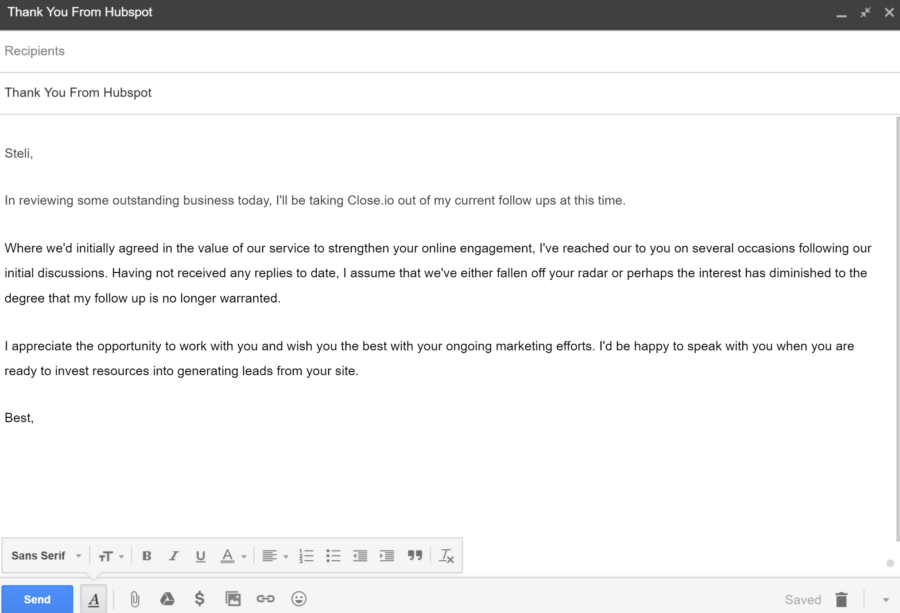
  • Cold Email Breakup Template

10 Successful Cold Email Rules – The LeadFuze Grading Criteria

  1. Catchy subject line & first line
  2. Short
  3. Personalized not just “personalization”
  4. All about them… not you
  5. Easy to understand value prop
  6. Value offered before CTA
  7. No obvious red flags
  8. Not an obvious canned template
  9. Easy call to Action
  10. CAN-SPAM Compliant

General Cold Email Template

The general cold email is your first attempt to start a conversation with a prospect.

Cold Email Example 1

cold email template 1

Thoughts:

  • Breaks a LOT of rules!
  • Might have worked a few years ago…But not anymore.
  • Multiple CTAs lead to disaster

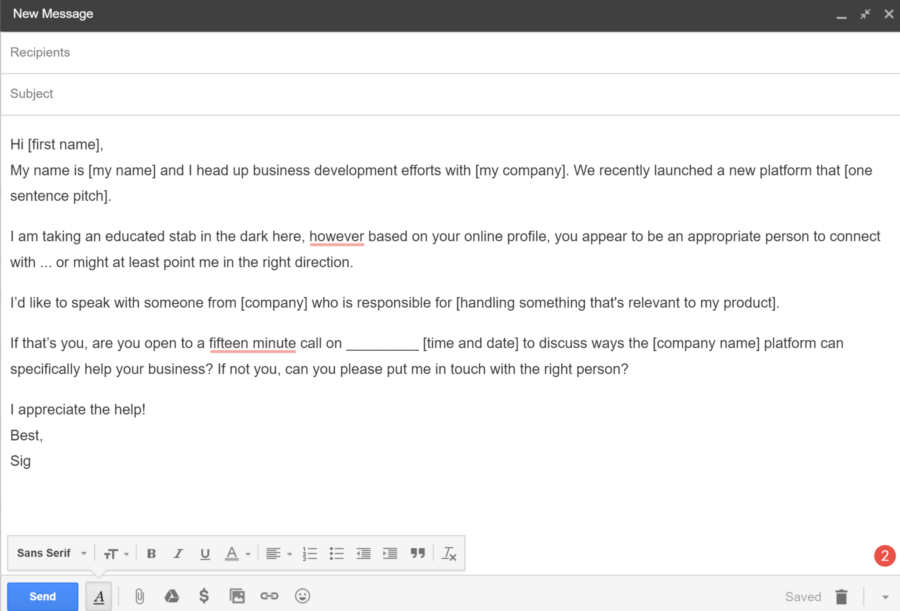
Cold Email Example 2

cold email template 2

Thoughts:

  • Generic “stab in the dark”
  • Should have homework done already
  • Hop on call is a weak CTA
  • Multiple CTA (big ask)
  • Old school VITO technique (go high- push down, but this was good ole days)
  • Can only send specific date to one person- better to blast a better value prop to 1,000 leads

Cold Email Example 3

Cold Email template 3

Thoughts:

  • Short..but bad intro
  • hard to book call first email (especially without giving value)

Cold Email Example 4

Cold Email template 4

Thoughts:

  • LONG, brick text
  • “I/we” rather than “you”

Full Cold Email Video Commentary:

Summary:

The goal of this initial cold email is to simply start a conversation. You need a compelling value prop communicated in a crystal clear way.

Cold Email Example to Decision Maker

The cold email to ask for the decision maker is a popular template used today. Does that mean it works? Hint: NO.

Cold Email to Decision Maker 1

Cold Email example to Decision Maker 1

Cold Email to Decision Maker 2

Cold Email example to Decision Maker 2

Cold Email to Decision Maker 3

Cold Email example to Decision Maker 3

Thoughts:

  • Predictable Revenue was a book written 6 years ago, about stuff they were actually doing 10 years ago. It doesn’t work as well anymore.

Cold Email to Decision Maker Commentary:

Cold Email Template – Follow Up

The cold email follow up template is used after your first cold email failed to generate a response.

Cold Email Follow Up Template 1

Cold Email Follow Up Template 1

Thoughts:

  • makes you want to review the first email(s)
  • one clear question is good

Cold Email Follow Up Template 2

Cold Email Follow Up Template 2

Thoughts:

  • asking for a specific person after you have tried to start a conversation

Cold Email Follow up Commentary:

Cold Email Template – After Voicemail

The cold email to ask for the decision maker is a popular template used today. Does that mean it works? Hint: NO.

Cold Email After Voicemail 1

Cold Email example After Voicemail 1

Thoughts:

  • Missing context, was this a web form asking to be contacted?
  • No value prop whatsoever – should be included even if this was a web form

Cold Email After Voicemail 2

Cold Email example After Voicemail 2

Thoughts:

  • good subject line
  • good opportunity to make a commitment and build trust

Cold Email After Voicemail 3

Cold Email example After Voicemail 3

Thoughts:

  • No hook, no value
  • wasted, useless question “how you doing”

Cold Email after Voicemail Commentary:

Cold Email Breakup Template

The cold email breakup template is your final attempt to start a conversation with a prospect (after prior emails have gone unresponded).

Cold Email Breakup Template 1

Cold Email Breakup Template 1

Thoughts:

  • breakup email “fad” … effective 3-4 years ago, but now used so much by everyone
  • do you really want to promise to not follow up again?

Cold Email Breakup Template 2

Cold Email Breakup Template 2

Thoughts:

  • Nobody “closes” files anymore, not really believable
  • Great next step CTA

Cold Email Breakup Template 3

Cold Email Breakup Template 3

Thoughts:

  • If you say you are removing the fluff… ACTUALLY remove the fluff
  • Add better benefits .. make them questions- “is managing your content difficult?”

Cold Email Breakup Commentary:

19 Sep 15:54

10 Sales Follow-Up Emails the Pros Send to Prospects [Free Templates]

by ebrudner@hubspot.com (Emma Brudner)

Much thought leadership is dedicated to the art of selling: pitching, presenting, closing, building trust, developing a relationship, and a myriad of other skills. But showing off these talents depends on getting on prospects' calendars in the first place.

That's when active selling skills get put on ice and reps have to flex their follow-up email or phone call muscles instead. We asked five sales experts for their most effective follow-up email templates.

Some are simple and others more complex, but all have been tested by the best. (PS -- with HubSpot CRM, you can track sales email templates that generate the highest open and click-through rates, and share the best ones with your entire team.)

1. Follow-up email after a voicemail

You tried calling, but your prospect didn't pick up. Immediately after leaving a voicemail, Colleen Francis, owner of Engage Selling Solutions, recommends sending the follow-up email below.

Sorry I missed you

Hi [Prospect],

Sorry I missed you on the phone today. I was calling because [explain your purpose].

My voicemail said I will try you again on [date and time] and you can always reach me before at [phone number].

Cheers,

[Salesperson]

send-now-hubspot-sales-bar

According to Francis' clients and her own personal experience, this email has an 80% response rate within 24 hours. Why does it work?

"Clients aren't always at their desks to get calls, but can answer a quick email from their mobile devices", Francis explained. The email is short, directive, and requires only a quick answer. It's easy to read and respond to.

2. Follow-up email after a trade show

Alice Heiman, founder and chief sales officer of sales consulting and coaching firm Alice Heiman LLC, gave this example as a 'light' version of a follow-up email after a networking event.

However, she noted that the follow-up approach should vary depending on the prospect's interest level and the context of the meeting. In addition, salespeople should research prospects to personalize their communications as much as possible.


Dear [Prospect],

What an exciting show. I hope you made great connections and learned some things you can use in your business immediately.

I am sure that increasing sales effectively [objective] is on the top of your list. As we promised, here is "Six Ways to Increase Your Sales [piece of content]. If you would like more in-depth information on any of the ways [details of content], I'd be delighted to have a 30-minute conversation with you to dive into that.

I'm here to be a resource to you, so don't hesitate to call.

Best regards,

[Salesperson]

send-now-hubspot-sales-bar

3. Follow-up email to a first conversation

This one is from Dave Kurlan, CEO of Kurlan & Associates, author of the book Baseline Selling, and blogger at Understanding the Sales Force.


Hi [Prospect],

I really enjoyed our phone conversation [or meeting] earlier today and especially liked learning about your unique role at [company]. I understand the challenges you are facing with [challenges discussed] and the impact they are having on [insert personal impact].

As promised, I have attached [or linked to] the resources and materials that can help you better understand how we can help you solve [insert compelling reason to buy].

Please let me know if you have any questions. Otherwise, I look forward to talking with you again on [date and time].

[Signature line]

[Salesperson]

send-now-hubspot-sales-bar

4. Second, third, and fourth attempt follow-up emails

Don't just stop with one follow-up email. Follow up on your follow-ups! Persistence is a virtue in sales, and it can pay off.

"I can't tell you how many times I was persistent and when I finally reached the person they were very grateful", Heiman said. "Basically don't give up unless the person tells you to stop calling."

But she added that it's important to add value in each follow-up attempt. "There is a fine line between being a pest and being persistent. Being persistent without adding value is worthless."

With that in mind, here's a sample voicemail that Heiman suggested for a second follow-up. She advises writing the message out in advance.

Hi [Prospect], this is [Salesperson] calling. I am calling to find out which of the Six Ways you are using to increase your sales [details of content sent during first follow up]. If you haven't tried one yet, I'd like to help you get started. Do you have time for a 30 minute call on [weekday] at [time] or [weekday] at [time]? Give me a quick call back to schedule at [phone number] or send me an email at [email address]. Have a great day selling!

Still no luck? Try this third contact follow-up email.


Hi [Prospect],

I know you are busy helping your team increase sales [replace with job function]. I want to be sure you know you can share that article with your team. Here's the link again. In 30 minutes I can give you some ideas on how to most efficiently increase your sales.

Do you have time for a call on [weekday] at [time] or [weekday] at [time]? [Might also include a brief client story of a client who increased sale using one of the six methods.]

Let me know which of these times is convenient for you or send me a few that work for you. I look forward to talking with you.

[Salesperson]

send-now-hubspot-sales-bar

If you haven't heard back by now, frustration is bound to start creeping in. But don't give up -- here's a fourth-touch voicemail sample from Heiman.


Hi [Prospect], this is [Salesperson]. I am sorry we haven't been able to connect. When we met, you were very interested in increasing your sales [objective]. I know how busy things can get with work and family.

I want you to know that I don't mind scheduling a call before or after work hours if that would make it easier. Just let me know what works for you. I don't want to be a pest, but I do want to make sure we have an opportunity to talk if you still want to fast track your sales growth [objective].

send-now-hubspot-sales-bar

If this gets no reply, should you throw in the towel? Heiman has a creative suggestion.

"If I have had absolutely no response I might give up, but more likely I would reach out on social media and try by phone or email in about two weeks, " she said. "Many times people who don't respond to their email will respond on LinkedIn. More times than not, I find out they haven't received my emails. That is why I call also, and usually, mention that I sent them something by email."

5. Last-ditch effort follow-up email

If you've sent six emails or more to no response, consider deploying a "breakup email." This type of message makes it clear you won't be contacting the buyer any more -- unless they respond to your email, that is.

Breakup emails help separate prospects who want to engage but simply haven't had the time from those who have no interest in a given product or service. Either way, the salesperson learns how to proceed, which is more than half the battle.

After sending the following email to 14 prospects, Kurlan received eight responses in less than a day.

Giving it one last try

In the rare opportunities, I have to work on client acquisition, I have not had much success reconnecting with you. It might just be that you don't have any interest in talking with me -- and that's okay. I just need to know whether or not to keep trying.

So, to make this nice and easy for you, you can reply with a simple keystroke. Just reply with either A, B, C, D, or E and I'll know what to do, but please do reply so that I can stop emailing you if you're not interested.

A. Stop emailing me with attempts to connect but continue to send invites for events.

B. Don't send me anything, remove me from your list. We don't currently and won't ever need your help.

C. I want to talk, we need some help, but the timing isn't right. Keep trying.

D. I would like to schedule a time to talk. We need some help. Please send your calendar link.

E. I forgot who you are. What's this about?

Thank you.

send-now-hubspot-sales-bar

What if you're fairly certain that the prospect isn't interested, and you just need confirmation? Try this message:

Permission to close your file?

[Prospect],

We are in the process of closing files for the month. Typically when I haven't heard back from someone it either means they're really busy or aren't interested. If you aren't interested, do I have permission to close your file?

If you're still interested, what do you recommend as a next step?

Thanks for your help.

send-now-hubspot-sales-bar

This message puts the ball squarely back in the prospect's court in the case that they would like to proceed. By asking the buyer to suggest the next step, the salesperson can gauge the prospect's level of commitment and pick up the process at the right stage.

6. Appointment confirmation email

An appointment confirmation email will ensure your prospect or client won't forget about your meeting. Plus, it helps you stand out from the crowd by putting your email at the top of your contact's inbox.


Hi [Contact],

I’m looking forward to meeting you at [location and time]. As I mentioned during our phone call on [date], I’ll be sharing information about [product/solution], which relates to your [goal, problem, or need].

Feel free to email or call if you have any questions or further needs before we meet on [date and time]. Looking forward to meeting with you.

Best regards,

[Salesperson]

send-now-hubspot-sales-bar

7. Letter to reconnect with a client

Has it been some time since you last spoke with a client? If you're looking to reconnect, use the template below.


Hi [Client],

I hope you're doing well! I recently saw [LinkedIn post, announcement, etc.] about [topic, product launch, etc.], and I wanted to see if you would be interested in hopping on a call and talk about your [topic, product] strategy for the year.

We've launched a few new tools that might be helpful in your approach, and I'd love to tell you more about them. What's the best time for you this week?

All the best,

[Salesperson]

send-now-hubspot-sales-bar

8. 'Sorry I missed you' email

Have a missed connection with a prospect? Try an email like this. Acknowledge the attempt but never guilt your prospect for not answering.

Sorry I Missed You

Hi [Prospect],

I gave you a call a few minutes ago but seem to have missed you. I wanted to follow up with a quick email (because no one really likes listening to voicemails, do they?).

I have a few questions before our pitch to the team on Thursday:

  1. Do the slides I shared earlier this week align with your expectations?
  2. Any concerns from the team you feel aren't addressed in our presentation?

Looking forward to incorporating your feedback before the pitch.

Kind regards,

[Your name]

send-now-hubspot-sales-bar

These email templates are sure to keep your prospects and clients engaged. To learn more, check out these email templates for the best way to ask for referrals next.

Editor's note: This post was originally published in August 24, 2014 and has been updated for comprehensiveness.

19 Sep 15:54

The Innovation Insurgency Scales – Hacking For Defense (H4D)

by steveblank

Hacking for Defense is a battle-tested problem-solving methodology that runs at Silicon Valley speed. We just held our first Hacking for Defense Educators Class with 75 attendees.

h4d-ed-classThe results: 13 Universities will offer the course in the next year, government sponsors committed to keep sending hard problems to the course, the Department of Defense is expanding their use of H4D to include a classified version, and corporate partners are expanding their efforts to support the course and to create their own internal H4D courses.

It was a good three days.

————-

Another Tool for Defense Innovation
Last week we held our first 3-day Hacking for Defense Educator and Sponsor Class. Our goal in this class was to:

  1. Train other educators on how to teach the class at their schools.
  2. Teach Department of Defense /Intelligence Community sponsors how to deliver problems to these schools and how to get the most out of student teams.
  3. Create a national network of colleges and universities that use the Hacking for Defense Course to provide hundreds of solutions to critical national security problems every year.

What our sponsors have recognized is that Hacking for Defense is a new tool in the country’s Defense Innovation toolkit. In 1957 after the Soviet Union launched the Sputnik satellite the U.S. felt that it was the victim of a strategic technological surprise. DARPA was founded in 1958 to ensure that from then on the United States would be the initiator of technological surprises. It does so by funding research that promises the Department of Defense transformational change instead of incremental advances.

darpa-iqt-h4dBy the end of the 20th century the Central Intelligence Agency (CIA) realized that it was no longer the technology leader it had been when it developed the U-2, SR-71, and CORONA reconnaissance programs in the 1950’s and 1960’s. Its systems were struggling to manage the rapidly increasing torrent of information being collected. They realized that commercial applications of technology were often more advanced than those used internally. The CIA set up In-Q-Tel to be the venture capital arm of the intelligence community to speed the insertion of technologies. In-Q-Tel invests in startups developing technologies that provide ready-soon innovation (within 36 months) vital to the IC mission. More than 70 percent of the In-Q-Tel portfolio companies have never before done business with the government .

In the 21st century the DOD/IC community have realized that adversaries are moving at a speed that our traditional acquisition systems could not keep up with. Hacking for Defense combines the rapid problem sourcing and curation methodology developed on the battlefields in Afghanistan and Iraq by Colonel Pete Newell and the US Army’s Rapid Equipping Force with the Lean Startup practices that I pioneered in Silicon Valley and which are now the mainstay of the National Science Foundations’ I-Corps program. Hacking for Defense is a problem-solving methodology that offers the DOD/IC community a collaborative approach to innovation that provides ready-now innovation (within 12-36 months).

Train the Trainers
Pete Newell, Joe Felter and I learned a lot developing the Hacking for Defense class, more as we taught it, and even more as we worked with the problem sponsors in the DOD/Intel community.u-pitt-h4d Since one of our goals is to make this class available nationally, now it was time to pass on what we had learned and to train other educators how to teach the class and sponsors how to craft problems that student teams could work on.

(If you want a great overview of the Hacking for Defense class, stop and read this article from War on The Rocks. Seriously.)

sponsor-guide-coverWhen we developed our Hacking for Defense class, we created a ton of course materials (syllabus, slides, videos). In addition, for the Educator Class we captured all we knew about setting up and teaching the class and wrote a 290-page educator’s guide with suggested best practices, sample lesson plans, and detailed lecture scripts and slides for each class session. We developed a separate sponsor guide with ideas about how to get the most out of the student teams and the university.

The Educator Class: What We Learned
One of the surprises for me was seeing the value of having the Department of Defense and other government agency sponsors working together with the university educators.  (One bit of learning was that the sponsors portion of the workshop could have been a day shorter.)

Two other things we learned has us modifying the pedagogy of the class.

First, our mantra to the students has been to learn about “Deployment not Demos.” That meant we were asking the students to understand all parts of the mission model canvas, not just the beneficiaries and the value proposition. We wanted them to learn what it takes to get their product/service deployed to the field, not just have another demo to a general. This meant that the minimal viable products the students built were focused on maximizing their learning of what to build, not just building prototypes. While that worked great for the students, we learned from our sponsors that for some of them getting to deployment actually required demos as part of the means to reach this end. They wanted the students to start delivering MVPs early and often and use the sponsor feedback to accelerate their learning.

This conversation made us realize that we had skewed the class to maximize student learning without really appreciating what specific deliverables would make the sponsors feel that the time they’ve invested in the class was worthwhile. So for our next round of classes we will:

  • require sponsors to specifically define what success from their student team would look like
  • have students in the first week of class present what sponsors say success looks like
  • still encourage MVPs that maximize student learning, but also recognize that for some sponsors, learning could be accelerated with earlier functional MVPs

u-sd-h4dOur second insight that has changed the pedagogy also came from our sponsors. As most of our students have no military experience, we teach a 3-hour introduction to the DOD and Intel Community workshop. While that provides a 30,000-foot overview, it doesn’t describe any detail about the teams’ specific sponsoring organization (NSA, ARCYBER, 7th Fleet, etc.). (By the end of the quarter every team figures out how their sponsor ecosystem works.) The sponsors suggested that they offer a workshop early in the class and brief their student team on their organizations, budget, issues, etc.  We thought this was a great idea as this will greatly accelerate how teams target their customer discovery.  When we update the sponsor guide, we will suggest this to all sponsors.

Another surprise was how applicable the “Hacking for…” methodology is for other problems. Working with the State Department we are offering a Hacking for Diplomacy class at Stanford starting later this month. And we now have lots of interest from organizations that have realized that this problem-solving methodology is equally applicable to solving public safety, policy, community and social issues internationally and within our own communities. We’ll soon launch a series of new modules to address these deserving communities.

Lessons Learned

  • Hacking for Defense = problem-solving methodology for innovation insurgents inside the DOD/Intel Community
  • The program will scale to 13+ universities in 2017
  • There is demand to apply the problem-solving methodology to a range of public sector organizations where success is measured by impact and mission achievement versus revenue and profit.

Filed under: Hacking For Defense, Hacking for Diplomacy, Science and Industrial Policy
19 Sep 15:54

An Open Letter from a Millennial to Generation G*

by Jarrell Chalmers

To Generation G* (a.k.a. The “Grumpy Generation”, a.k.a. our Baby Boomer Bosses);

A reporter in Time magazine recently spoke about Millennials by saying: “Unless you are the boss, no one cares what works best for you.” This kind of rhetoric will no longer be ignored.

We are tired of being treated like children. Time and time again, you have spoken in a condescending manner without realizing what we are capable of doing in response. To the Grumpy Generation, consider this: Millenials will represent 40% of the workforce by 2020. Do you really want to anger the future majority with your empty threats today? Do you seriously think it’s a good idea to ignore the needs of the only pool of talent you’ll have access to in a few years?

And if you won’t meet our needs, we’ll just start our own companies — or drive for Uber until we are comfortable enough to do so.

What We Want

happy-working-from-home

It’s no secret that Millenials can be a bit entitled. Over 72% of us want to be our own boss. We want the freedom to choose when and how we work, as long as we deliver results. Yes, this means that we want to work from home every now and then. As long as we are delivering results, why shouldn’t we be able to have this? Statistics show that people who work from home are 29% more productive than the average cubicle schlub.

While working from home would be nice, this isn’t the only thing we want. We want to create more. We want to build apps, start our own fashion lines and we want to make a difference in the world.

This isn’t all too crazy or far off from what your company can provide for us. In fact, 88% of us would rather collaborate, than compete. USE THIS TO YOUR ADVANTAGE! Include us in your brainstorming meetings. At least let us feel like we are doing something meaningful, or we just won’t work for you. We’ll just make our money by writing nasty blog articles about your company.

Yes, that’s a thing.

What We Don’t Want

Bullshit like this. The Time article I mentioned earlier goes on to say: “Check your language with your superiors. [Do you use the phrase] ‘No Problem?’ Don’t do this.”

wtf

Are you guys serious? Who cares what my language is like as long as I am delivering results. If I just landed your agency a high paying client, the difference between ‘no problem’ and ‘thank you’ is insignificant. Baby Boomers, are you so petty that you value semantics over company results?

We also don’t give a damn about dress code. If Facebook engineers are going to work in sweatpants, so can we. My tie won’t determine how well I pull data for your company or brand. It’s time that Generation Grump stopped caring about such menial things as one’s wardrobe. Why don’t we start tracking professionalism with dollar signs? If I am making your company money, don’t worry about what I am wearing. Leave that to my mother, okay?

In short, we want more freedom. We want to work at our own pace, so we can have time to travel and follow our dreams. Isn’t that what you all wanted once upon a time, G? It’s not too late to make that dream a reality. Together, we can build a better, more productive society (preferably one we can both afford to retire in).

best-friends


What do you think of giffys in our posts? Let us know in the comments or @smxplorer

The post An Open Letter from a Millennial to Generation G* appeared first on Social Media Explorer.

19 Sep 15:53

6 Useful Onboarding Best Practices Every Employer Should Know

by George Dickson

How confident are you in your organization’s onboarding process?

There are many factors that play into the success or failure of onboarding, and most of it comes down to strategy.

Whether or not it’s deliberately designed or executed, every organization has an onboarding strategy. Since the strategy you adopt can have a significant impact on employee engagement and retention, it’s useful to have a few best practices in mind when developing it.

1. Thoughtful Hiring

creative-culture-building.png

Thoughtful hiring is the first step in building a stellar onboarding experience.

It’s important to understand that onboarding doesn’t start the first day a new employee walks into the office. Some of the most impactful elements of onboarding take place long before a new employee’s first day.

Why is that?

There are a lot of things to consider before bringing someone onto a team — from their unique skill set, to their expected fit within the organizational culture.

If you have a team of people working under the same set of foundational values, and a new hire’s values are radically different, onboarding presents a major challenge from the start.

Deliberately filling gaps within your organizational culture with a diversity-focused hiring strategy can be an incredibly rewarding, but hiring someone for a specific skill set despite a major cultural incongruity can present more problems than it solves.

For example: you need a new backend engineer right now.

If your organization depends on a cohesive team environment and your only available candidate exhibits signs that they won’t work well with others, it’s less likely that hiring this person is going to lead to a smooth onboarding, or end in a long-term mutually beneficial relationship.

High-growth companies and startups face this scenario often, but the same lessons learned in the startup crucible can be applied to any business.

In an interview on Kellog School of Management at Northwestern University’s monthly podcast, Insight in Person, TechStars’ Managing Director Troy Henikoff detailed some of the more challenging aspects of hiring and onbaording faced by quickly growing businesses and startups.

In many cases, the hiring process begins much too late — at a point where time is already running out, and a hire needs to be made under a tight deadline.

It’s worth considering and developing a solid hiring strategy earlier on in the timeline, before thoughtful strategy takes a backseat to an exigent need to fill a seat. It may not seem like the most crucial task to tackle at the moment, but the rewards can be manifold.

2. Candidate Experience

recrutiting_tips.jpg

Candidate experience can make or break your current and future onboarding efforts.

It’s a perfect opportunity to showcase the strength of your Employee Value Proposition (EVP), and make good on it in person. It’s a chance to give candidates a taste of what it’s really like to work in your organization.

That’s not the end of the story though.

Your candidate experience is also an opportunity for that value proposition to fall flat on its face. With a poor candidate experience, there’s less chance you’ll be able to sign the most talented and sought-after employees — they simply won’t make it past the initial stage.

In both scenarios, it’s your candidates’ prerogative to share their experience with friends, family, colleagues, and the world at large.

Infusing all stages of the onboarding process (especially early stages) with a policy of diversity and inclusion can go a long way toward making new hires feel comfortable and secure in their prospective daily work environment.

3. Pre-Boarding

annual-review-calendar.jpg

A little extra effort during the pre-boarding phase can make a significant impact months or even years down the road. As Maia Josebachvili explains in The Future of Work: Talent and Culture in the 21st Century, onboarding starts the moment the offer letter is accepted.

There’s often a period of days or weeks between offer acceptance and a new employee’s first day onsite.

Don’t let that time go to waste.

Pre-boarding is a perfect opportunity to introduce employees into the organization’s members, its processes, and culture. It’s also a great chance to put a few basic things into place to make the first few days as seamless as possible.

Introduce new hires on your preferred communication channels. Give them a chance to gain an understanding of the cadence, style, and standards of communication across the organization. They’ll feel less like strangers on their first day.

Handle basic logistics (network logins, hardware provisions, building access, etc.) in advance when possible. The first few days on the job will be much more efficient and effective if they’re not spent setting up logins and accounts.

4. Work Environment Design

building_the_best_place_to_work.png

The environment you provide speaks volumes to a new hire, and often has a major impact on onboarding success.

Psychological safety is key.

The onboarding period is a formative one. Cultivating an environment of psychological safety where a new employee feels safe to ask questions and share their ideas without fear of rebuke can make that experience more constructive and empowering.

The benefits of this type of environment can continue to pay dividends throughout an employee’s tenure, far beyond their onboarding experience.

In Charles Duhigg’s seminal New York Times article, “What Google Learned From Its Quest to Build the Perfect Team,” psychological safety is described as a major factor in team performance and success.

Eliminate a new hire’s cognitive load wherever you can.

These early days are prime opportunities for new hires to ask questions that really matter, and they’ll be more likely to focus on those questions if they’re not trying to answer the basics like “where’s the bathroom?”

The less basic housekeeping questions running around in a new employee’s mind, the more cognitive resources they can assign to becoming a contributing member of the organization.

5. Introductions

decentralized-team.jpg

Introducing new employees to their close colleagues and to the organization’s leaders as soon as possible can expedite the initial relationship building stage, and help show that the team is invested in their success.

Introuce your new teammates to the types of jobs they’re going to be working on, too. The earlier the better.

It’s often useful to select a few projects that are representative of the work they’ll be doing later on, but within a smaller scope, and an easier scale.

These sorts of problem solving activities can help develop confidence, and a clearer understanding of their position on the team.

Assigning a sponsor can be useful.

It’s much easier to get up to speed with the assistance of a trusted colleague. While it’s crucial to maintain an environment of psychological safety where new employees feel comfortable asking all sorts of questions, there are often questions a sponsor can answer that may never have come up otherwise.

In the same Insight in Person interview, U.S. Army Colonel Brian Halloran explains the importance of assigning a sponsor, describing them as:

“That person hopefully becomes your first trusted confidante…maybe somebody who is close enough to their own onboarding session to remember what went well, what didn’t go well, and what they would have liked to have seen a little more of…”

Having that trusted confidante and advisor can make a positive impact on those first formative experiences.

6. Clear Expectations and Guidance

compass.png

It’s surprisingly common for a new employee to be brought on in the hopes that they’ll cover a footprint that exceeds the one they filled on day one.

Make sure that you’re setting and maintaining realistic expectations for candidates during this crucial stage in the onboarding process, and making those expectations clear. If your stated job description includes graphics and user interface design, don’t surprise them with a copywriting project.

Maintain clear and realistic expectations.

Although most formal onboarding programs are designed to have a clearly-defined start and end date, the onboarding process doesn’t always follow a perfectly linear path. Give new hires room to grow and expand their skills, but don’t expect more out of them than they signed up for.

In Conclusion:

Your onboarding process can have a dramatic impact on many aspects of your organization. By following a few best practices, you can help ensure that impact is overwhelmingly positive.

If you’re ready to take the next step in building better workdays, check out our latest guide:

Get 10 Dead Simple Ways to Improve Your Company Culture

19 Sep 15:52

13 Tips and Tactics to Propel Your Small Business Growth

by Susan Solovic

small-business-growth-ft-image

What does it mean to “grow your business”?

Is it the same thing as increasing profits, the bottom line? Or does it mean increasing sales, the top line?

It’s important to understand the relationship between these two approaches to business “growth” and how they fit into the evolution of your business.

For example, if you’re approaching the day when you want to sell your business, improving your bottom line via efficiencies and other strategies might be the best way of “growing” your business.

I say this because a concerted effort to increase overall sales in the short term could make you look less profitable to potential buyers and your selling price would be pushed down.

However, if you’re younger and eager to see your piece of the pie grow substantially, you might be totally comfortable living with a dip in profits while you develop new territories and/or new products.

With those points in mind, you’ll be better able to consider the following 13 tips and tactics as you plot out the ideal game plan for the growth of your small business.

Near-term small business growth tips:

  1. Analyze the performance of your sales team. If they aren’t meeting your expectations, or they are showing signs of ambivalence, shake things up. Bring in new blood working on commission only.
  2. Write down everything you do and categorize these tasks. Find tasks that you can delegate to others or outsource.
  3. Re-examine purchasing and see if you can improve the deals you are getting from your vendors.
  4. Improve your accounts receivable ratio.
  5. Look at repetitive tasks you and your team perform. Do they all have procedures written for them? See how they can be accomplished more quickly and be sure you have procedures that capture the most productive ways of accomplishing repetitive tasks. Be sure that you allow these procedures to be improved on over time; don’t fall victim to the “We’ve never done it like that here” mentality.
  6. Audit your small business listings on the Internet. See if there are any places where you should be listed but aren’t. Be sure listings are accurate. Check your Google reviews. Encourage customers to review your business on Google.
  7. Launch a customer referral program. Reward existing customers for bringing you new business.
  8. Launch a customer loyalty program.

Medium-term small business growth tips:

  1. Research your local competitors and similar businesses in other areas. Find out if any owners may be approaching retirement age or there are other reasons they might want to sell. Talk to mutual suppliers to see if any might be in financial trouble.
  2. Survey your customers and find out what other products or services they need.
  3. See if there are any of your suppliers that might be ripe for a buyout.

Long-term small business growth tips:

  1. Talk to city and regional planners to discover the areas that are slated for new development. Should you prepare to expand to any of these areas, or perhaps relocate to a bigger facility?
  2. Talk to real estate professionals to find neighborhoods in transition. For example, if a low-income area is beginning to be “gentrified,” it often means that young families with children will soon become the prominent demographic. Also, check out aging neighborhoods, they can “turn over” to younger, affluent families.

As you can see, some of these points take a lot of research and thought. Be sure you do enough of the items in the “near-term small-business growth” menu to have the time to dedicate to planning for your future.

That’s a task you should never delegate.

19 Sep 15:52

Inbound Marketing or Outbound? Which is the Winner?

by McKenzie Ingram

Inbound Marketing or Outbound? Which is the Winner?

The marketing industry has been buzzing about the rise of inbound marketing and the decline of outbound marketing over the last several years. With the rise of internet-empowered buyers, inbound marketing has helped vendors take control of the initial pieces of the buyer’s journey. But are marketing teams really migrating away from outbound marketing? According to a 2016 Demand Metric survey, the answer is a resounding no.

The report found that 84% of marketers agree that both inbound and outbound marketing drives business. The report also found that inbound and outbound marketing account for nearly equal amounts of leads, budget share, and revenue. Top performers are choosing to use a balanced approach that incorporates both inbound and outbound marketing.

Modern Definitions of Inbound and Outbound Marketing

Inbound marketing (as practiced with new online capabilities) is still a relatively new concept, but the definition of outbound has evolved in recent years. At its core, inbound marketing is really about getting your customers to come to you.

Inbound is commonly referred to as a pull strategy because you are using tactics and great content to pull the attention of your prospects to your brand. Advertising did this in the old days, but digital marketing has changed the game a thousand-fold, creating a much lower barrier to entry and leveling the playing field.

Outbound can be classified as push marketing; you proactively push content to those you consider to be potential buyers, or to existing customers. You can control the message and timing.

That same new modern technology that has made today’s inbound marketing possible has also changed outbound. It gathers, distills, and provides access to behavioral data, and makes it possible to automate the delivery of personalized marketing messages, saving a ton of time and effort. This has changed the way marketers plan and deploy outbound campaigns.

Historical Definition of Outbound

Tactics used to push your marketing message to mass audiences, in hopes of reaching potential customers or prospects. Think direct mail: all those postcards and catalogs piling up in your physical mailbox. Think billboards, placed where travellers and commuters might see them at the most advantageous time. Think radio: you’re in your car on the way to work, at a stoplight, looking at a billboard, when an ad for the same product comes on the radio.

Modern Definition of Outbound

Speaking of online outbound, it started out focused on email, and it used to be “batch and blast.” Today, it’s all about learning about your prospects and what they want so you can develop personas that represent them accurately. Now we market to personas, pushing timely, relevant messaging and content that addresses their pain points and interests. We’re building relationships, one automated touchpoint at a time, to educate the buyer, build trust, and stay top-of-mind in the decision making process.

A Balanced Strategy is A Winning Strategy

According to the Demand Metric study, most marketers use a healthy mix of both tactics. On the inbound side, social media, SEO, and blogging have become important pillars. On the outbound side, marketers are investing heavily in email, events, PR, and even direct mail.

In a nutshell: you don’t have to (and shouldn’t) choose between inbound and outbound. The two are, in fact, better together.

Today’s marketers are using a balanced combination of inbound and outbound programs across the buyer’s journey to win big. The object of the modern marketing game is to build a twin-engine marketing machine that builds brand, drives demand, and expands customer relationships.

Build an Ecosystem for Conversation & Relationship Building

Creating a balanced marketing strategy is no different than a conversation with a friend over coffee. In order for it to work, both sides must contribute. You have to be accessible, listen when it’s time to listen, and speak up when you have something valuable to say.

The trick to creating a well-balanced marketing strategy is to map out the five stages of your customer journey, and ensure that you’re prepared for a two-way conversation at each stage.

buyers journey

At every stage of the customer journey, make sure that you:

  1. Actively reach out to prospects to give them the information they need to progress to the next step
  1. Make it easy for people to find the same information on their own

How Inbound Marketing Made Us Better Outbound Marketers

The rise of inbound marketing requires marketers to do three important things:

1. Map out their buyer’s journey

This includes understanding the different stages your buyer will go through, and what exactly they are looking for at each stage. B2B sales cycles can be long and complex, mapping out your buyer’s journey will allow you to more easily deliver targeted, relevant content to your prospects and customers.

2. Develop a deep understanding of their buyer personas

Developing your buyer personas takes a little bit of legwork, but the results can be outstanding. Segmenting your buyers by persona allows you to deliver a more personalized experience to them. To help you create buyer personas without fuss, we’ve put together this toolkit for you.

3. Create content that helps educate and engage these buyers

Lots of people can create content. But an effective content marketing strategy is focused on creating content that is engaging enough that it entices buyers to convert. Not only does the content have to be valuable to your audience, but it also has to be interesting and engaging. Check out our blog post on creating content that converts.

These tactics have now become standard practice in most marketing teams. Every content marketer is now a professor and every brand is now a publishing house.

And guess what? Outbound marketing programs are the unintended beneficiary of these new content best practices, here’s how:

  • Marketers now have libraries of engaging content designed to attract the right audiences early on the purchase journey.
  • These content libraries can fuel outbound marketing programs and enrich audience interactions with “push”
  • These outbound campaigns leverage targeted content that is meant to build trust before pushing for a sale. For example, a sales rep can send an outbound email suggesting a prospect read a new blog post about a hot industry topic, or an outbound advertisement can offer up an educational eBook instead of extolling the benefits of product features.

Technology + Good Content = Killer Inbound and Outbound Programs

The addition of inbound marketing to the mix has brought balance to our collective marketing brain. We understand the buying process more holistically, we give more power and control to our prospects, and we publish timely content that’s meant to address buyer pain points and interests. But inbound alone is not enough.

The outbound side of the marketing conversation is still equally important. New technology and the rise of content marketing has made outbound marketing more effective, and more productive for both buyers and sellers.

Not sure if you’re strategy is balanced? Here’s where you should start: Check out this interactive assessment to see if your marketing efforts are balanced across inbound and outbound tactics.

eBook: Inbound Marketing Effectiveness Report

19 Sep 15:51

How to Move from Monologues to Dialogues with Engagement Marketing

by Jim Kowalski
Business people video conferencing

Author: Jim Kowalski

A few weeks ago, I participated in a great meeting with one of our customers. But it didn’t start out that way.

It started slowly and our content was missing the mark. Fortunately for our team, we were able to “read the room” and discern from our customers’ behaviors and postures which direction we should take the discussion. Based on those cues, we altered the content of our presentation and even the order in which we presented, and we turned what could have been an unsuccessful meeting into a very productive one, with a positive outcome.

After the meeting, it struck me that this was a microcosm of the challenges facing today’s marketers: how to foster this type of responsive, flexible dialogue with prospects, customers, and influencers; sense and respond based on their behaviors, preferences, and actions; and do all of this across millions of interactions a day.

Today’s marketers need to be able to conduct millions of 1:1 dialogues like this daily, at scale, with the speed and precision of a person-to-person conversation. To do this, it’s critical to adopt engagement marketing, leveraging a sophisticated marketing automation platform.

In this blog, I’ll reveal three engagement marketing lessons we learned in our meeting and how they’re applicable to marketing, the campaigns you run, and the technologies you use:

1. Pay Attention to Inactivity

Responding to lack of behavior is just as important as responding to behavior; sometimes, it’s even more critical. In our meeting, an uncomfortable silence and lack of questions indicated we were on the wrong track, so we revised our presentation and “woke up the room.” Similarly, while the main purpose of your marketing programs is to get customers and prospects to do something, you need to be able to discern the reasons why they don’t respond the way you prefer. Don’t just continue marketing to them with the same message or content in a “spray and pray” methodology. Instead, revise your delivery, content, even the mode of communication.

2. Personalize Your Message

During our presentation, we were able to tailor the discussion based on our participant’s desired outcomes. But for your marketing campaigns, that’s difficult to do at the scale and volume of today’s business without technology. With an engagement marketing platform, you can leverage technology like web personalization and dynamic content to tailor each digital experience (web, mobile, content delivery, etc.) based on a buyer’s digital footprint, industry, geography, and more.

3. Use the Right Content

We changed the examples we used and even showed different slides to our customers that we thought would resonate better, and it worked. The proper engagement marketing tool can help you do that at scale and volume across all of your marketing programs. In fact, studies show that people respond better to relevant content. According to MarketingSherpa, 82% of prospects value content made for their specific industries, and 67% say the same of content created for their specific job functions. So, make sure you’ve aligned your content creation with your campaigns so that you can properly respond and target your audience not just with a generic offering, but with one that’s relevant to each buyer at that moment in time.

Your buyers are bombarded with so many messages each day, and they’re tired of being talked at; they want to be engaged with. While that’s easy to do in a meeting, it’s much harder to do across millions of interactions daily in a way that’s scalable, flexible, and fast. As the #1 internal customer/beneficiary of our marketing team and technology here at Marketo, I’m fortunate that we have the technology that “thinks on its feet” and helps us engage in many 1:1 conversations daily around the world. Is your team empowered with the tools and knowledge they need to do the same?


How to Move from Monologues to Dialogues with Engagement Marketing was posted at Marketo Marketing Blog - Best Practices and Thought Leadership. | http://blog.marketo.com

The post How to Move from Monologues to Dialogues with Engagement Marketing appeared first on Marketo Marketing Blog - Best Practices and Thought Leadership.

19 Sep 15:49

The Autopsy of a Lost Deal: Dissecting the Dimensions of Your Sales Performance

by Rachel Serpa

It would be fair to mention that this is a good size and quality toy. It is supposed to resemble a real fossil. The creature belonged to the Theropod family and lived during Cretaceous Period and died out allegedly around 65 million years ago.

Sure, every business loves ringing the gong, blowing the whistle or completing whatever celebratory action the company has designated to announce sales wins. But truly successful businesses make just as much “fuss” about lost deals as they do about those that are won.

Sure, every business loves ringing the gong, blowing the whistle or completing whatever celebratory action the company has designated to announce sales wins. But truly successful businesses make just as much “fuss” about lost deals as they do about those that are won.

Taking the time to dig in and understand why a deal was lost or unqualified is often far more valuable than understanding why a deal was won. Not only can it highlight missed opportunities and areas for improvement, but it can also help your team understand which leads to prioritize and where to focus its efforts.

To uncover this information, companies can perform an “autopsy” on each of their lost deals, dissecting it by sales dimensions.

What’s a Dimension?

Dimensions are all of the factors or variables that, together, make up a sale. Examples of sales dimensions include sales team, rep experience, stage duration, company vertical, contact title, lead source, deal size, price, sales process and much, much more.

Altering just one of these dimensions across deals can have varying results – positive or negative. The key is to pinpoint the dimensions that have the greatest impact on your sales pipeline and performance to identify what adjustments should be made to achieve your desired outcome.

Of course, these will vary by company, so for now, let’s examine a few different key sales dimensions and what they can potentially tell you about your lost and unqualified deals.

Lead Source

Do you keep track of where each of your deals originates? Was it a referral from a current customer? Was it the result of a Google search? Did one of your reps conduct the initial outreach?

Having even just this basic information about your lost deals readily available can save your reps a lot of time upfront by preventing them from focusing on leads from sources with a low win rate. It can also lead to optimizations across your business; for example, perhaps your marketing team should steer clear of a particular search term that consistently results in loss.

Sales Rep

Knowing exactly which sales reps sourced and/or touched a lost deal can surface important sales coaching opportunities. Is one rep consistently qualifying deals that don’t make it to the closing stage? Do certain reps fall flat when it comes to converting prospects in certain verticals or with particular objections? Situations like these warrant very different and very specific conversations that, once had, can have a major impact on closing rates.

Decision Maker

This dimension can be examined a few different ways, each of which will tell you something important about your sales process:

1) Was a decision maker identified during the sales cycle?
2) If so, at what pipeline stage did this take place?
3) What were the attributes of this decision maker?

If no decision maker is being identified in the sales process, it looks like you and your team need to have a talk. Knowing at which stage of the sales pipeline the decision maker is being identified can help you determine whether this identification should take place earlier. Finally, understanding the job titles, experience levels and other characteristics of these lost deal decision makers will help you and your team spot “fakers” and more accurately and quickly detect the right decision makers for your solution.

Technology Stack

two business persons plan a project

Although not every sales team makes note of this information for each deal that it works, it should. Knowing what other solutions, both competitive and otherwise, were being used by lost prospects can tell you a lot about your product and your pitch. Do you find yourself losing against the same competitor over and over again? It may be time to update your sales enablement materials. What about missing out on deals where the prospect is using a particular marketing automation or helpdesk solution? Lack of integration could be the culprit.

Stage Duration

Stage duration refers to the amount of time each of your deals spent in a given stage of the sales pipeline, such as Qualified, Quote or Close. Is there a particular stage where lost deals seem to go silent or drop off? Perhaps you need to rethink your pipeline, redefine the process steps within each stage or provide reps with better coaching and resources to effectively move these deals through the funnel.

Exit Criteria

Outlining the specific steps and information, or exit criteria, needed to move a deal from one pipeline stage to the next is the heart and soul of your sales process. Examining the exit criteria of your lost deals will not only show you if you’re asking the right questions to properly qualify your leads, but will also help you identify red flags in the future. Did your failure to establish budget early on come back to bite you later in the sales process? Do prospects that put off that on-site meeting wind up in your lost deal analysis report? Answers to questions like these tell you what to do differently next time.

The Importance of Scale

Weight Scale, Balance, Mental Illness.

Of course, one lost or unqualified deal can only tell you so much. The idea is to collect this information across many lost deals over time to start identifying patterns and variances. You can also examine the same set of dimensions across your won and lost deals and compare to help weed out assumptions and coincidences.

Even deeper insights can be found when you start measuring your deals by more than one dimension at a time to see how they overlap with and impact one another. For example, if you analyze deals from a particular lead source (dimension 1) by sales rep (dimension 2), you may discover that one rep simply excels at closing deals from a particular lead source, while the others require more training.

19 Sep 15:49

The Prelude to Discovering Where Your Competitors Are Beating You

by Scott Lambert

The_Prelude_To_Discovering_Where_Your_Beat_Online.jpg

Throughout my 20 years of Internet marketing experience, I have learned that monitoring your competitors can provide invaluable insights into their strengths, weaknesses, opportunities and threats. So when we ask our clients who their top competitors are, they typically give us a list of companies they compete against based upon traditional methods of marketing and selling.

However, when our clients look online at their competitors that rank on page 1 of Google’s search engine results, many times they discover an entirely different list of competitors from what they originally gave us.

So where should you focus your competitor monitoring efforts to find out where you stand?

These statistics might help answer that question:

  • 97% of buyers now use online media when researching products and services in their local market.[1]
  • 84% of buyers engage in online information consumption and education.[2]
  • By a factor of 3 to 1, B2B buyers say that gathering information on their own online is superior to interacting with a sales representative.[3]

The Remedy…

So, considering the buyer’s journey of today, your competitors are those who rank in search engines (Google, Yahoo and Bing) for your products and services and those that are consistently engaging with your target buyers throughout social media.

Therefore, now more than ever, monitoring what your top competitors are doing is key to surpassing them. You accomplish this by identifying their tactics that are the crucial drivers to:

  • Generating traffic to their website
  • Converting those website visitors to leads
  • Nurturing those leads into customers.

This is fundamental in determining how and where you’re getting beat out by your competition.

Our Approach…

Our approach includes a multitude of detailed analysis that we pull together through our own research and through tools we use. We do a visual site evaluation where we can determine the functionality, user experience and content analysis that reveals how well they are engaging their audience and how well they are converting their website traffic into leads. We also determine their social reach capacity in the social media networks and uncover the most popular content they are publishing.

By the end, we develop a preliminary game plan on how to strategically and tangibly beat your client’s competition. There’s no more guessing about what and how to match and beat your competition online.

The Aftermath…

After analyzing a large volume of competitors across numerous industries, we have successfully identified common competitive advantages used by the most successful companies.

Here are just a few of the advantages we have discovered:

  • They publish educational content in blogs and have downloadable content offers such as guides, how-to articles, eBooks, white papers, case studies, lists, etc. This allows them to be helpful first to their buyers, as opposed to first attempting to sell and close their buyers.
  • They use effective Calls-to-Action (CTA) in order to motivate their website visitors to act by following links that lead to landing pages. Their landing pages communicate the value of the content offer and require the visitor to fill out a brief form with their name, email address and a potentially-qualifying question.
  • They are active in social media. They consistently target their ideal buyers in order to grow their network by generating relevant posts that link back to either a related blog article or landing page on their website. All this activity is integrated into their overall content marketing efforts.
  • They are optimized for mobile users. This means their websites and emails have been constructed with a responsive design. To give some background, it is estimated that an average of 58% of all searches are done on mobile devices.[4] Also, 66% of all emails are read on a mobile device.[5]

Knowing this, I am stunned at how many websites have not been optimized for mobile devices at this point. Your website needs to include a responsive design and you need to get there fast.

A Sidenote…

With all this being said, it is important to realize that your website visitors come to your website with a collective experience of using other branded websites, such as Amazon, Facebook, Microsoft, Apple, and many others that have significantly invested in their website.

I am not saying that you need to match the experience of these websites. I am saying that your website visitors’ expectations are based upon how quickly they are able to find information and engage with websites like the ones I mentioned.

Your Next Step…

A competitive analysis is not an easy task to successfully carry out. As you can tell, there is a lot that goes into it and we’ve only scratched the surface.

But this doesn’t mean that it’s not absolutely crucial to your business success. Having this analysis done is extremely powerful to whoever invests in it for their company.

[1] BIA/Kelsey

[2] Google ZMOT

[3] Forrester

[4] Hitwise

[5] Moveablelink

19 Sep 15:49

4 Ways Your Sales Team Can Help Your Content Marketing

by Ann Smarty

sales-team-help-content-marketing

I have noticed a serious disconnect in businesses today. There is no “us” anymore, no connection between one department and another.

Oh, sure, you may have the best team-management platform, and have task-setting and in-team communication down to an art. But is every member of your team regardless of department working with all you have provided to get the best possible results?

The biggest gap exists between sales and content marketing. The two should go together like peanut butter and jelly, yet they don’t.


The biggest gap exists between sales & #contentmarketing says @seosmarty.
Click To Tweet


Nothing will better arm your content marketing department than interaction with people who talk directly to the audience on a daily basis. Here are four ways you can build better content by encouraging collaboration with the sales team.

1. Build a FAQ section

Your sales team (as well as your customer service team) is likely to answer dozens of questions daily by phone and email. Make sure all the questions they receive are recorded properly (through your sales management platform or other tool) and given to your content marketing strategist to become the base of your content plan.

These questions and, more importantly, their answers can be a gold mine for your content marketing when published on your site because they:

  • Receive special treatment in search engine results pages – For example, Google features a site that best answers the searcher’s question in a separate quick-answer box on top of search results.)
  • Turn your site into a resource – As such, they build reader loyalty by increasing the number of return visits, subscribers, etc.
  • Become a solid ground for the extended content marketing strategy – Answers can be given in the form of webinars, podcasts, video interviews, visual assets (think flow charts and infographics), etc.

One of the most efficient ways to curate popular questions on your site is to create a FAQ section. For WordPress-run sites, Ultimate FAQ plugin is one of the easiest options for adding a FAQ section to your site. It integrates with WooCommerce, allowing you to add a “Related Q&A” section to product pages.

faq

2. Create an on-site glossary

It’s easy to single out terms that frequently puzzle your leads and put together a detailed glossary of terms. This way you’ll have a URL to share with your contacts any time they have questions. A glossary means additional opportunities for organic rankings as well (hence new leads coming in naturally).


Create an on-site glossary of terms to increase organic search rankings says @seosmarty. #SEO
Click To Tweet


You can expand your list of terms using keyword research tools. This step also improves your chance to rank high for many of these terms because:

  • The more terms you have in your glossary, the more keywords you can rank for.
  • Google evaluates your page vocabulary to determine the quality of your content. Include synonyms and related terms to increase the variety of words.

Use SERPstat to research related terms to create an effective glossary. Its unique feature, “Cluster Research,” enables you to identify high-ranking pages with similar URLs that you can visit to discover related terms from there.

serpstat


Use @serpstat to research related terms to create an effective glossary says @seosmarty. #SEO
Click To Tweet


In SERPstat, connection strength is the number that represents how many common URLs these search results have. The higher the connection strength is, the closer the terms and phrases are.

Using online thesauruses and dictionaries also is helpful for finding synonyms and related terms. Synonym.com and Reference.com are two great options.

Don’t limit yourself: Most important terms can be developed into 101-type articles. Or you can offer your glossary as a PDF download. This is called “cornerstone content.”

HANDPICKED RELATED CONTENT:
A Nutshell Guide to Proper Keyword Research

3. Create lead magnets

Most sales teams have various content assets being developed year after year — case studies, white papers explaining the state of things in the industry, PowerPoint presentations describing the service or listing the benefits of the product, etc.

All of these documents can be powerful lead magnets. At Internet Marketing Ninjas, we have a separate section allowing subscribers to download our case studies.

lead-magnets

This section not only helps us grow our email list, it also generates the most qualified leads: People who download our case studies are more likely to get in touch with us for services. They come well-prepared and almost convinced of the quality of the service.

4. Leverage buyer personas in your content

Your customers already have some idea of what they want. They also have a list of things that they need. These facts make up the buyer persona, and while that used to be a concept taught to all people in sales, it is of similar importance to the content marketer.

If you are a content marketer struggling to understand why you need to know personas, here’s a good guide from Content Marketing Institute.

Without personas, you may only be guessing what content your audience wants, which means you are more likely to revert to creating content around what you know best (your products and company) instead of around the information your audience actively seeks.


Without buyer personas, you may be guessing what #content your audience wants says @seosmarty.
Click To Tweet


By knowing the wants, needs, and even demographic information of a customer base, content marketers can better personalize their efforts. And with your sales team being on the frontline of the customer interaction, there’s no better department from which to start your persona development. This persona development guide offers two questions that are critical to answer to create a persona:

  • What makes your existing customers attracted to your sales pitch?
  • What makes existing customers buy your products and services?

No one in your company is better able to answer both the questions than the salespeople because they deal with sales pitches and conversions daily.

Have your content writers regularly sit through the sales calls making notes of what the future customers like, dislike, and hate. This will be a huge source of content inspiration too.

HANDPICKED RELATED CONTENT:
How to Build Buyer Personas That Build Sales

Empower your content marketing team

The sales team is probably your company’s most important department. Why aren’t you leveraging it to empower your content team? Why are you treating content marketing like its own island? The two departments should be working together, improving results on a larger scale than through each individual sale.

Please note: All tools included in our blog posts are suggested by authors, not the CMI editorial team. No one post can provide all relevant tools in the space. Feel free to include additional tools in the comments (from your company or ones that you have used).

Want to help your content marketing team in other ways? Encourage them to subscribe to the free daily CMI newsletter.

Cover image by Joseph Kalinowski/Content Marketing Institute

The post 4 Ways Your Sales Team Can Help Your Content Marketing appeared first on Content Marketing Institute.

19 Sep 15:48

The 12 Key Steps of Successful Discovery Calls [Free HubSpot Sales Training Excerpt]

by lhintz@hubspot.com (Lauren Hintz)

exploratory-call-questions-videos.jpg

I’m a big believer that the exploratory phase is the most important part of the selling process.

It's the stage where you truly learn how you can best help your prospects, whether they need your help, and whether they want it.

It’s how you can open your prospects eyes to a better world -- when they’ll start to believe that you can help them overcome their challenges and achieve their goals --- all within the right timeline and budget.

The idea of exploring options with your leads and turning them into opportunities prospects comes from the third stage in the inbound sales methodology. You should advise prospects when they are already in the consideration stage of the buyer's journey.

inbound-sales-methodology-small.png

The short video below is a four-minute excerpt from the final class in HubSpot Academy's free sales certification. It outlines the 12 steps for having exploratory conversations and questions sales reps can use at each step.

undefined

Register for the free sales training course here.

New Call-to-action

19 Sep 15:48

Prospecting For Pearls

by Tibor Shanto

By Tibor Shanto – tibor.shanto@sellbetter.ca 

Regardless of what some might tell you, there are elements of sales that are quite organic, and as a result there are lessons we can take from nature. One is that not all things that lead to real value start smoothly or simply, but as the process unfolds, the end result can be both a thing of beauty and value. That’s one way I like to look at prospecting, specifically telephone prospecting, yes cold calling.

I like to think of a cold call, the very start of an engagement with a prospect, as being very much like the start of the process in the making of a pearl. There is no denying that the pearl starts out as an irritant, an intrusion from the outside; but then over time, ongoing interaction, things develop, and where the end result is a thing of beauty and value.

Let’s be straight, I am not suggesting that you set out to irritate anyone intentionally, but at times you may not have a choice if you are going to help and win new customers. This is especially so with prospect who are removed from the market, the Status Quo, who left to their own, are not actively engaged in or thinking about buying anything, beyond “social” reach; this is usually in excess of 70% of you target market. These prospects, who are not self-declared buyers, may perceive the initial approach as a nuisance or aggravation.

I get it, cold calls are irritating, even cold calls that executed well; but I would also argue, not for the reason most think and fear. Sure bad calls are bad no matter what, but when done right, the reality is that we are making the prospect face things they have been able to ignore and burry, and avoid dealing with. They know what they have is not just far from not perfect, but not even close to ideal. It is just that they have decided that “the pain of the same is less that the pain of the change”. Initiating that change, the catalyst that leads to action, not just denying or ignoring the issue, may not be pleasant to start.

Those who a) understand that, and b) understand how they will manage the buyer experience, have the greatest success in telephone prospecting. To be successful at cold calls you need to be able to talk to outcomes and changes that will benefit the buyer and deliver the business impacts they are looking to achieve. This starts with understanding what outcomes you have been able to others in similar roles, in similar type of environments.

If you call a small fleet operator and initiate the call peaking about pains and needs they have not acknowledged, your fate is sealed before the first ring. Yet this is what most sales people and pundits go for: pains, needs, problems, (solutions), efficiencies, and all the things that prospects have turned a deaf ear to for years. Instead, you can call and speak to how you can help them get more service calls in a given day, or how you can help them extend the life of their vehicles, and improve their return on assets, or how you can help them reduce fuel costs while allowing them to wear a “green” halo. These are things not tied to pain, but to outcomes, things people are always thinking about, and more willing to hear more about.

The best sellers understand that part of their job description is “disruptive marketing”, which includes the willingness and ability to take an interruption to a conversation, an irritating grain of sand to a pearl.

Become one of the thousands of sales professionals receiving my latest updates on sales execution, tools, tips and more.   

Join Now!

The post Prospecting For Pearls appeared first on Renbor Sales Solutions Inc..

19 Sep 15:48

The most coveted prize in selling besides a sale… is a referral.

Everyone tells you to get referrals. And most people tell you to “ask” for them.

“Don’t forget to ask for a referral.” Horrible strategy. Totally offensive for the most part. Borderline rude. And asking the same customer twice is a death wish. 

MY DEFINITION OF A REFERRAL: A name and contact information provided proactively by someone you have a relationship with (most likely a customer) who believes a third party would be willing to, or would benefit from doing business with you – AND they are willing to introduce you and provide a testimonial. 

“I know a guy looking for…” “don’t use my name…” “here’s someone to call…” those are not referrals – they’re leads. 

Now that that’s out of the way, suppose you actually DO get a referral. Ask, beg, get one proactively, earn one (the best way), whatever, let’s say you have the referral in hand… NOW WHAT? 

No one tells you that part. What to do next to ensure the sale? How do you approach this person? How do you maximize the selling power of a referral? And what do you risk with the wrong approach?

Here’s a strategy that will work. CAUTION: It’s significantly slower than you would like, but it WILL WORK. The key is not just patience, it’s a combination of your preparedness, the strength of your relationship with the person giving you the referral, and execution of strategy to build confidence and rapport BEFORE the sales process begins. 

Here are 8.5 rules and guidelines to ensure your success:

1. Approach with care, be prepared, don’t move too quickly. Timing is everything. Don’t appear to be too anxious to get the sale (money). Proper set up will breed a long-term relationship (more money) instead of just a sale.

2. Arrange a three-way call, then a three-way meeting. Setting the stage for the first meeting/communication can make it or break it. All three people together will set the perfect stage. Your customer will sing your praises and help make the sale in front of the referral.

3. Connect socially. LinkedIn, and the entire suite of social media. Subscribe to whatever – their blog or ezine. And keep in mind when they see you connect, they will do the same. Rule one: Be at least one notch higher in social profile than your customers and prospects. Not having solid social presence is a fatal mistake.

4. Get personal information about the referral before you make the first contact. Start with mother Google, and advance to cousin LinkedIn and all other members of the online social family. NOTE WELL: Don’t just look for information, look for similar interests, similar people, and similar situations. Common ground will establish immediate positive rapport. LINK STARTERS: Business information, personal information, recent successes, likes, last vacation, children’s schools, hometown. Having their personal information is an advantage. Having web presence is an advantage. Not having personal information is a fatal mistake.

5. You don’t have to sell at the first meeting if your customer is with you.  In fact, the less selling you do, the more credible you will appear. You only have to establish rapport, gain confidence, and arrange a second, private meeting where you can get down to business.

6. Try to get the prospect to prepare information for your private meeting.  If you can get the prospect to gather and/or compile information, you have an interested prospect who will be willing to talk and listen.

7. Don’t send too much information in the mail or email. The mail and the email, like the phone, is not where a sale is made. It’s just a sales tool. Send just enough to inform, create interest, and make a meeting.

8. Write a personal note to the referral within 24-hours. Brief, but positive. Don’t slobber all over the note with thanks, and thanks again. Just tell him or her it was nice to get acquainted and you’re looking forward to the next meeting.

8.5 Deliver! Failure to follow up and deliver as promised makes you and your customer look bad to the prospect. Failure to deliver also eliminates any chance of another referral. This rule is the most important of all. It’s a breeding ground for your relationship AND your reputation. What kind of reputation have you got? 

How valuable are real referrals? One third-party introduction and endorsement is worth a hundred presentations, if you know what you’re doing.

Jeffrey Gitomer is the author of twelve best-selling books including The Sales Bible, The Little Red Book of Selling, and The Little Gold Book of Yes! Attitude. His real-world ideas and content are also available as online courses at 

19 Sep 15:48

How to Write Persuasively So That You Sell Every Time

by Karen Repoli

How to Write Persuasively So That You Sell Every TimeJan is a novice entrepreneur she has been doing her homework on everything she needs to consider to start making money in her business. With most of the pieces in place, she has come to the point where her success is a matter of her ability to persuade. For Jan, and other entrepreneurs at all stages of business, this means writing a sales script that will work like a salesman to convince her readers that what she’s offering is a great deal and they should part with their hard-earned cash.

As you can imagine, this isn’t always easy. So how do you go about writing an effective sales script? Let’s take a look at what Jan discovered…

The first goal of a sales script is to grab attention.

Jan knows that she is facing a lot of competition to get her target customers attention. There are over a billion websites on the internet today by most estimates. The number is difficult to track because it changes so rapidly. These stats from The Atlantic illustrate the magnitude of the issue:

  • Most web pages die after a couple of months. The average lifespan is something like 100 days.
  • Various estimates say about three-quarters of websites are live but inactive.
  • Most of these sites exist without being seen. The average person doesn’t venture very far across the web, only visiting 96 separate domains per month.

That’s a lot of “noise’’ to compete with for attention! But Jan is also fighting the natural inclination we all have to move on to the next new, shiny thing. So how do you stand out during someone’s busy routine?

Sales Script - get their attentionOne way is to use a narrative structure. That means structuring your sales pitch like a story, which in turn often means that you’re going to tell your story of how the product or service your selling helped you.

People naturally love stories and when we see something laid out like a story, we find it very hard to switch off. It’s a great way to get more sales!

Jan is a health and fitness coach so her story tells how she went from an unhealthy, overweight, middle-aged woman to participating in triathlons. This will grab her target customer’s attention and make them want to learn more about Jan’s journey and how they can make the change themselves.

Formatting tip: To further help retain your visitors, you should make sure that your script is ‘skimmable’, meaning that it should be split into lots of smaller paragraphs and sections.

Your sales script needs to build authority and trust.

Next, Jan needs to build authority and trust. She is selling the dream of health and fitness. She is promising the reader to help them realize the dream for themselves. The competition in the health and fitness industry is steep. How can she let her audience know that they can believe what she’s saying?

You can help people to trust you and remove risk by:

Using social proof like reviews and testimonials.

We tend to believe the words and recommendations of others. And social proof influences purchases. This is one reason many people turn to social media to research purchases before they buy.

Testimonials can be woven throughout your content and can be extremely effective as long as they are relevant to the information you’re sharing. Jan should include recommendations from others she has helped on their fitness journey.

Using money back guarantees and other safety measures that make the buyer feel safe.How to Write Persuasively So That You Sell Every Time

Customers will be more willing to purchase if you lower the risk. If you sell a service this may be more difficult. Jan decides that she will offer a money back guarantee if her customers cancel within 48 hours of purchase. This allows for ‘buyers remorse’ and builds trust.

Appealing to stats and statistics – such as studies that back up your claims.How to Write Persuasively So That You Sell Every Time

Jan can easily find studies regarding health and fitness by doing a simple Google search. Make sure the studies you use are from a reputable source and check the information from different sources. Always give proper credit to your source within your document.

Referring to figures of authority and thought leaders in your niche.

Authority marketing is an entire category of marketing itself. An example many of us will recognize comes from TV commercials that feature a distinguished looking man in a white coat who says, “I’m not a doctor, but I play one on TV.” You should be very familiar with the leaders in your niche. Using quotes by those leaders, even if you don’t know them personally, will add to your credibility.

Providing your own credentials

If you’re new to the business, this can be a tough job. In Jan’s situation, she could list triathlons she’s competed in and fitness or health certifications she’s earned. If you don’t have any credentials, you may consider taking an online course.

Sell the Dream

The next thing you need to do is to sell your dream. That means selling your ‘value proposition’ and making your product out to be something that can genuinely help with people’s lives. What is most important of all here, is that you focus on the emotion and make sure that people are actually dreaming about how your product is going to make their lives better.

Jan focuses on the benefits of being healthy and fit. This could include looking and feeling younger, being healthy enough to enjoy grandkids, or reducing the effects of chronic health issues such as diabetes.

Add Scarcity and Urgency

How to Write Persuasively So That You Sell Every TimeWhat is key to understand when selling is that people buy based on their emotions and not logic. This is the reason that the whole ‘value proposition’ concept is so important: if you try and sell based on logic alone then people will often realize they don’t really need what you’re offering and talk themselves out of it.

But if you convince them based on emotion, then they’ll feel strongly compelled to buy and will find it hard to resist that temptation. The difference is huge and ultimately leads to more sales.

This is also why it’s often a good idea to try and get people to imagine owning your product and to make it seem desirable in its own right: in particular, this means using the right language: words like ‘feel’ and ‘looks’ help to really paint a picture and are often used by the likes of Steve Jobs and others when selling products.

The key is to get people to act on that emotion while it is there, rather than going away and coming back. To do this, you can introduce scarcity and urgency. That means pointing out that your audience needs to buy right now, or risk missing out entirely. You can do this by stating that you only have a very limited number of products or time for services left for sale, or by introducing a limited-time discount. Your readers will then conclude that if they are at all interested in what you’re offering, they should buy right away rather than risk missing out on the opportunity. That way, they’ll act on their emotional impulse, rather than leaving and deciding against it!

Jan decides to offer an introductory offer for a health and fitness evaluation. This will be low cost and will help her learn more about the customer while gathering valuable feedback. It also provides them the next steps to take in order for them to live their dream. And that is her up-sell: helping them through the next and every step as a partner in their health and fitness journey.

Do you have a “formal” sales funnel? If not, it’s time to get busy, get one on paper and put it to use. Let me know how you are doing in the comments.

17 Sep 16:32

Strategies for Scaling Your Business

by Dmitri Novomeiski

Scaling a business can present a challenge for any organization. It is an acutely painful point for companies experiencing rapid growth. Evolution is dependent upon stability and continuity of business operations. There are steps you can take to minimize these growing pains.

70% of startups struggle with scalability

An effective and scalable business model will have the following four primary characteristics:

1. Standardization

An organization needs to create repeatable experiences across all customer interactions and eliminate complexities. Customer interactions should be:

  • Easily understandable
  • Documented with best practices
  • Measurable, including relevant milestones and tollgates
  • Contain clear handoffs and transitions between functions and teams

2. Defined ownership and controls

Clarity in process ownership empowers change and allows optimizing effectiveness. To enable that, the following must be in place:

  • Definition of necessary roles, skills, and responsibilities
  • Hiring and resource development plans that support broader sales and service objectives
  • Reasonable measures to track performance

3. Proactive customer lifecycle management

Customer engagement relies on how well an organization understands and facilitates the customer journey. Interactions should be meaningful and valuable. Proactive customer management programs share the following traits:

  • Repeatable end-to-end processes
  • Methods to harvest information for optimization of sales, delivery, support and product operations
  • Processes for enabling customer success from acquisition to renewal and expansion

4. Innovation

An effective innovation model is able to mine customer interactions to support and refine product roadmap and associated solutions/offerings. The following are key attributes:

  • Active feedback loop from service engagements and customer interactions to support innovation lifecycle
  • Asset harvesting that furthers adoption and success (ROI, OCM, etc.)
  • Validation of new concepts and ideas with customer advocates

Enabling the aforementioned changes requires planning and prioritization. You must determine which areas to invest and focus on first. Sequencing these changes depends on the maturity of the organization and product, as well as the market and customer dynamics.

Approach

To mine improvement opportunities, follow the flow of the customer lifecycle and investigate associated processes. This approach addresses the top-line revenue areas first and improves the sales funnel.

Any transition can have complications. Here are some steps to minimize common pitfalls.

1. Identify champions

Establishing a network of champions is a first step in initiating a process of internal transformation. As a side benefit, especially in smaller organizations, this also can lead to more empowered and engaged employees.

2. Invest time into analysis

You don’t need to hire a third-party to do an expensive study. However, a focused effort with subject matter experts and customer advocates can be invaluable in uncovering and prioritizing improvement opportunities. Don’t try to tackle it all at once. Rather take one segment of the process at a time.

3. Create a continuous feedback loop

A continuous feedback mechanism is essential in creating an adaptive culture. Whether the information is mined from post-interaction surveys or lengthy customer advisory sessions, it needs to be aggregated, analyzed and be fed into an overall improvement roadmap.

4. Monitor the roadmap and progress

The roadmap needs to be transparent to the organization. Tracking and celebrating the progress and results will help mobilize the teams around the mission and evolution of your business.

Remember that scaling your business is a process that does not happen overnight. The teams that succeed nimbly adapt to challenges, while having solid frameworks of support. Implement a careful balance of standards, controls, proactive management and innovation to minimize risks.

17 Sep 16:32

The 4 Industries That Can Most Benefit from Technology Innovation

by Kyle Cebull

466050467.jpg

Can I just put this out there? Everyone can benefit from technology innovation. Faster, more innovative technology is going to make your employees more efficient and speed up business and customer service delivery. It’s not debatable, it’s an absolute fact. With faster, more efficient technology, the job gets done more efficiently as well. That said, some industries have more to lose from outdated technology than others. Those that aren’t updating their workstations will suffer from decreased employee efficiency and maybe higher turnover as a result, but there are a few industries that can benefit even more than professional services from innovative technology.

Here are just a few of them:

  1. Manufacturing
    If production stops, your ability to make money is halted as well. For manufacturers, their designers have to be able to use software and their production team needs to be working constantly to deliver products to their suppliers and customers. Technology is important, but how important is innovating that technology? It can mean the difference between delivering more units and increasing to your sales goals this year. For example, if a widget manufacturer produces 500 units in an hour and is able to get a piece of software, faster machines or equipment that allows them to double that production – they’re effectively doubling their revenue. Of course, this is a very basic example, but seconds are important in the manufacturing industry, so make sure that your technology isn’t wasting a moment.
  2. Construction
    Efficiency on the job site is critical for construction companies to deliver on the right timeline and budget. The right technology can not only help construction organizations communicate efficiently from administrative office to job site, but also speeding up the bidding and planning process. BYOD, the cloud and a few of the right construction technology applications can work together to set an innovative construction company apart from its competition.
  3. Medical
    Technology innovation for the medical industry is a must, particularly because HIPAA is a regulating body that requires certain minimum IT security and machine standards. But beyond that, innovative technology means happier patients, less time on the phone and significantly less time in the waiting room and processing paperwork. Whether you’re integrating mobile devices in the exam room or using apps to make your exams more efficient and patient-friendly, there are so many things that can be done to innovate your technology in this industry and set yourself apart from your competition.
  4. Hospitality
    From the hotel industry to restaurants and beyond – your technology is going to ensure that your customers have the best possible experience. That means easy check-ins at your hotels and more efficient use of your workstations across the board. The buzzword this year has been customer experience, and no where is that more important than in the hospitality industry, where reviews can make or break your business. What does innovation look like here? Mobile ordering can make a server’s life more efficient and eliminate mistakes, since orders are taken and put in at the same time. Automated check-in for hotels and resorts with an application for spa bookings and to view the status of their reservation are just a few ways that technology innovation is changing the game for this industry.

There are two options – innovate or remain stagnant in your technology. While you’re considering it, more and more of your competitors are implementing improved systems and applications that can set them apart and make their employees and customers’ lives easier. While these industries in particular can definitely benefit from innovative technology, the fact is that it’s not limited to these few. Innovating your technology provides a boost in efficiency that seriously contributes to your bottom line, the experience of your customers and your employee satisfaction.

What are you waiting for? Don’t you think it’s time you did something about your technology situation?

it self assessment checklist

17 Sep 16:08

Sales Enablement for Marketers

by Jeff Day

For today’s full-stack revenue marketer, delivering consistent results and measurable ROI impact can feel reminiscent of Sisyphus trying to push that fabled boulder up a mountain, only to watch it roll back down again and again.

The fact is, marketing is pushing a boulder up a mountain. It spends 28% of its budget (not to mention the soft costs associated with headcount) on creating content, but 65% of content produced for sales is never used. Sales teams scream for more and better content, but they often can’t find content that already exists.

This inefficiency leads to a vicious cycle: Deliver more content, only to have sales ask for even more. Push the boulder, watch it roll down again.

For content that is used, marketing often has no visibility into how it performs, and thus has no ability to improve quality or measure ROI. For us ‘Revenue Marketers,’ this is anathema. Marketers must be able to measure the performance of content in order to improve quality.

And, let’s not forget our entrepreneurial sales reps. They often modify content in order to meet the needs of the customer and changing market dynamics, and should! But as presentations are customized, marketing teams lose visibility into these changes, and consequently, they lose ability to improve sales content in real time to match the needs of the market. Tracking these changes immediately, understanding them, making micro improvements and then sharing them across the organization represents a real opportunity to make the sales teams more effective and stay ahead of the competition.

It’s for these reasons (and many more) that Sales Enablement is a necessity for Marketing.

Don’t be fooled by the word “sales” in the name. A Sales Enablement platform should be one of the tools in the marketer’s toolbox. It completes the stack from top of the funnel to revenue and enables closed-loop analysis of content and sales process performance. It starts by providing a better way to organize and manage content for sales, and gives sales and marketing teams the platform to scale and continuously improve content and customer engagement performance.

In fact, one key element that differentiates modern Sales Enablement platforms such as Highspot from outdated solutions is the closed-loop analysis that enables both marketing and sales to systematically improve. Sales can easily tell marketing what content doesn’t work, because it has the data to back up its claims. Marketing can, in turn, just as easily analyze what content and pitching strategies the best sales reps use and optimize based on customer engagement and revenue influenced.

If you’re ready to stop pushing the boulder up the mountain, consider the following sales enablement benefits:

Recommend the best performing content to Sales.

Highspot’s content targeting and recommendations can deliver “the right” content to a sales rep based on each specific selling opportunity—customer size, industry, go-to-market segment, product, opportunity stage, or whatever you want to configure. Machine learning measures content performance and scores recommended content so that the sales rep always finds the best content.

But if the rep is looking for something different, Highspot’s “Amazon-like” experience with intelligent semantic search and filter-based browsing helps reps find the content they are looking for quickly.

Anywhere worldwide. Any device. Your preferred app.

Today’s larger sales teams are distributed across the country and around the globe; working from their laptops and in their cars on mobile devices. Today’s enterprise software must be cloud-based and mobile ready. We also know that sales reps are creatures of habit—they have a favorite work flow and don’t want to mess with it. Highspot works where sales reps work; in Outlook, Gmail or ToutApp and Salesforce.com. And for marketers, Highspot syncs with almost every enterprise content management or EFSS system, so we can plug into your content collaboration and production workflow.

Improve content quality.

Unrivaled sales enablement performance analytics let you measure what works—and what doesn’t—from content usage and pitch performance to customer engagement and impact on revenue. Drill in and filter based on any Salesforce field, to better understand performance by sales org or go-to-market segment. And only Content Genomics™ enables marketers to map the evolution of content customizations and analyze content ‘families’ (including all permutations of an original piece of content) as a whole to give you actionable insight. Powerful analytics are a requirement to assess the value of your content and improve quality and performance.

Align better with sales.

Multiple third-party studies like this one and this one (and this one) show that companies in which marketing is well aligned with sales perform much better across many business metrics—revenue growth, quota attainment, sales velocity and more. Along those lines, a recent Highspot survey of 400 sales, marketing, and sales enablement professionals uncovered that 50% of organizations with a focused alignment effort in the form of Sales Enablement saw an increase in sales conversion rates of 10% or more, while 23% increased conversion rates more than 20%.

These are just three of the many reasons why marketers need Sales Enablement, too. If you’re ready to take control of your organization’s content conundrum, I recommend checking out our Definitive Guide to Sales Enablement. And, if you’re evaluating solutions and want to learn how Highspot can deliver results, contact us to schedule a customized demo.