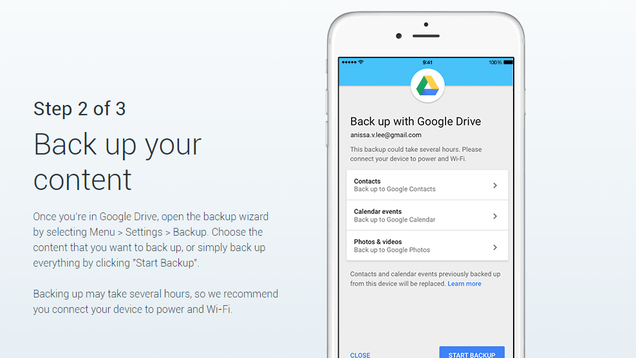

Apple has its own tool to help users switch from Android to iOS, but Google can’t get a similar app past the App Store’s moderators. Instead, Google just launched a backup tool inside the already-approved Google Drive.
Apple has its own tool to help users switch from Android to iOS, but Google can’t get a similar app past the App Store’s moderators. Instead, Google just launched a backup tool inside the already-approved Google Drive.
SAN FRANCISCO — Yahoo has become the worst-case example of an unnerving but increasingly common phenomenon — massive hacks that steal secrets and other potentially revealing information from our personal digital accounts, or from big organizations that hold sensitive data on our behalf.
On Wednesday, Yahoo disclosed a gargantuan breach affecting more than a billion user accounts, the largest such attack in history. The company said that attack happened in August 2013, although Yahoo only discovered it recently. Worse, the company’s announcement followed a similar announcement last September of a 2014 hack — one Yahoo ascribed to an unnamed foreign government — that affected 500 million accounts.
Neither Yahoo breach has yet been linked to online fraud or any specific repercussions for Yahoo users. But their disclosure closely follows U.S. intelligence concerns about Russian hacking of Democratic emails during the presidential campaign — not to mention other recent attacks on a major health insurer, a medical lab-test company and the government office that manages millions of federal employees.
“The lesson is clear: no organization is immune to compromise,” said Jeff Hill, director of product management for cybersecurity consultant Prevalent. And since most of us are dependent on big organizations that hold our digital lives in their hands, in a broad sense that effectively means no one is safe.
Of course, it’s not that simple. The most sophisticated break-ins are likely the work of digital burglars working for foreign governments that are mostly interested in manipulating their enemies, not emptying your bank account.
In the past few years, hackers tied to foreign governments are believed to have stolen emails to embarrass celebrities and Hollywood moguls (recall the Sony Pictures break-in during 2014) and possibly even to influence the 2016 presidential election.

“Espionage has gone digital like so many other things our world,” said Steve Grobman, chief technology officer at Intel Security. “We’re increasingly seeing data being used as a weapon, where leaked or fabricated information is being used to intentionally damage individuals and governments.”
Yahoo’s security breakdowns could turn into expensive deal breakers for the Sunnyvale, California, company.
Both lapses occurred during the reign of Yahoo CEO Marissa Mayer, a once-lauded leader who found herself unable to turn around the company in the four years since her arrival. Earlier this year, Yahoo agreed to sell its digital operations to Verizon Communications for US$4.8 billion — a deal that may now be imperiled by the hacking revelations.
Yahoo didn’t say if it believes the same hacker might have pulled off two separate attacks. The Sunnyvale, California, company blamed the late 2014 attack on a hacker affiliated with an unidentified foreign government, but said it hasn’t been able to identify the source behind the 2013 intrusion.
Yahoo has more than a billion monthly active users, although some have multiple accounts and others have none at all. An unknown number of accounts were affected by both hacks.
In both attacks, the stolen information included names, email addresses, phone numbers, birthdates and security questions and answers. The company says it believes bank-account information and payment-card data were not affected.

But hackers also apparently stole passwords in both attacks. Technically, those passwords should be secure; Yahoo said they were scrambled twice — once by encryption and once by another technique called hashing. But hackers have become adept at cracking secured passwords by assembling huge dictionaries of similarly scrambled phrases and matching them against stolen password databases.
That could mean trouble for any users who reused their Yahoo password for other online accounts. Yahoo is requiring users to change their passwords and invalidating security questions so they can’t be used to hack into accounts. (You may get a reprieve if you’ve changed your password since September.)
Security experts said the 2013 attack was likely the work of a foreign government fishing for information about specific people. One big tell: It doesn’t appear that much personal data from Yahoo accounts has been posted for sale online, meaning the hack probably wasn’t the work of ordinary criminals.
That means most Yahoo users probably don’t have anything to worry about, said J.J. Thompson, CEO of Rook Security.
News of the additional hack further jeopardizes Yahoo’s plans to fall into Verizon’s arms. If the hacks cause a user backlash against Yahoo, the company’s services wouldn’t be as valuable to Verizon, raising the possibility that the sale price might be re-negotiated or the deal may be called off. The telecom giant wants Yahoo and its many users to help it build a digital ad business.
After the news of the first hack broke, Verizon said it would re-evaluate its Yahoo deal and in a Wednesday statement said it will review the “new development before reaching any final conclusions.” Spokesman Bob Varettoni declined to answer further questions.
At the very least, the security lapses “definitely will help Verizon in its negotiations to lower the price,” Gartner analyst Avivah Litan predicted. Yahoo has argued that news of the 2014 hack didn’t negatively affect traffic to its services, strengthening its contention that the Verizon deal should be completed under the original terms.
“We are confident in Yahoo’s value and we continue to work toward integration with Verizon,” the company said.
Investors appeared worried about the Verizon deal. Yahoo’s shares fell 96 cents, or 2 per cent, to US$39.95 after the disclosure of the latest hack.
The Associated Press
At the end of the day, we all know that our business has to make money to succeed. But what we fail to consider is how important workflow automation can be to our business’s profitability. Finding ways to streamline business processes related to new customer acquisition can help marketers attract more potential customers, sales reps close more deals, and finance specialists process more customer payments.
Since new customer acquisition often starts with the marketing team, here are seven time-saving hacks to help marketers streamline their work:
Hack 1: Declutter the Inbox
Getting an inbox to zero is a near impossibility for most of us, but there are ways to successfully cut down on the clutter.
Avoid a heap of random and inconsistent emails by using a form builder to gather and process information from colleagues. We’ve all spent far too much time searching for information in lengthy, confusing email chains. Online forms can bring necessary standardization to your workflows by automating menial tasks and streamlining approvals, resulting in minimal clutter and maximum efficiency.
If you’re a Gmail user, you may also benefit from the Priority Inbox feature. It analyzes senders and subject lines to filter unread emails into two categories: important and unimportant. Priority Inbox draws your focus to emails that demand your attention and allows you to avoid the rest until your schedule permits.
Hack 2: Automate New Customer Registrations
Getting potential customers into your system quickly can be a game changer for your business. But how do you automate new customer registrations? For starters, make it easy for people to indicate interest in your company. Use an accessible contact form or online event registration form. Then, integrate your online forms with a customer relationship management (CRM) tool to automatically route lead data into the system for your sales team.
Hack 3: Keep Important Information Organized and Accessible
Making sure employees know how and where to find certain information on your company’s systems can be a huge time saver for a marketing team. This might seem like common sense, but you’d be surprised how many companies struggle in this area.
Collateral such as logos, brand information, case studies, and other materials are essential to every marketing department, but these resources are often buried in hard-to-find locations. Using web-based tools like Confluence and Trello can do wonders for your information’s organization and accessibility. The ability to collect and sort information into easily searchable categories and files makes form building solutions appealing as well.
Hack 4: Use Templates Whenever Possible
Why waste time writing or organizing the same information again and again? Create templates for commonly used forms and documents, such as webinar outlines or event registration landing pages. That way, you can make minor updates when necessary instead of starting from scratch every time. Templates allow you to standardize your approach with potential new customers.
Hack 5: Invest in Useful Apps
Social media, internal communication, and other tasks can create major headaches as you jump between endless spreadsheets and accounts. Fortunately, apps like Hootsuite and Sprout Social allow you to toggle between various social media accounts within the same platform. HipChat and Slack help teams share internal information quickly and efficiently, eliminating the need to schedule a meeting while also decreasing emails. The best apps can make even the most time-draining tasks a breeze.
Hack 6: Implement a Project Management Tool
A good project management tool allows teams to avoid unnecessary meetings, which can be costly and unproductive, and it also cuts down on email. Using a task-management tool like Jell or Basecamp can help you eliminate tedious check-in meetings. Both platforms allow your team to share status updates, such as project progress or where a prospect is in the pipeline, which can keep everyone on the same page.
Hack 7: Set Goals
Yes, it seems obvious, but goal-setting is often overlooked. It can be difficult to manage your time if you don’t know exactly what you’re trying to accomplish. Take a minute each morning to establish your goals for the day. Set deadlines and tackle them one at a time. Evernote is useful for creating to-do lists and sharing goals across teams.
While this tip may seem similar to the project management tool hack, it’s important to note the significance of reaching goals. Not only is it critical to organizational success, but the accomplishment of SMART (specific, measurable, attainable, realistic, timely) goals can be a huge boost to team morale.
Conclusion
Marketers strive to attract potential new customers, but outside distractions and lengthy internal communication processes often stand in the way. These seven hacks can help your marketing team members quickly streamline projects, save time and keep information organized, so they can focus their attention on more pressing tasks.
We’ve come a long way since the beginning of consumer air travel.
Despite the complaints of lackluster legroom and stale snack crackers, air travel is more affordable and accessible than ever before.
In the 1970s, only 50% of the US population had ever been on an airplane. Due to more affordable pricing, today 80% of the adult population has been on an airplane at least once in their lifetime. In the 90s, business was the biggest reason most individuals flew, accounting for nearly half of all trips – but today leisure is the primary reason we take to the skies.
With the advent of air travel for the masses, more journey-seekers are continuously looking to airlines to improve the in-flight experience.
In the travel revolution, apps are playing a major role, alleviating much of the stress that comes with airline travel in every area from boarding passes to navigating airports.
The airline industry has adopted apps quickly, beefing them up with features flyers love to build loyalty and customer engagement.
Travelers rarely use airline apps to purchase flight tickets – instead, they use the apps to improve their travel experience.
We’re taking a look at some of the awesome features airline apps provide, and how they’re making the skies easier than ever to navigate!

As my local bus airport shuttle service used to say, “friends don’t make friends pick you up at the airport.”
With more folks flying than ever before, airlines are beginning to get more creative with helping their customers arrive and depart from the airport.
Most notably, some airlines have begun co-operating with ride share services to help out their customers.
United Airlines was the first to play nice with ridesharing services, integrating Uber hailing into their app back in 2014. Many apps have followed suite since, and most airports today have special pickup areas just for ridesharing services.
In some cases, customers can even earn bonus miles when hitching a ride. JetBlue has recently begun partnering with Lyft, integrating Lyft into their airline app to let customers earn JetBlue loyalty points when they use the mustachioed ride sharing service.

The majority of airline apps let you check in via your smartphone while offering the option to change or upgrade your seat, which is handy for those desperate to pay a bit more for an extra couple of inches of legroom or to grab the coveted exit row.
European airline EasyJet has even added passport scanning to its app, alleviating the pain of typing in your passport number every time you book an international flight.
Nearly all airline apps let you display your boarding pass on your smartphone, erasing the need for paper tickets and streamlining the check-in process to save time and ease pre-flight jitters.

One of the most popular features that airline apps offer is the ability to track a flight’s status and receive automated updates on any delays or changes.
No one likes to arrive at the boarding gate and see a surprise. With airline apps, flyers can rest assured that they’ll be notified immediately about any last minute changes.
For Android users, Google Now provides flight updates automatically by scanning your inbox for upcoming flight data and sending push notifications when changes occur – you don’t even need the airline app!
Flight updates are one of the biggest reasons travelers install an airline’s app, so it’s definitely an essential feature for staying on a customer’s good side.

Many airline apps provide access to airport maps, showing flyers where various terminals are and where the nearest airline lounges are located (nothing like a G&T to ease some of that airport stress).
While airport maps may seem inconsequential, they can go a long way for travelers making tight connections, allowing flyers to map out a battle plan for arriving at their connecting gate without missing a beat.

Many airline apps allow users to access free streaming entertainment through the app once flyers are in air bound.
United Airlines even offers HBO, so you can rewatch your favorite Game of Thrones episodes (I would just avoid exclaiming “Fire and Blood!” on the airplane).
This isn’t just a benefit for users, who are eager to binge on a few seasons of Parks & Recreation during their transatlantic travels. It’s also a big cost-saver for airlines, who would much rather provide users with the ability to stream on their own devices rather than install the costly in-seat screen units that have been common in the past.
Passengers are largely onboard with this trend – one report from IATA (International Air Transport Association) says that around 50% of respondents said they’d use a streaming service during their flight (as opposed to just 12% last year).
Regardless of the method, most flyers expect some form of entertainment during their flight, with 77% of those surveyed saying that watching movies is their favorite activity during long-haul flights. Followed closely by monitoring the bathroom occupancy light and praying the person in front of them doesn’t push their seat back.
Airlines have also been working on providing other forms of entertainment through their app – AirFrance lets app users download online newspapers or magazines as an extra bonus perk!

Despite existing as a constant threat in the mind of the anxious traveler, most major airlines rarely lose your luggage. However, to ease troubled spirits, some airlines now offer baggage tracking through their app.
Delta has begun to implement baggage tracking via RFID (radio-frequency identification) tags, which are slapped on checked luggage. These tags are scanned throughout the handling process, helping Delta better monitor and manage customer luggage.
In the case of lost bags, harried flyers can keep their eyes glued to the app and watch as their missing duffel makes its way back into their arms, Homeward Bound-style (minus the tear-jerking Shadow scene). The app will even update you on the bags progress at every loading and unloading station!
Airline apps have come a long way when it comes to helping customers better navigate their path to the skies.
However, flyers have plenty of suggestions regarding features they’d love to see in the future, including:
What do you love about your favorite airline app? What features would you like to see added? Share your thoughts in the comments!

Why do think being a business professional means being serious?
The mindset is: Playfulness is childish. Adults are serious; business professionals even more so.
When you were a child, your parents might have told you: “Stop playing around!”
And you just might have listened too well.
Play and playfulness, however, are incredibly important for both your work and your organization.
Do you behave and act the same way at work as you do at home? Probably not.
Most of us have multiple personas or social masks that we wear in different social contexts.
For example, we hold ourselves differently at work than we do in the privacy of our homes.
Although we may not be fully conscious of it, may of us are afraid to be ourselves in the office.
That would leave us feeling vulnerable.
The subconscious thought might be something like:
What will people think if I let loose and be myself?
A business professional has to maintain a certain demeanor and uphold a refined image.
So, to varying degrees, we tend to put up a serious front and hide our more human qualities from our co-workers.
How do you feel when you’re serious?
Seriousness tends to dampen our moods. We experience less joy, gratitude, and hopefulness.
It’s difficult to inspire and connect with others when we lack inspiration within ourselves.
What’s the quality of your thinking when you’re serious?
With less joy and lightness, our thoughts more easily become pessimistic.
We focus too much on what’s not working or what could go wrong. We focus too little on our empowering vision for the future.
How do you hold your body when you’re serious?
Excessive seriousness causes our bodies to tighten up. This creates stress and restricts blood flow.
It puts the body in a constant state of alarm. It leads to neurotic behavior like anxiety and depression that plagues our modern world.
How creative are you when you’re serious?
It’s difficult to relax and be totally serious at the same time.
Relaxation helps the mind wander. Allowing your mind to wander fosters creativity.
Self-actualizing people are those who are realizing their true potential. If you recall, Maslow characterized self-actualization as a fundamental, higher-level need that all humans have.
Maslow found that self-actualizing people are more spontaneous in their behaviors, thoughts, and impulses.
There’s a naturalness in their behavior. Seriousness and rigidness hinder our ability to return to our true selves. Playfulness returns us to our natural spontaneity.
Maslow also found that self-actualizing people have greater acceptance of themselves and others.
This means they have less overriding guilt, shame, and anxiety.
A lot of our seriousness stems from not accepting our shortcomings and contradictions. It’s no big deal. We’re all imperfect, complex humans.
It’s interesting that Jim Collin’s Level 5 Leadership is characterized by humility.
Humility is a quality of self-actualizing people and an antidote to excessive seriousness.
When we’re consistently rigid, stiff, or serious at work, we’re bottling up our emotions. S
elf-actualizing people have a richness of emotional reaction. They experience awe, wonder, and pleasure of life’s beauty. We can all use a lot more of that.
Seriousness has a way of putting up boundaries between us and others. When we’re playful, we invite others to play with us.
Because of this, playfulness improves collaboration and our interpersonal relationships in and outside the office.
A playful attitude also makes us more receptive to learning. The science of play is beginning to demonstrate that play shouldn’t be contrasted with learning; it should be synonymous with it.
Maslow observed that everyone has access to what he called peak experiences or what fellow psychologist Mihaly Csikszentmihalyi calls flow.
Flow is that feeling of being in the zone. It’s characterized by an intense focus or total absorption in what we’re doing.
You’ve invariably had the experience of flow at work. It’s a wonderful feeling.
All your resistance drops away. No distractions pull your attention. You produce your best work.
Most executives and entrepreneurs, however, report that they experience flow states on an infrequent basis.
A playful attitude opens you up to more experiences of flow. Self-actualizing people, Maslow found, enter these flow states on a more frequent basis than the average person.
Work without play translates to an environment that lacks passion and creativity.
Dynamic work cultures foster an environment that encourages play. They clearly value play. You can observe it when you enter their space.
It gives the organization life, personality, and humanity. This playful attitude invariably finds its way to the customer. It can shape the brand in remarkable ways.
Powerful brands like Zappos, The Life is good Company, The Motley Fool, Google, and Southwest Airlines find ways to infuse a sense of play into their work.
Want some interesting examples of how play can manifest at work?
Hilarious Southwest Flight Attendant (It’s worth the 3 minutes!)
Faceball – a game created by the fun people at Flickr
10 Fun Facts About GooglePlex (Google’s workplace)
Every human has many challenges each day. A strict, rigid attitude with a serious demeanor leaves no space for us humans to breathe.
A playful, more fluid attitude helps us tackle our challenges with grace and inspiration.
Lighten up. Laugh more. Move your body more. Consciously lead yourself and your business toward the spirit of optimism, gratitude, and play.
It will uplift those around you and free them to become a better version of themselves.
Becoming more playful may be the most important change you make in your business (and personal life).
Originally published on cultbranding.com.
By Tibor Shanto – tibor.shanto@sellbetter.ca
Why Not?
I never understood why sales people and sales leaders who have anaemic pipelines and matching sales results, think they solve their issues by focusing on everything but. They need to stop symptoms, and work on curing the cause.
Success in prospecting starts with fully committing to it, and then actually executing.
Working with reps across many industries, one commonality is the lack of real commitment to prospecting success. When I ask sales people what their high value activities are, prospecting usually makes the list. I am convinced that it is there because sales people feel they have to put it there, not because they believe it or do it. How do I know?
 First is the answer to my next question to them: “Over the course of your sales cycle, not daily but over the cycle, what percentage of your time is committed to prospecting?” I get answers ranging from 10% to 50%. Removing the extremes, the number usually settles around 25% – 30%. They always glance at their manager as they give me the number, I am never sure if it is for approval, or fear of being called out. Then, when you highlight the fact that 25% of a 50-hour work week is 12.5 hours a week, or 2.5 hour per day.
“No, no, no, that’s too much, I need to do other things, important things.” And there is your first clue, they have no idea because not only do they not do it, and they have no idea what their metrics are, and therefore what they need to do to succeed. And why should they when all the hip pundits have told them that sales is not a numbers game. Instead, it’s a strange version of the game of hide and seek, where in this case you are working to be “found”, and starve if you’re not found. Metrics are all about numbers, much like accountability. In the end, they do commit to a time they need to not just set aside for prospecting, but actually doing it.
Second, when I go back for reinforcement sessions, you find they’ve done bubkes. Nothing at all, not an hour, not what their metrics and quota demanded, they have done no prospecting.
When I ask how much prospecting they have done since last week, I get a sheepish smile, followed by “Not As Much As You’d Like To”. Well why not, “I wanted to, but I had some important things to attend to.” Like what?
What can be more important for a rep than to ensure they have the requisite opportunities in their pipeline? Sometimes there are other important things, but if they allocated time to all their high value activities, not just the ones they like, they could have avoided the conflict, and got both done. But usually it is some BS, the one they hope will slow me down is that they were working on a deal (does not dawn on them that the deal was one day a prospect). But when one digs deeper, it tunes out the deal they were working on has no next step, has been in their pipeline well past it’s “good through date”, but it has enough life in it to serve as an excuse when they should be executing.
The post Prospecting? – “Not As Much As I’d Like To” appeared first on Renbor Sales Solutions Inc..
How much does it cost?
 This is one of the first questions that customers have when they see something they like, whether 'on the high street' or in an e-commerce store. That is why if there is a key decision a business has to make, it is pricing strategy. Price will define a great proportion of your attractiveness in the eyes of the customers, your revenue, and eventually your profits.
As an essential marketing decision, pricing affects a lot of your company’s performance. So when you are about to set your prices, you need to first decide your objectives. They could be:
Each of these objectives asks for different strategies. To improve your customer relationship you have to play with promotions and deals, to maximize profits you would need to find the most efficient price level, and to increase market share you should apply a lower pricing than your competitors.
Once you have decided your objective, is time to see different pricing approaches.
Pricing is the outcome of a decision made based on two main factors: the company itself and the market.
The company factor refers to all the price influencers that come from the company’s characteristics and reality. For example, costs, product characteristics and also, the commonly forgotten company culture.
A large number of companies rely only on this factor to set their prices. Actually, in a survey conducted by PROS and the European Pricing Platform (EPP), while 55% of the respondents stated that pricing maturity is a competitive advantage, fewer than 5% said that they use advanced pricing practices in their companies.
In simple words, we can define it as measuring the costs associated with the product production or acquisition and then applying a profit margin to them. So this strategy is accurate for objective number three: Get a return on investment.
This pricing scheme has its complications, though. When you think about acquisition or production costs, you may be tempted to think about the price you paid, which of course is in the formula, but there is much more. You also need to add indirect costs. For example, you have to add the salary of your secretary that is answering phone calls from the customers and suppliers. Not 100% of it of course, just the proportion that is directly related to the specific product. Let’s look at a simple example:
Let’s say that you sell smartphones and you buy each unit for $20. You also sell tablets, and you pay $35 for each of them. If you are trying to set the selling price for the smartphones, the tablet prices are not in the formula. However, you may buy both smartphones and tablets from the same provider, so they come in the same trailer for delivery. If you have to pay $1.000 for delivery, how much of this corresponds with a single smartphone? If you fill 50% of the trailer with smartphones, it is easy to do the math: $500 divided by the total number of smartphones you bought is the amount to add to the initial cost of $20. The same thing happens with the other costs: workers’ salary, electricity, marketing, etc. Measuring the costs is easy, but deciding what proportion of each of them pertains to each kind of product is not.
Once you have solved this, you just need to apply your desired profit margin to the result. In our example, let’s say that after all the measures and calculations you finally get a unit price for each smartphone of $30. If you want a profit margin of 50%, then the price should be $45. Some businesses prefer to set a cost-plus strategy, which has the same base, but instead of adding a percentage to the cost they add a fixed amount.
My advice here is that when using this scope, don’t stop with the most obviously related cost; try to add everything needed, even if it is not so directly related. This will end in a much better and realistic decision.
The cost-based pricing approach has a great attractiveness because of two powerful reasons:
Sadly, this doesn’t mean that it is good. The main issue with it is that it doesn’t take into consideration what your competitors are doing. And that is something your customers will do for sure. Thanks to price comparison engines, customers can check the prices of hundreds or even thousands of online businesses. Recent research by Accenture shows that
In other words, when it comes to pricing you need to take into consideration the market factor or what is the same, what your competitors are doing at the current moment.
Then, let’s see what you can do to add your competitors’ activities to your pricing decision.
One of the most basic pricing approaches to take into consideration what is happening outside the company is price skimming. This strategy is based on product lifecycles theory and would be accurate the objective one: maximize profits.
The idea is simple: When the product is new it should have a high price, and as the product becomes more familiar and common for customers, its price should be reduced. Lifecycle theory combined with price skimming assumes that a new product should have a high price, because since the product is new, there won’t be many opportunities to purchase it. With time, the product achieves maturity, which means that companies can produce it in a vast amount. As a result, customers have a lot of options to buy the product and they can choose the best price, which makes prices go lower.
Basically we can see this strategy with smartphones and many other electronic tools that get outdated with time. This strategy takes the market into consideration, but in a too-general way. The failure of this theory is the speed at which things change these days. While lifecycle could take years in the past, now it could take just some months. We are facing the customization era, and if you want to be serious about pricing, you can’t just rely on the most convenient way.
So, what you can do for that is take the lifecycle logic into a more specific scope. This is what the next strategy does.
Then, what we are going to do is move our price according to product availability in every specific moment and not according to its lifecycle. This strategy is good for the objective one: maximize profits, but also for number four: increase market share or sales volume.
But how can you measure the availability of a product? The answer is technology. There are price tracking softwares commonly used by category managers and owners of SMEs that allow you to monitor stock availability.
Once you have that under control, you can raise the price of your product when the market is out of stock and lower it when there are a lot of products offered. However, many business owners are afraid to raise the prices. If this is your case, you may prefer to take the opposite decision. When there is not much supply of your products, you can offer a deal and complement it with a good advertising campaign. This will help you to appear in the top results when users use a price comparison engine and therefore to get more visitors and sales.
Another option that a competitor price tracking software gives to you is moving your prices in reaction to your competitors’ movements. Here you have two options:
In this option, you have to decide where you want to be in the market. Do you want to be in the lowest range of prices or the highest? The point here is that all your products will be in the same range. So if you decide to be the best pricing offer for category “A”, you will also do it for the other categories of products.
The advantage of this option is that you can run a general marketing campaign to position your brand. For instance Media Markt and its “Hey, I’m not stupid” is an example of low pricing lining.
The other option is to adapt the strategy for each product. You may decide to have the lowest prices in some key products to attract customers and higher prices for other products.
Actually, the most common strategy is to combine both, by using pricing lining for key categories, not just for single products, but developing different strategies for the rest of the product offer. In any case, failing to consider competitors’ prices is a kind of marketing suicide for any business no matter its size (remember the survey of Accenture).
Let’s go with objective number 6: Improve customer relationships. People love to feel special, so if you offer them something customized, they will like you more.
Loyalty programs and personalized deals are a great way to improve your relationship with your customers. And now with the great power of remarketing, thanks to internet cookies, you can do a lot of things. Here you have some examples:
Summarizing, you can make your prices a game to engage your customers with your business. They will love you, because you will allow them to feel smart buying things for less than what their friends are paying.
Lastly, we have objective 5: create an image. If you are a luxury brand, you can’t play with your prices making deals. Quite the opposite, you have to make your price give value to your product. A high price will show a trustworthy and premium brand, though only a very specific segment of the market will buy it.
Even in this case, you need to know what your competitors are doing. If you are a high-priced brand, you should raise your prices when your competitors do and you need to know how high your price can be to still be attractive to your premium customers. Even rich people don’t like to feel cheated.
Setting objectives is mandatory to avoid making random decisions or ones based on guesswork. After that, no matter what your objective is you need to think about your costs, since they will set some limits you can’t pass. But you can’t stop there. You also need to be aware of the prices of your competitors in your categories of products. With all that information, you can combine the strategies in this article.
My last tip is using trial and error. Try things, repeat what works well and avoid what doesn’t. That way you will achieve excellence in your pricing decisions.
If you read the full article and would like to have more information related to competitive pricing intelligence, you can also check this ebook that Prisync have prepared.
 Thanks to Burc Tanir for sharing their advice and opinions in this post. Burc Tanir is the CEO of Prisync, the competitor price tracking software for all sizes of e-commerce companies from all around. He loves to share his thoughts on e-commerce growth strategies, especially pricing strategies on Prisync Blog and also other major blogs.
/https%3A%2F%2Fblueprint-api-production.s3.amazonaws.com%2Fuploads%2Fcard%2Fimage%2F319452%2F42d6f836-628f-4927-8fad-ff6c2c429685.jpg)


Prices of LEGO will go up by an average of 5% in Britain next year because of the continuing devaluation of the pound in the aftermath of the Brexit vote.
A LEGO spokesman told Mashable that the measure will be effective from January 2017. "This is purely because of the currency," he said in reference to the fall in sterling's value after the EU referendum in June.
LEGO doesn't set prices in individual shops but the increase will affect LEGO Stores across the UK, the spokesman said.
In November, LEGO's largest Store was opened in London's Leicester Square. Read more...
More about Brexit, Uk, Price, Lego, and LifestyleEvery entrepreneur knows this cardinal rule: The customer is number 1. So how do you show them that? Without customers, your business is just an expensive hobby. So the more customers, the better. Right? Well…kind of.
Look at it like this: Would you rather have (A) 100 customers once, or (B) 50 customers every month? If you don’t think (B) is a better option, would it change your mind knowing that it costs up to 7 times more to acquire a new customer than keep an existing one?
Customer experience is the secret ingredient in every winning eCommerce strategy. It’s all about producing happy and loyal customers through a stellar shopping experience, so that customer lifetime value (LTV) is higher, and everyone is happier as a result.
On the surface, there are three immediate benefits to providing a great customer experience:
More customer loyalty, positive word of mouth (i.e. more referral customers) and more revenue at less of an expense. So how do I create a great customer experience?
Don’t worry, because the team at Fetch and I have put together the 10 commandments of customer experience. Here they are:
This is an easy one. It’s the online equivalent of having a tidy and presentable brick-and-mortar store. We have two main suggestions for this:
Everybody loves shopping online because of the convenience. Browse a store from the comfort of your home, see a shop’s full inventory, and don’t be bothered by any pesky commission-based sales reps. Sign me up. But a lot of customers will inevitably have questions, comments, or concerns. When it comes to support, stick to the trend and keep it convenient.
This is the backbone of customer experience. Keep the customer happy! Our best suggestion for this is threefold (AKA the Holy Trinity):
This is what separates the pros from the amateurs, and really shows customers that you go the extra mile. Always act first. Great examples include:

When talking with a customer (email, social media, etc.), address them by their name. It makes them feel like the email was actually meant for them, and will do great things for your conversion rates. Tools like MailChimp make this very easy by using {{Name}} as an attribute, and automatically using it.
For example, this is an email from a Shopify store, Carpediem, that I would have normally ignored, but when I saw it in my inbox, my name immediately caught my eye.

And guess what? Just like the 4th Commandment said, they were notifying me of a new line they just came out with, and I happen to think it’s great. I would have never seen it if they didn’t use my name.
Running a store is a lot of work, and when you’re limited on time and staff, it can become a nightmare. We know you’re already stretched thin. That’s why we suggest using apps like they’re going out of style! It’s like having robot employees that cost next to nothing, never make a mistake, and do one thing incredibly well. When you put it like that, it’s hard to say no to.
To make it even easier, most of the leading eCommerce platforms have their own app market places. You can be fully installed, set-up, and running within minutes—often for free! Fetch, for example, is listed in Shopify’s App Store right now.
Everyone loves surprises! Try doing something that will (in a good way) surprise your customers, show them you care about them, and make their experience that much better.
A perfect example is Fendrihan.ca.

I recently bought a safety razor set from them. At the checkout page, they told me that since I was spending over $100, I got to choose 6 free samples to ship with my order! I was thrilled. And to top it all off, the order arrived at my door 2 days later. That’s how you keep a customer happy.
Let’s face it…none of us are perfect. But that’s a good thing! It means there’s always room to improve. So this is a two-step commandment.
Remember when we were (confused) teenagers, and it was often “cool” to not care? Well, this is the absolute opposite. Take every opportunity you can to show current and future customers that you care, as it’s never “not cool” to love your customers! This will help show potential customers that you’re trustworthy and awesome. Easy ways to do this are:
A great example I found is the footer of Well.ca. A current, short, positive review:

If you think of any idea or method that could work, go ahead and try it! Maybe not with all your customers right away, but don’t be afraid to do a little sample. This can be as simple as writing somebody an email suggesting similar products that they might like, or as complicated as Facebook retargeting campaigns for people who have reached your checkout page to say thanks for being a customer. Whatever it is, we’re in the age of technology and running tests is simple, so just go for it!
—
There you have it. The 10 commandments of customer experience. If you implement 1, some, or all 10 of these methods, I promise you will see a better customer experience forming. This can look like more revenue, better reviews, or ever a big inflow of referrals. In addition to the tangible/measurable results, never forget about the value of leaving customers happy with a golden impression of you and your store in the back of their mind.
Have questions? Reach out by commenting below. Good luck everyone!
If you’re in a field where either the people or the work you’re producing are labeled “creative,” you likely signed up to create meaningful, fulfilling experiences. And if you’re idealistic like me, you may even say you’re here to bring beauty into the world. Yet when it comes to creative work, we face the same occasional struggles: frustrating projects, tight timelines, vague asks, creative drain.
As Producer, then Senior Producer, Strategist, and now Director of Strategy at Column Five, I’ve faced these issues at many levels of our organization, both with our own team and with our partners. There is no magic fix for creative troubles, but over time I’ve learned a few lessons. Whether they were simple realizations or totally game-changing revelations, they’ve all helped me in one way or another. I think they can help you too.
If you want to improve the creative work you make and the way you work with others, here are 15 things that might help.
This habit has the highest impact-to-effort ratio imaginable. That’s strategist speak for making a huge impact with very little effort.
I used to think I couldn’t respond to client emails until I had an exhaustive response to every item the client detailed. That was until a custom music vendor, Score A Score, showed me that quick replies as simple as “We’re on it” or “Thanks—tied up for a few hours but will respond in full” can be an incredibly valuable service tactic. (As a company policy, Score A Score’s CEO demands a 10-minute response time for every email from his staff.)
Knowing an email has been read and is being handled puts your partner’s mind at ease. (This type of swift communication also aligns with happiness expert Gretchen Rubin’s 1-minute rule. If something takes less than a minute, do it now.)
Your creative success ultimately depends not on how much your client paid you but how well your creative work helped them achieve their goal.
Belittling a client’s opinion or lack of expertise never helped a team get a better creative result. The people you work with are very smart people. They could run circles around you in their field of expertise; they just need you to help communicate their vision. Approach the job as their partner and internal spokesperson. Own that role.
Beyond being a partner, you will sometimes need to represent your client or act as their surrogate when dealing with a subcontractor or vendor. Always make decisions that you believe will best benefit the client.
I originally wanted to phrase this as “be aggressively anti-meeting,” but let’s go with a more positive take. Don’t use meetings as a crutch. Meetings are only valuable when they leverage the collective contributions of valuable people. If you’re getting bombarded by meeting invites, make sure you’re clear on why your presence is necessary; if it’s not, decline it.
When you set up meetings, include only relevant stakeholders. Set objectives, then release people as soon as you address those designated objectives. Just because a meeting is scheduled for an hour doesn’t mean you have to fill time until then. (See more of our tips on how to run a meeting like a boss to save your team’s sanity.)
The biggest mistakes I’ve made weren’t because I made a creative decision that didn’t pan out. They happened when I didn’t trust my own instincts—or kept quiet about them. Lo and behold, in those instances, the exact issues I’d wanted to raise ended up being irreversible flaws in the project.
Believe in your convictions. Be willing to gamble, put yourself out there to experiment, push boundaries, and even fail. Betting on yourself isn’t a risk-free path, but trusting your instincts—and being ready to deal with their outcomes—is an important way to grow and do better creative work.
This golden rule is pretty easy to stick to if you’re organized. Before you ask your client for their brand style guide or audience personas, be certain beyond a shadow of a doubt that you and your team don’t have that info already.
Triple- and quadruple-check your files to make sure you aren’t asking the client to do something they’re paying you to do. There’s no greater *facepalm* moment than when a client re-forwards you a previous email or refers you back to your own team member for info.
No matter how random or disconnected your ideas may be from the project at hand, record any idea that is interesting to you. These notes can be invaluable for preparing for a brainstorm, addressing wide-open creative opportunities, or referencing down the line when you’re stuck.
I personally use the Notes app on my iPhone. Plenty of my creative projects have started there, including everything I wanted to share in this blog.
Profound creativity can come from moments of absolute mental void. While keeping busy is a motivator for me, moments of boredom are when my mind is free to reflect, humor itself, and explore. I used to commute over an hour each way to the office, and while I don’t miss that drive, I do miss the daily meditative time it afforded me.
Experienced creatives know there’s a visceral difference between ideating to solve a problem they understand versus one they don’t.
In creative work, we’re often asked to create a tangible piece of creative that connects to an intangible vision. A client might want you to make their brand “contemporary” or create an “emotional” video. But what does contemporary mean to them? What kind of emotion should your work elicit? If you want to find the right solution to a project, you need to know what problem you’re trying to solve.
Before you start on an endeavor, secure a firm understanding of the project and relationship goals. Call your contact if you need to iron out details or confirm what you’ve gathered. What is the vision? How does the client see it? The more assumptions you’re making, the less likely you’re aligned with your client.
Get to the why before you start worrying about the what. Remember: Even the most skilled dart-thrower can’t be effective if they don’t know the target.
No matter your field of work, you have to know why you’re in it and what you want to do. Your mission and associated values will influence a lot of what you do—especially in cases where the answer isn’t cut and dried.
At our agency, we’re lucky to have a blueprint that influences our decision-making. It’s our Five Columns, the company values we use as our North Star:
When we have to make big decisions or approach a difficult conversation, these offer us inspiration and guidance. They not only make us better at what we do, they make us better people.
We all want the same things: to make great creative work that our clients are happy with. But in the rush to complete a project, sometimes things go unsaid or accountability slips, which can lead to unhealthy communication and unsettled nerves within your team. Having a frank and honest discussion about these issues—after the fact—helps you improve and learn to work better.
I recommend these after every project, especially if that project experienced a hiccup. I’d also encourage you to be the first to welcome feedback. There is amazing and energizing power in creating a forum of open, honest team reflection. It’s the best way to make sure your next project has good vibes.
A new mantra for our team has been to “act with positive intent and assume positive intent in others.” But we also need to be on the same page. For me, that comes down to transparency. When you are evasive or put up a facade, you breed distrust. Conversely, showing honesty and compassion will breed confidence. Most importantly, it’ll breed goodwill for when you do make a mistake—which, trust me, you will.
Be authentic in the way you communicate, both in how you speak and listen. I used to have trouble reconciling “real” me with “work” me. But eventually the two met, and I was able to find my own professional voice. This helps me maintain genuine communication.
I’ve also learned to prioritize listening. It’s a key part of being a good collaborator—and human being. Give people your full attention to hear them out. Even if you disagree, acknowledge that you hear them, show appreciation for their thinking, and walk them through your thinking.
Create conversations instead of conflict. It’s likely you both want the same thing from a project. Strive to work from that common place.
If all else fails, I’ve found there’s a mystical power in going on a walk with someone.
The creative community is a small world where relationships are everything. Our reputation directly affects who we get to collaborate with, which, in turn, impacts the quality of our work.
Pay people what they’re due when they’re due it, show kindness courageously, be an internal advocate for freelancers, and be a helping hand to your partners—no matter who the payer is. Understand that healthy long-term relationships are in the agency’s best interest.
Risk. Expectations. Value. Confidence. These words will influence the success of all your creative endeavors.
Risk: What is likely to go wrong—budgeting, creative execution, legal reviews? When something makes you nervous, listen to that feeling. Knowing your risks only empowers you to manage a project better. Counter-balance your risk tolerance with the knowledge that great content practices don’t happen without experimentation.
Expectations: What is the vision and outcome your various collaborators anticipate? Undoubtedly, part of mastering life is having a good read on who expects what, and why. The idea of success is wholly dependent on what expectations preceded it.
Value: What project factors are unique or different, and how will that benefit your audience? Steering a project correctly requires that you have a great handle on what made the original concept valuable. Challenge yourself and your teammates by questioning the value of certain design elements, plot devices, or formats.
Confidence: How can you demonstrate optimism about your team’s ability to deliver on an idea? Using language such as “We’re confident in…” instead of “We think…” will help crystallize your confidence, and others will be more likely to listen.
As Jane Austen said, “Surprises are foolish things. The pleasure is not enhanced, and the inconvenience is often considerable.” I think it’s safe to say that in creative work, surprises are rarely fun.
How I’ve learned to minimize surprises in creative work:
Above all, stay open and agile. You’ll never be fully prepared for every situation that comes up. But that’s the fun part, right? Pack some of these tips in your toolbelt, and approach the unexpected challenges as opportunities—not natural disasters.
Before B2B Marketers can begin to execute an effective integrated lead generation plan, the marketing team must consult with sales on a variety of issues pertinent to the market, business problem, buying process, etc. The best way to do this is to ask and document answers to a number of key questions. Once this task is completed, a marketing plan that is truly aligned with the needs and goals of sales can be created and executed against.
Here are some core questions that sales and marketing must discuss:
By asking these questions, a dialogue will open up between sales and marketing. Realize that this is a process that occurs over a period of time and from multiple sources (beyond sales and marketing). Compiling this information and creating a buyer behavior model will place sales and marketing on the same page in order to provide focus for all go-to-market resources.
<< Instantly Download the Right Questions to Ask When Building Go to Market Plans >>
There has never been a shortage of trends, and it’s predictable that, as we near the end of every year, a new batch of trends will be published. The real problem for you is figuring out which ones will happen. I have been publishing a list of top trends since 1983, and if you have been a subscriber to my newsletter for decades, you know they have been highly accurate. The reason for this is the methodology that I developed back then, which separates what I call Hard Trends, the trends that will happen, from Soft Trends, the trends that might happen. Knowing their distinctions can make all the difference; and this year’s Top 20 List is no exception.
I have been writing about each one for many years, but to make it on my annual list, they have to be developed enough for you to apply them to exponentially grow your business. Each is growing at an increasingly exponential rate. As such, they will all impact our lives, both personally and professionally, in the coming year and beyond.
These trends highlight enormous, game-changing opportunities in a broad array of applications and industries. I hope the New Year affords you the opportunity to leverage the remarkable promises they all offer.
Cognitive Computing Applications Grow Rapidly. Advances in Machine Learning and AI, such as IBM’s Watson, coupled with networked intelligent sensors, will create a giant leap forward thanks to exponential advances in computing power, digital storage, and bandwidth. AI will increasingly become embedded in our applications and processes. Also, thanks to better sensors, increasing Machine Intelligence, and Siri-like voice communications, robots will work with humans in new and productive ways. Advanced Automation and Robotics will likewise benefit.
Business, government and education have moved cybersecurity from an underfunded back office activity to a major initiative going forward. With the rapid growth of connected technologies such as the Internet of Things and semi-autonomous, as well as fully autonomous, cars, security systems will move beyond reacting faster to include adaptive security systems using AI and other advanced tools such as Behavioral Analytics. This will add a level of Predict and Prevent, allowing us to stop many, but sadly not all, attacks before they start.
Big Data is a term that describes the technologies and techniques used to capture and utilize exponentially increasing streams of data. The goal is to bring enterprise-wide visibility and insights that enable making rapid, critical decisions. Using advanced cloud services, High-Speed Data Analytics will increasingly be employed as a complement to existing information management systems and programs to identify actionable insights from a mass of Big Data. Separating good data from bad data will also become a rapidly growing service.
Businesses of all sizes will increasingly embrace new variations on public, private, hybrid and personal mobile clouds. This represents a major shift in how organizations obtain and maintain software, hardware and computing capacity to cut costs in IT, human resources and sales management. Not all clouds are created equal. Some are optimized for IoT applications, while others are designed for different levels of security and speed.
The virtualization of hardware and software will see continued acceptance through growth in both large and small businesses as virtualization security improves. Hardware-as-a-Service (HaaS) is increasingly joining Software-as-a-Service (SaaS), creating what some have called “IT as a Service.” In addition to the rapid growth of virtual storage, virtualization of processing power will continue to grow, allowing mobile devices to access supercomputer capabilities and apply them to processes such as purchasing and logistics. These services will help companies cut costs as they provide access to powerful software programs and the latest technology without the expense of a large IT staff and time-consuming, expensive upgrades.
The virtualization of processes and services will increasingly be accessed by companies needing to update and streamline existing services, and to rapidly deploy new services. The rapid growth of Collaboration-as-a-Service, Security-as-a-Service, Networking-as-a-Service, and many more, are all giving birth to Everything-as-a-Service.
Introduced as a means of transferring Bitcoins, blockchains are fast gaining traction in any number of areas. A system that enables secure digital direct transfers, blockchains decentralize transactions by eliminating the middle man, thereby allowing for direct connection among all involved parties. In addition to currency, blockchains can be used to transfer contracts, insurance policies, real estate titles, bonds, votes and other items of value. Given their security and lower cost, blockchains create a platform that will impact limitless products and services, thereby enabling innovation and growth.
Augmented Reality will quickly become more common by adding just-in-time information to our physical world. Simply aim your smartphone camera at a crowded street to find the stores that have the exact products you’re looking for. Conventional-looking glasses will allow wearers to overlay data on their fields of vision, providing useful information about what they’re looking at. By contrast, virtual reality—using oversized headsets to provide an immersive, computer-generated 3D environment with which the wearer can interact—will grow more slowly due to the need for related software design and other forms of time-intensive development. Instead, growth in VR will focus on more specific industries. For instance, architects and designers can use VR to show potential clients specific features of buildings prior to actual construction.
The use of smart e-Assistants is accelerating, offering what is rapidly becoming a mobile electronic concierge available on any smart devices, including phones, tablets, televisions and cars. Stand-alone audio assistants such as Amazon Echo and Google Home will expand rapidly into business and governmental applications. Soon retailers will have a Siri-like sales assistant, and soon many of us will be using an e-Personal Health Assistant that taps into the real-time health data from a smart watch to predict potential problems and offer suggestions.
Machine-to-Machine communications using chips, microsensors and both wired and wireless networks, will join networked sensors to create a rapidly growing Internet of Things, sharing real-time data, performing diagnostics, and making virtual repairs,all without human intervention. By 2020, there will be well over 50 billion “things” talking to each other, performing tasks, and making decisions based on predefined guidelines using artificial intelligence.
Personalized manufacturing of finished goods using 3D Printing will grow exponentially. 3D printers build things by depositing material, typically plastic or metal, layer by layer, until the product is finished. Originally designed to print prototypes, they are increasingly being used to print final products such as jewelry, iPhone cases, shoes, car dashboards, parts for jet engines, prosthetic limbs, human jaw bones, blood vessels, organs and much more. This allows companies to manufacture one-of-a-kind or small runs of items quickly, locally, and with far fewer costs.
The vast majority of mobile phones sold globally have browsers, making the smartphone our primary computer. This signals a profound shift in global computing, allowing businesses of all sizes to transform the ways in which they market, sell, communicate, collaborate, educate, train and innovate using mobility. An enterprise mobility strategy that puts mobile first is rapidly becoming mandatory for organizations of all sizes.
As we increasingly transform business processes using mobility, use of mobile apps for purchasing, supply chain, logistics, distribution, service, sales and maintenance will grow rapidly. There will be an increasing focus on Business App Stores within companies, giving users access to the personalized information they need on their mobile devices anytime and anywhere.
Mobile banking, using smartphones as eWallets, is already being used in an increasing number of countries. Use is finally taking off on a larger scale in the U.S., thanks to an increasing number of phones with secure mobile banking apps, Near Field Communications (NFC) chips, Biometric Identification and the use of Tokens where no credit card or personal information is exchanged.
Wearables will increasingly be used for both personal and business applications. Apple’s smart watch with health sensors and software joins Google, Samsung, Microsoft and others, as they battle for market share. This will drive further innovation and sales in other wearable technology. One example is a patch that can be attached to the skin for remote disease management, diagnostics and general health via wireless transfer.
“Social” takes on a new level of urgency as organizations shift from an Information Age “informing” model to a Communication Age “communicating and engagement” model. Social software for business will reach a new level of adoption with applications to enhance relationships, collaboration, networking, social validation and more. Marketers and researchers will employ Social Search and Social Analytics to measure real-time sentiment of large groups of targeted people.
Visual communication takes video conferencing to a new level thanks to free programs like Skype, FaceTime and others for video communication on phones, tablets and home televisions. Businesses of all sizes are rapidly embracing this as a primary relationship-building and communications tool.
Location awareness using in-building systems allows customers with smartphones to navigate stores and quickly find what they are looking for. This, combined with Geo-Social Marketing and Augmented Reality, will drive the creation of more business-to-consumer apps. In addition, Geo-Spatial Visualization combines Geographic Information Systems (GIS) with location-aware data, Radio Frequency Identification (RFID), and other location-aware sensors (including the current location of users from the use of their mobile devices) to create new insights and competitive advantage.
The number of applications for drones will continue to expand rapidly. Drones have already proven to be of high value for search-and-rescue, and are rapidly being applied to many industries. For example, agriculture uses drones to check crops, fences and cattle; utility companies use them to look for downed power lines; real estate agents use them for aerial photography. The explosion of hobby drones will drive innovation for both personal and industrial applications. AI will be increasingly integrated expanding capabilities far beyond today’s applications.
Energy storage starts to become a reality as companies such as Tesla begin to sell their smart battery systems to businesses and homes that generate some of their own power using solar, wind or other systems. In addition, as first-generation hybrid vehicles get too old for the marketplace, there will be millions of batteries that will still hold enough of a charge to be repurposed into inexpensive energy storage systems. This will enable a national network of smaller and more secure smart Micro Grids.

There is a job epidemic in America, anthropologist David Graeber says. And not because there are too few jobs, but because there are too many.
"Huge swaths of our economy are completely unnecessary," Graeber, an anthropologist and professor at the London School of Economics, said in a 2015 interview with London Real, which was recently spotted by Natalie Shoemaker at Big Think.
Graeber was referring to the many telemarketers, middle managers, and people in clerical roles who make up a sizable chunk of the US economy. They are jobs in which employees don't find great meaning and are often embarrassed to talk about, Graeber said.
His initial complaint about the surplus of meaningless work emerged in 2013, when he published an essay called "On the Phenomenon of Bullshit Jobs." (The essay has since been taken down.) His argument revolved around the prediction John Maynard Keynes made in 1930 that humans would be so technologically advanced by the end of the 20th century that we'd only have to work 15-hour weeks.
It should have come true, Graeber said. But it didn't.
Instead, as America moved into the Digital Age, menial factory jobs gave way to their white-collar equivalents — tasks that require filling in spreadsheets, filing, scheduling, and managing databases. Graeber likened that to the Soviet approach of guaranteeing people a job, no matter how redundant or inefficient their duties.
"Technology has been marshaled ... to figure out ways to make us all work more," Graeber wrote. "In order to achieve this, jobs have had to be created that are, effectively, pointless."
Graeber's wish to see more leisure time might soon come true, however, since economists don't see many jobs lasting much longer. A PwC report from earlier this May, for instance, found that drones could replace $127 billion worth of human labor, primarily in infrastructure and agriculture. A few years prior, an Oxford report estimated that 50% of jobs will disappear as early as 2033.
Automating a large portion of the labor force could have two big effects: Society would have more wealth (since over time, automated systems are cheaper than human workers) and people would get less work-based income.
For Graeber, that new reality should force governments to consider whether they'll change their approaches to wealth distribution. They can either choose to invent new jobs for those who lose them, or stop treating unemployment as a problem and instead create new systems that force the people and companies generating this newfound wealth to share it.
The second path leads to the Keynesian ideal of only working 15-hour weeks, not 40-plus. But that transition may be tough since work is an important part of American culture, and wealth redistribution often comes in the form of higher taxes.
"It seems to be this idea that work is a value in itself," Graeber told London Real.
The other option, however — replacing positions lost to automation with even more unnecessary, human-driven jobs — might be even worse.
"The moral and spiritual damage that comes from this situation is profound," his 2013 essay said. "It is a scar across our collective soul."
SEE ALSO: Basic income makes more sense than ever in the Trump era

“What is a ‘weekend?’” Violet Crawley, the Dowager Countess of Grantham, famously asked during the first season of Downton Abbey, set in 1912. The joke, of course, is that the Dowager Countess is too aristocratic to even recognize the concept of a week divided between work and leisure. Consistent with this portrayal, Thorstein Veblen, one of the biggest theorists on status signaling, suggested in 1899 that living a leisurely life and not working (what he refers to as “conspicuous abstention from labor”) is the most powerful way to signal one’s status in the eyes of others. This makes sense: if you are very wealthy, you can afford as much leisure as you wish.
Fast-forward to the 21st century and hop across the Atlantic. In today’s America, complaining about being busy and working all the time is so commonplace most of us do it without thinking. If someone asks “How are you?” we no longer say “Fine” or “I’m well, thank you.” We often simply reply “Busy!”
This is more than just a subjective impression. An analysis of holiday letters indicates that references to “crazy schedules” have dramatically increased since the 1960s. Moreover, celebrities on Twitter publicly complain about “having no life” or “being in desperate need for a vacation,” as our analysis of hundreds of humblebrags by famous people suggests.
Busyness and lack of leisure are also being more celebrated in the media. Advertising, often a barometer of social norms, used to feature wealthy people relaxing by the pool or on a yacht (e.g., Cadillac’s “The Only Way to Travel” campaign in the 90’s). Today, those ads are being replaced with ads featuring busy individuals who work long hours and have very limited leisure time. For example, recall Cadillac’s 2014 Super Bowl commercial featuring a busy and leisure-deprived businessman lampooning those who enjoy long vacations.
Intrigued by this phenomenon, we decided to conduct a series of studies to examine how signaling busyness at work influences perceptions of status in the eyes of others. In a series of experiments, we varied whether a person was described as conducting a leisurely lifestyle or working long hours. For example, in one of the experiments, participants read a short description of a 35-year-old man named Jeff. Specifically, participants in one condition read, “Jeff works long hours and his calendar is always full.” In contrast, participants in the other condition read, “Jeff does not work and has a leisurely lifestyle.” After reading these scenarios, participants rated the perceived social status of the person described.
In general, we found that the busy person is perceived as high status, and interestingly, these status attributions are heavily influenced by our own beliefs about social mobility. In other words, the more we believe that one has the opportunity for success based on hard work, the more we tend to think that people who skip leisure and work all the time are of higher standing. To measure beliefs in social mobility, we use the perceived social mobility scale (Bjørnskov et al. 2013) measuring the degree to which people view society as mobile and believe that work leads to success (e.g., “Hard work brings success in the long run,” “People have a chance to escape poverty”).
What has changed so dramatically in one century? We think that the shift from leisure-as-status to busyness-as-status may be linked to the development of knowledge-intensive economies. In such economies, individuals who possess the human capital characteristics that employers or clients value (e.g., competence and ambition) are expected to be in high demand and short supply on the job market. Thus, by telling others that we are busy and working all the time, we are implicitly suggesting that we are sought after, which enhances our perceived status.
We wondered if this shift would also influence how consumers perceive products and services that cater to a busy lifestyle. While luxury products and brands have been shown to be an effective tool to communicate status, we also wanted to understand whether the use of products or services showcasing one’s busyness can also effectively convey status in the eyes of others, regardless of how busy one truly is.
In one study, we examined how a timesaving grocery service associated with a busy lifestyle (i.e., Peapod, an online shopping and delivery service) signals status as compared to an expensive food and grocery brand associated with a more well-off lifestyle (i.e., Whole Foods) and to a control brand (i.e., Trader Joe’s). We randomly assigned more than 450 respondents for a lab study to one of three conditions where participants read about a middle-aged consumer usually shopping at one of the three retailers. Consistent with our hypotheses, this study demonstrates that using Peapod can signal status as much as using an expensive brand, such as Whole Foods, by virtue of its associations with a timesaving and busy lifestyle. We also found that Peapod signals more status in the eyes of others than Trader Joe’s, although both brands are perceived as equally expensive.
Similarly, in another study we demonstrated that wearing a hands-free Bluetooth headset (a product associated with busyness and multitasking) sends a stronger signal about our social standing than wearing a pair of headphones for music (a product associated with leisure and free time). Participants read a short description of a 35-year-old woman named Anne. We varied whether she was wearing a hands-free Bluetooth or a pair of headphones for music. As in previous studies, we found that Anne was seen as higher status when she was wearing the Bluetooth, rather than when she was wearing the headphones. Importantly, we also confirmed this finding controlling for perceptions of product expensiveness and innovativeness as alternative explanations.
Finally, we were curious about how this might vary between cultures. In one study, we purposely recruited an international sample of participants drawn from Italy and the U.S. We again found that busyness at work is associated with higher status among Americans, but saw that the effect was reversed for Italians. The Italians in our study were still more aligned with Veblen’s theory that leisure is a mark of higher status. On one hand, this could imply that Italians have a somewhat healthy attitude toward work-life balance. On the other, it could reflect that Italians may not feel that they live in a socially mobile society. Indeed, this is consistent with other findings about national assumptions about social mobility. Americans are more likely to perceive that they live in a mobile society, where individual effort can move people up and down the status ladder, while the Italians are more likely to believe that they live in less mobile societies.
Even if the signaling power of busyness and lack of leisure is on the rise, the undesirable physiological consequences of an overworked lifestyle are well known (e.g., the long-term negative impact on happiness, wellbeing, and health). If Violet Crawley’s “total-leisure” lifestyle may be a little anachronistic, as a society, we should not converge to a “total-work” lifestyle either. Long live the weekend!
Starting in the 1940s and ‘50s, celebrity endorsements began changing the marketing landscape. Soap, shampoo, suntan lotion: Ronald Reagan himself endorsed a brand of cigarettes. Leveraging Hollywood stars’ power and recognisability, companies first tapped into the potential of the Big Screen.
Today, however, it’s the small screen – not that of the TV, but rather of the smartphone – that’s at the centre of the change. Brand ambassadors are changing too. Sheer fame may no longer be enough – in an era of extreme media and advertising saturation, brand ambassadors need to be both organic and accountable: embedded deeply within the networks to which they speak and remaining consistently on-message.
Networks and nodes
At its core, none of this is new. And certainly, the idea of social networks as powerful superstructures radically predates the age of social media. What has changed, however, relates to how ideas are propagated within those networks and the speed with which they do so digitally, in the social media space.
The right content within the right network is autocatalytic. Shared via social networks based around family, friendships, ideologies, interests, lifestyles, pop-or niche-culture, the rapidity of digital transmission allows news, ideas and flashpoints to disseminate near instantly.
For companies looking to achieve deep and rapid resonance with their base, this is a powerful tool. Visualise an effective brand ambassador’s social network and one sees a powerful radial hub, with followers and fans forming their own, smaller hubs, acting to disseminate content throughout their own networks.
Many brands have realised the value of harnessing such icons’ personal networks and influence. Whether rooted within sport, music or otherwise, the social networks that they command are deep and multiplatform.
Fans and followers, moreover, have self-selected, meaning that content – be it a comment, video, or endorsement – reaches a uniquely primed and engaged audience.
Niche versus notoriety
Brand ambassadors vary in terms of the social and cultural proximity to the crowds to which they speak. At one end of the continuum lie the closely-linked – consider a sprinter acting as ambassador for a brand of running shoes. On the other end, there are the more traditional endorsements by celebrities such as actors who lack an organic tie to the brands they espouse.
An increasing number of brand ambassadors lie somewhere in between these two poles. Consider musicians: the source of their notoriety makes them appeal to a broad range of people, yet cultural and lifestyle resonance still keeps engagement high.
Consider data depth
As the marketing tide turns, social media will likely be a tool increasingly used by brands looking to leverage pre-existing, engaged networks.
One of the benefits of any digital marketing strategy, but particularly one based around social media, is the vast amount of data that can be unlocked regarding its reach and success.
Knowing follower numbers and influence can, for example, provide a good estimate of the total opportunities to see a certain message. More interestingly, through visualisation, retweets, likes and shares can provide a window on how content flows through primary and secondary networks. At more granular level, reactions can also be analysed for keywords and, with the right tools, rated for sentiment.
Although it’s unlikely that the traditional forms of advertising will ever be entirely supplanted by ambassador-based brand networking, ambassadors can bring new value and reach. For companies who have already signed on an ambassador, the question remains: how are they performing?
Whose brand is getting the boost?
Given the exposure ambassadorship provides, maintaining accountability is key: a successful ambassador is one able to remain on-message. While brands seek to leverage ambassadors’ networks, ambassadorship also presents a powerful platform for self-promotion. A risk here is the loss of brand association – when consumers begin to engage with celebrities as individuals only, the promotional brand link can be forgotten.

Emirates Twitter Page leveraging off Jennifer Aniston brand association
Two recent – and major – campaigns making use of well-known ambassadors have included those for Nespresso (featuring George Clooney) and Emirates (Jennifer Aniston). Interestingly, both campaigns have sought to integrate celebrity- and brand-engagement, leveraging consumers’ familiarity with their ambassadors as individuals, and playing into their stars’ public personas.
Accuracy and insight
When evaluating an ambassador’s success with consumers, accurate and reliable insights from the social media space are key. While, for example, both of the above campaigns have garnered a large amount of attention, the presence of a substantial number of both positive and negative comments blurs an accurate at-a-glance read on overall sentiment.
Although it is possible to use key word-focused algorithms to attempt to extract clarity from social platforms, pure machine processing can sometimes cloud data further, as it is unable to correctly interpret much of the nuance inherent in how we communicate. Sarcasm, acronyms, slang and colloquialisms are particular issues.
It is for this reason that we tap into the insights of real people – the Crowd – when evaluating online sentiment and the real value of brand ambassadors. By using this unique, human-integrated social media analytics approach, the result is an extremely accurate and human-verified read on what consumers are thinking – about a product, event, idea or ambassador.
The article was first published on the Digital Marketing World Forum.
Discount pricing is borderline omnipresent. We've all seen retail outlets offering sale prices or "buy one, get one free deals" — and for good reason. When done right, the method can drum up quick interest in your business, foster customer loyalty, and pay off in spades. But there's no guarantee that leveraging it will be effective.
These kinds of strategies work better for certain businesses than they do for others — and you run the risk of undermining your company's reputation and losing out on hard sales if yours isn't effective.
Here, we'll dive into the concept a bit further, review who it works best for, see some discount pricing examples, and review the method's pros and cons.

It's worth noting that discount pricing isn't a unilaterally effective strategy that delivers across every industry and brand of sales. Certain schools of B2B sales advise against offering prospects discounts — as it can train both customers and salespeople to devalue their products or services.
But that doesn't mean discounting a pointless exercise in every context. It has a significant and effective place in certain industries — specifically, retail and ecommerce. Outlets that sell consumer goods stand to gain a lot from employing thoughtfully constructed discounting strategies.
Let's take a look at what those strategies might look like.
A company leverages a quantity discount strategy by offering discounted prices for higher-volume orders — or by discounting varying quantities of a certain product. The conventional "buy one, get one free" deal is one of the most common applications of this strategy
Papa Johns employed a quantity discount strategy in this example by offering an additional at a discounted price point with an initial purchase.
Location-based discount strategies are often used to cut back on shipping costs or appeal to consumers in specific regions. A lot of the time, leveraging this strategy translates to offering lower delivery costs for select customers in given areas.
Walmart's "pickup discount" in this example helps it cut back on shipping costs by incentivizing customers to pick up products themselves with slight discounts.
Some companies elect to sell certain products or services at a loss to promote brand awareness or bolster customer loyalty. As the name implies, this strategy revolves around businesses deliberately not making a profit on their products or services. While this method can be effective in its own right, it can be unsustainable if leveraged too liberally or applied to a company's full suite of products.
Costco has more or less pledged that its rotisserie chicken will always be sold at $4.99 — even though the company doesn't profit from those sales. Selling its chickens at a loss boosts customer satisfaction and, in turn, helps Costco cast itself as a reliable, consumer-first brand.
Loyalty discounts are typically offered to repeat customers to reward their brand appreciation and consistent business. Some companies offer these discounts in the form of complementary rewards programs, while others offer them in exchange for paid subscriptions.
Image Source: Business2Community
Amazon offers one of the most prominent loyalty discount programs via its Amazon Prime program — a paid monthly subscription that gives repeat customers shipping discounts, among other benefits.
Some businesses will offer new customers discounts on their initial purchases. It's a solid strategy that can drive customer acquisition and hook potential repeat business.
This offer from iPhone case retailer Dodocase is pretty self-explanatory — it offers new customers a one-time discount for their first purchases. The hope is that prospects will be intrigued by the discount enough to buy once and satisfied with their purchases to keep coming back.
A discount is one of the more straightforward roads businesses looking to stir up quick interest can take. It can provide the basis for effective promotions, put a little oomph behind marketing campaigns, and lend itself to positive word of mouth.
If you consistently offer products or services at significant discounts, you run the risk of casting yourself as a "bargain brand" — potentially coming off as cheap or low-rent. If you're not looking to build your brand identity around providing exceptional value, you'll want to be careful and strategic with the discounts you offer.
One of the primary purposes — if not the primary purpose — of a discount is to hook new customers. If you offer a discounted rate on a product or service, you can attract a crop of buyers who might not have been exposed to your offering otherwise. Once they've given you a shot, they could be inclined to keep buying from you, even after you stop offering your discount.
You might not have the resources or interest to run consistent discounts on certain products or services — but if you offer discounted rates too often or aggressively, you might create a customer base that comes to expect them. They might not be inclined to buy when you offer regular prices, leading to bad publicity, customer frustration, or flat-out loss of business.
Sometimes, you might have excess inventory crowding your shelves — particularly if your product offerings shift by season. In those cases, selling those products at a discount can help you clear up space while still getting some kind of return for them.
This point is more or less an extension of the ones listed above. Discounting — and the impact it can have on your company identity and consumer expectations — can be a slippery slope. If you discount consistently, you'll become a discount brand, and that trend might not be financially viable in the long run.
As I mentioned, discount pricing isn't right for every company. And even if one of these strategies suits your business, you need to make sure it's structured effectively — if your discounts miss the mark, they can just as easily blow up in your face as they can deliver the results you're looking for.
Still, if you feel your business might benefit from a discount pricing strategy, you should explore your options. If you can put an effective one together, your business stands to gain a lot.

Traditional demand generation is no longer enough. Inbound only gets you so far. In a world of more technology, more information and more complex deals, we need a new approach. It’s no surprise that marketing and sales professionals are becoming more account-centric, and thus, the rise of Account-Based Sales Development.
We define Account Based Sales Development (ABSD) as, “A strategic go-to-market approach that orchestrates personalized marketing, sales and success efforts to drive engagement and conversion with named accounts.”
There’s a lot that goes into this definition, and a lot that goes into ABSD, which is why we wrote the Clear and Complete Guide to Account Based Sales Development. Nonetheless, it all starts with the customer and selecting the right accounts, and that’s what I want to focus on here.
There are four specific types of data that play a critical role in the process of choosing your target account. For the most successful program, and to strike a harmonious balance in your ABSD strategy, take advantage of each of them.
The kind of data inputs will vary for your organization depending on many factors, but the process will likely include four types of information: firmographic, technographic, intent data, and engagement data.
Chances are, you already have a pretty good idea about the kinds of companies most likely to deliver the big deals. Ask yourself which company characteristics best predict a successful sales process.
The answer will likely take the form of:
You can find this information from a variety of sources, including annual reports, LinkedIn, and third party data vendors such as Dun & Bradstreet and Reachforce. This is an excellent starting point for your account selection process, but it’s only the beginning.
Globally, companies spend $3.54 trillion dollars in IT (according to 2016 numbers from Gartner), making it a key imperative to focus on only those organizations most likely to demonstrate a fit with your product.
Datanyze, a leading data vendor, defines technographic data as information related to any business’s current technology environment. It includes data on both software and hardware technology stacks, and perhaps more importantly, provides insights on when changes may occur.
Consider what complementary technologies pair well with your solution, and in contrast, which technologies make an investment less likely. For example, knowing that a company uses Marketo, Salesforce, or SAP might just make them a more attractive candidate for your solution.
“Technographics is quickly becoming the new firmographics. As buyers continue to raise their expectations on sellers, the need to understand every prospects’ current toolset is crucial to sales and marketing success.”
Source this data from desk research looking at forums, job boards, social media, and other indications that an organization is utilizing certain technology. To bring efficiencies here, tap into the knowledge of competitive intelligence firms such as HG Data, or web scraping firms like Datanyze and BuiltWith.
One of the key elements of a Marketing Qualified Account is understanding intent. Intent data can uncover signs that a target account is in the market right now for solutions like yours
Firmographic and technographic data are both static descriptors that decrease the total size of your audience and thereby concentrate your efforts. But, intent data uses the behavior of contacts at these target accounts to indicate a more urgent qualification and fit.
(This is where Lead-to-Account Matching is critical.)
Seek signs that a target account is in the market right now for solutions like yours. This could include any behavioral data that indicates priority, including:
This data is sourced from forums, job boards, and similar sources. In addition, intent vendors such as Bombora, MRP, and The Big Willow can deliver a layer of insight to maximize your findings.
“All enterprise IT vendors sell hard to the same 5,000 companies. So intent becomes key: get to them when they’re actively thinking of your kind of solutions.”
While intent data can signify what buying activity an account is exhibiting elsewhere on the internet, engagement data seeks to identify how engaged your company is with this account right now.
When faced with a long list of potential target accounts, you’ve got to start somewhere, and your quickest path to traction with ABSD will be with those companies where existing activity indicates strong opportunity.
By tracking how the right people at an account engage with your brand over time, marketers have a quantifiable way of showing development through a potentially long process.
Your current level of engagement will include:
This information is found from a variety of sources, including:
This layer of information is not enough when considered alone. Instead, use intent data to prioritize from a longer list, rather than to supply your entire list.
None of the four data types above are enough by themselves to formulate a sound account selection strategy. Just like the four elements, which work in tandem, these four data sources should be part of a holistic account selection strategy.
For more information on how to build your Account Based Everything strategy, download The Clear and Complete Guide to Account Based Sales Development.

Every person who works in a company has a very special role. Whether you’re the CEO or the intern, each person adds to the overall success of a business. That being said, there’s no doubt that some employees have more specific jobs than others. And, sometimes those jobs can be hard work. We’re of course talking about the marketers and the sales people, whose main roles are to bring that business in through the customers.
But, what if we told you that the best marketers of all, of any business out there, are the customers? Believe it or not, there’s no one that can advertise your business better than the customers themselves. If their experience is good enough (and it should always be good), then you’ve basically hired your best marketer of the year!
Here’s what we mean:

Marketing is complex. And, if you went to school for marketing, you work in marketing, or you know someone in marketing, then we’re certainly not saying you’re job isn’t important. After all, it’s you guys who make the magic happen, and who are the ultimate bridge between the company and the customers. Without a marketing person or a marketing team, there would be no business.
And, if marketers are doing their job right, then they can essentially sit back while the customers do the rest of the work for them. While things like lead generation, social media marketing, email marketing, and all other kinds of marketing are crucial to the growth and success of the business, we can’t forget about the people at the end of that chain…the customers. Without them, and without the marketers bringing them in, we’d have a heck of a harder job to do.
It’s no secret that now more than ever, news is spread by word of mouth. Or, perhaps by word of Facebook, Twitter, or a Yelp! review. And, whether that news is good or bad in regards to your business, it’s going to get out there. You need to make sure it’s good. You want positive Facebook comments, the five stars on Yelp!, the sweet re-tweets and the tags. Not the opposite.
If you’re a local business, customers who had a positive experience with you are going to be the ones recommending your services or products to their friends, family, and coworkers. If your company focuses in on CRM in addition to other aspects of business, you’re going to have half the amount of work to do.
When you or the HR department hires new employees, what do they look for? In addition to skills, experience, and strong references, they are also searching for someone who is easy to work with, friendly, kind, organized, and is an all around good person to be surrounded by. While you can’t quite choose your customers the same way you choose your employees, you can decide what kind of customers you want. This, of course, stems first from the audience you cater to, and then will fizzle out into either great, good, or…horrible customers.
At first, you’re going to take any customer you have coming your way. But, once you start doing well, remember that a few great customers that say excellent things about your business have way more value than ten horrible customers. Customers who may have buying power, but aren’t helping your business grow at all. Sometimes in marketing, you have to pick and choose your customers. It’s not easy, but the good ones who stick will help you out long term.

Well, you’re not going to have your customers act as marketers just like that! You first need to improve, or perfect, your customer experience. There’s a lot of ways to do this. First, always make sure your CRM is a priority. When it comes to good business, your customers need to always be put first.
If they have any comments, questions, or concerns, it should be easy for them to find information on your site with a good FAQ page, and get in touch with you easily if those questions can’t be answered. Beyond that, you have to make the actual experience with you a memorable one. One that keeps them coming back every time, and telling others to do the same. You can achieve this through different types of interactive content, personalized emails, promotions and incentives, and changing things up once in a while to keep your customers engaged.
If you’re wondering whether or not you’re doing a good job, no worries, you’ll know. And, The Mission Suite will help you expand on your CRM. Request a demo to find out how!
There are two types of people in the world, those who make resolutions every year and those who can’t be bothered because they’re too busy getting shit done. It shouldn’t be too hard to guess which side we’re on here at Social Media Explorer (given that site traffic has doubled since new management took over in June) but just in case there was any doubt, put us firmly in Yoda’s camp: “Do. Or do not. There is no try.”
So we reached out to some of our favorite thought leaders asking them for the one blog that they rely on for innovative ideas. As it turns out, these folks are voracious readers especially Tamara McCleary, who couldn’t be restrained by the request for one recommendation and generously offered four, well five if you include SME! (She’s definitely a doer.)
And speaking of doers, our staff has already subscribed to the bodacious blog roll below and we beckon you to do the same.
“It never fails to give me good ideas and insights into leveraging technology to do our jobs better. If you aren’t reading him regularly, you’re missing out.” – Jason Falls, Founder, Partner, Conversation Research Institute
“My absolute favorite content marketing blog is Mark Schaefer’s GROW blog.  Every post pushes me to think and rethink content marketing and digital strategies and tactics. Either Mark himself or one of his guest bloggers provide provocative and insightful content that I can apply instantly to my own work in the field. For example, in a recent post, Mark questions the accepted formula for content marketing. He brings experience, deep expertise combined with a fresh mind that is open to question the status quo.” – Konstanze Alex, Global Communications, Corporate Social Influencer Relations, Dell
“I love Mark Schaefer’s {grow} blog because it offers industry insights with a dash of humor, which I always appreciate.” – Submitted by Kelly O’Shea Gargone, Senior Program Manager, Enterprise Learning, MarketingProfs
“I have several favorites (besides SME of course). Brian is the principal analyst at Altimeter group, and his insights into emerging technology and business help me as I navigate working with companies who are not digital natives as they move into transforming their businesses in destination digital.” – Tamara McCleary, CEO, Thulium

“He’s not only a cherished personal friend and colleague, but his blog I find to be uniquely information with a breadth and depth of innovative ideas, information, inspiration, with well researched content.” – Tamara McCleary
“I love Scott Brinker’s blog and the reason I read his blog regularly is that in today’s digital-first approach, marketers must have a firm understanding of technology. Scott’s insights are invaluable for successfully navigating the intersection of IT and marketing.” – Tamara McCleary
“I love his conversational style, his depth of character which is aptly communicated and woven throughout delicious blog-bites. His writing lifts my soul and indeed touches upon the deepest of truths… there is more to life than social media.” – Tamara McCleary

“These are two of my favorites when it comes to keeping up with innovative trends in social and content marketing. The combination of the two provides a balance between the macro and the micro point of view, the philosophy and the tactics.” – Jeff Snyder, Chief Inspiration Officer, Inspira Marketing Group
“Seth Godin’s blog is a personal favorite of mine. I like the way Seth imparts tidbits of insight and wisdom in short, punchy posts.” – Stephen Monaco, Chief Strategy Officer, Future Marketing Institute
“Hand’s down favorite is Neil Patel’s blog! He consistently provides some of the most in-depth, actionable marketing and business growth content that can be found anywhere.” – Martin Jones, Sr. Marketing Manager – Social Media & Content Marketing, Cox Communications
If you have a favorite blog, please let us know in the comments below!
The post 9 Brilliant Business Blogs to Browse in 2017 appeared first on Social Media Explorer.
We recently sat down with Jason Jordan, author of Cracking the Sales Management Code and partner at Vantage Point Performance, to get his perspective on how sales leaders today can take a data-driven approach to managing their teams and improving performance.
Q: Today, everyone wants to talk about big data and being data-driven. Marketing is focused on A/B testing and conversion rates; support is looking at NPS and churn. But sales still seems to be stuck in this place of thinking of sales as an art form. Why do you think that is?
A: I think that the sales force actually has too much data, which is another way of saying that the sales force isn’t really good at knowing what data is important. And I think that we’ve fallen into the trap of thinking that the more data we provide to the sales force, the better service we’re doing as sales leadership. The further assumption made is that if we give the sales team more data, then they’ll use it to make better decisions.
The problem is that we’ve given the sales force a lot of data, but we’ve given them no decision-making rules. So it’s almost to the point that sales gets paralyzed by all this data. We get all these reports up on a screen and we can print them and sum them around, and we stare at the data but we don’t really know what to do with it. The real challenge isn’t creating more data but finding the data points that are really important. This is the challenge sales has right now and that’s part of the reason we did the research that went into our book Cracking the Sales Management Code.
Q: In your experience and research, what are some of the data points that are the most important to collect? And what metrics come out of these?
A: Well, the most important metrics are clearly revenue and quota attainment, and those are the ones that everyone gathers and reports. But the problem with that data is, as important as it is, we can’t manage it. As much as we talk about it, you can’t manage quota and you can’t manage revenue.
The most important data is the data that informs you of what’s actually going on in the sales force and helps you manage reps toward higher performance. So from my perspective, the most important data is the data that gives you insights into how you can sell and manage better. And it’s not outcome data! Revenue tells you how great you were at selling last month. And that’s informative, but what you sold last month is not going to help you sell more this month, unless you can use it to identify trouble and look at what people are actually doing and how you can manage and sell differently. The most useful data is around sales activity.
Q: So how do you define sales activities?
A: Sales activity is the actions of the sales force, sales management and, to some extent, sales support. It looks not just at the volume of calls sales people are making, for example, but who they are calling, how productive the calls are, whether they lead to more calls, etc.
There’s clearly a lot of sales management activity that we talk about but don’t measure all that well, which is coaching. Very few organizations measure the volume or quality of coaching that’s taking place, and it’s not that hard to do. You can also measure the volume of training that’s being provided to managers and their reps, CRM usage, investment per FTE – the list goes on.
There’s a lot you can measure, but the biggest challenge is to really identify what the important activities are for each role. I think that if you went role by role in your sales force, you could probably identify 2-3 activities that would really make a difference in whether each person succeeds or fails. And those are the metrics you should be collecting and reporting – and they won’t be revenue growth. They will be things like doing better account planning or making fewer calls on higher impact opportunities. Think of the activities that ultimately lead to greater revenue performance, and those are what you want to track and attend to.
Q: In addition to revenue, what metrics do you find sales leaders focusing on that typically wind up being vanity metrics that don’t really lead to improved performance?
A: The forecast. Every senior executive is watching their forecast number like a hawk. And it’s really nothing more than some fabricated guess of future performance. I was talking to a group of senior sales executives the other day and I was trying to make the point that at the top of the organization you care a lot about the forecast because you use it to allocate resources, give guidance to investors or C-level execs, etc. But the deeper in the organization you go, the less people care about the forecast. By the time you get to a frontline sales person, they really would rather not have to forecast at all. I’ve never heard a sales person say, “If I didn’t forecast I would never make my quota.”
No forecast has ever changed the actual forecast. We’ve done some research and depending on the size of the organization, every manager spends 5-20 hours a month forecasting or doing reporting that ultimately leads to forecasting. That’s hundreds of thousands of hours a month sales leadership is spending doing nothing but handing guesses upward into the organization. If they could take that time and spend it managing better downward, it would be much more productive.
Q: What technologies and trends do you see emerging that enable sales managers to more effectively measure and improve sales processes and performance?
A: I think we’re on a journey. The first CRM systems were very rudimentary and meant to collect data and report it upward for forecasting purposes. Then the challenge became that the data was dirty and corrupted, so for 5 or 10 years we spent tons of money trying to get the databases clean. Then came reporting, so we see a lot of tools that have really taken reporting to the next level and can provide not just sophisticated use of data but useful analytics.
People are starting to catch on that you can have a lot of data, but to the sales force you must present it in a simple and compelling way. On one side there’s technology that’s making data easier to collect, like voice recognition for example, but the biggest benefit I’m seeing is data being presented in a more concise and directive way as to what management should be doing. There’s plenty of data, but it’s getting it out of the system in a usable and insightful way that’s really the challenge. I think there has been huge progress made in the last 10 years on that front.
Q: Some companies are still struggling to collect that data in their CRMs, and you also mentioned the data cleanliness challenge. What is your advice for companies currently looking to improve their quantity and quality of sales data so they can start getting these actionable insights?
A: If you focus on a handful of data points that are very important, you will find a way to get them and make sure that data is very clean. But if you go into it thinking, “We need as much data as possible so we can manage better,” then you set yourself up for failure both on the data collection and the data reporting side.
Q: If you could give only one piece of knowledge to sales leaders and teams struggling to hit their quotas, what would it be?
A: Focus. But it’s not as easy as it sounds. Sales reps get up in the morning, they get to the end of the driveway and they can turn left, right or go straight. Or if they’re scared enough they can put it in reverse and go back inside. Which direction they turn, which customers they call on, which deals they pursue with the most energy matters – just getting salespeople to focus on the right opportunities has a revolutionary effect on their productivity.
The same goes for sales managers. Sales managers have a choice of whether to spend their days doing reporting or improving sales reps’ performance. If they choose to spend more of it improving sales reps, which sales reps? Do they spend equal time with all of them or are there some that require more attention? And if you’re senior leadership, focus on the important stuff that’s going to move the needle; don’t just stare at the needle.
Literally, from the bottom of the organization to the top, the one thing really missing is focusing on the important things. There’s no shortage of things you can to do improve the sales force, but the question is, which of those important things can you really pay attention to? Because you can’t do it all. Things are distracting, priorities get confused and you end up wasting time. In sales more than any other part of the organization, you don’t have time to waste because you have monthly or quarterly quotas. The sense of urgency is real, so focus is the most important thing by far.
Q: Where focus is placed and the ability to zero in on priorities has a lot to do with the sales processes that have been put in place by management. Do you have any insight into how companies can build more effective sales processes and make sure that pipeline is set up for reps to succeed?
A: Sales process is a term that’s used a lot. When most people use the term “sales process,” they mean an opportunity management process. That’s when you identify a lead and take it through the stages of the sales process and close it. There’s also an account management process, where you strategically plan for your large accounts. Then there’s a call management process, which focuses on activities that help you make better sales calls, like planning and debriefing. Finally, there’s a territory management process which is understanding how to allocate time across hundreds of prospects and customers. So when we think of sales process, we think of 4 processes: call, opportunity, account and territory. But most people think about the sales opportunity process as their “sales process.”
The guidance for designing a good opportunity management process, or sales process, is to mirror the customer’s buying process. I think we spend a lot of time thinking through what we want our salespeople to do and documenting that, but in reality we should spend more time thinking about what the buyers do and documenting that. If we understand what the buyers do, then designing the sales process is easy.
While the customers are assembling their buying criteria, we should be influencing their buying criteria. When they’re assembling a short list of alternatives, we should be influencing those alternatives and positioning ourselves as the winner. If you think through what the buyer’s doing, really selling is just about mirroring that and holding their hand along their buying journey. But we focus so much on the selling journey that we get detached. Designing a sales process is as easy as designing a buying process
To learn more about how your business can begin taking a data-driven sales management approach, download the free white paper, Understanding the New Metrics of Sales.
This week, our hosts Matt, Anna, and Min take a look at some common questions, social mishaps, and Google search changes as we move closer to the holidays. Join our hosts every Monday for new and exciting information on technology, marketing, and design at www.digitalnativescast.com.
As any of our listeners could note, Twitter has been in a state of flux for quite a few weeks now and the past week was no exception. Our host Anna came across an accidental change made when tweeting to another user that acquired some major feedback and it wasn’t good!
Google is constantly changing, sometimes for the good; other times, not so much. This week, our host Min discovered two small changes with a high impact to SEO and safety of users searching across the web. In addition to great changes, she also stumbled onto a clever marketing campaign IKEA is using to boost SEO and attract new customers using Google search.
During the holiday season shoppers are bombarded by countless companies trying to make the efforts to sell their products before the year ends. During our host, Matt’s interactions with clients he’s heard one major question about this time of year, “Should I run holiday ads if I’m not a big business?” Matt leads our hosts through a discussion to help answer that question here, once and for all.
Everyone wants leads. Specifically, they want ready-to-buy leads. Selling is easy when your prospective client is trying to buy. If the leads come from marketing, whether it be traditional or inbound doesn’t matter. What makes leads attractive is the fact that they come to you. You don’t have to start from nothing.
Targets are different. They’re anything but ready-to-buy. When you target your dream client accounts, there is a high probability that they already have a partner who helps them with the outcomes you’d like to provide. What makes targets unattractive is that they are not delivered to you.
Targets are better than most of the leads you will ever receive. You know that they’re qualified and that they spend in your category. If they’re dream clients, you know that what you sell is strategic, and something your target values because it is necessary to their strategy or business model. Because what you would provide them is important, it’s likely that your target cares enough about it to improve their outcomes, allowing you to create opportunities, even if it takes time. More still, when they choose a partner, they tend to be very loyal–as long as that partner continues to deliver new value.
Leads are attractive because you believe they’re interested–even when they’re not. The fact that they raised their hand (or clicked a link that you choose to believe suggests an interest), is no indication as to the value of the lead. Some will be very good, most will be something less.
If you are provided leads, you still need targets. Whatever time you invest in the leads you are provided needs to be matched with an equal or greater commitment to pursuing your targets, your dream clients. The Gods of Prospecting smile on salespeople who take action and punish those who wait.
The post Targets > Leads appeared first on The Sales Blog.

Let's be real: your team wants to sell better, but they barely have any extra time. That's why we've launched the Get Shit Done Show: A new, no-bullshit, short video series by salespeople, for salespeople. You'll on how to do effective prospecting, close more deals, and GSD.
In the first episode, myself and one of the salespeople on my team, Blake, get candid about every salesperson's least favorite activity: Email prospecting. This is the most dreaded part of our day. I've felt the pain and so have all of you, writing and sending email after email trying to just get a damn response. The GSD Show is here to help you immediately get more value from your daily email grind.
In less time than it takes to eat lunch, we're covering everything from how to segment your prospects into efficient lists, getting your emails opened and responded to, and follow up tactics to leveraging sales intelligence and productivity tips so you can spend less time on admin and more time selling.
There are also a good amount of laughs thrown in (seriously, we had way too much fun filming this). Unlike the classroom or consulting format we're all used to, this is a down-to-earth conversation between a real sales manager and sales rep, which makes for genuine, tactical and hopefully relatable material you'll find true value in.
In this email prospecting episode, we'll cover:
What are you waiting for? Managers, this is a great reason to get your team in a conference room, order lunch, and improve your team's email prospecting metrics. Reps, tell your manager you're willing to learn email prospecting best practices for a free lunch (my reps have done this, and I promise you it works).


Sales is a high-stress job. Salespeople face the following conditions: Unresponsive prospects, tough competition, demanding quotas, and modern buyers who treat them like a last resort in a purchasing decision rather than an invaluable resource. In addition, many of them are dealing with more stakeholders -- and more personalities -- per deal than ever before.
But you can’t let this stress stop you or even slow you down if you want to be successful. The best salespeople are highly resilient. They experience the same obstacles as their peers, but they’re far better at reacting to and ultimately overcoming these obstacles. The four exercises below will help you increase your own mental resiliency.
“People who don’t give up have a habit of interpreting setbacks as temporary, local, and changeable,” writes Martin Seligman, a University of Pennsylvania psychology professor and author of Flourish: A Visionary New Understanding of Happiness and Well-being.
This optimism allows them to transform their toughest experiences into “catalysts for improved performance,” instead of viewing them as debilitating obstacles, according to Seligman.
Next time you fail, take a step back and evaluate how you’re thinking about the misstep.
A less resilient salesperson might think, “This problem is going to last a long time and affect multiple aspects of my life or work -- and there’s nothing I can do to fix it.”
On the other hand, a resilient one would think, “This situation isn’t ideal, but I can resolve it quickly with minimal consequences.”
Some people respond to adversity with anxiety, which usually leads to self-defeating behavior. Others stay calm and identify if there’s anything productive they can do to improve their situation. Unsurprisingly, resilient personalities usually follow the second behavior pattern.
If you get overly stressed when you encounter issues, try psychologist and researcher Albert Ellis’s “ABC” model. Ellis designed this model to help people cope with adversity.
This writing exercise distinguishes productive reactions from unproductive ones. Here’s an example:
Once you’ve finished writing, classify each belief as “reasonable” or “unrealistic.” While it’s fair to say you failed to fully investigate your prospect’s buying process, that oversight doesn’t make you a bad salesperson. It also doesn’t mean you’ll miss your quarterly quota.
Next, separate your reactions into “healthy” and “unhealthy.” Feeling negative is normal; however, you can’t let those feelings stop you from calling prospects.
Analyzing your mindset helps you calm down, gain perspective, and avoid responding irrationally.
Repressing negative feelings isn’t healthy or productive, so if you’re worried, upset, angry, frustrated, and so forth, don’t tell yourself you’re fine.
What you can do? Recognize the upside of the bad situation. For example, if one of your biggest accounts goes to your competitor, you might think, “Losing this customer is going to significantly impact my numbers for the next year. At the same time, they were growing at a rate our services team and platform couldn’t really support. Now we can focus on smaller accounts who are a better fit for our business.”
According to Barbara Fredrickson, PhD, author of Positivity, Identifying one or two silver linings to every situation instead of focusing only on the consequences you’re not happy about increases your resiliency.
Fredrickson also says that to thrive, an individual’s “positivity ratio” (their ratio of noticed positive to noticed negative experiences) must be at least 3:1. She recommends making an effort to identify random positive experiences in day-to-day life.
A study from Dr. Robert Emmons of the University of California, Davis, and Dr. Michael McCullough of the University of Miami suggests writing down things you’re grateful for from the past week improves your mood and optimism.
Try writing down positive experiences every night or at the end of the week. The free Happier app (available for iPhone, iPad, and Android) is an option as well and lets you record happy moments on-the-go.
Are you prone to generalizing statements, like, “I’m a horrible negotiator,” or “I’ll never be a top rep”?
Frederickson says this type of thinking triggers emotional patterns. In other words, one gloomy thought can trap you into a loop of pessimistic thinking.
Fortunately, you can break out by getting literal. Next time you think something like, “My rapport-building skills are awful,” ask yourself, “What proof do I have for that statement?”
Maybe you struggled to connect with the buyers on your last two calls, but you had a great connection with the prospects you spoke to this morning and last night. You can clearly build rapport -- you just struggled in those two meetings.
You could also ask yourself, “Has my ability to put people at ease and get along with them improved since I started selling?” If yes, you can expect your rapport-building skills will continue to improve with practice.
The importance of resiliency in sales can’t be underestimated. With these four exercises, you can survive and even thrive in trying times.


Did Death of a Salesman have to end with the death of the salesman? Could the most famous failed road warrior in literary history have been saved? Willy Loman, the central figure in Arthur Miller’s famous play, is a tragic character who’s brought down by his delusions and broken personal relationships. However, he’s also a victim of the selling techniques of his time. A different approach to sales could have led to a very different outcome for Willy. Here’s how social selling would have addressed the issues driving him to destruction:
Willy Loman needs less time on the road
“I’m tired to the death… I suddenly couldn’t drive anymore”
Willy is the original road warrior – but an increasingly ineffective, inefficient and exhausted one. His sales trips are speculative swings through New England dragging his heavy suitcases of samples with him. They deliver diminishing returns and sap what little energy he has left in the process. The play opens with Willy metaphorically running on empty, cancelling a trip to Boston and returning home because he’s barely able to drive. His desperation to escape from life on the road is what precipitates the crisis in the play and leads to him being fired.
How could social selling help?
By enabling Willy to build and maintain relationships at scale, without relying on face-to-face contact. A social selling approach cuts out the need for speculative meetings and ensures that the meetings you do make are more focused, timely and productive.
Willy Loman needs something to sell besides charm
“Oh, I'll knock 'em dead next week. I'll go to Hartford. I'm very well liked in Hartford.”
It’s one of the great and deliberate ironies of Death of a Salesman that at no point do we learn what Willy Loman actually sells. There’s talk of ‘samples’, ‘merchandises’ and department stores but the actual product – and why anybody would want to buy it – remain anonymous. This is a profound commentary on Willy’s selling philosophy: ultimately the product itself is unimportant; it’s himself that he’s selling – and he’s paranoid about passing his best before date. Is he really liked? Does he talk too much? Are his jokes annoying? Doe he look ridiculous? Willy needs to spend more time focusing on his customers’ needs and how his solution could help – and less time attempting to boost his fragile ego.
How could social selling help?
By giving Willy an opportunity to demonstrate expertise rather than relying on charm. The most effective social sellers use their LinkedIn profile and the content they share to showcase their understanding of their products – and how they intersect with a particular customer’s pain points. They have a plan for being respected – not just liked.
Willy Loman needs a sales team that means something
“I get so lonely - especially when business is bad and there's nobody to talk to. I get the feeling that I'll never sell anything again”
Willy’s isolation from the rest of his sales team eats away at him. He operates alone and with no support network; he has nobody to consult, or turn to for advice. He’s desperate for a position in New York that would put him at the heart of the company; desperate for a more involved relationship with the business he works for. Instead he’s pushed to the outside and left to make as much commission as he can, alone.
How could social selling help?
By sharing expertise, contacts and warm introductions across the entire sales team. Social selling platforms like LinkedIn Sales Navigator pool insight and connections, helping reps to support one another and building an inclusive, collaborative organisation.
Willy Loman needs an intent-based sales model
“The trouble was that three of the stores were half-closed for inventory in Boston. Otherwise I woulda broke records.”
Willy puts shortfalls in his performance on a sales trip down to the stores he visited being full up with inventory and not needing any more stock. It’s symptomatic of his business’s lack of customer focus. He’s wearing down his energy and using up crucial goodwill selling to prospects who have absolutely no need for the things he’s supplying. Ultimately, Willy is a one-way sales channel driven by the product he has to shift rather than what the customer needs.
How could social selling help?
Signals of intent enables the best social sellers to focus their energies on those prospects who are actively looking to buy – and to approach them with the most relevant solution at the most relevant time.
Willy Loman needs to build new relationships
“I’m talking about your father! There were promises made across this desk!”
Willy tours the same department stores in the same cities, leveraging the same old relationships. His role with his business similarly relies on the past: in his showdown with his boss he repeatedly harks back to promises supposedly made to him over three decades ago. Willy has no way to reinvigorate these relationships, and no way to open up new areas of opportunity.
How could social selling help?
By keeping Willy in touch with developments at his key accounts – and enabling him to explore new markets. Rather than dropping in on the same buyers every few months, he can use social platforms to explore new areas of opportunity: new categories, new locations, new types of customers. At the same time, those old relationships can take on new dimensions if he’s able to keep tabs on what’s happening – and get in touch at the most relevant time.
Willy Loman needs a new way of doing things
“I gotta be at it ten, twelve hours a day. Other men – I don’t know – they do it easier.”
On the one hand, Willy knows that the way he sells isn’t working: he has to work twelve hours a day to deliver the results he does, while others seem to make their numbers far more easily. The problem and the solution are staring him in the face all along: Willy is imprisoned in the past, constantly talking about great salesmen he knew in his younger years who taught him everything he knew; bemoaning the fact that young people today have no calibre. It’s his refusal to consider new ways of doing things and his determination to keep reliving past glories that help to destroy him.
How could social selling help?
By providing a blueprint for changing Willy’s approach to selling. Social selling isn’t just a vague philosophy and set of values; it comes with definite sets of actions and benchmarks that can help to roll it out across organisations. LinkedIn’s Social Selling Index (SSI) quantifies how sales reps are doing at putting the foundations of a social selling strategy in place: creating a professional brand, finding the right people, engaging with insights and building strong relationships. If Willy Loman were willing to change his ways, it would provide the ideal support for helping him to do so.


When you think of famous Prime Ministers of the United Kingdom names like Clement Attlee, Sir Winston Churchill, David Lloyd George, Margaret Thatcher, and more recently, David Cameron come to mind. Though for most of us who’ve studied or taken an interest in history, the name of Mr. Churchill is always the most familiar thanks to his part in the Second World War. That and his other statesmen accomplishments have earned him the admiration of being one of the most respected, successful and, some say, the greatest Prime Minister of UK. In contrast, however, Prime Minister Anthony Eden didn’t enjoy much approval. In fact you could say he was an unsuccessful successor.
Now there’s of course two sides of Mr. Eden’s story and what he accomplished (or didn’t) during his tenure. But nonetheless, he’s quite unpopular and highly regarded as failing to achieve much. The puzzling part is, however, that he served as Mr. Churchill’s deputy for 15 years prior to becoming the Prime Minister. Makes you wonder how a great leader could breed such an unsuccessful successor?
Challenges of the Current Leader
One of the most important role for a leader, aside from business growth, vision implementation and talent acquisition is to develop capacity within the company. Capacity in the form of strong leadership and succession pipeline. Leaders spend years and even decades developing this talent, grooming, mentoring, nurturing and shaping them into being the best versions of themselves. But sometimes all these efforts fail when it’s time for them to step up and grab the bull by the horns.
And it’s not uncommon for the existing CEO to hand over the reins to their long serving deputy. Just this morning I read about the CEO of Lego planning to appoint Bali Padda, the company’s COO for 14 years, as the next leader of the global toy company. Mr. Padda has worked very closely with the present CEO and isn’t new to the company or the industry. In fact, he was quite instrumental in boosting the company’s profitability in the past decade. So there’s much promise riding on Mr. Padda’s shoulders, though time will tell how well the company will do under his leadership.
Last week, Howard Schultz, CEO and Chairman of Starbucks also announced that he’s stepping down and passing on the mantle to COO, Kevin Johnson. It seems it’s only logical to appoint a successor who’s worked so closely with and has been groomed by the present leader.
What Makes an Unsuccessful Successor?
With all economical and sociopolitical factors remaining constant and not playing a negative role in the successor’s path to achieve glory, there’s little that can go wrong. Well at least in theory. But somehow, things don’t always manifest the way they should and companies and their employees bear the brunt of an unsuccessful successor.
Vision often is the challenge that mars a new leader to be known as an unsuccessful successor. Founding and even long serving CEOs who’ve driven a company to newer, broader horizons implement strategies with such clear vision of what they want the company to achieve that it often becomes challenging and difficult for their successors to emulate.
Steve Ballmer replaced Bill Gates as the CEO of Microsoft and in his 14 years reign he tripled the company’s sales. Seems like a successful succession story right? But if you look deeper, Ballmer was a great salesman riding on the glories of existing products and services. In his tenure not much was invested towards future projects, products or services. So while he may have earned the company $78 billion, Microsoft lost out to its competitors in the areas of mobile, cloud and search services. Basically, Ballmer wasn’t able to carry forward the vision that drove Microsoft to greatness. Something Bill Gates was successful at.
New leaders sometimes try to jump onboard a sailing boat and try not to rock it too much. The ideology they employ is that if things are operating and running smoothly, there’s little or no need to disrupt things or change too much. So if you’ve got a tried and tested strategy, formula or even process, there’s no reason to bring about changes. Such leaders will ride the winds and let the company drift calmly. As the saying goes, ‘why try to fix something that’s not broken’.
But, of course, not everything can remain constant. In today’s fast-paced environment where consumer needs and market trends are constantly and rapidly changing, companies and their leaders need to be nimble and quick to manage and handle changes. Failing to do so, could result in your leadership being seen as unsuccessful.
When taking on a senior leadership position there’s much expectations riding on the incumbent. It’s not easy filling the gap created by a successful leader. You’re in the spotlight by shareholders, employees and all other stakeholders who’re looking at you for guidance and direction. Expectations ride high when you’re in the hottest seat of the company.
That’s why some successors try their utmost to step away from the shadow of their predecessors. They’ll work endlessly to devise new strategies and give the company new purpose and vision. These can be great if the leader can steer the company towards new, greener horizons. However, it can be a nightmare if stepping out of the shadow disrupts the core of the company’s ideology. The new leader may face resistance and decisions could be fatal for the business. And sadly, all that leads to is the leader being branded as an unsuccessful successor.
The new leader, no doubt, has some big shoes to fill, and it’s never a walk in the park. A challenging role it sure is. A demanding situation it definitely is to succeed a respected and successful leader. But if the new leader plays his or her cards right, they may just be able to avoid the title of an unsuccessful successor.
There have been lots of changes in LinkedIn this and with all the new changes and features, some were bound to be retired. When Sales Navigator was released, we heard rumors that eventually, LinkedIn was going to encourage the majority of their members to subscribe to Sales Navigator. How? We weren’t sure a few months ago, but we certainly are now.
LinkedIn recently sent an email to Premium members to notify them that two pretty popular features will not be accessible down the road. These features will now be accessible only through Sales Navigator. Yes, LinkedIn is encouraging members to move to Sales Navigator.
If you are not familiar with Sales Navigator, it launched about two years ago and is quickly becoming our go-to LinkedIn resource. LinkedIn defines Sales Navigator as a product “targeted at Sales Professionals – it lets you keep track of your existing relationships, research your network, and find new leads faster with tailored recommendations.”
I often spend most of my day in Sales Navigator doing outreach and prospecting for clients. It is different from LinkedIn.com and a must have tool if you are doing serious business development and sales. I definitely would not be as successful in my outreach efforts if I was only using LinkedIn.com but it does take time and a willingness to learn. When we coach our clients on Sales Navigator most say they prefer it to LinkedIn.com.
So, let’s take a look at what LinkedIn is taking away from their premium members.
Notes and Tags will be removed. They allowed you to add notes and tags to your connections. Although the feature will be removed, you will be able to download any information you had in Notes and Tags through March 31, 2017.
Premium Search Filters will be history and only available in Sales Navigator. Advanced Searches are essential to targeting your ideal client. LinkedIn is offering a free three-month trial (yes, you read that correctly) to see if Sales Navigator is right for you. According to LinkedIn, the trial will give you the ability to transfer and view your existing notes and tags as well as access the Advanced Search Features.
I understand and appreciate LinkedIn notifying me about the soon-to-be-retired features. It will be interesting to see if there is a decline in Premium memberships as Sales Navigator memberships increase. If you are a business development oriented Sales Professional, I highly recommend try Sales Navigator if you are already not using it!
 Magnetic content is perhaps the most important part of becoming successful online. This is because your content can make or break your business – the better it is, the more people will read it and share it with others. If it’s boring or doesn’t answer the needs of your community, just one click of the browser and they are gone.
So what is magnetic marketing?
Basically, it just means having content that attracts visitors. The content on many sites is simply low quality. If you think that search engine marketing is feeding content that isn’t meaningful, relevant or unique to your market, or if yours is just a me-too site, you will not attract many people who will come back for a second look, let alone share with others.
Working with individuals who are new online, I will often see them writing content, just to write something. If you are doing that to exercise the content creation muscle – great! But as you progress, learn to be a resource.
What PROBLEM can you share solutions for that are unique and from your perspective?
Growth marketing advisor and speaker, Angie Schottmuller, points out in an article on Convince & Convert that in order to stand out to your audience you need to employ a “Triangle of Relevance” illustrated here:

Schottmuller defines each point in this process:
• Business interest — Your base products or services including the brand message and target audience
• User interest — What turns your audience on including their personal interests, likes, and dislikes
• Time significance — Anything relevant to your community such as the latest trends, special events, holidays, etc.
So how do you write compelling content?
One of the first methods is to look at the content already out there about your topic. Try to find authority sites in your industry, or popular forums. They are the most likely to have a lot of content about your subject.
Then take note of the main points being discussed. This will give you an idea of what to write about.
Pay particular attention to the questions being asked. For instance, in golf forums a lot of people might be asking how to hit the ball farther. If that’s the case, then can you offer a solution with a unique perspective?
Another idea is to read sales letters related to your topic, and see the main benefits being emphasized. This is how to know what to write about.
How do you find the answers to the questions?
Obviously, you can locate them online. However, if you can tell a story about how you overcame the problem yourself, people are going to trust you more. This is why you might want to pick a topic you have knowledge of.
Telling your story gives you credibility.
Telling a personal story related to the product is always a great credibility booster. It means people can relate to you and they will feel that you know exactly what they are going through.
How should you answer the question?
In a simple and systematic way. Don’t overload them with information, and don’t just include random, disjointed tips. Instead, provide the answer in a step-by-step format to make it easy to follow.
Remember, the success you experience will be in direct proportion to the number of people you help. And the best way to help people is to first identify their problems, and then provide a clear solution – This is what will attract people to your site and see you as the solution provider.
Your visitors will refer their friends to your site, which will make your content viral. Make sure your website is setup for social media sharing to make it easy for them. And if your writing is really good, other webmasters will likely post your content on their site with attribution. This will give you some added referral traffic.
The bottom line is, the quality of your content will make or break your online business. If you identify the needs of your market and meet them, you will get more visitors and gain more prospects, leads and sales.

Due to the drop in costs for solar technology and increases in electric utility rates, solar photovoltaic-generated electricity is now less expensive than grid electricity, and adoption is rising rapidly throughout the U.S. In fact, Bloomberg reported that the American solar industry had a record first quarter in 2016, and for the first time, it drove the majority of new power generation. As I previously wrote, the U.S. solar industry is now creating enough jobs (hiring new workers 12 times faster than the overall economy) that it could actually absorb all the coal jobs that would be lost if the coal industry was completely shut down.
And yet there’s room for even more industry growth, and more savings for American consumers: a recent study my team conducted found that antiquated regulations are costing the growing solar market an additional $70 billion.
To understand why, we have to start by looking at the market for solar. Most people jumping onto the solar bandwagon at this point are doing it for the cost savings. As Elon Musk, the CEO overseeing the Solar City–Tesla marriage, pointed out, solar cells are extremely cost-effective for consumers. The wealthy can now install large high-power solar energy systems that produce enough energy to meet their needs for an entire year. Even families without the up-front capital can rely on zero-money-down financing programs, like those offered by Solar City and other solar lease providers. Consumer Reports points out such consumers don’t save as much money, but they still come out comfortably ahead—they save thousands on electricity bills, while helping to green and modernize the grid by generating non-polluting power.
However, for many people, it is still difficult to invest in solar. The average American moves more than 11 times over their lifetime, and more than a third of Americans rent housing, which makes a 25-year investment in a rooftop solar system challenging. How can these people take part in the solar energy revolution and all the money savings that come with it?
One technical solution to this problem are plug-and-play solar systems. These are affordable (you buy one solar panel at a time for a few hundred dollars) and portable solar electric systems that tie into the electrical grid. They can be installed on a porch or backyard by an average person with no training, and they can be transported from home to home. While plug-and-play solar does not normally cover a household’s entire energy needs, it does cut down on the grid electricity used. (The number of panels needed depends on the person and home – a single person living in a small place might need four, while a family in a big house might need 40 to cover all their needs.) Countries like the United Kingdom, the Netherlands, and Switzerland already encourage plug-and-play solar. Consumers can buy modules and install them in small quantities, providing up to 1 kW of power.
However, these plug-and-play systems are prohibited in many instances in the U.S. because of outdated federal, state, and regional regulations. These encompass, for example, arbitrary fees or paperwork that make it harder for people to get permission to install these solar systems, and help utilities retain their monopoly on energy generation. Some utilities interpret the regulations to not allow distributed generation at all. Many of these regulations were put in place before modern inverters (which allow solar electricity to safely feed back to the grid) existed, and so local utilities are largely responsible for interpreting them, despite the inherent conflict of interest to maintain their monopolies.
This leads to an intricate web of confusing rules. Even if it is legal for you to install a plug-and-play system, your neighbor across the street who is serviced by a different utility may not be able to, while your parents living in a different city may be able to only after paying hundreds of dollars in arbitrary fees. It all depends on the utility, and customers currently have to check which rules apply to them. This patchwork of regulations and interpretations limits the solar industries’ rate of growth.
My research group conducted an exhaustive technical/safety analysis of the relevant regulations of plug-and-play PV in the U.S. and found no valid technical concerns for this patchwork of rules. There is nothing stopping the United States from following the trends in other advanced industrialized nations and allowing plug-and-play solar in America. We suggest that a blanket federal U.S. electrical regulation, streamlining hundreds of conflicting regional rules, would allow plug-and-play solar in the future—and foster business competition that benefits Americans. Such an update in regulations could radically alter the solar market by opening up investment in solar to everyone – just not the upper-middle class and above. And that could have a tremendous impact on household savings.
Our study also estimated the potential savings for consumers who produce more energy than they can consume (and thus can deposit some energy back into the grid). We wanted to know how a new U.S. market for plug-and-play PV systems would affect these “prosumers.” We looked at electric rates and how much solar energy was available across the country, and we calculated the cost of solar electricity compared to the grid in each region. Then we correlated demographic data with geographic information to estimate the total market for plug-and-play solar.
The results showed the total potential U.S. market would reach to over 57 million households. Thus, plug-and-play solar represents over 57 gigawatts (GW) of new energy production, which is equivalent to what 57 large coal or nuclear power plants would produce. (For comparison, there are less than 100 nuclear plants in the U.S.) These plug-and-play systems would generate approximately 108,417,000 Megawatt-hours/year, which would be four times the electricity generated from U.S. solar in 2015. This is remarkable because it would come from home solar systems that only consist of one-to-four solar panels at a time. This new distributed solar energy could save American consumers approximately $13 billion a year in utility costs.
Economic benefits would also go to companies. Perhaps most interesting to investors is the effect this deregulation of the electric system would have on American retailers, like WalMart, Costco, Home Depot, Lowes, and Target, who would be able to sell plug-and-play solar products. Taking the capital costs into account, our calculations showed that allowing plug-and-play systems could result in $14.3–$71.7 billion in sales. Not exactly pocket change for a new market.
In sum, outdated regulations are preventing small solar plug-and-play systems from competing in the electric market. A federal rule making plug-and-play legal nationally would wipe away hundreds of these conflicting regulations, and allow U.S. consumers to save much more on their electric bills. It would also boost the energy capacity of the solar industry and provide U.S. retailers with a new source of sales revenue. It certainly looks like good business.

Increased product understanding is one of the greatest gifts video can give. Read on to find out more…
This is the final article in a four-part series.
Increased product understanding is one of the greatest gifts video can give, because it leads to many other things. With increased product understanding comes better educated employees, well informed customers, and, ultimately, more sales!
Studies have found that an incredible 93% of businesses who use video believe it has increased user understanding of their product or service! And, after watching a video, 77% of consumers have been convinced to buy a product!
So far in this blog series, I’ve proven that VIDEO GETS RESULTS when it comes to increasing brand awareness, increasing traffic, and increasing conversion rates. In this final article, I’m going to prove that the same can be said for increasing product understanding.
How to Increase Product Understanding with Video
If there’s one thing I’m sure of, it’s that consumers like to watch videos.
How can I be so sure, you ask?
Well, when surveyed, 69% of people agreed that they would prefer to watch a video to learn about a product or service when both text and video are available. So, if you want to increase user understanding of your products and/or service, then creating a video is a great way to start!
There are several different ways to increase product understanding with video, and several different target audiences, too! In this section of the article, we’ll look at each of them individually.
The relationship between customers and brands has changed over the last few years. Customers are no longer susceptible to disruptive marketing techniques. They have the ability to do their own research and make sure that they find the product or service they are looking for at the best price.
Sales tools can help you to secure customers — and there is no better sales tool than video. Video is a powerful tool for explaining concepts, products, and services in a way that users can easily digest. In fact, when having difficulty with an app or product, 68% of users would prefer to watch a video that explains how to solve the problem, as opposed to calling the business and speaking to a support team member. What’s more, there is an immediacy to video that other resources, such as eBooks and guides, can’t offer.
At Wyzowl, we use videos throughout the sales process to nurture clients and to successfully manage their expectations. Take a look at some examples below:
Videos aren’t just good for prospective customers, they’re also great at engaging employees. You can use training videos to increase product understanding among new and current employees.
Ensuring that your employees understand your product is essential for making sure that customers know the benefits of your product and are encouraged to buy.
Increasing product understanding is particularly important for new brands that want to make a great first impression. The best way to do this is through an engaging video that consumers enjoy watching, and also enjoy sharing with their friends.
This explainer video is a great example:
The clever and witty voiceover keeps viewers interested, while the animation explains how the product works.
Types of Video for Increasing Product Understanding
There are many different types of videos you can create to showcase your business, it all depends on what you want to achieve. For the purposes of increasing product understanding, here are 3 types of videos you can use:
As mentioned above, training videos are great for increasing product understanding among your staff. This works particularly well for products that are somewhat complicated and a little difficult to explain to customers.
However, training videos also help increasing understanding of internal products to improve efficiency in your business. Take a look at this video by SEGA:
Although this video is over twenty years old by now, it is still a good example of an engaging way to increase understanding of a job role and the products of the company for new employees.
Did you know: 90% of people say that seeing a video about a product is helpful in the decision-making process?
Let that sink in for a second: Ninety Percent!
With this information, it’s clear that product videos get results. Product videos are the closest your customers will get to actually seeing and/or trying your products before they buy them.
Product videos don’t have to be too extensive – just a short clip that accentuates the products best features will do. Check out these ASOS product videos for inspiration:
Explainer videos are often times the first introduction to your company for many customers — so it’s important for them to be clear, concise and, at the same time, engaging.
A well-written explainer video can increase product understanding at the same time as entertaining potential customers. On the other hand, a bad explainer video can scare customers away for good. A recent survey found that 61% of consumers were put off buying a product after watching a bad explainer video. The majority of these (37%) said that they were put off by the fact that the video didn’t explain the product or service clearly enough.
When creating an explainer video for your business, be sure to work with a professional, well-established company to ensure you get the best results.
The Results
Speaking of results…
Let’s take a look at a couple of case studies that show how businesses have achieved excellent results from video marketing campaigns that revolved around increasing product understanding.
First, we’ll look at an in-house video that was created to improve product understanding among employees:
This video uses personification to creatively tell a story that gets a clear message across to employees: do not use any email, application, or device to send delicate client data.
This video was created as part of EY’s ‘Living the Code’ campaign which centred around engaging and educating employees about ethics and compliance issues. The video was so good at what it set out to do that not only did it increase product understanding among employees, but it won an award too!
One of the best reasons to create an explainer video is to increase understanding of a new product that your potential customers may not even know exists. This way, you create a need in them for your product and this is how your business grows. This tactic worked wonders for Poo Pourri!
Poo Pourri increased awareness of their new and unusual product with a fun, engaging explainer video titled: Girls Don’t Poop. After posting their video on YouTube, their Facebook fanbase grew by 70% and their Twitter following doubled! Since then, they have grown into a well-loved brand with customers who actually look forward to their next video. Here is the one that started it all:
Final Thoughts
I hope you’ve enjoyed this four-part series that proves VIDEO GETS RESULTS! There are many different uses for video, and, seeing as it is one of the most preferred marketing methods by consumers, it helps to have lots of different videos that fulfil lots of different purposes.
At Wyzowl, we specialise in creating exceptional hand crafted animated explainer videos. If you want to talk to a member of our team about getting a video for your brand, click here.
And, if you’re thirsty for more video marketing results, keep an eye out for our new survey next year – The State of Video Marketing 2017 – which will be filled with up-to-date facts, figures, and stats!