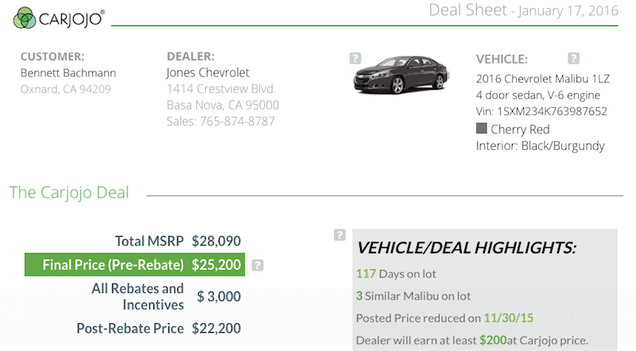
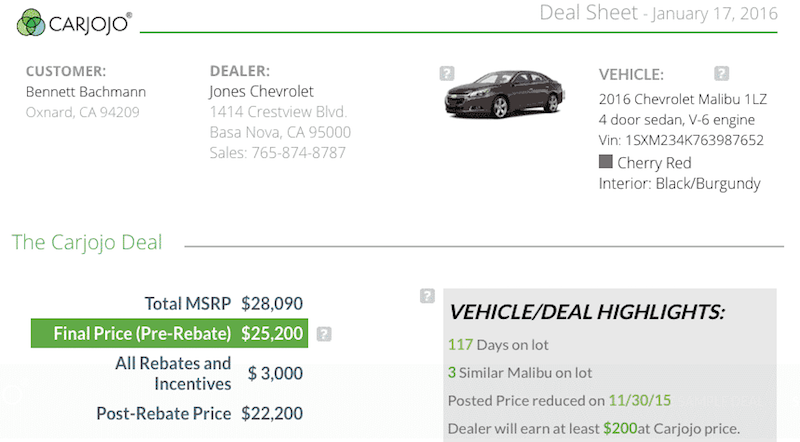
Haggling the price of a car can often save you thousands, and Carjojo is a free tool that helps ensure you get the best deal, too. It uses data to estimate the lowest price a dealer will likely accept for a vehicle.
Haggling the price of a car can often save you thousands, and Carjojo is a free tool that helps ensure you get the best deal, too. It uses data to estimate the lowest price a dealer will likely accept for a vehicle.

On December 7, Portland, Oregon, passed a law that will impose a surcharge on the local business taxes paid by corporations that operate in the city when the CEO’s compensation is 100 times or more the median earnings of the company’s employees. To monitor this ratio, the Portland law will make use of data that, beginning in 2017, U.S. public corporations must file with the U.S. Securities and Exchange Commission (SEC) under the Pay Ratio Disclosure Rule. The SEC’s new disclosure requirement implements a section of the Dodd-Frank Act of 2010 that seeks to expose extreme pay gaps within corporations and to permit cross-company comparisons of CEO-worker pay inequality.
One big problem with the Portland initiative is that the CEO pay numbers that the SEC mandates for use in the Pay Ratio Disclosure Rule are “estimated fair value” (EFV) measures, which tend to be significantly lower than the CEO’s actual pay. The EFV represents a hypothetical “before the fact” calculation of what a CEO might eventually gain upon cashing in the stock options and stock awards that make up the overwhelming majority of most top executives’ pay. Yet we know the actual realized gains (ARG) from stock-based pay that the company’s CEO takes home, puts in the bank, and on which he or she is obligated to pay income taxes. Each publicly listed company reports both ARG and EFV measures of the stock-based pay of its CEO in the proxy statement that it files with the SEC in advance of its annual meeting of shareholders. And, for reasons explained below, ARG tends to be significantly higher than EFV, especially when the stock market is booming.
A second big problem — which would exist even if the EFV calculation were an accurate measure of CEO pay — is that the Portland law’s choice to apply a surtax on a CEO–to-median-worker pay ratio of 100:1 accepts, and indeed normalizes, a pay gap that is far too wide. In the early 1990s, when concern about excessive executive pay became a hot political issue in the United States, a ratio of 100:1 compared unfavorably with the ratios in the vicinity of 20:1 that were said to prevail in Japan, Germany, and France. Indeed, in the 1980s Peter Drucker, the management expert who correctly understood that the purpose of the business corporation is to create customers rather than profits for shareholders, touted 20:1 as a sufficiently high ratio for any company in any country, including the United States.
The EFV measures of CEO stock-based pay that will be used in complying with the Portland Ratio Disclosure Rule are flawed to the point of being fictitious because the formulae by which they are estimated fail to capture significant changes that can, and often do, take place in a company’s stock price over time. Yet significant changes in the company’s stock price are the prime determinants of a CEO’s ARG compensation from exercising stock options and the vesting of stock awards. In the case of stock options, the EFV formula is typically a Black-Scholes-Merton option-pricing model that, rooted in the “efficient markets hypothesis,” assumes that changes in a company’s stock-price exhibit a log-normal distribution and thus predicts that most stock-price changes will be very small. Inherent in this model is the prediction that an executive will have little opportunity to reap significant ARG in exercising options in the future.
In the case of stock awards, the executive’s ARG is the actual number of shares received when an award vests multiplied by the vesting-date stock price. But EFV for stock awards multiplies the number of shares granted by the grant-date stock price, automatically excluding from the calculation extra stock-based gains that could accrue because of a higher stock price when the award vests in the future. In addition, many companies reward executives with extra shares when they hit prescribed financial metrics, augmenting potential ARG not captured in EFV.
Especially when the stock market is on the rise, total ARG compensation tends to be much higher than total EFV compensation. As shown in the exhibit below, for each of the years 2006 through 2015 the average total compensation of the 500 highest-paid U.S. executives using ARG numbers was greater than the average total compensation of the 500 highest paid using EFV measures, and markedly so in 2006-2007 and 2012-2015, when the stock markets were booming.

When ranked by the highest ARG compensation, in 2015 average total ARG compensation of the 500 highest paid was $32.6 million with 82% from stock-based pay, while these 500 executives registered total EFV compensation that averaged just $13.2 million (57% from stock-based pay). When ranked by the highest EFV compensation, in 2015 the average total EFV compensation of the 500 highest paid was $17.1 million (62% from stock-based pay), while total ARG compensation for these executives actually averaged $23.5 million (70% from stock-based pay).
In the presence of stock-market volatility, EFV measures of stock-based pay misrepresent the amount of money that executives actually make. As one extreme but important example, if the Pay Ratio Disclosure Rule had been in force in 2014 and 2015, Gilead Sciences, a pharmaceutical company that has been under Congressional investigation for price gouging, would have recorded CEO total EFV compensation of about $19 million each year in calculating the ratio. The actual money-in-the-bank total ARG compensation of its CEO John C. Martin was, however, $193 million in 2014 and $232 million in 2015. The $38 million in pay attributed to Martin over the two years would have been fiction; the $425 million in pay that he took home is fact—and Gilead’s actual CEO-to-median-employee pay ratio would have been 10 to 12 times the ratio that the SEC’s Pay Ratio Disclosure Rule would have required Gilead to report.
So we know what CEOs actually make from stock-based pay. Yet virtually everyone, including not only the SEC in its Pay Ratio Disclosure Rule but also labor unions, progressive think tanks, and the media, uses EFV measures. Why? As we explain in our recent report “The Mismeasure of Mammon: Uses and Abuses of Executive Pay Data,” since 2006 the SEC has privileged the EFV numbers in the Summary Compensation Table of proxy statements, requiring that the EFV measure be used to calculate total annual compensation of the named executives. Hence these EFV measures are the government-approved numbers used by almost anyone interested in current levels of executive compensation. The ARG numbers are reported in a subsidiary table in the proxy statement, where they typically go unnoticed.
The SEC could easily fix the problem by placing the ARG facts, instead of the EFV fictions, in the Summary Compensation Table. Or, using Standard & Poor’s ExecuComp database as we have done, analysts who are aware of what is fact and what is fiction could calculate total executive compensation using the valid ARG variables for stock options and stock awards.
As a growing body of research demonstrates, ARG on stock options and stock awards can incentivize executives to do buybacks, price gouge, offshore, lay off workers, do financially driven M&A deals, dodge taxes, engage in false financial reporting, and so on, all for the sake of boosting the company’s stock price. Stock buybacks are a particularly effective way in which a CEO can use corporate cash to give manipulative boosts to stock prices that redound to the benefit of his or her take-home pay. If we are concerned with not only how much CEOs get paid but also how the ways in which they get paid influence how they allocate corporate resources, then ARG compensation is the only measure of CEO pay that anyone should use.
As our research has shown, business corporations in which senior executives make resource-allocation decisions incentivized by stock-based pay are at the core of the integrally related problems of concentration of income among the richest households and the decades-long erosion of middle-class jobs in the United States. That is where the income-inequality action is, with the modes of compensating senior executives serving as the fulcrum. Any government agency, civil-society organization, or news publication interested in knowing how much a CEO actually gets paid, either absolutely or relative to the company’s rank-and-file employees, should start using the ARG measures of executive compensation. That includes the SEC itself, which, in this regard, has been since 2006 the purveyor of EFV measures that we should start labelling “fake news.”

Selling to C-Suite Puzzle
In major accounts, sales success at the C-level is a “do or die” proposition. What makes it particularly challenging is “one strike and you’re out.” There’s no second chance to get it right.
Successfully selling to senior executives is a book with many chapters. However, three footnotes are particularly important:
When do you sell to senior executives? Senior executives are not equally engaged throughout the buying cycle. They are involved early and late and tend to delegate the middle of the buying process to others. Let’s begin at the beginning – early engagement.
Senior executives attention is merited early in the buying cycle since that is when the operational and financial parameters of the project are defined. In the middle of the buying process attention turns to evaluating competitive options, a step that is usually handled by others.
The trap for salespeople is getting to the senior executive too late after they have turned over the decision process to others. By then, you have lost your ability to help shape the scope of work and to position the fit of your capabilities. This is particularly telling when the competition has done it right.
A correlated reason for getting in early and getting it right with senior level executives was pointed out in an excellent study by Steve Martin. Martin interviewed 1,000 customers as part of a win-loss analysis study. The results indicated – “Approximately 30% of the time, the winner of the sales cycle was determined before the official selection process started. Another 45% of the time, customers had already made up their minds about the winner halfway through the buying process.” This means “75% of the time, customers make their final decision halfway through the selection process.”
How do you gain access? The research is clear and straightforward. The most effective approach for gaining access to a senior executive is a recommendation from a key influencer inside the organization.
There is a second reason why the key influencer is helpful. A conventional piece of wisdom is even if you don’t know much about a company or their needs you ought to push for a meeting as soon as possible. This idea makes no sense and should be labeled a “worse practice.”
You have to be prepared and meeting with key influencers is a great way to get there. Being prepared means you understand the company. When you meet with the senior executive you need an overview of the challenges and a point of view about the path forward.
In addition to a recommendation from a key influencer, three other approaches will likely increase the chances of a senior executive granting access to a salesperson:
How do you get it right? The first requirement is to understand the senior executive on the other side of the table. Senior executives have different needs, pressures, and perspectives than managers lower in the organization.
From a strategic perspective, it is important to keep in mind that senior executives are more concerned about the unknown than the known. They look at the big picture vs. individual snapshots. They are more concerned about the future than the present. They are concerned about topics related to increasing market share, shareholder value and building a competitive advantage, not product features. Most importantly they are seeking insights and new ideas about the company’s strategic challenges, not standard product presentations.
From a process perspective, what rarely works is the traditional needs discovery conversation. We are all familiar with the traditional discovery conversation – it starts with salesperson asking questions to uncover a problem they believe the customer is concerned about and then continues by further development of the problem – ending with the salesperson presenting an overview of their solution for how the problem can be solved.
Why is a sales call like this ineffective with senior executives? The reason at the top of the list is the time spent vs. the value received does not work out very well for the senior executive. Too much of the time in the meeting is spent on educating the salesperson about a problem the senior executive already understands.
An alternative? One option is a Point of View business conversation. A Point of View sales call focuses on helping the senior executive learn something new about a significant strategic challenge, for example, increasing market share. The successful salesperson explores the problem from a different perspective, provides new insight about the problem and an innovative path forward. Needless to say, this type of call requires an entirely different type of call preparation and pre-call planning.
 |
| Image courtesy of miserablespice |
‘Tis the season… Santa’s making his lists and checking them twice.
Oh no! Your company shows up on his CX Naughty List! What did you do wrong this year? In short, a lot.
There are (at least) five categories in which companies continue to fall down when it comes to the customer experience. For each category, I’ll call out some of the most egregious reasons for being on Santa’s CX Naughty List. Trust me, there are a lot more reasons; I could write a book about all of them.
1. Customer Culture
Customer Culture is all about setting the stage for successfully designing and delivering a great customer experience. If you don’t have a leadership team who supports and drives a customer-centric culture, forget it; it won’t happen. Here are a few things your company did or didn’t do around developing a customer culture this year that caused you to land on the Naughty List.
2. CX Strategy
CX Strategy refers to your approach to delivering a great customer experience. Some of the reasons you may have landed on Santa’s Naughty List this year include:
3. Constituent Understanding
Do you know who your customers are? They might be partners and/or end customers/users. Why do they buy products and services from you? What are their needs? What problems are they trying to solve? What are they trying to achieve? You made the Naughty List because of the following.
4. Analyze
Analyze is all about how you tease out meaning from your customer data. The following behaviors got you on the Naughty List this year.
5. Operationalize
This is where the rubber meets the road. It’s time to execute. It’s time to improve and to deliver a great customer experience. You made the Naughty List based on this category due to a few shortcomings
Santa’s hoping you’ll do better next year! Focus on the things that matter to your customers and to your employees. Address the issues outlined above. And let’s see if you make it to the Nice List in 2017.
Cheers to a new year and another chance for us to get it right. –Oprah Winfrey
LinkedIn is one of the most professional social media networks. Professionals sign up to join LinkedIn at a rate of more than two members per second.
I have had the opportunity to teach a LinkedIn class to hundreds of Forsythe Technology employees and students at Duke University. Here are some tips that I talked about during the class that every career professional should do to optimize their LinkedIn profile so they get noticed.
Update your profile information
Make sure you add all of your basic info such as your full name, title at your company, location, correct industry, and company (linked to your company’s page so you get the company logo on your LinkedIn profile). Some key points to remember:
Customize your public profile URL
When customizing your LinkedIn profile, aim to just have your full name without anything else. If you have a more common name (sorry, John Smith) then you might have to resort to a slight modification. If you can’t add your full name consider adding your middle initial or “your company name” at the end of it. If you leave your company, you can always edit it.
Add important websites
Add important websites (LinkedIn limits you to three websites). Make sure you check off “other,” then add the Website title and URL so people quickly understand the website title. It is better to use “Other” than “Company Website” or any other pick list items LinkedIn provides.
Tweak your summary section
Ensure your LinkedIn profile summary section captures your overall career and specifically your current role at your company and how you help others and your company’s clients. This summary section is basically your elevator pitch in written form. Remember, LinkedIn is not your resume so make sure you are always write in first person.
Ensure you have company logos for each of your positions in your Experience section.
Go through your Experience section and make sure you have logos for each of your old positions. Please go to “change company” and find the correct company to ensure the company logo is set up. If your company was acquired by another company, find the acquired company, link it to that and then hit “Edit Display Name.”
Update your skills and endorsements sections
Take a proactive approach to editing your endorsements by adding skills you want to be known for with your network. You can’t change the order of these endorsements because LinkedIn has them ranked by the number of endorsements for particular skills and orders them accordingly.
Follow companies to keep up-to-date with your ecosystem
At the top of LinkedIn, go to the search bar and find some companies you want to follow. There are four main categories of companies that you should follow: 1) analysts; 2) partners; 3) competitors; and 4) current and/or potential clients.
Connect with “people you may know” to grow your network
The gold standard for LinkedIn is having at least 500 connections. However, only connect with people you know. LinkedIn will show how many connections you have until you hit 500. Once you reach 501 connections, LinkedIn will continue to count. It says “500+” connections on your profile. Remember: People like to connect with “connected” people.
Update your LinkedIn status at least once a week and/or write via LinkedIn publisher
Be sure to update your LinkedIn status daily or at least once a week with something that provides value to your network. You may want to put a reminder on your calendar to share an article. You should also think about publishing through LinkedIn.
What tips would you add to this list?
An earlier version of this post appeared on Knowledge Enthusiast.
You may believe that one of the primary challenges you have when selling is your higher price. Because you invariably get questions around your higher price, and because you are continually compared with your lower-priced competitors, it’s easy to conclude that your higher price makes selling more difficult.
This is categorically untrue. Your higher price makes it easier to sell, and a lower price makes it more difficult.
The fact that you have a low price in your category is an indication that what you sell is something worth less than its higher-priced competitors. If what you sell was better than your competitors, it would be worth paying more to obtain. The lower price is an indication of a lack of value.
If what you sold at a lower price would create greater outcomes, it would be worth paying more for. If what you sold eliminated risk and ensured those outcomes it would be worth paying more for. When it does neither, it isn’t easy to sell.
If the outcomes your dream clients need could be obtained at a lower price, there would be no reason for anyone to provide those services at a higher price. The fact that some of your dream clients know that something better is available makes your offering look inferior. This too makes selling difficult.
When you sell with a lower price, you lack the ability to differentiate on anything other than price. That is, in fact, the model.
The truth of the matter is, when you sell the lowest price, you are settling for clients who are settling for you. Your clients want more value but are only willing to pay for good enough, and you want clients who are willing to pay more for better without the ability to offer them “better.” Selling is hard when what you sell doesn’t create value for the clients you want.
There is a reason so few sales organizations are good enough to execute “good enough.” It’s difficult. Selling to people who don’t want to invest enough to get the outcomes they really want is easier, but the execution is much more difficult.
It’s easier to sell with a higher price. First, the price itself is an indication of quality. It’s a shortcut that indicates you are investing more in generating better outcomes, whether that be a better product, a better service, or a better solution.
A higher price also means that you are doing something different that makes a difference worth paying for. That difference, that ability to solve your perspective client’s challenge and give them what they really want or need is what is worth paying more to obtain. When you sell at a higher price, you are compared to competitors at all price points, which allows your prospective client to look for differentiation worth paying for.
At a higher price, you have something to sell. At a lower price, the only thing you have to sell is a lower price. If delivering greater value at a lower price was easier, more sales organizations would choose that strategy.
The post If You Think It’s Hard to Sell with a Higher Price, Try Selling a Low Price appeared first on The Sales Blog.
Should you wait til it comes around, or should you try and run after it?
No, I’m not talking about love.
I am talking about you getting your first job or… a better one.
So, which is it?
Well, a little bit of both.
I am sure you want to be in the position where opportunities constantly come (especially better opportunities). But opportunities don’t just come when you are simply waiting, as in W-A-I-T-I-N-G.
Somewhat, somehow, you have to work for it. And here’s where personal branding comes in.
A brand is anything that separates one thing from another. It might be a symbol, a name, a design, a product, or a sound among others. When it comes to your personal brand, it basically refers to what you are known for.
A terrific personal brand can open a lot of opportunities for you such as better job, better deals or contracts and clients for your business, industry recognition (nice, you can be a thought leader!), and so much more!
Whether you are a first-time job seeker, or a young professional just jump-starting your career, an excellent personal brand can be leveraged to help you achieve your career goals, or even exceed your career expectations and bring you to even greater heights! Who knows?
But first, let’s try to unlearn some of the common personal branding myths, and then next week, let’s talk about how to proceed with establishing your personal brand.

Information technology, especially social media, has greatly changed the recruitment industry. Today hiring managers turn to social networking sites to hire talents.
LinkedIn, for example, a professional networking site, is the leading platform for employers to find candidates. According to a recent JobVite survey, LinkedIn lords over other social channels in terms of social recruiting. Ninety-five percent of headhunters are using LinkedIn when looking for and getting in touch with potential job candidates. Ninety-three percent of these recruiters use Linkedin to touch base with potential candidates. Only 32% of employers and recruiters vet candidates using Facebook (18% on Twitter).
So, yes, avoid the digital space at your own cost.
“But keeping an active digital presence will bare my soul! And I don’t want that!”
Oh, well, not necessarily. An active web presence doesn’t require a ‘bared soul’.
An active web presence does not mean sharing pictures of the food you eat or Tweeting every thought you have at every turn you make.
An active web presence does not also mean ‘omnipresence’. You don’t have to keep an account on all the social media platforms available to date. Just choose one, two, or more social platforms that work for you. LinkedIn, Twitter, Google Plus and Facebook are great options.
An active web presence does not also mean that you have to compose lengthy blog posts about industry trends, and issues (but that works great, too, if you want to be known as an industry thought leader). Engaging with relevant content – sharing and commenting – will be enough.
The bottom-line is that when people want to find you, you have to make sure that they will find you. And that when they do, they should find you for the right reasons.

Oops.
Well, if you graduated maxima or summa cum laude from one of most prestigious universities in your country and the media somehow got interested in your story and you become an instant celebrity, well, your credentials might stand on its own. But, not for long, and not always.
Your degree or even your kilometric list of milestones on your resume won’t sell all by itself. The default position in sales and marketing is that “nobody wants you or what you are offering”. Unless your resume’s me-me-me format can explain how your prospective employer is going to benefit from you, you’ll have a difficult time creating the momentum you want.
Pitching your personal brand, your value, isn’t done during the interviews. It must be your business from Day 1 of your career. Remember that a brand is made up of many aspects. It is the totality of your interview skills, business cards, a chain of online networking accounts, and most importantly, relationships – all these require time and effort.
Tha plain truth is this, my friend: You need to start branding yourself today because it takes time and it demands a dynamic approach.

Re-branding yourself seems scary, and that’s understandable. But it isn’t impossible. There are true-to-life stories about crazy career changes out there that prove career shifting or re-branding isn’t that bad at all!
There’s the story of a museum curator who tried her luck in fundraising and development. There’s even an executive who became a hypnotherapist. They are both successful in their chosen new fields.
Shifting career or re-branding yourself is not a walk in the park, that’s for sure. It’s going to take time and effort. But it is not impossible.
If you feel strongly about doing something new, do it now.

We are talking about your reputation… not something else.
Anyhow, do you Google yourself?
Oh, please tell me you do.
Reevaluating your web presence does not mean you are vain. It’s your way of checking your digital footprint is clean. By “clean”, it means there are no random snapshots from college showing a tawdry, drunk you. Or, any lengthy blog post you’ve written centuries ago where you’ve churned out the reasons why there are more airplanes under the sea than submarines in the sky (K. Bye).
Googling your name (and various spelling variations of it; along with different job titles and company names) will also give you an idea of what any prospective employer might see when they start looking for you online.
Go, Google yourself.
Done?
Clean? Okay, good.
Does your LinkedIn profile pop right up? Yes? Good (if you don’t have one, well…).
But do you think it’s enough that your digital footprint is clean, and that you are visible?
If you really want to up your chances of being hired, you will want to add some oomph and flash to your digital footprint.
There are a lot of gimmicks you can do online. You can start building your thought leadership by blogging about relevant industry issues. You can do this on platforms like LinkedIn Pulse, WordPress.com, Blogger, or CareerAddict among others.
You can also pitch yourself as an expert and write a guest blog for a high profile site like The Muse, Career Addict, The Huffington Post and Inc.com among others. There are much more ways to up revamp your web presence and your personal brand.
Remember what personal branding expert Neil Patel said,
“Be yourself (your best self) because everyone else is taken.”
First published on Sysgen Philippines’ Career Blog, The Puzzle Piece. Read the original article here.
Progress, W. (2015). Recruiters Say: Avoid LinkedIn At Your Peril. [online] Forbes.
Quick Sprout. (2016). The Complete Guide to Building Your Personal Brand. [online]
Joyce, S. (2015). How to Use LinkedIn for Job Search – Job-Hunt.org. [online] Job-Hunt.org.
Keppie Careers, (2014). How important is LinkedIn for your job hunt? –. [online]
Search Engine Journal, (2014). Why LinkedIn is Important to Your Career in 2014 – Search Engine Journal. [online]
Waldman, J. (2014). 5 Reasons Why Non-Job Seekers Should Be On LinkedIn |
All GIFs grabbed from Giphy.
As marketers, we’re always on the hunt for content that engages us, teaches us something new, or just entertains us with interesting stories about our industry.
We put together this must-read list of marketing eBooks written by expert marketers from a variety of companies. These books examine the challenges modern marketers face, the effectiveness that marketing automation tools have, the best tactics to use when building a marketing team and much more.
Here are 9 awesome eBooks for digital marketers.
This eBook by Content Marketing Institute’s Jodi Harris explores different ways in which you can tell your brand’s stories through utilizing different platforms like social media, blogs, and email. Through research, they found that marketers struggle with seeing effective results from the various marketing tactics they use in order to reach their audiences. Harris walks through 24 useful tactics and even dedicates a full section to email newsletters. This guide is perfect for developing and optimizing your strategy for 2017.
“Email is an essential structure that supports and strengthens all of your other content efforts. It’s also one of the best techniques for building a subscriber base – which helps foster deeper engagement and lasting brand loyalty.
But just like any critical system, success with email is tied to proper maintenance and upkeep – if you fail to keep pace as consumption trends shift, even your most faithful followers may start to overlook your e-newsletters in their crowded inboxes, or opt out altogether.”
After surveying hundreds of marketers at growing businesses, we found that modern marketers face 7 major challenges when it comes to their email marketing strategy. Some of the top challenges include engagement rates, customer acquisition, customer retention and email personalization. This eBook breaks apart each challenge in order to understand its importance, why each one is challenging and how marketers can overcome each one in order to create a successful email marketing strategy for the year.
“The key to engaging with customers is understanding who they are and what they are looking for and then engaging them in a personal, relevant way. Thankfully, the days of mass email marketing with a one to many message are being left in the past and today’s modern marketers understand the importance of using rich customer data to deliver customer journeys and messages that are timely, relevant, wanted, and unique to each subscriber’s interests.
The most successful marketers segment their audience into different groups. It’s important to grasp which subscribers are engaging with your email campaigns and why.”
As marketers, our hopes are that our readers will read our email newsletters and convert into loyal customers by purchasing our products or services. This eBook by Quick Sprout goes over the basics of CRO (conversion rate optimization), how to collect data and how to run A/B tests. While this eBook mainly focuses on web traffic, emails are an essential way to directing readers to your site in order to convert them into customers and/or subscribers.
“…testing is the key factor when it comes to CRO. Without testing, you’re left relying on your gut instinct to determine what will be more effective, but once you test, you know right away whether a change leads to an increase or decrease in conversions. It takes the guesswork out of knowing what you should say and how you should design a new web page.
The number of tests you can eventually run are endless. You can test different headlines, new value propositions, varying button colors, different call-to-action copy, and much more. Each change has the opportunity to impact conversions, and small wins add up over time.”
This eBook reviews the basics of marketing automation and how B2C and B2B companies utilize these marketing tools in different ways. It analyzes the 3 core components of marketing automation (triggers, rules, and content) and how these components affect the different tactics used by B2C and B2B brands. This eBook also uses research in order in order to analyze why marketers prefer to use best of breed technologies as opposed to a single vendor marketing cloud solution.
“The power of marketing technology is in its ability to meet the specific needs of every organization so the reality that growing B2C and B2B organizations need different tools to achieve results is no surprise.
Today’s marketers need to be agile, testing their approach and changing direction quickly, to keep up with customer expectations. They want the flexibility to choose the tools they need — for customization, personalization, and automation.
Despite the lofty promises of big marketing suites, the future of automation for growing B2C brands is a well-curated marketing stack of hand-picked technologies that each does its job impeccably well.”
This eBook focuses on how to create high-quality content in order to engage with your audiences. It will walk you through how to identify who your target audience is, how to create customized content and then how to effectively measure its success. This eBook tops out at over 100 pages and includes the insights of 10 expert marketing contributors.
“Back in the day, there were more green pastures. It was easier to get traction in larger, more general categories. Now, competition for attention is more intense in more industries. It’s more difficult to win attention for bigger topics because marketers and brands have already moved in, claiming the advantage in all three content marketing channels.
• They’ve built the domain authority through links (search optimization)
• They’ve built a large list of subscribers (email marketing)
• They’ve built a following on online networks (social media)The best content marketers combine search, social and email marketing. But it’s not too late. The things that make it hard to compete against them will eventually make it hard to compete against you.”
Before you are able to send out awesome email campaigns to your target audiences, it’s important to have creative writers and strategists on board to help brainstorm ideas and power original content. Sometimes, we ask our employees to wear too many hats when in reality, they would be more successful putting all of their energy into one role that best suits them. This eBook by Contently’s team of marketing experts walks you through how you can build an effective content team no matter what industry you are in or how large your organization is.
“One of the biggest mistakes a brand can make is to hire someone as part of its content team without considering whether that person is equipped to execute within the company’s larger marketing strategy.
“What I usually see a lot is the organization has not enabled enough transition time,” said Baron Manett, former senior vice president of Ariad Communications and founder of Per Se Brand Experience. “I see an organization make an announcement, ‘Okay, we’re going to focus on content marketing. And hey, Debbie, yesterday you were the senior brand manager. Starting Monday, you’re going to be the director of content.’”
We surveyed 500 marketers at mid-size businesses to see if they prefer all-in-one cloud marketing solutions or more simple and tailored solutions that seamlessly deliver on the investment. In this guide, we analyze the different factors that busy marketers take into account when purchasing a marketing automation tool and how these marketers measure the effectiveness of their software solutions. Some of these factors include usability, flexibility, cost and how these solutions contribute to a company’s ROI.
“Busy marketers don’t have the time or budget to implement all-in-one marketing clouds. We need simple, tailored solutions to keep up with the competition and heightening consumer expectations. We need affordable tools that deliver on the investment. We need technologies that integrate with one click.
The power of marketing technology is in its ability to meet the specific needs of every organization. Despite the promise of big marketing suites, the future of automation is a marketing stack of hand-picked technologies that each does its job incredibly well.”
This eBook focuses on B2C companies, exploring different methods that retailers can use in order to engage with their audiences in a personalized way. It reviews how these strategies should vary by device as the digital space continues to evolve at a rapid pace. It also focuses on data analytics and the insights you should gain through your marketing efforts and how to best utilize those data points in order to connect with your customers.
“Further complicating the conversion process [when engaging a potential customer] is that a majority of people visiting an e-commerce site aren’t going there to make a purchase — they’re going there simply to research. Brands need to focus on engaging these customers across the buying journey, says Joakim Holmquist, director of digital marketing for EPiServer, a WCM platform. ‘When we see conversion rates for e-commerce hovering at about 2%, it means that 98% didn’t complete that conversion.’
It’s important that brands nurture the other activities customers engage in when visiting the brand’s site. ‘Even if consumers didn’t decide to buy at that point in their journey, you still need to give them a great experience,’ says Holmquist.”
This eBook is perfect for companies who are looking to build out extensive email lists of high-quality prospects. It explores the different ways that you can develop your own “lead magnets” in order to grow your email outreach and convert more customers. It focuses on how to prove that you have the solution to your readers’ problems through using effective and personalized email marketing campaigns. While this eBook requires a paid MarketingProfs’ membership, its expertise and insight are invaluable to the modern marketer who is eager to build stronger email lists.
“Hello, stranger; please give me your email address.”
What kind of request is that? It’s not a very compelling one, is it?
“I’d like to offer you massively helpful advice to solve a problem that’s killing you. All I need is your email address.”
Now that’s more like it.
That’s a lead magnet…
Offering lead magnets is a vital part of the content marketing formula that builds your email list—and, in turn, effectively builds your business. In this 36-page guide, you’ll learn about lead magnets, how they can make your marketing more magnetic, and how you can use them to build a higher quality email list that delivers more business.”
From content marketing strategies to conversion optimization, these eBooks review the ins and outs of digital marketing and the topics that many marketers have top of mind.
Whether you are a B2B or B2C marketer, building effective email lists, hiring a strong internal team, personalizing email campaigns and purchasing marketing automation tools are concerns that we all aim to nail.
For more helpful eBooks and resources check out the Campaign Monitor Resource page.

As a salesperson looking to advance your sales career, you want to benefit from a strong sales territory, high compensation, long-term growth potential, and a thriving local economy. However, without a clear roadmap, it’s challenging to discern which cities can give you the ideal environment to capitalize on your skills and experiences.
Based on Glassdoor’s Top Cities for Sales Jobs, our own data, and 3rd party sources, we identified the top cities for sales jobs in 2017. Each of these metropolitan areas is an economic powerhouse with distinct advantages for high-performing salespeople. If you are considering making a move to a new region or are curious to know how your city ranks against other major economic centers, this guide can help to set you up for long-term success:
More than any other city in the country, San Jose stands out as an epicenter for technology, energy, venture capital. It’s region — nicknamed Silicon Valley — was originally known for the high-tech engineering and manufacturing companies in the area. Although these industries still hold sway, Internet, software, and hardware companies now dominate the local economy.
Over 110 high-tech firms have offices in downtown San Jose including Cisco, eBay, and Adobe. 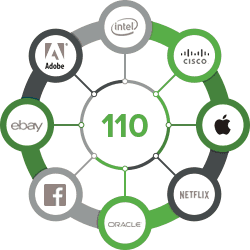 Companies Facebook, Intel, Symantec, Tesla, Oracle, Netflix, Google, and Apple have their headquarters in the cities and towns surrounding San Jose. This area is also a center for venture capital funding, with more than 20 VC firms making their home along Sand Hill Road in neighboring Menlo Park.
San Jose’s dominance as an economic center cannot be overstated. In 2015, Milken Institute ranked San Jose as the #1 U.S. metropolitan area for sustaining and creating new jobs. The competition among companies for the top salespeople is intense — this demand is a reflection of the overall trajectory of the local economy.
Given the concentration of Fortune 500 companies based in Silico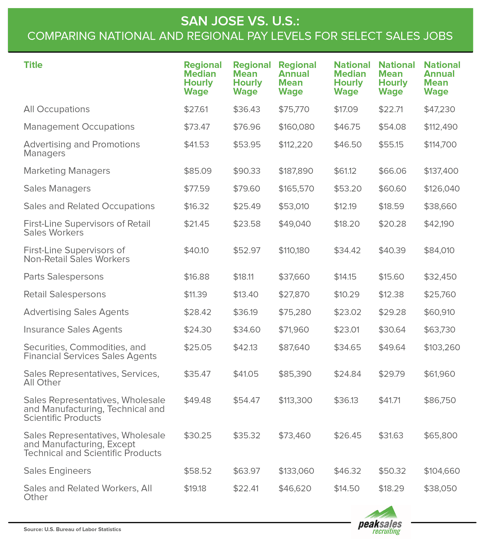 n Valley and the high cost of living, San Jose also has the highest paying sales opportunities. Glassdoor’s ranked San Jose #1 in its list of highest-paying cities for sales jobs. The overall average compensation for sales professionals reaches $127,500, while our research found that sales managers make an average of $165,570.
Although living in San Jose is also extremely expensive, it’s the ideal location for salespeople who want to enter a competitive, fast-changing market filled with organizations at every stage of growth.
San Francisco’s booming economy is only 49 miles north of San Jose. Together, these two cities create a dynamic ecosystem of thriving companies and high demand for top performers. In San Francisco, top salespeople will find the same technology industries that thrive in Silicon Valley in addition to a big financial services presence. It’s largest employers include Wells Fargo, engineering company Bechtel Corp, and professional services firm Ernst & Young.
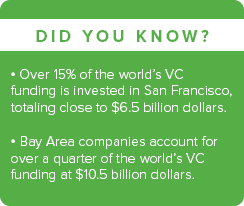
San Francisco benefits from the highest concentration of venture capital funding of any city in the world. Over 15 percent of the world’s VC funding is invested in San Francisco, totaling close to $6.5 billion dollars. Combined with #2 San Jose, Bay Area companies account for over a quarter of the world’s VC funding at $10.5 billion dollars.
 San Francisco also offers a higher level of job availability than San Jose at a lower average pay. In 2015, Glassdoor listed close to 3,000 jobs in San Francisco — almost 2,000 more jobs than in San Jose — at a median salary of $100,000. Between 2011 and 2015, requests for Peak to headhunt enterprise software sales leaders in the SF region rose by more than 15 percent, suggesting B2B companies are doubling down on their recruitment efforts in the city.
Living in the San Francisco also means that you benefit from companies and clients based in both Silicon Valley and San Francisco proper. Due to the prevalence of employer-provided transportation, salespeople can live in San Francisco while working in Silicon Valley or vice versa.
In addition to being one of the most expensive cities in the country, San Francisco has also been dubbed the city with the highest quality of living by Mercer. For sales professionals who live here, the cost is well worth the lifestyle and professional opportunities.
Situated at the head of Charles River, Boston is an iconic city with a flourishing economy. As an epicenter of higher education, healthcare, tech and biotech, Boston offers increasing opportunity for B2B salespeople.
 A 2016 Wall Street Journal article described “knowledge capitals” like Boston as punching “above their weight” economically. In particular, Boston’s brainpower, rooted in over 100 colleges in the area, make this city a dynamic place to build a career. The unique combination of a talented workforce and elite research institutions ensure it’s poised to grow even more in the coming years.
GE’s recent decision to move their headquarters to Boston’s Seaport District reflects increased interest in tapping into this kind of energy. In particular, both the Seaport District and Cambridge’s Kendall Square attracting companies of every size that want to maintain a strategic edge, causing an influx of businesses to flock to the area. Boston is such a hub for emerging companies that the U.S. Chamber of Commerce Foundation declared it as the top city for start-ups.
Salespeople who want to have a material impact on a growth company or thrive in an innovation-based economy benefit from exploring Boston. Because the local economy builds on both a strong start-up culture and a long list of marquee companies, this city appeals to salespeople who want to position themselves for a promising, long-term career.
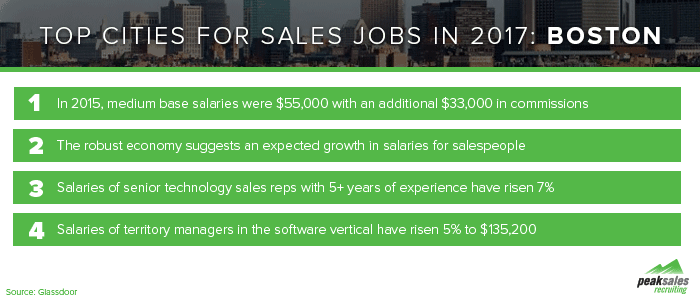
As of 2015, Glassdoor listed medium base salaries in Boston at $55,000 with an additional $33,000 in commissions. The robust economy suggests an expected growth in both B2B revenues and salaries for salespeople. For senior technology sales reps with 5+ years of experience, for example, salaries have risen 7 percent over the past three years. Territory managers in the software vertical have also experienced a 5 percent increase to $135,200.
Furthermore, Boston differentiates itself by offering residents a small-town, New England experience that accompanies the advantages of a major metropolitan area. Homes in its neighborhoods continue to grow in value as job seekers and companies flock to its brownstone-lined streets.
New York City is a hotbed of lucrative sales positions with a high level of intensity. In this city of over 8 million residents, financial services reign supreme, accounting for 15 percent of the economy. JPMorgan Chase is the city’s largest private-sector employer, followed by Citigroup.
The New York area includes a seizable portion of the country’s B2B professional and scientific services 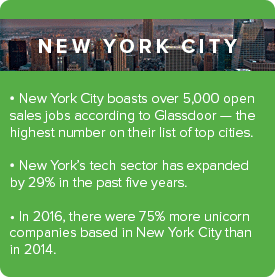 headquarters, which have consistently rebounded from the recession. For this reason, New York City boasts over 5,000 open sales jobs according to Glassdoor — the highest number on their list of top cities.
The big apple has also seen significant growth in the technology industry. According to the Partnership for New York City, the area’s tech sector has expanded by 29 percent in the past five years. In 2016, there were 75 percent more unicorn companies based in New York City than in 2014, including Buzzfeed and Oscar Health. CEO Kevin Rose even noted that people in New York’s start-up scene exhibit more “hustle” than its West-Coast counterparts. Therefore, salespeople who want a high-intensity work environment thrive in the fast-paced NYC economy.
With over 100,000 salespeople working in New York City with less than 50 percent of them consistently hitting quota, A-players can stand out among their sales peers. New York City sales candidates will find a medium base salary of $60,000 with a bonus of $30,000 for junior sales positions.
Although New York City is the most expensive city in the world, most New Yorkers couldn’t imagine an alternative. With an exceptional client base, unmatched opportunities to climb the corporate ladder, and the city’s cultural experiences at your fingertips, New York offers an amazing opportunity for top performers to advance their career.
Los Angeles is known for the entertainment industry, but it’s also an ideal environment for continuing a career in sales. In addition to being a creative capital, it’s the largest center for manufacturing in the United States, which offers opportunities for salespeople who work in industrial B2B sectors. Los Angeles-based companies create everything from computer and electronic products to automobiles. Plus, it’s location on the coast mean that $1 billion of products move through the port every day.
 In addition to trade, LA has seen significant growth in the aerospace industry and specialized manufacturers, once a stagnant industry in Southern California. Clear skies and an abundance of space make Los Angeles an ideal environment for testing drones and satellite technology. For that reason, Elon Musk’s SpaceX, Virgin Galactic, and Rocket Lab all chose LA for their headquarters.
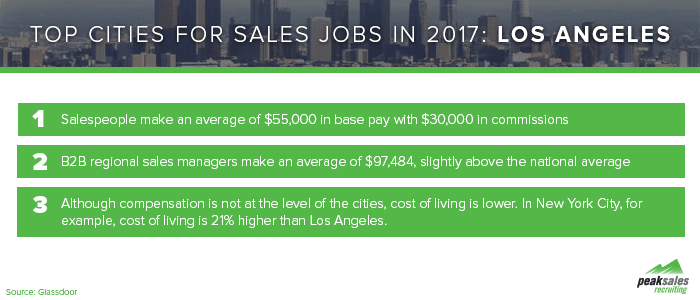
Salespeople in this sunny city make an average of $55,000 in base pay with $30,000 in commissions. Meanwhile, B2B regional sales managers make an average of $97,484, which is slightly above the national average. Although this compensation is not at the level of the cities like San Francisco and New York, cost of living is lower. In New York City, for example, cost of living is 21 percent higher than Los Angeles.
According to our data, Los Angeles Area based employers have increased the number of sales positions they are recruiting for over the last 24 months by ~5 percent. Combined with amazing weather and a distinct quality of life, Los Angeles offers a breadth of opportunities for B2B salespeople interested in the aerospace, defense or manufacturing industries.
Government, education, and tourism may be the largest industries in Washington. DC, but the private sector is on the rise. According to Business Insider, Washington DC is the seventh best economy in the nation. Stephen Fuller, an academic specializing in Washington’s economy, believes that professional and business services are the fastest growing industries in DC. Fuller argues that the next thirty years will add 800,000 private-sector positions in the metropolitan area.
 Salespeople in DC benefit from the proximity to government — contractors, think tanks, and consultants drive innovation and policy in the public sector, contributing to long-term growth in the private sector. In particular, salespeople with experience working in the consulting industry will see plentiful opportunities in DC.
The largest private-sector employers include Clark Enterprises, Tasc, and Alion Science and Technology. According to DC Inno, the Washington start-up scene is also thriving. Over 400 local companies made Inc.’s list of the 5,000 fastest-growing companies, including technology consultants ByteCubed and Oasys.
With a median base salary of $55,000 and $30,000 in commissions, salespeople in Washington, DC are setting themselves up for short-term and long-term success in a robust job market. For salespeople who want to work in a thriving city rooted in government and culture — and don’t mind a high cost of living — DC is the perfect metropolitan area.
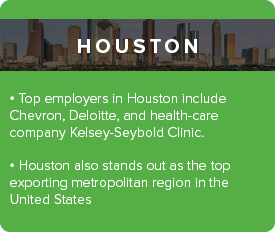
Although people associate Houston with the oil industry, its job market offers other diversified options for sales candidates. The city provides a large B2B customer base in energy sector, space science, biotechnology, and technology. Top employers include Chevron, but also Deloitte and health-care company Kelsey-Seybold Clinic. Houston also stands out as the top exporting metropolitan region in the United States, which supports economic growth in this region.
 The median age in this Texas city is 33 and is becoming younger every year, as a growing population of young professionals make their home in Houston. The city is seeing changes that accompany the influx of millennials. This year, two big downtown coworking spaces are under construction, one operated by TechSpace. These coworking spaces signal that companies are investing in this region as an entrepreneurial and technology center.
Houston stands out from other cities on this list by offering the highest compensation for salespeople outside of the Northeast and California. Total compensation averages at $85,000 in Houston. With 1,775 sales positions available, it also surpasses San Jose for opportunities in the job market.
Once a thriving industrial center, Bridgeport, Connecticut is in the process of reinventing itself after years of economic hardship. The biggest city in the state, it’s home to nine of the top employers in Connecticut, with dozens more in surrounding communities.
 Manufacturing still drives the economy here despite a significant drop in available factory jobs. Sikorsky Aircraft Corporation employs 8,300 people right outside of Bridgeport’s downtown. Neighboring cities Stamford and New Haven also provide opportunities. In fact, our research shows that there was a 13 percent increase in requests for senior account executives in the Bridgeport area over the last 24 months.
Non-profits are in the process of rejuvenating Bridgeport’s ailing downtown with the hopes of sparking creative and tech industries. This September, the city hosted its first hackathon. By working with the neighboring Stamford Innovation Center and a grant from Connecticut Main Street Center, the city intends to shift in a renewed direction.
Bridgeport offers a slightly lower median income than Houston at $85,000. Its cost of living is 34 percent lower than New York City, despite the short distance between the two commercial centers. By train, it’s only an hour and a half ride to midtown Manhattan from downtown Bridgeport. B2B salespeople looking to work and live in the Northeast in an area with a lower cost of living should definitely explore the opportunities in Bridgeport.
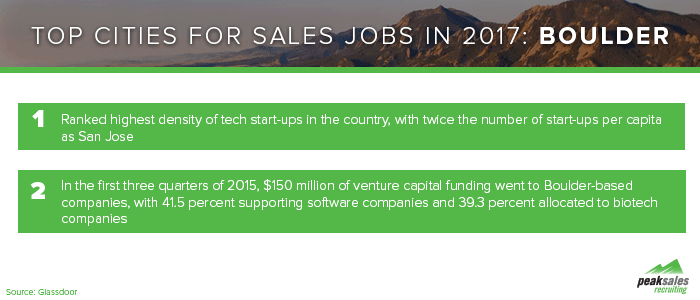
Boulder is a city teeming with entrepreneurs. In 2013, the Kaufmann Foundation reported that it has the highest density of tech start-ups in the country, with twice the number of start-ups per capita as San Jose. In the first three quarters of 2015, $150 million of venture capital funding went to Boulder-based companies, with 41.5 percent supporting software companies and 39.3 percent allocated to biotech companies.
 Tech firms employ the greatest percentage of Boulder residents with large employers like IBM and the aerospace contractor Ball Corporations anchoring the economy. However, according to University of Colorado Boulder, the strongest job growth will occur in professional and business services. Their research also suggests that the state’s concentration of professional, scientific, and technical services are 33 percent higher than the U.S. as a whole. These statistics signal that Boulder-based firms rely on talented salespeople to close deals, outperforming the country in its concentration of sales employers.
Like Boston, Boulder is home to many higher education institutions and research organizations. Residents are well-educated and technically skilled, which makes it a competitive hiring environment. Although this city offers a booming tech scene, available jobs hover around 108 because qualified young professionals who flood the market. It may take extensive networking and an aggressive job search to find the ideal sales role.
The median pay for salespeople in Boulder is strong, at $85,000. Because of a moderate cost of living, 300 days of sunshine a year, and a mountain environment, sales roles in Boulder are coveted positions.
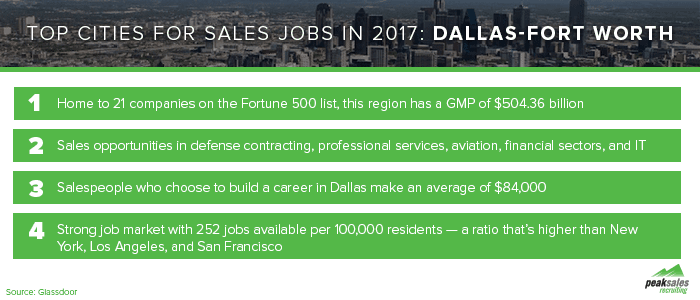
Dallas-Fort Worth is the economic epicenter in North Texas. Home to 21 companies on the Fortune 500 list, this region has a gross metropolitan product, or GMP, of $504.36 billion. If this region were its own state, it would be the ninth biggest economy in the United States after North Carolina. Top employers include American Airlines, Lockheed Martin, Bank of America, and Alcon Laboratories.
With a thriving, diversified economy, Dallas-Fort Worth offers B2B salespeople opportunities in defense contracting, professional services, aviation, financial sectors, and information technology. As with the other cities on this list, Dallas has benefited from strong ties to the technology sector. Known as Texas’ “Silicon Prairie,” it is gaining traction as a great ecosystem for entrepreneurs.
Salespeople who choose to build a career in Dallas make an average of $84,000. They benefit from a strong job market with 252 jobs available per 100,000 residents — a ratio that’s higher than New York, Los Angeles, and San Francisco. Combined with the affordability of homes and low cost of living, Dallas’s hot job market and thriving economy make it a great place to be.
Situated alongside Puget Sound, Seattle is home to marquee companies Starbucks, Microsoft, Amazon, and Nordstrom. Some of its top industries — technology, advanced manufacturing, aerospace, green technology, and information communication technology — are ideal for B2B salespeople.
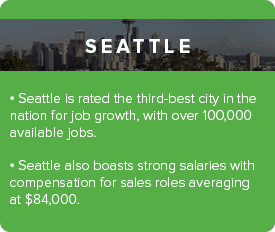 Most notably, 238,900 people in Washington state work in tech. Recruiters can attest that it’s a job candidate’s market, especially for technical sales roles. It’s rated the third-best city in the nation for job growth, with over 100,000 available jobs. Seattle’s also boasts strong salaries with compensation for sales roles averaging at $84,000. Salespeople can find even higher salaries at big tech companies.
Start-ups that can’t compete with Seattle’s biggest companies on compensation incentivize job candidates with a culture-first approach. With a supportive sales culture, extra flexibility, and significant perks, these start-ups offer their sales reps additional ownership over their work and an exemplary experience. If a salesperson values a fun, dynamic environment, there’s bound to find an abundance of options here.
Known as the Research Triangle, this part of North Carolina includes Raleigh and Durham, as well as Chapel Hill. Thanks to significant investments in the private sector and numerous universities, the Research Triangle is a center for aerospace and aviation, automotive, biotech and pharmaceuticals, energy, information, and communications technology.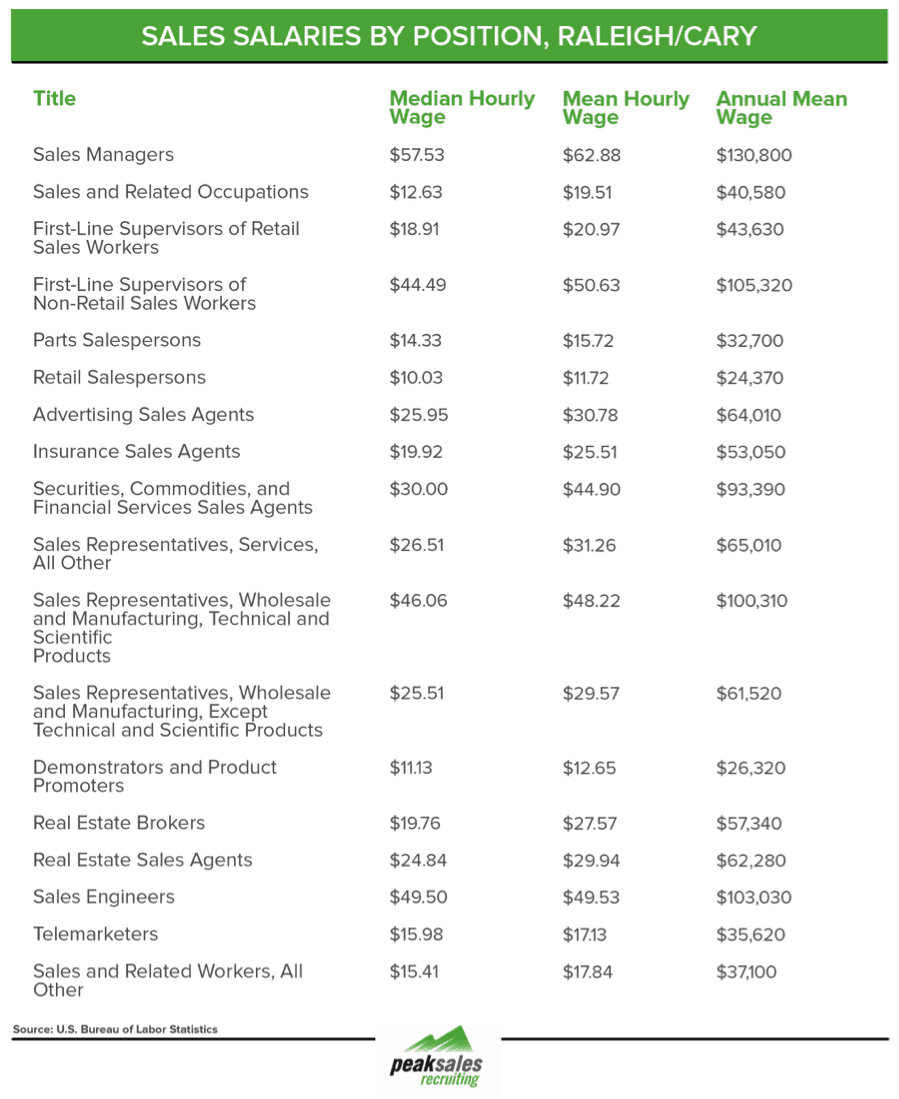
Raleigh-Durham’s hiring landscape offers a full range of options for salespeople. Mid-size companies and start-ups in R&D’s emerging tech scene both offer sizable opportunities to salespeople who want to be a part of a growing firm. A large pool of multinational corporations that include GlaxoSmithKline and Bayer Crop Science offer corporate opportunities for salespeople who are interested in pursuing a career in a large organization.
Peak Sales has seen an increase in requests for senior salespeople both from Raleigh-Durham’s technology and professional services organizations. Specifically, the Research Triangle has seen a 12 percent increase in sales job growth in technology and science sectors over the last five years. Companies in this booming area need B2B salespeople with in-depth industry knowledge and the ambition to grow their careers.
Our research found that the average income for sales managers in Durham and Chapel Hill is $142,320 and $130,800 respectively. Glassdoor reports that the median income for non-managerial sales jobs is $84,000 total, including commissions. This area also offers affordable housing, a thriving sense of community, and access to three of North Carolina’s best cities.
Atlanta is one of the largest metropolitan areas in the Southeast, second only to Miami-Dade County. An affordable cost of living, low housing costs, and state and local incentives have helped drive Atlanta’s economic boom. For every new job created, the state of Georgia gives the employer a $2,500 to $5,000 tax credit.
 Atlanta remains firmly rooted as a key area for pharmaceuticals and life science industries while making gains in technology, transportation services, and professional services. Specifically, the region’s professional and business services sector has outpaced the U.S. economy at 5.3 percent job growth.
The tech scene in Atlanta also continues to gain traction. DataFox named it one of the best places to create a start-up outside of Silicon Valley and New York. The city also recently benefited from the opening of a $100 million venture capital fund Leaders Fund that will further support the city’s SaaS companies.
Atlanta’s thriving economy is ideal for salespeople in every stage of their career. In particular, Peak has seen requests for senior salespeople in Atlanta grow by 24 percent since 2014. Salaries for sales professionals in this region are above the country’s average. Glassdoor reports that the average salesperson makes $82,500 while our data suggests that sales engineers make a median wage of $106,700 and managers make an average of $117,160.
Although Atlanta offers lower salaries than the other cities on the list, as in Raleigh-Durham and Dallas, its low cost of living make this region an ideal place to put down roots. With an average home cost of $178,900 compared to $809,400 in San Francisco, your salary provides much greater buying power.
Sacramento is often overlooked when compared to San Francisco and Silicon Valley, but it’s still a top city for sales jobs. This region is the seat of state government, but it also built a varied economy, with thriving clean technology, life sciences, transportation, and aerospace industries.
This year, The Sacramento Bee reported that the region’s economy has grown at the fastest pace in 10 years, reaching a 3.5 percent growth in GDP. Household incomes also grew by 5 percent between 2014-2015, showing promise for continued prosperity.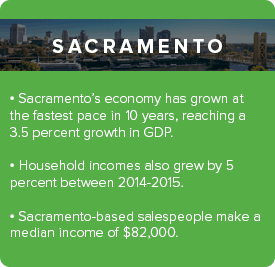
According to Glassdoor, Sacramento-based salespeople make a median income of $82,000. Although this salary is significantly lower than sales positions in other commercial centers in Northern California, Sacramento offers much lower housing costs. Rent prices are 227.84 percent less expensive than in neighboring San Francisco.
Sacramento companies also exhibit an increased need for talented sales reps. Peak Sales has seen a 10 percent increase in the number of requests for enterprise reps selling complex, multi-stakeholder solutions in the Sacramento area.
Hartford is home to seven major insurance companies: Aetna Inc., Travelers Property Casualty Corp., MassMutual, The Hartford Financial Services Group, CIGNA, The Phoenix Companies, and The United Healthcare Company. As the epicenter for the insurance industry, it offers the best opportunities for B2B salespeople who specialize in this sector.
 Hartford’s appeal doesn’t stop there. In addition to a strong presence in the insurance and financial services industries, Hartford benefits from a thriving manufacturing sector led by Fortune-500 companies United Technologies Inc. and Stanley Black & Decker
This year, Hartford is poised to make significant investments in creating a local tech hub.
CTNext, which offers state-funded grants for entrepreneurs, set aside $90 million to boost entrepreneurialism in Connecticut. Their goal is to turn Hartford, and other cities in the state, into centers for innovation. As Connecticut makes significant investments in the technology sector, salespeople can expect a growing need for their talents moving forward.
Hartford-based salespeople also benefit from a 120-mile radius that includes Boston, New York, New Haven, Springfield, and Albany. In other words, they have access to clients in the Northeast’s biggest economies, all within a day’s drive. With salaries at a median of $82,000, sales professionals in Hartford make a good living in a city that offers long-term career potential.
The post 15 Top Cities To Advance Your Sales Career in 2017 appeared first on Peak Sales Recruiting.

If you want to see how mobile technology can disrupt the very basics of business models and habits established over hundreds if not thousands of years, look at what’s happening in India. A telecommunications revolution, towards fourth generation (4G) mobile services, will transform the consumer landscape over the next 5-10 years. This revolution will transform India the same way automobiles changed America 100 years ago but at ten times the speed — computers, laptops, and tablets will be marginalized as India leapfrogs to mobile 4G by 2020. The consequences are far more revolutionary than have been considered by multinational companies and entrepreneurs. In order to create value in India in the coming decade, companies must have a mobile-first strategy.
Some background: Until the mid-1980s, having telephone service in India was considered the ultimate luxury and less than 0.001% of the population possessed a phone. By July 2016, virtually every Indian had a mobile telephone and access to text messaging, primarily using 2G technology.
In this environment, a new 4G only player has entered in 2016 with an initial investment of $20 billion in network and market infrastructure. Jio is a unit of Reliance Industries Ltd, whose leader, Mukesh Ambani is India’s richest man. Sending a 5 megabyte file in 2G takes 8 minutes but the same file can be transferred in 20 seconds using 4G. This is the game changer.
While it will take many months for the dust to settle and the winners to emerge, one thing is clear: India will soon have one of the largest pools of 4G users in the world. If the penetration rate reaches even half that of mobile telephony, it implies a customer base that is almost twice that of the U.S. population. Nimble companies and organizations will stand to gain by this unique opportunity.
India’s unique economic, demographic and distribution ecosystem will lead to many winners as a result of this 4G revolution. Companies entering India should abandon PC- and laptop-based business models and instead focus on digital businesses using the mobile platform. Here are just a few possible opportunities in some of the industries that will benefit the most:
Entertainment: India’s entertainment industry produces the highest number of movies compared to any other country in the world, but rampant piracy has limited revenues to genuine producers. Digital rights and viewing habits are much easier to manage on mobile networks and revenues are likely to start expanding as more people view their entertainment on mobile devices. Much of this entertainment content in India targets millennials who are likely to consume entertainment content at hours when business loads are light.
Banking: India is a cash-based economy and most Indians don’t have active bank accounts, so setting up brick and mortar banks is a challenge. Mobile banking has been touted as a potential solution, but results so far have been limited. Over the last six years, India has issued over 1 billion biometric Aadhaar cards (unique identity cards, similar in principle to the U.S. social security card, but with fraud protection built in); earlier this year India’s retail banks collaborated with the central (or “reserve”) bank of India to release the Universal Payment Interface which provides a basis for secure mobile transactions linked to the Aadhaar identity and has security features based on iris and fingerprint images. 4G will accelerate the proliferation of active mobile banking in India with a better way to deal with such encrypted and image-based data. This move creates myriad opportunities in India’s financial services industry. The short-term crisis caused by demonetization further opens the door for new players to provide niche financial services. There is also a mega opportunity in the cyber security sector. As cashless transactions grow, so will be cashless frauds (or “cashless pick pocketing”).
Education: The use of mobile video technology in education and skill building for the millions of India’s youth is another bottom-up revolution in making. With highly affordable 4G mobile technology, it is likely that non-classroom based courses will find a platform to expand dramatically in India. These benefits could flow to legacy players such as public and private universities, corporations such as India’s NIIT and California-based Coursera, nonprofits such as the Khan Academy, or perhaps new upstarts that will rise to close the education gap using 4G enabled smartphones.
Healthcare: Telemedicine has the potential to explode in India. Physicians and hospitals in India are already using telemedicine to diagnose and triage patients. Two-way video on a 4G platform will enable urban patients to avoid traffic and rural patients to consult remote specialists while making providers more productive with their time.
Online shopping: E-commerce is growing at exponential rates in India. Amazon, Alibaba and venture capitalists have invested billions into Indian e-commerce. Over 90 % of India’s brick and mortar stores are tiny, single location shops (not part of chains or franchises). It is very likely that future top retailers in many categories will be e-commerce companies, not big-box chains. This will have a huge impact on foreign consumer product companies such as Colgate and PepsiCo eyeing the market in India as eCommerce reaches scale in India.
Sharing economy: There are significant opportunities in the emerging app-based eServices (similar to Uber and Airbnb). This segment is likely to expand even faster than e-trade in goods. Already, India has eServices for many things: kitchen cleaning, sprucing up the house, cleaning clothes, hiring a driver for your car for some hours (in Indian city traffic, it makes sense to hire someone to drive the car). With 4G, eServices space is poised for explosive growth.
Media: Since liberalization in 1991, media of all kinds has grown rapidly in India, including newspapers, magazines, radio, television, and billboards. It is likely that this growth will be muted in the next decade as Indians turn to mobile media as the largest form of consumption. Social media in India including Facebook has been largely a mobile-led phenomenon. Recently, a Fortune 100 consumer product giant shifted its sales promotion strategy in India from coupons in newspapers to offers on mobile devices. Not just B2C companies, even B2B companies such as Rolls Royce and Deere, and technology companies such as Corning and GE better abandon marketing and communication using TV and newspaper channels and instead develop robust digital marketing strategies using mobile.
These are just a few examples of industries where new business opportunities will be created in the next decade. Startups and fast moving incumbents from anywhere in the world can take advantage of this unique “perfect storm” happening in India today. In fact, any business that previously required platforms for large data processing and transfer rates, but could not do them without the use of PC, can now easily do them with 4G mobile telephony. It is another internet revolution, yet again. The bottom line: 4G revolution is a fast train which companies must get on or they’ll be left behind.

The business cycle with holidays, end of year and bookkeeping is an opportunity for you if you can relax and take advantage of the natural down time. Trying to force fit activities that are likely a better fit in the up times will only lead to frustration, and perhaps disfavor, with clients. Why not be more strategic about the business cycle?
The down time is extremely valuable to your business if you use the time well.
But the first thing you have to do is let go of expectations. Let go of trying to force conversations, deals, projects or opportunities that are not on people’s minds or attention.
There will be a better time when everyone is chomping at the bit to make things happen. Ride the down time with better strategic activities for yourself:
Much of this down time work is housekeeping. It’s a luxury you don’t necessarily get to work through when you are in the grind. But this part of the business cycle can be enjoyable and make your up times much more fruitful.
Sometimes, we are so busy we can’t see the opportunities whether it’s how we work or connecting with the people that matter.
Enjoy the down time.

When used effectively, color theory can be one of the most powerful tools an email marketer can work with. After all, the right color choice can help convey the value of your emails. Color can instantly set the mood, evoke emotion and spark a psychological reaction that gets people to take action. In fact, 90 percent of a subscriber’s first impression is based on color or visual cues alone. Let’s take a look at how colors can have a major impact on how your email performance so you can make your campaigns work harder for you.
According to Kissmetrics, color helps increase brand recognition by 80 percent – and that makes it an incredibly important piece in creating your brand identity. Plus, having your own brand colors can help distinguish you from your competitors. Research even shows that there is a connection between the use of color and how it affects customer perception of a brand. Think of your favorite brand for a second. What color do you associate with them? Now take a look at the chart below. Does it match up with your perception of the brand?

Now that you’ve considered how color affects your own perceptions of your favorite brands, it’s time to ask yourself how you can leverage this information in your email strategy. Let’s take a look at each of the different colors listed above, identify why it elicits certain emotions and feelings and how you can best incorporate it into your future email sends.
Now that you’ve considered how color affects your own perceptions of your favorite brands, it’s time to ask yourself how you can leverage this information in your email strategy. Let’s take a look at each of the different colors listed above, identify why it elicits certain emotions and feelings and how you can best incorporate it into your future email sends.
Blue is often used to represent feelings that are cool and calm. That’s because blue has mood-boosting properties that signal the body to produce chemicals that are calming and promotes a feeling of positivity. Light blue can be a refreshing splash of color in your emails. Warby Parker’s use of the lighter shade helps to emphasize the vibe they’re going for:

By contrast, dark blue is a classic choice for brands who want to emphasize luxury, without the formality of black. Take note of how Everlane used it in their email below:
By contrast, dark blue is a classic choice for brands who want to emphasize luxury, without the formality of black. Take note of how Everlane used it in their email below:

Pro Tip: Studies have shown that blue appeals to a wide range of people. Try testing a blue call-to-action (CTA) button or link color.
Pink tones are youthful, fun and exciting. It’s a great choice for emphasizing femininity or something sweet. (The color actually makes us crave sugar!) Shades of pink are perfect for a welcome email, as they encourage friendliness. Take a look at this example from Lyft:

Pro Tip: Try adding shades of pink to your welcome email for a friendly first impression.
Green tones are reminiscent of natural elements, health and well-being. It’s a soothing choice, and promotes feelings of relaxation and harmony. It’s also the color that the human eye is most sensitive to and able to discern the most shades of. Since it feels very fresh, green is a great color to use to promote a new product or feature. This example from Offscreen is a perfect example of one way to use a green color palette in your emails:

Pro Tip: Launching a new product or feature? A splash of green can help emphasize it’s newness.
Orange represents warmth and energy. Fun and flamboyant, orange is often is used to represent positivity and optimism. Another cool thing about orange? We naturally associate it with trust and safety. We love this example from Google:

Pro Tip: Orange is a very bold color choice that can easily intimidate most marketers. Slowly ease your way into using orange by adding images featuring the sunny shade.
Like orange, shades of yellow can symbolize positivity and optimism. In fact, it’s known as the happiest shade in the color spectrum. Yellow is also known for activating memory, stimulating the mental processes and encouraging communication.

Pro Tip: Yellow helps sparks memory. If you have something important that you want subscribers to remember, keep yellow in mind.
Black is a classic color choice that never goes out of style. It’s often used to represent formality (think “black tie”). It also implies weight. For example, people assume a black box weighs more than one that’s white. Harry’s did a great job of exemplifying this in one of their product emails:

Pro Tip: If all black is too much for you, go for the no-fail combo of black on white.
White is cool, calm and serene. It’s a great choice for brands that want to feel modern and fresh. This campaign from The Little White Company is a great example of using white in your emails:

Pro Tip: Create a softer contrast between your background and text by choosing a mix of warm gray tones rather than pure black.
Purple is luxe and elegant. It’s that in-between shade that uplifts, while still maintaining a sense of calm. It’s also known to encourage creativity! We love how Stuart Weitzman incorporated it’s signature purple shoebox in this abandoned cart email:

Pro Tip: Purple is a great choice for a luxury brand to help convey the value of their products and services.
Red tones represent passion, adrenaline and action. As a high-energy color, it can boost your energy levels and get the heart pumping. If you want your subscribers to feel the urgency of your message, red is a good color choice.

Pro Tip: Too much red can be overwhelming. Try adding a splash of red to the header or footer of your emails.
Consistency is key when it comes to establishing brand trust and association. Always keep your brand top of mind and use color sparingly to create a seamless experience for your subscribers. No matter your color choice, always keep it simple. A high amount of contrast between your background and text will always be user-friendly.
Ready to put these tips into action? Start by implementing one (or more!) of these tips to get more engagement from your subscribers.

After trying everything you could to make people read your content and provide you with some awesome feedback about the work you put in, it seems like the people just don’t care about you or your blog. There is null engagement from them, seriously zero.
And you really don’t need that kind of negativity in your life.
So you read and learn everything you could from the hundreds of ‘The Ultimate Content Marketing guide’ present on Google(I know you have) and start implementing them in your new marketing strategy in the hope of getting your content ‘found’. But after days and months of strictly following what you read, to your dismay, there is still no significant increase in your reader base.
And you ask yourself why, why me? Why no one wants to read my (awesome)content? Do I really belong here? Am I worthy of a new reader’s attention?
You begin doubting yourself.
Which is a deep pit that you jump in…..as you will doubt yourself again before giving your content marketing strategy another go or starting with a new one altogether.
Don’t doubt yourself, there is no problem with you or your content.
The problem is with the fast changing content marketing scenario. The content trends keep changing so rapidly that keeping up with them seems like a far cry sometimes, even for me.
The dynamic nature of content is what you have to shake hands with if you need to get a couple of more eyes on what you write.
Just reading 1–2 year old marketing guides won’t do(I am not saying that you shouldn’t read them, they still give you a broad idea how content marketing works) It’s obvious everything around content would have changed and the then stated strategies would not hold true to the current marketing scenario. You’ll have to read and do what’s trending ‘right now’.
But if you sit down to read what’s trending in content ‘right now’, by the time you’ll understand the trend and be ready to implement it on your blog, it would still not generate as much buzz as you’d hope.
Take infographics for example, how many of them do you see now? Maybe 1 or 2. How many of them did you see around 6 months back? Honestly, I don’t know about you but my entire twitter feed was filled up with them back then.
And after seeing so many infographics all of a sudden and reading 100 blogs that adviced me on start building them as soon as possible, I hoped on to the infographic bandwagon as well, hoping that it would generate some much needed buzz for me.
I won’t deny that it didn’t generate traffic, it did (a lot, the most actually)
So, I tried it again after a week and by that time the trend had already started fading, resulting in much lesser traffic while I expected much more from it.
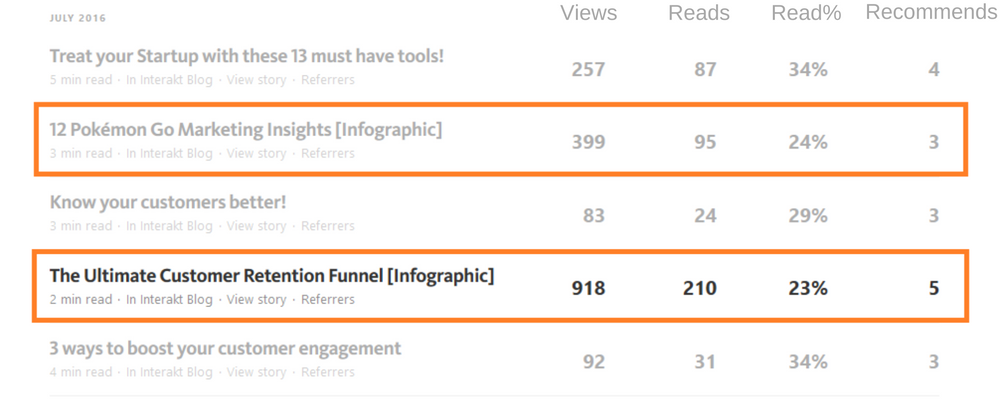
Who is to blame? While those blogs that adviced me to create infographics in the first place still existed, they were of no use to me anymore as the trend changed. But new marketers still continue to search for what will work for them and those blogs which compelled me to create infographics, will compel them to create infographics as well if they stumble upon one.
It’s a vicious circle of creating outdated content. And outdated content just doesn’t work.
To check this, I recently created another infographic and marketed on the same platforms that I did my previous ones and the results were shocking (yeah, I understand there are a lot of factors that can effect the overall traffic generated by a blog, but still I couldn’t believe that it plummeted so much)

Facing the tide of time, the once most trending thing in content started fading really quickly and proved to be of no value after just a few months.
So, to make the most out of your content marketing strategy everyday you need to think ahead of time.
Predicting future marketing trends and preparing for them at an optimal time is the key here. You can collect the data yourself and make your own predictions or you can rely on the biggies, such as CMI, who have the resources to mine data and predict upcoming trends.
You’ll have to study in depth about each one of them, view their sources and then analyze.
Analyze if you can vouch on that prediction or not. And then set your future course of action and research to make the most out of that prediction when it finally matures, it’s a long shot. But it’s worth it.
(Take your analyzer glasses out)
So, here are my Top 3 predictions of what will work in the fast changing content marketing scene in 2017-
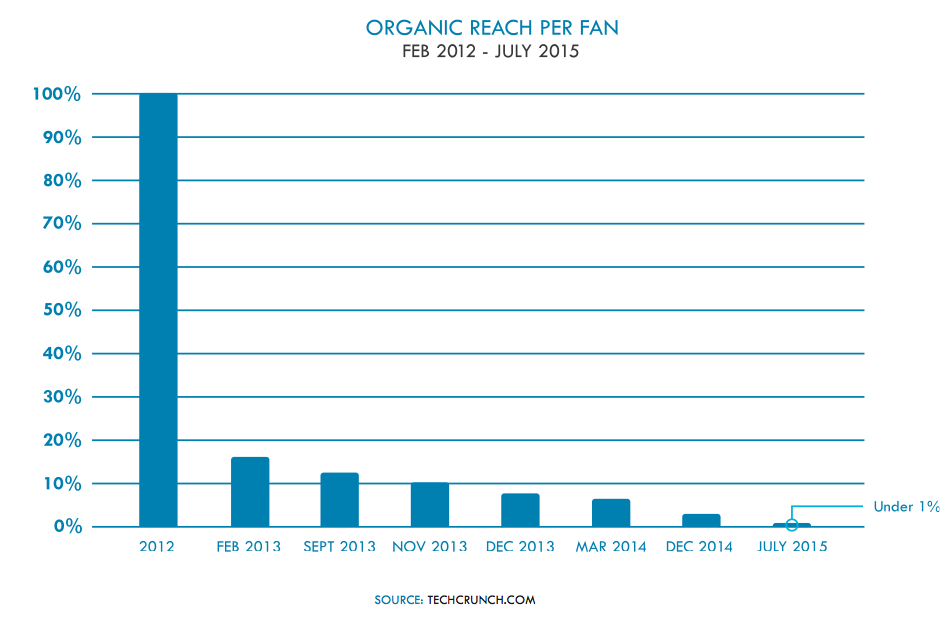
This has been continuing for years, but I expect it to continue to be a major content marketing trend in 2017.
Earlier this year Instagram introduced an algorithm based feed, rather than a chronological one. Instagram’s reasoning says that as the photo-sharing app becomes more popular, there is simply too much content being published, and people miss what matters to them.
This story is not just about instagram, but the entire web.
By introducing an algorithm, the feed is “ordered to show the moments we believe you will care about the most”. Maybe this is true. Instagram wants to keep people engaged and on the site. But it has a side effect: much like Facebook before them, it allows Instagram to curate what goes into feeds.
This introduces the possibility of reduced reach for brands that don’t pay. The changes brought about by Facebook mean that organic reach is greatly reduced from 15% to as low as 2%. As networks face demand for returns on investment, I expect advertising options to increase, and advertising spend to increase to get in front of the customers.

Storytelling has emerged as a key part of content marketing in the past few months and is now a widely recognized trend in the whole content marketing scenario .
Good storytelling in business is more than just a case study. This also highlights that audiences are beginning to get tired of the idea of content for content’s sake. Simply blogging to have a blog or updating social media for the sake of it won’t cut it anymore. You need to engage with your audience and tell them a story.
Apparently, telling a compelling story entices the reader and he is compelled to read the story till the end. So, to make the most out of your content in the coming year, implement and mix both your personal and professional life into your blogs to engage readers and show them who you really are.
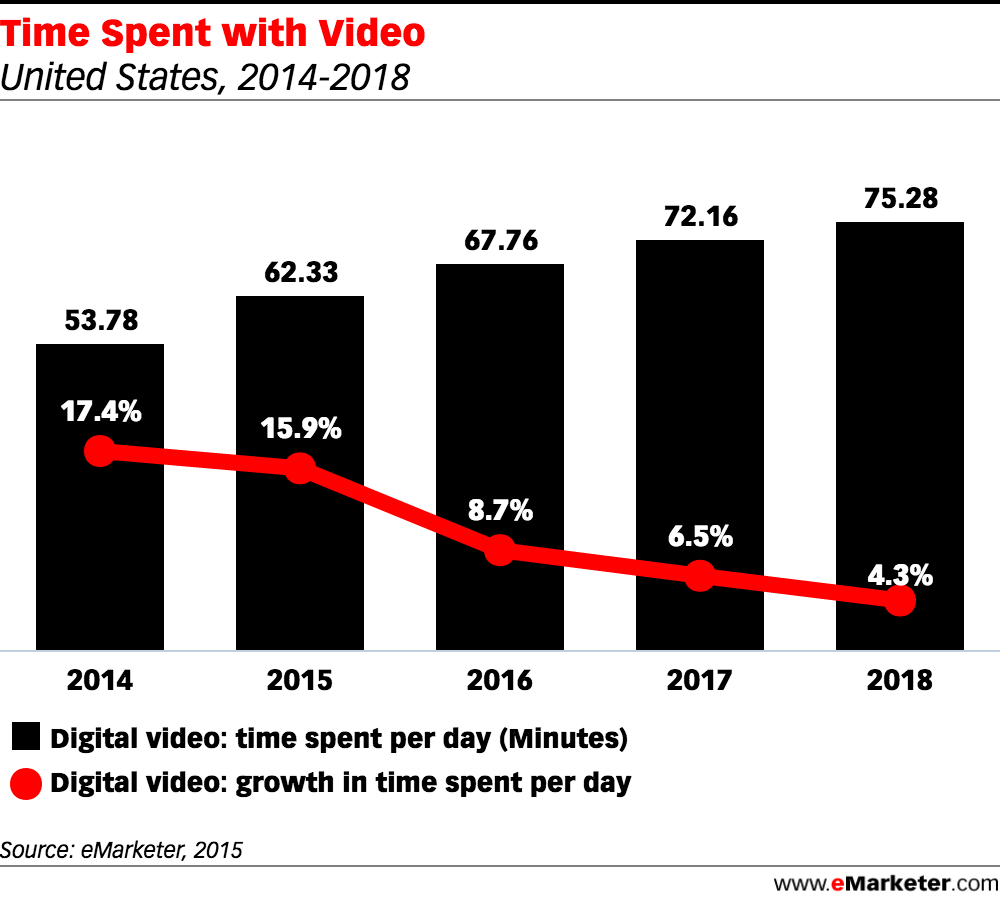
I have said it before and I will say it again, content has become increasingly visual over the years. Marketers realized long ago the power of an image. The power of video has been evident on Facebook in the last two years, with 500 million people now watching a Facebook video every day. These are well-established forms of media, but it looks like several more are on the horizon.
GIFs are becoming more popular, with Giphy recently raising an additional $72m in funding. Pokemon Go showed us the possibilities with augmented reality. Several virtual reality sets have gone on sale this year. Facebook has rolled out 360-degree photo publishing. Several companies including Youtube, Facebook and Instagram have already started broadcasting live videos.
In this competitive content arms race, expect early-adopting brands to experiment with a lot of these new forms of media in the coming year.
Content is still the best way to build trust and authority for yourself or your brand. But it’s seriously dynamic in nature. You can not keep producing the same content over and over again and expect it to deliver for you. I learned it the hard way.
The essence of a successful content marketing strategy lies in providing value to your readers and readers want to read what’s trending. So, start early and recognize and learn upcoming trends and grab opportunities as they come.
Don’t wait for a content marketing trend to mature to deliver your awesome content about it. Gain authority before the trend gets overcrowded with everyone writing about them.
Make your voice heard before everyone start shouting.
If you liked this piece and want to advance the conversation, please consider recommending and sharing.

The simplest techniques can be so effective.
I recently listened in on a call where a prospect voiced an objection, but seemed a bit shaky in his conviction.
The sales rep simply responded, "What was that again?"
The prospect hemmed and hawwed a bit ... and then actually admitted that he probably should go with the salesperson's proposal.
Brilliant. So what happened here?
If you have a strong belief about something, chances are you're able to explain why, with conviction.
On the other hand, if a prospect says something that is not completely truthful or they don't believe strongly in, they will hesitate, hem and haw, or exhibit other nervous behavior when questioned. The same is true if they don't have concrete reasons for their beliefs.
Similarly, some buyers throw out objections as stalling techniques. Still others can't express their objection clearly the first time around -- even though it's valid.
Which situation are you dealing with? To clarify, ask the prospect to repeat, or explain their statement.
For example, you might say:
If the objection is truly a legitimate one, their explanation will provide you with information which will help you address it.
If, on the other hand, they are stalling or insincere, your question will help to smoke out the real problem.
Either way, you win. Sometimes the simplest solutions are the best.
Editor's note: This post originally appeared on Smart Calling Online and is republished here with permission.



Creating a superior customer experience requires the commitment of the entire organization. With buyers more than five times likely to buy from companies that provide a better customer experience, your success hinges upon it. Executive leadership must have a plan in place to help their organizations place customer needs first – or risk losing to the competition.
As Chief Customer Officer at a public company, I’m verifiably customer obsessed. But, to spread that customer-centric focus throughout the organization requires more than can be done by a single person. In my professional background, I’ve found that by paying attention to the following core principles, leadership can make a huge difference in its ability to drive a better customer experience.
Your organization’s most precious resource is time. By increasing efficiencies and offloading routine tasks from your team, you give reps back time in the day – time that can be better spent engaging with and serving customers.
This requires that they have the tools and technology to be effective and productive at their job. In addition to a CRM, such as Salesforce, you may want to consider a customer success platform, like Gainsight, or a sales acceleration technology. Both give you more insight into customer behaviors, so your team can deliver a better experience.
With increased understanding, for example, you can more quickly identify opportunities such as upsells or cross sells. Or, you can spot new areas of interest by seeing how customers engage with your emails and content.
Finally, make sure that reps can easily access all the data they need from their phones. Sales people live on mobile – give them the on-demand access to customer information that they need to respond effectively.
Incentives are widely used to drive desired behaviors for employees – and they’re proven to work. Which is why U.S. companies spend billions of dollars on incentives. Leveraging incentives to motivate positive behaviors that improve your customer care is arguably the best use of your company’s incentive dollars.
The Forrester Research blog “Nine Ways to Reward Employees to Reinforce Customer-Centric Behaviors” explains that reward systems can be immensely powerful to keep employees focused on customers. Incentives can be used to recognize employees for going above and beyond the norm or giving them bonuses for providing premier customer care – perhaps demonstrated by a high satisfaction ranking. The blog reminds companies not to overlook the value of non-monetary rewards and recognition to drive performance. Try a few customer-based initiatives and see what incentives get the best response.
If you work with millennials, you also need to factor in their preferences with any incentive plan. In addition to desiring more recognition, millennials are extremely tech and mobile savvy. If you want to improve customer care with the millennial crowd, your incentive compensation management (ICM) solution must make it easy and fun for them to access and track their progress throughout the quarter.
Finally, be sure to deliver what you promise. Incentive payouts should be accurate and provided to winners in a timely fashion – otherwise, they lose their value.
Show employees that customers come first. Make it a priority to establish and automate processes to respond to customers. Put customer response tactics in place across multiple channels – through online chat, help desk, email, social media engagement, and – yes – even the phone.
Have a customer mission statement. Make sure the statement is conveyed frequently to employees and validate your customer mission through your own actions.
Start a gratitude program to honor long-time customers or mark customer anniversaries. Consider hosting a buyer appreciation event. Highlight the significance and importance of customers in all internal communications. Behaviors are always, always driven from the top.
My company’s CEO, Chris Cabrera, likes to quote Henry Ford, who famously said, “If I had asked people what they wanted, they would have said faster horses.” The point is that successful companies have the ability to give buyers what they’re not asking for – to delight them with something they didn’t even know they needed.
Did anyone know that we needed a smartphone before Steve Jobs? Who would have thought that we needed the ability to listen to music from our phone or the use of a ‘cloud’ to store our digital assets more cost effectively and efficiently? Innovators thought of these solutions before most of us even knew we wanted them.
Delivering continual innovation is a core principle of a customer-centric culture.
Your customer values and methodologies must be integrated into your coaching and training programs. When you hire new employees, they should be educated about whom you sell to and what’s most important to them. This should be part of the onboarding process for everyone within the organization.
Coach values from top to bottom. At Dreamforce’s Sales Summit, Ingersol Rand executive Melissa Nelson Tate shared how the company drove customer focus with a coaching program specifically designed for sales managers – training them to be the catalysts to drive better customer care within their teams.
In the ‘Age of the Customer’ your business orbits around the buyer – not the other way around. This makes meeting their needs of utmost importance to your success. While I’m sure there are other techniques to strengthen customer focus, I’ve found that these core principles provide a powerful foundation to start the process.

In the managerial pecking order within most organizations, finance occupies a more central role than the flimsy business of marketing.
Financial people use complex terms like ‘derivatives’ and ‘collateralized debt obligations’, and deal with multibillion-dollar sums on a daily basis. Marketers are a simpler mob, occupying their time with more basic duties, such as brand building and customer satisfaction.
However, when you think about it, shouldn’t it be the other way around? Shouldn’t the marketer, who builds the brand and works with the consumers who pay for everything, have a more exalted position than the manager who simply accounts for and invests the resulting income? Given the corporate shenanigans in the financial sector that emerge on a regular basis, doesn’t it make more sense to trust the marketers who generate value, rather than the incomprehensible financial markets that just seem to lose it?
Brands continue to provide empirical evidence that marketing does indeed beat finance. That evidence is mounting. The next time you are asked to make a case for building a strong brand refer to the following eight fact-based insights.
1. Brand Leadership Equals Business Leadership
The world today is far different from what it was only a couple of decades ago and these structural changes have placed brands at the forefront of business success. A review of stocks in the S&P index shows that businesses that own stronger brands perform significantly better than businesses that own weaker brands.
2. Why Brands Drive Financial And Business Results
The bottom line is that strong brands have a very strong positive impact on financial and other business results. Following are key data points on some of the ways in which this occurs.
3. Strong Brands And Corporate Growth
In what ways does developing a strong brand increase a company’s growth potential? A strong brand helps a company grow in three specific ways. First, companies can charge a higher price — which hopefully leads to higher profits, thereby resulting in more cash to expand the business further. For instance, since Caterpillar has a very strong name in the construction equipment category, it can charge more—because buyers know of Caterpillar’s great product and service quality. In earning more, it can grow faster.
4. How Brands Create Financial Value
Perhaps the biggest pay off of creating a strong brand is permission to extend into new product categories. If you have successfully built a strong brand, you can leverage the positive feeling people have for it by launching new products in categories that fit the brand positioning. In cases like these, it is more about how well you deliver on the brand promise. The brand itself is already well-known and appreciated.
5. The Role And Value Of Branding
So many people misunderstand the role of brand. They think it’s a synonym for marketing, and marketing is a synonym for media spend.
The purpose of your brand is to use that perceived value to provide you, through marketing, with sustained sales at a greater level of return than the market is inclined to give you over the longer term.
6. Warren Buffett And Strong Brands
Buffett likes strong brands because they create a protective ‘moat’ around a business. He believes that for a business to earn excellent returns on invested capital, it must command a sustainable, long-term advantage. So, strong well-known brands are one of two types of brand that excite Buffett as an investor, the other being low cost producers. Buffett takes the long view for his investments. He is looking for a sustainable competitive advantage – not a quick win.
7. Why Strong Brands Drive B2B Markets
Brands matter in B2B markets. In fact, they may matter even more in B2B than in B2C.
8. The Business Impact Of Strong Brands
What is the business impact of strong brands? Why are strong brands so important?
Brands deliver the following key benefits to organizations:
Co-authored with Mark Ritson.
Build A More Valuable Future For Your Brand. Join us in Hollywood, California for Brand Leadership in the Age of Disruption, our 5th annual competitive-learning event designed around brand strategy.
The Blake Project Can Help: The Brand Positioning Workshop
Branding Strategy Insider is a service of The Blake Project: A strategic brand consultancy specializing in Brand Research, Brand Strategy, Brand Licensing and Brand Education
FREE Publications And Resources For Marketers

Trust and openness are crucial elements of an ethical organizational culture. Only when employees are able to voice the problems they see can ethical lapses be discussed and resolved. A first step in building this kind of culture involves a hiring approach in which companies actively seek those individuals inclined to speak up when ethical challenges surface. Based on findings from the behavioral sciences, some individual dispositions deserve every screening committee’s attention.
First, you want employees who will notice when something unethical is happening. In this respect two dispositions are very relevant:
Conscientiousness: Individuals showing this trait are careful, reflective, and reliable, which means that they tend to be responsible organizational citizens. Research shows that conscientiousness is indeed positively associated with higher levels of moral reasoning, leading people high in this trait to display less antisocial, unethical, and even criminal behavior.
Moral attentiveness: This describes the extent to which individuals are aware of the various ethical dilemmas at hand. A morally attentive person will see ethical issues where others may see none. It may sound a bit obvious to say, but being aware of the ethical dilemmas at hand are a prerequisite to start talking about it.
Building an ethical culture not only requires that people be aware of ethical challenges, but also that they have the intention to take them seriously. Two types of orientations can influence this in particular:
Duty orientation: Individuals with a strong sense of duty tend to be loyal and mission-oriented, and motivated to take action on what they perceive as a problem. Research has shown that a high sense of duty orientation leads employees to voice their concerns more quickly.
Customer orientation: Employees who are strongly motivated to prioritize the needs of customers also tend to adopt more ethical attitudes in the experience and execution of their job. Customer oriented employees tend to be more ethical because they value the others’ needs as highly as their own and create fewer conflicts of interest in their relationships with others. As a result, they are more likely to notice and willing to address challenges that violate ethical rules and expectations. Research shows that exactly those serving qualities make that customer oriented sales agents engage in less unethical behavior than their sales-oriented counterparts.
Finally, in addition to noticing ethical issues and being motivated to address them, employees need to act. In this respect, two personality types are especially important:
Assertiveness: Although assertive individuals can sometimes be regarded as grating, the trait of assertiveness is essential in building ethical cultures. In any group, the pressure to conform is high. As a result, the default is often not to question decisions – much less ethically questionable ones. Assertive individuals are the ones who can prevent such groupthink by standing up to the pressures of conformity even (or especially) when doing so carries risk.
Proactivity: Individuals with a proactive personality feel less constrained by situational forces. When it comes to ethical issues, this tendency helps them be more active in keeping a moral course. Research has shown that employees with a proactive personality engage more often and more quickly in acts of whistle-blowing. Other research has found this to be even more likely in cases where the companies’ stated ethical values conflict with what’s happening. In other words, when companies are serious in stressing the importance of an ethical culture, those employees with a proactive personality will be extremely useful in voicing any initial ethical failures or threats to the companies’ integrity.
Screening job applicants on the traits mentioned above can help develop companies a blueprint of the kind of employee they are looking for who will endorse, shape, and push an ethical culture. Of course, individuals do not act in isolation — whether they will speak up ultimately also depends on the extent to which the broader organization legitimizes their behavior. But hiring more ethical employees is one way to build the kind of organization that makes values a priority.

Image via Unsplash
Time passes, circumstances change, but the main aim of business is still the same: Generate profit. No profit, no resources for further development, and no company. This often leads to trouble for marketers. They are very often simply unable to quantify effects of their work—their contribution to their company’s profit.
Customer Value Marketing is a new strategy for the B2C sector, aiming at profit maximization from marketing activities. Customer Value Marketing contradicts the traditionally understood inbound and engagement marketing, making marketers directly responsible for the process of income production.
The strategy is based on the customer value and marketing automation concepts, with the main aim of building the highest possible value of a customer over time. This goal is accomplished through automatically personalized client-seller communication.
Before we talk about the tools, we must explain why the Customer Value Marketing approach was developed in a first place. How was it born? What was the impulse? The inventor of the concept, CEO and Founder of SALESmanago Marketing Automation platform Greg Blazewicz, explains:
“The buying process at online stores is totally different than in B2B area (…). This observation led us to the development of a totally new marketing approach, precisely focused on the B2C’s needs. We called it Customer Value Marketing.”
What does it exactly mean that the purchase process for B2C businesses is different than for B2B? Let’s take a look at the following graphic:

Image via SALESmanago
The B2C purchase process is nonlinear and less predictable. That’s the reason why acquiring new clients in this sector is hard, costs a lot, and takes a long time.
Let’s take a look at statistics. The cost of retaining your existing client is ten times lower than the cost of obtaining a new customer. Why is that? Two reasons include:
Customer Value Marketing includes this specific characteristic of the B2C sector, not focusing as much on acquiring new clients as the traditional, B2B-oriented marketing automation strategies while putting a strong emphasis on keeping and maximizing profit from the existing customers.
According to Customer Value Marketing, the better the personalization of content, timing, and channel of communication, the higher OR, CTR, conversion, and ROI. If you want to get the best effects, execute personalization at each and every step of the lead management process, from lead nurturing to lead retention.
Customer Value Marketing posits that the process of personalization should not end at the moment of the purchase. (highlight to tweet) As time passes, customers change their interests, shopping patterns, and habits. Therefore, it is critical to make the personalization-related tasks an ongoing, not a one-time, activity. Dynamic personalization allows you to both keep the customer and increase her value over the time.
The primary method to increase the level of marketing personalization, in order to accomplish Customer Value Marketing, is an automated and enhanced version of the well-known RFM analysis (Recency, Frequency, Monetary).
However, RFM analysis alone would not be of much use without detailed data about the customers. Currently available marketing automation tools enable gathering “digital body language” data (e.g. type of communication channel most used, most-viewed products, geographical location) by tracking any person’s activity on the internet. Data needed for the analysis is gathered from multiple channels: during client’s visit on the website, through email correspondence, by customer’s activity in the mobile channel, etc.
Enriched with such detailed data, marketing automation-based RFM analysis allows for clients’ segmentation into groups according to three factors: recency, frequency, and monetary value of the purchase. This division can be used to achieve a higher level of personalization.


What is more, RFM analysis enables increasing customer value over time. Move your contacts between the segments and adjust the communication pattern to the changes in their interest or purchase frequency.
Last but not least, RFM can segment clients by several conditions simultaneously. For example, you can distinguish a group of customers who buy frequently and are characterized by an average spending level:

The dynamic, 360-degree customer view based on the RFM model can be used to create an entirely new structure of marketing automation processes, while using email, mobile apps, social media, advertising networks, POS, and brick-and-mortar stores, with the aim of leading the user towards the highest customer value segments.
Try out RFM analysis, and watch profit increase from every customer over time—the goal of Customer Value Marketing.


…or You Can’t Solve a Problem until You Create One
Let’s just say you landed a job as the new CMO at a really great growth company. And not just any company. You just snagged a role at a really hot start-up. Pre-IPO stock options. In-house chef. The works.
But wait―there’s more! Your product (or service) is not an “also-ran” entry in an undifferentiated commodity market with nothing to talk about. No, you’re marketing a true leading-edge product with demonstrable superiority. A product (or service), they say, that practically “sells itself”. You nailed it!
That’s the good news. But it’s also the bad news. It means that you face seven real obstacles that your predecessor likely did not overcome:
Ironic, isn’t it? The scariest words in marketing just might be “we have a product that sells itself.”
Come to think of it, why do you think that CMO position was open? Unless you come up with another way to sell it, that “piece of cake” assignment just might be the “kiss of death!”
This is not a fantasy. I recently worked with clients in three completely different industries, and each had superior solutions to real problems. And each was stuck in the mud.
The problem was that, in their enthusiasm for their newly-found superior solution, they failed to own the solvable problem. And identify who in the prospect company really suffered from it. And who in the company had the budget to solve it.
They all were suffering from invisibility, that is, their prospects needed to see a problem that should and could be solved before they could see buying a solution. Until then, the “problem” was just a “fact of life,” like breathing, which leads me to a story…

I bought a can of …nothing
I recently had the opportunity to hike Mt. Whitney, which at 14,505 feet is the highest peak in the contiguous US. I was pretty excited about it…except that I know I get fairly severe altitude sickness (don’t ask).
So one of the things I was encouraged to bring was a can of oxygen. Yes, I bought a can of…nothing.
Except that at high altitude, nothing becomes something. Something very important. An invisible element we never think of becomes a vital ingredient. Canned oxygen becomes the solution to altitude sickness.
To make the point even clearer, there was a label on the can advising me that, yes, the can is light, and yes, it does feel empty, but no, this is not an “empty” can of nothing because oxygen is light (you can imagine how many customer service calls led to that notice!).
In the context of my three clients, they each were focusing on promoting the solution of “canned oxygen” (who needs that?) rather than the problem of “altitude sickness” (I’ve got that!).
The first really big problem in true innovation marketing is naming and transforming the “fact of life” into a “problem you ought to solve”. That means prospect education through four stages of “problem messaging:”
So, the first step in successfully selling a product that “sells itself” is selling the problem, not the solution. But there is a problem in making problem marketing or innovation marketing your top priority. It’s the company that hired you! Oh, no!
Think about this. Who are the people in all the world who have the hardest time seeing that the problem is invisible? Right―it’s the founders of the very company that was formed to solve it! They are the very people who first saw the problem clearly enough to invest in creating a solution!
This is tricky. Everyone else in the company naturally is excited about getting the story out about their great new product! Everyone else is an evangelist for how clear and compelling their solution is!
In fact, it’s not unusual to hear sales or engineering teams getting frustrated with prospects who are “too dumb” because they “can’t understand our product.”
And now the innovation marketing team is telling them they have to devote most of their energy to talking about the problem and not the solution? I don’t think so! Maybe marketing doesn’t get it either!
So, you can see how this case becomes a fundamental cultural issue. But if the innovation marketing team buys into the internal culture, they are dead. That’s because the marketing team needs to be the conduit between “outside” people and “inside” people…without losing the connection with either.
The path to progress―and that successful IPO―is to address the two tasks of innovation marketing―or problem marketing―in the right order. Make sure internal management buys into and supports the need to evangelize the problem before you can evangelize the solution. And then walk prospects through the steps to seeing the invisible. It will be a breath of fresh air. And everyone―including you―will breathe a lot easier.

Please pay attention to this.
Forward this to marketing. Forward this to your boss. Forward this to sales operations. Forward this to the people that create your pitch decks, presentations, and your powerpoints. Because that’s where the problem starts.
No one gives a shit about you or your company.
No one gives a shit how long you’ve been in business.
No gives a shit that you’re on the Inc. Fastest growing companies.
No one gives a shit about your customer list.
No one gives a shit how many awards you’ve won.
No one gives a shit you’re building a new headquarters in downtown SF.
No one gives a shit about you, your company or your product.
They give a shit about servicing their customers
They give a shit about their bottom line.
They give a shit about the competition.
They give a shit about government regulation.
They give a shit about product releases.
They give a shit about inventory.
They give a shit about sales.
They give a shit about their business, their stock price, their customers, their revenue, their ability to grow and anything and everything that has to do with them . . . not you!
You need to give a shit about what they give a shit about and that’s not you!
Stop focusing on you.
The post Sales Tip: No One Gives a Shit About You. appeared first on A Sales Guy.
What do Apple and Blockbuster have in common? Neither listened to customer feedback. Yet one of them failed and the other thrived. Here’s why:
Back in 2000, one sunny day in Dallas was going to go down in history.
The idea was to get Blockbuster to run the Netflix brand in the stores and for Netflix to promote Blockbuster’s name online. Blockbuster declined – and did so unapologetically. Yet by 2004 Antioco sensed that Netflix was becoming a significant threat and thought to change back some of his company’s policies. However it was too late. Netflix shares skyrocketed from $10 to over $120 while Blockbuster was forced to file for bankruptcy.
What happened?
Blockbuster sat atop the movie rental industry and made enormous amounts of money (by charging its users late fees, no less). Yet – by ignoring what really mattered to their customers at the time, they were blind to how the industry was shifting right under their feet.
It’s customer sentiment, not the money they spend that makes customers stick around
Real, honest customer sentiment is really hard to gauge. Even if customers are happy with your product, they like staying silent and don’t particularly feel the need to engage with you.
This makes customer behavior such as churn much more difficult to anticipate. Research shows that on average, about five interactions are needed in order to convince customers to go out of their way to share their experience.
What’s even more surprising is that for every customer that brings up a suggestion (whether it’s a feature suggestion, a bug fix or improvement) there are at least 30 other users that have the same idea. The only difference is they choose not to speak up.
It also doesn’t help that today’s companies have a vague understanding of what customer feedback is – much less why they need it. They don’t know how to listen and collect exactly what it is that their customers are telling them.
Typically, customer feedback is constructive criticism and opinions customers share with you regarding your product or service. They could give you insights on their unique experiences – how things are or aren’t working out for them.
Steve Jobs once famously said:
People don’t know what they want until you show it to them
It wasn’t an isolated statement. His toed the same line years prior:
We built [the Mac] four ourselves. We were the group of people who were going to judge whether it was great or not
Yet those who understood Job’s vision, the unequalled creative team and the resources he had at his disposal – knew it was difficult to argue with him. Jobs created a cult following and an exhaustive design process that elevated and reinforced that following through product.
Consider that in the early 80s most people considered it necessary for a computer to have multiple ports and wires and couldn’t envision an alternative. To the average consumer, it was simply incomprehensible that an already excellent product could also have fundamental flaws. And not too long after, when CD players offered the best music experience, it was difficult to imagine something like the iPod coming along.
So unless you’re working on the next iPod (which admittedly many businesses aren’t) you can’t afford not to tap into customer sentiment. That’s because listening and understanding what customers want leads to building and selling what they want.
Then why did Blockbuster, a multinational corporation with a team of talented leaders mess up so bad?
Think way back – when digital cameras were in their infancy. They didn’t take good pictures and were really bulky. How could Kodak make money in the digital world when customers were asking for better film and smaller, lighter film cameras?
Before Uber came along, a taxi company’s only way to get more customers (aside from lowering the price) was to have a car ready quickly. No one was asking for cleaner cars or more courteous drivers.

And so an opportunity emerges for someone to come along who listens and builds a product that customers want to use. It’s a clear case of customer demand and company vision falling out of sync with each other. By the time the company wants to do something – it’s too late as the market has already established its course.
Many established, successful market leaders failed simply because they gave customers more of what they asked for
Customer feedback allows you to re-iterate and re-visit your strategy every time you learn something new, ensuring your product stays desirable and relevant. You may even uncover hidden markets before your competitors do.
You may be surprised to find out that you can collect customer feedback with the tools you already use – or without any specialized tools at all.
Whether it’s an email, phone call, social mention, blog comment, your job should be uncovering every possible opportunity to talk with customers.
When you establish dialogue with customers – regardless of the reason for conversation – you start looking at the situation from their context. It’s easier to ask questions like: “What problems are you currently facing? What would you like to see next? Does this workaround help?” This leaves the door open for candid feedback that would otherwise be lost.
Here are some more ideas to help you phrase your questions:
When users sign up, they already think that your product is worth their time. Smart entrepreneurs seize the moment to discover as much as possible about their newly registered users. As a result, the most important email you can send is the one that encourages them to start a discussion with you:

While there’s no way to be a mind reader, the best thing to do is ask a question that invites dialogue at the end of your email. You’ll find that a good portion of people will respond – and their answers will be interesting and insightful.
It’s estimated that 90% of online purchases are not completed due unanswered questions or a loss of interest in the product. Don’t take that chance and make sure you respond to every email promptly.
Every time customers reach out to support, use the opportunity to ask them about their experience with your product so far. If you’re using help desk software with a tag function, you can organize and prioritize emails that deal with topics you’re keeping track of.
Routing and tagging functions are essential so that other members of your team (such as content marketers and product managers) can leave private comments. When whole company effort is used to utilize knowledge of the customer, it leads to better decisions being made.
In order to keep customers happy, it’s a good idea to give them the right answer in the shortest amount of time. One of the ways to do it is by offering a feedback tab with a self-service component.
This way, customers can find an appropriate answer themselves – and if no satisfactory answer was found – they are asked to leave a comment. Such subtle “nudges” encourage site visitors to leave a few lines about your product.
If you’re looking to understand what’s going on in the marketplace, you’ll need to venture on social media sooner than later. Here are things to look out for:
Ultimately, being able to rapidly respond to customers’ day-to-day concerns is and implementing important bug fixes in time will take precedence over occasional feature improvements suggested by your customers.
Yet building an active customer feedback strategy based on dialogue is something that every growth-focused business should pursue. No matter who your customer is – their unique thought process and user experiences… That is, if you don’t want to end up like Blockbuster.
So regardless of the type of feedback you receive – take it in, understand where it’s coming from and keep it handy for later down the road.
In our previous blog in this series (found here) we looked at how relevant LinkedIn is to you by demonstrating that there are sufficient people on LinkedIn who could make great clients.
Now LinkedIn isn’t just all about sales, it works on many other levels too, and this is what we are going to look at in this blog.
As I previously demonstrated, LinkedIn is an excellent resource for business development and engaging new prospects. It’s possible to search for the kinds of people and companies you are looking for, using a range of criteria, and then make contact with the key decision makers. This saves time doing similar research online across disparate and disconnected databases, which are often incomplete or out of date. You should always be able to find the people you need quickly, and be able to see skills, credentials, recommendations and experience.
Secondly, the core idea behind any‘social network’ is to connect and build relationships with other people. On LinkedIn, you can reach out and stay in contact with colleagues, partners, suppliers, affiliates, and clients. This will establish for you a network of people who can refer and recommend you, and you can do the same for them. This is especially useful where word of mouth and trust are so important. So LinkedIn is a great way to maintain and enhance your existing network of key people.
Thirdly, LinkedIn offers great tools for you to collaborate in groups and discussions, whether these are internal and private to your company, or external, and focused around your profession, or a theme, or a problem.
Fourthly, LinkedIn is a great place to do research. You can join conversations, listen in on conversations, invite people into groups, and do much more. All of this is free, and you’d be surprised how willing people are to give of their time to help you out.
Beyond this, there are plenty of other reasons to make LinkedIn a priority. It can help you rise up in search rankings, you can promote your products and services (or the company profile), it’s a great place to build and store case studies of your successes, and much more. But even taking the four points above alone into consideration, as a professional, we think you’d be mad not taking LinkedIn seriously.
Some of this is possibly new to you, and from experience I’d say that most people who read this article will take a completely fresh look at LinkedIn. From where I am sitting, there are so many opportunities for you to grow and improve your business, gain efficiencies, save time and make money via LinkedIn. If you are in any doubt at all, I’d strongly urge you to take a look at it. If you are already on the platform, please get serious about how you can improve the results you are getting from it.
Above all, don’t regard LinkedIn as something that you “should get around to” when all other important matters are dealt with. Make it a priority, and give it serious time and energy.
Writing effective emails can be tough. Will you get a response? Is your subject line worth clicking? Is the body too wordy?
Boomerang, an app that focuses on email productivity, works to help you improve your emails. And they found one that thing's for sure — Mondays are hard on your emails.
The company analyzed over 250,000 emails and found that emails sent on Mondays typically have more typos in the subject line and, therefore, have a lower response rate.
In fact, the study showed that response rates fell about 14% when subjects had one or more mistakes. The most common typos were improperly lowercased letters, misspellings, and improper punctuation.
"If you get an email whose subject line is riddled with mistakes, you might assume it is spam and not open it, let alone respond," Brendan Greenley, Boomerang's data scientist, told Business Insider. "We expect that mistakes have a bigger effect on whether someone reads or responds to a cold email compared to emails from friends and colleagues."
But that's not all. Boomerang also found that emails sent on Mondays tend to have the most negative sentiments in their subject lines.
"We found that moderately positive and moderately negative emails get more responses than neutral emails or those with extreme positivity or negativity," said Greenley.
So while Mondays can be a drag, don't let them impact your emails. Make sure you double check that you don't have typos and that your subject line isn't all doom and gloom.
Or, just wait a day to hit "send."
SEE ALSO: How to find out if your Netflix has been hacked — and easily fix it in under 5 minutes
Join the conversation about this story »
NOW WATCH: What the Chinese saying 'The ugly wife is a treasure at home' actually means
If you look closely at the zipper on your pants right now, odds are that it has 3 letters engraved on the tab: "YKK." But what does it mean? Here's a brief explanation of why it's there — and a look at one of the largest zipper companies in the world, which you may not have known even existed.
Follow Tech Insider: On Facebook
LinkedIn recently shared some eye-opening data from its users about a massive new workplace trend. Here’s what you need to know.
Ready to quit your day job?
According to a recent report from LinkedIn, 35% of the workforce is working as freelancers.
So, whether you’re looking to grow your side hustle or want to jump in with both feet, LinkedIn offers some valuable data trends gleaned from ProFinder, the platform’s recent foray into the gig economy.
LinkedIn reports that Business Coaches, Marketers and Designers dominated the freelance marketplace in 2016.
According to the official post from LinkedIn, these three categories accounted for nearly 50% of the 9,500 ProFinder survey respondents.
“According to our data, skills-based fields like writing, photography and home improvement are the most popular amongst younger freelancers,” LinkedIn noted. “On the other hand, more senior freelance professionals tend to take on roles as coaches, business consultants, real estate professionals and marketers.”
“The average freelancer is an older male. According to our data, the more senior a professional is in their career, the more likely they are to take on freelance work or transition into freelancing as an alternative to retirement.”
According to LinkedIn’s official blog, “a whopping 40 percent of our freelancers are concentrated in just four states: California, Texas, Florida and New York.”
Finding and connecting with business opportunities, be it by geographic location, remote or some other segment is easy when you learn how to use LinkedIn’s ProFinder service.
56% of members surveyed say they make 100% of their income from freelance work, according to LinkedIn.
“Average hourly rates tend to be in the $50-$150/hr. range, with older freelancers typically charging more than their younger counterparts,” LinkedIn noted. “When it comes to billing, more than two-thirds of freelancers charge either by the project, feature or on a retainer basis, which reduces the need to track hours for projects.”
The data also showed the high demand for certified pros, such as freelancers who practice law, offer certified coaching or financial services and can command a higher fee than other types of freelancers.
“The freelance fields of work that command the lowest rates, such as writing, design and software development have lower barriers to entry and measurably more competition,” LinkedIn says.
LinkedIn Economist, Guy Berger added: “With the U.S. economy continuing to expand and the labor market continuing to tighten, 2017 is likely to be an even better year for freelancers. Employers are going to face intensifying competition for the pool of available talent, improving the bargaining power that freelancers will have. This could mean better compensation, more flexibility and richer opportunities all around.”
So whether you’re among these trending freelance industries, or in one of the others ProFinder supports, like real estate, accounting, or IT, you have more evidence than ever to consider LinkedIn as a way to leverage this 2017 workplace trend.
One final bit of advice before you jump into the freelance game and sign up for ProFinder – make sure your LinkedIn profile is what I call “client-facing,” meaning it reads not like a virtual résumé, but instead is all about how you help your ideal clients achieve their biggest goals.
With that in mind, LinkedIn is looking to help you with that side hustle or full leap into your own gig in 2017, so take advantage!
I was not born a natural salesman. At one year (and several hit quotas) into my sales career, that may strike some of my peers as surprising, but I can vouch for its veracity. The success I’ve seen in my current sales job at memoryBlue has reinforced a long-held belief on my part: success in nearly any task in life very rarely comes off of raw talent or charm alone (though a bit of that certainly can’t hurt if you’ve got it). Instead, it flows naturally as a byproduct of having systems in place to maximize whatever measure of talent one does have.
If this is beginning to sound like a cliché, commencement-style exhortation on the merits of hard work, fear not (my goal is quite the contrary, in fact). For as the great personal productivity guru David Allen wrote in a commendable recent blog post, “I am the laziest person I’ve ever met… Perhaps it is equally true that I’m the most efficient person I’ve ever met.”

Pictured is personal productivity guru David Allen, whose works “Getting Things Done” and “Ready for Anything” are highly recommended as the source and inspiration for many of the ideas articulated in this piece.
I wouldn’t go so far as Mr. Allen to say that I’m “the laziest person I’ve ever met.” But like him, I constantly strive to be highly efficient in everything I do. High achievement in any profession will require a fair amount of hard-work, but the secret to making this success and happiness as easy and sustainable as possible over a long span of time is to establish processes that do most of the administrative work for you. The end result of streamlining tasks this way is that it will allow your mind to focus more on the creative (and fun) aspects of a job.
I loathe wasting unnecessary time, energy, and attention on administrative details. Like Mr. Allen (and many others, I suspect), I’d much rather finish my work early, efficiently, and effectively so I can move on to other undertakings (such as working out, spending time with friends or reading the works of 17th century English political philosophers – but perhaps that last one is just me?).
My time in sales, and in life, has taught me that the easiest way to complete administrative work is to essentially automate things. I’ve learned to do this by establishing a personal organization system that, over time, takes care of most of the work for me and requires very little mental energy. The key to getting started is harnessing every single task, idea, and project taking up unnecessary mental space and getting it out of your head and onto paper; or, more appropriately to the 21st-century workplace, a Word document.
The market today is flooded with an abundance of personal digital productivity tools that claim all sorts of unique benefits compared with their competitors (or more traditional products like day planners and calendars). I certainly have friends and peers who heavily use apps and vouch for their effectiveness. Everyone is best-suited going with whatever approach works most naturally for them – if you are more of a techie or app-junkie, go that route. Personally, I’ve found that the best approach for me is a simple Word doc that I call my ‘Day Log.’
No matter which productivity tool you choose, give yourself a 30-minute to 1-hour window to brainstorm every single task that you would like to get done for your job over the coming days, weeks and months. I often find that transforming these tasks from abstract stressors floating around in my head to concrete items listed in a document is a great stress-reliever. The results are a pure ‘To-Do’ list.
After building your list, insert a page break from the first page of your document so that the ‘To-Do’ list goes on page 2. Now working on the first page, establish your ‘Day Log’ with a simple heading of the current date. As you accomplish things on your ‘To-Do’ list over the course of the day, cut-and-paste them from that list to the ‘Day Log,’ with time-markers for accountability. This effectively keeps a running daily tally of all of the tasks that you have accomplished.

Page 1 of my ‘Day Log’ document, listing daily accomplishments in chronological order with time-markers for accountability.
Working off this cadence is helpful for a few reasons. First, you have developed a useful resource that tracks not only what you accomplished, but has added specifics around what day you actually completed a particular task. Second, this document can be a great jolt to morale and confidence when you look back on all that you’ve accomplished at the end of a given day, week, or month (or anytime you need a pick-me-up).
When I first began in my role as a Sales Development Representative at memoryBlue, this approach was a great help to me in keeping track of the many organizational and training tasks required in my first few weeks on the job. The numerous administrative tasks associated with starting any new role can be daunting during the onboarding period. I’ve continued to update my ‘Day Log’ in this manner consistently during my entire tenure, and the document is now over 60-pages long. I used this approach in previous jobs as well, and it was just as useful for those as it is in my current sales role.
Maybe you think this type of detailed time tracking is over-the-top? Let me share with you how it saved my very job with one former employer.
In a previous role, I was an IT Associate at a locally-owned bank in my hometown of Amarillo, Texas. A few months onto the job, budgetary concerns were forcing my department to consider which costs could be cut, including, potentially, my position. One day, my supervisor unexpectedly emailed me a request to send him a comprehensive list of all the things I had achieved and issues I had resolved for the bank during the duration of my employment (in order to demonstrate my value to the bank).
My guess is that most people in such a situation would panic and scour their brain frantically in a feverish effort to remember everything they’ve done that may be of some shred of value to their employer. Instead, thanks to my organizational system, I didn’t even break a sweat as I emailed my ‘Day Log’ document to my supervisor. My comprehensive accounting generated a terse, but very welcome, response from him: “Wow! Good work.” I stayed happily employed there until I left on my own accord and remain on great terms with that former employer to this day.

The ‘Projects’ list section of my document denotes each task requiring achievement before meeting certain important long-term goals or completing major initiatives.
In addition to the ‘Day Log’ and ‘To-Do’ list, if you are selling for multiple accounts or your position requires you to manage an array of responsibilities, it can be useful to divide all tasks on your ‘To-Do’ list into a ‘Projects’ list. The ‘Projects’ list divides each task by category and ranks them in order of immediacy. When first building out this list, I find it useful to follow the advice of Stephen R. Covey in his seminal work The 7 Habits of Highly Effective People and “begin with the end in mind.”
 What does this mean? Essentially, it means to consider what the ultimate desired result would be in each of these projects and then to start from there and work your way back. What would success on Project X look like? Hitting quota? Meeting and surpassing a client’s expectation for meetings scheduled or deals closed? Revenue targets? Thoughtfully consider each step that may be necessary to accomplish that task and then list them in order – starting with the ones that can be accomplished immediately, building gradually to the ones that can be done by the end of the day, the week, the month, the quarter, and ultimately completion of the project itself.
On the section of my ‘Day Log’ document that contains my ‘To-Do’ list and ‘Projects’ list, I include my calendar, which features events that occur every day and week at a set time. This also includes affiliated deadlines (whether set by my client, supervisor, or myself) for reaching certain desired benchmarks or documented completion of items on my ‘Projects’ list. This consolidates your entire working life into one comprehensive document. In my case, doing this has dramatically reduced my stress levels and provided me with a living blueprint that orchestrates the drumbeat of my professional time.
I can understand if all of this sounds a bit daunting at first blush, but I guarantee that taking just an hour or two to put a personal organization system such as this into place ultimately (and very quickly, in fact) pays off in spades. In addition to the scenario mentioned earlier where my job was literally saved by having a ‘Day Log,’ it has been a tremendous boost in helping me to master my sales follow-up game.
Staying organized remains at the forefront of everything I do in my work life. I put every sales meeting I have scheduled for my reps on the calendar section of my ‘Day Log’ immediately after I send the calendar invite out to the prospect. I can’t tell you how many meetings have occurred that may have been otherwise canceled if not for me seeing them on my ‘Day Log’ and using that reminder as a means to follow up with the prospect (thus ensuring that the meeting takes place).
While this approach may be more rigorous than “winging it” (and relying on pure charm and talent to make it in sales), it is more reliable and, from my perspective, less stressful. There’s a confidence, as well as a peaceful state-of-mind, that comes with getting all your critical tasks and projects into a tangible, external document. After doing the hard work to get such a system established into your life, you’ll get to enjoy the benefits of less administrative headaches, less stress and, in the end, a feeling that you’re in full control of your professional time.

Is "appointment setting" an effective tactic for lead generation and nurturing?
Most companies have experienced lead “traction” issues in their history. The biggest complaint I hear from C-level executives is that they have no idea whether or not leads are being followed up. In addition, they have had no way of knowing how effective the follow-up is on the few leads that are followed up.
One tactic some organizations have used to solve this problem is "appointment setting." I like to call it appearance setting. The following are three reasons why I suggest you think twice before investing in an appointment setting program:
Putting a good salesperson in front of the wrong prospect is unlikely to generate revenue. Unfortunately, appointment setters are more focused on getting the appointment than they are making sure that the appointment is going to be valuable for both parties.
Prospect qualification remains essential to ensuring that sales reps are talking to the right person, and that the right person is knowledgeable and engaged prior to the sales meeting.
Focusing on the quality of the connection leads to high-value, ready-buyer opportunities, a more efficient sales process, more accurate forecasts, better sales performance, and greater revenue.


In the age of the customer, there is nothing more important for your business than ensuring each lead and/or client goes through a consistently superior customer experience. That is where customer journey mapping comes into play. A customer journey map is a visual representation of every touchpoint (based on actions and behaviors) that your customers have with your brand.
Most customer relationships are far more complex than what meets the eye, especially because so many opportunities for engagement exist than ever before. That being said, this is why it is so important to understand the path your leads and customers go on from the time they come in contact with your brand until conversion and beyond.
For this post, we are going to focus on the benefits of customer journey maps.
Visualize the customer experience through your customer’s’ eyes
There are always two sides to any story. If you want the whole story, then you are going to have to look at it from every perspective. Building customer journey maps helps you see exactly what your customer goes through and experiences at every touchpoint.
You have to think about the many different ways a lead comes into contact with your brand. Does each lead experience the same path or are they different based on predetermined factors or actions?
If you do not lay it out from start to finish, you nor your team understand what it’s like to be in your customer’s shoes. When you see your business from the customer’s point of view you can effectively find how well you are doing at addressing their needs.
Identify holes in your process and fill them with effective touch points
No matter what, your customer wants a seamless experience with your company. A seamless experience usually translates into a long-term relationship. A customer map helps you identify, as a company, where you are falling short and where the silos exist within your organization.
Viewing the journey from your customer’s perspective enables you to find out where you are missing interaction points so you can establish a more consistent and streamlined process.
Missing interactions can include the following:
Make sure to write down all of the holes and where/why they exist. If there is a disconnect between your brand and your customers, that means there may be a substantial disconnect between your own internal process map as well.
Bridge the gap between sales, marketing and operations
A siloed organization is limited in its ability to provide seamless and consistent customer experiences. Why? Because fragments in your own internal process result in a fragmented customer experience. With the technology we have today, there is no reason why sales and marketing should not be effectively working together to drive your leads through the funnel.
Customer journey mapping bridges the gap between sales and marketing (as well as other departments) by integrating all touchpoints during the lead nurturing process. A customer journey map is a flow chart of different steps that involve marketing, sales, and even customer service and operations. No department left behind. Marketing is no longer the job of just the marketing team, just as sales and customer service are no longer strictly for their respective departments either. Everyone on a team must collaborate. This collaboration translates to a cohesive customer experience.
For example, if someone asks a support or sales question on social media, the marketing team is the first level of contact and therefore must respond with a timely and appropriate response. Whether they respond with a “We will get back to you ASAP” or answer the question publically or via DM, it is important to showcase your commitment to your customers.
With a customer journey map you are able to see how all departments within your organization work together to help address the needs of your leads and clients.
Effectively and efficiently personalize the experiences your leads and customers have with your brand
Not every consumer goes down the same path, which is why it is so important to be able to personalize each journey. Luckily, companies are able to accomplish this with technology. The steps a customer takes should be different based on both their actions and their needs/wants. Keep this in mind when creating your map.
For example, if you have a number of different services, think about the path, the content, and the touchpoints needed to help engage and convert that lead. If they are just interested in one service, it would be unwise to send them down a path with irrelevant information. Get them the information they want first and then upsell later.
A good customer map lets you visualize how you use contact data to help personalize their path and the content they get. It also helps determine next steps depending on their actions. If you send out an email to a contact, the 2nd step should be different depending on whether they clicked or never opened the email. If they clicked, this action should send them in one direction (or move them on to the next step), whereas if they did not even open the email, perhaps a 2nd reminder email is needed to get them back in your funnel.
The customer journey mapping process doesn’t have to be a difficult one. Start by sitting down and drawing out your current process, followed by identifying what is needed to make this process more efficient and better for your customer.
The journeys you create help you learn more about your customers, while delivering personalized and highly relevant experiences so you can drive sales and create long-lasting relationships.
LinkedIn has unlocked a whole new world of possibilities for sales teams to tap into the B2B market with the sales navigator tool, that comes bundled with a range of features for professional marketers.
Sales Navigator has been built for one core reason – generating sales.
The tool is far more efficient and targeted than on a regular LinkedIn account, as the paid privileges present you a range of marketing opportunities to become a sales wizard.
The art of social selling has now been made easier with the introduction of the lead builder function, which we’ll be talking about in this post.
Lead builder gives marketers a secret weapon to find prospects quickly and easily using a range of targeted filters, then by creating and saving lists of leads.
If you already know the ideal customer you’re trying to attract, then the lead builder function can work wonders for finding new leads.
It’s super important that prior to using the lead builder function, you have a good understanding of who your audience is, and what challenges they are facing.
Buyer personas can help with this process, which helps you internalize the ideal customer you’re trying to attract, and how to approach them.
Assuming you know who your target audience is, then the lead builder will be a god send.
As I run a digital agency focused on selling SEO services to local service businesses in the UK, I’ll use our recent campaign as an example of how to use the lead builder function.
We recently targeted directors of plumbing companies in the London area (UK), we used the below parameters in the search tool then find a list of prospects.

We then went one step further and added the keyword “plumbing” to the company, this ensures we got the most relevant leads as all results must show this keyword within their current company title.

Then, once the search was completed, we had a highly targeted list of potential leads, which then moves us onto the next step.
You may not have heard about Anygrowth, but this is an incredible tool that allows you to automatically import leads information from LinkedIn and store it in organise lists.
The tool auto captures the leads first and last name, as well as their domain name and email address.
But before you jump the gun and start importing emails, it’s important that you start creating some email lists inside the Anygrowth dashboard.
So, as we’ve carried out a search on the LinkedIn lead builder for directors of plumbing companies based in London, we’ll call this list “Plumbers – London – UK”.

Once your list is created, you can head back to LinkedIn leads builder and start the automatic adding process by clicking the blue button located in the top right corner, as illustrated below.

If you don’t want to automatically add lists, you can add the most relevant leads manually by scrolling through the pages and importing the most relevant contacts.
But for this example, we quickly analysed the relevancy of all contacts then carried out an automated import to Anygrowth.
Once the import had finished, we hopped back over to the Anygrowth dashboard and within minutes we were presented with contact details of all leads within the newly created list.

Amazing, right?
Once the list was fully populated and ready to go, we finally moved onto the last feature which is automated email outreach.
However, the most important thing to note here is to avoid asking for something.
Don’t waste this opportunity to send out unsolicited spam mail.
Start by offering something of value, without asking for anything in return.
For this example, I created a roundup on the best boiler landing pages for plumbers, then sent out an email letting them know about the new article.
Here was the email template I created using the system variables to ensure the message was completely personalised and relevant.

Did you notice how I didn’t ask for anything major in return?
All I asked was that they gave me their honest feedback, to create good conversation.
This way, we’re building a strong relationship with prospects and positioning ourselves as a thought leader within our industry, as well as building awareness of the benefits and best practices of this service offering.
We had some great results from this campaign and here was a response we had from one of the leads.

Making sales is all about building ethical relationships, and first impressions are crucial. Educating your audience and setting yourselves as thought leaders is an exceptional way to build trust, a loyal fan base, as well as improve customer acquisition and retention.
With LinkedIn lead builder feature and Anygrowth email tool, you too, can achieve remarkable results.
Note: The opinions expressed in this article are the views of the author, and not necessarily the views of Caphyon, its staff, or its partners.
I originally published this article on Advanced Web Ranking