
Shared posts
02 Jan 18:10
What does 2017 hold for science?
by Andrea James
02 Jan 18:09
/https%3A%2F%2Fblueprint-api-production.s3.amazonaws.com%2Fuploads%2Fcard%2Fimage%2F333628%2Fc4aae788-8bac-47c6-809e-bfa5917d955e.jpg)


Mathematical study shows exactly how ride-sharing could cut the number of cars on the road
by Emma Hinchliffe
We already know ride-sharing has the potential to drastically cut the number of the cars on the road. But it turns out that impact could be way more than anyone has previously estimated.
A new study from researchers at Cornell University and the Massachusetts Institute of Technology found that shared rides — whether through Uber and Lyft or a traditional taxi — could fulfill demand with just 15 percent of the current taxi fleet in New York City.
"Ride-sharing services are transforming urban mobility by providing timely and convenient transportation to anybody, anywhere and anytime. These services present enormous potential for positive societal impacts with respect to pollution, energy consumption, congestion, etc. Current mathematical models, however, do not fully address the potential of ride-sharing," the study's authors wrote. Read more...
More about Lyft, Uber, Ride Sharing, Ride Hailing Apps, and Business
02 Jan 18:08
The sophisticated, hidden ways that trees cooperate and protect each other
by Cory Doctorow

 Peter Wohlleben is a German forrester who has revolutionized his field by developing community forest management that does not require pesticides or heavy machinery, and recruits local communities as stakeholders in forestry preservation; but the thing that made him known around the world is his 2016 book The Hidden Life of Trees: What They Feel, How They Communicate—Discoveries from a Secret World, which presents evidence for unprecedented (and even spooky) degrees of cooperation among trees in a forest.
(more…)
Peter Wohlleben is a German forrester who has revolutionized his field by developing community forest management that does not require pesticides or heavy machinery, and recruits local communities as stakeholders in forestry preservation; but the thing that made him known around the world is his 2016 book The Hidden Life of Trees: What They Feel, How They Communicate—Discoveries from a Secret World, which presents evidence for unprecedented (and even spooky) degrees of cooperation among trees in a forest.
(more…)
02 Jan 18:01


See the rest of the story at Business Insider
15 tips and tricks for salespeople to close more deals and make tons of money in 2017
by Eugene Kim

Selling is a tough job.
But there are certain things you can do to improve your salesmanship.
We sifted through a number of different sales-related surveys and reports to come up with the 15 things every salesperson should do to up their game in 2017.
SEE ALSO: The 32 most powerful people in business technology in 2016
Take advantage of social media.
A lot of salespeople use social media sites like LinkedIn and Twitter to sell better these days. There's even a word for it: social selling. Here are a few LinkedIn hacks that will help you sell more.
Use certain words that strengthen your sales pitch.
Certain words and phrases could be magical when you sell. For example, using "because" can totally change the way you sound. Check out the 13 words every salesperson should use in their sales pitch.
Buy software that helps you sell more.
From software that simply store sales data to the more sophisticated stuff that predicts certain buying behavior, sales-related tools are completely reinventing the industry. Here are 10 sales apps that will help any salesperson sell more.
See the rest of the story at Business Insider
02 Jan 17:49
Agile Metrics – The Good, the Bad, and the Ugly
by Stefan Wolpers
TL;DR: Agile Metrics
Suitable agile metrics reflect either a team’s progress in becoming agile or your organization’s progress in becoming a learning organization.
At the team level, qualitative agile metrics typically work better than quantitative metrics. At the organizational level, this is reversed: quantitative agile metrics provide better insights than qualitative ones.
Good Agile Metrics
Generally speaking, metrics are used to understand the current situation better as well as to gain insight on change over time. Without metrics, assessing any effort or development will be open to gut feeling and bias based interpretation.
A metric should, therefore, be a leading indicator for a pattern change, providing an opportunity to analyze the cause in time.The following three general rules for agile metrics have proven to be useful:
- The first rule of tracking meaningful metrics is only to track those that apply to the team. Ignore those that measure the individual.
- The second rule of tracking metrics is not to measure parameters just because they are easy to follow. This practices often is a consequence of using various agile tools that offer out-of-the-box reports.
- The third rule of tracking metrics is to record context as well. Data without context, for example, the number of the available team member, or the intensity of incidents during a sprint, maybe turn out to be nothing more than noise.
For example, if the (average) sentiment on the technical debt metric (see below) is slowly but steadily decreasing, it may indicate that the team:
- May have started sacrificing code quality to meet deadlines or
- May have deliberately built some temporary solution to speed up experimentation.
While the latter probably is a good thing, the first interpretation is worrying. (You would need to analyze this with the team during a retrospective.)
Good Qualitative Agile Metrics: Self-Assessment Tests
If you like to track a team’s progress in adopting agile techniques and processes, self-assessment tests are well-suited for that purpose. For example, I like to use the Scrum Checklist by Henrik Kniberg.
All you have to do, is to run the questionnaire every four to six weeks during a retrospective, record the results, and aggregate them:

In this example, we were using a kind of estimation poker to answer each question with one of the three values green, orange, and red. The colors were coded as follows:
- Green: It worked for the team.
- Orange: It worked for the team but there was room for improvement.
- Red: It either didn’t apply, for example the team wasn’t using burn down charts, or the practice was still failing.
If the resulting Scrum practices map is getting greener over time, the team is on the right track. Otherwise, you have to dig deeper to understand the reasons why there is no continuous improvement, and adapt accordingly.
In addition to this exercise, I also like to run an anonymous poll at the end of every 2-week-sprint. The poll is comprising of three questions that are each answered on a scale from 1 to 10:
-
What value did the team deliver last sprint? (1: we didn’t deliver any value, 10: we delivered the maximum value possible.)

- How has the level of technical debt developed during the last sprint? (1: rewrite the application from scratch, 10: there is no technical debt.)
- Are you happy working with your teammates? (1: I am looking for a new job, 10: I cannot wait to get back to the office on Monday mornings.)
The poll takes less than 30 seconds of each team member’s time, and the results are, of course, available to everyone. Again, tracking the development of the three qualitative metrics provides insight into trends that otherwise might go unnoticed.
Good Quantitative Agile Metrics: Lead Time and Cycle Time
Ultimately, the purpose of any agile transition is to become a learning organization, thus gaining a competitive advantage over the competition. The following metrics apply to the (software) product delivery process but can be adapted to various other processes accordingly.
In the long run, this will not only require to restructure the organization from functional silos to more or less cross-functional teams, where applicable. It will also require analyzing the system itself, for example, to figure out where queues impede value creation.
To identify the existing queues in the product delivery process, you start recording five dates:
- The date when a previously validated idea, for example, a user story for a new feature, becomes a product backlog item.
- The date when this product backlog item becomes a sprint backlog item.
- The date when development starts on this sprint backlog item.
- The date when the sprint backlog item meets the team’s ‘Definition of Done’.
- The date when the sprint backlog item is released to customers.

The lead time is the time elapsed between first and the fifth date, the cycle time the time elapsed between third and the fourth date.
The objective is to reduce both lead time and cycle time to improve the organization’s capability to deliver value to customers. The purpose is accomplished by eliminating dependencies and hand-overs between teams within the product delivery process.
Helpful practices in this respect are:
- Creating cross-functional and co-located teams
- Having feature teams instead of component teams
- Furthering a whole-product perspective, and systems thinking among all team members.
Measuring lead time and cycle time does not require a fancy agile tool or business intelligence software. A simple spreadsheet will do if all teams stick to a simple rule: note the date once you move a ticket. The method even works with index cards.
The following graphic compares median values of lead time and cycle time of three Scrum teams:

The values were derived from analyzing tickets—both user stories as well as bug tickets—from a period of three months. (It is planned to change that interval to two weeks in 2017.)
Other Good Agile Metrics
Esther Derby suggests in her article Metrics for Agile to also measure the ratio of fixing work to feature work, and the number of defects escaping to production.
Bad Agile Metrics
A bad, yet traditional agile metric is team velocity. Team velocity is a notoriously volatile metric, and hence actually only usable by the team itself.
Some of the many factors that make even intra-team sprint comparisons so difficult are:
- The team onboards new members,
- Veteran team members are leaving,
- Seniority levels of team members change,
- The team is working in unchartered territory,
- The team is working on legacy code,
- The team is running into unexpected technical debt,
- Holiday & sick leave reduce capacity during the sprint,
- The team had to deal with serious bugs.
Actually, you would need to normalize a team’s performance each sprint to derive a value of at least some comparable value. (Which usually is not done.)
Additionally, velocity is a metric that can be easily manipulated. I usually include an exercise in how to cook the “agile books” when coaching new teams. And I have never worked with a team that did not manage to come up with suitable ideas how to make to sure that it would meet any reporting requirements based on its velocity. You should not be surprised by this—it is referred to as the Hawthorne effect:
The Hawthorne effect (also referred to as the observer effect) is a type of reactivity in which individuals modify or improve an aspect of their behavior in response to their awareness of being observed.
To make things worse, you cannot compare velocities between different teams since all of them are estimating differently. This practice is acceptable, of course, as estimates are usually not pursued merely for reporting purposes. Estimates are a no more than a side-effect of the attempt to create a shared understanding among team members on the why, how, and what of a user story.
So, don’t use velocity as an agile metric.
Ugly Agile Metrics
The ugliest agile metric I have encountered so far is ‘story points per developer per time interval’. This metric equals ‘lines of code’ or ‘hours spent’ from a traditional project reporting approach. The metric is completely useless, as it doesn’t provide any context for interpretation or comparison.
Equally useless “agile metrics” are, for example, the number of certified team members, or the number of team members that accomplished workshops on agile practices.
Conclusion
If you can only record a few data points, go with start and end dates to measure lead time and circle time. If you have just started your agile journey, you may consider also tracking the adoption rate of an individual team by measuring qualitative signals, for example, based on self-assessment tests like the ‘Scrum test’ by Henrik Kniberg.
What do you measure to track your progress? Please share with us in the comments.
02 Jan 17:48

My Three Words for 2017
by Anthony Iannarino
Chris Brogan is one of the reasons I started writing daily. He is super smart, has had a tremendous influence on me, and I am happy to call him my friend. A few years ago Chris started to theme his year by choosing three words. Along with a whole bunch of other folks, I have found this practice to be useful and I’ve incorporated it into my approach.
The idea is to choose themes that cross into all of the important areas of your life. Here are my three words for 2017.
- Integrated: I have always put things into boxes, separated them. More and more, this no longer works for me. Integrated means all areas of my life function as a single whole. The idea here is that the integration reduces friction, reduces drag, and creates alignment. What I do in one are needs to add to other areas.
- Impeccable: The word suggests the highest possible standards. To be impeccable, you have to raise the bar. It also means clean, clear, crisp lines. Everything has to be in its place. This word, when applied across all areas of your life, is a challenge.
- Essential: Better is better than more. Essential suggests a paring down. What is minimally necessary? What doesn’t provide value? What is a distraction? This word is more than it appears. It’s an acknowledgment of how little time you have, as well as an urgent call to do what it necessary.
This year, I was tempted more than any other to add additional words to this list. The word “essential” prevented me from doing so. Upon reflection, the two other words that didn’t make it onto this list are already encompassed in these three words. Better is better than more.
Note: If you don’t subscribe to my Sunday newsletter, this is what you missed today.
The post My Three Words for 2017 appeared first on The Sales Blog.
02 Jan 17:48
 Thanks to Eleanor Reynolds for sharing their advice and opinions in this post. Eleanor Reynolds is a Digital Marketing Executive with a particular interest in International websites and the Third Sector at Hallam Internet You can follow him/her on Twitter or connect on LinkedIn.

How to develop an international digital marketing strategy
by Expert commentator
How to develop a marketing strategy for expanding globally
Globalisation is no longer an obscure term reserved for academics: it is a very real and ever growing phenomenon affecting most people and businesses all over the world. In the digital arena, this means that a company's website also needs to be a part of the global mix. If you'd like to focus on trading and exporting your products and services worldwide, you need to have a solid international digital marketing strategy in place.
The aim of this post is to highlight a wide range of considerations that need to be addressed in order to tailor your strategy to a global target market. The areas that will be focused on are: website design, international SEO, international PPC and international social media marketing.
International Digital Marketing Considerations
Before looking into the international best practices of each of these areas, there are some important points to bear in mind before starting to develop any global strategy:
Market Research
Is there even a market for your product or service in the country or countries you are hoping to expand into? I know it seems like a pretty straightforward and somewhat condescending question, but after all, if you don't ask it, you're going to be in some serious trouble. And you'd be surprised how many businesses just fancy having an Italian office on the Riviera, without considering whether people actually want or need their products.
Competitor research is also crucial. Check out the potential local competition: what they do, how they market themselves and why you think your product, service or promise is better than theirs. If it's not, make it so.
Use their techniques as a springboard that you will build upon with a better website, better USPs, and a better overall digital strategy.
Logistically, are you ready?
Another key question that you need to be able to answer is whether or not you are actually ready to start trading locally: no matter how good your site is, no matter how visible it is in search engines, you're going to have a terrible time if you don't have the right infrastructure in place to actually handle enquiries, calls or business prospects in a new language and territory.
Whatever your strategy, make sure that you have the appropriate local distributors, or local phone numbers (with native speakers answering the phones). Make sure your online enquiries are being responded to in a timely fashion, that your international delivery times are efficient, and so on.
Messaging and Translation
Depending on your background, you may or may not fully understand the implications of speaking a foreign language and the extremely personal significance that this can have on an individual’s personality, perception of the world and of themselves. If you don't believe me, I dare you to call someone from Valencia, Spanish.
With regard to language, there are a few mistakes that you want to avoid at all costs:
1. Having your foreign market websites in English
Set the scene, it's winter, you really want some warm socks. You go to your favourite search engine, search for "warm winter socks", click on a link and get redirected to a website that you only partially understand – or worse, don’t understand at all. After a pretty reasonable and inauspicious search, you suddenly find yourself perplexed, sockless and with your intellect being challenged.
Avoid this mistake at all costs. If you want to advertise to people, you're going to need to speak their language. Again, this might seem obvious, but I have seen and worked with companies who made this mistake.
2. Relying on Google Translate
Google’s seemingly inexhaustible range of tools is incredibly useful. However, although Google translate might be great on the odd occasion that you need to ask for directions to the train station in a broken tongue, literal translations are not going to work for international digital marketing strategies.
If you're going to try to sell to a foreign country, literally translating the content on your site will not work. It won't semantically make sense to locals. Sometimes, Google translate just plain doesn’t work:

There are a myriad of examples that highlight the potential pitfalls of relying on Google Translate – take a look at this brilliant video by Elan.
3. Don't translate, localise
Simple translations, as highlighted above, can lead to some downright embarrassing situations.
Think about it: in your local market you try to make your content as engaging and compelling as possible in order to encourage your audience to buy your products or services. You need to communicate your value to them in their own terms. This language is not universal: the struggles that your country's market face will not be the same in Russia, Switzerland or Morocco. You need to understand their culture, their struggles and speak to them in a way that makes them feel at ease and that appeals to them.
Think about your core promise: what do you want your customers to feel when they come to your site? Understood, valued, at ease? Or do you want/need to convey a sense of urgency in your marketing messages? Does this work in other languages and cultures? Is the language powerful and contextually relevant enough?
Hiring a translation company that works with native speakers to translate your content is highly recommended. Not only will they get the language right, they'll have an inkling of the messages that are more appealing to their countrymen. This is again where competitor research can help.
Cultural considerations
On top of the language spoken by your target market, you need to think about cultural factors that may be of vital importance for you to operate in certain areas.
Who do you want to sell to? Does this match the online population of that country?
Let me explain. Imagine you want to sell to a more mature audience of 50+. However, in the country that you'd like to advertise in, 85% internet searches are performed by 16-35 year olds. Suddenly, throwing a huge budget toward online advertising may not seem like a great idea.
Other cultural factors are also influential, such as history. This article argues that the continued effects of the Iron Curtain might make it difficult to advertise in East Germany. Every country, and even region or city, has its own history. Ensure that your market is buying online before creating a website that may end up not being used.
Additionally you need to think about the people that you might be dealing with and their problems. In some industries in the UK, the main decision makers and influencers that you deal with may primarily be senior management or sales directors. Meanwhile, in the same industry in the Middle East, you may need to engage primarily with up and coming SMEs or independent distributors, who act as agents for larger companies.
At this point, you need to ask yourself: do these differing international personas have the same motivations and frustrations? Will they respond similarly to your USPs and business promises? Are you solving their particular problems? Do these customers prefer to conduct their business face to face, or is a simple brochure download enough?
You can get around this by conducting your own research online, or with interviews/surveys, as well as asking any regional partners about their thoughts on the matter.
Although this seems like an awful lot of research and work, believe me, it will pay off. International websites are expensive: if you get it right the first time, you've saved yourself a lot of money and avoided future difficulties.
International Web Design Considerations
Website design and design preferences can be heavily impacted by cultural and linguistic factors.
The visuals
Your website's design must take into account the average length of words and length of sentences in a country. For instance, the German language has some very long words, with special characters that need to look right on the page, and sentence structures that need to be just so in order to mean something.
In terms of design, this would mean avoiding tight layouts and smaller fonts, and making sure that your mobile design allows for plenty of room for your text.
Even your font choice needs to be carefully considered, as special characters are not necessarily fully supported by all of them.
Finally, photography on your website is a powerful component of good user experience, as well as a crucial factor in conveying your brand messages. Choose images that will speak to your international audience: are your images culturally sensitive? Are they diverse enough? Can your audience identify to them? Do they reflect your localised core messages? Are they engaging to the personas you are trying to target?
The layout
With a bit of research you can see the types of websites that work well in a country. For instance, to a Western market, websites in Asia have typically been described as looking overly "busy". Then again, in Asia they might be asking themselves why on earth Western websites are so "empty".
Regardless of the reasoning behind different cultural design preferences, it's very important to be aware of them when designing your site for an international market.
International SEO
International SEO is a pretty technical topic that a lot of people tend to shy away from, thinking that it's too complex. However, it is fundamental to get it right: there's no use in paying for a website to be built to target a certain country (or countries) and not have it appear in their search engines.
Here is my attempt at simplifying this topic for you. Hopefully this section will help to demystify some of the more technical aspects for you to help you decide what needs to be done on your site.
Preliminary considerations
If you do not tell them, search engines do not know that you are trying to target a specific country. It is not enough to simply write your content in a certain language. You need to
explicitly guide search engine crawlers to your country or language specific content in order for it to be indexed in more than one region.
Searches are not universal: your products or services won't necessarily return the same amount of searches in other languages or countries. This is why competitor and keyword research is essential.
Furthermore, Google is not necessarily the main search engine in every country (although it is in a lot of them):
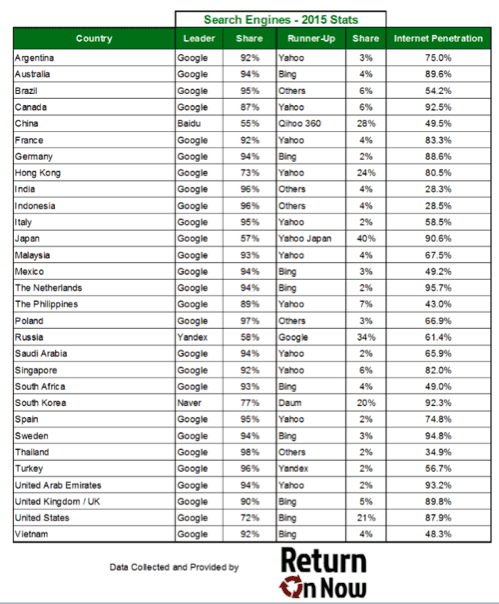
In China, Baidu dominates the market rather than Google. In Russia, the market leader is Yandex. Interestingly, due to the region's history, some Eastern European countries use both. You may find that in certain countries the market for paid advertising on Google is saturated and therefore very expensive – but Bing may turn out to be a good alternative.
Understanding that you'll need to spend time sending specific signals to search engines (possibly not the ones that you were expecting), and having a general idea of the amount of traffic that will be coming to your site is important. This will help you to start planning for the time, money and effort that needs to be spent on your website(s).
If you're going to do international SEO you need to be organised and you need to do it right the first time.
Website Structure Choices
When building websites for international markets, you have 3 main choices of website structure to choose from: country-coded top-level domains (ccTLDs), subdomains and subdirectories.
CCTLDs
This option requires you to buy country-coded top-level domains that are tied to each specific target country (for instance www.example.fr).
It sends the strongest geo-targeting signals to search engines and means that your server location becomes less of an issue. It also establishes trust in both search engines (there is no doubt that you are aiming to target a specific country) and people (if people see that a domain contains their country code, there's no doubt that they'll know that your services are available to them).
I'd highly recommend this strategy if you are only considering having 2 or 3 ccTLDs - any more and it will soon run up some pretty huge costs (buying each domain, hosting each domain, server locations etc - a bit of a logistical nightmare if you're trying to handle 15 sites).
However, there are also some cons: as just mentioned if you're trying to target more than a couple of countries, it can be a pull on your resources, and a costly option. Furthermore, the domains might not be available.
Finally, it means that your domain authority is going to be split between each site: which means even more work in terms of link building - if you don't have a digital marketing team who is hot on this topic, I'd avoid this option.
Subdomains
This means using a generic Top Level Domain Name (gTLD), with a country (or language) specific subdomain. For example: http://fr.example.com.
There are a number of benefits: they are easy to set up, this option offer for hosting flexibility and send the right geo-targeting signals to search engines. However, this option does also limit you as they are less trustworthy (to customers) and also split your domain authority (like the first option).
Subdirectories
This means using gTLD with a country or language specific subdirectory. For example: http://www.example.com/fr
If you are targeting countries where more than one language is spoken you will need a structure that includes both country and language subdirectories.
This option is particularly good for consolidating all of your link building efforts (the domain authority isn't split between multiple domains), it's easy to set up. Unfortunately, it doesn't send quite as strong signal to search engines as to the location of your site, but this can be corrected by indicating in Google Search Console, Bing Webmaster tools, using schema and with citation building for each subdirectory.
Some other cons: there is only one single server location, and also begs the question as to what you include n the domain's homepage (hw to send strong signals to show that your site is international).
Personally, if I were to choose I'd go for the following options.
- CCTLDs if I were only trying to target 2/3 countries
- Sub Domains if I'm trying to target more global markets as it's easy to set up and means that you don't have to carry out link building for 15 different sites. Huge players like Apple, Samsung and H & M do this.
Once you've settled on a website structure and translated your content effectively, you'll need to start doing keyword research.
International Keyword Research
Again, remember not to work with literal translations, they won't always be relevant and may not be the terms that people are searching for in your target country.
Start by translating and localising your current keywords and do some competitor research to see what terms they might be using. A great tool for this is SemRush, which can be used to see the terms that your competitors are ranking organically for or advertising with online:

This will enable you to come up with a preliminary list of terms. Then use the relevant keyword planner or tool to broaden your keyword lists and see which terms get searched for (remember to correctly set the language and location setting when searching):
- Google AdWords Keyword Planner
- Bing Ads Keyword Planner
- Yandex Keyword Statistics
- Baidu Index
Pick the optimum keywords for your selected landing pages, optimise them and the translated content. In order to do this, here is a comprehensive guide on keyword research by ahrefs, as well as a helpful SEO checklist.
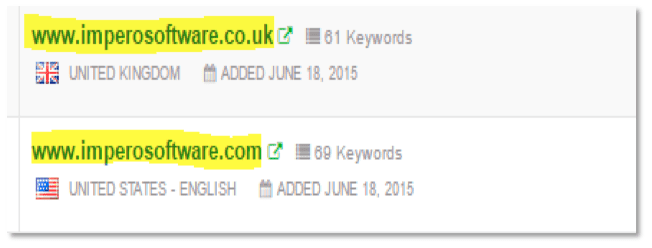
You can use Authority Labs to track your international rankings to track your progress:
Technical Signals
The following technical signals must be put in place on your international sites in order for search engines to completely understand what languages and locations your sites are trying to target: the better they understand this, the easier they can serve your sites to the relevant people.
1. HrefLang Tags
These tag allow you to cross reference pages with similar content for different audiences (as an example, they tell search engines that although the content may be similar, one page or set of pages are for French speakers in France, while others are for French speakers in Canada and other ones are to be serve to Spanish speakers in Chile).
These links enable you to find the relevant codes for both language & country.
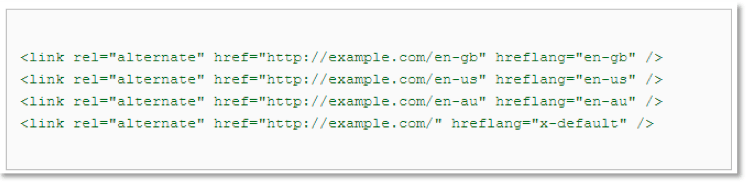
The tags are added to the <head> of your website (as well as the self referencing ones). This is what they should look like:

And here are the tools to help you create them:
hreflang tags generator tool
hreflang XML sitemap generator
If done properly, once the sites are added to Google Search Console, it will tell you whether or not they are working. If they are not, it should give you an indication as to why they are not.
2. Meta Content Language Tags
These indicate the language and country in the <head> section of web pages, thus indicating to search engines the target audience for the page. Such as:
<meta http-equiv="content-language" content="en-us">
3. X Default Tag
This tag signals pages that don't target a specific language or territory, and thus tells them to refer to the “default” page. This is what this looks like:
4. Schema Markup
Adding schema markup is a great way of indicating to search engines what your website is about. Schema markup is a collaboratively created, universal language that all top search engines in the world use to easily understand websites.
With Google Tag Manager, markup each specific subdomain (or ccTLD) with Organization and LocalBusiness markup to tell them where that part of the business operates. Here's how to do just that. An added bonus is that schema is also a ranking factor and can help the knowledge panel to be displayed in local search results for your business.
Geo-targeting
On your website, and in your website's code, you have now implemented all the relevant signals: an international site structure, language specific content that is optimised following specific keyword research and competitor analysis, all the necessary tags, localised content, tone of voice, imagery and call to actions.
Unfortunately, the job is not over, you now need to tell search engines what to do with your site. You should have Google Analytics installed for each property and each property needs to be added to Google Search Console and Bing Webmaster Tools.
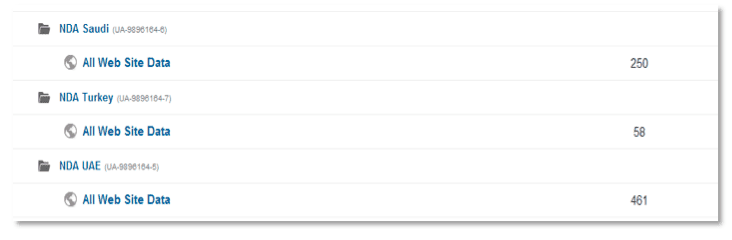
You can track all domains, (or sub-domains and subdirectories) separately in both Analytics and Search Console like so:
Analytics:
Search Console

To do this:
You can geo-target your site using your website structure. Set specific properties in Google Search Console & Bing Webmaster Tools:
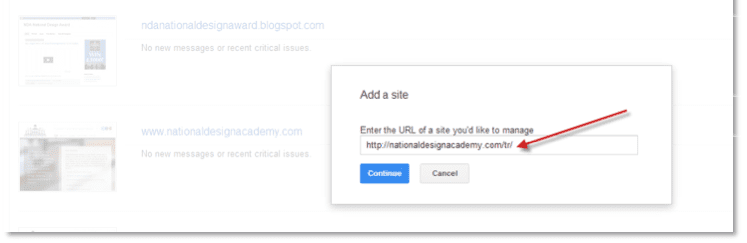
Then, within Search Console, make sure that your HrefLang tags are working:
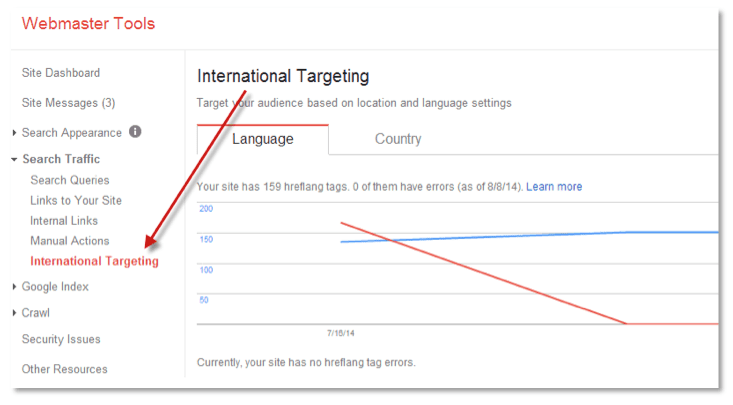
And that your international country targeting is correct:

(if you've used ccTLDs this will automatically be detected).
This is where to look for the same settings in Bing Webmaster Tools: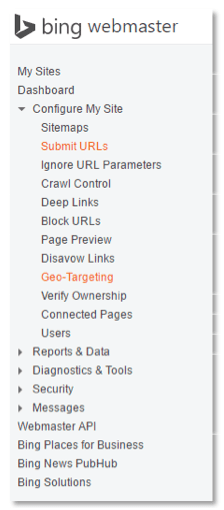
And here is where you select the location to target:

Once all of this on page work is done, you need to work on off page signals. In particular: domain authority.
International Link Building
This is essential, in particular for websites structured with ccTLDs and sub-domains.
Link building will help to promote your international website, drive relevant local referral traffic as well as build domain authority, which will help with the visibility of your international website in search engines. So, some things to consider:
- local citation building
- Competitor research, as well as general research, can help you to find websites relevant to your market, that can show you interesting types of content that you can also create.
- it can also help you to understand cultural factors within your target market & build relationships with local influencers and media
You can use BuzzSumo to discover what topics and types of content work best in your target market (and also see what has worked well for competitors):
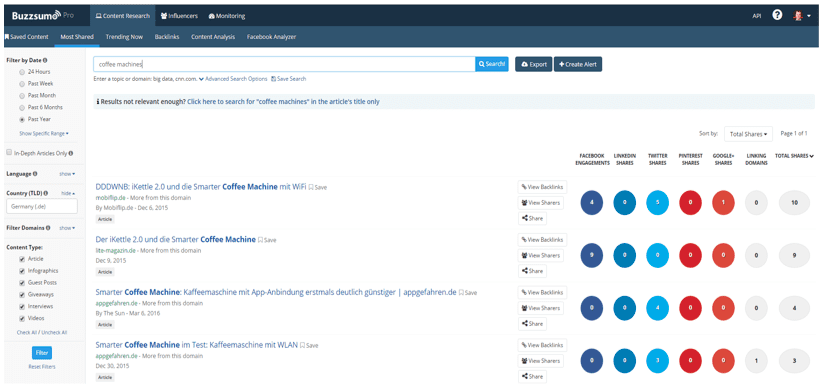
Use this research to help build up your own content strategy. Create attractive and optimised content for your audience (about your products, services, long tail search queries such as FAQs and blog posts), which will then earn you links.
SEO is a long term strategy, and will only work if you dedicate time to it - make sure that each country has it's on unique strategy as a one-size-fits-all approach will not be suitable.
International PPC
While you're waiting for your international website to start ranking against local competitors, it may be worth trying out international PPC to hit the ground running.
Standard paid advertising rules all hold true in foreign markets: you'll still have to think about changing CPCs, quality scores, your average ad positions, and sending your visitors to relevant landing pages.
However, international PPC campaigns also have their own specificities that you cannot ignore. These go much further than simply asking yourself “how to use Adwords”, and demand excellent knowledge of a country's search behaviour.
Good Market Knowledge
As mentioned previously, knowing your target market is essential, hence the preliminary research you conduct before anything else when developing an international digital marketing strategy.
With regard to international PPC campaigns, this specifically means looking at:
Dominant Search Engines
These could be Google, Bing, Yandex, Baidu etc - if your target market is saturated in Google, Bing could be a good option. This research will help you to figure out budgets, the scope of the project, what platforms to familiarise yourself with, and so on.
Target Audience
Are the people you want to advertise to, the people who are buying online?
Cultural Habits
As mentioned, these affect web design, as well as advertising.
For instance, if you are trying to sell to a Chinese market, it's important to know that the colour of wrapping paper holds its own special significance: red is reserved for gifts, yellow paper with black ink is reserved for parting presents for the dead.
Either way, the fancy new wrapping paper that went down a storm in the UK might not elsewhere, so make sure you know that you won't accidentally offend anyone.
Competitor Landscape
IT may well be the case that the paid market on AdWords for your industry has been saturated, making CPCs very high, in which case you may not be able to participate due to your budget restrictions.
Cost Per Clicks
Although there is no exact science to this (as it depends on industries, market saturation, your competition etc), it's good to get a benchmark on CPCs. Wordstream wrote an article containing average CPC by country. It also lists the most expensive regions in the world.
How to Structure Your International PPC Campaigns
Targeting multiple countries with multiple budgets and trying to measure ROI in each region means one thing: you have to be meticulously organised.
Create Country Specific Accounts
This is by far the easiest way to measure the performance of your country specific campaigns (and is also useful as currencies can only be set at account level).
Language Specific Campaigns
I would highly recommend having separate campaigns for different languages.
So if you have an account set up for Switzerland, you can then set each campaign to target a specific language (in this case French, Italian, German and I'd also recommend English). This means that you can add specific language and geographic settings, bid adjustments, extensions etc. It also enables you to easily add keywords or ads in specific languages. This means that everything is kept pretty simple and extremely organised.
It's useful to note that AdWords allows for extra characters in ad titles and descriptions that target certain Asian or Eastern European countries – find out more about this here.
The key to international PPC is consistency: you need to have a Danish campaign targeting the Danish language in Denmark, that uses Danish keywords to trigger Danish ads that lead to a Danish website.
As a side note: it may be worth testing out an English campaign, regardless of the country that you want to target. This allows you to reach English people living abroad: this may or may not work, but it's always worth testing out, particularly as a lot of businesses in Europe conduct business in English.
Time Zones & Currencies
Remember time zones in order to set ad schedules and to set your bid adjustments. When targeting a country with multiple time zones, create a separate campaign for each time zone as it'll make your life easier in the long run.
International Social Media Tips and Considerations
Social media marketing takes up a lot of time and requires you to proactively engage with your audience and also be on the ball in finding and identifying trends.
The first question you need to ask yourself is this: are you going to have one social media profile per platform, or a profile per country. This depends entirely on your resources, the amount of people available to help with it (and whether they know what they are doing, have a strategy in place and the time to do it).
These decisions are entirely up to you and your business. Two things I would definitely recommend thinking about are:
- if you are going to have separate profiles per country, make sure that they are active and all carry your brand message. It may be worth taking the time to write out a brief, explaining to the social media manager in each country what they can and cannot say or do on social media. You want consistency in messaging and in your brand values.
- if you opt for the option of having 1 profile that you will use internationally do not post the same post multiple times in the same language. It looks unprofessional, counts as duplicate content and will not reach the right people. If you're going to use 1 profile universally, make sure that you are an expert in each social media platform's language and geotargeting options. Your French post should only be seen and advertised in France, not in Spain or it will disillusion your Spanish customers.
Other considerations
Just as search engines vary in different countries, unfortunately so do social media platforms. You need to research social media platform usage before you try to advertise. We all know that Facebook is not available in China, for instance.
Luckily, We Are Social did an in-depth research report (over 500 slides), that provides a huge amount of country specific data on social media usage in most countries - check out your specific target market, what channels they are using and familiarise yourself with them.
Whatever platform you choose to use, make sure that you are regularly posting interesting relevant content (as part of your international content marketing and link building SEO strategy) that your audience wants to read and will share.
You should also use Hootsuite to monitor mentions of your brand in each country and respond. It will also help you to ensure that your content is being seen (or not) by relevant accounts and thus enable you to tailor your strategy further
Although there seems to be a lot of stuff to consider to reach international audiences, most of it comes down to common sense so do not let this post intimidate you. The main things to remember are:
- organisation and planning are key
- you must be thorough the first time round (or you will have a lot of patchy fixes to carry out)
Good luck!
Thanks to Eleanor Reynolds for sharing their advice and opinions in this post. Eleanor Reynolds is a Digital Marketing Executive with a particular interest in International websites and the Third Sector at Hallam Internet You can follow him/her on Twitter or connect on LinkedIn.
02 Jan 17:47


Entering Protopia and a world of continuous marketing disruption
by Mark Schaefer

By Mark Schaefer
This is the time when we turn to the challenges of the new year and changes we’re likely to face. My prediction for 2017 is that this is the year of marketing protopia. I’m sure this is an unfamiliar concept, so let me explain why this will be the major theme of your professional life for years to come.
Although it may seem like we have been in a world of rapid marketing technology change, we really haven’t. Largely, we have lived in a business world of peaceful evolution.
In the last 50 years, what have been the forces that have completely disrupted marketing?
- In the 1970s, there was one: cable television.
- The 1980s saw the dawn of the Internet and mobile technology but change from a marketing standpoint was incredibly slow. In fact, most business leaders at the time viewed the internet as a passing fad and saw no commercial value in it.
- The 1990s brought about some early advertising and web-based marketing as search became a mainstream utility but again, change came about over a period of years.
- By the mid-2000s we witnessed a true information revolution enabled by smartphones and social media. But change still occurred in fits and starts — Ten years later, many companies are still just getting into social media and mobile marketing. It’s been a joke among my marketing friends that it has been “The Year of Mobile” for the past five years!
My point is that we may think of ourselves as being in a revolution but it’s been relatively slow and steady iterations. 98 percent of all marketing investments have been in the same seven social media platforms for the last four years. And by the way, Snapchat, the hot newcomer, has been around since 2012.
The martech space is awash with hundreds of lookalike companies offering little in terms of revolutionary points of differentiation. All that is about to change.
The Protopian Era
In 2017 the era of sluggish marketing change will be over, forever. Vast new technological capabilities are sweeping over the landscape, ushering in an era where the very psychology of the marketing function will be forced to change.
Before I get into these changes, let’s get back to this idea of “protopia.”
In his seminal book The Inevitable: Understanding the 12 Technological Forces That Will Shape Our Future
I can see this world before us now. While we may have had time to digest and master incremental changes to a Facebook algorithm or a new opportunity for native advertising, the new pace of change will certainly dispel the notion that anybody can be an expert in anything.
Kelly writes that from here on out, every professional will always be a “newbie.”
He explains, “First, most of the important technologies that will dominate life 30 years from now have not yet been invented, so naturally you’ll be a newbie to them. Second, because the new technology requires endless upgrades, you will remain in the newbie state. Third, because the cycle of obsolescence is accelerating (the average lifespan of a phone app is a mere 30 days!), you won’t have time to master anything before it is displaced, so you will remain in the newbie mode forever. Endless Newbie is the new default for everyone, no matter your age or experience.”
The tech sweeping marketing
 I agree that in 2017 we will all become endless newbies because we’re entering what amounts to a new operating system for the marketing profession.
Foremost among these shifts is artificial intelligence. While we see ads about IBM’s Watson perform gimmicky party tricks like designing a glowing dress or a personalized cocktail, the true impact of cognitive computing will be profound as it is finally understood and commercialized. Task-specific pipelines into these AI supercomputers will fuel everything from human-like chatbots to automated marketing programs that create strategies … and execute them (including writing, optimizing, promoting, and measuring the content).
This contributes to the protopian landscape because artificial intelligence will create change that creates even faster change.
Another protopian force in marketing will be virtual and augmented reality. The geeky black VR headsets are mainstream technology, ushering in a revolution in how we connect and communicate with customers.
I see virtual reality as a marketing “re-set.” The backlash against annoying marketing and invasive advertising has resulted in filters, ad blocking, and consumer mistrust. Connecting through the entirely new platform of virtual reality gives marketers a chance to say “We’re sorry. Can we try this again? This time the value will be real.” At least, that’s my hope.
AR/VR offers companies the opportunity to lure consumers out of their filter bubbles with awesome immersive experiences.
The third transformational trend will be security … or the perhaps the lack of it. We hear about just a small fraction of the nefarious hacks holding companies and individuals hostage. How does marketing change when customers can’t trust the eCommerce systems that hold their financial information and deliver their products? Today it is concern, but the situation is getting worse — much worse — and every newly-connected node is another vulnerability point.
Implications
What does this mean to me and you? I’m not sure yet other than I’m feeling a bit dizzy!
I do think there will be a role for humans in this protopian world, but it might mean micro-specialization — becoming experts on small chunks of the marketing technology puzzle. In a world where marketing strategy can be commoditized, these trends provide an opportunity for exceptional human minds that can distill competitive advantage through insight (at least for now). And I think it is going to eventually mean a lot of job loss as more and more traditional marketing functions are automated.
This will certainly challenge company cultures. A wider gap will form between those who can adopt and adjust and those who cannot.
I also think this is a technological era that will solve huge problems for both companies and consumers. Ironically AI technology will mean a more human experience, a more respectful and intimate web experience. We’ll be able to connect with perfect sales or service experience every time.
In any event, I look forward to exploring these ideas with you on {grow}, this year and beyond. What are your thoughts on the change and challenge ahead?
 Mark Schaefer is the chief blogger for this site, executive director of Schaefer Marketing Solutions, and the author of several best-selling digital marketing books. He is an acclaimed keynote speaker, college educator, and business consultant. The Marketing Companion podcast is among the top business podcasts in the world. Contact Mark to have him speak to your company event or conference soon.
Book link is an affiliate link.
The post Entering Protopia and a world of continuous marketing disruption appeared first on Schaefer Marketing Solutions: We Help Businesses {grow}.

Comments
- I'm not offering an original opinion here. This is the general ... by Mark W. Schaefer
- I get what you are saying, but do you think that mankind has ... by Sandee Rodriguez
- Thanks for the insightful commentary Jim. I agree on all points. by Mark W. Schaefer
- Two thoughts this perceptive article brings to me: (1) Your ... by Jim Shankle
- Steve, your comments are on target. Vendors' promises have ... by Bob James
- Plus 4 more...
Related Stories
02 Jan 17:47


To Lead a Digital Transformation, CEOs Must Prioritize
by Laurent-Pierre Baculard
Given the pace at which digital innovation is disrupting industries globally, it’s not surprising that most CEOs feel pressure to find and deploy the right technology as fast as their budgets will allow. Many are discovering, however, that becoming a digital leader isn’t simply a matter of technological savvy. It’s about creating an agile organization that can detect what type of change is essential and respond quickly with the most competitive solution.
In our experience, most companies are already steeped in technology and learning fast about how it can transform their businesses. Typically, teams in the field are well aware of the digital threats and opportunities within their area of the organization – usually more so than the corporate center. They have launched their own apps, deployed robotics, established partnerships with digital players, or are using data to analyze their business and make better decisions.
The problem is that that these efforts tend to be ad-hoc and uncoordinated. Without the proper framing and orchestration at the overall company level, the best initiatives will fail to get the attention and investment they need. While it is important to encourage local ownership of ideas and projects, turning them into game-changers requires clear, sometimes ruthless direction from the center around which projects to scale and in what order. Only the CEO has the power to provide this kind of direction across the entire enterprise.
To do that effectively, CEOs need a holistic view of the digital threats and opportunities facing key parts of the business, and a way to link them to an overall vision for how digital is reshaping the competitive landscape. This brings order to the chaos of initiatives and provides a clearer basis for narrowing down priorities and managing the cross-functional interdependencies that the best digital solutions often present. Three ways to manage the digital transition are:
Define where change is needed most: Digital technology affects every company differently, but it tends to create or destroy value in four critical areas of the organization: customer engagement, digital products and services, operational performance, and preparing for disruptive new business models. Developing a clear point of view on the opportunities or threats in each area will suggest which capabilities need the most attention and where to concentrate investment.
Consider how General Electric arrived at the decision to develop and launch its Predix cloud-based industrial operation system. The initiative began when GE’s CEO encouraged his organization to explore how the accelerating trend toward value-added services in the industrial sector might eventually affect the company’s growth. In essence, he challenged his team to act as a change leader – to disrupt before being disrupted — by interpreting the weak signals coming from the market. He asked them to pay special attention to how digital native companies were creating shifts in customer behaviors and to diagnose digital solutions for business challenges that had not yet taken a toll on the company’s profit and loss statement.
Launched in August 2015, Predix helps companies see how their machines and infrastructure are performing so that they can improve them constantly. GE has treated the platform as open source, reasoning that it will power the growth of the industrial Internet, which will in turn accrue major benefits to GE. Its early success also highlights the CEO’s critical role in challenging the organization to assess its digital competence and to determine how urgently it needs to respond to threats and opportunities.
Choreograph the change: Even the clearest digital strategy will fail if your people are unprepared to embrace it. As critical as defining where you need change is setting up the capabilities and processes that will enable it. IT, for instance, is very often the tightest digital choke point because it is mired in old processes and needs significant reshaping to link it more closely to strategy, while creating a more agile approach to development. It is also essential to develop key capabilities in data analytics to make better decisions using the flood of new information flowing through the organization.
Ensuring that change sticks involves the hard work of defining new roles, adding new skills and adopting new ways of working. And it is important to carefully choreograph the change, defining who will lead the effort and how it will be sequenced.
Mobilizing for this kind of change inevitably means shaking up the status quo and leaders themselves need to be prepared to manage the company differently. Consider the challenge companies face in the rapidly changing market for power train compressors. Increasingly, competing in this market means equipping compressors with hundreds of sensors that send information back to the manufacturer about power consumption, vibration, wear and output. Manufacturers then analyze the data remotely to predict problems their customers might face and offer solutions proactively. Blending the hardware with digitally enabled services creates measurable customer value. But taking full advantage of it requires significant cultural changes. Product development teams have to work with field maintenance and commercial teams. Data management teams have to develop the predictive algorithms to improve the customer experience in coordination with the customer-facing teams. Marketing, commercial and finance have to work together to develop new pricing models. All of this has to happen fluidly and rapidly. The old system of passing possible solutions across silos, wading through validation loops and meeting threshold tests simply isn’t fast enough.
Empower people: One clear implication of this approach is the central importance of an orchestration model for digital —prototyping, risk-taking, and mobilizing the frontline to push concrete initiatives. Many of the leading digital models to date have been distributed globally throughout an organization via “digital relays” or champions within each geography and business unit. They are centrally orchestrated at a cadence that improves uptake and so the design remains consistent where appropriate.
This “project team”-based approach relies on empowering people at every level of the organization to work together to devise and implement solutions. Again, that requires some critical organizational and cultural changes. Everybody, for instance, needs access to customer data and the analytics and visualization tools used to interpret it – information that is typically hoarded in a particular part of the organization. This “democracy of data” frequently puts pressure on the middle managers in charge of it and passes decision rights to many others.
Only the CEO can manage this process by breaking down the appropriate boundaries, giving teams permission to set new rules, and providing the strategic framework to buttress the new order. It often makes sense for the CEO to delegate to an “orchestrator,” in the form of a Chief Digital Officer. But that person needs to be fully empowered to compel change across the organization in the name of the CEO. There isn’t time for anything else.
02 Jan 17:45

Is cold calling right for your business?
by steli@close.io (Steli Efti)

“Should we be doing cold calling?”
A lot of new founders and small business owners ask themselves this question.
First of all: Cold calling isn’t dead. It can enable incredible growth and millions of companies are growing rapidly as a result of it—even Uber started out cold calling. If you know how to use it, it will be of great value to your business, too.
In this post, I’m going to give you two highly tactical question that’ll help you determine whether you should be doing cold calling.
Get free access to our B2B cold calling course and start using cold calling to increase your revenue.
2 simple questions to determine whether you should cold call
We’ve written a lot about cold calling in the past, but we’ve never tackled the question, “Should I be doing cold calling?” The answer is not far away.
Start by asking yourself these two questions:
- Do my customers buy over the phone?
- Do my competitors successfully use cold calling?
These two questions answer one core question: Is cold calling a channel that will help me successfully reach my customers and sell to them?
There are two main ways to find out if your customers are likely to buy over the phone.
- Learn from your potential customers.
- Learn from your competitors.
Here’s how to do it.
Learn from your potential customers
Let’s say you’ve created an ideal customer profile. Next, find your ideal customers and survey them.
Ask:
- Are you being cold called today?
- Have you ever been cold called?
- Have you ever bought anything after a cold call?
Survey your potential customers and learn from them.
If your prospects tell you that they don’t buy over the phone, ask them why. Is it because nobody ever cold calls them? Or is it because nobody reaches them on the phone?
If your prospects are receiving a lot of cold calls, but the pitches suck, well— that’s a good thing. Because naturally, a huge part of cold calling is being able to reach your customers. It's also means learning how to cold call the right way will give you a leg up over the competition.
Learn from your competitors
Ask yourself if there’s a company in your industry that’s currently doing cold calling.
Do they have the same type of customers as you and are they succeeding with this strategy? You’ll want to talk to these companies, so start dialing.
Don’t know how to get started with calling your competitors? It’s easy. Call your competitors on their main sales line. Shortly, you’ll find yourself speaking to someone that’s very likely to be a junior rep. Just keep calm and act like a prospect.
Here’s the thing: You don’t even need to lie to them. If you approach the conversation the right way, they’ll want to answer all your questions. Why? Because you might potentially become a very important customer to them.
Eventually, you’ll get to the topic of how they grow their business and they’ll be happy to answer.
Let the data guide your decision
If your potential customers are buying through cold calling and if your competitors are using cold calling successfully, then the answer is, yes—it’s a strong indicator that you should explore cold calling as a channel for your business.
If your competitors tell you they don’t do cold calling, you’d want to know why. Did they try it? If so, what were the results? Did they not try it? Why?
Getting started with cold calling today
Let’s say you’ve answered these two questions and arrived at a “Yes.” Next, you’ll want to ask yourself two things:
- Is this the best strategy for your business? Based on all our options when it comes to reaching prospects, is this the best one? Is it cost-effective? Is it competitive? Is it a priority to explore this right now? Like any strategy, you’re going to have to invest time and resources into exploring whether it’ll work or not.
- Does anyone on your team have experience in cold calling? If not, will you train someone internally? Will you hire a sales rep?
While it’s tempting to just hire a pro, oftentimes the best thing you can do at this stage is to do the cold calling yourself. Even if you hate cold calling people and are bad at sales, you want to be the person speaking with prospective customers before you hire someone to do it for you. If you struggle with selling over the phone, we have a free cold calling course to help you.
Setting up your first funnel
You’ve decided to give cold calling a try. Next, it’s time to set up your first funnel.
Word of advice: Don’t overthink it. All you’re trying to do during your first attempt is see if you can close one customer.
Here’s what your first version of your cold calling funnel should include:
When you’re doing this for the first time, it’s very likely that the numbers you’ll get are horrible. You’ll have horrible reach rates, horrible qualifying rates, horribly close rates. But if you can create any results at all at this stage, it’s a strong indicator that there’s real potential for success.
These are the resources you need to create a basic funnel:
Keep it simple and focus on one step at a time. Can you reach one person? Can you qualify that prospect? Can you demo that prospect? Can you close the deal?
Once you’ve established a basic funnel, no matter how many flaws it has—that’s a great first step, now you can start improving it. (Don’t worry about the numbers at this point!)
A step-by-step course to get started with cold calling
If you don’t have a sales background, it’s probably daunting to get started with cold calling. That’s why we’ve put together a course that will guide you through all the steps involved.
Don't like reading? Just watch the video where I walk you through the entire post to help you figure out whether cold calling is right for you or not.
Recommended reading:
24 B2B cold calling tips for sales success in 2016
People say cold calling is dead because they work the phones like it's 1995. Here's how fast-growing companies cold call to drive revenues in 2016.
The fastest way to become a cold calling pro
Want to turbocharge your sales and prospecting skills for the phone? There's a two-fold approach that will beat any other method... and it's free!
How to create a sales call script [Free template]
Here's your FREE template on how to create a sales phone script. Proven script structure that will help you make better B2B sales calls & close more deals.
02 Jan 17:44
Excerpts from Deb Calvert’s talk with Linda Richardson on going beyond collaborative selling:
There’s a wealth of information in this one! Tune in to learn more about collaborative selling and sales conversations.
Collaborative Selling Was Only the Beginning. Buyers Want More.
by PFPS
Collaborative selling introduced the idea of working more closely with our buyers. But then technology clouded our judgment and interfered with our connections. With so much technology at our fingertips, it became too easy to get in touch with your buyers. But even though you’re plugged in with email, text, phone calls and more… are you truly connected to your buyers? It turns out that true connections are an important part of collaborative selling.
Join your on-air sales coach Deb Calvert as she interviews sales industry leader Linda Richardson in this archived episode of CONNECT Online Radio for Selling Professionals®. Linda describes the important findings reported in her book, “Changing the Sales Conversation: Connect, Collaborate & Close” and explains why collaborative selling isn’t enough. She describes what it means to truly have a connection with buyers. They’ll will discuss why trust and emotion are so important in collaborative selling, and how you, as a seller, can show your buyers a little love and stay linked to what’s important to them.
Linda Richardson is one of the top names in the sales world. Author of numerous sales books and named a “Top 20 Most Influential Training Professional,” Linda’s insight and expertise will help you engage in collaborative selling that connects you with your buyers.
Excerpts from Deb Calvert’s talk with Linda Richardson on going beyond collaborative selling:

Deb: “Why is it that sellers need to change the sales conversation and keep building upon their consultative building skills?”
Linda: “The reason for the change is because the buyers have changed… The internet has profoundly changed how the customers or clients buy, and it really changed what they value from salespeople. Client focus is very important, but what they value has changed. Therefore, what salespeople bring in the conversation has to change, too.”
There’s a wealth of information in this one! Tune in to learn more about collaborative selling and sales conversations.
This is just the start! Listen to Linda Richardson to learn more about the research that indicates how we should be interacting with our buyers. There’s no better way to maximize your windshield time than by listening to CONNECT! Online Radio for Sales Professionals®. We’ll help you cut out continuances, put an end to pending and stop stalling out in sales.
Listen To Business Internet Radio Stations with CONNECT1 on BlogTalkRadio
The post Collaborative Selling Was Only the Beginning. Buyers Want More. appeared first on People First.
02 Jan 17:43
Now Is the Time to Fix Your LinkedIn Profile—Here’s Why
by Susan Tatum

Have you been meaning to update your LinkedIn profile and just haven’t gotten around to it? You’re not alone, and I hope this article will lead you to rethink that position. That’s because the seemingly harmless act of ignoring your profile can cost you, especially in the area of new business opportunities.
Read on to see what happened to three professionals who didn’t update their profiles.
An inaccurate profile
Barry is a partner in a Tier 1 accounting firm. He’s been there nearly two years. He hasn’t bothered to update his LinkedIn profile since he joined the firm. It just doesn’t seem important.
When potential new clients check him out on LinkedIn (as 59.9% of them will do), they become confused. Barry says he’s a partner at Company A, but LinkedIn says he works at Company B. Which is true?
Doubt = risk = lost opportunity.
An incomplete profile
Rebecca is a partner at a top 500 law firm. Her LinkedIn profile is incomplete. No picture. No details beyond a list of jobs. She knows she needs to do something about it but she’s working her butt off and can’t give it the time.
Meanwhile, Austin is GC at a pharmaceutical company. He saw Rebecca speak a few years ago at a conference. He remembers enough to find her LinkedIn profile, but it’s practically blank. Although she works at a firm with a stellar reputation, he finds other attorneys with Rebecca’s experience who share their backgrounds. He’s more comfortable contacting them. He never gives Rebecca a second thought.
An invisible profile
Roger is a transfer pricing economist in New York City. There are 183 attorneys in New York on LinkedIn who might need his services. But Roger’s profile does not show up on a LinkedIn search. Instead, anyone looking will find 21 other people who can do the job. Roger never even gets a first thought.
Inaccuracy, incompleteness, and no search optimization. How much new business are you missing because of any of these?
The LinkedIn profile has become an essential tool for getting new business.
Not too long ago, Barry, Rebecca and Roger might have been able to ignore LinkedIn without too much ill effect. Client recommendations, a few speaking engagements, and publishing some articles were enough to meet most new business needs.
But the world has changed, and now more than 30% of professional services buyers find providers with an online search. In today’s market, even client-recommended future clients are checking out references on social media (source).
If you’re not putting yourself forward in the best possible light, providing relevant details, and allowing potential new clients to get to know you before committing to a phone call, you’re putting yourself at a great disadvantage.
4 reasons why buyers are making LinkedIn a key part of their decision-making process
Multiple studies have included questions to determine why buyers rely on social media in general, LinkedIn especially, to help them find solutions to problems and make buying decisions. The answers tend to fall into the following categories:
- Access: Social media provides buyers access to a much broader network of peers and experts than they can otherwise tap into. Think about it: let’s say you’re in the US and you need a consultant to help you determine why your employee churn is so high and to fix the leak. By running a quick search on LinkedIn you can identify a large portion of management consultants with experience in handling employee retention issues. From there you can reach out to any one of them for help. Where else can you do that?
- Trust: 58% of buyers say they go to social media to learn from trustworthy peers and experts. Buyers feel more confident they can identify true experts and get trustworthy information, especially on LinkedIn. I believe this is at least partially due to the transparency of the network. It’s much more difficult to claim false experience or accomplishments when those claims are easily viewed and disputed by people who know the truth.
- Efficiency: There once was a time when buyers had to shoot out email messages and call around to find out who might be able to help them. Then they had to contact each person individually to ask about solutions. Sometimes they had to go to conferences just to ask their questions. All this before even being sure of what they were looking for. Today, with the use of social media, buyers can connect with experts, get answers, and vet solutions quickly and easily from the comfort of their office, home or even the kids’ soccer match.
- Relevance: Buyers also like social media because it provides context in which to connect with providers. This is like attending an offline networking event or conference, except they don’t have to go anywhere. This is especially true of LinkedIn, which is a business-to-business networking site uncluttered with cat videos or other distractions.
So give them what they want.
Access. Trust. Efficiency. Relevance. These are all achievable starting with a complete, accurate, and polished profile.
Here’s how you can get started now:
Sometimes the hardest part is the first step. Go to LinkedIn and look at your profile. Does it need to be updated? Do it now.
If you’re the DIY type, you can download a free copy of our LinkedIn Profile Guide to help you create a more powerful profile (no form required).
02 Jan 17:42
17 Overlooked Content Marketing Promotion Ideas To Try in 2017
by Christina Milanowski

As marketers, we often face tight time frames and demanding deadlines when it comes to publishing our newest content offering. From hitting publish on your next blog post to promoting your next e-book or webinar, let’s all agree to make more time to focus on how to distribute our content wisely.
In 2017, we can buck the content marketing trend of focusing just on content creation and not enough on content promotion. Here are 17 ideas to maximize the ROI of our writing efforts:
- Landing Page – Maximize the web visibility of your content with a dedicated landing page. Landing page basics include: 1) Does your page look great on a mobile device (where many of your visitors may come from)? 2) Is there a clear call-to-action (CTA), as in, do visitors know exactly how to access your new content offer? 3) Is there persuasive text? and 4) Can visitors SEE what they’ll get for entering their email address? Show them a photo of your content offer—and bonus points if you explain it in a video with the author.
- Website – In addition to a dedicated landing page, make sure your latest content offer is easy to find on your website through simple navigation or, better yet, on your homepage with a CTA button. This may seem a bit self-evident, but, in our experience, can be easily overlooked in the rush to start content promotion.
- Blog – If you maintain a blog, craft a post (or two) that relates to your new content offer with a call-to-action button at the end inviting readers to your landing page. Expand on hot button issues, recap key statistics or trends, or continue the narrative with new facts or tips.
- Launch Email Campaign – You are six times more likely to receive a click-thru from an email campaign than you are from a tweet, according to Campaign Monitor. Email is vital to a content marketing campaign. So, on the day of launch, be ready with an email campaign that targets the potential customers for whom you have email addresses—encouraging them to check out your new content offer. As well, make sure you have marketing automation such as HubSpot, Marketo or Pardot set up to ensure your new leads receive prompt Thank You emails. One final tip: Be sure your emails are error-free by always proofing for typos and testing links.
- Marketing by the Author – If there’s a byline on your content, make sure the author serves as an advocate. Encourage them to share a link to the landing page on their social channels. Another common tactic is for the author to share an article about the content offering on his or her LinkedIn profile through LinkedIn Pulse.
- Customer Communication – While your new content may be targeted to potential customers, consider whether your new expertise could also add value to your current customers. If so, you could share the gated content with them or, to make it easier (since you already have their contact information), share the actual PDF or Word document of content in advance of it being distributed to outsiders.
-
Sales/Internal Champions – Make sure your entire sales department and other internal champions of your content know when it launches. Send a dedicated email with encouragement for your employees to share it with relevant contacts, and on their social media channels. Insider Tip: If you have a large employee base interested in promoting your content, explore a social media service like GaggleAmp or PostBeyond that enables employees to share approved brand content with their personal social networks.

- Paid Social Media Ads – Don’t forget that boosting social media posts about your new content offering can help increase visibility with new audiences. We recommend that our clients advertise on at least one of their social channels to their target market. For business-to-business (B2B) campaigns, we almost always recommend LinkedIn and Twitter advertisements to reach business influencers and decision makers. For business-to-consumer (B2C) brands, Facebook and Instagram tend to be the most powerful channels.
- Facebook – Depending on your social media strategy, consider how the new piece of content might resonate with your Facebook audience, which for some companies is more about workplace culture and boosting employee morale. Here’s one way: Spotlight the in-house expert who authored your content piece.
- YouTube – Marketers know that 2016 was the year of the online video with, according to Venture Beat, Americans spending an aggregate of 8,061 years on YouTube each day. Create a short video to promote your next content offer with a clickable link in the YouTube description box that takes video viewers right to a download of the content described in the clip.
- Slideshare – If you’re not familiar with this document-hosting social site, read Maccabee Public Relations’ blog post (“6 Business Benefits of Slideshare“) and then create a company or author account to which you can post a distilled version of your content. For example, when our agency’s content marketing campaign targeted at marketing and PR decision makers was slow to generate new leads, we reinvigorated it by turning our downloadable content (a LinkedIn marketing infographic) into a PowerPoint and posted it on Slideshare. It has since received nearly 10,000 views and directed more traffic – and new leads – to Maccabee. Insider Tip: There is relatively new lead generation capability on Slideshare. It allows you to embed a contact form into a Slideshare file and, for a few dollars per contact form submission, you can gain email information of new leads.
- Twitter – A few pointers for using Twitter to promote your content: 1) Don’t be afraid to tweet about the content multiple times. 2) Make sure your tweets have enticing images featuring your content. 3) Leverage hashtags and tag the contributors who helped with your content to maximize visibility.
- LinkedIn – LinkedIn is a powerhouse for B2B marketing. Did you know 80 percent of leads sourced through social media for B2B marketers come from LinkedIn? Be sure to post about your new content piece as a company update on your LinkedIn page, and work with your internal experts to do the same on their personal LinkedIn pages and in relevant groups.
- Pinterest – Pinterest can be a great way to drive inbound links to your new content, especially for B2C brands, whether that be a recipe, blog post or content landing page. Per the Online Marketing Institute, 80 percent of Pinterest activity comes from repins, so be sure your content can be found on the medium. Pin all your landing page URLs and blog posts to encourage sharing of them!
- Instagram – Create an Instagram Story and full-color photo series about your content that encourages your followers to check it out and, better yet, share your content with their friends and followers.
- Media Relations – Is your e-book authored by an expert? Does your white paper offer provocative new viewpoints on an industry topic? Don’t overlook the potential of strategic media relations/publicity outreach. Your new content offer can be a good reason for you to “check in” with key business or trade media, showing what your company has been up to—with an offer to interview the executive responsible for your content insights.
- Guest Author on Blogs – Explore industry-leading blogs in your space to find out if they accept guest posts or blog submissions. Online blog posts can drive direct traffic to your landing page. Also, our agency has found success in syndicating our authored articles on industry sites, such as Business2Community.
In the new year, help your content stay competitive in a busy internet space and do as content marketing guru Joe Pulizzi predicts: “Five years ago, enterprises were spending 80 percent on content creation and 20 percent on content promotion. I believe this ratio has switched, with successful enterprises creating differentiated content and putting some advertising and promotion muscle behind it.”
See the full list of 33 content marketing promotion ideas on MaccaPR.com. Which of these content promotion ideas was new to you? Share your undiscovered tips in the comments section, below, for all to see!
02 Jan 17:42
4 Easy Tactics for Infusing AI and Predictive Analytics Into Sales Processes
by Sean Zinsmeister

Unless you were hiding under a rock this year, you probably heard a thing or two about the rise of artificial intelligence (AI) for sales. As machine learning and predictive analytics technologies have rapidly matured, a whole community of forward-looking sales and marketing leaders are emerging as predictive innovators. Rather than relying on human intuition to inform their processes, these early adopters are leading the arms race for data by reinventing how their businesses operate based on intelligence that’s generated by AI and other related data science techniques.
In this environment, I’ve noticed four easy ways that smart sales leaders are hacking their team workflows to insert valuable data signals and key insights into day-to-day tasks—saving vast amounts of time and making sure all of their rep’s hard work is tightly aligned with the impact it delivers.
1. Use analytics to inform sales follow-up
There’s no doubt that confident and focused reps bring more opportunities into the pipeline. But it’s hard for them to feel confident when they’re given sparse lead records with little or no information about key buying signals – like a prospect’s fit for your product, or their likelihood to make a purchase soon based on marketing engagement. In order to avoid wasting hours every week researching leads, many teams are leveraging the latest predictive scoring and profiling technologies to create a habit of fast and efficient follow-up. When it’s easy for reps to prioritize the right prospects and plan their outreach, they follow-up more consistently, and as a result are more likely to hit their numbers each month.
For example, Shoretel is a company with a huge influx of leads, which market development reps individually call in order to qualify opportunity-ready MQLs. After adopting predictive analytics, the team started prioritizing their best-fit leads to qualify first, and MDRs went from having to call 100 leads to find 1 MQL, to just 12 calls per MQL – a huge productivity improvement.

With detailed information about each prospect, sales reps can also personalize every conversation for better engagement. By using advanced profiling techniques to create highly-segmented lists of prospects based on specific attributes and data signals (such as “VPs of Sales, in California, who use Salesforce, and have interacted with one of our marketing campaigns in the past 6 months”), reps can quickly sort out the best way to approach each group. For instance, that might send a particular piece of content or invite the prospects to a local meetup. Some tools even let you set up alerts for important events, auto-assign tasks to reps in Salesforce, and get recommendations powered by machine learning on which segments to invest more time into.
2. Assign territories based on predictive account scores
When your business relies on outbound prospecting to named accounts, it’s especially crucial to go after the best accounts first. But if reps’ assigned territories don’t contain an even distribution of top-scoring accounts, some members of your team will have more promising prospects than others. Predictive analytics lets companies like Xactly, New Relic and Okta make data-driven territory assignment decisions based not just on arbitrary geographical borders, but on where their best accounts are concentrated, giving each rep an equal shot at closing new business. This both improves the structure of their teams, and eliminates pressure on reps in low-concentration regions to manually search for new accounts that might not be a fit at all.

3. Tap into AI for expansion into new markets
In addition, this same insight can help teams identify good opportunities for expansion. Predictive account modeling can be a great help as you build your hiring roadmap, because it lets you hone in on industries or regions where it’s easy to justify an investment based on clear revenue potential. You can also use these data points to validate marketing hunches as you test-and-invest in new markets. For example, the SMB customer loyalty company, Belly, was looking for additional brick and mortar verticals to attack, and used predictive analytics to score all of the new lists they sourced. This helped the company find new pockets of good-fit buyers before ramping up their sales and marketing investment.

4. Raise awareness with target accounts via predictive ABM
Lastly, by partnering with your marketing team to combine ad retargeting with best-fit account predictions, you can ensure your brand is staying in front of the accounts your reps are going after. AdRoll’s marketing team uses predictive scores to filter top accounts that are in talks with their sales reps, and then display re-targeting ads to key contacts at those accounts. This kind of air cover is the perfect example of true sales and marketing alignment, showing sales reps exactly how the marketing team is supporting them and making an impact on conversions.
Each of these four approaches can make a massive impact on sales productivity and revenue contribution with relatively little effort. There’s really no reason why you shouldn’t at least try out some AI-powered sales hacks to get a leg up on your competition. And the reality is that before 2017 is over, you won’t have much choice – most of the other players in your industry will be using predictive analytics and machine learning to fuel smarter sales strategies and tactics.
02 Jan 17:41
Attract More Leads for Your Brand With Magnetic Marketing
by Personal Branding Blog
 Having a stand-out content strategy is an important tool for your personal brand in which your business can establish itself as a leading authority in your industry. The type of content is also important to building your business online.
There are several ways that the right content can help build your brand, which can bring more website visitors and sales. Knowing what attracts your audience enables your company to know what topics to publish, and how to captivate them with a mix of images and text.
Building the right marketing strategy involves presenting your message at just the right time in a compelling way. Here are several ways your blog posts can be more successful:
- Stand out from the Rest – Make sure that what you publish is consistent with your overall brand message. Know what creates a response from your readers, and their likes and dislikes. Keep tabs on the most relevant topics and trends with analytics software.
- Find out what’s already out there – In order to find the best subjects for your community first take a look at what other leaders in your industry are publishing. Determine the audience reaction and ask yourself what your brand could offer that would best meet their needs and desires in a different way.
- Choose topics you know about – After establishing which blog posts you are going to present to your readers do an overview first of your base knowledge and experience in order to build authenticity and trust. You can insert personal testimonies in here that relate to something your brand has already experienced as well as expert interviews.
- Avoid information overload – Users are constantly being bombarded with information on the Internet and on social media. Use a systematic, focused approach that presents information in a meaningful and useful way. You can include helpful tips, videos, slideshows, infographics, ect. to better reach your audience.
Creating magnetic content throughout the month on a consistent basis will keep your personal brand at the forefront of your readers’ minds. As your visibility increases so does that fact that your are now seen as being knowledgeable in your area of expertise. Both quality and a thorough understanding will help your brand build a larger community online.
02 Jan 17:41
Odds & Sods
by Tibor Shanto
By Tibor Shanto – tibor.shanto@sellbetter.ca
Every year I jot down different ideas, always with the goal of fleshing them out and building decent post. For a myriad of reasons, sometimes these ideas don’t get developed, but unlike previous years, I am resolved not to let them evaporate with time. As a result what follows are ideas I think people in sales should be thinking about, but rather than waiting to polish them up, I am putting them out their in their raw state, and set them free to grow and evolve with you. Let me know what you think, push back, evolve the ideas, let’s see where they go, or not.
Benchmarking
Benchmarking is a good idea, but only if you are benchmarking for the sake of making progress. Set out to improve an element of your game, set a goal, measure where you are, develop an action plan, then execute. Going a step better, one can benchmark against another entity doing a similar thing, and see how you are doing vs. them in specific measures. In sports, it could be measures like goals against, team batting average, or in our favourite sport, average deal size, time to recover cost of acquisition or leads to opportunities converted. Many sales organisations are not as adventurous as others in what they choose to compare (benchmark), or who they benchmark themselves against.
So why is it that only the best choose to benchmark themselves against the best, or at the least, better than they are. While the weak and also-rans, always benchmark themselves against people “behind” them. What’s the point in measuring how well you are doing against someone who has figured out less than you, why not mark yourself, be you a rep or sales organization, against the best, or better than you. Sure you can pat yourself for being ahead of the lesser competitors, why not look forward and make gains, rather than maintaining an easy lead.
 2017 The Year Of Sales Enablement

Seems the marketing cooks in Salesland are whipping up something “new” for 2017. Top on the list is rebranding, because you know what they say, if you can’t innovate, rebrand. Just like the New Improved Tied, often the only thing new is the wrapping and the hype. Just look at the recent rebranding of Key Accounts to the new look Account Based Marketing, a brilliant twist emphasising something that really isn’t there.
While traditional product marketers may test the “new” in a limited way, do consumer surveys, and the occasional focus group. In Salesland, they are more prone to doing soft launches, and when enough people jump on, they go full hog, and ride that wave till it runs out of power.
But the big thing in Salesland, percolating a while now, shaping and defining itself, but now ready to be painted over the previous Sales 2.0 veneer, is Sales Enablement. Despite efforts, Sales 2.0 didn’t plant roots, there were those who tried to keep it alive well past it’s “good through” date, but the savvy in Salesland jumped ship early and went social. So now it’s time to rebrand and try to peddle the same old with a new twist and new tweets, well at a minimum new hashtags.
For those who doubt this make over, one need only consider “The Sales Enablement Society (SES, really close to SOS)”. Their stated goal “is to better define and ultimately solve, the vast disparities that exist in sales enablement roles and functions in organizations today.” A worthwhile exercise indeed – a good start would be a definition.
But I would imagine that if sales enablement continues to be different for those who sell services, from those who sell technology applications, it will suffer the same fate as Sales 2.0 and the Sales 2.0 Alliance, remember them? Can’t wait for the line up at the Sales Enablement Echo Conference.
Salesland needs to stop following false idols and embrace the one reality in sales, success is about Execution – Everything Else Is Just Talk!
Become one of the thousands of sales professionals receiving my latest updates on sales execution, tools, tips and more.
Join Now!
The post Odds & Sods appeared first on Renbor Sales Solutions Inc..
02 Jan 17:41

Stop Simply Monitoring Your Team and Start Actually Empowering Them
by Alex Hisaka

As a sales leader, you’re keeping close tabs on a variety of data to track a rep’s progress: qualified leads, expenses, and monthly sales target, among other metrics.
But the best sales leaders know that these metrics don’t tell the whole story. The most successful sales teams aren’t led by the managers who are best at monitoring metrics, but by inspiring leaders who are also great coaches. You’ve likely seen these leaders in action, and also observed leaders who certainly do not fit that category.
As more organizations make the move to adopt social selling—developing relationships with customers by leveraging your social networks—the more managers should embrace their roles as chief-enabler, not head number-cruncher. The good news is that the move to social selling can help facilitate this kind of enlightened coaching. Read on to learn how.
Engagement Metrics
If you want to be an inspiring and helpful coach, it doesn’t mean you should toss aside all your monthly numbers. But if you’ve embraced social selling, it’s best to look at new kinds of numbers tracking how engaged your reps are. The numbers show how many new customers your reps are connecting with, if they’re the right buyers at that company, and if they’re talking to them at the appropriate stage in the sales cycle.
Thanks to LinkedIn and other social networks, that engagement can be tracked, and can be part of your conversation coach reps. Take a look at one such tracking system – the Social Selling Index (SSI) for on LinkedIn’s Sales Navigator. That SSI, which is a score from 0-100, gives the rep more points if, for instance, their connections requests are accepted, which is one way to measuring whether reps introducing themselves to buyers in warm and appropriate ways.
Whether you use the SSI or not, a lesson can be gleaned from this kind of tracking: sales is about building and sustaining relationships, engaging with insights, and targeting those insights to the right people at the right time.
Coach Your Team to Engage Early in the Pipeline
By shifting your coaching strategy from monitoring sales quotas to enabling better engagement, managers will notice that their focus shifts from end of the sales cycle to the beginning. That’s because top-performing reps are facilitating warm introductions, nurturing buyers at every step of the sales process, and educating and listening to prospects rather than selling to them to early.
This early coaching has become key to gaining new clients, since 70% of a buyer’s journey is now complete before a buyer contacts a salesperson; your rep must influence that person early on to have a chance to close a deal down the road.
Scott Edinger, a management consultant who writes about sales leadership, is critical of managers who obsess over the status of deals close to closing. Instead, he writes that if you shift half of that time to the early part of the cycle, you can determine where along the journey your rep should place her focus to create the most value.
See How Buyers Respond
While you shouldn’t be single-mindedly staring at sales quotas, you should monitor how buyers react to your new tactics—and what reps can do better. Dissect the sales journey with your reps to review where he did well and where he fell short. Successes and lessons can then be shared with the whole team. The whole experience is then about getting better at your craft, something every good rep craves.
Modern sales techniques like social selling introduce a world of new metrics; some managers and executives may find them daunting. But if you’re paying attention to what really matters—empowering your reps to engage prospects effectively—you’ll be well on your way to building a world-class sales organization.
To learn how top sales leaders seized the opportunity of social for their organizations, download our free eBook: Crossing the Chasm: How to Capitalize on the Social Selling Trend.


02 Jan 17:41
20 Must-Join eCommerce Facebook Groups
by Nicole Blanckenberg
Make it your eCommerce New Year’s resolution to connect. Joining eCommerce Facebook groups with other entrepreneurs, business owners and eCommerce veterans can go a long way in helping to motivate you, guide you and give you ideas.
There are thousands of entrepreneurs who took the plunge before you, as well as many on the same journey as you, and joining groups is a great way to get in touch. Groups provide a platform where you can learn from others – anything from blog writing tips to online marketing – while you grow your professional network.
Here is a list of my favorite Facebook groups that every budding (or seasoned) eCommerce entrepreneur should join:
1: King Pinning
King Pinning is a closed group of over 17k members. The group was created to bring like-minded entrepreneurs together, who want to expand and grow their businesses. What makes this group great, is that they are pretty selective with their members, meaning it is totally free from spam while providing a platform for you to engage with other entrepreneurs.
2: A better Lemonade Stand
From SEO to CRM, a Better Lemonade Stand is an eCommerce Facebook group aimed at bringing passionate eCommerce business owners and industry leaders together. Discussions include a host of topics that include CRM, content, analytics, AdWords, SEO, SEM digital marketing, suppliers, product sourcing and Shopify platform tips.
3: My Silent Team
With over 32k members, My Silent Team is a great group where you can sign up for courses and learn from other creative and successful business owners. Created by author and successful podcaster, Jim Cockrum, wanting to connect entrepreneurs across the world with others in their areas.
4: Digital Marketing Questions
This niche Facebook group is ideal for those eCommerce owners who have mastered digital marketing or are looking for tips to help with the best practices. From SEO and Social Media to PPC and analytics, this is great group to ask questions, network and follow relevant industry content.
5: Ultimate Blog Challenge
I am a strong believer in creating a blog around your store niche, to increase traffic through SEO and content marketing. This group is specifically aimed at people wishing to grow their store blogs for that reason. It was created as a platform for you to be able to ask blog- related questions and share your content.
6: Screw the Nine to Five Community
One of my favorite Facebook groups, Screw the Nine to Five, is perfect for all budding entrepreneurs who want to be surrounded by people who “get” you. An amazing community that helps with feedback, support and information on a wide variety of topics from marketing to getting out of the 9-5 life.
7: Shopify eCommerce Group
Specifically for those eCommerce online store owners running their eCommerce business on Shopify, this group is a great place to network, get eCommerce tips and all-round motivation. A great community resource for solving all your eCommerce hiccups and getting real feedback from others like you.
8: Shopify Strategy
Another great group for Shopify store owners is Shopify Strategy. This is more of a niche group that focuses on sales strategies and Facebook selling. With over 22k members, all sharing and giving feedback, this group is an invaluable community for Shopify users.
9: Leads Traffic & Income Access
Something a little different, the Leads Traffic and Income Access is a group designed specifically to broaden marketing reach. Over 26k members share content, special offers and unique aspects of their business to help each other grow online traffic and get feedback.
10: Copy Monk
If you’re looking for copy inspiration for AdWords campaigns, your blog or social ads, then Copy Monk is the group for you. This Facebook group includes eCommerce veterans to help improve conversions with compelling content, offering tips, tricks and ideas to get your ad copy performing quickly and effectively.
11: The eCommerce Group
The eCommerce Group is a private group made up of over 6k vendors, merchants and eCommerce experts. The group was founded by John Lawson, CEO of ColderICE Media, as a forum for members to discuss SEO, social strategy, FBA, Amazon, Ebay, and eCommerce best practices.
12: Advanced WooCommerce
For the more experienced WP online store owners, Advanced WooCommerce is a place where store owners, WooCommerce enthusiasts and WP developers can share knowledge and ideas. It was created to help support those store owners looking for help on features and functionality to improve their WooCommerce stores.
13: Video Marketing Group
The Video Marketing Group tackles just that: video marketing. From marketing, ranking and production, to the best video marketing and marketing tools, this group is a great resource for eCommerce store owners looking to improve traffic through video marketing.
14: Magento Experts
If you use the Magento eCommerce Platform, then this is the group for you. Magento Experts is a forum created to help store owners get answers to platform questions, as well as to provide contacts for Magento developers for those big technical changes you may want to outsource.
15: Shopify Entrepreneurs
With over 21k members, this group was created for Shopify store owners, store managers and expert service providers that include developers, designers and marketers. The group diversity makes Shopify Entrepreneurs Facebook group an invaluable eCommerce forum for tips, advice and motivation. Plus, as a group member, you have access to an exclusive Shopify offer – win, win!
16: The Unofficial Shopify Podcast Insiders
The Unofficial Shopify Podcast Insiders Facebook group is a relatively new Facebook group made up of savvy, opportunity-seizing entrepreneurs. The only requirement to join this forum is that you have to have a Shopify store. It’s a niche group make it a great way to get one-on-one feedback from other eCommerce entrepreneurs.
17: The Amazing Seller
If you are familiar with The Amazing Seller Podcast, then you will love this Facebook group. The Amazing Seller discussion group was set up to discuss precious podcasts, picking up the conversation and taking it further, as well as providing a forum where you can help select future shows. Started by Scott, the aim of the podcasts and the group is to learn how to make making good money using FBA (Fulfillment By Amazon) and private labeling to sell physical products.
18: Grow and Sell
Grow & Sell is a Facebook group where you can discuss eCommerce ideas and best practices with other forum participants. With over 13K members, and growing, this group is the perfect platform to share success stories, get help and/or offer assistance. Although it is powered by Shopify staff and merchants, every store owner, or prospective entrepreneur, is welcome.
19: My Shopify and Ecom Empire
If you’re using an eCommerce platform other than Shopify, don’t be put off by the name. My Shopify and Ecom Empire is a helpful group for an eCommerce store owner using any platform. Whether it’s WooCommerce or Shopify, this group is the perfect place for store owners to exchange information and tips.
20: Niche Site Project 3.0
Niche Site Project 3.0 was set up by Spenser, the creator of Niche Pursuits. Niche Pursuits is a learning program for budding entrepreneurs where he shares what he is learning along the way in regards to SEO, creating valuable businesses online, and of course the tips and tricks he discovers for business in general. He created the group as a platform for students to interact with coaches, get exclusive updates, ask questions and swap strategies.
Have a favorite group of your own? Share them in the comments below.
31 Dec 18:37
Here are the craziest, most groundbreaking scientific achievements of 2016
by Kelly Hodgkins
The year 2016 logged some very exciting breakthroughs in science and technology -- we are closer than ever to an effective cancer cure, we soon will have self-driving cars and we possibly found the home planet for our alien brethren.
The post Here are the craziest, most groundbreaking scientific achievements of 2016 appeared first on Digital Trends.

31 Dec 18:37


See the rest of the story at Business Insider
9 books Richard Branson thinks everyone should read
by Chris Weller

Richard Branson, the Virgin Group Founder and self-described tie-loathing billionaire, still finds time in his busy schedule to read.
Over the years he has offered up dozens of titles that have kept his attention and helped him grow as a businessman.
We can't guarantee you'll follow in the entrepreneur's footsteps, but the books could certainly set you in the right direction.
SEE ALSO: 5 books the head of MIT Media Lab thinks you should read
"1984" by George Orwell
Though it may be a work of fiction first published in 1950, "1984" has been echoing ever since the actual year came and went. The book envisions a dystopic future society in which the government monitors, and in some cases punishes, people's every move.
Sales of the book spiked in late January of 2017 when Kellyanne Conway introduced the term "alternative facts."
Branson included it on his list of the top 65 books to read in a lifetime, in part because of its timeliness in reminding people to stay vigilant and skeptical.
"Black Box Thinking" by Matthew Syed
Failure is a key component of any successful system, but only if the people at the controls understand what went wrong.
In "Black Box Thinking," journalist Matthew Syed explores why some people try to ignore their mistakes and others confront them deliberately. Syed pushes people to adopt a growth mindset, as the psychologist Carol Dweck calls it, rather than a fixed mindset.
"It advocates for changing attitudes towards failure, and understanding that the only way we learn is by trying things and altering our behaviour based on the results," Branson writes on his blog.
"Ending the War on Drugs" by Richard Branson
Edited by Branson himself ("I couldnt resist sneaking in a book I contributed to," he writes) "Ending the War on Drugs" is a compilation of essays about the global drug war and the many failed attempts to end it.
"It brings together such a smart group of experts to explain why global drug policy reform is so important," Branson writes. The list includes philanthropist George Soros, former Mexican president Ernesto Zedillo, and former Swiss president Ruth Dreifuss, among others.
"Attitudes towards treating drugs as a health issue, not a criminal problem, are changing fast," Branson explains. "Anyone who reads this book will understand why."
See the rest of the story at Business Insider
31 Dec 18:37
Cold Calling Scripts: Dead or Alive?
by Frank Rumbauskas

Cold calling scripts are the most commonly recommended tool to assist a new salesperson in prospecting for sales. However, cold calling scripts are frequently overused, abused, and relied upon as crutches. This results in salespeople sounding like robots, and failing to come across as a human being with a real personality. And as anyone who is successful in sales well knows, personality is what really sells. People buy people above and beyond price, features, benefits, and even profitability.
Therefore, the problem with cold calling scripts in general is that they kill off any chance of making a real personal connection with the prospect, especially when they’re read verbatim and you end up sounding like one of those fundraising cold callers who manage to interrupt dinner hour night after night.
However, what if it were possible to personalize a cold calling script, and make it not so “cold” after all? It’s not only possible, but a relatively new sales tool has even made it easy: Social media.
If you’re any good at sales at all, hopefully you’re working lists of targeted prospects – even if you’re cold calling. Making cold calls for sales is bad enough, but if you’re doing it blindly and calling strangers completely at random, it becomes almost totally ineffective.
On the contrary, the smart sales professional always works targeted prospects. Before picking up the phone to make that call – or even consider how the initial contact will be made in the first place – a good sales pro will identify who his or her ideal prospects are, define the characteristics of those ideal prospects, and then begin compiling a list of whom to target.
If you’re in B2B sales, this is a piece of cake. You should be familiar with your territory and who is in it. If you’re in B2C sales, it’s not so cut-and-dry, but birth & marriage announcements in newspapers, as well as promotion and job change announcements in your local business journal – as well as purchased lists – certainly simplify the process and help you create a list of ideal customers for your product or service.
With your target list complete – whether it’s 25, 50, 100 prospects, or more – you can begin the research phase. Find out who the key decision makers are, and begin researching them on social media properties, particularly LinkedIn, the grandaddy of social media for salespeople.
Facebook is also useful for learning about the personal side of your prospects, and for identifying “icebreakers” that you can use when making the initial contact. These would be any common interests, such as hobbies, education, sports teams, and so on, that you can use as conversation starters.
Armed with this knowledge, it’s time to make that call. But, we’re talking about cold calling scripts, remember?
For starters, a sales script should never be more than an outline, or a roadmap for you to follow on your call. Structure it in bullet-point fashion, with flowchart navigation so you can skip to different parts of the script in order to expedite your call. For example, if your prospect is already familiar with what you sell, you can skip over that section and move on to the next, whether it’s identifying needs, or setting the appointment.
Remember that one of the leading causes of failure in selling is making the mistake of insisting on going through your entire sales process, or call script, or what have you – I’ve seen companies with “steps of a sale” as many as 20 (!) which certainly annoyed prospects and led to lost sales.
If I’ve said it once, I’ve said it a thousand times: If someone wants to buy, get out of the way, stop selling, and just let them buy!
With your outline-style script in hand, craft an introduction or opening line for each individual prospect, armed with some personal or professional insight about them – and hopefully some common ground – that you can use to open the conversation. Doing this shifts the premise of the call from business to personal, removing sales resistance and making it a thousand times easier to get in the door.
Given the difficulty of reaching valuable prospects on the telephone these days, an even better way to make that initial contact is to do it directly via social media. Facebook, LinkedIn, and direct messages on Twitter are all viable options for making an initial connection with your prospect and beginning a relationship that will likely end in a sale for you.
So remember, when considering the use of cold calling scripts, a script should only ever be used as an outline, and if you insist on using them at all, use the power of social media to learn as much as you can about your prospect, and customize that script for each individual call.
Learn how you can stop cold calling forever and become a sales rock star by downloading a 37-page PDF preview of the Never Cold Call Again System.
31 Dec 18:37


2016's Best of Power Tools & Accessories
Bigger, badder, beefier and better: Here's the best of what we saw this year in the power tools and accessories space.
You say you don't like removing and sharpening the blade on your 14" bandsaw? Well, try sharpening Hull-Oakes Lumber's 50-foot beast of a blade--which needs to be sharpened every two hours.
 Image by
 The brilliant QuadSaw attaches to your drill, allowing you to cut perfectly square and rectangular holes.
Another drill-o-vation: Worx's Switchdriver, equipped with a rotating chuck that lets you drill and drive without having to swap bits.
This year at Holz-Handwerk, which might be the largest power tool show on Earth, we saw Lamello's awesome, innovative Zeta P2 and P-System joinery method.
Fired your assistant, but need to break down some sheet goods? Pick up one of Mafell's self-propelled track saws, which we also spotted at Holz-Handwerk .
If you prefer your cutting be done by humans, check out the Straight Flush Saw, the "Swiss Army Knife of circular saws."
Sawing creates dust, of course. To protect yourself, pull on an Air+ Smart Mask--which comes with a built-in fan and exhaust valve that keeps the air you're breathing both fresh and cool.
via GIPHY
Sawing also creates flying debris, and you need to protect your eyes from it, but conventional protective eyewear often fogs up. So try the Safe Eyes goggles, which replaces the lenses with fog-free steel mesh.
This next one isn't powered, but might as well be: Check out BMI's inside-out, self-deploying tape measure.
Also from BMI: Check out their beautiful line of levels. Just because it's a utility tool doesn't mean it can't be sexy!
Lastly we've got a powerful tool that doesn't use power at all--just air. Check out the very clever Winbag air shims.
This year we were thrilled to bring on tool nut/carpenter/furniture maker David Frane as a correspondent, who'll be bringing you more tool goodness in 2017. Check out all of his coverage to date here.
_______________________________________
More from Core77's 2016 Year in Review
16(ish) of 2016's Best Materials Moments
10 Things 2016 Had to Offer to the Future of Transportation
2016 Best of Digital Fabrication
Footwear Designs That Pushed Boundaries in 2016
9 Ways Robots and AI Took Over 2016 + How to Cope
2016 Best of Alternative Living
31 Dec 18:22
Best Sales Hacker Blog Entries of 2016
by Chris Muyo
Despite many people proclaiming their “doneness” with the year 2016, we here at Sales Hacker want to look back at some of the many bright spots brought to our worldwide community this year.
The Sales Hacker Blog features posts from industry experts from around the globe, and we looked back at some stats to pull together the top ten posts of the year. These posts were among the most-viewed throughout the year, and we took into account the length of time the posts were up to give some great, more recent posts some love as well.
BANT Sales Qualification for a New Era by Jacco Van der Kooij
Jacco covers the origins of BANT as a sales tool for IBM and looks at the challenges BANT faces when applied to SasS sales companies. As sales and purchasing trends move, it might be time to re-imagine BANT for this new era, or even move on to something new. Jacco stresses knowing the client’s needs (a frequent 2016 theme) and making your value crystal clear to the decision makers looking to buy.
A Day in the Life of a Sales Development Rep by Dan Smith
This post goes through a minute-by-minute account of what an organized, high-performing Sales Development Rep should be doing on an average workday. Dan acknowledges the unlikelihood of an entire day going according to schedule and provides tips to get back on track and traps to avoid throughout the day. This daily plan offers ways to stay focused and reward yourself for jobs well done.
7 Tactics to Gain a Competitive Advantage by Alana Kadden Ballon
Alana drops seven different things you can do in a crowded marketplace to make sure you stand out from your competition. These tips help you understand how you relate to other companies in your space and manage operations and personnel internally to keep your organization at the top of its game. Her advice is tactical and practical and includes a sales tool to assist in applying each of her advantages to your operation.
How the Best SDRs Take Massive Action by Ralph Barsi
This is going to be a trend… Ralph highlights some of the best qualities of high-performing SDRs and explains how those traits help them stay on top of their game. Doing things such as maintaining a sense of urgency and cultivating both personal and professional networks set these top sellers apart. Practical tips about how they use LinkedIn, manage their calendar, and handle a demanding workload complete this thoughtful post.
The Evolution of Sales: Welcome to N.E.A.T. Selling by Richard Harris
Richard Harris debuts his evolved understanding of past sales formulas to introduce his concept of N.E.A.T. Selling™ (Need, Economic Impact, Access to Authority, and Timeline). Each part of the process connects you to your prospect’s organization and helps you best understand and meet their needs. Look at how this new approach might help you meet your goals in 2017.
Use this Jedi Mind Trick to get Prospects to Quantify on Demand by Waylon McGill
The Force is strong with Waylon McGill as he teaches us how to turn prospects’ qualitative explanations of their needs into a quantitative value you can sell back to them. Going into discovery understanding that prospects rarely quantify the negative value of their problems or the positive value of the right solution gives any sales rep a huge advantage. Waylon covers not only the right questions to ask, but the right way to ask them to get prospects to engage in fruitful conversations.
Why Partner Leads are my Favorite by Jen Spencer
Aside from being an expert on automation of marketing and sales data sharing, Jen also brings a wealth of knowledge about cultivating leads from partners. Her insights in this article focus on how to formulate rewarding, symbiotic relationships with organizations that turn into solid leads. People are most companies’ best assets, and partnerships that allow both parties to thrive are essential moving forward.
How to Know if a Deal will Close: A Three-part Checklist by Dan Murphy
Dan makes it sound simple enough. Give your prospect a concrete, quantifiable benefit (a common theme on this list); identify and attach your solution to your prospect’s timeline driver to create urgency; and make your selling process compatible with their buying process to make it easier to close the deal and get to work. Dan reminds us to remain skeptical and know the value of your time when getting a deal done to make sure you don’t waste your time on a bad-fit customer.
9 Questions you should Always ask your Prospect by John Barrows
This comprehensive list of questions gives you the asking power to find out everything you need to know as you move forward with a prospect. What is the timeline? Who makes the decision? What problem are you trying to solve? This has it all. And it helps you find the right words to use when asking so you don’t sound like a robot going down a checklist. John includes some questions to avoid asking as well so you see the difference between effective and ineffective questions.
7 Signs you should Pivot to an Account-based Sales Development Process by Sean Kester
Account-Based anything seems a trend as we wrap up 2016, and Sean provides some insight on the point of realization that you need to move in that direction. The process of transition is arduous, and this article provides some food for thought when making the decision to switch. Most of the signs have to do with predictability and knowing where your company is currently and where it is heading. Give it a read and see if 2017 is the right time for you to make the jump.
The Lifeblood of the Best-Performing Sales Organizations by Katie Bullard
Katie shares her experience in sales by telling how data flows through an organization like blood flows through a body. It is the most important and nourishing moving part of the operation. But like blood, data can become poisonous if not clean and healthy, and Katie offers tips on what to look for, how to fix infections, and what you can do in daily operations to keep data flowing and healthy.
The Right Way to Run a Software Demo by Matt Tortora
This post is a good refresher for anyone who goes through the same demo over and over every week. That stuff gets stale in a hurry, and John’s tips for delivering a demo the right way are great reminders on how to remain high-performing. Choices about the technology you use, the content you present, and your method of presentation all matter to the prospect seeing your show for the first time. Think about this when refreshing your demos for the new year.
How CRM Data Entry is Eating your Sales by Vincent Jong
Four to six extra hours of selling per week would probably help your sales team meet goals and your company as a whole thrive, right? Data entry eats up more time than anyone wants it to, and Vincent talks about the benefits of automating data entry and freeing up your salespeople’s time for selling. Think of what you could get done… or even ask your salespeople what they could get done with over 10% more of their time dedicated to substantive work instead of manually transferring data every day.
Those are some of our most-viewed articles from 2016. You can view any entry by using the search tool in the top right of the page. Let us know in the Comments section what kind of content you want to see in 2017!
Happy New Year!
The post Best Sales Hacker Blog Entries of 2016 appeared first on Sales Hacker.
31 Dec 18:22
18 habits of highly successful people
by Shana Lebowitz

Success can seem like a great mystery — some people are destined for it while others aren't.
But that's probably not the case. While luck and genetics may play a role, there are certain learnable behaviors which make success more likely.
Over on Quora, there's a thread dedicated to sharing some of those learnable behaviors. We rounded up 11 intriguing ones below.
You'll notice that none of these habits require major life overhauls. Instead, it's about making small tweaks to your daily routines that could potentially result in huge payoffs.
Read on to find out what makes successful people tick:
1. They talk to themselves
Quora user and author Michal Stawicki says that, during research for his books on success, he discovered:
"At the highest level of professional sports they consider skills and techniques a given. You can't reach that level without them. What allows them to beat their opponents is not more time spent honing their skills, but more focus on perfecting their internal dialogue."
Meanwhile, research suggests that talking to yourself like you'd talk to someone else in the same situation can help you deal with stressful experiences. Specifically, use the pronoun "you" or your first name instead of "I." For example, "You can do it, John."
2. They keep a journal
Stawicki points out that several historical figures kept journals, including Roman emperor Marcus Aurelius and French emperor Napoleon Bonaparte.
But you don't have to aspire to world domination to benefit from keeping a diary. One recent study found that journaling about thoughts and emotions helped college students deal with stressful events.
3. They meditate
Two Quora users cited meditation as a primary habit of successful people.
Indeed, research has found that meditation has a number of mental and physical health benefits, from improving memory to increasing compassion to boosting the immune system.
And bigwigs from Jack Dorsey to Oprah Winfrey say that they practice meditation daily.
Launch your own practice with this guide to mindfulness meditation.
4. They manage their emotions
Successful people "are emotional people like others," writes Himani Kapoor, citing a Lifehack article. "But, they manage their emotions smartly."
As psychotherapist Amy Morin told Business Insider, mentally strong people are acutely aware of how their emotions influence their thoughts and behaviors, and they monitor the fluctuations in their emotions throughout the day.
5. They read
Waqar Ahmed pointed out that many of the world's most successful people, including Bill Gates, are avid readers.
Investing legend Warren Buffett reportedly spends about 80% of his day reading. Facebook's Mark Zuckerberg pledged to read a book every two weeks in 2015. Tech billionaire Elon Musk has said that he learned how to build rockets by reading books.
Ahmed's advice for becoming a bookworm? "Just read what you are interested in" and start with a few pages a day.

6. They communicate clearly
Janis Butevics cites the same Lifehack article, which notes that successful people "are good communicators and they consciously work at it."
You can start improving your communication behaviors by checking out these seven key skills of master communicators, including using the appropriate tone and body language and being direct and candid.
7. They practice self-control
Butevics highlights another point from the Lifehack article: Successful people "understand the importance of discipline and self-control."
In fact, the classic "marshmallow study," led by psychologist Walter Mischel in the 1960s, found that kids who were able to delay the delicious gratification of eating a marshmallow wound up more successful as adults.
8. They stick to morning routines
A bunch of Quora users pointed to the importance of morning routines in particular. For example, Nela Canovic says developing a morning routine can "give structure to your day and energy to do everything that is important to you."
If you're looking for some ideas on how to start your day like a boss, check out these 12 morning routines of highly influential people. Billionaire John Paul DeJoria dedicates a few minutes to quiet reflection and executive Kat Cole guzzles 24 ounces of water.
9. They value solitude
In a since-deleted answer, Amy Yeole mentioned that successful people "have some 'me-time' every day."
According to Morin, the psychotherapist, mentally strong people don't fear alone time because it's a chance to reflect and replenish their energy. She recommends taking a few minutes every day to be alone with your thoughts to process what's happening around you.
10. They're conscientious
Kyriacos Antoniou writes that successful people are typically highly conscientious.
That means that they're organized, responsible, and hardworking, and are able to control their impulses.
Research has found that conscientiousness is the only major personality trait that consistently predicts success, in terms of factors like income and job satisfaction. That's partly because conscientious people are better at setting and achieving goals, especially in the face of obstacles.
11. They're persistent
Smitaa Balaji highlights persistence as a top habit of successful people.
Tobias Greener gets more specific: Successful people are persistent about coming up with ideas. According to Greener, "The idea muscle can be enhanced if it is trained regularly. The highly successful are great masters in the field of generating new and great ideas. Just because they do it on regularly."
That observation goes along with theories from neuroscientist and a psychologist David Eagleman, who says that your first thought is hardly ever your best one. Successful people know that, so they keep coming up with ideas until they finally hit the jackpot.

12. They're self-aware — or at least they're not overconfident
Dean Yeong says successful people are self-aware: "They know who they are, they have defined vision, and they know their strengths and weaknesses."
Interestingly, research suggests that leaders who underestimate their own competence are the most effective and have the most engaged employees. Perhaps unsurprisingly, leaders who overestimate their own competence are the least effective.
13. They practice gratitude
William Hurst highlights the importance of gratitude among the super successful.
Gratitude was especially important to Doug Conant, the former CEO of Campbell Soup. As Janice Kaplan writes in her book "The Gratitude Diaries," throughout Conant's tenure at the company, he sent more than 30,000 handwritten thank-you notes to staffers and clients.
Apparently, the move paid off: When Conant took the reins at Campbell Soup, the stock price was falling and it was the worst performer of all the major food companies in the world, according to Fast Company. By 2009, the company was ahead of the S&P Food Group and the S&P 500.
14. They make time for 'deep work'
Canovic says successful people block out time for "deep work": They "have rituals that help them maximize concentration," such as taking walks in nature, and "work in an environment undisturbed by distractions."
Georgetown professor Cal Newport wrote a book titled "Deep Work," a term he defines as "professional activities performed in a state of distraction-free concentration that push your cognitive capabilities to their limit, [which then] create new value, improve your skill, and are hard to duplicate."
As Business Insider's Richard Feloni has reported, deep work helped fuel the success of people like Bill Gates, who said he used to stay in the office for days at a time without thinking anything of it.
Feloni writes that "[a] dedication to deep work requires setting aside stretches of time each week (of say an hour or two) when you work with urgency and your concentration is not disrupted by anything, not even a brief moment of daydreaming or getting up for a cup of coffee."
15. They can say 'no'
Greener writes: "The progress comes from saying no to things that do not matter and do not add value."
That observation recalls something psychotherapist Amy Morin previously told Business Insider: "Every time you say yes to something, you're really saying no to something else." And that something else might be the more important thing.
Just as important, successful people know how to say no to themselves. Warren Buffett's famous productivity trick — that he reportedly taught to his pilot — involves listing the 25 most important things you want to do with your life and circling just five that you'll devote all your attention to.
16. They exercise regularly
Lukas Schwekendiek says successful people stay fit and active by exercising for at least an hour a day. Personal finance author Ramit Sethi agrees: He previously told Business Insider that exercise is the No. 1 habit successful people have in common.
"This is due to them knowing that to perform at their top level they need to be in top shape!" Schwekendiek writes.
And if you need additional reasons to get off the couch and work out, we've got 21 right here.
17. They don't spend all day in the office
Atulit Shankar points out that successful people aren't in the office all the time. That doesn't mean they're slacking, Shankar says; it means they've found somewhere else they can be really creative and productive.
Research backs him up: Apparently, the most innovative employees split their time between remote and in-office work. According to one survey, 80% is the ideal proportion of the work week to spend in an office — the rest should be spent working remotely.
18. They listen to others
If you want to be successful, says Deependra Dobriyal, "Listen more, talk less. Be attentive in every meeting. Hear everyone out, no matter how useless you think their ideas are."
Meanwhile, Dave Kerpen, founder and CEO of Likeable Local, says listening is the most important — and most underrated — skill in business and in life.
"Remember that people care more about themselves than they care about you," Kerpen writes in his book "The Art of People." "People want to talk about themselves. Listening and letting people talk is key to winning them over in life, in business, and in all human relationships."
SEE ALSO: 13 habits of self-made millionaires, from a man who spent 5 years studying rich people
Join the conversation about this story »
NOW WATCH: The one habit many successful people have in common, and why you should stop ignoring it
31 Dec 18:21
5 Steps Towards Becoming a Thought Leader
by Deep Patel

The digital era has given rise to influencers and thought leaders galore. People such as Jake Paul, GaryVee, and Grant Cardone have make huge followings and fortunes for themselves off of curating content online for people to consume.
With the everyday enormous usage of social media and digital platforms for content consumption, it is hard to not desire to build such fame.
However, this fame takes hard work and requires giving consumers real value. In order to become a thought leader and draw attention from the masses there are a few steps which will make your ambitions a bit more realistic.
1. Know your niche.
Every influencer and thought leader has an extremely specific personal brand, of which they are the king or queen. GaryVee knows social media better than anyone out there and he lets people know it.
People are fickle and if you want to earn their respect and gain control of their attention, you need to not only assert yourself as the master of a specific area of expertise, but you need to actually be the master.
This requires knowing who else is out there talking about your topics, knowing all of the nuances and best practices of the industry, and most importantly know how to convey the information to your masses.
Gen Z in particular is known for having an 8-second attention span and if you are not able to perfectly match their content desires and learning habits, you will lose any chance of becoming a thought leader.
2. Have a reason to be heard.
Not only do you need to know an industry inside and out but you need a resume that proves it. With so much information out there and so many people begging for content consumers’ time, for better or worse, people evaluate whether or not they should take people seriously based on superfluous labels.
These include bestselling author, unicorn founder, serial entrepreneur, etc. but need to be backed up with more specific details which will gain you the respect of those who see you and your content online.
3. Get on all the social media platforms.
Not only do you need to increase your reach and exposure, but you need to ensure that users who might be platform-specific are not alienated or lost when they try to consume what you are pushing.
Maintain a Snapchat, Twitter, Facebook, Instagram, and a blog at the least. Also, across all of these platforms make sure to keep a fairly homogenous feel to your accounts and pages. You want to allow users to easily identify you on each and prevent any confusions when searching for your accounts.
Utilizing all of the new features on each platform, such as Facebook and Instagram Live, Instagram Stories, and virtual reality content will give you free boosts since the companies throw added promotion onto features whenever they roll them out, which gives you added reach and allows you more chances to reach your audience.
4. Maintain a regular blog.
Maintaining a blog is pivotal for being a thought leader. This will be the one place on the internet that is entirely controlled by you and is a total compilation of your thoughts.
When sculpting and creating your blog take into account the other blogs, books, and resources out there, in terms of article titles, general content, and what all of these resources use to communicate with their audiences.
Adding videos, pictures, infographics, and more can give you an edge when it comes to connecting with viewers and communicating your message. Once you know what your blog needs to be about, keep a content schedule and stick to it. Regularity is the only way to increase a subscriber base.
5. Publish a book with a publishing house.
Most acknowledge the power and reach of publishing a book and recently there has been a wave of people promoting self-publishing. Using routes such as Amazon to publish a book does it make it easier to get to market, but it also diminishes the value of the book and reduces the revenue the book can achieve.
You will never see a “Zero to One,” “Tools of Titans,” or similar thought leader books being self-published. This is due partly to the fact publishers and book agents are better able to push copies via book signing events, sales networks, fine-tuning book-audience fit, and overall promotion. It is their job to make sure books do well.
Additionally, publishing your own book has become so easy that is holds little weight and reduces the chances of people reading it. You need to the superfluous labels, such as big brand publisher, if you want to really receive the benefits of writing a book.
31 Dec 18:21
How to Transition Tech for a Smoother Merger or Acquisition
by Sarah Landrum
Going through a merger or acquisition is a complicated time for any business. When you’re trying to find a way to piece the best parts of two companies together, you need to create proper plans and strategies. Without a clear direction, navigating the many changes that come with an M&A can be even more difficult — especially when it comes to your tech department.
Companies have their choice of hundreds of versions of different technologies, platforms and programs to help them do business more efficiently. This usually means that merging companies aren’t operating on the same platforms or programs. Even if they are using the same platforms, the migration of data and information can cause lost details or gaps if not done properly.
If both companies do not take the time to create a migration plan, they’re in store for a rocky road in the future. When merging or acquiring another company, the way transitional decisions are made can dictate whether or not the company succeeds or fails.
In order to make your tech transition as smooth as it can be, here are seven steps your company needs to take before beginning the merger and acquisition tech transition process.
Understand Your Existing Architecture
Before you begin the transition process, you need to take a look at the existing architecture of your company’s tech department. You should know what programs are being used, why they’re being used and whether or not they’re performing as well as you’d like. You’ll also want to look at the various departments within your tech department and what kind of work they’re doing.
When you know the architecture of your tech department, you will know what areas you can cut back on, which areas need to be stronger and which areas need to make an appearance after the merger and acquisition is complete. This can help you better understand what you need out of the company you pair with for the M&A.
By identifying and understanding the company’s tech department before the merger or acquisition, company leaders will be alerted of potential problems early on. If the company needs to delay the M&A in order to get the technology of the company better under control, they’ll know before any contracts are signed or work is done.
Examine the New Company
Mergers and acquisitions run smoothly when both companies are already compatible. If each company has similar goals, values and tech concepts, it will mean the transition will run seamlessly and without much difficulty. This also applies to the culture of each company and the way the employees work while in the office.
However, if there are discrepancies or red flags between the two companies, the merger or acquisition could end up being a questionable decision for both companies. For the tech department, this means staying aware of any potential differences between the businesses that could make the M&A more expensive than necessary.
Aside from strictly looking at the way both companies operate, tech departments will need to look at the new company’s processes, as well. If the employees of each company don’t work the same way, this could cause problems later on. If those problems seem like they can be solved without much expense, address them before the merger or acquisition begins.
- Designate an M&A Leader
Before creating a transitional plan, designate one person who will be in charge of overseeing the plan and ensuring everything runs smoothly. The individual in charge may be the CIO of the new company or even a professional brought in to oversee the transition process. This one individual can then designate tasks to other employees and act on the big-picture idea of what the transition should look like.
By designating one individual to orchestrate the change, individuals from either company will know who to report to and who’s calling the shots. With just one voice to give commands and instructions, employees will have less confusion about who to come to with questions.
Having one voice to speak to both companies instead of one voice for each company can also cut back on wasted time. When no one knows who they should listen to, unnecessary work might be completed or other items may get missed. In order to have the transition completed as quickly as possible, you’ll want to designate only one leader for the tech department.
- Choose the Best Software
When going through a merger and acquisition, one company’s software and processes are likely to be left behind. While employees may be resistant to making major changings to the way they work, tech leaders within the company need to keep their bottom line in mind. If the other company does something more efficiently, utilizing their technology will be best for the organization as a whole.
There are a few areas that the tech department must consider when choosing which software and processes to move forward with during the M&A. These considerations include the usability, scalability, value, innovation and security of the technology.
Select software that will be easy for all employees to understand and use and is capable of growing and changing with the company. This will reduce the amount of time needed to train employees in new software and will save the company money during an already expensive time. The selected technology should also be safe for employees, the company and customers.
- Prepare for the Transition
Once you have the plan in place, you’re ready to begin preparing your data and technology for the transition. However, there are a few things you need to do before you begin moving information into a new program or host.
First, take time to ensure your data is backed up. Know that your data is successfully backed up and where it’s located, and that you have additional backup copies if the first is lost or missing important information. If you need to make backups, delay your migration until you have complete and successful support.
You’ll also want to identify areas that may cause problems during the migration, such as firewalls or anti-virus software, that may interrupt your migration and cause losses. Know what steps you should take if you run into an issue and have the information readily available if you should need it.
- Focus on Speed of Transition
While rushing things too quickly can lead to problems or disruptions, you also don’t want to take your time while transitioning your tech. Because your company will still be running during your tech migration, customers, clients and the company may experience downtime or other problems while you’re making the transition.
You’ll want to focus on getting the transition completed as quickly as possible. This may mean designating the work to a few members capable of completing the task with minimal disruptions and distractions, or creating a small team of employees who can migrate the data with ease. It also usually means having leaders on the project who are well-versed in the merger and who can eliminate downtime.
The sooner the transition is finished, the faster both companies will be able to pick up work as one larger, stronger company. Additionally, once all the data is in one place, it will be easier for employees at all levels to get used to the changes that are coming.
- Evaluate and Make Adjustments
Once the technology transition is completed, both companies should be ready to move forward on the same page. However, it isn’t uncommon for problems to arise immediately following the migration of data or change of processes.
While everyone is still trying to find their footing with the new M&A, technology leaders will need to do what they can to answer questions, iron out the wrinkles and help employees or customers get a solid stance on the new company. Taking the time to help everyone get on the same page will ensure that no one gets left behind or lost in the confusion.
Evaluations and adjustments may be necessary for a few weeks or months after the merger or acquisition. Continue moving forward in doing business, but keep your eyes open for potential problems and solve them before they turn into larger issues.
While going through a merger or acquisition is never an easy time for businesses, they usually result in some extremely successful and powerful companies. However, the success of a new business completely depends on how prepared the businesses were when they begin the transition process. If proper planning and preparation weren’t completed before the transition began, the gaps and cracks will show when it’s too late to make changes.
If you’re planning for the tech transition of your merger or acquisition, following these seven steps can help set you on a path to success. Through understanding your company, the company you’re about to merge with and working together on a plan that covers all your needs and bases, you’ll come out the other side a stronger business.
31 Dec 18:21


This Week in Content Marketing: Google, Facebook to Purchase Content in 2017
by Joe Pulizzi

PNR: This Old Marketing with Joe Pulizzi and Robert Rose can be found on both iTunes and Stitcher.
This week, Robert and I recap the biggest content marketing stories from the past year and predict some trends we expect to see in 2017, including new content purchases Facebook and Google may be looking to make; brands betting big on buying media companies; and greater business model diversity from publishers and marketers alike. Our rants and raves feature the late, great George Michael and a new book from Michael Lewis; then we wrap up our final episode of 2016 by highlighting “house organs” in our Example of the Week.
This week’s show
(Recorded live on December 26, 2016; Length: 0:55:34)
Download this week’s PNR This Old Marketing podcast.
If you enjoy our PNR podcasts, we would love if you would rate it, or post a review, on iTunes.
1. Notable news and upcoming trends
As the holiday week slowed news to a crawl, Robert and I thought we would recap some of the biggest stories and significant trends that impacted content marketing over the past year. We also shared some thoughts on what may be in store for our industry in 2017. Our discussion included:
- Facebook’s total domination of the digital marketing conversation (08:00): Facebook represented the lion’s share of advertising revenue growth over the past year and continued its metamorphosis from social network to full-fledged media company, as recent articles in Forbes and Recode describe in detail. However, Robert believes that the pendulum will soon start to swing in the other direction, and he predicts a backlash as marketers increasingly recognize the dangers of relying on a third-party platform when it comes to building trusted, ongoing relationships with a target audience. My advice here is to expect companies like Facebook and Google to continue to manipulate the system to sustain their growth, but keep your eyes open for the content gaps their efforts will inevitably leave – which knowledgeable subject matter experts may be in a strong position to fill.
HANDPICKED RELATED CONTENT:
The Seductive Power of the Dark Side [Rented Land]
The Seductive Power of the Dark Side [Rented Land]
- The rise of the publisher content studios (23:41): Another big story we explored throughout the year is the growing number of media outlets that are building their own content studios as a means of competing with the creative agencies for brands’ content budgets. I view this as an essential diversification of what publishing means in today’s marketplace. Robert sees this as a trend that is poised to really explode in 2017, as it represents an exciting new business model for publishers who have been struggling to overcome deep deficits in online ad revenue.
HANDPICKED RELATED CONTENT:
7 Changes Forward-Thinking Marketers Need to Consider in 2017
7 Changes Forward-Thinking Marketers Need to Consider in 2017
- The need to redefine the marketing department and its purpose (27:05): The above story led right into another point Robert and I kept coming back to: the need for marketers to think in broader terms about the value of content throughout the enterprise. Rather than limiting ourselves to viewing content as little more than a demand driver or an advertising alternative, we urge practitioners to expand their horizons and explore its potential to further mid- and lower-funnel goals, like increasing conversions and loyalty.
- More brands will be vertically integrating media (28:05): One of the biggest stories that wasn’t being talked about (except by us) was the major media acquisitions that were made by electronics manufacturer Arrow Electronics, including its purchase of UBM’s (CMI’s parent company) entire portfolio of electronics industry publications. As Robert says, having a media company vertically integrated into the products and services you offer to the marketplace is a smart thing to do. Years from now, content executives are going to look back and view moves like this as the tipping point of content marketing’s progression toward greater acceptance and success.
Having a media company integrated into the products & services offered is a smart thing to do. @robert_rose
Click To Tweet
- Greater software company consolidation is coming – especially in the martech space (32:02): If you happened to view Scott Brinker’s impressively comprehensive infographic depicting the current marketing technology landscape, you would likely recognize that this field has grown so vast and complex that it will be tough to sustain further growth. Robert predicts that many of these businesses will fall out, merge, or get acquired in the upcoming year, as enterprise customers look to simplify their use of these solutions.

2. Sponsor (33:30)
- Content Marketing Institute’s 2017 events. Whether you are just getting started with content marketing or are looking to take your expertise to the next level, CMI’s portfolio of events has you covered. From our free virtual ContentTECH conference to Content Marketing World – the largest annual gathering of content marketing professionals in the industry – we offer a wide range of unparalleled training, education, and networking experiences. Check out all the events we have in store for 2017, including our strategy-focused Intelligent Content Conference, and use the code PNR100 for a special discount on registration.

3. Rants and raves (36:16)
- Robert’s rave: It’s been an unusually rough year for music fans, as we lost some of the most iconic performers of all time in 2016. Sadly, George Michael became the latest addition to the list, as the erstwhile Wham! front man and celebrated singer/songwriter passed away unexpectedly on Christmas day. As a fan, Robert came across a piece of content that The Late Late Show host James Corden filmed with George Michael in 2011 as part of a U.K. charity event – the concept of which eventually evolved into Corden’s current viral phenomenon: Carpool Karaoke.
- Joe’s rave: I’m in the middle of reading The Undoing Project, by one of my all-time favorite authors, Michael Lewis. The book explores why people perceive and believe things as they do, and why they don’t. In short, it’s gotten me wondering if our narrow view of marketing – i.e., primarily as a means of driving demand – might be limiting its potential to provide more impactful benefits for the broader enterprise. For 2017, I urge content marketers to start pushing away your biases about content’s purpose and expand your view of what can be accomplished by your efforts.
Push away biases about your content's purpose & expand your view of what can be accomplished. @joepulizzi
Click To Tweet
4. This Old Marketing example of the week (44:35)
- What is, perhaps, Robert’s favorite example of the year comes to us from Google’s archives of publications. Office Appliances was a B2B magazine that was launched by The Office Appliance Company in 1916 to serve office managers, retail dealers, and others who handle purchases of office equipment, furniture, stationery, and supplies. At over 200 pages long, the issue Robert discovered is a comprehensive round-up of that year’s biggest appliance-related stories. It’s a fascinating read – particularly if you are at all interested in history. But beyond its historical relevance, Robert discovered one amazing article on “house organs” – an old term for in-house magazines – which he feels still accurately characterizes the challenges faced by their modern equivalent: content marketing. Tying back to the point I made in my rave above, the article covers the proceedings from that year’s meeting of the Direct Mail Advertising Association and lists 19 ways that becoming “an internal media company” can deliver value to a wide range of businesses. The entire discussion basically predates everything we are always saying at Content Marketing Institute, making Robert wish he could have been in attendance at that DMAA meeting – and making it a fitting way to close out the year of This Old Marketing.

For a full list of PNR archives, go to the main This Old Marketing page.
Cover image by Joseph Kalinowski/Content Marketing Institute
How do I subscribe?


The post This Week in Content Marketing: Google, Facebook to Purchase Content in 2017 appeared first on Content Marketing Institute.
31 Dec 18:20
4 Social Selling Tips for GROWING your Sales Pipeline!
by Mario Martinez Jr.
In this world full of “get rich quick” and “lose 20 pounds in two weeks” fads, we’re taught to believe that speed is key. It’s no longer how well you can accomplish something, but how fast you can do it. And while the actual efficacy of these fads are questionable, there’s something undeniably exciting about the idea of being able to achieve or master something in such a short amount of time. Which is why, from the outset, social selling may seem frustrating thus the need for these social selling tips. There is no instant formula. Developing relationships through social networks can be inherently time-consuming. As you begin your sales prospecting process leveraging social networks, you may think longingly back to the time when cold calling was the norm. After all, it was quick. It was easy. And it used to work pretty effectively. Does it work as effectively today?
The research shows, overwhelmingly, that it is not nearly as effective. According to HubSpot, only 1% of cold calls actually result in meetings, and 90% of B2B decision makers don’t respond to cold sales outreach. Let’s not sugarcoat it: the cold call needs to be augmented to achieve your sales revenue targets. But that doesn’t mean you need to panic at the notion of spending thousands of hours crafting your social selling strategy. With some thoughtful planning, you can boost your social selling game in no time. Here are 4 social selling tips and tricks to help you more effectively reach your buyer.
1. Revamp your LinkedIn profile
Listen to me very closely on this one… Whatever you do –
DO NOT engage in online or offline sales prospecting, whether that’s through social selling, emailing prospects or even placing a phone call, until you have fixed your personal and professional branding problem. Here’s why – I’m going to bet that:
#YourBrandSucks
How do I know this? Because you treat your LinkedIn profile like it’s your resume! It’s time to clear this misconception up once and for all. If you are in Sales or Marketing, or you touch the customer in a pre or post sales capacity then –
Your LinkedIn profile and your resume are two entirely different entities.
In other words, while you can feel free to mention how many times you’ve met quota or were the recipient of the President’s Club award on your LinkedIn Profile, you need to focus on creating a buyer-centric RESOURCE page. Ensure from your Headline down to Advise for Contacting that your profile showcases to your buyer what business problem you can help them solve, who you have done this for in the past, and what the benefits were. And while you’re editing your profile, might as well update your main photo with a picture of your smiling face, too.
Here are two resources to help you:
2. Spend 60 minutes each day figuring out how to reach the right people
I encourage all of my clients to follow the minimum 30-30-30 rule. Spend 30 minutes in the morning, 30 minutes in the afternoon, and 30 minutes (see point 3) in the evening every day figuring out how to engage, connect and feed the right people. My guess is this effort will quickly turn to 60-60-60 which is what most of my students say they spend after seeing the results!
LinkedIn’s Sales Navigator is an amazingly helpful tool that helps you build relationships with the right prospects. Repeat after me – “if my company does not purchase LinkedIn Sales Navigator for me, I will be my own CEO and do it myself!” Do not for a second think you can leverage LinkedIn’s free or Premium tool. First, they are changing the functionality this year and will water it down and second you only in my opinion can do prospecting right with Sales Navigator.
3. Spend 30 minutes liking, sharing, and commenting your prospect’s content each day
One of the pillars of LinkedIn’s social selling index, (which, by the way, is a super helpful barometer for measuring your social selling skills and execution), is to engage with insights. And engage with insights, you shall!
It’s no secret that in work and in life, people like being listened to. So once you’ve taken the time to build your own professional profile and identified buyers you’d like to connect with, do your due diligence and keep your ear to the ground regarding their questions, concerns, and ideas. This is called social listening—the process of monitoring conversations online to understand what customers & buyers are saying about a brand and industry. By engaging in social listening, you will be more informed when you reach out to prospects, and will subsequently build stronger business relationships. Again, that’s the power of tools like LinkedIn Sales Navigator or Owler.
By liking, commenting, and sharing relevant content that your prospects share on LinkedIn and Twitter, you will position yourself as a respected leader in your industry. Better yet, if you are consistent, your prospect will think of you and want to call you when they need a problem solved.
4. Use your bathroom time wisely every day
Oh come on, let’s be honest here. You bring your iPhone into the bathroom, and so do your buyers! Might as well make productive use of that time. The thing is, growing your sales pipeline is a time investment. Mastering social selling must be part of that investment, and if you’re short on time to begin with, you need to get crafty.
After all, the final (and perhaps most crucial) component of building out your social selling strategy still awaits, which is to figure out how to leverage your existing relationships so you can build new ones. According to Corporate Executive Boards recent research, typical B2B buying decisions involve, on average, 6.8 decision makers. So once you’ve made one strong connection at a given company, ask your contact for a warm introduction to other decision makers. The fun has only just begun!
By incorporating these four social selling tips & strategies into your daily routine and budgeting your time accordingly, you’ll be well on your way to becoming a social selling pro.
31 Dec 18:19
5 Reasons Why Your Buyers Aren’t Responding to You
by Mario Martinez Jr.
When you’re scrolling through an online article or your social media feeds, the one thing that consistently catches your eye is visual media—particularly images and video. The reason is simple: We prefer to process content passively, and reading text on the page is not a passive activity. In fact, videos can be processed by our brains 60,000 times faster than text! What does this have to do with sales connecting with our buyer? Everything, actually. Especially when it comes to companies and reps using video marketing for sales.
In the same way that your brain gravitates toward images and video, your buyer is gravitating toward certain types of communication from you, in certain amounts and delivery styles. How do we know this? A lot of research has been done to prove it. Consider these findings:
- Video in email leads to a 200% to 300% increase in click-through rates!
- After seeing a product or service featured in a video, 50% of executives go looking for more information!
- 39% of executives call a vendor after viewing a video.
Until we as sales people and as sales leaders learn to be where our customers are and connect with them the way they want to be reached, truly connecting with our buyers is going to be a tough road. What is a solution?
Try Video Marketing for Sales to Fuel your Revenue Growth
I recently spoke with Nimesh Gupta, co-founder of the video engagement platform OneMob, about the science behind connecting with buyers through social networks and email. Nimesh’s innovative company allows users to easily record personalized yet corporate-branded video messages, which can then be tracked and analyzed in customer relationship management (CRM) platforms like Salesforce. The reason that video marketing is exploding in popularity, Nimesh told me, is because video resonates with how modern buyers want to consume marketing content online. In fact, one study by the survey marketing firm Usurv found that consumers are 39% more likely to share content delivered via video than regular text, 36% more likely to comment, and 56% more likely to push the “like” button.
OneMob’s success with video marketing for sales is a reminder for us all that we need to be constantly reevaluating our outreach to our buyers and constantly looking for opportunities to shake up how we do connect and sell.
Here are five reasons you are struggling to connect with your buyers—and how you can fix it:
- You aren’t building trust from the first “hello”: The classic top of the sales funnel starts with lead generation and audience-building. The strength of these foundational relationships is key to your long-term success with buyers. As my friend Anthony Iannarino says, “Your job is make all things unequal.” That starts with building a relationship of trust from the moment you attempt to connect with buyers for the very first time. You must remember that your modern buyers are people. People love stories. Stories create believability. And when the focus of your initial outreach is on the storytelling (instead of branded marketing jibber jabber!), then your buyer’s brain is actually going to light up as it processes this thought-provoking story, especially one told via video.
- You aren’t feeding your buyer to create engagement: Today’s modern buyers scroll and scan, looking for the things that catch their eye. And this behavior is the exact same methodology busy executives employ when it comes to their professional inboxes. One masterfully crafted email or social media post isn’t enough; your target audience may never see it! Instead, your goal should be to feed your buyer content via social networks that is consistent, engaging, makes them stop as they scan, speaks to how you can solve their problems, and helps them to personally get to know you. Each piece of content should draw them in a little more, piquing their curiosity and creating a series of brand impressions that stick with them over time.
- You aren’t engaging your buyers the way they want: Video sales acceleration companies like OneMob are seeing explosive growth because they use a type of marketing content that buyers are willing and eager to consume. Indeed, the ratings firm Nielsen says that the average consumer with an internet connection watches about 206 videos every single month! And videos have the potential to dramatically increase purchasing activity. One recent study found that video in an email leads to a 200% to 300% increase in the click-through rate. This means sending a video message over a plain text email can equal higher engagement. Whether it’s videos or simply posting more frequent messages that resonate with your buyer, you need to be constantly looking at better ways to engage buyers in the way that they want.
- You’re failing to maintain relationships after the sale: The relationship between a seller and a buyer should never end with the sale. In fact, the sale is just one more opportunity on a long continuum of opportunities to engage the buyer and leverage referrals based upon having built a bridge of trust. After a sale, you should be looking to provide educational resources, helpful guidance, and expert support. That way, when it comes time to upsell, renew, or ask for a referral, there is no question that your buyers will gladly oblige. And one more thing: If you haven’t already come to this point in your relationship, after closing your deal it now would be a good time to connect via Facebook. Your goal is to let your buyer see you in your personal life, engaging with your kids, posting personal videos, etc. That is something your competition just isn’t doing, and it’s a highly effective, simple way to stay connected “personally” after a sale.
- You’re focusing more on differentiating your product than yourself: Most sales teams focus on selling a great product. The problem is that every sales team believes they have a great product to sell, which means the customer gets essentially the same type of sales message from your competition. Although it may seem counterintuitive, the only thing that truly sets you apart is when you can differentiate yourself from the competition. When you become the face of your company, and when you endear your buyer to you and help your buyer to trust you, you’re going to gain a huge leg-up on the competition. Remember, people buy from people they know, like, and trust.
Connecting with your buyer is as much an art as a science. As video marketing for sales has shown us, even a technology that has been around for decades (since the first commercials were aired on television, to be exact!) can be reinvented and reimagined in new ways to truly resonate with your modern buyer.
31 Dec 18:19
3 Ways to Disrupt and Revamp Your Sales Hiring Process
by Mario Martinez Jr.
As a former sales leader, I know all too well the challenges I faced in improving the sales hiring process for my team. Whether it was processes around leveraging or acquiring sales tools, hiring, recruiting, training, or introducing social selling tactics, many times I faced, “This is the way we’ve always done it.”
The number one challenge I faced as a sales leader was the successful onboarding of a new rep. In my experience, the onboarding of new sales reps is arguably the largest problem for sales leaders. Do it right and you have a killer sales rep. Do it wrong and you’ve killed the rep’s success and, worse yet, your brand. The number two problem I found was knowing when to pull the plug on a new hire that doesn’t seem to be working out. I always questioned, “Did we set him/her up for success, or did the individual truly fail?”
Anyone who knows me knows — I “Don’t Do ¡˥∀WɹON”
When it comes time to scale the sales team, hiring and ramping the right salespeople in the smartest way possible is the lifeline to a successful sales organization. Leadership here is key, especially for rapidly growing companies or anyone in dynamic and rapidly changing markets. While I loved many of the recruiters that worked with me, I felt then—and still feel now—that sales hiring and ramping is too important to leave to recruiters or HR, especially if they focus on the hiring of all employees rather than just sales.
Sure, a bad hire of any employee can be costly to the organization and possibly your personal brand. I know from firsthand experience what a bad sales hire can do to your brand as a leader. According to a recent CareerBuilder.com survey, 69 percent of companies experienced the negative consequences of a bad hire. Over 40 percent of them estimated the cost of that bad hire to be more than $25,000. Another 24 percent put the cost at over $50,000.
But in sales, the cost of a bad hire is worse. Beyond recruiting and salary expenses, you have the opportunity cost of missing multiple quarters of sales quota. According to Dano Rogers, Chief Revenue Officer of Revenue Engines, a bad sales hire can cost the typical company at least $100,000.
Time to think creatively, even disruptively, about your sales hiring process
One company pushing the envelope in this regard is Revenue Engines, a startup focused on reengineering the sales hiring and ramping process. Recently, I had the unique opportunity to sit with their investors and leadership team to discuss how to improve the hiring, onboarding, and training processes. Their model and philosophy highlights three points worthy of consideration.
- Don’t Overly Rely on Resumes and Interviews. Candidates cast their experience and past performance in a positive light. Let’s face it: their references are only going to be people who will say great things about them. Busy managers may also be tempted to make judgments based on the name or size of companies where the candidate used to work. Or worse yet, perhaps they will only focus on sales reps who came from within the same industry, thinking a rep needs to know the industry to be successful.
Past performance as a predictor of future performance is risky, which is why Revenue Engines puts little weight on resumes or interviews. To truly assess a proper fit, they do test drives, an interesting concept that is new and revolutionary to the sales industry.
- Test Drive, Then Hire. Salespeople cannot be evaluated in any meaningful way by a few interviews or a questionnaire. As Ilya Druzhnikov, a co-founder at Revenue Engines, and earlier at ConnectAndSell, points out, “It’s a stretch to say you’ve evaluated a sales candidate if that evaluation didn’t include time in the saddle. It’s like buying a car without a test drive.”

Time to consider a new sequence: test drive first, then hire. For example, Revenue Engines puts the top candidates in a four-to-eight-week ProofPoint™ program, where they spend time pitching the potential employer’s offering. True, this won’t be a full evaluation, especially for long sales cycles. However, it can indicate ability to move prospects through the funnel.
Some companies try to implement “test drives” by first trying someone as an independent rep. The problem is that, as contractors, these people don’t get proper training or support.
Which leads me to the third point . . .
- Ramp Both Before and After the Hire. Revenue Engines’ test drive is said to work only because training is done beforehand. Candidates are armed with the product/customer knowledge and specific sales process skills needed before a proper evaluation (both for a manager’s sales hiring decision and a candidate’s career move).
This training is not a one-day class but, rather, a longer process that integrates learning with doing—both during the test drive and after the hire. Such real-world reinforcement is important, because according to noted sales trainer Rob Jeppsen, salespeople fail to retain around 87 percent of what they learn in training.
Sadly, few sales reps get ramp-up support before or after they are hired. Most companies provide minimal training or rely on newbies shadowing veterans (picking up good and bad habits alike). But as a sales leader, do you honestly feel your organization has a systematic program for ramping new hires?
I agree with the observation of Revenue Engines’ co-founder, Weston Parker Headley: “Whether as a senior manager or consultant, I’ve rarely seen companies consistently apply a sales ramp-up process. No surprise it’s a frequent concern of commission-oriented candidates.”
Bottom line. No magic technology wand will automate the hiring and ramping of salespeople. It is a human process, but one ripe for improvement. As Headley learned from his prior consulting work alongside Clay Christensen (the Harvard professor who wrote the book on disruptive technology), “Disruptive innovation does not always involve sexy technology but does require fundamentally new processes and models.”
As a sales manager, do you have the dedication and courage to change the way you scale your sales team? If you remember anything, I challenge you to remember: “Don’t Do ¡˥∀WɹON”