Shared posts

05 Jan 21:04

Why Mexico is one of the hottest spots for Canadian exporters right now

by Mai Nguyen
Mexico City streetscape

Mexico’s middle class now exceeds 40 million people. (Alex Craig/Getty)

Jason Greenspan hadn’t thought of Mexico. The Toronto-based entrepreneur behind Whoosh!, a line of screen cleaners for electronic devices, wanted to expand beyond Canada’s borders last year but focused on the United States and Western Europe. But when he started getting calls about Mexico, he couldn’t ignore the country’s huge potential. “Given the growth in cellphone use in Mexico, it made perfect sense for us to export there too,” says Greenspan. Indeed, the country’s emerging middle class is gadget obsessed—and has money to spend.

Whoosh! now relies on international markets for 80% of its revenue; 20% comes from Mexico alone. To prepare for expansion, Greenspan reviewed import regulations to make sure his product’s ingredients were compliant. He redesigned his bright orange packaging to have both English and Mexican Spanish on the label. And he hired commission-based sales representatives in the market. “It’s important to have people on the ground so you can understand the local customers better,” says Greenspan.

Mexico’s middle class now boasts more than 40 million people, surpassing the total population of Canada. Moreover, households in that demographic will increase their spending by 7% annually through 2018, according to a report from the American firm Boston Consulting Group.

These consumers are particularly focused on education, food, and health care products that will improve their standard of living. “Mexico’s middle class is looking for better, high-quality brands from the Canadian market,” says Colin Robertson, vice-president of the Canadian Global Affairs Institute.

Canada and Mexico have shared a strong economic relationship, thanks to the 1994 North American Free Trade Agreement (NAFTA). The combined GDP of the three member countries has nearly tripled since the deal, but its potential renegotiation by the new U.S. administration under President Donald Trump could put trade relations on wobbly ground. Still, Teri Nizzola, chief representative for Export Development Canada (EDC) in Mexico, says it doesn’t change the fact that there are big opportunities for Canadian companies to serve Mexico.

Mexico’s newly liberalized energy sector, for example, has started welcoming private companies interested in investing in everything from oil production to storage. It’s also seeking Canadian expertise to help it expand its natural-gas pipelines. “A lot of Mexican players are looking to Canadians because of our historical strength in that sector,” says Nizzola.

Meanwhile, Mexico’s decade-long import ban on Canadian beef was lifted this October. Consumers’ impression of Canada is a land of blue skies and beautiful mountains, says Sven Anders, an agricultural economist and associate professor at the University of Alberta. “That reputation can be an asset to agricultural producers whether they export beef, poultry or grains,” he says.

Despite ample export ventures, companies may still shy away because of language and cultural barriers. Nizzola recommends business owners start by visiting the country and meeting with other Canadian companies already in the market. “Once you’re here, you’ll see that Mexico wants to work with Canadian brands,” she says.


MORE ABOUT EXPORTS:

The post Why Mexico is one of the hottest spots for Canadian exporters right now appeared first on Canadian Business - Your Source For Business News.

05 Jan 21:04

What happens to Canada should Queen Elizabeth II die: The behind-the-scenes plans

by Tristin Hopper

First things first: Queen Elizabeth II cannot die. Not now. Not in 2017. With all the political and economic uncertainty right now, the last thing the world needs is to lose the very personification of stability. 

The Queen is up and about after a brutal cold kept her in bed for nearly two weeks throughout the holidays. But the health scare put thousands of people around the world on notice that the end of the Elizabethan Age might be nigh. This is particularly true of Canada: Aside from the U.K. itself, nobody has spent more time drilling for the death of Queen Elizabeth II than us. 

Below, a partial list of all the behind-the-scenes plans and mechanisms designed to click into place the moment “long live the King!” peals out from Great Britain. 

Prince Charles becomes the King of Canada automatically
After a sovereign’s death, the Governor General’s job is to drive to Parliament Hill, stand in front of a cabinet meeting and proclaim that Canada has a new “lawful and rightful liege.” But it’s all just window dressing; Charles would automatically become Canada’s head of state the moment his mother dies. This isn’t just British tradition, the clean succession from one monarch to another is encoded right into Canadian law. “Where there is a demise of the Crown … the demise does not affect the holding of any office under the Crown in right of Canada,” reads the 1985 Interpretation Act. The Crown itself is the institution; it doesn’t matter who’s wearing it — and the 1931 Statute of Westminster holds that the U.K. can’t, say, proclaim Paddington Bear their next in line for the throne without first getting Canada’s permission. The system is similar to the U.S. presidency. Lyndon Johnson became president at the precise moment that John F. Kennedy’s heart stopped. Johnson’s subsequent swearing-in aboard Air Force One was only required for him to start giving orders, not to become president.

Royal Canadian Mint
Royal Canadian MintBut the coins would look something like this 2011 commemorative Prince Charles coin prepared by the Royal Canadian Mint.

There is no secret vault of King Charles III currency
The Queen’s most visible presence in Canada is on the money: In 2015 alone, 100 million quarters bearing the image of Queen Elizabeth II were minted in Winnipeg. But as the Royal Canadian Mint told the National Post, it would be weird of them to be constantly guessing who the next monarch is going to be. “Since choosing which effigy appears on future Canadian coins goes beyond our mandate, the Mint has not produced any advance tooling depicting a future, anticipated monarch,” said a spokesman. For one thing, Charles may not even adopt the name King Charles III. The name Charles doesn’t have the most sterling record (the first one was beheaded, for a start) so he might go with one of his middle names: King George VII, King Arthur or King Philip. But the Mint’s turnaround is now so quick that new coins can go from drawing to production in a matter of days — the only real delay is having the Government of Canada contact the Royal Family to officially approve the new portrait (and reportedly, Queen Elizabeth II has indeed rejected some of our designs in the past). The Bank of Canada, which produces Canadian banknotes, won’t be so swift: In about five years when they next design a new $20, they plan to simply feature whoever happens to be the monarch.

There are already secret stashes of black armbands and condolence books across Canada
Starting in earnest with Queen Elizabeth II’s 2002 Golden Jubilee, Rideau Hall and Canada’s 10 Government Houses all began preparing for what Buckingham Palace euphemistically calls “The Bridge”: The period of time between the death of a monarch and the coronation of a new one. This much is known: The minute a sovereign dies, all staff of Canada’s Governor General, Lieutenant Governors and Territorial Commissioners will be immediately issued with black ties and black armbands. Black ribbons will be hung on portraits and flagpoles, a book of condolences will be laid out near the front door and any book signings or fiddle recitals will be swiftly cancelled. In the back rooms of Government Houses from Victoria to St. John’s, there is an ominous cardboard box labelled “mourning.” Rideau Hall is naturally quite reticent to admit all this; it hints of treason when you plan too thoroughly for the death of Canada’s head of state. “We are not in a position to share the detailed plans and sequencing of events that would follow the passing of our sovereign,” said Rideau Hall in a statement to the National Post.

Ian Kucerak
Ian KucerakCondolence books for Queen Elizabeth II, like this one for the late Alberta premier Don Getty, have been ready for more than 10 years.

Official portraits of the Queen could remain up for as long as a year
When the United States changes its head of state on Jan. 20, federal buildings across the country will swap out their portraits of Barack Obama with one of Donald Trump. But Canada will bide its time until after the coronation — which may not take place for more than year (Queen Elizabeth II, for instance, was crowned 15 months after her father died at the age of 56). In the interim, every government office in Canada will feature its usual portrait of the Queen, but with a black ribbon. Of course, prepare for lots of Kiwanis Clubs, hockey arenas and veterans organization that are going to stubbornly refuse to swap out their Queen portraits — or even stop singing God Save the Queen. “In private or community organizations, some may feel that they are not ready to make such a change after a long reign and no one is going to tell them differently,” Canadian royal expert Richard Berthelsen told the National Post.

The Canadian Press/Fred Chartrand
The Canadian Press/Fred ChartrandThen-Prime Minister Stephen Harper signs a book of condolences for Margaret Thatcher in 2013. The portrait of Thatcher on his left has a black ribbon across the top left corner.

The day of the funeral will likely be a holiday
The Manual of Official Procedure of the Government of Canada states that the prime minister’s job in the event of a sovereign’s demise is to convene parliament, pass a resolution expressing “loyalty and sympathy” to the next monarch, and then adjourn. From there, the usual procedure is to issue an Order in Council declaring a “Day of Mourning” on the day of the funeral. “It would be a pretty significant break with tradition for there not to be a day of mourning that is a holiday,” said Canadian protocol expert and author Christopher McCreery. And if you live near a military base, that’s going to be a loud day: For the funeral of King George VI every military installation in Canada was ordered to fire a 56 gun salute.

We’re in for a whole lot of paperwork
The front page of a Canadian passport notes that it is issued in “the name of Her Majesty the Queen.” The drum majors of Canadian military bands wear a sash bearing Queen Elizabeth’s cipher of “EIIR.” Lawyers across Canada have business cards printed with the title “QC” for “Queen’s Counsel” and go to work at a “Court of Queen’s Bench.” Every day, government contractors ink their agreements with “Her Majesty the Queen in Right of Canada.” Conservative MPs sit in “Her Majesty’s Loyal Opposition.” For a period of as long as 18 months, bureaucrats in virtually every branch of Canadian government will have to meticulously weed out all mentions of “Queen” and replace it with “King.” Making it all the more confusing is that some references to Queen Elizabeth II will remain: Alberta’s Queen Elizabeth II Highway, for instance, was named for the sovereign personally, so the title stays.

Postmedia File.
Postmedia File. Drum Major James Greme of the Royal Hamilton Light Infantry Band. Note the 'EIIR' on his sash.

The CBC has a “Queen death” plan
On the BBC, the death of any member of the royal family is treated almost like an announcement of pending nuclear war: Regular programming is immediately stopped, sometimes with the clinical announcement “normal programming has been suspended.” Then, a solemn presenter in black clothes announces the death, God Save the Queen is played against the image of a waving flag and thus begins wall-to-wall news coverage that can last for days. The CBC won’t be quite as intense, but over the holidays the network did have a specially picked on-call squad of broadcasters ready to drop their Christmas turkey and rush to work should the Queen die. It would be what they call a “Broadcast of National Importance”; regular programming is cancelled, all advertisements are halted and all TV channels and radio stations shift into 24-hour news mode. And, naturally, the network has almost certainly prepared a reel of tasteful Queen content to get them through the first shaky hours after the announcement.

Canada has a seat at the Accession Council in England
Even though Charles would automatically become king, there’s still an official ceremony to make it all legal — and prevent any would-be continental invaders from getting ideas. Within hours of a sovereign’s death, various figures and officials in their best regalia gather at a palace built by Henry VIII to swear allegiance, sign some documents and then proclaim the new monarch from a balcony. Somewhere in the swirl of gold braid, bicorn hats and glistening medals will be the High Commissioner of Canada (our version of an ambassador to the U.K.). Below, for instance, is the Accession Council in 1936 announcing that King George VI has become “our only lawful and rightful liege lord.”

[youtube=http://www.youtube.com/watch?v=AUbfao5KfR8&w=640&h=390]

The U.K. will utterly grind to a halt
Business Insider UK said it best: The death of Queen Elizabeth II will be the “most disruptive event in Britain” since the Second World War. For reference, look to the near-hysterical response to the 1997 death of Princess Diana: Millions of mourners flooding the streets, a spike in suicide rates, as many as 15 tonnes of flowers piled in front of anything even remotely linked to Diana’s memory. As the only monarch most Britons have ever known — and one of the last living links to Great Britain at the height of its world empire — the death of Queen Elizabeth II will be all that and more.

File
File Thousands of flowers cover the gate entrance of Kensington Palace the day after the death of Princess Diana.

Canada doesn’t mourn like we used to
The 1901 death of Queen Victoria was a big, big deal in Canada: Common citizens wore black armbands for weeks, black borders were placed around government announcements, theatre performances were cancelled because they weren’t solemn enough. “We have met under the shadow of a death, which has caused more universal mourning than has ever been recorded in the pages of history. In these words there is no exaggeration; they are the literal truth,” said Prime Minister Wilfrid Laurier at the time. We’d calmed down somewhat by the 1952 death of King George VI, but even then Parliament Hill was draped in black bunting — a measure that even some in the U.K. saw as excessive.

Hugo Burnand-Pool/Getty Images
Hugo Burnand-Pool/Getty ImagesPrince Charles poses for an official portrait in 2008.

Once the mourning has stopped, get ready for the republicans
Canada’s small but vocal republican movement has made no secret that a King Charles is their best bet to ditch constitutional monarchy — and the polls back them up. Last month, an Ipsos Reid poll found that 53 per cent of Canadians wanted to dismantle the Crown as soon as the black ribbons are taken down. When mourning has ended and the run-up to coronation begins, expect a new volley of attempts to ensure that Canada never has to attend. “We hope the Queen lives a long and healthy life and Canada makes a decision on Canadianizing our head of state long before her reign ends,” said Tom Freda, director of Citizens for a Canadian Republic.

• Email: thopper@nationalpost.com | Twitter: TristinHopper

05 Jan 20:59

BARCLAYS: These are the 13 'black swans' that could cause chaos in the markets in 2017

by Will Martin

Black Swan

2016 was a year of shocks, and with Donald Trump set to be inaugurated as president in less than weeks, and the UK set to begin the formal process of leaving the European Union by the end of March, 2017 could get even more interesting.

Nowhere is this truer than in the energy and commodity sector, where as many as 13 major events could be "black swans," in 2017, according to new research note published by a team of staff at Barclays.

The team of Michael Cohen, Dane Davis, Nicholas Potter, and Warren Russell "define a commodity ‘black swan’ as an extreme event or dynamic that market participants, including ourselves, are not currently pricing in."

"As the new year begins, certain indices show investors anticipate more tail risks in 2017, with geopolitical concerns front and center," they write. "In particular, the new politics of populism and protectionist trade policies have the potential to disrupt global supply and demand assumptions for various commodities."

Barclays picks out numerous economic and geopolitical threats to markets, from the more obvious like North Korea escalating tensions with the West by continuing to test nuclear weapons, to arcana like Elon Musk delivering the new Tesla model on time or inventing new battery technologies.

The researchers at the bank have put all of their predictions into a single chart, which can be seen below:

Barclays 2017 Black Swans

As the chart illustrates, not all of the possible "black swans" will necessarily be bad for the energy markets, regardless of their geopolitical implications. Take the example of possibleescalating tensions between the USA and Iran.

"It should come as no surprise that Trump’s pledge to dismantle the Iran nuclear deal (JCPOA) ranks as one of the most significantly bullish risks towards oil markets this year. We think his approach will moderate from campaign rhetoric for several reasons," Cohen and his associates write.

"Heightening geopolitical tensions would likely have a short-term price effect (threat to transit via the Strait of Hormuz), and a dampening of investment prospects would threaten Iran’s ability to attract foreign investment."

On the flipside however, certain events surrounding Trump's upcoming presidency are obvious negatives for the markets, and for the global economy as a whole. Case in point, a possible trade war between Trump's USA and China, something that is somewhat feasible if Trump's protectionist rhetoric turns into policy once he enters the White House.

Here is Barclays once again (emphasis ours):

"In an attempt to reduce its trade deficit with China ($365.7bn in 2015), the US might implement a tariff schedule designed to halt the flow of Chinese imports. With the US taking the lead, other developed nations with sectors similarly threatened by China, such as the EU steel sector, may implement a range of tariffs, quotas, and other barriers to trade. China might respond by taking a more aggressive stance in the South China Sea, leading to a standoff that halts the flows of global commerce in and out of China."

"Such a scenario would effectively slow global trade, affecting global GDP estimates across the board."

Elon Musk making any sort of major breakthrough on battery technology, would also be a bearish flag for conventional energy for obvious reasons. Here is Cohen and his colleagues one last time:

"Markets have a tendency to price in future developments and this development or a battery technology breakthrough that pushes prices far below current levels could turn the tide on how the market perceives EVs' medium-term effect on oil demand. Similar to technology that cracked the code in shale plays, we do not expect this development to be concentrated in the timeframe of one year, but given our definition of a ‘black swan’ it is of course a possibility."

Join the conversation about this story »

NOW WATCH: These are the best watches for under $400

05 Jan 20:59

Why 2017 may be a tough year for Canadian bank stocks

by Jonathan Ratner

It was another good year for Canadian bank stocks in 2016, with the Big 6 enjoying an average gain of more than 25 per cent.

While there does appear to be more upside potential for the sector in 2017, it needs to come from earnings growth, not just multiple expansion, according to John Aiken at Barclays.

“There was a significant change in the multiples that investors were willing to pay for Canadian bank earnings at the start of 2016 versus the start of 2017,” the analyst told clients.

He noted that each of the Big 6 banks enjoyed multiple expansion, and all of them (except CIBC) are trading well above a multiple higher than they were a year ago.

That’s one reason why Aiken doesn’t think the current enthusiasm boosting U.S. banks stocks doesn’t mean much for Canadian banks.

The analyst estimates that changing earnings expectations accounted for only about a fifth of share price gains for the sector, while multiple expansion was responsible for the other 80 per cent.

Fortunately, earnings growth expectations for 2017 are higher than they were a year ago, but at 4.4 per cent on average, that’s hardly an impressive number.

Aiken noted that the market appears to be pricing in a more optimistic outlook than what is reflected in analysts’ forecasts, which can be explained by the likelihood of higher interest rates. However, he cautioned that given Canada’s more strained economic environment, that expectation is much more U.S. centric.

“Consequently, we believe that the valuation multiples accorded to the Canadian banks are stretched and are unlikely to see any material expansion at this point,” the analyst said.

While they are far off their historical peaks, Aiken thinks it will be difficult for the sector to hit those levels again, given the changing regulatory environment and the negative impact on profitability stemming from higher levels of required capital.

He also noted that the Big 6 banks are trading at almost a full multiple above their long term average, in an environment where growth is less than robust.

Aiken highlighted Bank of Montreal and Royal Bank of Canada as names with the higher multiples, but lower growth expectations, and therefore could face relatively multiple pressure.

“Admittedly, RBC and BMO do have large U.S. operations and could benefit from the higher rates and potentially lower tax rates, which are not likely currently factored into consensus estimates,” the analyst said. “However, if that is the case, we would expect Toronto-Dominion Bank to benefit as well, further advancing its own growth profile while still being priced at a lower valuation multiple.”

05 Jan 20:58

8 Writing Hacks to Create Better Emails

by Monica Montesa

8mistakesblog

Do you love setting New Year’s resolutions? If so, you know there’s one thing that stands between you and success: time. Fortunately, there are ways you can work on improving your time management skills by becoming more efficient with different tasks… like writing brilliant emails for your business. That’s right – writing engaging and effective emails doesn’t have to be a time-sucking chore. In fact, it can be completed quite quickly. To help you become more efficient with your emails, here are some writing hacks to keep in your back pocket:

1. Time-box writing your first draft.

The next time you sit down to write an email, try setting a timer for 20-30 minutes. (Tools like Tomato Timer also come in handy!) During that time, aim to write as much of the email as possible without stopping and editing as you go. The goal is to complete a first draft of your email content within this time frame. By doing so, you allow yourself to get all of your thoughts out on paper (or computer) – without getting hung up on perfecting the way you’re saying it. In the book, Everybody Writes, author (and Chief Content Officer at MarketingProfs) Ann Handley explained the pros of writing “The Ugly First Draft.” For many writers, the struggle isn’t necessarily figuring out what to say, but overcoming the initial barrier of writing something for the first time. More often than not, we expect brilliance with the first strokes of a keyboard or pen – which is never the case when it comes to good writing. And that’s why committing to getting the first draft – as hideous as it may be – out there into the wild is an important step to writing more efficiently. Even though it will be filled with incomplete or run-on sentences, grammar errors, spelling disasters and hierarchy problems, you’ll be better off having established a starting point. Once you have a first draft that you can review holistically, editing and revising your work becomes easier. And that brings us right to my next point.

2. Review, edit, write. Repeat.

Once The Ugly First Draft is complete and you’ve stepped away from it for at least a few minutes, it’s time to focus on editing. (If you do have time to spare, taking a break from your draft for up to a day can provide even more valuable distance!) This is the time when you can bring clarity to what you wrote the first time, check it for accuracy, refine your call-to-action, confirm it adheres to proper spelling and grammar rules and so on. As part of the editing process, be sure to address:

  • Hierarchy of information. The information included in your email should build up to your call-to-action.
  • Spelling and grammar. This goes without saying, but ensuring your content abides by proper spelling and grammar rules is a non-negotiable. Plus, it helps you appear more trustworthy.
  • Clear call-to-action. In most cases, your email should have a clear action for your subscribers to take.
  • Voice and tone. Your email content should align with your brand’s voice and tone. Does it convey and elicit the right emotions/feelings/attitudes?
  • The “What’s in it for me?” question. Every email you send should bring some value to your subscribers. If you can answer this question within your email, it should pass the test!

3. Don’t reinvent the wheel – use proven writing frameworks.

If you have your writing and editing process down, there may be other ways you can quicken the overall email creation timeline. One tactic I often use is based on how I structure the content within my email. For almost every message, I follow a framework commonly used in journalism (and some online writing): the inverted pyramid. According to the inverted pyramid, the content you write should have the most important information (i.e. your main point) at the beginning, with less salient information (or supporting, more detailed content) towards the bottom. I love this writing style for online content like emails, because it’s perfect for the many people who either skim what they read or only read the beginning of a piece. This ensures what they do read is the most important, explains the value of the email and directs to the call-to-action. Then, once you’ve shared all the information a reader needs to know, you can add more detail later on.

4. Start with direct questions from your subscribers.

Struggling with brainstorming ideas for your next email? One source of inspiration lies within your customers and subscribers. Whenever you receive questions or feedback from your audience, log those in a notebook or document file on your computer. This can become a pool of future content ideas you can use to craft your next blog post, email, video, podcast or all of the above! The best part of all is that you’re directly answering questions and resolving real problems you know your customers have – so there’s no denying the value your business provides. Here’s a perfect example from vegan blogger, Veronica Grace, who demonstrates how you can apply this to your emails:

VeronicaGrace_EmailWritingHacks

In the very first sentence, Veronica addresses the fact that she knows her readers have been asking a lot of similar questions about the cooking tools she uses. By framing up the email this way, she hooks in subscribers who fall in this bucket. Then, she shares that she has provided the answer in a new post and includes the link at the bottom. And yes, it’s as simple as that!

5. Keep your content concise.

You don’t often hear that shorter is better, but that’s often the case when it comes to email. One benefit of drafting email content is that you’re not required (or expected) to write a lengthy piece. All you have to do is get your point across in a way that’s subscriber – and benefits – focused and include a call to action. Now I know this can be easier said than done. You have tons of great things to share, and you may be tempted to fit it all in one email. If that’s the case, my recommendation is to try sticking to one main call-to-action (CTA). This will make it easier for you to write your content. It also makes it easier for your subscribers to take action. Too often, we find that the more CTAs there are, the more confusing it can become for your subscribers. The more friction you create within the experience readers have with your emails, the less likely they are to do anything at all. Instead, focus on one goal and creating content that supports it and urges subscribers to take action. As you trim the number of CTAs within your email, also try to find ways to whittle down your content as well:

  • Instead of trying to make a point in three to five sentences, can you do it in one or two?
  • Instead of expressing a phrase that is five to seven words, can you find a shorter phrase or word that helps you condense it to one or two?
  • Are there any redundancies in your content that can be cut out altogether?

By making your writing more concise, it can also increase readability of your emails.

6. Stop writing in complete sentences.

Now, I’m not advocating abandoning proper and basic grammar rules like complete sentences. What I do mean is that there may be opportunities for you to use different formatting styles like headings and bullet points to shorten your content. By doing so, it helps cut back on the time spent writing your emails. It also helps break up large chunks of text, which can be cumbersome to read in an email. Different headings (H1s, H2s, H3s) come in handy as they allow you to communicate main points within your email. They also replace transition sentences between different points in your message, which can require one to two sentences of content. Bullet points are helpful for when you want to make a list; whether that’s to highlight the many benefits of your latest product, features within an exclusive promotional package, helpful resources and more. Again, using bullet points help you write more quickly, and are more easily scannable for subscribers. Check out this example from an email invite we sent out encouraging subscribers to attend a webinar: The bullet points work perfectly in this situation because there is a list of benefits the reader will attain by attending the webinar. While we could have listed them out as a standard sentence, there was a chance it would have gotten buried within the content. The bulleted list is easier to read and skim and adds more emphasis to the value.

7. Repurpose existing content.

If you’ve been building a significant content archive for longer than a year, chances are you have some excellent material that isn’t getting the traffic it deserves. Repurposing or re-sharing evergreen content you’ve published in the past is a great way to fill in content gaps in your calendar or brainstorm sessions. If you plan on repurposing content, a simple first step is to just re-share original links to what you already published. I also encourage you to explore ways to take new angles on what you already wrote. Or, bundle up a variety of content pieces that have a similar theme and present them as one new entity (like a round-up post). Either share it on your blog and use that to share in your next email, or offer it as exclusive content within the email itself! In 2015, the AWeber team sent an email to customers along with a special freebie – a gift of animated holiday GIFs (try saying that 10 times fast):

Since we received a lot of positive feedback from our customers, it made sense that when the holidays came around in 2016, we decided to replicate that success by creating new GIFs and promoting them in an email. Since we had a framework that worked previously, we chose to stick with it and made only slight variations to the design, visuals and content:

AWeberGifEmail2016_EmailWritingHacks

We also optimized the email from the previous year by adding links to the GIFs in the headline and animated GIF. The result? We had a X increase in opens and X increase in clicks.

8. Stick with what works.

If there are certain processes or elements that you know work for you and your subscribers, stick with them! As they say, if it isn’t broken, don’t fix it! There’s no harm in continuing with what works, especially if that means you have an engaged audience and aren’t bogged down by creating regular emails.

Write better emails faster

If you enjoyed these email content tips, awesome! I hope you found one you can apply to your next send. I’d also encourage you to check out our 2017 Email Marketing Master Class – I’ll be sharing even more tips on how to beef up your email content. Plus, there will be sessions on other email marketing strategies, like list building, optimization, automation, design and more.

Registration closes on January 16, so hurry up and reserve your seat today!

05 Jan 20:56

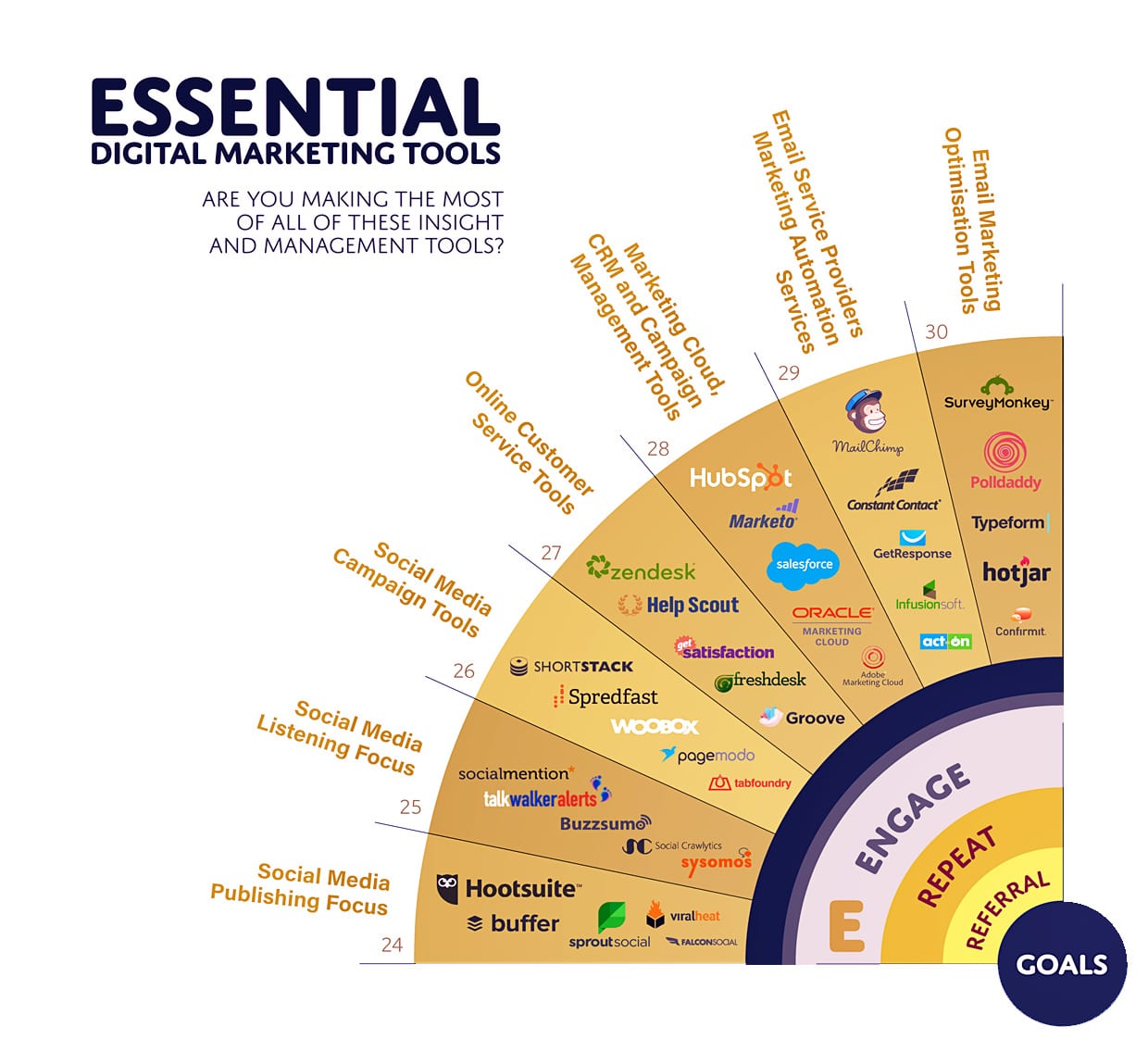
Essential Social Media Campaign Tools

by Robert Allen

Use these Social Media Campaign Tools to run more effective Social Media Campaigns

Social Media campaign tools give you flexible campaign and advertising tools for running campaigns on all the major social media platforms. They provide a quick and easy method for setting up customer engagement campaigns, from templates for quizzes, surveys, and sweepstakes to white label options with full CSS editing and iFrame functionality. These tools can focus on a number of campaigns goals (e.g. driving engagement or collecting leads) and have powerful social sharing features out the box but with custom options ensuring each campaign can be tailored accordingly.

engage-quarter

Key things to consider before purchasing and using these tools:

  • Whilst these tools provide a quick and easy option for many brands, ultimately these tools act as a third party between you and the customer limiting your control of the customer journey (vs. a custom build on your site, for example) and, potentially, your (free) access to remarketing data.
  • You will need some design resource to brand even the basic, template campaigns. In addition, CSS skills are needed for the fully customisable options. The companies offering these tools can provide these services at a cost.
  • Most are available on month by month pricing models with discounts for annual plans. Pricing can rise steeply and are typically based on entry volumes (of the campaigns you run) and brand community size. Be clear on the total costs up front of all likely scenarios. (Be careful - what starts as a quick and inexpensive campaign can quickly become costlier than planned).

So without further ado, here are five useful social media campaign tools, which we've placed in order of what we think most useful.

shortstackShortStack

ShortStack is a self-service platform to build engaging campaigns for social, web and mobile such as sweepstakes or voting contests. Boost engagement and also use to capture leads. This tool helps businesses of all sizes build campaigns from the ground up, through templates and drag-and-drop functions, but can also build campaigns in-house for businesses. It presents a great tool for quickly and easily launching social media campaigns.

What makes it stand out?

The platform features more than 30+ widgets, 30+ themes, and 90+ templates to build contests and sweepstakes, special offers, landing pages, custom forms and host them. The tool integrates with Instagram, Facebook, Twitter and Pinterest.

Key features:

  • Ready-made templates and themes
  •  Easy to use editor
  • CSS editor to customise further
  • Custom URLs
  • White label options
  • Fan-gating

Spredfastspredfast

Spreadfast is a social media management system that enables companies to monitor, manage and measure cross-platform social media initiatives. This is a great tool for businesses that need to harness their social content and to use social media to both better understand an audience but also manage better their customer service via listening tools. It offers scheduling tools that can be used with reports that are very useful.

What makes it stand out?

Through an easy-to-use interface, this tool breaks tasks up into easily accessible tools; to start and store connections made, curate the best social content to republish, target audiences, create promotions and schedule content.

Key features:

  • Social media management
  • Social listening and analytics
  • Social content curation
  • Content marketing
  • Broadcast TV integration
  • Real-time marketing
  • Social care
  • Social commerce
  • Social sponsorship

WooBoxWoobox

WooBox lets you easily create powerful contests, sweepstakes, coupons, and more to grow fanbase and amplify marketing. Like Shortstack, this tool is available for free and offers businesses the ability to create and launch social campaigns. For paid for plans, bigger businesses can remove the restrictions and also take advantage the inclusive Facebook advertising tools.

What makes it stand out?

This tool offers businesses the ability to create and launch social marketing campaigns, but also have functionality to streamline Facebook advertising with ad tools.

Key Features:

  • Create easy to use social campaigns
  • Paid for plans include the Facebook advertising tools
  • Easily integrate with selected 3rd party tools

PagemodoPagemodo

Pagemodo is a social marketing platform for small businesses to create a consistent and engaging visual social media presence. Modify Facebook pages by improving cover photos, adding custom tabs, creating contests and scheduling posts. This tool is best aimed at smaller businesses to help them to manage Facebook pages, but users can also easily share branded and coordinated content across Facebook, Twitter, LinkedIn, email, print collateral, and other platforms.

What makes it stand out?

This tool offers businesses the ability to create and launch social marketing campaigns as other tools do, customise Facebook pages and schedule content, and also set up Facebook advertising.

Key Features:

  • Facebook advert designer and targeting
  • Cover photo creation
  • Contest designer
  • Custom tab builders
  • Post designer
  • Post scheduler
  • Twitter header designer

Tab FoundryTab foundry

Tab Foundry lets you easily build quizzes, sweepstakes, games, photo contests or custom tabs for Facebook pages.  Like other social marketing campaign tools, Tab Foundry is available for free and offers businesses the ability to create and launch social campaigns. This tool offers greater flexibility in terms of design, however, and therefore may be the most suited to use at agencies on behalf of clients.

What makes it stand out?

Businesses don’t have to use pre-determined layouts to launch Facebook campaigns – users are given full control over look and feel, and widget design

Key Features:

  • Create easy to use social campaigns with the drag and drop editor
  • Capture new leads
  • Convert traffic from other social networks to Facebook fans

Download resource – Essential Digital Marketing Tools

This free 100+ page guide explains why we have chosen the 5 tools in each category and gives links to all the tools.

Access the Essential Digital Marketing Tools 2017

05 Jan 20:56

Why Being Unpredictable Is a Bad Strategy

by Mark Chussil
jan17-05-103838603-2

My clients and students assume that competitors should surprise one another with their strategies. Your competitors, they think, should have no idea what you’re going to do.

I predict many of you will say: Of course. Being unpredictable is a competi­tive advantage.

Not so fast.

Keeping secrets can protect competitive advantage. Imag­ine the D-Day invasion of Normandy if the Allies had announced dates and locations. Ask Coca-Cola for its secret recipe and listen to a whole corporation laugh.

But secrecy is not the same thing as unpredictability. Secrecy creates an incentive to invest in assets, especially intellectual ones. Unpredictability bluffs, postures, and palters to gain advantage through uncertainty and misdirection. Unpredictability can put another party off-balance. It can confuse them, cloud their thinking, cause them to waste time and effort, and trick them into making a mistake.

There are times when, at least in theory, the potential benefits of unpredictability can exceed its costs. But in my experience with competitive strategy in the real world, they aren’t common.

Unpredictability in competitive strategy is expensive. You don’t build a fake factory or release a fake product. You don’t suddenly pop out of one market and pop into another. (Guess what your shareholders would say.) Moreover, you don’t implement competitive strategy behind closed doors. Everyone else sees and hears what you’re doing and promising. Behaving unpredictably with one group — customers, employees, competitors, suppliers, etc. — means exposing your unpredictability to all. That doesn’t build trust.

A strategy can backfire if it’s perceived as suspiciously unpredictable, as a client and I discovered in a business war game I facilitated. The company wanted to test an innovative, reve­nue-neutral plan to simplify industry pricing. The plan should have been as competitively harmless as changing the color of its corporate logo. It found instead that the plan would panic its competitors into starting a price war.

In business, the opposite of unpredictable isn’t predictable. The opposite of unpredictable is strategic.

Consider head-to-head competition taken to an extreme in a game of chicken, the ultimate test of wit­less testosterone. In that game, two would-be alpha humans race their cars straight at each other. Who­ever swerves is a chicken, a coward. How to win? With conspicuous, irrevocable, strategic commitment: Remove your steering wheel and make sure the other driver sees you throw it out of your car just before impact.

Some people think unpredictability works in competitive strategy. I’ve seen it in my Top Pricer Tournament, a simulation I’ve run with over 1,000 people that allows participants to try different pricing strategies in three generic industries. (You, too, can try it.) In the tournament, participants who selected “be unpredictable” as their pricing strategy caused their prices to randomly rise, hold, or fall in each simulated quarter.

“Be unpredictable” clearly underperformed other tournament strategies. It also had a broader range of results in millions of what-if scenarios. Occasionally, unpredictability led to joy, but usually it led to woe.

But why did unpredictability underperform? Because becoming un­predictable required abandoning a major opportunity: the opportunity to lead.

I don’t mean “lead” in the follow-me sense, especially because I doubt many people would flock to a leadership message of “Keep ‘Em Guessing!” (“I’m with you! Maybe.”) Plus, unpredictability is ride-the-tiger uneasy: How do I know you won’t later do to me what you do now to others? And when you believe in unpredict­ability, what exactly do you believe in?

Rather, I mean “lead” in the sense of shaping events, of taking initiative, of showing not-a-chicken commitment. You lead by influencing others, even, maybe especially, if they are not your friends. You may lead well or you may lead badly, but unpredictability does not lead at all.

Think back to the chicken game and throwing your steering wheel out the window. That’s a good strategy, but it’s not foolproof. What if the other driver does the same thing at the same time? Bet neither you nor the other driver predicted that. The leader — the strategist — installs the world’s best air bags, or an ejector seat, or top-secret foot-controlled steering. They propose a race rather than a duel. They define success as something other than making the other driver swerve first. They choose not to play chicken in the first place.

Leadership lets you choose the game to play and shape how you play it. If you don’t, someone else will.

05 Jan 20:54

3 Sales and Marketing Strategy Ideas for 2017

by Candis Roussel

As we approach the new year, the only thing we can be certain of is uncertainty itself. In 2017 we’ll have a new president and with him comes a host of economic predictions — from unfettered prosperity to utter calamity. The true course of events is likely to land somewhere in between. So as you plan your sales and marketing strategy for 2017 the keys to success are to build on the fundamentals and stay adaptable. Here are three powerful strategies that will give you an advantage in any economy.

Strategy 1: Get to Know Your Buyer… Again

In his landmark 1960 Harvard Business Review article, “Marketing Myopia,” Theodore Levitt wrote, “Selling focuses on the needs of the seller, marketing on the needs of the buyer.” His point was that businesses weren’t taking into account the buyer’s perspective — their needs and motivations. Fifty-six years later — thanks to Levitt, Peter Drucker, and other marketing pioneers — we’re a little wiser. We know that our clients drive the marketplace. But most companies still don’t walk the talk. They get complacent. They think that because they work with clients every day they understand what pressures their clients face. That couldn’t be further from the truth.

Like politics, the marketplace undergoes constant change. Your buyers’ needs and priorities can shift dramatically without your knowledge. Even if you were to talk to your clients every month about their challenges, there’s a good chance they won’t tell you everything. Why? It could be any number of reasons. For instance, they may be embarrassed to reveal their financial or operational weakness. They may not think that your services are applicable to their emerging problems. Or they may already be talking to other firms to address those issues. Unless you have a program in place to detect clients’ changing priorities you won’t see them coming.

We’ve written before about the importance of conducting regular research on your target audience. But as we enter an unpredictable and perhaps historic period of change, understanding the market’s effects on your customers is more important than ever. Research offers a new window into your audience — and supplies a set of data you can use to make more confident decisions about your sales and marketing strategy, your service offerings and the types of clients you will target in the future.

Strategy 2: Promote Your Differences

Most professional services firms suffer from a bad case of “homogenitis.” They not only look and sound the same as their competitors, they often are the same — offering the same set of services to the same broad audiences.

It’s easy to see how this happens. Many firms are founded when professionals leave their old companies to start their own ventures. Because they are practitioners and not business innovators, these new entrepreneurs do what comes naturally: they model their businesses on the ones they worked at in the past. This impulse creates a multitude of lookalike companies that look to their more established brethren for sales and marketing inspiration.

Now consider the poor buyer. How does he or she choose from an army of clones? The answer is differentiation. In this post on differentiation, we describe a process to uncover attributes that your firm can promote and use to separate yourself from your industry’s rank and file. The best way to differentiate your firm is to have (or create) a real difference. Usually this takes the form of a specialty. Specialization requires sacrificing one part of your market to create exceptional traction with another.

But the important thing is to find something to talk about. Find an attribute you can “own” in the marketplace. It doesn’t have to be unique, but it can’t be something your competitors are talking about. In a famous episode of the AMC show Mad Men, Don Draper reveals how Lucky Strike cigarettes will separate themselves from five identical competitors. Whatever you think of cigarettes, the scene points a way forward for any poorly differentiated company. Lucky Strike’s product is no different from the others. But by finding a unique way to talk about themselves, the company is able to build a bridge to their buyers. Go ahead—take a couple of minutes to watch the scene.

Once you identify your primary differentiator, don’t shy away from it. It needs to become the thing that clients associate in their minds with your firm. That’s how strong differentiation and brands are built.

Strategy 3: Make Your Expertise More Visible

We’ve written extensively on the value of making your firm and your experts more visible. We believe it’s one of the most productive ways to invest your marketing dollars. And in an uncertain economy it fosters critical trust among your buyers and influencers. Visible Expertise builds heavily on content marketing. It works because it converts an asset you already have—subject matter knowledge—into marketing gold.

How does it work? In a nutshell, when a firm’s experts freely share valuable knowledge with the market—by publishing and speaking to the firm’s target audience—they allow future buyers to sample their expertise. This experience builds trust over time. And when the moment comes when a reader is ready to buy services or make a referral, your firm will rise to the top of the list.

For many firms, this approach is a significant departure from how they’ve done marketing before. For others, it moves the focus to a set of activities they do already and amplifies it.

What will your plan be for 2017?

We don’t know for certain what the future will bring, so it pays to reevaluate our sales and marketing strategy in the wavering light of uncertainty. What strategies make sense? Which are too risky? In this post I offer three strategies that build on marketing fundamentals and allow you to adapt to whatever changes may unfold in the market. Now it’s up to you to consider which techniques will help your firm achieve its goals in the coming year and beyond.

05 Jan 20:54

How To Measure and Attribute Call Conversions in 10 Ways

by Kelley Schultz

It’s no secret that digital advertising is growing. eMarketer estimates digital advertising will be 35.9% of total ad spend this year and 38.4% by the end of 2017. This growth is undoubtedly fueled by mobile advertising, with mobile spend estimated to encompass 64% of total digital advertising spend.

As digital advertisers, the more we increase our spend the more conversion volume and revenue we expect. We also need to ensure we’re measuring and optimizing for a very mobile-specific conversion as our digital spend shifts to mobile: the call conversion. According to BIA/Kelsey, digital advertising will drive 162 billion call conversions to US businesses by 2019 (up 50% from 2016).

Not only is call conversion volume growing, but phone calls are lucrative. They’re 10x more likely to convert to revenue than online form fills. As we enter the new year, I want to share my top 10 tips on how to optimize your digital campaigns to drive, measure, and attribute call conversions to improve ROI.

Break Out Call Conversions by Device Type

A click-to-call versus a click to a landing page will cost PPC marketers the same amount. Calls from search can happen from call extensions and the landing page. Both call extensions and calls driven from landing pages can happen from a smartphone, tablet, or desktop device.

When it comes to bidding in Google and Bing, we bid at a device level. The better we understand where calls are being driven from and on which devices, the more efficient we can set our bid modifiers.

Use Local Phone Numbers

Displaying a local phone number on the search results page and landing page gives the customer a perception that they’ll be directly linked to the nearest location. Google estimates that local numbers will help increase your click-through rate by up to 3X, as consumers’ perceptions of a local number is that they will get connected to the business closest to their proximity.

Get Keyword-Level Call Attribution in PPC

For the sake of your bidding optimizations you need to know which keywords are driving conversions, all the way down to the match type. Most of us are using a bid algorithm that relies on keyword conversion data to make adjustments on bids. The more data you give the algorithm, the more efficient the bidding will become for you. Make sure the algorithm knows if keywords are driving call conversions, especially if those keywords get high click volume on mobile. Keyword-level call attribution is also vital in reporting on accurate CPA as well as the true ROI.

Pass Only Quality Call Conversions Into Your Bid Management Tools

Measuring call conversions at the keyword level is extremely important, but it’s very important that you only report on quality call conversions, especially in your bid management tools. Bid tools bid up or down depending on the day, time, CPA, and device. Ensure the conversion data your bid tool is making adjustments from is actually conversion volume rather than every call. This is also important for online conversions. Don’t give credit to keyword that drive poor quality conversions.

Audience- and Creative-Level Call Attribution in Social and Display

If you’re running social media and display campaigns the attribution level is different from search. But you still want to get as granular as possible to make budget and bid decisions for efficient conversions. By uniquely tagging every single ad creative and campaign, you can know exactly which efforts are driving online conversions and call conversions. Again, make sure you only give credit to quality call conversions and optimize off of good data that will improve your ROI.

Attribute Post-Impression Call Conversions

The value of an impression can be powerful, as multi-channel attribution reports show display impressions increase branded search volume and direct traffic. However, in digital marketing it’s easy to assume that impressions only lift online traffic and conversions. In reality, impressions will also lift offline conversion volume. When optimizing your display channel, there are many ways you measure the true impact of call conversions. One way is to attribute call conversions down to the placement and creative level.

Learn Which Pages Drive Your Customers to Call

Google Analytics is a powerful analytics tool available to all marketers for free. The page path data in Google Analytics is one of the most powerful reports because digital advertisers have to include a destination URL for their ad creative. When we drive a click to a landing page, we want that landing page to be relevant to the ad as much as possible. The more relevant, the more likely it will drive customers to convert either online or offline via a phone call.

When setting up your Google Analytics conversions, you’ll want to understand which pages are driving online conversion and call conversions. This way, you can A/B test your landing pages and optimize with full data.

Discover the Most Common Paths Driving Phone Calls

Another great Google Analytics report is the conversion path report. By understanding which channels are on the path to conversion (either first, second, third, and so forth) you can confidently make bid and budget optimizations. Including call conversions as a conversion type in your Google Analytics you can see what path consumers take to convert online and offline. This will allow you to maximize your campaigns to drive the most valuable conversions and increase ROI.

Listen to Calls Driven by Your Digital Marketing

I mentioned the importance of passing quality calls as a conversion type, but another great way to use your call data is to actually listen to the conversations that your customers have with the sales team. As a digital marketer, you can use conversation insight to build new audiences, creative, and even keywords that can help grow your digital presence.

Test a Click-to-Call Ad Type

If you see call conversions being driven by your digital marketing then you should test click-to-call ad types in both your display and social campaigns. It gives your customer a quicker way to get in touch with your business. This works really well for lower funnel customers because they have a higher purchase intent. It will be easier for your sales agents to convert them to customers if they can directly answer questions in real-time. And make sure you route the call properly. You want to have someone from your sales team ready to answer!

I hope these 10 tips give you some good optimization ideas for the new year.

05 Jan 20:49

8 Big Questions Sales Leaders Must Ask Before Adopting New Tech

by Patrick Hogan

Change is daunting. In sales, tweaks and shifts in the process–both minor and major–can make even the most experienced sales leaders anxious.

Implementing a new tech solution should make everyone’s job easier–but that doesn’t change the fact that learning something new can be met by a bit of resistance from stakeholders.

Of course, if the new tech is ultimately beneficial to the organization, people will eventually overcome their fears and give their reservations a rest. Yet, as with anything new that’s going to impact the way people work, things can go wrong.

Yes, implementing a new tech solution is a sensitive situation. If not handled correctly, there is a potential to delay the benefits.

To avoid this, sales leaders must ask themselves these questions before making major decisions with regard to adopting new tech.

Was the purpose established?

There are so many new tech solutions out in the market that it’s a real risk for tech buyers to create need instead of responding to their existing needs.

What does this mean? When thinking of adopting new software, it’s important to define what the holes are–what needs are left to be fulfilled? Will the new tech serve this purpose?

Is there a clear sales purpose and sales outcome arising from this new tech?

In real terms, how does this new solution impact the processes of the sales organization?

There are tasks that could be simplified, yes, but will the new software impact the outcomes of sales directly? Will make the job of sales easier, and in effect, allow them to hit sales goals and set bigger ones?

Does it reduce costs in the long run?

A lot of tech solutions are front-loaded costs so it might not be wise to look at the initial investment and judge the tech against that. The question that begs to be answered is: Is this new tech able to do one or both of the following: (1) create more revenue and (2) save time.

Will it improve the quality of current output?

In sales, it’s not always about the number of deals closed. Will the new tech allow reps to improve the quality of the deals closed in terms of getting clients with better product match and reducing the churn rate?

Will it smoothen prospecting? Will it make everyone better at their job, effectively getting better results for the organization?

Has it been tested by actual key stakeholder?

It is nice on paper. The demo was solid. The reps watched and it looks like something that would really impact the team.

But, has anyone on the team tried the tech yet?

Is it something that can be learned relatively quickly? Does it match the current process? Is it intuitive in the context of the current workflow?

Is it timely? Can the team afford the onboarding time?

Any tech solution that holds the promise of impacting a sales team positively will likely require time for onboarding. This time includes learning the purpose, function, and use of the new tech.

Can you afford to schedule this now? Is there time to put together an onboarding plan that matches the pace of the sales organization? Is this the right time to adopt this new tech or is there a need to schedule it sometime in the future?

Are there established channels for stakeholder feedback?

With the excitement of new tech comes rose-tinted glasses. To encourage both positive and negative feedback to be reported, there has to be established channels for it. A daily or weekly check-in that’s dedicated to evaluating new tech is a good starting point.

Is the vendor open to providing potential customization and additional support needs?

As with any tech solution, the flexibility of customization is crucial to ensuring you get the benefits you projected. In the earlier stages of your buying process, ensure that you’re asking these questions to the vendor. Do your best to think of possible challenges and concerns that would need customization. Same goes for situational issues that might require extra support.


As a final note, you only want to introduce new tech that will ultimately add value to you and your customers. But before you even get to that, you still need to ensure that the solution is something stakeholders will use.

05 Jan 20:49

The Business Card is Dying (and How Google is Replacing It)

by Justin Herring

Page One on Google

We’re all doing business in a digital world.

Even if you run a brick and mortar store with no website, customers are still discovering you and telling people about you in digital channels (whether you like it or not).

This means your online presence and reputation is just as important as your physical one — maybe even more so.

A vast majority of the people who interact with your business probably do so online as well as in person.

And this trend is only increasing as the population becomes more adept at navigating online information sources.

This has lead to some interesting and profound changes in how we do business.

One aspect in particular, in my opinion, is dying a quick death:

The business card.

Why The Business Card is Dying

Google Page One

Business cards used to have a distinct and important purpose in the world.

They served to tell us the business’s name, what it does (briefly), and contact and/or location information.

They were great for keeping this information handy so it could be accessed when needed.

However, an extremely disruptive force of technology has evolved to do this infinitely better than a business card ever could:

Google.

Google search results do exactly what business cards used to.

They tell you who the business is, what it does, who it does it for, how to get in contact, and where it’s located.

You can even get directions or call it immediately with the click of a button.

Except, this business card can be accessed anywhere, any time, and by anyone with an internet connection.

It has also evolved into the natural first place prospects turn to when they want to learn more about a business.

Not the Yellow Pages or digging through their wallet for a ripped, worn-out piece of paper they received 2 months ago.

Your Google search result has replaced your business card, and whether you’ve noticed it or not, this is having profound effects on your customer’s perception of you.

How Your Google Search Results Affect Potential Buyers

Even if a potential customer hears about you through word of mouth (whether it’s positive or negative) they will search for you on Google to find out more.

What shows up either aids or detracts from their impression of you.

And this impression isn’t solely affected by reviews like these:

Google Reviews

It’s what’s in your tagline, meta description, images, and the other structured data Google displays:

Google Tiles and Meta Descriptions

If your search result doesn’t look clear and professional, this is like handing every potential customer you meet a bland, unorganized business card.

What’s worse, is they can immediately see the other “business cards” (i.e. search results) next to you and compare their options.

If those business cards are clear, professional, and attractive, prospects will weigh them against you more heavily.

Here are a few tips for improving your Google search result:

  • Make sure your business’s name and what you do is clearly displayed in the SEO title. For example, “Mystic Massage – Massage Therapy Austin Texas” is a good title.
  • Don’t include unnecessary words or phrases, like “Home Page” or “Click Here.”
  • Describe your business in further detail within the meta description.
  • Fill out all of the details in your Google My Business page, especially location, phone number, and operating hours.

Reviews of your business will also be prominently displayed.

If they’re below average, a prospect could quickly and easily find a competitor with better reviews (sometimes on the exact same page), despite first searching for you and you alone.

This isn’t an ideal spot to be in.

Thankfully, there are ways to improve your customer reviews, which we will discuss in a bit.

However, there is something far worse for your business than below average reviews or an unattractive search result…

Not Showing Up in Google at All

What’s worse than bad reviews or an ugly search result?

Not showing up at all!

If you don’t show up it’s an even bigger red flag than if your result gives off an unfavorable impression.

Not showing up sparks an instant flurry of questions in the customer’s mind:

  • Why aren’t they showing up in Google?
  • Is it worth my time to keep searching for more information about them?
  • Here’s a similar business nearby! Should I just go with them instead?

Unfortunately, most small to medium-sized business owners do not understand how to get ranked in Google.

The ones who do end up on the first page (for the keywords they want to rank for) do so on accident.

The rest are left wondering why their competitors continue to grab a bigger slice of the market share.

So if you’re not showing up in Google, it should be your number one priority.


Once you’re showing up, that’s great, but it’s only step one in your customer’s sales journey…

Whether or Not to do Business With You?

If a customer’s interest is peaked, they won’t simply stop at your search result.

They will look at the first couple reviews posted on Google and then dig even further.

This survey found that 84% of people trust online reviews as much as a personal recommendation.

And 90% of consumers read less than 10 reviews before forming an opinion about a business.

Customers take reviews very seriously because the best way for them to get an idea of what it would be like to experience a business is from other people’s experiences with it.

Reviews Online

Word-of-mouth is one of the strongest forms of marketing.

Reviews are the online version of this, so it’s imperative you take action to make sure your reviews are as positive as possible.

This can be achieved in two main ways:

  • Provide an amazing service
  • Use a review system that maximizes your positive reviews (and minimizes negative ones)

Hopefully, you have #1 handled.

Providing an amazing service will always garner positive ROI, both tangibly and intangibly.

If your service is lacking, there isn’t a review system in the world, other than buying fake reviews (not recommended), that could improve your rating.

However, if you provide a great service, setting up the following system could maximize your reviews:

A Review System To Maximize Positive Reviews (and Minimize Negative Ones)

First off, what’s a review system?

A review system is a step-by-step process to make it easy for customers to leave reviews about your business, whether it be on Google, Facebook, Yelp, or any of the other review websites.

However, here’s the important part:

It also helps maximize the number of positive reviews you get while slowly minimizing the negative ones.

To set up your review system, you first need a webpage to accept customer reviews.

Review Funnel

You then encourage customers to leave reviews on this page after they have engaged with your business.

Make sure they can give you a rating of 1-5 stars (like most review websites offer).

Review Marketing

Anyone who leaves a review of 3 stars or less is then asked for feedback about their experience.

Here, you ask for reasoning behind their review and what improvements they would have made.

This allows you to address negative reviews as quickly as possible and you get consistent feedback about your service.

This slowly minimizes your negative reviews as your service continually improves.

Anyone who leaves a review of 4 or 5 stars gets redirected to a page where they can leave a review on a multitude of review websites.

These people already view you in a favorable light, so making it easy for them to leave more positive reviews on other websites helps maximize your positive reviews.

Once set up, the success of this system is about getting as many people as possible to fill out a review on your webpage.

Here are a few ways to do it:

  • Place notices within your store with instructions on how to leave a review
  • Include links on your website that point to the review page
  • Ask your social media followers to leave a review
  • Automate an email to be sent after purchase

After this, your review system should be ready to go.

Moving Forward

Once you’re showing up in Google, your search result is clear and inviting, and your reviews are positive, you are ready to make your new digital business card work wonders for you.

The best part?

This all works in the background while you continue to man the front lines and handle the rest of your business.

However, organic search and online reviews are only a part of your online presence.

Showing up for your business name is just the start.

Showing up for what your prospects are searching for is the next step to help you get a leg up in an ever-growing field of competition.

05 Jan 20:49

5 Things to Consider Before Investing in Content Technology

by Kathy Baughman

investing-content-technology

CMOs want to automate as much of content operation as possible and believe achieving scale is a matter of deploying the right platform and tools. The result? Platform proliferation.

According to Chief Martec founder Scott Brinker, the number of marketing technology solutions has doubled since 2015 and will soon surpass 4,000.


The number of #marketing tech solutions has doubled since 2015 & will soon surpass 4,000. @chiefmartec
Click To Tweet


A recent Forbes study reports that CMOs are overwhelmed by the amount of technology choices and confused by vendor claims that their platform can do it all. Before investing in more technology, they want to optimize what they already own.


Before investing in more technology, CMOs want to optimize what they already own, @Forbes via @ComBlu.
Click To Tweet


Here are five things to consider before investing in the next bright, shiny object:

Find a content strategy partner with no horse in the race

Before attacking technology, nail other aspects of content operations, such as:

  • Understanding the needs of all members of an organization who influence the buying process for specific-use cases
  • Clearly defining your publishing processes; developing the necessary skills and institute governance
  • Architecting your content so it can be sourced, targeted, distributed, and reused across many programs, channels, and devices

Many platform players offer strategy services. They recognize that their platform will only perform as well as the strategic framework it supports. Their work, however, focuses on optimizing their own platform and the integration of its partners. While this is valuable and necessary, few create an overarching strategy that considers the needs and behaviors of multiple buyers at multiple points of the decision journey. The templates they provide often do not consider interdependencies of multiple buyers in the content modeling process. That said, end-to-end solutions providers are more likely to help clients address enterprise strategy before addressing technology, so consider them as a good resource.

Working with an objective third party helps ensure that counsel is more far-reaching and is not viewed through the lens of a specific platform or set of partnerships. (Disclosure: My firm, ComBlu, provides enterprise content strategy counsel. You can find these services, however, from many third-party sources including digital agencies, CX firms, and independent consultants.)

The strategy part of the process often gets truncated in the rush to get a tool or platform that can solve all pain points. But not all pain points can be solved with a platform. A recent Forrester study, From Priming the Pump to Engaging Buyers, points out that it takes time to scale. First you must design the right processes, implement organizational change, and align functions.

In the absence of an enterprise content strategy, lines of business or functional organizations often try to jump-start the content optimization process. Many of these efforts fail to thrive because no one connects the dots between these separate initiatives to uncover systemic issues and problems. Leadership is needed to map an enterprise approach. Once the strategic road map is complete, the organization has a map for content operations and data for selecting the right tools.

Schedule a workshop that mows down the weeds and tidies the landscape

Workshops are a great venue for gaining stakeholder agreement on enterprise content strategy and its underlying infrastructure. The best workshop facilitators take time to understand your specific business objectives, aligned content mission, and where your organization sits along the content maturity life cycle. Conversation at the workshop should focus on executing the overarching content strategy and dissecting what the organization needs for a high-functioning publishing competency. This spans everything from skills and organizational assessment to governance and supporting technology.

Participants should include a cross-functional group of first-line managers who need to work as a team to optimize and scale content operations. Suggested participants include:

  • Marketing leaders of specified business units
  • Marketing, social, and digital marketing managers
  • Marketing tech specialists
  • Customer experience specialists
  • Distribution and sales leaders
  • Owners of core digital, social, and mobile selling systems — including CRM and targeting analytics
  • Compliance representatives
  • Sales operations and sales enablement program managers
  • Business analysts
  • Corporate communications and PR staff
  • Creative services team members

The goal is to get people who may be working diligently but potentially at cross-purposes to co-create a future state – creating and distributing engaging content that supports the full-experience life cycle. Workshop deliverables should include a shared vision of where your organization needs to head, with detailed, prioritized action plans.

Turn the marketing stack into a maypole

An arcane spring ritual involves children dancing around a maypole. Each child grabs a ribbon and wraps it around the pole. If the marketing tech stack serves as the maypole, then each ribbon represents a distinct buyer’s journey. Wrapping the journey around the tech stack creates a more contextual view and allows the team to visualize requirements to deliver content strategically and ultimately to scale. It illustrates why it’s so important to first understand the journey (or multiple journeys) and what is required to distribute content experiences in a relevant way along the journey. It also helps to eliminate or turn off unnecessary functionality.

Ultimately, the organization needs a highly intelligent, near-total automation of the content supply chain. The goal is to create an open architecture that supports dynamic message delivery, and allows you to plug in new components that support new content types, social channels, or consolidated profiling.

Shop your closet before buying a new outfit

Optimizing what you own before adding more components or complexity increases performance and allows better resource allocation. One of the biggest problems cited by CMOs in the Forbes study was their desire to eliminate the redundancy and carrying cost of too many platforms.

Once you really understand the technology you own and determine your additional needs to automate operations along defined journeys, meet with vendors, and get their insights. This is when vendor strategy teams can add real value. Share your vision and road map, and have them map your needs against their platform, including tightly integrated partners. It’s highly possible that some of your existing platforms have new functionality or contain functionality that is not turned on. Some vendors may have made acquisitions to provide broader coverage or developed highly integrated strategic partnerships.

Before having a conversation, create a scorecard. Approach this as if you are shopping for a new platform, and look at your existing technology through a new lens. If the vendor suggests migrating to a newer version, make sure you know what is involved and how the migration could impact overall experience and performance. Most importantly, how will it impact the back-end integration with other nodes of your tech stack?

Once you have a clear view of the potential of existing technology, identify gaps. The important thing is to get the most from what you have without getting bogged down in a legacy system that will never do what you need. It’s a balancing act, especially with hundreds of new entrants every year into the category. Each is trying to make the case as to why you should jettison what you have and buy new.

If the vendor promises that crucial functionality is on its road map, pin down the representative. Ask status of planned functionality, and determine if it has been field tested. Vendors don’t want to lose a sale or licensing renewals so they often will present a rosier picture than what reality is. View with skepticism statements such as, “Our road map is fluid, so if you have a big priority we’ll put it in front of the line.” This is not how it works.


If the vendor promises that crucial functionality is on its road map, pin down the representative. @ComBlu
Click To Tweet


When the bright shiny object makes sense

Once you know how to optimize the platforms you own, you can start strategically backfilling. Use your blueprint as a guide for reviewing new tools. Here are a few things to consider:

  • Is it a tool or a platform?
  • Can you live with it out of the box or is there a lot of customization in your future?
  • What does it need to integrate with?
  • Will it support your strategy road map now and into the future?
  • Can it fulfill more than one set of requirements?
  • How difficult is adoption?
  • Is the company well-funded and capable of issuing new versions to keep the tool relevant?
  • Is the seller a vendor or a partner? Either is fine, depending on how much assistance you need.
  • When dealing with multiple solutions, who owns the integration?

Establishing filters up front helps eliminate the bright shiny object syndrome.

Scaling takes time and requires an overarching strategy and infrastructure that is right-sized for the task. Cultural due diligence, the continuous upgrading of skills, and obsession with the customer’s developing POV always trump technology. That being said, modernizing the tech stack for today’s publishing organization is a must. Success requires the guidance of a leader with both a marketing and publishing mindset that establishes the right processes and then lets stakeholders work effectively to execute.


Modernizing the tech stack for today’s publishing organization is a must says @ComBlu.
Click To Tweet


This article originally appeared in the December issue of CCO magazine. Subscribe for your free print copy today.

Cover image by Joseph Kalinowski/Content Marketing Institute

The post 5 Things to Consider Before Investing in Content Technology appeared first on Content Marketing Institute.

05 Jan 20:48

Account-Based Marketing for B2C Marketers Is Coming

by Christopher S Penn

Account-based marketing (ABM), or target account marketing, has been the darling of B2B marketers for a few years. With advances in technology, it’s poised to become a powerful force in B2C marketing as well. An ABM Primer For those unfamiliar, ABM is a marketing method in which we target only those companies and buyers who […]

The post Account-Based Marketing for B2C Marketers Is Coming appeared first on Christopher S. Penn Blog.

05 Jan 20:48

The Best New Year’s Resolution for Salespeople: Build Habits that Support Sales Growth

by David Mattson
  • new-years-resolution-salespeople

At the start of the New Year, it’s common, even traditional, for sales professionals to start focusing on setting revenue goals. That’s natural and important. However, this year you might benefit by stopping in early January and asking yourself: What can I do to make this year’s goals more meaningful, and perhaps more attainable, than last year’s?

The answer lies in the idea of focusing not just on our numerical targets and results, but on the habits and behaviors that support them. After all, it’s what we do consistently that will determine what kind of year 2017 is for us, not the sales numbers we aim for. Here are some thoughts on how you can build habits and behaviors that support sales growth in 2017.

KARE for your sales goals before you plan out the year. KARE is a Sandler tool that challenges salespeople to place each prospect and customer in one of the following categories:

●       Accounts we want to KEEP.

●       Accounts we don't have, but want to ATTAIN.

●       Former clients/customers we want to RECAPTURE.

●       Accounts we are selling into now where our aim is to EXPAND our wallet share.

These are four very different targets, each requiring distinct behavior sets. So your first step is to categorize your entire universe of buyers by assigning each of them to one of these categories.

Next, you will want to set up a yearlong behavioral plan that accommodates each of the KARE groups in a balanced way. In an account you want to Expand, for instance, conducting Quarterly Business Reviews with key decision makers is going to be an important behavioral goal. But you don't want to devote the entirety of January to these meetings! That would take you out of balance when it comes to the prospecting and referral generation behaviors that connect to the accounts you want to Attain.

For more on the KARE tool, see my new book THE SANDLER RULES FOR SALES LEADERS.

Create and follow a cookbook that supports your behavioral plan. A cookbook is an action plan that breaks down the specific daily, weekly, and monthly behaviors that support your sales goal. Just as a reliable recipe for a chocolate cake will always yield a chocolate cake if you follow the directions in order and use the right ingredients, your sales cookbook, when properly designed and executed, will always deliver the income you aim to generate. Creating, testing, and refining the right cookbook is a critical skill. This, too, is covered in THE SANDLER RULES FOR SALES LEADERS.

Make your daily behavioral targets personal. The team’s or department’s goals are important, yes, but when it comes to fulfilling the daily behavioral requirements of your personal cookbook, you really want to connect those activity targets to your most important personal goals. These behaviors should link up to your answer to the question, WHY am I taking part in a Quarterly Business Review meeting today? (Or whatever it is you’re doing.)

Whether it’s buying a wedding ring, getting an extra week of vacation in the South of France, or attaining any other worthy aim that stokes your fires, you must constantly remind yourself of exactly what that personalized positive outcome is. Keep it at the forefront of your mind as you execute your behavioral plan. Remember that your personal goals may be very different from your assigned sales quota! The two are not necessarily identical. It’s your job to connect the dots.

No one else can uncover your critical personal goals for you -- though a good coach can help you accelerate the process of figuring out what you most want from your working day. Once you know what your big “WHY” goal is, use it to drive your daily and weekly behaviors. Do that not just in January, but all year long … or until you attain the prize and set a new goal!

      
05 Jan 20:43

Inbound Marketing Tips and Tricks for 2017

by Mike Templeman

Developing the perfect inbound marketing strategy for 2017 can be difficult. While most business owners are focusing on boosting their search engine visibility or writing plenty of blog posts, there are still several other opportunities available. Modern marketing goes far beyond writing interesting content and properly placing keywords. If you aren’t sure where to start with your digital marketing campaign, use one of these creative suggestions.

The Importance of Influencers

While it is still possible to assert yourself as an authority in your industry, influencers have a pre-existing, finely-tuned following. Identifying and associating yourself with key influencers within your industry is a great way to kickstart your followers or subscribers. In most cases, simply contacting an influencer and offering them a demonstration or sample of your services can be enough to get them talking about you.

Don’t worry too much about your influencer’s total number of followers or subscribers. Because each follower is highly engaged with the influencer, they are more likely to respond to your brand. This can be a great way to get traffic, make sales, or simply grow your online presence.

Promote Customer Advocacy, Not Products

Finding the right way to market yourself in 2017 can be very difficult. Consumers are much more savvy and they are far less likely to follow people who simply push products. This doesn’t mean you can’t promote individual products and services on social media; it means you need more diverse content.

Focusing more on customers and how they respond to your services can go a long way in an inbound marketing campaign. Show how your existing customers are reacting to your product. If someone posts a picture of themselves using your service, like and share it.

In addition to focusing more on customer use, you should also focus on presenting solutions to common problems your audience faces. Present solutions that your existing customers can use to enhance their experience with you. By doing so, you are increasing your repeat customers and showing new buyers that you truly care about them.

Build Better Offers

One inbound marketing tactic popular in the past few years is creating multiple offers to entice a wider range of people. While multiple offers are still recommended in most campaigns, businesses need to focus on the offers themselves, starting from the ground up.

Take a look at your basic package or service and analyze the value. Find ways to enhance this value to entice more entry-level buyers. While it can be tempting to set your base price high and offer discounts only to those who buy more, offering small bonuses can go a long way. If you can, try experimenting with a sample-size package or adding a small bonus to your offer, such as a downloadable eBook. The better the value seems, the more likely people are to respond.

Don’t be afraid to scrap offers that just aren’t working, even if you feel the package is needed to justify your prices. For example, if your basic and most advanced package are doing well, you may not need a middle offer at all. If your basic package isn’t doing well but your mid-level and advanced packages are, try revamping the basic or eliminating it entirely.

Update Your Website

Having a frequently-updated website can go a long way in terms of inbound marketing. While most of your visitors won’t be looking for the copyright date on your sales page, they can easily identify an out-of-date website. For an extreme example, compare a website created in the late 1990’s to one made last week. You’ll see an immediate style difference. This can be incredibly distracting as a reader and can look unprofessional.

Follow respected designers and certain design agencies online to see website design trends and make changes when appropriate. You don’t have to update your website every day, but you should frequently examine the structure to make sure it looks fresh and appealing.

Don’t Be Afraid to Break Away

Part of inbound marketing is going with what works. In some industries, standard techniques either don’t work or are ineffective. For example, short blog posts wouldn’t have the same impact on a how-to or tutorial website. While the ideal blog post is between 300 and 500 words, you shouldn’t be afraid to go above and beyond.

In some cases, writing thousands of words can still help you funnel traffic and generate leads. Most website viewers only want their questions answered and will read what you write if it applies to them. Writing engaging content, regardless of length, keyword count, or other SEO-tactics can be the best way to build long-term relationships with your readers.

Don’t Forget to Track Your Progress

Inbound marketing has become a very sophisticated process and there are plenty of online tools that can help you. Utilize services like Google Analytics to track your marketing campaign and discover what works and what doesn’t.

Aside from tracking basic metrics, you should analyze which tactics bring you the biggest return on investment. Sometimes the cheapest inbound marketing techniques can bring the best results.

If a campaign isn’t working out as planned, don’t feel obligated to see it through. Many online marketing services allow you to cancel campaigns and apply the funding to a different ad. In fact, most pay-per-click offers allow you to change quickly or only charge you per day. This allows you to adjust your campaign as needed to get only the best results.

Inbound marketing is still a very complex topic, but there are plenty of simple tips and tricks that can work wonders.

05 Jan 20:43

7 Sales Terms Reps Should Stop Using ASAP

by mpici@hubspot.com (Michael Pici)

sales-terms-reps-stop-using-841164-edited.jpg

In sales, your words have a huge impact. Case in point: Gordon Sinclair discovered his restaurant was losing $900,000 each year due to customers who made reservations and never showed up, so he instructed employees to change their response.

They previously told guests, “Please call us if you change your plans.”

Now they asked, “Will you please call us if you change your plans?”

Because this question required a verbal commitment, customers were less cavalier about canceling with no warning. Sinclair’s no-show rate decreased from 30% to 10%.

This example proves you should be deliberate about your word choice. If you truly want to embrace inbound selling (and the success that comes with it), replace these seven old-school sales terms with more buyer-friendly language.

1) “Lead”

Many teams uses “lead” to refer to potential buyers. However, calling people “leads” is dehumanizing. Let’s use terms that remind us sales is ultimately a conversation between two or more people.

Here are some alternatives:

  • “Potential customer”
  • “Prospective partner”
  • “Future client”
  • “Possible collaborator”
  • “Interested buyer”
  • “Company/person we’re considering doing business with”

2) “Sales rep”

Modern-day sales roles are incredibly challenging. To win new business, we must identify unique ways to help our customers succeed. We also have to deal with complicated buying processes and a growing number of stakeholders for every deal. Add these challenges to the ones we already experience -- getting our prospects’ attention, differentiating our products, staying up-to-date on our market, and more -- and we’ve got one of the toughest careers out there.

So why do we devalue ourselves with the title “sales rep”? I prefer “salesperson,” “advisor,” “consultant,” or “[product type] expert.” These titles show more respect for the position and the role we play in shaping our buyers’ futures.

3) “Sales Pitch”

“Show up and throw up” doesn’t work. When salespeople spend the majority of a meeting droning on about their product’s features, their audience tunes out. To engage buyers and actually make an impact, make your presentations interactive. That means frequently asking questions and actually listening to the answers, then asking follow-up questions or tailoring your points accordingly.

“Sales pitch” describes the one-way, seller-focused presentation of the past. I suggest modern salespeople use “conversation” instead. If your call goes as planned, you’ll be having a real discussion, not delivering a pitch.

4) “Negotiation”

Don’t walk into a negotiation with the mindset that your prospective client is your opponent. Effective negotiators think of the other participants as their allies.

If you manage to achieve a mutually beneficial outcome, you’ll both walk out happy. And remember, the relationship isn’t over when they sign the contract -- your ability to retain and/or upsell them depends on their long-term satisfaction.

5) “Sales Process”

Interactions with prospects should be collaborative and consultative. You are working together to create a custom solution to their problem, not rigidly forcing them through a series of steps.

That’s why I prefer “buyer’s journey” or “buying process” over “sales process.” The latter doesn’t accurately describe how you and the buyer go from an initial conversation to an agreement.

Using this term also makes prospects feel like they’re being sold to. Most people dislike being wheedled or manipulated into a purchase -- understandably so. You’ll unintentionally associate yourself with the stereotype of the smooth-talking, untrustworthy sales rep.

Finally, “sales process” implies you are the only one driving the relationship forward. Although you should be in control, your prospect should have agency as well. Suppose the buyer wants to talk about your product’s features on the first call. Your sales process requires you to define their challenges and determine their budget before you mention your offering at all, so you evade their questions.

Sure, you’ve followed your process to a tee -- but the buyer is frustrated they can’t get the information they need. They opt to work with someone who will give them the information they need, when they need it, meaning you never even advance to the next stage of your sales process.

6) “Value Proposition”

It is important to understand and communicate the value of your product. But avoid the term “value proposition.” First, your product doesn’t have any inherent value. If its user doesn’t have a relevant problem to solve or opportunity to capitalize on, your offering is useless.

Second, “value prop” assumes all of your buyers will see the same value. That is simply not true: Each buyer is unique and will utilize your product in different ways. It's your responsibility to figure out how each customer can use the offering to its fullest potential.

7) “Budget”

Budget can be extremely limiting. Either a prospect has the money, or they don’t. Your product could check every box on their list. Yet without the right budget, a purchase is impossible.

Replace “budget” with “ability to buy.” The second concept is far less restrictive. While people normally come up with their current budget based on last year’s budget, their ability to buy depends on the issues or opportunities they’re seeing.

Next time you’re discussing the financial details of a deal with a prospective client, say “What’s your ability to buy X?” instead of “What’s your budget?”

What terms have you dropped from your lexicon? Let me know in the comments.

HubSpot CRM

05 Jan 20:42

7 Ways to Generate Leads on Social Media

by Lisa Marcyes
how to generate leads on social media

Author: Lisa Marcyes

When you hear the term lead generation, social media probably isn’t the first thing that comes to mind…but maybe it should be.

With 75% of B2B buyers and 84% of C-level/Vice President (VP) executives incorporating social media as a key part of their decision-making process according to IDC, social channels are becoming essential to building relationships with prospects and customers throughout every stage of the customer lifecycle.

Companies employing lead generation strategies on social media are able to achieve better results throughout the funnel—building brand awareness and generating conversions, achieving better sales productivity, producing higher revenue growth, and creating a sense of community for advocates and followers. And according to a recent study by LinkedIn Pulse, B2B buyers who feel a “high brand connection” are 60% more likely to consider, purchase, and even pay a premium than “low brand connection” competitors.

In this blog, I’ll outline seven ways that you can generate leads on social media:

1. Special Offers

Everyone loves freebies, so consider hosting a sweepstake or offering giveaways on social media. These types of campaigns are something people enjoy sharing on their social channels, and by including an entry form, you’ll have the opportunity to capture important lead data. At the end of the form, be sure to incorporate a way for entrants to share the offer via their social channels. This way, participants can spread the word with their community and with every mention, you’re able to continue building the relationship by engaging and acknowledging their posts.

We recently partnered with Uberflip on their 12 Days of Uberflippin’ Giveaways campaign. Participants were asked to enter some basic information (name, company, and job title) to access exclusive content. This was a success on both sides—the contest drove many new names and those who participated received entertaining or educational content.

Uberflip Giveaways

2. Polls and Surveys

Rather than assuming what your audience cares about, just ask them! Your followers can provide you with a wealth of knowledge, and polls offer a unique way for people to express their opinions. This is a fantastic way to get feedback on how people are using your product, what their pain points are, and what they’d like to see on your roadmap. You can even offer incentives to increase the response rate.

This Twitter poll from Pam Moore,  CEO and Founder of Marketing Nutz, helps her understand how her audience feels about Snapchat for B2B marketing. Based on the responses, she can create content that addresses the issue.

Twitter poll

3. Refer-a-Friend

This can be tricky, but if you play your cards right, referral campaigns can be a great way to engage your followers. With 92% of buyers trusting the recommendations of their friends and family, referrals are a great way to break the ice with prospects. Create compelling offers for both the referrer and the referees such as gift card or cash incentives. It might be the nudge your customers need to recommend you to their network.

With a social application that’s integrated with your marketing automation platform, you can easily set up a referral campaign that extends across major social media platforms, allowing you to grow your customer base fast. Since each shared message will include a special link that tracks the responses at every stage to the conversion event, you’ll be able to track the campaign’s progression and effectiveness and understand how prospects are helping to get the word out. Here’s an example of a referral campaign that we ran for our annual event, Marketing Nation Online. Participants were encouraged to refer their friends through social media for a chance to win an Amazon gift card.

Marketo referral campaign

4. Discount Codes

Flash deals and discount codes are a great way to increase brand awareness and generate demand. By including a strong call-to-action and time constraint, you can create a sense of urgency for people to respond to your campaigns. Many consumer companies are adopting this as a way to combat skyrocketing cart abandonment rates, but it is also highly relevant in the B2B space as well.

For example, Content Marketing Institute offered potential conference attendees a chance to save $100 on their registration by using their limited-time discount code. Want to pack a one-two punch? Discount codes can allow you to get even more granular in your attribution reporting. By assigning unique codes for each social channel, you can track which platform directed the most traffic.

CMI discount code

5. Promote Gated Content

Promoting gated content on social media is one of the easiest ways to generate leads. Social media is a great megaphone to get your content out in the world, and by developing posts that direct to landing page where users are prompted to fill out a form, you can generate new leads and nurture existing ones in your marketing database. One of the most critical components of this method is to ensure your social posts provide content that captures the interest of your followers. Use images, gifs, or stats to visually tell the story of your content. According to Guy Kawasaki, “Every post, other than a response or comment, should have a picture or video. That’s one of the most important things to remember.”

Most leads take only a few seconds to decide whether they’ll read a page and give their information, so keep your landing pages simple and design minimal to avoid overwhelming your leads. Here’s an example of one of Marketing Prof’s latest posts directing to their virtual conference. It’s clear what users should expect after clicking through, and the visual is captivating and relevant to the content.

MarketingProfs gated content

6. Host a Tweet Chat or Live Stream

Going live is a great way to directly interact with your followers and engage with them in real-time. By answering questions, gathering feedback, and generating awareness about your products or services, live chats give you the opportunity to position your brand as an expert in the industry. You can also drive cross-channel traffic by directing participants to branded content, landing pages, and offerings. A great example of this is Hootsuite’s recent participation in the #TwitterSmarter Tweet Chat.

Hootsuite Tweet Chat

Last year, we launched our #marketochat program, which is a bi-weekly Tweet Chat with our partners, customers, and influencers. It’s been a great way to highlight our unique expertise and build relationships with our participants. One way that you can encourage engagement is to gather a list of all participants at the end of each chat so we can send them a shout out for participating. In addition, we compile all of the Tweet Chat responses in a Storify and post it for easy consumption. With Twitter’s new Moments, you’ll have this capability directly within the platform. We’ve also found sending out personalized invites via Twitter asking participants to join future chats helps maintain engagement after the chat ends.

7. Paid Social Ads

With recent updates to many social networks’ algorithms, advertising on social media platforms is becoming more important than ever. These updates are made to give users a better experience, so they’ll see less promotional content and more of the relevant content that they want to see. This means that, as a marketer, you’ll need to supplement your organic posts with paid promotion to get your posts seen. Each social platform has unique demographic criteria that allow you to target ads  (e.g. location, job title, age, industry, gender, etc.). Leverage the right platform and targeting options to ensure you’re going after the audience who will find value in your content and that you’re not wasting paid resources on megaphoning.

When you’re promoting your posts, be sure to include a strong call-to-action to get the most out of your investment and generate conversions. For example, you can ask followers to download an asset, attend a webinar, or learn about a new product. You want to ensure those seeing your ad have something to click on, similar to what we’ve done with our recent Facebook ad promoting our new Definitive Guide to Social Media Marketing.

DG2SMM paid ad

Still on the fence about investing in social media as a lead generator? Michael Stelzner said it best, “Social networks are the fastest and lowest cost way to generate leads, bar none.”

Are you finding success leveraging social media for lead generation? If so, share how below!

marketo-summit-december-promotion


7 Ways to Generate Leads on Social Media was posted at Marketo Marketing Blog - Best Practices and Thought Leadership. | http://blog.marketo.com

The post 7 Ways to Generate Leads on Social Media appeared first on Marketo Marketing Blog - Best Practices and Thought Leadership.

05 Jan 20:42

5 Reasons Why Account-Based Marketing Is Here To Stay

by Pierce Ujjainwalla

abm and the whale factor

For as long as I’ve been a Marketer, Marketing Automation has been my trusty sidekick. Now, Account-based Marketing (ABM) is the new kid on the block and everyone in the neighborhood is taking notice.

Jon Miller, the co-founder of Marketo, grew the Marketing Automation community from glorified email marketing to professional Marketers who deserved a spot at the Revenue table. Now, he’s setting his sights at Account Based Marketing and maybe it’s just me, but Engagio seems to have a lot of the same ingredients as Marketo.

So, the question is: ABM – is it a hot new technology trend that will fizzle out? Or, does it have the legs to become a table-stakes part of any legitimate MarTech stack?

Here are 5 reasons why I think ABM is here to stay:

#1: The Whale Factor

As long as companies make a large amount of their revenue from a very small percentage of customers, ABE will be perfectly positioned. Why?

  1. Enterprise deals represent a huge percentage of the average company’s revenue
    Large deals (aka commission cheques) are what gets Sales people out of bed in the morning
  2. I’ll never forget talking to the top Sales guy at a software company where I was leading demand generation. I was asking him why despite bringing him huge volumes of seemingly quality leads he never followed up.

After a few beers, he let me in on the fact that he could close hundreds of these small deals from the Marketing leads, or bring in one big whale and be a hero. Then it all made sense to me. He was focusing his efforts on the few big accounts that he felt he had the best shot at, and everything else was just a distraction to that.

#2: Many Companies Serve a Niche Audience

When you have a niche audience, even when you do targeted content marketing, you still get a lot of noise coming in from prospects that are really not ‘marketable’.

I worked at another company where we were selling price intelligence to retailers. We literally could only sell to large retailers in North America. Our product wouldn’t be of use to anyone else.

Despite my CEO insisting that we need to do more ‘Outbound’ to targeted accounts, I was drinking the Marketing Automation Kool-Aid and stuck to my guns that Marketing Automation and an inbound strategy was the best option.

We did a ton of excellent inbound marketing and created some really great content, and good qualified leads did come in. But, like at most companies, we didn’t have time to wait. We needed deals and we needed them yesterday.

I think Account-Based Marketing would have been the perfect tag-team 1-2 punch for this scenario. Marketing Automation can handle the inbound, and ABM can do the outbound. Together, they will work faster and more efficiently to drive deals. Engagio calls this ‘allbound.”

#3: The People, Investors & the Hype

Like anything, the people make all the difference.

Look at the people leading the ABM hype. Jon Miller is in the driver’s seat. For anyone doesn’t know Jon, he is what happens when you mix Don Draper and Albert Einstein into one person. Incredibly good at marketing and also, analytical and smart. It’s not just pretty pictures and taglines, there will be ties to revenue and messaging that the C-level can get behind.

Furthermore, if you look at a company like Engagio’s investors, this is the same group that fueled the Marketo rocketship. It’s like the second half of a football game, and they’re walking in with a 40-point lead.

#4: Marketing & Sales Alignment is a Familiar Struggle

As someone who helps organizations establish their end-to-end lead management process and has fixed countless broken lead scoring models, I’ve seen first-hand that Marketing and Sales are rarely the “two best friends that anyone can have”.

A technology solution that can help bridge this sales and marketing gap will be welcomed in most organizations. It’s one of those investments that you can feel good about – and show that each side is looking for solutions to make things better.

ABM is at the intersection of Marketing and Sales, a sore spot for most companies, and one that is ripe for improvement.

#5: Marketing Automation Users are Increasingly Mature

As Marketing Automation evolves, so do their users. Although there are still a huge amount of companies that have yet to adopt Marketing Automation, the ones that have are relatively sophisticated.

As we see with many of our clients, they have the systems, teams and processes in place to make a Marketing Automation system successful. They are looking for that next silver bullet to help them increase revenues, meet their goals and get an edge on their competition.

ABM is a nice and logical next step for Marketers looking to enhance their Marketing Tech Stack. It is complimentary and fills gaps that Marketing Automation does not currently address.

Wildcard: Sales Adoption.

So far, we’ve been painting rainbows and unicorns. But, there is an x-factor here. Sales people.

Marketo touted Marketo Sales Insight as the game-changer for Sales & Marketing. It was supposed to solve all of those problems. It hasn’t.

Most Sales people either don’t understand it, or don’t want to use it. There are exceptions, but overall I would say it was harder than anticipated to get Sales to adopt MSI.

In order for ABM to succeed, it will need to gain user adoption where MSI was unable to. Marketing Automation could be successful with minimal Sales adoption, but ABM is a different beast. This may be the biggest challenge facing ABM and the organizations trying to implement it.

Final Say: I’d put money on it.

For any company selling to the Enterprise, I think ABM will be an essential part of the MarTech stack. Despite Sales adoption being a critical component for success, ABM has the people, the backers, and the hype to make their mark on the industry. Sales people will always be focused on select large accounts and deals, and the time is right for a new shiny object to capture the hearts and pocketbooks of Marketers everywhere.

04 Jan 22:19

ASUS finally has mesh routers of its own

by Devindra Hardawar
After years of being clunky concepts, mesh wireless routers are finally becoming viable options for your home, thanks to the likes of Eero and Google WiFi. At CES, ASUS finally unveiled its own mesh solutions, the HiveSpot and HiveDot routers. HiveSp...
04 Jan 22:14

Bitcoin hits all-time high as currency controls by countries drive fear and investors increase adoption

by Olga Kharif, Bloomberg News

Bitcoin hit an all-time high Wednesday, according to Bloomberg data, thanks to continued adoption in China and other parts of the world where traditional currencies are tightly controlled.

The digital currency, which just turned eight years old, reached US$1,140.64, which was higher than the US$1,137 it hit in November of 2013. In December, bitcoin also surpassed its previous all-time high in total market capitalization, which now exceeds US$16.1 billion.

The latest increase was driven by capital or currency restrictions in countries ranging from China to India and Venezuela, where people purchased bitcoin to protect their savings, as well as increased adoption by investors. The digital currency beat every other currency, stock index and commodity contract as an investment last year.

fp0104_bitcoin_gold

“Unlike the exponential adoption that propelled the price of Bitcoin in 2013, the current ascent was driven by a more gradual adoption over the last three years, mostly in China and other countries that have capital or currency restrictions,” Gil Luria, an analyst at Wedbush Securities, said in an e-mail.

Global restrictions on sovereign currencies are playing a major role in driving increased bitcoin demand. The Chinese government, for example, made it more difficult for people to move the nation’s currency and spend it overseas, leading to trapped liquidity. That’s made bitcoin, which isn’t controlled by any government or central bank, more attractive.

India and Venezuela banned their largest-circulating bank bills in a bid to make it harder to pay bribes and buy contraband in cash. Governments all over the world are boosting reporting rules for assets abroad and allocating more resources to figuring out how and where illegal cash moves around. It’s part of efforts to combat terrorism financing and corruption following graft scandals from Europe to Brazil. That’s boosting demand from people who want to receive and send cash without all the oversight.

Isolationist policies

And isolationist policies by some governments to restrict remittances are pushing consumers into bitcoin as well. U.S. President-elect Donald Trump said during his campaign that he’d limit or halt remittances to Mexico until the Latin American nation agrees to pay for a border wall between the two countries.

Finally, the explosion of bitcoin supply growth is slowing, with so-called miners getting fewer electronic coins in exchange for letting the network use their computing power. The payment to owners of the computers that verify bitcoin transactions and record them in a public ledger known as the blockchain fell by half in the middle of last year.

“It shows that more and more people are confident in the currency,” MarcoStreng, chief executive officer of Genesis Mining, a bitcoin mining company, said in an e-mail. “They see the benefit of bitcoin and other cryptocurrencies. This will inevitably accelerate the growth of the whole economy.”

Bloomberg News

04 Jan 22:04

CES 2017: The Year of Voice Recognition

There’s game-changing technology in our midst, and it’s probably not connected cat bowls
Photo: David Becker/Getty Images
ODG's combination AR/VR glasses are drawing attention at CES as part of a swell of interest in augmented and virtual-reality products.

The beeping, flashing, pulsating glory of the world’s largest consumer electronics trade show has returned to Las Vegas. The first batch of new products and services went on display at CES on Tuesday, and startups and industry giants will debut more gadgets and technologies throughout the week.

Just a few of the curious wares spotted by IEEE Spectrum editors last night include a battery-powered scarf that filters air pollution, a hairbrush that uses sound waves to analyze dryness and frizz, a smart cane that detects falls, and a connected cat feeder that avoids overfeeding by recognizing felines by implanted microchips. Also, a US $120 camera that lets you stare at the inside of your refrigerator, should you ever choose to do that (assuming the milk isn’t blocking the view).

Major technology companies have also begun to make their announcements about new products they will launch in 2017. Qualcomm released its newest chip, the Snapdragon 835, which, rumor has it, could turn up in Samsung Galaxy 8 smartphones later this year. Huawei said its newest Honor smartphone, called the 6X, which boasts a battery life of 2.1 days and costs only $250, is now available in the United States. And Faraday Future unveiled its long-awaited self-parking FF 91 electric car, which integrates more than 30 sensors including cameras and a retractable lidar system to navigate into a parking space all on its own.

Looking at deeper trends, several experts said the most meaningful long-term developments will come from the companies scraping away at voice recognition. Once we master it, they believe, voice-recognition capabilities will fundamentally change the way we interact with and build electronics.

This was a strong element of Tuesday’s analysis of the global consumer market by Shawn DuBravac, chief economist, and Steve Koenig, senior director for market research, of the Consumer Technology Association (CTA), which runs CES.  In DuBravac’s opinion, voice-recognition technology has improved enough in the past few years that it is now poised to usher in an era of so-called faceless computing.

In particular, the word error rate for voice-recognition systems dropped from 43 percent in 1995 to just 6.3 percent this year, and is now on par with humans. “We have seen more progress in this technology in the last 30 months than we saw in the first 30 years,” DuBravac said. Another analyst attending CES that I spoke to was Ronan de Renesse, a consumer technology analyst for the business intelligence firm Ovum, who said he was watching a startup called Voicebox, which has worked on voice recognition for partners including Samsung, AT&T, and Toyota.

In addition to redefining the traditional computer interfaces, voice recognition could improve a host of products that are already on the market. CTA estimates total sales of voice-activated digital assistants such as Google Home or Amazon Echo to be about 5 million units to date, and expects that to double to 10 million in 2017. With all of these products, clarity and functionality are key. DuBravac figures there are currently about 1,500 apps (called “skills” in Amazon-speak) that can interact with Alexa, Amazon’s voice-activated personality and says he would not be surprised to see 700 new ones announced just this year at CES.

Aside from voice recognition, de Renesse also thinks that virtual reality and augmented reality will be “at the forefront of CES” again this year. These technologies had a flagship 2016 with the release of the HTC Vive and Oculus Rift headsets, but some have since complained that the technology isn’t catching on as quickly as they’d hoped. One reason could be that there’s still a profound lack of high-quality VR and AR content to enjoy for those who do shell out $600 or more for a headset.

DuBravac says these criticisms are partly a symptom of too-high initial expectations for VR, and not necessarily a reflection of the technology itself. He’s still optimistic, however, because he sees companies investing in VR content. As for his assessment of the progress made in 2016: “If you had realistic expectations about what would happen and the deployment of hardware would look like, then I think you saw a market starting to take hold,” he says.

Anshel Sag, an analyst at Moor Insights & Strategy, is also frustrated by the proclamations that VR is struggling. Even though he doesn’t expect any major VR announcements at CES 2017, he says that’s because the product-release cycles of VR companies simply didn’t sync up with CES this year. But he cautions anyone from reading too much into this.

Nonetheless, several headset manufacturers and content developers are planning to put their best foot forward at the show. Samsung will continue to push mobile VR, which operates on less expensive headsets, such as the $60 Samsung Gear, that allow you to insert your smartphone to stream VR. Sag has also been impressed by a company called ODG, which is working on a pair of heavy-duty eyeglasses that convert from viewing in AR to VR.

Funnily enough, CES might also be at least partly to blame for VR criticisms. Every year at the show, analysts and journalists try to predict the new fads and hottest products that will redefine consumer technology as we know it. Too often, they are surprised when those trends fail to materialize or reach the adoption rates they had expected.

The truth is that breakout tech stars are a relatively rare sight, even at CES. In fact, the vast majority of global consumer tech spending—80 percent—goes toward just seven types of products. The CTA’s Steve Koenig calls those technologies the “magnificent seven.” That includes smartphones, laptops, tablets, desktops, digital cameras, TVs, and smart watches (a recent addition as the Apple iWatch outpaced the iPhone in first-year sales).

On their own, smartphones account for a staggering 47 percent of global consumer spending on technology and remain the “center of the consumer tech universe,” as Koenig puts it, with their own ecosystem of apps and services. But to be fair, they were also first released more than a decade ago.

Rather than looking at everything through the lens of mass adoption, DuBravac says the market for most tech products is actually very fragmented. As an example, he points to the wearables market and the $125 VERTbelt for athletes that measures their jumps during practice and games. In his assessment, lots of startups will offer products for a specific use and find plenty of customers without ever reaching mass adoption. And that’s fine, too.

04 Jan 17:16

Why Your Voice Matters More than Ever This Year

by Sonia Simone

woman and man working and talking - copyblogger

2016, right?

Such a strange, difficult year. Lots of us are thinking about the artists we lost — poets, musicians, cultural icons.

Of course, famous people die every year — but this one had a nasty streak. Bowie, Prince, Ali, Cohen, Fisher, and so many more. People who went far beyond entertaining us.

We never met them, but they changed everything.

Because they found the courage to speak, and sing, and cry out with real voices. Screwed up, weird, flawed, masterful. Sometimes broken, sometimes triumphant, but real.

Truth and courage

Every year, the first week of January inspires us to look ahead, to resolve to be better.

This year is not normal.

This year, it’s not “lose five pounds (again)” or “finally get the junk drawer organized.”

This year, our challenge is to be honest enough and brave enough to change the world.

You have something to say — whether it’s with your blog, with a podcast, with video, with your art or your music. You have something to contribute that no one else can.

We need that now.

You have a voice that’s irreplaceable. It can’t be turned into a clever algorithm. It can’t be duplicated and it can’t be churned out for a penny a word.

We need that now.

It’s about you

As we progress (if progress is the right word), one thing is clear: any time communication can be automated, it will be.

Sports scores, statistics, facts and figures. Anything that can be charted and analyzed by a machine can be turned into some form of automated content.

You will never find success writing like a machine. If your work can be done by a bot, it will be.

Individual, fresh, genuine human voices have always been what worked. They connect us with one another. They present ideas in ways we haven’t thought about before. They make us laugh and they make us angry, and they make us think.

We don’t need any more cynical, mass-produced content.

In 2017, as automation takes over so much routine communication, real human voices become more important, not less.

It’s not about you

If you run a business, you’re changing the world.

If you write content for a business, you’re changing the world.

Not by selling more “best-of-breed solutions for disruptive excellence.”

But by making art that builds the connections between human beings who want things and human beings who make things.

I know there are plenty of people who will think I’m nuts for saying that the content we craft for our businesses can be art.

I don’t care.

Business matters. Making a living matters. Supporting your family matters. And I am never going to tell you to be complacent about those things.

But don’t do it at the expense of your human voice. It doesn’t work, and it’s not what the world needs from you. Sing the song only you can sing.

2017 needs you

We need people who are not afraid of hard work and big ideas.

We need people who understand that the web is made of real human beings, with problems and feelings and complicated lives.

We need people who will resist the epidemic of unkindness.

If you ever thought that this abstract thing called “content” was more important than connection to your audience, you were misreading the situation — badly. Content works because it builds a connection to real people.

2017 needs your voice — your unique expression and humanity.

Of all the “back to basics” advice we give, this one (in my excruciatingly humble opinion) is the most important.

Be strategic, for sure. But don’t let that erase or diminish your genuine and courageous human voice.

The post Why Your Voice Matters More than Ever This Year appeared first on Copyblogger.

Related Stories

04 Jan 17:14

Hyperface: a fabric that makes computer vision systems see faces everywhere

by Cory Doctorow

https://www.youtube.com/watch?v=NqSomhNuBAI

Adam Harvey, creator of 2012's CV Dazzle project to systematically confound facial recognition software with makeup and hairstyles, presented his latest dazzle iteration, Hyperface, at the Chaos Communications Congress in Hamburg last month. (more…)

04 Jan 17:12

The Best Strategic Leaders Balance Agility and Consistency

by John Coleman
jan16-04-614267634-2

As a former consultant, I have a deep and abiding love for the use of 2×2 matrices in business strategy. My favorites are those that highlight two factors that seem, at first glance, in conflict. I find these particularly relevant to personal development, as individuals often must resolve the tensions between competing values and traits and must carefully monitor their own strengths so those strengths don’t lapse into weaknesses.

I’ve recently been thinking about this with regard to how leaders can be more strategic, able to effectively execute the core of their business while remaining open to trends in the market and adapting to meet them. I’ve begun to view this as the ability to hold two specific traits in balance: consistency and agility. You can picture it like this:

W161216_COLEMAN_STRATEGICLEADERS


The best performers are, of course, consistent. Consistent leaders work hard and show up on time. They set goals for themselves and their employees and they achieve them. They plan diligently and produce excellent products and experiences for clients time and time again. They are diligent and possess resilience and grit. Consumers expect consistent products; people appreciate consistent management.

But if organizational leaders are merely consistent, they risk rigidity. In changing environments, they can struggle to adapt and may cling to old habits and practices until those practices become counterproductive, distracting them from the more important new work that needs to be done.

On the other side of the spectrum, great leaders are agile. Markets demand that companies and people adapt and change constantly. By one analysis, 88% of companies appearing on the Fortune 500 list in 1955 were not on it in 2014 (having merged, gone bankrupt, or fallen off the list). As we know, buggy whip makers and telegraph companies must evolve or die. And the most-successful managers must change similarly as they assume additional or different responsibilities through their careers, moving from head of sales to COO or from CFO to CEO. These leaders must pivot when needed, and agility requires that they be intellectually curious, ready to learn from others, communicative, collaborative, and willing to change.

But just as consistency can become rigidity, agility can become a lack of focus when it isn’t tempered by consistency. Purely agile leaders may be visionaries and change agents but lack the single-mindedness and dedication to execute their visions. They often turn to new projects before they’ve finished prior projects, and, in extreme cases, force their teams or organizations into chaos and instability.

It’s in the combination of consistency and agility that leaders can become strategic, performing an organization’s purpose with excellence but changing course when the situation demands. These leaders have high quality standards, achieve goals, and expect consistency, but they are also open to change, keep an eye on the external environment, and understand when old ways of working no longer pass the test of the market in which they compete. They stay the course until it no longer makes sense and combine continuous improvement with ideation and strategy.

Of course, few individuals are equally consistent and agile, just as few people are ambidextrous. So how can leaders hold these traits in balance?

First, to paraphrase Socrates, “know thyself.” Are you more prone to consistency or agility? Are you more naturally capable of deep focus or ideation? Do you thrive in situations of chaos and rapid change or in periods that require relentless pursuit of a clearly defined goal? If in doubt, ask a spouse, best friend, or close work colleague — they almost always know. Understanding and accepting our tendencies is the foundation for growth.

You and Your Team Series

Thinking Strategically

  • How to Create an Exponential Mindset
    • Mark Bonchek
    5 Strategy Questions Every Leader Should Make Time For
    • Freek Vermeulen
    Games Can Make You a Better Strategist
    • Martin Reeves and Georg Wittenburg

    With that understanding in hand, surround yourself with others who complement your traits. For managers, it’s wise to find a strong “number two” who can check your worst impulses and enhance your strengths. Are you an agile visionary? Find a structured, methodical, and disciplined deputy or peer. If you are a consistent operator, find a strong voice for agility on your immediate team or a mentor to push your creativity, no matter how frustrating that might be. And empower those people to speak up and challenge you.

    Complement this organization model with operational process. To ensure consistency, develop strong dashboards and balanced scorecards to assure outcomes are consistently reached and continually improving. To assure agility, develop a fluid planning model that allows the organization to change outside of the formal annual planning process and create an annual strategic planning process that looks outward to the external environment and forces the organization to contemplate big ideas. As an individual, do this for yourself, perhaps as an end-of-year exercise, to make sure you’re pointed at the right goals and aspirations for where you are as a leader.

    Finally, with these people and processes in place, seek to learn and grow. If you’re naturally an agile thinker, you may never be the most consistent operational manager (and some research would argue against attempting it), but you can get better. And you can often do so simply by consciously observing what’s working around you and then forcing yourself to learn and grow. Make note of those traits you admire in others — those that complement your own — and find ways to practice them.

    As leaders, all of us will be forced to balance consistency and agility in our careers and in the organizations we serve. Are you doing so today? If not, do you understand yourself and have you thought about the people and processes around you that can help move you into greater balance?

04 Jan 17:07

The Essence of Sales in One Word {Video}

by Keith Zadig

What’s the one thing that drives you individually as a modern sales professional? Is it relationships? Is it compensation? What is the one word that sums up the motivation behind your daily drive as a salesperson? This is your personal essence of sales, and every rep has a definition for it.

Identifying that definition is just the first step. Once you discover what it is that drives you, the essence of sales for your day to day, that’s when it’s time to get down to how you can use that definition to shape your actions and sales activities every time you interact with customers and prospects. If the essence of sales, to you, is building relationships, then you’re going to have that goal in mind every time you send an email, pick up the phone, or shake hands with a potential prospect, and that’s going to be the thing that ultimately gets you further in your opportunities.

Adam Dewey, SalesLoft’s Director of Sales, is here in the first Sales Tips episode of the new year. He’s discussing what the essence of sales means to him, and how he uncovers this driving factor in interviews and coaching moments with his team. Watch the video below to learn more about Adam’s motivation in sales and the ways he uses that motivation to build trust with his customers and prospects.

Video Transcript:

Hey everyone, Adam Dewey, Director of Sales at SalesLoft, and today I want to talk to you about the essence of sales, and what it means to me in one word.

I like to ask this question in the interview process, “what is the essence of sales to you in one word?” And this does two things, allows me to understand two things. The first thing is, how quick are they on their feet? It’s a pretty deep question that they have to think about.

The second thing it allows me to understand is, what really drives or motivates these individuals? So, when I ask this question, I’ve gotten a lot of various responses, like, relationship-building is the essence of sales to them, money is the essence of sales to them.

To me, the essence of sales in one word is trust. Every action or interaction that I’m having with clients, I want to be building upon that trust, because I’m going to be engaging with these clients even after the sales cycle is done. I want to build long-term, lasting partnerships, and be viewed as a partner and not a vendor.

I think people buy from people that they trust, first, and second, buy based on the solution that meets all of their requirements. A way I build trust with prospects is, if they ask me for a specific feature, I’ll tell them if we don’t have it, but I’ll dig deeper to understand why they’re requesting that specific feature, and how it relates to their goals. Then, if we have work-arounds for it, I’ll present those specific work-arounds.

I think it’s important for everyone to understand what the essence of sales is to them. For me, it’s trust, and for my team, it’s different things, but whenever we’re engaging with clients, we always make sure that we keep that as the end goal, and work backwards from there.

Thanks for listening to my tips today. If you want more tips, check out our blog, where we’re dropping content daily. Thanks, and happy lofting.

Stay tuned for more news, information, and announcements as we prepare for the modern sales event of the season, Rainmaker 2017, and get ready for a year full of high-velocity growth and learning in the modern sales era.

Register here for special team pricing on individual and team tickets. Don’t miss your chance to get the right knowledge, the right connections, and the drive to succeed at the annual conference! Rainmaker, here we come!

The post The Essence of Sales in One Word {Video} appeared first on SalesLoft.

04 Jan 17:07

T-Mobile just unveiled pricing plans for Internet of Things products

by Lulu Chang

On Tuesday, T-Mobile debuted two new Internet of Things Access packs with wireless data with hopes of accelerating IoT innovation and simplifying your smart home network. And it's pretty inexpensive.

The post T-Mobile just unveiled pricing plans for Internet of Things products appeared first on Digital Trends.

04 Jan 17:05

Don’t underrate the ROI on your email marketing

by Kim Greenop-Gadsby

Chart of the Day: How email ROI compares to other channels

The below chart illustrates that email delivers a steady stream of return for your investment. Email is generally underrated in regards to investment compared to Paid Search (PPC) or the other channels.

In the chart we can see that 73% of respondents rate email marketing ROI as either 'excellent' or 'good', compared to PPC which comes out at 59%. These are impressive statistics, but imagine the results if email marketing received the same investment as the other channels or even it diversifies into tactical marketing automation.

Chart of the day: Email vs other channels for ROI

One question I have with this chart, is how accurate the calculation of investment is in email? It can be difficult to calculate, because there are different factors attributing to a email send. But most importantly, what is ROI to you - is it clicks, downloads or monetary value?

Visit our Email Marketing Hub for more advice on calculating ROI on your email marketing.

04 Jan 17:05

How I Led Change in the U.S. State Department Bureaucracy

by Tom Cochran
jan17-04-545860009

Leading change in any large organization is hard, and the U.S. Department of State is a seriously big bureaucracy. Until early November, I helped lead a relatively small (400-person) bureau within it. My experience as a digital leader in the Obama administration confirmed my optimism that change can come to large bureaucracies.

Witnessing both failure and success in government, I saw three common elements required to realize positive organizational change.

Establish Credibility — with Humility

My first challenge was that I was a political appointee, an interloper coming into a sea of dedicated career government workers. Nobody likes the outsider who comes in saying everyone is wrong, and who is arrogantly convinced that they are the smartest person in the room.

I needed to establish my bona fides and credibility. One thing in my favor was that I grew up the son of a Foreign Service officer. I remember the frequent, unfiltered comments my father made regarding political interlopers. Fast-forward 20 years and I was one of those political appointees. Oh, the irony! So of course I called my father for advice on how not to be one of those guys.

His advice was to recognize that everyone I would meet in my bureau could do their jobs just fine without me; they had done so for years, sometimes decades, and would continue long after my departure. I, on the other hand, could do absolutely nothing without their support. If I listened to my team and provided ample backing, they could do incredible things, and together we could really push the place forward.

And so I got to know all 140 people on my team, one by one, over lunch. I asked them questions and listened to their problems and ideas. There was the woman who had a master’s in journalism and now managed global technology projects; the guy who handled multimillion dollar contracts during the day and was an astrophotographer at night; the pilot in the Air Force Reserve who regularly flew congressional delegations overseas.

I shared with them my strong belief that, collectively, we were responsible for leaving the place better than we found it. And that without strong contributions from many individuals, we would not succeed.

Reduce Risk and Demonstrate Its Value

One would think that getting full buy-in from everyone would be the ultimate goal in organizational change, but government does not work that way, and neither does any large organization. Successful change requires strong leadership, working in lockstep with good people to move the rest of the organization in the right direction.

From the beginning, we saw the similarities to political advocacy campaigns:

  • Our base of supporters. Roughly 20% of the workforce was enthusiastic for the radical changes we were pushing. These were the groups we found most innovative, collaborative, and receptive to new ideas, as well as to sharing their own ideas.
  • Our opposition. A small minority of around 10% were cynical and uninterested in changes. Not only that, but a subset of this group was even subversively obstructionist, spreading rumors or disinformation. To them, change was a threat to the status quo with which they had become comfortable.
  • The undecideds and swing voters. The remaining 70% was the group we needed to convince. They were neither enthusiastically in favor of our ideas nor against them.

Winning our campaign for change required two things: reducing the risk of changing and demonstrating its value. We needed to foster a culture that tolerated risk and encouraged new ideas — concepts not readily found in government.

The strategy was to empower our supporters to serve as change ambassadors and encourage their peers to embrace new work philosophies and concepts, namely that taking some risks to deliver results is fully supported by the leadership. Without this, a zero-failure posture would continue making employees reluctant to change, virtually eliminating the possibility of innovation.

There are critical government services that should not fail, such as processing taxes, military operations, or counting votes. But we should recognize that in many daily situations, failure is not bad — it is a sign that you are trying. Repeating failure is bad. Risk is a necessary ingredient for innovation, and we needed to provide the permission and safe space for people to try new things and, most important, fail.

In the private sector, the value of risk can be quantified by increased revenue. In government, we want to see demonstrably better service delivery, increased productivity and efficiency, and improved employee morale.

Enable People with Technology

Technology enables people and amplifies culture. It seems obvious to say that people need the right tools, and yet it seems to be a point that is consistently missed. Inadequate technology can make even rudimentary aspects of a job difficult, negatively impacting employee morale. Aggregate this across an entire organization and the result is a culture of disappointment and frustration.

Sadly, the government is known for stovepiped, outdated, and over-budget technology projects. The technology environment in which I arrived was bleak. We had no Wi-Fi, Bluetooth was prohibited, employees received a five-year-old Dell desktop, some received a BlackBerry, and most received an RSA token so they could log in from home via Citrix — only to experience intermittent freezing and an intermittent one-second delay per keystroke. I should add that this configuration cost the taxpayer approximately $1,900 per employee, per year, just for maintenance!

This was not enabling our people, nor was it amplifying our culture. We had inherited the inertia of years of bad models when it came to how government acquires, deploys, and supports technology solutions. I was there to help challenge these flawed models. We did not want government-specific technology. We needed the best technology available, period.

We added industry-leading platforms such as Slack, G Suite (formerly Google Apps), and open-source technologies, experimenting with them to assess their value. The process was organic and slow at first, but within several months we had half the bureau using these tools. In parallel, we made sure the tools were used in compliance with critical security policies to ensure the permission structure existed for people to use the tools.

Almost immediately there was a remarkable improvement in the flow of information. Google Docs eliminated the frustration of document version control, and collaboration on ideas exploded. Slack made bureau communications open and transparent. Instead of closed conversation threads in email, we had open channels with senior and junior employees discussing strategies. Managers no longer bothered employees for frequent updates because they could now follow the open conversations. We also liberated people from their desks by giving them mobile devices and installing secure Wi-Fi in the office. People needed access to their work data from anywhere, at any time, using any device.

Leaving the State Department after nearly three years, our bureau is empirically better than we found it. The proof is in the department’s time to launch: A project to modernize the global infrastructure for U.S. embassy websites was initially projected to take four years, but with the right people, culture, and technology, it will be wrapping up in a little over a year. Also, we were able to launch a public diplomacy platform for socially optimized content in just three months.

Changing a large organization is a game of inches. Sometimes it can feel Sisyphean, but the big machine can be moved.

04 Jan 17:04

Concardis looks to make the car a commerce platform

by BI Intelligence

Connected Car Estimates

This story was delivered to BI Intelligence "Payments Briefing" subscribers. To learn more and subscribe, please click here.

Payments processor Concardis has partnered with automotive developer IAV to develop a car-based commerce platform, according to Finextra.

The platform, called Automotive Marketplace, will be presented at the Consumer Electronics Show (CES) 2017 this week.

It’s intended to use commerce functionality to “make time spent driving more productive,” Concardis CEO Marcus Mosen said to Finextra. Though the product, which will be available in a demo car at CES, is still in the early pilot phase, it’s demonstrative of what’s likely to be a major rise in automotive commerce in 2017.

The firm's pilot platform essentially turns the car into a store and point-of-sale (POS). Drivers can store shopping lists online, which the system then compares with merchants along the driver’s route, informs users of matches, and directs them to applicable merchants by adjusting the route so that they can conveniently complete their errands. In addition, users will be able to purchase and pay via the platform, likely through previously stored payment information, so that they can pick up their items on arrival without having to shop or wait in line. Automotive Marketplace would likely be integrated into a car’s existing infotainment system. 

If it can attract partners and automakers, the platform could be highly successful.

  • As connected cars become more popular, demand for in-car payments will likely rise. BI Intelligence expects that globally, over 381 million connected cars will be on the road in 2021. Those figures could bring rising interest in car-based payments — 20% of executives believe that people will pay for things through their cars within two years. That provides a fast-growing space into which Concardis can move by providing a platform that automakers can integrate.
  • Automotive Marketplace could be set up to attract partnerships that might prove attractive to potential automaker partners as well as users. Many automakers, including Volkswagen and General Motors, have been forging partnerships or developing platforms that can, among other things, facilitate in-car payments. Concardis could be at an advantage because it already has considerable reach as a processor. That could help it attract the merchant partners necessary to give the platform potential to catch on among users, which could set it up for success.

The rapid expansion of the Internet of Things (IoT) offers payments companies an opportunity to expand beyond mobile phones, cards, and point-of-sale devices, to a broad and diverse ecosystem of internet-connected devices.

We forecast that there will be 24 billion connected devices installed globally by 2020, up from nearly 7 billion today. And over 5 billion will be consumer connected devices by 2020, representing a massive expansion of touchpoints that could eventually offer payments functionality.

BI Intelligence, Business Insider's premium research service, has compiled a detailed report on connected device payments that dives into this budding industry by providing a rundown of the stakeholders driving innovation in wearables, connected cars, and connected home devices. It also gauges the impact of new payment devices on different payments companies, along with how these devices could shift consumer purchasing behavior.

Here are some of the key takeaways from the report:

  • The Internet of Things is ushering in a new era for payments companies and manufacturers. The rapid expansion of the Internet of Things (IoT) offers an opportunity to facilitate payments beyond mobile phones, cards, and point-of-sale terminals, on a broad and diverse ecosystem of internet-connected devices. 
  • More transactions could eventually pass through connected devices than smartphones. We estimate there will be 24 billion of these devices by 2020, with 5 billion of them being consumer-facing. This represents a massive expansion of touchpoints where payments could be enabled.
  • Card networks have developed a basic framework to enable commerce in everyday devices. Visa and MasterCard are creating the underlying infrastructure to support the standardization of payments integration and stake themselves out as the key connected payments gatekeepers. Their payment platforms are universal, allowing digital payments to grow without being tied to the success of a particular manufacturer.
  • Consumer-facing IoT companies have much to gain from enabling payments in their devices, including improving the value of the device, being able to cross-sell products through the device, and laying the groundwork for future opportunities to earn incremental revenue. For payments companies, connected payments offer a new revenue stream and an opportunity to gain market share ahead of competitors.
  • Wearables, connected cars, and smart home devices will be the top connected payments product categories.

In full, the report:

  • Frames the opportunity for embedding commerce capabilities in new devices.
  • Explains how a device becomes commerce-enabled.
  • Discusses the potential for payment-enabled wearables, connected cars, and smart home devices.
  • Examines the impact of connected payments on key stakeholders.

To get your copy of this invaluable guide, choose one of these options:

  1. Subscribe to an All-Access pass to BI Intelligence and gain immediate access to this report and over 100 other expertly researched reports. As an added bonus, you'll also gain access to all future reports and daily newsletters to ensure you stay ahead of the curve and benefit personally and professionally. >> START A MEMBERSHIP
  2. Purchase & download the full report from our research store. >> BUY THE REPORT

The choice is yours. But however you decide to acquire this report, you’ve given yourself a powerful advantage in your understanding of connected device payments.

Join the conversation about this story »

04 Jan 16:59

Account-Based Marketing the Inbound Way

by John McTigue

gates-account-based-marketing.jpg

You’re standing at the Pearly Gates waiting your turn, but fear not! You’re an inbound marketer. You’ll be welcomed with open arms because you provide helpful, interesting content that attracts people to your website and gently persuades them to give up their contact information and eventually become your customer. You never resort to spammy outbound tactics that fill peoples’ inboxes with “salesy” garbage. You don’t twist arms—you shake hands. You strike up a conversation with the guy waiting in line behind you.

“What did you do for a living?”

“I was an account-based marketer. How about you?”

“Wow, really? I was an inbound marketer. I worked for an agency providing digital marketing for B2B manufacturers.”

“Small world. I worked for an agency, too. We focused on B2B manufacturing as well, mostly in the enterprise space, you know, Fortune 500 companies.”

“Forgive me for asking, but aren’t you a little worried about getting through the Gates?”

“No, not really. I was mean to a cat once, but I doubt that’s going to be a deal killer. Why do you ask?”

“Well, account-based marketing, or ABM, is ‘old school’ outbound sales, isn’t it? You’re basically cold-calling executives and spamming them by email aren’t you?”

“That’s a common misconception. It’s true that ABM is about identifying your ideal customer, then doing your homework to find them, but the rest can be totally inbound.

“I’ll give you an example. Let’s say I want to do business with IBM. We’ve worked with other computer manufacturers before, enjoyed working with them and built a strong, profitable relationship. So my next step is to identify who the right people are to talk to at IBM. I know that there’s usually a team assigned to researching and negotiating with vendors, so I look for a VP or Director of Marketing, someone at the same level in Sales, one or two people in Procurement and a couple of people who might report to or influence them. That’s my target account team.

“Next, I do some in-depth research on IBM and the people on my target account team. I use LinkedIn and other business databases to dig up as much pertinent information as I can. I’m looking for recent product announcements, position changes, partnerships or sales and marketing initiatives that IBM might need help with. Now I get to work.”

“So you haven’t called or emailed anyone yet?”

“Nope, I’m staying on the inbound side of the fence until I generate some interest at IBM.”

“How do you do that, reach out directly to specific people through inbound?”

“It’s not as hard as it sounds. First, I create blogs, some visual content like an infographic and maybe a video or podcast about a very specific topic that I know will interest the IBM account team. I publish my content on our website and promote it using search engine marketing and paid media ads with messaging and keyword phrases that highlight the benefits to the account team. I even mention IBM, possibly even the people on the team, in my content and social media posts. Companies like IBM are always looking for company mentions on social media and are likely to pass them along to my team members. Once I get their attention and attract them to my website, I can use retargeting strategies to remind them of our content and bring them back for more.”

“But don’t you need to convert them into leads at some point?”

“Sure, absolutely, but just like any good inbound marketing campaign, it’s best to stimulate some non-intrusive engagement first. Get them started reading your blogs, then convert them with even more valuable content, like a whitepaper or webinar. You can personalize everything in the conversion path to enhance conversion rates and influence your account team to ask for more.”

“That sounds like an awful lot of effort for a few leads. What about the cost per lead? Won’t that be ridiculously high?”

“Well, yes and no. ABM is a different strategy. You’re focusing on increasing the chances of working with a specific company with a very high probability of building a successful relationship. You also have a much higher chance of working with them because your marketing strategy is centered on them—it’s personal and fits their needs to a T. Successful ABM marketers will set up local events and use direct mail to send their account teams additional helpful content or fun gifts. Once you nurture them into the consideration stage of the sales funnel, you already have a relationship to build on. You know them and they know you by virtue of your personalized content. Once a real conversation starts, there’s no qualifying to be done and no guesswork about who you need to talk to. So, from that point of view, it’s less risky than pure inbound marketing. The cost per lead might be higher, but close rates, and ultimately revenues, can also be much higher.”

“Hmmm, I think I see what you mean. So ABM is really just highly targeted inbound marketing. The difference is in getting really clear about who you want as a customer before you start marketing.”

“You got it. Oh, hang on a minute. I’m getting a call.”

“Wow, that was IBM. We got the deal!”

“That’s awesome! What are you going to do now?”

“Well, I guess I’m needed elsewhere for now at least. Good luck with your journey!”

“Oh yeah, that. Now I’m thinking it might be a little early…”

Photo credit: Chirobocea Nicu