Shared posts

14 Feb 23:54

What Account-Based Is (and What It Isn't)

by tbertuzzi@bridgegroupinc.com (Trish Bertuzzi)

abp3.jpgIt's 2017 and I’m on a mission to educate the market about the difference between account-centric and account-based thinking. The truth is that most companies don’t understand the distinction. Just drawing a box around a set of accounts and then executing your same old demand generation strategies won't get you to the promised land of larger deals in strategic accounts. 

That’s why I’ve asked Jon Miller, Engagio CEO and former Marketo cofounder, to share his thinking. Without further ado, here’s Jon.
---

The B2B landscape is changing, fast.

In 2011, CEB concluded that there are 5.4 decision makers in a B2B sale. Just a few years later, new studies revealed that number has jumped by 30%. There’s even research that indicates as many as 17 decision-makers in enterprise sales. That’s exactly why more and more companies are adopting account-based strategies across their Sales and Marketing teams—it just makes sense to reach out to multiple decision-makers and influencers.

But doing it well goes beyond simple buzzwords; true success requires an orchestrated approach. Call it Account Based Everything. Call it Account-Based Revenue (as The Bridge Group does).

Call it whatever you want – the bottom line is to execute a strategic go-to-market approach that personalizes marketing, sales, and customer success efforts to land and expand at named accounts.

abp1.png 
Reaching out to multiple contacts in an account without deep research and personalization isn’t account-based anything. That’s second rate cold-calling from 2004. Successful strategies share six basic processes:

  1. Select accounts
  2. Discover and map contacts
  3. Develop account insights
  4. Generate account-relevant messaging
  5. Deliver account-specific interactions
  6. Orchestrate account-focused plays

Simply contacting multiple prospects within one account skips over steps 2-4, and that makes steps 5 and 6 impossible.

Having Leads isn’t Discovering and Mapping Contacts

With large target companies, it can be challenging to understand the structure of the decision-making team for each buying center. That’s why account-based strategies call for account-specific research to map it out. Once you’ve identified the buying centers, you need to make sure your database has the contact information for each member of the extending buying team.

Since Leads in Salesforce don’t connect to Accounts—even though you might have thousands of the right contacts—they’re useless from an account-centric perspective. You need the ability to automatically map them to the right account. That’s why Lead-to-Account Matching (L2A) is so essential.

Armed with a complete view of your current contacts, the final step here is to augment your existing data with any missing contacts for each of the key personas in the buying committee.

Phone Numbers and Email Addresses aren’t Account Insights

Developing account insights might be the process most crucial to the success of an account-based strategy.

So much depends on understanding the nuances of target accounts and using that insight to make each interaction more relevant. Your team will want to track insights such as:

  • The target account’s market—The market dynamics, news, trends, growth drivers and inhibitors, M&A activity, and so on.
  • The target company—Their stated strategy, strengths, weaknesses, opportunities and threats; competitors (and which similar companies use your solution already); their organization chart and unique buying centers; which buying centers own your products, which own competitors’ and which are open (whitespace analysis); any recent sales triggers (new funding, new hires, etc.); their culture and values.
  • The target personas—The agenda of each member of the buying team; their priorities, prejudices, preferences, styles, tactics; where they’ve worked in the past (and what systems that company used).
  • The relationships inside the account—How each key contact relates to the other members of the team; who reports to whom; who holds budgets; who are the influencers, blockers, mobilizers, enablers etc.
  • Your connections to the account—Your existing connections to the key contacts; previous deals; customer service experiences; your experience with their close competitors; LinkedIn connections to people you know; university or past company ties.

This kind of information takes time to collect, but lays the foundation for much more fruitful “Challenger Sale” conversations.

Templated Emails aren’t Account-Relevant Messaging

You've done all of the legwork: mapping contacts, gathering insights, and developing personalized content. This is where ABE shines.

  • 50% of customers are more likely to purchase from a vendor when they personalize materials to a customer’s specific business issues (ITSMA)
  • 75% of executives will read unsolicited marketing materials that contain ideas relevant to their businesses (ITSMA)

The degree of personalization should depend on the tier of the target account and the importance of the specific contact. Simple personalization can be based on the target’s industry and persona. Hyper-personalization calls for bespoke content designed for the specific company.

The rule is pretty simple – high-value targets get high customization, medium-value get medium customization, and lower-value get lower customization. Relevance is at the heart of account-based selling, and it will always get noticed above templated pitches or generic requests to “find the right contact.”

Access to Shared Account Records aren’t Account-Focused Plays

At first glance, it’s easy to assume that if the AEs know which accounts the SDRs are calling on, you’re good. Coordinating account-focused plays requires more than shared access to an account record in CRM.

You need visibility of multiple buyers in the account (decision-makers and influencers) across multiple channels (email, phone, social, direct email, and events) delivered to relevant departments (Marketing, Sales Development, Sales, and Customer Success).

Great plays have strategy behind them. Cross-functional members of the organization working towards a business purpose with clearly defined roles and responsibilities. It is a well-orchestrated and coordinated series of activities and events built around a well thought out theme or message for that account.

When you can execute at that level, the results will always be greater than individual departments working in isolation. If you’ve been trying to cut corners, stop. Back up, slow down, and work cross-functionally to do it right.
- - - - - - - - - - - - - - - -

(Trish here again.) It’s my hope that in 2017, more companies will generate significant revenue from account-based strategies. A great way to keep your finger on the pulse of best practices to pay attention to those, like Engagio, FlipMyFunnel, and Inverta, who are sharing some of the best thinking in the account-based revenue movement.


23 Jan 23:00

8 Common Types of LinkedIn Request Lines That Flat-Out Don't Work (& What to Say Instead)

by afrost@hubspot.com (Aja Frost)

Most prospects have tens (or even hundreds) of pending LinkedIn invites to respond to — which means that when they finally get to yours, it’s only getting mere seconds of attention. And in such a short span of time, a single bad line can condemn your invite to the “ignore” pile.

If you want your invites to make it all the way to your prospects’ inboxes, never use these eight clunkers again.

Download 37 Tips for Social Selling on LinkedIn

8 Common Types of LinkedIn Request Lines That Don't Work

1. “We’re both members of [LinkedIn group].”

You always want to find common ground with your prospect — so mentioning a LinkedIn group you both belong to seems like a no-brainer, right?

Not necessarily.

Being part of the same LinkedIn group isn't a particularly special draw. A user can belong to up to 100 groups on the platform, and many groups of hundreds of thousands of members — making this line pretty uncompelling and leaving prospects wondering, “So what?”

What to Say Instead

You can still allude to LinkedIn groups when making requests on the platform, but be as locked-in as possible — that means joining smaller, more focused, exclusive groups and connecting with prospects based on their engagement within them.

For instance, if your prospect belongs to a group with fewer than 100 people, hone in on it. Request to join, and once you‘ve been approved, try to find a comment or post they’ve made. Then, reference that contribution in your opening line.

Going with, “I appreciated your helpful [comment, post] on [topic] in [group name],” will yield better results than the vague line at the top of this section.

2. “Would you be open to a quick phone call to discuss how [product] can help you?”

A phone call is a pretty big ask to lead with — it‘s a classic case of "too much, too soon." You need to develop some kind of rapport with your prospect before they’re willing to give you that kind of time and attention.

Asking for a phone call in your LinkedIn invite is like trying to greet a first date with a kiss. If you lead with this line, you might wind up being denied or even reported for spam. Strike this phrase from your LinkedIn vocabulary and have a little patience.

What to Say Instead:

At this stage of the game, you have one simple goal: Convince the prospect you’re worth including in their LinkedIn network. From there, you can start to develop the kind of trust and rapport you need to schedule a meeting, down the line.

Give them a reason to accept — and that might include a bit of flattery. Ask to keep up with their career. For example, you might write something to the effect of:

  • “I'm hoping to become a part of your network so I can follow your work in biotech.”

3. “I know we don’t know each other.”

If you‘ve never met someone, odds are they know that too. There’s no point in pointing out the obvious — you don't want to waste precious LinkedIn request real estate leading with a fact that both of you know.

You‘re also giving them cause to not accept your invitation — if you’re a total stranger, why should they trust you? Similarly, you want to stay away from statements like “We’ve never met, but … ”or “Although we’ve never spoken before … ”

What to Say Instead:

Rather than acknowledging you’ve never crossed paths with your prospect, explain how you found their LinkedIn account in the first place. Not only will this make your request seem less random, it also gives you the opportunity to compliment them. Again, a little flattery usually helps your chances.

Here’s an example:

  • “I came across your profile while looking for experienced corporate communications specialists, and was impressed by how much you’ve accomplished in the last eight years.”

4. “I saw your profile and wanted to connect.”

This is the most obvious line you can drop on a prospect. You seeing a prospect‘s profile and wanting to connect is literally the sequence that brings everyone to connection requests. If you didn’t do both of those things, you wouldn't be sending a request in the first place.

It's also completely focused on your actions and desires. Prospects don‘t care about what you want — especially if you’ve never spoken to you before. You want to keep things prospect-centric when trying to connect via LinkedIn, so this line is particularly useless.

What to Say Instead:

Focus on what the prospect wants, and that might not always be obvious — it might require some detective work. For instance, you might want to do a little digging on their Twitter to see if they‘ve mentioned any challenges they’re facing at work, or you could review their company's career page to find positions you could recommend some of your connections for.

You could also use that insight to help you find a relevant resource for them. One of those lines could look like this:

  • “I noticed BiggerPlanet is looking for a data scientist — we just filled a similar position at my company, and our team found this hiring guide extremely useful [link].”

5. “I’d love to explore how we can provide value to each other.”

Unlike the last line, at least this one focuses on the mutual benefits of connecting. However, it’s still highly problematic. If you’re not already clear on how you can help the other person, then why reach out?

Furthermore, this comment assumes the prospect has the time, energy, and interest to sit around figuring out how you two can help each other. If that’s how sales worked, you’d already be at quota for life.

What to Say Instead

Don’t wait to “explore” your options: Provide value to the prospect starting from your first interaction and kick off the process yourself. If you’ve done your homework and you still can’t think of any way to enhance their life, focus on creating rapport instead.

Here are two examples:

  • “I also hail from the great state of Nebraska — Huskers for the win! It would be great to connect on here.”
  • “I noticed you listed ‘roller derby’ under your interests — that’s pretty darn cool. How true-to-life was the movie ‘Whip It’?”

6. “I’d love to have you join my webinar. Register here: [link].”

Lines like this are far too self-serving — you’re clearly attempting to drive webinar traffic and get the prospect into your funnel without understanding if they could actually benefit from the discussion.

Second, it begins with “I’d love ... ” Databox CEO and former HubSpot VP of Sales Pete Caputa advises reps to cut “I’d love,” “I’d like,” or “I want” from their vocabulary. As he puts it, “Who cares what you want? Your prospects don't care about you. They care about themselves, their needs, and their own agenda.”

Harsh, but true.

What to Say Instead

Fixing this invitation killer is easy: Highlight it and press “Delete.” Once you’ve connected with a prospect and familiarized yourself with their unique situation, interests, and potential pain points, then — and only then — you should send the link to a webinar you’re sure is relevant to them.

If you’re tempted to use “I’d love … ” in a different section of your message, Caputa recommends swapping this expression out for “Would you be interested in … ?”

7. “You’ve got a great profile — let’s connect!”

Unfortunately, reps throw this meaningless line into their connection requests all the time. Flattery can be effective when trying to connect with prospects — but it needs to be more specific. This line could apply to virtually anyone on LinkedIn.

What constitutes a “great” profile? And why is it a good reason to connect?

The world will never know — so please, don’t include this one in your invite.

What to Say Instead:

Again, praise is persuasive when it’s both specific — and even more when it's genuine. With that in mind, look for something you truly admire about the prospect’s career, list of achievements, and/or company.

To give you an idea, you might write: “I started using the HubSpot CRM a month ago, and I’m never going back. It’s powerful but easy to use -- thanks for building a fantastic product!”

If you wanted to commend the prospect themselves, try something like, “Three promotions in six years? You’re on fire.”

8. “I’d like to add you to my professional network on LinkedIn.”

This phrase is LinkedIn’s suggested default message when you request to connect with somebody -— and if your prospect sees it, they’ll know you made exactly zero effort to customize your outreach.

What to Say Instead:

Almost anything is better than this — except for the seven lines above, of course. Reference how you know the prospect, comment on a piece of content they’ve posted, and add a substantive bit of value.

Once you've replaced these cringe-inducing lines from your requests, prospects will be much likelier to click “accept.” After that, you can slide into their InMail like a pro.

New Call to action

18 Jan 00:50

Are You Seizing the Power of Social Media Attribution?

by Barry Feldman

Are You Seizing the Power of Social Media Attribution

Few digital marketers entirely neglect marketing analytics. But are they seizing their full power? Hardly. Most just scratch the surface of what’s possible.

The challenge is magnified in the social media realm. While your average tweeters usually take inventory of the basics, such as share counts and likes, very few are equipped to unravel deeper and more meaningful data that can be attributed to leads and sales.

This tactic is called social media attribution. To get at the data, you need a robust social media management platform, such as Oktopost. And to help you get your head around the immense potential of this sophisticated form of tracking, I called on the company’s CEO Danial Kushner. Press that play button, and 17 minutes from now, you’re going to have a much stronger grasp of how you can elevate your game with social media data.

Barry: I read a post on your blog about tracking social media KPIs where you wrote, “One of the reasons some B2B marketers are resistant to using social media is the difficulty in measuring social media ROI.”

Daniel: Yeah. When we look at marketing—and I’m focusing on the B2B side—almost every activity is easy to measure. If I’m spending 50 thousand or 100 thousand on a tradeshow booth, I can count how many business cards I collected at the end of the day. If we’re doing a webinar, I know how many people registered and attended. And even if I’m doing paid ads, we have the platforms in place to help us measure the leads and we can follow that down the pipeline.

But when it comes to social, the majority of the metrics are all around likes, shares, retweets, and followers. There is no real correlation between that and ROI. So being able to tie social media to lead generation efforts and pipeline activity is going to give us a picture of how social is really helping the business.

No Metrics, No Budget

Barry: It’s about bringing something into the executive offices the boss actually wants to hear—information that delivers something on the bottom-line, right?

Daniel: Exactly. Before founding Oktopost, I was a vice president of marketing at a company called Nolio, which was later acquired by CA, Computer Associates. I used to meet with the CEO once a month, and he just had one question for me: “How many leads can you generate for us this month?” That was all he cared about. The main objective was leads for the sales team.

If a large portion of activity is on social media, you want to be able to measure the social media and correlate that activity to the leads being generated.

Barry: You showed me a report published by Forrester, and in it is something that says, “Marketing needs to measure the sales opportunities generated and use data to continuously optimize the ROI achieved across a well-considered marketing mix.” That speaks to marketing justifying its existence and its efforts, doesn’t it?

Daniel: Definitely. In enterprises, at least 80 to 90 percent of their budget has to have a positive ROI. That report also goes on to mention that marketers who aren’t able to measure the ROI of their marketing efforts are going to have a very hard time retaining their budgets for next year. The business wants to see the dollars they put in and what they’re getting out of it.

Introducing Social Media Attribution

Barry: So that brings up social media attribution. You need to measure social media activity and show it means something to the bottom line—otherwise called “attribution.”

Daniel: Definitely. Let me give you an example. Let’s say we’re doing this interview, and it’s going to be published on a blog. I’m sure my marketing team is going promote it on the Oktopost Twitter account, our LinkedIn company page, and Facebook page.

So let’s assume a prospect clicks on my tweet, gets to your blog post, and reads about social media attribution. They want to get more information, so they will go to Google, search my name, the company name Oktopost, get to my website, and hopefully leave their information or fill out a form to get a demo, a whitepaper, webinar, or whatever.

They left their information. Now, whatever tracking method I’m using—if this is Google Analytics, a marketing automation platform, like Act-On, SalesFusion, Marketo, Eloqua, all those technologies—it is going to tell me as the marketer that this lead came from a Google search. But in reality, it came from a tweet that triggered somebody to do a search and led them to my website.

With most of the tracking technologies, you’re going to miss that connection between social and the lead generated. This is lead attribution. And you’re actually going to give incorrect attribution. You’re going to give the attribution to a Google search when, in fact, it was actually a tweet.

So in many cases, especially when we’re curating content and sending traffic from our social media assets to third-party websites, we’re missing a lot of this data. Even if social is helping to generate leads and is getting you traffic—but through third-party websites—it’s very hard to track. You might be getting useful traffic from social, but you won’t know. You will be clueless about it because you’re not tracking it in a way that you can easily see that association or attribution.

Identifying the Channels That Work Best

Barry: So the complexity of a buyer journey contributes to the ambiguity of figuring out how that person got there. A large part of it, I guess, is identifying the channels that are actually working. So if that channel happens to be Twitter or your blog or Facebook, they’re not getting their fair shake when you look at the numbers.

Daniel: Yeah, I think when you say what’s working, to me that triggers what content is resonating with my audience. What are they reading? What are they clicking on? What’s triggering them to move further along in a marketing funnel?

In almost every single discipline that we do in marketing, we measure everything. We have platforms to see heat maps on our website—to see where the mouse is moving over, to see which buttons are getting clicked. We A/B test every single web form. We A/B test email subject lines.

But, if you think about, when it comes to social media, nobody is testing, they’re just putting their content out there, and what happens, happens. And then you might get the more advanced marketers that say, okay, so I’m getting 90 percent of my social traffic from Twitter, five percent from LinkedIn, whatever percentage from Facebook—that’s very generic.

They’re not saying, listen, if I write my tweets with an exclamation point or with a smiley or with a certain emoticon, that’s going to get me more clicks per impression and drive more traffic to my website. So just like we test a webpage, just like we test conversion forms and email opens and email clicks, we should be testing our content on social as well because, after all, social is content, just like website content, just like email content.

Integrating Social Metrics with Marketing Automation

Barry: So how is it done? You’ve brought up marketing automation platforms and went through a short list. You can use Oktopost for a lot of things, but you need to plug marketing automation in with Oktopost to do this enterprise level B2B social media attribution task we’re talking about, don’t you?

Daniel: Yeah. It really depends on the company, but I believe that there should be one platform that you’re going to use to measure the bulk of your funnel, the marketing and sales funnel, or the pipeline. This could be in your market automation, like with Marketo, or in maybe sales for CRM. Larger companies might have a BI platform where they extract data from CRM or marketing automation and put them in dashboards.

In order to get full attribution, you need to have full data connectivity between these platforms. Social data needs to flow into your marketing automation. (highlight to tweet) Marketing automation needs to flow into CRM, because that’s where the sales are happening. There has to be a connection. You can’t expect to be able to attribute social media to lead generation efforts if the data isn’t flowing between those two systems.

Using Social Data to Deliver Targeted Content

Barry: What about knowing how your social media activities contribute to sales enablement, lead scoring, lead nurturing, and the ability to develop content that’s more in line with your marketing goals?

Daniel: There are many, many use cases. One of the main things that we do in marketing automation is if our prospects are looking at specific pages on the website, then we can learn what they’re interested in, especially if they’re visiting the pricing page. Further down the funnel, they’re interested maybe in purchasing.

If they’re looking at a specific topic, they are interested in that. So if we have the social data, when somebody clicks on a tweet, yeah that’s great, we can say we got traffic from Twitter, but as the author of that tweet we know an awful lot about what’s happening in that message. We know why we sent the tweet. Did it come from a specific campaign? What’s the topic of the tweet? Was this tweet leading to a whitepaper that discusses ROI, or was the tweet leading to a white paper that discusses financial security platforms?

So if we know everything about that tweet, why it was written, where it was published, who published it, that information is now inside the marketing automation, and we can actually understand the interests of our leads and prospects by looking at their social click activity. Then we can use that information to nurture them in a much smarter way.

Another example: Let’s say we have a prospect that is in the sales pipeline—what we call an “open opportunity.” Let’s say in Salesforce CRM. So the sales rep is working on the prospect, and let’s say it’s a long sale cycle, an enterprise sale, and this prospect is constantly clicking on the company’s social content, a tweet that went to Wall Street Journal, a LinkedIn update that went to somebody’s online blog.

All of that information—once fed into marketing automation—can trigger alerts to the sales rep that his active prospect is looking at social content, and then actually show the rep what content he is looking at. So when the next conversion or the next follow-up takes place with this prospect, it can be based on what he has been doing on social media.

As an example, to bring it down to earth, when I call you up as a prospect, I say, “Hey, Barry I see you took interest in the Wall Street Journal article that discussed financial security. Was there anything you need more information about?” And I can learn this just by looking at your social activity. Again, this is the power of connecting social data to marketing automation.

Barry: In a very broad sense, we’re talking about the continued evolution of data-driven marketing. The more you know, the better you’re able to provide your customers the experience they’re looking for and move them closer to becoming a customer.

Daniel: One of the big trends in marketing automation is real-time personalization. So when you go to a company’s website, you’re shown dynamic content that was created for you. And, again, using social data, you have information that can then be used on the homepage. So when you visit the homepage, you’ll get specific content related to what you’ve been viewing on social media. It’s almost like retargeting on your own website.

Barry: Interesting analogy. Boy, it just keeps getting more interesting and the tools keep getting more powerful.

Daniel: What we love to say here Oktopost is, “You can’t improve what you can’t measure.” So if you want to improve the way you’re doing social as a B2B marketer, as a corporate marketer, it has to be something that’s measurable.

Get more content like this, plus the very BEST marketing education, totally free. Get our Definitive email newsletter.

12 Jan 16:37

How Attribution Enables True Meritocracy in the Workplace

by Jordan Con

All companies like to think that they operate based on a meritocracy. Not only do many believe that it is the most fair philosophy, but they also believe that it generates the best business results.

Fundamentally, it means that power should be determined based on talent, ability, and provable achievement. In the workplace, this philosophy takes shape through a number of concepts. Among them the belief that the better idea (backed by sound reasoning and data) should be listened to, no matter who came up with it, and the idea that those who generate more value for the company should be rewarded for it in advancement.

Meritocracies, in theory, are objective because they are based on data-driven results. For example, if employee A generated $1 million in revenue while employee B generated $2 million in revenue, employee B should be rewarded for generating twice as much value, no matter how many hours they worked or their reputation.

But in practice, true meritocracy is difficult to execute. Because advancement and rewards should be based on provable achievement, a lot of accurate data is required. How can you determine who has more merit when different departments — even different functions within the same department — are judged by different metrics?

Then, once you figure out the right metrics and goals to base your meritocracy on, how do you accurately measure whether teams and individuals are achieving them?

A true meritocracy requires three things: the right data, transparency of data, and a data-driven culture.

meritocracy.png

The Right Data

It’s easiest to be truly objective about who is achieving what when everyone’s performance is based on the same metric. It makes it an apples-to-apples comparison. This brings up the obvious question: what is the right metric to evaluate both the sales and marketing teams?

The goal for all organizations is to have each team’s performance measured based on outcomes that are most important to the organization. For most, that is revenue.

Since the performance of the Sales team is already measured in terms of revenue, it means organizations need to figure out how Marketing can measure their performance with revenue.

The answer is marketing attribution. Marketing attribution connects marketing efforts (ads, emails, blog posts, ebooks, conferences, etc.) to prospect, customer, and revenue data that is held in the CRM. Each marketing interaction is called a touchpoint, and then attribution models can be applied to credit each touchpoint with an amount of downstream revenue. For example, a linear model gives each touchpoint an equal amount of revenue credit; a W-shaped model gives the first touch, the lead create touch, and the opportunity create touch 30% of the revenue credit each, and splits the remaining 10% among the rest of the touchpoints.

The closer the attribution model can mirror the customer journey, the more confident organizations can be in measuring their marketing’s performance with revenue.

Transparency of Data

While this may seem similar to having the right data, it’s important to highlight the ability to demonstrate where the data comes from and how you came up with the final metrics.

Attribution connects marketing data to sales data (e.g. revenue) and the method in which that data becomes meaningful — through an attribution model — is where you get buy-in from the stakeholders. A first-touch model, for example, will undervalue the efforts of email marketers and other lead nurturing efforts, who by definition, can’t have the first interaction. Likewise, a last-touch model will undervalue the efforts of social marketers and other demand functions who primarily impact the top of the funnel. If your organization uses attribution models that are biased in favor of particular functions, you won’t get buy-in.

Advanced multi-touch models and custom models, in particular, allow organizations to more accurately model their customers’ journey and accurately give credit where its due. Credit is dispersed throughout the entire funnel with added emphasis on engagements that had a higher impact on prospects, like convincing them to do a demo.

Once a model is agreed upon by the various stakeholders, the data is accessible. It’s not a black box only to be seen by management — anyone can look up attribution data and can see which efforts are truly making an impact and which efforts aren’t.

When performance evaluation is based on transparent results and data that everyone believes, employees can’t hide behind their reputation, their job title, or status; the numbers speak for themselves.

Data-Driven Culture

Everyone knows a workplace culture that is driven by egos — where leaders make decisions by gut instinct and everyone has to follow along because they are the boss. When marketing performance measurement is accurate, nuanced, and of course, revenue-centric, there is a culture shift that takes place.

When the numbers talk, employees make it about the work that drives results. Projects with proven positive ROI and revenue generation get supported and the ideas with the most merit get listened to.

According to a study by the Aberdeen Group, “data-driven organizations experience a 27% year-over-year increase in revenue, compared to 7% for other organizations.”

Meritocracies work because they are objective. When decisions are based on data, it allows true talent to rise to the top and the best ideas to prevail. For B2B organizations, attribution is the key that unlocks true meritocracy in the workplace. It enables marketers to demonstrate the value of their work on the same level as the rest of the organization, and creates a culture where data and results win.

12 Jan 16:34

Why B2B Brands Are Stepping Up Influencer Marketing Campaigns in 2017

by Nicki Howell

Why B2B Brands Are Stepping Up Influencer Marketing Campaigns in 2017

People have always looked to peers to help them make decisions. Check out this old-school Fabergé shampoo commercial that shows a woman who “told two people” who “told two more people,” … and so on. This may be a bit simplified for current word-of-mouth marketing, but the basic idea remains unchanged.

Today, through social media, a single woman is no longer just telling a few friends, she is telling thousands of potential customers — if not millions. This is why influencer marketing is so effective. In fact, businesses recently rated this type of marketing as their fastest-growing online channel, as it drives four times the brand lift as paid media. But does it make sense for your brand to invest in this marketing activity in 2017? Here are five reasons to consider influencer marketing in the new year.

1. Influencer marketing is powerful.

The most trusted source of advertising is still the word-of-mouth recommendation. As a result, this type of marketing generates up to twice the sales of paid advertising, according to a recent study by McKinsey & Co.

Plus, when capturing new customers through word-of-mouth marketing, brands retain a higher percentage of those customers. In fact, the retention rate is 37 percent higher than that for customers who come to your brand through other methods. So, not only does influencer marketing generate more customers, but those customers are instantly more loyal.

2. This type of marketing is social.

Previous generations made purchasing decisions by asking friends or watching advertisements, and this is still true today, but customers also expect something different. The brand must no longer talk at them — it must talk with them. Social media makes it easier for brands to have such two-way conversations. By using influencer marketing, brands that generate these conversations have a far greater impact.

Those influencers that you select as partners can share co-created content, connect with potential customers, and promote ideas that are consistent with the brand on a massive scale. Because the average B2B company participates in six different social media networks, the chances are great that you’ll reach these consumers more effectively.

3. It connects with customers who are difficult to reach.

Reaching customers through traditional marketing channels is a challenge when trying to sway younger generations, such as millennials. In fact, 84 percent of millennials not only dislike advertising, they also distrust it.

In addition, this group of buyers is large — very large. According to Forbes magazine, the United States has 80 million millennials. These young people represent a fourth of the total population and $200 billion in buying power.

It’s critical to be authentic when launching influencer marketing campaigns, especially when you’re targeting millennials, who are wary of traditional advertising and marketing efforts. A good example is a recent campaign launched by The Hawaiian Tourism Authority. The state’s economy thrives on tourism, so the organization needed to entice more vacationers to the islands.

The agency strategically tapped several top Instagrammers, including photographer Jordan Herschel, and asked them to post beautiful images of the state with the hashtag #LetHawaiiHappen. The strategy generated nearly 100,000 posts using this hashtag, and 65 percent of users who saw the campaign said they planned on visiting Hawaii in the next two years. Lesson: Using influencer marketing to target an audience that is hard to reach or difficult to persuade really does work.

4. The cost won’t kill your marketing budget.

Many marketers think that influencer marketing translates into spending thousands of dollars on a single blog post or excessive time managing relationships. But that isn’t true, and the majority of marketers who undertake this publicity tactic are capturing unprecedented returns on their investments.

On average, $6.50 in revenue is generated for each dollar spent on influencer marketing. In fact, 22 percent of marketers say that type of marketing is their most cost-effective customer acquisition channel.

As a result, many organizations plan to increase influencer marketing budgets over the next 12 months. For example, Swedish watchmaker Daniel Wellington decided to collaborate with influencers through Instagram to grow his business. The influencers would post images of the watches, along with a discount code for 15 percent off. The pictures of the watches weren’t just generic photos, but rather striking and engaging visuals. One artist, for example, drew the company’s watches intertwined with his work.

In less than five years the company evolved from a small $150,000 startup into a brand that’s now worth $220 million. Profits increased by 214 percent over a single year. A large portion of that success was rooted in the influencer marketing campaign.

5. It allows a more authentic focus on your target market.

The majority of marketers who use influencer marketing report attracting higher-quality customers to their businesses. This form of promotion helps you talk about the issues that matter most to your target audience, which forges deeper and more lasting relationships.

For example, when British Airways launched their UnGrounded Innovation Lab, they created an influencer marketing campaign that involved filling a Silicon Valley-based flight with 100 thought leaders, influencers, and prominent thinkers. The goal? To discover what amazing ideas could be generated within that single flight.

The result was the birth of 22 concepts in a little under five hours, all of which were focused on helping individuals involved in STEM (an interdisciplinary curriculum based on science, technology, engineering, and mathematics) find opportunities to use their skills.

Here’s why the campaign worked: It wasn’t concentrated on the brand or product; instead, the brand worked in the background. British Airways still got coverage — their name was in the news and they got credit — but all the influencers shared the results authentically, and the whole campaign centered on an issue that mattered to a specific target market.

Tips for Successful Influencer Campaigns

Influencer marketing isn’t simply about a business transaction, like other marketing ventures of the past. You are no longer purchasing a marketing service with an estimated ROI. Influencers are real people, with real audiences — and they often feel protective of these audiences. So what’s the best way to get started? Here are a few tips:

  • Learn to identify an influencer. Marketers often confuse brand advocates with influencers. Influencers are people who have a significant amount of social capital. For example, they may have several thousand Twitter followers, thousands of email subscribers, and are often retweeted, interviewed, and invited to speak at conferences related to your brand’s subject matter. In contrast, advocates have far less online clout.
  • Further the relationship. Think about how a potential partnership is mutually beneficial. How can you form relationships with influencers that help achieve their overall goals? Start building that critical relationship first by sharing their content, answering their questions, and finding out about their specific needs — then figure out how your brand can help them. A collaboration must be a mutually beneficial in order to be successful.
  • Send social signals. The best way to get the attention of powerful influencers is to be authentic and send them “social signals.” As mentioned above, start engaging with their content and learning more. Then when you’re ready to reach out, the groundwork will already be laid.
  • Move forward with transparency. At some point, you must talk about return on investment — and it’s best to discuss this up front. Once you start getting responses from potential influencers, begin to communicate your ROI goals for the campaign. Ask influencers if they think the goals are realistic and what the ROI has been for similar campaigns.
  • Make it easy. Influencers are busy, and it’s best to lay everything out for them and make the partnership process simple. When you make things simple, these tastemakers can more effectively focus on helping you achieve your ROI. Do all the hard work by pulling the content, designing the content marketing, and drafting the emails. Overall, just recognize that their time is valuable and build a relationship based on clarity and respect.

Moving Forward With Success

The needs of customers are constantly changing; they’re a moving target. Marketers strive to keep up with those needs and reach prospects and customers with greater impact. But, at the end of the day, people purchase from those they trust — and influencer marketing helps to build that trust.

By deploying this marketing activity in 2017, you can more effectively and advantageously grow your brand through the voices of influencers and reach customers who otherwise would have been unreachable. As a result, your brand will thrive and achieve greater results in the new year — and who wouldn’t want that?

Have you tested influencer marketing? If so, what is your best tip to share?

12 Jan 16:32

How To Avoid These Very Common Sales Mistakes That Tons Of Sales Professionals Make

by Frank Rumbauskas

When I answer the question, “What do you do for living,” it’s always followed up with, “How on earth did you become a best-selling author?”

So, here’s the story…

When I began in sales, I did what my managers told me to do – cold call. I simply didn’t know what else to do, and, after all, they told me that the more calls I made, the more sales I’d make. That sounded good to me so I hit the phones and pounded the pavement!

However, it didn’t take long to wind up on probation at that first sales job, and soon I was starting at my second. And third.

I became increasingly frustrated – I knew I couldn’t continue like this if I wanted to succeed. And I was really baffled as to why I wasn’t raking in the sales after making those hundred calls each day.

So I went out and read as many sales books and listened to as many tapes as I could afford. I even scraped up enough cash for a couple of workshops, and during those long days when I had no appointments to go to, I’d sit in the library and read even more.

Guess what? None of it worked for me. And, I was very uncomfortable with a lot of the sleazy sales tactics some of those books suggested.

Finally I started at yet another new job, but this time I was lucky – I had a sales manager with a brain. When he saw me calling away on the phone, he said, “Frank, we didn’t spend thousands of dollars on recruiting and training to have you doing the job of a minimum-wage telemarketer.” He then paired me up with a top salesperson in our company who took me under his wing.

I learned from him, and I sought out other top sales pros. I began learning what they did each day – what really works – and much of that information was nothing of what I expected.

(Hint: they didn’t cold call).

Ever since that wonderful time – it was the most enjoyable sales job I’d ever had – I’ve continued to research, learn, and ask questions of top performers, accumulating knowledge on how to generate leads without cold calling.

When you look at just how many methods there are to generate sales other than cold calling – and methods that work much better – it’s astonishing to hear anyone say, “There’s nothing else to do but make cold calls!”

A while back, I nicknamed a friend of mine, “Mayor of his city.” That’s because no matter where we would go when I visit him, whether it was Starbucks, lunch, or elsewhere, no less than five people would know him and come over and say “hi.”

I asked him for the secret of his fame!

There was no secret – it was done through simple networking.

He moved there, alone, seeking greener pastures after a nasty divorce, and didn’t know a single solitary person in that entire city.

So, he went to four – yes 4 – networking events per day. A breakfast event, a lunch event, a happy hour event, and then, for the real stroke of genius, he found out where the CEOs and other heavy-hitters hung out at night, and made a point to go to that bar every night, albeit without drinking. You can’t network well when you’re sloshed!

Think about that – that’s a whopping twenty networking events per week, each and every week!

Needless to say, it didn’t take long for him to become “Mayor of his city,” not to mention making a fortune in sales with all the contacts he’d developed.

He’s now a multi-millionaire.

I did something similar when I moved to Dallas five years ago. This is the first and only place my wife and I have ever moved to without knowing anyone here.

I got on Meetup, found business networking groups, and made a point to go to several a week. (Not 20 though – not with a family at home!)

It didn’t take very long until, despite being brand new here, I ran into someone I know at least once a day and sometimes more. And that of course turned into referral contacts and clients.

The point is, cold calling is the last thing you should do to generate sales. From networking to social media to self-marketing, and a myriad of other methods and strategies, there is no excuse to cold call.

In fact, I consider cold calling lazy – it’s a sure sign of laziness to not make the effort to learn new things!

So drop the cold calling drudgery from your life. If you do, you’ll go through the same personal sales struggle I did.

Learn how you can stop cold calling forever and become a sales rock star by downloading a 37-page PDF preview of the Never Cold Call Again System here.

11 Jan 18:22

DNA sequencing for under $100? Company now says it will soon be possible

by Dyllan Furness

Illumina — a DNA sequencing company — unveiled a machine called the NovaSeq at the JP Morgan Healthcare Conference this week. With it the company hopes to bring down the price of sequencing to less than $100.

The post DNA sequencing for under $100? Company now says it will soon be possible appeared first on Digital Trends.

11 Jan 18:21

Feature: Neanderthals Were People, Too

by JON MOOALLEM
New research shows they shared many behaviors that we long believed to be uniquely human. Why did science get them so wrong?
11 Jan 18:14

7 Big Growth Hacks for Lead Generation Success in 2017

by Trisha Winter

Tall tree that has outgrown others. Growth hacks for lead generation.

The worst thing you could do going into 2017 is to create a budget based on the way you do things today. Oh sure, you’re looking at conversion rates and reallocating what you are spending on the least successful channels to the most successful, but what about the things you haven’t yet tried?

Here are 7 growth hacks to try in 2017 that can have a big impact on your lead generation.

Growth Hack #1: If you can’t beat ‘em, join ‘em

If you are like many companies, you’ve seen paid search get more expensive while volume and quality is decreasing. Don’t give up on paid search yet, just think about it differently. Take a look at who owns the top organic spot for your highest quality terms. Chances are it is a third party site like a product listing/review site or a publication or educational site. Reach out to these sites and see if there is a way to be listed on the page that is ranking, either as a banner ad or an in-text link. You might even find that some of those sites have paid search programs of their own (which I like to call paid search inception). Bottom line, you can get more clicks by paying for a listing on the top ranked organic site.

Growth Hack #2: Get personal – Website

Most likely, you have multiple people in your organization brainstorming how to improve your customer experience. If you’ve got the tools and time, I highly recommend providing a personalized experience on your website. Basically, this is providing a “personalized” experience to a returning website visitor based on what page(s) they visited the last time they were on your site. B2C has been using it for a while to get people to make purchases they’ve been considering. B2B can use it to get the right content in front of a researching prospective buyer so that they raise their hand to become a lead in your system.

Growth Hack #3: Get personal – Lead generation

Creating a personalized journey once a prospective buyer has become a lead is basically smart lead nurturing. Here you can have an email triggered to be sent to an individual that takes an action or combination of actions. Many marketing automation tools now have this capability. For example, someone who watched a webinar on a particular product/feature, then visited your pricing page gets sent an email talking about why your product/feature is differentiated and providing a relevant asset. Effort in this area will increase your lead conversion rates; which proves you don’t always need to spend more to get more leads.

Growth Hack #4: Get personal – ABM

ABM (Account Based Marketing) campaigns are a hot topic for marketers, and there’s a good reason behind that. Marketers and salespeople see that the outcomes from sales prospecting has decreased significantly over the past few years. If sales is responsible for bringing a significant percentage of SQLs into the pipeline, they are going to need your help. Work with sales to brainstorm ways to get the attention of a targeted list of accounts. First, generate the list in conjunction with sales. The list can be of their assigned target accounts or a subset of cold leads or a new list fitting your buyer profile. Then think of a deliverable that you can personalize at scale that would be of benefit to these targets. It could be a business assessment, an offer of training or even a personalized video to get their attention. Help create a “cookie cutter” so that sales can then execute the campaign one target at a time. The effort will be well worth it as you’ll see many more SQLs than what is coming out of cold prospecting today.

Growth Hack #5: Invest in customers

I guarantee that someone in your organization is work on improving “the customer journey”. There is a lot of buzz in the industry about being more strategic and thoughtful in our communications with customer across every stage of their interaction with us and interaction across departments/roles. Customer delight is a powerful thing, but did you know that a key part of this effort is also to leverage customers for lead generation? B2B companies are finding big success by leveraging referral programs to harness customers to provide personal introductions from people in their network who are a fit for your product or service.

Growth Hack #6: Don’t forget about partners

If you are like most demand generation marketers, partner marketers are people you are vaguely aware exist, but never really work with. You should definitely change that! All of the opportunity you have to run a customer referral program also applies to partners. In fact, partner referral programs are the highest producing referral programs. Have lunch with a partner marketer and see what they are doing to get lead flow from partners. If they tell you they are struggling with ad hoc productivity or with underperforming reseller arrangements, it just makes sense to work with them to automate partner relationships for a consistent flow of high-quality leads.

Growth Hack #7: Zero attribution = zero spend

No matter which activities you tackle in 2017, make sure you are focused on how many closed deals you are getting from each channel. I think most marketers have gotten past volume of leads as a measure of success, but now we need to push much further to validate spending. Go past MQLs and SQLs, soar past Opps and get direct measurement/attribution of Closed Won. Ultimately, nothing else matters so make sure you focus on activities that give you that direct link to impact on revenue. Otherwise, you could be wasting money on generating leads/opportunities that never make a purchase.

Want to discover the impact referral marketing software can have on your company? Use the ROI calculator to uncover the revenue you could generate from referral marketing.

11 Jan 18:13

How to Create an Enticing Value Proposition [Podcast]

by Cristian Worthington

When you’re marketing your product or service online, anything less than love at first sight is not enough. People look for seconds before they decide if your value proposition is enticing.

Online marketing is more like Tinder than e-Harmony.

Full Disclosure: I am a Founder of MondoPlayer.

Discovering your Aha – (Value Proposition)

The buying process for every product or service is unique, but ultimately every sale must reach what I like to call the “Aha Moment”. The moment where the prospective client gets your value proposition and decides whether it’s a fit.

Quickly convincing your customer that your product offers a unique value proposition can be tough.

For example, our product/service is a productivity tool for social media marketing professionals.

MondoPlayer is a search engine that finds high-quality relevant videos, allows a user to preview the videos quickly, create several video posts at once and bulk schedule them to social media tools.

I can’t count the number of times I’ve had people say,

Why can’t I just use YouTube?

Our “Aha Moment” comes when the user actually tries our product, does a search, finds incredible videos from high-quality sources and shares them effortlessly to Hootsuite or some other social media management tool.

We shave hours per week off a social media manager’s workload and increase audience engagement. But experiencing is believing.

In our case, the sales funnel includes the usual marketing messages and calls to action common for most products. But we need our sales prospects to download our App and experience a free trial.

We know that 99% of prospective users give us one chance. That’s one opportunity to prove our worth.

No “Aha Moment”, no client. It’s that simple.

Aha Moment

Getting to Aha

We spend a lot of time looking at analytics, logs and other metrics to see where new users get stuck on their way to “aha”.

Data is invaluable because it points the way to where problems may be found.

But there is no replacement for user interviews with real clients and physically looking over the shoulder of new users as they actually experience the product

Pouring over the data and spending time with users can reveal a number of problems:

  1. Onboarding Process – When a user is first exposed to your product or service, you need to resist the temptation to say too much. But you shouldn’t miss the opportunity to remind the user why your product exists. Like a good author, the experience should foreshadow the ending.
  2. Interfaces – If your system doesn’t intuitively flow toward an Aha Moment, you’ll lose sales. The path to the Aha Moment should be as intuitive as possible. Some services display tips to encourage the user to discover important features. A simple path to the Aha Moment is the best solution.
  3. Messaging – The development of a product or service takes time and is rarely a straight line experience. When you roll out, there may be instances where the messaging is outdated or inconsistent.
  4. Legacy Interfaces – Interfaces evolve as your product is developed and it’s not unusual to have confusing steps.
  5. Purchase Process – Many products are awkward to buy or have problems with the pricing or bundling. Take care to ensure your clients don’t trip on the finish line.

Not the Right People

None of the data you collect or the interviews you conduct will be worthwhile if you select the wrong test audience.

It may seem obvious, but showing your product to people who don’t need it will end in ruin. They won’t get your Aha message, because they won’t be receptive.

As you’re developing and launching a new service, you should resist the temptation to get validation from people outside your target market. They will either send you down the wrong path or cause you to massively question your sanity.

Beware of the Happy Customer

We all want happy customers.

But even the worst restaurant has a few happy customers who have no taste. Proprietors of bad restaurants will tell you their food is great because the regulars love it. This is a trap every business faces.

To be sure you’re getting useful feedback, interview prospective customers who are not buying.

Conclusion

Your sale proposition is a story. It needs an ending, a punch line that resonates with your target market.

In the words of Jeff Walker (the email marketing guru), you need to sell the “transformation” your customers will experience when they use your product or service. You also need to deliver an Aha Moment during the customer’s first experience with your product or service – a taste of the transformation.

If customers can’t get to your Aha Moment in their first encounter, your relationship will be over before it starts.

Photo Credits: Dale LaFollette, Nathan Jones

11 Jan 18:13

Guest Blogging for Beginners: How to Get Published on Influential Sites

by Annaliese Henwood

When you’re thinking of guest blogging for another website, you have a lot to consider, especially if this is a new concept for you. Do you know all the benefits of guest blogging? Do you know what you hope to accomplish as a result of getting published?

guest blogging for beginners quote

The Benefits

Guest blogging can benefit you whether you’re a business or a person, and these are just some of the ways:

  • Build your thought leadership
  • Get more traffic to your website
  • Build your email list for further communications

When you have a guest article published, you’ll see the benefits almost instantly. The hosting site will share your content, and their following will do the same. This will significantly increase your content reach as well as get your name in front of a larger audience than your blog allows.

Thought Leadership

Your thought leadership will grow with every guest article, which is key. Businesses need to show thought leadership for bringing in customers who trust them. Individuals need thought leadership to bring in clients and career opportunities.

Website Traffic

Another important benefit of guest blogging involves an increase in your website traffic. When people read your article, they may want to know more. You may have mentioned an additional resource that corresponds with the article’s topic, or your bio convinces them to stop by on your site. This is a goal you want to achieve with guest blogging because it’ll help you get people interested in what you have to offer.

Email List Building

Although you do have to be careful with how you approach this, you can use guest blogging as a way to build your own email list. Most websites accepting guest articles have rules for how you approach your own lead generation. Sometimes, they restrict how many links you include in your content. Sometimes, they don’t allow any self-promotion or CTAs leading to your site. Your best bet is to only take measures that work for both parties involved: you and the host site.

Goal Setting

Before you get started with the guest blogging process, know what you hope to accomplish. You need to have a strategy with clearly-defined goals. When, and only when, you know what results you’re seeking, you can start the process of getting your content on other sites.

— — — — —

The Guest Blogging Process

Now that you know what your goals are for guest blogging, it’s time to get started with the different steps of the process. Always keep in mind what you want to get out of this with every action you take.

Before You Begin, A Brief Checklist…

  • You should have a strong social media presence
  • You should have your own blog to demonstrate thought leadership
  • The person pitching the idea should always be the writer of the article
  • Create a strategy that’ll help you stay organized and on-track with your mission and goals

Guest Blogging Intro Checklist


1) Initial research stage

You’re ready to get started with the guest blogging process, so it’s time for the initial research stage. What does this entail?

Do a Google Search to start with. Use keywords that include your target industry and relevant words such as “guest posts” or “guest articles.” When you see search results, focus away from the advertisements and more on the organic options.

If you know of sites you want to contribute to, create a list of them for the next stage. You’re not yet ready to dive into those. This stage is for your overall research of new sites you might not already know about.

If you’re more interested in a one-stop place for marketing-based blogs accepting guest contributions, you can view a thorough list of the top sites here.


2) Per-site research stage

With each blog you have on your list from stage one, you have specific steps to follow before making a pitch. If you want to be successful with your guest blogging activity, you should do each of the following tasks:

  • Find the blog’s guest contributor guidelines. The site should almost always have a page dedicated to telling you what they’re looking for and the rules they have for their blog content. If and only if you can follow these guidelines should you proceed to the next step.
  • Use Google’s site search capabilities to find a topic that hasn’t been covered in the blog before. Or, find a topic that you can expand upon, update, or improve. Sometimes, if a preexisting topic is from long ago, you may be able to pitch it again if you can take a new approach to it and make it more relevant for today’s audience.
  • Look at the site’s most popular articles to see what topic categories are appealing to the largest audience. If an article about email marketing is a huge hit, find a topic within that category that could have the same appeal without duplicating the content.

These steps above will help you find topic possibilities to work with and pitch to the site editor. But it’s not time to pitch just yet. There’s still more to do first.


3) Relationship-building stage

Many writers are pitching their ideas to editors every day. Editors have a long list of possible content ideas to review, so if you want to get published, you need to appear higher up on that list. Guest blogging is all about reaching the site editors at the right time with the right pitch, but if you really want to get the best results, start by building relationships with editors in advance of your pitch.

Emails

You have several options for how to start this relationship-building. Many times, you can introduce yourself via a selfless, simple email. This is an email that focuses the attention on the editor, not yourself. Mention one of their site’s articles and how it appealed or helped you. Talk about them and the site they manage in a brief email note.

Even though the email should primarily focus on the editor, you still need to introduce yourself in some way. This can be a strategically-designed email signature. It can be a short description at the beginning of the email. Ideally, you’ll want the introduction to relate well with the other site.

Social media

Another way to build a relationship with editors and the site as a whole is to use social media. Share their content from your own account, always making sure you properly tag the site for credit. If there’s room, tag the content author as well for even more reach.

Social media is a great way to build a relationship because you can participate in real-time conversations with the site accounts and sometimes even the editors themselves. When you want to make a true connection, find the editor’s own social media accounts, and contact them directly. To do this appropriately, use this as an opportunity to ask questions or show appreciation. It’s not a good place to pitch your guest blogging ideas.

Blog comments

Lastly, you can really make a good impression with editors if you show your interest in their content directly. This means commenting on the articles themselves on-site. If you do this correctly, it’ll show you’ve read their work and applied it to your own efforts. Alternatively, it’ll show you have your own expertise if you’re able to answer their concluding questions with valuable contributions.

Commenting on blog articles leaves a very good impression as long as you use this as an opportunity to contribute value, not pitch yourself and your own ideas. It’s a time for helping other readers and showing thanks to the author. In some cases, you may be able to include a link to your own content but only if the site allows links and only if the link is relevant and helpful.

Put the focus on the editor and site’s content, making your own needs secondary. You’ll build better relationships and have a higher chance of getting your pitches accepted.


4) Content creation stage

Most guest blogging sites request or even require a full draft of your article when you’re submitting a pitch. That’s why the creation stage comes before your pitch.

The draft

It’s important that you spend a good amount of time creating an article that utilizes the heavy research you’ve already done. Create a draft that follows the tone and structure of the other articles on their site. If you really want to impress, include at least one internal link in your draft to show you’ve done your research.

Your bio

If you want to see a healthy flow of traffic on your own website as a result of your guest contribution, you need to create a convincing, actionable bio. Always add a call-to-action that will lead people to something of additional value to them. Ideally, it should be relevant to your article’s topic and content.

Your landing page

Your bio’s call-to-action should always lead to a custom landing page that hopefully corresponds with the content in your article. This landing page should have a form for visitors to fill out so that you can earn your own leads from your guest blogging. Filling out the form should lead to an offer that will help your visitors. It should be more of value to them than yourself. That’s how you earn true, loyal leads.

When you have an article draft with a bio and landing page ready, you can proceed to pitching it to another site. Always remember that your draft should be custom-made for one site at a time. You should always create a new draft for each site you’re pitching to in order to fit with the site’s tone and structure.


5) Pitching stage

You’ll probably notice that many sites accepting guest posts have an online form you can fill out as your pitch. This is an organized way of handling all the pitches, but it’s also quite impersonal. You’ll want to fill out this form if it’s available, but if you can, take this one step further with an email.

Sending an email directly to an editor can help you get noticed even from sites that don’t publicly accept guest bloggers. It’s a great way to take advantage of the relationship stage you worked on earlier.

After you’ve sent an introductory email, you should follow up with a pitch email. This should be carefully written and have strategically-selected content.

When it comes to the structure of your email itself, there are a few points to keep in mind:

  • Use a professional from address
  • Use a catchy but straightforward subject line
  • Include the recipient’s name if you have it
  • Start your email by reminding them who you are
  • Always include a sentence or two explaining why they should trust you
  • Attach your draft to the email instead of suggesting you’ll send it later
  • Use a Google Docs link in addition to an attachment of your draft
  • Offer multiple titles and ideas beyond your initial draft
  • Don’t forget to include your article images within the draft or as separate files
  • Don’t forget to create an email signature that further proves authority

Always, always, always proofread your email before sending it. A single typo or mistake will drastically reduce the likelihood of acceptance. Check your email more than once for grammar and accuracy before you hit send.

CoSchedule has a great article on writing an effective guest blogging email pitch. It covers the structure and best practices further than I go into here.


6) Follow-up stage

So, your article was accepted and published. You’re done now, right?

No. You’re most definitely not.

When your blog article is live, you have three very important follow-up tasks to complete:

  • Monitor for article comments and respond accordingly. Don’t be generic in your responses but rather customize each of them to the initial comment. It would help if you repeated what the commenter said within your own response to prove you are listening.
  • The hosting site will promote your article their own ways, but you should do your own promotion, too. Share the article through your social networks and even in your emails. Best practice is to properly tag the hosting site in your social promotion.
  • Properly thank the editor in an email and social media. Send a thank you email that is short and sweet. On social media, find their personal profiles to thank them there. Showing gratitude will help you with the relationship-building and also increases the likelihood of your content getting accepted again in the future.

Guest Blogging Process Stages

— — — — —

Best Practices

Overall, there are several tips for making the most out of guest blogging, especially during the pitching stage. These are some of the best ones to consider:

  • Include links to other articles and resources from the host site within your draft. This will demonstrate that you’ve done your research, and it’ll help them with their SEO.
  • Use your own screenshots and images to illustrate your points. People are less inclined to read heavy text and prefer visual breaks throughout an article. Make these images relevant and helpful, when possible.
  • Consider creating a supplementary downloadable file to include with your article, either to share with the editor or to include as a gated resource on your landing page. This will show initiative and effort that isn’t often shown, but it’s not always an offer editors accept.
  • When possible, use other triggers as opportunities to pitch a guest post. Some of these triggers can be when a hosting site mentions you on social media. Use mentions and other interactions as ways to get your foot in the door.
  • Don’t use your guest article as a full-on self-promotion tool. It will probably get rejected, and it goes against the purpose of guest blogging. You want to provide value first in your article. Your bio is where you can be more self-promotional.
  • Always follow each stage of the guest blogging process, including the follow-up stage. You want to complete the process from beginning to end in order to reap the highest rewards.

Guest Blogging Best Practices

When you follow these best practices, you greatly improve your acceptance and success rates. You also have to pay attention to what you need to avoid and NOT do.


Bad Practices

These are some mistakes writers make when guest blogging. Avoid these at all costs by finding its appropriate alternative.

  • Picking a site based on influence first, relevance second. Your pick should relate well with your own blog content.
  • Skipping any of the guest blogging stages from the recommended process. There are no shortcuts to getting your article accepted. Each stage is necessary for your contribution to help you achieve your goals.
  • Pitching a blog draft without having a landing page ready. You need a landing page for your new website visitors. It should never be your homepage. Use this as an opportunity for your own lead generation by having a gated resource on your landing page, or at a minimum, have a subscribe form or popup.
  • Creating a bio without a clear call-to-action. Your readers won’t act unless you clearly tell them to and give them a reason. What’s in it for them?

Guest Blogging Bad Practices

— — — — —

Are you ready to get started with guest blogging? This guide gave you what you need to go from start to finish with the process.

Do you have any stories of your success? Share your input in a comment to help others with their own efforts!

Don’t forget!

Find a list of marketing blogs for you to pitch ideas or consider for the future.

11 Jan 18:11

The Challenge of Low Loyalty in Millennials: Retention Strategies

by Steve Rossetti

Mention the word “Millennial” near any HR manager and certain connotations will immediately spring to mind. While there are workers in the Millennial generation that exhibit tremendous loyalty, it seems that the mentality of changing jobs often is one that has become commonplace among the group. In fact, two-thirds of Millennials expect to leave their current company in the next four years.

Despite this mindset, Millennials are valuable and productive workers to hire. Once they are on board, the solution to low loyalty in Millennials comes down to knowing what they want and adapting strategies to retain them.

Demonstrate Meaningful Work

Millennials crave being employed for an organization that provides them with meaningful work and has a positive impact on the world. It is essential for a company to make clear how their operations help society, and to share updates on this front regularly. Consider sending monthly emails on the positive results of employees’ work, or showcase impactful projects in a newsletter or entranceway bulletin board.

When the end product of a company doesn’t show such direct ties to helping the world, they sometimes offer employees one paid day off each month for the purpose of volunteering in the local community. This mentality takes a page from some of the leading companies in America. Google’s SVP of People Operations freely admits many of their high-profile perks aren’t what retains employees, it’s instilling meaning in their work that keeps them loyal. Whether in the end product or in the local community, finding meaning through the workplace will tie a worker more permanently to their employer.

Encourage Inclusiveness

Everyone wants to feel included at work, but Millennials especially desire to feel like they are an integral part of their organization. Outside of peripheral activities such as starting a young professionals group in the office, the key here is to begin retention during the hiring process.

Ensure a tight fit in a role right off the bat. Establishing this strong foundation where skills and personality strongly match the role and company culture will start things off on the right foot. Next, revisit your training process by taking another page from companies that have successfully been able to retain Millennials.

Manufacturer FLEXcon has implemented a training process that spans six weeks while connecting new hires with managers in several departments for mentorship. By cementing a new hire in not only their job but in the realization that their role is important to several departments, an organization will make that worker feel included, and loyal. Despite their remote location that typically doesn’t attract the younger generation of workers, FLEXcon has seen continued excellent retention results utilizing this method.

A Clear and Flexible Career Path

When asked for their reasoning in changing jobs, 59% of Millennials stated they did so because they saw a stronger career path elsewhere. The importance of potential for career growth cannot be understated when it comes to retaining this group of employees. It’s a good practice to take the time to speak with a new hire to get to know their career aspirations, and ensure any direct supervisors are aware of the results. With everyone on the same page, managers can include an employee on certain projects that can help progress them on their career trajectory.

As time goes on, check in regularly to reiterate their career progress. If any specifics or indication on the timing of their next promotion/role within the company can be given, then it’s wise to highlight this. Pay special attention to flexibility however, as 45% of Millennials value workplace flexibility over pay. One method to meet this preference could be to incorporate a day every two weeks where an employee can work from home in their current or next role. Another option successful organizations have used is to allow employees the flexibility of shifting their working hours at times.

Flexibility should extend to a chosen career trajectory as well. Should a Millennial change their mind about their planned next job within your organization, evaluate whether it’s possible to groom them for a different role. Showing any willingness to adapt will prove your loyalty to them, and they will return the favor.

Low Loyalty in Millennials

As a generation that will make up 75% of the workforce by 2025, operations must be tailored to Millennials starting now. Showing them how their work is meaningful, making them an integral part of the company, and giving them a clear career path to meet their goals will reward HR with strong loyalty and excellent retention numbers. Combine this information with knowing how to manage Millennials in the workplace and utilizing social media recruiting to bring them in, and the future of your workplace will be thriving for years to come.

11 Jan 18:11

8 Common Types of LinkedIn Request Lines That Flat-Out Don't Work (& What to Say Instead)

by afrost@hubspot.com (Aja Frost)

Most prospects have tens (or even hundreds) of pending LinkedIn invites to respond to — which means that when they finally get to yours, it’s only getting mere seconds of attention. And in such a short span of time, a single bad line can condemn your invite to the “ignore” pile.

If you want your invites to make it all the way to your prospects’ inboxes, never use these eight clunkers again.

Download 37 Tips for Social Selling on LinkedIn

8 Common Types of LinkedIn Request Lines That Don't Work

1. “We’re both members of [LinkedIn group].”

You always want to find common ground with your prospect — so mentioning a LinkedIn group you both belong to seems like a no-brainer, right?

Not necessarily.

Being part of the same LinkedIn group isn't a particularly special draw. A user can belong to up to 100 groups on the platform, and many groups of hundreds of thousands of members — making this line pretty uncompelling and leaving prospects wondering, “So what?”

What to Say Instead

You can still allude to LinkedIn groups when making requests on the platform, but be as locked-in as possible — that means joining smaller, more focused, exclusive groups and connecting with prospects based on their engagement within them.

For instance, if your prospect belongs to a group with fewer than 100 people, hone in on it. Request to join, and once you‘ve been approved, try to find a comment or post they’ve made. Then, reference that contribution in your opening line.

Going with, “I appreciated your helpful [comment, post] on [topic] in [group name],” will yield better results than the vague line at the top of this section.

2. “Would you be open to a quick phone call to discuss how [product] can help you?”

A phone call is a pretty big ask to lead with — it‘s a classic case of "too much, too soon." You need to develop some kind of rapport with your prospect before they’re willing to give you that kind of time and attention.

Asking for a phone call in your LinkedIn invite is like trying to greet a first date with a kiss. If you lead with this line, you might wind up being denied or even reported for spam. Strike this phrase from your LinkedIn vocabulary and have a little patience.

What to Say Instead:

At this stage of the game, you have one simple goal: Convince the prospect you’re worth including in their LinkedIn network. From there, you can start to develop the kind of trust and rapport you need to schedule a meeting, down the line.

Give them a reason to accept — and that might include a bit of flattery. Ask to keep up with their career. For example, you might write something to the effect of:

  • “I'm hoping to become a part of your network so I can follow your work in biotech.”

3. “I know we don’t know each other.”

If you‘ve never met someone, odds are they know that too. There’s no point in pointing out the obvious — you don't want to waste precious LinkedIn request real estate leading with a fact that both of you know.

You‘re also giving them cause to not accept your invitation — if you’re a total stranger, why should they trust you? Similarly, you want to stay away from statements like “We’ve never met, but … ”or “Although we’ve never spoken before … ”

What to Say Instead:

Rather than acknowledging you’ve never crossed paths with your prospect, explain how you found their LinkedIn account in the first place. Not only will this make your request seem less random, it also gives you the opportunity to compliment them. Again, a little flattery usually helps your chances.

Here’s an example:

  • “I came across your profile while looking for experienced corporate communications specialists, and was impressed by how much you’ve accomplished in the last eight years.”

4. “I saw your profile and wanted to connect.”

This is the most obvious line you can drop on a prospect. You seeing a prospect‘s profile and wanting to connect is literally the sequence that brings everyone to connection requests. If you didn’t do both of those things, you wouldn't be sending a request in the first place.

It's also completely focused on your actions and desires. Prospects don‘t care about what you want — especially if you’ve never spoken to you before. You want to keep things prospect-centric when trying to connect via LinkedIn, so this line is particularly useless.

What to Say Instead:

Focus on what the prospect wants, and that might not always be obvious — it might require some detective work. For instance, you might want to do a little digging on their Twitter to see if they‘ve mentioned any challenges they’re facing at work, or you could review their company's career page to find positions you could recommend some of your connections for.

You could also use that insight to help you find a relevant resource for them. One of those lines could look like this:

  • “I noticed BiggerPlanet is looking for a data scientist — we just filled a similar position at my company, and our team found this hiring guide extremely useful [link].”

5. “I’d love to explore how we can provide value to each other.”

Unlike the last line, at least this one focuses on the mutual benefits of connecting. However, it’s still highly problematic. If you’re not already clear on how you can help the other person, then why reach out?

Furthermore, this comment assumes the prospect has the time, energy, and interest to sit around figuring out how you two can help each other. If that’s how sales worked, you’d already be at quota for life.

What to Say Instead

Don’t wait to “explore” your options: Provide value to the prospect starting from your first interaction and kick off the process yourself. If you’ve done your homework and you still can’t think of any way to enhance their life, focus on creating rapport instead.

Here are two examples:

  • “I also hail from the great state of Nebraska — Huskers for the win! It would be great to connect on here.”
  • “I noticed you listed ‘roller derby’ under your interests — that’s pretty darn cool. How true-to-life was the movie ‘Whip It’?”

6. “I’d love to have you join my webinar. Register here: [link].”

Lines like this are far too self-serving — you’re clearly attempting to drive webinar traffic and get the prospect into your funnel without understanding if they could actually benefit from the discussion.

Second, it begins with “I’d love ... ” Databox CEO and former HubSpot VP of Sales Pete Caputa advises reps to cut “I’d love,” “I’d like,” or “I want” from their vocabulary. As he puts it, “Who cares what you want? Your prospects don't care about you. They care about themselves, their needs, and their own agenda.”

Harsh, but true.

What to Say Instead

Fixing this invitation killer is easy: Highlight it and press “Delete.” Once you’ve connected with a prospect and familiarized yourself with their unique situation, interests, and potential pain points, then — and only then — you should send the link to a webinar you’re sure is relevant to them.

If you’re tempted to use “I’d love … ” in a different section of your message, Caputa recommends swapping this expression out for “Would you be interested in … ?”

7. “You’ve got a great profile — let’s connect!”

Unfortunately, reps throw this meaningless line into their connection requests all the time. Flattery can be effective when trying to connect with prospects — but it needs to be more specific. This line could apply to virtually anyone on LinkedIn.

What constitutes a “great” profile? And why is it a good reason to connect?

The world will never know — so please, don’t include this one in your invite.

What to Say Instead:

Again, praise is persuasive when it’s both specific — and even more when it's genuine. With that in mind, look for something you truly admire about the prospect’s career, list of achievements, and/or company.

To give you an idea, you might write: “I started using the HubSpot CRM a month ago, and I’m never going back. It’s powerful but easy to use -- thanks for building a fantastic product!”

If you wanted to commend the prospect themselves, try something like, “Three promotions in six years? You’re on fire.”

8. “I’d like to add you to my professional network on LinkedIn.”

This phrase is LinkedIn’s suggested default message when you request to connect with somebody -— and if your prospect sees it, they’ll know you made exactly zero effort to customize your outreach.

What to Say Instead:

Almost anything is better than this — except for the seven lines above, of course. Reference how you know the prospect, comment on a piece of content they’ve posted, and add a substantive bit of value.

Once you've replaced these cringe-inducing lines from your requests, prospects will be much likelier to click “accept.” After that, you can slide into their InMail like a pro.

New Call to action

11 Jan 18:11

2017 Is the Year of Content Personalization—Here’s Why

by Tyler Durman

Last year 75% of marketers reported an increased investment in content marketing and 76% reported that they created more content than the year before. Clearly organizations have fully embraced content marketing as a strategy to attract audiences with relevant, high-quality content.

But the influx of branded content has created an overwhelming amount of content for consumers to choose from. This presents a new challenge for marketers to overcome, and one that is proving to be even more critical for organizations that are using content marketing to impact the bottom line—content personalization.

Consumers are already accustomed to being served up dynamically personalized content experiences. Amazon presents relevant home pages with content “related to” and “inspired by” the items you viewed, and Netflix recommends shows you might like based on your previous viewing habits. What’s more, Google “auto-fills” search suggestions and Facebook tailors your news feed based on content you’ve liked or shared. It’s experiences like these that drive consumer expectations for personally relevant content from brands on a regular basis.

But are marketers delivering on these expectations? And if not, what’s at stake for their content marketing programs in 2017? To find out, we surveyed 1,500 consumers to understand how they value branded content and how personalization impacts their perceptions of and actions toward brands. Here’s what we learned:

Personalization positively influences how people feel about your brand
The data supports the notion that if you take the time to get to know someone and make the conversation relevant, it’s very likely that person is going to have a favorable impression of you. The same can be said for content marketing. 87% of consumers surveyed say that personally relevant branded content positively influences how they feel about a brand. Consumers want and expect content that’s specific to their individual preferences, especially when there’s enough consumer-specific data available to tailor the experience.

personalization-study-feelings-toward-the-brandSource: OneSpot/Marketing Insider Group

Additionally, when brands do a great job delivering personally relevant content, consumers (72%) are more likely to believe the brand itself is relevant, thereby driving positive perceptions of the brand. 60% of consumers feel a stronger connection with the brand as a result of content relevance.

consumer-preferenceSource: OneSpot/Marketing Insider Group

But where personalization really impacts the bottom line is in driving consumer interest in your products and services. 86% reported that if a brand does a good job of providing personally relevant content, it makes them more interested in that brand’s products and services.

Personalization makes consumers more likely to buy from and recommend your brand
The study indicates consumers are more inclined to purchase and pay more for products from brands that personalize content marketing. 78% report that if a brand does a good job of providing personally relevant content, it somewhat or significantly increases their intent to purchase that brand’s products or services. 50% say that they would pay more for those products and services when the content experience is individually personalized. What’s more, 64% are more likely to recommend a brand if it does a great job of delivering personally relevant content.

The research suggests the only way to attract a customer’s attention today is by producing not only quality content but also content that is relevant and personalized to the reader. This imperative influences every aspect of content marketing—from how you build a brand-owned content hub, to how you distribute content across digital channels, to the technology you use to build and measure your content marketing programs.

11 Jan 18:10

Sales Career Growth Tips from Two SDR-Turned-AEs

by Keith Zadig

The sales career growth of a Sales Development Rep can go a multitude of ways, but it most naturally points in the direction of the Account Executive, if it’s within a modern sales organization. While Sales Development Reps occupy an interesting space in most companies — often viewed as “entry-level,” or even “churn-and-burn” type roles — that perception has recently evolved into a more progressive idea of sales career growth.

A big mistake traditional companies make is a lack of investment in the sales career growth of their SDRs. Despite the obvious, being that they end up churning the employee and heading back to the drawing table for another rep, companies who don’t value the importance of the learning that occurs during the SDR career are missing out on what could be your most experienced and successful veteran members of the sales organization.

Both Angela Kirkland and Jordan Arogeti are prime examples of this concept. The two came into SalesLoft as newcomers in the sales development role, and over the course of about 18 months, they’ve both made the transition into the role of an Account Executive at SalesLoft. Watch the video below to learn more about their sales career growth and the tips they’ve picked up along the way:

Video Transcript:

Hey, there, Jordan Arogeti from SalesLoft. Today we also have my friend and colleague, Angela Kirkland — Hey, I’m Angela — who we both just made the transition from SDR to AE.

So I moved over to AE role after about 14 months of being an SDR here at SalesLoft. It was a great journey. I started on the SMB team, and then moved to the mid-market role, and then now I’m starting all over again at the bottom here as an SMB AE, but I’m really excited. I was really nervous about the journey.

So the first thing we wanna talk about is mindset. As an SDR, it often takes a few calls, maybe a few emails before you set that demo. As an AE, it takes multiple attempts and multiple buyers in order to get a closed deal, which is a totally different mindset. So you have to kind of find a new way to define success to keep you going and to stay positive.

As an SDR, you are more in control of your quota. Your activities directly correlate with the number of meetings that you can schedule. As an AE, sometimes those are a little harder to manage. Not only the amount of calls and emails can you send can correlate with sometimes why people actually buy. So it’s really different to get someone to show up for a meeting, then to actually sign on the dotted line and pay you for your solution.

Additionally, you’re no longer in control of your calendar. As an SDR, you can plan out every hour of your day. As an AE, you don’t have that advantage. You’ll have meetings being put on your calendar, so you have to be quick on your feet.

The second thing we wanna cover is involvement. As an SDR, you only see one scope of the deal at the very beginning. As an AE, you see it through the entire way.

CEB states that the number of potential B2B stakeholders involved in the deal now is 6.8.

And this means you’re dealing with probably around seven different buyers on the account side of things. So it’s just a different mindset, a different way of looking at sales. You have to balance the highs and the lows, because again, what feels right at the very beginning may not feel as strong or as positive towards the middle of the deal.

Lastly, we know that sales is all about trust. In order to build that trust, you have to have phenomenal discovery. As an SDR, we say that you go to level one. Kind of understanding the technical aspects of why they’re willing to give you their time. But as an AE, you have to take it a level deeper. Actually, two levels deeper.

Level two is getting the understanding of what’s the impact on the business? How is this affecting the business? What if you guys were to keep doing things the way they are today? What does that mean for your organization?

And level three, what does this problem, or this issue, mean for you personally? If you can get to that level two and that level three, as an AE, you have a lot more success.

Thanks, sales family so much for spending some time with Jordan and I. I think it’s only appropriate that we did this sales tip video together. We’re like the two little dancing emojis attached at the hips that are dancing along the way, and we’ve had a great dancing journey here at SalesLoft, and hopefully we were able to provide some value to you guys as you go through a similar transition.

Stay tuned for more SDR TV episodes of Sales Tips and more. We’re here to deliver you content that fuels your modern sales process, so subscribe to the blog today to make sure you never miss a post!

The post Sales Career Growth Tips from Two SDR-Turned-AEs appeared first on SalesLoft.

11 Jan 18:10

The Complete Guide to Facebook Ads Manager: How to Create, Manage, Analyze Your Facebook Ads

by Alfred Lua

Ninety-one percent of marketers invested in Facebook advertising last year. And it’s easy to understand why when you look at the data: more than 1.18 billion people use Facebook every day, and on average, each person spends more than 50 minutes a day across Facebook, Messenger, and Instagram.

That’s a lot of attention! And no matter who your audience is — age, gender, occupation, (almost) anything — you’ll be sure to reach them through Facebook Ads. So the question becomes …

How do marketers create, manage and analyze their Facebook ads?

The short answer is Facebook Ads Manager.

However, Facebook Ads Manager can look intimidating at a first glance. But fear not, once you get below the surface Ads Manager is an amazing tool, offering everything you need to optimize your ads and deliver successful campaigns.

In this post we’ll share everything you need to know to get familiar with Facebook Ads Manager, including how to manage and analyze your Facebook ads, and create in-depth ad reports your team will love.

Let’s jump in.

The Complete Guide to Facebook Ads Manager: How to Create, Manage, Analyze Your Facebook Ads

How to Navigate This Guide

This guide is broken down into five main chapters. Feel free to skip to the chapter that is most relevant to your needs.

Chapter 1: Getting started: All you need to get up and running with the Facebook Ads Manager dashboard.

Chapter 2: Creating and editing Facebook ads: How to create and edit Facebook ads using Facebook Ads Manager.

Chapter 3: Facebook Ads Reporting: How to find specific campaigns, ad sets, or ads and the relevant data for your reporting.

Chapter 4: Understanding the performance of each Facebook ad: How to take a more in-depth look at each of your campaign, ad set, or ad and find out how each of them performing.

Chapter 5: Other useful features and relevant resources: A brief look at several other great features for Facebook advertising and a list of resources on Facebook advertising.

Chapter 1:
Getting started

Where to find Facebook Ads Manager

To get to your Facebook Ads Manager, you can click on the drop-down arrow in the upper-right corner of any Facebook page and choose “Manage Ads” from the drop-down (or you can use the Facebook Ads Manager mobile app, which we will mention below).

Manage ads option

You will be brought to your Facebook Ad Accounts page where there will be a quick overview of your ad account(s). If you have access to more than one ad account, here’s where you can select which account to manage, too.

Facebook ad accounts

Alternatively, you can head to https://www.facebook.com/ads/manager. You will be brought directly into the Facebook Ads Manager of your personal ad account. If you manage more than one ad account and want to switch to another ad account, you can use the account drop-down menu to make the switch.

Switching Facebook ad accounts

How to get your teammates set up on your Ads account

If you wish to let your teammates manage and create Facebook ads with your ad account, you’ll need to grant them access to the ad account and assign them the appropriate advertising roles. Here are some quick steps to do that:

Step 1: Navigating to Ad Account Settings

Click on the hamburger menu icon, hover over “All Tools”, and choose “Ad Account Setting”. (If you do not see this option, you might be in your Facebook Business Manager. You would want to click on “Ads Manager” first and then follow the steps mentioned earlier.)

Navigating to ad account settings

Step 2: Add a User

Select “Account Roles” on the left column and click on the “Add a User” button to add a teammate to the ad account.

Facebook Ads Manager - Add a User

Step 3: Assign the appropriate role

The final step is to select the appropriate role for your teammate.

Select type of ad account permissions

Here are the various roles and their respective advertising permissions:

An “Analyst” can see only your ad performance. This role is great for someone who only needs to access your Facebook ads data and create reports.

An “Advertiser” can see and edit your ads and create ads using the payment method associated with your ad account. This role is suitable for someone needs to create ads on your behalf but not have access to the payment details (e.g. a freelance marketer or a partner agency).

An “Admin” can edit the payment details and manage the roles, on top of everything an “Analyst” and an “Advertiser” can do. This role fits someone who needs to manage access permissions to the ad account, billing, payment details, and ad spending limit.

Facebook ad roles and permissions

Tip: Facebook Page roles, Facebook Business Manager roles, and ad account roles are not the same. Even if you are the admin of your company’s Facebook Page or Business Manager, you might not have access to your company’s ad account.

Finding your way around the Facebook Ads Manager dashboard

You’ll be able to manage every aspect of your Facebook ads experience through your Facebook Ad Manager dashboard. There’re a lot of things on it! This is where to find all the essential tools, menus, and buttons.

  1. Top navigation bar
  2. Create ad
  3. Spending in the last 7 days
  4. Reporting table of all your Facebook ads
  5. Facebook ads filters
  6. Stats filters

ads-nav

We’ll get into the details of these options in the chapters below. Feel free to click on the quick links above to jump to the relevant section or use CTRL+F or CMD+F to find any exact phrase you need.

Find your way around Facebook Ads Manager

Facebook Ads Manager top navigation bar

Here’s a quick run-through of the key options on top navigation bar:

Menu: Facebook recently updated the dashboard and moved most options into this menu. Clicking on the hamburger menu icon brings up all the Facebook advertising options such as Ads Manager, Power Editor, Ad Account Settings, and more.

Search: The search bar allows you to search for your campaigns, ad sets, ads, and Frequently Asked Questions (FAQs).

Business Notifications: Clicking on the globe icon shows you only the notifications of your Facebook Pages.

Your Pages: Clicking on the flag icon allows you to quickly access any of your Facebook Pages.

Help: Behind this option, you can access Facebook advertising tips, FAQs, and ads glossary.


Chapter 2:
Creating and editing Facebook ads

How to create ads using Facebook Ads Manager

Creating ads with the Ads Manager couldn’t be easier!

To get started with creating an ad, simply click the prominent green “Create Ad” button in the upper-right corner of your Facebook Ads Manager.

Create an Facebook ad button

Once you click to create a new ad, you’ll have the choice of 15 different ad objectives, such as promoting your Facebook Page, getting installs of your app and boosting your posts. To learn more about each of these and best practices, click below to visit complete guide to Facebook advertising.

The Complete, Always-Updated Guide to Facebook Advertising

How to edit ads using Facebook Ads Manager

There may be times when you want to edit your Facebook ads. For example, you might notice a typo in your ad only after creating the ad. Or an ad set is performing well, and you want to increase its budget.

To edit an existing Facebook campaign, ad set, or ad, hover over the ad name and click on the edit icons. A popup will slide in from the right, where you can edit the campaign, ad set, or ad.

Edit Facebook ads

A cool feature of Facebook Ads Manager is that it allows you to edit multiple Facebook campaigns, ad sets, or ads at once. To bulk edit a group of campaigns, ad sets, or ads, check the boxes in the first column and choose “Edit” on the navigation bar that’d appear above.

For campaigns, you can

  • edit the campaign name
  • set a campaign spending limit (optional)
  • switch the campaign on or off

For ad sets, you can

  • edit the ad set name
  • edit the ad placement
  • edit the budget and schedule
  • edit the target audience
  • edit the optimization and delivery (i.e. what your ad set is optimized for)
  • switch the ad set on or off

For ads, you can

  • edit the ad name
  • edit the destination (i.e. the Facebook Page where your ad is coming from)
  • edit the creatives of the ad (image, text, link, Call-To-Action)
  • switch the ad on or off

While it’s great to be able to edit your ads, Jon Loomer advised against editing ads to split test the ads:

A Caution on Editing Ads

Some advertisers will use this feature to split test ads. An ad isn’t working, so they change the copy or imagery. I’d consider this a very bad idea.

First, Facebook will distribute your ad partially based on the response it is receiving. If you completely change the copy and imagery, people are bound to react to it differently.

Second, this messes up Facebook reporting. When was your change made? Was it the reason for the change in performance of the ad?

If you are completely changing your imagery or messaging, I encourage you to create a separate ad. Especially if the ad has already run for a while.


Chapter 3:
Facebook Ads Reporting

If you have set social media goals for your business, you’d want to see how your Facebook ads are performing against your goals.

For example, if you are using Facebook ads to drive signups for your product, you might be curious to know which ad in your campaign is driving the most signups, how many people signed up through those ads, and how much each signup cost you.

Through Facebook Ads Manager’s ads and stats filters, you will be able to find out all that and create neat reports for your team.

Ads filters: Finding the relevant campaigns, ad sets, or ads

Facebook provides four quick ways to filter through and search for specific ads or groups of ads:

  1. Search
  2. Filters
  3. Date range
  4. Ad tier

Facebook ads manager ads filters

Search: You can search for your ads by:

  • Campaign Name
  • Ad Set Name
  • Ad Name
  • Campaign ID
  • Ad Set ID
  • Ad ID

Filters: You can filter your ads by:

  • Saved Filters – Filters you have created and saved previously
  • Delivery – The status of your ads
  • Objective – What your ad is optimized for (e.g. Brand awareness or conversions)
  • Buying Type – How you pay for your ads (e.g. Auction or fixed price)
  • Placement – Where your ads appear (e.g. Facebook right column or Instagram)
  • Metrics – Specific measures for your ads (e.g. Lifetime spent less than $50)
  • Date Updated – When your ads were last updated

Date range: These are the data ranges you can select:

  • Lifetime
  • Today
  • Yesterday
  • Last 7 days
  • Last 14 days
  • Last 30 days
  • Last month
  • This month
  • Custom

Ad Tier: The option to filter by ad tier (i.e. campaigns, ad sets, or ads) is separated from the above three options. It is located just above the reporting table in the dashboard towards the left side. Using this drop-down, you can toggle between:

  • All Campaigns
  • All Ad Sets
  • All Ads

You can apply multiple filters at once. For example, you can search for all your ad sets with the objective of “Conversions” and lifetime spend of less than $50 in the last 30 days.

If you use these set of filters regularly, you can choose to save them as a custom filter for quick access in the future. The button is located to the right of the gray filter bar.

Facebook Ads Manager save filter

Stats filters: Getting the important data for your ad reporting

Facebook provides you with a wealth of data for all your ads and a powerful system to customize the reporting table to show data that’s important for your reporting. The two main ways to customize your reporting table is through Columns and Breakdown.

Columns

To help you find the relevant data quickly, there are several presets of columns you can choose from:

  • Performance: Results, Reach, Costs, Amount Spent, etc.
  • Delivery: Reach, Frequency, CPM, Impressions, etc.
  • Engagement: People Taking Action, Reactions, Comments, Shares, etc.
  • Video Engagement: Impressions, 3s Video Views, Cost per 3s Video Views, etc.
  • App Engagement: Mobile App Installs, Mobile App Actions, Cost per Mobile App Install, etc.
  • Carousel Engagement: Reach, Frequency, Impressions, Clicks, etc.
  • Performance and Clicks: Results, Reach, Cost, etc.
  • Cross-Device: Website Actions, Mobile Apps Install, Website Action, Conversion Value, etc.
  • Messenger Engagement: Link Clicks, Messaging Replies, Blocked Messaging Conversations, etc.
  • Offline Conversions: Purchase, Purchase Conversion Value, Cost per Purchase, etc.

If none of these presets suits your needs, you can either further customize the presets or create your own presets from scratch by choosing “Customize Columns…” in the Columns: Performance drop-down.

Customize columns options

A pop-up will appear, and you can deselect or select more metrics (or columns) according to your needs.

Customize ColumnsCustomize Column window

The data in the reporting table can be sorted by clicking on the heading for each column. If you are unclear of what the metric is, hover over the “i” beside the metric, and a popup with explanations will appear. You can toggle between “Overview”, “Details”, and “Related” to find out more.

ads-manager

Breakdown

You can get more insights into your Facebook ads by breaking down the data further. You can break down the data by:

  • Delivery (e.g. Age, location, or platform)
  • Action (e.g. Conversion device, destination, or video view type)
  • Time (e.g. Day, week, or month)

You’re able to select up to one criterion from each section (e.g. one from Delivery, one from Action, and one from Time). For example, you can see the results of your ads broken down by age categories, devices, and weeks.

Tip: When you hover over a criterion, Facebook will provide an explanation for it.

This is an example of how your reporting table could look like after selecting the appropriate columns and breakdown:

Example of a reporting table

Exporting, sharing, and saving Facebook Ads reports

Once you have found the data that you need for your report, you can export, share, or save them as a report.

Facebook ads manager export, share, and save

  1. Export: You can download the data as an Excel or CSV file.
  2. Share: This option gives you a link to the view of data you created, which you can share with people who has access to your ad account.
  3. Save: This button is separated from the Export and Share options. It is located near the upper-left corner of the dashboard. You can use reports to easily save views of data to come back to later or schedule an email to send the report to you automatically every day, week, or month.


Chapter 4:
Understanding the performance of your Facebook Ads

To create more effective Facebook ads, you might want to analyze the performance of your individual Facebook ads. Facebook Ads Manager allows you to drill down to each of your campaigns, ad sets, or ads, providing more detailed information such as results over time and demographics breakdown.

To do so, click on the name of the ad. You can also select and view multiple campaigns, ad sets, or ads by using the checkboxes in the first column. This is what you would see when you view a campaign:
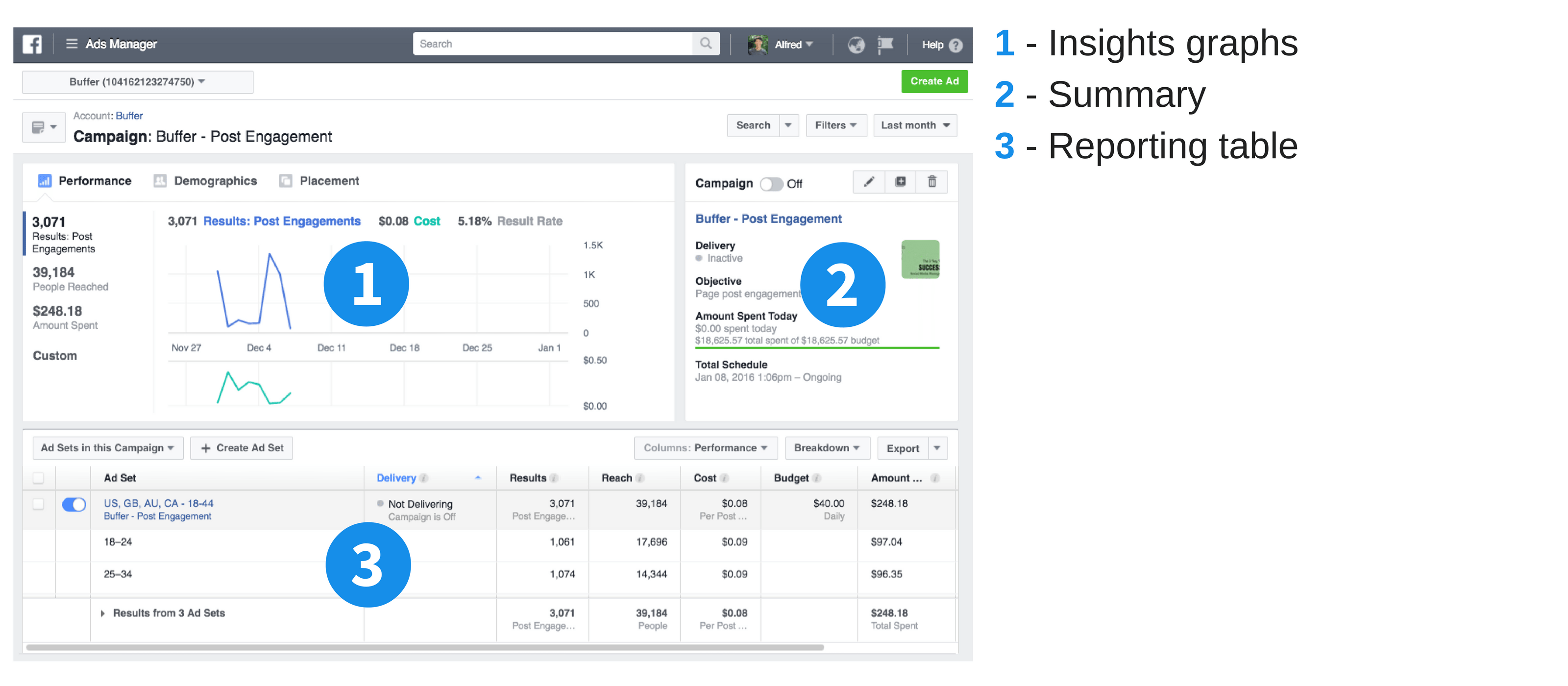
Facebook Ads Manager campaign view

The insights graphs section contains graphs that visualize your ad’s data to give you an at-a-glance overview. There are three tabs — Performance, Demographics, and Placement.

Facebook Ads Manager insights graphs

The Performance tab shows you the performance of your ad over your selected date range. There are three preset graphs, showing the results of your ad according to its objective, its reach, and the total amount spent. You can also customize the graphs to compare two metrics of your choice.

The Demographics tab shows you the gender and age breakdown of the data of your ad. You can toggle to see the breakdown of the ad results, impressions, reach, and amount spent. (Tip: Impression is the number of times the ad is seen, while reach is the number of people who saw the ad.)

The Placement tab shows you how your ad performed across different platforms (eg. Facebook or Instagram) and placements (eg. Facebook desktop right column or Instagram mobile News Feed). You can view data like ad results, impressions, reach, and amount spent across platforms.

The summary section gives you a summary of your ad such as delivery, objective, the amount spent today, and total schedule. There are also options to toggle your ad on or off, edit your ad, create a similar ad, or delete the ad.

Facebook Ads Manager summary

The reporting table is similar to the one on the main dashboard. The only difference is that it doesn’t show you all your Facebook ads. If you are viewing a campaign, it shows you only the ad sets or ads in the campaign. If you are viewing an ad set, it shows you only the ads in the ad set. If you are viewing an ad, it shows you only the ad.

Facebook Ads Manager reporting table


Chapter 5:
Quickfire overview of other useful features

Here are some features outside of the Facebook Ads Manager, which might be useful to you. They are accessible via the menu button in the upper-left corner of your Facebook Ads Manager.

Audience Insights

Audience Insights

Audience Insights is a tool to help you learn more about your target audience with aggregated information about the audience’s demographics, location, behavior, and more.

For example, if you are curious to learn more about people who liked your Facebook Page, you can add select your Facebook Page under the “People Connected to” section on the left. Audience Insights will show you their demographics, the Pages they liked, their location, and more.

If you are keen to reach this audience, you can hit the green “Create Ad” button to create an ad targeting this audience.

Power Editor

Facebook ads manager power editor

Power Editor is for those who wish to create large amounts of ads at a go and want to have specific control over how the ads are served. You can access the power editor through the Facebook Ads menu, under “Create & Manage”.

Pixels

Facebook ads manager pixels

Facebook pixel is several lines of code that enable you to leverage the actions people take on your website to create better Facebook ads. By placing the pixel code in the header of your website, you can track conversions on your website, optimize your ads for conversions, and remarket to people who have visited your site or taken specific actions on your site.

To create your Facebook Pixel and track conversions, head to “Pixels” through the Facebook Ads menu, under “Assets”.

Relevant resources

As I mentioned earlier, there are so much to learn about Facebook ads. I know I haven’t been able to cover everything about Facebook advertising. If you are interested in learning more and diving deeper into Facebook advertising, here are some tools and resources you might find useful:

Facebook Ads Manager mobile apps

Facebook Ads Manager mobile app

If you want to manage your Facebook ads on the go, Facebook has created a Facebook Ads Manager app for iOS and Android. With the app, you can create ads, manage your campaigns, get notifications about your ad performance, and check the metrics of your ads.

For more Facebook advertising tools, Neil Patel has written up a great list of 11 Facebook advertising tools that’ll save you time and money.

Facebook’s Creative Hub

Facebook’s Creative Hub

Facebook’s Creative Hub is one of its latest tools for advertisers and marketers. It allows you to create mock-ups of ads, preview them as though they are live on a Facebook News Feed or Instagram Feed, and collaborate and share ideas with your team.

It also has an Inspiration Gallery for you to discover how other businesses are using the various ad formats such as carousel and 360 video. You can get started creating your mock-ups here.

Facebook advertising tips

Facebook advertising tips

Facebook has created a resource of tips and recommendations for improving the quality of your Facebook ads. It covers everything from writing your ad copy to creating videos for the mobile feed to getting the most out of the Facebook pixel. You can find this resource here.

Over to You

Thanks for staying with me throughout this guide! Hope you have found it to be useful.

With things moving so quickly at Facebook, I believe some parts of this guide might be outdated by the time you read it (hopefully not!). If you spot any updates about Facebook ads since we published this post, we’ll appreciate the heads up. We are keen to keep this guide up-to-date and useful for you.

Thank you! And all the best for your Facebook advertising!

11 Jan 18:08

B2B Buyers Make The Case For Better Marketing And Sales Alignment

by Forrester

marketing-sales-alignment

Are your marketing and sales teams caught in that endless loop of finger pointing? B2B sellers who complain about lead quality/quantity and marketers who criticize sellers for poor follow up? After years of acknowledging their issues with each other, many B2B marketing and sales teams continue to be at odds. Just “google” marketing and sales relationships and see what you find. I did and I surfaced 98 million results! Titles such as: “The Rocky Road Between Sales and Marketing” and “How to Survive a Soured Sales and Marketing Relationship” show the dissonance and drama still very much in play.

Five years into the age of the customer and the modern B2B buyer has high expectations. They’re more knowledgeable, independent and self-directed than ever. They no longer rely on your sales people for product, pricing and other information. And they don’t want to be told what they already know. As I explore in our recently published report, B2B Buyers Mandate A New Charter For Marketing And Sales, the empowered B2B buyer is neither concerned with how your organization is structured and who’s responsible for the content on your website, nor are they interested in talking to a sales rep simply because they downloaded a white paper. Your buyers want contextual interactions with both human and digital assets across a holistic but non-linear journey. And, by in large, they want their experiences with sales people to be high value or frictionless. Think of a 2 or 5-star hotel experience – each has its merits – but 3 and 4-star hotels often disappoint.

So the question remains…how prepared is your go-to-market organization to meet the needs of today’s B2B buyers? And what are you going to do if they are not? Start by allowing the lines between marketing and sales to blur to better serve your customers. Identify a couple of buyer-centric initiatives like social selling or account-based marketing and align marketing and sales compensation in more meaningful ways. Be open to new profiles and constructs. Place the buyer at the center of your universe and seed more cohesion between teams.

We’ve talked about this long enough. Start partnering up your internal teams to respond to this mandate and don’t get left behind!

This article was originally posted on Forrester.com.

By Mary Shea

11 Jan 18:08

10 Minute Intro to B2B Digital Marketing

by Kara Jensen

Whether you are an experienced marketing professional or new to marketing, a quick intro to digital marketing is a great place to start. In this 10-minute guide, we’ll provide a high-level introduction to the world of B2B digital marketing.

A B2B Website

All digital marketing starts with a well-designed website. Your firm’s website is often the centerpiece of a larger traditional and digital marketing strategy. If you don’t think a website matters for your B2B firm, here are two statistics to chew on:

89% of B2B researchers use the internet during the B2B research process.

B2B researchers, on average, do 12 searches before engaging on a specific brand’s site.

(Source: Google)

If your company doesn’t have a website, how will these 89% of your potential audience find you?

A great B2B website has a professional polished design, clear branding, and a well-crafted value proposition. It also has the following features:

  • Lead Capture Tools – calls-to-action and easy-to-complete online forms
  • Blog – the easiest way to add new, educational information to a website
  • Content Offers – whitepapers, guides, case studies, ebooks, infographics, research, etc.
  • Links to Current Social Media Accounts – up-to-date LinkedIn, Facebook, Twitter, etc.
  • Landing Pages for Ads – either a well-designed home page or a unique page built primarily around specific ad messaging.

A website is often the central hub of a digital marketing strategy because it hosts the blog, captures leads, serves as the landing page for email campaigns and digital ads, and enables your audience to connect with your firm via social media. If you are shopping for a new website, download the B2B Website Buyer’s Guide.

Social Media

If you think LinkedIn, Facebook and Twitter are just for connecting with high school friends and sharing personal opinions, think again. These, and other, social platforms are an excellent way for B2C and B2B firms to connect and engage with their audience (regardless of age or professional experience). So, does your firm need to set up accounts on Facebook, Twitter, Pinterest, Snapchat, Instagram, LinkedIn, Google+, YouTube and Yelp? The answer is no. (Phew!)

For B2B firms, we typically recommend a LinkedIn and a Twitter or Facebook page. However, you will know your audience best and can determine which social media channels are the most appropriate for reaching your audience. The key factor is to establish social media profiles that your marketing team can update regularly (post at least a few times a month) and optimize with professional branding and images.

All social media channels allow B2B firms to reach their audience in three ways:

  • Organic – share updates, news, articles, videos and other relevant information with your existing audience.
  • Paid Updates – pay to share information with a target audience (typically articles or videos).
  • Paid Ads – pay to advertise to a target audience.

It’s best to use a mix of both paid and organic posts on your social media channels. You can start out by posting your latest blog, podcast, or video blog to your firm’s LinkedIn page and then paying to boost the post to your target market via the “Sponsored Updates” feature. It should be noted that social media does not necessarily drive leads. It does, however, increase brand recognition, engage your current audience and potential clients, personalize your brand, build your authority, and extend your audience reach.

Email Marketing

We call this an oldie, but a goodie. Email marketing isn’t new anymore, but it’s a necessity for all types of businesses. In the B2B industry, email newsletters are a great way to stay in front of your current clients (think retention and upsell). Email newsletters can be sent daily, weekly, monthly, bi-monthly, and quarterly. Anything longer than quarterly isn’t very effective for client retention.

A common question about B2B email marketing is what to include in the emails? Here are a few ideas from our digital marketing team on what to include in your next newsletter:

  • Recent blog posts
  • Industry trends or breaking news
  • Company highlights
  • Current specials or promotions
  • Content offers
  • Credibility pieces (like guest articles on well-known sites or certifications)
  • Links to your social media pages

When it comes to email marketing, we advise against purchasing lists from email list vendors. They can rarely provide the right audience and if that audience doesn’t know your firm, their first interaction with you (a cold email campaign) will not set the best impression. This advice does not extend to trade show lists where your company had a booth, speaking engagement, or other type of presence.

Pay-Per-Click Ads (AdWords or Bing)

Paid advertisements on search engines like Google (AdWords), Bing, and Yahoo are a great way to start driving potential clients to your B2B website. Whether you have an established website or a brand-new website, pay-per-click (PPC) ad campaigns enable you to target specific search terms (or keywords) that your ideal clientele is typing into the search box. Ideally, a PPC ad campaign is run concurrently with an organic inbound marketing strategy (blogging) to garner the best results.

Retargeting Ads

Retargeting ads are shown to users who have visited your website. The beauty of retargeting ads is that they are shown across a network of websites and are designed to entice users to re-visit your website and complete an action that they may not have completed on their first, second, or third visit.

A retargeting campaign is often inexpensive to run and enables your B2B firm to stay top of mind with potential prospects. They may not have been ready to close the deal the first time they visited your firm’s website, but by staying in front of them, your firm will be there when they are ready to become a new client.

Banner Ads

Banner ads used to be simple, like purchasing billboard space. You find a site your clients use, you contact the webmaster, and you purchase ad space. With advancements in software technology, algorithm updates, and intellectual innovations, banner ads are a whole category unto themselves. Now, a business typically works with a vendor to purchase ad space on their behalf and to report back on the number of people who have seen their ads and clicked through to their website. Below are a few common terms regarding banner ads:

  • Google Display Network – advertise on Google’s network of websites.
  • Programmatic Ads – uses software platforms to automatically purchase digital ad space.
  • Account-Based Marketing – uses software to reverse-engineer via IPs to target your ideal list of potential clients.

Digital banner advertising campaigns work fantastically for certain businesses, yet aren’t the right fit for other firms. Ideally, banner ads should be a component in a comprehensive marketing strategy where the value proposition and target audience is well-defined.

That’s your 10-minute intro to digital marketing. It’s not a comprehensive explanation of all things digital marketing, but we only had 10 minutes!

11 Jan 18:07

3 Reasons B2B Brands Should Podcast to Win More Business

by Bernie Borges

James Carbary is the Founder of Sweet Fish Media, a podcast production service for B2B companies. He’s a contributor to the Huffington Post and Business Insider, and he also co-hosts the B2B Growth Show: a podcast dedicated to helping B2B executives achieve explosive growth. In this episode, James and I discuss three reasons why B2B brands should be podcasting.

Four years ago James started his first podcast, Inspiring Awesome. It was all about the creation of content for people in general, not limited to entrepreneurs. Sweet Fish Media launched in January 2015. One of their best clients were church planters, and the work was so enjoyable for the team that they started a Plant Better podcast to develop one to one relationships with others in the church planting world. After 45 podcast episodes that created strategic relationships in a market segment with limited budget, Sweet Fish Media pivoted their business model to produce podcasts focused on B2B brands in January of 2016. With the shift came the start of their current podcast, The B2B Growth Show which I had the privilege of appearing on in episode 256.

Why Should B2B Brands Consider Podcasting?

James believes the most strategic benefit to podcasting as a B2B brand is the ability to “break through the noise.” For brands using account-based marketing, podcasting allows for differentiation among the competition. Once an account is targeted most brands are sending cold emails that read similar to those sent by their competitors. Podcasting gives brands an edge and a way to amicably connect with decision makers by inviting them to be featured on their show. It provides a foot in the door and a way for B2B brands to reach their buyers.

“The most strategic benefit of a podcast for B2B brands is that it breaks through the noise.” @jamescarbary #sbeshow

Three Reasons for B2B Brands to Podcast

Thought leadership is a significant use case for podcasting. By hosting experts on a show, as Sweet Fish Media does with The B2B Growth Show, they absorb that knowledge and educate their listeners at the same time.

Content creation…Many marketers struggle to come up with new content ideas. By leaving the topic each guest will discuss up to them, it saves a lot of headache for marketers and allows for consistent content creation. Since the guests on his show are also his audience and target buyer, the topic they chose will be highly relevant. Another way podcasting assists with content marketing is through repurposing of episodes. This can be in the form of inspired blog posts, social messages, images, transcriptions, etc.

Align Marketing and Sales. B2B brands recording podcasts will find it advantageous to align marketing and sales. Sales will be able to support marketing in finding guests by revealing who they’ve identified as likely buyers. And marketing will help sales by aggressively targeting decision makers from those organizations to be podcast guests. A podcast can support an account based marketing (ABM) strategy.

Tune into this episode to hear an example of a software company Sweet Fish Media helped to launch a podcast. The show helped the company to connect with brands like Sears and General Mills.

Content_Summit17

Sweet Fish Media is holding a free virtual event for B2B marketers February 6-10 called Content Summit 17. I will be a guest along with more than 50 other speakers covering content marketing strategy, distribution, promotion, processes, sales and marketing alignment, and more. Sign up to save your place at ContentSummit17.com.

Featured On This Episode:

There are TWO WAYS you can listen to this podcast with James Carbary.

You can click the Listen Now button at the top of this page…

Or, you can listen from your mobile device’s podcast player through iTunes or Stitcher. Discover why B2B professionals are raving about our social selling online courses for sales professionals, entrepreneurs and executives.

P.S. On episode 146 I’ll cover the reasons Microsoft and LinkedIn integration will impact you.

11 Jan 18:06

Business Checklist: 6 Things You Should Do Every Month In 2017

by Cosette Jarrett

The New Year is here which means it’s time for business owners to start strategizing for how they will make 2017 more profitable and more successful than the year before it. (We’re in the thick of it with such a crazy year last year!)

Our 2017 business checklist should help.

Although organizing your plan will likely require specifics pertaining to your business and its unique needs, there are several impactful ways business owners in every industry and niche can work toward building better business operations.

business-checklist-2017

Our 6-Part Business Checklist For 2017

Every business is looking for higher customer conversion rates every month in the New Year. Am I right?!

If you’re a business owner hoping for an even more successful year in 2017, try implementing each of these six tips (or using our business checklist) each month to:

  • Decrease employee turn around
  • Increase your customer base, and
  • Provide better service to existing and future customers

1) Meetings Matter

HOW: Hold one-on-one meetings.

One-on-one meetings are a powerful way for business owners and managers to stay informed about what’s going on in their companies. By enlisting the help of your management team to hold one-on-one meetings with their respective teams at least once a month, you will be better able to identify and understand any operational issues within your business.

Holding one-on-one meetings with your employees at least once a month will also help you avoid high turnover rates and other issues within your offices as it gives employees the time and space they need to discuss any concerns they have before they become larger issues.

If you’ve yet to implement regular one-on-one meetings in your business, 2017 is the time to do it! Your managers will likely need a little guidance and motivation to get started, but once you get the ball rolling, your management team and its employees will start to enjoy the ability to meet with one another each month.

Wavelength offers up an excellent guide to one-on-one meetings if you’d like a little more information on what a successful one-on-one meeting might look like and why.

You can also use our Level 10 meeting agenda as a guide (we’ve added this as a consideration on the business checklist below!).

2) Give Employees Data, Too

HOW: Send a business report.

Reports show that a quarter of workers in the U.S. do not trust their current employers. The most likely cause of this distrust among American employees is a lack of transparency within their companies.

Although it can be difficult to be 100 percent transparent with your team at all times, it’s important to understand that your company’s stakeholders deserve to know what’s going on within your business. This is why every business owner should send a business report out to their employees at least monthly to make sure they feel informed.

Your report should outline how and why any changes will be taking place and how they might affect the work environment for your team. It should also explain how the business is doing in terms of operations and yearly goals.

Encourage team members to seek out their managers for clarification if needed and be sure that your management team is trained and ready to answer any questions that come their way.

3) Keep Up With Constant Change

HOW: Update your website.

One of the biggest challenges small businesses face is the constant evolution in web design and online marketing trends. Although your site might seem to be doing alright at the moment, chances are there are several small changes you could make to increase conversion rates and provide a better customer experience.

If it’s been a while since you’ve updated your site, start by going through this guide to ensure you’re covering the basics of building an online store that is capable of earning the business of online buyers. This could be your goal for updating your website for the first month.

For the following months, be sure to keep up on what’s going on in the online marketing sphere.

  • What are leading onsite marketers and designers doing to convert more site visitors into buyers?
  • How could you implement that on your site?

Your marketing team should be following blogs from experts like Conversion XL and Unbounce to keep up on the latest and greatest tactics in CRO (conversion rate optimization).

4) “How WE Doin?!”

HOW: Evaluate customer satisfaction.

via GIPHY

Once you’ve built a solid customer base, keeping your loyal customers happy as your business grows can be a bit tricky. This is why all business owners should evaluate the current state of satisfaction among their consumers at least monthly.

Tapping into consumer insights on a regular basis will help you understand where and how your business can improve its customer interactions to provide the level of service necessary to acquire and retain customers.

You could try simple email surveys or even ask consumers to respond to a few questions at the end of each customer service call.

This guide also offers up more options for customer service evaluation tactics if neither of these sounds like a good fit for your needs. No matter how you choose to gather customer insights for your business, the key to success will be to evaluate these insights each month and identify where and how you can implement the important feedback your consumers are giving you.

No matter how you choose to gather customer insights for your business, the key to success will be to evaluate these insights each month and identify where and how you can implement the important feedback your consumers are giving you.

5) ABT = Always Be Testing

HOW: Try/test a new marketing tactic.

If your company has built a marketing team, it will be important to ensure this team is working to innovate its practices on a regular basis. This is why you should set a goal for your marketing team to try at least one new marketing tactic each month.

Your marketing test should be separate from the CRO updates on your site, but could still include some onsite strategies like major content pieces on the blog or tweaks to certain pages to boost their potential for ranking for target keywords.

Your team should be following the blogs and influencers necessary to discover these new ideas on their own, but a few suggestions you could provide might be the Moz blog, Rand Fishkin’s Twitter account, and the Kissmetrics blog.

And if you don’t have the time to check this off of your business checklist, you can always consider outsourcing your marketing initiatives.

6) Stay Plugged In

HOW: Engage with your industry.

An important part of establishing your company name is to engage with the industry surrounding your brand.

Although it can be easy to forget to keep up on this step, a simple solution to ensure engagement throughout the year is to schedule out events in your calendar.

  • Look for conferences and meetups in your area.
  • Seek out ways to engage in conversations about the product/service you provide on social media and online forums.
  • If you need to travel to find opportunities to join a conversation in person at a seminar, do it!

Getting to know others within your industry not only gives you the chance to introduce your brand and its offerings but also allows you to scope out what others are doing and learn from their wins and losses.

Owning and running a successful business will never be an easy feat, but by focusing on constant improvement across the board, business owners significantly increase their chances of building the efficient and effective operations they need to make everything run as smoothly as possible.

Hopefully, these tips 2017 plus our business checklist will help you create and implement successful strategies to make 2017 your best year yet!

2017-Monthly-Business-Checklist

Have any must-do items to add to our business checklist? Weigh in and comment below!

11 Jan 18:06

Sales Memo – Winning Starts with Thinking Strategically

by Richard Ruff
Crafting sales strategy

Crafting sales strategy

In B2B sales, one-size-does-not-fit-all is a cornerstone proposition. There are no generic customers; hence there are no winning generic strategies – each customer is unique and every winning account strategy must take that uniqueness into consideration.

When thinking about what it takes to formulate a winning sales strategy, a good starting point is remembering you are dealing with a complex buying environment. Many decision-makers and influencers are involved, the needs and issues are multi-layered and often conflicting, and the solution configuration and implementation management is likely to be complex and sophisticated.

Given this situation let’s explore two overarching ideas for how to develop a winning account strategy.

Comprehending the customer. The best practices for formulating a winning strategy all start with developing an understanding the customer. Top sales performers develop a comprehensive picture of the customer and average performers develop snapshots. Let’s examine some ideas for what it takes to develop that comprehensive understanding:

  • Understanding the Buying Process. It is hard to sell if you don’t know how people buy. Crafting an effective account strategy requires knowing who the players are, the roles they will assume in the buying process and their opinions of you and the competition?

You also need to know what the buying process looks like – for example assuming that it mirrors your selling process is a common mistake. Even the often-held notion that the buying process is linear is at risk in many major accounts.

Last, and importantly, just because you are starting at the beginning of your selling process, don’t assume the buyer is at the beginning of their buying process. It is well to remember that although the number is somewhat notional, approximately 75% of the time customers make their final decision halfway through the buying process. Many salespeople do the right thing but do it too late.

  • Interpreting the Business Environment. Events occur in the business environment that impact – positively and negatively – your probability of capturing the business. Top sales performers are aware of these events and adjust their strategy accordingly. These events tend to fall into three categories:
    • Business Context – example: a new competitor
    • Your Company – example: new product introduction
    • Customer – example: your internal champion leaves

These changes are occurring constantly. This is one of the reasons that winning account strategies cannot be developed and then stored away but instead must be constantly reviewed and updated.

  • Knowing the Decision Criteria. Competition is almost always present in B2B sales; therefore:

(1) Know the decision criteria the customer will use to decide between competitors.

(2) Determine how you fit against the customer’s decision criteria. The fit is a two-way street. You must determine in an objective fashion the degree of fit between the customer’s decision criteria and your capabilities. In addition, you must obtain the customer’s perception of that fit. It is often the case that the two assessments are not in alignment and a part of your strategy is what to do about the misalignment.

For example, there are times when it is legitimate to help a customer change their point of view. A misperception about one of your capabilities is an example. A second example is when a customer deems a particular decision criterion to be extremely important and it is your experience the priority is misplaced. This, of course, is a road to be walked with care. If the customer would end up making a better decision if they changed their assessment, then changing brings value to the customer and to you and that’s legitimate. Obviously, it is not legitimate if the viewpoint shift is strictly in your self-interest.

(3) Obtain the customer’s perception of how the competition fits with the decision criteria. With all that information at hand you can make a good assessment of your competitive position as viewed by the customer.

Thinking innovatively. It is well to note that account strategy development has bit of a checkered past. In the bad old days account strategy was fundamentally about how to pitch your product and how to counter those nasty objections encountered along the way. As time rolled on, things got better but often account strategy was mainly about filling out a form that was then filed away never to be seen again.

Fortunately today the world is a better place. More and more companies have recognized the need to help their sales reps to think and act strategically.

So what are some additional tips for getting that right? Recently we came across a great article in the Harvard Business Review by Mark Chussil about frameworks that can help salespeople to do a better job thinking strategically. The article was about business strategy in general but we thought it was particularly useful for those of us in sales.

Mark’s first suggestion is to shift from starting with the question “What should we do?” to a question that tends to broaden the alternatives – “What could we do?”

The notion of “could” asks what if?, what else?, or why not? The article provided several specific framing questions:

  • Imagine you could do it again and you’re saying, “I wish we’d thought about X.” What is X?
  • Ask what would be the equivalent to your situation in another division or territory and how would they strategically handle it.
  • Ask what you’d do if you were a new company preparing to enter your market.
  • Ask what you’re afraid your competitors might do.
  • Note your favorite metaphor for business: chess, war, making deals, enriching share­holders, satisfying customers. Switch to another.

Today markets are going through transformational changes. The medical sales and technology industries are classic examples. Buyers are changing what they buy, how they buy and what they are willing to pay for it. Moreover in the future the dust is unlikely to settle. Instead the new constant will likely be a constant state of change.

In such a market environment there is limited room for the “tried and true.” From a strategic perspective doing the same old, same old is not going to carry the day. Thinking and acting strategically to bring unique innovative ideas to each account will take on increased importance.

Sales reps and companies that adopt the “let’s just stay the course” strategy are likely to continuously erode their competitive advantage. “Tried and true” is likely to reemerge as “Sorry and Sad.”

11 Jan 18:05

Marketing Video: Sales and Marketing Alignment--Stop Passing the Baton and Start Rowing the Boat

Once Marketing hands off leads to Sales, it's often assumed the marketer's job is done. But to close sales, Marketing and Sales must be in alignment during the entire buyer's journey. Read the full article at MarketingProfs
11 Jan 18:05

5 sales trends you must ignore to succeed in 2017

by nick@close.io (Nick Persico)

JFW-AW16-2-featured-min.jpg

I always find myself stumbling across these articles every new year: Is 2017 The Chatbot Year?, 2017 Will Be the Year of AI, 2017: The Year of Machine Learning, Intelligent Content and Experiences.

And how about the countless articles claiming that cold calling and emailing are dead? The cynic in me says, "Who cares?" People still buy from people and always will.

As a society, especially in technology, we tend to overhype new things. We think they're going to change everything.

We’re still building large businesses on the backs of sales teams using the same core tools and raw hustle we’ve always had. So who cares about any of these sales trends that consume everyone's attention and eventually pass with a whimper? Remember social selling?

Unfortunately, it’s not that simple. Ignoring any changes in the strategies that a sales team needs to deploy in order to be successful would be naive. Buyers are more informed than ever, and being a great salesperson in 2017 means you can effectively establish yourself as a valuable resource of information to prospects.

Beating prospects over the head with hardcore sales techniques is a losing battle. Prospects are less likely to respond to that style, and managers won’t let their teams sell that way either. As a profession, we are all starting to agree that heavy customer churn is just as bad as slow customer growth. In other words, we should only be selling to qualified prospects at all times.

While sales has changed in strategy, it hasn’t changed in principle. I still believe that people buy from people. Not chatbots built on top of machine learning AI from some sales automation platform.

They are all distractions that cause sales teams to chase magic instead of working on becoming better salespeople.

Shiny new tools are costly distractions; focus on becoming better salespeople

When things change, like prospect’s buying behavior, we tend to reach for the next shiny tool that will automagically double conversion rates.

For example, it seems to be an absolute requirement for every SaaS startup to have an Intercom, Olark, Drift, or Livechat widget greeting website visitors before they even get a chance to read the main tagline. I hate those fucking things. It’s like walking into a clothing store and having one of the associates scream from the back counter asking if I need help. I haven’t even figured out what department I want to look at yet.

But I do like it when the widget pops up on the pricing page 15–20 seconds after I’ve been on it. Now that’s useful. Those widgets have their place and purpose.

Don’t get me wrong, shiny new sales tools are fun and exciting. I’m starting 14-day free trials left and right like the rest of us. But the point is that these tools pull us into an obsession with automating or hacking a part of our sales process.

They distract us from what we should be doing, and that’s focusing on training your sales team to get better at their craft.

It’s not sexy to be old school, but it pays

There’s a stigma in SaaS startups around doing things the old school way. Current and future generations of CEOs and leaders are more likely to have engineering backgrounds. Considering their perspective on the world, there’s a tendency to automate or “science” everything.

While we should value that perspective in most things, human beings making buying decisions about business software is not one of them (yet).

This perspective has caused a lot of CEOs and their sales managers to spend the majority of their time automating sales processes. While in reality, they should be training their team to become better salespeople. That’s who will close the deal at the end of the day.

The point of all this is that an exceptional team of salespeople is the best way to protect yourself from the splash and fizzle of trends that come and go. So when these sales trends come and go, you’ve built a team that can sell. There’s always value there.

The rise of buyers having unlimited access to information and these new tools create noise. The salesperson’s role is to help the buyer cut through that noise and help them make a decision. 

Five sales trends to ignore in 2017

To help you avoid any distractions from improving your sales team, here’s a list of 5 sales trends you should ignore this year and why.

1. Putting AI/chatbots in front of prospects

It’s not ready. Until Alexa can answer specific questions about your product and negotiate an annual pre-paid software subscription, there’s no need to put AI in front of your prospects.

It’s only a matter of time until we’re all frantically typing “AGENT” in chat windows, hoping an informed human shows up to help with a specific question.

2. Using machine learning as a single source of qualified leads

Products like Clearbit or MadKudu can do a great job creating profiles or lead scores for your prospects. But they don’t capture context or their intent. You can’t expect them to yet.

A prospect’s intent and interests change constantly. They have specific needs. While a certain percentage of leads can be straightforward and considered “qualified”, you still need to have a human qualifying leads. A qualifying conversation helps you determine their intent, timeframe for purchase, and who else will be involved in the process.

But most importantly, a qualifying conversation gives your sales team an opportunity to get the full context. The prospect may have the wrong impression, information, or idea of how they would implement your product. A real conversation allows you to mitigate it as it happens in real-time.

3. Outsourcing entire parts of the sales process

As you may know, we have some experience being an outsourced sales team. The fact that we shut down the service should be all you need to know.

Kidding. (But not really.)

Outsourcing parts of your sales process should only be temporary. You need to look at your sales team as an entity that’s also responsible for gathering valuable information. Prospects and customers will tell you what competitors are up to, how they are using certain products, and what needs to be fixed in your industry.

If a team in another office and company are having those conversations, how can you effectively stay on top of what’s happening?

4. A/B testing everything

Have you ever caught yourself writing A/B tests for a campaign you’re doing for the first time? I know I have. Then I realize that I’m writing A/B experiments on an experiment. That’s so meta.

Instead of trying to fully optimize the first time you do something, just do it. Then do it again. After a few times, you’ll start to understand if it’s going to be a continuous activity your team engages in. If that’s the case, then A/B test.

5. Using “predictive analytics” to figure out why someone didn’t buy

If you listen to the conversations your sales team have with prospects that don’t buy, you can easily figure it out. You don't need a fancy algorithm to tell you.

It’s pretty simple. They most likely didn’t buy because:

  • They weren’t qualified or a good fit to begin with.
  • If they were qualified, you didn’t convince them.

Focus on helping your team get better at convincing qualified prospects that you are the solution for them.

You may not agree with any of this, but one thing still remains true:

No one has ever said that sales is now easy because of all these things.

The next time you want to spend an afternoon chasing some trend or testing out a shiny new tool, consider spending that time helping you or your team become better salespeople.

Don’t focus on what’s changing. Focus on what will never change: the eternal truths of sales and human psychology. That’s what we cover in our free startup sales course. No matter whether you’re a beginner or a seasoned sales veteran, deepening your grasp on the basics will be much more valuable than chasing the latest shiny new tool.

Click here to get started with your free startup sales course now!

Recommended reading:

Podcast: How to Think About Hot Trends in Busines & Technology
This post was inspired by a conversation Hiten Shah and I had on our podcast, The Startup Chat. Listen to it here!

How NOT to do social sales
Social sales can be an effective method of closing deals, but most sales reps are doing it wrong.

Sales in an AI world: How human is your sales process?
More people are now using AI applications to automate sales. However, AI challenges the fundamental principle of sales. Will AI displace humans?

11 Jan 18:04

12 Technologies You Should be Using in the New Year

by Kelly Louro

January 2017: 31 days of “new year, new you” posts and gym selfies, clean slate musings and big promises of starting over. But here at C3Workplace, we’re all about getting back to business. We know it’s not about starting over, but upping the ante. It’s about making this year better than the last.

With twelve squeaky-clean months ahead, we’d rather muse about what will boost our business, our productivity, and our efficiency. And for 2017, we’re all about that technology! In honor of the new year, here are twelve (try one per month!) technologies you should be using, if you aren’t already…

1. Password Management Software

Stop me if you’ve heard this one: you need to log in to a site you don’t visit very often. You type in your go-to password. Incorrect. You try again. Incorrect. One more time with a capital? Incorrect. You get locked out and now must complete the 7-step process to reset it. Password Fatigue – we’ve all got it. That’s why software such as Lastpass, or Dashlane is great for not only keeping that password craziness in check, but also providing extra security, auto-form filling, and even secure digital wallet apps

2. Mobile App Management

If you’ve got employees on the go who use their own laptops but still need access to your documents, software such as Microsoft Intune or Optitune are easy ways to keep hold of your security and control. The software allows you to assign users and dictate their levels of access, while still allowing them the autonomy of their own devices. And you can revoke their rights to your documents at any time. Must feel good, right?

3. Cloud Computing

Workplaces, they are a’changin. Gone are the days of being tied to your desk just to access the bulky server in the back room. Programs like Office 365 allow you to access your documents from anywhere and from any device. You can also share documents with clients, edit at the same time, all whilst saving everything in real time. Not ready for Office 365? Start off with Dropbox. They have a free version. See how it fits.

4. Chat Now!

Criticize all you want, it’s not just the younger generations with dwindling attention spans. When we want answers, we want them NOW. Thanks to Google and our smart phones, answers are at our fingertips. So when people visit your website, having a “Chat Now” option is a great way to answer questions in real time and connect with your clients. It’s not only impressive, but it’s a great way for you to capture their info right away. Depending on your website, software like PureChat also allows you to chat from your smart phone. Formilla has a free version that you can try out, too.

5. E-commerce

According to The Wall Street Journal, shoppers are now making 51% of their purchases online. Are you getting a piece of that pie? Depending on your business, having the option to purchase directly from your website just makes sense. Programs like Shopify, WooCommerce, or Magento can easily integrate into your website (see which one is the best for your platform). Don’t let those sales get away!

6. QuickBooks Online

With all the money you’ll be making off your online shop, you’ll need a seamless way to keep track of all that green! QuickBooks Online is a favorite of ours. We use it for our own financials and love how easy it is to view the flow of cash, get quick and accurate reports, and create and send invoices. And again, the information is safe, secure, and accessible from wherever you are.

7. “Control Centers”

This is why you have password fatigue: there are about ten different websites that you use on the daily. Wouldn’t it be nice to view all that info from one central place? That’s where programs like Cyfe, Mint, and Hootsuite come in. Cyfe is a business dashboard that links programs such as your email marketing, google analytics, and CRM. Mint links all your financial accounts. Hootsuite links all your social media platforms and allows you to schedule, monitor, and even get analytics. Control from one place – what could be sweeter?

8. Customer Relationship Management (CRM)

Are you quantifying your pipeline data to make better business decisions? If you have no idea what I’m talking about, but I’ve peaked your interest, then you need a CRM system. We happen to love Zoho, but programs like Highrise, Salesforce, and Infusion Soft work, too. Not only can you track your database and every step of the sales process, you can also connect your systems for streamlining workflow.

9. Time Tracking

We don’t want to beat a dead horse here, but…are you tracking your time yet?? Knowing where your time is going, what clients you’re spending your time on, and where your employees’ time is going opens up a world of possibilities for planning ahead. Check out the 30-day free trial from TSheets, courtesy of C3Workplace :).

10. Virtual Meetings

When you’re not tied to your desk, you can meet your clients anywhere, and in any form. Our favorite platform is Zoom because it includes video conferencing and the quality is the best, in our opinion. It also includes webinar capabilities and screen sharing. Skype is also a great alternative. Just because we’re not in our offices anymore doesn’t mean we have to lose that face-to-face contact!

11. Video Advertising

It’s recently been reported that video in email leads to 200-300% increase in click-through rate (check out the infographic here). Whether it’s on your website or social media, video advertising should become part of your mix. And it’s as easy as recording off your phone, if you want to keep it low-tech. Using platforms such as Facebook to stream live video grab the attention of your consumers and allow them a glimpse of your business they wouldn’t otherwise see from your website.

12. Mobile-Friendly EVERYTHING

All of the advice above will be for naught if your systems aren’t mobile-friendly. If you were to do only one thing from this list – this would be it. Make sure that, not only is your site mobile friendly, but that it’s fast and streamlined. Don’t make people fight to find out about you. You can try it on your own with programs such as bMobilized or Duda Mobile, but we strongly suggest reaching out to a web programmer to really ensure peak performance of your site.

Feeling revved for the new year? Us too! And remember, you don’t have to try all of them at once. Start with your favorite and see how much free time or ease of mind you might gain. Then, move on to the next!

Need some help getting started? We understand new technology can be a headache, but having a professional assistant to help you set up, learn, and properly utilize it can save you A LOT of time (and stress!).

So now that you have the tools are at your disposal…how are you going to make 2017 work for you?

11 Jan 18:04

Social Lead Validation—The Missing Ingredient from Most Inbound LinkedIn Marketing Programs

by Kristina Jaramillo

All sales leads are not equal. I know this is something that most sales and marketing leaders understand and it’s why they put lead qualification and validation into most of their sales, marketing, and lead generation programs. They don’t want to waste time and money like the companies that Straight North recently evaluated.

For more than 18 months, StraightNorth conducted an analysis of 373,000 business inquiries, consisting of more than 135,000 online form submissions and more than 237,000 phone calls (totaling more than 1 million minutes). The study rejected 23,000 of them as unsuitable, leaving 350,000 inquiries to go through the entire analysis. Of those 350,000, about half—178,000—were actual sales leads. The report revealed a lead generation waste count of roughly 50 percent.

But when it comes to social selling and LinkedIn marketing, it seems that lead qualification and validation are getting thrown out the window. Business leaders and sales and marketing professionals are not identifying and focusing on those prospects who are ready, willing, and able to make a decision in investing in their product, software, service, or solution.

They are playing a numbers game, pushing out sales messages on LinkedIn to as many prospects as they can hoping that something will stick and that people will say yes to a demo or sales call. Business owners and sales and marketing professionals are treating these prospects who say “yes” to a call or demo as valid sales leads and they’re wasting time and money. Let me show you what I mean.

Logistics company wastes 90% of their time with the wrong LinkedIn sales leads

Most social media firms focus on how many leads they are able to deliver on a weekly and monthly basis. For the President and CMO of a logistics company, a well-known LinkedIn lead generation company was delivering 5 to 10 leads for sales calls per week.

However, those sales leads they were delivering sucked! 90 percent of the calls were with prospects who were not in the right stage of the buying process at this time, or they were with people who were not even a decision maker or influencer. The people who said “yes” to a call was just looking for free information, to network, and maybe refer the company.

There was no lead validation and qualification. What good were those leads if there were no relationships being created and leveraged to drive revenue opportunities? The President and CMO could have been engaging in revenue generating activities instead of wasting time on calls with unqualified and invalidated sales leads.

Social selling expert teaches her followers to go for the call on LinkedIn, leading to wasted time

The Chief Learning Officer at PeopleLinx, CEO of Social Selling Link, and Co-Founder of Business Development University and Social Selling GPS tells clients:

“With each new connection, determine if they are someone you’d like to speak with and tweak the LinkedIn message slightly: NAME, it is nice to be connected on LinkedIn. Typically I like to have a brief call with my new connections so we can explore ways we might be able to work together now or in the future. Here is a link to my calendar: xxxxxxxx. Please pick a time that is most convenient for you. I am looking forward to our call.”

So she’s telling business leaders and sales and marketing professionals to go for the call–don’t worry about lead qualification and validation. She’s saying don’t worry if they haven’t seen your value yet and that you haven’t demonstrated your relevance. Don’t worry if you haven’t identified a need yet and don’t worry if they are not in the right buying stage. This shotgun thinking assumes that getting the sales information “out there” may eventually lead to a sale. But all it really does is cost you time and money.

Why would you want to take time out of your busy day to possibly see how you can work together with a prospect–instead of taking time when you know there is a need and that the timing to move is right? Why would you want to have a phone call just to have a phone call?

When you have a complex sales process the only way to drive revenue opportunities is to build and leverage relationships. When you think the timing is right to move forward–you qualify and validate leads to ensure you’re not wasting time.

11 Jan 18:02

How to Deliver True Value with Account-Based Marketing

by Josh Ritchie

Jeff Marcoux knows a thing or two about creating an effective buyer’s journey, especially when it comes to Account-Based Marketing (ABM). He’s the CMO Lead for Worldwide Enterprise Marketing at Microsoft, a professor of marketing at UC Irvine, and an Internet Marketing Association board member. In short: He lives and breathes marketing, and he has become a huge proponent of ABM.

If you’re looking to deliver value to your customers, it’s a marketing strategy you might want to embrace. Now.

Jeff was kind enough to chat with us about all things Account-Based Marketing, from why it works to how to get started. Read on for his great insights.

account based marketing

C5: Can you give us an overview of your role at Microsoft? Or, in layperson terms, “What would you say you do around here?”

JM: I get to wear two distinct hats at Microsoft, and they are both a lot of fun.

One hat lets me be one of Microsoft’s primary evangelists to marketers and digital agencies. I get to look across the entire Microsoft technology portfolio, from Bing Ads to artificial intelligence and everything in between, as well as all of our partner technologies. Then I get to work with some of the biggest brands in the world to figure out how we can help them create better customer experiences and drive bottom-line growth through marketing. This role requires me to stay up-to-date on all the latest trends, buzzwords, and technologies across B2B and B2C.

The other hat I wear is focused on driving hyper growth for a new SaaS product called Mobile Center. Here I get to sit at the intersection between engineering and marketing and focus on product virility, net new user acquisition, and demand generation.

C5: When did you become more focused on Account-Based Marketing as a practice?

JM: In my evangelism role, I began to see this trend emerge before it was popular. I realized that a lot of it was an extension of account planning and what I called existing customer marketing.

However, the real opportunity was in the predictive lead generation strategies that were using data science combined with ABM. With a team, I had the opportunity to implement one of these predictive strategies with great success at Microsoft.

C5: What do you think is behind the recent surge in popularity of ABM?

JM: I think the surge in popularity is due to the fact that marketers are looking for “what is next” beyond marketing automation and content marketing, the next “silver bullet.”

Additionally, there are a lot of great people who were founders of MarTech who were also looking for the next thing to build. We have seen the rise in Account-Based Marketing software, data enrichment tied to that, and predictive lead generation and lead scoring technologies all bubbling up as new areas of either investment or standalone MarTech.

So I think it is a mix of the maturity in data science and data enrichment technology tied with the fact that brands are trying to find new ways to differentiate themselves and fill their pipeline.

C5: Why do you find ABM so interesting, or so effective?

JM: To me, Account-Based Marketing has the potential to be one of the most authentic ways to approach business, ensure alignment with your sales organization, and deliver some of the best ROI.

The authenticity comes in account planning with your sales team to truly examine what you can offer that your targeted accounts need most. It’s not just what you want to sell them but where you can deliver true value in context of their business and what they need today.

Additionally, with predictive lead generation, you are able to identify companies putting out signals that they are 1) in need of what your business has to offer and 2) looking for a solution like yours.

Lastly, the sales alignment is incredible because marketing and sales have to work together. You’re predominantly handing over leads that have used machine learning to indicate they are a good fit for your product and are ready to buy, or you’re helping them further expand inside of their current accounts, both of which sales loves. These also require the right content to tell the right story.

C5: What type of alignment do you need to have between your sales and marketing to implement ABM?

JM: It is absolutely critical to look at what the approach will be for each of your different scenarios:

  1. Planned ABM: Developing a target list of accounts that you would like to get inside of and building a targeted strategy across sales and marketing to achieve that.
  2. Existing Account Expansion: Working with your sales team to set goals for existing accounts, which marketing supports by identifying decision makers and providing content to support the sales cycle.
  3. Predictive Lead Gen: Using machine learning and data enrichment to create a lookalike model and monitor purchasing intent and signals to identify when a business is indicating they are in market for what you have to sell. When doing this strategy, sales has to understand what the value model you’re using provides and be willing to engage with those accounts instead of letting them sit in a marketing nurture stream, waiting for the traditional “lead score” threshold to be reached.
  4. Opportunistic: These are the accounts still hitting your website that you identify by reverse IP lookup or form conversion. If an account is deemed enough value, you can pull it from the traditional nurture stream and begin an ABM program directed at them at scale.

Thus, ensuring that sales is aware of what you’re doing and is onboard to accept the leads, information, and content you will be providing to them is absolutely critical. The strategy will fall apart if you are not working together and on the same page with the right processes in place.

C5: What types of stories do you recommend telling in this more intimate marketing environment?

JM: I think the key is to understand what the target account truly needs and what value your business can deliver to help fill those needs. This comes back to the authenticity piece of not pushing your agenda but truly using data to identify the next best product or service your client needs.

Additionally, you can fill out this picture with data enrichment and machine learning to know what purchasing intent signals they are putting out so that you can align your content and stories to those signals.

account-based-marketing-3

C5: Where/how does analytics play a role in ABM efforts?

JM: In my opinion, analytics is the most important part of ABM. You have to understand who you need to talk to in an account, for what product, as well as what motivates them, what content should be used in targeting, how to best equip your sales team for success, etc.

If you expand into predictive, analytics plays an even larger part in identifying lookalike accounts that aren’t even on your radar so you can build your strategy from there around targeting, content, etc.

One last area that I believe all companies should be using is intelligent lead scoring so that you can truly understand when a lead is ready to engage with sales vs. having an arbitrary score based on a few people in a room saying a click is worth X points and a web page visit is worth Y points.

C5: In a given campaign, how much time do you dedicate to compiling a campaign for each account?

JM: It depends, as there is no one size fits all answer here. It depends on the size of the account, how much new business we think we are likely to get, if we have an existing relationship or not, what the competitive situation looks like, etc.

Often if you have already created a library of content, imagery, and other assets by industry, role, or geo-location, you can significantly decrease the amount of prep time it takes to begin executing.

Two other factors that impact timeline are the tools at your team’s disposal and your advertising strategy.

C5: How do you prioritize/organize accounts at a gigantic company like Microsoft?

JM: This is done on multiple levels at Microsoft. We have our top strategic accounts, our enterprise accounts, managed accounts, and then work our way down below that. We also have a geographic approach, and often the subsidiary will have specific accounts they wish to target as well.

C5: What is a justified spend/cost per account, or how should you calculate?

JM: This is something that should vary for every company. There are key factors like lifetime value, customer acquisition cost, etc. to consider. Once you have an understanding of what different types of accounts mean in terms of value to your business, you are able to know how much you should spend to expand in an account or start a new ABM strategy.

C5: What impact are you seeing on the customer lifetime value from Account-Based Marketing?

JM: I have seen substantial CLV growth when ABM is done right and you keep your customer focus. If you are using predictive lead generation and have the ability to identify what a customer needs through data, this ensures you are coming in at the right time with the right message with the right product to fulfill that need. Thus, you will be successful.

I can’t share exact numbers, but we saw substantial increases in both closed-won rates and deal size when we implemented this strategy. Additionally, if you continue monitoring your existing customer base, you can detect whenever they have a need that they may not be surfacing to your sales team and/or be able to predict when they may be likely to churn. Both of these enable you to be proactive in maintaining the relationship.

However, even the best ABM strategy can be destroyed by bad customer experience and churn. So it is key to examine the entire customer journey and ensure that your ABM strategy is backed up by a focus on making your customers successful and happy.

C5: How do you test messaging? How critical is testing?

JM: Message testing can be done relatively quickly with a small amount of advertising spend. You can test many different messages to the exact same audience and observe which ones drive the most desired actions. I’m a fan of using PPC to do it quickly and at scale before deploying a very large campaign.

C5: What are some of the best ways to work efficiently without losing the personal focus of ABM (e.g., template system with a workflow for customizing and tailoring according to client needs)?

JM: One of the easiest things to do is to start with a content audit and look at where your content gaps are in the purchasing journey. Also decide how you want to segment your accounts (size, industry, other, etc.). This enables you to see what you have today, where you can start strong, and where you have gaps that need filling.

Another easy way to get efficiency is to start by partnering with your sales teams on their most strategic accounts and building out ABM plans around those.

It will take you a bit to get your predictive programs in place, so start making your list of target accounts, do your content audit, and work with your sales team to put a plan in place around your most strategic accounts.

C5: What are the most common mistakes you see people making with ABM?

JM: One of the biggest is to think that they need big expensive software to get going. Honestly, Excel works great and is good enough for most companies to get going, and a little research by your team can begin some of the enrichment.

Build a plan and start to execute, then gain more efficiency with software. Another major mistake marketing teams make is not aligning with sales before starting an Account-Based Marketing plan. That assumes that ABM is a silver bullet and the only marketing you need to be successful.

account-based-marketing-5

C5: Any final pieces of advice for people looking to pursue ABM?

JM: I think ABM has some incredible promise and can really help companies become much more focused on creating amazing customer experiences across the entire company.

However, it is not a silver bullet. It still requires you to have a holistic marketing strategy. Additionally, I think a common trap is over-investing in ABM technology when Excel may be good enough for your business to start.

The last and arguably most important thing to remember is that analytics is key. From data enrichment, research, next best product/service recommendations to predictive lead generation and predictive lead scoring, you absolutely must have a data strategy to identify what data you need and which holes to fill.

I am definitely bullish on ABM, but proceed with caution and planning.

11 Jan 17:33

3 Sales Metrics You Need to Measure Last Year & Maximize the Next

by Rachel Serpa

A new year signifies the opportunity to reflect and a chance for new beginnings. Just as you make your resolutions and examine your personal journey over the past 12 months, so should you contemplate the year’s sales performance. What types of prospects generated the most value for your business? Where did lost deals get hung up in the pipeline? Which activities resulted in the highest conversion rates?

Rather than simply thinking back on whether you hit your monthly or quarterly quotas, asking more detailed questions like these not only helps you get to the heart of last year’s performance, but it also gives you actionable insight to step it up in the new year. Let’s dig into 3 important metrics that will help you to effectively maximize your sales growth in 2017 and beyond.

Lead Yield

Sales reps field leads from a variety of sources, like advertising, email, content and more. More often than not, they focus on those which they know are easiest to close, ignoring an average of 50% of marketing leads and likely leaving gobs of money on the table. Lead Yield is just one example of a Yield Measure, or measures that can help you understand how much value you get in return for your investments at each stage of the sales pipeline.

Understanding your lead yield enables you to more accurately score and prioritize leads from your various marketing channels and sources based on those that ultimately generate the most value for your business. It also gives you deeper insight into the data points and qualities you should be looking for when it comes to prospecting – i.e. contact title, company size, industry, other technologies in use, etc.

Lead Yield can be calculated using the following simple formula:

Sales Revenue / # of Leads Generated

579x525xlead-yield-png-pagespeed-ic-w5krd19van

If you want to know how much value you get in return for a lead from one source (A) versus another source (B), you can compare their respective lead yields as shown above. In this particular case, Source B has a higher lead yield than Source A. By focusing on generating more leads from Source B (marketing) and converting these leads (sales), revenue will increase.

Activity Outcomes

Your sales reps are responsible for calling prospects, sending cold emails, booking meetings and more. But instead of simply turning the team lose to do their outreach, leading businesses are measuring rep activities and outcomes to:

A) Determine the right mix and number of activities required to hit quota
B) Identify opportunities for sales coaching and peer training

Rather than requiring managers to manually crunch these numbers, next-generation sales platforms do the math and display the results in highly visual sales reports like the one below, which breaks down the number of activities completed by sales team and rep.

activity-overview-report

Outcome reports take this a step further by helping teams measure and optimize the efficacy of their communication.

email-outcomes-report
Measuring the efficacy of your team’s communication patterns in 2016 can help you refine your outreach mix, define activity metrics and provide reps with the call scripts and coaching they need to be successful in 2017.

Sales Formula

Think about your sales funnel, which is essentially a visual representation of your sales cycle. Now imagine a handful of leads being dropped into the top or wide end of the funnel, and closed deals (both wins AND losses) falling out the narrow end or bottom of the funnel. If someone were to ask you why some deals emerged as wins versus losses, how would you explain it?

The answer is, you’d have to guess, because you have no idea what’s actually going on inside the funnel. This is essentially what happens when businesses focus only on revenue metrics. Simply measuring revenue doesn’t offer much insight into sales performance, and certainly doesn’t tell you how to get better. Instead, you have to measure performance across the key conversion points within your sales funnel that lead to revenue.

While these conversion points differ for every company based on their sales process and pipeline stages, the baseline sales formula companies can use is as follows:

screen-shot-2017-01-03-at-2-22-38-pm

Notice a major drop off from Lead to Opportunity? What about a low Worked Opportunity to Close rate? Following this formula enables you to spot and remedy process bottlenecks, training gaps and much more.

Hello, 2017

Reflecting on the past year using these 3 metrics and taking the time to learn from your discoveries is sure to make 2017 your best sales year yet. For more insight into how you can measure and maximize your sales growth, check out our free eBook: Understanding the New Metrics of Sales.

11 Jan 17:01

What Account-Based Is (and What It Isn't)

by tbertuzzi@bridgegroupinc.com (Trish Bertuzzi)

abp3.jpgIt's 2017 and I’m on a mission to educate the market about the difference between account-centric and account-based thinking. The truth is that most companies don’t understand the distinction. Just drawing a box around a set of accounts and then executing your same old demand generation strategies won't get you to the promised land of larger deals in strategic accounts. 
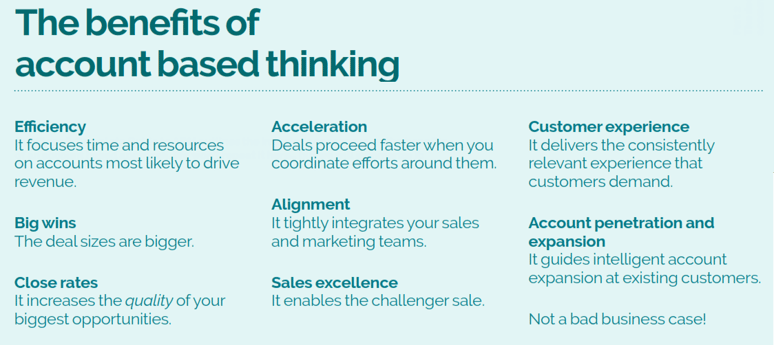
That’s why I’ve asked Jon Miller, Engagio CEO and former Marketo cofounder, to share his thinking. Without further ado, here’s Jon.
---

The B2B landscape is changing, fast.

In 2011, CEB concluded that there are 5.4 decision makers in a B2B sale. Just a few years later, new studies revealed that number has jumped by 30%. There’s even research that indicates as many as 17 decision-makers in enterprise sales. That’s exactly why more and more companies are adopting account-based strategies across their Sales and Marketing teams—it just makes sense to reach out to multiple decision-makers and influencers.

But doing it well goes beyond simple buzzwords; true success requires an orchestrated approach. Call it Account Based Everything. Call it Account-Based Revenue (as The Bridge Group does).

Call it whatever you want – the bottom line is to execute a strategic go-to-market approach that personalizes marketing, sales, and customer success efforts to land and expand at named accounts.

abp1.png 
Reaching out to multiple contacts in an account without deep research and personalization isn’t account-based anything. That’s second rate cold-calling from 2004. Successful strategies share six basic processes:

  1. Select accounts
  2. Discover and map contacts
  3. Develop account insights
  4. Generate account-relevant messaging
  5. Deliver account-specific interactions
  6. Orchestrate account-focused plays

Simply contacting multiple prospects within one account skips over steps 2-4, and that makes steps 5 and 6 impossible.

Having Leads isn’t Discovering and Mapping Contacts

With large target companies, it can be challenging to understand the structure of the decision-making team for each buying center. That’s why account-based strategies call for account-specific research to map it out. Once you’ve identified the buying centers, you need to make sure your database has the contact information for each member of the extending buying team.

Since Leads in Salesforce don’t connect to Accounts—even though you might have thousands of the right contacts—they’re useless from an account-centric perspective. You need the ability to automatically map them to the right account. That’s why Lead-to-Account Matching (L2A) is so essential.

Armed with a complete view of your current contacts, the final step here is to augment your existing data with any missing contacts for each of the key personas in the buying committee.

Phone Numbers and Email Addresses aren’t Account Insights

Developing account insights might be the process most crucial to the success of an account-based strategy.

So much depends on understanding the nuances of target accounts and using that insight to make each interaction more relevant. Your team will want to track insights such as:

  • The target account’s market—The market dynamics, news, trends, growth drivers and inhibitors, M&A activity, and so on.
  • The target company—Their stated strategy, strengths, weaknesses, opportunities and threats; competitors (and which similar companies use your solution already); their organization chart and unique buying centers; which buying centers own your products, which own competitors’ and which are open (whitespace analysis); any recent sales triggers (new funding, new hires, etc.); their culture and values.
  • The target personas—The agenda of each member of the buying team; their priorities, prejudices, preferences, styles, tactics; where they’ve worked in the past (and what systems that company used).
  • The relationships inside the account—How each key contact relates to the other members of the team; who reports to whom; who holds budgets; who are the influencers, blockers, mobilizers, enablers etc.
  • Your connections to the account—Your existing connections to the key contacts; previous deals; customer service experiences; your experience with their close competitors; LinkedIn connections to people you know; university or past company ties.

This kind of information takes time to collect, but lays the foundation for much more fruitful “Challenger Sale” conversations.

Templated Emails aren’t Account-Relevant Messaging

You've done all of the legwork: mapping contacts, gathering insights, and developing personalized content. This is where ABE shines.

  • 50% of customers are more likely to purchase from a vendor when they personalize materials to a customer’s specific business issues (ITSMA)
  • 75% of executives will read unsolicited marketing materials that contain ideas relevant to their businesses (ITSMA)

The degree of personalization should depend on the tier of the target account and the importance of the specific contact. Simple personalization can be based on the target’s industry and persona. Hyper-personalization calls for bespoke content designed for the specific company.

The rule is pretty simple – high-value targets get high customization, medium-value get medium customization, and lower-value get lower customization. Relevance is at the heart of account-based selling, and it will always get noticed above templated pitches or generic requests to “find the right contact.”

Access to Shared Account Records aren’t Account-Focused Plays

At first glance, it’s easy to assume that if the AEs know which accounts the SDRs are calling on, you’re good. Coordinating account-focused plays requires more than shared access to an account record in CRM.

You need visibility of multiple buyers in the account (decision-makers and influencers) across multiple channels (email, phone, social, direct email, and events) delivered to relevant departments (Marketing, Sales Development, Sales, and Customer Success).

Great plays have strategy behind them. Cross-functional members of the organization working towards a business purpose with clearly defined roles and responsibilities. It is a well-orchestrated and coordinated series of activities and events built around a well thought out theme or message for that account.

When you can execute at that level, the results will always be greater than individual departments working in isolation. If you’ve been trying to cut corners, stop. Back up, slow down, and work cross-functionally to do it right.
- - - - - - - - - - - - - - - -

(Trish here again.) It’s my hope that in 2017, more companies will generate significant revenue from account-based strategies. A great way to keep your finger on the pulse of best practices to pay attention to those, like Engagio, FlipMyFunnel, and Inverta, who are sharing some of the best thinking in the account-based revenue movement.


11 Jan 16:09

5 Steps To Creating A Powerful Value Proposition

by Stacey Danheiser

5 steps to create compelling value propositions

If you’ve been in B2B marketing or sales for the last few years, you’ve definitely noticed some changes – longer and more complex sales cycles, more buyers involved in the decision making process, and more buyers coming to your organization with a clear idea of what they want.

As buying cycles become more complex, now more than ever, it’s critical to have a compelling value proposition that connects the dots for potential buyers and clearly illustrates how your solution solves their problem. But this is easier said than done, as recent research shows that 83% of marketers have no idea how to develop or apply a customer value proposition!

But don’t stress. As it turns out, there’s a formula to create a powerful message, which my co-authors and I cover in depth in our upcoming book Value-ology: Aligning sales and marketing to shape and deliver profitable customer value propositions.

Breaking down the value proposition

A value proposition is “a promise of expected future value illustrating that future relevant and distinct benefits will outweigh total cost of ownership.”

In order to create a strong value proposition, you need to be able to answer these 5 questions:

  1. Who are you talking to?
    It all starts with getting a clear picture of your ideal customer. Who are they? How do they make decisions? What do they care about? What are their likes/ dislikes? Having a clear picture of your buyer helps you create content that will be useful to them. The more details you learn and collect about your potential customer, the easier it will be to get them engaged. One of the best tools to use is buyer personas.
  2. What problem do you solve?
    Think about your potential customers and what they really want to achieve. Articulate the problem and the challenges facing your customers using language that resonates with them. Avoid using a ton of industry jargon – as this just confuses your message. Start by putting yourself in your customers’ shoes. Don’t assume your customer knows what they want. It’s your job to explain the problem (in simple terms) and the potential dangers involved if your customer chooses not to solve the problem.
  1. How does your organization solve this problem?
    Think about how your solution makes your customers’ lives better. It can be helpful to write out a before and after scenario, depicting the benefits a potential customer receives from using your product. Many firms are tempted to throw in a bunch of product features at this stage, which entirely misses the point. Your customer isn’t buying your product because of a feature that it has, they are buying it because they have a problem that they are trying to fix. The more you can communicate the benefits and outcomes that your product offers, the more likely it is that you will make a sale.
  2. Why are you unique?
    Don’t make your customer read through pages of website copy to figure out why your solution is different than all of the other solutions out there. Do you know what your competition is saying? Explain why your organization is uniquely positioned to solve their problem. Get them to envision what life would be like after purchasing/ using your product. And remember, it’s not relevant if your “uniqueness” isn’t useful to your potential buyers.
  1. Where’s the proof?
    Your value proposition isn’t just a fluffy marketing messaging. You need to be able to financially justify the value you provide and have the proof to back up your claims. MHI Global reports that buyers are putting more emphasis on identifying and calculating the benefits of any potential purchase. This means you better be able to demonstrate the ROI of your solution, using real customer testimonials or case studies.For example, let’s say you are targeting a VP of Marketing to offer them your new customer analytics software. Based on your customer research (see #1 and 2 above), you know their biggest pain points are to create efficiency within their department, and generate more qualified leads for the sales team. Thus, your value could be articulated as “On average, the Acme analytics solution increases productivity within your marketing department by 20% while increasing the # of qualified sales leads by 40% – all within the first 3 months.” People will pay extra for your product if you can demonstrate how it will make their lives better.

Once you’ve answered these five questions, you will be well on your way to creating a message that not only resonates with customers, but also provides you with a solid foundation from which to develop strong marketing content, useful sales meetings and higher win rates.

Want more help? Check out this step-by-step guide to create a winning value proposition – Free e-book, Rock your Customers World.

10 Jan 16:18

How To Stimulate Sales Without Resorting To Discounting

by Nathaniel Cheung

Discounting is a strategy which is commonly used to stimulate sales – especially in the retail industry.

However, discounting can be a dangerous game which can lead to long-term erosion of profits, devalue a product or service, and may be completely unsuitable for some industries altogether.

Here are 5 alternatives to discounting you may like to try:

1. Create Scarcity

Price is influenced by supply and demand. Restricting supply, and more importantly, letting people know about it, can be a powerful way of encouraging people to buy even if there is no discount available.

Scarcity taps into people’s fear of missing out, therefore forcing them to make a decision as soon as possible.

Manufacturers can use scarcity by creating limited production runs.

Service-based businesses can tap into the natural scarcity that is built-in to their business. For example, restaurants and movie theaters only have a limited number of seats and can advertize how many are available or remaining. A dentist or accountant only has so many times available in their calendar and can let prospective clients know how many spots are left.

2. Create Exclusivity

People love to feel special and are often drawn to things that ‘not everyone else can get’. You can appeal to this by creating exclusivity in your product or service.

You may design your business so only certain people who meet some sort of criteria will be able to purchase your product or service.

For example, night clubs do this by only letting people who meet a certain dress code (or in some cases, only letting in ‘attractive’ people). Some financial planners only take on board clients who have certain amount of investable assets. Some training organizations will only let you enrol in a class if you meet certain prerequisites. Some places will only let you shop if you are a member.

Another benefit of using exclusivity is it allows you to screen for better customers, therefore making your business more enjoyable to work in.

3. Remind Them Of Their Pain

Many prospects don’t buy at full price because they become accustomed to the status quo and don’t feel the pain or urgency of their problem any more.

Reminding them of the seriousness and urgency of their problem can help move them across the line and compel them to take action to find a solution.

For example, let’s say you sell ergonomic office equipment to a prospect who is using a cheap desk and office chair. They are uncomfortable but have been using it for so long that they just ‘put up with’ the aches, pains and loss of productivity by their office equipment.

You can simply remind them of the cost and trouble of their current physiotherapy visits for back pain and shoulder pain, remind them of the aches and pains they feel at the end of every day being cramped in a bad position all day at work, how it makes them feel tense and ‘sluggish’ and how these pains end up hurting their focus and productivity at work.

If your prospect has forgotten or simply become ‘okay’ with their problem, remind them of the seriousness of their problem and show them how they can solve it by buying your product or service.

4. Show Them The Consequences Of Inaction

Another way to motivate people to buy now is to show them the cost and consequences of NOT buying.

This allows you to demonstrate the value of your product or service and justify why it is worth purchasing now even at full price.

For example, if you are a dentist, someone may not feel like shelling out $5000 for braces. But if you remind them that leaving the problem will impact their smile in photos, their first impressions in professional and social settings and also cause costly health problems down the road like tooth decay and gum disease – they’ll be far more likely to realize that they are worse off every day they delay the decision.

5. Add Bonuses

Another powerful way to stimulate sales is to offer bonuses with the main product or service you are selling.

For example, if you are selling cars, you may offer 10 free car washes with every new car purchase. If you are selling paintball guns, you may choose to offer a free protective face mask. If you are a financial planner, you may arrange a free tax consultation with a trusted accountant in your network for someone who chooses to work with you.

Bonuses help create a higher perceived value of your offering, therefore making a purchase more attractive and justifiable.

When using bonuses to stimulate sales, try to use bonuses which have a low ‘hard cost’ but high perceived value.

For example, a car wash may only cost you $10 in labor and materials to fulfill but may be normally sold for $40.

This allows you to increase the perceived value of your offering and stimulate sales without eroding your profit margins too significantly.