
From overseas tourist destinations to your own neighborhood, there are beautiful spots to photograph all over the world. This interactive map shows you where people are taking pictures worldwide.
From overseas tourist destinations to your own neighborhood, there are beautiful spots to photograph all over the world. This interactive map shows you where people are taking pictures worldwide.

Twitter is my preferred Social Media platform and recently, it hasn’t been getting the recognition it deserves. As great as Facebook and Instagram are, Twitter has some amazing features that are not being utilised by small businesses.
Twitter’s Advanced Search tool will help you not only tune out the “noise”, but find your target audience and engage in a two-way conversation. Here is a step-by-step guide on how to search Twitter like a superstar.
Before I can give you a breakdown of how-to search Twitter you must find the advanced search section. Sign into your Twitter profile, and click here.
You have 6 “word” options in the advanced Twitter Search feature. Below is a breakdown of what each choice means when learning how to search Twitter.

Are you looking for specific users in your industry? Use the “people” fields to narrow down your search results. There are three different options;

The places section gives you the option to add a specific location for your search. If you are a location-based business, this is going to be an extremely useful tool.

If your search is time sensitive, you can add a to and from date to hone in on specific tweets sent in a time period.
The “other” section allows you to select tweets based on their undertone. If you are doing research on how your audience are talking about your business online, you can search for JUST the negative tweets, or JUST the positive tweets.
Once you have generated your advanced search results, you can then narrow it down even further by looking for photos, videos, people, news and more.
Now you know how to use the search functionality, here are my top 3 tips to search Twitter like a superstar.
Did you know that Twitter allows you to save up to 25 searches? If you want to save one of your searches so that you don’t have to go through the same set-up process, click on the “more options” at the top of your results page and click on “save this search”.
It is important to do this based on searches around what people are saying about your business. Keep an eye on what your audience says about your brand, so that you can engage in a two-way conversation and provide great customer service.
There are some amazing Twitter search hacks and one of them will help you find great content.
In the search fields, choose and topic and add this to the “all of these words” field, and then add ‘http’ to “this exact phrase” to give you an industry specific blog search, sharing with you all of the pieces of content on Twitter under that topic.
If you want to increase your social network, you must find influencers in your industry to connect with, and engage to get yourself in front of their community. A great way to find the thought leaders in your industry is to run a search based on a keyword/phrase, then filter this search by “accounts”.
I hope all of the above will help you better utilize Twitter and how to search Twitter for your business marketing online.
I was inspired to write this piece of content by Buffer. To see more great Twitter search hacks, take a look at their original article here.
Eighty-three percent of global businesses say their organizations face security risks because of complex business and IT operations, according to yet another damning enterprise cybersecurity survey. The report, released by the Ponemon Institute, also revealed that 74 percent of IT security practitioners believe employees don’t take security seriously and are complacent with enforced security protocol. A full 71 percent don’t think all employees are even aware of said security protocol.
In the past year, we learned that more than one billion Yahoo accounts were compromised, the Democratic National Committee (DNC) was hacked, and millions of Internet of Things (IoT) devices were victims of distributed denial of service (DDOS) attacks, to name just a few of last year’s worst breaches. After what was perhaps the worst year for cybersecurity, IT practitioners say they feel insecure in their ability to protect their enterprises from a massive attack, according to the report.
Seventy-five percent of respondents don’t believe their organizations are fully prepared to deal with the security risks resulting from the IoT. A similar number of respondents believe that an entirely new IT security framework is needed to improve security and reduce risk. Unfortunately, the complexity of running a global business is making it harder for companies to implement and control the practices and technologies required to maintain high-level security. Three out of four respondents say data is growing too fast, the addition of new partners is complicating network and application management, and a lack collaboration between IT and other lines of business is putting the organization at risk.

These troubling figures, when coupled with an overwhelming number of respondents who say they have insufficient and improperly educated security staff, security-complacent co-workers, and an inability to enforce compliance, prove that we are dealing with an enterprise cybersecurity powder keg.
“Historically, [this lack of preparedness] has come from a lack of awareness,” said Stan Black, Chief Security Officer at Citrix Systems. “But now you’d have to be living under a rock. When I saw these results, I was shocked.”
Black said companies that are not prepared to secure their business should take a broad, four-step approach to rectifying the situation. First, they should understand that they have a problem. Second, they should understand the scope and scale of the problem. Third, they should bring in people—employees or third-party consultants—to help them understand what’s happening and what needs to be done. And fourth, they should recruit the additional talent needed to properly maintain their technology.
When asked where he sees most of the companies with whom Citrix works, Black said they’re on the third step: bringing in the talent, including companies such as Citrix, to help figure out how to solve security issues. He said companies are beginning to hire security-focused employees who focus soley on IT security rather than traditional IT operations so they aren’t pulled into traditional problem-solving computing and networking tasks.
Black’s main advice to organizations is to properly train existing employees and emphasize the importance of enforcing prudent computing practices. “You can train people to not click [on suspicious emails and links] instead of buying millions of dollars of anti-phishing and anti-malware software,” he said.
But, even if your standard employee is cautious at every step, advanced security threats and emerging vulnerabilities will always be one step ahead of the general public—and they’re significantly more damaging than simple employee error.
“At a global scale, it is clearly emerging vulnerabilities we should be worried about,” said Black. “If a person makes a mistake, it can be contained. But the vulnerabilities can have true global impact [on anything from] commerce to travel to safety to everything you can imagine.”

No matter how many employees you have or how much money you can dedicate to security, you can start your journey to better cybersecurity practices today. Begin by training your employees to avoid attacks. Keep your team up to date on the latest phishing and spam attacks, develop an acceptable use policy, offer password training, establish a system for reporting problems, develop a security-aware mobile device management (MDM) protocol, and offer remote access training.
Additionally, your IT departments should institute the following policies as soon as possible in order to stay safe in the new year: pay for premium cloud security, implement multifactor authentication (MFA), hire a security consultant to give your systems and audit and a full recommendation report, and revoke system access for all former employees.
For added protection, it’s important to layer security tactics on top of one another. For example, you should build a web app firewall to protect your apps, while also implementing an endpoint protection solution to monitor the status of your computers and mobile devices. For a worst-case scenario, you can reinforce your entire network with a Disaster Recovery-as-a-Service (DRaaS) tool to continually back up critical systems and data should something absolutely horrible happen.
(Images via Ponemon)

When entering a new market, the right sized salesforce will make or break whether the go-to-market strategy is effectively executed.
Hiring too many reps drains resources and limits the success of salespeople by over saturating the market. Not enough ‘feet-on-the-street’ means that a company will lag compared to its competitors, failing to grow during its pivotal first year.
Because of the challenge of estimating the right size of a sales team in a new market, many executives follow their instincts rather than digging into the facts to optimize market coverage and sales resources. This is a common mistake that can cause companies to miss between 2-15 percent of profitable revenue growth.
But there are effective ways that both mitigate risk and maximize revenue.
This article identifies:
First, we encourage growth companies to ensure that they have established a concrete sales strategy before they think about sales force sizing. In particular, a company needs proof of a market opportunity, a detailed sales strategy, and the resources to hire salespeople who have proven they can excel in the company’s unique selling environment(s).
This approach mitigate the risk that resources and time are wasted on new salespeople before they’re ready for a sales team. For example, if an organization regularly changes the goals of the sales organization or hasn’t identified a target market and ideal customer base for each offering, the sales force won’t be able to close the right prospects — thus draining resources without contributing to the bottom line.
Although it’s vital that business leaders identify the ideal size of a sales force, they also need to source candidates with the right skills, experience, and sales DNA to fill the roles. Sales force competency gaps are detrimental to the ability of a company to successfully enter new markets, draining revenue and potentially damaging brand reputation.
 One of the biggest mistakes growth firms make when determining selection criteria for new sales hires is assuming that experience selling for large companies is desirable. However, selling for a start-up is very different than selling for an established company. While working for an industry leader, salespeople benefit from a well-known brand, a stable product, a customer base for references, and the infrastructure to enable big sales. At growth-stage companies, there are a lot of obstacles that salespeople at industry-leading firms are not used to experiencing. For example, the product offering, value proposition, and target market can evolve quickly.
Salespeople need to adapt to multiple stops and starts as well as an extra level of rejection and resistance from leads. Not all salespeople, even the great ones, have the predisposition to be successful in a this kind of an environment. Given that, leaders of growth-stage companies need to create selection criteria to matches this unique selling environment. At Peak Sales, we look at candidates for growth-stage companies with the following sales DNA: ambition, optimism, flexibility, a comfort with uncertainty, perseverance, confidence, and an overriding sense of urgency.
Even for successful start-ups, it can be challenging to entice high-performing salespeople without a record of achievement or reputation within the industry; above-average compensation and the ability to have a material impact on the company as it grows can help usher in new recruits. Although these top performers require upfront investment, they’re less expensive than the alternative: mediocre salespeople.
Before building a new sales force, executives need to solidify their corporate and go-to-market strategies, assess their ability to pay top-performers, and estimate the expected length of the sales cycle. The longer the cycle, the longer it will be until an organization sees the returns on their investment in new headcount.
 As important as it is for leaders to set a clear foundation for hiring through strategy, it’s a mistake to wait too long to expand their sales force. Analysis of 3,800 companies and their performance from PIMS (Profit Indicator Market Share) reveals that the strongest indicator of long-term profitability is market share. Companies that are launching a new product or expanding solution sets need to focus on aggressively penetrating new markets to gain an edge on competitors.
Unfortunately, some business leaders begin with a smaller sales force because they want to minimize headcount costs. They intend to hire more salespeople when costs equal profit. This “wait and see” approach can jeopardize market share, leading to compromised short and long-term profitability.
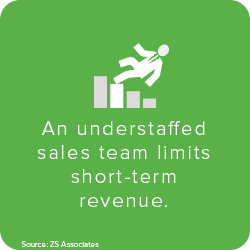
In fact, research from global consulting firm ZS Associate found that an understaffed sales team limits short-term revenue. Their team studied 11 health-care start-ups and found that the average sales force size was 46 percent smaller than it should be for optimal performance. Of that group, the start-up that outperformed their competitors in the short-term had the largest sales force.
 The ZS study also found a strong correlation between sales force size and longer term performance. Specifically, they found that, “the sales force size that maximizes companies’ three-year profits is 18 percent larger, on average, than the size that maximizes one-year profits.” Building out a bigger sales force from the beginning sets the foundation for continued growth.
As cofounder of ZS Associates Adris A. Zoltners and writer Sally E. Lorimer summarize in Harvard Business Review, “The moment signs of success emerge, businesses should increase the size of their sales forces quickly and aggressively. Otherwise, they will forfeit sales and profits—and, perhaps, even their futures.”
Business leaders, therefore, need to find a balance between preparing a solvent sales strategy before hiring salespeople to execute that strategy.
Correctly sizing a sales team in a new market also depends on an analysis of the customers. That means leaders need to understand and segment customers to create a robust profile of each territory. From there, an organization can estimate how much selling time each segment requires. The collective, aggregated time from each segment gives leaders a clearer sense of the resources needed to support the customer base.
 When leaders have identified the time each segment requires, they can consider the selling hours at the disposal of each rep. The average rep has ~1200 hours of potential time a year. However, organizations need to be realistic about how much time reps have to take away from that for non-selling activities. Plus, they have to account for the differences in performance — assuming that all salespeople will perform and productively contribute at the same level can cause an underestimation in sales force size.
Just as executives consider selling capacity for reps, they need to make sure to add the infrastructure necessary to support and enhance selling activities. This can mean adding sales managers, inside sales reps, and administrative support personnel to the headcount. Even A-players can strengthen their impact when they have both administrative support and sales leadership. If you choose to hire sales reps before hiring a manager, consider screening for candidates who are player-coaches: They possesses the experience and time to hone strategy, forecast sales, hold reps accountability, and support a healthy culture.
Building out a sales force means accounting for the structure and support required to achieve quotas.
By considering the life-stage of the business and assessing both the role of territory penetration and selling capacity, leaders gain a general sense of the ideal sales force size. They can bring extra depth and accuracy to the process by implementing a scientific technique that balances common-sense approaches to these decisions.
Not only do statistical methods strengthen confidence in sales force sizing, they serve as definitive facts for leaders who need to advocate for sales resources within the organization.
Although data is not perfect, these two approaches help mitigate risk by pinpointing the optimal sales force size:
Return on sales optimization (ROS) is widely practiced in sectors with large, established sales forces, but it’s just as relevant to growth organizations trying to break into new markets. This calculation takes into account both cost and revenue, maximizing profit on sales investments while limiting risk. When implemented correctly, it widens the operating profit margin.
As Business Executive summarizes, optimizing ROS depends on several pieces of data: the segment and product profitability, the sales response function, and the costs for sales employees.
 Through this process, leaders compare the marginal profit contribution to the incremental cost attributed to each sales employee. The optimal sales force size is when the marginal profit is equal to the marginal cost — after that point, the ROS decreases because of the threshold effect and exhausted market potential.
This “top down” approach is a tool that leaders can use to both target the most profitable sales force size and improve operational efficiency. Like ROI optimization, efficient frontier benchmarking (EFB) identifies the sales force size with the greatest possible return at a limited risk. However, unlike other methods, this calculation accounts for the differences in market potential and teams across regions, calculating the “efficiency frontier” among a company’s distinct sales units.
To accurately predict EFB, leaders need estimated data on sales revenue, sales costs, and sales activities in ten sales districts, as well as some general insights into competitors’ performance.
Dan Horsky and Paul Nelson of University of Rochester also details the formula for EFB in full, highlighting exactly how executives can use it to make a clear assessment of a sales force size. Their method works with each district, enabling leaders to identify the optimal sales size both on the local and national level. The formula specifically accounts for the changes in salaries, market potential, and expected performance based on geographical area:

SPEOP = The optimized number of salespeople in the district
g = Gross margin in the district
y = Number of salespeople
c= Fixed cost of a salesperson in the district
POTEN= Sales potential
The optimized sales force on the national level is the sum of the number of salespeople in each district. If companies have a limit to the number of salespeople they can hire nationally, EFB also gives leaders a tool to assess which markets would most benefit from those extra reps. In short, EFB is extremely precise and useful when executives input accurate data.
These techniques and tips for sales force sizing in a new market ensure that business leaders pursue the right approach when executing their go-to-market strategy. Each method and tool moves beyond gut instincts to build on proven headcount sizing approaches that support long-term sales and profit growth.
The post Sales Force Sizing in New Markets: The Ultimate Guide appeared first on Peak Sales Recruiting.

There’s a blurry line between pride and arrogance, but there are a few ways you can avoid the trap of arrogance. When you’re judging your own value, avoid looking at intrinsic talent and instead focus on effort.

Startup sales teams: We’ve made a mistake.
In our haste to distance ourselves from the sleazy, Wolf-of-Wall-Street-style salespeople of yore, we’ve over-corrected. Now, instead of being too hostile, modern day salespeople are too friendly; not necessarily with prospects, but with one another.
As a result, startup sales teams have lost their competitive nature. Now, instead of spurring one another on to success, modern sales teams are normalizing mediocrity and justifying underperformance.
So what do we do?
We can’t go back to the way things were. A highly competitive but hostile sales team is just as toxic as a highly friendly but uncompetitive team.
What we need is a middle ground: Sales teams that are highly competitive and highly friendly.
The culture of a sales team is the sum of its individual members.
This means your problem isn’t having a noncompetitive sales team, it’s having noncompetitive salespeople. But before you can fix that problem, you need to understand it.
So what caused a whole generation of salespeople, who work in what is arguably the most competitive field, to suddenly lose their competitive edge?
Simple: They’ve realized that the sales strategies of the past don’t work today. Sleazy, fast-talking, high-pressure salespeople aren’t viable in our relationship-, accountability-, and experience-driven economy.
In an effort to adapt to this new environment, salespeople have swung in the opposite direction. Instead of the hostile strength used in the past, modern salespeople operate out of what I call friendly strength.
To understand how this new approach works, let’s take a closer look at the two halves that make up it’s whole: Friendliness and strength.
In the past, sales was about extracting as much valuable as possible from your prospect. Today, it’s about delivering as much value as possible to your prospect.
To the modern salesperson, prospects aren’t just commission machines; they’re individuals with specific and genuine needs. Sales reps now see it as their responsibility to provide a viable, valuable solution to that need.
This desire to help is so strong that a salesperson operating out of friendly strength will refuse to sell until they’re certain their product is the best fit for a prospect’s needs.
But here’s the other side: Once the salesperson has qualified a prospect and determined their product is a good fit for their needs, all bets are off. They will sell to this prospect no matter what. If they don’t, that means they’ve failed to help someone in need.
A salesperson with friendly strength doesn’t ask a qualified prospect to buy, they tell them to. Not because they want the commission, but because they know their product will dramatically improve the quality of that person’s life.
Although I believe friendly strength is the future of the sales industry, this new approach has had an unexpected consequence: The decline of competition amongst salespeople. Let’s take a closer look at how this happened and what the future holds.
Sales teams of the past were fueled by hostile strength. Salespeople were aggressive, overbearing and, in many cases, vicious both with their prospects and their coworkers.
As you might expect, this didn’t create the most enjoyable work environment. But it did create competition, and that competition created impressive results.
When you’ve got a team of people constantly trying to one-up one another, every month will have increasingly impressive metrics (at the expense of company culture). And if there’s too much pressure on the sales team to perform, things can go very, very wrong.
Today, salespeople have replaced hostility with friendliness.
And with the rise of startups, more and more emphasis is being placed on the importance of company culture, of creating a work environment where people love their work and who they work with.
For the last few years, this seemed like a win/win situation. Salespeople began to shed negative stereotypes and companies placed increasing importance on employee happiness.
But now we’re seeing an unexpected side effect: As salespeople became friendlier, they became less competitive. And as they became less competitive, they became less effective.
The new face of sales might be comfortable, even enjoyable, but the metrics speak for themselves: It isn’t sustainable. So what’s the answer?
We already knew hostile and competitive didn’t work, and now we’re learning friendly and noncompetitive doesn’t work either. What we need now is a merging of the two: Instead of friendly or competitive, we need friendly and competitive.
In practice, that means salespeople who respect each other, who enjoy working with one another, but who constantly strive to outperform one another.
Although creating this culture does take more thought and effort, friendly competition is the future of sales teams. Here’s why.
When you take competition out of a sales team, all you’re left with is a group of friends who justify one another’s underperformance.
Whether they realize it or not, your salespeople need to compete in order to reach their highest potential. Here’s what a lack of competition is costing you.
What drives professional sports teams to succeed? It’s not just the love of the game. It’s the desire to beat someone else, to crush the other team, to outperform their teammates.
Sales teams are the same way. I’ve never met a successful salesperson without a competitive streak; it’s fundamental to reaching the highest levels of success.
And although a successful salesperson might enjoy the friendly nature of your noncompetitive sales team for awhile, eventually they’ll notice something is missing.
They’ll realize they aren’t being challenged and, as a result, aren’t growing. And if they aren’t growing, they aren’t fulfilled. Then, one day they’ll wake up and realize they can do better, they can be better, and they’ll leave for a more competitive sales environment.
(To hire and train the best salespeople, check out the free ultimate sales management toolkit.)
Once your best salespeople leave, you’ll be left with a core group of people who fear competition and avoid being challenged.
Sure, they might enjoy the job. After all, it’s comfortable: They get to work with their friends and they know they can underperform because no one is setting a higher standard.
But it’s your metrics that pay the price for this mindset. These salespeople aren’t driven to grow, they’re driven to maintain. In their mind, all that matters is meeting their minimum quotas.
As long as your sales teams are competition-free, you’re telling your salespeople that this approach to sales is acceptable.
I’m going to go out on a limb and assume you don’t want to lose your best salespeople or retain your worst. So how do you fix the problem? Simple: Bring back competition.
I’ve already written extensively about how to increase competition within a sales team. Rather than repeating myself here, let’s talk about the two entities your salespeople should be competing against.
Show me a man consistently driven to outperform his former self and I’ll show you a chart-topping salesperson.
Your sales team’s biggest competition should always be themselves, and no accomplishment should ever be “good enough” to justify stagnation.
Great salespeople are constantly driven to outperform their peers. Not out of ego or spite, but because they know competition is necessary for personal, team, and company growth.
Think about it: When you compete against your peers, they compete against you. When everyone competes, everyone grows. When everyone grows, the team improves. When the team improves, the company grows. When the company grows, the market improves, and when the market improves, the economy flourishes. And when the economy flourishes, the world progresses.
So if you really think about it, your noncompetitive sales team is doing the entire world a disservice. For all our sakes, let’s get your team back on track.
So how do you get your salespeople competing again?
By making your sales data transparent and accessible. Your salespeople should always know how they compare to both their peers and their own past performance.
At Close.io, we make this easy with our reporting feature, allowing sales reps and managers to view real-time sales data for anyone at any time. Give it a try with our free 2-week trial!

We’ve already determined that sales teams of the future will be both friendly and competitive, but what does that actually look like? How do you combine two traits that seem to oppose one another?
By having your salespeople adopt two separate identities: The friendly founder and the competitive salesperson.
Let’s take a closer look at each.
When your salespeople aren’t actively selling, they should be planning. And when they’re planning, you want them thinking like a founder.
A founder isn’t concerned with individual performance. Instead, they look at teams as a whole and ask, “What can we do to improve?” To them, success is a group effort where everyone is an equally important part of a greater whole.
Within the friendly founder role, your salespeople should view their team members as co-founders, whose advice and performance are a vital and respected aspect of the company. During these planning sessions, communication should be open and no one should be afraid to ask for help or give feedback.
Once you’ve got a team of salespeople thinking like founders, you create a collaborative, creative environment where each member works together to achieve large, long-term goals.
When planning ends and action begins, your salespeople must stop seeing their teammates as co-founders and start seeing them as competition, as someone to outperform.
In this identity, your salespeople are primarily concerned with their own performance. Instead of asking, “What can we do to improve?”, they’re asking, “What can I do to improve and make sure I’m at the top of the charts this month?”
Keep in mind: This isn’t an invitation to invite animosity back into the sales process. It’s entirely possible to be aggressive and competitive without being hostile, and that starts with the respect your team will develop for one another in the friendly founder role.
Once you’ve got a team of salespeople thinking like salespeople again, you create an “iron-sharpens-iron” environment where each member’s individual performance enhances and multiplies everyone else’s.
In the conference room, your salespeople should focus on being the best sales team. On the floor, they should focus on being the best sales rep.
Adopting and balancing these two identities might take a little practice, especially if your team has fallen into the “friendly and uncompetitive” mindset.
But the numbers don’t lie: “Friendly and uncompetitive” isn’t sustainable. The future of salespeople is friendly strength, and the future of sales teams is friendly competition.
So ask yourself: Will you be left in the past? Stuck in the present? Or a part of forging the future? The sales industry is at a turning point.
Which side of history will you be on?
Want even more tools to help you build a sales team able to crush it? I've put together the free ultimate sales management toolkit, which contains a sales hiring checklist, sales script, email templates, and more. Get yours now!

Don't like reading? Just watch the video where I walk you through why the sales teams of the future must be competitve and friendly.
How to increase competition amongst your sales teams
Alright, you know how important competition is to a successful sales team. So how do you create a competitive environment? These 6 strategies will give you a place to start.
Wolf or lamb in SaaS sales?
In the past, sales was dominated by hostile strength. Today, the most successful people lead with friendly strength. Learn how to adopt and practice this mentality here.
How to build a local sales machine with Foursquare’s David Greenberger
Foursquare’s National Director of Sales David Greenberger offers a tactical, practical approach to fostering friendly competition within sales teams.

Ever-changing- This is the word that many have used when describing the world of SEO. In the past recent years, a lot of developments and changes in the field have greatly changed the role of SEO in the field of digital marketing. And as such, many of the trends and shifts of yesterday has now become a staple in the industry today.
2017 is now here and a lot of SEO practitioners are getting curious once again for the trend that is bound to shape the SEO landscape not only in 2017 but for the next few years as well.
Keep up with the latest techniques and make sure that your strategy is in line with the ongoing trends in the market. Here are the key takeaways from the infographic below that you should consider if you want to make the most out of your SEO efforts in2017:
As digital marketing gets more and more competitive, embracing these changes in SEO will help you improve your game plan and more importantly, achieve higher ranking in SERPs. If you want to learn more, check this infographic from CJG Digital Marketing which presents to you to the top eight SEO trends that can help you ramp up your digital marketing strategy this year 2017.

Embedded from CJG Digital Marketing.
Every organization has three implicit or explicit contracts: Brand, Transactional, and Psychological. Most of the intangible moments and nonverbal interactions in a company fall squarely within the oft-neglected Psychological contract. But as it turns out, it may be the most crucial.
As discussed in the book, The Employee Experience: How to Attract Talent, Retain Top Performers, and Drive Results, the Brand Contract and the Transactional Contract address employee expectations that are typically evident and open. Like the offer letter a new hire receives from her employer spelling out the benefits, job description, and the you-do-this-and-we’ll-give-you-that kind of language. However, other expectations are often obscure and remain unstated. These expectations fall under the Psychological Contract i.e. the unwritten, implicit set of expectations and obligations that define the terms of exchange in a relationship.
When talking with organizations about problems they’re facing, they often refer to problems within their company in the same way one would talk about problems with a significant other. “I feel betrayed by the company!” or “This place is really fun/stupid/boring/awesome.” Employees talk about a “lack of trust” in the company’s leadership, or nostalgically reference the “honeymoon” period. But this phenomenon doesn’t end there. We name our cars, confess love for sports teams, and manifest the same brain patterns with brand recognition as we do with religious experiences. All in all, it turns out we have a pretty hard time not anthropomorphizing inanimate objects and abstract ideas.
We are on the crest of a new age: the “Age of the Employee.” Employees are recognizing that they have more power to shape their career path than ever before, and one of the main things they are looking for is, in the most literal sense, a better relationship with their job. If your company isn’t providing it, someone else’s will. Because of this, smart companies will embrace this idea of reimagining the relationship with their employees as their secret retention advantage. And it becomes much easier once they realize that we already know exactly how to do this. The same research that shows us how to create great interpersonal relationships maps perfectly onto employee relations with their company.
To preserve and foster a great relationship, we have to understand what can threaten it. What’s the number one predictor of divorce? Money usually comes to mind first, but fighting over finances is actually just a symptom of a greater problem. The number one predictor of divorce is actually the presence of contempt. Once a partner sets him or herself above the other, beginning to disregard or dismiss the other, it’s as good as over. Contempt is an extremely difficult obstacle for a relationship to surmount. For example, in an organization I recently worked with, the senior leadership had plenty of great ideas, grandiose projections, and noble values. But none of it was producing company connection because the employees, the boots on the ground, weren’t buying it. For various reasons, they had concluded that their leaders were out of touch and misguided and, as such, every attempt to prove otherwise was perceived in the worst possible way. “Oh you want to give us a raise? What a desperate attempt to curry favor.” This kind of contempt can occur when a company violates their Psychological Contract to the point that employees lose trust and no longer give their employer the benefit of the doubt.
If you want to preserve employee relationships, avoiding the contempt that results from broken contracts needs to be your number one focus. So how exactly can we avoid this death knell? The following tips each provide a piece of the puzzle.
In business SEO terms, we’re talking about transparency and streamlined top-down communication. But in simple relationship terms, we just want partners who aren’t hiding anything. We want trust. Business has a built-in conflict of interest. Employees work hard but often feel their efforts only benefit the CEO’s bottom line. As such, it’s important to deliberately swing the pendulum far back the other way in order to foster confidence. Be open with mistakes. Acknowledge doubt. Be quick to take painful accountability. Take employees on the ride with you, even when you’re not sure exactly where to go. Trust me, they want to be a bigger part of the company, and when they feel they are, trust and commitment follow. Think of the last friend you had, or someone you dated, that always kept you in the dark about what they were doing or thinking. Someone who kept things “high-level” and only presented a positive façade. How invested were you in that relationship? Not very? So why do we do this to our employees?
Another way to improve our transparency and vulnerability is to be aware of how often we make and accept bids. A bid is a small gesture designed to elicit attention or trust. Imagine a scenario where an employee approaches you, her boss, with an idea or suggestion that is objectively terrible. You gently explain why it probably won’t work and walk away patting yourself on the back for not openly scoffing or getting mad at her for wasting your time. Let’s be honest, you’re the hero here! But it’s not, and never was, just about the content of the idea. She was asking to connect, to have her contributions recognized, and to feel part of the larger discussion. She made a bid for attention and you, though inadvertently, rejected that bid right along with the bad idea. One of the most frequently low-scoring items on our employee engagement surveys is, “This company responds well to suggestions and ideas for change.” That’s a lot of unanswered bids and a lot of missed opportunities to nurture trust.
Historically, the employer/employee relationship has been one of hierarchy and imbalanced power. Structurally, it makes sense. An organization needs both leaders who set a direction and followers to help move things forward. Unfortunately, because of how people naturally gravitate, hierarchy becomes perceived as a value judgment, a statement of relative worth. People farther up the ladder must be more important and therefore better. When this value judgment trickles into company culture, employees end up doing things because they are told to, rather than because they see the value in their contribution. There is a word for the kind of relationships where one partner is considered inferior and always does what they’re told. And it’s not “healthy” or “stable.”
The key to overcoming this negative perception is to embrace the shift toward employees desiring a place at the table. Just getting a paycheck isn’t enough anymore. They want great pay AND meaningful work. Employees need to be valued equally, even while their roles remain equitable. That is to say, everyone contributes in a unique way but all roles are equally valued and respected. A mechanic doesn’t demand to switch places with the pilot. But both are equally important in ensuring a smooth flight, and the pilot knows better than to disregard the person that keeps the plane in the air. So we need to refrain from speaking in terms of totem poles. For example, don’t ever say something like “even the lowest-level employee.” You may not mean it the way it sounds, but you can understand why someone could hear it that way. And if you ever find yourself dismissing, condescending, or raising your voice at an employee, consider that if that’s not how you would treat a friend, then it’s an abuse of your positional authority and a violation of trust.
Loyalty begets loyalty. If we want employees to be loyal to us, showing loyalty to them is critical. My first job was at a fried chicken franchise. I’d seen managers come and go, and most were fairly authoritarian. No matter how many times a counter had already been wiped down, I was expected to put on a show of being busy so as not to displease my manager. After transferring stores, one of my first experiences at the new location was watching a colleague make a mistake and then get berated by a customer. The customer screamed and ranted and demanded to see the manager, Kevin. When Kevin came out, this customer unleashed a tirade that would make a drill sergeant blush. Not being my first rodeo, I was prepared for the negativity to roll downhill to the rest of us. But instead of validating the customer and raging against us, Kevin immediately grabbed the customer by the shirt front, pulled him over the counter, and uh, sternly informed him to NEVER talk about his employees that way NO MATTER WHAT they had done.
As of this writing, I haven’t seen Kevin in 20 years. But to this day, if he ever reached out, I would drop everything to help him. And you better believe that after that he had the cleanest countertops in the business without ever having to ask. What’s more, it was my genuine pleasure to do so. That is the power of loyalty.
And that is the power of having a trusting, meaningful relationship. You can’t buy it and you can’t incentivize it; you can only earn it. Simply showing up never worked for any relationship and it won’t work in business either. So, what effort will you put in to earn a great relationship with your employees?

Salary is important, but it’s not the only thing that contributes to job satisfaction. New research from Glassdoor reveals what makes people happiest at their jobs and how it varies depending on income.

This is the first of three You Are Not So Smart episodes about the "backfire effect." In it, I interview a team of neuroscientists who put people in a brain scanner and then challenged their beliefs, some political and some not, with counter-evidence and then compared which brain regions lit up for which beliefs. The crazy takeaway was that for political beliefs, but not for others, people seemed to react as if their very bodies were being threatened by the challenging evidence.
We don’t treat all of our beliefs the same.
If you learn that the Great Wall of China isn’t the only man-made object visible from space, and that, in fact, it’s actually very difficult to see the Wall compared to other landmarks, you update your model of reality without much fuss. Some misconceptions we give up readily, replacing them with better information when alerted to our ignorance.
For others constructs though, for your most cherished beliefs about things like climate change or vaccines or Republicans, instead of changing your mind in the face of challenging evidence or compelling counterarguments, you resist. Not only do you fight belief change for some things and not others, but if you successfully deflect such attacks, your challenged beliefs then grow stronger.
The research shows that when a strong-yet-erroneous belief is challenged, yes, you might experience some temporary weakening of your convictions, some softening of your certainty, but most people rebound and not only reassert their original belief at its original strength, but go beyond that and dig in their heels, deepening their resolve over the long run.
Psychologists call this the backfire effect, and this episode is the first of three shows exploring this well-documented and much-studied psychological phenomenon, one that you’ve likely encountered quite a bit lately.
In this episode, we explore its neurological underpinning as two neuroscientists at the University of Southern California’s Brain and Creativity Institute explain how their latest research sheds new light on how the brain reacts when its deepest beliefs are challenged.
By placing subjects in an MRI machine and then asking them to consider counterarguments to their strongly held political beliefs, Jonas Kaplan’s and Sarah Gimbel’s research, conducted along with neuroscientist Sam Harris, revealed that when people were presented with evidence that alerted them to the possibility that their political beliefs might be incorrect, they reacted with the same brain regions that would come online if they were responding to a physical threat.
“The response in the brain that we see is very similar to what would happen if, say, you were walking through the forest and came across a bear,” explains Gimbel in the episode. “Your brain would have this automatic fight-or-flight [response]…and your body prepares to protect itself.”
According to the researchers, some values are apparently so crucial to your identity, that the brain treats a threat to those ideas as if they were a threat to your very existence.
“Remember that the brain’s first and primary job is to protect ourselves,” explains Kaplan in the show. “The brain is basically a big, complicated, sophisticated machine for self-protection, and that extends beyond our physical self, to our psychological self. Once these things become part of our psychological self, I think they are then afforded all the same protections that the brain gives to the body.”
How does the brain take something that is previously neutral and transmutate it into a value that it then protects as if it were flesh and bone? How do neutral, empirical facts about temperature and carbon emissions become politicized? How does an ideological stance on immigration reform become blended with personal identity? We explore those questions and more on this episode of the You Are Not So Smart Podcast.

Download – iTunes – Stitcher – RSS – Soundcloud
—
 This episode is sponsored by The Great Courses Plus. Get unlimited access to a huge library of The Great Courses lecture series on many fascinating subjects. Start FOR FREE with Your Deceptive Mind taught by neurologist Steven Novella. Learn about how your mind makes sense of the world by lying to itself and others. Click here for a FREE TRIAL.
This episode is also sponsored  by Casper Mattresses. Buying a Casper mattress is completely risk free. Casper offers free delivery and free returns with a 100-night home trial. If you don’t love it, they’ll pick it up and refund you everything. Casper understands the importance of truly sleeping on a mattress before you commit, especially considering you’re going to spend a third of your life on it. Get $50 toward any mattress purchase by visiting www.casper.com/sosmart and using offer code “sosmart.” Terms and Conditions Apply.
 Support the show directly by becoming a patron! Get episodes one-day-early and ad-free. Head over to the YANSS Patreon Page for more details.
Links and Sources
Download – iTunes – Stitcher – RSS – Soundcloud
The Brain and Creativity Institute
Neural correlates of maintaining one’s political beliefs in the face of counterevidence.

Your organization’s ability to articulate your differentiation is a critical component to both enabling your reps and ultimately winning market opportunities. As a sales leader – as someone who is ultimately responsible for the number, you need to make sure your sales reps and everyone who is engaging with your customers is crystal clear on what makes you different from the competition.
Your team needs great clarity on why a customer should choose you over your competitors, an internal solution or doing nothing at all. Once you have aligned your company on what makes your solutions different, the next step is to enable your team with the ability to embed that differentiation into the way your reps sell. Here are three questions to have your sales reps work through on every opportunity.
Your solution differentiators must influence customer’s requirements early in their buying process. Your sales reps need to be armed with questions, talk tracks and the skills that enable them to use those differentiators to influence the customer requirements. For example, let’s say your differentiator is how you integrate into salesforce and your reporting structure that comes from that integration. Now your competition also says they integrate with salesforce, but they don’t have the reporting structure you have. If that’s your differentiator, you need your customer to see that the reporting structure is important. Your differentiators need to be part of what’s required to solve the problem.
Then the value that your differentiatior brings has to be tied to what the customer deems is required for a successful solution. Those differentiators must be meaningful to the customer. When a customer says so do you offer a solution that can streamline my billing and financial reporting systems? You need an answer that makes them say, oh wow, that would be valuable. Otherwise, who cares?
Your differentiation must be defensible. There needs to be proof you do what you say you can do. Third-party testimonials and case studies can carry a lot of weight in making you stand out against the competition. However, it also forces your competitors to defend their own differentiaiton. If I’m trying to articulate differentiation and I can provide the proof that I can do what I say I can do – I’m also forcing my competitors to provide the same proof. If they can’t, my customer can clearly see and understand my differentiation. By defending my own, I’m forcing others to do the same.
Differentiation is always part of the sales process – no matter if the customer is asking about it or not. Remember the digital buyer – they’re researching your competitors throughout their buying process.
Your salespeople need to be crystal clear on how they are leading customers from their needs to your highly differentiated solution. Remember it’s only differentiated if iyour customers view it as a highly differentiated solution.


Have you been looking for other areas to expand your business?
Have you thought about podcasting before, but haven’t pulled the trigger on doing it yet?
2017 is going to be a great year to start a podcast for your business!
Now more than ever both marketers and consumers are listening to more and more podcasts and it will only get better from this point on.
Here are some reasons why this year is your year to branch out into the podcasting world.
#1: Podcasting Bridges the Gap Between Audiences
When you start your podcast it naturally allows you to bring in new and exciting influencers to talk to. As with most podcasts, the host usually has guests to express their opinions on a certain topic.
This is strategically done this way to allow those guests to bring their audience to your new show.
This is also known as a form of influencer marketing as you are using this influencers clout to sway their audience into listening to your show.
Patrick Hodgdon of the Clo Show Podcast explains why this is a good idea.
“A podcast is an excellent business decision for 2 main reasons: 1) a sales tool to get warm intros into prospect companies by inviting them to come on as guest experts in their field and 2) thought leadership and a content marketing engine as each episode lends itself to a blog post recap, group recaps into feature articles, and even more into eBooks or whitepapers.”
When you bring the value of a thought leader into your new show, you also bring with them the quality and assurance of a show which craves the best possible content for its listeners. People notice that.
This quality, coupled with bridging the gap between your show and your influencer guests audience, is one great reason you should start your new podcast this year.
#2: Podcasting Gives You A Personal Voice With Your Audience
It’s great to have a blog in which you can communicate with your readers. However, having a podcast to connect your voice with your audience is a more personal touch and allows you to be creative and exploit those traits within your audience.
Sara Johnson of Blue Compass shares why her company started doing a podcast: “This past year, Blue Compass started our own podcast to cover not only the blog content that we are putting out on our website but to discuss digital trends with our audience.”
Podcasting allows more ideas to flow naturally and more creatively and it affects your audience on a different level because it is almost like they can see the wheels turning in your head as the thoughts come out.
Having a personal voice within your audience is a great way to make them feel part of your brand. They were there when you “thought of something great” during that one episode. People want to feel part of something and a podcast is a great way to include them in this way.
#3: Podcasting is Another Medium For Consistency
You already know that while you produce content you must produce your content consistently. This works for your blog and other platforms where your content is published to your audience.
Podcasting allows you another platform in which you can continue this consistency with your audience. Let’s say Monday they can always expect a blog article. Tuesday is where they can view something you have uploaded on YouTube every week. Thursday is the Facebook discussion group, and Friday is your weekly podcast.
Podcasting can fall naturally into the mix with your regularly scheduled programming and allow your audience to be connected to you at all times throughout the week.
Joey Held of the INKcast show says this about consistency. “Whether your podcast is once a month, once a week, once a day, or somewhere in between, maintaining a schedule is critical to helping your audience grow. We release a new episode every other Thursday. Fans of the podcast know that schedule and have come to expect a new episode every other Thursday. Deviating from the schedule you’ve developed might cause confusion and it might even lose you some listeners.”
People love consistency and the way you can stay connected to them through the use of brand new content. Podcasting is just another medium which allows you to reach them like this.
#4: Podcasting Naturally Attracts More Attention
When you create your new podcast in 2017, if done correctly, your podcast will naturally attract more attention from new listeners in your target market.
Artur Meyster from Breaking Into Startups Podcast explains, “Podcasting naturally attracts attention and people will want to know what you are creating. This an amazing opportunity to explain your mission and ask for guest recommendations. You will be surprised how many people are happy to provide their feedback and refer amazing guests, you otherwise wouldn’t be able to get. What also helped was, by recording out of various schools, we got introduced to their founders, students and staff. So when the time came to promote our launch, we already had fans who we’re rooting for us.”
Get a plan and a strategy for boosting your podcast from the beginning. Have a launch date and people who will help you with positive reviews and five stars. This is important because it allows you to boost your new show to the New & Noteworthy category where it stays for a bit.
Does your business offer a specific look into something interesting? Perhaps you know the secret for building social media traffic from doing one simple trick? Whatever your brand does, you can make it shine through the use of your new podcast.
Attention to detail is the key to building attraction from new listeners who will simply love your show!
Over To You
Starting a podcast in 2017 isn’t going to be as hard as you think it will be. You’ve already been thinking about it, so why not go ahead and pull the trigger?
Tara Gentile from Profit. Power. Pursuit Podcast sums it up when she says “There are too many copycat podcasts out there and yours will never get played if it’s just more of the same. Think about your favorite shows and then consider one thing that’s missing from them. I chose “deep diving” as how my show would be different and it’s really paid off.”
You have a voice, an interesting way to do something, and you’ve got the know-how to pull it off. Why wait another year and watch more traffic for your business go down the drain? Make 2017 the year when you begin your new show.
Do you have some experience in starting new podcasts? I’m sure there are readers who would love to know your tips for them as they get started. Let us know about them in the comment section!

You might assume if you challenge your prospects, they’ll hang up and never speak to you again.
But if you do it right, you’ll get the opposite reaction: Prospects become more engaged, invested, and ultimately, eager to buy.
Successfully changing the buyer’s mindset earns you authority and credibility. You also prove you’re committed to the buyer’s success, as you are clearly willing to risk short-term goodwill to help them.
Follow these five guidelines to challenge your prospects without sounding hostile.
It’s not worth challenging your prospect on every issue. If you frequently correct or contradict them, they’ll stop listening.
If, on the other hand, you challenge them infrequently, the buyer will think, “Hmm, this is probably important -- I should take this seriously.”
Use this three-part decision framework as your guide.
Don’t challenge your prospect unless you answer “yes” to all three questions.
Gaining your prospect’s respect makes them more receptive to being challenged. If you tell the buyer she’s wrong two seconds into your first call, she’ll be taken aback, if not outright annoyed. But if you first earn her trust and put her at ease, she’ll listen with an open mind.
Build rapport both virtually and over the phone or in person. Interact with buyers on social media before you reach out and include references to commonalities or mutual contacts in your emails.
Once you’re talking to a prospect, strengthen your connection by discussing shared interests, asking questions about their professional projects, and sharing details about your own life when appropriate.
To sound less combative, lead in to your challenge. Doing so gives prospects warning you’re about to contradict them and shows respect for their beliefs (even if you think those beliefs are wrong).
Here’s an example:
Before: “Actually, the system you’re currently using will be out-of-date in 10 months.”
After: “I’d like to offer a different opinion. According to my firm’s projections, the system you’re currently using will be out-of-date in 10 months.”
Other potential qualifying statements include:
Are you nervous your prospect will react negatively if you dive straight into challenging them? Ask for permission first. Giving you the go-ahead reestablishes some of their authority, which makes them less sensitive to hearing they’re wrong.
Ask, “Are you open to hearing a different perspective?” or “Can I share a differing opinion with you?”
When you want to be bolder, say, “I think I can change your mind. Will you let me try?”
Databox CEO and former HubSpot VP of Sales Pete Caputa recommends following this sample dialogue:
Rep: “There’s something I think you should know in order to make the best decision possible. But I’m worried you won’t like hearing it.”
Prospect: “What is it?”
Rep: “Will you keep an open mind?”
Prospect: “Yes.”
Rep: “[Challenging statement.]”
“WIIFM” stands for “What’s In It For Me.” After you’ve challenged the buyer, explain why knowing this information benefits them.
For example, if you’ve just told them they won’t hit their year-end objective with their current strategy, follow up with, “Fortunately, if you make adjustments by the end of this month, you’ll be able to make your goal -- with room to spare.”
Or perhaps you’re disagreeing with the buyer’s opinion of your product. You could say, “You’re not the only person I’ve talked to who has called our interface hard to navigate. Good news: We surveyed 5,000 random end users in January, and 96% said the product was ‘easy’ or ‘extremely easy’ to use. Your IT team will be able to get up and running in four days or less.”
Stick to these guardrails, and correcting prospects will be far less risky. In fact, it will likely help you win their business.


 Sales, marketing, and social marketing attempt to place solutions and create relationships by supplying great content, discovering likely prospects, and creating trust. Unfortunately sellers end up closing a small fraction – less than 5% – of those they reach, and marketers and social end up closing even less, wasting a lot of time without meeting their goals. So what’s causing our failure? Our products are terrific, our service and knowledge solid. Doesn’t seem to make sense that we don’t close more when folks need what we’ve got to sell.
PROBLEMS WITH OUR CURRENT THINKING
Here’s a bit of flawed thinking that exacerbates the problems:
We can facilitate buying decisions by employing different thinking to avoid:
It’s time to add some new thinking to what we’re doing.
WHAT I LEARNED IN THE TRENCHES
Because of the focus on placing solutions, sellers fail to take into account the change management and consensus issues buyers must manage internally, outside the purview of needs or solution choice, before they can consider buying anything:
I learned this as both a sales person and an entrepreneur. When Merrill Lynch hired me a stockbroker in the 1970s, I became a million-dollar producer my first year. But I couldn’t figure out why everyone with a need (especially those I had a great relationship with) didn’t always buy what I thought they needed. Where did they go?
When I started up my tech company in London in the 80s I realized the problem: as a buyer myself, my direct needs were often superseded by the social, political, organizational, and relational considerations I had to manage. When sellers came to pitch they worked hard to understand my needs and gave fine pitches but had no way to handle or understand the fights I was having with the Board, or the issues the distributor was having with their sales force.
Nor did the sales folks who visited me even try. But until I figured out how to handle those things, until I got buy in from everyone who would end up touching the final solution and heard their voices, I couldn’t buy or there would be damage to relationships and my business. And if these sales professionals had helped me figure out my confounding issues, they would have facilitated me through to a purchase.
The sales model, I realized was not designed facilitate the behind-the-scenes non-need-related issues I had to manage before I could buy anything. I realized that all the great content, all the lovely relationships, all the ‘needs’ I had that matched their solutions, were worthless if I couldn’t manage the off-line, ‘Pre Sales’ issues that would be involved if I purchased anything. So, “Yes” to need; “No” to Buyer Readiness. And the sales model has no way to address this outside of placing solutions, relegating sellers to finding the low hanging fruit – those who have already completed this activity without us.
I then developed a facilitation approach (Buying Facilitation®) for my own sales team to add to the front end of the sales model to first facilitate Buyer Readiness – the steps buyers had to take anyway: we began all selling and marketing by facilitating the stages and steps of the internal change management process first, instead of finding buyers with a ‘need’ or who were ‘ready’. After all, until they determined if they COULD buy they could never be buyers regardless of need.
Rule: the time it takes buyers to manage their off-line, idiosyncratic, systemic change issues is the length of the sales cycle. Once we entered first as facilitators to help buyers get their ducks in a row and manage their Pre-Sales and Buyer Readiness change issues, we were then able to get onto the Buying Decision Team early, lead buyers quickly through their unique decisions, and became great relationship managers. We were also able to end contact immediately with those who could never buy, find 50% more who could buy, and become true Servant Leaders. Our sales tripled and the time to close was reduced by two thirds.
The takeaway here for marketers and social is the recognition that we are largely ignoring the hidden, systemic issues going on within our buyers’ environments that are not available to outsiders yet fundamental for any change – or purchase – to happen. That is our Achilles Heel. And it doesn’t have to be. There are actually specific steps every group/person must take prior to being in a position to consider any purchase – and sellers, marketers, and social marketing can meet our buyers at any of these steps (so long as we eschew trying to sell anything).
WHAT’S THE ROLE OF CHANGE MANAGEMENT?
Buyers and followers don’t know their journey to change when they begin and hence take longer than necessary to figure it out. But figure it out they must. And we canhelp them, and make our value proposition our ability to be their GPS.
There are two elements of Buying Facilitation® that can be added to create a ‘pull’ that’s change- and decision-focused.
It’s possible to develop assessments, questionnaires, intelligent contact sheets, CRM tools that provide the capability to lead buyers and followers through the full complement of steps they must take, making it possible to send out just the appropriate data at the right point in the cycle, and facilitate the consensus and buy-in as they ready themselves for change. We can add these to the sales, marketing, and social models to truly serve our buyers and followers and close more. It will be an addition, and the results will enable stronger relationships and more conversions.
The problem has never been your solution – your products and services are great. The problem is in the Buying Decision process, not with the sales process: we overlook Buyer Readiness – helping buyers address their unknowable change issues (independent of need, and based on people, rules, relationships, history, etc.) so they can get their ducks in a row to buy anything. They have to do this anyway, with us or without us. So it might as well be with us, instead of us sitting and waiting for them to show up. By adding a facilitation tool directed at managing change before we try to sell, we can find more clients, and sell more, faster. And we can become true servant leaders.
__________
Sharon Drew Morgen is the developer of Buying Facilitation®, the generic change management/decision facilitation model that teaches Others how to buy, change, collaborate, negotiate, and implement with no resistance, with full systemic buy in, on their way to making a buying decision. She has trained 100,000 people worldwide, in global corporations (IBM, FEDEx, Morgan Stanley) and consulting firms (KPMG, Unisys). She adds this model to the front end of sales, change, decision analysis, leadership, and influencing. Sharon Drew is also the author of the NYTimes Business Best seller Selling with Integrity and 7 other books on sales. Read more articles on:www.sharondrewmorgen.com
Read two free chapters of her book What? on how to hear others without bias: www.didihearyou.com. She can be reached at 512 771 1117 or sharondrew@sharondrewmorgen.com
Sales, Marketing and Social Can Be More Successful. Hint: it’s not about your content. is a post from: SharonDrewMorgen.com

A negotiation is like a high-stakes dance. Both parties need each other -- if one person takes an unexpected step or even walks away, their partner can’t continue. But neither knows exactly what the other is about to do. They can only guess based on their partner’s indicated intent and past behavior.
These conditions can make for a tense and stressful situation. Consequently, some salespeople conduct their negotiations as quickly as possible. The sooner it’s over, the sooner they can relax.
Reps might also assume an extended negotiation results in a less favorable outcome. The thinking goes that with more time to strategize, the prospect is less likely to agree to the salesperson’s proposal.
The opposite is actually true: A longer decision making process benefits both the buyer and the seller. Let’s dig into the “why” before exploring the “how.”
If you’re rushing through the negotiation, you’ll miss valuable information about your prospect’s priorities and goals, as well as potential blockers.
Here’s some sample dialogue to illustrate:
Rep: “$5,000 is the minimum dollar value for every bulk parts purchase you make.”
Customer: (hesitantly) “Ah, okay. How was that minimum determined?”
Rep: “The shipping costs for anything lower than that are prohibitive. Now, moving on to our recurring order policy … ”
Now imagine the salesperson had paused and said, “You sound a little hesitant about that minimum. What are your thoughts?”
She would have discovered her prospect’s orders vary dramatically in size: From $2,000 one month to $10,000 the next. With this information, the rep might have offered to negotiate that term rather than risk losing the business entirely.
When you take your time, you’re far likelier to hear what the buyer is saying (and what they’re not saying), and ask the appropriate follow-up questions. In the end, closing will be easier.
The person controlling the negotiation’s pace controls the negotiation itself. After all, you decide how the conversation unfolds: When to move on, when a specific point requires more discussion, and when, if ever, to circle back to an earlier topic.
If you rush through steps as quickly as possible, your prospect will likely fight you for control. For example, if you say, “Let’s move on to payment terms” before the buyer is satisfied with the agreed-upon contract length, they’ll probably be even more set on their original stance because they feel ignored.
However, using a methodical, deliberate approach ensures all of your prospect’s questions and concerns are answered and tells them you have their best interests at heart. They’ll instinctively let you guide the negotiation.
Not only will the buyer be less likely to push back, they’ll also view you as more credible, trustworthy, and authoritative.
It’s incredibly difficult to make well-considered, strategic decisions when you’re under time pressure. Research shows people take fewer risks in time-sensitive situations, typically opt for the simplest solution, and focus on the most negative characteristics of the decision. They’re also more likely to misinterpret information since they’re processing it faster than usual.
Obviously, these effects are undesirable. You’ve invested time and energy into getting the deal to this point -- don’t allow it to be derailed because neither you nor the buyer are thinking clearly.
Extending the negotiation process gives both sides more time to think and come to the best possible decision.
Be clear that you don’t want to rush this process. Not only will your prospect feel more relaxed from the outset, they won’t be taken aback when the negotiation moves more slowly than they might have anticipated.
When you set the agenda at the top of the meeting, consider saying something like:
“Thanks for joining me to discuss the agreement between [prospect’s company] and [rep’s company]. We’re both interested in seeing your team [achieve X objective, solve Y challenge, capitalize on Z opportunity]. To get there, we’ll need to figure out [key issues]. I’m prepared to spend as much time as you need exploring the options and discussing any concerns.”
Other potential lines include:
If either side becomes emotional, aggressive, or obstinate, call for a time-out. A short break gives everyone a chance to calm down and clear their minds. It also helps you overcome obstacles that may otherwise stop the deal from going through.
To initiate a break without showing you’re flustered or upset, suggest a snack or bathroom run. Or bring in refreshments; not only will you give the negotiating parties a breather, you’ll subconsciously earn goodwill by sharing food.
Going for a walk with the other side can work wonders as well. Away from the negotiation table, people typically become less hostile. Walking side by side also puts you in a collaborative mindset, so they’ll be likelier to work with you by the time you return.
Negotiating over the phone? Say, “At this point, it might be helpful to pause for a few minutes so we can both regroup. Should we jump back on the call at [current time plus 10 minutes]?”
When they come to a seemingly unbreachable impasse, many negotiators thank each other and go their separate ways.
But you can rescue the deal by saying, “[Issue] seems important to both of us, and I think we can find a way to achieve both of our goals. Should we pause for now and pick the discussion up again on [date and time]?”
If you want to be more assertive, say, “I’m not ready to give up on this partnership. Are you open to reconvening on [date and time]? In the meantime, we can both review our objectives.”
Either the buyer says yes -- in which case, you’ve potentially salvaged the opportunity -- or they’ll say no -- in which case, you know it wasn’t the right one in the first place.
It’s easy to talk a lot during a negotiation, especially if you’re nervous or feel compelled to justify your requests to buyers.
However, one of the simplest ways to slow down a negotiation is to pause often and listen.
As an example, here’s a hypothetical exchange:
Rep: “We offer 10 hours of complimentary training. You’ll also have unlimited access to our resource library, which has more than 300 videos on best practices, common questions, and how-tos.”
Prospect: “I was hoping we could have two seven-hour sessions, one for each of our offices.”
The salesperson could spend two minutes explaining his company’s policy and why he can’t offer 14 hours of training. There’s a strong chance the buyer will get frustrated or bored. This point may even lead to a stalemate.
Alternatively, the rep could simply say “I see” and fall silent.
If his prospect is highly invested in having two sessions, she’ll be compelled to share her reasoning. The salesperson could use this concession to request one of his own, like reduced support during the contract itself. If the buyer isn’t dead-set on the additional session, his silence will likely prompt her to backtrack. Either outcome is preferable to a deadlock.
Your instincts might be telling you to speed the negotiating process up, not slow it down. But taking your time will make a huge difference. Next time you’re sitting at the negotiation table, remind yourself slow and steady wins the race.


Not all sales shortcuts are created equal. Some, like scheduling follow-up emails or creating a repeatable framework for researching prospects, streamline your day without harming the quality of your work. Others save you time but damage your results — meaning you’ll ultimately be less productive for using them.
As the expression goes, “If you don’t have time to do it right, you won’t have time to do it again.”
Steer clear of these nine shortcuts, or you’ll only create more work for yourself.

Researching your prospects while you’re on the phone with them is better than not researching them at all — but barely.
If you’re scrolling through their LinkedIn profile and company website, you can’t pay attention to what they’re saying. Not only will you miss valuable information, but you’ll sound distracted. Few buyers will be interested in scheduling another meeting with someone who’s not paying attention right now.
Remember that 96% of consumers do their research before talking to a rep, so they already have a pretty good idea of what you offer. Don’t let them out-research you. Be equally ready.

My former colleague from Serpstat’s sales team learned this the hard way.
During an enterprise software pitch, a prospect threw out an unexpected question — one that shifted the conversation in the wrong direction.
Caught off guard, Alex fumbled to find the answer mid-call. That awkward silence and frantic searching cost him the deal. Later, the prospect admitted they chose a competitor who seemed to understand their business better.
Determined not to let that happen again, Alex built a pre-call research system covering:
When another prospect asked about field expertise, he had detailed notes ready. This led to much deeper conversations about their pain points and, ultimately, more successful deals.
Pro tip: Make sure you space your calls far enough apart so you can prepare before each one (e.g., 15-20 minutes). Better yet, review your scheduled meetings for the next day before you leave at night. Doing your research after regular business hours (rather than during) frees up additional selling time.
Some salespeople settle into rigid calling and emailing routines. For example, they might call new prospects every morning, send emails in the afternoon, and contact existing opportunities in the hour before they leave the office.
The problem with sticking to a schedule? It’s difficult to connect with a buyer who's on a different one. If your prospect never gets into the office before 10 a.m., they’ll miss your 9 a.m. call every day. If another prefers to check their emails at the crack of dawn, your mid-day messages will always get buried.
I explored this topic with Shannon Smith O'Connell, Operations Director (Sales & Team Development) at Reclaim247. She pointed out that sticking to a strict schedule backfired and killed her chances of real engagement.
O'Connell suggests using AI to get personalized insights that lead to authentic conversations.
"Craft your communication to reflect individual needs based on data insights (e.g., determining the best times to reach based on activity), and you’ll definitely enhance your connection potential,” she explained.
Pro tip: Use the email tracking tool in HubSpot Sales to see when individual contacts engage with your emails. Then, schedule yours to arrive when they’re typically online.

Conducting discovery and a demo on the same call is like killing two birds with one stone, right?
Wrong. Your demo should be highly customized to your audience’s needs, desires, and goals -- and you can’t achieve that level of customization without doing prep work.
Or as Rizala Carrington, CEO and Growth Executive at MyGrowthAgent.com, says:
“Discovery should be all about listening, while the demo should be all about demonstrating value based on what you've learned. Mixing the two dilutes both.”
Rizala described those calls as a messy, all-over-the-place conversation that never really landed. Instead of tackling real pain points, she just dumped a bunch of generic info. No surprise — the prospect lost interest, and the deal went nowhere every time.
Once she separated discovery and demo calls, everything changed. Now, she has time to really understand the prospect, tailor her pitch, and create real engagement during demos.
Pro tip: Use the discovery call to diagnose the buyer’s current situation and what they hope the future will look like. In between discovery and the demo, identify which product features will help them reach this better future. Then, craft your presentation around these features and their benefits.
It might feel more efficient to keep track of undone tasks in your mind rather than on paper or in a virtual list, but you’ll end up losing precious hours. No one’s memory is faultless: Inevitably, you’ll forget details or entire tasks.
While adding an item like “Send Jamie Hills the blog post we discussed” takes an additional 10 seconds, failing to execute on that could delay the deal. You’ll spend far more time re-engaging your prospect than if you'd followed through on your commitment in the first place.
Daniel Cook, Business Development Specialist at KM Philly, was one of those who thought it was possible to pull up facts on the fly. But that led to prospects sensing his lack of preparation. Now, he swears by a to-do list — especially the one before the call.
“When you enter a call already aware of their industry challenges, you don't sell — you consult,” says Cook.
After the call, create another to-do list to keep the momentum going:
By the way, according to Belkins, the first follow-up email is the most effective, boosting reply rates by 49%.

So, if you don’t set a reminder for follow-ups, the chances of overlooking them and losing those opportunities are pretty high.
Pro tip: Don’t waste time writing down a to-do list for every lead. Set your CRM to automatically prompt a series of tasks after you complete, say, a discovery call. Create follow-up templates and personalize them after the call takes place.
All that frees you even more time and keeps leads engaged on semi-autopilot.
It may be easy to send the same content to every buyer, but it’s not effective. Imagine the majority of your prospects are finance managers. One might be focused on developing accounting processes for her company’s global expansion, another is concerned with reducing operational expenses, and the third is prioritizing rewriting her company's expense policy.
If you forward an ebook about decreasing overhead to all three of these managers, it will only resonate with the second. Content should add value and help you establish credibility. To do that, it must be relevant to the individual prospect’s situation.
At the end of the day, only a personalized and individual approach will create a real connection and strong relationship, and we know that's the only way to close deals.
Our research shows that 82% of sales pros say building relationships is not only the most important part of selling but also the most enjoyable. So, don’t let laziness or the urge to close a deal too quickly cost you those relationships.
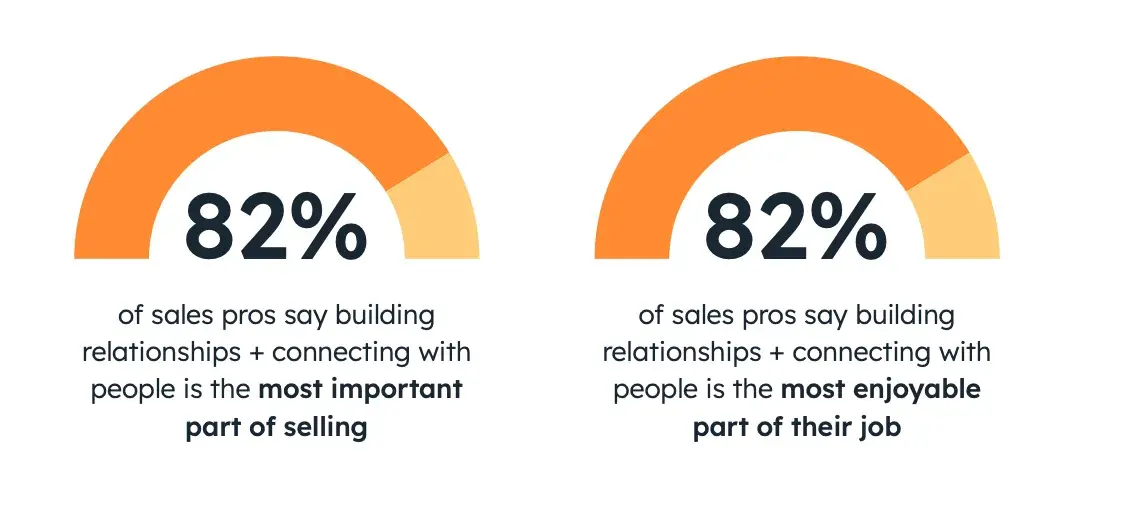
If we take into account that 72% of revenue comes from existing customers while only 28% from new customers, the importance of building relationships is quite apparent.
Here’s what Cook from KM Philly thinks of it:
"Bulk emails can save time but murder engagement. I used to send the same generic sales message to everyone on my lead list, hoping the value prop alone would win them over. Response rate? Horrible.
“These days, I qualify my emails by industry, company role, and pain point. Then, personalize them with meaningful case studies or observations. Making this simple tweak boosted my response rate 3x over and gave my pitches the tone of dialogue, not junk mail.”
Pro tip: Hone in on your prospect’s likely priorities by looking at their site, browsing their company’s open jobs (which tells what areas they’re expanding in), reading specific job descriptions for your prospect’s department (which gives you granular insight into their team’s goals), and checking out their social media profiles.
There’s an average of five decision-makers involved in the sales process today. For enterprise deals, the number can jump as high as 10-15 stakeholders. And 28% of sales professionals say the biggest reason prospects back out of deals is because the sales process takes too long.
A solid approach to handling this is multi-threading, aka building relationships with multiple stakeholders at your target companies.

I dare to say that relying on a single point of contact within the company is a recipe for disaster: If they get sick, go on vacation, or leave their job, you’ll probably need to start from scratch.
And that’s not factoring in your contact’s internal influence. Maybe they don’t have a lot of social capital in their organization, or they’re new and ultimately unwilling to recommend any big changes. The wrong customer champion dramatically reduces your chances of closing.
Realtors know all too well how frustrating this can be. Adam Chahl from Vancouver Home Search shared his hard lessons:
“In real estate, I‘ve seen many agents make the mistake of building a relationship with just one person in a decision-making group, only to realize too late that they weren’t the final decision-maker. Early in my career, I put a ton of effort into nurturing a relationship with a client, only to find out that their spouse had completely different priorities when it was time to move forward,” Chahl said.
“The deal fell apart because I hadn‘t engaged both parties from the start. Now, I always make sure to connect with all stakeholders in a transaction, whether it’s a couple buying their first home or an investment group purchasing multiple properties.”
Pro tip: Ask your original contact to connect you with their coworkers so you can learn more about their individual priorities, buying criteria, and objectives. These details will help you tailor your message to each stakeholder and build consensus.
Some salespeople try to avoid the gatekeeper at all costs. They’ll call the decision maker at odd hours, ask for their cell number instead of the office line, and remain vague about their intentions whenever they do end up talking to an executive assistant.
However, the gatekeeper doesn’t need to be your enemy — in fact, he can be your ally. Your prospect trusts him. If you get the gatekeeper’s approval, not only will you have an easier time connecting with the buyer, but you’ll also have more credibility from the get-go.
Another example from real estate goes to Amber Couron, Transaction Coordinator at Home Buying Hounds.
“I learned the hard way about bypassing gatekeepers when I tried going directly to a property owner, only to have the deal fall through because I'd alienated their trusted office manager,” she said.
“Gatekeepers often have valuable insights about the property and decision-making process that can make or break a sale. These days, I build genuine relationships with everyone involved, from receptionists to property managers, which has helped me close deals more smoothly and get better referrals.”
With that in mind, always treat gatekeepers with respect and courtesy. Instead of circumventing them, go out of your way to talk to them.
You might even ask the decision maker, “Is it okay if I ask [gatekeeper] a couple of questions about [prospect’s company] so I can get another perspective?”
If they say yes, you’ll have a valuable opportunity to learn from a true insider.
A recent Gartner study reveals that 76% of sales leaders are either already using or planning to roll out generative AI this year. No doubt AI helps in sales with routine tasks.
However, AI tools can lack nuance, so failing to refine prompts or integrate real-time customer context can make interactions awkward or irrelevant.
Also, if you’re planning to fire a couple of your salespeople just because “AI can do it now,” think twice. AI is an assistant, not a closer. It can streamline tasks, generate insights, and automate outreach, but at the end of the day, relationships and trust close deals. AI helps, but sales is still a people game.
What you can use AI for:

Explore and test, but let’s not let AI take over the human part.
I’ve been in sales, and I’ve made my fair share of mistakes, too. One of the biggest? Avoiding follow-up calls to check on deal status. The task is daunting by its nature, and a sales rep can find a million reasons to push a call to tomorrow when it’s due today.
Early in my career, I had 53 deals in the pipeline — each with necessary follow-up calls and emails. For the latter, I used templates and adapted them to fit every prospect. For calls, I had to pick up the phone. No shortcuts. So, I kept delaying them.
Unfortunately, it resulted in lost opportunities and was noticed by my manager.
In the end, I had to overcome my fear of “being pesky” and make those calls without having them piling up. To my surprise, my conversion rate from prospect to deal increased.
Don’t let something get in the way of following up with your potential clients. It can make or break a deal.
Pro tip: Hone the craft of sales calls by reading sales books, role-playing with your peers and managers, and attending webinars/courses. These all help a salesperson become a better negotiator and seal more deals.
After chatting with experts, I was once again convinced that we learn best from our own mistakes. It’s tough, no doubt, with missed opportunities, wasted time, and money, but that’s how we move forward.
So, I hope you’ll at least take away something from these nine mistakes others made and try not to repeat them.
The big thing to remember? Even though AI is tempting to rely on for everything, we still need to stick to some old-school sales processes. And by “old-school,” I mean solid research, prepping your calls, staying focused, and personalizing your approach with each prospect.

My last blog post, Make Your Company More Valuable―Build a Sales Organization described Harry Smith’s effort to increase his company’s (HSC, Inc.) valuation.
Investment bankers told Harry that HSC was not worth his asking price. To make his company more valuable, Harry was considering radically overhauling his sales organization. The goal was to effectively penetrate new markets.
This post will explore what HSC might be worth.
The bankers cited several risk factors that depressed the HSC’s valuation. These included:
They told Harry that the key to a higher valuation was a larger and steadily growing business that would continue to prosper after he leaves. He hoped that investing in a revitalized sales team could accomplish this.
Here is a snapshot of HSC’s projected 2016 earnings.

The bankers told Harry that if he could sell the business at all (and that’s a big “if”), it would be worth no more than four times earnings. That would put the valuation at:
$5.3 million x 4 (earnings multiple) = $21.2 million
They cautioned Harry that even with a depressed valuation, the likelihood of a sale was low. Buyers would be reluctant to purchase a company with HSC’s risk factors. However, the bankers said, if Harry could achieve his sales goals, the company would be far more salable and far more valuable.
The earnings multiple would increase from 4X to 5X. This is because the investment in sales infrastructure will provide sustainable growth and lower risk. HSC will have a much larger customer base and will no longer be dependent on Harry for sales.
The combination of higher sales and earnings plus a higher multiple would yield a much higher valuation. According to Harry’s projections, with an investment of $2 million a year in an expanded sales force, in five years his P&L would look like this:

With a higher multiple and higher earnings, the valuation would be:
$12.6 million x 5 (earnings multiple) = $63.0 million
That’s a three-fold increase over today’s valuation of $21 million.
Harry realizes that he must do something. His already stagnating business will eventually fail if he doesn’t change his sales strategy.
He has laid out three cases:
The chart below shows how much money he will get in each case.

Case “A” is not a realistic option. The sale price is too low, and he probably couldn’t find a buyer, anyway.
Case “C” generates the most money for Harry but it entails too much risk for him.
The bankers have told Harry that Case “B” is probably his best bet. A private equity firm might be willing to purchase a majority stake in HSC if the firm’s principals thought his sales strategy was realistic.
Here is how that would work:
The PE firm could fund the sales organization investment out of company earnings. As a result, Harry can keep the entire $13 million he receives up front.
Ultimately Harry gets a total of $38 million. That’s a lot less that the $63 million in Case “C”, but Case “B” eliminates most of Harry’s risk.
When entering a new market, the right sized salesforce will make or break whether the go-to-market strategy is effectively executed.
Hiring too many reps drains resources and limits the success of salespeople by over saturating the market. Not enough ‘feet-on-the-street’ means that a company will lag compared to its competitors, failing to grow during its pivotal first year.
Because of the challenge of estimating the right size of a sales team in a new market, many executives follow their instincts rather than digging into the facts to optimize market coverage and sales resources. This is a common mistake that can cause companies to miss between 2-15 percent of profitable revenue growth.
But there are effective ways that both mitigate risk and maximize revenue.
This article identifies:
First, we encourage growth companies to ensure that they have established a concrete sales strategy before they think about sales force sizing. In particular, a company needs proof of a market opportunity, a detailed sales strategy, and the resources to hire salespeople who have proven they can excel in the company’s unique selling environment(s).
This approach mitigate the risk that resources and time are wasted on new salespeople before they’re ready for a sales team. For example, if an organization regularly changes the goals of the sales organization or hasn’t identified a target market and ideal customer base for each offering, the sales force won’t be able to close the right prospects — thus draining resources without contributing to the bottom line.
Although it’s vital that business leaders identify the ideal size of a sales force, they also need to source candidates with the right skills, experience, and sales DNA to fill the roles. Sales force competency gaps are detrimental to the ability of a company to successfully enter new markets, draining revenue and potentially damaging brand reputation.
One of the biggest mistakes growth firms make when determining selection criteria for new sales hires is assuming that experience selling for large companies is desirable. However, selling for a start-up is very different than selling for an established company. While working for an industry leader, salespeople benefit from a well-known brand, a stable product, a customer base for references, and the infrastructure to enable big sales. At growth-stage companies, there are a lot of obstacles that salespeople at industry-leading firms are not used to experiencing. For example, the product offering, value proposition, and target market can evolve quickly.
Salespeople need to adapt to multiple stops and starts as well as an extra level of rejection and resistance from leads. Not all salespeople, even the great ones, have the predisposition to be successful in a this kind of an environment. Given that, leaders of growth-stage companies need to create selection criteria to matches this unique selling environment. At Peak Sales, we look at candidates for growth-stage companies with the following sales DNA: ambition, optimism, flexibility, a comfort with uncertainty, perseverance, confidence, and an overriding sense of urgency.
Even for successful start-ups, it can be challenging to entice high-performing salespeople without a record of achievement or reputation within the industry; above-average compensation and the ability to have a material impact on the company as it grows can help usher in new recruits. Although these top performers require upfront investment, they’re less expensive than the alternative: mediocre salespeople.
Before building a new sales force, executives need to solidify their corporate and go-to-market strategies, assess their ability to pay top-performers, and estimate the expected length of the sales cycle. The longer the cycle, the longer it will be until an organization sees the returns on their investment in new headcount.
As important as it is for leaders to set a clear foundation for hiring through strategy, it’s a mistake to wait too long to expand their sales force. Analysis of 3,800 companies and their performance from PIMS (Profit Indicator Market Share) reveals that the strongest indicator of long-term profitability is market share. Companies that are launching a new product or expanding solution sets need to focus on aggressively penetrating new markets to gain an edge on competitors.
Unfortunately, some business leaders begin with a smaller sales force because they want to minimize headcount costs. They intend to hire more salespeople when costs equal profit. This “wait and see” approach can jeopardize market share, leading to compromised short and long-term profitability.
In fact, research from global consulting firm ZS Associate found that an understaffed sales team limits short-term revenue. Their team studied 11 health-care start-ups and found that the average sales force size was 46 percent smaller than it should be for optimal performance. Of that group, the start-up that outperformed their competitors in the short-term had the largest sales force.
The ZS study also found a strong correlation between sales force size and longer term performance. Specifically, they found that, “the sales force size that maximizes companies’ three-year profits is 18 percent larger, on average, than the size that maximizes one-year profits.” Building out a bigger sales force from the beginning sets the foundation for continued growth.
As cofounder of ZS Associates Adris A. Zoltners and writer Sally E. Lorimer summarize in Harvard Business Review, “The moment signs of success emerge, businesses should increase the size of their sales forces quickly and aggressively. Otherwise, they will forfeit sales and profits—and, perhaps, even their futures.”
Business leaders, therefore, need to find a balance between preparing a solvent sales strategy before hiring salespeople to execute that strategy.
Correctly sizing a sales team in a new market also depends on an analysis of the customers. That means leaders need to understand and segment customers to create a robust profile of each territory. From there, an organization can estimate how much selling time each segment requires. The collective, aggregated time from each segment gives leaders a clearer sense of the resources needed to support the customer base.
When leaders have identified the time each segment requires, they can consider the selling hours at the disposal of each rep. The average rep has ~1200 hours of potential time a year. However, organizations need to be realistic about how much time reps have to take away from that for non-selling activities. Plus, they have to account for the differences in performance — assuming that all salespeople will perform and productively contribute at the same level can cause an underestimation in sales force size.
Just as executives consider selling capacity for reps, they need to make sure to add the infrastructure necessary to support and enhance selling activities. This can mean adding sales managers, inside sales reps, and administrative support personnel to the headcount. Even A-players can strengthen their impact when they have both administrative support and sales leadership. If you choose to hire sales reps before hiring a manager, consider screening for candidates who are player-coaches: They possesses the experience and time to hone strategy, forecast sales, hold reps accountability, and support a healthy culture.
Building out a sales force means accounting for the structure and support required to achieve quotas.
By considering the life-stage of the business and assessing both the role of territory penetration and selling capacity, leaders gain a general sense of the ideal sales force size. They can bring extra depth and accuracy to the process by implementing a scientific technique that balances common-sense approaches to these decisions.
Not only do statistical methods strengthen confidence in sales force sizing, they serve as definitive facts for leaders who need to advocate for sales resources within the organization.
Although data is not perfect, these two approaches help mitigate risk by pinpointing the optimal sales force size:
Return on sales optimization (ROS) is widely practiced in sectors with large, established sales forces, but it’s just as relevant to growth organizations trying to break into new markets. This calculation takes into account both cost and revenue, maximizing profit on sales investments while limiting risk. When implemented correctly, it widens the operating profit margin.
As Business Executive summarizes, optimizing ROS depends on several pieces of data: the segment and product profitability, the sales response function, and the costs for sales employees.
Through this process, leaders compare the marginal profit contribution to the incremental cost attributed to each sales employee. The optimal sales force size is when the marginal profit is equal to the marginal cost — after that point, the ROS decreases because of the threshold effect and exhausted market potential.
This “top down” approach is a tool that leaders can use to both target the most profitable sales force size and improve operational efficiency. Like ROI optimization, efficient frontier benchmarking (EFB) identifies the sales force size with the greatest possible return at a limited risk. However, unlike other methods, this calculation accounts for the differences in market potential and teams across regions, calculating the “efficiency frontier” among a company’s distinct sales units.
To accurately predict EFB, leaders need estimated data on sales revenue, sales costs, and sales activities in ten sales districts, as well as some general insights into competitors’ performance.
Dan Horsky and Paul Nelson of University of Rochester also details the formula for EFB in full, highlighting exactly how executives can use it to make a clear assessment of a sales force size. Their method works with each district, enabling leaders to identify the optimal sales size both on the local and national level. The formula specifically accounts for the changes in salaries, market potential, and expected performance based on geographical area:
SPEOP = The optimized number of salespeople in the district
g = Gross margin in the district
y = Number of salespeople
c= Fixed cost of a salesperson in the district
POTEN= Sales potential
The optimized sales force on the national level is the sum of the number of salespeople in each district. If companies have a limit to the number of salespeople they can hire nationally, EFB also gives leaders a tool to assess which markets would most benefit from those extra reps. In short, EFB is extremely precise and useful when executives input accurate data.
These techniques and tips for sales force sizing in a new market ensure that business leaders pursue the right approach when executing their go-to-market strategy. Each method and tool moves beyond gut instincts to build on proven headcount sizing approaches that support long-term sales and profit growth.
The post Sales Force Sizing in New Markets: The Ultimate Guide appeared first on Peak Sales Recruiting.
So you want to hire a marketing agency. But how do you find the one that will deliver what it promises? What are the things you should ask and, most importantly, what are the answers you want to hear?
Here are some of the answers to these questions and insider tips on hiring agencies (and not regretting it afterward) from the perspective of a marketer.

First things first. Before you start asking questions, answer a few yourself. You need to be able to get at least a general idea on the budget and your marketing goals.
What do you expect to achieve? How much are you willing to pay for it? Feel free to seek external advice from your professional connections with marketing budgeting experience at this stage if you need to. This is to set your expectations right and define your requirements for the agency. Do you need a small low-budget firm or a large marketing powerhouse? You need to know this or the agency will decide for you.
Keep in mind, though, it’s the cheap things that end up being the most expensive ones. Don’t underestimate the value of true expertise.
Okay, now that we’ve made that clear, let’s begin.
Despite what others will tell you, success isn’t immeasurable - you recognize it when you see it. Yes, not all metrics are universal, but it is not a good enough reason not to track progress.

Some marketers might have a perfectly polished pitch waiting to be pushed en masse. If you feel like they use a scripted speech to answer your specific questions, ask them what are the KPIs they use for the team’s performance evaluation? Is it a lean team or potential slackers? If the answers never mention anything even remotely connected to bringing value to the client directly or indirectly, they are not measuring what you need them to.
Can they explain which metrics are the ones you should be looking at the most based on the type of your business and type of a campaign you are looking for?
Here are some examples of the metrics that matter:
At this point, it would also be a good time to ask if they could provide you with a sample of a monthly report. Even just a template will do. Evaluate it based on how comprehensive it is. Would the metrics in the report give you an idea of where things are going? Would you be able to spot a negative trend in such a report?
If all you get is just basic reach and impressions report, it is tells you little to nothing. Instead, look for some metrics from the previous section. Ask them to add depth to basic parameters.
In case with clicks and website traffic, ask them to put things into context - origins of the click/user, demographic data, behaviour on the website after the first click, how long did they stay and how far in the website did they go, which pages are the most popular, best/worst performing pages.
Ask them to walk you through the report and to show which parts of the report contribute towards the strategic marketing goals - client or sales-related metrics, things contributing towards the ROI total.
It’s true that digital marketing best practices are always in flux. This particular industry moves faster than most, especially in the 21st century, and there is no university or organization that can issue a degree in online marketing that wouldn’t get outdated in half a year.

But there are ways to check if the person is an expert or a wannabe. An expert goes above and beyond in everything they do, they don’t just fill in checklists but always try out new things and develop their skills.
To check if you are talking to experts, force them out of the formal answers zone.
Did they outperform their own estimates? Or managed to optimize Google Ads campaign to maximize ROI by much more than what the client expected? Ask about their marketing unicorns.
Ask them to tell you about one project or a creative campaign they ran which they are particularly proud of. What made it stand out?
Did they ever have to promote a plumber, window cleaning service or pest control? How about a manufacturing or toilet paper business? How would they promote (or have they done it before?) essential products that people don’t usually discuss enthusiastically?
Did they manage to create engaging content on topics people don’t usually talk about? Ask for examples of their work and look at the quality, use of relevant language and writing style. Is their writing engaging and insightful or boring to death? Do they craft killer titles for their articles?
Is there some digital marketing solution you started using before everyone else? Have you been doing something before it became a mainstream method? Make them impress you with their innovative thinking.
Just like in any other business, an agency is only as successful as the people behind it. Does your potential partner showcase their team on the website?

If it is a small agency, their team is everything they have. The absence of a Meet The Team page on their website should ring some bells for you (especially, if the prices are ridiculously low).
If it is a large agency, seek references, look for reviews and testimonials. There must be at least a few case studies and a portfolio documenting their successful service for someone else.
Unnecessary secrecy is often a (bad) habit of outsourcing operations that hire freelancers from developing countries on your behalf. The problem with such agencies is the complete unpredictability when it comes to quality - it’s basically a marketing Russian roulette.
Ask if you could be introduced to the people who would potentially run your account. Run a quick check on LinkedIn for previous experience and certifications.
The Decision Is Up To You
Just like after any interview, take some time to reflect on what you’ve learned from it. Take note of how the agency reacted to your questions, did they get visibly discouraged or handled it professionally and turned every question into an opportunity to shine with their talents?
Remember that more often than not, it is worth getting the slightly pricier option to maximize your investment. A poor choice will waste you a lot of time and even if the financial costs were low, you are then forced to start the selection process all over again, wasting even more time.
No matter how big or small, famous or new on the block, every agency needs you as a client so know your worth and choose wisely. I hope these questions will help you get a clearer picture of how to approach your company’s next marketing challenge!
 Thanks to Dmytro Moroz for sharing their advice and opinions in this post. Dmytro Moroz is a Digital Marketing Strategist of Kanbanize You can follow him/her on Twitter or connect on LinkedIn.
Bringing in new clients is essential to the health of every professional services firm. And nothing is more central to the success of that endeavor than an effective sales and marketing strategy. This article will focus on how to develop a strategy for your firm.
Let’s begin by clearing up some basic confusion: what is the difference between sales and marketing?
Sales is about convincing your prospects buy your services. It’s about closing business opportunities.
Marketing is about offering the right services with the right benefits to the right prospects. It’s about creating demand.
There are some functions within professional services settings that may be a part of either marketing or sales. Lead generation is perhaps the best example. In some firms, lead generation is a key part of the sales function. In other firms where the marketing team is more active, lead generation falls on their shoulders. The same is true for proposal preparation.
Sales and marketing strategy is different for professional services. And there is more to this difference than your target audience alone. After all, professional services can be B2B or B2C, although most fall into the former category.
The true difference arises from the nature of the services themselves and the relationship between the provider and the client.
Most professional services clients are buying your expertise. It is the top criterion in most provider searches. Further, some form of expertise is overwhelmingly what tips the scale when the final selection is made.
But the professional relationship is not only about expertise, it’s also about trust.
In all sales and marketing relationships there is a need for at least some level of basic trust. After all, we won’t do business with someone who is likely to take advantage of us or provides a product that doesn’t work.
In professional services, trust is a central, defining issue — even more important than it is to B2B products and services. In professional relationships clients often have to share sensitive or embarrassing information. They rely on us for advice and counsel. That’s why we call them clients rather than customers.
As Charles Green has so eloquently argued, many professional services providers can even become trusted advisors. But that trust must be earned and maintained over time. It is essential to a productive professional relationship.
It is this dual need for trust and expertise that drives sales and marketing strategy. And as we will see below, having a good understanding of how prospective clients view their relationship with you will help you plan your marketing and sales strategy.
As many politicians and pundits are fond of saying, “words matter.” And one of the most loaded words in many firms is “sales.” For many professionals, the term itself conjures up unethical manipulation and unbecoming practices.
In many firms, the term “sales” is never used. The act of closing a new client is referred to as “business development” or even “marketing.” However, for our purposes we want to set aside those considerations and be very specific about the concepts we are discussing.
This definitional challenge is made worse because there are no widely held common practices that cut across firms. Even two firms in the same industry may approach their sales and marketing strategies very differently.
So let’s start with some definitions.
Sales is the process of assessing the suitability of potential new clients, educating them about your firm and its services and persuading them to buy.
Other activities around new business development, such as generating new opportunities or preparing a proposal may or may not be included in the sales role. What is or is not a part of the role will depend on the strategy you select.
Marketing is the process of understanding your marketplace and competitors, defining appropriate positioning and services, promoting the firm to your target audience and explaining how they might benefit by working with your firm.
In some firms, marketing may also serve the role of educating and nurturing potential clients and referral sources, identifying potential new business opportunities and preparing new business proposals. How these responsibilities are allocated between sales and marketing is a key component of your strategy.
As you evaluate potential sales and marketing strategies, you need to understand the difference between inbound and outbound marketing.
Outbound marketing is the traditional approach to marketing. It is what firms do when they advertise or try to educate potential clients about what they do and persuade them to use their services. The firm has near-complete control over an outbound campaign — when it begins, who will see it and what it says. It primarily relies on marketing or advertising materials to persuade the prospect.
Inbound marketing relies on creating a stream of original, non-self-promotional educational content that demonstrates a firm’s expertise to prospects that encounter it. This approach is also called content marketing or thought leadership marketing. Often, the content is optimized for online search so that it can be easily found and reach a wide audience. Inbound marketing works because it makes your expertise visible to potential clients and referral sources, and it builds trust over time because prospects find the materials practical and insightful.
As we’ll see as we explore different strategies, which approach you use helps make some configurations possible and others impractical.
To develop a feel for how alternative strategies might be configured, start with the notion of a new business pipeline or funnel. This can provide a model of the client journey and a way to illustrate similarities and differences among approaches.

The pipeline has three sections. The top section attracts prospects to the firm. It is typically a core marketing function. It assumes that you already know how you are positioned and the nature of your target audience and their needs.
The second section nurtures prospects and builds engagement. It starts with the identification of a potential client (sometimes called a prospect or suspect) and ends when a prospect has an actual opportunity to use your services. This middle section of the pipeline may belong to either marketing or sales.
Inbound marketing is especially useful in the top and middle sections of a new business pipeline. In firms with a strong inbound program, the marketing function is usually in charge of lead generation and opportunity identification.
Finally, the bottom section begins with the identified opportunity and is completed when the prospect becomes a client. Most people refer to this process as “closing,” and it is almost always a sales function.
Now, let’s look at some common approaches to sales and marketing.
1. Seller-Doer Strategy
In the seller-doer model, the person making the sale is also the person doing the work. It is perhaps the most common strategy, especially for small firms.
It has the distinct advantage that the potential client has full knowledge of who they will be working with. This arrangement has the added advantage of building familiarity and trust during the course of the business development cycle.
In some firms the seller-doer may also be charged with finding new prospects and nurturing them until they become sales opportunities. This poses several disadvantages. The seller-doer has a split mandate. When they are selling they feel like they should be doing client work. When they are doing client work, selling suffers.
The predictable result is either continual switching between roles or a sine wave effect in which periods of heavy work are followed by periods of heavy business development. Feast or famine is the way it feels.
In some larger firms where partners oversee teams of professionals, this effect can be less extreme because much of the work can be handed off to subordinates. Even in this case, however, the friction is always there.
2. Traditional Seller Strategy
In the traditional seller model a sales person is responsible for generating and closing the opportunity. When the sale is closed, the doer enters the picture to perform the work. The seller often maintains an ongoing relationship with the client to uncover and close other opportunities.
The big advantage is that you have dedicated roles that assure focused and uninterrupted effort. Doing the work does not interfere with ongoing business development.
This strategy is not widely used in professional services firms. The big reason is that it does not allow the client to evaluate an individual’s expertise or establish trust. There are situations where the model can work. For instance, if there is another path to establishing trust — or if expertise can be assumed — the model can be made to work. Think commodity services, for example.
3. Seller and Expert Strategy
There are some situations where the nature of an engagement requires an extensive proposal and contract negotiation phase. Federal government contracts and large engineering and construction projects are two examples that jump to mind.
In these situations, it is often desirable to have a dedicated capture specialist working the sale. While there is also a need for the expert who will be doing the work to be an active participant there is recognition that another role is needed.
This model has the advantage of allowing prospects to experience a firm’s expertise while also having a dedicated sales professional. In that sense, it represents the best of both worlds.
This approach is not more widely used because it requires more highly trained, highly compensated staff. So unless opportunities are large enough to warrant the added expense, this strategy can be unsustainable.
4. Business Developer and Closer-Doer Strategy
In this model a sales-oriented professional is involved in generating, qualifying and nurturing leads. However, they do not provide a technical perspective or close the sale. To distinguish this role from a traditional sales person, we’ll call this individual a “business developer.”
Like the seller-doer arrangement, this strategy involves a subject matter expert who will close the sale and do the work. We call this role the “closer-doer” because part of the seller role is performed by the business developer.
Like the seller and expert strategy, this configuration has the advantage of specialization. Also, because they are not closing the sale, the business developer may need fewer advanced skills.
There is a third advantage. Because the professional closing the sale is also the one doing the work, the client can establish a working relationship during the sales process, and there is no information lost in the transition from prospect to client.
The disadvantages come from the need for two professionals in the sales process. Although this need is less intensive than in the seller and expert strategy, you still have added expenses with the second person.
Developing your sales and marketing strategy is perhaps one of the most important priorities for a firm’s overall growth and financial health. With the right plan growth and profitability are predictable and controllable. With the wrong strategy, firms often struggle. For this reason, it’s important that senior management fully buy in to the strategy.
Developing a smart plan is a process. And from our perspective it is a process that requires strong marketing leadership. Why marketing? Because the required research and analysis is a core marketing function.
What if you do not have that level of marketing talent in your firm? The simple solution is to retain an outside resource who can help you through the process.
Whether you develop your plan yourself or engage professional help, the process is the same.
1. Target Client and Brand Research
The strategy should start by taking an objective look at your target client and the marketplace you operate in. Don’t make the mistake of focusing at the beginning on the services you offer or the way your firm is organized.
Why?
First, the best strategies revolve around the marketplace as it really is, not the way we think it is or wish it were. In the absence of objective information it is too easy to fall into a pattern of wishful thinking.
Second, client needs evolve quickly, so you may miss a major shift if you do not start with a clean slate. Firms that do regular research on their target client group grow faster and are more profitable.
If done correctly this research will give you a clear idea of client needs and priorities, their buying process, the competitive landscape, how you firm brand is perceived and the real benefits clients receive from working with you. This knowledge can dramatically reduce your risk and lead to a much better strategy.
2. Overall Business Strategy and Plans
Once you know how your firm measures up in the marketplace, it is time to take a look at your firm’s internal situation. What does your firm want to accomplish? Are you interested in growth? Are you contemplating a major leadership change?
Answers to questions like these provide the business context for your sales and marketing strategy. They inform what your strategy will need to accomplish and how it will be evaluated.
So why not start with the firm’s overall strategy and plans before doing market and brand research? In our many years of experience, we’ve found that leading with research has a way of grounding plans in reality and makes them more likely to be successful.
3. Assess Current Resources
To get a handle on what your firm can actually achieve, you’ll need to ask yourselves lot of questions.
What internal resources are available to execute a strategy? What sort of talent is already on board? What level of training do they have? Do the doers understand sales? Does the marketing staff understand the services you offer?
How about tools? Do you have the marketing infrastructure you need to pull off an inbound strategy? How about sales tools such as marketing collateral or case study videos?
We have found that answering questions like these will give you real insight into what is both possible and practical. It also adds a level of specificity that makes the sales and marketing strategy easier to execute. In the absence of this information, strategies are often under-resourced or simply not feasible.
4. Settle on the Overall Strategy
In all likelihood you already have a model in place. At this point, you will evaluate the approach you’ve been using and select the overall model you will use for sales and marketing going forward. Will it be a seller-doer model? Or perhaps a seller and expert approach? Will you be using inbound or outbound marketing? How will your firm be positioned in the marketplace? What are your key messages?
In this phase, making decisions on the full range of issues and documenting them are your key activities. While this may seem like a daunting task, it is made much easier if you have completed the earlier analyses.
5. Implementation Plan
Once the strategy is set you can work through the steps to begin implementing it. Some of the key considerations include:
This implementation plan is very useful in making your new strategy a reality. Firms often stumble at this part of the process. They may develop an excellent strategy, only to watch it fail because it was never fully implemented. Don’t let that happen to you.

To say account based strategies were prominent in 2016 is an understatement. It was the flavor of the month… for 12 months. Account Based Marketing continued to take off like a rocket, Account Based Sales and Sales Development joined the party, and Account Based Everything picked up traction.
But before we move into 2017, it’s important to look back at 2016 and the state of ABM to see how far we’ve come. According to the SiruisDecisions 2016 State of ABM study, 70% of all B2B companies focused on driving account based marketing programs. That’s quite a jump considering their 2015 survey revealed only 20% had programs in place. Other research by the ABM Leadership Alliance concluded that ABM marketing outperforms traditional marketing methods. Their study showed that B2B marketers experienced a 171% lift in their average annual contract value (ACV) when implementing ABM strategies.
It’s still the wild west of account based strategies, and there’s no doubt that we’ll look back one day and laugh at the things we tried. And as we look forward, the future looks bright.
Rather than giving our predictions for the ABM and ABE space, we wanted to bring in as many different views and perspectives as possible. Yes, we’ll give you ours, but we wanted to provide you more. That’s why we’ve asked some of the smartest B2B, account-based practitioners around to gaze into their crystal balls and tell us what they think is in store for 2017.
Of course, since this is Engagio, we wanted to take it one step further and be provide as practical and useful as possible, so we didn’t stop there. We also asked our experts to give us one actionable piece of advice for winning big in the new year.
Here’s what they had to say.
Jill RowleySales Speaker, Author and Advisor “The lines between sales and marketing are blurring and the roles are blending. Buyers not only have more choice, but also louder voice. It’s no longer word of mouth; it’s world of mouth. You can’t have shitty products, you can’t do false advertising, you can’t have salespeople closing bad deals, and you can’t ignore your customer once the ink is dry on the initial contract.
My advice: 2017 is the year of Team Revenue. Reevaluate the roles, responsibilities, competencies, capabilities, and KPIs of your account based marketing and sales teams through the lens of your CUSTOMERS. Rethink and restructure everything based on how your buyers buy. If marketing facilitates the majority of the buying process, make adjustments to compensation. Reevaluate your territory model — maybe it’s time to ditch zip codes and embrace social proximity. Your buyers are digitally-driven and socially connected, your sales and marketing people should be too. Invest in digital and social selling training to upskill your teams!”
Trish BertuzziPresident & Chief Strategist, The Bridge Group “The term ‘Account-based’ is a leading contender for 2016’s phrase of the year. And though that’s great, people still don’t understand the difference being between account-centric and being truly account-based. The former is just good old fashioned selling, while the later is optimize your sales and marketing resources – time, headcount and budget – by focusing them on the accounts most likely to drive big revenue. 2017 is the year that people get into their heads and become account based.
The winners in 2017 will focus on selecting accounts based on data, defining and orchestrating campaign from the SDR on up to CEO, and creating single-use plays and offers so good your accounts would be willing to pay for them.”
Craig RosenbergChief Analyst & Co-foudner, TOPO “2017 will be the year of ROI. Our research shows that it takes 9-12 month for organizations to recognize the key ‘win’ metrics that ABE delivers – greater ACV and LTV, deal velocity, and win rates. So, it can also be said, that as these use cases emerge that ABE will start to hockey stick in terms of adoption.
Advice: One of our biggest findings in 2016 was that organizations with account-based sales development saw the fastest results. My advice is to start with marketing-SDR orchestration and build from there. “
Steven BroudyHead of Account Development, Americas, MuleSoft “In 2017, the Predictable Revenue model for sales development will repeatedly be proven obsolete and ineffective for many of the enterprise, sales development organizations that are still using the model — especially those with a highly-technical, long, and complex sale. Those organizations will find the model utterly insufficient for driving the kind of revenue numbers they need to hit their goal.
As a counterbalance, 2017 will see a re-emergence of the sales development/inside sales rep as a true ‘Partner’ on an account team, and the ‘podded’ account team model will gain increased favor over the “Predictable Revenue” model with its strict segmentation of the sales and sales development roles.
If you run the kind of enterprise inside sales/sales development team that’s driving a highly-complex sale, and you want your team to be successful in 2017, consider stopping to take stock. Honestly assess if your team is currently set up today and structured to actually facilitate the kind of engagement you’re trying to drive. If not, be bold — abandon the status quo to find/fit a model that actually works.”
Max AltschulerFounder & CEO, Sales Hacker “The Account Based Everything hype is just the beginning. In 2017, we’re going to see ABE at the next level. Orgs will start to using in-depth research to do interesting and creative things as sales and marketing at the top of the funnel will morph.
If you want to win in 2017, the whole org must work together on demand gen. The best sales and marketing teams will work together to understand what it will take to hit their numbers for each market segment. Some orgs are even ditching the MQL (Marketing Qualified Lead) and SQL (Sales Qualified Leads) acronyms and are going with a unified PQL (Product Qualified Lead). This makes total sense, as product/company fit should be the be all end all.”
Jon MillerCEO and Cofounder, Engagio “In 2017, the industry will start to realize that ABM is NOT a technology category, it is a business strategy. It is a way of running your sales and marketing machine (just like Demand Gen and Inbound are ways of running your marketing machine). There are technology categories that support ABM, but just like demand gen, there are MANY categories — including account selection, account research, account-based analytics, account-based advertising, sales automation, and more. Check out my Account Based Everything Market Map to see all the examples.
To succeed in 2017, you must put in place the foundation for account-based success, including the fundamentals of lead-to-account matching and accont-based analytics.”
Matt HeinzPresident, Heinz Marketing “Just like social selling matured into an upgraded version of “selling”, I expect we’ll see account-based marketing in 2017 evolve into a smarter overall mix of enterprise B2B marketing. It’s not a new initiative or separate initiative, but a more precise and effective way of engaging your most important targets. It will also be less about marketing specifically and more of a true, integrated cross-functional program equally owned and executed by sales and marketing.
My advice in 2017: Treat account-based marketing/revenue/everything as an organizational priority and imperative, not just a marketing push.”
Matt AmundsonVice President of Sales Development & Field Marketing, EverString “In 2017 more and more marketing teams will be measured on KPIs closer to revenue, most likely a company’s primary stage opportunity. This will greatly reduce the amount of low quality MQLs coming through companies’ pipelines and drive a tighter alignment between sales and marketing.
In order to achieve this, my advice would be twofold: first invest in technology that can help you determine the right accounts for your company to target so both sales and marketing understand where they need to spend time and money; secondarily invest in marketing and sales technology that enables cross-departmental outreach from marketing, SDR, sales and your company’s executives. “
Jack KosakowskiGlobal Head Of B2B Social Sales Execution, Creation Agency “Creating a data driven ABM cadence using phone, email, and social will determine your sales teams success in 2017. Technology, content, and a 1-1 process around value to create, strengthen, and influence conversation proactively will be the Account Development Rep’s competitive advantage to building massive pipeline.”
Andy PaulTop-rated Podcaster, Best-Selling Author “The evolution of ABE will continue to challenge CEOs and executives to rethink all roles, responsibilities and reporting relationships involved with account acquisition and retention in order to optimize performance in a true team selling environment. This will include re-evaluating the ongoing business value of traditional quota assignments and incentive plans when “”sales”” is just one of many contributors to winning the complex sale.
For CEOs in 2017, this will require that they conduct a pragmatic assessment of the relative value of the contributions made by each department and by each individual in acquiring and retaining customers. CEOs should utilize outside resources to perform this evaluation to help them receive objective recommendations about how best to structure their account-based revenue generation efforts (and to help them manage the inevitable resistance to change that will arise.) “
David BrockCEO at Partners In EXCELLENCE, Sales Author “1. Companies will continue to rediscover the importance of ABE in 2017, likewise go through the same errors that many in the past have made. It’s the 1980s, 90s, 00’s all over again.
2. The majority of companies will get ABE wrong. Instead of focusing on ‘what’s in it for the customer to be part of an ABE program,’ the focus will be internal–on how we get more revenue from a customer. Consequently, they will miss the real revenue and leverage opportunity of a customer focused ABE program.
3. We will discover that which accounts you choose and the leverage these accounts provide will be more important than what you do with these programs.To success in ABE in 2017, you must do the work and stop looking for shortcuts! “
Ben SardellaCRO and Cofounder, Datanyze “2017 will be much more about efficiency for sales teams than the previous few of years has been. While hiring may slow a bit, the increase in production and incorporation of ABE will be dependent on modernized sales processes and the eventual adoption of AI. The basic goal is this: tasks that are taking sales people away from focusing on their highest priority items will be automated with more advanced goals focused around the ability to engage prospects and customers with accurate data at the perfect time.
My advice in 2017: Discover the areas of your sales process that are creating the most inefficiencies for your sales people and address those by improving your process or adopting technologies, before you hire more people.”
KeenanCEO, A Sales Guy, Author “2017 will be the year of failure. As more and more companies attempt to implement ABM with the perspective of it being a panacea. Org’s will struggle with the level creativity, consistency and content required to be successful. ABM as an idea or concept is easy, make a list. However unlike past “sales and marketing” methodologies, ABM carries a much higher barrier to entry and a far more level of complexity to successfully execute.”
Jamie ShanksCEO, Sales for Life, Author “Companies focused on Account-Based Everything business development will invest heavily on the ‘book ends’ of communication. Book-end ‘old-school’ will be traditional mail, live workshops, knowledge seminars, and Book-end ‘new-school’ will be Digital Education through Social Selling. The sales cadence will be chalk-filled with educating the customer face-to-face AND socially.”
Tracy EilerChief Marketing Officer at InsideView, Author “In 2017 as Account Based Everything becomes a top priority, the most desired sales reps and marketers will be those that have expertise in both functions. Progressive companies will even formalize and incentivize cross-training in the workplace. Advanced companies will start looking at team revenue, where a portion of each sales rep’s quota will be the responsibility of marketing.
My advice going into 2017 is you must align sales and marketing to become experts on the industry, products, buyer personas, and customer journey.”
Mark HunterKeynote Speaker, Best-Selling Author “In 2017, if you want to win with ABM, you’ll need a stronger focus on the quality of leads versus the quantity of leads. The last few years there has been a ‘leads race’ to capture as many leads as possible in whatever format possible. Now salespeople and marketing are realizing quantity does not always translate into sales and we’re starting to see a real push for quality leads over the quantity of leads.
To win in 2017 it will require messaging to be much more targeted than before both in what the message and the segment you’re trying to reach. To do this is going require a much tighter integration between sales and marketing, the end goal is to be able spend more time with fewer prospects. The result will be a much higher close ratio.”
Justin GrayCEO, LeadMD “Marketers historically have been preoccupied with chasing the next big thing – which has resulted in a buy first, build later mentality, where process is an afterthought. A return back to basic fundamentals has to be the leading trend. Then we can reduce friction and gain visibility to processes through technology. In 2017 we have to take a holistic approach to ensuring that everyone not only plays a threaded role in engaging buyers and customers, but also that the core goals of the organizations have a high degree of transparency and action. No longer can ‘leading’ goals like clicks or eyeballs to MQL’s be the focus believing that they will lead to revenue and satisfaction.
Going into 2017, you must make revenue, engagement and customer satisfaction everyone’s goal if you want to be successful at Account Based Everything”
Sangram VajreCMO and Cofounder at Terminus “My big prediction for 2017 is there will be an emergence of CRM for B2B marketers. A one stop solutions that integrates and enables marketers to orchestrate a complete end-to-end campaign across the customer journey. My advice going into the new year is stop spamming your best fit customers. If you loose them because you bad sales and marketing practices, you will loose them for ever.
People buy from people!”
Eric WittlakeSenior Analyst, Demand Generation Practice, TOPO “We will finally see ABE marketers offer real support in the later stage sales process through coordinated outbound marketing programs built around one prospective account at a time. These programs will be built on specific account insights coming from the sales process and will be designed to drive broader visibility of key messages, wider distribution of hand-selected content and deeper engagement, all in one account at a time.
Creating a campaign for every account may seem overwhelming, so start small: pick just three accounts to start with, and design a multichannel program for each one. Then rinse and repeat.”
Bridget GleasonVP of Sales, Logz.io “My prediction is that the ‘spray-and-pray approach’ to prospecting won’t go away. But it will continue it’s slow decline into obscurity. It won’t go down however without a fight! People don’t like change and many sales leaders will go back to the old way of doing things when experiencing a bump in the road (like a slow quarter, or a weak pipeline). My advice for sales leaders is to FIGHT the familiar. ABE is here to stay.
The sooner you get on board and learn how to successfully implement it in your organization, the sooner you’ll be reaping the benefits: revenue achievement, engaged sales reps, and grateful prospects and customers because they aren’t being bombarded with irrelevant offers.”
Anthony IannarinoKeynote Speaker, Best-Selling Author “Nothing is going to change in 2017. Things will progress, slower or faster, in the very same direction they’ve been heading for the last decade. If you are transactional, you are going to continue to be commoditized—and eventually disintermediated by technologies of one form or another. If you can create a compelling case for change and deliver a better future, you are going to establish yourself as trusted counsel and win big. The middle is going to messy and increasingly difficult.
The only thing you should worry about changing in 2017 is you!”
Ralph BarsiSenior Director, Global Demand Center, ServiceNow “When a fan yelled out to Neil Young, ‘It all sounds the same,’ Neil replied, ‘It’s all one song.’
In 2017, our profession will see richer collaboration among its key contributors. Sales authors, speakers, bloggers, investors, and executives will share more of the live stage, present together on more webinars, feature one another’s quotes in their new articles and books, and invite each other to visit their growing teams.
Similar to popular jazz artists of the 1950’s, appearing on each other’s records, you’ll see a heavier mix of personnel contributing to ‘the song.’
My Advice: Connect the dots for your prospects. Tell them why you’re asking what you’re asking and what happens next. Salespeople cannot begin to diagnose without an end in mind. The same applies to your prospects. Help them see ‘where we’re going” with all these questions.’”
John BarrowsOwner, JBarrows Sales Training “With the resurgence of ABS and the evolution of ABM to a more holistic ABE approach, it’s obvious that a deeper focus on the specific customer is the way to rise above the noise. With this ABE approach, Sales and Marketing must be more aligned than ever. Unfortunately this has always been a huge challenge.
This leads me to my prediction of where things will (or at least should) evolve to with ABE – The ‘Pod’ Approach.
Companies are teaming up sales and marketing to focus on specific clients, but there is still a disconnect on the ground floor. Marketing is still largely taking a top-down approach by coming up with content they think is valuable and giving it to sales. However, the effectiveness of that information or the real need for specific content is rarely being translated from sales back to the marketing teams. One solution to is a pod approach where a lower level marketing person is assigned to a specific group of sales reps to learn how the content is being used and its effectiveness to their group of clients. Then bringing those insights back to the marketing team to create better content. This marketing admin could also run reports, analyze data specific to that pod (which the sales reps will never do) and gain macro insights that the larger marketing group might otherwise miss.
The pod would then consist of a marketing admin and a certain number of BDR/SDRs and AEs who are all focused on a targeted group of clients. In addition to improving the feedback loop between sales and marketing, the added benefits of this approach would be 1) the marketing admin could run the reports for the team and take off some of that burden while improving insights and 2) it would allow for an additional role in marketing that would help with career path and growth.
Let’s see if this happens.”

Last night I went to an entrepreneur networking & learning event that I attend once a month, and the speaker told a GREAT story that I’d like to share with you.
I don’t know if it’s true or not, but it goes like this:
Pablo Picasso was sitting in a diner one evening, enjoying dinner. The waitress recognized him, and asked if he’d be kind enough to draw her a quick sketch so she could have a Picasso of her own.
He said, “Sure,” and for the next five minutes, he frantically sketched on the back of his paper placemat, drawing his sketch.
Once he finished, he showed it to the waitress, and said, “That will be $10,000 please.”
She said, “What? You only spent five minutes working on that!”
Picasso replied, “No, it took fifty years to reach this skill level. That will be $10,000 please.”
Are YOU Worth $10,000?
Picasso’s witty reply about how it took him fifty years, and not five minutes, to develop his skill set really rang true with me.
I thought back to my beginning years in sales, and all the failure, frustration, and seemingly wasted time I experienced.
Like all salespeople, I started out cold calling, because that’s what I was told to do. “It’s a numbers game, and the more calls you make, the more you’ll sell!” my managers told me.
Eventually, I realized that cold calling was NOT working, and continuing to do it would fulfill the definition of insanity. It was at that point that I began a long period of trial-and-error, lasting several years, as I uncovered and perfected ways to get tons of hot leads without cold calling. (And learning what works really surprised me – it was nothing of what I expected!)
I became a top sales pro, enjoying massive sales numbers and a very big commission check each month, because, like Picasso, my years of hard work had finally come to fruition!
That’s The Bad News – Here’s The GOOD News!
The good news in all of this is that YOU don’t have to experience the years of frustration, failure, and hardship that I went through.
You see, when I began my sales career in 1992, the powerful tools we have today simply didn’t exist. The Internet was in it’s infancy, about the same time that Al Gore started making his delusional claims that he’d invented the Internet!
With all that in mind, and not knowing what else to do, I cold called. Eventually, I began distributing flyers, mailing out sales letters, postcards, and so on, that did get good response rates from prospective customers.
Compare that with today – someone who really knows how to use LinkedIn, for example, could earn a very respectable living and life an affluent lifestyle. It’s THAT powerful. And it’s only one of many, many tools, techniques, strategies, and creative lead-gen ideas that can keep your pipeline full – permanently – and even overflow your pipeline. That’s why, when I had too many leads, I’d give them to other reps in the office and do a commission split.
Develop the skill set of modern sales prospecting and you’ll be worth FAR more than that $10,000!
Learn how you can stop cold calling forever and become a sales rock star by downloading a 37-page PDF preview of the Never Cold Call Again System here.

Pinterest is the second fastest growing social network behind SnapChat, and it is true that Pinterest does drive sales. Having been a “pinner” since the day it launched, I can say that the social network has been a great place for me to connect with my target audience, and engage through visuals.
Pinterest is more than just a place where you create “inspiration”. Just like Facebook, Pinterest have a “Pinterest for business” section where you can SELL your products.
I was inspired to write this by “a blog on blogging” piece of content where they shared expert secrets on utilising Pinterest for business.
Here are my top 7 “success” tips on Pinterest for Business.
The great thing about Pinterest is that Google LOVES it, and because of this, you must start utilising the descriptions of your visuals. Think about your business, and use keywords that describe the image, but are also research-proven to drive targeted traffic.
Whilst it’s great to have your own Pinterest boards that other people can look at, you should also look at creating boards where you audience can collaborate with you. The more you do this, the more likely YOU are to be invited into other boards as a collaborator.
Did you know that you can buy a product INSIDE of Pinterest, without having to leave the platform? Pinterest’s Buyable Pins is a great way to showcase your products. There is now a search section inside of Pinterest where you can find ONLY pins that are “buyable” and you should be utilising this as a part of your Pinterest for business strategy.
How much do you know about Promoted Pins? These are a way to organically promote your pins to your audience. This is similar to boosting a post inside of Facebook, and can have three goals; awareness, engagement and traffic.
I have been using Pinterest ads for quite some time, and find them effective in reaching my audience members who actively engage inside of Pinterest.
For Pinterest to give you the results that you are looking for, you need to be consistent. This means that you must post every day, and not just once a week. Don’t only add your own pins, re-pin as well.
If you are looking to drive traffic to your website from Pinterest, you need to get “mobile-friendly”. Studies suggest that 75% of Pinterest usage takes place on a smartphone so if you want to convert your Pinterest views into website views, make sure you are user-friendly.
When it comes to managing your Social Media, I’m sure you’re aware that Hootsuite will help you save time when posting on Twitter, Facebook, LinkedIn and Google+ but; what about Pinterest? Most of us will ignore Pinterest because it doesn’t integrate with Hootsuite but don’t forget that there are a number of Pinterest-specific scheduling tools, like Viralwoot that can help you save time.
If there is one thing you take away from the above 7 tips, it is that you should be using Pinterest as a part of your PPC (pay per click) strategy.
To help you continue on your Social Media journey, I have a very special “challenge” for you that is completely free of charge.
Do you feel confused about which platform to use to promote YOUR business? Baffled as to why you can’t seem to grow your followers? You have a great business but nobody knows about it and you’re frustrated that the time you spend on Twitter, Facebook, Instagram, Pinterest or youTube is not helping you get new customers.
My 28 day Social Media Challenge will share with you 28 UNIQUE ways to promote your brand online. We are going to enhance your followers by 20% in just 28 days by educating and engaging your target customers to generate leads and get sales!
As well as sharing UNIQUE ways for you to promote your brand online, you will also get access to our private members group!
Join hundreds of businesses from the 1st February on my 28 Day Social Media Challenge! It is completely free of charge, and you can sign up here.

Every organisation wants to grow their business. Every organisation also realises a simple fact that the more they grow, the more difficult it gets to grow. This is because growth creates complexity, and complexity is the silent killer of growth. This paradox explains the reason why many businesses are unable to sustain their growth or crumble due to their own weight after having gone through a period of exceedingly high growth.
In their book, The Founders Mentality, James Allen and Chris Zook share three reasons for the slow-down of growth.
This happens as the systems and processes in place for the business get stretched and are unable to support the level of growth that the business is experiencing. This is when bureaucracy slowly starts to seep in. One can recognise that the business is in this phase when people in the business are feeling frustrated. This is when people start complaining about the difficulty to get anything done in the business. This is when customer service breaks down. This is when ringing in additional sales from customers is not as big a problem as managing the internal processes to service the sale or deliver the product/service.
Every business that experience fast growth will experience overload and if this is not dealt with early in the onset, can at times not just slow down the growth but in some cases, can also kill the very business.
As this is expected to happen in every growing business, founders and CEO’s should be on the look out for the early signs and spend management effort & focus to ensure that all the internal business processes are re-looked & re-defined such that they continue to support the next level of growth in the business.
Businesses in this phase are a good candidate for acquisitions.
This happens when the business gets in a phase where ringing in additional sales requires more and more effort. This is when, all the business development efforts that used to yield fabulous returns slow down or stop working altogether. This is when your sales teams start complaining of how tough the competition is or they keep discounting your product more and more. This is also when your sales teams will start complaining that the marketing is not giving them enough leads and marketing teams will complain that the sales teams are not closing the leads that they already have.
As this is expected to happen in every business, founders and CEO’s should be on the look out for the early signs. This is when the business needs to introduce new products or find new markets to continue their growth trajectory. It is critical that the management team start investing in either new markets or new products/services as soon as they pass the overload phase, so that they have enough time to find a new market/product/service that they can invest in and have it ready before they enter the stall-out phase of their journey.
Businesses in this phase typically look out to acquire new faster growing businesses to continue to grow.
This happens when the business gets disrupted either by a new entrant or more increasingly due to the availability or widespread adoption of a new technology. This is an existential crisis. This is when the business continuously loses market share, new competitors crop up and existing customers no longer give you their business as they used to. One can identify that a business is going into this phase when the business you generate from some of your long standing customers starts to decline at an increasingly rapid pace.
The best way to overcome a free fall is to take drastic action. This is when a business needs to re-look & get back to serving its core-purpose, irrespective of how they serve it. Typically, this involves a change in your business model and a drastic change in the way you do business.
Business in this phase typically get acquired for their intellectual property (and for a significantly lower valuation).
One of the strategies that management of fast growth companies can use to avoid these challenges to growth is to run their business in a more mindful way. They need to find a way to balance their growth with strategies to avoid stalling of growth. One of the best ways to do so is to slow down deliberately.
I have seen businesses grow rapidly for 6-8 quarters and then deliberately slow down, so that they can allow their processes to catch up to enable further scale, re-look at the cost of doing business, invest in new products/services/markets in this slow quarter (as management will have time to focus on these important but not urgent topics) and to look at the business environment to see if there are new partners, competitors, technologies that have the potential to disrupt their business. This can then be followed by another 6-8 quarters of significant growth.
I call this “The HeartBeat model of Sustainable Growth.”
Just like the heart expands and contracts, businesses need to expand for a specific period of time and then deliberately contract (slow down) for a specific period of time. The period of expansion is when the businesses go all out for growth and the contraction is when the businesses consolidate and invest for their next phase of growth. This way, the businesses can always be prepared for and ready to continue to grow, irrespective of their size. This is also how businesses can ensure that complexity doesn’t seep into their operations.

As we dive into the new year, the importance of following email marketing best practices, and complying with the CAN-SPAM Act of 2003 continues to be important. If you’re looking for a way to improve lead quality and increase conversions with email marketing in 2017, you can start by committing to simply following the rules.
If you want your email marketing to be successful and, more importantly, productive, there are a few essential things you must include in every one of your emails. We’ve put together a simple, step-by-step process for building a kick-ass (read: non-spammy) lead nurturing, conversion-focused email marketing campaign.
If you aren’t interested in acquiring new customers or keeping your existing ones, then this post isn’t for you. (We’re not sure how you ended up here. Are you lost?)
To avoid putting you to sleep, we’ll try to keep this brief. You can read the full details of the CAN-SPAM laws here, but the basics of the laws are as follows:
You really don’t want to do that, or, should we say, you really can’t afford to do that. You can be fined for each separate email that is found to be in violation of the law. With the penalties for non-compliance reaching up to $16,000 per email, you should probably just follow the rules.
We’ve put together a list of tips to keep your email marketing campaigns compliant with the CAN-SPAM Act, while also getting the results you’re looking for:
The double opt-in method is a great way to ensure that your subscribers are actually interested in the content you have to share. When the double opt-in method is used, all subscribers must confirm their subscription twice.
Subscribers typically opt in on a landing page, and then receive an email to confirm their subscription. This helps to weed out any subscribers who are entering email addresses other than their own, and in turn increases the quality of your email lists.
While purchasing an email list may seem like a great way to kick start your email campaign, it is actually a terrible idea. Think about it; if you can purchase a list of emails, anyone can, right? And the people behind this list of emails, do you think they have any interest in what you’re selling? Or, more importantly, do you think they even know they are on a list?
Why would you want to send emails to a list of people that are probably being emailed by a bunch of other companies with content they have absolutely no interest in? And, if they’re being bombarded with emails by other companies as well, then the chances of them unsubscribing or marking your emails as spam are even higher. It makes much more business sense to build your own email lists, with subscribers who actually want to be there.
Your subject line should be interesting and relevant. Don’t write wordy subject lines. Keep them short and to the point, using 40 characters or fewer if possible. And, whenever possible, make your subject lines personal. Why? According to Campaign Monitor, “Emails with personalized subject lines are 26% more likely to be opened.” Use part of the subscriber’s name or city to grab your reader’s attention.
Don’t use the same subject line over and over with the same email list. If you are sending a periodic newsletter with the same title, you still want to switch up your subject line each time. Maybe add something about the particular season or highlight a topic or theme for your newsletter to spark additional interest.
Of course, the last thing you want your readers to do is unsubscribe, right? Or is it? Wouldn’t it be worse if they reported your email as spam, and/or reported your business for unlawful email marketing? If your subscribers really want to opt out of your emails, you need to let them go.
One way of dealing with this dilemma is to allow users to manage their email subscriptions. By setting up a simple subscription management screen where users can decide what types of emails they receive and how frequently they receive them, you can give your subscribers more control over what and how often they hear from you. And in the end, if they still want to unsubscribe, then at least you made them think long and hard about their decision.
Have you ever received an email from a business, but don’t remember how the heck you ended up on their email list? It happens all the time. Permission reminders are exactly what they sound like. They help people remember why they are receiving an email from a business.
It is usually located in the footer of an email, and can help prevent businesses from getting reported for spam. Keep them short and to the point. You may also want to link your permission reminders to unsubscribe/manage your subscription links, so your readers know that they are in full control.

When done right, email marketing campaigns can be an extremely successful method for generating and nurturing leads throughout the buyer’s journey. According to the DMA, “When it comes to purchases made as a result of receiving a marketing message, email has the highest conversion rate (66%), when compared to social, direct mail and more.” If you can consistently deliver great content to those who are truly interested in what you have to say, then it will be hard to fail.


In 2011, when Stanford computer scientists Sebastian Thrun and Peter Norvig came up with the bright idea of streaming their robotics lectures over the Internet, they knew it was an inventive departure from the usual college course. For hundreds of years, professors had lectured to groups of no more than a few hundred students. But MOOCs—massive open online courses—made it possible to reach many thousands at once. Through the extraordinary reach of the Internet, learners could log on to lectures streamed to wherever they happened to be. To date, about 58 million people have signed up for a MOOC.
Familiar with the technical elements required for a MOOC—video streaming, IT infrastructure, the Internet—MOOC developers put code together to send their lectures into cyberspace. When more than 160,000 enrolled in Thrun and Norvig’s introduction to artificial intelligence MOOC, the professors thought they held a tiger by the tail. Not long after, Thrun cofounded Udacity to commercialize MOOCs. He predicted that in 50 years, streaming lectures would so subvert face-to-face education that only 10 higher-education institutions would remain. Our quaint campuses would become obsolete, replaced by star faculty streaming lectures on computer screens all over the world. Thrun and other MOOC evangelists imagined they had inspired a revolution, overthrowing a thousand years of classroom teaching.
Most MOOC founders were unaware that a pedagogical revolution was already under way at the nation’s universitiesThese MOOC pioneers were therefore stunned when their online courses didn’t perform anything like they had expected. At first, the average completion rate for MOOCs was less than 7 percent. Completion rates have since gone up a bit, to a median of about 12.6 percent, although there’s considerable variation from course to course. While a number of factors contribute to the completion rate, my own observation is that students who have to pay a fee to enroll tend to be more committed to finishing the course.
Looking closer at students’ MOOC habits, researchers found that some people quit watching within the first few minutes. Many others were merely “grazing,” taking advantage of the technology to quickly log in, absorb just the morsel they were hunting for, and then log off as soon as their appetite was satisfied. Most of those who did finish a MOOC were accomplished learners, many with advanced degrees.
What accounts for MOOCs’ modest performance? While the technological solution they devised was novel, most MOOC innovators were unfamiliar with key trends in education. That is, they knew a lot about computers and networks, but they hadn’t really thought through how people learn.
It’s unsurprising then that the first MOOCs merely replicated the standard lecture, an uninspiring teaching style but one with which the computer scientists were most familiar. As the education technology consultant Phil Hill recently observed in the Chronicle of Higher Education, “The big MOOCs mostly employed smooth-functioning but basic video recording of lectures, multiple-choice quizzes, and unruly discussion forums. They were big, but they did not break new ground in pedagogy.”
Indeed, most MOOC founders were unaware that a pedagogical revolution was already under way at the nation’s universities: The traditional lecture was being rejected by many scholars, practitioners, and, most tellingly, tech-savvy students. MOOC advocates also failed to appreciate the existing body of knowledge about learning online, built over the last couple of decades by adventurous faculty who were attracted to online teaching for its innovative potential, such as peer-to-peer learning, virtual teamwork, and interactive exercises. These modes of instruction, known collectively as “active” learning, encourage student engagement, in stark contrast to passive listening in lectures. Indeed, even as the first MOOCs were being unveiled, traditional lectures were on their way out.
Even lectures by “star” faculty were no match for active-learning sections taught by novice instructorsThe impact of active learning can be significant. In a 2014 meta-analysis published in Proceedings of the National Academy of Sciences [PDF], researchers looked at 225 studies in which standard lectures were compared with active learning for undergraduate science, math, and engineering. The results were unambiguous: Average test scores went up about 6 percent in active-learning sections, while students in traditional lecture classes were 1.5 times more likely to fail than their peers in active-learning classes.
Even lectures by “star” faculty were no match for active-learning sections taught by novice instructors: Students still performed better in active classes. “We’ve yet to see any evidence that celebrated lecturers can help students more than even first-generation active learning does,” Scott Freeman, the lead author of the study, told Wired .
Unfortunately, early MOOCs failed to incorporate active learning approaches or any of the other innovations in teaching and learning common in other online courses. The three principal MOOC providers—Coursera, Udacity, and edX—wandered into a territory they thought was uninhabited. Yet it was a place that was already well occupied by accomplished practitioners who had thought deeply and productively over the last couple of decades about how students learn online. Like poor, baffled Columbus, MOOC makers believed they had “discovered” a new world. It’s telling that in their latest offerings, these vendors have introduced a number of active-learning innovations.
To be sure, MOOCs have been wildly successful in giving millions of people all over the world access to a wide range of subjects presented by eminent scholars at the world’s elite schools. Some courses attract so many students that a 7 percent completion rate still translates into several thousand students finishing—greater than the total enrollment of many colleges.
But MOOC pioneers were presumptuous to imagine they could not only topple the university—an institution that has successfully withstood revolutions far more devastating than the Web—but also ignore common experience. They erroneously assumed they could open the minds of millions who were unprepared to tackle sophisticated curriculum. MOOCs will never sweep away face-to-face classrooms, nor can they take the place of more intensive and intimate online degree programs. The real contribution of MOOCs is likely to be much more modest, as yet another digital education option.
About the author:
Robert Ubell is Vice Dean Emeritus of Online Learning at NYU’s Tandon School of Engineering. A collection of his essays on digital education, Going Online: Perspectives on Digital Learning , was recently published by Routledge. He can be reached at bobubell@gmail.com.

This is a guest contribution from Victor Idjola.
Sometimes, the way many startups become very well-known after a period of oblivion makes it feel like the industries we operate in are actually small villages.
And they really are! Have you noticed? Almost every new company that manages to build a great product and use some marketing tactic(s) that works ends up making the headlines within a couple of months.
It’s not always like that. But it happens many times. Take Buffer, for example. They got 100,000 users in 9 months. That’s a lot of subscribers for a startup.

Source: Search Engine Watch
We also heard of how Groove got 5,000 subscribers in just five weeks.
And those are just two examples, there are several others.
So you write a number of pieces of great content and everyone in your space begins to know who you are and what you do. But how can you use content marketing to quickly become well-known like these successful startups?
Here are five tips that work great:
You need proven strategies to make your content reach your target audience FAST. I mean; strategies that other people have been praising because they get returns from them.
Sure, you could have techniques that you feel would work. But do you really have the time to start testing tactics that might fail? So what happens if they fail? You’d have wasted time and other resources.
We’ll use another guest blogging example. This tactic has been working for many brands for quite a long time, but Alex and his team at Groove were hesitant in adopting the strategy.
They weren’t using it for about two years. But when they finally did, they started getting amazing results––like reaching over one million users (via guest blogging alone).

Source: GrooveHQ
Then they quickly figured that they should have been using the tactic sooner. In Alex’s words, “If we had known the power that guest posting has two years ago, we would’ve been doing this a lot sooner.”
It’s okay to have your new ideas that you want to try out, but it’s better that you start out with proven tactics (like guest blogging, PPC, etc.) first. For my business (Premium Content Shop), I mainly use guest blogging––because I’ve seen it work for several businesses. And as a freelance writer, I figured it’s one of the fastest, inexpensive and most effective techniques I can use to grow my business.
The type of content that used to work when blogging and content marketing were still a shiny new toy––just a few years ago––don’t really work so well anymore.
Today, competition has gone quite fierce in content marketing. Everyone is doing content today, and so people are increasingly not having time to waste on content that is boring. People prefer to read stories.
When you begin to tell stories to back your opinions up, you take your audience to a new level where they begin to see your ideas as something they have to buy, IF they want to achieve the success or avoid the tragedy in the stories you share.
Kim Garst puts it more succinctly in a post on her blog:
“Think of the last story that captivated you. Were you interested in the characters? Did you find yourself relating to the protagonist? Did you follow her as she went through a crisis, hoping she’d make it out okay in the end? And when the crisis was finally behind her, did a part of you rejoice? That’s the power of good storytelling.”
Take the VideoFruit blog for example; the average post there gets about 25 comments. The blog is run by Bryan Harris, and guess what? He writes nothing but stories. All the time. As of the time of writing this article, here are the latest posts on VideoFruit (notice the number of comments):
These posts are both stories, and you can see how much they engage readers through the number of comments they generate. The same goes for the Groove blog. They write stories and case studies virtually all the time too and today they’ve hit 100,000 subscribers.
Most pieces of content that are stories tend to perform better than just sharing of tips. The most popular post on Problogger was written by Jon Morrow, and it’s a story. Are all these really coincidences? I think not. Telling stories will supercharge your engagement rate and even spread your name.
And that’s why various surveys, like this one, have proved that case studies are the most effective types of content. Take Robert Mening (the guy behind WebsiteSetup.org), for example, he flaunts his readers’ testimonials right at the top of his homepage:
Content is king. That’s still true to this day. But you’re mostly aware by now that content isn’t all it takes to achieve success in any industry. This is something that most brands that succeed with content marketing know.
And that’s why you see them spending thousands of dollars on marketing tools that can bring the best out of their content.
For example, in a recent thread on Inbound.org, a commenter says “In my opinion, if you have awesome content, people will actively search for ways in which they can sign up for future content.”
And really, it sounds true. But that truism is only in theory. In real-life, you have to use sign-up forms to actually ask people to submit their emails so you can send them your future content.
Experienced content experts, Noah Kagan and Bryan Harris, explained to the commenter how it really works:

Source: Inbound.org
And sign-up forms are just one example. You need to be using every tool you can get your hands to bring the best out of your content.
You can’t be another HubSpot. You can’t be another Moz either. In fact, in my own experience, the more you try to be someone you’re not, the worse you get.
Be you. Be transparent. Which word count (for instance) works best for you? We know expert online marketer Neil Patel writes really long posts (about 3000 words each) on his blog. It works for him a lot.
But is nailing your point in 1000 – 1500 words what works best for you? Yes? Then, by all means, stick to that.
In fact, one of the most respected experts in the marketing today—Seth Godin—writes an average of 100-300 word posts on his blog today and he still gets a lot of readers. Here’s a recent post on his blog that got 2,100 Facebook likes and a sum of 809 shares on LinkedIn and Google+. The post is just 96 words long.

Not every reader has the luxury of time to spend hours with Neil’s post. So this type of readers might prefer posts in the 1k – 1.5k word count mark. Neil is only able to attract readers who have the time to consume long-form posts. And they read his post because they’re happy to.
That’s Neil’s style, you need to find yours. Who says you won’t succeed with short form content? Another example is MarketingProfs. They accept not more than 700-word posts on their opinion section. And their content still gets shared a lot.
In fact, after writing my first guest post (of 700 words) there, I got someone asking for my writing services.
So it’s not really about word count. Just stick to what works for you. However, just so you get on the good side of google, you should make sure your post is at least 1,000 words.
What kind of voice do you love speaking or writing with? Is it a casual tone? A professional tone? Whatever kind of tone it is, there are readers who would love you for it. You don’t have to copy how someone else talks or writes.
Does this mean you can’t learn a writing style? Definitely not. But you should ensure that you’re learning a writing style that resonates with the way you want to write. That is, if you like to write in a conversational tone, you can learn from an expert who writes in the same tone and is successful with it. The person you’re trying to copy succeeds because he’s found his style. You need to find yours.
No great achievement is possible without persistent work.––Bertrand Russell
This is almost more important than every other tip in this post. Bertrand is late, but his quote about persistence is still true to this day. What did it take for Buffer to reach 100,000 users in 9 months? Guest blogging? No, it took guest blogging plus persistence.
They had to be persistent for those 9 months to reach a hundred thousand users. In Leo’s words, “It’s been something that was very gradual, though. Within the space of around 9 months, I wrote around 150 guest posts. Of course, the early ones barely drove any traffic and only very gradually did things improve…”
In conclusion
So if it’s traction you want, it’s traction you have to work for. Look around your niche and be as familiar to them as the milkman is to a small village. Pe persistent, be seen, be useful.
Victor Ijidola is a freelance business writer (for hire) and the founder of Premium Content Shop. He specializes in business and marketing related topics but branches out into other topics occasionally. His work has also appeared on sites like The Next Web, Inc.com, etc.
The post Your Niche Is A Small Village: Here’s How To Become Well-Known In it by Marketing Yourself appeared first on ProBlogger.


It's a new year. Which means you should make a whole bunch of short-term resolutions that you don't really intend on keeping if we're being honest ... right?
Wrong. Instead, we strongly believe you should be investing in your long-term success through participating in ongoing training, learning new approaches, reframing your perspectives, and becoming consistently better over time -- not just for the first six weeks of the year.
However, we also understand that training is not always prioritized in a world where your time is money and your productivity is tracked and held against you. But did you know that continuous training yields 50% higher net sales per employee? If time is not spent learning about the modern buyer and adapting your sales techniques to how they like to buy, you're certain to miss out on potential new business. And that's just not your thing, right?
Here at HubSpot, we firmly believe in the importance of training. But we also get you, sales pro. And we've got your back.
So to do the best by you, we had to figure a few things out.
This is a question that's been on my mind and my colleagues' minds for some time: How do salespeople like to learn?
We were sitting around a meeting room with our thinking caps on, double espressos in hand, trying to figure out the best way to help you learn and grow on the go ... when a moment of clarity struck us. If we want to know what you want, we should just ask you!
We did, and here's what we learned:

As it turns out, you don't want to listen to a podcast or ask questions live on air, but video? You're all about that!
It was with this insight in hand that we decided to create a brand new sales video show. And because we know that you care about your prospects and want to offer an experience that appeals to them (and helps you sell more at the same time), we're calling the show Sell Like a Human. The show will cover topics to help you maintain a high volume of productivity whille still enabling a tailored and personalized experience for your buyer.
We'll release a new episode once a month. The best part? You get to choose the topics of the upcomings episode by voting on the page. The topic with the most votes will be discussed by our host and whoever he invites on to be his special guest.
Which brings me to my final topic ...
Our final task was a big one: We needed to find a host for the show. We needed someone who you respect, trust, and want to listen to. But with so many awesome and influencial sales leaders in the world, how did we choose just one?
You may have heard of something called Inbound Sales Day, a virtual event we ran last year that had over 15,000 registered attendees. Thirty-five speakers delivered awesome sessions but one man and his presentation stood trees above the rest in popularity and engagement. That session was called "How to Deal with Rejection: Lessons from Social Science," and was delivered by Daniel Pink.
Salespeople, we heard you loud and clear. To kick off our video show, we've invited the one and only sales mastermind Daniel Pink to be the host.
Pink is the author of five provocative books, including three long-running New York Times bestsellers: A Whole New Mind, Drive, and To Sell Is Human. His books have been translated into 35 languages and have sold more than 2 million copies worldwide.
Here are a few of my favorite Daniel Pink quotes:


We are pumped to tell you all of this news and hope that you're as excited to learn from Daniel as we are. In our first episode -- which we'll launch on January 23rd -- Daniel invites Brian Halligan, CEO of HubSpot onto the show to set the scene and discuss how the sales profession has completely transformed. They'll share insights on the sales professional of the future and what it's going to take to be successful in the next few years. You won't want to miss it so make sure you subscribe now to be notified once it goes live.
P.S. Don't forget to vote on the topic you want to learn about most and share the series with everyone you know in sales. Cheers to 2017 and selling like a human!



Email marketing has stood the test of time. The first email marketing campaign was sent in the 1970’s and the early 1990’s saw the first mobile email experience. No matter how many new tactics come on the market, email is still a strong force.
In fact, recent research has found that email marketing is 40% more effective at acquiring new customers than Facebook and Twitter. While most brands have not abandon email marketing completely, it’s taken a backseat to flashier advancements in digital marketing.
Email is probably the greatest owned media channel for brands. @joepulizzi
Click To Tweet
But the numbers don’t lie, email marketing can still be an incredibly successful digital marketing tactic, if executed correctly. Part of developing a successful email marketing strategy means having the right tools in your arsenal. This post covers 10 different email marketing tools (in no particular order) that can help you take your email marketing from good to great.
This email platform enables brands to deliver automated emails that are uber relevant, based on customer behavior. Everything about Emma is focused on creating a personal and customized experience for readers through the use of segment builders. Additionally, their drag and drop editor and HTML builder offers options for organizations large and small.
Emma’s Features
Pricing
Plans range from $89/mo to $770/mo.
Try it Before You Buy It
Emma offers a risk free trial for brands that want to give their platform a test spin.

MailChimp is an turn-key email marketing solution used by over 14 million people worldwide. Additionally, their platform integrates with hundreds of other web services making it easy to integrate with other tools you’re already using.
MailChimp’s Features
Pricing
Plans range from $0/mo to $199/mo.
Try it Before You Buy It
While MailChimp doesn’t appear to have a free trial, there is a version available at no charge for users to get their feet wet.
GetResponse is a great solution for brands that want an all-in-one solution. In addition to email marketing, marketers can run landing pages, marketing automation and webinars all through this one tool.
GetResponse’s Features
Pricing
Plans range from $15/mo to $799/mo.
Try it Before You Buy It
GetResponse offers a free trial for first time users.
Widely known as a full-blown marketing automation platform, HubSpot’s email marketing solution (within marketing automation) provides ease-of-use for small teams.
HubSpot’s Features
Pricing
Plans range from $220/mo to $2,400/mo with an additional fee for on-boarding.
Try it Before You Buy It
For each of their solutions, HubSpot offers a free trial to get started.
FreshMail’s focus has always been on providing a user-friendly solution to help brands build relationships with their customers. Their highly-personalized approach to email marketing encourages interaction.
FreshMail’s Features
Pricing
Plans range from $0/mo to 405/mo.
Try it Before You Buy It
If you’re still trying to find the right fit, use FreshMail’s free version to get started.
In addition to the platforms above, you might also be interested in exploring the following options:
We are fortunate to live in a (marketing) world where data on our customers is readily available. In order to take advantage of the information at your fingertips, it’s important to find the right tool to make those insights actionable.
Which email marketing tools have you used and what has been your experience?
 Gain a competitive advantage by subscribing to the
TopRank® Online Marketing Newsletter.
© Online Marketing Blog - TopRank®, 2017. | 5 Email Marketing Platforms for the Modern Marketer | http://www.toprankblog.com
The post 5 Email Marketing Platforms for the Modern Marketer appeared first on Online Marketing Blog - TopRank®.

The following article is a guest post by Tyler Foxworthy, chief scientist at DemandJump. I loved how this article connects several fields of math to marketing challenges that are being addressed with artificial intelligence. I’ve added several links to Wikipedia pages, if you want to geek out on this like I have.
The field of network science, which is rooted in statistical physics and graph theory, has emerged in recent years to help us understand how complex networks such as the internet form and evolve over time.
Social networks, the financial system, airlines, communication systems, the Internet — these complex networks are the substrate and substance of modern life.
Networks such as the Internet form following a process referred to as preferential attachment, whereby the competitive dynamics of the free market influence the topology of the internet like a glacier cuts a valley through a mountain range.
Preferential attachment is often referred to as “the rich get richer” phenomena — i.e., the more popular a node in a network (e.g., domains, websites, social influencers), the more likely it is that a newcomer to the network will want to link to it.
Over time, preferential attachment results in clustering among related web pages in a way that makes modern search engines possible. Data-driven marketers recognize these clusters as competitive ecosystems. Arguably, the reason Google succeeded, where earlier search engines failed, was due to their innovative understanding of the topology of scale-free networks.
The proliferation of marketing data and rapid advances in hardware allow marketers to map and measure the dynamics of their market ecosystems. The methods of network science allow them to comprehend it.
A holistic, network-level understanding of a marketing ecosystem provides countless benefits for marketers, and, in fact, will alter the course of marketing indefinitely. This represents a critical opportunity for marketers to shift away from last-click attribution and other simplistic models. Today, marketers can identify which nodes (domains, websites, social influencers) are affecting traffic and revenue — multiple steps before customers reach the domains of them or their competitors.
Graph theoretic methods enable savvy marketers to not only construct highly accurate maps of their market, but to track competitors, identify exactly where wins and losses occur, and predict where the greatest revenue opportunities can be captured.
It’s the difference between the first cartographers trying to map the geography of the Earth, and the 2000+ satellites that orbit our planet today. Having a holistic, network-level view, allows us to understand our surroundings with exponential precision.
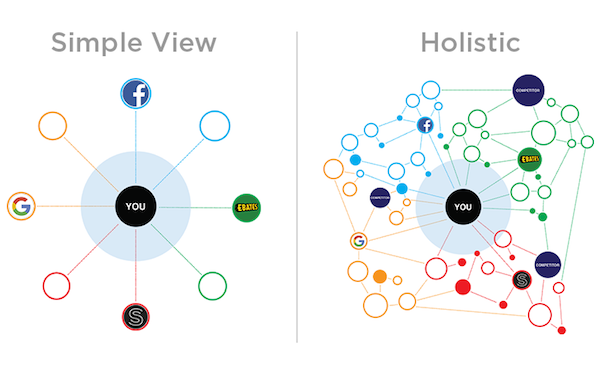
When coupled with artificial intelligence techniques such as reinforcement learning, these methods lead to strategies that optimize budget allocation and, ultimately, drive revenue.
Intuitively, marketers know that connections in a competitive ecosystem are not static. Instead, they fluctuate in response to seasonality, trends, and the marketing effects of one’s competitors, among other factors.
Although significant insights can be obtained from a static connectionist view of the network, these insights become significantly more predictive if we are able to understand how connectivity patterns within competitive ecosystems persist into the future.
Using advanced mathematical techniques (including Markov Chain theory and algebraic topology), it is possible to determine both the direct traffic contributions of a particular web domain and its indirect traffic driving potential within the network the marketer or brand is trying to dominate.
We refer to this indirect (or “pass-through”) traffic as the propagation value of a source. Differences in connectivity and temporal traffic patterns between domains can lead to drastically varying propagation values. This means simply that while two sources might drive the same direct volume of traffic to a website, one of the sources often drives traffic to additional sites in the ecosystem that are of more value to a specific marketer or brand.
The best marketers will seek to understand the direct traffic contribution of each source — as well as the indirect propagation value of the same sources — to uncover the greatest sources of traffic and revenue generation.
The marketer that has visibility to the most powerful direct and indirect sources can anticipate competitive shifts, seize share, and win at the traffic and revenue game.
By prioritizing opportunities in the ecosystem with higher propagation value to them and their competition, marketers will see greater gains in traffic across multiple sites in their ecosystem than selections motivated solely by direct or last-click traffic.
The proliferation of marketing channels has resulted in an abundance of media and marketing investment opportunities, along with a glut of data. When coupled with the continuous shift in consumer preferences, trends, seasons, and other variables within an ecosystem, it has become impossible for marketers without sophisticated AI tools to detect, predict, or respond in real time to opportunities or competitive threats.
In marketing, impactful AI implementation comes down to one goal — real-time, actionable results.
While AI is cast in the media as a singular, ominously powerful technology, the reality is that there are many varieties of machine learning algorithms, and each is suited for specific tasks.
In fact, the art of AI is rarely in building the algorithms themselves. Rather, it is in the ability to define problems in such a way that the algorithm can identify patterns and “learn” the best solution, given the data and computational resources available.
In much the same way that self-driving cars have internal models for identifying lanes and other vehicles, temporal network models are able to form a context from which to define the majority of marketing problems and optimize predicted outcomes across a wide array of possible marketing actions.
While marketers can certainly benefit from other well-known varieties of artificial intelligence — such as those devoted to natural language processing or image classification — the future of AI in marketing will be centered around dynamic optimization methods such as reinforcement learning that learn equally well from historical data as well as real time performance.
Reinforcement learning (RL) is a modern artificial intelligence technique that can address problems which are indiscernible by traditional optimization methods. RL is able to continuously adapt itself based on new information, making it ideal for optimization problems embedded within dynamic networks such as budget allocation and display targeting.
Marketers have much to look forward to from AI in the years to come. Graph theory and algebraic topology are not artificial intelligence. They are the foundation upon which intelligent systems for online markets should be constructed. The environment is a moving target, and multiple competitors, trends, multiple scales, along with incomplete data sets, make these problems especially difficult.
For the next several years, we will likely see more co-pilot type systems, rather than autopilot (“set it and forget it”) systems. Gradually, as scientist learn to build better models for capturing market dynamics, these systems will take on more of the mechanical load of marketers, leaving them time to focus on the more strategic and creative aspects of their jobs.
Thanks, Tyler!
The post A brief introduction to network science math in marketing appeared first on Chief Marketing Technologist.


