Shared posts

23 Jan 22:59

How to Text Sales Prospects (and Double Your Conversion Rate)

by afrost@hubspot.com (Aja Frost)

Text messaging for sales is an excellent way for you to stay top-of-mind as your prospects consider their product options. Chances are that if they’re speaking with you, they’re speaking with a competitor to see who will offer them the best rates and customer service.

It’s unadvisable to fall behind. One way to stay ahead of the game? Sending sales text messages to your prospects to nurture them all the way until conversion. In this post, we’ll go over everything you need to know about texting sales prospects without annoying them, scaring them off, or coming off as unprofessional.

Download Now: Sales Conversion Rate Calculator [Free Template]

Why text sales prospects?

Texting sales prospects may seem like a breach of boundaries and even a faux pas, but how many unread emails versus texts do you have right now?

If you’re like most people, the first number is far bigger than the second. Research shows that 42% of commercial text messages are opened compared to 32% of emails.

Salespeople should take note. It’s difficult to get on buyers’ radars in the first place, let alone stay there. Text and live chat can be fantastic mediums for staying top-of-mind for your prospects, which is leading to the evolution of business conversations.

Is it legal to text sales prospects?

Yes, it is perfectly legal — so long as prospects willingly provided their information to you and opted in for texts. Keep in mind that you should only text sales prospects after you’ve connected with them via another medium such as email or phone.

Otherwise, you risk violating privacy laws and also contacting a customer on a medium they don’t expect to be contacted on. That’s a sure way to scare them off.

Does text messaging for sales violate privacy laws?

No, text messaging does not violate privacy laws if prospects opted in to receive commercial text messages from your business. According to the Telephone Consumer Protection Act guidelines, your request for them to opt in must outline several key pieces of information, such as potential carrier costs and instructions to opt out.

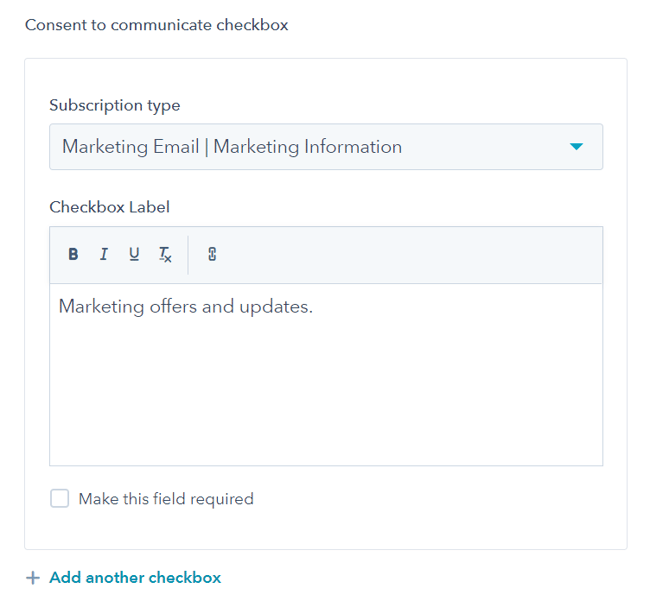
To get customers to sign up, you can ask them to text a keyword to a mobile number. You can also have them check a communications consent box when they send an inquiry to your sales team. Additionally, you may run promotions whose terms include an opt-in for texts.

Don’t forget to send a confirmation text (ie “You’ve been signed up on our mailing list! Text STOP to opt out”). That way, prospects have an opportunity to truly opt-in with consent.

Should you cold text prospects?

No. Never cold text prospects without having a prior conversation with them. Not only is it illegal to reach out without their explicit consent, but it will put off prospects who would’ve been otherwise interested in starting a professional relationship with you.

In the next section, we’ll cover how you can text prospects while still remaining professional and increase the chances of a close.

The following guidelines will help you reap the benefits of text while staying professional.

How to Text Sales Prospects

1. Get prospects to opt in to receiving texts.

sales text message consent

Image Source

First and foremost, get prospects’ consent prior to texting them. You have a few options:

  • Incorporate an opt-in checkbox in the inquiry form.
  • If you run a promotional campaign, include a disclaimer that providing their phone number gives you permission to text them.
  • Ask them to text a keyword to a commercial number to willingly opt-in.

That way, they expect communication from you through that medium. If they use a work cell phone, they may not be as surprised, but that’s impossible to know (unless you’re close to the prospect and know that they use a work phone to communicate with salespeople).

Most commercial SMS strategies are looked through the lens of mobile marketing. When commercial SMS is used in sales, much of the same rules apply. Allow prospects to opt out, only send follow-up texts after a certain period, and remain concise and professional. That will ensure the success of your sales text messaging efforts.

2. Have a discovery call prior to texting the prospect.

Suppose Sarah, an enterprise salesperson, receives a notification that a new prospect just downloaded an ebook. She sends a text to the cell phone number he provided:

“Hey Jimmy! Let me know if I can answer any questions about the latest agronomic trends. — Sarah, Sigment account executive”

If you feel this approach is too forward, you’re not alone. Sending text messages to a prospect before connecting with them on the phone decreases the likelihood you’ll ever connect because it comes across as pushy.

Even if you successfully contact your prospect via text, they’re less likely to eventually buy compared to prospects you didn’t text before calling. Why? Because they have no personal connection with you. They’ve never spoken with you on the phone, heard your value proposition, or even given much thought to your product offerings.

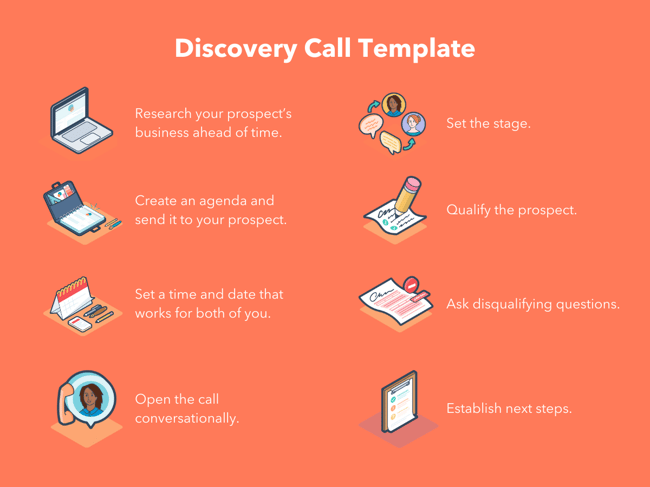
But what if you have a discovery call and then text? You can foster a much more personal connection, articulate your value proposition, and have the opportunity to hear about your prospects’ pain points.

sales text message discovery call

When you reach out over text, it’ll be to reinforce the work you’ve already done — as opposed to trying to form a relationship from the ground up.

With that in mind, don’t text buyers until you’ve talked to them on the phone.

3. Ask for permission verbally.

Aside from getting their consent via an opt-in checkbox or campaign, ask for permission verbally as well to ensure that they know your text message is coming.

This is especially important if you’re worried your prospect will react negatively to an unexpected message.

At the end of Sarah’s first call with Jimmy, for example, she might say, “Would it be okay if I texted you? My customers tell me it’s faster and more convenient to confirm our meetings or get information over text than email.”

This request will be successful for two reasons. First, Sarah establishes this is a normal practice — she commonly texts other customers. Second, she indicates why texting is in Jimmy’s benefit. He’ll immediately picture how much easier it’ll be to open a text than yet another email.

You should also factor in your prospect’s industry, buyer persona, and individual personality. Maybe Jimmy works in an extremely conservative, highly regulated industry. His organization probably does everything by the book, which suggests he’d prefer to communicate over email.

On the other hand, if Jimmy is in an emerging space or belongs to an experimental company, he’ll likely be far more enthusiastic about the idea of texting or chatting.

4. Choose the right texting cadence.

Spam is spam, whether it’s sent via email, LinkedIn message, or text. Be cautious about how often you text your prospects and what you say — if you abuse your texting privileges, they’ll quickly stop trusting you and may even ask you to leave them alone.

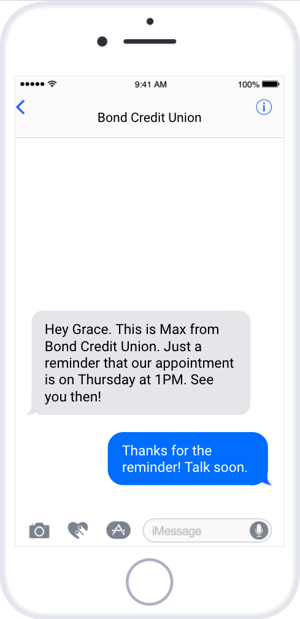
Every text message should have a clear purpose. Acceptable ones include:

  • Checking your prospect's availability for a call or meeting
  • Confirming a call or meeting
  • Sending a helpful resource
  • Briefly answering a question they’d asked earlier

sales text message example

Image Source

Unacceptable reasons include:

  • Just “checking in”
  • Asking why they didn’t answer your email
  • Reiterating your product’s features or benefits without adding value

5. Keep it short.

Brevity is always important when communicating with prospects, but it’s especially crucial when you’re texting. Long texts will fill up the buyer’s entire screen and can easily look overwhelming.

Try to write as little as possible. If your message is more than 300 characters — and you can’t delete anything — consider sending an email instead.

6. Strike the right balance between professionalism and friendliness.

Maintaining professionalism is also key. Even though you’re texting, emojis, acronyms, and sloppy punctuation and capitalization are still inappropriate. Don’t make your prospect feel like they’re back in middle school.

That being said, you can still add some personality. Friendliness goes a long way in humanizing you and the interaction.

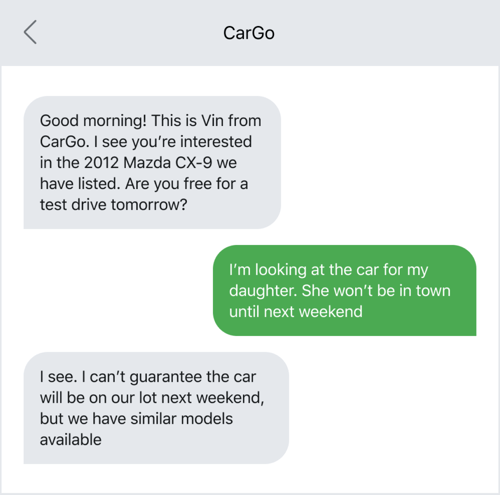
sales-text-message-example-car-dealership

Image Source

To illustrate the right balance of personality and professionalism, here are three examples.

Too casual: “ayo, Jimmy! thanks for getting on that call today. i have the answer to ur question about monthly volume. its probably something we should cover on the phone. :P Are u free tomorrow at 1 p.m.?”

Too stiff: “Hello, Jimmy. Thank you for speaking with me today. I have the information you requested regarding monthly volume. The complexity necessitates a phone call. Are you available tomorrow at 1 p.m.?”

Just right: “Hi, Jimmy. I did some digging and found the answer to your question about monthly volume. It’s not straightforward, so we should cover it on another call. Are you free tomorrow at 1 p.m.?”

7. Only text during business hours.

Lastly, don’t send texts outside of business hours. Because texting is such a personal medium, it can feel invasive to receive a professional message at, say, 9 p.m. And don’t forget your prospect’s time zone — if they’re several hours ahead or behind you, you might unintentionally message them when they’re trying to sleep. Few people appreciate getting texts in the night.

Don’t know what a sales text message can look like? Below are a few examples.

Sales Text Message Examples

1. Sales Text Message for Objection Handling

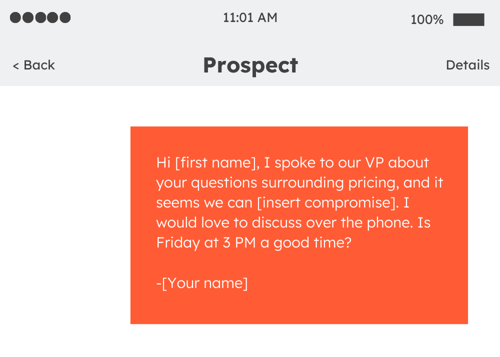
sales text message example: objection handlingHi [first name], I spoke to our VP about your questions surrounding pricing, and it seems we can [insert compromise]. I would love to discuss over the phone. Is Friday at 3 PM a good time?

-[Your name]

Why It Works

During your discovery call, your prospect likely brought up an objection that has the potential to bring the deal to a halt. Use a text message to let them know you’ve found a solution to the issue and schedule a follow-up meeting to discuss.

2. Sales Text Message Before an Event

sales text message example: eventHi, [first name]. This is [first name] from [company]. Tomorrow is finally the first day of [event name]! I would love to see you at our booth and show you a live sample of the product. At what time will you be coming, and which product are you most interested in seeing?

Why It Works

This sales text message works if you’ve been speaking with the prospect for a few weeks and were apprised that they’ll be at an event you’ll also be in. It gives you an opportunity to meet them in person and deliver a pitch in an environment where pitches are expected. We don’t recommend using this text if you’ve just connected with the prospect.

3. Sales Text Message After an Event

sales text message example: after eventHi, [first name]! It was great seeing you at [event name] today. Since you were curious about [feature], I wanted to send over this leaflet: [link]. I’d love to discuss in more detail over a call. Are you available next Tuesday at 3PM?

Why It Works

This text shows critical listening skills — you noticed what your prospect was most curious about and sent them more information. But as with any sales email, it also includes a call-to-action to prompt them to continue engaging with you. You can add or omit details as you’d like to make this text message work for you.

4. Sales Text Message After Trial

sales text message example: after trialHi [first name], this is [your name] from [company]. Did you enjoy your 7-day trial of [product]? I’d love to chat over a potential trial extension. Would Wednesday at 9 AM work for you?

Why It Works

When used appropriately, this text message can help you get a follow-up call booked with much more ease than a normal email. Because most B2B software users don’t expect to interact over text, be sure to know your audience, and to ask for permission first.

Text Messaging for Better Sales Conversion

With the right strategy, texting can help you close your deals much more effectively than with sales calls and email alone. Follow these guidelines to ensure your texts are professional, helpful, and relevant, and watch your conversion rates rocket.

Editor's note: This post was originally published in January 2017 and has been updated for comprehensiveness.

Improve your website with effective technical SEO. Start by conducting this  audit.  

23 Jan 22:59

The 44 Most Highly-Rated Sales Books of All Time

by afrost@hubspot.com (Aja Frost)

You can rely solely on first-hand experiences to gain sales knowledge, but it might be painful. My pro tip? Dramatically cut down your learning curve by picking up some sales books. A read penned by a selling expert offers all the benefits of personal experience without negatively affecting your quota or efficacy.

Download Now: 2024 Sales Trends Report [New Data]

To help you pick, I’ve dug through the top-ranked books from Amazon’s sales best-sellers and curated a list of the best sales books of all time, covering a number of topics specifically for sales professionals:


best sales books: sales methodology and tactics books

1. "Inbound Selling"

Author: Brian Signorelli

Inbound marketing has changed the way companies interact with customers. In this day and age, the buyer is more empowered and doesn't need to rely on a sales rep to learn more about a company's offerings. In fact, more than 60% of purchasing decisions are made without a sales rep. With that being said, how can sales professionals transform the way they think about their strategies? In this book, you'll learn more about inbound sales, including a step-by-step approach for inbound sales professionals and what it means to lead a team of inbound sellers.

  • A Quote I Like: "Gone are the days where buyers rely on sales reps for information."
  • Review excerpt: "This is a must-read for anyone in sales or interested in sales! It's an easy and fun read, while most importantly providing new tools and actionable next steps to add into any sales approach. I highly recommend this to anyone working in or adjacent to sales that wants a fresh perspective and guidance on selling the Inbound way!"

2. "New Sales. Simplified."

Author: Mike Weinberg

Looking for a one-stop guide to bringing on new business? Look no further. In this book, Weinberg lays out a proven formula for finding prospects, developing the relationship, and reaching a mutually beneficial agreement.

  • A Quote I Like: “If you’re not excited about what you are selling, how in the world will you get a prospect interested?”
  • Review excerpt: "I loved the stories, the irreverent tone, and the honesty of this book. But what I appreciated most was that it delivered on its title -- this book really does simplify what you have to do successfully acquire new customers."

3. "The Sales Acceleration Formula"

Author: Mark Roberge

Sales leaders aiming to scale their sales team and build a multi-million dollar business should definitely pick up this book, written by former HubSpot CRO Mark Roberge.

  • A Quote I Like:“Defining the sales methodology enables the sales training formula to be scalable and predictable. The three elements of the sales methodology are the buyer journey, the sales process, and the qualifying matrix.”
  • Review excerpt: "Every company -- regardless of its business and sales strategy -- will absolutely benefit from reading this book. The stories (Roberge) tells, the way his selling initiatives fit together, the combination of selling and technology he describes … even the use cases he lists make the approach he describes applicable to any sales organization -- however well-entrenched."

4. "To Sell Is Human"

Author: Daniel H. Pink

If you're currently working in sales, you're probably well-aware the old playbook doesn't work. Pink offers fresh yet practical insights into modern selling, including how to move others, make your message clearer and more persuasive, and gain referrals.

  • A Quote I Like: s>“To sell well is to convince someone else to part with resources—not to deprive that person, but to leave him better off in the end.”
  • Review excerpt: "No, this is not 'another' book about selling. I've read a lot of them, written a few of them, and I can tell you: This book stands alone in a special category."

5. "Secrets of Closing the Sale"

Author: Zig Ziglar

This book includes more than 100 different ways to close depending on the situation and 700 thought-provoking questions to use with prospects. You'll also find suggestions from a hundred of America's most successful salespeople.

  • A Quote I Like: “If you do not believe in your product or service enough to offer it to your own family and friends, then you should question the value of what you are selling.”
  • Review excerpt: "Ziglar teaches you, from the beginning, that there's no room for success in a salesman's career if he's taking the fast route, making the quick sale, and then locking the door behind him."

6. "The Only Sales Guide You'll Ever Need"

Author: Anthony Iannarino

Iannarino shares his biggest lessons from 25 years of selling, including how to increase your self-discipline, get over your fear of the competition, be more resourceful, discover the buyer's true needs, and more.

  • A Quote I Like: “Only after you demonstrate that you truly understand the client’s situation, feelings, and preferences can you effectively present your ideas and solutions as part of the continuing dialogue.”
  • Review excerpt: "Anthony Iannarino is my new sales guru. His book shows you exactly how to understand your offer and relate to your customer."

7. "The New Strategic Selling"

Authors: Robert B. Miller, Stephen E. Heiman, and Tad Tuleja

Every salesperson will benefit from learning how to reach "win-win" agreements, prevent sabotage by internal blockers, identify the four types of decision-makers, engage senior executives, and more.

  • A Quote I Like: “What you always have to do, therefore, is to focus first on Results and then ask, “Given the Results I can offer, how can this Buyer Win?”
  • Review excerpt: "This book, in my opinion, found a perfect balance between theoretical framework and hands-on, immediately applicable knowledge."

8. "Book Yourself Solid"

Author: Michael Port

Port's book covers a range of strategies for earning more business, from building a powerful social media presence to developing a personal brand to perfecting your pricing strategy.

  • A Quote I Like:“When you try to sell to anybody and everybody, you end up selling to nobody.”
  • Review excerpt: "An excellent and enjoyable read. Michael Port lays out a fresh and honest approach to marketing yourself and your business. 'Be true to yourself' and the people you serve. This takes the pressure off of trying to contrive an image of someone (or something) that is really not you, and makes self-promotion almost natural!"

9. "Fanatical Prospecting"

Author: Jeb Blount

Successful prospecting incorporates multiple touches across multiple channels. Pick up this book to learn how to text, email, call, and socially engage buyers.

  • A Quote I Like:So the question is not, to cold call or not to cold call. Instead, the question is how to strategically balance prospecting across the various prospecting channels to give you a competitive advantage when interrupting prospects in the crowded, competitive marketplace.
  • Review excerpt: "Jeb teaches you how to prioritize your prospects and leverage social selling in your overall prospecting efforts. If you are thinking about a career in sales or you want to jump-start what you are doing in your present job, then this is the book for you."

10. "SNAP Selling"

Author: Jill Konrath

In this book, Kill Konrath acknowledges that today's decision-makers are frazzled, so it can be difficult to get through to them. To address that problem, Konrath offers four simple rules that make up SNAP selling, geared toward overcoming customer hesitation.

  • A Quote I Like: Frazzled customers don’t want to hear about your products or services. They will grant you access only if you pique their curiosity or provoke their thinking.”
  • Review excerpt: "I have recently set up my own consulting business which has required me to seek new clients in various ways. After years of coaching and managing a team of sales people, I have now encountered the challenges on the front line. Needless to say I spent 3-4 months struggling to get e-mails returned, voice mails returned, etc. I have purchased 11 new prospecting books in the past 7 months, and this one has been the best for me. After going through this book I followed the steps for building an agenda and preparing info for calls, e-mails, linked-in, etc. and voila...I have closed 4 new clients in the past 6 days. I feel much more confident in my approach, which has made a world of difference. Excellently written, great information."

11. "The Sales Magnet"

Author: Kendra Lee

Being in sales doesn't always mean cold calling. This book is an ultimate resource of tips and strategies for attracting prospects rather than chasing them down yourself.

  • Review excerpt: "Kendra Lee ROCKS! Learn to generate sales leads for any business using her methods. It's fast and easy and even fun. I have gotten great results with her lead-gen techniques. So BUY THE BOOK and invest in yourself."

12. "Little Red Book of Selling"

Author: Jeffrey Gitomer

This book is short, sweet, and to the point. Readers will learn to focus on why people buy and why it matters to the sales process. With entertaining illustrations and soundbites in every chapter, this book is easy to return to for specific helpful tips when you need them most.

  • Review excerpt:"Excellent book that focuses on selling the right way. Highly recommend this for anyone who is involved in sales and wants to expand their techniques so they close more."

13. "Spin Selling"

Author: Neil Rackham

"Spin Selling" shares the results of Rackham's 12-year, million-dollar research project examining effective sales performances. In his book, Rackham outlines his findings and shares the principles of SPIN (Situation, Problem, Implication, Need-payoff).

  • A Quote I Like: “Success in the larger sale depends, more than anything else, on how the Investigating stage of the call is handled.”
  • Review excerpt: "If you love sales, read this book and discover how to improve your technique. The research behind this book is exhaustive, and the technique is so organic you may discover you're already using it. In that case, you'll be able to improve your skills."

14. "Agile Selling"

Author: Jill Konrath

As a salesperson, you need to learn a lot of new information and skills quickly. Especially if you're getting promoting, switching jobs, or there are updates to your company. In this book, you'll learn about agile selling, which Konrath describes as the ability to quickly learn new information and leverage it for maximum impact.

  • A Quote I Like: "Today our products and services have pretty much been commoditized and prospects realize they can easily get something similar from somebody else. So as a salesperson you’ve become the primary differentiator in the sales process. Products and services can be replicated, but you can’t."
  • Review excerpt: "Having spent 34 years in sales and taken a LONG list of sales training courses and read many training editions you would think, ehhh, I don't need another training book to read. That would have been a serious mistake on my part. Jill Konrath has authored a fabulous strategic plan for any professional salesperson who treats his role as a lifelong learner and acknowledges the sales environment has truly changed in many ways."

15. "Insight Selling"

Authors: Mike Schultz and John E. Doerr

In this book, authors Mike Schultz and John Doerr studied more than 700 business-to-business purchases to see what winners of major sales do differently than sellers who almost won but ultimately came in second place. The results were surprising. In this book, you'll learn how sales winners sell radically differently and see an outline for what you need to do to transform yourself and your team into insight sellers.

  • A Quote I Like: “Sales winners educate with new ideas and perspectives almost three times more often than second-place finishers. Of 42 factors studied, the greatest difference between winners and second-place finishers was their propensity to educate.”
  • Review excerpt: "This book does a great job of establishing the benchmarks, based on their in-depth analysis and research that drive strong value selling. You can achieve greater success by aligning with customers at a whole new level. They guide you through a process that helps you understand how you can create insight across three dimensions or levels."

16. "Smart Calling"

Author: Art Sobczak

Cold calling is probably one of the worst tasks of a salesperson. However, everyone has to do it. In this book, you'll learn proven techniques to master the art of the cold call and eliminate fear, failure, and rejection from cold calling.

  • A Quote I Like: “Value is not what you say it is; it is always what the buyer perceives it to be.”
  • Review excerpt: "I am certain this is the sales book I have read the most times by far. It has everything you need to really help you get better results in prospecting if you are willing to put in the effort."

17. "The TOP Sales Leader Playbook"

Author: Lisa D. Magnuson

This playbook includes 16 'plays' to win bigger deals based on interviews with 41 leading sales executives. These plays include top strategies for identifying big deals, developing relationships with those prospects, and closing when the time comes.

  • Review excerpt: "Although this is a practical, workable, systematic playbook, full of detailed step-by-step instructions for proven strategies and tactics to approach and win your "5X" average deals, it is based on deep research with 41 sales VPs about what they wanted in a playbook. This research revealed four key areas of interest to the sales leaders which became the four main topics of the book: Leadership, Methodology, Execution, and Culture. And because it comes directly from primary research coupled with Lisa Magnuson's leadership career and expertise with clients, it's also focused on the few key priorities that sales leaders can afford to make time for and focus on to guarantee a difference in outcomes. This is a really first-rate book, much needed."

18. "Own Your Niche"

Author: Stephanie Chandler

Covering internet marketing and sales tactics for establishing authority and connecting with your target audience, you'll learn how to generate exposure and build demand for your pipeline.

  • A Quote I Like: "Though marketing does involve testing to figure out what works for your business, there is an important first step that is often missed. You need to know who you are marketing to — and that audience should be narrowly defined. Once you do this, it can change everything about the results you get from your efforts."
  • Review excerpt: "If you have read a lot of books on marketing already some of what you may read here duplicates that, but most people forget so reading it again serves as a reminder. In addition, no two authors will ever have the same take on piece of advice and that is the case here. For example, Stephanie included some suggestions for how to use post cards that I had not seen anywhere else and it was very helpful. Let's face it, the amount of material written on direct mail marketing can reach the stratosphere so finding a different twist on it can be challenging, but she did it."

best sales books: behavioral psychology and persuasion books

19. "The Psychology of Selling"

Author: Brian Tracy

Learn how to harness psychological principles in the sales process while simultaneously getting a dose of personal motivation.

  • A Quote I Like: “When you approach every sales situation as a friend, an advisor, and a teacher, you will dramatically lower the stress involved in competitive selling.”
  • Review excerpt: "‘The Psychology of Selling' is a superb, practical, easy-to-read return to the fundamentals of professional salesmanship for novices, journeymen, and seasoned, top-performing salespeople. More than common sense placed into form, it serves as an instructional blueprint -- or as a road map -- to establish, build, grow, and maintain a successful sales career."

20. "The Science of Selling"

Author: David Hoffeld

Hoffeld's advice is based on the latest research in behavioral economics, social psychology, and neuroscience. You'll learn a science-based approach to asking questions, securing incremental commitments, resolving objections, reducing your competition's influence, and more.

  • A Quote I Like: “To identify buyers’ problems, challenge the status quo with insights that compel your buyers to think about how they can improve themselves or their business.”
  • Review excerpt: "‘The Science of Selling' is the ultimate collection of evidence-based practices for sales ever collected in one volume. Until now, most of the studies in ‘The Science of Selling' have been scattered and tucked away in academic journals, (making them) virtually inaccessible to sales leaders. Most readers will find the material new, and I expect, quite surprising."

21. "Influence: Science and Practice"

Author: Robert B. Cialdini

Cialdini reveals the six psychological principles that cause people to comply. Once you've incorporated these powerful concepts into your messaging, leading your prospects to say "yes" will be less challenging.

  • A Quote I Like: “Embarrassment is a villain to be crushed.”
  • Review excerpt: "Whether you are on the selling or buying end of any transaction, knowing what Mr Cialdini discovered through years of research and testing will be to your financial advantage. (But) 'Influence' is not just about money. It is a guide to getting what you want or need in a fair and ethical manner."

22. "Words That Sell"

Author: Richard Bayan

Keep this informative manual at your desk so you can quickly find the perfect terms and phrases to grab your prospect's attention, create desire for your product, and ultimately, win their business.

  • Review excerpt: "This is a very simple, but HIGHLY useful book!! This book is filled with descriptive words of products & services that will assist you in selling. But more than that, this book is a huge time-saver!! I sell antiques on eBay, and having proven-to-sell words to describe products is wonderful!"

23. "Heart and Sell"

Author: Shari Levitin

How do find the right middle ground between being too accommodating vs. being too high-pressure? This book offers science-based advice for overcoming objections and aligning yourself with prospects' key motivators.

  • A Quote I Like: "Top salespeople know how to balance heart and sales. They also understand that unless they really know themselves, they’ll never truly connect with their customers—or anyone else, for that matter. They know that what you do matters, but who you are matters more."
  • Review excerpt: "Great book as it goes way beyond just giving strategies and ideas but it really cuts to the "why" of why we sell. The personal stories in the book really help to emphasize why we do what we do and when we do it. I heard the author speak at a conference and immediately bought the book to read on my flight home."

24. "7L: The Seven Levels of Communication"

Author: Michael J. Maher

If you're not generating warm introductions to potential customers, you're losing out on a valuable source of business. Discover the concrete steps that will win you referrals. Although "7L" is geared toward real estate professionals, its takeaways are applicable to any sales role.

  • A Quote I Like: “In the old days, the only way to get business was cold-calling, door-knocking, and other ways to ‘market to strangers.’ Everybody spent time and money trying to attract and close people they’d never met. In the Generosity Generation, we can spend our time, energy, effort, and money on people we actually like and trust. In the end, those are the ones who are most valuable to our business.”
  • Review excerpt: "Michael provides an easy-to-follow step-by-step system to create long-lasting relationships with clients and vendors that will result in an endless supply of referrals. This book has completely changed how I do business … I went out and bought 30 [copies to give] to my associates."

25. "Predictably Irrational, Revised and Expanded Edition: The Hidden Forces That Shape Our Decisions"

Author: Dan Ariely

Have you ever been flummoxed by a prospect's irrational decision? Once you read this book, you'll have a new understanding for the assumptions and emotions behind the actions we take. Guiding buyers to the right choices will become far easier.

  • A Quote I Like: “I suspect that most people and companies miss or ignore the fact that trust is an important public resource and that losing it can have long-term negative consequences for everyone involved. It doesn’t take much to violate trust. Just a few bad players in the market can spoil it for everyone else.”
  • Review excerpt: "This is a fascinating look into how our brains process information. The author sets up experiments to test his hypotheses about how people respond to a variety of situations."

26. "DISCOVER Questions Get You Connected"

Authors: Deb Calvert and Renee Calvert

Learn how to structure your calls, ask thoughtful, intelligent questions, and help prospects come to their own conclusions about your product's value.

  • A Quote I Like: “In order to truly connect with buyers, sellers need to know how to ask strategic questions that are respectful, time-efficient, relevant, stimulating, value-adding and collaborative.”
  • Review excerpt:"'Discover Questions' was excellent -- giving experienced and novice salespeople guidance on how to ask questions, drive the sales conversation and show you care!"

27. "Emotional Intelligence for Sales Success"

Author: Colleen Stanley

Sales conversations are innately emotional. Prospects might challenge you and you might get defensive or your fear of rejection could come into play. For a salesperson to overcome those emotional responses, they need to build their emotional intelligence. In this book, you'll learn how to become a better question asker and listener, how emotional intelligence can improve prospecting efforts, and how empathy can lead to more effective sales conversations and solutions.

  • A Quote I Like: "Assertive salespeople are comfortable stating what they need to create true win-win partnerships. And they state what they need in a way that doesn’t emotionally trigger prospects or customers."
  • Review excerpt: "Colleen Stanley's Emotional Intelligence for Sales Success is my go-to resource for sales conversations. I've always told people I hate selling, but I love building mutually beneficial relationships. That's the fundamental premise in this book: that sales is a relationship between two human beings. All of the same emotional intelligence rules that apply to friendships, dating, and other human relationships apply to the sales process."

28. "DISCOVER Questions"

Authors: Deb Calvert and Renee Calvert

One of the hardest parts of the discovery call is setting yourself and your company apart from other sales reps. In this book, you'll learn the right questions to ask, how to create value for your buyers, and differentiate yourself from the pack.

  • A Quote I Like: “In order to truly connect with buyers, sellers need to know how to ask strategic questions that are respectful, time-efficient, relevant, stimulating, value-adding and collaborative.”
  • Review excerpt: "Written for sales professionals it takes little effort to apply this to anywhere you need to ask questions. For sales, it is exemplary, enough that this will become my 2016 Sales book of the year. The author makes a great case for asking the right question early enough so the seller can communicate value."

best sales books: business and sales management books

29. "The Sales Development Playbook"

Author: Trish Bertuzzi

The Sales Development Playbook helps readers understand and use inside selling techniques to build a repeatable pipeline, covering a lot of ground from building sales strategy and measuring what matters to leading your sales development team. All of this is in the effort of providing a solid framework for growing your business.

  • A Quote I Like: "Sales development is more than getting prospects on the phone, asking a series of rapid-fire questions, and documenting their responses. The job is about arousing curiosity and generating interest."
  • Review excerpt: "This is a must read for folks that carry budgetary or first line responsibility for sales development reps (SDRs); which includes both marketing and sales leaders. For those of you that aspire to be successful leaders in this role – this will be your 'reference' text."

30. "Dare to Lead"

Author: Brené Brown

What does it mean to be a leader? It's not always about power but also about having tough conversations and developing empathy. This book dives into new research on change makers and culture shifters and teaches across 4 main skillsets so that readers can rise strong at work.

  • A Quote I Like: “I define a leader as anyone who takes responsibility for finding the potential in people and processes, and who has the courage to develop that potential.”
  • Review excerpt: "What's fascinating is that the author calls herself a "research professor" with a social work doctorate, and her research has been extensive and varied, from military leaders to teachers. In this regard she has adopted the data-based techniques of Jim Collins, whose "Good to Great" has been the gold standard for many years. But her message is different in that it does not recommend "engineering" innovation, but rather relying on "rumbling with vulnerability," "living into one's values," and having the courage to make decisions even where the outcome may be uncomfortable and possibly a failure."

31. "Acting Up"

Author: Janice Bryant Howroyd

Janice Bryant Howroyd discusses how to win in business and in life by chronicling her journey to becoming the first black woman to own a billion dollar business. You'll learn valuable skills on how to rely on your values and demonstrate leadership as an entrepreneur and/or in the business world.

  • A Quote I Like: "An entrepreneur without passion is just a person with an idea waiting around to see if it will happen."
  • Review excerpt: "Similar to cold beer on a summer days, for an entrepreneur like myself “Acting Up” was just as refreshing. Every single person in businesses can learn from Janice Bryant Howroyd’s core values. Today in 2019 we are seeing more and more women in businesses. Janice Bryant Howroyd with the largest privately owned staffing agency in the US is responsible for many of these women being where they are today. A+ Book"

32. "Business as Unusual"

Author: Anita Roddick

Anita Roddick details her entrepreneurial journey while balancing "profits with principles." While detailing her personal and political issues, she defines the role and responsibility of the entrepreneur in the context of business ethics.

  • A Quote I Like: "I know it would be all too easy for me to sink into the seductive comfort of just being a wealthy businesswoman. It would be an easy life, but without fighting for anything there's also a hint of death about it, so I do what I can to keep striving, traveling and fighting."
  • Review excerpt: "I just loved this book. With all my respect to Anita Roddick, I had never expected this book to be so insightful and challenging the conventional wisdom, before I received it into my postbox! I have enjoyed reading it very much. I still like to open a random page and read it again."

33. "Cracking the Sales Management Code"

Authors: Jason Jordan and Michelle Vazzana

Jordan dives into the critical activities and metrics sales managers and executives should implement and track to lead their teams to success.

  • A Quote I Like: “Hiring the right salespeople, deploying them in the right way, targeting the right customers, and selling the right products is the only formula for long-term organizational health.”
  • Review excerpt: "I liked the focus on real-world quantitative management via metrics (and) would recommend this book to any sales manager who wants to achieve and measure results."

34. "Shark Tales"

Author: Barbara Corcoran

If you've ever watched ABC's Shark Tank, you know Barbara Corcoran. In her book, she tells her story going from failing in her career efforts to building a $6 billion dollar business, along with the business lessons she learned along the way.

  • A Quote I Like: “Being afraid to fail stops you from trying things in the first place. I learned after many failures that nobody’s watching and nobody gives a damn. If you want to build a successful business, you don’t have to get it right; you just have to get it going.”
  • Review excerpt: "Barbara's book was an autobiographic infusion between her childhood and her journey to success in business. She describes both almost simultaneously, as if each chapter is split (but not intermingled) between her business journey and childhood memory. Many of those childhood memories reinforce her attitudes she had later in business and life."

35. "Leapfrog"

Author: Nathalie Molina Niño

Geared toward women entrepreneurs who want to "outsmart the status quo," Leapfrog contains 50 ways to launch, fund, grow, and succeed in business. You'll learn how to remove obstacles and open closed doors.

  • A Quote I Like: “I’m not about to let anyone tell me that a shortcut is a bad thing. Our [women’s] time is well overdue, and if anyone has a problem with the fact that we want to find faster, cheaper, better ways to get there, they can just take a seat and watch us.”
  • Review excerpt: "She thoughtfully demonstrates how to work within today's system to get where you need to go, as opposed to staying in a dreamland hoping societal barriers fall. Her advice is based on what's real and what works and reading LeapFrog feels like taking in a much needed pep talk from your best friend. Highly recommend it."

36. "The Glitter Plan"

Authors: Pamela Skaist-Levy, Gela Nash-Taylor, and Booth Moore

Juicy Couture was started with $200 and grew into a global brand that was eventually purchased for $50 million. The authors of this book chronicle that story in this book that markets itself as part memoir and part business manual. You'll learn the innovative tactics they used to achieve radical startup success.

  • A Quote I Like: “The trick to our success—and any success—is passion; you can’t manufacture that. You have to find that one thing you love more than anything.”
  • Review excerpt: "Its obvious this book is a must read for today's women, who are seeking ways to thrive, but I HIGHLY recommend this book for the men - husbands, dads and male leaders. As I read this book, I've gained empathy and a new perspective I only sensed before but didn't quite understand completely until Tiffany made it clear for me. I now have a new lens for what my wife has done and is doing, to be an amazing wife, mother and career professional. Despite already being a proud and 'active' dad, I now understand her challenges and am attempting to step up to the plate and do more, to allow more balance in our marriage and parental roles, and to allow her an opportunity to be all she can be."

entrepreneurial and sales mindset books

37. "Mindset: The New Psychology of Success"

Author: Carol S. Dweck

As a world-renowned psychologist, Carol Dweck has researched the power of mindset for decades. She reveals how mindset can dramatically impact and influence how we think about our talents and abilities. Although not directly about sales, this book will teach you how a growth mindset can help you succeed in the world of sales and beyond.

  • A Quote I Like: “No matter what your ability is, effort is what ignites that ability and turns it into accomplishment.”
  • Review excerpt: "I recognized a lot of myself in this book (and not necessarily the good bits). I learned some reasons why I procrastinate for one thing. It is potentially a game changer for anybody willing to be honest about who they really are with a sincere desire to be better through application and hard work. The book is a call to action and change on a very fundamental level."

38. "Think and Grow Rich"

Author: Napoleon Hill

This book is beloved by many career salespeople. The result of nearly 20 years of research, Hill's book outlines 13 steps to success, including developing a definite purpose, building a positive mental attitude, and channeling the power of the subconscious mind.

  • A Quote I Like: “Every adversity, every failure, every heartbreak, carries with it the seed of an equal or greater benefit.”
  • Review excerpt: "This book is one that everyone must-read. From the very beginning, it began changing my mindset and how I view life. Some books are filled with information on how you should be thinking, but this one shows how to create lasting change."

39. "How I Raised Myself from Failure to Success in Selling"

Author: Frank Bettger

This is the perfect book for anyone whose job it is to sell. Through personal experiences, Bettger tells his tale from a failed salesman to one of the highest-paid salesmen in America. He gives insights on the power of enthusiasm, conquering fear, the quickest way to win confidence, and the seven golden rules for closing a sale.

  • A Quote I Like: “The short-cut to popularity is to lend everyone your ears, instead of giving them your tongue.”
  • Review excerpt: "I have read this cover to cover, twice. It's not only for those in the sales industry, it's useful for everyone. I was reminded of the value of emotion, as well as the value of time - both mine and my clients. It was great to learn from both Frank Bettger's mistakes and successes, and I am grateful to have read this book."

40. "The Introvert's Edge: How the Quiet and Shy Can Outsell Anyone"

Authors: Matthew Owen Pollard and Derek Lewis

Just like any other skill, anyone can learn and master the art of sales. Even introverts. In this book, an introverted salesperson can learn how to use their own natural strengths to sell. For example, introverts will learn how to find natural confidence, prepare for any situation, sidestep objections, and ask for the sale without being pushy.

  • A Quote I Like: “To sell successfully, you don't have to be aggressive. You don't need to be anything other than you. You just need to experiment until you find a way that feels natural.”
  • Review excerpt: "Being mostly an introvert, I have long felt that I had to learn to be someone else in order to succeed in business and especially anything to do with selling. Unbelievably refreshing to read approaches born from authentic experience. With the right tools and techniques, anything is possible! And if you're an introvert and you hope to make a living, this is an excellent book for you — it'll serve you well no matter what field you're in."

41. "More Sales, Less Time"

Author: Jill Konrath

Have you ever felt behind at work, but there just isn't enough time in the day to get everything done? If so, you're probably an overwhelmed salesperson. With quotas going up and faster turnarounds expected, it's not surprising. In this book, you'll learn how to reclaim your time by eliminating major time sucks, optimize your sales process to eliminate redundancies and wasted time, and stay at the top of your sales game.

  • A Quote I Like: "Right now, virtually everyone on your team is unintentionally frittering away at least one to two hours per day. Set up team challenges to motivate everyone to recapture lost time. When you do, your reps will make more calls, have more meetings, and close more deals. The best part is you won't need to hire more salespeople to make your numbers."
  • Review excerpt: "Time has become a top 3 obstacle to success for sales professionals and anyone trying to grow their business results. This book helped me identify and accept that I am being held back because of my attitude and choices about my time. By the time I got to Chapter 31 titled "Unclog Your Pipeline" I had so many notes that I had to put the book down and go back to start from the beginning and highlight the areas that were giving me the clarity that I was so clearly lacking."

42. "Go-Giver, Expanded Edition: A Little Story About a Powerful Business Idea"

Authors: Bob Burg and John David Mann

This quick read reveals the importance of giving to business success. Not only will you walk away convinced that giving leads to receiving, you'll also know how to give to achieve your desired results.

  • A Quote I Like: “Changing my focus from seeing what I could get to what I could give was when my career started to take off.”
  • Review excerpt: "Clear, entertaining, and immediately practical, this book has evolved my approach to business -- and life. When you go through your day focusing on how you can give and being open to receiving, you build stronger relationships and prosper on multiple levels."

43. "Drop the Ball"

Author: Tiffany Dufu

If you've ever felt the burden of perfectionism or an insurmountable to-do list, Tiffany Dufu's story about "letting go" to achieve more is for you. By re-evaluating expectations and embracing imperfection, you'll be able to increase your energy on the things that matter. This book is perfect for women leaders.

  • A Quote I Like: “Diversity, when leveraged to solve problems in new ways, is a magnificent thing.”
  • Review excerpt: "Its obvious this book is a must read for today's women, who are seeking ways to thrive, but I HIGHLY recommend this book for the men - husbands, dads and male leaders. As I read this book, I've gained empathy and a new perspective I only sensed before but didn't quite understand completely until Tiffany made it clear for me. I now have a new lens for what my wife has done and is doing, to be an amazing wife, mother and career professional. Despite already being a proud and 'active' dad, I now understand her challenges and am attempting to step up to the plate and do more, to allow more balance in our marriage and parental roles, and to allow her an opportunity to be all she can be."

44. "The Warrior Code"

Authors: Tee Marie Hanible and Denene Millner

If you want to actualize your true potential, this book offers 11 principles to "awaken your inner badass." It starts with Hanible's story of uncovering her inner warrior after a life full of adversity and advice on how you can tap into your own power.

  • A Quote I Like: “When faced with something that feels absolutely insurmountable and scares the mess out of you, don’t turn your head away from it. Instead, acknowledge you’re scared, figure out the reasons why this is so, then come up with a rational plan for how to overcome that fear.”
  • Review excerpt: "This was an awesome book! I'm an avid reader and this was by far one of the best. Great for both men, women, boys and girls. This is one of the first authors that tells it like it is and revealed the good, the bad, and the ugly experiences they faced growing up. Great read!!"

Ready to read?

Whether you want to study sales tactics or you want to level up your individual performance, this list is pact with insightful books by brilliant authors. Maybe even your next mentor.

Editor's note: This post was originally published in November 2018 and has been updated for comprehensiveness.


20 Jan 21:21

The Best Sales Presentations Are Designed From the Inside Out

by Bob Apollo

Dont be Boring on Cork 250.png

If you, like me, have spent the majority of your working life in the technology sector, you’ve probably sat through more than your fair share of awful, formulaic, and downright boring sales presentations.

You’re likely to have been exposed to more slides packed with the same customer logos, more maps jammed with pins showing office locations and more self-serving corporate positioning statements than any human being should have to endure in a lifetime.

And you’ve almost certainly seen and heard the same trite phrases trotted out in pitch after pitch, to the point where they all blur together and you can’t tell them apart: “best in class”, “state of the art”, “industry-leading”… and the list goes on.

But it doesn’t have to be this way…

THE GREATEST SALES DECK I’VE EVER SEEN

Andy Raskin recently wrote about “The Greatest Sales Deck I’ve Ever Seen” on LinkedIn – referring to a brilliantly simple structure from Zuora, the leader in SaaS subscription billing.

And yes, Zuora do have the obvious attention-grabbing advantage of being a leader in a hot market. But the basic principles (which I’ve adapted slightly below) can be applied to any organisation wishing to stand out in any market.

This narrative structure isn’t unique. The “Challenger Sale” promoted something very similar a few years back. One of the core concepts is that your presentation must always lead towards and never lead with your solution.

Here’s the basic flow:

  • Set the scene: describe an important trend or transition that is happening in the audience’s world
  • Implications: How are or how will organisations be affected by this change?
  • Winners and Losers: Show how the trend will create winners and losers, depending on how companies choose to react
  • The Twist: Surprise the audience: Introduce an unexpected need or implication that leads towards your strengths
  • Capabilities: Selectively introduce a few of your capabilities that help customers deal with the identified “twist”
  • Credentials: Why should they trust you? Back this up with your credentials as an organisation
  • Next Steps: What should the audience (if qualified) do next?

Presentation Sequence 2.png

You’ll notice that:

  • The sequence deliberately inverts the usual flow in which a vendor spends the first few slides talking about themselves
  • It attaches itself to an inevitable trend or transition in the market that the audience is going to have to deal with
  • It “goes beyond the obvious” to introduce ideas that the audience hadn’t been aware of (and probably won’t hear from any other vendor)
  • It presents your credentials at the end, rather than the beginning (which is where they really matter)
  • It closes with a clear next step (or a few optional next steps)
  • And, yes, it leads towards your solution rather than with it

Unless you’re presenting from a stage to a large audience, your presentation should be designed to facilitate a conversation. Every slide should be accompanied by talking points that stimulate feedback and get the audience engaged. If effective, the audience will be talking as much as you (or even better, more than you).

When you follow these guidelines, every participant – presenter and audience – is likely to emerge from the presentation having learned something valuable. There’s a far better chance that everyone will emerge from the session agreeing that it was time well spent – which, let’s face it, is rarely the case with classic corporate sales pitches.

START FROM THE CENTRE

The key with designing these presentations is NOT to start the drafting exercise at the beginning of your presentation. Once you have clearly defined your target audience, you should start instead by defining the handful of essential capabilities that most powerfully distinguish your solution from all the other options that your audience is likely to be considering.

Resist the temptation to make this an apparently impressive long list. Your audience will stop relating to your differentiators (and certainly won’t be able to recall them) after the first handful. 1-3 core capabilities seem to be the optimal number. Short, compelling themes are far more powerful than long detailed lists.

And don’t restrict your thinking just to your high-level product capabilities, either. The approach you take to guaranteeing your customers success – if obviously different from other vendors – can also be a powerful differentiator.

WORK BACKWARDS TO THE BEGINNING

Now you know where you want your presentation to lead to, you can reverse-engineer the initial part of the presentation to set the scene appropriately:

  • How can you introduce the trend or transition in a way that encourages the audience to conclude that your approach is the best way of dealing with it?
  • How can you identify the implications of the transition in a way that has a clear connection to your strengths?
  • How can you describe the winners and losers in a way whereby the winners look a lot like your ideal customers?
  • How can you introduce a surprising and memorable twist in a way that sets you up to reveal your core capabilities?

WRAPPING THINGS UP

The best place for your credentials is not at the start, but towards the end – because they will seem much more relevant to the journey you’ve just taken your audience through. And you can then segue seamlessly (after reconfirming the audience’s interest) into clearly defined next steps.

20 Jan 21:21

Amazon will help train veterans for tech jobs

by Billy Steele
Last week, Amazon said it would bring 100,000 full-time jobs to the US by 2018. This week, the online retailer announced a registered apprenticeship program with the US Department of Labor that will offer training to veterans. The initiative follows...
20 Jan 21:05

How to Plan Marketing Content Around Event Promotion

by Kaleigh Moore

All too often, marketers under-plan their marketing content for events. They promote what’s coming beforehand, but then they forget to continue the process during, and after the event. Or some combination of the above.

Often, this oversight can result in missed opportunities to educate, engage, and excite attendees and new leads.

This is a problem: By allowing the marketing content to stop at one of these steps, momentum that’s built up suddenly comes to a screeching halt – and the conversation that was started abruptly ends.

So how can you keep the content flowing before, during, and after your event?

In this post, we’ll look at some different types of marketing content you can craft to drive event engagement in three different stages: pre-event, mid-event, and post-event. Plus we’ll show examples of each phase.

Pre-event Marketing Content

Before the event, the goal of your promotion content should be to hook your audience with interesting, engaging material that connects their attendance to your booth or talk.

Why? Because this helps standout from the crowd, and usually, it’s a big crowd. Plus, you build a sense of anticipation and excitement for the attendee (or prospective attendee.)

Whether it’s a blog post promoting sessions to look forward, an email that gives registrants a breakdown of key event highlights, or an interactive piece of content that provides personalized results related to your event based on individual responses, these pre-event efforts can help get people prepared and excited about attending.

There are a variety of formats to go with. It could be in the form of a blog post promoting sessions to look forward, an invitation email to specific talks or parties, or an interactive guide that provides personalized results for key event highlights. These pre-event efforts get your brand in people’s minds, and give more incentive to make time for you.

When creating these materials, consider the following questions:

  • What important details would my audience want to know before the event?
  • What are some exciting/interesting elements I can promote to build excitement?
  • Are there speakers or specific sessions to highlight that fit my product solution?
  • What conversation could I begin with my audience to stay top of mind?

To get a better idea of what this looks like in action, let’s take a look at some current examples of pre-event content.

Examples of Pre-event Marketing Content

MarketingSummitEx.png

In this example from Marketo, we can see how they’ve created an informative blog post that summarizes a three-step process to get prepared for one of their events. This helps effectively prepare attendees and builds excitement about what’s to come.

And even though this is content by Marketo for a Marketo event, the same approach can be done from a booth presence, or a session speaker. You don’t have to host the event to promote it.

BAOEvent.png

In another example of pre-event blog content from BAO, we can see how an event is being promoted by summarizing three main highlights to come. Within the post, readers get a better understanding of the value of attending is, while adding to the sense of anticipation.

DemandBaseEvent.png

DemandBase created an interesting piece of pre-event interactive content by creating an engaging experience around the location of the upcoming event.

This assessment has two benefits:

  1. It allows participants to learn more about the event location and social options
  2. And, on the back end, provides in-depth attendee insights for the event planners

Mid-event Marketing Content

During the event, attendees are deluged with elevator pitches, short demos, keynote speakers, and a multitude of sessions. But that doesn’t mean they are not available and open for even more engagement.

Participation should be the central focus of mid-event content. At this past year’s Inbound, HubSpot had a group of iPads and monitors preloaded with a “test your inbound knowledge” style quiz. The quiz was timed and had a jeopardy-like format. This area was continuously high-traffic because attendees could compete against themselves or their colleagues and win prizes.

Inbound2016Event.jpg

Not dissimilar to just giving away free swag, but HubSpot put a competitive twist to it that got people involved.

In between in-person booth activities, attendees are still checking their phones, checking their emails. So, send them relevant updates. Something as simple as a “What Was Your Favorite Part of Friday” survey will get high opens and clicks because attendees will want to voice their opinion, but also see what they may have missed out on. And they’ll see your company name.

Mid-event content can come in alternative formats:

  • Live posting: By sharing real-time activity at the event, you can grab the attention of attendees and even create an engaging experience for those who can’t be there.
  • Giveaways: Everyone loves the chance to win something (especially if it’s free!). By creating giveaways and quick games, you can drive participation and booth traffic
  • Personalized updates: With the help of interactive content, you can connect with many attendees all at once, steering their attention towards you

Interested in seeing what this looks like when executed? Here are some examples from events that nailed the “during” portion of content marketing for events.

Examples of Live Event Marketing Content

OracleEvent.png

Results:

OracleEvent2.png

An interactive assessment like this one from Oracle demonstrates how event attendees can be informed of upcoming highlights and get customized session recommendations based on the user’s input. Delivering personalized results, as seen here, can help the participant get the most out of the event and points out highlights that are extremely relevant to the individual.

LiveBlogEvent.png

In this example of ‘during’ content, you can see how we here at SnapApp shared live updates from an event to keep attendees who missed this particular session updated on the action. In a way, this allows event attendees to be in two places at once.

Post-event Marketing content

After the event wraps up, your marketing should encourage an ongoing conversation with attendees. This is the time to continue building relationships, as you’ve sparked a conversation and made a lot of new connections – keep it going.

Why? Because now you have a foot in the door with some possibly, very qualified leads. Keeping the dialogue open means you can keep your momentum moving forward.

You can accomplish this by:

  • Asking for feedback. Reach out and see what people liked. They’ll be happy to share, especially if the first follow up content isn’t in-your-face-sales.
  • Relevant follow-up content. If you know attendees responded to something specific (remember that survey we suggested?), send them content that is somewhat in line with that, either thematically or subject-wise. Piggy back off big keynote subjects.
  • Recapping the successes. Bookend the experience by putting together a recap that reminds the reader of all of the amazing, insightful information that was delivered during the event.

Again, let’s look at some examples that execute this well.

Examples of post-event marketing content

Emmaevent.png

Emma followed up with attendees who stopped by their booth via email after an event to invite them to an upcoming webinar. This helps keep potential leads moving down their conversion funnel and may eventually turn these event contacts into long-term customers.

SkywordEventrecap.png

Skyword recapped the top takeaways from CMW16 and distilled some of the key highlights into a simple blog post. For those who were there and those who weren’t, this is a valuable piece of content.

Plan Your Marketing Content Around Event Promotion

Now that we’re on the same page about the importance of planning marketing content around events, let’s do a quick recap of how the strategy works:

  • Pre-event content builds excitement and anticipation around the upcoming event
  • Mid-event content keeps attendees participating directly with you while they’re in attendance and swarmed with other distractions
  • Post-event content keeps the conversation going and is a time to gather insights from attendees and provide relevant follow-up content

If you can put together a few different types of content (think emails, assessments, blog posts, etc.) that hit all three checkpoints as your regular event strategy, you’ll start to see results. But! Don’t just rely on the same type content each time – get creative, the more out-of-the-box thinking, the more you’ll stand out.

Speaking of events… We have an exclusive hands-on marketing workshop happening soon in DC! Check it out!


20 Jan 21:04

Sharpen Your Sales Axe with a Mature CPQ Model

by Nisha Pattan

“Give me six hours to chop down a tree and I will spend the first four sharpening the axe.” – Abraham Lincoln

You want to accelerate the sales cycle—so why not put some effort into sharpening your ‘sales axe,’ enabling your teams to close deals even faster?

The first step in the arduous and time consuming process of closing a sale is to create an opportunity for your lead. Configure, Price, Quote might be the very first step to a deal but it is often the most overlooked from the perspective of driving process efficiencies. You already measure sales cycle times and deal velocity, but did you know that reps on average are spending 64% of their time on non-selling tasks such as building quotes, identifying pricing, and securing approvals? (State of Sales Report)

No doubt that the first step to a sharp ‘sales axe’ is a solid CPQ model.

We will help you identify where your team stands today and what steps you can take to move to the next level.

But first, what are the key attributes of a solid CPQ Model?

CPQ automation does not just impact your sales organization. According to PwC, Finance, Operations and even Customer Service are impacted in negative ways by a poor CPQ process.

Source: PWC

How can you prevent these problems for your teams? What key attributes should you look for in a CPQ model?

Here are some of the CPQ processes you can automate and that will indicate the CPQ maturity of your organization:

  • Product configuration
  • Guided selling
  • Price catalogs
  • Discounting rules enforcement
  • Contract, proposal, and order approvals
  • Backend integration with ERP systems to manage inventory, fulfil orders or update financial ledgers
  • Channel Partner management tools
  • Renewal cycles

How mature is your current CPQ model?

There are three phases of maturity that will help you determine where your organization falls on the spectrum today and how you can build on your current processes.

Phase 1: Archaic

In this phase, sales reps are working out of excel sheets or worse yet, Post-it notes. Customers are receiving quotes in various forms ranging from emails to word docs. As your business grows and expands, more customer quote requests pour in, but with manual processes you are prone to risk of errors & uncontrolled pricing. Not only does it create a poor brand experience, but you can not report on key metrics. Scaling your business to new heights will be an uphill battle with this model.

Phase 2: Automated

This second phase of CPQ maturity involves some level of investment in tools and systems to help your growing sales teams manage their opportunities, quotes, and orders. As a Salesforce customer, you might even consider using standard quotes objects right out of the box.

For companies with a simple set of offerings and straightforward pricing, Salesforce Quotes, a built-in component of Salesforce Sales Cloud, offers the basics to streamline quoting for many small businesses. Quotes offers basic quoting and a simple product catalog for easy selection of items. Quotes also uses the built-in Salesforce price book, which allows for basic discounting, and generates a formal PDF quote for presentation directly to your customers.

Salesforce Quotes is a great way for small businesses and those with simple pricing rules and smaller product catalogs to manage their quoting processes with relative ease and simplicity.

Phase 3: Advanced

As your company grows and your product line expands and becomes more complex, so do your quoting requirements. Pricing and discounting rules require more robust controls and greater flexibility, product bundling and packaging complexities arise, compliance issues appear, and deeper process insights are needed. You soon realize the need for a more advanced quoting tool which can handle the needs of your unique business.

In this final phase of CPQ maturity your tool helps you manage and automate all of the following key functionalities:

Guided selling: Sales reps no longer have to look up multiple systems and various spreadsheets to understand the right configuration to offer their customers.

Renewals: For a subscription revenue based model, the system realizes the time frame from opportunity start date, calculates the renewal date and automatically generates a renewal opportunity—ensuring you don’t lose out on an opportunity to generate revenue. To further simplify the customer lifecycle, your tool should give you the flexibility to price for different subscription terms, co-term add-on orders, and keep track of renewals.

Pricing and discounting: A good CPQ tool will allow you the flexibility to enforce tiered discounts, volume discounts, and even mandate certain discount levels depending on the product or sales rep level.

Channel partners: Your CPQ tool should be able to manage multiple price books based on your agreements with different partners, so each partner automatically gets the pricing they expect. Integrating your CPQ tool with a partner portal will also allow your resellers and distributors to easily create quotes directly in your CRM system, giving you real time visibility into channel revenue.

System integrations: A strong CPQ solution will also have a robust technical architecture so you can easily integrate with your ERP systems to better manage inventory or update your financial system of record. Look for tools that provide a comprehensive set of APIs and even pre-built integrations with major ERP systems.

Empower your sales team with a sharp axe! Check out how Salesforce CPQ gives your company the tools you need to take control of the sales process, from quote to cash.

20 Jan 20:59

Nimble & Quick, Agile Marketing Isn’t a Magic Trick

by Dave Sutton

Catchy taglines, sponsorships, and primetime media buys no longer guarantee market share gains, authentic engagement, or revenue growth. The advent of new technologies and communication channels has taken the buying power away from big brands and put it into the hands of customers. Customer interest can no longer be purchased; it must be created and delivered to the right person, in the right channel, at the right time and make a lasting impression.

Because of this, marketing departments must function and operate in a very different way. To succeed, they must operate with processes more like lean startups and less like functional silos. Taking an agile approach to marketing requires leaders, processes, and communications to be transparent, interactive, iterative, responsive, real-time.


“There’s no question that agility IS a catalyst that allows more innovation to come from more people across a team.”
Five Key Features For Agile Marketing Operations


Marketers are pressed to prove ROI, to unify a customer journey across dozens of platforms, and to deliver customer experiences that engage and delight every time. Articulating the real, bottom line impact of marketing has challenged marketers for years. Only by taking a holistic approach that spans the five essentials of marketing (i.e. plan, spend, create, distribute, and perform) can marketers overcome the mayhem and generate measurable business results.

topright_marketing-mayhem-agililty

Plan

Organization of your marketing calendar and alignment across disciplines is the foundation of building an agile marketing team. Understanding the distribution of responsibilities — and the actual workload — is the first step to controlling the marketing mayhem. Organization of assets is imperative. Keep all assets in one place and make them easily accessible. Planning and organization will allow your team time to react and find real-time opportunities to engage customers. Marketers must understand the customer experience and cannot do so with their head in a computer screen and in planning meetings all day.


“Marketers set themselves up for success when they integrate their agile practices with more traditional research, planning, and strategy practices.”
Roland Smart, Key to agile marketing success? Integrating traditional practices


Spend

Marketers are bombarded with new services, trade shows, sponsorship opportunities, innovative ideas to drive growth, and new technology on a daily basis. It’s absolutely essential that every marketing activity ties back to the strategic plan and targets the right consumer, in a channel in which they are willing to engage.

“Precision is not reality” – Henri Matisse

Protect your marketing budget by asking a few questions, like:

  • How is this going to contribute to our bottom line growth?
  • Is this in line with our marketing strategy?
  • Can we measure the effectiveness of this spend?
  • Specifically, how will we measure the ROI?

Create

You can’t accumulate data on projects that aren’t shipped. Having a results-driven mentality means cutting the b.s., no more pointing fingers, and shipping constantly. Distribute responsibilities and assign product owners. Marketing cannot rely solely on great creative and convincing marketing jargon to win over consumers or the CEO. Content must be created for individual channels and personalized. It’s also worth mentioning organization is essential to avoid overwhelm and, when you feel like the walls are closing in due to stress, take a break.

Distribute

It’s more important than ever to cut through the noise and adapt quickly to what is working and what is not. By developing a test-and-learn culture you can rapidly test out marketing ideas and iterate based on results. Adaptability to the customer’s preference is vital to best engaging your target market. Additionally, a single consumer view is essential. You cannot track what you cannot see. Connected technology is a key component of running an agile marketing team.


“Marketing agility requires a clean, comprehensive, integrated dataset, in real time. Marketers should be selecting tools based on data portability—how easy is it to get data out of those point-tools and into your marketing data hub?”
Jennifer Zeszut, Agile Marketing And The MarTech Stack: The Tools That Can Unlock Insight And Growth


Perform

Accountability is a key differentiator between the marketing departments of today and those of the past. Ditch your “arts and crafts department” reputation by providing scientific, accountable, and data-driven results. Marketers must have a real-time feedback loop with a unified customer view in order to understand the true value of a conversion and track the entire customer journey.

Implementing the five essentials that we have shared today will help you mitigate the Marketing Mayhem, change the conversation, and take back control of your marketing operations. The good news is that everyone out there is susceptible to Mayhem. So, if you master the five essentials, not only will you get your own marketing house in order, but you will also have the potential to create Mayhem for your competitors.

Are you ready to perform smarter marketing in 2017? Or, are you still struggling with challenges such as increased budget scrutiny, ineffective channel strategies, and out-of-date asset management systems?

How does your marketing agility compare with your peers?

Take the Managing Marketing Operations Mayhem Survey now!

Photo credit: Flickr

20 Jan 20:59

Close More Sales With These 11 Quick and Easy Tips

by Marc Wayshak

There are hard ways to close more sales—and then there are easy ways. If you’re looking to make some simple changes to your selling strategy that will have a big impact on your bottom line, it’s time to emulate the most successful salespeople out there.

The following 11 sales tips are quick, easy, and powerful ways to increase the number of sales you close. Implement these now, and watch as your sales strategy dramatically improves:

1. Drop the enthusiasm

The old-school sales technique of acting overly cheerful and enthusiastic just doesn’t work anymore. In fact, it actually sabotages your chances of connecting with prospects and gaining their trust. Drop the enthusiasm and adopt a more genuine, low-key tone to start closing more sales.

For more tips like this, watch the video below:

2. Focus on your prospects

It might sound obvious, but most salespeople don’t focus on their prospects nearly enough. You’ll stand out from the competition if you stop focusing on your product or service, and instead spend all your time focused on your prospects, their needs, and their deepest frustrations.

3. Share best practices

You have an amazing bird’s-eye-view of what’s going on in your prospects’ industry. Use that perspective to share best practices with your prospects, and you’ll quickly find that they want to talk to you and learn from you. Once you’re perceived as an expert in the industry, you’ll be able to set more meetings and close more deals.

4. Ask questions about challenges

Few salespeople understand the importance of asking prospects about their key challenges. Try asking, “What is the biggest challenge you’re facing right now?” All prospects want to find solutions to their problems, so they’re likely to open up to you if you ask questions like these—and you’re far more likely to ultimately close the sale.

5. Learn the cost of those challenges

If you can get a prospect to articulate what a challenge is costing them, then you can immediately create value. Once your prospect shares their key challenge, try asking, “What would you say this challenge is costing your organization?” The answer tells you—and, more importantly, your prospect—exactly what your solution is worth.

6. Establish a budget

Once your prospect has articulated what their key challenges are costing them, it’s time for you to ask, “What could you see yourself investing in order to solve these challenges?” When you allow your prospect to lead with what they’re willing to invest, you’ll stop hitting them over the head with a price and start closing more sales.

7. Be willing to walk

If you’re not willing to walk away from a prospect, then you’re at a huge disadvantage. That’s because 50% of the prospects you come across simply aren’t a good fit. Maybe they aren’t facing the challenges you solve—or they simply don’t have enough money for your solution. Don’t be afraid to walk away from those who aren’t ideal prospects.

8. Get commitment before presenting

If your prospect isn’t committed to solving the challenges they have, then there’s no point in presenting your solution. Close more sales by focusing only on those who have displayed that commitment.

9. Give three options in every proposal

If you’re only presenting one option to prospects, then you’re losing sales. Instead, give three options in every proposal, ranging from a lower-end solution to a premium option with all the bells and whistles. This has two advantages. First, you’ll close more premium sales than ever before. Second, you’ll provide context to the purchasing decision, so your prospect won’t feel the need to shop around and compare prices.

10. Always schedule a next meeting

Close every meeting by scheduling the next one. This is incredibly easy, yet salespeople fail to do this all the time. Don’t just say, “I’ll call you next week,” because things fall apart without clear next steps. No matter where you are in your sales process, always schedule the next step before ending a meeting with your prospect.

11. Ask for introductions at the point of sale

There’s no better time to ask existing customers for introductions and referrals than right after closing the sale. They’re excited about working with you and will be eager to connect you with others. Even if they don’t introduce you to someone right away, you’ll plant a seed and get them thinking about others who would be equally as excited to learn of your solution.

Which of these 11 quick and easy tips is your favorite for closing more sales? Share in the comments below. And check out this free Special Report on 3 Closing Questions You MUST Ask for even more powerful sales advice.

20 Jan 20:59

The Art and Science of Writing to Market

by Dave Chesson
Note: This is a guest post by Dave Chesson, who helps teach authors advanced book marketing tactics at Kindlepreneur.com. He’s also the creator of KDP Rocket, software that helps authors discover profitable book ideas that Amazon shoppers will love.

The Art and Science of Writing to Market

When I first started Kindlepreneur about a year and a half ago, I didn’t have a following. I was just a writer with an idea that I thought was unique – teach people advanced book marketing tactics.

But, as we all see when we first create our platform, nobody knew it existed. My traffic was zero.

I was writing articles that I thought self-publishers needed to know, but no one even knew my content was there; thus, no one read them.

And that’s why I shifted my strategy. Instead of writing my best stuff for no one to find, I’d start my platform by writing articles I knew people could and would find when they searched the internet.

I decided to start creating ‘seed’ articles.

The idea is that seed articles bring in new readers every day, and those readers discover your best content by exploring your website once they are there.

Seed articles really do exist, and don’t require you to be an advanced Search Engine Optimization (SEO) guru. It’s just about finding article topics that your market types into Google every day, but doesn’t have a lot of competition.

Think of them as the low hanging fruit ready to be picked. I promise you, it’s a lot easier than you think.

So, let’s find out how to discover seed articles, plant them on your site, and watch your blog grow.

The tactic of seed articles demystified

Like I said, this will not require you to be an SEO specialist, nor will it cost you anything.

The fundamental strategy to building seed articles is this:

Find websites in your market that are either as large as yours, or smaller, and see what articles are bringing them new readers every day. Then, create your own version.

Yup, that’s it.

Once you have 5-10 of these in place, you’ll start to see your traffic grow and your readership increase each month.

I did this with my fourth ever article on Kindlepreneur. After doing the steps laid out below, I discovered that there were thousands of people searching for special websites that would promote their book for free. Using this information, I created my own list of free book promotion sites and have since seen the below results from that one article:

That article has been read over 58,000 times. That’s crazy considering that I wrote it and moved on. I planted the seed, and over time it grew on its own.

So, how can we find your seeds and start growing your blog?

Step 1: Understand the strength of your website

In this first step, we need to know how good our own website is so that we can later compare it to others.

Start by placing your website’s URL into Alexa’s Website Traffic Tool. This tool looks at a website and ranks them based on perceived value. The lower the number, the more traffic it gets, and the more powerful the website is.

Step 2: Identify unknown websites like yours

Now that you have your own website’s Alexa number, we need to find other websites to test in the Alexa tool.

To find websites that write about the same information as yours but aren’t very popular, go to SimilarSites.com and type in a word or phrase that describes your website.

After clicking enter, Similar Sites will give you a list of other websites they believe fit the description.

When I did this step for Kindlepreneur, I typed in “Book Marketing” and found a large list of websites that discuss book sales and marketing that I had never heard of before.

Once you’ve found a couple of websites that fit your niche, place their URL into the Alexa tool and compare their rankings to yours.

If their number is comparable to yours or larger, then mark them down for step 3.

Step 3: Discover what works for them

Now that we have a list of websites that are about our size or smaller, let’s see what keywords or articles bring them the most new readers and what words those articles are targeting.

Take their URL and place it into SEMRush.com:

Then click on “Organic Research” on the left:

By doing this, you can now see the top 10 keywords that website ranks for on Google (these are the words that people type into Google when they find that website), and thus, see the articles that bring them the most traffic. Again, the idea is that if they can rank for it, so can you.

Looking at the information presented by SEMrush, you’ll need to consider the following two things:

  1. Check the list of keywords and make sure they’d be a good topic for you to write about.
  2. Ensure that the position they rank for is between 1-14. Anything higher means it will probably be too competitive.

Now go through each one of the websites you collected in step 2 and see if there are any potential seed ideas you can write about. In the case above, the website I put into SEMrush has shown me that writing an article about “famous vampires” and an article about “dark fiction” would be great seed articles.

NOTE: SEMrush will show you the top 10 keywords a website ranks for as part of their free tool. For most of us, that’s all we’ll need. But to access all the keywords a website ranks for, you’d need to signup for their premium package.

Step 4: Start writing and publishing your seed article

You should have a couple of article topics that comparable websites rank for, now it’s time to create your own.

The seed article strategy makes it so that you don’t have to use advanced SEO tactics in order to see increased traffic results. However, there are some things I’d recommend any author do to fertilize a seed article and assist its growth.

  1. If you’ve identified a keyword, include it in the title of your article.
  2. When applicable, try to use pictures or videos.
  3. Never write more than you have to but keep in mind, Google tends to like articles that go more in-depth than ones that just scratch the surface of a subject.

Now, get writing and start planting those seeds so that in time, your website will start to naturally grow and continue to build with or without you.

What’s next?

Building a couple of seed articles can help your blog in many ways, including:

  1. Help get your blog on the map
  2. Attract new readers everyday
  3. Give you key insight as to what your market wants to read

And more.

But remember, seeds take time to grow into something useful—so be patient. The article of mine that I referenced above took 3-4 months before I started to see people show up every single day. There’s a reason why we call these seed articles, and not sapling or tree articles.

But once you’ve done the research above, identified some seeds, planted them, and given them time, you’ll see growth.

Plus, even if one particular seed article doesn’t grow, at least you know you wrote an article that people are actually looking for.

But when they do grow, having 5-10 in place can quickly help your website grow exponentially over time and allow people to REALLY discover your writing and what you have to offer the world.

So, what are you waiting for? Create seeds and start growing your site now. If you have any questions, write a comment below and I’ll make sure to answer them.

How strong is your website? What are some seed articles you could write? Share in the comments.

20 Jan 20:58

Fintech Companies Could Give Billions of People More Banking Options

by Jake Kendall
jan17-20--473291042

Much has been made of the fact that a new breed of financial technology (or fintech) companies is unbundling banks in the developed world. Startups are attacking all of the components of the traditional bank value proposition (e.g., accounts, portfolio management, mortgages, car loans, person-to-person payments). Over the past five to six years there has been a rush of capital and talent into startups; investment in them has grown nearly eightfold since 2011. While their innovative products have been a boon to consumers in mature economies, the resulting efficiency and security benefits have largely bypassed the 2 billion consumers in the developing world who lack formal banking services altogether.

However, there are signs that this is changing. Encouraged by the dramatic increase in the number of people with mobile phones in the developing world, new fintech players are attempting to disrupt the existing financial order in these markets: the money lenders and informal remittance services that often have been the only option for much of the population.

Our initiative, the Digital Financial Services Lab, is trying to be a catalyst for this transformation. To that end, it is working with entrepreneurs to introduce innovative solutions to the developing world. A number of the companies mentioned in this article are in DFS Lab’s portfolio.

To succeed in these markets, these startups must overcome three challenges: lack of cloud infrastructure, users who are “less digital” than rich-world users, and users who live economically chaotic lives based primarily in the informal sector.

Lack of Infrastructure and Efficient Cloud Services

The fact that many developing countries lack infrastructure that exists in advanced economies presents an opportunity and a challenge. It has prompted some fintech companies to jump in and try to fill the gap by creating “regtech” and “Infrastructure as a Service” (IaaS).

One of the companies doing this is Trulioo, which is making individual government identity databases around the world accessible through a single streamlined interface online. Another is Flutterwave, which is creating payments and banking interfaces to power fintech offerings in Nigeria.

Users Who Don’t Have a Digital Footprint

While some people in the developing world have a rich and intricate set of online behaviors, there are many whose only form of access to the digital world is phones with limited data connections or internet cafés, and plenty don’t use digital products at all. Their resulting limited (or nonexistent) digital footprints mean that the sophisticated algorithms that some fintech companies use to generate risk scores or personalized offers in the developed world aren’t useful in these markets.

To succeed in this environment, local players are evolving models that tap into and create new sources of data on users, often by giving users tools that encourage them to expand their digital lives.

One example in India is SERV’D, which is building an app that helps households and the informal workers they employ (e.g., nannies, drivers, cooks, delivery services) create simple formal work contracts and pay them online. The data generated as a byproduct will capture the wages and other payments of the more than 400 million informal workers in India who previously had no way of demonstrating their income for loans and other benefits.

Another possibility comes from the data that Uber and other ride-sharing companies are collecting on their drivers’ incomes. CreditFix is tapping into this kind of data to lend to Pakistani drivers, allowing them to own their auto-rickshaw or taxi and to go into business for themselves rather than work as employees. Sidian Bank in Kenya has a similar program.

Still another example is Cowlar, a Pakistani company that has created a wearable device for cows. It collects data on their temperature, mobility, location, and activities and translates this into real-time intelligence for farmers to help them better manage livestock. Cowlar is now considering how it might translate this “internet of cows” data into financial products, potentially by discounting insurance for well-managed cows or by using data on the amount of milk produced to justify loans.

Consumers Who Lead Chaotic and Cash-Based Lives

Few consumers in developing countries have the luxury of regular paychecks. Often they live payout to payout, which might come from selling farm produce one month and from temporary work in picking tea the next.

They also struggle to deal with unpredictable expenses, including medical emergencies, motorcycle breakdowns, and demands from friends who need help. Consequently, their financial lives are orders of magnitude more complex than those of consumers in the developed world. In these situations, standard, rigid insurance premiums or loan-repayment contracts often don’t work, resulting in missed payments and defaults.

But some companies are creating clever offerings to help people through the difficult times. One example from the developed world is Uber’s Xchange, which allows drivers to participate in very-short-term leasing programs (just a few months) and requires little money up front. As the company put it in a blog post, “The key to flexible earnings is flexible financing.” Another example is Malako, an early-stage startup in Uganda that has been experimenting with flexible lines of credit, managed through mobile phones, that low-income consumers can pay off when they have the money and that allow them to make only minimum payments when they don’t — like a credit card.

Fintech companies are proving that they can create workarounds for the infrastructure of developing countries. They can develop flexible products tailored to the lives of the people in those markets. And they can figure out how to generate data streams that shed more light on potential customers’ finances. They can play an important role in bringing the 2 billion consumers into the digital world and improve both their lives and their countries’ economies.

20 Jan 20:58

Future of Work Survey: Are Tech Employees More Valuable, or Are They Less Relevant?

by Roger Dickey

Editor’s Note: The data herein was collected in September 2016.

It’s the founding date of a tech company, not its size, that determines how streamlined its workforce is. We might expect bigger companies to bloat, but a company’s age is a better predictor of how efficiently they use their employees. This begs the question: do employees at younger companies create more value, or are post-recession businesses finding ways to grow without relying on their workforce?

Value Per Employee Skyrockets in Newer Companies

With the dawning of the B2B gig economy and the growing applications of AI for knowledge work, we were curious to see if employment trends were already reflecting lower reliance on FTEs. We found evidence of this by looking at the value of a company per employee1 for the top 100+ private technology companies, and the top 100+ public technology companies. Looking below at a log-scale plot, we don’t see a spike in valuation or market cap over time—so it’s not just inflated valuations. By connecting a company’s market value to their headcount, however, we do see that young companies are making value/employee on a whole different scale.

Tech Company Value and Headcount Visualized on Log Scales

Tech Company Value and Headcount Visualized on Log Scales


Technology companies come in all shapes and sizes, with their values and head counts ranging over many orders of magnitude. We would expect younger companies to be smaller, and older companies to have built their value and expanded over time, which is what is reflected in this plot.

Market Capitalization or Private Valuation per Employee (Log Plot of $ Millions/Person)

Market Capitalization or Private Valuation per Employee (Log Plot of $ Millions/Person)


A company’s value per employee is highly variable, but not as variable as either number on its own (see the scales on the first figure). An upward trend is measurable from this data, and is more visible in the third figure.

We found not only an increase in the value of a company per employee based on a more recent founding date but that value per employee is blowing up exponentially. Over five-year averages plotted below, the trend emerges more clearly. At 200 technology companies, spanning 70 years of innovation, newer companies of all sizes are relying less on employees to drive their value.

Company Market Capitalization or Private Valuation per Employee Averaged Every Five Years Based on Founding Date

Company Market Capitalization or Private Valuation per Employee Averaged Every Five Years Based on Founding Date


This plot shows the average value per employee at companies founded within five year windows, which demonstrates that older companies do not have optimized head counts.

What does this mean for employees and employers?

Older companies are using their employees differently—whether encumbered by legacy processes or outdated tools, they can’t build their value without expanding their staff. Meanwhile, younger companies are becoming more efficient. By pioneering new business models, taking advantage of automation tools, or using innovative management structures, new companies build valuable services and products without excessive staff. Hiring will certainly remain a priority for growth-stage companies, but when a young company goes public we see the same trend: their workforce stays lean, while their value keeps building.2

We shouldn’t be surprised that this trend has blown up in the last twenty years. The most successful business models in today’s Silicon Valley don’t depend on employees to create value. Facebook and Twitter rely on user-generated content to drive engagement. Airbnb and eBay made marketplaces for user’s sales and profit from the network effect. Amazon doesn’t manufacture most of the things it sells. Uber and Taskrabbit sell other people’s services. These individual examples are very different models that all lead to the same outcome: revenue isn’t coming directly from employee work.

The boom of the gig economy is on the horizon, which will shift the labor market even further away from directly creating revenue. It’s currently easy to find a solo worker to fill almost any need; marketplaces for ridesharing, creative writing, software development, cleaning, and grocery shopping are together serving many millions of requests per day. The challenge lies in verifying skills and guaranteeing pricing. The next iteration of the gig economy will help companies use external workers by providing verified and successful teams on demand. When this service is broadly available across industries, roles for internal employees will change yet again to focus on integrating and maintaining externally executed projects.

The trend of growing value with shrinking employee headcount is a harbinger for the future of work. While people and culture are still crucial to businesses, their impact will shift as technology automates and enhances work. Long before new technologies make workers obsolete, they will exponentially increase the value of each individual’s contribution.

1. Since revenue data is nearly impossible to find for private companies, we looked exclusively at private company valuations (that were public record) and market capitalization for public companies.
2. Fixed effects models showed a statistically significant effect (alpha=.10) from company age, but not based on whether the company was publicly or privately held.

The post Future of Work Survey: Are Tech Employees More Valuable, or Are They Less Relevant? appeared first on OpenView Labs.

20 Jan 20:57

How to Develop Content Your Audience Will Love

by Steve Hamm

Content marketing is the latest trend in the marketing world. Through content, you can connect with prospects, build trust and develop long-lasting relationships. You can even position yourself as an expert in your field. But how do you go about creating content your audience will love? Read on for some simple tips:

Find your audience

First, let’s get something straight: When it comes to creating content worth sharing and hopefully linking to, the goal is, now and forevermore, to deliver something the audience will love. Even if the topic is boring, your job is to deliver best-in-class content that’s uniquely valuable.

Instead of guessing what content you should create for your audience (or would-be audience), take the time to find out where they hang out, both online and offline. Maybe it’s Facebook groups, Twitter, forums, discussion groups, or Google Plus.

Write for your audience

Although this sounds simple enough, sometimes we lose sight of our audience when we sit down to write. Think about what your audience is interested in, how they speak, what will motivate them to read your content. Stay away from industry jargon unless you’re in a highly specialized industry, and make sure to write in your product’s unique voice.

Solve a problem

Nothing will get you more attention from your audience than solving a problem they have. Make sure to choose a keyword they might be searching for online and repeat it various times throughout the content. This is a sure-fire way to develop content your audience will love. See what I did there?

About length & Structure

There’s a lot of discussion regarding the ideal content length. Frankly, you should write enough to provide value to your customers, but not so much that you bore them.

Provide tactical, easy-to-follow information. You can use a list format, such as this one, or step-by-step instructions if the content merits it. The most important thing here is to remember your audience and write in a way that they will connect with.

Add visuals

Numerous statistics suggest that all types of visual content, including video content, is a sure-fire way to make an audience fall in love with your content. An article in The Guardian noted many of these findings, including Cisco’s research that suggests that video will account for 69 percent of all consumer internet traffic by 2017, while YouTube already receives more than one billion unique visitors each month.

20 Jan 20:57

Your Guide to Using LinkedIn Publisher to Maximize Exposure and Generate Interest

by Scott Sims

Using LinkedIn Publisher allows you to create and publish content that is searchable to LinkedIn users by keyword. Not only is LinkedIn Publisher an excellent way to showcase your knowledge and expertise within a given niche; it is also an excellent way to maximize exposure and generate interest. And luckily, it is pretty easy to use. All you need to do is go to your LinkedIn homepage and click on “share an update” to share your content. However, in order to maximize the potential of LinkedIn Publisher, there are a few things to keep in mind.

Focus on publishing high-quality content. You can publish a variety of different content types on LinkedIn Publisher, including blog articles, infographics, videos, interviews, product reviews, and more. The key, however, is to publish quality content that is tailored to your target audience. That means doing a bit of research on your target audience. Figure out what they like, what kind of content they value, what their interests are, etc. The more compelling and engaging it is, the more success you will have.

How can you publish high-quality content on LinkedIn Publisher? The first option is to use the platform to syndicate your blog content. Second, you can also use LinkedIn Publisher as a tool for thought leadership. Basically, that means you can share your expertise in a particular field to situate yourself as a leader.

Make sure your content is easy to find. In order to maximize your exposure on LinkedIn Publisher, you need to make sure that users can actually find your content. That means using relevant keywords throughout the content and in the title. If users can’t find your content, you won’t be able to maximize exposure.

Don’t forget about images. It is always beneficial to integrate a compelling image into your content. Content with images consistently performs better than content without images. The images boost engagement rates, garner more content, and tend to generate more interest, as when people see an interesting image they are more likely to click. To maximize your exposure, always make sure you publish high-quality and engaging images.

Know when to post. Yes, when you post does matter. Research shows that the best time to publish is in the evening, around 8pm, as this tends to lead to maximum visibility. And remember—for the best results, you need to post consistently. That means posting at least once a week. The more you post, the more interest you will generate. But never sacrifice quality for quantity. Your number-one focus should be on producing quality content.

Make sure to promote content. Last but not least, make sure to promote your content in LinkedIn groups. Groups allow you to reach a highly targeted audience, allowing you to reach people who are likely to be interested in your niche. This is great for engagement and making new social connections, which will in turn boost your exposure and get people interested in what you are saying.

20 Jan 20:57

The Ultimate Question in Customer Service

by Sean Whiteley

customer service metric

It’s a simple question that can tell you a lot about your customers and your business: How likely are you to recommend us to a friend or colleague?

This is the essence of the Net Promoter Score (NPS), a metric that charts customer loyalty and overall sentiment. Pioneered by Fred Reichheld, author of The Ultimate Question, and popularized by SatMetrix, the NPS question is a powerful customer service metric that diverts from the typical customer satisfaction survey. Instead of measuring satisfaction with specific customer experiences, NPS focuses on overall health and loyalty.

And though the NPS survey shouldn’t replace standard customer satisfaction measurement, it’s a powerful growth indicator that every organization can learn from.

A Key Customer Service Metric (Plus a Whole Lot More)

Calling Net Promoter Score a “customer service metric” really underplays its company-wide value. The insights NPS surveys deliver can guide customer success initiatives, steer sales and marketing campaigns, and provide a concise snapshot of customer health for upper management, among others.

But for the sake of simplicity, today we’ll call it just that: a valuable customer service metric that can guide organizations toward a better customer experience.

Breaking down your customer base

NPS results place your customers into three groups: Promoters, Passives, and Detractors. Promoters responded with a 9 or 10, meaning they’re extremely likely to recommend the brand to others. Passives aren’t thrilled with their experience, as their scores of 7 or 8 reflect. Detractors fall anywhere from 0 to 6. They’re the at-risk accounts most liable to churn (and take their negative brand perception with them).

Net Promoter Score Explained

The challenge, then, is increasing the number of promoters and decreasing the number of detractors. Not a simple task, and one we won’t get into today.

Instead, let’s look at NPS itself, and how customer service teams can measure it effectively.

An Overview of Net Promoter Score

First, give it a try. This live example shows you the basic flow of a simple Net Promoter Score survey.

Notice how it’s not limited to the “NPS question” only. The second, open-ended question allows for free-form responses, where customers can deliver the real juice. Though people refer to “NPS” as a survey type, a survey question, a metric, and sometimes even a tool or index, it will always consistent of the first rating scale question.

Calculating Net Promoter Score

After sending an NPS survey and collecting responses, the actual Net Promoter Score is calculated by subtracting the percentage of Detractors from the percentage of Promoters:
% Promoters – % Detractors = Net Promoter Score

So, the final value can range anywhere from -100 to 100. If you’re using a survey solution like GetFeedback, your survey summary report will automatically calculate your Net Promoter Score and produce a visual histogram like the one below. No need to whip out the calculator.

Net Promoter Score Calculated

Let’s look at a real example. Say you received 100 responses to your Net Promoter Score survey and:

  • 5 responses were in the 0 – 6 range (Detractors)
  • 40 responses were in the 7 – 8 range (Passives)
  • 55 responses were in the 9 – 10 range (Promoters)

You’d subtract 5% (Detractors) from 55% (Promoters), which gives you 50%. Since a Net Promoter Score is always shown as just a number, not a percentage, your total Net Promoter Score would be 50.

The Net Promoter Score debate

Simplicity and ease of use are two of NPS’s greatest advantages. With one simple customer service metric, the entire company can get a sense of customer loyalty and health.

How does loyalty compare between subgroups of customers? How did it change from this time last month or last year? How does it compare to others in the industry? NPS is a great place to start.

The NPS methodology is not without its disadvantages:

  1. It doesn’t provide a complete view of customer satisfaction, nor does it identify specific areas where your business needs to improve. These are questions that a more advanced customer experience program can begin to answer, particularly when customer feedback lives in Salesforce.
  2. The context of the question will also potentially bias the results. For example, imagine surveying only those who had problems with your products. Your NPS score would be lower than if you’d surveyed your entire customer base.

Again, this is why we advocate for broader customer experience programs that can capture customer feedback at the right time, in the right context.

20 Jan 20:55

10 Essential Traits of Highly Successful Salespeople

by Bhaswati Bhattacharyya

The most successful salespeople think and act differently than your average sales rep.

What sets them apart?

They’ve discovered the traits that ensure selling success, and work incessantly to cultivate those traits in themselves.

We’re going to share with you their secret sauce.

We’re going to tell you the top 10 traits of successful salespeople — and how you can use them to up to go from a good salesperson to a great one.

The Top 10 Traits of a Top Salesperson

There’s nothing special or magical about the traits of top salespeople. They’re simple traits — some may even seem obvious — but simple doesn’t mean everyone has them.

We’re going to fix that. 

The first step is identifying the problem.

So, let’s look at what traits you need to launch your sales career, and turn you into sales wizard.

Here they are:

  1. Upbeat
  2. Passionate
  3. Creative
  4. Empathetic
  5. Accountable
  6. Well Prepared
  7. Tech-Savvy
  8. Highly Engaged
  9. Goal Oriented
  10. Relationship Driven

Now let’s dig in.

Success Trait #1: Upbeat

You’re going to hear a lot of “no” in sales. Unfortunately, there’s no way around this.

Hearing negative responses on a regular basis can be extremely disheartening. But for successful people, “no” doesn’t mean the end.

“No” doesn’t always mean no forever, it just means not right now.

Successful salespeople face setbacks with a positive attitude, they learn from them, and always look for an opportunity.

They come out of the most difficult of situations stronger than before. 

Success Trait #2: Passionate

Being passionate about your job means more than just working to meet a quota. 

Truly passionate salespeople work towards higher goals, like personal excellence and building long-lasting relationships.

Being truly passionate about the right things will have long-term benefits that continue to pay back for your entire career.

Top salespeople are passionate about growing their careers, and making sure they always bring their A-game.

However, they are primarily focused on making an impact on people’s lives, and they work towards that goal every single day. 

Success Trait #3: Creative

Creativity is important in sales. 

You may not think so, because creativity is often associated with writers and artists, but it’s true.

The top performers in sales look at things differently. 

Their creative thinking and analytical skills enable them to offer solutions that others just don’t see. 

They are resourceful, making the best out of whatever they have.

If you want to be the best, you need to be a creative problem solver who can come up with new and novel ways to help your customers — and by extension, you company.

Success Trait #4: Empathetic

Empathy and compassion are prerequisites to great customer service.

Empathetic salespeople listen intently to what actually affects people, and then provide them with the freedom to express their thoughts and concerns.

The best salespeople will put themselves in other people’s shoes — with no judgment or ulterior motives — to truly understand the other person. This tells them how best to help their clients.

You should always keep your customer’s success front-of-mind

If you truly care for your prospects, customers, and colleagues, it will show, and you will reap the rewards that trust will bring. 

Success Trait #5: Accountable

Accountability is important. Whether your taking credit for a success or a failure, you need to take accountability for your actions. 

The best salespeople take complete ownership over their work, and they do it with dignity and respect. 

Highly effective salespeople know how to take full responsibility for their own actions and do not blame other people or external influences that can affect results.

If something goes wrong, they take it upon themselves to find out why and fix it.

If something goes great, they find out why and cultivate it.

Successful salespeople don’t pass the buck.

Success Trait #6: Well-Prepared

Impressing clients and persuading them to spend money is no cake walk. 

Closing a deal requires a tremendous amount of research, confidence, and a flawless execution.

There are a lot of ways to get it wrong, and only one sure fire way to impress — be prepared.

Highly successful salespeople use every resource at their disposal to research and prepare for every call, meeting, and deal. 

They know everything about their product, every potential objection, and they know exactly what they are going to pitch before they ever walk into the meeting room.

They do NOT go on-and-on about products and services without offering something of value in easy-to-understand, jargon-free, talk.

Every presentation is tailor made and meticulously prepared for. There’s no excuse for getting this one wrong. It simply boils down to doing the work.

Success Trait #7: Tech-Savvy

Technology is an important aspect of Sales, and every year it gets a bigger role. 

CRMs, automation tools, AI, and every other innovation, past and future, have changed the way sales is done on a daily basis. 

In today’s sales world, if you’re not on the cutting edge, you’re behind.

Winning salespeople stay updated on the latest market trends, products, and technology.

They use any and all kinds of sales tools available to be more efficient and more successful.

The most successful salespeople are ahead of the game for a reason — they invest time in their tools. 

Success Trait #8: Highly Engaged

Being engaged is important. You need to be active and present every day at your company.

You need to love being a part of the organization you represent. 

Top salespeople almost universally love their job and the people they work with. They believe in their product, which means they can sell with complete conviction.

They are active and plugged in to their organization. They participate in assessments, surveys, and training programs

They take advantage of every resource their company provides. 

If you do this, your organization will also invest in you. 

When a company recognizes it has a superstar, they won’t want to lose you. So be plugged in. 

Success Trait #9: Goal-Oriented

The ability to set (and stick to) personal and professional goals is a common trait of the most successful salespeople.

I think most salespeople are goal-oriented. That’s likely part of the reason you ended up in sales in the first place.

Top sales pros take it to another level. 

They don’t just have a vague goal or direction. They know exactly what they want to accomplish (and by when), and they will plan everything around these targets.

The best salespeople also set ambitious goals — ambitious but achievable.

Successful salespeople set long-term goals that help them grow as an individual and as a professional. 

Reaching these goals requires patience, planning, and a long-term vision.

If you don’t know where you’re going, how are you going to get there?

Success Trait #10: Relationship-Driven

Sales is all about relationships.

The best salespeople know the importance of building trust, and ensuring satisfaction with every deal. 

They also know these things can take time, which is why they follow up with prospects and clients regularly over time, not only when they’re trying to close a deal.

The key here is authenticity. 

The relationship needs to be authentic, not simply transactional.

There will undoubtedly be wins and losses, but the most successful salespeople never say goodbye to clients. 

They continue to help and support those they’ve already sold to, and reach out to people who have said no in the past.

The most effective salespeople know relationships are what drives sales, and they are personally driven by forming these long-term relationships.

What Next?

Now you know the traits you need to cultivate. So, what’s your next step?

It’s this: To begin the career-long process of practicing and implementing these success traits in your life and your career.

The goal? To build smart habits that make these 10 traits your natural way of being and doing.

Just one word of caution…

Great selling techniques can’t be acquired in a day, but you can start learning them today. 

So get out there and start becoming the best salesperson of tomorrow.

The post 10 Essential Traits of Highly Successful Salespeople appeared first on Sales Hacker.

20 Jan 20:55

5 Steps to Kickstart Your Account-Based Marketing Program

by Hila Nir

starting ABM

The value of account-based marketing (ABM) is undeniable.

If you’re not familiar with the jarring statistics, here’s a recap: SiriusDecisions research shows that more than 90% of B2B marketers consider ABM “important” or “very important,” and 73% of B2B companies plan to increase their budgets for ABM initiatives in the next 12 months.

While ABM may not be new, the path to its implementation and execution certainly is. The scope of technologies that support ABM is growing, enabling organizations to scale their ABM strategy like never before. But how do you get your foot in the door? The truth is, many B2B companies have a wide gap between their ABM strategy and successful implementation. Organizational and operational issues, as well as poor data, pose unique challenges.

Here are five ways to overcome ABM challenges and kickstart your program:

1. Gain Full Company Support

Let’s start with the obvious: As with any successful B2B marketing strategy, close sales and marketing coordination is essential. According to MarketingProfs, companies that have aligned sales and marketing teams generate 208% more revenue.

The beauty of ABM is that it inherently eliminates what sales may deem as “noise” from marketing’s broad-reaching lead generation initiatives. Conversely, marketing is more involved in developing account lists and supporting the sales team throughout the entire customer lifecycle, as opposed to its traditional top-of-the-funnel focus.

But gaining support extends beyond the revenue team. You need concerted, long-term buy-in from the C-suite for an account-based model, supported by functional groups. Your leadership team needs to communicate department-specific expectations and benefits. For example, ABM could make your client services team’s job easier because it puts them on track to pursue accounts that mimic your best-existing customers. ABM also gives data analytics and product team members more consistent feedback.

2. Obtain and Use High-Quality Data

Good, clean data empowers people to be more productive. Almost all of the tools you’ll use for account-based marketing will rely on correct, consistent, and complete information about your target accounts. Unfortunately, industry statistics highlight a gap between the actual state of data quality and where marketers need to be to achieve ABM success and meet their goals.

In a recent ZoomInfo and Ascend2 study, only 33% of marketers rated their data-driven marketing strategies “very successful,” and 64% of these “very successful” marketers listed “improving data quality” as their top obstacle in personalizing the customer experience. What’s the specific problem? More than two-thirds of B2B organizations said that their chief challenge in maintaining data quality is old or outdated information. It’s no wonder; B2B contact data decays at a rate of 22.5% per year, according to Marketing Sherpa.

But where there’s a will, there’s a way, as vendors are becoming more responsive to market needs. To ensure the accuracy and currency of your information–and enable features within your marketing technologies–select a top-tier B2B contact database provider with real-time, comprehensive information, including direct phone numbers and email addresses. Sophisticated vendors also have predictive analytics capabilities to automatically identify new accounts and the contacts within them by matching characteristics of existing ideal customers.

3. Precisely Target Accounts

With account-based marketing, you’ll be focusing on fewer accounts (although they will be more strategic), so it’s critical that you focus on the right ones. Customize your ABM program by selecting company attributes tailored to your company’s value proposition and product and service offerings. While broad criteria such as revenue, industry, and headcount are commonly used, they may not lead to the best possible prospects.

In ABM, organizations often develop technology profiles to pinpoint key triggers that indicate if a company is a good account to target. For example, let’s pretend you launched a new solution that integrates with a certain marketing automation provider. To kick off an ABM strategy to support new customer acquisition, you should identify companies that use the specific marketing automation software and also meet other benchmarks that define your ideal customer profile (revenue, number of employees in a particular department, etc.).

Most market intelligence solutions, including a complete marketing automation platform with native ABM capabilities, can help your team quickly identify target accounts based on multiple layers of specific criteria, including the characteristics mentioned above. And if you need help determining what those triggers are, some solutions can analyze your existing customer data to highlight trends within your database and provide “look-a-like” accounts to target.

4. Engage All Key Decision-Makers in an Account

ABM is a contact-level sport. Thus, it’s imperative for your team to identify multiple contacts in an account, as participation in the purchasing process is increasing. Buying committees are no longer the exception; Gartner research shows that in a typical firm with 100 to 150 employees, an average of seven people are involved in buying decisions. Stakeholders, gatekeepers, and influencers all play key roles.

To reach them, consider supplementing your in-house database with data appending and enrichment services to gather intelligence on prospects within your target accounts (e.g. occupation and academic background, professional certifications, accolades, mentions across the news, and more). Once you have this rich contact information, use a multi-touch cadence across multiple channels to personalize your communications. Research and advisory firm TOPO recommends eight to 10 touches per prospect in a short timeframe, such as two to four weeks. Replacing email blasts with individualized dialogue can also make a striking difference.

5. Measure, Learn, and Improve

Because you’re targeting specific accounts in ABM, your metrics should measure your penetration into each account, as well as the content and tactics that are most effective for engagement.

So, where do you start? Along with rudimentary ROI metrics, such as qualified opportunity pipeline created and closed/won-lost ratio, examples of ABM-centric metrics may include:

  • Conversion rates based on channel to weigh effectiveness
  • Opportunities created from each channel to inform future investments
  • Number of contacts within each account who have engaged with your campaign to determine level of penetration

ABM is all about influence. Think quality over quantity, and account health over leads. For influence, gauge how ABM efforts are improving sales outcomes such as deal velocity, win rates, average contract values, retention, and net promoter scores.

Finally, use your learnings to refine future campaigns. With the right ABM solution that ties in your efforts across channels and campaigns, you can use these insights wisely to continually optimize.

The steps I’ve outlined will set you on the path toward ABM success. Enacting an ABM strategy takes time and thought, but revenue and efficiency improvements will make your efforts worthwhile.

What other recommendations do you have for ABM? I’d love to hear your thoughts.

20 Jan 20:55

Build vs. Buy: How to Know When to Buy Software or Build It Yourself

by Ashley Sefferman

“Should we buy this software or should we build it?”

The question is both one of the most common and one of the most challenging dilemmas facing managers. Juggling your company’s immediate needs with long-term goals is always tricky, but when it comes to purchasing a tool to make your team’s lives easier, managers tasked with the decision to build or buy often struggle in what seems to be a comparison of apples to oranges.

In the case of software, the dilemma becomes increasingly difficult as most enterprise companies have the resources and talent in-house to build the software. It thus becomes less a matter of “Can we do it?” and more a matter of “Should we do it?”

How you answer build or buy ultimately comes down to a five common considerations:

  1. Time to market: Do you have an immediate need for the software, or do you have time to develop it in-house?
  2. Total cost of ownership: How much will the software cost to buy? To build?
  3. Features and functionality: How well do existing out-of-the-box solutions meet your needs?
  4. Knowledge and expertise: Do you possess the resources and expertise to make the software as good or better than current solutions?
  5. Core competencies: How central is the software to your business, and what would you be giving up to dedicate a team to its development and maintenance?

Let’s look at each consideration in-depth to help you make your decision.

1. Time to market

The first question to ask yourself is: When do I need the software by?

Most third-party software can be integrated into your app in mere minutes, often with minimal to no technical resources. An in-house solution, on the other hand, can take a dedicated team months to develop. According to a VMWare survey of IT decision makers, the average medium-sized IT project in 2014 took five months to complete, with 17% of respondents reporting average projects taking between 7-18 months.

To further complicate matters, large in-house IT projects are notorious for exceeding their anticipated timelines. A report by the Apigee Institute found that as many as 27% of app deployments exceeded their timelines. Additional research by McKinsey found that 7% of large IT projects were delivered late. Neither of these figures account for the 19% of projects that were considered failures and never reached market, and the 52% of projects that came in over budget or with sacrificed functionality, according to the Standish Group’s 2015 CHAOS Report. The study further found the larger the project, the lower the likelihood for success.

Standish Group report stats

TL;DR: While in-house solutions can be developed in a reasonable time period, they are notorious for exceeding both their planned timeline and their estimated budget. If you need an immediate solution to the problem the software will solve, buying third-party software will speed up deployment, ensure a faster reaction time, and give you the confidence of a guaranteed timeline.

2. Total cost of ownership

Next, ask yourself: Is it cheaper to build or buy this software? What about to maintain it?

With third-party software, you know exactly what your cost is upfront. Perhaps it’s fixed, or perhaps it’s variable based on seats or monthly active users. Either way, pricing should be transparent and predictable month-over-month. This subscription covers the regular maintenance you’d have to account for with an in-house solution but has the benefit of being spread out over hundreds or thousands of clients. The end result is almost always a lower upfront cost and a lower recurring cost when you opt for third-party.

For in-house solutions, pricing is rarely predictable. According to a McKinsey survey of IT executives, large IT projects run over budget 45% of the time, while delivering 56% less value than planned. The same study found that 17% of projects go so bad that they “threaten the very existence of the company.” These high-impact overruns, often referred to as “black swans,” see budget overruns of anywhere between 200 and 400% and can end in project abandonment or even bankruptcy. An earlier study by the Harvard Business Review found the same result, where one out of every six large IT projects the researchers studied fell into this “black swan” category.

Additionally, consider your opportunity costs: If you allocate existing resources to building and maintaining this software, what will you have to give up? Where are you taking resources away from? Effective in-house solutions typically require a dedicated team, meaning you’ll have to permanently move developer talent away from current projects or hire additional hands. To assess your opportunity cost, consider the best use of that talent and where your top developers can have the highest impact.

TL;DR: Contrary to popular belief that building software in-house will pay for itself over time, the majority of software costs go toward maintenance, not initial development—requiring interminable recurring costs and a dedicated support team. Building in-house can also be a risky endeavor, prone to both cost and budget overruns. Buying pre-built software removes this risk and any costs associated with maintenance are built into your contract to avoid any surprises later on.

3. Features and functionality

When evaluating out-of-the-box software, consider: How well do existing tools meet my needs?

With in-house solutions, you have unlimited flexibility to create a product that meets your goals. As we saw in prior research cited, however, this advantage can be deceiving. 56% of large IT projects fall short of their original vision and are launched with sacrificed features and value (McKinsey) and project success rates inversely correlate with the complexity of its features, accounting for the 19% of projects that never reach market (Standish Group).

Standish group data

With third-party software, customizability can be limited. You do, however, have the freedom to shop around and evaluate competing vendors on the basis of features and functionality to find the product that best meets your needs. Often, you can even try out software, through demos, trials, and proofs of concepts, at no risk. You might even be able to negotiate future features in your contract for a premium if you represent a potential significant portion of the third-party’s business.

TL;DR: There’s a case for both buying and building the software you need. Building in-house solutions gives you total flexibility over your product’s design, but comes with the risk of a challenged execution. Buying software may require sacrificing some of your envisioned functionality, but allows you the freedom to freely evaluate options to find the best available fit.

4. Knowledge and expertise

Ask yourself: Do I possess the resources and expertise to make the software better, or equally as good, than those solutions currently available?

With third-party software, you receive both the technology and the expertise. Most enterprise plans offer a dedicated customer success representative who can help you get the most out of the software. These on-staff experts know the art behind the science, having worked with clients of all sizes to pioneer best practices, and can work with you to create a personalized plan for success.

In-house solutions may have the technology down, but still see inferior results without the same level of subject matter expertise unless the software falls directly into the business’ core competency. Of course, companies can, and often do, hire experts on-staff for specific business functions. Doing so, however, greatly increases the project cost and true experts are few and far behind—and those who do possess the required level of expertise are often already working for third-party tools.

To demonstrate the difference between the art and science of software, consider the example of push notifications. The basic technology (the science) is more or less the same regardless of which provider you use as it’s dictated by strict OS requirements. The impact of this technology, however, varies greatly, depending on how you employ it (the art). Without the art, push notifications often come off as spammy or annoying and are the #1 reason people uninstall apps. With the art, app messaging can be optimized for reception and conversion to grow three month retention by as much as 400%. Same technology, polar opposite results.

TL;DR: Great software isn’t built in a vacuum. It’s the product of years of trial and iteration, of working with your stakeholders to co-design something that meets both your needs and the needs of your customers. Unless the software in question relates directly to your core competency, building in-house means replacing years of iteration with assumptions. The product might get the job done, but you’ll miss out on the team of experts committed to your success that comes with most enterprise-level software subscriptions.

5. Core competencies

Finally, ask yourself: Is my core competency aligned with building great CEM software, such that it would be faster, cheaper, or more effective to build the software in-house?

If you can confidently answer “yes” to the question above, building the software you need in-house will be to your advantage.

If, however, you’re even a little uncertain, delegating the business function that software solves to a third-party can save you the future headaches and risk associated with software development. Buying third-party isn’t a matter of weakness or defeat; it’s a matter of resource allocation. You’re making the decision to conserve your limited resources—time, money, and most importantly, talent—and investing those resources into areas with higher dividends: the core features of your app.

Wrapping it up

In the end, only you can make the decision to buy or build the software you need. I hope this post helps you reach your decision with confidence by detailing each of the key points to consider when evaluating the ‘build vs. buy’ dilemma in the context of your business.

If you have questions or additional advice for choosing whether to buy third-party software or to build it in-house, I’d love to hear your thoughts in the comments below!

20 Jan 20:54

The Rule of 555

by Personal Branding Blog

business-1839191_640

The Rule of 555 is simple… It’s all about determining the value and implications of some action or decision.

This is The Rule of 555 in a nutshell

When you’re trying to make a decision think about how it will impact you in:

  • Five Days
  • Five Weeks
  • Five Years

That’s it!

Pro Tip: You can substitute different time frames to suit your needs.

There is no wrong answer. This is a thought exercise that allows you to explore options and ideas before making a commitment.

Future Implications

The Rule of 555 allows you to imagine a decision in the future. What will be the implications of this decision on your life? And on the lives of others that will be impacted? That’s the simplistic nature of The Rule of 555.

The Rule of 555 has overlaps to what I call a Step Back Optimism in the sense that you get to project your future situation from the comfort of your own couch.

Doubt is not a pleasant condition, but certainty is absurd.
~ Voltaire

No one can see the future perfectly. But, The Rule of 555 allows you to frame your decision at a point in the future. Then to take your own thinking (possibly combined with trusted advisers) into consideration in order to provide an assessment of the implications in … 5 days, 5 weeks and 5 years.

Bring in Third Parties

Not every decision you make requires a deep sanity check. However, there are times where it is wise to bring in additional thinkers. When you have time, and especially when you’re thinking in weeks, months, and years; you have the luxury of being able to bring in third parties for a consultative opinion.

This is where you turn to your peers, your mentors, your family, and your friends. If you think this decision might impact them in your 555 timeline you may want to get their opinion and ask for their thoughts. That’s just good decision making.

Everyday Decisions

Every day we make decisions that impact our lives and the lives of others. Not all of them need additional counsel and not all of them need a framework like The Rule of 555. However, when you’re trying to make a big decision having The Rule of 555 to rely upon is something you can have in your tool belt that will ultimately help you stand out in your career.

Big Decisions

Let’s say you’re trying to decide on what your next career step might be, or whether you should take a job out-of-state, or whether you should buy that house.

How to use The Rule of 555

It’s very easy. Take out a piece of paper and write down four columns.

  • Column One is the decision
  • Columns 2, 3 and 4 are the timeline.

For example;

  • Decision: Buy a new house.
  • Timeline: 5 weeks; 5 months; 5 years
  • Action: Write down your thoughts in each column.

A lot of decisions may cross your mind as you think about these five timelines for this decision.

I’m not going to go through it in monstrous detail, but I want to hit some of the highlights that you might have to go through as you make your decision to buy a new house.

  • 5 Weeks – Can you get the cash together to make an offer? This assume you’ve already gone through the decision process of whether it’s the right house, the right neighborhood, the right price range, and a dozen other decisions.
  • 5 Months – Can you imagine yourself living comfortably in the house you decided upon? After making the down payment will you have enough left over to make your monthly payment and still eat?
  • 5 Years – Is this the neighborhood that is up-and-coming and will increase in value enough to give you a decent return on your investment? Do you even consider a house and investment?

These are just a few of the decisions that might go through your head as you apply The Rule of 555 when considering buying a house.

A similar set of thinking might go into deciding on a new career or whether you should go back to graduate school.

You Will Never Have Perfect Knowledge

There are very few cases in this world where we know everything and every eventuality. Using The Rule of 555 can help you think about some of the possibilities. If you have a little time to think through them and if you have time to bring in 3rd parties your anxiety related to making a decision can be somewhat tamped down.

As a rule of thumb – Gather as much information as you can. Thinking through every possibility you can.

  • Ask friends
  • Ask mentors
  • Ask peers
  • Search the interwebs.

Eventually … you will need to make a decision. The Rule of 555 is here to help.

Knowledge is literally prediction …
Knowledge is anything that increases your ability to predict the outcome.
~ Daryl Morey (Houston Rockets) in Michael Lewis’ book “The Undoing Project”

Putting The Rule of 555 to Work

The good news is you can analyze all these thoughts today with a picture of the future in mind. If the future view doesn’t look right perhaps this is not the right decision for you. At least not right now. The good news is you’re evaluating these decisions today with the picture of the future in mind. Nothing is set in stone yet. You still have time to adjust. Choose Wisely!

20 Jan 20:54

The 7 Secrets of Successful International Negotiations

by Cathy Wellings

You have a great track record when it comes to closing deals in your home market but you are now about to go global. Perhaps you have been asked to negotiate sales contracts with new clients in neighbouring countries or to build a global supply chain. Simple, you think – you make sure you have a colleague with you who speaks the local language, or you hire an interpreter, and you read up about the business etiquette in the country in question. Or is it so simple? If you assume that what works well at home will win over your international negotiation partners you may be in for a surprise.

Expectations and perceptions of how you behave can vary enormously, as can the tactics and techniques of the ‘other side’. Learning how to adapt your behaviour and how to read the signals when negotiating across borders is vital. Here are some fundamentals for anyone embarking on international negotiations:

  1. Take your time

The westerner who rushes in and then flies out the next day and wonders why they didn’t win the deal may now seem like a cliché, but even if you think you are allowing more time than usual, allow even more. Building trust takes time, decision making processes can be more complex and cross-cultural negotiations just tend to be more complicated than those with ‘people like you’. Be patient and remember that trying to rush the deal might trigger negative reactions, especially in parts of Asia and the Middle East.

  1. Relationships matter

Invest time in building a personal relationship with your counterpart. If you focus purely on closing the deal and getting the contract signed, you may miss out on the opportunities that a deeper long-term relationship can offer. Accept any invitations to socialise and get to know your partners on a personal level.

  1. Build the right team

Consider carefully who you send or how you build your negotiation team. Put yourself in the shoes of your counterpart and think about who they would expect to do business with. If they place greater value on hierarchy, the expectation may be to meet the most senior or the oldest person rather than the most skilled member of the team. Or sending a larger team might show how much you value their business.

  1. Read between the lines

It’s not just what you say that matters but how you say it – or for that matter what you don’t say. Particularly important when negotiating across cultures is the way you disagree. If you are from an Anglo or North European country, for example, you are more likely to have a fairly direct communication style and a preference for ‘telling it like it is’. If you are negotiating with partners from more indirect cultures you need to be aware that you may come across as pushy or aggressive if you don’t soften your usual style.

  1. Express yourself

Tune in to your counterpart’s emotions and remember that outward displays can sometimes be a positive signal. Don’t assume that all is lost if voices are raised or faces become redder. In some parts of the world, ‘wearing your heart on your sleeve’ and showing how you feel is a positive trait.

  1. Check your assumptions

Always remember that each time you negotiate, wherever you are in the world, that your counterpart is an individual. Cultural knowledge is a positive thing and the more research you can do the better, but be aware how easy it can be to make assumptions or fall back on national stereotypes. Be aware of how you come across but don’t try too hard to adapt your behaviour to what you think it should be as you may get it wrong.

  1. Preparation is everything

Finally, as with any negotiation in any culture or any context, spending time on preparation is crucial and part of that preparation should be putting yourself in the shoes of your counterparts to see the negotiation from their perspective. Develop your own cultural intelligence to read the others’ signals and be ready to adapt your usual negotiation style to meet the expectations of your counterparts. Then you are likely to be more successful wherever in the world you are negotiating

20 Jan 20:52

Should You Go to a Trade Show if You’re Not Exhibiting?

by Joel Goldstein

people-show-chairs-gym

Many companies dream of having the opportunity to meet wholesale distributors and retail buyers, but simply aren’t in the position to pay exhibitor fees at national trade show events. Should you still bother attending trade shows if you aren’t one of the companies who are exhibiting? The short answer? Yes! Here’s why:

Plan for the future.

Maybe you don’t have the money to exhibit at a trade show today, but you could be ready by the time next year’s event rolls around. So, why not attend this year’s event to scope out your competition? See what competitors’ booths look like, who else is exhibiting, and what kind of turnout the event had. This will help you determine whether this trade show is worth the investment.

Sign up to speak.

Many trade shows will also have educational seminars and speeches along with the rows and rows of exhibitor booths. Even if you are not participating as an exhibitor, you can still sign up to speak about a topic you are passionate and knowledgeable about. This is a great way to establish yourself as an expert in your industry and subtly promote your company to a room full of distributors and buyers without paying the costs associated with exhibiting at the event.

Advertising opportunities.

Trade shows will do a great deal of advertising to promote their event, and you can take advantage of this if you have it in your budget. Ask the event coordinator how much it will cost to promote your company in the event’s newsletter, blog, or website. Even though you won’t have a booth at the event, you will still reach your target audience of distributors and retailers who are interested in the event.

You can also ask the event coordinator whether they are selling mailing lists of the attendees after the event. This is a fairly common practice among trade shows, and it will allow you to reach out to distributors and retailers who attended the event that you did not get a chance to meet in person.

Meet new people.

If you have a booth at a trade show, you’re stuck standing in the same position throughout the entire event. However, if you attend a trade show without purchasing a booth, you have the benefit of being able to walk around to mix and mingle with other attendees. If you are confident enough to approach people and engage in conversation about business and your brand, you will quickly find you don’t necessarily need to pay for a booth in order to generate valuable leads.

But, if you do take this approach, remember to be respectful. You shouldn’t try to engage in conversation with someone about your company when they are at someone else’s booth trying to get more information about another company. Wait until the timing is right so you don’t come off as aggressive and disrespectful.

Have you ever attended a trade show to promote your business even though you weren’t paying for a booth? What was your experience like? Share your stories in the comments below!

20 Jan 20:52

How to Text Sales Prospects (and Double Your Conversion Rate)

by afrost@hubspot.com (Aja Frost)

Text messaging for sales is an excellent way for you to stay top-of-mind as your prospects consider their product options. Chances are that if they’re speaking with you, they’re speaking with a competitor to see who will offer them the best rates and customer service.

It’s unadvisable to fall behind. One way to stay ahead of the game? Sending sales text messages to your prospects to nurture them all the way until conversion. In this post, we’ll go over everything you need to know about texting sales prospects without annoying them, scaring them off, or coming off as unprofessional.

Download Now: Sales Conversion Rate Calculator [Free Template]

Why text sales prospects?

Texting sales prospects may seem like a breach of boundaries and even a faux pas, but how many unread emails versus texts do you have right now?

If you’re like most people, the first number is far bigger than the second. Research shows that 42% of commercial text messages are opened compared to 32% of emails.

Salespeople should take note. It’s difficult to get on buyers’ radars in the first place, let alone stay there. Text and live chat can be fantastic mediums for staying top-of-mind for your prospects, which is leading to the evolution of business conversations.

Is it legal to text sales prospects?

Yes, it is perfectly legal — so long as prospects willingly provided their information to you and opted in for texts. Keep in mind that you should only text sales prospects after you’ve connected with them via another medium such as email or phone.

Otherwise, you risk violating privacy laws and also contacting a customer on a medium they don’t expect to be contacted on. That’s a sure way to scare them off.

Does text messaging for sales violate privacy laws?

No, text messaging does not violate privacy laws if prospects opted in to receive commercial text messages from your business. According to the Telephone Consumer Protection Act guidelines, your request for them to opt in must outline several key pieces of information, such as potential carrier costs and instructions to opt out.

To get customers to sign up, you can ask them to text a keyword to a mobile number. You can also have them check a communications consent box when they send an inquiry to your sales team. Additionally, you may run promotions whose terms include an opt-in for texts.

Don’t forget to send a confirmation text (ie “You’ve been signed up on our mailing list! Text STOP to opt out”). That way, prospects have an opportunity to truly opt-in with consent.

Should you cold text prospects?

No. Never cold text prospects without having a prior conversation with them. Not only is it illegal to reach out without their explicit consent, but it will put off prospects who would’ve been otherwise interested in starting a professional relationship with you.

In the next section, we’ll cover how you can text prospects while still remaining professional and increase the chances of a close.

The following guidelines will help you reap the benefits of text while staying professional.

How to Text Sales Prospects

1. Get prospects to opt in to receiving texts.

sales text message consent

Image Source

First and foremost, get prospects’ consent prior to texting them. You have a few options:

  • Incorporate an opt-in checkbox in the inquiry form.
  • If you run a promotional campaign, include a disclaimer that providing their phone number gives you permission to text them.
  • Ask them to text a keyword to a commercial number to willingly opt-in.

That way, they expect communication from you through that medium. If they use a work cell phone, they may not be as surprised, but that’s impossible to know (unless you’re close to the prospect and know that they use a work phone to communicate with salespeople).

Most commercial SMS strategies are looked through the lens of mobile marketing. When commercial SMS is used in sales, much of the same rules apply. Allow prospects to opt out, only send follow-up texts after a certain period, and remain concise and professional. That will ensure the success of your sales text messaging efforts.

2. Have a discovery call prior to texting the prospect.

Suppose Sarah, an enterprise salesperson, receives a notification that a new prospect just downloaded an ebook. She sends a text to the cell phone number he provided:

“Hey Jimmy! Let me know if I can answer any questions about the latest agronomic trends. — Sarah, Sigment account executive”

If you feel this approach is too forward, you’re not alone. Sending text messages to a prospect before connecting with them on the phone decreases the likelihood you’ll ever connect because it comes across as pushy.

Even if you successfully contact your prospect via text, they’re less likely to eventually buy compared to prospects you didn’t text before calling. Why? Because they have no personal connection with you. They’ve never spoken with you on the phone, heard your value proposition, or even given much thought to your product offerings.

But what if you have a discovery call and then text? You can foster a much more personal connection, articulate your value proposition, and have the opportunity to hear about your prospects’ pain points.

sales text message discovery call

When you reach out over text, it’ll be to reinforce the work you’ve already done — as opposed to trying to form a relationship from the ground up.

With that in mind, don’t text buyers until you’ve talked to them on the phone.

3. Ask for permission verbally.

Aside from getting their consent via an opt-in checkbox or campaign, ask for permission verbally as well to ensure that they know your text message is coming.

This is especially important if you’re worried your prospect will react negatively to an unexpected message.

At the end of Sarah’s first call with Jimmy, for example, she might say, “Would it be okay if I texted you? My customers tell me it’s faster and more convenient to confirm our meetings or get information over text than email.”

This request will be successful for two reasons. First, Sarah establishes this is a normal practice — she commonly texts other customers. Second, she indicates why texting is in Jimmy’s benefit. He’ll immediately picture how much easier it’ll be to open a text than yet another email.

You should also factor in your prospect’s industry, buyer persona, and individual personality. Maybe Jimmy works in an extremely conservative, highly regulated industry. His organization probably does everything by the book, which suggests he’d prefer to communicate over email.

On the other hand, if Jimmy is in an emerging space or belongs to an experimental company, he’ll likely be far more enthusiastic about the idea of texting or chatting.

4. Choose the right texting cadence.

Spam is spam, whether it’s sent via email, LinkedIn message, or text. Be cautious about how often you text your prospects and what you say — if you abuse your texting privileges, they’ll quickly stop trusting you and may even ask you to leave them alone.

Every text message should have a clear purpose. Acceptable ones include:

  • Checking your prospect's availability for a call or meeting
  • Confirming a call or meeting
  • Sending a helpful resource
  • Briefly answering a question they’d asked earlier

sales text message example

Image Source

Unacceptable reasons include:

  • Just “checking in”
  • Asking why they didn’t answer your email
  • Reiterating your product’s features or benefits without adding value

5. Keep it short.

Brevity is always important when communicating with prospects, but it’s especially crucial when you’re texting. Long texts will fill up the buyer’s entire screen and can easily look overwhelming.

Try to write as little as possible. If your message is more than 300 characters — and you can’t delete anything — consider sending an email instead.

6. Strike the right balance between professionalism and friendliness.

Maintaining professionalism is also key. Even though you’re texting, emojis, acronyms, and sloppy punctuation and capitalization are still inappropriate. Don’t make your prospect feel like they’re back in middle school.

That being said, you can still add some personality. Friendliness goes a long way in humanizing you and the interaction.

sales-text-message-example-car-dealership

Image Source

To illustrate the right balance of personality and professionalism, here are three examples.

Too casual: “ayo, Jimmy! thanks for getting on that call today. i have the answer to ur question about monthly volume. its probably something we should cover on the phone. :P Are u free tomorrow at 1 p.m.?”

Too stiff: “Hello, Jimmy. Thank you for speaking with me today. I have the information you requested regarding monthly volume. The complexity necessitates a phone call. Are you available tomorrow at 1 p.m.?”

Just right: “Hi, Jimmy. I did some digging and found the answer to your question about monthly volume. It’s not straightforward, so we should cover it on another call. Are you free tomorrow at 1 p.m.?”

7. Only text during business hours.

Lastly, don’t send texts outside of business hours. Because texting is such a personal medium, it can feel invasive to receive a professional message at, say, 9 p.m. And don’t forget your prospect’s time zone — if they’re several hours ahead or behind you, you might unintentionally message them when they’re trying to sleep. Few people appreciate getting texts in the night.

Don’t know what a sales text message can look like? Below are a few examples.

Sales Text Message Examples

1. Sales Text Message for Objection Handling

sales text message example: objection handlingHi [first name], I spoke to our VP about your questions surrounding pricing, and it seems we can [insert compromise]. I would love to discuss over the phone. Is Friday at 3 PM a good time?
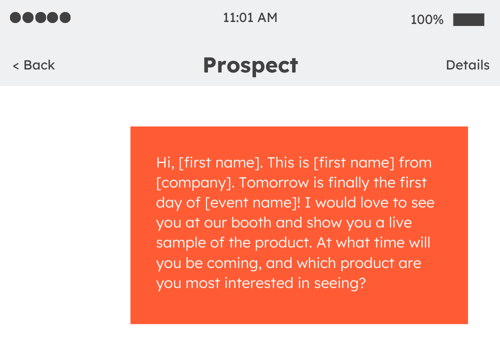
-[Your name]

Why It Works

During your discovery call, your prospect likely brought up an objection that has the potential to bring the deal to a halt. Use a text message to let them know you’ve found a solution to the issue and schedule a follow-up meeting to discuss.

2. Sales Text Message Before an Event

sales text message example: eventHi, [first name]. This is [first name] from [company]. Tomorrow is finally the first day of [event name]! I would love to see you at our booth and show you a live sample of the product. At what time will you be coming, and which product are you most interested in seeing?
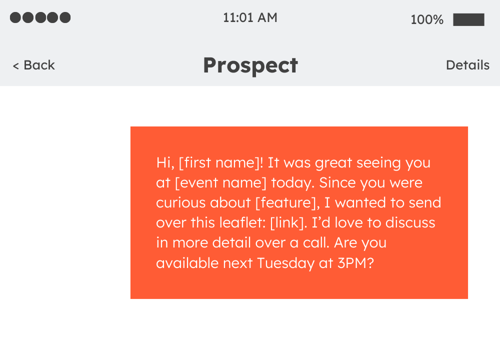
Why It Works

This sales text message works if you’ve been speaking with the prospect for a few weeks and were apprised that they’ll be at an event you’ll also be in. It gives you an opportunity to meet them in person and deliver a pitch in an environment where pitches are expected. We don’t recommend using this text if you’ve just connected with the prospect.

3. Sales Text Message After an Event

sales text message example: after eventHi, [first name]! It was great seeing you at [event name] today. Since you were curious about [feature], I wanted to send over this leaflet: [link]. I’d love to discuss in more detail over a call. Are you available next Tuesday at 3PM?
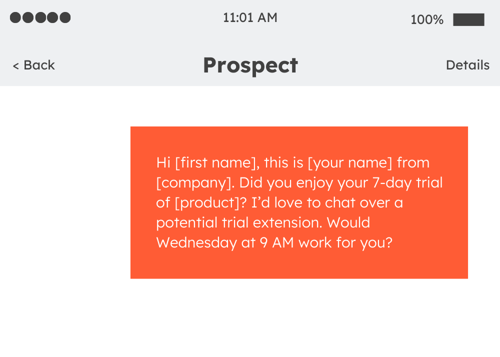
Why It Works

This text shows critical listening skills — you noticed what your prospect was most curious about and sent them more information. But as with any sales email, it also includes a call-to-action to prompt them to continue engaging with you. You can add or omit details as you’d like to make this text message work for you.

4. Sales Text Message After Trial

sales text message example: after trialHi [first name], this is [your name] from [company]. Did you enjoy your 7-day trial of [product]? I’d love to chat over a potential trial extension. Would Wednesday at 9 AM work for you?
Why It Works

When used appropriately, this text message can help you get a follow-up call booked with much more ease than a normal email. Because most B2B software users don’t expect to interact over text, be sure to know your audience, and to ask for permission first.

Text Messaging for Better Sales Conversion

With the right strategy, texting can help you close your deals much more effectively than with sales calls and email alone. Follow these guidelines to ensure your texts are professional, helpful, and relevant, and watch your conversion rates rocket.

Editor's note: This post was originally published in January 2017 and has been updated for comprehensiveness.

Improve your website with effective technical SEO. Start by conducting this  audit.  

20 Jan 20:52

How to Increase B2B Sales in 2017

by Logan Chierotti

Traditional B2B sales techniques are working less and less in today’s growing digital space. According to a recent study, sales reps now have to make more contact with each buyer and that contact has to be more personalized and relevant. The study found that it now takes 18 dials to connect with a buyer and only 1% of those calls are resulting in a callback.

Looking for innovative ways to set yourself apart and increase your B2B sales? This year, personalization is the watchword. While B2B sales are an entirely different beast, they share some traits with their B2C counterparts – namely, the need for greater efforts in the areas of personalization and tailoring. B2B companies cannot underestimate the importance of the customer experience throughout every phase of the sales funnel. Here’s how personalization will benefit your B2B business with increased sales.

Illustrating the Importance of Personalization in B2B Sales

Personalize Sales Funnel

Personalization is important to any type of sale. Part of guiding customers through the funnel is connecting with potential prospects and making them feel their money will be well-spent. Your product or service provides the foundation for that feeling, but it’s the personalized touches that bring it together.

Consider this: by 2020, there will be an estimated 33 billion devices connected to the internet. That’s far more devices than there are people. People use their devices to research your company long before they even enter your store. In a modern world ruled by digital marketing, tailored content is what makes a sale. Personalization in today’s market may be more challenging, but it’s essential to stand out from the crowd.

Is Personalization Worth It?

Many companies understandably wonder whether the time is worth the effort. The short answer is yes. According to research from the Aberdeen Group, businesses that leverage personalization tactics report a stronger lead acceptance rate of over 20 percent. Their conversion rates are also higher, at an average of nearly 40 percent.

This idea is hardly unprecedented. As early as 2012, over three quarters (78%) of salespeople who engaged over social media outperformed their colleagues. And another survey by CMO found that companies who use personalization lead to increased conversions for 43% of marketers. This data provides a compelling context for the idea that personalized sales techniques are not only effective but also necessary.

Applying Personalization to Your B2B Business

B2B personalization differs from traditional B2C, but it’s well worth the effort. There are several sales techniques that brands can use to improve their sales, nurturing at every stage in the funnel:

  • Computer telephone integration. A recent examination by the Harvard Business Review found that an overwhelming margin – approximately 90 percent – of business decision makers don’t respond to cold calls. This alone is unsurprising, but what you may find surprising is that personalized phone calls make a difference. For this reason, computer and telephone integration (CTI) systems are a valuable investment. These systems, which can integrate directly with your CRM, allow you to log information about calls, create a local presence, and respond to incoming calls quickly and effectively.
  • Customer relationship management (CRM) Software. Every B2B company should invest in a quality CRM, as it provides numerous opportunities for personalization with the added benefit of automation. For example, you may choose to ping a company with a special offer on its anniversary. You may also set up automated communications in order to touch base with prospects and leads at regular intervals.
  • Create personalized rewards. We’re all more willing to do something when there is direct benefit involved. Loyalty programs aren’t just for B2C companies – consider offering discounts and coupons to your “frequent flyers” and do anything you can to encourage a return visit. It’s easy to overlook these people because they feel nestled safely in your sales net, but remember that businesses lose customers all the time. Don’t neglect this group.

Personalize From the First Interaction

Personalization is becoming so important to sales that it’s vital to create opportunities from the first interaction. A 2015 survey of 1,200 consumers found that personalized offers led to a 400% increase in the likelihood of a response. Other findings from the survey illustrated that personalization led to higher engagement rates, more brand loyalty, a broader reach, and better-perceived relevance.

B2B buyers educate themselves much like consumers do, so creating relevant content and personalized experiences from the onset are essential. It’s easier than ever for companies to leverage big data, integrating with CRM to ensure the right message is getting to the right person, at the right time.

Make room in your budget for personalization this year – you’ll find it well worth the effort.

20 Jan 20:52

Why to Expect More from Influencer Marketing Now

by Greetje den Holder

Google Trends shows a shift in interest from ‘content marketing’ to ‘influencer marketing’ over the last two years. Adweek claims that Google’s keyword search for influencer marketing has increased over 90 times since 2013. Adblockers are gaining popularity, with 22% of people in the UK and 47% of people aged 18-24 years in the UK using them. A study by eMarketer shows that nearly 85% of marketing and communications professionals worldwide expect to launch at least one campaign involving an influencer in the next 12 months.

As you can tell, brands have been on the hunt for new ways to get in front of their customers and influencer marketing seems to be the answer. In this blog, you will see that nowadays, influencer marketing is being refined and that it is an important element in your marketing mix to focus on.

‘Why to Expect More from Influencer Marketing Now’ There is a shift in interest from content marketing to influencer marketing. In this blog, you will see that nowadays, influencer marketing is being refined and that it is an important element in your marketing mix to focus on. Read the blog here: http://bit.ly/InflMarNow

Association leads to targeted exposure

According to AJ Agrawal, influencer marketing is the grey territory between an official testimonial and a subtle product mention done almost in passing. Influencers are the ones holding everyone’s attention. People spend time actively watching them. This is opposite of what is happening with television right now; commercials have become background noise.

More and more brands are seeing value in paying these people to represent their products. Brands are not necessarily willing to pay big bucks for exposure, but for association because, as Agrawal says, in return they get targeted exposure to the right kind of consumer, one who is already interested and who is likely pay to attention.

Agrawal even claims that calling it influencer marketing is only the beginning: “What is truly happening is a broader shift, as more and more people are discovering the art of personal branding. When you have a personal brand, when you have an audience and people see you as a thought leader in your specific niche or market, you have something no one else does: you have people’s attention. And that, in itself, is highly valuable, not just to brands but to other thought leaders as well. Having a personal brand opens doors of opportunity.”

15 reasons why influencer marketing is vital to marketing strategies

If the statistics mentioned above are not enough for you, IZEA gives you 15 reasons why you should focus on influencer marketing as an element of your marketing mix.

  1. Consumers are not interested in traditional marketing tactics anymore. They would rather put their trust in spokespeople (especially YouTube stars) because they seem more credible than brand advertising.
  2. Word-of-mouth marketing boosts brand identity and recognition through stories about people, instead of just the brand.
  3. Brands can launch new products, communicate important milestones, and increase awareness.
  4. Key Performance Indicators (KPIs) such as views, reach, and engagement rates all spike because audiences feel connected to the influencer and follow loyally.
  5. Influencers have the charisma to create reactions and mobilize opinions through unscripted dialogue and impromptu promotions.
  6. B2B buyers rely heavily on peer opinions and reviews and they appreciate authentic influencer input.
  7. B2C influencers engage consumers, improve brand awareness, and boost sales.
  8. Emerging social platforms provide more opportunities for consumer engagement with influencers.
  9. Influencer marketing is considerably less costly than other promotional tactics.
  10. Influencer marketing can reach interested target audiences more effectively for active engagement.
  11. It is one of the strongest marketing tools available, delivering 11x the ROI of a banner ad.
  12. Any brand or business can easily implement influencer marketing with relatively little ramp-up production or expense.
  13. Influencers help boost your SEO because they often have their own highly rated websites that get high exposure, giving your brand that desirable halo effect.
  14. New audiences become available to companies utilizing influencer marketing due to the influencer’s reach and exposure.
  15. The likeability factor goes through the roof for brands who grab the tail of the influencer comet by featuring a popular influencer. Authenticity is critical, and consumers will be more inclined to engage with brands.

How can you be successful at influencer marketing?

Tom Ward lists 7 steps to start with influencer marketing and to be great at it.

  1. Do Your Homework

Whether you are using an agency, a multi-channel network, or doing it yourself, you need to do your homework first. Who is your target audience? What content do they respond to? What social channels do they use most frequently? Where do they live online?

  1. Research Social Media Influencers

There are a number of ways to pick an influencer. You can hire an influencer agency to do the search for you or you can use some tools out there to help you with your search. Alternatively, you can search on your own.

  1. Understand Your Influencer

Spend some time building rapport to find out who your influencer is and what motivates him or her. Money is not always the top motivator; authenticity, brand fit, and good press often matter too (or more!).

  1. Define Your Metrix

How are you going to measure whether your campaign is successful or not? What gets measured gets managed!

  1. Set Expectations

What are you hoping to accomplish with your campaign? Do you want to drive sales, increase traffic, or create brand awareness? Only have one goal. A person will only engage with a post one way. They will retweet it but not like it. They will like it but not comment.

  1. Determine Where the Content Will Come From

Will the influencer create the content, or will you? It is probably best to give the influencer an outline and let them run with it. Tell them the message you are trying to get across, along with some requirements (like including a link or a hashtag) and give them the freedom to do what they do. Remember, authenticity is important for both influencer and audience member.

  1. Do not Forget About Compliance with National and International Laws.

Rules make sure everything happens in an honest way. In the U.S., think of FTC.

A smart move away from “traditional” digital marketing

I hope you can see why influencer marketing is a smart move away from “traditional” digital marketing.

I have recently started to play around with the concept myself. I have a personal blog about lesbian parenting in The Netherlands called Meemoeder.com, and I write reviews about things like gender-neutral baby shower gifts, lesbian (family) travels, and unique baby clothing not necessarily consisting of the colors pink and blue. It is a great niche and I continue to gain readers.

As a result, I notice that brands are increasingly more interested in working with me, which works for me, as it gives me more topics to inform my readers about. I definitely see influencer marketing as a win-win situation and I hope you do too!

20 Jan 20:49

Communication: A Crucial Aspect of a Startup’s Identity and Success

by Dan Radak

Brand identity is the bedrock of any startup’s success. It is a guiding beacon for business strategies, and practices, but also for customers who weigh their options in the market. You can also think of brand as a compass, which allows organizations to navigate the tricky waters of the business world. In order to shine brighter than others, a startup must also produce a sound commutation plan, which amplifies (marketing) messages and affects how others perceive you.

1

The roadmap

Young companies tend to overlook these aspects and put a sole focus on improving the bottom line. What they lose sight of, however, is that communication strategy enhances their efforts and comes with financial spoils in the long run. Besides, a lack of coherence in this department can stir confusion or distrust, driving away potential clients, prospects, and customers.

Now, identity is not engraved on the walls of your offices or embodied in core business documents. It is a dynamic force: You have to express it, and communication is one of the major means of pulling that off. Even if you have a breakthrough product in mind, that may account for nothing if you have no way to reach people out.

And in order to cut through the overwhelming noise in the media, you have to speak with a distinctive voice. That means that startups may refrain from copying the ways established companies communicate. These are mostly advanced methods put forward by experts to capture the attention of buyers in mature markets. Startups can usually do with less formality and rigid rules.

2

New currencies

So, the first thing to do is to consider who your customers are. In the light of commutation and branding, you are mostly interested in pathways they take to content, information, and pieces of news. The style of communication must reflect these patterns. In general, it should inspire people, spark their attention, and prompt them to choose you over your competition.

Furthermore, note that your products create customer experiences and, through them, meaning. You have to understand that in this day and age, purchasing decisions are fueled by emotional connection of consumers with the product. People buy what they believe in, and once they convert into your customers, their trust becomes your ultimate currency.

Tech tools

Technology is the key instrument of communicating your messages. Modern, digital tools enable you to interact with customers around the clock and embed your messages into their day-to-day (cyber) reality. Among other things, this is a chance to establish meaningful, almost intimate relations with your audience. For numerous digital natives of today, this type of communication is the only preferred option.

This new frontier of marketing can be intimidating for newcomers. Thus, it is a good idea to familiarize yourself with the ways of carrying out good SEO, picking appropriate domain names, and tools needed for shaping a strong online persona. Moreover, you would be wise to utilize your social media profiles as communication tools and engage people in discussions.

Finally, it is highly advisable to take advantage of the content marketing and harness the power of new marketing thinking, one that looks beyond the strict logic of advertising. It aspires to add value to people’s life and does not always try to sell to them. Instead, it can educate, inform, and solve problems, something that is much more effective in terms of trust, positive image, and reputation.

03

Brand new communication

In the era of perpetual communication and digital revolution, standing idle is not an option. A solid communication system is the supporting pillar of marketing and brand building strategies. So, develop a deeper understanding of your target audience. That way, you can discover how to ignite passion, inspire loyalty, and evoke emotions. Try to think outside the traditional marketing box and stand out in the oversaturated media landscape.

20 Jan 20:24

Tried and True Referral Program Ideas to Outgrow Your Competition

by Jessica Edmondson

A wide tree illustrating referral program ideas helping to outgrow your competition

Competition is a natural obstacle for any industry, but it also can facilitate inspired innovation (like referral program ideas) and help develop your most successful initiatives. However, outgrowing your competition requires a strategy. In its simplest form, consider how trees handle their natural competition.

“Trees have different strategies to deal with competing neighbors. Some grow quickly and tall, overshadowing the others, but die young. Others grow more slowly, but outlive the fast growing ones and cast shade on them over a longer period,” says Nickaus Zimmermann from the Swiss Federal Institute of Forest, Snow and Landscape Research WSL.

Both these strategies have their cons. But by combining the right referral program ideas companies are able to harness the high velocity growth of the first strategy and combine it with the long life of the second strategy to obtain to a solid foundation for revenue generation.

To distinguish a referral strategy that will provide you with inspired and constant growth, let’s explore some tried and true referral program ideas. Jump to the section you’re interested in or read through to get the whole picture.

5 referral program ideas from companies who have succeeded

Referral program ideas #1: Have your referral program enable key departments
A main component of referral program success is making sure that sales and customer success/service is enabled and has the tools to support the referral program.

Trisha Winter, CMO of Amplifinity referral software, notes that “The companies that have tremendous success in launching a referral program are those that include the people in your organization (sales and customer service/success) that already have personal relationships with your designated advocates in the launch. If those people have the ability to directly reach out and invite perspective advocates to the referral program, then that program has a much higher rate of success.”

In RingCentral’s experience, integration with a CRM was a must for sales. The collaboration needed between sales and marketing means that the two way communication between marketing and sales software is crucial for creating a seamless referral lead flow. This allows sales to reach out to customers they already are engaged with and personally invite them to the program. In addition, verbal referrals allowed the RingCentral sales team to create a constant flow of trackable referral leads while adapting to customers’ preferred referral method.

For ADP, sales ownership of customer advocates and their referrals helped increase sales participation. By having the referral lead gets routed to the advocate’s sales rep instead of the normal lead routing rules, it benefits both the advocate and the sales rep. This is because:

  • The customer advocate want to refer their friend or peer to the sales rep they have built a relationship with so that they know their referral will be as well taken care of as they are.
  • Lead routing or lead ownership incentivizes sales to better foster relationships with customers. increase customer participation in the program and nurture referrals. This is based off the knowledge that when their advocate refers someone they stand to gain a commission from that referral.

Takeaway:

    • Look for a system that has the flexibility to enable sales to drive participation in the referral program.
    • Ensure that your referral program can adapt to your advocates preferred referral method.
    • Implement referral lead routing/ownership within your referral program to increase advocate engagement and incentivize sales to take better care of advocates and referrals.

Referral program ideas #2: Design authentic and engaging referral promotions

An important element of promotions is making sure the promotions speak to your advocate group and are a consistent representation of your current branding. DIRECTV has experienced a very high rate of referral success from their promotions. This is due to their creative referral marketing ideas executed through video and website promotions that catch customers’ attention with raunchy humor. This type of promotion aligns with DIRECTV’s overall branding.

On the other hand, TSYS uses their video to increase awareness. Through a clear and concise message they explained the benefits of their referral program and how to use it. This video avoids any humorous themes and instead quickly explains to advocates the advantages of referring. The minimal animation and quirky music keeps the promotion light and informative without going off brand.

Takeaway:

  • If humor is not part of your current brand guidelines, don’t try to include it in your referral program. Keep your promotions authentic.
  • You can always try to be lighthearted instead of comical.
  • Identify promotional channels that have worked in the past and use them to gain traction.
  • Have the promotions emphasize the benefits of referring to your advocate group.

Referral program ideas #3: Incentivize and empower sales to drive marketing promotions

The most important part of a referral program promotional strategy is keeping the program at the forefront of customer or partners’ minds. Any company that chooses to go the launch it and leave it route will not have success in generating referrals. One of the keys to keeping your referral program at the top of mind for customers and partners is getting sales to drive promotions.

For instance, Cable ONE Business has successful made their sales team a part of marketing’s referral program promotional strategy. They have done this by:

  • Creating marketing collateral in the form of hardcopy brochures for all sales reps to hand out to partners so upon talking to their partners they had something tangible to give to them.
  • Having marketing design program specific branding for the referral promotions which were put up around the office to drive sales reps’ promotional engagement.
  • Creating a rewards program that awards sales reps points for referrals which can then be used on an online store similar to amazon.
  • Rewarding successful sales referrals by giving sales associates 1x that of the referral customer’s first bill.
  • Creating a separate bathroom campaign where fliers where put up in all the stalls with what they referred to as ‘cheesy pickup lines’ that sales could use to engage customers.
  • Implementing a special offer for sales to earn up to $4,000 during a specific time period by hitting revenue goals with one requirement being they submit at least 4 referrals
  • Creating a relationship approach for sales that included conference calls and home visits to explain the program which ended up quadrupled referrals. This referral program ideas delivered what had been a month’s worth of referrals in one week.

RingCentral was another business that found success in using their sales team to promote referral marketing collateral. RingCentral’s marketing team created a special offer in the form of a raffle that advertised to their customers that for every referral submitted during a three month period a customer would have another entry put into the raffle to win one of two drones. This worked to increase advocate enrollment and referrals.

Takeaways:

  • Special offers to sales helps re-invigorate sales participation.
  • A relationship-oriented approach supported by marketing where there is a 1-1 interaction has greater success.
  • Incentivizing sales is as important as incentivizing advocates.
  • Create special offers that sales can promote to customers.

Referral program ideas #4: Research your competition

Study what competitors in their space are doing. The success of referral marketing ideas is many times not as generalized as one might think and it can be specific to an industry. Often you’re not the first to try referral marketing. A competitor’s past inspiration and execution of their referral program ideas can help guide you in your own development.

For instance, Citrix researched how their competition was incentivizing their referral program and that is how they landed on offering 20% of the annual value of the deal.

Takeaway:

  • Look into referral strategies that have and haven’t worked in your industry.
  • If you are the first one in your space initiating a referral program, evaluate your customer base and mold your referral program to fit their customer journey and expectations.

Referral program ideas #5: Create a structured referral incentive

When deciding on a reward to increase referral leads, many companies originally try to go what they consider the inexpensive route by offering swag. While this will get a bit more participation, most business professionals have branded coffee mugs falling out of the kitchen cabinets. With this strategy, you’re looking at a one-time referral at best. Meaning, a customer doesn’t want your branded blanket and backpack and coffee mug (No hard feelings).

ADP has had tremendous success from their referral incentive program. Upon analysis, ADP determined their likely average number of successful referrals per customers per year was a little over one. Based on this they implemented an escalating reward structure that offered a $100 credit for each of the first three referrals, with the fourth offering the highly prized free payroll for a year. This worked as intended, making the average successful referral per advocate rise significantly. The escalating forth referral incentive acknowledges the extra effort the advocate has to put in to get the fourth referral and provides them with a reward that would be highly valuable to their group of advocates.

Takeaway:

  • Evaluate the likely number of successful referrals/advocate and create escalating rewards to motivate advocates to take the extra effort.
  • Remember that not all rewards have to be a form of cash. Charitable donation or training credits can also be valuable to certain advocates.
  • If you have multiple types of rewards you want to try considering adding reward choice to your referral development so every potential advocate can gain value from the referral program.

To get more detailed referral marketing ideas, explore additional referral marketing resources to help spark your imagination and build your referral program.

20 Jan 20:24

How to Build a Social Media Strategy That Fuels Sales, with Paul Lewis [Podcast]

by Mario Martinez Jr.

episode_3_blog

When people talk about their social media strategy they are typically talking about how many tweets and posts they schedule each day. It seldom goes deeper than that. But if you are trying to use social to sell (and you should be) you need to do more. My guest today is Paul Lewis. Paul is a 20-year marketing veteran who began his career in Los Angeles with a worldwide advertising agency. Since then he’s at high levels in Experian, CACI, and Casewise. Now, since 2013 he has been heading up strategy, management and the global social selling program for Pitney Bowes, where he built the social selling program from the ground up. If anyone can teach you how to establish your own social selling program, it’s Paul – because he’s done it.

Paul Lewis

Paul Lewis

If you don’t adopt a social selling model you’ll be joining the dinosaurs soon.

That’s because everything is moving toward social. Sales reps seldom even get the opportunity to make a sales presentation these days because the pervasive reach of the internet has made it possible for consumers and businesses to find out all they need to know about products and services before they contact a company to do business. That means you’ve got to know how to effectively inject yourself into the conversation surrounding what you do – so that you’re not only known, but trusted. My guest, Paul Lewis tells us how to do that effectively, on this episode.

Social media strategy is about more than posting content. It’s about knowing your prospects.

Many people think that in order to use social media effectively as a business they need to get lots of great content scheduled out on their social profiles. Fine. Do that. But don’t think that’s going to cause people to come running to you. It’s only part of the equation. You also need to be using social media to identify and engage with the prospects you are targeting – and believe me, there’s a right way and wrong way to do it. On this episode of #SellingWithSocial, Paul Lewis and I talk about how you can do it the right way and see your sales pipeline filled up and sales closing as a result.

The top 3 things to implement a social selling strategy are…

Paul Lewis has built the Pitney Bowes social selling program from the ground up, without the help of an agency like mine. Given his experience, I thought this conversation was a great opportunity to pick his brain about what it takes to build a successful social sales program. On this episode, Paul shares the top 3 things you need to do in order to build a program that generates leads that convert to sales. He’s so generous with the lessons he’s learned and I want you to hear his practical steps, so be sure you take the time to listen.

How a business can drive the adoption of a new social selling strategy.

It’s great to be sold on the power and importance of social selling for your business. It’s great to put in the hustle and grind needed to build a social media strategy that will work for your company. But if nobody on the sales team adopts it you’ve wasted your time. Since Paul Lewis has been super successful at getting the sales team at Pitney Bowes on board with the social sales program he created, I decided to ask him how he did it. As expected, Paul did not disappoint. This episode is full of practical tips you won’t hear anywhere else – from a real-world practitioner of what he preaches. I hope you do yourself a favor and listen to what Paul has to share.

Outline of This Episode

  • [1:31] My introduction to my friend Paul Lewis.
  • [4:14] Why social selling and does it work?
  • [7:57] How the sales process and approach has changed in the business community.
  • [9:47] Why old-timers are going to be forced to adapt a social sales model.
  • [12:10] The top 3 things required to implement a social selling program.
  • [18:48] The social platforms Paul is training his team to utilize.
  • [23:50] The results Paul’s team has seen from implementing selling with social.
  • [27:16] The things Paul’s team did to drive adoption of social selling approaches.
  • [32:35] The best ways you can reach out to Paul Lewis.

Resources Mentioned

20 Jan 20:23

Marketing Automation – Robots Are Taking Over!!!

by Jon-Mikel Bailey

HubSpot, Pardot, Marketo, etc. are all powerful marketing tools. These are the marketing automation usual suspects. There are lots of different solutions out there to choose from.

What is marketing automation? Why is it so prevalent in marketing today? Marketing automation is as it sounds, you automated marketing practices such as…

  1. Email – automated email thank you notes or purchase confirmations or event updates
  2. eCommerce – remarketing display ads for abandoned carts or email enticing additional purchases
  3. Landing pages – driving targeted traffic to pages that convert
  4. Social media marketing – steady and useful automated campaigns that build a base of engaged fans or followers
  5. CRM integration and lead management – making sure all of this automation is tracked and managed

Marketing automation is a way to ensure that you are connecting with your audience throughout the entire marketing funnel in some meaningful way. You are there in their zero moment of truth, research (the tire kicking phase), at the point of purchase, and post purchase.

In case you’re unfamiliar with the concept of a marketing funnel, here is a simple but illustrative graphic from Aweber

Source: blog.aweber.com

This efficiency can prevent you from losing sales, leads, and contact with your target audience. Who doesn’t like efficiency? Well, with all this automation, are you missing the human element… trust?

Can you automate too much?

The Human Side of Marketing Automation

marketing-automation

Robots are taking over! We can now automate everything! The soft drinks at McDonald’s are poured by a machine now because it was so hard for people to pour the most efficient super sized coke. Kidding, sort of.

If you can automate something, should you? And if you do, are you losing your human connection?

Email marketing without a human connection is just another email waiting to be deleted. Consider your organization’s culture. What kind of relationship are you trying to build with your audience?

If you send out some boring form email after a purchase, think it has any impact? Not as much as it could or should.

A purchase, signup, or download are all great opportunities for you to create a deeper connection with your audience. This deeper connection means someone can go from casual browser to super fan and repeat customer.

Answer these questions before setting up an automated email…

  • Who are these people you’re emailing?
  • What’s important to them?
  • Why did they purchase, signup, or download?
  • What would they expect or need next from you?
  • What do you want them to do next?
  • Is this a brand building opportunity?
  • Can you use this opportunity to build a “fanbase?”

Don’t just say thanks for buying, joining, or downloading. If you’re brand is built on humor, try adding some into these emails. Or maybe you’re championing a cause. Is there more they can do to help? Tell them about it in your email response.

Check out this case study from Jason Falls on an outstanding use of email automation.

And it’s not just emails, this goes for all marketing you’re automating. Social media should be an extension of your culture, even when automated. Landing pages should convert but still need to be on brand.

And are you tracking this data so you can improve on the successes and minimize the failures?

Marketing Automation and System Integration

Marketing automation can get a bit scattered, especially for smaller businesses and organizations. You might handle automated emails through a platform like ConstantContact or MailChimp.

Maybe the post-purchase emails are done through WooCommerce, Shopify, or some other eCommerce platform. And maybe you’re using Buffer of Hootsuite for social media automation.

There is nothing wrong with any of this. Not every business is a candidate for platforms like HubSpot or Marketo. And this isn’t solely because of price.

Sometimes a fully integrated marketing automation solution is like using a hammer to kill a fly.

But whatever you’re using, you need to track your successes and failures. Take some time upfront to determine what data is important. It could be any or all of the following:

  • Conversions (sales, signups, downloads)
  • Opens, clicks, shares
  • Pageviews (traffic)
  • Rankings (SEO)
  • Ad spend vs. conversion rates

Brand awareness is important but only as it relates to measurable outcomes like increased sales or traffic. And something like increased traffic needs to be meaningful. Is this the right kind of traffic coming from the right sources? Are they visiting the pages you want them to?

CRM Integration

The easiest way to track activity along a marketing funnel is by integrating your marketing automation with your CRM, like SalesForce or Zoho.

If you have a CRM, do a little research to see if there is an API or some other integration method for integrating your eCommerce platform, social media efforts, or email marketing.

And if you’re spending more money on something like HubSpot, Pardot, or Marketo, make sure the provider works with you to set this up. You want to determine, with their help, what a reasonable outcome looks like.

If you go into marketing automation with the sole purpose of building traffic, you’re missing the point. Marketing automation is about efficiency throughout the marketing funnel. And that efficiency needs to result in predetermined outcomes like leads, sales, signups, etc.

All of those things can be assigned a value. It’s a formula. (Check out this Forbes article determining your marketing return on investment or MROI)

To know if the money you’re spending is worth it, you need to see the ROI. If you’re spending 3k per month, for example, and you have no idea if you’re getting any reasonable return, you need to correct this ASAP.

  1. Define your designed outcomes
  2. Determine how automated client interactions will lead them through the funnel
  3. Track data and analyze it against desired outcomes
  4. Make adjustments as needed when outcomes are not met

Do You Own the Content?

Here’s where I get a little preachy. You work very hard to build your online presence. Your website is your marketing homebase. Make sure you own and control this base.

Sometimes marketing automation systems will force you to work within their system. For example, you might be running ads or a content marketing campaign driving traffic to a landing page within the system.

That landing page is setup for one purpose, to convert the visitor into a client, member, whatever you’re looking for.

From that conversion, the system can track where they’ve come from and if they convert it can also move them even further along in the marketing funnel by offering more deals or conversion opportunities after their initial conversion.

These landing pages are your own little kick butt sales robots. Building your pipeline and sometimes even closing deals. This is classic marketing automation.

Content Marketing and Marketing Automation

What about your content marketing efforts? Maybe you’re doing a content series in conjunction with a promotion. Great!

But, what if these posts are forced to live within the marketing automation system? What happens if you stop using that system? All of the SEO value of those posts is lost.

You’ve placed your greatest asset – utility content – on rented land. It might drive traffic but you don’t own the space.

It isn’t part of your domain authority. All the inbound links will have to be redirected. It’s not the system’s fault. That’s how some of them work.

Here’s a good rule of thumb. If it’s evergreen content, make sure it lives without your domain and not on rented land.

So, the next time a marketing or PR firm says “you need <insert marketing automation company name here>!” Ask them “why?”

20 Jan 20:23

Putting the “Account” in Account Based Selling

by Rachel Serpa

Traditionally, outbound sales organizations spend much of their time scouring websites and databases to fill their pipelines with leads that may convert into wins over time. Unfortunately, this is just about as productive as it sounds – not very.

To help reps focus and close better deals more quickly, many companies are turning to account based selling. Account based selling (ABS) refers to assigning reps a specific list of accounts to convert using more targeted and personalized messaging and tactics. Sounds great, right?

Unfortunately, while many organizations are experiencing huge success with ABS, others are still struggling because they’re focusing too heavily on targeting and personalization and not enough on the actual accounts that they are reaching out to. This is no different than arbitrarily assigning reps lists of leads to track down and try to convert – in essence, they’re putting the cart before the horse.

The heart and soul of any good ABS strategy is a crystal clear understanding of the qualities that compose your ideal accounts. Let’s dig into how to make this happen.

Defining Your Deal Dimensions

Dimensions are all of the factors or variables that, together, make up a sale. Examples of dimensions include sales team, stage duration, company vertical, lead source, sales process and much, much more.

Altering just one of these dimensions across deals can have varying results – positive or negative. When it comes to defining the accounts in your account based strategy, you will want to focus on the dimensions that make up a lead’s profile, such as:
– Contact title
– Company size
– Company vertical
– Number of employees
– Other technologies in use

For a more comprehensive list of the types of data or dimensions companies should focus on to successfully define their account based lists, check out this blog post by ABS gurus Engagio. Whatever you decide, be sure to keep track of these data points for each of your leads and customers in your CRM. Next, we will want to pinpoint the dimensions that have the greatest impact on your sales pipeline and performance.

Leveraging Lead Yield

Lead Yield is just one example of a Yield Measure, or a set of new sales metrics that can help you understand how much value you get in return for your investments at each stage of the sales pipeline. The formula for lead yield is as follows:

Sales Revenue / # of Leads Generated

Lead yield is an important metric to consider when establishing your ABS strategy because rather than simply pointing out the types of leads that have generated the most revenue for your business, it also helps you understand them on a volume scale and across each stage of the sales pipeline.

Start by segmenting your list of current customers by the key dimensions you chose earlier. For the sake of this example, let’s keep it simple and compare deals from 2 different verticals, solar and publishing. As you can see in the chart below, the lead yield for Solar deals is $10, with 10k leads generating $100k.

screen-shot-2017-01-18-at-4-17-57-pm

In contrast, this next chart shows the lead yield for deals from the publishing space: $25. Despite the fact that there were 5k fewer leads from publishing than from solar, these leads have an average deal value that’s 5x greater than solar.

screen-shot-2017-01-18-at-4-18-11-pm

Given this information, your ABS target list should contain more companies from the publishing space rather than the solar space. You can then take this list of publishing companies and divide it by the dimension of contact title or company size to further refine your ideal account profile.

Of course, manually conducting this type of analysis at scale would be a humongous and error-prone undertaking, which is why it helps to use a scientific sales platform to do the work for you. You can learn all about that here in this free white paper.

Let Data be Your Guide

When it comes to ABS, the temptation to dive right in and start selling can be tough to overcome. Being a data-driven sales leader and taking the time to accurately and strategically define your target accounts pays off.

20 Jan 20:22

Industry Insights Report: What Behaviors Lead to Successful Sales Calls?

by Alex Hisaka
  • business-call

The data science team at Gong.io recently teamed up with Startup Sales Bootcamp’s Juliana Crispo to analyze over 70,000 B2B SaaS sales calls. “To my knowledge this is the largest sales study of its kind to date,” says Crispo.

The goal of the study was to reveal similarities among successful calls, with success defined as moving the sale one step closer to the close, be it a demo, a proposal, or an actual close.

While some of the findings fall into the “tell me something I don’t know” category, the sheer strength of the data underscores the role certain behaviors play in achieving results. Here are three behaviors sales reps and leaders should pay particularly close attention to.

Start Your Mental Timer When Pitching

Crispo calls this “the case for a 2-minute pitch cliff” because if you pitch your company for more than two minutes, the odds of a successful outcome drop significantly. 

  • business-call-1

While this advice doesn’t deviate from the “listen more than you talk” mantra we’ve been taught since day one, it does show that we need to be especially mindful when it comes to talking about ourselves.

Sometimes when a prospect asks us a question about our company or offers up a subtle compliment, we take it as permission to extend our pitch. The data says this is a mistake. Rather, we need to know our pitches inside out so that we can fit the right messages in from multiple conversation points, get out, and steer the conversation back to the prospect’s business needs.

Can’t Get a Word in Edgewise? Good

Many of you sales leaders will be tempted to project the chart below at your next sales meeting and say, “Seeee!?”

Four minutes may seem like a long streak of silence, even for super listeners. So it’s important to note that these streaks did not stop when sales reps asked brief questions like “can you tell me more?” or “can you give me an example?” or “help me understand…”

The goal is to make the prospects feel understood. Not to make them feel like we asked enough questions to balance out our talking. This data shows that when prospects get an opportunity to explain themselves without interruption, they tend to take the next step with us.

For sales leaders, the challenge is to eliminate the “limiting belief,” as Crispo calls it, that sales reps are a) being intrusive, or b) exposing their inexperience when they ask prospects to further clarify their problems.

Embrace Competition Early

It’s not uncommon for sales reps to tense up when a prospect brings up competitors. In reality, though, the data says you should be concerned if the prospect doesn’t bring up competitors early in the process.

  • business-call-3

Your prospect can find five competitors with few keystrokes, and it’s likely they already have. It’s unreasonable (and dangerous) to think that you can skate through the sales process without dealing with competition.

After all, if you’re not shaping the decision-making criteria, your competition probably is. Which helps to explain why saving conversations about competition until later in the sales process leads to a lower probability of success. Sales leaders need to help their teams proactively broach the topic of competition early in the sales cycle, while also preparing their teams to tactfully discuss individual competitors. In other words, there’s no reason not to be prepared for these conversations.

No matter how strongly our intuition tells us there are right and wrong behaviors, it’s nice to have validation via cold, hard data. Use the results of this study to reinforce positive behaviors among your team.

Is your intuition telling you that it would be nice to have posts like this show up in your inbox? Listen to it: Subscribe to the LinkedIn Sales Solutions blog.

      
20 Jan 18:48

5 Steps to Kickstart Your Account-Based Marketing Program

by Hila Nir
starting ABM

Author: Hila Nir

The value of account-based marketing (ABM) is undeniable.

If you’re not familiar with the jarring statistics, here’s a recap: SiriusDecisions research shows that more than 90% of B2B marketers consider ABM “important” or “very important,” and 73% of B2B companies plan to increase their budgets for ABM initiatives in the next 12 months.

While ABM may not be new, the path to its implementation and execution certainly is. The scope of technologies that support ABM is growing, enabling organizations to scale their ABM strategy like never before. But how do you get your foot in the door? The truth is, many B2B companies have a wide gap between their ABM strategy and successful implementation. Organizational and operational issues, as well as poor data, pose unique challenges.

Here are five ways to overcome ABM challenges and kickstart your program:

1. Gain Full Company Support 

Let’s start with the obvious: As with any successful B2B marketing strategy, close sales and marketing coordination is essential. According to MarketingProfs, companies that have aligned sales and marketing teams generate 208% more revenue.

The beauty of ABM is that it inherently eliminates what sales may deem as “noise” from marketing’s broad-reaching lead generation initiatives. Conversely, marketing is more involved in developing account lists and supporting the sales team throughout the entire customer lifecycle, as opposed to its traditional top-of-the-funnel focus.

But gaining support extends beyond the revenue team. You need concerted, long-term buy-in from the C-suite for an account-based model, supported by functional groups. Your leadership team needs to communicate department-specific expectations and benefits. For example, ABM could make your client services team’s job easier because it puts them on track to pursue accounts that mimic your best-existing customers. ABM also gives data analytics and product team members more consistent feedback.

2. Obtain and Use High-Quality Data

Good, clean data empowers people to be more productive. Almost all of the tools you’ll use for account-based marketing will rely on correct, consistent, and complete information about your target accounts. Unfortunately, industry statistics highlight a gap between the actual state of data quality and where marketers need to be to achieve ABM success and meet their goals.

In a recent ZoomInfo and Ascend2 study, only 33% of marketers rated their data-driven marketing strategies “very successful,” and 64% of these “very successful” marketers listed “improving data quality” as their top obstacle in personalizing the customer experience. What’s the specific problem? Nearly two-thirds of B2B organizations said improving data quality is their most challenging obstacle. It’s no wonder; B2B contact data decays at a rate of 22.5% per year, according to MarketingSherpa.

But where there’s a will, there’s a way, as vendors are becoming more responsive to market needs. To ensure the accuracy and currency of your information–and enable features within your marketing technologies–select a top-tier B2B contact database provider with real-time, comprehensive information, including direct phone numbers and email addresses. Sophisticated vendors also have predictive analytics capabilities to automatically identify new accounts and the contacts within them by matching characteristics of existing ideal customers.

3. Precisely Target Accounts

With account-based marketing, you’ll be focusing on fewer accounts (although they will be more strategic), so it’s critical that you focus on the right ones. Customize your ABM program by selecting company attributes tailored to your company’s value proposition and product and service offerings. While broad criteria such as revenue, industry, and headcount are commonly used, they may not lead to the best possible prospects.

In ABM, organizations often develop technology profiles to pinpoint key triggers that indicate if a company is a good account to target. For example, let’s pretend you launched a new solution that integrates with a certain marketing automation provider. To kick off an ABM strategy to support new customer acquisition, you should identify companies that use the specific marketing automation software and also meet other benchmarks that define your ideal customer profile (revenue, number of employees in a particular department, etc.).

Most market intelligence solutions, including a complete marketing automation platform with native ABM capabilities, can help your team quickly identify target accounts based on multiple layers of specific criteria, including the characteristics mentioned above. And if you need help determining what those triggers are, some solutions can analyze your existing customer data to highlight trends within your database and provide “look-alike” accounts to target.

4. Engage All Key Decision-Makers in an Account

ABM is a contact-level sport. Thus, it’s imperative for your team to identify multiple contacts in an account, as participation in the purchasing process is increasing. Buying committees are no longer the exception; Gartner research shows that in a typical firm with 100 to 150 employees, an average of seven people are involved in buying decisions. Stakeholders, gatekeepers, and influencers all play key roles.

To reach them, consider supplementing your in-house database with data appending and enrichment services to gather intelligence on prospects within your target accounts (e.g. occupation and academic background, professional certifications, accolades, mentions across the news, and more). Once you have this rich contact information, use a multi-touch cadence across multiple channels to personalize your communications. Research and advisory firm TOPO recommends eight to 10 touches per prospect in a short timeframe, such as two to four weeks. Replacing email blasts with individualized dialogue can also make a striking difference.

5. Measure, Learn, and Improve

Because you’re targeting specific accounts in ABM, your metrics should measure your penetration into each account, as well as the content and tactics that are most effective for engagement.

So, where do you start? Along with rudimentary ROI metrics, such as qualified opportunity pipeline created and closed/won-lost ratio, examples of ABM-centric metrics may include:

  • Conversion rates based on channel to weigh effectiveness
  • Opportunities created from each channel to inform future investments
  • Number of contacts within each account who have engaged with your campaign to determine level of penetration

ABM is all about influence. Think quality over quantity, and account health over leads. For influence, gauge how ABM efforts are improving sales outcomes such as deal velocity, win rates, average contract values, retention, and net promoter scores.

Finally, use your learnings to refine future campaigns. With the right ABM solution that ties in your efforts across channels and campaigns, you can use these insights wisely to continually optimize.

The steps I’ve outlined will set you on the path toward ABM success. Enacting an ABM strategy takes time and thought, but revenue and efficiency improvements will make your efforts worthwhile.

What other recommendations do you have for ABM? I’d love to hear your thoughts.

marketo-summit-december-promotion


5 Steps to Kickstart Your Account-Based Marketing Program was posted at Marketo Marketing Blog - Best Practices and Thought Leadership. | http://blog.marketo.com

The post 5 Steps to Kickstart Your Account-Based Marketing Program appeared first on Marketo Marketing Blog - Best Practices and Thought Leadership.