Shared posts

24 Jan 16:42

Space putty is the best way to spend $10

by Boing Boing's Store

Whether I'm trying to relieve some stress at work or entertain myself on the metro, Space Putty is there. You can bring this magical goo home and try it for yourself for just $9.99

Like Silly Putty of yesteryear, this viscoelastic substance can be molded into different shapes and stretched around in your hands. Use it as a malleable stress reliever, or bounce it off the walls for some impromptu office sports. Infused with iron particles, this putty can be manipulated and moved around with magnets or employed as a squishy refrigerator magnet when not in use.

This experimental substance provides endless tactile fun with a magnetic twist. For a limited time, get this Scientific Magnetic Space Putty for just $9.99, 60% off the usual price. It may just be the best $10 you've spent in a long time.

Explore other Best-Sellers on our network:
24 Jan 16:33

Canadian universities see rise in U.S. applicants

by SIMONA CHIOSE
While Trump’s election may have stoked this year’s numbers, recruitment campaigns, low loonie likely have larger role, experts say
24 Jan 16:28

A look at the scope of the intelligence community's probes into Trump's ties to Russia

by Natasha Bertrand

Donald Trump

The US intelligence community has opened investigations into several members of President Donald Trump's inner circle over the past year, focusing on the advisers' potential ties to Russian government officials throughout Trump's presidential campaign and beyond.

The probes appear to have begun as early as last spring, when the CIA established US counterintelligence task force to investigate possible Russian funds flowing into Trump campaign coffers. The task force consisted of the FBI, the Treasury and Justice Departments, the Office of the Director of National Intelligence, and the National Security Agency.

The BBC first reported on the existence of the investigation earlier this month, which McClatchy also reported was still ongoing. The probe sought, among other things, to determine who financed the hacks on the Democratic National Committee and Hillary Clinton's campaign chairman, John Podesta, and whether any of Trump's associates served as middlemen between his campaign and the Kremlin.

The former director of the CIA, John Brennan, also received a recording of a conversation last year from one of the Baltic states' intelligence agencies about money from the Kremlin going into the Trump campaign, the BBC reported.

One night before Trump's inauguration, The New York Times reported that intercepted communications were part of the investigation into ties between Russia and people close to Trump, but that it was "not clear whether the intercepted communications had anything to do with Mr. Trump’s campaign, or Mr. Trump himself."

The BBC report indicated that the task force was granted a warrant by a judge in the FISA court — named after the Foreign Intelligence Surveillance Act — on October 15 to intercept the electronic records from two Russian banks that may have been implicated in the money transfer. Trump was not named in the warrant, but three of his associates were the subject of the inquiry.

All three associates contacted, but not named, by the BBC, denied the allegations contained in the report.

The four big names

Trump's potential ties to Russia have come under increased scrutiny amid allegations contained in an unverified, 35-page dossier from a former British intelligence officer. The claims contained in the dossier include that his campaign colluded with the Kremlin during the election to undermine Hillary Clinton. 

Paul Manafort, Trump's one-time campaign manager who served as a top adviser to a pro-Russian political party in Ukraine from 2004 to 2012, emerged as a central figure in both the dossier and in the intelligence community's early inquiries into Trump's ties to Russia. 

Secret ledgers uncovered by an anticorruption center in Kiev and obtained by The New York Times revealed that Yanukovych's political party, the pro-Russia Party of Regions, earmarked $12.7 million in undisclosed cash payments to Manafort for his work from 2007 to 2012.

Manafort has denied ever having collected the earmarked payments. But the unverified dossier on which top US leaders have been briefed alleges that Yanukovych "confided directly to Putin that he authorized kickback payments to Manafort," who "had been commercially active in Ukraine right up to the time (in March 2016) when he joined campaign team."

Paul Manafort

The dossier also alleged that Manafort, who resigned as Trump's campaign manager on August 19, served as a liaison between Trump's campaign team and Russian government officials. The FBI looked into Manafort last year for his ties to Russian officials and business interests, which Manafort has said do not exist.

"I have never had any relationship with the Russian [government] or any Russian officials," Manafort told The Wall Street Journal. "I was never in contact with anyone, or directed anyone to be in contact with anyone."

Two other Trump allies, Carter Page and Roger Stone, have also been scrutinized by the intelligence community for their respective relationships with Moscow. Page served as an early foreign policy adviser to Trump, and Stone advised Trump's campaign until August 2015. 

Page's extensive business ties to state-owned Russian companies, stemming from his time as an investment banker in Moscow in the early 2000s, were investigated by the FBI last summer. The bureau also looked into Stone's ties to WikiLeaks, which published the hacked Podesta emails last year.

Roger Stone

On Sunday, The Wall Street Journal reported that Trump's National Security Adviser, Michael Flynn, was being investigated by counterintelligence agents over his phone calls to Russia's ambassador to the US, Sergey Kislyak, on December 29. That was the day that President Barack Obama sanctioned Russia over its election-related hacking and expelled 35 Russian diplomats from the US. 

Sean Spicer, the new White House press secretary, said at the time that Flynn's calls to Kislyak "centered around the logistics of setting up a call with the president of Russia and the president-elect after he was sworn in."

But CNN reported on Monday that the calls, "captured by routine US eavesdropping targeting the Russian diplomats," raised "enough potential concerns that investigators are still looking into the discussions amid a broader concern about Russian intelligence-gathering activities in the United States."

Flynn's ties to Russia were scrutinized after he attended a gala in Moscow in 2015 celebrating the 10th anniversary of state-sponsored news agency Russia Today. Flynn was photographed sitting next to Russian President Vladimir Putin at the gala's dinner.

SEE ALSO: A bill has already been introduced in Congress to remove the US from the United Nations

Join the conversation about this story »

NOW WATCH: How a struggling Soviet spy became the most powerful man in Russia

24 Jan 16:24

A Criminal Investigation

by Dave Pollard

sherlock-holmes-147255_1280Recently I’ve been going back and reviewing a lot of the ‘less-than-radical’ non-duality material I’ve saved over the past two years, to see how relevant it still is to me.

I came to the conclusion that Tony Parsons, Jim Newman, Richard Sylvester (and other radical non-dualists), and Eckhart Tolle, Adyashanti, Rupert Spira, Jon Bernie, Mooji, and Ilona Ciunaite (and other less-radical non-dualists) are essentially communicating the identical message about the non-existence of the separate self and free will, about time as a mental construct, about what is real, what awakening is etc. The only real difference is the way this message is articulated, and (critically) whether there is a ‘path’ to awakening (and if so what that path is).

They all tend to agree, too, that it’s in the nature of the self, the mind, the ‘me’, to be unhappy about this sense of separation and (for some) to seek a path to ‘awakening’ from this sense.

I was particularly taken by a comment by (the non-radical) Adyashanti that turns the way we usually think about this seeking on its head. Instead of trying to find a path to realize what is real beyond the self, what if we instead asked How is it that the self/mind is able to sustain its/our belief in what is unreal so effectively? He frames the contemplation of this question as an investigation (perhaps the ‘crime’ being investigated is the terrible suffering and destruction wrought by all our ‘selves’). If everything is oneness — everything is just what is, timelessly, beyond our control — how is it we are all so effectively, continuously, fooled by our self/mind into believing otherwise?

There are some clues to this question that I have written about of late. One is the startling recent discovery of science (1) that there is no physically identifiable separate self, (2) that time is in fact just a mental construct that has no basis in reality, (3) that we do not consciously ‘make’ decisions (our minds rationalize what we’re already doing as being ‘their’ decision directly after the fact), and (4) that an illusory view of reality is often evolutionarily successful, ie that those creatures with a simplified, utterly incomplete perception of reality can and do out-survive creatures who see the world as it really is. David Eagleman and Donald Hoffman have recently made this latter point compellingly.

A second clue is the high degree to which our thinking (and the neural formations in the brain that co-evolve with it, and with our learning, notably during our formative years) is conditioned by those around us. If everyone around us believes that climate change is a hoax, or that the earth is flat, or that keeping other human beings as slaves is normal, or that criminals are responsible for their actions and should be punished, or that confining and then butchering wild animals causes them no suffering, or that industrial civilization is healthy and natural, it is really hard for an individual to sustain a conviction otherwise. We are social creatures and much of how we make meaning is derived through social exchange. And as George Lakoff and others have shown, we tend to hear what resonates with what we already believe and not hear what does not.

We humans now live in a prosthetic human-made world, and are utterly dependent on it. The tropical places and ecosystems where we thrived for a million years before our selves took us to inhospitable climates have long been destroyed by civilization culture, and couldn’t support anywhere near today’s human numbers anyway. So escaping the indoctrination of other selves is impossible, even if we were inclined to seek it.

What Adyashanti is urging is the recognition that the ‘I’ can’t know that it is itself unreal, so any such realization of the truth has to come from something beyond the I. Seeing this truth, he says, can create the “gap” that allows the suspension of our belief in this great illusion and enables the sudden realization of what is real and what is illusory, or what radical non-dualists (who deny however that the gap can be created intentionally) call the temporary “falling away” of the self. I’m not sure that this conjuring trick can really work, but in the spirit of investigation let’s explore it.

Here’s the question again:

How is it that the self/mind is able to sustain its/our belief in what is unreal so effectively? If everything is oneness — everything is just what is, timelessly, beyond our control — how is it we are all so effectively, continuously, fooled by our self/mind into believing otherwise?

The illusion of the separate self is evolutionarily advantageous, persuasive and socially reinforced (if it weren’t, there probably wouldn’t be ‘selves’). But still, why are we unable to see through this illusion, even when intellectually and intuitively we know (a) it’s not real and (b) that seeing through it may be the key to ending much of life’s unhappiness and suffering? What do we value more than the truth?

Perhaps it’s more important to be happy than to know the real truth. So unless and until we can no longer be happy without knowing the truth (and that may be true for those, like me, who have had ‘glimpses’ of ‘awakening’), we will cling to and remain addicted to the illusion — we don’t want to know it’s not real. There is something in the nature of people with selves that clings to hope and believes things will get better, so it takes a lot to let go.

Quite a few people report that their moment of ‘awakening’, of seeing through, came at terribly low, desperate times in their lives (though for others these moments arose during walks in the park, or shopping trips). Is the illusion of self-control just too comfortable, better the “devil we know” than the uncertainty of what is really true, unless and until we can no longer “stand our selves”? Or does ‘awakening’ come in moments when the self simply lets its guard down? And if so, are there things that ‘we’ can do to get it to let its guard down (meditation, drugs, exercises etc)?

The problem with this line of thinking is that it presumes some thing exists for whom happiness is more important than truth, some thing that clings to the illusion of the self, something that can no longer stand its self, other than the self itself. That there is a ‘we’ apart from our selves. We’re back in duality. We’ve just made a distinction between ‘we’ (actually just a higher ‘self’ which we don’t want to call a self) and a lower ‘self’ (the one we want to get rid of). This line of thinking is recursive and won’t get us anywhere.

Let’s look instead at the metaphor of dreaming. If we’re caught in a bad dream then (‘lucid’ dreaming aside) we have no agency to awaken from it. How does the mind make this dream seem so real and believable? In its ceaseless pattern-making, is it compelled to invent stories, and is it free during dream-sleep to make those stories credible and consistent and yet untethered from the factual anchors of our waking-life stories? Perhaps it makes the illusion of our separate lives seem real, when we’re not asleep, the same way.

But again, who or what is having these dreams, these self-made stories, if it isn’t the self itself?

The only apparent answer to this question is: no one. Without the self there is no ‘we’. The self/mind, conjured out of nothing by the chemistry of the large, complex brain, is just amusing itself, and making itself suffer, with the patterns and the stories that comprise the ‘story of me’.

In this light, the key question of our investigation becomes suspect, because if there is no ‘we’ without the self, there is no one for the self to fool, no one and no thing to believe in the illusion of the self. Except itself. Is your head hurting yet?

Perhaps this is where Adya is pointing us. The answer to his question, once we realize that there is no ‘me’, is that there is no ‘self’ either, that what seems to be a self is just pattern-making in the brain that is caught in an infinite loop of self-justification and self-rationalization, like a kitten chasing its own tail. And that loop is reinforced by similar loops in the brains of others, until we have whole cultures of apparent selves foolishly behaving as if they are responsible for, and influencing, the creatures they purport to reside within, and causing those creatures (and the natural, ‘real’ world) much stress-related illness in the process. It is as if these ‘self-conscious’ creatures are afflicted with an infectious disease that causes endless hallucinations and hysterical behaviour.

There are of course no separate creatures, no behaviours, and no cultures. There is only all-there-is, perfect, timeless, wondrous, beyond control of anything. But ‘we’, we who are not afflicted with selves but are just afflicted selves, cannot know that. ‘We’ can only hope for the end of our selves, for our end, so that all-there-is is seen, though not by ‘us’. It is the mystery that ‘we’ can never unravel, but we sense it, we somehow know it.

End of investigation. At least for now. The selves of the world are collectively accused of causing the afflicted creatures of the world a form of madness, in which they suffer and cause havoc in the illusory belief that they are in control, responsible and separate from everything else. The jury has looked at the investigator’s report and concluded that the selves cannot be guilty of the charges, or of anything, because they don’t exist.

Case dismissed, pending appeal.

graphic courtesy of pixabay, CC0

24 Jan 16:24

Why a 300-person San Francisco startup doesn't offer anyone a job until they've undergone a 'trial week'

by Áine Cain

Weebly CEO and co-founder David Rusenko

Some people are just naturally good at selling themselves.

But, as any disappointed hiring manager can tell you, candidates who rock job interviews don't necessarily always go on to become stellar employees.

That's a problem the folks at the web-hosting service Weebly had in mind when they began hiring employees eight years ago.

"When we started the company, we felt like hiring was broken," CEO and cofounder David Rusenko told Business Insider. "We looked at a bunch of résumés and we said, 'We can't learn anything about these people from their résumés.' It's like, what can you really learn about a person from a one-sheet résumé?"

So Weebly decided to shake up the process. After the usual rounds of interviews, the company asked its first employee, current product design lead Justin Uyemura, to stop by for a trial week. He was paid his market value for the work and was evaluated after the trial.

"After working with him for a week, we said, 'This guy's amazing,'" Rusenko says. "It was just so clear that this was the right person."

The trial week became the company's official mode of vetting candidates after that. First, applicants begin a typical hiring process. Then, at the point where most other companies would make a job offer, Weebly asks applicants to work for a paid trial week. If candidates are holding down another job and can't come in for a whole week, an alternative schedule is drawn up.

founders of Weebly Dave Rusenko Dan Veltri and Chris Fanini

"This is not a socialization exercise," Rusenko says. "This is not a chance to come in and see if you're a cultural fit. It's really about hitting the ground running."

He describes the week as "intense." Applicants are given a standard project to work on, based on their area of expertise.

"It's really a great opportunity to show your work, instead of having to just sell yourself in an interview, which a lot of people find very difficult," he told Business Insider. "Some people are really good interviewers and they're not good at their job. Some people are good at interviewing and good at their job. Some people are good at their job but they're not good at interviewing. It's a real competitive advantage for us because it allows us to get a lot more data on people and find people who are not good at interviewing but do fantastic work."

About 75% of prospective employees get an offer to join the 300-person team at the end of the week, the company says, with the rest dismissed.

On the Friday afternoon of the trial week, candidates give their project presentation to a small group. Candidates who seem like a good fit tend to get an offer about an hour or so later.

So, what goes wrong with the remaining 25% of candidates? Rusenko says they tend to fall into two categories. The first group consists of skilled interviewers who simply aren't effective workers. The second batch features people who violate Weebly's "no a--holes rule."

"A--holes can hide it in interviews, but for whatever reason, they cannot hide it for a whole week," he says. "I don't know why, but it all comes out within a week."

Rusenko credits the trial week with saving the company from having to fire people down the line and getting saddled with employees who don't fit. He says it also boosts the company's culture of respect and helps new people integrate into teams.

"I do think the trial week has helped build this incredible culture where people are incredibly respectful and honest and ultimately trust each other," he says. "You really get to chat and get to know candidates as people. When they show up on their first day, it's like you already know them. "

SEE ALSO: 7 tips to land a job straight out of school

Join the conversation about this story »

NOW WATCH: Elon Musk rarely hires non-US citizens to work at SpaceX — here’s why

24 Jan 16:24

8 Steps to Finding a Voice That Resonates With Your Content’s Readers

by Terra Dawn

This is a guest post from Terra Dawn, my amazing and dorktastic mastermind partner! Check the bottom of the post for her bio!

First off, I am SOOOO excited to be chilling on Brittany’s blog with you crazies today!! I’ve been a fan and friend of hers for a few months now, so this REALLY does make me ridiculously giddy.

We were chatting it up recently and Brittany mentioned her new focus on “unicorn content.” When I mentioned that I was really focusing the next few weeks of my own business on helping bloggers find their own voice and unique style…this blog post seemed like a match made in digital heaven!

So, I think we’ll just jump right in!!

8 Steps to Finding a Voice That Resonates With Your Contents Readers

Why is a unique voice important for creating content?

I know…dumb question. I’m going to answer it anyways since the answer MIGHT surprise you!

Being different means breaking the mold.

I’ve NEVER thought of the phrase “She definitely broke the mold,” as being an insult. When someone says “You’re weird,” it just makes my grin wider…and as a fellow blogger, I’m betting your grin gets JUST as wide.

Being different means you’re making SOME sort of an imprint.

Whether it’s on your reader, on a friend or even on a random passerby…you or your actions are something they will remember.

And remember, human beings are Judgy McJudgersons.

When someone lands on your website, it takes them milliseconds to know know whether they want to stick around and even read your first sentence. You HAVE to make it spicy, people!! You have to make them want more, both in what you say and how you say it!

I’m willing to bet a buck that a lot of you have competition.

Some of you may have 10,000 competitors (*cough* wedding photographers *cough*) and some of you may have only 10…but no matter how saturated your niche, you’ll want to make a lasting impression on the readers that make their way to your posts and products.

Below, I’m going to go through the top seven steps you need to take in order to start your journey towards “weird”. Take your time and REALLY think about the answers to these!

Step 1: Figure out what you value

I know…I know. This one sounds all woo-woo. But it’s a SUPER important step!!

What you value on the daily is GOING to come out in your writing style and eventually in your customer base. If you’re of the religious type, your values might be providing a spiritual direction to your customers, a daily form of thankfulness, and a giving writing style.

If your values are more in line with being loud, proud, and outspoken, your writing style might be less reserved, more candid and perhaps just…well…uncorked. 😉

Your writing style is going to represent your OWN personality and how you interact with people in your life on a daily basis. Your goal is not to find a voice that works for you…but learn to write in YOUR voice.

It’s harder than it sounds, but if you can help your readers to believe that they’re conversing with you directly as they’re reading your content…you are golden!

Step 2: Get your creep on (people watch!)

This one sounds a little creeptastic…but it’s TOTALLY legal, I promise!

Let’s leave Peeping Tom in the closet, thank you very much. You can actually do this in public AND on your couch. I recommend carrying around a cheap little notebook (or the always ready, “notes” app in your cell) to jot down notes!

The key to this one is to pay attention to REAL people. This means, you can watch the news, watch folks outside your window, or watch people as they walk by in the mall or in the park. This exercise is simply to get you in the habit of watching and taking note of what you observe.

Describe the person you see in 2-3 sentences. Write down what they’re struggling with…and what solution you think they might be looking for. What’s their most consistent emotion on a daily basis? And finally, what drew you to pay attention to this person in the first place? This could be a physical trait, an action they were in the middle of taking, something they said…whatever!

Paying attention to your surroundings and the people IN those surroundings will help you write your stories. Where, at one time “a red headed girl sipped some coffee,” now “an auburn haired reed of a woman, beadily eyeing the crowd as they hurry past in a Christmas frenzy.” (CHEESE FACTOR: 10!!!!!!!!)

Step 3: Practice and set your deadlines

Guess what? YOU, my friend, are the new “starving artist”. Yep! Although you use new fangled tech, like computers and websites, at the heart of it, YOU are a writer. You create content from the heart. You spread your message like peanut butter on the world of readers.

You…are the new Shakespeare. (Ok…maybe not Shakespeare. Maybe Nora Roberts…but she makes BANK!!)

My point is, when you’re creating any content, stop thinking of yourself as a business person for one sec. What you’re doing, in that moment, is one of the oldest arts of humanity.

You’ll be writing posts, pages, sales pages, emails, sales letters, and tweets. It goes without saying that learning to write with style is NOT optional.

Writing is as simple as practicing. Even if writing’s not your thing (I totally get that…for me, math can suck it), it’s something you’ll have to schedule into your daily routine.

Set aside just 30 minutes every day to write anything. Write observations from your people watching. Write a description of a product or new post that you can re-use on sales pages. Write a bio for your about page. Or write something that has nothing to do with business at all!!

A ton of successful business people keep a private blog pinned to the top of their Chrome browser, a notepad in their laptop cases, or a file in the cloud to simply jot down how their day went before hitting the hay at night. You NEED to get in the routine of getting your thoughts on digital paper.

Step 4: Find and tell your stories

This one is HUUUUUUUUUUGE. (That’s what she said.)

I would gather that 95% of businesses out there are failing in this category…and so, failing in business. No matter how often you hear, “you can choose your own customers,” the bottom line is…in the end, they will still choose you.

What do I mean by that? You are NOT the only one doing what you do, so what it boils down to is the quality and discernibility of your message.

Can your reader connect with YOU?

Sure, I’m talking about your personal story here…but I’m REALLY talking about the story of everything! What is the story of your business? What is the story behind a particular product? What is the story behind what the hell you did today?

A GREAT way to get your practice in for this, is create an Instagram account! (Didn’t see me going THERE, did you?)

Everytime you post an image…tell a story.

Don’t just post an image with 50 hashtags…pull your viewer in with emotions, lessons, and stories! What’s great about this method of story collecting, is that you can use these stories in other areas of your business as well!

Post a picture of your new product…and use the story on your sales page! Post a picture of a closed laptop with a football game on in the background, and tell the story of WHY you thought it was important to take a day off.

Every moment of your day and every business decision you make has a story behind it. Start becoming cognizant of those stories and be willing to share them with your followers!

Step 5: For God’s sake, read!

Good writers read.

Why is this a truth? Because whether it’s fiction, biography, self-help, or even blog posts, reading helps the reader to tap into their empathy and knowledge of a world they DON’T know.

We can connect with characters and actually feel the turmoil and elation they feel…which in turn helps us feel the turmoil and elation our OWN readers feel…which in turn helps us to tap into those emotions when writing and creating for them.

Reading helps us develop an internal library of solutions for various problems…whether we’ve used those solutions ourselves or not.

Reading helps us understand how the written word can be translated into the internalized word.

And…as any grammar nerd will tell you…reading helps writers to understand grammar, punctuation, basic and complex sentence structure, and writing with pizazz.

So? For God’s sake, READ!!!! I don’t care WHAT it is! Just read something every day!

Step 6: Tap into your inner feels

I first heard this word from Audrey Hepburn in “Funny Face.” She was pulling books from the tops of bookshelves…stoutly ignoring the snide comments of Fred Astaire, and lecturing him on the importance of “empathy.” It took me a hot second to figure out the difference between sympathy and empathy, but as I grew up…the difference became apparent.

Sympathy is feeling sorry or feeling giving to another living thing. (Or sometimes not living…but that’s weird.)

Empathy, on the other hand, is TRULY feeling what another person feels.

Ever bawl your bum off when Old Yeller kicks the bucket? Yep…that’s you FEELING what Travis is feeling. In that moment, you understand the immense loss that little boy is going through…and you’ve never even had to go through it yourself! (Dear God, I pray you haven’t! 0_0 )

So where does empathy come into play for your business? It’s not enough to SYMPATHIZE with your customer…you need to REALLY feel their frustrations and excitements and use those in your writing! Before you write a blog post, sales page or email…jot down what problems you plan on solving for you reader and what they’ve been FEELING as they’ve tried to work through those problems on their own.

Step 7: Figure out who or what inspires you

Finally, pay attention to inspiration. We’ve talked a lot in this article about how to be inspired by what is right in front of you (articles, books, weird people on the street), but we haven’t tapped into the “inspiration well” which you’ve been creating since you were born.

Who inspires you in your life? Your mom? (I know mine does.) Your spouse? Another blogger? A business person who has nothing to do with what YOU do? Whatever the case may be…start taking note of them!!

I have a little folder that sits in my notes section FULL of inspiration reminders, and this file grows on a daily basis! It’s full of phrases that awe me, screenshots, brands that I love, emails from my family, messages from my readers and customers…ANYTHING THAT KEEPS ME MOVING!

Getting stuck is a common affliction with even the most seasoned writers…and sometimes, it simply takes a reminder of what keeps you going and who you are writing FOR to get you back on track.

Whew! Now THAT was a lot of writing on writing! Look…NONE of what I said above is magic.

Writing is not about rules or strict structures. Writing is all about you and YOUR unique voice. It takes practice, patience and openness (that’s the hardest one). BUT, based on the fact that you are probably as weird as your next door neighbor, I know you can do it.

24 Jan 16:23

How to Simultaneously Attract New Prospects and Retain Loyal Customers

by Mindi Rosser

Mindi Rosser - Customer Experience - Biznology

One of the challenges business owners face is attracting new customers while trying to retain current customers. Choosing where to spend your energy and how to divvy up your time between the two can be challenging. B2B companies tend to focus more resources on attracting new customers than retaining current customers. Because it’s much tougher to “switch brands” when it comes to complex B2B products and services, B2B companies make the mistake of taking their customers for granted.

What does your B2B marketing program have to do with your customer retention strategy? Should they be two separate initiatives, or can they overlap? Let’s look at three ways you can use marketing and customer experience to engage your customers.

1. Understand what really matters to your customer.

A loyal customer is not made through the deliverables, the products, or the metrics, though those things do matter. Instead, it’s making the client or customer feel like you care, like you are paying attention to what matters to them and are making consistent progress on initiatives or improving the products they use. If you can convince them of those things, you are golden.

How to delight a customer: I am a [somewhat] loyal Apple fan. I’ve bought into the ecosystem and use their products to get things done. About six months ago, I purchased a new iMac and have only experienced technical problems since that purchase. Having taken that model into the shop at least four times, I was not feeling good about the quality of the product and my experiences with their repair people.

I called Apple’s customer service to report an issue I had with one of their certified Apple repair retailers. That customer service rep could not technically solve my problem in that very instant, but he made me feel like he cared. He used empathy to connect with me and soften my sentiment towards Apple.

After chatting with him on the phone, I felt like writing a raving review about Apple. It only took one conversation with a real person to make me a loyal Apple fan again. Then, three days later, I received a big box of swag from Apple. Sealed the deal.

Some of you may already think you know your customers, but have you ever asked them what they think of you, your services or your programs? What could you improve? What got their attention? Interview them informally by asking good questions at the right time.

Avoid giving them a formal survey because it will give them too much time to think about how to word feedback—try to catch them in the moment. And, please don’t send one of those emails asking for “5-10 quick minutes of your time for us to improve your experience.” It’s a one-sided engagement and a waste of their time.

You need to know how your customers came to be your customers to find out how to keep them as customers. If they chose you above a competitor because you provided a higher-value service or product, don’t use a price reduction tactic to entice them to renew their contract or purchase additional products. Instead, figure out how you can provide their business even more value for a fair price.

Remember customer loyalty is dependent on the people you hire and the experience customers have with them.

2. Figure out your customers’ love languages.

There is no cookie-cutter formula about how to treat your customers, no matter what the experts tell you. B2B customers don’t often get surprises. They don’t get those extra 40% off your next purchase coupons or a free manicure with your next haircut vouchers. So how could you delight your customers with something simple, yet unexpected?

Oddly enough, The Five Love Languages is a classic that sums up how people want to be treated and how to determine which love language speaks to them. Though the book was written to help families develop close relationships, I think our customers fall into similar categories. Figure out ways to nurture them and to appreciate them, just as you would nurture a relationship with someone you care about.

Here are some examples of applying the five love languages in a marketing context:

  • Acts of Service: Reading and sharing their content, participating in their survey or helping them make their company better.
  • Receiving Gifts: Sending swag or surprises to customers is a favorite of marketers, but it should not be overused.
  • Quality Time: Giving them more time on phone calls, being available when it’s inconvenient, and going out of your way to show them they are a priority.
  • Physical Touch: Not really applicable in most customer settings, but there are some professional relationships that could benefit from a firm handshake or pat on the shoulder.

Remember, a little appreciation goes a long way.

3. Your prospective customers will notice how you treat current customers.

When your prospects see how you treat your loyal customers, they are going to want to join your club to get the same VIP treatment. This Forrester Report: B2B Loyalty, The B2C Way emphasizes the opportunities B2B companies can explore that have already worked well for B2C companies. (I recommend giving it a read.)

How Not To Do Treat Your Customers: One example of treating loyal B2B and B2C customers poorly is Comcast. Their marketing and sales strategy is to woo customers with low prices for a year, making them feel like they’re getting a deal, and then [almost unexpectedly] hike prices on them after one year. Shouldn’t loyal customers be rewarded instead of punished? It’s no wonder many businesses and consumers are hoping for Google Fiber to come to a city near them.

Showcase how you treat your loyal customers regularly on social media, your website, and other places (online and offline) where your prospects frequent. You can toot your own horn a little, as long as you don’t overdo it.

There’s also nothing wrong in recommending your customers to another business who might benefit from their services. Nobody ever got into trouble by providing a solid recommendation. If they’re on social media, give them shoutouts or share their content when it makes sense.

It’s time to revisit your marketing and customer retention strategies. Are they working together? What could you improve? Which tactic are you going to use within the next 30 days to ensure your customers feel like you care? I’d be interested to hear how you are delighting your customers.

24 Jan 16:22

How to Create a Preference for You and Your Solution

by Anthony Iannarino

A reminder: Sales is a competition. It is a zero sum game. One salesperson wins, another one loses. In some contests, a number of other salespeople lose. Because this is true, selling well requires that you create a preference for you, your solution, and your company. It is your job to discover what you need to do to create that preference and do it.

One of the ways you create a preference for you as the salesperson your dream client is going to buy from-and work with to produce better results-is to help them compete.

Better Business – Are You Strategic?

What do you know that can help your dream client produce better results than they are producing now?

What you know can create a preference for you and position you as someone with ideas that will help improve your dream client’s business. If you can translate what you sell to your dream client’s most strategic initiatives, you elevate your status and increase your preference.

If what you know ends at your company and your product, creating a preference will be very difficult. Vendors are not a strategic advantage; they’re commodities.

Better Fit – Are You Someone I Want to Do Business With?

Napoleon Hill wrote a book called Think and Grow Rich. In that book he suggested that successful people have a pleasing personality. Read: Likable.

This idea isn’t popular in the age of insight, but popular or not, people still want to do business with people they know and like. It very much matters the container in which the insights and ideas are delivered.

If this strikes you as “relationship selling,” then you should know that economic value and relationships are not mutually exclusive. You can possess deep business acumen and serious chops and still have excellent commercial relationships.

Your job is to create a preference, and you are increasingly a bigger part of that value proposition.

Better Salesmanship – Are You Creating Value for Me?

Your sales process doesn’t mention the word “preference.” Neither do any of the methodologies you might have bolted on to your sales process. Regardless of the absence of the word, the intention needs to be there.

You have to ensure that the intention to create value exists during every interaction you have with your dream client. The more valuable they find the time they spend with you, the greater the preference you create. The more you help them understand their world, develop a compelling case for change and a vision of the future, identify possibilities and understand trade-offs, and resolve their concerns, the more you look like the right partner.

How you sell will determine whether or not you are a vendor or a strategic partner. Being a better salesperson helps you create a greater preference.

The post How to Create a Preference for You and Your Solution appeared first on The Sales Blog.

24 Jan 16:22

Never Buy a Phone From Your Carrier! Buy Unlocked Phones and Save Hundreds

by Kannon Yamada

Updated January 23, 2017 Did you know it’s much cheaper to buy unlocked phones? Big cell companies sell contract phones at a tremendous markup, disguising their overpricing through subterfuge: The true price of the phone gets rolled into your monthly cellular bill. Never buy a smartphone from a carrier — ever. Most consumers don’t know that they can purchase contract-free phones. Unlocked phones can work with MVNO plans, with plans costing half that charged by major carriers. The six phones presented in this article provide excellent value. The prices start at $20 and run as high as $650. However, if you are looking...

Read the full article: Never Buy a Phone From Your Carrier! Buy Unlocked Phones and Save Hundreds

24 Jan 16:22

This is exactly how many American jobs depend on Canada–U.S. trade

by Joe Castaldo
Trucks on the Ambassador Bridge between Windsor and Detroit

Trucks on the Ambassador Bridge between Windsor and Detroit, among Canada’s busiest border crossings. (Jeff Kowalsky/AFP/Getty)

With U.S. president Donald Trump vowing to pursue border taxes, renegotiate the North American Free Trade Agreement and implement policies that put “American workers and businesses first,” Canada has reason to be concerned.

The federal government is well aware of the economic risks. Cabinet members are currently huddled in Calgary for a two-day retreat, where the focus is reportedly on preparing for a Trump presidency. In conversations with their American counterparts so far, federal government officials have emphasized the importance of Canada to the United States economy and reiterated the two countries enjoy a mutually beneficial relationship. Stephen Schwarzman, the CEO of Blackstone Group and head of Trump’s strategic and policy forum, echoed those points today. “Trade between the US and Canada is very much in balance and is a model for the way trade relations should be,” Schwarzman told reporters. “So I think Canada is very well positioned in discussions with the United States.”

Still, as UBC economist Kevin Milligan points out, no one should get too complacent. Sometimes countries do things that are very much against their own economic interests—Brexit is a prime example.

When it comes to Canada, the U.S. does indeed have a lot at stake. Canada is the top export destination for 35 out of 50 states, for example. Below, we take a look at how the Canada-U.S. trade relationship plays out on a state-by-state basis. Despite the aggressive protectionist stance taken by the Trump administration, the figures below provide an incentive for the U.S. to maintain a healthy relationship with Canada.


Jobs

Using figures provided by the U.S. Bureau of Economic Analysis, Canada’s embassy in Washington provides detailed state-by-state data on the number of U.S. jobs that depend on Canada-U.S. trade. We compiled that information into this snapshot showing which states have the most at stake, measured by the total number of jobs:

Chart ranking U.S. states by job dependence on Canada-U.S. trade, by total jobs


For a different perspective, we also ranked all 50 states by the percentage of their population that works in a job that depends on U.S.-Canada trade. So while California, as seen above, has the largest total number of Canada-dependent jobs in total, it’s actually North Dakota that would feel the biggest effect from heightened trade barriers, with more than 4% of all jobs in the state having a direct connection to trade with Canada.

Chart ranking U.S. states by job dependence on Canada-U.S. trade, by percentage of state population


Money

Canada is the biggest export market for 35 of 50 states. This ranking shows which have the most at stake by the dollar value of their Canadian exports. While Texas has few jobs directly dependent on exports to Canada, the state sells us more than $25 billion worth of goods each year.

Chart ranking U.S. states by dollar value of their exports to Canada, with comparison to imports


MORE ABOUT THE ECONOMYINTERNATIONAL TRADE:

The post This is exactly how many American jobs depend on Canada–U.S. trade appeared first on Canadian Business - Your Source For Business News.

24 Jan 16:22

Why Do Brands Want to Waste Time Building Marketing Software?

by Amity Kapadia

Imagine you’re sending a newsletter to your new customers. In most cases, you would launch your email marketing tool and start the process of creating a campaign. Now what if you didn’t have a tool, where would you start?

Sure, if you’re not in a rush to get the newsletter out, and your developers have a lot of free time, you could hack something together.

But what if you had to send it by EOD? With smart content according to their geographic location. And include a link to their most recent purchase. Then would you start by tinkering with code or simply Googling, “email marketing technology?”

All too often, businesses that build DIY referral programs find themselves in a similar position.

Sure, they’re able to build a basic referral program with basic tracking and reporting capabilities. But what happens when the referral program matures beyond entry-level functionality? If the in-house program wasn’t designed around flexibility and extensibility, it can create very large barriers to scale.

Some of those barriers include:

An inability to automate manual activities like enrollment workflows and referral commission payouts at scale. When your referral program is small, managing things manually isn’t a problem. When you have hundreds or thousands of customers and just as many approved referrals every month, automation is the difference between referral marketing success and failure.

Difficulty integrating with other critical systems like Salesforce, Marketo, Mailchimp, Magento, and Shopify. The process of developing direct integrations with big vendors like Salesforce and Magento requires a lot of time and technical aptitude. This is something your in-house development team might be able to tackle, but asking them to do it means asking them to prioritize it over other important initiatives. That said, if you don’t invest in those integrations, it will significantly hamper the value you — and your customers — can reap from a referral program.

Clunky browser-based mobile experiences that kill engagement and sharing. Because referral marketing isn’t most companies’ core competency, the vast majority of DIY referral programs have poor (or nonexistent) mobile experiences that feel bolted on. With mobile usage skyrocketing, these second-rate experiences can kill referral engagement. Mobile-first functionality can be added on after-the-fact, but doing so requires significant mobile aptitude and technology that’s flexible enough to incorporate it.

One of the biggest benefits of buying referral marketing software from an established vendor is that it virtually future-proofs your program.

Best-in-class referral marketing vendors build their solutions around flexibility, scalability, and extensibility, and their teams are constantly working on new features to make their customers more successful. This allows your business to easily implement new features and functionality on-demand, with relatively little back-end development.

Referral Marketing: Build vs. Buy

In most cases, in-house referral programs are built for the here-and-now. While this approach might offer the basic functionality to capitalize on referrals in the short-term, it can create development nightmares as your business — and your referral program — grows.

As with any high-value marketing channel, it’s important to consider the scalability, flexibility, and extensibility of your referral marketing program from the very start. The last thing you want is to find yourself in a position where it’s virtually impossible to bolt-on functionality that would help you optimize and scale referral revenue.

24 Jan 16:21

15 Smart Strategies to Speed Up Your Sales Cycle

by claire@hellosign.com (Claire Murdough)

Ahh — the never-ending quest to create the perfect, predictable sales cycle. To figure it out would be like discovering the Holy Grail of sales.

But, as you know, the insane number of variables and blockers in each sale makes it nearly impossible to entirely perfect the system.

However, there are ways to make sales cycles more predictable.

One surefire strategy for edging toward a more predictable close is to focus on improving the call cycle process and maintaining deal momentum.

Let's talk about some other smart strategies to speed up your sales cycle.

The Art of Call Cycles

Maximize your sales cycle by implementing a call cycle into your process. Call cycles refer to the number and cadence of sales calls reps make to maintain contact with their key accounts and prospects during a specific time period.

Call cycles allow you to keep in touch with prospects on a regular basis, but how often you touch base with prospects depends on your business model, sales goals, and the unique needs of each prospect. These conversations keep your product or service top of mind as the solution to the prospect’s main problem or objective.

For example, if you work in B2B furniture sales, implementing a quarterly call cycle with prospective customers to share the newest designs or features that come with each season’s pieces could be a helpful exercise.

This keeps your prospects primed for the sale, potentially speeding up the sales process.

As a sales professional, you want to enter each stage of the sales cycle making best use of you and your prospect’s time.

Let’s review a few smart strategies that will help you land the sale even faster.

1. Automate repetitive tasks.

Consider this: The average SDR spends 21% of their time writing emails, and 17% of their time prospecting and researching leads. It is not uncommon for top sales reps to spend more hours in a day organizing or inputting information than actually selling.

Sales automation tools can remove these tasks from your plate or make them easier to complete. Automating repetitive tasks helps reps spend more of their cognitive time working on high-value tasks like building targeted relationships. Start with an audit to determine which tasks you and your teammates are doing again and again.

Then, prioritize which repetitive tasks should (and can) be automated. Company research or data entry are two good places to start. Once you've got the mechanical tasks off your plate, you can start exploring more complex options — like automating your email prospecting.

2. Set an agreed-upon goal for each sales call.

If you can get a prospect on the phone to talk about a deal, that’s great. If you can clearly communicate a goal for the phone call, get mutual agreement from your prospect, and then work together to achieve the goal by the end of the call, that’s 10 times better.

An agreed-upon goal helps you create a guardrail for the conversation. When you veer off track, you know exactly where to circle back. Setting a shared goal also prevents one or both parties from guessing where they’re at in the deal cycle at the end of the call.

For example, you might schedule a call with the goal of answering your prospects questions about the new document-sharing feature of the project management software you sell. Now that you’ve set this goal, you know exactly how to guide the conversation, and the prospect understands their role in the conversation. By setting a goal, you avoid wasting time backtracking or addressing misalignment or confusion.

At the end of a call, schedule the next meeting and set a goal for that call, too.

3. Explore prospect objections before you respond to them.

Not many people like to hear, “I know exactly how you feel!” right before getting hit with a super generic sales pitch. The best sales reps know it’s crucial to not only listen to objections but also to understand their root causes.

For instance, a prospect might say they don’t have time for your solution. You could interpret that as the perfect opportunity to launch into a “It’s quick and easy to set up!” pitch or you could ask, “What tasks are eating up the most time in your day?”.

After a question or two, you may realize your prospect feels resource-strapped due to understaffing on their small team.

When you dig deeper into the objection, you open doors that lead you to the source of a prospect’s pain point or objection. This way, you avoid focusing on un-targeted or irrelevant objections and can cater to a prospect’s unique needs.

4. Be clear about pricing (very) early on.

When’s the last time you were rung up at a cash register and were excited to learn about an extra fee? Probably never. People don’t like finding out about unexpected costs and fees in the eleventh hour.

So, while it can be tempting to soften the blow of cost by veiling the price, it almost always adds time and frustration to a deal.

Instead of strategically doling out added costs or fees — which is difficult and time-consuming to explain later — make it crystal clear what a prospect will get from your service. Pricing transparency gives prospects a reason to trust you and saves you from unexpected objections down the road.

5. Make it ridiculously easy for prospects to sign contracts from any device.

What’s something almost everyone has with them every moment of the day? What’s something you probably have on you right now? A phone. A tablet. Some sort of portable device.

Top-performing sales teams keep up with buyer behavior and adjust their sales techniques to accommodate it. Online contracts that can be signed on the go, and on any device, significantly cut down on back-and-forth with your prospects.

6. Focus on your highest-performing channels.

There’s a reason companies don’t advertise certain products in newspapers anymore. Some channels just aren’t modern-day winners for featuring services or products. Focusing on poorly-performing channels will almost definitely slow your roll.

To figure out where to focus your attention for the highest returns, track which channels perform the best for your team (maybe LinkedIn InMail really does get the highest response rate) and continue to build systems that support additional focus on those areas.

It’s important to check your channels regularly. Just because one channel’s a winner this year doesn’t mean it’ll be the clear winner forever. Always stay curious about channel performance and don’t be afraid to experiment by trying new prospecting techniques.

7. Be a person you’d want to talk to.

The positive effect of building authentic relationships can’t be overstated in sales. But it’s easy to slip into a “sales” personality, especially if you’ve got the skills and the expertise to guide a prospect through the sales cycle.

Make sure you’re not undercutting these skills by removing the personal part of any sale. Be an expert, but don’t push. When in conversation with a prospect, here’s what this could sound like.

Salesperson: “Hi, [Prospect Name]. My name is Alex, and I help IT managers source computing equipment and technical support for their company’s remote employees. Is your company planning to offer more remote working options this year?”

Prospect: “Currently, remote work is handled on a case by case basis, but beginning this quarter my company plans to offer full-time remote employment.”

Salesperson: “What has been your biggest pain point in sourcing computing equipment for remote workers?”

Prospect: “Our team is incredibly busy supporting our on-site employees, and we haven’t been able to ship equipment or provide troubleshooting support to remote workers as quickly as we would like.”

Salesperson: “I hear that quite a bit, and have helped clients through similar challenges. I would love to learn more about the year ahead, and to share how we may be able to help.”

Building trust with a prospect takes a bit of time upfront, but it’s worth it in the end.

8. Use incremental closes.

To speed up your prospect’s buying process and prime them for the purchase, use incremental closes.

Making a series of small commitments deepens the buyer’s investment in the deal, puts them in the habit of saying “yes,” and helps you acquire valuable information.

First, map out the request you’ll make at the end of every interaction. These requests should benefit both you and your prospect. They should also grow in size and significance as you get to know your prospect and earn their confidence.

For example, you might end the connect call by asking for your prospect’s cell phone number, so you can get in touch more conveniently. After the demo, you could request an introduction to the budget authority or a meeting with their procurement team.

9. Create a plan for sales meetings.

You’ve helped dozens, hundreds, or even a thousand customers make this purchase. Your prospect, on the other hand, has probably never bought this exact solution before — or even anything in this product category.

Use your experience to guide them through the buying process. Not only will doing so help you gain the status of a trusted consultant, you’ll also shorten their time-to-purchase by pointing out potential obstacles and identifying the best next steps. They won’t need to spend precious time figuring out these strategies on their own.

If you wait for your prospect to request help, however, you might be waiting forever. Proactively volunteer your expertise by asking during discovery, “Have you ever purchased anything [in this category, of this complexity, to solve this issue] before?”

Follow up with, “Would you like some suggestions?”

Together, craft a detailed timeline along with an installation, implementation, or delivery plan. Include the key stakeholders, at which point they typically get involved, their likely objectives and/or priorities, and how to appeal to each one to get them on board.

With this plan, your prospect has a far easier time navigating the buying process, and your sales cycle will be noticeably shorter.

10. Surface objections early and often.

Hiding from objections doesn’t make them disappear. In fact, the longer you wait to surface the buyer’s reservations, the stronger they usually are. The deal will end up stagnating in the later stages while you try to convince your prospect to buy.

Consider delving into their concerns as early on a possible. I once heard a salesperson begin his demo call by asking, “Are there any reasons you see [product] not working for you?”

Pinpointing potential blockers before the buyer had even seen the solution had three main effects:

  1. The rep projected confidence: If the rep was unsure if the product was a good fit, they probably wouldn’t have asked such a bold question.

  2. The prospect was more engaged: With their anxieties resolved, the prospect could turn all of their attention to the product’s features and benefits.

  3. The demo was more relevant: The extra insight allowed the sales rep to tailor their presentation to the prospect’s top-level priorities.

The takeaway: Ask for objections early and often. The exact points at which to ask varies based on your sales cycle; however, most salespeople should start seriously hunting for objections after the discovery call. Prospects will voluntarily voice objections before that point, but these often turn out to be brush-offs like, “It’s not a good time to buy,” or “We’re happy with our current vendor.”

11. Take the back-and-forth out of scheduling meetings with prospects.

Nothing is less efficient — or more frustrating — than sending a series of back-and-forth emails to schedule a call.

Suppose it takes you and the buyer half a day, on average, to agree on a meeting time. If your sales cycle typically requires six meetings, you’ll waste three full days to simply scheduling your call.

A scheduling tool like Meetings can completely eliminate this time-suck. Meetings integrates with your favorite calendars including Google Calendar, Office 365 Calendar, and Hubspot CRM, so prospects can view your availability and book a time that works for them.
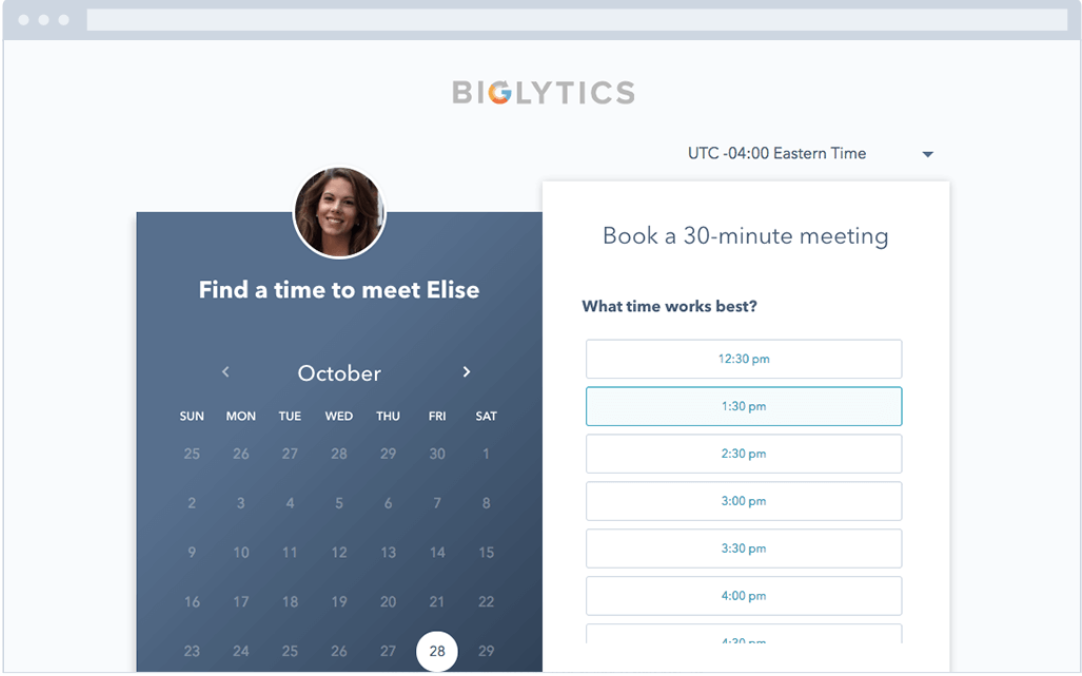
HubSpot meetings tool

Getting an appointment on the calendar will take seconds, not hours — and you won’t have to do any work. As an added benefit, the easier it is to schedule a meeting with you, the more likely your prospect is to do so.

12. Leverage social proof.

Your prospect may not automatically trust you, but their peers’ opinions and/or testimonials will hold a lot of weight. In fact, nine out of 10 buying decisions are made with recommendations from peers. Leverage the power of social proof to win their confidence — and ultimately, the deal — more quickly.

Here are several strategies:

  • Get a warm intro through a mutual contact: Use LinkedIn to find a first or second-degree connection at your prospect’s company. Even if you don’t have a direct line to your prospect, they’ll be far likelier to respond to an introduction via their coworker than a random email.

  • Send your prospect case studies: Evidence of your product’s impact or ROI is extremely convincing. If you have multiple case studies, look for one featuring a company similar to your prospect’s organization.

  • Bring them to an event with current customers: Allowing every prospect to speak to a reference usually isn’t feasible; after all, it’s time-consuming for your client and can delay the purchasing process. A good shortcut? Inviting buyers to an event where they can mingle with your customers. They’ll inevitably end up hearing positive reviews of your product.

  • Mention similar companies: Simply bringing up companies your prospect can relate to — because their organization is dealing with a similar challenge, has similar characteristics, or serves a similar market — builds trust.

13. Regularly clean your CRM to eliminate cold contacts.

Keeping your CRM contact list up-to-date with contacts who are interested in your content and products will make your sales process more efficient because you’re communicating with people who want to hear your message.

Additionally, when you don’t have disinterested contacts on your list, your email deliverability improves, ensuring your message gets to the right people at the right time.

Take the time to clean and maintain your contact list. Delete contacts who've bounced or unsubscribed. Segment your contact list based off the last email opened, last email clicked, last reply, and/or last delivery date. If it has been several relevant sales cycles since a contact has interacted with anything you’ve sent and you think they have turned into a cold lead, create a “cold” list and delete or archive their record to exclude them from future communications.

14. Keep alignment with your marketing team around sales goals.

In many companies, marketing and sales operate independently, working on opposite ends of the funnel. When sales organizations were asked about the quality of leads generated by their marketing teams, they reported only 7% of leads they received from their marketing organizations as high quality. When sales and marketing teams are not in alignment with the type of leads that should be coming in, the entire company can suffer.

Thankfully, there are a number of ways sales and marketing organizations can work together to achieve their common goals. If you want to start working more closely with your marketing team, have marketing and sales work together to map out the buyer’s journey and create buyer personas. This is a great way to create alignment that can support the rest of the sales process.

15. Create a personalized experience for each prospect.

When was the last time you felt moved to make a purchase based on a generic pitch that didn’t speak to who you are or the problem you’re trying to solve? Chances are, you don’t do this very often.

Especially at the beginning of the sales process, personalization is critical to helping your prospects feel heard and understood. When your prospects receive a message or have a conversation with you that makes them feel like you truly understand their problem, they’re more likely to feel like what you’re offering is the right solution.

With this level of trust, the sales cycle becomes more efficient because there is less back and forth. Here are some best practices to help you create a more personalized experience for your prospects:

  • Always include their first name in emails and messages, so they don’t feel like a mass pitch.

  • Use information from your previous conversations to help guide future conversations.

  • Share content or solutions that are relevant to the prospect’s specific challenge or problem.

How effectively you sell makes a difference to the bottom line. How quickly you can effectively sell can make an even bigger difference.

(If you’re interested in seeing how you can automate sales contracts to close deals faster, check out the HelloSign integration in HubSpot’s free CRM.)

Editor's note: This post was originally published in March 2016 and has been updated for comprehensiveness.

24 Jan 16:20

30 big tech predictions for 2017

by BI Intelligence

30 big tech predictions for 2017 report cover

Technology is disrupting nearly every part of our daily lives.

Smartphones have allowed us to stay connected to each other at literally every moment of our lives, whether it's on our daily commutes or on faraway vacations.

The Internet of Things (IoT) is making us more connected than ever with smart home devices that can control our lights and thermostats and order food for us with simple voice commands.

Robo advisors are making investing more accessible and more affordable for everyone.

And the list is growing.

Almost every industry has been disrupted by digital technologies over the past decade. And, in 2017 we expect to see more revolutionary developments impacting our businesses, careers, and lives.

BI Intelligence, Business Insider's premium research service, has put together a list of 30 Big Tech Predictions for 2017 across Mobile, Digital Media, Payments, IoT, E-Commerce, and Fintech. Some of these major predictions include:

  • Autonomous car road tests
  • Snapchat and Amazon rattling the digital ad space
  • VR hardware competing with popular gaming consoles
  • The grocery industry making the move online
  • Mobile wallets adding value to users
  • Insurtech ascending with investments from legacy players and tech giants
  • Social video taking 2017 by storm

This comprehensive list of 30 predictions can be yours for free today. As an added bonus, you will gain immediate access to the team’s exclusive FREE newsletter, BI Intelligence Daily.

To get your copy of this slide deck, simply click here.

Join the conversation about this story »

24 Jan 16:20

Here are the stats we have so far on Twitter's live stream of Trump's inauguration (TWTR)

by BI Intelligence

Inauguration ViewershipThis story was delivered to BI Intelligence "Digital Media Briefing" subscribers. To learn more and subscribe, please click here.

User traffic to Twitter's live stream of the presidential inauguration was down significantly to comparable recent events – like Election Day, and the opening of the Republican and Democratic national conventions – according to Jumpshot analysis cited by Mediapost.

Likewise, viewership on traditional TV also underwhelmed, according to Nielsen estimates cited in Mediapost as well:

  • Twitter. The audience for Twitter's live stream of the inauguration was 23% smaller than that of the Election Day live stream. More than 70% of the audience was male, and nearly half of all viewers were between 18 to 24 years old. These figures are consistent with Twitter's audience on other recent political live streams.
  • Television. The inauguration also underwhelmed on traditional TV. According to Nielsen estimates, it drew in an estimated 30.6 million TV viewers in the US, placing it in fifth in Inauguration Day ratings, behind Ronald Reagan, Barack Obama, Jimmy Carter, and Richard Nixon.
  • Akamai. Akamai is one the most prominent content delivery networks (CDN) with over 216,000 servers across 120 countries to deliver worldwide web traffic. The inauguration was the largest single live news event Akamai ever delivered. Live streaming peaked at 8.7 Tbps, supporting 4.6 million concurrent viewers, beating the previous record set during Election Day coverage.
  • Caveats. There’s no YouTube or Facebook data for inauguration live stream viewership yet, which will be necessary to get a fuller picture of the inauguration digital viewership. It’s possible that smaller audience on Twitter reflects a decline in usage of that platform – perhaps in favor of Facebook and Google – rather than a shrinking digital audience for the inauguration.

If 2015 was the year that brands and advertisers embraced online video, then 2016 saw the medium take the next step as live streaming took off.

Live streaming video refers to broadcasts in real time to an audience over the internet. While the concept of live streaming has been around for years, mobile-first video platforms with user-generated content have just recently begun to make serious waves thanks to improved video quality, faster broadband speeds, and enhanced mobile technology.

Online video has become a key part of the strategic business model for both brands and marketers as they seek more innovative ways to capture consumer attention. Creative live streaming video initiatives and campaigns are a way for companies to cut through the digital clutter and have emerged as the medium of choice not only for person-to-person sharing, but also for business-to-consumer (B2C) and business-to-business (B2B) communication. 

Brands are increasingly using live streaming to reach audiences. Its importance has grown significantly thanks to substantial investments by social platforms such as Facebook, YouTube, Snapchat, and Twitter to build and enhance their live-streaming platforms.

And advertising dollars are likely to follow. 88% of agency respondents stated that they “might” or “definitely will” invest in live stream video advertising over the next six months, according to a recent Trusted Media Brands survey.

BI Intelligence, Business Insider's premium research service, has compiled a detailed report on live streaming video that examines the eruption of online video from the perspective of both consumers and advertisers and assesses how live streaming is emerging as the medium's next catalyst for growth.

Here are some key points from the report:

  • Live streaming video will further accelerate streaming videos overall share of internet traffic. Streaming video accounts for over two-thirds of all internet traffic, and this share is expected to jump to 82% by 2020, according to Cisco’s June 2016 Visual Networking Index report.
  • Live video’s value comes from its unique ability to add an authentic human element to digital communications. As a result, brands are leveraging three main streaming methods to connect with their viewers: tutorials, product launches, and exclusive and behind-the-scene footage.
  • Advertisers will continue to invest heavily in online video, especially as live streaming video gains traction. Already in the US, digital video ad revenue reached $7.8 billion in 2015, up 55% from 2014, according to figures from the Internet Advertising Bureau.
  • While live streaming is still in its early stages, brands are leveraging micropayments, mid-roll video ads and direct payments from social platforms, to monetize their live streaming videos.
  • The success of live streaming video hinges on brands overcoming a lack of measurement standards in the space, as well as changes in social media sites' algorithms that affect what content users see.

In full, the report:

  • Examines the eruption of live streaming video.
  • Explores the differences between platforms that host live streaming video.
  • Breaks down successful approaches from both brands and publishers.
  • Discusses unique monetization opportunities live streaming presents.

To get your copy of this invaluable guide, choose one of these options:

  1. Subscribe to an All-Access pass to BI Intelligence and gain immediate access to this report and over 100 other expertly researched reports. As an added bonus, you'll also gain access to all future reports and daily newsletters to ensure you stay ahead of the curve and benefit personally and professionally. » START A MEMBERSHIP
  2. Purchase & download the full report from our research store. » BUY THE REPORT

The choice is yours. But however you decide to acquire this report, you’ve given yourself a powerful advantage in your understanding of live streaming video.

Join the conversation about this story »

24 Jan 16:19

What Starts Within, Spreads Throughout: The Importance of Internal Branding

by Darnelle O'Brien

Your internal brand is an important piece in building a strong external brand.

If a strong brand is built from the inside, your internal brand is vital to the success of external marketing efforts.

5 steps to building a strong internal brand

Employees must embrace and understand everything about their company and the brand that the company wishes to exude, from its core values, it’s overall business purpose and to how the company wishes to position itself in the market.

  1. Define your mission and values

Having a mission and overall business values gives your employees a sense of purpose to their role beyond just working for an income. Without identifying these vital components your employees will struggle to identify its purpose and how to communicate this to your potential customers.

  1. Engage your people

Your internal brand is about your people, defined by your people and driven by your people. They are the most important part of your internal brand and determine how your brand will be perceived by the outside world. It is vital that your employees positively engage and become part of your overall business culture.

  1. Develop an internal identity

When developing your internal identity, it is essential to ensure that it relates to your external identity.

If your business is saying one thing to its employees and an entirely different thing to its customers it will cause confusion and a discrepancy with your company’s purpose and direction. A memorable identity will help your internal brand stick and translate that ‘meaning’ into the everyday roles of your employees.

  1. Communicate your internal brand strategy

Creating an emotional connection between employees and the brand is not something that can be achieved via an internal memo and the odd poster on the staff noticeboard. To ensure that connection informs the way your employees approach their roles and that your brand continues to underpin each decision they execute, you need to initiate a proper launch for the brand.

Use a multi-pronged approach to introduce and explain the messages and then reinforce by applying your internal branding to every internal touchpoint.

Consider the day-to-day interactions experienced by your staff and weave your internal brand into these experiences. For example, including the internal brand statement or mission and values on employee email signatures and having your values displayed around the office.

Remember that communicating your internal brand is about inspiring, motivating and persuading your employees, not simply informing; so be creative and encourage two-way conversations by providing platforms for feedback and discussion.

  1. Recognise, reward and incentivize

To truly drive a successful internal branding strategy and transform the engagement of employees, it needs continual reinforcement from higher management. The best way to do this is to provide incentives or competitions for employees to display and drive your internal values into your business culture. Recognise and reward employees who continue to demonstrate living by the businesses internal values as a way of reinforcing the value of your internal brand.

When looking at rewarding employees it should come from all levels – from the top right down to peer to peer acknowledgment. Create a culture of encouragement and get your employees involved e.g. have quarterly awards where employees nominate their peers for who they think best displays and identifies with the company values and culture.

Final thought

When companies ignore or minimize internal branding, behaviour and communication the external brand message is compromised.

If the employees lack confidence in the company or their products or services, it becomes a difficult task to convince people to buy from you. A strong internal brand removes this cynicism and buyers are confident by your confidence.

24 Jan 16:18

7 High-Converting Landing Page Examples for Your Personal Swipe File

by Lucas Miller

7 High-Converting Landing Page Examples for Your Personal Swipe File

Many of us know of David Livingstone as a well-known Scottish explorer of Africa, perhaps most famous for being greeted with the underwhelming line, “Dr. Livingstone, I presume?”

At the time of the famous greeting, he’d gone years without any kind of contact with the outside world, hence the fame surrounding the memorable, first-time interaction.

But what many people don’t realize is that one of Livingstone’s primary goals wasn’t just to explore Africa – he was also set on serving it as a Christian missionary.

Despite only officially converting one person to his faith in six years, Livingstone actively preached in an effort to share his beliefs with the tribes he encountered during his explorations.

David Livingstone

Most noteworthy, however, is that his standard of treating native tribes respectfully opened the door for future missionaries who used the foundation he’d built to convert people at a later date

Sticking the landing (page)

If you’re starting to wonder what any of this could possibly have to do with digital marketing, allow me to offer a friendly transition – we marketers generally speak of converting audience members into paying customers.

Truth be told, there are few digital marketing areas where conversion is more commonly (and passionately) talked about than landing pages.

Just as other missionaries based their preaching efforts off of Livingstone’s actions to achieve success, you too can use the tactics others have perfected to improve your own landing pages.

Seriously, don’t make this harder than it has to be. If it’s worked for others, it’ll work for you.

In fact, starting right here, right now, add the below seven landing pages to your ever-expanding swipe file. They’ve proven themselves in the ways of conversion, and will allow your brand’s landing pages to do the exact same thing:

1. White Space – Skype

White space helps you avoid clutter and ensures that potential customers’ attention is drawn to where you want it to go. It makes your text more readable and ensures that images and call to action (CTA) buttons stand out from the rest of your content.

Skype provides a perfect example of this.

Above the fold, viewers are treated to a logo, a brief headline and a CTA button, all of which are surrounded by plenty of white space. Because of this, the eyes are instantly drawn to the CTA button. Without having read anything, visitors know what’s most important.

screen-shot-2016-10-27-at-1-12-16-pm-1

Even when you scroll down, text and graphics are kept in small, concise areas. They’re large enough to be read, but have enough separation to keep them from looking cluttered or overwhelming.

The use of white space makes Skype’s landing page easy on the eyes, as well.

When you do the same with your landing pages, and visitors like what they see, they’ll be far more likely to stick around to consume the rest of your page’s content.

2. Making extra links work for you – QASymphony

In general, throwing a ton of extra links onto your landing page is the last thing you want to do. This is especially true when your links lead users away from conversion-focused content and distract them from taking a desired action.

But what happens when visitors want more information than you can provide without making your landing page look jumbled, crowded and confusing?

While not all leads require much convincing before conversion, QASymphony worked around this potential problem by providing links to in-depth information regarding their software.

screen-shot-2016-10-27-at-1-14-30-pm

Rather than taking users to a standard information page, however, the links redirect to what is basically another landing page, complete with the same call-to-action buttons that are featured on the main page.

Site visitors who are still on the fence about QASymphony’s software get the details they need without abandoning the landing page platform.

3. Info submission – WebDAM

How much information to ask for (and what information to ask for) on a landing page submission form is a source of frequent debate.

For starters, should you use multi-step or single-step forms? And once you’ve figured that out, how do you make your submission form stand out from the rest of your landing page’s content?

screen-shot-2016-10-27-at-1-15-40-pm

WebDAM provides a great example of an effective submission form, in large part because of how much the form stands out from the rest of the page’s content.

The bold blue color contrasts sharply with the mostly-white background, and by using a contrasting orange for the “Download Now” CTA button, site visitors know exactly where they need to go to get what they want.

Take a look at the small icons next to the requested information fields, too.

Though seemingly insignificant at first glance, they do an excellent job of attracting attention to what are often boring and underutilized parts of a landing page.

4. Worthwhile testimonials – Outbrain

As great as it would be to have the CEOs of Fortune 500 companies writing testimonials for your business’s products or services, for the vast majority of brands, this isn’t likely to happen.

But that doesn’t necessarily put a nail in the coffin of your testimonial-gathering plan…

While it’s true that poorly-written testimonials can actually be negative social proof for your business, there are still ways to turn testimonials from non-famous entities into something that convinces leads you’re worth their hard-earned dollars.

Outbrain’s client testimonials come from a mix of better-known companies (GE) and lesser-known entities (The Austrian National Tourist Office of France), but each of these testimonials is presented in the best, most effective way possible.

screen-shot-2016-10-27-at-1-16-34-pm

What makes these testimonials work, you ask?

For starters, they’re very specific with regards to how Outbrain helped their business.

They’re also accompanied by a high-quality photo and a job description of the person who provided the testimonial, proving that yes – these are actual people using their software.

Needless to say, specific, well-crafted testimonials such as these are one of your best bets for converting shaky leads.

5. Keeping it simple – TryTow

There’s no denying the obvious—some landing pages are painfully long…

And though sometimes appropriate, this information overload can be extremely distracting to site visitors, ultimately making your products or services seem more complex than they really are.

Digital audiences want you to get to the point quickly, especially when selling something.

screen-shot-2016-10-27-at-1-17-46-pm

TryTow does this by providing everything a potential customer would need to know in short, concise textual chunks. Once a site visitor scrolls below the fold, they’re presented with a quick, four-part overview of TryTow’s service, telling readers everything they need to know.

Literally, a prospect can read through this entire landing page in two minutes. By making the process easy to understand, potential customers can make their decision that much quicker.

6. Beautiful imagery – Plated

The old adage of a picture being “worth 1,000 words” is especially applicable to your landing page. High-quality photos can showcase your product or service in a positive light, while poorly-designed images could prove to be an instant turnoff for future buyers.

screen-shot-2016-10-27-at-1-19-12-pm

In a day and age when we’re inundated with tips on how to take great food pictures on Instagram, the use of a beautiful, non-stock photo (it’s possible) makes Plated’s food look wonderfully appetizing, doing far more to sell the product than blocks of text ever could on their own.

The use of top-tier photos (and video) help customers better understand what they’re signing up for when they choose to work with you, giving them greater confidence and helping you secure warmer leads.

7. Eye-Catching Headlines – Hootsuite

By the time a user has clicked through to your landing page, they’re likely to have already been inundated with all kinds of sales jargon. As such, the last thing they want to do when visiting your page is wade through even more advertorial filth.

Think about it – all they really want is to know whether you’re worth their time and energy.

The key to quickly making this happen? Headlines. Hootsuite’s landing page is a perfect example of using a large, direct headline that tells site visitors precisely what its software does.

screen-shot-2016-10-27-at-1-19-55-pm

There’s no flowery, glittering language to speak of – just a simple, direct and powerful statement that tells site visitors what they want to know.

The use of concise language allows a landing page’s main message to be digested in a matter of seconds, which is often all it takes for a user to decide whether or not they want to learn more about your offer.

You don’t have much time (50 milliseconds, to be exact), so use it wisely.

Go forth and convert!

Just as David Livingstone’s successors used his principles to build the basis for their own conversion efforts, you too can solidify your swipe file with the above landing page examples, using them to craft your own high-conversion landing pages.

I’ll be the first to admit that this list of landing pages is hardly exhaustive, and you should definitely keep searching for other great examples to add to your swipe file.

But if nothing else, this gives you a good place to start when designing your own company’s landing page. Even better, the odds are stacked in your favor – using tried-and-true templates that’ve worked for others, they’re likely to work for you, too.

I’ve said my piece, and now it’s time for you to say yours…

What practices have helped you get great results when creating your own landing pages? Also, what pages have you looked to for help? As always, I can’t wait to see what you have to share!

Until next time, best of luck as you and your company go forth to convert the masses!

24 Jan 16:18

How to Sell to a Complex Buyer

by jillkonrath@jillkonrath.com (Jill Konrath)

In Part 2 of the CEB Sales Roundtable, we discuss how B2B buyers are becoming more complex—and what we need to do to make the sale. The transcript is below or you can listen here.

24 Jan 16:18

Don’t “Go All In” on In-Market Buyers

by David Dodd

illustration-for-012417-li-post

Some providers of B2B predictive analytics solutions are describing the benefits of their technologies in rather effusive ways. Consider, for example, the following language in a content resource from a leading PA vendor:

“Imagine a world where you can find buyers early in the sales cycle and predict who your next customer will be with 85% accuracy. [XXX’s] predictive intelligence engine gives you the ability to see your entire universe of potential buyers at every stage of their buying journey. We uncover net-new, in-market prospects based on powerful data science and billions of time-sensitive intent interactions.”

This is heady stuff because the ability to know which prospects are engaged in an active buying process could enable fundamental changes in the practice of B2B marketing. For example, suppose that your company uses account-based marketing. With predictive analytics, you could select ABM target accounts based on both fit (how closely a prospect resembles your best existing customers) and interest (whether a prospect is “in-market”). You could also use your PA solution to frequently update your list of target accounts, so that you have a near real-time view of which accounts are engaged in an active buying process.

This sounds like marketing nirvana, right? When you know which of your prospects are actively in-market, you can focus your marketing programs on this “low-hanging fruit,” which should result in higher conversion rates, greater marketing efficiency, and lower customer acquisition costs.

There Be Dragons Here

Focusing marketing efforts on in-market prospects has undeniable benefits, but this strategy also carries some less obvious hazards. If taken to the extreme, it can lead marketers to ignore prospects who don’t make the “in-market” cut. This is a dangerous approach because of changes in how business decision makers consume information.

A B2B buying process usually begins when a company’s leaders or managers recognize a need or a problem, and decide to do something about it. These “buyers” then gather information about the need or problem, evaluate possible solutions, and may or may not decide to buy a product or service to address the problem or need.

So, our traditional view of buyer behavior is that most information gathering and learning occurs after an intentional buying process is underway. Today, however, information is so readily available that many business leaders and managers routinely consume information about business issues long before they’ve formed anything close to “buying intent.” I’ve used the term casual learning to describe learning and information-gathering activities that occur before an intentional buying process has started, and it’s clear that this type of “low-intensity” learning is becoming more and more prevalent.

What marketers need to remember is that casual learners will form impressions and embryonic preferences based on the content they consume, and that those impressions and preferences will remain influential when they get involved in an actual buying process. Therefore, marketing to casual learners is important, even though most casual learners probably shouldn’t be characterized as “in-market.”

As predictive analytics solutions get better and better at identifying companies that are in an active buying process, it will be very tempting for marketers to focus more and more of their marketing efforts on active buyers. That’s not a bad strategy, so long as you remember that you must continue marketing to prospects who aren’t currently “in-market.”

There’s nothing wrong with harvesting the low-hanging fruit, so long as you continue to tend the immature fruit that’s higher on the tree.

Illustration courtesy of Rafael Antonio via Flickr CC.

24 Jan 16:17

How To Use Trade Show Contests To Drive Traffic To Your Booth

by Nimlok Marketing

trade show contests

A well-executed in-booth trade show contest or game may be just what you need to invigorate your future event marketing endeavors. Trade show contests and games can drive more traffic to your booth and create more opportunities to engage with prospects.

In this post, we outline some of the best practices to planning and operating in-booth games and activities and share ideas for contests that will leave your visitors wowed.

Tips for Getting Started

In-booth contests and games are entertaining for exhibitors and attendees alike, but before you begin, you need to master the basics.

Pre-Show Promotion:

Games and contests are extremely effective at drawing crowds to your exhibit, however, without proper pre-show promotion of your activities, your efforts may fall flat, resulting in fewer visitors to your space.

Tips for Pre-Show Promotion:

  • Send an email blast to current clients and prospects advertising your in-booth activities up to three months in advance of your show.
  • Check with show organizers to see if there are pre-event opportunities to advertise your activities in the show book or event newsletter.
  • Broadcast your contest or game via Facebook, Twitter and LinkedIn early and often and use official event hashtags to reach attendees.

Plan Games and Contests with Engagement in Mind

In-booth activities work best when the contestants are active rather than passive participants. When planning your contest, think about ways to get your participants engaged with your staff, product or service.

Tips for Engagement:

  • Task yourself or a staffer with playing the role of a host or emcee to introduce contestants, make announcements and engage with the audience to keep the game interesting.
  • Create games and contests that revolve around contestants inspecting, using or answering questions about your product or service.
  • Connect your contest to the theme of your trade show campaign or to your brand’s image.

Have a Lead Generation Plan

Trade shows and face-to-face marketing events are often themed or industry-specific, making them the perfect place to gather qualified leads.

To capitalize on reaching potential new customers, make sure you incorporate a lead gathering strategy into your in-booth activity game plan.

Tips for Lead Collecting and Follow Up:

  • Attendees are weary of giving away their contact information, if possible, create an easy-to-win game and collect information from the winners. Attendees will be more apt to hand over information when they win a prize.
  • To avoid potential unqualified leads, make sure your signage and game make what your business does clear and devise a prize that would be most helpful to attendees who fit your buyer persona.
  • Trade shows contest and games will help you generate a buzz – but that energy and excitement won’t last forever. Make sure to quickly follow up with prospects and use your games as an icebreaker leading into sales calls and emails.

Budget Considerations

Whether you are a large and established brand or an up-and-coming company, trade show budget concerns are a real and serious part of event marketing.

When planning your budget, make sure to account for your contest and game-related expenses.

Tips for Contest and Game Budgeting:

  • Prizes are the number-one reason an attendee participates in a trade show contest or game, and prizes cost money. Make sure you factor them into your budget.
  • If you plan on having in-booth activities, you will need more staff to help run them. Take the additional staff into account when budgeting for your trade show.
  • Keep budget constraints in mind, and don’t sacrifice exhibit design because you overspent on your trade show contest because smartly-designed trade show displays can help lure in prospective contestants.

Ideas for Trade Show Contests and Games

Now that you understand the basics of planning trade show contests and games, it is time to choose the right engaging activity for you and your brand.

Below, are some of the most popular, engaging and fun contest and game ideas for your next event.

Prize Wheels

Prize wheels are always a fun way to draw people to your booth. A big, colorful prize wheel will attract attention at a bustling trade show and can help create a game show atmosphere.

It is important for participants to have a good time, but more important that they remember your brand with a memorable giveaway after the show is over.

For giveaway ideas, check out our post on trade show giveaways or our prize list at the end of this post.

Prize Wheel Tips:

  • Make sure your prize wheel is large and colorful, you may want to add lights for added flair.
  • Engage with the crowd and get them excited for their chance to play on the prize wheel.
  • When you set up your prize wheel, make sure you include one grand prize, such as a cash reward, gift card to a local top-rated restaurant or highly coveted digital device.

Prize Wheel Alternatives:

You can employ other similar games of chance that offer similar levels of engagement and excitement as prizes wheels including:

  • Roulette Wheel
  • Plinko Board
  • Slot Machines

Trivia

From the barroom to the livingroom, everyone enjoys a good game of trivia. Make your trivia questions specific to your particular business or industry, so visitors can learn about your company while having fun.

The information learned will likely stick with them long after the trade show is over and, as a bonus, spectators will also learn about your company while watching contestants compete.

Tips for Trivia:

  • Design your trivia game to follow the format of popular trivia gameshows (Family Feud, Jeopardy, etc.).
  • Include questions about your brand, industry and convention to educate contestants on your product, service or capabilities.
  • Have prizes for both correct and incorrect answers so everyone is a winner.

Counting Contest

For this classic contest, fill a clear container with jellybeans, pennies, marbles or something that relates to your company or industry. Instruct attendees to guess how many items are in the jar.

Attendees can submit their estimates on the back of their business cards, giving you their contact information and becoming a lead for your sales team to follow up with post-show.

Attendees will be inclined to return to your trade show booth to find out if they won, giving you multiple opportunities to engage and educate.

Tips for Counting Contests

  • Advise your staffers to use the counting game as an icebreaker when they approach passersby.
  • Use marbles, candies or coins with your company logo printed on them as a way to reinforce your brand messaging.

Golf

Golf is one of the most universally loved and recognized games around the world, so incorporating a golf-related activity into your trade show exhibit is a great way to attract passersby.

If you host a golfing activity in-booth, you will be amazed at just how fast your exhibit will become “the place to be” on the show floor. Your booth will be filled with attendees looking to hone their putts, improve their drives and drop a few strokes from their game all in a casual and easy environment.

Tips for Golf Activities:

  • Putting greens are an expensive but worthwhile activity, you can never go wrong with a putting green because it is the easiest and most simple golf activity to incorporate into your booth.
  • Like a putting green, driving range simulators take participants from the trade show floor to the links and allow them to practice their skills.
  • Virtual golf games are increasing in popularity because they allow players to get the feel of a day out on the links without having to chase down errant balls.

Jumbo Games

Fun trade show games and trade show contests

If you are looking for in-booth activities that will have a supersized impact on the show floor, jumbo games should be at the top of the list.

Be it a giant chess board, Malpractice (giant operation board) or a huge Jenga set, attendees will flock to your booth to try their hand at your larger-than-life games.

Tips for Jumbo Games:

  • Before you pack and head to your event, make sure each and every piece you need for your game is accounted for.
  • Familiarize yourself with the rules of your game before the show to eliminate confusion and ambiguous judgments calls.
  • Non-playing audience members are the key to building a lively in-booth atmosphere. Interact with spectators and encourage them to “cheer on” participants.

Photo Contest

trade show photography contest

With the rise in smartphones, it seems that everyone is photographer, which is why photo contests have become popular promotional tactics.

Photo contests are a great way to gain exposure (pun intended) for your event marketing campaign on social media by encouraging guests to upload their contest entries to their social media profiles.

Tips for Photo Contests:

  • Create a hashtag for contest participants to tag to their social media posts. At the end of the day, declare a winning photo and invite the lucky attendee to collect their prize.
  • Add a photo booth to your exhibit and make sure to provide plenty of props. Task attendees with taking the most creative photo with the props and have other participants vote on the winner.

Arcade Games

trade show contests and arcade games

Classic arcade-style games like basketball toss, Skeeball and Air Hockey invoke a sense of youthful excursion and delight in adults and can attract tons of attendee traffic into your trade show booth.

Arcade games also require less staffing than other trade show contests and games, allowing more flexibility in the way in which you utilize your staff.

Tips for Arcade Games:

  • Make a leader board and post the high scores throughout the day to entice visitors to try their hand at beating the day’s leader
  • Offer tickets instead of a set prize for participating and allow players to spend tickets on a variety of prizes
  • Make arcade games digital, so players can share scores and photos on social media.
  • If possible, try to set up head-to-head competitions between players to create a more competitive but friendly atmosphere

Trade show contest prize ideas

After reading the previous section, you should have an idea of which trade show contests and games would be a good fit for your company. Prizes are an important component to any contest promotion, as they motivate participants and promotes your brand after the event.

Below you will find a list of attractive and attention-gra
bbing prizes that will be sure to have attendees clamoring on about your exhibit.

The ideas are endless when it comes to prizes, so check out our other article on trade show giveaways for other great giveaway ideas.

Tips for Prizes and Giveaways:

  • Cash is the king of all prizes, so if you want an easy and universally beloved reward think about handing out a cash prize. It is important to note that cash prizes do not have lasting brand exposure, so consider your goals before you plan a cash prize.
  • Consider offering a free trial of your service or a supply of your actual products. Not only is the prize relevant and valuable to the audience, but it will get people to sample your product.
  • Having a mystery box giveaway with multiple prize options is a great way to stoke the imagination of contestants and generate buzz around your contest or game.
  • High-ticket items like cars, vacations and high-priced electronics always make great prizes, but remember not to overextend your budget.

Remember, Everyone Wins with Trade Show Contests

At the end of the day, trade show contests and games are one of the best ways to make connections on the show floor. Contests and games help attendees relax and forget about the stresses of business travel with lighthearted fun.

24 Jan 16:17

8 Tips for Aligning Sales and Service

by Emily Stanford

Today, businesses have a wealth of terrific choices when it comes to applications and platforms for both sales and service, including commercial products from software vendors, as well as applications that have been built in-house. Many businesses have tackled optimizing their sales process with cloud software at one point in time, and the tools for the customer support department at another. The result? Silos in process and technology that often create disconnected customer experiences because businesses lack the 360-degree view they need of each individual customer to deliver the kind of experience that customers expect.

When considering a cloud platform as your next solution to connect sales and service, you need to find a platform that serves both business and IT interests: both sides are essential in keeping your customers happy. To find the right fit, you must keep in mind a variety of factors.

Download the free e-book, Connect Sales and Service Around the Customer, to learn more about how you can transform your business with sales and service on one platform.

1. Trust

As with any technology, security, availability, and performance are essential factors when choosing a cloud provider. Ensure that the cloud solution you choose is built around a robust and flexible security architecture. Speak with providers about how they will protect your data and give you visibility into system performance and security.

2. Customer Success

When choosing a cloud platform, find one that prioritizes your own success. Your cloud provider should offer robust training, success services, and community resources to ensure you’re making the most of your investment.

3. Innovation

Cloud computing has gained critical mass in the marketplace, which means it’s easier than ever to find a cloud platform solution. But this doesn’t mean you should just go with anyone – choose a cloud provider that’s market-tested and delivers innovation often, future-proofing the technology and your investment.

4. Multitenancy

Multitenancy is a fundamental technology that true cloud platforms use to share IT resources cost-effectively and securely. When every customer’s apps are built on the same code base, it not only leads to massive cost savings, but also allows customizations and new apps to be created at lightning speed.

5. Ability to Scale Fast

Not all cloud platforms will give you the ability to customize, extend, and scale according to your business needs. You need a cloud platform that can innovate without ever losing your business’s unique customizations or integrations. Salesforce is the only company that provides three major innovation releases every year, to all customers, without ever losing customizations or integrations.

6. Customizable – Extensible with Your Own Apps

It’s not just about the cloud platform — it’s also about what you can do with it. Find a cloud platform that will empower your team to build apps fast, and you’ll set up your IT department to add value through rapid innovation.

7. Open Ecosystem

Once you move to the cloud, you’ll realize you’re not alone. Hundreds of thousands of companies use cloud solutions, so your provider should help you connect with a community of experts and partners who can help you extend the power of your platform and innovate faster.

8. Complete CRM

When it comes to managing customer relationships, the best cloud solutions connect your entire business around the customer, from sales, service, and marketing to communities, IT, and analytics. Choose a cloud provider that sees the big picture and can help get you there.

Want to learn more about how businesses can go for growth with connected sales and service? Download the free e-book.

24 Jan 16:17

How You’re Messing Up the Easiest Part of Your Sales Playbook

by David Priemer

“I’m not sure. Something with computers?”

This was the answer my mother routinely gave others (and I suspect still does) when asked what my new company did, having left my role as research scientist in early 2000, at the height of the dot.com boom, to join my first tech start-up. Being from a different generation, I thought my mother’s sentiment was simply rooted in a lack of context and understanding. But 17 years of tech sales and 4 start-ups later, I’ve come to realize that her confusion wasn’t all that misguided. As it turns out, despite your awesome sales and marketing machine, most customers haveno idea what you or your company does. What’s even more shocking is that your company may not either.

While articulating what you do may seem like the most basic and bulletproof part of your sales playbook, it’s deceptively one of the most difficult and inconsistent.

This past fall I attended the CEBSales and Marketing Summit and met a sales enablement leader from one of the world’s largest biotech companies. He joyfully recounted a prospecting call he received from a sales rep early one morning. “I like to get into the office early” he said, “get some work done before things get too busy. I know some sales reps also like to make early morning calls to catch people like me at their desk. One morning I decided to answer one of those calls. ‘Ok you got me! You have 2 minutes…give me your best pitch!’” he joked to the rep. He then described how, for the next 2 minutes, the sales professional on the other end couldn’t have tripped over himself more to force out the worst pitch he had ever heard.

Concerned your organization might be facing a similar issue? You can triage the extent of the problem by considering this escalating series of tests.

Test #1: New User Impression

Your team has have no problem articulating your pitch with clarity and simplicity, but can an average prospect figure out what you do in one minute or less using only the information available on your website (i.e. online copy, videos, explainer tools, etc.)? Steve Krugg, author of the best-selling book, Don’t Make Me Think correctly asserts, “If visitors can’t identify what it is you do within seconds, they won’t stick around”. That why, back at start-up #3, we used a service called usertesting.com to get unbiased assessments of our solution from new users. With minimal guidance, we were able to observe the user’s interaction and real-time commentary on our website. The feedback very extremely enlightening (if not alarming at times) but definitely helped highlight our blind spots and align our online presence to our value proposition.

The good news is if you can pass tests #2 and 3 but aren’t sure about this one, you’re in an ok spot.

Test #2: Sales Rep Spot Check

Pull a random sales rep off the phone and ask them to explain what your company does in 15 seconds or less. This experiment typically has three outcomes:

1) They nail it! Not only is the pitch awesome but it’s generally consistent across each rep.

2) Meh. Most reps manage to cobble together an ok pitch, but the impact is highly variable across your team

3) Train wreck. After 2 minutes of incoherent babble, you wonder why you let these people talk to customers.

Ideally you want outcome #1 but somewhere between #1 and 2 is workable. If you didn’t nail test #1 and aren’t quite sure how you’d do on this one, you better hope you’re on target for test #3!

Test #3: Executive Team Spot Check

Same as experiment #2 but with members of your executive team. Can your financial, technical, support, or operations leaders explain what you do? What about (no joke) your sales and marketing leaders? While we’d all like to think that the people steering the ship have the clarity and consistency of message we expect of everyone else, this isn’t always the case. Unfortunately, if you didn’t nail this one, it’s highly unlikely you hit #1 or 2 out of the park either. After all, if your senior leaders can’t clearly articulate your value proposition, how can you expect anyone to?

If you feel you need work in this area, don’t worry. Here are a few tips to set you on the right track:

1. Get Back to Basics: perhaps your team is challenged to articulate your pitch because it’s old, complicated, or inconsistent with your current solution or market values. Instead of jumping to refine it, start by revisiting your brand, your mission, and your core beliefs. Then use them to guide you to a simple, compelling, and customer-centric value proposition that’s easy to explain. Test market your message with both new and existing customers to align the problem they’re looking to solve with the value they feel you can deliver to ensure it hits the mark!

2. Document it: writing your pitch down will leave no ambiguity as to the specific words and phrasing that should accompany its delivery. Once you’ve done that, I recommend having your best sales rep, marketing person, or executive create either an audio or video recording of themselves delivering the pitch. Creating a gold standard to demonstrate what excellence looks like is critical to driving the consistency you’re after.

3. Certify and drive accountability for knowing it: if your goal is to get to a point where you can pull any sales rep off the phone and have them articulate your message with clarity, consistency, and conviction, do just that! In addition to certifying your team on your messaging through formal enablement programs, drive accountability and promote regular practice by randomly selecting a few team members to rattle off their pitch during the first 5 minutes out of your group meetings. Letting your team know you’ll be using this approach in advance will help promote an ongoing sense of accountability and they’ll appreciate you helping them get better!

With all the hurdles, roadblocks, and distractions the modern sales and marketing organization encounters, explaining what you do should be the easiest part of the sales process! The key to ensuring your organization is able to consistently deliver a message that both resonates and is easily articulated is to understand where you need the most help and leverage the training and accountability tactics needed to make it stick.

24 Jan 16:17

The B2B Buying Disconnect: 5 Opportunities for Increasing Influence with Technology Buyers

by Caitlin Burgess

Thanks to the internet, social media and mobile technologies, buyer’s are more self-directed than ever before, using these tools to conduct independent research that informs important purchasing decisions for themselves and the companies they work for.

However when it comes to B2B buyers, specifically those looking to purchase tools and software from technology vendors, while independent research is a major trend, 60% say their vendor is an influential part of the purchasing process, according to TrustRadius’ new report, The B2B Buying Disconnect.

Of course, that’s not the whole story. While technology vendors—namely their marketing and sales teams—play an undeniably important role in the purchasing process, they may be missing the mark or leaving opportunities on the table by focusing on the wrong things. And that’s precisely what TrustRadius’ study aimed to uncover.

Billed as a landmark study, TrustRadius surveyed more than 600 technology buyers and vendors with the goal of identifying key areas of alignment and disconnect, and unearth opportunities for vendors to increase their influence in the purchasing process.

“Buyers are looking for a balanced, relevant and realistic view of products,” TrustRadius CEO Vinay Bhagat said in a report press release. “When vendors proactively connect buyers with content providing that view, they can increase their influence in the purchasing process.”

Below we dive into some more interesting insights from the report, and the opportunities that go along with them, so you can increase influence and build more trust with your buyers.

#1 – Buyers want hands-on experience with the product before committing.

According to the report, product demos are the most helpful resource for buyers and free trials are the most trustworthy sources of information.

B2B Buying Disconnect - Information Source

“Buyers recognize that direct experience with a product is the best way to evaluate it,” the report stated. “Note that in qualitative responses, buyers especially liked demos that were personalized for their situation or use case. Conversely, they questioned the value of demos that felt biased, rehearsed, or too general.”

The opportunity: Take steps to customize and personalize the demo and trial experience. This will give buyers the experience and information they need to determine if your product is the best fit for their needs.

#2 – Existing customers are an untapped resource.

According to the report, nearly half of the buyers surveyed were product promoters, giving a product they’re using a 9 or 10 on the satisfaction scale, and 91% planning to renew. In addition, 42% have independently recommended the product directly to a peer or colleague. However, of those who recommended the product, just 30% provided an official reference, testimonial or case study for the vendor.

The opportunity: Leverage your existing base of happy customers by encouraging their participation in testimonials and case studies, as well as being a reference contact for other prospects. These content resources may take more effort and time to create, but they’ll be more useful and effective.

In addition, use customer feedback to inform your product strategy and improvements, as well as identify new prospects, and retention and upsell opportunities.

#3 – Buyers find “marketing collateral” unhelpful.

Vendors share a lot of content, referred to as marketing collateral in the report, but the type of content they’re sharing is often missing the mark with buyers.

According to the report: “More than half of vendors produce and share each of the following types of marketing collateral: blogs (85%), white papers (83%), videos (78%), infographics (63%), and ebooks (56%). Aside from videos, they are also the least challenging to produce or provide. Yet vendors identified these five content types as the least effective at convincing prospects.”

Unsurprisingly, for buyers, marketing collateral was one of the least trustworthy and helpful information resources, specifically noting that this content seemed like it was aimed at converting them into leads rather than providing helpful information.

The opportunity: Stop creating fluffy, easy content and strive to create content that allows you to be the best answer for your buyers. Be real, be honest and be transparent, and provide a range of different resources that paint a realistic view of your product.

#4 – Third-party validation can be ultra powerful.

After product demos and vendor-provided customer evidence, third-party resources such as analyst reviews and user reviews are the next most effective content types, according to the report.

“This disconnect stands out as a missed opportunity for vendors, since buyers find third-party validation fairly helpful and trustworthy. In particular, third-party reviews are unique in that they are the only form of customer evidence not controlled by the vendor. Buyers said they were more helpful as well as more trustworthy than vendor-provided references, and vendors themselves said they were slightly easier to provide than customer references.”

The opportunity: Encourage your customers to review your product and service on reputable third-party review sites. In addition, consider reaching out to relevant, leading industry publications or thought leaders, and ask them to demo and review your product. If you’re confident in your products capabilities and benefits, as well as aware of its limitations, the insights shared in third-party reviews will better inform your prospects, showcase what you offer and give you an opportunity to improve your product offerings.

#5 – Strategic vendors have more influence.

Most buyers described vendors as a necessary and practical resource, rather than a strategic partner. But for those who vendors that do play a strategic role, 89% of buyers said they were somewhat or very influential in their purchasing decision.

According to the report: “Buyers who described a strategic role mentioned activities such as on-site visits, extended trials, demos with real data, customization options, and demonstrating ROI. They also highlighted help with convincing stakeholders and positive “non-salesy” interactions with vendor representatives.”

The opportunity: Show your true value by aligning your key internal stakeholders, and sales and marketing departments, and designing a nurture strategy that provides a personalized customer experience across digital, print and people-facing channels.

Want More Insights?

Read the full report here.

What steps are you taking to better understand your B2B buyer’s journey, and the content that is the most relevant and useful to them? Tell us in the comments section below.


Email Newsletter Gain a competitive advantage by subscribing to the

TopRank® Online Marketing Newsletter.

© Online Marketing Blog - TopRank®, 2017. | The B2B Buying Disconnect: 5 Opportunities for Increasing Influence with Technology Buyers | http://www.toprankblog.com

The post The B2B Buying Disconnect: 5 Opportunities for Increasing Influence with Technology Buyers appeared first on Online Marketing Blog - TopRank®.

24 Jan 16:16

The Power of Positive Sales Habits

by Doug Dvorak

While habits are often seen in a negative light, as those bad habits you want to break, successful sales professionals have learned how to create effective, positive habits that help them to be very good at what they do.

Positive sales habits are easy to incorporate into your daily sales routine if you focus and commit. Since they focus in on what you should be doing and what you do well, building on these habits helps you create a strong sales plan that will drive sales and boost your qualified leads.

Positive Sales Habits By Design

Positivity also creates confidence and easy to recognize attitude that properly sets the tone for the business meeting. This positivity comes from being prepared, knowing your buyer and having confidence in yourself and the products you are promoting.

Some of the most positive and proactive sales habits to cultivate and develop include:

  • Planning – plan how you want your sales cycle to occur. This includes everything from prospecting to your greeting to your choice of clothing and the specific sales approach you want to use. Top sales reps also have a Plan B, a backup to help you deal with possible challenge.
  • Build personal relationships – networking and checking in on connections either through social media sites such as LinkedIn or through personal interaction is a very positive habit to develop. Not only does this build connections for qualified leads but it also allows you to become a trusted source of information.
  • Scheduling – a very positive habit to cultivate is the ability to structure and schedule your day. Schedule in cold calls, follow up calls, time to spend networking and time to update records and make notes on meetings. While new CRM (Customer Relationship Management) makes this easier, it still has to be completed on a daily basis.
  • Incorporate healthy lifestyle choices – getting 8 hours of sleep, eating healthy and balanced meals and managing to get in some physical activity every day is another positive habit that can help you improve your selling career and almost every other aspect of your life.

By feeling healthy and creating a work-life balance, you will be more motivated, more creative and better prepared for the demanding job of being a successful sales professional.

24 Jan 16:16

How Sales Teams Can Use Social Data to Reel in the Perfect Lead

by Aseem Badshah

sales-social-lead-scoring.jpg

#Instagood. #DebateNight. #tbt.

#ICYMI, social media rules. With an increasing number of hashtags, trending topics, and shares, the social sea is flush with leads. But while all of that data can be incredibly useful, the crowded waters have made it difficult for business leaders to tell a minnow from a marlin.

When casting a net for legitimate sales leads, social data is indicative of a lead’s interest level or readiness to consider a category of products. This information can help you figure out which fish to keep and which to throw back into the water.

When people conduct research, ask questions, or gather information to solve a business problem, their social data offers real-time signals that they’re about to enter the buying cycle. Routine social media actions such as follows, likes, or mentions are all readily available data. The trick is tapping into these social signals and scoring these leads appropriately based on their activity.

Keeping Score of Social Media Data

When someone is interested in your brand, he generally follows an established pattern: He follows you, clicks on one or two posts, and shares some of your content. He might even comment on a few of your posts or download a piece of content.

My company, Socedo, uses a two-tiered lead scoring model. We start by considering fit: Does this lead have the characteristics of someone we want to do business with? What’s the size of his company? What’s his job title? Does he have responsibility over social media or demand generation? What’s his industry?

We then look at technographics. The technology the lead already uses can tell us a lot about his sophistication level. If the person already uses a marketing automation system or a customer relationship management system, we consider him a great lead.

Once a lead passes our “fit” test, we score based on behavior or engagement with our content and key channels. We consider the lead’s direct interaction with us and within our social sphere. Did the lead mention an event we’re sponsoring or a hot topic that’s relevant to us? Did the lead mention an influencer we’ve worked with to create a webinar?

Our marketing automation system is set up to “listen” for these events and update lead scores whenever someone engages with our social media channels, website, or emails. We assign a numerical threshold to determine when a lead has enough points to be passed off to our sales team.

How Your Sales Team Can Use Social Media Data

Once we pass leads to sales, we monitor two key metrics to determine whether our scoring model works:

  1. Conversion rate: Measures lead movement from stage to stage and shows how Marketing is performing throughout the sales cycle
  2. Velocity: Tracks the number of days it takes a lead to move through the funnel

We use these metrics to refine and optimize our approach over time. For example, if we notice that leads who engage with Socedo’s corporate handle on social media are converting into customers at a high rate but social media engagements have low lead scores, we might give more weight to social media engagements relative to other interactions.

Social data can be powerful in the hands of your sales team. If you know someone tweeted about an event using a specific hashtag, for example, one of your sales reps can personalize outreach to that prospect by mentioning a keynote speaker or a session from that event. Similarly, if you've added the URL of each prospect's relevant social media profiles as a field in your CRM system, individual sales reps can use details from those profiles -- the prospect's role and responsibilities in the company and her unique challenges, for instance -- to inform sales conversations. Additionally, the rep can ensure she's on the prospect's radar by connecting with her on LinkedIn or following her on Twitter.

With the following tips, your organization can likewise incorporate the wealth of useful social data into your lead scoring model.

1) Integrate your social media management platform with your marketing automation system.

This integration will allow you to attribute leads coming from social media. Doing so will give you custom fields to store information about your leads in your marketing automation system. You’ll have data on which campaigns the lead clicked, which social network she came from, and which URL she clicked, among other details.

You can score leads based on any of these new data fields. For example, you can increase the lead score by three points for anyone who clicked on a link in one of your social media posts. Depending on where your target audience does research, you can even give different scores to leads coming from various social networks.

2) Use a social demand generation system to discover and engage new leads automatically.

This type of system allows you to use social media keywords, handles, and hashtags to identify and engage with warm prospects on Twitter. It also enables you to incorporate their contact information and relevant social activity data into your marketing automation system. You can score prospects based on their interactions on social media with certain topics, events, influencers, and brands. For instance, someone who follows you on Twitter might get two points, while someone who clicks on a link or replies to your direct message might receive 10 points.

It’s important to put your own social data into the context of the broader social conversation. People often attempt to learn about solutions to their problems and consume content on social media, conversing with their peers before eventually hearing about various options. By listening to the broader social chatter in your space rather than solely looking at interactions with your own page, you can discover prospects early in the buying cycle and offer them relevant content.

3) Score people who share your content.

Add social sharing buttons to your landing pages or blog posts so that anyone -- general site visitors or converted users -- can easily share your them on social networks such as Twitter, Facebook, and LinkedIn. Then, score those shares. If someone shares your landing page on Twitter, for example, his lead score might increase by five points.

4) Use technology to update your lead records with real-time social activity.

Microsoft has a social selling team that qualifies leads on social media. It uses a lead acceleration product to get real-time social insights on the leads in its database. With this data, Microsoft is able to understand which of its existing leads are actively engaging or have previously engaged with its Twitter handles, as well as what they’re saying. This helps its social selling team identify which leads to reach out to proactively on social.

You can track and increase the score of any leads who interact with your corporate Twitter handle, your competitors’ Twitter handles, or hashtags from industry events. Based on those real-time social engagements, you can send leads automated emails that acknowledge their social media activity and suggest relevant content. Then, if someone clicks on a link in that email, you can increase her lead score further.

5) Embrace inferred social scoring.

While direct interaction with your brand or the use of certain keywords can demonstrate a lead’s interest in your business, other social behaviors can provide insight into a lead’s mindset.

LinkedIn groups or who someone follows can provide clues about the lead’s interests and job function. Followers of a relevant industry leader or members of an industry LinkedIn group will likely be interested in learning more about your organization. Followers of your competitors might be far into the sales cycle, so you might consider increasing their lead scores.

Score Social Data With a Grain of Salt

All of these actions can -- and should -- be scored, but be mindful that they still represent one lead. It’s important to ensure your lead-scoring model reflects the fact that actions are additive. A lead who clicks on one of your blog post links on Facebook will probably also sign up for a webinar or download an ebook. You don’t want to give too many points to any one action.

Further, social media interaction should not be scored like email. Most behavioral scoring models include negative scoring for a lack of activity over a period of time, but social is a different beast. A lead who doesn’t open an email for a month might have gone cold, but a quiet lead on social media might simply mean that person hasn’t logged into Twitter for a while or missed your content in her stream.

Think of social data as sonar for your fishing boat. It will help you pinpoint leads nibbling at your bait and track their behaviors over time. Identifying your opportunities today with social data can help you reel in qualified leads, sync social activities, and accelerate demand generation.

There are whales swimming through nearby waters as you read this. You just need to find them.

HubSpot CRM

24 Jan 16:16

3 Signs Your Sales and Marketing Team Need Better Alignment

by Chris Hawkins

In the mid-1990s, I managed a retail store for a furniture chain in a small Southern town. Each month I was given 20% of my total marketing budget to spend at the local level—the corporate office spent the other 80% with various mailers and themed promotions.

During every promotion, my sales team peppered me with comments about the promotions that “corporate” was running.

  • “The merchandise advertised is too contemporary. It won’t sell in our market.”
  • “It feels like corporate is just throwing stuff against the wall.”
  • “We’re trying to be too much to too many people.”

I agreed with most of their points. There was often a disconnect between what marketing was promoting and what our market wanted to buy. Unfortunately, I only had control over a small slice of the marketing pie so we were largely at the mercy of the corporate marketing team.

It’s no surprise these two departments aren’t always well-aligned, especially within big companies. But with all of the communication tools we have now, there’s no reason SMB company’s marketing teams shouldn’t be functioning like one.

Fortunately, the concept of marketing and sales alignment has been gaining traction for the last few years. HubSpot devoted a good portion of their State of Inbound 2016 to the topic, finding that:

“There’s room for improvement on Marketing-sourced leads, but Marketing won’t know what needs to be fixed unless there’s a feedback mechanism built into the Marketing and Sales relationship. Whether it’s truly the case that Marketing is failing to deliver enough quality leads to Sales or not, marketers should be aware of salespeople’s low opinion of their work, and take action accordingly.”

Examples of Misalignment

Some of these signs may seem obvious, but our experience shows, as you’ll see below, that it’s not as obvious to some companies.

Not Doing Your Research or Educating Your Audience

One of our owners got a call from someone I’ll call “Vern.” Here’s his voicemail message:

“Hi, this is Vern, I wanted to see if you’d be interested in becoming a reseller of our software. My direct line is…”

Other than a few throat clearings, that was it. I don’t know if cold calling is dead, but I do know that if you’re calling on marketing agencies to be a reseller of your software you should be less cryptic. Mentioning the name of the company you work for and how your software might be beneficial to us or our clients would be helpful. Adding something personal and specific would at least make us not use the example as “what not to do” in a blog post.

Out of curiosity, I called Vern and found out that he works for a company that sells an all-in-one CRM. He said they purchased a list of HubSpot partner agencies and were emailing (see #3 below) and calling to recruit partners to sell their solution.

Vern talked a lot about their company and product, but only asked me a few questions. He pointed me to a competitor comparison chart, but other than that, there were few resources on their site. No blog or long form content that their target personas might be looking for.

Not Taking the Time to Understand Your Prospect

Too often, salespeople don’t have any idea what marketing is doing (and vice versa) and it shows. The blame can’t be assigned to one or the other—they are both usually at fault because neither is communicating with the other.

Last month, a salesperson sent me an email about partnering to resell their data protection services:

Example 1

Yes we have clients and they have data, but that’s where the fit ends. This salesperson took the time to send an email and then follow up a week later. A 20-second perusal of our site would have shown we are not remotely the right fit.

Was she handed a list of prospects and told to send emails all day until she got a bite? Does marketing know sales is targeting “prospects” like us? Does sales know who their target market is? I don’t know, but there’s clearly a disconnect.

Including Everything But the Kitchen Sink

Typically, “less is more” in sales and marketing, especially when it comes to email. However, the emails we get at SPROUT Content are usually all over the place. Some are too short and provide no context. Others resemble a James Michener novel in length and sweep.

At 363 words not including signature, the below email is the length of a short blog post. It proceeds to list everything about them and not a word about us (side note: this email blast was addressed to Dechay rather than me—but even in two subsequent personally written emails from this person, I was still addressed as Dechay).

I don’t know if this company’s marketing or sales team decided this was an ideal first email to a prospect. It came from the VP of Sales and Marketing so it’s hard to know. Either way it’s just too long.

A study of 40 million emails by Boomerang found that the sweet spot for emails is between 50-125 words. These shorter emails tested had a 50% response rate, but as they got longer, response rates dropped.

The moral of this story is if you’re going to do a blast, keep it short. Also keep it targeted to your particular audience so the messaging resonates with that group. Speaking of messaging, more of me and less of you is better. And sales and marketing must communicate about the communications they’re sending out.

Here’s a Bonus tip:

Make sure your sales and marketing teams know each other.

Unfortunately, this isn’t a joke. We’ve actually witnessed sales and marketing teams meeting for the first time in meetings. Not only should your teams know each other, they should be collaborating on efforts and aligning strategies. After all, isn’t one of the biggest goals of marketing to produce sales?

Find out more about how to better align your sales and marketing teams work stronger together through a strategic inbound marketing plan.

24 Jan 16:16

KiteDesk Interviews the Principal of SalesDrive, LLC

by SalesDrive, LLC

kite-desk-interview-dr-croner-sales-drive

KiteDesk, a company who uses “the most accurate Internet research technologies and databases to find and capture the best Leads,” has chosen to highlight SalesDrive, LLC on their blog. As an avid advocate of SalesDrive’s systems, KiteDesk has seen first-hand the success that SalesDrive, LLC brings to companies.

Representing SalesDrive, LLC in this interview is Dr. Christopher Croner, the Principal and co-author of “Never Hire a Bad Salesperson Again.”

Click here to read Dr. Croner’s thoughts and ideas behind SalesDrive, LLC and how it got to be the success it is today.

The post KiteDesk Interviews the Principal of SalesDrive, LLC appeared first on SalesDrive, LLC.

24 Jan 16:16

3 Ways To Improve Selling Results With SAP Integration

by Louis Columbus

The more integrated the systems are supporting any selling strategy, the greater the chances sales will increase. That’s because accuracy, speed, and quality of every quote matter more than ever. Being able to strengthen every customer interaction with insight and intelligence often means the difference between successful upsells, cross-sells and the chance to bid and win new projects. Defining a roadmap to enrich selling strategies using SAP integration is delivering results across a variety of manufacturing and service industries today.

Getting more value out of the customer data locked in legacy SAP systems can improve selling results starting with existing sales cycles. Knowing what each customer purchased, when, at what price, and for which project or location is invaluable in accelerating sales cycles today. There are many ways to improve selling results using SAP integration, and the following are the top three based on conversations with SAP Architects, CIOs and IT Directors working with Sales Operations to improve selling results. These five approaches are generating more leads, closing more deals, leading to better selling decisions and improving sales productivity.

3 Ways SAP Integration Is Improving Selling Results

  1. Reducing and eliminating significant gaps in the Configure-Price-Quote (CPQ) process by integrating Salesforce and SAP systems improves selling and revenue results quickly. The following two illustrations compare how much time and revenue escape from the selling process. It’s common to see companies lose at least 20% of their orders when they rely on manual approaches to handling quotes, pricing, and configurations. The greater the complexity of the deal is the more potential for lost revenue. The second graphic shows how greater system integration leads to lower costs to complete an order, cycle time reductions, order rework reductions, and lead times for entire orders dropping from 69 to 22 days.

3 Ways To Improve Selling Results With SAP Integration

3 Ways To Improve Selling Results With SAP Integration

  1. Having customer order history, pricing, discounts and previously purchased bundles stored in SAP ERP systems integrated into Salesforce will drive better decisions on which customers are most likely to buy upsells, cross-sells and new products when. Instead of having just to rely on current activity with a given customer, sales teams can analyze sales history to find potential purchasing trends and indications of who can sign off on deals in progress. Having real-time access to SAP data within Salesforce gives sales teams the most valuable competitive advantage there is, which is more time to focus on customers and closing deals. enosiX is taking a leadership role in the area of real-time SAP to Salesforce integration, enabling enterprises to sell and operate more effectively.
  1. Improving Sales Operations and Customer Service productivity by providing customer data in real-time via Salesforce to support teams on a 24/7 basis worldwide. The two departments who rely on customer data more than sales need to have real-time access to customer data on a 24/7 basis from any device at any time, on a global scale. By integrating customer data held today in SAP ERP and related systems to Salesforce, Sales Operations, and Customer Service will have the visibility they’ve never had before. And that will translate into faster response times, higher customer satisfaction and potentially more sales too.
23 Jan 23:03

Five Lessons Every Exec can Learn from Cisco’s SaaS Transition

by Scott Salkin

First, a quick disclaimer: I started my sales and marketing career as a Cisco ASR (Associate Sales Representative) in 2004, and heavily credit my two years there for helping shape my career as an entrepreneur as SaaS CEO. That being said, the changes that Cisco  – and their “new” CEO Chuck Robbins – are very publicly undergoing are not only setting a trend, but also creating a case study for how businesses of any size and shape can and should be approaching their markets as the subscription economy envelops one industry after another. In 2017, we are all software companies.  

So, no matter your role – CXO, sales executive, marketing executive, customer success leader, channel leader, operations leader – here are five lessons we should all be paying close attention to as Cisco evolves from the world’s largest and most innovative B2B IT hardware manufacturer into a subscription-based software company with its sights set on impacting every facet of how we work, live and play.

1. Talk, Listen, and Respond to Your Market

Cisco’s determination to grow its software businesses is only intensifying, and for good reason: their two biggest divisions – switching and routing – have seen a combined decline of nearly 5% over the past year. Meanwhile, software-driven solutions in security, video, and collaboration have all posted sales increases of more than 10%. In other words, the market is speaking. And to Cisco’s credit, they haven’t just listened and reacted, they’ve responded with rigor and thoroughness as seen in their product, their outcomes-focused brand messaging, and their partner-driven go-to-market strategy.

The fact is, there’s nothing more effective for improving the quality of your product or service than listening to your customers – what they’re experiencing, where they’re headed, what’s working (or isn’t), and what keeps them up at night. For a lot of companies, however, the biggest barrier to listening is simply fearing what they’ll hear. The fact is, the truth is already out there (as are its symptoms), whether you want to face it or not. But it’s only if and when you do that you can truly make the best decisions to grow both your business and your customers’.

2. Any Ship Can Turn with the Right Captain and Crew

It’s something we’re taught from our very earliest days in business – one of the most important competitive advantages small businesses and startups have over their larger competitors is their ability to be more agile, flexible, and responsive to market changes and customer needs. In fact, a recent article from Pardot founder and SaaS investor David Cummings recently stated that successful startups average at least one pivot, responding quickly and aggressively as they validate ideas, gain a better understanding of their market and the opportunities that lie within, and try to improve the economics of their business model.

While you may not necessarily call Cisco’s move a “pivot,” it is without doubt a bold and precedent-setting acknowledgement of the impact that SaaS and the subscription economy have made on even the largest and most innovative companies. And a fair warning to fellow players in the market – from the largest enterprises to the earliest startups – that Cisco strongly believes it has the leadership and team can take even the sharpest of turns with the best of them.  

3. All Hail Predictable Revenue

When a company generating more than $22B in sales from switching and routing hardware proudly exclaims “We’re Not a Hardware Company,” there had better be a good reason for it. For Cisco and its huge ecosystem of partners and resellers, there’s one very huge reason: repeatable, predictable revenue from software.  As Wendy Bahr, Cisco SVP of Global Partner Organizations, recently said, “as critical as it is for Cisco to align our business model to the way our customers want to consume our technology, it’s equally critical that we help and enable our partners to transform as well.”

The value of recurring revenue isn’t only found on the balance sheets and P&Ls of the Silicon Valley startups trying to raise their next round of funding. It’s rooted in the demands of today’s customers, who expect faster and stronger ROI, better outcomes, and more value from the solutions they’ve purchased.  Master the delivery of those three, and chances are you’re well on your way to creating happy customers for life.

4. Your Customers Expect Success

Customer outcomes have never been more critical to the vendor (yes, the vendor) than in the subscription economy, where technology is no longer just an IT decision, and switching between solution providers can be as simple as an expiring contract and a few clicks. The fact is, nothing hinders growth more than churn – losing customers.

Over the past decade, as there’s been a massive shift in what customers buy, and how “traditional” IT hardware and software companies such as Cisco have realized that, as so eloquently stated by Gainsight, “the essence of the subscription economy is the business-customer relationship, which does not end with one-time transaction. In the subscription business model, customer focus is the key to business growth and success.” 

In order to compete in the subscription economy, not only do businesses have to embrace new delivery models, they have to build rock-solid, process-driven customer success practices that can deliver a customer experience that meets the rising expectations for ROI, outcomes, and value, as mentioned above. After all, according to Gainsight, companies with a dedicated customer success team see a 24% lower churn rate than companies without one.

As a SaaS CEO, that’s exactly why our very first hire here at Allbound was a Director of Customer Success – more than a full year before we hired a Director of Sales, and why customer success practice should be considered a linchpin of service-based sales and subscription-based business models. And, why Cisco itself has built an entire digital hub and physical practice dedicated 100% to helping their employees and partners better understand and execute a business model to accelerate recurring revenue.

5. Never Sell Alone

If you ever take a moment to truly study some of the world’s largest, fastest-growing and most dynamic B2B technology companies, you’ll find a very common trait, albeit one that’s not always right at the forefront – a large network of channel partners. From “traditionalists” like Cisco, IBM, and Oracle to SaaS “newcomers” like Salesforce, HubSpot, and Box, nearly all of the most flourishing and enduring B2B business models boast prolific reseller or referral programs that contribute anywhere from 30-80% of their overall revenue. However, as cloud and subscription economies have grown, most “traditionalists” have not only had to calm their own nerves, but also those of their partner communities who had become overrun with fear, uncertainty, and doubt as to whether or not they could survive – and, whether or not they were even needed.

The good news for many of these organizations – vendors and their partners –  is that the answers were right there in front of them, thanks to their SaaS counterparts. As a matter of fact, not only are partners still critical for businesses looking to achieve or maintain scalable growth in the subscription economy, they’re more critical than ever due precisely to the top concerns for SaaS businesses: adoption, customer outcomes, expansion, and customer success.

In other words, the need for partners hasn’t changed. But the value proposition has advanced to support the full customer lifecycle, meaning partners can no longer only focus on helping vendors extend their sales reach, provide distribution and inventory relief, or assist with financing and reactive support. As shown by Cisco, partners are business problem solvers who deliver a solution to solve a customer’s needs and improve their overall experience. Partners must be able to help vendors drive successful onboarding and adoption, improve customer success, and ensure a recurring revenue stream while focusing on the most critical KPIs of a SaaS business: Customer Acquisition Costs (CAC), Total Lifetime Value (TLV), monthly and annual recurring revenue (MRR and ARR), and churn.


With so much to learn from Cisco’s evolution, what’s the most crucial takeaway for a business leader in the subscription economy? Is it listening to customers? Leadership and team building? Customer success? Building partnerships? I’ll let you decide that. But the one thing I’ll take note of, and I hope you will too, is that in 2017 and in the foreseeable future, I think we can all agree that sales is no longer a finish line – it’s a lifecycle.  

The post Five Lessons Every Exec can Learn from Cisco’s SaaS Transition appeared first on Sales Hacker.

23 Jan 16:49

Here's what President Trump means for the sharing economy

by BI Intelligence

Ride Hailing App DownloadsThis story was delivered to BI Intelligence "E-Commerce Briefing" subscribers. To learn more and subscribe, please click here.

President Donald Trump’s cabinet appointments and policies regarding jobs, trade, and regulation could have a far-reaching impact on sharing economy companies like Uber, Airbnb, and Lyft, CNET reports.

The new president has said little about the sharing economy so far, but his policy positions indicate his administration will be a mixed bag for these firms. 

Trump’s cabinet nominees and certain policy positions look like they will benefit sharing economy companies: 

  • Trump’s nominee for transportation secretary, Elaine Chao, is a well-known critic of government regulation, and will oversee the creation of new rules for self-driving cars. If the transportation department takes a hands-off approach to self-driving car regulation, it will help Uber’s and Lyft’s ongoing efforts to deploy driverless taxis.
  • Labor secretary nominee Andrew Puzder has taken public stances against employment and workplace regulations, as well as minimum wage hikes. This bodes well for Uber and other sharing economy companies that designate their workers as independent contractors rather than employees, which means workers have to pay for their own healthcare and social security taxes. 
  • Trump’s generally anti-regulation campaign rhetoric is a positive sign for sharing economy companies that have faced various regulatory hurdles, such as Airbnb. The online travel platform has come up against local regulations on home rentals in San Francisco and New York. 

However, Trump’s stance against globalization and threats to start a trade war with China could cripple companies’ attempts to expand overseas. Uber pulled out of China last year, but Airbnb has been attempting to expand its business in the country by partnering with local tech providers and working closely with local governments in Chinese cities like Shanghai and Shenzen.

Last year, Airbnb created a separate Airbnb China unit and announced plans to grow the unit’s staff from 30 to 300. If Trump started a trade war with China, the Chinese government could respond by imposing punitive taxes and regulations on companies with US ties. Such moves would hamper the ambitions of companies like Airbnb to gain traction in the Chinese market.

It's also unclear how the new administration will affect driverless taxis. Since the start of 2016, automakers, tech companies, and ride-hailing services have been racing to create a driverless taxi service. This service would mirror how an Uber works today, but there wouldn’t be a driver.

So far, the race has been brutal, as companies jockey for position by spending billions to acquire/invest in companies that will help make a driverless taxi service a reality. Uber recently took the pole position by announcing it would begin piloting its self-driving taxi service (with a driver still behind the wheel) in Pittsburgh later this month. But other companies, including almost every automaker, are quickly catching up as we reach the mid-way point in the driverless taxi race.

For the past two years, BI Intelligence, Business Insider’s premium research service, has been tracking the progress of the self-driving car space. As our reports have shown, the evolution is happening much faster than many expected, but there are still many barriers that have to be overcome before driverless cars become a reality.

BI Intelligence has compiled a detailed report on driverless taxis that analyzes the rapidly evolving driverless taxi model and examines the moves companies have made so far in creating a service. In particular, it distills the service into three main players: the automakers who produce the cars, the components suppliers who outfit them to become driverless, and the shared mobility services that provide the platform for consumers to order them.

Here are some of the key takeaways from the report:

  • Fully autonomous taxis are already here, but to reach the point where companies can remove the driver will take a few years. Both Delphi and nuTonomy have been piloting fully autonomous taxi services in Singapore.
  • Driverless taxi services would significantly benefit the companies creating them, but could have a massive ripple effect on the overall economy. They could cause lower traffic levels, less pollution, and safer roads. They could also put millions of people who rely on the taxi, as well as the automotive market, out of a job.
  • We expect the first mass deployment of driverless taxis to happen by 2020. Some government officials have even more aggressive plans to deploy driverless taxis before that, but we believe they will be stymied by technology barriers, including mass infrastructure changes.
  • But it will take 20-plus years for a driverless taxi service to make a significant dent in the way people travel. We believe the services will be launched in select pockets of the world, but will not reach a global level in the same time-frame that most technology proliferates.

In full the report:

  • Analyzes the moves 18-plus companies have made in creating a driverless taxi service.
  • Discusses the corporate and societal benefits of a driverless taxi service
  • Examines the regulators conundrum when deciding if they should or should not allow driverless taxis to operate
  • Determines the potential cost of a driverless taxi vs. owning a car, riding in a ride-hailing service, or riding in a taxi
  • Explains the barriers including the technological and regulatory barriers these companies will face 

 To get your copy of this invaluable guide, choose one of these options:

  1. Subscribe to an All-Access pass to BI Intelligence and gain immediate access to this report and over 100 other expertly researched reports. As an added bonus, you'll also gain access to all future reports and daily newsletters to ensure you stay ahead of the curve and benefit personally and professionally. >> START A MEMBERSHIP
  2. Purchase & download the full report from our research store. >> BUY THE REPORT

The choice is yours. But however you decide to acquire this report, you’ve given yourself a powerful advantage in your understanding of the future of driverless taxis.

Join the conversation about this story »

23 Jan 16:48

A new full-disk view of Earth is live that's 4 times more detailed than any before it

by Dave Mosher

Below is the most detailed full-disk photo of Earth ever taken — and the US government is now downloading a fresh version of it every 15 minutes.

The unprecedented view, taken on January 15 at 1:07 p.m. ET, is four times more detailed than any full-disk view of the planet before it.

The image comes courtesy of a recently launched National Oceanic and Atmospheric Administration (NOAA) weather satellite, called GOES-16 (and formerly GOES-R) — short for Geostationary Operational Environmental Satellite — the newest of a fleet of Earth-monitoring satellites.

Louis Uccellini, the director of NOAA's National Weather Service, said in a press release that the view is "much more than a pretty picture"; rather, "it is the future of weather observations and forecasting."

planet earth photo north south america goes 16 noaa abi_full_disk_low_res_jan_15_2017

GOES-16 launched on November 19, 2016, and orbits from about 22,300 miles (35,900 kilometers) above Earth — a position called geostationary orbit. (By comparison, the International Space Station orbits Earth from about 220 miles [350 kilometers] above.)

This orbit allows the satellite to stay above the ground in the same spot and monitor changes in the atmosphere, ground, and ocean over time, according to NOAA.

By the end of the year, GOES-16 will finish being tested and replace either GOES-15 (also called GOES WEST) or GOES-13 (GOES EAST) — weather satellites that launched in 2006 and 2010, respectively.

GOES-15 is more than a decade old at this point, and GOES-13 was struck with a tiny space rock back in May 2013, briefly taking it offline.

According to the NOAA, GOES-16 provides images in more wavelengths of light, at four times the resolution of either satellite, and beams them back five times as frequently. Practically, this means we'll get a fresh-full-disk view of Earth every 15 minutes, a new view of the continental US every 5 minutes, and a new view of weather systems (like hurricanes) every 30 seconds.

Uccellini also said these newer, faster, and more detailed views "will provide sharper and more detailed views of hazardous weather systems and reveal features that previous instruments might have missed, and the rapid-refresh of these images will allow us to monitor and predict the evolution of these systems more accurately."

The upshot?

"[F]orecasters can issue more accurate, timely, and reliable watches and warnings, and provide better information to emergency managers and other decision," Uccellini said.

NOAA plans to launch a nearly identical satellite, called GOES-S or GOES-17, in the spring of 2018 to replace its other older spacecraft.

Below are some crops of the full-disk image.

SEE ALSO: 25 iconic images of Earth that will make you feel small and insignificant

DON'T MISS: 8 terrifying ways the world could actually end

Here's North America with a giant, rainy, snowy weather system moving across the United States.


The raw image data from GOES-16 looks something like this.

The satellite has two visible-light channels (composited to make the images you see in this post), four near-infrared channels (light that is barely not visible but we can sometimes feel as heat), and 10 other infrared channels that can single out "differences in the atmosphere like clouds, water vapor, smoke, ice and volcanic ash", according to NOAA.


GOES-16 uses the moon to help calibrate its images.


See the rest of the story at Business Insider