Shared posts

09 Feb 17:19

3 Keys to Building Your Business for the Future

by Jayne Bowman Hallock

Thinking about the future of your business is exciting. Expanding your business beyond headquarters, adopting a lab-based mindset, and implementing a technology adoption strategy, can drive your business forward. However, with amazing innovation come new challenges to navigate. In fact, 74% of business and HR leaders rate their work environment as “complex” or “highly complex”, according to this Deloitte study.

So how do you navigate these challenges to take on the future of your business? Here are three strategies to help you prepare and build for tomorrow’s success.

1. Experiment with lab-based thinking

Think about the way a factory operates. It’s a cookie-cutter clock-punching setup where employees are reliably churning out the status quo. That’s fine for some businesses, but if you want to surge into the future at the top of your industry, your business should consider operating like a science lab. Make a hypothesis, and come up with a way to test it. Will our newsletter be opened more if we send it on a Wednesday afternoon? Do our prospective customers respond better to a product brochure with less text? Are our internal processes more efficient if we use IM instead of email?

See what works, make a new hypothesis, and test it again. Get every employee involved in this creative, critical analysis. Before you know it, they’ll be making incremental improvements regularly in every part of your operations — and you’ll see the difference in your bottom line.

2. Empower a mobile workforce

News flash: it’s 2017. We have the technology to conduct business from anywhere — there’s less and less need to have every employee at their desks from 9 to 5, Monday through Friday. Your employees know that, so offer them some flexibility. Consider offering work from home options a few days a month, or relocate the whole team to a cool co-working space for an afternoon, just for a change of scenery. These small changes will help everyone feel more balanced, and balance means happy employees.

Another way to “get of the office” in the future is to look outside your neighborhood — and even your time zone — when considering new hires. With cloud-based business apps and video conferencing options galore, there’s no reason you can’t hire the most qualified person for the job. This kind of thinking will help your business meet the future head-on with the right people on your team, no matter where you’re located.

3. Develop your technology implementation roadmap

The last few decades have been characterized by explosive, unprecedented tech growth and adoption. Keep up with the latest developments, because it can give you an edge on every competitor who’s just doing things the old way.

Build new technology into the core of your workflow. For example, a cutting edge payroll system can save your team tons of manual entry time, and a killer ERP can make your project estimates better. Whatever your industry, the right technology will eliminate frustrating, low value tasks and free you up to run and grow your business the way it deserves.

Join the Salesforce Partner Community today to start partnering with Salesforce and thousands of organizations in order to build your business faster.

09 Feb 17:07

How to Diagnose if Inbounditis is Killing Your Sales Pipeline

by dan.mcdade@pointclear.com (Dan McDade)

Diagnosing Inbounditis & Sales Pipeline

Qualified leads can be generated any number of ways: phone calls email, webinars, direct mail and even marketing automation if done well. It's not, however, the quantity of leads that counts. It’s the quality of the leads.  

Lured by the promise of easy money — "sales-ready" leads pouring in — many well intentioned b2b marketers have jumped on the "inbound marketing" bandwagon with both feet. Management is measuring marketing on the number of leads turned over to sales and on a cost-per-lead basis. These measurements drive low-quality leads to sales. Watch this 60-second video to learn more about inbounditis.

For the record, I am an inbound-marketing advocate and an early adopter of marketing automation tools. But technology cannot be relied on exclusively to generate sales-ready leads or your organization will develop inbounditis. Here are some tell-tale signs your company is infected:

  • The number of inbound leads increase as deal size decreases;
  • Top performing sales reps refuse to follow up on inbound leads;
  • Lead quotas are met, but the number of sales-accepted leads plummets;
  • Revenue declines.

So what can b-to-b companies do to get back on track?

Don't wait for an inbound lead to come to you before you react. Instead, reach out proactively and engage the prospect early on in the buying cycle.

Create value. Invest the time to understand the unique needs of your prospect before you ask them to invest in your products or services. Pick up the phone and have an intelligent conversation based on what you know about your potential buyer. Send out a compelling direct mail piece highlighting fast facts based on recent b-to-b research, or host a webinar that speaks directly to the pain points your targeted industry is experiencing now.

The combination of inbound and outbound marketing, call it all-bound marketing, is a proven formula for creating a healthier sales pipeline. This powerful medicine breathes life back into flat lining sales profits. WARNING: All-bound must be supported at the executive level and administered consistently for desired results. Let me know if I can help.


09 Feb 17:07

Increase Sales through Better Emails

by Vincent Jong

Most of the current sales innovations are focused on scaling: getting more leads in, reaching out to more prospects, sending more follow-ups. A lot of great things have happened on that front, but somehow the question of what happens when a potential customer responds seems to be forgotten, let alone how the response could be improved.

From a technology standpoint, this is understandable. It is more straightforward to work with structured data like customer profiles or standardized email cadences than with unstructured email conversations or meetings. Nevertheless, I am left wondering if just generating more input for the same process is sustainable. Shouldn’t you also look at the actual interactions and improve performance there?

Understanding the hidden value

Having done more than 10 years of sales, I am aware of the ongoing pressure to get more results. The current market dynamic therefore is easy to follow: put more in the process and more results will come out on the other end. But what if I could improve the performance of this process by 20%? Then with the same resources, you would get 2 extra customers out of every 10 you are closing now. Just like that.

Many companies perceive the interactions as something “they pay their sales reps to do”. That makes sense to some extent; however, that also means that every sales rep finds his or her own way of becoming successful. And some ways will work better than others, which creates a difference in effectiveness between your sales reps. Wouldn’t you want every sales rep to be as good as your top performer?

First steps to improve

If you want to improve the interactions, the first thing to realize is that even though communication is unstructured, it is (or should be) part of a process. The conversation is taking place somewhere in your sales cycle, and this is an important handhold for when you want to work on the performance. You can, for example, define what requirements have to be fulfilled to progress a lead to the next stage and derive the optimal communication style and messaging for this.

As you will see, every phase has a different dynamic. For example, when contact has just been established, keeping momentum is important. That means frequent communication, asking questions to understand the customer’s problems and communicating your value. Once you proceed to the next phase this will change. Understanding and defining this can provide guidance for your sales reps and give you more structure to measure and improve.

Getting the real value with technology

To really understand the influence of the emails that are being sent, you will have to use technology. The required analyses are too time-intensive and, to some extent, even impossible to do manually. Luckily, new technologies like Natural Language Processing have created a wide range of new possibilities.

Unfortunately, Salesforce isn’t much of a help here, since it still saves emails as tasks without the email headers or any possibility to relate them to each other. But there are other tools on the market, like Inside Sales and Outreach.io, who have started to use these more advanced technologies to help your sales reps get more out of their conversations.

At my company, Thrive for Email, we provide insights on your sales reps’ email conversations from any device. The big difference to existing solutions is that we don’t require a change in the way you work. Our aim is to provide insights on the way you currently work, without introducing a new tool, and help you improve.

Figuring out who gets the best results is not hard – you just look at the closed deals. But understanding why this person is better than others and transferring this knowledge to your other team members… that’s where the real challenge lays. The next time you consider adding more leads to your cadence, it’s worth considering if there might be other ways to increase sales, like improving on your interactions.


Keep your conversations going at the 2017 Revenue Summit in San Francisco on March 7 & 8! Join us for two days of great speakers, networking with the industry’s best, and pooling ideas to crush 2017!

The post Increase Sales through Better Emails appeared first on Sales Hacker.

08 Feb 17:13

The One Process You Need to Increase Sales – Episode 38

by Anthony Iannarino

There is only one process that will lead to increased sales. That process is called “prospecting.”

The post The One Process You Need to Increase Sales – Episode 38 appeared first on The Sales Blog.

08 Feb 17:11

The story of Indian mathematical genius Srinivasa Ramanujan

by Futility Closet

In 1913, English mathematician G.H. Hardy received a package from an unknown accounting clerk in India, with nine pages of mathematical results that he found "scarcely possible to believe." In this week's episode of the Futility Closet podcast, we'll follow the unlikely friendship that sprang up between Hardy and Srinivasa Ramanujan, whom Hardy called "the most romantic figure in the recent history of mathematics."

We'll also probe Carson McCullers' heart and puzzle over a well-proportioned amputee.

Show notes

Please support us on Patreon!

08 Feb 17:10

Giving You More Choice Over Your Content on LinkedIn

by Heidi Wang
More than 3 million of our members contribute content to LinkedIn every week, providing insights and expertise on topics ranging from healthcare trends and machine learning, to leadership lessons and SEO tips. In order to continue fostering the sharing of knowledge and expertise, we've made some key enhancements for members who publish on LinkedIn -- most recently revamping the publishing platform to offer a cleaner writing experience and improving how long-form articles show up to relevant and...

.
08 Feb 17:04

17 Growth Hacks for 2017

by Yoav Shalev

If you are obsessed with success like most entrepreneurs, you likely spend the majority of each day working through challenges and creating new opportunities for yourself and your business. If you’re like me, you also spend countless hours thinking about how to make your operation more efficient, how to better reach your target customers, and ultimately, how to grow your business more effectively.

If you’re an owner or key employee in a startup, learning how to scale and grow your company is one of the single most important things you can focus on this year. Without growth you have no revenue, and without revenue you and your employees will be left without jobs before long. To prevent that from happening you have to be proactive about every aspect of growing your business.

If you are looking for unique ways to grow your audience, traffic and revenue in the coming year, check out these 17 growth hacks that will help you take your business to the next level in 2017.

#1: Take Advantage of Full-Page Interstitial ads

Interstitial Ads

Have you ever hesitated to share a link with your audience, fearing that you will miss your chance to monetize that customer in the long run? If that’s a problem you encounter frequently, it’s time for you to embrace the power of interstitial ads. Interstitial ads are the most effective way for you to monetize the links you share in your content, in your social marketing and even in your ads. Instead of losing out on a potential customer when you share a link that takes them off your website, you can show the customer a full-page interstitial ad after they click on the destination url you share. The best part: you choose how your ads look and behave. You can even throw in your company’s branding for a little extra kick. This provides you with the opportunity to monetize every single link you share with your audience. Here are just a few other cool things you can do with interstitial ads:

  • Collect leads via an opt-in form
  • Show a full-page ad spot
  • Present a short poll
  • Offer a special promotion
  • Add customers to a retargeting list so you can market to them later
  • Share a funny image or video

#2: Use an Additional Call to Action on Thank you Pages

When a new lead submits their information in exchange for an ebook, in-depth guide or other piece of free premium content, it’s a great idea to add an additional call to action on the thank you landing page. Maybe you have an additional piece of free content you’d like a customer to sign up for, or maybe there is a paid product that you’d like to sell—If that’s the case there is no better time to test someone’s commitment. If someone gave you their email address and contact information, strike while the iron is hot and prompt your new lead to take another action. Doing this will strengthen customer loyalty and grow your revenue.

#3: Use Facebook Lookalike Audiences

Want to attract more high quality customers? What better way to find more customers than by creating a Facebook lookalike audience. With Facebook lookalike audiences you can find customers that have similar demographics, online behavior and interests to the people on your existing email list. Definitely use Facebook lookalike audiences if you want a steady stream of high quality leads for your business.

#4: Implement Exit Popups

If you want to prevent a portion of your website visitors from leaving your website too soon, try implementing exit popups on the key pages of your website. Once implemented, an exit popup will trigger a popup box to display on the page when a visitor prepares to leave your website. The popup can feature a special price on one of your premium products, an offer for a free piece of content, or another bit of information to keep users engaged with your material.

#5: Send all Email Marketing Emails from a Real Person

Customers didn’t really care who an email came from in the early days of the internet, but times have changed. When someone sees an email from support@yourwebsite.com or information@yourwebsite.com, they instantly label it as spam material in their minds. However, if you send an email from your email or an email from one of your key team members, the response will be drastically different. Your customers want to hear from real people, not an automated messaging system without a name or a face.

#6: Opt-in Offer at the Top of Your Website

The best way to grow your business is to steadily increase the number of subscribers on your email list. The best way to increase the size of your email list is to prominently display an offer that will entice your website visitors to join your list. Your free offer can be anything: a free video course, a how-to guide packaged in a pdf document, or even a list of resources. The idea is to create something valuable for your audience and give it away for free. Once you have that offer finalized, implement website technology that allows you to constantly display that offer with an opt-in form at the top of your website. This will increase the likelihood of someone deciding to join your list.

#7: Signup for LinkedIn Groups and Join the Discussion

Did you know that there are thousands of LinkedIn groups focused on your exact industry and niche? One of the best ways to attract new subscribers and potential customers is to join a few of these LinkedIn groups and contribute to the discussion happening within those groups. The key here is to not over promote your business, but to offer helpful advice for potential customers. If you can add enough value, group members will engage with you and become a loyal follower of your brand.

#8: Automate Your Sales Funnel

Sales Funnel Automation

When you’re growing a business you don’t have the time or resources to make everything individualized. At some point you have to invest in automation or the progress you’ve made in your business thus far will come to a firm halt. I’d suggest investing in email marketing software that allows you to create a series of emails that will go out to each new person that joins your email list. Within those emails you will have free content, as well as products and services for sale. All of this has to be automated or else you will never keep your head (or your business) above water.

#9: Create Gated Content

It’s great to give away a lot of your content for free on your blog, but if you really want to grow your business in 2017, you need to take advantage of gated content. Creating gated content is simple: you just require your readers to give you their email address or use “Pay With a Tweet” and share the content in order to access it. You shouldn’t do this with every piece of content you create, but if you’ve spent a lot of time on a particular piece, make your audience take action to access it.

#10: Routinely Participate in Blog Swaps

Blog swapping is similar to guest blogging, but with a little twist. Essentially a blog swap is when you create a piece of extremely valuable content that includes references and links to the site of a key influencer in your niche. The key here is to expose your audience to the work of someone else and then let that person know you are promoting their work. If you are talented at outreach, you can then reach out to the influencer and suggest that they create a blog post for their audience that references some of your work. Guest blogging involves creating a piece of content to be published on someone else’s site, but blog swapping is a much simpler process and it’s also more effective at generating new buzz for your business.

#11: Invest in Facebook ads

If you haven’t hopped on the Facebook ad campaign train, now is the time. Facebook is effective because it allows you to target the exact type of customer you want to reach. You can target people based on age, demographics, income, geographic region, interests, online behavior, occupation, and the list goes on and on. You may not have much luck with cold selling on Facebook, but if your goal is to build buzz around one of your key products, services or even your brand, you have to invest in Facebook ads. If you use Facebook ads the right way you will increase your subscriber count and generate more interest around your business.

#12: A/B Testing and More A/B Testing

AB Testing

The only way to tell how well you’re converting your website visitors into leads and customers is to conduct thorough a/b tests. There are plenty of tools out there that can help you perform split tests, and there are a million more tools that can help you analyze traffic patterns and measure user engagement on the various pages of your website. The more you test the more you’ll learn about your audience and their buying signals.

#13: Use Short Branded Links

Instead of sharing just any old link with your customers, take your business growth to the next level this year with short branded links. Short branded links have been shown to increase click-through rates by as much as 35%–in some cases even more! Short branded links increase the likelihood of your audience clicking on and engaging with your link, because it’s branded to your business. So stop using short links that look like gibberish, and upgrade to short branded links. I guarantee that you’ll see better results.

#14: Comment on Other Blogs

It’s important to create exceptional content for your business, but did you know it’s equally important to comment on other blog posts as part of your growth marketing plan for 2017? You should try to follow as many blogs as you can in your niche, but don’t just read them. If you really want to make a lasting impact and get people to know your name, you need to comment frequently on other popular blogs. Just make sure you don’t over promote your work—just contribute to the discussions that are going on and offer useful advice.

#15: Repurpose Your Content

Too many business owners think that a blog post is useless once it’s been published and promoted through various social media platforms. If you really want to get mileage out of a particular blog post, you might consider converting popular posts into presentations, infographics, videos, podcasts, etc. You can even take a specific section or two from one of your posts and create an entirely new piece of in-depth content. Repurposing your content will ensure that your message reaches a greater number of people.

#16: Retargeting on Click

Retargeting allows you to follow up with past website visitors that didn’t convert the way you wanted them to (didn’t subscribe or contact you for example). Retargeting is extremely effective at generating new leads because it targets people that have already expressed some interest in your business. Instead of using traditional retargeting to grow your business, you may try using something more sophisticated, like the retargeting we use at Clkim. Say goodbye to placing pixels on all of your landing pages, and instead build a custom list from everyone that clicks on your links. This works perfectly if you’re trying to monetize traffic to sites that don’t typically allow you to place a pixel, like Amazon. Unlike some other forms of advertising, retargeting is extremely inexpensive, but it packs a powerful punch.

#17: Use Cold Emailing

Cold Email Strategy

** Note: Shallow depth of field

You may be skeptical of cold emailing, but in my experience there is nothing more effective at generating new leads for a business. If you choose to you can generate leads yourself by doing manual research on your ideal customers, especially if you are in the B2B space. If you’re like me and you don’t have hours to spend on research, then you should consider investing in email lead generation. Email lead generation companies can provide you with a steady flow of leads for a price, and the price you pay depends largely on what type of business or customer you are trying to pitch. You can also use tools like Email Hunter and Streak to help you find emails for your target customers. Make sure to always use a person’s name in the subject line when sending a cold email. Also try to personalize the email as much as possible to increase the likelihood of getting it opened and read.

Bonus Growth Hack: Use Buzzsumo

If you want to test the popularity of a particular subject before creating a piece of content, then you absolutely have to try Buzzsumo. To use Buzzsumo, just type in a particular keyword or url into the search box and watch what happens. You should be able to see a list of the most popular articles covering the topic you searched. Using Buzzsumo can help you gauge the popularity of specific topics and titles so that you can create similarly amazing content for your audience. There is no reason to waste precious time creating content that nobody cares about, so always check Buzz Sumo before writing a new post.

Onward to Business Growth!

May you take advantage of these growth hacks and take your business to new heights in 2017! If you can dream it, you can do it!


08 Feb 17:03

BlackBerry launching cloud based communications platform for app developers

by CB Staff

BlackBerry (TSX:BB) is launching a new product this month to allow developers to add secure text, video and voice messaging into apps.

The Waterloo, Ont.-based company says the product, named BBM Enterprise SDK, can be used in apps requiring sensitive communication _ for instance, between financial advisers and investors, or surgeons in different rooms in a hospital.

The cloud-based communications platform for developers will be available worldwide later this month for iOS and Android, and pricing will be subscription rather than usage based.

BlackBerry’s chief operating officer Marty Beard said this is a new revenue stream for the company that is expected to drive growth.

He said the former smartphone maker has been making an aggressive shift into becoming a pure software company and this is part of that transition.

In 2016, BlackBerry announced it would stop making smartphones, and has since signed multiple deals with companies that will license its software, and make and sell BlackBerry-branded phones.

The post BlackBerry launching cloud based communications platform for app developers appeared first on Canadian Business - Your Source For Business News.

08 Feb 17:02

Cobalt may take reins from lithium in 2017

by Jonathan Ratner

If 2016 was the year of lithium, then 2017 may see its partner in the battery market, cobalt, get a lot more attention.

Cobalt prices haven’t been this high since 2011, so with the portable electronics sector pushing up demand and supply growth stagnant, Macquarie Research analyst Colin Hamilton thinks the price strength is fundamentally justified.

He highlighted China’s virtually non-existent domestic mine supply, which makes it heavily dependent on the Democratic Republic of Congo for cobalt.

At the same time, the Chinese government’s preference for higher-quality batteries could open up the lucrative new energy vehicle market to more cobalt penetration.

While technological risks remain on the demand side, and geopolitical risks threaten the supply side, Hamilton thinks the long-time underperformer in the metals market could finally find its shine.

“There has been a long wait for cobalt prices to start moving upwards in a conspicuous fashion,” the analyst said in a report, noting that prices peaked near US$50 per pound in 2007, and had fallen 50 per cent by the end of the global financial crisis.

As other metals rose, cobalt fell even lower from 2010 to 2012, then dipped to about US$10 per pound in late 2015.

However, the recovery that began in July 2016 has persisted, with spot prices for the metal above US$17.

Hamilton pointed out that these gains have been matched and even slightly exceeded by moves in cobalt chemical prices – the raw material critical for rechargeable battery production around the world.

With Chinese cobalt tetroxide prices having roughly doubled in local currency terms since mid-2016, the analyst noted that indicates battery demand is on the rise.

“Much of this improvement has to do with the wider industrial recovery,” Hamilton said, noting that the smartphone market saw a strong pickup in the second half of 2016, following a weak first quarter.

He also pointed out that cobalt usually benefits from the maturing period of such recoveries, as industrial consumers feel more confident.

“With strong expectations of growth in rechargeable batteries and energy storage, and cobalt having lagged lithium pricing significantly, it is viewed as the catch-up trade,” the analyst added.

08 Feb 17:01

How Affiliate Became the Second Paid Revenue Stream in 6 Months

by Adrian Horvat

Note from Geno Prussakov: Ladies and gentlemen, below you may find the first guest post by our newest guest blogger, Adrian Horvat, who has contributed the below case study.

Vola.ro is the biggest online travel agency in Romania. The business grew very fast from €115,000 turnover in 2007 to €5,300,000 in 2010 and €55,000,000 turnover in 2016 but, the affiliate program did not follow this growth rate at all.

In 2015, the airline market value grew by 15% due to the rapid expansion of air travel routes and also because of the very poor road conditions and the underdevelopment of other means of travel, such as train or bus networks. The plans for 2016 were to obtain a growth of 30%-40%. The competitiveness in this market is very high so the need for different marketing approaches raised. Thus, I was appointed as the affiliate program manager in August 2016, accepting this challenge .

Analysis

The first thing that I did was to make a deep and comprehensive analysis of the affiliate program to spot the goods, the bads and the opportunities. Due to my experience working for 2Performant.com, the Romanian affiliate network where Vola.ro performed as an advertiser, I had some knowledge about the program but I was missing the big picture.

Key findings:

  • There were no clear KPIs set for the channel. The focus was strictly on clicks and sales;
  • The new and increased commission structure that was implemented 2 months earlier did not make a real difference in terms of sales number or affiliates activation;
  • There was no proactive communication strategy;
  • The affiliates were unaware about what they sold. They only knew if it was a flight ticket or package but they had no information about the destination;
  • Despite the very good performance, the adoption of the flight search widget was very low;
  • The program had a very small number of active travel bloggers or travel content affiliates
  • The affiliates were unaware of the travel industry attractiveness. Being the only player in this industry who owned an active affiliate program active did not help the grow of this type of affiliates;
  • The share of affiliates with traffic vs affiliates with sales was quite unbalanced;
  • The marketing campaigns obtained a lower or too late adoption rate due to lack of preparation and communication with affiliates.

Challenge

Position the affiliate program as a top option for affiliates in Romania.

Based on what the analysis revealed, a 6 months plan was put on paper with the following key objectives:

  • bring the affiliate channel at full potential (around 15% of the business revenue) in a sustainable and scalable way, following 2 steps: optimize the current affiliate performances and recruit and activate new affiliates
  • share valuable information about travel client typologies with the affiliates
  • achieve the optimal revenue/100 clicks for affiliates that can compete with top industry performers in Romania (Books, IT&C and Fashion categories)
  • create an affiliate travel community
  • educate the affiliates
  • diversify the affiliate portfolio
  • strengthen the exit barriers from the program

Strategy and execution

What have I managed to achieve during these 6 months and how?

Communication

  • I shared with affiliates a series of materials about the products that we sell. For example, top flight destinations per month, average time between the purchase and the flights/vacation, the share between one way flights and two way flights.
  • I created a dedicated Facebook group where I’m constantly sharing information about the affiliate program, tips and tricks and I start discussions about affiliate marketing.
  • Special newsletter. I felt the need to segment the communication with affiliates based on what they want to hear from me. With this newsletter I gave them the opportunity to select what they want.

KPIs and Reports

I created a list of controllable KPIs that can predict the effectiveness level of the program. The KPIs that I track on a daily basis are:

  • Clicks – comparing the affiliate clicks to other channels to spot if something goes wrong
  • Number of transaction (average per day)
  • Number of active affiliates: affiliates with clicks and affiliates with sales
  • Conversion rate per affiliate type (PPC, content, cashback, etc)
  • Days to conversion per affiliate type (PPC, content, cashback, etc) – this is a major KPI because it highlights the quality of the traffic from affiliation.
  • Referrer and bounce rate per referer
  • Conversion rate based on demographics and devices
  • New vs returning users sales

Also, I implemented custom reports based on affiliate types to help me with different results and needs.

Financial Incentives: 13-days’ time to payment.

In order to become competitive with big players from IT&C, Books and Fashion I had to think slightly different. Besides the increased commissions structure, we decided to process and pay the commissions on a weekly basis, rather than monthly. Thus, there are only 13 days between the time the sales happens and the time the affiliate has the money in his pocket. In Romania, top 5 players have on average over 60 days time to payment.

Optimization: test at small scale before you go all in

Based on what weekly KPIs were telling me, I did a series of tests with a couple of affiliates to validate new ideas, new approaches. Starting from different landing pages to adjusting the traffic based on user behaviour such as the day of the week or hour of the day when the conversion takes place, I managed to substantially improve the conversion rate without extra costs for affiliates. The results of these tests offered me the correct approach with this channel and I replicated this formula at a larger scale with all affiliates.

Results

A picture is worth a thousand words. So, I let you discover the results in the picture below.

Lesson learned: autopilot mode is not the solution for the affiliate program


What I’ve learned during these 6 months is that if you want to have success with your affiliate marketing program you need to:

(a) The success of the channel is based highly on one-on-one relationship with affiliates and that’s why you need to have an affiliate manager who knows how to do this.

(b) Increased commissions structure (or any other financial incentives) without extra help for affiliates does not automatically bring you value. More money is not always the answer. The answer is more human interaction and proactive communication with your affiliates.

(c) You need to test your ideas before you take any major decision.

(d) Segment your affiliates based on their type so you can treat them accordingly.

(e) You must set concrete KPIs and track them constantly.

The post How Affiliate Became the Second Paid Revenue Stream in 6 Months appeared first on Affiliate Marketing Blog by Geno Prussakov.

08 Feb 17:00

It’s 2017. What’s the Value of Cold Calling in Sales?

by Mark Hunter
The Internet is buzzing with hype about how cold calling is dead. In the last few weeks, I’ve seen multiple studies, surveys, polls, etc., about how cold calling is a technique that is dead. I’m going on a serious rant about this subject. Stick with me on this issue and then hey, go ahead and […]
08 Feb 16:59

Meet Botler, an A.I. chatbot that helps people immigrate to Canada

by Murad Hemmadi
(Botler)

(Botler)

Amir Moravej’s body may have been in Tehran, but his mind was in Montreal. The engineer had spent a half decade in Canada, but an expiring work permit forced him to leave the country and return to his native Iran. Back home, Moravej scoured immigration forums and joined group chats where applicants shared advice and information about their cases. “It was impossible for me to read all of it,” he recalls. “So I wrote a bot to go and read all the forum posts, and find the ones that were most relevant to my own case.”

Moravej had arrived in Canada in 2009, for a master’s degree in engineering at Concordia University. After graduating, he founded a messaging app, and tried to obtain permanent residence via the federal government’s much-touted Startup Visa program. But the scheme doesn’t cover Quebec, so Moravej applied under the provincial program for locally-educated students. By this point, his work permit was running down, so he returned to Tehran to await a decision on his application. Then came the forums, chat groups and the bot.

A little over a year ago, Moravej landed in Montreal once more, this time as a permanent resident. His creation has become Botler, an immigration tool powered by artificial intelligence. On Wednesday, Moravej and his team launched an updated product, designed to help users through the process of putting together an immigration application. The first scheme Botler is being applied to: the Programme de l’expérience québécoise (PEQ), for foreign workers and students residing in Quebec. “Imagine you don’t have any information about the [program] but you want to apply,” instructs Moravej. “You can use this bot for the whole process, from the very beginning to the very end.”

Users start by answering questions about their qualifications and circumstances, which allows Botler to determine if they’re eligible for the program. Would-be applicants who meet the criteria then upload their documents, which the tool reviews. “If everything is fine, the bot will create an application package” that can be submitted to the immigration ministry, explains Moravej. Users who miss the mark get to see what gaps remain in their application, and what conditions they must meet to become eligible.

Botler’s machine learning engine uses the guidelines published by Quebec’s immigration department, and was trained on anonymized data from real cases. Lawyers at Montreal firm Campbell Cohen, which is partnering with the startup, conducted the product’s quality assurance testing. If the pilot project proves successful, the bot could be applied to other immigration programs.

Immigration lawyers and consultants often charge in the high thousands of dollars to help clients through the application process. Moravej says Botler will cost a tenth as much for do-it-yourself applicants. Campbell Cohen will also charge a reduced rate for users who want to retain human counsel.

The dream of automating parts of the typically laborious immigration process is not a new one. Government immigration agencies host their own eligibility self-assessment tools, notes Sharry Aiken, associate professor at the Queen’s University Faculty of Law. “The one thing you can’t really figure out is whether your [supporting] documents are adequate, but frankly I would have a hard time understanding how a computer would be able to give a definitive opinion on that,” she says.

Economic immigration is a “very criteria-driven program” says Aiken. In recent years, the Canadian immigration regime has increasingly aligned with labour market needs. “To the extent that the program does that, discretion and case law and interpretation become much less of a factor.” That combination of freely available information and predictable outcomes is what makes immigration law comprehensible for an AI—but it also reduces the need for such assistance in the first place.

For the “vast majority of candidates,” says Aiken, the intervention of a lawyer or bot is unlikely to do more than an accurate self-assessment using government-provided tools. She cautions against companies advertising increased odds of application success. “The people for whom for any kind of value-added support is useful with respect to economic immigration applications are [those] who don’t quite fit,” she says. For such applicants, whose qualifications don’t clearly meet the criteria, “a lawyer or a paralegal can make the difference between a ‘yes’ and a ‘no.’”

Botler can’t handle such complicated cases right now. But plenty of candidates retain legal help because they’re intimidated by the system, or for peace of mind. “I’m an engineer—I thought that I could understand everything, but I couldn’t,” says Moravej. “Even if you’re not one of those special cases, immigration is still a very difficult process.”

Assisting with an application from start to finish is an evolution for Botler, which in its first incarnation was a souped-up version of Moravej’s original forum-scanning bot. “If you [wrote] a very brief bio of your immigration case, the bot could go and find the most similar cases,” he explains. The largest of those forums was canadavisa.com, which is run by Campbell Cohen, now Moravej’s partner firm. Moravej met with founding partner David Cohen, who suggested they collaborate. Around the same time, the nascent company attended the city’s StartupFest, where it won an award. That’s when Moravej decided to focus on Botler full-time. “We decided to think of the immigration process more fundamentally, instead of just finding information from forums,” he recalls. “I went through the process myself [and] hit a roadblock, and my [co-founder] had the same problem. So we knew the problems.”

The PEQ is Botler’s pilot project, but Moravej says the technology can be adapted to other programs. “We are building something which is completely immigration program-agnostic,” he says. “The criteria changes for each program, but the way that the machine basically processes or reviews your file doesn’t change.” The logical next step is the federal permanent residence scheme immigrants apply to once they receive their provincial nomination; Botler is hoping to have that up and running by the spring. The technology could in theory be applied to any immigration program with publicly-available rules. If it works, the next Moravej may not have such a hard time staying in his new home.


MORE ABOUT ARTIFICIAL INTELLIGENCE & IMMIGRATION:

The post Meet Botler, an A.I. chatbot that helps people immigrate to Canada appeared first on Canadian Business - Your Source For Business News.

08 Feb 16:59

Sales Consultants: Your World Is in for a Seismic Shift in 2017

by Bsignorelli@hubspot.com (Brian Signorelli)

hubspot-sales-partner-program.jpg

Ah, the good old days of sales. Open the phone book or buy a list, start calling, talk to prospects, book meetings, and make the sale. Rinse and repeat. Top sales reps become managers. Top managers become executives. Then, some venture into entrepreneurship and start their own sales coaching, training or consulting business.

In the past, a sales consultant’s primary emphasis was to train people. In the future, there will be fewer humans involved in sales. Top performers will be the ones who leverage software.

Are you a sales consultant or CRM implementation company? Check out HubSpot’s brand new Sales Partner Program.

If sales consultants cannot incorporate these tools into their training, they also risk becoming obsolete. However, the opportunity has never been so immense -- global CRM spending is predicted to hit $40 billion in 2017. While shifts in technology disrupt existing consulting businesses, they’re also an immense opportunity for the companies who are proactive.

1) Buyers will stop picking up the phone

It’s more challenging than ever before to engage buyers one-on-one. Only 2% of cold calls convert into an appointment. People want to purchase without talking to a human. Yelp has changed buyers’ dependency on and trust of third party reviews. Amazon has changed buyers’ expectations for a streamlined checkout experience. B2C commerce has transformed buyers’ comfort level of purchasing products and services without talking to humans (think: Blue Apron, Spotify, Casper Mattress).

Forrester predicts that one million B2B sales people will lose their jobs to self-service eCommerce by 2020, accounting for 20% of the B2B sales force. They also predict that more than 80% of the buying process is expected to occur without any direct human-to-human interaction. Sales jobs will be fundamentally different in a decade because they’ll have to be less reliant on phone calls.

2) “Try before you buy” is the new industry standard

Dropbox’s freemium model is a great example of “try before you buy.” Individual users can try the cloud storage software for free -- they don’t need permission from IT or sign a lengthy contract to get started. The initial user tries it, likes it and shares it with another colleague, who also tries it for free. Before you know it, a handful of people at that company are using the product. Now, Dropbox has a compelling case for selling an enterprise deal to that company because a bunch of users have already tried it out for free and loved it.

Uber has also seen high growth by using low-risk trials to capture new customers. By giving away $20 in free credit for every new user, Uber discovered a way for consumers to try their service for very low risk. This incentive removes any barriers to trying out the app.High-growth companies have learned to add value before extracting value. This is the new normal.

3) The line between Sales and Marketing is blurring

The line between these two teams is dissolving because of sales enablement -- the technology, processes, and content that empower sales teams to sell efficiently at a higher velocity. Automated prospecting has made it possible for salespeople can come to work in the morning and have calls already scheduled through marketing automation and meeting scheduling tools. Now that marketing can tie their work to revenue, that line is becoming even more blurred.

Content is now being created by more than just marketing teams. It’s more broad than simply ebooks, webinars and white papers. Content -- email templates, product demo decks, case studies and competitive intelligence briefs -- is created by sales enablement and sales teams. Global investments in content marketing are expected to surpass $300B by 2020. In fact, 40% of content is created by sales.

4) The sales acceleration software industry is exploding

The more money companies invest in their technology stack, the more they need experts to guide them through the sales acceleration tool jungle (see below). Think about it -- would you really want to risk thousands of dollars and navigate this landscape alone?

(click for larger size)

inside-sales-landscape.png

Source: Venture Beat

Twenty years ago, software selection was limited, clunky, and took a long time to implement. Fast forward to present day. It’s lightweight, almost effortless to implement, and in many cases free. That means sales consultants are not as essential for the same reasons they once were. They need to rethink their pricing model. Big, bulky projects for tens or thousands of dollars, are undeniably on the endangered species list.

Instead, buyers demand that consultants and CRM implementers evolve from “doers and technologists” to “advisers and strategists.”  The silver lining is that a consultant's service engagement should transform away from expensive one-time implementation projects and instead, towards monthly, predictable recurring revenue streams.

5) Businesses will finally figure out they need to train their people

Companies can’t simply buy more technology to solve a problem. Sales organizations spend an average of $4,797 per quota-carrying rep on enablement technology annually, according to CEB Global. Yet, 40% of sales reps miss quota. Throwing money at a problem won’t fix it.

According to InsideSales.com and the AA-ISP, sales managers have complained about the exact same issue -- training and development -- for three years running. If sales consultants can figure out a way to bolster in-person training with technology, the opportunity will be massive.

Screen Shot 2017-02-07 at 12.09.35 PM.png

Source: Inside Sales

This week, HubSpot launched our Sales Referral Partner Program. It’s designed for sales consultants, sales coaches and trainers, and CRM implementation companies who want to evolve their company to keep up with all the changes laid out in this post. The program includes industry-leading sales technology for you and your clients, and on-demand educational resources to teach how to market, sell, and deliver modern sales services. You can learn more here.

08 Feb 16:59

Why Including Memberships in Your LinkedIn Profile Matters

by Colleen McKenna

Are you a paying member of an organization? Read on.

Professional memberships and affiliations are one of the most overlooked Sections on LinkedIn profiles and it makes me crazy. Over and over, I see people who are committed to industry-related associations, nonprofits and membership-based advisory groups, but have not added them to their profile. Neglecting to add this information to your profile creates more missed opportunity, in my opinion, than almost anything else (a true statement as long as you have a photo, good Headline, and compelling Summary).

Why? Here are 6 reasons you should add your organizations to your LinkedIn profile:

  1. You’ve invested in these organizations, financially or with your time, and they represent something you believe in, are proud of or have committed to.
  2. It will help others who are also interested in those organizations find you. People like to connect, hire and do business with people where there is a common affiliation.
  3. It creates natural conversation.
  4. You promote the organization and increase its value. This is particularly crucial for smaller nonprofits and professional associations.
  5. Very often the organization includes great keywords that help you gain visibility within LinkedIn.
  6. You won’t be annoyed when people reach out to you from said organization and ask you to join, learn more, come to an event etc.

If you belong to a membership-based organization, a member-based peer advisory board (Vistage, World Presidents Organization [WPO], Young Presidents Organization [YPO], The Alternative Board [TAB], CEOIQ, or LxCouncil), a fraternity or sorority, PLEASE add them to your LinkedIn profile.

You should be proud to be a member of these organizations; they say something about who you are professionally, what you believe in and your commitments. I’m confident the upside is worth a few minutes of your time.

08 Feb 16:58

What’s Really Contributing to the Spread of Fake News?

by Rick Lepsinger

Fake_news.jpg

A lot has been written about fake news and the problems associated with it. Many pundits have suggested ways to combat the problem, from better fact checking to flagging fake news sites.

Unfortunately, the Internet makes controlling the prevalence and access to false or inaccurate information very difficult, which makes these approaches ineffective. In addition, people seem to believe whatever they read and do not appear to question its source or validity.

The real problem, then, is not that fake news exists or that it’s widely accessible; it’s the reader’s apparent lack of critical thinking.

Critical thinking is the process of evaluating the truthfulness and the value of information and opinions in a systematic, purposeful, and efficient manner.

Unfortunately, not many people demonstrate high levels of critical thinking, such as focusing on the most relevant information, asking the right questions, and separating facts from assumptions. According to a survey of HR professionals conducted by SHRM and The Conference Board, 70 percent of employees with a high school education were deficient in critical thinking skills. Even among employees with a four-year college education, 63 percent had adequate skills, and only 28 percent were rated excellent critical thinkers.

We live in a complex world, and making sense of it is hard work. It would be extremely taxing to analyze in depth every issue or idea we encounter. That’s why our brain often takes “shortcuts” to more efficiently deal with the vast amount of data we encounter day-to-day and save on mental energy. Some of the “shortcuts” or biases are:

  • Availability—Choosing solutions we are familiar with. When solving problems, we often choose solutions we’ve heard about; we feel more comfortable with them and assume that if we’re familiar with them, they’ll work.
  • Generalization—Drawing inappropriate conclusions from specific cases. People often leap to general conclusions after seeing only one or two examples. We do not realize that the specific example we are relying on might not necessarily represent the true probability or frequency of an event or phenomenon.
  • Anchoring—The first information learned about a subject or issue can affect future decision-making and information analysis. Anchoring occurs when individuals overly rely on the first information they get about a situation or event. Once the anchor is set, there is a bias toward adjusting or interpreting other information to reflect the “anchored” information.
  • Confirmation—Seeking only evidence that supports our assumption or intuition. In solving problems, one of the most dangerous traps is to gather information selectively; favoring data that seeks to confirm our ideas and excluding data that might disconfirm them.

While helping to speed up our thinking on mundane matters, these tricks and biases can blind us and result in ill-informed decisions on issues that are truly important.

The good news is that critical thinking is a skill that can be learned and developed. It starts with a comprehensive framework for tackling assumptions, evaluating arguments and drawing conclusions. The next time you encounter information that seems questionable—whether it’s a news article or a proposal for a new initiative at your company—use the following framework to think it through.

1. Recognize Assumptions – Separate Fact from Opinion

  • What information do you have about this issue?
  • What are the ideas and assumptions that support your point of view?
  • Is there solid evidence to support those assumptions, and what might be some gaps in your reasoning?
  • Who are the key stakeholders and what are their viewpoints?
  • What other ideas should be explored, and what else do you need to know?

2. Evaluate Arguments – Analyzing Information Objectively

  • What are the pros and cons of the solution you are proposing?
  • What are your biases? (Ex., if you are part of the sales team, you may be more motivated by the bottom line than the overall customer experience)
  • Have you run your ideas by someone who is likely to have a different opinion?
  • Who would disagree with your perspective? What is the rationale that supports their viewpoint?
  • What key points, models and/or perspectives do you need to keep in mind as you evaluate the options?

Draw Conclusions

  • After evaluating all of the facts, what is the best possible conclusion?
  • What specific evidence is driving your conclusion?
  • Is there new evidence that would impact your decision?
  • What does your common sense and experience tell you to do?
  • What risks are associated with your conclusion?

In general, critical thinking skills can be improved by following these three guidelines.

    • Check your reasoning process. This increases the likelihood you will identify, be aware of, and take into account your biases and logical gaps.
    • Apply a systematic process. Critical thinking is enhanced if you follow a systematic approach that provides a comprehensive framework for tackling assumptions, evaluating arguments and drawing conclusions.
    • Become well-informed and open to new experiences. By increasing your knowledge base and life experience, you become more aware of the complexity and various perspectives on issues. This enhances your flexibility and reduces the risk of repetitive and narrow thinking.

While it’s tempting to blame ignorance on the proliferation of “fake news” and point fingers at those who write and spread it, we should be more concerned about the lack of critical thinking that allows half-truths and flat-out lies to spread so quickly. As individuals and as leaders in the workplace, we should all be concerned that a lack of critical thinking can impact some of the most important decisions we make.

Before we go with our gut and jump into something because it sounds like a good idea, we should check ourselves and make sure our logic passes the critical thinking test. This five-step decision-making checklist is a good guideline to follow.

08 Feb 16:58

Forget the Patriots, Here Are the Brands that Won Super Bowl 51

by Dave Sutton

Rated the fifth most-watched TV broadcast in history, the New England Patriot’s heartbreaking overtime defeat of the Atlanta Falcons attracted over 111.3 million viewers. Lady Gaga’s incredible performance, complete with 300 dancing drones, was the second most watched halftime show (behind Katy Perry’s in 2015), attracting 117.5 million viewers. While the game may have been a ratings win for FOX, how did the brands that forked over $5.02 million for 30-seconds of airtime fare?

Consumers are exposed to a plethora of advertisements, commercials, and product offerings, making it extremely hard for marketers to differentiate their brand story and connect with viewers on a personal level. In order to stand out, brands must make the customer the hero of the story, stir emotion, and give the audience a reason to care, a reason to engage, and the desire to learn more.

With this in mind, we’ve chosen three companies that shared a compelling brand story and three companies that fell on their face during Super Bowl 51.

The Winners of Super Bowl 51

Google Home – Google’s answer to Amazon’s Alexa virtual assistant. This ad focuses on exploring the emotional benefits of coming home from the perspective of the audience. This one definitely scores big on the TopRight framework! Google Home engages the audience and gives them a reason to care by stirring emotion, prompting internal reflection, and, most importantly, making the customer the hero (not the device). Watch Google Ad

Skittles – What a great example of a humorous ad that drives home the principal product benefits -everyone loves to eat Skittles in a fun way. The romantic angle strikes a memorable chord and stirs emotion in a clever way, giving the audience a way to rationalize their next purchase of Skittles. Watch Skittles Ad

Michelin Man – As we always say at TopRight, promoting the “Why” is a great way to communicate your brand story especially when the why is an emotional benefit. This Michelin add does a great job communicating the why with multiple short vignettes that stir emotion and give the audience a reason to care. Once again, Michelin is positioned as the guide (not the hero) of the story. However, the connection back to the product could have been stronger as there is no specific call to action. Watch Michelin Ad


The Losers of Super Bowl 51

Yellow Tail Wine – With so much going on at this kangaroo’s party, the audience doesn’t even know what product is actually being promoted. This one fails “big league” on the brand story framework – not only because of the meaningless, gratuitous sexual undertone but because a real connection is never made with the audience. Who’s the hero in the commercial – the guy in the yellow suit? The kangaroo? Certainly not the guy who bought this wine at the grocery store to bring to his Super Bowl party! Watch Yellow Tail Ad

Budweiser – We’ve previously discussed how we can predict political affiliation based on brand affiliation. After watching this Budweiser commercial with its clear position on immigration, I predict that if Bud drinkers are Hillary supporters, this commercial will be a success. However, if Bud drinkers are Trump supporters, then this commercial will be a huge failure. Take a look and make up your own mind. Either way, I don’t think much incremental Bud will be sold as a result of this commercial. I wish they would have brought back the majestic Clydesdales! Watch Budweiser Heritage Ad

Turkish Airlines – I’m not exactly sure why Turkish Airlines found it necessary to run a commercial during this year’s Super Bowl. Using Morgan Freeman as a spokesperson is a nice touch as he brings a level of credibility and gravitas to anything he pitches. Unfortunately, he could have just as easily been sitting in business class (or in this case, “Morgan Freeman class”) on any international airline in the world based on their “widen your world” slogan. Take a look at the ad again to understand what I mean – you could substitute that airplane shot with any other airline: British Airways, Delta Airlines, Singapore Airlines, etc. and the story still works. What is the point of difference for Turkish Airlines – hot tea in cool looking cups? Watch Turkish Airlines Ad


Good marketers tell brand stories, great marketers tell them with purpose.


The reality is that you have six seconds to tell your brand story and make a connection with your customer. Yes, six seconds. A 6-second window to give your audience a reason to care and a reason to want to learn more about your offer.

Success in those six seconds depends on the perceived value that your brand will bring to the customers’ lives — the “why you do what you do.”

08 Feb 16:56

Shipping Container Design You Can Eat

Local Roots has finally made a mini farm that correctly combines the structural benefits of shipping containers with the difficulties of urban farming. Shipping containers are a beloved source of reengineering inspiration, but their reuse is often un-green and impractical. Similarly, there are so many fancifully farm-filled architecture concepts out there it boggles the mind. What makes the Local Roots TerraFarm project so interesting is the blunt simplicity of its purpose and their hyper efficient engineering. 

They take a 40-foot container, modify it for 5 acres of indoor agriculture, install the container on site, add plants, staff the container with trained farmers, and sell the resulting produce to businesses in the immediate vicinity. Rather than breaking down the division of skilled labor as much food-infused architecture suggests, this simply makes production mobile and targets the markets where it is needed. 

By utilizing the easily sealed nature of containers and cutting edge environmental monitoring tech, the Local Roots system cuts water, pesticide and fertilizer use down by incredible margins - up to 98% less water in some environments. This is an enormous boon in regions like California and the southwest. 

To stimulate growth for their 365 day cycles, the TerraFarms use high efficiency red and blue LEDs and close monitoring of soil and plant health to automate care and minimize waste. The lack of packaging and transit time additionally reduces carbon footprint and boots nutritional value, as the veggies are allowed to ripen longer and pass through fewer processing stages.  

They hope to increase the fleet of container farms to help cut down the distance high nutrition food travels to urban markets. The Local Roots team also hopes their system will be able to bring local produce to food deserts and other regions (possibly around the world) where affordable organic food is currently unavailable. For now the project is serving southern California and LA, providing greens for restaurants, universities, and large companies. SpaceX is notably among them, so if it sounds grandiose and futuristic, it is. It's also really happening. Take a virtual tour here to get a sense of the TerraFarms for yourself.


08 Feb 16:55

Beginner’s Guide to Social Selling: Building Your Social Brand

by Judy Tian
  • social-selling-personal-brand-for-beginners

Sales professionals need to be present and active wherever their potential buyers spend time. These days, that includes social networks. This post covers the essential elements to creating and developing a social brand that paves the way for successful social selling.

Stand Out with Your Social Brand

It’s well known that a majority of buyers turn to social networks for information about potential solutions and vendors. Imagine you reach out to a sales prospect. The buyer looks you up on LinkedIn but your profile doesn’t include a picture or much information about you. It makes the prospect wonder whether you are credible and whether your company is legitimate.

With so much competition for a decision maker’s attention and time, a strong social brand is one way to stand out. It inspires prospects with confidence that you are someone they can see themselves doing business with.

But your social brand isn’t just meant to grab attention – it’s meant to help you engage with today’s highly selective buyers. That’s why your brand should also portray you as a subject matter expert that prospects can trust for insightful perspectives and helpful advice. By sharing relevant industry content and commenting on news and trends, you break free from the “just-another-sales-rep” mold and position yourself as valued partner.

Put Your Best Face Forward

So how do you develop a robust and professional online profile? Start with a professional photo that leaves viewers with a positive impression and paves the way for interactions.

Good photos are high-resolution images that reflect your personality and professionalism. That means a recent photo featuring only you in professional attire, looking personable and posing against a neutral background or in a relevant work setting. Go for a close-cropped photo, one that shows more of your face than anything else since that should be the focus.

On the flip side, your photo should not:

·        Include pets or other people

·        Be out of focus or show you at a distance

Invite Interactions

Pair your photo with a strong headline and summary. Your headline and summary should showcase what makes you, you. You can summarize your career like a story, share a personal story that has shaped who you are, or sprinkle in your personality however you want. The point is to evoke engagement with the person who views your profile.

The headline introduces your summary section, which is your space to showcase:

·        What you do and who you do it for

·        The value you offer buyers

·        What differentiates you

·        Proof that you can deliver on your promise

·        Ways to contact you

Make it Immersive

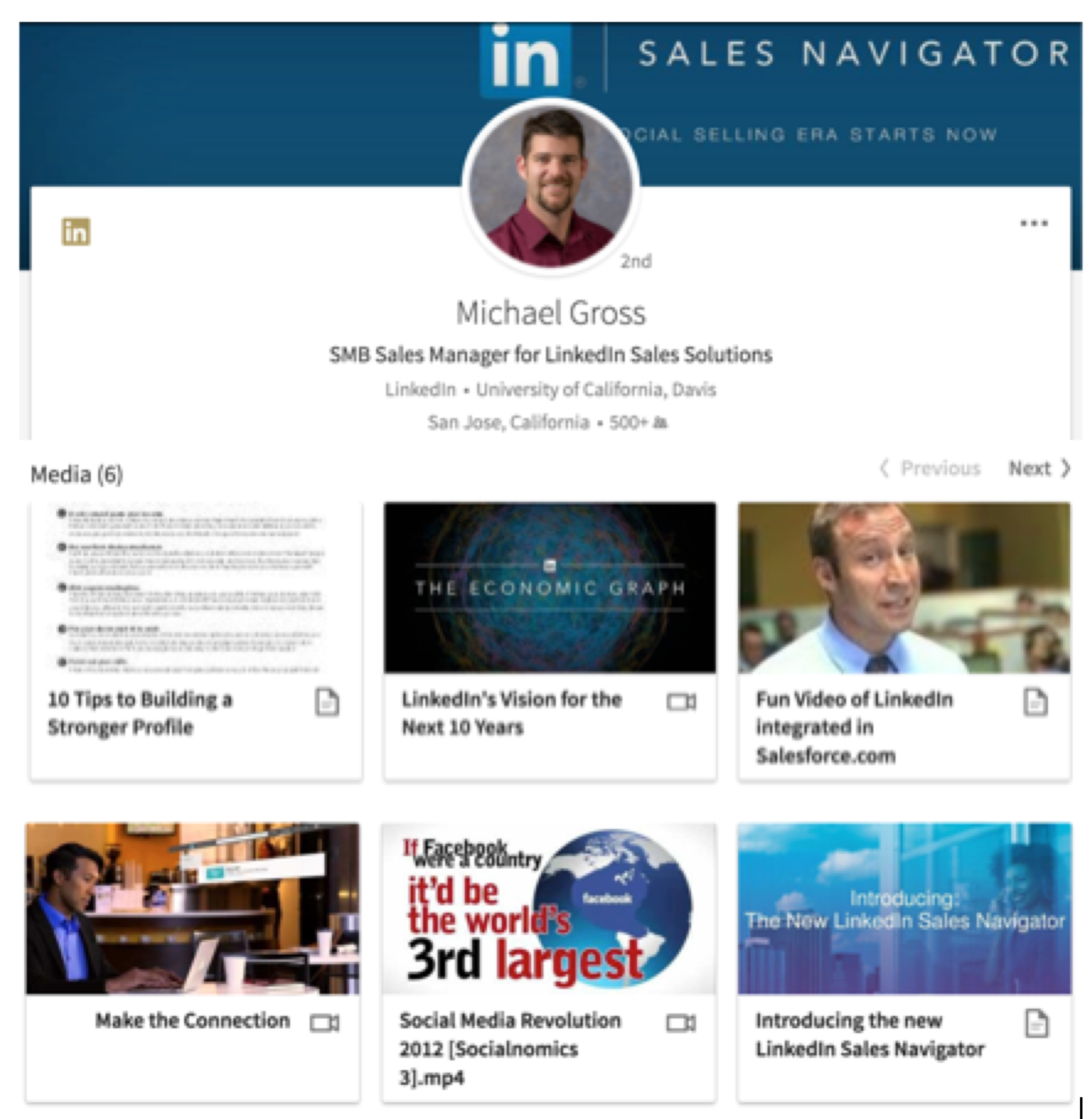
In today’s highly visual world, multimedia content can further help your profile shine. Consider including videos that your company produces about topics of interest or ones featuring you discussing top-of-mind issues and trends. Or you could post testimonials explaining how your company helped customers overcome challenges and achieve their goals. You could even showcase your unique professional story by uploading SlideShares that walk prospects through a compelling before-and-after scenario, or present thought-provoking ideas. By taking advantage of multimedia in your profile, you increase the likelihood of attracting more attention and more sales opportunities.

  • linkedin-profile-example-sales-navigator

Magnify Your Reach

Because prospective buyers often spend time on more than one social channel, it’s smart to branch out. The good news is that integration between LinkedIn and Twitter makes it easier to share the information and content you post on LinkedIn. By adding a Twitter account to your LinkedIn profile, you can share LinkedIn updates to your Twitter account.

Because you only get 160 characters for your Twitter bio, you need to concisely craft a description that conveys your experience and value. Make it focused yet enticing to those you are trying to attract and engage. Here’s the Twitter profile of my colleague Derek Pando (below). I like this example because it nicely captures Derek’s personality and approachable nature. 

It’s also helpful to share which topics you’re interested in so that people know why they should follow you and what to expect as a result. If people want to learn more about LinkedIn Sales Navigator, technology, product marketing, or maybe even waffles, they can see that Derek is a relevant person to follow.

You can also create and register a custom hashtag that will help people identify you more easily. For example, social selling and personal branding expert Mario Martinez Jr. uses #dontdonormal on Twitter.  Using a hashtag in your Tweets can help you grow your personal brand recognition. Hashtags are also clickable, making it easy for prospects to quickly find all your Tweets on a specific topic.

Conclusion

Remember, it’s in your control to shape your social brand. Your social profiles are the foundational elements of that brand. Once those are in place, activate the power of social selling by staying engaged, measuring the impact of your efforts, and experimenting with new ideas and approaches to drive better results over time.

Learn how to stand out in a competitive landscape. Check out How Personalized Selling Unlocks Competitive Advantage.

08 Feb 16:55

Sales Consultants: Your World Is in for a Seismic Shift in 2017

by Bsignorelli@hubspot.com (Brian Signorelli)

hubspot-sales-partner-program.jpg

Ah, the good old days of sales. Open the phone book or buy a list, start calling, talk to prospects, book meetings, and make the sale. Rinse and repeat. Top sales reps become managers. Top managers become executives. Then, some venture into entrepreneurship and start their own sales coaching, training or consulting business.

In the past, a sales consultant’s primary emphasis was to train people. In the future, there will be fewer humans involved in sales. Top performers will be the ones who leverage software.

Are you a sales consultant or CRM implementation company? Check out HubSpot’s brand new Sales Partner Program.

If sales consultants cannot incorporate these tools into their training, they also risk becoming obsolete. However, the opportunity has never been so immense -- global CRM spending is predicted to hit $40 billion in 2017. While shifts in technology disrupt existing consulting businesses, they’re also an immense opportunity for the companies who are proactive.

1) Buyers will stop picking up the phone

It’s more challenging than ever before to engage buyers one-on-one. Only 2% of cold calls convert into an appointment. People want to purchase without talking to a human. Yelp has changed buyers’ dependency on and trust of third party reviews. Amazon has changed buyers’ expectations for a streamlined checkout experience. B2C commerce has transformed buyers’ comfort level of purchasing products and services without talking to humans (think: Blue Apron, Spotify, Casper Mattress).

Forrester predicts that one million B2B sales people will lose their jobs to self-service eCommerce by 2020, accounting for 20% of the B2B sales force. They also predict that more than 80% of the buying process is expected to occur without any direct human-to-human interaction. Sales jobs will be fundamentally different in a decade because they’ll have to be less reliant on phone calls.

2) “Try before you buy” is the new industry standard

Dropbox’s freemium model is a great example of “try before you buy.” Individual users can try the cloud storage software for free -- they don’t need permission from IT or sign a lengthy contract to get started. The initial user tries it, likes it and shares it with another colleague, who also tries it for free. Before you know it, a handful of people at that company are using the product. Now, Dropbox has a compelling case for selling an enterprise deal to that company because a bunch of users have already tried it out for free and loved it.

Uber has also seen high growth by using low-risk trials to capture new customers. By giving away $20 in free credit for every new user, Uber discovered a way for consumers to try their service for very low risk. This incentive removes any barriers to trying out the app.High-growth companies have learned to add value before extracting value. This is the new normal.

3) The line between Sales and Marketing is blurring

The line between these two teams is dissolving because of sales enablement -- the technology, processes, and content that empower sales teams to sell efficiently at a higher velocity. Automated prospecting has made it possible for salespeople can come to work in the morning and have calls already scheduled through marketing automation and meeting scheduling tools. Now that marketing can tie their work to revenue, that line is becoming even more blurred.

Content is now being created by more than just marketing teams. It’s more broad than simply ebooks, webinars and white papers. Content -- email templates, product demo decks, case studies and competitive intelligence briefs -- is created by sales enablement and sales teams. Global investments in content marketing are expected to surpass $300B by 2020. In fact, 40% of content is created by sales.

4) The sales acceleration software industry is exploding

The more money companies invest in their technology stack, the more they need experts to guide them through the sales acceleration tool jungle (see below). Think about it -- would you really want to risk thousands of dollars and navigate this landscape alone?

(click for larger size)

inside-sales-landscape.png

Source: Venture Beat

Twenty years ago, software selection was limited, clunky, and took a long time to implement. Fast forward to present day. It’s lightweight, almost effortless to implement, and in many cases free. That means sales consultants are not as essential for the same reasons they once were. They need to rethink their pricing model. Big, bulky projects for tens or thousands of dollars, are undeniably on the endangered species list.

Instead, buyers demand that consultants and CRM implementers evolve from “doers and technologists” to “advisers and strategists.”  The silver lining is that a consultant's service engagement should transform away from expensive one-time implementation projects and instead, towards monthly, predictable recurring revenue streams.

5) Businesses will finally figure out they need to train their people

Companies can’t simply buy more technology to solve a problem. Sales organizations spend an average of $4,797 per quota-carrying rep on enablement technology annually, according to CEB Global. Yet, 40% of sales reps miss quota. Throwing money at a problem won’t fix it.

According to InsideSales.com and the AA-ISP, sales managers have complained about the exact same issue -- training and development -- for three years running. If sales consultants can figure out a way to bolster in-person training with technology, the opportunity will be massive.

Screen Shot 2017-02-07 at 12.09.35 PM.png

Source: Inside Sales

This week, HubSpot launched our Sales Referral Partner Program. It’s designed for sales consultants, sales coaches and trainers, and CRM implementation companies who want to evolve their company to keep up with all the changes laid out in this post. The program includes industry-leading sales technology for you and your clients, and on-demand educational resources to teach how to market, sell, and deliver modern sales services. You can learn more here.

08 Feb 16:53

3 Empowering Techniques to Help Your Sales Team Sell More

by SalesDrive, LLC

3-empowering-techniques-help-sales-team-sellWhether you have a sales process in place or you are simply looking for a way to improve your sales team’s performance, there is always room for growth.

Many struggling teams use the same sales techniques over and over again and expect different results.

But if you really want to break out from a sluggish sales streak, you may want to consider shaking things up.

Here are a few ways to accomplish that while empowering your sales team to sell more.


3 Ways to Increase Your Team’s Sales


1.   Warm Calling

Though it may be effective under certain conditions, cold calling can be a dreadful experience for your salespeople and the people they are trying to sell to.

Instead of asking your reps to call someone whom they have never interacted with before, have them reach out to leads that have been properly nurtured.

Why is proper nurturing important?

Because research shows that sales reps have a 20% higher sales rate when dealing with nurtured leads, as opposed to non-nurtured leads.

Here are two effective methods for nurturing leads before warm calling:

1.Use social media. You can improve your chances of selling your products or services by contacting someone who has followed you and shown interest in your company through social media. Working closely with your marketing team can really help you maximize your results.

2.Email marketing. Email marketing is much more than creating a generic email campaign that goes out to all of your subscribers. It includes segmenting your email lists and targeting the right segments with relevant content to ensure a more personalized sales process. Again, working with your marketing team is crucial here.

Once a lead is properly nurtured, calling them is no longer a cold and impersonal experience. Your salespeople can now truly connect with your customers and show them the value that your company can provide to them, thus improving their chances of making a sale.


2. Utilization of Visuals

 visuals-empower-sales-team-sell-moreWhen it comes to making a purchase, people are highly visual creatures.

In fact, visual appearance is the key factor in purchasing decisions for 93% of consumers.

With that in mind, you and your reps definitely want to provide a visual experience for your leads before trying to close a sale.

Here are a few visual tools to help improve the sales process:

  • Product samples. If your sales reps have samples they can give out or have a way to demo your service, make sure that they do. According to one survey, 53% of people who interact with a product or service beforehand end up making purchasing it.
  • Product or service catalogs. One report explains that customers who receive a catalog spend up to 150% more than those who do not receive a catalog first.
  • Short product or service videos. According to Invodo, 52 percent of consumers say that watching a quick product video can influence them to make a purchase.
  • Visual presentations. Presentations (think PowerPoint) offer your reps a way to share product or service information as well as compelling visuals with your leads. When combined, they can help tell a story that shows how your company can provide value to a customer.


3. The Art of Storytelling

Storytelling is not just for children or around the campfire—it is one of the most powerful sales techniques available to salespeople.

Why are stories so effective?

Incorporating storytelling into a sales pitch is important because:


1.People forget facts and statistics, but they remember stories

Whether it is a story your parents used to tell you as a child, or your favorite book or television show, you probably still remember the story.

And when your reps incorporate a story into their sales pitch, they can develop a connection with prospects and motivate them to make a purchase.

One reason this works is because stories allow a listener to retain more information.

In fact, after a presentation, 63% of attendees remember stories, while only 5% remember the statistics that are shared.

If your customers remember the stories that your reps are telling, that means they are keeping your company in mind.

This is especially important since your sales reps may have to repeatedly be in contact with a lead before they make a final purchasing decision.


2.Stories pair logic with emotion

Numbers and statistics are great to have on hand when your sales team is pitching leads.

But just having the facts and figures is not usually enough to close a sale.

When your reps pair storytelling with those numbers and features, they can appeal to both a customer’s logical side and emotional side.

This is significant because emotions play a huge role in a customer’s purchasing decisions.

Stories have the ability to stir memories and emotions, which can build a connection with your brand.

If a rep can paint a story that takes customers on a journey in which they see how your products or services can help improve their lives, your customers are more likely make a purchase.


3.Stories can be molded to each customer’s needs

Stories are a powerful sales technique, but the sales process is not finished at the emotional connection.

A story must be relatable and appeal to a customer’s needs to be truly effective.

Here are a few storytelling tips that will help your salespeople retain a customer’s interest:

Keep the story concise. Time is money for you and your customers, thus your reps should not bore the lead with a long-winded story. Keep it short, sweet and directed toward the value of your company’s products or services.

Return to the customer. Whether it is a personal story or a story about how your products or services helped another customer, make sure it ties back to the lead. Throughout the story, a lead needs to feel like they can relate and see why they need to buy from your company.

Add some humor. No one wants to hear a dry-as-dirt story about something mundane that happened in your rep’s life. The story should have some personality and even a little humor to lighten up the mood. But make sure they do not go overboard with the jokes.

Paint a picture. Your sales reps should focus on painting an image with words. It does not have to be flowery by any means, but it helps if a lead can imagine what is happening in a story. If a customer can see themselves in a similar experience, they may feel a connection that will help influence their decision to make a purchase from your company.


Final Thoughts

 appeal-emotions-customer-improve-salesThere are countless methods for selling a product or service but at the end of the day, some of the most effective techniques involve appealing to the emotions of a customer.

Further, a sales rep should be able to focus on a customer’s needs and show how your company can help solve the customer’s pain points.

Whether it is through warm calling, visuals or storytelling, your sales reps should try to form a genuine connection with a customer in order to successfully reach their sales goals.

The post 3 Empowering Techniques to Help Your Sales Team Sell More appeared first on SalesDrive, LLC.

08 Feb 16:53

5 Steps to Create a Deliberate Word-of-Mouth Sales Referral Program

by colleen@engageselling.com (Colleen Francis)

word-of-mouth-sales.jpg

Word-of-mouth marketing is one of the most powerful tools in sales today, and yet, it remains deeply misunderstood and underused.

In my extensive sales training work in North America and abroad, even when I’m working with highly experienced professionals, I find many can’t fully explain word-of-mouth, how to create it, or why it works. Even when they’ve previously benefitted directly from it, they struggle to identify how it even happened in the first place. All they know is that word-of-mouth exists and that it’s important to have.

That’s a deeply unsatisfying answer.

Like all aspects of marketing, word-of-mouth isn’t something that just happens. It’s the outcome of a series of deliberate steps designed to produce an anticipated outcome. Remember: There’s no such thing as an "accidental" network in marketing.

Word-of-mouth is only meaningful if it’s something you create for yourself. Otherwise, it’s just a matter of chance or luck. And luck comes and goes. Your business and professional career deserve better than that.

When people who have worked with you are saying great things about the experience, you need to have a thorough understanding of:

  • who is talking;
  • what they are saying;
  • why they are saying it; and
  • how you can amplify that message. 

Building on what we have previously covered in developing insider status with your clients, let’s look at how to build a deliberate network within your sales territory, and create the ideal conditions for word-of-mouth to thrive. 

How to Build a Word-of-Mouth Sales Referral Program

1) Define what word-of-mouth means to you. 

You want your best customers to be telling your story, so your word-of-mouth strategy must be focused squarely on them. They're the "mouth" part of your word-of-mouth efforts.

Next, think about the specific "words" they'll be sharing. When selecting those top customers, identify the core benefits that you deliver every time. Those benefits are what you want them to be talking about. Consider writing case studies or invite them to provide testimonials that highlight these key benefits. 

2) Be in the right places.

Being ubiquitous is just one component of a word-of-mouth strategy. You can’t create momentum unless you show up regularly. And even then, there’s no point in creating word-of-mouth among the kinds of customers that are a bad fit for your business. Choose the right locations, focusing on your target audience.

Keep in mind that this entails managing your brand socially as well as professionally. If your marketplace is the same one you live in, recognize that your buyers are forming opinions about you when you’re off the clock -- at your kid’s soccer game, at the grocery store, or at the bar on a Friday night.

3) Eliminate friction points. 

It should never feel like work for your best customers to find and contact you. Otherwise, why would they recommend you to friends?

Assess the channels through which people can reach you. Do you have a succinct email address? Are you searchable by name on LinkedIn, Twitter, and Facebook? Do you have multiple phone numbers that all route callers to voicemail, or do you have a single hotline number that leads to a live person?

If you’re a smaller business, does your website have a clear call-to-action that puts your reader in direct contact with you with minimal effort? If you’re part of a larger operation, are there gatekeepers or other stumbling blocks that prevent people from reaching you directly? Eliminate every friction point possible. 

4) Be an authority. 

If you want your best customers to recommend you, don’t just rely on the great buying experience you deliver each time. Give them a reason that goes beyond the buying process. Prove that you’re an expert in your field.

How should you do this? Speak at industry events. Write and produce how-to videos and blog posts. Be sure to not overlook local business events, as well as university and college seminars.

For many years, I was the invited guest lecturer at the end-of-semester sales management class at a local college. I was the last person these new graduates talked to before they went on to their careers in sales. 

5) Serve first, then sell.

When you put yourself out there as a trusted authority, be clear about your motivation. Be there to serve people -- to help them with their problems. Be the leader they’ve been searching for. Selling should always be secondary. If your motivation is backwards, people will know and you’ll repel rather than attract.

Consider doing some pro bono work. Just make sure you're doing it to make a difference -- not to secure leads. Otherwise people will see right through you.

And serving people with a genuinely generous spirit means being prepared to lead by example. Offer your network of referrals for professional or personal services. The best sellers are quick to say “You should meet … ” and then introduce their current client to a new potential one. Help others first. That is how you help yourself. 

Word-of-mouth is a deliberately formed network. You must choose it for yourself and you must foster it to give you the results you need so that your business can thrive. Following the steps I’ve outlined, you will be creating the ideal conditions for word-of-mouth to take root and grow at your business.

HubSpot CRM

08 Feb 16:53

Struggling to Recruit Amazing Sales Reps? Here’s Why

by Mathilde Patmon

Finding top sales talent is not a battle — it’s a war. Consider Axon, the Seattle-based business that bought Teslas for new employees to incentivize interest in their company. While extreme, this shows the need to differentiate your company to attract and retain top talent.

This means discovering candidates who not only align with the culture that you work so hard to create, but who can also bring in revenue. So, what are some of the top-of-funnel things that you can do to find the best candidates and make sure they choose you? Here are 3 crucial steps.

1. Limit Your Wish List

We all want a salesperson that crushes their quota, knows the exact sales methodology that your company uses, is an expert in your industry, has great charisma, can hit the ground running without training on day 1 and accepts the compensation package that your company is offering. Unfortunately, unicorns are difficult to find.

It’s great to have high expectations for people you want to bring in. However, it’s important to find a balance between reality and excellence. Therefore, it’s really important to focus on three main skills (once you’ve found a solid resume) that you are looking for so that you are not diminishing your chances of finding great talent. A great start for defining those three main skills is looking at your company values.

Here are examples of core values from successful tech companies in the Silicon Valley and how they could potentially fit into your wish list:

Critical Thinking: This is pretty self-explanatory. However, if you want a little extra push on how to identify if someone is a critical thinker you can use the following habits explained in the Eight Habits of Effective Critical Thinkers.
– Candidate is more concerned about getting it right than being right
– Candidate avoids jumping to conclusions and rushing to judgment
– Candidate does not accept information at face value
– Candidate avoids over-analysis which leads to paralysis in decision making
– Candidate is a continuous learner and works to stay well informed
– Candidate shows willingness to consider alternative ideas and opinions
– Candidate uses critical thinking on him or herself
– Candidate has a distinctive behavioral style

“Don’t be Evil:” This is one of Google’s well known core values. What they mean is that they are looking for someone who will put long-term gains and user satisfaction above short term profits. In a nutshell, it’s to check someone’s “moral compass.” The way around digging deeper into this is by asking interview questions like, “Describe a situation where you did not agree with what the outcome was and what you did about it.”

Passion: When you bring in a candidate, you want someone who is so passionate about what they do that it becomes infectious to others around them. This is someone who gets excited about celebrating their own wins as well as others, and is someone who always strives for excellence. You can dig deeper into someone’s passion by asking them to share something that they really care about and having them explain it to you.

2. Send Effective Recruiting Emails

sf_office_bpawlik-0766

Salespeople receive an overwhelming number of emails from recruiters. Make sure your first one is memorable so that they do not ignore all future emails from you. Whether you are using your work email or social media to reach out, keep the following in mind:

Keep it vague. The second you put the position in your first outreach email, you will decrease the response rate because the candidate will feel pigeon-holed into that role. It’s also a possibility that their resume says one thing but in reality their job function is different. For example, industry standard for an AE is a salesperson that does the full sales cycle with help from BDRs and/or SDRs. However, some companies use this term for people in marketing, while others use it for account managers. Therefore, there is a certain degree of assumptions to be made based off a LinkedIn profile, but there is always more to the story.

Keep it short. Salespeople are high in demand and are probably receiving a dozen emails from recruiters and managers each week. The longer your outreach the higher the chances are that the rep will not read it. The average attention span is about 8 seconds, so make it count!

Customization. Make sure the subject line is customized. How many times do you see “High Growth Tech Company Looking for Sales” or “Best tech company to work for”? The more you can customize your outreach the higher your response rate. We’ve seen a 10% jump in response rates on LinkedIn when just the subject line is customized. Imagine the impact once the body is customized as well!

Timing. I’ve found the highest conversions to my outreach campaigns to be in the morning between 7am and 9am.

Be original. If you can have your CEO or VP of Sales send outreaches to key candidates it can really help jump the response rate. This not only shows how impressive the candidate’s background is because the CEO sent them an email directly, but also that senior leadership is really invested in bringing top talent into the company.

3. Remember That Finding a Good Match Goes Both Ways

We always talk about how the candidate needs to conduct themselves during the interview process. However, it’s also important to hold ourselves accountable as recruiters and managers to making the whole experience a positive one. This is not only about us finding our next sales superstar, this is also about the candidate finding their next dream workplace where they can not only utilize their current skills but grow as well.

Here are some of the ways that you can hold yourself accountable:

Be engaged even if it’s going south. It’s not uncommon for hiring managers to be disengaged during an interview when the candidate is not a good fit, but it’s important to remember that as a company you have a brand name and reputation to uphold (no one wants a negative Glassdoor review that can damage the company’s integrity). Therefore, still being engaged during the interview even though you realize the candidate might not be “the one” and providing constructive feedback when it’s over can help soften the blow and uphold a positive company perception.

Always give constructive feedback. 94% of talent wants to receive feedback after an interview, but only 41% have received interview feedback before. Whether it’s positive or negative, providing constructive feedback post-interview will help you stand out.

Don’t move meetings or be late. Candidates are typically interviewing with multiple companies at the same time. That one reschedule can result in them getting an offer with someone else – and the candidate accepting it, too.

For an amazing final touch: If you find your superstar candidate and give them an offer, have your team send the candidate a congratulations email expressing their excitement for them to join the team. This is a great way to make the candidate feel special. Bonus points: have your CEO or VP of Sales send one as well.

Don’t let the talent war discourage you. While hiring a good salesperson is practically as competitive as sales itself, following these three tips is sure to put you in a good spot.

07 Feb 18:15

Why Alberta remains an energy investment magnet even without the oilsands

by Peter Tertzakian

Canadian rigs are going back to the field, coaxed by higher commodity prices and greater productivity. Across the land, 345 iron masts were turning bits last week, so the year-over-year rig count is up by almost 50%.

But where are they drilling?

The pick-up has been seen mainly in Alberta, somewhat in Saskatchewan and not so much in British Columbia.

The Western Canadian Sedimentary Basin (WCSB) blankets an area twice the size of Texas and mostly underlays these three provinces. More like a rumpled blanket, the rocks underneath the WCSB hide all sorts of hydrocarbons, from natural gas, to condensates, to light oils through to the heaviest, most viscous energy commodities.

B.C. has mostly natural gas. Saskatchewan has mostly oil. Sandwiched in between, Alberta has a smorgasbord of everything, including the contentious oilsands, which is a separate category of resource development.

Depending on commodity prices, fiscal terms, regulations, technology, accessibility, infrastructure and many other factors, the emphasis of oil and gas development shifts geographically over time.

ARC Energy Research Institute

The first thing to note is that the spending bias in the Canadian oil and gas industry is tilting away from the oilsands after a 10-year uptrend. For 2017, only one-third of the $42 billion in expected capital expenditures will be spent within the environs of Fort McMurray. It’s still a lot of money, but the spending bias is moderating after years of attracting elephant size investment (and whale size attention).

New investment dollars are leaning back toward natural gas, liquids and light oils in the traditional WCSB. Ground zero for renewed oil and gas activity is now in places like Fort St. John in B.C.; Grande Prairie in Alberta; and Estevan in Saskatchewan.

Why is Alberta getting the lion’s share of drilling activity, up over 200 per cent? The answer: Because like a lion the province’s resources have scale. Even after excluding the oilsands, over 44 per cent of the WCSB’s potential oil and gas reserves lay within its political borders.

ARC Energy Research Institute

And Alberta has the most diversity of hydrocarbon types too. So there are plenty of “source rocks” that can be tapped. Which rocks to choose at any one time depends upon the prevailing factors mentioned earlier. Right now the west central and northwest parts of the province are showing tremendous productivity improvements with new drilling and completion processes (see last week’s blog). Technology and innovation do amazing things for the entrepreneurial mind (so does a prolonged price crash). All of sudden much can be developed at US$50 per barrel or better.

Saskatchewan has easy-to-access, light oils that are relatively shallow. It also has the lightest royalty burden of the three jurisdictions. But the prairie province lacks Alberta’s scale and there is a limit to the amount of annual spending it can absorb. Nevertheless, on a percentage basis there are twice as many rigs working in this first quarter as compared to the same time last year and process improvements are likely to drive the count higher yet.

Northeast British Columbia is rich in natural gas and the productivity numbers for bringing it out of the ground suggest that some of the rocks are better than any in North America. Above ground, continental gas prices are better than last year. So why is the rig count no better in BC than last year?

In some way, B.C.’s story is too good. Localized natural gas prices are prone to big discounts due to constrained takeaway capacity in full-up pipelines. While oil gets the headlines, B.C.’s natural gas currently shoulders the real “market access” problem.

But there is another story brewing in B.C.. Recently, high-productivity light oils are starting to turn heads in select areas around Fort St. John. Although the rig count isn’t showing much improvement over last year at this time, don’t count out B.C. yet – the province may shed its reticence to oil once they realize they may actually have quite a bit.

Finally, rig count is a misleading metric when it comes to production growth. Modern rigs drilling on multi-well “pads” are twice as productive today, drilling longer wells, compared to only a couple of years ago. So today’s 100 rigs working is like at least 200 in 2014.

Yes, Canada’s oil and gas industry is rebounding. But it’s not just a business-as-usual rebound. This one rebound has many positive aspects for all three provinces.

Peter Tertzakian is chief energy economist and managing director at Calgary-based ARC Financial Corp.

07 Feb 17:27

How to Build a LEGO Station

by Contributor

How to Build a LEGO Station: A DIY tutorial

Hi. My name is Uncle David. I am the proud uncle to my 8 year old nephew, Kai. One of the most rewarding aspects of being an uncle is helping my nieces and nephews solve problems. Last year, Kai had a big problem. Kai only had a few hundred LEGOs and he wanted a lot more LEGOs for Christmas. I knew how busy Santa would be during the holidays so I left nothing to chance. It was up to me to save Christmas for Kai. On Christmas morning Kai got a huge cardboard box from me and guess what was inside? Forty pounds, or about 9,000 LEGOs! Yes, Kai was a very happy nephew last Christmas but what I didn’t expect was the following problem. As the days and weeks wore on all those LEGOs went untouched in that huge cardboard box. My nephew was overwhelmed and he let his LEGOs sit in his bedroom until I could fly out this holiday season to solve another problem. I knew what I had to do for my nephew. I had to build Kai a new LEGO station.

Materials:

・IKEA Trofast Frame
・9 X IKEA Trofast Storage Boxes
・IKEA Bosnas Ottoman with Storage
・IKEA Harte LED Work Lamp
・IKEA Ekby Jarpen / Ekby Bjarn​um​ Wall Shelf
・2 X 4 IKEA Rill Casters
Toydozer
Box4Blox LEGO Sorter
Akro-Mils 10724 24 – Drawer
・P-Touch Label Printer
・3 X Grey LEGO Base Plates – 15″ X 15″
・3 X Two-by-Four’s cut to 15 7/16″ long
・8 X 1″ X 1″ Corner Braces
・2 Part Epoxy Glue
・Drill
・Drill Bit and Phillips Head Screw Bit
・Utility Knife
・Sand Paper
・Rubber Mallet
・1″ wide Blue Painters Tape

I did my homework and I found a beautiful and simple solution using IKEA’s Trofast frame. Perhaps it’s difficult to believe but I have never assembled a piece of IKEA furniture in my life. Kai’s LEGO station would be my first but, before I started, I read many different articles and gathered many tips. In this article I want to share with you ​detailed​ instructions on how to build a LEGO station and to inspire parents, aunts and uncles, and other family members to build their own for their loved ones. It is easier than it looks.

LEGOs in TROFAST bins

First, have a discussion with your little one and ask them how they would like their LEGOs organized. We decided to​ ​organize Kai’s LEGOs by color and focus on classic LEGO bricks instead of the more involved custom sets. After, it was up to me to sort the LEGOs and I highly recommend getting the ToyDozer before starting. Even on thicker carpet the ToyDozer had no problem scooping up large amounts of LEGOs down to the smallest pieces and it made the job of sorting LEGOs far faster and easier than using my bare hands. I knew the ToyDozer would help Kai clean up his LEGOs too and it fits nicely in a Trofast storage box.

Drawer sorters Akro-Mils 10724 24-Drawer

For the specialty pieces in Kai’s LEGO collection I purchased the Akro-Mils 10724 24-Drawer. This is a staple storage solution for all the folks at LEGO and works brilliantly. The drawers are large enough for most small items but not too large so little space is wasted. It also comes with drawer dividers to organize each drawer into two sides if desired. To label the drawers I used a P-Touch with clear tape. One tip is, before sticking each label on the drawer, eyeball between the letters of your label to find the center and then line the label on the center of the drawer. My nephew and I divided up the drawers into the following categories: Wheels, Trees, Ladders, Windshields, Windows, Doors, Fences, People, Steering Wheels, Motorcycles (his favorite), and Clears (for those colored see-through LEGOs that are useful as sirens and lights). We also made a Random drawer for those odd pieces we could not find a place for.

Now to the heart of the project, building the LEGO station using IKEA’s Trofast frame. Using a cordless drill with a small drill bit and a phillips head screw bit is a must. My number one pointer is to not over tighten the screws on the ​somewhat fragile ​Trofast frame.​ ​(IKEA also sells a solid pine version of the Trofast frame if desired.) It’s helpful to use a rubber mallet also. I followed the supplied instructions and the frame was assembled rather quickly.

RILL casters at the base RILL caster

Once the frame was assembled it was time to add the wheels. I decided to use 6 wheels instead of 4 wheels that I’ve seen on other hacks. (More wheels help the Trofast unit roll easier over carpeting.) After, I went to my local hardware store to purchase a long 2 X 4 plank of solid pine. I made sure the wood was straight and dry from end to end. I had measured the interior width of the Trofast frame and had the hardware store cut 3 pieces of wood to precisely 15 7/16 inches long. I thought I was crazy at first but, when I got home and placed the wood in the frame, it was a perfect fit.

I then placed IKEA’s Rill Casters 2 inches in from the ends of the wood. I pre-drilled small holes for the screws and used 2 Part Epoxy to glue the casters to the wood for extra strength. Next, I glued the wood planks to the Trofast frame. I used blue painters tape to mask around the edges on frame where the wood would be glued down. After, spread the glue on the frame and then set the wood planks in place. Remove the painters tape and reinforce the joinery with the corner braces.

Grey LEGO base plates

The next step is to cut and glue the grey LEGO base plates to the top of the Trofast frame. First, align and place two of the grey base plates at both ends of the frame where there is a raised lip, leaving the middle space empty. Take the third base plate and set the left edge against the right edge of the baseplate on your left. The middle plate will overlap the the baseplate on your right. Where the middle and right base plate overlap mark the intersection with the edges of long LEGO bricks from top to bottom in one continuous line. After, with your utility knife, score and cut along the line of the baseplate using the LEGOs as a guide. It will take several passes for a clean cut. To finish up the edge, sand it lightly for a smooth finish.

You will now have three baseplates that will fit edge to edge perfectly on top of the frame, one baseplate narrower than the others. It’s time to glue the baseplates down. With blue painters tape, frame the outside edges of the top with the tape. Once taped, check to make sure the three base plates nestle within the taped lines perfectly. Adjust the tape if necessary. Mix and spread the 2 Part Epoxy thinly and evenly covering the entire top surface of the frame using the blue tape as a mask to keep the outside edges clean. Before placing the baseplates on the glued top, lay out all three baseplates side-by-side. To ensure that the seams between the plates are a perfectly spaced use several LEGO bricks once again but attach the LEGOs over the seams locking the 3 baseplates together. Center all three locked LEGO plates on the glued top. Once the LEGO plates are centered remove the blue tape around the baseplates. Leave glued baseplates to set before removing LEGO bricks to prevent shifting.

​The next step is to hang the ​IKEA Ekby Jarpen / Ekby Bjarnum Wall Shelf. I chose this shelf because it matches the Trofast frame but also because it has a 7 1/2 inch overhang. It’s deep enough to hold the Akro-Mils Drawer but not so deep as to interfere with play. Perhaps my favorite find for this project was the IKEA Harte LED Work Lamp. The lamp is small, maneuverable, and looks like it was made for this LEGO station. To gauge the height of where to hang the shelf, I placed the lamp on the LEGO table and then measured and hung the wall shelf 3 inches above the top of the lamp. It allows the lamp to be used freely under the shelf but keep the shelf within arms reach of the drawers above.

I finished off this project with IKEA’s Bosnas Ottoman with Storage. I used the ottoman as a seat for my nephew and the cushioned top is quite comfortable to sit on for long periods of time. The fact that the fabric is removable and washable is a plus. The ottoman also does double duty as storage for the all-important Box4Blox LEGO sorter.

Ottoman for the Box4Blox sorter

Harte LED lamp

Along with the ToyDozer, the Box4Bloxs aids in keeping LEGOs nice and neat. It consists of four plastic colored trays separated by grids.To use the Box4Blox you remove the lid and load the LEGOs onto the top tray. You then shake all four trays gently together and the LEGOs are separated, from large to small, through different sized grids between the trays. It’s a clever device and my nephew has fun sorting and searching for particular LEGOs.

I have one more tip about keeping your LEGOs organized. Even though Kai and I have decided to concentrate on building a LEGO station centered around classic LEGO bricks, he does have a couple of LEGO sets. We agreed that the best way to organize these sets is, if built, just leave them assembled. If you have to take the set apart, store all the pieces with the instruction booklets in separate plastic zip-lock bags. This way all the LEGO parts will be together with the instructions in one place. We dedicated a drawer in the LEGO station to store the ToyDozer and the LEGO sets.

How to build and organise an IKEA TROFAST LEGO station

Now that Kai’s LEGO station is complete, it’s time to play with LEGOs. Kai was thrilled that I had taken forty pounds of LEGOs and organized them in way that is simple for him to use. There are no boxes with annoying latches nor lids to get in the way. Just as important, the LEGOs can easily be sorted, cleaned up, and put away. With this project at an end I hope it marks a new beginning for my beloved nephew. Here’s to Kai exploring the deepest corners of his imagination and to dreaming about the possible and impossible. For his first project at his new LEGO station, I asked Kai if he would build me something special. His response was epic. Godzilla vs. the LEGO People, complete with an outdoor refrigerator in case anyone got hungry. Grrrrr…

~ David


How to Build a LEGO Station: A DIY tutorial

The post How to Build a LEGO Station appeared first on IKEA Hackers.

07 Feb 17:18

9 Secrets of Prospecting Emails That Convert to Real Business

by marc@MarcWayshak.com (Marc Wayshak)

prospecting-emails-convert-real-business-340076-edited.jpg

Prospecting by email can be challenging -- and unrewarding. After sending thousands of emails and receiving only a handful of responses, many salespeople give up entirely. But instead of resigning yourself to getting sent to spam, it’s time to take a hard look at your ineffective prospecting emails and figure out what they’re missing.

High-level prospects are bombarded with hundreds of emails every day. It’s no surprise that your sales emails need to be crafted with care if you want your recipients to open, read, and respond to them.

The following nine strategies are used in prospecting emails with the highest response rates. If you want your prospecting emails to convert to real business, implement these powerful secrets to dominate your competition in sales.

1) Present your email’s value up front.

Most email platforms display the subject line and first sentence of every new email. As your prospects scroll through the day’s new messages, will they recognize the value of your email right away? If not, you’ve got a problem. Present your email’s value up front by crafting a compelling subject line and first sentence that directly state the value your email brings. For example, if your email tells prospects about a new marketing tool your company offers, then tell them so. Or if you’re emailing them a free ebook with tips to help them reach their business goals this year, make sure that’s explicit.

For more on this email strategy and others like it, check out this video:

2) Never use a salesy subject line.

Writing salesy subject lines is a common prospecting email mistake. It’s also one of the easiest ways to sabotage the success of your sales emails. When your emails have promotional subject lines, their chances of being opened plummet dramatically. Instead of resorting to hype and showmanship to get your prospects to click on your emails, remember to simply present your email’s value in clear, powerful way. Be truthful, genuine, and compelling -- not salesy.

3) Write like a friend -- not a salesperson.

If you want to write sales emails that prospects actually read, they don’t need to be shining examples of industry jargon, selling tactics, and “formal” business writing. In fact, they shouldn’t be. No need for “sirs” and “madams” -- write to your prospects as if you’re a friend. Focus on coming across as a genuine person who has something valuable to share, and you’ll immediately increase your odds of getting a response. One of the best ways to master this strategy is to practice writing the way you talk. While you certainly don’t want egregious spelling errors in your prospecting emails, don’t edit yourself too much. Try to sound like yourself.

4) Don’t write more than five sentences.

Not only do short, concise messages convey confidence, professionalism, and authority, but they also ensure that your prospects will read your entire email from start to finish. As a general rule of thumb, never write a prospecting email that’s more than five sentences long. If your prospects can read your entire email and respond to you within one minute or less, you’ll enjoy higher response rates than ever before -- and close more sales as a result.

5) Keep every email personal.

This might sound simple, but surprisingly few salespeople take the time to personalize their sales emails. If you use boilerplate copy to email all your ideal prospects, they’ll notice. Instead of beginning with “Hello,” say, “Hi, [prospect name].” Personal touches like greeting prospects by their first name make your emails far more effective. Just think about your own reactions to emails that address you by your first name as opposed to completely un-personalized ones that lump you in with a crowd of potential customers.

6) Do your research before hitting send.

Show your prospects you know more than just their first name. Find their company name, current job title, and any recent promotions, accomplishments, or work events. Social networks such as LinkedIn and Facebook can provide all the information you need. Reference at least two tidbits of personal information in each email you send. You can also demonstrate you’re an expert in their field by researching top trends in your prospects’ market. This approach connects you more deeply to your prospects and increases the likelihood that they’ll respond to your message.

7) Understand the ultimate goal of prospecting emails.

Every prospecting email has the same primary goal: Receive a reply from the prospect. That’s it. If you’re clear about this goal, your prospecting emails will immediately improve. Before you press “Send,” ask yourself: “If I was the buyer, would I respond?”

If the answer is no, go back to the drawing board.

8) Always end with a compelling hook.

One of the biggest mistakes salespeople make is failing to ask a question at the end of sales emails. When you close an email with something vague such as, “Looking forward to hearing from you!” or “Let me know if you want to connect,” prospects have no compelling reason to respond. A specific question, on the other hand, acts as a hook to compel prospects to answer you. Some powerful closing questions include: “Which of these challenges rings true for you?” and “What’s the best address to mail you this free assessment?” Make sure there’s immediate value in giving you a response.

9) Never send emails “just because.”

There’s little your prospects hate more than receiving pointless emails. Far too many salespeople think it’s a good approach to send sales emails “just because.” But would you make a sales phone call if you had nothing to sell? Of course not. Prospecting emails that just “say hi” or “check in” annoy busy prospects with full plates. The last thing you ever want your emails to do is waste your prospects’ time. When you send an email, there should be a valid reason: A new product or service offering, a free assessment or book, a request for mailing address so you can send a sample, or helpful industry insights.

Which of these nine secrets to effective prospecting emails will you start implementing right away? Share below in the comments. And check out this free ebook on 25 Tips to Crush Your Sales Goal for even more powerful sales advice.

HubSpot CRM

07 Feb 17:17

Great Sales Trainers Have These Six Skills

by Ray Caffrey

Let’s start with table stakes.

It is truly an honor to work so closely with Richardson’s facilitators, who in my humble opinion are the very best sales training professionals in our industry. When I think about our team and what it is that makes them “the very best,” a few things come to mind. They are masters of the fundamentals, or “table stakes,” of training, and they are skilled subject matter experts in Richardson’s content and in selling. Here is how I describe our team:

  • They are passionate about their craft, and it shows in their work.
  • They connect quickly and easily with their learners.
  • They create a risk-free environment for learning, and they earn the right to push participants to stretch beyond their comfort zones.
  • They are subject matter experts, and they are skilled coaches who understand the real challenges salespeople face in the field.
  • They model the skills that they teach while also drawing out best practices from the participants in the room.
  • Most importantly, they tailor each classroom experience to meet learners where they are, which ensures the learning is real. Relevance is a critical success factor in the application of learning.

When a facilitator brings those characteristics together in a Richardson workshop, the result is a challenging, relevant learning experience that prepares and inspires sales reps to engage in genuine, customer-focused conversations that result in high-value, needs-based solutions. When that happens, we can reasonably expect that sales reps will begin developing long-term, trusted advisor-level relationships with their customers. They will close more deals, make more money, and provide better service to their customers.

Six Skills for training excellence

To be among the very best in any profession takes hard work and a solid grasp of the core fundamentals, or the “table stakes.” Once you have mastered those, you can set your sights on reaching the next level.

Here are six foundational skills that a sales trainer needs to be successful:

  1. Passion: Great sales trainers are passionate about supporting the success of sales professionals. Passion is emotion, and emotion is a key element to learning and memory. A trainer who is passionate, learner-focused, and has subject matter expertise can lengthen the forgetting curve. A passionate trainer who receives a thank-you note from a participant who applied the learning and had success is a fulfilled trainer.
  2. Relatability: Sales trainers must have an innate ability to connect with and relate to sales professionals quickly and genuinely. Doing so helps foster trust and provides a safe environment for participants to stretch, allowing them to be vulnerable in learning. When a learner feels comfortable trying something different and knows he or she won’t be embarrassed by making a few mistakes, the learning sticks. Mix in some humor and, by the end of a day, solid business relationships are often formed between trainers and participants.
  3. Credibility: Credibility in a sales trainer has two components: successful sales experience and expertise in training. Sales professionals are more receptive and willing to listen to someone who has real sales experience. A great trainer knows what a sales rep faces on a daily basis and can empathize with the pressures of the job. The trainer can, and should, draw on his or her own personal experience to emphasize key learning points and help a sales professional prepare for a selling situation he or she has not yet encountered. Trainers with selling experience anchor the learning in reality. When you blend that with a sound sales training methodology and strong facilitation skills, sales reps receive a deep, rich, and relevant learning experience.
  4. Draws out best practices: Great sales trainers know how to transfer knowledge to learners, and they are also skilled at creating an environment where individuals learn from one another by drawing out and sharing best practices. When a learner attaches a new concept to previous experience, he or she begins generating thoughts on how to apply the concept in the real world. Additionally, great trainers are always learning something new from participants that helps them stay on top of their game.
  5. Learner-focus: Richardson’s methodology is centered on being customer-focused. In the classroom, the participant is the trainer’s customer. Remaining learner-focused is a critical success factor for a trainer. To accomplish this, it is important to take the time to prepare to deliver a tailored learning experience. Good trainers show up for training workshops with an understanding of their learners’ unique selling situations. The very best trainers adjust the learning experience appropriately, from a knowledge and skills perspective, to meet the audience where they are. They know when to slow down or go deeper into content, and they know when to push harder to help all learners achieve at a higher level, stretching them in a safe way. Word choice plays a big role in remaining learner-focused. It is subtle, but word choice can dictate the level of engagement. Great trainers stay learner-focused by using inclusive language, like “we,” “our,” or, “let’s” versus “I.” For example, they will say this:

    “In this activity, our goal is to be sure we …”

    “Let’s practice the skill of prefacing.”

    Instead of this:

    “OK, now I want you to …”

    “Here’s what I want to see …”

    “I always …”

    When a trainer executes a truly learner-focused workshop, participants are left feeling that the facilitator is one of them. We often hear that participants in our programs are surprised to learn that the facilitator wasn’t an employee of their organization. That’s a compliment that demonstrates how effectively our facilitators prepare and focus on customizing the learning experience to meet the needs of the audience.

  6. Classroom Management: Classroom management, sometimes referred to as the mechanics of a seminar, refers to a trainer’s ability to navigate all of the moving parts associated with a training day to deliver a smooth, rich learning experience.Preparation is a critical success factor. It’s important for a trainer to create a plan to accomplish the learning objectives of the workshop. A few things to consider when planning: develop a well-timed agenda; prepare smooth transition statements to move from one learning module to the next; prepare instructions for activities to ensure clarity on roles and to ensure they accomplish desired learning outcomes; and a plan for how and where you might use a story to emphasize a key learning point.And because, as they say, “the best laid plans …” it is also important for a trainer to be able to make course corrections. For example, it may be necessary to accelerate or decelerate the timed agenda based on the needs of the audience or an unanticipated delay. It’s also important to have the ability to resolve a technology glitch and/or minimize the impact of a disruptive participant while also handling all of the “known” moving parts that may be designed into a program. Classroom management is a challenging foundational skill. A great trainer is able to address these things seamlessly while also delivering a rich learning experience.

Learn more about Richardson’s world class sales trainers by contacting us at info@richardson.com or 215-940-9255.


great sales trainers at Richardson


Learn More About Richardson’s Sales Effectiveness System

We build and maintain a portfolio of high quality sales skills assessment tools, building block sales training modules, and the tools and systems to create a sustained and continuous learning experience.

The post Great Sales Trainers Have These Six Skills appeared first on Richardson Sales Training and Enablement Blog.

07 Feb 17:16

Empathy and Interactivity – Forces that will Drive Content Marketing in 2017

by Pratham Mittal

Successful content marketing isn’t about getting leads or generating buzz; it’s about establishing a relationship with your customers. And this can’t be done simply by throwing content at them. Millennials are prioritizing experiences over everything else. 72 percent of millennials prefer to spend more money on experiences than on material things. Same is the case with advertisements. The increasing number of ad blocker installs is not a problem but a symptom.

Consumers are looking for non-intrusive, interactive experiences that add value. And they’d do anything to maintain that including ad blocking, personalizing their social feeds, ignoring popups, and installing spam filters. As marketers we must learn to empathize with them, understand their problems, and offer experiences to address them.

Empathy and interactive marketing are two forces that drive content marketing in the millennial world. 4X as many consumers would prefer to watch a video about a product than to read about it. What’s more? 71 per cent of consumers share information about their experience with their peers and family members. The modern-day marketer, thus, must utilize these forces to take effective brand promotion to the next level.

hubspotresearchvideo

Source – Hubspot

However, with content fatigue at its peak, how do you create unique experiences that help your brand stand out? Learn from the forerunners. We bring you examples of brands who have cracked the code.

Empathy Marketing in Action

Empathy becomes the heart and soul of a marketing strategy when marketers put themselves in the consumers’ shoes. You understand their pain points and deliver tailored solutions. Empathy-driven marketing is fueled with emotions and customer insights, and that is what makes it so powerful. You educate your customers, don’t sell to them. This makes the whole process more involving. It’s all about establishing deeper connections with the prospects and crafting messages focused on their concerns.

Reaching your audience at an emotional level and leveraging empathy and compassion in your interactions will inspire engagement that truly matters – shares, word-of-mouth recommendations, and repeat purchases. Let’s look at some brands who made empathy central to their marketing and reaped returns.

Dove

The real beauty campaign that started off with Dove’s Evolution video brought the brand to the forefront of positive advertising. The campaign aimed at helping women disregard the societal definition of beauty and accept the paradigms of real-beauty. The video got 18,850,663 views and counting. This was 10 years ago, and since then the brand has been holding on to the emotion it stands for – positive self affirmations.

Even today, Dove’s posts on various social channels and its many advertisements offer customers regular reminders of their worth, as well as ways to actively recognize themselves and other women. Positive self-affirmations have proven to help people perform better under stress. This has helped the brand developed a relationship with their audience by adding positivity in their lives.

instagram-dove-brandedhashtag

Extra

The gum brand built an interactive site that encourages consumers to submit of life’s little moments using #giveextragetextra, which are then turned into art sketches. Some chosen images then appear inside the Extra packaging. Gum being a product that enhances intimacy, this campaign helps people recognize and celebrate small moments in life. And by honoring these moments Extra helps its customers live a more present and full life.

extra-gum

Source

JetBlue

When JetBlue thought of extending its marketing campaign beyond the services they provide, nothing made more sense than focusing on the flying experiences of their customers. And thus came out the Flight Etiquette videos.The funny videos highlighted the troublesome encounters we all face while travelling – chatty seatmates, rushed flight attendants etc. The sarcastic undertone of the videos brings out the emotion the brand stands for – humor. At one point or the other we all have bad flying experiences. These videos help customers solve these issues by educating the public, thus making an emotional connect.

flight_etiquette_jetblue

Source

Interactive Marketing in Action

Millennials are turning away from ads. They don’t want to be sold to anymore. Instead, they’re looking for engaging and valuable experiences. They’re looking for instant gratification. And this is what makes interactive marketing so exciting.

Interactive marketing makes the whole experience more personal for the consumers. It lets you tell your brand’s story in a more creative way, resulting in better engagement and improved customer experience. 93% of marketers agreed that interactive content is effective in educating its buyers.There are different interactive content types that marketers can use to keep consumers hooked. You can take a cue from the following brands that have effectively used interactive content to take their marketing efforts to the next level.

VenturePact

When SaaS firm VenturePact was looking at ways to generate more leads and improve customer engagement, inbound didn’t prove to be a superhero. Thus, they worked with Outgrow to build a mobile app cost calculator that helped prospects get a cost estimate for their app by answering 8 simple questions. The interactive tool captured attention, provided instant gratification, was less competitive in search and extremely share-worthy. Within weeks it went viral. Within 2 weeks of launching, the calculator boosted traffic by 15% and increased conversion rate by 28%.

vp-calculator-lp

Coca Cola

Coca-Cola created an interactive robot that let teenagers experience the fun of staying at a summer camp without leaving their homes. These Social Robots were equipped with webcams and microphones and could be controlled by users even from a distance. They were an instant hit among the teenagers because they could walk them around, dance with the, sunbathe with them, surprise them and thus be a part of the experience. This marketing campaign became a success overnight. It got ample media attention but above all became a hit among the consumers because they could feel and share the experience.

Coca Cola Social Robot

Source

Mercedes Benz

In 2016 Mercedes engaged outdoor stuntman Kelly Lund and his Wolfdog, Loki (a YouTube and Instagram sensation), to create a special #MBphotopass and 360-degree VR video of their trip to the snowy mountains of Colorado. The film featured Mercedes’ upcoming 2017 GLS sport utility vehicle. The 2D and 3D videos earned more than 4 million views across platforms and nearly 80 thousand social media engagements. As a result of the campaign, MBUSA’s Instagram followers grew by 57,000, and today, slightly more than 40% of visitors to MBUSA’s site are between 18 and 34.

mbphotopass3

In the millennial world, it’s important for marketers to connect with consumers at a humane level. It’s time to move past advertisements and create experiences that engage and intrigue the audiences. Is your brand ready to embrace this shift in the marketing ideology?

07 Feb 17:16

How Aligned Is Your Organization?

by Jonathan Trevor
feb17-07-103746857

Most executives today know their enterprises should be aligned. They know their strategies, organizational capabilities, resources, and management systems should all be arranged to support the enterprise’s purpose. The challenge is that executives tend to focus on one of these areas to the exclusion of the others, but what really matters for performance is how they all fit together.

Consider McDonald’s. What does it take to be able to serve over 1% of the world’s population — more than 70 million customers — every day and in virtually every country across the world? Fanatical attention to the design and management of scalable processes, routines, and a working culture by which simple, stand-alone, and standardized products are sold globally at a predictable, and therefore manageable, volume, quality, and cost. Maximizing economies of scale lies at the heart of McDonald’s product-centric business model. Efficiency is built into the design of its winning organization in the form of formalized hierarchies of performance accountability, a high division of labor, routinization of specialist tasks, and teamwork at the point of sale. McDonald’s has been the market leader in its sector for decades.

This is what enterprise alignment looks like. It means winning through a tightly managed enterprise value chain that connects an enterprise’s purpose (what we do and why we do it) to its business strategy (what we are trying to win at to fulfill our purpose), organizational capability (what we need to be good at to win), resource architecture (what makes us good), and, finally, management systems (what delivers the winning performance we need). The enterprise value chain is only as strong as its weakest link.

W160125_TREVOR_INTERDEPENDENTCOMPONENTS (1)


Consider the following questions, ideally with your team. You might ask them about the enterprise overall, or about a single strategically important business line, activity or function.

Enterprise purpose: What do we do and why do we do it? Purpose is the loadstone upon which every enterprise is built. Financial success is the consequence of commercial enterprises fulfilling their purposes well, but it is not to be confused with enterprise purpose itself. Profit, for example, is rarely a positive focus for people’s effort.

Consider your own case: What is the enduring purpose of your enterprise? Why would it matter if you went out of business tomorrow, and who would care? Is your purpose clear enough that your investors, employees, partners, and customers could articulate it?

Business strategy: What are we trying to win at to fulfill our purpose? If purpose is what the enterprise exists to achieve and why it matters, then business strategy is planning for what the enterprise must win at to fulfill its purpose. Unlike its purpose, an enterprise’s strategy should flex and morph in response to future opportunities and threats. The degree to which your enterprise’s business strategy fulfills its purpose is the measure of its effectiveness.

The Walt Disney Company’s purpose is to “create happiness by providing the finest in entertainment for people of all ages, everywhere.” How Disney creates happiness is by offering a range of consumer products (Disney Store, publishing, licensing), entertainment (Walt Disney Studios, Pixar, Marvel), and experiences (parks and resorts). It wins by pursuing high performance in each area and by using each to support the others.

Consider the following strategic questions for your own enterprise: What are your offerings to customers, in the form of products and services, and are they consistent with your purpose? What’s missing? What do you do or offer that you shouldn’t? Who are your customers, and what are they demanding of the products and services you offer, now and in the future? Who are your competitors, and what are they capable of offering that you aren’t? How do you need to be different to compete and win?

Organizational capability: What do we need to be good at to win? Business strategy receives the lion’s share of executives’ attention, but even the best strategy is useless unless supported by appropriate organizational capabilities. It is a reckless leadership team that commits to a business strategy without knowing whether they can achieve it. Traditionally, businesses competed on their ability to execute their planned strategies for matching supply to demand as efficiently as possible. Many enterprises will continue to operate this way in future, but additional capabilities are increasingly important: the strategic value of organizational capabilities such as agility (around the customer), connectivity (between complementary offerings), and innovativeness (to explore novel opportunities).

Consider your own organizational capabilities: What do you need to be really good at to successfully achieve your winning strategy? What are you capable of organizationally that your rivals are not? How do you become uniquely capable of fulfilling what markets and customers are demanding of you, now and in the future?

Resource architecture: What makes us good? (And how good are we?) Strategically aligned enterprises are made capable by their organizational resources, including people, structures, cultures, and work processes, and by the degree to which they are configured to be strategically valuablePeople reflect the value of skills, experience, and knowledge required to perform the enterprise’s work; structure reflects the value of formal and informal relationships, networks, and functional connections through which work is structured; processes reflect the value of planned and ad hoc work processes and routines through which work is performed, and in which valuable knowledge is retained organizationally; and culture reflects the values, beliefs, and attitudes that guide everyday working behavior.

Consider your own resources: What type of people are core to you being superior at the things you need to be good at to win? What type of culture might support collaboration between complementary lines of business, if your business strategy depends upon it? What types of work processes are critical to your ability for inventiveness? What type of structure will enable you to be agile enough to compete for and win fickle customers repeatedly?

Management systems: What delivers the winning performance we need? Management systems include all aspects of management infrastructure, operations, and tactics, from information systems to employee performance management. What management practices, systems, and technologies best fit your winning strategy for fulfilling your enterprise’s purpose? What are appropriate measures of success, both short and long term? Where is the focus of effort and attention managerially in your enterprise, and is it aligned to how you plan to win?

Four Reasons for Misaligned Enterprises

So far, so straightforward. So why do many businesses go off the rails? Of many factors, there are four main reasons for misaligned enterprises:

  • Enterprise leaders are unaware of the risks of misalignment. Many senior executives we talk to do not think of their enterprises as connected and coherent value chains. Their primary focus is all too often on their enterprise’s structure as articulated by the org chart. The main operating units described there are seen as being the primary components of “value.” Alignment thinking requires all decision makers to view their enterprise as a value chain, not merely a set of more or less valuable boxes and wires on an easy-to-forget, ever-changing chart. What are the typical alignment debates in your enterprise? How often you have them, and with whom, relates to our second reason for misaligned enterprise.
  • Nobody “owns” enterprise alignment. Generally, no individual or group is functionally responsible for overseeing the arrangement of the enterprise from end to end. Multiple individuals and groups are responsible for different components of the enterprise value chain, and usually they are not as joined up as they should be. All too often individual leaders seek to protect and optimize their own domains and components, rather than align and improve across the entire enterprise. Who is responsible for ensuring your enterprise is as strategically aligned as it should be? The answer cannot be “nobody” or “I don’t know.” Neither can the answer be “the CEO” (or equivalent). Modern enterprises are too complex for their design and management to be left to chance or to rely solely on the wisdom of one individual.
  • Complexity makes enterprise alignment that much harder. Achieving and sustaining high enterprise alignment is hard, especially in a rapidly changing operating environment. Complexity usually arises as the result of four primary factors: number of employees, variety of business lines, variety and expectations of differing customer groups, and geographical dispersal. Large, diversified, and geographically dispersed enterprises, in whichever sectors they compete, require the greatest amount of strategic effort by their leadership to be aligned. How complex is your enterprise, and how well-equipped is your leadership team to beat the alignment challenge?
  • Activity is mistaken for progress. The killer questions outlined in the previous section require sound judgment, courage, time, and energy to answer. The frantic activity of business as usual can get in the way of the in-depth discussions and tough choices that need to take place regularly to lead a strategically aligned enterprise (and maintain it). Ensuring that the whole of the enterprise is as aligned as possible should be business as usual for enterprise leaders. Without an idealized vision and understanding of their best selves, many enterprises lack the direction, scale of ambition, or impetus required to fulfill their potential.

In summary, strategically aligned enterprises have a much better chance of winning in today’s challenging business environment. To win, enterprise leaders must find their own distinctive approach to aligning their business strategies, organizational capabilities, valuable resources, and management systems to fulfill their enterprise’s purpose. However, when confronted by the scale of their enterprise alignment challenge, we believe many leaders balk at the opportunity for positive but difficult change because of the unrelenting pressure for short-term results. The penalty is unsustainable performance and an uncertain future.

07 Feb 17:10

What You Need to Know About Decision-Maker Job Changes

by Akansha Agrawal
  • old-job-new-job-decision-makers

The first month of this year has whizzed by and our lives are back in full-force after the holidays. By this time, we’ve most likely forgotten our New Year’s resolutions (sorry diet it was nice knowing you), probably already need a vacation (Hawaii anyone?), and are getting serious about hitting our sales goals for the year (Club, I see you).

Speaking of sales goals, there’s also something you should know about last month.

  • decision-makers-job-changes-chart-graph-data

What’s going on with decision-makers?

In the last three years, a large group of decision makers changed jobs in January. This includes both internal moves and jumps to external positions. According to our internal data at LinkedIn, we’ve seen that decision-makers in North America historically are 65% more likely to change jobs in the month of January than any other month. In other words, this translates to approximately 15% of yearly jobs changes.

If we take a step back and think about this job-changing trend, it seems intuitive. The end of the year is a time to reflect and reevaluate and it allows people to take time to interview for new roles.  But the search may have began earlier.

Based on some internal research we found that job applications actually peak in late fall which leads to a big influx of new hires in January. For top decision makers this move probably took time and thought. It’s very likely the intent to move was decided months ago, and you could have been in the loop earlier.

What does this mean for you?

Chances are, the time you’ve spent building relationships with decision makers may have gone  to waste if your key contact has left. They no longer hold the budget into your accounts and now you need to find who does.

Luckily, there is usually more than one person involved in the buying process. The latest CEB finding notes that there are 6.8 stakeholder involved per B2B deal. That means if one person left, you still may know a few other people who can help you out.

Also, if you have a strong relationship with a decision-maker who has moved companies, you might have a shot at an entirely new account. A TeamLink intro to a new client could be the way to go.

What should you do now?

So if you’re reading this now, is it too late? Not necessarily. There are still plenty of steps you can take to make sure you are set-up for success.

  1. Reach out to your clients to receive the latest updates of what’s happening their organization. It’s time to be proactive in building and maintaining your relationships.
  2. Start establishing multiple decision maker relationships at your accounts (also known as “multithreading”). The more people you know, you are less likely to drop the ball if one buyer leaves.
  3. If you are a Sales Navigator user, begin saving leads to make sure you are up to date on decision maker job changes going forward. With email updates on key events for your leads, you’ll make sure to never miss a job change again.

To learn more about decision maker job changes, make sure to check out our latest marketing video explaining the impact of these events here.

Source: LinkedIn Internal Data. Decision Maker Job Changes analysis spans 2013-2016 data. Decision Makers are defined as Director-level and above in North America (USA, Canada)

      
07 Feb 17:09

The Top 8 Social Media Marketing Trends in 2017 [Infographic]

by Jomer Gregorio

In 2016, social media continued its rise with more than 2.3 billion active users and more than 1.9 billion active mobile social users worldwide. This large amount of potential customers has prompted 83% of all marketers to take advantage of social media marketing in order to boost sales, promote brand identity, increase social media followers, engage with prospective customers, generate qualified leads and so on.

Social media marketing can do so much for your business than just update your followers with boring status and sales-related updates. Social media can also help you and your business connect with and learn from your potential consumers and the industry leaders.

Simple activities such as liking or replying to comments, responding to private messages, retweeting, or even commenting when it matters can lead to relationship building, which is essential for your business as it can help retain consumers and form connections with the industry leaders that can help you.

For many, social media is not an advertising tool but a way to connect in a meaningful way which is a huge advantage for any company who want to get their name out there. With these advantages, there’s no doubt that social media is an indispensable part of today’s digital marketing landscape. And with the new year, there are some impending social media trends that are bound to affect your strategy and campaign performance.

Here’s the takeaway of the social media marketing trends you must watch out for in 2017:

  1. Live-streaming video
  2. The rise of chatbots
  3. More expiring social content
  4. Merging of social media platforms
  5. Harder acquisition of organic social traffic
  6. Virtual reality and Augmented reality
  7. More personalized content
  8. Increased usage of social influencers

Learn more about these trends and what to expect in the social media universe in 2017 with this beautiful infographic from CJG Digital marketing.

social-media-trends-to-watch-out-for-in-2017-hd

Embedded from CJG Digital Marketing.