Shared posts

17 Feb 17:18

How to Succeed in the Post-Purchase Marketing Funnel Stages

by Will Humphries

Much emphasis is placed on the awareness, consideration and decision stages of the marketing funnel. And rightly so.

However, companies focused on long-term relationships and profits can’t overlook the post-purchase stages of retention and advocacy.

So what areas should you be looking at to make the most impact during these steps?

Maintain Your Email Relationship

Don’t get so caught up with new lead generation that you overlook upselling to your existing customers. Or even in re-acquiring clients who haven’t done business with you for a while.

Yes, they are both important aspects of your sales process, but remember, we are focusing on the post-purchase marketing funnel.

The long-term value that comes from retaining your core customers is significant relative to constant churn.

We all know it’s easier & cheaper to sell to an existing client than to attain a new one.

Email communication is one of the best, efficient ways to stay in close contact with your top clients. Despite the emphasis on other digital and social communication formats, email is among the most useful platforms to drive repeat business.

In fact, a McKinsey study noted that emails drive purchases at a rate three times greater than social media. The average order size is 17 percent higher as well.

I suggested how you can take advantage of both email & social media to increase your audience earlier this week.

Use your email newsletters and other segmented updates to offer particular customer types access to resources and information they value.

This necessary connection allows you to target customers for solution enhancements or even new buying situations.

The takeaway here is to use your emails as a journey for your clients, don’t solely focus on the clicks.

Offer Outstanding Support and Service

Your job in providing quality solutions doesn’t end at the point of transaction.

Customer satisfaction and retention only occur if a client feels supported during implementation stages too.

A huge discrepancy exists between the quality of service companies think they offer and what customers experience.

A recent Hoovers study (PDF) showed 80 percent of providers believed they gave excellent service, but only 8 percent of customers agreed.

Take care of your clients, and they will take care of you.

The Highest Marketing ROI Comes from Brand Advocates

If you can get a buyer through the purchase stage of the marketing funnel and into a position of loyalty, you have crafted a brand advocate.

People buy from people they like, and as outlined in this post, Bain and Co found that customers spend 20 to 40 percent more with companies that engage with them online.

A high-quality solution that exceeds expectations and leaves a customer feeling satisfied is the key to loyalty.

In addition to the repeat purchase value of a loyal customer, these people are out in the marketplace telling others about your brand.

Of course, effective advocacy-stage marketing doesn’t just let things happen. Ask clients for referrals after you earn trust, respect, and loyalty.

Ask for testimonials that you can use in your marketing materials or on social media.

User-generated reviews are a powerful lead generation force in the digital realm as well. For example, if you are in the business of software, invite satisfied, loyal customers, to post reviews on TrustRadius or G2 Crowd, and on other sites where people research firms in your industry.

These reviews are a significant factor in the evaluation of your business in the digital journey.

Three people having a sales meeting

Wrap Up

When comparing a satisfied one-time buyer to a new prospect, your best long-term value likely lies with the existing customer.

The trick is to leverage what you’ve already accomplished to convert new purchases and to generate brand advocacy.

Applying these tactics helps you succeed in these critical post-purchases stages of the marketing funnel.

17 Feb 17:17

The Top Sales Trends to Know About in 2017

by Carolyn Betts

top-2017-sales-trends-compressor-798110-edited.jpg

The most well-guarded winning sales tactics for the year ahead -- those that lie outside the 101 Go-To-Market playbook -- are only truly understood by a handful of experts at the forefront of the cutting edge business. We’ve spoken to these industry experts for insights on standing apart in the next fiscal year. They all seem to agree on the following trends as springboards for success.

The Top 5 Sales Trends in 2017

1) Sales Gets Smarter and More Sophisticated with Automation, AI, and Machine Learning

When many of us think of artificial intelligence, our imagination wanders off to a science fiction-themed, futuristic world, wherein the workforce has become overrun by emotionless robots that greatly outnumber human employees … right? Well, relax. According to Pete Kazanjy, founder of Modern Sales Salon, Brandon Redlinger, director of growth at Engagio, and Daniel Barber, VP of Sales for Datanyze, automated technology and AI are NOT after our jobs.

In fact, advancements, such as call or email intelligence, will only serve to make parts of the sales process hyper efficient by supporting and training staff -- not replacing them. For example, thanks to large bodies of input data and success outcome data to drive machine learning training sets, there are now advanced technologies that can programmatically coach Sales Development Representatives (SDRs). Their calls can be recorded, automatically transcribed, and then understood via machine, helping managers train their staff more effectively.

As a result of this and other AI technologies, the SDR position is slowly gaining more respect, morphing into a cross between mid-market and enterprise salesperson. This new hybrid “tweener” role is predicted to grow swiftly and hold greater value at the end of 2017. Employers will put more resources into figuring out how to hire the right SDRs and keep them.

“With so much new sales technology available, it’s possible to achieve metrics-centric selling to get better at the quantity and quality of selling activity for each sales role. This is about not spraying and praying but using killer analytics to help each individual sale succeed.” -Kazanjy

“The current perception of the SDR as low person on the totem pole is quickly changing. This simply underrated position will be much more desirable and impactful by the end of the year.” -Redlinger

“There is still a huge delta between unsophisticated and sophisticated sales organizations. Some companies have sales teams that are lucky to find a hammer and nail. Others have figured out how to find and operate a drill, and learn how to best use each of its 16 different drill bits.” -Barber

2) Customer Success Leads as a Growth Engine

At the beginning of every fiscal year, your company (most likely) puts dry eraser to white board and tediously scrawls out all the 800+ accounts that need to be targeted for renewal -- after all, no one wants to leave money on the table, right? But, is simply going after renewals more important than focusing on customer LTV?

According to Barber and Jake Dunlap, CEO of Skaled, the answer is a resounding “No,” and startups can go ahead and scratch that -- err, wipe -- the aforementioned tired tactic from the list of optimal growth solutions. Companies are better off using data-driven analytics and dedicated customer success roles to understand which existing clients or consumers portend a better LTV ratio and which ones show an increase in usage through adoption triggers.

Spending time on the right specific audience, while lowering customer churn rate by as little as 5%, can increase a company’s profitability by 25-125%. Furthermore, some research suggests it can cost 500% more to bring on new clients than keep current ones.

“(Farming current clients) often gets neglected because we’re always focused on new leads. Companies are looking to get more outbound leads and more inbound leads, but they miss the third channel, which are current clients. Current customers usually convert at a higher sales price and faster.” -Dunlap

“Traditionally there has just been account management. You need someone focused on driving the success and adoption of the technology, a new customer success position. Then, you need someone focused on if there is an upsell potential in the business.” -Barber

3) 201 Sales and Marketing Alignment Drives Up-Leveling Leadership Roles and ABM

Sales, meet Marketing. Marketing, meet Sales. While these two have been traditionally considered joined at the hip, their goals often aren’t. Marketing leaders with proven success are the ones working closely with Sales to create an alignment of Account Based Selling (ABS) and Account Based Marketing (ABM) on at least the top 200 accounts.

As innovative marketing departments begin to catch up with Sales, and gain a better understanding of the customer, working in tandem becomes a much more efficient process that only furthers the importance of carefully designed strategy from both sides of every transaction.

Positive data to support the successful use of this tactic shows a salary increase for Demand Generation and ABM roles, with additional salary increase for Head of Sales and/or Director of Sales. According to Dunlap, accountability and transparency for how to land and expand named accounts will be key over the course of the next year:

“When companies are looking for senior sales or senior marketing leadership roles, they’re looking for people who have experience working both. Leading best in class companies have a marketing and sales alignment that’s all tied toward the ultimate goal of revenue and customer satisfaction.”

4) GTM Process, Transparency, and Accountability Are Key to Revenue Success

The days of sending your top sales force out there and simply crossing your fingers are long gone -- out with the extinction of the dodo and the absentee rep, who thinks golfing is a job prerequisite. There is no perfect blueprint for any one particular sale, and therefore every point of the process -- from engagement to close -- must be accounted for and monitored to ensure best policies. For example, how many companies out there really know what makes a deal four times more likely to close?

The takeaway from our team of experts is to mine and analyze your company data to understand (and hopefully enjoy) your “special sauce,” set new processes for training, and develop benchmarks. Getting smarter relies on knowing your sales structure and creating repeatable success.

“Companies in 2017 should look to separate the typical sales cycle into mini-series to identify potential bottlenecks. Breaking apart the middle funnel will help companies understand what makes a deal more likely to close and how to emulate that process for future deals.” -Dunlap

5) Subject Matter Experts (SMEs) Are the New Linchpins, Bridging Business and Consumer

Times have indeed changed. The digital and social media revolutions are in full swing, and unless you have been immersed in every detail of modern communication -- from Facebook to Snapchat -- chances are you don’t know how to use this technology to harness clients. Right now, there is more publicly available information to customers through social media and third party sites, but how can the average salesperson handle that?

SMEs, such as solution architects, fill this gap with deep market knowledge and value selling. They can offer a highly sought after understanding of the solution landscape, helping to position your company against of the competition. While SMEs are notoriously hard to acquire, the experts we spoke to recommend going the distance to bring them on board (literally) -- even if it means having them work remotely from another state or paying for relocation.

According to Kazanjy, these SME roles exhibit some of the most valuable skills in the pre-sales process.

He says, “The ability to leverage new sales technologies, through the hiring and utilization of modern day experts, and orchestrate them together in a way that helps the organization capture that value will become more and more vital.”

As the pressure cooker of 2016 heated up, only the most innovative, cutting edge firms excelled - growing smarter by re-evaluating sales and marketing strategies and roles, utilizing automation technology, and, most importantly, making targeted customer success a priority. 2017 will see these trends becoming even more critical to an organization's bottom line.

Free Sales Training from HubSpot Academy

17 Feb 17:17

Bank of America summed up the huge change taking places in markets in one simple graphic

by Tina Wadhwa

DAVOS MEETING

For seven years after the financial crisis, it was all about Davos Man. 

The Davos Man was at the World Economic Forum in Davos, Switzerland, the annual global meeting of minds with the mission of improving the state of the world through global partnership. 

Now, in the wake of the election of Donald Trump and the UK's decision to leave the EU, another type of individual is moving to the forefront: Joe Six-Pack. (We note that both of these individuals are men, but that's a topic for another day.)

Where the "Davos" man lived in a world of secular stagnation, regulation and globalization, the world of All-American "Joe Six-Pack" is one of recovery, deregulation and economic nationalism.

Growth stocks give way to value stocks, bonds to commodities and the emphasis on Wall Street to Main Street.

That's according to a note by Bank of America on Thursday and summed up by the chart below. 

Here's what it means for assets as we head into a period of nationalism (Joe Six-Pack) from an era of globalization (the Davos Man). 

Screen Shot 2017 02 16 at 11.45.27 AMElements of Bank of America's predictions are already happening. After the financial crisis, the US experienced a period of low rates, slow growth and President Obama-led regulation. The "Joe Six-Pack" world sees President Trump's proposed policies of fiscal stimulus, infrastructure spending, deregulation and protectionist measures along with a Fed rate hike cycle. 

Earlier this month, the president ordered a review of Dodd-Frank, the 2010 financial regulatory law, and directed the secretary of labor to review the fiduciary rule, a regulation set to go into effect in April. His policies on immigration and potential protectionist measures like a border tariff also support Bank of America's theme of economic nationalism. 

The team believe that a "further rotation is likely as deflation ends and inflation, fiscal stimulus and economic nationalism begin."

SEE ALSO: 

Join the conversation about this story »

NOW WATCH: Here’s everything we know about the iPhone 8

17 Feb 17:17

100 Case Study Interview Questions [Updated for 2020]

by me@brittanyfuller.com (Brittany Fuller)

Case studies and testimonials are helpful to have in your arsenal. But to build an effective library, you need to ask the right case study questions. You also need to know how to write a case study.

Case studies are customers' stories that your sales team can use to share relevant content with prospects. Not only that, but case studies help you earn a prospect's trust, show them what life would be like as your customer, and validate that your product or service works for your clients.

Before you start building your library of case studies, check out our list of 100 case study questions to ask your clients. With this helpful guide, you'll have the know-how to build your narrative using the "Problem-Agitate-Solve" Method.

Download Now: 3 Free Case Study Templates

What makes a good case study questionnaire?

The Ultimate List of Case Study Questions

How to Ask Your Customer for a Case Study

Creating an Effective Case Study

What makes a good case study questionnaire?

Certain key elements make up a good case study questionnaire.

A questionnaire should never feel like an interrogation. Instead, aim to structure your case study questions like a conversation. Some of the essential things that your questionnaire should cover include:

  • The problem faced by the client before choosing your organization.
  • Why they chose your company.
  • How your product solved the problem clients faced.
  • The measurable results of the service provided.
  • Data and metrics that prove the success of your service or product, if possible.

You can adapt these considerations based on how your customers use your product and the specific answers or quotes that you want to receive.

What makes a good case study question?

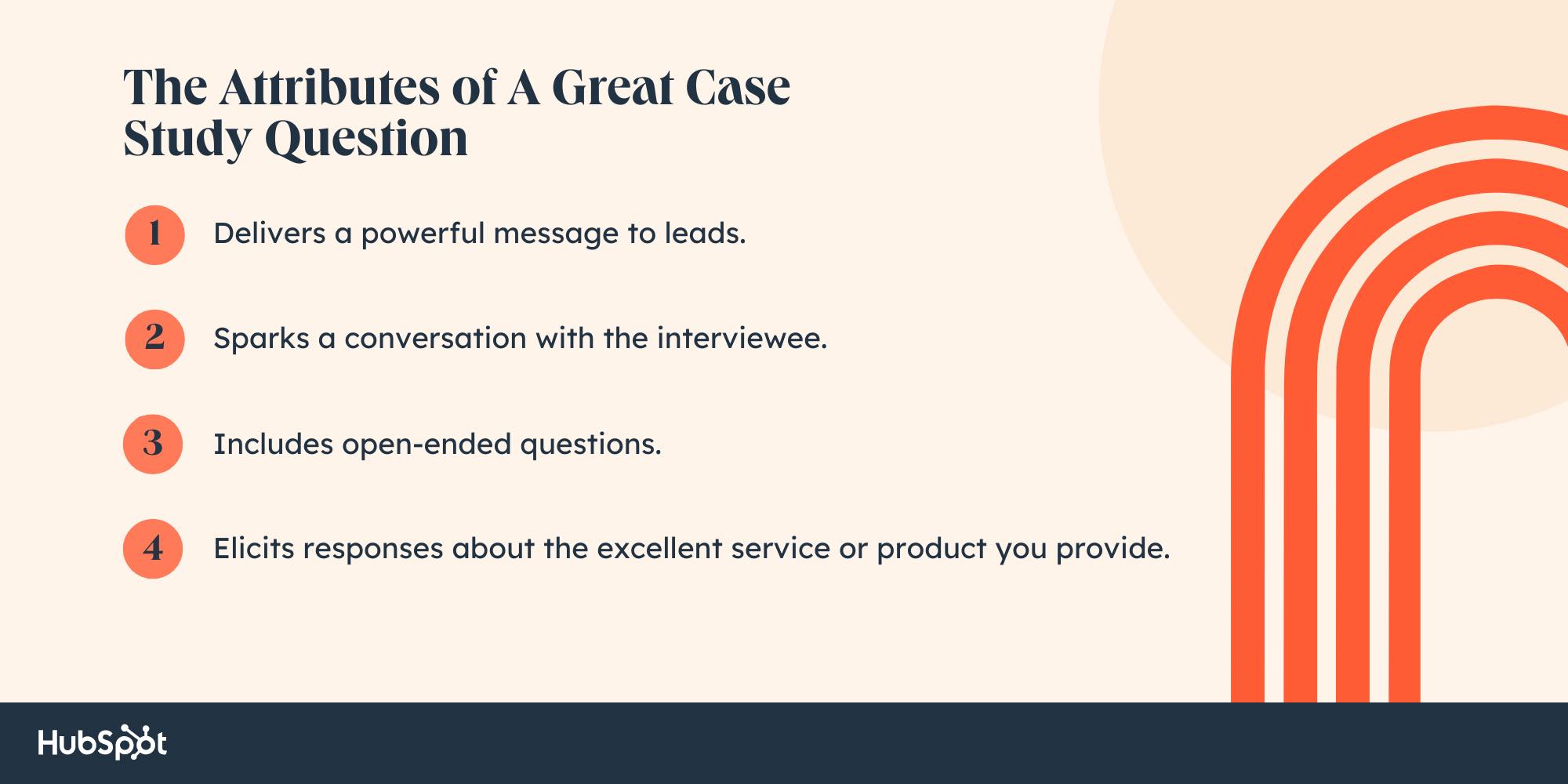
A good case study question delivers a powerful message to leads in the decision stage of your prospective buyer's journey.

Since your client has agreed to participate in a case study, they're likely enthusiastic about the service you provide. Thus, a good case study question hands the reins over to the client and opens a conversation.

Try asking open-ended questions to encourage your client to talk about the excellent service or product you provide.

case study questions, attributes of helpful questions

The Ultimate List of Case Study Questions

Case Study Interview Questions About the Customer's Business

Knowing the customer's business is an excellent way of setting the tone for a case study.

Use these questions to get some background information about the company and its business goals. This information can be used to introduce the business at the beginning of the case study — plus, future prospects might resonate with their stories and become leads for you.

  1. Would you give me a quick overview of [company]? This is an opportunity for the client to describe their business in their own words. You'll get useful background information and it's an easy prompt to get the client talking.
  2. Can you describe your role? This will give you a better idea of the responsibilities they are subject to.
  3. How do your role and team fit into the company and its goals? Knowing how the team functions to achieve company goals will help you formulate how your solution involves all stakeholders.
  4. How long has your company been in business? Getting this information will help the reader gauge if pain points are specific to a startup or new company vs. a veteran company.
  5. How many employees do you have? Another great descriptor for readers to have. They can compare the featured company size with their own.
  6. Is your company revenue available? If so, what is it? This will give your readers background information on the featured company's gross sales.
  7. Who is your target customer? Knowing who the target audience is will help you provide a better overview of their market for your case study readers.
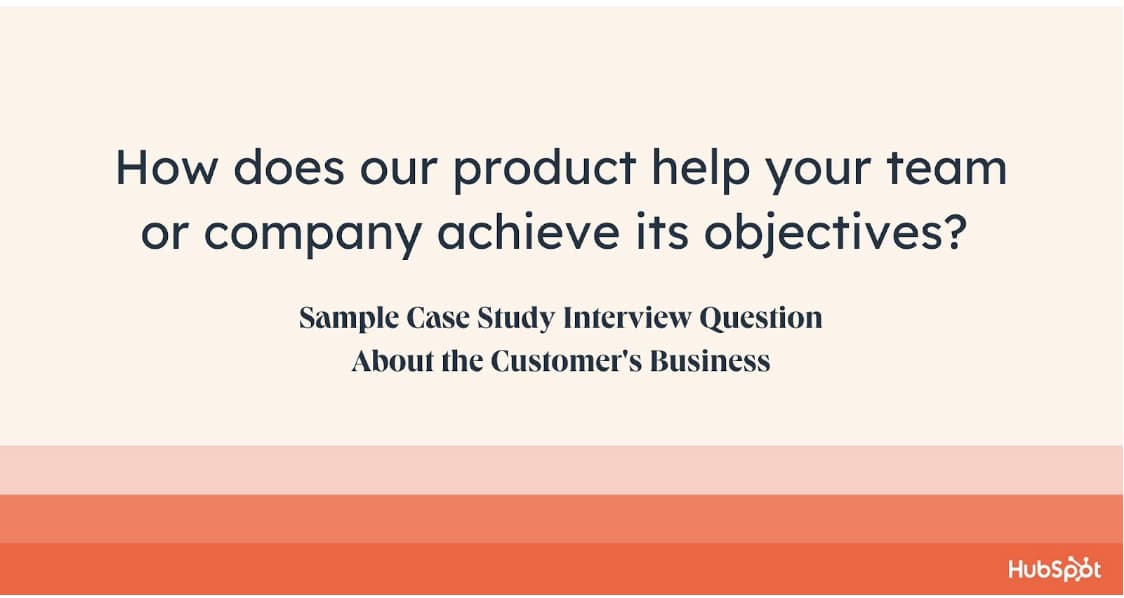
  8. How does our product help your team or company achieve its objectives? This is one of the most important questions because it is the basis of the case study. Get specifics on how your product provided a solution for your client. You want to be able to say "X company implemented our solution and achieved Y. "
  9. How are our companies aligned (mission, strategy, culture, etc.)? If any attributes of your company's mission or culture appealed to the client, call it out.

How many people are on your team? What are their roles? This will help describe key players within the organization and their impact on the implementation of your solution.

case study questions to ask, how does our product help your team or company achieve its objectives?

Case Study Interview Questions About the Environment Before the Purchase

A good case study is designed to build trust. Ask clients to describe the tools and processes they used before your product or service. These kinds of case study questions will highlight the business' need they had to fulfill and appeal to future clients.

  1. What was your team's process prior to using our product? This will give the reader a baseline to compare the results for your company's product.
  2. Were there any costs associated with the process prior to using our product? Was it more expensive? Was it worth the cost? How did the product affect the client's bottom line? This will be a useful metric to disclose if your company saved the client money or was more cost-efficient.
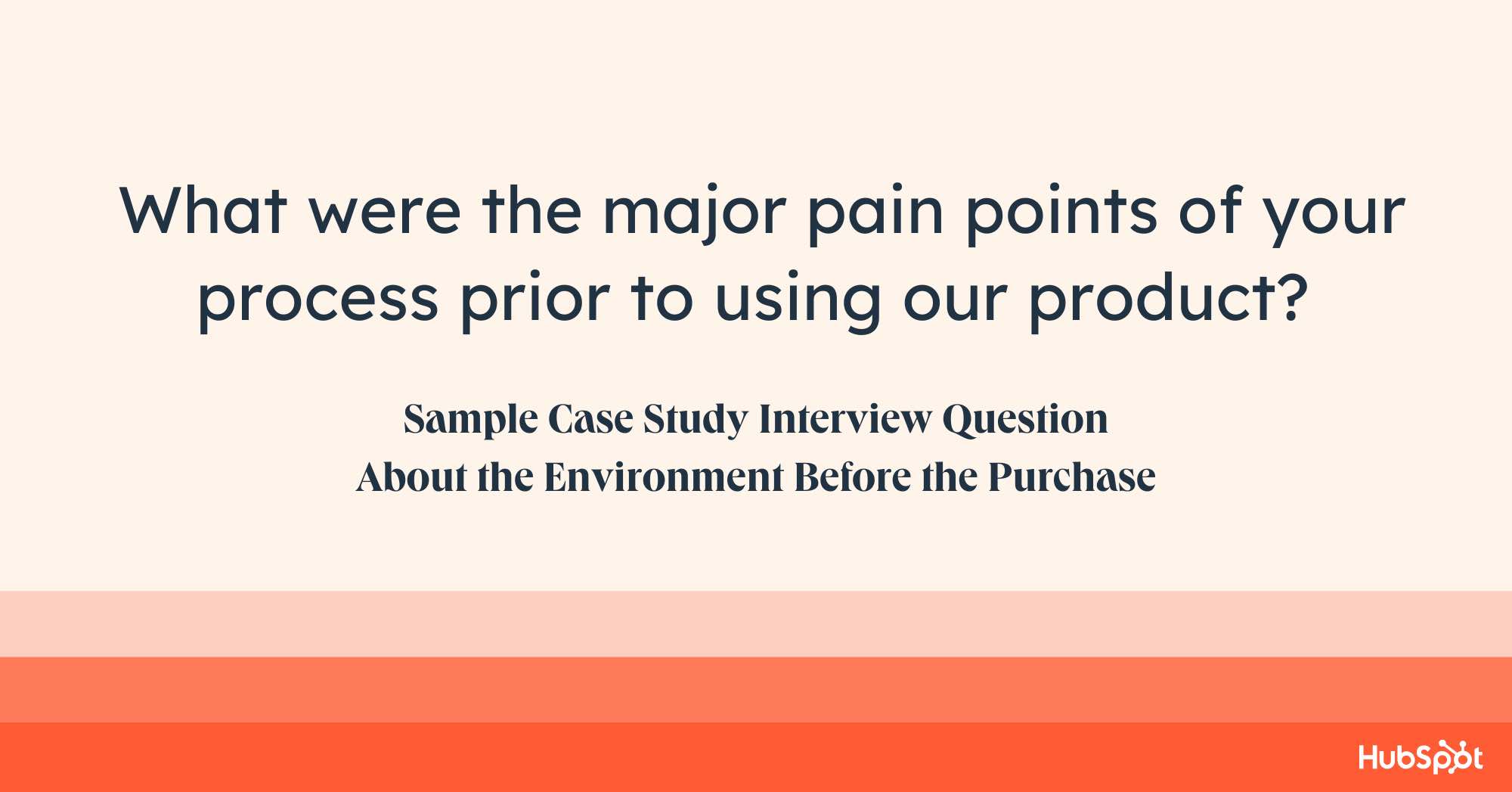
  3. What were the major pain points of your process prior to using our product? Describe these obstacles in detail. You want the reader to get as much information on the problem as possible as it sets up the reasoning for why your company's solution was implemented.
  4. Did our product replace a similar tool or is this the first time your team is using a product like this? Were they using a similar product? If so, having this information may give readers a reason to choose your brand over the competition.
  5. What other challenges were you and your team experiencing prior to using our product? The more details you can give readers regarding the client's struggles, the better. You want to paint a full picture of the challenges the client faced and how your company resolved them.
  6. Were there any concerns about how your customers would be impacted by using our product? Getting answers to this question will illustrate to readers the client's concerns about switching to your service. Your readers may have similar concerns and reading how your client worked through this process will be helpful.
  7. Why didn't you buy our product or a similar product earlier? Have the client describe any hesitations they had using your product. Their concerns may be relatable to potential leads.
  8. Were there any "dealbreakers" involved in your decision to become a customer? Describing how your company was able to provide a solution that worked within those parameters demonstrates how accommodating your brand is and how you put the customer first. It's also great to illustrate any unique challenges the client had. This better explains their situation to the reader.
  9. Did you have to make any changes you weren't anticipating once you became a customer? Readers of your case study can learn how switching to your product came with some unexpected changes (good or bad) and how they navigated them. If you helped your client with troubleshooting, ask them to explain that here.

How has your perception of the product changed since you've become a customer? Get the interviewee to describe how your product changed how they do business. This includes how your product accomplished what they previously thought was impossible.

case study questions examples, what were the major pain points of your process prior to using our product?

Case Study Interview Questions About the Decision Process

Readers of the case study will be interested in which factors influenced the decision-making process for the client. If they can relate to that process, there's a bigger chance they'll buy your product.

The answers to these questions will help potential customers through their decision-making process.

  1. How did you hear about our product? If the client chose to work with you based on a recommendation or another positive case study, include that. It will demonstrate that you are a trusted brand with an established reputation for delivering results.
  2. How long had you been looking for a solution to this problem? This will add to the reader's understanding of how these particular challenges impacted the company before choosing your product.
  3. Were you comparing alternative solutions? Which ones? This will demonstrate to readers that the client explored other options before choosing your company.
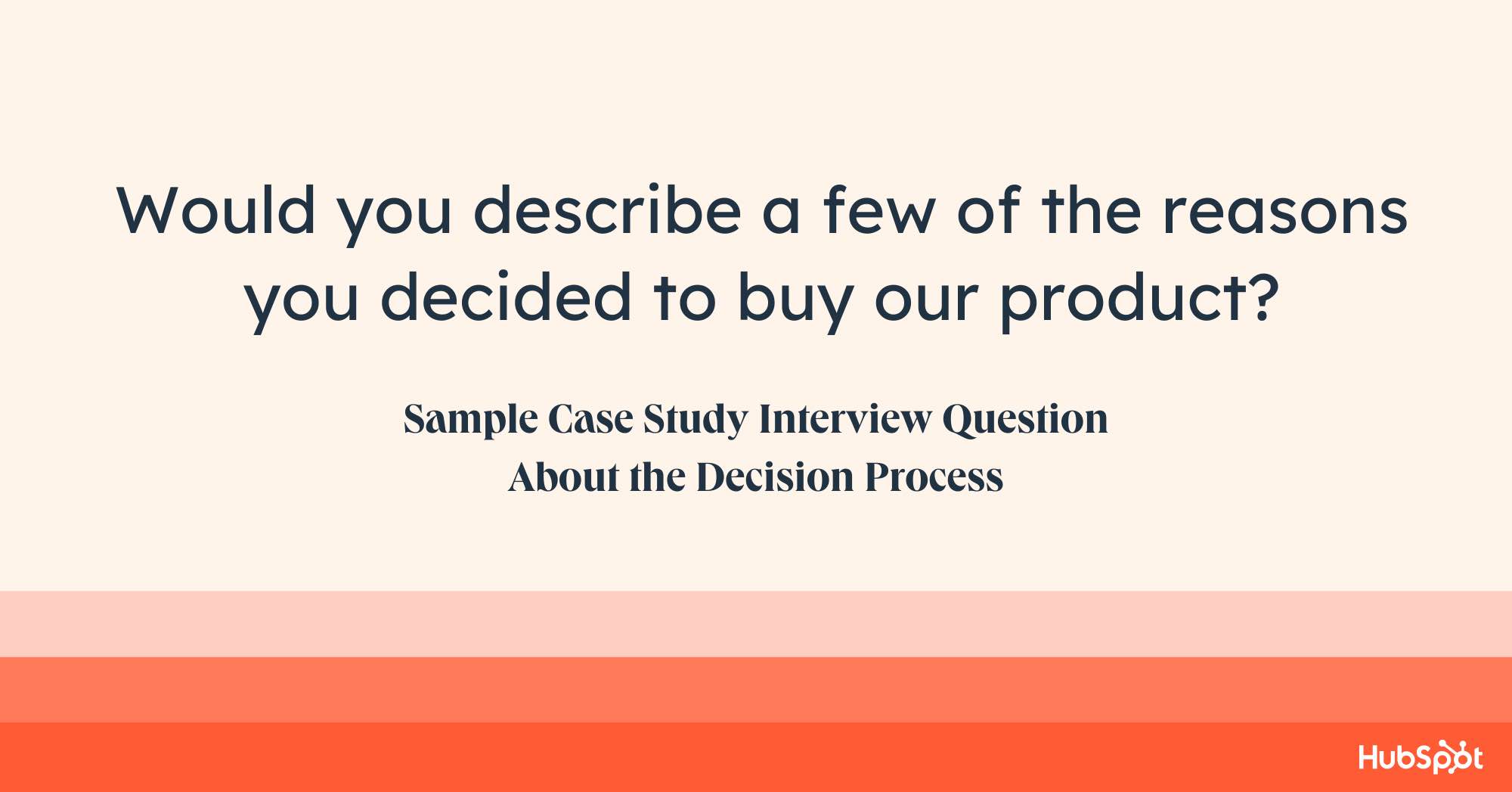
  4. Would you describe a few of the reasons you decided to buy our product? Ask the interviewee to describe why they chose your product over the competition and any benefits your company offered that made you stand out.
  5. What were the criteria you used when deciding to buy our product? This will give readers more background insight into the factors that impacted their decision-making process.
  6. Were there any high-level initiatives or goals that prompted the decision to buy? For example, was this decision motivated by a company-wide vision? Prompt your clients to discuss what lead to the decision to work with you and how you're the obvious choice.
  7. What was the buying process like? Did you notice anything exceptional or any points of friction? This is an opportunity for the client to comment on how seamless and easy you make the buying process. Get them to describe what went well from start to finish.
  8. How would you have changed the buying process, if at all? This is an opportunity for you to fine-tune your process to accommodate future buyers.
  9. Who on your team was involved in the buying process? This will give readers more background on the key players involved from executives to project managers. With this information, readers can see who they may potentially need to involve in the decision-making process on their teams.
case study questions examples, would you describe a few of the reasons you decided to buy our product?

Case Study Interview Questions About the Customer's Business Case

Your case study questions should ask about your product or solution's impact on the customer's employees, teams, metrics, and goals. These questions allow the client to praise the value of your service and tell others exactly what benefits they derived from it.

When readers review your product or service's impact on the client, it enforces the belief that the case study is credible.

  1. How long have you been using our product? This will help readers gauge how long it took to see results and your overall satisfaction with the product or service.
  2. How many different people at your company use our product? This will help readers gauge how they can adapt the product to their teams if similar in size.
  3. Are there multiple departments or teams using our product? This will demonstrate how great of an impact your product has made across departments.
  4. How do you and your team currently use the product? What types of goals or tasks are you using the product to accomplish? Get specifics on how the product actively helps the client achieve their goals.
  5. If other teams or departments are using our product, do you know how they're using it? With this information, leads can picture how they can use your product across their teams and how it may improve their workflow and metrics.
  6. What was the most obvious advantage you felt our product offered during the sales process? The interviewee should explain the benefits they've gained from using your product or service. This is important for convincing other leads you are better than the competition.
  7. Were there any other advantages you discovered after using the product more regularly? Your interviewee may have experienced some additional benefits from using your product. Have them describe in detail what these advantages are and how they've helped the company improve.
  8. Are there any metrics or KPIs you track with our product? What are they? The more numbers and data the client can provide, the better.
  9. Were you tracking any metrics prior to using our product? What were they? This will allow readers to get a clear, before-and-after comparison of using your product.
  10. How has our product impacted your core metrics? This is an opportunity for your clients to drive home how your product assisted them in hitting their metrics and goals.

case study questions to ask, are there any metrics or KPIs you track with our product?

Case Study Interview Questions About the Buying Team and Internal Advocates

See if there are any individuals at the customer's company who are advocates for your product.

  1. Are there any additional team members you consider to be advocates for our product? For example, does anyone stick out as a "power user" or product expert on your team? You may want to interview and include these power users in your case study as well. Consider asking them for tips on using your service or product.
  2. Is there anyone else on your team you think we should talk to? Again, the more people can share their experience using your product, the better.
  3. Are there any team members who you think might not be the biggest fans of our product or who might need more training? Providing extra support to those struggling with your product may improve their user experience and turn into an opportunity to not only learn about their obstacles but turn them into a product fan
  4. Would you share some details about how your team implemented our product? Get as much information as possible about the rollout. Hopefully, they'll gush about how seamless the process was.
  5. Who from your company was involved in implementing our product? This will give readers more insight into who needs to be involved for a successful rollout of their own.
  6. Were there any internal risks or additional costs involved with implementing our product? If so, how did you address them? This will give insight into the client's process and rollout and this case study question will likely provide tips on what potential leads should be on the lookout for.
  7. Is there a training process in place for your team's use of our product? If so, what does it look like? If your company provided support and training to the client, have them describe that experience.
  8. About how long does it take a new team member to get up to speed with our product? This will help leads determine how much time it will take to onboard an employee to your using your product. If a new user can quickly get started seamlessly, it bodes well for you.
  9. What was your main concern about rolling this product out to your company? Describing their challenges in detail will provide readers with useful insight.
  10. What have people been saying about our product since they started using it? Collect all the positive feedback you can to give your product more social proof.

case study questions to ask, would you share some details about how your team implemented our product?Case Study Interview Questions About Customer Success

Has the customer found success with your product? Ask these questions to learn more.

  1. By using our product can you measure any reduced costs? If it has, you'll want to emphasize those savings in your case study.
  2. By using our product can you measure any improvements in productivity or time savings? Any metrics or specific stories your interviewee can provide will help demonstrate the value of your product.
  3. By using our product can you measure any increases in revenue or growth? Again, say it with numbers and data whenever possible.
  4. Are you likely to recommend our product to a friend or colleague? Recommendations from existing customers are some of the best marketing you can get.
  5. How has our product impacted your success? Your team's success? Getting the interviewee to describe how your product played an integral role in solving their challenges will show leads that they can also have success using your product.
  6. In the beginning, you had XYZ concerns; how do you feel about them now? Let them explain how working with your company eliminated those concerns.
  7. I noticed your team is currently doing XYZ with our product. Tell me more about how that helps your business. Illustrate to your readers how current customers are using your product to solve additional challenges. It will convey how versatile your product is.
  8. Have you thought about using our product for a new use case with your team or at your company? The more examples of use cases the client can provide, the better.
  9. How do you measure the value our product provides? Have the interviewee illustrate what metrics they use to gauge the product's success and how. Data is helpful, but you should go beyond the numbers. Maybe your product improved company morale and how teams work together.
  10. What will it take for you and your team to get the most value out of our product? This will help you dive deeper into how your client operates and how you can best assist them.

case study questions examples, are you likely to recommend our product to a friend or colleague? Case Study Interview Questions About Product Feedback

Ask the customer if they'd recommend your product to others. A strong recommendation will help potential clients be more open to purchasing your product.

  1. How do other companies in this industry solve the problems you had before you purchased our product? This will give you insight into how other companies may be functioning without your product and how you can assist them.
  2. Have you ever talked about our product to any of your clients or peers? What did you say? This can provide you with more leads and a chance to get a referral.
  3. Why would you recommend our product to a friend or client? Be sure they pinpoint which features they would highlight in a recommendation.
  4. Can you think of any use cases your customers might have for our product? Similar industries may have similar issues that need solutions. Your interviewee may be able to provide a use case you haven't come up with.
  5. What is your advice for other teams or companies who are tackling problems similar to those you had before you purchased our product? This is another opportunity for your client to talk up your product or service.
  6. Do you know someone in X industry who has similar problems to the ones you had prior to using our product? The client can make an introduction so you can interview them about their experience as well.
  7. I noticed you work with Company Y. Do you know if they are having any pain points with these processes? This will help you learn how your product has impacted your client's customers and gain insight into what can be improved.
  8. Does your company participate in any partner or referral programs? Having a strong referral program will help you increase leads and improve customer retention.
  9. Can I send you a referral kit as a thank-you for making a referral and give you the tools to refer someone to us? This is a great strategy to request a referral while rewarding your existing customers.
  10. Are you interested in working with us to produce additional marketing content? The more opportunities you can showcase happy customers, the better.
case study question examples, do you have any feature requests or suggestions for our team?

Case Study Interview Questions About Willingness to Make Referrals

Ask the customer if they'd recommend your product to others. A strong recommendation will help potential clients be more open to purchasing your product.

  1. How do other companies in this industry solve the problems you had before you purchased our product? This will give you insight into how other companies may be functioning without your product and how you can assist them.
  2. Have you ever talked about our product to any of your clients or peers? What did you say? This can provide you with more leads and a chance to get a referral.
  3. How likely are you to recommend our product to a friend or client? Ideally, they would definitely refer your product to someone they know.
  4. Can you think of any use cases your customers might have for our product? Again, your interviewee is a great source for more leads. Similar industries may have similar issues that need solutions. They may be able to provide a use case you haven't come up with.
  5. What is your advice for other teams or companies who are tackling problems similar to those you had before you purchased our product? This is another opportunity for your client to talk up your product or service.
  6. Do you know someone in X industry who has similar problems to the ones you had prior to using our product? The client can make an introduction so you can interview them about their experience as well.
  7. I noticed you work with Company Y; do you know if they are having any pain points with these processes? This will help you learn how your product has impacted your client's customers and gain insight into what can be improved.
  8. Does your company participate in any partner or referral programs? Having a strong referral program will help you increase leads and improve customer retention.
  9. Can I send you a referral kit as a thank-you for making a referral and give you the tools to refer someone to us? This is a great strategy to request a referral while rewarding your existing customers.
  10. Are you interested in working with us to produce additional marketing content? The more opportunities you can showcase happy customers, the better.

case study questions to ask, can you think of any use cases your customers might have for our product?

Case Study Interview Questions to Prompt Quote-Worthy Feedback

Enhance your case study with quotable soundbites from the customer. By asking these questions, prospects have more insight into other clients and their success with your product — which helps build trust.

  1. How would you describe your process in one sentence prior to using our product? Ideally, this sentence would quickly and descriptively sum up the most prominent pain point or challenge with the previous process.
  2. What is your advice to others who might be considering our product? Readers can learn from your customer's experience.
  3. What would your team's workflow or process be like without our product? This will drive home the value your product provides and how essential it is to their business.
  4. Do you think the investment in our product was worthwhile? Why? Have your customer make the case for the value you provide.
  5. What would you say if we told you our product would soon be unavailable? What would this mean to you? Again, this illustrates how integral your product is to their business.
  6. How would you describe our product if you were explaining it to a friend? Your customers can often distill the value of your product to their friends better than you can.
  7. What do you love about your job? Your company? This gives the reader more background on your customer and their industry.
  8. What was the worst part of your process before you started using our product? Ideally, they'd reiterate how your product helped solve this challenge.
  9. What do you love about our product? Another great way to get the customer's opinion about what makes your product worth it.
  10. Why do you do business with us? Hopefully, your interviewee will share how wonderful your business relationship is.

case study questions to ask, what is your advice to others who might be considering our product?

Case Study Interview Questions About the Customers' Future Goals

Ask the customer about their goals, challenges, and plans for the future. This will provide insight into how a business can grow with your product.

  1. What are the biggest challenges on the horizon for your industry? Chances are potential leads within the same industry will have similar challenges.
  2. What are your goals for the next three months? Knowing their short-term goals will enable your company to get some quick wins for the client.
  3. How would you like to use our product to meet those challenges and goals? This will help potential leads understand that your product can help their business as they scale and grow.
  4. Is there anything we can do to help you and your team meet your goals? If you haven't covered it already, this will allow your interviewee to express how you can better assist them.
  5. Do you think you will buy more, less, or about the same amount of our product next year? This can help you gauge how your product is used and why.
  6. What are the growth plans for your company this year? Your team? This will help you gain insight into how your product can help them achieve future goals.
  7. How can we help you meet your long-term goals? Getting specifics on the needs of your clients will help you create a unique solution designed for their needs.
  8. What is the long-term impact of using our product? Get their feedback on how your product has created a lasting impact.
  9. Are there any initiatives that you personally would like to achieve that our product or team can help with? Again, you want to continue to provide products that help your customers excel.
  10. What will you need from us in the future? This will help you anticipate the customer's business needs.
  11. Is there anything we can do to improve our product or process for working together in the future? The more feedback you can get about what is and isn't working, the better.

Case study questions examples, what are the growth plans for your company this year? Your team?

How to Ask Your Customer for a Case Study

Before you can start putting together your case study, you need to ask your customer's permission.

If you have a customer who's seen success with your product, reach out to them. Use this template to get started:

Thank you & quick request

Hi [customer name],

Thanks again for your business — working with you to [solve X, launch Y, take advantage of Z opportunity] has been extremely rewarding, and I'm looking forward to more collaboration in the future.

[Name of your company] is building a library of case studies to include on our site. We're looking for successful companies using [product] to solve interesting challenges, and your team immediately came to mind. Are you open to [customer company name] being featured?

It should be a lightweight process — [I, a product marketer] will ask you roughly [10, 15, 20] questions via email or phone about your experience and results. This case study will include a blurb about your company and a link to your homepage (which hopefully will make your SEO team happy!)

In any case, thank you again for the chance to work with you, and I hope you have a great week.

Best,

[Your name]

If one of your customers has recently passed along some praise (to you, their account manager, your boss; on an online forum; to another potential customer; etc.), then send them a version of this email:

Hey [customer name],

Thanks for the great feedback — I'm really glad to hear [product] is working well for you and that [customer company name] is getting the results you're looking for.

My team is actually in the process of building out our library of case studies, and I'd love to include your story. Happy to provide more details if you're potentially interested.

Either way, thank you again, and I look forward to getting more updates on your progress.

Cheers,

[Your name]

You can also find potential case study customers by usage or product data. For instance, maybe you see a company you sold to 10 months ago just bought eight more seats or upgraded to a new tier. Clearly, they're happy with the solution. Try this template:

Hey [customer name],

I saw you just [invested in our X product; added Y more users; achieved Z product milestone]. Congratulations! I'd love to share your story using [product] with the world -- I think it's a great example of how our product + a dedicated team and a good strategy can achieve awesome results.

Are you open to being featured? If so, I'll send along more details.

Thank you,

[Your name]

1. Case studies are a form of customer advocacy.

If you haven't noticed, customers aren't always quick to trust a brand's advertisements and sales strategies.

With every other brand claiming to be the best in the business, it's hard to sort exaggeration from reality.

This is the most important reason why case studies are effective. They are testimonials from your customers of your service. If someone is considering your business, a case study is a much more convincing piece of marketing or sales material than traditional advertising.

2. Case studies provide a joint-promotion opportunity.

Your business isn't the only one that benefits from a case study. Customers participating in case studies benefit, too.

Think about it. Case studies are free advertisements for your customers, not to mention the SEO factor, too. While they're not promoting their products or services, they're still getting the word out about their business. And, the case study highlights how successful their business is — showing interested leads that they're on the up and up.

3. Case studies are easily sharable.

No matter your role on the sales team, case studies are great to have on hand. You can easily share them with leads, prospects, and clients.

Whether you embed them on your website or save them as a PDF, you can simply send a link to share your case study with others. They can share that link with their peers and colleagues, and so on.

Case studies can also be useful during a sales pitch. In sales, timing is everything. If a customer is explaining a problem that was solved and discussed in your case study, you can quickly find the document and share it with them.

4. Case studies build rapport with your customers.

While case studies are very useful, they do require some back and forth with your customers to obtain the exact feedback you're looking for.

Even though time is involved, the good news is this builds rapport with your most loyal customers. You get to know them on a personal level, and they'll become more than just your most valuable clients.

And, the better the rapport you have with them, the more likely they'll be to recommend your business, products, or services to others.

5. Case studies are less opinionated than customer reviews.

Data is the difference between a case study and a review. Customer reviews are typically based on the customer's opinion of your brand. While they might write a glowing review, it's completely subjective and there's rarely empirical evidence supporting their claim.

Case studies, on the other hand, are more data-driven. While they'll still talk about how great your brand is, they support this claim with quantitative data that's relevant to the reader. It's hard to argue with data.

Creating an Effective Case Study

An effective case study must be genuine and credible. Your case study should explain why certain customers are the right fit for your business and how your company can help meet their specific needs. That way, someone in a similar situation can use your case study as a testimonial for why they should choose your business.

Use the case study questions above to create an ideal customer case study questionnaire. By asking your customers the right questions, you can obtain valuable feedback that can be shared with potential leads and convert them into loyal customers.

Editor’s Note: This article was originally published in June 2021 and has been updated for comprehensiveness.

New Call-to-action

17 Feb 17:16

Visa makes major IoT play with IBM partnership (V)

by BI Intelligence

IoT Installation

This story was delivered to BI Intelligence "Payments Briefing" subscribers. To learn more and subscribe, please click here.

A new partnership between Visa and IBM Watson will give the firm’s Big Blue Watson IoT platform clients access to Visa payment services through the card network’s tokenization offerings.

The partnership, which reflects a wider trend of payments moving into the IoT, could give Visa access to as many as 6,000 IoT client companies by allowing them to provision Visa tokenization into their devices, effectively turning those into point-of-sale (POS) terminals that allow users to pay on-the-go. 

In practice, this could create a number of new purchasing experiences. For example, a sensor in a user's car might alert them when the vehicle needs a part, and then allow them to order the part, pay for it, and schedule an appointment for installation through the car's dashboard, according to USA Today. Or, a pair of smart sneakers might track a user's running distance and — after a certain number of miles — remind them to buy a new pair, which they could do on-the-spot through a fitness tracker or app.  

Demand for connected device payments will likely rise as market availability increases. BI Intelligence expects the number of installed connected devices will hit 22.5 billion by 2021, up from 6.6 billion today. As those devices get more popular, it’s likely users will expect more robust functionality — including payment services — from them. In 2015, despite limited market availability, 19% of consumers were already very interested in connected device payments. By partnering with IBM, Visa will be able to move into this fast-growing space and fulfill this need as the market expands.

That makes the partnership a smart play for Visa for two key reasons:

  • It could grow Visa’s volume. Embedding seamless payments is a priority for payments firms. That’s because integrating transaction opportunities into users’ daily lives helps them form habits, and making payments easier increases the frequency of user payments. The IoT partnerships give Visa more touchpoints into consumers’ lives, which could grow purchasing and engagement with Visa. That ultimately strengthens brand loyalty and increases transaction volume, and could grow revenue.
  • It keeps Visa competitive. Last year, Mastercard launched a smart refrigerator that allows users to order and pay on a touchscreen, and the firm recently partnered with OnStar for car-affiliated payments as part of its IoT payments initiatives. This isn’t Visa’s first play into the space, but the access IBM provides could help the firm scale quickly and begin to capitalize on the growing market fast as its peers try to do the same.

The rapid expansion of the Internet of Things (IoT) offers payments companies an opportunity to expand beyond mobile phones, cards, and point-of-sale devices, to a broad and diverse ecosystem of internet-connected devices.

We forecast that there will be 24 billion connected devices installed globally by 2020, up from nearly 7 billion today. And over 5 billion will be consumer connected devices by 2020, representing a massive expansion of touchpoints that could eventually offer payments functionality.

BI Intelligence, Business Insider's premium research service, has compiled a detailed report that dives into the budding industry of connected device payments, providing a rundown of the stakeholders driving innovation in wearables, connected cars, and connected home devices. It also gauges the impact of new payment devices on different payments companies, along with how these devices could shift consumer purchasing behavior.

Here are some of the key takeaways from the report:

  • The Internet of Things is ushering in a new era for payments companies and manufacturers. The rapid expansion of the Internet of Things (IoT) offers an opportunity to facilitate payments beyond mobile phones, cards, and point-of-sale terminals, on a broad and diverse ecosystem of internet-connected devices. 
  • More transactions could eventually pass through connected devices than smartphones. We estimate there will be 24 billion of these devices by 2020, with 5 billion of them being consumer-facing. This represents a massive expansion of touchpoints where payments could be enabled.
  • Card networks have developed a basic framework to enable commerce in everyday devices. Visa and MasterCard are creating the underlying infrastructure to support the standardization of payments integration and stake themselves out as the key connected payments gatekeepers. Their payment platforms are universal, allowing digital payments to grow without being tied to the success of a particular manufacturer.
  • Consumer-facing IoT companies have much to gain from enabling payments in their devices, including improving the value of the device, being able to cross-sell products through the device, and laying the groundwork for future opportunities to earn incremental revenue. For payments companies, connected payments offer a new revenue stream and an opportunity to gain market share ahead of competitors.
  • Wearables, connected cars, and smart home devices will be the top connected payments product categories.

In full, the report:

  • Frames the opportunity for embedding commerce capabilities in new devices.
  • Explains how a device becomes commerce-enabled.
  • Discusses the potential for payment-enabled wearables, connected cars, and smart home devices.
  • Examines the impact of connected payments on key stakeholders.

To get your copy of this invaluable guide, choose one of these options:

  1. Subscribe to an All-Access pass to BI Intelligence and gain immediate access to this report and over 100 other expertly researched reports. As an added bonus, you'll also gain access to all future reports and daily newsletters to ensure you stay ahead of the curve and benefit personally and professionally. >> START A MEMBERSHIP
  2. Purchase & download the full report from our research store. >> BUY THE REPORT

The choice is yours. But however you decide to acquire this report, you’ve given yourself a powerful advantage in your understanding of connected device payments.

Join the conversation about this story »

17 Feb 17:13

Industry Insights Report: Is This the Key to Shorter Sales Cycles?

by Alex Hisaka
  • A Girl Working on a Laptop in a Modern Workspace

Back in 2014, Sirius Decisions reported that the B2B sales process took 22% longer than it did just five years earlier. Fast forward to today, and we now have even bigger B2B buying committees than in 2014. That’s more people processing more information, not to mention more people who need to come to a consensus. In other words, the evidence says sales cycles are getting longer yet.

But just because sales cycles are expanding in general doesn’t mean you can’t shrink them at your company. In fact, many companies have reduced sales cycles amid climbing industry averages.

It seems we’ve accepted this notion that today’s B2B sale needs to be more complex. Yes, there are factors that add complexity, but that doesn’t mean we need to accept complexity as a blanket excuse for why deals slowly trudge through sales pipelines, preventing reps, sales leaders, and organizations from higher profits. Maybe it’s time to start pushing back against complexity.

Is Your Sales Strategy as Simple As It Can Be?

Your buyers may face added complexity in their decision-making process, but it’s not because they asked for it. In fact, buyers want you to simplify their lives. They may not ask for a salesperson, but they need someone to help them make sense of all the complexity.

You hear a lot about the empowered buyer who has more information and options than ever before. In reality, many of these “empowered” buyers are overwhelmed buyers. They’re inundated with information, options, and opinions.

Ask yourself, what are you doing to simplify this process for your buyers? How can you add clarity? How can you eliminate confusion?

Today, it’s the companies that streamline the buying experience, the ones that strategically focus on making it simple for buyers to do business, that have the advantage. Plus, a simpler buying process is the most natural way to a shorter sales cycle.

Always Be Simplifying?

“Closing” a sale isn’t what it used to be, especially in B2B. And let’s face it; the thought of someone using old-school closing techniques to convince entire buying committees to sign a proposal before they’re good and ready is laughable.

While sales pros are more beholden to buyers’ decision-making processes, there’s still room for assertiveness, though. In fact, you could argue that by not being assertive when it comes to securing the next step in the process, you actually do your buyer a disservice. Especially when there’s confidence on both sides that the solution is the right fit. Think of it this way: When the end is in sight, you’re not the only one who wants to keep the momentum going.

While you probably wouldn’t use a choice close or an assumptive close to close the actual sale, these techniques can still be useful when securing the next step. For example, rather than saying “we’ll get back to you with a few available times for a tech feasibility call,” have two times ready and ask which one works best. Whenever possible, schedule the next meeting before the current meeting ends. If two people need to meet to make the next step happen, make the assumption that it’s okay to connect them via LinkedIn in real time.

This way, rather than everyone wasting each other’s time playing phone tag and apologizing for delayed email responses, both teams are off and running to the next action. Granted there’s a distinction between being assertive and aggressive, but with a little tact, your assertiveness can eliminate the complexity that stalls deals between steps. And your prospects will appreciate that about you.

Looking for a simpler way to get your sales insights? Subscribe to the LinkedIn Sales Solutions blog.

17 Feb 17:13

How to Price Your Product: A Look at Bots & Integrated Applications

by Steven Forth

Editor’s Note: This is part two of a two part article on how to price apps for Slack and other platforms and marketplaces. You can read Part I here.

So you’ve built a bot for Slack or Facebook or Salesforce.com or email (or maybe all four). Or maybe your bot lives out in the wild and people interact with it in all sorts of unexpected places. Perhaps you’ve embedded it deep in your own application to provide user support or in order to drive engagement. No matter where your bot lives or how users interact with it, you need to extract some money for the value you are providing in order to continue to invest in improving the product.

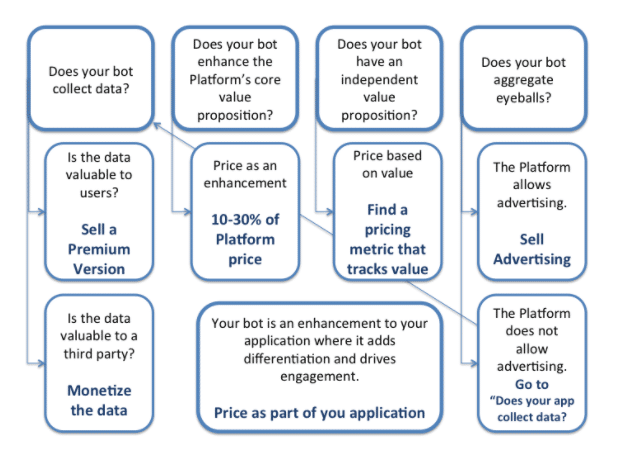
So how should you go about monetizing your investment? In this post, we’ll work through a series of questions to help you frame your choices so you can ultimately set an appropriate pricing strategy.

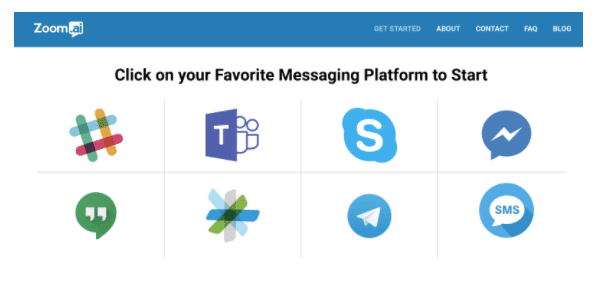
Before working through each of these questions, let’s look at how one company has done this. Zoom.ai is a digital assistant that listens in on your conversations and helps you with the kind of repetitive task that assistants used to do back when people had assistants. It works with Slack and with many other messaging platforms. When I reached out to Zoom’s CEO Roy Pereira to ask him about his approach to pricing Slack bots it was his assistant ‘Dennis Zoom’ that found us a time for the call.

The key thing to note here is that Zoom works on multiple messaging platforms. That frees it from getting referenced to the price of any one platform and allows Roy to set a price based on value. He calculated this value by estimating the value of the time saved. He could have added in the value of not missing critical opportunities. The price for Zoom’s assistant is $25 per month. The competitive alternatives here are an actual assistant (way too expensive for most of us), one of those executive services that seem to charge anywhere from $3-5 per hour at the low end to $20 for a professional service where the person providing the service is based in the US. There are also other scheduling bots, like x.ai where Amy or Andrew Ingram will help you for $39 per month ($59 for the business version). Zoom and x.ai are both many times more expensive than Slack at $6 per month.

Aside: Note that both Zoom and x.ai gave their bots personalized names. This is quite common. These bots are becoming so popular that there are even issues with sexual harassment! (See this intriguing article on Quartz for more on this.)

Now that we have some frame of reference for how pricing a bot might look, let’s ask some basic questions:

  • Does your bot collect data?
  • Does your bot enhance the core functions of the platform?
  • Does your bot use the platform as a channel?
  • Does your bot aggregate eyeballs?
  • Is your bot is an enhancement to your core application?

Your pricing strategy falls out of the answers to these questions.

1. Does your bot collect data?

If your bot collects data can you extract valuable insights? Who are these insights valuable to? If they are valuable to the users of the app consider an offer that charges users to access the insights. When the data from having multiple users increases the value for any one user then consider a freemium model where the basic app is free and people pay for insights. If the insights are valuable to third parties that is what you should monetize, provided that you protect the rights of your users and disclose the intended use.

2. Does your bot enhance the core functions of the platform?

This is where the reference effect of the platform’s price becomes a real concern. If your app provides a better version of things the platform already does, or provides functionality directly dependent on the platform’s core functionality you are probably going to have to price at 10% to 30% of the platform’s base price. You are also at risk of having the platform learn from your hard work and offer similar functionality in a future release. Developers for Windows are all too familiar with this. There used to be a big market for spam blocking services for your email or even faxing services.

3. Does your bot use the platform as a channel?

If your bot treats the platform as a communication or delivery channel you can prevent the platform from acting as an anchor or reference price. There are two key ways to do this (and you have to do both). First, make sure your bot is available across multiple platforms. Second, provide some unique value that is independent of the platform. Ideally, this value cannot be provided by accessing only one platform. The scheduling bots from Zoom.ai and x.ai are good examples of this. Schedulers need to act across multiple platforms and integrate with other applications like calendars.

4. Does your bot aggregate eyeballs?

Some bots will be able to attract a lot of people and monopolize their attention. Advertising models are the preferred monetization strategy in this case, especially if you can learn a lot about users and what they are interested in. Today though, most of the messaging platforms do not support advertising and I kind of hope it stays that way. In this case, you are back to the data path. If you are attracting a lot of people and getting them to interact with each other and your app in ways that you can track you probably have some valuable data from which you can generate insights.

5. Is your bot is an enhancement to your core application?

Many companies, from Salesforce to Quip, are using apps and bots to extend their own applications. In some cases they will want to charge extra for this, but buyers are likely to push back as apps and bots come to be seen as a standard part of functionality. For many companies providing bots will become table stakes, basic functionality they need in order to be competitive. Other more creative companies will be able to drive differentiation with bots, but in this case they will be most successful in capturing this value as part of their standard pricing.

The bot economy is just getting started and many more monetization models are likely to emerge. As with games, in-bot purchases of other goods and services is one promising possibility. In some cases the bot will do the buying for you and could take a commission as a purchasing agent. Platforms like Slack do not yet have a robust payment system, where they handle payments for transactions made on their platform, but you can bet they are working on it.

Bots can act as agents for the company. Some consulting companies are using bots to provide simple business advice, and are gaining value by using the bots as data collectors and for lead generation. This data does not have to be used internally but could be sold on in a data monetization strategy.

We are just at the beginning of the bot economy. A day will soon come when there are more bots out there than people. Once this happens most of the interactions will be between bots. My scheduling bot will negotiate with your scheduling bot to see if and when we should actually talk. They may be able to exchange enough information to make the conversation optional. Monetizing all these transactions is the future of pricing and revenue management. It is also a big opportunity for platforms like Slack where many of these bots will live. How will Slack try to make money from the bots communicating on its platform? That is a critical question as Slack’s decisions here will have a big impact on business models. Expect some surprises here as Slack experiments to figure this out.

The post How to Price Your Product: A Look at Bots & Integrated Applications appeared first on OpenView Labs.

17 Feb 17:13

Apple's CFO explains the company's $10 billion R&D budget (AAPL)

by BI Intelligence

Apple R&D

This story was delivered to BI Intelligence Apps and Platforms Briefing subscribers. To learn more and subscribe, please click here.

Apple is pouring money into research and development (R&D) in an attempt to improve products that don't currently generate revenue, but might in the future, according to remarks made by Apple CFO Luca Maestri at the Goldman Sachs investor conference Tuesday.

The company spent a massive $2.8 billion on R&D in Q4 2016, bringing the segment to nearly $10.5 billion in total for the year.

It's normal for R&D to increase in line with growth and new product development, but Apple's annual spend is up by roughly $4 billion since 2014, marking a uniquely significant bump. 

There are three primary drivers behind this push: 

  • A growing product range: Apple's hardware product range is growing. Apple has four primary hardware segments: the iPhone, iPad, Mac, and Apple Watch. Within each of these, the number of devices is expanding as well — for example, teh company now offers three iPhones instead of too. That growth begs a need for new or increasing investment. 
  • An expanding services segment: Apple's Services segment, which comprises revenue from internet services, Apple Care, Apple Pay, licensing, and the App Store, is expected to grow to the size of a Fortune 100 company this year, according to Apple CEO Tim Cook. That's about $28 billion in revenue for the year, or a year-over-year growth of 15%. To support this growth, Apple is building out the underlying services for iCloud, Siri, and Maps, which requires substantial investment. 
  • A greater focus on in-house technology development: As technological advancements continue to converge, Apple is working to keep its degree of difference from the rest of the industry and retain proprietary information. It's doing this by directing its R&D spend in-house, and investing in building its own core technology, including work with processors and camera sensors for upcoming devices, which is costly and might bump spending. 

Apple’s reliance on iPhone revenue makes innovation and product improvement top priorities. The company’s revenue is primarily based on income generated by the iPhone. The pool of first-time smartphone buyers who can afford the iPhone is shrinking, which means the company needs to convince users on other platforms to switch to iOS to find continued growth. Innovation is one way to do that. And as Apple continues to develop in emerging categories, like augmented reality (AR), virtual reality (VR), and the self-driving car space, it's unlikely that R&D spend will slow down any time soon. 

Cloud computing — on-demand, internet-based computing services — has been successfully applied to many computing functions in recent years.

From consumer-facing, web-based productivity apps like Google Docs to enterprise database management suites, the tools businesses rely on are increasingly moving to the cloud.

But developing a cloud strategy is no easy task. Public cloud solutions will likely come to dominate the market over the next decade, but business constraints, such as security concerns and the limitations of existing infrastructure, make it difficult for companies to fully adopt the public cloud right now.

That means that hybrid clouds, in which multiple cloud implementations (including public and private) are connected, will remain popular for the time being, at least until these constraints are addressed. The tech giants that dominate the IaaS market — Amazon, IBM, Microsoft, and Google — are constantly expanding their offerings to address current business constraints as they compete for market share.

Christina Anzalone, senior research analyst at BI Intelligence, Business Insider's premium research service, has compiled a detailed report on cloud computing that evaluates the current business considerations for the various cloud solutions and provides an outlook on the state of the market.

Here are some of the key takeaways from the report: 

  • Cloud computing solutions have gained traction because they're flexible and cost efficient. Sixty-seven percent of companies used an Infrastructure-as-a-Service solution in 2015, like the cloud, for some part of their business, up 19% from the prior year.
  • All cloud solutions provide certain benefits that are becoming increasingly essential to businesses in the digital age. These include on-demand self-service, rapid elasticity, and broad network access, among others.
  • Security needs, demand predictability, existing infrastructure, and maintenance capabilities are key business considerations for enterprises choosing between cloud implementations.
  • While hybrid cloud strategies will remain popular in the near term, the market is likely to shift toward the public cloud over time. That's because costs are falling, providers are developing solutions that address main concerns with the public cloud, and business practices like agile development and data analytics are dependent on advantages the public cloud provides. However, industries that handle sensitive information, like financial services and healthcare, will likely prefer hybrid and private cloud strategies given regulatory restrictions.
  • Amazon Web Services is the dominant cloud computing provider by market share, followed by Google, IBM, and Microsoft. Because the latter three companies have had little success taking on Amazon, market-share gains are likely to come at the expense of smaller competitors.

In full, the report:

  • Explains the different cloud computing strategies and benefits of cloud computing.
  • Evaluates key business considerations – security needs, demand predictability, existing infrastructure, and maintenance capabilities – for enterprises choosing between cloud implementations.
  • Provides and outlook for trends and major players in the cloud computing market.

Interested in getting the full report? Here are two ways to access it:

  1. Subscribe to an All-Access pass to BI Intelligence and gain immediate access to this report and over 100 other expertly researched reports. As an added bonus, you'll also gain access to all future reports and daily newsletters to ensure you stay ahead of the curve and benefit personally and professionally. >> START A MEMBERSHIP
  2. Purchase & download the full report from our research store. >> BUY THE REPORT

Join the conversation about this story »

17 Feb 17:13

Chasing the Canadian dream: The real force driving the housing boom in our big cities

by Garry Marr

The mayor of Caledon, a town of about 60,000 northwest of Toronto, says government can try all it wants, but the dream of owning a home will persevere.

Allan Thompson should know. His town, like many others that ring around Ontario’s capital, has become a launching site for new communities as people priced out of the core look to the suburbs (or what was once rural) for slightly cheaper housing.

An average new single-family detached home in the Greater Toronto Area (GTA) was $1,264,604 in 2016, according to the Building Industry and Land Development Association. But housing prices range from an average of $666,220 for a semi-detached home in Durham, northeast of Toronto, to $1.8 million for a detached home just north of the city.

“I remember I had this neighbour who was Portuguese,” said Thompson, who was a Caledon councillor for 11 years before becoming mayor two years ago. “He said to me, ‘For 20 generations back in Portugal, we all lived and rented houses in town. We had our sheep and our goats and our cattle.’ He said to me, ‘I was the first one ever to have a home.'”

That dream of home ownership is central to the escalating prices in Canada’s housing market, especially in larger cities such as Toronto where immigrants tend to settle.

Even though worries about so-called foreign buyers inflating prices dominate some discussions about runaway housing prices, the housing boom is more likely being driven by new immigrants looking to get a piece of that Canadian dream. It’s a mentality that says home ownership is a sign you have made it.

How much foreign buyers — often really just speculators — have entered the Canadian market is a hot topic

Canada has a home ownership rate of about 70 per cent, one of the highest in the world, and immigrants are buying in. A report from real estate consulting firm Altus Group Ltd. in January found that immigrants — defined as someone whose country of origin is not Canada — are purchasing one out of every two new homes in the GTA.

Matthew Boukall, senior director, Residential Products, Data Solutions, at Altus Group, said demand could get even stronger as the federal Liberals boost immigration totals from the annual base target of 260,000 that existed from 2011 to 2016.

“The Liberal government has announced their immigration targets will increase to 300,000 per year. The fact that half of our new home market is going to new immigrants and we are going to get (more) immigrants to Canada bodes well for the new housing market,” said Boukall, noting Toronto gets about 30 per cent of those immigrants every year.

fp0218_province_immigration_480

Sales of existing Canadian homes continue to be hot and set another record in 2016. Numbers released Wednesday from the Canadian Real Estate Association show that sales activity in January 2017 was 1.9 per cent better than a year earlier.

The key problem in some markets is that there is simply not enough homes hitting the market to satisfy demand. This past week, Douglas Porter, chief economist at Bank of Montreal, said Toronto was in a housing bubble driven by foreign wealth, coupled with record-high demand and a shortage of detached properties.

In its take, U.S.-based FitchRatings said current price gains in Canada are not sustainable and predicted an increased likelihood of a correction, noting household debt had exceeded the size of the Canadian economy.

Others say the bubble is less likely to pop anytime soon.

“The shortage of homes available for sale has become more severe in some cities, particularly in and around Toronto and in parts of BC,” said Gregory Klump, chief economist at the Canadian Real Estate Association. “Unless sales activity drops dramatically, the outlook for home prices remains strong in places that face a continuing supply shortage.”

Royal Bank of Canada economist Robert Hogue said immigration has been a driving force in the Canadian housing market for some time in the major markets where immigration has been the strongest.

“Those markets tend to get the major share of recent immigrants,” he said.

Hogue points to a Statistics Canada study released in December that showed how the earning power of immigrants begins to rise over time and, while it didn’t address housing, it’s easy to see how increased income could translate into home ownership.

The median employment income of immigrant tax filers who landed in 2004 was estimated at $16,800 in 2005 (one year after landing). The same cohort’s median income increased to $26,000 in 2009 and $33,000 in 2014.

“It takes time for immigrants for earn the same income as those born in Canada,” Hogue said. “I suspect immigrants buying today are not as much those that came in the last year, but those who got established financially.”

Hogue said it’s unclear to him whether immigrants arriving to Canada today have more wealth and are entering the market more quickly. But the Altus survey found that 19 per cent of people buying new homes in the GTA do not take on a mortgage.

fp0218_permanenet_residents

“Lucky them,” Boukall said with a laugh. “Are they foreign investors? If you’re asking me that, we don’t collect that information.”

How much foreign buyers — often really just speculators — have entered the Canadian market is a hot topic for both prospective homebuyers and governments.

The B.C. government clearly believes that foreign buyers are having an impact on the Vancouver market and slapped a 15-per-cent additional property transfer tax on them in August 2016. Prices there have since slightly declined while sales, already in decline, are off about 40 per cent from a year earlier.

The Toronto Real Estate Board (TREB) surveyed its members in December about foreign transactions and concluded only 4.9 per cent of the market came from that segment.

All of which raises the question of whether foreign buyers are being confused with immigrant buyers.

“People are having the conversation in Toronto and it’s been much more intense in Vancouver,” Hogue said. “Don’t confuse the two. I’d like to comment on Toronto statistics, but other than the survey done by TREB, we don’t have much (data). In B.C., we’ve had data since June and I would say the percentage of buyers from out of the country has not been trivial.”

But Dianne Usher, senior vice-president of Royal LePage’s high-end division Johnson & Daniel, said the real growth in the market has come from immigrants she calls “end users,” those who come to the country and plan to live in their homes.

The single family home is almost becoming an extinct animal in the marketplace

“I’d say it’s happening in Toronto and Vancouver and then I would say Montreal,” she said, adding more immigrants are coming in with money, or are trying to get it out of their country of origin for good. “Canada as a whole is a safe haven because of the stable government, the education system, the health-care system. We’re a destination and it’s going to continue.”

She adds immigrant buyers will continue to purchase properties in and around large cities partly because of work and educational opportunities, but also because large urban centres are what many are accustomed to.

The biggest problem might be meeting all the demand, especially if immigration quotas are increased.

Tim Hudak, chief executive of the Ontario Real Estate Association, said it’s a good problem to have.

“We just have so many more people chasing fewer houses that prices are going to go up,” he said, adding the solution is increased supply. “Government policies have created artificial barriers.”

He thinks policy needs to focus on what he calls the “missing middle,” or townhouses, stacked homes and semi-detached housing. These are the kind of starter homes that can get people into the housing market.

“The single family home is almost becoming an extinct animal in the marketplace,” Hudak said.

Brian Johnston, chief operating officer of Mattamy Homes, which has development projects in Caledon and throughout the GTA, agrees the supply side continues to drive prices. He figures he’s selling more than 50 per cent of his homes to immigrants.

With immigration only increasing, he said the only solution is for government to create more low-rise housing to accommodate what is a growing segment of the population.

“Coming to Canada, part of the process is buying housing,” Johnston said. “You’ve got people coming from countries like China where they may own the house, but not the land. Owning a house is very powerful thing for some people.”

In Caledon, the mayor doesn’t think the push into his city is going to ebb any time soon.

“From here on in, as we know it, our population is just going to keep compounding,” Thompson said. “A lot of people are coming here from other parts of the world to live, quite of few of them don’t have mortgages. It tells you people are coming here by choice.”

twitter.com/dustywallet
gmarr@nationalpost.com


17 Feb 17:13

Using the One-Two Punch of Logic and Emotion in Your Presentation

by Julie Hansen

Think back to purchasing your last car. Did you buy it because it checked off a list of features? Or did it just “feel” right? You’ve probably heard the statement: Buyers buy on emotion and justify with logic. Yet too many sales presentations speak to business buyers as if they were only using their heads to make decisions, and not their hearts. Logic is rarely enough in sales. Simply ask any salesperson who’s ever lost a deal to a competitor with an inferior solution!

Failure to engage the emotional brain in your sales presentations today is a costly oversight. Studies show that the most persuasive cases require a one-two-punch of logic and emotion. Sure, it’s necessary to logically present and support the facts, but a long, logic-laden presentation can leave your prospect feeling beat up and ready to throw in the towel.

Engaging emotion in your sales presentation not only helps make your case and maintain attention, but it also increases your prospect’s ability to remember your message. Emotion is essential to learning, Dr. Immordino-Yang writes in her book, Emotions, Learning, and the Brain. She goes on to say:

“It is literally neuro-biologically impossible to think deeply about things that you don’t care about.”

Here are 4 ways to use logic and emotion in your sales presentation:

1. Tell a story.

You’ve just presented the facts about your solution, now follow it with a story. Stories naturally trigger our emotional brain and have done so for thousands of years. Stories allow you to show your message, solution or results in action, allowing your prospect to reach the conclusion on their own. Personal stories or anecdotes especially can quickly illustrate your point and make an idea stand out in a sea of facts. A great sales story can change the minds and hearts of audiences, differentiate you, and inspire action in a way that information alone simply can not.

2. Make it personal.

A great way to combine logic and emotion is to place your prospect in the shoes of a product user. Say you’re showing a medical device to a team of nurses and physicians. You would simply describe the process through their perspective, i.e., “When Mary sees that a patient’s chart indicates that he needs to be tested, Mary would simply touch the display and enter her code.” This shift in perspective helps your prospect envision how they would use your product in their daily life, taking it from an intellectual exercise to a more emotionally-rich experience.

3. Interpret statistics.

Talking about facts and figures is often necessary, but if your presentation is simply one graph or pie chart after another, even the most analytical members of your audience may beg for mercy. Make numbers more meaningful by interpreting those stats for your prospect. Why are they important to your prospect? What do those numbers mean? A two percent savings may not resonate with a mid-level manager. Explaining that this two percent savings will allow him to redeploy two full time employees during budget time likely would.

4. Incorporate metaphors.

The human brain can only take in and retain so much information. Give your audience a needed break by using a metaphor to compare a lesser known item to something that is more familiar to your prospect. Researchers have found that the use of metaphors can increase activity in the brain’s emotional-related regions. For example, I could spend ten minutes explaining a product tool and the various tools it combines and replaces, or I could quickly tell you, “this tool is like a Swiss army knife.” Which does your brain prefer?

Don’t underestimate the powerful one-two punch of logic and emotion in your sales presentation. As long as humans are still making the decisions, you must present your case on both a logical and emotional level in order to be successful.

17 Feb 17:12

Better Built Than Bought – How to Build Your Email Marketing List

by Andrew Schulkind

Buying an email list may seem like a great short-cut for growing your email marketing reach, but the chances of doing so successfully are small, and the potential damage is not. Here’s why.

First though, why should we even care about email marketing right now? Because email marketing, despite lacking the sex appeal of social media and even SEO, is still one of the most effective marketing techniques available. (According to Campaign Monitor, email is 6 times more likely to get a clickthrough than is Twitter. McKinsey says that email is 40 times more effective for customer acquisition than Facebook.)

With that kind of effectiveness it’s no wonder that as marketers confront the typically slow pace of organic list growth, purchasing a list looks extremely attractive. But purchased lists typically lead to problems.

Do I know you?

Even if the list you purchase is legit–meaning folks have opted in to having their email addresses shared–they haven’t opted in to having you contact them. So, your message in their inbox is viewed as an uninvited guest at best, and as a potentially malicious piece of spam at worst. That’s hardly solid ground on which to build a profitable relationship.

Rules, what rules?

You can also run afoul of regulations like the CAN-SPAM act, which prohibits many kinds of unsolicited email messages. Finding yourself on the wrong side of these regulations can have serious financial consequences as well as an negative impact on your domain name if you’re labeled a spammer.

Using a purchased or rented list will also almost certainly break the user agreement you have with your email service provider–Mailchimp, Vertical Response, Constant Contact, etc. They are all even more eager than you are to protect their standing as good email citizens, and will come down hard on you if you generate more than a small fraction of a percent of spam complaints.

(We’ve also seem ESPs suspend accounts when a large list of addresses is imported, as when moving from one ESP to another. A phone call explaining the situation is usually all that is required, but it is an example of how seriously they take the spam issue and the scourge of non-opt-in lists.

Better ways to build your list

So if we don’t want to buy a list, how do we go about building our own at something other than a glacial pace? By making your email an integral part of your overall marketing.

Don’t let the email subscription box on your website languish in a forgotten corner at the bottom of the contact page. Place it prominently on every page of your site.

Consider adding it to your email sig file, so every message you send can help you build your list.

Make it a point to invite every new networking contact you meet to join the list. Make this a company-wide policy for all customer-facing personnel–sales, marketing, customer service.

Expanding and strengthening the channels through which you ask for new subscribers is an important step. But why will anyone want to subscribe in the first place? Is there a person left anywhere in the business world who really wants more email?

The secret to building your list is providing value

In other words, you have to offer something that’s worth your prospect’s time. This is called a lead magnet. Your lead magnets need to provide real value to your target audience. They need to help solve a business problem or educate your prospective clients about ways they can improve their business.

Examples of lead magnets include informational articles, informational videos, how-to guides, worksheets, and any information that is clearly and obviously not sales material. Even if the “comparison of widgets” you produce is 100% legitimate in its research, it will be viewed suspiciously if your widget just happens to come out on top. There is a place for material like that, but they aren’t effective as lead magnets.

Of course, creating lead magnets that are truly valuable is a bit harder than the relatively easy step of creating reliable channels for finding new subscribers. But the job gets harder still. Because now that you’ve enticed your new subscribers with real value, you have to keep providing real value in order to hold their interest.

Sustained interest is they key to converting subscribers into leads and leads into customers. (Which means you should pay as much attention to your open and clickthrough rates as you do to your subscriber base.) Just because they’re not unsubscribing doesn’t mean they’re paying attention.

17 Feb 17:12

7 Insights that will Improve Your Presentation Close Rate

by Julie Hansen

The Closer

New York Yankee Mariano Rivera “The Closer”

This may sound funny coming from a presentation trainer, but the most effective way to improve your presentation close rate doesn’t happen during your presentation. It takes place before your preparation. No deck, prop or story can replace the need for a thorough understanding of your customer. That’s why discovery is so important. Without vital insights into your prospect’s business, interests and challenges, your presentation is at risk for slowing down the sales cycle, or grinding it to a halt.

How does your close rate compare to others in your industry? What are the easiest / most difficult industries for sales people? HubSpot just released a new study that shows the average sales close rates for 28 industry and it’s all based on proprietary data. Check it out!

You can dramatically improve your presentation close rate by arming yourself with the following insights well before you deliver your presentation or demo.

7 Insights that will Improve Your Presentation Close Rate

  1. Specific challenge or opportunity.
    You can’t solve a problem if you don’t know what it is. It’s important to have a clear understanding of what your customer thinks their specific challenge or opportunity is. Being specific will allow you to tailor your presentation to their unique needs. For example, “You shared that your current system is unable to handle the volume of calls you’re receiving.” This is a clearly defined challenge that will guide you to highlight only relevant features and benefits in your presentation. On the other hand, “You mentioned you are looking to update your system,” is a vague challenge that leads to a firehose of features that overwhelms prospects and causes tune out.
  2. Current state.
    How is your prospect currently dealing with their problem? Is he whistling in the dark hoping the problem will go away? Or has he designed some complicated work around requiring an ever-increasing amount of effort and resources? Discover how your prospect is coping with the problem. This will tell you what the status quo is, which can often be your biggest competitor.
  3. Impact.
    How does the problem affect your prospect in terms of time, money and/or resources? This insight will help you understand what impact a solution to that problem provides – which is vital for making a case for change. How much does it hurt and can your prospect quantify the pain? In other words, is your prospect just a little bruised or is she spending a thousand dollars a week on physical therapy?
  4. Goals.
    How does your prospect spell success? Knowing what specific results the prospect is looking for will help you develop a sound value proposition for your presentation. Many companies use some type of key performance indicator (KPI) to track and assess their business processes. It may be year-over-year growth in sales, ROI, or retention rates. Whatever it is, address performance in terms that your prospect uses, and if possible, in a way that can be quantified. For example, “Based on the numbers you provided us, solving this problem would eliminate two redundant jobs and reduce your costs by $300,000.” Can’t get the information from your prospect? Look for similar clients, case studies, or industry statistics to provide comparative results.
  5. Key players.
    Many sales today involve multiple decision-makers as well as key influencers and stakeholders who can influence the buying process. It’s important to know who these players are and who will be in the room. End-users, managers and C-level executives all have different interests and perceptions of value. Know the titles of who you are presenting to so you can speak directly to their needs.
  6. Timing:
    Clarifying your prospect’s timelines up-front can save you a lot of frustration later. Whether or not your customer has a date by which they need to have a solution in place gives you a good read on your prospect’s sense of urgency. No real time line? You may want to re-evaluate the opportunity, dig deeper into the impact, or find out what would have to happen to make it a greater priority.
  7. Competition:
    Knowing who your competition is ahead of time allows you to improve your presentation close rate by being prepared to address key differentiators and competitive advantages. Find out what order you’ll be presenting in as well so you can either proactively address or respond to potential traps and objections.

Don’t let a lack of information keep your presentation from being a resounding success with these seven insights. Find out more about how to do a great discovery session here.

17 Feb 17:10

How to Optimize Your Referral Program and Boost Your Sales

by Guest Post

How to Optimize Your Referral Program and Boost Your Sales written by Guest Post read more at Duct Tape Marketing

Referral marketing looks like the elixir of marketing. You are making your customers refer their friends to your business at no extra cost.

Doesn’t that sound great? If you are a business owner, I know it does.

But here’s the thing: creating a referral program isn’t hard. With software companies like ReferralCandy and Referral SaaSquatch, it has never been easier to create a referral program for your company.

What’s hard is to make it work for your company.

In most cases, your customers won’t care about getting a friend of theirs sign up for your company’s offer (whatever you have to offer) because they don’t see the value in it. It’s not that your referral program is bad, it’s that your customers won’t be motivated to use it, even if you give away a lot of money.

Your referral program needs to have a few specific attributes that will make your customer want to share it with their friends. As you will discover, it’s not money.

In this article, I will show you what really motivates your customers to share something with their friends, and how to apply it to your referral program.

(And be sure to check out the bonus resource at the end of this article with a checklist of all the things you need to do to implement each optimization for your referral program.)

What Makes People Refer Other People

Before we get the nuts and bolts of the referral program optimization, we need to start by knowing what will make your customers refer their friends. We need to get inside the psychology of your customers to understand their motivations. Even if you follow all the common “best practices” that are all about the web, if your program doesn’t respect certain psychological principles, it will likely fail.

The first thing you need to know is that, to your surprise, there’s a whole area of the psychology and economy fields that is dedicated to studying what makes people refer other people. This field is known as “Behavioral Psychology“.

One of the world’s foremost experts on this particular topic is Jonah Berger, a pretty smart guy from Standford who wrote what’s probably the best book on the topic. He called his book, not surprisingly, “Contagious: Why Things Catch On“.

In this book, Berger explains there are six essential factors that make things catch on. He sums up these factors in a word-playing acronym he calls STEPPS, which stand for:

  • Social currency: We share things that make us look good or help us compare favorably to others.
  • Triggers: Ideas that are easy to remember spread. Viral ideas attach themselves to top-of-the-mind stories, occurrences or environments.
  • Emotion: Emotions move us in irrational ways. This means that when we care, we share.
  • Public: People tend to follow others, but only when they can see what those others are doing.
  • Practical: Humans love giving out advice and tips, but especially if they offer practical value.
  • Stories: People do not just share information, they tell stories.

These six factors are the psychological triggers that will make your referral program succeed. If you understand these principles, and if you use them in your referral program, your customers will share it with their friends.

This doesn’t mean your program needs to hit each of the six factors. You may be able to fit only one or two. The point isn’t whether you are able to fit them all or not, it’s about making your program more likely to be spread out through your customers.

In the next section, I will show you a few ways you can implement these attributes to optimize your referral program.

How to Optimize Your Referral Program

Start with Why

Simon Sinek explains in his fantastic TED talk that companies like Apple have been able to achieve the extraordinary success that characterizes them because of one simple distinction: they started with why.

Let me explain: companies that understand the purpose of their existence (that is, their why), are able to attract customers who share their fundamental beliefs. By saying why you do something, you can differentiate yourself from the rest.

As Sinek explains, “People don’t buy what you do. They buy why you do it.” (If you hear his TED speech, he will repeat that line so many times you will remember that phrase for a long time.)

Focusing on the why of your referral program is directly tied with two of Berger’s STEPPS factors: emotions and stories. People share when there’s a story that emotionally affects them. By having a clear why you can tap on both attributes all at once.

Sinek goes to explain that when Apple promote their products, they don’t say:

“We make great computers. They’re user-friendly, beautifully designed, and easy to use. Want to buy one?”

If they did that, no one would care. Have you ever hear someone say they love their HP, Dell or Lenovo computers because they are “great”? No, you don’t even hear someone defend one of those brands over the other ones. They are almost electronic commodities (at least for an Apple user like me).

That’s the exact opposite of what happens with Apple. Their customers feel so aligned with their most loyal customers are pejoratively called “Apple fanboys“. They like Apple so much they even stay up all night outside their stores waiting for the doors to open so they can get their products first.

This is how Apple communicates their products:

“With everything we do, we aim to challenge the status quo. We aim to think differently. Our products are user-friendly, beautifully designed, and easy to use. We just happen to make great computers. Want to buy one?”

That’s a huge change with the former one, and it’s the one that makes all the difference.

If you want to apply the same kind of mindset to your own referral program, you need to understand your own why.

First, you need to know why you do what you do, business and product wise. Then, you need to know why you want your customers to refer their friends. It’s not because you make “great products” or because “it’s cool to share stuff and get $10 off a future order”. The why behind your referral marketing program has to be aligned with your customers’ valuesbeliefs, and needs.

Let me give you an example. The referral program that helped Dropbox grow so fast early on had a clear why. It wasn’t explicit, just like the one from Apple, but it’s one you could easily understand as soon as you used it.

If you look, they didn’t say: “We built a bulletproof, scalable, cross-platform cloud storage architecture to make file sharing easy. Join us!” (it hurts my eyes just to read that).

They said: “Listen, you don’t like to carry your USB around whenever you want to take a file out from your computer. You want a beautifully designed and easy-to-use way to sync all your files in the cloud and do it without having to think about it. We want to make your life easier. Want to spread the love?“.

Thanks to that flawless experience they created and amazing value proposition they offered their users, they were able to create a referral program with a 2-sided incentive which helped them permanently increase their sign up rate 60%. In April 2010, for instance, their users sent 2.8 million direct referral invites.

How to Optimize Your Why

Start by asking yourself, why are you doing this? Why do you want your customers to refer their friends? What value do they get in return? Don’t focus on the explicit value, like a $10 off.

Also, based on your ideal customer, do they share their problems with their friends? If they don’t, then why would you want to use a referral program? If they do, why would the share your products with their friends?

Finally, you need to think: is referral the way to go? Do you have enough customers? Even if you do everything right, having a referral program with only a few dozen customers won’t make a difference. Wait until you have a few hundred, so they can start making the ball rolling.

A good way to know if there is a possibility your referral program will succeed is to see if they share your products on social media without asking. That’s a big commitment (remember, social currency), and that shows a lot of passion, both about their problems and needs and for your products.

With the answers you get from these questions, you will achieve two things:

  1. You will be able to communicate your referral program benefits better; and
  2. Your customers will be truly motivated to use it, helping your company grow.

Explain the Benefits

A referral program has a clear benefit for your company: you get new customers without doing any extra marketing or sales. That’s great for you. But what about the customer? When they share something with their friends, they can’t risk the chance of looking like a fool. They need to be able to help themselves and most importantly, their friends.

You can achieve this by being clear on the benefits your customers get. Think, what is it for them? What do they gain by referring their friends?

If the problem you are solving is big enough for them, and if you have the right incentives in place, they will refer their friends to you. If you don’t, they won’t.

This is tied with Berger’s Social Currency and Practical values. Remember that your customers will want to share something it makes them look good in the eyes of their friends. Also, they want to share something that’s of good use, something that will improve the life of those that are being referred to.

For example, the referral program of Airbnb focuses on the main benefit of anyone who uses their service: getting a good accommodation deal. If hotels weren’t so expensive, people wouldn’t necessarily use Airbnb. But since Airbnb help you save a lot of money on rent when traveling, they put that value as the main benefit in their referral program page:

Thanks to their referral program, Airbnb has been able to drive a 900% year-on-year growth for first-time bookings. No other acquisition channel in their company was able to get those results.

How to Optimize Your Benefits

Make a list of your referral program’s benefits. Since you should already know you’re why it won’t be hard to understand what you offer and its benefits.

With that list, you need to think, what do your customers really get from you? Is it saving money? Is it saving time? Is it a better experience? Is it showing off?

In order to find the true benefit, apply the “5 Whys” technique. That is, for every benefit you find, ask 5 times why it’s a benefit.

Once you do that, you will get to the bottom of your benefit. Then, you will only need to show it clearly on your referral program page.

Show It In the Right Time and Right Place

You may have the world’s best referral program, but if your customers can’t find it, it won’t make a difference. Your customers have to be able to find the program, not only easily, but when they most need it.

Let me break you down that last sentence, because in it lies the difference between a successful referral program and one that has no impact whatsoever.

  • It has to be found by your customers;
  • Prominently;
  • When they most need it.

Why does it have to be found only by your customers? Because they are the only ones that will care about it. Since they know your company and the benefits of doing business with you, they will want to share it with their friends. But why a non-customer who hasn’t “feel” the benefits of your products would ever want to share them with their friends? There’s no social currency and practical value.

Moving on, where do most companies show their referral program? Usually, somewhere in the user’s profile page, and in some other cases, in the site’s footer. It makes sense, to be honest. If you showed it on your homepage to anyone who visits it, it will be ignored. But if you show it where your customers hang out, then it makes sense to make it prominent and easy to find.

Finally, there’s timing. Instead of just hanging your referral program in your footer so basically no one looks at it (I mean, who looks at footers anyway?), you should show it to your customers when they are most likely to find its biggest practical value, when they’re the most emotional, and most importantly, when it’s attached to the right trigger (like after they finish a purchase). By showing them your referral program when they are most likely to care about it, you’re triggering the right action (i.e. refer their friends).

One of the most effective ways to fit all these three criteria is to use email autoresponders based on certain actions or events (sometimes these are also called triggers, but they have a different meaning that Berger’s one).

For example, if your customer just left a review on your product page (assuming it’s a good one), you could send them an email thanking them and showing them your referral program. Or if one of your customers just used your tool after a certain amount of time (assuming that means it’s a positive thing), you can repeat the same process mentioned before, just like Headspace does.

How to Optimize for Timing and Prominency

Start by defining your triggers. What is the key moment where your customers really get to see the value of your products? When is their “aha” moment? That’s your trigger.

This is the moment when you want to show them your referral program, and make it easy for them to access and see.

Besides that, where do your customers hang out? Is it on a Facebook page? Is it on a specific part of your website? Is it, like Airbnb, in a users page?

Wherever it may be, make sure you show it prominently, and with its benefits.

Now It’s Your Turn…

If there’s anything you need to remember when thinking about launching your own referral program is this: creating one is easy, making it effective isn’t.

This article has shown you three science-backed ways you can make your referral programs more powerful. Now, the question is: are you ready to take these recommendations and apply them to your program?

If so, then you definitely want to download this FREE step-by-step checklist I put together for you.

It contains all the actionable steps from this article so you can implement them whenever you want.


About the Author

Ivan Kreimer is a content marketing consultant that helps SaaS business increase their traffic, leads, and sales. Previously, he worked as an online marketing consultant helping both small and large companies drive more traffic and revenue. You can follow him on Twitter and Facebook.

17 Feb 17:08

Meet Your Match: Tips for Networking as a Small Business Owner

by Julie Chomiak

Networking is an incredibly broad term that seems overwhelming, but when broken down, it’s a terrific resource for small business owners. Meeting people in person and establishing true relationships is a major part of growing a business, but also in creating a support system for entrepreneurs. Building a community that understands your journey as a small business owner is incredibly helpful and valuable. Not only do they provide insight and ideas, but these people can truly empathize with the rollercoaster that is owning a business.

Hubspot pulled together impressive statistics that reflect how important and impactful relationships are for business. Their top three findings show:

  • 95% of people say face-to-face meetings are essential to build long-term business relationships.
  • 85% of people say in-person meetings and conferences let them build more meaningful business relationships.
  • 49% of people say in-person business meetings are preferred since it leads to more complex strategic thinking.

These numbers are staggering and encouraging! As a small business owner, knowing how to network is as important as actually networking. We’ve collected five top tips for becoming a networking ninja. Give these strategies a go and see how your relationships and outreach improve.

Have a knockout elevator pitch

Attention spans are dwindling and people are becoming more like goldfish; they hop from topic to topic at a moment’s notice. According to recent studies, you have eight seconds to engage someone before they tune you out or move on. To accurately portray your business’s value, personality, and potential, solidify your elevator pitch before you speak to anyone. Have your “go-to” sentences that succinctly summarize what you do and how your company helps its customers.

Once you’ve piqued someone’s interest, you can find out more about their interests and cater your conversation to their needs and build a real relationship.

Always have an ample supply of business cards

Business cards are a networker’s best friend. Despite being walking pocket-sized billboards about your company, it’s a professional way to exchange information. It only takes a second to hand someone your card, and gives you the opportunity to follow up after your initial conversation.

Any small business owner should always have a handful of business cards on them. You never know when you’ll run into a new contact, partner or customer!

Be a friendly neighbor

No matter where you work, make yourself a known community fixture. Go visit other local businesses, whether they are physical storefronts or at a community work space such as WeWork or Cove. Come armed with business cards, your elevator pitch, and a genuine interest in getting to know other business owners.

Find out what these other local businesses are all about, and let them speak, while you actively listen. Building relationships, especially at the community level, are integral to long-term growth. Establish yourself as a trusted resources and friendly face. Being approachable, trustworthy, and knowledgeable will all serve you in growing your business and having your local or online community support.

Look for partnerships

Networking isn’t something that only needs to benefit one party. Look for partnership opportunities in your local or online community, where your products and services complement another business’s and sharing distribution lists, creating specific promotions that include both businesses, is a fabulous way to reach a broader audience for no cost.

Through your neighborly outreach or behind-the-scenes research on your own, find one or two businesses that have similar missions and values. Connect with those business owners and see if they’re open to some sort of mutually beneficial partnership. You’d be surprised how receptive people are when a great idea is put in front of them, and little additional work is required of them.

Guest blog

A less traditional, but equally effective way to network and market your business is through guest blogging. Having other reputable sources feature your original content is a great way to spread awareness without spending a penny.

Writing articles that highlight your expertise build trust and authority. There’s no need to plug your business or services within the article, but rather include links to your social media accounts and business website in your author’s bio. If your content is valuable, it will generate the clicks and interests you’re looking for from a new audience.

Guest blogging is another soft way to reach out to complementary businesses are work together. Good content is welcome by any business, and additional reach never hurt anyone. Again, focus on how each party can benefit from networking and partnering in this capacity.

Networking is your ally and with these tips, you’re ready to hit the ground running. Put your best foot forward and remember, relationships start with a conversation. Put yourself and your business out there, and be prepared to be amazed by the connections you’ll make.

17 Feb 01:31

3 Productivity Secrets From Small Business Leaders

by Amanda L. Nelson

“Productivity is the only way to achieve maximum results in a minimum amount of time,” shares Laura Stack during a recent SalesforceLIVE event. As owner of the Productivity Pro, and author of Doing the Right Things Right, Stack knows a thing or two about productive habits and skills. However, she’s not the only one. We recently spoke with AppExchange partners NewVoiceMedia, CloudCraze and HeyWire, a Salesforce company, about this achievement-happy topic. We asked these partners, as well as Laura Stack, about their experiences boosting productivity in the workplace, and how others can do the same. Here’s a look at their best tidbits.

  1. Join productivity with culture

Productivity is impacted by many factors, and culture is one of them. That’s why CloudCraze chose to run as a flat organization, in which any employee can approach the CEO and executives at any time. “We do not have layers. You can get to the right person, and get a decision quickly,” shared Phil Weinmeister, Salesforce MVP and Product Director of Customer Engagement at CloudCraze, “This dramatically reduces the time needed to deliver on a task or project.”

CloudCraze also enables employees to work efficiently by providing the right tools and culture for a virtual workforce. “We enable productivity when employees are working from home, the hotel or the office,” shares Phil, “Alone, the right culture and the right technology will not necessarily boost productivity, but determining how to cultivate and balance can bear some serious cloud-based fruit.”

2. Gamify productivity

March Madness may be on our minds when we think of gamification, but for NewVoiceMedia, gamification takes place off the court and in the sales and service departments. “Gamification techniques uncover the habits of top-performing sales reps and service agents,” shares Richard Dumas, Regional Vice President of Demand Marketing at NewVoiceMedia, “We replicate those best practices across the rest of their team.” The brand uses a combination of intelligent coaching prompts and game mechanics to boost productivity.

According to Stack, one of the core areas of productivity is a focus on team. “How do you spend time coaching, training, motivating, and managing the people with whom you work?” asks Stack. With gamification, not only can productivity be coached, trained and integrated into an organization, but it can be tracked and measured to motivate employees to be even better at what they do.

3. Build productivity apps

According to HeyWire, a company that connects customers to businesses using SMS texting, over 50% of people today would prefer to text with the companies they do business with versus talking on the phone. “Conversational texting improves productivity for salespeople and contact center agents,” says Meredith Flynn-Ripley, VP of Product Management for Salesforce LiveMessage, and formerly CEO of HeyWire. Taking that approach in house for their own teams, HeyWire boosts employee productivity by using their own Salesforce apps — LiveText Agent and Business Messenger — to text with customers for support and feedback; as well as text with prospects for sales. “By using LiveText as a sales channel to follow up on initial sales inquiries, we’re closing deals upwards of 25% faster than following up via phone or email,” shares Meredith.

HeyWire isn’t alone. NewVoiceMedia is also using their own app, Motivate, to improve service levels (watch the video about it here). Not a technology company? Not a problem. Technology today enables anyone and everyone to build apps. Consider how you can use and create technology to bring productivity to the forefront.

Challenge your own work habits, look at new ways to be productive, and encourage your team to do the same. By working together, as Stack says, you can start “doing the right things right.” That’s the ultimate productivity secret.

We have more productivity tips for small businesses here.

17 Feb 01:31

Hidden Dangers in Influencer Marketing: Digital’s Shiny New Toy

by Angela Hausman, PhD

dangers of influencer marketing

Influencer marketing, the newest shiny thing in digital marketing, took a serious hit this week, despite a slew of articles touting the tactic. For instance,

Influencer marketing is well past its experimental phase. It is now firmly established as an important type of online marketing, and it is for more than just small businesses and startups, who can’t afford traditional advertising fees. Quite a few A-list businesses realize that influencer marketing helps them reach their target audience. It is digital marketing’s next best thing, that is making a huge impact already.

The article goes on the give 10 examples of Fortune 100 companies, like Motorola and Dunkin’ Donuts, using influencer marketing to drive awareness, build brand image, and, ultimately, sell product.

But, is influencer marketing the next big thing in digital marketing, as suggested by several thought leaders in digital?

Let’s explore the hidden danger of using this new tactic.

What is influencer marketing?

Influencer marketing is a type of marketing that focuses on using key leaders to drive your brand’s message to the larger market. Rather than marketing directly to a large group of consumers, you instead inspire / hire / pay influencers to get out the word for you.

In many ways, hiring influencers as spokespeople for your brand isn’t much different than hiring a celebrity for your commercial or giving clothing to celebrities so they’re photographed wearing your clothes.

From a marketing perspective, influence marketing provides two benefits:

  • it helps cut through the clutter to reach more of your target market
  • it offers a tacit endorsement from the influencers to his/her community

Image courtesy of TapInfluence

Using microcelebrities has it’s benefits over using celebrities to endorse your brand.

  1. Celebrities are MUCH more expensive
  2. People look at celebrity endorsement and know it’s just another form of advertising, while the endorsement of microcelebrities seems more REAL
  3. Engagement with these microcelebrities is higher than with celebrities despite the celebrity’s larger community. A recent study showed consumers were 2X as likely to buy based on a recommendation from a blogger than a celebrity.
  4. The appeals of influencers just seem more authentic than those of celebrities since the message is usually crafted in their own words

According to the 2016 Influencer Marketing Report, there’s been a 66% uptick in the use of influencer marketing by brands, including both big and small ones and 50% of brands surveyed said they’re increasing spending for 2017. Trying to capitalize on the popularity, a number of agencies now focus on bringing you influencers, celebrities and microcelebrities, to break through the clutter and convince your target marketing to part with their hard-earned cash.

Sometimes, influencer marketing is relatively subtle. While it’s not exactly traditional word of mouth advertising, which focuses on crafting content likely to go viral, and it’s not as in your face as advocate marketing, where a brand incentivizes loyal customers to advocate for the brand, influencer marketing shares many of the same marketing benefits.

First, you find influencers who have a large following among your target market. Next, you market heavily to the influencer in hopes he/she will share your content with their massive following.

As brands got more aggressive about influencer marketing, brands went beyond just marketing to influencers, they began supporting them with traditional sponsorships or by buying advertising on their platforms, such as buying ads on their YouTube channel or paying them for mentioning/ reviewing the brand.

The dangers of influencer marketing

brand strategyJust as with celebrities, your influencers might totally embarrass your brand with their behavior. For instance, many brands stopped using Tiger Woods to endorse their brands after reports of his massive infidelities hit the press. In other cases, like with Taylor Swift, you get access to her fans and your brand takes on some of her wholesome personality.

It’s the same when you hire an influencer. And, Ad Week contends that these microcelebrities are less likely to do something totally embarrassing than celebrities, who tend to slip up with some regularity.

But, recent events suggest brands need more due diligence before they decide to throw in their lot with an influencer. Case in point, PewDiePie.

Here’s what an article in this week’s Ad Week said right after Disney and YouTube dropped support for PewDiePie, a controversial and outlandish YouTube sensation with over 53 million followers, for anti-semitic videos.

Influencers become inextricably tied to brands that advertise with them,”Wijesinghe said. “Whether or not you work with them for paid marketing or happen to advertise on their videos, the standard of vetting should only be getting higher.”

And, you have more worries about using influencers than just them becoming a loose cannon. For instance. you can’t control how an influencer talks about your brand, which may undo a lot of brand equity with your existing market or damage efforts to generate a cohesive brand image.

And, despite the ROI of influencer marketing, it’s nowhere near as good as word of mouth.

Influencer marketing certainly does pay off. For every dollar spent, you have a return of $6.50 in additional earned media on top of it. However, it still only generates half the sales of true word-of-mouth. So it boils down to what your company is looking for.

Some experts believe that influencer marketing is about to come crashing down on the brands out there thinking they’ve found the magic bullet for selling to their target market. Their efforts to work with influencers is creating a system which reduces their ability to influence sales. Brands have no relationship with the influencers, in most cases, and no control over messages shared by them, in all cases. Messages shared by the influencer run the gambit from off brand to negative, and that’s without consideration of how the actions of the influencer might impact brand image, as with PewDiePie.

This is a recipe for disaster, according the WSJ. The platforms themselves, including Snapchat and Instagram, have serious reservations about influencer marketing, especially as practiced by the new automated platforms for generating influencer marketing, including TapInfluence. They’re afraid that, when influencer marketing fails, as they predict it will, the brands will abandon advertising on the platform all together.

Handling the dangers of influencer marketing

So, unlike the WSJ, I don’t advocate throwing out the baby with the bath water. I feel influencer marketing is a valuable tool with a high ROI potential. But, brands need to do a better job before swallowing this new shiny thing.

Vet influencers

Using automated software to choose your influencers based on the size of their network or other objective facts is a mistake, as Disney found with PewDiePie. And, despite efforts to distance themselves from the video sensation, he’ll likely retain most of his millions of followers, providing the perfect vehicle for revenge against the brands he formerly represented (although he has said nothing to suggest this future course of action).

Instead, brands need to spend time and expend effort to thoroughly vet influencers. Read/ view their content, check their public affiliations, etc to ensure their values match those of your brand and your target audience. Make sure influencers clearly understand your brand’s personality and what is (or isn’t) acceptable.

Build relationships

Treat influencers as a member of your team, don’t just pay them for doing your messaging. This is a major difference between using celebrities and influencers. Building relationships with influencers helps ensure their messaging stays on point and positive.

Every day I get offers from companies seeking mention in this blog. Because I don’t have millions of followers, none of them are offering me $1 million for the favor, but they do offer access to information and executives within the company, infographics, and the like. But none of them have tried to build a relationship that would both increase my desire to include their content or ensure I cover their brand appropriately. More disturbing, several attempt to curry favor by implying that such a relationship does exist. Almost all of these end up in the trash, even ones offering money for a mention of their brand.

Just as a brand needs to be careful of its influencers, and influencer needs to be careful of the brands it endorses. Hence, building a relationship with the influencer means attracting a higher quality influencer who likely has built trust with their followers, which likely translates into sales.

17 Feb 01:28

Book Review: What to Do When Machines Do Everything

by vinnie
Malcolm Frank, Paul Roehrig and Ben Pring, thought leaders at Cognizant are back with a follow up to their last book, Code Halos. The title of the new book is gloomy but the book (they sent me a review copy)...
17 Feb 01:08

Think Your Business is Too Small for Inbound Marketing? Think Again

by Caitlin Johnson

One particularly damaging myth that is hurting businesses everywhere, is how inbound marketing is strictly for the realm of large businesses with an established consumer base. In reality, small business inbound marketing is vital for creating a strong user base for your product or service.

What is Inbound Marketing?

If you could have a frank discussion with your consumers, exchanging information about their needs for advice and advocacy, would you jump at the opportunity?

Inbound marketing makes this a reality. By starting conversations with consumers, you can win their loyalty and advocacy, creating a mutually beneficial relationship. This strategy builds and engages your fan base more efficiently than traditional advertising.

Common inbound marketing techniques include SEO, social media conversations and content marketing. All of these techniques have their place as long as you understand your marketing objectives.

Inbound vs. Outbound Marketing

inbound marketing small business

Inbound and outbound marketing are very different techniques with very different aims.

Outbound marketing focuses on talking to your consumers. Common outbound marketing strategies include television, radio and print ads, as well as tradeshow visits and cold calls. In outbound marketing, you are seeking out consumers and delivering them your message.

On the other hand, inbound marketing focuses on starting conversations with your consumers.

Inbound marketing is not a one-way street. Whether you are conversing with consumers on social media, communicating helpful information through a blog or teaching users through an infographic, inbound marketing creates incentive for consumers to talk back and share.

How Inbound Marketing Helps Small Businesses

Don’t fall into the trap of thinking that your business isn’t big enough to need inbound marketing.

Even if you are just starting out, small business inbound marketing can help you in a number of ways.

Saving on Marketing Costs

Inbound marketing is one of the most inexpensive ways to promote your business. Starting a conversation on Twitter or writing a blog post costs only the time it takes to type out your thoughts.

Techniques like these are important because they open up new marketing strategies for companies that may not have the budget for traditional advertising. For a small business, inbound marketing can be the best way to build an audience from nothing.

Of course there are platforms such as Hootsuite and Moz which help with social analytics and SEO, respectively, and those platforms do cost money. Luckily, the benefits of strong inbound marketing far outweigh the costs of intelligence platforms, and these services are in no way necessary to start inbound marketing.

Engaging with Consumers

At its core, inbound marketing is personal. That’s the reason it connects with consumers, and that’s the reason it can be so powerful.

When you ask questions on Twitter or provide helpful advice on your blog, you are prompting users to engage directly with your business. This strategy eliminates the cold, impersonal feeling of paid advertisements, and lets you focus on individual consumers and their needs.

Creating Brand Advocates

Having productive online conversations is a great way to create brand advocates. If consumers feel like you offer content that directly benefits them in some way, they will be more likely to share that content with friends and coworkers.

Inbound Marketing Strategies

The internet provides many simple ways for a small business to do inbound marketing. Keep in mind that consistency is key with all strategies of marketing. Consumers like to see that your business is actively participating in the larger online conversation.

Create Share-Worthy Content

inbound marketing small business

Content marketing is the top of the conversion funnel when it comes to inbound strategies. Whether you are writing blogs, creating infographics or uploading videos, your content should provide unique value to the consumers who engage with it.

With inbound marketing, your strategy is not just to draw users to your page. Instead, you want to engage those users once they arrive, and provide helpful advice that they won’t find anywhere else.

Increase Your Social Media Presence

Creating unique content is a great way to incentivize consumers to share your ideas on social media. If your blog or video channel provides unique insights in your field, social users will already have reason to pass your content around.

From there, it’s simply a matter of engaging with your users.

Did consumers enjoy your content? Why or why not?

Maybe another agency has shared your advice? Thank them and give a shout-out in your own feed.

Tighten Up Your On-Page SEO

on page seo checklist

Going over your existing content to optimize it for better search engine performance is a good way to start your inbound marketing efforts. Consumers who find your content through organic search will be more likely to engage with it, because they are already seeking out content just like yours.

Have you tried any inbound marketing strategies for your small business? Let us know in the comments!

Marketing myths are everywhere, and chances are they’ve had at least some impact on your industry. Some myths are new, while others are aged ‘best practices’ that simply haven’t been updated for modern times. Every week, we’ll take a look at a new marketing myth to see how it stands up in the hectic era of online marketing.

Have a marketing myth you’d like us to pick apart? We want to hear it!

17 Feb 01:08

Lead Generation: Quality Over Quantity, Or Quantity Over Quality?

by Elizabeth Kabulski

Lead generation should focus first on creating quality leads, rather than a high quantity. Gain more info than an email address, find out sales trigger pages and activity and offer visitors more to gain trust.

So imagine you’re having a great week, your new marketing strategy was just delivered with a cartload of new contact details from ‘interested customers’. You’ve passed them onto your sales team who are all set to get to work on them and you’re expecting lots of closed deals.

But, did you stop for a moment to consider a few things about all these new ‘interested customers’?

  • How, exactly did you get their details?
  • Were they aware of your brand prior to the visit that prompted them to leave their details?
  • Did their visit suggest window shopping or real interest?
  • Have you received multiple site visits from any of those new leads, already?
  • Does the new leads data include any existing customers?

You need to be aware of more than just a potential customer’s contact details before they should be considered ready for an approach from your sales team. After all, with auto-fill so readily available, handing out contact details is easy and doesn’t necessarily, by itself, signal a potential customer.

Indeed, it’s a common myth that more leads translates into more sales. Figures from Marketing Metrics show that that the probability of selling your product or service to a new customer is just 5-20%.

Your Lead Generation Strategy Matters

lead generation strategy

It’s all well and good advertising a draw for a great prize. If the draw is free and the prize is decent, of course most people who visit the page will sign up for it. But, that doesn’t mean they’re interested in your product or service, it just means they’re interested in winning a free prize by simply handing over their email address!

That’s a good example highlighting that quantity is NOT always more important than quality, when it comes to lead generation. In order for you to be able to asses a new lead is genuinely interested in your product and close to making a purchase, you need to do more than offer a free prize.

You need to offer potential customers, or leads, added value when they visit your site and read about your product or service. Encourage those potential customers to revisit your site for updates and relevant information. That way, it’s the potential customer who is initiating the relationship with your brand, rather than you trying to engage with them with the sole reason of closing a sale.

However, while inbound marketing strategies do work, it’s also important to know which of your website pages is a potential trigger point for a new – or returning – customer, to make a purchase. Then, you can work on directing potential customers to those trigger pages. And, once they do visit those pages, that’s a good time to pass their details to your sales team.

Forget the Common Myth that Quantity Beats Quality…

…and focus on building a list of potential customers, or ‘quality leads’. Remember, a ‘lead’ is someone who is a potential customer. And that’s the type of lead generation you need to focus on.

Let’s look at what a quality lead is:

  • It’s not just contact information. It’s a collection of relevant information and activity from an interested, potential customer.
  • Having a lead who’s information and data points are real and match up.
  • Existing customers are also a quality lead – if you treat them well.

How do you behave when you’re thinking of making a new purchase? Of course, there are times when you’ll just dive in and make a purchase. But, in the majority of cases you’ll do research and decide if the brand you’re looking at is reliable, trustworthy and can give you what you need.

So, just because you signed up with your email address, doesn’t mean you’re ready to make a purchase right then. And this is how many shoppers feel and behave.

Case in point, data from HubSpot shows that while 61% of marketers contact all of their leads, only 27% of those will actually be ready for a sales call.

Go Back to Basics with Your Lead Generation Strategy

Once you’ve accepted that more isn’t better and banished that common myth from your mind, you can re-visit your lead generation strategy with building quality leads at the forefront of it. Research which social media platforms are best suited to your target audience.

Then, use their preferred platform as part of a strategy to nurture and keep them interested in your brand, even if it’s just to use you as a reference point. You’re building trust and if those potential leads trust your content, advice and style they’re more likely to trust your product or service when they’re at the point of considering a purchase.

Do your best to provide these three things in your lead generation strategy:

  • Give visitors/potential leads added value and reasons to re-visit your site.
  • Always make it easy for them to give you their details.
  • Add an engaging and differently worded call to action whenever its relevant, which is most of the time!

By taking the time to offer this to all your visitors, you’re more likely to create quality leads who will become customers or clients. Then, even if your lead generation numbers aren’t the highest, your sales conversion rates should benefit from a more targeted and considered strategy.

How do you look at your leads? What do you do with your high quality and low quality leads? Let us know in the comments!

Also, feel free to share this fresh look at one of the biggest lead generation myths on social media! And if you haven’t liked our Facebook page yet, what are you waiting for? It’s an easy way to keep up with all the new marketing tactics we’re sharing. We’re on Twitter as well, so let’s get connected!

16 Feb 20:09

Robots threaten jobs from truck driver to wealth manager — and it changes how graduates should approach the working world

by Abby Jackson

Kaushik Raghu, Senior Staff Engineer at Audi, takes his hands off the steering wheel while demonstrating an Audi self driving vehicle on I-395 expressway in Arlington, Va., Friday, July 15, 2016. Experts say the development of self-driving cars over the coming decade depends on an unreliable assumption by most automakers: that the humans in them will be ready to step in and take control if the car's systems fail. Experience with automation in other modes of transportation suggests that strategy will lead to more deaths like that of a Florida Tesla driver in May.

Automation has become an increasingly disruptive force in the labor market.

Self-driving cars threaten the job security of millions of American truck drivers. At banks, automated tellers are increasingly common. And at wealth management firms, robo -advisers are replacing humans.

"Any job that is routine or monotonous runs the risk of being automated away," Yisong Yue, an assistant professor at the California Institute of Technology, told Business Insider.

While it may seem like low-skill jobs face the most risk of being replaced by automation, complicated jobs that are fairly routine face some of the biggest risks, Yue, who teaches in the computing and mathematical sciences department at Caltech, explained.

In the legal profession, for example, groups of lawyers and paralegals sift through vast amounts of documents searching for keywords. Technology now exists that can quickly do that work. In the future it's likely that a handful of lawyers to do the job of 20 due to automation.

In this Wednesday, Feb. 1, 2017, photo, Brooklyn College students walk between classes on campus, in New York. The students say a proposal to make college tuition-free for middle-class students at New York public universities would provide welcome financial help, but note that free tuition doesn't mean free college because of the expense of things like room and board and books.That's not heartening news for college students about to join the workforce. But experts say there are ways for them to adapt their academic pursuits to compete with an increasingly automated workforce, by learning to be critical thinkers who improvise in ways that robots cannot. 
"I think that the types of jobs that are secure are the types of jobs that require free form pattern matching and creativity; things that require improvisation," Yue said.

As well as thinking critically, Yue believes that students who are comfortable around computers and those who understand at least some programming will have advantages in an automated workforce.

CEO of HiringSolved Shon Burton, a company that leverages AI & machine learning technology to make job recruiting more efficient, agrees.

"Absolutely I think there's value in some level of understanding computer science," Burton told Business Insider. He explained that people who understand technology, in turn know limitations and abilities of an automated process and can use that knowledge to help them work smarter. 

Still, that doesn't mean that STEM majors alone hold the key to finding success in the future workforce. In fact, it may be those with "soft skills," like adaptability and communication, that actually have an advantage.

"Students should be thinking, 'in 20 years, where does the human add value?,'" Burton said. There will always be areas where humans will want to interact with other humans, he continued.

For example, perhaps artificial intelligence will be better able to diagnose a disease, but humans will still likely want to talk to a doctor to learn about their diagnosis and discuss options.

The best thing a college student can do to ensure they will succeed in an automated workplace is to chose an industry they love, and ensure they focus on learning creativity and communication skills, according to Burton.

"The important thing if you’re coming out of school is to think about where your edge is, you think about doing something you really want to do," he explained.

Then he asked, "where does the automation stop?"

SEE ALSO: Nearly 40,000 people applied to Harvard this year — experts say it's harder than ever to get into elite schools

Join the conversation about this story »

NOW WATCH: A psychologist explains how to tell if you're ready for a committed relationship

16 Feb 20:09

When Our “Health Care” Systems Fall Apart

by Dave Pollard


Screen capture of part of the interactive Information is Beautiful visualization “Snake Oil Supplements”. The static image above shows only the results for tests related to cardiovascular and respiratory diseases, pain and infections. The disease or condition for which the supplement was evaluated is shown beneath the name of the supplement in the circle; where the visualization did not have space to identify the condition, I have added it beside the supplement name in red. Please click on the circle on the original visualization for details of the precise conditions evaluated, and links to the specific tests/trials/studies that the evaluation is based on.

David McCandless regularly updates his “Snake Oil Supplements” data visualization, that shows graphically the results of many double-blind clinical trials and other tests of the efficacy of many supplements — herbs, plant extracts, vitamins, minerals, hormones and other commercial products, most of which are not regulated or inspected by the US Food & Drug Administration. It’s a stunning piece of work worth admiring in its own right (as is much of the other work on the Information Is Beautiful site).

The credits for this visualization are:

Research: Stephanie Smith, Miriam Quick
Sources: PubMed, Cochrane.org, Examine.com
RCTs and population studies. Metastudies & large trials used where possible.

A whole bunch of caveats (some theirs, mostly mine) to consider before anyone should put stock in this data:

  1. Every body is different. Just because a statistically significant proportion of test subjects reacted in a particular way to some supplement, doesn’t mean you will.
  2. Much medical research is funded by corporations and other vested interests. Research that doesn’t conform to the message the funders want to convey may never be reported.
  3. Many of these trials involve quite small samples of patients. Most of them carry the standard disclaimer “more research is necessary”.
  4. Tests by reputable public interest groups on supplements have revealed that many commercial supplements either do not contain much (or sometimes any) of the ingredient shown on the label, or are adulterated with other substances, some of which are toxic. This is what happens when the “free market” operates without regulation in the public interest.
  5. There are relatively few tests done on the health benefits of foods and other substances that are inexpensive and easy to obtain or grow/produce yourself, because there is no money to be made from the results of such research (in fact, positive nutrition results could lessen the number of sick people and lessen the use of commercial medicines, making the medical/pharmaceutical industry less “profitable”).
  6. The fact that tests suggest a health benefit from using a particular food or supplement in treating one specific disease, does not mean that supplement is beneficial for other conditions. Example: Fish oil (omega-3) seems to be promising in prevention and treatment of colorectal cancer, but not for other cancers, alzheimers/dementia, cardiovascular disease, asthma, depression or mental illness; it doesn’t seem to increase intelligence, and correlates with a higher risk of prostate cancer. So don’t rejoice or frown just because your favourite or least-favourite supplement shows up as beneficial or harmful for any one specific condition.
  7. Some of these results are when used as a preventive measure, while others are when used as a treatment. Click on the circles in the original visualization to see specifics of each finding.

I’m a believer that the best way to stay healthy is to take the primary role in the self-management of your own health. That means carefully monitoring what works for you, and researching and double-checking anything a health professional (or commercial vendor!) tells you. It means focusing on staying healthy, rather than scrambling for treatments when you fall ill. It means tracking your whole-body health (physical and emotional), eating well, exercising regularly, and doing other things that humans did to look after their health for the million years before the industrial health care system emerged. Although human health is likely better now on average than at any time since civilization (and disaster agriculture) began some thirty millennia ago, there is evidence we’re still much sicker than “prehistoric” humans.

When I contracted ulcerative colitis in 2006, self-management was critical to my recovery, and it has been largely responsible for my complete remission since then. I tried over two dozen suggested medicines and supplements during my recovery, and used regression analysis to determine that only two of them (mesalamine, a non-steroidal anti-inflammatory related to aspirin but with a lower bleeding risk in long-term use, and low-dose iron) actually improved (or prevented worsening of) my health. The regression analysis likewise indicated the value of regular weekly (10km running and/or 6 hrs fast walking) aerobic exercise, additional core/upper body exercise, good sleep, a healthy whole-plant-based diet (vegetarian, and vegan since 2010), and other stress-busting activities.

Most of the supplements I tried provided no clear benefit (I eliminated them one by one, and then added them back one by one as a double check on their efficacy). This is consistent with the findings in the visualization — that most supplements are ineffective for most people. This is likely true for a complex set of reasons: Nothing works for everyone, many people get what they need from their diets and don’t need (sometimes absurdly expensive) supplements, and many people are ill because of poor diet and poor lifestyle dating back decades, and are unlikely to benefit dramatically from changes this late in the game.

Our bodies evolved over a million years to be optimally healthy just from eating what was available locally. Why would we imagine that exotic substances ingested now would somehow improve on what nature and evolution have given us?

In my last post I mentioned Nutrition Facts, physician Michael Greger’s non-profit volunteer-driven organization whose aim is to encourage more research into how healthy nutrition can prevent or delay almost all of the diseases that kill and sicken us in affluent nations. His speeches are well-researched, immensely insightful, evidence-based, and entertaining — well worth your time to explore (and most of his videos have transcripts, so you can choose to watch or read, whichever you prefer).

A few of the things I’ve learned from his research:

  • Many of the foods my body naturally seems drawn to (raw broccoli, cauliflower, mushrooms, spinach, cole slaw, berries, bananas, chilis and other spices, beans, nuts, seeds, whole grains, tea) are precisely the foods best for me. Many of them are the richest in micronutrients and have natural anti-inflammatory properties (colitis is an autoimmune ie inflammatory disease). Many of them contain natural salicylates (like aspirin). Turmeric may even be as effective an anti-inflammatory as the mesalamine maintenance dose I’m taking now.
  • Several good reasons for adding more nutritional yeast, and taking B12 and D3 supplements, especially in the winter — good advice for all vegans.
  • While I usually allow myself occasional cheese, dairy or eggs when I eat at restaurants with no vegan options, the cheese and dairy can precipitate colitis attacks and the eggs are especially bad for LDL cholesterol. So to be on the safe side, I’m going to cease indulging in these entirely. I can bring my own vegan substitutes to restaurants.
  • Sulfites in alcohol can also precipitate colitis attacks by interfering with the positive effects of fibre in the intestines. Won’t kill me to be on the safe side here too.
  • Although my LDL cholesterol level is within safe limits, it could ideally be lower; reducing oils, using less coconut oil by substituting unsaturated oils, and using less (vegan) creamer in my tea would probably help. If I could develop a taste for tea without creamer or sweetener, that would be doubly advantageous. Could be a challenge though. And it means giving up my favourite sweet chai.

It’s becoming increasingly clear that none of the health care systems in affluent nations is sustainable. The American system is by far the worst, for reasons I’ve talked about before, and headed for collapse, no matter which party is in power. The Canadian system, which now covers only the costs of physicians, hospital care and surgeons (not alternative medicine, not prescriptions, not physiotherapy, not dental care, not eye care, not psychological therapy — ie less than half of most citizens’ total health costs) is not far behind, squeezed by out-of-control increases in drug costs, antiquated infrastructure, and, yes — over-dependence by patients.

The self-management process I follow is rare. Doctors I’ve spoken to say that if every patient followed my example the system would be fine, but few have the time, research skill, and practice looking after their own health, even jointly with their doctors, to do so. Some are completely (and deliberately) dependent on expensive medications for chronic, lifelong diseases (exactly as Big Pharma wants us).

The health systems as we know and depend on them are going down. They’re bloated, exploited by greedy pharmaceutical companies, burdened with obsolete infrastructure, fragmented rather than holistic in patient care, preoccupied with expensive cures for diseases of the very rich, and with the “war on drugs” (forcing doctors to try to solve the social problem of prescription painkillers appropriated by citizens struggling with untreated mental health issues and inadequate social support systems), unbalanced in its generalist/specialist mix, overextended (Canadian GPs can only bill the medical system for 10 minutes for each patient they see), demoralized, over-regulated in some places (thanks to lawyers and insurance companies terrifying health practitioners with opportunistic malpractice suits), under-regulated in other places (eg unscrupulous doctors trying to build their reputations by using clueless patients as guinea pigs for potentially dangerous ‘novel’ procedures), adulterated by fear-mongering hucksters of worthless-to-dangerous ‘alternative’ potions and treatments to vulnerable, ignorant customers, and utterly inflexible. It’s beyond reform.

When, like the rest of our civilization’s unsustainable industrial systems, our health care systems come apart, and are just abandoned by bankrupt governments and insolvent insurance companies and HMOs, leaving us to our own devices, if we aren’t prepared to take care of ourselves and others in our communities, we’re in for a rude shock. In health matters as in everything vulnerable to collapse, resilience starts with personal self-management, and then moves to community-based self-sufficiency. We have a very long way to go.

16 Feb 20:08

Easy Customer Success Playbooks You Can Quickly Automate

by Irit Eizips

Easy Customer Success Playbooks You Can Quickly Automated

These days, the practice of Customer Success finds itself at an interesting crossroad. The importance and responsibility of the field are growing, yet the budget increases don’t seem to follow suit. At some point, you as a customer success manager might start to notice that you are spreading thin trying to take care of all your customers. You might find yourself being more reactive to customer’s requests and finding less time to plan activities to help manage your customer’s journey. It might be tempting to try and catch up with all the work by working more hours, but to solve these issues – it is time for your CSM team to scale.

Scaling means doing more without hiring more customer success managers. A common way to approach scaling is through process automation and leveraging technology. There are many ways to apply technology to your customer success playbooks to scale your business. The proper Customer Success term for incorporating a technology to automate the client journey is typically referred to as “tech-touch” or “No Touch” engagement model. Most of my clients, apply a tech-touch engagement model to one of the following customer stages:

  1. Onboarding – To those who have just started using your product or service
  2. Adoption & Expansion: Specifically to those with too small annual recurring revenue or with a large number of users

  1. Onboarding Playbook

In an ideal situation, your company will have assigned a customer success manager to each account, but such allocation of resources is usually too expensive to be realistic. As such, many of my clients choose to apply a tech-touch approach beginning with the onboarding of new clients. This is a common practice, especially at SaaS companies who have thousands of users or have a large customer base with low ARR. Infusing automation into the onboarding does not only contribute to the scalability of the customer success team, it also helps your company improve profitability, reducing costs as well as improving the overall user experience.

The ensure a customer’s success, it’s important to educate your customers on the value of your solution as soon as onboarding begins. When applying a tech-touch approach, this might become a bit more difficult to accomplish. Since you know a lot less about your user, it’s harder to customize your value campaigns and make sure you communicate the ones that are most relevant to each user. To make up for that, two things are important:

  1. Tracking usage and other client data in one central database
  2. Creating automated customer messages that are relevant and timely

One of the most typical tech-touch initiatives my clients apply to new customers is the welcome email.

Mad Mimi Onboarding Email

Source: Top Welcome Email Strategies to Utilize Today

A well written welcome email can make the difference between a client and an advocate. To make the user feel taken care of, consider sending the email using a real Customer Success Manager (versus a generic email address, such as: CSM@yourcompany.org). While this might not always be possible using any marketing automation solution, most customer success solutions will offer this capability.

In addition, many of my clients will introduce automation to:

  • An Email campaign throughout the onboarding process to increase perceived value and awareness to additional feature
  • In-app messages based on usage patterns
  • NPS surveys at the end of the implementation process
  • Calls to action when onboarding is taking too long to complete
  • Updates to the customer’s lifecycle stage (most of my clients use “Adoption”)
  • Record of the date in which the onboarding has been completed

If possible, monitor data patterns during the onboarding process to help identify when anything goes wrong as early as possible. Include billing, survey results, usage, support tickets, engagement with your email campaigns, etc. Note that if your customer displays leading indicators of churn risk, automated messages will only make everything worse. In such cases, engaging in person is a much more effective approach.


  1. Adoption and Expansion Playbooks

Seamless experience of your products and services is always important, whether your client is strategic or small. In fact, it is vital to cater to different users personas. Many customers go online to do some research before they implement a new feature or try a new use case. When searching for information about your solution, your clients expect fast and straightforward answers to their questions regarding features, use cases, etc. If that information is not easily available to them, it might turn the customer away. With technology like in-app messages, you can be available for all your users and be more responsive and timely about answering their questions. In the end, it is about engaging with the customer enabling them to get the answers they need to increase adoption.

Furthermore, you may want to consider having your customer success managers contributing to your online community and knowledge base center, on an ongoing basis. This can be another way you could leverage your team’s time in a more scalable way. If they are free from answering the same questions or preaching the same use cases over and over again, they can focus on proactive activities like creating strategic account plans and proactively reaching out to more customers.

While there are many ways to increase adoption, to properly scale your customer success efforts, you will need to first and foremost, get your customer segmentation right. A tech-touch enablement model is usually applied to low-value clients, so the first step to scaling your team would be to figure out what customers fit into that cohort.

A tech-touch engagement model fits those low-value types of customers perfectly because they contribute only a small fraction of the annual recurring revenue, but still require some customer care in order to ensure they see value, adopt, renew, expand and advocate for you. A tech-touch engagement model enables you to automate some touch points and then follow up in person as needed. In such cases, applying automation to manual processes may include e-mails to congratulate your clients on key milestones or sharing usage reports that demonstrate value achieved. Such initiatives are highly appreciated by customers because they show progress and development. For example, SumoMe sends out a weekly summary demonstrating how many new subscribers had been gained, alongside other metrics to justify the investment in their solution.

SumoMe Product Adoption Automated Email

Final point

Automating Customer Success playbooks might seem impersonal and many are of the opinion that strong customer relationships cannot be built using a tech-touch engagement model. That is not entirely true. As long as the messages are timely and relevant, customers will feel taken care of. However, mistakes and inconsistencies in the message can backfire and turn the customer away.

Takeaways

As we covered in this blog, a tech-touch approach can be implemented at any stage of a customer lifecycle. Potential and onboarding customers might need a mix of tech-touch and personal communication, while low-value customers that have been with your company for a while will require mostly a tech-touch approach.

Furthermore, there are a few key points that apply at any stage. Bottom line, your customer wants to feel taken care of. That means that even an automated outreach needs to have a purpose and be relevant. Sloppy communication that mismatches any other messages sent to the customer paints a picture of you not caring about them.

Now we want to hear from you

What kind of tech-touch initiatives do you have experience with and how have they helped your team? Let us know in the comments below.

16 Feb 20:07

10 Home Robots You Need to See to Believe

by Bryan Wolfe
home-robots

It will probably be many years before you can buy a robot with the smarts and functionality of Rosie from “The Jetsons.” Nonetheless, today’s robots are moving in that direction. In this article, you’ll learn about some of the hottest robots already on the market and those being prepped for launch later this year. Many of the robots currently available are ideal for beginners or those looking for something more challenging. They are available at various pricing levels, from dirt-cheap to a serious investment. 2017 could be a big year for robots for the home – robots set to release...

Read the full article: 10 Home Robots You Need to See to Believe

16 Feb 20:06

How to Make Sure You’re Asking the Best Possible Sales Questions

by Judy Tian
  • how-to-ask-the-best-sales-questions

Asking the right questions at the right time is a quality that separates top sales pros from the rest. Doing so makes the salespeople look more credible in the eyes of a prospective buyer. Plus, it helps them gather insights that can be used to propose the best solution – one the prospect finds compelling. In other words, it puts them in a better position to win deals. This post outlines some of the key questions to ask in every B2B sales engagement.

Lead Them Down the Path

Sales pros can ask the right questions at the right time by mapping to the prospect’s stage of the buying cycle. But first, it’s important to know which stage your prospect is in. Sometimes you’ll get this info from your research. Other times your initial question can help you determine you’re prospect’s stage. For example, “How do you envision us helping your business?”

While each company’s definition of the stages may vary, the basic ones are:

  • Awareness. This is the time to ask questions that help determine buyers’ top-of-mind concerns. Understanding these will help you frame questions that plant the idea that your solution is worth consideration.
  • Consideration. At this stage, buyers are weighing their options, so it’s smart to ask questions that uncover the options being considered and get the buyer thinking about the value of your solution over others.
  • Decision. When prospects are ready to buy,it’s important to make sure they have the budget and authority to spend it, and understand when they plan to make the purchase.
  • Purchase. While the purchase phase is mainly about hammering out formalities and legalities, this is an opportune time to ask your new customer what metrics will help prove the value of your solution once it’s being used.
  • Repurchase. Encouraging existing customers to renew a contract or make an add-on purchase is one of the quickest ways to bring in revenue. Make sure you understand whether or not they realized the expected value from their first purchase. If so, that paves the way for a renewal. If not, asking how they are using the solution and why it is not meeting their needs may uncover opportunities for an up-sell or cross-sell.

The Basics

It’s a good idea to keep your questions open-ended. Doing so allows your prospect to do most of the talking while you do most of the listening. While much has changed about sales, thoughtful questions followed by intent listening is still the best way to gain a thorough understanding of the problem you’re trying to solve. It’s also a good idea to repeat back your understanding of the answer to confirm whether you’ve understood it correctly.

Uncover a Problem

You can’t possibly propose the most fitting solution if you don’t know why the prospect needs a solution in the first place. At the same time, your solution can only solve certain problems. The key is to find an intersection between the buyer’s needs and what you can offer. During your discussion, ask questions that relate to your solution but frame them around your prospect’s business. For example, if your company’s solution addresses product lifecycle management, ask questions such as “Can you describe your process for dealing with product quality issues?” Sometimes an assumptive approach can help get answers. For example, “What is the primary cause of your company’s time-to-market delays?”

Make a Change Worthwhile

Often the biggest barrier to closing a deal is getting the prospect to see the value of changing the status quo. Rather than try to convince buyers to embrace a new perspective by telling them other companies are doing it, put yourself in their shoes. Prospects needs to feel the pain – or understand the potential impact – as it relates to their everyday work environment and business. Get them to consider this by asking questions such as “Could your time-to-market delays lower your market value?” or “Could your product quality issues lead to customer churn problems?” You could even make it more personal with a question such as “Could the costs to rework problematic products impact your department’s budget or your ability to satisfy the CEO’s goals?”

Listen Before Responding

The questions you ask are meant to encourage an ongoing dialogue and make prospects feel you are focused on helping them. The last thing you want to do is come across as following a script! To hold up your end of the conversation, you need to listen carefully and respond thoughtfully. Oftentimes that takes the form of asking relevant follow-up questions.

Let’s say the buyer agrees that product quality issues could trigger customer churn. Your follow-up question might be, “What level of churn can your company tolerate before it’s in danger of missing this year’s revenue goals?” By truly listening, you can engage the buyer in a way that shows you grasp the strategic importance of their issue while bringing value to the conversation – and underscoring the urgency of making a purchase.

Conclusion

While top-notch sales professionals seem to enjoy unfair advantages, the reality is that every salesperson can elevate their game by better preparing for every buyer interaction. Knowing the questions to ask and when to ask them provides a solid foundation for the conversations that trigger buyers to take action and make a purchase. 

Now that you know the right questions to ask, download The Sales Prospecting Toolkit for everything you need to identify the key people in a target account.

      
16 Feb 20:06

More anti-money laundering measures hit China as top three Bitcoin exchanges freeze withdrawals

by Cory Doctorow

Bitcoin's spiking prices have been driven almost entirely by Chinese money-launderers trying to beat the country's currency controls -- controls that have tightened so much that it's tanking the world's real-estate markets as offshore buyers abandon their deposits and disappear.

Now, China's top three Bitcoin exchanges have frozen all withdrawals for 30 days.

Multiple private Chinese Bitcoin mining operations have more than enough compute-power to overwhelm the blockchain and tank Bitcoin altogether (and have refrained thus far because Bitcoin is worth more to themselves as working mechanisms than as cautionary tales about the problems of proof-of-work), so this isn't anything like the nuclear option for the Chinese government.

Starting with January 2016, the People's Bank of China introduced harsher regulations for crypto-currencies, aimed at countering money laundering.

The new "inspection and verification system," which Chinese traders are currently implementing, is meant to ensure that no person buys and moves a foreign currency over a limit of $50,000.

The central bank also started investigations into the practices of several Bitcoin trading platforms that were offering too-good-to-be-true offers, such as zero-trading fees.

Ever since authorities have cracked down on the local Bitcoin traders, Chinese Bitcoin users have moved operations overseas.

Coindesk, a cryptocurrency-centered news portal, points to a virtual exodus of Chinese users to other traders, with trading activity visibly going down at The Big Three.

China's Top Three Bitcoin Traders Freeze Withdrawals for a Month [Catalin Cimpanu/Bleeping Computer]

16 Feb 20:02

Customer Success: The Path to Pricing Success

by Shreesha Ramdas

Every software vendor faces a serious pricing conundrum.

Early on, in the hunt for initial logo customers, vendors tend to be very willing to drop their price to secure the deal. In their rush to gain market share, pricing and value analysis take a backseat, with the resultant effect that the price that they charge their customers is not commensurate with the value that they deliver. Research indicates that only 41% of seed stage companies take a value-based approach to pricing. Even worse, by undercharging their customers, the “framing effect” comes into play, and they find themselves unwilling, or unable, to increase their prices even as their product delivers a growing value proposition.

Big vendors have tremendous pricing power, and are able to raise the prices even if it causes resentment in the customer base. This conundrum affects startups, and most software vendors. As a result, a vast majority of them end up with “classes” of customers, each paying vastly different amounts for essentially the same levels of service.

This phenomenon is detrimental in the long run for the vendors and their customers. In an ideal world, the price paid is proportional to the value derived. As the product or service matures, it delivers an increasingly compelling value proposition. If the vendor is able to raise the price in proportion to this increase, they will be able to invest more into the product and further expand the value proposition, which in turn benefits the customer. While this is an oversimplification, the point is that there is plenty of scope for a mutually beneficial, and expanding relationship.

Pricing is a complex subject that is a function of many factors, but ultimately, the customers’ willingness to pay (WTP) is the most important variable that implicitly (or explicitly) determines the price. To keep revenues commensurate with the value proposition, vendors should invest in improving the customers’ WTP.

Two questions arise: how can vendors increase the customers’ WTP? And, more importantly, which department should get the job done?

The “ABCD” Value Chain

The figure below is a simplified view of the typical software value chain. Engineering and Product Management build the product, Marketing broadcasts the value proposition, and Sales closes the deal. Customer Success (CS) is responsible for delivering the value to the customer. Not every company, especially in the early days, has a formal CS function, but it is always part of the fabric of the company. The role may be played by Professional Services, Support, Engineering, Account Management and sometimes, even the executives take personal responsibility for CS.

CS professionals play a vital role in this value chain. They are not only the “eyes and ears” of the vendor, but also the department closest to the customer. To state the obvious, they need to be an integral part of the value chain, working closely with Engineering, Product Management, Marketing and Sales. In order for them to be effective, their observations and opinions need to be factored into the product development lifecycle.

As the function that is closest to the customer, CS needs to take a proactive approach to not just delivering value, but also increasing the customers’ WTP. They need to work with Product Management to deliver new capabilities that are most relevant and useful to customers. They need to collaborate with Marketing to develop messaging that will be compelling to customers. They need to team up with Sales to ensure that the right reference points and expectations are set with new prospects and existing customers.

The most effective CS professionals also communicate constantly with their customers. While value is always an implicit part of the conversation, pricing, and more importantly, future pricing changes need to be a part of the conversation. They need to carefully consider how they communicate value and pricing. Even though CS uses different channels under different circumstances, the message creation process itself is very similar to how Marketing does its job. In that sense, there is a lot that CS can learn from Marketing.

As we know, Marketing relies heavily on Prospect Theory to craft messages for various audiences on multiple channels. Let’s see how this could apply to CS and the pricing discussion with customers.

Prospect Theory and Pricing Strategy

The prospect theory was proposed by psychologists Daniel Kahneman and Amos Tversky in 1979, and they received the Nobel Prize in economics for it in 2002. To summarize prospect theory in a nutshell, when choosing among several alternatives, people avoid losses and optimize for sure wins because the pain of losing is greater than the satisfaction of an equivalent gain. Marketers have been using this theory to develop effective messaging for years now.

Let’s take a simple example – insurance. The picture below shows an actual ad from gopetplan.com.

As you can see, messaging from insurance companies is heavily focused on the cost of catastrophic events, such as expensive surgery and complicated health conditions, and the assurance that comes from having insurance. When framed against the cost of these events, the premiums tend to look very small. Consumers tend to overestimate the probability of these events, and their desire to avoid that improbable loss makes them more inclined to pay a high premium. From a purely rational perspective, this may or may not be the right thing to do, but human psychology is not always logical. This is the Prospect Theory in action.

There is a lot of very interesting material out there about the Prospect Theory and how it can be used by vendors. Let’s examine how vendors can use it to improve their customers’ WTP, and specifically, the role that CS plays in this vital activity.

Six Takeaways from the Prospect Theory

1. Avoid Surprises

People, especially in a professional context, don’t react very well to surprises. Reasons for this response can range from a fear of the unknown, to risk, to an actual disruption. While this is not necessarily rational behavior, instinctive fear of a loss will supersede a logical reaction.

Whether you want to roll out a fancy new feature, take your service down for regular maintenance at midnight on a Saturday, or increase the price when a contract comes up for renewal, you need to let your customer know well in advance. In this instance, it is better to over-communicate early on so you can ensure that there are no surprises.

2. Pay Attention to the Negative Moments

Prospect Theory tells us that people feel greater pain when they lose something than when they have an unexpected gain. You could have done many things to delight your customer, but unfortunately, the effects of an unsatisfactory experience will linger for longer, regardless of seriousness or frequency. Therefore, CS professionals need to watch out for those moments, and take proactive action to reduce the intensity of that pain.

3. Identify and Address Sources of Inhibition

The customer is subject to many pressures at work, and they can manifest in unexpected ways. For example, you may have been in a situation where your customer knows and acknowledges the value that your product delivers, but remains unwilling to think about expanding usage. This is an early warning sign that the customers’ WTP has not moved.

However, this stance may not be related to your product. Your stakeholder may not want to deal with the unknown risk in dealing with expanding usage to other departments. Or, she may be tied up with other priorities at work. In these situations, you need to bide your time and wait for the right moment to strike. Your Customer Success Managers (CSM) should be able to identify the reasons underlying their inhibition, and design their responses appropriately. The next steps contain some suggestions for how they could do so.

4. Talk Risks, not Benefits

We have been trained to highlight the benefits of our solutions. However, it’s important to keep in mind the context within which they are framed because it makes a lot of difference in how they are understood.

Let’s consider an example – Customer Relationship Management (CRM). CRM vendors tend to make pitches in terms of how they help better manage your sales force, and make contributions to the pipeline. Despite this argument, Gartner estimates that nearly 50% of CRM implementations are failures. Poor adoption is one of the biggest drivers of CRM failure.

Instead of emphasizing contribution to the pipeline, if CRM vendors talk about how Sales teams with a CRM platform can prevent opportunities from slipping through the cracks, they will secure the enduring attention of Sales management. This will lead to not only better adoption, but also greater investment in the overall success of the deployment within the customer.

Now consider these two scenarios – which one do you think will result in a higher WTP? The takeaway here is that when CSMs speak with their customers, they should be looking at framing the benefits of their solutions within the context of the risks that they help mitigate.

5. Quantify in $$$ Where Possible

Many vendors do ROI studies. Some of them discuss intangible returns such as an increase in productivity, while others talk about hard dollars saved. Which do you think has a larger impact – a “20% improvement in productivity”, or a “20% decrease in cost”?

The point here is that you always want to present the benefit in terms of tangible metrics that the customer can relate to in real life. Hard dollars saved is a very direct metric, but there are others too that can serve as a proxy (such as hours saved). When returns are described in tangible terms, they implicitly address the customers’ aversion to loss. Addressing this loss aversion has a beneficial impact on the customers’ WTP.

CSMs are in a unique position because their interactions with customers are more frequent and focused. By paying attention to this aspect, and describing tangible benefits, they will not only do a better job of communicating value, but also improve the customers’ WTP when the time comes to renew and expand.

6. Simplify the Choices

Customers tend to balk at making a decision when presented with complex and poorly understood scenarios. This is because they find such situations risky because of the unknown; their aversion to loss leads to procrastination at best, and rejection at worst.

The most effective approach to decision-making in these scenarios is to break them down into their component parts, and filter our what is not relevant. This is why Marketers present side-by-side product configuration pages that are simple to understand, while conveying the differences between product versions.

CSMs need to consider this strategy in their communications with their customers. The options need to be presented in the simplest possible terms. More importantly, the customer should be made to feel like they are making the choice, instead of the decision being forced on them.

In Conclusion

Pricing is a complex subject, but it does not have to be contentious. By taking the optimal approach and applying the right strategies, vendors and customers can find a happy medium that is a win-win for all parties involved. The conversation always starts with the value delivered, but that by itself is insufficient. Beyond quantifying value, vendors need to consider how the value is framed, and delivered to customers. Most importantly, they need to think about the messenger. As the function that is closest to the customer, CS is the tip of the spear, and the companies that realize this fact, and act on it, are likely to have the most mutually beneficial relationships with their customers.

Get tips to grow your business

Delivered once a week right to your inbox.
  • Email
    Email

The post Customer Success: The Path to Pricing Success appeared first on OpenView Labs.

16 Feb 20:01

How to Motivate Customers Across the Entire Buyer’s Journey

by Amy Duchene

How to Motivate Customers Across the Entire Buyer's Journey

Motivation. It’s a word that comes up in various facets of life, from locker rooms to courtrooms to pop culture. Maybe the word makes you envision motivational speakers – such as Tony Robbins or even Chris Farley’s hilarious Saturday Night Live character Matt Foley.

The word can evoke negativity, too. “What’s your motivation?” a peer or spouse may ask you, trying to pick apart your argument.

But motivation – and understanding what triggers it – is a critical part of our jobs as marketers. It’s the thing that propels people to take action. Understanding your customers – from pain points to motivations – can help you better serve their needs. Knowing what motivates your customers can help you craft marketing campaigns and deliver products that they will want to buy.

What motivates you?

For just a moment, let’s press pause on marketing and get personal. Let’s consider what motivates us. I’ll go first.

Personally, I’m motivated by coffee.

But I’m also motivated by trust and autonomy. I’ve long sensed this intuitively – I’ve always been strong-willed and independent. But the realization fully hit me last year when I went through a rough career patch. The job wasn’t rough because the commute was bad and the hours were long. (OK, those things had something to do with it.) But the true roughness came from the fact that I didn’t feel trusted. I felt eyes watching my every move. I didn’t feel like I could breathe or experiment.

It was through this experience that things came into focus. I confirmed to myself that trust is a huge motivator in my life. It informs the way I behave. If you trust me – if you give me space to breathe and work – then I can create and flourish. But if you don’t trust me – if you question everything I do – I shut down.

This was a painful but important realization. It’s now helping guide my career and personal life.

Your turn. What motivates you? If you know right now, write it down. If you don’t know, spend some time thinking about this today and see what you uncover. Then use the result as your compass as you navigate life.

The role of empathy

Now back to business. As you may suspect, I had a hidden motivation for asking you to consider yourself and your motivators. The reason is because uncovering what motivates you is a great first step in recognizing what motivates others. Which gets you a lot closer to being able to empathize.

Empathy is a powerful tool, both in life and marketing. If you can feel others’ struggles, you can relate, and you can reach across the table to help them.

What motivation has to do with marketing

The ability to understand other people – i.e., your customers – is essential for us as marketers. We need to know what customers want and how they want it. And if we know what makes customers tick and take action, well, this knowledge may be the difference between making a sale or not.

Walk a mile in your customers’ shoes

As the adage goes, walk a mile in another man’s shoes and you begin to understand his struggle. And because of that, you can talk to him ‒ or her ‒ in an informed, tailored way. You can also serve up the right messages at the right time. This is where the notion of the buyer’s journey comes in to play.

The customer buyer’s journey

The buyer’s journey is the path a customer takes to make a purchase. If you know your customers, you know when they are just testing the waters, when they want more information, and when they’re ready to make a decision. Let’s dissect this for a moment.

The first phase of the buyer’s journey is discovery – i.e., the moment that customers learn about your product and research more about it. (Note that some variations of the buyer’s journey may also include an initial awareness phase – the moment customers realize they need something, and/or become aware of your product).

Next up is decision-making. This is a fact-gathering phase, where customers search your website and marketing materials to learn the bells and whistles. They’ll probably look at your competitors, too, to decipher who has the best option for their needs.

Finally comes purchase. This is the end-game of the buyer’s journey – the point where potential customers become actual customers.

If you’re not already thinking about the buyer’s journey as you create marketing materials, I’d encourage you to start.

Predicting and meeting your customers’ needs

Let’s go back to the “wear someone else’s shoes” concept. When you put on your customers’ proverbial shoes, you see where they go and what they go through. You begin to understand what motivates them behind their decisions.

Another cool thing can happen. You can get a sense of where they’re going to head next. And if you can predict their next moves and anticipate their needs, you can serve up your marketing and products accordingly.

Put the buyer’s journey, customer motivation, and predictable customer behavior together and you have a powerful combination of marketing data.

Where motivation comes from: tools for your marketing toolbox

So, how do you uncover your customers’ motivations? To find out, use the great tools you probably already have in your toolbox:

  • Data is a great starting point. You might look at demographic data of your potential customer base to learn details about their age, income, and interests. These give clues about your potential customers. Put on your detective hat and sleuth around to see what you can uncover. Another data point is past purchase history. If you’re looking at existing customers, look in your CRM database to see what they’ve bought – and when.
  • Eye-tracking is a mechanism used by web and user-experience developers to understand what catches eyes on a website. You could use this tool to see if customers are motivated by flashy ad banners or storytelling content pieces, for instance. Then design your website and campaigns accordingly.
  • Also, hearing straight from the horse’s mouth is a big one. In the future I’m going to write a post about some techniques you can use, but meanwhile the short version of the story is to talk with your customers using polls and panels.

Applying your knowledge

Once you have an understanding of your customers, now what? You need to put that information to work for you.

A great first step is to set up user personas. Make correlations between your customers’ behaviors and start bucketing them into a few short descriptions that include activity patterns, expertise, goals, and opinions ‒ and add a couple fictional details as well. Next, you can create tailored campaigns that are appropriate for your customer personas. You may even develop new products or services to assist their needs.

The more knowledge you have about your customers, the more you can assess when – and what – they want to buy. And if you can serve up exactly what they want when they want it, think of how much more likely these customers will be to make purchases. It’s like pre-qualifying sales leads.

Tying it all together with Monroe’s Motivated Sequence

There’s one final tool that I want to share, which helps you augment the buyer’s journey phases with motivational principles: Monroe’s Motivated Sequence.

Alan Monroe was a Purdue professor in the 1930s. He created a five-stage plan for making a persuasive speech. Monroe’s five steps are Attention, Need, Satisfaction, Visualization, and Action. Let me unpack these a bit more and show how you may use Monroe’s technique to motivate customers to make purchase decisions:

Attention:

i.e. capturing your audience. For Monroe, that meant capturing the audience of his speech. In journalism, this is the story’s lead. In screenwriting, it’s the cold open. In all cases, the goal is to hook your audience and get their attention.

An oft-used method of capturing attention is to scare – or at least alert – your audience (customers) that Houston, we have a problem.

Data is your friend here. In much of the recent work I’ve done for clients, they’ve wanted contextual data to support their use case or product. I utilize this data throughout the materials I create, leading with the most shocking statistic that I can find.

Need comes next:

In this phase, the idea is to keep convincing the audience that there is a problem – and make it personal. You can use more data here to build the case.

Consider a hypothetical example. Let’s say you’re a marketer for a tooth-cleaning product. You might start your campaign with a staggering statistic such as, “One in three people lose their teeth by age 40.” (Psst – I made that up.) That’s the “Attention” phase.

Then, you add more statistics, like “99% of people don’t clean their teeth correctly” (another fact I’ve made up for illustration.) By this point your smart audience is probably starting to worry. This must mean I’m not cleaning my teeth correctly, either!

Boom: It just became personal.

Satisfaction is the middle phase:

By now, your audience (customers) should be thinking, “now what?”

Now it’s time for your “ta-da!” ‒ revealing your product as the solution to their problem.

Tactically, this is the time to bring out your marketing value proposition as well as features and benefits of your product. Be specific and detailed.

The Visualization phase is your final shot at drama:

Think of it as the what-if? Your goal is to help the audience (customers) imagine what happens if they solve this problem – or, even more effectively, what happens if they don’t. Put on your storyteller hat here and really bring it home.

Finally, it’s time for Action:

If you’ve done your job well, by now your customers have concluded that they’d better take action tout de suite. This is where you craftily insert your desired call to action and elicit the buy.

Used correctly, Monroe’s model provides a solid mechanism to present facts and elicit an emotional response – and a buy.

Do you feel motivated to give this a try?

What techniques do you use to motivate buyers? Share them here!

16 Feb 20:01

Trials, Tests, and Rents: Should Your Company Be Offering More Short-Term Solutions?

by Danny Wong

This year, many business leaders have predicted that we will see a rise in adoption of the freemium business model and the sale of small-budget, short-term solutions. These will also be given priority over more traditional sales models. Currently, it is estimated that half of all B2B SaaS companies offer some type of free trial, allowing people to test their services risk-free.

Below, we explore how this trend may affect your company, regardless of what you sell.

Getting users hooked

Though some view freemium business models as a modern-day phenomenon, companies have been offering free trials for ages to get people hooked on their product or service.

Back in the day, AOL used it to get consumers to adopt the Internet, something users were extremely hesitant to do at first, and a move that eventually would shape the face of history. Hubstaff saw a huge increase in sales leads after they offered their users a trial too.

There are, of course, costs your business will have to incur if you offer free trials. However, there is a lot of potential to increase your company’s reach and long-term sales in doing so.

Trials, tests, and rents

If you don’t think your company has a product that would work in this arena, you may want to think again.

Pharmaceutical companies give away free samples by the truckload, engineering companies let people test their equipment for a nominal fee, and technology companies share their services for up to two weeks by the millions.

There is likely a way that you haven’t thought of yet to get your own company in the game. If you are planning to delve into this strategy, One tactic to remember is that very few people will actually use your product more than a few days if you offer a very long trial (unless it’s something crucial to everyday business). Keeping your free trial period short encourages customers to use it before they lose it.

More opportunity

This is likely a good time to talk to your customers now — especially if you have something new coming out on the market soon. Selling them on a different service or upgraded version of your current product should hopefully give you an indicator of how new businesses would respond.

If offering a free one-week trial is met with interest and enthusiasm, then it’s a good place to start. Branching out into other arenas at the very least gives you the means to start collecting data that can be used to determine future company strategy. It may also increase the word of mouth you get between businesses through your offer. As marketing and sales expert Amber Naslund says, “In the world of B2B, your professional network is everything. Because your business is about business, the potential of who you know and who they know is where powerful connections happen.”

Instincts and sales

You’re obviously looking to take people from the short-term side of the fence to the long-term, but you’re also looking to maintain your business relationships across the board. If a buyer is skeptical about your claims, then a free trial ensures they won’t feel misled or trapped in a partnership that isn’t working for them.

If you’re seeing a lot of free trial user churn, you may end up with the feedback you need to improve your offerings in ways that make it more relevant to the business community at large. This can also be the perfect chance for people to see what your product or service has to offer, allowing it to help in selling itself.

16 Feb 20:01

11 Tips for Starting a New Sales Role

by Chris Gillespie

tips for starting in b2b sales

So you have a new sales job. The desk is clean, the laptop screen has shiny protective film, and your strategy is a blank slate. You feel giddy with excitement at what the future holds, and you can hear the cowbell clanging as other account executives ring in their deals. Quietly, you resolve to outsell them all.

But once you create your new Outlook signature (no .jpg images now, that’s a rookie mistake) and open a fresh spreadsheet, people begin joking “When’s that first deal coming in?” It’s then that you realize the pressure is most certifiably on.

Having been through this many times myself, I’ll share my top 11 tips for ramping quickly in a new sales role:

1. Leverage Your Mentor

Time is of the essence here, and while it’s going to take you months to truly soak up the culture yourself, you can speed up the process by shadowing your mentor. If you aren’t assigned one, approach someone who’s at the top of the sales leader board. Pitch them on how helping you will make them look good, especially when they help you sell something fast. Then, get their permission to spend time observing them in their prep, on their calls, and in meetings. You’ll soak up what to do and even more importantly, what not to do.

The bottom line: Get a mentor who’s invested in your success.

2. Learn the Tribal Stories

Stories are how you’ll learn why people actually buy from you. Case studies are a great place to start, but often, the best stories aren’t written down but rather passed from salesperson to salesperson in classic oral tradition. The ones that keep spreading do so because they contain invaluable kernels of wisdom.

For example, I recall a story about a salesperson who used to sell purely on talking–wouldn’t even share a presentation–and would pitch such a beautiful picture that prospects would buy sight-unseen. I don’t even know if this was ever true, but it convinced me to show less and talk more, and I can accredit more than a few deals to this strategy.

In my experience, no amount of videos, computer-based trainings, or datasheets will compare to listening to a seasoned salesperson spinning these yarns. In fact, after just a couple of months, even a junior salesperson can accumulate several years’ worth of sales knowledge through the power of stories.

The bottom line: Memorize as many stories as you can about why customers purchased from your company.

3. Learn How a Deal Gets Done

Leads morph into sales the same way a caterpillar does into a butterfly: they go through predictable stages. What are your company’s deal stages? Write them out. This includes learning who’s involved in each one, such as sales development reps, solutions consultants, sales operations teams, the deal desk, services team, legal team, etc. Know roughly what each group’s function is so that you know where to go when the time is needed. Use your newness as an excuse to bumble around, introduce yourself, and take people out to coffee.

The bottom line: Write out your company’s deal stages and who is involved at each one. It might look something like this:b2b deal stages

4. Know Your Numbers and What You Have to Do

It always amazes me how many salespeople don’t know or concentrate on their numbers. Without this focus, you’re like a kite in the wind, subject to every passing breeze. Your performance (read: income) will be just as unpredictable.

How many calls/touches do you have to make to start a conversation? How many conversations lead to a sale? Find the most metrics-driven person on the team and get some approximate conversion rates to start working with so that you have benchmarks for your activity.

For instance, if you know that you can close three deals each month, 35% of all open deals close in-month, and it takes 50 calls to start one deal, you should be making no less than 107 calls/touches per week.

The bottom line: Get a peer to help you fill this out:

($ average sale)(# of sales needed to hit quota) = (# of opportunities)( average close ratio of opportunities) = (# of conversations)(average conversion ratio of conversations) = (# of calls)(average conversion ratio of calls)

5. Identify Your Strengths and Weaknesses

To get anywhere in sales, you must play to your strengths without being crippled by your weaknesses. Find out what you are best at and where you need to improve. A simple exercise to figure this out is to list out all the activities that you do in your role and rank them in order of favorite to least favorite.

For me, that’s:

Done? Circle the bottom item on that list: that’s usually where you’re the weakest and need help. Hold yourself accountable for it and make your manager aware that this is an area that you want to grow in. Ask for their support and tackle it head-on by doing it repeatedly.

The bottom line: Make note of your strengths and weaknesses and always be improving.

6. Know What Is Expected of You

It’s critically important to set proper expectations so that you know how to exceed them. While everybody loves to hear warm, fuzzy, and optimistic things during the onboarding process like “With your experience, you’ll be performing in no time,” you need to iron out exactly what “performing” entails. Does that mean hitting quota in two weeks? Two months? A year?

If you don’t do this now, you could be blamed for, say, an unexpected team shortfall. Emotions always rise at the end of month and quarter, and this immunizes you from that. Save everyone the headache and create SMART goals (simple, measurable, actionable, realistic, and timely) and come up with exact numbers on what you will be expected to deliver and review it with your manager.

The bottom line: Get your manager’s expectations in writing.

7. Create a Plan That’s Actually Based on Reality

Management hired you and they’re excited about your potential—you plan to go in swinging and deliver your number faster than anyone else has before. But be extra careful about setting expectations too high.

I know plenty of sales reps that have optimistically forecasted doing 200% percent of their number in their first month because they were feeling good about it. Two months in, that was not the case. As you might expect, they’d fallen short and like Icarus, flew too close to the sun. Don’t put yourself in this position.

It’s far better to under-promise and over-deliver. These first few months are your chance to set a good and lasting impression with your boss, so aim to be the guy or gal who called 60% and delivered 80%, not the other way around.

The bottom line: Be realistic and create a plan that’ll allow you to over-deliver and post that goal on your desk.

8. Silo Your Activities for Efficiency

Trying to create lists, prospect, take notes, and strategize your next move all at the same time is a lot like trying to change gears on the freeway: you’ll create unnecessary friction and sparks will fly. That constant switching back and forth will wear out your transmission (brain).

So, break up different tasks like you’re on an assembly line and hit them one at a time: analyze your territory in one sitting. Come up with a list of companies and contacts in one sitting. Email through the list in one sitting. Call through the list in one sitting. Basically, do all your freeway driving one day and all your around-town errands the next. You’ll achieve a much higher top speed and get a whole lot more done with a lot less mental strain.

The bottom line: Tackle your activities one at a time.

9. Activity is Not Productivity

There is a powerful learning curve to getting started in sales. At first, you won’t know what’s productive and what isn’t. Instead of sweating it, think of yourself as a scientist in a lab trying different combinations of chemicals in order to make a serum. Every experiment gets you one step closer to the answer.

And like a scientist, don’t get emotionally attached to the outcomes. As Einstein said, “I have not failed. I’ve just found 10,000 ways that don’t work.” After a few weeks or months, you should start to narrow down your focus to just those subject lines, objection-responses, and activities that were promising and achieve a far greater efficiency at selling.

The bottom line: Stay open to change and keep trying new combinations until you find what works.

10. Lean on Your Resources to Do the Selling

In sales, your job is to develop new business. Note carefully that nobody said that you had to do it alone. Just like you lean on your mentor, lean on your resources like solutions consultants, your manager, and even your company’s executives to help get it done. They want you to close your first deal, and you get to watch them work their magic and soak it all up. Once you get that morale-boosting first sale under your belt, then you can start to take things into your own hands and run the next one.

The bottom line: Don’t fight alone—ask for help closing your first deal.

11. Pay It Forward

“When I am tempted to criticize I will bite my tongue; when I am moved to praise I will shout from the roofs” – Og Mandino.

Go ahead and buy a few bottles of wine now to keep in your desk drawer. Why? Because in a successful sales environment, wine bottles are the “thank you” currency. Hand them out when people help you with things, like your co-worker in legal who stayed late to help you close a deal.

And when you’ve finally gotten a grasp on things, share your knowledge just as freely. Extend a hand back down the ladder that you just climbed up and help others just as you were helped. This is your opportunity to create the virtuous helping culture that we all want to be a part of. Pay it forward.

Feeling better about being new to the role? Good. Now, it’s time to put these tips into action. Have your own to add? Share them in the comments below!


16 Feb 20:01

Why Measuring Success on Cost Per Lead is a Huge Mistake

by dan.mcdade@pointclear.com (Dan McDade)

wrong way to measure success (cost per lead).png

In the search for the holy grail of marketing KPIs, we want ones that correctly emphasize ROI over lead cost, tie lead generation to overall revenue and profits, identify the most successful marketing initiatives and deliver insights that can be leveraged to run future high-return activity.

Cost-per-lead is not the correct metric for measuring marketing initiative success for the following reasons:

  • It incorrectly incents volume over quality.
  • It incorrectly emphasizes cost over ROI value.
  • It doesn’t deliver high quality, high value, more convertible leads.
  • It adds cost and creates inaction when sales execs discover the leads don’t meet criteria.
  • It is not actionable in planning and predicting future investments.

So if not cost-per-lead, what are the right marketing KPIs?

Watch the short video and continue reading to see what KPI's you should use.   

Lead-to-Pipeline Conversions (MQLs-to-SALs)

The lead-to-pipeline conversion ratio demonstrates solid marketing and sales alignment: acceptance demonstrates sales’ confirmation that these are the qualified leads they need and expect.

Lead-to-Opportunity Conversions (SALs to SQLs)

This ratio confirms that marketing is on target with delivery of qualified leads that convert to forecastable opportunities.

Cost-Per-Opportunity (Cost-Per-SQL)

A more accurate depiction than cost-per-lead, cost-per-opportunity ties costs to outcome-based performance. Opportunities in this stage act as confirmation that leads are meeting requirements around quality, value and convertibility. Meeting these thresholds can naturally require greater investments than programs evaluated on a cost-per-lead basis.

ROI

This is where the dust settles and high level conclusions can be drawn—at both the collective and individual initiative level. It’s fairly common when all is said and done to find that leads, opportunities and sales that cost more do so for a reason: they generate greater marketing ROI.


The right KPIs go beyond cost-per-lead to reveal the B2B lead generation programs and investment levels needed to meet corporate growth and revenue targets, as well as investor and analyst expectations.

I might also add a comment on how much a complex sale lead should cost. More than you probably think, but a lot less than you are paying when all factors are considered. Is it possible to create high-quality, high-value and convertible leads to support a field sales force selling a $100,000-plus solution for $350 per lead? Frankly, no. Over the past 20 years, the average cost-per-opportunity for a relatively complex sale has ranged from the high triple-digit to low four-digit range—and these programs returned excellent ROI. Companies that reduce budgets, increase lead quotas and dump more poor quality leads on sales faster than ever before are shooting themselves in the foot.

Want to learn more, watch the 60-second video. Contact me if I can help.