Shared posts

16 Mar 21:25

How to Explain Your New Sales Compensation Plan to Every Member of Your Team

by mark.donnolo@salesglobe.com (Mark Donnolo)

communicate-sales-compensation-plan-compressor.jpg

Amy, the head of sales operations, was cheery and laughed easily. She nodded enthusiastically as the rest of the sales leaders around the table discussed the final tweaks to the new sales compensation program.

As the meeting ended and everyone began to leave the room, I mentioned I thought the compensation plan was excellent.

“Sure, it’s a great plan,” Amy replied. “But it will never work because the sales leaders will send out an email and expect the sales teams to immediately understand it.”

“I’ve been here 17 years, and I’ve tried everything to improve communications and roll out,” she continued. “It’s too big a job for one person, and I’ve given up.”

Years ago, Amy had realized that a successful sales compensation program depended on clear communication -- yet she had been unable to convince the sales leaders to invest the time and effort necessary to properly roll it out. After months of working on the comp plan, they were tired and ready to be finished.

But communication is a crucial step in an effective sales compensation program. The organization is spending a significant amount time and money -- in fact, sales compensation is often one of the most expensive line items an organization will have. There’s an unfortunate temptation to send one email announcing the new plan and consider it done.

For a few exceptional salespeople, this is enough. For the rest, at best it’s a missed opportunity to connect the sales strategy to the sales comp plan. At worst, it’s an invitation to do what’s easiest rather than what’s best for the strategy.

Proper communication acknowledges that not all people learn in the same way. In fact, as Howard Gardner, the Hobbs Professor of Cognition and Education at the Harvard Graduate School of Education, proposed in "Frames of Mind: The Theory of Multiple Intelligences," there are at least seven distinct intelligences.

Effective communication incorporates all seven to reach the entire sales team. When developing your sales comp communication strategy, consider leveraging different communication methods.

How to Leverage the 7 Types of Intelligence

Linguistic intelligence

Some people prefer to capture information through language, both in writing and orally. They learn by reading, listening, and telling stories.

How to communicate the plan: Distribute a written explanation and and hold individual and group discussions.

Logical-mathematical intelligence

Some people are skilled at solving analytical problems and seeing relationships between objects. They’ll be the first to reverse engineer the new plan.

How to communicate the plan: Use plan calculators and examples. You should also draw clear comparisons to the former plan.

Visual intelligence

Some people can easily translate information to and from images and pictures.

How to communicate the plan: Create visual models of how the components work.

Kinesthetic intelligence

Some people absorb new information through touch, manipulation, and movement.

How to communicate the plan: Leverage demonstrations and roleplays of how the plan works.

Musical intelligence

Some people recognize tones, rhythms, and musical patterns. They can often remember and repeat a melody after listening it to once.

How to communicate the plan: Develop messaging and phrases to reinforce the plan. One client coined the term “55 to stay alive” to introduce a new program with a threshold of 55 products sold.

Interpersonal intelligence

Some people can connect with and influence others and are often natural leaders.

How to communicate the plan: Hold one-on-one and small group discussions and enlist the most influential reps as supporters of the plan in the field.

Intrapersonal intelligence

Some people are keenly aware of their strengths and weaknesses and have great self-discipline. They sometimes prefer to study individually.

How to communicate the plan: Craft messages about personal growth and give them time to absorb and process new information before following up.

Addressing each learning style doesn’t need to be complicated. Start slow, identify how your team members learn best, and encourage feedback. The more you communicate, the easier and more successful the roll out will be.

Free Sales Training from HubSpot Academy

23 Feb 17:30

In complex B2B sales, you face 3 types of competition

by bob@inflexion-point.com (Bob Apollo)

Hands squeeze the coup winner against lightning dark sky..jpegMost B2B sales people have a narrow sense of competition. They usually restrict their thinking to other vendors in the same market sector. But this absurdly narrow definition of whom or what they are really competing against is causing them to ignore some of the most significant forces that often stand in the way of a sale.

In complex B2B sales environments, and particularly in those where the purchase is discretionary (where the customer could and often does ultimately decide to simply stick with the status quo) the competitive landscape is much more complicated.

Competitor #1: Do Nothing

The first competitor can be simply described as the status quo - and it’s a far more significant factor than most sales people and many sales leaders acknowledge. In fact - according to a series of recent studies - in complex, high-value discretionary purchase scenarios, doing nothing is by far the most common outcome.

Of course, that doesn’t prevent either the seller or the buyer from investing huge amounts of time and other scarce resources in the meantime on the evaluation process.

There’s a simple rule at play here: no matter how interested the prospect might appear to be, unless and until they perceive the pain and risks of change to be far less than the costs and risks of sticking with their current situation, they will almost inevitably conclude that they might as well stick with what they already have.

It’s easy to be deceived by an apparently enthusiastic champion within the prospect who has glugged-down your Kool-Aid and can’t wait to get your solution installed. But unless they are a mobiliser with the influence and authority to persuade all the other key stakeholders in the decision process, both you and they are probably going to end up disappointed.

If we are to defeat “no decision” as a competitor, we have to ensure that there is a compelling need for action that everybody buys into. We need to ensure that they all believe that the pain of same is far higher than the cost of change. And we need to monetise and personalise that pain to every stakeholder - and preferably show how the cost and pain of the status quo will inevitably rise with every delay.

Competitor #2: Companies Like You

Assuming that there is indeed a compelling reason to change, the focus of competition turns to other companies like you (and in some cases, the idea that they might develop a DIY solution with their own internal resources).

During this phase, we’re not just competing on a product or solution functionality level: we’re competing on a company-to-company level - are we the sort of company they prefer to do business with (and vice versa)?

During this phase, it’s critical that we understand and shape their vision of a solution and their buying decision criteria - and that we persuade them that we represent the best available fit at both the solution and company level.

Shaping their vision of a solution turns out to be particularly critical. Forrester have shown that three-quarters of the time, the buying decision goes to the vendor that did most to shape the buyer’s vision of their future solution. If we arrive late, and if we cannot persuade the prospect to reframe their existing vision of a solution, the odds will inevitably be stacked against us.

It doesn’t matter very much how professional our proposal is: if we’re responding to a brief that has been shaped by a competitor, we are probably going to lose. But even if we do win the decision, we may not win the sale - and that’s because there’s often a third hidden competitor.

Competitor #3: A Completely Different Initiative

Companies never have infinite resources to invest. Projects have to compete for funding. And even if the project you get selected for has already been budgeted, there is no guarantee that they will inevitably spend the money.

Right up until the point that an irrevocable order is issued, your project could be delayed, cancelled or usurped by something that the customer sees as being of higher current importance.

That’s why you must always try and identify and understand this higher-level competition. You must understand how the customer determines investment criteria and decides which projects to approve. You need to understand where your project sits in this priority stack. And you need to work closely with your sponsor to make sure that the project ends up above the approval line rather than below it.

Being told you have been selected but that the project has been delayed might help to assuage the pain of not having the order in your hand - but more often that not, this only offers a false sense of relief. If you don’t get the project over the goal line at the first attempt, your chances of scoring off the rebound decline inexorably over time.

Losing to a completely different initiative might feel less painful than losing to a direct competitor, but it shouldn’t. If we lose at this stage, it’s often because we failed to fully qualify the project against the company’s overall sense of priority, or because we failed to make the investment case for our project stronger than those of the competing projects.

At the end of the day, losing = losing

Losing - whether to the status quo, a competitor or another project - is never nice. But if we’re aware and mindful of the entire competitive landscape, we can reduce our chances of losing. Or we can perhaps more accurately conclude that we have no real chance of winning, and invest our resources elsewhere.

ABOUT THE AUTHOR

Apollo_3_white_background_250_square.jpgBob Apollo is a Fellow of the Association of Professional Sales and the Founder of UK-based Inflexion-Point Strategy Partners, the B2B value selling specialists. Following a successful career spanning start-ups to corporates, Bob now works with a growing client base of growth-phase tech-based businesses, empowering them to systematically establish their uniquely relevant value to their customers.

23 Feb 17:24

Content Technologies: How to Realize the Promises and Avoid the Pitfalls

by Marcia Riefer Johnston

content-technologies-promises-pitfalls

Content technologies. Can’t live with ’em; can’t live without ’em. How can marketers take advantage of the promises while avoiding the pitfalls – or at least tip the scales in favor of the promises?

We recently put that question to the folks speaking at the Intelligent Content Conference March 28–30 in Las Vegas. One warning came up over and over: Don’t expect technology itself to solve your problems. As Marketoonist Tom Fishburne recently said, “Trying to make an organization ‘customer-centric’ through technology alone is relying on pixie dust.”


Trying to make an org ‘customer-centric’ through technology alone is relying on pixie dust, says @tomfishburne.
Click To Tweet


You’ll find our speakers’ advice grouped under these headings:

  • Don’t fall for the trap of technology as solution
  • Use artificial intelligence to deepen your insights but not to replace them
  • Safeguard the security and privacy of customer data
  • Choose technology that you can use fully
  • Hire people who can make the most of your systems – and the content put there
  • Keep up with the tech changes
  • Try before you buy

Don’t fall for the trap of technology as solution

The promise is that technology allows humans to be better humans. It allows knowledge workers to be better at gaining and sharing knowledge. It allows designers to design, writers to write, and producers to produce content with better, faster, stronger, more consistent output. It supports collaboration, data-driven results, visibility, accessibility, connectivity, and intelligence.

Yet the success or failure of all marketing and content technology is determined by people, processes, and strategy.

Common pitfalls to avoid when rolling out content technology:

  • Be careful not to ask your team to change their processes too much too soon. Make your team’s life easier; don’t add more work to their day.
  • Keep it simple so people will use it with little pain.
  • For each person who will use the technology, answer this question: What’s in it for him or her?
  • Don’t require a ton of administration.
  • Don’t expect everyone to become an expert at the tool. The best tools enable users to be better at their jobs – simply using the tool to do their jobs.
  • Make sure that your buyers talk with users. Someone who makes a buying decision for new technology has different needs than the users of the system.

Jake Athey, director of marketing, Widen | @jakeathey


Success of marketing & content technology is determined by people, processes, & strategy. @jakeathey
Click To Tweet


To prepare for any technology implementation, document the holes or weaknesses in your processes. This knowledge will help you make a more informed technology decision and give you a chance to eradicate poor processes before you replicate them inside of a new technology.

Peg Miller, co-founder, B2B Marketing Academy | @pegmiller


Document the holes in processes to prepare for any technology implementation, says @pegmiller. #intelcontent
Click To Tweet


The pitfalls lie in over relying on the promises. Technology can be powerful, but it can’t fix a broken team or fill in for a missing content strategy. Enterprise marketers need to focus on technology that will augment, extend, or streamline what they’re already doing. Technology won’t magically make the hard work go away.

Andrea Fryrear, founder and chief content officer, Fox Content | @andreafryrear


Technology can’t fix a broken team or fill in for a missing content strategy, says @andreafryrear.
Click To Tweet


The promise of automated personalization leads to a pitfall in that marketers may think that they no longer need to work at their content’s semantics and structure. Manual effort is still needed. The better you do this up-front work, the better your personalization outcomes. Even self-learning tools need input from humans. Tools are not intelligent out of the box.

Erik Hartman, owner, Erik Hartman Communicatie | @erikmhartman


Tools are not intelligent out of the box. Manual effort is still needed, says @erikmhartman. #intelcontent
Click To Tweet


Solutions require work and thought before you can automate them. If we take the time to understand problems and opportunities in an analog sense, we can often apply technology for speed and efficiency.

For marketers, the big tech wins for content are in instrumentation-enabling analytics that yield insights into what content is working, what isn’t, and why. These insights contribute directly to success with personalization or targeting, for example, and other strategies that drive conversions, revenue, loyalty, and advocacy.

Andrea Ames, enterprise content experience strategist, IBM | @aames


Big tech wins for content are in instrumentation-enabling analytics that yield insights, says @aames.
Click To Tweet


The biggest pitfall is slapping technology on our old ways of working and then blaming the tech when the “solution” fails. With great power comes great responsibility. Learn what it takes to manage intelligent content and how it’s different from planning and executing on your old deliverables.

Noz Urbina, founder and chief content strategist, Urbina Consulting | @nozurbina


Learn how managing #intelcontent is different from planning & executing on old deliverables. @nozurbina
Click To Tweet


The pitfall I’ve observed is relying on technology to solve strategic problems. First, understand your customers, their use cases, and the issues they face. Tools are helpful for marketers to listen to customers, but they don’t take the place of user research and analysis.

Laurel Nicholes, director of technical communication services, F5 Networks | @laurelnicholes


Don’t rely on technology to solve strategic problems, says @laurelnicholes. #intelcontent
Click To Tweet


While technical advances bring new promise each year, the pitfall is always the same: expecting the tools to improve things without substantial human planning and guidance.

There is hope, however. Marketers are gaining more technical experience and sophistication. Perhaps the greatest promise this year lies in bringing a selective approach to shiny new ideas. Tools have different characteristics and weaknesses; some will meet your needs while others simply appear to. Technical solutions must reflect and enhance organizations’ strengths and competitive opportunities. To put it glibly, we must now make our content strategies more strategic.

Joe Pairman, consulting practice lead, Mekon | @joepairman


We must now make our content strategies more strategic, says @joepairman. #intelcontent
Click To Tweet


We’re still not there with a fully integrated insights platform that makes recommendations based on the full life cycle of a user or target audience. Marketers may have a false sense of security about the data they’re using to make decisions. We still need smart marketing and analyst teams.

Erin Robbins, president, GinzaMetrics | @texasgirlerin


We still need smart marketing and analyst teams, says @texasgirlerin. #intelcontent
Click To Tweet


Use artificial intelligence to deepen your insights but not to replace them

We’re seeing a trend toward the use of artificial intelligence, including machine learning, in marketing tech. Some platforms are making use of AI algorithms to powerful effect. Some potential AI applications will make marketing easier and better for both marketers and their prospects.

AI promises to give us the deeper insights we’re looking for in martech – as long as we use it to help with our understanding, not substitute for it.

Nick Edouard, president and chief product officer, LookBookHQ | @nickedouard


AI promises to give us the deeper insights we’re looking for in martech, says @nickedouard.
Click To Tweet


Much emphasis has been put on marketing automation, with huge advances in automating the machinery needed to scale marketing. In the meantime, the content itself has gotten a little lost.

Artificial intelligence technology is going to play a key role in improving the content itself. Recent advances make it possible for machines to read content, score it against established goals, and provide insights on brand voice, tone, and liveliness. This technology integrates easily with a plethora of authoring tools, giving writers immediate access to the practical guidance they need. The result is better content, which ultimately leads to better business results.

Dr. Andrew Bredenkamp, founder and CEO, Acrolinx| @abredenkamp


AI technology integrates easily with a plethora of authoring tools, says @abredenkamp.
Click To Tweet


Two promising trends are AI – seen in tools such as chatbots and semantic technologies, which make content more open, shareable, and search-engine friendly. AI tools are going to be helpful in some cases, and disappointingly primitive in others.

Semantic technologies, like linked data (a large-scale collection of interrelated datasets on the web), could bring more far-reaching changes. I’m excited that something I’ve evangelized for years is becoming mainstream.

Joe Pairman, consulting practice lead, Mekon | @joepairman


Semantic technologies, like linked data could bring far-reaching changes, says @joepairman.
Click To Tweet


Safeguard the security and privacy of customer data

As content personalization moves beyond proxies to individual users, companies are racing to acquire first-party data (customer data owned by the company). At the same time, cybersecurity and data privacy continue to concern businesses and consumers alike. Marketers must take security and privacy matters seriously and collaborate with the IT and risk-management departments to safeguard the rights of customers.

Victor Gao, vice president of digital and managing director, Arrow Media Group | @wvictorgao


Marketers must take security & privacy matters seriously, says @wvictorgao. #intelcontent
Click To Tweet


Choose technology that you can use fully

Most businesses that have implemented marketing automation are using only a small part of its capabilities. When implementing new technology, do the following:

  • Think of all the use cases this specific technology can be used for. Ask these questions: Are these use cases realistic for your team to handle? If the answer is no, don’t buy the technology in the first place.
  • Start small. When implementing the technology, focus on one or two use cases. Analyze the results. Optimize. Only after you’re happy, move on to other use cases.
  • Develop a clear roadmap. Ask these questions: How else could we use the technology? Who else on our team could use it? How does it fit with our overall long-term goals?

Yael Kochman, head of content and inbound marketing, Mapp | @yaelkochman


Most businesses that have implemented marketing automation are using few capabilities. @yaelkochman
Click To Tweet


The cost of implementing a marketing-tech stack has lowered to within reach of all types of marketers. This democratization of marketing automation is a great thing, especially for small companies involved in innovative work. With an investment of just a few hundred dollars a month, you can build a marketing engine and create a fairly large echo chamber for your brand story.

Here’s the rub: Your tech stack can also steal your precious time. Just because you can use sophisticated tools doesn’t mean you should. Invest only in technologies that you have the time and capacity to embrace and fully use. If you can’t fully use a technology, you’ll just be throwing labor toward a tech that doesn’t deliver on your priority goals (for example, selling your product or service).

Vishal Khanna, director of marketing and communications, HealthPrize Technologies | @bediscontent


Invest only in technologies that you have the time & capacity to embrace, says @bediscontent. #intelcontent
Click To Tweet


Hire people who can make the most of your systems – and the content put there

Technology promises:

  • Deeper and more actionable insights into customers and audiences.
  • Reduced cost of customer acquisition and sector penetration.
  • Rich first-party data.
  • Extended touchpoint range and related value delivery.
  • Optimized corporate asset management and repurposing.
  • Reduction of content redundancy.
  • Automated activities.

Technology pitfalls:

  • Many organizations will fail to stitch together their multiple technologies to serve coherent business processes, making it difficult to realize the potential value of those technologies.
  • Many organizations will neglect their need for dedicated process architects (people who understand customer relationships and overall marketing/sales/support processes) in favor of seeking out technology specialists (people who lack insight into the way things get done in that environment).

Carlos Abler, jedi: content marketing strategy, 3M, | @carlos_abler


Orgs will fail to stitch together multiple technologies to serve coherent business processes. @carlos_abler
Click To Tweet


Content marketers must act as self-publishers, but many of them lack experience with the kind of editorial planning essential to publishing. Technology can address some of your challenges, but many can be solved only by humans.

Hire people with digital-publishing experience. A lot of former journalists and editors are looking for work – people who know how to build an editorial calendar, host editorial meetings, and guide the marketing team through a publishing plan.

Buddy Scalera, senior director of content strategy, The Medicines Company | @buddyscalera


Hire content marketers with digital-publishing experience, says @buddyscalera. #intelcontent
Click To Tweet


Keep up with the tech changes

Marketers should pay attention in 2017 to shoring up mobile content presentation, with specific attention to Google’s new AMP (Accelerated Mobile Pages) project. Google is moving toward preferring to direct visitors to clean and fast-loading mobile experiences. Anyone with a significant mobile audience – all of us these days – should render article-based content in AMP format along with a traditional responsive presentation.

Ultimately, publishers who don’t use AMP markup will sacrifice Google ranking.

AMP markup can be added to the stack of other standards that publishers are being asked to embrace, including OpenGraph, social microdata, and schema.org microdata. Where possible, incorporate these standards at the CMS level, making your content more portable and giving you more control over the presentation of the content you syndicate to social channels, search engines, and other third parties.

Cruce Saunders, principal, Simple [A] | @mrcruce


Publishers who don’t use AMP markup will sacrifice Google ranking, says @mrcruce. #intelcontent
Click To Tweet


Try before you buy

One of the pitfalls is failing to adequately evaluate the technology. Every kind of cereal looks delicious sitting in its box on the shelf, but you won’t know whether you like it until you taste it. The same goes with technology. All the tools look great in demos.

Consumer-level technology – WordPress, for example – is relatively easy to taste test. You just install it for free and play with it to determine if it’ll be an effective solution.

Enterprise-level solutions can be more challenging to try out. Self-service freemium versions are not always available. In those cases, you need to work with the sales team to experiment with the software. They may give you a technology “sandbox” or do a WebEx or in-person demo.

For your enterprise-software evaluations, create a testing plan that allows you to consistently assess the functionality and user experience for each platform, giving you a way, as much as possible, to compare bananas to bananas. (Hey, we’re talking breakfast cereal here.) For example, ask each vendor to create the same article so that when you view the dashboards, the differences will jump out and you can more easily see which system works best for your team.

Finally, include a content engineer and at least one of your end users in the conversations. You want them to ask questions and contribute insights as early as possible ­– and then later feel invested in whatever decisions get made.

Buddy Scalera, senior director of content strategy, The Medicines Company | @buddyscalera


Marketers need to adequately evaluate the technology before buying, says @buddyscalera. #intelcontent
Click To Tweet


Conclusion

This article concludes our three-part series that shares insights from ICC speakers. Here are the other two articles:

I can’t wait to see what these guys have to say at the conference at the end of March. I’ve been to every ICC since 2012, and I always come home jazzed about what I’ve learned, inspired by the smart people I’ve met, and excited about the promises – and even curious about the pitfalls – of what lies ahead.

Come find out for yourself. See you in Vegas!

To hear these pros – in person – share their expertise on content strategy for marketers, register for the Intelligent Content Conference today. Use code BLOG100 to save $100 on the main event and all-access passes.

Cover image by Joseph Kalinowski/Content Marketing Institute

The post Content Technologies: How to Realize the Promises and Avoid the Pitfalls appeared first on Content Marketing Institute.

23 Feb 17:22

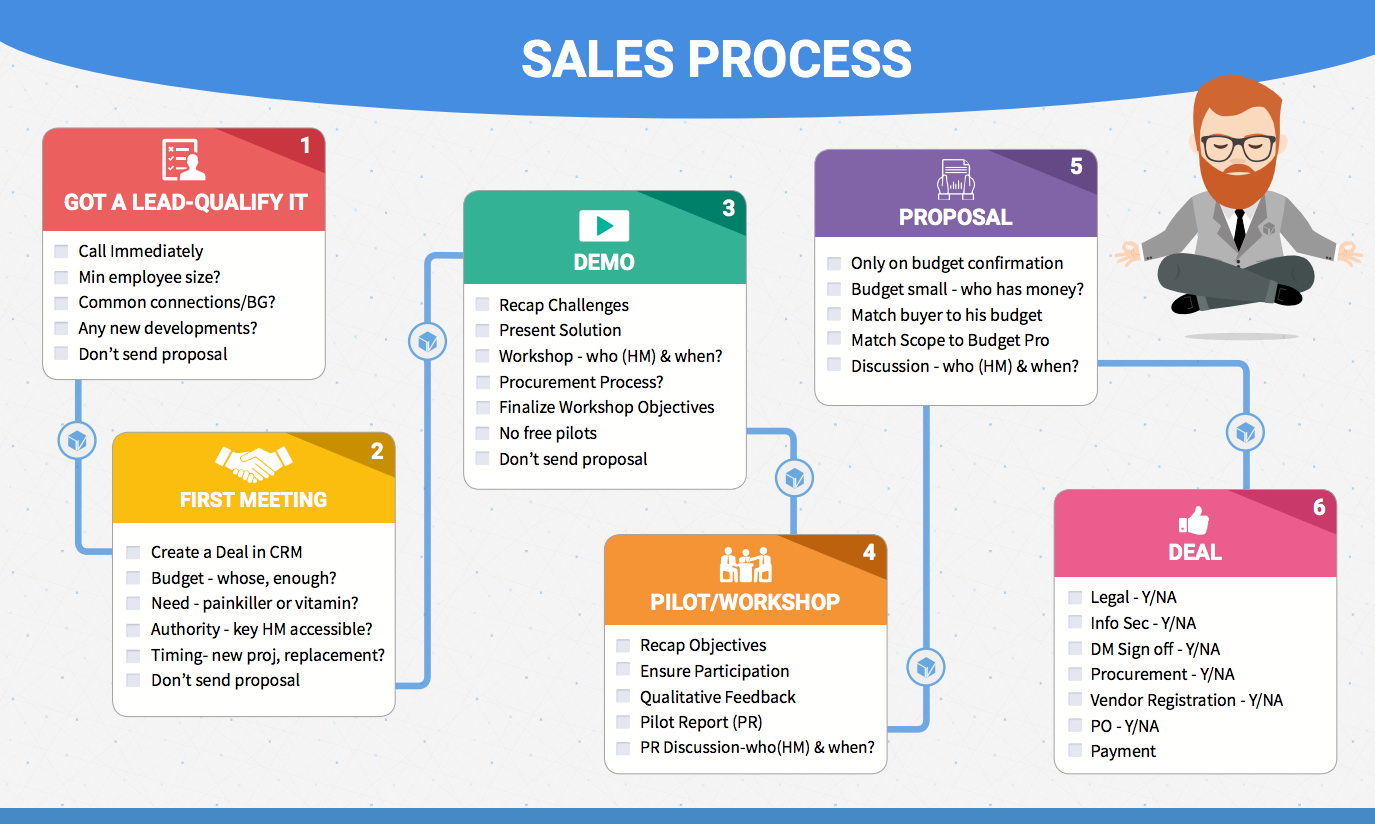
The Keys to an Effective Sales Process

by Patrick McLoughlin

Optimizing your team’s sales process is a job that’s never finished. With new growth targets always part of the equation as well as changes in buyer behavior, you need a process that allows you to effectively recognize and take advantage of needed improvements.

A defined sales process has consistent steps that align the way you sell with the way your buyers buy. Requiring your reps to make X number of calls a day is not a sales process. Outlining the fields that need to be entered in your CRM isn’t a process either.

Your CRM is an enabling technology of your sales process. Ensuring its alignment is a critical step in ensuring adoption and protecting the investment of your CRM. Demanding certain behaviors and results from team members without giving them the necessary resources and tools is not only a bad way to run a sales organization, it’s a surefire way to miss your revenue goals.

A CRM is a foundational element to an effective sales process, but your CRM is only as good as the sales cadence that surrounds it. Consider the sales process in your own sales organization. Does it contain these key elements?

Clear Roles and Responsibilities

Multiple departments are engaging with your buyers throughout the sales process (e.g., marketing, product, services, etc…). Define the roles and responsibilities of each department and team member. Everyone needs to understand what they’re accountable for at each stage of the process. When is sales ops involved? When does sales leverage marketing? At what point should procurement be looped in? Delineating roles and responsibilities provides accountability and much-needed checkpoints for you as a sales leader to intervene if problems arise.

Alignment with the Buying Process

One factor that separates a great sales process from an average one is customer alignment. How does your buyer buy? How do your customers leverage digital content? What decision makers are most often part of the process? Your chief buyer may be the CIO, but are you also talking to the CFO?

Strong Understanding of Customer Verifiable Outcomes

Customer Verifiable Outcomes are the buying indicators that help a salesperson qualify to the next stage of the buying process. The organization may be launching a new product or may be in the middle of a recent acquisition. These are factors that may impact movement towards a buying decision. Identifying what these CVOs may be for your buyer will help your reps better validate deals, where they otherwise would be guessing.

Consistent and Ongoing Qualification is Performed

Elite selling processes include consistent qualification throughout the sales cycle. Early qualification is important to target the right types of buyers. However, you also need an exit strategy, in case a salesperson realizes the time investment won’t generate a strong return.

Throughout the process, you should have built-in check points that have the reps identifying:
– Well-defined buyer problems and pain points
– Risk or cost to customer of non-action
– The compelling event
– Opportunity costs of non-decision

Efficiency and alignment are critical elements of sales productivity. They are also a key component to an effective CRM. When your CRM enables an effective sales process, it provides a vehicle to enforce discipline, repeatability, predictability and validation of progress throughout a sale. Most importantly, it allows for inspection and planning – in advance.

For more information around building a solid sales process, download this free eBook: 3 Keys to Unlocking a Scientific Sales Pipeline.

23 Feb 17:21

Dealing with Data Overload: How to Find the Information You Need and Ignore the Rest

by Sanjay Castelino

When you add up the activity of hundreds of millions of smartphones, tablets, PCs, and countless servers churning every hour of every day, it’s little wonder that estimates peg our collective data output at 2.5 quintillion bytes daily. Annualized, stored data is growing four times faster than the world economy.

Think about how astounding that figure is. As marketers, we have ready access to more data than ever before—about our customers, prospects, competitors, partners, and suppliers. But trying to capture and make sense of it all can be overwhelming. Here’s how to find and leverage the information you need and ignore the rest.

Marketing with purpose

Let’s start with the obvious. Marketing technology is temptingly functional now, and it’s easy to fall in love with the idea of collecting data on just about anything we want—from what traffic at the website looks like at 2 a.m. to how many prospects buy after the fifth click (or the sixth click, or the seventh). Not a day goes by that someone doesn’t show up to my office with a new set of statistics that look useful for a moment. But most often, it proves to be trivia that lacks meaningful context. It answers no important questions about the state of my business.

Now, does that mean marketers should be stingy about the data they collect? Not at all. Tech-savvy marketers would be remiss if they didn’t take advantage of modern intelligence gathering tools. The winners of this data race are the individuals who are careful about where they spend time analyzing. Collecting lots of data is the byproduct of being in a digital business, but analyzing only the data that can help make better business decisions is the key. Sometimes less is actually more.

Asking the most crucial questions

If that sounds like a balancing act, it is. Good questions can help you decide what’s worth analyzing, starting with the most important: what is the conceptual model that drives my business? I’m talking specifically about the drivers of revenue. For example, do repeat customers tend to seek out certain types of content before they press the buy button? And what experiences lead to sales most often?

Think of the traditional leads process. Most marketers will tell you that activating a pop-up contact form and pummeling website visitors with it 15 seconds after they arrive will build your email list. If you study this process enough, you’ll quickly learn how many pop-ups it takes to capture an email address. But will the email addresses forcefully captured from all those pop-ups actually lead to sales? That’s the question you need to ask.

Data that answers these questions is incredibly useful because it reveals value that can be delivered to the customer and realized by the business. And when we know those things, we can more easily test, engage, and ultimately optimize experiences for customers and prospects. In other words, focus on analyzing and acting on the data that can improve customer experiences and your bottom line.

Finding a seat at the table

To be fair, that’s easier said than done. I’ve seen many companies where an obsession with large numbers and preconceived notions kept us from really studying the key drivers of revenue and designing the experiences that would get us more of it. Be prepared to have these conversations and stand firm when you must.

But again, do so with purpose in mind. As B2B marketers, we have to constantly ask how we can add value to the business. How can we help the sales team have useful conversations with prospects that lead to deals? There’s data out there to help us answer those questions, and it’s the only data worth analyzing.

23 Feb 17:20

Why Disastrous Sales and Marketing Misalignment Persists (& How to Fix It)

by jamie@salesforlife.com (Jamie Shanks)

sales-marketing-misalignment.jpg

Sales and marketing teams both directly touch the customer, but for some reason, the average company just can’t find a common ground after that.

However, consider that more than 50% of the success of a social selling ecosystem within your company is going to start and end with Marketing! If Sales is to be successful, then we need to get aligned with our friends in Marketing.

(P.S. -- Would you rather hear me talk about this? Sign up for my keynote session at Digital Growth Conference with Forrester analyst Mary Shea here, in which I'll share a new charter for Marketing and Sales.)

Exploring Sales and Marketing Misalignment

Marketing teams around the world are busier than ever, scrambling to create digital content to be used on social media or for email campaigns or sponsored ads and so on.

Imagine to their surprise, after all this hard work, that the sales professionals at their organization are all but ignoring this content. In fact, according to SiriusDecisions, “Up to 65% of your marketing team’s digital content never makes its way into the customer’s hands.”

We’ve progressed a little in the past few years, but as Forrester’s Mary Shea outlines in her latest report, misalignment still persists. Three main reasons are to blame:

  1. C-suite progress is slow to move downstream. Eighty-two percent of CMOs have goals that are now directly tied to revenue and profit. However, just because the CMO has revenue goals tied to his or her compensation doesn’t mean the rest of the team is exactly jumping at the prospect.
  2. Marketers are risk-averse. As it stands now, marketers and salespeople are very different personality-wise. Where salespeople see a quota-carrying role as an opportunity, most marketers see it as a risk. In her report, Shea points out that compensation has been underused as a way to facilitate and motivate cross-departmental collaboration and communication.
  3. Sellers are near-term oriented. Marketers want to engage buyers through a more “strategic lens” whereas salespeople are still geared to transactional selling. But the goal is to be customer-, rather than conversation-focused.

The Root Cause of Misalignment: Blindspots

Where does this problem start? Simply put, sales professionals have no idea that there is a direct and indirect correlation among digital content shared to buyers reaching buyers’ hands, and increasing inbound leads. And that same confusion also exists at the top of the sales funnel, as sales professionals can’t see how content will increase the probability of winning a deal.

Is this surprising? No. Of course sales doesn’t know this.

Sales professionals are the masters at finding the path of least resistance, and only do activities with a “what’s in it for me” attitude. This is why no matter how hard you may have tried to explain the “conversion funnel” to the sales team, it hasn’t sunk in! If it had, you would have salespeople flocking to share content with their buyers.

This misalignment on value is actually a data-driven problem -- in other words, there are often blindspots in the data shared between departments. These blindspots are perpetuated as Sales has little to no visibility into Marketing's content production schedule or how buyers are interacting with this content.

sales-marketing-alignment-blindspots.png

However, as marketers know, buyers leave “digital fingerprints” on your website and on other digital assets. This pattern of digital fingerprints is called their “Content Consumption Story.” By analyzing which buyers consume what kinds of content, you can ensure your marketing team is producing assets Sales can actually use (and actively wants).

KPI Measurements Contribute to Misalignment

Sales professionals are paid against their number, rewarded against their number, given accolades such as President’s Club trips against their number, and of course, fired against their number. As a sales professional, my number the only thing I care about!

But most marketing departments measure themselves against Leads, Marketing Qualified Leads, Sales Qualified Leads, Sales Accepted Leads … call it what you’d like; it’s a solid leading indicator, but it's not sales bookings.

Now, before you blow a gasket and give me the excuse, “But I as a marketing leader can’t control the closing of a sale, I can only lead a sales professional to an opportunity,” I want you to check that impulse at the door. That impulse is the mindset of an individual, not an ecosystem.

Marketing leaders need to recognize that they're equal contributors, and therefore equally accountable, for sales success.

Your team will behave as per how it is measured. If you continue to give the marketing team leading indicator goals like Lead Volume, that’s the behavior you’ll garner.

sales-goals-vs-marketing-goals.png

3 Steps to Get Sales and Marketing on the Same Page

Naturally, throughout the Sales-Marketing alignment process, you are going to extract objective evidence, plot trends, and create a prescription to completely align Marketing to sales quota attainment.

But fundamentally, there are a few simple changes you need to make before anything else:

1) Drop the word content from your vocabulary.

Content sounds like you produce widgets, while insights are a form of intellectual property. Marketing leaders need to believe that the insights their teams build are so valuable that you could charge customers for the knowledge. Change the way your entire organization talks about insights, and treat these assets like you would a government-registered patent to intellectual property.

2) “Moneyball” your marketing.

Marketing is becoming a numbers game just like sales. Great marketing teams are objectively looking at their production capabilities (like an ad agency would), and the results their work is having on sales. If you take this scientific approach to your marketing, you’ll realize you can control everything -- like a production line of an automobile plant.

3) Make the first move to extend the olive branch.

As a marketing leader, you’re co-captain on Team Revenue. Yes, this is a joint exercise, and you might think it's just as much sales leaders' responsibility as your own to kick off the alignment initiative.

But guess what? I’ve trained way too many companies to know that sales leaders don’t think they need Marketing as much as they do. It’s you, the marketing leader, who is going to prove objectively that your team is directly and indirectly fueling sales growth. Of course, Sales and Marketing alignment in world-class organizations is also orchestrated by Sales Enablement and Sales Operations, but I recommend that the head of Marketing make the first move.

Want to hear more on this topic? Register for the 2017 Digital Growth Conference.

HubSpot CRM

23 Feb 00:31

9 companies in the UK that offer employees unlimited time off

by Will Martin

working on vacation

Taking a holiday once in a while is crucial to let us recharge our batteries, get away from the stresses of work, and generally just have some time to ourselves.

Most companies have a set number of paid days employees can take off every year, which normally increases with seniority, but many companies now offer their staff the chance to take as much time off as they like.

The practice of unlimited holiday is one that stirs strong feelings. Advocates say it lets employees manage their own time without arbitrary limits on how much time off they're allowed, while opponents say it leaves employees confused as to how much vacation time they should actually take. As a result, they can end up taking much less than they would if there were specific guidelines in place.

The practice is reasonably common in the USA, particularly in the tech community, but it is now starting to trickle into the UK where the statutory minimum holiday amount is 28 days per year, including bank holidays.

Jobs marketplace Glassdoor, which tracks perks like unlimited holiday, has provided some firms in the UK that have the policy. A handful are US companies with UK operations, while others are UK-based. Check them out below:

Netflix

What they do: Netflix is now among the most recognisable tech companies in the world, providing a widely used movie and TV streaming service, as well as creating original programming. CEO Reed Hastings is a big proponent of unlimited vacation, and takes at least six weeks a year off.

What employees say: "Great company culture, challenging missions, autonomy and valuable feedback from your peers and management." — Former Marketing Employee


LinkedIn

What they do: LinkedIn is probably the best known social network for business professionals, allowing people across the world to connect and share ideas. It was acquired by Microsoft in December 2016.

What employees say: "The culture is a solid representation of what they believe important. Diversity, integrity and respect whilst continuously being pushed to take responsibility and ownership." — Current Employee, London.


EventBrite

What they do: Founded in San Francisco in 2006, EventBrite is a platform that allows customers to buy tickets for concerts, sporting events etc, as well as providing a platform to register for free events.

What employees say: "With cutting edge benefits like free daily lunch, all you can eat snacks (lots of choices), and a "take the time you need" PTO policy, Eventbrite has positioned itself to be a unique employer." – Current Employee


See the rest of the story at Business Insider
23 Feb 00:31

Social Selling and Predictive Analytics for Sales

by Senraj Soundar

Insights on Social Selling from LinkedIn’s Survey of Sales Executives

“The world of business is going through a seismic shift in how we engage with our clients; therefore, there will be leaders and laggards throughout this evolution,” says Alexander Low, Head of Client Development, JLL. But what he is referring to? What’s this great change in how salespeople interact with their prospects? The answer is the same change that is revolutionizing all of our lives–the revolution is social networking–which in the business world, when it is used to find and nurture clients to maximize quality contacts, is called, “social selling.”

Social selling is about leveraging your social network (i.e., LinkedIn, Facebook, Twitter) to find the right prospects, build trusted relationships, and achieve sales goals. LinkedIn, the world’s largest professional network, reports that 72.6% of people using social media as part of the sales process outperform their peers and exceed quota 23% more often.

Social selling provides an advantage by offering more access to buyers and more feedback about any problems. Social selling allows salespeople to use social media to interact directly with their prospects, answering prospect questions and offering thoughtful content until the prospect is ready to buy. It’s all about enabling your prospect to make an easier purchasing decision.

Equally important to social selling is the ability to measure it, to quantify the value of your social selling. When discussing measuring, Paul Albright, CEO & Co-Founder, Captora explained that “sales feedback should be continuous – daily activity, sales pipeline development results, opportunity to-bookings conversion rate, sales cycle for each deal, and average sales cycle across sales’ deals.” It’s all well and good to have a robust network of contacts, but if the network itself isn’t working for you by providing fruitful insights into whom to contact, then your network is lying fallow. It’s not producing the kinds of information from sales metrics that you need. That’s where solutions can help by using predictive data intelligence to score and prioritize your leads.

With the advent of social selling came powerful new measuring and predicting engines, which help social selling to take root in the world of B2B sales. Digital communication strengthened one-on-one relationships by enabling more frequent and meaningful communication. This is in addition to predictive lead scoring and analytical insights provided by companies who have elevated predictive sales analytics to a science.

Any sales executive will tell you that in order to succeed as a salesperson you have to lead with a focus on the relationship. The deal is closed through the interactions and it is social selling which increases the value of your interactions. Research shows B2B decision-makers count their interactions with salespeople as the major determinant of whom they choose. When explaining the value of social selling, Tim Riesterer, Chief Strategy & Marketing Officer, Corporate Visions explained that “salespeople who show a knack for presenting edgy, counterintuitive industry insights,” by for example writing articles which can be accessed by all those in a social network, “can make themselves a go-to source when their contacts are ready to buy.”

Although interest in social selling is significant, and more and more companies are reaping its rewards, there are a couple of reasons why adoption is lagging. One is that there is a lack of people who understand how to get a positive return on investment by using social media. Another reason is that there is seldom support from the top–many C-suite executives are not social themselves.

One way to teach those old dogs (no pun intended) new tricks is to show results. When recounting how she employed her social network in her first job at a time when the business environment relied on cold-calling, Lingsey Boggs, VP Enterprise Sales & Social Selling, etailinsights, said that she had the least amount of calls on the activity report–but, the flip side was that she was exceeding her quota quarter after quarter by using her social network contacts, as opposed to fishing in the cold calling waters. “My managers soon developed a different and foreign mindset of embracing quality versus quantity,” Boggs said. “I taught the sales organization my social selling methodologies. And they are still practiced there today.”

“Less is more,” agrees Barb Giamanco, Social Selling Strategist. “Salespeople can spread themselves too thin. They need to define their social selling strategy, they need to be social media savvy.” Research from Harvard Business Review, MHI Global, CSO Insights and others, indicates that buyers are clearly saying they want to work with salespeople who can help them solve business problems and who also collaborate with them to craft solutions.

Collaboration and trust are still the basis of any good sales relationship. It leads to productive rapport, knowing you can ask questions and get them answered. Fulfilling the buyer’s desire prior to sale, and finding the right buyers are the salesperson’s objective. Social selling, coupled with predictive and analytical insights, is leading modern salespeople to the right leads, and allowing that salesperson to nurture that lead until closing.

If your company isn’t utilizing social selling resources, your company has underutilized assets and unrecognized revenue is waiting.

23 Feb 00:20

Russia creates propaganda force to wage information warfare against the West

by Alex Lockie

Vladimir Putin Sergei Shoigu Nursultan Nazarbayev

The Russian Defense Ministry has formalized its information-warfare efforts with a dedicated propaganda division, Russian state-run media reported on Wednesday.

"Propaganda needs to be clever, smart and efficient," said Russian Defense Minister Sergei Shoigu in reference to the new unit.

Retired Russian Gen. Vladimir Shamanov, who leads the defense-affairs committee in the lower house of parliament, said the unit would "protect the national defense interests and engage in information warfare."

But Russia has long been accused of spreading propaganda in the West. Business Insider's Barbara Tasch detailed one case where Russian outlets spread a false story of a Russian-born 13-year-old being raped in Germany by a group of three refugees.

In December, US intelligence agencies concluded that Russia had meddled in the US election and that its interference may have been directed by Russian President Vladimir Putin himself.

Russia's use of propaganda as an element of "hybrid warfare" proved instrumental during the 2014 annexation of Crimea and the later insurgency in Ukraine.

Russia has vastly improved their conventional and nuclear military assets as well. An Associated Press report on Wednesday said that Russia will deliver 170 new aircraft, 905 new tanks and other armored vehicles, and 17 new naval ships.

Russia's forces in Eastern Europe now vastly outmatch NATO's.

A NATO spokeswoman told Reuters earlier this month that "NATO has been dealing with a significant increase in Russian propaganda and disinformation since Russia's illegal annexation of Crimea in 2014."

SEE ALSO: Former Joint Chiefs chair: McMaster should get Bannon kicked off the National Security Council immediately

Join the conversation about this story »

NOW WATCH: 'I'm not going to tell you': Trump refuses to answer how he will respond to a Russian spy ship spotted near the coast

23 Feb 00:19

It Just Got Cloudy In Here…

by Annie Bustos

Embracing the Multi-Cloud Approach

The volume of cloud spending is enormous, with a 2016 Gartner survey projecting by 2020 the “Cloud Shift” will directly affect more than $1 trillion in IT spending. A significant portion of this broader spend will be towards multi-cloud architecture, where companies will seamlessly connect clouds across multiple locations.

Companies that are developing a deployment strategy will have various data requirements and a specific purpose for various parts of the business. Picking the right type of cloud infrastructure to match the right problem is essential, as it avoids under or over-provisioning and can reduce costs. When a company has multiple requirements, a multi-cloud approach makes business sense. Here’s some of the core benefits of implementing a multi-cloud approach.

Widespread Cost Reductions

IT departments and brands are of course looking to shed costs whenever possible, especially when the savings do not come with any reduced efficiency. By spreading cloud deployments across various providers, companies can move resources from more expensive in-house and legacy systems. Larger cloud providers can provide a range of cloud and IT services that can immediately and cost-effectively scale when needed.

The low-cost and massive scale of the public cloud make it core part of a multi-cloud strategy, ideal for taking legacy systems and turning them into more agile applications. With the hardware and maintenance costs moved to the cloud provider, the savings for a business are immediate and impactful.

Expanded Choice

Complex businesses are embracing multi-cloud in order to correctly position and integrate all of their data needs. As the complexity of these needs grow they are matched by the vast number of cloud service provider offerings. Industry leaders such as AWS and Microsoft’s Azure provide companies with a range of choices that can be tailored to meet the needs of even the most complex global environments.

By nimbly choosing different providers, companies can also stay on top of the latest innovations in the cloud sector. Providers are continually looking to improve their offerings through enhanced security, speed, and reliability, so companies with a multi-cloud can pick and choose among the innovators.

Multi-cloud approaches also provide opportunities for customization, where companies can develop a network of providers to match each specific need. For example, you might require a database-as-a-service, a capability that might not be available from all providers. Cost savings can also be found here, as you can pay more for a specific feature from a specialized vendor while still leveraging the lower costs available from other providers.

Less Dependency

Choosing multiple providers also removes the “single vendor dependence” problem, and opens up negotiation as the business can push harder for better pricing, SLA’s and other valuable terms. Multi-cloud environments are also useful for balancing risk. By spreading applications across various platforms, companies rely on failovers to keep processes or applications running, and greatly reduce the chance of provider downtime actually affecting performance. It also provides a broader geographic coverage and enhanced disaster recovery options.

There are some caveats to the multi-cloud approach. They can be inherently complex, as you must manage various interfaces and there might be a lack of standardization. Interoperability is another concern, as you might need to introduce special tools or APIs to encourage applications to properly talk to each other. And there’s a management component, where you need to leverage expertise to pick the right applications to move to the specific types of cloud.

Developing the right mix of cloud architecture requires experience, to understand how certain business requirements and goals correspond to the best cloud choices.

23 Feb 00:17

Tips for Pitching to Potential Podcast Guests

by Guest Blogger

Tips for Pitching to Potential Podcast Guests

This is a guest contribution from Karly Nimmo.

As a podcaster, I’m inundated with requests and pitches from people who are looking for some free PR.

As a podcaster, I’m totally down with receiving these requests and pitches.  I love to hear from people who have something of value to share with my audience.

However, as a podcaster, there’s a few things I’m not down with.  Common mistakes I see potential guests make time and time again.

Know that we podcasters love a good pitch.  We love nothing more than introducing our audience to people who have something of interest; a good story, valuable information or inspiration.  It’s why we do what we do.

So for those of you out there looking to get exposure for your brand, blog, book, event, or yourself, through getting onto other people’s podcasts, listen up.  I’ve got some tips that might just help save your pitch from the trash can.

1. Make the host feel special

There is nothing worse than receiving a blanket email that you’ve obviously sent out to every other podcaster you’ve ever come across.  Or, even worse, from your PR person.

I get it.  You think using a PR person makes you look more professional.  Or maybe you feel like you don’t have time.  I get that too!  I’m running two podcasts, two businesses and running around after a toddler.  We are all busy.  But know this…  A blanket email does nothing to raise my interest as a host.  It doesn’t make me feel special at all.

The second I see a blanket pitch, in the trash it goes.  You don’t respect my time?  I won’t respect yours.

2. Do your research first

Please.  Do your research first.  I can’t tell you how many times I get an email from someone who clearly knows NOTHING about my show.  My podcast is a storytelling format, so it’s bleedingly obvious someone has not even looked at my podcast, when they email pitching ’10 ways to drive more traffic to your website’.

Take a few moments to check out their podcast.  See if they’ve already covered your topic.  Make a note of what that guest spoke about.  And when you go to pitch, have some ideas ready to go.  Angles they might not have covered before.

If, when doing your research, you notice that they tend to only speak to women, and you’re not a woman, mention that in your pitch.  Point out that you noticed it’s primarily women and would they be interested in perhaps getting a man’s perspective.

Or if it’s a solo show, mention that.  ‘Hey. Noticed your show is generally a solo show, but I thought your audience might be interested in *insert topic here*.  Would you be open to an interview?’

Going in leading with what you’ve discovered and the value you can bring, will put you on the top of the prospective guests list.

3. Keep it brief

No one has time to read War and Peace.  Keep it brief and to the point.

  • Why you are contacting them
  • What you can offer (perhaps a couple of potential personalised topics you could talk on)
  • Where they might learn more about you (it’s always great to list a couple of really good podcast interviews you’ve done previously), and;
  • a thank you

You don’t need to waffle on about yourself.  Just be brief and to the point, but friendly, polite and personalised.  Add a bit of you into the correspondence.  Don’t be all dry and stiff – unless you are dry and stiff.

4. It’s not about you

Make your pitch about them, not about you.  What value can you bring?  What problems might you be able to solve for their audience?

Remember; podcasters are human just like you.   And we are always looking for amazing guests to wow, inspire or inform our audience.

I can’t tell you how many times I’ve thought I should reach out to someone and had them tell me they had wanted to reach out, but let fear stop them.  Don’t assume someone doesn’t want to hear from you.  You never know unless you ask. Always ask.

Just ask in a way that serves the podcaster… and, in turn, it will best serve yourself.

Karly Nimmo is all about about helping people find their voice, and giving them the tools and platform to get it out there.  She’s a passionate podcaster, teacher and mentor atRadcasters Podcasting S’cool.

The post Tips for Pitching to Potential Podcast Guests appeared first on ProBlogger.

      
23 Feb 00:16

4 pieces of advice new business owners should ignore

by Sponsor Post

Carbonite new business

Food Truck Festivals of America co-founders Anne-Marie Aigner and Janet Prensky have grown their business from eight trucks and one city to 2,000 participating trucks in cities and towns across the country. Their newest division, Food Trucks 2 Go, meets the increasing demand they get from corporate requests for employee lunches. Here they share four pieces of advice from well-intentioned entrepreneurs that turned out to be all wrong.

1. "You must work with Groupon."

So many small businesses look to the group buying sites as a great way to launch — and for many they are. But for us, Groupon almost buried us before we began. We decided to try Groupon for that first Boston festival in 2012 and sold 1,000 $40 tickets in two hours. We were floored and excited. Until we were depressed and destitute. With Groupon, you sell it for half and then you get half of the remaining half. So that $40 ticket cost the consumer $20 and meant $10 to us. The whole thing was made even worse when we had to refund some customers, who, although they only paid $20 for their ticket, wanted the full value – $40 – as a refund. (Some were upset because they were promised a free item from all 25 trucks but only had time to get 15. Gee, we’re sorry you only ate 15 free items!) But refund we did. 

2. "Hire young people. They'll grow with you."

A common strategy when you start out and you haven’t generated revenue or turned a profit — hire young, pay low. Don’t get us started on the millennials. Yes, they can be bright, hardworking, and talented and they can also be narcissistic, moody, and difficult to please. By the time they landed a job with us, we noticed some were on LinkedIn looking for the next career opportunity. We found that balancing our staff with millennials and boomers is the best choice – and everyone benefits from varied perspectives.

3. "Advertising is the best way to draw crowds."

If you have a product that will appeal promotionally to potential media partners, you may not need paid media. We drove attendance through public relations, pitching stories on the festivals and the individual trucks and truckers. When we wrote to TV stations and asked if they’d like a food truck to come to their station for a TV segment promoting the festival, we almost always were invited to visit! We also approached key radio stations and media outlets in each food truck festival region to become our partners. That way, we were able to receive promotional support from them, and they could have informational booths at our festivals and ads on our website. Through Facebook, Twitter, Instagram, and Snapchat, we have been able to promote the festivals to a massive audience with the food trucks re-tweeting and sharing our messaging. In five years, we have not had to advertise.

4. "You never get a second chance to make a first impression." 

It turns out you do get second chances. When you’re in the event business you learn pretty quickly that you can’t make everyone happy all the time. Our events are popular. This can mean waiting lines at the trucks. Sometimes the trucks run out of food. Sometimes the parking lot is difficult to navigate. Sometimes it’s just hot and people are cranky. When these things happen, our customers start to complain. On Facebook, on Twitter, by email, and snail mail. We answer each and every one of them. We listen. We learn. If necessary, we apologize or refund. And we find that people forgive. A festival we held in South Carolina caused a traffic back-up for over two hours (yikes!) and then when folks finally got to the venue, our trucks were out of food. It was one of our worst days. But we went back the next year. We changed to a bigger venue. We asked for folks to give us a second chance. And this year’s South Carolina Food Truck & Craft Beer Festival had 10,000 people and no refunds.

This post is sponsored by Carbonite. |  Content written and provided by Aigner/Prensky Marketing Group.


Join the conversation about this story »

23 Feb 00:16

How to Use Science to Win Your Sales Conversations

by Nancy Bleeke

Is sales performance an art or science? It’s a long debated question among marketers and sales leaders. The answer is that it’s both. The key is to know when and how science sets us up for the art of the information exchange necessary for winning sales.

The Science of Sales

The science of sales is much easier these days with CRMs and the availability of prescriptive and predictive data. All sales leaders should use this “science” or data to gather and provide information to:
– Ensure your sales process is in alignment with your buyer’s buying process.
– Evaluate whether opportunities move through your pipeline effectively. If not, the data can be used to diagnose the sticking or unproductive spots so you can make the adjustments.
– Provide easily accessible data on prospects for use by the sales rep.
– Forecast revenue.
– Identify coaching and training opportunities to ensure maximum productivity for each rep.

In selling, information is key in knowing how to best position your product or service. We can use technology to push out information deemed important by our science to prospects in marketing efforts or share information on prospects or customers with reps.

The challenge is this: as helpful as this scientific data is, and as easy as it is to use technology for gathering and sharing this data, no data can replace the actual information exchange with the buyer that often needs to take place. This information exchange slows down prospects to engage with the rep and starts the sale so the rep can provide what the buyer needs, when they need it, to confidently make a buying decision.

The Art of Sales

That’s where the “art” of selling comes in: make the most of the actual time with your prospect or buyer in the sales conversation. Unfortunately, based on thousands of sales conversation observations, this is where sales reps are typically ill-equipped to succeed. They are either too scripted or not trained at all in how to use scientific sales information and translate it into the art of the sales conversation, where the right information exchange makes the sale.

Well-meaning sales managers and corporate trainers script what reps should say when they get time with the buyer. The problem is that a script is good only as long as the buyer follows their part as well. If the prospect goes “off script,” too many sales reps continue on with the script and make no sense. This is evidenced by the number of times I have been called “Mr.” even after saying my name is Nancy. I have also been pitched something that has absolutely no relevance to me or my business.

If a rep doesn’t understand why each part of the conversation is important and how to flex or adapt to the buyer’s responses in real time, he or she may come off as the irritating self-focused salesperson EVERY buyer hates, and most salespeople hate to be.

A productive sales conversation is when the sales rep uses the data or “science of selling” to prepare for a conversation with the buyer, focused on what’s in it for the buyer! The conversation is productive for all involved when each party’s time is used well and an objective is accomplished.

The data should be used to make the information exchange within the conversation relevant to that prospect. This is collaborative selling in its essence. From the start to the end of the conversation, reps will have more opportunity to learn the information needed to position value and close the deal as the prospect shares what is most important to them and what they need to make a quick and confident decision.

The 4 Cs to Productive Sales Conversations

four arrows on asphalt
Sales reps using the right data matched with the right skill set for productive sales conversations will advance and make sales more quickly when they:

1. Connect with the buyer to engage them and earn the right for further conversation. The connection may be business focused or something personal. What’s important is to set the stage for a conversation versus a sales “pitch” or one-way thrust of information.
2. Confirm and clarify the information they know in advance about the prospect’s problems, opportunities, wants, and needs and build on it with effective open-ended questions based on what the prospect shares with them.
3. Correlate any information about your solution specifically to what the prospect’s specific situation is. Each data point shared should be directly connected into a “what’s in it for them” or not shared at all.
4. Consolidate and close the conversation by recapping what was learned and what your solution will do. Obtain a commitment, whether it is a final purchase decision or a commitment to the next step in their decision making.

Sales conversations are not always the same because the prospect is not the same.

The science of sales increases the probability of engaging the prospect in a conversation which “gets it done” and accomplishes the sales objective. The information from the conversation populated back into your “system” helps fuel future predictive and prescriptive insights—and that reciprocation between the science and art of selling is what helps sales teams consistently win more sales.

To learn more about the science of sales, download the free eBook, From Art to Science: 5 Steps to Predictable Sales Growth.

23 Feb 00:15

Mark Cuban calls universal basic income 'one of the worst possible responses' to robot automation

by Chris Weller

Mark Cuban

Economists predict robotic automation and advances in artificial intelligence could lead to widespread job loss in the coming decades, but billionaire investor Mark Cuban doesn't think universal basic income (UBI) is the solution.

The Dallas Mavericks owner tweeted on February 20 that basic income is "one of the worst possible responses" to the threat of worker displacement.

UBI is a system of income distribution in which everyone receives a set amount of money, on a regular basis, just for being alive. People can use the money however they want, but the overall goal is to boost people's well-being and reduce poverty over the long term.

Cuban told Business Insider via email that he sees UBI as a "slippery slope," as it can invite a number of hard-to-resolve questions about its implementation. "Should I get UBI? Who doesn't get it? How much? Who pays for it How?" he said.

He issued the criticism after a prominent UBI advocate, writer Scott Santens, replied to one of Cuban's tweets that included an article about the threat of robot-driven job loss.

"Automation is going to cause unemployment and we need to prepare for it," Cuban wrote.

Santens replied to Cuban welcoming him aboard "Team #BasicIncome," though Cuban quickly rebuked Santens to clarify he doesn't endorse UBI.

The two went back and forth as Santens questioned if Cuban had read the research finding entrepreneurship may increase in areas receiving UBI. Cuban said he had.

However, he suggested that the research on UBI — typically carried out in developing countries — might not yield the same outcomes as real policy in developed nations.

More preferable to Cuban is beefing up job-creating programs like Americorps, a federally-subsidized program that slots workers in full- or part-time positions, he said. President Trump recently announced Americorps is one of the programs he's considering shutting down.

"There are plenty of communities that need social support services that can be filled by qualified people who can add value," he told Business Insider.

Cuban isn't the only tech entrepreneur who has expressed doubt in an American UBI model.

In December of 2016, Sam Altman, president of Silicon Valley's largest startup accelerator, Y Combinator, told Business Insider that Americans may not warm up to the idea of paid unemployment.

The math may work out, he said, but "what's unclear to me, is will people be net-happier or are we just so dependent on our jobs for meaning and fulfillment?"

Altman, like many tech executives, is mostly pro-UBI. Facebook cofounder Chris Hughes and Tesla CEO Elon Musk are among the idea's supporters. In the fall of 2016, Altman launched a trial version of his own UBI experiment in Oakland, California. A larger study will take place later this year if the experiment is deemed a success.

In his tweets, Cuban disagreed that people will necessarily get "punished" for finding jobs, as Santens alleged.

"The key to making it work and the obvious challenge is making Gov far more efficient," Cuban said in his email.

He called for bundling government remuneration programs, such as Americorps and the Corporation for Public Broadcasting, and passing the savings onto qualified recipients.

"Just deposit the money in their accounts," he said.

SEE ALSO: 8 high-profile entrepreneurs who have endorsed universal basic income

Join the conversation about this story »

NOW WATCH: Barbara Corcoran shares 3 things she's learned from working alongside Mark Cuban on 'Shark Tank'

23 Feb 00:15

The Foundation of a Great High Tech Company is…?

by Phil Morettini

You’ve seen them many times. The software company that starts off like a bullet, racing at the high tech company equivalent of 0-60 mph in 4 seconds. These companies come out of nowhere, and are an immediate factor in their market.


Most Hot High Tech Companies Don’t Stand the Test of Time

There are many examples, in nearly every major market segment. Netscape comes to mind as one of the more famous. Peregrine Systems here in San Diego was another example. RIM/Blackberry is a more recent example. I’m sure every reader can think of many more.

So what is the difference between one of these high tech company “shooting stars” and the Microsoft’s, Hewlett Packard’s and Dells of the world that stood the test of time and grew into long term successes? After all, in the beginning they pretty much all look alike on the surface.

Cutting Corners

I believe if you look under the covers, however, there are real differences. It’s the difference between a fast rising house of cards and a mansion built to withstand Hurricane Katrina. You start with a solid foundation when you go to build something lasting—which of course the proverbial house of cards is lacking completely.

Now most of the time, people don’t intentionally set out to build the high tech company equivalent of a house of cards. It usually happens when the stress and strain of the marketplace gets in the way. That’s when management begins taking short cuts. It’s often an incremental thing: Cutting expenses in that key project so that you can appease Wall Street by making next quarter’s numbers. Accepting just a slightly less than normal quality level, to allow that behind-schedule new product to finally get out the door. Hiring just a few less developers or engineers than was in the plan for this year. Reducing the corporate brand-supporting Ad buy—a ten percent reduction won’t really hurt—will it?

It’s all just meant to be temporary—but cutting corners has a way of becoming the permanent default, especially when there is brutal competition or extreme pressure from Wall Street.

A Winning High Tech Company Maintains the Foundation

Every great high tech company has a foundation that it is built on—and the care and maintenance of that foundation is a non-negotiable expense for long-term success. With HP it was historically the R&D budget and reliability of its products. The R&D monster was always fed, because product innovation was what fueled the company’s growth for over 60 years–and for a long time, reliability was never compromised. The product might end up being a little too costly, a little too big, a little too heavy or late to market—but it was built like a tank and the products were unquestioned leaders in reliability. Indeed, I would say that the HP brand stood for strong reliability for many years.

Then the company lost its way, recently being split into two (still) large companies. But even before that, I don’t know that the HP brand still has the same reliability cache’ which it had in past years. It’s still a quality brand mind you, just not quite the same. The maniacal devotion to quality just hasn’t been there for a while. And it’s funny that just about the only really notable thing that has been truly “invented” at HP in recent years is the word “Invent” being placed alongside the logo in advertising during the Carly Fiorina era. Ironically, even with the dearth of HP engineering invention in recent years, R&D expenses remained high relative to competitors for many years—the worst of both worlds. It wasn’t until Mark Hurd came in and made a big splash by increasing profitability largely through cost-cutting. Sadly, he was a one-trick pony and kept cost cutting on what had been a bloated bureaucracy until he cut all the way into the bone, harming ability of the company to perform in the long run.

Microsoft was built on monopoly power and paranoia. And I don’t mean that in a negative sense. Depending upon your perspective, Microsoft either shrewdly created the DOS/Windows software monopoly position it has enjoyed for years—or luckily fell into it. I suspect it was a bit of both, but no matter. Since realizing their position, Microsoft for a long time never lost their aggressiveness or failed to leverage their monopoly platform. Many believe they overstepped at times. This strategy was largely successful, although I have always felt that they left a lot of money on the table rolling things into the Operating System—essentially giving features that had independent value away for free–in a paranoid attempt to kill any competitor that was perceived as a potential pretender to their throne. For the longest time they reacted every time there has been a threat—Apple, WordPerfect, Novell, Lotus, Netscape—the list of high tech company road-kill is quite long. They never took their eye off the ball, building and protecting their OS and Office franchise with as much firepower as required for as long as it took.

Now you can argue that their focus on these franchises and not anticipating secular technology market changes has allowed the Google’s and Apple’s of the world to outflank them and become the leaders of the technology business today. In the context of the long term view I’ve taken in this article, that’s a yet unfinished story and one to discuss another day. But still, MS is an incredibly large, successful and profitable enterprise. I believe that their aggressive corporate culture was big part of the foundation that Microsoft is built upon. It has let them survive and thrive since the infancy of the PC until today. Whether they took their eye off the ball at the beginning of the the Cloud/Mobile era–or simply failed to execute–they are still a major factor in the tech business today and will be for many years to come. Recently their cloud business has been growing strongly, so we might see them regain more of a leadership role yet.

We’ve examined a couple of long time winners—now let’s look at one of those classic shooting stars—Netscape.

Formula for Losing

It looked like the next big thing—the Microsoft of the Internet Age. They were to be the successor to the throne. They were the darlings of High Tech and Microsoft was shaking in its boots. It was one of those times where Bill, Steve and the Microsoft gang got caught napping a bit. They didn’t see the Tsunami of the Internet coming at them—until it was almost too late. But the boys from Redmond recovered in time and put all hands on deck until they finally smothered the upstart Netscape. So what happened to Netscape?

Well, in large part Microsoft happened to Netscape. Microsoft put together a Herculean effort to change their company to compete in the Internet Age. They stumbled a bit a first, giving Netscape some breathing room. Early versions of Internet Explorer (like so much software out of Microsoft over the years) were not very good. They were almost laughable, to be frank. But Microsoft traditionally has been the Terminator of the software business. It never gave up and kept coming after you regardless of short term losses. That’s one reason I’m a bit slow to write them off completely, even today. It has had a habit (and the resources) to just keeps throwing people and money at a problem and software version after version comes out until they get it right. Unfortunately, Netscape had never built a solid foundation to combat this onslaught, in my opinion. The browser was what they were about. But an early decision to use the browser as the “razor” in that classic razor/blades marketing strategy turned ultimately into a flaw. Intending to make their money on Servers, I believe that they neglected to keep the Navigator Browser as the market leader–which was the product that created the company’s market position.

It was a tough battle, with Microsoft bundling IE into the OS. But they needed to find a way, through innovation, to keep Navigator in the forefront of the browser wars. It was a tough task—no doubt. But once that browser franchise began to erode, their reason for existence began to fade away. It was really their foundation—which began to crack when it wasn’t built to last. The other mistake which compounded their plight was fighting a multi-front war with Microsoft—much like Hitler in WWII. They didn’t have mature corporate infrastructure or the right level of resources, but chose to compete head to head in many other markets Microsoft was in. Novell made the same mistake, both companies buying some second-rate competitors to Microsoft just to get in the game and compete head-to-head with MS. Instead, they should have focused their resources where they had a lead, and a chance to win—Netscape in Browsers, Novell in Networking. History tells us that the upstart high tech company must focus and win decisively in that first battlefield, before they move on. Think Amazon winning in Books before moving on to dominate nearly every category of online ecommerce. If a company can’t secure and dominate their main niche first, they almost certainly will be crushed.

How Will Google Do in the Long Run?

Which brings us back to Google. They are one of the current technology darlings and high fliers, along with Apple, Facebook and others. Once again, Microsoft treated this threat as real. We’re at that stage where it Google is winning big in search and has been for a long way. But I remember when Novell and Netscape were in front, too. It didn’t last. And I see some parallels—Google has diversified but not all that successfully, for the most part remaining a search advertising company. I’m not suggesting that Google is going away anytime soon. But their main web-based search advertising platform show signs of slowing and recently they’ve been losing mobile advertising market share to Facebook and others. Outside of YouTube and Android they haven’t really been able to create any other significant revenue streams, despite hundreds of acquisitions and much effort. This discussion may seem silly to some given Google’s current position, but remember – I’m taking a a very long term view here. There was a time when AltaVista was a dominant high tech company in Search and Google was a little-known upstart–which you couldn’t have envisioned rising to its current dominance. This is the tech business–in the long term things change a lot–and sometimes very quickly.

What do you think—what are the most important elements in the making of a great, lasting high tech company? Post a comment with your thoughts.

The post The Foundation of a Great High Tech Company is? appeared first on the Morettini on Management Blog.

If you liked this post please share it with you colleagues using the “share” buttons or leave a comment below.

23 Feb 00:15

Innovation and a Multigenerational Workforce

by Mason Stubblefield

When I started in human resources, the notion of working towards retirement was powerful— very powerful. I can’t remember all the times I heard employees of all levels, from 60-plus all the way down to 20-something muse about their eventual “golden years.” There were houses, trips, volunteer work, time with the family, time alone—the wish lists went on and on. In 1985, around there were about three million people in the workforce over 65. Today that number has tripled.

It’s clear today’s workers have very different expectations and end goals as in previous generations. While the average American retires at age 62, the current 50-year-old in the workforce today is aiming for 67, a full five years later than the current trend. And 27% say they’ll “keep working as long as possible.” With average life expectancies up, that shouldn’t surprise anyonelonger lives means a need for increased retirement savings, healthcare coverage, and other costs of living. And those five extra years can make a huge difference when it comes to retirement contributions.

Understanding Motivations

While many pre-retirees stay in the workforce for practical reasons like these, others continue working simply because they enjoy it. Thirty-six percent of 65-plus workers say they “want to stay involved” in the working worldand, so, they do. Many work in highly specialized fields or roles which, in many cases, have come from decades of training and personal development which keeps these high levels in the workforce. Explains Bloomberg, “People with college and graduate degrees tend to work later than those with less schooling,” citing that “since 1985, the share of older Americans with college degrees has tripled, to about a third of 60- to 74-year-olds.”

This paired with 30, 40 or even 50 years of industry experience makes them incredibly adept and incredibly valuable. With this unparalleled experience comes tacit knowledge that a newcomer can’t replicate. I’ve often heard colleagues say of long-time employees, “they know where the bodies are buried.” And it’s trueif not a bit morbid. Long-standing workers can reach back into their wealth of know-how and historical observations and deliver powerful recommendations, insights and visions. It’s something that, no matter how hard you try, will ever emerge from even the most in-depth reporting and analysis. It’s the old, “you just had to be there,” of the workforce.

An Aging Workforce vs. Innovation

As someone who comes from the tech and innovation space, I see this all the timecutting-edge companies who put a serious premium on youth. I get itthe millennial generation is the It Generation right now, coming to the table with more understanding of this space than we’ve ever seen before. It makes sensethey grew up with it! They’ve barely known a smartphone-free world let alone life without the Internet. This is their languageone they’re continually growing, evolving and expanding. Hiring a talented 20-something with serious tech skills is, basically, the Holy Grail of our industry, and companies are constantly battling for their time and talent.

But that doesn’t mean anyone over 35 should take a back seat. Writes Ann Brenoff in The Huffington Post, “Old people. Nobody wants to hire us,” citing that Silicon Valley’s push for diversity in the workplace doesn’t include people with graying hair. People in their 50s and 60s, she writes, “are seen as old. They send resumes into jobs and just never hear back,” especially in the tech industry. And when a Baby Boomer is hired, “it’s because they’re an industry rock star,” she writes, going on to quote Medium’s Steven Levy: “It is someone whose accomplishments are pretty well-known, a person who, when the hiring is announced, generates giddy chatter in the Slack channel. Wow, we hired…X??!??).”

Elevating & Integrating The Boomers

And these aren’t exceptions — more and more the value Boomers bring to the workforce is powerful if it’s harnessed properly. There are, of course, the obvious and very tangible benefits — they work they produce, the innovation they drive, the leadership skills they bring to the table. But there’s also the more unique applications that only these seasoned pros can provide — think coaching, mentoring and driving more diversity in terms of thought and action. Even simple knowledge transfer can help drive meaningful evolution today and tomorrow.

Through that lens, it’s more clear than innovation and age don’t have to be mutually exclusive. And, beyond that, it’s becoming more of a mandate to maintain a successful multi-generational workforce by better assessing, integrating and elevating Boomers’ talents and commitment — even in Silicon Valley.

That shouldn’t shock anyone either because, after all, technology is meant to be the great equalizer. And that goes hand in hand with a push for more diverse backgrounds, thoughts and experiences in our workforces. It’s our role, then, as HR leaders and decision-makers to create multi-generational workplaces that support, engage and inspire employees of all ages to grow and thrive. We can’t discount the contributions and unique perspectives of the 55-plus crowd any more than we can the millennial thought leadersall keep the industry moving forward and all will still be workplace pillars in 10 and even 20 years. Focusing on diverse training and support, leadership opportunities and other employee-driven benefits, products and perks will ensure a more satisfied, more productive and more innovative workforcea workforce that spans generations.

23 Feb 00:14

Make Buying Easier!

by Dave Brock

As sales people, we want to make it easy for our customers to buy. We have endless amounts of data sheets, cases studies, presentations, and information about our products. We seek to be super responsive to our customers informational needs, immediately burying them with information, conducting endless demos to respond to their questions.

Marketing helps us, both with the content and making vast arrays of information available through multiple digital and non-digital channels. They leverage SEO, online advertising, drip campaigns and any number of techniques to make it easier for prospects and customers to find information about our products and services.

We even provide buying tools–configurators, shopping carts, and others to help make it easier for our customers to execute the buying transaction.

All done with the goal of making it easier for the customer to learn about and buy from us!

Ironically, all of this actually doesn’t make buying easier!

In a new HBR article, The New Sales Imperative, the folks at CEB

First, these activities focus on the vendor/solution selection process. This is actually a very small part of the work customers are going through. in their buying/problem solving journey.

In fact, based on the CEB research, we are only making the easiest part of buying easier—but doing little to help them with the parts of buying that too often derail buying processes, resulting in No Decision Made!

Unless our customers are buying these solutions every day, they struggle with knowing how to buy, not what to buy.

They struggle with aligning the 6.8 + people involved in the buying process–each has different priorities and agendas.

They struggle with defining what they want to achieve, what should they be looking for, why? They struggle with defining risks, understanding and evaluating alternative approaches, gaining internal and management support, building business justification.

More importantly, “buying” is usually just a small part of what they are doing–fundamentally, they are trying to solve business problems or address new opportunities. These usually are far more profound, buying becomes just one component of their overall problem solving process. This “Customer Problem Solving Journey,” is far more difficult than just the buying portion of that journey.

As the article by CEB points out, if we want to make it easier to for our customers to buy, we have to focus less on product selection but more in their buying process (and problem solving process.)

While our customers struggle with this, since they don’t buy every day, we are expert at that process, afterall, we are involved in countless similar deals. We have worked with customers addressing these issues in the past. We have great experience in helping them learn, what they should be doing, why, what they should be asking themselves, how they can start aligning goals/priorities, how they gain management support.

We can provide them road maps to help them be more successful with their efforts. We can become “prescriptive,” by helping them learn from the experience of others who have gone down this path before.

We create the most value for our customers when we work with them to make the entire buying process easier, not just focusing on product selection. We create even more value when we focus on their entire problem, not just the buying component of that problem.

23 Feb 00:14

The 5 Marketing Metrics That Matter Most to a Referral Marketing Campaign

by Mo Harake

Everyone has heard stories about companies such as Uber and AirBNB driving huge amounts of traffic to their sites with expertly crafted referral programs. While these programs were excellently designed, with huge amounts of strategizing, testing and refinement, this level of sophistication is not required in order to grow a business using referrals.

Ultimately, a referral program needs to offer an excellent incentive that is contextually relevant to the recipient (and ideally, the referrer). Next, referring a friend needs to be easy to do, with complete accessibility over a range of devices.

Additionally, ensuring referral campaigns are highly personalized is beneficial. AirBNB is famous for their referral emails which include a friend’s picture and feel like a personal invite rather than a cold marketing email (AirBNB grew their sign ups and bookings by over 300% per day using these tactics).

Finally, the product or service being referred to needs to be of high value to the people being invited – otherwise even the best optimized referral campaign will never be successful.

In order for all of these aspects of a referral campaign to work perfectly, refinement is usually required, and these modifications need to rely on hard, empirical data. Seeking to improve a referral campaign without looking at key metrics is like flying blind – you’ll never know where you’re going wrong.

Many marketers put too much emphasis on referral sales as a key metric, without examining the other aspects of their referral campaigns. Here are the 5 marketing metrics that matter most to a referral marketing campaign.

1. Number of Active Users Sharing Invites

As a first step to optimizing your referral program, it’s important to determine exactly how many of your active users have referred a friend. This metric is usually measured within a specific time frame, such as the last 2 months.

If you want to improve this metric, there are some facets of your campaign I’d recommend testing. For instance, the CTA on your site which encourages people to participate in referrals could be modified or placed in a different location. The wording of the incentive can also be changed – or perhaps even the incentive itself.

Every company that’s famous for growing its customer base using referrals has performed extensive A/B testing in order to improve this key metric.

If you want a greater understanding of how your existing customers interact with your site, tracking the total number of invites per customer is also a good idea. This will hopefully provide insights into why some users engage in the referral program and others don’t – helping you to focus on the latter.

2. Referral Page Hits

If you know how many referral invites have been sent, you can cross reference this metric with the total number of referral page hits. This helps you to determine why more people aren’t participating in the program once they arrive at your referral page.

If you’re satisfied with the amount of people reaching your referral page but wish to improve conversions, you may need to A/B test the accessibility and implementation of the referral program. Ensure that sending out referrals is as easy as humanly impossible, and ensure there aren’t problems which pertain to mobile devices.

Again, the actual incentive of the referral problem could also require A/B testing.

3. Recipient Clickthrough Rate

This metric is essential for improving the effectiveness of your email invitations. As discovered by AirBNB, personalizing the invite is incredibly important if you want to improve your recipient clickthrough rate.

image02

You may wish to include a photo of the referrer in the invitation, and have the message come from the from the referrer rather than from the company. You can also allow your customers to customize their referral codes so they resemble a name (rather than a generic combination of letters and numbers).

The more you can tailor your invitation to feel like a warm communication from a friend instead of a cold marketing email, the more your recipient clickthrough rate will improve.

4. Recipient Conversion Rate

Once the recipient has clicked through to your referral program, the next metric to measure is the recipient conversion rate (how many recipients actually sign up once they reach your landing page).

The first thing this metric allows you to test is the CTA on your landing page. Perhaps the location or wording could be improved, or the signup form could be easier to use.

Another common mistake is having too much confusing information on your landing page.

Once a recipient reaches your site from a referral email, your only objective should be for them to sign up to your service. Additional menu items, separate offerings and superfluous information distract from this goal.

I suggest using analytic tools such as CrazyEgg to assess your landing page. CrazyEgg will show you exactly where your visitors are clicking on the page, and also how far they’re scrolling before abandoning the page without signing up. You can then make improvements to these problematic areas.

5. Churn Rate

Research indicates that referred customers have a 25% higher retention rate than customers who were acquired by other means, over a 3 year period.

That being said, it’s still important to measure your churn rate (the amount of paying customers who break ties with company within a designated time period). With this data, you can ensure your referred customers have a higher CLV (customer lifetime value) than CPA (cost per acquisition).

If you have a high churn rate for referred customers, this could indicate that there is a mismatch between what they expect from the service (based on your referral invitation), and what is actually delivered.

A high churn rate could also indicate that the benefits of the original incentive far outweigh the benefits of remaining as a longtime customer – hence why people are prepared to join but not stay.

Conclusion

Diligently measuring these 5 metrics will give you a huge advantage over your competition. However, if you want to improve your analysis and create a superb referral program, you should also track: loyal customer value, total referral sales, invites and sign ups by device, and cost per acquisition.

Can you think of any other marketing metrics worth tracking that will help to make your referral campaign more successful? Let me know in the comments below:

Images by Olichel and AirBNB

23 Feb 00:14

How Should We Adapt to the Robot Revolution?

by Claire Robinson
Copyright: Brian Turner (Flickr)

Copyright: Brian Turner (Flickr)

After years of frustration with its relatively slow pace of progress, artificial intelligence (AI) is finally beginning to deliver on expectations. Depending on who you ask, this is either cause for optimism – or horror. Putting dystopian visions of robots taking over the world aside, most observers are worried about the implications of how a workforce composed increasingly of robots will transform society and the economy.

Bill Gates has now jumped into the fray, suggesting that governments should tax robots to fund training for people replaced by robots. Rather than having a knee-jerk reaction to news of advances in AI, however, we should take a wider view of how technological advances have impacted human welfare over the past two centuries. As long as we implement ways to help society adjust to the next revolution, we have more reason to welcome than fear the arrival of robots.

One reason for the increased focus on AI has been the significant strides that “deep learning” systems have made in recent years. AI has already been used with success in a range of fields, such as manufacturing, transportation, and logistics. Even more cognitive tasks can now be performed by computers. For instance, deep learning has been successfully employed to detect skin cancer better than dermatologists, to classify images faster than humans, and even to beat a trained professional at the ancient board game of Go.

Beyond image classification, data analysis, and pattern recognition, there is even reason to believe that artificial intelligence could one day be employed in the most human of professions, such as law. Last autumn, for instance, researchers announced they had created an algorithm that could predict the legitimacy of a complaint lodged at the European Court of Human Rights with 79% accuracy. The researchers said such technology could be used to streamline the judicial review process by quickly analyzing and prioritizing applications for the judges. These and other signs suggest that it is only a matter of time before robots could begin to supplant even high-level professionals.

Not unexpectedly, this prospect has set off alarm bells in the worlds of technology, economics, and politics. Physicist Stephen Hawking has warned that AI has the potential to destroy middle class jobs, widening the income gap and causing political instability. In 2013, two Oxford University researchers predicted that 54% of jobs in the EU were at risk of being eliminated due to increased computerization over the next two decades.

In the world of politics, most notably, French socialist presidential candidate Benoit Hamon has called for taxing robots and for using the new income to fund a 750€ monthly basic income for French citizens. Hamon has gone further than most policymakers, who have called such propositions too difficult to implement and costly. For example, Patrick Schwarzkopf, director of the Brussels-based EUnited Robotics trade association, said that a robot tax is a “solution to a problem that doesn’t exist,” citing the fact that high levels of employment and high robotization tend to be correlated. Backing up his statement, researchers from Deloitte found in 2015 that while technology contributed to the elimination of about 800,000 lower-skilled jobs between 2001 and 2015, it also helped to create nearly 3.5 million higher-skilled jobs.

In addition to the shaky evidence about the extent to which robots destroy jobs, there is wide disagreement about how to feasibly implement a robot tax. Such a tax would require a practical definition of robots, a way to assess how they create value, and a method for attributing profits to defined automation programs. Additionally, Hamon’s proposition to use the funds from a robot tax to pay for a universal basic income is problematic. Different municipalities, such as Kangasala, Finland, have been experimenting with universal basic income, but it remains to be seen whether such programs will have a net positive effect. While they offer ways to patch holes in the safety net and to encourage entrepreneurism among the unemployed, they are prohibitively expensive and run the risk of abetting idleness.

There’s no question that Gates, Hawking, and even Hamon have raised legitimate concerns about how society will grapple with the shifts wrought by automation and other technological advances. But rather than responding with untested solutions such as taxing robots or handing out cash, policymakers should invest more in proven methods of addressing economic change: education, retraining, and development, in tandem with a strong social safety net. For instance, teaching students how to relearn, rather than specializing in one topic, will help prepare them for the vast changes on the horizon. “Nanodegrees” that can be completed in a few months are another way to quickly retrain workers. And welfare programs, though perhaps not as generous as universal basic income, will assist those at risk of falling through the cracks.

In preparing for the robotic revolution, it also helps to revisit the failures and successes of the Industrial Revolution. The shift from an agricultural to an industrial economy was characterized by intense economic, societal, and political disruption, as old jobs were rendered obsolete, new roles were created, and workers’ wages only belated reflected increases in productivity. At the time, worried observers such as the economist David Ricardo were “convinced that the substitution of machines for human labour…may at the same time render the population redundant.”

But we can take hope from the fact that the human race has overcome these challenges and has emerged stronger for it: over the long term, the substitution of machines for humans has boosted productivity, created more highly-skilled jobs and new industries, and increased quality of living. Over the next century, we can look forward to more numerous and dramatic shifts, as AI could transform every aspect of our lives from the cars we drive to the way that scientists perform medical research.

The main difference this time around is that as the pace of technological change is far swifter than in the 19th century, economic shifts could arrive at a wrenching pace. Jobs will be rendered obsolete in a matter of months, not decades, and workers will have to learn new skills many times over in their lives. The answers to such seismic shifts, however, will likely not lie in schemes such as taxing robots or universal basic income, but in programs that help people adapt to jobs that are not destroyed, but redefined.

23 Feb 00:14

How to Measure Customer Adoption of Mobile Order and Pay

by Nikisha Reyes-Grange

I recently had the pleasure of co-hosting a webinar with Emily Carrion, Apptentive’s Head of Marketing, on best practices for mobile order and pay in restaurant and retail apps. One of the areas we explored was metrics and goals for mobile order and pay. I’ve received requests to get into more detail about how to track and assess customer adoption, which brings us to this post!

Determining whether or not customers are adopting mobile ordering can be a tricky thing to establish, because it’s easy to look at transactions rather than trends. For your mobile ordering service to be successful long-term, customers need to use it frequently. I recommend looking at your metrics as trial versus habituation. This approach helps establish your funnel and helps you understand conversion challenges.

In this post, I share the three step process to measuring customer adoption of mobile order and pay, including how to analyze customer trials and customer habituation, and how to track in-store changes and gather customer feedback. I also share metrics to track during each step of the process.

To properly measure customer adoption of mobile ordering, follow the three steps outlined below.

Step 1: Analyze customer trials of mobile ordering

Why is analyzing customer trials important? Because you’ll be able to gather valuable information, such as how many customers started a trial and placed their first order. In this step, you should also gather insights into common traits (if any) of trial customers and identify stages in the order process with high abandonment rates to determine app issues or blockers that prevent sales conversion.

Beyond customer data, digging into app sessions is vital to understanding the experience of new mobile order customers. What you’re looking for here is any common sticking points that cause customers to abandon their order. To do this, build separate user segments to track order attempts and completed orders separately, then look at each segment’s journey through screens and events. Pay special attention to which screens are visited and where order attempts end—this will alert you to flow issues, poor design elements, and more.

Starbucks Mobile Order and Pay

I’ve always found that there’s a magic number once you get someone to X number of orders (X is different for every company), suddenly they’re hooked. It’s possible that once customers hit that number, mobile ordering becomes a habit. Or, it could be that up until X, customers were learning how to use the feature; reaching X number of order signals that they’ve mastered it. On the other hand, if you see a lot of trials but not a lot of repeat usage, that’s a major red flag to be aware of and to dig into more.

What metrics should you hone in on during this step? Keep these four top of mind:

  • Number of customers who started an order
  • Number of customers who completed their first order
  • Average dollar value of customers’ first mobile order
  • Order abandonment rate by app step/screen

Step 2: Analyze customer habituation

This step is important because you can quantify how many customers have placed multiple orders and assess the impact of mobile ordering on overall sales transactions. You can also determine the impact mobile ordering has on customers’ habits and lifetime value (changes in their spending, visit frequency, etc.); through this, you can identify segments of mobile order customers.

Much as you will do when analyzing trial usage, build app user segments by mobile order usage (e.g., 2 – 4 orders, 5 – 9 orders, 10+ orders) and see if their experience changes. Ask yourself if there is a tipping point after which customer behavior changes, with mobile orders becoming more frequent, ticket value increasing or decreasing, or if there are fewer carts being abandoned. Do customers visit different pages or use different app functions once they’ve successfully placed a certain number of orders? This could indicate a learning curve that may provide valuable insight into how to make the app experience easier.

Overall, what you’re looking for is a lift in frequency, the average ticket value or total spend by customers who are tender switching. If customers are moving from using a credit card (especially loyalty members) you can track their history and their usage. Track what the effect is of customers moving to payment via the app. It may or may not increase adoption of your loyalty program.

Kohls mobile app loyalty program

Your app can certainly help to bring your loyalty program to life or even add on additional benefits. During the launch of mobile order and pay at Starbucks, one of the key benefit statements was that loyalty program members can use the app to order and pay via mobile, which helped to drive adoption.

Here are the key metrics to track in step 2:

  • Number of customers who have completed one or more orders
    • Average number of mobile order transactions ever
    • Average dollar value of mobile orders
    • Average frequency of mobile orders
  • Number of customers who use mobile order for 51% of all transactions
    • Average dollar value of mobile orders
    • Average frequency of mobile order

Step 3: Gather feedback and track in-store changes

By keeping track of ratings & reviews and customer feedback, you’re able to keep your finger on the pulse of how your customers are receiving your mobile ordering experience. Aside from the public places customers leave feedback like the app stores, Yelp, and social media, tracking methods such as Net Promoter Score (NPS) can help you measure customer sentiment over time.

Your customers aren’t the only people who can provide valuable feedback, either. Your in-store staff is on the front lines and interacting with customers who are using the mobile ordering feature daily. Ask for their feedback; they’ll likely have valuable insights from the opposite perspective as the customer.

Coffee shop employee

On a more quantitative level, look at in-store service speeds—is it improving or decreasing since the launch of mobile order and pay? Ask questions such as is waste loss increase or decreasing? What does your service recovery look like? These are just a few of the in-store metrics that can give you a clue as to how mobile ordering is impacting your customers experience overall.

Track customer sentiment in the following places:

  • App stores (as a reminder, you always want to aim for a 4-star rating)
  • Yelp
  • Google
  • Facebook
  • NPS
  • Social media

Track in-store changes:

  • Customer and staff feedback
  • Service speed
  • Reduction in waste/loss (including service recovery)
  • Increased non-mobile store transactions

Digging deeper

If ever there was a business case for customer research, this is it! Activate your consumer insights and research team to help, or leverage in-app engagement and survey tools like Apptentive to better understand the customer experience.

An amazing mobile order experience can take time to evolve, and you may find that you require many iterations to get there. It’s ok—be transparent with your customers (calling it a “beta” is totally acceptable, and sets the appropriate expectations), gather as much data as you possibly can, and solicit customer feedback. You’ll work out the kinks faster, build a better mobile order service, and make your customers very happy.

If you’re interested in learning more about measuring the success of mobile order and pay features, good news! We’re hosting another webinar on February 21th (at 7:00 am PT so our friends in Europe can participate). RSVP here: Mobile Order & Pay: Learn the Do’s and Dont’s from Starbucks, Sephora, Domino’s and Other Top Apps.

23 Feb 00:12

How to Demonstrate Sales Differentiation from Open to Close

It sounds so mysterious and elusive. But sales differentiation is much easier and much more effective than you may think. 

The purpose of differentiating yourself is not to get noticed. It's to create enough value and interest that buyers will choose to meet with you, choose to spend time talking about needs and solutions with you, and choose to buy from you.  

23 Feb 00:12

Make the Shift from Automation to Engagement Marketing

by Patrick Groover

The shift towards ubiquitous marketing is a living reality. Simply dabbling in multi-channel marketing is no longer an option. Engagement marketing, your ability to deliver personalized and connected messaging at scale, will determine your success over the next five years. These changes will significantly impact buyers and sellers in an era where everyone and everything is connected. Marketers are going to face a new digital reality going into the next decade, and traditional practices will no longer suffice.

Engagement Defined

A key progression that has actively influenced marketing over the past 10 years is the tighter alignment of messaging to unique interests and personas vs. generic groupings. A great example of this is the decline of ‘batch-and-blast’ mailers and emails. This hyper-focus has been leading the shift away from impersonal communications to engagement marketing, which is all about building personalized, authentic relationships with your customers and driving the idea of wantedness.

The concept of engagement goes beyond automation because it implies that marketers are responsible for delivering a captivating experience, not just a series of ongoing communications. Today’s buyers are highly informed and much farther along in the decision-making process before they ever reach out to your brand. In fact, many decisions for both B2B and B2C products are made long before interacting with a human being.

While automation is a core component of engagement at scale, the main difference between traditional automation and true engagement is the ability to centrally deliver content and messaging across multiple channels in a highly coordinated and interactive fashion. This allows you to continuously differentiate yourself in the market and capture the attention of your audience.

Master Engagement Marketing

Bombarded with thousands of messages daily, your audience actively finds ways to avoid information that doesn’t pertain to them. In fact, studies show that the human brain naturally avoids or filters out stimulation that doesn’t align to top-of-mind interests. In such a highly-stimulated society, listening to, learning from, and engaging with your audience is a central way to cut through the noise.

Applying this concept to B2B marketing is just as important as consumer marketing for major purchases. Raising engagement levels sets the stage for internal and external advocacy, and delivers critical support for your sales teams within the complex buying committees that decide today’s business purchases. Top-of-mind is no longer a matter of bulk–it’s a matter of relevance.

Take for example two very different experiences:

  • Company A uses generic messaging on their website and within their emails, hoping that their continuous communications will lead to more new names and that the increased bulk at the top-of-the-funnel will translate into more closed deals.
  • Company B delivers personalized experiences, with personalized emails, dynamic content, and targeted remarketing messages based on the specific industry that their audience belongs to. They listen for the products that buyers are interested in, offer additional content based on specific behaviors, and coordinate sales follow-up based on their behaviors and actions. All of these interactions are centrally managed, monitored, and configured within a marketing platform.

When messaging is tightly timed and aligned to the interests of your target audience, the likelihood of audience engagement increases dramatically.

Deliver Engagement at Scale

While automation has largely focused on predicting the buyer’s journey, engagement marketing shifts the focus from a prediction-based mindset to a real-time response-based mindset. This does not diminish the value or purpose of predictive analytics, which is a component of marketing that will continue to be vital to understanding audience behavior. The difference is that response-based marketing emphasizes the need to listen for the actual interactions of audiences and then respond according to explicit actions and behaviors.

In this sense, a marketing platform must be able to deliver a number of key features for engagement marketing at scale:

1. Centrally capture interactions across channels

The challenge of multi-channel marketing is two-fold as marketers not only need to deliver communications through a growing number of channels, but they must also monitor and respond through these channels as well.

Moving forward, it will no longer be sustainable to create and monitor interactions within disparate platforms. With the growing number of channels and technologies, this approach will become unmanageable and costly. Additionally, without a central means for reviewing and responding to interactions, it is incredibly difficult to obtain a holistic view. Marketers need to adopt an engagement platform that serves as the central repository for all of the data—a place that can listen for all the signals your buyers are sending when they interact with you across channels (offline and online), where it can be analyzed and utilized by your team, used to automate campaigns, and pass information quickly and seamlessly between your technology platforms.

2. Simplify audience segmentation

A marketing platform built for engagement marketing should not only be able to connect a variety of touchpoints, but it should also allow marketers to easily leverage connected behaviors to define and personalize the next most appropriate interaction.

Audiences that exhibit repetitive behaviors or a preference for a specific medium of interaction should be distinctly managed and even escalated for follow-up. Your ability to access and group individuals based on the full set of interactions can make a huge difference in delivering on mission-critical business objectives.

3. Align audiences to multi-channel campaigns

Beyond monitoring touchpoints in a hub and accurately grouping individuals based on their individual preferences, marketers must be able to centrally deliver multi-channel communications.

A marketing platform interface must be dynamic, so marketers can easily adjust the channel of communication in the same way that creative services selects a color from their design software. The platform should allow non-technical marketers to manage distinct campaigns, without having to code or configure technical settings.

4. Consistently measure and report across channels

Rather than focusing on first-touch or last-touch attribution alone, a solid platform will help the marketing team accurately understand the full lifecycle impact of all touchpoints along the buying journey and be configurable to the specific business model for any given company. Reports should be simple to configure and highlight results based on industry best practices as well machine-based insights.

Rather than focusing on automation alone, marketers must begin to embrace the concept of engagement–a holistic management of experience across channels that delivers top-of-mind brand awareness and increasing brand equity.

Please feel free to share your impressions on the impact of engagement marketing and how your marketing team is addressing it below.


23 Feb 00:11

‘The tide has turned against them’: B.C. LNG projects likely stranded beyond 2020 amid global glut

by Jesse Snyder

CALGARY — A new report suggests LNG prices will remain low well beyond 2020, further eroding Canada’s ambitions to become a prominent exporter of the super-cooled gas in coming years.

Analysts at Moody’s Investor Service said that global LNG markets are likely to remain oversupplied well into the next decade as Asian demand for the gas weakens and new supplies begin entering the market.

The estimate runs counter to some other analyst projections, which expect markets to balance in the next few years to create a so-called “second wave” of opportunity for would-be LNG exporters in Canada.

The international LNG market has grown rapidly over the past few years as rising demand for the gas, particularly in Asian countries, kicked off a global race to meet future supply needs.

Canada was among the countries vying to enter the market, and around 20 LNG export facilities were proposed to be built along the British Columbia coast, which would be fed by sizeable natural gas fields in northern B.C. and Alberta.

In recent years substantial volumes of new supply started entering the market from facilities in Australia, the U.S. and elsewhere, satisfying demand for the gas.

Mihoko Manabe, a Moody’s analyst who contributed to the report, said Canada’s missed opportunity to enter the LNG market is partly a result of oversupply. But she added that the shortcoming is also a result of political fumbles and local environmental opposition to the projects at a time when companies were more open to make major investments in Western Canadian LNG.

“In the last few years, I think the tide has turned against them—and a lot of it is beyond the cyclical ups and downs of commodity prices,” Manabe said.

Around 34 million tonnes per annum of LNG came online in 2016, the report said, with an additional 105 mtpa expected to be added over the next three years—roughly a quarter of the expected total LNG market in 2020.

The Moody’s analyst doubts demand for large-scale LNG facilities will return to its former levels, even after markets eventually rebalance. Investors are more likely to flock toward smaller, more incremental developments at facilities that have already signed contracts with buyers.

“It’s a lot more economic to expand an existing plant,” she said.

Another threat is the growth of Floating Storage Gasification Units (FSGUs), as they are called in the industry, which offer much cheaper and more versatile supplies of LNG that can reach yet-untapped markets.

“That has allowed the market to diversify into areas, like the Middle East for example,” she said.

The report comes as Christy Clark’s BC Liberal Party heads into a provincial election in May, after promising to develop Canada’s LNG industry during the last election cycle.

A decision by the federal government last September to approve the $11.4-billion Pacific NorthWest LNG, proposed by a consortium led by Malaysia-based Petronas, was used by the party as evidence that it was gradually realizing those ambitions. However many analysts say the consortium is likely to delay a final investment decision until market indications improve. 

Analysts say the changing structure of global LNG markets will tighten competition along B.C.’s coast to build the first export facility.

“The projects that go forward will be the best of the best,” said Jihad Traya, an analyst with Solomon Associates in Calgary.

“Of all the 20-plus projects that were proposed, they were all on their own world-class. But within that pool their will still be significant attrition,” he said.

LNG markets often take years for demand and supply to balance out, according to Traya. However the falling costs of renewable energy sources like wind and solar will also pose a challenge to would-be exporters of LNG when markets near a more balanced state.

“The difference is that they now have to compete against renewables in ways that weren’t necessarily conceived or understood before.”

The global LNG market is expected to grow over the next few years despite increased competition. Solomon Associates expects the global liquefaction capacity could reach 85 billion cubic feet per day in 2025, up from 41 bcfd in 2016.

jsnyder@postmedia.com

23 Feb 00:08

How I Finally Got My Sales Team to Follow a Sales Process [+ Free Download]

by Sanjoe Tom Jose

sales-team-follow-process.jpg

Just like every scientific activity requires a process, so does sales. And while there are umpteen versions of sales processes you can follow, the biggest challenge in sales management from my perspective is not figuring out which process to use, but to ensure that your team actually follows it.

At Talview, along with the responsibility of being the CEO, I also managed the sales team for more than a year. We invested in one of the best CRMs to help us keep the process on track and get the right insights. The CRM supported email and calendar integration and connected to our website and landing pages. This essentially meant that the sales team received their qualified leads inside the CRM and all their email and meeting activities were automatically updated in the system.

In the CRM, the sales process was six steps long:

  1. Qualification Call
  2. First Meeting - Understanding Requirements
  3. Demo - Solution Presentation
  4. Pilot / Workshop
  5. Proposal
  6. Deal Closure

We had periodic refresher trainings on this process to keep the team’s memory fresh.

However, in spite of the various mechanisms in place to reinforce the process we faced two big challenges.

First, the average salesperson was following only about 40-50% of process as defined. While the six stages were sacrosanct, the movement between them was often overlooked or misunderstood. Common problems included:

  • Sending proposals without fully understanding the requirements
  • Taking deals to final stages without identifying and/or securing buy-in from the appropriate authority figure
  • Doing a pilot or workshop without clear cut objectives or metrics against which to measure success

Such mistakes lowered the quality of the funnel, and meant that projections were usually off the mark.

Second, it was difficult for me to objectively review the process followed by the team. I can’t count how many times I was convinced in my role as de facto sales manager to overlook missing steps because the salesperson was so “extremely confident” about the deal. I heard very strong arguments on why the product was an absolute must for the client right now -- even if they hadn’t seen a demo, or if the point of contact was an entry-level executive.

By design, salespeople, like entrepreneurs, are eternal optimists. That is what keeps them going in face of rejections and failures. They genuinely want to close the deal and take home the commission. However, the prevalence of skipped steps made it all but impossible to realistically evaluate how well the process was working.

How Do You Get Salespeople to Follow the Sales Process?

I thought long and hard about how to overcome these problems -- but as it turned out, some of the proposed “solutions” became challenges in and of themselves.

First, we tried adding even more steps to the sales process in the CRM so that the salespeople never left a crucial stage out. For example, we added Legal Approval between Proposal and Deal Closure, and a Pilot Report Discussion between Pilot and Proposal.

Instead of being more faithful to the process, this resulted in the salespeople skipping the CRM altogether! I heard many complaints about lack of time in regard to entering the information in the system. It also made tracking and projections even more cumbersome because now we had double the number of stages.

Next, we tried offering more frequent refresher trainings on the sales process. But it wasn’t long before the reps were complaining about the time cost of training, and used that as an excuse for slow sales. In addition, they felt the trainings were repetitive, boring, and not valuable.

After these two dead ends, we realized the challenge was not lack of know-how of the process. Instead, it was more about the difficulty of thinking clearly with all the action happening on the sales floor. The ultimate solution had to save them time -- not add it.

The Sales Process Poster

Then I thought of something which was very simple but could be effective: A quick reference poster that visually displayed each step in the sales process. We printed the poster and put it up in the sales bay.

talview-sales-process.png

You can download it here.

Even though I was skeptical -- how could the answer be something this simple? -- it worked for both the team and me as their manager.

For the team, it acted as an easy reminder of what they were supposed to do. For every lead that came in, the reps would glance at the poster. It took just two seconds, but those two seconds gave them significantly more clarity on what they needed to achieve on the call or meeting. It also helped them more accurately determine if each deal was ready to move into the next stage, or if something critical was missing.

And as for me, the poster helped me do more meaningful reviews. I could refer to it on the sales floor while doing a quick check on key deals and easily figure out if something had been left out.

Our review meetings also became a lot more structured because everyone had the poster in the backdrop to refer to. Now, when a rep tried to tell me that a new lead would close in two weeks even though our average sales cycle was two months, I followed up by asking how X or Y stage would happen in less than two weeks. If they didn’t have an answer, they didn’t have a deal.

A few more positive results:

  • More clarity and less deviation. Because the sales reps were more clear on what to do next, the rate of deviation from the process came down to less than 20% of cases, a significant improvement from the previous level of more than 50%.
  • Smaller, more valuable funnel. You might be thinking, who wants fewer deals in their pipeline? However, the smaller funnel turned out to be more accurate because the fluff got trimmed. Now, the salespeople are much more focused and spend their time on the right opportunities.
  • Longer sales cycle. Again, everyone prefers the shortest sales cycle possible. But if it is throwing your projection off mark, then what is the point of doubling down on speed? Additional focus on checking all the boxes meant the transition time between stages got longer, but our ability to project accurately (which is almost next to impossible in an early stage startup) improved significantly.

How You Can Create a Sales Process Poster

The biggest reason the poster worked is because of its simple design. We made at least three iterations before we finally agreed on the final product.

So how did we come up with what actually ended up on the page? Before anything else, we did a quick analysis of all the key characteristics and activities that made a deal successful.

When looking at 100 deals from the last six months, patterns quickly emerged. For example, in more than 80% of successful deals, the metrics of success were clearly defined before the pilot -- usually by the clients themselves. So we worked in a Proof of Concept Document stage before the pilot.

Similarly, we found that if deal was of a certain value or above, we typically had to go through Info Security approval. With this in mind, we required salespeople to indicate in the CRM whether Info Security Approval is applicable or not. If so, they would have to secure that commitment, denoted by another stage.

If you are trying to create your own poster, start by mapping out each and every activity you did in a particular stage for successful deals and try to spot patterns. Then, work the critical steps into your sales process, and create an easy visual reference.

How do you get salespeople to stick to the sales process? Share your thoughts in the comments.

HubSpot CRM

23 Feb 00:08

42 B2B qualifying questions to ask sales prospects

by crystal@close.io (Crystal Williams)
b2b-qualifying-questions-sales.jpg

Everything you need to know about qualifying can be summarized with two questions: Can I help them? And can they help me?

This is what we call selfless and selfish qualification. If you can say yes to both questions, you’ll never close a bad deal again.

But how do you get the answer to those two questions? By asking the right questions.

To get you started, here is a list of 42 qualifying questions to ask sales prospects.

How to use these qualifying questions

The first category, ideal customer profile, is meant to be a checklist for you to determine if you’re targeting the right companies. If you don’t already have one, now is the time to create your own ideal customer profile.

The remaining five categories—needs, decision making, budget, competition, and closing the deal—cover the questions you should ask prospects. You don’t need to go in order or ask every single question but after qualifying a prospect, you should know:

  • What do they need?
  • Who are the decision makers and how do they make decisions?
  • Can they afford your product or service?
  • What other solutions are they considering?
  • Are they ready to take the next step, such as having another meeting, attending a product demo, signing up for a trial, etc.?

From there, you’ll know if you can help them and if they can help you.

Get your free copy of the B2B qualifying questions.

Ideal customer profile

1. How well do they match your ideal customer profile?

An ideal customer profile is one of the most powerful ways to identify companies which get significant value from using your product/service, and also provide significant value to your company. If you don’t know which companies to target, you’ll struggle to hit your sales quotas or worse, close bad deals.

2. Which industry are they in?

It may be tempting to try to target every industry imaginable but there will be certain industries that will need and value your product more than others. Don’t take a scattershot approach; double-down on markets you already know and have been a part of or ones where you know many insiders.

3. How long have they been in business?

Length of time in business is an important criteria because it will help you get a feel for a business’s stability. It can also determine which businesses need your solution the most. For instance, one business owner had a point of sales system for chefs who ran their own business but was having trouble selling it. However, behavioral data helped him realize that the best prospects were chefs who had recently opened up a restaurant.

4. What’s the size of the organization? (Measured in revenue, number of customers, number of employees, etc.)

The needs of a small, early-stage startup will be different from those of an older, more established enterprise company. In particular, while enterprise sales can be lucrative, it also can be dangerous if you’re a small startup unaware of the rules of enterprise sales or unequipped to support an enterprise client once they’re a customer.

5. What’s the size of the relevant department?

If your solution is for certain departments (marketing, accounting, HR, etc.), you’ll need to sell to that department and prioritize their needs but you can’t do that if you lack the right information.

6. Are they located in the same areas as your ideal customers?

Depending upon certain factors, location may or may not be relevant but if you’ve noticed your ideal customers tend to be located in particular areas, use location as a qualifying criteria.

7. What's the ideal use case?

Your ideal customers are in a special category because they use your solution in ways that maximizes value for them. Be careful of prospects who would use your product in suboptimal ways because they’ll be unsatisfied and eventually churn.

8. What would automatically make them a BAD fit for your product or service?

For instance, when qualifying prospects for our sales pipeline management software, we ask them how many leads they usually have in their pipeline. If it's less than 100 a year, we recommend they not buy our solution and instead just use a whiteboard or a spreadsheet. That’s selfless and selfish qualification in action.

Needs

9. How did you hear about us?

This is a killer sales question because it allows you to understand what makes the prospect interested in your solution and reminds them of the reasons why they are spending time with you.

Ask this question early in the conversation since the answer will guide your approach to the conversation, tell you which angle to use when conveying the benefits of your product, and which questions to ask to keep them engaged. It’s a shortcut to gaining real insights into their wants and needs, so you have a more targeted conversation.

10. What are the top challenges your team or company is currently facing?

Prospects won’t initially care about your product and all of the bells and whistles it has. Their priority is tackling their own challenges. Therefore, if you want to be on their radar, you need to know what their pain points are and demonstrate that you can provide a solution. Only then will you have a chance of closing the deal.

11. What are the top challenges you’re currently facing?

In B2B sales, there are three levels of customer need: the company, the department, and the individual. Guess which level is most important?

To summarize one of the points of Gary Vaynerchuk’s sales philosophy, you’re not selling to an organization, you’re selling to a collection of individuals. Failure to sell the individual prospects can lead to a delayed or derailed deal.

12. What are the results you want to achieve and how do you want to achieve them?

Knowing a prospect’s challenges is a good start but you still need to dig past surface level understanding. For example, say your prospect’s biggest challenge is increasing revenue. You could immediately launch into a pitch about how your solution will increase revenue by saving them time but that would be pitching prematurely.

By asking the right questions, you might learn that while they’re not interested in saving time, they are interested in increasing revenue with more effective advertising. That changes the dynamic of the conversation because then you can tailor your pitch around their needs and interests but you couldn’t have reached that insight if you hadn’t dug deeper.

13. When would you like to achieve these results?

Your prospect may need to have their challenges resolved by a certain deadline. The closer the deadline, the more urgent it will be that they find the right solution, which could help speed up the sales cycle.

14. How would achieving these results benefit you, your team and company?

This question helps tie positive emotions to the resolution of the prospect’s challenges and by extension, your solution. What if your prospect wants to increase revenue because it meant they could hire more employees and better tap into more opportunities in the market? The excitement they feel about the possibility of more opportunities would then be transferred to your solution if they believe your solution can help make this possible for them.

15. What would the consequences be if you didn’t solve these issues?

Despite a company or individual’s challenges, it’s still possible for them to delay or get distracted with other issues. By highlighting the consequences of not solving their problems, you create a sense of urgency and keep the conversation focused on the important issues at stake.

16. What motivated you to search for a solution now?

If a prospect has recently experienced a major event such as a change in leadership, the company, or market, they will have a greater sense of urgency and interest in selecting a solution, which would shorten the sales cycle.

17. If you’re not currently searching for a solution, why not?

A prospect may not be searching for a solution for a multitude of reasons such as already using a competitor’s product, not having the budget, or not viewing your solution as a priority.

However, an outside perspective can motivate prospects to rethink their stance by, for instance, informing them of a better option, helping them find the money in their budget or uncovering the opportunity cost of not having a solution in place.

While prospects don’t want an aggressive salesperson, they will appreciate a salesperson who educates them and challenges their thinking.

18. Which features are must-have versus nice-to-have?

You need to know the answer to this question in order to help your prospect prioritize. Plus, it prevents you from pursuing deals that could never close because even though you had everything the prospect wanted, you didn’t have everything they needed.

19. Why do you need these particular features?

It’s very possible that your solution may not have one of your prospect’s must-have features. In that case, you must think like an engineer, not a salesperson.

A salesperson may be tempted to overpromise and underdeliver on a missing feature. However, an engineer will often want to know why a prospect needs a feature and exactly how they plan to use it. This line of questioning can help reveal if a feature is a deal-breaker or if it’s possible to use a workaround to accomplish the same objective.

Decision making

20. What role do you play in the decision making process?

This is one of the most overlooked questions in the qualifying stage. The person on the phone may be an enthusiastic internal champion but at the end of the day, you still sell to decision makers and you need to confirm you’re talking to the key players ASAP.

21. Who are the people who have the final say on making a decision?

The larger and more complex an organization is, the more decision makers there will be. Every decision maker must be sold on your solution before you can make a successful sale.

22. What concerns will these decision makers likely have?

Remember, you sell to individuals, not companies. Gain a competitive advantage by asking your internal champions what issues are more likely to attract or repel individual decision makers to or from your solution in order prevent any embarrassing or costly mistakes.

23. How does your company or department make decisions?

Knowing who the decision makers are is different from knowing how a company makes decisions. For example, one person or a group of people may have the final say but the company or department may hold meetings to gauge the opinions of other important stakeholders such as end users. If you’ve turned each stakeholder into an internal champion, you're better positioned to make the deal happen.

24. Which departments are involved?

This question is especially important when selling to large organizations. Even if the marketing department will be the sole department using your solution, the procurement and legal departments of a company may be involved in finalizing and approving the contract. Use this simple sales hack to get your contracts signed quicker and reduce the amount of legal hassle to a minimum.

25. Who will be responsible for implementing or overseeing this service or product?

Even if the CEO loves your product, getting their approval is only the beginning of the deal. Generally, your product will be delegated down the organization to a more appropriate person. However, the person responsible for implementing your product won’t always share the CEO’s excitement for it if it means more work with very little upside for them.

Find out who will be responsible for managing your product internally. Then sell that person on how it will benefit their company and their personal career. Otherwise, your product will be poorly implemented and the contract won’t be renewed.

26. Do you have the resources and time to handle implementation and training?

Especially if you’re dealing with a large and/or demanding prospect, implementing and training people on using your product can be expensive and time-consuming. You need to understand their capabilities and willingness in this matter, and make sure to sell them on using your product or else they will receive no value from your product.

27. How much time did it take your company or department to buy a similar product?

Asking this question will help you estimate how long this deal will take to close. If the timeframe seems long, you’ll have a chance to ask about choke points and delays in the process.

28. When do you want to make a decision and begin implementing a solution?

You now have a rough idea about how long the decision making process will take, but you want to ask your prospect about a deadline in order to keep them accountable for and focused on making a decision.

29. Which metric(s) would you use to evaluate the success of my solution?

If you know how they will judge the effectiveness of your solution, there will be fewer surprises as both parties will have an understanding of the objectives your product can and cannot accomplish.

Budget

30. Who oversees the budget?

By now, asking about the decision makers and decision making process should have allowed you to identify the person or department in question but if you haven’t, now is a good time to ask.

31. How much have you spent on similar solutions?

The amount a prospect has spent on past solutions could determine the amount they’re willing to spend. You need to know where the pricing of your solution falls in regards to their predetermined range. If your price falls below their range, your solution might be too cheap and if it falls above their range, you’ll need to convince them that the value of the product outweighs the price.  

32. How much do you have budgeted now?

Things change. It’s possible that they might have spent more in the past but now they’re on a tighter budget. On the other hand, maybe more money has been made available recently. If there’s a gap between what they have spent on similar solutions in the past and what their budget is now, inquire about it.

33. Have you ever needed to invest in a solution that was outside of the original budget? If so, what was the budget allocation process like in that case?

If your solution costs more than their intended budget, you’ll need to know about similar cases. It will give you an idea of the likelihood of the budget being increased and how it was handled in the past.

Competition

34. Do you currently have a contract with another company? If so, when is it up for renewal? Is there a cancellation fee?

If your prospect currently has a contract, your job will be double-fold: convince them that their current vendor isn’t the right one for them and that your solution will make their jobs and lives better.

Don’t be surprised if your prospect isn’t interested in switching if they’ve recently signed or renewed their current contract. The key is to be patient and regularly follow up so when they’re ready to switch, your company is the first one that springs to mind.

35. What has worked and hasn’t worked with your current solution?

Picking up on unmet needs is a great way to position your product as a better solution if your product can solve those issues.

36. What were the deciding factors that made you choose that particular solution?

When you're qualifying prospects, you mostly ask a lot of questions that focus on the present but asking questions about the past can be powerful because it gives you access to past buying experiences. If their past buying experiences were positive, associate your solution with that success and use it as a model for the way you sell.

However, if their past buying experience was a flop, distance yourself from it and frame your solution as something completely different. How is your offer better? How does it protect them from missteps like these? Why won't they have to worry about making another bad choice if they choose you?

37. How does our solution compare to the competitor’s?

In this day and age, prospects are more savvy and aware of their options. Therefore, at the very least, you need to know your competitors’ strengths and weaknesses and be able to sell against the incumbent in your market. However, if you really want to blow the competition away, outcompete your competitors by pitching their product.

38. Are you considering building your own solution?

Competition can come from multiple sources and you don’t want to overlook the potential competitor right under your nose: your prospect. Especially if they’re developers, they might think they’re better off building their own solution.

While that option gives them the most control, it might not be the most time-efficient option, particularly if they have to deal with maintaining and updating their solution on a regular basis. You might even have examples of current customers who initially invested in building their own solution, only to find out that in the long-term it’s not feasible.

Closing the deal

39. What are all the steps we have to take to help make this deal happen?

This is called the virtual close and it’s one of the most powerful questions you can ask. Ask this question in order to learn in detail what it would take to turn the prospect into a customer. This question will give you a roadmap to the prospect’s buying process and will uncover any major red flags before they have a chance to screw up a deal.

40. Are there any obstacles that could prevent this deal from happening?

This question is essential. By asking it, you prompt your prospect to identify potential roadblocks, allowing you to be proactive instead of reactive.

41. Based on what we’ve discussed, do you think our solution is a good fit for your needs? Why?

At this point, you should know whether the prospect is qualified, have a roadmap to the decision making process, and be prepared for potential obstacles. This gives you a chance to handle any objections that haven’t been addressed and re-confirm the prospect’s interest in your product.

42. When is the best date and time to schedule our next meeting?

The best time to schedule a follow-up conversation is when your prospect is still on the phone! While you’re still talking, ask them to look at their calendar and schedule a time that works for them. Then, a day or two before the next meeting, make sure you send them an email to remind them of, and confirm, your next appointment.

Selflessly and selfishly qualify, then sell

There’s a saying that we have two ears and one mouth so that we can listen twice as much as we speak. In sales, this means asking the right questions and then listening to what your prospect says. Only after you’re sure you can help them and they can help you should you sell to them.

Close the right customers and you’ll have successful customers who will be a source of referrals and additional revenue in the form of upsells.

Close the wrong customers and you’ll have unhappy customers who will be a source of bad reviews and higher churn rates.

The difference between those two outcomes begins with qualifying prospects correctly.

Want a copy of these questions you can easily carry around and use? Hit the button below. 

Free B2B qualifying questions 

Recommended reading:

How to qualify prospects & leads
Before you sell to a prospect, you need to understand his or her wants and needs first. You need to know what he or  she cares about so you can use that to close.

How to ask powerful sales questions
Salespeople know that asking questions is one of the most powerful skills to close deals. But how to do it right?

Buyer refuses to answer your questions? Do this!
What to do when a buyer doesn't want to answer your questions and tells you

23 Feb 00:08

The One-Week Social Selling Action Plan

by Guest Post

The One-Week Social Selling Action Plan written by Guest Post read more at Duct Tape Marketing

Think back to a sales situation with a friend of a friend, one where you started with a huge trust advantage: how much smoother and faster was the process?  What if you could replicate that dynamic on a much larger digital scale?

Your friends of friends are not hiding in distant corners of the world, in fact, they’re probably right in front of you, and you can take advantage of warm connections without attending more energy-sucking business mixers or cocktail events.

By the end of this post, you will have a one-week action plan for systematizing social selling to win dozens of more meetings and closed business every month, and once your system is up and running, you’ll find that the time investment is very minimal.

25% of your prospects’ day is spent HERE…

US workers spend 6.3 hours per day in their inboxes (source).  Distraction-heavy social media darlings come and go, but the email inbox is going strong after more than two decades.

Moreover, the inbox is where your prospects go to get things done, including research and purchases.  Twitter and Facebook can generate traffic, but when it comes to getting an immediate action, like a sales conversation, I’d rather hang out where business is being done, not where news articles and cat videos are consumed.

With all that in mind, your action plan will center on lukewarm, email, and in my experience, many business owners and marketers have head trash about it, so let’s cover some common misconceptions:

Misconception 1: “Unsolicited email is SPAM!”

Nope, it’s not as long you comply with a few simple regulations – here are the rules, straight from the FTC.  If you’re outside the US, regulations can vary, so be sure to check the receiving nation’s rules.

Misconception 2: “I always ignore cold email, and my buyers will too.”

Overall, the bar is extremely low when it comes to cold email – most practitioners dip the scale way too far toward quantity over quality, and their campaigns rarely produce results.

Most of us ignore cold emails because they are A) poorly targeted, B) self-serving or irrelevant, C) poorly timed, or D) all of the above.  While bad timing can be tough to completely avoid in every situation, you can always create a well-targeted list and write a compelling message, and by the end of this article, you’ll know how to do that.

Misconception 3: “Maybe cold email works for some people, but it won’t for my high-end prospects.”

I used to think that until our cold campaigns started landing meetings and closed business with Fortune 500s for mid-five figure deals.  While big ticket products might carry longer and more complex sales cycles, high-end buyers are just as lazy as the rest of us, so they use the same methods: Google, social media, and yes, their inboxes.

The strategy in a nutshell

Here’s what you’ll learn how to do:

  1. Use LinkedIn, and later other social networks like Twitter, to curate a list of high-value, warmly-connected prospects.
  2. Hire a virtual assistant to find your targets’ emails and other information.
  3. Write and send email sequences to your list.
  4. Optimize and repeat.

Goals and benchmarks

When it comes to social selling, the trust advantage you enter with will produce results superior to almost any other strategy.  Here’s what you’re going for:

  • New recipients per week: 150-300
    We’re not shotgunning emails to the masses, and 150-300 per week is a list you can curate.
  • Open rates: 70%+
  • Response rates: 10%+
  • Meetings per week: 8-15
  • Click rates
    Who cares: we want the shortest path to a conversation, not necessarily traffic to your site.

The One-Week Action Plan

Day 1: Post hiring ad for lead generation VA

If you already have this role filled, then feel free to skip ahead to Day 2.

Since getting applicants will take a few days, we’ll get the ball rolling right away.  Your lead generation VA will be researching prospects according to the plan you develop. He will track down emails, verify them to avoid bounces, and log custom fields in your spreadsheet.  Later, your email platform will pull this data to form your email template.

Even if you’re at a very early stage, if you’re reading this, it’s safe to say that research tasks are below your pay grade, and conducting them will leave you time for little else.

The good news: hiring a lead gen VA is low-cost (we’re talking as low as $20 per week for a very limited campaign).

Step 1: Create Upwork hiring account

If unfamiliar, Upwork is one of the largest freelance hiring platforms.  If you have other hiring resources you trust, feel free to run with them, but if you’re starting from zero, Upwork will let you hire quickly and cheaply.  The client setup process is pretty straightforward, but here’s an article that will guide you through it.

Step 2: Post job ad

Now you will write and post your job ad so you can get the best quality applicants.  Make sure to sell the opportunity a bit, and be very specific.

Job ad example: 
Best practices:

Use Google forms to weed out the templated applications

Simply include the link to the form in your job post and ask applicants to apply. The questions you include are not especially important, as this is just a weed-out tool.

Make sure they know how to do email research

You should not have to explain the step-by-step process for email research, as this is the mainstay of the trade, and any specialist worth their salt should know the basic process for hunting down addresses based on names and company details.

Ideal rates for lead generation research: $4-7/hour

Go for project-based arrangements when you can, estimating 2-4 hours of work to find 50-100 targets.

Step 3: Invite applicants

If you’re new to Upwork, it will take some time to attract applicants, so it helps to send invites to the job ad as you’re getting started.

Typical search parameters I use to find lead generations VAs:

Application invite example:

Upwork tips

Best lead generation talent: The Philippines and Eastern Europe

Watch for red flags, but don’t get too hung up on experience or feedback ratings

While you should keep an eye out for negative feedback, a millions amazing reviews and thousands of working hours logged do not always indicate reliability.  Keep in mind that there are many highly experienced low-cost specialists who are new to Upwork and have little official history.

Build your hiring history to attract better and cheaper talent

Once you build a track record on the platform it becomes easier to bring on top notch people.

Prioritize responsiveness and written language skills

Once you develop a shortlist of applicants, send them messages and ask to follow up questions.  Their responsiveness and written language skills are often litmus tests for later performance.

Hire fast, fire fast

Don’t wring your hands to find the perfect candidate – start testing specialists, and move on if they’re not working out.

Keep great freelancers on board

If you make an awesome hire, and you can afford it, it’s worth the investment to find things for them to do so you can keep them with you for the long haul.

Day 2: Create lead research procedure

Sometimes determining your target audience can make your head spin – maybe your business serves a variety of different niches.

On Day 2, you’ll zero in on the prospects who inhabit your personal network and are most likely to purchase, or at least refer you to someone who will.

In the background, the VA applications will be drifting in, so you’ll have options to consider on days 3 and beyond.

Step 1: Complete The 3-Question Targeting Diagnostic

If you’re having trouble pinpointing the ideal niche to start with, give this diagnostic a try:

Where do you have leverage?

Which of your client verticals are your champions?

These are niches represented by clients who are chomping at the bit to give you testimonials and refer you business since you’ve created huge wins for them.

Where is there market growth?

Where, on a macro level, are the money winds blowing?

All things being equal, you may prioritize big data software companies over printing companies, for example.

Who is most receptive?

In which verticals do you experience smooth, seamless sales processes, instead of arduous uphill battles?

Which clients just get it?

Step 2: Determine your targets’ revenue floor and ceiling

Go after clients where the investment in your solution will be an easy-fitting line item and not a budget boondoggle.  To identify the companies that can afford you, keep in mind that marketing budgets typically represent 7-10% of total yearly revenues (source).

How can you estimate total yearly revenues if they’re not public?  You can guess by multiplying the number of employees by the typical revenue per employee for the industry you’re targeting.  In the ad agency world, for example, $100k-200k yearly revenues per employee is typical.  You can easily find the rough number of employees from LinkedIn, which you’ll do on the next step.
While you your prospects should easily afford you, you also want to ensure they’re not too big to accommodate.

Step 3: Set up LinkedIn advanced search

You have a clear picture of your buyer or at least a solid guess, and now it’s time to build your LinkedIn advanced search and see how it plays out.

You might be skeptical since many of our Linkedin connections are loose at best.  I felt the same way.  What I found after hitting pay dirt with this strategy is that the power lies with combined mental triggers: when you stack the relevance of your offer (more on that later) with the trust of even a loose personal connection, it’s often enough to lock down the conversation.

Here is an Advanced search I used to source a list used to generate a consistent stream of 7-10 sales consultations each week, in the niche of creative service agencies sized 11-50 employees:

Note: while the extra search parameters provided by LinkedIn Premium speeds up the process, you can avoid this expense with additional research in the form of guessing and checking titles and company sizes.  (I think splurging for Premium is worth it).

What if you don’t get enough search results or enough relevant results?

If the results are limited or irrelevant, refine your search until they’re mostly on point.

It’s ok to start small.  As you connect with more people, you’ll develop a larger web of 1st and 2nd-degree connections, and your network will grow by leaps and bounds.  This is The Connection Snowball Effect, and what starts as a limited group will quickly become scalable.

Why not just send InMails?

I tried this strategy and got stagnant results.  A few reasons why I gave up on it:

  • Most people don’t check their LinkedIn inboxes regularly.
  • Unless you are 1st degree connected, your InMail allowance is limited to just a few per day.
  • InMail convos tend to quickly drop off, and it’s tough getting communications from InMail to the calendar.
  • Bottom line: the email inbox is where you want to be, for the reasons described earlier.
Step 4: Create spreadsheet template and custom fields

Now that you have solid search results, it’s time to set up your spreadsheet template. (Google Sheets is recommended since it makes collaboration easy).

Your email platform will be pulling fields from your spreadsheet to create a customized, yet automated email template, so the syntax of each field in your spreadsheet should match up with the way you have each logged in your platform (more on platforms later).

When you’re determining your fields, use these heuristics:

  1. How can you demonstrate impressive research about your prospects (even if it’s automated)?
  2. What knowledge will fit nicely into a spreadsheet cell?
  3. What knowledge will look natural and relevant in an email?

Custom field ideas:

  • Previous clients your recipients worked with.
  • Company nickname:
    Consider how employees in the target company refer to it ie. NOT “ACME Creative Inc.”, just “ACME”.
  • Reference a recently-launched product.
  • A new job title they’re hiring for, and the hiring site you used to find it.
  • Years in business.

Intimidated by custom fields?  No worries.  At a minimum, just make sure you have columns for FirstName, LastName, and Email.  You can get fancy later on if you’d prefer.

Spreadsheet example

Step 5: Curate your list and make LinkedIn connections

Now that you have your custom fields set up in a spreadsheet template, you can start curating your list.

I tried to automate everything from the beginning, asking my VA to build the list soup to nuts based on a search parameter.  Once your VA fully understands your target audience, they can take everything over, but at the outset, a bit of curation on your part will make the difference between dozens of conversions and completely stagnant results.  Plus, it’s your personal network, and you probably want to have at least some control over who you’re hitting up.

To curate the list, as you peruse the LinkedIn search, simply copy/paste each target’s LinkedIn URL to the appropriate column in your spreadsheet (you’ll find the URL under the profile pic).

As you go along, connect on LinkedIn with the prospects you’re adding to the list, if you’re not connected already.  You can expect reconnection rates of 50%+ since you’re already a 2nd-degree connection.  This is powerful because even if they don’t accept, they are likely to become at least loosely familiar with your name and face, which will go a long way when you start sending emails a few days from now.

Days 3-6: Hire VA and delegate lead research

Now that you have a curated list, your VA has work to do.  On days 3-6, your VA will be gathering fuel for your campaigns by completing the missing fields and finding the emails and other info for your warm, personally connected prospects.

Step 1: Arrange interviews and delegate research on curated list

Shortlist your VA applicants based on relevant experience and their follow through on instructions, and send them rough instructions and the curated list.

From there, set up interviews for the purpose of further explaining and clarifying, and then let them get off and running with research.  If possible, record these interviews and provide your VA with the video for future reference.  If your budget allows it, bring on multiple VAs and treat this exercise as a test assignment.

Again, make sure your VAs should have their own email research procedures, as this task is a mainstay of the trade.
Step 2: Delegate email scrubbing

To keep your bounce rates low, and mitigate your risk of having your domain flagged by email providers, make sure to run your list through an email scrubber, which checks if addresses are valid.  Bulk Email Checker is a good option, although many email platforms have this functionality built it from the start.

Step 3: Review progress and correct course

After your VA finds 50 addresses, review their progress.  Later, when they are doing all the curation and research, make sure to leave detailed feedback within the spreadsheet when your VA inputs an irrelevant target.  Before long, they will understand your target market.

Day 7: Write and schedule email sequences

By now you hired one or two skilled lead generations specialists, and they have built a list of 50-100 prospects who are warmly connected to you.

Now you will setup your email platform and write your sequences.  Stay alerted: this is the point at which many starts going down the over-complication rabbit hole.  You do not need to build a Rube Goldberg machine of sales funnels and marketing automation that’s integrated into absolutely everything else in your business.  Though there are a few technical considerations, which I’ll cover, at the end of the day we’re simply sending emails with the aim to lock down a meeting.  You’ll put each recipient into a sequence, each message spaced out by 3-7 days, and when someone shows interest, you put them into your CRM.

Step 1: Set up outbound email platform

Email platforms are always changing, and setting up the campaigns in each one is beyond the scope of this article (that good news: most platforms are easy to use).

When you’re picking your outbound email platform, make sure you’re NOT using one intended for newsletters, autoresponders, and other inbound marketing to those who have opted into your list: you won’t use products like MailChimp, aWeber, or ConvertKit.

Here are a few solid outbound email options:

Step 2: Set up alternate domain and DKIM/SPF registrations

Make sure you’re sending your cold emails from an alternate domain, NOT your main one, which you use for all other communications.  By setting up an alternate, if you get flagged as spam, you won’t have your main domain trashed by email providers.  Instead of being SomeDude@ACME.com you’ll become SomeDude@Acme.co.  From there, have your alternate URL redirect to your main.

Without going too far into the technical forest, SPF, or the Sender Policy Framework, and DKIM, domain keys identified mail, tell recipient email providers that you have authorized your email service, like Google apps or your outbound email platform, to send emails on your behalf.  Don’t worry if you’re not sure how to do this – most platforms offer step-by-step instructions.

Step 3: Write your main offer email

The quality of your list is 75% of the battle.  The remaining 25% is the quality of your messaging, which is where we are now.

One of the most powerful mental triggers you can leverage is the community and the trust that goes along with it.  Being even loosely connected to your prospect will make you safe in their eyes, so be sure to lead with the connection.  Also, some custom field-driven black magic never hurts.

You’re probably eager to see that million dollar email template, right?

Unfortunately, there’s no one-size-fits-all template, and the canned messages that float around on sales forums are of limited value because they’re not properly crafted to your situation.  With that in mind, use other people’s templates for inspiration only. 

But here’s what I’ll do: I’ll guide you through the conceptual framework for what I’ve seen work by using question-based heuristics, and then I’ll contextualize it all by showing you a template I’ve used successfully.  Sound good?

Overarching best practices

  • Keep it relatively short: 2-5 brief paragraphs
  • Tone: write like you’re reconnecting with the friend of a friend you met at that cocktail party.
  • Avoid marketing copy: no false scarcity, no gushing adjectives, no litany of features and benefits.

Subject Lines

How can you be intriguing without being deceptive or misleading?

Best practices:

  • Include custom fields in your subject line (usually the company name suffices).
  • Questions tend to get higher open rates ie. What does ACME look for in a website rebuild?

Beginning (1st paragraph)

How can you demonstrate understanding where all others have missed the mark?

How can you make them feel like a unique snowflake instead of another brick in the wall?

Best practices

  • Lead with customization, demonstrate research.
  • Use first names (“Hi Bob”, not “Dear Mr. Peterson”).
  • Ideal place to include custom fields ie. recent job openings, product rollouts, relevant clients they’ve worked with, funding rounds…

Middle (2nd and later paragraphs)

How can you demonstrate falsifiable results?

What outcome is so compelling or alleviating that even the faint glimmer of its realization would compel them to talk to you?

BAD: “We’ve built stunning websites for our tech clients”

BETTER: “Our sites have helped our SaaS clients convert 5% more leads in less than 3 months.”

What if you don’t have a bunch of sexy case studies like that?

Don’t worry – you can mention relevant clients you’ve worked with or other wins.  Just try to be as specific as possible.  Remember that your offer should help your prospect to easily visualize an amazing outcome.

End: Call to Action (CTA)

So what action are you going for?  Should you direct your prospects to a sales page, a white paper, a tripwire product, a calendar widget, a webinar?  There are many choices, and the CTA you choose will depend on your overall strategy.

That said if you want leads for a high-end product or service, and you’re getting started with cold email, go for a simple, low-commitment conversation.  If your list and messaging are on-point, this is NOT too much to ask.

So what does low commitment mean?  Let’s answer that with examples…

This is NOT low commitment:  Can we schedule a meeting next week to see if you’re a fit?

 “Meeting” = long and grinding, and “to see if you’re a fit” = one-sided sales pitch.

BETTER:

Can we chat briefly next week so I can give you all the details on the program?

Would you be interested in a free review of your current lead generation and sales approaches?  We’ll go over what you’re doing, I’ll tell you all about our program, and if nothing else, you’ll leave with a helpful idea or two.

Put your CTA at the end, and don’t muddle it.

You’ve probably received terrible cold emails that have multiple actions to complete: the sender wants you to download a free ebook, set up a demo, and schedule a meeting, all in one email.  Decision fatigue sets in, so you do nothing.

Template example

The following is a template I used to reach out to my 1st and 2nd-degree connections in the boutique marketing agency niche.

{{BRACKETS}} = Custom fields pulled from spreadsheet

SUBJECT: Found you on Linkedin, curious how {{nickname}} handles lead generation…

Results (after week 1)

Step 4: Write follow up emails

What should you do after you send the first email?  What happens if you don’t get a response?

Don’t give up after the first touch point because it’s often the second, third, or fourth emails where you’ll get an agreement, and herein lies the power of sequences.

Email 2: Professional persistence

How can you demonstrate professional persistence, and show that you care enough to follow up?  Usually, a casual one-liner does the job.

Email 3: Risk reversal

How can you reduce your recipient’s uncertainty and mystery about your offering?  How can you make the pain of remaining the same more than the pain of fulfilling your call to action?  This is where you might link to a PDF or an info page.

Email 4: Loss aversion

If they’ve been busy, on the fence, or interested but unsure, how can you tip them over the edge?  How can you gently imply that an opportunity is about to pass them by?

What happens if you still get no response?

Leave them alone for a while, but in the future, you might send them helpful content, or a different offer.

Reminder: always honor opt-out requests promptly

Do this by setting the recipient as “do not contact” in your email platform.

Days 8+: Optimize and continue

Once your campaigns are rolling, the first priority is building up enough warm and connected targets to fuel your campaigns.  As you expand your LinkedIn connections, you’ll see a snowball effect, and a higher percentage of new contacts will accept your requests.

You can apply this exact same strategy using Twitter – simply search for niche-relevant keywords among your followers and build up your list that way.

From there, it’s all about a/b testing.  Testing can create overwhelm, and sometimes it’s tough to find a good starting point.  Begin by testing subject lines, and once there’s a clear winner based on open rate, move on to testing your body content.

Focus on open rate and response rate.  Don’t put too many links in your messages, and don’t worry too much about click rate – after all, you want meetings, not traffic.

Send no more than 50 emails per day

The small batch approach makes it easier to monitor results and correct course before you either blow out your list or spend too much time and money on lead research that’s not working.

Also, you need to let your domain warm up in the eyes of Google and other email providers.  If you send hundreds of emails immediately, it looks unnatural and you might get flagged.

Resources

Click here to get all the tools you need to implement your Action Plan.

What you’ll find:

  • Video webinar of this Action Plan so you can see how it plays out.
  • Targeting Game Plan Template so you can get laser-focused on your most likely buyers.
  • Email templates used to win five-figure engagements.
  • The spreadsheet template I use to create all my custom emails.

About the Author

Dan Englander is the founder of Sales Schema, where he helps marketing agencies grow by way of done-for-you lead generation and sales consulting.  He’s the author of Mastering Account Management.  Previously he was the first hire at the New York animation studio IdeaRocket.  He’s a decent living room guitarist and he makes a mean paella.

23 Feb 00:07

Building Recurring Revenue: 5 Keys

by Scott Salkin

It happened just this past week and I was shocked. Angered. Disgusted, even. It was right there on Twitter as a promoted ad. Then I got an email about it. Then I saw it again and finally had had enough.

No, this had absolutely nothing to do with politics. To me personally, it was worse. Much worse. It was every single reason I had started Allbound, rolled-up into 140 characters (and because this came from an Allbound competitor, I’ve blocked their name):

Bull. ‘Effin. S***. For more than a decade now, the 3-4 legacy vendors atop the channel space have been telling their own prospects and customers — the very people who are running the programs that their own technology has been supporting — that they they are “going extinct,” “fighting for survival” or “at risk of being irrelevant.”

Scare tactics at their finest.

Not just scare tactics, but tactics that have resulted in fear, doubt and a loss of confidence in one of the most critical facets of building the kind of business that not only can grow fast, but grow far: having a successful channel partner program. A program that gets you you deeper into verticals, wider across horizontals and so much further towards reaching your goals.

So, here’s the truth. Partner programs sure as hell ARE NOT fighting for survival. I’ll put every single ounce of integrity and credibility in my professional career behind that statement. I’ll go even further and say this: the biggest threat to building and operating a successful partner channel today is the EXACT same threat to the short- and long-term viability of your entire business: innovation, digitalization, simplification, and, most importantly, a die-hard focus on delivering customer outcomes above and beyond anything you or your competitors have delivered before.

And nowhere — NOWHERE — is this more important than in SaaS and the subscription economy, where customers are the high-octane fuel that accelerates recurring revenue, the most valuable currency in modern business.

So, let’s get excited. And here’s why: it’s NOT partner programs that are going extinct. Nor the people behind them. The only ones who are truly at risk are the the 20-30 year-old technology vendors and advisors who themselves are the sole perpetrators of that thinking.

Need proof?

Well, just ask Nick Mehta. Or Tomasz Tunguz. Or OpenView Ventures. Or Tiffani Bova. Or Cisco. Or HubSpot. Or Apple. Or Harvard. Or any of the 100,000,000 businesses around the world who sell, market or support their customers through a network of channel partners. All of whom will tell you that a modern partner program — one focused on the entire customer lifecycle — is one of the most critical and lucrative strategies for faster, more efficient, more sustainable growth in the subscription economy. And here are five keys to building one:

1. Recruit the Right Partners

There’s no doubt about it, just like any relationship (in life or business), building powerful partnerships takes work. Arguably the most important aspect of setting a solid foundation is finding and onboarding the right partners. In years past, channel programs have been more “Sister Wives” than “Friends.” More “Tinder” than “eHarmony.” And we’ve all seen how that typically works out. But finding the right partners is no different than finding the right customers, and the most successful businesses do that not only by throwing a few forms on their website, but by building detailed, targeted personas.

Sure, you may find some potential partners by casting a wide online net, but I guarantee that you also end up spending tons of time (and money) filtering through and spinning cycles on fly-by-night operations who aren’t going to help you grow your business, and the people who don’t understand your product or your vision. You want your partnerships to be targeted and strategic, not the product of a completely random application process. And most importantly, you want them to be symbiotic — beneficial to you, your partners, and your shared customers.

2. Transfer Your Knowledge

Simply hiring a great sales rep with a successful track record doesn’t always mean he or she is going to thrive selling your solution. In fact, the number one reason most reps fail isn’t because they’re not trying — it’s because they’re not thoroughly onboarded and regularly equipped with the right training, content and resources to keep them sharp at every phase of the sales cycle. The exact same can be said about partners – only they’re not sitting in your office, under your payroll or with your laser-focus on selling only your solution.

Partners are, in a way, a volunteer sales team. And the most important thing you can do to keep them engaged and help them succeed; in fact, THE NUMBER ONE THING they request from the vendors and manufacturers they resell or support) isn’t leads, it’s knowledge. And no, that doesn’t mean a passive portal or legacy PRM system that more often than not becomes a dumping ground of PDFs and PowerPoints. What it does mean is timely, organized training tracks, smart content and strategic playbooks that are intelligently aligned to their specific opportunities and automatically delivered via an active software platform and user-friendly interface, compatible with the multiple devices they’re tethered to.

3. Treat Your Partners Like People… Because They Are

We hear it time and again. “Partner ‘X’ just isn’t engaged. Or “Partner ‘Y’ really crushed it this quarter.” As you grow a partner program, you’ll find it only natural to refer to your partners as companies rather than people. But the fact is, partners are just like your business — they’re made of people. People with families, busy lives and hectic schedules. People who need to be motivated, who need culture and vision, who want to be part of something successful, to be empowered rather than managed, and to truly believe in what they’re selling or supporting.

As we like to say, partners are people, too. So treat them as such. If you’re relying on a partner portal or PRM system to be their main point of contact, you’re failing. Failing the exact same way a sales leader would be failing her team if she only engaged and communicated via a passive, one-way portal. The exact same way a customer success manager would be failing his customers if he never called or visited them in-person. I’ll say it again: PARTNERS ARE PEOPLE, TOO. The more you engage with and empower them, build trust and transparency with them, make them part of your culture, and align them to your business goals, the more you’ll make them feel like such. And the more they’ll give back.

4. Have a Laser Focus on the Customer

Let’s get right to the bottom line: If you and your partners aren’t aligned on working together to deliver wildly successful results for your customers — better results than you could achieve alone — then you simply shouldn’t be partners. For decades now, partner programs have been focused almost entirely on pre-sales activities: lead generation, cold calling campaigns, list purchases, co-branded collateral, sales training, and continuously ridiculed (and often wasted) marketing development funds (MDF) — anything and everything to close deals and land new logos.

Today, that paradigm has shifted. In fact, it shifted more than a decade ago when the entire world started becoming “SaaS-ified.” Unfortunately, many partner programs are still either struggling to catch-up or being led by executives who are still relying on “calls and closes” as their primary KPI. Meanwhile, the most successful partner programs — programs such as HubSpot’s, Cisco’s and Xero’s — have capitalized on the humongous competitive advantage their partner programs offer their customers – defining customer expectations, driving product adoption, growing customer wallet share, and ultimately, making sure that customers are wildly, wildly successful and less likely to churn. THAT, after all, is the bottom line.

5. Build a Partner-Friendly Culture

Every company has experienced it. You start an initiative, build a strategy, present it to the executive team, start to execute, generate some results…then eventually see it die a slow, painful death. Too many partner programs suffer the same exact fate not because they’re not planned or executed well, but because the cultural belief and top-level buy-in on the power of partnerships simply isn’t strong enough. Successful partner programs are rooted in the culture of your organization, from the CEO down.

A partner-friendly culture means more than just CEO buy-in, however. It means aligning your partner program, and the businesses and people that comprise it, to the core of your business. Setting benchmarks to success that you both understand, agree to, and can work together to achieve. Building collaborative relationships between your direct and indirect teams. Making sure your partners aren’t left on an island, scavenging to find content, resources, tools and data to help them succeed. That they’re not the last people on the list to learn about your latest marketing campaign, sales tool or feature release. That you’re paying them persona, face-to-face visits as often as possible. And, I simply cannot say this enough, that you’re dedicated to working together to get the best possible results to your customer.

I remember the day I married my wife like it was yesterday. And one of the most touching and inspirational sections of our vows, taken from Helen Keller, both deaf and blind, stated so perfectly:

“Alone we can do so little; together we can do so much.”

Partnerships aren’t easy, no matter life or business. They require hard work and perpetual give-and-take, they depend on human empathy and commitment that simply cannot be automated-away, and they must be build on a foundation of trust and integrity. But the concept of great partnerships – and the amazing things that can happen because of them – will never, ever be fighting for survival. You don’t need any fancy data or KPIs to know that. As Ms. Keller proved, you don’t even need to hear or see. All you do need is to believe and get to work.


Hear more from accomplished speakers from around the industry at The Revenue Summit in San Francisco on  March 7 & 8. Join us for two days of building relationships and finding new partners to start collaborating with!

The post Building Recurring Revenue: 5 Keys appeared first on Sales Hacker.

23 Feb 00:07

Still Doing Your own Marketing? 6 Statistics Your Small Business Needs to Know

by Chelsey Fox

delegate-1971218_1280.jpg

It’s tempting to do your own marketing, and do it the same way it’s always been done. You may be doing just fine. But could you be doing great?

There have been many studies and surveys done in the past few years that if you’re still doing your small business’s marketing on your own, and doing it in a way that’s out-of-date, you’re seriously missing out. Here’s just a few statistics that may make your jaw drop:

#1. Marketing is hard to keep up with when it isn’t your only focus. Is your online content strategy an afterthought- or even being thought of at all? How often do you write new content for your website? Once a month? Every once in awhile? 61% of the most effective B2B content marketers meet with their content team daily or weekly and regularly post new content. (source)

#2 People use social media every day, and for more than just keeping in touch with friends. Is your business everywhere on social media that your potential customers are? 94% of B2B marketers use LinkedIn as part of their marketing strategy. Other popular social platforms include Twitter (87%), Facebook (84%), YouTube (74%) and Google+ (62%). (source)

#3 Your website should be more than just a homepage and your contact information. Are you blogging? It’s more than just a good idea at this point. According to Social Media B2B, companies that blog generate 67% more Sales Leads per month than those that don’t. (source)

mac-459196_1920.jpg

#4 Spending money on paid ads is old-school and oftentimes, a waste of money. Search Engine Land recently shared that up to 80% of people ignore Google-sponsored ads. This is not surprising, and with Google making changes to their ranking algorithms that favor valuable organic pages, paid ads are reporting lower and lower ROIs. (source)

#5 Most small businesses owners are vaguely aware of SEO, but not experts in what best practices need to be done in order to excel at it. In today’s competitive online marketplace, you need to get your website up top, in front of everyone else. HubSpot’s recent research shows that 75% of users never scroll past the first page of search results, and almost all of these are the first few results. That’s where SEO comes into play. (source)

#6 Who wrote your homepage? Was it you? While you may know the most about your business compared to anyone else, if your writing skills are subpar, it isn’t helping your company. Microsoft Research reports that people spend only 10 seconds on your homepage before leaving if they don’t immediately connect with your messages. That’s not a lot of time to explain yourself. (source)

hustle-and-bustle-1738072_1920.jpg

If this all sounds stressful, you aren’t alone in that feeling. It’s simply impossible to
be an SEO guru, inbound marketing strategist, expert content writer, social media whiz, regular blogger, and oh yeah- run your small business. Don’t kill yourself wasting your marketing budget on old fashioned efforts and trying to do your own website by yourself. Bring in the experts! Reach out to the Mariposa team today and let’s have a conversation about your inbound marketing goals. We can help get you on the right track to digital success.

23 Feb 00:06

How to Boost Your Conversion Rates with Twitter

by Lilach Bullock

Lilach Bullock Twitter Primary

Social media offers businesses a great platform for improving their brand awareness, boosting their engagement, and getting more traffic, among other benefits. But some of the more overlooked uses for social media for marketing are lead generation, lead nurturing and for boosting your conversion rates. And Twitter, in my experience, is one of the best platforms for finding leads. In this blog post, I’m going to share my best tips for how you can use Twitter to improve your conversions.

Set up Conversion Tracking for Twitter

Before starting to optimize your Twitter for conversions, you need to track them. Thankfully, Twitter makes this easier with their ‘conversion tracking’ tool. To set it up, go to your Twitter Ads account, click on Tools at the top of your dashboard, and then select ‘conversion tracking’.

twitter 2-21 1

First, you will need to add a website tag to your site for tracking, much like a Google Analytics tag. Once that is on your site and tied to your Twitter account, Twitter will start to track conversions done through its platform. Twitter also lets you create conversion groups so you can track different portions of the sales funnel. This will reveal what people like and don’t like about your sales and marketing processes. Just this step alone can help you shore up holes.

Measuring your results is very important as it lets you know where there’s room for improvement. By checking your results regularly, you can see exactly what is working and what isn’t, so that you can make any necessary changes quickly and further improve your conversion rates.

Twitter Lead Generation Cards

One of the easiest ways to start generating leads on Twitter is by setting up a lead generation card. It’s quite like a mini landing page. When users expand the lead generation card, a button will appear that will let them sign up for whatever you’re promoting through the card. This is a great way to expand your email list, though you will have to pay Twitter a small amount for each lead that is generated.

To set up your own Twitter lead generation card, log in to your Twitter Ads account, click on ‘create campaign’ and then click on “lead generation on Twitter” on the left-hand side of your screen. All you have to do then is write a catchy tweet, add an image and then add a call to action to determine users to take action.

twitter 2-21 2

I would also recommend you try out different cards with different wording, calls to action and images to see which one works best with your audience. However, do this in stages to avoid spamming your Twitter followers.


Monitor for relevant keywords

Another way that you can use Twitter for lead generation is by monitoring for keywords and hashtags related to your business. You can use a service like Hootsuite or Agorapulse to do the monitoring for you. Agorapulse can focus on particular locations or languages, so it is a better choice for localized businesses. A simple check each morning and afternoon will let you keep a pulse about what’s going on. As part of your analysis, you should also set up tracking for your brand name and the names of your competitors.

As you discover people who are part of your target audience, start engaging with them and building a relationship. You can do this by answering their questions, or you can simply join in relevant conversations. This is also a great way of boosting your engagement levels on Twitter and consequently your clicks and traffic, follower numbers and more.

Twitter Chats

Twitter chats are a great way of boosting your engagement, followers and even finding new leads. A Twitter chat is a scheduled talk between you and your followers on Twitter. They use a single hashtag to push the conversation to all members. It’s usually an obscure hashtag to avoid crosstalk. Make sure to invite your email list and promote it on your website, blog and your Twitter channel.

In order for your Twitter chat to be successful and generate leads, you need to provide as much value to your audience as possible. Don’t make it about your brand, but rather about useful information that your audience would benefit from. Try to think of subjects that would be truly valuable to your target audience, and something that they would likely want to learn more about from an expert. Showing your expertise will help you grow your following. Combine this with a Lead Generation Card and you can really build your email list.

Crosslink your Mailing and Twitter Lists

As you start gathering leads, whether it be on your website, on social media, email and so on, you can look for them on Twitter in order to start building a better relationship with them. With email subscribers, for example, you can easily upload your CSV list in order to find them more easily on Twitter. By crosslinking your lists like this, you can engage in multi-channel marketing efforts. At the very least, you can keep a strong presence in your list member’s lives.

twitter 2-21 3

To add your own mailing list to Twitter, go to your Twitter Ads account, and under Tools, select Audience Manager. You will then see Create New Audience and the option to upload your own list in CSV.

twitter 2-21 4

Build Relationships with Influencers using Social Media

Influencer marketing is another area of digital marketing that has evolved quite a bit over recent years and all signs point toward an even bigger year for it in 2017. Social media has allowed many people to grow their influence and build up a loyal, engaged following that trusts their opinion. Connecting with those influencers can boost up your business’ reputation with your followers and can open up new opportunities.

First off, you need to identify some relevant influencers in your niche. This used to be a manual search, but now there are tools to identify influencers and up-and-coming ones. These include Friend or Follow, Fruji, and Agorapulse. You might be lucky and already have a relationship with some, but these tools can help you rank them.

Once you’ve got a list of influencers ready, you need to begin engaging with them. Start by following them on social media channels, sharing their content, liking their updates and generally trying to engage with them as much as possible. Try to make these relationships as mutually beneficial as possible, or else it won’t work. But if you do, as they grow, you will be able to reap a lot of rewards from them. Influencers have a lot of say-so over their audience, so a few shares from them, guest blog posts, or product reviews can get you a long way towards building up a stronger social media profile, as well as for generating more leads and making more conversions.

Grow your Social Media Influence

We’ve talked about connecting with other social influencers, but why not also work towards building your own influence? The more you grow your influence, the more you increase brand loyalty and reach, as well as conversions. Personally, it’s been one of the things that has helped me the most with lead generation. As my influence grew on social media, it became easier to get leads, even without any effort on my part.


While not just anyone can become a true social media influencer, there are still ways you can start to improve your influence. The best way to do this is by sharing lots of amazing, value-filled content targeted specifically for your audience. You should also cover the latest news in your field, tips on the new tools and apps, and anything else that’s helpful to the audience.

Essentially, if you engage with your audience over time by sharing content and responding to their queries, influence builds. Growing your influence can be a lengthier process, but it’s very much worth it. The more your influence grows, the more your audience will trust you and you will get more brand ambassadors, which can be of huge help with lead generation and improved conversions.

Twitter Ads, Special Offers, and Promotions

twitter 2-21 5

We’ve talked earlier about the Twitter Lead Generation Card, but there are other great options for advertising on Twitter. There are multiple types of Twitter ads that you can choose from, depending on what your end goal is. Most of them will help you drive more conversions, though some of them, such as ads designed to help you get more followers or to boost engagement on your tweets, will do it more indirectly.

For example, if you want to boost your views for a particular video, you can promote your video to a targeted audience. Or, if you have an app, you can use Twitter Ads to promote it and get more installs and app re-engagements. The best part about it is that you only pay for installs of your app, meaning you pay just for results. Explore these options and see if they will work for your needs.

Create a Landing Page for Twitter users

The ultimate goal is to somehow get users onto your website and taking an action. We’ve talked a lot about how to get people to your website through Twitter, but how can you make them stay there for a while? And even more so, how can you get them to take action?

One of the best ways to go about this is to optimize your landing page for your Twitter users. One of the most important aspects when doing this is to make sure that it works well on mobile devices and that it loads very fast. Many people access Twitter on their phones whenever they have a moment to spare, so you need to cater to them. You should also try to keep things short and sweet – just like you would on Twitter. Assume that your visitors are in a rush, so create a landing page where they get only the relevant information and a quick and efficient call to action that will allow them to take action in seconds.

The way you optimize your landing page will depend a lot on who your audience is, so it’s important to learn as much as possible about them in order to create an effective page. And just like with your other landing pages, make sure to track your conversions and keep making changes so that you can create a successful page that drives people to action.

Conclusion

When used right, Twitter can be a great tool for lead generation, lead nurturing and for improving your conversion rate. And while it can be a time-consuming endeavor, the results speak for themselves. It’s also cheaper than you might think. Are you using Twitter for lead generation and for improving your conversions? What are some of your top tips for making more conversions from Twitter? Share them in the comments below.

23 Feb 00:06

Sales Follow-Up Calls and Emails: Why, When, and How

by Dan Sincavage

Gatekeepers and decision-makers receive hundreds of emails and tens of calls each day. Not getting a response doesn’t automatically signal a lack of interest–they could really just be too busy.

If you want to get through to them, you need to follow up.

For someone working in sales, there are many reasons why following up should be part of your toolbox–if not one of your main weapons.

Why are follow up calls and emails important in sales?

According to a study by Marketing Donut, 80 percent of sales take 5 follow-up phone calls after the initial meeting to close. However, it was found in this study that almost half of salespeople give up after just one follow-up. Having a persistent follow-up plan in place already puts you ahead of the curve.

Even in struggling markets, sales follow-ups are essential. In this study of mortgage lenders by Tenfold data analyst Roshan Shetty, he found that the most successful salespeople are those who are persistent in following up both by phone and email.

When do I need to follow up on sales leads?

If you want to get ahead of the competition, one simple change you need to make is to follow up more. Sirius Decisions released a study that found the average salesperson just making two attempts to reach a prospect. So whether it’s following up on an appointment or dialing out to try if someone picks up–keeping up this practice is all worth it in the long run.

Aside from persistence, another equally important component of following-up is the response time. Lead response time is simply the measurement of how quick a business responds to a lead that initiated contact.

A famous Harvard Business Reviews study highlighted that out of 2,241 U.S. companies they measured, 24% took more than 24 hours to respond to lead-initiated contact, with 23% of the companies never responding at all.

These are alarming numbers that businesses should guard against, especially because a similar paper written and published by MIT professor James Oldroyd et.al. discovered that the chance of qualifying a lead drops to 10% after the first hour. Worse, no leads were qualified past the 10-hour mark. This basically means that postponing the pursuit of a lead for the next day will most likely result in the lead going “cold”.

How to follow up: Best practices

Steer clear of “touching base” calls and emails

Token emails and calls without providing value are more likely to annoy sales leads than move them along the funnel. A quick way to demonstrate value is to show care by immediately referencing a past call at the beginning of the follow-up. It could be something previously agreed upon or just a quick mention of a detail from a past call. Maybe they attended a webinar, or you or one of your colleagues encountered each other at a trade show.

Whatever approach you choose, ensure that your call is tailored to the particular prospect. Saying you’re calling to “touch base” or to “circle back” doesn’t give the prospect or lead any incentive to talk to you. Warming up the call is always a must. This is why detailed note-taking and logging calls are such important habits for salespeople. Integrating your phone system with your CRM through a CTI helps instill these habits.

Utilize repetition

It may sound counterintuitive to repeat details that were agreed upon and discussed, but repetition is one your most powerful tools as a salesperson. People tend to pick up and believe what they hear repeatedly. Reiterating how the prospect or lead will benefit from your product is important. The truth is that decision makers receive a lot of calls and not making an effort to leave a lasting impression will quickly erase you from their memory bank. The more they retain, the faster you can educate them on why their problems can be remedied by your proposed solution.

Reach out through different channels

Salespeople must have information on the different ways to reach prospects and leads. You need to be able to reach out using all types of communication–phone call, chat, SMS, email, or even on-site visits. Each client will have their own preferred channel so make sure to note this down. Reach out using a combination of different channels with emphasis to their preference.

The minimum should be phone calls (both live and voicemails) and email. Voicemails are proven to be still effective as they improve familiarity. Your VMs are not enough to close the deal–but they sure help with recall and improving response rates for future outreach.

Also, leverage your online presence. Be easily accessible through social media networks, discussion boards, and through blogs. Seek to provide value to prospects and their companies even just through adding to valuable discussions on their own platforms like their SlideShare posts or blog comments.

Brush up on your summarizing skills

The ability to give a quick rundown of what was just discussed should be a skill developed by all salespeople. Once a call is over, reps should be able to summarize all the salient points quickly. Best practice is to send this list over in an email and ask for the lead or prospect’s confirmation. This also helps maintain the conversation moving forward.

Always set a plan of action for the next call

Never end a call without a ‘next step’. Salespeople must close each interaction with a clear-cut plan. It could either be setting up an appointment for the next call, scheduling an on-site visit, or even scheduling a demo with other stakeholders to reiterate the value of your solution.

Use templates and scripts

The sales team or a dedicated sales enablement team must create call/voicemail scripts and email templates to serve as guides for salespeople. Of course, these guides are different from mass email scripts. Templates and scripts help reps ensure that every relevant point is covered in each interaction. Personalization is still a must when using these templates in day-to-day prospecting and following up. Workshopping subject lines must also be done to share experiences in what works and what doesn’t.

Use existing marketing content

Sales enablement and marketing teams should supply sales with content that they can use to enrich sales conversations and provide value to customer and prospects. For example, customer testimonials and case studies of similar use cases are very valuable in helping prospects visualize their company using your solution. In the same vein, industry studies and research alongside market data must always be utilized to back up claims made by salespeople.

Track and measure success

As with anything in sales and marketing, that which you don’t measure won’t improve.

Keeping track of numbers related to sales interactions is not difficult anymore, what with the onslaught of different tech solutions just for this particular function. Shop around for a solution that helps you capture the most call data. Connect rates, average call times, and lead response times are just some of the important numbers that you must track in order to work on what could be improved.

For emails, tracking open and response rates are the minimum. There are solutions which help you track more metrics like click rates on your in-line URLs and even heat maps for messages.

Closing thoughts

Getting the most out of leads and prospects require patience and persistence. Make sure you value each prospect and lead, and handle each interaction with the same professionalism you would use for your best accounts. Sales, especially in B2B, is grounded on strong and trust-filled relationships. Building trust early on sets the stage for successful future interactions.

A final note: If a prospect asks that you stop reaching out, honor that. However, do your best to get feedback from this particular unfortunate event. The information you’ll get could only help you and your team improve.