Shared posts

06 May 16:36

Changing “Sales Habits”

by David Brock

We know how difficult it is to change our personal habits. For example, at the start of every new year, we make a resolution to lose weight and get fit. We may go so far as to join the gym, sign up for a class. It lasts for a few weeks, then we miss one session–we always have a good excuse, then the next session, again a good excuse. All of a sudden, we have forgotten that commitment and displacing it with something else.

Each of us has lists of these well intended habits that we want to change that we have never changed. We feel guilty about not doing those things, ironically, often we spend more time feeling guilty than it would take us just to change the habit.

It’s really tough to change habits. Great intentions are insufficient. There is some prevailing wisdom around activation triggers or other types of triggers. These are the little things, that somehow trigger a behavior, which, in turn, triggers the next thing, and the next—kind of like dominos.

For example, my morning routine sets me up for highly productive days. It’s pretty simple, I wake up, do 15 minutes of light exercise, meditate for 10-15 minutes, take a shower and shave. Somehow, that routine gets me moving and productive for the day–wherever I am, whatever I need to do during the day. If I miss/skip any part of it, some how my day seems a little off.

So all I focus on is that simple morning routine. If I get through it, I know I am setting myself up to be as productive as possible.

High performance selling is really the consistent execution of great selling habits. Whether it’s the sales process, how we engage our customers, how we create value in every interchange, how we manage our accounts, how we create healthy pipelines–all these things are simply good selling habit. But we struggle to implement and execute them consistently.

In our jobs as sales people and sales managers, we need to start identifying the activation triggers that cause us to do the things that consistently drive top performance, or to be as productive and focused in executing our jobs as possible.

Like my triggers, they may seem to be small things, things not entirely related to our jobs, but which cause us to do the next thing and the next and the next.

With each person or organization, these activation triggers may be different. One thing we’ve discovered is these activation triggers tend to be easier if the entire organization (or team) is doing them. Seeing our colleagues doing the same thing that we should be doing reinforces our need to do those things. We create positive feedback loops that reinforce both our and our colleagues good selling habits.

You and your team have to figure out what your “activation triggers.” They aren’t complicated, sometimes so deceptively simple, we discount them. Here are some we’ve found useful with our clients:

  1. Call planning with your manager: As a manager, I wanted to participate in lots of calls with my sales people–but only where they thought I could help them move deals forward or address issues they couldn’t address. I made customer calls one of my top 2 priorities. When my people wanted me to make a call, there was one “activation trigger.” I insisted that we spend 15-20 minutes before the call planning our goals and objectives. At the end of that meeting we would have a written outline for our meeting with the customer and an agenda we would present the customer. I did this for every call I made with my sales people, but left it voluntary for them to do it on their calls without me. Over time, call planning and written agendas became a “habit” with the entire team. The found they were accomplishing so much more by spending those 15-20 minutes, in advance, it became a habit for them. The simple trigger started with their calls with me, then became a habit for all their calls.
  2. One client has daily sales meetings at the start of the day. Each month they focus on developing one skill. They know on Mondays, they have to do this with the skill, Tuesdays, that, Wednesdays something else. Every day for 45 minutes they apply that formula to one skill. At the end of each month, the skill has become an ingrained habit. (Would You Spend 45 Minutes A Day Training Your Sales People)
  3. A client is doing weekly pipeline reviews You’re probably thinking, “We do weekly pipeline reviews, they’re a waste of time….” But these reviews are different. They have a goal of identifying the 2 most important things the sales person has to do over the next couple of weeks. For example, it might be to focus on a couple of specific deals, or it might be to identify a couple of accounts to prospect and identify new opportunities. The review takes only about 10 minutes, but it reinforces some good habits and helps the manager coach those habits. We’ve seen a couple of things in the 3 months we’ve created this “habit.” Pipelines are much “fuller,” win rates and velocity are increasing–across the team.
  4. Another client has just changed their “first call” habits. They had been implementing “Challenger.” They had great industry and market insights to deliver and were targeting Moblizers and key executives in making those calls. They had been having success, but weren’t connecting as effectively as they thought they could. The reaction from the customer was, “That’s interesting, but…..” They wanted to get the customer energized saying, “We have to move forward.” They discovered, if they called on a person lower in the organization (there was a specific persona), asking them roughly 3 questions, they could transform their call. They could present the insight adding, “and this is what how it might impact your organization….” Just the answer to a few questions enabled them to personalize the insights, getting much higher levels of interest. They had always prioritized the top executive as their first call, their new habit was this other individual buried pretty low in the organization.
  5. Prospecting is always a tough habit to trigger. Setting up “prospecting blocks” where everyone is doing nothing but prospecting during the same time, reinforces the habit for each person on the team, and the team as a whole. For example, saying, “Tuesdays, 9-12, we will do nothing but prospecting.” Keeping that sacred and not permitting anything (that proposal I’ve got to finish, the expense report…..you know all the excuses) starts driving good prospecting habits and discipline. Having the whole team to this creates great reinforcement and triggers the right behaviors.

You’re probably thinking, “I don’t get it, this is all normal stuff that we should be doing.” And that’s just the point, it is stuff that we should be doing, but we don’t, at least not consistently. But finding something that “triggers” the right behavior starts getting us to develop great habits.

We all know that we should have documented call plans, but we don’t do it. The simple trigger, outlined above, created the habit we needed to create. Or the prospecting block–we know we have to do it, but we find excuse not to do it. Doing it as a group, enforcing doing nothing but prospecting is a simple trigger just to get us to do what we know we need to do, creating a prospecting habit.

It’s tough to change behavior individually or organizationally. We know the things we should be doing, but somehow don’t do them. It’s human nature. Figure out the activation triggers, the simple things you do, that cause you to do what you know you should be doing, but don’t.

It may be as simple (and as disconnected) as my exercise, meditate, shower, shave routine. It may be the weekly pipeline review. Identify one sales habit you need to change. Take the time to figure out what your activation trigger is, and focus on doing that–everything else will fall into place.

Note To Managers and Sales Enablement: With every new training program or initiative, figure out what the activation trigger is and make sure you put it in place. Without this, it will be impossible for sustaining the change you want. It may be management coaching, it may be a certain activity people have to do every week/day, whatever it is, you are trying to create great new habits–so figure out what creates that habit.

Afterword: The science on creating habits isn’t clear. Some reports say that it takes 30 days to create a new habit, some say 90 days. Whatever you do, if you want to create new habits, think of the activation trigger and give yourself enough time for it to become second nature to how you sell.

After-afterword: There are a lot of good resources on “activation triggers.” Jame’s Clear’s Atomic Habits is a great resource on creating and sustaining great habits.

06 May 16:35

Are These LinkedIn Mistakes Hurting Your Company?

by Wayne Breitbarth

One plus one equals two, right?

Well, not in the LinkedIn world. For the most part, LinkedIn members have been using the site to pursue their individual goals and objectives.

It’s now time for the company to gather up the troops and bring all these individuals together—with their connections and their voices—and put forth a consistent company message. There is immense exponential value when the employees and company work together.

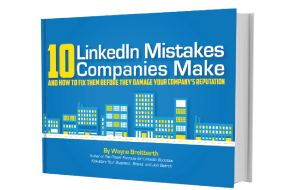
To help business leaders corral this potential value, I have written an eBook titled "10 LinkedIn Mistakes Companies Make and How to Fix Them Before They Damage Your Company's Reputation."

In the eBook I address common mistakes, provide solutions, and give 3D Ebook 2nd Ed Cover-01tips for using LinkedIn to grow revenues, find new employees and suppliers, and maintain a consistent brand in the ever-changing online world.
.

How many of these mistakes are you and your company making?

1.  Unprofessional or poor quality employee profile photos—or, worse yet, no photo at all

2.  Sharing incorrect or inconsistent information about the company

3.  Poor participation—all company employees are not on LinkedIn

4.  Failing to keyword optimize employee profiles and company page

5.  Sharing poor status updates—or failing to use this powerful tool

6.  Not using LinkedIn to search for customers, employees, suppliers, strategic partners, etc.

7.  Failing to monitor employees' profiles and activity as well as what's being said about the company through LinkedIn

8.  Not joining or participating in LinkedIn groups—particularly significant industry groups and customers' industry groups

9.  Underutilizing the features and tools available on the company page—or not even having a company page

10. Having a woefully inadequate corporate social media policy—or none at all

To learn how to address the mistakes you're making, download your FREE copy of the eBook by clicking here.


The post Are These LinkedIn Mistakes Hurting Your Company? appeared first on Wayne Breitbarth.

06 May 16:35

Learning to Lead Remotely – on LinkedIn

by Kevin Eikenberry

LinkedIn Learning

If you have remote team members and a LinkedIn account, this announcement will be of great value to you. I have partnered with the folks at LinkedIn Learning to create a brand-new online course, titled Leading at a Distance. Maybe you didn’t know LinkedIn was in the learning business, or maybe you already have access […]

The post Learning to Lead Remotely – on LinkedIn appeared first on Kevin Eikenberry on Leadership & Learning.

06 May 16:34

Customer Success Managers Can’t Avoid Conflict. They Should Tackle It Head On.

by Brooke Goodbary

Editor’s Note: This article first appeared on the Brooke.land blog here.

Customer Success is fundamentally about helping other people, and as a result, most Customer Success Managers have amicable and agreeable personalities. However, these same traits can lead them to shy away from conflict, which negatively affects customer relationships. Healthy and productive relationships involve a certain amount of friction as both parties challenge each other and track accountability. The goal isn’t to be friends with your customers, it’s to deliver value and success. Tackling conflict head on gives you a chance to manage the resolution process in a way that builds credibility, trust and respect.

Conflict is inevitable

Trying to avoid conflict is an exercise in futility. You can dodge an uncomfortable conversation in the short-term, but unresolved issues fester and manifest in new ways over time. CSMs who think they have skillfully avoided conflict are often surprised when the customer cites those original issues as the reason they want to cancel- and by then it’s too late to save the account. Conflicts are a chance to start a dialogue around how to remove the roadblocks preventing customers from realizing their goals.

Identify the source

Review how you got to this point by asking the customer to identify what they believe is the source of the conflict. The goal isn’t to place blame, but to get both parties to recognize how their actions impacted the situation and agree on how to proceed from here. Allowing each party to explain their thought process and assumptions creates empathy. If there’s any lingering frustration or resentment, this is the time to put it all on the table. You might uncover additional underlying issues that contributed to the current situation- these will also need to be addressed before your relationship can progress.

Establish and agree on a success plan

After you’ve identified the source of the conflict, establish and agree on a success plan that will allow you to move forward. Include a summary of resources each side will commit in order to execute on the plan. Secure buy-in from the customer’s executive leadership and your own. Establish a structure and cadence for how you will update all parties on your progress.

Assign tasks and hold people accountable

Customer Success requires the customer to invest in achieving their goals, which means CSMs need to be comfortable assigning tasks and holding the customer accountable. CSMs are constantly assuming the role of project manager– with customers, internal teams and even other vendors. Outlining the work that needs to be done on individual projects, and how these projects fit into the broader success plan, clearly spells out what the customer needs to contribute in order to be successful.

Manage expectations

Conflict is often the result of mismanaged expectations or poor communication. Maybe a salesperson sold the customer on functionality you don’t support, the customer expects an unsustainably high level of service, or your day-to-day contact misunderstands your product’s value proposition. Take the time to evaluate, reset, and continuously manage expectations to limit further disagreement moving forward.

Invest in building relationships and trust

At the end of the day, you’re dealing with people- make an effort to be genuine, approachable and honest in your interactions. It might be hard to recognize in the moment, but conflict presents an opportunity to grow the relationship by building trust and respect.

Averting constant conflict

Even if you diligently follow the process above you will encounter customers who operate in a near constant state of conflict- jumping from one issue to the next, never spending much time being content. These customers have characteristics that are misaligned with your ideal customer profile, which results in frequent tension. Unless something critically changes, the relationship will remain strained and they will continue to find sources of conflict.

Friction leads to growth

The vast majority of customers want to avoid conflict as much as you do, and will only reach out when they have a serious problem. Recall that truly great relationships need moments of friction to push both parties to grow. Take a moment to consider if your customers are trying to motivate you and your company to become more than you currently are. Think of these customers like an inspirational coach who knows you can succeed and encourage you to put in the extra work to push into areas where you’re less comfortable.

Customer Success teams need to recognize they can’t avoid conflict and instead view these moments of friction as opportunities to grow.

The post Customer Success Managers Can’t Avoid Conflict. They Should Tackle It Head On. appeared first on OpenView Labs.

06 May 16:32

The Best 7 Productivity Software in 2019

by mhart@hubspot.com (Meredith Hart)

Imagine you could wave a magic wand and magically improve one part of your workday.

What would you choose?

Would you wish for more hours in your day? Or would you wish all the items on your to-do list be magically marked as complete?

For many, they'd like to achieve more during their workday. Oftentimes, we're left wondering where the day went and the empty checkboxes on our to-do-lists outnumber the ones we've marked as done.

It can be challenging to manage all of the tasks and goals you've set for yourself. Luckily, there's productivity software that can aid you in these day-to-day tasks.

Need more hours in the day? Download our complete workplace productivity guide  here.

What is productivity software?

Productivity software helps you manage your activities so you can produce work effectively and efficiently. The primary goal of these tools is to make it easier to manage the tasks you need to tackle in your workday.

The definition of productivity is, "the quality, state, or fact of being able to generate, create, enhance, or bring forth goods and services." Productivity can take many forms. You might be generating a piece of content for your salespeople or working on a project to launch a new product. No matter what you're creating, productivity software enables you to complete it.

With productivity software, you can organize your work tasks and get more done. Here are some of the best productivity software options you can use.

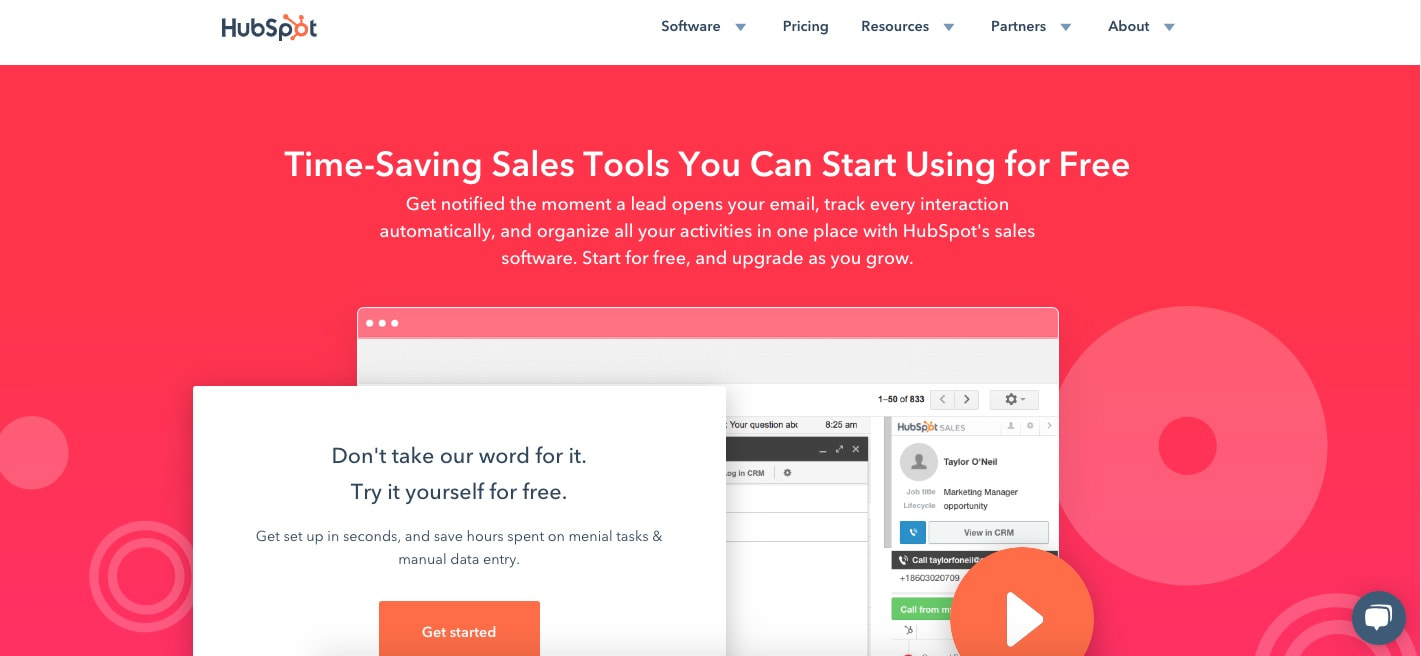
1. HubSpot Free Sales Tools

Price: Free

HubSpot Free Sales Tools provides salespeople with time-saving tools to help tackle their workday head on. These tools help them manage contacts, deals, and tasks. The email templates and scheduling tool make sending prospecting emails simpler and quicker. Plus, they can track the emails they send to see when prospects receive and open the messages, which helps you time your next outreach. And they can send the prospect a meeting invitation when the time is right.

HubSpot Free Sales Tools Productivity Software

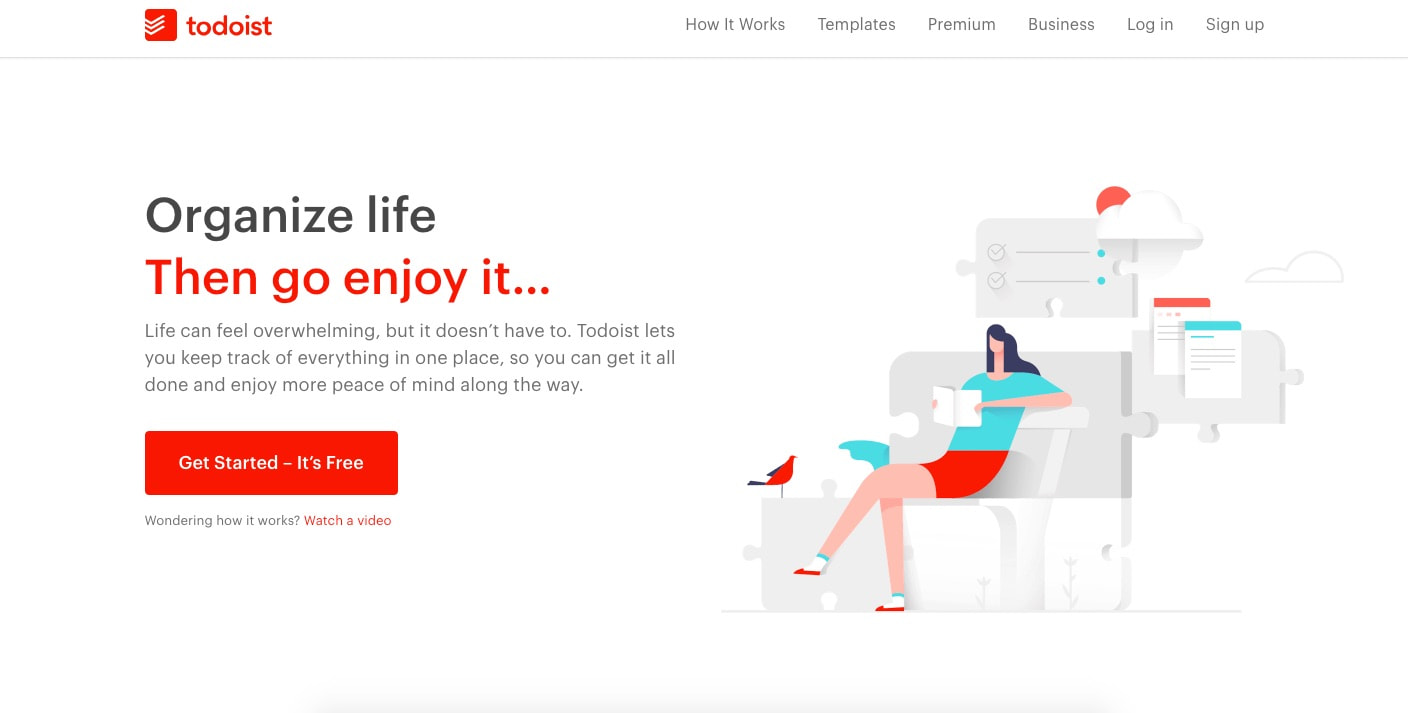
2. Todoist

Price: Free (Todoist Free), $4/month billed annually (Todoist Premium), $5/user/month billed annually (Todoist Business)

Do you have more tasks than you can manage? Todoist can help you get on top of them. You can quickly add your tasks, map out your projects and goals, and get reminders for deadlines. And it integrates with other applications you use to accomplish your tasks. You can access your list from your computer, phone, or tablet with Todoist's apps. It helps you stay on task and measure the progress you're making towards your goals.

Todoist Productivity Software

3. G Suite

Price: $6/user/month (Basic), $12/user/month (Business), $25/user/month (Enterprise)

G Suite is a collection of tools (e.g., Docs, Sheets, Forms, Slides, Sites) that allow you to create documents, spreadsheets, slide presentations, and more. Each piece of content can be shared with collaborators so multiple people can work on a presentation, modify a report, or edit a resource or whitepaper. Other tools in the suite, like Gmail and Calendar, provide a way to communicate effectively with coworkers and external contacts.

G Suite Productivity App (1)

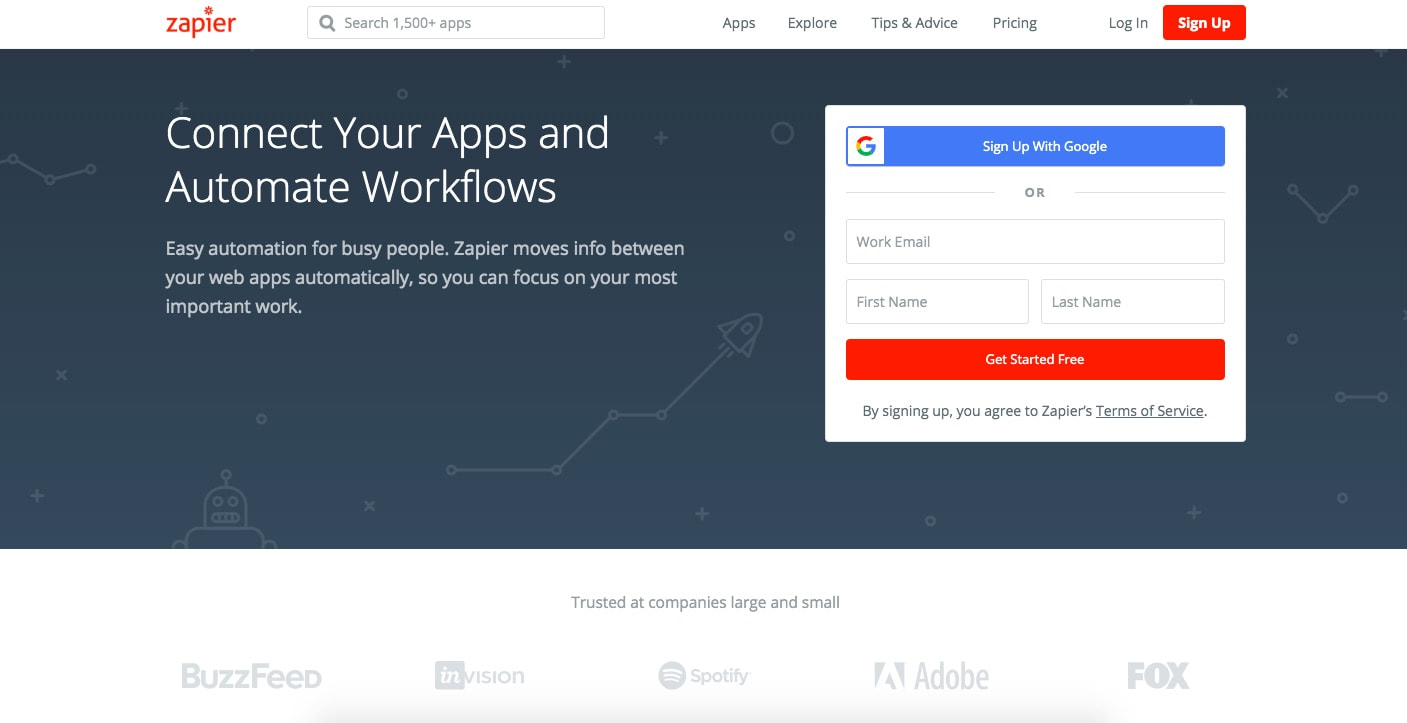
4. Zapier

Price: $0 (Free), $20/month billed annually (Starter), $50/month billed annually (Professional), $125/month billed annually (Professional Plus), $250/month billed annually (Teams)

Zapier is a productivity software that connects all the tools you use during your workday. Its key feature is automation which speeds up the tasks that might have previously been done manually. You can connect the apps you use on a daily basis (e.g., CRM, Gmail, Slack, Trello, Asana) to create workflows that automate your tasks and allow you to scale your productivity.

Zapier Productivity Software

5. HelloSign

Price: $0 (Free), $15/month (Pro), $50/month (Business), Custom pricing (Enterprise)

HelloSign makes it easy for you to send forms and contracts to your contacts so they can sign with an e-signature. This productivity software connects with other apps like Gmail, GSuite, Dropbox, etc. which simplifies the process of sending documents to sign. Documents can be quickly sent to contacts, signed, and returned back to you.

HelloSign Productivity Software

6. Slack

Price: $6.67/active user/per month billed annually (Standard), $12.50/active user/per month billed annually (Plus), Custom pricing (Enterprise)

Speed up your internal communications with Slack. Instead of creating a lengthy email thread to get an answer to a question, start a Slack message with the individual you'd like to talk to. It makes it easy to reach colleagues and collaborate to complete projects.

Slack Productivity Software

7. Toggl

Price: $9/user/month (Starter), $18/user/month (Premium), Custom pricing (Enterprise)

If you need help identifying where most of your time is spent on a given day, Toggl will come to the rescue. This time tracking tool allows you to analyze your day-to-day, evaluate where the most time is spent, and make adjustments to increase productivity.

Toggl Productivity SoftwareWith productivity software, you'll be able to get more done during your workday. Looking for more productivity resources? Check out this voice-to-text software to help you work faster next.

New Call-to-Action

06 May 16:32

4 Reasons Customer Service Ratings Matter More Than You Think

by Matthew Brown

Feedback matters in the customer-centric era of business we work in. Whether it’s a customer telling your CEO that an agent did a great job or giving them a “negative” face after a chat session, there are many ways companies can receive feedback about their business.

One method that has increased in popularity over the years is ratings on third-party sites. Here, customers can rate areas of your business on an unbiased platform (sometimes receiving a nominal incentive) for the entire world to see. And, one of the major reasons why companies receive the overall ratings they do is because of the customer service a company provides.

But, if these ratings exist only on some corner of the internet, why do they matter? Here are four reasons customer service ratings (and reviews) matter more than you think and how to make the most of this type of feedback…

1) Good ratings and testimonials can be used by business development to increase revenue – Many businesses with good ratings like to display them in real-time directly on their website to provide third-party validation to prospective buyers. It’s a great way to break up marketing content and, if detailed product reviews also accompany the ratings, it lets you also highlight exactly what customers find valuable in your business. The message is more powerful when a company doesn’t say it.

A screenshot of TeamSupport ratings on Capterra show how we emphasize Customer Service

2) Prospective customers visit rating sites and use them in their decision-making process – Moving away from your own website, many prospects begin their buying journey by visiting the sites that solicit these ratings. Leaders like Capterra emphasize ratings specifically for customer service that contributes to an overall rating, but they also offer much more, including product information and detailed customer feedback (both good and bad). In fact, some prospects leverage these sites heavily in their decision-making process and having a low customer service rating here can disqualify you from consideration right away.

3) Ratings can be used to identify and prevent customer churn – The value of ratings isn’t just in acquiring new business. You can use the information received from rating sites to reach out to customers that provide your company with a poor rating. This can help substantially in reducing customer churn. For example, Capterra lists the name and company of each rating, making it easy for you to know who rated you and when. This helps you further understand the pain points that drove the customer to leave a neutral or negative rating so you can address it before their concerns become reasons for leaving your business. Keep in mind that seeing a lot of negative customer service ratings can also provide social proof for a current customer wondering if their bad experiences are common for your business, which can in turn lead to an increase in customer churn.

4) Great ratings help your HR group attract better team members – This is important because it impacts all aspects of a business. Simply put, many employees want to work for companies that do well and look good online. In doing research for a company to prepare for an interview, they’ll stumble upon user ratings and reviews. People want to contribute in a company culture that values employees and time, and a great external indicator of this is how customers speak about a business. For example, if customers say communicating with the service team is easy, it likely means internal communication will be smooth as well. If it’s mentioned by customers that there’s lots of roadblocks to get answers, the same will likely happen with colleagues.

In short, customer service ratings matter because they’re a valuable component of a business and its perception by prospects, customers, and employee candidates. Having a great customer service team that gets high marks not only makes them look good and stand out, it also helps contribute to the success and growth of the entire company.

06 May 16:31

Can You Improve Your Frictionless Selling Approach?

by Gerhard Gschwandtner
If we can truly put buyers first and make their journey as seamless and valuable as possible, then we can manage the true intent of frictionless selling. Here’s how.
06 May 16:31

The Problem with Wanting Sales to Be Easy

by Anthony Iannarino

Some people want sales to be easy. They want more and better sales without putting forth the effort necessary to acquire clients and opportunities. Many of them believe that their business should run like Amazon.com, with them offering a product or service or solution, and people clicking to buy what they sell, an idea that works well for some transactional sales, but performs poorly when their target clients need help (and even Amazon has salespeople for AWS, their biggest money-maker).

Entrepreneurs spend their time seeking a technological solution to a problem that isn’t easily solved through technology. They spend their time looking for a go-to-market strategy that eliminates the need for salespeople, a part of the business they see as a cost, and one they have no idea how to engage and manage effectively. Because they believe so deeply in their offering, they suffer from the delusion that their target market will immediately recognize the value and buy from them, a rare occurrence. By trying to make selling easy, they make obtaining clients and opportunities more difficult.

Salespeople and some of their leaders believe they can pitch everyone and win new business, and there is a growing cottage industry on LinkedIn of salespeople who are taught and trained to write a four-paragraph pitch with a link to their calendar to strangers, without targeting, and without any indication that the person might be right for their service or solution (I know this because I receive sales training and development offers, as well as appointment-setting services pitched to me every day).

It’s easy to increase your activity by pitching more people faster, and you can deceive yourself into believing that you are efficient. Efficiency is measured by the energy expended to produce a specific result, not the elimination of effort and energy without a result. To believe that you are efficient when you try to make selling easy, you have to refuse to look at the wasted energy and effort.

Most of the effort expended in trying to make selling easier would be better spent in increasing your effectiveness.

Get the Free eBook!

Learn how to sell without a sales manager. Download my free eBook!

You need to make sales. You need help now. We’ve got you covered. This eBook will help you Seize Your Sales Destiny, with or without a manager.

Download Now

The post The Problem with Wanting Sales to Be Easy appeared first on The Sales Blog.

06 May 16:30

Conducting Killer Pipeline Reviews Your Salespeople Will Thank You For

by Rob Jeppsen
sales pipeline reviews

In the movie “Dirty Harry,” Clint Eastwood’s character asks one of his “bad guys” what has become an iconic question…

“You’ve got to ask yourself one question: Do I feel lucky? Well, do ya, punk?”

Sadly, many salespeople feel like they’re facing off to Dirty Harry every time they have a Pipeline Review. He’s staring down at them while they squirm and sweat.

This approach makes for a successful movie, but it’s important to remember: Your salespeople are not the bad guys, and you are not Dirty Harry.

I recently met with the VP of Sales of a large, publicly traded company who told me that nobody gets fired for missing quota in their company. Instead, they get fired for failing to forecast quota.

“Dirty Harry” syndrome is real. And the pressure to show progress turns too many Pipeline Reviews into stressful interrogations. But we’ve got a better way.

Keep reading to learn a simple, 3-step method for doing pipeline reviews that work.

The Secret to Successful Pipeline Reviews

What are You Driving?

As sales leaders, we have the awesome opportunity to drive the revenue that fuels the organizations we are part of. Whether you’re driving a high-performance race car or are behind the wheel of something you can barely keep on the road is, in large part, determined by the vitality and the efficiency of your pipeline.

In the world of sales, pipeline is life. Strong, vibrant pipelines provide power to salespeople and sales leaders. But it can be a scary ride.

According to CSO Insights, only 47% of opportunities forecast to close actually closed in 2018. Thirty-two percent of these deals forecast as wins were lost to competitors and 21% were no-decisions.

Chances of your forecast deals closing: 47.3%.

Chances of winning at craps in Vegas: 49.4%.

pipeline reviews forecasting deals

When you are betting career success at odds lower than the odds you get in Vegas, something needs to change.

The pipeline review is arguably one of the most important meetings a sales leader can conduct with each member of the sales team.

The best sales leaders understand how to use the pipeline review to optimize the vehicle they are driving. Whether you need to need to “Tune the Engine” by fueling the pipeline or “Tune the Deals” that take you across the finish line, here are three well-tested tactics to make sure your pipeline reviews are relevant, action-oriented, and inspirational for each member of your team.

RELATED: Weekly Sales Meetings Such. Here Are 5 Ways to Improve Them

Step 1: Win What’s Winnable

Pipelines that move, win. Some deals move fast, and others move slow. But they need to move.

Winning in the world of pipeline isn’t just reserved for the “Closed/Won” status. Winning is about successfully accomplishing the goal of the sales stage regardless of which stage a deal is in.

At Xvoyant, we work with sales leaders in 19 countries around the world, and every time we engage with a new sales team, I find it interesting how subjective a sales stage is and when a salesperson feels they should advance a stage.

Many sales processes include “exit criteria.” But I’ve found this criteria doesn’t solve the problem of creating an accurate picture of where an opportunity stands.

Create Buyer Engagement

Barry Trailer once taught me to look at stage advancement as though you were driving on a toll road. When you come to the toll booth, someone must pay the toll before you can keep driving.

In sales, the toll at the toll booth must be paid by the customer. This is a big deal. Too often, a salesperson sees “exit criteria” as things they can do.

They can’t.

A salesperson can do everything except make a customer buy.

This is why your sales process MUST create buyer engagement.

Winning what’s winnable is more than just pushing deals across the finish line. A successful pipeline review needs to “Tune the Deals” that your sales organization is riding on.

To do this, add Buyer Verifiers to your sales process.

A Buyer Verifier is something a prospect or customer must do in order to satisfy the goal of the sales stage and move to the next stage. Only the customer can provide this. Never the salesperson.

Once you know the goal of a stage and the one to two Buyer Verifiers that demonstrate the goal was achieved, identifying the key activities that help a salesperson accomplish these goals becomes simple.

Add Purpose… Not Pressure

The purpose of a pipeline review is to create purpose-driven activities on what a salesperson can do to advance an opportunity and ultimately win the business. Buyer Verifiers are the best way to create purpose-driven activities rather than adding pressure and flogging the forecast.

RELATED: Sales Managers: The Reason Reps Don’t Follow Your Sales Process Is You

When reviewing current opportunities, here are five lenses to apply to help you tune deals with confidence.

1. Stalled Deals

Most sales teams have some measurement of cycle time. It is important to measure Days in Stage for each rep. When current Days in Stage are greater than the average Days in Stage for that salesperson (not a team or company average), you have a stalled deal.

With a clear verifier objective, the pipeline review now becomes a strategy session on how the salesperson can engage in activities or utilize company resources to help secure the verifier and advance the sales or win.

This approach helps opportunities maintain a rhythm before they enter a stall that leads to a “death spiral.”

2. Must-Win Deals

A best practice for every sales leader is to identify an opportunity or two that is particularly strategic to the development of the salesperson or their overall success, and then help them in the pursuit of these opportunities.

Any “Must Win” should have ongoing, active goals around how verifiers are secured. This is an important part of every pipeline review because it allows the leader to participate without taking over.

RELATED: PODCAST 52: Building Sales Coaching and Training Framework w/ Rob Jeppsen

3. Misaligned Deals

Salespeople have different approaches to opportunity management. But try this simple approach.

Use your CRM solution to match Buyer Verifiers to sales stages. When a deal has advanced to a point that’s not matched by the appropriate Verifier, this is a deal you need to tune.

pipeline reviews misaligned deals

In this example from one of the companies we work with, a salesperson has marked this opportunity as approved and ready to close. However, it is a misaligned deal and is stalled.

Upon inspection of the Verifiers, the stall has come from skipping the first Buyer Verifier confirming who the key stakeholders were.

Later, the salesperson skipped the closure plan, and now the deal has stalled waiting for InfoSec Approval. This stall could have been avoided if a pipeline review had identified the misaligned opportunity.

4. Outlier Deals

When a salesperson is working on a deal significantly larger than their individual average deal size, make sure to pay particularly close attention to the purpose-driven activities and the verifiers they create.

The order of magnitude to qualify an opportunity as an outlier is different for each company and each rep. A good rule of thumb is this: If an opportunity is 3X the average size for the rep, it is an outlier.

The entire buying process likely is different when this happens, and your outliers may require a new set of sales activities and buyer verifiers. Don’t let these catch you off guard.

5. Pushed Deals

I’m always surprised by how few sales teams track pushes. A push happens when the close date comes and there is no win or loss. The deal just lives on.

RELATED: How to Know If a Deal Will Close: A 3-Part Checklist

Here’s what we’ve learned as we model individual wins and losses…

Win rates generally go up after one push. This often surprises people, but there’s a good reason for it. Most of the time, salespeople are making their best guess as to the possible close date. Once you get to the point of making a closure plan, it’s possible to get a firm close date.

PRO TIP: Consider having a structured Closure Plan as part of your Sales Process.

But since many sales processes don’t ask the salesperson to create closure plans with buyers, when the first push comes, this often is the first time a salesperson can gain real insight to an accurate close date.

If you’re coaching the rep effectively in the pipeline review, the salesperson will ask the buyer when the deal can close, so there’s no guesswork.

The “Do We Have a Deal” conversation is an important one, and it generally leads to more accurate close dates. So, one push is a good thing. Two pushes usually have no impact on close rates. But once you hit the third push, this is the time to circle the wagons. Win rates fall by over 10% with the third push and beyond.

Row, Row, Row Your Boat

Buyer Verifiers do a lot of things to help make a pipeline review action-oriented. Tuning the Deal with Verifiers is the best way to move from just selling something to being seen as a company who’s in a sales process with someone.

pipeline reviews buyer verifiers

This diagram reminds me of a rowboat. When both oars row in unison, the boat goes straight and fast. When only one side rows, the boat just moves in a frustrating circle.

Remove unnecessary frustration and losses by making sure sales activities create Buyer Verifiers. Win rates will go up, sales cycle time will go down, and your buyer will appreciate the process of buying from you.

The point? Use your pipeline reviews to create buyer engagement… not just sales engagement.

Step 2: Achieve Balance

If the deals are the wheels that move your sales organization, an individual’s pipeline coverage is the engine that creates horsepower for your sales team.

A strong pipeline review will make sure there is balance for the salesperson in both the short and long term.

Individual Reps Need Individual Plans

Many organizations have “Average Coverage Ratios” that calculate the average amount of pipeline to goal for a rep to succeed.

Great leaders don’t create action plans based on averages. They help reps create plans based on their unique capabilities and goals.

Calculating how much pipeline an individual needs to win at every milestone (month, quarter, or fiscal year) is not hard to do, and it can make a difference in identifying the purpose-driven activities a rep needs to complete to have pipeline balance.

Here are a couple of easy metrics that will help you add teeth to your coverage models –– and that your reps will thank you for:

Metric: Required Pipeline in $$

Formula: Salesperson Goal in $$ / Salesperson Win Rate

For example, if a salesperson has a $1MM goal and a 50% win rate, she needs $2MM in pipeline for that time period. This metric works since it is a requirement based on the unique goal AND the unique win rate of the salesperson.

Average coverage ratios are like “Goldilocks and the Three Bears.” This model is sometimes too hot, sometimes too cold, and only rarely is it just right.

Get it right. You owe it to your reps to paint a well-lit pathway to success.

Metric: Required Pipeline in # of Opportunities

Formula: Salesperson Required Pipeline in $$ / Salesperson Average Deal Size

“Elephant Hunting” is a popular sport for salespeople… particularly when they are behind goal. Understanding how much deal flow an individual salesperson needs to win just by being “average” is an empowering metric.

Relying on “Career Best Effort” in order to win is a poor strategy. “Required Pipeline in # of Opportunities” creates consistency while removing pressure to win at all costs.

These ratios –– the Required Pipeline $$ and ## to Actual Pipeline $$ and ## –– are gold in a pipeline review.

If you use these calculations, they remove all defensiveness in a salesperson, because they are calibrated to the unique profile of the individual rep.

Remember, creating a pipeline is just as important as moving it. A balanced pipeline gives a salesperson power. Help them learn the power of a fat, balanced pipeline by helping them create pipeline development goals at every stage. Advancing deals to close may seem sexy, but filling the pipeline is more important.

Make the health of the pipeline a key part of your pipeline reviews. Balance here, now, leads to wins later.

What’s been your experience? Have pipeline reviews felt like a Dirty Harry movie? If you’ve had good pipeline reviews, what made the difference for you?

pipeline reviews achieving balance

Step 3: Set Coaching Goals

Set goals to create purpose-driven activities. Your salespeople should expect pipeline reviews to lead to changes. Based on what they learn in these reviews, they’ll discover things they need to do more of or do differently to either Tune the Engine or Tune the Deals… or both.

Coaching goals should never be to “Win the Deal.” Instead, great leaders set goals to complete purpose-driven activities that either create rhythm to opportunities through Buyer Verifiers or horsepower to the pipeline creation engine.

The difference between a conversation and real coaching comes in the commitment. If you aren’t tapping into the power of commitments with each salesperson, give it a try.

This will fuel your informal dialogue with each rep as you help them develop “New Normals” as they become more than just hard workers.

Common Pipeline Review Traps to Avoid

Generally conducted every 2 weeks, the Pipeline Review is one of the most commonly conducted meetings in a sales org. Unfortunately, rather than making them more laser-focused, this frequency often leads to an approach of “winging it,” which leads to mistakes.

Here are a few common traps to avoid in your pipeline reviews:

Trap #1: Flogging the Forecast

One of the primary reasons pipeline doesn’t close as forecast is the lack of Verifiers. When these are missing, Sales Leaders are left with no fallback other than asking a salesperson, “What Do You Think?”

Sometimes, a barrage of “What Do You Think?” inquisitions leaves the salesperson wanting to manage expectations yet still look good to their leader.

When the leader flogs the forecast, rather than focusing on pathways and verifiers, the emphasis on the outcomes ultimately leads to a series of guesses rather than a compilation of strategic plans. And while pressure can turn coal into diamonds, pressure does not create predictability in sales. Planning does.

Trap #2: Crutch, Not a Coach

One of the most common “Deadly Sins” of 1:1 Coaching is to take over an opportunity or dictate how a rep should engage.

Pipeline Reviews are fantastic opportunities for leaders to coach reps. Unfortunately, these are also opportunities for leaders to take control. Taking over or telling a rep what to do stunts growth. It doesn’t stimulate it.

Focus on coaching, not becoming a crutch.

Trap #3: “Trust Me”

It’s common, when discussing an opportunity in a Pipeline Review, for a sales rep to say, “Trust me.” There are lots of different ways this presents itself, but basically, the salesperson asks the leader to overlook the lack of Verifiers and cross their fingers.

Ronald Reagan gave sales leader everywhere great advice when he said, “Trust but verify.”

Save Your Luck for Vegas

Rick Page wrote in his bestselling sales book, “Hope is not a strategy.”

He’s right. You can win without a plan –– it’s called luck. And since you’re not the sales leader, you can get away with relying on luck.

But here’s the reality…

You’re here to create predictability. Leave luck for Vegas.

Verifiers, custom coverage plans, and unique coaching goals are the building blocks of Pipeline Reviews your salespeople will look forward to. Don’t just go through the motions of doing Pipeline Reviews. And don’t let your Pipeline Reviews make your team members feel like they’re facing Dirty Harry.

Use the simple 3-step process I’ve shared in this article, and your reps will never feel this way.

  1. Win what’s winnable at every stage.
  2. Achieve balance to the pipeline and each rep will avoid dry spots.
  3. Set unique coaching goals to drive purpose-driven activities as a result of your pipeline review.

Happy selling.

The post Conducting Killer Pipeline Reviews Your Salespeople Will Thank You For appeared first on Sales Hacker.

06 May 16:30

The Achilles’ Heel of Communication

by Jason Scott

The modern business world looks at communication all wrong.

When executives and managers don’t get the results they expected, they commonly blame ineffective communication. When their frustration hits a boiling point, they launch a project to improve their organization’s ability to communicate.

The truth is communication and leadership go hand-in-hand, so if the communication is poor, then poor leadership skills should be acknowledged, as well.

At my company, 120VC, we communicate to lead our projects forward, as aggressively as possible, and leading our team members to achieve transformational outcomes.

Whether the communication is in person or in writing, each interaction is intended to move our projects closer to completion. Any interaction that leads to confusion, or a status report that leads to questions, is a failed attempt at leadership.

We communicate to lead…period.

When you fail to get the necessary results from and for your team members, don’t focus on improving your communication. Focus on improving your leadership skills.

Here’s why this approach beats focusing exclusively on improved communication.

The Achilles Heel of Communication

The problem with focusing on improving communication as a way of improving your outcomes is that it almost always leads to more communication. More emails, voice messages, text messages, Slack messages, and meetings. This ultimately creates the need for more processes and governance over communication.

This approach creates more administrative work and increased expectations for a group of people that are already struggling to achieve the expected results.

When has that ever improved results?

Leaders should help their team members achieve expected results. Leaders are responsible for the outcomes. If you aren’t getting the outcomes you need, blaming communication will increase the workload, but it won’t guarantee better results.

Focusing on improving your leadership skills gives you much more latitude for improving your outcomes. You aren’t hamstrung by a narrow focus on improving communication.

Instead of increasing workload in the name of improving communication, you could actually reduce workload to focus the team and achieve better results. You could eliminate and refine processes, educate team members, and refine software tools.

You could even eliminate communication methods! Why not abandon email for anything other than reporting and coordination? Email is a procrastination tool. We send an email and wait. We put the fate of our commitments in the hands of the responder instead of picking up the phone and calling, stopping by their office, or sending text messages.

Additional Processes Make Things Worse

Some years ago, I worked with DirecTV, and there was a huge push from the CIO to improve project outcomes. The majority of projects were delivered late and over budget, and IT was making promises to sales and marketing they couldn’t keep.

Instead of getting a baseline of where the project managers were, from an education perspective, or a baseline of what the project managers were and were not doing, they worked from the premise that most projects failed due to ineffective communication.

They created a ton of additional processes, requiring more communication, project reviews, and checkpoints where project leaders would have to get their work reviewed.

They essentially increased the administrative workload; took away autonomy, mastery, and purpose; and expected better results. Things went from bad to worse!

Now compare their approach with that of Trader Joe’s, a national food chain with a thirty-person IT department. Unlike DirecTV, they hit deadlines.

What they don’t manage internally is outsourced to vendors. They make it work because they have a lean, purpose-driven process with intense focus on leadership and connection between their team members; they don’t do anything if it doesn’t somehow benefit their team members in the stores or their customers.

The bottom line is…we communicate to lead. If you aren’t getting the outcomes you need, focus on improving your organization’s leadership skills.

This post is adapted from my new book, It’s Never Just Business.

06 May 16:30

The Secrets of Great Sales Follow-Through

by Kellie Courville

Follow-Through

As a kid learning to play basketball, my coach never focused on the importance of the approach to the layup but, rather, the follow-through. A great scorer in basketball, the kind on display every night right now in the NBA playoffs, knows that how you finish your shot makes all the difference in the world when it comes to putting points on the board.

As a sales professional, I’ve learned acutely that the importance of the follow-through applies in many areas far beyond the basketball court. In particular, this crucial (but often minimized) practice for every professional seller frequently ends up as the primary difference between hitting aggressive sales quotas and falling short.

Just like in basketball, where there are statistics to prove the importance of following through on your shots, the same rings true for sales pros in terms of the importance of following up with prospects. According to this infographic from Propeller, 80% of sales require no fewer than five follow-ups after the initial contact.

80%!! Let that number sink in for just a moment.

Yet there’s so much more to this practice than simply calling people again and again. If you’re interested in improving your sales success rate, use these guiding principles and unlock the true power of great sales follow-through.

Properly Identify Prospects Worth Pursuing Right Now

For the most part, sales prospects fit into two categories: hot prospects and bench prospects.

Hot prospects: Just like in basketball, these are your go-to people at this current point in time. They are people who you have either spoken to on the phone or via email and they are ready to take action; all you have to do is follow up.

Bench prospects: These are people who have the potential to be great sales leads, yet at this point in time, they are not responsive and/or have a long buying cycle.

I have found that identifying hot prospects quickly is a key to success. Doing this helps me move along with the right people during the sales process (and relegate the lesser prospects to a future touch). If a prospect asks for specific information or for further discussion, call them back or follow up on that information you sent right away. Prospects seeking information are giving permission for increased engagement, and you should stay on the ball with them. They are much closer to a sale then the bench prospect.

Build a Strong Cadence

Cadence as a drumbeatMuch like my experience in basketball, having a good game plan is arguably more important than the game itself – and it’s especially critical in facilitating your follow-through efforts. In sales, the game plan is your sales cadence. You must develop a methodical plan to connect with your target audience. It is key to identify your hot prospects early, so you can create a road map to the sale that makes sense for that specific prospect.

As you schedule and plan your outreach cadence, be sure to map out exactly when (and how) you are going to get in contact with hot prospects. This road map outlines when you are making calls, sending emails, and leaving voicemails for everyone on your list. Also, when building your cadence, remember to keep in mind that it takes on average five to 12 “touches” (calls, voicemails, emails, etc) to truly close a prospect.

Make sure to vary the methods of communication you are using to reach your prospects — a combination of calls, emails, LinkedIn messages, social media mentions and more should all be in play. This will keep you at the forefront of a prospects’ mind and it helps you stand out from your competition.

This great article from the team at InsideSales.com outlines the basic elements a sales pro needs to construct a great prospect outreach plan. There is room to be creative, but absolutely be intentional about this step of the process.

One other thing to keep in mind when creating your cadence is that it should be specific to your prospect and their timeline. Not every prospect will need the same approach, which makes it imperative to create your cadence to fit your prospect and not inundate them.

Be sure to routinely document touch points in your cadence. Your style to track this can vary (CRM software, Excel spreadsheet, or old fashion pen and paper), but recording the flow is vital. This act keeps me personally accountable to follow up with prospects and stick to my plan.

Pay Close Attention to Timing

A shot clock exists in basketball to keep the game moving and the action flowing, and all players know they must get the shot off before it hits zero. Once it hits zero, their chance has expired. There’s a shot clock in sales, as well. Sales pros have a certain amount of time to follow up with a prospect before the chance at a sale evaporates.

The follow-up period with a warm prospect is short and your outreach timing matters. Now that you know who to follow up with and have a game plan on how you are going to push them along the sales cycle, you need to understand precisely when to contact them. There are some key components to factor in when choosing dates and times to reach out to prospects.

Best Time to Call

Based on a recent CallHippo study, there are optimal days and times to reach a prospect over the phone. The study found that the best day to call a prospect was Wednesdays, with Thursdays being a close second. In fact, calling someone on a Thursday had a 46% better chance to reach the prospect then Monday, which was the worst day.

Overall, the study found that the worst day to reach prospects is Friday afternoon. This is something that I have personally found to be accurate. My connection rates drop on Friday afternoons. And when I do reach prospects, I get in inordinate amount of “It’s a bad time” or “Not right now” curt responses. People in “weekend mode” seem to be less interested in detailed business conversations.

The time of day was also examined in this study and they found the best bet to get in contact with a sales prospect was between 4pm and 5pm (in the prospect’s respective time zone). Reaching out during this time frame was 71% better than trying to reach a prospect during the worst time of the day, between 11am and 12pm.

One important caveat here: sales pros are constantly looking for data on the best time of day to contact prospects, so these results can vary and change as your peers and competition flock to align with the latest and greatest study results. Stay on top of the current trends and adjust your sails accordingly.

Best Time to Email

Email is another vital tool in your sales prospecting tool belt. And unlike the best calling times, some of these results might surprise you.

Based on this Propeller study, researchers found the best days to email a prospect during the work week is on Tuesdays or Thursdays. However, the very best days to email are not during the work week at all. You need to zig when everyone else is zagging, so to speak.

Saturdays and Sundays feature the very top open and response rates for email. The digital age and our “always connected” world impacts your timing. Keeping within this spirit, the study found that the best time of day to receive an email response was either first thing in the morning or right after business hours closed.

Always Get Next Steps

The worst thing that can happen in any sales cycle is to not get definitive next steps. It kills momentum and leaves all parties mired in uncertainty. And it’s flat out painful for sales pros practicing great follow-through principles.

As John Costigan, world-renowned professional sales expert and trainer, puts it, “Yes is a great answer, no is a good answer, but maybe stinks.”

When stuck in the maybe zone, you don’t know how to progress the sales cycle. This is why you should constantly ask for reasonable next steps throughout the process. This allows you to keep pushing the sale along (and close the deal), while at the same time not wasting anyone’s time if there isn’t a fit.

There’s another hidden benefit to consistently seeking next steps. It allows you to make sure you’re not needlessly bothering the prospect, which could push them away. If, as an example, your potential buyer is in a contract with another solution provider for one more year, contacting them multiple times per month is probably a very poor move (this is simply annoying and not the point of good follow-through).

Alternatively, you should be asking these prospects directional questions such as, “Do you mind if I reach out in six months to check in and see how things are moving along?”

By asking this at the end of your initial discussion, you eliminate the possibility of pestering them and it keeps you out of the dreaded maybe zone.

Stick to the Plan

Since finding success early in my sales development role, colleagues tend to ask me what my secret sauce is. The truth is, I don’t have a secret sauce – I’m persistent and I consistently use the core sales development principles outlined here. This makes my follow-through activities potent and it limits wasted effort.

If you can stick to it and follow-through with prospects the right way, it will pay off in the long run.

06 May 16:30

Use Smart(er) Content to Nurture More Leads Into Customers

by Autumn Sullivan

People like a little romance when they’re being marketed to. Or better yet, they don’t want to feel like they’re being marketed to at all. Smart personalization transforms marketing from shouting “I’m really great!” to positioning yourself as a helper who understands your customer’s problems.

Strategic personalization can increase the efficacy of your marketing dramatically. But it’s more than putting someone’s first name in an email. Good personalization takes into account behavior, interests, and lifecycle stage. That can be pretty daunting, especially if you have high lead volume. Fortunately, marketing automation and smart content make that pretty simple once you strategize exactly how you want to connect with potential customers.

Use smart content to nurture potential leads by showing that you understand where they’re at and how they relate to you.

woman typing

What is personalization?

On a basic level, personalization is the use of data to customize a viewer’s experience to best accommodate their needs. This information is typically collected through form submissions or from the information in your database (CRM). Some examples of general contact information are name, industry, phone number, address, website URL, company and email address.

You might not wow someone by demonstrating that you have this information, but it can still be used to your advantage — such as requiring fewer fields next time they fill out a form on your website.

Where things really get interesting is when you can personalize in subtle, helpful ways. We recommend using marketing automation software like HubSpot, so that once a contact enters your database, you’ll be able to gather information like this:

  • What emails they are opening
  • What pages they are visiting (on your site)
  • What links they are clicking
  • What social platforms are they viewing or following
  • What content are they engaging with (viewing or downloading)
  • When are they engaging (time)

Then, personalization can look like sending an email at the right time, providing more content around a topic they’ve demonstrated interest in, or following up with a sales call after they’ve engaged with several emails.

Using personalization tokens for smart content

Personalization with smart content can be used in a host of different settings within the buyer’s journey, but it should only be used if it adds value to a viewers overall experience. It’s important to avoid over personalizing content, as it can come off as creepy.

Hi {{first name}},

I noticed you were on my website at {{time}}. You’re obviously interested, so let’s chat tomorrow!

The best personalization feels authentic, not invasive.

Keep in mind these three ideas when using personalization in your content:

  • Authoritativeness: know that what you are personalizing is accurate.
  • Relevance: know that it’s going to add value to the viewer’s experience.
  • Timeliness: know that the timing is aligned with the relevance of the content.

Adding personalization to email is a great way to nurture potential leads by providing relevant content based on behavioral patterns. These behavioral patterns include:

  • Are they clicking on links in the email?
  • If yes, what links are they clicking on?
  • Do they find the information relevant? (clicking through to a landing page and filling out a form or downloading an eBook)

There’s nothing wrong with the basics. You can start by simply using a contact’s name in an email subject line, which can help increase open rates. Then, get down to business. Personalize the body of the email by providing relevant content, such as links to blogs/articles to help increase response rate and build a stronger connection.

Hi {{first name}},

Thanks for purchasing {{product}}! We thought you would enjoy this article on 7 different ways you didn’t know you could use {{products}}.

When creating personalization tokens always remember to set a null (or default value) in case the contact data is not applicable. Make sure the default value is in context with the content provided. For example, if a university is sending emails to prospective students, a good default value for {{name}} would be “Future student.”

Another example is for a custom {{coupon code}}, “Trouble seeing the code? Contact us to get it.”

Nurture leads with smart content triggered by behavior

To illustrate how you can next smart content to the next level, let’s introduce two prospective customers. We’ll call them Sally and James.

If your CRM indicates that Sally has opened your nurturing email and downloaded your premium content offer, you can create a smart content module in your next email that follows up on the content offer’s value statement and asks her to take the next action in the buyer’s journey (schedule a demo, call for a consultation, make a purchase).

James, on the other hand, opened the email but did not download the content offer. His email’s smart content module might nudge him to take the action (downloading the content) and offer new messaging around the value of the offer.

Smart content can also be triggered through lead scoring. When Sally downloaded the content offer, she indicated a greater interest in your product or service, and so her lead score improves. Let’s assume she’s one action away from being considered a Marketing Qualified Lead. It’s time to get her to take the next step, the Decision phase of her buyer’s journey.

Smart content modules, triggered by Sally’s lead score in your CRM, can let her know it’s time to schedule a call with one of your sales representatives.

Meanwhile, James did not open your second email. (You’ll want to look at your email marketing strategy if this is a common occurrence, but for now let’s assume James just missed your email.) His lead score indicates that he isn’t ready yet to contact a sales representative. His lead score might trigger Smart CTAs that direct him to watch the video. Entire sections of your website can be smart, offering James multiple opportunities to learn more about your content’s value proposition and take the next action.

Once James watches the video his lead score improves and the Smart CTAs on the site change to reflect his next expected action.

When it’s better to NOT use smart content

If personalization and smart content are so powerful, why not use them everywhere? Hang on there, marketing cowboy. There are a few instances where it’s best to keep the content as-is. HubSpot recommends against using Smart content in Thank You pages, for example. The CRM has a lag time between updating your smart content personalization tokens, and so a thank you page will often appear without your personalization.

While you may add a Smart CTA into a blog post, it is not recommended to use Smart content modules in blogs. A blog should already be personalized to one specific audience persona. Smart content in blogs can also interfere with RSS readers and negatively impact your SEO.

Smarter content equals smarter marketing

Smart content helps foster stronger connections between your prospective customers and your brand that help deliver a better user experience. Equally important, smart content nurtures customers more effectively, moving them through their buyer’s journey toward a purchase faster.

06 May 16:30

Properly Manage Internal Expectations

by Mladen Kresic

geralt / Pixabay

Almost every sales organization and every seller operates under some pressure associated with quantifying and then making their sales numbers. The instincts that cause this are positive – the desire to succeed by meeting or exceeding quota, or perhaps to be seen as a top performer within the sales organization.

There are three related manifestations of this pressure that negatively impact the seller’s ability to deal with complex buy cycles.

  • We may raise expectations of success with internal management on deals where some of the fundamentals are missing or will take more time to develop. Such expectations can be made through forecasting in the CRM system or by what sales reps promise to their managers. Regardless of how this occurs, not taking reality into account affects the seller’s credibility and results.
  • We rush, trying to speed up the process. If the deal is not moving at the pace we desire (or which is imposed from above), this leads to mistakes and a loss of credibility internally or externally. In either event, that loss of credibility will further prolong the sales cycle or result in a lost opportunity.
  • We make unprincipled concessions in an attempt to get the prospect to act faster. As I explain in an earlier article, unprincipled concessions are “giveaways” not tied to a credible business rationale. Our research shows that this simple negotiation mistake costs businesses between 9 and 18% of gross revenue and significant profit. This is a much too high a price to pay in any sales scenario, especially when it doesn’t contribute to revenue.

To overcome the negative impact of these manifestations, I suggest you deal with each in a conscious way, in order to eliminate or reduce the mistakes and frustration caused by internal pressure. Very few individuals operate more effectively while under pressure. Prospects can sense it, and managers can sense it, and neither responds well to the type of selling environment caused by pressure.

One of the often unspoken issues is that the buying cycle can be vastly different from the sales cycle. Sales management can choose to dictate a certain sales cycle; say four months. However, while this sounds ok, the buyer may have a far different perspective on the timing of the deal. This is a good example of the quote, often attributed to John Lennon, “Life is what happens to you while you are busy making other plans.”

A few years ago, a friend was under some pressure to get a strategic contract done for his company. His executive called for status updates daily (sometimes more often). He had a contract draft ready for the customer that at least one person other than him would normally review (two sets of eyes before something important goes to a customer is a good policy).

However, he felt he could not afford a couple of hours that the review would take. The contract had a critical typo in it that caused an internal escalation within the customer. While the deal was done, it took a week longer as a result. As mentioned above, the motivation for going against standard operating procedure was sound: the desire to make the sale happen on schedule. However, in hindsight, the cost of the extra week was not worth the potential few hours saved.

Setting honest expectations and describing key dependencies and timing is always a good practice, though it may not be what the boss wants to hear. This does not mean making excuses – rather it means being factual and explaining what needs to happen and what you are doing to facilitate an optimal outcome. This may be a bit painful in the short-term, where the pressure to meet this quarter’s number is strongest – but it will definitely pay off over time, in terms of streamlined, less-painful and more profitable sales.

06 May 16:30

How to Use Surveys at Every Stage of the Funnel to Drive a Better Customer Experience

by kniemisto

You know that pleasant feeling when you walk into your local cafe and the waiter greets you as if he’d just seen a dear friend, leads you to your favorite table, and asks you if you’d like “the usual”? Personalization is not a new concept, though only recently has it become the standard customers expect from digital services.

There’s no doubt about the ROI of personalizing lead and customer communication. Amazon, which paved the way for one-on-one digital marketing, has recently reported that 35% of its sales come from product recommendations. The numbers on customer expectations look even more promising, with 56% willing to return to a website that offers a personal approach.

It’s only natural that the marketing world is now craving a slice of that cake.

So how can we effectively guide leads through the funnel and cater to their individual needs at each step of the buyer’s journey?

In this blog, we’re going to focus on one very effective method: Creating a cohesive survey strategy that will first help you understand your leads better, and, as a result, guide them towards a purchase in a natural, unobtrusive manner.

We’ll share survey personalization examples for all three steps of the buyer’s journey (so, the process in which a lead becomes aware of a need, and eventually purchases our product as a solution). We’ll also cover how we, at Survicate, recommend surveying leads that are either hard to qualify or have stopped returning to your website.

The pros of running surveys

Let’s start off with reviewing how surveys can exponentially support your lead and customer communication goals.

Surveys help you:

  • Increase communication relevance & quality: If you ask your website visitors about the reason behind their visit, you’ll be able to give them exactly what they’re looking for. In simple terms—if you provide value, they’ll want to return. Simple as that. We’ll show you how it’s done with surveys further on in the post.
  • Speed up lead qualification: A simple question about your visitors’ goals can help you understand whether they’re in the awareness, consideration, or decision stage. Here’s where a marketing automation tool with separate flows for each scenario will work wonders!
  • Make sure your sales team doesn’t get engaged too early or too late: Nothing hurts as much as a lost sale opportunity. If you notice a lead starts visiting pricing pages and answers surveys in a way that indicates they’re considering a purchase, it’s time to start acting. Which brings us to…
  • Drive conversion with customized follow-ups from sales and support: For SaaS companies, this might mean inviting your lead to a product demo or launching chat with a customer success team member. This can also take on the form of an automated email from one of your sales team members with pdf or article links relevant to the stage a given lead is in.

Another huge advantage of running pre-sales surveys? If you’re a user of other marketing tools such as CRM, customer feedback management software, and communicators, you won’t need to start with zero-to-none insights on your leads ( a.k.a. the cold start problem).

Using data from other marketing tools

If you’ve never used surveys on your website before (or have, but all responses were anonymous), then you’ll likely find integrating your survey tool with other marketing software invaluable. If you’ve been using a CRM, you may be able to not only segment your leads in your survey tool but also identify anonymous survey responses and assign them to the right lead account.

You might also benefit in checking your analytics tool, heatmaps, and user session recordings for anything that might shed more light on how your leads behave, and where they look for specific information.

Let’s take a look at what you can expect from your website visitors at each stage of the buyer’s journey, and what are the best ways to initiate contact.

Awareness stage

To put it simply, leads in the awareness stage are, well…unaware of being a lead, so to say. It’s an early stage when your potential client doesn’t even look for solutions to a problem your product might solve. So what lead them to your website in the first place? To use the medical analogy, a patient sees symptoms, and so he/she goes to a doctor for a diagnosis. Similarly, your website visitor might be looking for educational content on the ‘symptoms’, or pain points, they are experiencing.

Not a great time to display a pop-up with a Black Friday deal for a yearly subscription, right?

When you create surveys for leads in the awareness stage, make sure the content and goals focus on the key takeaways your respondent expects from interacting with your company. Not the other way around, no pitching involved. Your role here is to make sure your website visitor knows they’ve come to the right place and thinks you’re an absolute expert in the field they’re researching.

Here are some ideas on where you can embed your survey, how you can ask, and what you can do to make your lead aware of the problem (so, moving them to the consideration phase):

Touchpoints for surveys: Educational content on the blog, free downloadables, downloadable expert reports, checklists, newsletters.

Question examples:

  • “What’s your biggest challenge when it comes to…?”
  • “What information are you most interested in?”
  • “What topic would you like to read about the most?”

Action plan: Use survey results to create content that speaks to your audience’s most important challenges to keep them hooked. Build brand awareness and establish yourself as a knowledgeable source.

Consideration stage

At this point, your lead has already put a name to the problem or need at hand and is starting to research solutions (which also means your competition). As far as blog content is concerned, articles that focus on product features are more and more relatable. Most importantly, your lead is becoming ready to speak to your sales team so it might be time to take action. And so, your surveys should focus on underlining what makes you stand out on the market and why you’re the perfect solution.

Touchpoints for surveys: Landing pages of your services/products, product features, product content on the blog, comparison pages (your product vs. competition).

Question examples:

  • “Is there a feature you’d like to hear more about?”
  • “Would you like to participate in a free demo with our sales team?”
  • “Which service providers, apart from us, are you also currently looking at?“

Action plan: Use survey insights to deliver content that shows your advantages against the competition. Personalize sales team communication with your leads to highlight your services’ strong suits. Do thorough research of all the companies the lead has mentioned considering.

Decision stage

Similarly to the consideration phase, your lead might be open to scheduling a demo call. Although, this time the decision can be expected much sooner—right after or during the call. As our experience shows at Survicate, some leads become convinced you’re a good choice and become your customers even before the scheduled demo.

The point being, in the decision stage, things happen fast—it’s either you or your competition, so make sure you invest in your marketing and sales efforts till the very end!

Touchpoints for surveys: Pricing pages, product landing pages, registration page, as well as free user accounts for users who are on an unpaid or trial plan.

Question examples:

  • “Would you like to participate in a free demo call with our sales team?”
  • “Is there anything you would like us to focus on during the demo?”
  • “Which other service providers, apart from us, are you currently considering?”

Action plan: Display a contact form with a demo proposal. If the lead agrees to the call, send him/her a pre-demo survey similar to the one described above for the consideration phase leads.

Make it super easy to schedule the call—automatically redirect the respondent to your sales team’s calendar. Alternatively, launch a chat with a sales team member if the respondent is still online. Your sales team should personalize their demo plan by reviewing the pre-demo survey responses. It’s also worth checking information in other channels, such as your CRM, and view previous survey history to get the full picture.

Now, what about leads who are hard to qualify? Let’s assume there’s a group of site visitors, who haven’t returned to your site for a while, or abandoned the registration process? How can surveys take them further down the journey (if they’re still in awareness or consideration phases) or regain their interest in your business (if they’d decided not to purchase, or had gone with a solution from your competition)?

Getting leads back on track—a novel approach

Here’s a personalized survey example we’re huge fans of at Survicate. Each answer has a separate logic and provides solutions that align with the exact reasons why your lead stopped moving down the funnel.

To make use of this approach, you’ll need to derive a list of email addresses of the leads you’d like to reactivate.

Here’s a question to identify why your leads have gone missing and a breakdown of each response path: 

What’s stopping you from purchasing from us?

  1. I’m just looking around. Encourage your lead to subscribe to your newsletter, or provide links to your finest content at the end of the survey
  2. Too expensive. Arrange a call with a sales team member. Your lead might think you’re too expensive because they are unaware of how extensive your tool is. Alternatively, you might be able to negotiate a custom service and/or planning solution. Perhaps you run a startup or NGO discount program?
  3. I chose your competition. Ask whom they purchased from. Send a non-expirable discount code for your services. Follow-up in six months to see if your ex-lead is still happy with the competitive solution. Encourage them to sign up to your newsletter to keep some form of contact and maintain brand awareness.
  4. I don’t have the authority to make this decision. You can send your respondent an info pack they can forward to the decision maker.
  5. Still making the decision. Send links to comparison-to-competition pages on your site, offer a demo call.

Your sales and marketing teams should be kept in the loop for each answer that falls into this category and brainstorm a custom method.

What this survey does is:

  • Provides an immediate reaction to the problem/need declared by your lead
  • Lets you immediately qualify the lead to an appropriate segment, enrich your CRM data, not to mention drive your company towards a customer-centric direction.

Survey personalization at it’s finest! Wouldn’t you agree? And it’s just one of the many practical examples you can inspire yourself with!

Personalized surveys for improved customer experience

As you’ve seen in the examples above, a personalized survey approach will take your brand a long way. Surveys can be both the driving force of your lead generation efforts, as well as your go-to method for future personalization of services for paying customers. Like no other customer-centric approach, deciding on personalizing your feedback collection strategy brings everyone at your company to the table—your sales, customer success, and marketing teams. The result? A cohesive communication strategy and brand experience clients love and share.

The post How to Use Surveys at Every Stage of the Funnel to Drive a Better Customer Experience appeared first on Marketo Marketing Blog - Best Practices and Thought Leadership.

04 May 17:37

How to Effectively Nurture Your B2B Leads

by Kelly Groover

As inbound marketing continues to become ubiquitous with generating leads, and ultimately revenue, the importance of a lead nurturing strategy also becomes more evident. The goal of any marketing and sales departments is to turn leads into paying customers – and lead nurturing is a successful way of doing so. But what is lead nurturing, and how do you it productively?

lead-nurturing

What is Lead Nurturing?

You and your team want to move your leads from prospects to paying customers through your marketing efforts – an essential goal of any marketing department. To effectively do this, you must engage in lead nurturing. Lead nurturing involves targeting your target audiences, or buyer personas, by providing relevant information to them at every stage of their buyers’ journey.

How Do I Effectively Nurture Leads?

Unfortunately, only a small percentage of inbound leads are ready to make an immediate purchase, according to studies done by Forrester.com. This only highlights the importance of having an effective lead nurturing strategy your team can utilize.

Forrester’s study also concludes that you can see up to a 20% increase in sales opportunities from nurtured leads versus non-nurtured leads. So, that begs the question: What are the best tactics to employ when it comes to lead nurturing?

Engaging, Targeted Content

The foundation of a solid lead nurturing strategy is delivering the right information to the right people, at the right time. To do that, you need to focus on creating content that’s both engaging and targeted. And it all begins by ensuring you have up-to-date buyer personas – another key piece of lead nurturing.

So, with your personas in tow, you can begin creating content based on the interests, goals, objectives, and motivations of each of your buyer personas. You can also use them to ensure you have content that relates to the three stages of the buyer’s journey.

Part of this strategy involves producing a variety of content that is designed to move someone down your funnel. A lead that’s in the early awareness stage may react positively to a blog post while someone else who’s in the consideration stage may respond better to a comparison chart or whitepaper.

Tip: To keep your content organized so you can employ it in a lead nurturing campaign, (like an email campaign, for example) apply a naming convention in your HubSpot portal.

Personalized Emails

Email marketing remains a classic, effective tactic for lead nurturing. Many lead nurturing campaigns come in the form of a series of emails that increasingly move someone down your lead funnel. But, to make it even more effective, you should personalize your emails.

Thankfully, with HubSpot, there are numerous ways to personalize your emails. You can send behavior triggered emails, like when someone downloads a gated piece of content, and reference the content in the body of the email. Similarly, you can send them follow-up emails if they clicked or opened other specific campaigns. And of course, you can include their first name or company name in emails with personalization tokens.

However, when it comes to emails involved in your lead nurturing strategy – personalized or not – there are certain things you shouldn’t do:

  • Do not email them every day, even if they are in a lead nurturing campaign.
  • Do not send them every email in a drip campaign – some may not apply to them.

Smart CTAs and Smart Content

As noted, personalization helps in lead nurturing. When your content relates better to your visitor, they’re more likely to react favorably.

For example, with HubSpot’s smart CTAs you can make sure your users aren’t seeing something that doesn’t relate to where they are in your buyers’ journey. If she or he has already signed up for your newsletter, they will not be prompted to re-enter their information. If they’re somewhere closer to the middle of your funnel, they’ll see a more appropriate CTA, helping in the effort to nurture them.

Likewise, HubSpot’s smart content tool can alter the content displayed in a specific module on your website, email, or landing page depending on that viewer’s characteristics. You can set things like preferred language or country, so users can see text that’s tailored just for them.

Timely, Appropriate Follow-Up

Seeing a lead come through to your team is always exciting, and you may be tempted to hand it off to sales. According to a study done by the Harvard Business Review, timely-follow up is critical. That means not responding too quickly, but also not responding too late. The most optimal time is to respond within a day – if that lead is truly ready to be contacted.

So, this tactic involves a little research about your leads. HubSpot makes that easy by providing metrics on your contacts such as: what they’ve been looking at on your website, how often they’ve been viewing your website and content, what type of content they’ve seen, and more. Combining this information with a timely follow-up should prove successful.

Sounds Great – How Do I Start?

Lead nurturing can potentially sound complicated, but once you start, you’ll see it’s worth the effort. Once you have your buyer personas in place and content ready, you can start utilizing our tips to create your initial lead nurturing strategy.

04 May 17:27

9 Ways to Win at B2C Marketing on LinkedIn

by Larry Kim

PhotoMIX-Company / Pixabay

Are you investing time into your brand’s LinkedIn page?

It’s easy for companies — especially B2C’s — to neglect LinkedIn in favor of channels like Instagram, Twitter and Facebook.

But the truth is LinkedIn is a unicorn social channel where B2C companies can thrive.

There are more than 260 million active users on LinkedIn.

More than 40 million users are in decision-making positions, and more than 61 million are senior-level influencers.

In other words, LinkedIn provides tremendous opportunity to connect with individuals who are in a position to form strategic partnership, stock your product or invest in your business.

The bottom line?

Marketing your brand on LinkedIn can only help your brand.

Discover 9 ways to win at B2C marketing on LinkedIn.

1. Promote your own content and get creative!

Drive traffic to your site by promoting your blog posts, case studies, sales, etc.

Videos and images really boost your ability to drive engagement, so always makes sure to include a visual component to your posts.

You can also syndicate your blog posts with a native LinkedIn Post.

2. Interact with other people’s content.

It’s a social network, so don’t forget to be social!

Comment on and reshare other people’s posts, especially influencers and individuals who you’d like to align with your business.

Interacting with their content is the first step toward creating a relationship with them!

3. Repurpose Content From Other Social Channels

What’s been really successful on your brand’s other social channels?

Use it on LInkedIn, as well.

You can try posting it exactly as it is, or give a slightly different angle to better suit LinkedIn, if need be.

4. Leverage hashtags.

As with all social networks, you can use hashtags as a means to connect with people outside your network.

Choose hashtags related to your business or industry.

Tools like Hashtagify can help you find out the most popular hashtags.)

5. Tag People and Brands

Whenever you’re creating a post, make sure to tag those you mention.

It seems obvious, but it’s a step that can be overlooked — especially if you’re posting content to LinkedIn via a third-party app like Buffer where it’s not even possible to add a live tag.

Tagging is important because 1) it gets the post in front of the person you mentioned and 2) the post will make it into the LinkedIn news feeds of that person’s audience.

6. Create discussion and ask questions.

Not only does asking questions help you learn more about your audience and consumers, it also drives engagement on your page.

Post thought-provoking, open-ended questions with the intent to spark conversation among your followers.

You can post questions directly related to your product or service to better understand what people like or how they are using it, or you can post lifestyle questions to build out your persona research.

7. Post job opportunities, company successes and customer stories.

People go on LinkedIn to connect with employers, find jobs and discover new companies they aspire to join.

As a marketing company, you should be sharing information about your brand that appeals to every user.

Post information about everything going on in your business: company values, product knowledge, jobs and employee and customer stories.

By focusing on what LinkedIn is all about, you’ll be able to pinpoint more business connections while appealing to more people.

8. Avoid business jargon.

It can be easy to slip into marketing jargon when talking about your business, but don’t do it!

This will only isolate your audience and limit the amount of people you will reach.

The best strategy to make sure your content is reader friendly is to ask yourself this question: Is this how I would explain my company to a friend over coffee?

Sticking to the coffee conversation rule will make sure that you’re engaging with as many people as possible and making your business relatable.

9. Research your competitors.

Always keep an eye on what your competition is doing, including what they’re doing on LinkedIn.

Look at other brands in your space.

What are they posting?

Are they succeeding?

Let their efforts inspire your own.

Originally Published on Inc.com

04 May 17:27

8 Data-Driven Best Practices to Get People to Respond to a Business Text Message

by Andrew Kimmell

Business texting, like any communication, is a psychological art. Use these science-driven tips to get fast, meaningful responses from your best prospects.

1. Send at different times throughout the day.

Dopamine is a neurotransmitter that controls the brain’s reward centers. Texting has been shown to light up dopamine centers — and dopamine thrives on unpredictability. Don’t get into a routine. Switch up when you text your prospect.

2. Respond quickly to avoid information overload.

Your prospects are drowning in information, so respond before they forget you. And there’s a sneakier effect: studies have shown when you send a fast response, your prospect feels less busy and more on top of their workload. Bonus!

3. Stay warm by using casual punctuation

Formal punctuation undermines the authenticity of your message. In other words, watch where you add periods, which can feel like cold full-stops. Check out these response examples:

Thanks. Let’s set up a call tomorrow at 3 pm. I’ll send you the link to our Business Texting guide before we talk.

Compare this to the more informal, friendlier punctuation:

Thanks! Let’s set up a call tomorrow at 3 pm — and I’ll send you the link to our Business Texting guide before we talk

4. Use emojis!?

Prospects are more likely to respond when they see something familiar — like a smiling face or a friendly wave. Used thoughtfully, emojis make your messages friendly and approachable.

5. Mirror your prospect

Pay close attention to your prospect’s texting style and match it if you can. Called the chameleon effect, mirroring creates trust and warmth.

For example, if your prospect takes a formal tone, you should too:

Prospect: Yes, I would be interested in setting up a meeting. Please tell me when you’re available.

You: Thanks for the response! I’m available any time between 3 pm and 5 pm.

If they’re casual and lowkey — match them.

Prospect: Yeah!! I’d def love to connect. Will you check in tom w/ me? Thx!!

You: Totally! Made a note to txt you tom morning. Looking forward to it!

6. Start questions with the 5 Ws

Who, what, why, where, and the honorary W, how. Journalist Evan Ratliff discovered he received more meaningful answers when he avoided questions starting with the words “would, should, is, are” and “do you think.”

Instead of:

Should we set up a meeting tomorrow?

Try:

What time would you like to meet?

7. Use plain language

Text clear, specific information.

Texts are brief. No need for impressive vocabulary. Use plain, third-grade level language to keep prospects from glazing over your message before they’ve even read it.

8. And don’t forget to tell them who you are

Might seem obvious, but introductions are often lost in texts. Tell your prospects who you are to punch up your warm touch.

A great introduction text might sound like:

Hi, this is Eve from TextUs, a business text messaging software. We met at the trade show last month.

Originally published here.

04 May 17:25

Are There Magic Marketing Metrics in the Engagement Economy?

by Laura Patterson

Perhaps you’ve heard that we are in now what is known as the Engagement Economy. Nearly a decade ago, The Institute for the Future, an independent, nonprofit strategic research group, explored what they referred to as the “Burgeoning Economy of Engagement.” The idea has continued to gain traction, and today the basic premise is that every organization needs to create personalized experiences that foster genuine relationships with customers. A fundamental aspect of the Engagement Economy is everyone and everything is always connected, and therefore the focus is on how people interact with us, our brand, and our products across every touch point.

The Engagement Economy requires taking a different approach to measurement. The Engagement Economy is less about lead generation and more about retention and loyalty.

Marketing in the Engagement Economy is about more than Lead Gen

What the Engagement Economy Means to Marketing

It takes a different kind of Marketing organization to succeed in the Engagement Economy – one that is intensely focused on creating customer value. Organizations like this are committed to:

  • Reversing the value chain in order to deliver what customers truly value. The customer’s needs, wants, and priorities are the catalysts for developing products and services and selecting channels.
  • Creating mutually beneficial relationships designed to maximize the customer’s product and service experiences. The organizations have processes, systems, and tools in place to develop and optimize touch points and channels that create positive customer experiences.
  • Formulating a customer strategy focused on creating a state of purchase readiness and long-term loyalty.

The Most Helpful Customer Metrics for the Engagement Economy

Marketings most important metrics in the engagement economy

Marketing metrics for the engagement economy.

The metrics used by Marketing organizations seeking to thrive in the Engagement Economy need to demonstrate how Marketing strategies resonate with customers and tie back to the bottom line. The most common question we’re asked is, “What is the best metric for the engagement economy?” There really isn’t a one-size-fits-all list for every company all of the time, and it’s almost impossible to come up with one metric or a set of metrics that will be in place forever. However, here are three broad customer metrics that have financial implications that can serve as a useful barometer for your Marketing organization.

1. Share of Wallet

Growth comes from acquiring new customers as well as expanding your footprint with an existing customer. This expansion can be a result of a customer buying more of a product they already purchase to address an increase in volume, buying more of product they already use to utilize in a completely new application, buying additional products they are not currently purchasing from you, or some combination of these situations. The notion of an existing customer buying more falls into what is referred to as “share of wallet.”

The total amount that a customer can spend in a specific product category is known as the customer “wallet.” Share of wallet, then, is how much a customer spends with a particular seller. The simplest way to calculate share of wallet is to measure how much of a customer’s total category spending you own vs. what the customer spends in that category and then compute the resulting ratio.

Using share of wallet as a metric improves your understanding of where added value may exist among your existing portfolio of customers. By understanding the total wallet and the share of wallet, you can identify which customers are the most loyal and which customers have the greatest growth potential. Both the ratio and the actual difference are important: The first tells us the share of wallet, the second the potential value.

2. Customer Stickiness

Most research supports the claim that acquiring new customers is more expensive than retaining current customers. Some studies suggest that a 2% increase in customer retention has the same effect on profits as cutting costs by 10% and that a 5% reduction in customer defection rate can increase profits 25%-125%, depending on the industry. There is solid data that suggests that companies with high retention also grow faster. Therefore, you need to know how “sticky” your customers are.

You can determine your stickiness by measuring and monitoring both your customer churn and your customer retention rate. A simple way to calculate churn is by calculating the number of customers who discontinue a service during a specified time period divided by the average total number of customers over that same period.

Churn Rate = Customer loss during a specific period/total customers at the start of the period

While it is important to understand the rate at which you are losing customers, you will also want to calculate the revenue lost, or churned, as a result.

The customer retention rate calculation is slightly different. Take the number of customers at the end of specific point in time and subtract any new customers acquired in this same time period. Divide this number by the total number of customers at the start of the time period and multiply by 100.

Retention Rate = [(Number of customers at the end of a time period) – (Number of customers acquired during the time period)/(total number of customers at the start of the time period)] *100

The key is knowing how many are defecting and why, as well as how many are staying and why. The reasons customers leave and why they stay are often different, and a customer doesn’t necessarily leave for the exact opposite of the reason they stay. For example, a customer might stay because switching may be extremely difficult. Or, they might choose to leave because the technical support is poor. It is important to work both sides of the equations.

3. Customer Lifetime Value

Without customers there is no business. Therefore, customers are a company’s most valuable asset. The longer a customer is a customer, the more valuable that customer is and the more value that customer creates both in terms of real revenue and hopefully referrals. Customer Lifetime Value (CLV) is a measure that reflects the value of the customer over the customer’s life cycle. CLV represents the value of your organization’s relationship with the customer. Determining which types/profiles of customers produce the highest CLV helps you determine in which existing customers to invest.

There are various approaches for calculating CLV. At its core, CLV is built from the following equation:

CLV = (Frequency of Purchase) X (Duration of Loyalty) X (Gross Profit)

Compared to their colleagues, best-in-class organizations are significantly better at impacting this metric.

Shift from Lead Gen to Customer Loyalty

It might take a little work to shift the focus from lead gen to customer loyalty. Often, companies have so many years of experience doing something one way that it’s hard to turn them in another direction. If this sounds familiar, hopefully the above mentioned customer metrics have given you some ideas on how to make a change.

04 May 17:24

101 Small Business Marketing Ideas, Part 1: Naming, Logos, & Branding

by Sneha Mittal

Entrepreneurship comes with its own set of challenges and with so many options out there, it might be difficult for you to master all aspects of the business.

Marketing is evolving each day and even more with the technological evolution changing the way consumers live. When done right, marketing can help your business grow rapidly.

Are you a business owner who wants to grow your business but doesn’t know much about marketing? Do you want to attract more customers to your business? Do you want a quick checklist of things you can do to grow your business?

This post is a part of 10 part series which takes you through the basics of small business marketing.

Ultimate Small Business Marketing Guide Overview

The 10 part guide is divided into the following sections:

  • Naming, Logos & Branding
  • Your Product / Service
  • Marketing Planning Basics
  • Online Marketing
  • Advertisements
  • Promotions
  • Pricing
  • Email Marketing
  • Social Media Marketing
  • Content Marketing
  • Grow Your Network
  • Customer Focused
  • Physical Evidence
  • Teaching

In this post, we start with small business branding basics.

Naming, Logos & Branding

  • Have a simple name

Naming your business can be stressful. Once you choose a name, you may never be able to change it again, hence, it is very important to select a name for your business which can stand the test of time. Think of your target audience and decide what kind of name you should be looking for. Ask yourself, if the name should be something professional or fun? Should it include the details of what my business offers? How do I want people to feel when they listen to this name? Should it be a long name or a short catchy one? Once you know the answers to these questions, look for business name ideas and finalize the one which best fits your criteria.

  • Create your own logo

A logo defines your company’s identity and defines what your business stands for. It’s an easily recognizable symbol which when used across communication materials, communicates ownership. A memorable logo design can quickly grab customers attention and pique their interest in the product. Hence, it is important to have a logo which distinguishes you from the competition and facilitate brand loyalty.

  • Find a catchy tagline

Next step in the branding process is to create a catchy tagline which describes your unique selling points and key benefits. When the customers come across your logo, the next thing they seek is a quick description of the business which can tell them if it is what they were looking for. It helps you differentiate your brand and helps your customers in recognizing your business. When trying to create a catchy tagline for your business, write down your USPs and try to sum them in a single line of fewer than 10 words. Use this tagline in your marketing communication.

  • Choose colors carefully

Colors hold a significant meaning in marketing and human psychology. Colors can help you stand out while a poor color choice can have a negative impact on your business. Colors broadly align with specific traits and aligning your colors with the type of personality you want to portray for your brand can help boost conversions. In addition, color trends for men and women are also different. Hence, depending on your target audience you can choose which colors you want to use in your logo and associate with your brand.

  • Stand for something

Branding is all about figuring out what your brand stands for and what kind of values and beliefs your brand portrays. Your values are the core of what you do and how you do it. People like brands that they can relate to and the brands which have similar core beliefs as they do.

Decide what values and beliefs you want people to think of when they think about your brand, and stand for those values. All your business actions should be a reflection of what you want your brand to stand for.

  • Be consistent

The consistency of your communication across channels helps in building a strong brand. When you know what your brand stands for, you should be consistent in communicating those values in your communication materials. Your logo should be printed on all materials, your designs should be in sync with your brand colors and your business name should be included across all materials. Maintaining the consistency of your brand elements will help in making them more prominent and will leave a long-lasting impact on your customer’s mind.

  • Build your buyer persona

A buyer persona is a fictional representation of how your ideal customer should look like. A buyer persona can help you understand your customer’s needs and help you tailor your marketing content to their needs. When trying to create a buyer persona, try to define details like their age, demographic, lifestyle, occupation status, family status, goals, challenges, education, shopping preferences, etc. If your product/service caters to different customer segments, then you can create a buyer persona for each segment. Once your buyer persona is ready, you will understand their challenges and needs and can then tailor your marketing content according to their requirements.

  • Craft your own story

Storytelling is a powerful tool for any business. A great story about your product or service can leave an everlasting impact and increase customer retention of your business. If you’re worried that you’re not a great storyteller, then don’t worry.

Every story needs 5Cs: circumstances, curiosity, characters, conversation, and conflict. So, when creating a story lay out the circumstances, set the context, generate curiosity with questions and headlines, use conversations between characters to generate the story and last but not the least generate conflict to reach a solution with your products/services.

This post was originally published on Just Creative.

04 May 17:22

The Chain Reaction of Attraction™

by Alan Weiss

The more “attractors” you lure into your community, the more they will, in turn, attract still others. Don’t simply look for quantity for your lists and activities, instead seek quality. “Quality” here consists of people whom others will readily be influenced by and will follow. Instead of “recruiting” one person alone, every attractor might be worth 100 people to you, creating a “chain reaction” of responsiveness.

My followers and supporters have followers and supporters who also have followers and supporters. That’s how you build critical mass, how you gain attention, how you impress a publisher, how you guarantee your offerings will be successfully received.

This works at the corporate level, as well. When I worked with Fortune 500 companies, there were scores of buyers at varying levels. If I were good enough for someone three levels up, I was certainly good enough for the subordinates who had their own budgets.

The chain reaction of attraction™: Work smart, not hard.

04 May 17:22

Don’t Give Up on Your Leads – Follow Up! | Sales Strategies

by Colleen Francis
Salespeople notoriously do not follow up with leads that they are working on. They get distracted by new promising leads coming into the pipeline and they forget about the leads they are pursuing. Simply put, they give up too soon. …
Read More »
04 May 17:21

Purchase Decisions: 9 Things to Know About Influencing Customers

by Peep Laja

If you want to get people to buy your stuff, you need to understand how consumers make purchasing decisions.

People research products. They compare competitors. Some 87% of buying decisions begin with research conducted online, usually on Amazon or Google.

Product quality and seller reputation matter, of course. But what about when the product matches the customer’s needs and they trust the seller? What influences a purchase decision once those fundamentals are in place?

Here are 9 things you should know if you want to win over customers as they make a decision to buy.

1. Reviews matter for deciding on products and companies.

Many studies in recent years have confirmed what we already know: People read reviews and decide what to buy based on them.

Some 88% say they trust online reviews as much as personal recommendations, and 39% read reviews on a regular basis. In fact, only 12% of those surveyed don’t read reviews at all. (And that was a few years ago.) We’ve written at length on the impact of user-generated reviews.

There’s a strong correlation between a product’s review stars and the number of orders. (Image source)

So start gathering reviews on your site. If you sell commodity products, you might want to pull reviews from an external site so that you can display more of them. Use structured data to get review stars from highly reviewed products into search results. Our internal study on the impact review stars showed that they can increase click-through-rates by as much as 35%.

More reviews can help insulate your reputation from the inevitable impossible-to-please customer. That said, don’t delete negative reviews. They actually help sales if there are only a few of them and they’re politely worded.

If there are tons of negative reviews, most people are naturally turned off and look elsewhere.

2. People gather buying recommendations from mixed sources.

Even though social media and the Internet rule, customers make purchase decisions using a combination of old media, new media, and conversations with friends and family. (To read more about this, I encourage you to check out People Comparison Shop, Stupid.)

According to a 2009 study by Harris Interactive, the most common methods for gathering information prior to making a purchase are:

  • using a company website (36%);
  • face-to-face conversation with a salesperson or other company representative (22%);
  • face-to-face conversation with a person not associated with the company (21%).

Another, slightly more recent, study claims that 59% of people still consult friends and family for help with a purchase decision.

friends discussing a purchase

Even in the modern era, the influence of friends and family on purchasing decisions remains strong. (Image Source)

Asking people around us for recommendations remains commonplace. This means the experience you provide to your customers matters a great deal.

Omnichannel journeys are on the rise as well. Customers are no longer relying on single sources. According to recent research, 73% of retailers say omnichannel is important to them, but only 38% say they are beyond the beginning stages of an omnichannel journey.

3. People don’t often know why they like something.

There’s a famous study about jam tasting. Scientists asked a big sample of consumers to rank jams on taste, ordering them from top to bottom.

Then the scientists re-did the study with a different, but still statistically representative, group. This time, they asked the sampler to put the jams in order of taste and explain their thinking. The order flipped. The jams that the first group ranked as the best tasting were judged to as the worst by the second group.

The reason is that the conscious brain suddenly got involved in a task it didn’t really understand. Suddenly, there were social pressures (i.e. what they should choose), leading answers away from what people actually liked.

People make instant decisions with their subconscious. When they have to explain the choice, the choice may change completely because the rational mind is involved. (To learn more about rational and irrational thinking, check out our articles on System 1 and System 2.)

Takeaway: Don’t trust people when they explain why they bought something. They might not know themselves.

4. The crowd leads the way to buyer preferences.

Most of our preferences are learned and formed by social norms and expectations.

large crowd

Your buying habits may depend more on crowd behavior than you think. (Image Source)

An old Washington Post column uses the example of clam chowder. Decades ago, it was thin. But now, it’s almost uniformly thick. What happened? At some point, restaurateurs got in the habit of adding flour to make chowder thicker and thicker. Now, this is what consumers have come to consider a bowl of “authentic” clam chowder.

These learned preferences can just as easily involve characteristics that, from an objective standpoint, don’t make a product any better—and might even make them worse, especially when it comes to texture.

Ravi Dhar, a marketing professor at the Yale School of Management, notes that although Heinz ketchup does not reliably win in blind taste tests, it has established itself as the gold standard in its category because it’s thicker. In the marketing world, Dhar says, “meaningless attributes often lead to meaningful differentiation.”

Ever wondered why so many products on store shelves are so similar? Wouldn’t it be better to make them different? Not necessarily.

“There are huge incentives in consumer markets, even for competing companies, to make everything the same, ” says Dan McGinn, president of a research and strategy consultancy in Arlington, Virginia.

Yes, our preferences evolve as society evolves. That impacts our purchasing decisions. A “family car” used to mean a station wagon. Then it was a minivan. Now, it’s an SUV.

If you’re interested in this concept, we’ve written an article on the idea of familiarity as a marketing tactic. Essentially, the more we’re exposed to something, the more likely it is that we’ll develop a preference for it and decide to buy it.

Takeaway: In markets where people have a lot of experience with the product category, it pays to mimic the market standard.

5. Simplicity always wins for decision-making.

Cognitive fluency is the human tendency to prefer things that are not only familiar, but also easy to understand. (That’s why simple sites are scientifically better.)

For marketers, this means that the easier it is to understand an offer, the more likely people are to buy it.

Psychologists have determined, for example, that shares in companies with easy-to-pronounce names significantly outperform those with hard-to-pronounce names. Coincidence? Nope.

Why people love to buy unlimited plans.

Understanding and comparing different cell-phone plans is a pain. It takes time to identify the best option. Who wants to spend 20 minutes comparing monthly minutes and text limits? So what do people do? They buy the unlimited plan. It’s often not the best value, but it’s easy to understand.

unlimited plan from verizonConsumers often decide to buy unlimited plans because they’re simple to understand, not because they make the most financial sense. (Image source)

Cell phone companies make the most money from unlimited plans, and they have an extra incentive to make other plans confusing. Plans with a fixed number of minutes charge high fees for going over your allotted minutes. It’s designed to cause you enough pain that you switch to a plan with a higher regular fee.

Previous positive experiences matter.

Cognitive fluency also explains

  • Why you continue to buy from brands and service providers you’ve used before
  • Why you often order the same thing from the menu.

It’s just easy. You’ve tried it, it worked, and you don’t want to spend a bunch of time researching alternatives. You don’t want to risk a bad purchase.

As a marketer, this means it’s super important to get a customer to decide on that first purchase. Pack your first offer with value and make it as easy as possible to buy. Once consumers have their first positive buying experience, it’s much easier to get repeat purchases.

Hard to read, hard to buy.

Make your website easy to read. When people read something in a difficult-to-read font, they transfer that sense of difficulty onto the topic they’re reading about.

The same goes for products and purchases. We’ve conducted a number of original studies on ecommerce product pages. In one of those studies, we found that the way products are described matters. The format of text descriptions influences how people perceive the products themselves.

Takeaway: Make every aspect of the decision to purchase as simple as possible.

6. For retail stores, even flooring influences purchasing decisions.

Research by Joan Meyers-Levy suggests that the way people judge products may be influenced by the ground beneath them.

“When a person stands on carpeted flooring, it feels comforting,” says Meyers-Levy. “But the irony is that when people stand on carpet, they will judge products that are close to them as less comforting.”

carpet and wood flooring

If you’re trying to persuade your retail customers to buy, even elements like your store flooring can impact their purchasing decision.

When people were standing on soft carpet and viewed a product that was moderately far away, they judged that item’s appearance to be comforting. However, people who examined products while standing on the same plush carpet judged items that were close by as less comforting.

This translates online as well. The way things are presented and emotional factors come into play. It’s your responsibility to be aware of them and manage them accordingly. Seemingly unimportant details can affect consumers’ decision to buy or click away.

Takeaway: Cover walking areas in your retail store with soft carpet, but use hard flooring next to products.

7. The jury is out on social media’s influence on buying decisions.

There’s conflicting research on the influence of social media on purchase decisions. One study found that consumers are 67% more likely to buy from brands they follow on Twitter.

Another report showed that social media rarely leads directly to online purchases. Data indicated that less than 2% of orders resulted from shoppers coming from a social network. The report found that email and search advertising were much more effective vehicles for turning browsers into buyers.

The difference between these two studies is that the first was based on what people said, but the second was based on what people actually did. (However, they were tracking direct click-throughs from social media, not taking into account the positive influence it may have over time.)

The real answer is that social media probably impacts purchase decisions, but it’s a slow, relationship-building process. Just shouting “buy this” works on a very small number of people.

More recent research confirms this. Reviews (45%), promotions (44%), ads (30%), and trends (25%) observed on social media influence buying decisions, but not directly. Only 16% of those surveyed purchased directly from a social media platform.

social media influence on shopping behavior

Image Source

That said, as the popularity of off-site buy buttons increases, so might direct purchases.

influence of buy buttons on social media purchases

Image Source

Social media links have an influence, too.

A study examined how the presence of a Facebook “Like” button and the Twitter logo might affect online purchase decisions.

The findings:

  • When the product was one for which public consumption is desirable (sportswear, fragrance), the presence of the Facebook and Twitter icons made people 25% more likely to purchase.
  • When the product was more private in nature (Spanx, Clearasil), the presence of Facebook and Twitter icons made participants 25% less likely to purchase.

Does buying your product make your customer seem more or less cool? Place the Facebook and Twitter icons accordingly.

8. When it comes to buying, we make emotional decisions and rational justifications.

Do people make decisions based on emotions or logic? McCombs marketing professor Raj Raghunathan and PhD student Szu-Chi Huang point to their research study.

It shows that comparative features are important but mostly as a justification fofr after a buyer makes an emotional decision. Here’s how they ran their study.

The story of two chickens

Research participants were shown two photos. One was a nice-looking, plump chicken. The other was a chicken that looked thin and sickly. Participants were told that the plump chicken was a natural chicken and that the thin chicken was genetically engineered.

Do we make rational buying decisions? A study with two chickens suggested otherwise. (Image Source)

Researchers informed half the participants that natural chickens were healthy (but less tasty) and genetically engineered chickens were tasty (but less healthy). The other half were told the opposite.

Overwhelmingly, participants preferred the plump chicken, but their reasoning was different:

  • The first group claimed that it was because they valued health above taste.
  • The second group said it was because taste was more important.

Neither group justified their choice based on how they felt about the chicken’s looks. They felt compelled to justify their emotional choices with rational reasons—to the point that the two groups gave opposing accounts to justify the same “purchase” decision.

Emotions rule in all areas of buying behavior.

The scientists replicated the results in other areas, including marketing, politics, religion, etc.

“This process seems to be happening somewhat unconsciously, people are not really aware they’re coming up with these justifications. What is even more interesting is that people who claim that emotions are not that important, who consider themselves to be really rational, are actually more prone to fall into this trap.”

What does this mean for marketers? Raghunathan suggests that the earlier you can make an emotional connection, the better. Once consumers have decided that they like a particular option, it’s difficult for them to backpedal.Rational thinking will only justify their emotional choice.

(You might also be interested in reading about how consumers use post-purchase rationalization to avoid buyer’s remorse. The brain doesn’t like to think it made an emotional decision, so we assign rational reasons for our decisions post-purchase.)

9. The subconscious drives purchase decisions.

For the last 50 or 60 years, market research, as an industry, has believed that people make decisions based on rational, conscious thought processes. Science tells a different story, one that turns that fundamental belief on its head. Most decision-making happens at the subconscious level.

We may focus on facts and numbers, but in many cases, it’s the subliminal that makes people decide one way or another.

Conclusion

People are complex. We’re just beginning to scratch the surface of what they really want. Some tests have shown that people prefer items on the right or at the bottom of the list. Why?

We don’t know yet. Sometimes we make purchasing decisions even when we aren’t paying attention to the products. New questions about human thought processes and decision-making pop up every day.

Neuroscience is still working on the answers, but there are some insights that we can start putting into play now.

03 May 15:16

How to Grow Your Business Beyond Your Borders

by kniemisto

New opportunities to grow your business beyond your current market come up every day. How can both small- and medium-sized companies seize these opportunities to learn, grow, increase their sales, and retain customers? How can your business offer excellent service to customers across the world?

Opening an office in your preferred location is one method of expanding your business. However, there are challenges involved such as hiring a local workforce, initial investment costs, office costs, and so on. Not to mention increased marketing expenses in a bid to introduce your brand to the local market!

Why should you expand into new markets?

There has been an influx of small businesses across the US. Indeed, the number of incorporated small businesses in the US is reported to be just short of 6 million. Unlike in the past when big corporate brands ruled the global business realm, small businesses are currently steering the business forward across the world. So why are so many of them seeking to expand across the planet?

Today, it’s easy

The digital revolution has transformed the way business is done. With more people today having access to the internet, the expression “the world is your oyster” rings even truer today because anyone in any location can be a prospect or potential consumer of your business with the click of a mouse.

Unlike in the past when going global was an arduous task, businesses do not even require to be physically present in a different country to engage in business. Your business can easily become an international entity from anywhere across the world.

The gig economy

The gig economy is a free market system characterized by temporary positions where various organizations collaborate with freelance or independent employees on short term contracts. Today, many companies are hiring individuals they have never, and will never, meet in person.

The remote economy can help you complete projects without having employees inside your office. This system is more affordable compared with hiring full-time employees to execute the same task, which would require office space, personnel taxes, and other overheads.

How can businesses expand to global markets?

Thinking about taking your business global can be intimidating. So you’ve done your research, market opportunity assessment, and competitive analysis. You’ve been learning about different customs, values, culture, and language. But, even armed with all of this, it may not be enough to help your brand achieve meaningful traction and generate sales.

Collaborating with a local partner can help you benefit significantly from their experience and knowledge of the local market, contacts, and regulations. Establishing a partner in your preferred destination is a great way of taking confident and meaningful first steps on your way to succeeding with global expansion.

There are various types of partnerships. For instance, you can choose to invest in a foreign country and take their time to understand how things are executed in the country. You could also collaborate with a local vendor and get the opportunity to provide their products to the vendor’s clients. You can benefit more by hiring the vendor as a local consultant, who will help them understand the local market more effectively.

While there may not be one definitive method of venturing into global markets, being adaptable and expressing the willingness to explore different possibilities can increase your chances of succeeding in a global venture.

Challenges faced when growing internationally

Below are some of the challenges you are likely to face on your global expansion journey:

Understanding the market

You may have done your research on the market opportunity in terms of potential revenue and sales—what are the expectations of your audience, what do they want or don’t want, how saturated or not is the market—but if you don’t speak their language (quite literally) then you will be in trouble.

Nothing demonstrates a brand’s desire to truly put its customers and—for B2B businesses—put its customers’ customer first, then providing a website and local content in the language of the market you are in. Do not overlook the importance of this.

Transcreation—modifying a message from one language to another albeit retaining its style, intent, context, and tone—is a key factor that entrepreneurs and brands alike. It’s used to achieve success on the global marketing front. Transcreation helps you to adjust your marketing content to a new global market, and cater to their needs (not yours).

Export fees and tariffs

If you export goods or products, instead of services, then you’ll need to know import/export laws and tariffs beyond just how much it costs to put something in the mail! Many countries charge a fee or tariff to companies seeking to import goods into their country. And this applies especially to ecommerce businesses.

Knowing these tariffs helps you factor them into your budget for the new market so you don’t make the same mistake as many companies and over-spend like crazy! Understand the different tariffs that are applied depending on the logistics and shipping regulations in the country you are importing to, and also the local laws and regulations—what are your customers’ right and, indeed, any logistics or on-the-ground partners’ rights, let alone yours, for serving a new audience in a different country.

Some companies may not be able to afford these tariffs, especially start-ups, and do not want to pass these costs on to their customers. An alternative option that can be more economical and efficient for all parties is to offer a personal shopping concierge service, which is becoming increasingly popular for today’s busy professionals who want multiple items from multiple companies.

What it takes to succeed globally

Success for some is simply breaking even or keeping the lights on. Either way, it is not a quick or easy journey, so let’s have a look at a business that has managed to penetrate foreign markets successfully.

While favorable circumstances and fortune (and great business acumen!) can influence a company’s global success having and sticking to a concrete plan plays a major role in promoting global growth.

Today, the digital revolution and easy access to the internet has enabled many entrepreneurs, and also established national brands, to grow their businesses beyond their own borders. Having a concrete strategy before taking your business on the global stage plays a major role in helping you succeed. It’s the usual story and age-old expression: “if you fail to plan, then you plan to fail.”

The post How to Grow Your Business Beyond Your Borders appeared first on Marketo Marketing Blog - Best Practices and Thought Leadership.

03 May 15:07

Measuring Sales Enablement: The Metrics You Need to Assess Success

by David Bloom

Sales enablement has a problem. People think we suck at enabling our reps because we can’t prove the impact of what we do.

Many SaaS companies struggle with ramp time, and it’s getting worse over time. The Bridge Group reports that, on average, it takes 5 or more months for new sales reps to ramp at SaaS companies today.

And sales teams are not hitting quota. There’s usually a handful of reps carrying the bulk of the revenue number. Everyone else is a B or C player and not contributing as much as they should.

This means there’s a lot of money being left on the table.

Clearly, we need a reliable way to measure sales enablement –– and fortunately, with today’s technology, there is a way. Keep reading to learn the metrics you can use to prove your onboarding and training are successful.

The Opportunity Cost of Unmeasured Enablement

The two main areas enablement can help are Onboarding and Ongoing Enablement. But before we can look at how we should measure results in these areas, we need to evaluate the opportunity costs in each.

The ROI of Sales Enablement During Onboarding

What’s the value of ramping one month faster? Two months faster? Let’s break it down using a couple assumptions.

Let’s say your reps have a $600K yearly quota, and you’re a scale-up adding 48 new reps over 24 months (two new reps each month).

If your average ramp (time to consistent quota) at your company is seven months, ramping two month sooner will add $2.1M revenue across those 50 new hires.

measuring sales enablement on boarding roi

We’re not talking about significant improvements in ramp time here, but the revenue gains are massive!

The ROI of Ongoing Sales Enablement

Now let’s switch to ongoing quota attainment.

Let’s again assume your 48 reps each carry a $600K annual quota, and the average quota attainment across your team is 52%.

Improving quota attainment a measly 4% –– from 52% to 56% –– is an additional $1.2M in annual revenue, without having to make any drastic improvements.

measuring sales enablement ongoing roi

The math is there. Great Sales Enablement has the opportunity to drive significant revenue numbers for organizations. But without the right measurement, we can’t actually enable reps correctly –– much less measure the effect of that enablement.

GET THE EBOOK: The Definitive Guide to Sales Enablement

Why Can’t Sales Enablement Get Better?

Let’s take a page from the Learning and Development book and look at the Kirkpatrick Model to understand.

measuring sales enablement Kirkpatrick Model

Kirkpatrick was a professor at the University of Wisconsin who popularized a theory for evaluating the effectiveness of training courses.

This model has four levels, which are designed as a sequence of ways to evaluate the effectiveness of your training programs. As you proceed deeper through each of the levels, the evaluation becomes more difficult and requires more time.

Here’s a quick overview of the four levels of assessments for the Kirkpatrick model:

  1. Reaction: This is the first level of assessment and is the most basic. Here, you measure your reps’ initial reaction to the training. Did they like it? Did they find it useful? Was the material good? Did we use the right experts to run the programs? Etc.
  2. Learning: This is the second level of assessment. Here, you measure how much of the material was absorbed by your reps, and map it to the learning objective.
  3. Behavior: This is the third level of assessment, where you measure how much your programs have influenced the behavior of your reps and how they’re applying it in the field.
  4. Results: This is the fourth and final level of assessment. Here, you measure the impact your programs had at the business level. For this, you want to look at revenue and pipeline growth in sales, and you want to tie results to the different parts of the program or individuals.

To prove its value, Sales Enablement needs to measure the effectiveness of its programs on all four levels. But there’s a problem: There’s no rigor in instructional design in the sales enablement function. As a result, the bottom two layers aren’t always measured.

Sales enablers usually either come from:

  1. A Sales Management background – knowing the behaviors and numbers reps should have.
  2. A Learning and Development background – knowing how to train adults, but not for sales skills, since they lack expertise in carrying quotas and hitting numbers.

On top of that, there aren’t many tools and processes that can help combine these two backgrounds and areas of expertise. That makes it really hard to be effective at sales enablement.

If we’re not measuring for the bottom two layers of Kirkpatrick –– behaviors and bottom-line results –– then we’re only training for the sake of knowledge, and not for the sake of skills.

measuring sales enablement behavior and results

Unfortunately, this isn’t going to be an easy change, and here’s why…

Many trainers still use spreadsheets and live training as the anchor to their enablement or onboarding. Unless you’re manually gathering metrics, you don’t have enough data to prove enablement is actually working. It’s time to invest in some tools.

For the rest of you who are using some sort of tech, like a CMS or LMS, good! You can pull assessment numbers from many of those tools. But there are still gaps in the data you get from these tools.

For example, you may have good measures of skill improvement but still have trouble correlating those improvements to revenue results in your CRM.

You must be able to show behavioral and business-related metrics that demonstrate your enablement is working.

What’s the Future of Sales Enablement Measurement?

So how do we fill these gaps?

There’s no single (or simple) way you can measure everything you do for sales enablement. But it’s critical that the CRM is at the center of your enablement tech stack in order to be able to measure all the way down to deal metrics –– which correlates with Kirkpatrick’s 4th level.

A 2017 Gartner report, “Sales Enablement Technology Transforms the CRM Sales Landscape,” observed that some sales enablement vendors have matured into platform solutions and are well-suited for sales leaders.

The major jump in maturation is a direct result of deep integration into CRMs like Salesforce.

Take a look at how complex the sales enablement landscape has become. CRM and API integrations are at the center of it.

If you’re not integrating your enablement programs into your CRM (i.e., spreadsheets and corporate LMS), you can’t really call it “enablement” anymore.

At the very least, you need to be judging the ROI of Sales Enablement programs by business-level metrics, like pipeline and closed revenue. Otherwise, how do you know if you’re actually enabling reps?

You might just be another function of HR.

It’s time to put our sales hats on. It’s time to do the hard work and put our numbers on the line. There’s no easy way to do it –– but it CAN be done, and it’s the only way to be effective at sales enablement.

Start measuring those deal metrics against enablement, and you’ll quickly reduce ramp and improve quota consistency at your organization.

The Metrics You Need to Perfectly Assess Sales Enablement

In order to effectively measure your sales enablement, you need to identify the metrics that prove your onboarding and training is successful at each assessment level in the Kirkpatrick Model.

how to perfectly assess sales enablement

Metrics to Assess the Reaction, Learning, and Behavior Levels

At these levels, you’re measuring consumption of training and engagement with it.

  • # of content views
  • # of programs launched
  • # of programs completed
  • # of certifications
  • # of video practices or calls recorded
  • # of coaching activities

Metrics to Assess the Business-Level Results Level

Here, you’re measuring the impact of training and revenue productivity metrics.

  • Time to first activity (TTFA)
    • Time to first call
    • Time to first meeting
    • Time to first demo
  • Time to first deal (TTFD)
  • Time to 50% quota (TT50Q)
  • Time to 80% quota (TT80Q)
  • Time to 100% or full quota (TTFQ)

For a full list of metrics click here.

Bottom Line

Unless you’re able to attribute your sales enablement programs to metrics that matter to you, you can’t prove they’re doing the job of helping your sales reps hit their goals.

It’s especially important to track a few key metrics in the Results level when assessing the effectiveness of your sales onboarding programs. They will help you create a predictive onboarding model, so cohorts of new-hires –– whether it be two, 20, or 200 people –– can all ramp in a consistent way.

How are you measuring the effectiveness of your enablement programs? What’s working (or not working) for you? Share your ideas in the comments.

The post Measuring Sales Enablement: The Metrics You Need to Assess Success appeared first on Sales Hacker.

03 May 15:05

Microsoft launches a drag-and-drop machine learning tool

by Frederic Lardinois

Microsoft today announced three new services that all aim to simplify the process of machine learning. These range from a new interface for a tool that completely automates the process of creating models, to a new no-code visual interface for building, training and deploying models, all the way to hosted Jupyter-style notebooks for advanced users.

Getting started with machine learning is hard. Even to run the most basic of experiments takes a good amount of expertise. All of these new tools greatly simplify this process by hiding away the code or giving those who want to write their own code a pre-configured platform for doing so.

The new interface for Azure’s automated machine learning tool makes creating a model as easy as importing a data set and then telling the service which value to predict. Users don’t need to write a single line of code, while in the backend, this updated version now supports a number of new algorithms and optimizations that should result in more accurate models. While most of this is automated, Microsoft stresses that the service provides “complete transparency into algorithms, so developers and data scientists can manually override and control the process.”

For those who want a bit more control from the get-go, Microsoft also today launched into preview a visual interface for its Azure Machine Learning service that will allow developers to build, train and deploy machine learning models without having to touch any code.

This tool, the Azure Machine Learning visual interface, looks suspiciously like the existing Azure ML Studio, Microsoft’s first stab at building a visual machine learning tool. Indeed, the two services look identical. The company never really pushed this service, though, and almost seemed to have forgotten about it despite the fact that it always seemed like a really useful tool for getting started with machine learning.

Microsoft says this new version combines the best of Azure ML Studio with the Azure Machine Learning service. In practice, this means that while the interface is almost identical, the Azure Machine Learning visual interface extends what was possible with ML Studio by running on top of the Azure Machine Learning service and adding that services’ security, deployment and life cycle management capabilities.

The service provides an easy interface for cleaning up your data, training models with the help of different algorithms, evaluating them and, finally, putting them into production.

While these first two services clearly target novices, the new hosted notebooks in Azure Machine Learning are clearly geared toward the more experienced machine learning practitioner. The notebooks come pre-packaged with support for the Azure Machine Learning Python SDK and run in what the company describes as a “secure, enterprise-ready environment.” While using these notebooks isn’t trivial either, this new feature allows developers to quickly get started without the hassle of setting up a new development environment with all the necessary cloud resources.

03 May 14:58

How to pinpoint the right buyers for your B2B product or service

by Expert commentator

It’s never been easier for B2B businesses to identify and target their ideal customers online. "I have a great product or service but I just can’t seem to be able to find buyers." I hear this a lot. It's one …..

The post How to pinpoint the right buyers for your B2B product or service appeared first on Smart Insights.

03 May 14:57

Expert Tips to Hire the Best Salesperson

by Lisa
By Jamie Crosbie Like many things in life, it’s not necessarily simple to hire the best salespeople. Good hiring practices don’t just happen. Locating, recruiting, and hiring the best sales talent requires planning, ingenuity, and focused action. To thrive in … Continue reading →
03 May 14:56

How To Meet Your ‘PERFECT 10’ on LinkedIn? Use The 80/20 Rule!

by Brian Basilico

There was this movie that I remember from the year I graduated high school. I mean, there were a lot of movies that year, but this one kind of stuck out. Now, I’m not going to tell you the year (but you can go look it upon Wikipedia). The name of the movie is “10“.

Today, I want to talk about how to meet your perfect 10 on Linkedin using the 80/20 rule, which is also known as Pareto’s Principle. If you don’t know about Pareto’s Principle, you look that up on Wikipedia too. Actually, it’s pretty simple, but we’ll dig into it. So, 10 was a romantic comedy. It starred Dudley Moore and Bo Derek, and also had Julie Andrews in there. The reason that kind of resonated with me was because he was a songwriter, he was middle-aged, and he saw this girl in a car and basically fell in love with her and chased her all over the world and ended up in Mexico with her.

It’s a romantic comedy, and it’s kind of crazy. The core message in the movie is that he found out that his dream wasn’t necessarily as great in reality. When he had finally gotten to the point where he got with his 10, it wasn’t as good as he thought it was.

Dream vs Reality…

That’s kind of what I hear from gurus on LinkedIn. I hear them ask, “Are you killing it on LinkedIn?” There are tons of courses promising unlimited leads: “Try my unlimited lead system, my LinkedIn prospecting system.” But what they are selling is kind of a myth and hard. I want to talk about this a little bit differently because I don’t believe you should go into LinkedIn and connect up with everyone with the hopes of snagging a few sales. I think what you really need to focus on is your perfect 10.

Who’s In The Perfect 10?

Who is your perfect avatar? Your perfect avatar is the person who you absolutely love to do business with, and the person who absolutely loves to do business with you. Now, it’d be great to find one of those people. It’d be even better to find 10 of those people. But I have to tell you, there are probably 100 of those people with LinkedIn accounts. They may not all be perfect 10s, maybe some are nines or eights or sevens. The bottom line is a lot of those (so called) systems focus on hitting a mass audience and trying to draw in the right people, which, in theory makes sense. But here’s the thing: if you really understand who is a great fit for you and your business, and you could connect with 100 of them on LinkedIn, the chances are at least 10 to 20 of those people would at least be good potential power partners in working with you. Let’s talk through that math.

The Pareto Principle is also known as the 80/20 rule. What it basically means is for many events, roughly 80% of the effects come from 20% of the causes. So if you interpolate that, it means that 80% of the benefit comes from 20% of the people that you connect with. So, are you willing to connect with 100 people to let 80% of them kind of wallow? The right answer here is, if you could have 10 perfect 10s out of 20% of 100 people, then yeah, I’d do it. I don’t know about you. Using this math will help you increase your odds of success. So let’s break that down a little bit further.

What’s a QUALITY Connection?

First, we need to start by defining what is a quality connection is to you. A quality connection is somebody who has relevance to you and your business, but they don’t always necessarily have to be a direct sales opportunity. That’s where I find a lot of the other systems flounder, and frankly fail. Just connecting with all of these people that fit a broad criteria doesn’t necessarily mean that they’re going to buy from you or they’re going to be perfect 10s. They may be transactional, which means that you may have to fight on price, or they could be tire kickers, and often, they are just waste your time.

A 1 In 10 Chance Beats 100% of 0

What you really want to do is find 100 people that could relate to you and your business, and narrow it down to your perfect 10. Some of those quality connections could be influencers, they could be vendors etc., while others could really be ideal referral sources, meaning people that they might refer other people to you. That leaves the last group of perfect potential customers. So, should you only focus on people that are going to buy from you, or are there other opportunities that you may be missing by skipping influencers or vendors or referral sources? I am telling you that you should pay attention all of them.

Start With the Great 100

So, if you connect with 100 quality people, you will find not all of them will be active and responsive. I have found this to be the reality of LinkedIn, both for myself and others I’ve taught how to effectively use LinkedIn. Here’s how it works:

First and foremost, connect with that great 100 people. Out of those 100 people, about 50% of those people will be completely inactive. That means you can send them a message, but they probably won’t respond. They could be perfect, but they’re just not engaged on LinkedIn. They may not using it the way that you hope for. The next 30% of people may actually watch, read your profile, pay attention, or even see what you post. But maybe they’re not really ready to engage. They’re not ready to reach out to you and say, “Hey, I want to buy what you have to sell,” or, “I want to refer people to you,” or any business producing interaction. Let’s call them Looky Lous!

So with that, 50% of the people aren’t going to pay attention, 30% of the people are going to be watching, maybe engaging, but not ready. So that leaves us with 20% and that’s the Pareto’s Principle 80/20 rule.

That Special 20%

So from that remaining 20% think about it this way: What if 10% of those people could be good referral sources, maybe people you could refer business to and maybe people that can refer business to you? Treat them as if they’re a resource and not as a sales opportunity. Then the last 10% could be some of the people that potentially are going to buy from you, but they have to be in that perfect 10 range YET, right? They have make need a little relationship building to be transformed into that optimal person, that perfect Avatar.

So if you break it down: 50% are probably not going to pay attention. 30% are going to kind of wallow and watch. 10% will maybe refer or at least maybe share some of your stuff to their audience where you could potentially get in front of the right people and 10% would eventually maybe purchase from you.

Final Thoughts

Now, let me ask you this question. What could 10 new clients do for your business today? What could it do in the next month? What could it do in the next year? Now, I’m here to tell you that it doesn’t extrapolate. Just because you connect with a thousand people doesn’t necessarily mean you’re going to get 100 good clients out of it. What it boils down to is you have to start focusing on creating quality connections and quality relationships with people that can help you become more consistent in your business. With that being said, it’s a very realistic path to success on LinkedIn.

I would love to hear your thoughts on this. Comment below and share your thoughts, ideas or questions about showing the concepts presented. Have you had to overcome any of the presented concepts? What worked and what did not live up to expectations? Do you have any ideas or advice you could share?

03 May 14:56

The Traditional Product Management Method is Broken

by Willie Tran

According to the State of Salaries report from Hired, Product Manager (PM) was the highest paid tech role in 2018. And yet, the overwhelming majority of companies aren’t leveraging their product managers to the greatest advantage. In fact, many of these companies have set up a structure in which PM incentives are completely out of alignment with the ultimate goals of the company.

This pattern has cropped up again and again in conversations I’ve had with colleagues and other people in my network. It’s a phenomenon I’m personally interested in because of my own experience as a PM. I joined Testlio as Head of Product when the company had fewer than ten employees, and by the time I left they had nearly fifty. When I joined Dropbox as a Growth PM, our team was about a dozen people, but grew to sixty+ in the two-and-a-half years I was there. Today, I’m a Growth PM at MailChimp.

I’ve found that—in an ideal world—there would be no need to differentiate between a “Growth PM” and a “Traditional PM” because all PMs would operate from a growth mindset. The traditional product management method is broken and needs to be permanently retired.

The Problem Is Focusing on the Solution

The underlying issue that creates a disconnect between PM and company objectives is a basic cart-before-the-horse problem. Most PMs are too focused on creating solutions, when they should be paying more attention to the actual problems they are trying to solve.

Far too often, the product roadmap is based off solutions and features. That’s not a product development roadmap, that’s an execution roadmap—first you do this, then you do that. An effective roadmap isn’t simply a list of features; it’s a strategic guide constructed around a framework of problems to solve and areas to investigate. Instead of being driven by bells and whistles, it’s driven by a coordinated and strategic effort to deliver specific business outcomes.

Solutions are easy to create. The hard thing is figuring out which is the right problem to work on to achieve an intended outcome.

By adopting a feature-focused approach to product management, a company sets itself on a track that weakens the PM role. To begin with, the misunderstanding of how to build a product roadmap leads many inexperienced companies to grade and incentivize their PMs based on output. When you think about it, output is a ridiculously stupid metric on which to measure a PM. But many, many companies continue to reward PMs based on whether or not they released features. It doesn’t matter if the features make any difference to the big picture as long as the PM got them done.

In this kind of environment, PMs naturally tend to only want to work on sexy projects with high visibility. They aren’t interested in doing any in-the-trenches experimentation because they need visibility in order to score promotions. They also know that they will be rewarded even if whatever they launch doesn’t do well because by the time anyone has analyzed the data and figured out that whatever they did failed to move the needle, they’ve already collected their reward and moved on to the next sexy project.

In the worst case scenario, a traditional PM may intentionally overlook or downplay a project’s lack of viability because they are more focused on pushing something out the door than on making smart decisions for the product. So, instead of putting a DOA project out of its misery, they forge ahead, wasting time, resources and money in the process.

It’s not hard to understand how companies end up operating this way. In addition to the widely held assumption that the traditional PM approach is the only way to go, there are other factors that contribute to companies getting caught up in pursuing the wrong “roadmap.” There’s the issue of company leadership making casual product suggestions without understanding the weight their words carry. (If a founder or CEO asks if the team has considered doing such-and-such, the members of the team are likely to assume that they need to get to work making such-and-such happen). There’s the scenario in which a founder has a hard time giving up control. (I’ve often seen this when someone in a position of power invites non-experts to the table and lets their opinions skew the conversation in non-productive ways). And then there is the common issue of a company culture that’s simply not set up to make good use of data. (If the higher-ups aren’t equipped or predisposed to make data-driven decisions, the rest of the company usually won’t be either).

There is a Better Way

At the opposite end of the spectrum, Growth PMs are all about data and experimentation. They start with the problem instead of jumping prematurely to solutions. Growth PMs are beholden to a KPI, so they have a reason to see their efforts all the way through. They care about the data and the outcome, not just checking off a series of releases. Instead of being responsible for delivering a list of features, Growth PMs are responsible for delivering results. For instance, rather than being tasked to release a new functionality, a Growth PM might be asked to take on responsibility for new user activation—figuring out what’s working and what’s not working, where there are opportunities, which elements warrant further investigation and how all of it can be used to achieve a specific business outcome.

This approach requires data literacy and experimentation skills. Frankly, it’s upsetting how many PMs I’ve come across who don’t know how to make solid, data-informed decisions. Understanding data, knowing how to navigate it, being able to detect biases—all of these should be basic requirements for any PM. And all PMs should be experimenting. Experimentation is how you deconstruct a problem so that you have the information you need to build the right solution. It’s a tool that every PM should be using to get to the desired outcome more efficiently.

And there are other tools and strategies that all PMs would do well to use. The squad model, for instance, is a powerful product management strategy that revolves around an autonomous cross-functional team dedicated to solving a very specific problem. Typically, such teams include a PM, a designer, and however many analysts and engineers are needed to get the job done. They can build whatever they want without worrying about anyone (even the CEO) derailing their efforts. Their only task is to solve the problem they’ve been given.

Discover the Value of Productive Push Back

All of this boils down to a pretty simple bottom line. If you want to switch gears from a Traditional PM model to a Growth PM model, you need to have the gumption to constantly push back and ask the big question: “Why?”

A company with a growth-mindset approach to product management is a company where the culture encourages PMs to ask the hard questions:

      • What problem are we solving?
      • How big is this problem?
      • Why do we think this solution will solve the problem?
      • Did the solution solve the problem?

And from there, the PM has to be empowered to demand the data that backs up the answers to those questions. While the PM can keep an open mind about every request, they have to have the right to create their roadmap and make their decisions based on the data. They have to be allowed to put every request through the full set of paces, including full analysis and experimentation, before green lighting any project.

It’s a smarter, more efficient approach to product management that will ultimately save a company time, money, and a lot of wasted effort building features that were doomed to fail from the start.

The post The Traditional Product Management Method is Broken appeared first on OpenView Labs.

03 May 14:56

Am I Productive or Just Busy? Sales Leadership Lessons

by Mark Hunter

It is easy to think that just because you’re busy, you are productive. Nothing could be farther from the truth. The words “busy” and “productive” are often polar opposites.

I see salespeople and sales leaders spending countless hours updating reports and building out spreadsheets. These same people are quick to say that they just don’t have time to prospect or meet with customers because they’re busy. They are busy doing “busy” work.

Ask yourself these two simple questions before you start working on anything:

  1. Will this make a difference with a customer?
  2. Will this grow sales or increase profits?

If you lead a sales team, I hold you responsible not only for the work you create for your people but also the requests you get from others above you. During my days of leading sales teams, I remember how often I pushed back on marketing, finance and other things to stop the chaos! Honestly, I wish I had pushed back even harder. Every hour that a salesperson spends doing reports, etc. is another hour not spent with a customer.

Think about this for a moment: if a salesperson is responsible for generating $1 Million in sales per year, then each week they need to generate nearly $20,000. Now divide that number by 40 hours per week and it works out to $500 per hour. This means that each spreadsheet that a salesperson spends two hours a week working on costs $1,000 per week! Do you think that spreadsheet is worth $50,000? I doubt it! Yes, that’s a simple example but if you were to get serious about the revenue per hour that a salesperson is expected to generate, we would all start to wipe out much of the stupid busy work.

It’s not about being busy but about being productive by being busy on what really matters. I can’t stress this enough. Your goal for this week is to keep the two questions I asked in front of you to challenge you each time you’re about to do anything that’s not customer facing.

Copyright 2019, Mark Hunter “The Sales Hunter.” Sales Motivation Blog. Mark Hunter is the author of High-Profit Prospecting: Powerful Strategies to Find the Best Leads and Drive Breakthrough Sales Results