Shared posts

18 Mar 17:03

When Good Marketing Metrics Make Marketers Do Bad Things

by Jonathan Taylor

marketing metrics

You’re as data-driven as the next marketer, right? You wouldn’t miss an opportunity to tweak the funnel, to optimize a process, or push a bold multi-variant test. You bring data, not opinions, to the table. And you carry within you the righteous conviction that the best digital marketers always know their numbers.

Here’s the thing. Sometimes good marketing metrics make marketers do bad things.

I’ve long maintained that digital marketing blends the compassion of artistic creativity with the precision of the scientific method. Art and science are reconciled in digital marketers. At times, our work is a fusion that brings the best out of us. At other times, however, we fail to maintain this balance and veer too much to one side.

I’ve seen the results of this up close, and it’s not pretty. Being data-driven is only effective if it allows you to make the right decision in your marketing efforts.

Know this: The right decision is always about improving relationships with your customers.

I was reminded of this in a big way when we launched a Facebook Ads campaign and started optimizing our landing pages. In the quest for cost-effective leads, I sought to build the world’s highest-converting landing pages. Along the way, I forgot the customer and her perspective.

Hopefully you can learn from my experience. Here’s my story.

Following the data trail

In May of 2016 we were running a discretionary program to prove out the viability of Facebook as an avenue of growth. We spent $10K and generated leads well within our targets. We were all high-fives and celebrating with sushi (a customary celebration verging on superstition).

So, naturally, in August of 2016 we made a bold pitch to the business: give us a $100K budget for Facebook Ads, and we’ll generate leads at a cost-effective rate. The business accepted. Gulp. We had a big challenge ahead of us.

Despite the pregame jitters, we rattled off some quick wins. Actually, things were going extraordinarily well.

Emboldened by our success, we started doing what all digital marketers are born to do: optimizing the heck out of things. With our ad creative performing admirably, we turned our attention to our landing pages.

In fact, our top performing landing page from this campaign was featured in Unbounce’s Q4 2016 roundup of top landing pages. Not too shabby.

However, like Icarus, our folly was hubris.

We tweaked and tested dozens of conversion elements on the page—from our testimonials and video assets to our product overviews and pricing charts. Throughout the process, we continually chose whatever variant gave us the best conversion rate.

Blinded by the marketing metrics

We went from 12% on-page conversion rate to 14% by removing the product overview section. Sweet.

What about if we removed the pricing charts? Wow! We went from 14% to 16%. These numbers were getting impressive.

Soon, though, we’d stripped this page down to the barebones: a screenshot and a form. It was a lead capture page in the worst sense of the phrase.

The page had a conversion rate north of 20%. That number looked good, but it didn’t feel good.

And our customers abhorred it.

The beauty of Facebook Ads is that it’s a social experience. When you purchase ads on Facebook, you’re putting yourself out there. Your audience can comment, share, and react to your advertisements.

And when they saw the landing page we were serving up, comment and react they did. We had a steady stream of angry emojis and choice words in the comment sections of our ads. A small sampling:

marketing metrics

Fear of missing out caused us to miss out

We knew we made a mistake. We could see the breadcrumb trail that led us to this point. Our quest to “leave no lead behind” did us more harm than good, no matter what the marketing metrics told us.

We had stopped using Facebook Ads to cultivate relationships; we were actually generating animosity towards our brand. We had ditched compassion in return for a few more leads, who ended up entering our funnel like a swarm of angry wasps.

Thankfully, we got stung early and often as our customers let us know how displeased they were with us. I’m grateful for this. When one customer offers feedback, you know 10 more are thinking it. When all of them offer it, you change your practices in a hurry.

How did we fix this mistake?

For starters, we beefed up our landing pages with necessary content: videos, options to view pricing, and product examples. Instead of optimizing things off the page, we started to focus on how to make our landing page experiences as pleasant as possible.

Sure, our landing page conversion rates went down. But it was well worth it in the end.

Remarkably, after we changed our landing pages, our audience started to actively share our advertisements with their network. Through compassionate design we were able to build enough trust with our audience that they were willing to share our message. How cool is that?

Blending creativity and data is the secret sauce of the best digital marketers. Things can quickly turn bitter when we stop seeing our audience as they see themselves, and instead see them as a collection of numbers and metrics.

18 Mar 17:02

105 Ways to Build Your Email List: Tips, Tactics, and Best Practices

by VerticalResponse

One of the first steps in any email marketing campaign is pulling together a list of addresses from people likely to be interested in what you have to say or promote.

That said, building a list from scratch can seem a little overwhelming at first. After all, newbies are in a bit of a catch-22 situation: They can’t start a campaign without addresses, but they’re often so dependent on email that they don’t know how to ask customers to opt in without emailing them. So how do you build an email list without email addresses? Once you have addresses, what do you do with them? How often should your send emails? What can you do to ensure your emails are delivered and not lost in spam or junk filters?

Still need to gather more email addresses for your contact list? Fear not! With diligence and a little creativity, you can build a solid list of interested addressees through a variety of methods. Here we’ve compiled by category 105 strategies, tips, tools, and ideas to help you find viable, interested consumers to add to your email subscriber list.

General tips to keep in mind

  1. Only use email addresses you have gathered with permission. Buying a list of consumer names is a bad idea since it heightens the risk of complaints, bounced addresses, unsubscribes, or accusations of spam.
  2. Experiment with new methods – ranging from pen and paper to online forms – and maximize the most effective ones.
  3. Methods borrowed from others may not work for you, depending on your industry or business.
  4. Once your list grows, segment audiences to increase strategy effectiveness.
  5. Avoid being pushy; if you offer value, loyalty will follow.
  6. Consider automation tools that can handle your busywork.

Fine-tune your opt-in form

  1. Make signups less invasive by initially requesting only addresses.
  2. Offer subscription options addressing content and intervals.
  3. Leverage testimonials from satisfied recipients.
  4. Mention subscriber numbers if they’re substantial.
  5. Promote exclusivity by offering subscribers something only they can get.
  6. Give away something valuable to all subscribers.

Optimize email addresses you already have

  1. Gather your addresses from transactional business communications.
  2. Share email lists with complementary businesses (with permission from your subscribers).
  3. Include a signup link in all your personal emails.
  4. Place forward-to-a-friend links in all emails.

Use your website as a portal

  1. Promote your email by social media, website, and blog. There is no limit to where you can include a signup form for your email list.
  2. Design a separate landing page specifically for signups.
  3. Treat your blog home page like an email capture form.
  4. Use Leadboxes from Leadpages in author bylines used on your site.
  5. Conduct a heat map test to identify best places for opt-in buttons.
  6. Test-drive CTA locations including your 404 page, sidebars, headers, footers, pop-up boxes, slide-ins that appear halfway down a page, or “sticky” forms that move down with scrolling.
  7. Require commenters on your own blog to provide addresses.
  8. Offer opt-ins to anyone “liking” comments on your blog.
  9. Exchange opt-in links with other businesses’ newsletters.
  10. Incorporate opt-ins within online forums your prospects might visit.
  11. Buy paid ads on websites your customers are likely to frequent.
  12. Offer subscribers free downloads of your business app.
  13. Offer subscribers a free eBook or informational guide.
  14. Establish a riveting blog that ends in an opt-in request.
  15. Post limited content on your site; offer upgrades upon subscription.
  16. Launch a viral competition in which subscribers benefit by recruiting others.
  17. The SumoMe List Builder app launches opt-in ads toward visitors about to leave your site.
  18. The SumoMe Scroll Box app launches ads toward visitors who scroll down.
  19. Custom poll creator Qualaroo can ask visitors about subscribing.
  20. Establish a highly visible confirmation page on your site that reiterates subscription benefits.

Promote signups on social media

  1. Incorporate opt-in links to your promotional YouTube videos.
  2. On Pinterest, attract subscribers via Pins leading to your signup form.
  3. Add opt-ins to your business and personal social media profile sections.
  4. Email opt-ins to anyone mentioning your business on social media.
  5. Publish opt-ins on your LinkedIn company page and within LinkedIn discussions.
  6. Create compelling images to post on Instagram; include opt-ins.
  7. Stage sweepstakes and require entrants to provide addresses; Rafflecopter runs Facebook giveaways.
  8. Create a contest inviting minute-long videos on why customers like your product. Post results on social media, asking voters to submit addresses in order to vote.
  9. Run paid Facebook ads touting you email newsletter.
  10. Online tool Woobox sets up quizzes related to your brand; participants share results on social media and provide addresses.
  11. Online tool Binkd gathers addresses from participants who tweet about your brand in exchange for entry in a prize drawing.

Capture in-store customers

  1. Print opt-in information on your receipts.
  2. Gather business cards/addresses for a weekly or monthly prize drawing.
  3. Place signs and signup sheets in highly visible places.
  4. Make opt-in by smartphone effortless by displaying your QR code.
  5. Ask all callers if they’ll opt in.
  6. Use a sandwich board to request emails.
  7. Ask for email addresses as customers sign receipts or business agreements.
  8. Add opt-in invitations to shopping bags.
  9. Gather addresses during in-store promotional events.
  10. Offer customers discounts or free products for referrals.
  11. Gather emails from customers responding to your Groupon, LivingSocial, or similar promotions.

Don’t forget snail mail

  1. Mail postcards offering incentives for subscribing.
  2. Include opt-in invitations with invoices.
  3. Include inbox requests inside every shipped package.

Look for other opportunities

  1. Use your smartphone to log addresses at business networking events.
  2. Feature opt-in offers on your business cards.
  3. Bring signup forms to trade shows, chamber of commerce events, and other business gatherings.
  4. Text customers about your pending newsletter and invite them to opt in.
  5. Place ads in local publications that prospects are likely to read.
  6. Solicit addresses when your business appears at fundraisers, festivals, artisan markets, etc.
  7. Tout the benefits of your subscriber birthday or anniversary club.
  8. Pay employees commission for securing viable addresses.
  9. Offer discounts to customers providing others’ addresses.
  10. Stage daily deals at your business, requiring participants to opt in.
  11. Book speaking engagements; offer subscribers free consultations.
  12. Gather addresses of those who mention your business on Foursquare.
  13. Justuno can automatically provide subscribers a relevant coupon code.
  14. Set up a WordPress community for your business, then post opt-ins.
  15. Use BuiltWith.com to discover tools competitors use to build their lists.

Build repeat business through credibility

  1. Create a comprehensive year-long email marketing plan.
  2. Optimize personalization tools to customize your campaign.
  3. Keep subject lines creative, clear, and urgent.
  4. Develop a voice likely to appeal to your key audience.
  5. Keep messages brief and highly digestible.
  6. Create a not-to-be-missed email newsletter.
  7. Use variety, interspersing promotional messages with helpful information.
  8. Create emails informing customers of your latest and greatest inventory.
  9. Create emails explaining how to get the most from your business or product.
  10. Consider emails that share your company’s successes.
  11. Repurpose popular blog posts, videos, or other marketing messages into email.
  12. Ensure all visuals are crisp, high quality, and engaging.
  13. Use humor when appropriate.
  14. Optimize messaging opportunities centered around holidays and other events.
  15. Create and tout clever special events related to your business.
  16. Incorporate effective calls to action (CTAs) that are easy to respond to via link or button.
  17. Offer visually appealing, easy-to-digest layouts.
  18. Ensure all messages are mobile-friendly and easy to open on any device.
  19. Sign up for and evaluate competitors’ email campaigns and newsletters.
  20. Study industry trends and how they might work for you.
  21. Resist giving away valuable longer-form content without subscriptions.
  22. Use creative videos within emails to grab viewer attention.
  23. Tease recipients with hints about your next email(s).

Gauge your effectiveness

  1. Frequently employ A/B split testing to fine-tune audience preferences.
  2. Use surveys to ask audiences how you’re doing. Free services like SurveyMonkey, KwikSurveys, and SurveyPlanet can help.
  3. Measure your conversion rates, bounce rates, open rates, and unsubscribe rates relative to industry standards.
  4. Constantly cull your list by deleting subscribers that haven’t interacted with your emails or brand.
  5. Include unsubscribe links allowing users to indicate why they’re unsubscribing.
  6. Listen closely to customer feedback and adjust accordingly.
18 Mar 17:01

New steel process is faster, lower cost, higher quality, uses 5-10 times less energy and enables new thinner sheets

by noreply@blogger.com (brian wang)
Advances in production technology and materials science, particularly for new types of high-tech steel, mean that an old concept called “twin-roll” is being taken up successfully. An alternative system that casts liquid steel directly onto a single horizontally moving belt is also being tried. Both techniques could cut energy consumption—one of the biggest costs in steelmaking—by around 80%. Other savings in operating and capital costs are also possible. If these new processes prove themselves, steelmaking could once again be transformed.

The Castrip process uses up to 90% less energy to process liquid steel into hot rolled steel sheets. In addition, the Castrip process will reduce greenhouse gas emissions by up to 80%. The Castrip® technology offers considerable savings in capital outlay, completion and delivery times and energy costs.

In sheet steels, thinner is more valuable. Thickness of as-cast product from the Castrip® process is less than conventional hot rolled products. With the single stand in-line hot rolling mill, ultra-thin products of less than 1.0 mm can be produced. The long-term goal is to produce ultra-thin cast strip as thin as 0.7 mm (0.028”). It is interesting to note that as the cast thickness is reduced, the productivity of the process actually increases.

Because the Castrip process operates best when making thin products at high casting speeds, exciting opportunities are now being created for new sheet steel product categories. The potential exists for the Castrip product to be used in many applications that were not previously possible for hot rolled material. Several market segments that could initially benefit include structural decking, purlins and light-gauge steel framing, as well as tubular goods and structural applications such as racking.

Due to its thinness, the Castrip product can also be used as a direct replacement for cold rolled material in many applications. Short term plans include the production of galvanized products directly from the caster without the need for further cold rolling.


The Castrip® process is a major technological breakthrough for producing flat-rolled, carbon and stainless steel sheets at very thin gauges. The process is based on Sir Henry Bessemer's 1857 concept of twin roll casting, which has proven very difficult to bring to commercial reality...until now. Castrip technology allows steel makers to produce thin flat-rolled products in far fewer process steps, saving money on both capital outlay and operating expenses. And by casting steel at or near its final dimensions, tremendous savings of time and energy can be achieved.
Process Fundamentals

The twin roll casting process shown in Figure 1 uses two copper water-cooled, counter-rotating rolls. A refractory core nozzle (not shown) is positioned between the rolls to distribute molten steel into the melt pool. Side dams are positioned at each end of the rolls to contain the melt pool (also not shown).


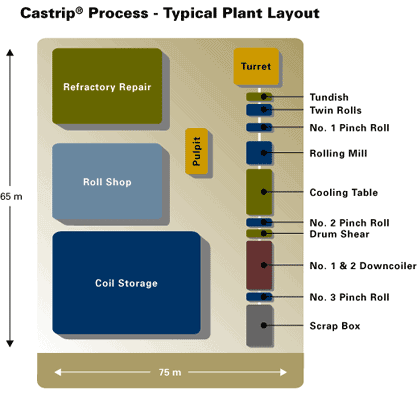
Starting at the first point of contact between the rolls and the molten steel, solidification begins and continues as the rolls rotate downwards. Two individual steel shells are formed, one on each roll. The shells form one continuous sheet when they are brought together at the roll nip or kissing point. This steel strip is guided through pinch rolls and a hot rolling stand, where it is reduced to the desired dimensions, typically between 0.7 and 2.0 mm. (See Figure 2 for a complete diagram of the Castrip process. The typical layout of a Castrip plant is illustrated in Figure 3.) Water-spray cooling reduces the steel from its rolling temperature to a temperature suitable for coiling.


Process-to-Process Comparison

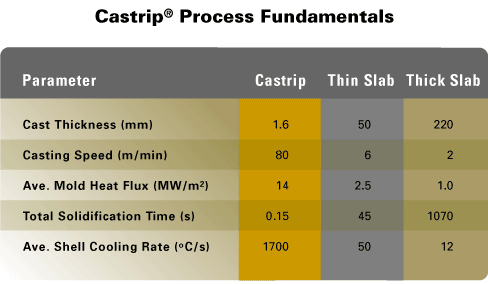
The Castrip® process represents a step-change over conventional thin slab casting of steel products in almost every aspect of operations - in fact, most characteristics are an order of magnitude different from comparable values from slab casting. The solidification event is completed in a shorter amount of time, the casting speed is much faster, heat fluxes are tremendously higher and the product is thinner.

Unlike slab casting, the Castrip process does not utilize any form of lubrication between the roll surface and the molten steel. Further, oscillation of the mold is not used and intimate contact is maintained between the solidifying shell and the roll. This allows for greater heat transfer, which dramatically reduces the solidification time to just 0.15 seconds, compared with 1070 seconds for conventional casting.

The new techniques are particularly good for making higher-value, specialist steels, says Claire Davis, a steel expert with the Warwick Manufacturing Group at the University of Warwick in Britain. Ms Davis and her team are developing new high-tech steels especially for belt casting, including advanced low-density steels that are stronger, lighter and more flexible than conventional steel.


A twin-roll process, much as Bessemer conceived, is already employed by Nucor, a giant American steelmaker. Called Castrip, it is producing steel in two of its plants. A big advantage of twin-roll and belt-casting is compactness. Nucor reckons a Castrip plant needs only 20 hectares (50 acres) and provides a good investment return from the production of only 500,000 tonnes of steel a year. A conventional steel plant, by comparison, may sprawl over 2,000 hectares and need to produce some 4m tonnes a year to turn a profit.

Other firms are licensing Castrip as well. Shagang, a large Chinese steelmaker, is replacing a less energy-efficient plant with the new technology. The numbers look compelling enough to encourage a startup, too: Albion Steel is talking to investors about building a £300m ($370m) Castrip plant in Britain. The plant would be “fed” by a low-cost mini-mill that melts scrap and produces steel for galvanising, mostly for the construction industry, says Tony Pedder, one of Albion’s founders. Mr Pedder is the chairman of Sheffield Forgemasters, an engineering company, and a former boss of British Steel (which later became Corus). Britain has a surplus of scrap but imports galvanised steel. The plant would employ only about 250 people; traditional integrated operations need a thousand or so. “We believe in the technology,” says Mr Pedder. “In our view it is past the point of being experimental.”
Read more »
18 Mar 17:01

Regulators cast critical eye on Canadian travel insurance industry

by Susan Lazaruk

Many travel insurance policies are sold in Canada without proper medical questionnaires and with dozens of pages of complicated jargon, potentially leaving policy holders with no coverage, according to an insurance regulators’ issues report obtained by Postmedia News.

“Current practices do not appear to meet this objective (of providing enough information for consumers to make an informed choice about policies) and, as such, do not treat customers fairly,” states the issues report prepared by a working group of the Canadian Council of Insurance Regulators, which includes B.C.’s Financial Institutions Commission.

Based on this report, the group is preparing recommendations for Canadian travel insurance providers to clean up their industry after finding cases of what could be unfair practices.

Chris Carter, deputy superintendent of supervision at FICOM, told Postmedia News in an emailed response that “FICOM is actively working with other regulators in Canada to address consumer concerns about travel insurance products sold locally and nationally.”  

The working group’s recommendations, if approved, would affect travel insurance sold for out-of-country travel in B.C. and across Canada.

Related

The issues report listed a string of problems with travel insurance, including that 95 per cent of applicants were being automatically approved for policies without the insurer determining whether their medical conditions would exclude any eventual claim.

“The working group considers this to be an exceedingly high automatic acceptance rate and is surprised so few applicants have to undergo medical examinations during the underwriting process,” unlike with applicants for health and life insurance. The automatic acceptance, “may give a false sense of security among consumers or create unrealistic expectations,” the report stated.

That would leave the consumer, who the report noted is often in a rush to get a policy before a trip, to choose the coverage and to determine whether they had a pre-existing medical condition. They would be left to read through lengthy policies with “medical questions that are too complicated for even medical experts to understand,” the report said.

Also, the premiums are based on the duration and value of the trip and the applicant’s age, rather than their medical condition, the report noted.

One of the examples the paper gave was of a young, healthy man who answered no when asked if he had a prior medical condition. But two months before taking out the policy, he had gone to his doctor complaining of pressure in his chest. His doctor performed tests and concluded it was likely due to stress.

The man was denied coverage for a bike accident on his trip because under the terms of his contract, he should have answered yes. His insurer ruled that he wasn’t eligible for the insurance in the first place because he had answered the question improperly.

Another example the report cited was a woman who was offered a choice of 15 different plans, with disclosure documents that ran 85 pages.

“The working group observed that the documents are often too difficult for the average consumer to read and understand,” the report said. “Insurers should carry out a diligent review of their (travel insurance) products to ensure they’re providing proper coverage to consumers.”

Carter said that regulators are also considering recommendations to ensure the travel insurance industry discloses to consumers the internal process for making a complaint about a claim and to ensure that unhappy consumers can take their case to an ombudsperson or FICOM.

The recommendations are also expected to address “potential issues with product design, marketing and sales, involvement of third-party service providers, claims management, complaints, education and data collection,” according to the report.

Consumers can contact FICOM with complaints about travel insurance before the recommendations are drafted. They are expected later this year, said Carter.

slazaruk@postmedia.com

18 Mar 17:00

This Week in Content Marketing: It Doesn’t Matter If You Call It Content Marketing

by Joe Pulizzi

doesn't-matter-call-content-marketing

PNR: This Old Marketing with Joe Pulizzi and Robert Rose can be found on both iTunes and Stitcher.

In this episode, Robert and I discuss why publishing agencies are struggling with the creative services business model. We also explore print’s potential for targeting teens and tweens, and give our views on some new video research. Our rants and raves cover a book on America’s “most dangerous huckster” and deconstruct a definition-centric content debate; then we close the show with an example of the week from Abbott Labs.

This week’s show

(Recorded live on March 13, 2017; Length: 1:04:21)

Download this week’s PNR This Old Marketing podcast.

If you enjoy our PNR podcasts, we would love if you would rate it, or post a review, on iTunes

1.    Notable news and upcoming trends

  • Publishers face content studio growing pains (07:31): An article on Digiday describes some of the many pressures publishers are facing when trying to make their branded content studios profitable. Among the concerns the article raises are that publishers’ studios often aren’t adequately staffed, equipped, or structured to execute on campaigns at the scale that brands have come to expect. Robert and I slightly disagree in our views on this – while I see publishers struggling because they are still trying to straddle the line between creating editorial stories and selling branded content, Robert contends that the problem is that publishers need to offer strategy as part of their service – not just the creative.

Publishers need to offer strategy as part of their service not just creative. @robert_rose #ThisOldMarketing
Click To Tweet


  • Teens and tweens are a print-hungry audience (20:21): In a Q&A interview posted on the Min magazine website, Bauer Media Group Editorial Director Brittany Galla talks about the benefits of print when it comes to connecting with passionate young readers. As a parent, I am encouraged by the opportunities discussed here, since I’m always pushing my own children to have a greater appreciation for the print medium. Robert concurs, and points out that the ubiquity of digital media consumption among teens and tweens right now emphasizes the unique value that print now represents as a differentiating medium.
  • Research shows video is the new blogging (28:00): In a new post on his Convince & Convert blog, Jay Baer contends that we are entering a “no-read” era, as video content’s popularity continues to climb higher and higher. For example, according to a new benchmark report from Vidyard, businesses are creating approximately 18 videos a month – a cadence that Jay says is on par with many businesses’ blogging habits. While I can’t find fault with Jay’s overall assertions here, I do have concerns with two of the stats he cites, as they set marketers up to fall into a rut.

.@JayBaer says we are entering a “no read” era as video content’s popularity continues to rise.
Click To Tweet


HANDPICKED RELATED CONTENT:
13 Steps to Live Stream Video the Smart Way

2.    Sponsor (34:30)

  • Content Marketing Institute’s 2017 Events: Whether you are just getting started with content marketing or are looking to take your expertise to the next level, CMI’s portfolio of events has you covered. Enrollment for the current semester of Content Marketing University is open until March 31. We’ve launched an all-new program for 2017, but the spring session is limited to 500 learners, so don’t wait to secure your slot. Use the code PNR100 to get a $100 discount on registration. Time is also running out to sign up for our strategy-focused Intelligent Content Conference ­taking place on March 28–30 in Las Vegas. And don’t forget to send in your submissions for the Content Marketing Awards. The entry period runs from now until April 21, so don’t delay.

content-marketing-institute-events

 3. Rants and raves (37:15)

  • Robert’s rave: The Native Advertising Institute’s Chad Pollitt just released a new post, which features an ambitious infographic that lists and categorizes all the players on the native advertising technology landscape – large and small. It’s a tremendously well researched and developed resource, and Robert recommends that anyone interested in this technology sector check it out.
  • Robert’s rant: Plenty of listeners brought an article from The Drum to Robert’s attention this week – another in a long line of misinformed attempts to create controversy around whether or not content marketing exists. Robert is baffled at how a journalist who prides himself on the precision of his definitions could completely miss the point when it comes to accurately characterizing the discipline. But regardless of the semantics used, Robert stands by his position that using owned media to produce a result in an audience is different than promotional advertising.

Owned media to produce a result is different than promotional advertising, says @robert_rose. #ThisOldMarketing
Click To Tweet


  • Joe’s rave: A friend recently recommended that I read the book Charlatan, by Pope Brock. It’s a fascinatingly true story of John R. Brinkley – a PT Barnum-esque snake oil salesman who rose to great wealth in an era of American history where the incompetent were encouraged to practice medicine, while the well-educated and elite were shunned. I think this brings to light an important idea: In a time where people are, once again, being expected to blindly buy into fallacies and faulty claims, there comes a tremendous opportunity for brands and publishers to build trust among those who desperately want something worth believing in.

4.    This Old Marketing example of the week (53:50)

  • Robert recently stumbled on a content marketing example that ranks among his all-time favorites. Pharmaceutical giant Abbott Laboratories got its start during an era of professional medical distrust similar to the one we just mentioned. Realizing that it needed to rehabilitate a deteriorating corporate image, the company brought on a new president, Simeon DeWitt Clough, who launched a publication called What’s New as a means of building relationships with doctors, hospitals, and other decision-makers in the medical community. Running from 1935 to 1945, the magazine served as a platform to showcase Abbott-funded art, in the hopes that the trust and admiration the company earned by contributing to intellectual and artistic pursuits would then extend to the thought leadership content Abbott published in pharmaceutical journals. What’s New’s oversized, photography-centric, format would later become the inspiration for Life Magazine; but it is Abbott’s model of using engaging content to circumvent a corrupt advertising machine that truly elevates this effort to the status of a This Old Marketing work of art.

For a full list of PNR archives, go to the main This Old Marketing page.

Cover image by Joseph Kalinowski/Content Marketing Institute

How do I subscribe?

itunes logo

stitcher logo

The post This Week in Content Marketing: It Doesn’t Matter If You Call It Content Marketing appeared first on Content Marketing Institute.

17 Mar 16:51

Walmart ramps up e-commerce with two new initiatives (WMT)

by BI Intelligence

Walmart Ecommerce Sales

This story was delivered to BI Intelligence "E-Commerce Briefing" subscribers. To learn more and subscribe, please click here.

Walmart has been actively expanding its efforts to boost its e-commerce operations recently, as the company looks to better compete with online retail giant Amazon. And this week, it announced two new initiatives to that end: 

  • Its subsidiary, Jet.com, will acquire ModCloth — a bohemian vintage clothing brand selling primarily online, as reported by Jezebel.
  • In addition, it plans to invest 17 billion pesos ($863 million) in Walmart de Mexico in 2017, according to The Wall Street Journal. This is an increase of 19% from last year's investment in the Mexican business unit, commonly referred to as Walmex, and the retail giant plans to allocate 23% of the budget to logistics and e-commerce. 

ModCloth is Walmart’s third acquisition in 2017 aimed at building its e-commerce presence among millennials. ModCloth’s customer base is made up of mostly millennial women, which could help Walmart increase engagement beyond its typically older clientele. Walmart also just bought Moosejaw, an outdoor apparel and gear retailer with a strong millennial following and online presence, for $51 million in February. And at the beginning of 2017, it acquired e-commerce shoe retailer ShoeBuy for $70 million. Moreover, apparel is the top retail category in terms of online sales, and currently dominated by Amazon. Walmart is likely positioning itself in a high-growth segment, with a customer base known for online shopping, to fight growing competition from the e-commerce titan.

Meanwhile, the company's increased investment in Walmex signals it's fighting to keep its market share as Amazon expands in Mexico. Indeed, this announcement comes a little more than a week after Amazon announced it's bringing its Prime subscription service to the country. Walmart and Amazon each have a 5.5% share of the e-commerce market in Mexico, but with Amazon Prime entering the space, Walmart may lose customers due to Prime’s free and fast shipping.

As Walmart stated in December, it plans to build out its logistics network by adding more distribution centers in Mexico and upgrading its existing ones. And although it didn’t specify which e-commerce initiatives it had planned, it could utilize its physical locations to provide ways for shoppers to pay in cash for online purchases, similar to the service MercadoLibre provides through Occo convenience stores. Reaching Mexico’s largely unbanked population will be key for any e-commerce player in that market.

Although there is a huge gap between Walmart and Amazon in terms of online sales, the retail giant still overshadows Amazon in total revenue, and it can leverage its enormous amount of capital to build a strong online presence quickly. Amazon’s online sales were $92 billion last year, while Walmart had an estimated $13.7 billion in 2015. However, Walmart reported total revenue of $486 billion in 2016, compared with the $136 billion Amazon generated. Walmart is clearly leveraging this advantage, as its been making acquisitions at a breakneck pace, and quickly increasing its investment in markets where it directly competes with Amazon.

BI Intelligence, Business Insider's premium research service, has compiled a detailed report on new e-commerce strategies that looks at some of the top trends affecting retailers at each stage of the purchase funnel and how they're responding to those shifts.

Here are some of the key takeaways:

  • Within digital, consumers are spreading out their retail purchasing across channels, forcing retailers to spread out their online marketing budgets. Paid search, affiliate marketing, and email all increased their share of e-commerce referrals last year, according to Custora.
  • Paid search especially stood out as a major source of spending by retailers. Search ad spending grew 18% YoY in Q4 2015, according to IgnitionOne.
  • Mobile continues to drive the most sales growth for retailers, but sales still aren't keeping up with retail traffic. IBM found that smartphone traffic beat both tablet and desktop, making up 53% of all online traffic. But mobile still only accounted for 29% of all online sales.
  • Retailers only have themselves to blame for underperformance on mobile, as many still aren't using best practices for mobile websites and apps. Only 60% of the top 100 global retailers currently have a dedicated mobile website, according to The Search Agency.
  • The increase in online shopping has put stress on the shipping and logistics industry. The number of UPS ground packages delivered on time during the holidays fell from 97% in 2014 to 91% in 2015, according to ShipMatrix.
  • Retailers are beginning to explore alternative shipping options. Earlier this year Gilt Groupe switched its primary ground shipper from UPS to Newgistics.
  • Retailers that can't afford to invest in alternative shipping options are offering consumers more fulfillment options using what many of them do have — brick-and-mortar stores. Buying online and picking up in-store, also called click and collect, made up about 30% of e-commerce sales at Sam's Club in 2015.

In full, the report:

  • Looks at how retailers are shifting their ad spending and marketing efforts to keep up with online retail behavior
  • Identifies which channels are top performers for referral traffic and new opportunities for reaching consumers
  • Analyzes how retailers are responding to the rise of mobile purchasing and where they're falling short
  • Examines the evolving delivery landscape and the aggressive moves retailers are making to become their own shipping carriers

To get your copy of this invaluable guide, choose one of these options:

  1. Subscribe to an ALL-ACCESS Membership with BI Intelligence and gain immediate access to this report AND over 100 other expertly researched deep-dive reports, subscriptions to all of our daily newsletters, and much more. >> START A MEMBERSHIP
  2. Purchase the report and download it immediately from our research store. >> BUY THE REPORT

The choice is yours. But however you decide to acquire this report, you’ve given yourself a powerful advantage in your understanding of new e-commerce strategies.

Join the conversation about this story »

17 Mar 16:51

5 Sales Hacks for the New Salesperson

by Max Altschuler

I’ve tried to write this without giving away too many secrets. My best hacks I keep to myself because if they became overused, they’d be obsolete. I won’t bore you with Rapportive hacks or any of the 101 stuff either. I hope you enjoy these and put them to good use.

Sales Hack #1 –  Frienemies

Salespeople are almost always taught to connect with their prospects on Linkedin. What they aren’t taught are how to configure their privacy settings. Therefore, if you are connected to someone and they haven’t fixed their settings, you can see when they have a new connection.

Now why am I telling you this? Well first go out and connect with reps at your competitor’s companies. Most of them probably haven’t played around with their settings and won’t think anything of it when you asked to connect. Once you’re connected, just wait to see who they connect with. When they connect with a prospect, you’ll be notified via news feed and you can send a very well timed email. Just don’t mention how you knew to send them an email at the perfect time.

Sales Hack #2 – Cold Emailing

There are plenty of articles out there on writing cold emails but people maybe don’t realize, or maybe don’t mention how situational it is. I believe that writing a cold email to the VP of Marketing at Verizon is very different than writing to Marketing at ToutApp. Smaller organizations give more people decision making power and need more info upfront but for bigger orgs, less is more.  I like to aim high in their org with a simple “introduction Request” email that usually gets forwarded downstream to the person you’re supposed to be talking to.

This works for a few reasons:

  1.  It gives you a chance to not say anything that will make them shy away from you. If you give too much info you may end up over selling or trying to hit the wrong pain point with the wrong value  prop. Get on the phone and get some info before you pitch them.
  2. You get forwarded or intro’d down stream, so their boss is literally telling them to talk to you.
  3. It’s easy for them to get it off of their plate. They can respond with nothing other than the right person being Cc’d on the email.

This can work really well for reaching out to high level employees at big companies. Just don’t think cold emails in sales will work in every occasion.

*Side note – I haven’t shared this anywhere else but it seems to be getting written about plenty these days but in different contexts. Soon people will wisen up and it will stop working. Until then, try it out and see if it works for you.

Sales Hack #3 – Messaging

Too often I see people asking for favors in a manner that presents them, well…asking for favors.  When I left Udemy I wrote my personal network asking for people to introduce me to companies that needed a business development rep. I knew I wanted to stay at a small startup but I wanted to hear out all of my options and I didn’t want to start hearing offers while I was still with the company.

One thing to know and never forget. It’s not what you ask, it’s how you ask it. Instead of saying. “I just left my company. Do you know anyone who is hiring?” you say, “I just left my company. If you know anyone looking for a killer BD rep, do them a favor and introduce them to me.” It completely flips the script. That’s my favorite example but keep this in mind when trying to sell something. Whether is written or verbal communication, a lot can be done just by how you phrase things.

Sales Hack #4 – Web Scraping

One of the main points of the Sales Hacker Conference is to get salespeople to embrace all the new technologies that have rapidly evolved over the last 2-3 years. Web scraping is now easy to do for non-technical salespeople. This can open so many doors in the outbound lead gen space.

One tool I like to use is Import.io. In the event space, I can scrape lists of companies that have sponsored similar events, raised a certain amount of funding, are located near my next conference, etc. If you’re customers are restaurants you can easily scrape sites like yelp. If they’re lawyers you can scrape Avvo. You need zero technical ability to use Import.io for basic web scraping and list building. Oh, and it’s free to use!

Two other great tools for list building are LittleBird or FollowerWonk. Both allow you to scrape twitter bios. At Udemy, if I needed to onboard someone that taught PHP, a PHP expert will usually have PHP in their twitter bio. Same thing works if I want to find people in sales in the Los Angeles area.

After I’ve scraped lists I like to get emails using Salesloft or Toofr and fire away emails using ToutApp, of course.

Sales Hack #5 – Outsourcing & Automation

I’m an automating machine. I automate as much as I possibly can. The entire process of list building and outreach can be taught entirely to a Virtual Assistant in the Philippines at $3 an hour (which is a nice wage there so don’t feel bad).

The web scraping in Sales Hack #4 can be taught to anyone. Once they have company names they can find the proper title, first name, and last name of anyone at almost any company solely using linkedin and the company’s About/Team page.  Once that have that they can use Salesloft or Toofr to pull emails. Then upload them as a group of multiple groups into ToutApp. Create a template or a few, and have them send as frequently as you’d like. You just automated the entire outbound sales process up until you receive a response.  I can even instruct my VA’s to set up a call if the incoming email takes me longer than 30 seconds to read.

This process allows you to build massive, targeted, and fresh lists for very little money. Go ahead and try it for yourself!

*Bonus Hack*

I use ToutApp to send the bulk of my emails. When I’m emailing a group of less than 20 people, sometimes I like to add a personal note as the first sentence.  I’ll usually add a column to the spreadsheet I’m uploading with the group I’m about to email called Personal. In the cell for each person I can write my custom personal line for each email. When I upload the sheet, I map it to a custom field {personal} and then dynamically add it into my template. This is the best way to send personalized emails to an entire group.


Originally posted 2014-04-07 19:30:57.

The post 5 Sales Hacks for the New Salesperson appeared first on Sales Hacker.

17 Mar 16:51

How to Ensure Your Charitable Donations Make a Difference

by Mary Fetzer

Looking to donate to charity in 2017? You’re not alone. Americans gave a whopping $373 billion to charity in 2015. And while millennials so far have a mixed record in this category—they donate and volunteer with less frequency than any other age group—they’ve also redefined the terms of charitable giving through such innovations as crowdfunding.

Sadly, some charitable efforts fall short of actually helping those in need. Here’s how to make sure your efforts (and dollars) are not spent in vain.

Get involved

“Ideally, a donor will spend time getting to know a charity before investing with a cash donation,” says Allison Durazzi, who’s spent most of her career in the nonprofit sector and teaches communications and social media to nonprofits. “Get on their mailing list, read their website, talk to other supporters, and listen to the clients they serve.”

Do your research

GuideStar, an online database that tracks information about charities, is a good resource for getting financial information. “You can look up tax filings, board members, and sometimes even annual budgets,” says Durazzi. She also advises that you check to make sure the charity is a 501(c)(3) organization, which means that your donations are tax deductible (within certain IRS guidelines).

Community foundations are another good source of information and some even accredit charities, which means charities have been reviewed according the foundation’s guidelines.

Durazzi encourages donors to verify with your secretary of state’s office that the charity is licensed to conduct fundraising activities. Review the charity’s budgets, foundation and government grants, how well it pays its top employees, and potential conflicts of interest with board members.

Don’t judge too quickly

Today, many smaller and start-up nonprofits are fiscally sponsored under the aegis of a larger, “umbrella” nonprofit that help them reduce administrative costs and time. But judging how “good” an organization is by overhead alone is an outdated and ineffective measure. Keep in mind that nonprofits are competing with for-profit organizations for talent so that they can provide the greatest possible impact.

“Ultimately,” says Durazzi, “it comes to knowing the organization and your support of their mission and goals. Protect your investment by looking up publicly available information and gauging your experience as a supporter.”

17 Mar 16:50

US takes another step toward regulating fintechs

by BI Intelligence

Fintech Reg

This story was delivered to BI Intelligence "Fintech Briefing" subscribers. To learn more and subscribe, please click here.

In further evidence that US federal regulators are at last beginning to take action toward regulating fintechs, J. Christopher Giancarlo, acting chairman of the Commodity Futures Trading Commission (CFTC), announced in a speech on Wednesday that the agency has been conducting a review of the industry since January.

In his speech, Giancarlo said the review is designed to help the regulator gain a better understanding of the fintech industry to better promote these players in the derivatives market; and determine which of its current regulations need to be revised to accommodate new fintech entrants in the space.

Here are the three main areas Giancarlo said the review is focused on:

  • How the CFTC should make use of emerging technologies to improve its efficiency as a regulator. Giancarlo may have been referring to blockchain (also known as distributed ledger) technologies. The benefits often claimed for these technologies include better record-keeping and transparency within large agencies.
  • How fintech innovations can be used to identify outdated CFTC regulations that need updating. Giancarlo may well be referring to regtech solutions, which have been proliferating to help both companies and regulators keep up with increasing volumes of financial markets legislation.
  • What the CFTC's role and remit should be in promoting fintech within the derivatives market it supervises. Given the criticisms the OCC, a fellow regulator, has faced over whether its mandate allows it to extend federal bank charter applications to fintechs, the CFTC may be trying to preclude a similar predicament by conducting a preemptive investigation into its power to regulate these companies.

Although it's promising that US regulators are taking action, they still lack coordination when it comes to fintech. We have seen many of the large US regulators setting up fintech initiatives — whether investigative or regulatory — recently, but the fact remains that few of these agencies are effectively communicating with each other. So while regulators may have started taking notice of fintech, the industry will probably have to wait some time longer before a comprehensive, coherent regulatory framework emerges.

Despite having one of the largest fintech industries in the world, the U.S. is noticeably behind other regions when it comes to one factor crucial to the future growth of this burgeoning sector — regulation. 

The U.S. regulatory environment is holding back fintechs and hindering their chances of success. 

Sarah Kocianski, senior research analyst for BI Intelligence, Business Insider's premium research service, has compiled a detailed report on U.S. fintech regulation that examines the current regulatory landscape in the U.S. and how it's impacting the fintech industry. In addition, it discusses the methods fintechs are using to meet regulations as best they can, and details the fintech-specific initiatives that have already been launched by regulators and their likelihood of success. It also considers the future of fintech regulation in the U.S. and how it may shape the fintech sector long term.

Here are some of the key takeaways from the report:

  • The U.S.' regulatory system involves many different players at the federal level, as well as a regulator for each state. This complexity not only makes the U.S. regulatory environment harder for fintechs to navigate in the first place, but it's a major barrier to the development of a coherent fintech policy.
  • The U.S. regulatory landscape means it is falling behind other major fintech regions such as the UK and EU in certain segments. These regions already have established fintech regulatory policies. 
  • U.S. fintechs are using a number of models to achieve compliance, but none are ideal. As a result, many are finding it hard to achieve the scale necessary for success. 
  • Some U.S. regulators have realized the need to act regarding fintech regulation, and are launching initiatives with the aim of making compliance easier. That said, a coherent fintech regulatory policy for the U.S. is still a long way off. 

 In full, the report:

  • Examines the current regulatory landscape in the U.S. 
  • Explains how it is negatively affecting the fintech industry.
  • Outlines the initiatives currently in play from major regulatory agencies. 
  • Considers the future of U.S. fintech regulation and its potential impact on the fintech sector. 

Interested in getting the full report? Here are two ways to access it:

  1. Subscribe to an All-Access pass to BI Intelligence and gain immediate access to this report and over 100 other expertly researched reports. As an added bonus, you'll also gain access to all future reports and daily newsletters to ensure you stay ahead of the curve and benefit personally and professionally. » START A MEMBERSHIP
  2. Purchase & download the full report from our research store. » BUY THE REPORT

Join the conversation about this story »

17 Mar 16:44

Successful Digital PR Tactics That Won’t Break the Bank

by Tom Willis

Indago Digital Virtual Tour

Raising the profile of your business enterprise through traditional PR can be a game changer, however in an era when every cent of digital spend is under the microscope, many will argue that the practice can no longer compete with social or paid ads for generating value for money. Although there may be some truth to this, PR remains one of the core pillars for building a brand online and telling a story with which audiences will find an emotional bond. When used to complement the efforts of the aforementioned digital marketing tactics, a simple PR stunt can be dynamite.

Sometimes the smartest PR activities are executed on a shoestring budget. If you are looking for ways to namecheck your digital brand to new and potential customers whilst gaining recognition from your industry, then these five low-budget PR tactics may serve as an ideal starting point.

  1. Create a video storytelling journey

The future of PR lies within the hands of social media, and the standout feature within social for user and brand to get to grips with is video storytelling. Master this art and your business image can go from ordinary to unmissable within the space of a few months. Ever since Snapchat introduced the disposable story feature and received a major uptake in user engagement social powerhouses like Facebook and Instagram have joined the cause for a piece of the pie.

Bear in mind each brand has its own agenda, whether it be to generate sales conversions, leads or pure awareness and the execution of videos publishers should reflect this. Examples of businesses have worked this technique like a dream can be seen in this useful list here courtesy of Hubspot. There are 600 active monthly million users on Instagram alone; If you start your digital PR strategy anytime soon, be here.

  1. Make friends with influencers

Remember the days of school ground politics when your PR stock could go up or down depending on the circles you moved in? The same rules apply in 2017 in digital marketing: it pays to know the popular people who can speak about you in good terms in front of the right audiences. Introductions cost nothing, only the time you are willing to invest in making valuable, long-term relationships.

So where to start? I always check out social monitoring tools like Buzzsumo to identify who the influencers in my sector might be, and which social platforms I can interact with them on. Say that you pinpoint 10 people to connect with – the best form of attack is to not go on the charm offensive; use your time wisely to respond to their status updates naturally, share useful tips and best practise and loop them in, and when the opportunity arises share some of your personal insights, and best case scenario they will talk about you to their followers.

  1. Launch a business photoshoot

Open your place of work to the masses and you’ll be surprised at how much attention your business may receive. People may be genuinely intrigued to hear from or see the team operating behind the logo if they are to consider buying into their brand long-term. One of the first thought leaders to adopt this strategy was the UK soft drinks brand Innocent, who invited the world to connect with the funky office space and read blog updates from staff, even placing its workforce in TV spots.

But let’s start small. Assuming you are limiting spend for this type of activity, you may want to organise a Google My Business photoshoot. Not only will this allow you to make your brand more transparent there are added local organic search benefits too. Digital agency Indago created a stunningly provocative virtual tour of its offices as seen through the eyes of a dog, which picked up major press coverage and social engagement. As simple digital PR hacks go, this was a winner.

  1. Contribute to high profile publications

If your aim is to make a name for yourself or become an ambassador then the first port of call is to find publications that your potential customers and community are engaging and interacting with, and request to contribute through content submissions. Consider that each of the experts or influencers who regularly contribute to the target websites started from nothing. Their reputation has been built on the digital content they have produced and how well it has resonated with the core audiences.

With landing authorship status on lifestyle or business website that have a certain degree of influence, there is every chance that the next website you apply to write for will place you the top of the pile because of previous success. As an added benefit of digital exposure, there are also huge SEO wins in that the topics you write about may rank highly in search results and lead the user to want to find out more about the business you are representing.

  1. Offer free industry advice

People starting out in their industry will naturally turn to influencers online to enhance their learning, regardless of their career path. And why not, bearing in mind that education of this kind is easy to come by. But most importantly, the wide selection of advice is mostly free. Whether it’s reading articles, watching how-to webinars, or monitoring forum threads for quick tips, the education process is an ongoing journey fuelled by the renewal of information by experts that you too can get involved in. And now prominent figures like Rand Fishkin are presenting weekly knowledge sharing sessions that are known the world over and draw in hundreds of thousands of views per piece.

Sharing your expertise within your skillset might sound like you’re giving away all your secrets in return for very little, however, people tend to trust in those who are open about how they work, think and act. Trust builds over time and this catapults those who are brave enough into the limelight, as the demand for more intelligence and insights continues to grow through the widening of audiences. Meanwhile, your brand will always be associated with the free expert advice you are delivering.

17 Mar 16:42

4 Ways to Attract More Subscribers to Your Email Newsletters

by Loren Baker

As businesses strive to gain more visibility in today’s highly competitive market, different marketing strategies have surfaced that seek to give better results in being able to draw a bigger audience. Email newsletters have been used by companies for some time to connect with their customers and build a relationship with their target audience. It is an easy and cost-effective way to keep your customer base updated with recent news, events and promotional campaigns.

Nowadays, email newsletters are effective ways to get more traction for your brand by increasing awareness. It helps give your audience a better idea of what your company is all about, far more than just your usual product launches and other form of brand advertisements.

Through newsletters, brands and businesses can establish their expertise in a particular industry or make themselves stand out as a thought leader in their field which in the long run helps build trust and credibility. It is also a great way to build curiosity and entice your audience to get to know your brand better which may in turn increase traffic for your website.

Many companies have been using email newsletters to launch new products and services, promote different marketing campaigns and announce special offers. Its ability to get content broadcasted to a broader audience makes it an effective marketing strategy while promoting conversion as well. Knowing how to get more subscribers to sign up to your mailing list is essential to have an audience to distribute to. By learning how to use these tips, you can make email newsletters work for you as well.

Here are 4 ways to attract more subscribers through your email newsletters.

  1. Offer your audience incentives for signing up.

Perhaps the easiest way to get more subscribers to opt on to your email newsletters is by giving them something to look forward to when they sign up which is often in the form of incentives (also known in marketing as lead magnets). Many companies and brands offer their own special vouchers on a subscriber’s next purchase, and give access to free services and other useful freebies. Having something to offer your audience the moment they click on the confirmation link for your newsletter sign up email increases their opt-in rates.

For this to work, it is essential to already have a good understanding of who your audience is and what they are most interested in. By segmenting your mailing list according to different groups in your target audience, it is a lot easier to come up with different promotions or vouchers that will entice them based on what they find interesting.

  1. Create and offer valuable content consistently.

As soon as companies get the audience they need through their mailing list, it is so easy to lose track of the reason why they had it set up in the first place. After some time, many brands just strive to keep up with distribution deadlines for their newsletters to the extent of releasing content that bring nothing of value to their subscribers. Oftentimes, it is this mistake that gets them to lose subscribers quickly and prevents them from gaining new ones. Brands need to keep up with the responsibility to bring valuable content to their subscribers. One effective way to add value to your content is by sharing information that is relevant to them.

Offering tips and tricks, industry updates and popular trends and other helpful solutions gives your subscribers a reason to stay on and may even get them to recommend your brand to their friends. It is also helpful to be in the know with what the competition is offering to stay relevant to your audience. Sign up to newsletters from your favorite brands to get an idea of what it is they share in their own newsletters. Learn from top industry players, change what needs to be improved and create a new message that speaks to your audience better.

  1. Provide your audience with other options to subscribe.

Another great tip to build your mailing list is by giving your subscribers more options to choose from in terms of how often they want to receive newsletters from you which help prevent them from feeling overwhelmed by what you have to offer. It is also preferable to give your audience better control over what topics or events they want to hear from you.

By offering them this degree of control over what information they want to get, your email newsletters are more likely to be anticipated when they come. All this will help ensure your emails will be read instead of being ticked off along with other unwanted newsletters they may be getting frequently.

  1. Promote yourself and maximize your social media presence.

Show off who you are, your expertise and what you have to offer to your subscribers by including social proof in your newsletters. This can be done by highlighting your subscriber and follower count on different social media platforms on your email signatures. Having more subscribers on social media makes it easier to build trust and draw confidence in your audience as well. Give your subscribers easy access over share buttons that will allow them to promote your content to their own social media networks.

There is so much that brands and businesses can gain from an effective newsletter distribution system. Through email newsletters, start up brands can find a bigger audience and established companies can start to reconnect and build a new relationship with their subscribers once more. But to sustain this relationship with your subscribers and keep them engaged to stay on and even promote your brand to those they know, it is important to remember that it has to benefit them as well in the form of quality and valuable content.

Email newsletters must seek not only to promote your products and services or your company but to also distribute information that is relevant to the times and valuable to the people reading them. Without this important factor, it is so very easy to get lost among others that seek to only promote themselves and nothing else.

17 Mar 16:42

4 Things You Should Never Say To The Press About Your Company

by AJ Agrawal

Press and media coverage can do wonders on your efforts to boost your profile and help build the reputation and credibility of your brand. However, in scenarios where you find yourself having to conduct damage control over an issue that is bubbling over within your business, press coverage can be tricky. The wrong words can put your reputation and the efforts of your entire business at risk. As a result, it’s crucial to make sure that when you do get involved with the press, you choose your words wisely.

If you’re gearing up for some media coverage about your company, make sure you keep the conversation clean and free of wrinkles by avoiding these taboos:

Anything Negative About Your Clients or Competitors

When you’re dealing with the media and put in a situation where you’re pressed to address an issue, your first thought might be to deflect by pointing at a client or competitor. In other moments where you find yourself looped into a press conversation because of your association with a client or competitor, you might find yourself at a loss for the appropriate words.

It’s in these moments that you should always remind yourself to avoid making any comments about clients or competitors that could be perceived as negative or ambiguous. Your comment about how terribly uncompromising a customer or how askew a competitor is will ultimately get back to them, along with other potential clients. Not only could your words hurt your current relationships, but they could also make someone considering working with you – or even a current client of yours – think twice about your business practices. In the worst case scenarios, it could lead them to wonder if you’re a trustworthy enough person to do business with. It’s for these reasons that it’s always good to stay tight lipped about the negative perceptions you might have of the people you work with side by side.

Anything Political

Always think twice before using press coverage as a sounding board for your political frustrations and beliefs. These days it’s virtually impossible to dodge or escape any questions related to politics. It’s no wonder either, since politics is an important and fundamental topic, and these days it’s an extremely fiery one. As you grow as a company, you will find that your customers will demand you take a stance on certain topics and issues. While putting brand values on display will be important in your efforts to establish a broader customer base, avoid including yourself into the great debate of politics. Mostly because no matter what you say your comments will be considered controversial by one group or another and you will run the risk of alienating a colossal chunk of your audience.

‘No Comment’

When things turn south, and the media comes knocking on your door, you’re bound to have quite a few hardball questions thrown your way. In many cases, you’ll feel the urge to mimic the words of many figureheads before you and issue the classic “no comment” reply. However, do your best to resist. This is important to remember during any conversation you have with the press, and your “no comment” statement can say volumes and leave quite a lot for journalists to infer. The greater implications of this remark are that you: 1) have something to hide or 2) don’t know what you’re talking about.

It also puts you on the defensive side of your exchange with the press and will typically raise eyebrows and suspicion amongst your customer base. In a scenario where you find yourself unable to answer a question issued to by the media, defer the question by asking for verification of the information behind the question.

“Could This Be Off The Record?”

People often make the mistake of asking to have something “off the record,” without ever fully understanding what this question means. Most assume it means the journalist either won’t mention what you’ve said or cannot identify you as a source. The truth is, while the journalist may not name you, she can still make a reference to your job role, who you work for and what you said. A combination of all of these aspects will likely make you recognizable.

17 Mar 16:41

Impeccable With What You Do Control

by Anthony Iannarino

You have no control over the economic environment in which you find yourself. The Age of Accelerating Disruption is going to do whatever it is going to do, and it is leveling industries and reshaping the economy.

You need to be impeccable by maintaining an awareness of what is going on in your economic environment, and ensuring that you have the mindset and skill sets to succeed in the new economy. That is within your control.

You have no control over the political environment where you live and work. You have microscopic amount of influence, if such a small amount can even be measured. You might have more if you are deeply engaged in the process, or if you have powerful friends.

You need to understand what changes are being made, how they will effect you and your family, how they will impact your business, and what effect political changes will bring your clients. You control your awareness and your decision to make adjustments that serve you. Nothing more, nothing less.

You have no control over the technological or scientific changes that are part of The Age of Accelerating Disruption. Artificial Intelligence and robots are here, or they will be shortly. Science is going to allow you to live much longer than you imagine.

We aren’t going back to horses and carriages. Nostalgia doesn’t serve you, neither does wishing things would go back to the way they were. The future is here, and you are part of it. What is in your control is whether or not you embrace change and go with the grain, or whether you resist it, relegating yourself to the dustbin of history.

Your clients are going to do what they want to do, need to do, or have to do. That might include changing the things that lead to the reasons they need you. It also might include selling the business to someone who doesn’t need the service you provide, moving the business to an area where you aren’t, or closing the business down altogether. None of these choices may serve your needs, and you have no control over if or when they happen.

What you can impeccably control are the actions you take to create and win new clients and new opportunities. Enough action here is always enough.

Your irrational competitors take business at a price that all but ensures that they lose money. They buy market share by making concessions you and your company can’t—or refuse to—make. It might be sketchy, even if it isn’t illegal, and you find it immoral. But you have no power to change this.

You can control the value that you create, and you can control how effective you become at differentiating that value in a way that is meaningful for your dream clients.

The post Impeccable With What You Do Control appeared first on The Sales Blog.

17 Mar 16:41

Watch Out For These 4 Common Product Management Mistakes

by AJ Agrawal

You may find a potential employee who is impassion about your product, experienced in managing teams and marketing initiatives, and a great culture fit. All of these attributes, although impressive, do not make a good product manager. Product managers are often lauded as an early start-up’s most important hire, and it’s not a gross over exaggeration to say that your company’s future success hinges on their performance. Product managers require specific expertise to navigate the murky waters of design, development, and marketing. All too often it’s easy to assume that someone can simply learn on the job, and while that may be true for exceptional candidates, it’s not necessarily a gamble you want to make with your own company.

They Hire Yes-Men and Women

The job of a product designer is to constantly question and challenge. “How is this product solving a problem?”, “ How is this product making good on the promises we’ve laid out?”, “How is this product staying ahead of the competition?”

The startup world is dynamic and the technology powering today’s current crop of products may very well be obsolete in a year or two. Your product manager cannot rest on laurels, and must be willing to push the rest of the team to consistently look forward as they do. Product managers must lead the charge on the continued iteration and research on ideas. Just because your startup experienced success following your initial launch does not mean that your success will continue. Young companies plot their own death when they choose to ride the wave of early successes over advancing. When a new product is successfully launched into the marketplace, you can bet that there will be several companies looking to adopt your idea – and enhance it to make it better. In this scenario, your company could go from leading the pack to bottoming out in a mere matter of months. It’s up to the product manager and team to continually hunt for problems; only when product managers are focused on finding the root of existing problems, can they devise stronger solutions.

Now you might be asking “how is it possible to predict whether a new hire will be forward-thinking?” Unfortunately, you won’t know for sure. However, if you find an individual who offers your company more than just praise, but rather, questions your product’s actual value and expounds on the risks that currently surround your strategy, then you likely have a winner. Criticism can be a tough pill for entrepreneurs to swallow, especially when they regard their products as their babies, but criticism and questions will expand your longevity.

They Go Too Broad

It’s easy to let good ideas run down the rabbit hole. Many first-time entrepreneurs might find themselves asking, “If my product solves X problem, why can’t it also solve Y and Z?” These are good questions to have; they should be considered and mapped out. But when you’re first launching a product into the market sphere, going too broad can be a death wish. For example, some startups fall into the trap of trying to build cross-platform applications in order to reach every device and possible customer. First Round Review recently cited Southwest as one of these cautionary tales. The airline built a cross-platform toolkit to push its app out across devices in one fell swoop. The result was a clunky disaster, and Southwest was forced back to the drawing board. New startup product teams are encouraged to start small and perfect the product before expanding into broader territory. Especially if your company is a brand new entity in the marketplace, you’ll only get one shot at a first impression, and if you blow it on a product that is too broad, and not functional enough, you may never get your initial customer base back.

They Don’t Spend Enough Time Testing

New businesses are often up against the clock. Whether it’s investor-set timelines or hearsay of an impending competitive launch, there’s no such thing as an excess of time in the product world. With that said, however, product teams can not sacrifice adequate testing time to beat a schedule. Product development requires tireless testing; it’s by no means a fun cycle, but it’s an essential one. Every new iteration or update must be tested in its entirety and analyzed. When product teams rush this process to speed ahead to the launch finish line, they are only setting their product up for failure once it’s taken out of beta.

They Don’t Set Internal Communication Structures

While communication is key to business success across all practice areas, it is especially essential to the livelihood of product management teams. Developing a product is a dynamic process that requires the management of a lot of moving parts. If your product team is not in constant communication, you are putting your brand at greater risk of product setbacks that could offset timelines, budgets, and investor expectations. Investing in communication tools is crucial to help product teams fulfill their daily responsibilities. In addition to tools, a communications protocol must be put in place. For example, when does a UX designer share testing results with the founder and at one point does the development team step in to offer their insight on how incorporating new audience insights will impact development timelines? These are the questions that a product manager must have on his/her radar at all time. In order for a product to be developed to its full potential there must be fluidity and transparency between all team members and a sound communications structure is the only way to achieve that.

Product management is not a cushy position, but it’s a crucial and gratifying one. Without sound product managers, mo startup can expect to have a lasting impact on the market. Putting sound product management teams, structures, and expectations in place could be the distinguishing factor between a successful startup and a failed one.

17 Mar 16:41

How to Meet the Most Well-Connected Person in the Room in 30 Seconds [Networking Hack]

by afrost@hubspot.com (Aja Frost)

networking-hack-245076-edited.jpg

Some salespeople only get a few opportunities each year to network, while others attend networking events several times per month.

When it comes to making (or beating) your quota, networking is a game-changing strategy.

You can meet potential customers, find out who’s in the market for your product before anyone else, keep tabs on your prospects’ buying processes, get referrals, build your industry reputation, and more.

Want to become a networking champion? Read on for a brilliant hack from Ferenc Huszár, a machine learning researcher at Twitter.

How to Meet People at Networking Events

Imagine you’ve just walked into a huge room filled with strangers. You could approach someone at random and start talking to them -- but it’s highly likely neither of you will be able to provide value to each other.

In the time it takes to discover your goals or needs don’t line up, you could have met a different attendee who could benefit from your product or knows someone who does. There’s a huge opportunity cost to every unproductive conversation.

Fortunately, Huszár has found a simple yet incredibly effective way to hone in on the most useful people in a room.

  1. Pick a random person in the crowd.
  2. Ask her (or him) if she knows anyone at this meetup. When she points at someone, go talk to that person instead.

His two-step technique is based on the Friendship Paradox, a phenomenon in which a few members of a social network tend to have dramatically more connections than anyone else.

“Probability works in your favor,” Huszár explains. “This randomly picked individual (the person the first one points to) is … quite likely to be a highly connected individual.”

Let’s say you walk over to the second person and introduce yourself -- and it becomes clear they’re not the right person to be talking to, either.

Ask them, “Besides [name of first person], do you know anyone else here?”

The person they reference is probably another super-connector.

Researching Attendees Before the Event

It’s also a good idea to check out the other attendees before an event. This exercise allows you to pinpoint the most valuable people for you to speak to and find commonalities, professional details, and other talking points you can leverage to build rapport.

Some networking platforms, like Eventbrite, Facebook, and Meetup, make attendee lists public. You can also find the people who are going by searching the event’s hashtag (if it exists) on Twitter and/or Instagram.

Alternatively, consider emailing the organizers and asking for a list of attendees. Tell them you’re trying to prepare for the event -- you’d be surprised at how many will happily send you their attendee list.

Once you know who you want to talk to, save their name, picture, general information, reason you want to talk to them, and potentially an opener on your phone. When you see them, you can quickly pull up these notes on your phone and give them a glance while you walk over.

Don’t spend valuable time and energy going to networking events and getting no return. With these strategies, you'll maximize your chances of forming connections that'll lead somewhere.

HubSpot Free Sales Training

17 Mar 16:41

How Canada Goose CEO Dani Reiss went from aspiring writer to running a billion-dollar clothing empire

by David Scanlan, Bloomberg News

Dani Reiss had no intention of running a billion-dollar clothing empire when he joined his dad’s shop making winter parkas 20 years ago. He was an English literature graduate from the University of Toronto, looking for a few bucks to finance his travel plans.

“The last thing I ever thought I would do was work for my parents in the family business,” Reiss said in an interview last year. “I wanted to be a short-story writer; I wanted to write fiction.”

Reiss skipped the writing in the end, sticking around to transform Canada Goose Holdings Inc. into one of the most valuable luxury brands in the world, selling $900 down coats to everyone from park rangers to Drake. His overhaul of the 60-year-old company started by his grandfather paid dividends this week with an initial public offering. After a single day of trading, the business has a market value of about $2.29 billion.

Reiss, 43, took home almost $70 million from the deal, selling 4.1 million shares at $17 each. He maintains a 24 per cent stake in the company, worth another $557 million after the stock surged 27 per cent to $21.53 on the first day of trading in Toronto. His partners at Bain Capital, the private equity firm, still hold a 57 per cent stake after pocketing $123 million from selling shares, based on figures in the IPO documents. Bain’s stake after the IPO is worth about $1.3 billion.

To get a sense of how much the company has grown under Reiss and Bain, consider that the company was valued at just $250 million when Bain bought a 70 per cent stake in 2013, people familiar with the matter have said. Terms weren’t disclosed at the time.

Canadian Press
Canadian PressCanada Goose parkas.

Reiss, who rang the opening bell at the New York Stock Exchange Thursday before flying back to close the market in Toronto, says he has no plans to slow down after going public.

After posting annual sales growth of 38 per cent over the past three years, Reiss is now scanning the globe for additional opportunities to expand. With two-thirds of Canada Goose’s nearly $400 million in sales coming from Canada and the U.S., the company needs to extend to Europe and Asia, Reiss said.

“We definitely believe that we can continue to grow,” Reiss said in an interview with Bloomberg TV Canada from his Toronto head office. Employees there toasted the IPO with wine, as white balloons with GOOS – the ticker symbol – hovered over work stations.

The high-end clothing company, which opened its first two retail outlets in New York and Toronto last year, is targeting three more in 2018. The long-term goal is 15 to 20 stores, according to the IPO prospectus.

“We’re going to open stores in the best and biggest and most vibrant cities in the world,” he said, citing Tokyo and Paris as examples. “As we build the direct-to-consumers channel, as we lead with e-commerce, it’s also important to have some stores” as gathering places where consumers can learn about the brand.

The company has “a lot of runway” in Europe, he said. “Asia is a very strong market and China is a huge wide-space opportunity for us that we’re really, really excited about.”

AP Photo/Richard Drew
AP Photo/Richard DrewCanada Goose CEO & President Dani Reiss rings a ceremonial bell as his company's IPO begins trading on the floor of the New York Stock Exchange, Thursday, March 16, 2017.

Since so much of the brand is tied to Canada’s north, Reiss has no plans to shift production to the U.S., even as President Donald Trump considers a border tax to encourage more manufacturing there.

“We make our core products in Canada and we’re very focused on continuing to do that,” Reiss said. “We have a great trade relationship with the U.S. and I think we’re very well positioned to deal with whatever happens politically.”

Meanwhile, he said he’s working to make sure he avoids the third-generation jinx that has doomed so many companies. Reiss took over from his father David Reiss and grandfather Sam Tick, who got it all started in a small Toronto warehouse in 1957.

“It’s the pre-planned handover that doesn’t work,” Reiss said in an interview last year with Bloomberg TV Canada. For Reiss, his rise to the top at Canada Goose wasn’t preordained.

“It wasn’t pre-meditated,” Reiss said. “It wasn’t what was always supposed to happen.”

With assistance from Sandrine Rastello

17 Mar 16:41

How To Avoid The Innovator’s Dilemma: A Look At Snapchat’s Disappearing Users

by Sam Milbrath

Five years ago, Snapchat disrupted social media with its carefree, ephemeral media and augmented reality features. Fickle young users, myself included, came from Instagram in search of something more disposable, fun and interactive. At a time when social networks seemed overrun by ads and news stories, Snapchat offered a momentary escape. It was a refreshing way to share some of life’s sillier or less photogenic moments.

I first joined Snapchat when my sister went on a trip to Japan. Instead of sharing well-crafted media on Instagram and Facebook, she shared snaps—and a lot of them. I was instantly hooked and came back often, so I wouldn’t miss the latest trip update before it disappeared. I felt like I was there with her.

But I found it hard to find friends on Snapchat, and I’d always end up back on Instagram. When Instagram Stories came out in August 2016, I realized that I was only really following a handful of people on Snapchat. I left Snapchat for the convenience of having everything all in one place (and so did many users).

In hindsight, Facebook has clearly been planning this ambush for a while. Just as Snapchat was going public, Instagram Stories released an assault of new features such as slideshows and geostickers. Snapchat’s user growth has since slowed by 82 percent.

Finding a solution to Snapchat’s Innovator’s Dilemma

What’s ironic about Snapchat’s churn and growth problem is that the app itself is replaceable and easy to imitate. When Facebook has seemingly unlimited resources to innovate (or copy), it’s somewhat surprising that Snapchat hasn’t done more to fight to keep its users.

Snapchat’s trouble is a classic case of the Innovator’s Dilemma. According to Harvard Business School Professor Clay Christensen, who wrote The Innovator’s Dilemma, successful companies are those that disrupt themselves over and over again in order to survive. Disruptive innovation is a necessary step to avoid becoming redundant by the next scrappy, agile startup or well-funded, super connected global enterprise.

Successful companies continue to push innovation to its furthest limits, always looking for the next great product—even if that means cannibalizing their own products. Apple is a great example of a brand that seems to have beat the odds of decline. The iPhone disrupted the laptop and desktop market, allowing consumers to access the internet from anywhere at any time. “Yes, I think there is some cannibalization,” said Apple CEO Tim Cook. “The iPad team works on making their product the best. Same with the Mac team.”

Steve Jobs was deeply influenced by Christensen’s book, and believed that he solved the Innovator’s Dilemma by pursuing passion, not profits. “My passion has been to build an enduring company where people were motivated to make great products,” Jobs told Walter Isaacson in his authorized biography. “The products, not the profits, were the motivation.”

Focusing on making great products for people

How can market incumbents try to avoid The Innovator’s Dilemma?

Focus on creating great products that provide real value to consumers, and never stop doing it. Providing real value, however, requires a deep understanding of the attitudes, opinions and preferences of shifting user bases. In other words, decision makers, innovators and business leaders must get closer to their users.

For Snapchat co-founder and CEO Evan Spiegel, this will be especially difficult because his user base is notoriously untrusting, unloyal and unpredictable young consumers like myself. Since Snapchat is now a public company, listening to its user base should be a number one priority.

Now if a human being from Snapchat ever reached out directly to me, asking for my product or user experience feedback, I would happily respond (and probably return to the app).

What a novel idea.

17 Mar 16:40

Sales Reps, Stop Asking Leading Questions

by Scott Edinger
mar17-17-652162395

Most executives recognize a need for their sales team to act as consultants and sell “solutions.”  But many CEOs would be shocked at how poorly their sales teams execute on the strategy of consultative selling.  I recently had a conversation about this with the director of purchasing at one of my client companies who told me: “I can always tell when a rep has been through sales training, because instead of launching in to a pitch, they launch into a list of questions.” Too often, sales teams trying to “do” consultative selling don’t move beyond the rudimentary application of solution-sales principles: “Get the team to ask questions, and then match our capabilities to what the client has said.” So the sales force sits down and makes a list of questions designed to extract information from their prospective clients, in a kind of interrogation. I’ve sat through many sales calls like this, and trust me it isn’t pretty.

To maximize the power of consultative selling, we have to move beyond a simplistic view of solution selling. It’s not about grilling the buyer but rather engaging in a give-and-take as the seller and buyer explore the client’s priorities, examine what is in the business’s best interests, and evaluate the seller’s solutions. Asking questions is part of this engagement process, but there’s a right way to do it. Here are some important pitfalls to avoid:

Avoid checklist-style questioning. A few years ago I was working with a financial services firm that hadn’t seen much success in adopting a solution sales approach. When I watched a few meetings it was easy to see why. The sellers I traveled with did a decent job of asking questions and getting answers, but it felt more to me (and to the prospects, based on their responses and disposition) like they were going through a checklist. As a result, their sales calls felt mechanical and staid. While they gleaned some good information about clients’ needs, allowing them to dovetail the products they were selling into the conversation, there was little buy-in from the prospects they were talking to. There was no sense of shared understanding or that the client had confidence that the seller would be able to help them grow their business. I’ve observed this scenario with both beginner and experienced sellers, as well as senior partners in Big Four consulting firms: when they focus solely on asking questions, they rarely get the information they really need.

Avoid asking leading questions. Nothing falls flatter in a sales call than a question that is clearly self-interested, or makes the seller the master of the obvious. I joke about this in speeches using the example: “If I could show you something interesting, would you be interested?” The kind of questions sales professionals are taught to ask typically focus on drawing attention to client problems, pain points, and sources of dissatisfaction, so the client will then view the seller’s offerings as a solution. It can be useful to explore the buyer’s challenges, but when a seller asks a ridiculous question with an obvious answer such as, “What’s the implication of data center failure?” it can backfire. It’s counterproductive to ask patently manipulative questions because buyers immediately put up their defenses and will be skeptical of the seller’s intentions – and intelligence. Instead, ask questions that demonstrate genuine curiosity, empathy, and a desire to understand. Try to go deeper than uncovering a list of problems to be solved: ask what the buyer hopes to achieve with your product or service, and why this is a priority now.

Avoid negative conversational behaviors. When sellers are myopically focused on persuading a prospect or winning a piece of business, it creates a negative vibe in the relationship. In fact, when we look at what happens in the brain during this kind of one-sided selling interaction, we find that buyers may experience that negativity at a chemical level. In her article, “The Neurochemistry of Positive Conversations,” Judith Glaser highlights specific behaviors that contribute to negative chemical, or “cortisol-producing,” and positive chemical “oxytocin-producing” reactions in others. Among the behaviors that create significant negative impacts are being focused on convincing others and behaving like others don’t understand. Precisely the stereotypical behaviors that give sellers a bad name: being too aggressive, not listening, and going on and on about their offerings. Conversely, the behaviors that create a positive chemical impact include being concerned about others, stimulating discussions with genuine curiosity, and painting a picture of mutual success. Masters of the consultative sales approach apply these conversational techniques to their discussions with prospects and clients to create a collaborative dynamic with positive outcomes.

The consultative sales approach may seem simple, but it isn’t easy to execute well. Sales people cannot just go to training for a few days and gain mastery of this skill set, any more than an accountant going to a week-long course can emerge with the skills of a CFO.  Consultative selling is a fundamental business strategy centered on creating value through insight and perspective that paves the way toward long-term relationships and genuine solutions for your customers. When sellers do it right, that strategy comes to life.

17 Mar 16:40

8 pieces of networking advice you can't afford to ignore

by Shana Lebowitz

Networking party talking

About a year ago, I went to a networking night for media professionals, hosted by my alma mater.

I said hello to a few people I recognized, sat through the presentations without asking any questions, and as soon as they were over, made a beeline for the door.

Rest assured, that's not the way I normally behave at networking events. Normally, I don't go to those events at all.

Judging by the number of Quora and Reddit threads on the topic, it seems like I'm in good company — a lot of people think networking is awkward, and/or gross, and/or generally useless.

But the key, according to the people who've posted on these threads, is finding a way to make networking work for you.

If you don't relish the idea of handing out business cards, or having 60-second conversations with 60 different people in a single night, or asking for favors outright, you don't have to. There are other ways to find jobs and learn more about your industry.

Below, we've rounded up some of the best networking advice out there — advice that few people are quite skilled or confident enough to be able to ignore.

1. Leverage your existing connections

Networking tends to be associated with meeting new people. But that's not always the most effective strategy.

On Quora, Nelson Wang writes: "Realize that some of your best connections are existing ones. Reconnecting with your existing network is incredibly powerful because you already have a relationship with them."

As Steve Cadigan, former VP of Talent at LinkedIn, told Business Insider's Aine Cain, cultivating your current connections is often the best approach.

"It could be your tennis coach. It could be your history professor. It could be your senior thesis adviser. It could be so many people," he said. It could even be your college classmates — so keep in touch with them.

"You've got to start somewhere."

2. You can start small

Cut yourself some slack. Redditor cjerrells writes:

"Don't feel like you should be an amazing networker overnight.

"Instead, attend your next event saying ‘I'm going to introduce myself to *one** person'*. Then, the one after, you aim for two."

3. Offer to help people

"Find ways to add value to others without expecting anything in return," Mike Fishbein writes on Quora. "When you do something for someone else that helps them in some way, they naturally want to reciprocate."

Scientists call it the "rule for reciprocation." As psychologist Robert Cialdini writes in his book "Pre-Suasion," "People say yes to those they owe." So if you want someone's help, consider doing something useful for them first — like introducing them via email to a potential business partner.

Dave Kerpen, founder and CEO of social-media software company Likeable Local, says the best question to ask when you meet an influential person is, "How can I help you?"

Obviously, you should really be in a position to assist the person. But even if they don't take you up on your offer, they'll probably feel warmer to you for having asked.

4. Talk about something other than work

Maybe you don't feel comfortable asking directly how you can help your new acquaintances. That's fine.

Still, "do have a good selling point about yourself, like a relatively unusual hobby or something, to talk about," Shweta Karwa writes on Quora.

Maybe you have a side gig selling artwork on Etsy, or maybe you volunteer at an elementary school. It's probably not something your conversation partner does, or even knows much about.

"It really makes for good conversations," Karwa writes. "You are probably adding value to their knowledge base, and it might be something they might get interested in. Win-win on both sides."

5. Ask a lot of questions

That's a suggestion from Micha Kaufman on Quora.

He writes: "People love talking about themselves. Asking lots of questions both implies that you're very interested in them and gives you crucial information."

Dale Carnegie said much the same thing back in his 1936 bestseller, "How to Win Friends and Influence People." One of his secrets to making people like you is simply to listen and encourage other people to talk about themselves.

It takes some of the pressure off you, too — instead of trying to describe your job as the most exciting thing in the world, you can talk in terms of the other person's interests and make them feel important.


man sitting on a couch writing

6. Review what is — and isn't — working

On Reddit, dankness recommends asking your conversation partner a lot of questions — and not stopping there.

He writes:

"Review your questions. What worked? What didn't? Did you find a question that lead [sic] you into awkward silences? Did you find that some people were able to relate better to other questions?

"If you have to do a LOT of these networking events, keep 1 or 2 questions and change a few others up. Again, hone this craft and keep trying new things."

The same strategy applies to networking more generally. Are you getting responses to cold emails? Are people freaked out when you ask them right away what their spirit animal is? Is the bright orange tie a good conversation piece?

Approach the whole thing analytically and you'll have a better shot at success in the future.

New York Times journalist Charles Duhigg used a similar strategy when he started as the Times' senior editor of live journalism, responsible for coordinating conferences.

He didn't particularly like schmoozing and experimented with different goals — first, having a 20-minute conversation with one person, next having multiple conversations in quick succession, and finally, talking to four people in the first 10 minutes and then going back to the person he liked most.

"Gamify" your networking experience and set a concrete objective for yourself.

7. Follow up regularly

"Follow-up isn't supposed to mean a one-time email that reads 'Connecting - Me from XYZ'," Utkarsh Sinha writes on Quora. "Building a network is for [a] lifetime."

He recommends sending the occasional email in which you share an article that's relevant to the person's interests, for example. You can even ask them for advice on a topic they're knowledgeable about and you're not.

The idea is to keep the conversation going.

8. Network all the time

You might not meet your future business partner on your commute home — but talking to a fellow passenger is definitely good practice for more formal networking events.

Then again, they might become your future business partner, after all.

Greg Muender writes on Quora:

"Stop thinking of 'networking' as [its] own independent entity. Life is networking. 

"Some of the most meaningful relationships, friendships, and partnerships I have ever made have started with an encounter on a plane, at the dog park, on the subway, etc. 

"Don't [confine] networking into a binary thing where you are either in 'networking' mode or you are not. Introduce yourself to the guy sitting next to you on the bench.  Say 'hi' to your neighbor."

SEE ALSO: This brilliant technique is less gross than networking and will get you actual experience and exposure

Join the conversation about this story »

NOW WATCH: 3 alternatives to networking that are less awkward and more effective

17 Mar 16:37

How Sales Managers Can Encourage Reps to Upsell and Cross-Sell

by dtyre@hubspot.com (Dan Tyre)

encourage-reps-to-upsell-cross-sell.jpeg

Do the reps on your team push for the close -- and then vanish from buyers’ lives, never to be seen again?

If so, your company is losing out on a valuable source of revenue.

It’s far easier to sell to existing customers than bring on new ones. After all, your salespeople don’t have to prospect, qualify, or build a relationship. They’ve already established trust and credibility, and even better, they know their clients’ needs, goals, and preferences.

In addition, expanding the account means clients are less likely to churn. The more products and services they’ve invested in, the more difficult it will be to switch vendors or develop an in-house solution.

Customers also benefit from being cross- and upsold. Adding complementary offerings helps them derive more value from your product or service; plus, it strengthens the connection between their company and yours so they have greater access to your expertise and guidance.

To encourage your reps to cross- and upsell, use these four strategies.

1) Require Semi-Annual Check-Ins

Every six months, your salespeople should check with their customers to review their progress, gauge their satisfaction, and look for opportunities to expand the account.

It’s a good idea to foreshadow these calls before the deal is even won. For example, during the sales presentation, a rep might say, “In addition to [X resources] we have for our customers, I’ll meet with you twice a year to answer any questions you might have and make sure you’re getting as much value as possible from the product.”

Once it’s nearing the six-month marker, they should schedule a 30-minute call. Here’s the general agenda your salespeople should use -- have them send it to the customer in advance so everyone starts the meeting on the same page.

  • 5 minutes: Intros
  • 10 minutes: Answering questions
  • 10 minutes: Discussion of [new product, additional offering]
  • 5 minutes: Feedback

After a rep has met any new stakeholders, she should help the customer with any problems they may be facing. Then, using her knowledge of their situation and history with her company, she can introduce a new offering. For example, she could say, “In the past six months, you’ve increased your order quantity of [X material] by 20%. It would be cost-effective to buy [Y material] at the same time -- by purchasing it from us rather than another supplier, you’ll save [Y amount] on every shipment.”

Or if she’s a software rep, she might lead with something like, “Your organization’s users spend [number of minutes or hours] each week in this section of the tool. Based on that, I think you’d benefit from [Y related add-on] -- it’ll help you [solve a specific problem, finish this task more quickly and efficiently, save money in X way, etc.]”

2) Eliminate Your Reps’ Fear of Checking In

Some salespeople dislike calling on customers. They fear they’ll be blamed if the product hasn’t lived up to their customer’s expectations. However, in my experience, the customer takes 90% of the blame -- if not more -- if the product isn’t performing how they’d like. In other words, they’ll attribute their disappointment to a lack of time, effort, energy, and so on.

If you notice a rep who seems hesitant to check in, ask what they think will happen. You may need to probe a little, but they’ll usually end up saying they’re afraid of the customer canceling. Tell them that’s highly unlikely to happen -- and that these are the three common outcomes:

  • The customer is thrilled with the product, giving your rep the perfect opportunity to cross- or upsell them
  • The customer is satisfied with the product, and the rep can help them work out any issues they’re experiencing and potentially sell them more features, products, or services
  • The customer is unhappy, in which case the rep or account manager can develop a plan to help them (and hopefully salvage the relationship)

3) Educate Your Reps and Customers

Your reps can’t sell new products or services if they don’t understand them. Every time your company launches a new offering, hold product training sessions. These should cover the product’s functionality, use cases, and potential ROI, along with how to position it and which types of customers and/or prospects it’s best for.

Public product webinars help you educate your customers in a scalable yet engaging way. Have a product expert -- whether that’s a product marketer, your CTO, or even your CEO -- explain the product and answer questions from the audience. You can even record these demos so your reps can use them to email current customers.

4) Teach Your Reps to Continually Add Value

Nothing suggests you care less about your client’s success than ignoring them until you want more money. That’s why reps should periodically add value to their customers’ lives without any immediate requests.

For instance, your salesperson might set a Google alert so she knows every time her client’s company is mentioned in the news. When they expand to a new office, she can call or email to say congratulations and connect them with a local expert they may find helpful.

Or perhaps her contact posts on LinkedIn he’s looking for audio producers. Your rep should send along the name of a producer in her network who might be a good fit.

These gestures prove to customers your salespeople are fully invested in them. When the time comes to cross- or upsell them, they’ll be more than willing to engage.

You can promote this behavior in four ways. First, set the expectation that all of your salespeople should contact their customers twice per year at the minimum.

Second, bring in current customers to team-wide meetings so they can discuss their experiences. This will show your reps the impact of adding value after the sale.

Third, make sure you have a library of resources (blog posts, ebooks, videos, white papers, and so on) on a variety of topics relevant to customers. Encourage your reps to pull from this content when communicating with their clients.

Fourth, use your one-on-ones to monitor progress. For instance, you could ask, “What have you done this week to drive cross- and upsells?” You’ll keep the objective top-of-mind for your reps.

These techniques will help you turn your sales team into a cross- and upselling machine. You’ll see the difference in your results.

HubSpot CRM

17 Mar 16:37

The Sales Mindset Of A Top Salesperson, with Lee Bartlett – Episode #84

by Carey Green

There are salespeople you meet who smell of bravado and ego and even though they are successful, you don’t really want to listen to them. Anthony’s guest today is one of the most successful sales professionals in the world and he’s none of those things. On this episode of In The Arena, Lee Bartlett shares what he believes goes into a successful sales mindset and why cultivating the ability to believe in your ability to work hard and mastering elementary things – like talking to people – is what gets you ahead in sales. If you want to learn lessons from Lee’s experience in the trenches, not theories that may or may not work, you need to hear this conversation.

The Sales Mindset Of A Top Salesperson, with Lee BartlettClick To Tweet

A burning desire to win is vital to sales success

One of the things Anthony noticed about Lee Bartlett immediately as he read Lee’s new book, “The No. 1 Best Seller,” is that Lee has an insatiable desire to win. It’s not that he’s a cutthroat competitor, though he is competitive, it’s that he simply wants to attain the highest heights possible in whatever he does. And in an arena like sales, that means winning. In this conversation, Anthony and Lee chat about what has made Lee one of the most successful sales professionals in the world, the sales mindset that has fueled him so consistently, and why he’s a proponent of meeting people in the fastest and simplest way possible in order to engage in conversations that bring value to buyers. It’s a refreshing departure from the sales debates making the rounds, so be sure you take the time to listen.

Want a tremendous advantage in sales? Learn to outwork everyone else.

When Lee Bartlett started out his sales career one of the first things his manager showed him was the closing percentages for cold calls he was expected to make and a quota for how many calls he had to make each day. Lee immediately thought that the number of calls required was too low. Within seconds he knew that he’d be making at least triple that number of calls every day and he was on his way to being the top performer in the company. In this conversation, Lee explains why he believes in “waking hours” instead of “working hours,” what it means to outwork everyone else, and most of all – why that kind of person is the true sales professional.

Want a tremendous advantage in sales? Learn to outwork everyone elseClick To Tweet

Why your goal needs to be different than your sales quota.

It’s common for salespeople to moan and complain about the quotas handed down to them from management. But the truly funny thing is that if you ask them how much money they want to make during the year, they’ll almost always give you a figure that far outpaces what’s possible by only making their quota. There’s a disconnect. Salespeople don’t understand that the quota is irrelevant if they are going to attain their personal goals. Lee Bartlett shares why quotas mean nothing to him and how he’s built a career as one of the most successful sales professionals in the world, on this episode of In The Arena.

Why cold calling is still the fastest and most effective way to revenue.

The debate about inbound sales and social selling VS outbound sales rages on LinkedIn these days. But both Anthony and his guest on this episode, Lee Bartlett believe that the fastest and most effective way to build relationships that drive sales is to pick up the phone and call someone. Lee simplifies it even further by saying that while others are figuring out a social strategy, he’s simply going to be busy talking to people. And he insists that by doing so, he’ll destroy his competitors every time. Discover the character traits and practical strategies that have made Lee a great salesman, on this episode.

Why cold calling is still the fastest and most effective way to sales successClick To Tweet

Outline of this great episode

  • [0:44] Anthony’s introduction to his new friend, Lee Bartlett.
  • [3:32] Why Lee has a burning desire to win, and why it’s vital to successful sales.
  • [6:20] How the ability to outwork other people is a tremendous advantage in sales.
  • [10:35] Why is a salesperson’s real goal different than a sales quota?
  • [13:52] The value of studying your buyer’s industry.
  • [17:37] Why it’s essential for salespeople to become peers of their clients.
  • [22:28] Why cold calling is still the fastest and most effective way to revenue.

Resources & Links mentioned in this episode

Price: $19.49

5.0 out of 5 stars
(22 customer reviews)

1 used & new available from $19.49

The theme song “Into the Arena” is written and produced by Chris Sernel. You can find it on Soundcloud

Connect with Anthony

Website: www.TheSalesBlog.com

Youtube: www.Youtube.com/Iannarino

Facebook: https://www.facebook.com/iannarino

Twitter: https://twitter.com/iannarino

Google Plus: https://plus.google.com/+SAnthonyIannarino

LinkedIn: https://www.linkedin.com/in/iannarino

Tweets you can use to share this episode

A burning desire to win is vital to sales successClick To Tweet
Why your goal needs to be different than your sales quotaClick To Tweet

Podcast editing and show notes - www.PodcastFastTrack.com

The post The Sales Mindset Of A Top Salesperson, with Lee Bartlett – Episode #84 appeared first on The Sales Blog.

17 Mar 16:37

Your Sales Managers Missed LinkedIn Training? Really?

by Colleen McKenna

Imagine it’s 7:30 a.m. and more than fifteen CEOs, business owners and presidents are logging into LinkedIn for an interactive workshop. The day before, more than twenty-five executives showed up for the same workshop during a torrential downpour and tornado warning.

Now, imagine the sales manager walks into the conference room and says, “I am too busy to attend this workshop, sorry.”

We all know someone like this person. They are always too busy, they are mired in “stuff.” Their world is on fire, and only they can solve it. I hope this is not you or your sales leader. If it’s you, reconsider your mindset. If you are the CEO or business owner and this is your guy, you need to coach them or move them out, because they cost you revenue, opportunity, talent, and relevance. They set a backward mindset in your organization.

Some might say that I didn’t do a good enough job of establishing my value as a trainer. Fair enough, but I didn’t even have a chance to let him know why it was important for him to attend. I think it has more to do with his attitude and mindset. I notice when people don’t take the chance to learn it’s because they are closed-minded. They have a bias steeped in an unwillingness to consider that there can be a better way, and a fear of the unknown. Oh, and they think they have all the answers.

I see it all the time. The people that show up for training, coaching and mentoring want to get better. They commit the time, energy and brain power to dig in and learn, even when they don’t want to or it’s outside of their comfort zone.

I worked with a sales consultant years ago that reminded me that you don’t get the juice (the good stuff, i.e. a new client) without squeezing the fruit (the process of prospecting, engaging and adding real, substantial value). There has to be a willingness to learn how to sell in today’s world, set up a process, put it in motion, test it and follow through with modifications. This is true regardless of your industry, brand or maturity. Why? Because, as today’s buyers become younger and younger (I am not talking just those in their 20’s, I am referring to anyone under 55) this is where they vet and verify. More than 76% of B2B buyers go online to vet and verify you and your company. Are you relevant?

Salespeople and sales leaders who are not embracing their professional development and uncovering new ways to engage with prospects and customers also typically don’t meet their quota. They ultimately fail to increase their value to their company and customer.

It important to be relevant, today more than ever. Leverage insight and technology to engage with prospects and customers in new ways. Quality and service are table stakes; everyone has them. A backward mindset endangers your organization and quells innovation, engagement and positive disruption in your company.

It also gives your competitors a distinct advantage. When I spot a company who is not doing what it takes to be relevant, to leverage platforms that enable networking and conversation with the right people at the right time, I look for their competitor. That’s the company I want as a client. I think, your customers and prospects would agree.

So, why not the company that isn’t finding new ways to network? They don’t have the story, the value, the resources, and the mindset to see it through. These are the companies who immediately want to have the ROI talk, or want to know what we are going to guarantee. They don’t understand that this is a marathon, a new way of thinking and engaging in business.

On a recent webinar I pulled up someone’s LinkedIn Company Page, and they had more than 3800 followers (people who say they are interested in this nonprofit) and yet there was not one piece of content posted on their LinkedIn Company Page. Interestingly, the person who worked for this nonprofit was surprised and even mentioned that those 3800 followers were more than the combined total of their Facebook and Twitter followers, even though they were using those social channels. What?!

What a missed opportunity for this nonprofit. How many followers do you have on your LinkedIn Company Page and how many are you overlooking?

Ahhh, I may have digressed. When the sales leader doesn’t fight for every dollar through for professional development and content for themselves and their team, they are probably not going to be able to drive the growth your business needs. Selling in today’s world is more sophisticated than ever, even for salespeople who sell, gulp, “transactionally.” Unless you have a sales training program, and the skills and tools to engage intentionally on LinkedIn and social channels you will be woefully behind. My guess is you may have already fallen behind. The question is how long will you let that slide?

LinkedIn and social channels are no longer new. LinkedIn has been around for thirteen years. Yes, thirteen years. I’ve been on LinkedIn every day for more than twelve years. The salespeople and companies who win embrace change.

The table stakes are higher than ever. Learning, encouraging and helping your employees understand and use LinkedIn to tap into their individual and collective networks and tell the story of your company/organization in a way that inspires people to want to work with you is critical to your success. The smart companies get this.

The sales leader who skipped my LinkedIn workshop most likely wouldn’t even recognize himself if he read this. I’m confident this post won’t be on his radar, but his CEO and his VP of Operations walked away from the workshop saying they had some work to do.

Do you?

17 Mar 16:34

Marketing Qualified Lead (MQL) vs. Sales Qualified Lead (SQL)

by Justin McGill

Consumers are getting more sophisticated by the day. Whether you’re in B2B or B2C sales, even just starting out, you probably understand that to a certain degree.

What you may not have considered is the necessity for the sales process to keep up with the times.

With larger funnel and more complex situations, it’s critical for all of those moving pieces to have names and definitions.

Otherwise, you’ll end up with a mess and lost money on the table.

Given our business model, we understand the need for clear and concise definitions to your sales madness. And the best way to accomplish that (in our eyes) was to write a series of “sales definitions”.

In this post, we’ll break down the key differences between Marketing Qualified Leads (MQLs) and Sales Qualified Leads (SQLs).

Along with that, we’ll give you some ways to tell when an MQL makes the leap to being sales ready, and some tips to get them there better and faster.

If that sounds like something you need, let’s get into it.

What is a Marketing Qualified Lead?

Let’s start with a simple definition.

Marketing Qualified Lead (MQL): a lead judged more likely to become a customer compared to other leads based on lead intelligence, often informed by closed-loop analytics.

There are a couple of basic ways for you to judge a lead that is “more likely to become a customer…”—by hand or through lead scoring.

  • By Hand: This means that you’ve used your ideal buyer personas to find a list of highly targeted buyers (or purchased a list) that could be open to hearing more about your solution. Typically, this is a more “hands on” approach and is for B2B sales reps looking for brands within a certain set of firmographic data.
  • Through Marketing: You’ve either drawn them to your landing page through ads, inbound marketing, or other means. This also means that they’ve “taken the bait” and given you their email, signed up for something, or even requested an interaction with you.

Keep in Mind: There may be other ways for leads to come your way (e.g. referrals).

The Goal: Find Out Who’s Really Interested in Buying

Don’t worry, we’ll explain.

There are two basic types of leads in any funnel. Those who may buy (after some research and being pitched) and those who don’t intend to buy at all.

The former are called “Prospects” and the latter are labeled “Suspects”.

MQL vs SQLThere are three perspectives of leads in your funnel:

  • Prospect: The point of prospects entering the funnel is to research and genuinely determine the fit of your solution with their needs.
  • Suspect: A suspect will enter your funnel for any number of reasons, besides any intent to buy. Maybe they want your download, are bored, etc.
  • You: The purpose you need to focus on is differentiating between those who could be sales ready soon and those who are wasting your time.

Click here to read our full 1500+ word post devoted to the MQL. It’s full of just about anything you’d want to know about this marketing term.

What is a Sales Qualified Lead?

Again, here’s a definition to kick things off.

Sales Qualified Lead (SQL): A prospective customer that has been researched and vetted — first by an organization’s marketing department and then by its sales team – and is deemed ready for the next stage in the sales process. (Source)

This definition does a good job of clarifying the key things that need to happen before an MQL becomes an SQL.

Notice the words “vetted” and “deemed ready”.

A lead has been checked out and deemed a genuine prospect; this lead has been educated and has ultimately “raised their hand”—ready for a conversation.

The MQL process can take some time, but when the sales team kicks in, things tend to speed up.

It’s this faster pace that necessitates the need for a great system of identifying when a lead hits that plateau and is ready for the sales team.

When Are They Ready for Sales?

Since the bridge between marketing and sales is so important, we’d like to spend the rest of the time in this post giving some pointers and resources to help you identify that key moment of an MQL’s transition to sales readiness.

Filling the Bucket (Lead Scoring)

Hopefully, you’re working with a good CRM.

Any software worth its weight in code will include some sort of lead scoring capability. The purpose of putting a number on each lead is to figure out their perceived value and once it hits a certain level (based on research and past data)—they’re shipped off to sales.

It’s a little like those giant buckets of water at a theme park.

It slowly fills until it reaches a certain point when the weight of the bucket starts its unstoppable process. Everyone can see what’s about to happen as it sends the water pouring out over all the anxious kids beneath.

If your system is followed and implemented correctly, the lead will begin to shift their weight toward purchases and it will be noticeable to everyone looking at the data.

While our illustration is simple, this can get complicated.

As we mentioned, the buying crowd is getting more antsy and funnels are becoming more and more complex.

Instead of sending two to three emails and then moving in for the close, it takes a more sophisticated method of identifying where your leads are in the nurturing process.

In a great post by ConversionXL, they debunk the thought that “sales funnels are linear”.

The real funnel looks more like a tornado where leads spin around and slowly work their way to the bottom through content and interaction.

It’s worth a couple of read-throughs and could seriously help your marketing process.

Here are a few other great resources if you’re just getting started with lead scoring:

The Missing Link in Most Companies

While marketing can see the shift of the lead towards becoming sales qualified, there is still a definitive point at which the lead needs to be “deemed ready” (per our definition).

Many companies just blindly send the lead once it hits the prerequisite in the CRM. That’s likely a mistake.

Over time, complaints from the sales team could cause a divide between your marketing department. Sending poor leads based on things that sales understands, but your marketers may not.

In your sales pipeline, the point between MQL and SQL is where the most money leaks out.

The solution is an interdepartmental step where a sales rep gets a chance to directly interact with the lead (preferably via phone call).

Marketing should be heavily involved as the conversation will include tons of insightful data that can be used to:

  • Better score future leads
  • Weed out hidden suspects not willing to buy
  • Create better content that better readies leads for the sales team

This step actually has an entirely new label of “Sales Accepted Lead” (SAL).

It’s a recognition that a lead has hit the lead scoring level deemed necessary, and an interaction should be scheduled.

What Needs to Be Addressed in the Call?

Good question.

First, it’s not a sales call. It’s a call to determine one of three things:

  1. The lead is ready for a demo/sales call or,
  2. The lead needs further nurturing in the funnel or,
  3. The lead is a suspect.

In order to figure this out, you’ll need to ask a series of questions and follow ups.

Successful Transition

After the lead is “deemed ready” by both the marketing folks and the sales team, they are officially transferred to an SQL.

The coolest thing is that a sales call may have already been scheduled and the lead is more excited to talk about the product than ever before.

Your rep won’t get burnt out talking to duds all day and the entire team will be excited as your conversion rate creeps higher over time.

Taking the time to label your leads, set up a proper lead scoring system (using your CRM) and collaborating together before tossing contacts back and forth between departments will dramatically improve your closed-won rate.

What are some of your ways of knowing when a lead is “ready”?

17 Mar 16:34

Want to Improve Your Social Media Marketing? Ask These 5 Questions

by Annaliese Henwood

The headline of this article asks whether you want to improve your social media marketing. It was a trick question. You should always want to improve on your social activity. There is always more you can do and learn no matter how long you’ve been in this industry.

Improve Your Social Media Marketing article quote

To assist with your mission to make your social media marketing even better, I’ve included 5 key questions you should ask yourself. This isn’t a one-time thing either. You should ask these questions at least once a quarter because social media isn’t static. It changes rapidly and regularly, so your answers will change with time.

Bookmark this article in your Pocket, Dropmark, or whatever tool you use to keep articles for regular reference. You’ll want to revisit this article every quarter or once a year at least, so keep it safe and accessible.

Now, as for those questions…

— — —

1) Am I active on the right platforms?

Let’s take a moment to consider the different platforms out there and what they’re worth for business marketing.

Twitter

Twitter is for those businesses that want to have an engaging relationship with their prospects and customers. It’s an important platform for customer service. If you want to be on Twitter, keep in mind that it’s fast-paced and requires real-time engagement to truly bring results.

Now, let’s consider the platform’s key facts and statistics (provided by Hootsuite):

  • 317 million people actively use the platform monthly.
  • For those of you looking to use Twitter for sales, the platform’s audience includes 30% of Americans with an income above $75,000.
  • 71% of Twitter users are active on the platform multiple times every day.
  • 94% of SMB account followers plan to purchase from them.
  • 75% of users have positive opinions of a SMB after reading their tweets.

If you want to offer an engaging, customer service-oriented experience for your leads and customers, you should be on Twitter. Just make sure you’re taking the time to use the platform to its full potential.

Facebook

Although Facebook pages are losing their organic reach capabilities, there are still reasons why you should be active there. First and foremost, it has the largest audience with over 1.8 billion monthly active users. Yes, you may have to pay for advertisements to reach your audience, but with all the settings and customizations Facebook offers, ads may be worth it.

Even with just organic reach, you have ways to expand on it without paying a cent. It’s all about offering engaging, fun, and valuable content through your page. Share blog content, but also share inside looks into your business. Share memes and live videos. The more variety you offer, the more likely you’ll discover what resonates best with your audience.

Instagram

Your audience is quickly moving away from text-only updates and more toward images and videos. Instagram has both, and it’s the place to be for image sharing. If you think your business isn’t visual, think again. All businesses can find ways to use Instagram to their advantage. It’s all about creativity:

  • Give viewers an inside look at your staff and office
  • Share event photos
  • Share inspirational quotes and original messages
  • Use Instagram advertising

Instagram has a younger audience, but it still offers the opportunity to reach over 600 million active users. If you’re a B2C business, you can’t ignore Instagram. If you’re a B2B business, you should still consider the platform. It’ll just require more strategic thinking to reach the right users.

LinkedIn

According to this LinkedIn statistics compilation by Hootsuite:

  • 467 million people or brands have chosen to use LinkedIn for professional engagement.
  • 94% of B2B marketers use LinkedIn to distribute content.
  • 7 of 10 professionals trust LinkedIn for providing professional content.
  • 50% of B2B buyers will base their purchase decision on what they find on LinkedIn.

Find more key LinkedIn statistics in this Pulse article by Katy Elle Blake.

Although LinkedIn is certainly more targeted toward B2B and career development, it has a lot to offer any business. Whether you choose to focus on SlideShare or use your leadership to publish long-form content, you have options for making the most of the platform.

Pinterest

Over 150 million people have found a reason to use Pinterest, so have you hopped onboard yet? You might need a little more convincing, so let’s dive into the statistics from last year (compiled by Hootsuite):

  • 87% of Pinterest users have bought from a business based on something they found on the platform.
  • 93% of users use the site to plan for future purchases.
  • Pinterest brings in 5x more offline purchases than any other social platform.

Pinterest is a visual platform you can use to share products, blog content, infographics, and much more. A single pin has a long shelf-life compared to other platforms where your posts get lost almost instantly. It also brings in a good amount of referral traffic to your website.

YouTube

Video is rapidly replacing or limiting text-based content. More and more people are preferring video to text. Have you started using this opportunity to your advantage?

YouTube is a video platform. It’s actually THE video platform with over a billion users watching millions of hours of videos every day. Brands have used the platform to share instructional content in new ways beyond a standard blog post. They also use it to share an inside look at their business operations.

If you want to tap into video marketing, now is the time. Create a YouTube account to engage with your target audience in the way they prefer these days.

Snapchat

With over 150 million daily active users, Snapchat is an ever-growing influence in the social media sphere. Along with that key statistic, Snapchat also tells us their daily users watch over 10 billion videos every day.

Snapchat is for telling your brand story and engaging with your community. Although advertising is pricey, purchasing a Geofilter can get your brand seen by a larger audience.

Whichever social media platforms I did not include still hold their own value. I just focused on the ones that are the most mainstream. If you have input on these platforms or one that wasn’t included, leave a comment to share your thoughts with your fellow marketers.


2) Am I active at the right times?

To be clear: there isn’t a single answer for everyone regarding best times to post on the various social platforms. There’s not a universal strategy. However, you can still learn your own best times through experimentation, research, and strategic thinking.

CoSchedule compiled a few studies on this subject that can help you get started with your timing, but you shouldn’t rely on it as fact for your business. For example, Facebook posting at 1pm on Wednesdays may work for business X, but posting at 5pm on Thursdays may work better for business Y.

The important point to remember is that you need to be active when your target audience is. It shouldn’t be when it’s convenient for you if your audience isn’t there. If need be, schedule some of your content to go out when you can’t publish it manually. Buffer is a handy tool for optimizing your publishing schedule as they give you the times that have worked best for you previously.


3) Am I engaging with my audience in real-time?

If you truly want to get the most out of social media marketing, you need to be there to communicate in real-time. This means engaging 1-on-1 to assist with complaints or show gratitude for praise. It means monitoring chosen keywords for outreach opportunities. You can even use Twitter chats to build authority and develop relationships with other participants.

Do you still doubt the need for real-time engagement? Let’s consider these 5 reasons provided by Snap Agency (altered for this article):

  • Your brand’s awareness and image will improve.
  • You’ll bring back the “social” in social media.
  • Your audience will appreciate being heard.
  • Instead of focusing on vanity metrics, you’ll build relationships with real users.
  • Your audience will go to you for advice and inspiration as a trusted source for such information.

When looking back at these questions later on, it’s alright to adjust it. Instead of how it is now, why not ask: “How is my real-time engagement performing?” or “Am I engaging with the right audience?” or however you choose to approach it. The focus should be on real-time engagement. The rest of the question is up to you.


4) Do I have an effective customer service strategy?

If your business is on social media, especially Twitter and Facebook, you need to know how to approach customer service on those platforms. With Hootsuite’s customer service tool or Respond by Buffer, you can monitor and respond to complaints before they potentially go viral. Along with complaints, consider responding to praise to build brand advocates for positive word-of-mouth. WOM is one of the strongest marketing tactics in existence, and effective customer service can really help with that.

Do you know exactly why you need to incorporate customer support into your social media strategy? Dive into this article, which goes into great detail about the reasons and methods for social customer support.

If your brand isn’t using social media for real-time, quick customer service, you’re taking a big risk. More consumers are talking about brands on social every day. If they complain to an automated account, they’ll more than likely complain further, which can seriously damage your brand image. Be there when it matters to turn problems into solutions and lost customers into brand advocates.


5) Am I willing to try new things when they appear?

I’ll admit it. I still haven’t hopped onboard the Snapchat train. I understand the difficulty in accepting changes, but it’s important as marketers that we remain adaptable. Social media changes regularly and often. How can you stay up-to-date and social savvy?

First, know your audience and consistently monitor where they’re hanging out. Not only that, know where they’re active. If you notice your engagement rates dying away on Facebook but growing on Twitter, it may be time to ditch the former for the latter. You don’t want to spread yourself too thin, so focus your efforts where you can engage effectively with your audience for a higher return on investment (ROI).

Also, one of the social media features on Facebook and Twitter is trending topics. Too few businesses tap into this deep well of potential. While you want to know exactly how you’ll approach it and when it would be appropriate for your brand, you can see great results from this tactic.

Other ways to monitor trends for engagement opportunities include:

  • Create Twitter lists with hashtags or targeted users
  • Set up Google Alerts for specific keywords
  • Subscribe to influential blogs

You can discover more ways to follow trends via HubSpot’s article on the subject.

The point is: you don’t want to fall behind or be ignored. To be where it matters and act when it counts, you improve your social media marketing. If you are willing to change when it’s time, you’ll stay ahead of the game while your competitors may fall behind.

— — —

What are you going to do now?

These are just 5 questions to keep top of mind with your social media marketing. There are others, but these are key if you want to improve over time. To see growth, answer these questions regularly and make changes when necessary.

How are you improving your social activity, and what would you recommend others do? Leave a comment with your input to help others with their social media marketing. As marketers, it’s important we help each other when we can, so let’s discuss!

17 Mar 16:33

5 Types of Video Content Perfect for Each Stage of the Customer Journey

by Juan Mendez

Video-content-perfect-customer-journey

Few people buy on a first look.

Way before they take money out of their pockets, people are looking for a solution to a problem. When they become aware of something that may solve that problem, they need to consider which solution is better. Finally, they need to choose wisely among providers that solve the same problem but in different (faster, cheaper, better) ways.

How do you create engaging content to boost each step of the customer journey and help prospects get through your sales funnel?

Video is an ideal tool, especially to explain the most complex ideas and concepts. Videos also are great for audience retention and can increase purchase intent by 97%. Besides, video is great for sharing cool content on your favorite social media channels.


Videos are great for audience retention & can increase purchase intent by 97%, says @MediaPost.
Click To Tweet


Now, the thing is, a single video will not suit each stage of your sales funnel. Let’s dive in to learn what types of video content are better for each stage of the buyer’s journey.

HANDPICKED RELATED CONTENT:
How to Create Super Shareable Video Content

Educational videos at top of funnel

People realize they have a problem and search for a way to solve it, but they often don’t know what type of product, item, or service they need. They are in the “awareness” or “interest” stage of the sales funnel.

Educational videos are the perfect type of video content to cover this top part of the funnel. These types of videos don’t blatantly promote your product or service. Instead, they reveal valuable and useful information to help your audience understand how their problem can be solved. And the best thing is that they do it in an informative way.


Educational videos are the perfect type to cover the top part of funnel, says @juanjo101.
Click To Tweet


Educational videos help you attract new audiences and potential clients by showing them how you can help them learn how to solve their problems. They show your brand as a valuable resource interested in educating your audiences.

In addition, educational videos can work well to generate leads through social-media sharing and help SEO when posted to YouTube (No. 2 search engine after Google).


Educational videos help #SEO when posted to @YouTube, the #2 search engine after @Google via @brandwatch.
Click To Tweet


Example: Yum Yum Video’s animated educational video ranks first for its related keywords (“explainer video,” “explainer videos,” and “best explainer video style” among others) and has over 130,000 organic views on YouTube:

Explainer videos for middle of funnel

Once your potential customers know the possible solutions to their problem, they’re ready to consider their options. At this stage, you must be clear on what you’re selling and, at the same time, showcase your brand in an engaging way. People need to understand your product or service and begin to believe in it and the brand. They aren’t likely to buy from you if they can’t trust you or your solution.

Explainer videos are the best format for this particular stage. They can make the perfect pitch every time – literally explaining (not plainly showing) how your product or service solves the problem. They differ from any other kind of video style due to their use of storytelling and, in most cases, appealing and stimulating animation.

Just like educational videos, explainer videos also are super shareable on social media because of their content and length. (They shouldn’t be longer than 2 minutes.)


Explainer videos are super shareable on #socialmedia because of their content & length, says @juanjo101.
Click To Tweet


It’s quite awesome to combine educational and explainer videos in a content-focused customer-journey campaign because one naturally leads to the next. Educational videos drive new visitors to your site as they’re trying to solve a problem. Once they learn how to solve the problem, your explainer videos can show them how to implement the solution.

TIP: Include a clear call to action based on your marketing objective at the end of every explainer video.

Example: Here’s a cool explainer video from The Hire Lab (formerly WizZki), an online hiring platform. Watch how the first seconds tell an engaging story (including superheroes and villains) and introduce the characters and their problems; at the 40-second mark the brand appears to save the day. Once the viewer is hooked by some fun storytelling, the rest of the video explains how the app solves the characters’ problems and even shows a few features.

Demos, testimonials, and more videos for bottom of the funnel

OK, your potential customers have learned all about the problem and sorted out a solution to it. They have trusted you enough to download your e-book or subscribe to your newsletter. The thing is, they’ve probably done the same thing with your competition.

But now it’s time for them to make a decision. Time to analyze your product features in detail. Time to see which brand stands out and is better than the rest.

A demo video is the right type of video content for the final stage of your sales funnel. Your prospects are willing to invest more time for you at this moment of their journey because they need to analyze your features, your advantages, and your disadvantages before they take their money out of their pockets.

A demo video can run up to 10 minutes because the viewer is eager to learn the details. The screencast technique – a recorded screen share with narration and/or subtitles – is a popular low-cost option for demo videos.

Example: This demo video shows how the commodity-oriented C-Track platform works; it displays its main features in real time without adding any post-production footage or special effects.

Testimonial videos are also perfect for the “action” stage. Third-party endorsements of your product, service, or company are an excellent way to generate brand trust. But they require a higher budget. You need people to tell others about your product and your company and explain why they chose you instead of the competition.


Third-party- endorsement videos are an excellent way to generate brand trust, says @juanjo101.
Click To Tweet


Example: Here’s a great testimonial by LaBarge Media for ALDI supermarkets. By telling the story of manager trainee Amanda in first person, it reveals authentic real-life values easily linked to the brand itself, noting the benefits of working with ALDI at the same time:

About” videos are another great option. Besides generating brand trust, their genuine nature and involvement of people who are in charge of the company (most include a few words from the CEO or president) show the world how your team works and solves the problem of your potential customer.

Example: Here’s a neat About video by inbound marketing firm HubSpot. In the first few seconds, the two founders detail the mission and vision of the company, then explain why people choose them, and finally add social proof by disclosing their main achievements:

Conclusion

It’s important to choose the right type of video content for each stage of your sales funnel – a handy educational video to make your potential customers aware of your brand, an entertaining explainer video to help them understand what you do, or an honest testimonial that leads them to decide why they should choose your company among others. Videos are definitely the best type of marketing content nowadays, but to get the best results you have to make good choices.

Discover more about how to create the most effective videos and other content. Subscribe to the free daily or weekly digest newsletter from CMI.

Cover image via Ryan McGuire

The post 5 Types of Video Content Perfect for Each Stage of the Customer Journey appeared first on Content Marketing Institute.

17 Mar 16:33

6 Reports Your Sales Reps Need to Be Successful

by Karri Bishop

Important Sales Reports

  1. Contacts Report
  2. Lifecycle Stage Funnel Report
  3. Revenue Reports
  4. Companies Report
  5. Wins/Losses Report
  6. Custom Reports (One and Cross-Object)

Many salespeople spend their time focusing outward on prospecting. However, the most successful salespeople also look inward -- at the wealth of information just waiting in their CRM.

Salespeople often struggle to understand lead behavior across different channels. Yet the solution to this challenge -- scheduling meetings, follow-up tasks, delegating various jobs, goal tracking, and more -- are all in one place: your CRM software.

Subsequently, CRM reports enable you to capture, monitor, and understand your contacts and leads en masse. Reports won't look the same in every CRM, but most modern platforms will offer some variety of the following essential reports.

1. Contacts Report

Anyone in sales can attest -- your contacts are your most valuable asset. Your contacts are your potential customers and networks to more leads and potential customers.

A contacts report gives you a bird's-eye view of which contacts are in your database, and detailed filters by deal pipeline stage, original source, industry, job title, date of last contact, and other attributes.

These reports can help you identify new opportunities, find networking connections, or spot weak points in your funnel.

image6-7

2. Lifecycle Stage Funnel Report

A report breaking down the details of your leads shows you exactly which stage every lead is in your pipeline. You can drill down this report further by product or source channel in order to compare various groups and their progress.

You can also create funnel reports to depict the conversion rates of your leads as they head down the funnel to identify the areas where you are being inefficient. This provides impetus to get your marketing and sales team to talk to one another about strategies to ensure as many leads are getting qualified by marketing, and closed by sales, as possible./p>

Of course, in order to get an accurate read of where your leads are coming from, your CRM database will need to be integrated with compatible marketing automation software

image3-11

3. Revenue Reports

Create versions of this report by specific time period to measure your progress against goals and new revenue broken down by source, product, and even sales rep.

This will help you understand the original source -- social media, email marketing, paid or organic search, etc. -- are driving the most sales and where you need to double down on your efforts. Within HubSpot, there are already a number of canned reports that visualize many of these foundations metrics sales executives and other relevant stakeholders look for viewing progress. Meanwhile, Sales Managers can organize their dashboard and use filters in a way that speaks to the customized nature of their specific line of business.

You can also use a revenue summary to forecast and set new goals based on your current close rates.

image1-27image4-8

4. Companies Report

A list of individual leads can become increasingly messy when two-plus leads come from the same company. A companies report is an excellent conduit to ensure you're correctly tracking leads, revenue, and behavior by monitoring buying companies versus individuals in those companies.

These types of reports are a must for account-based sales (and marketing) strategies. Combining individual lead scoring with account/company-level reports is a great way to keep your ABM on track and target the most promising opportunities.

Depending on how you structure your ABM initiatives in your marketing automation platform, you can use the properties you create to report on this further in your CRM.

image2-38

5. Wins/Losses Report

Wins/losses reports display which deals you're winning or losing in real time, the reps responsible for said deals, and how your close rate measures against industry benchmarks or your team's goals.

image5-10

6. Custom Reports

The five reports above are essential to any successful sales strategy, but you'll also want to consider more customized reports that reflect the nuance of your product line or buying cycle. Once you get comfortable with the basic or canned reports, it will become easier to develop custom reports to delve even deeper into your data.

Other metrics you can include in a custom sales report might include:

  • Average deal size
  • Lead-to-close time
  • Customer acquisition cost
  • Individual sales rep performance
  • Revenue by challenge faced by customer
  • Average number of activities by sales rep
  • Closed won/closed lost reason

image4-9

The more you study your data, the more you'll be able to improve your numbers. If you're already using CRM software, you don't have to look far to find critical insights that will make your company and your sales team more efficient.

To learn more, read our suggestions for getting more out of your CRM.

HubSpot CRM

17 Mar 16:33

Driving Demand Generation: Who Belongs On That Bus?

by Kevin Joyce

In last month’s blog post I discussed the ideal Marketing Operations (MO) structure, the why and how to centralize this vital function. In this post we explore the Demand Generation function. What should be part of this function and how to reconcile it with having a “shared services” team in MO? How would you go about centralizing all Demand Generation into this one group if you currently have an outbound team and a separate inbound team under different directors?

Demand Generation Group Structure

The charter of a Demand Generation group looks like this:

Responsible for driving revenue results and optimizing interactions with all global buyers across the revenue cycle to accelerate predictable revenue growth.

Consequently in larger organizations you are likely to see the following functions in this group:

Demand Gen Group

If that chart doesn’t scream a set of questions for you, its time for another cup of coffee!

Program managers, top level business managers for marketing investment in Demand Generation, provide direction to the content team, and ultimately own the number: marketing influenced revenue.

Campaign managers take direction from the program managers. They are probably the same person in smaller firms. Campaign managers may specialize in one or more channels, but since campaigns are becoming omni-channel you are better off having them focused by target market segment. Their campaigns are grouped by stages of the buying cycle by segment – awareness, lead acquisition, lead nurturing, customer loyalty, advocacy etc.

The MarTech power users, QA and best practices management functions could alternatively be executed in a Marketing Operations (MO) department. Keeping them in Demand Generation means they continue to operate close to the Program and Campaign Management team. On the other hand, if your MO function is well developed, putting them in the shared services group in MO means they are close to analytics and project management. This means this team will probably have a more streamlined relationship with the field marketing team, i.e. the “HQ” region is less likely to dominate the global campaign calendar unless the revenue goals merit it.

Tele-qualification is often both in marketing and sales. If the line is blurry, that’s good. It should be because the function is squarely on the line between the two organizations. If you use them to sell smaller deals, renew contracts, etc, then they probably belong in sales, and are rightfully described as an Inside Sales function. But if the function is strictly to provide higher quality leads to sales, driving up sales’ productivity, then keep them in marketing.

An Inbound versus Outbound Digression

There are more internet battles on inbound versus outbound than about Kirk versus Picard! Some say inbound is less expensive than outbound for lead generation or that outbound is marketing to the masses (TV commercials, radio, email blasts, tradeshows). Is inbound just content marketing using SEO, and paid traffic through online channels? By all means add your comments below, but here is my perspective: It is not news that the two are merging so marketers need to move past these debates, unite these teams, and start designing and executing omni-channel campaigns.

When we put ourselves in our prospects’ shoes we recognize that they want to engage with us via multiple channels: TV, mobile, web, social channels, email etc. They want our communications to be consistent, and to show some memory of the past interactions we had with them in the various channels. Finally, I hear you murmur, a hint about how this digression is relevant to the organization of a Demand Generation group… So organizing your marketing into siloes based on their digital channel speciality – web team, social team, email team, PR, etc. is not such a great idea anymore. Campaigns are becoming omni-channel. Imagine a campaign that starts with a promoted blog post on Facebook, points to a piece of premium content on the web, which is viewed on a mobile device, encourages the prospect to visit a store and scan a QR code on a shelf driving them to a microsite, and triggering a follow up email the next day, a remarketing campaign hits a week later, and a teleprospecting call a week after that. Or you could just drop them in a 6-month email nurturing campaign and wait until their lead score creeps up? Not!

I’ve made the case that the inbound team should be treated like the outbound team. They deserve to be in the Demand Generation Group. The Facebook, LinkedIn, Google, Twitter, Instagram “power users” should become part of the “power user group” along side the marketing automation power users. The paid traffic campaign managers will become the same people who leverage outbound channels in their omni-channel campaigns. And the campaign project managers need to be skilled in managing assets and resources for omni-channel campaigns, combining inbound and outbound channels. Is using social channels for remarketing to leads you already have relationships with really inbound marketing? Who cares? It is good Demand Generation marketing, and your prospects may prefer to engage with you through that channel versus through email. As a campaign manager, when you have a choice of channels to choose from, you choose the most effective ones for the segment and where they are in their buying journey.

Your Next Steps to an Effective Demand Generation Group

Marketing has gone through tremendous changes in the past 25 years. New media have reshaped the buying process, and that in turn requires us to reshape the selling and marketing processes. The Demand Generation group’s ability to execute relevant engagement with prospects requires technology, clean data, optimized processes and constant feedback from all prior interactions regardless of the channel. This drives us towards putting the teams that drive engagement under one Demand Generation leader. Here are a few steps outlining how to reorganize to do this:

  1. Decide on the charter for the Demand Generation group.
  2. Research and select what channels work best for your firm based on where your prospects engage…not your preconceived ideas about where they are.
  3. Start to plan omni-channel campaigns.
  4. Create a unified campaign development process that works for all channels.
  5. Create campaign brief and blueprint templates that support omni-channel campaigns.
  6. Start education of your MAP power users on inbound marketing (high level).
  7. Start education of your inbound channel team on the funnel, on MAP, and on CRM.
  8. Train several project managers on how to manage both inbound and outbound and ultimately manage omni-channel campaigns.
  9. Now you can start to merge the teams…do so by creating omni-channel SWAT teams that consist of inbound, outbound, power users, and project managers.

Demand Generation is bigger than lead generation or lead nurturing. It includes extending the customer lifetime value, creating advocates, account based marketing and increasing brand awareness. Since the customer experience trumps everything, focusing the team that drives most of the marketing based prospect and customer engagement under one director or VP just makes sense from a effectiveness and efficiency standpoint. Disagree? Let’s hear it.

In the next post we will discuss the organization of the Content Group and if they should continue to own the website and other digital properties. Please feel free to share your insights on these topics in the comments section below or email me directly at kevin@pedowitzgroup.com.

For more insights on the detailed responsibilities of the roles described above, download TPG’s white paper: Revenue Marketing Center of Excellence – Demand Generation Group.

17 Mar 16:32

How Animated Video Can Help Drive Sales Performance

by Adam Hayes

miyagi-blog-343b41.pngIt’s no secret that effective, engaging training leads to improved results on the sales floor – but many businesses continue to struggle with what that training should actually look like.

There’s mounting evidence that online, on-demand learning trumps traditional classroom fayre. For example, it’s been suggested that e-learning requires 40-60% less employee time while offering knowledge retention rates of 25-60% (compared to just 8-10% for face-to-face training.) Companies who offer training resources to be accessed whenever required using platforms like Myagi, perhaps unsurprisingly, tend to yield better results than those for whom training is a one-time-thing.

And right at the cutting edge of this trend is video. This is hardly surprising, in an age dominated by the explosive growth in consumption and popularity of online video content.

We’re all watching more video – whether it’s at home, at work or in between – and it makes sense that this trend should filter into the way we learn. According to Forrester Research, employees are 75 percent more likely to watch a video than to read documents, emails or web articles.

Get Animated

Video is one of the world’s most versatile media types, and businesses have a number of different styles to choose from.

Who could forget the appallingly cheesy scenario-based training videos of the 1980s and 1990s? These videos were valuable in the sense that they demonstrated real-life scenarios in relatable working environments, but they tended to be so toe-curlingly embarrassing and low-budget that they still inspire giggles today.

We’ve come a long way since then, of course! Many of today’s businesses seek to impart product knowledge with filmed product demos which talk the viewer through key attributes and features – like the below example. These videos are designed to give sales associates the product knowledge they need to feel confident and assured in selling particular items – and can be produced really inexpensively, with professional-grade cameras incorporated into most modern smartphones.

And then, there’s animated video. Once considered pretty much ‘off limits’ due to high prices and lack of in-house skills, animated content is becoming increasingly affordable and accessible.

This creates an enormous opportunity for businesses. Walt Disney famously said, “Animation can explain whatever the mind of man can conceive,” and that rings truer today than ever.

Product knowledge is key, but, in the retail environment, behavioural patterns are every bit as important. Timing, wording, tone-of-voice – all are incredibly important in educating, converting and convincing a customer.

Animated video is so flexible that businesses are able to craft the perfect scenery, the perfect cast of characters, the perfect story arc – without having to close a store or hire a single actor. And that story is packaged inside a media type that’s engaging, fun to watch, and enduringly popular.

Case Study

Nikwax is an aftercare product for wet weather garments. Over time, these garments lose their water-resistance, usually due to the finish being worn away by abrasion or masked by contaminants like dirt and body oil. Nikwax is designed to help outdoor gear perform better, for longer – and is a smart way for the customer to protect their investment.

Nikwax enlisted Wyzowl to help create an animated video which was designed to boost sales associate understanding of when and how to bring up Nikwax during the sales process, and how to sell it as effectively as possible. Check it out by clicking the thumbnail below.

The video shows a sales associate selling Nikwax in a store environment. No actors, no stores, no awkward acting. Just a professionally recreated scenario which is fun and interesting to watch, while encouraging sales associates to focus on the behaviours and techniques that will help them sell the product as effectively as possible.

Nikwax-Product-DEmo.png

This example also uses product diagrams which can help demonstrate specifically how a product works in a way that wouldn’t be possible by just holding it up to a camera.

Working with Myagi.com the leading retail learning network, Nikwax hosted and launched this module across two national outdoor retailers.

Myagi offers effortless content sharing directly to the hands of sales associates. Delivered in a fun and engaging way through their online app, Myagi help brands like Nikwax reach their brand advocates when and where it matters at the point of sale. The learner gets to enjoy the great content whilst learning useful bitesized skills to help them master the customer experience.

A comprehensive analytics suite keeps both retailer and brand informed of learning activity across the stores, from store team down to the individual- allowing critical metrics to be applied to skills development.

Moreover, with a built in option for learners to offer feedback on the content, it’s not only the sales associate that learns from this process! Here is some feedback that come to us via Myagi’s platform:

Great idea by Nikwax,” wrote one learner. “Pop up challenges that can be transferred with ease to customer interactions.”

It was a smart way of doing it,” wrote another. “A lot more interesting than some awkward man stood in front of a camera with a bottle. I think the results will show this is a more effective way of training, because it shows you the scenarios.”

In Summary

As businesses continue to move towards e-learning and on-demand training, video forms a crucial part of this strategy. It can help educate and engage sales associates, which is proven to boost sales revenues.

There’s also a substantial saving to be made on training costs. Training Mag’s 2016 Training Industry Report suggested that the average training budget for large companies is $14.3m (£11.5m), for midsize companies it’s $1.4m (£1.1m) and for small companies it’s around $376,000 (£303,000). These are big numbers by anyone’s standards, and much of it is made up of employee time spent away from their desk, plus transport, venue hire and a variety of other largely unnecessary overheads.

Video offers businesses the opportunity to make learning quicker, more enjoyable and more effective for sales associates – at a fraction of the price.

Meanwhile, the falling cost of animation, the increasing availability of the required skills and its consistently high popularity – offers an opportunity for businesses to add it to their training strategy, with results that speak for themselves.

You can read more about how Nikwax delivered this content in this blog – and Wyzowl’s own Matt Byrom will be one of the speakers on a FREE webinar on Tuesday 28th March to discuss in much more detail. Click here, or the banner below, to register your attendance.

17 Mar 16:32

If You Don’t Understand Your Numbers, You Don’t Know How To Improve Performance

by Dave Brock

Sales and marketing are data/numbers driven, at least they should be and sometimes we pretend they are. But too often, sales people and managers don’t really understand the data/numbers.

Some of you are probably thinking, “Dave you are really off base here, of course we understand them, we know we have to make our numbers!”

Too often, however, we aren’t looking at the right data/numbers or we aren’t looking at them in the right way.

Conversations sometimes go like this:

Me: “What do you have to do to make your $5M goal?”

Salesperson: “I got to sell a lot of stuff!”

Me: “What does that mean, how many deals to you have to work?”

Salesperson: “Enough to make my number! Aren’t you paying attention Dave?”

Or I may be talking to managers:

Me: “I see you’ve set daily call goals of 50 calls per person. How did you come up with that number?”

Manager: “It seems like an aggressive goal. I’ve always believed sales people need to be on the phone calling!”

Me: “How do you know it’s enough or maybe it’s too many?”

Manager: “Good point, I’m going to make it 100 per day…..”

And round and round we go………

In order to achieve our goals, we need to understand the “numbers” that underlie our business fundamentals. We need to make sure we are tracking the right numbers. For example, to make our quotas, how many deals do we have to be working? What’s the average value of those deals? What’s the sales cycle? What’s our win rate? How many high quality leads to we have to be qualifying? What is a quality lead?

Every activity we undertake in selling must produce an outcome, those outcomes, when linked together produce the ultimate outcome—an order. We need to understand those critical outcomes at each stage of the process. We need to understand the relationships between each of those steps and the desired outcomes: X leads produce Y qualified high quality opportunities which produce Z closed orders totaling revenue of A………

Simple, we all know this. Some of us even apply this logic to establishing these goals and tracking performance. Unfortunately, too many don’t.

Sure, they’ll give me numbers, but they don’t understand what the numbers mean and what it takes to produce the right numbers.

To understand our numbers, we have to get deep into what they mean–because it’s understanding those that drive results.

For example, I may know the magic number to produce a healthy pipeline is “50 MQLs a week.” But what does that mean? But what’s a quality MQL (Or any other number you choose)? What are the qualities, characteristics of those, so that I know I’m counting the right things. It’s actually quite easy to build a pipeline of 100 opportunities. I might fool myself into thinking, “hitting my goals is a slam-dunk.” At the end of the month/quarter/year, I find I haven’t hit my goals—but I have enough opportunities, what gives?

Knowing our numbers is the critical first step. But stopping there just enables you to prove that math works. To really understand the numbers we have to get under them, understanding what they mean and what creates them

If we don’t understand our numbers and what they mean, we have no hope of managing performance.

17 Mar 16:28

Why Linkable Content Wins and How To Create It?

by Guest Post

Why Linkable Content Wins and How To Create It? written by Guest Post read more at Duct Tape Marketing

There’s no escaping content if you want to survive in the digital marketing realm. Whether you create content or curate it, you have to ensure that it serves a purpose. Irrespective of the industry, the content that you create has to increase brand awareness, generate leads, boost sales, make an impact on the target audience, trigger reactions, and enhance search engine rankings.

But there’s no “one content to rule them all.” If your content doesn’t strike the right chord, it’ll simply be a waste of resources. Content saturation is a real thing, which is evident from these numbers provided in an infographic by Adweek:

  • An average social network user processes – 63% text content and 37% media content.
  • 54000 words are not only the length of an average novel but are also a number of words dumped on a user daily. The number is 443 minutes for video content.

Ergo, to rise above the rest, your content must make an impact. This can be done in two ways –

Create Sharable Content Create Linkable Content
Sharable content is quickly consumed and triggers user interactions such as – likes, shares, reactions, tags, hearts, mentions, retweets, reposts etc.

More often than not, sharable content is fun, witty, compelling, inspiring, trendy and engaging. It often resonates with what people know or would want to know more about.


It gives them something to talk about and connect with their community.


Memes, quotes, quiz, short snippets, pop culture articles, short videos, recipes, listicles are examples of sharable content. There are lots of visuals in the content and offer easy readability. Catchy headlines that grab users’ attention is another trademark of such content.


Buzzfeed, Cracked.com, Reddit, Tumblr etc. have plenty of sharable content on their platform.

Linkable content, on the other hand, is a highly-researched resource. It needn’t necessarily be a source of quick information or entertainment and is often, serious and in-depth.

Creators of linkable content are seen as people who have authority and credible. Even though it may not attract much in terms of user interaction, the content is often used as a reference point and cited within other content or posts. Even though the content gets fewer shares, it never loses its value.


It caters to a niche audience and never loses its importance.


Tutorials, podcasts, demos, eBooks, resource guides, white papers, detailed infographics, case studies and even websites are examples of linkable content.


While sharable content can be blatantly self-promotional, linkable content is more on the useful side. It can be entertaining, but at the same time, it also answers many questions that the reader might have.

For instance, take the example of The Oatmeal website, which is anything, but serious. However, it has a comic called How To Be A Writer. But what you see (in the headline) is not what you get! It can work as an ice-breaker sentence in a long-form content that gives tips on writing and so, it is placed within the content as a funny reference. And it can be used even after five years for now, in some or the other content due to its high entertainment factor.

Also, the importance of linkable content is clearly seen in a study done by Moz and Buzzsumo, in which they analyzed 1 million articles to analyze the relationship between shares and links:

  • Over 50% of the posts had 2 or fewer interactions on Facebook. Over 75% of them had no external links. This points out to poor content and people don’t know how to give their content a boost.
  • Although 85% of the content published (excluding the videos and quizzes) is below 1000 word-limit, long-form content that is over 1000 words long gets consistently shared and linked to than content with low word count.
  • The format of the content matters too. For instance, entertainment videos and quizzes have a greater probability of getting shared but not linked. List posts and why posts achieve a higher number of referring domain links than other content formats on an average.

The first image here is a  snapshot of link data of a post from Pew Research center and the second image is the link data of a post from Social Media Examiner. Both the posts were published in January 2016.

Though the post of Pew Research Center has fewer shares as compared to post from Social Media Examiner, the number of backlinks it has created are way ahead of the later.

Actionable Tips For Creating Linkable Content for Your Business

Highly Researched Data Will Never Let You Down

When people look forward to a credible content source, they skim through it to search for relevant data. Unique, original data will ALWAYS get your content linked as it contains a set of information that can prove to be useful for citation. And if the data is presented in a way that’s easy to comprehend by the readers, consider it as a win-win situation.

The Fallen Of World War II is an interactive documentary laced with data, which explores the human cost of the biggest World War till date and how there’s a decline in battle deaths ever since. Created by Neil Harollan, the documentary is in the form of a website and the data will continue to be updated.

Come Up With “How-To” Content

According to Google, as many as 91% of smartphone users use their devices to complete a task or instantly look for information and guidance. Even the searches related to “how to” on video-sharing channel YouTube are growing as much as 70% every year. Therefore, it comes as no surprise that over 100M hours of how-to content has been consumed in the USA in 2015 alone!

However, not all “how-to” content falls under the category of linkable content. For instance, a Lifehacker write-up “How To Turn Your Bike Into A Pokemon Go Machine” is more of a sharable content because it is something that people will not search for, but most likely stumble upon on a social media channel. On the other hand, another Lifehacker write-up “How To Jailbreak Your Kindle” will be hailed as a linkable content that people can refer to.

Use Striking Visuals

Let’s face it. Visuals do have an appeal, at least for some of the target audiences. Whether it is infographics, maps, charts, or visual guides, you can be assured that the content will not only be linkable but also, offer greater readability. It can also be in a fun, video format that gives a message to the viewers.

One of the best examples here is that of Dumb Ways To Die, which is basically an Australian Public Service Announcement to promote rail safety. Instead of being all “preachy”, they made a list of all the “dumb ways in which people can die”, created a visually striking animation video and used a really catchy jingle that’s easy to remember and fun humming too!

Similarly, informative infographics like this one showing Gender Pay Gap, How Big is Snapchat and Oscar Outfits Worn, guarantee many views apart from increasing the value of a content.

Create Web Pages

Creating websites or web pages that offer to-the-point, useful information to the readers is another way to make sure that you have linkable content. Take a cue from The Refugee Project, which documents refugee data provided by the UN and contains the record of the refugee crisis in the past 40 years! You can also build a website that offers a single, but crucial piece of information such as – It’s Not Its, which puts to rest the age-old confusion related to the difference between “it’s” and “its”.

Additional Tips

Different forms of linkable content

The first thing to remember while creating linkable content is to make sure that it will add value to the content in which it is linked. Keeping this in mind here are three types of linkable contents.

Insights

Research and insights are the most preferred content by writers to link to their content. People tend to believe research more than theories as they provide a concrete proof about the opinion made by the writer. Also, research provides data collected from masses which makes them even more trustworthy.

Product review

A detailed product review which provides all the necessary information of a particular product can be used by writers to back their opinion about a product or service. Instead of writing all the points in the content body, a link to complete review can help writers utilizing the content without affecting the flow of the content. It is for this reason, good product reviews can be valuable linkable assets.

Opinions from thought leaders

People always look up to thought leaders as someone with immense knowledge in their field. Interviewing a thought leader and collect their opinion can be highly valuable as there are high chances that people will not just share it but also link it to back their own opinions.

Also linkable content comes with its own benefits of getting discovered on search engines. With each Google search update, it is clear now that Google is giving more importance to quality content and link buildup. It is for this reason that linkable content wins the race when compared to sharable content as Google algorithm does not consider shares as ranking factor but considers a number of backlinks as ranking factor.

Conclusion

Creating linkable content is a continuous process. You can’t just make one great piece of content that gets shared all over the internet and stop at that. You have to keep creating content that makes not only the readers take notice but also get the influencers interested and involved. But most importantly, it retains its importance as a reference point for a long time.


About the Author

Jaykishan Panchal is a digital marketing strategist with more than 7 years’ experience. He has helped both small and large companies drive more traffic and revenue. Recently he launched a new blog, MarketingFocalpoint, where we writes on wide range of topics, including content marketing, SEO, social media etc. You can follow him on Twitter @jaypanchal8.