Shared posts

26 Apr 16:58

4 Mistakes Managers Make When Building a Sales Team

by SalesDrive, LLC

mistakes-managers-make-when-building-sales-team

As a sales manager, you want to build a strong sales team to ensure your organization continues to grow and succeed.

Unfortunately, many managers continue to make the same hiring and team building mistakes—mistakes that could be easily avoided.

With that in mind, let us start by going over a few common mistakes managers make when building a sales team.

Then, we will look at how you can avoid making those costly mistakes.


4 Mistakes Managers Make When Building a Sales Team

1.   Hiring With Your Intuition

Interviewing several different sales candidates can be a tedious and time-consuming process. One of the challenges faced by sales managers is knowing when to “trust their gut” because when you simply follow your intuition, there is a certain level of risk involved. In some instances, trusting your intuition could even negatively impact your decision making.

How is that?

According to research, intuition is often the mind’s way of recognizing (or trying to recognize) a familiar pattern, even when the pattern does not fit or exist.

That is to say, a familiar face or quality in a sales candidate could trigger an unconscious sense of familiarity that manifests as your “gut instinct.”

Knowing that, you might think twice about relying on just your intuition when making such an important decision.

But should you avoid relying on your gut instinct entirely?

The short answer: no.

In fact, having a healthy recognition of patterns can help keep out the wrong sales candidates, especially if you sense that they may be a poor fit based on previous experience.

To avoid completely relying on your gut instinct, consider creating a hiring profile and score your candidates based on that. Additionally, incorporating a sales assessment into the hiring process will give you an unbiased picture of your candidates’ core sales skills.

That way you can continue to hone your hiring process as you interview and hire new salespeople who meet your company’s criteria.


2. Not Engaging Your Team Enough

not-engaging-team-enough-mistake-sales-manager-makes-building-sales-team

With companies losing billions of dollars every year due to employee turnover, it is important to keep your employees feeling engaged.

Why do employees start to feel disengaged at work in the first place?

It happens for a few reasons, including:

They do not feel valued. When an employer takes credit for an employee’s success, it lowers the incentive for that employee to continue working as hard.

Giving your employees credit where credit is due increases their:

  • Motivation to work harder
  • Level of engagement
  • Overall job satisfaction

What should you do to help your team feel valued?

Make sure to keep track of what each member of your sales team is accomplishing and give them positive recognition for their contributions.

Also, be specific when you recognize someone for their accomplishments so they know that you are paying attention.

But try not to overdo it. That recognition may lose its value if it is simply given out at every opportunity.

They are a poor fit with the company culture. For many employees, a job is not simply a job. It is a place they spend most of their day while interacting with managers and co-workers, as well as dealing with customers.

A lot goes on at work, so it is important that your salespeople fit with the culture you have created at your company.

Why is company culture fit so significant?

Because with how much time is spent at an office, a salesperson must feel comfortable in order to truly thrive and do their best work.

Not only that, but a great culture fit can keep your sales team happy, preventing key sales members from leaving without warning.

What should you do to help?

Sustaining a positive company culture has a lot to do with hiring the right people and setting proper expectations during the sales interview.

One bad apple can ruin the bunch as they say, so it is vital that you hire sales reps that could mix well with your current team.

When you interview sales candidates, share your company’s values and mission and ask if they align with their own.

If not, it may be a bad fit for both of you.


3. Inconsistent Training Methods

Not only should you have a set criteria for who you hire, but you should also have a consistent method for training new hires.

Why is this so significant?

Often, a new salesperson is simply asked to shadow another more experienced salesperson.

While this should be included in the training process, you cannot simply rely on this training method alone.

A rep who just shadows another sales team member may pick up different (or bad) habits that hinder their personal sales process.

In addition, when your training is consistent, each new hire begins with the same information and goals.

Not only does that make it easier for new salespeople to adapt to your company and expectations—it is a simpler process for you and training managers as you onboard new candidates.


4. Not Providing the Right (or Enough) Training

not-providing-enough-training-to-sales-team-major-mistake-building-sales-team

Every great salesperson knows that learning never stops.

They continue to find new techniques and ideas, and incorporate them into their sales process to help them close sales more effectively.

As a sales manager, you should give your sales team every advantage possible that will allow them to crush their sales goals and help your company grow.

Here are a few training methods to help your reps:

Roleplaying. Roleplaying allows you to simulate a real sales call or meeting with a trainee. During and after the simulation, you can give your rep constructive feedback to help them improve their sales techniques and build their confidence.

Shadowing calls. Have team members listen in on real sales calls. Once again, provide constructive feedback that will help them improve as a sales rep.

Training books. Read and suggest books that may help your sales team perform their job better. It does not even have to be sales-related—it could be something inspirational or philosophical to help broaden their horizons.

There are many common mistakes that managers make when trying to build the ideal sales team. Luckily, those mistakes can be avoided with careful planning and forethought.


Can you think of any other common mistakes that managers make when trying to build a sales team? Feel free to share in the comments section below.

The post 4 Mistakes Managers Make When Building a Sales Team appeared first on SalesDrive, LLC.

26 Apr 16:58

One of the biggest transportation changes underway has nothing to do with driverless cars

by Matthew DeBord

Citibike

When I learned to drive, cars were pretty easy to understand: they ran on gas, which was fairly cheap, and they had radios.

Other transportation options were limited to boats, buses, trains, planes, and motorcycles. If you lived in a big city, you got around using mass transit and your feet.

Fast forward a few decades and the types of transportation are essentially the same, but the automobile has been radically remade by technology and the auto industry is being roiled by everything from electric vehicles and self-driving cars to ride-hailing services such as Uber and Lyft.

The biggest change to air travel has been the cost, which has come way down since I was 16.

Obviously, I cover transportation and have had a front-row seat for the last decade as a deluge of change has arrived. You might think that if I were to look back, I'd say that the electric car is the biggest change I've seen. Tesla is a $50-billion-market-cap company after all — larger by that measure that Ford and Fiat Chrysler Automobiles!

But you'd be wrong.

Nor is Uber the biggest change I've seen. Nor the advent of high-end luxury air travel, low-cost carriers, or even a rising number of private jets.

High-speed rail? Not so much in the US. Flying cars? Nope.

By far the biggest transportation change I've seen is the explosion in bicycle riding. I lived away from the New York area over a decade ago, and while I rode a bike when I lived in NYC, I was unprepared for the proliferation of bikes on my return.

Bikes, bikes, everywhere

Bike-sharing schemes like CitiBike have two-wheeled conveyances scattered throughout Manhattan. And although everybody in the 1990s got used to dodging bike messengers, nowadays we dodge commuters — or folks who just want to ride across the Brooklyn Bridge. There are bike lanes everywhere — and bike-oriented traffic signals. People ride their bikes year round, rain, shine, sleet, or snow.

I feel as if there are now as many bike shops as there once were Greek coffee shops and dive bars. 

Raleigh Roker Comp bike review copy

This change isn't limited to New York. Cycling has boomed in many other American cities. Whole new genres of bicycles have arrived: bikes with electric-assist motors, bikes with extra carrying capacity (the SUVs of bikes), sleek fixies, fat-tired cruisers, throwback hybrid bikes.

This has quietly become a big deal. Whereas 20 years ago, you took your life into your own hands if you tried to ride from New York's Upper East Side to Midtown, these days a vast flotilla of bikes has been integrated into the city's transportation ecosystem.

"More than three-quarters of a million New Yorkers ride a bike regularly—250,000 more than just five years ago." the NYC Department of Transportation said in its "Cycling in the City" report.

"It is estimated that over 450,000 cycling trips are made each day in New York City—triple the amount taken 15 years ago."

Honestly, I didn't see this coming, but I'm glad it did. Some changes on transportation are disorienting. But this one is welcome.

SEE ALSO: The coolest high and low tech at the Tour de France

Join the conversation about this story »

NOW WATCH: This light-up bike helmet has built-in turn signals

26 Apr 16:57

The 9 Conversion Habits of the World’s Most Successful Bloggers

by Guest Blogger

The 9 Conversion Habits of the World's Most Successful Bloggers

This is a guest contribution from John Stevens.

Just how do they do it?

From influencing millions to making millions, the world’s most successful bloggers manage to turn visitors into readers, readers into customers, and customers into fans without breaking a sweat.

But is it all accidental, or is there any science behind their success? Are there any habits successful bloggers follow? And if they do, what are they and why do they work?

In this post, I’ll give you answers to these questions, and more.

1. They use multiple opt-in boxes

According to research by ExactTarget:

“77% of consumers prefer to receive permission-based marketing communications through email”.

With email being such an effective method of conversion, top bloggers make sure they don’t leave any stone unturned in order to get visitors’ emails.

Using more than one opt-in box increases the chances of users signing up with you. But there is also a fine line before it gets annoying.

For example, Smartblogger keeps it very subtle. Jon Morrow asks for your email on the homepage and a popup when you’re about to leave the website.
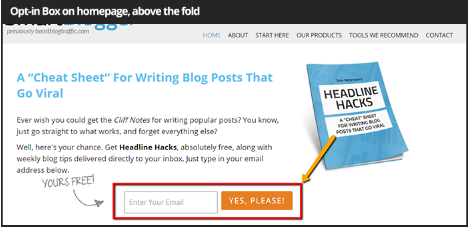
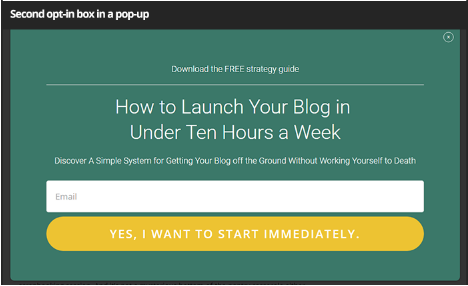
This treads the fine line between “effective” and “annoying”. Since SmartBlogger is a writing-focused blog, the reduced visual clutter also fits its audience and brand image perfectly.

Neil Patel uses multiple opt-in boxes at QuickSprout – on the homepage, sidebar, as a popup and at the end of every blogpost. Some may argue he goes a little overboard but since Neil writes about marketing, his audience is likely forgiving of aggressive marketing tactics.
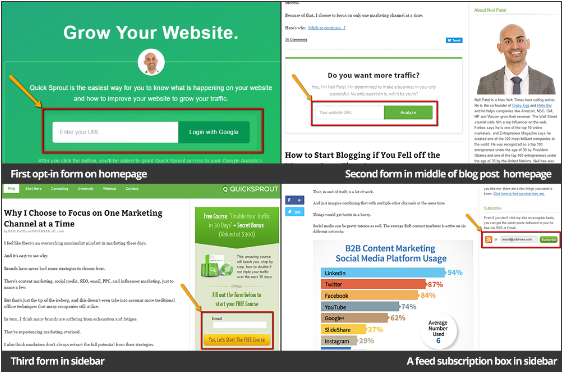
While you can debate merits and demerits of an aggressive opt-in box strategy, one thing is clear: they work.

Doing it too aggressively in a non-commercial niche might not be the best option, but at the very least, you should have 1-2 opt-in boxes throughout your site.

What you can learn from this:

Use more than one opt-in box on your site. Take advantage of pop-ups and above the fold area (see below) to maximize visibility for your opt-in boxes.

2. They make good use of “above the fold” area

“Above the fold” is the first half of a webpage that is visible without scrolling.

Whatever content you place above the fold is the first thing your visitors will see when they land on that page. If it is irrelevant, there is good chance they will leave the site before exploring further.

As Peep Laja of ConversionXL writes, “Content placed above the fold grabs our 80% of attention”.

Plenty of studies back this claim. According to an eye-tracking study by the Jakob Nielsen group, viewer attention drops dramatically beyond the fold.

Top bloggers understand this, which is why they use their above the fold area to introduce themselves to their audience, collect emails and put forth evidence of their success (such as reviews from other sites).

Tim Ferriss’ site Four-Hour-Workweek is a great example of this.

There’s lots of good stuff happening here.

Let’s drill down:

  1. “About” the blog: This single statement – “If you could 10x your per hour output…” – tells readers everything they need to know about the blog.
  2. Social proof/Proof from authority: By showing off quotes from authoritative publications, Tim leverages the principle of authority and social proof to show that his advice is valuable.
  3. Opt-in box: Tim doesn’t just throw together an opt-in box; he shows readers exactly what they’ll get if they opt-in to this email list.
  4. More proof from authority: Tim adds his NYT and WSJ bestseller tags for good measure to further attest to his expertise.

Also note how Tim uses his own face rather than a generic brand image.

Here’s another example from Noah Kagan, founder of OkDork:
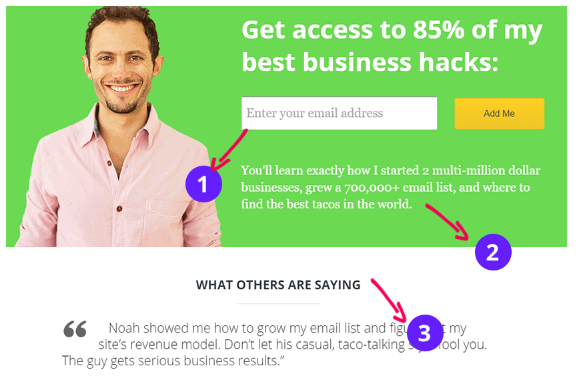
Though not as busy as Tim’s homepage, it still follows the same principles:

  1. Opt-in box: The opt-in box is easy enough to understand, but also note the headline: 85% of my best business hacks. Why not say “all of my hacks”? Because studies show that users fixate on numbers in headlines, not words.
  2. “About” section: Noah uses the opt-in box section to quickly tell readers about himself and his past successes. Again, this is a form of persuasion through authority.
  3. Social proof: “What others are saying” adds further social proof to Noah’s offer.

What you can learn from this:

Two things:

  • Use the above the fold area to tell readers about yourself and your blog while pushing a lead magnet.
  • Increase opt-in rates by using social proof and proof from authority via testimonials and quotes.

3. They make it easy to share content

Sharing might sound intuitive to us marketers and bloggers, but your average reader might never share your content unless you make it seamlessly easy to do so.

This is partly due to laziness – your readers don’t want to put in the effort to copy-paste URLs or think of tweets.

Partly, this is because your readers don’t even know how to share content.

In fact, a recent survey of computer users across 33 rich countries showed that only 5% of the population could do complex computer tasks, while 14% are “below level 1”.

Successful bloggers understand this very well. That is why they provide multiple easy options for readers to share content anytime they want.

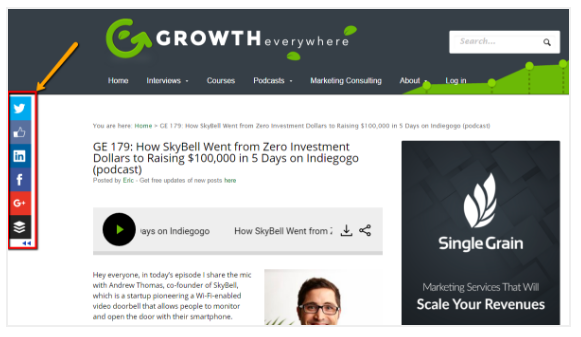
For example, GrowthEverywhere uses multiple social sharing options on the side bar:

This allows readers to pick their favorite social media channel and share the article with one click.

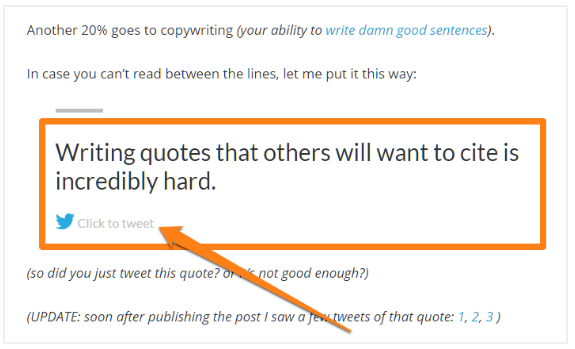
Another tactic is to use plugins such as Click to tweet to get more shares from Twitter. This takes all the effort out of sharing on Twitter – readers can, well, click to tweet the highlighted text.

Here’s how Tim Soulo uses it on BloggerJet:

But simply flooding your posts with share buttons isn’t enough. Hick’s Law dictates that after a certain point, more choices simply confuses your users and discourages action.

To solve this problem, limit your sharing buttons to your top 2-4 networks. If you don’t have a lot of visual content, it doesn’t make sense to throw in Pinterest, Instagram and Tumblr sharing buttons.

For example, Neil Patel uses just two social networks – Facebook and Twitter – on Quicksprout.

What you can learn from this:

  • Give users multiple sharing options but don’t flood them with too many choices.
  • Use plugins such as “Click to Tweet” to make sharing easier.

4. They use overlays to capture additional emails

Email is the foundation of blogging success.

Which is why bloggers keep coming up with innovative ways to capture more and more emails.

One such technique is called ‘welcome mats’.

Welcome mat displays a full-screen call to action that shows when visitors land on your website.

For example, this is how the welcome mat looks like when you visit Zac Johnson’s site.

As you scroll down, the welcome mat goes up and you are presented with the landing page.

SumoMe takes this a step further and uses custom welcome mats for each blog posts. A post about writing better headlines, for instance, shows this welcome mat:

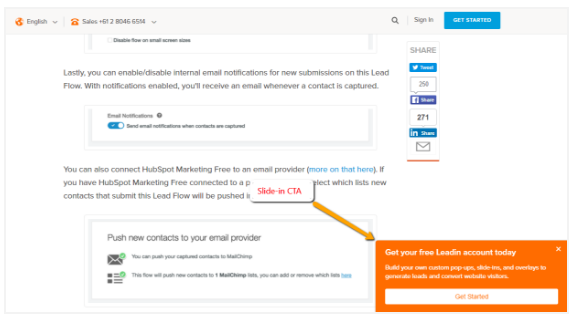
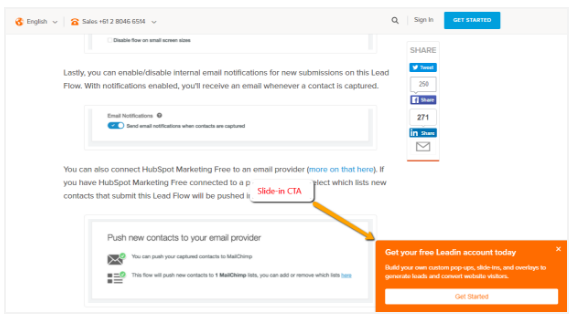
Another popular overlay is to use a Slide-in CTA. This CTA enters the screen below your sidebar content so it doesn’t cover your main content:

Here is how Hubspot uses it:
What you can learn from this

  • Strategic use of overlays can get you additional conversions. However, make sure that they don’t hinder your user-experience. If someone has already signed up for your email list, hide all overlays from them.
  • Try using post-specific overlays to push content upgrades and highly targeted lead magnets.

5. They use static home pages to funnel additional leads

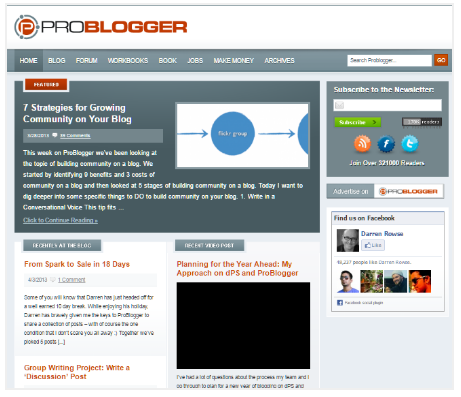
If you went back in time and visited ProBlogger.net back in 2013, this is what you’d see:
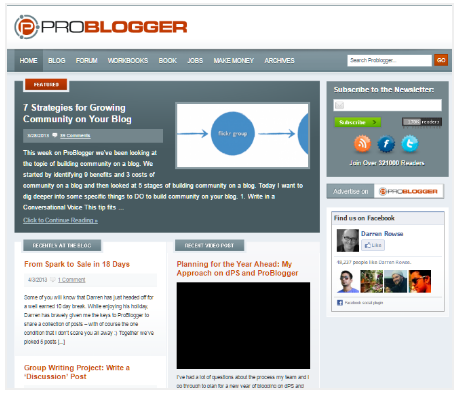
In contrast, ProBlogger’s homepage today looks very different.
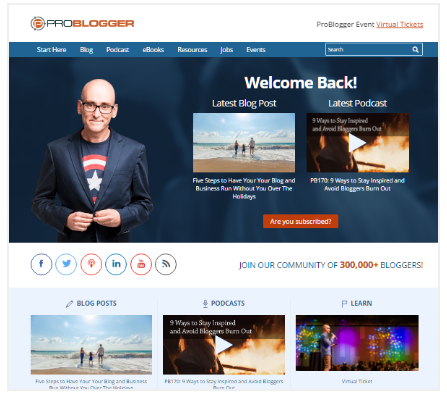
What changed?

For one, ProBlogger’s new homepage doesn’t just show the latest posts. Instead, it pushes PB’s latest content, directs users to relevant categories (“I need help with…”) and also includes a prominent email capture form.

This is a tactic a growing number of bloggers are adopting. Instead of directing users straight to the blog, they direct them to a homepage instead.

Here, they can introduce themselves to their readers, direct them to their best content and capture emails.

For example, here’s Videofruit:
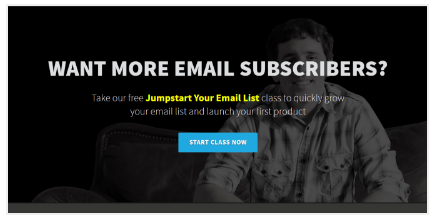
This also gives bloggers an opportunity to do some personalization.

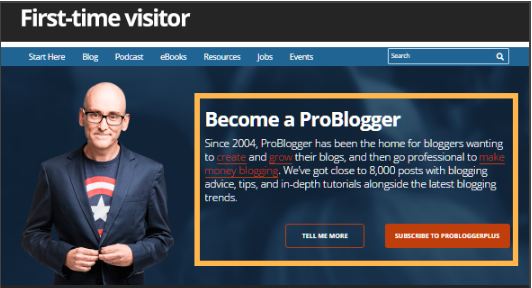
For example, on ProBlogger, returning users are greeted with a “Welcome Back!” message while first-time visitors get links to introductory content.
What you can learn from this

Create a homepage instead of directing users straight to your latest blog posts. This gives you an opportunity to do so much more than just make them read your latest content.

6. They use social proof to build trust and authority

As per wikipedia:

“Social proof is a psychological phenomenon where people assume the actions of others in an attempt to reflect correct behaviour for a given situation.”

In a nutshell, we look at other’s opinions and signals to evaluate our own potential action.

Consider that:

Top bloggers take advantage of social proof in a number of ways:

By showing testimonials

This is perhaps the most common use of social proof that most (if not all) bloggers use.

According to the research done by Nielsen, “92% people trust a recommendation from a peer and 70% people will trust the recommendation from someone they don’t even know”.

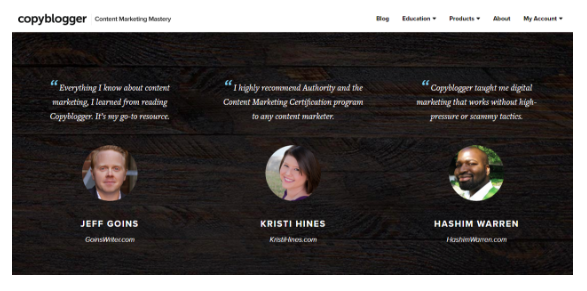
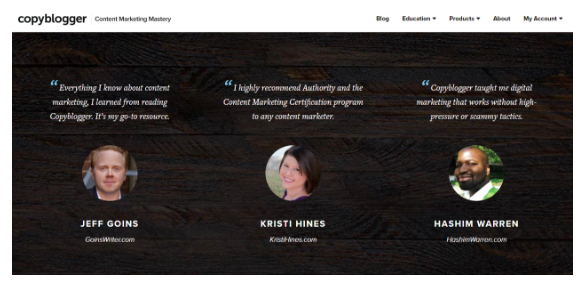
For example, Copy Blogger shows testimonials from real people on their homepage.
By showing authority endorsement

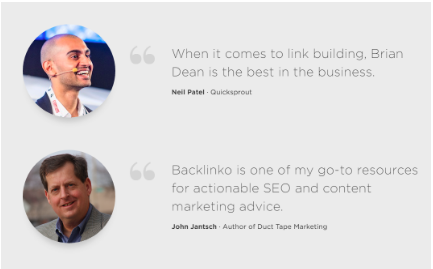
Brian Dean from Backlinko uses testimonials from the big names in the marketing industry.

This is an example of the principle of authority where you leverage the authority of successful people to make yourself appear more trustworthy.

By showing the number of subscribers

For example, on Problogger’s homepage you’ll see this:
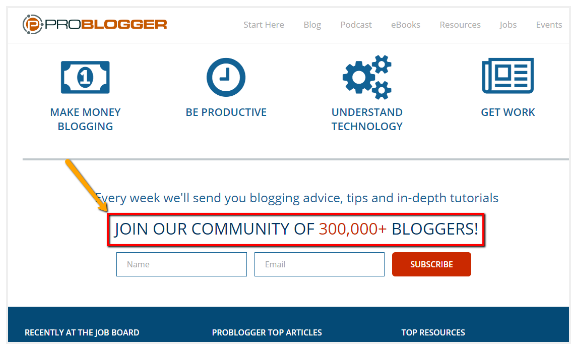
300,000 bloggers can’t be wrong, right? By showing that so many people have joined the community, ProBlogger shows that it is trusted by your peers.

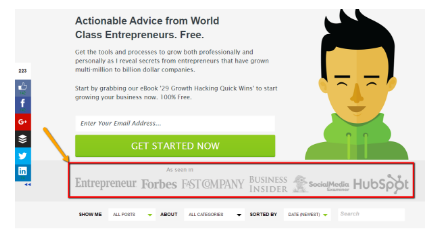
By showing media mentions

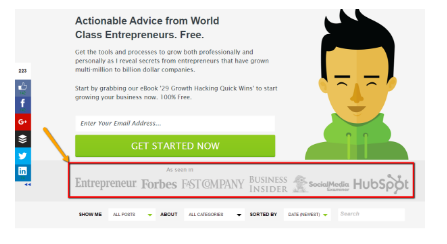
This is another example of the principle of authority in practice. By showing that you’ve been featured in authoritative publications, you increase your own perceived authority as an expert.

For example, consider Growtheverywhere’s media mentions:
What you can learn from this:

Social proof can be hard to use if you don’t already have it. Showing off your subscriber count when you have just 300 subscribers isn’t very comforting.

To get around this problem, try to get featured in prominent publications or get interviewed by other bloggers.

You can then use the logos from these publications or quotes from others about you as social proof.

7. They use a “Start Here” page.

SmartBlogger does it.

SmartPassiveIncome does it.

Even ProBlogger does it.

I’m talking about a “Start Here” page.

As you can imagine, this is the “start” page for your blog, a page that tells readers who you are, what you blog about, and what they should read.

ProBlogger’s start here page, for instance, tells Darren’s story and shares a list of resources with readers.

Readers will often turn to the “Start Here” page when they land on your site for the first time. While you might have a detailed homepage, it can’t tell your story quite as effectively as a compelling “start” page.

It’s also a fantastic opportunity to collect emails and increase conversions.

What you can learn from this

Easy: create a start page for your blog. This page should:

  • Tell the reader who you are
  • Tell them what your blog is about
  • Direct them to appropriate resources
  • Set the tone for the rest of your content.

Once you’ve created this page, make it the first link in your navigation menu.

8. They make better use of the footer area

The footer area is often overlooked when designing blogs for conversion. We’re so fixated on the above the fold area that we completely forget about users who scroll all the way to the bottom (who, ironically, are also among your most engaged users).

The truth is that the footer matters even more than your middle ‘body’ content.

I’ll refer back to Nielsen group’s scrolling behavior study:

Notice how attention spikes right at the end of the page?

Successful bloggers understand this, which is why they use their footers to increase engagement and conversions.

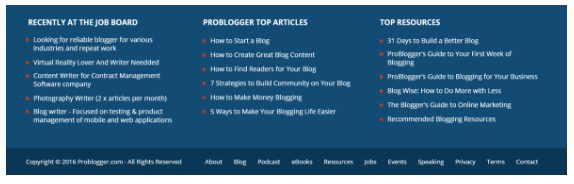
For example, ProBlogger directs its readers to different resources on its site:
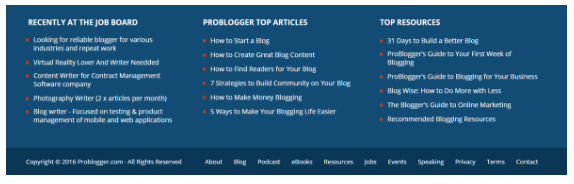
On Hosting Facts, you’ll see a three-column layout (like above) highlighting:
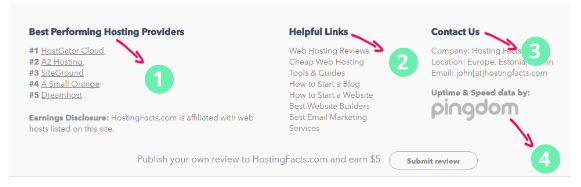
  1. Top-performing content (in terms of revenue/conversions)
  2. “Helpful links” directing users to “best-of” content
  3. Contact us page with email and address
  4. “Social proof” in the form of an established brand (Pingdom’s) logo.

You can also use the footer area to show users all your content and product offerings.

On Entrepreneur On Fire, for instance, John Lee Dumas shows all of EOFire’s offerings (trainings, podcasts and communities) in the footer of his blog content:

Since anyone who has reached the footer is likely already familiar with your content, directing them to high converting pages is a smart move. This is where you can make some additional conversions.

What you can learn from this

Take a close look at your footer and ask yourself: are you making the best possible use of this screen real estate?

If the answer is no, think of the links you can add here. Your best content (in terms of engagement and/or revenue) should get prime space in the footer, as well as your lead-gen forms, earnings disclaimer, and contact details.

9. They use prominent CTAs

What color CTAs do you use?

I know this might sound like a minor design quibble, but your CTAs have a big impact on your conversion rates.

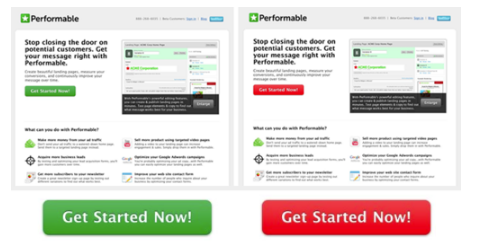
For example, in one case study, changing the color from green to red increased conversion rates by 21%.

This might not sound a lot, but if you get 100 customers each month for a $100 product, you’ll make an extra $2,100 – with no extra work.
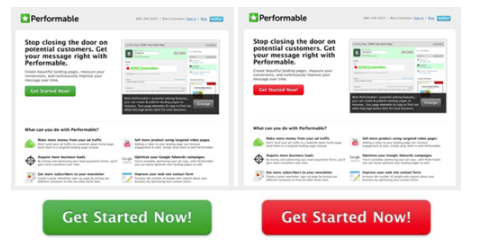
In the above example, the red button worked because it contrasted against the green of the logo. The green button, on the other hand, seemed to merge with the text.

Most successful bloggers follow this practice and make their CTAs very prominent.

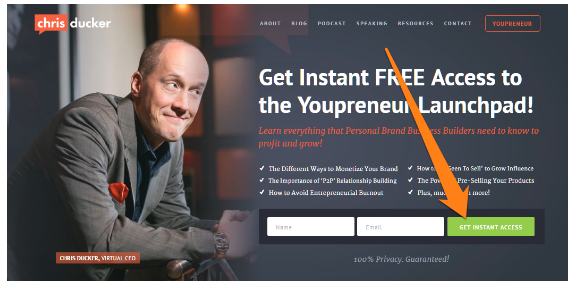
For example, on Chris Ducker’s site, you’ll see a green CTA standing out against the orange text.
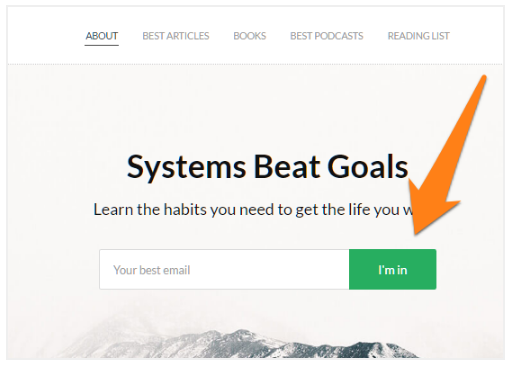
It’s the same on James Clear’s homepage – you see a green button standing out against a grey-white background.
There is actually a scientific reason why contrasting colors work so well in CTAs – the Von Restorff effect.

Also called the “isolation effect”, this principle states that when confronted with multiple stimuli (in our case, CTAs), the stimuli that stand out the most wins our attention.


What you can learn from this

Since your CTAs lead visitors to subscribe to your newsletter, download your eBooks or buy your courses, it makes sense to optimize it for higher CTR.

Try testing colors that stand out against your site background in your CTAs. The more prominent, the better.

Over to You

Building a high-converting blog isn’t a matter of chance; it is deliberately planned. While your content creation and distribution strategy will largely define your success, you can increase conversions dramatically by following the same tactics as the world’s best bloggers.

Start off with the 9 habits highlighted above. Once you’ve used them, share your results with me in the comments below!

John Stevens is the CEO of Hosting Facts, a startup that helps consumers make data-backed decisions when choosing web hosts. He is also a frequent contributor to WebsiteSetup where he helps businesses set up their website.

The post The 9 Conversion Habits of the World’s Most Successful Bloggers appeared first on ProBlogger.

      
26 Apr 16:57

Desktop Metal reveals how its 3D printers rapidly churn out metal objects

by Lora Kolodny
 Today, Desktop Metal revealed pricing and other details for its 3D printers, which can make objects out of hundreds of different alloys including steel, aluminum, titanium and copper. In terms of quality, the parts produced by Desktop Metal systems compare to injection-molded items, says the startup’s CEO and cofounder Ric Fulop. While metal 3D printers have been around for decades… Read More
26 Apr 16:52

Essential Live Chat Tools

by Robert Allen

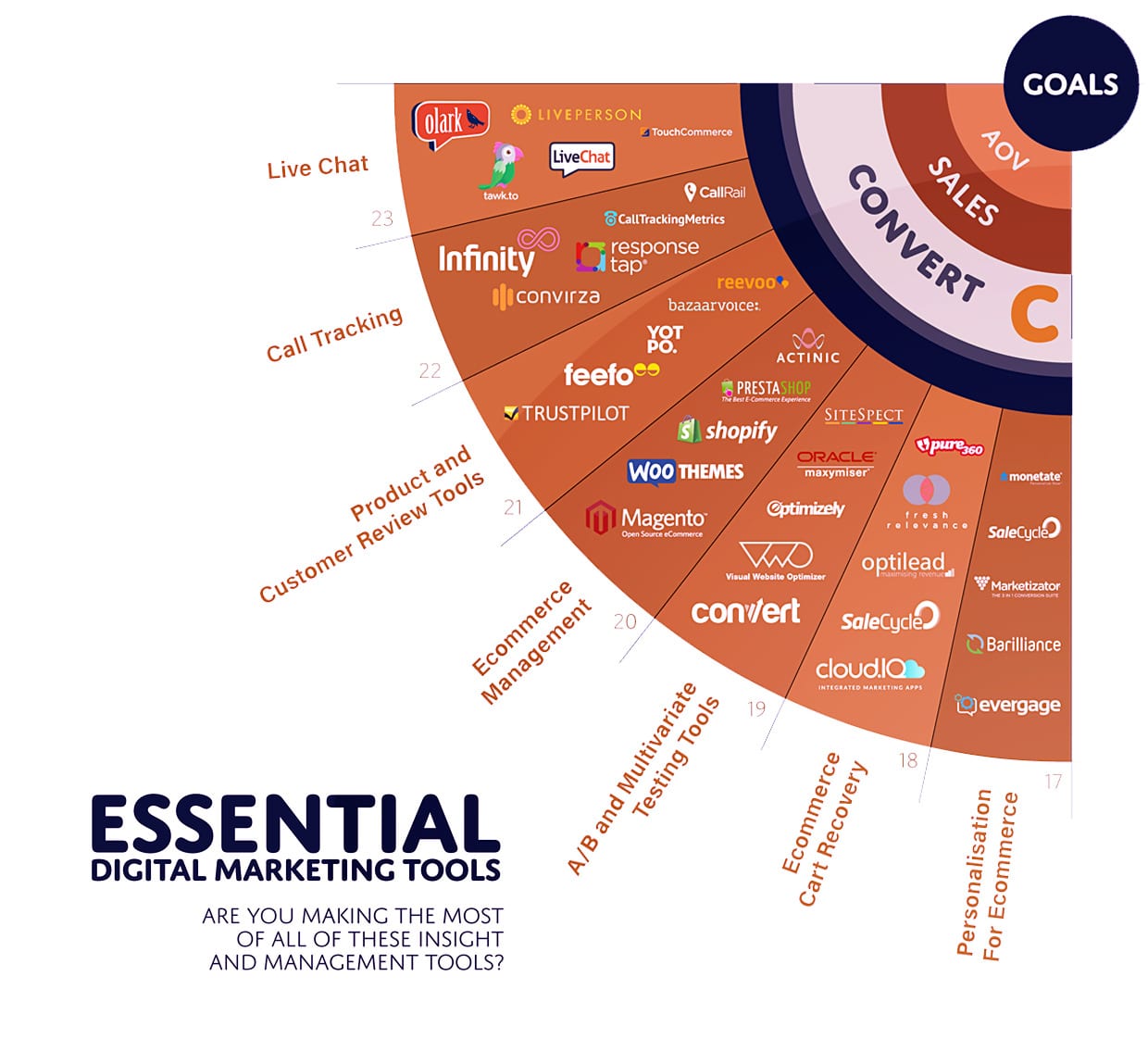
Use these live chat tools to engage your users at the most critical stage of the buying process

As customer expectations rise and users demand instant responses to questions & complaints, live chat tools are growing rapidly both in usage and in capability. 60% of those in the 18-34 'millennial' age bracket reported in a study for Forrester research that they preferred to have their questions answered via live chat than via phone. 44% of that age group also reported that having the ability to ask questions via live chat was one of the most important features a site could offer.

With the growing importance of live chat to the customer experience and thus your bottom line, you need to review what technology is available to deliver a great live chat experience, at a cost that is right for your business. That's why we've reviewed a wide range of live chat tools to whittle them down to what we consider to be the five best solutions currently on the market. We've reviewed each to help you consider which will be best for your business. We don't have any kind of relationship with the companies any of these tools, so the answers are not biased by a partnership with a certain provider.

Convert

Key things to consider before purchasing and using these tools:

  • Who will take ownership; they may be classed as digital tools (or paid for by the digital tools budget) yet be implemented or used by other teams such as development, I.T or customer service. These tools need an owner to champion adoption.
  • A clear process is needed to ensure these tools don’t impact other areas of marketing. For example, IP geo-location and re-direction tools can have negative impacts upon optimal customer experience, SEO and PPC if incorrectly managed.
  • How will you operate the tools? In a small business you may not have a dedicated live chat team, so how will you divide the operation of the incoming live chat inquiries so customers are never left waiting a long time for a response. In a larger business, will the digital team take over the Livechat response or the customer support function, used to dealing with phone enquiries? Staff may require training in either of those instances.

Olark

Olark offers free trials and paid plans for more advanced features. It's easy to install and is well designed with good personalisation options. The gorgeous interface and superb addition of visitors being able to rate the chat means you can collect satisfaction data. Their pricing isn’t unreasonable either, however, if you want to remove branding it’s a little more costly.

Key features:

  • Analytics
  • Customisation
  • Chat rating system
  • Offline Messaging
  • Ecommerce Platform Integration

Tawk.to

Tawk.to is free live chat tool that lets you talk to visitors from a customizable page. Although less capable than other live chat tools, for a free tool it is highly effective. It's extremely easy to add to your site, and it allows the monitoring of visitors by country, ISP and IP address, so you know what region they are asking about. The ability to chat to concurrent visitors also helps to reduce pressure on support staff.

Key features:

  • Monitor Site visitors in real time
  • Answer chats from mobile
  • Engage with visitors via triggers
  • Customize site with widgets
  • Localize greetings
  • 1 minute set up time

Liveperson

Liveperson is a paid live chat tool with the ability to monitor and approach customers directly. It allows you to reach customers whilst they are making crucial buying decisions. It's a tool which is capable of increasing ROI and customer loyalty, and so is certainly something worth taking a look at. The integration with Facebook and Salesforce is a real benefit too, allowing you to successfully hone in on specific markets.

Key features:

  • Excellent analytic tools
  • Customer data is pulled through that you can use in PR campaigns
  • Real time reporting
  • Respond on mobile
  • Great support
  • Integration with Facebook and Salesforce

LiveChat

LiveChat is another paid option, with great support features. It would be an excellent option for a business that has to handle a lot of requests for support from it's customers. The key feature that sets them apart from their competition is the ticketing system. Offline messages go directly into this channel and can be handled more easily by your team with different statuses. It's reliable and has a simple interface which makes it easy to use and set up. The tool bills you per concurrent user meaning one seat can be used by multiple agents, which is particularly advantageous if your team works in shifts.

Key features:

  • Ticketing system lets support staff now how far along the funnel customer is
  • Show your company’s logo and a photo of the operator (optional)
  • Visitors can request a transcript immediately

TouchCommerce

TouchCommerce is an enterprise level tool, and unlike others, there is no free trial. TouchCommerce is the leading innovator in omni-channel engagement solutions, including mobile chat solutions. It provides real-time customer data to target and personalize online customer engagement. It's a very versatile tool, which you can engage with customers across multiple channels, from social media, to SMS to live on site.

Key features:

  • Live Agent Engagement
  • SMS support
  • Self Service Engagement

Download resource – Essential Digital Marketing Tools

This free 100+ page guide explains why we have chosen the 5 tools in each category and gives links to all the tools.

Access the Essential Digital Marketing Tools 2017

26 Apr 16:50

5 Tips For Writing Better Copy Today

by Matt Press

Copywriting is a crucial skill in business. Essentially, regardless of size or stature, every business relies on words to communicate with people.

To put it bluntly, words convey meaning. So it doesn’t matter whether you’ve got the best product or service that the world has ever seen…

… if you’re not getting that message across in the right way to the right audience, then there’s an issue.

At best, you’re wasting revenue potential.

At worst, you’re a sinking ship.

Not everyone has a writing background, but do you know what? You don’t need one. Not for crafting business copy, anyway.

All you need are a few tried and tested tips to elevate your content to the next level.

Without further ado, here are a few techniques that don’t require any formal training, but can still deliver commercial results.

Tip 1: Use your own voice

A common mistake that a lot of people make is to write in an unnatural way. They’ll use long, unfamiliar words in a subconscious effort to impress the reader.

It’s a natural reflex.

You’re probably selling something, so the more professional and authoritative you sound, the better.

Right?

Wrong.

Actually, you’re going to have much more success if you write the way that you speak. This will result in a more natural patter and rhythm.

So don’t create copy that has people reaching for their dictionaries. In all likelihood, you’re going to alienate them.

We live in an impatient world and there are millions of competitors just a click or a swipe away.

Give people a reason to read your content, not one to ditch it.

Tip 2: Do your research

Advertising legend David Ogilvy often emphasised the need for research.

Basically, for you to convey the meaning of anything, the words you choose need to be suitable for the people reading them.

That means understanding who your audience is, how they speak, what they feel and what they need. The more you know about your reader, the better your chances of connecting with them…

… and converting them into a customer.

Tip 3: Write confidently

Commercial copy isn’t the time for waffle and niceties. People are short of time and the chances are, you’ve fought tooth and nail just to get their eyes on your content.

Know your product or service inside out. Get to grips with all the cons as well as the pros. That way, you’ll be able to address any potential sales hurdles.

A confident copywriter who clearly understands the value of what they’re communicating will almost always produce more effective copy than an uncertain writer.

Tip 4: Forget what you’ve learned at school

Yup, believe it or not, academic writing doesn’t prepare you for the business world in the slightest.

Take dissertations, for instance.

When I was tasked with writing one of these at university, I was repeatedly told that it had to be 10,000 words or I’d be penalized.

With commercial copy, no matter what the goal, word count should never be important. The copy is finished when it’s finished.

Tip 5: Talking of goals…

Last but not least, your copy should always have a goal.

Remember that, as tempting as it might be, the goal might not always be cold, hard sales. In fact, it may well benefit you to be far more specific than just revenue-related aims. We could be talking about newsletter signups, PDF downloads, survey submissions and the like.

Basically, your goal can be anything that might benefit the business in question.

You don’t need any credentials in order to write well.

Ultimately, when all is said and done, you don’t need a writing background in order to create compelling business copy.

Which is just as well, since we all have to use words in our professional careers. From CVs to performance reviews, sales letters to case studies, we need the blighters.

Keep your copy real and authentic.

Don’t expect to crank out killer copy first time.

Spend most of your editing time removing words, not adding them.

26 Apr 16:49

8 Sales Assessment Tests for Your Sales Team to Prove Their Worth

by Nikka Alejandro

To manage with an inside sales group to achievement, you need to select the correct ability, as well as use that ability adequately.

While there isn’t a single assessment that is intuitive of progress, there is an assortment of well-known tests that can help managers gauge how a rep will fit in with their specific sales culture. Despite the fact that disputable, advocates of these identity appraisal tests frequently trust that they can be helpful amid the employing procedure. For instance, a rep with a forceful identity may be ideal for one organization’s business culture, however, be hopeless at another organization. Identity tests can likewise help managers gage how to best oversee singular reps. What’s more, maybe above all, business identity evaluation tests can be utilized to distinguish reps’ potential for initiative.

“Measuring” reps on subjective models is, normally, never going to be as obvious as discovering precise answers in sales measurements. However, similarly as intangibles prefer cooperation and science matter in expert games, so to do subjective judgments make a difference in sales.

Here are 8 sales assessment tests that your should let your sales team should try:

Sixteen Personality Factor Questionnaire

The 16 Personality Factor Questionnaire (16pf) is a sales personality test created by Dr. Raymond B. Cattell. It was initially distributed in 1949. At the time, measuring the entire of human identity utilizing structure found through variable investigation was a progressive idea. Cattell prepared for the improvement of the five-consider model of identity, which has been fantastic in understanding identity as we probably know it today. The latest form of the 16pf is the fifth version, at first distributed in 1993.

The 16pf is an attribute based psychometric instrument that measures sixteen variables that make up one’s identity. It gives a complete evaluation of one’s identity and predicts work conduct, communication, and execution. It’s helpful for seeing how a man is probably going to carry on and communicate with others, how appropriate they are to the behavioral necessities of a given occupation, and how well they’re probably going to fit into a current group. The 16PF can likewise help in enhancing laborers’ occupation execution, efficiency, work fulfillment and group attachment.

The 16pf might be scored by turn in the event of paper-and-pencil forms, or might be given as an on-line conveyed report. In either case, scores for each of the 16 measurements and the 5 worldwide variables will be accessible. They are reported as sten scores, determined through an examination with standard gathering information from a huge number of people who have finished the 16pf.

The Myers-Briggs Type Indicator

Myers-Briggs Type Indicator (MBTI) is a standout amongst the most famous and regarded identity sort instruments on the planet. It is a sales psychology test which depends on research by the eminent clinician Carl Jung. The instrument, people groups effectively comprehend why contrasts emerge at home and in the work environment. It is a straightforward system which assembles connections and groups.”

One of the standards of Jung’s model, “Mental Types” created in 1921, was every individual has an intrinsic desire to develop. Some portion of our developing procedure is to figure out how we separately work, build up the parts of us that we have to take in more about, and find out about the general population around us.

Understanding contrast is a genuine people skills Contrasts happen through social, physical and mental variables. Blend this up with varying convictions and dispositions, and no big surprise overseeing and understanding individuals can challenge.

Caliper Profile Assessment Test

Caliper is a brand name of a sales management organization that created mental assessment test — Caliper test. Being ready to go for over 50 years, Caliper picked up a great deal of trust. Today, a great many organizations overall utilize their answers for ability securing, initiative arranging, and hierarchical change.

For more than half a century organizations have utilized the Caliper Profile Assessment Test to distinguish 25 qualities that identify with occupation execution. This test, which can be taken online or through paper, implies to give clear, target data on an individual’s qualities, impediments, inspirations and potential. Caliper specialists are accessible to work with organizations to guarantee that tests are accurately translated.

DiSC Personality Test

DiSC is a personality assessment test in light of the DiSC hypothesis of clinician and psychologist William Moulton Marston, which fixates on four diverse behavioral attributes: predominance, prompting, accommodation, and consistency. This hypothesis was then formed into a behavioral evaluation apparatus by mechanical therapist Walter Vernon Clarke.

The best utilization of DiSC is to take in more around oneself, others and how to manage circumstances where relational connections are included. Some more particular forms of the Disk appraisal will help see how one individual would likely respond in a particular group, administration or initiative circumstance, given her or his DiSC style. Applicable as well to knowing one’s sales personality.

Grit Assessment

Angela Duckworth, then a graduate understudy in brain research at the University of Pennsylvania.Presently, Duckworth is an assistant teacher at the University of Pennsylvania, and her exploration concentrates on an identity quality she calls “grit” She characterizes coarseness as “staying with things over the long haul until you ace them.” In a paper, she composes that “the abrasive individual methodologies accomplishment as a marathon; his or her favorable position is stamina.”

Duckworth has built up a test called the “Grit Scale.” You rate yourself on a progression of 8 to 12 things. Two illustrations: “I have beat misfortunes to vanquish a critical test” and “Difficulties don’t demoralize me.” It’s totally self-announced, so you could diversion the test, but what Duckworth has found is that a man’s grit score is profoundly prescient of accomplishment under testing conditions.

StrengthsFinder 2.0

In StrengthsFinder 2.0, Gallup gives another variant of the qualities evaluation and a customized qualities revelation and activity arranging guide for applying your qualities later on. This book can be perused in one sitting but on the other hand is a valuable reference for what’s to come. Stacked with methodologies for applying your qualities, the book and extra website data will change the way you see yourself and your general surroundings.

In the crowded world of career and leadership advice, Rath and his Gallup associates emerge as a result of their endless conviction that individuals ought to concentrate on benefitting as much as possible from their gifts, as opposed to attempting to repair their defects. Repair work is moderate and unsettling, Rath contends; it’s “the way of general resistance.” By differentiation, he composes, a qualities based approach can have quick adjustments in certainty, efficiency, and expectation.

OMG

Objective Management Group (OMG) is a sales appraisal organization that offers a few sales particular assessments for particular parts including sales reps, administrators and executives/VPs. While a portion of alternate tests recorded here is relevant to yet not particular to sales, I’ve incorporated the OMG in light of the fact that it is 100% centered around evaluating sales reps. OMG’s evaluation administrations may come at a higher value point, however, appear to offer a greater number of offers particular granularity than some other appraisal tries out there.

Plum

Plum makes it simple to know who is an ideal choice for each of your open positions.

It’s great to know how confident, compassionate, etc. someone is – however it’s similarly essential to comprehend one’s ability mentally. Plum ascertains somebody’s learning speed, how quick they prepare and handle unpredictability. Plum additionally takes in one’s social insight, or how well they handle clashes and keep up positive social connections. Knowing candidates critical thinking capacity and how they understand what is expected to relate socially to others in the working environment can represent the moment of truth somebody’s prosperity at work.

Having the right people for the job enables the team to have better customer relationship and also achieve customer success. Check out this article about companies that master customer success.

The right assessment is only part of the solution to developing consistency with your sales hiring and selection. No procedure is more grounded than its weakest connection. In the sales hiring process, that shortcoming could be your occupation posting. Most organizations understand that part totally wrong, pulling in the wrong salesmen into the hopeful pool and if you don’t have the right candidates in the pool, the process, assessment, and sales management become non-factors.

26 Apr 16:49

3 Ways SEO Metrics Can Help Demonstrate Content’s Effect on Sales and Revenue

by Nate Dame

70% of business leaders expect marketing to drive revenue growth, but only 57% of content marketers know how to demonstrate the impact of their efforts on business revenue. Content marketers who struggle to provide revenue-impact data may find that it’s increasingly difficult to secure future funding and earn budget increases.

But demonstrating the impact of content marketing on revenue isn’t impossible. One simple option is to use common SEO metrics to tie content efforts directly to sales and revenue. By establishing some goals in your analytics program and framing nebulous metrics in a context that business leaders understand, you can highlight the value of content marketing in a demonstrable and irrefutable way.

Measure Visibility to Highlight Content Marketing Effectiveness

Increased traffic and social shares may lack significant meaning on their own, but in the context of increased visibility and brand awareness, they’re powerful. Content that performs well in organic search provides as much visibility as participating in your industry’s biggest trade shows—but it happens all day, every day.

When reporting increased site traffic, consider framing it in the context of increased visibility to provide more meaning for the importance of the metric. Additionally, highlighting content that’s outperforming competitors for high-value keywords and topics illustrates how content marketing is adding value from the perspective of both visibility and competitiveness.

Visibility doesn’t necessarily equal revenue, but no visibility certainly equals no revenue.

Executives can often be skeptical about the value of visibility metrics, and they should be: increased visibility may or may not result in increased revenue. To establish proof of the connection, you’ll need to take additional steps to connect visibility to more valued metrics.

Correlate Content Metrics and Sales Trends

By comparing trends in sales-ready leads or closed deals with top-performing content, you can look for correlations between content and leads/conversions.

For example, Propecta helped one of our clients build a wireless networking guide that quickly became one of their top-performing pages in organic search. For about a year after that, they noticed a significant increase in the number of leads pertaining to wireless networking. The correlation between the increased leads and a high-performing piece of content pointed to content’s role in driving those leads.

Correlation doesn’t necessarily prove causation, but it certainly presents a stronger argument than an isolated increased-visibility metric.

To find top-performing pages in Google Analytics:

  1. Expand the “Acquisition” tab.
  2. Select “All Traffic.”
  3. Click “Organic Search.”organic trafic
  4. For “Primary Dimension,” select “Landing Page”

landing page

This report shows which site pages are driving the most organic search traffic. Next, you need to compare high-traffic pages with trends in sales-ready leads and closed deals to connect increased visibility to increased leads and revenue.

Look for spikes in demand for specific product or service categories, and compare the timeline of leads/sales in those categories with timelines for organic traffic increases. If the timelines follow the same pattern—spikes in sales happen in conjunction with spikes in organic traffic for related content—you can make a strong case for content’s role in driving increased revenue in those categories.

If you don’t have access to the sales data needed to compare trends, you can also ask sales teams to provide insights on the types of questions they’re being asked the most. High-performing content often leads to sales teams receiving more questions in relevant product/service categories, and this data could be used to demonstrate how content is generating more leads.

Set Up Goals in Google Analytics to Measure Content Marketing Success

Increased organic search traffic is a great indicator of content marketing success, but as a standalone metric, it lacks context. To demonstrate the value of traffic increases in terms that executives and stakeholders will appreciate, organic search traffic needs to be tied to metrics the business values, like lead generation and conversion activities, and specifically to dollar amounts when possible.

By setting up goals in Google Analytics, you can track revenue-driving interactions. Goals allow for tracking the number of users who arrived from organic search, social media, or guest posts on other sites (referrals), and performed an action that signifies revenue impact:

  • Filled out a form
  • Viewed pricing pages
  • Requested a product demo
  • Completed a purchase
  • Created an account

To set up goals:

  1. Open Google Analytics.
  2. Select the “Admin” tab.
  3. Select “Goals.”
  4. Click “+ New Goal.”
  5. Select the “Custom” radio button.
  6. Click “Continue.”analytics goals 1
  7. Give the goal a descriptive name, and then select the “Destination” radio button.analytics goal 2
  8. On the next screen, enter URLs of pages that signify an acquired lead or completed conversion. Most often, the URL will be for a thank-you or confirmation page that appears after content is downloaded, a request is made, or a purchase is completed. Enter the URL that applies to the first goal, and save the goal.analytics goals 3
  9. Create a separate goal for each page that signifies a revenue-generating activity.

Once goals are established, you can view goal completions to see how many visitors downloaded gated materials, requested demos, or completed any other specified action. Then, view the source of that action—how the user arrived on the site initially—to determine how many of the goal completions arrived from content marketing sources like organic search and social media.

With this information, you can report real numbers of leads and conversions earned through content marketing efforts. Additionally, if a specific value can be attributed to actions, include that value when creating goals to see the amount of revenue that content marketing has generated.

A marketing automation platform can be configured to track the same metrics. For example, Marketo’s engagement platform can be configured to treat organic search as a program channel, and organic search visits can be configured as Interesting Moments. The Opportunity Influence Analyzer can then be used to show organic search’s impact on closed deals.

[Want to learn more about how Marketo specifically can be used in these ways? We’re working on a more detailed guide. It’s still in its early stages, but make sure to subscribe for updates.]

How to Measure Content Marketing Success via SEO

To prove the importance and effectiveness of content marketing campaigns and initiatives, content marketers must learn to adopt the reporting tools utilized by SEOs and other departments. General metrics aren’t enough to impress leadership—they want to know how their investment in content marketing is earning revenue for the company.

By tracking goals and sales trends, and pointing directly to content’s influence on those activities, you can highlight exactly how content is generating leads, driving conversions, and earning revenue and visibility for the business.

26 Apr 16:48

How To Use LinkedIn For Sales and Marketing

by John Nemo

Here are a handful of proven strategies to follow if you want to sell your products and services to the 500 million professionals gathered over on LinkedIn.

Having spent 60 straight months testing, deploying and refining various B2B sales strategies and approaches over on LinkedIn, it’s become very clear to me what works – and what doesn’t.

For starters, the opportunity to sell your B2B-themed products and services on LinkedIn remains enormous. With nearly 500 million members in 200 countries, and with 2 new members joining the platform every second, LinkedIn has a very distinctive (and captive) audience of professionals.

In order to capture their time, interest and attention, you need to eschew what the network is best known for (job hunting and online résumés) and take a far different approach.

What follows are five specific strategies I see working over and over again when it comes to selling your products and services on LinkedIn.

Strategy 1: Content = Currency

You must earn the time, attention and interest of the prospects you discover on LinkedIn. Creating and sharing free, valuable content that helps a niche audience solve some of their biggest professional problems is how you set yourself apart from the competition.

In addition, content has become the currency of today’s online marketplace. If you want to “buy” the time, attention and interest of your ideal prospects on LinkedIn, you must create content that will be of intense interest (and value) to them.

Strategy 2: Don’t Claim. Demonstrate.

Anyone can claim authority – especially online. These days, it seems like everywhere you turn, you see another person calling himself or herself a “guru,” “ninja” or whatever else.

To really win someone’s trust, you must demonstrate authority. Your free content proves to people that you are the expert, that you can help them achieve their goals and that you are worth their time, interest and attention.

Strategy 3: Your Ask = Amount of Trust Earned.

Gone are the days of being able to just ask a new LinkedIn connection to grab coffee or jump on the phone for 15 minutes.

Instead, you have to earn the opportunity. People are far too busy (and, let’s face it, far too interested in ourselves and our own unique challenges!) to just give away their time and attention.

Also, the bigger your “ask” of someone, the more trust you must earn.

For instance, you don’t ask someone to marry you on the first date, and you can’t ask someone for a sale as soon as you get connected and exchange a few pleasantries on LinkedIn.

Instead, your “ask” must always be in direct proportion to the amount of trust you’ve earned with the other person up to that point in the relationship.

Strategy 4: The Riches are in the Niches.

Your LinkedIn content should be hyper-focused on a targeted, niche audience, to the point of including their job title or industry name in the headline of your blog posts and articles.

Say, for example, that you want to sell online video marketing services. And that one of your target markets is chiropractors.

Because of LinkedIn’s incredible internal search engine and member data, you can instantly and easily find countless chiropractors to connect with and market to.

And, just like anyone else, those chiropractors will want to feel like you really “get” their industry and all the unique challenges and issues they face on a daily basis.

So, while you can do online video marketing for anyone, you want to make sure that on LinkedIn, at least, you make it clear that you specialize in helping chiropractors use online video to get new patients.

That means having what I call a client-facing profile – one that caters to chiropractors and includes case studies and testimonials of other chiropractors who have landed new patients using your online videos.

Then, once you’ve begun connecting with and talking to chiropractors on LinkedIn, you can “earn” more of their time and attention by sharing free content, tips and examples of your videos with them.

For instance, you can publish a blog post titled, “3 Ways Chiropractors Can Leverage Online Video To Land New Patients” and include why online video works so well, how it helps chiropractors land new patients and show examples of videos you’ve made for chiropractors.

Strategy 5: Headlines are EVERYTHING.

Now, you can create the greatest piece of content in the world, but if the headline is confusing, boring or uninspiring, nobody will consume it!

Over on LinkedIn, the ideal headline formula for your content should be: “Target Audience Name + Your Service + Benefit They Want”.

Here’s an example headline: “3 Ways Chiropractors Can Leverage Online Video To Land New Patients!”

Chiropractor = Target Audience

Online Video = Your Service

New Patients = Benefit They Want

Note: Your content should not be written like a sales letter or advertisement, but rather as an informative, helpful and strategic guide of how this target audience could use the service you’re talking about to achieve one of the benefits they want.

A Plan for Success

If you follow the strategies outlined in this post, you will set yourself apart from your competition on LinkedIn by being clear, hyper-focused and personalized. Through your content, you’ll demonstrate your expertise and built trust without having to be sales-y, sleazy or spammy in the process.

Best of all, LinkedIn makes it easy to create a personalized, 1-on-1 marketing approach in any niche you can imagine.

When you take all these elements together, and combine it with the incredible amount of prospects sitting over on LinkedIn, it becomes easy to sell your products and services on the platform.

26 Apr 16:48

Closing and Negotiating Challenges - Symptoms of Another Selling Problem

by Dave Kurlan

 Image Copyright Shironosov

I recently learned that one of OMG's clients in Europe purchased two goldfish. In keeping with their tradition, the client named the two fish, Recommended and Not Recommended.  Surprisingly, recruiting salespeople was not one of the topics addressed in this year's 2017 Selling Challenges Study.  Meghan Steiner, from Richardson, was nice enough to send me an advanced copy of the results.  There were a number of interesting findings and to learn what was covered and see my insights from the report, continue reading.

26 Apr 16:47

“Fixing The Compensation Problem…..”

by Dave Brock

I always worry when a conversation with a sales executive starts with, “We need to fix our compensation problem.”

The ensuing discussion usually focuses on, “We aren’t meeting our numbers, we need to fix the compensation/commission system in order to make our numbers.”

At this point in the conversation, there is an uncomfortable back and forth:

Me: “Why do you think your compensation structure is the problem in achieving your numbers?”

With relatively naive managers, the response is, “Well sales people are coin operated, if we want them to change what they are doing, we just need to adjust the compensation system.” My response is, “Do you know what they should be doing—other than making their numbers? Do you know what’s keeping them from achieving their goals, will fixing their compensation fix those problems?”

Others are, I think, less certain, but think compensation is the starting point to driving performance, “Well, if we don’t fix the compensation system, how will we make our numbers.” My response is usually, “How do you know that compensation is the issue that’s impacting your people’s performance?”

Both of these groups of managers are right in some sense. In general, our compensation systems are perfectly designed to achieve the results we are getting. So the thinking is that changing compensation systems will change the results. But here’s where the challenge starts—is redesigning the compensation system the right starting point? Alternatively, “are we getting the results we are getting because of compensation, or are there underlying issues that impact our ability to achieve results?”

First, compensation is only one of many levers sales management can use to impact performance. Since it is usually the most expensive, and since we want to minimize changes to compensation systems, it’s probably the last thing you want to do in improving performance. There are so many other tools that have greater impact in shorter periods of time. Setting clear performance expectations, having clear leading metrics, coaching/developing your sales people–understanding the specific issues impacting each person’s performance. Even the training, tools, systems, processes, programs we provide are important levers to fixing sales performance.

But compensation is seldom the root cause of sales performance challenges, particularly if you have low voluntary attrition, (i.e. very few people leaving because of compensation.). Where do we start if we are really going to improve sales performance?

Well, usually, at the beginning…..

It really requires us to understand, “what are the things that contribute positively or negatively to sales performance?” Understanding these, focusing on the root causes and real issues are the only way we can hope to drive sustained improvements in sales performance.

The issues are very broad….

What’s our corporate strategy and priorities? Since the sales person is responsible for executing the corporate strategy with customers, we have to be very clear about what that means. Who should we be selling to? What is the size/opportunity in those markets, is it aligned with our performance expectations? What customer experience do we want to create? How do we create value and differentiate ourselves to the customers? How do we want to balance performance across the sales function–for example new customer acquisition versus customer retention/growth/account penetration, new market expansion, product line mix, and so forth.

How do we effectively reach and engage our customers? Actually, this isn’t just a sales question, it’s a corporate question—certainly, we know marketing plays a key role in creating visibility, awareness, interest, and developing demand. Customer service plays a key role if we want to keep and grow those customers or get positive referrals. Strategy and product management come into play because we need to develop solutions that solve our target customers current and future (even unanticipated) problems. And I can go on to each function in the organization, but you get the point.

The “reach and engage” question also has important implications to our overall organization and deployment model—but the way we begin to answer these questions is by looking at how our customers buy. If we are selling to individuals or small groups, or if we are selling transactional products/services, there are a variety of models—Web sites with shopping carts, the classic inbound approach with SDRs/AEs. High volume/velocity outbound models with SDRs/AEs. Complex product/solutions may require overlays and product line specialists to work with account/territory managers. Complex buying processes may involve a team approach, both with complementary skills and maybe geographic dispersion. And often, leveraging partners or other channels is the best way to reach customers or to effectively cover the opportunity potential.

These overall design/deployment questions then spawn a number of other issues: What are the right people, skills, competencies needed to execute the strategy? How do we recruit, onboard, train and develop them? How do we maximize the performance of each person on the team and of the organization as a whole?

Then there’s what we do every day, how we engage our customers, perhaps igniting the need to change and initiating a buying process. We can start with prospecting—are we finding the right customers in the right volumes to support our business requirements? How do our people prospect most effectively? What levels of performance do we need, how do we assure they are effectively executing? Then there’s qualifying those prospects, are we finding high quality deals where customers have a high sense of urgency? Do we have a sales process aligned with the customer buying process–are we executing the process as well as effectively as possible. Are we creating value in each interaction with the customer and creating superior business justified solutions to their problems? Are the customers realizing the value we sold, can we grow that value? How do we stack up against all the alternatives the customer considers.

But do do these things, our sales people need the right systems, processes, tools, programs, support to execute these as effectively and efficiently as possible. As the complement to this, we need to understand the road blocks, internal and external that impact performance, doing everything we can do to remove these and maximize performance.

Embedded in all of these is the concept of, what are the expected activities and behaviors, stated differently, what are the performance expectations, we have of our people in doing all these things? What are the expectations in prospecting, in deal management, pipeline management, value creation, account management, time/territory management? How have we communicated these to our people and assured they “own” them. How to we monitor, coach, and develop the capabilities of our people in performing at the highest levels possible?

Oh, and yes, there’s the compensation system. But designing the compensation plan only makes sense, once you have addressed these other issues. Then you design your compensation system to reinforce the things that are critical to driving performance.

Our compensation system is an important element in driving sales performance. Basically, it’s one of the means we leverage to focus people on what we want them to be doing. But until we know these things, it’s impossible to design the compensation system that reinforces the attitudes, behaviors, activities critical to sales performance.

If we want to improve sales performance, we have to understand all the things that impact performance. If usually starts with fundamentals, if those aren’t in place, then nothing else will impact them.

26 Apr 16:47

Monitoring the Marketing Funnel: A Strategy for Optimizing Performance

by Angela Hausman, PhD

multi-channel attribution

While it might not look pretty, here’s the basic conversion funnel you get from Google Analytics. What we see is what happened when visitors came to our website — and we see a very healthy 7+% conversion rate. But, it’s not particularly valuable in monitoring the marketing funnel.

The Google Analytics conversion funnel doesn’t tell us much beyond some superficial information that might make the CFO happy, but won’t help the marketing department crush it. For that, you’ll need to dig a little deeper.

Monitoring the marketing funnel (the conversion funnel?)

content marketing plan

You’ll hear the funnel displayed on the right variously referred to as the marketing funnel, the sales funnel, and the conversion funnel. And, it’s not a semantic difference. I think it’s a critically important difference that impacts the metrics you use to monitor performance and the way you allocate funds to improve that performance.

A conversion funnel focuses on conversion — making the sale. And, there’s no problem with that. To monitor conversion, you use Goals within Google Analytics. This isn’t a point and click solution, as you first have to tell Google which actions reflect Goal conversions, for instance, email subscriptions or sales. Don’t confuse Google goals, which represent specific actions on your website, with SMART goals, which are much broader strategic goals for your marketing plan. Here’s a great article from Kissmetrics to help understand how to set goals.

A marketing funnel reflects the entire customer journey from beginning to end, not just the final step (conversion). And, you can use Google goals to reflect progress along the customer journey by creating links for each step in the process. For instance, you might view a session as awareness, visits to specific product or content pages as interest, and putting a product in the shopping cart as intention. You assess conversion using the same metric as in the conversion funnel discussed above.

Of course, the marketing funnel is only guides part of the journey necessary to optimize performance. You also need to monitor what happens before the customer enters the funnel and what happens after conversion.

Monitoring the marketing funnel: How do visitors get into the funnel?

Visitors find your website in four key ways:

  • Search
  • Owned, earned, and paid online advertising
  • Marketing engagement, such as email marketing
  • Offline advertising and promotion

It’s important to monitor performance across these channels as a first step in optimizing their performance. So, let’s talk about metrics to assess performance in each channel.

Search

organic search exceeds other channels

Image courtesy of Search Engine Land

According to a recent study by Brightedge, organic search drives more traffic to websites than all other traffic sources combined for both B2B and B2C companies — yes, even B2B companies get most of their traffic through organic search, despite beliefs to the contrary. My site gets, on average, 75% of the traffic through organic search, and I’m strictly B2B. BTW, the OTHER category is made up of email marketing, display, and referral traffic.

And, 70+% of organic traffic still comes through Google, so that’s where you should start your efforts at monitoring the marketing funnel. Hence, the Google Algorithm, that constantly changing set of metrics that determine where you show up in a search (SERPs) is critical for your business. You need to monitor performance against some of the biggest factors determining SERPs, including (in order of importance) [source]:

  1. Content that’s valuable, consistently produced, and with keywords used effectively
  2. Backlinks to other related websites
  3. Mobile-first user experience

Want more? Here’s a big list of SEO ranking factors:

SEO ranking factorsImage courtesy of Search Engine Land

Owned, earned, and paid media

Here I include both social media and other forms of digital advertising, such as banner ads.

Social Media. Despite the hype, social media isn’t particularly good at sending traffic to your site. But, don’t discount the importance of social media marketing. It’s still an important tool for forming and monitoring attitudes towards your brand and, without this, even if you’re successful at driving traffic to your site, you won’t convert it.

Digital advertising. By this I mean display ads across the internet, as well as paid advertising, including sponsored posts, on social media. As with social media, in general, digital advertising is seen as annoying (note the number of mobile devices that use an app to avoid display advertising) and has little impact of visits to your website. Sponsored posts may be a little more effective, mainly because they’re targeted, but other forms of digital advertising offer less value [source].

Email marketing and other forms of engagement

Email marketing has the highest ROI of any form of digital marketing — notice the graphic below:

content marketing roiImage courtesy of TruConversion

But, it isn’t great a driving initial traffic to your site. The value of email marketing and other forms of engagement, lies in its ability to send a custom message that drives visitors back to the website. Email marketing is a perfect tool for getting visitors to return to your site and complete the conversion process.

Offline advertising and promotion

A number of offline promotions are great at driving traffic to your website, including:

  • Guerrilla marketing, which involves using unconventional marketing tactics to drive awareness and action. Use the link above to see 122 examples of great guerrilla marketing executions.
  • Contests might be the most effective tool for driving website visits, especially if you use user-generated content as the bait.
  • Offering discounts for social signups, such as follows or shares, is another effective offline tool to promote site visits.

One tactic I think particularly ineffective is simply putting your social media icons at the bottom of your advertising. By now, consumers know about social networks and they figure most companies have pages on these platforms. Unless you’re asking viewers to do something specific on your social profile (and providing an incentive for doing so), you’re not likely to get many visits from these sources.

Monitoring the entire marketing funnel

Below is an infographic that displays one way of monitoring the marketing funnel. Notice the graphic starts with the source driving traffic to the site, then follows that traffic from first visit through purchase. Such monitoring requires attribution modeling, a technique that assigns (or attributes) conversion to platforms involved in the entire customer journey.

monitoring the marketing funnelImage courtesy of Ladder

Relatively complex models, such as the one above get closer to monitoring the marketing funnel, but even they fall short because it looks at last clicks in assigning ROI to platforms. Thus, what we’re seeing is the journey a customer takes after coming from, for instance, Facebook and it’s a better way of assessing how valuable Facebook was in generating ROI.

In contrast to such “last click” attribution models that assign all the ROI of the conversion to the last click — what brought the customer for the last visit before conversion — multi-attribution models seek to assign ROI more accurately across all the media involved before the conversion.

For instance, the customer journey might start with a Facebook post, then an email followup after subscribing to the firm’s newsletter, then another digital ad, maybe a display ad, then finally a search result that came up when the prospect finally decided to purchase the product. It’s naive to think that it was just the search result that was responsible for the sale. If not for all the other “touches”, or opportunities to build the brand’s reputation and inform attitudes, the sale would never have happened.

Monitoring the marketing funnel: What happens after conversion?

After spending money and expending effort to get customers to buy your product, you don’t want to just let them fade into oblivion, either. You want your customers to come back and buy from you again and again. Studies suggest that getting a customer to purchase again is MUCH less costly than acquiring a customer in the first place. That’s why loyalty is important.

In addition, you want satisfied customers to spread the word about your brand because the best source of new customers is your existing customer base.

Thus, when monitoring the marketing funnel, you need metrics to evaluate factors impacting repeat purchases of your product.

Here are some metrics you could use to help understand which customers repurchase and which don’t:

  • Source — do customers who come through certain sources or certain types of campaigns remain customers longer or share more frequently on social media
  • Demographics — so some types of customers share more or are more loyal than other customers
  • Product purchased — are customers of some brands more loyal than others

Conclusion

Monitoring the marketing funnel requires a broad set of metrics across various stages in the funnel from sources of visits through repurchase. However, despite your efforts to monitor the movement of customers down the funnel, you’ll not get a complete picture without additional information to reflect non-behavioral aspects (ie. not click behaviors) that impact market performance. So, you’ll still need traditional market research to assess the following:

  1. Attitudes, beliefs and their change over time with respect to your brand and company
  2. Reach and frequency of traditional advertising
  3. Customer service performance
  4. Factors that interfere between intentions and actual purchase
  5. and many more specific to your situation
26 Apr 16:47

Exposing the Abandonment of Things – A Trove of Lost Revenue

by James Gagliardi

From “smart” hairbrushes to lawn mowers, the Internet of Things (IoT) has created a slew of slick products, but there have also been many failures: too many connected devices have gone by the wayside, and in most cases, this is preventable. This scenario, recognized as the Abandonment of Things, is the land where connected devices go to die. Several factors drive the Abandonment of Things: a lack of a proper monetization strategy for connected services; failure to create a community around a smart device; even security issues and clunky backend processes. If a company wants to avoid the digital scrap pile, and subsequent loss of potential revenue and customer gains, it must have all the right parts working in sync.

Keeping an Eye on Profitability

Companies are always looking to expand their user bases, but as that base grows, so do infrastructure costs. Think increased server capacity and the people needed to manage the technology aspect of a subscription service. If the right infrastructure is not in place, profitability takes a hit.

It comes down to data collection and value. What data do companies collect and how do they use it? Where is the value? Take some of the popular connected health bands for example: their freemium models allow consumers to track food and exercise and then compare and compete with friends. On the other hand, their premium models cost around $100 annually and give consumers the option to compare themselves with strangers who are just like them.

Does the data revealed by the premium model — data about strangers rather than friends — provide enough value to convert 3-5 percent of the consumer base into paying customers? That’s the question the marketer must ask and answer.

Getting in the Consumer’s Head

With traditional, non-connected devices, the relationship between brands and consumers ends with the purchase. But with a smart device, the purchase is the beginning of that relationship. IoT is actually not about the thing – it’s about the service as well as the value provided by the service. A company must therefore consider more than the transaction, or the value of the product, or even the initial needs of the consumer. Companies must understand the value a consumer — or better yet, a member — gets from the service. An integral part of that value is the community consumers join when they subscribe to a service.

The new subscription generation requires companies to think of their consumer base as a membership base, which requires very different communication strategies. Transparency is key, both in terms of the solution offered and the financial aspect of the solution. Companies start to achieve success when they build out these relationships and consumers begin to take in new information, not just as marketing, but as an added value.

Awareness of Regulations

Security is paramount in the era of IoT. Striking the balance between value for consumers and protection of their data will be an ongoing challenge for marketers. One example that showcases the delicacy required in this new order is TVs that watch us — noting not just what you’re viewing, but who is in the room when the device is on. Even for those consumers who see great value in, for example, targeted commercials and programming, real questions revolve around how that data is collected and what companies do with it.

Consumer rights also change with every border crossing. Uber transactions are seamless in the U.S., but are more complicated in India. It’s not just about securing data, but also securing the complex payment processes inherent in a subscription-based, hyper-connected global economy.

How companies adapt to the regulatory environment is key to their success. One important thing to understand is that government is not necessarily proactive about regulating IoT — regulations will most likely come after some company is caught misusing data. One bad apple can affect an entire industry, so companies need to be transparent and meticulous about data collection and how data is used to create value.

Avoiding the Abandonment of Things

The new world ushered in by IoT is just dawning, and already the path forward is littered with abandoned things. A subscription-based economy demands flexibility, convenience and value. But those aren’t the only challenges your company faces when forging ahead. The right balance between monetization, transparent communications and security can create the environment your product needs to thrive.

26 Apr 16:44

11 Things Every Top-Performing Salesperson Knows Before They Take a New Sales Job

by lee@leebartlettbestseller.com (Lee Bartlett)

know-before-taking-sales-job-383921-edited.jpg

Picking the right company is a crucial component of your individual success. Every product needs the same foundation: A great customer service team that shares a common goal for excellence, an adequate budget to finance growth, and a management team with the experience and vision to ensure opportunities are utilized. Understanding whether these mechanisms are in place before joining a company requires extensive research.

The following points will help provide a comprehensive overview of potential employers, how their products are viewed by customers, and the competence of the management team. In this example, I discuss researching a company that supplies a technology-based product, but the process can be adapted to any situation.

1) Product-Based Research

Do not attend an interview without having downloaded your prospective employer’s free software. View the product from the customer’s perspective and make notes about the functionality and how you feel. Does it hook clients and offer an obvious progression into a premium subscription? If so, why? Could it be improved? Take these notes to the first interview. Differentiate yourself with an informed opinion.

Then, if it goes well, ask for a login to the premium service to understand more before the next interview.

If you get the job, learn the product before stepping foot in the building. That way, you are ready to produce revenue on day one.

Call the company's help desk to understand the customer experience. Good customer service is the pillar of repeat business.

Contrive a problem, or simply call in and ask for help with the free software. Was the support team responsive and knowledgeable, did they value your call, and did they conduct themselves professionally? Form your own opinion. Then, call the competitors and do the same. Why not? Know what you're up against. I never hesitated to do this throughout my sales career, and it served me well.

Call the sales team to enquire about pricing and unique selling points. Don't lie about being a customer -- just ask about the service. Do you feel pressured? Is the process complicated? What is the process of getting a quote? This says a lot about what the company expects from its salespeople. This is another chance to get the customer experience.

2) Customer-Based Research

The most valuable feedback about your potential employer is from their customers. Find a way to contact them, explain that you're thinking of joining, and ask their opinion of the company and its products. If you try hard enough, you will make this discussion happen. Existing customers will also offer their perspective of competitors and what differentiates products. This provides a roadmap to selling your product from the only person who matters -- the person buying it.

3) Company-Based Research

Think strategically. Don't just research the company -- seek to understand the industry too. Is your prospective employer an industry leader or a lean startup, and who are their biggest competitors? What are the company's competitive advantages or disadvantages in the market? Where does your potential new product fit into the grand scheme of things? These questions help you formulate an effective sales process. Is the company developing new technologies, and is there an opportunity to progress into this? This pre-interview research shows your potential employer you are a serious, professional candidate.

Ask to meet the sales team before joining. Meeting your colleagues prior to joining helps give a sense of how collegial, supportive, and competent they are. Ask them what it's like to work there. In my experience, there is always a cynic on the team who is only too happy to have a good moan. Find them and ask what they are unhappy about. If it's an issue, such as constant in-fighting, then you know there is a managerial issue.

What is your new boss's history? Look at the success and legacy of your new bosses and who is implementing the overall strategy of the company. Can you rely on them to drive the business in the right direction? Can they clearly articulate how you will hit your targets? Ask the Sales Director how their existing customers would describe the product. Does this align with your research? You might be surprised by what you hear. However, you are the salesperson and own the target -- do the research and decide how it's getting done, before joining.

4) Align everything to your personal goals

The best salespeople view their customers as equals and maintain this power-dynamic at every point of contact. It's the same mindset when talking to a prospective employer. The process shouldn't be viewed as an opportunity to beg for a job. In addition, don't automatically take for granted the content you read on the company website. It all looks good; every word has been carefully chosen to seduce the reader. Take ownership of this process, through rigorous preparation develop an informed opinion, and understand every aspect of what the job involves and how it fits with your personal goals.

This includes:

Crunching the sales revenue numbers. If the sales-cycle doesn't match the annual target expectations, you will fail. This is particularly important in the first year when ramping-up your sales activity. For example, if your sales cycle is three months long, then deals pitched in months 10 through 12 won't close in the first year. Also, you are unlikely to close substantial business in the first quarter since joining. Has the company accounted for this when setting your annual target? Have you accounted for this in your sales plan? These oversights do not sort themselves out. The best salespeople identify discrepancies and plan accordingly.

Understanding your territory and how you will make your numbers. Not all territories are created equal. Research your territory, and understand any nuances required to sell into it. Map out potential revenue by account and create a plan to win this business. Reverse-engineer every step and share this with your potential employer to check they agree.

Knowing the product's longevity. A logical, well-researched, metric-backed understanding of your new product's longevity will help you predict future changes in your salary structure. If the product becomes widely accepted and customers become enterprise accounts, will you be paid more, less or replaced? Is there progression within the company beyond this point?

Having a backup plan if it goes wrong. Some companies are actively working towards automation and replacing their salespeople. The world is changing fast, so adopt a similar mindset. Consider what to do if the company isn't what they claim to be, ditches your division, alters commission plans, or is a bad fit.
This is the point where a salesperson must assess the impact they can have on an industry.
Are you able to build a strong enough network and personal brand to future-proof yourself against decisions out of your control? 

View new opportunities from this perspective, and it will serve you. This is a tactic normally reserved by only the best salespeople, but you just read it, so no excuses.

Continue to network with potential new employers, even after you accept your position. Let them know you're beginning a new position, but want to stay in touch. This way, you won't be starting over from scratch if things go wrong.

Genuine company culture, management styles, or plans for the business aren't found on the website. Also, day-to-day expectations are often poorly represented in job descriptions. If you do the above, you are giving the process of finding a new company and product to sell the respect it deserves. Use the interview phase to fill in the gaps, demonstrate your expertise, and show how you can add value to the company and your customers.

I hope this was helpful. Please feel free to connect with me on Twitter and LinkedIn.

Editor's note: This post originally appeared on Lee Bartlett's blog and has been republished here with permission.

Free Sales Training from HubSpot Academy

26 Apr 16:40

The 2 Types of Content in Sales Asset Management

by Matt Ellis

Sales asset managementThe importance of storing content in one central repository is well understood by now. When content is stored in disparate systems, productivity plummets as time is spent searching for a particular piece. Both Marketing and Sales benefit from having a dedicated library for content. Marketing gains a new level of control for ensuring that the latest and most up-to-date materials are the only ones being accessed; they also have an easy way to take a quick inventory or perform an audit. Sales reduces the 30 hours per month they spend searching for and creating content to a much more reasonable amount of time.

Sales asset management, as it’s known, provides clear benefits to both Marketing and Sales. However, like any solution, this process needs to be properly managed or it can quickly spiral out of control. Consider, for example, a library; a resource that houses selections from a wide swath of human knowledge. To simply open the doors and let people rummage around until they found what they needed would be chaos. A system of organization and categorization needs to be in place to ensure efficiency.

Being effective with your organization’s sales asset management is no different than running a library – and you don’t even need a degree in library science. For any large organization there will be a sizable amount of content that needs to be sorted and organized. Merely gathering up every piece from any number of directories will be a time-consuming and difficult task. But once everything has been corralled there are two distinct categories that content can initially be sorted into, as described by SiriusDecisions.

Sales Empowerment

Sales empowerment content will be anything that is internally-facing for an organization. This is content that will be used for training, strategizing, internal reporting, and anything else that will provide Sales with knowledge or tools to improve their engagements.

Marketing may be involved in the creation or maintenance of these documents, but it is more likely that Sales will be in control of sales empowerment content. Branding and version control may not be as important with this content as it will be for internal-use only.

Cordoning off this type of content removes a large amount of materials that will not be relevant to Sales when they are attempting to find a piece to send to a potential buyer. This brings us to the second category of content.

Sales Activation

Sales activation content is what people generally think of when they think of content. Guides, e-books, whitepapers, case studies, one-pagers, and anything else sent to potential buyers will be stored as sales activation content. Both Marketing and Sales will have a vested interest in this area of content and reap benefits from dividing this content from sales empowerment content.

Marketing will have one area under their purview where they can upload new content; segment the content based on persona, industry, stage in the buyer’s journey, or anything else; and ensure only the latest versions are being used by Sales.

Sales will be able to quickly access the exact piece of content they’re searching for, search through the library to discover if any content exists to meet their needs, and never worry about using an out-of-date piece that draws the ire of Marketing.

Dividing a central content repository into sales empowerment content and sales activation content is a quick and effective way to make a library much easier to use. Taking that one step quickly frees up Marketing and Sales to focus on their other responsibilities rather than waste time digging for content.

The way content is stored and structured can have a profound effect on business. As Seismic’s Jon Freeberg says, “The folder structure that you set up has a direct correlation to how easy your sales users are able to find content. Findability equals time saved. Time saved equals more time selling. Time selling equals more sales. More sales equals a better bottom line.”

Of course, simply splitting content into two categories is only the tip of the iceberg. Any large organization will need to subdivide content even further to take full advantage of their sales asset management.

To do this it’s necessary to unleash the full potential of a sales enablement platform by utilizing content analytics, content profiles, content engagement statistics, content personalization, integration between CRMs and MAPs, and much more. The full SiriusDecisions report goes into great depth about the ways a sales enablement solution can foster Sales and Marketing alignment past sales asset management.

26 Apr 16:40

Empowering Your Sales Team Towards Successful Social Selling

by Blake Beus

Startup Stock Photos

There has been a major shift in the B2B buying process. Social media has become a key component of buyer decision making. A 2017 Fjord Trends report shows 94% of B2B buyers conduct online research before making a business purchase and social media is the biggest research channel with 75% saying social media significantly influences their purchase decisions.

This makes social media a powerful tool for your sales team. Learning how to use it effectively can help you better engage with potential clients and help you nurture them through to a contract relationship.

Don’t sell — connect

Potential buyers are interested in sincere and authentic interactions. They are put off by upfront sales pitches. In much the same way a salesperson might work a conference floor, they can build relationships on social media through sharing content and answering questions for potential clients.

Join and participate in industry groups

Buyers say much of the information they rely on to make decisions comes from social media discussions. Using sites like LinkedIn and Quora, they look to peers and industry leaders for guidance on solving complex challenges. Sharing valuable content in these groups will help boost your reputation and influence.

Contribute to existing conversations about your brand

People are already talking about your company. Join the conversation by honestly answering questions and providing assistance to current and potential clients. Studies show B2B buyers are five times more likely to engage with a sales rep who provides new insights about their business or industry.

Utilize social media filters

Tracking relevant keywords and phrases can help you identify who is talking about the products or services you sell. Identify which social media sites your prospects are using and don’t waste time on those they’re not.

When creating a filter, cast a wide net knowing you will further evaluate any leads you get. Many sites allow you to set up alerts when someone fitting the profile you’ve established joins the conversation.

Create a personalized relationship

Once you’ve identified a prospect, learn as much as you can about them through their social media profiles, posts and interests. You can then score them on demographic and behavioral attributes.

The focus of social selling is producing relevant content and providing one-on-one communication between the salesperson and the buyer. The goal is for the salesperson to form a relationship with each prospect.

Today’s decision makers are turned off by traditional sales pitches. Instead, nurture your prospects by answering questions, responding to comments and sharing content on social media throughout the buying process.

26 Apr 16:40

Tech Giants And Hedge Funds Fight For Limited Cobalt Supply

by brian wang

Sponsored post.

There’s a new metal in town, and it’s bigger than lithium—and hotter than any other commodity on the market right now.

Supply is fantastically tight and set to get phenomenally tighter.

Analysts at Macquarie Research project deficits of 885 tonnes of this resource next year, 3,205 in 2019 and 5,340 in 2020.

That’s a deficit increase of 503 percent. More importantly, it’s a massive opportunity for first-in investors.

The panic over future supply has already broken out.

The metal is cobalt, and hedge funds are already hoarding the physical metal to gain exposure, with Swiss-based Pala Investments and China’s Shanghai Chaos stockpiling 17 percent of last year’s global production.

Cobalt is critical to the electric vehicle (EV) revolution, and it makes up some 35 percent of the lithium-ion battery mix—but we can’t source enough of it now, and the future supply is uncertain at best.

A huge uptick in EV production and a dozen battery gigafactories coming on line will more than strain cobalt supplies. But the bottlenecks are already worrisome; especially since some 60 percent of the world’s supply is unethical, and mined by children under inhuman conditions in the Democratic Republic of Congo (DRC).

It’s time for an all-American source of cobalt, and Scientific Metals (TSX:STM.V; OTC:SCTFF) is stepping up to the plate with a pure play cobalt project that could put the U.S. on the cobalt map for the first time in history. It would be the 5 th home run for Scientific Metals CEO Wayne Tisdale and his team, whose last home run was lithium. The panic over future lithium supply to feed the EV boom drove prices of lithium up over 400 percent.

Tesla’s bigger problem is now shaping up to be cobalt. And Tisdale’s next big bet is cobalt. It’s a good one because this metal is set for a demand explosion that could blow lithium away.  

Here are 5 reasons to keep a close eye on Scientific Metals (TSX:STM.V; OTC:SCTFF):

#1 The Cobalt Shortage Starts…Now

Lithium has been getting all the attention, but cobalt is just as important. By weight, lithium-ion batteries use more cobalt than lithium. We’ve already seen the lithium craze, and now it’s cobalt’s turn, and the supply and demand situation is a new producer’s dream.

Not only are we looking at a shortage already in 2017, but we’re looking at 20 percent demand growth every year. Simply put, EV makers are dependent on value chains that simply might not exist if we don’t get to new supply, fast.

GM, Toyota and Ford have no battery manufacturing experience, and all are taking cue from Tesla and China’s BYD because they make both. Likewise, Volkswagen, BMW and Mercedes don’t produce batteries, sourcing them to Samsung, LG Chem and Panasonic.  

And for whoever is producing batteries, there just isn’t enough cobalt. The battery industry already uses some 42 percent of global cobalt production, while the rest is used in industrial and military applications—all competing for supply.

Tesla’s massive $50-billion market cap says all we need to know about EV growth. The company is redefining the auto industry. Tesla launched its $5-billion battery gigafactory in Nevada in January, and by the end of this year already it will have double the entire global battery production capacity. By 2018, Tesla expects to be putting out more batteries that the rest of the world combined.

This alone means a definitive run on cobalt, and the small-cap explorers like Scientific Metals who offer up new North American supply first could be the biggest winners.

Last year, electric vehicle production grew 41 percent. Now, sales are up more than 60 percent year on year. The EV market has grown over 15 times, with an amazing compound annual growth rate of over 72 percent from 2011-2016. This year, analysts expect it to gain another 25-26 percent.

The supply chain can’t hack it because we don’t have nearly enough ethical sources. With more than half of the world’s supply coming from the DRC, and the Western buyers under pressure to find more ethical sources, there a “complete vacuum out there” in terms of supply, traders told the Financial Times on 23 February.

Scientific Metals plans to be among the first to fill that vacuum.

#2 Cobalt Hoarding Has Already Begun

The battle for batteries is on, and cobalt is now taking the front-line position, while speculators are betting big, pushing up prices ahead of a major shortage.  

A group of hedge funds in late February started a run on cobalt by amassing a huge stockpile because of its scarcity. This sent suppliers to Tesla and other EV makers into a mad rush to secure new shipments of cobalt, according to a 23 February Financial Times article.

Until now, there hasn’t been much to choose from outside of pure cobalt companies listed in China, so hedge funds have buying up the physical metal in a seriously bullish mentality. One trader told the Financial Times that they “decided that buying physical cobalt was the only way to get proper exposure to the cobalt price.”

Swiss-based Pala Investments and China’s Shanghai Chaos scooped up some 6,000 tonnes of cobalt and put it in storage, worth around $280 million at today’s prices. When they take it out of storage it is likely to be worth much more.

Since November, cobalt prices have rallied more than 50 percent, and this is only the beginning. Cobalt’s make impressive gains for 24 straight weeks.

#3 Smart Acquisition in America’s Most Prolific Cobalt Trend

Scientific Metals (TSX:STM.V; OTC:SCTFF) in September entered into an agreement to acquire an amazing cobalt property, Iron Creek, right in the heart of the Idaho Cobalt Belt. This is the most prolific cobalt mineralization trend in the entire United States.

They scooped up property that has already seen a substantial amount of historical exploratory work that includes 30,000 feet of diamond drilling. Iron Creek has a historic resource of 1.3 million tons grading

0.59 percent of cobalt with encouraging indications of up to 10 million tons.

And right next door they have the only cobalt mine in the U.S. that is slated to come into production– and it’s got an estimated 3 million-plus tons of cobalt.  

This was a strategic move on a strategic commodity—and there has never been a better time for homegrown exploration. Safe and ethical cobalt is virtually non-existent, and Scientific Metals could be among the first to put the US definitively on the cobalt production map just as EVs and batteries hit feverish demand.  

With more than half of the world’s entire cobalt supply ethically off-limits, Scientific Metals has the potential to become one of only two pure play cobalt companies in the United States. And the client list is only getting bigger, with companies like Apple (NASDAQ:AAPL), LG Chem and Samsung all under pressure over unethical cobalt.

This is a huge opportunity for a small-cap explorer to play a role in our definitive EV revolution.  

#4 The Legend Continues with Billion-Dollar Homerun Management

If you haven’t heard of Wayne Tisdale—Scientific Metals’ CEO—then now is the time to get familiar with this legendary figure. Tisdale and his team at Intrepid Financial have in recent years created $2.7 billion in value by building and financing 5 companies in completely different industries—and one of them was a homerun hit in lithium.

Take a look at their successes:

* Rainy River (gold) was worth $1.2 billion at its peak
* Xemplar (uranium) hit $1 billion at its peak
* Ryland Oil (oil and gas) sold for $114 million
* Webtech Wireless (tech) was worth $300 million at peak
* Pure Energy (lithium) is worth $65 million (and counting)

When Tisdale helped start Pure Energy in 2012 it was another strategic move: The price of lithium was

only around $5,000 per tonne, and it’s since spiked 450 percent.

The game plan of Tisdale’s success is simple and savvy: Find the industry trends and get in early by

acquiring, developing and financing the right assets at the right time—and put in place a world-class team to bring it across the finish line.

So far, so good. They’ve been spot on five times in a row, and cobalt is their next big bet.

#5 Financed and Ready to Redefine the Cobalt Playing Field

Demand for cobalt for rechargeable batteries to power our energy revolution is set to explode over the next five years. Scientific Metals isn’t crashing this party, it’s planning on being one of the key hosts. To do that, it’s perfectly positioned itself in the prolific Idaho Cobalt Belt, and it’s eyeing more acquisitions to expand.

Tisdale and the team are major stakeholders in STM, with 35 percent ownership, and they are focused on maintaining sound structure while creating shareholder value. So far, they’ve secured $3.5 million in financing to develop this project, and they’re fully financed for this year’s exploration program.

The goal for this year is to prove up at least 10 million tons of cobalt resource. At .59 percent cobalt and using today’s prices, this resource could be worth a potential $1 billion. Scientific Metal’s strategic vision is to become the largest pure play cobalt, advance projects towards production and sell to a major.

With cobalt prices set to experience a major spike that goes beyond the lithium craze, and a growing numbers of buyers under pressure to source only ethical cobalt right when demand starts to surge, Scientific Metals (TSX:STM.V; OTC:SCTFF) has carved out an ideal project that could put it on the map as one of only two U.S. producers to corner this market.

If you thought lithium was exciting, try cobalt. As global consumption for refined cobalt is set to reach 100,000 tonnes in 2017, Scientific Metals could be sitting on its ‘own private Idaho’ in the definitive break-out period.

By James Burgess of Oilprice.com

26 Apr 16:39

Creating Content Your Buyers Actually Want to Read

by Ryan Shelley

creating-content-buyers-want-to-read.png

Content is the fuel that drives our marketing efforts, but constantly looking for new topics that are both informative and engaging is one of the biggest marketing pain points we experience here at our agency. It’s not enough to just write and publish content on a regular basis. Your content needs to be targeted and solve your audience’s problems as well as give them a reason to keep coming back.

By leveraging a combination of tools, research and empathy, finding the right type of content to create doesn’t have to be such a hassle. Good content should flow naturally and not be forced. It should be grounded in sound research and meet the user’s expectations. So let’s break down each one of these “musts” and some tools and tips to help us deliver the goods!

Natural Flow

Like any other form of communication, how you deliver your content is just as important as what you are communicating. If you have great information but share it in a way that is choppy and disconnected, your audience will struggle to engage with you.

When many people sit down to write, they struggle to find flow. This comes from fear. We believe we don’t have anything to say and that no one wants to hear what we have to say. I’ve struggled with this fear myself. But as I continued to write, I began to find my voice and my confidence rose. I saw that people did care about what I had to say and this gave me more of a reason to invest in my writing skills.

The key to getting into a flow is learning to be yourself. Authenticity can take ordinary content and make it extraordinary. The difficult thing about learning to be authentic is that you have to be OK with you. You need to embrace your voice and be bold enough to take a step into the world with it. For some helpful tips on learning to write with authenticity, check out this article.

Grounded in Research

Content that is backed by research is trustworthy. Building trust is key to earning and retaining your audience. In a world full of data, a simple Google search can reveal tons of information that you can use to verify your content.

Now, just because you read it online doesn’t mean it’s true. Take your time and make sure that you find reliable sources. Google has even rolled out a fact-checking tool to help fight fake news and information in search.

One thing I have done when researching content is to look at content I read and trust and see where they go for information. I typically try to stay with sites that have a good reputation and are known for getting the facts right. To learn more about developing good fact-based content check out this post.

User-Centric

Creating content your users want to read begins and ends with them. You are creating that content to educate, entertain and engage your audience so everything you do should have them at the center. This means you need to start by defining and getting to know who you are writing for.

Creating buyer personas and then using what you learn to connect empathetically will lead to more connected and user-centric content. While there are many tools out there to help you create personas, I created a template that goes much deeper than demographics and gets the emotional level as well. You can download your copy of our buyer personal template here.

After you get an idea of who you are writing for, you can then turn your attention to what you should write about. Coming up with topics can be hard, but there are some great tools out there that help you uncover real questions from real users across the web.

Bloomberry is a great new tool from the team that brings us Buzzsumo. What sets this tool apart is that it is focused on sales-related questions. This tool can help you learn and uncover users’ pain points during the sales process. These insights will help you create content around those pain points and solve real world problems.

Another great tool is Answerthepublic.com. With this tool, you can search your target keyword or phrase and it will pull questions that users have typed into search. Again, this tool helps you find and answer questions from real users. When a user has a problem and you can solve it with your content or service, you’ll have something people actually want to read.

Content marketing isn’t rocket science, but it does require planning, strategy, research, and empathy. By learning who your audience is you will be able to create content just for them. Make sure that you base your assumptions on facts and don’t be afraid to be yourself. You have a voice, all you need to do is use it.

26 Apr 16:39

Want to Nail Pricing? Understand Market Dynamics First.

by Steven Forth

Pricing is a game – one with asymmetric and imperfect information. So what does this mean for you? Basically, you’re very unlikely to nail pricing the first time. And even if you do come close, you’ll have to adjust as your product and market mature.

While you’ll never get pricing 100% right the first time, there’s no reason you shouldn’t set yourself up for the best possible chance at success. To do that, you must first understand market dynamics. In other words, how will customers and competitors respond to initial pricing and subsequent changes? Even if you keep your prices constant, your competitors will not, which will impact how your own customers think about your offering.

Market dynamics can be understood through three basic lenses:

  • Price elasticity
  • Value maps
  • The maturity of buyers and sellers

The most important of these is price elasticity. Specifically, how price elasticity of demand and cross price elasticity interact.

Price elasticity of demand is the basic economic insight that price influences demand and that in most cases (with the exception of certain luxury goods) demand will increase as the price goes down. Markets where demand goes up quickly as price goes down have a high elasticity of demand – for instance, data storage. Demand for this service has soared while the cost has come down significantly.

In other markets, demand changes slowly with price and strict upper levels on demand exist. U.S. demand for automobiles seems to have a relatively low price elasticity of demand today, meaning that even dramatically lowering prices wouldn’t have much of an impact on overall demand.

Cross-price elasticity is the tendency of customers to switch vendors (or products from the same vendor) in response to price changes. In some markets, there are well understood alternatives and when the price of one increases some customers will abandon it for the alternative. This is true of many medical devices. The total demand for needles may be more or less fixed, but hospitals will quickly switch to a cheaper alternative of similar quality.

Elasticity does not have to be linear. In some markets, there are zones where elasticity is high and other zones where it is low. In the Z shaped market in the below image on the left, two distinct niches are likely to emerge in the two zones of stability. In the cotangent style elasticity curve on the right, there will be only one niche for mass-market products with a separate market for very expensive custom solutions (indicated by the light green area).

Things get really interesting when you look at price elasticity of demand (market elasticity) and cross price elasticity (competitive elasticity) together. There are four market dynamics to consider and you need to know which is true of your own offering and the markets it competes in.

Competitive: The standard assumption of economics is that most markets will have relatively high price elasticity of demand and cross price elasticity. Economists have modeled these markets with great precision and can generally predict how demand will change and how market share will shift with some precision. Very few innovative companies can or should compete in this type of market.

Commoditized: In these markets there is low price elasticity of demand and high cross price elasticity. These are scary markets to compete in as it is easy to trigger a price war that destroys market value. The classic example is the price of gasoline. Short term, demand for gasoline does not change all that much in response to prices. It is hard for people to change to more efficient cars or other modes of transportation (but in the long-term it’s a different story). What they can, and will do, though is switch to an alternative supplier. Most of us will drive some distance to buy gas at a lower price. In markets with this dynamic one has to be very careful about changing prices. If you cut prices demand will not change and your competitor will be forced to match you. If you increase prices your customers will move to your competitors.

Niche: In some cases there is low cross price elasticity, but relatively high price elasticity of demand. These are good markets to compete in. One can tune prices to optimize for revenue, profit or profit margin without being unduly concerned about how competitors will respond. Building such markets generally depends on having a deep understanding of customer needs and investment in building solutions that satisfy these needs. Herman Simon’s book Hidden Champions of the Twenty-First Century: The Success Strategies of Unknown World Market Leaders describes many of these companies in detail (Simon is a founder of the major pricing consulting firm Simon Kucher). Companies that execute on this strategy are generally focused on well defined and relatively small market segments that they’re able to dominate. These companies are often only known within the segments they target.

Open: This is where most early-stage companies play. Price elasticity of demand and cross-price elasticity are both low, not necessarily a good thing. These dynamics generally mean that customers don’t really understand the value AND competitors are not obvious. Lowering prices doesn’t have much impact on demand as price is not the main issue in these markets. Instead, companies in this area should be concerned with answering “What is the value?” and “What are the alternatives?”

To gain a basic understanding your own market dynamics and where you play, ask these questions:

What will my customers do when I change my price?

  • Will they buy more or less?
  • How will this change their perception of value?

What will my competitors do when I change my price?

  • Will they ignore, match or go farther?
  • Will my competitors take the lead and change prices first?

What will customers do when I change my price?

  • Will they switch in response to a price change or not?

Try not to get tricked by temporal shifts. Good luck!

The post Want to Nail Pricing? Understand Market Dynamics First. appeared first on OpenView Labs.

26 Apr 16:38

The Key to Building Credibility: Why FEXCO’s Gerard Donnan Believes Visibility is a Salesperson’s Best Asset

by Conor McCabe
  • two-professionals-in-business-meeting

In the financial services industry, credibility is vital. The lack of a professional profile can cost you and your company a sale, making it more important than ever to build your online presence and reputation.

As Head of Sales for Australia / New Zealand for FEXCO Merchant Services, a division of FEXCO, Gerry Donnan understands the importance of building and maintaining a professional brand. FEXCO is a global leader in FinTech and business solutions—and with clients understandably concerned about risk exposure, Donnan’s approach to selling has to be nuanced and truthful.

  • fexco-logo

With over 20 years’ experience of direct sales and countless happy clients, he has mastered this approach. As his relationship manager at LinkedIn, I caught up with him shortly after the Christmas period to discuss the cornerstone of his success.

Conor: Right off the bat, let’s talk about your SSI score. It’s currently at 81, which is very impressive. I’m surprised it didn’t drop over the holidays—mine certainly did.

Gerard: (laughs) I haven’t had a long holiday yet, Conor. Maybe it will drop when I do. I think anything over 80 is strong.

Absolutely, it indicates you’re doing very well. What does your target market look like?

In terms of sales, it’s mostly C-level executives across banking and Tier 1 merchants, but with a go-to-market strategy focusing on large banks. Of course, I’m head of sales, but I also work on marketing to build our brand, and to increase our brand awareness and solution capability set in the market.

With a market like that, establishing credibility is so important. How do you approach that?

As a salesperson, you want to be highly visible. You want to be relevant, and to be positioned as a subject matter expert in your field.

The LinkedIn Sales Navigator tool makes this possible. I’m able to pinpoint the right people that I want to talk to, and even if we’re not connected yet, they see I’m interested. They have a chance to get comfortable over time as they see I’m a regular contributor. If you’re making intelligent points, and building up credibility in the area you’re involved in, your clients know you’re a bona fide source even before they engage with you.

It sounds like a very open and two-sided approach to sales.

It really is. What I’m seeing is that buyers are becoming more and more sophisticated. Just as we’re using LinkedIn to target the right individuals and deliver a better value proposition, they’re assessing us using the same platform. They do a lot of homework on you before they agree to meet you.

That’s really interesting. Do you think you’d have the same success if you weren’t using the tools on LinkedIn?

What I’ve found is, if you’re not using Sales Navigator, that’s almost a negative tick against your organization from a client’s perspective. They’re going to ask questions right away.

Using it allows me to identify a win/win outcome. Of course you’re winning for your own company when you make a sale. But you also want to give the client a win because you’ve got a very tailored value proposition for them with a solution that meets their needs.

You’ve got a lot of experience in this field. What was your sales process like before you began using the tool?

Convoluted. A lot of it was cold calling, or trying to leverage word of mouth and historical contacts from our database—which may or may not be relevant over time. It was very much a hit-or-miss scenario.

Using Sales Navigator enables us to save a lot of time. We can find the right people much more quickly, and learn a little about them before we make our approach. In addition to running my own queries, the tool actually presents me with potential executive leads each day when I log in, based on companies that I’ve shown an interest in. It can be someone that is a shared connection with 20 of my connections, but for whatever reason I’ve never bumped into them yet in business. And they’re often great leads when I finally get to meet them, so that’s a very useful aspect of the tool.

What advice would you give to someone just starting out in sales?

I’d say the first thing is to get on LinkedIn and set up a profile. From there, start using the Sales Navigator tool as much as possible, both to maximize your own performance and the performance of the business in terms of generating new revenue.

Sales is a sport that requires contact. Especially when it comes to ecommerce, people are online and engaged, so you’ve got to be engaged as a salesperson. I’m finding a lot of my own industry contacts are just now realizing how important LinkedIn is and are working on building their profiles and getting more active. LinkedIn is a cutting-edge tool, and there’ll always be laggards—but if you don’t adapt, unfortunately you’re going to be left a long way behind. After all, a salesperson is only as useful as the tools he or she has.

26 Apr 16:38

What Email Performance Metrics Should You Be Looking Out For?

by Hana LaRock

email performance metrics

Utilizing a marketing automation software is a great way to help reach specific goals you have for your emails. With strong email marketing campaigns that are consistently regulated, you can reach more people and learn a lot more about your audience. That being said, knowing what to look for when those results come to you is really important.

Marketing automation may do a lot of the work for you, but what about your part in it? Do you know how to measure your email performance metrics?

Open Rates:

When you send out emails that you’ve worked so hard on, you expect people to see them and read them rather thoroughly. But, are people even opening them up? One thing you need to check first and foremost on your email marketing campaign is how those open rates are doing.

After all, if your emails aren’t even being opened, then that may mean something is up. It could be as simple as making sure your emails don’t end up in the spam folder or changing up your subject lines. Whatever it is, you should be comparing the open rates of various campaigns often, so you can see what’s working and what’s not.

Click Rates:

In addition to open rates on mails, click rates should also be measured. Every email you send out should have hyperlinks leading to landing pages on your website. This is one of the last opportunities you have to lead your customers to making a purchase. So, how are those click rates doing? If you see that they’re not improving, you may need to add more incentive, make your link more visible, or change the text of your hyperlink.

Note: You should also be taking a look at your promo-code and offer redemption rates. If you’re giving those away in your emails and they seem to be working, take note of that.

Traffic to Your Website

If the click rates are successful, then you should be seeing more traffic to your website overall. Typically, if there is an increase in click rates, that’ll mean there is an increase in your website traffic, too. Of course, there are other factors that are considered in this. But, the more people you can get to your website, the better.

Conversions

Are your email marketing tactics converting your readers over to sales? At the end of the day, there are many different approaches to converting your leads. But, email marketing still remains one of the top techniques. One of the email performance metrics you should be looking at constantly are conversion rates. Are they successful? That’s something you need to know.

Repeat Buyers

While it’s good to focus on converting new leads, you can’t forget about the customers and subscribers you already do have. Another thing you need to be paying attention to in your email performance metrics is who keeps coming back again and again. These are the people giving your company a lot of business, and you want to have a good read on just how big their impact is.

26 Apr 16:37

Eyes on the Prize: How Sales Enablement is Transforming Sales Rep Experiences

by John Tintle

For sales reps, innovation that matters is innovation that pays. Today we’ll illustrate how reps win more deals by leveraging modern sales enablement technology to stay focused when others waver. And how an aligned approach to sales and marketing innovation makes this possible.

Compare & Contrast

When you first heard about sales enablement, what was the problem you were trying to solve? How were your existing processes and technologies getting in the way of solving it? What strategies and tactics did you prioritize? Chances are, many of the issues encountered in the early days of your sales enablement journey persist today, if in a different and more competitive form. Odds are equally high that at some point, self-imposed distractions have prevented you from fully solving your original problem. As a consequence, your sales reps and their revenue goals have suffered.

One of the best practices we avidly recommend is to compare and contrast sales rep experiences pre and post-sales enablement. (This is equally applicable for companies progressing from early to later-stage implementations.) We do this for three primary reasons: 1) to keep sales reps at the center of sales enablement decision-making; 2) to ensure customers are measuring their sales enablement progress against a baseline; and 3) to capture tangible, time-bound representations of successes and failures.

Recent research indicates that companies with sales enablement tools increase revenue at a faster rate than their peers. In 2016, over 75% of survey respondents from companies using sales enablement tools reported that their company’s sales had increased over the past 12 months. Of these same respondents, nearly 40% reported sales increases greater than 25%. (Sources: Highspot and Heinz Marketing) Sales rep experiences are a key catalyst in achieving these results.

Illustrated below is a snapshot of challenges sales teams without modern sales enablement commonly face and how their experiences change once a solution that’s right for them is up and running.

Maintaining Focus

We realize relentless focus is easier endorsed than achieved, especially when evaluating innovations in the sales enablement space. With this in mind, here are five questions designed to keep your sales enablement goals on the right track while remaining open to new ideas.

  1. How effectively are your reps moving leads through the funnel this year vs. last year? Increasing conversion rates are a top indicator that the technology you’re investing in is yielding dividends and keeping reps happy. Alternatively, if you’ve deployed new technology that’s not yet generating returns, you might need to rethink your priorities and expectations.
  2. How much time are your reps spending on content customization? This tends to be a direct reflection of whether or not your sales and marketing teams are aligned. If so, fantastic; the technology supporting your business is likely accessible and utilized by both parties. If not, you’re settling for lower ROI than your organization might otherwise earn.
  3. Do your reps have visibility into content recommendations and performance? Artificial Intelligence (AI) has emerged as a central feature of modern sales enablement and a sales performance accelerator. By helping sales teams optimize their time and resources, AI is instrumental to sales rep efficiency and effectiveness. Reps working with AI wouldn’t want a system that doesn’t feature it. Those not yet working with AI will soon realize what they’re missing when competitors steal their deals.
  4. How many unique platforms are your reps using to find, customize, and share sales content? If it’s more than one, they’re trading their time and attention for lost revenue. No rep prefers unnecessary steps, especially when they involve accessing sales content on multiple platforms. Save yourself and your reps: consolidate.
  5. How much time are your reps spending on content discovery? Are they able to find what they need for every stage of the buyer’s journey? This relates directly the previous question, but with an emphasis on content management and the degree to which your sales enablement solution supports specific tasks and clear goals. Where it does, reps are happy. And happy reps are far more likely to hit their numbers.

Reps Invest Where They’re Best-Equipped to Succeed

Imagine you’re a new sales rep and on your desk is a rotary phone, fax machine, legal pad, and a note featuring the message Good Luck. This would be the 2017 equivalent of attempting to deliver on quota without modern sales enablement. You might also picture a scenario in which you’re given five logins to six platforms, none of which deliver precisely what you need and together squander more time than you can afford. I’m guessing you wouldn’t stick around either situation for too long.

In an environment evolving as fast as sales enablement, it’s easy to lose focus on the here-and-now for the sake of what-might-be. By keeping your eyes on what’s most important to your reps (and why), you’ll elevate your potential to make the most of both while delivering the competitive advantages your company needs.

26 Apr 16:37

How to Improve Demand and Lead Generation with Content Syndication

by Matthew Fritschle

Do you want your brand to be the first thing that pops into someone’s mind when they think of the services or products you offer?

Of course you do. You want potential customers to become customers, and for customers to stay that way.

But most of all, you want your business to grow and prosper.

And no, it doesn’t matter if you’re already an established business. If you’re not growing, you’re stagnating. And if you’re stagnating, you risk withering to nonexistence.

So everyone listen up (startups, I’m talking to you) and get ready to learn how to improve demand and lead generation with our trusty marketing tactic, content syndication.

Lead and Demand Generation Content Syndication

Two Sides of the Same Coin

What do the following have in common: peanut butter and jelly; cookies and milk; demand and lead generation? 5 points for the person in the back waving their hand wildly screaming, “THEY’RE ALL PERFECT FOR EACH OTHER!”

As much as I would love to go in depth into the perfect fit that is cookies and milk (seriously though, how can you not eat a cookie with milk?), our focus here is on demand and lead generation. Incorrectly interchanged with each other by many, these two strategies are two halves of the whole that leads to growth. Business growth (insert James Bond quip here).

Enough buildup, let’s get to it:

Demand Generation

Demand generation is pretty self-explanatory. It’s all about generating demand for your product(s) or service(s), resulting in more sales and consequently, business growth.

It’s creating a need for what you offer in your potential customers’ minds. You want to illustrate a problem they have, and if you happen to have a solution for said problem, then all the better (wink wink).

A quick stat: 63% of consumers requesting information about your business today will not make a purchase for at least three months.

Think of demand generation as a journey, an odyssey if you will.

Like most things in the ever-changing world of marketing, your journey start with an audience. No matter what you think of your product, or its utility for that matter, there’s no way it can be relevant to every person on Earth.

So once you inform them of their need (demand for your service), they become your target audience by virtue of needing what you have. These are the people who are more likely to be receptive to your message, and they are whom you will target.

Lead Generation

Out of demand generation comes lead generation. Well, sort of.

It doesn’t exactly come out of it. In most cases, marketers focus on demand generation first, and then switch to lead generation once a demand has been established.

Kari Seas, founder of Seas Marketing, elaborates, “I would say in today’s marketing, demand generation is all about developing a pipeline for your sales team filled with leads most likely to convert into opportunities and eventually result in revenue.”

Similar to its counterpart, lead generation is quite self-explanatory. You want to generate business leads by initiating consumer interest in your brand.

Therefore, the first part, demand generation, is about driving demand for your services. And the second is about increasing interest in YOUR brand as the solution for their demands.

You create trust between your brand and audience, making them likely to come to you for help. The goal is to capture their contact information and turn them into buyers. Got it? Good.

Let’s move to content. Everyone with an ear tuned to marketing news knows that content is king. Because of this fact, content marketing is one of the most commonly used lead generation strategies employed by brands all over the world.

With lead generation, your content shows your audience why you’re their best bet. It hammers home the reasons why they should turn to you in their time of need. Feel free to read through the following article for some trends on digital marketing that’ll help you out.

Demand and Lead Generation in Action

Sometimes the best way to learn something is through examples. That’s exactly what we’re going to offer you to help boil this concept down.

Devenir: Benefits-Based Content

Devenir, a leader in HSA (health saving account) investments, wanted to increase demand for HSA investments (makes sense).

They decided that the best way to increase demand was to teach and explain the benefits of investing, so that’s what they did. Devenir created three different sites with consumer solutions that ended up driving demand for the HSA investment market.

Because their audience was already on their site, they were well on their way to generating leads.

Allstate: Visual Content Featuring Mayhem

One more example, are you familiar with Mayhem? No, not the word, the character (even though a character’s name is technically a word, but you know what I mean).

Mayhem is Allstate’s answer to demand and lead generation. You’ve undoubtedly seen some of their commercials featuring Mayhem, but if you haven’t, no worries.

The commercials usually begin with Mayhem setting up a potentially dangerous situation as he explains what could happen. Then BOOM, catastrophe strikes! An explosion, a crash, anything.

Fast forward a couple of seconds and the commercial ends with Mayhem telling the audience that with Allstate they will be “better protected from mayhem… like me.” Now that’s what I call good demand and lead generation.

Content Syndication = Increased Demand and Lead Generation = Growth

Demand generation? Check. Lead generation? Check. Time to talk about content syndication. So, what is it?

Demand and Lead Generation Growth

Content syndication is what you do when you want to expand your audience. It’s about forming partnerships with high-authority sites to increase your own reach.

In essence, you’re creating or repurposing content for external publication on a third-party site. And of course, you will select a website with a larger audience and more traffic than yours, for greater exposure.

And when you pair content syndication with demand and lead generation, you get results. Let’s see how:

Combining Strategies

The foundation of any content syndication strategy is in the name: content. Start with a blog that churns content within your niche. Publish your own blog posts or articles on content syndication websites. Guest post for similar websites in your industry.

Above all, your content should provide value. Focus it on your audience’s problems, their questions and concerns. Point them toward solutions that you provide.

Don’t sound promotional either. Your purpose is to raise awareness and create demand for your services. Insert a backlink to your site or product wherever it makes sense, but only as an example (this is how you can attract even more leads).

Keep a content calendar and schedule posts regularly to keep the flow going with your audience.

Don’t solely rely on text either. Create images, videos and other visual content that’s easier to digest than a long blog post.

Dayna Rothman, Director of Content Marketing at EverString, similarly suggests, “Create diversity in your content. Your buyers have unique consumption wants and needs, so make sure your content comes in multiple formats.

Infographics tend to do quite well in demand and lead generation. Make some with stats pertinent to your audience’s problems and the solutions you offer.

In terms of your syndication partners, don’t go solely based on audience size. It’s definitely important, yes, but higher priority should be devoted to their niche.

A website with a medium-sized audience (but still larger than yours) in your niche is better than a larger website that touches on but doesn’t exactly match your industry. This all goes back to knowing your audience and what they care about.

Concluding Thoughts

Let’s wrap up what we learned today. A content marketing plan for demand generation includes broadly distributing content to shape your audience’s demand around a specific service that you offer. It also entails following through with lead generation that turns them into your customers.

Remember that demand is rather abstract. You know it’s there, but can you measure it? No, you can’t even ensure that your audience’s demand will translate to leads.

That’s where content syndication comes into the picture. It truly lets your marketing efforts take off.

In other words, your audience will expand, giving you more opportunities to drive awareness and interest into your services. Then you pounce with content that points toward your brand as the optimal solution to their problems.


Featured Image provided by the author under his or her own license.

26 Apr 16:37

How to Create Sales Content That Converts

by Rachel Serpa

Although telling stories to influence thoughts and behavior has been around for centuries, the term “content marketing” wasn’t coined until 2001. Since then, content marketing as an industry has exploded, with 73% of major organizations choosing to hire someone to manage their content marketing strategy.

Although the responsibilities of content marketing can reach far and wide, it essentially has two main purposes:

1) To generate inbound marketing leads
2) To provide supporting materials for sales

For the purposes of this post, we’ll be focusing on the latter of these two goals. It’s been proven that, when done right, content can have a major impact throughout the buying cycle. For example, 82% of buyers view at least 5 pieces of content from a winning vendor. What’s more, 57% of sales reps cite high-quality content as a top driver for winning deals.

However, plenty of studies show that there is still massive room for improvement when it comes to enabling sales through content:

76% of content marketers are forgetting about sales enablement
– 31% of reps’ time is spent searching for or creating content
84% of reps cite content search and utilization as the top area in need of improvement when it comes to productivity

Here are 5 important strategies to make sure that your company’s sales content is serving its purpose.

1. Less is more

It’s no secret that writers can sometimes get a bit…wordy. But we’re talking marketing content here folks, not poetry, so it’s extremely important to remember that less is more. This is especially true when it comes to creating content for sales enablement because unlike inbound marketing, where buyers are actively searching for information, outbound reps often have just mere seconds to grab a prospect’s attention. In fact, the average human attention span is just 8 seconds. Yes, that’s one second less than a goldfish.

Here are 3 key tips to help keep things short, sweet and straight to the point:

1. Wherever you can replace letters with numbers, do it. A simple stat showing that your customers increase acquisition by 35% is a lot more impactful than a paragraph about how your product drives acquisition. Numbers stand out and ultimately speak louder than words.

2. Did you know that online reviews impact 67% of consumers’ purchasing decisions? This means that, when it comes to sales enablement, the less of your voice and the more of your customers’, the better. A single customer quote or case study can be just as effective as an entire white paper.

3. One common content mistake is trying to cover too much ground in a single piece. It may be tempting to hit each and every value prop all at once, but this can actually have an adverse effect on the impact of sales enablement. While it’s important to have that one overview sheet, most materials should be focused and speak to just one or a small handful of value props. Which leads us to our next tip…

2. Every piece of content should solve an objection

Remember, while reps may sometimes be required to provide prospects with a summary of what your company has to offer, the majority of their content needs revolve around answering specific questions or handling key objections. This is why it’s so important to provide focused pieces. Remember, the purpose of sales enablement is to educate – not wax poetic about product features or functionality.

So how do you identify which objections your content should solve? The only way to effectively do this is to get close to your sales team. Sit in on their meetings, spend time on the sales floor, set up regular meetings with team managers – you get the picture. Another way to make sure that your content is hitting the right points is to create a content calendar and share it with the sales managers in your org. Review it with them on a consistent basis and make sure that they see the value in each scheduled piece.

3. Know your readers

Not every customer has the same needs or challenges. They often buy different products and require unique customizations. Unfortunately, this concept is sometimes forgotten when it comes to creating sales enablement. One size does not fit all, so it’s imperative to make sure that you are providing the right materials for different buyers at different points within the sales funnel.

One of the best ways to do this is to create a content roadmap that takes each buyer persona and journey into account. For example, say that your company sells primarily to Directors of Finance and Operations, but the the VP of Finance is usually pulled in for final decision making toward the end of the sales cycle. You should then make sure that you have content geared toward solving the objections that Finance and Operations Directors have at high, mid and low-funnel stages, as well as some low-funnel materials aimed at VPs of Finance.

4. Measure your success

Remember when everyone thought of sales as an art? It was essentially considered a skill, and reps either had it or they didn’t. But now, leading companies are treating sales like more of a science, effectively measuring the activities that lead to and factors that impact revenue. Since sales content is one of these factors, or dimensions, with the ability to influence sales outcomes, it should also be measured in a quantifiable and actionable way.

One way to start analyzing the effectiveness of your sales enablement is to pay close attention to which reps are downloading or sharing your content. Are they the top performers? Are some pieces getting more love than others? Simple metrics such as these can help guide your content strategy by letting you know which pieces your reps find most useful.

Another more telling way to measure and optimize the impact of sales enablement is by tying it to actual wins. This requires some serious analysis and sales science, which you can learn more about in this eBook. However, the insights that this exercise can reveal are second to none. For example, perhaps sending a particular white paper at a certain pipeline stage helps cinch wins 80% of the time, while using a different material results in lower conversion rates. Knowing this, you can create more content similar to your winning white paper, and shy away from materials like your low converting creation.

5. Your job doesn’t stop at writing

To restate one of the statistics we mentioned earlier in this article, 1/3 of reps’ time is spent searching for or creating content. It’s important to remember that this doesn’t necessarily mean that their teams don’t have content at their disposals, but it does mean that either it’s not what they’re looking for, or they don’t know that it exists. Following some of the tips covered earlier in this post can help you make sure that you’re providing the right content. But how do you make sure that your reps are actually using it?

1. Don’t assume that the sales team is waiting with baited breath and checking your content repository for your next masterpiece. Whenever you add something new to the mix, send out an email or mention it in a meeting to let them know it’s there.

2. Be sure to keep all of your materials in a centralized location that’s easy for sales to access. Some sales platforms even feature fully integrated document repositories with drag-and-drop sharing capabilities. Bonus points: organize everything into folders with consistent naming conventions and tags. The faster and easier you make it for reps to find content, the more they will use it.

3. Consistency is key. Salespeople have so many prospects, numbers and tasks floating around in their heads that sometimes they just need a friendly reminder of the resources that are available to them. Set up a monthly or quarterly meeting to remind reps of existing content. Better yet, monitor content usage and reward the most active reps.

Content may be king, but without the ability to help advance and close sales, it’s nothing.

26 Apr 16:37

20 Best Instagram Marketing Software Tools (2017)

by Carlo Pacis

20 Best Instagram Marketing Software Tools (2017)

Instagram is, without a doubt, one of the best places your business can be right now.

It’s an awesome place to share the visual content you’ve created with your fans and followers, and a great avenue to connect with new customers.

It’s also easy to get left behind when it comes to Instagram marketing, as dozens of new apps and tools pop up every day. That’s why I’ve put together this list, featuring 20 of the best pieces Instagram marketing software around.

Let’s get started!

Instagram Marketing Software Tool #1. Later


One of the most important things to have in your Instagram marketing software stack is a scheduling app. Later is one of my favorites, though I’ll admit I’m a little biased because they’re based in the same city that we are, Vancouver. Later allows you to queue up multiple posts (including captions) for your visual content marketing efforts.

Later’s great because it offers a free version, meaning beginner Instagram marketers can still take advantage of this powerful and intuitive platform.

20 Best Instagram Marketing Software Tools (2017)

Instagram Marketing Software Tool #2. Buffer


Like Later, Buffer is another scheduling tool that will allow you to plan out your Instagram posts days or weeks in advance. An added bonus is that Buffer also supports Twitter and Facebook, meaning you can sync up the visual media you post over multiple accounts.

If you’re looking for Instagram marketing software that will also allow you to automate your social media efforts on other platforms, I wouldn’t hesitate for a second to recommend Buffer. The platform also features analytics that can help you track the performance of each of your posts.

20 Best Instagram Marketing Software Tools (2017)

Instagram Marketing Software Tool #3. Enlight


Enlight is a very fully-featured piece of Instagram marketing software. It’s got all the typical fixings for image adjustment, but it also has some different tools that make it more useful to artsy Instagrammers. These features include dynamic gradients, extensive typography tools, and photography staples like curve adjustment and healing brushes.

Keep in mind that Enlight is a paid app, so if you’re just starting out and you only need the basics, you’re probably better off with one of the other apps on this list.

20 Best Instagram Marketing Software Tools (2017)

Instagram Marketing Software Tool #4. Afterlight


One of the most popular apps for both Android and iOS is Afterlight, another piece of Instagram marketing software that offers a great variety of filters and editing tools for your photos. Though it’s not as powerful as some of the other apps I’ve mentioned, it’s incredibly easy to use, featuring dozens of filters, textures and frames to make your photos look unique.

20 Best Instagram Marketing Software Tools (2017)

Instagram Marketing Software Tool #5. Snapseed


Snapseed has become my photo editing app of choice as of late. It’s a Google product, which is a huge plus in my book to begin with. I’ve found Snapseed (which is free, by the way!) to be the most powerful tool in my kit when it comes to making precise edits to the pictures I take.

In addition to the usual goods, Snapseed offers selective editing (allowing you to edit only certain parts of your photos) and curve adjustment. As far as I’m concerned, Snapseed is an essential tool for any business looking to market on Instagram.

20 Best Instagram Marketing Software Tools (2017)

Instagram Marketing Software Tool #6. VSCO


I couldn’t create a list of Instagram marketing software tools without including VSCO. Arguably the most popular editing app out there, VSCO is a one-stop shop for up-and-coming Instagram marketers. Unlike some of the other apps on this list, this one has it all. It features a wide variety of great editing tools, as well as a number of gorgeous filters that are sure to take your photos from good to great.

20 Best Instagram Marketing Software Tools (2017)

Instagram Marketing Software Tool #7. Facetune


Facetune is my latest Instagram marketing software discovery. Its primary use is as an app to make adjustments to (go figure) faces, allowing you make even the most candid of photos picture-perfect. The app has tools like whitening, smoothing, patching, and more. Best of all, it uses a “painting”-style interface, meaning you tap the parts of the photo you’d like to edit.

Though it’s mean as a touch-up app for people, Facetune’s tools are powerful for editing any photos – meaning it can make even simple shots of your product look great. It costs a couple bucks, but it’s a worthy investment for any Instagram marketer.

20 Best Instagram Marketing Software Tools (2017)

Instagram Marketing Software Tool #8. Over


Moving into typography apps, we have Over: a modern and trendy tool that makes it simple to put text on your photos. It features a variety of tools that allow you to add things like simple text, logos and quotes to any of your images. The app has a ton of preset styles, which means it’s easy to create a text-based graphic that looks great.

The ability to add text to your photos is a must-have for marketers, whether you’re highlighting your latest social media contest or your seasonal promotion.

20 Best Instagram Marketing Software Tools (2017)

Instagram Marketing Software Tool #9. Font Candy


Font Candy is my other typography app of choice. Though Over is, no doubt, stylish, Font Candy is incredibly powerful when it comes to typography options. It has a ton of editing tools, as well as spot editing, which allows you to more precisely fine-tune your text edits to make them perfect.

Font Candy also features an import tool, allowing any marketer to import images (like logos!) and even other font files to use in the app. This means anything you can create great-looking content that’s totally on-brand, even while they’re on the go.

20 Best Instagram Marketing Software Tools (2017)

Instagram Marketing Software Tool #10. Iconosquare


One of the Instagram marketing analytics tools I recommend to people is Iconosquare. It’s a big player in the analytics industry, giving marketers the power to shape their social marketing strategy and track their progress in a single app.

In terms of growth tools, Iconosquare gives users the ability to monitor their follower growth, see where followers are from, and identify follower influence, which means marketers can better strategize when it comes to who to follow and who to interact with.

On top of that, Iconosquare helps users find their optimal post timing, monitor post engagement rate, and even benchmark social performance against competitors.

20 Best Instagram Marketing Software Tools (2017)

Instagram Marketing Software Tool #11. Crowdfire


If you’re looking to dial in your Instagram marketing strategy when it comes to followers, Crowdfire is the way to go. It’s an Instagram marketing software app that analyzes the accounts you follow, the accounts that follow you, and the accounts you probably should be following. It does all of this through an intuitive interface that makes it simple to follow (and unfollow) other accounts.

One of the best ways to drive success through social is through intelligent interactions, meaning the people you engage with are important. Having a tool that gives you detailed insight into the people you interact with can be a make-or-break strategy.

20 Best Instagram Marketing Software Tools (2017)

Instagram Marketing Software Tool #12. Wishpond


Sorry – had to do it! Wishpond’s Instagram Hashtag Contest is one of the best ways to turn the engagement you receive on social into real customers for your business. Basically, it’s a contest that collects entries using a specific hashtag into a gallery, where people can view other entries and vote on them. This generates leads, who you can then market to using email, a method that’s been more proven than social to generate sales.

On top of that, Wishpond makes it simple to create landing pages and other lead generation tools that work perfectly in tandem with a strong Instagram Ads strategy. If you’re going to go the paid route in social media, Wishpond’s one of the best tools to have in your arsenal.

20 Best Instagram Marketing Software Tools (2017)

Instagram Marketing Software Tool #13. Like2Buy


Like2Buy is what I call an Instagram “monetization platform”. Let me try to explain. Basically, Like2Buy makes your Instagram feed shoppable by creating a separate webpage featuring a gallery of your Instagram photos. Each of these photos links to a page, meaning you can direct followers to places they can buy your products.

Because Instagram only supports a single link in your entire profile (you can’t post clickable links in your the media you post), having a monetization platform like Like2Buy is invaluable. It means you won’t lose any customers who go “huh?” after the link your bio isn’t what they’re expecting.

20 Best Instagram Marketing Software Tools (2017)

Instagram Marketing Software Tool #14. Have2HaveIt


Have2HaveIt is another Instagram monetization platform. Just like Like2Buy, Have2HaveIt creates a replica of your feed that’s shoppable. It’s definitely one of the best ways to direct the traffic you generate on social media to places where you can make sales, like your website.

What I like most about Have2HaveIt is its interface – it lets you link one photo to multiple destinations, in case you’ve featured multiple products in a single post. On top of that, it has a subscription box that allows you to collect emails for future marketing efforts.

20 Best Instagram Marketing Software Tools (2017)

20 Best Instagram Marketing Software Tools (2017)

Instagram Marketing Software Tool #15. Layout


Layout is Instagram’s proprietary collage app. Put simply, Layout allows you to stitch together several photos, so you can share different photos of your newest product or your latest company outing. It’s my collage app of choice due to its incredibly versatility and ease of use.

Another option you have to achieve a similar purpose is Instagram’s new Carousel feature, which allows you to share several photos and videos together in a single post. Though this makes things easier and gives each of your photos a little more room to breathe, there’s still a time and place for a well-made collage.

20 Best Instagram Marketing Software Tools (2017)

Instagram Marketing Software Tool #16. Repost


Repost is probably the most popular app that nobody really thinks about. It’s used by tons of Instagram users to help them share content they love. Because Instagram doesn’t natively support re-posting or sharing content, Repost fills a niche with its much-needed app.

The app does the heavy lifting for users, making it simple for them to repost content they love from accounts they follow. For businesses, it’s a particularly effective tool if you’re looking to share user-generated content from your fans and followers.

20 Best Instagram Marketing Software Tools (2017)

Instagram Marketing Software Tool #17. Instagram for Business


Though it’s not technically a piece of Instagram marketing software, Instagram for Business is a super useful set of tools that can really give your Instagram marketing a boost. Basically, you “convert” your account into a business account through the Instagram app.

Instagram for Business gives you a couple extra perks. The first is the ability to add a location and a “contact” button to your accounts. This is particularly awesome if you’ve got a retail location, because it helps customers have simpler access to connecting with your business. Next, you have access to analytics, so you can check your follower growth as well as the performance of your posts. It’s totally free to do – there’s no reason not to!

20 Best Instagram Marketing Software Tools (2017)

Instagram Marketing Software Tool #18. Yotpo


Yotpo is an all-in-one Instagram marketing machine. It’s built around the concept of helping you generate customer reviews to boost traffic and drive sales. Yotpo’s platform helps you to sell, collect user content and run new great on Instagram.

On top of that, it allows you to create shoppable Instagram feeds like Like2Buy and Have2HaveIt – it’s a veritable suite of Instagram marketing tools that’s perfect for any company that’s looking to take their Instagram marketing to the next level.

20 Best Instagram Marketing Software Tools (2017)

Instagram Marketing Software Tool #19. Sprout Social


Sprout Social is similar to Buffer and Later in that it’s a social media management platform. However, it features a couple of extra bells and whistles that make it a powerful piece of Instagram marketing software. In addition to an intuitive scheduling tool, Sprout Social gives you the ability to manage and monitor comments and hashtags, as well as create reports so you can more accurately track your performance.

20 Best Instagram Marketing Software Tools (2017)

Instagram Marketing Software Tool #20. Hopper


Hopper is another scheduling tool, with a twist. Most scheduling apps are actually more accurately described as reminder apps – they don’t actually post, they just notify you when it’s time to post so you can do it yourself. However, Hopper has figured out a way to interact with Instagram in a way that allows it to fully automate your content scheduling, without those potentially annoying post reminders.

For marketers who really don’t have the time to attend to their social platforms all that often, Hopper is a great investment.

20 Best Instagram Marketing Software Tools (2017)

Wrapping it up


There you go – 20 of the best pieces of Instagram marketing software out there. Are there any I missed? Any Instagram marketing app discoveries you’ve made? Share them with me in the comments below!

26 Apr 16:37

A Marketer’s Guide: Attracting High-Quality Sales Leads With Content Marketing

by Will Humphries

High-quality sales leads. It’s what every marketer wants for their sales team.

Increased use of content marketing as a lead generation tool is a continuing trend in 2017. In fact, many companies aren’t just including content as a strategy; they view it as a driving force in their overall ability to attract and retain the most qualified leads.

To optimise results for your sales organisation, you have to see beyond the goal of attracting a large pool of prospects. Top providers typically realise the greater efficiency that comes with engaging the highest-quality leads that allow for the best possible conversion rates and long-term customer retention.

The following is a comprehensive guide to leveraging quality content to attracting high-quality sales leads for your business.

Why Content Marketing?

Before you dive head-first into strategies for producing powerful lead generation content, you need a better understanding of why content marketing works. The first key point to understand is that content aligns with a greater shift in marketing toward more inbound techniques and away from traditional, interruptive types of communication.

Traditional outbound marketing, usually through media providers, involves dissemination of company or product messages aimed at achieving brand objectives. Inbound marketing, by contrast, is a strategy of attracting prospects to your business and solutions with a mix of high-quality content, social media marketing, and search engine optimisation. Given that you use social media to distribute your content and SEO relies on its production, it is evident why content production is central to a thorough inbound marketing strategy.

As you look at these three components to a content marketing plan, you’ll notice that they also align with trends in buyer habits. In B2B, customers conduct the majority of their research and journey online before ever interacting with a provider. They begin their search through Google or another search engine, with the hope of finding information and resources to address a business problem. SEO-friendly content gets your landing pages in front of prospects as they go through this process. High-quality information and compelling calls-to-action move prospects to the next steps, and toward a purchase, after they click-through search results and land on your site.

The following are some additional critical stats and facts that emphasise the importance of content marketing as a lead generation tool:

  • 55 percent of sales reps stated that “better-quality leads” was their top desire from marketing, more than any other request, including “more leads” (DemandGen Report)
  • B2B companies that blog achieve a 67 percent increase in leads relative to those that don’t (Neil Patel)
  • Content marketing tactics are among those viewed as most effective by marketers: Effectiveness ratings included 65 percent of respondents for case studies, 62 percent for videos, 61 percent for research reports, 60 percent for newsletters, 59 percent for blogs, 58 percent for infographics and 58 percent for online (Content Marketing Institute Survey)
Use Content to Maximise the Buying Process

Image property of kingmanink.com

What Types of Content Work Best for Lead Gen?

Now that you understand the importance of content marketing to lead generation success, the next step is to identify strategies for producing content that optimises results. Typical content formats include case studies, whitepapers, ebooks, blog articles, social media content, and visual content such as videos and infographics.

The following is a look at how each of these common content types contributes to a thorough content marketing ecosystem:

Case studies – It isn’t surprising that case studies are listed as the most useful content technique for B2B success in the Content Marketing Institute survey, given the desire for proof points among B2B buyers. A case study allows you to demonstrate how you’ve helped a prospect in a particular situation address a fundamental business problem with a process or solution you provide.

Whitepapers – A whitepaper is an in-depth document that offers more thorough coverage on a topic or buyer problem than a typical blog article. The goal is to provide a comprehensive resource that aligns with all steps and facets of a B2B buyer’s journey. The call-to-action normally is to compel the now knowledgeable and intrigued prospect to explore your solutions in greater detail or to speak with a rep for more customised insights.

eBooks – Similar to whitepapers, eBooks are more thorough and in-depth than a blog. In fact, some eBooks take a broader approach to a buyer problem and concept than even a whitepaper. One primary benefit of an eBook is the ability to promote and distribute in multiple on-site and off-site locations. You can also source relevant contact details from a prospect in exchange for a free download of the eBook.

Blog articles – For most companies, blog articles are the most heavily-produced item in a content marketing strategy. Articles allow you to extend your lead generation reach by identifying all possible questions targeted prospects of a given solution have, and then addressing them in a quality post. Fresh blog content helps achieve search engine optimisation benefits and leads to an efficient off-site distribution of content through social media, newsletters, and other channels.

Social media – In addition to distributing your other content on social media, channels like LinkedIn, Facebook and Twitter allow B2B providers a direct, interactive method of communication with targeted prospects. Start or engage in conversations, and then leverage earned rapport to offer prospects additional content resources on your site.

Videos – Videos came in just behind case studies and whitepapers in the CMI survey on B2B lead generation tactic effectiveness. As with case studies, videos allow you to demonstrate solutions, but in an even more impactful way. A video added to a piece of content or distributed as a standalone resource, helps you project a more genuine, human voice to your messages. It also allows you to articulate your understanding of a prospect’s problem, and to illustrate step-by-step how your solution addresses it.

Infographics – An infographic is a more attractive way to demonstrate or clarify key points with facts and data. Integrated into a blog post, whitepaper or social message, an infographic supports the importance of addressing a problem or how a solution like yours is a proven method for doing so.

Enhance Content Reach and Lead Generation Results with Content Syndication

Content syndication isn’t simply a process of opening up distribution of your content to others so readers that value what you produce can share it with like-minded people in their networks. It is so much more than that.

True content syndication is the art of engaging with the right people, in the right companies, at the right time. With more decision makers than ever before involved in the buying process, it is imperative that you are reaching the relevant decision makers with the most applicable content pertinent to their role.

Do it right, and you can help your sales team get the high-quality sales leads they want.

Including syndication in your content marketing strategy helps achieve the following benefits:

  • Greater reach for your quality content
  • Target and engage with prospects as they move through your sales funnel
  • Increase awareness and engagement amongst unidentified accounts
  • Find & engage accounts that are actively searching for your products & services

content marketing drives high-quality sales leads

How to Get Started

With an understanding of the tools available to start or enhance your content marketing, let’s take a look at how to get started. Key factors to consider in building your plan include: Aligning your content with your sales funnel, choosing the right channels, and addressing buyer pain points with the content you create.

Align Your Content

Poor communication (49 percent of respondents) and broken processes (42 percent) were the top two reasons sales and marketing professionals gave for poor alignment between their respective functions in carrying out lead generation and nurturing activities, according to DemandGen.

Your content plan should mesh with your overall marketing plan to target specific buyer types with customised messages. As you build a content calendar, consider how particular messages fit with prospects throughout the sales funnel, beginning with awareness and moving through consideration, design, retention and brand advocacy.

Choose the Right Channels

An essential part of achieving content alignment is choosing the right channels and content types for delivery. For instance, blog articles are a common initial hook to reach people just beginning their journey with a search. More in-depth whitepapers, case studies, and eBooks provide depth of information as a buyer shifts from realising the problem to evaluating possible remedies.

Your social media, videos, and infographics, along with some of the other formats, then allow you to push closer to a point of design by proving merits of a solution.

Address Pain Points

Pain points are the deep-rooted sources of fear, frustration, or anxiety that each prospect feels as he contemplates a significant business problem. Content that only touches on surface-level issues won’t compel a prospect to take action.

As the buyer moves farther along in the journey, it is important that your content digs deeper to illustrate your understanding of the main points of contention, and your expertise in helping clients resolve them. High-quality content that addresses pain points simplifies the process of sales reps engaging a contact and moving them into the customer bracket.

26 Apr 16:36

The Mathematical Formula to Doubling Your Sales Without Working More

by marc@MarcWayshak.com (Marc Wayshak)

double-your-sales-compressor-880692-edited.jpg

When most salespeople try to double their sales, they wing the math and work as hard as they possibly can. This leads to burnout -- and extremely disappointing results.

That’s why I’ve created a mathematical formula that can help all salespeople double their sales, without working more: I call it the 2X Formula.

This formula enables you to work smarter, not harder. It doubles your sales without doubling your effort. There will be a little bit of math involved, but I promise it’s not complicated.

Follow this through to the end, and this strategy will help you dominate your competition in sales.

The 3 Components of the 2X Formula

There are a few general ways you can increase your sales. You can increase your number of customers, your average sale size, or your frequency of purchase rates for existing customers. One of the biggest mistakes salespeople make is attempting to double their sales by trying to double any one of those three markers. This is extremely difficult to do, and it’s an unrealistic goal.

My 2X Formula grows each of these markers by just 26%. Let me show you what I mean. Here are the three components of the 2X Formula:

  • 1.26(customers)
  • 1.26(average sale size)
  • 1.26(frequency of purchase)

By increasing your number of customers, average sale size, and frequency of purchase by 26% each, you’ll double your overall sales. This is a much more attainable goal than doubling any one measure. Here’s the formula:

1.26(customers) x 1.26(average sale size) x 1.26(frequency of purchase)
= 2X total increase in sales

There you have it: The exact formula to double your sales while working less than you do now. Check out the video below to learn more about this game-changing formula.

The 2X Formula at Work

As an example, let’s look at my client Denise. Denise runs a marketing business with around 1,000 customers. Her average sale is $1,000, and her average customer makes one purchase from her a year. We can multiply those three measures together to determine her annual revenue:

1,000 x $1,000 x 1 = $1 million dollars

Denise does $1 million dollars in revenue each year. Remember, these aren’t her profits. She’s getting by, but she could certainly be doing better. Now, Denise could try doubling her sales by doubling her customers to 2,000, doubling her average sale to $2,000, or doubling her frequency of purchase to twice per year -- but that would be a lot of work. Instead, let’s see what happens when she uses the 2X formula:

1.26(1,000) x 1.26(1,000) x 1.26(1)

When she increases each of these measures by 26%, we find that she needs to grow to 1,260 customers, $1,260 in average sales size, and a frequency of purchase of 1.26. This last number translates to one purchase every 9.5 months. Together, Denise and I put some packages and programs in place to encourage those more frequent purchases, and we used some of my other techniques to grow her customer base and average sale size. Now, let’s do the math:

1.26(1000) x 1.26(1000) x 1.26(1)

1260 x 1260 x 1.26 = $2,000,367

Denise’s new revenues are $2,000,367 -- that’s more than double. And she did it by making a simple 26% increase to just three different numbers.

Instead of getting overwhelmed by doubling any one measure of your sales success, focus on increasing your customers, purchasing frequency, and average sale size by just 26%. This is a very attainable goal and, when you do it, you’ll double your sales without working any harder.

How can you apply this formula to your own business? Share your plans in the comments below. For more game-changing sales tips, check out this free Special Report on 3 Closing Questions You MUST Ask.

HubSpot CRM

26 Apr 16:36

How To Be Successful In Your First Sales Job

by Dan Sincavage

Your first sales job can be the best decision you make. It’s the start of a fulfilling career, filled with challenges, new people, travels and monetary rewards.

Mind you – it’s going to be a bumpy ride. You have a lot of road to cover. No one wakes up an awesome salesperson. This is something you work on; it is something you become.

Here are seven sales tips to get you started.

Sales Tips For Success 1: Sell to Yourself First

Venture capitalist and author Guy Kawasaki once said: “Enchantment is the purest form of sales. Enchantment is all about changing people’s hearts, minds and actions because you provide them a vision or a way to do things better. The difference between enchantment and simple sales is that with enchantment you have the other person’s best interests at heart, too.”

Enchantment – minus its fairy tale implications – simply means “a feeling of being attracted by something interesting, pretty, etc.” It is something you achieve personally first, when you believe in your product. You can’t enchant others when you yourself don’t believe in what you’re selling.

So, want to be a success in your first sales job? Then, sell to yourself first. Know your product, inside and out. Believe in it and understand its value to your potential customers. Be passionate about it, and people will identify with your enchantment.

Sales Tips For Success 2: Know Your Company

Each company is unique. It is driven by its own vision and “reason for being,” core values that factor into how you sell to your prospects. It also has its own processes, some of which directly affect your customers.

Know these values and processes. Your company’s values can help you better frame your sales efforts. You can sell to your leads more effectively by knowing exactly where you fit in within their own values and processes. By knowing your own processes, you also communicate confidence. You won’t need the help of your manager for details, such as delivery dates, invoicing, and support.

Sales Tips For Success 3: Dress The Part

Take it from Zig Ziglar: “You cannot climb the ladder of success dressed in the costume of failure.”

Sure, you will be spending a lot of your time on the phone, especially on your first sales job. So, why dress up?

What you wear affects how you feel and how you are perceived. And, you communicate this even through the phone.

Just imagine a day in the office, wearing a burlap sack. Anyway you wear it, you still have an unflattering burlap sack on. Now, put on a nice suit instead. Doesn’t this simple act of wearing something that looks and feels good make you feel better?

You need confidence when speaking to your prospects. Your clothes help.

Sales Tips For Success 4: Understand The Sales Process

Sales is always a process – for companies, big or small, and their products. Leads go through the so-called sales funnel, in which they go from being aware of your product to actually buying it. How the funnel goes is different per company/ per product.

Knowing the sales process for your product and your company is crucial to a successful career in sales. When you know the process, you can qualify your leads more effectively. You know where they are in the funnel and the push they need to take the next step.

Sales Tips For Success 5: Identify Your Market’s Needs

Unless you’re a girl scout selling thin mints, you can’t go around knocking on every door when you want to sell your product. You have to qualify your leads and make a little more effort in knowing your market.

Learn about your market’s pain points. Which business processes do your solution help with? How would your product improve their business/ life?

As Brian Frank, LinkedIn Global Head of Sales Operations, says: “When you have a multi-tiered sales effort, the first thing you want to do is understand the market. You want to go out there and map the competitive landscape. You want to know what your customers are saying.”

Sales Tips For Success 6: Measure Your Progress

In sales (or in any job, for that matter), always measure your progress. Know where you started and how much better you are today. See areas where you can improve.

Do you take a longer time closing sales? Then, turn to data to see where there are gaps in your performance. You may take longer in following up or submitting presentations/ proposals. You might not be fully optimizing available sales automation tools.

The best person to talk to about this is your sales manager. Your manager has access to tools that track the team’s individual performance metrics. Ask for his guidance and advice on how to improve in your job.
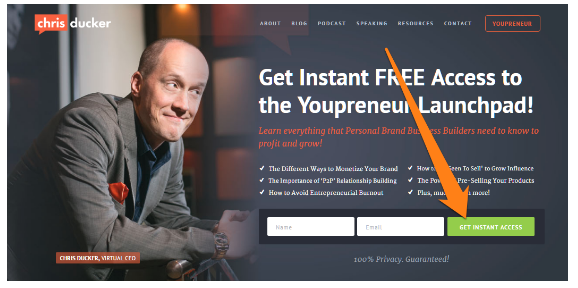
Sales Tips For Success 7: Get a Mentor

A mentor, such as your sales manager, helps make navigating your first sales job a little easier. They can guide you through your company’s many processes. You learn from their experience. You can also get feedback on your efforts.
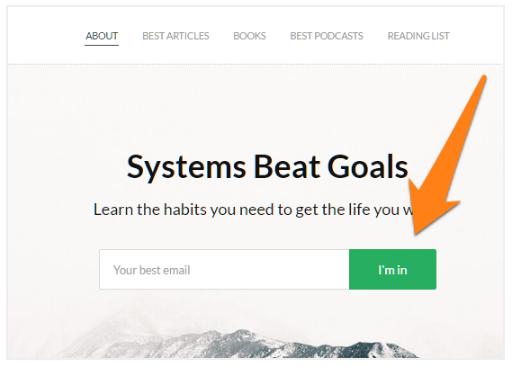
If you want more – or if splitting your manager’s time with the rest of the team is not enough – then turn to the greats. Business and sales gurus, such as Dale Carnegie, Jeffrey Gitomer and Zig Ziglar, have come out with books that help you improve your craft. Take time to learn what they have to say. Consider how you can apply this to your job.

25 Apr 16:31

The pros and cons of psychometric credit scoring

by BI Intelligence

Percent Pop borrowing from banks

This story was delivered to BI Intelligence "Fintech Briefing" subscribers. To learn more and subscribe, please click here.

As both fintech startups and incumbent banks wake up to the lending opportunity presented by the unbanked, alternative credit scoring methods have been on the rise. One such method is psychometric testing, which generates credit scores based on personality and behavior, rather than credit history.

This week, Russia's Sovcombank said it's aiming to grow its customer base by attracting young clients without credit histories looking to obtain their first credit cards. These customers don't have sufficient financial data to generate a conventional credit score. Instead, Sovcombank will use a system developed by the Entrepreneurial Finance Lab (EFL), marketed by US data analytics firm FICO, which scores individuals based on their answers to an interactive online questionnaire. Individuals are tested on verbal and numerical skills, and asked about their spending habits to assess their likelihood of repaying a loan.

As psychometric scoring becomes more popular, however, there are both benefits and drawbacks to consider:

  • Using psychometric scoring opens up new markets for lenders. According to FICO, there are some 3 billion individuals globally who are likely to repay a loan, but who have never previously borrowed, and therefore have no credit score to evidence this. By assessing consumers on metrics other than a conventional credit score, financial institutions can extend credit to millions more people, thereby gaining more sources of revenue.
  • However, such methods have built-in biases. Psychometric tests, which largely assess individuals on verbal and arithmetical skills, assume a certain level of education among respondents, skewing them toward the better-educated. Moreover, such tests can be manipulated, as certain answers — like proficiency with technology and a tendency to save money — are obviously preferred by a lender. In other words, a lender can be told what it wants to hear, and is put at risk of taking on dubious clients.

If alternative credit scoring methods are to add value, they have to be tailored to specific demographics. For example, psychometric testing is only likely to add value if applied to groups like well-educated teenagers and young professionals. Other forms of alt scoring, such as those that draw on individuals' social media data to derive behavioral profiles, are likelier to be more appropriate for people with less privileged backgrounds. To avoid replicating the exclusivity of conventional credit scoring methods, alternative systems should not apply a general standard across significantly varying demographics.

We’ve entered the most profound era of change for financial services companies since the 1970s brought us index mutual funds, discount brokers and ATMs.

No firm is immune from the coming disruption and every company must have a strategy to harness the powerful advantages of the new fintech revolution.

The battle already underway will create surprising winners and stunned losers among some of the most powerful names in the financial world: The most contentious conflicts (and partnerships) will be between startups that are completely reengineering decades-old practices, traditional power players who are furiously trying to adapt with their own innovations, and total disruption of established technology & processes:

  • Traditional Retail Banks vs. Online-Only Banks: Traditional retail banks provide a valuable service, but online-only banks can offer many of the same services with higher rates and lower fees

  • Traditional Lenders vs. Peer-to-Peer Marketplaces: P2P lending marketplaces are growing much faster than traditional lenders—only time will tell if the banks strategy of creating their own small loan networks will be successful

  • Traditional Asset Managers vs. Robo Advisors: Robo advisors like Betterment offer lower fees, lower minimums and solid returns to investors, but the much larger traditional asset managers are creating their own robo-products while providing the kind of handholding that high net worth clients are willing to pay handsomely for.

As you can see, this very fluid environment is creating winners and losers before your eyes…and it’s also creating the potential for new cost savings or growth opportunities for both you and your company.

After months of researching and reporting this important trend, Sarah Kocianski, senior research analyst for BI Intelligence, Business Insider's premium research service, has put together an essential report on the fintech ecosystem that explains the new landscape, identifies the ripest areas for disruption, and highlights the some of the most exciting new companies. These new players have the potential to become the next Visa, Paypal or Charles Schwab because they have the potential to transform important areas of the financial services industry like:

  • Retail banking

  • Lending and Financing

  • Payments and Transfers
  • 
Wealth and Asset Management

  • Markets and Exchanges

  • Insurance

  • Blockchain Transactions


If you work in any of these sectors, it’s important for you to understand how the fintech revolution will change your business and possibly even your career. And if you’re employed in any part of the digital economy, you’ll want to know how you can exploit these new technologies to make your employer more efficient, flexible and profitable.

Among the big picture insights you'll get from The Fintech Ecosystem Report: Measuring the effects of technology on the entire financial services industry:

  • Fintech investment continues to grow. After landing at $19 billion in total in 2015, global fintech funding had already reached $15 billion by mid-August 2016.
  • The areas of fintech attracting media and investor attention are changing. Insurtech, robo advisors, and digital-only banks are only a few of the segments making waves. B2B fintechs are also playing an increasingly prominent role in the ecosystem. 
  • It's not all good news for fintechs. Major hurdles, including customer acquisition and profitability, remain. As a result, many are becoming more willing to enter partnerships and adjust their business models. 
  • Incumbents are enacting strategies to ensure they remain relevant. Many financial firms have woken up to the threat posed by fintechs and are implementing innovation strategies to stave off disruption. The majority of these strategies involve some interaction with fintech firms. 
  • The relationship between incumbents and fintechs continues to evolve. Fintechs are no longer viewed exclusively as a threat, nor can they be ignored. They are increasingly viewed as partners, but that narrative alone is too simple — in reality, a more nuanced connection is taking hold. 

This exclusive report also:

  • Assesses the state of the fintech industry. 
  • Gives details on the drivers of its growth. 
  • Explains which areas of fintech are gaining traction. 
  • Outlines the range of current and potential models for fintech and incumbent interaction. 

The Fintech Ecosystem Report: Measuring the effects of technology on the entire financial services industry is how you get the full story on the fintech revolution.

To get your copy of this invaluable guide to the fintech revolution, choose one of these options:

  1. Subscribe to an ALL-ACCESS Membership with BI Intelligence and gain immediate access to this report AND over 100 other expertly researched deep-dive reports, subscriptions to all of our daily newsletters, and much more. >> START A MEMBERSHIP
  2. Purchase the report and download it immediately from our research store. >> BUY THE REPORT

The choice is yours. But however you decide to acquire this report, you’ve given yourself a powerful advantage in your understanding of the fast-moving world of financial technology.

Join the conversation about this story »

25 Apr 16:17

A master networker explains how to avoid the 6 biggest networking mistakes

by Richard Feloni

keith ferrazzi

If the word "networking" makes you roll your eyes, then you're doing it wrong.

Don't equate it with collecting stacks of business cards at awkward cocktail hours, or with playing Machiavellian office politics to rise up the ranks.

Networking should just be a natural part of the way you approach your career, Keith Ferrazzi explains in his classic bestseller, "Never Eat Alone," updated in 2014.

When Ferrazzi first published his book in 2005, he had already been the youngest CMO at both Deloitte Consulting and Starwood Hotels and Resorts; the CEO of marketing startup Ya Ya Media; and the founder and CEO of Ferrazzi Greenlight, a management consultant firm with major clients like General Motors and American Express.

He credits his success to learning early in his career the power of accepting and seeking others' generosity as well as being generous with his own connections and talents.

In "Never Eat Alone," he breaks down the most common mistakes he's found that cause people to be a "networking jerk."

1. They schmooze.

People will be able to see through your insincerity if you're just out to flatter as many people as possible, hoping that one of these artificial conversations yields something beneficial.

"Most people haven't figured out that it's better to spend more time with fewer people at a one-hour get-together, and have one or two meaningful dialogues, than engage in the wandering-eye routine and lose the respect of most of the people you met," Ferrazzi wrote.

2. They gossip.

Sharing something scandalous or pejorative about a high-profile colleague or second-hand connection might win make you appealing at the bar among industry peers, but it's a short-term, shallow play.

"Eventually, the information well will run dry as more and more people realize you're not to be trusted," Ferrazzi wrote.

3. They have nothing to offer in return.

Part of building a network is having the courage and confidence to introduce yourself to new people, but you'll never build relationships by seeming like a hanger-on.

Don't see every professional relationship as a zero-sum game, where you should tally favors on either side, but also understand that even generous people won't want to feel like they are wasting their time helping someone who won't be able to assist them in some way down the line.

4. They treat poorly those they outrank.

"In business the food chain is transient," Ferrazzi said. Not only do you never know where you or the people you interact with will end up, but your colleagues will quickly take notice of they way you value hierarchy over relationships.

5. They're not transparent about their intentions.

Be straightforward, not coy.

Ferrazzi explains that when he meets someone he's been waiting to, he expresses from the outset his enthusiasm and his belief they could help each other out. "People respond with trust when they know you're dealing straight with them," he wrote.

6. They're 'too efficient.'

"Reaching out to others is not a numbers game," Ferrazzi wrote. Don't patronize people by sending out mass emails or letters with no distinguishing touches.

Ferrazzi explained that by the time he was CMO at Deloitte, he had a contact list of thousands of people, and he twisted his own networking philosophy, hiring temp workers to forge his signature on these countless letters. At one point, one of his friends joked that he really appreciated that he had received not one but three cards (a coordination mistake on Ferrazzi's part) and that each had a different signature.

"When you look back upon a life and career of reaching out to others, you want to see a web of friendships to fall back on, not the ashes of bad encounters," Ferrazzi wrote. In other words, don't be a jerk.

SEE ALSO: A master networker shares his best advice for 20-somethings

Join the conversation about this story »

NOW WATCH: Tony Robbins shares the simple financial advice he learned from working with the smartest financial people in the world