Shared posts

05 May 17:43

5 TED Talks That Are Funnier Than Most of Today’s TV Comedies

by Patrick Antinozzi

TED talks are a great way to burn through a day. You can learn so much in just under 15 minutes, whether you’re looking for education, inspiration, productivity hacks, or even just a good laugh. (you may even realize you’re addicted to your phone)

I’ve watched many other TED talks, including those “Funniest TED talks!” playlists. Even TED’s own site claims to have 13 on their list. While (almost) all of them are very educational, only a handful of them deserve to be listed as funny.

Trust me, if you want to laugh, these are the only ones worth watching.

Here are the 5 funniest TED talks I’ve seen.

Inside the mind of a master procrastinator – Tim Urban

Tim Urban may be one of the most engaging story tellers I’ve ever seen. He’s the creator and owner of the wildly popular blog, WaitButWhy, where he masterfully simplifies complicated topics, and simultaneously makes them incredibly entertaining.

In this TED talk, Urban “takes us on a journey through YouTube binges, Wikipedia rabbit holes and bouts of staring out the window, while encouraging us to think harder about what we’re really procrastinating on, before we run out of time.”

There’s also an Instant Gratification Monkey, which is great for obvious reasons.

This is what happens when you reply to spam email – James Veitch

This TED talk is currently one of the top 5 most viewed of all time, and for good reason. Writer and comedian James Veitch takes an all too familiar problem, receiving spam email, and turns it on his head.

He tells the story of that one time he wondered “What happens when you actually reply to spam email?”, and then actually followed through on his curiosity.

The spammer never saw it coming…

The agony of trying to unsubscribe – James Veitch

Yep. James Veitch again. What can I say? The guy’s funny, and he knows his audience.

After his previous tear down of spam email, James wasn’t done just yet. It was now time to take on another irritating problem of the modern office job era, unsubscribing from email lists.

When James tried several times to unsubscribe from a local supermarket’s email list, and they kept on pestering him, he knew it was time for some more email hijinks.

Reggie Watts disorients you in the most entertaining way

Honestly, I have no idea how to explain this one to you.

Reggie Watts blends sarcasm, poetry, and stunning beat-boxing skills to leave you completely disoriented.

That’s all I’ve got. Watch it.

The happy secret to better work | Shawn Achor

Many believe that we should work to be happy, and that productivity inspires happiness, but could it be the other way around?

Frankly, those people have always been wrong. Working doesn’t give us the happiness we crave. And those same people have some incredibly misguided views on what true work-life balance really is. In fact, the less we work, the happier we will be. (but that’s a topic for another time)

In Shawn Achor‘s TED talk, he discusses how we can reconfigure our brains to continuously create positive reactions, rather than the vicious cycle of negativity that success often brings. He also happens to do it in hilarious fashion.

By the way, Shawn speaks incredibly fast. You may want to slow the speed of the video to really get the most out of this one.

Using humor to educate is one of the oldest tricks in the book, because it works. You just took in an incredible amount of information between these 5 videos (OK, maybe 4), and there’s a good chance you’ll have an easier time remembering it because it made you laugh.

If you’re trying to teach an audience, inject your insightful speech with a little bit of humor. You’ll have everyone hooked on your every word.

Have you watched any funny TED talks that I missed? Let me know in the comments!

05 May 17:40

Warren Buffett brilliantly explains how bubbles are formed

by Elena Holodny

warren buffett

The Berkshire Hathaway 2017 Annual Shareholders Meeting kicks off on Saturday May 6.

Ahead of the event, we decided to look back at some nuggets of wisdom on investing from Warren Buffett himself.

Back in 2010, Buffett answered several questions about what he thought caused the housing and credit bubble in an interview with the Financial Crisis Inquiry Commission (FCIC).

Mid-way through the interview, he also gave a clear explanation of how bubbles are formed, which we pulled and shared below.

It's a stunning read for anyone interested in investing or behavioral economics — or, more broadly, in human behavior.

The interview comes from a document dump from the National Archives, which released transcripts, meeting agendas, and confidentiality agreements from the FCIC. The group was set up in the aftermath of the crisis by Congress to look into the causes of the event.

Anyway, here's Buffett (emphasis ours):

"... My former boss, Ben Graham, made an observation 50 or so years ago to me that it really stuck in my mind and now I've seen evidence of it.

He said, 'You can get in a whole lot more trouble in investing with a sound premise than with a false premise.'

If you have some premise that the moon is made of green cheese or something, it's ridiculous on its face. If you come out with a premise that common stocks have done better than bonds [... that] became the underlying bulwark for the [1929] bubble. People thought stocks were starting to be wonderful and they forgot the limitations of the original premise [....]  So after a while, the original premise, which becomes sort of the impetus for what later turns out to be a bubble is forgotten and the price action takes over.

Now, we saw the same thing in housing. It’s a totally sound premise that houses will become worth more over time because the dollar becomes worth less. [...]

And since 66% or 67% of the people want to own their own home and because you can borrow money on it and you're dreaming of buying a home, if you really believe that houses are going to go up in value, you buy one as soon as you can. And that’s a very sound premise. It’s related, of course, though, to houses selling at something like replacement price and not far outstripping inflation.

So this sound premise that it’s a good idea to buy a house this year because it’s probably going to cost more next year and you’re going to want a home, and the fact that you can finance it gets distorted over time if housing prices are going up 10 percent a year and inflation is a couple percent a year. Soon the price action – or at some point the price action takes over, and you want to buy three houses and five houses and you want to buy it with nothing down and you want to agree to payments that you can’t make and all of that sort of thing, because it doesn’t make any difference: It’ s going to be worth more next year.

And lender feels the same way. It really doesn’t make a difference if it’s a liar’s loan or you know what I mean? [...] Because even if they have to take it over, it's going to be worth more next year. And once that gathers momentum and it gets reinforced by price action and the original premise is forgotten, which it was in 1929.

The Internet was the same thing. The Internet was going to change our lives. But it didn't mean that every company was worth $50 billion that could dream up a prospectus.

And the price action becomes so important to people that it takes over the — it takes over their minds, and because housing was the largest single asset, around $22 trillion or something like that, not above household wealth of $50 trillion or $60 trillion or something like that in the United States. Such a huge asset. So understandable to the public – they might not understand stocks, they might not understand tulip bulbs, but they understood houses and they wanted to buy one anyway and the financing, and you could leverage up to the sky, it created a bubble like we’ve never seen."

You can check out the full interview with Warren Buffett at the National Archives.

SEE ALSO: An Ivy League professor explains chaos theory, the prisoner's dilemma, and why math isn't really boring

Join the conversation about this story »

NOW WATCH: These are the small, agile new aircraft carriers meant to take F-35s into battle

05 May 17:38

The Added Value of Influencers

by Tyler Kurbat

added valueFrom creative content to mass syndication, influencer marketing has its perks. It’s no wonder more and more brands are reserving marketing dollars to enlist in the support of niche talent with very engaged networks. And the more we launch influencer programs the more benefits we discover for our clients. There is added value of influencers around every turn.

Courting sparks awareness

Let’s face it, not every influencer you speak to is going to enlist in the project ahead. That’s perfectly okay. Most influencers hold their fan base and its interests very closely. This requires brands and agencies to brainstorm and collaborate alongside each influencer to truly determine if the campaign parameters and deliverables are in the right wheelhouse.

The plus side is that all the while, this courting and research phase informs top industry talent that your brand is committed to innovative projects that connect with modern audiences. It puts you on the radar and allows your brand to network with some of the most influential social media creators, bloggers, vloggers and beyond.

Front of mind leads to word of mouth and that’s a win any day.

Authentic brand advocacy

Marketing is fun. Especially when you work with a team of big thinkers, visual artists and captivating personalities. And when marketing is fun, influencers tend to gravitate to and support your brand long after the contract wraps up.

Check out some of your favorite Instagram accounts. Sure, individuals tag brands that pay for posts, but six, eight, ten months down the line, you may notice they’ll tag the jacket they’re wearing, the vehicle in the background, the camera lens they’re using and so on. Influencers tend to “pay it forward” and shine light back on the companies and projects that allow them to live their lifestyles.

If your project is brag worthy and progressive, heartfelt and inspiring, chances are everyone involved will continue to associate with your brand well after project launch. Every post is that much more relevance and exposure for your brand and its future.

Behind-the-scenes and content layers

Not unlike our previous point, brand projects give influencers the unique space and resources to dream and create. For the most part, emerging influencers remain very thankful for the opportunity and investment.

It’s no surprise then that many projects spawn behind-the-scenes vlogs, shout outs and extra media that drives new users into your digital ecosystem. Whether it’s Instagram stories, Snapchat, Facebook Live or full blown YouTube episodes, core digital channels are clearly poised for daily content syndication and the more you stay on an influencer radar, the more your brand taps into theirs.

Branded content certainly has its place, but how much more valuable is an authentic authority sharing genuine interest and satisfaction with your brand? It’s validating and incredible valuable.

These plugs not only maximize your investment, but showcase your brand, its products and its vision over and over again. Let’s not forget that YouTube is a colossal search engine in and of itself which drives evergreen views to this content daily. That’s new eyes on new days, time and time again. That’s authoritative backlinks, product integration and mentions, tags and more that shine positive light on your investment.

Industry awards and creative recognition

Influencer content is typically very captivating. The aesthetic value is usually wonderfully executed, the partnerships are often newsworthy, and the hype surrounding a project launch is incredibly exciting.

As more brands deploy key influencers, the agencies and marketing teams behind the big ideas gain more recognition and clout in given market, region and discipline.

The list goes on and on. If you’re interested in influencer marketing and how it might empower your brand, give us a shout. We’ve mastered the workflow, guidance and collaboration that helps creative campaigns come to life. We’re happy to join you from ideation to deployment to help your brand reach new heights!

05 May 17:37

How to Unlock the Power of Email Marketing in 3 Simple Steps

by Laura Cole

In a world that is saturated with digital and social media marketing channels, the concept of reaching customers through email has become largely unfashionable.

This does not do justice to the potential that exists within the practice of email marketing, however, which remains one of the three main drivers of online traffic. It is also one of the most profitable marketing techniques, capable of delivering an estimated ROI of 3800% (or $38 for every single $1 spent).

The key lies in the execution of your campaign, of course, and the techniques that you use to engage readers. With this in mind, here are some simple steps towards unleashing the true potential of email marketing in the modern age:

Use Personalized Content to Resonate With Customers

Like all other marketing channels, email is only ever as effective as techniques used to leverage it. So even if you have a viable value proposition to present to customers, the publication of uninspiring and generic content is unlikely to engage customers.

The nature of your content is even more important when you consider that the average adult has an attention span of just eight seconds, which creates an exceptionally narrow window of opportunities for brands to engage their customers.

In the case of email marketing, personalisation is key to the creation of content that truly resonates with customers. This assertion can be backed by various statistics too, with personalized content though to increase click-through rates by 35% on average and conversion rates by as much as 25%.

In terms of execution, it is important to remember that personalisation extends beyond using the name of each individual customer. While this important (and capable of empowering each one as seminal drivers of the brand’s success), you should also use techniques such as analytical CRM to understand consumer behavior and personalize the content that offers relevant and tangible value to your customers.

This can include everything from personalized product recommendation to affiliate advertising, so long as it leverages actionable data and resonates with your recipients.

Make Your Calls-to-action Stand Out, in More Ways Than One

While the combination of a clearly-defined value proposition and personalized content will enhance your email content considerably, this means little if it does not actively convert leads. After all, conversion is central to the success of all marketing campaigns across every available channel, regardless of whether you are looking to sell products or simply build awareness.

This is where calls-to-action (CTAs) come into play, as when used correctly they can direct customers to take a desired action and continue their journey with your brand.

With this in mind, it is imperative that you optimize the impact of your CTAs, both in terms of their presentation and their content.

In terms of the former, you first make sure that your primary messaging and affiliated CTA is located above the fold, as this helps to maximize the visibility of the text across all devices. Not only this, but it should also be actionable so that customers can simply click-through a link or icon to continue their interaction with the brand.

When it comes to the primary messaging that underpins your CTA, you should focus on presenting this in a concise and easy to comprehend manner. Make no mistake; customers should be able to quickly decipher your message and identify the unique value proposition that represents your brand.

Ensure That Data Drives and Informs Your Campaign

We have already touched on how analytical CRM platforms can be used to influence email marketing, but this is also part of a wider trend in the commercial world. More specifically, we are seeing marketers move away from traditional demographics based on age and gender, and instead, leverage observed consumer behavior to drive individual campaigns.

In this respect, in-depth and detailed data sets are crucial to successfully marketing your products (and brand) through email. These include criteria such as customers’ spending behavior and the frequency with which they interact with the brand. This helps companies to attribute a cost base and profit center to their customer base, which in turn dictates how much should be spent on various marketing disciplines.

By unearthing data pertaining to subtle customer preferences in terms of how they spend their money, your business can also tailor the content of its emails to share relevant promotions either on or offline.

Similarly, you can use such data to publish emails at the optimum frequency, as this ensures that you are able to engage individual customers and segments without overwhelming them or causing them to become cynical of the brand.

05 May 17:37

The 17 Best Lead Magnet Examples For Lead Generation in 2017

by Cory Goneke

Do you know the #1 worst kept secret of lead generation in online marketing? It’s probably obvious from the title, but the worst kept secret is lead magnets.

I know what you are thinking…everyone is talking about lead magnets already and it’s nothing new. You’re right, lead magnets are nothing new, but if everyone is talking about them then why is everyone still doing them COMPLETELY WRONG!

I’ll admit it, we do lead magnets wrong all the time! I’m not even ashamed of it! I want to take some time to tell you why and share the solutions to making great lead magnets for lead generation with 17 examples that work in 2017.

Lead magnets, ethical bribes, content upgrades, or whatever you like to call them, are the equivalent of what direct mail flyers were in the 90’s.


THE AOL LEAD MAGNETDo you remember the free AOL trial disks? AOL initiated a shotgun marketing strategy whose goal was to put so many free trial disks into the world that it was impossible to ignore.

At one point, over 50% of every CD produced in the world was branded by AOL. They spent over $300,000,000 on these disks.

You may not realize it, but the AOL trial campaign is likely the most popular example of a lead magnet ever made.

AOL’s shotgun approach was massively successful, but it was completely a product of the times and the brain power within AOL’s marketing team. In 2017, technology like Facebook pixels, UTM tracking, and countless other tools have turned our lead generation strategies into precise marketing tools that don’t need to rely on millions of dollars in advertising spend.

LEAD GENERATION AND GOING VIRAL

Even though the effectiveness of the AOL approach expired long ago, the same virality is alive and well on the internet.

For example, let’s think about Tai Lopez. His most famous video, “Knowledge & Lamborghinis”, started out as a youtube pre-roll lead magnet. It now has well over 600,000,000 combined views!

Your lead magnets may not receive 600,000,000 views, but if you follow the techniques and examples listed below, your lead generation will certainly be head and shoulders above your competitors.

CREATING LEAD MAGNETS – THE 2017 GENERATION STRATEGY

Now that your brain is racing with the possibilities, I want to talk to you about the two most popular lead magnet creation strategies:

  • The Shotgun lead magnet approach
  • The Targeted lead magnet approach

The shotgun lead generation approach is exactly what AOL mastered in the 90’s. They released as many variants of their lead magnets as possible, remember 100 hours vs 500 vs 1,000?

There are a number of reasons that their approach worked, but the most important reason was financing.

They were able to spend $300,000,000 on disks alone! Add to that the capital they invested getting prime real estate space in every retail store across the country and it’s easy to see that their massive marketing budget was a key to AOL’s success.

This approach can absolutely still work in 2017, but the risk to reward ratio has drastically changed with the introduction of targeted advertising. This leads us into the next lead magnet strategy: targeted lead magnet offers.

Google, Facebook, Yahoo, & Microsoft have lead the charge in online data tracking. Things like your income bracket, if you own or rent your home and car, what your friends are purchasing online, and hundreds of thousands of other data points.

This type of big data has changed online marketing and has created a targeted lead generation strategy the most effective in 2017, and beyond.

Let’s say you are a realtor and you’re looking to get more listings. You could go door-to-door asking people if they are interested in selling their home (yes, people still go with this strategy. Yuck.)

Or…you could take advantage of the data that is provided to you by sources like Facebook. You could create a targeted lead magnet like “The Guide To Selling Your Home in Austin, Texas”.

This targeted guide can then be advertised only to people in the Austin, Texas area that are interested in selling their home. Imagine how much less time and money you could spend if you weren’t focusing on people who aren’t interested in your product.

Real estate is only one of thousands of industries that lead magnets work in. Here are The 17 Best Lead Magnet Examples For Lead Generation in 2017.

LEAD MAGNETS & CONTENT UPGRADES

Content upgrades started out as a simple way to add extra value to a piece of content. You would come across a page that had an attached spreadsheet, downloadable diagram, or instructional guide.

It didn’t take marketers long to realize that these types of content upgrades could be used to great effect. If you found the content, you were obviously searching for something similar, and if you had made it far enough down an article chances are high you wanted more of this type of content!

While content upgrades aren’t directly considered a lead magnet, they are often the main source of organically discovering lead magnets online.

INSIDE THE CONTENT UPGRADES

How OK Dork Uses Content Upgrades

okdork content upgrade

The OK Dork post listed above went all-in on the calls to action. They ask you to sign up for their content upgrade as well as to comment to win a book that was new at the time.

BLENDING YOUR LEAD MAGNETS INTO THE UPGRADES

Christian K Online - Lead magnet

Here is another great example of a content upgrade lead magnet from ChristianKOnline.

They do a great job putting their lead magnet right into the middle of the content without being too intrusive, but still standing out just enough to be noticed.

REUSE EXISTING CONTENT FOR LEAD GENERATION

BACKLINKO CONTENT KEYWORD RESEARCH

Brian Dean over at Backlinko is one of the best when it comes to creating content. According to a recent podcast with Noah Kagan, he’s spent as much as 80 hours on a single blog post.

It comes as no surprise then, that he wants to get the absolute most out of every piece of content. Just click on his content upgrade, input your email and he’ll send you the entire article in a PDF format so you can save it for later. It’s a fantastic way to reuse his most valuable content.

LEAD MAGNETS OR TIME ON PAGE

Authority Hacker - Lead Gen

Authority Hacker is another example of a company that does a great job reusing content for a lead magnet.

In the example above they have two options for the same piece of content. They can either link to another blog post to increase time on site, or they can change it to an actual opt-in light box with a downloadable file if they are looking for lead generation.

LEAD MAGNET EXAMPLE – USING CHECKLISTS, CHEAT SHEETS & SWIPE FILES

At Performance Marketer we focus on three key points before creating a lead magnet:

  • Can we provide value on this topic?
  • Does our audience actually want this content?
  • Is there built in virality?

The first two seem obvious, but the third, not so much. Remember the example of Tai Lopez above? One piece of viral content put him on the map. Now he has dozens of high priced courses, a massive youtube channel, and even more lamborghinis…

Checklists, cheat sheets, and swipe files are some of the easiest ways to “go viral” in lead generation. Topics like the “18 point checklist to (whatever you’re doing)”, or “The Social Media Swipe File” have a bit of virality built directly into the content. You can grab a user’s attention with a catchy title and have them sharing before they even have a chance to check out the content.

LEAD MAGNET EXAMPLE – THE CHECKLIST

THE 18 POINT CHECKLIST

Here is an example of one of our most popular lead magnets. We have been running this lead magnet for around six months, and it’s still bringing us a consistent flow of qualified leads.

We wanted something that was catchy, and motivated people to share. We also wanted to get straight to the point so people weren’t confused about what they were downloading.

LEAD MAGNET EXAMPLE – THE SWIPE FILE

DIGITAL MARKETER SWIPE FILE

When it comes to swipe files, our friends over at Digital Marketer have mastered this type of content. They excel at giving away a TON of valuable content to build up the goodwill.

This philosophy has paid off huge, and it’s evident in their massive fan base.

LEAD MAGNET EXAMPLE – TEMPLATES

Similar to swipe files, templates are another great way to generate leads. Anything from email templates, page layouts, or blog posts like the example below:

Digital Marketer Blog Post Templates

LEAD MAGNET EXAMPLE – CHEATSHEET

Here is an example of a “cheat sheet” lead magnet from Social Panda.

Social Panda has been doing some really cool paid marketing lately, especially with Facebook comments, but their standard lead generation methods are not something to ignore.

People love cheat sheets, they are a like Cliff Notes for whatever your audience is looking for. Everyone loves a good short cut.

Social Panda FB Targeting Cheat Sheet

INTRINSIC VALUE – THE PHYSICAL PRODUCT

The free ebook or PDF is one of the most popular lead generators in 2017. When you are thinking about buying a new book you can expect to pay $10 – $15 bucks at Amazon. That intrinsic value gives extra credibility to ebooks.

LEAD MAGNET EXAMPLE – Physical Book (that isn’t actually physical

Frank Kern is a master marketer, even if he refutes that claim himself, and using images of physical books is just one example of this.

Although his ads aren’t always the most attractive, he takes care to craft some of the best copy in online marketing.

His advanced copywriting knowledge, with his eye for recognizing important psychological triggers like showing a physical book, help boost the value perception of his products.

FRANK KERN LEAD MAGNET

Here is another great example of a lead magnet from a company called NeoMam Studios. They use a real book to leverage the perceived value.

PHYSICAL PRODUCT LEAD MAGNET

Ontraport is another example of a company that heavily uses ebooks in their lead generation strategies. This first example is similar to the previous two, they used a physical book to imply value.

Ontraport Lead Generator

This is an example of Ontraport getting away from the physical book and relying heavily on their ad copy.

Here is another example of Ontraport using ebooks as a lead magnet. This time they relied heavily on their ad copy to promote the content instead of relying on the physical image.

Ontraport using social proof

THE IRRESISTIBLE OFFER – AKA THE ETHICAL BRIBE

The irresistible offer, also known as the ethical bribe, is one of the most interesting lead generation techniques.

You may not even realize it’s a thing until you start to really look for it.

Take the AOL example above. This is a classic case of “the ethical bribe”. They want you as a customer and are willing to give you an insane amount of free product to test them out.

After all, who doesn’t want free internet?

Take this example from Smartlook. They are clearly saying “look at your website through the customer’s eyes!”.

This free trial will allow me to get into the minds of my potential customers.

FREE TRIAL

Every year, on the day after Thanksgiving, millions of people flock to stores (and websites) to get the best deals. These deals are, by every measure of the word, irresistible offers.

You don’t need another TV, but Best Buy knows that if they flash a $200 TV in front of you that the wheels in your brain will start turning. Hey, while you’re here you should think about purchasing a new HDMI cable, a new DVD player, and anything else they can sell you.

The Hoth is a good example of companies that do ethical bribes on Black Friday.

BLACK FRIDAY IRRESISTABLE OFFER

Performance Marketer and Drop Ship Lifestyle have even been known to do a Black Friday ethical bribe once or twice. 😉

Here is another quick example of a free trial ethical bribe from Thrive Hive. Honestly, there are thousands of examples we could use in this category.

THRIVE HIVE CUTE ETHICAL BRIBE

The real magic in ethical bribes comes when you start to pair them with scarcity, and physical products. That is why things like free + shipping are so popular.

Even though you have to pay for shipping, it’s still a fantastic deal!

LEAD MAGNET INSIDE OF MINI-COURSES

With Membership Site Masters, our number one way of lead generation is our free mini-course. These types of lead magnets generally take more time but can have huge pay off if done correctly.

For Membership Site Masters, for example, we give away 10 videos, and each video is between 10 – 30 minutes long. As you can imagine, creating 5+ hours of content to giveaway can be a lot of work. For us though, we see a massive return on this lead magnet investment.

Membership Site Masters

CASE STUDIES FOR LEAD GENERATION

Readers love case studies. It’s really simple, they see step-by-step what did work, and in some cases what did not work. This type of insight can be very helpful to someone looking to follow in the same foot steps. Take a look at this ad from The Inside Marketer.

They are advertising a “7 Figure Case Study” and they even have an irresistible offer, that allows you to “swipe & deploy” their entire campaign.

They aren’t saying you’re going to make 7 figures from this case study, but they sure are implying it.

The Inside Marketer

The above listed 17 lead magnets fall into a handful of categories, but the thing to remember is that there is a ton of crossover. You can offer a physical product, ethical bribe, and training course all in one lead magnet. More isn’t always better, but testing out what works for your industry is the key to success when it comes to building a winning lead generator.

05 May 17:36

Surviving Competition: 6 Handy Tips to Launch Your Startup

by Beth Worthy

Handy Tips to Launch Your Startup

Unique ideas are what drive successful entrepreneurs, but now there are an increasing number of startups competing for the attention of venture capitalists than earlier this century. It’s getting more difficult for both discovering original ideas and standing out in a crowded market, but it’s still possible to be a profitable game-changer if you focus on the following principles.

1. Learn From Leaders

Before plotting your course toward success, take some time to study pioneers that have already paved the way for you with winning business models. Peter Thiel and three partners, for example, introduced a new way to transfer money online with PayPal in 1999 through their firm Confinity, which merged with Elon Musk’s company, X.com, the following year.

The ease of making online transactions using email addresses through this ecommerce solution was a new experience in this era and gained quick acceptance by eBay users. PayPal subsequently was acquired in 2002 by eBay, which spun off the company in 2015 to become its own multi-billion dollar venture. Other exciting startup stories to study that grew from small operations to colossal empires based on new experiences include Google, Facebook, Uber, Airbnd, OneFineStay, plus more…

2. Start Out Small

Companies usually don’t become big without first proving themselves on a small scale. So begin focusing on your own local market. That will give you a chance to test your product or service and work out all the bugs. Learn how your target market responds and if they don’t respond, reimagine it using the feedback they give you. Sometimes it takes several versions of a product before all cylinders are running smoothly.

Growing from local roots is a traditional way to build a business because it presents low risk. It’s how many startups get off the ground and then get noticed by venture capitalists, who like to see evidence of commercial potential before making a huge investment. It’s much easier to create a product-market fit on a small scale before testing it on a national or global level.

3. Connect With Your Community

It’s important, however, not to just clone a national business like Amazon, which can potentially force you out of business if you don’t develop a local network. Sometimes you can block such a scenario by embedding familiar flavors in your product that resonate on a local level. This strategy makes it difficult for big players to spend time and money to tap into personalized experiences. Make sure you have enough supporters in your community to justify local marketing.

4. Focus On Vertical Channels

If you concentrate on a generic product, you have a chance of reaching a wider market than if you sell a more niche-oriented product. But generic products also tend to get lost in the shuffle since they invite broader competition. The advantage of niches is they can potentially provide more personalized and specialized experiences. Vertical markets involve selling to narrow targets, usually within specific industries.

When you find a market hole in your research, vertical marketing becomes extremely viable. This concept is particularly true when you have the opportunity to optimize experiences that cannot be found elsewhere in the market. If your product or service has a ticket-value with customers that justifies an investment in marketing and it can be sold over and over to the same people, then it offers endless opportunities.

5. Deliver Quality

Quality is a major key to gaining market attention, especially if it exceeds expectations and is superior to that of competitors. It becomes much harder, though, to control quality the more your company grows. The more you have to invest in quality to maintain a competitive edge, the more risk you add to the equation. That’s why it’s possible for smaller players to concentrate on quality solutions on a small scale, especially for services that depend on expertise.

One opportunity for competing on quality is to provide a curated supply. This strategy applies to building a gateway to a specialized marketplace that emphasizes high-powered talent, such as programmers and engineers. An elite-driven marketplace can beat one that allows low barrier to entry for almost anyone, such as game reviewers. Another opportunity for delivering quality is to provide a managed service, such as a computer network help desk.

6. Create Market Disruption

The boldest way to capitalize on a startup is to offer a disruptive experience that shakes up a traditional market. Sometimes large players can become complacent about their market positions and lose touch with their customers as this trap is easy to fall into if there hasn’t been direct competition in a long time. The challenge to toppling a giant is to design a paradigm-shifting product that is:

  • Unique
  • Marketable
  • More effective

Conclusion

Planning a winning strategy for a startup requires seeing beyond the curve. But in order to reach that destination you must take steps to evolve in both a practical and creative manner. Testing your idea and absorbing market feedback are the primary keys to shaping a refined product that breaks down barriers and advances to the next level of attracting big investors.

05 May 17:33

Writing Tips: Crafting Product Descriptions that Sell

by Marcia Layton Turner

Product descriptions are so much more than just a list of features for customers to skim. The best product descriptions engage and excite buyers, answering all their questions and helping them envision how much better their lives will be once they own your product.

So how do you write product descriptions that are so good your prospects are compelled to buy your product? Here are some tips:

Talk directly to your target buyer

When you’re writing about your product, imagine yourself speaking to one ideal customer. Use words and phrases that they use, and pepper your description with the word “you,” to engage them.

Tell them what’s in it for them

How will they benefit from buying this product? Stay away from talking about features, such as, “contains nitrocellulose.” Instead, tell the customer what problems it solves, such as, “Our extra durable nail polish will last twice as long, so you’ll be able to skip your next nail appointment and save some money.”

Focus on how it will make them feel

Nothing spurs a buyer to action faster than when they have an emotional response to a product. If you can help them feel excited about the reactions they’ll receive to a new hair color, for example, you’ve done a good job.

Weave in sensory words

While we rely primarily on the sense of sight when describing products, also try to use words related to our other senses, such as smell, hearing, touch, and taste. Does the facial mask “smell like a day at the beach and feel like smooth pudding while tightening pores to the point that you can barely see them?” That’s a big step above a description that promises that the mask “minimizes pores.”

Offer proof

Rather than making a claim about a product’s benefits that you can’t back up, substantiate it by including testimonials from customers who tried it. Assuring a customer that a facial at your spa will help reduce fine lines is one thing, but having a customer say it, and provide before-and-after photos, is much more effective.

Reduce their concerns

No one wants to purchase something that turns out to be a dud, so eliminate your buyer’s worry by offering a performance guarantee, if you can. Reassure your customers that they won’t be disappointed.

Be different

Just because your competitors describe a product a certain way does not mean you should emulate them. In fact, you should aim to be completely different. That way you’ll attract attention from buyers. So if other companies are claiming that a product is “longer-lasting” or “all natural,” avoid those phrases. Instead, describe the awards the product has earned for its durability or the certified organic process used on the farm where the ingredients are grown.

Creating strong product descriptions that attract attention and interest buyers can be a significant competitive advantage for your business.

05 May 17:31

3 Lead Gen Techniques That Grew Sales For Life’s Pipeline by 400%

by Jamie Shanks

If you’re in need of actionable tactics to explode your pipeline growth, I’m about to brighten your day. The amazing team at Sales for Life has worked incredibly hard to create a repeatable and scalable process, resulting in consistent demand generation over the past 2 years. In this post, I will share 3 proven lead generation techniques that skyrocketed our database from 20,000 to 100,000!

Growing Your Sales Pipeline Is Easier Said Than Done

Most corporate marketing campaigns do an excellent job of nurturing existing buyers in their pipeline. The problem though, is they often times lack innovative ingredients to grow a new pipeline.

Think about it. They share insights to their LinkedIn, Twitter, Facebook and email database, which helps educate existing leads, but only slightly attract new leads.

In today’s information-rich, buyer-centric environment, figuring out the right formula to cut through the noise and generate quality leads isn’t so easy.  

Luckily, we’ve learned a few proven lead generation techniques along the way, and we’re going to share them right now!

Technique 1: “Operation Land Grab”

sales pipeline growth

Operation Land Grab is like a trip into the Wild West. In the North-Western American Gold Rush, prospectors raced westward to stake a claim to new land. These prospectors captured new land, for free, by putting in hard work, time and effort rather than money.

Using this analogy, there are companies in your industry (consulting services, technology products, industry analysts) that have the land (leads not in your pipeline) that your sales team wants to attract; all you need to do is capture the land.

Using a high volume of insights, you will develop a scheduled system to guest blog on websites that will drive their leads into your sales pipeline.

Here’s how the guest blogging system works:

  • Develop a list of potential lead owners (websites).
  • Contact these lead owners about their guest blogging schedules (monthly, quarterly?).
  • Create a Content Calendar just for “Operation Land Grab.”
  • Communicate the calendar and new volume demands to the Insights Committee.
  • Keep the Insights Committee on schedule to create these guest blogs
  • Ensure every guest blog has your call to action.

I can’t stress the last part enough. Remember that insights, like blogs, are consumed in a silo.

The most important part of this particular lead generation technique, is capturing those cross leads into your Marketing Automation system!

Technique 2: Event Lead Exchanges

lead generation exchange value

Webinars and virtual summits have been an incredible lead generation source for our business. The secret sauce: It’s not really about the content in the webinar.

Of course, the webinar needs to be compelling, but the real value of a webinar is massive acceleration of new leads. This is accomplished by inviting guest panelist and promotional partners into the event.

The panelist will be part of the presentation during the event, and he or she will be responsible for promoting the event just like you will. If you’ve chosen your panelists correctly, they will provide high-octane volumes of net new leads into your system.

But often forgotten is promotional partners for your event. This is similar to sponsors, except rather than exchanging money for sponsorship, you will exchange leads.

3 Best Practices For Event Exchanges

  • Build promotional packages for panelist and promotional partners.
  • Clearly outline social post schedules, email templates and so on.

We then consider the size, industry, region that our promotional partner needs to fuel new leads. We’ll strike a deal with that partner on an exchange, starting at 1:1, and accelerating to 5:1 for virtual summits where there are thousands of leads created.

For every new lead a promotional partner places into your CRM that you didn’t have before, you’ll populate their CRM with an equally valuable lead. This is the ultimate form of coopetition.

Suddenly, for larger webinars and virtual summits, you’re adding hundreds or perhaps thousands of new ideal buyers into your CRM to begin the lead nurturing process.

Within weeks or months, those ICPs will consume your insights, and a portion will develop into Marketing or Sales Qualified leads.

This is the ultimate “Fishing with a Net” to fuel your Sales Development Representatives (SDRs) with new leads to qualify.

Technique 3: Re-Purpose & Recycle Your Top Content

generate leads recycle content

HubSpot has some incredible analytics from its own blog:

92% of their leads come from blog posts over 30 days old. 30 blog posts (0.5% of their blog database) represents 46% of all their leads!

That doesn’t mean you can abandon creating a high volume of new insights. You need to achieve SEO power over your competitors. You also need enough data points to understand which insights are your best performers.

Once you’ve established this baseline, you’ll quickly recognize the Pareto Law within your own insights – 80 percent of their consumption and conversion will come from 20 percent of the insights.

Here are steps you can follow to help accelerate your Re-purpose & Recycle system:

  • Identify the top blogs, eBooks, infographics and so on – based on SEO (traffic, clicks, conversion).
  • Run the copy through Google Analytics for keywords. Can you spike the SEO by adding new keywords that are hot in your market?
  • Cut the insight & paste it into your new insights template. Are there key ingredients missing, like a call to action or bold H1 headlines that perform better in Google?
  • Add updated statistics, stories, images, metadata to refresh the insight.
  • Change the call to action to drive to a new and better performing next step.
  • Adjust the insights date of publish to reflect today’s date.

The last step is a lesson in psychology. Both your buyers and your sales team will gravitate toward the new.

At Sales for Life, we’re refreshing our top 5 percent performing insights every quarter. Our team gathers the data and ensures we’re polishing a mixture of:

  • Top performing by eye-balls (clicks and shares). This helps with Brand Awareness.
  • Top performing by conversion, focusing on Lead Generation.
  • Make sure we’re polishing a mixture of asset types, and not allowing specific types like eBooks to grow too stale.

Key Takeaways

  • Don’t underestimate the power of guest blogging! Getting in front of new audience can open up a world of new, undiscovered opportunities.
  • Cross promo, events, and lead exchanges are more powerful now than ever before. Find the right partners, focus on providing value, and the right things will happen.
  • Old content is your biggest untapped gold mine! Need more proof, check out this case study from Ahrefs that explains how old content can boost traffic by over 468%.

Get 15% Off Your Sales Machine 2017 Ticket (Limited Time Only)

If you loved this post, you’ll love what we have in store for you at Sales Machine Summit!

Visit the Sales Machine Summit page for a special 15% off your ticket, or manually enter SALESHACKER15. 

Sales Machine Details:

  • Actionable and tactical sessions on June 14th, 2017
  • Metropolitan Pavilion in New York City
  • 1200+ Attendees
  • 40+ Vendors
  • 2 Stages
  • 4 Tracks led by practitioners at high growth companies on Sales Development, Sales Strategy, Sales Operations, and Revenue Alignment.

Benefits of Attending Sales Machine:

  • Learn about new strategies and tactics that your whole team can actually use at your company immediately.
  • Discover new technologies to leverage in the sales process.
  • Network with actual decision makers with budget, and forward thinking sales leaders.

Enjoy this limited time special offer and get 15% off your ticket to Sales Machine. We’ll see you there!

The post 3 Lead Gen Techniques That Grew Sales For Life’s Pipeline by 400% appeared first on Sales Hacker.

05 May 17:31

7 Easy and Effective Customer Segments to Target in Facebook Ads

by Tom Bukevicius

Facebook ads, when utilized properly, are among the most effective targeted marketing efforts in the industry.

However, it’s often the case that companies are leaving money on the table when it comes to Facebook ads. Often, there are simple customer segments (that you already have access to) that you can target with Facebook Ads very effectively.

Facebook’s Increasing Competition (and Opportunity)

Facebook is, by far, the most promising social advertising platform for E-Commerce purposes — the site has 1.86B users, an average ROI on targeted ads of 152%, and is responsible for 85% of all social media e-commerce.

A customer survey conducted by BigCommerce revealed that 51% of SMBs expect social advertising channels (specifically Facebook Ads) will play a major role in accelerating revenue throughout 2017 and beyond.

Facebook is becoming more popular by the day. Their ad platform is becoming more competitive as a result. In April of 2017, Facebook announced that there were more than 5 million active advertisers using their ad platform. A year earlier, they had almost half that, with 3 million advertisers.

Facebook ads are based on an ad auction system, so increased competition drives the cost of using the platform up. According to the Nanigans Facebook Advertising Benchmarks Report, there’s been a 92% year over year CPM increase for the ECommerce vertical.

To combat rising competition and prices, you need to get savvy about your ad targeting and delivery. This article will outline some of the lowest hanging fruit in terms of audience targeting.

Why Facebook Custom Audiences Is The First Step

On the surface, Facebook campaigns have 3 components:

  1. Audiences. How you target your potential buyers effectively.
  2. Ads. Offer a message that speaks directly to each audience.
  3. Landing Pages. The target destination for your leads.

3 components of Facebook Campaigns

Facebook has many targeting options. However, for the most efficient results, I recommend starting with Custom Audiences.

Why?

Facebook Custom Audiences allows you to reach your customer segments and deliver a highly personalized message in a way that makes them feel like the advertising is both relevant and helpful.

Facebook’s Custom Audiences feature has many options. You can target “people who already know your business on Facebook” (that’s how Facebook themselves define the option) through four types of data sources:

  1. Customer file
  2. Website traffic
  3. App activity
  4. Engagement on Facebook

We’re focusing primarily on the first option, “customer file.”

It’s how we target the “type of audience you can create made up of your existing customers” (again, that’s the official Facebook definition). This really means “first-party contacts,” which include your customers, leads, and newsletter subscribers. Basically, folks who are already in the sales funnel.

See the image below, where the option you want to focus on is highlighted in red:

Four Types of Facebook Custom Audiences

Custom Audiences will be an indispensable resource in developing your targeting strategy for Facebook Ads.

Segmenting Your Customer Database

Often, it feels like we have too many options for using “first-party contacts” in our targeting. The best way to organize these options strategically is to create customer segments.

Customer segmentation is an old trick in the marketing book. It’s widely used for a reason. According to Direct Marketing Association, 77% of ROI is attributed to segmented, targeted, and triggered campaigns.

If you have a strong CRM, and an effective email marketing operation, you have a head start over plenty of advertisers, believe me.

If you’re not so well-equipped as of yet, consider the following:

When I think about customer segments, I like to imagine the customer’s journey in relation to a business. Find two types of segments and their progressions below:

  • Core. These segments focus on the customer’s journey.
  • Advanced. Segments that give additional insight to the core segments.

Customer Segmentation

So, how do you create these segments? Easy — your customer database. You almost certainly have one. Even if it’s not complex, your customer database is a goldmine of useful, actionable data. I’m willing to bet you have access to the following data points:

  • Purchase date
  • Purchase frequency
  • Purchase value
  • Product type
  • Newsletter subscribers

Use these data points to construct customer segments, and then use them as Custom Audiences.

Let’s take a closer look at each of the segments you see above.

Segment #1. Potential Customers

This segment represents newsletter subscribers, or leads who haven’t made a purchase from your store yet.

Your goal is to turn these potential customers into paying customers.

If you’re scratching your head and asking yourself “Why promote on Facebook when I can send them (potential customers) an email?”

Your email database is limited in how many people open your emails. The average email open rate in the ecommerce industry is 16.75%.

This means, on average, about 83.25% of your emails remain unopened. Facebook Custom Audience campaigns will help you cover the gap, and get some real mileage out of your acquisitions.

Let’s take a look at Jimmy Beans Wool. They promoted their new yarn subscription service to potential customers using custom audiences. Their campaign netted them seven times the ROI and 11 times as many new subscribers as their newsletter did.

Jimmy Beans Wool Facebook Ad

How do you create this segment?

That depends on the size of your list.

You can break it down into separate newsletter segments. I recommend starting with 3 segments, a strategy popularized by the GetResponse team. Those segments are:

  • New Subscribers. Brand spankin’ new to your list. Newbies. The newest entrants to your sales funnel. It’s only really possible to discern that much, and that much alone, about them without collecting more data on how they interact with your brand.
  • Engaged Subscribers. Basically, these people responded to your targeting in some way. They may have opened an email, followed one of your CTA prompts, visited your website, and so on.
  • Non-Engaged Subscribers. These are people who were sniffing around at some point, but the lead’s gone cold. It’s still useful to hang on to these people’s emails, because you can try to reactivate their interest in your brand. They may alternatively just be idle, or may check for your email at some point in the future. It’s best to make sure it’s there waiting for them if and when they do.

Segment #2. One-Time Buyers

This segment represents customers who have made one purchase. Since you’ve earned their trust already, your goal here is to increase Customer Lifetime Value.

According to Amy Gallo, contributing editor at Harvard Business Review, “acquiring a new customer is anywhere from five to 25 times more expensive than retaining an existing one.”

How do you create the segment?

Pull customer lists with a transaction count of one. Also, filter transactions made in the past 180 days (or other relevant period depending on your business). You want both your one-time and active customers.

Segment #3. Repeat Customers

This segment represents customers who have placed at least two orders from your store.

This is getting better. These customers have put enough trust in your brand to purchase two or more times. When thinking about their situation, you have to recognize that.

This has to reflect in your ads. Don’t offer them a deal like “20% off for first-time customers only.”

Your goal is to serve them with relevant offers where you cross-sell and upsell related products.

Upselling and Cross-selling (Image Source)

Here’s how the Orlando Magic basketball team used purchase data to create a campaign that resulted in an impressive 52x ROI. They created Custom Audiences for fans who purchased tickets to previous games, and encouraged them to purchase new game tickets.

Orlando Magic Facebook Ad

How do you create the segment?

Pull customer list with transaction counts of two or more. Filter transactions made in the past 180 days. You want to look at both repeat and active customers.

Segment #4. Lapsed Customers

This segment represents customers who haven’t purchased from you in the past six months (or other relevant time period). For some reason, they stopped buying, and you must consider them a lapsed customer.

Your goal is to reactivate these lapsed customers. You can (and should) launch dedicated reactivation campaigns.

The Museum of Science in Boston ran Facebook campaigns to promote their museum memberships. They segmented their newsletter list into a few categories, such as subscribers to their monthly email, previous gift membership buyers, and current and lapsed members. Their campaign resulted in 3x ROI, which is decent for this segment.

The Museum of Science, Boston Facebook Ads

How do you create the segment?

Pull a customer list with a transaction count of one or more. Then, filter transactions made 180 or more days prior. You want all and lapsed customers.

Segment #5. First-Time Buyers

This segment represents people who recently made their first purchase.

They’re new to your brand. Your goal is retention.

You can increase a company’s profitability from 25% to 95% by increasing your customer retention rate.

Ezra Firestone suggests running selfie contests to his new customers. Here’s the logic behind his thinking:

  • He uses the opportunity to get customers engaged, and generates some social proof for the product.
  • He invites customers to take a selfie holding their new product, and to promote it online or send it in for a chance to win the contest.
  • He picks a winner each month.
  • Social proof can be a great way to improve your conversion rate.

How do you create the segment?

Pull customer lists with a transaction count of one or more. Filter transactions made in the past 30 days. You want one-time and new customers.

Segment #6. Recent Buyers

This segment represents repeat customers who purchased something from you in the past 30 days.

Your goal here is two-fold:

  • Improve your Customer Lifetime Value by cross-selling, and upselling relevant products.
  • Generating social proof, and user-generated content

How do you create the segment?

Pull customer lists with transaction counts of two or more. Filter transactions made in the past 30 days. You want to look at both repeat and new customers.

Segment #7. High-Value Customers

This segment represents customers who have spent disproportionately more money than other customers with your company. They either bought a lot of product, purchased big ticket items, or better yet, both.

Your goal is to cross-sell and upsell relevant products. These are your “whales.”

The San Jose Sharks used this high-value segment to successfully to drive 33x ROI on their Facebook Ads campaign. They created a “previous season ticket customer” segment, which was used to upsell SharkPak ticket packages (11 and 21 games).

Here’s a masterful execution of reselling:

The San Jose Sharks Facebook Ad

How do you create the segment?

This one’s simple. Break down your customers into 3 groups.

  • Total spent
  • Number of transactions
  • Order value

You’ll get a great cross section of your database, and will better understand the price consciousness of each segment. To start building efficiency into the segment’s targeting, take the top 20% of customers from each of the groups. You’ll end up with a list of your top 20% customers in three distinct, important categories.

Pro Tip: You can do the opposite by creating a segment for the bottom 20% customers and excluding them from Facebook campaigns. They’re not likely to buy, so slim the margins a little bit.

Putting It All Together

Remember, each customer segment represents different goals, behaviors and expectations.

This is the point where you upload your segments to Facebook. There are two levels of data you can upload:

  • Basic identifiers (emails, phone numbers or Facebook UID) from each segment. Facebook will look for users who match your uploaded identifiers, and will create an audience of matched users. 50% match rate is reasonable — not everyone has an updated Facebook account, and some aren’t a match for that particular identifier.
  • Advanced identifiers (there are up to 15 to choose from). These are for winning higher match rates. Additional identifiers help you identify members of your list who use more than just emails, phone numbers, and Facebook UIDs.

15 Identifiers for Customer Audiences

Final step! Create ads and landing pages that speak directly to each customer segment. Those are topics for other articles, but if you’re interested here are some resources:

Conclusion

Hopefully, by this time, you’ve realized you have enough data at your disposal already. The tricky part is using that data strategically to create segments around your Customer’s Journey.

Launching highly segmented campaigns alongside respective offers and messaging is the fastest way to start off on the right foot in this channel with positive ROI.

What counterintuitive data points have you discovered that helped you create a successful campaign?

05 May 17:31

Using LinkedIn Matched Audiences for B2B Marketing

by Alex Charalambous

LinkedIn is a powerful platform for B2B marketing and is now even more valuable with Matched Audiences. This new targeting capability can help increase ROI for B2B companies by allowing you to focus on audiences and accounts that are likely to convert and drive revenue.

In case you need some data as to why LinkedIn is a valuable B2B platform, here are a few key stats:

  • 80% of B2B leads come from LinkedIn
  • 94% of B2B marketers use LinkedIn to distribute content
  • 79% of B2B Marketers say LinkedIn is an effective source for generating leads

LinkedIn’s Matched Audiences provides three new capabilities:

1. Website Retargeting

Website Retargeting allows you to create target audiences from your website visitors and then nurture them on LinkedIn. Imagine being able to capitalize on past website visitors through Sponsored Content. Your firm can stay top of mind and acquire leads at a cost much lower than other retargeting platforms. With LinkedIn being a large B2B market, you would most certainly see a return on your investment. With LinkedIn’s pilot program, participants saw a 30% increase in click-through rates (CTR) and a 14% drop in post-click cost-per-conversion.

So how does it work? It starts with adding a JavaScript code to your website. Once you have that in place, you can start to set up your website audience segment in LinkedIn. It will prompt you to set up the name of your audience and you can specify the URLs of the pages that people have to visit in order to retarget. For example, you may want to retarget to people that visit your Contact page or Service/Product pages. These are people that are likely to be further down the sales funnel and more likely to convert from a retargeting campaign. For step-by-step instructions on how to get set up, you can download the LinkedIn getting started guide.

2. Account Targeting

Account Targeting allows your firm to target specific companies that are your target list. You can upload a CSV file of company names and LinkedIn matches it against nearly 12 million target companies in its database. By targeting accounts rather than individual leads, it allows you to cast a wider net and potential to deepen engagement with target accounts and multiple decision makers. This tool could also help support your firm’s overall Account-Based Marketing strategy. It also allows you to target specific professional demographics to ensure you reach the people that make the buying decisions. With LinkedIn’s pilot program, participants saw a 32% increase in post-click conversion rates and 4.7% drop in post-click cost-per-conversion.

3. Contact Targeting

If you have specific leads you want to target, you can upload your list of email addresses and serve ads and relevant content to those contacts. With LinkedIn’s pilot program, participants saw a 37% increase in CTR with Contact Targeting.

Currently LinkedIn integrates with Marketo, Oracle Eloqua and LiveRamp so you can connect those lead databases directly with LinkedIn. If you connect your contact management platform, then your lists will automatically populate on LinkedIn through an API. For best results, it’s recommended to have at least 10,000 emails contacts in your database to use this method. Larger lists will have better match rates. For step-by-step instructions, you can download the LinkedIn getting started guide.

//

LinkedIn Matched Audiences is a great B2B tool to nurture leads that you have generated from your website. In the end though, it all comes down to content. In order to get that first set of leads and build your database, you need quality content and a solid content marketing program in place to attract and generate leads.

05 May 17:31

$161 Billion on Top-Funnel Marketing vs $9 Billion on Lower-Funnel: A Problem

by Scott Vaughan

B2B CMOs are shifting their demand marketers’ focus. Simply generating marketing-qualified leads (MQLs) is no longer enough.

Marketing execs are now emphasizing down-funnel efforts that convert prospects to new customers and cross- or up-sell solutions to current customers. And, to be clear, I’m not just echoing the “marketing-driven revenue” slogans we’ve heard from all the MarTech vendors the last several years. This mandate is coming directly from the C-suite.

Gerry Murray of IDC Research has stated that B2B marketing’s budget is on the brink of a major overhaul:

“Historically, nearly 50% of a tech company’s marketing program budget is spent on awareness. However, CMOs are driving funds out of the traditional (but vague) job of ‘awareness building’ to jobs later in the buyer’s journey.”

In other words, marketing execs need to revise priorities and stop spending so much effort on top-of-funnel marketing programs. Generating MQLs that sit idly in the database waiting for attention does little for a business’ bottom line.

CMOs must instead balance the precious time, budget and resources now spent on top-funnel lead gen with lower-funnel initiatives that convert prospects to customers and increase lifetime value of existing customers.

That’s easier said than done.

Branding the business and generating new, viable leads that fit buyer and/or account profiles will always remain critical – you can’t convert prospects to customers if you don’t have any prospects to start with. And unfortunately, most B2B brands’ databases are not full of contacts and the numerous types of correlated data needed to convert contacts to sales pipeline, let alone customers.

Even the promise of account-based marketing (ABM) – designed to increase sales and marketing efficiency and impact – requires marketers to continually discover and identify new leads among target-account buying committees.

If the demand creation machine is to work, generating leads shouldn’t go away. So, the question is…

How do demand marketers scale pipeline using fewer resources?

First, top-funnel processes must become far more efficient – there’s no reason highly educated and skilled marketers should be spending their days manually managing one-off campaigns and scrubbing lead files.

Secondly, these top-funnel efforts, which historically have remained removed from the more automated, lower-funnel nurturing initiatives, must become integrated with down-funnel processes, data and tech for a seamless customer journey.

This strategy shift requires tremendous discipline and a commitment to changing inefficient legacy habits and entrenched processes.

To facilitate this transition, marketers are stealing a page from what they’ve been doing with marketing automation for lead qualification and CRM for managing the customer life cycle. They’re applying process-automating tools, connecting systems, improving data quality and deploying analytics at the top of the funnel.

Fixing top-funnel inefficiencies to focus on lower-funnel strategy

Top-of-funnel marketing involves an increasing number of channels, data sources and systems that are typically disconnected and require multiple manual processes to execute. These efforts are resource-intensive and difficult to measure. Launching, managing and identifying the right mix of channels (search, content syndication, events), content and targets drains time and budget.

Another, less recognized byproduct is the negative effects this top-funnel chaos has on marketing team morale. Most marketers didn’t go to college just to scrub spreadsheets, format files, fix bad data or piece together multiple data files into a dashboard. This is contributing to turnover in marketing departments, further limiting resources and hindering progress.

By automating campaign management, lead routing and data processing, and implementing closed-loop analytics (via integrations with marketing automation and CRM), marketers streamline resources required to execute top-funnel programs.

Further, top-funnel program automation boosts funnel velocity, leading to greater conversions that scale sales pipeline. Most importantly, it enables marketers to focus their efforts on more strategic, buyer-centric initiatives down the funnel that result in more customers and marketing-attributed revenue.

The future for B2B marketing is full-funnel focus

Increasing lead volume doesn’t cut it for B2B marketers these days. CMOs are putting the brakes on throwing more resources at campaigns designed to simply generate MQLs – they’re looking at the big picture, the entire funnel.

A smart way to get started is by automating one-off, manual processes required for top-of-the-funnel lead generation. The time and resources saved can then be re-deployed for greater impact, leveraging the team’s analytical skills and creative abilities to devise and execute more precise, cross-channel marketing programs that translate directly to new customers and increased lifetime value of existing customers.

05 May 17:31

Perfecting the Conversion Process to Get More Inbound Leads

by Casey Hudson

Digital marketing is always changing.

In the beginning, all you needed was a website. Then, It was all about collecting user data. Now, there’s blogging and content, social media and relationship management. You’ve kept up with the trends and you know how to monitor everything that’s going on in your digital space.

But how does this translate into more leads? That’s where the conversion process comes in.

So many of us get caught up in thinking of this process as a complex strategy with even more complex pieces. That can be daunting. Why not simplify? Start with a plan. Then use it to guide you, step-by-step, to success.

The Perfect Plan

If you know your audience, your plan is already halfway done.

Think about how your audience is experiencing your website and content. What would help them better answer their questions or address their concerns? Are you offering enough information for people who are still in the awareness stage? Do you need more consideration content for people looking for a solution to their problem? Walking through your customer journey will help you identify what content will likely appeal to your potential leads.

That’s step one.

Now that you’re thinking like your potential lead, focus on how they found your content offer and what happens next. How will the potential lead feel about:

  1. Discovering your content offer
  2. Sharing their contact information with you
  3. Receiving your content

What overall experience would help create a deeper connection between your potential lead and your company?

While you’re thinking about that, let’s talk a bit more about creating the perfect content offer.

How Inbound Content Marketing Generates Leads

Create an Attractive Content Offer

Just offering content is not enough. You need to offer content that speaks to a specific audience in a specific stage of the inbound marketing sales funnel. Your audience will be attracted to different types of content depending on where they are in the funnel.

Are they still trying to figure out what problem they need to solve? Think about creating an eBook or whitepaper. Are they weighing their options? Look into a webinar or case study. Let the buyer’s stage guide the format.

Don’t stop there, though. Let the buyer’s stage also help you select a topic.

Remember that your potential leads are attracted to you because of your knowledge and authority. Give them what they’re looking for. How, you ask? Here are a few ways you can find clues to what your potential leads want:

  • Review your personas
  • Research the organic search terms for your company–and those of your competitors
  • Review search terms used on your own website
  • Look at your most-popular content, and see if you can develop a related content offer

Now, all that’s left is the writing.

Once you have an offer they can’t refuse, it’s time to think about the before and after of the content offer experience.

Before and After: Landing and Thank-You Pages

Your content offer is only as good as what the potential lead sees before and after they receive the content. Remember, you want a lead who becomes a customer, and the beginning-to-end experience is a strong factor in conversion.

Landing Page

By now you understand that conversion is about what your lead wants and needs. When developing a landing page, there are just a few more considerations:

Don’t ask for more information than the content offer is worth. You’ll be tempted to ask for every piece of information that the lead can give–just to fill up your database. Don’t do it. Asking for too much information can scare off a potential lead, and the reality is that you often don’t need much more than their name and email address in the early stages of the funnel.

Keep their attention focused on the offer. Once a potential lead reaches a landing page, make sure that your don’t show anything to distract them (like pop-ups or navigation).

Make them want to “submit”. While you don’t ever want to use the word “submit,” you do want to describe the offer in a detailed and enticing way

Thank-You Page

The thank-you page requires four simple details:

  • Immediate access to the offer
  • Consistent wording and design to complete the lead’s experience
  • Appreciation for releasing identifying information
  • More ways to engage with your company

The important part here is that the lead gave you identifying information because they wanted the content. Give it to them. And thank them for going through the process to get it.

Now that they have it, let them know how else they can engage with you. Now’s the time to offer them navigation, ungated content, and social sharing options. Build a relationship that can move them to purchase.

End with the Beginning: Calls-to-Action and Distribution

That’s right. Distribution is the last step to be built out. After all, you can’t distribute content that doesn’t exist.

When developing a call-to-action (CTA), keep the look and feel of your landing and thank-you pages in mind. The CTA building step is about a consistent and enjoyable experience for the potential lead, so create a call-to-action that is brief but clear about the content being offered.

Also, it doesn’t have to be the most beautifully designed CTA in the world, but make sure it’s visually appealing and matches the font and color scheme of the experience to come. This will avoid confusion and second thoughts on the part of the potential lead.

Finally, meet them where they are. When selecting distribution channels, you’ll want to reference your personas and web-traffic data. Have a strong social following and email subscription rate? Then, email and social are the platforms to start sharing the offer and CTA for your new premium content.

And be sure to make that copy snappy! You have a short amount of time to get your audience’s attention. Make every word count.

Final Thoughts

Now that you’ve had some time to think about the experience you want your audience to have, it’s time to get planning. You may not have the perfect process every time, but if you start with the perfect plan based on your knowledge of your audience, eventually you’ll hammer out the rest.

Not sure if you’re ready to put in that much work to get more leads? We can help.

05 May 17:31

Rev It Up: Going From Email Marketing to Marketing Automation

by Hank Hoffmeier

Rev It Up: Going From Email Marketing to Marketing Automation

Email marketing has been around for decades. And despite all the tools now at marketers’ fingertips, email marketing remains the most effective way to reach their audience. In fact, according to the “Adobe Email Survey 2016,” which surveyed more than 1,000 white-collar Americans, time spent with email is up 17% year over year.

However, today’s customers are demanding more personalized and valuable messages as they work their way through the marketing funnel. That’s where marketing automation comes into play.

As I talked about in a recent iContact post, “marketing automation can help schedule a comprehensive campaign, move prospects through the marketing funnel, use data to send customers the information they want, and make the appropriate adjustments to your campaign in real time.” The result? An increase in both leads and conversions.

But how do you know when it’s time to rev it up to the next level and embrace marketing automation?

Two Different Missions

First and foremost, let’s briefly outline the differences between email marketing and marketing automation; there’s often a misconception that they are one and the same.

Email marketing is simply communication via email. Organizations use email to send direct commercial messages such as advertisements, upcoming promotions, business requests, or sales or donation solicitations to their audience, in order to strengthen that relationship.

Marketing automation, on the other hand, is software that is used to automate repetitive marketing tasks that include everything from sending and responding to email, to updating social channels, and to testing, measuring, and optimizing marketing ROI and the impact on revenue. In short, marketing automation streamlines, automates, and measures tasks and workflows so you can get more done in less time, as well as boost leads and conversions.

Think of it like this. Email marketing is like a reliable and trusted family car that gets you to your destination; marketing automation is the spaceship that will help you reach the stars.

Knowing When it’s Time for Marketing Automation

Now that you know the difference between email marketing and marketing automation, how do you know when it’s time to rev up the engines and shoot for the stars? Here are 10 signs that you are ready to go:

10th Sign that you need marketing automation

Your website is not generating leads. Marketing automation allows you to build a convincing landing page in conjunction with an automated lead nurturing campaign.


9th Sign You Need Marketing AutomationYou’ve outgrown your current email marketing solution. Your specific needs and challenges are no longer being met by your existing email marketing solution. It may lack alerts and notifications, website analytics integrations, prioritization of leads, multi-channel tracking, and integration with social media and webinars.


8th Sign You Need Marketing AutomationYou do not have a CRM tool. A customer relationship management tool can be used to store the contact information of your customers and prospects, accounts, leads, and sales opportunities in one convenient location.


7th Sign You Need Marketing AutomationLeads are not converting at high rates. Do you have low lead-to-customer conversion rates? That’s another telltale sign that you need marketing automation, because marketing automation can help you engage your audience and build long-term relationships.


6th Sign You Need Marketing AutomationYou have a long and complex sales cycle. Some customers require multiple touches over an extended period of time. For example, automation can be used to welcome new subscribers and then send them a bi-weekly newsletter instead of doing this manually.


5th Sign You Need Marketing AutomationYou have too many leads. This isn’t the worst problem you could have, but if you can no longer respond to all of your leads as they arrive, then it’s time to automate this process so you can still communicate with them as they move through your sales funnel.


4th Sign You Need Marketing AutomationYour marketing efforts are no longer effective. Without marketing automation, it’s challenging to gather data that’s needed to determine whether your marketing efforts are effective or not. A marketing automation platform gives you the chance to make data-driven decisions regarding your marketing strategy.


3rd Sign You Need Marketing AutomationCross-channel consistency is lacking. Consistency is essential in marketing. That means you need to be sending your audience the same message in the same voice across the board. Marketing automation can assist in this area, because it allows you to schedule email, social media, and blog messages in advance and then use one to promote the other.


2nd Sign You Need Marketing AutomationYour messages aren’t personalized. The most effective emails are those that are personalized by demographic, location, shopping behavior, and stage in your sales funnel. Marketing automation allows you to easily segment leads and target them on a more personalized basis.


1st Sign You Need Marketing AutomationYour sales and marketing departments aren’t on the same page. Marketers have struggled with aligning their sales and marketing departments in the past, and a marketing automation platform can remove this friction within the buyer’s journey. For example, the information obtained through sign-up forms can help your sales team make more informed pitches. Also, lead scoring can help make sure the marketing and sales teams have the same goals defined for prospecting.

Assessing Your Marketing Automation Mission Readiness

Still not sure you are ready to start using marketing automation? Here are several questions you can ask yourself:

  • Are you generating leads through your website and social media?
  • Do you have the resources, such as the budget and a capable team, to successfully run a marketing automation platform?
  • Are you tired of the poor quality of leads coming in?
  • Do you have a documented lead nurturing process?
  • Do you have metrics in place to know exactly how many leads come in and how many turn into sales?
  • Have you identified your buyer’s journey?
  • Are your blog posts converting to email sign-ups?
  • Do you have quality content that you can share with your leads during different stages of their buyer journey?
  • Are you having difficulty keeping up with emails from prospects who have various needs and/or are at different stages in the sales process?

If you’ve answered yes to most of those questions, all systems are go for marketing automation.

You can also use the marketing automation checklist in our blog post, to help guide your selection of the best marketing automation platform for your organization.

Ensuring a Successful Liftoff

Think and write down the goals you want to accomplish with marketing automation. It will be your roadmap both for improving the customer experience, as well as your overall marketing strategy.

Don’t make it a mission to Mars, if you think a trip to the Moon is what you are ready for! If you’re new to marketing automation, there’s no need to go all-in from day one. Take your time so you can get the most out of the platform. Start with your top marketing priority and go from there.

Remember: trying marketing automation is a no-fail mission. If you’re uncertain, you can always try the platform before you buy it to make sure it works for your organization. Begin by registering for a free 30-day trial of iContact Pro. Before you know it, you’ll be shooting for the stars.

This article originally appeared on iContact and has been republished with permission.

05 May 17:31

3 Reasons Why Marketers Are Getting Excited About AI

by Ari Soffer

No, it won’t turn your brain into a supercomputer. And it won’t let you hear colors. Or, turn you into a bionic superhero à la Iron Man. Though on the plus side, it’s unlikely to evolve into a race of cyborgs bent on destroying the human race either or, steal our jobs for that matter.

Artificial Intelligence (AI) in the realm of B2B marketing may not be as sexy (or terrifying) as some of the more commercial and (so far) fictional applications of AI—but, here are three reasons why it is exciting for marketers:

You Can Start Using It Right Now

Being able to use a technology immediately should not be taken for granted, especially when it comes to AI—a technology which, it’s sometimes easy to forget, is still in its infancy.

To understand the dissonance that so often exists between AI theory and practice, consider Elon Musk. When the Wall Street Journal revealed that Musk had actually founded a company (Neuralink) to actualize his idea of merging the human brain with artificial intelligence (a concept he’s calling “neural lace”), the internet exploded with debate over what this could mean for the future of the human race—not to mention the wisdom of conducting brain surgery on healthy people. But the debate is, at this point, purely academic. In fact, even the basic science behind it is somewhat disputed, to say the least.

As one Wired article described Musk and fellow would-be brain-tinkering entrepreneur Bryan Johnson’s ventures:

Musk and Johnson are applying the Silicon Valley playbook to neuroscience. They’re talking about a technology they want to build well before they can actually build it. They’re setting the agenda for this intriguing yet frightening idea before anyone else sets it for them. And they’re pumping money into the idea in ways no one else ever has.

Whenever anyone mentions “AI”, it’s crazy ideas like this which first come to mind. And that’s understandable; cyborgs and supercomputers capable of outsmarting humans are literally the stuff of movies.

But these technologies—as awesome and potentially life-changing as they sound—are many, many years away from practical application, let alone commercial availability. (Although a robot did once beat a human world champion at “Go”, the world’s most complicated board game… But, yeah, I don’t see Hollywood picking that one up.)

Yet, at the other end of the spectrum, less conspicuous applications of Artificial Intelligence are increasingly become a part of our daily lives—from Siri, to Alexa, and of course, to Tesla. AI applications exist as a part of products as well, for example, Facebook’s ability to recognize the faces of your friends from their pictures is powered by AI technology, as are Amazon.com’s exceptionally effective targeted ads.

So while their more fantastical but as-yet-unfeasible cousins are making all the noise, these and many other more down-to-earth Artificial Intelligence technologies are already here, in the real world—and offering very real advantages and opportunities to businesses of all kinds.

AI is Being Rapidly Adopted—So Don’t Get Left Behind

B2B marketing—and demand generation more generally—is quickly catching on to the AI trend. AI technologies ranging from predictive analytics to chatbots are already enhancing how we do business. Using machine learning (a form of AI) these technologies can actually learn from your historic data —for example, which kinds of leads closed deals, and which didn’t—to help you understand the kinds of leads and accounts to target in the future.

(For anyone unfamiliar with the various AI terms like “machine learning” and “deep learning”, here’s a helpful article which explains it pretty well.)

Many B2B companies have already been using basic AI tools, such as those mentioned above, for a number of years now, and this trend is only increasing as we see the B2B start to experience a familiar sign of rapid adoption: hype.

“Hype” isn’t a good thing, per se—of course it’s counterproductive to exaggerate or distort the value of particular ideas. But it’s also a natural part of the evolution of many technological and technical advances, as best illustrated by the Gartner Hype Cycle. It’s just the way of the world.

What’s more, it’s also true that there’s no smoke without fire; whether it’s account-based marketing and AI, or content marketing and social media marketing in their early days, the excitement or “hype” is usually drawn from a recognition that these developments really do pose significant benefits— even if some commentators and practitioners get carried away early on.

AI Technology is Getting More Powerful All The Time

Still, the most exciting thing about AI for B2B sales and marketing is what’s to come.

Research and development of AI technology is advancing by leaps and bounds, fueled in great part by a healthy mixture of competition and collaboration between technology leaders. The decision last year by Apple to open up its notoriously secretive AI research is a great example of this. Apple’s decision served as both a huge boost to the already burgeoning field, as well as a telling indication of the direction the winds are blowing: Apple wouldn’t have taken such a drastic step if it didn’t feel it risked getting left behind its rapidly evolving competitors.

So what kinds of developments can we expect to see moving forward?

Of course, it’s impossible to predict inventions and advances that haven’t happened yet (although, perhaps if I had a neural lace…). But it is clear that the focus today is on the area of AI with arguably the greatest, most exciting prospects: deep learning—a more advanced, complex form of machine learning.

In B2B terms, deep learning is at an even earlier stage of adoption—but it does have very real applications. For example, running more “basic” machine-learning algorithms on your marketing data can produce very useful results to inform future campaigns; but deep learning could potentially take things a step further, constantly learning from experiences to further develop, refine and correct its own algorithms over time.

One Last Word: Data

Hopefully, this article has assiduously avoided “hyping” the topic of AI too much. But just in case, here’s one quick, crucial word of caution: data.

If AI is a powerful engine for so many applications, its fuel is the data it uses. And if the data is lacking in either quality or quantity, even the best Artificial Intelligence will fail to show any significant value.

In fact, when the AI hype comes crashing down from the very summit of Gartner’s Peak of Inflated Expectations into the dreaded “Trough of Disillusionment,” it will be a return to the basics of data management, hygiene, and optimization, which propel it forward to productive implementation.

Of course, you could avoid the whole Gartner roller coaster by simply shoring up your company’s data before or together with its implementation of AI.

Either way, AI is the wave of the future—for B2B businesses as much as anyone else.

05 May 17:30

Why Every Sales Rep Needs to Know About Buyer Behavior

by Matt Goldman

Understanding buyer behavior — the processes and methods consumers use to purchase products and services — is one of the fundamentals of marketing. Sales reps who know how customers behave — and think — are more likely to generate revenue and sell products. Coming to grips with Buyer behavior is a lot easier than it seems. Reps who master this concept facilitate sales growth and move prospects through the sales funnel.

What is Buyer Behavior?

Buyer behavior is a management theory that examines consumers’ shopping habits, from their first contact with a company through to the final purchase. It’s one of the most studied concepts in marketing and tells businesses how customers interact with their brand. Promotions, advertising, product launches, web design — all of these are influenced by buyer behavior to some extent. Once sales reps discover how their customers behave, they can start making important marketing decisions.

Four main business management models outline buyer behavior. These are the economic model, learning theory model, information processing model and psychoanalytic model. All of these explain, in one way or another, how customers make decisions and progress through the sales cycle.

Take the learning model, which is often taught in business management classes. It states that customers show drive when shopping for products. Consumers experience an internal stimulus which forces them to take action. This is followed by a sequence of cues that influence their motives. Then, a customer responds to the stimuli. This theory explains a consumer’s thought processes when they shop with a retailer.

Why is Buyer Behavior So Important?

Buyer behavior is the driving force behind the purchase process. If marketers work out how — and why — consumers buy certain products and services, they can use this information to improve their business model. This could prove highly lucrative; businesses will be able to generate more leads, improve their marketing processes and retain more customers.

Researching buyer behavior lets companies increase revenue and cut costs. They can find out which services are the most effective and which ones no longer provide a decent return. Buyer behavior is also important for competitor analysis. Finding out what influences a consumer’s buying process also tells businesses about their rivals. Companies can discover the attributes that consumers value most when comparing two different brands.

A number of factors influence buyer behavior. These include a consumer’s personality and perception. Different customers hold different values, too. Sales reps need to consider these factors when creating marketing campaigns.

“If a marketer can identify consumer buyer behavior, he or she will be in a better position to target products and services at them,” says Marketing Teacher, an online portal for marketing professionals. “Buyer behavior is focused on the needs of individuals, groups, and organizations.”

How to Measure Buyer Behavior

Luckily, clever software gathers and analyzes consumer behavior information, so companies don’t have to do it themselves. These programs collect information from sources such as customer relationship management applications, social networks, and other records and look for patterns in the data — trends that tell sales reps why consumers behave the way they do.

This software provides sales reps with valuable insights. It tells them which customers purchased the most products, for example, or whether a particular group of consumers — customers from a certain city or state, perhaps — purchased more items than other groups.

Computer software is crucial for sales reps who want to adopt a buyer behavior approach to marketing. It expedites the decision-making process and results in more effective ad campaigns. Data is displayed on a single dashboard, which makes it easy to find the most valuable information quickly.

Another way to measure buying behavior is to analyze social networks and online reviews. Customers often provide feedback — both positive and negative — after they complete the purchase process, so this can be a great way to discover what consumers really think about a brand. Online reviews now influence 67 percent of consumer purchasing decisions, and 28 percent of online activity is spent on social networks. These statistics prove the value of measuring consumer behavior on platforms like Facebook and Yelp.

Buyer behavior is one of the most important marketing strategies and the key to any successful sales campaign. Sales reps should process, track and analyze consumer behavior to discover which products and services are providing the biggest return on investment. Buyer behavior identifies the needs and wants of consumers and how they interact with a company.

05 May 17:30

Use Artificial Intelligence to support the sales process

by Robert Allen

Using machine learning and predictive intelligence in the B2B Buyer journey

AI (Artificial Intelligence) has become a business buzzword this past year, even featuring in the mainstream media. AI includes any kind of computer program which actively seeks to mimic a human capability, such as understanding speech, recognizing images or responding to questions. When it comes to using AI in the sales cycle, there are two technologies which are particularly useful, and it’s worth drilling down and understanding them rather than focusing on the nebulous term ‘AI’. These are Machine Learning and Predictive Intelligence.

These two technologies can work in tandem to provide your sales team with a way to target the hottest and most qualified leads, and thus save time and bring in more revenue.

The graphic below shows the range of different artificial intelligence, machine learning, and propensity modeling techniques which can be applied and different stages of the customer lifecycle.

Of particular relevance to sales teams will be those technologies in the ‘Act’, and ‘Convert’ stages, such as propensity modeling, lead scoring and dynamic pricing. Lead scoring is particularly useful for B2B sales processes, especially if you have a consultative sales process. Because each sale takes a considerable amount of the sales teams time, accurately scoring leads can help to focus time where it is most productive, allowing the sales team to make more sales and prevent wasting time on leads who would never convert.

If you want to know more about how B2B marketers can use AI applications across the buyer journey, you can view our full post from Dave Chaffey on the subject on the SparkLane blog.

04 May 16:06

Life Hacks for Breakthrough Thinking - Olivia Fox Cabane, Judah Pollack (Author)

by Stanford Technology Ventures Program
Olivia Fox Cabane and Judah Pollack, co-authors of the book “The Net and the Butterfly: The Art and Practice of Breakthrough Thinking,” share tips on how we can train ourselves to have more “eureka” moments with mental exercises that awaken more regions of our brains and build our comfort level with failure and uncertainty — two givens on the way to innovation.
04 May 16:01

Five fintech websites with crystal clear value propositions

by Ben Davis

Financial services are being unbundled as the internet allows consumers to shop around, rather than be beholden to the big old bank that provides their current account.

Digital challenger brands in financial services understand that for many consumers, the online experience is more important than the offline experience. Many of these brands also have the advantage of being untainted by previous misdemeanours of incumbents in the industry – they don't have to walk such a fine line when championing transparency and fairness.

Read more...

04 May 16:01

Why Canada may have missed the boat on building a viable LNG industry

by Claudia Cattaneo

SQUAMISH, B.C. — The race to build a liquefied natural gas industry in British Columbia has had many twists and turns this decade and could be headed for another sharp one if the May 9 provincial election results in a change in government. But one of the oddest is found by taking a boat across Howe Sound — a network of spectacular fjords just north of Vancouver — to an abandoned pulp mill site on the traditional territory of the Squamish Nation.

The tranquil area, flanked by mountains and accessible only by water or helicopter, used to house a bustling community of nearly 1,000 people who toiled in one of Canada’s busiest mills, known as Woodfibre, complete with staff housing, bowling alleys and even churches.

The mill was shut down in 2006 after a century of operation, leaving behind significant environmental damage; a cluster of buildings including an ample warehouse, an old power station and storm-damaged docks that either had to be fixed or demolished; and an aboriginal community motivated to see its ancestral land cleaned up and put to good use.

A company that has become known as Woodfibre LNG Ltd. identified the fixer-upper as the ideal location to build a $1.6-billion liquefied natural gas plant, went all out to get support from the surrounding community, and worked out a trailblazing partnership with the Squamish Nation that involved Canada’s first environmental assessment by an aboriginal community.

The company now owns the only LNG project out of the 20 or so proposed for the B.C. coast that is poised for takeoff. The rest are on hold, being restructured or dropped, casualties of snail-paced government decision-making, tough regulations, environmental and aboriginal opposition, and changing market conditions, while the United States has already forged a formidable LNG industry of its own.

Collectively, the backers of these projects have spent more than $20 billion on drilling and facilities planning to cool gas into liquid form so it can be shipped on tankers to markets around the world.

The lack of progress shown on what was supposed to be a massive industry rivalling Alberta’s oilsands is a far cry from what was promised. Aside from the economic opportunity Canada has lost, its reputation as a place to invest in resources has been further damaged, and producers of gas in the west have been forced sell for less in traditional, saturated continental markets.

Liberal Premier Christy Clark, who is seeking re-election next week and is running a too-close-to-call contest with the opposition NDP, has been in the uncomfortable spot of having to explain that lack of progress after betting her province’s economy on an aggressive LNG rollout in her last election campaign.

“It’s a challenge for them to explain why the projects … and the scale of this massive industry that they were talking about a few years ago, haven’t really come to fruition,” said Jock Finlayson, executive vice-president at the Business Council of British Columbia.

“The Liberals would be happier if one or two of these projects had commenced, because they made this a pretty central theme in the 2013 election, and until quite recently it was the No. 1 economic policy preoccupation of the government to bring LNG over the finish line.”

Still, Finlayson argues the province’s economy has performed well even without LNG. Indeed, it has led the country in economic growth and job creation during the past couple of years, thanks to tourism, technology, forestry and, particularly, housing — all helped by the low Canadian dollar.

But Clark, relying on the rosiest of forecasts four years ago, promised that LNG riches would fill government coffers, create 100,000 jobs and put three facilities into operation by 2020, with the first up and running by 2015.

At one point, she compared B.C.’s LNG opportunity to Alberta’s much more advanced oilsands industry.

“Think about it in these terms: what oil has been to Alberta since the 1970s-80s is what LNG is going to be for British Columbia, nothing less than that,” she said in December 2012.

Clark also vowed to keep an eye on the other countries competing for the business, particularly the U.S. “We have to be nimble because the opportunity is not going to exist forever,” she said.

As it turned out, not nearly enough attention was paid to overcoming issues closer to home: Most of the province’s 203 First Nations have rights and title claims across the province and want a say in resource projects, and the Canadian environmental movement makes any development tough to push through.

Darryl Dyck / The Canadian Press
Darryl Dyck / The Canadian PressB.C. premier Christy Clark is having to defend the lack of progress on LNG in what is proving to be a hard-fought provincial election.

As Finlayson put it: “It’s easy to criticize, but the reality is that we have to muddle through. We are able to get things done here, but it is difficult.”

The opportunity has instead migrated to the U.S., which started ramping up its LNG efforts around the same time as B.C., but is now exporting large quantities of LNG. Some of the gas U.S. companies buy is produced in Western Canada and bought at a deep discount since it was originally intended for liquefaction and export from the B.C. coast.

LNG is once again a top election issue in the current B.C. election campaign, though this time because the NDP, led by John Horgan, keeps mocking Clark for her “LNG failure.”

But the industry could suffer even more if the NDP forms the next government. B.C.’s main opposition party has been all over the map on LNG: it supports Woodfibre LNG, but expresses reservations about the Pacific North West LNG project led by Malaysian giant Petronas.

The NDP’s platform says the party would increase the carbon tax, review hydraulic fracturing and ensure that B.C. gets a fair return for its natural gas resources, all changes that would scare away proposed projects that are already hanging by a thread.

“There is no question that an NDP government will lead to increased costs for the oil and gas sector,” Dan Tsubouchi, chief market strategist at Stream Asset Financial Management, said in a note to clients after reviewing its platform.

Ellis Ross, former chief councillor of the Haisla Nation near Kitimat who is running for the provincial Liberals, said he’s been unable to get a straight answer from the NDP about whether it supports the LEAP Manifesto, the document embraced by the federal NDP’s far left that advocates a radical restructuring of the economy to accelerate the phase-out of fossil fuels.

But unlike with some proposed projects in Canada, many aboriginals want the jobs offered by LNG projects, Ross said. The Haisla, who were staunch opponents of the Northern Gateway pipeline, are partners in two of the largest proposed projects, LNG Canada, led by Royal Dutch Shell PLC, and Kitimat LNG, led by Chevron Corp.

For her part, Clark argues the LNG industry is far from dead. Her party’s platform now calls for three LNG projects to be in the construction phase by 2020 — instead of in operation — and promotes the use of hydro to power LNG, which would decrease greenhouse-gas emissions.

Rich Coleman, deputy premier, natural gas development minister and Clark’s pointman on LNG, said in a statement to the Financial Post that LNG proponents have invested more than $20 billion to acquire natural gas assets and move development forward. Additional investments are expected this year and beyond as commodity prices improve.

“The fact is, our province’s LNG export industry is a long-term endeavour and one with growing potential as energy needs continue to escalate around the world,” he said.

Coleman said the Pacific North West LNG proposal is awaiting a confirmed final investment decision, which would be “a prospective, game-changing development targeted for advancement 2017 that would result in up to $36 billion in new capital spending, 4,500 new construction jobs and close to 350 permanent positions.”

He added those benefits are in addition to the “thousands of jobs created and sustained to support the proposal’s long-term operations and supply needs.”

Woodfibre LNG currently enjoys the endorsement of both the provincial Liberals and the NDP, which “makes us less fearful of disruption and change,” the project’s general manager Byng Giraud said.

Woodfibre LNG was also the first to obtain Prime Minister Justin Trudeau’s approval under tougher regulations and has won praise from some environmentalists.

As a result of community and aboriginal feedback, the project changed its original plans and switched to hydro power to reduce emissions by 80 per cent and moved liquefaction onshore to reduce marine noise, making it the least controversial of the leading projects.

Among the project’s advantages, Giraud said, is that its site is not sacred or sensitive from a First Nation’s perspective, has deep-water access to the open ocean, is close to a FortisBC Inc. pipeline and BC Hydro lines, and has plenty of room to accommodate a liquefaction plant and floating storage.

But the “open dialogue, that willingness to make (the Squamish Nation) partners from the beginning, was critical,” Giraud said during a recent visit to the site. “(They) are not satisfied with the federal and provincial environmental assessment processes. They don’t believe they reflect their cultural issues, their environmental issues, their aboriginal right and title issues. So they proposed that we enter into their environmental assessment process. This was a leap of faith for both parties. It had never been done in Canada. That gesture began the trust.”

Woodfibre LNG eventually got the band’s thumbs up, obtained provincial and federal environmental approvals, and purchased the site in 2016. It has started clean-up work and hopes to send its first LNG tanker to Asia early in the next decade.

If all goes as planned, tankers would come calling about every 10 days, dock at the jetty, fill up with B.C. natural gas and head straight back through the fjord toward the Pacific.

Giraud defended Clark’s LNG advocacy, even if her efforts haven’t worked out the way she hoped.

“It is so difficult to build industrial projects in the Western world these days and unless governments set objectives, the inertia that can creep in can kill you,” he said. “I am not sure as many projects would have come here, even to kick the tires, if there wasn’t this ‘open for business’ sign.”

A pack of tire-kickers showed up after the March 11, 2011, earthquake, tsunami and nuclear disaster in Japan. Asia’s biggest energy companies became fearful of nuclear power and picked LNG as the backup plan.

B.C. was an obvious place to put new liquefaction plants, given the big shale gas discoveries in Western Canada such as the Montney and the Horn River, its proximity to Asia and the escalating costs for Australia’s LNG projects.

Asian LNG prices, linked to oil at the time, were soaring, while Western Canadian gas prices were depressed, further justifying the decision to make big investments in facilities in B.C. that could buy gas feedstocks for cheap and sell them at a premium across the Pacific.

BEN NELMS for National Post
BEN NELMS for National PostByng Giraud, vice-president corporate affairs, Pacific Oil & Gas - Woodfibre LNG, at the WoodFibre LNG project site in Howe Sound south of Squamish, B.C.

A race ensued to secure the best sites and more than 20 projects were ultimately proposed, largely in the Kitimat/Prince Rupert region on B.C.’s northern coast, by oil majors, Asian state-owned companies and some domestic players.

Aboriginal communities were initially supportive, based on the belief that gas is better for the environment than oil.

But big setbacks came quickly. The B.C. government took a lot longer than anticipated to nail down fiscal terms for the new industry. And just as the province was trying to wring the highest possible benefits from the bonanza, project proponents were becoming increasingly uneasy about the area’s high costs, taxes and carbon costs.

There was also a surge in opposition from aboriginals and environmentalists worried about the impact on everything from climate change to migrating salmon.

Ottawa then dragged its feet with its regulatory review. Michael Culbert, former chief executive of Pacific North West LNG, in 2016 complained the regulatory process for the project was supposed to run 365 days, but there were many stops and starts, with delays as long as 160 days.

In the end, the project received Ottawa’s approval after three years of review. But even that wasn’t enough to get it started. To appease opponents, the project is now looking at a new, less environmentally sensitive location, which may require further federal environmental assessment.

Petronas has already spent $10 billion on the project, including the acquisition of Progress Energy Canada Ltd., exploratory drilling and regulatory paperwork.

“These people worked hard to fit into our system, and have faced nothing but delays,” said a source close to the project. Petronas did not respond to requests for interviews.

The biggest setback was the change in market conditions. Global LNG prices have collapsed (along with oil prices) as supplies from other regions hit the market.

Ross said projects that were on the cusp of starting up ground to a halt.

“We were that close,” he said. “All that it’s going to take is a bit of a rebound in gas prices … and we are right back in the race.”

Like other projects, Giraud said Woodfibre LNG, conceived around 2011, has had to take a second look at its plans and grind down costs to fit a lower-price environment.

The project is able to move forward because it’s a smaller facility (about a tenth the size of some bigger plants), it doesn’t need a new pipeline and it has private owners, making it nimble. Its parent company is Pacific Oil and Gas Ltd., part of Indonesian billionaire Sukanto Tanoto’s RGE Group, which gave its final go-ahead last November.

Two engineering companies are working in Houston on competing proposals to build the facility, while staff in Vancouver and on site are satisfying pre-construction conditions and nailing down the remaining permits.

The company still needs to secure customers for its LNG and expects to make money by charging tolls to liquefy gas.

Despite the setbacks, Giraud believes the province will ultimately make the right decisions and build an LNG sector to create jobs at home, rather than selling its gas to U.S. competitors who will reap the benefits of liquefaction.

Giraud doesn’t have a firm date for the plant’s completion, other than that it will be timed to catch the next wave of rising global demand. But he worries that competitors south of the borders are moving ahead, and getting the jobs and the value added, while B.C. projects are stuck.

“We have the resource,” he said. “Why would we sell it at a discount to a competitor? We should be trying to develop that product here and liquefy it here.”

Financial Post

ccattaneo@nationalpost.com


04 May 15:59

5 Ways to Guarantee 87% of Your Sales Training Isn't Forgotten Within a Month

by laura.morrison@richardson.com (Christopher Tiné)

make-sales-training-effective-142914-edited.jpg

The first hurdle for any sales training program is to capture and keep your sales reps’ attention. If you bore them, you will lose them. According to Xerox, 87% of sales training content is forgotten within one month of the training. 

The good news is that sales training doesn’t have to be boring and unforgettable. 

It can be engaging, motivating, and even, dare I say it, fun. Instead of dry lectures and unexciting PowerPoint slides, combine technology with psychological principles about learning. To get better results from your sales training program, use these five strategies.

1) Use gamification

Sellers are competitive by nature. They’ll compete against the competition, their teammates, and even themselves. To harness that effect, use games. Not only do they make learning more exciting, they bring out your sales reps’ natural urge to compete to gain status or recognition as well.

Try incorporating flashcard-based games your salespeople can play on their phones whenever they have five minutes — like when they’re waiting in line for coffee or using public transportation. You can also use gamified quizzes with leaderboards, activity badges, and online contests. These elements both add some competition and give managers visibility into individual and team-wide performance.

2) Incorporate videos

Where do people go when they want to learn a new skill? They look for videos on YouTube. With that in mind, create high-quality “skills” videos to help your sellers learn about key concepts and strategies, remember them, and revisit them anytime, anywhere. Showing concepts in action helps sellers visualize themselves in the situation and even think about how they could do it better.

Two suggestions for using video: First, never simply record a lecture and put it online. If the lecture was boring in the classroom, it’s going to be even more boring online. Second, make sure your videos aren’t cheesy, over-acted, or low-quality. Learners -- especially our millennial friends -- are savvier than ever about quality. At best poorly-executed videos are unengaging, at worst they discredit the curriculum.

3) Encourage peer learning

Have you ever seen salespeople interact at sales conferences? Most sellers are highly social. But the costs of travel and time away from selling quickly add up, so sales teams often don’t meet face-to-face. Technology can help bridge the gap. Build opportunities for teams to learn together and from each other. However, that doesn’t mean doing your sales training on Twitter or Facebook. Use training and learning platforms with social elements that encourage sharing and discussing ideas, then prompt your reps to discuss what they’re learning and what’s working in real customer conversations.

Hint: Nothing drives salesperson participation like getting leaders and managers to actively contribute in the conversation and respond to comments and ideas.

4) Implement real-time progress tracking

Training fails when it puts a higher value on completing the course than developing one’s skills. To shift the focus of your program, use a skill strengths dashboards. This helps participants visualize in real-time where their skills are strong and where they need work, feel ownership over progress, and engage with the program.

You can add an additional layer visualizing how confident sellers feel about what they’re learning. People are less likely to use a skill if they don’t feel confident about it, so seeing where they feel strong and less strong helps sellers focus and review to develop the confidence they need to execute in the moment of truth -- in front of the customer.

These dashboards are also handy tools for managers to decide where to spend their coaching time.

5) Pace your training

In advertising, “effective frequency” is the number of times you must be exposed to a message in order to remember and act on it. Psychologists debate how many times that is: Five? Seven? The number isn’t fixed, but the concept is: We need repeated exposure to messages over time to internalize and act on them. The same is true of skill development. We don’t attend a single day of training and come out having mastered the skill. True learning requires time, application, coaching, and practice.

For the best results, construct your program as a journey. Start with a baseline measurement of your reps’ skills, and visualize the results (see #4.) Next, create short learning modules that can be done during the workday or on the go. A skills workshop is a great way to give people time to synthesize and practice skills with a coach and get the feedback they need to improve. Support in the field is key -- pair your sellers with managers who are ready to coach them. Finally, give them a platform that pulls everything they need into one place (preferably on their phones) and collects the data they need to see themselves improve and measure the results.

Sales training doesn’t have to be boring. It should feel fun, competitive, and relevant. These strategies will get your salespeople excited to bring their skills to the next level.

Want to learn more? Join me at the ATD Conference in Atlanta on May 22.  I’ll be talking about “Engaging Multigenerational Learners Through a Blended Learning Approach.” Click here for info.

Free Sales Training from HubSpot Academy

04 May 15:59

How to Use Products as a Growth Hacking Strategy

by Eric Siu

Although the idea of using products or side projects to market your business isn’t new, their widespread use has only gained currency recently.

Businesses today use products as a way to introduce their brand to a target market through value creation (rather than a blog). If visitors like what you create, they’ll probably want to know more about your business.

As a concept, this is easy enough to understand, which is what makes it so compelling. So in this article, I’ll show you how to use products as a growth hacking strategy. This strategy can also be known as product-led growth.

What Is a “Product”?

A product is a standalone solution independent from your core offering.

This definition is purposefully broad; it can cover any kind of physical product, e-books, apps or services. The form matters less than the intention behind the product, which is to serve as a customer acquisition channel.

Of course, it’s not necessary for the offering to actually be useful to qualify as a “product.” Some of the most successful products are essentially meaningless but have a fun or novel take on an idea (such as this “Kardashian content blocker” app).

How to Use Products as a Growth Hacking Strategy0

Most products serve two underlying purposes:

1. Build brand awareness

Curiosity has a strong impact on user behavior.

If your product provides a benefit to your visitors, some of them will seek out more information about the individuals or brands behind the product.

2. Help you acquire leads

People are willing to exchange their contact information for content that provides them value. Hiding your product behind opt-in forms or newsletters lets you gather leads that you can slowly nurture over time back to your core offering.

The most successful products are often designed in a way to facilitate lead capture (such as a quiz that requires you to enter your email to view quiz results).

Products are also useful for showcasing your skills. This is particularly true in the case of independent developers and designers who want something beyond client work to show off their abilities.

Successful Product Types

There is no one-size-fits-all approach when it comes to products.

The key is to create something that innovates on an existing idea or fulfills a niche need but isn’t too resource-intensive to create.

Resources, plugins or even simple mobile apps are all good examples of “products.”

To get a better idea, let’s take a look at a few examples of successful product types:

1. Product as a Resource

This product type serves to fulfill a niche need in a market and the market is usually closely related to your original offering. The objective of the “resource” is to provide value by aggregating relevant content and ideas.

For example, consider Unsplash, a service created by freelancing agency Crew.co. The team at Crew recognized that many of the freelancers they worked with were struggling to find high-quality stock images for cheap.

To fulfill this need, they created a free repository of high-quality stock images at Unsplash. By carefully curating their images, this site was able to quickly become the go-to image source for designers, coders and startups.

How to Use Products as a Growth Hacking Strategy1

2. Product as Content

Content – a blog, an e-book or a newsletter – can be packaged as a product as well. Usually, this means focusing on something related to, or sometimes tangential to, your existing offering.

For example, MineSF.com is a boutique design firm that defines how brands look. To push their philosophy that inspiration can be found anywhere, they created a blog that reviews lessons from eating a different burger every week.

This was the result:

How to Use Products as a Growth Hacking Strategy2

Similarly, newsletters make for fantastic products because they are easy to create and are designed to capture leads (i.e. e-mail addresses). They can also be easily packaged as a standalone entity that might have nothing to do with your core business.

For example, A Song A Day is a subscription-based service that emerged from a hobby. Originally an e-mail sent to friends to help them discover new songs every day, the idea transformed into a massively popular newsletter.

How to Use Products as a Growth Hacking Strategy3

3. Product as an App

Although they can be hard to create, apps offer fantastic value for your target audience. Their high barrier to entry also means that you can create something completely unique.

For example, Everybody’s Invited is an events-based company. Realizing that wedding planning and execution was a shared problem among many of their clients, they made Scrum Your Wedding to help people better manage weddings.

How to Use Products as a Growth Hacking Strategy4

4. Product as a Physical Entity

Although harder to create and scale (depending on your core competency, of course), physical products can be incredibly powerful promotional tools. Agencies frequently use them to showcase their talent.

For example, Mother NY recently created an eCommerce store to sell its physical products.

How to Use Products as a Growth Hacking Strategy5

What Defines a Successful Product?

Successful products, more often than not, follow a template, regardless of the product type or target niche.

Here are some qualities that such products have in common:

  1. Narrow focus: The product should focus on one underlying pain point of your target audience. For example, Unsplash helps users find free stock images and A Song a Day helps people discover new music.
  1. Captures visitor information: For the product to meet your business goals, it should include a way to let visitors provide you with their information (either e-mail address or phone number).
  1. Easy to build: A side project that takes too much time to build is not worth the effort. You don’t want to spend so many resources building the product that you end up ignoring your core offering.
  1. Easy to maintain: Side projects are not your main source of income. Your product shouldn’t be so complex that you end up wasting resources in its monitoring and maintenance.
  1. Aligns with your target audience: Your audience pays attention to content that interests them. If your target market is programmers, make a programming-related product.

How to Make Products

Now that you know what a product is and how it helps with your marketing effort, it’s time to actually sit down and make your products.

Here are a few steps you need to take:

1. Identify your audience’s need

Start by figuring out an underlying need of your target market and remember to keep your focus narrow. You want to find easily solvable problems, not problems that will take up the bulk of your resources.

Niche communities, Q&A sites like Quora, and industry blogs are great places to discover unmet market needs. You can also consider interviewing some of your existing customers or surveying your audience to identify what they want.

2. Brainstorm ideas

Once you identify your audience needs, brainstorm ideas that are mutually beneficial.

There are three things you should consider before settling on an idea:

  • Linkability: Products that become go-to resources for an industry often attract links, and thus traffic, over time. Choose ideas that have inherent linkability.
  • Lead capture: Opt for ideas that naturally require users to exchange contact information in order to get value (such as e-mail newsletters).
  • Press potential: A quirky, humorous or exceptionally designed idea is more likely to be featured by the press and go viral than a dull, industry-specific resource.

The best ideas would fulfill all of the above three requirements, though that’s not a necessity and, of course, you should also consider the amount of effort it will take to bring the idea to life.

3. Build the product

Combine your ideas together to build a product that is not too elaborate. The product should essentially be a well-polished MVP.

If you’re planning to omit a few features, make sure you don’t leave out any method to capture leads, since that’s what will give you value.

4. Market where your audience hangs out

With your product ready for the market, you need to promote it.

One tactic that you can use to promote your product is to approach your audience in places where they hang out.

For example, if you’re creating a product that helps programmers apply for jobs, launch it on Hacker News and Reddit, not Facebook or Pinterest.

Reddit is a great tool for figuring out what your audience is currently sharing and discussing. Head over to the site and search for your keyword and then analyze the results to identify popular subreddits, websites and ideas in the niche.

5. Get the press involved

If your product takes off on popular platforms such as Instagram, Reddit or HackerNews, this is undeniable proof that people like your product.

Use this as “social proof” and reach out to publications about featuring your product. A string of press mentions can often turn the initial lift-off from a successful Reddit post into ongoing, long-term traffic.

Over to You

Products are powerful tools for driving new users to your brand.

If you’re pressed for time and need quick results for brand awareness, invest your time in developing a product. From showcasing your skills to capturing new leads, a well-made product can yield incredible results in short time.

Use the tactics I shared above to brainstorm ideas and create your first product.

The post How to Use Products as a Growth Hacking Strategy appeared first on OpenView Labs.

04 May 15:58

How Status Effects Your Relationships With Prospects

by Julie Hansen

What comes to mind when you think of the word “status?” Many people (myself included) tend to think of Facebook labels: single, married, none of your business… But status can also mean how we perceive ourselves in relation to others. This often unconscious perception is proven to have a profound effect on the quality of our relationships, the way people respond to us and the amount of influence we are able to wield. In other words, status effects your relationships with prospects and in turn, whether you’re successful in sales.

How status effects your relationships

The way you feel about yourself in relation to a prospect is expressed both nonverbally and verbally. Your posture, the way you move, the amount of eye contact you make – together these things convey status subconsciously to your prospect before you ever open your mouth.

High status people stand up taller, their eye contact is direct without being obtrusive, and they move comfortably and confidently in their bodies. People tend to respond more positively to someone who exhibits physical confidence, without veering off into cockiness.

The strength and tone of your voice as well as the words you use also reflect your status. Salespeople with low status tend to speak softer, use indirect language and apologize for taking up your prospect’s time or excessively thank them for it. Low status behavior tends to reinforce a prospect’s already low opinion of salespeople or lower an initially high opinion.

It’s important that you become aware of your status with customers and determine if it’s supporting your desired relationship or detracting from it.

The Danger of Low Status

Too many salespeople approach customers from a low status position. Our brains tell us things like, “They’re doing me a favor. I’m interrupting them from more important work. Their time is more valuable than mine,” etc. Not only are these lies, but they hurt you in the long run. Prospects pick up on these social cues and start to believe them and act accordingly. Ultimately, you think your time isn’t valuable, then it won’t be perceived that way to others.

Don’t Play Small with Prospects

It doesn’t pay to play small. Actors, who use status to understand their relationships with other characters, know that there are no small parts, only small actors. Thus, even the actor with the fewest number of lines in a play must see his or her role as integral to the entire production, just as your role can be integral to your prospect’s business. Think of actors who made the most out of very small roles, like:

Michael Keeton in Beatlejuice was on screen for only 17 minutes out of 90 min movie but made an unforgettable mark.

Judy Dench won a best supporting actress role for 8 min of screen time in Shakespeare in Love

As a salesperson you too must see yourself as having an important role in your prospect’s business, and step up and accept it. You can have high status without being disrespectful or cocky.

How to Assume a Healthy Status with Prospects

  • Become aware of your current status with customers. What are your telling yourself and how do you exhibit your status both verbally and nonverbally?
  • Choose a status that serves you and your relationship. (i.e., trusted advisor, colleague, fellow expert or consultant.)
  • Prepare for your meeting with your new status top-of-mind. Before behavior becomes natural, you likely need to practice it. Don’t be alarmed if it feels different.
  • Observe the changes in yourself (physically, vocally) and the way your customer responds to you.

There’s a direct link between your status and how you are treated by your prospect. When you assume a proper status, your body, voice and even your words fall into line and your prospect is more likely to value your relationship and treat you the way you’d like to be treated.

For more insights into how prospects and salespeople think – and the impact it can have – check out Does It Matter Whether Prospects Like You? Salespeople Speak Out.

04 May 15:48

Using Scarcity to Drive Engagement in Mobile Apps

by Andreas Vourkos

In behavioural economics, scarcity is a well known approach that drives engagement and desire in a product but can also lead to some “irrational” decisions by users. It is widely used in the business world in order to drive sales and in gaming as one of the fundamental methods in monetization. Scarcity can be applied in different forms in things like time, access, resources and others. With the introduction of scarcity, products may become more attractive and their perceived value increases, putting this way some sort of pressure, driving actions by users under the fear of missing an opportunity. When properly placed, scarcity can also create obsession and desire feelings, leading this way to engagement in mobile apps.

Limited number available – Thrive in uniqueness and exclusivity!

Creating the illusion that there is a limited quantity of a certain product available and only a select few will be lucky enough to get their hands on them, this increases people’s need and want to acquire them. This principle does not only apply to material things, but in the gaming world it can be used for game elements and certain app privileges or powers to use in the game. Making something appear to be rare increases people’s perceived value of it and their desire to have it. Just look at the efforts that collectors make to acquire a special edition of a product, how far fans of a band go to get their hands on limited tickets to a concert, and much much more.

Only a few exist out there!

Pokemon Go uses this approach extensively with the introduction of several rare Pokemon for players to catch. Some Pokemons are really difficult to find and have certain super powers, making users eager to hunt them down and catch. Some of these Pokemons appear only in specific areas and they are very difficult to spot and catch. There are even some Pokemons that are so rare to find that there is no record of anyone seeing them in the game yet, giving rise to rumours and creating great hype around them. Needless to say, these are some of the most sought after Pokemons, and people strive to level up in an effort to find them and catch them.

The limited edition

Vineyard Vines, a clothing and accessory retailer app, actually builds a state of scarcity in order to spark in-app sales. For example, in a campaign in their social media, Vineyard Vines advertised the giveaway of a limited-edition golden whale sticker signed by the brand’s co-founders with any in-app purchase. With the use of timely promotions in the social media, in-app sales increased following the excitement buildup amongst the app users. Following the success of that initial campaign, the brand run several similar ones, providing different limited edition whale stickers.

You can’t have it!

Pokemon Go in particular, makes use of the scarcity effect to manipulate user desire and promote anticipation in the players of the game both intentionally but also by accident. Its carefully planned release to specific countries took advantage of people’s need to be the first to try out something. And as the hype around the game grew, more and more people, especially in countries where the game was not yet published, tried to find ways to access it, even using black hat techniques to achieve their goal. Not being able to download the app while others could, was enough to bring about a hype unlike any we have recently seen in the gaming world. Even some server issues that the game developer had following the official launch due to unexpectedly high user volumes, played to their advantage. Those issues, helped further increase the desire for the product instead of drive users away. If all these people are trying to play this game, then it MUST be worth playing!

This power is only for the few that will earn it

StackOverflow offers a privilege scheme where users can access more and more privileges depending on the user’s progress on the platform. Since only a few people can reach/gain specific privileges like moderation power, leveling up is a challenge, all in the expectation of earning more privileges on the platform, driving daily engagement and participation.

Time is running out – Now is your chance!

Combining the effect scarcity has with a time factor can be a very smart approach. It can drive people to make decisions they normally would not make by being pressed with the threat of time running out and loosing a good deal. Time-sensitive offers are very common during Sale periods in the retail world. The opposite method can be used to. “Moments of silence” are widely used to cause a player’s impatience to reach its peak. When the player’s unwillingness to wait wins over his control, he is ripe to any “opportunity” the game provides to skip that time barrier. A perfect point in the game to add a monetization feature.

First-come, first-served until it runs out!

Uber, a transportation networking company, used the limited offer approach aggressively, especially when entering new markets and prior to the launch of UberEats. In a particular example, Sushi meal packages were offered and delivered for free, on specific dates and within specific timeframes, in a first-called, first-served mode, until stock lasted. That offer resulted in a massive number of new installs, spreading via word of mouth in the area. That wasn’t all, though. All those new users (and the old ones, too) were using the app extensively during the limited time the offer was available, trying to get their free meals.

Limited time offers

We experienced something similar at Pollfish. At Pollfish, we provide a DIY survey tool on our website that anyone can visit to create a survey, select which people to target, pay and then start receiving results in real time. Prices start at $1 per completed survey. However, when we initially launched our product, even though our prices were very competitive, the conversions were not quite what we expected. Users were signing up but never moving on to making a payment, within a short timeframe. We then decided to introduce a time-sensitive discount, available only to newcomers on the platform. The result was really interesting; more users were signing up to take advantage of the offer and even more were completing payment within the specified time period to take advantage of it before it expired!

At Pollfish we also partner with thousands of mobile apps and websites where we render our surveys. Since Pollfish offers one of the most high paying solutions out there, coupled with the best user experience, it became popular very quickly, especially in rewarded solutions where users get some sort of a virtual reward in exchange for completing an action. At that point, we decided to introduce a scarcity mechanism restricting access to surveys to a user for 6 hours after successfully completing a survey. That resulted in users requesting app owners to offer more Pollfish surveys, making them a must-have part of the game or app.

Moments of silence & boosters

Lale mou, an anonymous Greek dating chat application, where users can chat with others uses a scarcity mechanism as well. Users have to wait in line before they are able to chat with other users. If someone wishes to jump the waiting line, they can do by spending some virtual coins. Since users of the opposite side may not always be available in large numbers, the line to wait in order to be able to chat to someone may grow quite long. Being able to get the front of the line is worth a lot. That “moment of silence” as described above, gives real value to the app.

Tinder and other dating apps also use scarcity extensively to monetize their apps, but also drive daily engagement and usage. Tinder allows you to make a match if both sides swipe right. However, a user has a limited number of right swipes, making each right swipe that more valuable. To make things even more difficult, each user has to either wait 12 hours for his swipes to be restored, or make an in-app purchase to get more likes. Within these 12 hours user becomes obsessed with the app, thinking it all the time checking back again and again when the time for refill is close. This technique not only drives obsession and brings users back on a daily basis, to use the new swipes available, but like in the Lale mou app, Tinder offers the option for users to get more visibility with a boost (get in front of the line) and/or also skip these “moments of silence” and refill their account without having to wait if they pay something. Another great monetization opportunity.

Today’s deal

Amazon app’s Today’s deal section follows the same concept. Users will find there exclusive daily deals to take advantage off. Amazon even added a countdown to ensure that all users are reminded of the time left on the offer. That not only triggers users in the Deal section to make purchases but also attracts new visitors daily, users that are looking to see what the Today’s deal is.

Prior Amazon App Store launched Amazon Underground, it used a similar approach with Today’s Deal with their Free App Of The Day section. In that section users were able to find a paid app title for free, only for that specific day. This promotion helped Amazon attract people’s attention and bring them to the Amazon app store on a daily basis capturing this way a significant piece of the app store’s market share.

Limited time access

Snapchat’s self-destructing messaging app design was based on and took advantage of the notion of providing restricted access to content. Snapchat allows users to send image or video message that “self-destruct” in a few seconds. That was one of the main reasons for its success and popularity among millennials and it was later on adopted by other big platforms too.

Driving decisions

The Wish shopping app is actually an excellent example of the use of the scarcity effect. The app includes several offers and discounts as well as limited time offers. When a user is navigating the app, he is presented with several instantly available purchases that he needs to take advantage of or they will expire (timers are all over the app). Enhancing the feeling of missing out on a rare opportunity, Wish app keeps users coming back and motivates them to make purchases. It all comes down to very clever use of several techniques such as stock almost running out, extra discount for a limited time period and many more.

Only a few left at the time you checked

The Booking.com app builds a state of scarcity by displaying information on rooms available. Even though there is updated information on the time left until all rooms are booked, showing the actual number of rooms left is much better at motivating users to make that booking. People are not only making reservations because they fear that rooms are running out, but also because they think a place that is so popular must be good. Why else would rooms in that hotel be getting booked so fast? And now that there are only a few left, they need to make a booking as soon as possible.

Use it with restrictions – Limited access to resources

Restricting one’s app usage may sound like a crazy thing to do but it can eventually be the basis of a very successful platform.

Feature limitations

Twitter, one of the biggest social networking platforms out there, was built upon the concept of scarcity. Twitter restricts tweets to 140 characters. Even in the early days following its launch, limiting message composition sounded ridiculous. However, it has actually turned out to be one of the main reasons for the platform’s success.

Access Limitations

Slack, a real-time messaging and collaboration tool for teams, uses scarcity to reveal monetization opportunities, a really common practise in tools, platforms and games. Users of the free plan only have access to the recent history of their conversations on the tool (something that sounds ridiculous for a messaging tool). If someones wishes to access data and information exchanged in older conversations, they need to upgrade to a paid scheme.


Emotions drive the decisions people make every day, and an app’s success may depend upon its developer’s ability to understand and interpret them. Scarcity in mobile apps is based on the classical economic theory that people will always want more than what is available to them. Once again, a basic human emotion is used not only to create monetization opportunities but drive users to certain decisions, with a specific end goal. Scarcity can take many different forms like limited offers available, rare collective pieces, moments of silence and many more. Some of the most popular apps out there have incorporated the effects that scarcity can have on their users as part of their core features and they have based their success on that.

04 May 15:46

The SPIN Selling Method — I Took a Deep Dive so You Don’t Have to

by afrost@hubspot.com (Aja Frost)

Every good sales representative and leader I’ve interacted with swears by the SPIN selling framework.

Why? Because it’s a research-backed framework for sales reps to effectively understand buyer needs, offer meaningful solutions, and win more deals.

The SPIN method simplifies sales by steering away from a transactional process. Instead, you have to actively listen to the prospect’s needs and explain how you can help.

In this in-depth guide, I’ll give you a complete breakdown of the SPIN selling method with actionable tips, expert advice, and more.

Free Download: Sales Plan Template

Table of Contents

SPIN Selling Book Summary

Neil Rackham developed the SPIN selling framework to help salespeople tactfully navigate the selling process and close deals.

Here’s an overview of Rackham’s book on SPIN selling.

Section 1: Sales Behavior and Sales Success

  • Closing is less important than most salespeople and managers think
  • Questioning is more important than most salespeople and managers think
  • The ratio of close-ended to open-ended questions doesn’t predict selling success
  • Great reps focus on preventing, not handling, objections

Section 2: Obtaining Commitment: Closing the Sale

  • Successful closing depends on getting the right commitment
  • Reps must determine their call objectives in advance
  • There are four potential outcomes to every sales call: order, advance, continuation, no-sales

Section 3: Customer Needs in the Major Sale

  • Implicit needs are statements about problems, issues, and areas of dissatisfaction
  • Explicit needs are specific features or functions
  • In larger sales, explicit needs are strong buying signals

Section 4: The SPIN Strategy

  • Salespeople who close at high rates tend to ask the same types of questions in the same order
  • There are four main question types: Situation, Problem, Implication, Need-Payoff
  • Each question type plays a different role in moving the buyer toward the sale

Section 5: Giving Benefits in Major Sales

  • Features and benefits are the most common ways to pitch a product to the buyer
  • Advantages are less effective later in the sales process
  • Features are more important to users than decision-makers
  • Benefits have the highest influence over the purchasing decision, but only when presented near the end of the sales conversation

Section 6: Preventing Objections

  • Objections are usually created by the salesperson, not the buyer
  • The more advantages you present, the more objections you’ll receive
  • Develop needs before you offer benefits to avoid unnecessary objections

Section 7: Preliminaries: Opening the Call

  • Don’t use conventional openings, i.e., providing benefits or relating to the prospect's personal interests
  • Get down to business quickly and establish your purpose

Section 8: Turning Theory Into Practice

  • Adopt one principle of SPIN Selling at a time to avoid getting overwhelmed
  • Practice them with smaller accounts or existing customers first

SPIN Selling Methodology

While reading through Rackham’s book, I realized that meaningful questions are at the core of SPIN selling. Rackham’s team also found that top-performing salespeople rarely, if ever, pose random, low-value questions.

In my experiments with this methodology, I’ve learned that every question should have a clear purpose. You have to ask these questions in a strategic order to create the desired impact.
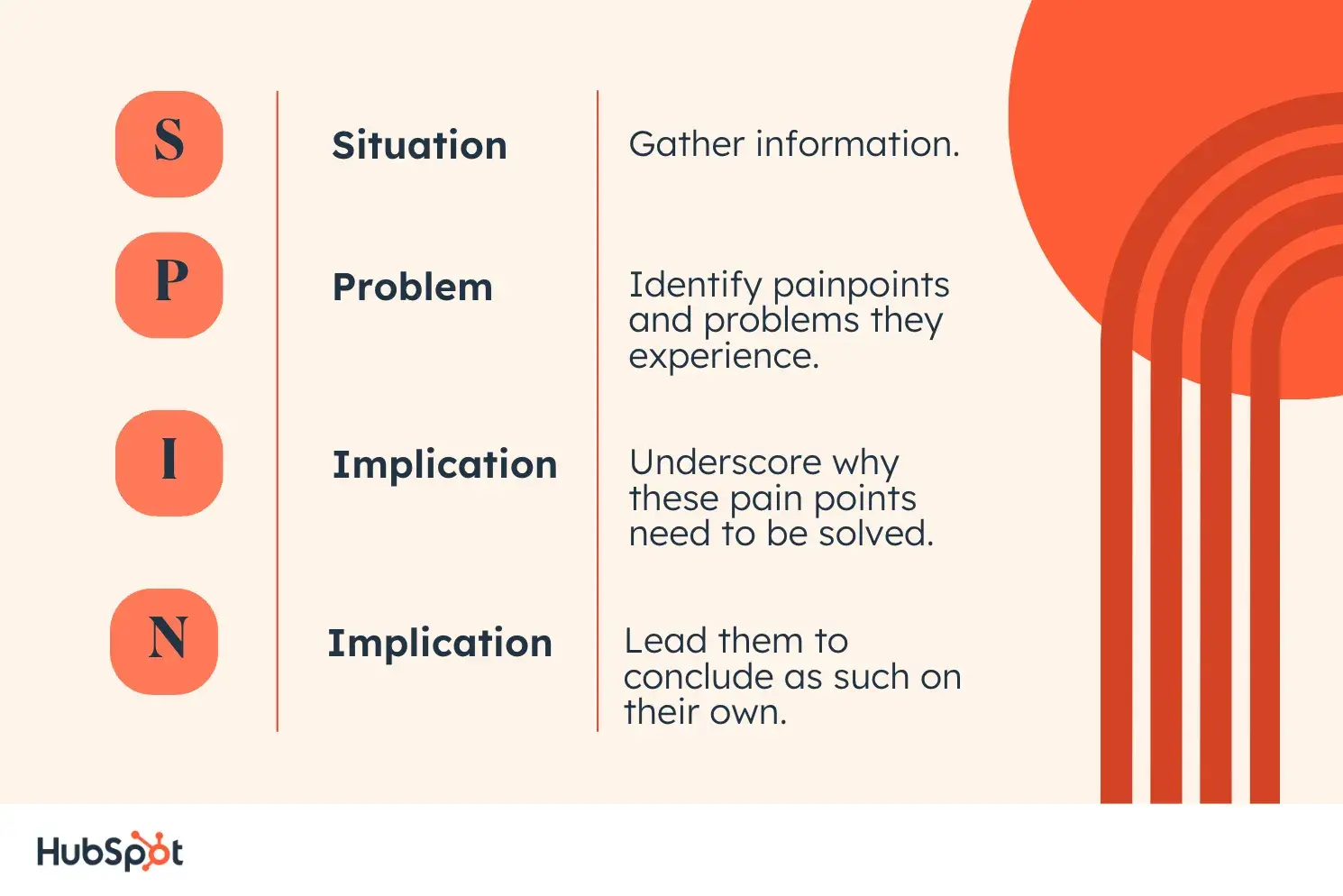
spin selling graphic

SPIN stands for the four stages of the questioning sequence:

  • S: Situation
  • P: Problem
  • I: Implication
  • N: Need Payoff

Situation

Ask questions about a prospect’s current situation to understand if and/or how they’re tackling the problem you solve. You have to learn more about buyers’ motivations and expectations for implementing your solution.

Example: Which tools do you currently use for [pain point]?

Problem

Probe into your prospects’ pain points to understand their specific needs. You have to identify the challenges you can solve to present a laser-focused positioning for your product.

Example: Are your current tools performing up to your expectations? If not, why?

Implication

Pose leading questions to help prospects realize more challenges associated with their status quo. These questions will nudge them to think about the gravity of the situation and create a greater sense of urgency to solve the issue.

Example: What's the productivity cost when these tools create delays?

Need Payoff

Ask questions to help buyers self-realize the value of implementing your solution. These questions will guide them to weigh the pros and cons of your solution, leading them to an informed purchasing decision.

Example: Wouldn’t it be simpler if you could [implement a solution]?

Let’s look at some more examples of SPIN selling questions.

50 SPIN Selling Questions to Add to Your List

Now that we know the function of each line of questioning, let's explore SPIN questions for each step in the questioning sequence.

SPIN Situation Questions

Use Situation questions to learn where your prospects stand — from their processes and pain points to competitive plans and results. These questions will depend on your product.

Let me explain this with one of my examples.

When I worked at a learning management SaaS, I spoke to a few HR managers every week. I always opened the conversation with the question, “How do you currently train new employees?”

This question prepared the groundwork for my entire pitch because it gave me insights to build on.

Here are some sample questions you can customize for your use:

Examples

  1. What is your role at [company]?
  2. How do you do X?
  3. What’s your process for X?
  4. Walk me through your day.
  5. Do you have a strategy in place for X?
  6. Who’s responsible for X?
  7. How long have you done X this way?
  8. Why do you do X this way?
  9. How much of your budget is assigned to X?
  10. Why do you do X this way?
  11. How important is X to your business?
  12. Who uses X most frequently? What are their objectives?
  13. Which tools do you currently use to do X?
  14. Who is your current vendor for X?
  15. Why did you choose your current vendor for X?

You’ll notice that this list doesn’t include fact-gathering questions about company size, number of locations, products sold, and so on.

When Rackham published “SPIN Selling,” there wasn’t anywhere near as much information available to sellers. Now that you can discover a long list of key details about your prospect with a quick online search, many situational questions are no longer effective.

These questions also leave less time for the most important ones. As a best practice, remember to do this research before the call and avoid these questions altogether.

SPIN Problem Questions

In this stage, reps identify the right opportunities to sell to a prospect.

In other words, what gap isn’t being filled? Why is the prospect dissatisfied? Your prospects may be unaware they have a problem. So, you have to identify problem areas where your solution adds value.

Examples

  1. How long does it take to do X?
  2. How expensive is X?
  3. How many people are required to achieve the necessary results?
  4. What happens if you’re not successful with X?
  5. Does this process ever fail?
  6. Are you satisfied with your current process for X? The results?
  7. How reliable is your equipment?
  8. When you have issues, is it typically easy to figure out what went wrong?
  9. How much effort is required to fix your tools or buy new ones?
  10. Are you happy with your current supplier?

SPIN Implication Questions

Once you’ve identified an issue, determine its severity. Implication questions reveal the depth and magnitude of your prospect’s pain point, simultaneously giving you valuable information for customizing your message and instilling urgency in the buyer.

According to Rackham, by the time you finish this part of the conversation, your prospects should have a new appreciation for the problem.

Rackham also says top-performing salespeople ask four times more Implication questions than their average peers.

Examples

  1. What’s the productivity cost of doing X that way?
  2. What could you accomplish with an extra [amount of time] each [week, month]?
  3. Would your customers be [more satisfied, engaged, loyal] if you didn’t experience [problem related to X]?
  4. If you didn’t experience [issue], would it be easier to achieve [primary objective]?
  5. Does [issue] ever prevent you from hitting your goals in [business area]?
  6. When was the last time X didn’t work?
  7. How is [issue] impacting your team members?
  8. Would you see a big impact on your team by solving [problems with X]?
  9. Would you say [issue] is a blocker in terms of your personal career growth?
  10. How have [problems with X] impacted your business performance?
  11. Would saving [amount of time] significantly affect your [team, budget, company]?
  12. How would you use an extra [amount of money] each [week, month, quarter, year]?
  13. Has a problem with X ever negatively impacted your KPIs?
  14. What are some downsides you’ve experienced when implementing X?
  15. Have you considered the cost versus benefits of replacing X?

SPIN Need Payoff Questions

Need Payoff questions encourage prospects to explain your product’s benefits in their own words. This is far more persuasive than listening to you describe those benefits.

You’re essentially asking questions that surface your product/service’s potential to help with their core needs or problems. These questions focus on your solution's value, importance, or utility.

Make sure your Need-Payoff questions don’t highlight issues your product can’t solve. For instance, if you help corporate recruiting teams identify potential engineering candidates, you shouldn’t ask about the impact of hiring better marketers.

Fortunately, it’s relatively simple to develop Need-Payoff questions — they should come directly from your Implication questions.

Sample Implication question: “Has a problem with X ever prevented you from meeting a deadline?”

Sample Need Payoff question: “If you could do X in half the time, would that make it easier to meet your deadlines?”

Examples

  1. Would it help if … ?
  2. Would X make it simpler to achieve [positive event]?
  3. Would your team find value in … ?
  4. Do you think solving [problem] would significantly impact you in Y way?
  5. Is it important for your team members to see X benefit so they can take Y action?
  6. Do you think [solution] could improve your overall efficiency?
  7. Can you think about the impact of eliminating [problem] with [solution]?
  8. How would your business benefit from [eliminating problem] more quickly?
  9. Could solving [problem] move the needle for your business faster?
  10. Do you think eliminating [problem] would [benefit]?

Remember to be careful when using Need Payoff questions since they can backfire. If they’re too obvious, you might come across as condescending.

So, try to reframe the solution in a way the buyer hasn’t previously considered.

For example, let’s take the following question: “Would your company benefit from saving money?” Instead, you could ask, “Would redirecting $1,000 per week from your content creation budget and putting it into Facebook advertising drive significant traffic toward your blog?”

The 4 Stages of the SPIN Selling Method

As you begin to implement SPIN questions when talking to prospects, consider the lifecycle of your conversation. Rackham says there are four basic stages of every sale:

  1. Opening
  2. Investigating
  3. Demonstrating capability
  4. Obtaining commitment

Opening

SPIN Selling and inbound sales take the same approach to the first/connect call. Reps shouldn’t immediately jump into their product’s features and benefits — not only will this overly aggressive strategy turn prospects off, but salespeople will lose the opportunity to learn valuable information.

The purpose of the connect call is to get the buyer’s attention and start to earn their trust. Lead with a compelling insight or thought-provoking question.

Investigating

Investigation is the most critical phase of SPIN Selling. It’s equivalent to the discovery call: You’re figuring out how your product can help the buyer, identifying their priorities and buying criteria, and gaining credibility by asking relevant, targeted, and strategic questions.

According to Rackham, a strong question strategy can improve your close rate by 20%.

Demonstrating Capability

Once you’ve connected the dots between your solution and the prospect’s needs, you need to prove that connection exists.

There are three basic ways to describe your product’s capabilities, Rackham says:

  • Features: Features are most useful when selling low-cost, simple products. A feature of a cup might be, “It can hold 10 ounces of liquid.” End-users tend to find features more compelling than decision-makers who care about the bottom-line results.
  • Advantages: Advantages describe how a product’s features are actually used. Like benefits, they’re useful for smaller purchases but less persuasive with larger ones. The advantage of a cup might be, “You can use it to drink both hot and cold beverages.”
  • Benefits: Benefits go one step further and show how a feature can help the prospect. They typically have a financial component and meet your customer’s need(s). A well-crafted benefit gives the buyer a reason to buy your product.

The FAB formula gives you another way to consider features, advantages, and benefits.

Because [product] has [feature] …

[user] will be able to [advantage] …

which means [prospect] will experience [benefit].

I often used this formula to create engaging sales pitches. Here’s an example of a sales pitch I wrote using the FAB formula:

Let’s fill in this formula for a salesperson offering employee gamification software.

Feature:“Our platform lets you design personalized learning paths catering to each role or team.”

Advantage:“This means your employees can access tailored training modules for every need, whether they’re onboarding, upskilling, or any other use case. All of this within a single platform.”

Benefit:“With tailored learning paths, your team will gain the exact skills they need, leading to higher productivity and faster achievement of business goals. By reducing time spent on generic training and improving retention, your company can save up to 20% on training costs while boosting employee satisfaction.”

Objections

Objections are inevitable in the buying process.

In fact, you should worry more if you’re not facing objections from your buyers. It means your prospects have reservations they’re not sharing with you.

Your goal is to discover why the buyer hasn’t already pulled the trigger on this purchase, then help them understand why their concerns aren’t true blockers.

(Of course, if there’s a valid reason your product isn’t a good fit, you shouldn’t persuade them otherwise.)

Rackham talks about two types of objections:

  1. Value: Your prospect isn’t convinced about your product’s ROI. They might say, “I like its features, but the cost is too high.”
  2. Capability: Your prospect doubts that your product can meet their specific needs. That translates to comments like, “I’m not sure it’ll be able to do X for us,” “That process seems like it would take more time than you say,” and “I think we need a more robust solution.”

You can further break down capability objections into:

  1. Can’t: Your solution cannot solve one of the buyer’s main priorities
  2. Can: Your solution can solve one of their main priorities, but they don’t perceive that

It’s important to prevent as many objections as possible. The majority of objections are actually avoidable if you avoid selling too soon.

Rackham’s research revealed that reps can cut the number of objections in half by using implication and need-payoff questions to build value before presenting a solution.

In the traditional sequence, the salesperson asks a Problem question. Then, they use the prospect’s answer to offer the corresponding product feature.

However, the rep usually doesn’t have enough context to truly understand what the prospect is trying to accomplish or what’s blocking them. Their generic, one-size-fits-all answer prompts the buyer to push back — and they're probably not going to listen to any of their future suggestions.

Try the SPIN sequence instead. Ask a Problem question, probe into the consequences with Implication questions, then ask the buyer to recognize the value of a solution with a Need-Payoff question.
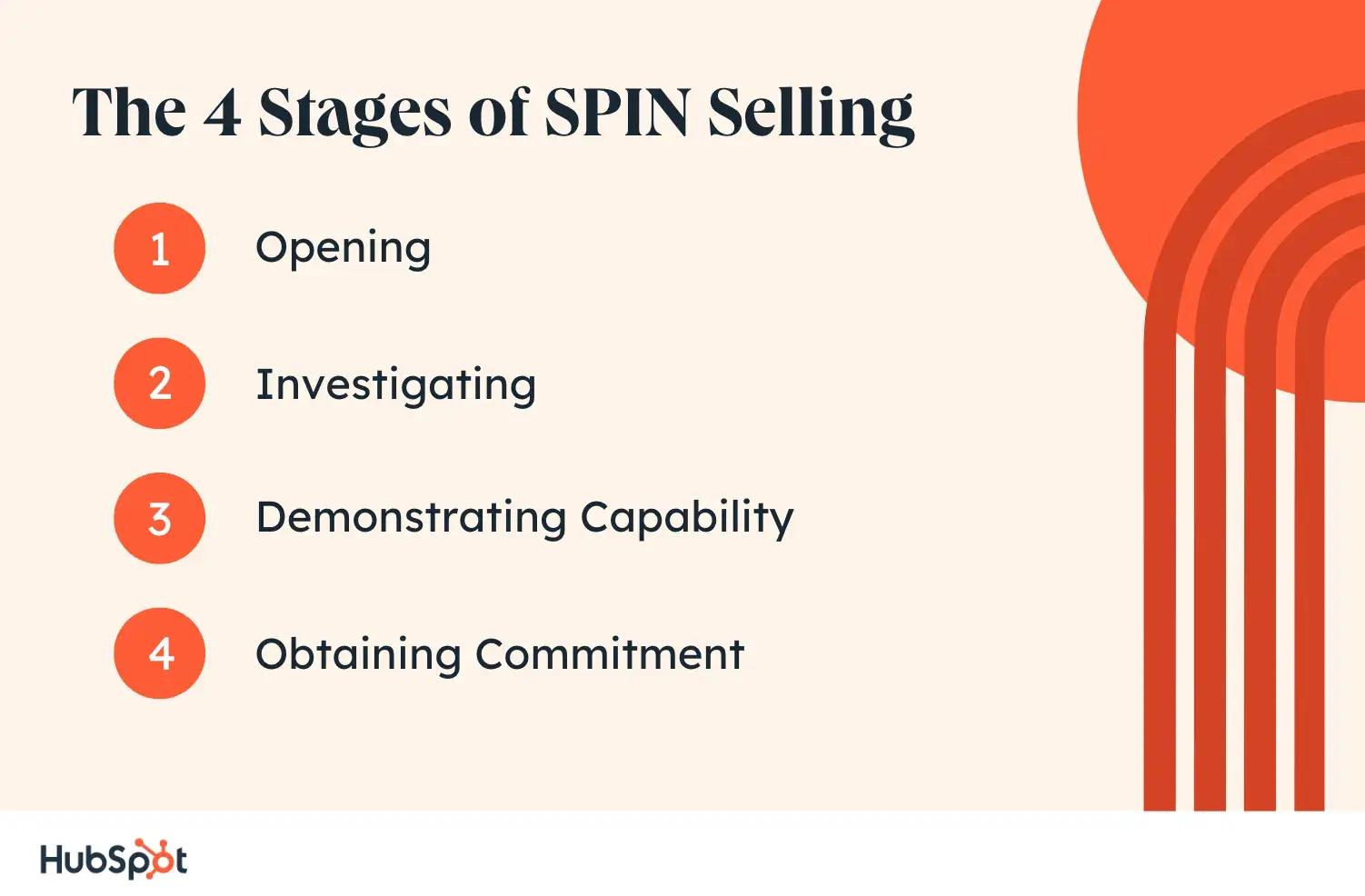
spin selling stages

Outcomes for Measuring Progress in SPIN Selling

I’ve heard dozens of sales calls in my many roles as a content marketer.

My experience tells me that transactional salespeople — those focused on simply closing the deal quickly — move through all four SPIN stages in a single sales call.

However, reps working on larger, more complex deals might take two months to two years to complete them. In cases like these, there are four possible outcomes for each sales call in the SPIN selling methodology:

  1. Advance
  2. Continuation
  3. Order
  4. No-Sale

Advance

To help mid-market and enterprise salespeople measure their progress, Rackham uses the concept of “advances.” An advance is an action the buyer commits to that brings you closer to a purchase.

The operative word is action. It’s tempting to interpret your prospect’s request for more information or a proposal as a buying signal, but that puts the ball entirely in your court. If the buyer is actually interested, they’ll agree to do some work as well.

Continuation

A continuation is a sales conversation that ends with an undesirable outcome. In other words, when you finish the call or meeting, the buyer hasn’t agreed to any next steps that will advance the deal.

Example advances include the prospect reviewing your pricing page and sending you their questions, signing up for a free trial and exploring the tool, or introducing you to a key stakeholder.

Come up with as many valuable advances as possible. The more paths to the sale you have, the likelier you are to get there. When your prospect turns down one of your advances — for example, an introduction to Procurement — you can calmly accept the rejection and then propose something else.

Order

An order is the third potential outcome of a sales call. The buyer agrees to purchase your product and shows their strong desire by signing paperwork. For large deals, this is usually the last outcome in a series of progressively larger closes.

No-Sale

A no-sale is the fourth (and least desirable) outcome. Your prospect rejects your request — you can’t meet with the decision-maker, they won’t schedule another meeting, or at the most extreme, they say there’s no possibility you’ll work together.

7 Tips for Modern-Day SPIN Selling

I know that “SPIN Selling” was published more than 30 years ago. While its core techniques and principles are still relevant, the typical buying journey has evolved over the past few decades.

If you use the SPIN model to sell to the more discerning buyer, you should add your own spin to it. Here are some of my best practices for adjusting the SPIN selling method in the present-day sales landscape.
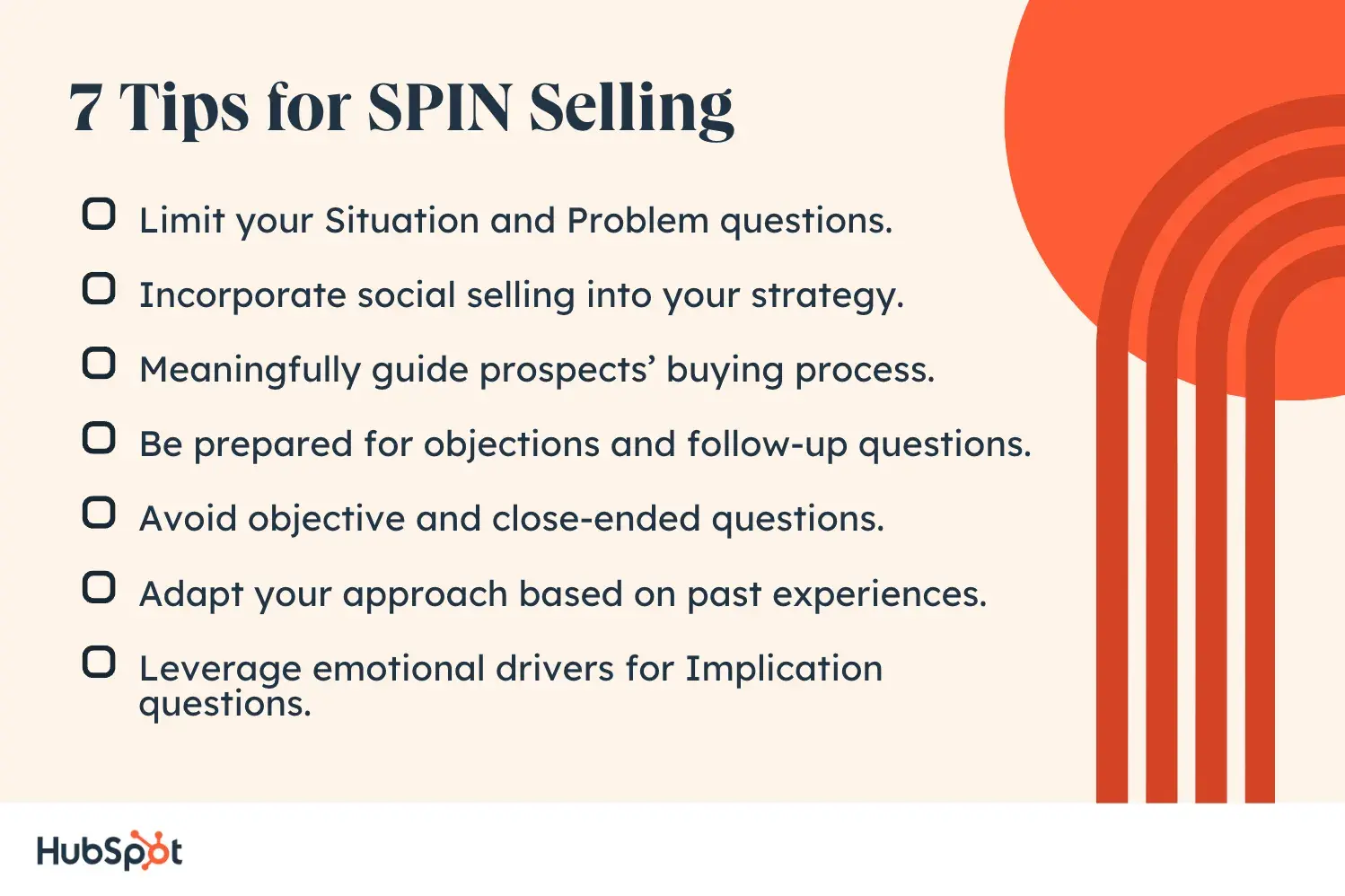
spin selling tips

1. Limit your Situation and Problem questions.

Fact: Prospects don’t have the patience to help you do your homework.

Buyers don’t want you to share details to help you identify the pain points they face every day. Instead, they’re more interested in finding ways you can solve these problems.

So, you can create value through your conversations by asking questions to:

  • Help buyers realize the opportunity cost of their current challenges
  • Share the value of your solution and guide prospects to discover these benefits

With that in mind, use thought-provoking questions like the following:

  • Has your organization ever considered [new strategy]?
  • Do you know [surprising statistic]?
  • Would you like some recommendations for preparing for [impending industry event]?

Rackham didn‘t give these questions their own category, but they’re definitely useful in modern sales.

2. Incorporate social selling into your strategy.

When Rackham came out with “Social Selling,” LinkedIn didn't exist.

Now, you have far more insight into your buyers‘ perspectives, priorities, and personalities than salespeople in the late ’80s could ever have imagined. Don't let this valuable resource go to waste.

Read your prospect‘s profile(s), browse their group comments and any articles they’ve written or shared, check out their Recommendations section to get a feel for their work ethic, and so on.

The goal is to become as familiar with each individual as you can before your kick-off sales call so you can engage them like it's the fifth meeting, not the first.

3. Meaningfully guide prospects’ buying process.

As the average number of stakeholders involved in every B2B deal grows larger and internal buying processes become more complex, your expertise gets more valuable.

Prospects need you to help them purchase your product like never before. Come prepared with the job titles — and potentially names, if you can find them — of their coworkers who need to be informed or consulted.

Tell your point of contact what their manager is going to want to know before they approve the decision, and send them materials to make their presentation more compelling.

Work with your contact to anticipate and avoid roadblocks. Liaise with Procurement and/or Legal when necessary to get the deal over the finish line as quickly and easily as possible. Although Rackham didn‘t give these recommendations in "SPIN Selling," they’re one of the most effective ways to differentiate yourself in modern sales.

4. Be prepared for objections and follow-up questions.

When you ask many questions, it’s important to diligently listen to prospects’ responses. You have to practice active listening to grasp every insight buyers share.

More importantly, you should be ready to tackle objections and answer follow-up questions.

The SPIN method can only be effective when you address all your prospects’ questions and concerns. Instead of making it a one-way conversation, understand their objections and offer meaningful resolutions.

5. Avoid objective and close-ended questions.

Another best practice when using the SPIN selling method is to motivate prospects to share as much information as possible through open-ended questions.

A close-ended “yes” or “no” question wouldn’t move your conversation forward. It can also feel like a survey rather than a helpful sales conversation.

Your goal should be maintaining an engaging and insightful dialogue where both parties discuss the best ways to solve buyers’ pain points. So, ditch close-ended questions and replace them with purposeful questions that prospects are eager to answer.

6. Adapt your approach based on past experiences.

While the SPIN selling framework looks rigid in its rules, you can flexibly adjust it based on your prospect interactions.

Revisit conversations with potential customers and identify which questions led to a positive insight or a helpful response. Collect similar questions from multiple conversations to continuously experiment and adapt your SPIN selling approach.

Remember that each prospect will react differently to these questions. You have to assess their temperament and modify the questions based on their responses.

7. Leverage emotional drivers for Implication questions.

The Implication phase should guide buyers to your solution. These questions have to help prospects realize the value of your solution on their own.

A surefire way to ask more influential Implication questions is to connect emotional drivers to each question. Talk about aspects that personally affect your prospects or their teams.

For example, I’ve often asked implication questions related to team morale.

I ask questions like “How would solving [current problem] improve your team’s performance and efficiency?” This allows a potential customer to emotionally analyze the solution and weigh its benefits.SPIN Sales Training FAQ

What does SPIN sales training cover?

As you might expect, SPIN sales training covers the fundamental skills salespeople need to master to have a firm grasp of the SPIN selling process. Here's what that can include.

Uncovering Pain Points

Successful SPIN selling rests on a salesperson‘s ability to uncover a prospect’s pain points organically and effectively. That requires knowing how to identify and express certain conversational patterns — letting reps demonstrate value and make high-impact benefit statements. SPIN Training provides the insight that can inform that kind of dialogue.

Personalizing Sales Conversations

SPIN Sales is a brand of consultative selling — a method that requires a personal touch. If you're going to have a one-on-one advisory conversation with a prospect, you need to be able to tailor your approach to suit them as individuals. SPIN sales training gives you the right questions to ask and tactics to leverage that will help you get there.

Moving Away From Product-Driven Sales Pitches

SPIN selling is about taking a more human approach to sales. That's why many SPIN training programs include time dedicated to finding and understanding alternatives to product-driven sales pitches in favor of efforts driven by articulating value.

Incorporating SPIN Tactics Into Proposals and Presentations

SPIN tactics aren't reserved solely for immediate conversations with prospects — they can also have a place in broader communications like proposals and presentations. Many SPIN Training programs offer guidance about how to incorporate those strategies into those kinds of efforts.

SPIN Sales Training Vendors

There are a few different outlets that provide SPIN training to salespeople — two of the most prominent being The Miller Heiman Group and Huthwaite International.

Miller Heiman Group

The Miller Heiman Group offers both virtual and in-person SPIN sales training. Its program focuses primarily on elements of the methodology like uncovering buyer urgency, increasing the value of the sale, tackling buyer skepticism, and accelerating the sales cycle. They provide in-person training at your location, and pricing information is available upon request.
miller heiman group

Source

Huthwaite International

Huthwaite International is another SPIN training option that offers both virtual and in-person courses. It boasts an impressive list of clients served and offers a robust suite of classes related to different applications of the methodology — including SPIN coaching, marketing, and account strategy. Like Miller Heiman, Huthwaite International's prices are available upon request.
huthwaite international

Source

Paying for Training vs. Reading the Book

A few factors dictate whether you‘re better off paying for a full-scale training program or just reading Rackham’s book — namely, your team‘s size, your familiarity with the methodology, and the degree to which you’re interested in incorporating the strategy into your operations.

Team Size

If you‘re looking to incorporate the SPIN methodology into a bigger team’s operations, you‘re probably better off paying for a full-on training program. It’s tough to rely on everyone in a large organization to read a book on their own time.

An actual course makes it easier to hold your team members accountable and on the right track. If your team is smaller — or you, personally, are interested in learning about the methodology on your own time — it will probably serve you to go with Rackham's book, itself.

Familiarity With the Methodology

If you and your team are starting from scratch when it comes to understanding SPIN selling, you‘ll likely want to invest in a full course to better understand the ins and outs of the methodology. If you’ve incorporated these kinds of tactics into your sales efforts and are interested in a refresher, reading the book is probably more appropriate.

You’re Ready to Leverage the SPIN Selling Method

SPIN selling puts buyers at the center stage. This method combines empathy with effectiveness. Consider looking into the strategy if you want to incorporate a thoughtful, consultative approach that delivers results into your broader sales efforts.

As a sales rep, you have to handhold and guide prospects through the sales process instead of forcefully pushing a deal.

Having tested this sales methodology, I can say that the SPIN framework is a well-defined and systematic way of steering sales conversations.

You can easily train your sales staff to implement this method with template questions (like the ones I shared) and mock calls.


04 May 15:46

The 5 Quota-Killing Mistakes Only Experienced Salespeople Make

by jeff@mjhoffman.com (Jeff Hoffman)

Who's likelier to make a mistake: The rookie sales rep who's never sold a day in their life, or the veteran rep who's been on the front lines for nine years?

The reality is, they're both going to screw up. Experienced salespeople simply make different mistakes.

Here are the five biggest errors I see seasoned reps make -- along with the steps you can take to avoid them.

Download Now: How to Set and Meet Sales Quotas

The Top Quota-Killing Mistakes

1. They over-qualify.

Successful salespeople pay attention to their customers' commonalities. This helps them hone in on the most lucrative buyer personas and disqualify poor fits.

Unfortunately, many start to believe there's only one "recipe" for a good customer. In other words, they over-qualify.

To give you an example, suppose a rep sells in a competitive landscape. They noticed they enjoy a high success rate when they talk to prospects 90 days before their contract renewal.

When a buyer who's six months away from renewing their contract falls in their lap, the rep thinks, "That's not the DNA of my typical buyer; I'm not going to invest in the opportunity."

This mentality can really depress a salesperson's potential earnings.

I recommend that at any given time, 10-15% of the deals you're working should be risky. If you have 20 in your pipeline, two or so should be opportunities you're not comfortable forecasting. You'll maintain a predictable revenue without leaving valuable money on the table.

2. They lean too heavily on existing champions.

As salespeople become comfortable in their role and territory, they begin to develop strong relationships with certain customers. In fact, the longer a salesperson stays in a role, the more account champions they usually have.

But familiarity breeds complacency. As soon as the rep gets comfortable and assumes they're guaranteed their customer's business -- both current and future -- they expose themselves to the competition. By far the biggest reason smaller, scrappier suppliers can kick out long-standing vendors? The incumbent stopped truly working the account.

To avoid this fate, use a multi-threaded approach. Every month or quarter, ask yourself:

  • "Do I know who all of the current customer stakeholders are?"
  • "Who's left since I last surveyed the account? Who's joined? Who's gotten a promotion? Who's moved teams?"
  • "Which business units, departments, or office locations should I target next?"

Challenge yourself to add at least one new contact to your CRM every quarter. If there's an opportunity to expand the account, you should be adding a new opportunity into your pipeline every year.

I don't recommend asking your champion to make these introductions for you. Not only is it a big ask, they don't always know the people you should be speaking to.

Instead, be upfront and tell them your objectives. Make them feel important by offering to include them in your conversations.

Here's a script you can use:

"I've worked with you for [X months, years] and [company] for [Y months, years]. You're an amazing client. This year, I'm going to talk to more people -- my goal is to speak with one new [business unit, team, department, stakeholder, user] each [month, quarter]. When I reach out, would you like to be included on those calls?"

3. They stop learning.

According to HubSpot Research, the majority of salespeople with five-plus years of experience say that when they find something works, they don't change it.

That's an issue. While a tactic or technique may have been very effective in 2010, 2012, or even 2018, technology, industries, jobs, and people change. Continual success depends on continual learning, practice, and evolution.

I'll give you the perfect example. I asked a group of salespeople I was training to describe the purpose of an email subject line. They unanimously agreed it was convincing the prospect to read the email and summarizing its contents.

If it were 2005, that would have been a great response. However, in 2019 email subject lines have a different purpose. Buyers don't really care about them -- but spam filters do. Use the wrong words or format, and your prospect's email client will send your message straight to the spam folder.

To ensure you're keeping your skills sharp and current, read sales blogs (like this one or my own), subscribe to sales podcasts, attend training, proactively request feedback and guidance from your sales manager, go to sales conferences and networking events, or ask the other salespeople on your team what's working for them. You probably don't have time for all of these, so pick two or three strategies to focus on.

4. They haven't networked within their company.

Let's say a salesperson joins their company when there are 500 employees. Fast forward a few years later and the business has grown to 1,500 employees.

While they might think they've exhausted all of their networking options, the salesperson hasn't taken into account all the new people who have joined.

These individuals can be a valuable source of knowledge and potential referrals. It's important for even the most experienced salesperson to continue networking and meeting colleagues at their company. If not, they're missing out on opportunities for new prospects and potential customers.

5. They ignore the importance of small deals.

Small deals are important. If you take a look at the salespeople who meet their quota, they often have a mix of smaller deals that helped them meet their goal.

Those that exceed quota during a quarter often had large deals that closed during that time period. But there's risk associated with larger deals. 

For example, a salesperson hit the following quota percentages:

  • Q1: 105% of quota
  • Q2: 99% of quota
  • Q3: 44% of quota

A junior manager might look at that performance and assume the salesperson didn't had a weak pipeline and didn't do enough prospecting when they didn't hit quota. While a more experienced manager would look a bit deeper and look at the breakdown of the deals in their pipeline. It's likely the performance from the first two quarters was attributed to larger deals.

Instead of looking solely at monetary performance, salespeople should pay attention to units, or the number of deals they have. Let's say salesperson #1 has a pipeline forecast of $90,000 that's made of six deals. And salesperson #2 has a $100,000 forecast made of three deals. Salesperson #1 would be in a better place than salesperson #2 if one of their deals fell through because salesperson #1 has multiple deals to fall back on. And salesperson #2 isn't able to recover as easily.

It wasn't because they had a bad pipeline; it was because they were making quota based on a few big deals. Remember, don't overlook the smaller deals that make up quota-achieving reps' numbers.

Rookie or veteran -- you've got to keep learning and moving forward. To learn even more, check out these sales closing techniques next.

sales quotas

04 May 15:46

Understanding Selling Challenges in 2017: Buyers’ Decisions Insights

by Andrea R. Grodnitzky

Richardson’s annual research survey of field reps, senior sales professionals, and sales leaders across industries aims to paint a clear picture of existing sales challenges and how they are evolving. We asked 350 sales professionals to tell us about the biggest challenges their buyers face when making purchasing decisions.

  • 26% said combating the status quo would be the greatest challenge their buyers face making purchasing decisions in 2017
  • 21% said comparing their options would be the greatest challenge their buyers face making purchasing decisions in 2017
  • 16% said building internal consensus would be the greatest challenge their buyers face making purchasing decisions in 2017

Buyers can be too comfortable with the status quo, adverse to the risk of something new and hesitant to stretch outside of their current comfort zones. They may be tired of change or skeptical. Even those who welcome change may feel degrees of concern, stress, or anxiety.

Comparing options is made increasingly complex with the more information there is to consider. When sellers present something that buyers consider irrelevant or not tied to their specific issues, it only adds to the noise in decision making.

With more decisions being made by committee, building internal consensus grows more difficult. Sellers who engage all stakeholders, providing relevant insights and demonstrating value, can help move the process along.

Richardson’s Insights into Buyers’ Decisions 

Creating a compelling case to combat the status quo doesn’t just mean sharing impact data. As mentioned earlier, impact shared must be specific and relevant to your buyer. To combat the buyer’s status quo, sellers should highlight the loss or risk associated with not changing. Address missed opportunity costs — the benefits unrealized — by staying put, and outline a clear path forward to make the change decision easier to make.

Remember, buying is an emotional process. Don’t forget to highlight the opportunities and potential for your buyer as well.

Help buyers compare options by presenting personalized insights, information, and perspective based on credible research or relevant experiences. Avoid overwhelming buyers with too much (and irrelevant) information.

Sellers cannot rely solely on an individual buyer — their initial contact — to build internal consensus for their solution. Sellers need to consider all stakeholders and the lens each one uses to view value: financial, technical, strategic, or partnership. The preferred lens is often reflected in the questions they ask, and sellers should position the solution to resonate with individual stakeholders and their value lenses. Sellers can also support their contacts
by providing additional materials, working alongside them, and building their own relationships with stakeholders.

Click here to download Richardson’s complimentary report, “Understanding Selling Challenges in 2017.”


buyers' decisions insights from RichardsonConnect with us at 215.940.9255 or info@richardson.com to learn how we can help your sales organization with its current challenges.

The post Understanding Selling Challenges in 2017: Buyers’ Decisions Insights appeared first on Richardson Sales Training & Enablement Blog.

04 May 15:45

Southern Discomfort: How the U.S. helped quash Canada’s ambitions to become an LNG superpower

by Jesse Snyder
Click to enlarge
Click to enlarge

FREEPORT, TEX. — Tucked behind a row of stilted houses in the grassy marshland of south Texas, a product of the U.S. rush into liquefied natural gas is taking form. A cluster of cranes stand high above the construction site of Freeport LNG, their arms swivelling back and forth in wide, slow arcs, while heavy trucks kick up dust into the humid March air.

Once completed in late 2018, the US$13-billion facility will liquefy 2.1 billion cubic feet of gas per day, which will be transported onto supertankers and shipped to overseas markets. Like other projects in the region, Freeport was initially built as a regasification plant to do just the opposite: convert imported LNG into gas for domestic use.

“Then the world just slowly flipped on us,” said Sigmund Cornelius, president and chief operating officer of Freeport LNG, who was involved in the original construction of the facility led by ConocoPhillips Co.

By the time that project was completed in 2008, new drilling technologies such as fracking had unlocked massive volumes of oil and natural gas in the U.S., turning global energy markets upside down.

What followed was a frenzied jockeying for position in the fast-emerging LNG space, as Asian demand for the supercooled gas soared. Public and private investors began pouring billions into capital-intensive LNG export facilities in Australia, Qatar, Russia and Mozambique, but one of the biggest winners was the U.S.

U.S. companies will bring online 5.5 bcf/d of new export capacity between 2016 and 2020, accounting for roughly 10 per cent of the global supply. Cheniere Energy Inc.’s Sabine Pass facility shipped its first gas in February 2016, while four other projects are currently under development.

Cheniere in April also announced it would be the first U.S. company to ship LNG to a former Soviet bloc country as Europe seeks to cut its dependence on fuel from Russia. Poland’s state-owned PGNiG SAwill take delivery in June.

The rapid expansion down south will eventually make the U.S. the third-largest exporter of LNG, behind Qatar and Australia, according to analysts at Columbia University’s Center on Global Energy Policy. 

Notably absent from the list of important players is Canada, despite its longstanding ambition to be an LNG superpower. Of the 20-odd LNG facilities proposed in B.C. alone, only the modest 0.3 bcf/d Woodfibre LNG project appears to be moving ahead. Other larger approved projects are delaying final investment decisions.

Today, any talk of LNG in Canada more or less involves political hand-wringing, while its southern neighbour is realizing its LNG ambitions.

The surge in LNG export capacity comes as global natural gas markets undergo radical change, with the U.S. asserting itself as the dominant player. 

“A decade ago we thought we were going to be the world’s largest LNG importer,” said Chris Pedersen, an analyst at S&P Global Platts in Houston. Now, the U.S. is expected to be a net energy exporter by 2026, according to the Energy Information Administration. 

Pedersen and other experts point to a variety of factors that made the U.S. a hotbed for LNG development, including public policy advantages, existing infrastructure and low upstream costs.

Perhaps the most obvious U.S. advantage is the vast network of existing natural gas pipelines and regasification plants in Texas and Louisiana, which gave project proponents a leg-up in terms of costs. A report by RBC Capital Markets report in 2014 found that construction costs in the U.S. Gulf Coast were the lowest among five competing countries (Canada was among the lowest-cost jurisdictions in upstream development).

Existing infrastructure in the U.S. provided would-be LNG exporters with a guaranteed and versatile gas supply, allowing them to focus solely on securing overseas buyers.

Freeport LNG, for its part, operates strictly under a terminal model, whereby the company liquefies domestic gas and then loads it onto supertankers. Third-party companies are responsible for the production of the gas, as well as the transportation of LNG to overseas buyers.

That simplicity allowed Freeport to focus specifically on securing long-term contracts, Cornelius said, and the company has signed buyers based in Japan, South Korea and Great Britain.

Moreover, it entered its search for buyers at a time when the world was aggressively looking to shift away from coal and nuclear energy sources in favour of natural gas. “We were very lucky with our timing,” he said.

Project proponents in B.C., meanwhile, are dealing with far more complicated developments. Canadian proposals typically involve companies that are fully integrated from the upstream gas development to the overseas transportation.

Moreover, the four proposed pipelines that would connect gas fields in northern B.C. to export facilities on the coast would need to be built from scratch, and cut through large swathes of undeveloped and contested First Nations lands.

Critics say the B.C. government, for its part, scared away investors when it floated a two-tier tax system in early 2014 applicable solely to LNG development. One industry expert who consulted directly with the B.C. government said there was a lack of awareness around the level of cost competitiveness posed by other countries.

“I think there was an arrogant belief that B.C.’s proximity to Asia and its accessibility was enough to mitigate that competing factor,” said the person who asked not to be named. “And that wasn’t enough.”

A comparably relaxed regulatory system in the U.S. also allows projects to move ahead quicker.

Handouts Freeport LNG project
Handouts Freeport LNG projectOngoing construction of the Freeport LNG project in Texas. Once completed in late 2018, the US$13-billion facility will liquefy 2.1 billion cubic feet of gas per day, which will be transported onto supertankers and shipped to overseas markets.

Freeport first applied to federal regulators with a notice of intention to file an environmental assessment in 2011. By the end of 2014, it had secured its necessary environmental permits, export licences and other legal documentation, and was moving ahead with construction.

This was perhaps due partly to the more easy-going attitude of Texas locals, who do not carry the same historical grievances as Canadian First Nations: to circumvent opposition to the project, Freeport simply bought the homes of some 50-odd locals at a premium.

The Pacific NorthWest LNG project proposed for Prince Rupert, B.C., began its feasibility studies at roughly the same time Freeport did, and only received conditional approval from the federal government in September 2016.

Decisions on U.S. LNG projects should now come even faster since the Senate passed a bill in April 2016 compelling the Department of Energy to make decisions on such projects within 45 days of an environmental assessment. 

Even so, the question today is instead whether there will ever be adequate space for new entrants into the LNG market. The global LNG race kicked off such a frenzied expansion in capacity that prices have since plummeted amid a deep supply glut.

“Whether [Canada] missed the boat or dodged a bullet is kind of a tough call right now,” said Ian Archer, an analyst at IHS Markit Ltd.

So much LNG is currently sloshing around the globe that operators now say thriftier buyers have begun seeking re-negotiated contracts at lower prices. In 2015, IHS released a report estimating that only five of the 90 global LNG proposals on the go would be required to meet demand until at least 2020.

Further muddying the outlook for LNG is that costs for renewable sources of electricity such as wind and solar fell far more sharply than analysts predicted only a few years ago. Sluggish economic growth projections in some developing countries also caused LNG demand expectations to taper off.

Yet many analysts now predict that LNG markets could balance in coming years, potentially cracking open another opportunity in the mid-2020s.

“The global growth story for gas is still positive, it’s just at a slower trajectory than perhaps people were saying five years ago,” Archer said.

Click to enlarge
Click to enlarge

Canadian producers have begun moving on. Many have been forced to enter alternative markets, and some are beginning to export gas to overseas markets via U.S. LNG terminals. For example, Calgary’s Seven Generations Energy Ltd. has signed a supply contract with Cheniere Energy, according to news reports.

The growth of U.S. LNG is unlikely to end any time soon. McKinsey & Co. analyst Peter Lambert said in a 2015 research note that expansions to existing brownfield projects — ones already in progress — in the coming years “could push out other LNG projects in the U.S., Canada, or elsewhere in the world.”

The preparations for such expansions are already taking place in flat marshland of the U.S. Gulf Coast.

At the Freeport LNG construction site, there is a yet-untouched patch of concrete where the company plans to construct its fourth liquefaction facility, or “train,” to boost its capacity. It plans to apply soon to federal regulators for the roughly US$3-billion expansion.

That expansion alone could threaten to nudge out yet another Canadian LNG hopeful, now watching from afar as a mere spectator.

Financial Post

jsnyder@postmedia.com

Twitter.com/jesse_snyder

04 May 15:42

Marketing Needs to Focus on Opportunity Creation, Not Leads

by Anthony Iannarino

Marketing is more about creating opportunities than creating leads.

Marketing believes it is their role to create leads. Sales believes it is marketing’s job to create ready-to-buy leads, or leads so far down the path that they are easily closed.

Marketing does what is necessary to generate leads, especially on the web where information is easily captured. They put up pages to capture leads, offering free content like white papers and thought leadership pieces. They host webinars to capture the contact information of people who are interested in some topic related to what their company sells. As a measurement of effectiveness, names and contact information is one KPI, even if it doesn’t speak to the effectiveness of the actual marketing.

What marketing is supposed to do is generate awareness and interest that can be converted into an opportunity. All of the above tactics generate awareness, but not necessarily interest. Most of the content delivers the wrong message. What marketing needs to do to better serve their organization and their sales force is to create a case for change.

Opportunities are created when someone believes they have a reason to change. The message that marketing needs to create needs to focus on compelling the people in their target markets to change.

  • What message will explain why the people in your target need to do something different?
  • What is the price of inaction, should your dream clients do nothing? What do they give up by not taking action?
  • What does their future need to look like to survive and thrive in a world of accelerating, disruptive change?

What marketing needs to do now is make the case for change and arm the sales force to do the same. Sales is about two things: opportunity creation, and opportunity capture. Marketing needs to do more to create opportunities, and not focus so much time and attention on names and contact information; something that can be bought for a few bucks, and invest more attention on creating opportunities, something more precious.

The post Marketing Needs to Focus on Opportunity Creation, Not Leads appeared first on The Sales Blog.

04 May 15:42

Sales Navigator on the Go: Become a Mobile Power User

by Alex Chiocchi
  • sales-nav-on-the-go

A recent sales productivity study found that today’s sales reps spend 20% of their time on admin and reporting work and just 32% selling to customers. With all the admin work, meetings, and other distractions sales pros deal with, mobile productivity has become a key differentiator. Whether you are an inside sales rep or a seasoned road warrior, you are on the go at some point during the day.

To help you boost productivity while hustling, here are three Sales Navigator power user tricks for achieving success with a Smartphone.

In-Transit

Whether you are on the bus or train to work, or out visiting clients, put your spare moments to good use.

When prepping for a meeting, easily access all relevant information about the account from the app. Because of the integration with CRM systems, Sales Navigator will automatically display relevant insights from the accounts and leads you’re actively working.

If you’ve already used Sales Navigator to save accounts or Lead Builder to create lead lists, you'll be able to see the shares and updates of those companies and individuals. Spot a trigger event, such as a new round of funding? Reach out via an InMail message to start a conversation, then keep the conversation going right in the app. 

Or you can use filters to search for people in specific roles within specific companies or industries and then take advantage of Spotlights to find leads that have TeamLink Introductions. You can even map out a prospect’s organization by looking through the “People Also Viewed” section of the prospect’s profile to identify colleagues.

  • advanced-search-sales-nav-mobile

Waiting for Coffee

If you’re in a long line at your favorite coffee shop, embrace the wait. Take the time to get up to speed on existing accounts & view messages. Check for notifications that your leads have published content or that an account has announced a major initiative. Never miss a client communication either with notifications of InMail responses and messages. At the very least, you’ll already be ready to hit the ground running as soon as you get to the office.

If you are trying to build pipeline, while sipping your latte, check out the Discover tab to view and save daily lead and account recommendations based on your preferences. Lead recommendations display all LinkedIn profile information, including the person’s headline, current position, location, and shared connections. Account recommendations show relevant industry information and mutual connections.

  • discover-sales-nav-mobile

Networking at Conferences

Conferences and other events can be terrific places to make promising connections. The key is to find the right people, and then capture all your notes and take steps to maintain the relationship once you’ve met face to face.

When you meet key people at an event – whether through a scheduled meeting or serendipitously during the course of the event – save them as a lead and invite them to connect. Once they are saved, you can also tag them, such as with the name of the conference. You can even add additional tags after saving them – such as “decision maker” – for more detailed categorization. Tags aren’t visible to your contacts but they will help you keep track of where you met and why the connection matters.

In the “Note” field of a saved person, you can write any pertinent information you’d like to remember about the connection. Remind yourself whether you made this connection at a specific conference session, at the after party, or somewhere in between. The information you store in your saved contacts is private, so you don’t need to worry that your connection will see what you’ve jotted down.

  • sales-nav-notes-and-tags

Sales productivity shouldn’t stop when you leave your desk. Keep your finger firmly on the pulse of your sales world with the Sales Navigator mobile app.

For even more ways to use Sales Navigator to its full potential, download our eBook, How to Maximize LinkedIn’s Value with Sales Navigator.

04 May 15:42

Creating a Profit-Center Marketing Department – An Interview with Matt Heinz (Part 1)

by Nathan Isaacs

Creating a Profit-Center Marketing Department – An Interview with Matt Heinz (Part 1)

In this episode of the Rethink Podcast, Act-On CMO Michelle Huff interviews Matt Heinz about building a profit-center marketing department. As Matt says, you can’t buy a beer with an MQL, but you can with a closed deal.

Matt is president and founder of Heinz Marketing, a B2B marketing and sales acceleration firm. Matt is often recognized as among the Top 50 Most Influential People in Sales Lead Management and among the Top 50 Sales & Marketing Influencers.

This is Part 1 of their conversation. Matt discusses operational versus business metrics, sales and marketing alignment, the buyer’s journey, benefits versus features, and marketing tactics.

This transcript has been edited for length. To get the full measure, listen to the podcast.

Marketing’s Operational Metrics vs. Business Metrics

Michelle Huff:

Matt, for those of us who aren’t familiar with you, maybe you can spend a few minutes on who you are and who is Heinz Marketing.

Matt:

For those of you who don’t know Heinz Marketing, we are a B2B sales and marketing consulting firm. I tend to describe us as ‘sales pipeline people,’ even though we really are working primarily in the marketing side. We’re working with companies that want to grow their business, want to increase the sales output of their sales and marketing efforts.

We think a lot in terms of creating profit-center marketing departments, helping marketers be measured based on the sales and revenue and business output of what they’re doing, as opposed to the traditional operational measures like open rates, and click rates, and even MQLs that a lot of companies are rightly focused on. But at the end of the day you can’t buy a beer with an MQL. You can buy a beer with a closed deal. And so the more we can help marketers align behind metrics you can buy a beer with ‒ and ideally how that changes the way they operationalize and prioritize our efforts ‒ the better.

Michelle:

If someone’s trying to shift how they’re perceived and viewed, how do you really do that? What would be that first step to be moving toward being a profit-centered marketing organization?

Matt:

Well, there are a couple things. First, you have to understand that your job in marketing is the same as the sales team. The sales team may be sitting at the table when the prospect signs on the line that is dotted. But marketing needs to be responsible for the same metrics. And when you can align and prioritize what you’re doing based on the right outcome, it starts to align the metrics you’re focused on and need to be focused on as well. There’s a big difference between your operational metrics and your business metrics.

A lot of marketers stop at the operational side. You look at the dashboard for most marketers, and it talks about open rates, and click rates, and social engagement ‒ and that’s all fine and good. It’s all important. But the business does not think that marketing’s job is to squeeze more value out of Facebook ads or get a higher open rate. I think to know that your job in marketing is to drive revenue, and to then start to report on metrics that matter, metrics that your CFO will easily recognize as business metrics … If you have to teach your CFO and CEO what your dashboard means, what your acronyms are, that’s probably a sign that that’s an operational dashboard that you mostly keep to yourself and use to manage and improve your marketing. The executive dashboard you take to the C-suite needs to be metrics they already care about.

Sales and Marketing Alignment

Michelle:

I agree. It’s that everyone should really understand their impact, not just on leads generated, but how they’re contributing to the business and to the revenue. And it’s interesting that when my heads of sales and I talk about it, he says it’s not the sales pipeline, it’s our pipeline. It’s marketing and sales. And, I guess from your point of view, when you provide a lot of insight to other organizations, you really think about it as shared. You always hear about this dilemma of sales versus marketing, when it really shouldn’t be one versus the other. What do you think contributes to that? And how do people get toward alignment and practice not just in spoken words?

Matt:

Well look, I’m a lifetime marketer. I’ll be the first to say, this is our fault. We have perpetuated this perspective from sales that says, no matter what you say, no matter what you do, marketing, we know that at the end of the month, at the end of the quarter, we are on our own. I say this as a joke, but it’s a true story. Sales, at the end of the month and end of the quarter, is out grinding it out trying to close a number, trying to get deals across the table; meanwhile, marketing’s already at the bar celebrating that they met their goal for the quarter. And I wish that was a joke, but that’s an actual true story from a company that shall go nameless.

I think we have trained the organization to think that we care about things that are not metrics driven and not revenue driven. And we’ve trained the sales team to believe that they’re on their own. I’m not saying that marketers need to be paid on a commission basis, but for you to have the same metrics, at a minimum for marketers to start believing their job is not done when the lead is generated and the sales collateral is created. If you think about the late stages of the buying process and the sales process, and you start to think of the marketer: How do I impact that? How do I help the sales team be more efficient? How do I help the sales team be more effective at those late stages? What are the insights? What are the processes? What are the tools? What’s the content that can help get more of those deals across the line?

That’s where you start to get a real partnership between sales and marketing, where you put egos aside, and you put traditional lines aside, and you say we are a coordinated, integrated team reinventing how sales and marketing is done, such that it isn’t a pass-off of leads, it’s a partnership through the entire buying journey.

Michelle:

That really speaks to me. And there’s a lot of my background that’s from a product-marketing standpoint, where it’s a little bit of enabling and helping toward the later stages of the funnel. And there’s kind of this dilemma sometimes where it could be marketing throwing things over the wall and seeing if anyone’s there to catch them. What are some things that people need to do from a marketing standpoint, and programs, and actual advice to the people who are wanting to not just throw it over the wall, but to take it forward through the rest of the funnel? What are some programs they should put in place, or tools, or what have you seen that works?

Matt:

I’d say there are three foundational elements I find really, really important for marketers to really nail this. And these are things anyone in the organization can drive, but I think for marketing to drive them, it starts to demonstrate and be a proof of the concept that marketing really cares about driving revenue and changing the way they operate.

Number one is just knowing what the right metrics are, having one spreadsheet that defines what sales numbers need to be hit and what marketing and pipeline input needs to go into that. I’ve seen a lot of marketing organizations that have an MQL goal. But that number has nothing to do with the sales number. This should be one simple spreadsheet. How many deals need to be closed? How big a pipeline do you need to get there? How many qualified leads need to go into that? It’s basically three numbers. And those need to align with an understood or an accepted or a perceived conversion rate that you can use as a baseline and then it can improve. But you start with that single spreadsheet. That’s one.

Two is to have agreed-upon definitions of leads and opportunities at different stages. What is a qualified lead? What is a qualified opportunity? Not only so you’ve got commonality between how sales and marketing think about that, but to ensure that everyone then in sales is thinking the same way so that there’s accuracy in your forecast, in your pipeline.

And third is to have a common understanding of the target audience, both from a company standpoint and from an individual decision-maker standpoint. Your target audience, whether you’re doing ABM, account based marketing, or not, understanding who you’re going after and why. Which companies should you be selling to? What are the demographic, firmographic details of companies that are in your purview? But then what are the individual characteristics that make some of those companies potential early adopters, that make them more likely to engage with your value proposition?

And then further, who are the people in that company that make up the buying committee? The CEB now says that the typical B2B sale involves 6.8 people inside the company to make a decision. And so if we treat the company as a unit, or if we think there’s one decision maker that we want to talk to, whether that’s the senior person or whoever, then we’re ignoring and failing to align behind the reality of the consensus building that happens inside companies that make group decisions today.

So at the risk of belaboring the point, the three things are: having the right metrics and a common set of metrics, having the right definitions and nomenclature between sales and marketing, and then really identifying the corporate and individual targets you’re going after. And there is all kinds of operational and execution and campaign work beyond that, but those become far more efficient and far more aligned if you’ve got those three things in place first.

The Buyer’s Journey

Michelle:

You’re speaking of the buyer’s journey; what’s your take on the 6.8 people? Do you think of a different journey for all the different people? How do you think about content marketing within that context?

Matt:

I still think a lot about the SiriusDecisions model where they’ve got six stages. And stage one for them is challenging the status quo, getting someone to think a little differently. It’s a very challenger type notion, like getting someone to [think about] the problem they did or didn’t know that they have. And then stage two of that buying journey with SiriusDecisions is to commit to change. It’s one thing to say, ‘Well, you’ve helped me think differently about the world I live in.’ And it’s another thing to say, ‘It’s important enough and it’s urgent enough for me to do something about it.’

I tend to think there’s a stage zero. Maybe it’s the first stage, maybe it’s stage zero. And that is attention. What can you do to get and earn and keep that prospect’s attention? And all three of those stages, by the way, have nothing to do with what you’re selling. It has nothing to do with your product or service. It has to do with the prospect, what they care about, what they’re interested in. That attention stage, it might have nothing to do with the industry they’re in. Someone wants to come talk to me about raising backyard chickens, I’m all over it. I can tell you all the things I say, like on certain days don’t let them out because the coyotes might come get them. I could go on for a while about that one. We used to have seven chickens, now we have five. The reason: coyotes.

People that come and want to talk about chickens are going to get some of my time. Does that mean that I’m going to sign a PO on that day? No. But now there’s some attention building there. Understanding our humanity, our interests, our personalities, as a way of getting into that buying journey conversation is interesting. I think also you mentioned the buying committee. Understanding the roles people have is important: Who are the decision makers? Who are the stakeholders? Who are the influencers, and what part do they have to play in the process? Too many sales people want to go immediately to the decision maker. And too many times today that decision maker is just delegating research and delegating decisions to other people in the organization.

Your ability outside the organization as a seller to drive influence with that decision maker will always pale in comparison to that internal buying committee, building and creating consensus, and then them going upstream to say, ‘We all believe we need this.’ That is always going to be more powerful. It’s harder, but if you try to swim upstream against the way companies are making decisions today, you’re going to be frustrated.

Benefits vs. Features

Michelle:

You’re often quoted saying, ‘sell the hole, not the drill.’ Can you expand on that?

Matt:

Earlier today someone on LinkedIn sent me a little direct message and said, ‘Hey, I’ve got this service. Here’s what it does ‒ do you want to learn more?’ And maybe I was just feeling cheeky after lunch, but I’m like, ‘Okay, what’s in it for me?’ And she wrote back and said, ‘Well, you get these benefits.’ I’m like, ‘Well, I know ‒ I get that ‒ but why do I need that? Why am I spending time on this conversation?’ But I just wanted to see if she could peel back the onion and say, ‘Why is this important? Why is this important? Why is this important?’

Literally, you hear some people say, you’ve got to ask three-to-five ‘whys’ before you get to the real reason. And that reason ‒ we talked about that commitment to change that SiriusDecisions uses ‒ that commitment to change is the foundation of the sales process. It becomes the sense of urgency that keeps your prospect engaged. It’s what allows you as a sales person, in the challenger nomenclature to take control, to be a little pushy. You are not advocating for your sale. You’re advocating for the customer’s objectives. And because you’ve identified that and because you’ve agreed on that together that something’s important, and for what reason, and based on what outcome, and if you don’t do it, with what opportunity cost? When you’ve got all those enumerated, and ideally quantified, now you’ve got something.

Your ability to come around and provide a solution to that problem, to provide a bridge between need and outcome ‒ the hard part of the sale is done. The hard part of the sale is convincing someone of the problem and getting someone to commit to change; that is the heart of the sale. And what’s exciting to me as a marketer is that marketing can drive that entire process. The hardest part of the sales process is completely within marketing’s purview to maintain and manage. It’s exciting.

Marketing Tactics

Michelle:

What tactics do you see working best? Is that typically a content marketing thing? Is it physically an inbound thing? How do you think about addressing that from a marketing standpoint?

Matt:

Well the beautiful thing is that if you’ve got the right approach, if you’ve got the right message, the channel you use needs to align with who you’re targeting and what they tend to want to engage with. I’ve talked to a lot of folks who are selling an enterprise at Salesforce. And oftentimes when I’ll say, ‘What are the best channels to reach your enterprise targets, your C-level enterprise targets?’ the answer I hear is it’s not direct mail, it’s not email, and it’s not Twitter ‒ it’s dinners.

Go into a market you care about, find a great place to eat, a great meal, some great wine, and invite 30, 40 people in the room ‒ 70 percent prospects, 30 percent customers and partners ‒ and have an agenda, have things you want to talk about. But do not bring out the projector, do not pitch; have an interesting conversation with people that are birds of a feather, that can learn from each other. You network with some peers and you get some good wine. Plenty of time to have the business conversation later, but you set the foundation, you get the attention. And ideally in that dinner you’ve got their attention, you’ve done a little bit status quo challenging, and then you can take things from there.

Now that doesn’t scale. You’ve got a bunch of system administrators, or, if you’re trying to sell Dreamforce tickets, you’re not going to take everyone to the best place in town just to get a Dreamforce registration. You’ve got to understand the economics of your sales process and what it’s worth to get someone in the door. But I think the tactical opportunities, the channel opportunities to marketers are wide open right now.

What if you were to increase the cost and time and attention it took to get people into the pipeline, but you were doing that in a category or in a vertical or with certain attributes of prospects that led to triple the lifetime value of those signed deals versus others you had before? What do you really care about? Do you care about cost per leads? Or do you care about lifetime value, and profitability, and margin for the business? I’ll guarantee that if you go to your CFO’s office, your CFO doesn’t care about the MQL.

Stay tuned for Part 2 of Matt’s interview with Michelle.